EP2651175A2 - Method and apparatus of handling MBMS service in a wireless communication system - Google Patents
Method and apparatus of handling MBMS service in a wireless communication system Download PDFInfo
- Publication number
- EP2651175A2 EP2651175A2 EP20130159445 EP13159445A EP2651175A2 EP 2651175 A2 EP2651175 A2 EP 2651175A2 EP 20130159445 EP20130159445 EP 20130159445 EP 13159445 A EP13159445 A EP 13159445A EP 2651175 A2 EP2651175 A2 EP 2651175A2
- Authority
- EP
- European Patent Office
- Prior art keywords
- mbms service
- communication device
- state
- mcch
- changed
- Prior art date
- Legal status (The legal status is an assumption and is not a legal conclusion. Google has not performed a legal analysis and makes no representation as to the accuracy of the status listed.)
- Withdrawn
Links
- 238000004891 communication Methods 0.000 title claims abstract description 61
- 238000000034 method Methods 0.000 title claims abstract description 47
- 230000008859 change Effects 0.000 claims description 25
- 230000004048 modification Effects 0.000 claims description 8
- 238000012986 modification Methods 0.000 claims description 8
- 230000000977 initiatory effect Effects 0.000 claims description 2
- 238000004590 computer program Methods 0.000 claims 2
- 230000000694 effects Effects 0.000 claims 1
- 230000008569 process Effects 0.000 description 15
- 238000010586 diagram Methods 0.000 description 6
- 230000005540 biological transmission Effects 0.000 description 2
- 238000013500 data storage Methods 0.000 description 2
- 230000007774 longterm Effects 0.000 description 2
- 230000002776 aggregation Effects 0.000 description 1
- 238000004220 aggregation Methods 0.000 description 1
- 230000004075 alteration Effects 0.000 description 1
- 230000008901 benefit Effects 0.000 description 1
- 230000002708 enhancing effect Effects 0.000 description 1
- 238000007726 management method Methods 0.000 description 1
- 230000003287 optical effect Effects 0.000 description 1
- 238000005457 optimization Methods 0.000 description 1
Images


Classifications
-
- H—ELECTRICITY
- H04—ELECTRIC COMMUNICATION TECHNIQUE
- H04W—WIRELESS COMMUNICATION NETWORKS
- H04W76/00—Connection management
- H04W76/40—Connection management for selective distribution or broadcast
Definitions
- the embodiment of the present invention relates to a method and apparatus used in a wireless communication system, and more particularly, to a method and apparatus of handling a multimedia broadcast multicast service (MBMS) service in a wireless communication system.
- MBMS multimedia broadcast multicast service
- LTE long-term evolution
- 3GPP 3rd Generation Partnership Project
- UMTS universal mobile telecommunications system
- the LTE system includes a new radio interface and a new radio network architecture that provides a high data rate, low latency, packet optimization, and improved system capacity and coverage.
- a radio access network known as an evolved universal terrestrial radio access network (E-UTRAN) includes multiple evolved Node-Bs (eNBs) for communicating with multiple UEs, and communicating with a core network including a mobility management entity (MME), a serving gateway, etc., for Non-Access Stratum (NAS) control.
- E-UTRAN evolved universal terrestrial radio access network
- eNBs evolved Node-Bs
- MME mobility management entity
- serving gateway etc.
- NAS Non-Access Stratum
- LTE-advanced (LTE-A) system is an evolution of the LTE system.
- the LTE-A system targets faster switching between power states, improves performance at the coverage edge of an eNB, and includes advanced techniques, such as carrier aggregation (CA), coordinated multipoint transmission/reception (CoMP), uplink (UL) multiple-input multiple-output (MIMO), etc.
- CA carrier aggregation
- CoMP coordinated multipoint transmission/reception
- UL multiple-input multiple-output
- MIMO multiple-input multiple-output
- the UE and the eNB must support standards developed for the LTE-A system, such as the 3GPP Rel-10 standard or later versions.
- Multimedia broadcast multicast service (MBMS) service or evolved MBMS (E-MBMS) service have been introduced in the UMTS, the LTE system and the LTE-A system, for broadcasting multimedia contents such as TV programs, films, music, etc.
- the MBMS service (hereafter referred to both the MBMS service and/or the E-MBMS service) is downlink only, and is broadcasted from the network to multiple (e.g., a specific group of) UEs via a point-to-multipoint transmission.
- Characteristic of the MBMS service enables the network to provide the MBMS service to unlimited number of UEs with a constant network load.
- a UE in the UMTS, the LTE system and/or the LTE-A system can receive the MBMS service inherently, and no additional hardware component is needed to be installed for the MBMS service.
- the MBMS service is attractive considering both hardware cost and resource efficiency.
- a UE interested to a MBMS service receives MBMS service in a multicast-broadcast single frequency network (MBSFN) area by applying a point-to-multipoint control channel (MCCH) information, which change will be notified to UE by a MCCH information change notification on a physical downlink control channel (PDCCH). Therefore, a UE that was receiving a MBMS service and turns to a state of "not interested to receive MBMS service" may move to another cell that does not support MBMS service, and the MCCH information are still stored in the UE.
- MCSFN multicast-broadcast single frequency network
- MCCH point-to-multipoint control channel
- a MCCH information change notification bit received by UE may show that the MCCH information which had been changed when the UE moved out the MBSFN area does not change currently.
- a modification period for receiving the MCCH change notification may have passed, such that the UE cannot receive the MCCH change notification. Both situations cause errors to the UE for receiving the MBMS service and need to be improved.
- the embodiment of the present invention therefore provides a method and apparatus of handling the MBMS service to solve the abovementioned problems.
- a method of handling a multimedia broadcast multicast service (MBMS) service for a communication device in a wireless communication system comprises determining a state of the MBMS service of the communication device when the communication device enters a multicast-broadcast single frequency network (MBSFN) with a point-to-multipoint control channel (MCCH) information at a current repetition period; and updating the MCCH information when the state is changed.
- MMSFN multicast-broadcast single frequency network
- MCCH point-to-multipoint control channel
- a method of handling a multimedia broadcast multicast service (MBMS) service for a communication device in a wireless communication system comprises initiating the MBMS service and storing a point-to-multipoint control channel (MCCH) information corresponding to the MBMS service; and clearing a MCCH information when a state of the MBMS service of the communication device is changed.
- MBMS multimedia broadcast multicast service
- MCCH point-to-multipoint control channel
- a communication apparatus for a wireless communications system comprises a processing means; a storage unit; and a program code, stored in the storage unit, wherein the program code instructs the processing means to execute the following steps: determining a state of the MBMS service of the communication device when the communication device enters a multicast-broadcast single frequency network (MBSFN) with a point-to-multipoint control channel (MCCH) information at a current repetition period; and updating the MCCH information when the state is changed.
- MMSFN multicast-broadcast single frequency network
- MCCH point-to-multipoint control channel
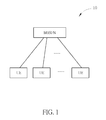
- FIG. 1 is a schematic diagram of a wireless communication system according to an example of the present invention.
- FIG. 2 is a schematic diagram of a communication device 20 according to an example of the present invention.
- FIG. 3 is a flowchart of a process according to an example of the present invention.
- FIG. 4 is a timing diagram of the process shown in FIG. 4 .
- FIG. 5 is a flowchart of a process according to an example of the present invention.
- FIG. 6 is a timing diagram of the process shown in FIG. 5 .
- FIG. 1 is a schematic diagram of a wireless communication system 10 according to an example of the present invention.
- the wireless communication system 10 is briefly composed of a plurality of UEs and a multicast-broadcast single frequency network (MBSFN).
- the wireless communication system 10 may be a wideband code division multiple access (WCDMA) system such as a universal mobile telecommunications system (UMTS).
- WCDMA wideband code division multiple access
- UMTS universal mobile telecommunications system
- OFDM orthogonal frequency division multiplexing
- OFDMA orthogonal frequency division multiplexing
- OFDMA orthogonal frequency division multiplexing
- OFDMA orthogonal frequency division multiple access
- LTE long term evolution
- LTE-A LTE-Advanced
- successor of the LTE-A system a successor of the LTE-A system.
- the network can provide a multimedia broadcast multicast service (MBMS) service to the UEs, wherein the MBMS service is referred to the MBMS service and/or the evolved MBMS (E-MBMS) service.
- MBMS multimedia broadcast multicast service
- E-MBMS evolved MBMS
- the UEs can watch, store and/or edit multimedia contents such as TV programs, films, music, etc., via receiving the MBMS service.
- FIG. 2 is a schematic diagram of a communication device 20 according to an example of the present invention.
- the communication device 20 may realize a UE shown in FIG. 1 , and include a processing means 200 such as a microprocessor or Application Specific Integrated Circuit (ASIC), a storage unit 210 and a communication interfacing unit 220.
- the storage unit 210 may be any data storage device that can store a program code 214, accessed and executed by the processing means 200. Examples of the storage unit 210 include but are not limited to a subscriber identity module (SIM), read-only memory (ROM), flash memory, random-access memory (RAM), CD-ROM/DVD-ROM, magnetic tape, hard disk and optical data storage device.
- SIM subscriber identity module
- ROM read-only memory
- flash memory random-access memory
- CD-ROM/DVD-ROM magnetic tape
- hard disk and optical data storage device optical data storage device.
- the communication interfacing unit 220 is preferably a transceiver and is used to transmit and receive signals (e.g
- FIG. 3 is a flowchart of a process 30 according to an example of the present invention.
- the process 30 is utilized in a UE of the wireless communication system 10 shown in FIG. 1 , for handling a multimedia broadcast multicast service (MBMS) service.
- MBMS multimedia broadcast multicast service
- the process 30 may be compiled into the program code 214, and includes the following steps:
- Step 300 Start.
- Step 302 Determine a state of the MBMS service of the UE when the UE enters a multicast-broadcast single frequency network (MBSFN) with a point-to-multipoint control channel (MCCH) information.
- MMSFN multicast-broadcast single frequency network
- MCCH point-to-multipoint control channel
- Step 304 Update the MCCH information when the state is changed at a current repetition period.
- Step 306 End.
- the UE determines the state of the MBMS service when the UE enters the MBSFN with the MCCH information.
- the state is changed (e.g., the state is changed from "not interested to receive MBMS service" to "interested to receive MBMS service") at the current repetition period
- the UE updates the MCCH information (e.g., the UE acquires the MCCH information at a next repetition period corresponding to the current repetition period) to ensure that the MBMS service can be received.
- the embodiment of the present invention updates the MCCH information when the state is changed from "not interested to receive MBMS service" to "interested to receive MBMS service” at the current repetition period after the UE enters the MBSFN the MCCH information.
- the UE updates the MCCH information once the state is changed from "not interested to receive MBMS service" to "interested to receive MBMS service” after the UE enters the MBSFN with the MCCH information. In such a situation, the UE can avoid using invalid MCCH information of the MBSFN, so as to ensure normal MBMS operation.
- the MCCH information carried by UE may be invalid since the UE had left the MBSFN before. Therefore, when the UE changes the state of the MBMS service from "not interested to receive MBMS service" to "interested to receive MBMS service” at a current repetition period, the UE updates the MCCH information of the MBSFN at a next repetition period corresponding to the current repetition period regardless of the MCCH notification bit. More specifically, if the MCCH notification bit received by UE is not equal to "1" (i.e.
- the UE still updates the MCCH information at the next repetition period. Therefore, through updating the MCCH information of the MBSFN, the UE can avoid using invalid MCCH information of the MBSFN.
- FIG. 5 is a flowchart of a process 50 according to an example of the present invention.
- the process 50 is utilized in a UE of the wireless communication system 10 shown in FIG. 1 , for handling a MBMS service.
- the process 50 may be compiled into the program code 214, and includes the following steps:
- Step 500 Start.
- Step 502 Initiate the MBMS service and storing a MCCH information corresponding to the MBMS service.
- Step 504 Clear a MCCH information when a state of the MBMS service of the communication device is changed.
- Step 506 End.
- the MCCH information is received and stored by the UE.
- the MCCH information is definitely valid and can be used normally.
- the state is changed (e.g., the state is changed from "not interested to receive MBMS service" to "interested to receive MBMS service")
- the UE clears the MCCH information to ensure that the MCCH information will not be used later, such that the UE must apply a MCCH acquisition procedure at a current repetition period and acquire the MCCH information at a next repetition period corresponding to the current repetition period for receiving the MBMS service again.
- the UE When the UE changes the state of the MBMS service from "interested to receive MBMS service" to "not interested to receive MBMS service", the UE clears the MCCH information of the MBSFN immediately. Therefore, whenever the UE changes the state of the MBMS service from "not interested to receive MBMS service” to "interested to receive MBMS service", the UE must apply a MCCH acquisition procedure at a current repetition period and acquires the MCCH information of the MBSFN at a next repetition period.
- the UE Since the UE has no valid MCCH information of the MBSFN when the state of the MBMS service indicates "not interested to receive MBMS service", the UE needs to acquire the latest MCCH information of the MBSFN to receive MBMS service, such that the problem of invalid MCCH information of the MBSFN no longer exists.
- the process 30, 50 both resolves problems of invalid MCCH information and missing the modification period for receiving the MCCH change notification bit.
- the UE updates the MCCH information of the MBSFN without waiting for reception of the MCCH change notification or without considering the MCCH change notification bit (i.e. the MCCH change notification bit has been received) in process 30. Therefore, the UE is always able to acquire the MCCH information which is valid for receiving the MBMS service and needs not to consider the modification period or the MCCH change notification bit.
- the UE clears the MCCH information of the MBSFN when the UE changes the state of the MBMS service from "interested to receive MBMS service" to "not interested to receive MBMS service” in process 50. Therefore, the UE must apply the MCCH acquisition procedure and acquire the MCCH information which is valid for receiving the MBMS service and does not need to consider the modification period or the MCCH change notification bit.
- the present invention provides a method of handling a MBMS service in a wireless communication system.
- the method can resolve problems of using invalid MCCH information for receiving MBMS service and missing the modification period for receiving the MCCH change notification.
- the UE can avoid problems of invalid MCCH information and missing the modification period for receiving the MCCH change notification bit.
Landscapes
- Engineering & Computer Science (AREA)
- Computer Networks & Wireless Communication (AREA)
- Signal Processing (AREA)
- Mobile Radio Communication Systems (AREA)
Abstract
Description
- This application claims the benefit of
U.S. Provisional Application No. 61/612,408, filed on March 19, 2012 - The embodiment of the present invention relates to a method and apparatus used in a wireless communication system, and more particularly, to a method and apparatus of handling a multimedia broadcast multicast service (MBMS) service in a wireless communication system.
- A long-term evolution (LTE) system supporting the 3GPP Rel-8 standard and/or the 3GPP Rel-9 standard are developed by the 3rd Generation Partnership Project (3GPP) as a successor of a universal mobile telecommunications system (UMTS), for further enhancing performance of the UMTS to satisfy increasing needs of users. The LTE system includes a new radio interface and a new radio network architecture that provides a high data rate, low latency, packet optimization, and improved system capacity and coverage. In the LTE system, a radio access network known as an evolved universal terrestrial radio access network (E-UTRAN) includes multiple evolved Node-Bs (eNBs) for communicating with multiple UEs, and communicating with a core network including a mobility management entity (MME), a serving gateway, etc., for Non-Access Stratum (NAS) control.
- A LTE-advanced (LTE-A) system, as its name implies, is an evolution of the LTE system. The LTE-A system targets faster switching between power states, improves performance at the coverage edge of an eNB, and includes advanced techniques, such as carrier aggregation (CA), coordinated multipoint transmission/reception (CoMP), uplink (UL) multiple-input multiple-output (MIMO), etc. For a UE and an eNB to communicate with each other in the LTE-A system, the UE and the eNB must support standards developed for the LTE-A system, such as the 3GPP Rel-10 standard or later versions.
- Multimedia broadcast multicast service (MBMS) service or evolved MBMS (E-MBMS) service have been introduced in the UMTS, the LTE system and the LTE-A system, for broadcasting multimedia contents such as TV programs, films, music, etc. Comparing with the traditional unicast, the MBMS service (hereafter referred to both the MBMS service and/or the E-MBMS service) is downlink only, and is broadcasted from the network to multiple (e.g., a specific group of) UEs via a point-to-multipoint transmission. Characteristic of the MBMS service enables the network to provide the MBMS service to unlimited number of UEs with a constant network load. Besides, a UE in the UMTS, the LTE system and/or the LTE-A system can receive the MBMS service inherently, and no additional hardware component is needed to be installed for the MBMS service. Thus, the MBMS service is attractive considering both hardware cost and resource efficiency.
- A UE interested to a MBMS service receives MBMS service in a multicast-broadcast single frequency network (MBSFN) area by applying a point-to-multipoint control channel (MCCH) information, which change will be notified to UE by a MCCH information change notification on a physical downlink control channel (PDCCH). Therefore, a UE that was receiving a MBMS service and turns to a state of "not interested to receive MBMS service" may move to another cell that does not support MBMS service, and the MCCH information are still stored in the UE. When the UE moves back to the MBSFN area in the state of "not interested to receive MBMS service" and later on, the UE changes the state to "interested to receive MBMS service", the UE will try to find the MCCH information change notification on the PDCCH. However, a MCCH information change notification bit received by UE may show that the MCCH information which had been changed when the UE moved out the MBSFN area does not change currently. In addition, a modification period for receiving the MCCH change notification may have passed, such that the UE cannot receive the MCCH change notification. Both situations cause errors to the UE for receiving the MBMS service and need to be improved.
- The embodiment of the present invention therefore provides a method and apparatus of handling the MBMS service to solve the abovementioned problems.
- A method of handling a multimedia broadcast multicast service (MBMS) service for a communication device in a wireless communication system is disclosed. The method comprises determining a state of the MBMS service of the communication device when the communication device enters a multicast-broadcast single frequency network (MBSFN) with a point-to-multipoint control channel (MCCH) information at a current repetition period; and updating the MCCH information when the state is changed.
- A method of handling a multimedia broadcast multicast service (MBMS) service for a communication device in a wireless communication system is disclosed. The method comprises initiating the MBMS service and storing a point-to-multipoint control channel (MCCH) information corresponding to the MBMS service; and clearing a MCCH information when a state of the MBMS service of the communication device is changed.
- A communication apparatus for a wireless communications system is disclosed. The communication apparatus comprises a processing means; a storage unit; and a program code, stored in the storage unit, wherein the program code instructs the processing means to execute the following steps: determining a state of the MBMS service of the communication device when the communication device enters a multicast-broadcast single frequency network (MBSFN) with a point-to-multipoint control channel (MCCH) information at a current repetition period; and updating the MCCH information when the state is changed.
- These and other objectives of the present invention will no doubt become obvious to those of ordinary skill in the art after reading the following detailed description of the preferred embodiment that is illustrated in the various figures and drawings.
-
FIG. 1 is a schematic diagram of a wireless communication system according to an example of the present invention. -
FIG. 2 is a schematic diagram of acommunication device 20 according to an example of the present invention. -
FIG. 3 is a flowchart of a process according to an example of the present invention. -
FIG. 4 is a timing diagram of the process shown inFIG. 4 . -
FIG. 5 is a flowchart of a process according to an example of the present invention. -
FIG. 6 is a timing diagram of the process shown inFIG. 5 . - Please refer to
FIG. 1 , which is a schematic diagram of awireless communication system 10 according to an example of the present invention. Thewireless communication system 10 is briefly composed of a plurality of UEs and a multicast-broadcast single frequency network (MBSFN). Thewireless communication system 10 may be a wideband code division multiple access (WCDMA) system such as a universal mobile telecommunications system (UMTS). Alternatively, thewireless communication system 10 may be an orthogonal frequency division multiplexing (OFDM) system and/or an orthogonal frequency division multiple access (OFDMA) system, such as a long term evolution (LTE) system, a LTE-Advanced (LTE-A) system or a successor of the LTE-A system. The network can provide a multimedia broadcast multicast service (MBMS) service to the UEs, wherein the MBMS service is referred to the MBMS service and/or the evolved MBMS (E-MBMS) service. Thus, the UEs can watch, store and/or edit multimedia contents such as TV programs, films, music, etc., via receiving the MBMS service. - Please refer to
FIG. 2 , which is a schematic diagram of acommunication device 20 according to an example of the present invention. Thecommunication device 20 may realize a UE shown inFIG. 1 , and include aprocessing means 200 such as a microprocessor or Application Specific Integrated Circuit (ASIC), astorage unit 210 and acommunication interfacing unit 220. Thestorage unit 210 may be any data storage device that can store aprogram code 214, accessed and executed by the processing means 200. Examples of thestorage unit 210 include but are not limited to a subscriber identity module (SIM), read-only memory (ROM), flash memory, random-access memory (RAM), CD-ROM/DVD-ROM, magnetic tape, hard disk and optical data storage device. Thecommunication interfacing unit 220 is preferably a transceiver and is used to transmit and receive signals (e.g., messages or packets) according to processing results of the processing means 200. - Please refer to
FIG. 3 , which is a flowchart of aprocess 30 according to an example of the present invention. Theprocess 30 is utilized in a UE of thewireless communication system 10 shown inFIG. 1 , for handling a multimedia broadcast multicast service (MBMS) service. Theprocess 30 may be compiled into theprogram code 214, and includes the following steps: - Step 300: Start.
- Step 302: Determine a state of the MBMS service of the UE when the UE enters a multicast-broadcast single frequency network (MBSFN) with a point-to-multipoint control channel (MCCH) information.
- Step 304: Update the MCCH information when the state is changed at a current repetition period.
- Step 306: End.
- In the
process 30, the UE determines the state of the MBMS service when the UE enters the MBSFN with the MCCH information. When the state is changed (e.g., the state is changed from "not interested to receive MBMS service" to "interested to receive MBMS service") at the current repetition period, the UE updates the MCCH information (e.g., the UE acquires the MCCH information at a next repetition period corresponding to the current repetition period) to ensure that the MBMS service can be received. - Since the UE does not know whether the MCCH information is valid or not when entering the MBSFN with the MCCH information, the embodiment of the present invention updates the MCCH information when the state is changed from "not interested to receive MBMS service" to "interested to receive MBMS service" at the current repetition period after the UE enters the MBSFN the MCCH information. In other words, even if a MCCH change notification bit is not equal to "1" (MCCH change notification bit="1" is used to notify the UE that the MCCH information of the MBSFN is changed) or a MCCH change notification for carrying the MCCH change notification bit is not received, the UE updates the MCCH information once the state is changed from "not interested to receive MBMS service" to "interested to receive MBMS service" after the UE enters the MBSFN with the MCCH information. In such a situation, the UE can avoid using invalid MCCH information of the MBSFN, so as to ensure normal MBMS operation.
- In detail, please refer to
FIG. 4 . In a situation that the UE enters a MBSFN with a MCCH information, the MCCH information carried by UE may be invalid since the UE had left the MBSFN before. Therefore, when the UE changes the state of the MBMS service from "not interested to receive MBMS service" to "interested to receive MBMS service" at a current repetition period, the UE updates the MCCH information of the MBSFN at a next repetition period corresponding to the current repetition period regardless of the MCCH notification bit. More specifically, if the MCCH notification bit received by UE is not equal to "1" (i.e. the MCCH notification bit indicates that the MCCH information of the MBSFN is not changed) or the MCCH notification carrying the MCCH notification bit is not received by the UE, the UE still updates the MCCH information at the next repetition period. Therefore, through updating the MCCH information of the MBSFN, the UE can avoid using invalid MCCH information of the MBSFN. - Furthermore, please refer to
FIG. 5 , which is a flowchart of aprocess 50 according to an example of the present invention. Theprocess 50 is utilized in a UE of thewireless communication system 10 shown inFIG. 1 , for handling a MBMS service. Theprocess 50 may be compiled into theprogram code 214, and includes the following steps: - Step 500: Start.
- Step 502: Initiate the MBMS service and storing a MCCH information corresponding to the MBMS service.
- Step 504: Clear a MCCH information when a state of the MBMS service of the communication device is changed.
- Step 506: End.
- In the
process 50, when the UE initiates the MBMS service, the MCCH information is received and stored by the UE. The MCCH information is definitely valid and can be used normally. Then, when the state is changed (e.g., the state is changed from "not interested to receive MBMS service" to "interested to receive MBMS service"), the UE clears the MCCH information to ensure that the MCCH information will not be used later, such that the UE must apply a MCCH acquisition procedure at a current repetition period and acquire the MCCH information at a next repetition period corresponding to the current repetition period for receiving the MBMS service again. - In detail, please refer to
FIG. 6 . When the UE changes the state of the MBMS service from "interested to receive MBMS service" to "not interested to receive MBMS service", the UE clears the MCCH information of the MBSFN immediately. Therefore, whenever the UE changes the state of the MBMS service from "not interested to receive MBMS service" to "interested to receive MBMS service", the UE must apply a MCCH acquisition procedure at a current repetition period and acquires the MCCH information of the MBSFN at a next repetition period. Since the UE has no valid MCCH information of the MBSFN when the state of the MBMS service indicates "not interested to receive MBMS service", the UE needs to acquire the latest MCCH information of the MBSFN to receive MBMS service, such that the problem of invalid MCCH information of the MBSFN no longer exists. - Please note that, the
process process 30. Therefore, the UE is always able to acquire the MCCH information which is valid for receiving the MBMS service and needs not to consider the modification period or the MCCH change notification bit. Similarly, the UE clears the MCCH information of the MBSFN when the UE changes the state of the MBMS service from "interested to receive MBMS service" to "not interested to receive MBMS service" inprocess 50. Therefore, the UE must apply the MCCH acquisition procedure and acquire the MCCH information which is valid for receiving the MBMS service and does not need to consider the modification period or the MCCH change notification bit. - To sum up, the present invention provides a method of handling a MBMS service in a wireless communication system. The method can resolve problems of using invalid MCCH information for receiving MBMS service and missing the modification period for receiving the MCCH change notification. Through updating the MCCH information of the MBSFN without waiting for reception of the MCCH change notification and without considering the MCCH change notification bit, or clearing the MCCH information of the MBSFN when the UE changes the state of the MBMS service from "interested to receive MBMS service" to "not interested to receive MBMS service", the UE can avoid problems of invalid MCCH information and missing the modification period for receiving the MCCH change notification bit.
- Those skilled in the art will readily observe that numerous modifications and alterations of the device and method may be made while retaining the teachings of the invention. Accordingly, the above disclosure should be construed as limited only by the metes and bounds of the appended claims.
Claims (15)
- A method of handling a multimedia broadcast multicast service (MBMS) service for a communication device in a wireless communication system, the method comprising:determining a state of the MBMS service of the communication device when the communication device enters a multicast-broadcast single frequency network (MBSFN) with a point-to-multipoint control channel (MCCH) information; andupdating the MCCH information when the state is changed at a current repetition period.
- The method of claim 1, wherein the step of updating the MCCH information when the state of the MBMS service of the communication device is changed comprises:updating the MCCH information when the state of the MBMS service of the communication device is changed from a first state indicating that the communication device is not interested to a MBMS service to a second state indicating that the communication device is interested to a MBMS service.
- The method of claim 1, wherein the step of updating the MCCH information when the state of the MBMS service of the communication device is changed comprises:updating the MCCH information at a next repetition period corresponding to the current repetition period.
- The method of claim 3, wherein a MCCH change notification bit is not equal to "1".
- The method of claim 3, wherein the communication device does not wait for a MCCH change notification.
- A method of handling a multimedia broadcast multicast service (MBMS) service for a communication device in a wireless communication system, the method comprising:initiating the MBMS service and storing a point-to-multipoint control channel (MCCH) information corresponding to the MBMS service; andclearing a MCCH information when a state of the MBMS service of the communication device is changed.
- The method of claim 6, wherein the step of clearing the MCCH information when the state of the MBMS service of the communication device is changed comprises:clearing the MCCH information when the state of the MBMS service of the communication device is changed from a first state indicating that the communication device is interested to the MBMS service to a second state indicating that the communication device is not interested to the MBMS service.
- The method of claim 7, further comprising:applying a MCCH acquisition procedure when the state of the MBMS service of the communication device is changed from the second state to the first state at a current repetition period.
- The method of claim 8, wherein the step of applying the MCCH acquisition procedure when the state is changed from the second state to the first state comprises:acquiring the MCCH information at a next repetition period corresponding to the current repetition period.
- A communication apparatus for a wireless communications system, comprising:a processing means;a storage unit; anda program code, stored in the storage unit, wherein the program code instructs the processing means to execute the following steps:determining a state of the MBMS service of the communication device when the communication device enters a multicast-broadcast single frequency network (MBSFN) with a point-to-multipoint control channel (MCCH) information; andupdating the MCCH information when the state is changed at a current repetition period.
- The apparatus of claim 10, wherein the step of updating the MCCH information when the state of the MBMS service of the communication device is changed comprises:updating the MCCH information when the state of the MBMS service of the communication device is changed from a first state indicating that the communication device is not interested to a MBMS service to a second state indicating that the communication device is interested to a MBMS service.
- The apparatus of claim 10, wherein the step of updating the MCCH information when the state of the MBMS service of the communication device is changed comprises:updating the MCCH information at a next repetition period corresponding to the current repetition period.
- The apparatus of claim 12, wherein a MCCH change notification bit is not equal to "1".
- The apparatus of claim 12, wherein the communication device does not wait for a MCCH change notification at a next modification period.
- A computer program product, comprising computer program logic configured to put into effect the method of any of claims 1-9.
Applications Claiming Priority (2)
| Application Number | Priority Date | Filing Date | Title |
|---|---|---|---|
| US201261612408P | 2012-03-19 | 2012-03-19 | |
| US13/802,756 US20130242845A1 (en) | 2012-03-19 | 2013-03-14 | Method and Apparatus of Handling MBMS service in a Wireless Communication System |
Publications (2)
| Publication Number | Publication Date |
|---|---|
| EP2651175A2 true EP2651175A2 (en) | 2013-10-16 |
| EP2651175A3 EP2651175A3 (en) | 2014-01-08 |
Family
ID=47891485
Family Applications (1)
| Application Number | Title | Priority Date | Filing Date |
|---|---|---|---|
| EP20130159445 Withdrawn EP2651175A3 (en) | 2012-03-19 | 2013-03-15 | Method and apparatus of handling MBMS service in a wireless communication system |
Country Status (2)
| Country | Link |
|---|---|
| US (1) | US20130242845A1 (en) |
| EP (1) | EP2651175A3 (en) |
Families Citing this family (3)
| Publication number | Priority date | Publication date | Assignee | Title |
|---|---|---|---|---|
| CN104918277B (en) * | 2014-03-14 | 2018-07-03 | 电信科学技术研究院 | A kind of method, equipment and system for carrying out frequency point configuration and data transmission |
| WO2016163837A1 (en) * | 2015-04-09 | 2016-10-13 | Lg Electronics Inc. | Method and apparatus for handling l2 entity in continuity between sc-ptm transmission and mbsfn transmission in wireless communication system |
| CN115278790B (en) * | 2021-04-30 | 2025-10-03 | 华为技术有限公司 | Communication method and communication device |
Family Cites Families (7)
| Publication number | Priority date | Publication date | Assignee | Title |
|---|---|---|---|---|
| US7649865B2 (en) * | 2002-11-08 | 2010-01-19 | Nokia Corporation | Service-activation based state switching |
| KR101054957B1 (en) * | 2004-08-12 | 2011-08-05 | 엘지전자 주식회사 | Control message transmission and reception method for multicast and broadcast service |
| CN101039459A (en) * | 2006-03-16 | 2007-09-19 | 华硕电脑股份有限公司 | Method and apparatus for multimedia broadcast and multicast service information |
| US8139524B2 (en) * | 2007-06-18 | 2012-03-20 | Lg Electronics Inc. | Control channel reception method for receiving broadcast or multicast service |
| CN103401668B (en) * | 2007-12-17 | 2016-12-28 | Tcl通讯科技控股有限公司 | Mobile communication system |
| US9338811B2 (en) * | 2009-03-06 | 2016-05-10 | Apple Inc. | Methods and apparatus for providing selective access to wireless network resources using detailed information |
| CN102158808B (en) * | 2010-02-11 | 2016-03-30 | 中兴通讯股份有限公司 | The method of reseptance of MCCH information and device, subscriber equipment |
-
2013
- 2013-03-14 US US13/802,756 patent/US20130242845A1/en not_active Abandoned
- 2013-03-15 EP EP20130159445 patent/EP2651175A3/en not_active Withdrawn
Non-Patent Citations (1)
| Title |
|---|
| None |
Also Published As
| Publication number | Publication date |
|---|---|
| EP2651175A3 (en) | 2014-01-08 |
| US20130242845A1 (en) | 2013-09-19 |
Similar Documents
| Publication | Publication Date | Title |
|---|---|---|
| US20160007319A1 (en) | Method and apparatus for multimedia broadcast multicast service (mbms) control information delivery | |
| US9838960B2 (en) | Method of handling cell selection and related communication device | |
| US9131468B2 (en) | Method of handling resource allocation for MTC and related communication device | |
| KR101613030B1 (en) | Discovering an evolved multicast broadcast multimedia service in single or dual band lte | |
| US9774427B2 (en) | Method of handling uplink/downlink configurations for time-division duplexing system and related communication device | |
| US10127263B2 (en) | Full file repair using schedule description fragment in eMBMS | |
| JP2020506635A (en) | Controlling carrier aggregation settings of user equipment using enhanced multimedia broadcast multicast service | |
| KR20240007933A (en) | Method and apparatus for sending and receiving notification of multicast session activation | |
| US20140241281A1 (en) | Method of Handling a Cell Addition for Dual Connectivity and related communication device | |
| US9723455B2 (en) | Method of transmitting multicast signal and unicast signal simultaneously and related communication device | |
| US9320057B2 (en) | Method and apparatus for performing machine-type communication device access in wireless communication system | |
| US20130242974A1 (en) | Method and Apparatus for Synchronization Mechanisms in Wireless Communication Systems | |
| US9706547B2 (en) | Method of handling communication operations and related communication device | |
| US20130242845A1 (en) | Method and Apparatus of Handling MBMS service in a Wireless Communication System | |
| US9480059B2 (en) | Method of indicating downlink control channel and related communication device | |
| US20130294359A1 (en) | Method of Handling Resource Allocation in TDD System and Related Communication Device | |
| US20130039257A1 (en) | Method of Handling Handover of a Relay Node and Related Communication Device | |
| US12501336B2 (en) | UE optimization in EPS fallback fast return procedure | |
| US9066299B2 (en) | Apparatus and method of handling MBMS service in a wireless communication system | |
| US10542474B2 (en) | Method of handling network entry in a cell cluster and related communication device | |
| US10149289B2 (en) | Method of handling downlink-only carrier and related communication device |
Legal Events
| Date | Code | Title | Description |
|---|---|---|---|
| PUAI | Public reference made under article 153(3) epc to a published international application that has entered the european phase |
Free format text: ORIGINAL CODE: 0009012 |
|
| 17P | Request for examination filed |
Effective date: 20130315 |
|
| AK | Designated contracting states |
Kind code of ref document: A2 Designated state(s): AL AT BE BG CH CY CZ DE DK EE ES FI FR GB GR HR HU IE IS IT LI LT LU LV MC MK MT NL NO PL PT RO RS SE SI SK SM TR |
|
| AX | Request for extension of the european patent |
Extension state: BA ME |
|
| PUAL | Search report despatched |
Free format text: ORIGINAL CODE: 0009013 |
|
| AK | Designated contracting states |
Kind code of ref document: A3 Designated state(s): AL AT BE BG CH CY CZ DE DK EE ES FI FR GB GR HR HU IE IS IT LI LT LU LV MC MK MT NL NO PL PT RO RS SE SI SK SM TR |
|
| AX | Request for extension of the european patent |
Extension state: BA ME |
|
| RIC1 | Information provided on ipc code assigned before grant |
Ipc: H04W 76/00 20090101AFI20131203BHEP |
|
| RBV | Designated contracting states (corrected) |
Designated state(s): AL AT BE BG CH CY CZ DE DK EE ES FI FR GB GR HR HU IE IS IT LI LT LU LV MC MK MT NL NO PL PT RO RS SE SI SK SM TR |
|
| 17Q | First examination report despatched |
Effective date: 20141103 |
|
| RAP1 | Party data changed (applicant data changed or rights of an application transferred) |
Owner name: HTC CORPORATION |
|
| STAA | Information on the status of an ep patent application or granted ep patent |
Free format text: STATUS: THE APPLICATION IS DEEMED TO BE WITHDRAWN |
|
| 18D | Application deemed to be withdrawn |
Effective date: 20150926 |