EP2650737B1 - Measuring the populations in each hyperfine ground state of alkali atoms in a vapor cell while limiting the contribution of the background vapor - Google Patents
Measuring the populations in each hyperfine ground state of alkali atoms in a vapor cell while limiting the contribution of the background vapor Download PDFInfo
- Publication number
- EP2650737B1 EP2650737B1 EP13154436.3A EP13154436A EP2650737B1 EP 2650737 B1 EP2650737 B1 EP 2650737B1 EP 13154436 A EP13154436 A EP 13154436A EP 2650737 B1 EP2650737 B1 EP 2650737B1
- Authority
- EP
- European Patent Office
- Prior art keywords
- atoms
- sample
- ground state
- fluorescence
- measuring
- Prior art date
- Legal status (The legal status is an assumption and is not a legal conclusion. Google has not performed a legal analysis and makes no representation as to the accuracy of the status listed.)
- Active
Links
- 230000005283 ground state Effects 0.000 title claims description 59
- 239000003513 alkali Substances 0.000 title description 3
- 238000000034 method Methods 0.000 claims description 36
- 230000001351 cycling effect Effects 0.000 claims description 10
- 230000007704 transition Effects 0.000 claims description 10
- 230000003287 optical effect Effects 0.000 claims description 6
- 238000004611 spectroscopical analysis Methods 0.000 claims description 6
- 239000000523 sample Substances 0.000 description 43
- 238000010586 diagram Methods 0.000 description 6
- 238000012512 characterization method Methods 0.000 description 2
- 230000001427 coherent effect Effects 0.000 description 2
- 238000005259 measurement Methods 0.000 description 2
- 238000001514 detection method Methods 0.000 description 1
- 230000000694 effects Effects 0.000 description 1
- 239000000203 mixture Substances 0.000 description 1
- 230000005855 radiation Effects 0.000 description 1
- 229910052701 rubidium Inorganic materials 0.000 description 1
- IGLNJRXAVVLDKE-UHFFFAOYSA-N rubidium atom Chemical compound [Rb] IGLNJRXAVVLDKE-UHFFFAOYSA-N 0.000 description 1
Images

Classifications
-
- H—ELECTRICITY
- H01—ELECTRIC ELEMENTS
- H01J—ELECTRIC DISCHARGE TUBES OR DISCHARGE LAMPS
- H01J49/00—Particle spectrometers or separator tubes
- H01J49/44—Energy spectrometers, e.g. alpha-, beta-spectrometers
- H01J49/46—Static spectrometers
-
- G—PHYSICS
- G04—HOROLOGY
- G04F—TIME-INTERVAL MEASURING
- G04F5/00—Apparatus for producing preselected time intervals for use as timing standards
- G04F5/14—Apparatus for producing preselected time intervals for use as timing standards using atomic clocks
-
- H—ELECTRICITY
- H03—ELECTRONIC CIRCUITRY
- H03B—GENERATION OF OSCILLATIONS, DIRECTLY OR BY FREQUENCY-CHANGING, BY CIRCUITS EMPLOYING ACTIVE ELEMENTS WHICH OPERATE IN A NON-SWITCHING MANNER; GENERATION OF NOISE BY SUCH CIRCUITS
- H03B17/00—Generation of oscillations using radiation source and detector, e.g. with interposed variable obturator
Definitions
- Measurement of the internal state of alkali atoms in an atomic clock is typically done using resonance fluorescence.
- the atoms are probed with light on resonance with the upper ground state but not the lower ground state.
- an optical repumping step transfers the lower state population to the upper state and the same resonance is used to probe the atoms again.
- the fluorescence signal contains a contribution from all of the atoms. If the sample of atoms to be measured is captured from hot vapor in a vapor cell, problems occur when the repumping step repumps all the atoms in the background vapor as well, increasing the overall light level in the second probe, and reducing the size of the signal compared to the background.
- the present invention defines a method for measuring the population of atoms in a vapour cell.
- a method for measuring the population of alkali atoms in each hyperfine ground state in a vapor cell while limiting the contribution of the background vapor generally comprises collecting a sample of atoms, and applying radio frequency (RF) spectroscopy to the sample of atoms such that a first portion of the atoms are in an upper ground state and a second portion of the atoms are in a lower ground state.
- RF radio frequency
- Light is applied to the sample of atoms to produce a first fluorescence of the atoms such that all the atoms are left in the lower ground state, and a population of the atoms in the upper ground state is measured based on the first fluorescence of the atoms.
- An RF pulse is applied to the sample of atoms to transfer the atoms in the lower ground state to the upper ground state.
- Light is applied to the sample of atoms after the RF pulse is applied to produce a second fluorescence of the atoms, and a population of all the atoms in the sample is measured based on the second fluorescence of the atoms.
- the present method utilizes a coherent transfer of atoms in the vapor cell from lower ground states to upper ground states using the RF pulse. At the same time, atoms in the upper ground state go to the lower ground state. Since a cold atom sample can be prepared entirely in the lower state, the present method ensures that the entire sample is repumped. Meanwhile, the atoms in the background vapor are in a random state so the RF pulse has no effect on the net populations of those atoms.
- the present technique can be implemented in an atomic clock used as a primary frequency standard, for example.
- FIG. 1 is flow diagram of a process 100 for radio frequency (RF) repumping of atoms in a vapor cell according to one embodiment.
- a magneto-optic trap (MOT) 102 collects a sample of cold atoms.
- the MOT 102 can be part of the physics package of an atomic clock, for example.
- a laser light is turned off, and the sample of atoms is subjected to RF spectroscopy (block 104). This results in some of the atoms being in the upper ground state and some of the atoms being in the lower ground state.
- Light is then applied to the sample of atoms, and the fluorescence of the atoms is used to measure the population of atoms in the upper ground state only (block 106).
- the light is applied until all atoms have been optically pumped to the lower ground state.
- an RF pulse is applied to the sample of atoms to "repump" the atoms from the lower ground state to the upper ground state (block 108).
- light is applied again to the sample of atoms and the fluorescence of the atoms is used to measure the population of all the atoms in the sample (block 110).
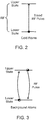
- Figure 2 is an energy level diagram for the cold atoms in a vapor cell subjected to RF repumping according to the present technique. As shown in Figure 2 , the cold atoms in the sample are all in the lower ground state when a timed RF pulse is applied. The arrow represents the coherent transfer of atoms to the upper ground state by the RF radiation.
- Figure 3 is an energy level diagram for the background atoms in a vapor cell subjected to the RF repumping of the present technique.
- the atoms of the background vapor are randomly in the upper ground state or the lower ground state (about one-half in each state, represented by half-filled circles).
- the RF pulse swaps the upper and lower ground states of the background atoms, represented by arrows in both directions in Figure 3 .
- the resulting distribution of the ground states is about the same as before the RF pulse. This is in contrast to conventional optical repumping, which transfers all atoms to the upper ground state regardless of the initial conditions.
- the Rabi frequency of the atoms in a vapor cell is measured to provide an initial calibration.
- This initial calibration is used to determine the power and time needed for the timed RF pulse (block 108 of Figure 1 and Figure 2 ) and need only be done once.
- a sample of atoms from the vapor cell is trapped and cooled using a magneto-optic trap.
- Light is applied on the cycling transition long enough to pump all atoms to the lower ground state.
- the cold atoms are prepared in a superposition or mixture of upper and lower hyperfine ground states. This is the state which is to be measured by the present technique. To make the measurement, light is applied on the cycling transition and fluorescence is recorded.
- the fluorescence is proportional to the population in the upper ground state. Light is applied until all atoms have been optically pumped to the lower ground state. The light on the cycling transition is then extinguished, either by removing the light or by changing the frequency of the light far from resonance. Next, an RF pi pulse is applied using the measured Rabi frequency. The cold atoms are all transferred from the lower ground state to the upper ground state. Finally, light is applied again on the cycling transition and the fluorescence is recorded. The fluorescence from nearby atoms that were not part of the cold sample is much less than if there had been optical repumping, increasing the signal-to-noise ratio.
Landscapes
- Physics & Mathematics (AREA)
- General Physics & Mathematics (AREA)
- Chemical & Material Sciences (AREA)
- Analytical Chemistry (AREA)
- Investigating, Analyzing Materials By Fluorescence Or Luminescence (AREA)
Description
- This application claims the benefit of priority to United States Provisional Application No.
61/622,719, filed on April 11, 2012 - Measurement of the internal state of alkali atoms in an atomic clock is typically done using resonance fluorescence. To distinguish between the upper and lower ground states of the atoms, the atoms are probed with light on resonance with the upper ground state but not the lower ground state. Next, an optical repumping step transfers the lower state population to the upper state and the same resonance is used to probe the atoms again. At this point, the fluorescence signal contains a contribution from all of the atoms. If the sample of atoms to be measured is captured from hot vapor in a vapor cell, problems occur when the repumping step repumps all the atoms in the background vapor as well, increasing the overall light level in the second probe, and reducing the size of the signal compared to the background.
- An exemplary atomic clock for application of the present invention is disclosed in
U.S. Patent No. 7,944,317 (and in its family memberUS 2010/0033256 A1 ) entitled COLD ATOM MICRO PRIMARY STANDARD. - In A. Godone et Al, "Physics characterisation and frequency stability of the pulsed rubidium Master", Physical Review A 74, 043401 (2006), a theoretical and experimental characterisation of a pulsed optical pumped vapor-cell frequency standard based on the detection of the free-induction decay microwave signal is reported.
- In accordance with claim 1, the present invention defines a method for measuring the population of atoms in a vapour cell.
- Understanding that the drawings depict only exemplary embodiments and are not therefore to be considered limiting in scope, the exemplary embodiments will be described with additional specificity and detail through the use of the accompanying drawings, in which:
-
Figure 1 is a flow diagram of a process for radio frequency (RF) repumping of atoms in a vapor cell according to one embodiment; -
Figure 2 is an energy level diagram for the cold atoms in a vapor cell subjected to the RF repumping process shown inFigure 1 ; and -
Figure 3 is an energy level diagram for the background atoms in a vapor cell subjected to the RF repumping process shown inFigure 1 . - In the following detailed description, reference is made to the accompanying drawings that form a part hereof, and in which is shown by way of illustration specific illustrative embodiments. It is to be understood that other embodiments may be utilized and that logical, mechanical, and electrical changes may be made. Furthermore, the method presented in the drawing figures and the specification is not to be construed as limiting the order in which the individual steps may be performed. The following detailed description is, therefore, not to be taken in a limiting sense.
- A method is provided for measuring the population of alkali atoms in each hyperfine ground state in a vapor cell while limiting the contribution of the background vapor. The method generally comprises collecting a sample of atoms, and applying radio frequency (RF) spectroscopy to the sample of atoms such that a first portion of the atoms are in an upper ground state and a second portion of the atoms are in a lower ground state. Light is applied to the sample of atoms to produce a first fluorescence of the atoms such that all the atoms are left in the lower ground state, and a population of the atoms in the upper ground state is measured based on the first fluorescence of the atoms. An RF pulse is applied to the sample of atoms to transfer the atoms in the lower ground state to the upper ground state. Light is applied to the sample of atoms after the RF pulse is applied to produce a second fluorescence of the atoms, and a population of all the atoms in the sample is measured based on the second fluorescence of the atoms.
- The present method utilizes a coherent transfer of atoms in the vapor cell from lower ground states to upper ground states using the RF pulse. At the same time, atoms in the upper ground state go to the lower ground state. Since a cold atom sample can be prepared entirely in the lower state, the present method ensures that the entire sample is repumped. Meanwhile, the atoms in the background vapor are in a random state so the RF pulse has no effect on the net populations of those atoms.
- The present technique can be implemented in an atomic clock used as a primary frequency standard, for example.
-
Figure 1 is flow diagram of aprocess 100 for radio frequency (RF) repumping of atoms in a vapor cell according to one embodiment. Initially, a magneto-optic trap (MOT) 102 collects a sample of cold atoms. TheMOT 102 can be part of the physics package of an atomic clock, for example. A laser light is turned off, and the sample of atoms is subjected to RF spectroscopy (block 104). This results in some of the atoms being in the upper ground state and some of the atoms being in the lower ground state. Light is then applied to the sample of atoms, and the fluorescence of the atoms is used to measure the population of atoms in the upper ground state only (block 106). The light is applied until all atoms have been optically pumped to the lower ground state. Next, an RF pulse is applied to the sample of atoms to "repump" the atoms from the lower ground state to the upper ground state (block 108). Finally, light is applied again to the sample of atoms and the fluorescence of the atoms is used to measure the population of all the atoms in the sample (block 110). -
Figure 2 is an energy level diagram for the cold atoms in a vapor cell subjected to RF repumping according to the present technique. As shown inFigure 2 , the cold atoms in the sample are all in the lower ground state when a timed RF pulse is applied. The arrow represents the coherent transfer of atoms to the upper ground state by the RF radiation. -
Figure 3 is an energy level diagram for the background atoms in a vapor cell subjected to the RF repumping of the present technique. Initially, the atoms of the background vapor are randomly in the upper ground state or the lower ground state (about one-half in each state, represented by half-filled circles). The RF pulse swaps the upper and lower ground states of the background atoms, represented by arrows in both directions inFigure 3 . The resulting distribution of the ground states is about the same as before the RF pulse. This is in contrast to conventional optical repumping, which transfers all atoms to the upper ground state regardless of the initial conditions. - In one embodiment, using optical repumping and an RF source, the Rabi frequency of the atoms in a vapor cell is measured to provide an initial calibration. This initial calibration is used to determine the power and time needed for the timed RF pulse (
block 108 ofFigure 1 andFigure 2 ) and need only be done once. A sample of atoms from the vapor cell is trapped and cooled using a magneto-optic trap. Light is applied on the cycling transition long enough to pump all atoms to the lower ground state. Then, the cold atoms are prepared in a superposition or mixture of upper and lower hyperfine ground states. This is the state which is to be measured by the present technique. To make the measurement, light is applied on the cycling transition and fluorescence is recorded. The fluorescence is proportional to the population in the upper ground state. Light is applied until all atoms have been optically pumped to the lower ground state. The light on the cycling transition is then extinguished, either by removing the light or by changing the frequency of the light far from resonance. Next, an RF pi pulse is applied using the measured Rabi frequency. The cold atoms are all transferred from the lower ground state to the upper ground state. Finally, light is applied again on the cycling transition and the fluorescence is recorded. The fluorescence from nearby atoms that were not part of the cold sample is much less than if there had been optical repumping, increasing the signal-to-noise ratio. -
- Example 1 includes a method for measuring the population of atoms in a vapor cell, the method comprising collecting a sample of atoms from the vapor cell; applying radio frequency (RF) spectroscopy to the sample of atoms such that a first portion of the atoms are in an upper ground state and a second portion of the atoms are in a lower ground state; applying light to the sample of atoms to produce a first fluorescence of the atoms such that all the atoms in the sample are left in the lower ground state; measuring a population of the atoms in the upper ground state based on the first fluorescence of the atoms; applying an RF pulse to the sample of atoms to transfer the atoms in the lower ground state to the upper ground state; applying light to the sample of atoms after the RF pulse is applied to produce a second fluorescence of the atoms; and measuring a population of all the atoms in the sample based on the second fluorescence of the atoms.
- Example 2 includes the method of Example 1, wherein the sample of atoms is collected in a magneto-optic trap.
- Example 3 includes the method of Example 2, wherein the magneto-optic trap is part of a physics package in an atomic clock.
- Example 4 includes the method of any of Examples 1-3, wherein the light is from a laser.
- Example 5 includes the method of any of Examples 1-4, further comprising measuring a Rabi frequency of the sample of atoms from the vapor cell to provide an initial calibration.
- Example 6 includes the method of any of Examples 1-5, wherein the light applied to the sample of atoms to produce the first fluorescence is applied on a cycling transition long enough to pump all the atoms in the sample to the lower ground state.
- Example 7 includes the method of any of Examples 1-6, wherein the first fluorescence is proportional to the population of the atoms in the upper ground state.
- Example 8 includes the method of any of Examples 1-7, wherein the light applied to the sample of atoms to produce the second fluorescence is applied on the cycling transition.
- Example 9 includes a method for measuring the population of atoms in a vapor cell, the method comprising collecting a sample of atoms from the vapor cell in a magneto-optic trap; measuring a Rabi frequency of the sample of atoms from the vapor cell to provide an initial calibration; applying RF spectroscopy to the sample of atoms such that a first portion of the atoms are in an upper ground state and a second portion of the atoms are in a lower ground state; applying laser light to the sample of atoms to produce a first fluorescence of the atoms such that all the atoms in the sample are left in the lower ground state; measuring a population of the atoms in the upper ground state based on the first fluorescence of the atoms; applying an RF pulse to the sample of atoms to transfer the atoms in the lower ground state to the upper ground state; applying laser light to the sample of atoms after the RF pulse is applied to produce a second fluorescence of the atoms; and measuring a population of all the atoms in the sample based on the second fluorescence of the atoms.
- Example 10 includes the method of Example 9, wherein the magneto-optic trap is part of a physics package in an atomic clock.
- Example 11 includes the method of any of Examples 9-10, wherein the laser light applied to the sample of atoms to produce the first fluorescence is applied on a cycling transition long enough to pump all the atoms in the sample to the lower ground state.
- Example 12 includes the method of any of Examples 9-11, wherein the first fluorescence is proportional to the population of the atoms in the upper ground state.
- Example 13 includes the method of any of Examples 9-12, wherein the laser light applied to the sample of atoms to produce the second fluorescence is applied on the cycling transition.
- Although specific embodiments have been illustrated and described herein, it will be appreciated by those of ordinary skill in the art that any arrangement, which is calculated to achieve the same purpose, may be substituted for the specific embodiments shown. Therefore, it is manifestly intended that this invention be limited by the claims, wherein the description and the drawings shall be used to interpret said claims.
Claims (6)
- A method (100) for measuring the population of atoms in a vapor cell, the method comprising:collecting a sample of atoms from the vapor cell (102) so as to leave background atoms in the vapor cell, by using a magneto optical trap to trap and cool the sample of atoms to provide a sample of cold atoms;measuring a Rabi frequency of the sample of atoms from the vapor cell to provide an initial calibration;applying radio frequency (RF) spectroscopy to the sample of atoms during a first time period such that a first portion of the atoms are in an upper ground state and a second portion of the atoms are in a lower ground state (104);applying light to the sample of atoms, after the RF spectroscopy is applied, to produce a first fluorescence of the atoms until all the atoms in the sample are left in the lower ground state;measuring a population of the atoms in the upper ground state based on the first fluorescence of the atoms (106);applying a timed RF pi pulse, using the measured Rabi frequency, to the sample of atoms during a second time period to transfer the atoms in the lower ground state to the upper ground state (108),wherein the timed RF pi pulse swaps the upper and lower ground states of the background atoms;applying light to the sample of atoms after the timed RF pi pulse is applied to produce a second fluorescence of the atoms; andmeasuring a population of the atoms in the sample based on the second fluorescence of the atoms (110);
- The method of claim 1, wherein the magneto-optic trap is part of a physics package in an atomic clock.
- The method of claim 1, wherein the light is from a laser.
- The method of claim 1, wherein the light applied to the sample of atoms to produce the first fluorescence is applied on a cycling transition long enough to pump all the atoms in the sample to the lower ground state.
- The method of claim 4, wherein the first fluorescence is proportional to the population of the atoms in the upper ground state.
- The method of claim 4, wherein the light applied to the sample of atoms to produce the second fluorescence is applied on the cycling transition.
Applications Claiming Priority (2)
| Application Number | Priority Date | Filing Date | Title |
|---|---|---|---|
| US201261622719P | 2012-04-11 | 2012-04-11 | |
| US13/759,400 US8907276B2 (en) | 2012-04-11 | 2013-02-05 | Measuring the populations in each hyperfine ground state of alkali atoms in a vapor cell while limiting the contribution of the background vapor |
Publications (3)
| Publication Number | Publication Date |
|---|---|
| EP2650737A2 EP2650737A2 (en) | 2013-10-16 |
| EP2650737A3 EP2650737A3 (en) | 2017-11-22 |
| EP2650737B1 true EP2650737B1 (en) | 2019-04-24 |
Family
ID=47748408
Family Applications (1)
| Application Number | Title | Priority Date | Filing Date |
|---|---|---|---|
| EP13154436.3A Active EP2650737B1 (en) | 2012-04-11 | 2013-02-07 | Measuring the populations in each hyperfine ground state of alkali atoms in a vapor cell while limiting the contribution of the background vapor |
Country Status (3)
| Country | Link |
|---|---|
| US (1) | US8907276B2 (en) |
| EP (1) | EP2650737B1 (en) |
| BR (1) | BR102013008134A2 (en) |
Families Citing this family (11)
| Publication number | Priority date | Publication date | Assignee | Title |
|---|---|---|---|---|
| US9077354B2 (en) | 2012-04-10 | 2015-07-07 | Honeywell International Inc. | Low power reduction of biases in a micro primary frequency standard |
| US9030655B2 (en) * | 2012-06-27 | 2015-05-12 | Honeywell International Inc. | Closed loop atomic inertial sensor |
| US9983131B2 (en) | 2014-02-12 | 2018-05-29 | Honeywell International Inc. | Atomic source with heater on thermal isolation die |
| CA3291301A1 (en) | 2017-12-18 | 2026-03-02 | Rydberg Technologies Inc. | Atom-based electromagnetic field sensing element and measurement system |
| US10684591B1 (en) | 2018-06-27 | 2020-06-16 | The Government Of The United States Of America As Represent By The Secretary Of The Air Force | Optical rubidium atomic frequency standard |
| JP7342126B2 (en) * | 2018-12-31 | 2023-09-11 | クオンタム ヴァリー アイデアズ ラボラトリーズ | Electromagnetic field imaging |
| US10859981B1 (en) | 2019-10-21 | 2020-12-08 | Quantum Valley Ideas Laboratories | Vapor cells having one or more optical windows bonded to a dielectric body |
| US11054453B2 (en) | 2019-11-27 | 2021-07-06 | Quantum Valley Ideas Laboratories | Photonic-crystal vapor cells for imaging of electromagnetic fields |
| US11112298B2 (en) | 2019-11-27 | 2021-09-07 | Quantum Valley Ideas Laboratories | Vapor cells for imaging of electromagnetic fields |
| US10802066B1 (en) | 2019-12-17 | 2020-10-13 | Quantum Valley Ideas Laboratories | Single-pixel imaging of electromagnetic fields |
| US11137432B1 (en) | 2020-03-16 | 2021-10-05 | Quantum Valley Ideas Laboratories | Photonic crystal receivers |
Family Cites Families (22)
| Publication number | Priority date | Publication date | Assignee | Title |
|---|---|---|---|---|
| US5528028A (en) * | 1990-06-01 | 1996-06-18 | Chu; Steven | Frequency standard using an atomic stream of optically cooled atoms |
| US5338930A (en) * | 1990-06-01 | 1994-08-16 | Research Corporation Technologies | Frequency standard using an atomic fountain of optically trapped atoms |
| US5420549A (en) * | 1994-05-13 | 1995-05-30 | The United States Of America As Represented By The Administrator Of The National Aeronautics And Space Administration | Extended linear ion trap frequency standard apparatus |
| US5606291A (en) | 1995-11-06 | 1997-02-25 | Northrop Grumman Corporation | Miniature atomic frequency standard controlled by a digital processor |
| US5657340A (en) * | 1996-04-19 | 1997-08-12 | The Aerospace Corporation | Rubidium atomic clock with fluorescence optical pumping and method using same |
| US5852386A (en) | 1997-06-02 | 1998-12-22 | Northrop Grumman Corporation | Apparatus and method for microwave field strength stabilization in cell type atomic clocks |
| DE60329666D1 (en) | 2002-04-09 | 2009-11-26 | California Inst Of Techn | ATOM WATCH BASED ON AN OPTOELECTRONIC OSCILLATOR |
| WO2004081586A2 (en) | 2003-03-11 | 2004-09-23 | Princeton University | Method and system for operating an atomic clock with reduced spin-exchange broadening of atomic clock resonances |
| US7778293B2 (en) | 2003-06-19 | 2010-08-17 | Kernco Inc. | Determining and setting the frequency modulation index of a laser in a CPT frequency standard |
| US7102451B2 (en) | 2004-02-18 | 2006-09-05 | Princeton University, Office Of Technology, Licensing & Intellectual Property | Method and system for operating an atomic clock with alternating-polarization light |
| US7323941B1 (en) | 2004-02-18 | 2008-01-29 | Princeton University | Method and system for operating a laser self-modulated at alkali-metal atom hyperfine frequency |
| US7202751B2 (en) * | 2004-10-18 | 2007-04-10 | Agilent Inc. | Optically pumped frequency standard with reduces AC stark shift |
| US7439814B2 (en) * | 2005-08-24 | 2008-10-21 | Princeton University | Method and system for operating an atomic clock with simultaneous control of frequency and magnetic field |
| US7468637B2 (en) | 2006-04-19 | 2008-12-23 | Sarnoff Corporation | Batch-fabricated, RF-interrogated, end transition, chip-scale atomic clock |
| US8058936B2 (en) * | 2007-08-31 | 2011-11-15 | California Institute Of Technology | Atomic ion clock with two ion traps, and method to transfer ions |
| US8009520B2 (en) | 2007-09-20 | 2011-08-30 | Princeton University | Method and system for operating an atomic clock using a self-modulated laser with electrical modulation |
| US20090296760A1 (en) * | 2008-05-27 | 2009-12-03 | Miao Zhu | Optical Pumping Apparatus and Method to Reduce AC Stark Shift in Atomic Frequency Standards |
| US7944317B2 (en) * | 2008-08-11 | 2011-05-17 | Honeywell International Inc. | Cold atom micro primary standard |
| US7965147B2 (en) | 2008-08-11 | 2011-06-21 | Honeywell International Inc. | Physics package design for a cold atom primary frequency standard |
| US7859350B1 (en) * | 2009-04-28 | 2010-12-28 | Sandia Corporation | Microfabricated ion frequency standard |
| US8837540B2 (en) | 2011-06-29 | 2014-09-16 | Honeywell International Inc. | Simple, low power microsystem for saturation spectroscopy |
| US9077354B2 (en) | 2012-04-10 | 2015-07-07 | Honeywell International Inc. | Low power reduction of biases in a micro primary frequency standard |
-
2013
- 2013-02-05 US US13/759,400 patent/US8907276B2/en active Active
- 2013-02-07 EP EP13154436.3A patent/EP2650737B1/en active Active
- 2013-04-04 BR BRBR102013008134-5A patent/BR102013008134A2/en not_active IP Right Cessation
Non-Patent Citations (1)
| Title |
|---|
| None * |
Also Published As
| Publication number | Publication date |
|---|---|
| BR102013008134A2 (en) | 2015-06-16 |
| US8907276B2 (en) | 2014-12-09 |
| EP2650737A3 (en) | 2017-11-22 |
| US20130270434A1 (en) | 2013-10-17 |
| EP2650737A2 (en) | 2013-10-16 |
Similar Documents
| Publication | Publication Date | Title |
|---|---|---|
| US8907276B2 (en) | Measuring the populations in each hyperfine ground state of alkali atoms in a vapor cell while limiting the contribution of the background vapor | |
| US10466317B2 (en) | Atomic magnetometry using pump-probe operation and multipass cells | |
| Anderson et al. | Trapping Rydberg atoms in an optical lattice | |
| Kawall et al. | Precision zeeman-stark spectroscopy of the metastable a (1)[σ+ 3] state of pbo | |
| Hartmann et al. | Rotation and magnetic activity in main-sequence stars | |
| Wright et al. | Zeeman-driven phase transition within the superconducting state of κ-(BEDT-TTF) 2 Cu (NCS) 2 | |
| Das et al. | Discovery of Eight “Main-sequence Radio Pulse Emitters” Using the GMRT: Clues to the Onset of Coherent Radio Emission in Hot Magnetic Stars | |
| WO2012174019A1 (en) | Absorption-based detection of spin impurities in solid-state spin systems | |
| Zhang et al. | Hyperfine anomalies in Fr: boundaries of the spherical single particle model | |
| Voss et al. | First Use of High-Frequency Intensity Modulation of Narrow-Linewidth Laser Light<? format?> and Its Application in Determination of Fr 206, 205, 204 Ground-State Properties | |
| Clos et al. | Decoherence-assisted spectroscopy of a single Mg+ ion | |
| CN105092629A (en) | Magnetic resonance two-dimensional spectrum method for measuring hydrogen-hydrogen J coupling constants | |
| Maxwell et al. | Enhanced polarization of low pressure 3He through metastability exchange optical pumping at high field | |
| Peters et al. | Thermometry of ultracold atoms by electromagnetically induced transparency | |
| Antoni-Micollier et al. | Generation of high-purity low-temperature samples of K 39 for applications in metrology | |
| EP2650690B1 (en) | Method for NMR Measurements on Quadrupolar Nuclei | |
| Edmunds et al. | Trapping cold ground state argon atoms | |
| Kim et al. | Optical pumping effect in absorption imaging of F= 1 atomic gases | |
| Wang et al. | Atom-interferometric measurement of Stark level splittings | |
| Yao et al. | Strongly Interacting Bose Gases near a $ d $-wave Shape Resonance | |
| Wade et al. | Magnetic Field Monitoring of Four Massive A–F Supergiants | |
| 陈曦 et al. | Coherent Population Trapping-Ramsey Interference in Cold Atoms | |
| Kawall et al. | Proof of principle for a high sensitivity search for the electric dipole moment of the electron using the metastable a (1)[^ 3\Sigma^+] state of PbO | |
| Raven | Measurement of the CP violation phase $\phi_s $ in the $ B_s $ system at LHCb | |
| Egl | The ALPHATRAP g-factor experiment |
Legal Events
| Date | Code | Title | Description |
|---|---|---|---|
| PUAI | Public reference made under article 153(3) epc to a published international application that has entered the european phase |
Free format text: ORIGINAL CODE: 0009012 |
|
| 17P | Request for examination filed |
Effective date: 20130207 |
|
| AK | Designated contracting states |
Kind code of ref document: A2 Designated state(s): AL AT BE BG CH CY CZ DE DK EE ES FI FR GB GR HR HU IE IS IT LI LT LU LV MC MK MT NL NO PL PT RO RS SE SI SK SM TR |
|
| AX | Request for extension of the european patent |
Extension state: BA ME |
|
| RAP1 | Party data changed (applicant data changed or rights of an application transferred) |
Owner name: HONEYWELL INTERNATIONAL INC. |
|
| PUAL | Search report despatched |
Free format text: ORIGINAL CODE: 0009013 |
|
| STAA | Information on the status of an ep patent application or granted ep patent |
Free format text: STATUS: EXAMINATION IS IN PROGRESS |
|
| AK | Designated contracting states |
Kind code of ref document: A3 Designated state(s): AL AT BE BG CH CY CZ DE DK EE ES FI FR GB GR HR HU IE IS IT LI LT LU LV MC MK MT NL NO PL PT RO RS SE SI SK SM TR |
|
| AX | Request for extension of the european patent |
Extension state: BA ME |
|
| RIC1 | Information provided on ipc code assigned before grant |
Ipc: G04F 5/14 20060101AFI20171013BHEP |
|
| 17Q | First examination report despatched |
Effective date: 20171114 |
|
| GRAP | Despatch of communication of intention to grant a patent |
Free format text: ORIGINAL CODE: EPIDOSNIGR1 |
|
| STAA | Information on the status of an ep patent application or granted ep patent |
Free format text: STATUS: GRANT OF PATENT IS INTENDED |
|
| INTG | Intention to grant announced |
Effective date: 20181205 |
|
| GRAS | Grant fee paid |
Free format text: ORIGINAL CODE: EPIDOSNIGR3 |
|
| GRAA | (expected) grant |
Free format text: ORIGINAL CODE: 0009210 |
|
| STAA | Information on the status of an ep patent application or granted ep patent |
Free format text: STATUS: THE PATENT HAS BEEN GRANTED |
|
| AK | Designated contracting states |
Kind code of ref document: B1 Designated state(s): AL AT BE BG CH CY CZ DE DK EE ES FI FR GB GR HR HU IE IS IT LI LT LU LV MC MK MT NL NO PL PT RO RS SE SI SK SM TR |
|
| REG | Reference to a national code |
Ref country code: GB Ref legal event code: FG4D |
|
| REG | Reference to a national code |
Ref country code: CH Ref legal event code: EP |
|
| REG | Reference to a national code |
Ref country code: AT Ref legal event code: REF Ref document number: 1124854 Country of ref document: AT Kind code of ref document: T Effective date: 20190515 Ref country code: IE Ref legal event code: FG4D |
|
| REG | Reference to a national code |
Ref country code: DE Ref legal event code: R096 Ref document number: 602013054183 Country of ref document: DE |
|
| REG | Reference to a national code |
Ref country code: NL Ref legal event code: MP Effective date: 20190424 |
|
| REG | Reference to a national code |
Ref country code: LT Ref legal event code: MG4D |
|
| PG25 | Lapsed in a contracting state [announced via postgrant information from national office to epo] |
Ref country code: NL Free format text: LAPSE BECAUSE OF FAILURE TO SUBMIT A TRANSLATION OF THE DESCRIPTION OR TO PAY THE FEE WITHIN THE PRESCRIBED TIME-LIMIT Effective date: 20190424 |
|
| PG25 | Lapsed in a contracting state [announced via postgrant information from national office to epo] |
Ref country code: NO Free format text: LAPSE BECAUSE OF FAILURE TO SUBMIT A TRANSLATION OF THE DESCRIPTION OR TO PAY THE FEE WITHIN THE PRESCRIBED TIME-LIMIT Effective date: 20190724 Ref country code: LT Free format text: LAPSE BECAUSE OF FAILURE TO SUBMIT A TRANSLATION OF THE DESCRIPTION OR TO PAY THE FEE WITHIN THE PRESCRIBED TIME-LIMIT Effective date: 20190424 Ref country code: HR Free format text: LAPSE BECAUSE OF FAILURE TO SUBMIT A TRANSLATION OF THE DESCRIPTION OR TO PAY THE FEE WITHIN THE PRESCRIBED TIME-LIMIT Effective date: 20190424 Ref country code: ES Free format text: LAPSE BECAUSE OF FAILURE TO SUBMIT A TRANSLATION OF THE DESCRIPTION OR TO PAY THE FEE WITHIN THE PRESCRIBED TIME-LIMIT Effective date: 20190424 Ref country code: SE Free format text: LAPSE BECAUSE OF FAILURE TO SUBMIT A TRANSLATION OF THE DESCRIPTION OR TO PAY THE FEE WITHIN THE PRESCRIBED TIME-LIMIT Effective date: 20190424 Ref country code: PT Free format text: LAPSE BECAUSE OF FAILURE TO SUBMIT A TRANSLATION OF THE DESCRIPTION OR TO PAY THE FEE WITHIN THE PRESCRIBED TIME-LIMIT Effective date: 20190824 Ref country code: AL Free format text: LAPSE BECAUSE OF FAILURE TO SUBMIT A TRANSLATION OF THE DESCRIPTION OR TO PAY THE FEE WITHIN THE PRESCRIBED TIME-LIMIT Effective date: 20190424 Ref country code: FI Free format text: LAPSE BECAUSE OF FAILURE TO SUBMIT A TRANSLATION OF THE DESCRIPTION OR TO PAY THE FEE WITHIN THE PRESCRIBED TIME-LIMIT Effective date: 20190424 |
|
| PG25 | Lapsed in a contracting state [announced via postgrant information from national office to epo] |
Ref country code: LV Free format text: LAPSE BECAUSE OF FAILURE TO SUBMIT A TRANSLATION OF THE DESCRIPTION OR TO PAY THE FEE WITHIN THE PRESCRIBED TIME-LIMIT Effective date: 20190424 Ref country code: GR Free format text: LAPSE BECAUSE OF FAILURE TO SUBMIT A TRANSLATION OF THE DESCRIPTION OR TO PAY THE FEE WITHIN THE PRESCRIBED TIME-LIMIT Effective date: 20190725 Ref country code: PL Free format text: LAPSE BECAUSE OF FAILURE TO SUBMIT A TRANSLATION OF THE DESCRIPTION OR TO PAY THE FEE WITHIN THE PRESCRIBED TIME-LIMIT Effective date: 20190424 Ref country code: RS Free format text: LAPSE BECAUSE OF FAILURE TO SUBMIT A TRANSLATION OF THE DESCRIPTION OR TO PAY THE FEE WITHIN THE PRESCRIBED TIME-LIMIT Effective date: 20190424 Ref country code: BG Free format text: LAPSE BECAUSE OF FAILURE TO SUBMIT A TRANSLATION OF THE DESCRIPTION OR TO PAY THE FEE WITHIN THE PRESCRIBED TIME-LIMIT Effective date: 20190724 |
|
| REG | Reference to a national code |
Ref country code: AT Ref legal event code: MK05 Ref document number: 1124854 Country of ref document: AT Kind code of ref document: T Effective date: 20190424 |
|
| PG25 | Lapsed in a contracting state [announced via postgrant information from national office to epo] |
Ref country code: IS Free format text: LAPSE BECAUSE OF FAILURE TO SUBMIT A TRANSLATION OF THE DESCRIPTION OR TO PAY THE FEE WITHIN THE PRESCRIBED TIME-LIMIT Effective date: 20190824 |
|
| REG | Reference to a national code |
Ref country code: DE Ref legal event code: R097 Ref document number: 602013054183 Country of ref document: DE |
|
| PG25 | Lapsed in a contracting state [announced via postgrant information from national office to epo] |
Ref country code: CZ Free format text: LAPSE BECAUSE OF FAILURE TO SUBMIT A TRANSLATION OF THE DESCRIPTION OR TO PAY THE FEE WITHIN THE PRESCRIBED TIME-LIMIT Effective date: 20190424 Ref country code: RO Free format text: LAPSE BECAUSE OF FAILURE TO SUBMIT A TRANSLATION OF THE DESCRIPTION OR TO PAY THE FEE WITHIN THE PRESCRIBED TIME-LIMIT Effective date: 20190424 Ref country code: SK Free format text: LAPSE BECAUSE OF FAILURE TO SUBMIT A TRANSLATION OF THE DESCRIPTION OR TO PAY THE FEE WITHIN THE PRESCRIBED TIME-LIMIT Effective date: 20190424 Ref country code: AT Free format text: LAPSE BECAUSE OF FAILURE TO SUBMIT A TRANSLATION OF THE DESCRIPTION OR TO PAY THE FEE WITHIN THE PRESCRIBED TIME-LIMIT Effective date: 20190424 Ref country code: DK Free format text: LAPSE BECAUSE OF FAILURE TO SUBMIT A TRANSLATION OF THE DESCRIPTION OR TO PAY THE FEE WITHIN THE PRESCRIBED TIME-LIMIT Effective date: 20190424 Ref country code: EE Free format text: LAPSE BECAUSE OF FAILURE TO SUBMIT A TRANSLATION OF THE DESCRIPTION OR TO PAY THE FEE WITHIN THE PRESCRIBED TIME-LIMIT Effective date: 20190424 |
|
| PG25 | Lapsed in a contracting state [announced via postgrant information from national office to epo] |
Ref country code: IT Free format text: LAPSE BECAUSE OF FAILURE TO SUBMIT A TRANSLATION OF THE DESCRIPTION OR TO PAY THE FEE WITHIN THE PRESCRIBED TIME-LIMIT Effective date: 20190424 Ref country code: SM Free format text: LAPSE BECAUSE OF FAILURE TO SUBMIT A TRANSLATION OF THE DESCRIPTION OR TO PAY THE FEE WITHIN THE PRESCRIBED TIME-LIMIT Effective date: 20190424 |
|
| PLBE | No opposition filed within time limit |
Free format text: ORIGINAL CODE: 0009261 |
|
| STAA | Information on the status of an ep patent application or granted ep patent |
Free format text: STATUS: NO OPPOSITION FILED WITHIN TIME LIMIT |
|
| PG25 | Lapsed in a contracting state [announced via postgrant information from national office to epo] |
Ref country code: TR Free format text: LAPSE BECAUSE OF FAILURE TO SUBMIT A TRANSLATION OF THE DESCRIPTION OR TO PAY THE FEE WITHIN THE PRESCRIBED TIME-LIMIT Effective date: 20190424 |
|
| 26N | No opposition filed |
Effective date: 20200127 |
|
| PG25 | Lapsed in a contracting state [announced via postgrant information from national office to epo] |
Ref country code: SI Free format text: LAPSE BECAUSE OF FAILURE TO SUBMIT A TRANSLATION OF THE DESCRIPTION OR TO PAY THE FEE WITHIN THE PRESCRIBED TIME-LIMIT Effective date: 20190424 |
|
| REG | Reference to a national code |
Ref country code: DE Ref legal event code: R119 Ref document number: 602013054183 Country of ref document: DE |
|
| REG | Reference to a national code |
Ref country code: CH Ref legal event code: PL |
|
| GBPC | Gb: european patent ceased through non-payment of renewal fee |
Effective date: 20200207 |
|
| REG | Reference to a national code |
Ref country code: BE Ref legal event code: MM Effective date: 20200229 |
|
| PG25 | Lapsed in a contracting state [announced via postgrant information from national office to epo] |
Ref country code: LU Free format text: LAPSE BECAUSE OF NON-PAYMENT OF DUE FEES Effective date: 20200207 Ref country code: MC Free format text: LAPSE BECAUSE OF FAILURE TO SUBMIT A TRANSLATION OF THE DESCRIPTION OR TO PAY THE FEE WITHIN THE PRESCRIBED TIME-LIMIT Effective date: 20190424 |
|
| PG25 | Lapsed in a contracting state [announced via postgrant information from national office to epo] |
Ref country code: CH Free format text: LAPSE BECAUSE OF NON-PAYMENT OF DUE FEES Effective date: 20200229 Ref country code: LI Free format text: LAPSE BECAUSE OF NON-PAYMENT OF DUE FEES Effective date: 20200229 |
|
| PG25 | Lapsed in a contracting state [announced via postgrant information from national office to epo] |
Ref country code: DE Free format text: LAPSE BECAUSE OF NON-PAYMENT OF DUE FEES Effective date: 20200901 Ref country code: GB Free format text: LAPSE BECAUSE OF NON-PAYMENT OF DUE FEES Effective date: 20200207 Ref country code: IE Free format text: LAPSE BECAUSE OF NON-PAYMENT OF DUE FEES Effective date: 20200207 |
|
| PG25 | Lapsed in a contracting state [announced via postgrant information from national office to epo] |
Ref country code: BE Free format text: LAPSE BECAUSE OF NON-PAYMENT OF DUE FEES Effective date: 20200229 |
|
| PG25 | Lapsed in a contracting state [announced via postgrant information from national office to epo] |
Ref country code: MT Free format text: LAPSE BECAUSE OF FAILURE TO SUBMIT A TRANSLATION OF THE DESCRIPTION OR TO PAY THE FEE WITHIN THE PRESCRIBED TIME-LIMIT Effective date: 20190424 Ref country code: CY Free format text: LAPSE BECAUSE OF FAILURE TO SUBMIT A TRANSLATION OF THE DESCRIPTION OR TO PAY THE FEE WITHIN THE PRESCRIBED TIME-LIMIT Effective date: 20190424 |
|
| PG25 | Lapsed in a contracting state [announced via postgrant information from national office to epo] |
Ref country code: MK Free format text: LAPSE BECAUSE OF FAILURE TO SUBMIT A TRANSLATION OF THE DESCRIPTION OR TO PAY THE FEE WITHIN THE PRESCRIBED TIME-LIMIT Effective date: 20190424 |
|
| P01 | Opt-out of the competence of the unified patent court (upc) registered |
Effective date: 20230525 |
|
| PGFP | Annual fee paid to national office [announced via postgrant information from national office to epo] |
Ref country code: FR Payment date: 20250224 Year of fee payment: 13 |