EP2650283A1 - Process for producing substituted methylamine compound and triazine derivative - Google Patents
Process for producing substituted methylamine compound and triazine derivative Download PDFInfo
- Publication number
- EP2650283A1 EP2650283A1 EP13175481.4A EP13175481A EP2650283A1 EP 2650283 A1 EP2650283 A1 EP 2650283A1 EP 13175481 A EP13175481 A EP 13175481A EP 2650283 A1 EP2650283 A1 EP 2650283A1
- Authority
- EP
- European Patent Office
- Prior art keywords
- group
- substituted
- formula
- producing
- substituted methylamine
- Prior art date
- Legal status (The legal status is an assumption and is not a legal conclusion. Google has not performed a legal analysis and makes no representation as to the accuracy of the status listed.)
- Granted
Links
- -1 methylamine compound Chemical class 0.000 title claims abstract description 273
- 238000000034 method Methods 0.000 title claims abstract description 57
- BAVYZALUXZFZLV-UHFFFAOYSA-N mono-methylamine Natural products NC BAVYZALUXZFZLV-UHFFFAOYSA-N 0.000 title claims abstract description 48
- 150000003918 triazines Chemical class 0.000 title description 4
- 239000000203 mixture Substances 0.000 claims abstract description 50
- 125000000962 organic group Chemical group 0.000 claims abstract description 42
- 125000001424 substituent group Chemical group 0.000 claims abstract description 35
- 125000004435 hydrogen atom Chemical group [H]* 0.000 claims abstract description 26
- 125000005843 halogen group Chemical group 0.000 claims abstract description 21
- 239000002253 acid Substances 0.000 claims abstract description 19
- 125000000623 heterocyclic group Chemical group 0.000 claims abstract description 19
- 230000003301 hydrolyzing effect Effects 0.000 claims abstract description 12
- 125000001183 hydrocarbyl group Chemical group 0.000 claims abstract 6
- WSFSSNUMVMOOMR-UHFFFAOYSA-N Formaldehyde Chemical compound O=C WSFSSNUMVMOOMR-UHFFFAOYSA-N 0.000 claims description 141
- QGZKDVFQNNGYKY-UHFFFAOYSA-N Ammonia Chemical compound N QGZKDVFQNNGYKY-UHFFFAOYSA-N 0.000 claims description 72
- VKYKSIONXSXAKP-UHFFFAOYSA-N hexamethylenetetramine Chemical compound C1N(C2)CN3CN1CN2C3 VKYKSIONXSXAKP-UHFFFAOYSA-N 0.000 claims description 70
- 238000006243 chemical reaction Methods 0.000 claims description 45
- 229910021529 ammonia Inorganic materials 0.000 claims description 36
- 239000004312 hexamethylene tetramine Substances 0.000 claims description 35
- 235000010299 hexamethylene tetramine Nutrition 0.000 claims description 35
- 125000000217 alkyl group Chemical group 0.000 claims description 21
- 125000004432 carbon atom Chemical group C* 0.000 claims description 21
- 239000011541 reaction mixture Substances 0.000 claims description 19
- 150000003863 ammonium salts Chemical class 0.000 claims description 16
- 125000005883 dithianyl group Chemical group 0.000 claims description 10
- 125000001997 phenyl group Chemical group [H]C1=C([H])C([H])=C(*)C([H])=C1[H] 0.000 claims description 10
- 125000005279 aryl sulfonyloxy group Chemical group 0.000 claims description 8
- 125000004076 pyridyl group Chemical group 0.000 claims description 8
- 125000003718 tetrahydrofuranyl group Chemical group 0.000 claims description 8
- 125000000335 thiazolyl group Chemical group 0.000 claims description 8
- 125000005278 alkyl sulfonyloxy group Chemical group 0.000 claims description 7
- 125000005280 halo alkyl sulfonyloxy group Chemical group 0.000 claims description 7
- 125000004122 cyclic group Chemical group 0.000 claims description 4
- WSFSSNUMVMOOMR-NJFSPNSNSA-N methanone Chemical compound O=[14CH2] WSFSSNUMVMOOMR-NJFSPNSNSA-N 0.000 claims description 3
- 238000004519 manufacturing process Methods 0.000 abstract description 26
- 239000003905 agrochemical Substances 0.000 abstract description 5
- 239000003814 drug Substances 0.000 abstract description 5
- 229940079593 drug Drugs 0.000 abstract description 5
- YXFVVABEGXRONW-UHFFFAOYSA-N Toluene Chemical compound CC1=CC=CC=C1 YXFVVABEGXRONW-UHFFFAOYSA-N 0.000 description 66
- XLYOFNOQVPJJNP-UHFFFAOYSA-N water Substances O XLYOFNOQVPJJNP-UHFFFAOYSA-N 0.000 description 28
- HEMHJVSKTPXQMS-UHFFFAOYSA-M Sodium hydroxide Chemical compound [OH-].[Na+] HEMHJVSKTPXQMS-UHFFFAOYSA-M 0.000 description 27
- XPARFBOWIYMLMY-UHFFFAOYSA-N (6-chloropyridin-3-yl)methanamine Chemical compound NCC1=CC=C(Cl)N=C1 XPARFBOWIYMLMY-UHFFFAOYSA-N 0.000 description 25
- OKKJLVBELUTLKV-UHFFFAOYSA-N Methanol Chemical compound OC OKKJLVBELUTLKV-UHFFFAOYSA-N 0.000 description 24
- WDWDWGRYHDPSDS-UHFFFAOYSA-N methanimine Chemical compound N=C WDWDWGRYHDPSDS-UHFFFAOYSA-N 0.000 description 24
- 239000002585 base Substances 0.000 description 23
- 239000010410 layer Substances 0.000 description 22
- 239000007864 aqueous solution Substances 0.000 description 18
- 239000002904 solvent Substances 0.000 description 15
- SKCNYHLTRZIINA-UHFFFAOYSA-N 2-chloro-5-(chloromethyl)pyridine Chemical compound ClCC1=CC=C(Cl)N=C1 SKCNYHLTRZIINA-UHFFFAOYSA-N 0.000 description 12
- VEXZGXHMUGYJMC-UHFFFAOYSA-N Hydrochloric acid Chemical compound Cl VEXZGXHMUGYJMC-UHFFFAOYSA-N 0.000 description 12
- 150000002430 hydrocarbons Chemical group 0.000 description 11
- 239000000543 intermediate Substances 0.000 description 10
- 238000004458 analytical method Methods 0.000 description 9
- 239000000243 solution Substances 0.000 description 9
- QCQCHGYLTSGIGX-GHXANHINSA-N 4-[[(3ar,5ar,5br,7ar,9s,11ar,11br,13as)-5a,5b,8,8,11a-pentamethyl-3a-[(5-methylpyridine-3-carbonyl)amino]-2-oxo-1-propan-2-yl-4,5,6,7,7a,9,10,11,11b,12,13,13a-dodecahydro-3h-cyclopenta[a]chrysen-9-yl]oxy]-2,2-dimethyl-4-oxobutanoic acid Chemical compound N([C@@]12CC[C@@]3(C)[C@]4(C)CC[C@H]5C(C)(C)[C@@H](OC(=O)CC(C)(C)C(O)=O)CC[C@]5(C)[C@H]4CC[C@@H]3C1=C(C(C2)=O)C(C)C)C(=O)C1=CN=CC(C)=C1 QCQCHGYLTSGIGX-GHXANHINSA-N 0.000 description 8
- HEDRZPFGACZZDS-UHFFFAOYSA-N Chloroform Chemical compound ClC(Cl)Cl HEDRZPFGACZZDS-UHFFFAOYSA-N 0.000 description 8
- 238000004128 high performance liquid chromatography Methods 0.000 description 8
- 239000000047 product Substances 0.000 description 8
- LFQSCWFLJHTTHZ-UHFFFAOYSA-N Ethanol Chemical compound CCO LFQSCWFLJHTTHZ-UHFFFAOYSA-N 0.000 description 7
- 125000003277 amino group Chemical group 0.000 description 6
- 125000002496 methyl group Chemical group [H]C([H])([H])* 0.000 description 6
- 239000012046 mixed solvent Substances 0.000 description 6
- VEXZGXHMUGYJMC-UHFFFAOYSA-M Chloride anion Chemical compound [Cl-] VEXZGXHMUGYJMC-UHFFFAOYSA-M 0.000 description 5
- 150000001875 compounds Chemical class 0.000 description 5
- 150000003839 salts Chemical class 0.000 description 5
- NLXLAEXVIDQMFP-UHFFFAOYSA-N Ammonia chloride Chemical compound [NH4+].[Cl-] NLXLAEXVIDQMFP-UHFFFAOYSA-N 0.000 description 4
- WKBOTKDWSSQWDR-UHFFFAOYSA-N Bromine atom Chemical group [Br] WKBOTKDWSSQWDR-UHFFFAOYSA-N 0.000 description 4
- OAKJQQAXSVQMHS-UHFFFAOYSA-N Hydrazine Chemical compound NN OAKJQQAXSVQMHS-UHFFFAOYSA-N 0.000 description 4
- 239000012295 chemical reaction liquid Substances 0.000 description 4
- 229910052801 chlorine Inorganic materials 0.000 description 4
- 125000001309 chloro group Chemical group Cl* 0.000 description 4
- 125000001495 ethyl group Chemical group [H]C([H])([H])C([H])([H])* 0.000 description 4
- 229910052731 fluorine Inorganic materials 0.000 description 4
- 125000001153 fluoro group Chemical group F* 0.000 description 4
- 238000006460 hydrolysis reaction Methods 0.000 description 4
- ZWEHNKRNPOVVGH-UHFFFAOYSA-N 2-Butanone Chemical compound CCC(C)=O ZWEHNKRNPOVVGH-UHFFFAOYSA-N 0.000 description 3
- QTBSBXVTEAMEQO-UHFFFAOYSA-N Acetic acid Chemical compound CC(O)=O QTBSBXVTEAMEQO-UHFFFAOYSA-N 0.000 description 3
- CSCPPACGZOOCGX-UHFFFAOYSA-N Acetone Chemical compound CC(C)=O CSCPPACGZOOCGX-UHFFFAOYSA-N 0.000 description 3
- UHOVQNZJYSORNB-UHFFFAOYSA-N Benzene Chemical compound C1=CC=CC=C1 UHOVQNZJYSORNB-UHFFFAOYSA-N 0.000 description 3
- 0 CC1SC(*)=NC1 Chemical compound CC1SC(*)=NC1 0.000 description 3
- RTZKZFJDLAIYFH-UHFFFAOYSA-N Diethyl ether Chemical compound CCOCC RTZKZFJDLAIYFH-UHFFFAOYSA-N 0.000 description 3
- IMNFDUFMRHMDMM-UHFFFAOYSA-N N-Heptane Chemical compound CCCCCCC IMNFDUFMRHMDMM-UHFFFAOYSA-N 0.000 description 3
- 229930040373 Paraformaldehyde Natural products 0.000 description 3
- KWYUFKZDYYNOTN-UHFFFAOYSA-M Potassium hydroxide Chemical compound [OH-].[K+] KWYUFKZDYYNOTN-UHFFFAOYSA-M 0.000 description 3
- ZMANZCXQSJIPKH-UHFFFAOYSA-N Triethylamine Chemical compound CCN(CC)CC ZMANZCXQSJIPKH-UHFFFAOYSA-N 0.000 description 3
- 239000007983 Tris buffer Substances 0.000 description 3
- 230000000694 effects Effects 0.000 description 3
- 238000004817 gas chromatography Methods 0.000 description 3
- 125000001188 haloalkyl group Chemical group 0.000 description 3
- 230000007062 hydrolysis Effects 0.000 description 3
- 125000000959 isobutyl group Chemical group [H]C([H])([H])C([H])(C([H])([H])[H])C([H])([H])* 0.000 description 3
- 125000001449 isopropyl group Chemical group [H]C([H])([H])C([H])(*)C([H])([H])[H] 0.000 description 3
- 125000000250 methylamino group Chemical class [H]N(*)C([H])([H])[H] 0.000 description 3
- HSZGMZORSXCUHG-UHFFFAOYSA-N n-[(6-chloropyridin-3-yl)methyl]methanimine Chemical compound ClC1=CC=C(CN=C)C=N1 HSZGMZORSXCUHG-UHFFFAOYSA-N 0.000 description 3
- 125000004108 n-butyl group Chemical group [H]C([H])([H])C([H])([H])C([H])([H])C([H])([H])* 0.000 description 3
- 125000001280 n-hexyl group Chemical group C(CCCCC)* 0.000 description 3
- 125000004123 n-propyl group Chemical group [H]C([H])([H])C([H])([H])C([H])([H])* 0.000 description 3
- 229920002866 paraformaldehyde Polymers 0.000 description 3
- 238000012805 post-processing Methods 0.000 description 3
- 125000002914 sec-butyl group Chemical group [H]C([H])([H])C([H])([H])C([H])(*)C([H])([H])[H] 0.000 description 3
- 239000000126 substance Substances 0.000 description 3
- 125000000999 tert-butyl group Chemical group [H]C([H])([H])C(*)(C([H])([H])[H])C([H])([H])[H] 0.000 description 3
- 125000001359 1,2,3-triazol-4-yl group Chemical group [H]N1N=NC([*])=C1[H] 0.000 description 2
- 125000001305 1,2,4-triazol-3-yl group Chemical group [H]N1N=C([*])N=C1[H] 0.000 description 2
- 125000001414 1,2,4-triazol-5-yl group Chemical group [H]N1N=C([H])N=C1[*] 0.000 description 2
- 125000004509 1,3,4-oxadiazol-2-yl group Chemical group O1C(=NN=C1)* 0.000 description 2
- 125000004521 1,3,4-thiadiazol-2-yl group Chemical group S1C(=NN=C1)* 0.000 description 2
- 125000004317 1,3,5-triazin-2-yl group Chemical group [H]C1=NC(*)=NC([H])=N1 0.000 description 2
- 238000005160 1H NMR spectroscopy Methods 0.000 description 2
- WOXFMYVTSLAQMO-UHFFFAOYSA-N 2-Pyridinemethanamine Chemical class NCC1=CC=CC=N1 WOXFMYVTSLAQMO-UHFFFAOYSA-N 0.000 description 2
- 125000002941 2-furyl group Chemical group O1C([*])=C([H])C([H])=C1[H] 0.000 description 2
- 125000003903 2-propenyl group Chemical group [H]C([*])([H])C([H])=C([H])[H] 0.000 description 2
- 125000001494 2-propynyl group Chemical group [H]C#CC([H])([H])* 0.000 description 2
- 125000004105 2-pyridyl group Chemical group N1=C([*])C([H])=C([H])C([H])=C1[H] 0.000 description 2
- 125000004485 2-pyrrolidinyl group Chemical group [H]N1C([H])([H])C([H])([H])C([H])([H])C1([H])* 0.000 description 2
- 125000000389 2-pyrrolyl group Chemical group [H]N1C([*])=C([H])C([H])=C1[H] 0.000 description 2
- 125000000175 2-thienyl group Chemical group S1C([*])=C([H])C([H])=C1[H] 0.000 description 2
- SYBYTAAJFKOIEJ-UHFFFAOYSA-N 3-Methylbutan-2-one Chemical compound CC(C)C(C)=O SYBYTAAJFKOIEJ-UHFFFAOYSA-N 0.000 description 2
- 125000003682 3-furyl group Chemical group O1C([H])=C([*])C([H])=C1[H] 0.000 description 2
- 125000003349 3-pyridyl group Chemical group N1=C([H])C([*])=C([H])C([H])=C1[H] 0.000 description 2
- 125000001397 3-pyrrolyl group Chemical group [H]N1C([H])=C([*])C([H])=C1[H] 0.000 description 2
- 125000001541 3-thienyl group Chemical group S1C([H])=C([*])C([H])=C1[H] 0.000 description 2
- 125000000339 4-pyridyl group Chemical group N1=C([H])C([H])=C([*])C([H])=C1[H] 0.000 description 2
- 125000002373 5 membered heterocyclic group Chemical group 0.000 description 2
- 125000004070 6 membered heterocyclic group Chemical group 0.000 description 2
- ZCYVEMRRCGMTRW-UHFFFAOYSA-N 7553-56-2 Chemical group [I] ZCYVEMRRCGMTRW-UHFFFAOYSA-N 0.000 description 2
- VTYYLEPIZMXCLO-UHFFFAOYSA-L Calcium carbonate Chemical compound [Ca+2].[O-]C([O-])=O VTYYLEPIZMXCLO-UHFFFAOYSA-L 0.000 description 2
- RGSFGYAAUTVSQA-UHFFFAOYSA-N Cyclopentane Chemical compound C1CCCC1 RGSFGYAAUTVSQA-UHFFFAOYSA-N 0.000 description 2
- XTHFKEDIFFGKHM-UHFFFAOYSA-N Dimethoxyethane Chemical compound COCCOC XTHFKEDIFFGKHM-UHFFFAOYSA-N 0.000 description 2
- AFVFQIVMOAPDHO-UHFFFAOYSA-N Methanesulfonic acid Chemical compound CS(O)(=O)=O AFVFQIVMOAPDHO-UHFFFAOYSA-N 0.000 description 2
- JGFZNNIVVJXRND-UHFFFAOYSA-N N,N-Diisopropylethylamine (DIPEA) Chemical compound CCN(C(C)C)C(C)C JGFZNNIVVJXRND-UHFFFAOYSA-N 0.000 description 2
- OFBQJSOFQDEBGM-UHFFFAOYSA-N Pentane Chemical compound CCCCC OFBQJSOFQDEBGM-UHFFFAOYSA-N 0.000 description 2
- NBIIXXVUZAFLBC-UHFFFAOYSA-N Phosphoric acid Chemical compound OP(O)(O)=O NBIIXXVUZAFLBC-UHFFFAOYSA-N 0.000 description 2
- JUJWROOIHBZHMG-UHFFFAOYSA-N Pyridine Chemical compound C1=CC=NC=C1 JUJWROOIHBZHMG-UHFFFAOYSA-N 0.000 description 2
- CDBYLPFSWZWCQE-UHFFFAOYSA-L Sodium Carbonate Chemical compound [Na+].[Na+].[O-]C([O-])=O CDBYLPFSWZWCQE-UHFFFAOYSA-L 0.000 description 2
- WQDUMFSSJAZKTM-UHFFFAOYSA-N Sodium methoxide Chemical compound [Na+].[O-]C WQDUMFSSJAZKTM-UHFFFAOYSA-N 0.000 description 2
- QAOWNCQODCNURD-UHFFFAOYSA-N Sulfuric acid Chemical compound OS(O)(=O)=O QAOWNCQODCNURD-UHFFFAOYSA-N 0.000 description 2
- WYURNTSHIVDZCO-UHFFFAOYSA-N Tetrahydrofuran Chemical compound C1CCOC1 WYURNTSHIVDZCO-UHFFFAOYSA-N 0.000 description 2
- HEDRZPFGACZZDS-MICDWDOJSA-N Trichloro(2H)methane Chemical compound [2H]C(Cl)(Cl)Cl HEDRZPFGACZZDS-MICDWDOJSA-N 0.000 description 2
- DTQVDTLACAAQTR-UHFFFAOYSA-N Trifluoroacetic acid Chemical compound OC(=O)C(F)(F)F DTQVDTLACAAQTR-UHFFFAOYSA-N 0.000 description 2
- 230000002378 acidificating effect Effects 0.000 description 2
- 150000008044 alkali metal hydroxides Chemical class 0.000 description 2
- 125000005137 alkenylsulfonyl group Chemical group 0.000 description 2
- 125000003545 alkoxy group Chemical group 0.000 description 2
- 125000004453 alkoxycarbonyl group Chemical group 0.000 description 2
- 125000004466 alkoxycarbonylamino group Chemical group 0.000 description 2
- 125000003806 alkyl carbonyl amino group Chemical group 0.000 description 2
- 125000004390 alkyl sulfonyl group Chemical group 0.000 description 2
- 125000004656 alkyl sulfonylamino group Chemical group 0.000 description 2
- 125000004691 alkyl thio carbonyl group Chemical group 0.000 description 2
- VSCWAEJMTAWNJL-UHFFFAOYSA-K aluminium trichloride Chemical compound Cl[Al](Cl)Cl VSCWAEJMTAWNJL-UHFFFAOYSA-K 0.000 description 2
- 235000019270 ammonium chloride Nutrition 0.000 description 2
- 150000004945 aromatic hydrocarbons Chemical class 0.000 description 2
- WTEOIRVLGSZEPR-UHFFFAOYSA-N boron trifluoride Chemical compound FB(F)F WTEOIRVLGSZEPR-UHFFFAOYSA-N 0.000 description 2
- MVPPADPHJFYWMZ-UHFFFAOYSA-N chlorobenzene Chemical compound ClC1=CC=CC=C1 MVPPADPHJFYWMZ-UHFFFAOYSA-N 0.000 description 2
- JHIVVAPYMSGYDF-UHFFFAOYSA-N cyclohexanone Chemical compound O=C1CCCCC1 JHIVVAPYMSGYDF-UHFFFAOYSA-N 0.000 description 2
- 125000001301 ethoxy group Chemical group [H]C([H])([H])C([H])([H])O* 0.000 description 2
- 125000002534 ethynyl group Chemical group [H]C#C* 0.000 description 2
- 125000002485 formyl group Chemical group [H]C(*)=O 0.000 description 2
- 125000004438 haloalkoxy group Chemical group 0.000 description 2
- 125000004664 haloalkylsulfonylamino group Chemical group 0.000 description 2
- 125000000717 hydrazino group Chemical group [H]N([*])N([H])[H] 0.000 description 2
- 125000003037 imidazol-2-yl group Chemical group [H]N1C([*])=NC([H])=C1[H] 0.000 description 2
- 125000002140 imidazol-4-yl group Chemical group [H]N1C([H])=NC([*])=C1[H] 0.000 description 2
- 125000000336 imidazol-5-yl group Chemical group [H]N1C([H])=NC([H])=C1[*] 0.000 description 2
- 229910052740 iodine Inorganic materials 0.000 description 2
- 125000001793 isothiazol-3-yl group Chemical group [H]C1=C([H])C(*)=NS1 0.000 description 2
- 125000004500 isothiazol-4-yl group Chemical group S1N=CC(=C1)* 0.000 description 2
- 125000004501 isothiazol-5-yl group Chemical group S1N=CC=C1* 0.000 description 2
- 125000000956 methoxy group Chemical group [H]C([H])([H])O* 0.000 description 2
- 125000004573 morpholin-4-yl group Chemical group N1(CCOCC1)* 0.000 description 2
- 125000001064 morpholinomethyl group Chemical group [H]C([H])(*)N1C([H])([H])C([H])([H])OC([H])([H])C1([H])[H] 0.000 description 2
- BYDHXXMRNTXSSM-UHFFFAOYSA-N n-(pyridin-2-ylmethyl)methanimine Chemical compound C=NCC1=CC=CC=N1 BYDHXXMRNTXSSM-UHFFFAOYSA-N 0.000 description 2
- VLKZOEOYAKHREP-UHFFFAOYSA-N n-Hexane Chemical compound CCCCCC VLKZOEOYAKHREP-UHFFFAOYSA-N 0.000 description 2
- BDWQMUSUAGAVGV-UHFFFAOYSA-N n-[(2-chloropyridin-3-yl)methyl]methanimine Chemical compound ClC1=NC=CC=C1CN=C BDWQMUSUAGAVGV-UHFFFAOYSA-N 0.000 description 2
- 125000000449 nitro group Chemical group [O-][N+](*)=O 0.000 description 2
- TVMXDCGIABBOFY-UHFFFAOYSA-N octane Chemical compound CCCCCCCC TVMXDCGIABBOFY-UHFFFAOYSA-N 0.000 description 2
- 239000012044 organic layer Substances 0.000 description 2
- 239000003960 organic solvent Substances 0.000 description 2
- 125000004287 oxazol-2-yl group Chemical group [H]C1=C([H])N=C(*)O1 0.000 description 2
- 125000003145 oxazol-4-yl group Chemical group O1C=NC(=C1)* 0.000 description 2
- 125000004304 oxazol-5-yl group Chemical group O1C=NC=C1* 0.000 description 2
- FDPIMTJIUBPUKL-UHFFFAOYSA-N pentan-3-one Chemical compound CCC(=O)CC FDPIMTJIUBPUKL-UHFFFAOYSA-N 0.000 description 2
- 125000000587 piperidin-1-yl group Chemical group [H]C1([H])N(*)C([H])([H])C([H])([H])C([H])([H])C1([H])[H] 0.000 description 2
- 125000004483 piperidin-3-yl group Chemical group N1CC(CCC1)* 0.000 description 2
- BWHMMNNQKKPAPP-UHFFFAOYSA-L potassium carbonate Chemical compound [K+].[K+].[O-]C([O-])=O BWHMMNNQKKPAPP-UHFFFAOYSA-L 0.000 description 2
- FYRHIOVKTDQVFC-UHFFFAOYSA-M potassium phthalimide Chemical compound [K+].C1=CC=C2C(=O)[N-]C(=O)C2=C1 FYRHIOVKTDQVFC-UHFFFAOYSA-M 0.000 description 2
- BDERNNFJNOPAEC-UHFFFAOYSA-N propan-1-ol Chemical compound CCCO BDERNNFJNOPAEC-UHFFFAOYSA-N 0.000 description 2
- 125000004307 pyrazin-2-yl group Chemical group [H]C1=C([H])N=C(*)C([H])=N1 0.000 description 2
- 125000004289 pyrazol-3-yl group Chemical group [H]N1N=C(*)C([H])=C1[H] 0.000 description 2
- 125000004497 pyrazol-5-yl group Chemical group N1N=CC=C1* 0.000 description 2
- 125000002206 pyridazin-3-yl group Chemical group [H]C1=C([H])C([H])=C(*)N=N1 0.000 description 2
- 125000004940 pyridazin-4-yl group Chemical group N1=NC=C(C=C1)* 0.000 description 2
- 125000000246 pyrimidin-2-yl group Chemical group [H]C1=NC(*)=NC([H])=C1[H] 0.000 description 2
- 125000004527 pyrimidin-4-yl group Chemical group N1=CN=C(C=C1)* 0.000 description 2
- 125000004528 pyrimidin-5-yl group Chemical group N1=CN=CC(=C1)* 0.000 description 2
- 239000002994 raw material Substances 0.000 description 2
- 230000035484 reaction time Effects 0.000 description 2
- 238000011084 recovery Methods 0.000 description 2
- 125000004192 tetrahydrofuran-2-yl group Chemical group [H]C1([H])OC([H])(*)C([H])([H])C1([H])[H] 0.000 description 2
- 125000000437 thiazol-2-yl group Chemical group [H]C1=C([H])N=C(*)S1 0.000 description 2
- 125000004495 thiazol-4-yl group Chemical group S1C=NC(=C1)* 0.000 description 2
- 125000004496 thiazol-5-yl group Chemical group S1C=NC=C1* 0.000 description 2
- 238000004809 thin layer chromatography Methods 0.000 description 2
- JOXIMZWYDAKGHI-UHFFFAOYSA-N toluene-4-sulfonic acid Chemical compound CC1=CC=C(S(O)(=O)=O)C=C1 JOXIMZWYDAKGHI-UHFFFAOYSA-N 0.000 description 2
- 125000002023 trifluoromethyl group Chemical group FC(F)(F)* 0.000 description 2
- 125000000391 vinyl group Chemical group [H]C([*])=C([H])[H] 0.000 description 2
- DZCYXCFEKRVTIL-UHFFFAOYSA-N (6-bromopyridin-3-yl)methyl benzenesulfonate Chemical compound BrC1=NC=C(C=C1)COS(=O)(=O)C1=CC=CC=C1 DZCYXCFEKRVTIL-UHFFFAOYSA-N 0.000 description 1
- NFSGYMNUNVHGOL-UHFFFAOYSA-N (6-bromopyridin-3-yl)methyl ethanesulfonate Chemical compound BrC1=NC=C(C=C1)COS(=O)(=O)CC NFSGYMNUNVHGOL-UHFFFAOYSA-N 0.000 description 1
- LPKNDAZRNGHMIJ-UHFFFAOYSA-N (6-bromopyridin-3-yl)methyl methanesulfonate Chemical compound CS(=O)(=O)OCC1=CC=C(Br)N=C1 LPKNDAZRNGHMIJ-UHFFFAOYSA-N 0.000 description 1
- SLFVRLBRDBVZKZ-UHFFFAOYSA-N (6-bromopyridin-3-yl)methyl propane-1-sulfonate Chemical compound CCCS(=O)(=O)OCC1=CC=C(Br)N=C1 SLFVRLBRDBVZKZ-UHFFFAOYSA-N 0.000 description 1
- CXYSGEMUCQMSTG-UHFFFAOYSA-N (6-chloropyridin-3-yl)methyl benzenesulfonate Chemical compound ClC1=NC=C(C=C1)COS(=O)(=O)C1=CC=CC=C1 CXYSGEMUCQMSTG-UHFFFAOYSA-N 0.000 description 1
- OICTUVDSNUDWFE-UHFFFAOYSA-N (6-chloropyridin-3-yl)methyl ethanesulfonate Chemical compound ClC1=NC=C(C=C1)COS(=O)(=O)CC OICTUVDSNUDWFE-UHFFFAOYSA-N 0.000 description 1
- SUYNWWIQTVLVBM-UHFFFAOYSA-N (6-chloropyridin-3-yl)methyl methanesulfonate Chemical compound CS(=O)(=O)OCC1=CC=C(Cl)N=C1 SUYNWWIQTVLVBM-UHFFFAOYSA-N 0.000 description 1
- GANISRDURAHSSP-UHFFFAOYSA-N (6-chloropyridin-3-yl)methyl propane-1-sulfonate Chemical compound CCCS(=O)(=O)OCC1=CC=C(Cl)N=C1 GANISRDURAHSSP-UHFFFAOYSA-N 0.000 description 1
- NNDISZSOXGGEAK-UHFFFAOYSA-N (6-fluoropyridin-3-yl) propane-1-sulfonate Chemical compound CCCS(=O)(=O)OC1=CC=C(F)N=C1 NNDISZSOXGGEAK-UHFFFAOYSA-N 0.000 description 1
- FUEBHTLPRPLGQA-UHFFFAOYSA-N (6-fluoropyridin-3-yl)methyl benzenesulfonate Chemical compound C1=NC(F)=CC=C1COS(=O)(=O)C1=CC=CC=C1 FUEBHTLPRPLGQA-UHFFFAOYSA-N 0.000 description 1
- VYKDPEIWDNWLLM-UHFFFAOYSA-N (6-fluoropyridin-3-yl)methyl ethanesulfonate Chemical compound FC1=NC=C(C=C1)COS(=O)(=O)CC VYKDPEIWDNWLLM-UHFFFAOYSA-N 0.000 description 1
- BCFPBEIZBQSIRY-UHFFFAOYSA-N (6-fluoropyridin-3-yl)methyl methanesulfonate Chemical compound CS(=O)(=O)OCC1=CC=C(F)N=C1 BCFPBEIZBQSIRY-UHFFFAOYSA-N 0.000 description 1
- 125000004191 (C1-C6) alkoxy group Chemical group 0.000 description 1
- 125000004169 (C1-C6) alkyl group Chemical group 0.000 description 1
- WCXDHFDTOYPNIE-RIYZIHGNSA-N (E)-acetamiprid Chemical compound N#C/N=C(\C)N(C)CC1=CC=C(Cl)N=C1 WCXDHFDTOYPNIE-RIYZIHGNSA-N 0.000 description 1
- CFRPSFYHXJZSBI-DHZHZOJOSA-N (E)-nitenpyram Chemical compound [O-][N+](=O)/C=C(\NC)N(CC)CC1=CC=C(Cl)N=C1 CFRPSFYHXJZSBI-DHZHZOJOSA-N 0.000 description 1
- RYHBNJHYFVUHQT-UHFFFAOYSA-N 1,4-Dioxane Chemical compound C1COCCO1 RYHBNJHYFVUHQT-UHFFFAOYSA-N 0.000 description 1
- 125000006083 1-bromoethyl group Chemical group 0.000 description 1
- 125000001478 1-chloroethyl group Chemical group [H]C([H])([H])C([H])(Cl)* 0.000 description 1
- 125000001637 1-naphthyl group Chemical group [H]C1=C([H])C([H])=C2C(*)=C([H])C([H])=C([H])C2=C1[H] 0.000 description 1
- 125000000530 1-propynyl group Chemical group [H]C([H])([H])C#C* 0.000 description 1
- 238000001644 13C nuclear magnetic resonance spectroscopy Methods 0.000 description 1
- GQHTUMJGOHRCHB-UHFFFAOYSA-N 2,3,4,6,7,8,9,10-octahydropyrimido[1,2-a]azepine Chemical compound C1CCCCN2CCCN=C21 GQHTUMJGOHRCHB-UHFFFAOYSA-N 0.000 description 1
- PAWQVTBBRAZDMG-UHFFFAOYSA-N 2-(3-bromo-2-fluorophenyl)acetic acid Chemical compound OC(=O)CC1=CC=CC(Br)=C1F PAWQVTBBRAZDMG-UHFFFAOYSA-N 0.000 description 1
- VJWRGOSBPDZVMI-UHFFFAOYSA-N 2-[(6-chloropyridin-3-yl)methyl]isoindole-1,3-dione Chemical compound C1=NC(Cl)=CC=C1CN1C(=O)C2=CC=CC=C2C1=O VJWRGOSBPDZVMI-UHFFFAOYSA-N 0.000 description 1
- CRRMIKBAPPOPNW-UHFFFAOYSA-N 2-bromo-5-(bromomethyl)pyridine Chemical compound BrCC1=CC=C(Br)N=C1 CRRMIKBAPPOPNW-UHFFFAOYSA-N 0.000 description 1
- OBELEIMYZJJCDO-UHFFFAOYSA-N 2-bromo-5-(chloromethyl)pyridine Chemical compound ClCC1=CC=C(Br)N=C1 OBELEIMYZJJCDO-UHFFFAOYSA-N 0.000 description 1
- WXSAPSVNMVRIJB-UHFFFAOYSA-N 2-bromo-5-(fluoromethyl)pyridine Chemical compound FCC1=CC=C(Br)N=C1 WXSAPSVNMVRIJB-UHFFFAOYSA-N 0.000 description 1
- 125000005999 2-bromoethyl group Chemical group 0.000 description 1
- BXQQDOSRRXETJE-UHFFFAOYSA-N 2-chloro-5-(fluoromethyl)pyridine Chemical compound FCC1=CC=C(Cl)N=C1 BXQQDOSRRXETJE-UHFFFAOYSA-N 0.000 description 1
- 125000001340 2-chloroethyl group Chemical group [H]C([H])(Cl)C([H])([H])* 0.000 description 1
- YRKOJRNUMAAGGE-UHFFFAOYSA-N 2-fluoro-5-(fluoromethyl)pyridine Chemical compound FCC1=CC=C(F)N=C1 YRKOJRNUMAAGGE-UHFFFAOYSA-N 0.000 description 1
- 125000001622 2-naphthyl group Chemical group [H]C1=C([H])C([H])=C2C([H])=C(*)C([H])=C([H])C2=C1[H] 0.000 description 1
- NSNHQVQDWJXCBI-UHFFFAOYSA-N 2-pyridin-3-ylethyl ethanesulfonate Chemical compound N1=CC(=CC=C1)CCOS(=O)(=O)CC NSNHQVQDWJXCBI-UHFFFAOYSA-N 0.000 description 1
- 125000006479 2-pyridyl methyl group Chemical group [H]C1=C([H])C([H])=C([H])C(=N1)C([H])([H])* 0.000 description 1
- KHCXGFNZZRXOND-UHFFFAOYSA-N 3-(bromomethyl)pyridine Chemical compound BrCC1=CC=CN=C1 KHCXGFNZZRXOND-UHFFFAOYSA-N 0.000 description 1
- CNQCWYFDIQSALX-UHFFFAOYSA-N 3-(chloromethyl)pyridine Chemical compound ClCC1=CC=CN=C1 CNQCWYFDIQSALX-UHFFFAOYSA-N 0.000 description 1
- WMCGGHPSLQFUDV-UHFFFAOYSA-N 3-(fluoromethyl)pyridine Chemical compound FCC1=CC=CN=C1 WMCGGHPSLQFUDV-UHFFFAOYSA-N 0.000 description 1
- YJOULMMJZAADRY-UHFFFAOYSA-N 5-(bromomethyl)-2-chloropyridine Chemical compound ClC1=CC=C(CBr)C=N1 YJOULMMJZAADRY-UHFFFAOYSA-N 0.000 description 1
- IUJPAAPIEURDEZ-UHFFFAOYSA-N 5-(bromomethyl)-2-fluoropyridine Chemical compound FC1=CC=C(CBr)C=N1 IUJPAAPIEURDEZ-UHFFFAOYSA-N 0.000 description 1
- QRXZNFSVRLDKPE-UHFFFAOYSA-N 5-(chloromethyl)-2-fluoropyridine Chemical compound FC1=CC=C(CCl)C=N1 QRXZNFSVRLDKPE-UHFFFAOYSA-N 0.000 description 1
- 239000005875 Acetamiprid Substances 0.000 description 1
- USFZMSVCRYTOJT-UHFFFAOYSA-N Ammonium acetate Chemical compound N.CC(O)=O USFZMSVCRYTOJT-UHFFFAOYSA-N 0.000 description 1
- 239000005695 Ammonium acetate Substances 0.000 description 1
- VHUUQVKOLVNVRT-UHFFFAOYSA-N Ammonium hydroxide Chemical compound [NH4+].[OH-] VHUUQVKOLVNVRT-UHFFFAOYSA-N 0.000 description 1
- 229910015900 BF3 Inorganic materials 0.000 description 1
- 239000004215 Carbon black (E152) Substances 0.000 description 1
- GHPODDMCSOYWNE-UHFFFAOYSA-N Cc1ccc2OCOc2c1 Chemical compound Cc1ccc2OCOc2c1 GHPODDMCSOYWNE-UHFFFAOYSA-N 0.000 description 1
- XDTMQSROBMDMFD-UHFFFAOYSA-N Cyclohexane Chemical compound C1CCCCC1 XDTMQSROBMDMFD-UHFFFAOYSA-N 0.000 description 1
- 238000004566 IR spectroscopy Methods 0.000 description 1
- 239000005906 Imidacloprid Substances 0.000 description 1
- 239000002841 Lewis acid Substances 0.000 description 1
- NTIZESTWPVYFNL-UHFFFAOYSA-N Methyl isobutyl ketone Chemical compound CC(C)CC(C)=O NTIZESTWPVYFNL-UHFFFAOYSA-N 0.000 description 1
- UIHCLUNTQKBZGK-UHFFFAOYSA-N Methyl isobutyl ketone Natural products CCC(C)C(C)=O UIHCLUNTQKBZGK-UHFFFAOYSA-N 0.000 description 1
- 125000000520 N-substituted aminocarbonyl group Chemical group [*]NC(=O)* 0.000 description 1
- CTQNGGLPUBDAKN-UHFFFAOYSA-N O-Xylene Chemical compound CC1=CC=CC=C1C CTQNGGLPUBDAKN-UHFFFAOYSA-N 0.000 description 1
- 125000004062 acenaphthenyl group Chemical group C1(CC2=CC=CC3=CC=CC1=C23)* 0.000 description 1
- 239000005456 alcohol based solvent Substances 0.000 description 1
- 125000002723 alicyclic group Chemical group 0.000 description 1
- 125000001931 aliphatic group Chemical group 0.000 description 1
- 150000001338 aliphatic hydrocarbons Chemical class 0.000 description 1
- 229910001860 alkaline earth metal hydroxide Inorganic materials 0.000 description 1
- 125000003342 alkenyl group Chemical group 0.000 description 1
- 125000003302 alkenyloxy group Chemical group 0.000 description 1
- 125000005108 alkenylthio group Chemical group 0.000 description 1
- 150000004703 alkoxides Chemical class 0.000 description 1
- 125000004414 alkyl thio group Chemical group 0.000 description 1
- 125000000304 alkynyl group Chemical group 0.000 description 1
- 125000005133 alkynyloxy group Chemical group 0.000 description 1
- 125000005109 alkynylthio group Chemical group 0.000 description 1
- 125000005336 allyloxy group Chemical group 0.000 description 1
- 229910000147 aluminium phosphate Inorganic materials 0.000 description 1
- 235000019257 ammonium acetate Nutrition 0.000 description 1
- 229940043376 ammonium acetate Drugs 0.000 description 1
- BFNBIHQBYMNNAN-UHFFFAOYSA-N ammonium sulfate Chemical compound N.N.OS(O)(=O)=O BFNBIHQBYMNNAN-UHFFFAOYSA-N 0.000 description 1
- 229910052921 ammonium sulfate Inorganic materials 0.000 description 1
- 235000011130 ammonium sulphate Nutrition 0.000 description 1
- 125000002490 anilino group Chemical group [H]N(*)C1=C([H])C([H])=C([H])C([H])=C1[H] 0.000 description 1
- 125000005428 anthryl group Chemical group [H]C1=C([H])C([H])=C2C([H])=C3C(*)=C([H])C([H])=C([H])C3=C([H])C2=C1[H] 0.000 description 1
- 125000002029 aromatic hydrocarbon group Chemical group 0.000 description 1
- 125000003118 aryl group Chemical group 0.000 description 1
- 125000004657 aryl sulfonyl amino group Chemical group 0.000 description 1
- 125000004391 aryl sulfonyl group Chemical group 0.000 description 1
- 125000005110 aryl thio group Chemical group 0.000 description 1
- 125000004104 aryloxy group Chemical group 0.000 description 1
- XSCHRSMBECNVNS-UHFFFAOYSA-N benzopyrazine Natural products N1=CC=NC2=CC=CC=C21 XSCHRSMBECNVNS-UHFFFAOYSA-N 0.000 description 1
- 125000000440 benzylamino group Chemical group [H]N(*)C([H])([H])C1=C([H])C([H])=C([H])C([H])=C1[H] 0.000 description 1
- 125000000051 benzyloxy group Chemical group [H]C1=C([H])C([H])=C(C([H])=C1[H])C([H])([H])O* 0.000 description 1
- 238000009835 boiling Methods 0.000 description 1
- 125000006015 bromomethoxy group Chemical group 0.000 description 1
- 125000005997 bromomethyl group Chemical group 0.000 description 1
- 125000004744 butyloxycarbonyl group Chemical group 0.000 description 1
- 229910000019 calcium carbonate Inorganic materials 0.000 description 1
- AXCZMVOFGPJBDE-UHFFFAOYSA-L calcium dihydroxide Chemical compound [OH-].[OH-].[Ca+2] AXCZMVOFGPJBDE-UHFFFAOYSA-L 0.000 description 1
- 239000000920 calcium hydroxide Substances 0.000 description 1
- 229910001861 calcium hydroxide Inorganic materials 0.000 description 1
- 125000003917 carbamoyl group Chemical group [H]N([H])C(*)=O 0.000 description 1
- 229910052799 carbon Inorganic materials 0.000 description 1
- 150000004649 carbonic acid derivatives Chemical class 0.000 description 1
- 150000001735 carboxylic acids Chemical class 0.000 description 1
- 239000007795 chemical reaction product Substances 0.000 description 1
- 125000004651 chloromethoxy group Chemical group ClCO* 0.000 description 1
- 125000004218 chloromethyl group Chemical group [H]C([H])(Cl)* 0.000 description 1
- 238000004440 column chromatography Methods 0.000 description 1
- 238000010924 continuous production Methods 0.000 description 1
- 238000007796 conventional method Methods 0.000 description 1
- 125000004093 cyano group Chemical group *C#N 0.000 description 1
- 150000001923 cyclic compounds Chemical class 0.000 description 1
- 125000000113 cyclohexyl group Chemical group [H]C1([H])C([H])([H])C([H])([H])C([H])(*)C([H])([H])C1([H])[H] 0.000 description 1
- 125000001559 cyclopropyl group Chemical group [H]C1([H])C([H])([H])C1([H])* 0.000 description 1
- 125000004783 dichloromethoxy group Chemical group ClC(O*)Cl 0.000 description 1
- 125000004772 dichloromethyl group Chemical group [H]C(Cl)(Cl)* 0.000 description 1
- 125000001664 diethylamino group Chemical group [H]C([H])([H])C([H])([H])N(*)C([H])([H])C([H])([H])[H] 0.000 description 1
- 125000004786 difluoromethoxy group Chemical group [H]C(F)(F)O* 0.000 description 1
- 125000001028 difluoromethyl group Chemical group [H]C(F)(F)* 0.000 description 1
- 125000002147 dimethylamino group Chemical group [H]C([H])([H])N(*)C([H])([H])[H] 0.000 description 1
- 238000004090 dissolution Methods 0.000 description 1
- 238000004821 distillation Methods 0.000 description 1
- 238000000921 elemental analysis Methods 0.000 description 1
- 239000004210 ether based solvent Substances 0.000 description 1
- 125000003754 ethoxycarbonyl group Chemical group C(=O)(OCC)* 0.000 description 1
- 125000006627 ethoxycarbonylamino group Chemical group 0.000 description 1
- 125000006125 ethylsulfonyl group Chemical group 0.000 description 1
- 125000004705 ethylthio group Chemical group C(C)S* 0.000 description 1
- 125000005290 ethynyloxy group Chemical group C(#C)O* 0.000 description 1
- 230000002349 favourable effect Effects 0.000 description 1
- 125000004785 fluoromethoxy group Chemical group [H]C([H])(F)O* 0.000 description 1
- 125000004216 fluoromethyl group Chemical group [H]C([H])(F)* 0.000 description 1
- 125000004441 haloalkylsulfonyl group Chemical group 0.000 description 1
- 230000002140 halogenating effect Effects 0.000 description 1
- 238000010438 heat treatment Methods 0.000 description 1
- DMEGYFMYUHOHGS-UHFFFAOYSA-N heptamethylene Natural products C1CCCCCC1 DMEGYFMYUHOHGS-UHFFFAOYSA-N 0.000 description 1
- 125000005842 heteroatom Chemical group 0.000 description 1
- 229930195733 hydrocarbon Natural products 0.000 description 1
- 125000002887 hydroxy group Chemical group [H]O* 0.000 description 1
- YWTYJOPNNQFBPC-UHFFFAOYSA-N imidacloprid Chemical compound [O-][N+](=O)\N=C1/NCCN1CC1=CC=C(Cl)N=C1 YWTYJOPNNQFBPC-UHFFFAOYSA-N 0.000 description 1
- 229940056881 imidacloprid Drugs 0.000 description 1
- 150000002466 imines Chemical class 0.000 description 1
- 125000003454 indenyl group Chemical group C1(C=CC2=CC=CC=C12)* 0.000 description 1
- 229910052500 inorganic mineral Inorganic materials 0.000 description 1
- 239000002917 insecticide Substances 0.000 description 1
- 125000002510 isobutoxy group Chemical group [H]C([H])([H])C([H])(C([H])([H])[H])C([H])([H])O* 0.000 description 1
- 125000003253 isopropoxy group Chemical group [H]C([H])([H])C([H])(O*)C([H])([H])[H] 0.000 description 1
- 125000006629 isopropoxycarbonylamino group Chemical group 0.000 description 1
- 125000005928 isopropyloxycarbonyl group Chemical group [H]C([H])([H])C([H])(OC(*)=O)C([H])([H])[H] 0.000 description 1
- 239000005453 ketone based solvent Substances 0.000 description 1
- 150000007517 lewis acids Chemical class 0.000 description 1
- ZLNQQNXFFQJAID-UHFFFAOYSA-L magnesium carbonate Chemical compound [Mg+2].[O-]C([O-])=O ZLNQQNXFFQJAID-UHFFFAOYSA-L 0.000 description 1
- 239000001095 magnesium carbonate Substances 0.000 description 1
- 229910000021 magnesium carbonate Inorganic materials 0.000 description 1
- VTHJTEIRLNZDEV-UHFFFAOYSA-L magnesium dihydroxide Chemical compound [OH-].[OH-].[Mg+2] VTHJTEIRLNZDEV-UHFFFAOYSA-L 0.000 description 1
- 239000000347 magnesium hydroxide Substances 0.000 description 1
- 229910001862 magnesium hydroxide Inorganic materials 0.000 description 1
- CRGZYKWWYNQGEC-UHFFFAOYSA-N magnesium;methanolate Chemical compound [Mg+2].[O-]C.[O-]C CRGZYKWWYNQGEC-UHFFFAOYSA-N 0.000 description 1
- 238000004949 mass spectrometry Methods 0.000 description 1
- 229910052751 metal Inorganic materials 0.000 description 1
- 239000002184 metal Substances 0.000 description 1
- 229940098779 methanesulfonic acid Drugs 0.000 description 1
- 125000001160 methoxycarbonyl group Chemical group [H]C([H])([H])OC(*)=O 0.000 description 1
- 125000006626 methoxycarbonylamino group Chemical group 0.000 description 1
- 125000002816 methylsulfanyl group Chemical group [H]C([H])([H])S[*] 0.000 description 1
- 125000004170 methylsulfonyl group Chemical group [H]C([H])([H])S(*)(=O)=O 0.000 description 1
- 239000011707 mineral Substances 0.000 description 1
- 150000007522 mineralic acids Chemical class 0.000 description 1
- 239000011259 mixed solution Substances 0.000 description 1
- 125000006606 n-butoxy group Chemical group 0.000 description 1
- 125000000740 n-pentyl group Chemical group [H]C([H])([H])C([H])([H])C([H])([H])C([H])([H])C([H])([H])* 0.000 description 1
- 125000001624 naphthyl group Chemical group 0.000 description 1
- 229940079888 nitenpyram Drugs 0.000 description 1
- 229910052757 nitrogen Inorganic materials 0.000 description 1
- 125000004433 nitrogen atom Chemical group N* 0.000 description 1
- 150000007530 organic bases Chemical class 0.000 description 1
- 125000004430 oxygen atom Chemical group O* 0.000 description 1
- 125000006340 pentafluoro ethyl group Chemical group FC(F)(F)C(F)(F)* 0.000 description 1
- 125000005561 phenanthryl group Chemical group 0.000 description 1
- 125000000951 phenoxy group Chemical group [H]C1=C([H])C([H])=C(O*)C([H])=C1[H] 0.000 description 1
- 125000003395 phenylethylamino group Chemical group [H]N(*)C([H])([H])C([H])([H])C1=C([H])C([H])=C([H])C([H])=C1[H] 0.000 description 1
- 125000003356 phenylsulfanyl group Chemical group [*]SC1=C([H])C([H])=C([H])C([H])=C1[H] 0.000 description 1
- 125000003170 phenylsulfonyl group Chemical group C1(=CC=CC=C1)S(=O)(=O)* 0.000 description 1
- LFSXCDWNBUNEEM-UHFFFAOYSA-N phthalazine Chemical compound C1=NN=CC2=CC=CC=C21 LFSXCDWNBUNEEM-UHFFFAOYSA-N 0.000 description 1
- 229920000642 polymer Polymers 0.000 description 1
- 229910000027 potassium carbonate Inorganic materials 0.000 description 1
- 239000000843 powder Substances 0.000 description 1
- 125000000177 propargylthio group Chemical group [H]C#CC([H])([H])S* 0.000 description 1
- 125000002572 propoxy group Chemical group [*]OC([H])([H])C(C([H])([H])[H])([H])[H] 0.000 description 1
- 125000006628 propoxycarbonylamino group Chemical group 0.000 description 1
- 125000004742 propyloxycarbonyl group Chemical group 0.000 description 1
- 125000006239 protecting group Chemical group 0.000 description 1
- 238000000746 purification Methods 0.000 description 1
- 125000001725 pyrenyl group Chemical group 0.000 description 1
- ZFEBAKYZHCFAGE-UHFFFAOYSA-N pyridin-3-ylmethyl benzenesulfonate Chemical compound C=1C=CC=CC=1S(=O)(=O)OCC1=CC=CN=C1 ZFEBAKYZHCFAGE-UHFFFAOYSA-N 0.000 description 1
- SGPMJVGKANGORM-UHFFFAOYSA-N pyridin-3-ylmethyl methanesulfonate Chemical compound CS(=O)(=O)OCC1=CC=CN=C1 SGPMJVGKANGORM-UHFFFAOYSA-N 0.000 description 1
- UACCWKMVSOYIJD-UHFFFAOYSA-N pyridin-3-ylmethyl propane-1-sulfonate Chemical compound CCCS(=O)(=O)OCC1=CC=CN=C1 UACCWKMVSOYIJD-UHFFFAOYSA-N 0.000 description 1
- UMJSCPRVCHMLSP-UHFFFAOYSA-N pyridine Natural products COC1=CC=CN=C1 UMJSCPRVCHMLSP-UHFFFAOYSA-N 0.000 description 1
- 239000000376 reactant Substances 0.000 description 1
- 125000005920 sec-butoxy group Chemical group 0.000 description 1
- 229910000029 sodium carbonate Inorganic materials 0.000 description 1
- QDRKDTQENPPHOJ-UHFFFAOYSA-N sodium ethoxide Chemical compound [Na+].CC[O-] QDRKDTQENPPHOJ-UHFFFAOYSA-N 0.000 description 1
- 238000001228 spectrum Methods 0.000 description 1
- 238000006467 substitution reaction Methods 0.000 description 1
- 150000003460 sulfonic acids Chemical class 0.000 description 1
- 229910052717 sulfur Inorganic materials 0.000 description 1
- 125000004434 sulfur atom Chemical group 0.000 description 1
- 230000001502 supplementing effect Effects 0.000 description 1
- YLQBMQCUIZJEEH-UHFFFAOYSA-N tetrahydrofuran Natural products C=1C=COC=1 YLQBMQCUIZJEEH-UHFFFAOYSA-N 0.000 description 1
- 125000003396 thiol group Chemical group [H]S* 0.000 description 1
- XJDNKRIXUMDJCW-UHFFFAOYSA-J titanium tetrachloride Chemical compound Cl[Ti](Cl)(Cl)Cl XJDNKRIXUMDJCW-UHFFFAOYSA-J 0.000 description 1
- 125000004784 trichloromethoxy group Chemical group ClC(O*)(Cl)Cl 0.000 description 1
- 125000003866 trichloromethyl group Chemical group ClC(Cl)(Cl)* 0.000 description 1
- IMNIMPAHZVJRPE-UHFFFAOYSA-N triethylenediamine Chemical compound C1CN2CCN1CC2 IMNIMPAHZVJRPE-UHFFFAOYSA-N 0.000 description 1
- ITMCEJHCFYSIIV-UHFFFAOYSA-N triflic acid Chemical compound OS(=O)(=O)C(F)(F)F ITMCEJHCFYSIIV-UHFFFAOYSA-N 0.000 description 1
- 125000003652 trifluoroethoxy group Chemical group FC(CO*)(F)F 0.000 description 1
- 125000004205 trifluoroethyl group Chemical group [H]C([H])(*)C(F)(F)F 0.000 description 1
- 125000000876 trifluoromethoxy group Chemical group FC(F)(F)O* 0.000 description 1
- 239000013638 trimer Substances 0.000 description 1
- 239000008096 xylene Substances 0.000 description 1
Classifications
-
- C—CHEMISTRY; METALLURGY
- C07—ORGANIC CHEMISTRY
- C07D—HETEROCYCLIC COMPOUNDS
- C07D213/00—Heterocyclic compounds containing six-membered rings, not condensed with other rings, with one nitrogen atom as the only ring hetero atom and three or more double bonds between ring members or between ring members and non-ring members
- C07D213/02—Heterocyclic compounds containing six-membered rings, not condensed with other rings, with one nitrogen atom as the only ring hetero atom and three or more double bonds between ring members or between ring members and non-ring members having three double bonds between ring members or between ring members and non-ring members
- C07D213/04—Heterocyclic compounds containing six-membered rings, not condensed with other rings, with one nitrogen atom as the only ring hetero atom and three or more double bonds between ring members or between ring members and non-ring members having three double bonds between ring members or between ring members and non-ring members having no bond between the ring nitrogen atom and a non-ring member or having only hydrogen or carbon atoms directly attached to the ring nitrogen atom
- C07D213/60—Heterocyclic compounds containing six-membered rings, not condensed with other rings, with one nitrogen atom as the only ring hetero atom and three or more double bonds between ring members or between ring members and non-ring members having three double bonds between ring members or between ring members and non-ring members having no bond between the ring nitrogen atom and a non-ring member or having only hydrogen or carbon atoms directly attached to the ring nitrogen atom with hetero atoms or with carbon atoms having three bonds to hetero atoms with at the most one bond to halogen, e.g. ester or nitrile radicals, directly attached to ring carbon atoms
- C07D213/61—Halogen atoms or nitro radicals
-
- C—CHEMISTRY; METALLURGY
- C07—ORGANIC CHEMISTRY
- C07B—GENERAL METHODS OF ORGANIC CHEMISTRY; APPARATUS THEREFOR
- C07B43/00—Formation or introduction of functional groups containing nitrogen
- C07B43/04—Formation or introduction of functional groups containing nitrogen of amino groups
-
- C—CHEMISTRY; METALLURGY
- C07—ORGANIC CHEMISTRY
- C07C—ACYCLIC OR CARBOCYCLIC COMPOUNDS
- C07C209/00—Preparation of compounds containing amino groups bound to a carbon skeleton
- C07C209/04—Preparation of compounds containing amino groups bound to a carbon skeleton by substitution of functional groups by amino groups
- C07C209/06—Preparation of compounds containing amino groups bound to a carbon skeleton by substitution of functional groups by amino groups by substitution of halogen atoms
-
- C—CHEMISTRY; METALLURGY
- C07—ORGANIC CHEMISTRY
- C07C—ACYCLIC OR CARBOCYCLIC COMPOUNDS
- C07C211/00—Compounds containing amino groups bound to a carbon skeleton
- C07C211/01—Compounds containing amino groups bound to a carbon skeleton having amino groups bound to acyclic carbon atoms
- C07C211/02—Compounds containing amino groups bound to a carbon skeleton having amino groups bound to acyclic carbon atoms of an acyclic saturated carbon skeleton
- C07C211/03—Monoamines
-
- C—CHEMISTRY; METALLURGY
- C07—ORGANIC CHEMISTRY
- C07C—ACYCLIC OR CARBOCYCLIC COMPOUNDS
- C07C211/00—Compounds containing amino groups bound to a carbon skeleton
- C07C211/43—Compounds containing amino groups bound to a carbon skeleton having amino groups bound to carbon atoms of six-membered aromatic rings of the carbon skeleton
- C07C211/44—Compounds containing amino groups bound to a carbon skeleton having amino groups bound to carbon atoms of six-membered aromatic rings of the carbon skeleton having amino groups bound to only one six-membered aromatic ring
- C07C211/45—Monoamines
- C07C211/48—N-alkylated amines
-
- C—CHEMISTRY; METALLURGY
- C07—ORGANIC CHEMISTRY
- C07C—ACYCLIC OR CARBOCYCLIC COMPOUNDS
- C07C211/00—Compounds containing amino groups bound to a carbon skeleton
- C07C211/62—Quaternary ammonium compounds
-
- C—CHEMISTRY; METALLURGY
- C07—ORGANIC CHEMISTRY
- C07D—HETEROCYCLIC COMPOUNDS
- C07D251/00—Heterocyclic compounds containing 1,3,5-triazine rings
- C07D251/02—Heterocyclic compounds containing 1,3,5-triazine rings not condensed with other rings
- C07D251/04—Heterocyclic compounds containing 1,3,5-triazine rings not condensed with other rings having no double bonds between ring members or between ring members and non-ring members
-
- C—CHEMISTRY; METALLURGY
- C07—ORGANIC CHEMISTRY
- C07D—HETEROCYCLIC COMPOUNDS
- C07D257/00—Heterocyclic compounds containing rings having four nitrogen atoms as the only ring hetero atoms
- C07D257/02—Heterocyclic compounds containing rings having four nitrogen atoms as the only ring hetero atoms not condensed with other rings
- C07D257/08—Six-membered rings
-
- C—CHEMISTRY; METALLURGY
- C07—ORGANIC CHEMISTRY
- C07D—HETEROCYCLIC COMPOUNDS
- C07D277/00—Heterocyclic compounds containing 1,3-thiazole or hydrogenated 1,3-thiazole rings
- C07D277/02—Heterocyclic compounds containing 1,3-thiazole or hydrogenated 1,3-thiazole rings not condensed with other rings
- C07D277/20—Heterocyclic compounds containing 1,3-thiazole or hydrogenated 1,3-thiazole rings not condensed with other rings having two or three double bonds between ring members or between ring members and non-ring members
-
- C—CHEMISTRY; METALLURGY
- C07—ORGANIC CHEMISTRY
- C07D—HETEROCYCLIC COMPOUNDS
- C07D401/00—Heterocyclic compounds containing two or more hetero rings, having nitrogen atoms as the only ring hetero atoms, at least one ring being a six-membered ring with only one nitrogen atom
- C07D401/02—Heterocyclic compounds containing two or more hetero rings, having nitrogen atoms as the only ring hetero atoms, at least one ring being a six-membered ring with only one nitrogen atom containing two hetero rings
- C07D401/06—Heterocyclic compounds containing two or more hetero rings, having nitrogen atoms as the only ring hetero atoms, at least one ring being a six-membered ring with only one nitrogen atom containing two hetero rings linked by a carbon chain containing only aliphatic carbon atoms
-
- C—CHEMISTRY; METALLURGY
- C07—ORGANIC CHEMISTRY
- C07D—HETEROCYCLIC COMPOUNDS
- C07D401/00—Heterocyclic compounds containing two or more hetero rings, having nitrogen atoms as the only ring hetero atoms, at least one ring being a six-membered ring with only one nitrogen atom
- C07D401/14—Heterocyclic compounds containing two or more hetero rings, having nitrogen atoms as the only ring hetero atoms, at least one ring being a six-membered ring with only one nitrogen atom containing three or more hetero rings
-
- C—CHEMISTRY; METALLURGY
- C08—ORGANIC MACROMOLECULAR COMPOUNDS; THEIR PREPARATION OR CHEMICAL WORKING-UP; COMPOSITIONS BASED THEREON
- C08G—MACROMOLECULAR COMPOUNDS OBTAINED OTHERWISE THAN BY REACTIONS ONLY INVOLVING UNSATURATED CARBON-TO-CARBON BONDS
- C08G73/00—Macromolecular compounds obtained by reactions forming a linkage containing nitrogen with or without oxygen or carbon in the main chain of the macromolecule, not provided for in groups C08G12/00 - C08G71/00
- C08G73/06—Polycondensates having nitrogen-containing heterocyclic rings in the main chain of the macromolecule
- C08G73/0622—Polycondensates containing six-membered rings, not condensed with other rings, with nitrogen atoms as the only ring hetero atoms
- C08G73/0627—Polycondensates containing six-membered rings, not condensed with other rings, with nitrogen atoms as the only ring hetero atoms with only one nitrogen atom in the ring
-
- C—CHEMISTRY; METALLURGY
- C08—ORGANIC MACROMOLECULAR COMPOUNDS; THEIR PREPARATION OR CHEMICAL WORKING-UP; COMPOSITIONS BASED THEREON
- C08G—MACROMOLECULAR COMPOUNDS OBTAINED OTHERWISE THAN BY REACTIONS ONLY INVOLVING UNSATURATED CARBON-TO-CARBON BONDS
- C08G73/00—Macromolecular compounds obtained by reactions forming a linkage containing nitrogen with or without oxygen or carbon in the main chain of the macromolecule, not provided for in groups C08G12/00 - C08G71/00
- C08G73/06—Polycondensates having nitrogen-containing heterocyclic rings in the main chain of the macromolecule
- C08G73/0622—Polycondensates containing six-membered rings, not condensed with other rings, with nitrogen atoms as the only ring hetero atoms
- C08G73/0638—Polycondensates containing six-membered rings, not condensed with other rings, with nitrogen atoms as the only ring hetero atoms with at least three nitrogen atoms in the ring
- C08G73/0644—Poly(1,3,5)triazines
Definitions
- the present invention relates to a process that enables a substituted methylamine compound, such as a pyridylmethylamine compound, which is useful as an intermediate for the production of agricultural chemicals and medicines and the like, to be produced easily, with good yield, and at low cost, and also relates to an N-methylidene-substituted methylamine oligomer that acts as a production intermediate.
- a substituted methylamine compound such as a pyridylmethylamine compound
- Substituted methylamine compounds including pyridylmethylamine compounds such as 2-chloro-5-pyridylmethylamine, are useful as intermediates for the production of agricultural chemicals and medicines.
- known processes for producing pyridylmethylamine compounds include a process in which 2-chloro-5-chloromethylpyridine is reacted with potassium phthalimide to obtain N-(2-chloro-5-pyridylmethyl)phthalimide, which is subsequently reacted with hydrazine (see Patent Document 1), a process in which 2-chloro-5-(chloromethyl)pyridine is reacted with hexamethylenetetramine to obtain 2-chloro-5-pyridylmethylhexamethylenetetraammonium chloride, and a hydrolysis is subsequently performed in the presence of a lower alcohol and a mineral acid (see Patent Document 2), and a process in which 2-chloro-5-pyridylmethylhexamethylenetetraammonium chloride is hydro
- the first process requires the use of the comparatively expensive potassium phthalimide as a raw material, meaning the process is undesirable from an economic perspective.
- the post-processing operation tends to be complex.
- the amount of solvent used in the reaction is large, and a large amount of comparatively expensive hexamethylenetetramine must also be used, and therefore the process is undesirable from an economic perspective.
- the present invention has been developed in light of the issues associated with the prior arts described above, and has an object of providing a process that enables a substituted methylamine compound, preferably a pyridylmethylamine compound, that is useful as an intermediate for the production of agricultural chemicals and medicines to be produced easily, with good yield, and at low cost, and the production intermediate thereof.
- a substituted methylamine compound preferably a pyridylmethylamine compound
- a first aspect of the present invention provides a process for producing a substituted methylamine compound, the process comprising:
- A represents an organic group that is either a hydrocarbon group or a heterocyclic group, or said organic group that has a substituent
- R represents a hydrogen atom, an organic group that is either a hydrocarbon group or a heterocyclic group, or said organic group that has a substituent
- L represents a halogen atom, an alkylsulfonyloxy group of 1 to 20 carbon atoms, a haloalkylsulfonyloxy group of 1 to 20 carbon atoms, or a substituted or unsubstituted arylsulfonyloxy group
- formula (II) shown below:
- the abovementioned A preferably represents one group selected from the group consisting of organic groups including a phenyl group, a pyridyl group, a thiazolyl group, a dithianyl group and a tetrahydrofuranyl group, and said organic groups having a substituent.
- A represents one group selected from the group consisting of groups represented by formulas (IV) to (X) shown below: (wherein X represents a hydrogen atom, a halogen atom, or a substituted or unsubstituted alkyl group).
- the group A is still more preferably a 2-chloropyridin-5-yl group.
- the abovementioned R preferably represents a hydrogen atom, or a substituted or unsubstituted lower alkyl group, and more preferably represents a hydrogen atom or an alkyl group of 1 to 5 carbon atoms.
- the reaction between the hexamethylenetetraammonium salt compound represented by formula (I) and the base is preferably conducted at a pH of 9 to 12.
- a second aspect of the present invention provides a process for producing a substituted methylamine compound, the process compring:
- A represents an organic group that is either a hydrocarbon group or a heterocyclic group, or said organic group that has a substituent
- R represents a hydrogen atom, an organic group that is either a hydrocarbon group or a heterocyclic group, or said organic group that has a substituent
- L represents a halogen atom, an alkylsulfonyloxy group of 1 to 20 carbon atoms, a haloalkylsulfonyloxy group of 1 to 20 carbon atoms, or a substituted or unsubstituted arylsulfonyloxy group
- R represents a hydrogen atom, an organic group that is either a hydrocarbon group or a heterocyclic group, or said organic group that has a substituent
- L represents a halogen atom, an alkylsulfonyloxy group of 1 to 20 carbon atoms, a haloalkylsulfonyloxy group of 1 to 20 carbon atoms, or a substituted or
- A preferably represents one group selected from the group consisting of organic groups including a phenyl group, a pyridyl group, a thiazolyl group, a dithianyl group and a tetrahydrofuranyl group, and said organic groups having a substituent. More preferably, A represents one group selected from the group consisting of groups represented by formulas (IV) to (X) shown below:
- X represents a hydrogen atom, a halogen atom, or a substituted or unsubstituted alkyl group.
- the group A is still more preferably a 2-chloropyridin-5-yl group.
- the abovementioned R preferably represents a hydrogen atom, or a substituted or unsubstituted lower alkyl group, and more preferably represents a hydrogen atom or an alkyl group of 1 to 5 carbon atoms.
- the reaction between the substituted methyl compound represented by formula (XI), the hexamethylenetetramine, or the ammonia or ammonium salt and the formaldehyde or formaldehyde equivalent, and the base is preferably conducted at a pH of 9 to 12.
- the hexamethylenetetramine, or the ammonia and formaldehyde are recovered from the reaction mixture obtained following the reaction of the substituted methyl compound represented by formula (XI) with the hexamethylenetetramine, or the ammonia or ammonium salt and the formaldehyde or formaldehyde equivalent, and the base, and are subsequently reused in reaction with the substituted methyl compound represented by formula (XI).
- a third aspect of the present invention provides an N-methylidene-pyridylmethylamine oligomer represented by formula (II') shown below:
- X represents a hydrogen atom, a halogen atom, or a substituted or unsubstituted alkyl group, and n represents an integer of 2 to 20.
- This oligomer is useful as an intermediate for the production of a substituted methylamine compound represented by formula (III).
- X is as defined above.
- a substituted methylamine compound represented by formula (III) can be produced in an industrially favorable manner, namely, easily, with good yield, and at low cost.
- An N-methylidene-substituted methylamine oligomer of the present invention is useful as an intermediate for producing a substituted methylamine compound represented by formula (III).
- a process for producing a substituted methylamine compound represented by formula (III) comprises a step (hereafter referred to as “step (1)") of reacting a substituted methylhexamethylenetetraammonium salt compound represented by formula (I) shown above (hereafter also referred to as “the ammonium salt compound (I)”) with a base to obtain an N-methylidene-substituted methylamine oligomer represented by formula (II) (hereafter also referred to as “the N-methylideneamine oligomer (II)”) or a mixture of two or more such oligomers, and a step (hereafter referred to as "step (2)”) of hydrolyzing the N-methylideneamine oligomer (II) or the mixture of two or more N-methylideneamine oligomers (II) in the presence of an acid.
- step (1) of reacting a substituted methylhexamethylenetetraammonium salt compound represented by formula (I) shown
- step (1) the ammonium salt compound (I) is reacted with a base, yielding the N-methylideneamine oligomer (II) or a mixture of two or more such oligomers.
- A represents an organic group that is either a hydrocarbon group or a heterocyclic group, or said organic group that has a substituent.
- hydrocarbon group examples include aromatic hydrocarbon groups such as a phenyl group, naphthyl group, indenyl group, pyrenyl group, acenaphthenyl group, anthryl group or phenanthryl group, aliphatic hydrocarbon groups such as a methyl group, ethyl group, n-propyl group, isopropyl group, n-butyl group, isobutyl group, s-butyl group, t-butyl group, n-hexyl group, n-octyl group, vinyl group, allyl group, ethynyl group or propargyl group, and alicyclic hydrocarbon groups such as a cyclopropyl group, cyclohexyl group or bicyclo[3.2.1]octyl group.
- aromatic hydrocarbon groups such as a phenyl group, naphthyl group, indenyl group, pyrenyl group, ace
- heterocyclic group examples include 5- to 7-membered rings containing 1 to 5 hetero atoms such as an oxygen atom, sulfur atom or nitrogen atom, and condensed rings thereof, and more specific examples include unsaturated 5-membered heterocyclic groups such as a furan-2-yl group, furan-3-yl group, thiophen-2-yl group, thiophen-3-yl group, pyrrol-2-yl group, pyrrol-3-yl group, oxazol-2-yl group, oxazol-4-yl group, oxazol-5-yl group, thiazol-2-yl group, thiazol-4-yl group, thiazol-5-yl group, isooxazol-3-yl group, isooxazol-4-yl group, isooxazol-5-yl group, isothiazol-3-yl group, isothiazol-4-yl group, isooxazol-5-yl group, iso
- A is preferably a phenyl group, pyridyl group, thiazolyl group, dithianyl group or tetrahydrofuranyl group.
- the hydrocarbon group or heterocyclic group may be substituted, provided the substitution has no effect on the reaction, and specific examples of the substituent include a hydroxyl group; a thiol group; halogen atoms such as a fluorine atom, chlorine atom, bromine atom or iodine atom; a cyano group; a nitro group; a formyl group; unsubstituted or substituted amino groups such as an amino group, methylamino group, benzylamino group, anilino group, dimethylamino group, diethylamino group or phenylethylamino group; alkyl groups (and preferably C 1 to C 6 alkyl groups) such as a methyl group, ethyl group, n-propyl group, isoprop
- A is preferably one group selected from the group consisting of groups represented by formulas (IV) to (X), and is most preferably a 2-chloropyridin-5-yl group.
- X within formulas (IV) to (X) include a hydrogen atom, halogen atoms such as a fluorine atom, bromine atom, chlorine atom or iodine atom, and alkyl groups such as a methyl group, ethyl group, n-propyl group, isopropyl group, n-butyl group, isobutyl group, s-butyl group, t-butyl group, n-hexyl group or n-octyl group.
- the alkyl group may include a substituent on an appropriate carbon atom, and examples of the substituent include the same substituents as those exemplified above for A.
- the substituent within A may be protected with an appropriate protective group prior to conducting the reaction with the base.
- R include the same groups as those exemplified above for A.
- L in formula (I) include a hydrogen atom, halogen atoms such as a fluorine atom, chlorine atom or bromine atom, alkylsulfonyloxy groups of 1 to 20 carbon atoms such as a methylsulfonyloxy group, ethylsulfonyloxy group or n-propylsulfonyloxy group, haloalkylsulfonyloxy groups of 1 to 20 carbon atoms such as a trifluoromethylsulfonyloxy group, trichloromethylsulfonyloxy group, 2,2,2-trifluoroethylsulfonyloxy group or perfluoroethylsulfonyloxy group, and arylsulfonyloxy groups such as a phenylsulfonyloxy group, naphthylsulfonyloxy group, anthrylsulfonyloxy group or phenanth
- the arylsulfonyloxy groups may include a substituent at an appropriate position, and examples of the substituent include the same substituents as those exemplified above for A.
- substituents include halogen atoms such as a fluorine atom, chlorine atom or bromine atom, alkyl groups such as a methyl group or ethyl group, alkoxy groups such as a methoxy group or ethoxy group, haloalkyl groups such as a trifluoromethyl group, and a nitro group.
- one example of a preferred process involves reacting a substituted methyl compound represented by formula (XI) (hereafter also referred to as "the substituted methyl compound (XI)”), with either hexamethylenetetramine, or a mixture of ammonia or an ammonium salt and formaldehyde or a formaldehyde equivalent.
- the substituted methyl compound (XI) can be produced using conventional methods, and in the case of a compound where A is represented by formula (IV) and X is a halogen atom, can be produced by a process that involves halogenating a 2-halogeno-5-methylpyridine, or a process that involves reacting a 2-halogeno-5-hydroxymethylpyridine with an alkylsulfonyl halide or arylsulfonyl halide in the presence of a base.
- Specific examples of the compound represented by formula (XI) include 3-(fluoromethyl)pyridine, 3-(chloromethyl)pyridine, 3-(bromomethyl)pyridine, [(pyridin-3-yl)methyl]methyl sulfonate, [(pyridin-3-yl)ethyl]ethyl sulfonate, [(pyridin-3-yl)methyl]-n-propyl sulfonate, [(pyridin-3-yl)methyl]phenyl sulfonate, 2-fluoro-5-(fluoromethyl)pyridine, 5-chloromethyl-2-fluoropyridine, 5-bromomethyl-2-fluoropyridine, [(2-fluoropyridin-5-yl)methyl]methyl sulfonate, [(2-fluoropyridin-5-yl)methyl]ethyl sulfonate, (2-fluoropyridin-5-yl)-n-propyl sulfonate,
- alkali metal hydroxides such as sodium hydroxide or potassium hydroxide
- alkaline earth metal hydroxides such as magnesium hydroxide or calcium hydroxide
- carbonates such as sodium carbonate, potassium carbonate, magnesium carbonate or calcium carbonate
- metal alkoxides such as sodium methoxide, sodium ethoxide or magnesium methoxide
- organic bases such as triethylamine, diisopropylethylamine, pyridine, 1,4-diazabicyclo[2.2.2]octane or 1,8-diazabicyclo[5.4.0]-7-undecene.
- alkali metal hydroxides are preferred, and sodium hydroxide is particularly desirable.
- the pH during the reaction of the ammonium salt compound (I) with the base is typically within a range from 9 to 12, and is preferably controlled within a range from 9.5 to 11.5, and more preferably from 10 to 11.
- the pH of the reaction system is typically within this range, the N-methylideneamine oligomer (II) can be produced with good yield.
- the reaction between the ammonium salt compound (I) and the base is typically conducted within a solvent.
- solvents include water; alcohol-based solvents such as methanol, ethanol or n-propanol; aliphatic hydrocarbon-based solvents such as n-pentane, n-hexane, n-heptane or n-octane; alicyclic hydrocarbon-based solvents such as cyclopentane or cyclohexane; aromatic hydrocarbon-based solvents such as benzene, toluene, xylene or chlorobenzene; ketone-based solvents such as acetone, methyl ethyl ketone, diethyl ketone, methyl isopropyl ketone, methyl isobutyl ketone or cyclohexanone; ether-based solvents such as diethyl
- the reaction temperature for the reaction between the ammonium salt compound (I) and the base is typically within a range from room temperature to the boiling point of the solvent, and is preferably within a range from 40 to 70°C.
- the reaction time is typically within a range from several minutes to several days, and is preferably within a range from 1 to 10 hours.
- the reaction liquid may be sampled, and the completion of the reaction can be confirmed using conventional analytical techniques such as thin layer chromatography, gas chromatography or high-performance liquid chromatography.
- the N-methylideneamine oligomer (II) may also be obtained in a single step by reacting the substituted methyl compound (XI) with hexamethylenetetramine and a base.
- the pH of the reaction liquid is typically within a range from 9 to 12, and is preferably controlled within a range from 9.5 to 11.5, and more preferably from 10 to 11. By controlling the pH of the reaction system within this range, the N-methylideneamine oligomer (II) can be obtained with good yield.
- the amount of hexamethylenetetramine used is typically within a range from 0.1 to 10 mol, and preferably from 0.25 to 2 mol, per 1 mol of the substituted methyl compound (XI).
- the N-methylideneamine oligomer (II) may also be obtained in a single step by reacting the substituted methyl compound (XI) with ammonia or an ammonium salt, formaldehyde or a formaldehyde equivalent, and a base.
- the pH of the reaction liquid is typically within a range from 9 to 12, and is preferably controlled within a range from 9.5 to 11.5, and more preferably from 10 to 11. By controlling the pH of the reaction system within this range, the N-methylideneamine oligomer (II) can be obtained with good yield.
- ammonia there are no particular restrictions on the ammonia used, and gaseous ammonia or an aqueous solution or alcohol solution or the like of ammonia may be used. In those cases where an ammonia aqueous solution is used, the concentration of the solution is typically within a range from 5 to 25%, and is preferably from 10 to 25%. Further, an ammonium salt may be used instead of the ammonia. Examples of ammonium salts that may be used include ammonium acetate, ammonium nitrate, ammonium sulfate or ammonium chloride. The amount of ammonia used is typically within a range from 1 to 40 mol, and preferably from 1 to 8 mol, per 1 mol of the substituted methyl compound (XI).
- formaldehyde used in any particular restrictions, and an aqueous solution or alcohol solution or the like of formaldehyde may be used. Furthermore, a formaldehyde equivalent may also be used instead of formaldehyde.
- An example of the formaldehyde equivalent is paraformaldehyde, which is a polymer of formaldehyde. Paraformaldehyde is a white powder at room temperature, and can be used to generate formaldehyde by dissolution in the organic solvent and subsequent heating.
- the amount of formaldehyde used is typically within a range from 0.1 to 20 mol, and preferably from 1 to 2 mol, per 1 mol of ammonia.
- the substituted methyl compound (XI) is reacted with the hexamethylenetetramine, or with the ammonia or the like and formaldehyde or the like, and the hexamethylenetetramine or the ammonia and the formaldehyde can be recovered from the obtained reaction mixture and subsequently reused in reaction with the substituted methyl compound (XI).
- the overall amounts used of the hexamethylenetetramine or the ammonia and formaldehyde can be reduced, enabling the N-methylideneamine oligomer (II) to be produced at lower cost.
- the solution may be used as is, although in those cases where the ratio of ammonia and formaldehyde within the recovered solution differs from the ratio required to ensure continuity of the reaction, a supplementary amount of the component among the ammonia and the aldehyde that is lacking must be added to the solution.
- a supplementary amount of the component among the ammonia and the aldehyde that is lacking must be added to the solution.
- ammonia or an ammonium salt is added
- formaldehyde or a formaldehyde equivalent is added, thereby adjusting the ratio between the ammonia and the formaldehyde to the optimum ratio.
- This optimum ratio varies depending on factors such as the reaction conditions, but the amount of the formaldehyde is typically within a range from 0.1 to 20 mol, and preferably from 1 to 2 mol, per 1 mol of the ammonia.
- the base and solvent used, and other factors such as the reaction temperature and the like may all be the same as those described above for the reaction that uses the ammonium salt compound (I).
- N-methylideneamine oligomer (II) or mixture of two or more such oligomers that represents the target product can be isolated using typical post-processing operations.
- N-methylideneamine oligomer (II) can be confirmed using conventional analytical techniques such as 1 H-NMR, 13 C-NMR, IR spectroscopy, mass spectrometry and elemental analysis.
- the structure of the N-methylideneamine oligomer (II) may be a chain-like structure, a cyclic structure, or a structure containing both chain-like and cyclic portions, although a cyclic compound represented by formula (II') is particularly desirable.
- X is as defined above, and examples thereof include the same substituents as those exemplified above.
- n represents an integer of 2 to 20, and is preferably within a range from 2 to 10, and more preferably from 2 to 5. Based on the various spectra mentioned above, the N-methylideneamine oligomer (II) is thought to have a structure such as those shown below.
- Triazine derivatives represented by formula (II') are particularly desirable.
- the N-methylideneamine oligomer (II) or the mixture of two or more such oligomers obtained in the manner described above is useful as an intermediate for the production of the amine compound (III).
- the imine compound (II) or the mixture of two or more such compounds need not necessarily be isolated from the reaction solution, and the reaction solution may be supplied, as is, to the subsequent step (2).
- the N-methylideneamine oligomer (II) is a basic substance, and has the property of being soluble in acidic water. Accordingly, by conducting the reaction between the ammonium salt compound (I) and the base in a mixed solvent medium containing water and an organic solvent that is immiscible with water, such as a mixed solvent medium composed of water and toluene, subsequently separating the organic layer from the obtained reaction mixture, and then extracting the separated organic layer with acidic water, a salt of the N-methylideneamine oligomer (II) or mixture of two or more such oligomers that represents the target product can be obtained as an aqueous solution. This aqueous solution may be supplied, as is, to the subsequent step (2).
- Step (2) involves hydrolyzing the N-methylideneamine oligomer (II) or the mixture of two or more such oligomers in the presence of an acid to obtain the amine compound (III).
- the acid used in the reaction there are no particular restrictions on the acid used in the reaction, and specific examples include inorganic acids such as sulfuric acid, hydrochloric acid or phosphoric acid, organic carboxylic acids such as acetic acid or trifluoroacetic acid, organic sulfonic acids such as p-toluenesulfonic acid, methanesulfonic acid or trifluoromethanesulfonic acid, and Lewis acids such as boron trifluoride, titanium tetrachloride or aluminum chloride.
- inorganic acids such as sulfuric acid, hydrochloric acid or phosphoric acid
- organic carboxylic acids such as acetic acid or trifluoroacetic acid
- organic sulfonic acids such as p-toluenesulfonic acid, methanesulfonic acid or trifluoromethanesulfonic acid
- Lewis acids such as boron trifluoride, titanium tetrachloride or aluminum chloride.
- the amount of acid used is typically within a range from 1 to 100 mol, preferably from 2 to 20 mol, and more preferably from 3 to 10 mol, per 1 mol of the ammonium salt compound (I) or the substituted methyl compound (XI).
- the amount of acid used is typically within a range from 1 to 100 mol, preferably from 2 to 20 mol, and more preferably from 3 to 10 mol, per 1 mol of the ammonium salt compound (I) or the substituted methyl compound (XI).
- the hydrolysis reaction of the N-methylideneamine oligomer (II) or mixture of two or more such oligomers in the presence of an acid is typically conducted with the reactants diluted with a solvent.
- this solvent include the same solvents as those exemplified above for use within the reaction of the substituted methyl compound (XI) with hexamethylenetetramine, or the mixture of ammonia or the like and formaldehyde or the like.
- a mixed solvent containing water and an alcohol is preferred, and a mixed solvent containing water and methanol is particularly desirable.
- the reaction temperature during the hydrolysis of the N-methylideneamine oligomer (II) or mixture of two or more such oligomers in the presence of an acid is typically within a range from room temperature to 90°C, and is preferably from 50 to 90°C.
- the reaction time is typically within a range from several minutes to several days, and is preferably within a range from 1 to 10 hours.
- the reaction liquid may be sampled, and the completion of the reaction can be confirmed using conventional analytical techniques such as thin layer chromatography, gas chromatography or high-performance liquid chromatography.
- the target amine compound (III) can be obtained by conducting typical post-processing operations, and then using conventional purification techniques such as distillation and column chromatography.
- the amine compound (III) obtained using the production process of the present invention is useful as an intermediate in the production of agricultural chemicals and medicines and the like, such as an intermediate in the production of the active component in chloronicotyl-based agricultural and horticultural insecticides such as Imidacloprid, Nitenpyram and Acetamiprid.
- N-methylideneamine oligomer represented by formula (XIII):
- N-methylideneamine oligomer represented by formula (XIII) or a mixture of two or more such oligomers can be obtained, and by subsequently hydrolyzing the N-methylideneamine oligomer represented by formula (XIII) or the mixture of two or more such oligomers in the presence of an acid, a substituted methylamine compound represented by formula (XIV) can be produced.
- the production process of the present invention enables even compounds that have proven impossible to produce with conventional processes to be produced easily, with good yield, and at low cost.
Landscapes
- Chemical & Material Sciences (AREA)
- Organic Chemistry (AREA)
- Health & Medical Sciences (AREA)
- Chemical Kinetics & Catalysis (AREA)
- Medicinal Chemistry (AREA)
- Polymers & Plastics (AREA)
- Pyridine Compounds (AREA)
- Plural Heterocyclic Compounds (AREA)
- Low-Molecular Organic Synthesis Reactions Using Catalysts (AREA)
- Organic Low-Molecular-Weight Compounds And Preparation Thereof (AREA)
Abstract
Description
- The present invention relates to a process that enables a substituted methylamine compound, such as a pyridylmethylamine compound, which is useful as an intermediate for the production of agricultural chemicals and medicines and the like, to be produced easily, with good yield, and at low cost, and also relates to an N-methylidene-substituted methylamine oligomer that acts as a production intermediate.
- Substituted methylamine compounds, including pyridylmethylamine compounds such as 2-chloro-5-pyridylmethylamine, are useful as intermediates for the production of agricultural chemicals and medicines.
Conventionally, known processes for producing pyridylmethylamine compounds include a process in which 2-chloro-5-chloromethylpyridine is reacted with potassium phthalimide to obtain N-(2-chloro-5-pyridylmethyl)phthalimide, which is subsequently reacted with hydrazine (see Patent Document 1), a process in which 2-chloro-5-(chloromethyl)pyridine is reacted with hexamethylenetetramine to obtain 2-chloro-5-pyridylmethylhexamethylenetetraammonium chloride, and a hydrolysis is subsequently performed in the presence of a lower alcohol and a mineral acid (see Patent Document 2), and a process in which 2-chloro-5-pyridylmethylhexamethylenetetraammonium chloride is hydrolyzed using water or alkaline water to generate N-methylidene-2-chloro-5-pyridylmethylamine, which is subsequently isolated and then hydrolyzed in an acid (see Patent Document 3). - However, none of these production processes can be claimed to be entirely satisfactory from an industrial perspective. Namely, the first process requires the use of the comparatively expensive potassium phthalimide as a raw material, meaning the process is undesirable from an economic perspective. Further, because an operation is required to remove phthalazine from the hydrazine reaction mixture, the post-processing operation tends to be complex. In the case of the second process, the amount of solvent used in the reaction is large, and a large amount of comparatively expensive hexamethylenetetramine must also be used, and therefore the process is undesirable from an economic perspective. Further, in this process, because the generated 2-chloro-5-pyridylmethylhexamethylenetetraammonium chloride must be first isolated, before being subjected to hydrolysis, a problem arises in that the operation is overly complex. In the third process, a problem arises in that the isolated N-methylidene-2-chloro-5-pyridinemethylamine is unstable and difficult to handle.
-
- [Patent Document 1]
(West) German Pat. No.3,727,126 - [Patent Document 2]
Japanese Unexamined Patent Application, First Publication No.Hei 3-271273 - [Patent Document 3]
Japanese Unexamined Patent Application, First Publication No.Hei 8-295670 - The present invention has been developed in light of the issues associated with the prior arts described above, and has an object of providing a process that enables a substituted methylamine compound, preferably a pyridylmethylamine compound, that is useful as an intermediate for the production of agricultural chemicals and medicines to be produced easily, with good yield, and at low cost, and the production intermediate thereof.
- As a result of intensive research aimed at achieving the above object, the inventors of the present invention discovered that by reacting a hexamethylenetetraammonium salt compound with a base, an N-methylidene-substituted methylamine oligomer represented by formula (II) below, or a mixture of two or more such oligomers, could be obtained with good yield. Further, the inventors also discovered that by hydrolyzing this mixture in the presence of an acid, a substituted methylamine compound represented by formula (III) below, which represents the target product, could be obtained with good yield, and they were therefore able to complete the present invention.
- Accordingly, a first aspect of the present invention provides a process for producing a substituted methylamine compound, the process comprising:
- reacting a hexamethylenetetraammonium salt compound represented by formula (I) shown below:
-

- (wherein A represents an organic group that is either a hydrocarbon group or a heterocyclic group, or said organic group that has a substituent, R represents a hydrogen atom, an organic group that is either a hydrocarbon group or a heterocyclic group, or said organic group that has a substituent, and L represents a halogen atom, an alkylsulfonyloxy group of 1 to 20 carbon atoms, a haloalkylsulfonyloxy group of 1 to 20 carbon atoms, or a substituted or unsubstituted arylsulfonyloxy group) with a base to obtain an N-methylidene-substituted methylamine oligomer represented by formula (II) shown below:
-

- (wherein A and R are as defined above, and n represents an integer of 2 to 20), or a mixture of two or more of the oligomers, and
hydrolyzing the N-methylidene-substituted methylamine oligomer represented by formula (II) or the mixture of two or more of the oligomers in the presence of an acid, thereby producing a substituted methylamine compound represented by a formula (III) shown below: -
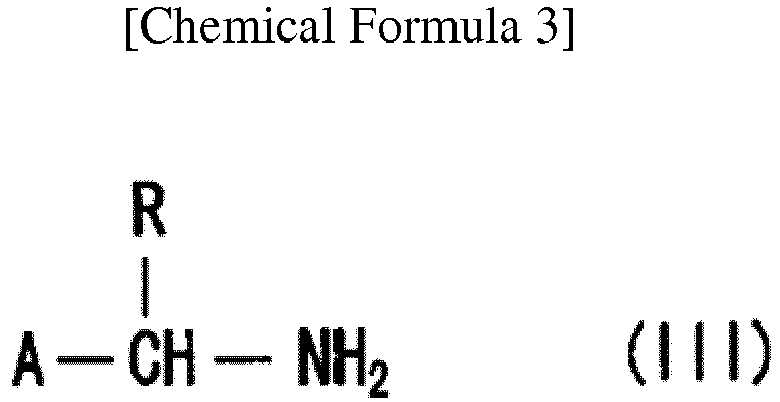
- (wherein A and R are as defined above).
- The abovementioned A preferably represents one group selected from the group consisting of organic groups including a phenyl group, a pyridyl group, a thiazolyl group, a dithianyl group and a tetrahydrofuranyl group, and said organic groups having a substituent.
- More preferably, A represents one group selected from the group consisting of groups represented by formulas (IV) to (X) shown below:


- The group A is still more preferably a 2-chloropyridin-5-yl group.
Furthermore, the abovementioned R preferably represents a hydrogen atom, or a substituted or unsubstituted lower alkyl group, and more preferably represents a hydrogen atom or an alkyl group of 1 to 5 carbon atoms. - In the process for producing a substituted methylamine compound of the present invention, the reaction between the hexamethylenetetraammonium salt compound represented by formula (I) and the base is preferably conducted at a pH of 9 to 12.
- A second aspect of the present invention provides a process for producing a substituted methylamine compound, the process compring:
- reacting a substituted methyl compound represented by formula (XI) shown below:
-

- (wherein A represents an organic group that is either a hydrocarbon group or a heterocyclic group, or said organic group that has a substituent, R represents a hydrogen atom, an organic group that is either a hydrocarbon group or a heterocyclic group, or said organic group that has a substituent, and L represents a halogen atom, an alkylsulfonyloxy group of 1 to 20 carbon atoms, a haloalkylsulfonyloxy group of 1 to 20 carbon atoms, or a substituted or unsubstituted arylsulfonyloxy group) with hexamethylenetetramine, or ammonia or an ammonium salt and formaldehyde or a formaldehyde equivalent, and a base to obtain an N-methylidene-substituted methylamine oligomer represented by formula (II) shown below:
-

- (wherein A is as defined above, and n represents an integer of 2 to 20), or a mixture of two or more of the oligomers, and
hydrolyzing the substituted methylamine oligomer represented by formula (II) or the mixture of two or more of the oligomers in the presence of an acid, thereby producing a substituted methylamine compound represented by a formula (III) shown below: -

- (wherein A is as defined above).
- The abovementioned A preferably represents one group selected from the group consisting of organic groups including a phenyl group, a pyridyl group, a thiazolyl group, a dithianyl group and a tetrahydrofuranyl group, and said organic groups having a substituent.
More preferably, A represents one group selected from the group consisting of groups represented by formulas (IV) to (X) shown below: -


- (wherein X represents a hydrogen atom, a halogen atom, or a substituted or unsubstituted alkyl group).
- The group A is still more preferably a 2-chloropyridin-5-yl group.
Furthermore, the abovementioned R preferably represents a hydrogen atom, or a substituted or unsubstituted lower alkyl group, and more preferably represents a hydrogen atom or an alkyl group of 1 to 5 carbon atoms. - In the production process of the present invention, the reaction between the substituted methyl compound represented by formula (XI), the hexamethylenetetramine, or the ammonia or ammonium salt and the formaldehyde or formaldehyde equivalent, and the base is preferably conducted at a pH of 9 to 12.
- Further, in the production process of the present invention, it is preferable that the hexamethylenetetramine, or the ammonia and formaldehyde, are recovered from the reaction mixture obtained following the reaction of the substituted methyl compound represented by formula (XI) with the hexamethylenetetramine, or the ammonia or ammonium salt and the formaldehyde or formaldehyde equivalent, and the base, and are subsequently reused in reaction with the substituted methyl compound represented by formula (XI).
- A third aspect of the present invention provides an N-methylidene-pyridylmethylamine oligomer represented by formula (II') shown below:
-

This oligomer is useful as an intermediate for the production of a substituted methylamine compound represented by formula (III). Of the various oligomers, an N-methylidene-substituted methylamine trimer in which n=3, which is a triazine derivative represented by formula (II") shown below, is preferred.
- According to the present invention, a substituted methylamine compound represented by formula (III) can be produced in an industrially favorable manner, namely, easily, with good yield, and at low cost.
An N-methylidene-substituted methylamine oligomer of the present invention is useful as an intermediate for producing a substituted methylamine compound represented by formula (III). - A more detailed description of the present invention is presented below.
A process for producing a substituted methylamine compound represented by formula (III) (hereafter also referred to as "the amine compound (III)") comprises a step (hereafter referred to as "step (1)") of reacting a substituted methylhexamethylenetetraammonium salt compound represented by formula (I) shown above (hereafter also referred to as "the ammonium salt compound (I)") with a base to obtain an N-methylidene-substituted methylamine oligomer represented by formula (II) (hereafter also referred to as "the N-methylideneamine oligomer (II)") or a mixture of two or more such oligomers, and a step (hereafter referred to as "step (2)") of hydrolyzing the N-methylideneamine oligomer (II) or the mixture of two or more N-methylideneamine oligomers (II) in the presence of an acid. - In step (1), the ammonium salt compound (I) is reacted with a base, yielding the N-methylideneamine oligomer (II) or a mixture of two or more such oligomers.
In formula (I), A represents an organic group that is either a hydrocarbon group or a heterocyclic group, or said organic group that has a substituent. - Specific examples of the hydrocarbon group include aromatic hydrocarbon groups such as a phenyl group, naphthyl group, indenyl group, pyrenyl group, acenaphthenyl group, anthryl group or phenanthryl group, aliphatic hydrocarbon groups such as a methyl group, ethyl group, n-propyl group, isopropyl group, n-butyl group, isobutyl group, s-butyl group, t-butyl group, n-hexyl group, n-octyl group, vinyl group, allyl group, ethynyl group or propargyl group, and alicyclic hydrocarbon groups such as a cyclopropyl group, cyclohexyl group or bicyclo[3.2.1]octyl group. Examples of the heterocyclic group include 5- to 7-membered rings containing 1 to 5 hetero atoms such as an oxygen atom, sulfur atom or nitrogen atom, and condensed rings thereof, and more specific examples include unsaturated 5-membered heterocyclic groups such as a furan-2-yl group, furan-3-yl group, thiophen-2-yl group, thiophen-3-yl group, pyrrol-2-yl group, pyrrol-3-yl group, oxazol-2-yl group, oxazol-4-yl group, oxazol-5-yl group, thiazol-2-yl group, thiazol-4-yl group, thiazol-5-yl group, isooxazol-3-yl group, isooxazol-4-yl group, isooxazol-5-yl group, isothiazol-3-yl group, isothiazol-4-yl group, isothiazol-5-yl group, imidazol-2-yl group, imidazol-4-yl group, imidazol-5-yl group, pyrazol-3-yl group, pyrazol-4-yl group, pyrazol-5-yl group, 1,3,4-oxadiazol-2-yl group, 1,3,4-thiadiazol-2-yl group, 1,2,3-triazol-4-yl group, 1,2,4-triazol-3-yl group, 1,2,4-triazol-5-yl group, 5-phenyl-5-trifluoromethyl-isooxazolin-3-yl group, 2-furfurylmethyl group, 3-thienylmethyl group, or 1-methyl-3-pyrazolomethyl group; unsaturated 6-membered heterocyclic groups such as a pyridin-2-yl group, pyridin-3-yl group, pyridin-4-yl group, pyridazin-3-yl group, pyridazin-4-yl group, pyrazin-2-yl group, pyrimidin-2-yl group, pyrimidin-4-yl group, pyrimidin-5-yl group, 1,3,5-triazin-2-yl group, 1,2,4-triazin-3-yl group, 2-pridylmethyl group, 3-pyridylmethyl group, 6-chloro-3-pyridylmethyl group or 2-pyrimidylmethyl group; and saturated heterocyclic groups such as a tetrahydrofuran-2-yl group, tetrahydrapyran-4-yl group, piperidin-3-yl group, pyrrolidin-2-yl group, morpholino group, piperidino group, N-methylpiperazinyl group, dithianyl group, 2-tetrahydrafuranylmethyl group, 3-piperazylmethyl group, N-methyl-3-pyrrolidylmethyl group, or morpholinomethyl group. Of these, A is preferably a phenyl group, pyridyl group, thiazolyl group, dithianyl group or tetrahydrofuranyl group.
The hydrocarbon group or heterocyclic group may be substituted, provided the substitution has no effect on the reaction, and specific examples of the substituent include a hydroxyl group; a thiol group; halogen atoms such as a fluorine atom, chlorine atom, bromine atom or iodine atom; a cyano group; a nitro group; a formyl group; unsubstituted or substituted amino groups such as an amino group, methylamino group, benzylamino group, anilino group, dimethylamino group, diethylamino group or phenylethylamino group; alkyl groups (and preferably C1 to C6 alkyl groups) such as a methyl group, ethyl group, n-propyl group, isopropyl group, n-butyl group, sec-butyl group, isobutyl group, t-butyl group, n-pentyl group or n-hexyl group; alkenyl groups such as a vinyl group, allyl group or 2-methoxyethenyl group; alkynyl groups such as an ethynyl group, 1-propynyl group, 2-phenylethynyl group or propargyl group; alkoxy groups (and preferably C1 to C6 alkoxy groups) such as a methoxy group, ethoxy group, propoxy group, isopropoxy group, n-butoxy group, sec-butoxy group, isobutoxy group or t-butoxy group; alkenyloxy groups such as a vinyloxy group or allyloxy group; alkynyloxy groups such as an ethynyloxy group or propargyloxy group; aryloxy groups such as a phenoxy group, benzyloxy group or 2-pyridyloxy group; haloalkyl groups (and preferably C1 to C6 haloalkyl groups) such as a chloromethyl group, fluoromethyl group, bromomethyl group, dichloromethyl group, difluoromethyl group, dibromomethyl group, trichloromethyl group, trifluoromethyl group, bromodifluoromethyl group, trifluoroethyl group, 1-chloroethyl group, 2-chloroethyl group, 1-bromoethyl group, 2-bromoethyl pentafluoroethyl group; haloalkoxy groups (and preferably C1 to C6 haloalkoxy groups) such as a fluoromethoxy group, chloromethoxy group, bromomethoxy group, difluoromethoxy group, dichloromethoxy group, dibromomethoxy group, trifluoromethoxy group, trichloromethoxy group, tribromomethoxy group, trifluoroethoxy group, pentafluoroethoxy group or pentafluoropropoxy group; alkylthiocarbonyl groups (and preferably C1 to C6 alkylthiocarbonyl groups) such as a methylthiocarbonyl group, ethylthiocarbonyl group, propylthiocarbonyl group, isopropylthiocarbonyl group, butylthiocarbonyl group, isobutylthiocarbonyl group, sec-butylthicarbonyl group or t-butylthiocarbonyl group; alkylsulfonylamino groups (and preferably C1 to C6 alkylsulfonylamino groups) such as a methylsulfonylamino group, ethylsulfonylamino group, propylsulfonylamino group, isopropylsulfonylamino group, butylsulfonylamino group or t-butylsulfonylamino group; arylsulfonylamino groups (and preferably C6 to C12 arylsulfonylamino groups) such as a phenylsulfonylamino group or piperazinylsulfonylamino group; alkylcarbonylamino groups (and preferably C1 to C6 alkylcarbonylamino groups) such as a methylcarbonylamino group, ethylcarbonylamino group, propylcarbonylamino group or isopropylcarbonylamino group; alkoxycarbonylamino groups (and preferably C1 to C6 alkoxycarbonylamino groups) such as a methoxycarbonylamino group, ethoxycarbonylamino group, propoxycarbonylamino group or isopropoxycarbonylamino group; haloalkylsulfonylamino groups (and preferably C1 to C6 haloalkylsulfonylamino groups) such as a fluoromethylsulfonylamino group, chloromethylsulfonylamino group, bromomethylsulfonylamino group, difluoromethylsulfonylamino group, dichloromethylsulfonylamino group, difluoromethylsulfonylamino group, trifluoromethylsulfonylamino group, trifluoroethylsulfonylamino group or pentafluoroethylsulfonylamino group; bis(alkylsulfonyl)amino groups (and preferably bis(C1 to C6 alkylsulfonyl)amino groups) such as a bis(methylsulfonyl)amino group, bis(ethylsulfonyl)amino group, (methylsulfonyl)(ethylsulfonyl)amino group, bis(propylsulfonyl)amino group, bis(isopropylsulfonyl)amino group, bis(butylsulfonyl)amino group or bis(t-butylsulfonyl)amino group; bis(haloalkylsulfonyl)amino groups (and preferably bis(C1 to C6 haloalkylsulfonyl)amino groups) such as a bis(fluoromethylsulfonyl)amino group, bis(chloromethylsulfonyl)amino group, bis(bromomethylsulfonyl)amino group, bis(difluoromethylsulfonyl)amino group, bis(dichloromethylsulfonyl)amino group, bis(difluoromethylsulfonyl)amino group, bis(trifluoromethylsulfonyl)amino group, bis(trifluoroethylsulfonyl)amino group or bis(pentafluoroethylsulfonyl)amino group; unsubstituted or substituted hydrazinomethoxycarbonyl groups such as a hydrazino group, N'-phenylhydrazino group or N'-methoxycarbonylhydrazino group; alkoxycarbonyl groups (and preferably C1 to C6 alkoxycarbonyl groups) such as a methoxycarbonyl group, ethoxycarbonyl group, propoxycarbonyl group, isopropoxycarbonyl group, butoxycarbonyl group or t-butoxycarbonyl group; aryl groups (and preferably C6 to C12 aryl groups) such as a phenyl group, 1-naphthyl group or 2-naphthyl group; unsaturated 5-membered heterocyclic groups such as a furan-2-yl group, furan-3-yl group, thiophen-2-yl group, thiophen-3-yl group, pyrrol-2-yl group, pyrrol-3-yl group, oxazol-2-yl group, oxazol-4-yl group, oxazol-5-yl group, thiazol-2-yl group, thiazol-4-yl group, thiazol-5-yl group, isooxazol-3-yl group, isooxazol-4-yl group, isooxazol-5-yl group, isothiazol-3-yl group, isothiazol-4-yl group, isothiazol-5-yl group, imidazol-2-yl group, imidazol-4-yl group, imidazol-5-yl group, pyrazol-3-yl group, pyrazol-4-yl group, pyrazol-5-yl group, 1,3,4-oxadiazol-2-yl group, 1,3,4-thiadiazol-2-yl group, 1,2,3-triazol-4-yl group, 1,2,4-triazol-3-yl group, 1,2,4-triazol-5-yl group, 5-phenyl-5-trifluoromethyl-isooxazolin-3-yl group, 2-furfurylmethyl group, 3-thienylmethyl group or 1-methyl-3-pyrazolomethyl group; unsaturated 6-membered heterocyclic groups such as a pyridin-2-yl group, pyridin-3-yl group, pyridin-4-yl group, pyridazin-3-yl group, pyridazin-4-yl group, pyrazin-2-yl group, pyrimidin-2-yl group, pyrimidin-4-yl group, pyrimidin-5-yl group, 1,3,5-triazin-2-yl group, 1,2,4-triazin-3-yl group, 2-pyridylmethyl group, 3-pyridylmethyl group, 6-chloro-3-pyridylmethyl group or 2-pyrimidylmethyl group; saturated heterocyclic groups such as a tetrahydrofuran-2-yl group, tetrahydrofuran-4-yl group, piperidin-3-yl group, pyrrolidin-2-yl group, morpholino group, piperidino group, N-methylpiperazinyl group, 2-tetrahydrafuranylmethyl group, 3-piperazylmethyl group, N-methyl-3-pyrrolidylmethyl group or morpholinomethyl group; N-unsubstituted or N-substituted iminoalkyl groups such as an N-dimethylaminoiminomethyl group, 1-N-phenyliminoethyl group, N-hydroxyiminomethyl group or N-methoxyiminomethyl group; N-unsubstituted or N-substituted hydrazinocarbonyl groups such as an N'-methylhydrazinocarbonyl group, N'-phenylhydrazinocarbonyl group or hydrazinocarbonyl group; N-unsubstituted or N-substituted aminocarbonyl groups such as an aminocarbonyl group, dimethylaminocarbonyl group or N-phenyl-N-methylaminocarbonyl group; N-unsubstituted or N-substituted hydrazino groups such as a hydrazino group, N'-acetylhydrazino group, N'-methylhydrazino group, N'-phenylhydrazino group or N'-methoxycarbonylhydrazino group; alkylthio groups such as a methylthio group, ethylthio group or t-butylthio group; alkenylthio groups such as a vinylthio group or allylthio group; alkynylthio groups such as an ethynylthio group or propargylthio group; arylthio groups such as a phenylthio group, 4-chlorophenylthio group, benzylthio group, phenethylthio group or 2-pyridylthio group; alkylsulfonyl groups such as a methylsulfonyl group, ethylsulfonyl group or t-butylsulfonyl group; alkenylsulfonyl groups such as an allylsulfonyl group; alkenylsulfonyl groups such as a propargylsulfonyl group; and arylsulfonyl groups such as a phenylsulfonyl group, benzylsulfonyl group or 2-pyridylsulfonyl group. Other novel substituents generated by substituting one substituent with another substituent, thereby combining two or more substituents, may also be used.
More specifically, A is preferably one group selected from the group consisting of groups represented by formulas (IV) to (X), and is most preferably a 2-chloropyridin-5-yl group. Specific examples of X within formulas (IV) to (X) include a hydrogen atom, halogen atoms such as a fluorine atom, bromine atom, chlorine atom or iodine atom, and alkyl groups such as a methyl group, ethyl group, n-propyl group, isopropyl group, n-butyl group, isobutyl group, s-butyl group, t-butyl group, n-hexyl group or n-octyl group. The alkyl group may include a substituent on an appropriate carbon atom, and examples of the substituent include the same substituents as those exemplified above for A. The substituent within A may be protected with an appropriate protective group prior to conducting the reaction with the base.
In formula (I), specific examples of R include the same groups as those exemplified above for A. - Specific examples of L in formula (I) include a hydrogen atom, halogen atoms such as a fluorine atom, chlorine atom or bromine atom, alkylsulfonyloxy groups of 1 to 20 carbon atoms such as a methylsulfonyloxy group, ethylsulfonyloxy group or n-propylsulfonyloxy group, haloalkylsulfonyloxy groups of 1 to 20 carbon atoms such as a trifluoromethylsulfonyloxy group, trichloromethylsulfonyloxy group, 2,2,2-trifluoroethylsulfonyloxy group or perfluoroethylsulfonyloxy group, and arylsulfonyloxy groups such as a phenylsulfonyloxy group, naphthylsulfonyloxy group, anthrylsulfonyloxy group or phenanthrylsulfonyloxy group. The arylsulfonyloxy groups may include a substituent at an appropriate position, and examples of the substituent include the same substituents as those exemplified above for A. Examples of preferred substituents include halogen atoms such as a fluorine atom, chlorine atom or bromine atom, alkyl groups such as a methyl group or ethyl group, alkoxy groups such as a methoxy group or ethoxy group, haloalkyl groups such as a trifluoromethyl group, and a nitro group.
- Although there are no particular restrictions on the process used for producing the ammonium salt compound (I), one example of a preferred process involves reacting a substituted methyl compound represented by formula (XI) (hereafter also referred to as "the substituted methyl compound (XI)"), with either hexamethylenetetramine, or a mixture of ammonia or an ammonium salt and formaldehyde or a formaldehyde equivalent.
- The substituted methyl compound (XI) can be produced using conventional methods, and in the case of a compound where A is represented by formula (IV) and X is a halogen atom, can be produced by a process that involves halogenating a 2-halogeno-5-methylpyridine, or a process that involves reacting a 2-halogeno-5-hydroxymethylpyridine with an alkylsulfonyl halide or arylsulfonyl halide in the presence of a base.
- Specific examples of the compound represented by formula (XI) include 3-(fluoromethyl)pyridine, 3-(chloromethyl)pyridine, 3-(bromomethyl)pyridine, [(pyridin-3-yl)methyl]methyl sulfonate, [(pyridin-3-yl)ethyl]ethyl sulfonate, [(pyridin-3-yl)methyl]-n-propyl sulfonate, [(pyridin-3-yl)methyl]phenyl sulfonate, 2-fluoro-5-(fluoromethyl)pyridine, 5-chloromethyl-2-fluoropyridine, 5-bromomethyl-2-fluoropyridine, [(2-fluoropyridin-5-yl)methyl]methyl sulfonate, [(2-fluoropyridin-5-yl)methyl]ethyl sulfonate, (2-fluoropyridin-5-yl)-n-propyl sulfonate, [(2-fluoropyridin-5-yl)methyl]phenyl sulfonate, 2-chloro-5-(fluoromethyl)pyridine, 2-chloro-5-(chloromethyl)pyridine, 5-bromomethyl-2-chloropyridine, [(2-chloropyridin-5-yl)methyl]methyl sulfonate, [(2-chloropyridin-5-yl)methyl]ethyl sulfonate, [(2-chloropyridin-5-yl)methyl]-n-propyl sulfonate, [(2-chloropyridin-5-yl)methyl]phenyl sulfonate, 2-bromo-5-(fluoromethyl)pyridine, 2-bromo-5-(chloromethyl)pyridine, 2-bromo-5-(bromomethyl)pyridine, [(2-bromopyridin-5-yl)methyl]methyl sulfonate, [(2-bromopyridin-5-yl)methyl]ethyl sulfonate, [(2-bromopyridin-5-yl)methyl]-n-propyl sulfonate and [(2-bromopyridin-5-yl)methyl]phenyl sulfonate. Of these, 2-chloro-5-(chloromethyl)pyridine is particularly desirable.
- There are no particular restrictions on the base used in the reaction with the ammonium salt compound represented by formula (I), and specific examples include alkali metal hydroxides such as sodium hydroxide or potassium hydroxide, alkaline earth metal hydroxides such as magnesium hydroxide or calcium hydroxide, carbonates such as sodium carbonate, potassium carbonate, magnesium carbonate or calcium carbonate, metal alkoxides such as sodium methoxide, sodium ethoxide or magnesium methoxide, and organic bases such as triethylamine, diisopropylethylamine, pyridine, 1,4-diazabicyclo[2.2.2]octane or 1,8-diazabicyclo[5.4.0]-7-undecene. Of these, from the viewpoints of production costs and maximizing the yield of the target product, alkali metal hydroxides are preferred, and sodium hydroxide is particularly desirable.
- The pH during the reaction of the ammonium salt compound (I) with the base is typically within a range from 9 to 12, and is preferably controlled within a range from 9.5 to 11.5, and more preferably from 10 to 11. By controlling the pH of the reaction system within this range, the N-methylideneamine oligomer (II) can be produced with good yield.
- The reaction between the ammonium salt compound (I) and the base is typically conducted within a solvent. There are no particular restrictions on the solvent used, provided it is inert with respect to the reaction. Examples of solvents that may be used include water; alcohol-based solvents such as methanol, ethanol or n-propanol; aliphatic hydrocarbon-based solvents such as n-pentane, n-hexane, n-heptane or n-octane; alicyclic hydrocarbon-based solvents such as cyclopentane or cyclohexane; aromatic hydrocarbon-based solvents such as benzene, toluene, xylene or chlorobenzene; ketone-based solvents such as acetone, methyl ethyl ketone, diethyl ketone, methyl isopropyl ketone, methyl isobutyl ketone or cyclohexanone; ether-based solvents such as diethyl ether, tetrahydrofuran, dioxane or 1,2-dimethoxyethane; and mixtures of two or more of the above solvents. Of the above possibilities, the use of a mixed solvent of water and an aromatic hydrocarbon-based solvent is preferred, and the use of a mixed solvent of water and toluene is particularly desirable.
- The reaction temperature for the reaction between the ammonium salt compound (I) and the base is typically within a range from room temperature to the boiling point of the solvent, and is preferably within a range from 40 to 70°C. The reaction time is typically within a range from several minutes to several days, and is preferably within a range from 1 to 10 hours.
Following completion of the reaction, the reaction liquid may be sampled, and the completion of the reaction can be confirmed using conventional analytical techniques such as thin layer chromatography, gas chromatography or high-performance liquid chromatography. - Further, in the present invention, the N-methylideneamine oligomer (II) may also be obtained in a single step by reacting the substituted methyl compound (XI) with hexamethylenetetramine and a base.
In this case also, the pH of the reaction liquid is typically within a range from 9 to 12, and is preferably controlled within a range from 9.5 to 11.5, and more preferably from 10 to 11. By controlling the pH of the reaction system within this range, the N-methylideneamine oligomer (II) can be obtained with good yield. - The amount of hexamethylenetetramine used is typically within a range from 0.1 to 10 mol, and preferably from 0.25 to 2 mol, per 1 mol of the substituted methyl compound (XI).
- Moreover, in the present invention, the N-methylideneamine oligomer (II) may also be obtained in a single step by reacting the substituted methyl compound (XI) with ammonia or an ammonium salt, formaldehyde or a formaldehyde equivalent, and a base.
In this case also, the pH of the reaction liquid is typically within a range from 9 to 12, and is preferably controlled within a range from 9.5 to 11.5, and more preferably from 10 to 11. By controlling the pH of the reaction system within this range, the N-methylideneamine oligomer (II) can be obtained with good yield. - Because this process replaces hexamethylenetetramine with ammonia or an ammonium salt and formaldehyde or a formaldehyde equivalent, all of which are low-cost industrial raw materials, it is particularly advantageous in the case of mass production on an industrial scale.
- There are no particular restrictions on the ammonia used, and gaseous ammonia or an aqueous solution or alcohol solution or the like of ammonia may be used. In those cases where an ammonia aqueous solution is used, the concentration of the solution is typically within a range from 5 to 25%, and is preferably from 10 to 25%. Further, an ammonium salt may be used instead of the ammonia. Examples of ammonium salts that may be used include ammonium acetate, ammonium nitrate, ammonium sulfate or ammonium chloride.
The amount of ammonia used is typically within a range from 1 to 40 mol, and preferably from 1 to 8 mol, per 1 mol of the substituted methyl compound (XI). - There are no particular restrictions on the formaldehyde used, and an aqueous solution or alcohol solution or the like of formaldehyde may be used. Furthermore, a formaldehyde equivalent may also be used instead of formaldehyde. An example of the formaldehyde equivalent is paraformaldehyde, which is a polymer of formaldehyde. Paraformaldehyde is a white powder at room temperature, and can be used to generate formaldehyde by dissolution in the organic solvent and subsequent heating.
The amount of formaldehyde used is typically within a range from 0.1 to 20 mol, and preferably from 1 to 2 mol, per 1 mol of ammonia. - In the cases described above, the substituted methyl compound (XI) is reacted with the hexamethylenetetramine, or with the ammonia or the like and formaldehyde or the like, and the hexamethylenetetramine or the ammonia and the formaldehyde can be recovered from the obtained reaction mixture and subsequently reused in reaction with the substituted methyl compound (XI). By recovering the hexamethylenetetramine or the ammonia and the formaldehyde for reuse in the reaction with the substituted methyl compound (XI), the overall amounts used of the hexamethylenetetramine or the ammonia and formaldehyde can be reduced, enabling the N-methylideneamine oligomer (II) to be produced at lower cost.
- Furthermore, in those cases where the solution containing the recovered ammonia and formaldehyde is used in a continuous process, the solution may be used as is, although in those cases where the ratio of ammonia and formaldehyde within the recovered solution differs from the ratio required to ensure continuity of the reaction, a supplementary amount of the component among the ammonia and the aldehyde that is lacking must be added to the solution. In other words, if the amount of ammonia is insufficient, then ammonia or an ammonium salt is added, whereas if the amount of the formaldehyde is insufficient, formaldehyde or a formaldehyde equivalent is added, thereby adjusting the ratio between the ammonia and the formaldehyde to the optimum ratio. This optimum ratio varies depending on factors such as the reaction conditions, but the amount of the formaldehyde is typically within a range from 0.1 to 20 mol, and preferably from 1 to 2 mol, per 1 mol of the ammonia.
- In those cases where a mixture of the substituted methyl compound (XI) with either hexamethylenetetramine, or ammonia or the like and formaldehyde or the like is used instead of the ammonium salt compound (I), the base and solvent used, and other factors such as the reaction temperature and the like may all be the same as those described above for the reaction that uses the ammonium salt compound (I).
- In either case, the N-methylideneamine oligomer (II) or mixture of two or more such oligomers that represents the target product can be isolated using typical post-processing operations.
- The structure of the obtained N-methylideneamine oligomer (II) can be confirmed using conventional analytical techniques such as 1H-NMR, 13C-NMR, IR spectroscopy, mass spectrometry and elemental analysis.
- The structure of the N-methylideneamine oligomer (II) may be a chain-like structure, a cyclic structure, or a structure containing both chain-like and cyclic portions, although a cyclic compound represented by formula (II') is particularly desirable. In formula (II'), X is as defined above, and examples thereof include the same substituents as those exemplified above. In either formula (II) or formula (II'), n represents an integer of 2 to 20, and is preferably within a range from 2 to 10, and more preferably from 2 to 5. Based on the various spectra mentioned above, the N-methylideneamine oligomer (II) is thought to have a structure such as those shown below.
-


-

-


- Triazine derivatives represented by formula (II') are particularly desirable.
The N-methylideneamine oligomer (II) or the mixture of two or more such oligomers obtained in the manner described above is useful as an intermediate for the production of the amine compound (III). - In the present invention, following completion of the reaction, the imine compound (II) or the mixture of two or more such compounds need not necessarily be isolated from the reaction solution, and the reaction solution may be supplied, as is, to the subsequent step (2).
- In other words, the N-methylideneamine oligomer (II) is a basic substance, and has the property of being soluble in acidic water. Accordingly, by conducting the reaction between the ammonium salt compound (I) and the base in a mixed solvent medium containing water and an organic solvent that is immiscible with water, such as a mixed solvent medium composed of water and toluene, subsequently separating the organic layer from the obtained reaction mixture, and then extracting the separated organic layer with acidic water, a salt of the N-methylideneamine oligomer (II) or mixture of two or more such oligomers that represents the target product can be obtained as an aqueous solution. This aqueous solution may be supplied, as is, to the subsequent step (2).
- Step (2) involves hydrolyzing the N-methylideneamine oligomer (II) or the mixture of two or more such oligomers in the presence of an acid to obtain the amine compound (III).
- There are no particular restrictions on the acid used in the reaction, and specific examples include inorganic acids such as sulfuric acid, hydrochloric acid or phosphoric acid, organic carboxylic acids such as acetic acid or trifluoroacetic acid, organic sulfonic acids such as p-toluenesulfonic acid, methanesulfonic acid or trifluoromethanesulfonic acid, and Lewis acids such as boron trifluoride, titanium tetrachloride or aluminum chloride.
- The amount of acid used is typically within a range from 1 to 100 mol, preferably from 2 to 20 mol, and more preferably from 3 to 10 mol, per 1 mol of the ammonium salt compound (I) or the substituted methyl compound (XI). By setting the amount of acid used to a value within this range, the targeted substituted methylamine compound (III) can be obtained with good yield.
- The hydrolysis reaction of the N-methylideneamine oligomer (II) or mixture of two or more such oligomers in the presence of an acid is typically conducted with the reactants diluted with a solvent. Examples of this solvent include the same solvents as those exemplified above for use within the reaction of the substituted methyl compound (XI) with hexamethylenetetramine, or the mixture of ammonia or the like and formaldehyde or the like. Of these solvents, a mixed solvent containing water and an alcohol is preferred, and a mixed solvent containing water and methanol is particularly desirable.
- The reaction temperature during the hydrolysis of the N-methylideneamine oligomer (II) or mixture of two or more such oligomers in the presence of an acid is typically within a range from room temperature to 90°C, and is preferably from 50 to 90°C. The reaction time is typically within a range from several minutes to several days, and is preferably within a range from 1 to 10 hours. Following completion of the reaction, the reaction liquid may be sampled, and the completion of the reaction can be confirmed using conventional analytical techniques such as thin layer chromatography, gas chromatography or high-performance liquid chromatography.
- Following completion of the reaction, the target amine compound (III) can be obtained by conducting typical post-processing operations, and then using conventional purification techniques such as distillation and column chromatography.
According to the present invention, the amine compound (III), and preferably a pyridylmethylamine compound represented by formula (III'): -

- (wherein X is as defined above)
can be produced easily, with good yield, and at low cost. - The amine compound (III) obtained using the production process of the present invention is useful as an intermediate in the production of agricultural chemicals and medicines and the like, such as an intermediate in the production of the active component in chloronicotyl-based agricultural and horticultural insecticides such as Imidacloprid, Nitenpyram and Acetamiprid.
- Furthermore, according to the production process of the present invention, by reacting a hexamethylenetetraammonium salt compound represented by formula (XII):

- (wherein B represents a phenyl group, pyridyl group, thiazolyl group, dithianyl group or tetrahydrofuranyl group, and most preferably represents a dithianyl group, and L is as defined above)
with a base, an N-methylideneamine oligomer represented by formula (XIII): -

- (wherein B is as defined above, and n and m each independently represents an integer of 2 to 20) or a mixture of two or more such oligomers can be obtained, and by subsequently hydrolyzing the N-methylideneamine oligomer represented by formula (XIII) or the mixture of two or more such oligomers in the presence of an acid, a substituted methylamine compound represented by formula (XIV) can be produced.
- [Chemical Formula 20]
H2N - H2C - B - CH2 - NH2 (XIV)
- (wherein B is as defined above.)
- Furthermore, according to the production process of the present invention, by reacting a substituted methyl compound represented by formula (XV):
- [Chemical Formula 21]
L - H2C - B - CH2 - L (XV)
- (wherein B and L are as defined above) with hexamethylenetetramine, or ammonia or an ammonium salt and formaldehyde or a formaldehyde equivalent, and a base, an N-methylideneamine oligomer represented by formula (XIII) or a mixture of two or more such oligomers can be obtained, and by subsequently hydrolyzing the N-methylideneamine oligomer represented by formula (XIII) or the mixture of two or more such oligomers in the presence of an acid, a substituted methylamine compound represented by formula (XIV) can be produced.
- In this manner, the production process of the present invention enables even compounds that have proven impossible to produce with conventional processes to be produced easily, with good yield, and at low cost.
- The present invention is described in further detail below using a series of examples, although the present invention is in no way limited by these examples.
Analysis of the reaction products was performed using high-performance liquid chromatography (HPLC, model LC-10, manufactured by Shimadzu Corporation) and gas chromatography (GC, model GC-14B, manufactured by Shimadzu Corporation). - To 3.02 g (10 mmol) of (2-chloropyridin-5-yl)hexamethylenetetraammonium chloride (I-1) were added 5 ml of water and 5 ml of toluene, and the resulting mixture was stirred for 7 hours at 60°C while a 28% aqueous solution of sodium hydroxide was used to maintain the pH of the reaction mixture within a range from 10 to 11.
An additional 4 ml of toluene was added to the reaction mixture, and the toluene layer was separated. 7 g of concentrated hydrochloric acid was added to the toluene layer, and the water layer containing the hydrochloride salt of an N-methylidene-2-chloro-3-pyridylmethylamine oligomer (II-1) or a mixture of two or more such salts was separated.
3.2 g of methanol was added to the separated water layer, and the resulting mixture was treated for 3 hours at 60°C, yielding an aqueous solution of the hydrochloride salt of (2-chloropyridin-5-yl)methylamine (III-1). Analysis by HPLC revealed a product amount of 1.21 g (yield: 85%). - To 1.62 g (10 mmol) of 2-chloro-5-(chloromethyl)pyridine (XI-1) and 1.48 g (10 mmol) of hexamethylenetetramine were added 5 ml of water and 1 ml of toluene, and the resulting mixture was stirred for 7 hours at 60°C while a 28% aqueous solution of sodium hydroxide was used to maintain the pH of the reaction mixture within a range from 10 to 11.
An additional 4 ml of toluene was added to the reaction mixture, and the toluene layer was separated. 7 g of concentrated hydrochloric acid was added to the toluene layer, and the water layer containing the hydrochloride salt of an N-methylidene-2-chloro-3-pyridylmethylamine oligomer (II-1) or a mixture of two or more such salts was separated.
3.2 g of methanol was added to the separated water layer, and the resulting mixture was treated for 3 hours at 60°C, yielding an aqueous solution of the hydrochloride salt of (2-chloropyridin-5-yl)methylamine (III-1). Analysis by HPLC revealed a product amount of 1.28 g (yield: 90%). - To 1.62 g (10 mmol) of 2-chloro-5-chloromethylpyridine (XI-1) and 0.7 g (5 mmol) of hexamethylenetetramine were added 5 ml of water and 1 ml of toluene, and the resulting mixture was stirred for 7 hours at 60°C while a 28% aqueous solution of sodium hydroxide was used to maintain the pH of the reaction mixture within a range from 10 to 11.
An additional 4 ml of toluene was added to the reaction mixture, and the toluene layer was separated. 7 g of concentrated hydrochloric acid was added to the toluene layer, and the water layer containing the hydrochloride salt of a pyridylmethylimine compound (II-3) or a mixture of two or more such salts was separated.
3.2 g of methanol was added to the separated water layer, and the resulting mixture was treated for 3 hours at 60°C, yielding an aqueous solution of the hydrochloride salt of (2-chloropyridin-5-yl)methylamine (III-1). Analysis by HPLC revealed a product amount of 1.26 g (yield: 89%).
Comparison with example 2 above confirmed that even if the amount of hexamethylenetetramine was reduced, there was no substantial effect on the yield of the target product. - To a mixed solution containing 10 ml of methanol and 10 ml of water were sequentially added 2.72 g (40 mmol) of a 25% aqueous solution of ammonia, 1.21 g (40 mmol) of paraformaldehyde, and 3.24 g (20 mmol) of 2-chloro-5-(chloromethyl)pyridine (XI-1), and the resulting mixture was stirred for 2.5 hours at 50°C while a 28% aqueous solution of sodium hydroxide was used to maintain the pH of the reaction mixture within a range from 10 to 11. The reaction mixture was then extracted with chloroform, and the chloroform layer was separated and concentrated, yielding 2.50 g (yield: 81%) of 1,3,5-tris(2-chloropyridin-5-yl)methyl-1,3,5-perhydrotriazine (II-4).
1H-NMR (CDCl3, δ ppm): 3.37 (bs, 6H), 3.62 (s, 6H), 7.26 (d, 3H), 7.61 (d, 3H), 8.33 (s, 3H)
m/s: 462 - To 0.77 g (1.66 mol) of 1,3,5-tris[(2-chloropyridin-5-yl)methyl]-1,3,5-perhydrotriazine (II-4) were sequentially added 0.40 g of methanol and 1.83 g of concentrated hydrochloric acid, and the resulting mixture was stirred at 75 to 80°C for 6 hours. The reaction mixture was then diluted with chloroform, and following conversion of the mixture to an alkaline state by adding a 28% aqueous solution of sodium hydroxide, the chloroform layer was separated and concentrated, yielding 0.68 g (yield: 95%) of (2-chloropyridin-5-yl)methylamine (III-1).
- To 1.62 g (10 mmol) of 2-chloro-5-(chloromethyl)pyridine (XI-1) and 1.48 g (10 mmol) of hexamethylenetetramine were added 5 ml of water and 1 ml of toluene, and the resulting mixture was stirred for 7 hours at 60°C while a 28% aqueous solution of sodium hydroxide was used to maintain the pH of the reaction mixture within a range from 10 to 11. An additional 4 ml of toluene was then added to the reaction mixture, and the water layer was separated to recover the hexamethylenetetramine. Analysis by GC revealed a recovery rate of 73%.
The toluene layer was treated in the same manner as example 2, yielding (2-chloropyridin-5-yl)methylamine (III-1). - To the aqueous solution containing hexamethylenetetramine recovered in the manner described above were added 1.62 g (10 mmol) of 2-chloro-5-(chloromethyl)pyridine (XI-1), 0.52 g (3.5 mmol) of hexamethylenetetramine, 0.18 g of ammonium chloride and 1 ml of toluene, and the resulting mixture was heated for 7 hours at 60°C while a 28% aqueous solution of sodium hydroxide was used to maintain the pH of the reaction mixture within a range from 10 to 11. An additional 4 ml of toluene was then added to the reaction mixture, and the toluene layer and water layer were each separated. The hexamethylenetetramine was recovered from the water layer, and the recovery rate was 69%.
- On the other hand, 7 g of concentrated hydrochloric acid was added to the toluene layer, and the resulting water layer containing the hydrochloride salt of an N-methylidene-(2-chloro-pyridin-5-yl)methylamine oligomer (II-5) or a mixture of two or more such salts was separated. 3.2 g of methanol was added to the separated water layer, and the resulting mixture was treated for 3 hours at 60°C, yielding an aqueous solution of the hydrochloride salt of (2-chloropyridin-5-yl)methylamine. Analysis by HPLC revealed an amount of the (2-chloropyridin-5-yl)methylamine of 1.28 g (yield: 90%).
- As described above, in the examples, approximately 70% of the hexamethylenetetramine was able to be recovered, and by simply supplementing the reaction with the required amount of additional hexamethylenetetramine, the reaction was able to be continued at the same scale.
The following numbered paragraphs set out preferred features and preferred combinations of features of the present invention. - 1. A process for producing a substituted methylamine compound, said process comprising:
- reacting a hexamethylenetetraammonium salt compound represented by a formula (I) shown below:


- hydrolyzing the N-methylidene-substituted methylamine oligomer represented by formula (II) or the mixture of two or more of the oligomers in the presence of an acid, thereby producing a substituted methylamine compound represented by a formula (III) shown below:
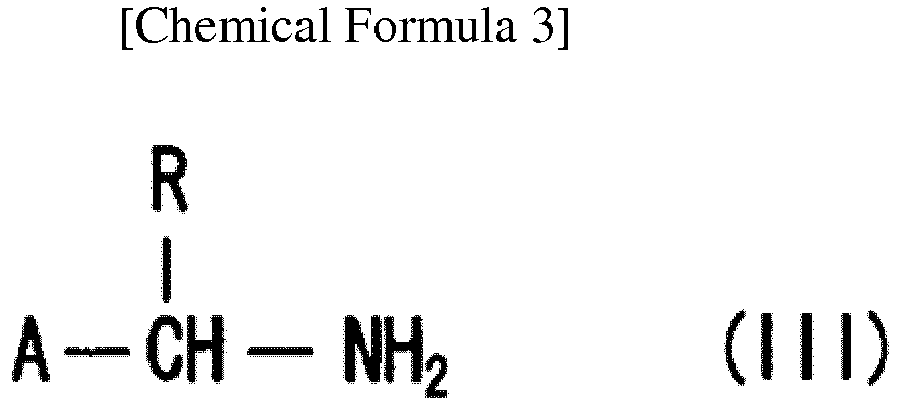
- reacting a hexamethylenetetraammonium salt compound represented by a formula (I) shown below:
- 2. The process for producing a substituted methylamine compound according to para 1, wherein said A represents one group selected from the group consisting of organic groups including a phenyl group, a pyridyl group, a thiazolyl group, a dithianyl group and a tetrahydrofuranyl group, and said organic groups having a substituent.
- 3. The process for producing a substituted methylamine compound according to para 2, wherein said A represents one group selected from the group consisting of groups represented by formulas (IV) to (X) shown below:


- 4. The process for producing a substituted methylamine compound according to para 3, wherein said A is a 2-chloropyridin-5-yl group.
- 5. The process for producing a substituted methylamine compound according to any one of paras 1 to 4, wherein said R represents a hydrogen atom or an alkyl group of 1 to 5 carbon atoms.
- 6. The process for producing a substituted methylamine compound according to any one of paras 1 to 5, wherein reaction between said hexamethylenetetraammonium salt compound represented by said formula (I) and said base is conducted at a pH of 9 to 12.
- 7. A process for producing a substituted methylamine compound, said process comprising:
- reacting a substituted methyl compound represented by a formula (XI) shown below:


- hydrolyzing the N-methylidene-substituted methylamine oligomer represented by formula (II) or the mixture of two or more of the oligomers in the presence of an acid, thereby producing a substituted methylamine compound represented by a formula (III) shown below:

- reacting a substituted methyl compound represented by a formula (XI) shown below:
- 8. The process for producing a substituted methylamine compound according to para 7, wherein said A represents one group selected from the group consisting of organic groups including a phenyl group, a pyridyl group, a thiazolyl group, a dithianyl group and a tetrahydrofuranyl group, and said organic groups having a substituent.
- 9. The process for producing a substituted methylamine compound according to para 8, wherein said A represents one group selected from the group consisting of groups represented by formulas (IV) to (X) shown below:


- 10. The process for producing a substituted methylamine compound according to para 9, wherein said A is a 2-chloropyridin-5-yl group.
- 11. The process for producing a substituted methylamine compound according to any one of paras 7 to 10, wherein said R represents a hydrogen atom or an alkyl group of 1 to 5 carbon atoms.
- 12. The process for producing a substituted methylamine compound according to any one of paras 7 to 11, wherein reaction of said substituted methyl compound represented by said formula (XI) with hexamethylenetetramine, or ammonia or an ammonium salt and formaldehyde or a formaldehyde equivalent, and a base is conducted at a pH of 9 to 12.
- 13. The process for producing a substituted methylamine compound according to any one of paras 7 to 12, wherein hexamethylenetetramine, or ammonia and formaldehyde, are recovered from a reaction mixture obtained following reaction of said substituted methyl compound represented by said formula (XI) with hexamethylenetetramine, or ammonia or an ammonium salt and formaldehyde or a formaldehyde equivalent, and are subsequently reused in reaction with said substituted methyl compound represented by said formula (XI).
- 14. An N-methylidene-pyridylmethylamine oligomer represented by a formula (II') shown below:

- 15. A triazine derivative represented by a formula (II") shown below:


Claims (13)
- A process for producing a substituted methylamine compound, said process comprising:reacting a hexamethylenetetraammonium salt compound represented by a formula (I) shown below:

 hydrolyzing the N-methylidene-substituted methylamine oligomer represented by formula (II) or the mixture of two or more of the oligomers in the presence of an acid, thereby producing a substituted methylamine compound represented by a formula (III) shown below:
 wherein a structure of the N-methylidene-substituted methylamine oligomer represented by formula (II) is a chain-like structure, or a structure containing both chain-like and cyclic portions.
 - The process for producing a substituted methylamine compound according to claim 1, wherein said A represents one group selected from the group consisting of organic groups including a phenyl group, a pyridyl group, a thiazolyl group, a dithianyl group and a tetrahydrofuranyl group, and said organic groups having a substituent.
- The process for producing a substituted methylamine compound according to claim 2, wherein said A represents one group selected from the group consisting of groups represented by formulas (IV) to (X) shown below:


- The process for producing a substituted methylamine compound according to claim 3, wherein said A is a 2-chloropyridin-5-yl group.
- The process for producing a substituted methylamine compound according to any one of claims 1 to 4, wherein said R represents a hydrogen atom or an alkyl group of 1 to 5 carbon atoms.
- The process for producing a substituted methylamine compound according to any one of claims 1 to 5, wherein reaction between said hexamethylenetetraammonium salt compound represented by said formula (I) and said base is conducted at a pH of 9 to 12.
- A process for producing a substituted methylamine compound, said process comprising:reacting a substituted methyl compound represented by a formula (XI) shown below:

 hydrolyzing the N-methylidene-substituted methylamine oligomer represented by formula (II) or the mixture of two or more of the oligomers in the presence of an acid, thereby producing a substituted methylamine compound represented by a formula (III) shown below:
 wherein a structure of the N-methylidene-substituted methylamine oligomer represented by formula (II) is a chain-like structure, or a structure containing both chain-like and cyclic portions.
 - The process for producing a substituted methylamine compound according to claim 7, wherein said A represents one group selected from the group consisting of organic groups including a phenyl group, a pyridyl group, a thiazolyl group, a dithianyl group and a tetrahydrofuranyl group, and said organic groups having a substituent.
- The process for producing a substituted methylamine compound according to claim 8, wherein said A represents one group selected from the group consisting of groups represented by formulas (IV) to (X) shown below:


- The process for producing a substituted methylamine compound according to claim 9, wherein said A is a 2-chloropyridin-5-yl group.
- The process for producing a substituted methylamine compound according to any one of claims 7 to 10, wherein said R represents a hydrogen atom or an alkyl group of 1 to 5 carbon atoms.
- The process for producing a substituted methylamine compound according to any one of claims 7 to 11, wherein reaction of said substituted methyl compound represented by said formula (XI) with hexamethylenetetramine, or ammonia or an ammonium salt and formaldehyde or a formaldehyde equivalent, and a base is conducted at a pH of 9 to 12.
- The process for producing a substituted methylamine compound according to any one of claims 7 to 12, wherein hexamethylenetetramine, or ammonia and formaldehyde, are recovered from a reaction mixture obtained following reaction of said substituted methyl compound represented by said formula (XI) with hexamethylenetetramine, or ammonia or an ammonium salt and formaldehyde or a formaldehyde equivalent, and are subsequently reused in reaction with said substituted methyl compound represented by said formula (XI).
Priority Applications (1)
| Application Number | Priority Date | Filing Date | Title |
|---|---|---|---|
| EP13175481.4A EP2650283B1 (en) | 2007-04-24 | 2007-04-24 | Process for producing substituted methylamine compound and triazine derivative |
Applications Claiming Priority (3)
| Application Number | Priority Date | Filing Date | Title |
|---|---|---|---|
| EP13175481.4A EP2650283B1 (en) | 2007-04-24 | 2007-04-24 | Process for producing substituted methylamine compound and triazine derivative |
| PCT/JP2007/058842 WO2008136093A1 (en) | 2007-04-24 | 2007-04-24 | Process for producing substituted methylamine compound and triazine derivative |
| EP07742277.2A EP2141149B1 (en) | 2007-04-24 | 2007-04-24 | Process for producing substituted methylamine compound and triazine derivative |
Related Parent Applications (3)
| Application Number | Title | Priority Date | Filing Date |
|---|---|---|---|
| EP07742277.2 Division | 2007-04-24 | ||
| EP07742277.2A Division-Into EP2141149B1 (en) | 2007-04-24 | 2007-04-24 | Process for producing substituted methylamine compound and triazine derivative |
| EP07742277.2A Division EP2141149B1 (en) | 2007-04-24 | 2007-04-24 | Process for producing substituted methylamine compound and triazine derivative |
Publications (2)
| Publication Number | Publication Date |
|---|---|
| EP2650283A1 true EP2650283A1 (en) | 2013-10-16 |
| EP2650283B1 EP2650283B1 (en) | 2017-06-07 |
Family
ID=39943216
Family Applications (3)
| Application Number | Title | Priority Date | Filing Date |
|---|---|---|---|
| EP13175481.4A Not-in-force EP2650283B1 (en) | 2007-04-24 | 2007-04-24 | Process for producing substituted methylamine compound and triazine derivative |
| EP13175480.6A Not-in-force EP2650282B1 (en) | 2007-04-24 | 2007-04-24 | Process for producing substituted methylamine compound and triazine derivative |
| EP07742277.2A Not-in-force EP2141149B1 (en) | 2007-04-24 | 2007-04-24 | Process for producing substituted methylamine compound and triazine derivative |
Family Applications After (2)
| Application Number | Title | Priority Date | Filing Date |
|---|---|---|---|
| EP13175480.6A Not-in-force EP2650282B1 (en) | 2007-04-24 | 2007-04-24 | Process for producing substituted methylamine compound and triazine derivative |
| EP07742277.2A Not-in-force EP2141149B1 (en) | 2007-04-24 | 2007-04-24 | Process for producing substituted methylamine compound and triazine derivative |
Country Status (8)
| Country | Link |
|---|---|
| US (4) | US9000156B2 (en) |
| EP (3) | EP2650283B1 (en) |
| JP (1) | JP5215295B2 (en) |
| KR (7) | KR101682339B1 (en) |
| CN (1) | CN101652347A (en) |
| BR (1) | BRPI0721592B1 (en) |
| IL (2) | IL201696A0 (en) |
| WO (1) | WO2008136093A1 (en) |
Families Citing this family (1)
| Publication number | Priority date | Publication date | Assignee | Title |
|---|---|---|---|---|
| KR101682339B1 (en) * | 2007-04-24 | 2016-12-02 | 닛뽕소다 가부시키가이샤 | METHOD FOR PREPARING SUBSTITUTED Methylamine Compound and Triazine Derivative |
Citations (5)
| Publication number | Priority date | Publication date | Assignee | Title |
|---|---|---|---|---|
| US1471213A (en) * | 1922-11-27 | 1923-10-16 | Naugatuck Chem Co | Manufacture of formaldehyde condensation products of aliphatic amines and products obtained thereby |
| JPH03271273A (en) | 1990-03-20 | 1991-12-03 | Nippon Soda Co Ltd | Production of 2-chloro-5-(aminomethyl)pyridine |
| JPH05230026A (en) * | 1992-02-20 | 1993-09-07 | Nippon Soda Co Ltd | Production of 2-chloro-5-methylpyridine derivative |
| JPH08295670A (en) | 1995-02-28 | 1996-11-12 | Koei Chem Co Ltd | 2-chloropyridine derivative and its production thereof |
| WO2006109811A1 (en) * | 2005-04-07 | 2006-10-19 | Sumitomo Chemical Company, Limited | Process for producing an aminomethyl thiazole compound |
Family Cites Families (11)
| Publication number | Priority date | Publication date | Assignee | Title |
|---|---|---|---|---|
| FR2279453A1 (en) * | 1974-07-24 | 1976-02-20 | Dia Prosim | SELECTIVE ION EXCHANGERS FOR SEPARATING AND FIXING METALS |
| JPS6327465A (en) * | 1986-07-18 | 1988-02-05 | Denki Kagaku Kogyo Kk | Production of glycinamide |
| DE3727126A1 (en) | 1987-08-14 | 1989-02-23 | Bayer Ag | N-(2-chloro-pyridin-5-ylmethyl)phthalimide, process for its preparation, and its processing to give 2-chloro-5-aminomethylpyridine |
| JPH0421674A (en) * | 1990-05-15 | 1992-01-24 | Nippon Soda Co Ltd | Production of 2-chloro-5-(aminomethyl)thiazole |
| JP3937489B2 (en) * | 1996-05-31 | 2007-06-27 | 住友化学株式会社 | Method for producing propargylamine compound |
| DE19843383A1 (en) | 1998-09-22 | 2000-03-30 | Hassan Jomaa | New amino and imino substituted organo-phosphorus compounds useful in medicine against viral, bacterial, fungal and parasiticidal infections and as herbicides, plant fungicides and plant bactericides |
| JP2002534363A (en) * | 1999-01-08 | 2002-10-15 | エミスフェアー・テクノロジーズ・インク | Polymeric delivery agent and delivery agent compound |
| TW200410921A (en) * | 2002-11-25 | 2004-07-01 | Hoffmann La Roche | Mandelic acid derivatives |
| TWI344958B (en) * | 2004-06-17 | 2011-07-11 | Sumitomo Chemical Co | Process for preparing thiazole compound |
| WO2007069685A1 (en) * | 2005-12-15 | 2007-06-21 | Sumitomo Chemical Company, Limited | Method for selectively producing primary amine compound |
| KR101682339B1 (en) * | 2007-04-24 | 2016-12-02 | 닛뽕소다 가부시키가이샤 | METHOD FOR PREPARING SUBSTITUTED Methylamine Compound and Triazine Derivative |
-
2007
- 2007-04-24 KR KR1020167001512A patent/KR101682339B1/en not_active Expired - Fee Related
- 2007-04-24 WO PCT/JP2007/058842 patent/WO2008136093A1/en not_active Ceased
- 2007-04-24 KR KR1020147020194A patent/KR20140098861A/en not_active Ceased
- 2007-04-24 EP EP13175481.4A patent/EP2650283B1/en not_active Not-in-force
- 2007-04-24 KR KR20157008949A patent/KR20150041201A/en not_active Ceased
- 2007-04-24 KR KR1020127011530A patent/KR20120059645A/en not_active Ceased
- 2007-04-24 BR BRPI0721592-4A patent/BRPI0721592B1/en not_active IP Right Cessation
- 2007-04-24 KR KR1020097021889A patent/KR20100005089A/en not_active Ceased
- 2007-04-24 KR KR1020127017721A patent/KR101376469B1/en not_active Expired - Fee Related
- 2007-04-24 EP EP13175480.6A patent/EP2650282B1/en not_active Not-in-force
- 2007-04-24 KR KR1020137023306A patent/KR20130112955A/en not_active Ceased
- 2007-04-24 CN CN200780052685A patent/CN101652347A/en active Pending
- 2007-04-24 EP EP07742277.2A patent/EP2141149B1/en not_active Not-in-force
- 2007-04-24 JP JP2009512826A patent/JP5215295B2/en not_active Expired - Fee Related
- 2007-04-24 US US12/596,950 patent/US9000156B2/en not_active Expired - Fee Related
-
2009
- 2009-10-22 IL IL201696A patent/IL201696A0/en active IP Right Grant
-
2011
- 2011-10-17 US US13/274,469 patent/US20120071656A1/en not_active Abandoned
-
2014
- 2014-07-11 US US14/329,356 patent/US9926274B2/en not_active Expired - Fee Related
- 2014-12-25 IL IL236462A patent/IL236462A/en active IP Right Grant
-
2015
- 2015-01-30 US US14/610,366 patent/US20150141653A1/en not_active Abandoned
Patent Citations (5)
| Publication number | Priority date | Publication date | Assignee | Title |
|---|---|---|---|---|
| US1471213A (en) * | 1922-11-27 | 1923-10-16 | Naugatuck Chem Co | Manufacture of formaldehyde condensation products of aliphatic amines and products obtained thereby |
| JPH03271273A (en) | 1990-03-20 | 1991-12-03 | Nippon Soda Co Ltd | Production of 2-chloro-5-(aminomethyl)pyridine |
| JPH05230026A (en) * | 1992-02-20 | 1993-09-07 | Nippon Soda Co Ltd | Production of 2-chloro-5-methylpyridine derivative |
| JPH08295670A (en) | 1995-02-28 | 1996-11-12 | Koei Chem Co Ltd | 2-chloropyridine derivative and its production thereof |
| WO2006109811A1 (en) * | 2005-04-07 | 2006-10-19 | Sumitomo Chemical Company, Limited | Process for producing an aminomethyl thiazole compound |
Also Published As
| Publication number | Publication date |
|---|---|
| KR20160010894A (en) | 2016-01-28 |
| KR20130112955A (en) | 2013-10-14 |
| EP2650282B1 (en) | 2017-06-07 |
| KR20120084337A (en) | 2012-07-27 |
| US20140323724A1 (en) | 2014-10-30 |
| EP2650282A1 (en) | 2013-10-16 |
| US9000156B2 (en) | 2015-04-07 |
| JPWO2008136093A1 (en) | 2010-07-29 |
| KR20140098861A (en) | 2014-08-08 |
| BRPI0721592B1 (en) | 2018-05-15 |
| KR20120059645A (en) | 2012-06-08 |
| JP5215295B2 (en) | 2013-06-19 |
| EP2141149A1 (en) | 2010-01-06 |
| KR101682339B1 (en) | 2016-12-02 |
| CN101652347A (en) | 2010-02-17 |
| US20120071656A1 (en) | 2012-03-22 |
| IL236462A0 (en) | 2015-02-26 |
| KR20150041201A (en) | 2015-04-15 |
| BRPI0721592A2 (en) | 2013-01-22 |
| US20150141653A1 (en) | 2015-05-21 |
| WO2008136093A1 (en) | 2008-11-13 |
| IL201696A0 (en) | 2010-05-31 |
| US20100121054A1 (en) | 2010-05-13 |
| EP2141149A4 (en) | 2011-01-19 |
| IL236462A (en) | 2017-11-30 |
| KR101376469B1 (en) | 2014-03-19 |
| US9926274B2 (en) | 2018-03-27 |
| KR20100005089A (en) | 2010-01-13 |
| EP2141149B1 (en) | 2014-10-29 |
| EP2650283B1 (en) | 2017-06-07 |
Similar Documents
| Publication | Publication Date | Title |
|---|---|---|
| US10005766B2 (en) | Method for producing fused heterocyclic compound | |
| KR101790159B1 (en) | Process for preparing 2,2-difluoroethylamine derivatives by alkylation with 2,2-difluoro-1-haloethanes | |
| KR20190007048A (en) | Synthesis of 6-aryl-4-aminopicolinate and 2-aryl-6-aminopyrimidine-4-carboxylate by direct Suzuki coupling | |
| EP4073056B1 (en) | Process for the preparation of lasmiditan and of a synthesis intermediate | |
| US12077505B2 (en) | Preparation of sulfonamide herbicide process intermediates | |
| US9926274B2 (en) | Process for producing substituted methylamine compound and triazine derivative | |
| JP5584279B2 (en) | Method for producing N-methylidene-substituted methylamine multimer | |
| KR20020000167A (en) | Process for the Preparation of Substituted Pyrimidines | |
| AU2016361026B2 (en) | Method for purifying benzopyran derivative, crystal form thereof, and method for preparing crystal form | |
| US20150045557A1 (en) | Compound, method for producing compound, and method for purifying compound | |
| AU2017378044B2 (en) | Method of preparing benzyl 4-amino-3-chloro-5-fluoro-6-(4-chloro-2-fluoro-3-methoxyphenyl)picolinate | |
| JP4721214B2 (en) | Pyridylmethylcarbamic acid ester compound and method for producing pyridylmethylamine compound | |
| KR20150032537A (en) | Process for preparing 2,2-difluoroethylamine derivatives by alkylating 2,2-difluoroethylamine |
Legal Events
| Date | Code | Title | Description |
|---|---|---|---|
| PUAI | Public reference made under article 153(3) epc to a published international application that has entered the european phase |
Free format text: ORIGINAL CODE: 0009012 |
|
| 17P | Request for examination filed |
Effective date: 20130724 |
|
| AC | Divisional application: reference to earlier application |
Ref document number: 2141149 Country of ref document: EP Kind code of ref document: P |
|
| AK | Designated contracting states |
Kind code of ref document: A1 Designated state(s): AT BE BG CH CY CZ DE DK EE ES FI FR GB GR HU IE IS IT LI LT LU LV MC MT NL PL PT RO SE SI SK TR |
|
| 17Q | First examination report despatched |
Effective date: 20160120 |
|
| RIC1 | Information provided on ipc code assigned before grant |
Ipc: C07D 257/08 20060101ALI20161222BHEP Ipc: C07D 213/61 20060101AFI20161222BHEP Ipc: C07D 401/14 20060101ALI20161222BHEP Ipc: C07D 277/20 20060101ALI20161222BHEP Ipc: C07B 43/04 20060101ALI20161222BHEP Ipc: C07D 401/06 20060101ALI20161222BHEP |
|
| GRAP | Despatch of communication of intention to grant a patent |
Free format text: ORIGINAL CODE: EPIDOSNIGR1 |
|
| INTG | Intention to grant announced |
Effective date: 20170130 |
|
| GRAS | Grant fee paid |
Free format text: ORIGINAL CODE: EPIDOSNIGR3 |
|
| RIN1 | Information on inventor provided before grant (corrected) |
Inventor name: IMAGAWA, TSUTOMU Inventor name: SHIBATA, YASUSHI |
|
| AC | Divisional application: reference to earlier application |
Ref document number: 2141149 Country of ref document: EP Kind code of ref document: P |
|
| AK | Designated contracting states |
Kind code of ref document: B1 Designated state(s): AT BE BG CH CY CZ DE DK EE ES FI FR GB GR HU IE IS IT LI LT LU LV MC MT NL PL PT RO SE SI SK TR |
|
| REG | Reference to a national code |
Ref country code: GB Ref legal event code: FG4D |
|
| GRAA | (expected) grant |
Free format text: ORIGINAL CODE: 0009210 |
|
| REG | Reference to a national code |
Ref country code: CH Ref legal event code: EP Ref country code: AT Ref legal event code: REF Ref document number: 899126 Country of ref document: AT Kind code of ref document: T Effective date: 20170615 |
|
| REG | Reference to a national code |
Ref country code: IE Ref legal event code: FG4D |
|
| REG | Reference to a national code |
Ref country code: DE Ref legal event code: R096 Ref document number: 602007051285 Country of ref document: DE |
|
| REG | Reference to a national code |
Ref country code: NL Ref legal event code: MP Effective date: 20170607 |
|
| REG | Reference to a national code |
Ref country code: LT Ref legal event code: MG4D |
|
| PG25 | Lapsed in a contracting state [announced via postgrant information from national office to epo] |
Ref country code: FI Free format text: LAPSE BECAUSE OF FAILURE TO SUBMIT A TRANSLATION OF THE DESCRIPTION OR TO PAY THE FEE WITHIN THE PRESCRIBED TIME-LIMIT Effective date: 20170607 Ref country code: ES Free format text: LAPSE BECAUSE OF FAILURE TO SUBMIT A TRANSLATION OF THE DESCRIPTION OR TO PAY THE FEE WITHIN THE PRESCRIBED TIME-LIMIT Effective date: 20170607 Ref country code: GR Free format text: LAPSE BECAUSE OF FAILURE TO SUBMIT A TRANSLATION OF THE DESCRIPTION OR TO PAY THE FEE WITHIN THE PRESCRIBED TIME-LIMIT Effective date: 20170908 Ref country code: LT Free format text: LAPSE BECAUSE OF FAILURE TO SUBMIT A TRANSLATION OF THE DESCRIPTION OR TO PAY THE FEE WITHIN THE PRESCRIBED TIME-LIMIT Effective date: 20170607 |
|
| REG | Reference to a national code |
Ref country code: AT Ref legal event code: MK05 Ref document number: 899126 Country of ref document: AT Kind code of ref document: T Effective date: 20170607 |
|
| PG25 | Lapsed in a contracting state [announced via postgrant information from national office to epo] |
Ref country code: NL Free format text: LAPSE BECAUSE OF FAILURE TO SUBMIT A TRANSLATION OF THE DESCRIPTION OR TO PAY THE FEE WITHIN THE PRESCRIBED TIME-LIMIT Effective date: 20170607 Ref country code: BG Free format text: LAPSE BECAUSE OF FAILURE TO SUBMIT A TRANSLATION OF THE DESCRIPTION OR TO PAY THE FEE WITHIN THE PRESCRIBED TIME-LIMIT Effective date: 20170907 Ref country code: SE Free format text: LAPSE BECAUSE OF FAILURE TO SUBMIT A TRANSLATION OF THE DESCRIPTION OR TO PAY THE FEE WITHIN THE PRESCRIBED TIME-LIMIT Effective date: 20170607 Ref country code: LV Free format text: LAPSE BECAUSE OF FAILURE TO SUBMIT A TRANSLATION OF THE DESCRIPTION OR TO PAY THE FEE WITHIN THE PRESCRIBED TIME-LIMIT Effective date: 20170607 |
|
| PG25 | Lapsed in a contracting state [announced via postgrant information from national office to epo] |
Ref country code: CZ Free format text: LAPSE BECAUSE OF FAILURE TO SUBMIT A TRANSLATION OF THE DESCRIPTION OR TO PAY THE FEE WITHIN THE PRESCRIBED TIME-LIMIT Effective date: 20170607 Ref country code: SK Free format text: LAPSE BECAUSE OF FAILURE TO SUBMIT A TRANSLATION OF THE DESCRIPTION OR TO PAY THE FEE WITHIN THE PRESCRIBED TIME-LIMIT Effective date: 20170607 Ref country code: AT Free format text: LAPSE BECAUSE OF FAILURE TO SUBMIT A TRANSLATION OF THE DESCRIPTION OR TO PAY THE FEE WITHIN THE PRESCRIBED TIME-LIMIT Effective date: 20170607 Ref country code: EE Free format text: LAPSE BECAUSE OF FAILURE TO SUBMIT A TRANSLATION OF THE DESCRIPTION OR TO PAY THE FEE WITHIN THE PRESCRIBED TIME-LIMIT Effective date: 20170607 Ref country code: RO Free format text: LAPSE BECAUSE OF FAILURE TO SUBMIT A TRANSLATION OF THE DESCRIPTION OR TO PAY THE FEE WITHIN THE PRESCRIBED TIME-LIMIT Effective date: 20170607 |
|
| PG25 | Lapsed in a contracting state [announced via postgrant information from national office to epo] |
Ref country code: IT Free format text: LAPSE BECAUSE OF FAILURE TO SUBMIT A TRANSLATION OF THE DESCRIPTION OR TO PAY THE FEE WITHIN THE PRESCRIBED TIME-LIMIT Effective date: 20170607 Ref country code: PL Free format text: LAPSE BECAUSE OF FAILURE TO SUBMIT A TRANSLATION OF THE DESCRIPTION OR TO PAY THE FEE WITHIN THE PRESCRIBED TIME-LIMIT Effective date: 20170607 Ref country code: IS Free format text: LAPSE BECAUSE OF FAILURE TO SUBMIT A TRANSLATION OF THE DESCRIPTION OR TO PAY THE FEE WITHIN THE PRESCRIBED TIME-LIMIT Effective date: 20171007 |
|
| REG | Reference to a national code |
Ref country code: DE Ref legal event code: R097 Ref document number: 602007051285 Country of ref document: DE |
|
| PLBE | No opposition filed within time limit |
Free format text: ORIGINAL CODE: 0009261 |
|
| STAA | Information on the status of an ep patent application or granted ep patent |
Free format text: STATUS: NO OPPOSITION FILED WITHIN TIME LIMIT |
|
| REG | Reference to a national code |
Ref country code: FR Ref legal event code: PLFP Year of fee payment: 12 |
|
| PG25 | Lapsed in a contracting state [announced via postgrant information from national office to epo] |
Ref country code: DK Free format text: LAPSE BECAUSE OF FAILURE TO SUBMIT A TRANSLATION OF THE DESCRIPTION OR TO PAY THE FEE WITHIN THE PRESCRIBED TIME-LIMIT Effective date: 20170607 |
|
| 26N | No opposition filed |
Effective date: 20180308 |
|
| PG25 | Lapsed in a contracting state [announced via postgrant information from national office to epo] |
Ref country code: SI Free format text: LAPSE BECAUSE OF FAILURE TO SUBMIT A TRANSLATION OF THE DESCRIPTION OR TO PAY THE FEE WITHIN THE PRESCRIBED TIME-LIMIT Effective date: 20170607 |
|
| PG25 | Lapsed in a contracting state [announced via postgrant information from national office to epo] |
Ref country code: MC Free format text: LAPSE BECAUSE OF FAILURE TO SUBMIT A TRANSLATION OF THE DESCRIPTION OR TO PAY THE FEE WITHIN THE PRESCRIBED TIME-LIMIT Effective date: 20170607 |
|
| REG | Reference to a national code |
Ref country code: CH Ref legal event code: PL |
|
| REG | Reference to a national code |
Ref country code: BE Ref legal event code: MM Effective date: 20180430 |
|
| REG | Reference to a national code |
Ref country code: IE Ref legal event code: MM4A |
|
| PG25 | Lapsed in a contracting state [announced via postgrant information from national office to epo] |
Ref country code: LU Free format text: LAPSE BECAUSE OF NON-PAYMENT OF DUE FEES Effective date: 20180424 |
|
| PG25 | Lapsed in a contracting state [announced via postgrant information from national office to epo] |
Ref country code: BE Free format text: LAPSE BECAUSE OF NON-PAYMENT OF DUE FEES Effective date: 20180430 Ref country code: LI Free format text: LAPSE BECAUSE OF NON-PAYMENT OF DUE FEES Effective date: 20180430 Ref country code: CH Free format text: LAPSE BECAUSE OF NON-PAYMENT OF DUE FEES Effective date: 20180430 |
|
| PG25 | Lapsed in a contracting state [announced via postgrant information from national office to epo] |
Ref country code: IE Free format text: LAPSE BECAUSE OF NON-PAYMENT OF DUE FEES Effective date: 20180424 |
|
| PG25 | Lapsed in a contracting state [announced via postgrant information from national office to epo] |
Ref country code: MT Free format text: LAPSE BECAUSE OF NON-PAYMENT OF DUE FEES Effective date: 20180424 |
|
| PG25 | Lapsed in a contracting state [announced via postgrant information from national office to epo] |
Ref country code: TR Free format text: LAPSE BECAUSE OF FAILURE TO SUBMIT A TRANSLATION OF THE DESCRIPTION OR TO PAY THE FEE WITHIN THE PRESCRIBED TIME-LIMIT Effective date: 20170607 |
|
| PG25 | Lapsed in a contracting state [announced via postgrant information from national office to epo] |
Ref country code: HU Free format text: LAPSE BECAUSE OF FAILURE TO SUBMIT A TRANSLATION OF THE DESCRIPTION OR TO PAY THE FEE WITHIN THE PRESCRIBED TIME-LIMIT; INVALID AB INITIO Effective date: 20070424 Ref country code: PT Free format text: LAPSE BECAUSE OF FAILURE TO SUBMIT A TRANSLATION OF THE DESCRIPTION OR TO PAY THE FEE WITHIN THE PRESCRIBED TIME-LIMIT Effective date: 20170607 |
|
| PG25 | Lapsed in a contracting state [announced via postgrant information from national office to epo] |
Ref country code: CY Free format text: LAPSE BECAUSE OF FAILURE TO SUBMIT A TRANSLATION OF THE DESCRIPTION OR TO PAY THE FEE WITHIN THE PRESCRIBED TIME-LIMIT Effective date: 20170607 |
|
| PGFP | Annual fee paid to national office [announced via postgrant information from national office to epo] |
Ref country code: DE Payment date: 20200420 Year of fee payment: 14 Ref country code: FR Payment date: 20200420 Year of fee payment: 14 |
|
| PGFP | Annual fee paid to national office [announced via postgrant information from national office to epo] |
Ref country code: GB Payment date: 20200427 Year of fee payment: 14 |
|
| REG | Reference to a national code |
Ref country code: DE Ref legal event code: R119 Ref document number: 602007051285 Country of ref document: DE |
|
| GBPC | Gb: european patent ceased through non-payment of renewal fee |
Effective date: 20210424 |
|
| PG25 | Lapsed in a contracting state [announced via postgrant information from national office to epo] |
Ref country code: DE Free format text: LAPSE BECAUSE OF NON-PAYMENT OF DUE FEES Effective date: 20211103 Ref country code: FR Free format text: LAPSE BECAUSE OF NON-PAYMENT OF DUE FEES Effective date: 20210430 Ref country code: GB Free format text: LAPSE BECAUSE OF NON-PAYMENT OF DUE FEES Effective date: 20210424 |