EP2649101B1 - Process of preparing a cross linked gel - Google Patents
Process of preparing a cross linked gel Download PDFInfo
- Publication number
- EP2649101B1 EP2649101B1 EP11799874.0A EP11799874A EP2649101B1 EP 2649101 B1 EP2649101 B1 EP 2649101B1 EP 11799874 A EP11799874 A EP 11799874A EP 2649101 B1 EP2649101 B1 EP 2649101B1
- Authority
- EP
- European Patent Office
- Prior art keywords
- hyaluronic acid
- gel
- process according
- carried out
- minutes
- Prior art date
- Legal status (The legal status is an assumption and is not a legal conclusion. Google has not performed a legal analysis and makes no representation as to the accuracy of the status listed.)
- Active
Links
Images


Classifications
-
- C—CHEMISTRY; METALLURGY
- C08—ORGANIC MACROMOLECULAR COMPOUNDS; THEIR PREPARATION OR CHEMICAL WORKING-UP; COMPOSITIONS BASED THEREON
- C08B—POLYSACCHARIDES; DERIVATIVES THEREOF
- C08B37/00—Preparation of polysaccharides not provided for in groups C08B1/00 - C08B35/00; Derivatives thereof
- C08B37/0006—Homoglycans, i.e. polysaccharides having a main chain consisting of one single sugar, e.g. colominic acid
- C08B37/0024—Homoglycans, i.e. polysaccharides having a main chain consisting of one single sugar, e.g. colominic acid beta-D-Glucans; (beta-1,3)-D-Glucans, e.g. paramylon, coriolan, sclerotan, pachyman, callose, scleroglucan, schizophyllan, laminaran, lentinan or curdlan; (beta-1,6)-D-Glucans, e.g. pustulan; (beta-1,4)-D-Glucans; (beta-1,3)(beta-1,4)-D-Glucans, e.g. lichenan; Derivatives thereof
- C08B37/0027—2-Acetamido-2-deoxy-beta-glucans; Derivatives thereof
- C08B37/003—Chitin, i.e. 2-acetamido-2-deoxy-(beta-1,4)-D-glucan or N-acetyl-beta-1,4-D-glucosamine; Chitosan, i.e. deacetylated product of chitin or (beta-1,4)-D-glucosamine; Derivatives thereof
-
- A—HUMAN NECESSITIES
- A61—MEDICAL OR VETERINARY SCIENCE; HYGIENE
- A61K—PREPARATIONS FOR MEDICAL, DENTAL OR TOILETRY PURPOSES
- A61K8/00—Cosmetics or similar toiletry preparations
- A61K8/18—Cosmetics or similar toiletry preparations characterised by the composition
- A61K8/72—Cosmetics or similar toiletry preparations characterised by the composition containing organic macromolecular compounds
- A61K8/73—Polysaccharides
- A61K8/735—Mucopolysaccharides, e.g. hyaluronic acid; Derivatives thereof
-
- A—HUMAN NECESSITIES
- A61—MEDICAL OR VETERINARY SCIENCE; HYGIENE
- A61K—PREPARATIONS FOR MEDICAL, DENTAL OR TOILETRY PURPOSES
- A61K8/00—Cosmetics or similar toiletry preparations
- A61K8/18—Cosmetics or similar toiletry preparations characterised by the composition
- A61K8/72—Cosmetics or similar toiletry preparations characterised by the composition containing organic macromolecular compounds
- A61K8/73—Polysaccharides
-
- A—HUMAN NECESSITIES
- A61—MEDICAL OR VETERINARY SCIENCE; HYGIENE
- A61Q—SPECIFIC USE OF COSMETICS OR SIMILAR TOILETRY PREPARATIONS
- A61Q19/00—Preparations for care of the skin
- A61Q19/08—Anti-ageing preparations
-
- C—CHEMISTRY; METALLURGY
- C08—ORGANIC MACROMOLECULAR COMPOUNDS; THEIR PREPARATION OR CHEMICAL WORKING-UP; COMPOSITIONS BASED THEREON
- C08B—POLYSACCHARIDES; DERIVATIVES THEREOF
- C08B37/00—Preparation of polysaccharides not provided for in groups C08B1/00 - C08B35/00; Derivatives thereof
-
- C—CHEMISTRY; METALLURGY
- C08—ORGANIC MACROMOLECULAR COMPOUNDS; THEIR PREPARATION OR CHEMICAL WORKING-UP; COMPOSITIONS BASED THEREON
- C08B—POLYSACCHARIDES; DERIVATIVES THEREOF
- C08B37/00—Preparation of polysaccharides not provided for in groups C08B1/00 - C08B35/00; Derivatives thereof
- C08B37/006—Heteroglycans, i.e. polysaccharides having more than one sugar residue in the main chain in either alternating or less regular sequence; Gellans; Succinoglycans; Arabinogalactans; Tragacanth or gum tragacanth or traganth from Astragalus; Gum Karaya from Sterculia urens; Gum Ghatti from Anogeissus latifolia; Derivatives thereof
- C08B37/0063—Glycosaminoglycans or mucopolysaccharides, e.g. keratan sulfate; Derivatives thereof, e.g. fucoidan
- C08B37/0072—Hyaluronic acid, i.e. HA or hyaluronan; Derivatives thereof, e.g. crosslinked hyaluronic acid (hylan) or hyaluronates
-
- C—CHEMISTRY; METALLURGY
- C08—ORGANIC MACROMOLECULAR COMPOUNDS; THEIR PREPARATION OR CHEMICAL WORKING-UP; COMPOSITIONS BASED THEREON
- C08G—MACROMOLECULAR COMPOUNDS OBTAINED OTHERWISE THAN BY REACTIONS ONLY INVOLVING UNSATURATED CARBON-TO-CARBON BONDS
- C08G59/00—Polycondensates containing more than one epoxy group per molecule; Macromolecules obtained by polymerising compounds containing more than one epoxy group per molecule using curing agents or catalysts which react with the epoxy groups
-
- C—CHEMISTRY; METALLURGY
- C08—ORGANIC MACROMOLECULAR COMPOUNDS; THEIR PREPARATION OR CHEMICAL WORKING-UP; COMPOSITIONS BASED THEREON
- C08J—WORKING-UP; GENERAL PROCESSES OF COMPOUNDING; AFTER-TREATMENT NOT COVERED BY SUBCLASSES C08B, C08C, C08F, C08G or C08H
- C08J3/00—Processes of treating or compounding macromolecular substances
- C08J3/02—Making solutions, dispersions, lattices or gels by other methods than by solution, emulsion or suspension polymerisation techniques
- C08J3/03—Making solutions, dispersions, lattices or gels by other methods than by solution, emulsion or suspension polymerisation techniques in aqueous media
- C08J3/075—Macromolecular gels
-
- A—HUMAN NECESSITIES
- A61—MEDICAL OR VETERINARY SCIENCE; HYGIENE
- A61K—PREPARATIONS FOR MEDICAL, DENTAL OR TOILETRY PURPOSES
- A61K2800/00—Properties of cosmetic compositions or active ingredients thereof or formulation aids used therein and process related aspects
- A61K2800/80—Process related aspects concerning the preparation of the cosmetic composition or the storage or application thereof
- A61K2800/91—Injection
-
- C—CHEMISTRY; METALLURGY
- C08—ORGANIC MACROMOLECULAR COMPOUNDS; THEIR PREPARATION OR CHEMICAL WORKING-UP; COMPOSITIONS BASED THEREON
- C08J—WORKING-UP; GENERAL PROCESSES OF COMPOUNDING; AFTER-TREATMENT NOT COVERED BY SUBCLASSES C08B, C08C, C08F, C08G or C08H
- C08J2305/00—Characterised by the use of polysaccharides or of their derivatives not provided for in groups C08J2301/00 or C08J2303/00
- C08J2305/08—Chitin; Chondroitin sulfate; Hyaluronic acid; Derivatives thereof
Definitions
- the object of the present invention is to provide a process of preparing hydrogels based on a crosslinked polysaccharide, and preferably based on hyaluronic acid, or one of its salts.
- hyaluronic acid is known for its viscoelastic properties and also for its very great propensity to absorb water. Its properties largely explain the elasticity of skin, Its biocompatibility, tolerance and lack of toxicity are such that, for more than a decade, this molecule has had applications in the medical and cosmetic fields, and in particular for filling wrinkles.
- the injection of a crosslinked polysaccharide hydrogel into the dermis at the wrinkles to be treated helps to lessen, or even eliminate, the local sag in the structure of the dermis that is a wrinkle.
- the polysaccharide and more particularly hyaluronic acid is used in a crosslinked form owing to the greater resistance in this particular form to degradation and to heat.
- crosslinked polysaccharide gels may be obtained by various methods of preparation. These methods generally require two main steps, the first consisting in hydrating the polysaccharide in question, to convert it into an aqueous gel, and the second aiming to crosslink said aqueous gel in the presence of an agent typical of causing the crosslinking thereof.
- the aim of the present invention is specifically to provide a process for obtaining crosslinked gels having particularly advantageous mechanical properties.
- the present invention relates, according to a first of its aspects, to a process of preparing a crosslinked gel of at least one hyaluronic acid or one of its salts, comprising at least the steps consisting in:
- the invention relates from the unexpected observation by the inventors that the use of two different crosslinking rates one after the other, the first being particularly slow and the second significantly more rapid, makes it possible to obtain crosslinked polysaccharide gels having viscoelastic properties that are significantly improved in comparison with those gels obtained by means of conventional processes employing a single crosslinking rate.
- the novel viscoelastic properties manifested by the crosslinked gels obtained via the implementation of a process of the invention can in no way be reproduced with a gel obtained according to a conventional crosslinking process, that is to say employing, for carrying out said crosslinking reaction, a single rate applied at a temperature above 40°C, even when this single reaction rate is applied for prolonged periods of time.
- a process of the invention may furthermore include a step e) of stopping the crosslinking, consisting in exposing the crosslinked gel to conditions propitious for stopping the crosslinking thereof, this step possibly being carried out before, during or after the recovery step d).
- step e) is carried out before step d).
- the crosslinked gel obtained after implementing a process according to the invention is a single-phase gel and more particularly a predominantly elastic viscoelastic gel, that is to say with little or even no ability to flow in the absence of stresses other than its own weight.
- this relates to the use of a crosslinked gel obtained by implementing a process as defined above for the lasting filling of volume defects of the skin, and especially the filling of wrinkles.
- a process of the invention comprises, in a first step, providing an aqueous gel comprising at least one hyaluronic acid in an uncrosslinked form together with a difunctional or multifunctional epoxy crosslinking agent
- uncrosslinked is understood in the context of the present invention to mean an aqueous polysaccharide gel which is not crosslinked or slightly crosslinked, that is to say a gel having a phase-shift angle ⁇ , measured under dynamic rheology conditions at 1 Hz, that is greater than 40° when subjected to a stress above 1 Pa.
- aqueous gel considered in step a) may be obtained beforehand by bringing together, in an appropriate receptacle:
- this aqueous gel may be formed by introducing, into the receptacle, the aqueous medium and the hyaluronic acid, the mixture thus formed being simultaneously and/or subsequently homogenized, and then by adding the crosslinking agent with simultaneous and/or subsequent homogenization.
- this aqueous gel may be obtained by introducing, into the receptacle, the aqueous medium, the hyaluronic acid and the crosslinking agent, with the mixture thus formed being homogenized simultaneously and/or subsequently.
- This second embodiment variant is advantageous in that a single homogenization step is carried out.
- this step of forming the aqueous gel may be carried out at a temperature below 35°C, preferably at a temperature ranging from 15 to 25°C, and better still at room temperature.
- the formation of an aqueous gel as considered in step a) involves at least one homogenization operation.
- the purpose of this operation is more particularly for the hyaluronic acid in the aqueous medium and, if need be, the crosslinking agent, to be hydrated and homogenized perfectly and thus to help to optimize the properties of the crossinked gel expected.
- the homogeneity of the crosslinked gel is closely dependent on the homogeneity of the gel before crosslinking.
- the homogenization is considered to be satisfactory when the solution obtained is uniformly coloured, with no agglomerates, and has a uniform viscosity.
- the homogenization may advantageously be carried out under mild operating conditions so as to prevent degradation of the polysaccharide chains.
- This step is more important when the polysaccharide has a high molecular weight, because the hydration of such a compound tends to result in the formation of a high-viscosity solution within which the appearance of agglomerates is commonly observed.
- the duration of this homogenization step depends on the nature of the polysaccharide, and more particularly the molecular weight and the concentration thereof, on the operation conditions within the aqueous medium and the homogenizing device used.
- Adjusting the homogenization time suitable for obtaining a sufficiently homogeneous aqueous polysaccharide gel falls within the general knowledge of a person skilled in the art.
- a homogenization step according to the present invention may take place over a time of less than 200 minutes, preferably less than 150 minutes, or even between 15 and 100 minutes.
- crosslinking is to create bridges between the hyaluronic acid chains, making it possible to obtain a dense solid three- dimensional network from a viscous solution.
- Step b) entails keeping the mixture of step a) at a temperature below 35°C for a time of at least one hour.
- step b) under the environmental conditions in which it is carried out, is compatible only with a slow crosslinking rate.
- step b) is carried out at a temperature ranging from 15 to 25°C, and better still at room temperature.
- the slow crosslinking rate considered in step b) may especially be characterized by the rate of disappearance, within the mixture obtained after step a), of the epoxy crosslinking agent.
- the average rate of disappearance of the epoxy crosslinking agent during step b) is less than 5 ppm/min, preferably less than 2 ppm/min, for a hyaluronic acid concentration of 20 mg/g.
- step b) takes place at a time of longer than one hour, preferably longer than two hours.
- step b) may be carried out over a time ranging from 1 to 2 hours 30 miniutes, and better still from 1 hour 30 minutes to 2 hours.
- Step c) entail however the stimulation of the crosslinking reaction.
- stimulation is understood to mean, in the context of the present invention, a significant increase in the rate of the crosslinking reaction.
- the particular conditions to be adopted in order to stimulate the crosslinking reaction may depend on the nature of the polysaccharide, on its molecular weight, on the aqueous medium and on the nature of the crosslinking agent.
- this stimulation may be achieved by bringing the mixture obtained after step b) into contact with a triggering element, or stimulant, such as, for example by heating or exposure to UV, or even by bringing said mixture into contact with a material of the catalyst type.
- a triggering element may be applied by:
- this triggering element is advantageously represented by an increase in temperature imposed on the mixture obtained after step b).
- a particularly suitable temperature for step c) depends on the nature of the polysaccharide in question.
- a particularly suitable temperature for step c) is between 35°C and 60°C, preferably between 45 and 55°C, and better still between 48 and 52°C.
- the rapid crosslinking rate considered in step c) may in particular be characterized by the rate of disappearance, within the mixture obtained after step b), of the epoxy crosslinking agent.
- the mean rate of disappearance of the crosslinking agent during step c) is greater than 5 ppm/min, preferably greater than 7 ppm/min, for a hyaluronic acid concentration of 20 mg/g.
- the degree of crosslinking also depends on the crosslinking time imposed on the mixture obtained after step b). The longer the time, the higher the degree of crosslinking, with however an optimum not to be exceeded without running the risk of degrading the polysaccharide.
- step c) may be carried out over a time ranging from 30 to 300 minutes, preferably 100 to 200 minutes, and better still 150 to 190 minutes.
- the crosslinking conditions are adjusted so as to maximize the crosslinking efficiency, that is to say to obtain a maximum effective degree of crosslinking for a minimum amount of crosslinking agent used.
- crosslinking steps b) and c) are carried out in basic medium, the receptacle containing the mixture obtained after step a) being maintained for one hour at room temperature and then placed in a thermostatted bath heated to a temperature of around 50 to 55°C, for a time of at least 1 hour, and preferably of between 1 hour 30 minutes and 3 hours 30 minutes.
- stopping the crosslinking may be carried out before, during or after step d) of recovering the gel.
- Such a step in a process according to the invention, requires exposing the crosslinked gel or, during crosslinking, even the receptacle containing it, to conditions propitious for stopping the crosslinking or else to conditions capable of stopping the formation of bonds between the various polysaccharide chains.
- step e) is carried out before step d).
- the crosslinking may be stopped:
- a process of the invention may further include at least one step consisting in making the mixture obtained after step a), or even obtained after step b), pass through at least one device capable of retaining any particle with a diameter greater than 100 microns.
- the advantageous effect associated with this extrusion step is that a crosslinked gel having further improved viscoelastic properties is obtained.
- the extrusion step is carried out by using at least one device comprising at least one filter.
- a person skilled in the art is capable of defining the suitable characteristics in terms of porosity, geometry, strength and retention capability of such a filter so that the latter lets through the mixture obtained after step a), or even after step b), while retaining any particles with a diameter greater than 100 microns.
- the device comprising at least one filter used for carrying out the extrusion step may also be denoted by the expression "extrusion device”.
- the extrusion step is carried out by means of at least one device comprising at least one filter having a porosity ranging from 2 to 100 microns, preferably from 5 to 50 microns, better still 8 to 30 microns, and more particularly 10 microns.
- the linear rate of extrusion of the mixture obtained after step a) and/or b) through the extrusion device(s) is slow so as not to degrade the polysaccharide chains during their passage therethrough.
- the linear rate of extrusion of said mixture(s) obtained after step a) and/or step b) through the extrusion device(s) is between 1 and 100 cm/min, preferably between 1 and 4 cm/min.
- the process of the invention may be carried out at least partly within a specific receptacle having a deformable wall, such as, for example, a pouch.
- crosslinked gel obtained after the process of the invention as described above cannot in general be injected directly, in particular because of its high hyaluronic acid concentration and/or of the possible presence of crosslinking agent residues or else because of its physiological and/or pH conditions incompatible with use in the fields of applications considered above.
- the gel obtained after the process of the invention may especially have too high a stiffness to be injected as such into a patient.
- a step of protecting and redensifying the gel can also be carried out for further improving the qualities of the implant, according to the know-how of a person skilled in the art.
- the gel must be physiologically formulated by virtue of the presence of salts in equivalent amounts to those of the medium injected.
- an additional purification step may also be carried out.
- the hydrogel thus obtained may be used to fill syringes under controlled atmosphere conditions, said syringes then possibly undergoing a sterilization step, preferably a thermal sterilization step.
- polysaccharide is understood to mean any polymer consisting of several monosaccharides linked together by glycoside bonds and having the general formula: -[C x (H 2 O) y )] n -.
- a polysaccharide according to the invention is hyaluronic acid, and biologically acceptable salts thereof.
- hyaluronic acid salts in accordance with the invention are more particularly chosen from physiologically acceptable salts such as the sodium salt, the potassium salt, the zinc salt, the silver salt and mixtures thereof, preferably the sodium salt
- a hyaluronic acid or hyaluronic acid salt according to the invention has a high molecular weight, preferably a molecular weight greater than or equal to 100 000 Da, better still greater than or equal to 1 MDa (or 1.10 6 Da), or even greater than 3 MDa (or 3.10 6 Da), depending on the application in question.
- One particularly preferred salt is sodium hyaluronate (NaHA).
- the hyaluronic acid may be present within the aqueous gel of said hyaluronic acid in a noncrosslinked form in a content ranging from 5 to 15% by weight, preferably in a content greater than 10% by weight, relative to the total weight of said aqueous gel.
- step a) of the process according to the invention results in at least one aqueous hyaluronic acid gel in an uncrosslinked form, or one of its salts, being combined with at least one epoxy crosslinking agent.
- said aqueous hyaluronic acid gel may itself result from bringing beforehand said hyaluronic acid, or one of its salts, into contact with an aqueous medium.
- aqueous medium is understood in the context of the present invention to mean any liquid medium containing water and having the property of dissolving a polysaccharide or one of its salts.
- aqueous medium is more particularly dependant on the type of crosslinking envisaged, but also on the type of polymer used.
- a suitable aqueous medium may be either acid or basic.
- One particularly preferred aqueous medium is an alkaline medium, preferably sodium hydroxide (NaOH), more particularly a sodium hydroxide solution having a pH greater than 12.
- NaOH sodium hydroxide
- crosslinking agent is understood to mean any compound capable of inducing crosslinking between the various hyaluronic acid chains.
- a crosslinking agent in accordance with the invention is chosen from difunctional or multifunctional epoxy crosslinking agents, such as butanediol diglycidyl ether (BDDE), diepoxyoctane or 1,2-bis(2,3-epoxypropyl)-2,3-ethylene, and mixtures thereof.
- BDDE butanediol diglycidyl ether
- diepoxyoctane diepoxyoctane or 1,2-bis(2,3-epoxypropyl)-2,3-ethylene, and mixtures thereof.
- a crosslinking agent according to the invention is butanediol diglycidyl ether.
- Adjusting the amount of crosslinking agent to carry out the crosslinking reaction also falls within the competence of a person skilled in the art.
- the process according to the invention uses sodium hyaluronate in alkaline medium with butanediol diglycidyl ether as crosslinking agent.
- FIGURES
- hyaluronic acid 1.5 MDa
- 73 g of 1% sodium hydroxide 73 g
- 1,2 g of butanediol diglycidyl ether BDDE
- the preparation protocol was as follows:
- the protocol was the same as that described for product A but carried out with, between steps 2 and 3, an intermediate step during which the mixture obtained after step 2 was maintained at room temperature for 2 hours.
- This intermediate step may also be denoted, in the rest of the present description, by the expression "rest step”.
- the total "hyaluronic acid/BDDE" contact time before incubation at 52°C was therefore about 2 hours 20 minutes.
- the protocol was the same as that described for product A but carried out, after step 2 of adding BDDE and homogenizing for 15 minutes, with an extrusion step followed by the intermediate step, in which the product B was maintained for 2 hours at room temperature, and then the incubation step 3 at 52°C for 3 hours.
- This extrusion step was carried out by means of a circular screen of the extruder screen pack type, having a 10 micron mesh size.
- the total hyaluronic acid/BDDE contact time before incubation at 52°C was again about 2 hours 20 minutes.
- Syringes were all filled with products A, B and C.
- the viscoelastic properties of these three products were measured using a rheometer (Haake RS6000) with a cone/plate geometry (1°cone angle/35 mm diameter plate).
- a strain scan was carried out and the elastic modulus G' (in Pa) and the phase-shift angle ⁇ (in °) were measured for a stress of 5 Pa.
- Figure 1 shows the measured elastic modulus G' values (in PA).
- the value of the phase-shift angle ⁇ is indicated (in °) at the top of each column, to the right of the G' value.
- the measured phase shift is extremely small, which means that these gels exhibit a mainly elastic character.
- Example 2 Evaluation, at various stages, of the amount of crosslinking agent in a hyaluronic acid gel subjected to a process according to the invention.
- crosslinked hydrogels were prepared in parallel using a process of the invention via the use of a specific receptacle, namely a deformable pouch as defined above.
- a 12% hyaluronic acid solution in 1% NaOH was thus prepared. After hydrating the hyaluronic acid, a BDDE solution diluted five-fold in 1% NaOH was added.
- the total amount of BDDE used therefore corresponded to a theoretical content equivalent to 1,8 mg/g in a 20 mg/g hyaluronic acid hydrogel.
- Fraction A corresponds to a hyaluronic acid gel maintained for 1 hour at room temperature (RT) before the incubation step described below.
- Fraction B corresponds to a hyaluronic acid gel maintained for 2 hours at room temperature before the incubation step described below.
- Fraction C corresponded to a hyaluronic acid gel maintained for 1 hour at room temperature before the incubation step described below, this rest step being furthermore combined with a step of extrusion through a screen of 10 ⁇ m mesh size.
- fractions A, B and C were incubated at 52°C for 3 hours.
- samples T1 and T2 correspond to gel samples taken after maintaining, prior to the incubation step for 3 hours at 52°C, the hyaluronic acid/BBDE mixtures at room temperature for 1 and 2 hours respectively.
- the samples T1 and T2 then underwent the same neutralization, swelling and homogenization steps as those described above for fractions A, B and C, so as to obtain 20 mg/g hyaluronic acid hydrogels.
- the samples A, B and C corresponded to gel samples taken from the corresponding fractions after incubation for 3 hours at 52°C and conversion to a 20 mg/g hydrogel.
- Table 1 shows the measured amounts of crosslinking agent and the elastic modulus (G' in Pa) values of the hydrogels obtained.
- the measured residual BDDE contents correspond to non-sterilized and non-purified gels.
- BDDE crosslinking agent
- Points (ii) and (iii) above thus corroborate the advantageous effects due to using two different crosslinking rates, one after another, for the crosslinking reaction but also due to the extrusion step in the context of a process for preparing a crosslinked gel according to the invention.
- the crosslinked hyaluronic acid gels obtained after the incubation steps were then neutralized, then swelled and homogenized in a 7.3 pH phosphate buffer (PB) solution so as to obtain 20 mg/g hyaluronic acid hydrogels.
- PB pH phosphate buffer
- Table 2 gives the values of the elastic moduli G' (in Pa) of the hydrogels obtained. For indication, the value of the complex viscosity
- the optimum effectiveness of the 52°C incubation step on the crosslinking therefore occurs at about 3 hours with or without the prior step of maintaining the aqueous polysaccharide gel/crosslinking agent mixture at room temperature.
- hydrogels obtained by a process employing a maintenance step at room temperature for 2 hours, before the 52°C incubation step have viscoelastic properties that are significantly better than the maximum values observed for the hydrogels obtained by a protocol with the step of maintaining at room temperature being absent.
Landscapes
- Chemical & Material Sciences (AREA)
- Health & Medical Sciences (AREA)
- Life Sciences & Earth Sciences (AREA)
- General Health & Medical Sciences (AREA)
- Polymers & Plastics (AREA)
- Organic Chemistry (AREA)
- Chemical Kinetics & Catalysis (AREA)
- Medicinal Chemistry (AREA)
- Materials Engineering (AREA)
- Biochemistry (AREA)
- Engineering & Computer Science (AREA)
- Molecular Biology (AREA)
- Public Health (AREA)
- Veterinary Medicine (AREA)
- Animal Behavior & Ethology (AREA)
- Dispersion Chemistry (AREA)
- Epidemiology (AREA)
- Birds (AREA)
- Gerontology & Geriatric Medicine (AREA)
- Dermatology (AREA)
- Polysaccharides And Polysaccharide Derivatives (AREA)
- Materials For Medical Uses (AREA)
- Medicinal Preparation (AREA)
- Cosmetics (AREA)
- Processes Of Treating Macromolecular Substances (AREA)
Description
- The object of the present invention is to provide a process of preparing hydrogels based on a crosslinked polysaccharide, and preferably based on hyaluronic acid, or one of its salts.
- Naturally present in the skin, hyaluronic acid is known for its viscoelastic properties and also for its very great propensity to absorb water. Its properties largely explain the elasticity of skin, Its biocompatibility, tolerance and lack of toxicity are such that, for more than a decade, this molecule has had applications in the medical and cosmetic fields, and in particular for filling wrinkles. Thus, the injection of a crosslinked polysaccharide hydrogel into the dermis at the wrinkles to be treated helps to lessen, or even eliminate, the local sag in the structure of the dermis that is a wrinkle.
- In general, the polysaccharide and more particularly hyaluronic acid, is used in a crosslinked form owing to the greater resistance in this particular form to degradation and to heat.
- These crosslinked polysaccharide gels may be obtained by various methods of preparation. These methods generally require two main steps, the first consisting in hydrating the polysaccharide in question, to convert it into an aqueous gel, and the second aiming to crosslink said aqueous gel in the presence of an agent typical of causing the crosslinking thereof.
- Conventional crosslinking methods for hyaluronic acid are usually carried out at a temperature of around 40°C, or even 50°C, for a time of less than 3 hours, thereby making it possible for the polysaccharide gel to be crosslinked satisfactorily. It is for this reason that this method of preparation is widely used in the industry.
- As illustrations of these processes, the processes described in
US 2006/0105022 , which comprises the use of a mixture comprising at least 10% hyaluronic acid, a crosslinking agent and water under acid or basic conditions, inWO 2006/056204 , which comprises a step of treating the crosslinked hyaluronic acid gel with divinyl sulphone and inUS 2007/0036745 , which results in a cohesive gel starting from a hyaluronane polymer crosslinked with divinyl sulphone (DVS) may especially be mentioned. - For obvious reasons, it is a constant objective to improve the mechanical properties of the hydrogels for applications in the medical and cosmetic fields.
- The aim of the present invention is specifically to provide a process for obtaining crosslinked gels having particularly advantageous mechanical properties.
- Against all expectation, the inventors have found that a novel method of preparing crosslinked gels enables the properties of said gels to be significantly improved in comparison with the properties manifested by those obtained by means of a conventional process.
- Thus, the present invention relates, according to a first of its aspects, to a process of preparing a crosslinked gel of at least one hyaluronic acid or one of its salts, comprising at least the steps consisting in:
- a) providing, at a temperature below 35°C, an aqueous gel comprising at least one hyaluronic acid in an uncrosslinked form together with at least one difunctional or multifunctional epoxy crosslinking agent;
- b) maintaining the mixture of step a) at a temperature below 35°C for at least one hour;
- c) stimulating the crosslinking reaction of the mixture obtained after step b), and if need be ;
- d) recovering said crosslinked gel formed.
- More precisely, the invention relates from the unexpected observation by the inventors that the use of two different crosslinking rates one after the other, the first being particularly slow and the second significantly more rapid, makes it possible to obtain crosslinked polysaccharide gels having viscoelastic properties that are significantly improved in comparison with those gels obtained by means of conventional processes employing a single crosslinking rate.
- As is apparent from Example 3 below, the novel viscoelastic properties manifested by the crosslinked gels obtained via the implementation of a process of the invention can in no way be reproduced with a gel obtained according to a conventional crosslinking process, that is to say employing, for carrying out said crosslinking reaction, a single rate applied at a temperature above 40°C, even when this single reaction rate is applied for prolonged periods of time.
- According to one particular embodiment, a process of the invention may furthermore include a step e) of stopping the crosslinking, consisting in exposing the crosslinked gel to conditions propitious for stopping the crosslinking thereof, this step possibly being carried out before, during or after the recovery step d).
- According to a preferred embodiment, step e) is carried out before step d).
- Advantageously, the crosslinked gel obtained after implementing a process according to the invention is a single-phase gel and more particularly a predominantly elastic viscoelastic gel, that is to say with little or even no ability to flow in the absence of stresses other than its own weight.
- According to another aspect of the present invention, this relates to the use of a crosslinked gel obtained by implementing a process as defined above for the lasting filling of volume defects of the skin, and especially the filling of wrinkles.
- A process of the invention comprises, in a first step, providing an aqueous gel comprising at least one hyaluronic acid in an uncrosslinked form together with a difunctional or multifunctional epoxy crosslinking agent
- The term "uncrosslinked" is understood in the context of the present invention to mean an aqueous polysaccharide gel which is not crosslinked or slightly crosslinked, that is to say a gel having a phase-shift angle δ, measured under dynamic rheology conditions at 1 Hz, that is greater than 40° when subjected to a stress above 1 Pa.
- More precisely, the aqueous gel considered in step a) may be obtained beforehand by bringing together, in an appropriate receptacle:
- (i) an aqueous medium;
- (ii) at least one hyaluronic acid or one of its salts, in an uncrosslinked form; and
- (iii) at least one difunctional or multifunctional epoxy crosslinking agent,
- According to a first embodiment variant, this aqueous gel may be formed by introducing, into the receptacle, the aqueous medium and the hyaluronic acid, the mixture thus formed being simultaneously and/or subsequently homogenized, and then by adding the crosslinking agent with simultaneous and/or subsequent homogenization.
- According to a second embodiment variant, this aqueous gel may be obtained by introducing, into the receptacle, the aqueous medium, the hyaluronic acid and the crosslinking agent, with the mixture thus formed being homogenized simultaneously and/or subsequently.
- This second embodiment variant is advantageous in that a single homogenization step is carried out.
- Advantageously, this step of forming the aqueous gel may be carried out at a temperature below 35°C, preferably at a temperature ranging from 15 to 25°C, and better still at room temperature.
- Whatever the embodiment in question, the formation of an aqueous gel as considered in step a) involves at least one homogenization operation.
- The purpose of this operation, whether or not carried out in the presence of the crosslinking agent, is more particularly for the hyaluronic acid in the aqueous medium and, if need be, the crosslinking agent, to be hydrated and homogenized perfectly and thus to help to optimize the properties of the crossinked gel expected.
- For these reasons, the homogeneity of the crosslinked gel is closely dependent on the homogeneity of the gel before crosslinking.
- The homogenization is considered to be satisfactory when the solution obtained is uniformly coloured, with no agglomerates, and has a uniform viscosity. The homogenization may advantageously be carried out under mild operating conditions so as to prevent degradation of the polysaccharide chains.
- This step is more important when the polysaccharide has a high molecular weight, because the hydration of such a compound tends to result in the formation of a high-viscosity solution within which the appearance of agglomerates is commonly observed.
- The duration of this homogenization step depends on the nature of the polysaccharide, and more particularly the molecular weight and the concentration thereof, on the operation conditions within the aqueous medium and the homogenizing device used.
- Adjusting the homogenization time suitable for obtaining a sufficiently homogeneous aqueous polysaccharide gel falls within the general knowledge of a person skilled in the art.
- Preferably, a homogenization step according to the present invention may take place over a time of less than 200 minutes, preferably less than 150 minutes, or even between 15 and 100 minutes.
- As follows from the foregoing, two different crosslinking rates are applied, one after another, to the aqueous gel of step a), these being illustrated by steps b) and c) of the process of the invention respectively.
- The purpose of the crosslinking is to create bridges between the hyaluronic acid chains, making it possible to obtain a dense solid three- dimensional network from a viscous solution.
- Step b) entails keeping the mixture of step a) at a temperature below 35°C for a time of at least one hour.
- Thus, step b), under the environmental conditions in which it is carried out, is compatible only with a slow crosslinking rate.
- Preferably, step b) is carried out at a temperature ranging from 15 to 25°C, and better still at room temperature.
- The slow crosslinking rate considered in step b) may especially be characterized by the rate of disappearance, within the mixture obtained after step a), of the epoxy crosslinking agent.
- Thus the average rate of disappearance of the epoxy crosslinking agent during step b) is less than 5 ppm/min, preferably less than 2 ppm/min, for a hyaluronic acid concentration of 20 mg/g.
- Preferably, step b) takes place at a time of longer than one hour, preferably longer than two hours.
- Preferably, step b) may be carried out over a time ranging from 1 to 2 hours 30 miniutes, and better still from 1 hour 30 minutes to 2 hours.
- Step c) entail however the stimulation of the crosslinking reaction.
- Thus, the term "stimulation" is understood to mean, in the context of the present invention, a significant increase in the rate of the crosslinking reaction.
- The particular conditions to be adopted in order to stimulate the crosslinking reaction may depend on the nature of the polysaccharide, on its molecular weight, on the aqueous medium and on the nature of the crosslinking agent.
- In general, this stimulation may be achieved by bringing the mixture obtained after step b) into contact with a triggering element, or stimulant, such as, for example by heating or exposure to UV, or even by bringing said mixture into contact with a material of the catalyst type.
- The choice of such a triggering element falls within the general knowledge of a person skilled in the art.
- Thus, a triggering element may be applied by:
- immersion of the receptacle comprising the mixture obtained after step b) into a bath containing a hot fluid;
- exposure of said mixture to radiation of certain wavelengths, for example in the UV, or to microwave or even infrared radiation;
- irradiation by means of ionizing rays, as per the process described in document
US 2008/0139796 ; and - enzymatic crosslinking.
- In the context of the present invention, this triggering element is advantageously represented by an increase in temperature imposed on the mixture obtained after step b).
- A particularly suitable temperature for step c) depends on the nature of the polysaccharide in question.
- If the polysaccharide is hyaluronic acid, a particularly suitable temperature for step c) is between 35°C and 60°C, preferably between 45 and 55°C, and better still between 48 and 52°C.
- In the case of step b) described above, the rapid crosslinking rate considered in step c) may in particular be characterized by the rate of disappearance, within the mixture obtained after step b), of the epoxy crosslinking agent.
- Thus, the mean rate of disappearance of the crosslinking agent during step c) is greater than 5 ppm/min, preferably greater than 7 ppm/min, for a hyaluronic acid concentration of 20 mg/g.
- The degree of crosslinking also depends on the crosslinking time imposed on the mixture obtained after step b). The longer the time, the higher the degree of crosslinking, with however an optimum not to be exceeded without running the risk of degrading the polysaccharide.
- Thus, step c) may be carried out over a time ranging from 30 to 300 minutes, preferably 100 to 200 minutes, and better still 150 to 190 minutes.
- Advantageously, the crosslinking conditions are adjusted so as to maximize the crosslinking efficiency, that is to say to obtain a maximum effective degree of crosslinking for a minimum amount of crosslinking agent used.
- According to one particularly preferred embodiment, crosslinking steps b) and c) are carried out in basic medium, the receptacle containing the mixture obtained after step a) being maintained for one hour at room temperature and then placed in a thermostatted bath heated to a temperature of around 50 to 55°C, for a time of at least 1 hour, and preferably of between 1 hour 30 minutes and 3 hours 30 minutes.
- As explained above, stopping the crosslinking (step e) may be carried out before, during or after step d) of recovering the gel.
- Such a step, in a process according to the invention, requires exposing the crosslinked gel or, during crosslinking, even the receptacle containing it, to conditions propitious for stopping the crosslinking or else to conditions capable of stopping the formation of bonds between the various polysaccharide chains.
- According to a preferred embodiment variant, step e) is carried out before step d).
- For example, with regard to the thermal conditions that will be applied to stimulate the crosslinking process, the crosslinking may be stopped:
- by simply removing the receptacle from the thermostatted bath and cooling it until it returns to room temperature;
- by placing the receptacle in a bath of cold water, preferably at a temperature below room temperature, until the temperature, within said receptacle is close to room temperature; or even
- by extracting the gel from said receptacle.
- In the case of radiation crosslinking, this is stopped by stopping the exposure of said gel to the radiation.
- According to one particular embodiment, a process of the invention may further include at least one step consisting in making the mixture obtained after step a), or even obtained after step b), pass through at least one device capable of retaining any particle with a diameter greater than 100 microns.
- This specific step, also called in the rest of the description "extrusion step", thus takes place after step a) and before step b) and/or after step b) and before step c).
- As will emerge from the examples below, the advantageous effect associated with this extrusion step is that a crosslinked gel having further improved viscoelastic properties is obtained.
- Choosing the type of extrusion device falls within the general knowledge of a person skilled in the art.
- Advantageously, the extrusion step is carried out by using at least one device comprising at least one filter.
- A person skilled in the art is capable of defining the suitable characteristics in terms of porosity, geometry, strength and retention capability of such a filter so that the latter lets through the mixture obtained after step a), or even after step b), while retaining any particles with a diameter greater than 100 microns.
- In the rest of the present description, the device comprising at least one filter used for carrying out the extrusion step may also be denoted by the expression "extrusion device".
- Advantageously, the extrusion step is carried out by means of at least one device comprising at least one filter having a porosity ranging from 2 to 100 microns, preferably from 5 to 50 microns, better still 8 to 30 microns, and more particularly 10 microns.
- Advantageously, the linear rate of extrusion of the mixture obtained after step a) and/or b) through the extrusion device(s) is slow so as not to degrade the polysaccharide chains during their passage therethrough.
- Thus, the linear rate of extrusion of said mixture(s) obtained after step a) and/or step b) through the extrusion device(s) is between 1 and 100 cm/min, preferably between 1 and 4 cm/min.
- According to yet another particular embodiment, the process of the invention may be carried out at least partly within a specific receptacle having a deformable wall, such as, for example, a pouch.
- This is because the deformability properties of such a receptacle and its hermeticity make it possible to carry out the various steps of a process of the invention, and especially the homogenization and crosslinking steps, under optimal conditions that result in an even better crosslinked gel being obtained, that is to say one having injectability properties superior to those displayed by a gel obtained according to a process employing a conventional receptacle of the pot or tank type.
- The crosslinked gel obtained after the process of the invention as described above, cannot in general be injected directly, in particular because of its high hyaluronic acid concentration and/or of the possible presence of crosslinking agent residues or else because of its physiological and/or pH conditions incompatible with use in the fields of applications considered above.
- Furthermore, the gel obtained after the process of the invention may especially have too high a stiffness to be injected as such into a patient.
- Therefore, several additional steps, known to those skilled in the art, can be carried out to obtain an injectable hydrogel.
- More particularly, a step of neutralizing and expanding this gel is required in order to give it its implant qualities. The chains of the polysaccharide network are then stretched and hydrated, while the pH is brought to that of the dermis.
- A step of protecting and redensifying the gel can also be carried out for further improving the qualities of the implant, according to the know-how of a person skilled in the art. The gel must be physiologically formulated by virtue of the presence of salts in equivalent amounts to those of the medium injected.
- For even higher purity, an additional purification step may also be carried out.
- Finally, the hydrogel thus obtained may be used to fill syringes under controlled atmosphere conditions, said syringes then possibly undergoing a sterilization step, preferably a thermal sterilization step.
- The term "polysaccharide" is understood to mean any polymer consisting of several monosaccharides linked together by glycoside bonds and having the general formula: -[Cx(H2O)y)]n-.
- A polysaccharide according to the invention is hyaluronic acid, and biologically acceptable salts thereof.
- The hyaluronic acid salts in accordance with the invention are more particularly chosen from physiologically acceptable salts such as the sodium salt, the potassium salt, the zinc salt, the silver salt and mixtures thereof, preferably the sodium salt
- Preferably, a hyaluronic acid or hyaluronic acid salt according to the invention has a high molecular weight, preferably a molecular weight greater than or equal to 100 000 Da, better still greater than or equal to 1 MDa (or 1.106 Da), or even greater than 3 MDa (or 3.106 Da), depending on the application in question.
- One particularly preferred salt is sodium hyaluronate (NaHA).
- Advantageously, the hyaluronic acid may be present within the aqueous gel of said hyaluronic acid in a noncrosslinked form in a content ranging from 5 to 15% by weight, preferably in a content greater than 10% by weight, relative to the total weight of said aqueous gel.
- As mentioned above, the mixing of step a) of the process according to the invention results in at least one aqueous hyaluronic acid gel in an uncrosslinked form, or one of its salts, being combined with at least one epoxy crosslinking agent.
- Now, said aqueous hyaluronic acid gel may itself result from bringing beforehand said hyaluronic acid, or one of its salts, into contact with an aqueous medium.
- The term "aqueous medium" is understood in the context of the present invention to mean any liquid medium containing water and having the property of dissolving a polysaccharide or one of its salts.
- The nature of the aqueous medium is more particularly dependant on the type of crosslinking envisaged, but also on the type of polymer used.
- In this regard, a suitable aqueous medium may be either acid or basic.
- One particularly preferred aqueous medium is an alkaline medium, preferably sodium hydroxide (NaOH), more particularly a sodium hydroxide solution having a pH greater than 12.
- The term "crosslinking agent" is understood to mean any compound capable of inducing crosslinking between the various hyaluronic acid chains.
- The choice of this crosslinking agent for the polysaccharide to be crosslinked clearly falls within the competence of a person skilled in the art.
- A crosslinking agent in accordance with the invention is chosen from difunctional or multifunctional epoxy crosslinking agents, such as butanediol diglycidyl ether (BDDE), diepoxyoctane or 1,2-bis(2,3-epoxypropyl)-2,3-ethylene, and mixtures thereof.
- Preferably, a crosslinking agent according to the invention is butanediol diglycidyl ether.
- Adjusting the amount of crosslinking agent to carry out the crosslinking reaction also falls within the competence of a person skilled in the art.
- According to one particularly preferred embodiment, the process according to the invention uses sodium hyaluronate in alkaline medium with butanediol diglycidyl ether as crosslinking agent.
- Throughout the description, including the claims, the expression "comprising a" should be understood as being synonymous with "comprising at least one" unless specifically stated otherwise.
- The expressions "between... and ..." and "ranging from ... to ..." should be understood to mean that the limits are inclusive, unless specified otherwise.
- The following examples and figures are presented by way of non-limiting illustration of the invention.
-
-
Figure 1 : illustrates the viscoelastic properties of hyaluronic acid gels measured by their elastic modulus G' (in Pa). -
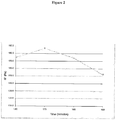
Figure 2 : illustrates the variation in elastic modulus G' (in Pa) of hydrogels obtained after a crosslinking step characterized by a first step of maintaining a mixture of a 12% aqueous hyaluronic acid gel with BDDE for two hours at room temperature followed by a second step of incubating said mixture at 52°C for various times. -
Figure 3 : illustrates the variation in the elastic modulus G' (in Pa) of hydrogels obtained after a crosslinking step characterized by a single step of incubating a mixture of a 12% aqueous hyaluronic acid gel with BDDE at 52°C for various times. - For each of the crosslinked gels described below, 10 g of hyaluronic acid (1.5 MDa), 73 g of 1% sodium hydroxide and 1,2 g of butanediol diglycidyl ether (BDDE) were employed.
- The particular conditions applied for each gel were the following:
- The preparation protocol was as follows:
- 1. homogenization at room temperature of the hyaluronic acid/1% sodium hydroxide mixture for about 1 hour 30 minutes in order to obtain a perfectly homogeneous viscous solution;
- 2. addition of the crosslinking agent (BDDE) and further homogenization at room temperature for about 20 minutes;
- 3. incubation of the hyaluronic acid/1% sodium hydroxide mixture/BDDE viscous solution for 3 hours at 52°C; and
- 4. neutralization, swelling and homogenization of the solid obtained (crosslinked hyaluronic acid solution) in an acidified phosphate buffer solution so as to obtain a hydrogel containing 20 mg/g of hyaluronic acid with a pH close to neutrality.
- The protocol was the same as that described for product A but carried out with, between
steps step 2 was maintained at room temperature for 2 hours. - This intermediate step may also be denoted, in the rest of the present description, by the expression "rest step".
- The total "hyaluronic acid/BDDE" contact time before incubation at 52°C was therefore about 2 hours 20 minutes.
- The protocol was the same as that described for product A but carried out, after
step 2 of adding BDDE and homogenizing for 15 minutes, with an extrusion step followed by the intermediate step, in which the product B was maintained for 2 hours at room temperature, and then theincubation step 3 at 52°C for 3 hours. - This extrusion step was carried out by means of a circular screen of the extruder screen pack type, having a 10 micron mesh size.
- The total hyaluronic acid/BDDE contact time before incubation at 52°C was again about 2 hours 20 minutes.
- Syringes were all filled with products A, B and C. The viscoelastic properties of these three products were measured using a rheometer (Haake RS6000) with a cone/plate geometry (1°cone angle/35 mm diameter plate). A strain scan was carried out and the elastic modulus G' (in Pa) and the phase-shift angle δ (in °) were measured for a stress of 5 Pa.
-
Figure 1 below shows the measured elastic modulus G' values (in PA). For indication, the value of the phase-shift angle δ is indicated (in °) at the top of each column, to the right of the G' value. - The measured phase shift is extremely small, which means that these gels exhibit a mainly elastic character.
- The results of
Figure 1 , and especially that of product B, show a significant increase in G' when the crosslinking reaction is carried out via a process of the invention, that is to say by employing two different rates for carrying out the crosslinking reaction, one after another. - This effect is even more pronounced when an extrusion step is carried out by using a device comprising a filter of 10 micron porosity.
- Example 2 : Evaluation, at various stages, of the amount of crosslinking agent in a hyaluronic acid gel subjected to a process according to the invention.
- Several crosslinked hydrogels were prepared in parallel using a process of the invention via the use of a specific receptacle, namely a deformable pouch as defined above.
- A 12% hyaluronic acid solution in 1% NaOH was thus prepared. After hydrating the hyaluronic acid, a BDDE solution diluted five-fold in 1% NaOH was added.
- The total amount of BDDE used therefore corresponded to a theoretical content equivalent to 1,8 mg/g in a 20 mg/g hyaluronic acid hydrogel.
- Several fractions A, B and C were then prepared from the mixture obtained
- above. Fraction A corresponds to a hyaluronic acid gel maintained for 1 hour at room temperature (RT) before the incubation step described below.
- Fraction B corresponds to a hyaluronic acid gel maintained for 2 hours at room temperature before the incubation step described below.
- Finally, Fraction C corresponded to a hyaluronic acid gel maintained for 1 hour at room temperature before the incubation step described below, this rest step being furthermore combined with a step of extrusion through a screen of 10 µm mesh size.
- After the various treatments described above, fractions A, B and C were incubated at 52°C for 3 hours.
- The solids respectively obtained after this incubation step (crosslinked hyaluronic acid solutions) were then neutralized, swelled and homogenized in a 7.3 pH phosphate buffer solution so as to obtain a 20 mg/g hyaluronic acid hydrogel.
- To monitor the amount of crosslinking agent consumed at various steps of the process of the invention, a BDDE analysis was carried out at various steps.
- Thus, samples T1 and T2 correspond to gel samples taken after maintaining, prior to the incubation step for 3 hours at 52°C, the hyaluronic acid/BBDE mixtures at room temperature for 1 and 2 hours respectively.
- The samples T1 and T2 then underwent the same neutralization, swelling and homogenization steps as those described above for fractions A, B and C, so as to obtain 20 mg/g hyaluronic acid hydrogels.
- The samples A, B and C corresponded to gel samples taken from the corresponding fractions after incubation for 3 hours at 52°C and conversion to a 20 mg/g hydrogel.
- Table 1 shows the measured amounts of crosslinking agent and the elastic modulus (G' in Pa) values of the hydrogels obtained.
- For indication, values of the complex viscosity |η|* and the phase-shift angle δ are also mentioned.
Table 1 Samples: BDDE (mg/g) G'(Pa) |η|* (Pa.s) δ(°) T1 1.53 NCO *(predominantly viscous solutions of low elasticity owing to the absence of crosslinking, δ >45°) T2 1.43 Fraction A (maintained at RT for 1 h) 0.20 136 22 5 Fraction B (maintained at RT for 2 h) 0.17 174 28 5 Fraction C (maintained at RT for 1 h, and an extrusion step through a 10 µm filter) 0.20 159 25 5 *NCO = not carried out. - It should be noted that the measured residual BDDE contents correspond to non-sterilized and non-purified gels.
- The measured contents of crosslinking agent (BDDE) in samples T1 and T2 are of the same order of magnitude. The small reduction in BDDE content observed compared with the theoretical content indicated above is explained by a slow rate of the crosslinking reaction, as the case may be, associated with the degradation of the BDDE because of the instability of the epoxy functional groups.
- In contrast, the reduction in BDDE content is greatly accentuated after the 52°C incubation step for 3 hours, this substantial consumption of BDDE thus corresponding to a rapid rate of the crosslinking reaction.
- In respect of the mechanical properties of the gels obtained (fractions A, B and C), it is worthwhile pointing out that (i) the measured phase shift is extremely small, meaning that these gels have mainly an elastic character, (ii) the highest elastic modulus G' is obtained for the gel resulting from fraction B, that is to say with a step of maintaining at room temperature for 2 hours before incubation at 52°C and (iii) fraction C, extruded before crosslinking, has a significantly increased elastic modulus G' in comparison with the same hydrogel but not extruded (fraction A).
- Points (ii) and (iii) above thus corroborate the advantageous effects due to using two different crosslinking rates, one after another, for the crosslinking reaction but also due to the extrusion step in the context of a process for preparing a crosslinked gel according to the invention.
- An aqueous polysaccharide gel/crosslinking agent mixture identical to that described in Example 2 above was prepared.
- Two tests were then carried out:
- In the first case, several fractions A, B, C and D were prepared from the above mixture. The crosslinking reaction was carried out by leaving said fractions for 2 hours at room temperature before placing them at 52°C for various times.
- In the second case, several fractions A', B', C' and D' were also prepared. Unlike fractions A, B, C and D, these were directly incubated at 52°C for various times.
- The incubation times at 52°C for the various fractions considered were the following:
- ▪ Fractions A and A': 2 hours 40 minutes
- ▪ Fractions B and B': 2
hours 50 minutes - ▪ Fractions C and C': 3 hours
- ▪ Fractions D and D': 3 hours 10 minutes.
- The crosslinked hyaluronic acid gels obtained after the incubation steps were then neutralized, then swelled and homogenized in a 7.3 pH phosphate buffer (PB) solution so as to obtain 20 mg/g hyaluronic acid hydrogels. The following characterizations and analyses were carried out on the hydrogels thus obtained.
- Table 2 below gives the values of the elastic moduli G' (in Pa) of the hydrogels obtained. For indication, the value of the complex viscosity |η|* and the phase-shift angle δ are also given.
Table 2 Amplitude scan (cone/plate) τ = 5 Pa G' (Pa) |η| ∗ (Pa.s) δ (°) A 174.5 27.9 5.1 B 186.9 29.9 5.7 C 174.0 27.8 5.5 D 152.2 24.3 4.8 A' 119.2 19.1 7.1 B' 126.5 20.3 6.4 C' 125.8 20.1 6.3 D' 122.7 19.6 5.7 -
Figures 2 and3 below illustrate the results given in Table 2 above. - The optimum effectiveness of the 52°C incubation step on the crosslinking therefore occurs at about 3 hours with or without the prior step of maintaining the aqueous polysaccharide gel/crosslinking agent mixture at room temperature.
- The hydrogels obtained by a process employing a maintenance step at room temperature for 2 hours, before the 52°C incubation step, have viscoelastic properties that are significantly better than the maximum values observed for the hydrogels obtained by a protocol with the step of maintaining at room temperature being absent.
- These results demonstrate that the beneficial effect due to the presence, for carrying out the crosslinking reaction, of a step of maintaining an aqueous polysaccharide gel/crosslinking agent mixture at ambient temperature for a long time cannot be simply reproduced by extending the crosslinking time at 52°C.
- It is because the optimum G' measured on the hydrogels obtained according to a crosslinking process of the invention has never been achieved by the hydrogels obtained according to a conventional crosslinking process, whatever the duration of the incubation step at 52°C.
by homogenizing the mixture thus obtained, the order of addition of said compounds (i), (ii) and (iii) into the receptacle being indifferent.
Claims (13)
- Process of preparing a crosslinked gel of at least one hyaluronic acid or one of its salts, comprising at least the steps consisting in:a) providing, at a temperature below 35°C, an aqueous gel comprising at least one hyaluronic acid in an uncrosslinked form together with at least one difunctional or multifunctional epoxy crosslinking agent;b) maintaining the mixture of step a) at a temperature below 35°C for at least one hour;c) stimulating the crosslinking reaction of the mixture obtained after step b), step c) being carried out thermally, at a temperature between 35 and 60°C, for a time ranging from 30 to 300 minutes, and if need be;d) recovering said crosslinked gel formed.
- Process according to Claim 1, wherein steps a) and b) are carried out at a temperature ranging from 15 to 25°C, and better still at room temperature.
- Process according to claim 1 or 2, wherein the step b) is carried out for a time longer than 1 hour, preferably longer than 2 hours.
- Process according to any one of the preceding claims, wherein the aqueous gel considered in step a) is obtained beforehand by bringing together, in an appropriate receptacle:(i) an aqueous medium;(ii) at least one hyaluronic acid, or one of its salts, in an uncrosslinked form; and(iii) at least one difunctional or multifunctional epoxy crosslinking agent, and by homogenizing the mixture thus obtained, the order of addition of said compounds (i), (ii) and (iii) into the receptacle being indifferent.
- Process according to claim 1, wherein the homogenization step takes place for a time of less than 200 minutes, preferably less than 150 minutes, or even between 15 and 100 minutes.
- Process according to any one of the preceding claims, wherein the step c) is carried out at a temperature between 45 and 55°C, or even between 48 and 52°C.
- Process according to any one of the preceding claims, wherein the step c) is carried out for a time ranging from 100 to 200 minutes, and better still from 150 to 190 minutes.
- Process according to any one of the preceding claims, wherein the crosslinking agent is butanediol diglycidyl ether (BDDE).
- Process according to any one of the preceding claims, wherein the hyaluronic acid has a molecular weight greater than or equal to 1 MDa.
- Process according to any one of the preceding claims, wherein the hyaluronic acid is present within the aqueous gel of said hyaluronic acid in a noncrosslinked form in a content of between 5 and 15% by weight, preferably greater than 10% by weight, relative to the total weight of said aqueous gel.
- Process according to any one of the preceding claims, wherein it employs sodium hyaluronate in alkaline medium and butanediol diglycidyl ether (BDDE), as crosslinking agent.
- Process according to any one of the preceding claims, wherein the crosslinked gel is a predominantly elastic viscoelastic single-phase gel.
- Use of a crosslinked gel obtained by implementing a process as defined according to any one of the preceding claims, for the lasting filling of volume defects of the skin, and especially the filling of wrinkles.
Priority Applications (1)
| Application Number | Priority Date | Filing Date | Title |
|---|---|---|---|
| PL11799874T PL2649101T3 (en) | 2010-12-06 | 2011-12-06 | Process of preparing a cross linked gel |
Applications Claiming Priority (2)
| Application Number | Priority Date | Filing Date | Title |
|---|---|---|---|
| FR1060135A FR2968305B1 (en) | 2010-12-06 | 2010-12-06 | PROCESS FOR PREPARING RETICULATED GEL |
| PCT/IB2011/055495 WO2012077054A1 (en) | 2010-12-06 | 2011-12-06 | Process of preparing a cross linked gel |
Publications (2)
| Publication Number | Publication Date |
|---|---|
| EP2649101A1 EP2649101A1 (en) | 2013-10-16 |
| EP2649101B1 true EP2649101B1 (en) | 2021-06-02 |
Family
ID=44265691
Family Applications (1)
| Application Number | Title | Priority Date | Filing Date |
|---|---|---|---|
| EP11799874.0A Active EP2649101B1 (en) | 2010-12-06 | 2011-12-06 | Process of preparing a cross linked gel |
Country Status (14)
| Country | Link |
|---|---|
| US (1) | US9393189B2 (en) |
| EP (1) | EP2649101B1 (en) |
| JP (1) | JP5860060B2 (en) |
| KR (1) | KR101868183B1 (en) |
| AU (1) | AU2011340106B2 (en) |
| BR (1) | BR112013012251B1 (en) |
| CA (1) | CA2817837C (en) |
| DK (1) | DK2649101T3 (en) |
| ES (1) | ES2883135T3 (en) |
| FR (1) | FR2968305B1 (en) |
| PL (1) | PL2649101T3 (en) |
| PT (1) | PT2649101T (en) |
| RU (1) | RU2590558C2 (en) |
| WO (1) | WO2012077054A1 (en) |
Families Citing this family (27)
| Publication number | Priority date | Publication date | Assignee | Title |
|---|---|---|---|---|
| JP5670196B2 (en) | 2007-11-16 | 2015-02-18 | バイセプト セラピューティクス、インク. | Compositions and methods for treating purpura |
| US8394782B2 (en) | 2007-11-30 | 2013-03-12 | Allergan, Inc. | Polysaccharide gel formulation having increased longevity |
| US8357795B2 (en) | 2008-08-04 | 2013-01-22 | Allergan, Inc. | Hyaluronic acid-based gels including lidocaine |
| ES2658609T3 (en) | 2008-09-02 | 2018-03-12 | Tautona Group Lp | Threads of hyaluronic acid and / or derivatives thereof, methods for manufacturing them, and uses thereof |
| FR2945293B1 (en) * | 2009-05-11 | 2011-06-17 | Teoxane | PROCESS FOR PREPARING A RETICULATED GEL |
| US20110172180A1 (en) | 2010-01-13 | 2011-07-14 | Allergan Industrie. Sas | Heat stable hyaluronic acid compositions for dermatological use |
| KR101764451B1 (en) | 2010-03-12 | 2017-08-02 | 알러간 인더스트리 에스에이에스 | A Fluid Composition Comprising A Hyaluronan Polymer and Mannitol For Improving Skin Condition |
| EP3078388B1 (en) | 2010-03-22 | 2019-02-20 | Allergan, Inc. | Cross-linked hydrogels for soft tissue augmentation |
| US9005605B2 (en) | 2010-08-19 | 2015-04-14 | Allergan, Inc. | Compositions and soft tissue replacement methods |
| US8883139B2 (en) | 2010-08-19 | 2014-11-11 | Allergan Inc. | Compositions and soft tissue replacement methods |
| US8889123B2 (en) | 2010-08-19 | 2014-11-18 | Allergan, Inc. | Compositions and soft tissue replacement methods |
| US9393263B2 (en) | 2011-06-03 | 2016-07-19 | Allergan, Inc. | Dermal filler compositions including antioxidants |
| US20130096081A1 (en) | 2011-06-03 | 2013-04-18 | Allergan, Inc. | Dermal filler compositions |
| US9408797B2 (en) | 2011-06-03 | 2016-08-09 | Allergan, Inc. | Dermal filler compositions for fine line treatment |
| KR102238406B1 (en) | 2011-06-03 | 2021-04-08 | 알러간 인더스트리 에스에이에스 | Dermal filler compositions including antioxidants |
| US9662422B2 (en) | 2011-09-06 | 2017-05-30 | Allergan, Inc. | Crosslinked hyaluronic acid-collagen gels for improving tissue graft viability and soft tissue augmentation |
| US20130244943A1 (en) | 2011-09-06 | 2013-09-19 | Allergan, Inc. | Hyaluronic acid-collagen matrices for dermal filling and volumizing applications |
| EP3200838B1 (en) | 2014-09-30 | 2019-09-18 | Allergan Industrie, SAS | Stable hydrogel compositions including additives |
| FR3029928B1 (en) | 2014-12-15 | 2018-03-09 | Teoxane | RETICULATED GEL |
| HUE047971T2 (en) | 2015-02-13 | 2020-05-28 | Allergan Ind Sas | Implants for sculpting, augmenting or correcting facial features such as the chin |
| FR3034195B1 (en) * | 2015-03-24 | 2017-04-21 | Teoxane | METHOD FOR EVALUATING THE MECHANICAL PERFORMANCE OF A FILLING GEL |
| FR3066386B1 (en) * | 2017-05-18 | 2020-08-28 | Bioxis Pharmaceuticals | PROCESS FOR PREPARING AN AQUEOUS HYALURONIC ACID GEL |
| WO2019155391A1 (en) | 2018-02-06 | 2019-08-15 | Regen Lab Sa | Cross-linked hyaluronic acids and combinations with prp/bmc |
| KR20200046649A (en) | 2018-10-25 | 2020-05-07 | (주)뉴크레이티브랩 | The method of Producing Hyaluronic Acid Mixed with Mono and Biphasic |
| FR3146899B1 (en) | 2023-03-21 | 2026-03-20 | Teoxane SA | A process for preparing a sterile hydrogel comprising a cross-linked polysaccharide, a non-cross-linked polysaccharide, or a mixture thereof. |
| FR3146900A1 (en) | 2023-03-21 | 2024-09-27 | Teoxane SA | Process for preparing a sterile hydrogel comprising a crosslinked, non-crosslinked polysaccharide or their mixture |
| WO2025125597A1 (en) | 2023-12-15 | 2025-06-19 | Teoxane SA | Polysaccharide-based hydrogel comprising silicon |
Citations (14)
| Publication number | Priority date | Publication date | Assignee | Title |
|---|---|---|---|---|
| US20030094719A1 (en) | 2001-05-02 | 2003-05-22 | Jean-Dean Yang | Method for producing water-insoluble polysaccharides |
| US20030148995A1 (en) | 2000-07-19 | 2003-08-07 | Estelle Piron | Polysaccharide crosslinking, hydrogel preparation, resulting polysaccharide(s) and hydrogel(s), uses thereof |
| US20040091605A1 (en) | 2002-05-24 | 2004-05-13 | Biotronik Mess- Und Therapiegeraete Gmbh & Co Ingenieurbuero Berlin | Method of coating a stent with a polysaccharide layer and associated stents |
| US20040127698A1 (en) | 2002-12-31 | 2004-07-01 | Industrial Technology Research Institute | Method for producing double-crosslinked hyaluronate material |
| WO2005112888A2 (en) | 2004-05-20 | 2005-12-01 | Mentor Corporation | Methods for making injectable polymer hydrogels |
| US20070196426A1 (en) | 2004-02-03 | 2007-08-23 | Anteis S.A. | Biocompatible crosslinked gel |
| WO2008037171A1 (en) | 2006-09-29 | 2008-04-03 | Beijing Pro-Medical Biotech Research Institute | A process for preparing a hyaluronic acid gel in the two crosslinking stages |
| US20100028438A1 (en) | 2008-08-04 | 2010-02-04 | Lebreton Pierre F | Hyaluronic Acid-Based Gels Including Lidocaine |
| US20100226988A1 (en) | 2003-04-10 | 2010-09-09 | Allergan, Inc. | Cross-linking of low-molecular weight and high-molecular weight polysaccharides, preparation of injectable monophase hydrogels, polysaccharides and hydrogels obtained |
| EP2236523A1 (en) | 2009-03-30 | 2010-10-06 | Scivision Biotech Inc. | Method for producing cross-linked hyaluronic acid |
| WO2010131175A1 (en) | 2009-05-11 | 2010-11-18 | Teoxane | Process for preparing a crosslinked gel |
| US20100303873A1 (en) | 2007-12-07 | 2010-12-02 | Estelle Marie Piron | Biodegradable single-phase cohesive hydrogels |
| WO2011023355A2 (en) | 2009-08-27 | 2011-03-03 | Fidia Farmaceutici S.P.A. | Viscoelastic gels as novel fillers |
| WO2012062775A1 (en) | 2010-11-08 | 2012-05-18 | Allergan Industrie, Sas | Hyaluronic acid based formulations |
Family Cites Families (8)
| Publication number | Priority date | Publication date | Assignee | Title |
|---|---|---|---|---|
| GB9902652D0 (en) * | 1999-02-05 | 1999-03-31 | Fermentech Med Ltd | Process |
| US8524213B2 (en) | 2003-12-30 | 2013-09-03 | Genzyme Corporation | Polymeric materials, their preparation and use |
| US20050226936A1 (en) * | 2004-04-08 | 2005-10-13 | Q-Med Ab | Method of soft tissue augmentation |
| US20060105022A1 (en) | 2004-11-15 | 2006-05-18 | Shiseido Co., Ltd. | Process for preparing crosslinked hyaluronic acid gel |
| CN101056891B (en) * | 2004-11-15 | 2010-05-26 | 株式会社资生堂 | preparation method of crosslinked hyaluronic acid gel |
| CN101107270B (en) | 2004-11-24 | 2011-11-23 | 诺维信生物制药丹麦公司 | Method of cross-linking hyaluronic acid with divinylsulfone |
| FR2908775B1 (en) * | 2006-11-17 | 2012-08-31 | Biomatlante | HYDROGEL AND ITS BIOMEDICAL APPLICATIONS |
| JP5071766B2 (en) | 2006-12-08 | 2012-11-14 | 独立行政法人日本原子力研究開発機構 | Method for producing gel using polysaccharide as raw material |
-
2010
- 2010-12-06 FR FR1060135A patent/FR2968305B1/en active Active
-
2011
- 2011-12-06 KR KR1020137017022A patent/KR101868183B1/en active Active
- 2011-12-06 PT PT117998740T patent/PT2649101T/en unknown
- 2011-12-06 JP JP2013542654A patent/JP5860060B2/en active Active
- 2011-12-06 BR BR112013012251-0A patent/BR112013012251B1/en not_active IP Right Cessation
- 2011-12-06 CA CA2817837A patent/CA2817837C/en active Active
- 2011-12-06 DK DK11799874.0T patent/DK2649101T3/en active
- 2011-12-06 RU RU2013125786/05A patent/RU2590558C2/en active
- 2011-12-06 WO PCT/IB2011/055495 patent/WO2012077054A1/en not_active Ceased
- 2011-12-06 ES ES11799874T patent/ES2883135T3/en active Active
- 2011-12-06 PL PL11799874T patent/PL2649101T3/en unknown
- 2011-12-06 EP EP11799874.0A patent/EP2649101B1/en active Active
- 2011-12-06 AU AU2011340106A patent/AU2011340106B2/en active Active
- 2011-12-06 US US13/989,197 patent/US9393189B2/en active Active
Patent Citations (17)
| Publication number | Priority date | Publication date | Assignee | Title |
|---|---|---|---|---|
| US20030148995A1 (en) | 2000-07-19 | 2003-08-07 | Estelle Piron | Polysaccharide crosslinking, hydrogel preparation, resulting polysaccharide(s) and hydrogel(s), uses thereof |
| US6921819B2 (en) | 2000-07-19 | 2005-07-26 | Laboratoires D'esthetique Appliquee | Polysaccharide crosslinking, hydrogel preparation, resulting polysaccharide(s) and hydrogel(s), uses thereof |
| US20030094719A1 (en) | 2001-05-02 | 2003-05-22 | Jean-Dean Yang | Method for producing water-insoluble polysaccharides |
| US20040091605A1 (en) | 2002-05-24 | 2004-05-13 | Biotronik Mess- Und Therapiegeraete Gmbh & Co Ingenieurbuero Berlin | Method of coating a stent with a polysaccharide layer and associated stents |
| US20040127698A1 (en) | 2002-12-31 | 2004-07-01 | Industrial Technology Research Institute | Method for producing double-crosslinked hyaluronate material |
| US20070066816A1 (en) | 2002-12-31 | 2007-03-22 | Industrial Technology Research Institute | Method for producing double-crosslinked hyaluronate material |
| US20100226988A1 (en) | 2003-04-10 | 2010-09-09 | Allergan, Inc. | Cross-linking of low-molecular weight and high-molecular weight polysaccharides, preparation of injectable monophase hydrogels, polysaccharides and hydrogels obtained |
| US20070196426A1 (en) | 2004-02-03 | 2007-08-23 | Anteis S.A. | Biocompatible crosslinked gel |
| WO2005112888A2 (en) | 2004-05-20 | 2005-12-01 | Mentor Corporation | Methods for making injectable polymer hydrogels |
| WO2008037171A1 (en) | 2006-09-29 | 2008-04-03 | Beijing Pro-Medical Biotech Research Institute | A process for preparing a hyaluronic acid gel in the two crosslinking stages |
| US20100303873A1 (en) | 2007-12-07 | 2010-12-02 | Estelle Marie Piron | Biodegradable single-phase cohesive hydrogels |
| WO2010015900A1 (en) | 2008-08-04 | 2010-02-11 | Allergan Industrie Sas | Hyaluronic acid-based gels including anesthetic agents |
| US20100028438A1 (en) | 2008-08-04 | 2010-02-04 | Lebreton Pierre F | Hyaluronic Acid-Based Gels Including Lidocaine |
| EP2236523A1 (en) | 2009-03-30 | 2010-10-06 | Scivision Biotech Inc. | Method for producing cross-linked hyaluronic acid |
| WO2010131175A1 (en) | 2009-05-11 | 2010-11-18 | Teoxane | Process for preparing a crosslinked gel |
| WO2011023355A2 (en) | 2009-08-27 | 2011-03-03 | Fidia Farmaceutici S.P.A. | Viscoelastic gels as novel fillers |
| WO2012062775A1 (en) | 2010-11-08 | 2012-05-18 | Allergan Industrie, Sas | Hyaluronic acid based formulations |
Also Published As
| Publication number | Publication date |
|---|---|
| EP2649101A1 (en) | 2013-10-16 |
| JP5860060B2 (en) | 2016-02-16 |
| DK2649101T3 (en) | 2021-08-16 |
| RU2013125786A (en) | 2015-01-20 |
| CA2817837C (en) | 2019-07-09 |
| BR112013012251B1 (en) | 2021-02-09 |
| KR20130132510A (en) | 2013-12-04 |
| AU2011340106B2 (en) | 2016-03-03 |
| PL2649101T3 (en) | 2021-11-22 |
| CA2817837A1 (en) | 2012-06-14 |
| JP2013544944A (en) | 2013-12-19 |
| RU2590558C2 (en) | 2016-07-10 |
| AU2011340106A1 (en) | 2013-06-06 |
| BR112013012251A2 (en) | 2016-08-09 |
| US20130237615A1 (en) | 2013-09-12 |
| US9393189B2 (en) | 2016-07-19 |
| WO2012077054A1 (en) | 2012-06-14 |
| FR2968305A1 (en) | 2012-06-08 |
| PT2649101T (en) | 2021-08-05 |
| ES2883135T3 (en) | 2021-12-07 |
| KR101868183B1 (en) | 2018-06-15 |
| FR2968305B1 (en) | 2014-02-28 |
Similar Documents
| Publication | Publication Date | Title |
|---|---|---|
| EP2649101B1 (en) | Process of preparing a cross linked gel | |
| EP2861626B1 (en) | Method of preparing a composition based on hyaluronic acid | |
| US20240335587A1 (en) | Biodegradable single-phase cohesive hydrogel | |
| WO2012077055A1 (en) | Process for preparing a crosslinked gel | |
| TW201427708A (en) | Sterile injectable aqueous formulation containing cross-linked hyaluronic acid and hydroxyapatite for cosmetic use | |
| WO2014064633A1 (en) | Process for preparing a crosslinked gel | |
| CN107522881B (en) | Method for preparing single-phase modified sodium hyaluronate gel | |
| EP3316911B1 (en) | Method of preparing a composition based on hyaluronic acid | |
| CN106866996A (en) | A kind of fast preparation method of silk fibroin matter gel | |
| CN111686664A (en) | Emulsified cross-linked sodium hyaluronate gel microspheres for injection and preparation method thereof | |
| EP3710526B1 (en) | Resorbable implantable devices based on crosslinked glycosaminoglycans, and process for the preparation thereof | |
| CA3075479C (en) | Resorbable implantable devices based on crosslinked glycosaminoglycans, and process for the preparation thereof | |
| Pirayesh et al. | Absorbable Soft Tissue Fillers: Core Characteristics | |
| TR2023017503A1 (en) | A METHOD INVOLVING LAYER-BY-LAYER CROSS-LINKING PROCESSES FOR OBTAINING HYALURONIC ACID COMPOSITIONS | |
| HK40106442A (en) | Cross-linking polysaccharide with fibroin and uses of the obtained material |
Legal Events
| Date | Code | Title | Description |
|---|---|---|---|
| PUAI | Public reference made under article 153(3) epc to a published international application that has entered the european phase |
Free format text: ORIGINAL CODE: 0009012 |
|
| 17P | Request for examination filed |
Effective date: 20130708 |
|
| AK | Designated contracting states |
Kind code of ref document: A1 Designated state(s): AL AT BE BG CH CY CZ DE DK EE ES FI FR GB GR HR HU IE IS IT LI LT LU LV MC MK MT NL NO PL PT RO RS SE SI SK SM TR |
|
| DAX | Request for extension of the european patent (deleted) | ||
| STAA | Information on the status of an ep patent application or granted ep patent |
Free format text: STATUS: EXAMINATION IS IN PROGRESS |
|
| 17Q | First examination report despatched |
Effective date: 20170516 |
|
| GRAP | Despatch of communication of intention to grant a patent |
Free format text: ORIGINAL CODE: EPIDOSNIGR1 |
|
| STAA | Information on the status of an ep patent application or granted ep patent |
Free format text: STATUS: GRANT OF PATENT IS INTENDED |
|
| INTG | Intention to grant announced |
Effective date: 20200902 |
|
| GRAS | Grant fee paid |
Free format text: ORIGINAL CODE: EPIDOSNIGR3 |
|
| GRAA | (expected) grant |
Free format text: ORIGINAL CODE: 0009210 |
|
| STAA | Information on the status of an ep patent application or granted ep patent |
Free format text: STATUS: THE PATENT HAS BEEN GRANTED |
|
| REG | Reference to a national code |
Ref country code: CH Ref legal event code: EP |
|
| AK | Designated contracting states |
Kind code of ref document: B1 Designated state(s): AL AT BE BG CH CY CZ DE DK EE ES FI FR GB GR HR HU IE IS IT LI LT LU LV MC MK MT NL NO PL PT RO RS SE SI SK SM TR |
|
| REG | Reference to a national code |
Ref country code: GB Ref legal event code: FG4D |
|
| REG | Reference to a national code |
Ref country code: AT Ref legal event code: REF Ref document number: 1398364 Country of ref document: AT Kind code of ref document: T Effective date: 20210615 |
|
| REG | Reference to a national code |
Ref country code: IE Ref legal event code: FG4D |
|
| REG | Reference to a national code |
Ref country code: DE Ref legal event code: R096 Ref document number: 602011071088 Country of ref document: DE |
|
| REG | Reference to a national code |
Ref country code: RO Ref legal event code: EPE Ref country code: PT Ref legal event code: SC4A Ref document number: 2649101 Country of ref document: PT Date of ref document: 20210805 Kind code of ref document: T Free format text: AVAILABILITY OF NATIONAL TRANSLATION Effective date: 20210730 |
|
| REG | Reference to a national code |
Ref country code: DK Ref legal event code: T3 Effective date: 20210813 |
|
| REG | Reference to a national code |
Ref country code: LT Ref legal event code: MG9D |
|
| REG | Reference to a national code |
Ref country code: NO Ref legal event code: T2 Effective date: 20210602 |
|
| PG25 | Lapsed in a contracting state [announced via postgrant information from national office to epo] |
Ref country code: BG Free format text: LAPSE BECAUSE OF FAILURE TO SUBMIT A TRANSLATION OF THE DESCRIPTION OR TO PAY THE FEE WITHIN THE PRESCRIBED TIME-LIMIT Effective date: 20210902 Ref country code: HR Free format text: LAPSE BECAUSE OF FAILURE TO SUBMIT A TRANSLATION OF THE DESCRIPTION OR TO PAY THE FEE WITHIN THE PRESCRIBED TIME-LIMIT Effective date: 20210602 Ref country code: FI Free format text: LAPSE BECAUSE OF FAILURE TO SUBMIT A TRANSLATION OF THE DESCRIPTION OR TO PAY THE FEE WITHIN THE PRESCRIBED TIME-LIMIT Effective date: 20210602 Ref country code: LT Free format text: LAPSE BECAUSE OF FAILURE TO SUBMIT A TRANSLATION OF THE DESCRIPTION OR TO PAY THE FEE WITHIN THE PRESCRIBED TIME-LIMIT Effective date: 20210602 |
|
| REG | Reference to a national code |
Ref country code: NL Ref legal event code: MP Effective date: 20210602 |
|
| PG25 | Lapsed in a contracting state [announced via postgrant information from national office to epo] |
Ref country code: LV Free format text: LAPSE BECAUSE OF FAILURE TO SUBMIT A TRANSLATION OF THE DESCRIPTION OR TO PAY THE FEE WITHIN THE PRESCRIBED TIME-LIMIT Effective date: 20210602 Ref country code: GR Free format text: LAPSE BECAUSE OF FAILURE TO SUBMIT A TRANSLATION OF THE DESCRIPTION OR TO PAY THE FEE WITHIN THE PRESCRIBED TIME-LIMIT Effective date: 20210903 Ref country code: RS Free format text: LAPSE BECAUSE OF FAILURE TO SUBMIT A TRANSLATION OF THE DESCRIPTION OR TO PAY THE FEE WITHIN THE PRESCRIBED TIME-LIMIT Effective date: 20210602 Ref country code: SE Free format text: LAPSE BECAUSE OF FAILURE TO SUBMIT A TRANSLATION OF THE DESCRIPTION OR TO PAY THE FEE WITHIN THE PRESCRIBED TIME-LIMIT Effective date: 20210602 |
|
| REG | Reference to a national code |
Ref country code: ES Ref legal event code: FG2A Ref document number: 2883135 Country of ref document: ES Kind code of ref document: T3 Effective date: 20211207 |
|
| REG | Reference to a national code |
Ref country code: AT Ref legal event code: UEP Ref document number: 1398364 Country of ref document: AT Kind code of ref document: T Effective date: 20210602 |
|
| PG25 | Lapsed in a contracting state [announced via postgrant information from national office to epo] |
Ref country code: NL Free format text: LAPSE BECAUSE OF FAILURE TO SUBMIT A TRANSLATION OF THE DESCRIPTION OR TO PAY THE FEE WITHIN THE PRESCRIBED TIME-LIMIT Effective date: 20210602 Ref country code: EE Free format text: LAPSE BECAUSE OF FAILURE TO SUBMIT A TRANSLATION OF THE DESCRIPTION OR TO PAY THE FEE WITHIN THE PRESCRIBED TIME-LIMIT Effective date: 20210602 Ref country code: CZ Free format text: LAPSE BECAUSE OF FAILURE TO SUBMIT A TRANSLATION OF THE DESCRIPTION OR TO PAY THE FEE WITHIN THE PRESCRIBED TIME-LIMIT Effective date: 20210602 Ref country code: SM Free format text: LAPSE BECAUSE OF FAILURE TO SUBMIT A TRANSLATION OF THE DESCRIPTION OR TO PAY THE FEE WITHIN THE PRESCRIBED TIME-LIMIT Effective date: 20210602 Ref country code: SK Free format text: LAPSE BECAUSE OF FAILURE TO SUBMIT A TRANSLATION OF THE DESCRIPTION OR TO PAY THE FEE WITHIN THE PRESCRIBED TIME-LIMIT Effective date: 20210602 |
|
| REG | Reference to a national code |
Ref country code: DE Ref legal event code: R026 Ref document number: 602011071088 Country of ref document: DE |
|
| PLBI | Opposition filed |
Free format text: ORIGINAL CODE: 0009260 |
|
| PLAX | Notice of opposition and request to file observation + time limit sent |
Free format text: ORIGINAL CODE: EPIDOSNOBS2 |
|
| 26 | Opposition filed |
Opponent name: MERZ PHARMA GMBH & CO. KGAA Effective date: 20220302 Opponent name: PETERREINS, FRANK Effective date: 20220228 |
|
| PG25 | Lapsed in a contracting state [announced via postgrant information from national office to epo] |
Ref country code: AL Free format text: LAPSE BECAUSE OF FAILURE TO SUBMIT A TRANSLATION OF THE DESCRIPTION OR TO PAY THE FEE WITHIN THE PRESCRIBED TIME-LIMIT Effective date: 20210602 |
|
| PLAF | Information modified related to communication of a notice of opposition and request to file observations + time limit |
Free format text: ORIGINAL CODE: EPIDOSCOBS2 |
|
| PLBB | Reply of patent proprietor to notice(s) of opposition received |
Free format text: ORIGINAL CODE: EPIDOSNOBS3 |
|
| PG25 | Lapsed in a contracting state [announced via postgrant information from national office to epo] |
Ref country code: IE Free format text: LAPSE BECAUSE OF NON-PAYMENT OF DUE FEES Effective date: 20211206 |
|
| PGFP | Annual fee paid to national office [announced via postgrant information from national office to epo] |
Ref country code: TR Payment date: 20221125 Year of fee payment: 12 Ref country code: NO Payment date: 20221123 Year of fee payment: 12 Ref country code: LU Payment date: 20221122 Year of fee payment: 12 |
|
| PG25 | Lapsed in a contracting state [announced via postgrant information from national office to epo] |
Ref country code: HU Free format text: LAPSE BECAUSE OF FAILURE TO SUBMIT A TRANSLATION OF THE DESCRIPTION OR TO PAY THE FEE WITHIN THE PRESCRIBED TIME-LIMIT; INVALID AB INITIO Effective date: 20111206 Ref country code: CY Free format text: LAPSE BECAUSE OF FAILURE TO SUBMIT A TRANSLATION OF THE DESCRIPTION OR TO PAY THE FEE WITHIN THE PRESCRIBED TIME-LIMIT Effective date: 20210602 |
|
| P01 | Opt-out of the competence of the unified patent court (upc) registered |
Effective date: 20230411 |
|
| PLAB | Opposition data, opponent's data or that of the opponent's representative modified |
Free format text: ORIGINAL CODE: 0009299OPPO |
|
| R26 | Opposition filed (corrected) |
Opponent name: PETERREINS SCHLEY PATENT- UND RECHTSANWAELTE PARTG MBB Effective date: 20220228 |
|
| RDAF | Communication despatched that patent is revoked |
Free format text: ORIGINAL CODE: EPIDOSNREV1 |
|
| APBM | Appeal reference recorded |
Free format text: ORIGINAL CODE: EPIDOSNREFNO |
|
| APBP | Date of receipt of notice of appeal recorded |
Free format text: ORIGINAL CODE: EPIDOSNNOA2O |
|
| APAH | Appeal reference modified |
Free format text: ORIGINAL CODE: EPIDOSCREFNO |
|
| PG25 | Lapsed in a contracting state [announced via postgrant information from national office to epo] |
Ref country code: MK Free format text: LAPSE BECAUSE OF FAILURE TO SUBMIT A TRANSLATION OF THE DESCRIPTION OR TO PAY THE FEE WITHIN THE PRESCRIBED TIME-LIMIT Effective date: 20210602 |
|
| APBQ | Date of receipt of statement of grounds of appeal recorded |
Free format text: ORIGINAL CODE: EPIDOSNNOA3O |
|
| PG25 | Lapsed in a contracting state [announced via postgrant information from national office to epo] |
Ref country code: LU Free format text: LAPSE BECAUSE OF NON-PAYMENT OF DUE FEES Effective date: 20231206 |
|
| PG25 | Lapsed in a contracting state [announced via postgrant information from national office to epo] |
Ref country code: LU Free format text: LAPSE BECAUSE OF NON-PAYMENT OF DUE FEES Effective date: 20231206 |
|
| PG25 | Lapsed in a contracting state [announced via postgrant information from national office to epo] |
Ref country code: MT Free format text: LAPSE BECAUSE OF FAILURE TO SUBMIT A TRANSLATION OF THE DESCRIPTION OR TO PAY THE FEE WITHIN THE PRESCRIBED TIME-LIMIT Effective date: 20210602 |
|
| PG25 | Lapsed in a contracting state [announced via postgrant information from national office to epo] |
Ref country code: NO Free format text: LAPSE BECAUSE OF NON-PAYMENT OF DUE FEES Effective date: 20231231 |
|
| PGFP | Annual fee paid to national office [announced via postgrant information from national office to epo] |
Ref country code: CH Payment date: 20250101 Year of fee payment: 14 |
|
| PGFP | Annual fee paid to national office [announced via postgrant information from national office to epo] |
Ref country code: PT Payment date: 20251127 Year of fee payment: 15 |
|
| REG | Reference to a national code |
Ref country code: CH Ref legal event code: U11 Free format text: ST27 STATUS EVENT CODE: U-0-0-U10-U11 (AS PROVIDED BY THE NATIONAL OFFICE) Effective date: 20260101 |
|
| PGFP | Annual fee paid to national office [announced via postgrant information from national office to epo] |
Ref country code: DE Payment date: 20251211 Year of fee payment: 15 |
|
| PGFP | Annual fee paid to national office [announced via postgrant information from national office to epo] |
Ref country code: GB Payment date: 20251219 Year of fee payment: 15 |
|
| PGFP | Annual fee paid to national office [announced via postgrant information from national office to epo] |
Ref country code: MC Payment date: 20251223 Year of fee payment: 15 |
|
| PGFP | Annual fee paid to national office [announced via postgrant information from national office to epo] |
Ref country code: AT Payment date: 20251222 Year of fee payment: 15 |
|
| PGFP | Annual fee paid to national office [announced via postgrant information from national office to epo] |
Ref country code: IT Payment date: 20251223 Year of fee payment: 15 Ref country code: DK Payment date: 20251224 Year of fee payment: 15 |
|
| PGFP | Annual fee paid to national office [announced via postgrant information from national office to epo] |
Ref country code: FR Payment date: 20251223 Year of fee payment: 15 |
|
| PGFP | Annual fee paid to national office [announced via postgrant information from national office to epo] |
Ref country code: BE Payment date: 20251219 Year of fee payment: 15 |
|
| PGFP | Annual fee paid to national office [announced via postgrant information from national office to epo] |
Ref country code: PL Payment date: 20251201 Year of fee payment: 15 |
|
| PGFP | Annual fee paid to national office [announced via postgrant information from national office to epo] |
Ref country code: RO Payment date: 20251128 Year of fee payment: 15 |
|
| PGFP | Annual fee paid to national office [announced via postgrant information from national office to epo] |
Ref country code: ES Payment date: 20260130 Year of fee payment: 15 |