EP2648018A1 - An improved RAIM algorithm - Google Patents
An improved RAIM algorithm Download PDFInfo
- Publication number
- EP2648018A1 EP2648018A1 EP12002388.2A EP12002388A EP2648018A1 EP 2648018 A1 EP2648018 A1 EP 2648018A1 EP 12002388 A EP12002388 A EP 12002388A EP 2648018 A1 EP2648018 A1 EP 2648018A1
- Authority
- EP
- European Patent Office
- Prior art keywords
- hmi
- ranging
- ranging signals
- group
- determining
- Prior art date
- Legal status (The legal status is an assumption and is not a legal conclusion. Google has not performed a legal analysis and makes no representation as to the accuracy of the status listed.)
- Granted
Links
Images

Classifications
-
- G—PHYSICS
- G01—MEASURING; TESTING
- G01S—RADIO DIRECTION-FINDING; RADIO NAVIGATION; DETERMINING DISTANCE OR VELOCITY BY USE OF RADIO WAVES; LOCATING OR PRESENCE-DETECTING BY USE OF THE REFLECTION OR RERADIATION OF RADIO WAVES; ANALOGOUS ARRANGEMENTS USING OTHER WAVES
- G01S19/00—Satellite radio beacon positioning systems; Determining position, velocity or attitude using signals transmitted by such systems
- G01S19/01—Satellite radio beacon positioning systems transmitting time-stamped messages, e.g. GPS [Global Positioning System], GLONASS [Global Orbiting Navigation Satellite System] or GALILEO
- G01S19/13—Receivers
- G01S19/20—Integrity monitoring, fault detection or fault isolation of space segment
Definitions
- the invention relates to a RAIM (Receiver Autonomous Integrity Monitoring) algorithm according to claim 1.
- RAIM Receiveiver Autonomous Integrity Monitoring
- RAIM Receiveiver Autonomous Integrity Monitoring
- GNSS Global Navigation Satellite System
- RAIM algorithms process GNSS signals and are based on statistical methods, with which faulty GNSS signals can be detected.
- Enhanced RAIM algorithms allow not only fault detection (FD) of any received GNSS signal, but also exclusion of a GNSS signal being detected as faulty from positioning, thus allowing a continuous operation of a GNSS receiver. This is known as fault detection and exclusion (FDE).
- FD fault detection
- FDE fault detection and exclusion
- the non-pre-published European patent application no. 10006518.4 describes an improved RAIM algorithm employable in a GNSS receiver, wherein the algorithm is particularly suitable to fulfill the requirements as outlined by the by ICAO (International Civil Aviation Organization) for CAT-I.
- ICAO International Civil Aviation Organization
- the integrity concept of the planned European GNSS GALILEO provides the dissemination of statistical descriptions with specific confidences.
- the statistical descriptions describe characteristics of possible errors of a SIS (Signal in Space), for example probabilities of the occurrence of errors, and comprise parameters for describing the possible error characteristics.
- the disseminated statistical descriptions comprise as parameters for describing the possible error characteristics SISA (Signal In Space Accuracy) values for each satellite.
- the SISA of a satellite is determined in the ground segment of GALILEO and is a prediction of the minimum standard deviation of a Gaussian distribution, that over-bounds the SISE (Signal In Space Error) distribution of a fault-free SIS (Signal In Space) of a GALILEO satellite.
- SISE Signal In Space Error
- SIS fault-free SIS
- a detailed description of the integrity concept of GALILEO can be found in " The Galileo Integrity Concept", V. Oehler, F. Luongo, J.-P. Boyero, R. Stalford, H. L. Trautenberg, ION GNSS 17th International Technical Meeting of the Satellite Division, 21-24 Sept. 2004, Long Beach, CA .
- the confidence in the determination of the integrity risk parameter SISA is about 1-1 E-4. However, this confidence usually does not suffice in order to achieve integrity risks in the range of about 1 E-7 with a RAIM algorithm.
- a basic idea underlying the present invention is the determination of a subgroup of "fault-free” ranging signals from all received "fault-free” ranging signals and to determine the integrity risk by using this subgroup.
- the confidence in the determination of the integrity risk may be increased since the statistical description of an overall positioning solution is only wrong if at least two "fault-free” ranging signals of all received "fault-free” ranging signals are indeed statistically “not correct”.
- the invention uses redundancy contained in the received "fault-free” ranging signals in order to increase the confidence in the process of determining the integrity risk.
- the invention can in principle applied to every GNSS, in which ranging signals are disseminated, and wherein particularly the disseminated ranging signals contain a statistical description determining the ranging signals as being faulty or fault-free, such as GALILEO ranging signals supporting the SoL (Safety-of-Life) Services offered by GALILEO.
- a computer program may be provided, which implements an algorithm according to the invention and as described above and enabling the determining of an integrity risk in a GNSS when executed by a computer.
- the computer program may be for example installed on a computing device with a receiver for ranging signals from a GNSS, for example ranging signal from NAVSTAR-GPS and/or the upcoming European GNSS GALILEO and/or Russian GNSS GLONASS and/or Chinese GNSS KOMPASS.
- a record carrier storing a computer program according to the invention may be provided, for example a CD-ROM, a DVD, a memory card, a diskette, or a similar data carrier suitable to store the computer program for electronic access.
- a yet further embodiment of the invention provides a receiver for ranging signals from the satellite of a GNSS, comprising
- the receiver may be for example integrated in a mobile device such as a mobile navigation device, a smartphone, a tablet computer, or a laptop.
- a mobile navigation device such as a smartphone, a tablet computer, or a laptop.
- the RAIM algorithm processes ranging signals received at a certain position from satellites of a GNSS.
- a received ranging signal is also called a measurement.
- Another common term for a received ranging signal is pseudorange measurement.
- the RAIM algorithm processes the information contained in the received ranging signals in order to provide integrity monitoring for applications such as aviation. If the RAIM algorithm detects a faulty ranging signal, it may issue a warning to a user for example a pilot by providing an alert.
- the ICAO has outlined several requirements for GPS, which should be fulfilled by RAIM algorithms.
- the requirements refer to availability, accuracy, integrity, and continuity of a GNSS based positioning service.
- Integrity is defined as a measure of the trust that can be placed in the correctness of the information supplied by the total system. Integrity includes the ability of a system to provide timely and valid warnings to the user (alerts) when the system must not be used for the intended operation (or phase of flight).
- Alert Limit and Time-to-Alert can be found on " International Standards and Recommended Practices Aeronautical Telecommunications Annex 10 to the Convention on International Civil Aviation Volume I (Radio Navigation Aids) (Amendments until amendment 84 have been considered)", Sixth Edition, July 2006 .
- Integrity Risk is for example specified in the GALILEO system requirements.
- ⁇ ⁇ x n , m S n , m ⁇ ⁇ ⁇ r
- S n , m G T ⁇ M n , m ⁇ W ⁇ ⁇ G - 1 ⁇ G T ⁇ M n , m ⁇ W ⁇ with M n,m being the identity matrix where the elements (n,n) and (m,m) are set to zero.
- e i is the unit vector in direction i . i can take the values east, north or up, or any other value a user is interested in.
- the satellite m is not considered faulty, it is just considered that the fault free description of satellite m is not correct.
- the integrity risk at the alert limit (p HMI ) is therefore bounded by the maximum of the maximum of all fault free integrity risks at the (alert limit minus d n,i ) (p MI,fm ) and the fault free integrity risk ( p HMI, ff ).
- the primes indicate that the over-bounding might be different from the over-bounding used for the computation of the alert probabilities.
- the p ⁇ n ⁇ ⁇ p ⁇ n ⁇ probabilities have to be larger than the p ⁇ n ⁇ p ⁇ n used for continuity and accuracy, which in turn result in possible larger ⁇ m ⁇ , , ⁇ ' and K' compared to the unprimed versions.
- p ff is the probability that all ranging signals are fault free.
- p fm is the probability that any one and only one of the signals is faulty.
- p mf is the probability that more than one ranging signal is faulty.
- Detection thresholds can be tuned such that the availability which is basically the sum of the false alert probability p fa and the fraction of instances where the integrity risk at the alert limit computed with either (0.14) or (0.24) is above or equal to the tolerable integrity risk, where the d n,i are replaced by D n,i for the evaluation of (0.14) respectively (0.24), is minimized.
- availability which is basically the sum of the false alert probability p fa and the fraction of instances where the integrity risk at the alert limit computed with either (0.14) or (0.24) is above or equal to the tolerable integrity risk, where the d n,i are replaced by D n,i for the evaluation of (0.14) respectively (0.24), is minimized.
- different sets of instances have to be used.
- Fig. 1 shows a flowchart of the inventive RAIM algorithm.
- step S10 a first group of ranging signals from received ranging signals is determined. With each ranging signal, a statistical description of the quality of the ranging signal with regard to the integrity risk can be received, for example a SISA value. The statistical value of each ranging signal of the first group determines the ranging signals as being fault-free. Thus, the first group contains only ranging signals assessed as fault-free.
- the algorithm selects from the first group of ranging signals, determined in step S10, one or more ranging signals, for which it is assumed that their statistical description is faulty, i.e. that the statistical description of these selected ranging signals is not correct. For example, all ranging signals with the most critical SISA values among the SISA values of the first group's ranging signals can be selected. This can be performed for example by selecting ranging signals with a SISA value, which is below a certain threshold defined by the algorithm.
- a second group of ranging signals is determined by removing the selected ranging signals from the first group in step S14.
- the second group is a subset of the first group.
- step S16 the integrity risk is then determined as the maximum of the integrity risks of all possibilities calculated from the second group of ranging signals at the alert limit, refer above to the computation formulas with (0.14) or (0.24).
- the present invention particularly allows to achieve a sufficient confidence in the determination of the integrity risks in a GNSS with a RAIM algorithm, even if the confidence in the correct determination of the statistical description of a ranging signal such as in the SISA value is no sufficient to fulfill requirements of the RAIM algorithm.
Landscapes
- Engineering & Computer Science (AREA)
- Radar, Positioning & Navigation (AREA)
- Remote Sensing (AREA)
- Computer Security & Cryptography (AREA)
- Computer Networks & Wireless Communication (AREA)
- Physics & Mathematics (AREA)
- General Physics & Mathematics (AREA)
- Position Fixing By Use Of Radio Waves (AREA)
Abstract
determining a first group of ranging signals from received ranging signals for determining the integrity risk (S10), wherein a statistical description of each ranging signal of the first group determines the ranging signals as being fault-free,
selecting from the first group of ranging signals at least one ranging signal assuming that the statistical description of this ranging signal is not correct (S12),
determining a second group of ranging signals from the first group by removing the selected at least one ranging signal from the first group of ranging signals (S14), and
determining the integrity risk as the maximum of the integrity risks of all possibilities calculated from the second group of ranging signals at the alert limit (S16).
Description
- The invention relates to a RAIM (Receiver Autonomous Integrity Monitoring) algorithm according to
claim 1. - RAIM (Receiver Autonomous Integrity Monitoring) provides integrity monitoring of a GNSS (Global Navigation Satellite System) to GNSS receivers. RAIM algorithms process GNSS signals and are based on statistical methods, with which faulty GNSS signals can be detected. Enhanced RAIM algorithms allow not only fault detection (FD) of any received GNSS signal, but also exclusion of a GNSS signal being detected as faulty from positioning, thus allowing a continuous operation of a GNSS receiver. This is known as fault detection and exclusion (FDE).
- The non-pre-published European patent application no.
10006518.4 - For acceptance of a RAIM algorithm by users, the users must have sufficient confidence in the calculation of the integrity risk with the algorithm. The integrity concept of the planned European GNSS GALILEO provides the dissemination of statistical descriptions with specific confidences. The statistical descriptions describe characteristics of possible errors of a SIS (Signal in Space), for example probabilities of the occurrence of errors, and comprise parameters for describing the possible error characteristics. In GALILEO, the disseminated statistical descriptions comprise as parameters for describing the possible error characteristics SISA (Signal In Space Accuracy) values for each satellite. The SISA of a satellite is determined in the ground segment of GALILEO and is a prediction of the minimum standard deviation of a Gaussian distribution, that over-bounds the SISE (Signal In Space Error) distribution of a fault-free SIS (Signal In Space) of a GALILEO satellite. A detailed description of the integrity concept of GALILEO can be found in "The Galileo Integrity Concept", V. Oehler, F. Luongo, J.-P. Boyero, R. Stalford, H. L. Trautenberg, ION GNSS 17th International Technical Meeting of the Satellite Division, 21-24 Sept. 2004, Long Beach, CA. The confidence in the determination of the integrity risk parameter SISA is about 1-1 E-4. However, this confidence usually does not suffice in order to achieve integrity risks in the range of about 1 E-7 with a RAIM algorithm.
- Thus, it is an object of the invention to provide an improved RAIM algorithm employable in a GNSS receiver, wherein the algorithm allows increasing the confidence in an integrity risk calculated with the algorithm compared to known RAIM algorithms.
- This object is achieved by the subject matter of the independent claims. Further embodiments are shown by the dependent claims.
- A basic idea underlying the present invention is the determination of a subgroup of "fault-free" ranging signals from all received "fault-free" ranging signals and to determine the integrity risk by using this subgroup. Thus, the confidence in the determination of the integrity risk may be increased since the statistical description of an overall positioning solution is only wrong if at least two "fault-free" ranging signals of all received "fault-free" ranging signals are indeed statistically "not correct". Thus, the invention uses redundancy contained in the received "fault-free" ranging signals in order to increase the confidence in the process of determining the integrity risk. The invention can in principle applied to every GNSS, in which ranging signals are disseminated, and wherein particularly the disseminated ranging signals contain a statistical description determining the ranging signals as being faulty or fault-free, such as GALILEO ranging signals supporting the SoL (Safety-of-Life) Services offered by GALILEO.
- An embodiment of the invention relates to a RAIM algorithm for determining an integrity risk in a GNSS by processing several ranging signals received from satellites of the GNSS wherein the algorithm comprises the following acts:
- ● determining a first group of ranging signals from received ranging signals for determining the integrity risk, wherein a statistical description of each ranging signal of the first group determines the ranging signals as being fault-free,
- ● selecting from the first group of ranging signals at least one ranging signal assuming that the statistical description of this ranging signal is not correct,
- ● determining a second group of ranging signals from the first group by removing the selected at least one ranging signal from the first group of ranging signals, and
- ● determining the integrity risk as the maximum of the integrity risks of all possibilities calculated from the second group of ranging signals at the alert limit.
- The determining of the integrity risk may comprise bounding the integrity risk at the alert limit PHMI by the maximum of the maximum of all fault free integrity risks at the alert limit minus dn,i pHMI, fm and the fault free integrity risk PHMI,ff according to the following formula:

wherein dn,i is the test statistics for the detection of a fault on satellite n in direction i , and pmf is the probability that more than one ranging signal is faulty. - The fault free integrity risl PHMI,ff may becalculated according to the following formula:

with
and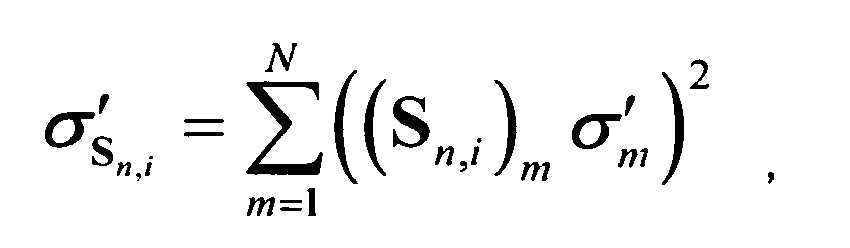
wherein ALi is an Alert Limit. - The maximum of the maximum of all fault free integrity risks at the alert limit minus PHMI,fm may be calculated according to the following formula:

with
with
and
wherein ALi is an Alert Limit. - According to a further embodiment of the invention, a computer program may be provided, which implements an algorithm according to the invention and as described above and enabling the determining of an integrity risk in a GNSS when executed by a computer. The computer program may be for example installed on a computing device with a receiver for ranging signals from a GNSS, for example ranging signal from NAVSTAR-GPS and/or the upcoming European GNSS GALILEO and/or Russian GNSS GLONASS and/or Chinese GNSS KOMPASS.
- According to a further embodiment of the invention, a record carrier storing a computer program according to the invention may be provided, for example a CD-ROM, a DVD, a memory card, a diskette, or a similar data carrier suitable to store the computer program for electronic access.
- A yet further embodiment of the invention provides a receiver for ranging signals from the satellite of a GNSS, comprising
- ● a memory storing a computer program of the invention and as described before and
- ● a processor being configured by the stored computer program to process received ranging signals with the algorithm implemented by the computer program.
- The receiver may be for example integrated in a mobile device such as a mobile navigation device, a smartphone, a tablet computer, or a laptop.
- These and other aspects of the invention will be apparent from and elucidated with reference to the embodiments described hereinafter.
- The invention will be described in more detail hereinafter with reference to exemplary embodiments. However, the invention is not limited to these exemplary embodiments.
-
- Fig. 1
- shows a flowchart of an embodiment of the RAIM algorithm according to the invention;
- Fig. 2
- shows the formula for the calculation of the fault free integrity risk ( pHMI,ff ) according to the invention;
- Fig. 3
- shows the formula for the calculation of the maximum of the maximum of all fault free integrity risks at the (alert limit minus d,i ) (PHMI,fm ) according to the invention.
- In the following, an embodiment of the inventive RAIM algorithm is explained. The RAIM algorithm processes ranging signals received at a certain position from satellites of a GNSS. A received ranging signal is also called a measurement. Another common term for a received ranging signal is pseudorange measurement.
- The RAIM algorithm processes the information contained in the received ranging signals in order to provide integrity monitoring for applications such as aviation. If the RAIM algorithm detects a faulty ranging signal, it may issue a warning to a user for example a pilot by providing an alert.
- For CAT-I, the ICAO has outlined several requirements for GPS, which should be fulfilled by RAIM algorithms. The requirements refer to availability, accuracy, integrity, and continuity of a GNSS based positioning service.
- According to ICAO, integrity is defined as a measure of the trust that can be placed in the correctness of the information supplied by the total system. Integrity includes the ability of a system to provide timely and valid warnings to the user (alerts) when the system must not be used for the intended operation (or phase of flight).
- To describe the integrity performance the following parameters are used:
- ● Alert Limit: For a given parameter measurement, the error tolerance not to be exceeded without issuing an alert.
- ● Time-to-Alert: The maximum allowable time elapsed form the onset of the navigation system being out of tolerance until the equipment enunciates the alert.
- ● Integrity Risk: Probability that a warning is not provided within the Time-to-Alert after the Alert Limit has been exceeded.
- The definitions for the terms Alert Limit and Time-to-Alert can be found on "International Standards and Recommended Practices Aeronautical Telecommunications Annex 10 to the Convention on International Civil Aviation Volume I (Radio Navigation Aids) (Amendments until amendment 84 have been considered)", Sixth Edition, July 2006. The definition for the term Integrity Risk is for example specified in the GALILEO system requirements.
- For the basic understanding of the inventive RAIM algorithm the Position Error Model is explained in the following.
- It is assumed that the position solution is derived by a weighted least square algorithm. It is further assumed that the linearized relation between the position-time error Δx and the range errors Δr is given by

where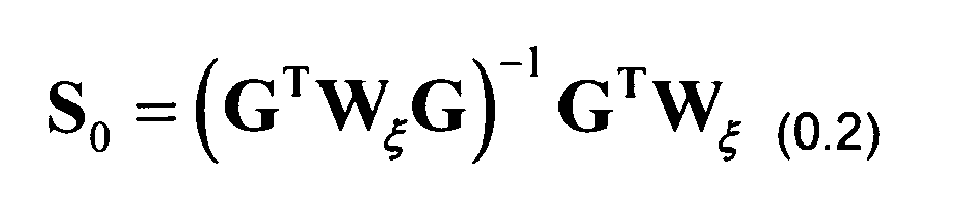
where G is the design matrix and W ξ is a diagonal matrix whose n-th diagonal element is a function of the satellite range error model ξ and the airborne error model assumed for the n-th satellite. N is the number of ranges in the position solution associated with S0. - For GPS ξ = URA (User Range Accuracy) and it is

- For GALILEO ξ = SISA (Signal In Space Accuracy) and it is

wherein - σn,user accounts for multipath and user receiver noise.
- σn,tropo accounts for mismodelling of the troposphere.
- In the current description it is assumed that the ionosphere is corrected by dual frequency measurements. If this is not the case the mismodelling of the ionosphere has to be added like the troposphere missmodelling above.
- The position error model for the position solution, where n-th satellite has been removed is given by

where
with M n being the identity matrix where the element (n,n) is set to zero. - The position error model for the position solution, where n-th and m-th satellite has been removed is given by

where
with M n,m being the identity matrix where the elements (n,n) and (m,m) are set to zero. - In the following, the position separation as applied by the inventive RAIM algorithm is explained.
- The test statistics for the detection of a fault on satellite n is

or more precisely, as the test statistics is in every spatial direction independent,
where e i is the unit vector in direction i . i can take the values east, north or up, or any other value a user is interested in. - According to the invention, the satellite m is not considered faulty, it is just considered that the fault free description of satellite m is not correct.
- With the definition of ΔS n and ΔS n,m as follows


it can be written
- Next, the integrity risk determination according to the inventive RAIM algorithm is explained.
- Only one received ranging signal is considered as faulty. In addition another signal is considered as fault free, but the statistical description of this signal is considered as not correct. Therefore one of the Δx n,m,i is the difference between the fault free solution with N - 2 signals where the confidence in the correct statistical description of the fault free signals is no longer given as product of the confidences in the statistical distribution of the individual ranging signals, but is higher, as it is already considered that one fault free signal might not be described statistically correct, and the (faulty or fault free solution) with N signals. The integrity risk at the alert limit (pHMI) is therefore bounded by the maximum of the maximum of all fault free integrity risks at the (alert limit minus dn,i ) (pMI,fm) and the fault free integrity risk ( pHMI, ff ).




with
and
and
and
and
and
- The primes indicate that the over-bounding might be different from the over-bounding used for the computation of the alert probabilities. As the integrity risk is smaller than the alert probability most likely the


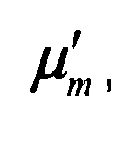
- pff is the probability that all ranging signals are fault free.
- pfm is the probability that any one and only one of the signals is faulty.
- pmf is the probability that more than one ranging signal is faulty.
- If it is not of interest to bound the integrity risk for a specific interval but on average, a bound for the average integrity risk can be computed with

- Detection thresholds can be tuned such that the availability which is basically the sum of the false alert probability pfa and the fraction of instances where the integrity risk at the alert limit computed with either (0.14) or (0.24) is above or equal to the tolerable integrity risk, where the dn,i are replaced by Dn,i for the evaluation of (0.14) respectively (0.24), is minimized. Depending of the definition of availability different sets of instances have to be used.
-
Fig. 1 shows a flowchart of the inventive RAIM algorithm. In step S10, a first group of ranging signals from received ranging signals is determined. With each ranging signal, a statistical description of the quality of the ranging signal with regard to the integrity risk can be received, for example a SISA value. The statistical value of each ranging signal of the first group determines the ranging signals as being fault-free. Thus, the first group contains only ranging signals assessed as fault-free. - In the following step S12, the algorithm selects from the first group of ranging signals, determined in step S10, one or more ranging signals, for which it is assumed that their statistical description is faulty, i.e. that the statistical description of these selected ranging signals is not correct. For example, all ranging signals with the most critical SISA values among the SISA values of the first group's ranging signals can be selected. This can be performed for example by selecting ranging signals with a SISA value, which is below a certain threshold defined by the algorithm.
- After selecting at least one ranging signal from the first group, a second group of ranging signals is determined by removing the selected ranging signals from the first group in step S14. The second group is a subset of the first group.
- In step S16, the integrity risk is then determined as the maximum of the integrity risks of all possibilities calculated from the second group of ranging signals at the alert limit, refer above to the computation formulas with (0.14) or (0.24).
- The present invention particularly allows to achieve a sufficient confidence in the determination of the integrity risks in a GNSS with a RAIM algorithm, even if the confidence in the correct determination of the statistical description of a ranging signal such as in the SISA value is no sufficient to fulfill requirements of the RAIM algorithm.
Claims (7)
- A RAIM algorithm for determining an integrity risk in a GNSS by processing several ranging signals received from satellites of the GNSS wherein the algorithm comprises the following acts:● determining a first group of ranging signals from received ranging signals for determining the integrity risk (S10), wherein a statistical description of each ranging signal of the first group determines the ranging signals as being fault-free,● selecting from the first group of ranging signals at least one ranging signal assuming that the statistical description of this ranging signal is not correct (S12),● determining a second group of ranging signals from the first group by removing the selected at least one ranging signal from the first group of ranging signals (S14), and● determining the integrity risk as the maximum of the integrity risks of all possibilities calculated from the second group of ranging signals at the alert limit (S16).
- The algorithm of claim 1, wherein the determining of the integrity risk comprises bounding the integrity risk at the alert limit pHMI by the maximum of the maximum of all fault free integrity risks at the alert limit minus dn,i pHMI,fm and the fault free integrity risk pHMI,ff according to the following formula:

wherein dn,i is the test statistics for the detection of a fault on satellite n in direction i , and pmf is the probability that more than one ranging signal is faulty. - The algorithm of claim 2, wherein PHMI,ff is calculated according to the following formula:

with

wherein ALi is an Alert Limit. - The algorithm of claim 2 or 3, wherein pHMI,fm is calculated according to the following formula:

with
with
and
wherein ALi is an Alert Limit. - A computer program implementing an algorithm according to any of the preceding claims and enabling the determining of an integrity risk in a GNSS when executed by a computer.
- A record carrier storing a computer program according to claim 5.
- A receiver for ranging signals from the satellite of a GNSS, comprising● a memory storing a computer program of claim 5 and● a processor being configured by the stored computer program to process received ranging signals with the algorithm implemented by the computer program.
Priority Applications (2)
| Application Number | Priority Date | Filing Date | Title |
|---|---|---|---|
| ES12002388.2T ES2525919T3 (en) | 2012-04-02 | 2012-04-02 | A perfected RAIM algorithm |
| EP20120002388 EP2648018B1 (en) | 2012-04-02 | 2012-04-02 | An improved RAIM algorithm |
Applications Claiming Priority (1)
| Application Number | Priority Date | Filing Date | Title |
|---|---|---|---|
| EP20120002388 EP2648018B1 (en) | 2012-04-02 | 2012-04-02 | An improved RAIM algorithm |
Publications (2)
| Publication Number | Publication Date |
|---|---|
| EP2648018A1 true EP2648018A1 (en) | 2013-10-09 |
| EP2648018B1 EP2648018B1 (en) | 2014-10-15 |
Family
ID=45954295
Family Applications (1)
| Application Number | Title | Priority Date | Filing Date |
|---|---|---|---|
| EP20120002388 Active EP2648018B1 (en) | 2012-04-02 | 2012-04-02 | An improved RAIM algorithm |
Country Status (2)
| Country | Link |
|---|---|
| EP (1) | EP2648018B1 (en) |
| ES (1) | ES2525919T3 (en) |
Cited By (11)
| Publication number | Priority date | Publication date | Assignee | Title |
|---|---|---|---|---|
| CN103941266A (en) * | 2014-03-30 | 2014-07-23 | 桂林电子科技大学 | Satellite integrity monitoring method and system based on mutual deviation |
| CN104199051A (en) * | 2014-09-26 | 2014-12-10 | 中国电子科技集团公司第五十四研究所 | Method for detecting and identifying satellite navigation RAIM (Receiver Autonomous Integrity Monitoring) multi-satellite faults |
| CN104898134A (en) * | 2015-05-27 | 2015-09-09 | 中国科学院嘉兴微电子与系统工程中心 | Satellite positioning integrity detection apparatus and algorithm thereof |
| CN105676235A (en) * | 2016-01-20 | 2016-06-15 | 广州比逊电子科技有限公司 | RAIM realization method and device of satellite navigation receiver |
| CN108020847A (en) * | 2017-11-27 | 2018-05-11 | 南京航空航天大学 | For the definite method of fault mode in senior receiver Autonomous Integrity Monitoring |
| CN109143274A (en) * | 2018-07-30 | 2019-01-04 | 沈阳航空航天大学 | A kind of receiver positioning completeness monitoring method based on raw satellite navigation signal |
| CN109359270A (en) * | 2018-08-30 | 2019-02-19 | 北京航空航天大学 | Establishment method of threshold model for integrity risk monitoring of Beidou ground-based augmentation system |
| CN109490916A (en) * | 2019-01-21 | 2019-03-19 | 南京航空航天大学 | A kind of GNSS receiver autonomous integrity monitoring method |
| CN111708054A (en) * | 2020-06-16 | 2020-09-25 | 沈阳航空航天大学 | ARAIM vertical protection level optimization method based on particle swarm optimization algorithm |
| CN115144875A (en) * | 2022-06-08 | 2022-10-04 | 北京眸星科技有限公司 | Receiver Autonomous Integrity Monitoring Method for GNSS Comprehensive Positioning Performance Evaluation |
| CN116699659A (en) * | 2023-04-25 | 2023-09-05 | 哈尔滨工程大学 | An Accelerated Testing Method for Continuity Risk Based on Bayesian Model |
Citations (1)
| Publication number | Priority date | Publication date | Assignee | Title |
|---|---|---|---|---|
| EP2402785A1 (en) * | 2010-06-23 | 2012-01-04 | Astrium GmbH | An improved RAIM algorithm |
-
2012
- 2012-04-02 ES ES12002388.2T patent/ES2525919T3/en active Active
- 2012-04-02 EP EP20120002388 patent/EP2648018B1/en active Active
Patent Citations (1)
| Publication number | Priority date | Publication date | Assignee | Title |
|---|---|---|---|---|
| EP2402785A1 (en) * | 2010-06-23 | 2012-01-04 | Astrium GmbH | An improved RAIM algorithm |
Non-Patent Citations (2)
| Title |
|---|
| KAPLAN E D: "UNDERSTANDING GPS: PRINCIPLES AND APPLICATIONS", UNDERSTANDING GPS PRINCIPLES AND APPLICATIONS, XX, XX, 1 January 1996 (1996-01-01), pages 306 - 314, XP002044171 * |
| OEHLER V ET AL: "The Galileo Integrity Concept", ION GNSS. INTERNATIONAL TECHNICAL MEETING OF THE SATELLITEDIVISION OF THE INSTITUTE OF NAVIGATION, WASHINGTON, DC, US, 21 September 2004 (2004-09-21), pages 604 - 615, XP002375520 * |
Cited By (15)
| Publication number | Priority date | Publication date | Assignee | Title |
|---|---|---|---|---|
| CN103941266A (en) * | 2014-03-30 | 2014-07-23 | 桂林电子科技大学 | Satellite integrity monitoring method and system based on mutual deviation |
| CN104199051A (en) * | 2014-09-26 | 2014-12-10 | 中国电子科技集团公司第五十四研究所 | Method for detecting and identifying satellite navigation RAIM (Receiver Autonomous Integrity Monitoring) multi-satellite faults |
| CN104199051B (en) * | 2014-09-26 | 2017-01-11 | 中国电子科技集团公司第五十四研究所 | Method for detecting and identifying satellite navigation RAIM (Receiver Autonomous Integrity Monitoring) multi-satellite faults |
| CN104898134A (en) * | 2015-05-27 | 2015-09-09 | 中国科学院嘉兴微电子与系统工程中心 | Satellite positioning integrity detection apparatus and algorithm thereof |
| CN105676235A (en) * | 2016-01-20 | 2016-06-15 | 广州比逊电子科技有限公司 | RAIM realization method and device of satellite navigation receiver |
| CN108020847A (en) * | 2017-11-27 | 2018-05-11 | 南京航空航天大学 | For the definite method of fault mode in senior receiver Autonomous Integrity Monitoring |
| CN109143274A (en) * | 2018-07-30 | 2019-01-04 | 沈阳航空航天大学 | A kind of receiver positioning completeness monitoring method based on raw satellite navigation signal |
| CN109359270A (en) * | 2018-08-30 | 2019-02-19 | 北京航空航天大学 | Establishment method of threshold model for integrity risk monitoring of Beidou ground-based augmentation system |
| CN109490916A (en) * | 2019-01-21 | 2019-03-19 | 南京航空航天大学 | A kind of GNSS receiver autonomous integrity monitoring method |
| CN111708054A (en) * | 2020-06-16 | 2020-09-25 | 沈阳航空航天大学 | ARAIM vertical protection level optimization method based on particle swarm optimization algorithm |
| CN111708054B (en) * | 2020-06-16 | 2023-06-30 | 沈阳航空航天大学 | ARAIM vertical protection level optimization method based on particle swarm optimization algorithm |
| CN115144875A (en) * | 2022-06-08 | 2022-10-04 | 北京眸星科技有限公司 | Receiver Autonomous Integrity Monitoring Method for GNSS Comprehensive Positioning Performance Evaluation |
| CN115144875B (en) * | 2022-06-08 | 2025-05-16 | 北京眸星科技有限公司 | Receiver autonomous integrity monitoring method for GNSS integrated positioning performance evaluation |
| CN116699659A (en) * | 2023-04-25 | 2023-09-05 | 哈尔滨工程大学 | An Accelerated Testing Method for Continuity Risk Based on Bayesian Model |
| CN116699659B (en) * | 2023-04-25 | 2024-03-15 | 哈尔滨工程大学 | A continuous risk accelerated testing method based on Bayesian model |
Also Published As
| Publication number | Publication date |
|---|---|
| EP2648018B1 (en) | 2014-10-15 |
| ES2525919T3 (en) | 2015-01-02 |
Similar Documents
| Publication | Publication Date | Title |
|---|---|---|
| EP2648018B1 (en) | An improved RAIM algorithm | |
| EP2402785B1 (en) | An improved RAIM algorithm | |
| EP3730971B1 (en) | Reducing bias impact on gnss integrity | |
| EP3260877B1 (en) | Integrity monitoring of radar altimeters | |
| EP2784445B1 (en) | Selected aspects of advanced receiver autonomous integrity monitoring application to kalman filter based navigation filter | |
| EP2887097B1 (en) | Architectures for high Navigation Satellite System integrity multi-constellation solution separation | |
| CN102096075B (en) | Galileo system integrity concept-based multimode user integrity assessing method | |
| US10996345B2 (en) | Signal fault detection for global navigation satellite system using multiple antennas | |
| EP4024087B1 (en) | Gnss signal spoofing detection via bearing and/or range sensor observations | |
| EP2461182A1 (en) | Method and apparatus for determining an integrity indicating parameter indicating the integrity of positioning information determined in a global positioning system | |
| EP2081043A2 (en) | Navigation system with apparatus for detecting accuracy failures | |
| EP2081042A2 (en) | Navigation system with apparatus for detecting accuracy failures | |
| US20170192098A1 (en) | Apparatus and method for ionospheric anomaly monitoring using kullback-leibler divergence metric for gbas | |
| US11668839B2 (en) | Terrain database assisted GNSS spoofing determination using radar observations | |
| Liu et al. | HPL calculation improvement for Chi-squared residual-based ARAIM | |
| Pervan et al. | Orbit ephemeris monitors for local area differential GPS | |
| EP3693761A1 (en) | Alternate uncertainty limits in the presence of a detected satellite fault | |
| EP2913692A1 (en) | Satellite measurement screening to protect the integrity of existing monitors in the presence of phase scintillation | |
| US8514127B2 (en) | Method and system of calculation for the evaluation of the precision performance of a satellite navigation system | |
| CN113625308A (en) | Method and system for detecting satellite space signal abnormity | |
| Joerger et al. | Differential RAIM and relative RAIM for orbit ephemeris fault detection | |
| Jing et al. | Null space ephemeris monitor for GBAS | |
| JP2015102554A (en) | System and method for determining position error of satellite location receiver | |
| US12405389B2 (en) | Spoofing detection based on ADS-B positions from multi-mode S transponder intruders | |
| US12631770B2 (en) | Mac method for monitoring, with common bias compensation, the integrity of a point positioning process using virtual beacons |
Legal Events
| Date | Code | Title | Description |
|---|---|---|---|
| PUAI | Public reference made under article 153(3) epc to a published international application that has entered the european phase |
Free format text: ORIGINAL CODE: 0009012 |
|
| AK | Designated contracting states |
Kind code of ref document: A1 Designated state(s): AL AT BE BG CH CY CZ DE DK EE ES FI FR GB GR HR HU IE IS IT LI LT LU LV MC MK MT NL NO PL PT RO RS SE SI SK SM TR |
|
| AX | Request for extension of the european patent |
Extension state: BA ME |
|
| 17P | Request for examination filed |
Effective date: 20140312 |
|
| GRAP | Despatch of communication of intention to grant a patent |
Free format text: ORIGINAL CODE: EPIDOSNIGR1 |
|
| RIC1 | Information provided on ipc code assigned before grant |
Ipc: G01S 19/20 20100101AFI20140404BHEP |
|
| INTG | Intention to grant announced |
Effective date: 20140514 |
|
| RIN1 | Information on inventor provided before grant (corrected) |
Inventor name: TRAUTENBERG, HANS L., DR. |
|
| GRAS | Grant fee paid |
Free format text: ORIGINAL CODE: EPIDOSNIGR3 |
|
| GRAA | (expected) grant |
Free format text: ORIGINAL CODE: 0009210 |
|
| RAP1 | Party data changed (applicant data changed or rights of an application transferred) |
Owner name: AIRBUS DS GMBH |
|
| AK | Designated contracting states |
Kind code of ref document: B1 Designated state(s): AL AT BE BG CH CY CZ DE DK EE ES FI FR GB GR HR HU IE IS IT LI LT LU LV MC MK MT NL NO PL PT RO RS SE SI SK SM TR |
|
| REG | Reference to a national code |
Ref country code: GB Ref legal event code: FG4D Ref country code: CH Ref legal event code: EP |
|
| REG | Reference to a national code |
Ref country code: IE Ref legal event code: FG4D |
|
| REG | Reference to a national code |
Ref country code: AT Ref legal event code: REF Ref document number: 691921 Country of ref document: AT Kind code of ref document: T Effective date: 20141115 |
|
| REG | Reference to a national code |
Ref country code: DE Ref legal event code: R096 Ref document number: 602012003365 Country of ref document: DE Effective date: 20141127 |
|
| REG | Reference to a national code |
Ref country code: ES Ref legal event code: FG2A Ref document number: 2525919 Country of ref document: ES Kind code of ref document: T3 Effective date: 20150102 |
|
| REG | Reference to a national code |
Ref country code: NL Ref legal event code: T3 |
|
| REG | Reference to a national code |
Ref country code: AT Ref legal event code: MK05 Ref document number: 691921 Country of ref document: AT Kind code of ref document: T Effective date: 20141015 |
|
| REG | Reference to a national code |
Ref country code: LT Ref legal event code: MG4D |
|
| PG25 | Lapsed in a contracting state [announced via postgrant information from national office to epo] |
Ref country code: PT Free format text: LAPSE BECAUSE OF FAILURE TO SUBMIT A TRANSLATION OF THE DESCRIPTION OR TO PAY THE FEE WITHIN THE PRESCRIBED TIME-LIMIT Effective date: 20150216 Ref country code: LT Free format text: LAPSE BECAUSE OF FAILURE TO SUBMIT A TRANSLATION OF THE DESCRIPTION OR TO PAY THE FEE WITHIN THE PRESCRIBED TIME-LIMIT Effective date: 20141015 Ref country code: FI Free format text: LAPSE BECAUSE OF FAILURE TO SUBMIT A TRANSLATION OF THE DESCRIPTION OR TO PAY THE FEE WITHIN THE PRESCRIBED TIME-LIMIT Effective date: 20141015 Ref country code: IS Free format text: LAPSE BECAUSE OF FAILURE TO SUBMIT A TRANSLATION OF THE DESCRIPTION OR TO PAY THE FEE WITHIN THE PRESCRIBED TIME-LIMIT Effective date: 20150215 Ref country code: NO Free format text: LAPSE BECAUSE OF FAILURE TO SUBMIT A TRANSLATION OF THE DESCRIPTION OR TO PAY THE FEE WITHIN THE PRESCRIBED TIME-LIMIT Effective date: 20150115 |
|
| PG25 | Lapsed in a contracting state [announced via postgrant information from national office to epo] |
Ref country code: SE Free format text: LAPSE BECAUSE OF FAILURE TO SUBMIT A TRANSLATION OF THE DESCRIPTION OR TO PAY THE FEE WITHIN THE PRESCRIBED TIME-LIMIT Effective date: 20141015 Ref country code: RS Free format text: LAPSE BECAUSE OF FAILURE TO SUBMIT A TRANSLATION OF THE DESCRIPTION OR TO PAY THE FEE WITHIN THE PRESCRIBED TIME-LIMIT Effective date: 20141015 Ref country code: CY Free format text: LAPSE BECAUSE OF FAILURE TO SUBMIT A TRANSLATION OF THE DESCRIPTION OR TO PAY THE FEE WITHIN THE PRESCRIBED TIME-LIMIT Effective date: 20141015 Ref country code: PL Free format text: LAPSE BECAUSE OF FAILURE TO SUBMIT A TRANSLATION OF THE DESCRIPTION OR TO PAY THE FEE WITHIN THE PRESCRIBED TIME-LIMIT Effective date: 20141015 Ref country code: GR Free format text: LAPSE BECAUSE OF FAILURE TO SUBMIT A TRANSLATION OF THE DESCRIPTION OR TO PAY THE FEE WITHIN THE PRESCRIBED TIME-LIMIT Effective date: 20150116 Ref country code: HR Free format text: LAPSE BECAUSE OF FAILURE TO SUBMIT A TRANSLATION OF THE DESCRIPTION OR TO PAY THE FEE WITHIN THE PRESCRIBED TIME-LIMIT Effective date: 20141015 Ref country code: AT Free format text: LAPSE BECAUSE OF FAILURE TO SUBMIT A TRANSLATION OF THE DESCRIPTION OR TO PAY THE FEE WITHIN THE PRESCRIBED TIME-LIMIT Effective date: 20141015 Ref country code: LV Free format text: LAPSE BECAUSE OF FAILURE TO SUBMIT A TRANSLATION OF THE DESCRIPTION OR TO PAY THE FEE WITHIN THE PRESCRIBED TIME-LIMIT Effective date: 20141015 |
|
| REG | Reference to a national code |
Ref country code: DE Ref legal event code: R097 Ref document number: 602012003365 Country of ref document: DE |
|
| PG25 | Lapsed in a contracting state [announced via postgrant information from national office to epo] |
Ref country code: CZ Free format text: LAPSE BECAUSE OF FAILURE TO SUBMIT A TRANSLATION OF THE DESCRIPTION OR TO PAY THE FEE WITHIN THE PRESCRIBED TIME-LIMIT Effective date: 20141015 Ref country code: SK Free format text: LAPSE BECAUSE OF FAILURE TO SUBMIT A TRANSLATION OF THE DESCRIPTION OR TO PAY THE FEE WITHIN THE PRESCRIBED TIME-LIMIT Effective date: 20141015 Ref country code: EE Free format text: LAPSE BECAUSE OF FAILURE TO SUBMIT A TRANSLATION OF THE DESCRIPTION OR TO PAY THE FEE WITHIN THE PRESCRIBED TIME-LIMIT Effective date: 20141015 Ref country code: RO Free format text: LAPSE BECAUSE OF FAILURE TO SUBMIT A TRANSLATION OF THE DESCRIPTION OR TO PAY THE FEE WITHIN THE PRESCRIBED TIME-LIMIT Effective date: 20141015 Ref country code: DK Free format text: LAPSE BECAUSE OF FAILURE TO SUBMIT A TRANSLATION OF THE DESCRIPTION OR TO PAY THE FEE WITHIN THE PRESCRIBED TIME-LIMIT Effective date: 20141015 |
|
| PLBE | No opposition filed within time limit |
Free format text: ORIGINAL CODE: 0009261 |
|
| STAA | Information on the status of an ep patent application or granted ep patent |
Free format text: STATUS: NO OPPOSITION FILED WITHIN TIME LIMIT |
|
| 26N | No opposition filed |
Effective date: 20150716 |
|
| PG25 | Lapsed in a contracting state [announced via postgrant information from national office to epo] |
Ref country code: LU Free format text: LAPSE BECAUSE OF FAILURE TO SUBMIT A TRANSLATION OF THE DESCRIPTION OR TO PAY THE FEE WITHIN THE PRESCRIBED TIME-LIMIT Effective date: 20150402 Ref country code: MC Free format text: LAPSE BECAUSE OF FAILURE TO SUBMIT A TRANSLATION OF THE DESCRIPTION OR TO PAY THE FEE WITHIN THE PRESCRIBED TIME-LIMIT Effective date: 20141015 |
|
| REG | Reference to a national code |
Ref country code: CH Ref legal event code: PL |
|
| REG | Reference to a national code |
Ref country code: IE Ref legal event code: MM4A |
|
| PG25 | Lapsed in a contracting state [announced via postgrant information from national office to epo] |
Ref country code: LI Free format text: LAPSE BECAUSE OF NON-PAYMENT OF DUE FEES Effective date: 20150430 Ref country code: CH Free format text: LAPSE BECAUSE OF NON-PAYMENT OF DUE FEES Effective date: 20150430 |
|
| PG25 | Lapsed in a contracting state [announced via postgrant information from national office to epo] |
Ref country code: SI Free format text: LAPSE BECAUSE OF FAILURE TO SUBMIT A TRANSLATION OF THE DESCRIPTION OR TO PAY THE FEE WITHIN THE PRESCRIBED TIME-LIMIT Effective date: 20141015 |
|
| REG | Reference to a national code |
Ref country code: FR Ref legal event code: PLFP Year of fee payment: 5 |
|
| PG25 | Lapsed in a contracting state [announced via postgrant information from national office to epo] |
Ref country code: IE Free format text: LAPSE BECAUSE OF NON-PAYMENT OF DUE FEES Effective date: 20150402 |
|
| PG25 | Lapsed in a contracting state [announced via postgrant information from national office to epo] |
Ref country code: MT Free format text: LAPSE BECAUSE OF FAILURE TO SUBMIT A TRANSLATION OF THE DESCRIPTION OR TO PAY THE FEE WITHIN THE PRESCRIBED TIME-LIMIT Effective date: 20141015 |
|
| REG | Reference to a national code |
Ref country code: FR Ref legal event code: PLFP Year of fee payment: 6 |
|
| PG25 | Lapsed in a contracting state [announced via postgrant information from national office to epo] |
Ref country code: BG Free format text: LAPSE BECAUSE OF FAILURE TO SUBMIT A TRANSLATION OF THE DESCRIPTION OR TO PAY THE FEE WITHIN THE PRESCRIBED TIME-LIMIT Effective date: 20141015 Ref country code: HU Free format text: LAPSE BECAUSE OF FAILURE TO SUBMIT A TRANSLATION OF THE DESCRIPTION OR TO PAY THE FEE WITHIN THE PRESCRIBED TIME-LIMIT; INVALID AB INITIO Effective date: 20120402 Ref country code: SM Free format text: LAPSE BECAUSE OF FAILURE TO SUBMIT A TRANSLATION OF THE DESCRIPTION OR TO PAY THE FEE WITHIN THE PRESCRIBED TIME-LIMIT Effective date: 20141015 |
|
| PG25 | Lapsed in a contracting state [announced via postgrant information from national office to epo] |
Ref country code: TR Free format text: LAPSE BECAUSE OF FAILURE TO SUBMIT A TRANSLATION OF THE DESCRIPTION OR TO PAY THE FEE WITHIN THE PRESCRIBED TIME-LIMIT Effective date: 20141015 |
|
| PG25 | Lapsed in a contracting state [announced via postgrant information from national office to epo] |
Ref country code: BE Free format text: LAPSE BECAUSE OF FAILURE TO SUBMIT A TRANSLATION OF THE DESCRIPTION OR TO PAY THE FEE WITHIN THE PRESCRIBED TIME-LIMIT Effective date: 20141015 |
|
| REG | Reference to a national code |
Ref country code: DE Ref legal event code: R081 Ref document number: 602012003365 Country of ref document: DE Owner name: AIRBUS DEFENCE AND SPACE GMBH, DE Free format text: FORMER OWNER: AIRBUS DS GMBH, 82024 TAUFKIRCHEN, DE |
|
| REG | Reference to a national code |
Ref country code: NL Ref legal event code: PD Owner name: AIRBUS DEFENCE AND SPACE GMBH; DE Free format text: DETAILS ASSIGNMENT: CHANGE OF OWNER(S), MERGE; FORMER OWNER NAME: AIRBUS DS GMBH Effective date: 20180220 |
|
| REG | Reference to a national code |
Ref country code: FR Ref legal event code: PLFP Year of fee payment: 7 |
|
| REG | Reference to a national code |
Ref country code: GB Ref legal event code: 732E Free format text: REGISTERED BETWEEN 20180405 AND 20180411 |
|
| REG | Reference to a national code |
Ref country code: ES Ref legal event code: PC2A Owner name: AIRBUS DEFENCE AND SPACE GMBH Effective date: 20180528 Ref country code: ES Ref legal event code: PC2A Effective date: 20180528 |
|
| PG25 | Lapsed in a contracting state [announced via postgrant information from national office to epo] |
Ref country code: MK Free format text: LAPSE BECAUSE OF FAILURE TO SUBMIT A TRANSLATION OF THE DESCRIPTION OR TO PAY THE FEE WITHIN THE PRESCRIBED TIME-LIMIT Effective date: 20141015 |
|
| PG25 | Lapsed in a contracting state [announced via postgrant information from national office to epo] |
Ref country code: AL Free format text: LAPSE BECAUSE OF FAILURE TO SUBMIT A TRANSLATION OF THE DESCRIPTION OR TO PAY THE FEE WITHIN THE PRESCRIBED TIME-LIMIT Effective date: 20141015 |
|
| PGFP | Annual fee paid to national office [announced via postgrant information from national office to epo] |
Ref country code: NL Payment date: 20220420 Year of fee payment: 11 |
|
| PGFP | Annual fee paid to national office [announced via postgrant information from national office to epo] |
Ref country code: GB Payment date: 20220425 Year of fee payment: 11 Ref country code: FR Payment date: 20220421 Year of fee payment: 11 Ref country code: ES Payment date: 20220629 Year of fee payment: 11 |
|
| REG | Reference to a national code |
Ref country code: NL Ref legal event code: MM Effective date: 20230501 |
|
| GBPC | Gb: european patent ceased through non-payment of renewal fee |
Effective date: 20230402 |
|
| PG25 | Lapsed in a contracting state [announced via postgrant information from national office to epo] |
Ref country code: GB Free format text: LAPSE BECAUSE OF NON-PAYMENT OF DUE FEES Effective date: 20230402 |
|
| PG25 | Lapsed in a contracting state [announced via postgrant information from national office to epo] |
Ref country code: NL Free format text: LAPSE BECAUSE OF NON-PAYMENT OF DUE FEES Effective date: 20230501 Ref country code: GB Free format text: LAPSE BECAUSE OF NON-PAYMENT OF DUE FEES Effective date: 20230402 Ref country code: FR Free format text: LAPSE BECAUSE OF NON-PAYMENT OF DUE FEES Effective date: 20230430 |
|
| REG | Reference to a national code |
Ref country code: ES Ref legal event code: FD2A Effective date: 20240528 |
|
| PG25 | Lapsed in a contracting state [announced via postgrant information from national office to epo] |
Ref country code: ES Free format text: LAPSE BECAUSE OF NON-PAYMENT OF DUE FEES Effective date: 20230403 |
|
| PG25 | Lapsed in a contracting state [announced via postgrant information from national office to epo] |
Ref country code: ES Free format text: LAPSE BECAUSE OF NON-PAYMENT OF DUE FEES Effective date: 20230403 |
|
| PGFP | Annual fee paid to national office [announced via postgrant information from national office to epo] |
Ref country code: DE Payment date: 20250422 Year of fee payment: 14 |
|
| PGFP | Annual fee paid to national office [announced via postgrant information from national office to epo] |
Ref country code: IT Payment date: 20250424 Year of fee payment: 14 |