EP2646448B1 - Macrocyclic kinase inhibitors - Google Patents
Macrocyclic kinase inhibitors Download PDFInfo
- Publication number
- EP2646448B1 EP2646448B1 EP11794899.2A EP11794899A EP2646448B1 EP 2646448 B1 EP2646448 B1 EP 2646448B1 EP 11794899 A EP11794899 A EP 11794899A EP 2646448 B1 EP2646448 B1 EP 2646448B1
- Authority
- EP
- European Patent Office
- Prior art keywords
- compound
- amino
- aliphatic
- uplc
- trifluoromethyl
- Prior art date
- Legal status (The legal status is an assumption and is not a legal conclusion. Google has not performed a legal analysis and makes no representation as to the accuracy of the status listed.)
- Active
Links
- 229940043355 kinase inhibitor Drugs 0.000 title description 2
- 239000003757 phosphotransferase inhibitor Substances 0.000 title description 2
- 150000001875 compounds Chemical class 0.000 claims description 1258
- -1 -OH Chemical group 0.000 claims description 111
- 150000003839 salts Chemical class 0.000 claims description 59
- 239000000463 material Substances 0.000 claims description 52
- 125000005843 halogen group Chemical group 0.000 claims description 35
- 206010028980 Neoplasm Diseases 0.000 claims description 26
- 239000008194 pharmaceutical composition Substances 0.000 claims description 18
- 125000005842 heteroatom Chemical group 0.000 claims description 16
- 125000002023 trifluoromethyl group Chemical group FC(F)(F)* 0.000 claims description 16
- 230000005764 inhibitory process Effects 0.000 claims description 15
- 201000011510 cancer Diseases 0.000 claims description 13
- 125000004429 atom Chemical group 0.000 claims description 12
- 125000002496 methyl group Chemical group [H]C([H])([H])* 0.000 claims description 10
- 125000001495 ethyl group Chemical group [H]C([H])([H])C([H])([H])* 0.000 claims description 9
- 125000000956 methoxy group Chemical group [H]C([H])([H])O* 0.000 claims description 9
- 125000000449 nitro group Chemical group [O-][N+](*)=O 0.000 claims description 9
- 238000000423 cell based assay Methods 0.000 claims description 6
- 230000009286 beneficial effect Effects 0.000 claims description 5
- 125000000843 phenylene group Chemical group C1(=C(C=CC=C1)*)* 0.000 claims description 5
- 239000003937 drug carrier Substances 0.000 claims description 4
- 125000006163 5-membered heteroaryl group Chemical group 0.000 claims description 3
- 238000004519 manufacturing process Methods 0.000 claims description 3
- XSXHWVKGUXMUQE-UHFFFAOYSA-N osmium dioxide Inorganic materials O=[Os]=O XSXHWVKGUXMUQE-UHFFFAOYSA-N 0.000 claims description 3
- 125000003226 pyrazolyl group Chemical group 0.000 claims description 3
- 125000000168 pyrrolyl group Chemical group 0.000 claims description 3
- 229910052701 rubidium Inorganic materials 0.000 claims description 3
- 125000001425 triazolyl group Chemical group 0.000 claims description 3
- 125000000876 trifluoromethoxy group Chemical group FC(F)(F)O* 0.000 claims description 3
- 125000004433 nitrogen atom Chemical group N* 0.000 claims description 2
- 125000001424 substituent group Chemical group 0.000 claims description 2
- OKKJLVBELUTLKV-UHFFFAOYSA-N Methanol Chemical compound OC OKKJLVBELUTLKV-UHFFFAOYSA-N 0.000 description 417
- OKKJLVBELUTLKV-MZCSYVLQSA-N Deuterated methanol Chemical compound [2H]OC([2H])([2H])[2H] OKKJLVBELUTLKV-MZCSYVLQSA-N 0.000 description 372
- 238000005160 1H NMR spectroscopy Methods 0.000 description 324
- 238000004704 ultra performance liquid chromatography Methods 0.000 description 263
- YMWUJEATGCHHMB-UHFFFAOYSA-N Dichloromethane Chemical compound ClCCl YMWUJEATGCHHMB-UHFFFAOYSA-N 0.000 description 218
- HEDRZPFGACZZDS-MICDWDOJSA-N Trichloro(2H)methane Chemical compound [2H]C(Cl)(Cl)Cl HEDRZPFGACZZDS-MICDWDOJSA-N 0.000 description 216
- XEKOWRVHYACXOJ-UHFFFAOYSA-N Ethyl acetate Chemical compound CCOC(C)=O XEKOWRVHYACXOJ-UHFFFAOYSA-N 0.000 description 203
- 239000000203 mixture Substances 0.000 description 153
- 239000003607 modifier Substances 0.000 description 137
- 239000011541 reaction mixture Substances 0.000 description 134
- 239000000243 solution Substances 0.000 description 130
- XLYOFNOQVPJJNP-UHFFFAOYSA-N water Substances O XLYOFNOQVPJJNP-UHFFFAOYSA-N 0.000 description 104
- 235000019439 ethyl acetate Nutrition 0.000 description 90
- LFQSCWFLJHTTHZ-UHFFFAOYSA-N Ethanol Chemical compound CCO LFQSCWFLJHTTHZ-UHFFFAOYSA-N 0.000 description 83
- 239000007787 solid Substances 0.000 description 82
- WYURNTSHIVDZCO-UHFFFAOYSA-N Tetrahydrofuran Chemical compound C1CCOC1 WYURNTSHIVDZCO-UHFFFAOYSA-N 0.000 description 72
- 239000000047 product Substances 0.000 description 71
- PMZURENOXWZQFD-UHFFFAOYSA-L Sodium Sulfate Chemical compound [Na+].[Na+].[O-]S([O-])(=O)=O PMZURENOXWZQFD-UHFFFAOYSA-L 0.000 description 68
- 238000003756 stirring Methods 0.000 description 68
- ZMXDDKWLCZADIW-UHFFFAOYSA-N N,N-Dimethylformamide Chemical compound CN(C)C=O ZMXDDKWLCZADIW-UHFFFAOYSA-N 0.000 description 66
- 230000002829 reductive effect Effects 0.000 description 63
- 229910052938 sodium sulfate Inorganic materials 0.000 description 59
- 102000016621 Focal Adhesion Protein-Tyrosine Kinases Human genes 0.000 description 57
- 108010067715 Focal Adhesion Protein-Tyrosine Kinases Proteins 0.000 description 57
- VYPSYNLAJGMNEJ-UHFFFAOYSA-N Silicium dioxide Chemical compound O=[Si]=O VYPSYNLAJGMNEJ-UHFFFAOYSA-N 0.000 description 52
- 239000012267 brine Substances 0.000 description 49
- 238000006243 chemical reaction Methods 0.000 description 49
- HPALAKNZSZLMCH-UHFFFAOYSA-M sodium;chloride;hydrate Chemical compound O.[Na+].[Cl-] HPALAKNZSZLMCH-UHFFFAOYSA-M 0.000 description 49
- 238000000034 method Methods 0.000 description 48
- 239000012044 organic layer Substances 0.000 description 46
- 239000003921 oil Substances 0.000 description 44
- 235000019198 oils Nutrition 0.000 description 43
- IAZDPXIOMUYVGZ-WFGJKAKNSA-N Dimethyl sulfoxide Chemical compound [2H]C([2H])([2H])S(=O)C([2H])([2H])[2H] IAZDPXIOMUYVGZ-WFGJKAKNSA-N 0.000 description 42
- JGFZNNIVVJXRND-UHFFFAOYSA-N N,N-Diisopropylethylamine (DIPEA) Chemical compound CCN(C(C)C)C(C)C JGFZNNIVVJXRND-UHFFFAOYSA-N 0.000 description 42
- BWHMMNNQKKPAPP-UHFFFAOYSA-L potassium carbonate Chemical compound [K+].[K+].[O-]C([O-])=O BWHMMNNQKKPAPP-UHFFFAOYSA-L 0.000 description 40
- 239000002904 solvent Substances 0.000 description 39
- NTHUCWMMMUUIAJ-UHFFFAOYSA-N 7-amino-4-[1-(3-hydroxypropyl)pyrazol-4-yl]-2-methyl-3h-isoindol-1-one Chemical compound O=C1N(C)CC2=C1C(N)=CC=C2C=1C=NN(CCCO)C=1 NTHUCWMMMUUIAJ-UHFFFAOYSA-N 0.000 description 38
- KDLHZDBZIXYQEI-UHFFFAOYSA-N palladium Substances [Pd] KDLHZDBZIXYQEI-UHFFFAOYSA-N 0.000 description 38
- IMNFDUFMRHMDMM-UHFFFAOYSA-N N-Heptane Chemical compound CCCCCCC IMNFDUFMRHMDMM-UHFFFAOYSA-N 0.000 description 36
- 239000007832 Na2SO4 Substances 0.000 description 35
- UIIMBOGNXHQVGW-UHFFFAOYSA-M Sodium bicarbonate Chemical compound [Na+].OC([O-])=O UIIMBOGNXHQVGW-UHFFFAOYSA-M 0.000 description 32
- VLKZOEOYAKHREP-UHFFFAOYSA-N n-Hexane Chemical class CCCCCC VLKZOEOYAKHREP-UHFFFAOYSA-N 0.000 description 32
- 239000000725 suspension Substances 0.000 description 32
- DKGAVHZHDRPRBM-UHFFFAOYSA-N Tert-Butanol Chemical compound CC(C)(C)O DKGAVHZHDRPRBM-UHFFFAOYSA-N 0.000 description 30
- 238000000746 purification Methods 0.000 description 28
- YXFVVABEGXRONW-UHFFFAOYSA-N Toluene Chemical compound CC1=CC=CC=C1 YXFVVABEGXRONW-UHFFFAOYSA-N 0.000 description 27
- IJGRMHOSHXDMSA-UHFFFAOYSA-N Atomic nitrogen Chemical compound N#N IJGRMHOSHXDMSA-UHFFFAOYSA-N 0.000 description 26
- IAZDPXIOMUYVGZ-UHFFFAOYSA-N DMSO Substances CS(C)=O IAZDPXIOMUYVGZ-UHFFFAOYSA-N 0.000 description 25
- CSCPPACGZOOCGX-UHFFFAOYSA-N Acetone Chemical compound CC(C)=O CSCPPACGZOOCGX-UHFFFAOYSA-N 0.000 description 24
- ZMANZCXQSJIPKH-UHFFFAOYSA-N Triethylamine Chemical compound CCN(CC)CC ZMANZCXQSJIPKH-UHFFFAOYSA-N 0.000 description 24
- 235000011152 sodium sulphate Nutrition 0.000 description 24
- 238000004128 high performance liquid chromatography Methods 0.000 description 23
- PCLIMKBDDGJMGD-UHFFFAOYSA-N N-bromosuccinimide Chemical compound BrN1C(=O)CCC1=O PCLIMKBDDGJMGD-UHFFFAOYSA-N 0.000 description 22
- JUJWROOIHBZHMG-UHFFFAOYSA-N Pyridine Chemical compound C1=CC=NC=C1 JUJWROOIHBZHMG-UHFFFAOYSA-N 0.000 description 22
- 239000002585 base Substances 0.000 description 21
- 238000004440 column chromatography Methods 0.000 description 21
- 239000000706 filtrate Substances 0.000 description 21
- 238000010992 reflux Methods 0.000 description 21
- 229910000027 potassium carbonate Inorganic materials 0.000 description 20
- FJDQFPXHSGXQBY-UHFFFAOYSA-L caesium carbonate Chemical compound [Cs+].[Cs+].[O-]C([O-])=O FJDQFPXHSGXQBY-UHFFFAOYSA-L 0.000 description 19
- 229910052681 coesite Inorganic materials 0.000 description 19
- 229910052906 cristobalite Inorganic materials 0.000 description 19
- 239000013058 crude material Substances 0.000 description 19
- 239000003480 eluent Substances 0.000 description 19
- 239000000377 silicon dioxide Substances 0.000 description 19
- 229910052682 stishovite Inorganic materials 0.000 description 19
- 229910052905 tridymite Inorganic materials 0.000 description 19
- WSLDOOZREJYCGB-UHFFFAOYSA-N 1,2-Dichloroethane Chemical compound ClCCCl WSLDOOZREJYCGB-UHFFFAOYSA-N 0.000 description 18
- QTBSBXVTEAMEQO-UHFFFAOYSA-N Acetic acid Chemical compound CC(O)=O QTBSBXVTEAMEQO-UHFFFAOYSA-N 0.000 description 18
- WEVYAHXRMPXWCK-UHFFFAOYSA-N Acetonitrile Chemical compound CC#N WEVYAHXRMPXWCK-UHFFFAOYSA-N 0.000 description 18
- 238000003556 assay Methods 0.000 description 18
- PAYRUJLWNCNPSJ-UHFFFAOYSA-N Aniline Chemical compound NC1=CC=CC=C1 PAYRUJLWNCNPSJ-UHFFFAOYSA-N 0.000 description 17
- RYHBNJHYFVUHQT-UHFFFAOYSA-N 1,4-Dioxane Chemical compound C1COCCO1 RYHBNJHYFVUHQT-UHFFFAOYSA-N 0.000 description 16
- VEXZGXHMUGYJMC-UHFFFAOYSA-N Hydrochloric acid Chemical compound Cl VEXZGXHMUGYJMC-UHFFFAOYSA-N 0.000 description 16
- 239000010410 layer Substances 0.000 description 16
- SCYULBFZEHDVBN-UHFFFAOYSA-N 1,1-Dichloroethane Chemical compound CC(Cl)Cl SCYULBFZEHDVBN-UHFFFAOYSA-N 0.000 description 15
- QAOWNCQODCNURD-UHFFFAOYSA-N Sulfuric acid Chemical compound OS(O)(=O)=O QAOWNCQODCNURD-UHFFFAOYSA-N 0.000 description 15
- 229910052757 nitrogen Inorganic materials 0.000 description 15
- 229910000030 sodium bicarbonate Inorganic materials 0.000 description 15
- FVAUCKIRQBBSSJ-UHFFFAOYSA-M sodium iodide Chemical compound [Na+].[I-] FVAUCKIRQBBSSJ-UHFFFAOYSA-M 0.000 description 15
- XKRFYHLGVUSROY-UHFFFAOYSA-N Argon Chemical compound [Ar] XKRFYHLGVUSROY-UHFFFAOYSA-N 0.000 description 14
- OKTJSMMVPCPJKN-UHFFFAOYSA-N Carbon Chemical compound [C] OKTJSMMVPCPJKN-UHFFFAOYSA-N 0.000 description 14
- RTZKZFJDLAIYFH-UHFFFAOYSA-N Diethyl ether Chemical compound CCOCC RTZKZFJDLAIYFH-UHFFFAOYSA-N 0.000 description 14
- 210000004027 cell Anatomy 0.000 description 14
- BAVYZALUXZFZLV-UHFFFAOYSA-N Methylamine Chemical compound NC BAVYZALUXZFZLV-UHFFFAOYSA-N 0.000 description 13
- 229910052739 hydrogen Inorganic materials 0.000 description 13
- 239000001257 hydrogen Substances 0.000 description 13
- 239000002244 precipitate Substances 0.000 description 13
- PEDCQBHIVMGVHV-UHFFFAOYSA-N Glycerine Chemical compound OCC(O)CO PEDCQBHIVMGVHV-UHFFFAOYSA-N 0.000 description 12
- CDBYLPFSWZWCQE-UHFFFAOYSA-L Sodium Carbonate Chemical compound [Na+].[Na+].[O-]C([O-])=O CDBYLPFSWZWCQE-UHFFFAOYSA-L 0.000 description 12
- HEMHJVSKTPXQMS-UHFFFAOYSA-M Sodium hydroxide Chemical compound [OH-].[Na+] HEMHJVSKTPXQMS-UHFFFAOYSA-M 0.000 description 12
- 229910000024 caesium carbonate Inorganic materials 0.000 description 12
- 229940125904 compound 1 Drugs 0.000 description 12
- IUJAMGNYPWYUPM-UHFFFAOYSA-N hentriacontane Chemical compound CCCCCCCCCCCCCCCCCCCCCCCCCCCCCCC IUJAMGNYPWYUPM-UHFFFAOYSA-N 0.000 description 12
- 239000000543 intermediate Substances 0.000 description 12
- 238000000524 positive electrospray ionisation mass spectrometry Methods 0.000 description 12
- 125000003003 spiro group Chemical group 0.000 description 12
- REWINMHXZNBIEO-UHFFFAOYSA-N 4-chloro-n-[4-(diethoxyphosphorylmethyl)-2-methoxyphenyl]-5-(trifluoromethyl)pyrimidin-2-amine Chemical compound COC1=CC(CP(=O)(OCC)OCC)=CC=C1NC1=NC=C(C(F)(F)F)C(Cl)=N1 REWINMHXZNBIEO-UHFFFAOYSA-N 0.000 description 11
- VAAIGNBVENPUEI-UHFFFAOYSA-N 5-fluoro-1h-3,1-benzoxazine-2,4-dione Chemical compound N1C(=O)OC(=O)C2=C1C=CC=C2F VAAIGNBVENPUEI-UHFFFAOYSA-N 0.000 description 11
- UFHFLCQGNIYNRP-UHFFFAOYSA-N Hydrogen Chemical compound [H][H] UFHFLCQGNIYNRP-UHFFFAOYSA-N 0.000 description 11
- 229910052794 bromium Inorganic materials 0.000 description 11
- 239000003153 chemical reaction reagent Substances 0.000 description 11
- 238000001914 filtration Methods 0.000 description 11
- UMJSCPRVCHMLSP-UHFFFAOYSA-N pyridine Natural products COC1=CC=CN=C1 UMJSCPRVCHMLSP-UHFFFAOYSA-N 0.000 description 11
- JIAARYAFYJHUJI-UHFFFAOYSA-L zinc dichloride Chemical compound [Cl-].[Cl-].[Zn+2] JIAARYAFYJHUJI-UHFFFAOYSA-L 0.000 description 11
- KQZLRWGGWXJPOS-NLFPWZOASA-N 1-[(1R)-1-(2,4-dichlorophenyl)ethyl]-6-[(4S,5R)-4-[(2S)-2-(hydroxymethyl)pyrrolidin-1-yl]-5-methylcyclohexen-1-yl]pyrazolo[3,4-b]pyrazine-3-carbonitrile Chemical compound ClC1=C(C=CC(=C1)Cl)[C@@H](C)N1N=C(C=2C1=NC(=CN=2)C1=CC[C@@H]([C@@H](C1)C)N1[C@@H](CCC1)CO)C#N KQZLRWGGWXJPOS-NLFPWZOASA-N 0.000 description 10
- ZVUJZEKDRFLYFL-UHFFFAOYSA-N 3-[4-(4,4,5,5-tetramethyl-1,3,2-dioxaborolan-2-yl)pyrazol-1-yl]propan-1-ol Chemical compound O1C(C)(C)C(C)(C)OB1C1=CN(CCCO)N=C1 ZVUJZEKDRFLYFL-UHFFFAOYSA-N 0.000 description 10
- CSNNHWWHGAXBCP-UHFFFAOYSA-L Magnesium sulfate Chemical compound [Mg+2].[O-][S+2]([O-])([O-])[O-] CSNNHWWHGAXBCP-UHFFFAOYSA-L 0.000 description 10
- 239000002253 acid Substances 0.000 description 10
- 239000004480 active ingredient Substances 0.000 description 10
- 150000001350 alkyl halides Chemical class 0.000 description 10
- 239000000460 chlorine Substances 0.000 description 10
- 229940125877 compound 31 Drugs 0.000 description 10
- NXQGGXCHGDYOHB-UHFFFAOYSA-L cyclopenta-1,4-dien-1-yl(diphenyl)phosphane;dichloropalladium;iron(2+) Chemical compound [Fe+2].Cl[Pd]Cl.[CH-]1C=CC(P(C=2C=CC=CC=2)C=2C=CC=CC=2)=C1.[CH-]1C=CC(P(C=2C=CC=CC=2)C=2C=CC=CC=2)=C1 NXQGGXCHGDYOHB-UHFFFAOYSA-L 0.000 description 10
- BDAGJTNTBPTWED-UHFFFAOYSA-N 3-amino-6-bromo-n-methylpyridine-2-carboxamide Chemical compound CNC(=O)C1=NC(Br)=CC=C1N BDAGJTNTBPTWED-UHFFFAOYSA-N 0.000 description 9
- QGZKDVFQNNGYKY-UHFFFAOYSA-N Ammonia Chemical compound N QGZKDVFQNNGYKY-UHFFFAOYSA-N 0.000 description 9
- 150000001412 amines Chemical class 0.000 description 9
- 239000003054 catalyst Substances 0.000 description 9
- 229910052740 iodine Inorganic materials 0.000 description 9
- 239000007788 liquid Substances 0.000 description 9
- JOXIMZWYDAKGHI-UHFFFAOYSA-N toluene-4-sulfonic acid Chemical compound CC1=CC=C(S(O)(=O)=O)C=C1 JOXIMZWYDAKGHI-UHFFFAOYSA-N 0.000 description 9
- 238000011282 treatment Methods 0.000 description 9
- RIOQSEWOXXDEQQ-UHFFFAOYSA-N triphenylphosphine Chemical compound C1=CC=CC=C1P(C=1C=CC=CC=1)C1=CC=CC=C1 RIOQSEWOXXDEQQ-UHFFFAOYSA-N 0.000 description 9
- DJMOXMNDXFFONV-UHFFFAOYSA-N 1,3-dimethyl-7-[2-(n-methylanilino)ethyl]purine-2,6-dione Chemical compound C1=NC=2N(C)C(=O)N(C)C(=O)C=2N1CCN(C)C1=CC=CC=C1 DJMOXMNDXFFONV-UHFFFAOYSA-N 0.000 description 8
- IDRUEHMBFUJKAK-UHFFFAOYSA-N 2,4-dichloro-5-(trifluoromethyl)pyrimidine Chemical compound FC(F)(F)C1=CN=C(Cl)N=C1Cl IDRUEHMBFUJKAK-UHFFFAOYSA-N 0.000 description 8
- MRSMIJPAZZHEGW-UHFFFAOYSA-N [4-[[4-[[6-bromo-2-(methylcarbamoyl)pyridin-3-yl]amino]-5-(trifluoromethyl)pyrimidin-2-yl]amino]-3-methoxyphenyl]methyl-ethoxyphosphinic acid Chemical compound COC1=CC(CP(O)(=O)OCC)=CC=C1NC1=NC=C(C(F)(F)F)C(NC=2C(=NC(Br)=CC=2)C(=O)NC)=N1 MRSMIJPAZZHEGW-UHFFFAOYSA-N 0.000 description 8
- 229910052799 carbon Inorganic materials 0.000 description 8
- 208000037265 diseases, disorders, signs and symptoms Diseases 0.000 description 8
- 239000006260 foam Substances 0.000 description 8
- BDAGIHXWWSANSR-UHFFFAOYSA-N methanoic acid Natural products OC=O BDAGIHXWWSANSR-UHFFFAOYSA-N 0.000 description 8
- BDZBKCUKTQZUTL-UHFFFAOYSA-N triethyl phosphite Chemical compound CCOP(OCC)OCC BDZBKCUKTQZUTL-UHFFFAOYSA-N 0.000 description 8
- MFYSUUPKMDJYPF-UHFFFAOYSA-N 2-[(4-methyl-2-nitrophenyl)diazenyl]-3-oxo-n-phenylbutanamide Chemical compound C=1C=CC=CC=1NC(=O)C(C(=O)C)N=NC1=CC=C(C)C=C1[N+]([O-])=O MFYSUUPKMDJYPF-UHFFFAOYSA-N 0.000 description 7
- DICJJMRQPBSYDB-UHFFFAOYSA-N 3-amino-6-[1-(3-hydroxypropyl)pyrazol-4-yl]-n-methylpyridine-2-carboxamide Chemical compound C1=C(N)C(C(=O)NC)=NC(C2=CN(CCCO)N=C2)=C1 DICJJMRQPBSYDB-UHFFFAOYSA-N 0.000 description 7
- NUELSRBHUTYULT-UHFFFAOYSA-N 3-amino-n-methyl-6-(4,4,5,5-tetramethyl-1,3,2-dioxaborolan-2-yl)pyridine-2-carboxamide Chemical compound C1=C(N)C(C(=O)NC)=NC(B2OC(C)(C)C(C)(C)O2)=C1 NUELSRBHUTYULT-UHFFFAOYSA-N 0.000 description 7
- TVOJIBGZFYMWDT-UHFFFAOYSA-N 4-(4,4,5,5-tetramethyl-1,3,2-dioxaborolan-2-yl)-1h-pyrazole Chemical compound O1C(C)(C)C(C)(C)OB1C1=CNN=C1 TVOJIBGZFYMWDT-UHFFFAOYSA-N 0.000 description 7
- KFZMGEQAYNKOFK-UHFFFAOYSA-N Isopropanol Chemical compound CC(C)O KFZMGEQAYNKOFK-UHFFFAOYSA-N 0.000 description 7
- ABLZXFCXXLZCGV-UHFFFAOYSA-N Phosphorous acid Chemical class OP(O)=O ABLZXFCXXLZCGV-UHFFFAOYSA-N 0.000 description 7
- 229910052786 argon Inorganic materials 0.000 description 7
- 239000012298 atmosphere Substances 0.000 description 7
- 125000001246 bromo group Chemical group Br* 0.000 description 7
- 239000000969 carrier Substances 0.000 description 7
- 229910052801 chlorine Inorganic materials 0.000 description 7
- 230000000875 corresponding effect Effects 0.000 description 7
- 238000005859 coupling reaction Methods 0.000 description 7
- 239000012043 crude product Substances 0.000 description 7
- 201000010099 disease Diseases 0.000 description 7
- XEEYBQQBJWHFJM-UHFFFAOYSA-N iron Substances [Fe] XEEYBQQBJWHFJM-UHFFFAOYSA-N 0.000 description 7
- UEZVMMHDMIWARA-UHFFFAOYSA-M phosphonate Chemical compound [O-]P(=O)=O UEZVMMHDMIWARA-UHFFFAOYSA-M 0.000 description 7
- 238000010898 silica gel chromatography Methods 0.000 description 7
- 229910000104 sodium hydride Inorganic materials 0.000 description 7
- 238000004808 supercritical fluid chromatography Methods 0.000 description 7
- DTQVDTLACAAQTR-UHFFFAOYSA-N trifluoroacetic acid Substances OC(=O)C(F)(F)F DTQVDTLACAAQTR-UHFFFAOYSA-N 0.000 description 7
- 239000011592 zinc chloride Substances 0.000 description 7
- OZAIFHULBGXAKX-UHFFFAOYSA-N 2-(2-cyanopropan-2-yldiazenyl)-2-methylpropanenitrile Chemical compound N#CC(C)(C)N=NC(C)(C)C#N OZAIFHULBGXAKX-UHFFFAOYSA-N 0.000 description 6
- GEASRPIFISDDAM-UHFFFAOYSA-N 4-chloro-n-[4-(diethoxyphosphorylmethyl)phenyl]-5-(trifluoromethyl)pyrimidin-2-amine Chemical compound C1=CC(CP(=O)(OCC)OCC)=CC=C1NC1=NC=C(C(F)(F)F)C(Cl)=N1 GEASRPIFISDDAM-UHFFFAOYSA-N 0.000 description 6
- NLXLAEXVIDQMFP-UHFFFAOYSA-N Ammonia chloride Chemical compound [NH4+].[Cl-] NLXLAEXVIDQMFP-UHFFFAOYSA-N 0.000 description 6
- SECXISVLQFMRJM-UHFFFAOYSA-N N-Methylpyrrolidone Chemical compound CN1CCCC1=O SECXISVLQFMRJM-UHFFFAOYSA-N 0.000 description 6
- FAPWRFPIFSIZLT-UHFFFAOYSA-M Sodium chloride Chemical compound [Na+].[Cl-] FAPWRFPIFSIZLT-UHFFFAOYSA-M 0.000 description 6
- 125000003118 aryl group Chemical group 0.000 description 6
- 125000004093 cyano group Chemical group *C#N 0.000 description 6
- 239000003085 diluting agent Substances 0.000 description 6
- 238000009472 formulation Methods 0.000 description 6
- 238000010438 heat treatment Methods 0.000 description 6
- 238000002360 preparation method Methods 0.000 description 6
- 229910000029 sodium carbonate Inorganic materials 0.000 description 6
- 239000012453 solvate Substances 0.000 description 6
- FYSNRJHAOHDILO-UHFFFAOYSA-N thionyl chloride Chemical compound ClS(Cl)=O FYSNRJHAOHDILO-UHFFFAOYSA-N 0.000 description 6
- CXNIUSPIQKWYAI-UHFFFAOYSA-N xantphos Chemical compound C=12OC3=C(P(C=4C=CC=CC=4)C=4C=CC=CC=4)C=CC=C3C(C)(C)C2=CC=CC=1P(C=1C=CC=CC=1)C1=CC=CC=C1 CXNIUSPIQKWYAI-UHFFFAOYSA-N 0.000 description 6
- MCTWTZJPVLRJOU-UHFFFAOYSA-N 1-methyl-1H-imidazole Chemical compound CN1C=CN=C1 MCTWTZJPVLRJOU-UHFFFAOYSA-N 0.000 description 5
- ZXULSCHHTCWGTB-UHFFFAOYSA-N 2,2-dimethyl-3-[4-(4,4,5,5-tetramethyl-1,3,2-dioxaborolan-2-yl)pyrazol-1-yl]propan-1-ol Chemical compound C1=NN(CC(C)(CO)C)C=C1B1OC(C)(C)C(C)(C)O1 ZXULSCHHTCWGTB-UHFFFAOYSA-N 0.000 description 5
- VDRQPOBAUKPRCP-UHFFFAOYSA-N 2-amino-5-bromo-n,n-diethylbenzamide Chemical compound CCN(CC)C(=O)C1=CC(Br)=CC=C1N VDRQPOBAUKPRCP-UHFFFAOYSA-N 0.000 description 5
- BCOIOLDALWLHAX-UHFFFAOYSA-N 2-amino-5-bromo-n-methylbenzamide Chemical compound CNC(=O)C1=CC(Br)=CC=C1N BCOIOLDALWLHAX-UHFFFAOYSA-N 0.000 description 5
- VHWHHFYNFCJVOA-UHFFFAOYSA-N 2-methyl-7-nitro-4-(4,4,5,5-tetramethyl-1,3,2-dioxaborolan-2-yl)-3h-isoindol-1-one Chemical compound O=C1N(C)CC2=C1C([N+]([O-])=O)=CC=C2B1OC(C)(C)C(C)(C)O1 VHWHHFYNFCJVOA-UHFFFAOYSA-N 0.000 description 5
- POUPBMXZSBMYGN-UHFFFAOYSA-N 3-amino-6-[1-(3-hydroxy-2-methylpropyl)pyrazol-4-yl]-n-methylpyridine-2-carboxamide Chemical compound C1=C(N)C(C(=O)NC)=NC(C2=CN(CC(C)CO)N=C2)=C1 POUPBMXZSBMYGN-UHFFFAOYSA-N 0.000 description 5
- ZDMISTLJKQDGTB-UHFFFAOYSA-N 4-(bromomethyl)-2-methoxy-1-nitrobenzene Chemical compound COC1=CC(CBr)=CC=C1[N+]([O-])=O ZDMISTLJKQDGTB-UHFFFAOYSA-N 0.000 description 5
- ZAFNJMIOTHYJRJ-UHFFFAOYSA-N Diisopropyl ether Chemical compound CC(C)OC(C)C ZAFNJMIOTHYJRJ-UHFFFAOYSA-N 0.000 description 5
- ROSDSFDQCJNGOL-UHFFFAOYSA-N Dimethylamine Chemical compound CNC ROSDSFDQCJNGOL-UHFFFAOYSA-N 0.000 description 5
- FVAKVJZHBYVVKH-UHFFFAOYSA-N [3-[[4-(4,4,5,5-tetramethyl-1,3,2-dioxaborolan-2-yl)pyrazol-1-yl]methyl]oxetan-3-yl]methanol Chemical compound O1C(C)(C)C(C)(C)OB1C1=CN(CC2(CO)COC2)N=C1 FVAKVJZHBYVVKH-UHFFFAOYSA-N 0.000 description 5
- 230000002378 acidificating effect Effects 0.000 description 5
- 150000001448 anilines Chemical class 0.000 description 5
- 239000012131 assay buffer Substances 0.000 description 5
- IYYIVELXUANFED-UHFFFAOYSA-N bromo(trimethyl)silane Chemical compound C[Si](C)(C)Br IYYIVELXUANFED-UHFFFAOYSA-N 0.000 description 5
- 229910002092 carbon dioxide Inorganic materials 0.000 description 5
- 125000003178 carboxy group Chemical group [H]OC(*)=O 0.000 description 5
- 230000008878 coupling Effects 0.000 description 5
- 238000010168 coupling process Methods 0.000 description 5
- HPNMFZURTQLUMO-UHFFFAOYSA-N diethylamine Chemical compound CCNCC HPNMFZURTQLUMO-UHFFFAOYSA-N 0.000 description 5
- 239000006185 dispersion Substances 0.000 description 5
- 238000003818 flash chromatography Methods 0.000 description 5
- 239000001963 growth medium Substances 0.000 description 5
- 239000004615 ingredient Substances 0.000 description 5
- INQOMBQAUSQDDS-UHFFFAOYSA-N iodomethane Chemical compound IC INQOMBQAUSQDDS-UHFFFAOYSA-N 0.000 description 5
- 230000000670 limiting effect Effects 0.000 description 5
- 229910052943 magnesium sulfate Inorganic materials 0.000 description 5
- 229910052763 palladium Inorganic materials 0.000 description 5
- 239000012071 phase Substances 0.000 description 5
- 239000000843 powder Substances 0.000 description 5
- 108090000765 processed proteins & peptides Proteins 0.000 description 5
- 229920006395 saturated elastomer Polymers 0.000 description 5
- 235000009518 sodium iodide Nutrition 0.000 description 5
- 150000003871 sulfonates Chemical class 0.000 description 5
- FOQNBSXZXYHDBM-UHFFFAOYSA-N 2-amino-5-[1-(3-hydroxypropyl)pyrazol-4-yl]-n-methylbenzamide Chemical compound C1=C(N)C(C(=O)NC)=CC(C2=CN(CCCO)N=C2)=C1 FOQNBSXZXYHDBM-UHFFFAOYSA-N 0.000 description 4
- RWSFZKWMVWPDGZ-UHFFFAOYSA-N 2-amino-6-fluorobenzoic acid Chemical compound NC1=CC=CC(F)=C1C(O)=O RWSFZKWMVWPDGZ-UHFFFAOYSA-N 0.000 description 4
- ZHYVGRHIWGQNGS-UHFFFAOYSA-N 3-[[2-[2-chloro-4-(diethoxyphosphorylmethyl)anilino]-5-(trifluoromethyl)pyrimidin-4-yl]amino]-6-[1-(3-hydroxypropyl)pyrazol-4-yl]-n-methylpyridine-2-carboxamide Chemical compound ClC1=CC(CP(=O)(OCC)OCC)=CC=C1NC1=NC=C(C(F)(F)F)C(NC=2C(=NC(=CC=2)C2=CN(CCCO)N=C2)C(=O)NC)=N1 ZHYVGRHIWGQNGS-UHFFFAOYSA-N 0.000 description 4
- KSEODTUUPVDRHU-UHFFFAOYSA-N 3-[[2-[4-(diethoxyphosphorylmethyl)-2-methoxyanilino]-5-(trifluoromethyl)pyrimidin-4-yl]amino]-6-[1-(3-hydroxy-2-methylpropyl)pyrazol-4-yl]-n-methylpyridine-2-carboxamide Chemical compound COC1=CC(CP(=O)(OCC)OCC)=CC=C1NC1=NC=C(C(F)(F)F)C(NC=2C(=NC(=CC=2)C2=CN(CC(C)CO)N=C2)C(=O)NC)=N1 KSEODTUUPVDRHU-UHFFFAOYSA-N 0.000 description 4
- FADHYMNHQLIEMA-UHFFFAOYSA-N 3-amino-6-[1-(4-hydroxybutyl)pyrazol-4-yl]-n-methylpyridine-2-carboxamide Chemical compound C1=C(N)C(C(=O)NC)=NC(C2=CN(CCCCO)N=C2)=C1 FADHYMNHQLIEMA-UHFFFAOYSA-N 0.000 description 4
- PSUXTZLDBVEZTD-UHFFFAOYSA-N 3-bromopropoxymethylbenzene Chemical compound BrCCCOCC1=CC=CC=C1 PSUXTZLDBVEZTD-UHFFFAOYSA-N 0.000 description 4
- OSWFIVFLDKOXQC-UHFFFAOYSA-N 4-(3-methoxyphenyl)aniline Chemical compound COC1=CC=CC(C=2C=CC(N)=CC=2)=C1 OSWFIVFLDKOXQC-UHFFFAOYSA-N 0.000 description 4
- BJBZCYDYQLXDSS-UHFFFAOYSA-N 4-[4-(4,4,5,5-tetramethyl-1,3,2-dioxaborolan-2-yl)pyrazol-1-yl]butan-1-ol Chemical compound O1C(C)(C)C(C)(C)OB1C1=CN(CCCCO)N=C1 BJBZCYDYQLXDSS-UHFFFAOYSA-N 0.000 description 4
- CUGXROUSJWBJQL-UHFFFAOYSA-N 4-chloro-n-[3-chloro-4-(diethoxyphosphorylmethyl)-2-methoxyphenyl]-5-(trifluoromethyl)pyrimidin-2-amine Chemical compound COC1=C(Cl)C(CP(=O)(OCC)OCC)=CC=C1NC1=NC=C(C(F)(F)F)C(Cl)=N1 CUGXROUSJWBJQL-UHFFFAOYSA-N 0.000 description 4
- WKBOTKDWSSQWDR-UHFFFAOYSA-N Bromine atom Chemical compound [Br] WKBOTKDWSSQWDR-UHFFFAOYSA-N 0.000 description 4
- WTLNKFPVIYDDJD-UHFFFAOYSA-N CNC(=O)C1=NC(Br)=CC=C1NC1=NC(NC=2C(=CC(CCCP(O)=O)=CC=2)OC)=NC=C1C(F)(F)F Chemical compound CNC(=O)C1=NC(Br)=CC=C1NC1=NC(NC=2C(=CC(CCCP(O)=O)=CC=2)OC)=NC=C1C(F)(F)F WTLNKFPVIYDDJD-UHFFFAOYSA-N 0.000 description 4
- HRUDSLGGSJJJOT-UHFFFAOYSA-N CNC(=O)C1=NC(Br)=CC=C1NC1=NC(NC=2C(=CC(CCP(O)=O)=CC=2)OC)=NC=C1C(F)(F)F Chemical compound CNC(=O)C1=NC(Br)=CC=C1NC1=NC(NC=2C(=CC(CCP(O)=O)=CC=2)OC)=NC=C1C(F)(F)F HRUDSLGGSJJJOT-UHFFFAOYSA-N 0.000 description 4
- VTYYLEPIZMXCLO-UHFFFAOYSA-L Calcium carbonate Chemical compound [Ca+2].[O-]C([O-])=O VTYYLEPIZMXCLO-UHFFFAOYSA-L 0.000 description 4
- CURLTUGMZLYLDI-UHFFFAOYSA-N Carbon dioxide Chemical compound O=C=O CURLTUGMZLYLDI-UHFFFAOYSA-N 0.000 description 4
- QUSNBJAOOMFDIB-UHFFFAOYSA-N Ethylamine Chemical compound CCN QUSNBJAOOMFDIB-UHFFFAOYSA-N 0.000 description 4
- 241000124008 Mammalia Species 0.000 description 4
- 239000012359 Methanesulfonyl chloride Substances 0.000 description 4
- MZRVEZGGRBJDDB-UHFFFAOYSA-N N-Butyllithium Chemical compound [Li]CCCC MZRVEZGGRBJDDB-UHFFFAOYSA-N 0.000 description 4
- 235000019502 Orange oil Nutrition 0.000 description 4
- NQRYJNQNLNOLGT-UHFFFAOYSA-N Piperidine Chemical compound C1CCNCC1 NQRYJNQNLNOLGT-UHFFFAOYSA-N 0.000 description 4
- 229940124639 Selective inhibitor Drugs 0.000 description 4
- RHQDFWAXVIIEBN-UHFFFAOYSA-N Trifluoroethanol Chemical compound OCC(F)(F)F RHQDFWAXVIIEBN-UHFFFAOYSA-N 0.000 description 4
- ISAKRJDGNUQOIC-UHFFFAOYSA-N Uracil Chemical compound O=C1C=CNC(=O)N1 ISAKRJDGNUQOIC-UHFFFAOYSA-N 0.000 description 4
- ZFBAZGVZFYAZEM-UHFFFAOYSA-N [1-[[4-(4,4,5,5-tetramethyl-1,3,2-dioxaborolan-2-yl)pyrazol-1-yl]methyl]cyclopropyl]methanol Chemical compound O1C(C)(C)C(C)(C)OB1C1=CN(CC2(CO)CC2)N=C1 ZFBAZGVZFYAZEM-UHFFFAOYSA-N 0.000 description 4
- QRAORWKKFYMSAP-UHFFFAOYSA-N [4-[[4-[[6-bromo-2-(methylcarbamoyl)pyridin-3-yl]amino]-5-(trifluoromethyl)pyrimidin-2-yl]amino]-2-chloro-5-methoxyphenyl]methyl-ethoxyphosphinic acid Chemical compound C1=C(Cl)C(CP(O)(=O)OCC)=CC(OC)=C1NC1=NC=C(C(F)(F)F)C(NC=2C(=NC(Br)=CC=2)C(=O)NC)=N1 QRAORWKKFYMSAP-UHFFFAOYSA-N 0.000 description 4
- GDTBXPJZTBHREO-UHFFFAOYSA-N bromine Substances BrBr GDTBXPJZTBHREO-UHFFFAOYSA-N 0.000 description 4
- 238000009903 catalytic hydrogenation reaction Methods 0.000 description 4
- 230000010261 cell growth Effects 0.000 description 4
- 125000001309 chloro group Chemical group Cl* 0.000 description 4
- 238000001514 detection method Methods 0.000 description 4
- WBKFWQBXFREOFH-UHFFFAOYSA-N dichloromethane;ethyl acetate Chemical compound ClCCl.CCOC(C)=O WBKFWQBXFREOFH-UHFFFAOYSA-N 0.000 description 4
- 238000010790 dilution Methods 0.000 description 4
- 239000012895 dilution Substances 0.000 description 4
- 239000003814 drug Substances 0.000 description 4
- 230000000694 effects Effects 0.000 description 4
- QZGDHJMYRCGCJG-UHFFFAOYSA-N ethyl 3-amino-6-bromopyridine-2-carboxylate Chemical compound CCOC(=O)C1=NC(Br)=CC=C1N QZGDHJMYRCGCJG-UHFFFAOYSA-N 0.000 description 4
- 235000019253 formic acid Nutrition 0.000 description 4
- FFUAGWLWBBFQJT-UHFFFAOYSA-N hexamethyldisilazane Chemical compound C[Si](C)(C)N[Si](C)(C)C FFUAGWLWBBFQJT-UHFFFAOYSA-N 0.000 description 4
- 239000003112 inhibitor Substances 0.000 description 4
- 239000003446 ligand Substances 0.000 description 4
- ZCSHNCUQKCANBX-UHFFFAOYSA-N lithium diisopropylamide Chemical compound [Li+].CC(C)[N-]C(C)C ZCSHNCUQKCANBX-UHFFFAOYSA-N 0.000 description 4
- IUYHWZFSGMZEOG-UHFFFAOYSA-M magnesium;propane;chloride Chemical compound [Mg+2].[Cl-].C[CH-]C IUYHWZFSGMZEOG-UHFFFAOYSA-M 0.000 description 4
- QARBMVPHQWIHKH-UHFFFAOYSA-N methanesulfonyl chloride Chemical compound CS(Cl)(=O)=O QARBMVPHQWIHKH-UHFFFAOYSA-N 0.000 description 4
- 239000010502 orange oil Substances 0.000 description 4
- MPQXHAGKBWFSNV-UHFFFAOYSA-N oxidophosphanium Chemical class [PH3]=O MPQXHAGKBWFSNV-UHFFFAOYSA-N 0.000 description 4
- XHXFXVLFKHQFAL-UHFFFAOYSA-N phosphoryl trichloride Chemical compound ClP(Cl)(Cl)=O XHXFXVLFKHQFAL-UHFFFAOYSA-N 0.000 description 4
- 239000002243 precursor Substances 0.000 description 4
- 238000006467 substitution reaction Methods 0.000 description 4
- 239000000758 substrate Substances 0.000 description 4
- FPGGTKZVZWFYPV-UHFFFAOYSA-M tetrabutylammonium fluoride Chemical compound [F-].CCCC[N+](CCCC)(CCCC)CCCC FPGGTKZVZWFYPV-UHFFFAOYSA-M 0.000 description 4
- 230000009466 transformation Effects 0.000 description 4
- 239000003643 water by type Substances 0.000 description 4
- 235000005074 zinc chloride Nutrition 0.000 description 4
- KZPYGQFFRCFCPP-UHFFFAOYSA-N 1,1'-bis(diphenylphosphino)ferrocene Chemical compound [Fe+2].C1=CC=C[C-]1P(C=1C=CC=CC=1)C1=CC=CC=C1.C1=CC=C[C-]1P(C=1C=CC=CC=1)C1=CC=CC=C1 KZPYGQFFRCFCPP-UHFFFAOYSA-N 0.000 description 3
- GVCVWQRSSYPAQK-UHFFFAOYSA-N 1-(3-phenylmethoxypropyl)-4-(4,4,5,5-tetramethyl-1,3,2-dioxaborolan-2-yl)pyrazole Chemical compound O1C(C)(C)C(C)(C)OB1C1=CN(CCCOCC=2C=CC=CC=2)N=C1 GVCVWQRSSYPAQK-UHFFFAOYSA-N 0.000 description 3
- 238000004293 19F NMR spectroscopy Methods 0.000 description 3
- HZAXFHJVJLSVMW-UHFFFAOYSA-N 2-Aminoethan-1-ol Chemical compound NCCO HZAXFHJVJLSVMW-UHFFFAOYSA-N 0.000 description 3
- VPJDFCUCAGCFNP-UHFFFAOYSA-N 2-amino-5-[1-(3-hydroxypropyl)pyrazol-4-yl]-n,n-dimethylbenzamide Chemical compound C1=C(N)C(C(=O)N(C)C)=CC(C2=CN(CCCO)N=C2)=C1 VPJDFCUCAGCFNP-UHFFFAOYSA-N 0.000 description 3
- JISXBYHGWWYSEV-UHFFFAOYSA-N 2-amino-n-ethyl-5-[1-(3-hydroxypropyl)pyrazol-4-yl]benzamide Chemical compound C1=C(N)C(C(=O)NCC)=CC(C2=CN(CCCO)N=C2)=C1 JISXBYHGWWYSEV-UHFFFAOYSA-N 0.000 description 3
- JZZJAWSMSXCSIB-UHFFFAOYSA-N 2-methoxy-4,4,5,5-tetramethyl-1,3,2-dioxaborolane Chemical compound COB1OC(C)(C)C(C)(C)O1 JZZJAWSMSXCSIB-UHFFFAOYSA-N 0.000 description 3
- FLHSVHDSGAKTQZ-UHFFFAOYSA-N 2-methyl-7-nitro-3h-isoindol-1-one Chemical compound C1=CC([N+]([O-])=O)=C2C(=O)N(C)CC2=C1 FLHSVHDSGAKTQZ-UHFFFAOYSA-N 0.000 description 3
- GCCJOYXWRPRTHP-UHFFFAOYSA-N 3-(4-tributylstannyltriazol-1-yl)propan-1-ol Chemical compound CCCC[Sn](CCCC)(CCCC)C1=CN(CCCO)N=N1 GCCJOYXWRPRTHP-UHFFFAOYSA-N 0.000 description 3
- PKFRCAHTFQIEAO-UHFFFAOYSA-N 3-amino-n-methyl-6-[3-methyl-1-(3-phenylmethoxypropyl)pyrazol-4-yl]pyridine-2-carboxamide Chemical compound C1=C(N)C(C(=O)NC)=NC(C=2C(=NN(CCCOCC=3C=CC=CC=3)C=2)C)=C1 PKFRCAHTFQIEAO-UHFFFAOYSA-N 0.000 description 3
- RFONPJPMPSZNAU-UHFFFAOYSA-N 3-amino-n-methyl-6-[5-methyl-1-(3-phenylmethoxypropyl)pyrazol-4-yl]pyridine-2-carboxamide Chemical compound C1=C(N)C(C(=O)NC)=NC(C2=C(N(CCCOCC=3C=CC=CC=3)N=C2)C)=C1 RFONPJPMPSZNAU-UHFFFAOYSA-N 0.000 description 3
- 238000004679 31P NMR spectroscopy Methods 0.000 description 3
- UUYZRMJSFVQJAD-UHFFFAOYSA-N 4-(diethoxyphosphorylmethyl)-2-methoxy-1-nitrobenzene Chemical compound CCOP(=O)(OCC)CC1=CC=C([N+]([O-])=O)C(OC)=C1 UUYZRMJSFVQJAD-UHFFFAOYSA-N 0.000 description 3
- DNNDDLFRUBPDQH-UHFFFAOYSA-N 4-(diethoxyphosphorylmethyl)-2-methoxyaniline Chemical compound CCOP(=O)(OCC)CC1=CC=C(N)C(OC)=C1 DNNDDLFRUBPDQH-UHFFFAOYSA-N 0.000 description 3
- KRNYYZPUJUEREU-UHFFFAOYSA-N 4-chloro-n-[2-chloro-4-(diethoxyphosphorylmethyl)phenyl]-5-(trifluoromethyl)pyrimidin-2-amine Chemical compound ClC1=CC(CP(=O)(OCC)OCC)=CC=C1NC1=NC=C(C(F)(F)F)C(Cl)=N1 KRNYYZPUJUEREU-UHFFFAOYSA-N 0.000 description 3
- ZTMYTWQLEICFER-UHFFFAOYSA-N 4-chloro-n-[4-(diethoxyphosphorylmethyl)-2-fluorophenyl]-5-(trifluoromethyl)pyrimidin-2-amine Chemical compound FC1=CC(CP(=O)(OCC)OCC)=CC=C1NC1=NC=C(C(F)(F)F)C(Cl)=N1 ZTMYTWQLEICFER-UHFFFAOYSA-N 0.000 description 3
- LLNQWPTUJJYTTE-UHFFFAOYSA-N 4-iodopyrazole Chemical compound IC=1C=NNC=1 LLNQWPTUJJYTTE-UHFFFAOYSA-N 0.000 description 3
- JPARDNRMCTVFJO-UHFFFAOYSA-N 7-amino-2-methyl-3h-isoindol-1-one Chemical compound C1=CC(N)=C2C(=O)N(C)CC2=C1 JPARDNRMCTVFJO-UHFFFAOYSA-N 0.000 description 3
- HNICQRGHCAJOPK-UHFFFAOYSA-N 7-amino-4-bromo-2-methyl-3h-isoindol-1-one Chemical compound NC1=CC=C(Br)C2=C1C(=O)N(C)C2 HNICQRGHCAJOPK-UHFFFAOYSA-N 0.000 description 3
- VHUUQVKOLVNVRT-UHFFFAOYSA-N Ammonium hydroxide Chemical compound [NH4+].[OH-] VHUUQVKOLVNVRT-UHFFFAOYSA-N 0.000 description 3
- GSOAQZHCOIUSQJ-UHFFFAOYSA-N CNC(=O)C1=NC(Br)=CC=C1NC1=NC(NC=2C(=CC(CCCCP(O)=O)=CC=2)OC)=NC=C1C(F)(F)F Chemical compound CNC(=O)C1=NC(Br)=CC=C1NC1=NC(NC=2C(=CC(CCCCP(O)=O)=CC=2)OC)=NC=C1C(F)(F)F GSOAQZHCOIUSQJ-UHFFFAOYSA-N 0.000 description 3
- VDKATQCYXXUBBU-UHFFFAOYSA-N COC1=CC(CC=CCP(O)=O)=CC=C1[N+]([O-])=O Chemical compound COC1=CC(CC=CCP(O)=O)=CC=C1[N+]([O-])=O VDKATQCYXXUBBU-UHFFFAOYSA-N 0.000 description 3
- PPWNKFFPENKNSD-UHFFFAOYSA-N COC1=CC(CCCCP(=O)OCC)=CC=C1NC1=NC=C(C(F)(F)F)C(Cl)=N1 Chemical compound COC1=CC(CCCCP(=O)OCC)=CC=C1NC1=NC=C(C(F)(F)F)C(Cl)=N1 PPWNKFFPENKNSD-UHFFFAOYSA-N 0.000 description 3
- 102000016359 Fibronectins Human genes 0.000 description 3
- 108010067306 Fibronectins Proteins 0.000 description 3
- 230000005526 G1 to G0 transition Effects 0.000 description 3
- CPELXLSAUQHCOX-UHFFFAOYSA-N Hydrogen bromide Chemical compound Br CPELXLSAUQHCOX-UHFFFAOYSA-N 0.000 description 3
- MHAJPDPJQMAIIY-UHFFFAOYSA-N Hydrogen peroxide Chemical compound OO MHAJPDPJQMAIIY-UHFFFAOYSA-N 0.000 description 3
- LQZMLBORDGWNPD-UHFFFAOYSA-N N-iodosuccinimide Chemical compound IN1C(=O)CCC1=O LQZMLBORDGWNPD-UHFFFAOYSA-N 0.000 description 3
- 229910019142 PO4 Inorganic materials 0.000 description 3
- 108091000080 Phosphotransferase Proteins 0.000 description 3
- DNIAPMSPPWPWGF-UHFFFAOYSA-N Propylene glycol Chemical compound CC(O)CO DNIAPMSPPWPWGF-UHFFFAOYSA-N 0.000 description 3
- 102000001253 Protein Kinase Human genes 0.000 description 3
- KEAYESYHFKHZAL-UHFFFAOYSA-N Sodium Chemical compound [Na] KEAYESYHFKHZAL-UHFFFAOYSA-N 0.000 description 3
- 238000006069 Suzuki reaction reaction Methods 0.000 description 3
- OKJPEAGHQZHRQV-UHFFFAOYSA-N Triiodomethane Natural products IC(I)I OKJPEAGHQZHRQV-UHFFFAOYSA-N 0.000 description 3
- GTIJILADSYEECK-UHFFFAOYSA-N [3-chloro-4-[[4-[[6-[1-(3-hydroxypropyl)pyrazol-4-yl]-2-(methylcarbamoyl)pyridin-3-yl]amino]-5-(trifluoromethyl)pyrimidin-2-yl]amino]phenyl]methyl-ethoxyphosphinic acid Chemical compound ClC1=CC(CP(O)(=O)OCC)=CC=C1NC1=NC=C(C(F)(F)F)C(NC=2C(=NC(=CC=2)C2=CN(CCCO)N=C2)C(=O)NC)=N1 GTIJILADSYEECK-UHFFFAOYSA-N 0.000 description 3
- RTLYWKSAFINGHZ-UHFFFAOYSA-N [4-[[4-[[6-bromo-2-(ethylcarbamoyl)pyridin-3-yl]amino]-5-(trifluoromethyl)pyrimidin-2-yl]amino]-3-methoxyphenyl]methyl-ethoxyphosphinic acid Chemical compound CCNC(=O)C1=NC(Br)=CC=C1NC1=NC(NC=2C(=CC(CP(O)(=O)OCC)=CC=2)OC)=NC=C1C(F)(F)F RTLYWKSAFINGHZ-UHFFFAOYSA-N 0.000 description 3
- ZYXTUMZWBKQKGT-UHFFFAOYSA-N [4-[[4-[[6-bromo-2-(methoxycarbamoyl)pyridin-3-yl]amino]-5-(trifluoromethyl)pyrimidin-2-yl]amino]-3-methoxyphenyl]methyl-ethoxyphosphinic acid Chemical compound COC1=CC(CP(O)(=O)OCC)=CC=C1NC1=NC=C(C(F)(F)F)C(NC=2C(=NC(Br)=CC=2)C(=O)NOC)=N1 ZYXTUMZWBKQKGT-UHFFFAOYSA-N 0.000 description 3
- LBURVDWLMDJTLT-UHFFFAOYSA-N [4-[[4-[[6-bromo-2-(methylcarbamoyl)pyridin-3-yl]amino]-5-(trifluoromethyl)pyrimidin-2-yl]amino]-2-chloro-3-methoxyphenyl]methyl-ethoxyphosphinic acid Chemical compound COC1=C(Cl)C(CP(O)(=O)OCC)=CC=C1NC1=NC=C(C(F)(F)F)C(NC=2C(=NC(Br)=CC=2)C(=O)NC)=N1 LBURVDWLMDJTLT-UHFFFAOYSA-N 0.000 description 3
- PAEAHWFWAQGQJV-UHFFFAOYSA-N [4-[[4-[[6-bromo-2-(methylcarbamoyl)pyridin-3-yl]amino]-5-(trifluoromethyl)pyrimidin-2-yl]amino]-3-methoxyphenyl]methyl-propan-2-yloxyphosphinic acid Chemical compound CNC(=O)C1=NC(Br)=CC=C1NC1=NC(NC=2C(=CC(CP(O)(=O)OC(C)C)=CC=2)OC)=NC=C1C(F)(F)F PAEAHWFWAQGQJV-UHFFFAOYSA-N 0.000 description 3
- 150000007513 acids Chemical class 0.000 description 3
- 239000002671 adjuvant Substances 0.000 description 3
- 150000001408 amides Chemical class 0.000 description 3
- 229910021529 ammonia Inorganic materials 0.000 description 3
- 238000013459 approach Methods 0.000 description 3
- 230000035578 autophosphorylation Effects 0.000 description 3
- 230000008901 benefit Effects 0.000 description 3
- 125000001743 benzylic group Chemical group 0.000 description 3
- 239000013592 cell lysate Substances 0.000 description 3
- 239000003795 chemical substances by application Substances 0.000 description 3
- 238000004587 chromatography analysis Methods 0.000 description 3
- 239000012230 colorless oil Substances 0.000 description 3
- 238000004891 communication Methods 0.000 description 3
- 239000006071 cream Substances 0.000 description 3
- 239000013078 crystal Substances 0.000 description 3
- 239000002552 dosage form Substances 0.000 description 3
- 229940079593 drug Drugs 0.000 description 3
- 239000012039 electrophile Substances 0.000 description 3
- 238000000132 electrospray ionisation Methods 0.000 description 3
- 238000010828 elution Methods 0.000 description 3
- 239000000284 extract Substances 0.000 description 3
- 125000001153 fluoro group Chemical group F* 0.000 description 3
- 239000007789 gas Substances 0.000 description 3
- 150000004795 grignard reagents Chemical class 0.000 description 3
- 229910052736 halogen Inorganic materials 0.000 description 3
- 150000004677 hydrates Chemical class 0.000 description 3
- 150000002431 hydrogen Chemical class 0.000 description 3
- XMBWDFGMSWQBCA-UHFFFAOYSA-N hydrogen iodide Chemical compound I XMBWDFGMSWQBCA-UHFFFAOYSA-N 0.000 description 3
- 238000001727 in vivo Methods 0.000 description 3
- 238000011534 incubation Methods 0.000 description 3
- 230000000155 isotopic effect Effects 0.000 description 3
- 238000004895 liquid chromatography mass spectrometry Methods 0.000 description 3
- 235000019341 magnesium sulphate Nutrition 0.000 description 3
- 230000001404 mediated effect Effects 0.000 description 3
- 201000001441 melanoma Diseases 0.000 description 3
- SJJJFLXTGHEZJB-UHFFFAOYSA-N methyl 2-(bromomethyl)-6-nitrobenzoate Chemical compound COC(=O)C1=C(CBr)C=CC=C1[N+]([O-])=O SJJJFLXTGHEZJB-UHFFFAOYSA-N 0.000 description 3
- 230000004048 modification Effects 0.000 description 3
- 238000012986 modification Methods 0.000 description 3
- 239000012299 nitrogen atmosphere Substances 0.000 description 3
- 239000002674 ointment Substances 0.000 description 3
- 150000007530 organic bases Chemical class 0.000 description 3
- 230000002018 overexpression Effects 0.000 description 3
- NBIIXXVUZAFLBC-UHFFFAOYSA-K phosphate Chemical compound [O-]P([O-])([O-])=O NBIIXXVUZAFLBC-UHFFFAOYSA-K 0.000 description 3
- 239000010452 phosphate Substances 0.000 description 3
- ACVYVLVWPXVTIT-UHFFFAOYSA-M phosphinate Chemical compound [O-][PH2]=O ACVYVLVWPXVTIT-UHFFFAOYSA-M 0.000 description 3
- 230000026731 phosphorylation Effects 0.000 description 3
- 238000006366 phosphorylation reaction Methods 0.000 description 3
- 102000020233 phosphotransferase Human genes 0.000 description 3
- 239000013641 positive control Substances 0.000 description 3
- SCVFZCLFOSHCOH-UHFFFAOYSA-M potassium acetate Chemical compound [K+].CC([O-])=O SCVFZCLFOSHCOH-UHFFFAOYSA-M 0.000 description 3
- 239000000651 prodrug Substances 0.000 description 3
- 229940002612 prodrug Drugs 0.000 description 3
- 230000002062 proliferating effect Effects 0.000 description 3
- 108060006633 protein kinase Proteins 0.000 description 3
- 230000011664 signaling Effects 0.000 description 3
- 239000011734 sodium Substances 0.000 description 3
- 239000011780 sodium chloride Substances 0.000 description 3
- 239000012312 sodium hydride Substances 0.000 description 3
- AKHNMLFCWUSKQB-UHFFFAOYSA-L sodium thiosulfate Chemical compound [Na+].[Na+].[O-]S([O-])(=O)=S AKHNMLFCWUSKQB-UHFFFAOYSA-L 0.000 description 3
- 241000894007 species Species 0.000 description 3
- 239000007858 starting material Substances 0.000 description 3
- 239000004094 surface-active agent Substances 0.000 description 3
- 239000003826 tablet Substances 0.000 description 3
- 238000012360 testing method Methods 0.000 description 3
- 238000004809 thin layer chromatography Methods 0.000 description 3
- ZEMGGZBWXRYJHK-UHFFFAOYSA-N thiouracil Chemical compound O=C1C=CNC(=S)N1 ZEMGGZBWXRYJHK-UHFFFAOYSA-N 0.000 description 3
- 229950000329 thiouracil Drugs 0.000 description 3
- 229910052723 transition metal Inorganic materials 0.000 description 3
- 150000003624 transition metals Chemical class 0.000 description 3
- 238000010792 warming Methods 0.000 description 3
- 239000011534 wash buffer Substances 0.000 description 3
- DLQXIBVYIIRRMT-UHFFFAOYSA-N (2,2-difluoro-3-phenylmethoxypropyl) methanesulfonate Chemical compound CS(=O)(=O)OCC(F)(F)COCC1=CC=CC=C1 DLQXIBVYIIRRMT-UHFFFAOYSA-N 0.000 description 2
- DLNWQPQFYJKDCV-UHFFFAOYSA-N (2-chloro-3-methoxy-4-nitrophenyl)methanol Chemical compound COC1=C(Cl)C(CO)=CC=C1[N+]([O-])=O DLNWQPQFYJKDCV-UHFFFAOYSA-N 0.000 description 2
- GCDIPCOQELOIPT-UHFFFAOYSA-N (2-methyl-3-phenylmethoxypropyl) methanesulfonate Chemical compound CS(=O)(=O)OCC(C)COCC1=CC=CC=C1 GCDIPCOQELOIPT-UHFFFAOYSA-N 0.000 description 2
- SPCPDLNVTMHPCM-SNVBAGLBSA-N (2r)-4-[4-(4,4,5,5-tetramethyl-1,3,2-dioxaborolan-2-yl)pyrazol-1-yl]butan-2-ol Chemical compound C1=NN(CC[C@H](O)C)C=C1B1OC(C)(C)C(C)(C)O1 SPCPDLNVTMHPCM-SNVBAGLBSA-N 0.000 description 2
- SPCPDLNVTMHPCM-JTQLQIEISA-N (2s)-4-[4-(4,4,5,5-tetramethyl-1,3,2-dioxaborolan-2-yl)pyrazol-1-yl]butan-2-ol Chemical compound C1=NN(CC[C@@H](O)C)C=C1B1OC(C)(C)C(C)(C)O1 SPCPDLNVTMHPCM-JTQLQIEISA-N 0.000 description 2
- GETTZEONDQJALK-UHFFFAOYSA-N (trifluoromethyl)benzene Chemical compound FC(F)(F)C1=CC=CC=C1 GETTZEONDQJALK-UHFFFAOYSA-N 0.000 description 2
- RVJDWPXJXQPOCB-UHFFFAOYSA-N 1-(2,2-difluoro-3-phenylmethoxypropyl)-4-(4,4,5,5-tetramethyl-1,3,2-dioxaborolan-2-yl)pyrazole Chemical compound O1C(C)(C)C(C)(C)OB1C1=CN(CC(F)(F)COCC=2C=CC=CC=2)N=C1 RVJDWPXJXQPOCB-UHFFFAOYSA-N 0.000 description 2
- NFFRYOGCSQSGSN-UHFFFAOYSA-N 1-(2,2-difluoro-3-phenylmethoxypropyl)-4-iodopyrazole Chemical compound C1=C(I)C=NN1CC(F)(F)COCC1=CC=CC=C1 NFFRYOGCSQSGSN-UHFFFAOYSA-N 0.000 description 2
- XQKAARMLLZJZQU-UHFFFAOYSA-N 1-(2-methyl-3-phenylmethoxypropyl)-4-(4,4,5,5-tetramethyl-1,3,2-dioxaborolan-2-yl)pyrazole Chemical compound C1=C(B2OC(C)(C)C(C)(C)O2)C=NN1CC(C)COCC1=CC=CC=C1 XQKAARMLLZJZQU-UHFFFAOYSA-N 0.000 description 2
- DPOGHTDNXOELQA-UHFFFAOYSA-N 1-(bromomethyl)-2-chloro-3-methoxy-4-nitrobenzene Chemical compound COC1=C(Cl)C(CBr)=CC=C1[N+]([O-])=O DPOGHTDNXOELQA-UHFFFAOYSA-N 0.000 description 2
- GDTLJIUGHONSPH-UHFFFAOYSA-N 1-(bromomethyl)-2-chloro-5-methoxy-4-nitrobenzene Chemical compound COC1=CC(CBr)=C(Cl)C=C1[N+]([O-])=O GDTLJIUGHONSPH-UHFFFAOYSA-N 0.000 description 2
- YGMZKZYYDQIVPQ-UHFFFAOYSA-N 1-[2,2-dimethyl-3-(oxan-2-yloxy)propyl]-4-(4,4,5,5-tetramethyl-1,3,2-dioxaborolan-2-yl)pyrazole Chemical compound C1=C(B2OC(C)(C)C(C)(C)O2)C=NN1CC(C)(C)COC1CCCCO1 YGMZKZYYDQIVPQ-UHFFFAOYSA-N 0.000 description 2
- RVHYGKGKTJAWCT-UHFFFAOYSA-N 1-[2,2-dimethyl-3-(oxan-2-yloxy)propyl]-4-iodopyrazole Chemical compound C1=C(I)C=NN1CC(C)(C)COC1CCCCO1 RVHYGKGKTJAWCT-UHFFFAOYSA-N 0.000 description 2
- KPXUWAMGPCLHKH-LBPRGKRZSA-N 1-[[(4s)-2,2-dimethyl-1,3-dioxolan-4-yl]methyl]-4-(4,4,5,5-tetramethyl-1,3,2-dioxaborolan-2-yl)pyrazole Chemical compound O1C(C)(C)OC[C@@H]1CN1N=CC(B2OC(C)(C)C(C)(C)O2)=C1 KPXUWAMGPCLHKH-LBPRGKRZSA-N 0.000 description 2
- JKDLGFNWNZWTHS-QMMMGPOBSA-N 1-[[(4s)-2,2-dimethyl-1,3-dioxolan-4-yl]methyl]-4-iodopyrazole Chemical compound O1C(C)(C)OC[C@@H]1CN1N=CC(I)=C1 JKDLGFNWNZWTHS-QMMMGPOBSA-N 0.000 description 2
- UILIAQPULNXXIM-UHFFFAOYSA-N 1-[[3-(phenylmethoxymethyl)oxetan-3-yl]methyl]-4-(4,4,5,5-tetramethyl-1,3,2-dioxaborolan-2-yl)pyrazole Chemical compound O1C(C)(C)C(C)(C)OB1C1=CN(CC2(COCC=3C=CC=CC=3)COC2)N=C1 UILIAQPULNXXIM-UHFFFAOYSA-N 0.000 description 2
- RMPNPGJWYLXPIS-UHFFFAOYSA-N 1-chloro-2-(dibromomethyl)-4-methoxy-5-nitrobenzene Chemical compound COC1=CC(C(Br)Br)=C(Cl)C=C1[N+]([O-])=O RMPNPGJWYLXPIS-UHFFFAOYSA-N 0.000 description 2
- MLKJAXVRLDJRQI-UHFFFAOYSA-N 1-chloro-2-(diethoxyphosphorylmethyl)-4-methoxy-5-nitrobenzene Chemical compound CCOP(=O)(OCC)CC1=CC(OC)=C([N+]([O-])=O)C=C1Cl MLKJAXVRLDJRQI-UHFFFAOYSA-N 0.000 description 2
- NYKGERLHQSWZHA-UHFFFAOYSA-N 1-chloro-4-methoxy-2-methyl-5-nitrobenzene Chemical compound COC1=CC(C)=C(Cl)C=C1[N+]([O-])=O NYKGERLHQSWZHA-UHFFFAOYSA-N 0.000 description 2
- RKMGAJGJIURJSJ-UHFFFAOYSA-N 2,2,6,6-tetramethylpiperidine Chemical compound CC1(C)CCCC(C)(C)N1 RKMGAJGJIURJSJ-UHFFFAOYSA-N 0.000 description 2
- DAMKJQOESYWTNU-UHFFFAOYSA-N 2,2-difluoro-3-phenylmethoxypropan-1-ol Chemical compound OCC(F)(F)COCC1=CC=CC=C1 DAMKJQOESYWTNU-UHFFFAOYSA-N 0.000 description 2
- AMCKYDINHDOOCB-UHFFFAOYSA-N 2,2-difluoropropane-1,3-diol Chemical compound OCC(F)(F)CO AMCKYDINHDOOCB-UHFFFAOYSA-N 0.000 description 2
- GQHTUMJGOHRCHB-UHFFFAOYSA-N 2,3,4,6,7,8,9,10-octahydropyrimido[1,2-a]azepine Chemical compound C1CCCCN2CCCN=C21 GQHTUMJGOHRCHB-UHFFFAOYSA-N 0.000 description 2
- BTTNYQZNBZNDOR-UHFFFAOYSA-N 2,4-dichloropyrimidine Chemical class ClC1=CC=NC(Cl)=N1 BTTNYQZNBZNDOR-UHFFFAOYSA-N 0.000 description 2
- ZWEHNKRNPOVVGH-UHFFFAOYSA-N 2-Butanone Chemical compound CCC(C)=O ZWEHNKRNPOVVGH-UHFFFAOYSA-N 0.000 description 2
- PYRKKGOKRMZEIT-UHFFFAOYSA-N 2-[6-(2-cyclopropylethoxy)-9-(2-hydroxy-2-methylpropyl)-1h-phenanthro[9,10-d]imidazol-2-yl]-5-fluorobenzene-1,3-dicarbonitrile Chemical compound C1=C2C3=CC(CC(C)(O)C)=CC=C3C=3NC(C=4C(=CC(F)=CC=4C#N)C#N)=NC=3C2=CC=C1OCCC1CC1 PYRKKGOKRMZEIT-UHFFFAOYSA-N 0.000 description 2
- UNADNPBDAYVQMD-UHFFFAOYSA-N 2-[[2-[4-(diethoxyphosphorylmethyl)-2-methoxyanilino]-5-(trifluoromethyl)pyrimidin-4-yl]amino]-4-fluoro-5-[1-(3-hydroxypropyl)pyrazol-4-yl]-n-methylbenzamide Chemical compound COC1=CC(CP(=O)(OCC)OCC)=CC=C1NC1=NC=C(C(F)(F)F)C(NC=2C(=CC(=C(F)C=2)C2=CN(CCCO)N=C2)C(=O)NC)=N1 UNADNPBDAYVQMD-UHFFFAOYSA-N 0.000 description 2
- QMUNPEKUMUFERC-UHFFFAOYSA-N 2-[[2-[4-(diethoxyphosphorylmethyl)-2-methoxyanilino]-5-(trifluoromethyl)pyrimidin-4-yl]amino]-5-[1-(3-hydroxypropyl)pyrazol-4-yl]-n,n-dimethylbenzamide Chemical compound COC1=CC(CP(=O)(OCC)OCC)=CC=C1NC1=NC=C(C(F)(F)F)C(NC=2C(=CC(=CC=2)C2=CN(CCCO)N=C2)C(=O)N(C)C)=N1 QMUNPEKUMUFERC-UHFFFAOYSA-N 0.000 description 2
- BGUGTAPIJUFFKF-UHFFFAOYSA-N 2-[[2-[4-(diethoxyphosphorylmethyl)-2-methoxyanilino]-5-(trifluoromethyl)pyrimidin-4-yl]amino]-5-[1-(3-hydroxypropyl)pyrazol-4-yl]-n-methoxybenzamide Chemical compound COC1=CC(CP(=O)(OCC)OCC)=CC=C1NC1=NC=C(C(F)(F)F)C(NC=2C(=CC(=CC=2)C2=CN(CCCO)N=C2)C(=O)NOC)=N1 BGUGTAPIJUFFKF-UHFFFAOYSA-N 0.000 description 2
- VVNBHPRLARIQNU-UHFFFAOYSA-N 2-[[2-[4-(diethoxyphosphorylmethyl)-2-methoxyanilino]-5-(trifluoromethyl)pyrimidin-4-yl]amino]-5-[1-(3-hydroxypropyl)pyrazol-4-yl]-n-methylbenzamide Chemical compound COC1=CC(CP(=O)(OCC)OCC)=CC=C1NC1=NC=C(C(F)(F)F)C(NC=2C(=CC(=CC=2)C2=CN(CCCO)N=C2)C(=O)NC)=N1 VVNBHPRLARIQNU-UHFFFAOYSA-N 0.000 description 2
- FXEXTBHHPUOAPC-UHFFFAOYSA-N 2-[[2-[4-(diethoxyphosphorylmethyl)-2-methoxyanilino]-5-(trifluoromethyl)pyrimidin-4-yl]amino]-5-[1-(4-hydroxybutyl)pyrazol-4-yl]-n-methylbenzamide Chemical compound COC1=CC(CP(=O)(OCC)OCC)=CC=C1NC1=NC=C(C(F)(F)F)C(NC=2C(=CC(=CC=2)C2=CN(CCCCO)N=C2)C(=O)NC)=N1 FXEXTBHHPUOAPC-UHFFFAOYSA-N 0.000 description 2
- UICDAEMZMPHRBP-UHFFFAOYSA-N 2-[[2-[4-(diethoxyphosphorylmethyl)-2-methoxyanilino]-5-(trifluoromethyl)pyrimidin-4-yl]amino]-n,n-diethyl-5-[1-(3-hydroxypropyl)pyrazol-4-yl]benzamide Chemical compound COC1=CC(CP(=O)(OCC)OCC)=CC=C1NC1=NC=C(C(F)(F)F)C(NC=2C(=CC(=CC=2)C2=CN(CCCO)N=C2)C(=O)N(CC)CC)=N1 UICDAEMZMPHRBP-UHFFFAOYSA-N 0.000 description 2
- NOKUASUVLWRRFG-UHFFFAOYSA-N 2-[[2-[4-(diethoxyphosphorylmethyl)-2-methoxyanilino]-5-(trifluoromethyl)pyrimidin-4-yl]amino]-n-ethyl-5-[1-(3-hydroxypropyl)pyrazol-4-yl]benzamide Chemical compound CCNC(=O)C1=CC(C2=CN(CCCO)N=C2)=CC=C1NC(C(=CN=1)C(F)(F)F)=NC=1NC1=CC=C(CP(=O)(OCC)OCC)C=C1OC NOKUASUVLWRRFG-UHFFFAOYSA-N 0.000 description 2
- WKDNTPRLQLNELS-UHFFFAOYSA-N 2-[[2-[4-(diethoxyphosphorylmethyl)anilino]-5-(trifluoromethyl)pyrimidin-4-yl]amino]-5-[1-(3-hydroxypropyl)pyrazol-4-yl]-n,n-dimethylbenzamide Chemical compound C1=CC(CP(=O)(OCC)OCC)=CC=C1NC1=NC=C(C(F)(F)F)C(NC=2C(=CC(=CC=2)C2=CN(CCCO)N=C2)C(=O)N(C)C)=N1 WKDNTPRLQLNELS-UHFFFAOYSA-N 0.000 description 2
- QMJKDJRFWYFBPR-UHFFFAOYSA-N 2-[[2-[4-(diethoxyphosphorylmethyl)anilino]-5-(trifluoromethyl)pyrimidin-4-yl]amino]-5-[1-(3-hydroxypropyl)pyrazol-4-yl]-n-methylbenzamide Chemical compound C1=CC(CP(=O)(OCC)OCC)=CC=C1NC1=NC=C(C(F)(F)F)C(NC=2C(=CC(=CC=2)C2=CN(CCCO)N=C2)C(=O)NC)=N1 QMJKDJRFWYFBPR-UHFFFAOYSA-N 0.000 description 2
- WKZZQJPTIIDVQG-UHFFFAOYSA-N 2-[[2-[4-(diethoxyphosphorylmethyl)anilino]-5-(trifluoromethyl)pyrimidin-4-yl]amino]-n-ethyl-5-[1-(3-hydroxypropyl)pyrazol-4-yl]benzamide Chemical compound CCNC(=O)C1=CC(C2=CN(CCCO)N=C2)=CC=C1NC(C(=CN=1)C(F)(F)F)=NC=1NC1=CC=C(CP(=O)(OCC)OCC)C=C1 WKZZQJPTIIDVQG-UHFFFAOYSA-N 0.000 description 2
- GDYNPNJKIGNFGJ-UHFFFAOYSA-N 2-amino-5-[1-(3-hydroxypropyl)pyrazol-4-yl]-n-methoxybenzamide Chemical compound C1=C(N)C(C(=O)NOC)=CC(C2=CN(CCCO)N=C2)=C1 GDYNPNJKIGNFGJ-UHFFFAOYSA-N 0.000 description 2
- MKXUWQLUCFUURT-UHFFFAOYSA-N 2-amino-5-[1-(4-hydroxybutyl)pyrazol-4-yl]-n-methylbenzamide Chemical compound C1=C(N)C(C(=O)NC)=CC(C2=CN(CCCCO)N=C2)=C1 MKXUWQLUCFUURT-UHFFFAOYSA-N 0.000 description 2
- XTHPZTHDGKZCGU-UHFFFAOYSA-N 2-amino-5-bromo-4-fluoro-n-methylbenzamide Chemical compound CNC(=O)C1=CC(Br)=C(F)C=C1N XTHPZTHDGKZCGU-UHFFFAOYSA-N 0.000 description 2
- KKABTZZYSDNSKZ-UHFFFAOYSA-N 2-amino-5-bromo-n,n-dimethylbenzamide Chemical compound CN(C)C(=O)C1=CC(Br)=CC=C1N KKABTZZYSDNSKZ-UHFFFAOYSA-N 0.000 description 2
- RZDRQADIBBTXIB-UHFFFAOYSA-N 2-amino-5-bromo-n-ethylbenzamide Chemical compound CCNC(=O)C1=CC(Br)=CC=C1N RZDRQADIBBTXIB-UHFFFAOYSA-N 0.000 description 2
- ROKILWQXXXGBOA-UHFFFAOYSA-N 2-amino-5-bromo-n-methoxybenzamide Chemical compound CONC(=O)C1=CC(Br)=CC=C1N ROKILWQXXXGBOA-UHFFFAOYSA-N 0.000 description 2
- TVTJUIAKQFIXCE-HUKYDQBMSA-N 2-amino-9-[(2R,3S,4S,5R)-4-fluoro-3-hydroxy-5-(hydroxymethyl)oxolan-2-yl]-7-prop-2-ynyl-1H-purine-6,8-dione Chemical compound NC=1NC(C=2N(C(N(C=2N=1)[C@@H]1O[C@@H]([C@H]([C@H]1O)F)CO)=O)CC#C)=O TVTJUIAKQFIXCE-HUKYDQBMSA-N 0.000 description 2
- JSGAPEMKDARDAK-UHFFFAOYSA-N 2-amino-n,n-diethyl-5-[1-(3-hydroxypropyl)pyrazol-4-yl]benzamide Chemical compound C1=C(N)C(C(=O)N(CC)CC)=CC(C2=CN(CCCO)N=C2)=C1 JSGAPEMKDARDAK-UHFFFAOYSA-N 0.000 description 2
- ORRAALWJRBSPPT-UHFFFAOYSA-N 2-bromo-4-(diethoxyphosphorylmethyl)aniline Chemical compound CCOP(=O)(OCC)CC1=CC=C(N)C(Br)=C1 ORRAALWJRBSPPT-UHFFFAOYSA-N 0.000 description 2
- GHRRYQWLSLEEJA-UHFFFAOYSA-N 2-chloro-1-(diethoxyphosphorylmethyl)-3-methoxy-4-nitrobenzene Chemical compound CCOP(=O)(OCC)CC1=CC=C([N+]([O-])=O)C(OC)=C1Cl GHRRYQWLSLEEJA-UHFFFAOYSA-N 0.000 description 2
- HKCXBJLYNQHHCA-UHFFFAOYSA-N 2-chloro-3-methoxy-4-nitrobenzaldehyde Chemical compound COC1=C(Cl)C(C=O)=CC=C1[N+]([O-])=O HKCXBJLYNQHHCA-UHFFFAOYSA-N 0.000 description 2
- OYAZNFIYINMTLD-UHFFFAOYSA-N 2-chloro-4-(diethoxyphosphorylmethyl)-1-nitrobenzene Chemical compound CCOP(=O)(OCC)CC1=CC=C([N+]([O-])=O)C(Cl)=C1 OYAZNFIYINMTLD-UHFFFAOYSA-N 0.000 description 2
- VZQNWKCOXWGBDP-UHFFFAOYSA-N 2-chloro-4-(diethoxyphosphorylmethyl)aniline Chemical compound CCOP(=O)(OCC)CC1=CC=C(N)C(Cl)=C1 VZQNWKCOXWGBDP-UHFFFAOYSA-N 0.000 description 2
- XEEQBBXEZSNIQV-UHFFFAOYSA-N 2-chloro-4-iodo-5-(trifluoromethyl)pyridine Chemical compound FC(F)(F)C1=CN=C(Cl)C=C1I XEEQBBXEZSNIQV-UHFFFAOYSA-N 0.000 description 2
- QLHOKVZQMWPWCC-UHFFFAOYSA-N 2-chloro-6-[[2-[4-(diethoxyphosphorylmethyl)-2-methoxyanilino]-5-(trifluoromethyl)pyrimidin-4-yl]amino]-3-[1-(3-hydroxypropyl)pyrazol-4-yl]-n-methylbenzamide Chemical compound COC1=CC(CP(=O)(OCC)OCC)=CC=C1NC1=NC=C(C(F)(F)F)C(NC=2C(=C(Cl)C(C3=CN(CCCO)N=C3)=CC=2)C(=O)NC)=N1 QLHOKVZQMWPWCC-UHFFFAOYSA-N 0.000 description 2
- BKRALBQWJPOFFI-UHFFFAOYSA-N 3,5-dimethyl-1-(3-phenylmethoxypropyl)-4-(4,4,5,5-tetramethyl-1,3,2-dioxaborolan-2-yl)pyrazole Chemical compound CC1=C(B2OC(C)(C)C(C)(C)O2)C(C)=NN1CCCOCC1=CC=CC=C1 BKRALBQWJPOFFI-UHFFFAOYSA-N 0.000 description 2
- MDKLFBRWZLILEY-UHFFFAOYSA-N 3-(4-bromo-3-chloropyrazol-1-yl)propan-1-ol Chemical compound OCCCN1C=C(Br)C(Cl)=N1 MDKLFBRWZLILEY-UHFFFAOYSA-N 0.000 description 2
- VWFVVXIRCYPZBN-UHFFFAOYSA-N 3-(4-bromo-5-chloropyrazol-1-yl)propan-1-ol Chemical compound OCCCN1N=CC(Br)=C1Cl VWFVVXIRCYPZBN-UHFFFAOYSA-N 0.000 description 2
- GSYXXIPHQOEZIK-UHFFFAOYSA-N 3-(4-bromopyrazol-1-yl)-3-methylbutan-1-ol Chemical compound OCCC(C)(C)N1C=C(Br)C=N1 GSYXXIPHQOEZIK-UHFFFAOYSA-N 0.000 description 2
- XVGIIVQIIPZRHQ-UHFFFAOYSA-N 3-(4-iodo-3-methoxypyrazol-1-yl)propan-1-ol Chemical compound COC1=NN(CCCO)C=C1I XVGIIVQIIPZRHQ-UHFFFAOYSA-N 0.000 description 2
- YAJXOQGCYLDDIN-UHFFFAOYSA-N 3-(4-iodopyrazol-1-yl)-2,2-dimethylpropan-1-ol Chemical compound OCC(C)(C)CN1C=C(I)C=N1 YAJXOQGCYLDDIN-UHFFFAOYSA-N 0.000 description 2
- RQFUZUMFPRMVDX-UHFFFAOYSA-N 3-Bromo-1-propanol Chemical compound OCCCBr RQFUZUMFPRMVDX-UHFFFAOYSA-N 0.000 description 2
- CMAIJRBFTGMDHC-UHFFFAOYSA-N 3-[3,5-dimethyl-4-(4,4,5,5-tetramethyl-1,3,2-dioxaborolan-2-yl)pyrazol-1-yl]propan-1-ol Chemical compound CC1=NN(CCCO)C(C)=C1B1OC(C)(C)C(C)(C)O1 CMAIJRBFTGMDHC-UHFFFAOYSA-N 0.000 description 2
- PAYBCNYWQDHKFR-UHFFFAOYSA-N 3-[[2-[4-(diethoxyphosphorylmethyl)-2-fluoroanilino]-5-(trifluoromethyl)pyrimidin-4-yl]amino]-6-[1-(3-hydroxypropyl)pyrazol-4-yl]-n-methylpyridine-2-carboxamide Chemical compound FC1=CC(CP(=O)(OCC)OCC)=CC=C1NC1=NC=C(C(F)(F)F)C(NC=2C(=NC(=CC=2)C2=CN(CCCO)N=C2)C(=O)NC)=N1 PAYBCNYWQDHKFR-UHFFFAOYSA-N 0.000 description 2
- BTLSZXGNSJIZBP-UHFFFAOYSA-N 3-[[2-[4-(diethoxyphosphorylmethyl)-2-fluoroanilino]-5-(trifluoromethyl)pyrimidin-4-yl]amino]-6-[1-(4-hydroxybutyl)pyrazol-4-yl]-n-methylpyridine-2-carboxamide Chemical compound FC1=CC(CP(=O)(OCC)OCC)=CC=C1NC1=NC=C(C(F)(F)F)C(NC=2C(=NC(=CC=2)C2=CN(CCCCO)N=C2)C(=O)NC)=N1 BTLSZXGNSJIZBP-UHFFFAOYSA-N 0.000 description 2
- LXVQEZAGCBYWFH-UHFFFAOYSA-N 3-[[2-[4-(diethoxyphosphorylmethyl)-2-methoxyanilino]-5-(trifluoromethyl)pyridin-4-yl]amino]-6-[1-(3-hydroxypropyl)pyrazol-4-yl]-n-methylpyridine-2-carboxamide Chemical compound COC1=CC(CP(=O)(OCC)OCC)=CC=C1NC1=CC(NC=2C(=NC(=CC=2)C2=CN(CCCO)N=C2)C(=O)NC)=C(C(F)(F)F)C=N1 LXVQEZAGCBYWFH-UHFFFAOYSA-N 0.000 description 2
- WKAUFWYEWJLKBA-UHFFFAOYSA-N 3-[[2-[4-(diethoxyphosphorylmethyl)-2-methoxyanilino]-5-(trifluoromethyl)pyrimidin-4-yl]amino]-6-[1-(2,2-difluoro-3-hydroxypropyl)pyrazol-4-yl]-n-methylpyridine-2-carboxamide Chemical compound COC1=CC(CP(=O)(OCC)OCC)=CC=C1NC1=NC=C(C(F)(F)F)C(NC=2C(=NC(=CC=2)C2=CN(CC(F)(F)CO)N=C2)C(=O)NC)=N1 WKAUFWYEWJLKBA-UHFFFAOYSA-N 0.000 description 2
- ORJDMNUELSHTEQ-UHFFFAOYSA-N 3-[[2-[4-(diethoxyphosphorylmethyl)-2-methoxyanilino]-5-(trifluoromethyl)pyrimidin-4-yl]amino]-6-[1-(3-hydroxypropyl)-3-methoxypyrazol-4-yl]-n-methylpyridine-2-carboxamide Chemical compound COC1=CC(CP(=O)(OCC)OCC)=CC=C1NC1=NC=C(C(F)(F)F)C(NC=2C(=NC(=CC=2)C=2C(=NN(CCCO)C=2)OC)C(=O)NC)=N1 ORJDMNUELSHTEQ-UHFFFAOYSA-N 0.000 description 2
- QVIBAFYROVYWDN-UHFFFAOYSA-N 3-[[2-[4-(diethoxyphosphorylmethyl)-2-methoxyanilino]-5-(trifluoromethyl)pyrimidin-4-yl]amino]-6-[1-(3-hydroxypropyl)-5-methylpyrazol-4-yl]-n-methylpyridine-2-carboxamide Chemical compound COC1=CC(CP(=O)(OCC)OCC)=CC=C1NC1=NC=C(C(F)(F)F)C(NC=2C(=NC(=CC=2)C2=C(N(CCCO)N=C2)C)C(=O)NC)=N1 QVIBAFYROVYWDN-UHFFFAOYSA-N 0.000 description 2
- JFTODPGDODQTKH-UHFFFAOYSA-N 3-[[2-[4-(diethoxyphosphorylmethyl)-2-methoxyanilino]-5-(trifluoromethyl)pyrimidin-4-yl]amino]-6-[1-(3-hydroxypropyl)pyrazol-4-yl]-n-methylpyridine-2-carboxamide Chemical compound COC1=CC(CP(=O)(OCC)OCC)=CC=C1NC1=NC=C(C(F)(F)F)C(NC=2C(=NC(=CC=2)C2=CN(CCCO)N=C2)C(=O)NC)=N1 JFTODPGDODQTKH-UHFFFAOYSA-N 0.000 description 2
- LTVQCHUPDKOOJE-UHFFFAOYSA-N 3-[[2-[4-(diethoxyphosphorylmethyl)-2-methoxyanilino]-5-(trifluoromethyl)pyrimidin-4-yl]amino]-6-[1-(4-hydroxy-2-methylbutan-2-yl)pyrazol-4-yl]-n-methylpyridine-2-carboxamide Chemical compound COC1=CC(CP(=O)(OCC)OCC)=CC=C1NC1=NC=C(C(F)(F)F)C(NC=2C(=NC(=CC=2)C2=CN(N=C2)C(C)(C)CCO)C(=O)NC)=N1 LTVQCHUPDKOOJE-UHFFFAOYSA-N 0.000 description 2
- AWJKSEYZXSUAHF-UHFFFAOYSA-N 3-[[2-[4-(diethoxyphosphorylmethyl)-2-methoxyanilino]-5-(trifluoromethyl)pyrimidin-4-yl]amino]-6-[1-(4-hydroxybutyl)pyrazol-4-yl]-n-methylpyridine-2-carboxamide Chemical compound COC1=CC(CP(=O)(OCC)OCC)=CC=C1NC1=NC=C(C(F)(F)F)C(NC=2C(=NC(=CC=2)C2=CN(CCCCO)N=C2)C(=O)NC)=N1 AWJKSEYZXSUAHF-UHFFFAOYSA-N 0.000 description 2
- DURUVCRJRPKCFQ-UHFFFAOYSA-N 3-[[2-[4-(diethoxyphosphorylmethyl)-2-methylanilino]-5-(trifluoromethyl)pyrimidin-4-yl]amino]-6-[1-(3-hydroxypropyl)pyrazol-4-yl]-n-methylpyridine-2-carboxamide Chemical compound CC1=CC(CP(=O)(OCC)OCC)=CC=C1NC1=NC=C(C(F)(F)F)C(NC=2C(=NC(=CC=2)C2=CN(CCCO)N=C2)C(=O)NC)=N1 DURUVCRJRPKCFQ-UHFFFAOYSA-N 0.000 description 2
- NHUFMOKGXKATIU-UHFFFAOYSA-N 3-[[2-[4-(diethoxyphosphorylmethyl)anilino]-5-(trifluoromethyl)pyrimidin-4-yl]amino]-6-[1-(3-hydroxy-2-methylpropyl)pyrazol-4-yl]-n-methylpyridine-2-carboxamide Chemical compound C1=CC(CP(=O)(OCC)OCC)=CC=C1NC1=NC=C(C(F)(F)F)C(NC=2C(=NC(=CC=2)C2=CN(CC(C)CO)N=C2)C(=O)NC)=N1 NHUFMOKGXKATIU-UHFFFAOYSA-N 0.000 description 2
- KPZPVUJASLXSDZ-UHFFFAOYSA-N 3-amino-6-[1-(3-hydroxypropyl)-3-methoxypyrazol-4-yl]-n-methylpyridine-2-carboxamide Chemical compound C1=C(N)C(C(=O)NC)=NC(C=2C(=NN(CCCO)C=2)OC)=C1 KPZPVUJASLXSDZ-UHFFFAOYSA-N 0.000 description 2
- DNYRMMBUYBNWQW-UHFFFAOYSA-N 3-amino-6-[1-(3-hydroxypropyl)-3-methylpyrazol-4-yl]-n-methylpyridine-2-carboxamide Chemical compound C1=C(N)C(C(=O)NC)=NC(C=2C(=NN(CCCO)C=2)C)=C1 DNYRMMBUYBNWQW-UHFFFAOYSA-N 0.000 description 2
- QMDHNZVKXZKKEP-UHFFFAOYSA-N 3-amino-6-[1-(3-hydroxypropyl)-5-methylpyrazol-4-yl]-n-methylpyridine-2-carboxamide Chemical compound C1=C(N)C(C(=O)NC)=NC(C2=C(N(CCCO)N=C2)C)=C1 QMDHNZVKXZKKEP-UHFFFAOYSA-N 0.000 description 2
- GIAPHRCKCCOEHL-UHFFFAOYSA-N 3-amino-6-[3-chloro-1-(3-hydroxypropyl)pyrazol-4-yl]-n-methylpyridine-2-carboxamide Chemical compound C1=C(N)C(C(=O)NC)=NC(C=2C(=NN(CCCO)C=2)Cl)=C1 GIAPHRCKCCOEHL-UHFFFAOYSA-N 0.000 description 2
- XWOCLOKJQLHZFT-UHFFFAOYSA-N 3-amino-6-[3-cyano-1-(3-hydroxypropyl)pyrazol-4-yl]-n-methylpyridine-2-carboxamide Chemical compound C1=C(N)C(C(=O)NC)=NC(C=2C(=NN(CCCO)C=2)C#N)=C1 XWOCLOKJQLHZFT-UHFFFAOYSA-N 0.000 description 2
- DHSHQACPELHTNW-UHFFFAOYSA-N 3-amino-6-[5-chloro-1-(3-hydroxypropyl)pyrazol-4-yl]-n-methylpyridine-2-carboxamide Chemical compound C1=C(N)C(C(=O)NC)=NC(C2=C(N(CCCO)N=C2)Cl)=C1 DHSHQACPELHTNW-UHFFFAOYSA-N 0.000 description 2
- QBUDFWXHBSALRS-UHFFFAOYSA-N 3-amino-6-[5-cyano-1-(3-hydroxypropyl)pyrazol-4-yl]-n-methylpyridine-2-carboxamide Chemical compound C1=C(N)C(C(=O)NC)=NC(C2=C(N(CCCO)N=C2)C#N)=C1 QBUDFWXHBSALRS-UHFFFAOYSA-N 0.000 description 2
- YFKIRHZZSOWNGA-UHFFFAOYSA-N 3-amino-6-bromo-n-methoxypyridine-2-carboxamide Chemical compound CONC(=O)C1=NC(Br)=CC=C1N YFKIRHZZSOWNGA-UHFFFAOYSA-N 0.000 description 2
- CBMUKYQRLDAUMQ-UHFFFAOYSA-N 3-amino-n-methoxypyridine-2-carboxamide Chemical compound CONC(=O)C1=NC=CC=C1N CBMUKYQRLDAUMQ-UHFFFAOYSA-N 0.000 description 2
- ZLHQWRLRNLUZKQ-UHFFFAOYSA-N 3-chloro-4-(diethoxyphosphorylmethyl)-2-methoxyaniline Chemical compound CCOP(=O)(OCC)CC1=CC=C(N)C(OC)=C1Cl ZLHQWRLRNLUZKQ-UHFFFAOYSA-N 0.000 description 2
- BOLXHDLWQHKUGI-UHFFFAOYSA-N 3-methyl-1-(3-phenylmethoxypropyl)-4-(4,4,5,5-tetramethyl-1,3,2-dioxaborolan-2-yl)pyrazole Chemical compound C1=C(B2OC(C)(C)C(C)(C)O2)C(C)=NN1CCCOCC1=CC=CC=C1 BOLXHDLWQHKUGI-UHFFFAOYSA-N 0.000 description 2
- WPFRTERBMAUPIM-UHFFFAOYSA-N 4-(bromomethyl)-2-chloro-1-nitrobenzene Chemical compound [O-][N+](=O)C1=CC=C(CBr)C=C1Cl WPFRTERBMAUPIM-UHFFFAOYSA-N 0.000 description 2
- YPGTXBMNSXUGTA-UHFFFAOYSA-N 4-(chloromethyl)-2-methoxy-1-nitrobenzene Chemical compound COC1=CC(CCl)=CC=C1[N+]([O-])=O YPGTXBMNSXUGTA-UHFFFAOYSA-N 0.000 description 2
- NSVYLHVNUAMDFI-UHFFFAOYSA-N 4-(diethoxyphosphorylmethyl)-2-methylaniline Chemical compound CCOP(=O)(OCC)CC1=CC=C(N)C(C)=C1 NSVYLHVNUAMDFI-UHFFFAOYSA-N 0.000 description 2
- VHYFNPMBLIVWCW-UHFFFAOYSA-N 4-Dimethylaminopyridine Chemical compound CN(C)C1=CC=NC=C1 VHYFNPMBLIVWCW-UHFFFAOYSA-N 0.000 description 2
- FIJDXZLKMRNABZ-UHFFFAOYSA-N 4-[1-(3-hydroxypropyl)pyrazol-4-yl]-2-methyl-7-nitro-3h-isoindol-1-one Chemical compound O=C1N(C)CC2=C1C([N+]([O-])=O)=CC=C2C=1C=NN(CCCO)C=1 FIJDXZLKMRNABZ-UHFFFAOYSA-N 0.000 description 2
- MCFBUIIRFZBRCU-UHFFFAOYSA-N 4-[1-[5-[6-(trifluoromethyl)-1h-benzimidazol-2-yl]pyridin-2-yl]piperidin-4-yl]oxycyclohexane-1-carboxylic acid Chemical compound C1CC(C(=O)O)CCC1OC1CCN(C=2N=CC(=CC=2)C=2NC3=CC(=CC=C3N=2)C(F)(F)F)CC1 MCFBUIIRFZBRCU-UHFFFAOYSA-N 0.000 description 2
- VDQJIQIOJDNITA-LBPRGKRZSA-N 4-[1-[[(4s)-2,2-dimethyl-1,3-dioxolan-4-yl]methyl]pyrazol-4-yl]-2-methyl-7-nitro-3h-isoindol-1-one Chemical compound O=C1N(C)CC2=C1C([N+]([O-])=O)=CC=C2C(=C1)C=NN1C[C@H]1COC(C)(C)O1 VDQJIQIOJDNITA-LBPRGKRZSA-N 0.000 description 2
- UIADWSXPNFQQCZ-UHFFFAOYSA-N 4-[4-(3,4-dichlorophenyl)-5-phenyl-1,3-oxazol-2-yl]butanoic acid Chemical compound ClC=1C=C(C=CC=1Cl)C=1N=C(OC=1C1=CC=CC=C1)CCCC(=O)O UIADWSXPNFQQCZ-UHFFFAOYSA-N 0.000 description 2
- VLGVQMZQWCRHLA-UHFFFAOYSA-N 4-[[ethoxy(propan-2-yloxy)phosphoryl]methyl]-2-methoxyaniline Chemical compound CCOP(=O)(OC(C)C)CC1=CC=C(N)C(OC)=C1 VLGVQMZQWCRHLA-UHFFFAOYSA-N 0.000 description 2
- GHWAUJXQJAQJIZ-UHFFFAOYSA-N 4-bromo-1-(3-hydroxypropyl)pyrazole-3-carbonitrile Chemical compound OCCCN1C=C(Br)C(C#N)=N1 GHWAUJXQJAQJIZ-UHFFFAOYSA-N 0.000 description 2
- XQGJYQLVGLNWFQ-UHFFFAOYSA-N 4-bromo-2-(3-hydroxypropyl)pyrazole-3-carbonitrile Chemical compound OCCCN1N=CC(Br)=C1C#N XQGJYQLVGLNWFQ-UHFFFAOYSA-N 0.000 description 2
- HNVZVGCFIFFWMV-UHFFFAOYSA-N 4-bromo-2-methyl-3h-isoindol-1-one Chemical compound O=C1N(C)CC2=C1C=CC=C2Br HNVZVGCFIFFWMV-UHFFFAOYSA-N 0.000 description 2
- XLPCFZWYPADLOO-UHFFFAOYSA-N 4-bromo-2-methyl-7-nitro-3h-isoindol-1-one Chemical compound [O-][N+](=O)C1=CC=C(Br)C2=C1C(=O)N(C)C2 XLPCFZWYPADLOO-UHFFFAOYSA-N 0.000 description 2
- LFKHWMDBUHWZRI-UHFFFAOYSA-N 4-bromo-5-fluoro-2-methyl-7-nitro-3h-isoindol-1-one Chemical compound [O-][N+](=O)C1=CC(F)=C(Br)C2=C1C(=O)N(C)C2 LFKHWMDBUHWZRI-UHFFFAOYSA-N 0.000 description 2
- OXPNQGHFDOPPIA-UHFFFAOYSA-N 4-chloro-n-[4-(diethoxyphosphorylmethyl)-2-methylphenyl]-5-(trifluoromethyl)pyrimidin-2-amine Chemical compound CC1=CC(CP(=O)(OCC)OCC)=CC=C1NC1=NC=C(C(F)(F)F)C(Cl)=N1 OXPNQGHFDOPPIA-UHFFFAOYSA-N 0.000 description 2
- CXGOKHIMSGBOBZ-UHFFFAOYSA-N 4-chloro-n-[4-[[ethoxy(propan-2-yloxy)phosphoryl]methyl]-2-methoxyphenyl]-5-(trifluoromethyl)pyrimidin-2-amine Chemical compound COC1=CC(CP(=O)(OCC)OC(C)C)=CC=C1NC1=NC=C(C(F)(F)F)C(Cl)=N1 CXGOKHIMSGBOBZ-UHFFFAOYSA-N 0.000 description 2
- QMBIVFRSVJEKDT-UHFFFAOYSA-N 4-iodo-3-methyl-1-(3-phenylmethoxypropyl)pyrazole Chemical compound C1=C(I)C(C)=NN1CCCOCC1=CC=CC=C1 QMBIVFRSVJEKDT-UHFFFAOYSA-N 0.000 description 2
- DKBGVQATYUIYRP-UHFFFAOYSA-N 4-iodo-5-methyl-1-(3-phenylmethoxypropyl)pyrazole Chemical compound CC1=C(I)C=NN1CCCOCC1=CC=CC=C1 DKBGVQATYUIYRP-UHFFFAOYSA-N 0.000 description 2
- OVMLAJKDHSBCJZ-UHFFFAOYSA-N 5-bromo-2-[[2-[4-(diethoxyphosphorylmethyl)-2-methoxyanilino]-5-(trifluoromethyl)pyrimidin-4-yl]amino]-4-fluoro-n-methylbenzamide Chemical compound COC1=CC(CP(=O)(OCC)OCC)=CC=C1NC1=NC=C(C(F)(F)F)C(NC=2C(=CC(Br)=C(F)C=2)C(=O)NC)=N1 OVMLAJKDHSBCJZ-UHFFFAOYSA-N 0.000 description 2
- HHHOTOHYVUBSJG-UHFFFAOYSA-N 5-bromo-2-[[2-chloro-5-(trifluoromethyl)pyrimidin-4-yl]amino]-n-methylbenzamide Chemical compound CNC(=O)C1=CC(Br)=CC=C1NC1=NC(Cl)=NC=C1C(F)(F)F HHHOTOHYVUBSJG-UHFFFAOYSA-N 0.000 description 2
- NIGOFAVNIBBNJV-UHFFFAOYSA-N 5-chloro-1h-3,1-benzoxazine-2,4-dione Chemical compound N1C(=O)OC(=O)C2=C1C=CC=C2Cl NIGOFAVNIBBNJV-UHFFFAOYSA-N 0.000 description 2
- LARNOFMBBYYLCD-UHFFFAOYSA-N 5-chloro-4-(diethoxyphosphorylmethyl)-2-methoxyaniline Chemical compound CCOP(=O)(OCC)CC1=CC(OC)=C(N)C=C1Cl LARNOFMBBYYLCD-UHFFFAOYSA-N 0.000 description 2
- KIZGBTDENGRWRS-UHFFFAOYSA-N 5-methoxy-1h-3,1-benzoxazine-2,4-dione Chemical compound N1C(=O)OC(=O)C2=C1C=CC=C2OC KIZGBTDENGRWRS-UHFFFAOYSA-N 0.000 description 2
- TWKGRNWAFNGGFU-UHFFFAOYSA-N 5-methyl-1-(3-phenylmethoxypropyl)-4-(4,4,5,5-tetramethyl-1,3,2-dioxaborolan-2-yl)pyrazole Chemical compound CC1=C(B2OC(C)(C)C(C)(C)O2)C=NN1CCCOCC1=CC=CC=C1 TWKGRNWAFNGGFU-UHFFFAOYSA-N 0.000 description 2
- KJBDXWPWJNDBOS-UHFFFAOYSA-N 5-methyl-1h-3,1-benzoxazine-2,4-dione Chemical compound N1C(=O)OC(=O)C2=C1C=CC=C2C KJBDXWPWJNDBOS-UHFFFAOYSA-N 0.000 description 2
- HOFCVHZNFYLADD-UHFFFAOYSA-N 6-[3-chloro-1-(3-hydroxypropyl)pyrazol-4-yl]-3-[[2-[4-(diethoxyphosphorylmethyl)-2-methoxyanilino]-5-(trifluoromethyl)pyrimidin-4-yl]amino]-n-methylpyridine-2-carboxamide Chemical compound COC1=CC(CP(=O)(OCC)OCC)=CC=C1NC1=NC=C(C(F)(F)F)C(NC=2C(=NC(=CC=2)C=2C(=NN(CCCO)C=2)Cl)C(=O)NC)=N1 HOFCVHZNFYLADD-UHFFFAOYSA-N 0.000 description 2
- QURPHKRJEPBSCB-UHFFFAOYSA-N 6-[3-cyano-1-(3-hydroxypropyl)pyrazol-4-yl]-3-[[2-[4-(diethoxyphosphorylmethyl)-2-methoxyanilino]-5-(trifluoromethyl)pyrimidin-4-yl]amino]-n-methylpyridine-2-carboxamide Chemical compound COC1=CC(CP(=O)(OCC)OCC)=CC=C1NC1=NC=C(C(F)(F)F)C(NC=2C(=NC(=CC=2)C=2C(=NN(CCCO)C=2)C#N)C(=O)NC)=N1 QURPHKRJEPBSCB-UHFFFAOYSA-N 0.000 description 2
- NUZQKJFJNIRMBK-UHFFFAOYSA-N 6-[5-chloro-1-(3-hydroxypropyl)pyrazol-4-yl]-3-[[2-[4-(diethoxyphosphorylmethyl)-2-methoxyanilino]-5-(trifluoromethyl)pyrimidin-4-yl]amino]-n-methylpyridine-2-carboxamide Chemical compound COC1=CC(CP(=O)(OCC)OCC)=CC=C1NC1=NC=C(C(F)(F)F)C(NC=2C(=NC(=CC=2)C2=C(N(CCCO)N=C2)Cl)C(=O)NC)=N1 NUZQKJFJNIRMBK-UHFFFAOYSA-N 0.000 description 2
- ZTBVHSXGAAZLOT-UHFFFAOYSA-N 6-[5-cyano-1-(3-hydroxypropyl)pyrazol-4-yl]-3-[[2-[4-(diethoxyphosphorylmethyl)-2-methoxyanilino]-5-(trifluoromethyl)pyrimidin-4-yl]amino]-n-methylpyridine-2-carboxamide Chemical compound COC1=CC(CP(=O)(OCC)OCC)=CC=C1NC1=NC=C(C(F)(F)F)C(NC=2C(=NC(=CC=2)C2=C(N(CCCO)N=C2)C#N)C(=O)NC)=N1 ZTBVHSXGAAZLOT-UHFFFAOYSA-N 0.000 description 2
- ZSXNYKJILHJJMI-UHFFFAOYSA-N 6-[[2-[4-(diethoxyphosphorylmethyl)-2-methoxyanilino]-5-(trifluoromethyl)pyrimidin-4-yl]amino]-2-fluoro-3-[1-(3-hydroxypropyl)pyrazol-4-yl]-n-methylbenzamide Chemical compound COC1=CC(CP(=O)(OCC)OCC)=CC=C1NC1=NC=C(C(F)(F)F)C(NC=2C(=C(F)C(C3=CN(CCCO)N=C3)=CC=2)C(=O)NC)=N1 ZSXNYKJILHJJMI-UHFFFAOYSA-N 0.000 description 2
- JWIRKTAIHDLXNQ-UHFFFAOYSA-N 6-[[2-[4-(diethoxyphosphorylmethyl)-2-methoxyanilino]-5-(trifluoromethyl)pyrimidin-4-yl]amino]-3-[1-(3-hydroxypropyl)pyrazol-4-yl]-2-methoxy-n-methylbenzamide Chemical compound COC1=CC(CP(=O)(OCC)OCC)=CC=C1NC1=NC=C(C(F)(F)F)C(NC=2C(=C(OC)C(C3=CN(CCCO)N=C3)=CC=2)C(=O)NC)=N1 JWIRKTAIHDLXNQ-UHFFFAOYSA-N 0.000 description 2
- SWYNMYYGRSSFLI-UHFFFAOYSA-N 6-[[2-[4-(diethoxyphosphorylmethyl)-2-methoxyanilino]-5-(trifluoromethyl)pyrimidin-4-yl]amino]-3-[1-(3-hydroxypropyl)pyrazol-4-yl]-n,2-dimethylbenzamide Chemical compound COC1=CC(CP(=O)(OCC)OCC)=CC=C1NC1=NC=C(C(F)(F)F)C(NC=2C(=C(C)C(C3=CN(CCCO)N=C3)=CC=2)C(=O)NC)=N1 SWYNMYYGRSSFLI-UHFFFAOYSA-N 0.000 description 2
- RDLGYCJZLMWJOZ-UHFFFAOYSA-N 6-amino-2-chloro-3-[1-(3-hydroxypropyl)pyrazol-4-yl]-n-methylbenzamide Chemical compound CNC(=O)C1=C(N)C=CC(C2=CN(CCCO)N=C2)=C1Cl RDLGYCJZLMWJOZ-UHFFFAOYSA-N 0.000 description 2
- DWPGAHPCQZBBLI-UHFFFAOYSA-N 6-amino-2-fluoro-3-[1-(3-hydroxypropyl)pyrazol-4-yl]-n-methylbenzamide Chemical compound CNC(=O)C1=C(N)C=CC(C2=CN(CCCO)N=C2)=C1F DWPGAHPCQZBBLI-UHFFFAOYSA-N 0.000 description 2
- ZCYOHTACWIQLKY-UHFFFAOYSA-N 6-amino-3-[1-(3-hydroxypropyl)pyrazol-4-yl]-2-methoxy-n-methylbenzamide Chemical compound CNC(=O)C1=C(N)C=CC(C2=CN(CCCO)N=C2)=C1OC ZCYOHTACWIQLKY-UHFFFAOYSA-N 0.000 description 2
- OVTOLPBRCMMGPM-UHFFFAOYSA-N 6-amino-3-bromo-2-chloro-n-methylbenzamide Chemical compound CNC(=O)C1=C(N)C=CC(Br)=C1Cl OVTOLPBRCMMGPM-UHFFFAOYSA-N 0.000 description 2
- GEAYBWJCKTZDMR-UHFFFAOYSA-N 6-amino-3-bromo-2-fluoro-n-methylbenzamide Chemical compound CNC(=O)C1=C(N)C=CC(Br)=C1F GEAYBWJCKTZDMR-UHFFFAOYSA-N 0.000 description 2
- MXDAUFZGLOQDSQ-UHFFFAOYSA-N 6-amino-3-bromo-2-methoxy-n-methylbenzamide Chemical group CNC(=O)C1=C(N)C=CC(Br)=C1OC MXDAUFZGLOQDSQ-UHFFFAOYSA-N 0.000 description 2
- UZPBWUMSGQTISI-UHFFFAOYSA-N 6-amino-3-bromo-n,2-dimethylbenzamide Chemical group CNC(=O)C1=C(N)C=CC(Br)=C1C UZPBWUMSGQTISI-UHFFFAOYSA-N 0.000 description 2
- DXSMYDSFWCOSFM-UHFFFAOYSA-N 6-bromo-1h-3,1-benzoxazine-2,4-dione Chemical compound N1C(=O)OC(=O)C2=CC(Br)=CC=C21 DXSMYDSFWCOSFM-UHFFFAOYSA-N 0.000 description 2
- CTOYADACCPFSGD-UHFFFAOYSA-N 6-bromo-3-[[2-[2-chloro-4-(diethoxyphosphorylmethyl)anilino]-5-(trifluoromethyl)pyrimidin-4-yl]amino]-n-methylpyridine-2-carboxamide Chemical compound ClC1=CC(CP(=O)(OCC)OCC)=CC=C1NC1=NC=C(C(F)(F)F)C(NC=2C(=NC(Br)=CC=2)C(=O)NC)=N1 CTOYADACCPFSGD-UHFFFAOYSA-N 0.000 description 2
- WLGBRPQCWWCAJU-UHFFFAOYSA-N 6-bromo-3-[[2-[3-chloro-4-(diethoxyphosphorylmethyl)-2-methoxyanilino]-5-(trifluoromethyl)pyrimidin-4-yl]amino]-n-methylpyridine-2-carboxamide Chemical compound COC1=C(Cl)C(CP(=O)(OCC)OCC)=CC=C1NC1=NC=C(C(F)(F)F)C(NC=2C(=NC(Br)=CC=2)C(=O)NC)=N1 WLGBRPQCWWCAJU-UHFFFAOYSA-N 0.000 description 2
- IUKWGDIDEMMBPJ-UHFFFAOYSA-N 6-bromo-3-[[2-[4-(diethoxyphosphorylmethyl)-2-methoxyanilino]-5-(trifluoromethyl)pyrimidin-4-yl]amino]-n-methylpyridine-2-carboxamide Chemical compound COC1=CC(CP(=O)(OCC)OCC)=CC=C1NC1=NC=C(C(F)(F)F)C(NC=2C(=NC(Br)=CC=2)C(=O)NC)=N1 IUKWGDIDEMMBPJ-UHFFFAOYSA-N 0.000 description 2
- FGJFLTHAWIMLMI-UHFFFAOYSA-N 6-bromo-3-[[2-[4-[[ethoxy(propan-2-yloxy)phosphoryl]methyl]-2-methoxyanilino]-5-(trifluoromethyl)pyrimidin-4-yl]amino]-n-methylpyridine-2-carboxamide Chemical compound COC1=CC(CP(=O)(OCC)OC(C)C)=CC=C1NC1=NC=C(C(F)(F)F)C(NC=2C(=NC(Br)=CC=2)C(=O)NC)=N1 FGJFLTHAWIMLMI-UHFFFAOYSA-N 0.000 description 2
- FEPNGSPVSLIXKB-UHFFFAOYSA-N 6-bromo-3-[[2-[4-[[ethoxy-[3-(4-tributylstannyltriazol-1-yl)propoxy]phosphoryl]methyl]-2-methoxyanilino]-5-(trifluoromethyl)pyrimidin-4-yl]amino]-n-methylpyridine-2-carboxamide Chemical compound N1=NC([Sn](CCCC)(CCCC)CCCC)=CN1CCCOP(=O)(OCC)CC(C=C1OC)=CC=C1NC1=NC=C(C(F)(F)F)C(NC=2C(=NC(Br)=CC=2)C(=O)NC)=N1 FEPNGSPVSLIXKB-UHFFFAOYSA-N 0.000 description 2
- ZWJMFLQQKCFQGU-UHFFFAOYSA-N 6-bromo-3-[[2-[5-chloro-4-(diethoxyphosphorylmethyl)-2-methoxyanilino]-5-(trifluoromethyl)pyrimidin-4-yl]amino]-n-methylpyridine-2-carboxamide Chemical compound C1=C(Cl)C(CP(=O)(OCC)OCC)=CC(OC)=C1NC1=NC=C(C(F)(F)F)C(NC=2C(=NC(Br)=CC=2)C(=O)NC)=N1 ZWJMFLQQKCFQGU-UHFFFAOYSA-N 0.000 description 2
- CJJWPNJQFFNIOM-UHFFFAOYSA-N 7-[[2-[4-(diethoxyphosphorylmethyl)-2-methoxyanilino]-5-(trifluoromethyl)pyrimidin-4-yl]amino]-4-[1-(3-hydroxypropyl)pyrazol-4-yl]-2-methyl-3h-isoindol-1-one Chemical compound COC1=CC(CP(=O)(OCC)OCC)=CC=C1NC1=NC=C(C(F)(F)F)C(NC=2C=3C(=O)N(C)CC=3C(C3=CN(CCCO)N=C3)=CC=2)=N1 CJJWPNJQFFNIOM-UHFFFAOYSA-N 0.000 description 2
- ISNZPVMKGFYBKQ-UHFFFAOYSA-N 7-[[2-[4-(diethoxyphosphorylmethyl)-2-methoxyanilino]-5-(trifluoromethyl)pyrimidin-4-yl]amino]-4-[1-(4-hydroxybutyl)pyrazol-4-yl]-2-methyl-3h-isoindol-1-one Chemical compound COC1=CC(CP(=O)(OCC)OCC)=CC=C1NC1=NC=C(C(F)(F)F)C(NC=2C=3C(=O)N(C)CC=3C(C3=CN(CCCCO)N=C3)=CC=2)=N1 ISNZPVMKGFYBKQ-UHFFFAOYSA-N 0.000 description 2
- ONUXYJNMYMDGFD-NRFANRHFSA-N 7-[[2-[4-(diethoxyphosphorylmethyl)-2-methoxyanilino]-5-(trifluoromethyl)pyrimidin-4-yl]amino]-4-[1-[(2s)-2,3-dihydroxypropyl]pyrazol-4-yl]-2-methyl-3h-isoindol-1-one Chemical compound COC1=CC(CP(=O)(OCC)OCC)=CC=C1NC1=NC=C(C(F)(F)F)C(NC=2C=3C(=O)N(C)CC=3C(C3=CN(C[C@H](O)CO)N=C3)=CC=2)=N1 ONUXYJNMYMDGFD-NRFANRHFSA-N 0.000 description 2
- BGWCHMIFCOKRMM-UHFFFAOYSA-N 7-[[2-[4-(diethoxyphosphorylmethyl)-2-methoxyanilino]-5-(trifluoromethyl)pyrimidin-4-yl]amino]-5-fluoro-4-[1-(3-hydroxypropyl)pyrazol-4-yl]-2-methyl-3h-isoindol-1-one Chemical compound COC1=CC(CP(=O)(OCC)OCC)=CC=C1NC1=NC=C(C(F)(F)F)C(NC=2C=3C(=O)N(C)CC=3C(C3=CN(CCCO)N=C3)=C(F)C=2)=N1 BGWCHMIFCOKRMM-UHFFFAOYSA-N 0.000 description 2
- YZGRAAZDKZGIBQ-UHFFFAOYSA-N 7-[[2-[4-(diethoxyphosphorylmethyl)anilino]-5-(trifluoromethyl)pyrimidin-4-yl]amino]-4-[1-(3-hydroxypropyl)pyrazol-4-yl]-2-methyl-3h-isoindol-1-one Chemical compound C1=CC(CP(=O)(OCC)OCC)=CC=C1NC1=NC=C(C(F)(F)F)C(NC=2C=3C(=O)N(C)CC=3C(C3=CN(CCCO)N=C3)=CC=2)=N1 YZGRAAZDKZGIBQ-UHFFFAOYSA-N 0.000 description 2
- GJYCXWZPSUFZIH-UHFFFAOYSA-N 7-amino-4-[1-(4-hydroxybutyl)pyrazol-4-yl]-2-methyl-3h-isoindol-1-one Chemical compound O=C1N(C)CC2=C1C(N)=CC=C2C=1C=NN(CCCCO)C=1 GJYCXWZPSUFZIH-UHFFFAOYSA-N 0.000 description 2
- PLTVDTJNOXHTOA-LBPRGKRZSA-N 7-amino-4-[1-[[(4s)-2,2-dimethyl-1,3-dioxolan-4-yl]methyl]pyrazol-4-yl]-2-methyl-3h-isoindol-1-one Chemical compound O=C1N(C)CC2=C1C(N)=CC=C2C(=C1)C=NN1C[C@H]1COC(C)(C)O1 PLTVDTJNOXHTOA-LBPRGKRZSA-N 0.000 description 2
- RBLUFKWUTMJXMN-UHFFFAOYSA-N 7-amino-4-bromo-5-fluoro-2-methyl-3h-isoindol-1-one Chemical group NC1=CC(F)=C(Br)C2=C1C(=O)N(C)C2 RBLUFKWUTMJXMN-UHFFFAOYSA-N 0.000 description 2
- YOVVEEDWYWASTM-UHFFFAOYSA-N 7-amino-5-fluoro-4-[1-(3-hydroxypropyl)pyrazol-4-yl]-2-methyl-3h-isoindol-1-one Chemical compound O=C1N(C)CC2=C1C(N)=CC(F)=C2C=1C=NN(CCCO)C=1 YOVVEEDWYWASTM-UHFFFAOYSA-N 0.000 description 2
- HBAQYPYDRFILMT-UHFFFAOYSA-N 8-[3-(1-cyclopropylpyrazol-4-yl)-1H-pyrazolo[4,3-d]pyrimidin-5-yl]-3-methyl-3,8-diazabicyclo[3.2.1]octan-2-one Chemical class C1(CC1)N1N=CC(=C1)C1=NNC2=C1N=C(N=C2)N1C2C(N(CC1CC2)C)=O HBAQYPYDRFILMT-UHFFFAOYSA-N 0.000 description 2
- 208000023275 Autoimmune disease Diseases 0.000 description 2
- WOUDKQUMSLQTHD-UHFFFAOYSA-N BrC1=CC=C(C(=N1)C(NC)=O)NC1=NC(=NC=C1C(F)(F)F)NC1=C(C=C(CCC(C)P(O)=O)C=C1)OC Chemical compound BrC1=CC=C(C(=N1)C(NC)=O)NC1=NC(=NC=C1C(F)(F)F)NC1=C(C=C(CCC(C)P(O)=O)C=C1)OC WOUDKQUMSLQTHD-UHFFFAOYSA-N 0.000 description 2
- OWNRRUFOJXFKCU-UHFFFAOYSA-N Bromadiolone Chemical compound C=1C=C(C=2C=CC(Br)=CC=2)C=CC=1C(O)CC(C=1C(OC2=CC=CC=C2C=1O)=O)C1=CC=CC=C1 OWNRRUFOJXFKCU-UHFFFAOYSA-N 0.000 description 2
- 238000006443 Buchwald-Hartwig cross coupling reaction Methods 0.000 description 2
- PGFKVNKGSZHMBU-UHFFFAOYSA-N C1=C(N)C(OC)=CC(CCCCP(=O)OCCCN2N=CC(=C2)B2OC(C)(C)C(C)(C)O2)=C1 Chemical compound C1=C(N)C(OC)=CC(CCCCP(=O)OCCCN2N=CC(=C2)B2OC(C)(C)C(C)(C)O2)=C1 PGFKVNKGSZHMBU-UHFFFAOYSA-N 0.000 description 2
- CDWYKQOLMLZLKK-UHFFFAOYSA-N CC1=C(SC=2N=CNC(C=21)=O)C(=O)NC=1SC=NN=1 Chemical compound CC1=C(SC=2N=CNC(C=21)=O)C(=O)NC=1SC=NN=1 CDWYKQOLMLZLKK-UHFFFAOYSA-N 0.000 description 2
- IMICYDQCBYYEEI-UHFFFAOYSA-N CCOP(=O)(OC(C)C)CC1=CC=C([N+]([O-])=O)C(OC)=C1 Chemical compound CCOP(=O)(OC(C)C)CC1=CC=C([N+]([O-])=O)C(OC)=C1 IMICYDQCBYYEEI-UHFFFAOYSA-N 0.000 description 2
- KNOSPWRKWJPUTL-UHFFFAOYSA-N CCOP(=O)C(C)CCC1=CC=C(N)C(OC)=C1 Chemical compound CCOP(=O)C(C)CCC1=CC=C(N)C(OC)=C1 KNOSPWRKWJPUTL-UHFFFAOYSA-N 0.000 description 2
- UDOSACBXBYVVBU-UHFFFAOYSA-N CCOP(=O)C(C)CCC1=CC=C([N+]([O-])=O)C(OC)=C1 Chemical compound CCOP(=O)C(C)CCC1=CC=C([N+]([O-])=O)C(OC)=C1 UDOSACBXBYVVBU-UHFFFAOYSA-N 0.000 description 2
- CUCNAKFUYZKFSR-UHFFFAOYSA-N CCOP(=O)CC=CCC1=CC=C([N+]([O-])=O)C(OC)=C1 Chemical compound CCOP(=O)CC=CCC1=CC=C([N+]([O-])=O)C(OC)=C1 CUCNAKFUYZKFSR-UHFFFAOYSA-N 0.000 description 2
- UHQSRZRCTDAIHT-UHFFFAOYSA-N CCOP(=O)CCCCC1=CC=C(N)C(OC)=C1 Chemical compound CCOP(=O)CCCCC1=CC=C(N)C(OC)=C1 UHQSRZRCTDAIHT-UHFFFAOYSA-N 0.000 description 2
- COWCEHQTKNZEFC-UHFFFAOYSA-N COC1=CC(CCC(C)P(=O)OCC)=CC=C1NC1=NC=C(C(F)(F)F)C(Cl)=N1 Chemical compound COC1=CC(CCC(C)P(=O)OCC)=CC=C1NC1=NC=C(C(F)(F)F)C(Cl)=N1 COWCEHQTKNZEFC-UHFFFAOYSA-N 0.000 description 2
- OWZFHUOVQLWNFE-UHFFFAOYSA-N COC1=CC(CCC(C)P(=O)OCC)=CC=C1NC1=NC=C(C(F)(F)F)C(NC=2C(=NC(Br)=CC=2)C(=O)NC)=N1 Chemical compound COC1=CC(CCC(C)P(=O)OCC)=CC=C1NC1=NC=C(C(F)(F)F)C(NC=2C(=NC(Br)=CC=2)C(=O)NC)=N1 OWZFHUOVQLWNFE-UHFFFAOYSA-N 0.000 description 2
- IQYCPTJFEMIHFA-UHFFFAOYSA-N COC1=CC(CCCCP(=O)OCC)=CC=C1NC1=NC=C(C(F)(F)F)C(NC=2C(=NC(=CC=2)C2=CN(CCCO)N=C2)C(=O)NC)=N1 Chemical compound COC1=CC(CCCCP(=O)OCC)=CC=C1NC1=NC=C(C(F)(F)F)C(NC=2C(=NC(=CC=2)C2=CN(CCCO)N=C2)C(=O)NC)=N1 IQYCPTJFEMIHFA-UHFFFAOYSA-N 0.000 description 2
- SGIFZKBYAMLQTB-UHFFFAOYSA-N COC1=CC(CCCCP(=O)OCC)=CC=C1NC1=NC=C(C(F)(F)F)C(NC=2C(=NC(Br)=CC=2)C(=O)NC)=N1 Chemical compound COC1=CC(CCCCP(=O)OCC)=CC=C1NC1=NC=C(C(F)(F)F)C(NC=2C(=NC(Br)=CC=2)C(=O)NC)=N1 SGIFZKBYAMLQTB-UHFFFAOYSA-N 0.000 description 2
- UPOYJRJPRIBJPF-UHFFFAOYSA-N COC1=CC(CCCP(=O)OCC)=CC=C1NC1=NC=C(C(F)(F)F)C(NC=2C(=NC(Br)=CC=2)C(=O)NC)=N1 Chemical compound COC1=CC(CCCP(=O)OCC)=CC=C1NC1=NC=C(C(F)(F)F)C(NC=2C(=NC(Br)=CC=2)C(=O)NC)=N1 UPOYJRJPRIBJPF-UHFFFAOYSA-N 0.000 description 2
- IJFIMSXGFMHJSU-UHFFFAOYSA-N COC1=CC(CCP(=O)OCC)=CC=C1NC1=NC=C(C(F)(F)F)C(Cl)=N1 Chemical compound COC1=CC(CCP(=O)OCC)=CC=C1NC1=NC=C(C(F)(F)F)C(Cl)=N1 IJFIMSXGFMHJSU-UHFFFAOYSA-N 0.000 description 2
- HEDRZPFGACZZDS-UHFFFAOYSA-N Chloroform Chemical compound ClC(Cl)Cl HEDRZPFGACZZDS-UHFFFAOYSA-N 0.000 description 2
- 229910021595 Copper(I) iodide Inorganic materials 0.000 description 2
- YZCKVEUIGOORGS-OUBTZVSYSA-N Deuterium Chemical compound [2H] YZCKVEUIGOORGS-OUBTZVSYSA-N 0.000 description 2
- 238000002965 ELISA Methods 0.000 description 2
- PIICEJLVQHRZGT-UHFFFAOYSA-N Ethylenediamine Chemical compound NCCN PIICEJLVQHRZGT-UHFFFAOYSA-N 0.000 description 2
- 244000166102 Eucalyptus leucoxylon Species 0.000 description 2
- 235000004694 Eucalyptus leucoxylon Nutrition 0.000 description 2
- DHMQDGOQFOQNFH-UHFFFAOYSA-N Glycine Chemical compound NCC(O)=O DHMQDGOQFOQNFH-UHFFFAOYSA-N 0.000 description 2
- 239000007818 Grignard reagent Substances 0.000 description 2
- 229910004373 HOAc Inorganic materials 0.000 description 2
- 241000282412 Homo Species 0.000 description 2
- 206010025323 Lymphomas Diseases 0.000 description 2
- TWRXJAOTZQYOKJ-UHFFFAOYSA-L Magnesium chloride Chemical compound [Mg+2].[Cl-].[Cl-] TWRXJAOTZQYOKJ-UHFFFAOYSA-L 0.000 description 2
- AFVFQIVMOAPDHO-UHFFFAOYSA-N Methanesulfonic acid Chemical compound CS(O)(=O)=O AFVFQIVMOAPDHO-UHFFFAOYSA-N 0.000 description 2
- 238000005654 Michaelis-Arbuzov synthesis reaction Methods 0.000 description 2
- YNAVUWVOSKDBBP-UHFFFAOYSA-N Morpholine Chemical compound C1COCCN1 YNAVUWVOSKDBBP-UHFFFAOYSA-N 0.000 description 2
- SUKXKLNDBLNTSW-UHFFFAOYSA-N N-(4-hydroxycyclohexyl)-6-phenylhexanamide Chemical compound OC1CCC(CC1)NC(CCCCCC1=CC=CC=C1)=O SUKXKLNDBLNTSW-UHFFFAOYSA-N 0.000 description 2
- LRHPLDYGYMQRHN-UHFFFAOYSA-N N-Butanol Chemical compound CCCCO LRHPLDYGYMQRHN-UHFFFAOYSA-N 0.000 description 2
- JRNVZBWKYDBUCA-UHFFFAOYSA-N N-chlorosuccinimide Chemical compound ClN1C(=O)CCC1=O JRNVZBWKYDBUCA-UHFFFAOYSA-N 0.000 description 2
- MBBZMMPHUWSWHV-BDVNFPICSA-N N-methylglucamine Chemical compound CNC[C@H](O)[C@@H](O)[C@H](O)[C@H](O)CO MBBZMMPHUWSWHV-BDVNFPICSA-N 0.000 description 2
- ZSCHBLLCLPUFFP-UHFFFAOYSA-N N1=NC([Sn](CCCC)(CCCC)CCCC)=CN1CCCOP(=O)CCCCC(C=C1OC)=CC=C1NC1=NC=C(C(F)(F)F)C(NC=2C(=NC(Br)=CC=2)C(=O)NC)=N1 Chemical compound N1=NC([Sn](CCCC)(CCCC)CCCC)=CN1CCCOP(=O)CCCCC(C=C1OC)=CC=C1NC1=NC=C(C(F)(F)F)C(NC=2C(=NC(Br)=CC=2)C(=O)NC)=N1 ZSCHBLLCLPUFFP-UHFFFAOYSA-N 0.000 description 2
- 238000005481 NMR spectroscopy Methods 0.000 description 2
- GRYLNZFGIOXLOG-UHFFFAOYSA-N Nitric acid Chemical compound O[N+]([O-])=O GRYLNZFGIOXLOG-UHFFFAOYSA-N 0.000 description 2
- 229910019213 POCl3 Inorganic materials 0.000 description 2
- GLUUGHFHXGJENI-UHFFFAOYSA-N Piperazine Chemical compound C1CNCCN1 GLUUGHFHXGJENI-UHFFFAOYSA-N 0.000 description 2
- 102000004022 Protein-Tyrosine Kinases Human genes 0.000 description 2
- 108090000412 Protein-Tyrosine Kinases Proteins 0.000 description 2
- WQDUMFSSJAZKTM-UHFFFAOYSA-N Sodium methoxide Chemical compound [Na+].[O-]C WQDUMFSSJAZKTM-UHFFFAOYSA-N 0.000 description 2
- OJFKUJDRGJSAQB-UHFFFAOYSA-N TAK-632 Chemical compound C1=C(NC(=O)CC=2C=C(C=CC=2)C(F)(F)F)C(F)=CC=C1OC(C(=C1S2)C#N)=CC=C1N=C2NC(=O)C1CC1 OJFKUJDRGJSAQB-UHFFFAOYSA-N 0.000 description 2
- 239000012317 TBTU Substances 0.000 description 2
- DHXVGJBLRPWPCS-UHFFFAOYSA-N Tetrahydropyran Chemical compound C1CCOCC1 DHXVGJBLRPWPCS-UHFFFAOYSA-N 0.000 description 2
- BEXZJJQVPWJPOA-VOTSOKGWSA-N [(e)-hept-2-enyl] 6-methyl-4-(4-nitrophenyl)-2-oxo-3,4-dihydro-1h-pyrimidine-5-carboxylate Chemical compound CCCC\C=C\COC(=O)C1=C(C)NC(=O)NC1C1=CC=C([N+]([O-])=O)C=C1 BEXZJJQVPWJPOA-VOTSOKGWSA-N 0.000 description 2
- KBGZAPJNEFMKKZ-UHFFFAOYSA-N [1-(phenylmethoxymethyl)cyclopropyl]methanol Chemical compound C=1C=CC=CC=1COCC1(CO)CC1 KBGZAPJNEFMKKZ-UHFFFAOYSA-N 0.000 description 2
- LJWOXZAZMQJWDZ-UHFFFAOYSA-N [1-(phenylmethoxymethyl)cyclopropyl]methyl methanesulfonate Chemical compound C=1C=CC=CC=1COCC1(COS(=O)(=O)C)CC1 LJWOXZAZMQJWDZ-UHFFFAOYSA-N 0.000 description 2
- PFAOCCHUFUFDJZ-UHFFFAOYSA-N [3-(phenylmethoxymethyl)oxetan-3-yl]methanol Chemical compound C=1C=CC=CC=1COCC1(CO)COC1 PFAOCCHUFUFDJZ-UHFFFAOYSA-N 0.000 description 2
- AOYWPIHEQOXKDI-UHFFFAOYSA-N [3-(phenylmethoxymethyl)oxetan-3-yl]methyl methanesulfonate Chemical compound C=1C=CC=CC=1COCC1(COS(=O)(=O)C)COC1 AOYWPIHEQOXKDI-UHFFFAOYSA-N 0.000 description 2
- CAEIGDXIVKFFEV-UHFFFAOYSA-N [3-[[3-methyl-4-(4,4,5,5-tetramethyl-1,3,2-dioxaborolan-2-yl)pyrazol-1-yl]methyl]oxetan-3-yl]methanol Chemical compound C1=C(B2OC(C)(C)C(C)(C)O2)C(C)=NN1CC1(CO)COC1 CAEIGDXIVKFFEV-UHFFFAOYSA-N 0.000 description 2
- NKMQJXKKRXHHDZ-UHFFFAOYSA-N [4-[[4-[2-(diethylcarbamoyl)-4-[1-(3-hydroxypropyl)pyrazol-4-yl]anilino]-5-(trifluoromethyl)pyrimidin-2-yl]amino]-3-methoxyphenyl]methyl-ethoxyphosphinic acid Chemical compound COC1=CC(CP(O)(=O)OCC)=CC=C1NC1=NC=C(C(F)(F)F)C(NC=2C(=CC(=CC=2)C2=CN(CCCO)N=C2)C(=O)N(CC)CC)=N1 NKMQJXKKRXHHDZ-UHFFFAOYSA-N 0.000 description 2
- KOWXZURZDUKRRV-UHFFFAOYSA-N [4-[[4-[2-(dimethylcarbamoyl)-4-[1-(3-hydroxypropyl)pyrazol-4-yl]anilino]-5-(trifluoromethyl)pyrimidin-2-yl]amino]-3-methoxyphenyl]methyl-ethoxyphosphinic acid Chemical compound COC1=CC(CP(O)(=O)OCC)=CC=C1NC1=NC=C(C(F)(F)F)C(NC=2C(=CC(=CC=2)C2=CN(CCCO)N=C2)C(=O)N(C)C)=N1 KOWXZURZDUKRRV-UHFFFAOYSA-N 0.000 description 2
- HTBXDYQIIKDLEF-UHFFFAOYSA-N [4-[[4-[3-chloro-4-[1-(3-hydroxypropyl)pyrazol-4-yl]-2-(methylcarbamoyl)anilino]-5-(trifluoromethyl)pyrimidin-2-yl]amino]-3-methoxyphenyl]methyl-ethoxyphosphinic acid Chemical compound COC1=CC(CP(O)(=O)OCC)=CC=C1NC1=NC=C(C(F)(F)F)C(NC=2C(=C(Cl)C(C3=CN(CCCO)N=C3)=CC=2)C(=O)NC)=N1 HTBXDYQIIKDLEF-UHFFFAOYSA-N 0.000 description 2
- OQLYKGOLMFLWIM-UHFFFAOYSA-N [4-[[4-[[6-[1-(2,2-difluoro-3-hydroxypropyl)pyrazol-4-yl]-2-(methylcarbamoyl)pyridin-3-yl]amino]-5-(trifluoromethyl)pyrimidin-2-yl]amino]-3-methoxyphenyl]methyl-ethoxyphosphinic acid Chemical compound COC1=CC(CP(O)(=O)OCC)=CC=C1NC1=NC=C(C(F)(F)F)C(NC=2C(=NC(=CC=2)C2=CN(CC(F)(F)CO)N=C2)C(=O)NC)=N1 OQLYKGOLMFLWIM-UHFFFAOYSA-N 0.000 description 2
- WILLUFCHDBXOSX-UHFFFAOYSA-N [4-[[4-[[6-[3-chloro-1-(3-hydroxypropyl)pyrazol-4-yl]-2-(methylcarbamoyl)pyridin-3-yl]amino]-5-(trifluoromethyl)pyrimidin-2-yl]amino]-3-methoxyphenyl]methyl-ethoxyphosphinic acid Chemical compound COC1=CC(CP(O)(=O)OCC)=CC=C1NC1=NC=C(C(F)(F)F)C(NC=2C(=NC(=CC=2)C=2C(=NN(CCCO)C=2)Cl)C(=O)NC)=N1 WILLUFCHDBXOSX-UHFFFAOYSA-N 0.000 description 2
- RQBCRVBFDRIOMF-UHFFFAOYSA-N [4-[[4-[[6-[3-cyano-1-(3-hydroxypropyl)pyrazol-4-yl]-2-(methylcarbamoyl)pyridin-3-yl]amino]-5-(trifluoromethyl)pyrimidin-2-yl]amino]-3-methoxyphenyl]methyl-ethoxyphosphinic acid Chemical compound CCOP(O)(=O)Cc1ccc(Nc2ncc(c(Nc3ccc(nc3C(=O)NC)-c3cn(CCCO)nc3C#N)n2)C(F)(F)F)c(OC)c1 RQBCRVBFDRIOMF-UHFFFAOYSA-N 0.000 description 2
- LWJAONLYCXCARX-UHFFFAOYSA-N [4-[[4-[[6-[5-chloro-1-(3-hydroxypropyl)pyrazol-4-yl]-2-(methylcarbamoyl)pyridin-3-yl]amino]-5-(trifluoromethyl)pyrimidin-2-yl]amino]-3-methoxyphenyl]methyl-ethoxyphosphinic acid Chemical compound COC1=CC(CP(O)(=O)OCC)=CC=C1NC1=NC=C(C(F)(F)F)C(NC=2C(=NC(=CC=2)C2=C(N(CCCO)N=C2)Cl)C(=O)NC)=N1 LWJAONLYCXCARX-UHFFFAOYSA-N 0.000 description 2
- UDIKPHVBVCSDKF-UHFFFAOYSA-N [4-[[4-[[6-[5-cyano-1-(3-hydroxypropyl)pyrazol-4-yl]-2-(methylcarbamoyl)pyridin-3-yl]amino]-5-(trifluoromethyl)pyrimidin-2-yl]amino]-3-methoxyphenyl]methyl-ethoxyphosphinic acid Chemical compound COC1=CC(CP(O)(=O)OCC)=CC=C1NC1=NC=C(C(F)(F)F)C(NC=2C(=NC(=CC=2)C2=C(N(CCCO)N=C2)C#N)C(=O)NC)=N1 UDIKPHVBVCSDKF-UHFFFAOYSA-N 0.000 description 2
- NMNMSAAWXSXWBG-IBGZPJMESA-N [4-[[4-[[7-[1-[(2s)-2,3-dihydroxypropyl]pyrazol-4-yl]-2-methyl-3-oxo-1h-isoindol-4-yl]amino]-5-(trifluoromethyl)pyrimidin-2-yl]amino]-3-methoxyphenyl]methyl-ethoxyphosphinic acid Chemical compound COC1=CC(CP(O)(=O)OCC)=CC=C1NC1=NC=C(C(F)(F)F)C(NC=2C=3C(=O)N(C)CC=3C(C3=CN(C[C@H](O)CO)N=C3)=CC=2)=N1 NMNMSAAWXSXWBG-IBGZPJMESA-N 0.000 description 2
- AQQVTZBWWYVEGR-UHFFFAOYSA-N [NH4+].[O-][PH2]=O Chemical compound [NH4+].[O-][PH2]=O AQQVTZBWWYVEGR-UHFFFAOYSA-N 0.000 description 2
- CLZISMQKJZCZDN-UHFFFAOYSA-N [benzotriazol-1-yloxy(dimethylamino)methylidene]-dimethylazanium Chemical compound C1=CC=C2N(OC(N(C)C)=[N+](C)C)N=NC2=C1 CLZISMQKJZCZDN-UHFFFAOYSA-N 0.000 description 2
- 239000013543 active substance Substances 0.000 description 2
- 125000002252 acyl group Chemical group 0.000 description 2
- 230000029936 alkylation Effects 0.000 description 2
- 238000005804 alkylation reaction Methods 0.000 description 2
- 229910052782 aluminium Inorganic materials 0.000 description 2
- XAGFODPZIPBFFR-UHFFFAOYSA-N aluminium Chemical compound [Al] XAGFODPZIPBFFR-UHFFFAOYSA-N 0.000 description 2
- 235000019270 ammonium chloride Nutrition 0.000 description 2
- 239000007864 aqueous solution Substances 0.000 description 2
- 150000001502 aryl halides Chemical class 0.000 description 2
- 125000001797 benzyl group Chemical group [H]C1=C([H])C([H])=C(C([H])=C1[H])C([H])([H])* 0.000 description 2
- WGQKYBSKWIADBV-UHFFFAOYSA-N benzylamine Chemical compound NCC1=CC=CC=C1 WGQKYBSKWIADBV-UHFFFAOYSA-N 0.000 description 2
- 239000011230 binding agent Substances 0.000 description 2
- SIPUZPBQZHNSDW-UHFFFAOYSA-N bis(2-methylpropyl)aluminum Chemical compound CC(C)C[Al]CC(C)C SIPUZPBQZHNSDW-UHFFFAOYSA-N 0.000 description 2
- IPWKHHSGDUIRAH-UHFFFAOYSA-N bis(pinacolato)diboron Chemical compound O1C(C)(C)C(C)(C)OB1B1OC(C)(C)C(C)(C)O1 IPWKHHSGDUIRAH-UHFFFAOYSA-N 0.000 description 2
- ILAHWRKJUDSMFH-UHFFFAOYSA-N boron tribromide Chemical compound BrB(Br)Br ILAHWRKJUDSMFH-UHFFFAOYSA-N 0.000 description 2
- ZADPBFCGQRWHPN-UHFFFAOYSA-N boronic acid Chemical compound OBO ZADPBFCGQRWHPN-UHFFFAOYSA-N 0.000 description 2
- 239000000872 buffer Substances 0.000 description 2
- RYYVLZVUVIJVGH-UHFFFAOYSA-N caffeine Chemical compound CN1C(=O)N(C)C(=O)C2=C1N=CN2C RYYVLZVUVIJVGH-UHFFFAOYSA-N 0.000 description 2
- 229910000019 calcium carbonate Inorganic materials 0.000 description 2
- 239000002775 capsule Substances 0.000 description 2
- 239000006229 carbon black Substances 0.000 description 2
- 125000002915 carbonyl group Chemical group [*:2]C([*:1])=O 0.000 description 2
- 230000003197 catalytic effect Effects 0.000 description 2
- 238000006555 catalytic reaction Methods 0.000 description 2
- 239000008004 cell lysis buffer Substances 0.000 description 2
- 229940125851 compound 27 Drugs 0.000 description 2
- 235000008504 concentrate Nutrition 0.000 description 2
- 239000012141 concentrate Substances 0.000 description 2
- 238000001816 cooling Methods 0.000 description 2
- 239000010779 crude oil Substances 0.000 description 2
- 238000002425 crystallisation Methods 0.000 description 2
- 230000008025 crystallization Effects 0.000 description 2
- 230000005595 deprotonation Effects 0.000 description 2
- 238000010537 deprotonation reaction Methods 0.000 description 2
- 238000004807 desolvation Methods 0.000 description 2
- 229910052805 deuterium Inorganic materials 0.000 description 2
- NSSMTQDEWVTEKN-UHFFFAOYSA-N diethoxy(methyl)phosphane Chemical compound CCOP(C)OCC NSSMTQDEWVTEKN-UHFFFAOYSA-N 0.000 description 2
- CSJLBAMHHLJAAS-UHFFFAOYSA-N diethylaminosulfur trifluoride Chemical compound CCN(CC)S(F)(F)F CSJLBAMHHLJAAS-UHFFFAOYSA-N 0.000 description 2
- IJKVHSBPTUYDLN-UHFFFAOYSA-N dihydroxy(oxo)silane Chemical compound O[Si](O)=O IJKVHSBPTUYDLN-UHFFFAOYSA-N 0.000 description 2
- 238000006073 displacement reaction Methods 0.000 description 2
- 150000002148 esters Chemical class 0.000 description 2
- HGTQIZFCOWAGFH-UHFFFAOYSA-N ethoxy-[2-(3-methoxy-4-nitrophenyl)ethyl]phosphinic acid Chemical compound CCOP(O)(=O)CCC1=CC=C([N+]([O-])=O)C(OC)=C1 HGTQIZFCOWAGFH-UHFFFAOYSA-N 0.000 description 2
- QYHGNYKTKHADQX-UHFFFAOYSA-N ethoxy-[[3-fluoro-4-[[4-[[6-[1-(3-hydroxypropyl)pyrazol-4-yl]-2-(methylcarbamoyl)pyridin-3-yl]amino]-5-(trifluoromethyl)pyrimidin-2-yl]amino]phenyl]methyl]phosphinic acid Chemical compound FC1=CC(CP(O)(=O)OCC)=CC=C1NC1=NC=C(C(F)(F)F)C(NC=2C(=NC(=CC=2)C2=CN(CCCO)N=C2)C(=O)NC)=N1 QYHGNYKTKHADQX-UHFFFAOYSA-N 0.000 description 2
- HTSHHBNXMPZPEU-UHFFFAOYSA-N ethoxy-[[3-fluoro-4-[[4-[[6-[1-(4-hydroxybutyl)pyrazol-4-yl]-2-(methylcarbamoyl)pyridin-3-yl]amino]-5-(trifluoromethyl)pyrimidin-2-yl]amino]phenyl]methyl]phosphinic acid Chemical compound FC1=CC(CP(O)(=O)OCC)=CC=C1NC1=NC=C(C(F)(F)F)C(NC=2C(=NC(=CC=2)C2=CN(CCCCO)N=C2)C(=O)NC)=N1 HTSHHBNXMPZPEU-UHFFFAOYSA-N 0.000 description 2
- NRTHLQKZJFPPTN-UHFFFAOYSA-N ethoxy-[[4-[[4-[2-(ethylcarbamoyl)-4-[1-(3-hydroxypropyl)pyrazol-4-yl]anilino]-5-(trifluoromethyl)pyrimidin-2-yl]amino]-3-methoxyphenyl]methyl]phosphinic acid Chemical compound CCNC(=O)C1=CC(C2=CN(CCCO)N=C2)=CC=C1NC(C(=CN=1)C(F)(F)F)=NC=1NC1=CC=C(CP(O)(=O)OCC)C=C1OC NRTHLQKZJFPPTN-UHFFFAOYSA-N 0.000 description 2
- RTOXRYKDVVILJT-UHFFFAOYSA-N ethoxy-[[4-[[4-[2-(ethylcarbamoyl)-4-[1-(3-hydroxypropyl)pyrazol-4-yl]anilino]-5-(trifluoromethyl)pyrimidin-2-yl]amino]phenyl]methyl]phosphinic acid Chemical compound CCNC(=O)C1=CC(C2=CN(CCCO)N=C2)=CC=C1NC(C(=CN=1)C(F)(F)F)=NC=1NC1=CC=C(CP(O)(=O)OCC)C=C1 RTOXRYKDVVILJT-UHFFFAOYSA-N 0.000 description 2
- VCZHPFWSEOZADJ-UHFFFAOYSA-N ethoxy-[[4-[[4-[3-fluoro-4-[1-(3-hydroxypropyl)pyrazol-4-yl]-2-(methylcarbamoyl)anilino]-5-(trifluoromethyl)pyrimidin-2-yl]amino]-3-methoxyphenyl]methyl]phosphinic acid Chemical compound COC1=CC(CP(O)(=O)OCC)=CC=C1NC1=NC=C(C(F)(F)F)C(NC=2C(=C(F)C(C3=CN(CCCO)N=C3)=CC=2)C(=O)NC)=N1 VCZHPFWSEOZADJ-UHFFFAOYSA-N 0.000 description 2
- KWVMSTAHTPQZCU-UHFFFAOYSA-N ethoxy-[[4-[[4-[4-[1-(3-hydroxypropyl)pyrazol-4-yl]-2-(methoxycarbamoyl)anilino]-5-(trifluoromethyl)pyrimidin-2-yl]amino]-3-methoxyphenyl]methyl]phosphinic acid Chemical compound COC1=CC(CP(O)(=O)OCC)=CC=C1NC1=NC=C(C(F)(F)F)C(NC=2C(=CC(=CC=2)C2=CN(CCCO)N=C2)C(=O)NOC)=N1 KWVMSTAHTPQZCU-UHFFFAOYSA-N 0.000 description 2
- NCNTVNCOTILILP-UHFFFAOYSA-N ethoxy-[[4-[[4-[4-[1-(3-hydroxypropyl)pyrazol-4-yl]-2-(methylcarbamoyl)anilino]-5-(trifluoromethyl)pyrimidin-2-yl]amino]-3-methoxyphenyl]methyl]phosphinic acid Chemical compound COC1=CC(CP(O)(=O)OCC)=CC=C1NC1=NC=C(C(F)(F)F)C(NC=2C(=CC(=CC=2)C2=CN(CCCO)N=C2)C(=O)NC)=N1 NCNTVNCOTILILP-UHFFFAOYSA-N 0.000 description 2
- BXKJVLWBHQFZOU-UHFFFAOYSA-N ethoxy-[[4-[[4-[4-[1-(3-hydroxypropyl)pyrazol-4-yl]-2-(methylcarbamoyl)anilino]-5-(trifluoromethyl)pyrimidin-2-yl]amino]phenyl]methyl]phosphinic acid Chemical compound CCOP(O)(=O)Cc1ccc(Nc2ncc(c(Nc3ccc(cc3C(=O)NC)-c3cnn(CCCO)c3)n2)C(F)(F)F)cc1 BXKJVLWBHQFZOU-UHFFFAOYSA-N 0.000 description 2
- QQQAAFUOJHEZSG-UHFFFAOYSA-N ethoxy-[[4-[[4-[4-[1-(3-hydroxypropyl)pyrazol-4-yl]-3-methoxy-2-(methylcarbamoyl)anilino]-5-(trifluoromethyl)pyrimidin-2-yl]amino]-3-methoxyphenyl]methyl]phosphinic acid Chemical compound COC1=CC(CP(O)(=O)OCC)=CC=C1NC1=NC=C(C(F)(F)F)C(NC=2C(=C(OC)C(C3=CN(CCCO)N=C3)=CC=2)C(=O)NC)=N1 QQQAAFUOJHEZSG-UHFFFAOYSA-N 0.000 description 2
- IOJAVSAYZJKGCI-UHFFFAOYSA-N ethoxy-[[4-[[4-[4-[1-(3-hydroxypropyl)pyrazol-4-yl]-3-methyl-2-(methylcarbamoyl)anilino]-5-(trifluoromethyl)pyrimidin-2-yl]amino]-3-methoxyphenyl]methyl]phosphinic acid Chemical compound COC1=CC(CP(O)(=O)OCC)=CC=C1NC1=NC=C(C(F)(F)F)C(NC=2C(=C(C)C(C3=CN(CCCO)N=C3)=CC=2)C(=O)NC)=N1 IOJAVSAYZJKGCI-UHFFFAOYSA-N 0.000 description 2
- ZXUBKYJQUAKMKY-UHFFFAOYSA-N ethoxy-[[4-[[4-[4-[1-(4-hydroxybutyl)pyrazol-4-yl]-2-(methylcarbamoyl)anilino]-5-(trifluoromethyl)pyrimidin-2-yl]amino]-3-methoxyphenyl]methyl]phosphinic acid Chemical compound COC1=CC(CP(O)(=O)OCC)=CC=C1NC1=NC=C(C(F)(F)F)C(NC=2C(=CC(=CC=2)C2=CN(CCCCO)N=C2)C(=O)NC)=N1 ZXUBKYJQUAKMKY-UHFFFAOYSA-N 0.000 description 2
- YROQHORPWWRZQC-UHFFFAOYSA-N ethoxy-[[4-[[4-[5-fluoro-4-[1-(3-hydroxypropyl)pyrazol-4-yl]-2-(methylcarbamoyl)anilino]-5-(trifluoromethyl)pyrimidin-2-yl]amino]-3-methoxyphenyl]methyl]phosphinic acid Chemical compound CCOP(O)(=O)Cc1ccc(Nc2ncc(c(Nc3cc(F)c(cc3C(=O)NC)-c3cnn(CCCO)c3)n2)C(F)(F)F)c(OC)c1 YROQHORPWWRZQC-UHFFFAOYSA-N 0.000 description 2
- JJAWDIDLQOJLOI-UHFFFAOYSA-N ethoxy-[[4-[[4-[[6-[1-(3-hydroxy-2-methylpropyl)pyrazol-4-yl]-2-(methylcarbamoyl)pyridin-3-yl]amino]-5-(trifluoromethyl)pyrimidin-2-yl]amino]-3-methoxyphenyl]methyl]phosphinic acid Chemical compound COC1=CC(CP(O)(=O)OCC)=CC=C1NC1=NC=C(C(F)(F)F)C(NC=2C(=NC(=CC=2)C2=CN(CC(C)CO)N=C2)C(=O)NC)=N1 JJAWDIDLQOJLOI-UHFFFAOYSA-N 0.000 description 2
- YBPWMXYMAMVDLI-UHFFFAOYSA-N ethoxy-[[4-[[4-[[6-[1-(3-hydroxy-2-methylpropyl)pyrazol-4-yl]-2-(methylcarbamoyl)pyridin-3-yl]amino]-5-(trifluoromethyl)pyrimidin-2-yl]amino]phenyl]methyl]phosphinic acid Chemical compound C1=CC(CP(O)(=O)OCC)=CC=C1NC1=NC=C(C(F)(F)F)C(NC=2C(=NC(=CC=2)C2=CN(CC(C)CO)N=C2)C(=O)NC)=N1 YBPWMXYMAMVDLI-UHFFFAOYSA-N 0.000 description 2
- UWIJKPOIAZIZIO-UHFFFAOYSA-N ethoxy-[[4-[[4-[[6-[1-(3-hydroxypropyl)-3,5-dimethylpyrazol-4-yl]-2-(methylcarbamoyl)pyridin-3-yl]amino]-5-(trifluoromethyl)pyrimidin-2-yl]amino]-3-methoxyphenyl]methyl]phosphinic acid Chemical compound OCCCN1N=C(C(=C1C)C1=CC=C(C(=N1)C(NC)=O)NC1=NC(=NC=C1C(F)(F)F)NC1=C(C=C(CP(OCC)(O)=O)C=C1)OC)C UWIJKPOIAZIZIO-UHFFFAOYSA-N 0.000 description 2
- BXUIUSLUAHQMNB-UHFFFAOYSA-N ethoxy-[[4-[[4-[[6-[1-(3-hydroxypropyl)-3-methoxypyrazol-4-yl]-2-(methylcarbamoyl)pyridin-3-yl]amino]-5-(trifluoromethyl)pyrimidin-2-yl]amino]-3-methoxyphenyl]methyl]phosphinic acid Chemical compound COC1=CC(CP(O)(=O)OCC)=CC=C1NC1=NC=C(C(F)(F)F)C(NC=2C(=NC(=CC=2)C=2C(=NN(CCCO)C=2)OC)C(=O)NC)=N1 BXUIUSLUAHQMNB-UHFFFAOYSA-N 0.000 description 2
- SSTBYQRJTXSFNT-UHFFFAOYSA-N ethoxy-[[4-[[4-[[6-[1-(3-hydroxypropyl)-3-methylpyrazol-4-yl]-2-(methylcarbamoyl)pyridin-3-yl]amino]-5-(trifluoromethyl)pyrimidin-2-yl]amino]-3-methoxyphenyl]methyl]phosphinic acid Chemical compound OCCCN1N=C(C(=C1)C1=CC=C(C(=N1)C(NC)=O)NC1=NC(=NC=C1C(F)(F)F)NC1=C(C=C(CP(OCC)(O)=O)C=C1)OC)C SSTBYQRJTXSFNT-UHFFFAOYSA-N 0.000 description 2
- RQMBXCNBZRXNKW-UHFFFAOYSA-N ethoxy-[[4-[[4-[[6-[1-(3-hydroxypropyl)-5-methoxycarbonylpyrrol-3-yl]-2-(methylcarbamoyl)pyridin-3-yl]amino]-5-(trifluoromethyl)pyrimidin-2-yl]amino]-3-methoxyphenyl]methyl]phosphinic acid Chemical compound COC1=CC(CP(O)(=O)OCC)=CC=C1NC1=NC=C(C(F)(F)F)C(NC=2C(=NC(=CC=2)C2=CN(CCCO)C(C(=O)OC)=C2)C(=O)NC)=N1 RQMBXCNBZRXNKW-UHFFFAOYSA-N 0.000 description 2
- KYPLLYGFLQQQDG-UHFFFAOYSA-N ethoxy-[[4-[[4-[[6-[1-(3-hydroxypropyl)-5-methylpyrazol-4-yl]-2-(methylcarbamoyl)pyridin-3-yl]amino]-5-(trifluoromethyl)pyrimidin-2-yl]amino]-3-methoxyphenyl]methyl]phosphinic acid Chemical compound COC1=CC(CP(O)(=O)OCC)=CC=C1NC1=NC=C(C(F)(F)F)C(NC=2C(=NC(=CC=2)C2=C(N(CCCO)N=C2)C)C(=O)NC)=N1 KYPLLYGFLQQQDG-UHFFFAOYSA-N 0.000 description 2
- GAMFFZSLIHVINE-UHFFFAOYSA-N ethoxy-[[4-[[4-[[6-[1-(3-hydroxypropyl)pyrazol-4-yl]-2-(methylcarbamoyl)pyridin-3-yl]amino]-5-(trifluoromethyl)pyridin-2-yl]amino]-3-methoxyphenyl]methyl]phosphinic acid Chemical compound COC1=CC(CP(O)(=O)OCC)=CC=C1NC1=CC(NC=2C(=NC(=CC=2)C2=CN(CCCO)N=C2)C(=O)NC)=C(C(F)(F)F)C=N1 GAMFFZSLIHVINE-UHFFFAOYSA-N 0.000 description 2
- YLVXAWPPIMSOHT-UHFFFAOYSA-N ethoxy-[[4-[[4-[[6-[1-(3-hydroxypropyl)pyrazol-4-yl]-2-(methylcarbamoyl)pyridin-3-yl]amino]-5-(trifluoromethyl)pyrimidin-2-yl]amino]-3-methoxyphenyl]methyl]phosphinic acid Chemical compound CCOP(O)(=O)Cc1ccc(Nc2ncc(c(Nc3ccc(nc3C(=O)NC)-c3cnn(CCCO)c3)n2)C(F)(F)F)c(OC)c1 YLVXAWPPIMSOHT-UHFFFAOYSA-N 0.000 description 2
- XRPZVPAPWBKEPN-UHFFFAOYSA-N ethoxy-[[4-[[4-[[6-[1-(3-hydroxypropyl)pyrazol-4-yl]-2-(methylcarbamoyl)pyridin-3-yl]amino]-5-(trifluoromethyl)pyrimidin-2-yl]amino]-3-methylphenyl]methyl]phosphinic acid Chemical compound CC1=CC(CP(O)(=O)OCC)=CC=C1NC1=NC=C(C(F)(F)F)C(NC=2C(=NC(=CC=2)C2=CN(CCCO)N=C2)C(=O)NC)=N1 XRPZVPAPWBKEPN-UHFFFAOYSA-N 0.000 description 2
- VVPYORNMZOQVCT-UHFFFAOYSA-N ethoxy-[[4-[[4-[[6-[1-(4-hydroxy-2-methylbutan-2-yl)pyrazol-4-yl]-2-(methylcarbamoyl)pyridin-3-yl]amino]-5-(trifluoromethyl)pyrimidin-2-yl]amino]-3-methoxyphenyl]methyl]phosphinic acid Chemical compound COC1=CC(CP(O)(=O)OCC)=CC=C1NC1=NC=C(C(F)(F)F)C(NC=2C(=NC(=CC=2)C2=CN(N=C2)C(C)(C)CCO)C(=O)NC)=N1 VVPYORNMZOQVCT-UHFFFAOYSA-N 0.000 description 2
- JAKONPKEAGZGAF-UHFFFAOYSA-N ethoxy-[[4-[[4-[[6-[1-(4-hydroxybutyl)pyrazol-4-yl]-2-(methylcarbamoyl)pyridin-3-yl]amino]-5-(trifluoromethyl)pyrimidin-2-yl]amino]-3-methoxyphenyl]methyl]phosphinic acid Chemical compound COC1=CC(CP(O)(=O)OCC)=CC=C1NC1=NC=C(C(F)(F)F)C(NC=2C(=NC(=CC=2)C2=CN(CCCCO)N=C2)C(=O)NC)=N1 JAKONPKEAGZGAF-UHFFFAOYSA-N 0.000 description 2
- QULPTPQDKDMLSK-UHFFFAOYSA-N ethoxy-[[4-[[4-[[6-[1-(4-hydroxybutyl)pyrazol-4-yl]-2-(methylcarbamoyl)pyridin-3-yl]amino]-5-(trifluoromethyl)pyrimidin-2-yl]amino]phenyl]methyl]phosphinic acid Chemical compound C1=CC(CP(O)(=O)OCC)=CC=C1NC1=NC=C(C(F)(F)F)C(NC=2C(=NC(=CC=2)C2=CN(CCCCO)N=C2)C(=O)NC)=N1 QULPTPQDKDMLSK-UHFFFAOYSA-N 0.000 description 2
- QSBMSGIBBWOQQK-UHFFFAOYSA-N ethoxy-[[4-[[4-[[6-fluoro-7-[1-(3-hydroxypropyl)pyrazol-4-yl]-2-methyl-3-oxo-1h-isoindol-4-yl]amino]-5-(trifluoromethyl)pyrimidin-2-yl]amino]-3-methoxyphenyl]methyl]phosphinic acid Chemical compound COC1=CC(CP(O)(=O)OCC)=CC=C1NC1=NC=C(C(F)(F)F)C(NC=2C=3C(=O)N(C)CC=3C(C3=CN(CCCO)N=C3)=C(F)C=2)=N1 QSBMSGIBBWOQQK-UHFFFAOYSA-N 0.000 description 2
- SOHLANPLPCQYBX-UHFFFAOYSA-N ethoxy-[[4-[[4-[[7-[1-(4-hydroxybutyl)pyrazol-4-yl]-2-methyl-3-oxo-1h-isoindol-4-yl]amino]-5-(trifluoromethyl)pyrimidin-2-yl]amino]-3-methoxyphenyl]methyl]phosphinic acid Chemical compound COC1=CC(CP(O)(=O)OCC)=CC=C1NC1=NC=C(C(F)(F)F)C(NC=2C=3C(=O)N(C)CC=3C(C3=CN(CCCCO)N=C3)=CC=2)=N1 SOHLANPLPCQYBX-UHFFFAOYSA-N 0.000 description 2
- FMQPENMUFKUPKT-UHFFFAOYSA-N ethyl 3-(4-bromopyrazol-1-yl)-3-methylbutanoate Chemical compound CCOC(=O)CC(C)(C)N1C=C(Br)C=N1 FMQPENMUFKUPKT-UHFFFAOYSA-N 0.000 description 2
- VJYUDVMSYQBNST-UHFFFAOYSA-N ethyl 3-amino-6-[1-(4-hydroxybutyl)pyrazol-4-yl]pyridine-2-carboxylate Chemical compound C1=C(N)C(C(=O)OCC)=NC(C2=CN(CCCCO)N=C2)=C1 VJYUDVMSYQBNST-UHFFFAOYSA-N 0.000 description 2
- FKDRDUIRSZRBSN-UHFFFAOYSA-N ethyl 3-aminopyridine-2-carboxylate Chemical compound CCOC(=O)C1=NC=CC=C1N FKDRDUIRSZRBSN-UHFFFAOYSA-N 0.000 description 2
- DEFVIWRASFVYLL-UHFFFAOYSA-N ethylene glycol bis(2-aminoethyl)tetraacetic acid Chemical compound OC(=O)CN(CC(O)=O)CCOCCOCCN(CC(O)=O)CC(O)=O DEFVIWRASFVYLL-UHFFFAOYSA-N 0.000 description 2
- 230000001747 exhibiting effect Effects 0.000 description 2
- 230000006870 function Effects 0.000 description 2
- 125000000524 functional group Chemical group 0.000 description 2
- 230000014509 gene expression Effects 0.000 description 2
- 208000005017 glioblastoma Diseases 0.000 description 2
- KWIUHFFTVRNATP-UHFFFAOYSA-N glycine betaine Chemical compound C[N+](C)(C)CC([O-])=O KWIUHFFTVRNATP-UHFFFAOYSA-N 0.000 description 2
- 239000008187 granular material Substances 0.000 description 2
- 230000026030 halogenation Effects 0.000 description 2
- 238000005658 halogenation reaction Methods 0.000 description 2
- 125000000623 heterocyclic group Chemical group 0.000 description 2
- 238000005984 hydrogenation reaction Methods 0.000 description 2
- XNXVOSBNFZWHBV-UHFFFAOYSA-N hydron;o-methylhydroxylamine;chloride Chemical compound Cl.CON XNXVOSBNFZWHBV-UHFFFAOYSA-N 0.000 description 2
- 239000012442 inert solvent Substances 0.000 description 2
- 208000027866 inflammatory disease Diseases 0.000 description 2
- 230000002757 inflammatory effect Effects 0.000 description 2
- 150000007529 inorganic bases Chemical class 0.000 description 2
- 102000006495 integrins Human genes 0.000 description 2
- 108010044426 integrins Proteins 0.000 description 2
- 238000001990 intravenous administration Methods 0.000 description 2
- 239000003456 ion exchange resin Substances 0.000 description 2
- 229920003303 ion-exchange polymer Polymers 0.000 description 2
- 150000002500 ions Chemical class 0.000 description 2
- JJWLVOIRVHMVIS-UHFFFAOYSA-N isopropylamine Chemical compound CC(C)N JJWLVOIRVHMVIS-UHFFFAOYSA-N 0.000 description 2
- KWGKDLIKAYFUFQ-UHFFFAOYSA-M lithium chloride Chemical compound [Li+].[Cl-] KWGKDLIKAYFUFQ-UHFFFAOYSA-M 0.000 description 2
- 239000000314 lubricant Substances 0.000 description 2
- 208000020816 lung neoplasm Diseases 0.000 description 2
- 150000002678 macrocyclic compounds Chemical class 0.000 description 2
- HQKMJHAJHXVSDF-UHFFFAOYSA-L magnesium stearate Chemical compound [Mg+2].CCCCCCCCCCCCCCCCCC([O-])=O.CCCCCCCCCCCCCCCCCC([O-])=O HQKMJHAJHXVSDF-UHFFFAOYSA-L 0.000 description 2
- 230000004060 metabolic process Effects 0.000 description 2
- LFETXMWECUPHJA-UHFFFAOYSA-N methanamine;hydrate Chemical compound O.NC LFETXMWECUPHJA-UHFFFAOYSA-N 0.000 description 2
- VMGOXGFRJKYTSK-UHFFFAOYSA-N methyl 1-(3-phenylmethoxypropyl)-4-(4,4,5,5-tetramethyl-1,3,2-dioxaborolan-2-yl)pyrrole-2-carboxylate Chemical compound COC(=O)C1=CC(B2OC(C)(C)C(C)(C)O2)=CN1CCCOCC1=CC=CC=C1 VMGOXGFRJKYTSK-UHFFFAOYSA-N 0.000 description 2
- FHFIOJIHWCKHMQ-UHFFFAOYSA-N methyl 4-(4,4,5,5-tetramethyl-1,3,2-dioxaborolan-2-yl)-1h-pyrrole-2-carboxylate Chemical compound N1C(C(=O)OC)=CC(B2OC(C)(C)C(C)(C)O2)=C1 FHFIOJIHWCKHMQ-UHFFFAOYSA-N 0.000 description 2
- 244000005700 microbiome Species 0.000 description 2
- 150000007522 mineralic acids Chemical class 0.000 description 2
- 238000000465 moulding Methods 0.000 description 2
- HLHPNFCCQNXWPF-UHFFFAOYSA-N n-[2-bromo-4-(diethoxyphosphorylmethyl)phenyl]-4-chloro-5-(trifluoromethyl)pyrimidin-2-amine Chemical compound BrC1=CC(CP(=O)(OCC)OCC)=CC=C1NC1=NC=C(C(F)(F)F)C(Cl)=N1 HLHPNFCCQNXWPF-UHFFFAOYSA-N 0.000 description 2
- 239000013642 negative control Substances 0.000 description 2
- 229910017604 nitric acid Inorganic materials 0.000 description 2
- 229910000069 nitrogen hydride Inorganic materials 0.000 description 2
- 239000012038 nucleophile Substances 0.000 description 2
- 230000000269 nucleophilic effect Effects 0.000 description 2
- QIQXTHQIDYTFRH-UHFFFAOYSA-N octadecanoic acid Chemical compound CCCCCCCCCCCCCCCCCC(O)=O QIQXTHQIDYTFRH-UHFFFAOYSA-N 0.000 description 2
- 150000007524 organic acids Chemical class 0.000 description 2
- 235000005985 organic acids Nutrition 0.000 description 2
- 239000012074 organic phase Substances 0.000 description 2
- WXHIJDCHNDBCNY-UHFFFAOYSA-N palladium dihydride Chemical compound [PdH2] WXHIJDCHNDBCNY-UHFFFAOYSA-N 0.000 description 2
- YBYRMVIVWMBXKQ-UHFFFAOYSA-N phenylmethanesulfonyl fluoride Chemical compound FS(=O)(=O)CC1=CC=CC=C1 YBYRMVIVWMBXKQ-UHFFFAOYSA-N 0.000 description 2
- 229920001223 polyethylene glycol Polymers 0.000 description 2
- 238000012877 positron emission topography Methods 0.000 description 2
- FGIUAXJPYTZDNR-UHFFFAOYSA-N potassium nitrate Chemical compound [K+].[O-][N+]([O-])=O FGIUAXJPYTZDNR-UHFFFAOYSA-N 0.000 description 2
- 238000002953 preparative HPLC Methods 0.000 description 2
- 239000003755 preservative agent Substances 0.000 description 2
- 230000008569 process Effects 0.000 description 2
- 150000003222 pyridines Chemical class 0.000 description 2
- VTGOHKSTWXHQJK-UHFFFAOYSA-N pyrimidin-2-ol Chemical compound OC1=NC=CC=N1 VTGOHKSTWXHQJK-UHFFFAOYSA-N 0.000 description 2
- YAAWASYJIRZXSZ-UHFFFAOYSA-N pyrimidine-2,4-diamine Chemical class NC1=CC=NC(N)=N1 YAAWASYJIRZXSZ-UHFFFAOYSA-N 0.000 description 2
- 150000003230 pyrimidines Chemical class 0.000 description 2
- 238000010791 quenching Methods 0.000 description 2
- 230000000171 quenching effect Effects 0.000 description 2
- 102000005962 receptors Human genes 0.000 description 2
- 108020003175 receptors Proteins 0.000 description 2
- 230000009467 reduction Effects 0.000 description 2
- 238000007363 ring formation reaction Methods 0.000 description 2
- 125000000467 secondary amino group Chemical group [H]N([*:1])[*:2] 0.000 description 2
- 239000000741 silica gel Substances 0.000 description 2
- 229910002027 silica gel Inorganic materials 0.000 description 2
- 229960001866 silicon dioxide Drugs 0.000 description 2
- LPXPTNMVRIOKMN-UHFFFAOYSA-M sodium nitrite Chemical compound [Na+].[O-]N=O LPXPTNMVRIOKMN-UHFFFAOYSA-M 0.000 description 2
- DAEPDZWVDSPTHF-UHFFFAOYSA-M sodium pyruvate Chemical compound [Na+].CC(=O)C([O-])=O DAEPDZWVDSPTHF-UHFFFAOYSA-M 0.000 description 2
- 235000019345 sodium thiosulphate Nutrition 0.000 description 2
- GHUSHVKSHZCVEM-UHFFFAOYSA-M sodium;ethoxy-[[4-[[4-[[7-[1-(3-hydroxypropyl)pyrazol-4-yl]-2-methyl-3-oxo-1h-isoindol-4-yl]amino]-5-(trifluoromethyl)pyrimidin-2-yl]amino]-3-methoxyphenyl]methyl]phosphinate Chemical compound [Na+].COC1=CC(CP([O-])(=O)OCC)=CC=C1NC1=NC=C(C(F)(F)F)C(NC=2C=3C(=O)N(C)CC=3C(C3=CN(CCCO)N=C3)=CC=2)=N1 GHUSHVKSHZCVEM-UHFFFAOYSA-M 0.000 description 2
- NRNWBYKXOYKXRL-UHFFFAOYSA-M sodium;ethoxy-[[4-[[4-[[7-[1-(3-hydroxypropyl)pyrazol-4-yl]-2-methyl-3-oxo-1h-isoindol-4-yl]amino]-5-(trifluoromethyl)pyrimidin-2-yl]amino]phenyl]methyl]phosphinate Chemical compound [Na+].C1=CC(CP([O-])(=O)OCC)=CC=C1NC1=NC=C(C(F)(F)F)C(NC=2C=3C(=O)N(C)CC=3C(C3=CN(CCCO)N=C3)=CC=2)=N1 NRNWBYKXOYKXRL-UHFFFAOYSA-M 0.000 description 2
- 239000012089 stop solution Substances 0.000 description 2
- 239000000829 suppository Substances 0.000 description 2
- 238000003786 synthesis reaction Methods 0.000 description 2
- DYHSDKLCOJIUFX-UHFFFAOYSA-N tert-butoxycarbonyl anhydride Chemical compound CC(C)(C)OC(=O)OC(=O)OC(C)(C)C DYHSDKLCOJIUFX-UHFFFAOYSA-N 0.000 description 2
- NXHYNHSNGGEUJP-UHFFFAOYSA-N tert-butyl n-(2-bromo-4-methylphenyl)-n-[(2-methylpropan-2-yl)oxycarbonyl]carbamate Chemical compound CC1=CC=C(N(C(=O)OC(C)(C)C)C(=O)OC(C)(C)C)C(Br)=C1 NXHYNHSNGGEUJP-UHFFFAOYSA-N 0.000 description 2
- VSLYCGODMPMRSI-UHFFFAOYSA-N tert-butyl n-[2-bromo-4-(bromomethyl)phenyl]-n-[(2-methylpropan-2-yl)oxycarbonyl]carbamate Chemical compound CC(C)(C)OC(=O)N(C(=O)OC(C)(C)C)C1=CC=C(CBr)C=C1Br VSLYCGODMPMRSI-UHFFFAOYSA-N 0.000 description 2
- QLDGOVPJLUSQAA-OAHLLOKOSA-N tert-butyl-dimethyl-[(2r)-4-[4-(4,4,5,5-tetramethyl-1,3,2-dioxaborolan-2-yl)pyrazol-1-yl]butan-2-yl]oxysilane Chemical compound C1=NN(CC[C@@H](C)O[Si](C)(C)C(C)(C)C)C=C1B1OC(C)(C)C(C)(C)O1 QLDGOVPJLUSQAA-OAHLLOKOSA-N 0.000 description 2
- QLDGOVPJLUSQAA-HNNXBMFYSA-N tert-butyl-dimethyl-[(2s)-4-[4-(4,4,5,5-tetramethyl-1,3,2-dioxaborolan-2-yl)pyrazol-1-yl]butan-2-yl]oxysilane Chemical compound C1=NN(CC[C@H](C)O[Si](C)(C)C(C)(C)C)C=C1B1OC(C)(C)C(C)(C)O1 QLDGOVPJLUSQAA-HNNXBMFYSA-N 0.000 description 2
- VZGDMQKNWNREIO-UHFFFAOYSA-N tetrachloromethane Chemical compound ClC(Cl)(Cl)Cl VZGDMQKNWNREIO-UHFFFAOYSA-N 0.000 description 2
- YLQBMQCUIZJEEH-UHFFFAOYSA-N tetrahydrofuran Natural products C=1C=COC=1 YLQBMQCUIZJEEH-UHFFFAOYSA-N 0.000 description 2
- YAPQBXQYLJRXSA-UHFFFAOYSA-N theobromine Chemical compound CN1C(=O)NC(=O)C2=C1N=CN2C YAPQBXQYLJRXSA-UHFFFAOYSA-N 0.000 description 2
- 230000001225 therapeutic effect Effects 0.000 description 2
- 230000000699 topical effect Effects 0.000 description 2
- YEMJHNYABQHWHL-UHFFFAOYSA-N tributyl(ethynyl)stannane Chemical compound CCCC[Sn](CCCC)(CCCC)C#C YEMJHNYABQHWHL-UHFFFAOYSA-N 0.000 description 2
- WLPUWLXVBWGYMZ-UHFFFAOYSA-N tricyclohexylphosphine Chemical compound C1CCCCC1P(C1CCCCC1)C1CCCCC1 WLPUWLXVBWGYMZ-UHFFFAOYSA-N 0.000 description 2
- 125000002827 triflate group Chemical group FC(S(=O)(=O)O*)(F)F 0.000 description 2
- GETQZCLCWQTVFV-UHFFFAOYSA-N trimethylamine Chemical compound CN(C)C GETQZCLCWQTVFV-UHFFFAOYSA-N 0.000 description 2
- 229940035893 uracil Drugs 0.000 description 2
- 239000011701 zinc Substances 0.000 description 2
- LQUPKVMEAATBSL-UHFFFAOYSA-L zinc;2,3,4-trichlorophenolate Chemical compound [Zn+2].[O-]C1=CC=C(Cl)C(Cl)=C1Cl.[O-]C1=CC=C(Cl)C(Cl)=C1Cl LQUPKVMEAATBSL-UHFFFAOYSA-L 0.000 description 2
- CYPYTURSJDMMMP-WVCUSYJESA-N (1e,4e)-1,5-diphenylpenta-1,4-dien-3-one;palladium Chemical compound [Pd].[Pd].C=1C=CC=CC=1\C=C\C(=O)\C=C\C1=CC=CC=C1.C=1C=CC=CC=1\C=C\C(=O)\C=C\C1=CC=CC=C1.C=1C=CC=CC=1\C=C\C(=O)\C=C\C1=CC=CC=C1 CYPYTURSJDMMMP-WVCUSYJESA-N 0.000 description 1
- VIJSPAIQWVPKQZ-BLECARSGSA-N (2s)-2-[[(2s)-2-[[(2s)-2-[[(2s)-2-[[(2s)-2-[[(2s)-2-acetamido-5-(diaminomethylideneamino)pentanoyl]amino]-4-methylpentanoyl]amino]-4,4-dimethylpentanoyl]amino]-4-methylpentanoyl]amino]propanoyl]amino]-5-(diaminomethylideneamino)pentanoic acid Chemical compound NC(=N)NCCC[C@@H](C(O)=O)NC(=O)[C@H](C)NC(=O)[C@H](CC(C)C)NC(=O)[C@H](CC(C)(C)C)NC(=O)[C@H](CC(C)C)NC(=O)[C@H](CCCNC(N)=N)NC(C)=O VIJSPAIQWVPKQZ-BLECARSGSA-N 0.000 description 1
- DNQFOVSOAYKUCT-UHFFFAOYSA-N (3-acetyloxy-2,2-difluoropropyl) acetate Chemical compound CC(=O)OCC(F)(F)COC(C)=O DNQFOVSOAYKUCT-UHFFFAOYSA-N 0.000 description 1
- PZVCVSQSQHGBNE-UHFFFAOYSA-N (3-acetyloxy-2-oxopropyl) acetate Chemical compound CC(=O)OCC(=O)COC(C)=O PZVCVSQSQHGBNE-UHFFFAOYSA-N 0.000 description 1
- FEMLPDPJKINFGA-UHFFFAOYSA-N (3-fluoro-4-nitrophenyl)methanol Chemical compound OCC1=CC=C([N+]([O-])=O)C(F)=C1 FEMLPDPJKINFGA-UHFFFAOYSA-N 0.000 description 1
- AADYWCBPJZAJNU-UHFFFAOYSA-N (3-methoxy-4-nitrophenyl)methanol Chemical compound COC1=CC(CO)=CC=C1[N+]([O-])=O AADYWCBPJZAJNU-UHFFFAOYSA-N 0.000 description 1
- KOVQGYQQVNCUBR-UHFFFAOYSA-N (3-methyl-4-nitrophenyl)methanol Chemical compound CC1=CC(CO)=CC=C1[N+]([O-])=O KOVQGYQQVNCUBR-UHFFFAOYSA-N 0.000 description 1
- 125000003088 (fluoren-9-ylmethoxy)carbonyl group Chemical group 0.000 description 1
- UXTZUUVTGMDXNG-UHFFFAOYSA-N 1,2-benzoxazine-3,4-dione Chemical compound C1=CC=C2C(=O)C(=O)NOC2=C1 UXTZUUVTGMDXNG-UHFFFAOYSA-N 0.000 description 1
- NWUYHJFMYQTDRP-UHFFFAOYSA-N 1,2-bis(ethenyl)benzene;1-ethenyl-2-ethylbenzene;styrene Chemical compound C=CC1=CC=CC=C1.CCC1=CC=CC=C1C=C.C=CC1=CC=CC=C1C=C NWUYHJFMYQTDRP-UHFFFAOYSA-N 0.000 description 1
- ARVVHMZCRCPWTM-UHFFFAOYSA-N 1-(4-phenylmethoxybutyl)-4-(4,4,5,5-tetramethyl-1,3,2-dioxaborolan-2-yl)pyrazole Chemical compound O1C(C)(C)C(C)(C)OB1C1=CN(CCCCOCC=2C=CC=CC=2)N=C1 ARVVHMZCRCPWTM-UHFFFAOYSA-N 0.000 description 1
- FORMFFDDQMCTCT-UHFFFAOYSA-N 1-(diethoxyphosphorylmethyl)-4-nitrobenzene Chemical compound CCOP(=O)(OCC)CC1=CC=C([N+]([O-])=O)C=C1 FORMFFDDQMCTCT-UHFFFAOYSA-N 0.000 description 1
- LSPLDERBVKFAMR-UHFFFAOYSA-N 1-[[1-(phenylmethoxymethyl)cyclopropyl]methyl]-4-(4,4,5,5-tetramethyl-1,3,2-dioxaborolan-2-yl)pyrazole Chemical compound O1C(C)(C)C(C)(C)OB1C1=CN(CC2(COCC=3C=CC=CC=3)CC2)N=C1 LSPLDERBVKFAMR-UHFFFAOYSA-N 0.000 description 1
- FPIRBHDGWMWJEP-UHFFFAOYSA-N 1-hydroxy-7-azabenzotriazole Chemical compound C1=CN=C2N(O)N=NC2=C1 FPIRBHDGWMWJEP-UHFFFAOYSA-N 0.000 description 1
- IKRSLFIYLPMLIF-UHFFFAOYSA-N 1-o-tert-butyl 2-o-methyl 4-(4,4,5,5-tetramethyl-1,3,2-dioxaborolan-2-yl)pyrrole-1,2-dicarboxylate Chemical compound CC(C)(C)OC(=O)N1C(C(=O)OC)=CC(B2OC(C)(C)C(C)(C)O2)=C1 IKRSLFIYLPMLIF-UHFFFAOYSA-N 0.000 description 1
- ZMIRFCWMDNOYEN-UHFFFAOYSA-N 1-phosphorosooxyethane Chemical compound CCOP=O ZMIRFCWMDNOYEN-UHFFFAOYSA-N 0.000 description 1
- XCPMDANJECCFHE-UHFFFAOYSA-N 10-ethoxy-14-methoxy-n-methyl-20-(trifluoromethyl)-9-oxa-4,5,16,18,22,25,28-heptaaza-10-phosphapentacyclo[21.2.2.212,15.12,5.117,21]hentriaconta-1(25),2(31),3,12,14,17(28),18,20,23,26,29-undecaene-24-carboxamide 10-oxide Chemical compound N1C(N=2)=NC=C(C(F)(F)F)C=2NC(C(=N2)C(=O)NC)=CC=C2C(=C2)C=NN2CCCOP(OCC)(=O)CC2=CC=C1C(OC)=C2 XCPMDANJECCFHE-UHFFFAOYSA-N 0.000 description 1
- YORRSSURFRSTHS-UHFFFAOYSA-N 10-hydroxy-14-methoxy-n-methyl-20-(trifluoromethyl)-9-oxa-4,5,16,18,22,25,28-heptaaza-10-phosphapentacyclo[21.2.2.212,15.12,5.117,21]hentriaconta-1(25),2(31),3,12,14,17(28),18,20,23,26,29-undecaene-24-carboxamide 10-oxide Chemical compound CNC(=O)C1=NC2=CC=C1NC(C(=CN=1)C(F)(F)F)=NC=1NC(C(=C1)OC)=CC=C1CP(O)(=O)OCCCN1N=CC2=C1 YORRSSURFRSTHS-UHFFFAOYSA-N 0.000 description 1
- BJCDOTQYMLRBNN-UHFFFAOYSA-N 11-ethoxy-n-methyl-21-(trifluoromethyl)-10-oxa-4,5,17,19,23,26,29-heptaaza-11-phosphapentacyclo[22.2.2.213,16.12,5.118,22]dotriaconta-1(26),2(32),3,13,15,18(29),19,21,24,27,30-undecaene-25-carboxamide 11-oxide Chemical compound N1C(N=2)=NC=C(C(F)(F)F)C=2NC(C(=N2)C(=O)NC)=CC=C2C(=C2)C=NN2CCCCOP(OCC)(=O)CC2=CC=C1C=C2 BJCDOTQYMLRBNN-UHFFFAOYSA-N 0.000 description 1
- 238000001644 13C nuclear magnetic resonance spectroscopy Methods 0.000 description 1
- OINYTHCNBVUELD-UHFFFAOYSA-N 1h-pyrido[3,2-d][1,3]oxazine-2,4-dione Chemical compound C1=CN=C2C(=O)OC(=O)NC2=C1 OINYTHCNBVUELD-UHFFFAOYSA-N 0.000 description 1
- DYKCZVHJLMDZEP-UHFFFAOYSA-N 2,3-dihydroxybutanedioic acid tetrahydrate Chemical compound O.O.O.O.OC(=O)C(O)C(O)C(O)=O DYKCZVHJLMDZEP-UHFFFAOYSA-N 0.000 description 1
- WYYFXTZPFITLQN-UHFFFAOYSA-N 2-(4-amino-3-methoxyphenyl)ethyl-ethoxyphosphinic acid Chemical compound CCOP(O)(=O)CCC1=CC=C(N)C(OC)=C1 WYYFXTZPFITLQN-UHFFFAOYSA-N 0.000 description 1
- YGTUPRIZNBMOFV-UHFFFAOYSA-N 2-(4-hydroxybenzoyl)benzoic acid Chemical compound OC(=O)C1=CC=CC=C1C(=O)C1=CC=C(O)C=C1 YGTUPRIZNBMOFV-UHFFFAOYSA-N 0.000 description 1
- JKMHFZQWWAIEOD-UHFFFAOYSA-N 2-[4-(2-hydroxyethyl)piperazin-1-yl]ethanesulfonic acid Chemical compound OCC[NH+]1CCN(CCS([O-])(=O)=O)CC1 JKMHFZQWWAIEOD-UHFFFAOYSA-N 0.000 description 1
- YGMOCXHTSUZVHX-UHFFFAOYSA-N 2-[[2-chloro-5-(trifluoromethyl)pyrimidin-4-yl]amino]-n-methylbenzamide Chemical compound CNC(=O)C1=CC=CC=C1NC1=NC(Cl)=NC=C1C(F)(F)F YGMOCXHTSUZVHX-UHFFFAOYSA-N 0.000 description 1
- QAYRLKNRVJVHDK-UHFFFAOYSA-N 2-acetyl-1h-pyrazol-5-one Chemical compound CC(=O)N1C=CC(O)=N1 QAYRLKNRVJVHDK-UHFFFAOYSA-N 0.000 description 1
- QKNYBSVHEMOAJP-UHFFFAOYSA-N 2-amino-2-(hydroxymethyl)propane-1,3-diol;hydron;chloride Chemical compound Cl.OCC(N)(CO)CO QKNYBSVHEMOAJP-UHFFFAOYSA-N 0.000 description 1
- MSWZFWKMSRAUBD-IVMDWMLBSA-N 2-amino-2-deoxy-D-glucopyranose Chemical compound N[C@H]1C(O)O[C@H](CO)[C@@H](O)[C@@H]1O MSWZFWKMSRAUBD-IVMDWMLBSA-N 0.000 description 1
- DWIFLQHHCPVJTF-UHFFFAOYSA-N 2-amino-5-[1-(2,2-difluoro-3-hydroxypropyl)pyrazol-4-yl]-n-methylbenzamide Chemical compound C1=C(N)C(C(=O)NC)=CC(C2=CN(CC(F)(F)CO)N=C2)=C1 DWIFLQHHCPVJTF-UHFFFAOYSA-N 0.000 description 1
- LVWIDDFIFSPDCG-UHFFFAOYSA-N 2-amino-5-[1-(2,2-difluoro-3-phenylmethoxypropyl)pyrazol-4-yl]-n-methylbenzamide Chemical compound C1=C(N)C(C(=O)NC)=CC(C2=CN(CC(F)(F)COCC=3C=CC=CC=3)N=C2)=C1 LVWIDDFIFSPDCG-UHFFFAOYSA-N 0.000 description 1
- PGNALTAMTZTCMP-UHFFFAOYSA-N 2-amino-5-[1-(4-hydroxy-2-methylbutan-2-yl)pyrazol-4-yl]-n-methylbenzamide Chemical compound C1=C(N)C(C(=O)NC)=CC(C2=CN(N=C2)C(C)(C)CCO)=C1 PGNALTAMTZTCMP-UHFFFAOYSA-N 0.000 description 1
- RPHQHEBXMAGQKB-UHFFFAOYSA-N 2-amino-5-bromo-4-fluorobenzoic acid Chemical compound NC1=CC(F)=C(Br)C=C1C(O)=O RPHQHEBXMAGQKB-UHFFFAOYSA-N 0.000 description 1
- CUKXRHLWPSBCTI-UHFFFAOYSA-N 2-amino-5-bromobenzoic acid Chemical compound NC1=CC=C(Br)C=C1C(O)=O CUKXRHLWPSBCTI-UHFFFAOYSA-N 0.000 description 1
- SZCPTRGBOVXVCA-UHFFFAOYSA-N 2-amino-6-chlorobenzoic acid Chemical compound NC1=CC=CC(Cl)=C1C(O)=O SZCPTRGBOVXVCA-UHFFFAOYSA-N 0.000 description 1
- DYZDIWNRWSNVPT-UHFFFAOYSA-N 2-amino-6-methoxybenzoic acid Chemical compound COC1=CC=CC(N)=C1C(O)=O DYZDIWNRWSNVPT-UHFFFAOYSA-N 0.000 description 1
- XHYVBIXKORFHFM-UHFFFAOYSA-N 2-amino-6-methylbenzoic acid Chemical compound CC1=CC=CC(N)=C1C(O)=O XHYVBIXKORFHFM-UHFFFAOYSA-N 0.000 description 1
- UVRRJILIXQAAFK-UHFFFAOYSA-N 2-bromo-4-methylaniline Chemical compound CC1=CC=C(N)C(Br)=C1 UVRRJILIXQAAFK-UHFFFAOYSA-N 0.000 description 1
- SEEAPLJEIJXFFU-UHFFFAOYSA-N 2-chloro-3-hydroxybenzaldehyde Chemical compound OC1=CC=CC(C=O)=C1Cl SEEAPLJEIJXFFU-UHFFFAOYSA-N 0.000 description 1
- KGSQRFPDZCBVBS-UHFFFAOYSA-N 2-chloro-4-methyl-1-nitrobenzene Chemical compound CC1=CC=C([N+]([O-])=O)C(Cl)=C1 KGSQRFPDZCBVBS-UHFFFAOYSA-N 0.000 description 1
- BFSVOASYOCHEOV-UHFFFAOYSA-N 2-diethylaminoethanol Chemical compound CCN(CC)CCO BFSVOASYOCHEOV-UHFFFAOYSA-N 0.000 description 1
- 229940013085 2-diethylaminoethanol Drugs 0.000 description 1
- XCOUVPWGTSKINY-UHFFFAOYSA-N 2-methoxy-4-methyl-1-nitrobenzene Chemical compound COC1=CC(C)=CC=C1[N+]([O-])=O XCOUVPWGTSKINY-UHFFFAOYSA-N 0.000 description 1
- COMIMKFAGYIJOC-UHFFFAOYSA-N 2-methyl-3-[4-(4,4,5,5-tetramethyl-1,3,2-dioxaborolan-2-yl)pyrazol-1-yl]propan-1-ol Chemical compound C1=NN(CC(CO)C)C=C1B1OC(C)(C)C(C)(C)O1 COMIMKFAGYIJOC-UHFFFAOYSA-N 0.000 description 1
- NGRZOWQXYGMVQS-UHFFFAOYSA-N 2-methyl-3-phenylmethoxypropan-1-ol Chemical compound OCC(C)COCC1=CC=CC=C1 NGRZOWQXYGMVQS-UHFFFAOYSA-N 0.000 description 1
- GKFFFOLFBJUEFN-UHFFFAOYSA-N 2-n,4-n-diphenylpyrimidine-2,4-diamine Chemical class C=1C=NC(NC=2C=CC=CC=2)=NC=1NC1=CC=CC=C1 GKFFFOLFBJUEFN-UHFFFAOYSA-N 0.000 description 1
- GNUDAJTUCJEBEI-UHFFFAOYSA-N 3,5-dimethyl-4-(4,4,5,5-tetramethyl-1,3,2-dioxaborolan-2-yl)-1h-pyrazole Chemical compound CC1=NNC(C)=C1B1OC(C)(C)C(C)(C)O1 GNUDAJTUCJEBEI-UHFFFAOYSA-N 0.000 description 1
- YQLRCJHEXNYUIH-UHFFFAOYSA-N 3-(4-bromopyrazol-1-yl)propan-1-ol Chemical compound OCCCN1C=C(Br)C=N1 YQLRCJHEXNYUIH-UHFFFAOYSA-N 0.000 description 1
- NKNBYFBSHOGEKE-UHFFFAOYSA-N 3-(dimethylamino)prop-2-enoic acid Chemical compound CN(C)C=CC(O)=O NKNBYFBSHOGEKE-UHFFFAOYSA-N 0.000 description 1
- KBERNVCCICFSDE-UHFFFAOYSA-N 3-[[2-[2-bromo-4-(diethoxyphosphorylmethyl)anilino]-5-(trifluoromethyl)pyrimidin-4-yl]amino]-6-[1-(3-hydroxypropyl)pyrazol-4-yl]-N-methylpyridine-2-carboxamide Chemical compound BrC1=CC(CP(=O)(OCC)OCC)=CC=C1NC1=NC=C(C(F)(F)F)C(NC=2C(=NC(=CC=2)C2=CN(CCCO)N=C2)C(=O)NC)=N1 KBERNVCCICFSDE-UHFFFAOYSA-N 0.000 description 1
- QBFUPAKBLJJNAK-UHFFFAOYSA-N 3-[[2-[4-(diethoxyphosphorylmethyl)anilino]-5-(trifluoromethyl)pyrimidin-4-yl]amino]-6-[1-(3-hydroxypropyl)pyrazol-4-yl]-N-methylpyridine-2-carboxamide Chemical compound C1=CC(CP(=O)(OCC)OCC)=CC=C1NC1=NC=C(C(F)(F)F)C(NC=2C(=NC(=CC=2)C2=CN(CCCO)N=C2)C(=O)NC)=N1 QBFUPAKBLJJNAK-UHFFFAOYSA-N 0.000 description 1
- VUZXHNAAAMVPAY-UHFFFAOYSA-N 3-[[2-chloro-5-(trifluoromethyl)pyridin-4-yl]amino]-6-[1-(3-hydroxypropyl)pyrazol-4-yl]-n-methylpyridine-2-carboxamide Chemical compound CNC(=O)C1=NC(C2=CN(CCCO)N=C2)=CC=C1NC1=CC(Cl)=NC=C1C(F)(F)F VUZXHNAAAMVPAY-UHFFFAOYSA-N 0.000 description 1
- PMOIOXAPCZPTOM-UHFFFAOYSA-N 3-amino-6-[1-(2,2-difluoro-3-hydroxypropyl)pyrazol-4-yl]-n-methylpyridine-2-carboxamide Chemical compound C1=C(N)C(C(=O)NC)=NC(C2=CN(CC(F)(F)CO)N=C2)=C1 PMOIOXAPCZPTOM-UHFFFAOYSA-N 0.000 description 1
- ASAXNDTVEMEIHG-UHFFFAOYSA-N 3-amino-6-[1-(2,2-difluoro-3-phenylmethoxypropyl)pyrazol-4-yl]-n-methylpyridine-2-carboxamide Chemical compound C1=C(N)C(C(=O)NC)=NC(C2=CN(CC(F)(F)COCC=3C=CC=CC=3)N=C2)=C1 ASAXNDTVEMEIHG-UHFFFAOYSA-N 0.000 description 1
- BJIOIRRIEXOECB-UHFFFAOYSA-N 3-amino-6-[1-(4-hydroxy-2-methylbutan-2-yl)pyrazol-4-yl]-n-methylpyridine-2-carboxamide Chemical compound C1=C(N)C(C(=O)NC)=NC(C2=CN(N=C2)C(C)(C)CCO)=C1 BJIOIRRIEXOECB-UHFFFAOYSA-N 0.000 description 1
- ZRJKUIIEPFNVHH-UHFFFAOYSA-N 3-amino-6-bromo-n-ethylpyridine-2-carboxamide Chemical compound CCNC(=O)C1=NC(Br)=CC=C1N ZRJKUIIEPFNVHH-UHFFFAOYSA-N 0.000 description 1
- BOOMHTFCWOJWFO-UHFFFAOYSA-N 3-aminopyridine-2-carboxylic acid Chemical compound NC1=CC=CN=C1C(O)=O BOOMHTFCWOJWFO-UHFFFAOYSA-N 0.000 description 1
- WHVSIWLMCCGHFW-UHFFFAOYSA-N 3-azidopropan-1-ol Chemical compound OCCCN=[N+]=[N-] WHVSIWLMCCGHFW-UHFFFAOYSA-N 0.000 description 1
- ONELILMJNOWXSA-UHFFFAOYSA-N 3-bromo-4-fluorobenzoic acid Chemical compound OC(=O)C1=CC=C(F)C(Br)=C1 ONELILMJNOWXSA-UHFFFAOYSA-N 0.000 description 1
- IKGMPSCCCSKLEN-UHFFFAOYSA-N 3-methyl-1-[[3-(phenylmethoxymethyl)oxetan-3-yl]methyl]-4-(4,4,5,5-tetramethyl-1,3,2-dioxaborolan-2-yl)pyrazole Chemical compound C1=C(B2OC(C)(C)C(C)(C)O2)C(C)=NN1CC1(COCC=2C=CC=CC=2)COC1 IKGMPSCCCSKLEN-UHFFFAOYSA-N 0.000 description 1
- LDLAEUFQUOXALI-UHFFFAOYSA-N 3-methylazetidin-3-ol Chemical compound CC1(O)CNC1 LDLAEUFQUOXALI-UHFFFAOYSA-N 0.000 description 1
- UJVVTRZQBHQHLD-UHFFFAOYSA-N 4-(diethoxyphosphorylmethyl)-2-fluoroaniline Chemical compound CCOP(=O)(OCC)CC1=CC=C(N)C(F)=C1 UJVVTRZQBHQHLD-UHFFFAOYSA-N 0.000 description 1
- ZVAYUUUQOCPZCZ-UHFFFAOYSA-N 4-(diethoxyphosphorylmethyl)aniline Chemical compound CCOP(=O)(OCC)CC1=CC=C(N)C=C1 ZVAYUUUQOCPZCZ-UHFFFAOYSA-N 0.000 description 1
- RPDWDFOPMOKZTP-UHFFFAOYSA-N 4-[[chloro(ethoxy)phosphoryl]methyl]-2-methoxy-1-nitrobenzene Chemical compound CCOP(Cl)(=O)CC1=CC=C([N+]([O-])=O)C(OC)=C1 RPDWDFOPMOKZTP-UHFFFAOYSA-N 0.000 description 1
- WVGCPEDBFHEHEZ-UHFFFAOYSA-N 4-bromo-1h-pyrazole Chemical compound BrC=1C=NNC=1 WVGCPEDBFHEHEZ-UHFFFAOYSA-N 0.000 description 1
- ZXVFKQRZKKGVNJ-UHFFFAOYSA-N 4-bromo-1h-pyrazole-5-carbonitrile Chemical compound BrC=1C=NNC=1C#N ZXVFKQRZKKGVNJ-UHFFFAOYSA-N 0.000 description 1
- LASSLNHDRZFHLG-UHFFFAOYSA-N 4-bromo-5-chloro-1h-pyrazole Chemical compound ClC=1NN=CC=1Br LASSLNHDRZFHLG-UHFFFAOYSA-N 0.000 description 1
- WNOOERFVQKXSSZ-UHFFFAOYSA-N 4-bromo-5-fluoro-2-methyl-3h-isoindol-1-one Chemical compound O=C1N(C)CC2=C1C=CC(F)=C2Br WNOOERFVQKXSSZ-UHFFFAOYSA-N 0.000 description 1
- 229960000549 4-dimethylaminophenol Drugs 0.000 description 1
- HVCNXQOWACZAFN-UHFFFAOYSA-N 4-ethylmorpholine Chemical compound CCN1CCOCC1 HVCNXQOWACZAFN-UHFFFAOYSA-N 0.000 description 1
- LBUNNMJLXWQQBY-UHFFFAOYSA-N 4-fluorophenylboronic acid Chemical compound OB(O)C1=CC=C(F)C=C1 LBUNNMJLXWQQBY-UHFFFAOYSA-N 0.000 description 1
- SHDMYGCRVXWTGR-UHFFFAOYSA-N 4-iodo-5-methyl-1h-pyrazole Chemical compound CC=1NN=CC=1I SHDMYGCRVXWTGR-UHFFFAOYSA-N 0.000 description 1
- 125000000339 4-pyridyl group Chemical group N1=C([H])C([H])=C([*])C([H])=C1[H] 0.000 description 1
- ZGSNZVRXASCXRP-UHFFFAOYSA-N 5-methoxy-1h-pyrazole Chemical compound COC=1C=CNN=1 ZGSNZVRXASCXRP-UHFFFAOYSA-N 0.000 description 1
- SUZIPJGYZHVQKR-UHFFFAOYSA-N 6-bromo-3-[[2-[4-(diethoxyphosphorylmethyl)-2-methoxyanilino]-5-(trifluoromethyl)pyrimidin-4-yl]amino]-N-ethylpyridine-2-carboxamide Chemical compound CCNC(=O)C1=NC(Br)=CC=C1NC1=NC(NC=2C(=CC(CP(=O)(OCC)OCC)=CC=2)OC)=NC=C1C(F)(F)F SUZIPJGYZHVQKR-UHFFFAOYSA-N 0.000 description 1
- KDVBXKHMEHLPBX-UHFFFAOYSA-N 6-bromo-3-[[2-[4-(diethoxyphosphorylmethyl)-2-methoxyanilino]-5-(trifluoromethyl)pyrimidin-4-yl]amino]-n-methoxypyridine-2-carboxamide Chemical compound COC1=CC(CP(=O)(OCC)OCC)=CC=C1NC1=NC=C(C(F)(F)F)C(NC=2C(=NC(Br)=CC=2)C(=O)NOC)=N1 KDVBXKHMEHLPBX-UHFFFAOYSA-N 0.000 description 1
- ZCYVEMRRCGMTRW-UHFFFAOYSA-N 7553-56-2 Chemical compound [I] ZCYVEMRRCGMTRW-UHFFFAOYSA-N 0.000 description 1
- NIXOWILDQLNWCW-UHFFFAOYSA-N Acrylic acid Chemical compound OC(=O)C=C NIXOWILDQLNWCW-UHFFFAOYSA-N 0.000 description 1
- 229920001817 Agar Polymers 0.000 description 1
- GUBGYTABKSRVRQ-XLOQQCSPSA-N Alpha-Lactose Chemical compound O[C@@H]1[C@@H](O)[C@@H](O)[C@@H](CO)O[C@H]1O[C@@H]1[C@@H](CO)O[C@H](O)[C@H](O)[C@H]1O GUBGYTABKSRVRQ-XLOQQCSPSA-N 0.000 description 1
- QGZKDVFQNNGYKY-UHFFFAOYSA-O Ammonium Chemical compound [NH4+] QGZKDVFQNNGYKY-UHFFFAOYSA-O 0.000 description 1
- 239000004475 Arginine Substances 0.000 description 1
- 206010003571 Astrocytoma Diseases 0.000 description 1
- 229910015845 BBr3 Inorganic materials 0.000 description 1
- 241000894006 Bacteria Species 0.000 description 1
- 208000035143 Bacterial infection Diseases 0.000 description 1
- 239000004342 Benzoyl peroxide Substances 0.000 description 1
- OMPJBNCRMGITSC-UHFFFAOYSA-N Benzoylperoxide Chemical compound C=1C=CC=CC=1C(=O)OOC(=O)C1=CC=CC=C1 OMPJBNCRMGITSC-UHFFFAOYSA-N 0.000 description 1
- OGBVRMYSNSKIEF-UHFFFAOYSA-N Benzylphosphonic acid Chemical class OP(O)(=O)CC1=CC=CC=C1 OGBVRMYSNSKIEF-UHFFFAOYSA-N 0.000 description 1
- BVKZGUZCCUSVTD-UHFFFAOYSA-M Bicarbonate Chemical compound OC([O-])=O BVKZGUZCCUSVTD-UHFFFAOYSA-M 0.000 description 1
- 206010005003 Bladder cancer Diseases 0.000 description 1
- BTBUEUYNUDRHOZ-UHFFFAOYSA-N Borate Chemical compound [O-]B([O-])[O-] BTBUEUYNUDRHOZ-UHFFFAOYSA-N 0.000 description 1
- 108091003079 Bovine Serum Albumin Proteins 0.000 description 1
- 208000003174 Brain Neoplasms Diseases 0.000 description 1
- 102100028237 Breast cancer anti-estrogen resistance protein 1 Human genes 0.000 description 1
- 108050007340 Breast cancer anti-estrogen resistance protein 1 Proteins 0.000 description 1
- CPELXLSAUQHCOX-UHFFFAOYSA-M Bromide Chemical compound [Br-] CPELXLSAUQHCOX-UHFFFAOYSA-M 0.000 description 1
- COVZYZSDYWQREU-UHFFFAOYSA-N Busulfan Chemical compound CS(=O)(=O)OCCCCOS(C)(=O)=O COVZYZSDYWQREU-UHFFFAOYSA-N 0.000 description 1
- UHAAZMOGZGAVRC-UHFFFAOYSA-N C1=C([N+]([O-])=O)C(OC)=CC(CC=CCP(=O)OCCCN2N=CC(=C2)B2OC(C)(C)C(C)(C)O2)=C1 Chemical compound C1=C([N+]([O-])=O)C(OC)=CC(CC=CCP(=O)OCCCN2N=CC(=C2)B2OC(C)(C)C(C)(C)O2)=C1 UHAAZMOGZGAVRC-UHFFFAOYSA-N 0.000 description 1
- JUDMFHUEQWOXHE-UHFFFAOYSA-N CC1(C)OB(C2=CN(CCCP(CC=CCC(C=C3OC)=CC=C3[N+]([O-])=O)(O)=O)N=C2)OC1(C)C Chemical compound CC1(C)OB(C2=CN(CCCP(CC=CCC(C=C3OC)=CC=C3[N+]([O-])=O)(O)=O)N=C2)OC1(C)C JUDMFHUEQWOXHE-UHFFFAOYSA-N 0.000 description 1
- JGLMVXWAHNTPRF-CMDGGOBGSA-N CCN1N=C(C)C=C1C(=O)NC1=NC2=CC(=CC(OC)=C2N1C\C=C\CN1C(NC(=O)C2=CC(C)=NN2CC)=NC2=CC(=CC(OCCCN3CCOCC3)=C12)C(N)=O)C(N)=O Chemical compound CCN1N=C(C)C=C1C(=O)NC1=NC2=CC(=CC(OC)=C2N1C\C=C\CN1C(NC(=O)C2=CC(C)=NN2CC)=NC2=CC(=CC(OCCCN3CCOCC3)=C12)C(N)=O)C(N)=O JGLMVXWAHNTPRF-CMDGGOBGSA-N 0.000 description 1
- DOPNOFSYHOKMFR-UHFFFAOYSA-N CCOP(O)(=O)Cc1ccc(Nc2ncc(c(Nc3ccc(nc3C(=O)NC)-c3cnn(CCCCO)c3)n2)C(F)(F)F)c(Cl)c1 Chemical compound CCOP(O)(=O)Cc1ccc(Nc2ncc(c(Nc3ccc(nc3C(=O)NC)-c3cnn(CCCCO)c3)n2)C(F)(F)F)c(Cl)c1 DOPNOFSYHOKMFR-UHFFFAOYSA-N 0.000 description 1
- JESPYCUOGRWBSA-UHFFFAOYSA-N CCOP(O)(=O)Cc1ccc(Nc2ncc(c(Nc3ccc(nc3C(=O)NC)-c3cnn(CCCO)c3)n2)C(F)(F)F)c(Br)c1 Chemical compound CCOP(O)(=O)Cc1ccc(Nc2ncc(c(Nc3ccc(nc3C(=O)NC)-c3cnn(CCCO)c3)n2)C(F)(F)F)c(Br)c1 JESPYCUOGRWBSA-UHFFFAOYSA-N 0.000 description 1
- MHFRMYMZJKXKHY-UHFFFAOYSA-N CNC(=O)C1=CC(Br)=CC=C1NC1=NC(NC=2C(=CC(CCCCP(=O)OCCCN3N=CC(=C3)B3OC(C)(C)C(C)(C)O3)=CC=2)OC)=NC=C1C(F)(F)F Chemical compound CNC(=O)C1=CC(Br)=CC=C1NC1=NC(NC=2C(=CC(CCCCP(=O)OCCCN3N=CC(=C3)B3OC(C)(C)C(C)(C)O3)=CC=2)OC)=NC=C1C(F)(F)F MHFRMYMZJKXKHY-UHFFFAOYSA-N 0.000 description 1
- PGZGAAQPYZIDPF-UHFFFAOYSA-N CNC(=O)C1=CC(Br)=CC=C1NC1=NC(NC=2C(=CC(CCCCP(O)(=O)CCCN3N=CC(=C3)B3OC(C)(C)C(C)(C)O3)=CC=2)OC)=NC=C1C(F)(F)F Chemical compound CNC(=O)C1=CC(Br)=CC=C1NC1=NC(NC=2C(=CC(CCCCP(O)(=O)CCCN3N=CC(=C3)B3OC(C)(C)C(C)(C)O3)=CC=2)OC)=NC=C1C(F)(F)F PGZGAAQPYZIDPF-UHFFFAOYSA-N 0.000 description 1
- BTSLXHYOLLJELB-UHFFFAOYSA-N CNC(=O)C1=NC(C2=CN(CCCO)N=C2)=CC=C1NC(C(=CN=1)C(F)(F)F)=NC=1NC1=CC=C(CCCCP(O)=O)C=C1OC Chemical compound CNC(=O)C1=NC(C2=CN(CCCO)N=C2)=CC=C1NC(C(=CN=1)C(F)(F)F)=NC=1NC1=CC=C(CCCCP(O)=O)C=C1OC BTSLXHYOLLJELB-UHFFFAOYSA-N 0.000 description 1
- OQTXDYOZBCQIRF-UHFFFAOYSA-N COC1=CC(CCC(C)P(=O)OCC)=CC=C1NC1=NC(Cl)=NC=C1C(F)(F)F Chemical compound COC1=CC(CCC(C)P(=O)OCC)=CC=C1NC1=NC(Cl)=NC=C1C(F)(F)F OQTXDYOZBCQIRF-UHFFFAOYSA-N 0.000 description 1
- ZCSJZDIAZIHNHS-UHFFFAOYSA-N COC1=CC(CCCP(=O)OCC)=CC=C1NC1=NC=C(C(F)(F)F)C(Cl)=N1 Chemical compound COC1=CC(CCCP(=O)OCC)=CC=C1NC1=NC=C(C(F)(F)F)C(Cl)=N1 ZCSJZDIAZIHNHS-UHFFFAOYSA-N 0.000 description 1
- DRHMSERFKKTAEB-UHFFFAOYSA-N COC1=CC(CCP(=O)OCC)=CC=C1NC1=NC=C(C(F)(F)F)C(NC=2C(=NC(Br)=CC=2)C(=O)NC)=N1 Chemical compound COC1=CC(CCP(=O)OCC)=CC=C1NC1=NC=C(C(F)(F)F)C(NC=2C(=NC(Br)=CC=2)C(=O)NC)=N1 DRHMSERFKKTAEB-UHFFFAOYSA-N 0.000 description 1
- 102000000905 Cadherin Human genes 0.000 description 1
- 108050007957 Cadherin Proteins 0.000 description 1
- OYPRJOBELJOOCE-UHFFFAOYSA-N Calcium Chemical compound [Ca] OYPRJOBELJOOCE-UHFFFAOYSA-N 0.000 description 1
- 241000283707 Capra Species 0.000 description 1
- BVKZGUZCCUSVTD-UHFFFAOYSA-L Carbonate Chemical compound [O-]C([O-])=O BVKZGUZCCUSVTD-UHFFFAOYSA-L 0.000 description 1
- ZAMOUSCENKQFHK-UHFFFAOYSA-N Chlorine atom Chemical compound [Cl] ZAMOUSCENKQFHK-UHFFFAOYSA-N 0.000 description 1
- RYGMFSIKBFXOCR-UHFFFAOYSA-N Copper Chemical compound [Cu] RYGMFSIKBFXOCR-UHFFFAOYSA-N 0.000 description 1
- 229910021591 Copper(I) chloride Inorganic materials 0.000 description 1
- VMQMZMRVKUZKQL-UHFFFAOYSA-N Cu+ Chemical compound [Cu+] VMQMZMRVKUZKQL-UHFFFAOYSA-N 0.000 description 1
- DSLZVSRJTYRBFB-LLEIAEIESA-N D-glucaric acid Chemical compound OC(=O)[C@@H](O)[C@@H](O)[C@H](O)[C@@H](O)C(O)=O DSLZVSRJTYRBFB-LLEIAEIESA-N 0.000 description 1
- AEMOLEFTQBMNLQ-AQKNRBDQSA-N D-glucopyranuronic acid Chemical compound OC1O[C@H](C(O)=O)[C@@H](O)[C@H](O)[C@H]1O AEMOLEFTQBMNLQ-AQKNRBDQSA-N 0.000 description 1
- FEWJPZIEWOKRBE-JCYAYHJZSA-N Dextrotartaric acid Chemical compound OC(=O)[C@H](O)[C@@H](O)C(O)=O FEWJPZIEWOKRBE-JCYAYHJZSA-N 0.000 description 1
- BUDQDWGNQVEFAC-UHFFFAOYSA-N Dihydropyran Chemical compound C1COC=CC1 BUDQDWGNQVEFAC-UHFFFAOYSA-N 0.000 description 1
- KCXVZYZYPLLWCC-UHFFFAOYSA-N EDTA Chemical compound OC(=O)CN(CC(O)=O)CCN(CC(O)=O)CC(O)=O KCXVZYZYPLLWCC-UHFFFAOYSA-N 0.000 description 1
- 238000012286 ELISA Assay Methods 0.000 description 1
- 238000008157 ELISA kit Methods 0.000 description 1
- 102000004190 Enzymes Human genes 0.000 description 1
- 108090000790 Enzymes Proteins 0.000 description 1
- 102000007665 Extracellular Signal-Regulated MAP Kinases Human genes 0.000 description 1
- 108010007457 Extracellular Signal-Regulated MAP Kinases Proteins 0.000 description 1
- 229940124783 FAK inhibitor Drugs 0.000 description 1
- CWYNVVGOOAEACU-UHFFFAOYSA-N Fe2+ Chemical compound [Fe+2] CWYNVVGOOAEACU-UHFFFAOYSA-N 0.000 description 1
- 201000008808 Fibrosarcoma Diseases 0.000 description 1
- PXGOKWXKJXAPGV-UHFFFAOYSA-N Fluorine Chemical compound FF PXGOKWXKJXAPGV-UHFFFAOYSA-N 0.000 description 1
- 241000233866 Fungi Species 0.000 description 1
- 108010010803 Gelatin Proteins 0.000 description 1
- 239000004471 Glycine Substances 0.000 description 1
- 239000007995 HEPES buffer Substances 0.000 description 1
- 208000002250 Hematologic Neoplasms Diseases 0.000 description 1
- 108010001336 Horseradish Peroxidase Proteins 0.000 description 1
- 229920002153 Hydroxypropyl cellulose Polymers 0.000 description 1
- DGAQECJNVWCQMB-PUAWFVPOSA-M Ilexoside XXIX Chemical compound C[C@@H]1CC[C@@]2(CC[C@@]3(C(=CC[C@H]4[C@]3(CC[C@@H]5[C@@]4(CC[C@@H](C5(C)C)OS(=O)(=O)[O-])C)C)[C@@H]2[C@]1(C)O)C)C(=O)O[C@H]6[C@@H]([C@H]([C@@H]([C@H](O6)CO)O)O)O.[Na+] DGAQECJNVWCQMB-PUAWFVPOSA-M 0.000 description 1
- LPHGQDQBBGAPDZ-UHFFFAOYSA-N Isocaffeine Natural products CN1C(=O)N(C)C(=O)C2=C1N(C)C=N2 LPHGQDQBBGAPDZ-UHFFFAOYSA-N 0.000 description 1
- 229930194542 Keto Natural products 0.000 description 1
- 239000005909 Kieselgur Substances 0.000 description 1
- ODKSFYDXXFIFQN-BYPYZUCNSA-P L-argininium(2+) Chemical compound NC(=[NH2+])NCCC[C@H]([NH3+])C(O)=O ODKSFYDXXFIFQN-BYPYZUCNSA-P 0.000 description 1
- CKLJMWTZIZZHCS-REOHCLBHSA-N L-aspartic acid Chemical compound OC(=O)[C@@H](N)CC(O)=O CKLJMWTZIZZHCS-REOHCLBHSA-N 0.000 description 1
- 229930195714 L-glutamate Natural products 0.000 description 1
- WHUUTDBJXJRKMK-VKHMYHEASA-N L-glutamic acid Chemical compound OC(=O)[C@@H](N)CCC(O)=O WHUUTDBJXJRKMK-VKHMYHEASA-N 0.000 description 1
- HNDVDQJCIGZPNO-YFKPBYRVSA-N L-histidine Chemical compound OC(=O)[C@@H](N)CC1=CN=CN1 HNDVDQJCIGZPNO-YFKPBYRVSA-N 0.000 description 1
- KDXKERNSBIXSRK-YFKPBYRVSA-N L-lysine Chemical compound NCCCC[C@H](N)C(O)=O KDXKERNSBIXSRK-YFKPBYRVSA-N 0.000 description 1
- GUBGYTABKSRVRQ-QKKXKWKRSA-N Lactose Natural products OC[C@H]1O[C@@H](O[C@H]2[C@H](O)[C@@H](O)C(O)O[C@@H]2CO)[C@H](O)[C@@H](O)[C@H]1O GUBGYTABKSRVRQ-QKKXKWKRSA-N 0.000 description 1
- 240000007472 Leucaena leucocephala Species 0.000 description 1
- 235000010643 Leucaena leucocephala Nutrition 0.000 description 1
- WHXSMMKQMYFTQS-UHFFFAOYSA-N Lithium Chemical compound [Li] WHXSMMKQMYFTQS-UHFFFAOYSA-N 0.000 description 1
- 206010058467 Lung neoplasm malignant Diseases 0.000 description 1
- 239000004472 Lysine Substances 0.000 description 1
- KDXKERNSBIXSRK-UHFFFAOYSA-N Lysine Natural products NCCCCC(N)C(O)=O KDXKERNSBIXSRK-UHFFFAOYSA-N 0.000 description 1
- FYYHWMGAXLPEAU-UHFFFAOYSA-N Magnesium Chemical compound [Mg] FYYHWMGAXLPEAU-UHFFFAOYSA-N 0.000 description 1
- 206010025538 Malignant ascites Diseases 0.000 description 1
- OFOBLEOULBTSOW-UHFFFAOYSA-L Malonate Chemical compound [O-]C(=O)CC([O-])=O OFOBLEOULBTSOW-UHFFFAOYSA-L 0.000 description 1
- PWHULOQIROXLJO-UHFFFAOYSA-N Manganese Chemical compound [Mn] PWHULOQIROXLJO-UHFFFAOYSA-N 0.000 description 1
- 229910021380 Manganese Chloride Inorganic materials 0.000 description 1
- GLFNIEUTAYBVOC-UHFFFAOYSA-L Manganese chloride Chemical compound Cl[Mn]Cl GLFNIEUTAYBVOC-UHFFFAOYSA-L 0.000 description 1
- 241001465754 Metazoa Species 0.000 description 1
- 238000006751 Mitsunobu reaction Methods 0.000 description 1
- 208000034578 Multiple myelomas Diseases 0.000 description 1
- UEEJHVSXFDXPFK-UHFFFAOYSA-N N-dimethylaminoethanol Chemical compound CN(C)CCO UEEJHVSXFDXPFK-UHFFFAOYSA-N 0.000 description 1
- HTLZVHNRZJPSMI-UHFFFAOYSA-N N-ethylpiperidine Chemical compound CCN1CCCCC1 HTLZVHNRZJPSMI-UHFFFAOYSA-N 0.000 description 1
- CHJJGSNFBQVOTG-UHFFFAOYSA-N N-methyl-guanidine Natural products CNC(N)=N CHJJGSNFBQVOTG-UHFFFAOYSA-N 0.000 description 1
- 238000012565 NMR experiment Methods 0.000 description 1
- 229910004878 Na2S2O4 Inorganic materials 0.000 description 1
- 229910020700 Na3VO4 Inorganic materials 0.000 description 1
- 238000006411 Negishi coupling reaction Methods 0.000 description 1
- 206010029260 Neuroblastoma Diseases 0.000 description 1
- PVNIIMVLHYAWGP-UHFFFAOYSA-N Niacin Chemical compound OC(=O)C1=CC=CN=C1 PVNIIMVLHYAWGP-UHFFFAOYSA-N 0.000 description 1
- GTSOBGIMTNKIPJ-UHFFFAOYSA-N OP(Cl)=O Chemical class OP(Cl)=O GTSOBGIMTNKIPJ-UHFFFAOYSA-N 0.000 description 1
- 108700020796 Oncogene Proteins 0.000 description 1
- 241000283973 Oryctolagus cuniculus Species 0.000 description 1
- MUBZPKHOEPUJKR-UHFFFAOYSA-N Oxalic acid Chemical compound OC(=O)C(O)=O MUBZPKHOEPUJKR-UHFFFAOYSA-N 0.000 description 1
- 102000038030 PI3Ks Human genes 0.000 description 1
- 108091007960 PI3Ks Proteins 0.000 description 1
- 206010061902 Pancreatic neoplasm Diseases 0.000 description 1
- 235000019483 Peanut oil Nutrition 0.000 description 1
- 102000003992 Peroxidases Human genes 0.000 description 1
- OAICVXFJPJFONN-UHFFFAOYSA-N Phosphorus Chemical compound [P] OAICVXFJPJFONN-UHFFFAOYSA-N 0.000 description 1
- 206010035226 Plasma cell myeloma Diseases 0.000 description 1
- 239000002202 Polyethylene glycol Substances 0.000 description 1
- ZLMJMSJWJFRBEC-UHFFFAOYSA-N Potassium Chemical compound [K] ZLMJMSJWJFRBEC-UHFFFAOYSA-N 0.000 description 1
- 229940124158 Protease/peptidase inhibitor Drugs 0.000 description 1
- 201000004681 Psoriasis Diseases 0.000 description 1
- 201000000582 Retinoblastoma Diseases 0.000 description 1
- 229910006124 SOCl2 Inorganic materials 0.000 description 1
- 206010039491 Sarcoma Diseases 0.000 description 1
- 235000021355 Stearic acid Nutrition 0.000 description 1
- 229910000831 Steel Inorganic materials 0.000 description 1
- CZMRCDWAGMRECN-UGDNZRGBSA-N Sucrose Chemical compound O[C@H]1[C@H](O)[C@@H](CO)O[C@@]1(CO)O[C@@H]1[C@H](O)[C@@H](O)[C@H](O)[C@@H](CO)O1 CZMRCDWAGMRECN-UGDNZRGBSA-N 0.000 description 1
- 229930006000 Sucrose Natural products 0.000 description 1
- QAOWNCQODCNURD-UHFFFAOYSA-L Sulfate Chemical compound [O-]S([O-])(=O)=O QAOWNCQODCNURD-UHFFFAOYSA-L 0.000 description 1
- NINIDFKCEFEMDL-UHFFFAOYSA-N Sulfur Chemical compound [S] NINIDFKCEFEMDL-UHFFFAOYSA-N 0.000 description 1
- 229910021626 Tin(II) chloride Inorganic materials 0.000 description 1
- 102000004887 Transforming Growth Factor beta Human genes 0.000 description 1
- 108090001012 Transforming Growth Factor beta Proteins 0.000 description 1
- DTQVDTLACAAQTR-UHFFFAOYSA-M Trifluoroacetate Chemical compound [O-]C(=O)C(F)(F)F DTQVDTLACAAQTR-UHFFFAOYSA-M 0.000 description 1
- 239000013504 Triton X-100 Substances 0.000 description 1
- 229920004890 Triton X-100 Polymers 0.000 description 1
- 208000007097 Urinary Bladder Neoplasms Diseases 0.000 description 1
- 208000036142 Viral infection Diseases 0.000 description 1
- HCHKCACWOHOZIP-UHFFFAOYSA-N Zinc Chemical compound [Zn] HCHKCACWOHOZIP-UHFFFAOYSA-N 0.000 description 1
- SRKDUHUULIWXFT-LLVKDONJSA-N [(4r)-2,2-dimethyl-1,3-dioxolan-4-yl]methyl 4-methylbenzenesulfonate Chemical compound C1=CC(C)=CC=C1S(=O)(=O)OC[C@@H]1OC(C)(C)OC1 SRKDUHUULIWXFT-LLVKDONJSA-N 0.000 description 1
- YAINYZJQSQEGND-UHFFFAOYSA-N [1-(hydroxymethyl)cyclopropyl]methanol Chemical compound OCC1(CO)CC1 YAINYZJQSQEGND-UHFFFAOYSA-N 0.000 description 1
- IDUOBZMOFWVQEM-UHFFFAOYSA-N [1-[3-[[4-[[4-[[6-bromo-2-(methylcarbamoyl)pyridin-3-yl]amino]-5-(trifluoromethyl)pyrimidin-2-yl]amino]-3-methoxyphenyl]methyl-methylphosphoryl]oxypropyl]pyrazol-4-yl]boronic acid Chemical compound CNC(=O)C1=NC(Br)=CC=C1NC1=NC(NC=2C(=CC(CP(C)(=O)OCCCN3N=CC(=C3)B(O)O)=CC=2)OC)=NC=C1C(F)(F)F IDUOBZMOFWVQEM-UHFFFAOYSA-N 0.000 description 1
- QSGREIXRTDCBHO-UHFFFAOYSA-N [3-(hydroxymethyl)oxetan-3-yl]methanol Chemical compound OCC1(CO)COC1 QSGREIXRTDCBHO-UHFFFAOYSA-N 0.000 description 1
- AAFYJQVHVJSCOL-UHFFFAOYSA-N [4-[[4-[2-(dimethylcarbamoyl)-4-[1-(3-hydroxypropyl)pyrazol-4-yl]anilino]-5-(trifluoromethyl)pyrimidin-2-yl]amino]phenyl]methyl-ethoxyphosphinic acid Chemical compound CCOP(O)(=O)Cc1ccc(Nc2ncc(c(Nc3ccc(cc3C(=O)N(C)C)-c3cnn(CCCO)c3)n2)C(F)(F)F)cc1 AAFYJQVHVJSCOL-UHFFFAOYSA-N 0.000 description 1
- FSBBHLHPBAOTGY-UHFFFAOYSA-N [4-[[4-[[6-[1-(4-hydroxybutyl)pyrazol-4-yl]-2-(methylcarbamoyl)pyridin-3-yl]amino]-5-(trifluoromethyl)pyrimidin-2-yl]amino]phenyl]methylphosphonic acid Chemical compound CNC(=O)C1=NC(C2=CN(CCCCO)N=C2)=CC=C1NC(C(=CN=1)C(F)(F)F)=NC=1NC1=CC=C(CP(O)(O)=O)C=C1 FSBBHLHPBAOTGY-UHFFFAOYSA-N 0.000 description 1
- DPAMQOBJSSGCBU-UHFFFAOYSA-N [4-[[4-[[6-bromo-2-(methylcarbamoyl)pyridin-3-yl]amino]-5-(trifluoromethyl)pyrimidin-2-yl]amino]-3-chlorophenyl]methyl-ethoxyphosphinic acid Chemical compound ClC1=CC(CP(O)(=O)OCC)=CC=C1NC1=NC=C(C(F)(F)F)C(NC=2C(=NC(Br)=CC=2)C(=O)NC)=N1 DPAMQOBJSSGCBU-UHFFFAOYSA-N 0.000 description 1
- BEMGIBZXQMAKSZ-UHFFFAOYSA-N [4-[[4-[[6-bromo-2-(methylcarbamoyl)pyridin-3-yl]amino]-5-(trifluoromethyl)pyrimidin-2-yl]amino]-3-chlorophenyl]methylphosphonic acid Chemical compound CNC(=O)C1=NC(Br)=CC=C1NC1=NC(NC=2C(=CC(CP(O)(O)=O)=CC=2)Cl)=NC=C1C(F)(F)F BEMGIBZXQMAKSZ-UHFFFAOYSA-N 0.000 description 1
- MOFINMJRLYEONQ-UHFFFAOYSA-N [N].C=1C=CNC=1 Chemical class [N].C=1C=CNC=1 MOFINMJRLYEONQ-UHFFFAOYSA-N 0.000 description 1
- KYIKRXIYLAGAKQ-UHFFFAOYSA-N abcn Chemical compound C1CCCCC1(C#N)N=NC1(C#N)CCCCC1 KYIKRXIYLAGAKQ-UHFFFAOYSA-N 0.000 description 1
- 238000002835 absorbance Methods 0.000 description 1
- CSCPPACGZOOCGX-WFGJKAKNSA-N acetone d6 Chemical compound [2H]C([2H])([2H])C(=O)C([2H])([2H])[2H] CSCPPACGZOOCGX-WFGJKAKNSA-N 0.000 description 1
- 230000009471 action Effects 0.000 description 1
- 230000004913 activation Effects 0.000 description 1
- 239000000853 adhesive Substances 0.000 description 1
- 230000001070 adhesive effect Effects 0.000 description 1
- 230000002411 adverse Effects 0.000 description 1
- 239000000443 aerosol Substances 0.000 description 1
- 239000008272 agar Substances 0.000 description 1
- 235000010419 agar Nutrition 0.000 description 1
- 125000003342 alkenyl group Chemical group 0.000 description 1
- 125000004450 alkenylene group Chemical group 0.000 description 1
- 150000001347 alkyl bromides Chemical class 0.000 description 1
- 125000000217 alkyl group Chemical group 0.000 description 1
- 125000004390 alkyl sulfonyl group Chemical group 0.000 description 1
- 125000004414 alkyl thio group Chemical group 0.000 description 1
- BHELZAPQIKSEDF-UHFFFAOYSA-N allyl bromide Chemical compound BrCC=C BHELZAPQIKSEDF-UHFFFAOYSA-N 0.000 description 1
- 125000003277 amino group Chemical group 0.000 description 1
- 150000005005 aminopyrimidines Chemical class 0.000 description 1
- 239000000908 ammonium hydroxide Substances 0.000 description 1
- ZRALSGWEFCBTJO-UHFFFAOYSA-N anhydrous guanidine Natural products NC(N)=N ZRALSGWEFCBTJO-UHFFFAOYSA-N 0.000 description 1
- 150000001450 anions Chemical class 0.000 description 1
- 239000003963 antioxidant agent Substances 0.000 description 1
- 235000006708 antioxidants Nutrition 0.000 description 1
- 239000000010 aprotic solvent Substances 0.000 description 1
- ODKSFYDXXFIFQN-UHFFFAOYSA-N arginine Natural products OC(=O)C(N)CCCNC(N)=N ODKSFYDXXFIFQN-UHFFFAOYSA-N 0.000 description 1
- 229960003121 arginine Drugs 0.000 description 1
- 238000006254 arylation reaction Methods 0.000 description 1
- 229940009098 aspartate Drugs 0.000 description 1
- 239000012911 assay medium Substances 0.000 description 1
- 238000000065 atmospheric pressure chemical ionisation Methods 0.000 description 1
- QVGXLLKOCUKJST-UHFFFAOYSA-N atomic oxygen Chemical compound [O] QVGXLLKOCUKJST-UHFFFAOYSA-N 0.000 description 1
- 239000005441 aurora Substances 0.000 description 1
- 150000001540 azides Chemical class 0.000 description 1
- 125000005604 azodicarboxylate group Chemical group 0.000 description 1
- 208000022362 bacterial infectious disease Diseases 0.000 description 1
- 150000007514 bases Chemical class 0.000 description 1
- JUHORIMYRDESRB-UHFFFAOYSA-N benzathine Chemical compound C=1C=CC=CC=1CNCCNCC1=CC=CC=C1 JUHORIMYRDESRB-UHFFFAOYSA-N 0.000 description 1
- SRSXLGNVWSONIS-UHFFFAOYSA-M benzenesulfonate Chemical compound [O-]S(=O)(=O)C1=CC=CC=C1 SRSXLGNVWSONIS-UHFFFAOYSA-M 0.000 description 1
- WPYMKLBDIGXBTP-UHFFFAOYSA-N benzoic acid group Chemical group C(C1=CC=CC=C1)(=O)O WPYMKLBDIGXBTP-UHFFFAOYSA-N 0.000 description 1
- 235000019400 benzoyl peroxide Nutrition 0.000 description 1
- AGEZXYOZHKGVCM-UHFFFAOYSA-N benzyl bromide Chemical compound BrCC1=CC=CC=C1 AGEZXYOZHKGVCM-UHFFFAOYSA-N 0.000 description 1
- MSWZFWKMSRAUBD-UHFFFAOYSA-N beta-D-galactosamine Natural products NC1C(O)OC(CO)C(O)C1O MSWZFWKMSRAUBD-UHFFFAOYSA-N 0.000 description 1
- 229960003237 betaine Drugs 0.000 description 1
- 238000010256 biochemical assay Methods 0.000 description 1
- 230000015572 biosynthetic process Effects 0.000 description 1
- AZWXAPCAJCYGIA-UHFFFAOYSA-N bis(2-methylpropyl)alumane Chemical compound CC(C)C[AlH]CC(C)C AZWXAPCAJCYGIA-UHFFFAOYSA-N 0.000 description 1
- XGIUDIMNNMKGDE-UHFFFAOYSA-N bis(trimethylsilyl)azanide Chemical compound C[Si](C)(C)[N-][Si](C)(C)C XGIUDIMNNMKGDE-UHFFFAOYSA-N 0.000 description 1
- QAOWNCQODCNURD-UHFFFAOYSA-M bisulphate group Chemical group S([O-])(O)(=O)=O QAOWNCQODCNURD-UHFFFAOYSA-M 0.000 description 1
- 239000008280 blood Substances 0.000 description 1
- 210000004369 blood Anatomy 0.000 description 1
- 150000001642 boronic acid derivatives Chemical class 0.000 description 1
- 210000004556 brain Anatomy 0.000 description 1
- 210000000481 breast Anatomy 0.000 description 1
- 230000031709 bromination Effects 0.000 description 1
- 238000005893 bromination reaction Methods 0.000 description 1
- 229960001948 caffeine Drugs 0.000 description 1
- VJEONQKOZGKCAK-UHFFFAOYSA-N caffeine Natural products CN1C(=O)N(C)C(=O)C2=C1C=CN2C VJEONQKOZGKCAK-UHFFFAOYSA-N 0.000 description 1
- 239000011575 calcium Substances 0.000 description 1
- 229910052791 calcium Inorganic materials 0.000 description 1
- OSGAYBCDTDRGGQ-UHFFFAOYSA-L calcium sulfate Chemical compound [Ca+2].[O-]S([O-])(=O)=O OSGAYBCDTDRGGQ-UHFFFAOYSA-L 0.000 description 1
- MIOPJNTWMNEORI-UHFFFAOYSA-N camphorsulfonic acid Chemical compound C1CC2(CS(O)(=O)=O)C(=O)CC1C2(C)C MIOPJNTWMNEORI-UHFFFAOYSA-N 0.000 description 1
- 230000009702 cancer cell proliferation Effects 0.000 description 1
- 150000004657 carbamic acid derivatives Chemical class 0.000 description 1
- 125000004432 carbon atom Chemical group C* 0.000 description 1
- 239000001569 carbon dioxide Substances 0.000 description 1
- 238000001460 carbon-13 nuclear magnetic resonance spectrum Methods 0.000 description 1
- 239000012876 carrier material Substances 0.000 description 1
- 230000021164 cell adhesion Effects 0.000 description 1
- 230000030833 cell death Effects 0.000 description 1
- 229920001429 chelating resin Polymers 0.000 description 1
- AOGYCOYQMAVAFD-UHFFFAOYSA-N chlorocarbonic acid Chemical class OC(Cl)=O AOGYCOYQMAVAFD-UHFFFAOYSA-N 0.000 description 1
- OEYIOHPDSNJKLS-UHFFFAOYSA-N choline Chemical compound C[N+](C)(C)CCO OEYIOHPDSNJKLS-UHFFFAOYSA-N 0.000 description 1
- 229960001231 choline Drugs 0.000 description 1
- 238000003776 cleavage reaction Methods 0.000 description 1
- 229940110456 cocoa butter Drugs 0.000 description 1
- 235000019868 cocoa butter Nutrition 0.000 description 1
- 210000001072 colon Anatomy 0.000 description 1
- 239000012612 commercial material Substances 0.000 description 1
- 229940127573 compound 38 Drugs 0.000 description 1
- 238000013329 compounding Methods 0.000 description 1
- 239000007891 compressed tablet Substances 0.000 description 1
- 238000007906 compression Methods 0.000 description 1
- 230000006835 compression Effects 0.000 description 1
- 230000001010 compromised effect Effects 0.000 description 1
- 238000013270 controlled release Methods 0.000 description 1
- 229910052802 copper Inorganic materials 0.000 description 1
- 239000010949 copper Substances 0.000 description 1
- OXBLHERUFWYNTN-UHFFFAOYSA-M copper(I) chloride Chemical compound [Cu]Cl OXBLHERUFWYNTN-UHFFFAOYSA-M 0.000 description 1
- LSXDOTMGLUJQCM-UHFFFAOYSA-M copper(i) iodide Chemical compound I[Cu] LSXDOTMGLUJQCM-UHFFFAOYSA-M 0.000 description 1
- 230000002596 correlated effect Effects 0.000 description 1
- WZHCOOQXZCIUNC-UHFFFAOYSA-N cyclandelate Chemical compound C1C(C)(C)CC(C)CC1OC(=O)C(O)C1=CC=CC=C1 WZHCOOQXZCIUNC-UHFFFAOYSA-N 0.000 description 1
- 125000000753 cycloalkyl group Chemical group 0.000 description 1
- 230000001086 cytosolic effect Effects 0.000 description 1
- 230000020335 dealkylation Effects 0.000 description 1
- 238000006900 dealkylation reaction Methods 0.000 description 1
- 230000002950 deficient Effects 0.000 description 1
- 229940009976 deoxycholate Drugs 0.000 description 1
- KXGVEGMKQFWNSR-LLQZFEROSA-N deoxycholic acid Chemical compound C([C@H]1CC2)[C@H](O)CC[C@]1(C)[C@@H]1[C@@H]2[C@@H]2CC[C@H]([C@@H](CCC(O)=O)C)[C@@]2(C)[C@@H](O)C1 KXGVEGMKQFWNSR-LLQZFEROSA-N 0.000 description 1
- 230000001419 dependent effect Effects 0.000 description 1
- 230000001627 detrimental effect Effects 0.000 description 1
- ZBCBWPMODOFKDW-UHFFFAOYSA-N diethanolamine Chemical compound OCCNCCO ZBCBWPMODOFKDW-UHFFFAOYSA-N 0.000 description 1
- YBXFAVVDFPWMPR-UHFFFAOYSA-N diethoxy(ethyl)phosphane Chemical compound CCOP(CC)OCC YBXFAVVDFPWMPR-UHFFFAOYSA-N 0.000 description 1
- MJUJXFBTEFXVKU-UHFFFAOYSA-N diethyl phosphonate Chemical compound CCOP(=O)OCC MJUJXFBTEFXVKU-UHFFFAOYSA-N 0.000 description 1
- VAYGXNSJCAHWJZ-UHFFFAOYSA-N dimethyl sulfate Chemical compound COS(=O)(=O)OC VAYGXNSJCAHWJZ-UHFFFAOYSA-N 0.000 description 1
- SWSQBOPZIKWTGO-UHFFFAOYSA-N dimethylaminoamidine Natural products CN(C)C(N)=N SWSQBOPZIKWTGO-UHFFFAOYSA-N 0.000 description 1
- 229950010286 diolamine Drugs 0.000 description 1
- 208000035475 disorder Diseases 0.000 description 1
- 239000002270 dispersing agent Substances 0.000 description 1
- 239000002612 dispersion medium Substances 0.000 description 1
- 238000004090 dissolution Methods 0.000 description 1
- 238000009826 distribution Methods 0.000 description 1
- 231100000673 dose–response relationship Toxicity 0.000 description 1
- 238000010410 dusting Methods 0.000 description 1
- 125000006575 electron-withdrawing group Chemical group 0.000 description 1
- 238000000921 elemental analysis Methods 0.000 description 1
- 239000000839 emulsion Substances 0.000 description 1
- 239000003797 essential amino acid Substances 0.000 description 1
- 235000020776 essential amino acid Nutrition 0.000 description 1
- MJBFGTHLKWUMGA-UHFFFAOYSA-N ethoxy-[[4-[[4-[[6-[1-(3-hydroxypropyl)pyrazol-4-yl]-2-(methylcarbamoyl)pyridin-3-yl]amino]-5-(trifluoromethyl)pyrimidin-2-yl]amino]phenyl]methyl]phosphinic acid Chemical compound CCOP(O)(=O)Cc1ccc(Nc2ncc(c(Nc3ccc(nc3C(=O)NC)-c3cnn(CCCO)c3)n2)C(F)(F)F)cc1 MJBFGTHLKWUMGA-UHFFFAOYSA-N 0.000 description 1
- UTXVCHVLDOLVPC-UHFFFAOYSA-N ethyl 3-methylbut-2-enoate Chemical compound CCOC(=O)C=C(C)C UTXVCHVLDOLVPC-UHFFFAOYSA-N 0.000 description 1
- 238000001704 evaporation Methods 0.000 description 1
- 230000008020 evaporation Effects 0.000 description 1
- 230000005284 excitation Effects 0.000 description 1
- 230000029142 excretion Effects 0.000 description 1
- 238000002474 experimental method Methods 0.000 description 1
- 230000002349 favourable effect Effects 0.000 description 1
- 239000012091 fetal bovine serum Substances 0.000 description 1
- 239000012065 filter cake Substances 0.000 description 1
- 239000000796 flavoring agent Substances 0.000 description 1
- 239000012530 fluid Substances 0.000 description 1
- 229910052731 fluorine Inorganic materials 0.000 description 1
- 239000011737 fluorine Substances 0.000 description 1
- 210000001650 focal adhesion Anatomy 0.000 description 1
- 239000011888 foil Substances 0.000 description 1
- 235000013355 food flavoring agent Nutrition 0.000 description 1
- 238000007306 functionalization reaction Methods 0.000 description 1
- 239000008273 gelatin Substances 0.000 description 1
- 229920000159 gelatin Polymers 0.000 description 1
- 235000019322 gelatine Nutrition 0.000 description 1
- 235000011852 gelatine desserts Nutrition 0.000 description 1
- 229960001731 gluceptate Drugs 0.000 description 1
- KWMLJOLKUYYJFJ-VFUOTHLCSA-N glucoheptonic acid Chemical compound OC[C@@H](O)[C@@H](O)[C@H](O)[C@@H](O)[C@@H](O)C(O)=O KWMLJOLKUYYJFJ-VFUOTHLCSA-N 0.000 description 1
- 229960002442 glucosamine Drugs 0.000 description 1
- 229940097042 glucuronate Drugs 0.000 description 1
- 229960002449 glycine Drugs 0.000 description 1
- 230000012010 growth Effects 0.000 description 1
- 150000002357 guanidines Chemical class 0.000 description 1
- 150000002367 halogens Chemical class 0.000 description 1
- 230000009033 hematopoietic malignancy Effects 0.000 description 1
- 210000003494 hepatocyte Anatomy 0.000 description 1
- 238000003919 heteronuclear multiple bond coherence Methods 0.000 description 1
- IPCSVZSSVZVIGE-UHFFFAOYSA-M hexadecanoate Chemical compound CCCCCCCCCCCCCCCC([O-])=O IPCSVZSSVZVIGE-UHFFFAOYSA-M 0.000 description 1
- 229950000177 hibenzate Drugs 0.000 description 1
- HNDVDQJCIGZPNO-UHFFFAOYSA-N histidine Natural products OC(=O)C(N)CC1=CN=CN1 HNDVDQJCIGZPNO-UHFFFAOYSA-N 0.000 description 1
- XGIHQYAWBCFNPY-AZOCGYLKSA-N hydrabamine Chemical compound C([C@@H]12)CC3=CC(C(C)C)=CC=C3[C@@]2(C)CCC[C@@]1(C)CNCCNC[C@@]1(C)[C@@H]2CCC3=CC(C(C)C)=CC=C3[C@@]2(C)CCC1 XGIHQYAWBCFNPY-AZOCGYLKSA-N 0.000 description 1
- 125000004435 hydrogen atom Chemical group [H]* 0.000 description 1
- 230000007062 hydrolysis Effects 0.000 description 1
- 238000006460 hydrolysis reaction Methods 0.000 description 1
- 230000003301 hydrolyzing effect Effects 0.000 description 1
- 125000002887 hydroxy group Chemical group [H]O* 0.000 description 1
- 239000001863 hydroxypropyl cellulose Substances 0.000 description 1
- 235000010977 hydroxypropyl cellulose Nutrition 0.000 description 1
- 230000003463 hyperproliferative effect Effects 0.000 description 1
- 239000005457 ice water Substances 0.000 description 1
- 238000003018 immunoassay Methods 0.000 description 1
- 239000012535 impurity Substances 0.000 description 1
- 238000000338 in vitro Methods 0.000 description 1
- 238000011065 in-situ storage Methods 0.000 description 1
- 230000006698 induction Effects 0.000 description 1
- 239000003701 inert diluent Substances 0.000 description 1
- 230000002401 inhibitory effect Effects 0.000 description 1
- 238000002347 injection Methods 0.000 description 1
- 239000007924 injection Substances 0.000 description 1
- 239000002198 insoluble material Substances 0.000 description 1
- 238000009434 installation Methods 0.000 description 1
- 238000003402 intramolecular cyclocondensation reaction Methods 0.000 description 1
- 238000007918 intramuscular administration Methods 0.000 description 1
- 150000004694 iodide salts Chemical class 0.000 description 1
- PNDPGZBMCMUPRI-UHFFFAOYSA-N iodine Chemical compound II PNDPGZBMCMUPRI-UHFFFAOYSA-N 0.000 description 1
- 239000011630 iodine Substances 0.000 description 1
- 125000002346 iodo group Chemical group I* 0.000 description 1
- HVTICUPFWKNHNG-UHFFFAOYSA-N iodoethane Chemical compound CCI HVTICUPFWKNHNG-UHFFFAOYSA-N 0.000 description 1
- 238000004255 ion exchange chromatography Methods 0.000 description 1
- 229910052742 iron Inorganic materials 0.000 description 1
- BAUYGSIQEAFULO-UHFFFAOYSA-L iron(2+) sulfate (anhydrous) Chemical compound [Fe+2].[O-]S([O-])(=O)=O BAUYGSIQEAFULO-UHFFFAOYSA-L 0.000 description 1
- 229910000359 iron(II) sulfate Inorganic materials 0.000 description 1
- 125000000468 ketone group Chemical group 0.000 description 1
- 239000008101 lactose Substances 0.000 description 1
- 208000032839 leukemia Diseases 0.000 description 1
- 235000014666 liquid concentrate Nutrition 0.000 description 1
- 229910052744 lithium Inorganic materials 0.000 description 1
- DLEDOFVPSDKWEF-UHFFFAOYSA-N lithium butane Chemical compound [Li+].CCC[CH2-] DLEDOFVPSDKWEF-UHFFFAOYSA-N 0.000 description 1
- UBJFKNSINUCEAL-UHFFFAOYSA-N lithium;2-methylpropane Chemical compound [Li+].C[C-](C)C UBJFKNSINUCEAL-UHFFFAOYSA-N 0.000 description 1
- GLXDVVHUTZTUQK-UHFFFAOYSA-M lithium;hydroxide;hydrate Chemical compound [Li+].O.[OH-] GLXDVVHUTZTUQK-UHFFFAOYSA-M 0.000 description 1
- 239000006210 lotion Substances 0.000 description 1
- 201000005202 lung cancer Diseases 0.000 description 1
- 239000011777 magnesium Substances 0.000 description 1
- 229910052749 magnesium Inorganic materials 0.000 description 1
- 229910001629 magnesium chloride Inorganic materials 0.000 description 1
- 235000019359 magnesium stearate Nutrition 0.000 description 1
- 230000014759 maintenance of location Effects 0.000 description 1
- 229910052748 manganese Inorganic materials 0.000 description 1
- 239000011572 manganese Substances 0.000 description 1
- 239000011565 manganese chloride Substances 0.000 description 1
- 239000002609 medium Substances 0.000 description 1
- 229960003194 meglumine Drugs 0.000 description 1
- 238000002844 melting Methods 0.000 description 1
- 230000008018 melting Effects 0.000 description 1
- 239000012528 membrane Substances 0.000 description 1
- 201000008806 mesenchymal cell neoplasm Diseases 0.000 description 1
- 230000002503 metabolic effect Effects 0.000 description 1
- 229910052751 metal Inorganic materials 0.000 description 1
- 239000002184 metal Substances 0.000 description 1
- XNEFVTBPCXGIRX-UHFFFAOYSA-N methanesulfinic acid Chemical class CS(O)=O XNEFVTBPCXGIRX-UHFFFAOYSA-N 0.000 description 1
- 125000001160 methoxycarbonyl group Chemical group [H]C([H])([H])OC(*)=O 0.000 description 1
- QVNYNHCNNGKULA-UHFFFAOYSA-N methyl 2-amino-5-bromobenzoate Chemical compound COC(=O)C1=CC(Br)=CC=C1N QVNYNHCNNGKULA-UHFFFAOYSA-N 0.000 description 1
- XPVBLOOMFDNJTH-UHFFFAOYSA-N methyl 2-methyl-6-nitrobenzoate Chemical compound COC(=O)C1=C(C)C=CC=C1[N+]([O-])=O XPVBLOOMFDNJTH-UHFFFAOYSA-N 0.000 description 1
- BUAYLIRNKWPLGZ-UHFFFAOYSA-N methyl 3-(4-iodopyrazol-1-yl)-2,2-dimethylpropanoate Chemical compound COC(=O)C(C)(C)CN1C=C(I)C=N1 BUAYLIRNKWPLGZ-UHFFFAOYSA-N 0.000 description 1
- WMILMIDBWBQPAB-UHFFFAOYSA-N methyl 3-bromo-2-(bromomethyl)benzoate Chemical compound COC(=O)C1=CC=CC(Br)=C1CBr WMILMIDBWBQPAB-UHFFFAOYSA-N 0.000 description 1
- AITKFRIPTFUHGW-UHFFFAOYSA-N methyl 3-bromo-4-fluoro-2-methylbenzoate Chemical compound COC(=O)C1=CC=C(F)C(Br)=C1C AITKFRIPTFUHGW-UHFFFAOYSA-N 0.000 description 1
- JPCSEFQUPJGKSC-UHFFFAOYSA-N methyl 3-bromo-4-fluoro-5-methylbenzoate Chemical compound COC(=O)C1=CC(C)=C(F)C(Br)=C1 JPCSEFQUPJGKSC-UHFFFAOYSA-N 0.000 description 1
- IUQMSPSZXIAEEW-UHFFFAOYSA-N methyl 3-bromo-5-formyl-4-(methylamino)benzoate Chemical compound CNC1=C(Br)C=C(C(=O)OC)C=C1C=O IUQMSPSZXIAEEW-UHFFFAOYSA-N 0.000 description 1
- KJRFTNVYOAGTHK-UHFFFAOYSA-N methyl 3-hydroxy-2,2-dimethylpropanoate Chemical compound COC(=O)C(C)(C)CO KJRFTNVYOAGTHK-UHFFFAOYSA-N 0.000 description 1
- PDYYQYHTNUUYDL-UHFFFAOYSA-N methyl [3-(phenylmethoxymethyl)oxetan-3-yl]methyl sulfate Chemical compound C=1C=CC=CC=1COCC1(COS(=O)(=O)OC)COC1 PDYYQYHTNUUYDL-UHFFFAOYSA-N 0.000 description 1
- JZMJDSHXVKJFKW-UHFFFAOYSA-M methyl sulfate(1-) Chemical compound COS([O-])(=O)=O JZMJDSHXVKJFKW-UHFFFAOYSA-M 0.000 description 1
- NQMRYBIKMRVZLB-UHFFFAOYSA-N methylamine hydrochloride Chemical compound [Cl-].[NH3+]C NQMRYBIKMRVZLB-UHFFFAOYSA-N 0.000 description 1
- 238000007069 methylation reaction Methods 0.000 description 1
- 230000005012 migration Effects 0.000 description 1
- 238000013508 migration Methods 0.000 description 1
- 238000002156 mixing Methods 0.000 description 1
- 239000007932 molded tablet Substances 0.000 description 1
- 239000012452 mother liquor Substances 0.000 description 1
- 230000004899 motility Effects 0.000 description 1
- ACTNHJDHMQSOGL-UHFFFAOYSA-N n',n'-dibenzylethane-1,2-diamine Chemical compound C=1C=CC=CC=1CN(CCN)CC1=CC=CC=C1 ACTNHJDHMQSOGL-UHFFFAOYSA-N 0.000 description 1
- SYSQUGFVNFXIIT-UHFFFAOYSA-N n-[4-(1,3-benzoxazol-2-yl)phenyl]-4-nitrobenzenesulfonamide Chemical class C1=CC([N+](=O)[O-])=CC=C1S(=O)(=O)NC1=CC=C(C=2OC3=CC=CC=C3N=2)C=C1 SYSQUGFVNFXIIT-UHFFFAOYSA-N 0.000 description 1
- 125000005487 naphthalate group Chemical group 0.000 description 1
- 235000001968 nicotinic acid Nutrition 0.000 description 1
- 239000011664 nicotinic acid Substances 0.000 description 1
- QJGQUHMNIGDVPM-UHFFFAOYSA-N nitrogen group Chemical group [N] QJGQUHMNIGDVPM-UHFFFAOYSA-N 0.000 description 1
- 231100000252 nontoxic Toxicity 0.000 description 1
- 230000003000 nontoxic effect Effects 0.000 description 1
- 238000001208 nuclear magnetic resonance pulse sequence Methods 0.000 description 1
- 239000007764 o/w emulsion Substances 0.000 description 1
- OQCDKBAXFALNLD-UHFFFAOYSA-N octadecanoic acid Natural products CCCCCCCC(C)CCCCCCCCC(O)=O OQCDKBAXFALNLD-UHFFFAOYSA-N 0.000 description 1
- 229950004864 olamine Drugs 0.000 description 1
- 239000004006 olive oil Substances 0.000 description 1
- 235000008390 olive oil Nutrition 0.000 description 1
- PIDFDZJZLOTZTM-KHVQSSSXSA-N ombitasvir Chemical compound COC(=O)N[C@@H](C(C)C)C(=O)N1CCC[C@H]1C(=O)NC1=CC=C([C@H]2N([C@@H](CC2)C=2C=CC(NC(=O)[C@H]3N(CCC3)C(=O)[C@@H](NC(=O)OC)C(C)C)=CC=2)C=2C=CC(=CC=2)C(C)(C)C)C=C1 PIDFDZJZLOTZTM-KHVQSSSXSA-N 0.000 description 1
- 125000002524 organometallic group Chemical group 0.000 description 1
- PXQPEWDEAKTCGB-UHFFFAOYSA-N orotic acid Chemical compound OC(=O)C1=CC(=O)NC(=O)N1 PXQPEWDEAKTCGB-UHFFFAOYSA-N 0.000 description 1
- 208000008798 osteoma Diseases 0.000 description 1
- 239000007800 oxidant agent Substances 0.000 description 1
- 230000003647 oxidation Effects 0.000 description 1
- 238000007254 oxidation reaction Methods 0.000 description 1
- 125000003544 oxime group Chemical group 0.000 description 1
- 229910052760 oxygen Inorganic materials 0.000 description 1
- 239000001301 oxygen Substances 0.000 description 1
- 238000012856 packing Methods 0.000 description 1
- 238000007911 parenteral administration Methods 0.000 description 1
- 239000002245 particle Substances 0.000 description 1
- 239000000312 peanut oil Substances 0.000 description 1
- 239000001814 pectin Substances 0.000 description 1
- 235000010987 pectin Nutrition 0.000 description 1
- 229920001277 pectin Polymers 0.000 description 1
- 235000019371 penicillin G benzathine Nutrition 0.000 description 1
- 239000000137 peptide hydrolase inhibitor Substances 0.000 description 1
- 108040007629 peroxidase activity proteins Proteins 0.000 description 1
- CTRLRINCMYICJO-UHFFFAOYSA-N phenyl azide Chemical class [N-]=[N+]=NC1=CC=CC=C1 CTRLRINCMYICJO-UHFFFAOYSA-N 0.000 description 1
- 150000003003 phosphines Chemical class 0.000 description 1
- ACVYVLVWPXVTIT-UHFFFAOYSA-N phosphinic acid Chemical compound O[PH2]=O ACVYVLVWPXVTIT-UHFFFAOYSA-N 0.000 description 1
- XRBCRPZXSCBRTK-UHFFFAOYSA-N phosphonous acid Chemical compound OPO XRBCRPZXSCBRTK-UHFFFAOYSA-N 0.000 description 1
- 229910052698 phosphorus Inorganic materials 0.000 description 1
- 239000011574 phosphorus Substances 0.000 description 1
- IPNPIHIZVLFAFP-UHFFFAOYSA-N phosphorus tribromide Chemical compound BrP(Br)Br IPNPIHIZVLFAFP-UHFFFAOYSA-N 0.000 description 1
- DCWXELXMIBXGTH-UHFFFAOYSA-N phosphotyrosine Chemical compound OC(=O)C(N)CC1=CC=C(OP(O)(O)=O)C=C1 DCWXELXMIBXGTH-UHFFFAOYSA-N 0.000 description 1
- 229920000768 polyamine Polymers 0.000 description 1
- 229920005862 polyol Polymers 0.000 description 1
- 150000003077 polyols Chemical class 0.000 description 1
- 230000029279 positive regulation of transcription, DNA-dependent Effects 0.000 description 1
- 239000011591 potassium Substances 0.000 description 1
- 229910052700 potassium Inorganic materials 0.000 description 1
- 239000004323 potassium nitrate Substances 0.000 description 1
- 235000010333 potassium nitrate Nutrition 0.000 description 1
- 239000012286 potassium permanganate Substances 0.000 description 1
- LPNYRYFBWFDTMA-UHFFFAOYSA-N potassium tert-butoxide Chemical compound [K+].CC(C)(C)[O-] LPNYRYFBWFDTMA-UHFFFAOYSA-N 0.000 description 1
- 235000014483 powder concentrate Nutrition 0.000 description 1
- 230000002335 preservative effect Effects 0.000 description 1
- 230000002265 prevention Effects 0.000 description 1
- 150000003141 primary amines Chemical class 0.000 description 1
- 125000002924 primary amino group Chemical group [H]N([H])* 0.000 description 1
- MFDFERRIHVXMIY-UHFFFAOYSA-N procaine Chemical compound CCN(CC)CCOC(=O)C1=CC=C(N)C=C1 MFDFERRIHVXMIY-UHFFFAOYSA-N 0.000 description 1
- 229960004919 procaine Drugs 0.000 description 1
- 238000003672 processing method Methods 0.000 description 1
- 230000035755 proliferation Effects 0.000 description 1
- VVWRJUBEIPHGQF-MDZDMXLPSA-N propan-2-yl (ne)-n-propan-2-yloxycarbonyliminocarbamate Chemical compound CC(C)OC(=O)\N=N\C(=O)OC(C)C VVWRJUBEIPHGQF-MDZDMXLPSA-N 0.000 description 1
- 210000002307 prostate Anatomy 0.000 description 1
- 125000006239 protecting group Chemical group 0.000 description 1
- 238000000159 protein binding assay Methods 0.000 description 1
- 102000004169 proteins and genes Human genes 0.000 description 1
- 108090000623 proteins and genes Proteins 0.000 description 1
- 239000003586 protic polar solvent Substances 0.000 description 1
- 238000000425 proton nuclear magnetic resonance spectrum Methods 0.000 description 1
- LVTJOONKWUXEFR-FZRMHRINSA-N protoneodioscin Natural products O(C[C@@H](CC[C@]1(O)[C@H](C)[C@@H]2[C@]3(C)[C@H]([C@H]4[C@@H]([C@]5(C)C(=CC4)C[C@@H](O[C@@H]4[C@H](O[C@H]6[C@@H](O)[C@@H](O)[C@@H](O)[C@H](C)O6)[C@@H](O)[C@H](O[C@H]6[C@@H](O)[C@@H](O)[C@@H](O)[C@H](C)O6)[C@H](CO)O4)CC5)CC3)C[C@@H]2O1)C)[C@H]1[C@H](O)[C@H](O)[C@H](O)[C@@H](CO)O1 LVTJOONKWUXEFR-FZRMHRINSA-N 0.000 description 1
- 150000003212 purines Chemical class 0.000 description 1
- LJXQPZWIHJMPQQ-UHFFFAOYSA-N pyrimidin-2-amine Chemical compound NC1=NC=CC=N1 LJXQPZWIHJMPQQ-UHFFFAOYSA-N 0.000 description 1
- OYRRZWATULMEPF-UHFFFAOYSA-N pyrimidin-4-amine Chemical compound NC1=CC=NC=N1 OYRRZWATULMEPF-UHFFFAOYSA-N 0.000 description 1
- 229940083082 pyrimidine derivative acting on arteriolar smooth muscle Drugs 0.000 description 1
- 125000000714 pyrimidinyl group Chemical group 0.000 description 1
- 150000003242 quaternary ammonium salts Chemical class 0.000 description 1
- 239000000376 reactant Substances 0.000 description 1
- 238000001953 recrystallisation Methods 0.000 description 1
- 230000008929 regeneration Effects 0.000 description 1
- 238000011069 regeneration method Methods 0.000 description 1
- 230000001105 regulatory effect Effects 0.000 description 1
- 238000011160 research Methods 0.000 description 1
- 239000013557 residual solvent Substances 0.000 description 1
- 239000011347 resin Substances 0.000 description 1
- 229920005989 resin Polymers 0.000 description 1
- 238000004366 reverse phase liquid chromatography Methods 0.000 description 1
- 230000002441 reversible effect Effects 0.000 description 1
- 201000009410 rhabdomyosarcoma Diseases 0.000 description 1
- 239000012047 saturated solution Substances 0.000 description 1
- 230000007017 scission Effects 0.000 description 1
- 150000003335 secondary amines Chemical class 0.000 description 1
- 238000013207 serial dilution Methods 0.000 description 1
- 238000007493 shaping process Methods 0.000 description 1
- 235000020374 simple syrup Nutrition 0.000 description 1
- 229910052708 sodium Inorganic materials 0.000 description 1
- 239000012279 sodium borohydride Substances 0.000 description 1
- 229910000033 sodium borohydride Inorganic materials 0.000 description 1
- JVBXVOWTABLYPX-UHFFFAOYSA-L sodium dithionite Chemical compound [Na+].[Na+].[O-]S(=O)S([O-])=O JVBXVOWTABLYPX-UHFFFAOYSA-L 0.000 description 1
- NESLWCLHZZISNB-UHFFFAOYSA-M sodium phenolate Chemical compound [Na+].[O-]C1=CC=CC=C1 NESLWCLHZZISNB-UHFFFAOYSA-M 0.000 description 1
- 229940054269 sodium pyruvate Drugs 0.000 description 1
- UYCAUPASBSROMS-UHFFFAOYSA-M sodium;2,2,2-trifluoroacetate Chemical compound [Na+].[O-]C(=O)C(F)(F)F UYCAUPASBSROMS-UHFFFAOYSA-M 0.000 description 1
- 239000011877 solvent mixture Substances 0.000 description 1
- 230000003595 spectral effect Effects 0.000 description 1
- 238000001228 spectrum Methods 0.000 description 1
- 239000007921 spray Substances 0.000 description 1
- 229910001220 stainless steel Inorganic materials 0.000 description 1
- 239000010935 stainless steel Substances 0.000 description 1
- 239000008117 stearic acid Substances 0.000 description 1
- 239000010959 steel Substances 0.000 description 1
- 239000011550 stock solution Substances 0.000 description 1
- 238000003860 storage Methods 0.000 description 1
- 238000007920 subcutaneous administration Methods 0.000 description 1
- 239000005720 sucrose Substances 0.000 description 1
- BDHFUVZGWQCTTF-UHFFFAOYSA-M sulfonate Chemical compound [O-]S(=O)=O BDHFUVZGWQCTTF-UHFFFAOYSA-M 0.000 description 1
- HHVIBTZHLRERCL-UHFFFAOYSA-N sulfonyldimethane Chemical compound CS(C)(=O)=O HHVIBTZHLRERCL-UHFFFAOYSA-N 0.000 description 1
- 229910052717 sulfur Inorganic materials 0.000 description 1
- 239000011593 sulfur Substances 0.000 description 1
- 230000004083 survival effect Effects 0.000 description 1
- 230000002194 synthesizing effect Effects 0.000 description 1
- 238000010189 synthetic method Methods 0.000 description 1
- 239000000454 talc Substances 0.000 description 1
- 229910052623 talc Inorganic materials 0.000 description 1
- 235000012222 talc Nutrition 0.000 description 1
- 238000002626 targeted therapy Methods 0.000 description 1
- 229940095064 tartrate Drugs 0.000 description 1
- 238000003419 tautomerization reaction Methods 0.000 description 1
- 208000001608 teratocarcinoma Diseases 0.000 description 1
- 150000003512 tertiary amines Chemical class 0.000 description 1
- 229960004559 theobromine Drugs 0.000 description 1
- 239000002562 thickening agent Substances 0.000 description 1
- 210000001685 thyroid gland Anatomy 0.000 description 1
- AXZWODMDQAVCJE-UHFFFAOYSA-L tin(II) chloride (anhydrous) Chemical compound [Cl-].[Cl-].[Sn+2] AXZWODMDQAVCJE-UHFFFAOYSA-L 0.000 description 1
- 210000001519 tissue Anatomy 0.000 description 1
- 238000010361 transduction Methods 0.000 description 1
- 230000026683 transduction Effects 0.000 description 1
- 238000012546 transfer Methods 0.000 description 1
- 238000000844 transformation Methods 0.000 description 1
- 230000001131 transforming effect Effects 0.000 description 1
- 125000003866 trichloromethyl group Chemical group ClC(Cl)(Cl)* 0.000 description 1
- ITMCEJHCFYSIIV-UHFFFAOYSA-M triflate Chemical compound [O-]S(=O)(=O)C(F)(F)F ITMCEJHCFYSIIV-UHFFFAOYSA-M 0.000 description 1
- 150000008648 triflates Chemical class 0.000 description 1
- VPAYJEUHKVESSD-UHFFFAOYSA-N trifluoroiodomethane Chemical compound FC(F)(F)I VPAYJEUHKVESSD-UHFFFAOYSA-N 0.000 description 1
- CSRZQMIRAZTJOY-UHFFFAOYSA-N trimethylsilyl iodide Substances C[Si](C)(C)I CSRZQMIRAZTJOY-UHFFFAOYSA-N 0.000 description 1
- UCPYLLCMEDAXFR-UHFFFAOYSA-N triphosgene Chemical compound ClC(Cl)(Cl)OC(=O)OC(Cl)(Cl)Cl UCPYLLCMEDAXFR-UHFFFAOYSA-N 0.000 description 1
- YFTHZRPMJXBUME-UHFFFAOYSA-N tripropylamine Chemical compound CCCN(CCC)CCC YFTHZRPMJXBUME-UHFFFAOYSA-N 0.000 description 1
- LENZDBCJOHFCAS-UHFFFAOYSA-N tris Chemical compound OCC(N)(CO)CO LENZDBCJOHFCAS-UHFFFAOYSA-N 0.000 description 1
- IHIXIJGXTJIKRB-UHFFFAOYSA-N trisodium vanadate Chemical compound [Na+].[Na+].[Na+].[O-][V]([O-])([O-])=O IHIXIJGXTJIKRB-UHFFFAOYSA-N 0.000 description 1
- 229960000281 trometamol Drugs 0.000 description 1
- 210000004881 tumor cell Anatomy 0.000 description 1
- 230000004614 tumor growth Effects 0.000 description 1
- 229940121358 tyrosine kinase inhibitor Drugs 0.000 description 1
- 239000005483 tyrosine kinase inhibitor Substances 0.000 description 1
- 238000000825 ultraviolet detection Methods 0.000 description 1
- 201000005112 urinary bladder cancer Diseases 0.000 description 1
- 235000015112 vegetable and seed oil Nutrition 0.000 description 1
- 239000008158 vegetable oil Substances 0.000 description 1
- 230000003612 virological effect Effects 0.000 description 1
- 229910052725 zinc Inorganic materials 0.000 description 1
Classifications
-
- C—CHEMISTRY; METALLURGY
- C07—ORGANIC CHEMISTRY
- C07F—ACYCLIC, CARBOCYCLIC OR HETEROCYCLIC COMPOUNDS CONTAINING ELEMENTS OTHER THAN CARBON, HYDROGEN, HALOGEN, OXYGEN, NITROGEN, SULFUR, SELENIUM OR TELLURIUM
- C07F9/00—Compounds containing elements of Groups 5 or 15 of the Periodic Table
- C07F9/02—Phosphorus compounds
- C07F9/547—Heterocyclic compounds, e.g. containing phosphorus as a ring hetero atom
- C07F9/6564—Heterocyclic compounds, e.g. containing phosphorus as a ring hetero atom having phosphorus atoms, with or without nitrogen, oxygen, sulfur, selenium or tellurium atoms, as ring hetero atoms
- C07F9/6581—Heterocyclic compounds, e.g. containing phosphorus as a ring hetero atom having phosphorus atoms, with or without nitrogen, oxygen, sulfur, selenium or tellurium atoms, as ring hetero atoms having phosphorus and nitrogen atoms with or without oxygen or sulfur atoms, as ring hetero atoms
- C07F9/6584—Heterocyclic compounds, e.g. containing phosphorus as a ring hetero atom having phosphorus atoms, with or without nitrogen, oxygen, sulfur, selenium or tellurium atoms, as ring hetero atoms having phosphorus and nitrogen atoms with or without oxygen or sulfur atoms, as ring hetero atoms having one phosphorus atom as ring hetero atom
-
- A—HUMAN NECESSITIES
- A61—MEDICAL OR VETERINARY SCIENCE; HYGIENE
- A61P—SPECIFIC THERAPEUTIC ACTIVITY OF CHEMICAL COMPOUNDS OR MEDICINAL PREPARATIONS
- A61P35/00—Antineoplastic agents
-
- A—HUMAN NECESSITIES
- A61—MEDICAL OR VETERINARY SCIENCE; HYGIENE
- A61P—SPECIFIC THERAPEUTIC ACTIVITY OF CHEMICAL COMPOUNDS OR MEDICINAL PREPARATIONS
- A61P43/00—Drugs for specific purposes, not provided for in groups A61P1/00-A61P41/00
-
- A—HUMAN NECESSITIES
- A61—MEDICAL OR VETERINARY SCIENCE; HYGIENE
- A61K—PREPARATIONS FOR MEDICAL, DENTAL OR TOILETRY PURPOSES
- A61K31/00—Medicinal preparations containing organic active ingredients
- A61K31/66—Phosphorus compounds
- A61K31/675—Phosphorus compounds having nitrogen as a ring hetero atom, e.g. pyridoxal phosphate
Definitions
- the present invention pertains in large part to cancer treatment, targeted therapies, tyrosine kinase inhibitors, certain chemical compounds, chemical syntheses, compositions, and methods of treating, e.g., tumors and other cancers with the compounds, including conditions in which FAK plays a significant role or FAK inhibition can be beneficial.
- Focal adhesion kinase is a cytoplasmic tyrosine kinase which plays a major role in the transduction of the signal transmitted by integrins, a family of heterodimeric receptors for cell adhesion. FAK and integrins are colocalized in perimembrane structures called adhesion plaques.
- FAK signaling through ERK, PI3K, and p130cas is important in cancer cell proliferation, survival, and migration.
- pFAK and/or FAK overexpression has been reported in many cancer tumors.
- An increase in the proliferation of tumor cells in vivo has been observed after induction of the expression of FAK in human astrocytoma cells.
- FAK is overexpressed in prostate, breast, thyroid, colon, melanoma, brain and lung cancers, the level of FAK expression being directly correlated with tumors exhibiting the most aggressive phenotype.
- FAK is highly active in human epithelial and mesenchymal tumors such as melanoma, lymphoma, and multiple myeloma. Increased FAK correlates with increased invasiveness and increased ability of cancer to metastasize.
- FAK signaling in vitro induces cell growth arrest, reduces motility, and can cause cell death.
- KD-FAK and DN-FAK have been shown to inhibit tumor growth in vivo.
- FAK is also known as PTK2.
- TGF ⁇ induces a Src-dependent activation of FAK; and there is evidence that FAK signaling is required for transcriptional up-regulation of mesenchymal and invasiveness markers and for delocalization of membrane-bound E-cadherin.
- Exp. Cell Res., 314, 143-52 2008 .
- WO 2010/028116 discloses various macrocyclic derivative compounds that are said to inhibit protein kinase enzymes, along with pharmaceutical compositions comprising these compounds and methods for synthesizing the same. According to WO 2010/028116 , such compounds have utility in the treatment of proliferative diseases resulting from unregulated and/or disturbed kinase activity such as cancers, psoriasis, viral and bacterial infections, inflammatory and autoimmune diseases.
- WO 2009/143389 also discloses various compounds which are said to be useful for treating cancer (including lymphoma, solid tumors and leukemia among other cancers), including, also among others, advanced cases and cases which are resistant or refractory to one or more other treatments.
- cancer including lymphoma, solid tumors and leukemia among other cancers
- advanced cases and cases which are resistant or refractory to one or more other treatments including, also among others, advanced cases and cases which are resistant or refractory to one or more other treatments.
- WO 2009/132202 discloses macrocyclic compounds and pharmaceutically acceptable salts thereof or quaternary ammonium salts thereof, as well as their compositions and methods of use, which are JAK/ ALK inhibitors useful in the treatment of JAK/ALK-associated diseases including, for example, inflammatory and autoimmune disorders, as well as cancer.
- WO 2009/105498 discloses compounds said to be useful in the treatment of diseases associated with FAK overexpression, including proliferative diseases.
- the present invention concerns compounds of Formula I, as shown below: wherein:
- compounds of the invention are inhibitors of kinases, including FAK. In some aspects, compounds of the invention are selective inhibitors of FAK.
- the invention includes methods treating proliferative disease, particularly cancers, including cancers mediated or driven at least in part by FAK, or for which FAK inhibition may be beneficially, alone or in combination regimens with other agents.
- FAK overexpression or pFAK may be implicated.
- the invention includes the compounds and salts thereof, any physical forms thereof including solvates and hydrates, preparation of the compounds, intermediates, and pharmaceutical compositions and formulations thereof.
- the invention includes the compounds and salts thereof of Formula I, below (Subgenus 1): wherein:
- the invention includes the compounds or salts thereof of Formula I and Subgenus 1, wherein (Subgenus 2):
- the invention includes the compounds or salts thereof of Formula I and Subgenus 1 or 2, wherein (Subgenus 3):
- the invention includes the compounds or salts thereof of Formula I and Subgenus 1, wherein (Subgenus 4):
- the invention includes the compounds or salts thereof of Formula I and Subgenus 1, having the Formula II below (Subgenus 5): wherein:
- the invention includes the compounds or salts thereof of Formula I and Subgenus 1, having the Formula III below (Subgenus 6): wherein:
- the invention includes the compounds or salts thereof of Subgenus 5 or Subgenus 6, having the formula below (Subgenus 7):
- the invention includes the compounds or salts thereof of Subgenus 5 or Subgenus 6, wherein (Subgenus 8):
- the invention includes the compounds or salts thereof of Subgenus 5, 6, 7, or 8, wherein (Subgenus 9) :
- the invention includes the compounds and salts thereof of any of the foregoing recitations, which exhibits inhibition of FAK in a cellular assay with an IC 50 of about 100 nM or less.
- the invention includes the compounds of Formula I selected from any one of the examples herein or a pharmaceutically acceptable salt thereof.
- the invention includes the compounds of Formula I, which is present as a material in substantially enantiomerically pure form.
- the invention includes the compounds of Formula I, which is present as a material in substantially pure form.
- variable definition above includes any subset thereof and the compounds of Formula I include any combination of such variables or variable subsets.
- the invention includes any of the compound examples herein and pharmaceutically acceptable salts thereof.
- the compound is selected from any one of the examples herein or a pharmaceutically acceptable salt thereof.
- the invention includes the compounds and salts thereof, and their physical forms, preparation of the compounds, useful intermediates, and pharmaceutical compositions and formulations thereof.
- the invention includes the isomers of the compounds.
- Compounds may have one or more asymmetric carbon atoms can exist as two or more stereoisomers.
- a compound of the invention contains an alkenyl or alkenylene group
- geometric cis / trans (or Z/E) isomers are possible.
- the compound contains, for example, a keto or oxime group or an aromatic moiety
- tautomeric isomerism ('tautomerism') can occur.
- a single compound may exhibit more than one type of isomerism.
- the present invention includes any stereoisomers, even if not specifically shown, individually as well as mixtures, geometric isomers, and pharmaceutically acceptable salts thereof. Where a compound or stereocenter is described or shown without definitive stereochemistry, it is to be taken to embrace all possible individual isomers, configurations, and mixtures thereof. Thus, a material sample containing a mixture of stereoisomers would be embraced by a recitation of either of the stereoisomers or a recitation without definitive stereochemistry. Also contemplated are any cis / trans isomers or tautomers of the compounds described.
- the compound of formula (I) of the present invention includes any possible tautomers and pharmaceutically acceptable salts thereof, and mixtures thereof, except where specifically stated otherwise.
- the compounds of the invention are not limited to those containing all of their atoms in their natural isotopic abundance.
- the present invention includes compounds wherein one or more hydrogen, carbon or other atoms are replaced by different isotopes thereof. Such compounds can be useful as research and diagnostic tools in metabolism pharmacokinetic studies and in binding assays.
- a recitation of a compound or an atom within a compound includes isotopologs, i.e., species wherein an atom or compound varies only with respect to isotopic enrichment and/or in the position of isotopic enrichment.
- isotopes suitable for inclusion in the compounds of the invention include isotopes of hydrogen, chlorine, fluorine, iodine, nitrogen, oxygen, phosphorus, and sulfur.
- Certain isotopically-labeled compounds of the invention may be useful in drug and/or substrate tissue distribution studies. Substitution with heavier isotopes such as deuterium may afford certain therapeutic advantages resulting from greater metabolic stability, for example, increased in vivo half-life or reduced dosage requirements, and hence may be preferred in some circumstances. Substitution with positron emitting isotopes may be useful in Positron Emission Topography (PET) studies for examining substrate receptor occupancy.
- PET Positron Emission Topography
- the compounds may be amorphous or may exist or be prepared in various crystal forms or polymorphs, including solvates and hydrates.
- the invention includes any such forms provided herein, at any purity level.
- a recitation of a compound per se means the compound regardless of any unspecified stereochemistry, physical form and whether or not associated with solvent or water.
- the compounds of the invention may exist in both unsolvated and solvated forms.
- the term 'solvate' is used herein to describe a molecular complex comprising the compound of the invention and one or more pharmaceutically acceptable solvent molecules, for example, ethanol.
- the term 'hydrate' is employed when the solvent is water.
- Pharmaceutically acceptable solvates in accordance with the invention include hydrates and solvates wherein the solvent of crystallization may be isotopically substituted, e.g., D 2 O, d6-acetone, d 6-DMSO.
- complexes such as clathrates, drug-host inclusion complexes wherein, in contrast to the aforementioned solvates, the drug and host are present in stoichiometric or non-stoichiometric amounts.
- complexes of the drug containing two or more organic and/or inorganic components which may be in stoichiometric or non-stoichiometric amounts. The resulting complexes may be ionized, partially ionized, or non-ionized.
- the invention includes prodrugs of compounds of the invention which may, when administered to a patient, be converted into the inventive compounds, for example, by hydrolytic cleavage.
- Prodrugs in accordance with the invention can, for example, be produced by replacing appropriate functionalities present in the inventive compounds with certain moieties known to those skilled in the art as 'pro-moieties' as known in the art.
- Particularly favored derivatives and prodrugs of the invention are those that increase the bioavailability of the compounds when such compounds are administered to a patient, enhance delivery of the parent compound to a given biological compartment, increase solubility to allow administration by injection, alter metabolism or alter rate of excretion.
- a pharmaceutically acceptable salt of the inventive compounds can be readily prepared by mixing together solutions of the compound and the desired acid or base, as appropriate.
- the salt may precipitate from solution and be collected by filtration or may be recovered by evaporation of the solvent.
- the degree of ionization in the salt may vary from completely ionized to almost non-ionized.
- Compounds that are basic are capable of forming a wide variety of salts with various inorganic and organic acids.
- the acids that can be used to prepare pharmaceutically acceptable acid addition salts of such basic compounds are those that form acceptable acid addition salts.
- the compound of the present invention is basic, its corresponding salt can be conveniently prepared from pharmaceutically acceptable non-toxic acids, including inorganic and organic acids.
- Such acids include, for example, acetic, benzenesulfonic, benzoic, camphorsulfonic, citric, ethanesulfonic, formic, fumaric, gluconic, glutamic, hydrobromic, hydrochloric, isethionic, lactic, maleic, malic, mandelic, methanesulfonic, mucic, nitric, pamoic, pantothenic, phosphoric, succinic, sulfuric, tartaric, p-toluenesulfonic acid and the like.
- salts are aspartate, besylate, bicarbonate/carbonate, bisulphate/sulfate, borate, camsylate, edisylate, gluceptate, glucuronate, hexafluorophosphate, hibenzate, hydrobromide/bromide, hydroiodide/iodide, malonate, methylsulfate, naphthylate, 2-napsylate, nicotinate, orotate, oxalate, palmitate, phosphate/hydrogen, phosphate/dihydrogen, phosphate, saccharate, stearate, tartrate, tosylate, and trifluoroacetate.
- salts derived from such inorganic bases include aluminum, ammonium, calcium, copper (ic and ous), ferric, ferrous, lithium, magnesium, manganese (ic and ous), potassium, sodium, zinc and the like salts.
- Salts derived from pharmaceutically acceptable organic bases include salts of primary, secondary, and tertiary amines, as well as cyclic amines and substituted amines such as naturally occurring and synthesized substituted amines.
- organic bases from which salts can be formed include ion exchange resins such as, for example, arginine, betaine, caffeine, choline, N',N'-dibenzylethylenediamine, diethylamine, 2-diethylaminoethanol, 2-dimethylaminoethanol, ethanolamine, ethylenediamine, N-ethylmorpholine, N-ethylpiperidine, glucamine, glucosamine, histidine, hydrabamine, isopropylamine, lysine, methylglucamine, morpholine, piperazine, piperidine, polyamine resins, procaine, purines, theobromine, triethylamine, trimethylamine, tripropylamine, tromethamine and the like.
- Other examples include benzathine, diolamine, glycine, meglumine, and olamine.
- the invention includes the examples, compounds, intermediates, and synthetic methods described herein.
- Compounds according to the invention may be prepared according to the skill in the art and known literature in connection with the teachings herein of the examples and the following general synthetic schemes.
- Variables herein are not necessarily defined exactly according to Formula I herein, but are applicable thereto as is apparent in context, or can be further modified or derivatized as appropriate.
- Macrocycles of the invention can be prepared as in Scheme 1, e.g., by intramolecular cyclization from a starting material comprising an appropriate phosphinate or phosphonate and OH-substituted L 3 group.
- a Compound 1i can be converted to Formula I by a two-step process involving dealkylation of a phosphonate or phosphinate (Reaction 1) using Nal, TMSBr, or the like, in a solvent such as pyridine, and heating if necessary.
- the resulting salt can be isolated and cyclized (Reaction 2) by a coupling reaction to form an ester bond using an agent such as PyBOP, DCC, or the like, and base (e.g., DIPEA or the like) in a solvent such as DCE, pyridine, DMF, or the like, and heating if necessary.
- a Compound 1ii can be converted to Formula I by converting the terminal OH group to a leaving group such as a tosylate or mesylate (Reaction 3), and allowing the intramolecular displacement of the newly installed leaving group by a nucleophilic moiety on A 3 , such as a de-protonated pyrrole nitrogen, to occur (Reaction 4).
- a nucleophilic moiety on A 3 such as a de-protonated pyrrole nitrogen
- cyclization to a compound of Formula I may be achieved by using the Mitsunobu reaction with triphenylphosphine and a dialkyl azodicarboxylate in a suitable solvent such as THF or DCM.
- Compounds of Formula I can be prepared from Compounds 1 iii or 1 iv via the Suzuki reaction. There are numerous Pd catalyst and ligand systems, bases and solvent combinations favorable for this transformation. These conditions can provide access to compounds wherein L 2 is a bond.
- 2,4-Di-aminopyrimidines may be synthesized through various approaches to afford target molecules. Below are non-limiting examples that the skilled artisan could utilize to realize target molecules and examples.
- Assignment of structure to each pure isomer may be made through NMR experiments, in particular through the use of HMBC experiments which may disclose a 3 bond H-C correlation between the C4-NH and the C5-C in the case of the 4-substituted product, which is not evident in the C2-NH isomer. Assignment of structure may be made by comparison of spectral data to those isomers made by the previous method described above or directly through NMR experimentation.
- displaceable groups include, but are not limited to alkylthio, alkylsulfonyl, bromo, trichloromethyl, fluoro, sulfonyloxy and N -benzotriazolyloxy, and in each case the 2- and 4-leaving groups may the same or different. Indeed in certain circumstances it may be preferred that the 2- and 4-displaceable groups are different as this offers the opportunity to take advantage of different leaving group potentials and so control the regiochemistry of the SNAr reaction.
- Reaction of an appropriately substituted guanidine with an appropriately substituted ⁇ -formyl ester, ⁇ -(dimethylamino)propenoate or ⁇ -(alkoxy)propenoate yields a hydroxy pyrimidine as indicated in the above scheme.
- hydroxypyrimidines may be chlorinated using reagents such as POCl 3 to form intermediates analogous to those described in Scheme 3.
- the R 1 substitution in the reactants could be the same as the final R 1 group, or different as necessary to allow for the cyclization and/or halogenation chemistry to be successful. Where R 1 is different from the final R 1 , the interconversion to R 1 may be undertaken by the multiple methods known to the skilled artisan, a non-limiting list of which are described herein.
- pyrimidine derivatives include modification of commercially available uracil or thiouracil.
- S-methylation of thiouracil using iodomethane and base affords an intermediate that may be functionalized at the C5 position to introduce R 1 , or the precursor to R 1 , such as Br or I.
- An example of such C5-functionalization is halogenation using bromine in acetic acid, N -iodosuccinimide in DMF or N-chlorosuccinimide in acetic acid, which introduces a C5 bromo-, iodo or chloro group, respectively.
- Groups such as CF 3 may be introduced through reaction with CF 3 I in the presence of FeSO 4 , H 2 O 2 and DMSO.
- modification of intermediates from this invention can provide access to a range of R 1 groups.
- the commercially available pyridine 6v can be subjected to a Buchwald Hartwig coupling with aniline 6vi to provide the intermediate 6vii.
- R 1 groups such as alkyl and cycloalkyl can be introduced by Suzuki or Negishi coupling to afford compounds of Formula 6viii.
- the aniline 6ix can then be installed via a second Buchwald-Hartwig reaction to afford a compound 6xi.
- a methyl sulfone may be introduced through the L-proline-promoted CuI-catalyzed coupling of a methyl sulfinic acid salt.
- C5 chemistries may also be used on uracil itself and the derivatives converted to the 4-chloro (for the thiouracil derivative) or 2,4-dichloropyrimidine derivatives through reaction with reagents such as POCl 3 .
- a base such as DIPEA or TEA
- an alcohol such as butanol or isopropanol in a solvent such as THF or DCM affords transesterified phosphonate 8iiib.
- bases including but not limited to Na 2 CO 3 , K 2 CO 3 , NaOH, Cs 2 CO 3 , Et 3 N, DIPEA and DBU, and in suitable solvents, e.g., acetonitrile, DMF, dioxane, DMA to afford P-substituted products via SN2-type chemistries.
- bases including but not limited to Na 2 CO 3 , K 2 CO 3 , Na
- dialkylphosphonates may be achieved via multiple approaches. For example, one dialkyl phosphonate may be converted into another, different dialkyl phosphonate. Hydrolysis of a dialkylphosphonate under acidic conditions such as concentrated hydrochloric acid affords the corresponding phosphonic acid. Other acid reagents may be used to effect this transformation including, but not limited to, HBr and HBr/HOAc.
- the transformation may also be achieved using basic conditions, e.g., by treatment with NaOH/MeOH or through the use of reagents such as, but not limited to, TMSI, TMSBr, TMSCI/Nal and Nal in solvents such as acetone, acetonitrile, DCM, chloroform and dioxane.
- reagents such as, but not limited to, TMSI, TMSBr, TMSCI/Nal and Nal in solvents such as acetone, acetonitrile, DCM, chloroform and dioxane.
- Phosphonates may be alkylated on an alpha carbon by deprotonation with strong base of which tBuOK, nBuLi, NaH and LDA are non-limiting examples, then treatment with carbon electrophiles, e.g., Mel, DMF and chloroformates (Scheme 8d) (R 8 and/or the other R 8 may be methyl). Control of the stoichiometry of the reaction components may afford mono- or dialkylated products. Additionally, sequential use of base, electrophile #1, base and electrophile #2 is another means to effectively control dialkylation.
- dialkyl benzylphosphonates such as diethyl (4-nitrobenzyl)phosphonate I
- LDA strong base
- a suitable alkyl halide such as iodomethane
- the monoalkylated product thus formed may be alkylated a second time at the benzylic carbon through deprotonation with sodium hydride and reaction with an alkyl halide such as iodomethane to yield the dialkylated material.
- the nitro-derived products may be reduced to the corresponding anilines via methods such as catalytic hydrogenation.
- Phosphinates 8xviv can be obtained using the procedure shown in Scheme 8e.
- a protected phosphonite 8xiv made from commercially available ammonium phosphinate and hexamethyldisilazide, can be alkylated with an alkyl halide to provide, in situ, the phosphinic acid 8xv.
- Alkyl bromide or iodides can be obtained commercially or prepared using techniques known to one skilled in the art.
- Compound 8xv can be alkylated with 8xvi, itself either obtained commercially or prepared using established methods, to form 8xvii.
- a third alkylation or coupling reaction is performed on 8xvii to form the phosphinate ester.
- a standard catalytic hydrogenation gives the aniline 8xviv which can be used in the chemistry, e.g., as described in Schemes 3 and 4.
- Solvents appropriate for the final alkylation include polar, aprotic solvents such as DMF or NMP.
- Suitable bases include Na 2 CO 3 , K 2 CO 3 , or the like; coupling conditions include EDC or PYBOP, in the former case it may be advantageous to use an accelerant such as DMAP. If coupling conditions are employed the same solvents may be used or it may be preferable to use an inert solvent such as DCM or THF.
- phosphinates 8xix can be prepared by treating the alkyl halide or sulfonate 8xviii with an alkyl phosphonite such as 8xviia, itself prepared by treating triethyl phosphite with a Grignard reagent according to the procedure of Petnehazy, et al in Synthetic Communications, 2003 , 33, 1665 - 1674 .
- phosphine oxides such as via a number of methods including through the reaction of dialkyl phosphonates with carbon nucleophiles including, but not limited to, Grignard reagents.
- phosphine oxides include the oxidation of phosphines with oxidants such as, but not limited to, hydrogen peroxide.
- target molecules and examples e.g ., X at the 5-position of the pyrimidine system, or on the pendant N -aryl or N- benzyl groups
- target molecules and examples may be introduced through appropriate choice of starting materials, or where the final functionality is not available directly through this process, or where such functionality may be compromised during the subsequent chemistry to build the final molecule
- alternative functionalities may be used and subsequently transformed into the final desired functionality by methods, and at points in the sequence, readily determined by one skilled in the art.
- a non-exhaustive list of such transformations includes the conversions: Ar/HetAr-OMe ⁇ Ar/HetAr-OH (BBr 3 ), Ar/HetAr-NH 2 ⁇ Ar/HetAr-Cl (NaNO 2 , CuCl), Ar/HetAr-Br ⁇ Ar/HetAr-CN (Pd 2 (dba) 3 , Zn(CN) 2 , DPPF), Me ⁇ CO 2 H (KMnO 4 ), CO 2 H ⁇ CO 2 Me (MeOH, H 2 SO 4 ), OH ⁇ OAlkyl (Alkyl halide, base), CO 2 H ⁇ CONR'R" (EDC, HOAt, DIPEA, HNR'R"), Ar/HetAr-Br ⁇ Ar/HetAr-CO 2 Me (Pd 2 (dba) 3 , DPPF, CO(g), MeOH), Br ⁇ CO 2 H ( t BuLi, CO 2 ), Ar/Het
- nitro- or azidobenzenes may be reduced to the desired aniline compound under a range of conditions.
- hydrogenation in the presence of a Pd/C catalyst in solvents such as methanol, ethanol, ethyl acetate will yield the desired product.
- Staudinger conditions with Ph 3 P may be effectively used.
- Many aniline precursors are commercially available for conversion to the aniline itself.
- N-acyl derivatives such as amides may be hydrolyzed under acidic or basic conditions to provide the aniline.
- the acyl group may be removed with HCl in solvents such as dioxane or through use of TFA in DCM.
- FMOC protected anilines require basic conditions, typically piperidine in DMF to remove the acyl moiety.
- a fluoro (or other halogen or triflate), ideally conjugated to said fluoro, may be displaced under SNAr conditions with ammonia itself or an ammonia equivalent or precursor.
- Aryl or heteroaryl halides and triflates may also be reacted under transition metal catalysis with ammonia equivalents or precursors to allow the introduction of nitrogen functionality.
- transition metal catalysis with ammonia equivalents or precursors to allow the introduction of nitrogen functionality.
- Compounds of formula 10vii can be prepared from compounds of formula 10vi by Pd catalyzed installation of the boronic ester, involving the use an aryl halide, a Pd catalyst, KOAc, bis-pinacolatodiboron and an inert solvent such as dioxane or THF, typically heated.
- 10viii (10ix) can be prepared starting with a commercially available intermediate of Formula 10x and by forming a benzoxazine-dione of Formula 10xi, performing a bromination with an agent such as NBS to give a compound of Formula 10xii. This can be transformed to the amide 10xiii by a reaction with the amine HNR 20 R 21 .
- 10x can be esterified to form a compound of Formula 10xiv and brominated to form a compound of Formula 10xv.
- the amide 10xiii can be formed from 10xv by heating it, under pressure, with the amine HNR 20 R 21 in a solvent mixture such as water/methanol.
- Amines of Formula 10xvi are generally commercially available or readily prepared using techniques known in the art.
- the P.G. in Formula 10xviii refers to a protecting group, either a benzyl or THP in most cases, similarly, the LG in Formula 10xviii refers to either a user installed leaving group such as mesylate or tosylate, or other leaving group, e.g., bromine or iodine from a commercial material.
- the LG can be displaced by a nucleophilic moiety on the heterocycle A 3 in the presence of a base and in an appropriate solvent to form compounds of the Formula 10xx.
- Bases can be K 2 CO3 or Cs 2 CO 3 , examples of an appropriate solvent is DMF or NMP. Heat may be required.
- a 3 is not commercially available as its boronic ester
- Compounds 10xxii can be converted to compounds of Formula 10xx by a metal halogen exchange using a Grignard reagent (as shown) or other organometallic base such as a butyllithium species and quenching the resulting anion with a an appropriately substituted borate species.
- a Grignard reagent as shown
- other organometallic base such as a butyllithium species
- Standard catalytic hydrogenation or an acid such as bit not limited to TsOH will remove the respective benzyl or THP protecting groups to provide 10xxi.
- the multiplicities in 1 H NMR spectra are abbreviated as follows: s (singlet), d (doublet), t (triplet), q (quartet), quint (quintet), m (multiplet), m c (centered multiplet), br or broad (broadened), AA'BB'.
- the signal multiplicities in 13 C NMR spectra were determined using the DEPT135 pulse sequence and are abbreviated as follows: + (CH or CH 3 ), - (CH 2 ), C quart (C). Reactions were monitored by thin layer chromatography (TLC) on silica gel 60 F 254 (0.2 mm) precoated aluminum foil and visualized using UV light.
- Preparative HPLC purifications was performed on a Waters@ Mass - Directed Purification System equipped with 2525 Binary Gradient Module, 2767 Sample Manager, a Column Fluidics Organizer (CFO), 2996 Photodiode Array Detector, a 515 pump for column regeneration, a reagent manager for the makeup flow, a 515 pump for at-column-dilution, ZQTM single-quadrupole Mass Detector equipped with a Z-spray electrospray interface, controlled by MassLynxTM Version 4.1 with FractionLynxTM software. All purification work was completed using a parallel dual-column Luna C18(2) 21x150mm, 5 ⁇ m LC/MS system and ARW (accelerated retention window).
- the mobile phases were water (0.1% TFA) and acetonitrile (0.1% TFA); all reagents used were of HPLC grade.
- the flow rate was 30 mL/min.
- a 1:1000 LC packings flow splitter allowed transfer of a small portion of the eluent into the UV detector and, subsequently, a 10% portion into the ZQ MS.
- the electrospray source was set at 3.0 kV capillary voltage, 30 V cone voltage, 110°C source temperature, 350°C desolvation temperature, 600 L/h desolvation gas flow, and 60 L/h cone gas flow.
- the multiplier was set at 550 for preparative tune method.
- ZQ3 is an Agilent 1100 HPLC equipped with an HP Series 1100 auto injector and Waters Micromass ZQ2000 for ionization.
- the system uses an XBridge C18, 3.5 ⁇ particle size, 4.6x50 mm column with a mobile phase of Acetonitrile (A) and 0.01% Formic Acid in HPLC water (B) and the flow rate is 1 mL/min.
- the methods used on this instrument are distinguished by either 4 or 5 minute run times the gradient profiles are as follows: 0.00 min 5%A, 2.00 min 90%A, 2.50 min 90%A, 3.00 min 5%A, 4.00 min 5%A for the polar_4min method; 0.00 min 1%A, 3.00 min 90%A, 3.50 min 90%A, 4.00 min 1%A, 5.00 min 1%A for the vvpolar_5min method; 0.00 min 5%A, 3.00 min 90%A, 3.50 min 90%A, 4.00 min 5%A, 5.00 min 5%A for the polar_5min method; and 0.00 min 25%A, 3.00 min 99%A, 3.50 min 99%A, 4.00 min 25%A, 5.00 min 25%A for nonpolar_5min method.
- the Waters Micromass ZQ2000 instrument utilizes electrospray ionization in positive (ES+) or negative (ES-) mode and may also utilize atmospheric pressure chemical ionization in positive (AP+) or negative (AP-) mode.
- UPLC-TOF is a Waters UPLC-LCT Premier system consisting of an ACQUITY UPLC equipped with an ACQUITY Sample Manager and LCT Premier XE MS for ionization. It uses an ACQUITY UPLC BEH ® C18 2.1 ⁇ 50mm 1.7 ⁇ m column with a mobile phase of Acetonitrile (A) and 0.01 % formic acid in water (B).
- the flow rate is 0.6 mL/min, run time is 3 min, and the gradient profile is 0.00 min 5%A, 0.2 min 5%A, 1.50 min 90%A, 2 min 90%A, 2.2 min 5% A, 5min 5% A for the polar_3min method; Additionally, the flow rate is 0.7 mL/min, run time is 2 min, and the gradient profile is 0.00 min 10%A, 1 min 90%A, 1.50 min 90%A, 1.6 min 10%A, 2 min 10% A, for the polar_2min method.
- the LCT Premier XE MS utilized electrospray ionization in positive (ES+) or negative (ES-), as well positive (AP+) or negative (AP-) in W mode.
- the Waters UPLC-SQD system consists of an ACQUITY sample manager attached to ACQUITY SQ MS and ACQUITY PDA detectors. It uses an ACQUITY UPLC BEH ® C18 2.1 ⁇ 50mm 1.7 ⁇ m column with a mobile phase of 0.1 % formic acid in water (A) and 0.1% formic acid in acetonitrile (B).
- the flow rate is 1.0 mL/min, run time is 2 min, and the gradient profile is 0.00 min 85%A, 1.50 min 1%A, 1.80 min 1%A, 2.0 min 60% A for the analytical_2 min method; the flow rate is 0.8 mL/min, run time is 2 min, and the gradient profile is 0.00 min 60%A, 1.00 min 1%A, 1.85 min 1%A, 2.0 min 85% A for the nonpolar_2 min method; and the flow rate is 0.8 mL/min, run time is 2 min, and the gradient profile is 0.00 min 30%A, 1.00 min 1%A, 1.85 min 1%A, 2.0 min 30% A for the verynonpolar_2 min method .
- UV detection is at 254 nm, and the MS utilizes electrospray ionization in positive mode (ES+). All melting points were determined with a Mel-Temp II apparatus and are uncorrected. Elemental analyses were obtained by Atlantic Microlab, Inc., Norcross, GA.
- Example 1 (10 S )-10-ethoxy-14-methoxy-26-methyl-20-(trifluoromethyl)-9-oxa-4,5,16,18,22,26,31-heptaaza-10-phosphahexacyclo[21.5.2.2 12,15 .1 2,5 .1 17,21 .0 24,28 ] tetratriaconta-1(28),2(34),3,12,14,17(31),18,20,23,29,32-undecaen-25-one 10-oxide and (10 S )-10-Ethoxy-14-methoxy-26-methyl-20-(trifluoromethyl)-9-oxa-4,5,16,18,22,26,31-heptaaza-10-phosphahexacyclo[21.5.2.2 12,15 .1 2,5 .1 17,21 .0 24,28 ]tetratriaconta-1(28),2(34),3,12,14, 17(31),18,20,23,29,32-undecaen
- the reaction mixture was concentrated in vacuo.
- the residue was dissolved in EtOAc and washed twice with brine.
- the combined organic layers were dried over anhydrous Na 2 SO 4 , filtered, concentrated in vacuo, and purified on a Teledyne ISCO CombiFlash® Rf system (eluting with 1-10% MeOH:CH 2 Cl 2 ).
- the isolated material was purified a second time, using a SFC [Thar; Chromegabond Pyridyl Amide (5 ⁇ , 120 ⁇ , 15 cm x 20 mm); 0.2% isopropylamine in IPA, 40% isocratic gradient] to give the desired product as 6.5 mg as a light yellow solid.
- the reaction mixture was transferred to a round bottom flask and concentrated in vacuo.
- the residue dissolved in MeOH and cooled to 0 °C, was charged with 7.0 M of NH 3 in MeOH (5 mL) and then warmed to rt over 2 h.
- the suspension was concentrated in vacuo and purified using a Teledyne ISCO CombiFlash® Rf system (eluting with 0-10% MeOH:CH 2 Cl 2 ) to isolate the desired compound as 1.10 g of a white solid.
- reaction mixture was poured into water and extracted with CH 2 Cl 2 three times. The combined organic layers were washed with brine, dried over anhydrous Na 2 SO 4 , filtered, concentrated in vacuo, and purified using a Teledyne ISCO CombiFlash® Rf system (eluting with 0-15% MeOH:CH 2 Cl 2 ) to isolate the desired compound as 920 mg as a yellow solid.
- Example 2 (10 S )-10-Ethoxy-26-methyl-20-(trifluoromethyl)-9-oxa-4,5,16,18,22,26,31-heptaaza-10-phosphahexacyclo[21.5.2.2 12,15 .1 2,5 .1 17,21 .0 24,28 ]tetratriaconta-1(28),2(34),3, 12,14,17(31),18,20,23,29,32-undecaen-25-one 10-oxide and (10R)-10-Ethoxy-26-methyl-20-(trifluoromethyl)-9-oxa-4,5,16,18,22,26,31-heptaaza-10-phosphahexacyclo [21.5.2.2 12,15 .1 2,5 .1 17,21 .0 24,28 ]tetratriaconta-1(28),2(34),3,12,14,17(31),18,20,23,29,32-undecaen-25-one 10-oxide
- Example 3 (10 S )-10-Ethoxy-N,N-diethyl-14-methoxy-20-(trifluoromethyl)-9-oxa-4,5,16,18,22,28-hexaaza-10-phosphapentacyclo[21.2.2.2 12,15 .1 2,5 .1 17,21 ]hentriaconta-1(25),2(31),3,12,14,17(28),18,20,23,26,29-undecaene-24-carboxamide 10-oxide and (10R)-10-Ethoxy-N,N-diethyl-14-methoxy-20-(trifluoromethyl)-9-oxa-4,5,16,18,22,28-hexaaza-10-phosphapentacyclo[21.2.2.2 12,15 .1 2,5 .1 17,21 ]hentriaconta-1(25),2(31),3,12,14, 17(28),18,20,23,26,29-undecaene-24-carboxamide 10-
- the reaction mixture was concentrated in vacuo and the residue was dissolved in EtOAc, washed with a semi-saturated sodium bicarbonate solution (1x) and then with brine (2x). The aqueous layers were back-extracted with EtOAc and the combined organic layers were dried over sodium sulfate, filtered and concentrated in vacuo to a solid.
- the crude mixture was purified using a Teledyne ISCO Combiflash ® Rf system [0 ⁇ 10% MeOH in DCM] to yield the desired product (69.7 mg, 43%).
- the sample was irradiated in a microwave reactor for 30 min at 100 °C.
- the crude product was concentrated in vacuo to a solid and purified using a Teledyne ISCO Combiflash ® Rf system [0 ⁇ 5% MeOH in DCM] to yield the desired product (197 mg, 52%).
- Example 4 (10 S )-10-ethoxy-14-methoxy-N-methyl-20-(trifluoromethyl)-9-oxa-4,5,16,18,22,28-hexaaza-10-phosphapentacyclo[21.2.2.2 12,15 .1 2,5 .1 17,21 ]hentriaconta-1(25),2(31),3,12,14,17(28),18,20,23,26,29-undecaene-24-carboxamide 10-oxide and (10R)-10-ethoxy-14-methoxy-N-methyl-20-(trifluoromethyl)-9-oxa-4,5,16,18,22,28-hexaaza-10-phosphapentacyclo[21.2.2.2 12,15 . 12,5 .1 17,21 ]hentriaconta-1(25),2(31),3,12,14,17(28),18,20,23,26,29-undecaene-24-carboxamide 10-oxide.
- Example 5 (7S, 10 S )-10-Ethoxy-7-hydroxy-14-methoxy-26-methyl-20-(trifluoromethyl)-9-oxa-4,5,16,18,22,26,31-heptaaza-10-phosphahexacyclo [21.5.2.2 12,15 .1 2,5 .1 17,21 .0 24,28 ] tetratriaconta-1(28),2(34),3,12,14,17(31),18,20,23,29,32-undecaen-25-one 10-oxide and (7S, 10R)-10-Ethoxy-7-hydroxy-14-methoxy-26-methyl-20-(trifluoromethyl)-9-oxa-4,5,16,18,22,26,31-heptaaza-10-phosphahexacyclo [21.5.2.2 12,15 .1 2,5 .1 17,21 .0 24,28 ] tetratriaconta-1(28),2(34),3,12,14,17(31),18,
- Example 6 (10 S )-10-Ethoxy-14-methoxy- N -methyl-20-(trifluoromethyl)-9-oxa-4,5,16,18,22,25,28-heptaaza-10-phosphapentacyclo[21.2.2.2 12,15 .1 2,5 .1 17,21 ]hentriaconta-1(25),2(31),3,12,14,17(28),18,20,23,26, 29-undecaene-24-carboxamide 10-oxide and (10 R )-10-Ethoxy-14-methoxy- N -methyl-20-(trifluoromethyl)-9-oxa-4,5,16,18,22,25,28-heptaaza-10-phosphapentacyclo[21.2.2.2 12,15 .1 2,5 .1 17,21 ]hentriaconta-1(25),2(31),3,12,14, 17(28),18,20,23,26, 29-undecaene-24-carboxamide 10-oxide and
- Example 7 (10 S )-10-Ethoxy-26-fluoro-14-methoxy-N-methyl-20-(trifluoromethyl)-9-oxa-4,5,16,18,22,28-hexaaza-10-phosphapentacyclo[21.2.2.2 12,15 .1 2,5 .1 17,21 ] hentriaconta-1(25),2(31),3,12,14,17(28),18,20,23,26,29-undecaene-24-carboxamide 10-oxide and (10R)-10-Ethoxy-26-fluoro-14-methoxy-N-methyl-20-(trifluoromethyl)-9-oxa-4,5,16, 18,22,28-hexaaza-10-phosphapentacyclo[21.2.2.2 12,15 .1 2,5 .1 17,21 ] hentriaconta-1(25), 2(31),3,12,14,17(28),18,20,23,26,29-undecaene-24-car
- the sample was irradiated in the microwave at 100 °C for 1.5 hours.
- the reaction mixture was filtered.
- the filtrate was quenched with water (10 mL) and extracted with EtOAc (20 mL).
- the organic layer was washed with brine (15 mL), dried over anhydrous Na 2 SO 4 , filtered, and concentrated under reduced pressure to a brown oil.
- the crude material was purified on a Teledyne ISCO Combiflash ® Rf system using DCM/MeOH (100:0 ⁇ 85:15) to afford the title compound as 345 mg of a yellow solid (81%).
- Example 8 (10 S )-10-Ethoxy- N -methyl-20-(trifluoromethyl)-9-oxa-4,5,16,18,22,28-hexaaza-10-phosphapentacyclo[21.2.2.2 12,15 .1 2,5 .1 17,21 ]hentriaconta-1(25),2(31),3,12,14,17(28), 18,20,23,26,29-undecaene-24-carboxamide 10-oxide.and (10 R )-10-Ethoxy- N -methyl-20-(trifluoromethyl)-9-oxa-4,5,16,18,22,28-hexaaza-10-phosphapentacyclo[21.2.2.2 12,15 .1 2,5 .1 17,21 ]hentriaconta-1(25),2(31),3,12,14,17(28), 18,20,23,26,29-undecaene-24-carboxamide 10-oxide
- Example 9 (10 S )-10-Ethoxy-N-ethyl-14-methoxy-20-(trifluoromethyl)-9-oxa-4,5,16,18,22,28-hexaaza-10-phosphapentacyclo[21.2.2.2 12,15 .1 2,5 .1 17,21 ]hentriaconta-1(25),2(31),3,12,14,17(28),18,20,23,26,29-undecaene-24-carboxamide 10-oxide and (10R)-10-Ethoxy-N-ethyl-14-methoxy-20-(trifluoromethyl)-9-oxa-4,5,16,18,22,28-hexaaza-10-phosphapentacyclo[21.2.2.2 12,15 .1 2,5 .1 17,21 ]hentriaconta-1(25),2(31),3,12,14,17(28),18,20,23,26,29-undecaene-24-carboxamide 10-oxide
- Example 10 (10 S )-10-ethoxy-N-ethyl-20-(trifluoromethyl)-9-oxa-4,5,16,18,22,28-hexaaza-10-phosphapentacyclo[21.2.2.2 12,15 .1 2,5 .1 17,21 ]hentriaconta-1(25),2(31),3,12,14,17(28), 18,20,23,26,29-undecaene-24-carboxamide 10-oxide and (10 R )-10-ethoxy-N-ethyl-20-(trifluoromethyl)-9-oxa-4,5,16,18,22,28-hexaaza-10-phosphapentacyclo[21.2.2.2 12,15 .1 2,5 .1 17,21 ]hentriaconta-1(25),2(31),3,12,14,17(28), 18,20,23,26,29-undecaene-24-carboxamide 10-oxide.
- Example 11 (10 S )-10-Ethoxy-N,N-dimethyl-20-(trifluoromethyl)-9-oxa-4,5,16,18,22,28-hexaaza-10-phosphapentacyclo[21.2.2.2 12,15 .1 2,5 .1 17,21 ]hentriaconta-1(25),2(31),3,12,14,17 (28),18,20,23,26,29-undecaene-24-carboxamide 10-oxide and (10R)- 10-Ethoxy-N,N-dimethyl-20-(trifluoromethyl)-9-oxa-4,5,16,18,22,28-hexaaza-10-phosphapentacyclo[21.2.2.2 12,15 .1 2,5 .1 17,21 ]hentriaconta-1(25),2(31),3,12,14,17 (28),18,20,23,26,29-undecaene-24-carboxamide 10-oxide
- Example 12 (10 S )-10-Ethoxy-14-methoxy-N,N-dimethyl-20-(trifluoromethyl)-9-oxa-4,5,16,18,22,28-hexaaza-10-phosphapentacyclo[21.2.2.2 12,15 .1 2,5 .1 17,21 ] hentriaconta-1(25),2(31),3,12,14,17(28),18,20,23,26,29-undecaene-24-carboxamide 10-oxide and (10R)-10-Ethoxy-14-methoxy-N,N-dimethyl-20-(trifluoromethyl)-9-oxa-4,5,16,18,22,28-hexaaza-10-phosphapentacyclo[21.2.2.2 12,15 .1 2,5 .1 17,21 ] hentriaconta-1(25),2(31),3,12,14,17(28),18,20,23,26,29-undecaene-24-carboxamide 10-
- Example 13 (10 S )-10-ethoxy- N -methyl-20-(trifluoromethyl)-9-oxa-4,5,16,18,22,25,28-heptaaza-10-phosphapentacyclo[21.2.2.2 12,15 .1 2,5 .1 17,21 ]hentriaconta-1(25),2(31),3,12,14,17(28),18,20,23,26, 29-undecaene-24-carboxamide 10-oxide and (10R)-10-ethoxy- N -methyl-20-(trifluoromethyl)-9-oxa-4,5,16,18,22,25,28-heptaaza-10-phosphapentacyclo[21.2.2.2 12,15 .1 2,5 .1 17,21 ]hentriaconta-1(25),2(31),3,12,14,17(28), 18,20,23,26, 29-undecaene-24-carboxamide 10-oxide
- Example 14 (11 S )-11-ethoxy-15-methoxy- N -methyl-21-(trifluoromethyl)-10-oxa-4,5,17,19,23,29-hexaaza-11-phosphapentacyclo[22.2.2.2 13,16 .1 2,5 .1 18,22 ]dotriaconta-1(26),2(32),3,13,15,18(29), 19,21,24,27,30-undecaene-25-carboxamide 11-oxide and (11R)-11-ethoxy-15-methoxy- N -methyl-21-(trifluoromethyl)-10-oxa-4,5,17,19,23,29-hexaaza-11-phosphapentacyclo[22.2.2.2 13,16 .1 2,5 .1 18,22 ]dotriaconta-1(26),2(32),3,13,15,18(29), 19,21,24,27,30-undecaene-25-carboxamide 11-oxide and (
- Example 15 (11 S )-11-ethoxy-15-methoxy- N -methyl-21-(trifluoromethyl)-10-oxa-4,5,17,19,23,26,29-heptaaza-11-phosphapentacyclo[22.2.2.2 13,16 .1 2,5 .1 18,22 ]dotriaconta-1(26), 2(32),3,13,15,18(29),19,21,24,27,30-undecaene-25-carboxamide 11-oxide and (11 R )-11-ethoxy-15-methoxy- N -methyl-21-(trifluoromethyl)-10-oxa-4,5,17,19,23,26,29-heptaaza-11-phosphapentacyclo[22.2.2.2 13,16 .1 2,5 .1 18,22 ]dotriaconta-1(26), 2(32),3,13,15,18(29),19,21,24,27,30-undecaene-25-carbox
- Example 16 11-ethoxy- N -methyl-21-(trifluoromethyl)-10-oxa-4,5,17,19,23,26,29-heptaaza-11-phosphapentacyclo[22.2.2.2 13,16 .1 2,5 .1 18,22 ]dotriaconta-1(26),2(32),3,13,15,18(29),19,21,24,27,30-undecaene-25-carboxamide 11-oxide
- Example 17 (11 S )-11-Ethoxy-15-methoxy-27-methyl-21-(trifluoromethyl)-10-oxa-4,5,17,19,23,27,32-heptaaza-11-phosphahexacyclo[22.5.2.2 13,16 .1 2,5 .1 18,22 .0 25,29 ] pentatriaconta-1(29),2(35),3,13,15,18(32),19,21,24,30,33-undecaen-26-one 11-oxide and (11 S )-11-Ethoxy-15-methoxy-27-methyl-21-(trifluoromethyl)-10-oxa-4,5,17,19,23,27,32-heptaaza-11-phosphahexacyclo[22.5.2.2 13,16 .1 2,5 .1 18,22 .0 25,29 ] pentatriaconta-1(29),2(35),3,13,15,18(32),19,21,24,30,33-und
- NBS (2.3 g, 12.96) was added to a cold (-8 °C to -10 °C) solution of 7-amino-2-methyl-2,3-dihydro-1 H -isoindol-1-one (Compound 17E, 2 g, 12.4 mmol) in DCM (40 mL) and the mixture stirred at -8 °C to -10 °C for 1h.
- Example 18 and Example 19* (7 S ,10 S )-10-ethoxy-14-methoxy- N ,7-dimethyl-20-(trifluoromethyl)-9-oxa-4,5,16,18,22,25,28-heptaaza-10-phosphapentacyclo [21.2.2.2 12,15 .1 2,5 .1 17,21 ]hentriaconta-1(25),2(31),3,12,14,17(28),18,20,23,26,29-undecaene-24-carboxamide 10-oxide and (7 S ,10 R )-10-ethoxy-14-methoxy- N ,7-dimethyl-20-(trifluoromethyl)-9-oxa-4,5,16,18,22,25,28-heptaaza-10-phosphapentacyclo [21.2.2.2 12,15 .1 2,5 .1 17,21 ]hentriaconta-1(25),2(31),3,12,14,17(28),18,20,
- Triethylamine (5.6 g, 55 mmol) and methanesulfonyl chloride (3.8 g, 33 mmol) were added to a solution of 3-benzyloxy-2-methyl-1-propanol (5.0 g, 28 mmol) in DCM (30 mL) at 0 °C and the mixture was allowed to stir overnight while slowly warming to rt.
- the mixture was diluted with DCM (50 mL), washed with sat. aq. NaHCO 3 (2 x 30 mL), washed with brine (30 mL), and dried over anhydrous sodium sulfate.
- the solvent was evaporated under reduced pressure to give the desired product as a yellow oil, 7.2 g, 100% yield.
- Example 20 and Example 21* (7 S ,10 S )-10-ethoxy- N ,7-dimethyl-20-(trifluoromethyl)-9-oxa-4,5,16,18,22,25,28-heptaaza-10-phosphapentacyclo[21.2.2.2 12,15 .1 2,5 .1 17,21 ] hentriaconta-1(25),2(31),3,12,14,17(28),18,20,23,26,29-undecaene-24-carboxamide 10-oxide and (7 S ,10 R )-10-ethoxy- N ,7-dimethyl-20-(trifluoromethyl)-9-oxa-4,5,16,18,22,25,28-heptaaza-10-phosphapentacyclo[21.2.2.2 12,15 .1 2,5 .1 17,21 ]hentriaconta-1(25),2(31),3,12,14,17(28),18,20,23,26,29-undeca
- Example 22 (10S)-10-ethoxy-14-fluoro- N -methyl-20-(trifluoromethyl)-9-oxa-4,5,16,18,22,25,28-heptaaza-10-phosphapentacyclo[21.2.2.2 12,15 .1 2,5 .1 17,21 ]hentriaconta-1(25),2(31),3,12,14,17(28),18,20,23,26,29-undecaene-24-carboxamide 10-oxide and (10R)-10-ethoxy-14-fluoro- N -methyl-20-(trifluoromethyl)-9-oxa-4,5,16,18,22,25,28-heptaaza-10-phosphapentacyclo[21.2.2.2 12,15 .1 2,5 .1 17,21 ]hentriaconta-1(25),2(31),3,12,14,17(28),18,20,23,26,29-undecaene-24-carboxamide 10-oxide
- Example 23 (11 S )-11-ethoxy-15-fluoro- N -methyl-21-(trifluoromethyl)-10-oxa-4,5,17,19,23, 26,29-heptaaza-11-phosphapentacyclo[22.2.2.2 13,16 .1 2,5 .1 18,22 ]dotriaconta-1(26),2(32),3,13,15, 18(29),19,21,24,27,30-undecaene-25-carboxamide 11-oxide and (11R)-11-ethoxy-15-fluoro-N-methyl-21-(trifluoromethyl)-10-oxa-4,5,17,19,23, 26,29-heptaaza-11-phosphapentacyclo[22.2.2.2 13,16 .1 2,5 .1 18,22 ]dotriaconta-1(26),2(32),3,13,15, 18(29),19,21,24,27,30-undecaene-25-carboxamide 11-oxid
- Example 24 (10 S )-14-chloro-10-ethoxy- N -methyl-20-(trifluoromethyl)-9-oxa-4,5,16,18,22,25,28-heptaaza-10-phosphapentacyclo[21.2.2.2 12,15 .1 2,5 .1 17,21 ]hentriaconta-1(25),2(31),3,12,14, 17(28),18,20,23,26,29-undecaene-24-carboxamide 10-oxide and (10R)-14-chloro-10-ethoxy- N -methyl-20-(trifluoromethyl)-9-oxa-4,5,16,18,22,25,28-heptaaza-10-phosphapentacyclo[21.2.2.2 12,15 .1 2,5 .1 17,21 ]hentriaconta-1(25),2(31),3,12,14, 17(28),18,20,23,26,29-undecaene-24-carboxamide 10-oxide and (10
- Example 25 (11 S )-15-chloro-11-ethoxy- N -methyl-21-(trifluoromethyl)-10-oxa-4,5,17,19,23,26,29-heptaaza-11-phosphapentacyclo[22.2.2.2 13,16 .1 2,5 .1 18,22 ]dotriaconta-1(26),2(32),3,13,15,18(29), 19,21,24,27,30-undecaene-25-carboxamide 11-oxide and (11R)-15-chloro-11-ethoxy-N-methyl-21-(trifluoromethyl)-10-oxa-4,5,17,19,23,26,29-heptaaza-11-phosphapentacyclo[22.2.2.2 13,16, 1 2,5 .1 18,22 ]dotriaconta-1(26),2(32),3,13,15, 18(29), 19,21,24,27,30-undecaene-25-carboxamide 11-oxide
- Example 26 (10 S )-10-ethoxy- N ,14-dimethoxy-20-(trifluoromethyl)-9-oxa-4,5,16,18,22,25,28-heptaaza-10-phosphapentacyclo[21.2.2.2 12,15 .1 2,5 .1 17,21 ]hentriaconta-1(25),2(31),3,12,14, 17(28),18,20,23,26,29-undecaene-24-carboxamide 10-oxide and (10 R )-10-ethoxy- N ,14-dimethoxy-20-(trifluoromethyl)-9-oxa-4,5,16,18,22,25,28-heptaaza-10-phosphapentacyclo[21.2.2.2 12,15 . 12,5 .1 17,21 ]hentriaconta (25),2(31),3,12,14, 17(28),18,20,23,26,29-undecaene-24-carboxamide 10-oxide and (10 R
- Example 26A Ethyl hydrogen (4- ⁇ [4-( ⁇ 4-[1-(3-hydroxypropyl)-1 H -pyrazol-4-yl]-2-(methoxycarbamoyl)phenyl ⁇ amino)-5-(trifluoromethyl)pyrimidin-2-yl]amino ⁇ -3-methoxybenzyl)phosphonate
- Example 26B Diethyl (4- ⁇ [4-( ⁇ 4-[1-(3-hydroxypropyl)-1 H -pyrazol-4-yl]-2-(methoxycarbamoyl)phenyl ⁇ amino)-5-(trifluoromethyl)pyrimidin-2-yl]amino ⁇ -3-methoxybenzyl)phosphonate
- Example 27 (10 S )-10-ethoxy-25-fluoro-14-methoxy- N -methyl-20-(trifluoromethyl)-9-oxa-4,5,16,18,22,28-hexaaza-10-phosphapentacyclo[21.2.2.2 12,15 .1 2,5 .1 17,21 ]hentriaconta-1(25),2(31),3,12,14,17(28),18,20,23,26,29-undecaene-24-carboxamide 10-oxide and (10 S )-10-ethoxy-25-fluoro-14-methoxy- N -methyl-20-(trifluoromethyl)-9-oxa-4,5,16,18,22,28-hexaaza-10-phosphapentacyclo[21.2.2.2 12,15 .1 2,5 .1 17,21 ]hentriaconta-1(25),2(31),3,12,14,17(28),18,20,23,26,29-undecaene-24-car
- NBS (9.42 g, 52.9 mmol) was added to a cold (0 °C) solution of 5-fluoro-1H-benzo[d][1,3]oxazine-2,4-dione (Compound 27E, 9.2g, 50.8 mmol) in DCM and DMF (120 mL+60 mL) over the course of 40 min.
- the reaction mixture was stirred at 0 °C for 2h then allowed to warm to RT. After 30 min, the DCM was removed in vacuo. The remaining reaction mixture was cooled -10 °C, treated with a solution of 2M methyl amine in THF (50.8 mL, 101.6 mmol) and allowed to stir for overnight at room temperature.
- Example 28 (10 S )-25-chloro-10-ethoxy-14-methoxy-N-methyl-20-(trifluoromethyl)-9-oxa-4,5,16,18,22,28-hexaaza-10-phosphapentacyclo[21.2.2.2 12,15.
- Example 29 (10 S )-10-Ethoxy-14-methoxy-N,25-dimethyl-20-(trifluoromethyl)-9-oxa-4,5,16,18,22,28-hexaaza-10-phosphapentacyclo[21.2.2.2 12,15 .1 2,5 .1 17,21 ] hentriaconta-1(25),2(31),3,12,14,17(28),18,20,23,26,29-undecaene-24-carboxamide 10-oxide and (10R)-10-Ethoxy-14-methoxy-N,25-dimethyl-20-(trifluoromethyl)-9-oxa-4,5,16,18,22,28-hexaaza-10-phosphapentacyclo[21.2.2.2 12,15 .1 2,5 .1 17,21 ] hentriaconta-1(25),2(31),3,12,14,17(28),18,20,23,26,29-undecaene-24-carboxamide 10-
- Example 30 (10 S )-10-Ethoxy-14,25-dimethoxy- N -methyl-20-(trifluoromethyl)-9-oxa-4,5,16,18,22,28-hexaaza-10-phosphapentacyclo[21.2.2.2 12,15 .1 2,5 .1 17,21 ] hentriaconta-1(25),2(31),3,12,14,17(28),18,20,23,26,29-undecaene-24-carboxamide 10-oxide and (10R)-10-Ethoxy-14,25-dimethoxy-N-methyl-20-(trifluoromethyl)-9-oxa-4,5,16,18,22,28-hexaaza-10-phosphapentacyclo[21.2.2.2 12,15 .1 2,5 .1 17,21 ] hentriaconta-1(25),2(31),3,12,14,17(28),18,20,23,26,29-undecaene-24-carboxamide 10-oxid
- Example 31 (10 S )-10-Ethoxy-29-fluoro-14-methoxy-26-methyl-20-(trifluoromethyl)-9-oxa-4,5,16,18,22,26,31-heptaaza-10-phosphahexacyclo[21.5.2.2 12,15 .1 2,5 .1 17,21 .0 24,28 ] tetratriaconta-1(28),2(34),3,12,14,17(31),18,20,23,29,32-undecaen-25-one 10-oxide and (10 R )-10-Ethoxy-29-fluoro-14-methoxy-26-methyl-20-(trifluoromethyl)-9-oxa-4,5,16,18,22,26,31-heptaaza-10-phosphahexacyclo[21.5.2.2 12,15 .1 2,5 .1 17,21 .0 24,28 ] tetratriaconta-1(28),2(34),3,12,14,17(31),18
- n-BuLi (66.0 mmol, 41 mL of 1.6 M solution in hexanes) was added to a solution of 2,2,6,6-tetramethyl-piperidine (9.32 g, 66.0 mmol) in THF (80 mL) at -20 °C under an atmosphere of argon.
- the resulting mixture was stirred at this temperature for 30 min, cooled to -50 °C and then treated, drop-wise, with a solution of 3-bromo-4-fluorobenzoic acid (6.57 g, 30.0 mmol) in THF (20 mL). After 1 hour of stirring, a solution of methyl iodide (7.47 mL, 120 mmol) in THF (10 mL) was added.
- Example 32 (10 S )-14-Bromo-10-ethoxy- N -methyl-20-(trifluoromethyl)-9-oxa-4,5,16,18,22,25,28-heptaaza-10-phosphapentacyclo[21.2.2.2 12,15 .1 2,5 .1 17,21 ]hentriaconta-1(25),2(31),3,12,14, 17(28), 18,20,23,26,29-undecaene-24-carboxamide 10-oxide and (10R)-14-Bromo-10-ethoxy-N-methyl-20-(trifluoromethyl)-9-oxa-4,5,16,18,22,25,28-heptaaza-10-phosphapentacyclo[21.2.2.2 12,15 .1 2,5 .1 17,21 ]hentriaconta-1(25),2(31),3,12,14, 17(28), 18,20,23,26,29-undecaene-24-carboxamide 10-oxide
- Example 33 (10 S )-10-Ethoxy- N ,14-dimethyl-20-(trifluoromethyl)-9-oxa-4,5,16,18,22,25,28-heptaaza-10-phosphapentacyclo[21.2.2.2 12,15 .1 2,5 .1 17,21 ]hentriaconta-1(25),2(31),3,12,14,17(28),18,20,23,26,29-undecaene-24-carboxamide 10-oxide and (10R)-10-Ethoxy-N,14-dimethyl-20-(trifluoromethyl)-9-oxa-4,5,16,18,22,25,28-heptaaza-10-phosphapentacyclo[21.2.2.2 12,15 .1 2,5 .1 17,21 ]hentriaconta-1(25),2(31),3,12,14,17(28), 18,20,23,26,29-undecaene-24-carboxamide 10-oxide
- Example 34 (10 S )-10-Ethoxy-14-methoxy- N ,3-dimethyl-20-(trifluoromethyl)-9-oxa-4,5,16,18,22,25,28-heptaaza-10-phosphapentacyclo[21.2.2.2 12,15 .1 2,5 .11 7,21 ]hentriaconta-1(25),2(31),3,12,14,17(28),18,20,23,26,29-undecaene-24-carboxamide 10-oxide and (10 R )-10-Ethoxy-14-methoxy- N ,3-dimethyl-20-(trifluoromethyl)-9-oxa-4,5,16,18,22,25,28 - heptaaza-10-phosphapentacyclo[21.2.2.2 12,15 .1 2,5 .1 17,21 ]hentriaconta-1(25),2(31), 3,12,14,17(28),18,20,23,26,29-undecaen
- Compound 34F and Compound 34G 1-[3-(Benzyloxy)propyl]-3-methyl-4-(4,4,5,5-tetramethyl-1,3,2-dioxaborolan-2-yl)-1H-pyrazole and 1-[3-(Benzyloxy)propyl]-5-methyl-4-(4,4,5,5-tetramethyl-1,3,2-dioxaborolan-2-yl)-1 H -pyrazole
- Example 35 (10 S )-10-ethoxy-14-methoxy- N ,31-dimethyl-20-(trifluoromethyl)-9-oxa-4,5,16,18,22,25,28-heptaaza-10-phosphapentacyclo[21.2.2.2 12,15 .1 2,5 .1 17,21 ]hentriaconta-1(25),2(31),3,12,14,17(28),18,20,23,26,29-undecaene-24-carboxamide 10-oxide and (10 R )-10-ethoxy-14-methoxy- N ,31-dimethyl-20-(trifluoromethyl)-9-oxa-4,5,16,18,22,25, 28-heptaaza-10-phosphapentacyclo[21.2.2.2 12,15 .1 2,5 .1 17,21 ]hentriaconta-1(25),2(31),3,12, 14,17(28),18,20,23,26,29-undecaene-24-
- Example 36 (10- S )-10-Ethoxy-14-methoxy- N -methyl-20-(trifluoromethyl)-9-oxa-4,5,16,18,22,25-hexaaza-10-phosphapentacyclo[21.2.2.2 12,15 .1 2,5 .1 17,21 ]hentriaconta-1(25),2(31),3,12,14,17(28),18,20,23,26,29-undecaene-24-carboxamide 10-oxide and (10-R)-10-Ethoxy-14-methoxy-N-methyl-20-(trifluoromethyl)-9-oxa-4,5,16,18,22,25-hexaaza-10-phosphapentacyclo[21.2.2.2 12,15 .1 2,5 .1 17,21 ]hentriaconta-1(25),2(31),3,12,14,17(28),18,20,23,26,29-undecaene-24-carboxamide 10-oxide
- the tube was sealed and irradiated in a microwave reactor for 30 min at 80 °C. Additional 2-chloro-5-(trifluoromethyl)-4-iodopyridine, catalyst, ligand and base were added followed by additional 30 min of irradiation at 80 °C. The reagent addition and re-irradiation was performed a total of 4 times.
- the cooled reaction mixture was poured into water and extracted with EtOAc (2X). The combined organic layers were washed with brine, dried over Na 2 SO 4 , filtered and concentrated to a green residue.
- Example 37 (10 S )-14-Methoxy- N -methyl-10-propyl-20-(trifluoromethyl)-9-oxa-4,5,16,18,22,25,28-heptaaza-10-phosphapentacyclo[21.2.2.2 12,15 .1 2,5 .1 17,21 ]hentriaconta-1(25),2(31),3,12,14,17(28),18,20,23,26,29-undecaene-24-carboxamide 10-oxide and (10R)-14-Methoxy-N-methyl-10-propyl-20-(trifluoromethyl)-9-oxa-4,5,16,18,22,25,28-heptaaza-10-phosphapentacyclo[21.2.2.2 12,15 .1 2,5 .1 17,21 ]hentriaconta-1(25),2(31),3,12,14,17(28),18,20,23,26,29-undecaene-24-carboxamide 10-oxide
- the reaction mixture was stirred at 0°C for 2 hours then treated with 4-(bromomethyl)-2-methoxy-1-nitrobenzene (3.00 g, 12.2 mmol).
- the reaction mixture was allowed to stir for 16 hours at rt after which it was filtered.
- the filtrate was quenched with 1 N HCl (10 mL) and extracted with DCM (20 mL).
- the organic layer was washed with brine (10 mL), dried over anhydrous Na 2 SO 4 , filtered and concentrated under reduced pressure to a yellow oil.
- the material was dissolved in DCM and extracted with aq. NaHCO 3 .
- the aqueous layer was cooled to 0°C and then acidified with 6 M HCl.
- Example 38 Methyl (10 S )-10-ethoxy-14-methoxy-24-(methylcarbamoyl)-20-(trifluoromethyl)-9-oxa-5,16,18,22,25,28-hexaaza-10-phosphapentacyclo[21.2.2.2 12,15 .1 2,5 .1 17,21 ]hentriaconta-1(25),2(31),3,12,14,17(28),18,20,23,26,29-undecaene-4-carboxylate 10-oxide and Methyl (10 R )-10-ethoxy-14-methoxy-24-(methylcarbamoyl)-20-(trifluoromethyl)-9-oxa-5,16,18,22,25,28-hexaaza-10-phosphapentacyclo[21.2.2.2 12,15 .1 2,5 .1 17,21 ]hentriaconta-1(25),2(31),3,12,14,17(28),18,20,23
- Example 39 (10 S )-10-Ethoxy-14-methoxy-24-(methylcarbamoyl)-20-(trifluoromethyl)-9-oxa-5,16,18,22,25,28-hexaaza-10-phosphapentacyclo[21.2.2.2 12,15 .1 2,5 .1 17,21 ] hentriaconta-1(25),2(31),3,12,14,17(28),18,20,23,26,29-undecaene-4-carboxylic acid 10-oxide and (10 R )-10-ethoxy-14-methoxy-24-(methylcarbamoyl)-20-(trifluoromethyl)-9-oxa-5,16,18,22,25,28-hexaaza-10-phosphapentacyclo[21.2.2.2 12,15 .1 2,5 .11 7,21 ]hentriaconta-1(25),2(31),3,12,14,17(28),18,20,23,26,29-und
- Racemic Example 39 was prepared by adding a solution of lithium hydroxide, monohydrate (50.7 mg, 1.21 mmol) in H 2 O (0.32 mL) to a stirring solution of methyl 10-ethoxy-14-methoxy-24-(methylcarbamoyl)-20-(trifluoromethyl)-9-oxa-5,16,18,22,25,28-hexaaza-10-phosphapentacyclo[21.2.2.2 12,15 .1 2,5 .1 17,21 ]hentriaconta-1(25),2(31),3,12,14,17(28),18,20,23,26,29-undecaene-4-carboxylate 10-oxide (Example 38, 170 mg, 0.242 mmol) in THF (0.32 mL) and MeOH (0.32 mL) at rt for 30 hrs.
- Example 40 (10 S )-10-ethoxy-4-[(3-hydroxy-3-methylazetidin-1-yl)carbonyl]-14-methoxy- N- methyl-20-(trifluoromethyl)-9-oxa-5,16,18,22,25,28-hexaaza-10-phosphapentacyclo[21.2.2.2 12,15 .1 2,5 .1 17,21 ]hentriaconta-1(25),2(31),3,12,14,17(28),18,20,23,26,29-undecaene-24-carboxamide 10-oxide and (10 R )-10-ethoxy-4-[(3-hydroxy-3-methylazetidin-1-yl)carbonyl]-14-methoxy- N -methyl-20-(trifluoromethyl)-9-oxa-5,16,18,22,25,28-hexaaza-10-phosphapentacyclo[21.2.2.2 12,15 .1 2,5 .1 17,21 ]hen
- Racemic Example 40 was prepared by adding 3-methyl-3-azetidinol (3.05 mg, 35.0 mmol) to a stirring solution of 10-ethoxy-14-methoxy-24-(methylcarbamoyl)-20-(trifluoromethyl)-9-oxa-5,16,18,22,25,28-hexaaza-10-phosphapentacyclo [21.2.2.2 12,15 .1 2,5 .1 17,21 ]hentriaconta-1(25),2(31),3,12,14,17(28),18,20,23,26,29-undecaene-4-carboxylic acid 10-oxide (Example 39, 15 mg, 21.8 mmol), TBTU (8.38 mg, 26.1 mmol) and DIPEA (30.3 ml 174 mmol) in DCM (836 ml) at 25 °C for 30 min.
- Example 41 (10 S )-10-Ethoxy-14-methoxy- N 4 , N 4 , N 24 -trimethyl-20-(trifluoromethyl)-9-oxa-5,16,18,22,25,28-hexaaza-10-phosphapentacyclo[21.2.2.2 12,15 .1 2,5 .11 7,21 ]hentriaconta-1(25),2(31),3,12,14,17(28),18,20,23,26,29-undecaene-4,24-dicarboxamide 10-oxide and (10 R )-10-Ethoxy-14-methoxy- N 4 , N 4 , N 24 -trimethyl-20-(trifluoromethyl)-9-oxa-5,16,18,22,25,28-hexaaza-10-phosphapentacyclo[21.2.2.2 12,15 .1 2,5 .1 17,21 ]hentriaconta-1(25),2(31),3,12,14,17(28),18,20
- Example 42 (10 S )-10-Ethoxy-14-methoxy- N,N '-dimethyl-20-(trifluoromethyl)-9-oxa-5,16,18,22,25,28-hexaaza-10-phosphapentacyclo[21.2.2.2 12,15 .1 2,5 .11 7,21 ]hentriaconta-1(25),2(31),3,12,14,17(28),18,20,23,26,29-undecaene-4,24-dicarboxamide 10-oxide and (10R)-10-Ethoxy-14-methoxy- N,N '-dimethyl-20-(trifluoromethyl)-9-oxa-5,16,18,22,25,28-hexaaza-10-phosphapentacyclo[21.2.2.2 12,15 .1 2,5 .1 17,21 ]hentriaconta-1(25),2(31),3,12,14,17(28),18,20,23,26,29-undecaen
- Example 43 (10 S )-10-Ethoxy-14-methoxy- N ,3,31-trimethyl-20-(trifluoromethyl)-9-oxa-4,5,16,18,22,25,28-heptaaza-10-phosphapentacyclo[21.2.2.2 12 , 15 .1 2,5 .11 7,21 ]hentriaconta-1(25),2(31),3,12,14,17(28),18,20,23,26,29-undecaene-24-carboxamide 10-oxide and (10 R )-10-Ethoxy-14-methoxy- N ,3,31-trimethyl-20-(trifluoromethyl)-9-oxa-4,5,16,18,22,25,28-heptaaza-10-phosphapentacyclo[21.2.2.2 12,15 .1 2,5 .1 17,21 ]hentriaconta-1(25),2(31),3,12,14,17(28),18,20,23,26,29-undecaen
- Compound 43B 3-[3,5-dimethyl-4-(4,4,5,5-tetramethyl-1,3,2-dioxaborolan-2-yl)-1H-pyrazol-1-yl]propan-1-ol.
- Example 44 (10 S )-10-ethoxy-14-methoxy- N -methyl-20-(trifluoromethyl)spiro[9-oxa-4,5,16,18,22,25,28-heptaaza-10-phosphapentacyclo[21.2.2.2 12,15 .1 2,5 .1 17,21 ]hentriaconta-1(25),2(31),3,12,14,17(28),18,20,23,26,29-undecaene-7,3'-oxetane]-24-carboxamide 10-oxide and (10R)-10-ethoxy-14-methoxy- N -methyl-20-(trifluoromethyl)spiro[9-oxa-4,5,16,18,22,25,28-heptaaza-10-phosphapentacyclo[21.2.2.2 12,15 .1 2,5 .1 17,21 ]hentriaconta-1(25),2(31),3,12,14,17(28),18,20,23
- Example 45 (10 S )-10-ethoxy- N -ethyl-14-methoxy-20-(trifluoromethyl)spiro[9-oxa-4,5,16,18,22,25,28-heptaaza-10-phosphapentacyclo[21.2.2.2 12,15 .1 2,5 .1 17,21 ]hentriaconta-1(25),2(31),3,12,14,17(28),18,20,23,26,29-undecaene-7,3'-oxetane]-24-carboxamide 10-oxide and (10R)-10-ethoxy- N -ethyl-14-methoxy-20-(trifluoromethyl)spiro[9-oxa-4,5,16,18,22,25,28-heptaaza-10-phosphapentacyclo[21.2.2.2 12,15 .12 ,5. 1 17,21 ]hentriaconta-1(25),2(31),3,12,14,17(28),
- Racemic Compound 45A was prepared analogously to Compound 44A using ethyl hydrogen (4- ⁇ [4- ⁇ [6-bromo-2-(ethylcarbamoyl)pyridin-3-yl]amino ⁇ -5-(trifluoromethyl)pyrimidin-2-yl]amino ⁇ -3-methoxybenzyl)phosphonate (Compound 45B, 78.1 mg, 0.123 mmol) to afford 37.7 mg of the title compound (34%).
- MS (ESI): m / z 909.40/991.51 [M+H] + .
- UPLC: t R 1.60 min (UPLC-TOF: polar_2 min).
- Example 46 (10 S )-10-ethoxy- N ,14-dimethoxy-20-(trifluoromethyl)-9-oxa-4,5,16,18,22,25,28-heptaaza-10-phosphapentacyclo[21.2.2.2 12,15 .1 2,5 .1 17,21 ]hentriaconta-1(25),2(31),3,12,14,17(28),18,20,23,26,29-undecaene-24-carboxamide 10-oxide and (10 R )-10-ethoxy- N ,14-dimethoxy-20-(trifluoromethyl)-9-oxa-4,5,16,18,22,25,28-heptaaza-10-phosphapentacyclo[21.2.2.2 12,15 .1 2,5 .1 17,21 ]hentriaconta-1(25),2(31),3,12,14,17(28),18,20,23,26,29-undecaene-24-carboxamide 10-oxide and
- Racemic Compound 46A was prepared analogously to Compound 44A using ethyl hydrogen (4- ⁇ [4- ⁇ [6-bromo-2-(methoxycarbamoyl)pyridin-3-yl]amino ⁇ -5-(trifluoromethyl)pyrimidin-2-yl]amino ⁇ -3-methoxybenzyl)phosphonate (Compound KS11B, 50.0 mg, 0.0787 mmol) and 3-[4-(4,4,5,5-tetramethyl-1,3,2-dioxaborolan-2-yl)-1H-pyrazol-1-yl]propan-1-ol (Compound 3E, 20.8 mg, 0.0826 mmol) to afford 45 mg of the desired material (28%).
- Example 47 (10 S )-10-ethoxy-14-methoxy- N ,7,7-trimethyl-20-(trifluoromethyl)-9-oxa-4,5,16,18,22,25,28-heptaaza-10-phosphapentacyclo[21.2.2.2 12,15 .1 2,5 .1 17,21 ]hentriaconta-1(25),2(31),3,12,14,17(28),18,20,23,26,29-undecaene-24-carboxamide 10-oxide and (10 R )-10-ethoxy-14-methoxy- N ,7,7-trimethyl-20-(trifluoromethyl)-9-oxa-4,5,16,18,22,25,28-heptaaza-10-phosphapentacyclo[21.2.2.2 12,15 .1 2,5 .1 17,21 ]hentriaconta-1(25),2(31),3,12,14,17(28),18,20,23,26,29-undecaen
- Racemic Compound 47A was prepared analogously to Compound 44A using ethyl hydrogen 2,2-dimethyl-3-[4-(4,4,5,5-tetramethyl-1,3,2-dioxaborolan-2-yl)-1 H -pyrazol-1-yl]propan-1-ol (Compound 47B, 955 mg, 3.41 mmol) and Compound 38C to afford the title compound.
- MS (ESI): m / z 883.93/885.93 [M+H] + .
- HPLC: t R 2.71 min (ZQ3: polar_5 min).
- Example 48 (10 S )-10-ethoxy-3,14-dimethoxy- N -methyl-20-(trifluoromethyl)-9-oxa-4,5,16,18,22,25,28-heptaaza-10-phosphapentacyclo[21.2.2.2 12,15 .
- Compound 48A Ethyl hydrogen (4- ⁇ [4-( ⁇ 6-[1-(3-hydroxypropyl)-3-methoxy-1 H -pyrazol-4-yl]-2-(methylcarbamoyl)pyridin-3-yl ⁇ amino)-5-(trifluoromethyl)pyrimidin-2-yl]amino ⁇ -3-methoxybenzyl)phosphonate
- Example 49 (10 S )-3-chloro-10-ethoxy-14-methoxy- N -methyl-20-(trifluoromethyl)-9-oxa-4,5,16,18,22,25,28-heptaaza-10-phosphapentacyclo[21.2.2.2 12,15 .1 2,5 .1 17,21 ]hentriaconta-1(25),2(31),3,12,14,17(28),18,20,23,26,29-undecaene-24-carboxamide 10-oxide and (10 R )-3-chloro-10-ethoxy-14-methoxy- N -methyl-20-(trifluoromethyl)-9-oxa-4,5,16,18,22,25,28-heptaaza-10-phosphapentacyclo[21.2.2.2 12,15 .1 2,5 .1 17,21 ]hentriaconta-1(25),2(31),3,12,14,17(28),18,20,23,26,29-undecaen
- Example 50 (10 S )-10-ethoxy-14-methoxy- N ,6,6-trimethyl-20-(trifluoromethyl)-9-oxa-4,5,16,18,22,25,28-heptaaza-10-phosphapentacyclo[21.2.2.2 12,15 .1 2,5 .1 17,21 ]hentriaconta-1(25),2(31),3,12,14,17(28),18,20,23,26,29-undecaene-24-carboxamide 10-oxide and (10 R )-10-ethoxy-14-methoxy- N ,6,6-trimethyl-20-(trifluoromethyl)-9-oxa-4,5,16,18,22,25,28-heptaaza-10-phosphapentacyclo[21.2.2.2 12,15 .1 2,5 .1 17,21 ]hentriaconta-1(25),2(31),3,12,14,17(28),18,20,23,26,29-undecaene-24
- Example 51 (10 S )-31-Chloro-10-ethoxy-14-methoxy- N -methyl-20-(trifluoromethyl)-9-oxa-4,5,16,18,22,25,28-heptaaza-10-phosphapentacyclo[21.2.2.2 12,15 .1 2,5 .1 17,21 ]hentriaconta-1(25),2(31),3,12,14,17(28), 18,20, 23,26,29-undecaene-24-carboxamide 10-oxide and (10 R )-31-Chloro-10-ethoxy-14-methoxy- N -methyl-20-(trifluoromethyl)-9-oxa-4,5,16,18,22,25,28-heptaaza-10-phosphapentacyclo[21.2.2.2 12,15 .1 2,5 .1 17,21 ]hentriaconta-1(25),2(31),3,12,14,17(28),18,20,23,26,29-undecaen
- Example 52 (10 S )-3-cyano-10-ethoxy-14-methoxy-N-methyl-20-(trifluoromethyl)-9-oxa-4,5,16,18, 22,25,28-heptaaza-10-phosphapentacyclo[21.2.2.2 12,15 .1 2,5 .1 17,21 ]hentriaconta-1(25), 2(31),3,12,14,17(28),18,20,23,26,29-undecaene-24-carboxamide 10-oxide and (10R)-3-cyano-10-ethoxy-14-methoxy- N -methyl-20-(trifluoromethyl)-9-oxa-4,5,16,18,22,25,28-heptaaza-10-phosphapentacyclo[21.2.2.2 12,15 .1 2,5 .1 17,21 ]hentriaconta-1(25),2(31),3,12,14,17(28),18,20,23,26,29-undecaene-24-carbox
- Compound 52A ethyl hydrogen (4- ⁇ [4-( ⁇ 6-[3-cyano-1-(3-hydroxypropyl)-1 H -pyrazol-4-yl]-2-(methylcarbamoyl)pyridin-3-yl ⁇ amino)-5-(trifluoromethyl)pyrimidin-2-yl]amino ⁇ -3-methoxybenzyl)phosphonate.
- Example 53 (10 S )-31-cyano-10-ethoxy-14-methoxy- N -methyl-20-(trifluoromethyl)-9-oxa-4,5,16,18,22,25,28-heptaaza-10-phosphapentacyclo[21.2.2.2 12,15 .1 2,5 .1 17,21 ]hentriaconta-1(25),2(31),3,12,14,17(28),18,20,23,26,29-undecaene-24-carboxamide 10-oxide and (10 R )-31-cyano-10-ethoxy-14-methoxy- N -methyl-20-(trifluoromethyl)-9-oxa-4,5,16,18,22,25,28-heptaaza-10-phosphapentacyclo[21.2.2.2 12,15 .1 2,5 .1 17,21 ]hentriaconta-1(25),2(31),3,12,14,17(28),18,20,23,26,29-undecaen
- Example 54 (10 S )-13-chloro-10-ethoxy-14-methoxy- N -methyl-20-(trifluoromethyl)-9-oxa-4,5,16,18,22,25,28-heptaaza-10-phosphapentacyclo[21.2.2.2 12,15 .1 2,5 .1 17,21 ]hentriaconta-1(25),2(31),3,12,14,17(28),18,20,23,26,29-undecaene-24-carboxamide 10-oxide and (10 R )-13-chloro-10-ethoxy-14-methoxy- N -methyl-20-(trifluoromethyl)-9-oxa-4,5,16,18,22,25,28-heptaaza-10-phosphapentacyclo[21.2.2.2 12,15 .1 2,5 .1 17,21 ]hentriaconta-1(25),2(31),3,12,14,17(28),18,20,23,26,29-undecaen
- Example 55 (10 S )-13-chloro-10-ethoxy-14-methoxy- N -methyl-20-(trifluoromethyl)spiro[9-oxa-4,5,16,18,22,25,28-heptaaza-10-phosphapentacyclo[21.2.2.2 12,15 .1 2,5 .1 17,21 ]hentriaconta-1(25),2(31),3,12,14,17(28), 18,20,23,26,29-undecaene-7,3'-oxetane]-24-carboxamide 10-oxide and (1 0 R )-13-chloro-10-ethoxy-14-methoxy- N -methyl-20-(trifluoromethyl)spiro[9-oxa-4,5,16,18,22,25,28-heptaaza-10-phosphapentacyclo[21.2.2.2 12,15 .1 2,5 .1 17,21 ]hentriaconta-1(25),2(31),3,12
- Example 56 (10 S )-13-Chloro-10-ethoxy-29-methoxy- N -methyl-20-(trifluoromethyl)-9-oxa-4,5,16,18,22,25,28-heptaaza-10-phosphapentacyclo[21.2.2.2 12,15 .1 2,5 .1 17,21 ] hentriaconta-1(25),2(31),3,12,14,17(28),18,20, 23,26,29-undecaene-24-carboxamide 10-oxide and (10R)-13-chloro-10-ethoxy-29-methoxy- N -methyl-20-(trifluoromethyl)-9-oxa-4,5,16,18,22,25,28-heptaaza-10-phosphapentacyclo[21.2.2.2 12,15 .1 2,5 .1 17,21 ]hentriaconta-1(25),2(31),3,12,14,17(28),18,20,23,26,29-undeca
- Example 57 (10 S )-13-chloro-10-ethoxy-29-methoxy- N -methyl-20-(trifluoromethyl)spiro[9-oxa-4,5,16,18,22,25,28-heptaaza-10-phosphapentacyclo[21.2.2.2 12,15 .1 2,5 .1 17,21 ]hentriaconta-1(25),2(31),3,12,14,17(28),18,20,23,26,29-undecaene-7,3'-oxetane]-24-carboxamide 10-oxide and (1 0 R )-13-chloro-10-ethoxy-29-methoxy- N -methyl-20-(trifluoromethyl)spiro[9-oxa-4,5,16,18,22,25,28-heptaaza-10-phosphapentacyclo[21.2.2.2 12,15 .1 2,5 .1 17,21 ]hentriaconta-1(25),2(
- Example 58 (10 S )-14-Chloro-10-ethoxy- N -methyl-20-(trifluoromethyl)spiro[9-oxa-4,5,16,18,22,25,28-heptaaza-10-phosphapentacyclo[21.2.2.2 12,15 .1 2,5 .1 17,21 ]hentriaconta-1(25),2(31),3,12,14,17(28),18,20,23,26,29-undecaene-7,3'-oxetane]-24-carboxamide 10-oxide and (10R)-14-chloro-10-ethoxy- N -methyl-20-(trifluoromethyl)spiro[9-oxa-4,5,16,18,22,25,28-heptaaza-10-phosphapentacyclo[21.2.2.2 12,15 .1 2,5 .1 17,21 ]hentriaconta-1(25),2(31),3,12,14,17(28),18,20,
- Example 59 (10 S )-10-ethoxy-7,7-difluoro-14-methoxy- N -methyl-20-(trifluoromethyl)-9-oxa-4,5,16,18,22,25,28-heptaaza-10-phosphapentacyclo[21.2.2.2 12,15 .1 2,5 .1 17,21 ] hentriaconta-1(25),2(31),3,12,14,17(28),18,20,23,26,29-undecaene-24-carboxamide 10-oxide and (10R)-10-ethoxy-7,7-difluoro-14-methoxy- N -methyl-20-(trifluoromethyl)-9-oxa-4,5,16,18,22,25,28-heptaaza-10-phosphapentacyclo[21.2.2.2 12,15 .1 2,5 .1 17,21 ]hentriaconta-1(25),2(31),3,12,14,17(28),18,20,23
- Example 60 (10 R )-10-ethoxy-14-methoxy-N,3-dimethyl-20-(trifluoromethyl)spiro[9-oxa-4,5,16,18,22,25,28-heptaaza-10-phosphapentacyclo[21.2.2.2 12,15 .1 2,5 .11 7,21 ]hentriaconta-1(25),2(31),3,12,14,17(28),18,20,23,26,29-undecaene-7, 3'-oxetane]-24-carboxamide 10-oxide and (10 S )-10-ethoxy-14-methoxy-N,3-dimethyl-20-(trifiuoromethyl)spiro[9-oxa-4,5,16,18,22,25,28-heptaaza-10-phosphapentacyclo[21.2.2.2 12,15 .1 2,5 .11 7,21 ]hentriaconta-1(25),2(31),3,12,14,
- Example 61 (10 S )-14-methoxy- N ,10-dimethyl-20-(trifluoromethyl)-9-oxa-4,5,16,18,22,25,28-heptaaza-10-phosphapentacyclo[21.2.2.2 12,15 .1 2,5 .1 17,21 ]hentriaconta-1(25),2(31),3,12,14,17(28),18,20,23,26,29-undecaene-24-carboxamide 10-oxide and (10 R )-14-methoxy- N ,10-dimethyl-20-(trifluoromethyl)-9-oxa-4,5,16,18,22,25,28-heptaaza-10-phosphapentacyclo[21.2.2.2 12,15 .1 2,5 .1 17,21 ]hentriaconta-1(25),2(31),3,12,14,17(28),18,20,23,26,29-undecaene-24-carboxamide 10-oxide and (10
- Racemic Example 61 was prepared analogously to Example 44 using [1-(3- ⁇ [(4- ⁇ [4- ⁇ [6-bromo-2-(methylcarbamoyl)pyridin-3-yl]amino ⁇ -5-(trifluoromethyl)pyrimidin-2-yl]amino ⁇ -3-methoxybenzyl)(methyl)phosphoryl]oxy ⁇ propyl)-1 H -pyrazol-4-yl]boronic acid (Compound 61A, 196 mg, 0.264 mmol) to afford 112 mg of the title compound (69%).
Landscapes
- Chemical & Material Sciences (AREA)
- Organic Chemistry (AREA)
- Health & Medical Sciences (AREA)
- General Health & Medical Sciences (AREA)
- Life Sciences & Earth Sciences (AREA)
- Molecular Biology (AREA)
- Biochemistry (AREA)
- Nuclear Medicine, Radiotherapy & Molecular Imaging (AREA)
- Pharmacology & Pharmacy (AREA)
- Chemical Kinetics & Catalysis (AREA)
- Animal Behavior & Ethology (AREA)
- Public Health (AREA)
- Veterinary Medicine (AREA)
- Medicinal Chemistry (AREA)
- General Chemical & Material Sciences (AREA)
- Bioinformatics & Cheminformatics (AREA)
- Engineering & Computer Science (AREA)
- Pharmaceuticals Containing Other Organic And Inorganic Compounds (AREA)
Description
- This application claims the benefit of
US Appl. No. 61/417601, filed Nov. 29, 2010 - The present invention pertains in large part to cancer treatment, targeted therapies, tyrosine kinase inhibitors, certain chemical compounds, chemical syntheses, compositions, and methods of treating, e.g., tumors and other cancers with the compounds, including conditions in which FAK plays a significant role or FAK inhibition can be beneficial.
- Focal adhesion kinase (FAK) is a cytoplasmic tyrosine kinase which plays a major role in the transduction of the signal transmitted by integrins, a family of heterodimeric receptors for cell adhesion. FAK and integrins are colocalized in perimembrane structures called adhesion plaques.
- FAK signaling through ERK, PI3K, and p130cas is important in cancer cell proliferation, survival, and migration. pFAK and/or FAK overexpression has been reported in many cancer tumors. An increase in the proliferation of tumor cells in vivo has been observed after induction of the expression of FAK in human astrocytoma cells. Cary et al., J. Cell Sci., 109:1787-94 (1996). FAK is overexpressed in prostate, breast, thyroid, colon, melanoma, brain and lung cancers, the level of FAK expression being directly correlated with tumors exhibiting the most aggressive phenotype. Weiner et al., Lancet, 342(8878):1024-25 (1993); Owens et al., Cancer Res., 55:2752-55 (1995); Maung et al., Oncogene, 18:6824-28 (1999); Wang et al., J. Cell Sci., 113:4221-30 (2000). FAK is highly active in human epithelial and mesenchymal tumors such as melanoma, lymphoma, and multiple myeloma. Increased FAK correlates with increased invasiveness and increased ability of cancer to metastasize.
- Inhibition of FAK signaling in vitro induces cell growth arrest, reduces motility, and can cause cell death. KD-FAK and DN-FAK have been shown to inhibit tumor growth in vivo. FAK is also known as PTK2.
- In hepatocytes, TGFβ induces a Src-dependent activation of FAK; and there is evidence that FAK signaling is required for transcriptional up-regulation of mesenchymal and invasiveness markers and for delocalization of membrane-bound E-cadherin. Exp. Cell Res., 314, 143-52 (2008).
- A number of publications and documents disclose compounds said to possess FAK or other kinase inhibiting activity, e.g., Cancer Res., 68(6), 1935-1944 (2008),
US Appl. No. 12/791047 (June 1, 2010 US6649608 ,US6878697 ,US7109335 ,US7109337 ,US7122670 ,US7230098 ,US7351712 ,US7514446 ,US7521457 ,US2004/0220177 ,US2005/0124637 ,US2005/0203114 ,US2005/0256144 ,US2005/0256145 ,US2006/0252748 ,US2007/0015207 ,US2007/0203161 ,US2008/0039447 ,US2008/0132504 ,US2008/0176881 ,US2008/0182840 ,US2008/0293708 ,US2009/0054395 ,US2009/0149438 ,US2009/0286778 ;WO2001/64655 WO2001/070741 ,WO02/096888 WO2006/021544 ,WO2007/021937 ,WO2008/051547 ,WO2008/094602 ,WO2008/094737 ,WO2008/129380 ,WO2009/020990 ,WO2009/071535 ,WO2009/105498 ,WO2009/143389 ,WO2010/028116 . - There remains a need for new kinase inhibitors, including FAK inhibitors, having the potential to reach the clinic and regulatory approval for treating disease such as cancer, among others.
-
WO 2010/028116 discloses various macrocyclic derivative compounds that are said to inhibit protein kinase enzymes, along with pharmaceutical compositions comprising these compounds and methods for synthesizing the same. According toWO 2010/028116 , such compounds have utility in the treatment of proliferative diseases resulting from unregulated and/or disturbed kinase activity such as cancers, psoriasis, viral and bacterial infections, inflammatory and autoimmune diseases. -
WO 2009/143389 also discloses various compounds which are said to be useful for treating cancer (including lymphoma, solid tumors and leukemia among other cancers), including, also among others, advanced cases and cases which are resistant or refractory to one or more other treatments. -
WO 2009/132202 discloses macrocyclic compounds and pharmaceutically acceptable salts thereof or quaternary ammonium salts thereof, as well as their compositions and methods of use, which are JAK/ ALK inhibitors useful in the treatment of JAK/ALK-associated diseases including, for example, inflammatory and autoimmune disorders, as well as cancer. -
WO 2009/105498 discloses compounds said to be useful in the treatment of diseases associated with FAK overexpression, including proliferative diseases. - In some aspects, the present invention concerns compounds of Formula I, as shown below:

- X is N or CH;
- A1 is phenylene optionally substituted by halo, -C1-3aliphatic, or -OC1-3aliphatic, either of which is optionally substituted by one or more halo or -OCF3;
- A3 is a 5-membered heteroaryl ring selected from pyrazolyl, triazolyl and pyrrolyl;
- L2 is -O- or a bond;
- L3 is C2-4aliphatic optionally substituted by one or more C1-6aliphatic or C3-6carbocyclic;
- L4 is -CH2- or -CH2CH2-;
- Q1 to Q3 are independently N or CR2;
- Q4 is CR3;
- Ra and Rb are independently H or C1-3aliphatic;
- R1 is selected from H, halo, -CN, C1-3aliphatic (optionally substituted by 1 to 3 halo), C3-6carbocyclic, -NO2, -N(C0-3aliphatic)2, -SO0-2(C1-3aliphatic), -C(O)O(C1-3aliphatic), -C(O)C0-3aliphatic, or -C(O)N(C0-3aliphatic)2;
- each R2 is independently H, halo, -OC1-3aliphatic, or -C1-3aliphatic;
- wherein R2 and R3 are optionally taken together to define an optionally substituted 5-6cyclic fused at Q1 and Q4 to Ring A2 and containing one or more heteroatoms;
- R3 is selected from halo, -OR12, R12, 3-6cyclic, -NR10R11, -NR10SO2R13, -OSO2(R13), - SO2(R13), -SO2CF3, -SO2NR10R11, -C(O)NR10R11, -C(O)R12, -C(O)O(R12), -C(O)(R12)-O(R12), - C(O)CF3, -C(O)(3-6cyclic), or -C(O)O(3-6cyclic); wherein any of the foregoing is optionally substituted with one or more, halo, -OH, -CF3, -NO2, -CN, -C1-6aliphatic, -OC1-6aliphatic, -C=N-OH, -C=N-OR12, -NR10R11, -SR13, -SOR13, -SO2R13, -CO2R12, -CONR10R11, -SO2NR10R11, - NHCOR12, -NR10CONR10R11, -NR10SO2R13, or -P(O)(OR10)2;
- R4 is OH, C1-4aliphatic, or -OC1-3aliphatic;
- R10, R11, R12, and R13 are independently H, C1-6aliphatic, or C3-6carbocyclic,
- or R10 and R11 attached to the same atom can be taken together with the atoms to which they are attached to form a ring containing one or more heteroatoms,
- or a pharmaceutically acceptable salt thereof.
- In some aspects, compounds of the invention are inhibitors of kinases, including FAK. In some aspects, compounds of the invention are selective inhibitors of FAK.
- In some aspects, the invention includes methods treating proliferative disease, particularly cancers, including cancers mediated or driven at least in part by FAK, or for which FAK inhibition may be beneficially, alone or in combination regimens with other agents. In some embodiments FAK overexpression or pFAK may be implicated.
- The invention includes the compounds and salts thereof, any physical forms thereof including solvates and hydrates, preparation of the compounds, intermediates, and pharmaceutical compositions and formulations thereof.
- In some aspects, the invention includes the compounds and salts thereof of Formula I, below (Subgenus 1):

- X is N or CH;
- A1 is phenylene optionally substituted by halo, -C1-3aliphatic, or -OC1-3aliphatic, either of which is optionally substituted by one or more halo or -OCF3;
- A3 is a 5-membered heteroaryl ring selected from pyrazolyl, triazolyl and pyrrolyl;
- L2 is -O- or a bond;
- L3 is C2-4aliphatic optionally substituted by one or more C1-6aliphatic or C3-6carbocyclic;
- L4 is -CH2- or -CH2CH2-;
- Q1 to Q3 are independently N or CR2;
- Q4 is CR3;
- Ra and Rb are independently H or C1-3aliphatic;
- R1 is selected from H, halo, -CN, C1-3aliphatic (optionally substituted by 1 to 3 halo), C3-6carbocyclic, -NO2, -N(C0-3aliphatic)2, -SO0-2(C1-3aliphatic), -C(O)O(C1-3aliphatic), -C(O)C0-3aliphatic, or -C(O)N(C0-3aliphatic)2;
- each R2 is independently H, halo, -OC1-3aliphatic, or -C1-3aliphatic;
- wherein R2 and R3 are optionally taken together to define an optionally substituted 5-6cyclic fused at Q1 and Q4 to Ring A2 and containing one or more heteroatoms;
- R3 is selected from halo, -OR12, R12, 3-6cyclic, -NR10R11, -NR10SO2R13, -OSO2(R13), - SO2(R13), -SO2CF3, -SO2NR10R11, -C(O)NR10R11, -C(O)R12, -C(O)O(R12), -C(O)(R12)-O(R12), - C(O)CF3, -C(O)(3-6cyclic), or -C(O)O(3-6cyclic); wherein any of the foregoing is optionally substituted with one or more, halo, -OH, -CF3, -NO2, -CN, -C1-6aliphatic, -OC1-6aliphatic, -C=N-OH, -C=N-OR12, -NR10R11, -SR13, -SOR13, -SO2R13, -CO2R12, -CONR10R11, -SO2NR10R11, - NHCOR12, -NR10CONR10R11, -NR10SO2R13, or -P(O)(OR10)2;
- R4 is OH, C1-4aliphatic, or -OC1-3aliphatic;
- R10, R11, R12, and R13 are independently H, C1-6aliphatic, or C3-6carbocyclic,
- or R10 and R11 attached to the same atom can be taken together with the atoms to which they are attached to form a ring containing one or more heteroatoms.
- In some aspects, the invention includes the compounds or salts thereof of Formula I and Subgenus 1, wherein (Subgenus 2):
- R1 is selected from Cl, -CN, -NO2, or -CF3.
- In some aspects, the invention includes the compounds or salts thereof of Formula I and Subgenus 1 or 2, wherein (Subgenus 3):
- R1 is -CF3.
- In some aspects, the invention includes the compounds or salts thereof of Formula I and Subgenus 1, wherein (Subgenus 4):
- A1 is phenylene optionally substituted by halo, methyl, ethyl, or methoxy;
- L3 is C3-4aliphatic optionally substituted by one or more of C1-2aliphatic;
- R1 is H, halo, CF3, or CN;
- R3 is H, C1-6aliphatic, -S(O)2R10, -S(O)2NR10R11, -C(O)NR10R11, -C(O)R10, -C(O)OR10; - NR10S(O)2R11, or -NR10R11;
- R10 and R11 are independently C0-6aliphatic, which R10 and R11 of a given substituent can be taken together at any of their atoms to form a ring containing one or more heteroatoms;
- or alternatively R3 and Q1 define any optionally substituted 5-6cyclic containing one or more heteroatoms.
- In some aspects, the invention includes the compounds or salts thereof of Formula I and Subgenus 1, having the Formula II below (Subgenus 5):

- A3 is selected from one of:


- wherein the upper dotted line is a bond to A2 and the lower dotted line is a bond to L3, and each X3 is N;
- L3 is C2-4aliphatic that is optionally substituted by one or more C1-2aliphatic;
- L4 is -CH2-, or -CH2CH2-;
- Q1 is N or CR2;
- R1 is halo, -CF3, or -CCH;
- each R2 is independently H, halo, C1-2aliphatic, or -OC1-2aliphatic;
- R3 is H, C1-6aliphatic, -C(O)R10, -S(O)2NR10R11 or -C(O)NR10R11;
- and Q1 and R3 optionally define a 5-6cyclic fused to ring A2 and optionally containing one or more heteroatoms of which each N atom is optionally substituted with an independent C1-2aliphatic;
- R4 is OH, -OC1-3aliphatic, or C1-3aliphatic;
- R5 is H, halo, C1-2aliphatic, or -OCH3;
- each R7 is independently H;
- each R10 and R11 is independently H, -OCH3, or C1-3aliphatic, and R10 and R11 can be taken together to form a ring optionally containing one or more additional heteroatoms.
- In some aspects, the invention includes the compounds or salts thereof of Formula I and Subgenus 1, having the Formula III below (Subgenus 6):

- Q1 is N or CR2;
- L3 is C2-4alkylene optionally substituted by 1-2 independent C1-2alkyl;
- R2 is H, halo, C1-2aliphatic, or -OC1-2aliphatic;
- R3 is -C(O)R10, -S(O)2NR10R11, or -C(O)NR10R11;
- R4 is OH or -OC1-3aliphatic;
- R5 is H or -OCH3;
- each R10 and R11 are independently H, or C1-3aliphatic, and R10 and R11 can be taken together to form a ring optionally containing one or more additional heteroatoms.
- In some aspects, the invention includes the compounds or salts thereof of Subgenus 5 or Subgenus 6, having the formula below (Subgenus 7):

- In some aspects, the invention includes the compounds or salts thereof of Subgenus 5 or Subgenus 6, wherein (Subgenus 8):
- R3 is -C(O)NR10R11;
- Q1 is CH, or N;
- each R10 and R11 is independently H, or C1-2aliphatic.
- In some aspects, the invention includes the compounds or salts thereof of Subgenus 5, 6, 7, or 8, wherein (Subgenus 9) :
- Q1 is N.
- In some aspects, the invention includes the compounds and salts thereof of any of the foregoing recitations, which exhibits inhibition of FAK in a cellular assay with an IC50 of about 100 nM or less.
- In some aspects, the invention includes the compounds of Formula I selected from any one of the examples herein or a pharmaceutically acceptable salt thereof.
- In some aspects, the invention includes the compounds of Formula I, which is present as a material in substantially enantiomerically pure form.
- In some aspects, the invention includes the compounds of Formula I, which is present as a material in substantially pure form.
- Each variable definition above includes any subset thereof and the compounds of Formula I include any combination of such variables or variable subsets.
- In some aspects, the invention includes any of the compound examples herein and pharmaceutically acceptable salts thereof.
- In some embodiments, the compound is selected from any one of the examples herein or a pharmaceutically acceptable salt thereof.
- The invention includes the compounds and salts thereof, and their physical forms, preparation of the compounds, useful intermediates, and pharmaceutical compositions and formulations thereof.
- The invention includes the isomers of the compounds. Compounds may have one or more asymmetric carbon atoms can exist as two or more stereoisomers. Where a compound of the invention contains an alkenyl or alkenylene group, geometric cis/trans (or Z/E) isomers are possible. Where the compound contains, for example, a keto or oxime group or an aromatic moiety, tautomeric isomerism ('tautomerism') can occur. A single compound may exhibit more than one type of isomerism.
- The present invention includes any stereoisomers, even if not specifically shown, individually as well as mixtures, geometric isomers, and pharmaceutically acceptable salts thereof. Where a compound or stereocenter is described or shown without definitive stereochemistry, it is to be taken to embrace all possible individual isomers, configurations, and mixtures thereof. Thus, a material sample containing a mixture of stereoisomers would be embraced by a recitation of either of the stereoisomers or a recitation without definitive stereochemistry. Also contemplated are any cis/trans isomers or tautomers of the compounds described.
- Included within the scope of the invention are all stereoisomers, geometric isomers and tautomeric forms of the inventive compounds, including compounds exhibiting more than one type of isomerism, and mixtures of one or more thereof.
- When a tautomer of the compound of Formula (I) exists, the compound of formula (I) of the present invention includes any possible tautomers and pharmaceutically acceptable salts thereof, and mixtures thereof, except where specifically stated otherwise.
- The compounds of the invention are not limited to those containing all of their atoms in their natural isotopic abundance. The present invention includes compounds wherein one or more hydrogen, carbon or other atoms are replaced by different isotopes thereof. Such compounds can be useful as research and diagnostic tools in metabolism pharmacokinetic studies and in binding assays. A recitation of a compound or an atom within a compound includes isotopologs, i.e., species wherein an atom or compound varies only with respect to isotopic enrichment and/or in the position of isotopic enrichment. For nonlimiting example, in some cases it may be desirable to enrich one or more hydrogen atoms with deuterium (D) or to enrich carbon with 13C. Other examples of isotopes suitable for inclusion in the compounds of the invention include isotopes of hydrogen, chlorine, fluorine, iodine, nitrogen, oxygen, phosphorus, and sulfur. Certain isotopically-labeled compounds of the invention may be useful in drug and/or substrate tissue distribution studies. Substitution with heavier isotopes such as deuterium may afford certain therapeutic advantages resulting from greater metabolic stability, for example, increased in vivo half-life or reduced dosage requirements, and hence may be preferred in some circumstances. Substitution with positron emitting isotopes may be useful in Positron Emission Topography (PET) studies for examining substrate receptor occupancy.
- Further, the compounds may be amorphous or may exist or be prepared in various crystal forms or polymorphs, including solvates and hydrates. The invention includes any such forms provided herein, at any purity level. A recitation of a compound per se means the compound regardless of any unspecified stereochemistry, physical form and whether or not associated with solvent or water.
- The compounds of the invention may exist in both unsolvated and solvated forms. The term 'solvate' is used herein to describe a molecular complex comprising the compound of the invention and one or more pharmaceutically acceptable solvent molecules, for example, ethanol. The term 'hydrate' is employed when the solvent is water. Pharmaceutically acceptable solvates in accordance with the invention include hydrates and solvates wherein the solvent of crystallization may be isotopically substituted, e.g., D2O, d6-acetone, d 6-DMSO.
- Also included within the scope of the invention are complexes such as clathrates, drug-host inclusion complexes wherein, in contrast to the aforementioned solvates, the drug and host are present in stoichiometric or non-stoichiometric amounts. Also included are complexes of the drug containing two or more organic and/or inorganic components which may be in stoichiometric or non-stoichiometric amounts. The resulting complexes may be ionized, partially ionized, or non-ionized.
- The invention includes prodrugs of compounds of the invention which may, when administered to a patient, be converted into the inventive compounds, for example, by hydrolytic cleavage. Prodrugs in accordance with the invention can, for example, be produced by replacing appropriate functionalities present in the inventive compounds with certain moieties known to those skilled in the art as 'pro-moieties' as known in the art. Particularly favored derivatives and prodrugs of the invention are those that increase the bioavailability of the compounds when such compounds are administered to a patient, enhance delivery of the parent compound to a given biological compartment, increase solubility to allow administration by injection, alter metabolism or alter rate of excretion.
- A pharmaceutically acceptable salt of the inventive compounds can be readily prepared by mixing together solutions of the compound and the desired acid or base, as appropriate. The salt may precipitate from solution and be collected by filtration or may be recovered by evaporation of the solvent. The degree of ionization in the salt may vary from completely ionized to almost non-ionized.
- Compounds that are basic are capable of forming a wide variety of salts with various inorganic and organic acids. The acids that can be used to prepare pharmaceutically acceptable acid addition salts of such basic compounds are those that form acceptable acid addition salts. When the compound of the present invention is basic, its corresponding salt can be conveniently prepared from pharmaceutically acceptable non-toxic acids, including inorganic and organic acids. Such acids include, for example, acetic, benzenesulfonic, benzoic, camphorsulfonic, citric, ethanesulfonic, formic, fumaric, gluconic, glutamic, hydrobromic, hydrochloric, isethionic, lactic, maleic, malic, mandelic, methanesulfonic, mucic, nitric, pamoic, pantothenic, phosphoric, succinic, sulfuric, tartaric, p-toluenesulfonic acid and the like. Other salts are aspartate, besylate, bicarbonate/carbonate, bisulphate/sulfate, borate, camsylate, edisylate, gluceptate, glucuronate, hexafluorophosphate, hibenzate, hydrobromide/bromide, hydroiodide/iodide, malonate, methylsulfate, naphthylate, 2-napsylate, nicotinate, orotate, oxalate, palmitate, phosphate/hydrogen, phosphate/dihydrogen, phosphate, saccharate, stearate, tartrate, tosylate, and trifluoroacetate.
- When the compound of the present invention is acidic, its corresponding salt can be conveniently prepared from pharmaceutically acceptable bases, including inorganic bases and organic bases. Salts derived from such inorganic bases include aluminum, ammonium, calcium, copper (ic and ous), ferric, ferrous, lithium, magnesium, manganese (ic and ous), potassium, sodium, zinc and the like salts. Salts derived from pharmaceutically acceptable organic bases include salts of primary, secondary, and tertiary amines, as well as cyclic amines and substituted amines such as naturally occurring and synthesized substituted amines. Other pharmaceutically acceptable organic bases from which salts can be formed include ion exchange resins such as, for example, arginine, betaine, caffeine, choline, N',N'-dibenzylethylenediamine, diethylamine, 2-diethylaminoethanol, 2-dimethylaminoethanol, ethanolamine, ethylenediamine, N-ethylmorpholine, N-ethylpiperidine, glucamine, glucosamine, histidine, hydrabamine, isopropylamine, lysine, methylglucamine, morpholine, piperazine, piperidine, polyamine resins, procaine, purines, theobromine, triethylamine, trimethylamine, tripropylamine, tromethamine and the like. Other examples include benzathine, diolamine, glycine, meglumine, and olamine.
- The invention includes the examples, compounds, intermediates, and synthetic methods described herein. Compounds according to the invention may be prepared according to the skill in the art and known literature in connection with the teachings herein of the examples and the following general synthetic schemes. Variables herein are not necessarily defined exactly according to Formula I herein, but are applicable thereto as is apparent in context, or can be further modified or derivatized as appropriate.

- Macrocycles of the invention (Formula I) can be prepared as in Scheme 1, e.g., by intramolecular cyclization from a starting material comprising an appropriate phosphinate or phosphonate and OH-substituted L3 group.
- A Compound 1i can be converted to Formula I by a two-step process involving dealkylation of a phosphonate or phosphinate (Reaction 1) using Nal, TMSBr, or the like, in a solvent such as pyridine, and heating if necessary. The resulting salt can be isolated and cyclized (Reaction 2) by a coupling reaction to form an ester bond using an agent such as PyBOP, DCC, or the like, and base (e.g., DIPEA or the like) in a solvent such as DCE, pyridine, DMF, or the like, and heating if necessary.
- Alternatively, a Compound 1ii can be converted to Formula I by converting the terminal OH group to a leaving group such as a tosylate or mesylate (Reaction 3), and allowing the intramolecular displacement of the newly installed leaving group by a nucleophilic moiety on A3, such as a de-protonated pyrrole nitrogen, to occur (Reaction 4). These conditions will require a base such as NaH or Na2CO3, or Cs2CO3 and a solvent such as DMF or DMSO. Heating may be required. Alternatively, if A3 is a suitably acidic nucleophile, cyclization to a compound of Formula I may be achieved by using the Mitsunobu reaction with triphenylphosphine and a dialkyl azodicarboxylate in a suitable solvent such as THF or DCM.
- Furthermore, Compounds of Formula I can be prepared from Compounds 1 iii or 1 iv via the Suzuki reaction. There are numerous Pd catalyst and ligand systems, bases and solvent combinations favorable for this transformation. These conditions can provide access to compounds wherein L2 is a bond.


- 2,4-Di-aminopyrimidines may be synthesized through various approaches to afford target molecules. Below are non-limiting examples that the skilled artisan could utilize to realize target molecules and examples.
- As in Scheme 3, commercially available or customized (See, e.g., Schemes 5-7) 5-substituted-2,4-dichloropyrimidines may be reacted directly with anilines or amines in SNAr reactions to afford mixtures of mono-substitution products (Scheme 3, 3ii/3iv). Depending on the conditions used and the nature of the aniline/amine and R1 group, a predominant isomer may be formed. In these situations or under conditions of minimal regioselectivity, the isomers may be separated (fully or partially) through the use of chromatography and/or crystallization. Assignment of structure to each pure isomer may be made through NMR experiments, in particular through the use of HMBC experiments which may disclose a 3 bond H-C correlation between the C4-NH and the C5-C in the case of the 4-substituted product, which is not evident in the C2-NH isomer. Assignment of structure may be made by comparison of spectral data to those isomers made by the previous method described above or directly through NMR experimentation.
- In addition to the SNAr displacements of the 2- and 4-chloro groups as indicated above, those skilled in the art will recognize that other groups may also serve as good leaving groups that may be displaced by amines and anilines under the appropriate conditions. Examples of displaceable groups include, but are not limited to alkylthio, alkylsulfonyl, bromo, trichloromethyl, fluoro, sulfonyloxy and N-benzotriazolyloxy, and in each case the 2- and 4-leaving groups may the same or different. Indeed in certain circumstances it may be preferred that the 2- and 4-displaceable groups are different as this offers the opportunity to take advantage of different leaving group potentials and so control the regiochemistry of the SNAr reaction.

- Another approach to access 2-anilino, 4-anilino or 2,4-dianilino-pyrimidines involves transition metal catalyzed arylation of an aminopyrimidine, as in Scheme 4. In a typical procedure, the 2- or 4-aminopyrimidine is heated with an aryl or heteroaryl bromide or iodide in the presence of copper (I) iodide, ethylenediamine ligand and potassium carbonate base in dioxane. Other commonly used reagents are Ph2-pentadienone-Pd, NaOPh and XantPhos. Depending on the nature of the R1 group at the 5-position, such reactions may be conducted on 2,4-diaminopyrimidines and some preference for one or other amino group observed. Further modification of R1 may also be carried out.

- Reaction of an appropriately substituted guanidine with an appropriately substituted β-formyl ester, β-(dimethylamino)propenoate or β-(alkoxy)propenoate yields a hydroxy pyrimidine as indicated in the above scheme. Such hydroxypyrimidines may be chlorinated using reagents such as POCl3 to form intermediates analogous to those described in Scheme 3. The R1 substitution in the reactants could be the same as the final R1 group, or different as necessary to allow for the cyclization and/or halogenation chemistry to be successful. Where R1 is different from the final R1, the interconversion to R1 may be undertaken by the multiple methods known to the skilled artisan, a non-limiting list of which are described herein.

- Other methods of accessing suitably functionalized pyrimidine derivatives include modification of commercially available uracil or thiouracil. For example, S-methylation of thiouracil using iodomethane and base affords an intermediate that may be functionalized at the C5 position to introduce R1, or the precursor to R1, such as Br or I. An example of such C5-functionalization is halogenation using bromine in acetic acid, N-iodosuccinimide in DMF or N-chlorosuccinimide in acetic acid, which introduces a C5 bromo-, iodo or chloro group, respectively. Groups such as CF3 may be introduced through reaction with CF3I in the presence of FeSO4, H2O2 and DMSO.

- Also in the case of pyridines, as in Scheme 6b, modification of intermediates from this invention can provide access to a range of R1 groups.
- For example, the commercially available pyridine 6v can be subjected to a Buchwald Hartwig coupling with aniline 6vi to provide the intermediate 6vii. R1 groups such as alkyl and cycloalkyl can be introduced by Suzuki or Negishi coupling to afford compounds of Formula 6viii. The aniline 6ix can then be installed via a second Buchwald-Hartwig reaction to afford a compound 6xi.
- It may be preferable to install 6ix before introducing a new R1 group as the chloro functionality of 6vii may be sensitive to those potential reaction conditions. Heating 6ix and 6vii in a polar, protic solvent with acid will give a compound 6x which can be converted to 6xi. For example, a methyl sulfone may be introduced through the L-proline-promoted CuI-catalyzed coupling of a methyl sulfinic acid salt.
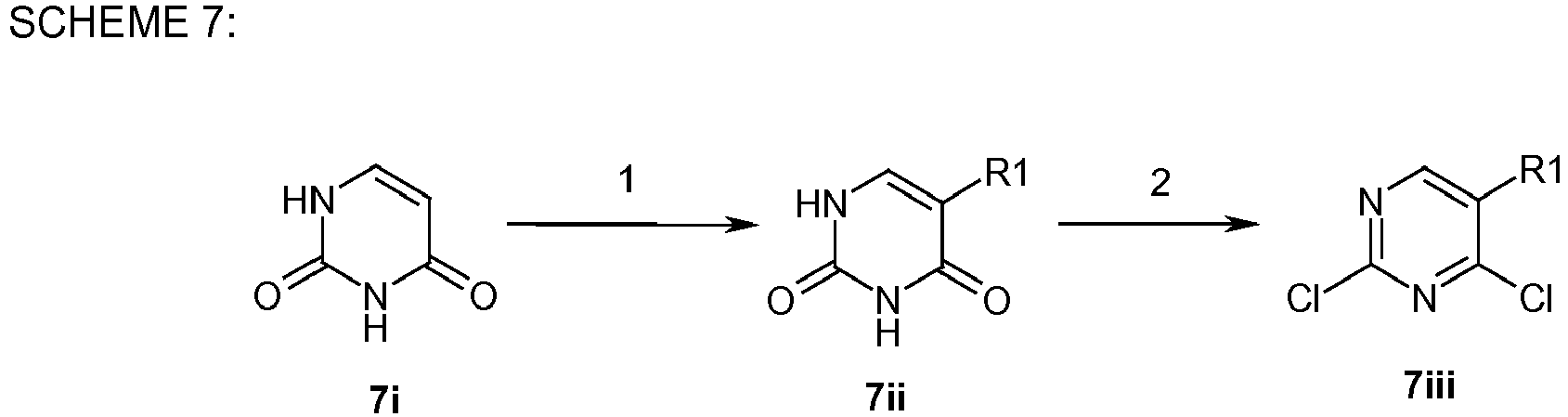
- C5 chemistries may also be used on uracil itself and the derivatives converted to the 4-chloro (for the thiouracil derivative) or 2,4-dichloropyrimidine derivatives through reaction with reagents such as POCl3.

- Dialkylphosphonates may be prepared according to the method of Michaelis-Arbuzov as shown whereby alkyl halides or sulfonates (e.g., Hal = Br, I, Cl, OMs) are heated with trialkylphosphites. Additionally, phosphonates 8iii can be trans-esterified by first transforming them into the corresponding phosphonochloridates 8iiia by heating 8iii in SOCl2 and catalytic DMF. Stirring 8iiia with a base such as DIPEA or TEA, an alcohol such as butanol or isopropanol in a solvent such as THF or DCM affords transesterified phosphonate 8iiib.

- Phosphonates bearing a P-hydrogen may be reacted with alkyl halides or sulfonates (e.g., Hal = Cl, Br, I, OMs) in the presence of bases, including but not limited to Na2CO3, K2CO3, NaOH, Cs2CO3, Et3N, DIPEA and DBU, and in suitable solvents, e.g., acetonitrile, DMF, dioxane, DMA to afford P-substituted products via SN2-type chemistries.

- Preparation of dialkylphosphonates may be achieved via multiple approaches. For example, one dialkyl phosphonate may be converted into another, different dialkyl phosphonate. Hydrolysis of a dialkylphosphonate under acidic conditions such as concentrated hydrochloric acid affords the corresponding phosphonic acid. Other acid reagents may be used to effect this transformation including, but not limited to, HBr and HBr/HOAc. The transformation may also be achieved using basic conditions, e.g., by treatment with NaOH/MeOH or through the use of reagents such as, but not limited to, TMSI, TMSBr, TMSCI/Nal and Nal in solvents such as acetone, acetonitrile, DCM, chloroform and dioxane.

- Phosphonates may be alkylated on an alpha carbon by deprotonation with strong base of which tBuOK, nBuLi, NaH and LDA are non-limiting examples, then treatment with carbon electrophiles, e.g., Mel, DMF and chloroformates (Scheme 8d) (R8 and/or the other R8 may be methyl). Control of the stoichiometry of the reaction components may afford mono- or dialkylated products. Additionally, sequential use of base, electrophile #1, base and electrophile #2 is another means to effectively control dialkylation.
- For example, as shown below, dialkyl benzylphosphonates such as diethyl (4-nitrobenzyl)phosphonate I, may be monoalkylated at the benzylic carbon by reaction with strong base, of which LDA is a non-limiting example, followed by introduction of a suitable alkyl halide such as iodomethane. The monoalkylated product thus formed may be alkylated a second time at the benzylic carbon through deprotonation with sodium hydride and reaction with an alkyl halide such as iodomethane to yield the dialkylated material. In the instance shown below, the nitro-derived products may be reduced to the corresponding anilines via methods such as catalytic hydrogenation.


- Phosphinates 8xviv can be obtained using the procedure shown in Scheme 8e. A protected phosphonite 8xiv, made from commercially available ammonium phosphinate and hexamethyldisilazide, can be alkylated with an alkyl halide to provide, in situ, the phosphinic acid 8xv. Alkyl bromide or iodides can be obtained commercially or prepared using techniques known to one skilled in the art. Compound 8xv can be alkylated with 8xvi, itself either obtained commercially or prepared using established methods, to form 8xvii. A third alkylation or coupling reaction is performed on 8xvii to form the phosphinate ester. A standard catalytic hydrogenation gives the aniline 8xviv which can be used in the chemistry, e.g., as described in Schemes 3 and 4.
- Should 8xviii bear a functionality adversely affected by catalytic hydrogenation (such as chloro or bromo), alternative reduction conditions should be used. Non-limiting examples of these conditions are Fe/HCl, Fe/HOAc and SnCl2/EtOH.
- Solvents appropriate for the final alkylation include polar, aprotic solvents such as DMF or NMP. Suitable bases include Na2CO3, K2CO3, or the like; coupling conditions include EDC or PYBOP, in the former case it may be advantageous to use an accelerant such as DMAP. If coupling conditions are employed the same solvents may be used or it may be preferable to use an inert solvent such as DCM or THF.

- Similarly, the reaction of phosphinates bearing a P-hydrogen with alkyl halides or sulfonates (e.g., Hal = Cl, Br, I, OTf) in the presence of base also proceeds via SN2 chemistry as with phosphonates. Additionally, phosphinates 8xix can be prepared by treating the alkyl halide or sulfonate 8xviii with an alkyl phosphonite such as 8xviia, itself prepared by treating triethyl phosphite with a Grignard reagent according to the procedure of Petnehazy, et al in Synthetic Communications, 2003 , 33, 1665 - 1674.

- There may also be a desire to prepare phosphine oxides, such as via a number of methods including through the reaction of dialkyl phosphonates with carbon nucleophiles including, but not limited to, Grignard reagents.
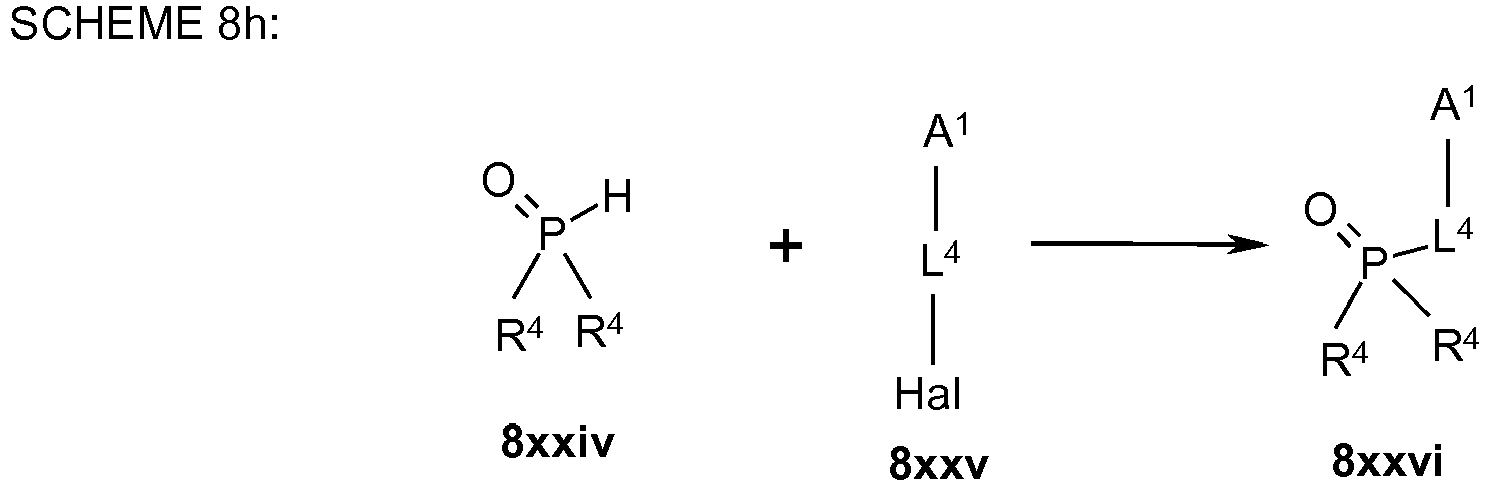
- As in the case of phosphonates and phosphinates, dialkyl phosphine oxides bearing a P-hydrogen may be reacted with alkyl halides or sulfonates (e.g., Hal = Br, I, Cl, OMs) under basic conditions or aryl halides (e.g., Hal = Br, I, Cl, OTf) under transition metal catalysis to form the P-substituted derivatives.

- Other methods to access phosphine oxides include the oxidation of phosphines with oxidants such as, but not limited to, hydrogen peroxide.

- Additionally, dialkyl alkoxyphosphines may be reacted with alkyl halides or sulfonates (e.g., Hal = Br, I, Cl, OMs) to form phosphine oxides via Michaelis-Arbuzov chemistry.
- Of general applicability, the various functionalities appearing in target molecules and examples (e.g., X at the 5-position of the pyrimidine system, or on the pendant N-aryl or N-benzyl groups), may be introduced through appropriate choice of starting materials, or where the final functionality is not available directly through this process, or where such functionality may be compromised during the subsequent chemistry to build the final molecule, alternative functionalities may be used and subsequently transformed into the final desired functionality by methods, and at points in the sequence, readily determined by one skilled in the art.
- For example, a non-exhaustive list of such transformations includes the conversions: Ar/HetAr-OMe→ Ar/HetAr-OH (BBr3), Ar/HetAr-NH2→ Ar/HetAr-Cl (NaNO2, CuCl), Ar/HetAr-Br→ Ar/HetAr-CN (Pd2(dba)3, Zn(CN)2, DPPF), Me→CO2H (KMnO4), CO2H→CO2Me (MeOH, H2SO4), OH→OAlkyl (Alkyl halide, base), CO2H→CONR'R" (EDC, HOAt, DIPEA, HNR'R"), Ar/HetAr-Br→ Ar/HetAr-CO2Me (Pd2(dba)3, DPPF, CO(g), MeOH), Br→CO2H (tBuLi, CO2), Ar/HetAr-H→ Ar/HetAr-Br (NBS), CN→CO2H (conc. H2SO4), Ar/HetAr-Br→ Ar/HetAr-NR'R" (Pd2(dba)3, DPPF, HNR'R"), Ar/HetAr-I/Br→ Ar/HetAr-CF3 (CF3CO2Na, CuI, NMP). Other functional group interconversion (FGI) examples relating to the generation of aniline and benzylamine synthons used for SNAr chemistry with 2,4-dichloropyrimidines, pyrimidines, or pyridines with displaceable groups at the 2- or 4- positions, with other displaceable leaving groups, are shown below.

- As shown in Scheme 9, nitro- or azidobenzenes may be reduced to the desired aniline compound under a range of conditions. Typically hydrogenation in the presence of a Pd/C catalyst in solvents such as methanol, ethanol, ethyl acetate will yield the desired product. In the case of the azide reduction, Staudinger conditions with Ph3P may be effectively used. Many aniline precursors are commercially available for conversion to the aniline itself. N-acyl derivatives such as amides may be hydrolyzed under acidic or basic conditions to provide the aniline. In the case of carbamates, e.g., tert-butoxycarbonyl (BOC) protected anilines, the acyl group may be removed with HCl in solvents such as dioxane or through use of TFA in DCM. FMOC protected anilines require basic conditions, typically piperidine in DMF to remove the acyl moiety.
- When R is an electron withdrawing group and/or when the aromatic system is a π-deficient heterocycle, a fluoro (or other halogen or triflate), ideally conjugated to said fluoro, may be displaced under SNAr conditions with ammonia itself or an ammonia equivalent or precursor.
- Aryl or heteroaryl halides and triflates may also be reacted under transition metal catalysis with ammonia equivalents or precursors to allow the introduction of nitrogen functionality. One skilled in the art will appreciate the large number of catalysts, ligands, bases and solvents cited in the extensive literature and which are commercially available for this conversion.

- Intermediates of Formula 10iii can be prepared using a Suzuki coupling between an aryl or heteroaryl boronic acid of either formula 10i or 10iv and a corresponding aryl or heteroaryl halide of either formula 10ii or 10v.

- Compounds of formula 10vii can be prepared from compounds of formula 10vi by Pd catalyzed installation of the boronic ester, involving the use an aryl halide, a Pd catalyst, KOAc, bis-pinacolatodiboron and an inert solvent such as dioxane or THF, typically heated.

- Intermediates of Formula 10ix are non-limiting examples of compounds of Formula 10viii.

- 10viii (10ix) can be prepared starting with a commercially available intermediate of Formula 10x and by forming a benzoxazine-dione of Formula 10xi, performing a bromination with an agent such as NBS to give a compound of Formula 10xii. This can be transformed to the amide 10xiii by a reaction with the amine HNR20R21.
- Alternatively, 10x can be esterified to form a compound of Formula 10xiv and brominated to form a compound of Formula 10xv. The amide 10xiii can be formed from 10xv by heating it, under pressure, with the amine HNR20R21 in a solvent mixture such as water/methanol.
- Amines of Formula 10xvi are generally commercially available or readily prepared using techniques known in the art.

- Intermediates of Formula 10ii and 10iv (Scheme 10A) can be prepared from compounds of Formula 10xvii or 10xviii which are either commercially available or readily prepared by one skilled in the art, as shown in the first step of Scheme 10d, above.
- The P.G. in Formula 10xviii refers to a protecting group, either a benzyl or THP in most cases, similarly, the LG in Formula 10xviii refers to either a user installed leaving group such as mesylate or tosylate, or other leaving group, e.g., bromine or iodine from a commercial material. The LG can be displaced by a nucleophilic moiety on the heterocycle A3 in the presence of a base and in an appropriate solvent to form compounds of the Formula 10xx. Bases can be K2CO3 or Cs2CO3, examples of an appropriate solvent is DMF or NMP. Heat may be required.
- In cases where A3 is not commercially available as its boronic ester, one can use a commercially available A3 that has a halogen substituted on the appropriate position to prepare compounds of Formula 10xxii. Compounds 10xxii can be converted to compounds of Formula 10xx by a metal halogen exchange using a Grignard reagent (as shown) or other organometallic base such as a butyllithium species and quenching the resulting anion with a an appropriately substituted borate species.
- Standard catalytic hydrogenation or an acid such as bit not limited to TsOH will remove the respective benzyl or THP protecting groups to provide 10xxi.
- Unless otherwise noted, all materials/reagents were obtained from commercial suppliers and used without further purification. 1H NMR (400 MHz or 300 MHz) and 13C NMR (100.6 MHz) spectra were recorded on Bruker or Varian instruments at ambient temperature with TMS or the residual solvent peak as the internal standard. The line positions or multiples are given in ppm (δ) and the coupling constants (J) are given as absolute values in Hertz (Hz). The multiplicities in 1H NMR spectra are abbreviated as follows: s (singlet), d (doublet), t (triplet), q (quartet), quint (quintet), m (multiplet), mc (centered multiplet), br or broad (broadened), AA'BB'. The signal multiplicities in 13C NMR spectra were determined using the DEPT135 pulse sequence and are abbreviated as follows: + (CH or CH3), - (CH2), Cquart (C). Reactions were monitored by thin layer chromatography (TLC) on silica gel 60 F254 (0.2 mm) precoated aluminum foil and visualized using UV light. Flash chromatography was performed with silica gel (400-230 mesh). Preparatory TLC was performed on Whatman LK6F Silica Gel 60 Å size 20 x 20 cm plates with a thickness of 1000 µm. Hydromatrix (= diatomaceous earth) was purchased from Varian.
- Preparative HPLC purifications was performed on a Waters@ Mass - Directed Purification System equipped with 2525 Binary Gradient Module, 2767 Sample Manager, a Column Fluidics Organizer (CFO), 2996 Photodiode Array Detector, a 515 pump for column regeneration, a reagent manager for the makeup flow, a 515 pump for at-column-dilution, ZQ™ single-quadrupole Mass Detector equipped with a Z-spray electrospray interface, controlled by MassLynx™ Version 4.1 with FractionLynx™ software. All purification work was completed using a parallel dual-column Luna C18(2) 21x150mm, 5µm LC/MS system and ARW (accelerated retention window). The mobile phases were water (0.1% TFA) and acetonitrile (0.1% TFA); all reagents used were of HPLC grade. The flow rate was 30 mL/min. After the columns, a 1:1000 LC packings flow splitter allowed transfer of a small portion of the eluent into the UV detector and, subsequently, a 10% portion into the ZQ MS. The electrospray source was set at 3.0 kV capillary voltage, 30 V cone voltage, 110°C source temperature, 350°C desolvation temperature, 600 L/h desolvation gas flow, and 60 L/h cone gas flow. For the analyzer, the multiplier was set at 550 for preparative tune method.
- Analytical LC-MS data was collected on three instruments designated as follows: ZQ3, UPLC-TOF, and UPLC-SQD. ZQ3 is an Agilent 1100 HPLC equipped with an HP Series 1100 auto injector and Waters Micromass ZQ2000 for ionization. The system uses an XBridge C18, 3.5µ particle size, 4.6x50 mm column with a mobile phase of Acetonitrile (A) and 0.01% Formic Acid in HPLC water (B) and the flow rate is 1 mL/min. The methods used on this instrument are distinguished by either 4 or 5 minute run times the gradient profiles are as follows: 0.00 min 5%A, 2.00 min 90%A, 2.50 min 90%A, 3.00 min 5%A, 4.00 min 5%A for the polar_4min method; 0.00 min 1%A, 3.00 min 90%A, 3.50 min 90%A, 4.00 min 1%A, 5.00 min 1%A for the vvpolar_5min method; 0.00 min 5%A, 3.00 min 90%A, 3.50 min 90%A, 4.00 min 5%A, 5.00 min 5%A for the polar_5min method; and 0.00 min 25%A, 3.00 min 99%A, 3.50 min 99%A, 4.00 min 25%A, 5.00 min 25%A for nonpolar_5min method. The Waters Micromass ZQ2000 instrument utilizes electrospray ionization in positive (ES+) or negative (ES-) mode and may also utilize atmospheric pressure chemical ionization in positive (AP+) or negative (AP-) mode. UPLC-TOF is a Waters UPLC-LCT Premier system consisting of an ACQUITY UPLC equipped with an ACQUITY Sample Manager and LCT Premier XE MS for ionization. It uses an ACQUITY UPLC BEH® C18 2.1×50mm 1.7µm column with a mobile phase of Acetonitrile (A) and 0.01 % formic acid in water (B). The flow rate is 0.6 mL/min, run time is 3 min, and the gradient profile is 0.00 min 5%A, 0.2 min 5%A, 1.50 min 90%A, 2 min 90%A, 2.2 min 5% A, 5min 5% A for the polar_3min method; Additionally, the flow rate is 0.7 mL/min, run time is 2 min, and the gradient profile is 0.00 min 10%A, 1 min 90%A, 1.50 min 90%A, 1.6 min 10%A, 2 min 10% A, for the polar_2min method. The LCT Premier XE MS utilized electrospray ionization in positive (ES+) or negative (ES-), as well positive (AP+) or negative (AP-) in W mode. The Waters UPLC-SQD system consists of an ACQUITY sample manager attached to ACQUITY SQ MS and ACQUITY PDA detectors. It uses an ACQUITY UPLC BEH® C18 2.1×50mm 1.7µm column with a mobile phase of 0.1 % formic acid in water (A) and 0.1% formic acid in acetonitrile (B). The flow rate is 1.0 mL/min, run time is 2 min, and the gradient profile is 0.00 min 85%A, 1.50 min 1%A, 1.80 min 1%A, 2.0 min 60% A for the analytical_2 min method; the flow rate is 0.8 mL/min, run time is 2 min, and the gradient profile is 0.00 min 60%A, 1.00 min 1%A, 1.85 min 1%A, 2.0 min 85% A for the nonpolar_2 min method; and the flow rate is 0.8 mL/min, run time is 2 min, and the gradient profile is 0.00 min 30%A, 1.00 min 1%A, 1.85 min 1%A, 2.0 min 30% A for the verynonpolar_2 min method . UV detection is at 254 nm, and the MS utilizes electrospray ionization in positive mode (ES+). All melting points were determined with a Mel-Temp II apparatus and are uncorrected. Elemental analyses were obtained by Atlantic Microlab, Inc., Norcross, GA.

- A stirring suspension of sodium ethyl (4-{[4-({7-[1-(3-hydroxypropyl)-1H-pyrazol-4-yl]-2-methyl-3-oxo-2,3-dihydro-1H-isoindol-4-yl}amino)-5-(trifluoromethyl)pyrimidin-2-yl]amino}-3-methoxybenzyl)phosphonate (Compound 1A, 50.0 mg, 0.07 mmol) and PYBOP (191.7 mg, 0.3684 mmol) in 1,2-dichloroethane (50 mL) and DMF (10 mL) was charged with DIPEA (0.07 mL, 0.4 mmol) and stirred for 3 d. The reaction mixture was concentrated in vacuo. The residue was dissolved in EtOAc and washed twice with brine. The combined organic layers were dried over anhydrous Na2SO4, filtered, concentrated in vacuo, and purified on a Teledyne ISCO CombiFlash® Rf system (eluting with 1-10% MeOH:CH2Cl2). The isolated material was purified a second time, using a SFC [Thar; Chromegabond Pyridyl Amide (5µ, 120 Å, 15 cm x 20 mm); 0.2% isopropylamine in IPA, 40% isocratic gradient] to give the desired product as 6.5 mg as a light yellow solid. 1H NMR (400 MHz, DMSO-d 6) δ 9.66 (s, 1 H), 8.82 (s, 1 H), 8.52 (s, 1 H), 8.38 (s, 1 H), 7.74-7.87 (m, 2H), 7.65 (d, J = 8.6 Hz, 1 H), 7.24 (d, J = 8.1 Hz, 1 H), 7.05 (t, J = 1.77 Hz, 1 H), 6.74 (td, J = 2, 7.9 Hz, 1 H), 4.61 (d, J = 2.3 Hz, 2H), 4.34 (t, J = 5.7 Hz, 2H), 3.70-3.83 (m, 4H), 3.54-3.70 (m, 3H), 3.34-3.44 (m, 2H), 3.05 (s, 3H), 2.06-2.30 (m, 2H), 0.89 (t, J = 7.1 Hz, 3H). MS (ESI): m/z 658.20 [M+H]+. UPLC: t R = 1.32 min (UPLC-TOF: polar_3min).

- A suspension of diethyl (4-{[4-({7-[1-(3-hydroxypropyl)-1H-pyrazol-4-yl]-2-methyl-3-oxo-2,3-dihydro-1H-isoindol-4-yl}amino)-5-(trifluoromethyl)pyrimidin-2-yl]amino}-3-methoxybenzyl)phosphonate (Compound 1 B, 255 mg, 0.36 mmol) and sodium iodide (606 mg, 4.04 mmol) in 2-butanone (5 mL) was subjected to 7 hours of microwave irradiation at 120 °C. A solid precipitated, which filtered off, rinsed several times with ice cold acetone, and dried thoroughly to afford the desired compound as 277 mg as a light yellow solid. 1H NMR (400 MHz, DMSO-d 6) δ 10.64 (s, 1 H), 9.26 (br s, 1 H), 9.08 (s, 1 H), 8.34 (s, 1 H), 8.15 (br s, 2H), 7.71 (s, 1 H), 7.13 (d, J = 7.6 Hz, 1 H), 7.08 (s, 1 H), 6.89 (d, J = 7.8 Hz, 1 H), 6.45 (br s, 1 H), 4.60 (s, 2H), 4.19 (t, J = 6.1 Hz, 2H), 3.68 (s, 3H), 3.60-3.67 (m, 2H), 3.45 (q, J = 5.9 Hz, 2H), 3.09 (s, 3H), 2.77 (d, J = 19.7 Hz, 2H), 1.94 (quin, J = 5.9 Hz, 2H), 0.94 (t, J = 7.1 Hz, 3H). MS (ESI): m/z 676.30 [M+H]+. UPLC: t R = 1.06 min (UPLC-SQD: analytical_2min).

- A solution of diethyl (4-{[4-chloro-5-(trifluoromethyl)pyrimidin-2-yl]amino}-3-methoxybenzyl)phosphonate (Compound 1E, 897 mg, 1.98 mmol) and 7-amino-4-[1-(3-hydroxypropyl)-1H-pyrazol-4-yl]-2-methyl-2,3-dihydro-1H-isoindol-1-one (Compound 1C, 634 mg, 2.21 mmol) in TFE (12 mL) was charged with TFA (654 mg, 5.74 mmol) and irradiated in a microwave reactor for 1h at 105 °C. The reaction mixture was transferred to a round bottom flask and concentrated in vacuo. The residue, dissolved in MeOH and cooled to 0 °C, was charged with 7.0 M of NH3 in MeOH (5 mL) and then warmed to rt over 2 h. The suspension was concentrated in vacuo and purified using a Teledyne ISCO CombiFlash® Rf system (eluting with 0-10% MeOH:CH2Cl2) to isolate the desired compound as 1.10 g of a white solid. 1H NMR (400 MHz, DMSO-d 6) δ 10.72 (s, 1H), 9.12 (s, 1H), 8.38 (s, 1H), 8.27 (s, 1H), 8.06-8.63 (m, 1H), 7.96 (s, 1H), 7.70 (d, J = 8.8 Hz, 1H), 7.41 (d, J = 7.1 Hz, 1 H), 7.10 (br. t, J = 2.0 Hz, 1 H), 6.96 (br td, J = 2.3, 8.0 Hz, 1 H), 4.53-4.67 (m, 3H), 4.21 (t, J = 7.20 Hz, 2H), 4.00 (qd, J = 7.1, 8.1 Hz, 4H), 3.74 (s, 3H), 3.43 (q, J = 6.1 Hz, 2H), 3.36 (d, J = 20 Hz, 2H), 3.11 (s, 3H), 1.97 (quin, J = 6.6 Hz, 2H), 1.17 (t, J = 7 Hz, 6H). MS (ESI): m/z 704.23 (100) [M+H]+. HPLC: t R = 3.73 min (ZQ3: polar_5min).
- A suspension of 4-[1-(3-hydroxypropyl)-1H-pyrazol-4-yl]-2-methyl-7-nitro-2,3-dihydro-1H-isoindol-1-one (Compound 1D, 920 mg, 2.91 mmol) and 10% Pd/C (50 % H2O) (1.41 g, 0.66 mmol) in EtOH (85 mL) was hydrogenated at rt for 2 h. The crude mixture was filtered through a pad of Celite, rinsed thoroughly with MeOH and EtOAc, concentrated in vacuo, and purified using a Teledyne ISCO CombiFlash® Rf system (eluting with 0-5% MeOH:CH2Cl2) to isolate the desired compound as 634 mg as a light brown solid. 1H NMR (400 MHz, DMSO-d 6) δ 7.93 (d, J = 0.5 Hz, 1 H), 7.71 (d, J = 0.8 Hz, 1 H), 7.43 (d, J = 8.3 Hz, 1 H), 6.61 (d, J = 8.3 Hz, 1 H), 6.05 (s, 2H), 4.59 (t, J = 5.1 Hz, 1 H), 4.45 (s, 2H), 4.17 (t, J = 7 Hz, 2H), 3.41 (q, J = 6.1 Hz, 2H), 3.03 (s, 3H), 1.94 (quin, J = 6.1 Hz, 2H). MS (ESI): m/z 287.13 [M+H]+. UPLC: t R = 0.89 min (UPLC-TOF: polar_3min).
- A suspension of 2-methyl-7-nitro-4-(4,4,5,5-tetramethyl-1,3,2-dioxaborolan-2-yl)-2,3-dihydro-1H-isoindol-1-one (Compound 1l, 1.825 g, 5.736 mmol), 3-(4-bromo-1H-pyrazol-1-yl)propan-1-ol (1.45 g, 7.07 mmol), [1,1'-bis(diphenylphosphino)ferrocene]dichloropalladium(II),complex with dichloromethane (1:1) (510 mg, 0.62 mmol), and potassium carbonate (2.4 g, 17.3 mmol) in dioxane (20 mL) and H2O (5 mL) was irradiated in a microwave reactor for 45 min at 100 °C. The reaction mixture was poured into water and extracted with CH2Cl2 three times. The combined organic layers were washed with brine, dried over anhydrous Na2SO4, filtered, concentrated in vacuo, and purified using a Teledyne ISCO CombiFlash® Rf system (eluting with 0-15% MeOH:CH2Cl2) to isolate the desired compound as 920 mg as a yellow solid. 1H NMR (400 MHz, DMSO-d 6) δ 8.35 (s, 1 H), 8.05 (s, 1 H), 7.99 (d, J = 8.3 Hz, 1 H), 7.88 (d, J = 8.3 Hz, 1 H), 4.72 (s, 2H), 4.63 (t, J = 5.1 Hz, 1 H), 4.25 (t, J = 7.1 Hz, 2H), 3.43 (q, J = 6.1 Hz, 2H), 3.11 (s, 3H), 1.98 (quin, J = 6.6 Hz, 2H). HRMS (ESI): m/z 317.11 [M+H]+. UPLC: t R = 0.91 min (UPLC-TOF: polar_3min).
- 1.0 M Zinc dichloride in ether (4.07 mL, 4.07 mmol) was added to a solution of the commercially available 2,4-dichloro-5-trifluoromethylpyrimidine (0.8 g, 3.70 mmol) in 1,2-dichloroethane (6.7 mL) and t-BuOH (6.7 mL). After 30 minutes diethyl (4-amino-3-methoxybenzyl)phosphonate (Compound 1F, 1.01 g, 3.70 mmol) was added followed by triethylamine (0.567 mL, 4.07 mmol) while keeping the temperature at ∼25 °C). The reaction mixture was allowed to stir at rt overnight before quenching with sat. aq. NaHCO3 (10 mL). The resulting mixture was extracted with EtOAc (15 mL) and the organic layer was washed with brine (10 mL), dried over anhydrous NaSO4, filtered, and concentrated under reduced pressure to afford a yellow oil. This crude material was initially purified using a Teledyne ISCO CombiFlash® Rf system eluting with 0 - 5% MeOH in DCM followed by preparative HPLC (MDP) to afford 1.09g of the title compound (70 %). 1H NMR (CD3OD, 400 MHz): δ 1.28 (t, J= 7.1 Hz, 6 H), 3.23 - 3.29 (m, 2 H), 3.90 - 3.95 (m, 3 H), 4.01 - 4.13 (m, 4 H), 6.90 - 6.96 (m, 1 H), 7.03 (m, J = 2.0 Hz, 1 H), 8.02 (d, J = 8.3 Hz, 1 H), 8.62 (s, 1 H).
- A solution of diethyl (3-methoxy-4-nitrobenzyl)phosphonate (Compound 1G, 1.07 g, 3.54 mmol) in ethanol (10.0 mL) was charged with palladium 10% wt on activated carbon (0.38 g). The reaction mixture was evacuated and purged with hydrogen gas (3x) and allowed to stir under hydrogen for 16 h. The reaction mixture was filtered through a pad of celite. The filtrate was concentrated under reduced pressure to afford the title compound as 0.78 g of an orange oil (80%). This material was used in successive reactions without further purification. MS (ESI): m/z 274.01 [M+H]+.
- A mixture of 4-(chloromethyl)-2-methoxy-1-nitrobenzene (Compound 1H, 1.1 g, 5.46 mmol) and triethyl phosphite (1.09 g, 6.55 mmol) were heated at 100°C for 16 h in a sealed tube. The reaction mixture was concentrated under reduced pressure to yield a black oil. The crude material was purified by silica gel chromatography on a Teledyne ISCO CombiFlash® Rf system using DCM/MeOH (100:0 → 95:5) as eluent to afford the title compound as 1.08 g of an orange oil (65%). MS (ESI): m/z 304.0902 [M+H]+.
- A mixture of (3-methoxy-4-nitrophenyl)methanol (0.5 g, 2.73 mmol) and thionyl chloride (0.3 mL, 4.09 mmol) was heated at reflux for 12 h. The reaction mixture was concentrated under reduced pressure to afford the title compound as a tan solid, 0.55 g (100% yield). This material was used in successive reactions without further purification. 1H NMR (CD3OD, 400 MHz): δ 4.00 (s, 3 H), 4.60 (s, 2 H), 7.05 (dd, J = 8.3, 1.8 Hz, 1 H), 7.14 (d, J = 1.5 Hz, 1 H), 7.86 (d, J = 8.3 Hz, 1 H). MS (ESI): m/z 202.03 [M+H]+ (UPLC-TOF: polar_3min).
- A mixture of Pd2(dba)3 (2.02 g, 2.21 mmol) and tricyclohexylphosphine (2.48 g, 8.85 mmol) in nitrogen degassed dioxane (375 mL) was stirred for 30 minutes and subsequently treated with 4-bromo-2-methyl-7-nitro-2,3-dihydro-isoindol-1-one (Compound 1L, 20.0 g, 73.8 mmol), bis(pinacolato)diboron (24.4 g, 96 mmol) and KOAc (11.58 g, 118.1 mmol) and heated to reflux for 6 h. The cooled reaction mixture was filtered and evaporated to dryness. The residue was triturated with diisopropyl ether (100 mL) and filtered to give 2-methyl-7-nitro-4-(4,4,5,5-tetramethyl-[1,3,2]dioxaborolan-2-yl)-2,3-dihydro-isoindol-1-one (3) as a yellow solid (16.0 g, 68%). 1H NMR (CDCl3, 500 MHz) δ 1.34 (s, 12H), 3.24 (s, 3H), 4.58 (s, 2H), 7.68 (d, J =7.5 Hz, 1 H), 8.06 (d, J = 7.5 Hz, 1 H).
- An 8M solution of methylamine in ethanol (10 mL, 80 mmol) was added to a solution of methyl 3-Bromo-2-(bromomethyl)benzoate in THF (30 mL) and allowed to stir for 2h. The reaction mixture was concentrated to dryness and the residue was triturated with water. The solids produced were collected by filtration and dried to afford 4-bromo-2-methyl-2,3-dihydroisoindol-1-one which used immediately in the next step. To a cold suspension of 4-bromo-2-methyl-2,3-dihydroisoindol-1-one (60 g, 265 mmol) in concentrated sulfuric acid (60 mL) was added pre-cooled mixture of conc. nitric acid (12.5 mL, 265 mmol) and conc. sulfuric acid (60 mL) over 20 min. The reaction mixture was stirred for 30 min at 0 °C and 2h at room temperature. The reaction mixture was poured into an ice-water mixture (300 mL) and the precipitate that formed was collected by filtration and washed with water (3x100 mL). The solids were suspended in isopropanol (200 mL) and heated on a steam bath for 10 minutes. The mixture was cooled and the solid was collected by filtration and air dried to afford 53 g of the title compound (74 %). 1H NMR (CDCl3, 300 MHz) δ 3.22 (s, 3H), 4.36 (s, 2H), 7.67 (d, J = 8.4 Hz, 1 H), 7.78 (d, J = 8.4 Hz, 1 H).

- This material was prepared analogously to Example 1 using sodium ethyl (4-{[4-({7-[1-(3-hydroxypropyl)-1H-pyrazol-4-yl]-2-methyl-3-oxo-2,3-dihydro-1H-isoindol-4-yl}amino)-5-(trifluoromethyl)pyrimidin-2-yl]amino}benzyl)phosphonate (Compound 2A). 1H NMR (400 MHz, DMSO-d 6) δ 9.75 (s, 1 H), 9.27 (s, 1 H), 8.48 (s, 1 H), 8.40 (d, J = 0.50 Hz, 1 H), 7.88 (s, 1 H), 7.83 (d, J = 8.3 Hz, 1 H), 7.67 (d, J = 8.3 Hz, 1 H), 7.24 (d, J = 8.1 Hz, 2H), 6.96 (dd, J = 2.3, 8.6 Hz, 2H), 4.63 (s, 2H), 4.38 (t, J = 5.8 Hz, 2H), 3.80-3.93 (m, 2H), 3.68 (tt, J = 5.4, 10.4 Hz, 1 H), 3.44-3.56 (m, 1 H), 3.11-3.27 (m, 2H), 3.03 (s, 3H), 2.05-2.24 (m, 2H), 1.07 (t, J = 7.1 Hz, 3H). MS (ESI): m/z 628.17 [M+H]+. HPLC: t R = 1.30 min (ZQ3: polar_5min).
- Prepared analogously to Compound 1A using diethyl (4-{[4-({7-[1-(3-hydroxypropyl)-1H-pyrazol-4-yl]-2-methyl-3-oxo-2,3-dihydro-1H-isoindol-4-yl}amino)-5-(trifluoromethyl)pyrimidin-2-yl]amino}benzyl)phosphonate (Compound 2B). 1H NMR (400 MHz, DMSO-d 6) δ 10.66 (br s, 1H), 9.74 (s, 1H), 8.46-9.05 (m, 2H), 8.41 (s, 1H), 8.00 (br s, 1H), 7.82 (s, 1H), 7.10-7.53 (m, 4H), 4.62 (s, 2H), 4.20 (t, J = 6.4 Hz, 2H), 3.70 (quin, J = 7 Hz, 2H), 3.45 (t, J = 6.1 Hz, 2H), 3.11 (s, 3H), 2.84 (d, J = 20.2 Hz, 2H), 1.96 (quin, J = 6.3 Hz, 2H), 1.01 (t, J = 6.7 Hz, 3H) [OH proton obscured]. HRMS (ESI): m/z 646.14 [M+H]+. UPLC: t R = 1.16 min (UPLC-TOF: polar_3min).
- This compound was prepared analogously to Compound 1B using diethyl (4-{[4-chloro-5-(trifluoromethyl)pyrimidin-2-yl]amino}benzyl)phosphonate (Compound 2C) and 7-amino-4-[1-(3-hydroxypropyl)-1H-pyrazol-4-yl]-2-methyl-2,3-dihydro-1H-isoindol-1-one (Compound 1C) 1H NMR (400 MHz, CD3OD) δ 8.69 (br s, 1 H), 8.32 (s, 1 H), 8.04 (s, 1 H), 7.89 (s, 1 H), 7.68 (d, J = 8.59 Hz, 1 H), 7.57 (d, J = 7.8 Hz, 2H), 7.34 (dd, J = 2.4, 8.5 Hz, 2H), 4.55 (s, 2H), 4.31 (t, J = 6.8 Hz, 2H), 4.01-4.12 (m, 4H), 3.57 (t, J = 6.1 Hz, 2H), 3.29 (d, J = 20.7 Hz, 2H), 3.17 (s, 3H), 2.10 (quin, J = 6.5 Hz, 2H), 1.26 (t, J = 7.1 Hz, 6H). MS (ES+): m/z 674.21 [M+H]+. UPLC: t R = 1.33 min (UPLC-TOF: polar_3min).
- Prepared analogously to Compound 1E replacing Compound 1F with diethyl-4-aminobenzyl phosphonate. 1H NMR (400 MHz, CD3OD) δ 1.22 - 1.32 (m, 6 H), 3.17 - 3.28 (m, 2 H), 3.98 - 4.10 (m, 4 H), 7.30 (dd, J = 8.7, 2.7 Hz, 2 H), 7.65 (d, J = 7.8 Hz, 2 H), 8.63 (s, 1 H).

- To a stirring suspension of ethyl hydrogen (4-{[4-({2-(diethylcarbamoyl)-4-[1-(3-hydroxypropyl)-1H-pyrazol-4-yl]phenyl}amino)-5-(trifluoromethyl)pyrimidin-2-yl]amino}-3-methoxybenzyl)phosphonate (Compound 3A, 167.1 mg, 0.237 mmol) and (benzotriazol-1-yloxy)tripyrrolidino-phosphonium hexafluorophosphate (739.4 mg, 1.42 mmol) in 1,2-dichloroethane (200 mL) and DMF (30 mL), DIPEA (0.2 mL, 1 mmol) were added and the reaction was stirred at rt over 24hrs. The reaction mixture was concentrated in vacuo and the residue was dissolved in EtOAc, washed with a semi-saturated sodium bicarbonate solution (1x) and then with brine (2x). The aqueous layers were back-extracted with EtOAc and the combined organic layers were dried over sodium sulfate, filtered and concentrated in vacuo to a solid. The crude mixture was purified using a Teledyne ISCO Combiflash® Rf system [0 → 10% MeOH in DCM] to yield the desired product (69.7 mg, 43%).. 1H NMR (400 MHz, CD3OD) δ 8.24 (s, 1 H), 8.23 (d, J = 1 Hz, 1 H), 8.02 (d, J = 1 Hz, 1 H), 7.81 (dd, J = 2.2, 8.2 Hz, 1 H), 7.58 (d, J = 1.8 Hz, 1H), 7.44 (d, J = 8.3 Hz, 1H), 7.32 (d, J = 8.3 Hz, 1H), 6.77 (t, J = 1. 9 Hz, 1H), 6.18 (td, J = 2.3, 8.3 Hz, 1 H), 4.44 (t, J = 5.9 Hz, 2H), 3.96 - 4.07 (m, 2H), 3.76 - 3.87 (m, 5H), 3.36 - 3.46 (m, 2H), 2.98 - 3.13 (m, 4H), 2.29 (quin, J = 5.8 Hz, 2H), 1.24 (t, J = 7.1 Hz, 3H), 1.04 (t, J = 7.1 Hz, 3H), 0.72 (t, J = 7.1 Hz, 3H). MS (ESI): m/z 688.81 [M+H]+. UPLC: tR = 1.14 min (UPLC-SQD: analytical_2min).
- A mixture of diethyl (4-{[4-({2-(diethylcarbamoyl)-4-[1-(3-hydroxypropyl)-1H-pyrazol-4-yl]phenyl}amino)-5-(trifluoromethyl)pyrimidin-2-yl]amino}-3-methoxybenzyl)phosphonate (Compound 3B, 228 mg, 311 µmol), sodium iodide (158 mg, 1.06 mmol) in pyridine (3.52 ml) was stirred at reflux for 16 hrs then concentrated in vacuo to a solid which was purified by a Teledyne ISCO Combiflash® Rf system [elution gradient: 5%→ 95% MeOH in water over 25 CV using a C-18 RP column] to yield the desired product (167 mg, 76%). 1H NMR (400 MHz, CD3OD) δ 8.25 (s, 1H), 8.18 (s, 1H), 7.93 (s, 1H), 7.74 (d, J = 1.01 Hz, 2H), 7.69 (d, J = 7.07 Hz, 1 H), 7.55 (s, 1 H), 6.99 (br. s., 1 H), 6.52 (br. s., 1 H), 4.32 (t, J = 6.69 Hz, 2H), 3.88 (s, 3H), 3.71 - 3.80 (m, 2H), 3.59 (t, J = 6.06 Hz, 2H), 3.47 (d, J = 6.32 Hz, 2H), 3.14 - 3.23 (m, 2H), 2.85 (d, J = 19.96 Hz, 2H), 2.07 - 2.16 (m, 2H), 1.11 (t, J = 6.82 Hz, 6H), 0.90 (br. s., 3H). MS (ESI): m/z 706.80 [M+H]+. UPLC: tR = 1.07 min (UPLC-SQD: analytical_2min).
- Prepared analogously to Compound 1B using diethyl (4-{[4-chloro-5-(trifluoromethyl)pyrimidin-2-yl]amino}-3-methoxybenzyl)phosphonate (Compound 1 E, 282.1 mg, 0.62 mmol) and 2-amino-N,N-diethyl-5-[1-(3-hydroxypropyl)-1H-pyrazol-4-yl]benzamide (Compound 3C, 196.7 mg, 0.62 mmol) to afford 228 mg of the title compound (50%). 1H NMR (400 MHz, CD3OD) δ 8.33 (br. s., 1H), 8.18 (s, 1H), 7.97 (s, 1H), 7.77 (dd, J = 2.02, 8.34 Hz, 1 H), 7.59 - 7.67 (m, 2H), 7.57 (d, J = 8.08 Hz, 1 H), 6.97 (br. s., 1 H), 6.57 (br. s., 1 H), 4.32 (t, J = 6.95 Hz, 2H), 3.99 (quin, J = 7.14 Hz, 4H), 3.89 (s, 3H), 3.59 (t, J = 6.06 Hz, 2H), 3.43 - 3.52 (m, 2H), 3.08 - 3.22 (m, 4H), 2.11 (quin, J = 6.57 Hz, 2H), 1.22 (t, J = 7.07 Hz, 6H), 1.11 (t, J = 6.95 Hz, 3H), 0.97 (br. s., 3H). MS (ESI): m/z 734.85 [M+H]+. UPLC: tR = 1.22 min (UPLC-SQD: analytical_2min).
- A suspension of 2-amino-5-bromo-N,N-diethylbenzamide (Compound 3D, 326 mg, 1.20 mmol), 3-[4-(4,4,5,5-tetramethyl-1,3,2-dioxaborolan-2-yl)-1H-pyrazol-1-yl]propan-1-ol (Compound 3E, 0.33 g, 1.32 mmol), [1,1'-bis(diphenylphosphino)ferrocene]dichloropalladium(II) complex with dichloromethane (1:1) (106.8 mg, 0.13 mmol) and potassium carbonate (0.50 g, 3.64 mmol) in 1,4-dioxane (4 mL, 50 mmol) to H2O (1 mL, 60 mmol) was evacuated and charged with argon (3x). The sample was irradiated in a microwave reactor for 30 min at 100 °C. The crude product was concentrated in vacuo to a solid and purified using a Teledyne ISCO Combiflash® Rf system [0 → 5% MeOH in DCM] to yield the desired product (197 mg, 52%). 1H NMR (400 MHz, CD3OD) δ 7.86 (d, J = 0.51 Hz, 1 H), 7.71 (d, J = 0.76 Hz, 1 H), 7.36 (dd, J = 2.02, 8.34 Hz, 1 H), 7.22 (d, J = 2.02 Hz, 1 H), 6.81 (d, J = 8.34 Hz, 1 H), 4.24 (t, J = 6.82 Hz, 2H), 3.33 - 3.60 (m, 6H), 2.05 (quin, J = 6.57 Hz, 2H), 1.04 - 1.35 (m, 6H). MS (ESI): m/z 317.59 [M+H]+. UPLC: tR = 0.74 min (UPLC-SQD: analytical_2min).
- A solution of 5-Bromoisatoic anhydride (2.00 g, 8.26 mmol) in THF (53.62 mL, 661.1 mmol) was treated with diethylamine (1.28 mL, 12.40 mmol) and allowed to stir overnight at rt. The mixture was concentrated in vacuo and purified using a Teledyne ISCO Combiflash® Rf system [0 → 4% MeOH in DCM] to afford 326 mg of the title compound (15%). 1H NMR (400 MHz, CD3OD) δ 7.24 (dd, J = 2.27, 8.84 Hz, 1H), 7.13 (d, J = 2.27 Hz, 1H), 6.71 (d, J = 8.59 Hz, 1H), 3.43 (br. s., 4H), 1.18 (br. s., 6H). MS (ESI): m/z 271.41 [M+H]+. UPLC: tR = 1.09 min (UPLC-SQD: analytical_2min).
- A deoxygenated mixture of 1-[3-(benzyloxy)propyl]-4-(4,4,5,5-tetramethyl-1,3,2-dioxaborolan-2-yl)-1H-pyrazole (Compound 3F, 505 mg, 1.48 mmol) and 10% Pd-C (100 mg) in EtOH (15 mL) was stirred under an atmosphere of hydrogen overnight. The reaction mixture was filtered through a pad of celite and evaporated under reduced pressure to give the desired product as 370 mg of a light-yellow oil (99%). 1H NMR (CDCl3, 400 MHz): δ = 7.80 (s, 1H), 7.71 (s, 1 H), 4.32 (t, J = 6.3 Hz, 2H), 3.63 (t, J = 5.8 Hz, 2H), 2.06 (m, 3H), 1.33 (s, 12H).
- A mixture of 4-(4,4,5,5-tetramethyl[1,3,2]dioxaborolan-2-yl)-1H-pyrazole (5.0 g, 26 mmol), potassium carbonate (4.27 g, 30.9 mmol) and 1-bromo-3-benzyloxypropane (6.20 g, 27.0 mmol) in DMF (20 mL) was stirred at 80 °C overnight, quenched with water (20 mL) and extracted with EtOAc (100 mL). The organic layer was washed with water (2 x 30 mL), brine (30 mL), dried over anhydrous sodium sulfate, filtered, and concentrated under reduced pressure. The residue was purified by silica gel chromatography (ISCO system: EtOAc/Heptane = 30-70%) to afford 7.67 g of the title compound as a light-yellow oil (87%). 1H NMR (CDCl3, 400 MHz): δ = 7.80 (s, 1 H), 7.66 (s, 1 H), 7.30-7.36 (m, 5H), 4.48 (s, 2H), 4.28 (t, J = 6.8 Hz, 2H), 3.43 (t, J = 5.8 Hz, 2H), 2.17 (m, 2H), 1.33 (s, 12H). MS (ES+): m/z = 343.36 [MH+]. HPLC: t R = 4.20 min (ZQ3: polar_5 min).

- This material was prepared analogously to Example 3 using ethyl hydrogen (4-{[4-({4-[1-(3-hydroxypropyl)-1H-pyrazol-4-yl]-2-(methylcarbamoyl)phenyl}amino)-5-(trifluoromethyl)pyrimidin-2-yl]amino}-3-methoxybenzyl)phosphonate (Compound 4A, 173 mg, 260 mmol) to afford 70 mg of the desired product (41%). 1H NMR (400 MHz, CD3OD) δ 8.26 (s, 2H), 8.02 (s, 1 H), 7.90 (d, J = 2.02 Hz, 1 H), 7.77 (dd, J = 2.15, 8.46 Hz, 1 H), 7.57 (dd, J = 6.57, 8.34 Hz, 2H), 6.81 (t, J = 1.77 Hz, 1H), 6.41 (td, J = 2.27, 8.34 Hz, 1H), 4.45 (t, J = 5.94 Hz, 2H), 3.94 - 4.06 (m, 2H), 3.86 (s, 3H), 3.62 - 3.80 (m, 2H), 3.11 - 3.28 (m, 2H), 2.84 (s, 3H), 2.19 - 2.31 (m, 2H), 1.19 (t, J = 7.07 Hz, 3H). MS (ESI): m/z 646.69 [M+H]+. UPLC: tR = 1.10 min (UPLC-TOF: polar_3 min).
- Prepared analogously to Compound 3A with diethyl (4-{[4-({4-[1-(3-hydroxypropyl)-1H-pyrazol-4-yl]-2-(methylcarbamoyl)phenyl}amino)-5-(trifluoromethyl)pyrimidin-2-yl]amino}-3-methoxybenzyl)phosphonate (234 mg, 338 µmol) to yield 156 mg of the desired product (70%). 1H NMR (400 MHz, CD3OD) δ 8.30 - 8.36 (m, 1H), 8.26 (s, 1H), 8.14 (s, 1H), 7.92 (s, 1H), 7.86 (d, J = 8.08 Hz, 1 H), 7.83 (d, J = 2.02 Hz, 1 H), 7.63 (dd, J = 2.02, 8.59 Hz, 1 H), 7.04 (s, 1 H), 6.80 (s, 1 H), 4.30 (t, J = 6.82 Hz, 2H), 3.88 (s, 3H), 3.84 (t, J = 6.95 Hz, 2H), 3.58 (t, J = 6.19 Hz, 2H), 2.92 - 3.02 (d, J = 21.9 Hz, 2H), 2.91 (s, 3H), 2.10 (t, J = 6.44 Hz, 2H), 1.15 (t, J = 6.95 Hz, 3H). MS (ESI): m/z 664.21 [M+H]+. UPLC: tR = 1.13 min (UPLC-TOF: polar_3 min).
- Prepared analogously to compound 1B replacing Compound 1C with 2-amino-5-[1-(3-hydroxypropyl)-1H-pyrazol-4-yl]-N-methylbenzamide (Compound 4C, 330 mg, 1.2 mmol) to give the title compound as a light-yellow solid. MS (ESI): m/z = 692.59 [M+H]+. UPLC: t R = 1.11 min (UPLC-SQD: analytical_2min).
- Prepared analogously to Compound 3C replacing Compound 3D with 2-amino-5-bromo-N-methyl-benzamide (920 mg, 4.0 mmol) to give the title compound as 0.35 g of a white solid (32%, over two steps). 1H NMR (CDCl3+CD3OD, 400 MHz): δ = 7.65 (s, 1 H), 7.64 (s, 1 H), 7.47 (d, J = 2.0 Hz, 1 H), 7.28 (dd, J = 8.4, 2.0 Hz, 1 H), 6.69 (d, J = 8.4 Hz, 1 H), 4.21 (t, J = 6.6 Hz, 2H), 3.53 (t, J = 5.6 Hz, 2H), 2.90 (s, 3H), 2.00 (m, 2H). MS (ESI): m/z = 275.29 [M+H]+. HPLC: t R = 2.50 min (ZQ3: polar_5 min).
- To a solution of 5-bromoisatoic anhydride (4.84 g, 20.0 mmol) in THF (20 mL) was added 2M MeNH2/THF (15 mL, 30 mmol). The resulting mixture was stirred at rt overnight. The solvent was evaporated under reduced pressure and the crude material was used in next step without further purification. MS (ESI): m/z = 229.03/231.06 [M+H]+. HPLC: t R = 3.14 min (ZQ3: polar_5 min).

- This material was prepared analogously to Example 3 using ethyl hydrogen [4-({4-[(7-{1-[(2S)-2,3-dihydroxypropyl]-1H-pyrazol-4-yl}-2-methyl-3-oxo-2,3-dihydro-1H-isoindol-4-yl)amino]-5-(trifluoromethyl)pyrimidin-2-yl}amino)-3-methoxybenzyl]phosphonate (Compound 5A, 180 mg, 260 mmol) to yield 2.8 mg of the desired product (1.6%). 1H NMR (400 MHz, CD3OD) δ 8.30 (br. s., 1H), 8.27 (s, 1H), 7.90 (s, 1H), 7.77 - 7.81 (m, 1H), 7.70 - 7.75 (m, 1H), 7.41 (d, J = 8.3 Hz, 1 H), 6.91 (t, J = 1.9 Hz, 1 H), 6.50 (td, J = 2.3, 8.3 Hz, 1 H), 4.64 - 4.71 (m, 1 H), 4.57 - 4.62 (m, 1 H), 4.37 - 4.55 (m, 2H), 4.26 (d, J = 7.1 Hz, 1 H), 3.83 - 3.94 (m, 5H), 3.72 (ddd, J = 7.1, 8.3, 10.1 Hz, 1 H), 3.37 - 3.64 (m, 2H), 3.09 - 3.22 (m, 4H), 0.94 (t, J = 7.1 Hz, 3H). MS (ESI): m/z 674.63 [M+H]+. UPLC: tR = 1.05 min (UPLC-TOF: polar_3 min).
- This material was prepared analogously to Compound 3A using diethyl [4-({4-[(7-{1-[(2S)-2,3-dihydroxypropyl]-1H-pyrazol-4-yl}-2-methyl-3-oxo-2,3-dihydro-1H-isoindol-4-yl)amino]-5-(trifluoromethyl) pyrimidin-2-yl}amino)-3-methoxybenzyl]phosphonate (Compound 5B, 254 mg, 353 µmol) to yield 184mg of the desired product (75%). 1H NMR (400 MHz, CD3OD) δ 8.42 (br. s., 1H), 8.20 (br. s., 1H), 8.08 - 8.16 (m, 1H), 8.06 (br. s., 1H), 7.80 (s, 1H), 7.57 (d, J = 8.6 Hz, 1H), 7.09 (br. s., 1H), 6.95 (d, J = 7.8 Hz, 1H), 4.37 (dd, J = 4.17, 14 Hz, 3H), 4.16 - 4.26 (m, 1 H), 4.07 (dd, J = 4.6, 7.3 Hz, 1 H), 3.88 - 3.97 (m, 2H), 3.87 (s, 3H), 3.58 (d, J = 5.3 Hz, 2H), 3.10 (br. s., 3H), 3.01 - 3.08 (m, 2H), 1.21 (t, J = 7 Hz, 3H). MS (ESI): m/z 692.21 [M+H]+. UPLC: tR = 1.10 min (UPLC-TOF: polar_3 min).
- Prepared analogously to Compound 1B replacing Compound 1C with 7-amino-4-(1-{[(4S)-2,2-dimethyl-1,3-dioxolan-4-yl]methyl}-1H-pyrazol-4-yl)-2-methyl-2,3-dihydro-1H-isoindol-1-one (Compound 5C, 337 mg, 742 µmol) to afford 254 mg of the desired product (48%). 1H NMR (400 MHz, CD3OD) δ 8.49 (br. s., 1H), 8.34 (s, 1H), 8.09 (s, 1H), 7.96 (s, 1H), 7.67 - 7.77 (m, 2H), 7.11 (s, 1H), 7.00 (d, J = 8.1 Hz, 1H), 4.61 (s, 2H), 4.37 (dd, J = 4.3, 13.9 Hz, 1H), 4.15 - 4.24 (m, 1 H), 4.00 - 4.14 (m, 5H), 3.90 (s, 3H), 3.52 - 3.56 (m, 2H), 3.35 (d, J = 7.1 Hz, 2H), 3.21 (s, 3H), 1.26 (dt, J = 2.7, 7 Hz, 6H). MS (ESI): m/z 720.23 [M+H]+. UPLC: tR = 1.12 min (UPLC-TOF: polar_3 min).
- Prepared analogously to Compound 1C replacing Compound 1D with 4-(1-{[(4S)-2,2-dimethyl-1,3-dioxolan-4-yl]methyl}-1H-pyrazol-4-yl)-2-methyl-7-nitro-2,3-dihydro-1H-isoindol-1-one (Compound 5D, 1.96 g) to afford 1.03 g of the desired product (90%). 1H NMR (400 MHz, DMSO-d6) δ 7.96 (d, J = 0.5 Hz, 1 H), 7.75 (d, J = 0.8 Hz, 1 H), 7.43 (d, J = 8.3 Hz, 1 H), 6.62 (d, J = 8.3 Hz, 1 H), 6.07 (s, 2H), 4.38 - 4.47 (m, 3H), 4.24 (dd, J = 1.4, 5.7 Hz, 2H), 4.01 (dd, J = 6.3, 8.6 Hz, 1 H), 3.78 (dd, J = 5.7, 8.5 Hz, 1 H), 3.03 (s, 3H), 1.24 - 1.35 (m, 6H). MS (ESI): m/z 343.15 [M+H]+. UPLC: t R = 1.09 min (UPLC-TOF: polar_3 min).
- Prepared analogously to Compound 3C replacing Compound 3D with Compound 1L and Compound 3E with 1-{[(4S)-2,2-dimethyl-1,3-dioxolan-4-yl]methyl}-4-(4,4,5,5-tetramethyl-1,3,2-dioxaborolan-2-yl)-1H-pyrazole (Compound 5E) to afford 1.96 g of the desired product (99%). 1H NMR (400 MHz, CDCl3) δ 7.79 - 7.85 (m, 2H), 7.74 - 7.80 (m, 1H), 7.65 - 7.73 (m, 1H), 4.46 - 4.58 (m, 3H), 4.36 (dd, J = 5.05, 13.39 Hz, 2H), 4.14 (dd, J = 6.44, 8.72 Hz, 1H), 3.83 (dd, J = 6.06, 8.59 Hz, 1 H), 3.24 (s, 3H), 1.34 - 1.44 (m, 6H). MS (ESI): m/z 373.16 [M+H]+. UPLC: tR = 1.16 min (UPLC-TOF: polar_3 min).
- Isopropylmagnesium chloride in THF (2.0 M, 6.91 mL, 13.82 mmol) was added to a solution of 1-{[(4S)-2,2-dimethyl-1,3-dioxolan-4-yl]methyl}-4-iodo-1H-pyrazole (Compound 5F, 2.13 g, 6.91 mmol) in THF (60 mL, 800 mmol) at rt. After 10 minutes, the mixture was treated with 2-Methoxy-4,4,5,5-tetramethyl-1,3,2-dioxaborolane (3.40 mL, 20.74 mmol) and stirred for an additional 20 minutes at rt. The reaction was then quenched with sat. NH4Cl and the mixture was concentrated in vacuo to a solid. The crude product was dissolved in DCM, washed with water (2x), dried with sodium sulfate, filtered and concentrated in vacuo to a clear oil. The crude material was purified using a Teledyne ISCO Combiflash® Rf system [0→ 20% EtOAc/hexanes] to afford 1.12 g of the title compound (53%). 1H NMR (400 MHz, CD3OD) δ 7.74 (s, 1 H), 7.50 (s, 1 H), 4.36 - 4.44 (m, 1 H), 4.21 - 4.34 (m, 2H), 4.05 (dd, J = 6.3, 8.6 Hz, 1H), 3.73 (dd, J = 5.9, 8.7 Hz, 1H), 1.31 (d, J = 8.6 Hz, 6H), 1.25 (s, 12 H). MS (ESI): m/z 309.00 [M+H]+. UPLC: tR = 1.42 min (UPLC-TOF: polar_3 min).
- A mixture of 4-iodopyrazole (1.40 g, 7.21 mmol), (R)-(-)-(2,2-dimethyl-1,3-dioxolan-4-yl)methyl p-toluenesulfonate (2.27 g, 7.93 mmol), Cs2CO3 (3.52 g, 10.8 mmol) and DMF (10 mL, 100 mmol) was heated to 100 °C for 16 hrs. The reaction mixture was diluted with EtOAc, washed with water (2x), dried with sodium sulfate, filtered and concentrated in vacuo to a solid which was purified using a Teledyne ISCO Combiflash® Rf system [0 → 20% EtOAc/Heptane] to afford 2.13 g of the title compound (96%). 1H NMR (400 MHz, CDCl3) d 7.55 (s, 1H), 7.52 (s, 1 H), 4.43 (dd, J = 4.8, 6.1 Hz, 1 H), 4.24 - 4.28 (m, 2H), 4.08 (dd, J = 6.3, 8.8 Hz, 1 H), 3.76 (dd, J = 6.1, 8.6 Hz, 1 H), 1.39 (s, 3H), 1.34 - 1.37 (m, 3H). MS (ESI): m/z 309.01 [M+H]+. UPLC: tR = 1.26 min (UPLC-TOF: polar_3 min).

- This material was prepared analogously to Example 3 using ethyl hydrogen (4-{[4-({6-[1-(3-hydroxypropyl)-1H-pyrazol-4-yl]-2-(methylcarbamoyl)pyridin-3-yl}amino)-5-(trifluoromethyl)pyrimidin-2-yl]amino}-3-methoxybenzyl)phosphonate (Compound 6A, 227 mg, 0.342 mmol). This compound required additional purification using ion exchange chromatography (SCX column, eluting first with 3 column volumes of MeOH followed by 3 column volumes of NH3/MeOH) to isolate the title compound as 84 mg a white solid (30%). 1H NMR (400 MHz, CDCl3) d 10.84 (s, 1H), 8.36 (s, 1H), 8.30 (q, J = 5 Hz, 1H), 8.19 (s, 1H), 8.17 (s, 1 H), 8.13 (d, J = 8.6 Hz, 1 H), 7.80 (d, J = 8.3 Hz, 1 H), 7.68 (s, 1 H), 7.59 (d, J = 8.6 Hz, 1 H), 6.67 (s, 1 H), 6.43 (td, J = 2.2, 8.3 Hz, 1 H), 4.38 - 4.53 (m, 2H), 4.04 - 4.15 (m, 2H), 3.87 (s, 3H), 3.69 - 3.83 (m, 2H), 3.14 (d, J = 21 Hz, 1H), 3.15 (d, J = 21 Hz, 1H), 3.08 (d, J = 5.1 Hz, 3H), 2.21 - 2.35 (m, 2H), 1.28 (t, J = 7.1 Hz, 3H). MS (ESI): m/z 647.73 [M+H]+. UPLC: t R = 1.19 min (UPLC-SQD: analytical_2min).
- Prepared analogously to compound 3A using diethyl (4-{[4-({6-[1-(3-hydroxypropyl)-1H-pyrazol-4-yl]-2-(methylcarbamoyl)pyridin-3-yl}amino)-5-(trifluoromethyl)pyrimidin-2-yl]amino}-3-methoxybenzyl)phosphonate (Compound 6B, 0.330 g, 0.476 mmol) to isolate 227 mg of the title compound (72%). 1H NMR (400 MHz, DMSO-d6) δ 12.47 (s, 1 H), 9.43 (br. s., 1 H), 8.79 (d, J = 9.6 Hz, 1 H), 8.34 (s, 1 H), 8.32 (s, 1 H), 8.27 (d, J = 9.1 Hz, 1 H), 8.16 (t, J = 7 Hz, 1 H), 7.04 - 7.12 (m, 2H), 6.86 (d, J = 7.8 Hz, 1H), 6.38 (br. s., 1H), 4.14 - 4.21 (m, 2H), 3.67 - 3.69 (m, 3H), 3.61 - 3.67 (m, 2H), 3.43 - 3.49 (m, 2H), 2.85 (d, J = 5.1 Hz, 3H), 2.76 (d, J = 19.7 Hz, 2H), 1.92 (quin, J = 5.9 Hz, 2H), 1.54 (t, J = 7.2 Hz, 1 H), 0.94 (t, J = 7.1 Hz, 3H). MS(ESI): m/z 665.72 [M+1]+; UPLC: t R = 1.11 min (UPLC-SQD: analytical_2min).
- Prepared analogously to Compound 1B replacing Compound 1C with 3-amino-6-[1-(3-hydroxypropyl)-1H-pyrazol-4-yl]-N-methylpyridine-2-carboxamide (Compound 6C, 220.0 mg, 0.7991 mmol) to afford 337 mg of the title compound (68%). 1H NMR (400 MHz, CDCl3) δ 12.19 (s, 1H), 9.04 (d, J = 9.1 Hz, 1H), 8.36 - 8.44 (m, 2H), 8.21 (s, 1H), 8.08 (s, 1H), 8.04 (br. s., 1H), 7.63 (d, J = 8.8 Hz, 1H), 7.52 (s, 1H), 6.95 (td, J = 2.3, 8 Hz, 1H), 6.86 (t, J = 1.9 Hz, 1H), 4.40 (t, J = 6.2 Hz, 2H), 3.97 - 4.11 (m, 4H), 3.91 (s, 3H), 3.65 (q, J = 5.3 Hz, 2H), 3.18 (d, J = 21.1 Hz, 2H), 3.09 (d, J = 5.1 Hz, 3H), 2.11 (quin, J = 5.9 Hz, 2H), 1.26 (t, J = 7.1 Hz, 6H) [OH proton obscured]. MS (ES+): m/z 693.75 [M+H]+. UPLC: t R = 1.24 min (UPLC-SQD: analytical_2min).
- Prepared analogously to Compound 3C replacing Compound 3D 3-amino-6-bromo-N-methylpyridine-2-carboxamide (Compound 6D 700 mg, 3 mmol) to isolate 386 mg of the title compound as a hygroscopic foam (46%). 1H NMR (400 MHz, CDCl3) δ 8.11 (br. s., 1 H), 7.88 (s, 1H), 7.82 (s, 1H), 7.36 (d, J = 8.3 Hz, 1H), 7.03 (d, J = 8.3 Hz, 1H), 5.95 (br. s., 2H), 4.34 (t, J = 6.4 Hz, 2H), 3.68 (q, J = 5.8 Hz, 2H), 3.02 (d, J = 5.01 Hz, 3H), 2.58 (t, J = 5.7 Hz, 1 H), 2.11 (td, J = 6, 12.3 Hz, 2H).
- A 10M solution of Methylamine in H2O (30.0 mL, 386 mmol) was added to a stainless steel reactor containing 3-amino-6-bromopyridine-2-carboxylic acid ethyl ester (Compound 6E, 7.614 g, 31.07 mmol) in MeOH (20.0 mL). The reactor was sealed and heated to 100°C for 16 hours. The cooled reaction mixture was transferred to a round bottom flask and concentrated in vacuo forming a yellow precipitate which was collected by filtration. Further precipitate formed in the filtrate which was also collected. The combined precipitates were dried in vacuo to afford the title compound as 6.18g of a yellow solid. 1H NMR (400 MHz, CDCl3) δ 7.80 (br. s., 1H), 7.27 (d, J = 8.6 Hz, 1 H), 6.91 (d, J = 8.6 Hz, 1 H), 6.02 (br. s., 2H), 2.97 (d, J = 5.1 Hz, 3H).
- A suspension of ethyl 3-aminopicolinate (Compound 6F, 4.15 g, 25.0 mmol) in H2O (30.0 mL) was treated with enough sulfuric acid to enable dissolution (∼ 1mL). 2mL of the total 10.7mL of acetic acid to be used in this reaction was added in order to make the reaction mixture mostly homogeneous. A solution of bromine (1.29 mL, 25.0 mmol) in the remaining AcOH (8.7 mL) was added drop-wise to the vigorously stirring reaction mixture forming an orange precipitate. The mixture was allowed to stir for 15 min. The resulting thick yellow-orange suspension was filtered to collect a yellow precipitate. The filtrate was neutralized with saturated aqueous K2CO3 and the additional precipitate that formed was collected by filtration and combined with the previously collected precipitate. The combined precipitates were dried and re-crystallized in EtOH (overnight in the dark) to isolate 4.24g of pale orange crystals. The mother liquor was purified on an ISCO Combiflash system eluting with 0 - 5% MeOH/DCM. To isolate a further 0.58g of the desired product for a total of 4.82g (79%). 1H NMR (400 MHz, DMSO-d6) δ 1.30 (t, J = 7.1 Hz, 3H), 4.29 (q, J = 7.1 Hz, 2H), 6.90 (br. s., 2H), 7.21 (d, J = 8.6 Hz, 1H), 7.44 (d, J = 8.8 Hz, 1H). MS (ESI): m/z 244.94 (100), 246.92 (100) [M+H]+. HPLC: t R = 3.45min (ZQ3: polar_5min).
- A solution of 3-aminopicolinic acid (5.00 g, 36.2 mmol) in EtOH (70 mL) and concentrated sulfuric acid (6.0 mL, 110 mmol) was heated to 100°C and stirred for 5 days. The cooled mixture was concentrated to -20 mL and poured over ice. This mixture was treated with aqueous ammonia (NH4OH, conc) until pH >7. This was extracted twice with 100mL EtOAc. The basified aqueous layer was saturated with salt and extracted again with 100mL EtOAc (2X). The combined organic layers were washed with brine, dried over Na2SO4, filtered and concentrated to 4.15g of an off white solid (69%). 1H NMR (400 MHz, DMSO-d6) δ 1.30 (t, J = 7.1 Hz, 3H), 4.27 (q, J = 7.1 Hz, 2H), 6.67 (br. s., 2H), 7.17 - 7.22 (m, 1H), 7.24 - 7.29 (m, 1H), 7.84 (dd, J = 4, 1.5 Hz, 1H). MS (ESI): m/z = 167.06 [M+H]+. HPLC: t R = 2.76 min (ZQ3: vvpolar_5min).

- This material was prepared analogously to Example 3 using ethyl hydrogen (4-{[4-({5-fluoro-4-[1-(3-hydroxypropyl)-1H-pyrazol-4-yl]-2-(methylcarbamoyl)phenyl}amino)-5-(trifluoromethyl)pyrimidin-2-yl]amino}-3-methoxybenzyl)phosphonate (Compound 7A, 50.0 mg, 0.0734 mmol) to afford 7.4 mg of the title compound (15% yield). 1H NMR (CD3OD, 400 MHz): δ 8.32 (d, J = 2.8 Hz, 1H), 8.31 (s, 1H), 8.10 (s, 1H), 8.03 (d, J = 8.1 Hz, 1H), 7.60 (d, J = 8.3 Hz, 1H), 7.47 (d, J = 12.4 Hz, 1H), 6.85 (t, J = 1.9 Hz, 1H), 6.50 - 6.54 (m, 1H), 4.48 (t, J = 6.1 Hz, 2H), 3.88 - 3.97 (m, 2H), 3.87 (s, 3H), 3.70 - 3.79 (m, 1H), 3.59 - 3.69 (m, 1H), 3.25 (d, J = 21.5 Hz, 1H), 3.23 (d, J = 21.5 Hz, 1H), 2.85 (s, 3H), 2.26 (quin, J = 6 Hz, 2H), 1.12 (t, J = 7 Hz, 3H). MS (ESI): m/z 664.18 [M+H]+. UPLC: t R = 1.39 min (UPLC-TOF: polar_3 min).
- Prepared analogously to Example 3A using diethyl (4-{[4-({5-fluoro-4-[1-(3-hydroxypropyl)-1H-pyrazol-4-yl]-2-(methylcarbamoyl)phenyl}amino)-5-(trifluoromethyl)pyrimidin-2-yl]amino}-3-methoxybenzyl)phosphonate (Compound 7B) to afford the title compound. 1H NMR (CD3OD, 400 MHz): δ 8.36 (d, J = 13.6 Hz, 1H), 8.31 (s, 1H), 8.11 (d, J = 1.8 Hz, 1H), 7.94 - 8.00 (m, 2H), 7.81 (d, J = 8.1 Hz, 1H), 7.10 (s, 1H), 6.86 (d, J = 8.1 Hz, 1H), 4.33 (t, J = 7 Hz, 2H), 3.91 (s, 3H), 3.83 (quin, J = 7 Hz, 2H), 3.58 (t, J = 6.1 Hz, 2H), 2.94 - 3.04 (m, 2H), 2.92 (s, 3H), 2.10 (quin, J = 6.5 Hz, 2H), 1.15 (t, J = 7.1 Hz, 3H). MS (ESI): m/z 682.21 [M+H]+. UPLC: t R = 1.16 min (UPLC-TOF: polar_3 min).
- A suspension of diethyl (4-{[4-{[4-bromo-5-fluoro-2-(methylcarbamoyl)phenyl]amino}-5-(trifluoromethyl)pyrimidin-2-yl]amino}-3-methoxybenzyl)phosphonate (Compound 7C, 400 mg, 0.60 mmol), 3-[4-(4,4,5,5-tetramethyl-1,3,2-dioxaborolan-2-yl)-1H-pyrazol-1-yl]propan-1-ol (Compound 3E 258 mg, 1.02 mmol), [1,1'-Bis(diphenylphosphino)ferrocene] dichloropalladium(II), complex with dichloromethane (1:1) (49.17 mg, 0.06 mmol), and potassium carbonate (252 mg, 1.82 mmol) in 1,4-Dioxane (2 mL) and H2O (0.5 mL) was evacuated and purged with nitrogen (3x). The sample was irradiated in the microwave at 100 °C for 1.5 hours. The reaction mixture was filtered. The filtrate was quenched with water (10 mL) and extracted with EtOAc (20 mL). The organic layer was washed with brine (15 mL), dried over anhydrous Na2SO4, filtered, and concentrated under reduced pressure to a brown oil. The crude material was purified on a Teledyne ISCO Combiflash® Rf system using DCM/MeOH (100:0 → 85:15) to afford the title compound as 345 mg of a yellow solid (81%). 1H NMR (DMSO-d6, 400 MHz): δ = 11.84 (s, 1H), 8.94 (s, 1 H), 8.80 (d, J = 4.8 Hz, 1H), 8.45 (s, 1H), 8.39 (s, 1H), 8.16 (d, J = 1.5 Hz, 1H), 8.04 (d, J = 8.6 Hz, 1H), 7.94 (s, 1H), 7.53 (d, J = 7.8 Hz, 1H), 7.02 (s, 1H), 6.86 (ddd, J = 1.8, 2.2, 8.4 Hz, 1H), 4.62 (t, J = 5.1 Hz, 1H), 4.23 (t, J = 7 Hz, 2H), 3.91 - 4.00 (m, 4H), 3.78 (s, 3H), 3.39 - 3.45 (m, 2H), 3.19 - 3.27 (m, 2H), 2.81 (d, J = 4.6 Hz, 3H), 1.96 (quin, J = 6.6 Hz, 2H), 1.16 (t, J = 7.1 Hz, 6H). MS (ESI): m/z 710.22 [M+H]+. UPLC: t R = 1.42 min (UPLC-TOF: polar_3 min).
- Prepared analogously to Compound 1B replacing Compound 1C with 2-amino-5-bromo-4-fluoro-N-methylbenzamide (Compound 7D, 0.327 g, 1.32 mmol) to afford the title compound as 642 mg of a white solid (88% yield). 1H NMR (DMSO-d6, 400 MHz): δ 11.94 (br. s., 1H), 9.15 (br. s., 1H), 8.88 (d, J = 4.6 Hz, 1H), 8.53 (br. s., 1H), 8.42 (s, 1H), 8.08 (d, J = 7.8 Hz, 1H), 7.47 (d, J = 7.6 Hz, 1 H), 7.02 (s, 1 H), 6.82 - 6.90 (m, 1 H), 3.93 - 4.02 (m, 4H), 3.77 (s, 3H), 3.18 - 3.27 (m, 2H), 2.77 (d, J = 4.3 Hz, 3H), 1.19 (t, J = 7.1 Hz, 6H). MS (ESI): m/z 664.09 [M+H]+. UPLC: t R = 1.60 min (UPLC-TOF: polar_3 min).
- A solution of 2-amino-5-bromo-4-fluorobenzoic acid (2.00 g, 8.55 mmol), methylamine hydrochloride (0.692 g, 10.2 mmol), TBTU (2.74 g, 8.55 mmol), and DIPEA (4.46 mL, 25.6 mmol) in DCM (15.0 mL) was stirred at rt for 30 minutes. The reaction was quenched with sat. aq. NaHCO3 (10 mL) and extracted with DCM (15 mL). The organic layer was washed with brine (10 mL), dried over anhydrous Na2SO4, filtered and concentrated under reduced pressure to a yellow oil. The crude material was purified on a Teledyne ISCO Combiflash® Rf system using DCM/MeOH (100:0→ 95:5) as eluent to afford the title compound as 2.54 g of a white solid. 1H NMR (CDCl3, 400 MHz): δ 7.48 (d, J = 7.3 Hz, 1 H), 6.44 (d, J = 10.4 Hz, 1 H), 6.11 (br. s., 1H), 5.66 (br. s., 2H), 2.96 (d, J = 4.8 Hz, 3H). MS (ESI): m/z 248.91 [M+H]+. UPLC: t R = 3.26 min (ZQ3: polar_5 min).

- Prepared analogously to Example 3 using ethyl hydrogen (4-{[4-({4-[1-(3-hydroxypropyl)-1H-pyrazol-4-yl]-2-(methylcarbamoyl)phenyl}amino)-5-(trifluoromethyl)pyrimidin-2-yl]amino}benzyl)phosphonate (Compound 8A, 447 mg, 705 mmol) to afford 182 mg of the title compound (42%). 1H NMR (400 MHz, CD3OD) δ 8.28 (s, 1 H), 8.26 (s, 1 H), 8.02 (s, 1 H), 7.90 (d, J = 2 Hz, 1H), 7.79 (dd, J = 2.2, 8.5 Hz, 1H), 7.60 (d, J = 8.3 Hz, 1H), 7.27 (d, J = 8.3 Hz, 2H), 6.93 (dd, J = 2.4, 8.7 Hz, 2H), 4.45 (t, J = 5.8 Hz, 2H), 3.89 - 4.01 (m, 2H), 3.65 - 3.78 (m, 2H), 3.15 - 3.25 (m, 2H), 2.85 (s, 3H), 2.21 - 2.30 (m, 2H), 1.16 (t, J = 7.1 Hz, 3H). MS (ESI): m/z 616.68 [M+H]+. UPLC: tR = 1.03 min (UPLC-SQD: analytical_2min).
- This compound was prepared using the procedure Example 3A with diethyl (4-{[4-({4-[1-(3-hydroxypropyl)-1H-pyrazol-4-yl]-2-(methylcarbamoyl)phenyl}amino)-5-(trifluoromethyl)pyrimidin-2-yl]amino}benzyl)phosphonate (Compound 8B, 550 mg, 831 µmol) to afford 447 mg of the title compound (85%). 1H NMR (400 MHz, CD3OD) δ 8.46 (d, J = 7.6 Hz, 1H), 8.28 (s, 1H), 8.17 (s, 1H), 7.92 (s, 1 H), 7.83 (d, J = 2.3 Hz, 1H), 7.68 (dd, J = 2.2, 8.7 Hz, 1H), 7.46 (d, J = 8.34Hz, 2H), 7.20-7.30 (m, 2H), 4.31 (t, J = 6.8 Hz, 2H), 3.81 (t, J = 7.1 Hz, 2H), 3.58 (t, J = 6.1 Hz, 2H), 2.98 (s, 1H), 2.90-2.94 (m, 4H), 2.10 (t, J = 6.4 Hz, 2H), 1.12 (t, J = 7 Hz, 3H). MS (ESI): m/z 634.66 [M+H]+. UPLC: tR = 0.96 min (UPLC-SQD: analytical_2min). Compound 8B: Diethyl (4-{[4-({4-[1-(3-hydroxypropyl)-1H-pyrazol-4-yl]-2-(methylcarbamoyl)phenyl}amino)-5-(trifluoromethyl)pyrimidin-2-yl]amino} benzyl)phosphonate
- Prepared analogously to Compound 1B replacing Compound 1E with Compound 2C and replacing Compound 1C with 2-amino-5-[1-(3-hydroxypropyl)-1H-pyrazol-4-yl]-N-methylbenzamide (Compound 8C, 517 mg, 1.22 mmol) to afford 550 mg of the title compound (68%). 1H NMR (400 MHz, CD3OD) δ 8.36 (br. s., 1H), 8.32 (s, 1H), 8.18 (s, 1H), 8.00 (s, 1H), 7.91 (d, J = 2.0 Hz, 1H), 7.69 (dd, J = 2.0, 8.8 Hz, 1H), 7.47 (d, J = 8.1 Hz, 2H), 7.35 (dd, J = 2.4, 8.5 Hz, 2H), 4.31 (t, J = 6.9 Hz, 2H), 3.98-4.10 (m, 4H), 3.57 (t, J = 6.1 Hz, 2H), 3.26 (s, 2H), 2.92 (s, 3H), 2.10 (t, J = 6.4 Hz, 2H), 1.23 (t, J = 7.1 Hz, 6H). MS (ESI): m/z: 662.74 [M+H]+. UPLC: tR = 1.11 min (UPLC-SQD: analytical_2min).
- Prepared analogously to Compound 1D using 2-amino-5-bromo-n-methyl-benzamide (Compound 87D, 600 mg, 2.62 mmol) to afford 335 mg of the title compound (47%). 1H NMR (400 MHz, CD3OD) δ 7.86 (s, 1H), 7.76 (s, 1H), 7.62 (d, J = 2.0 Hz, 1H), 7.38 (dd, J = 2.0, 8.3 Hz, 1 H), 6.77 (d, J = 8.3 Hz, 1 H), 4.25 (t, J = 6.8 Hz, 2H), 3.54 (t, J = 6.2 Hz, 2H), 2.89 (s, 3H), 2.06 (quin, J = 6.5 Hz, 2H). MS (ESI): m/z 275.57 [M+H]+. UPLC: tR = 0.55 min (UPLC-SQD: analytical_2min).
- 2-Amino-5-bromobenzoic acid (80 g, 0.37 mol) was dissolved in MeOH (600 mL) and conc. H2SO4 (50 mL) was slowly added. The reaction mixture was refluxed for 72 h, then concentrated. NaOH solution was added to adjust the pH to 10-11. The mixture was extracted with EtOAc (3 × 500 mL). The combined organic layer was dried over MgSO4, concentrated to afford the desired compound (65 g, yield: 76 %) as a colorless oil, which is used directly in the next step without purification. A mixture of methyl 2-amino-5-bromobenzoate and CH3NH2.H2O (1000 mL) was stirred at 80 °C overnight in a pressure tube. The mixture was diluted with H2O (1000 mL) and extracted with EtOAc (3 × 500 mL). The combined organic layers were dried over MgSO4, concentrated to afford the title compound (55 g, yield: 87 %) as a gray solid. 1H NMR (CDCl3, 400 MHz): δ 2.93 (d, J = 5.2 Hz, 3H), 5.48 (s, br, 2H), 6.04 (s, br, 1H), 6.54 (d, J = 8.4 Hz, 1H), 7.24 (dd, J = 2.0, 8.4 Hz, 1H), 7.38 (d, J = 2.0 Hz, 1H).

- Prepared analogously to Example 3 using ethyl hydrogen (4-{[4-({2-(ethylcarbamoyl)-4-[1-(3-hydroxypropyl)-1H-pyrazol-4-yl]phenyl}amino)-5-(trifluoromethyl)pyrimidin-2-yl]amino}-3-methoxybenzyl)phosphonate (Compound 9A, 349 mg, 0.52 mmol) to afford 107 mg of the title compound (31%). 1H NMR (400 MHz, CD3OD) δ 8.27 (d, J = 2.5 Hz, 2H), 8.04 (s, 1H), 7.89 (d, J = 2.0 Hz, 1H), 7.78 (dd, J = 8.3, 2.0 Hz, 1H), 7.54 (dd, J = 8.2, 6.7 Hz, 2H), 6.81 (s, 1H), 6.39 (d, J = 8.3 Hz, 1H), 4.45 (t, J = 5.9 Hz, 2H), 3.96 - 4.06 (m, 2H), 3.86 (s, 3H), 3.64 - 3.78 (m, 2H), 3.31 (m, 2H, obscured), 3.16 - 3.27 (m, 2H), 2.19 - 2.29 (m, 2H), 1.21 (t, J = 7.1 Hz, 3H), 1.11 (t, J = 7.3 Hz, 3H). MS (ESI): m/z 660.75 [M+H]+. UPLC: tR = 1.16 min (UPLC-SQD: analytical_2min).
- Prepared analogously to Compound 3A using diethyl (4-{[4-({2-(ethylcarbamoyl)-4-[1-(3-hydroxypropyl)-1H-pyrazol-4-yl]phenyl}amino)-5-(trifluoromethyl)pyrimidin-2-yl]amino}-3-methoxybenzyl)phosphonate (Compound 9B, 570 mg, 808 µmol) to afford the title compound as 349 mg of a white solid (65%). 1H NMR (400 MHz, CD3OD) δ 8.30 (d, J = 8.6 Hz, 1H), 8.27 (s, 1H), 8.16 (s, 1H), 7.93 (s, 1H), 7.85 (d, J = 8.1 Hz, 1H), 7.82 (d, J = 2.0 Hz, 1H), 7.66 (dd, J = 2.0, 8.6 Hz, 1H), 7.05 (s, 1H), 6.80 (d, J = 8.3 Hz, 1H), 4.31 (t, J = 6.8 Hz, 2H), 3.89 (s, 3H), 3.83 (quin, J = 6.9 Hz, 2H), 3.58 (t, J = 6.1 Hz, 2H), 3.40 (q, J = 7.2 Hz, 2H), 2.91-3.01 (m, 2H), 2.10 (quin, J = 6.4 Hz, 2H), 1.22 (t, J = 7.2 Hz, 3H), 1.12-1.17 (m, 3H). MS (ESI): m/z 678.74 [M+H]+. UPLC: tR = 1.07 min (UPLC-SQD: analytical_2min).
- Prepared analogously to Compound 1B using diethyl (4-{[4-chloro-5-(trifluoromethyl)pyrimidin-2-yl]amino}-3-methoxybenzyl)phosphonate (Compound 9C, 455 mg, 1.00 mmol) and 2-amino-N-ethyl-5-[1-(3-hydroxypropyl)-1H-pyrazol-4-yl]benzamide (364 mg, 884 µmol) to afford the title compound as 570 mg of a solid (570 mg, 91%). 1H NMR (400 MHz, CD3OD) δ 8.27-8.32 (m, 2H), 8.12 (s, 1H), 7.90-7.98 (m, 2H), 7.83 (d, J = 2.0 Hz, 1H), 7.65 (dd, J = 2.1, 8.7 Hz, 1H), 6.98 (t, J = 2.0 Hz, 1H), 6.80 (td, J = 2.1, 8.2 Hz, 1H), 4.30 (t, J = 6.9 Hz, 2H), 3.98-4.07 (m, 4H), 3.89 (s, 3H), 3.57 (t, J = 6.1 Hz, 2H), 3.40 (q, J = 7.2 Hz, 2H), 3.17-3.27 (m, 2H), 2.10 (quin, J = 6.5 Hz, 2H), 1.19-1.27 (m, 9H). MS (ESI): m/z 706.82 [M+H]+. UPLC: tR = 1.24 min (UPLC-SQD: analytical_2min).
- Prepared analogously to Compound 3C replacing Compound 3D with 2-amino-5-bromo-N-ethylbenzamide (Compound 9D, 1.40 g, 5.77 mmol) to afford 729 mg of the title compound (37%).1H NMR (400 MHz, CD3OD) δ 7.87 (s, 1H), 7.76 (d, J = 0.5 Hz, 1H), 7.63 (d, J = 2.0 Hz, 1H), 7.34-7.41 (m, 1H), 6.77 (d, J = 8.3 Hz, 1H), 4.25 (t, J = 6.9 Hz, 2H), 3.54 (t, J = 6.2 Hz, 2H), 3.38 (q, J = 7.2 Hz, 2H), 2.06 (quin, J = 6.6 Hz, 2H), 1.23 (t, J = 7.2 Hz, 3H). MS (ESI): m/z 289.32 [M+H]+. UPLC: tR = 0.63 min (UPLC-SQD: analytical_2min).
- Prepared analogously to Compound 3D replacing diethylamine with ethylamine to afford 1.41 g of the title product (70%). 1H NMR (400 MHz, CD3OD) δ 7.55 (d, J = 2.3 Hz, 1H), 7.25 (dd, J = 2.4, 8.7 Hz, 1H), 6.67 (d, J = 8.8 Hz, 1H), 3.32-3.38 (m, 2H), 1.20 (t, J = 7.3 Hz, 3H). MS (ESI): m/z 243.33 [M+H]+. UPLC: tR = 0.98 min (UPLC-SQD: analytical_2min).

- Prepared analogously to Example 3 using ethyl hydrogen (4-{[4-({2-(ethylcarbamoyl)-4-[1-(3-hydroxypropyl)-1H-pyrazol-4-yl]phenyl}amino)-5-(trifluoromethyl)pyrimidin-2-yl]amino}benzyl)phosphonate (Compound 10A, 296 mg, 0.46 mmol) to yield the desired product (40 mg, 14%). 1H NMR (400 MHz, CD3OD) δ 8.29 (s, 1H), 8.25 (s, 1H), 8.03 (s, 1H), 7.89 (d, J = 2.3 Hz, 1H), 7.79 (dd, J = 2.0, 8.3 Hz, 1H), 7.56 (d, J = 8.3 Hz, 1H), 7.26 (s, 1H), 7.23 (s, 1H), 6.91 (dd, J = 2.5, 8.6 Hz, 2H), 4.45 (t, J = 5.9 Hz, 2H), 3.92-4.02 (m, 2H), 3.64-3.80 (m, 2H), 3.34-3.50 (m, 2H), 3.15-3.25 (m, 2H), 2.21-2.30 (m, 2H), 1.18 (t, J = 7.1 Hz, 3H), 1.12 (t, J = 7.2 Hz, 3H). MS (ESI): m/z 630.74 [M+H]+. UPLC: tR = 1.08 min (UPLC-SQD: analytical_2min).
- Prepared analogously to Compound 3A using diethyl (4-{[4-({2-(ethylcarbamoyl)-4-[1-(3-hydroxypropyl)-1H-pyrazol-4-yl]phenyl}amino)-5-(trifluoromethyl)pyrimidin-2-yl]amino}benzyl)phosphonate (Compound 10B, 589 mg, 872 µmol) to afford 296 mg of the title compound (53%). 1H NMR (400 MHz, CD3OD) δ 8.41 (br. s., 1H), 8.27 (s, 1H), 8.16 (s, 1H), 7.93 (s, 1H), 7.82 (d, J = 1.5 Hz, 1H), 7.67 (d, J = 8.6 Hz, 1H), 7.46 (d, J = 8.1 Hz, 2H), 7.24 (d, J = 7.6 Hz, 2H), 4.31 (t, J = 6.8 Hz, 2H), 3.84 (t, J = 6.9 Hz, 2H), 3.58 (t, J = 6.1 Hz, 2H), 3.40 (q, J = 7.1 Hz, 2H), 2.90-3.03 (m, 2H), 2.10 (t, J = 6.3 Hz, 2H), 1.22 (t, J = 7.2 Hz, 3H), 1.14 (t, J = 6.9 Hz, 3H). MS (ESI): m/z 648.70 [M+H]+. UPLC: tR = 1.04 min (UPLC-SQD: analytical_2min).
- Prepared analogously to Compound 1B replacing Compound 1C with 2-amino-N-ethyl-5-[1-(3-hydroxypropyl)-1H-pyrazol-4-yl]benzamide (Compound 9C, 455 mg, 1.07 mmol) to afford 589 mg of the title compound (81%). 1H NMR (400 MHz, CD3OD) δ 8.42 (d, J = 8.8 Hz, 1H), 8.31 (s, 1H), 8.13 (s, 1H), 7.96 (s, 1H), 7.84 (d, J = 2.0 Hz, 1H), 7.68 (dd, J = 2.2, 8.7 Hz, 1H), 7.55 (d, J = 8.3 Hz, 2H), 7.23 (dd, J = 2.6, 8.7 Hz, 2H), 4.31 (d, J = 13.6 Hz, 2H), 3.97-4.08 (m, 4H), 3.57 (t, J = 6.2 Hz, 2H), 3.38-3.42 (m, 2H), 3.18-3.25 (m, 2H), 2.10 (quin, J = 6.5 Hz, 2H), 1.17-1.26 (m, 9H). MS (ESI): m/z 676.78 [M+H]+. UPLC: tR = 1.18 min (UPLC-SQD: analytical_2min).

- Prepared analogously to Example 3 using ethyl hydrogen (4-{[4-({2-(dimethylcarbamoyl)-4-[1-(3-hydroxypropyl)-1H-pyrazol-4-yl]phenyl}amino)-5-(trifluoromethyl)pyrimidin-2-yl]amino}benzyl)phosphonate (Compound 11A, 119 mg, 0.18 mmol) to afford 88 mg of the title compounds (76%). 1H NMR (400 MHz, CD3OD) δ 8.28 (s, 1H), 8.21 (s, 1H), 8.01 (s, 1H), 7.81 (dd, J = 2.0, 8.3 Hz, 1H), 7.61 (d, J = 2.0 Hz, 1H), 7.44 (d, J = 8.3 Hz, 1H), 7.15 (d, J = 8.3 Hz, 2H), 6.80 (dd, J = 2.4, 8.7 Hz, 2H), 4.44 (t, J = 5.9 Hz, 2H), 3.95 (quin, J = 7.2 Hz, 2H), 3.82 (ddd, J = 5.4, 11.2, 14.5 Hz, 2H), 3.03-3.12 (m, 2H), 2.97 (s, 3H), 2.70 (s, 3H), 2.29 (quin, J = 5.7 Hz, 2H), 1.19 (t, J = 6.9 Hz, 3H). MS (ESI): m/z 630.74 [M+H]+. UPLC: tR = 0.96 min (UPLC-SQD: analytical_2min).
- Prepared analogously to Compound 3A using diethyl (4-{[4-({2-(dimethylcarbamoyl)-4-[1-(3-hydroxypropyl)-1H-pyrazol-4-yl]phenyl}amino)-5-(trifluoromethyl)pyrimidin-2-yl]amino}benzyl)phosphonate (Compound 11B, 177 mg, 262 µmol) to afford 119 mg of the title compound (70%). 1H NMR (400 MHz, CD3OD) δ 8.25 (s, 1H), 8.17 (s, 1H), 7.92 (s, 1H), 7.89 (d, J = 8.6 Hz, 1H), 7.72 (dd, J = 2.2, 8.5 Hz, 1H), 7.58 (d, J = 2.0 Hz, 1H), 7.38 (d, J = 8.3 Hz, 2H), 7.13 (d, J = 7.8 Hz, 2H), 4.32 (t, J = 6.8 Hz, 2H), 3.70-3.81 (m, 2H), 3.58 (t, J = 6.2 Hz, 2H), 3.04 (s, 3H), 2.81-2.95 (m, 5H), 2.10 (quin, J = 6.4 Hz, 2H), 1.11 (t, J = 7.1 Hz, 3H). MS (ESI): m/z 648.71 [M+H]+. UPLC: tR = 0.89 min (UPLC-SQD: analytical_2min).
- Prepared analogously to Compound 1B replacing Compound 1C with 2-Amino-5-[1-(3-hydroxypropyl)-1H-pyrazol-4-yl]-N,N-dimethylbenzamide (Compound 11C, 506 mg, 1.19 mmol) to afford 177 mg of the title compound (22%). 1H NMR (400 MHz, CD3OD) δ 8.29 (s, 1H), 8.16 (s, 1H), 7.97 (s, 1H), 7.71-7.79 (m, 2H), 7.62 (d, J = 1.8 Hz, 1H), 7.40 (d, J = 7.8 Hz, 2H), 7.12 (d, J = 5.6 Hz, 2H), 4.32 (t, J = 6.9 Hz, 2H), 3.91-4.04 (m, 4H), 3.55-3.61 (m, 2H), 3.07-3.16 (d, J = 21 Hz, 2H), 3.04 (s, 3H), 2.91 (s, 3H), 2.10 (t, J = 6.4 Hz, 2H), 1.21 (t, J = 7.1 Hz, 6H). MS (ESI): m/z 676.77 [M+H]+. UPLC: tR = 1.07 min (UPLC-SQD: analytical_2min).
- Prepared analogously to Compound 3C replacing Compound 3D with 2-amino-5-bromo-N,N-dimethyl benzamide (Compound 11D, 1.47 g, 6.06 mmol) to afford 689 mg of the title compound (39%). 1H NMR (400 MHz, CD3OD) δ 7.86 (d, J = 0.5 Hz, 1H), 7.71 (d, J = 0.8 Hz, 1H), 7.36 (dd, J = 2.2, 8.5 Hz, 1H), 7.26 (d, J = 2.0 Hz, 1H), 6.80 (d, J = 8.3 Hz, 1H), 4.24 (t, J = 6.8 Hz, 2H), 3.54 (t, J = 6.1 Hz, 2H), 3.07 (br. s., 6H), 2.05 (quin, J = 6.6 Hz, 2H). MS (ESI): m/z 289.56 [M+H]+. UPLC: tR = 0.57 min (UPLC-SQD: analytical_2min).
- Prepared analogously to Compound 3D replacing diethylamine with dimethylamine to afford 1.47 g of the title compound (73%). 1H NMR (400 MHz, CD3OD) δ 7.24 (dd, J = 2.4, 8.7 Hz, 1H), 7.18 (d, J = 2.3 Hz, 1H), 6.70 (d, J = 8.8 Hz, 1H), 3.04 (br. s., 6H). MS (ESI): m/z 243.33 [M+H]+. UPLC: tR = 0.88 min (UPLC-SQD: analytical_2min).

- Prepared analogously to Example 3 using ethyl hydrogen (4-{[4-({2-(dimethylcarbamoyl)-4-[1-(3-hydroxypropyl)-1H-pyrazol-4-yl]phenyl}amino)-5-(trifluoromethyl)pyrimidin-2-yl]amino}-3-methoxybenzyl)phosphonate (Compound 12A, 39 mg, 57.6 mmol) to afford 5.5 mg of the title compounds (15%). 1H NMR (400 MHz, CD3OD) δ 8.26 (s, 1H), 8.23 (s, 1H), 8.02 (d, J = 0.5 Hz, 1H), 7.81 (dd, J = 2.2, 8.2 Hz, 1H), 7.62 (d, J = 2.0 Hz, 1H), 7.44 (d, J = 8.1 Hz, 1H), 7.40 (d, J = 7.8 Hz, 1H), 6.76 (s, 1H), 6.19-6.28 (m, 1H), 4.44 (t, J = 5.9 Hz, 2H), 3.96-4.05 (m, 2H), 3.85 (s, 3H), 3.06-3.22 (m, 4H), 2.97 (s, 3H), 2.74 (s, 3H), 2.22-2.31 (m, 2H), 1.23 (t, J = 7.1 Hz, 3H). MS (ESI): m/z 660.73 [M+H]+. UPLC: tR = 1.03 min (UPLC-SQD: analytical_2min).
- Prepared analogously to Compound 3A using diethyl (4-{[4-({2-(dimethylcarbamoyl)-4-[1-(3-hydroxypropyl)-1H-pyrazol-4-yl]phenyl}amino)-5-(trifluoromethyl)pyrimidin-2-yl]amino}-3-methoxybenzyl)phosphonate (Compound 12B, 72 mg, 102 µmol) to afford 39 mg of the title compound (56%). 1H NMR (400 MHz, CD3OD) δ 8.26 (s, 1H), 8.18 (s, 1H), 7.93 (s, 1H), 7.79-7.86 (m, 1H), 7.70-7.79 (m, 2H), 7.59 (d, J = 2.0 Hz, 1H), 7.01 (s, 1H), 6.61 (br. s., 1H), 4.32 (t, J = 6.8 Hz, 2H), 3.88 (s, 3H), 3.76 (quin, J = 6.9 Hz, 2H), 3.59 (t, J = 6.1 Hz, 2H), 3.04 (s, 3H), 2.90 (d, J = 3.8 Hz, 4H), 2.85 (s, 1H), 2.04-2.17 (m, 2H), 1.11 (t, J = 7.1 Hz, 3H). MS (ESI): m/z 678.70 [M+H]+. UPLC: tR = 0.95 min (UPLC-SQD: analytical_2min).
- Prepared analogously to Compound 1B replacing 1C with 2-Amino-5-[1-(3-hydroxypropyl)-1H-pyrazol-4-yl]-N,N-dimethylbenzamide (Compound 11C, 554 mg, 1.22 mmol) to afford 72 mg of the title (8%). 1H NMR (400 MHz, CD3OD) δ 8.27-8.32 (m, 1H), 8.13-8.18 (m, 1H), 7.95-7.98 (m, 1H), 7.73-7.81 (m, 3H), 7.60-7.64 (m, 1H), 6.92-6.96 (m, 1H), 6.58-6.65 (m, 1H), 4.27-4.35 (m, 2H), 3.95-4.05 (m, 4H), 3.88-3.89 (m, 3H), 3.55-3.60 (m, 2H), 3.12-3.18 (m, 2H), 3.02-3.05 (m, 3H), 2.89-2.95 (m, 3H), 2.06-2.15 (m, 2H), 1.18-1.25 (m, 6H). MS (ESI): m/z 706.81 [M+H]+. UPLC: tR = 1.12 min (UPLC-SQD: analytical_2min).

- Prepared analogously to Example 3 using ethyl hydrogen (4-{[4-({6-[1-(3-hydroxypropyl)-1H-pyrazol-4-yl]-2-(methylcarbamoyl)pyridin-3-yl}amino)-5-(trifluoromethyl)pyrimidin-2-yl]amino}benzyl)phosphonate (Compound 13A, 144 mg, 0.227 mmol) to afford 49 mg 1H NMR (400 MHz, DMSO-d6) d 10.77 (s, 1H), 9.86 (s, 1H), 9.05 (q, J = 4.6 Hz, 1H), 8.66 (s, 1H), 8.45 (s, 1H), 8.41 (s, 1H), 8.18 (d, J = 8.6 Hz, 1H), 7.84 (d, J = 8.6 Hz, 1H), 7.32 (d, J = 8.3 Hz, 2H), 7.03 (dd, J = 2.0, 8.6 Hz, 2H), 4.36 (t, J = 6.2 Hz, 2H), 3.76-3.91 (m, 2H), 3.59-3.69 (m, 1H), 3.34-3.42 (m, 1H), 3.11-3.29 (m, 2H), 2.84 (d, J = 5.0 Hz, 3H), 2.02-2.23 (m, 2H), 1.05 (t, J = 7.1 Hz, 3H). MS (ES+): m/z = 617.70 [M+H]+. UPLC: tR = 1.12 min (UPLC-SQD: analytical_2min).
- Prepared analogously to compound 3A using diethyl (4-{[4-({6-[1-(3-hydroxypropyl)-1H-pyrazol-4-yl]-2-(methylcarbamoyl)pyridin-3-yl}amino)-5-(trifluoromethyl)pyrimidin-2-yl]amino}benzyl)phosphonate (Compound 13B, 0.316 g, 0.476 mmol) to afford 144 mg of the title compound (48%). 1H NMR (400 MHz, DMSO-d6) δ 12.43 (s, 1H), 9.66 (s, 1H), 9.40 (br. s., 1H), 9.12 (d, J = 5.1 Hz, 1H), 9.01 (br. s., 1H), 8.39 (s, 1H), 8.33 (s, 1H), 7.16-7.31 (m, 4H), 6.32 (br. s., 1H), 4.18 (t, J = 6.1 Hz, 2H), 3.61 (quin, J = 7.1 Hz, 2H), 3.47 (q, J = 5.7 Hz, 2H), 2.87 (d, J = 5.1 Hz, 3H), 2.72 (d, J = 20.2 Hz, 2H), 1.86-2.00 (m, 2H), 0.95 (t, J = 6.9 Hz, 3H). MS (ES+): m/z = 635.71 [M+H]+. UPLC: tR = 1.08 min (analytical_2min)
- Prepared analogously to Compound 1B using 3-amino-6-[1-(3-hydroxypropyl)-1H-pyrazol-4-yl]-N-methylpyridine-2-carboxamide (Compound 6C, 220 mg, 0.80 mmol) and diethyl (4-{[4-chloro-5-(trifluoromethyl)pyrimidin-2-yl]amino}benzyl)phosphonate (Compound 2C, 305 mg, 0.72 mmol) to afford 320 mg of the title compound (62%). 1H NMR (400 MHz, DMSO-d6) δ 12.46 (s, 1H), 9.87 (s, 1H), 9.17 (d, J = 5.1 Hz, 1H), 8.63 (s, 1H), 8.46 (s, 1H), 8.33 (s, 1H), 7.82 (d, J = 9.1 Hz, 1H), 7.43-7.56 (m, 2H), 7.28 (dd, J = 2.0, 8.3 Hz, 2H), 4.63 (t, J = 4.9 Hz, 1H), 4.21 (t, J = 7.2 Hz, 2H), 3.90-4.03 (m, 4H), 3.40-3.47 (m, 2H), 3.25 (d, J = 21.2 Hz, 2H), 2.89 (d, J = 5.1 Hz, 3H), 1.98 (quin, J = 6.7 Hz, 2H), 1.16 (t, J = 7.1 Hz, 6H). MS (ES+): m/z = 663.73 [M+H]+. UPLC: 1.21 min (UPLC-SQD: analytical_2min).

- Prepared analogously to Example 3 using ethyl hydrogen (4-{[4-({4-[1-(4-hydroxybutyl)-1H-pyrazol-4-yl]-2-(methylcarbamoyl)phenyl}amino)-5-(trifluoromethyl)pyrimidin-2-yl]amino}-3-methoxybenzyl)phosphonate (Compound 14A, 58.9 mg, 86.9 µmol) to afford 18 mg of the title compound (31%). 1H NMR (400 MHz, CD3OD) δ 8.31 (s, 1H), 8.28 (s, 1H), 7.98 (s, 1H), 7.89 (d, J = 1.8 Hz, 1H), 7.76-7.81 (m, 1H), 7.71-7.75 (m, 1H), 7.66 (d, J = 7.6 Hz, 1H), 6.86 (t, J = 1. 9 Hz, 1H), 6.50 (td, J = 2.3, 8.3 Hz, 1H), 4.28-4.36 (m, 2H), 3.87-4.01 (m, 4H), 3.82-3.87 (m, 3H), 3.07-3.25 (m, 2H), 2.87 (s, 3H), 1.98-2.07 (m, 2H), 1.65 (dt, J = 2.2, 7.0 Hz, 2H), 1.09-1.16 (m, 3H). MS (ESI): m/z 660.77 [M+H]+. UPLC: tR = 1.15 min (UPLC-SQD: analytical_2min). Compound 14A: Ethyl hydrogen (4-{[4-({4-[1-(4-hydroxybutyl)-1H-pyrazol-4-yl]-2-(methylcarbamoyl)phenyl}amino)-5-(trifluoromethyl)pyrimidin-2-yl]amino}-3-methoxybenzyl)phosphonate
- Prepared analogously to Compound 3A using diethyl (4-{[4-({4-[1-(4-hydroxybutyl)-1H-pyrazol-4-yl]-2-(methylcarbamoyl)phenyl}amino)-5-(trifluoromethyl)pyrimidin-2-yl]amino}-3-methoxybenzyl)phosphonate (Compound 14B, 63.6 mg, 0.09 mmol) to afford 59 mg of the title compound (96%). 1H NMR (400 MHz, CD3OD) δ 8.34 (d, J = 8.6 Hz, 1H), 8.28 (s, 1H), 8.15 (s, 1H), 7.91 (d, J = 0.5 Hz, 1H), 7.87 (d, J = 8.1 Hz, 1H), 7.83 (d, J = 2.3 Hz, 1H), 7.65 (dd, J = 2.15, 8.72 Hz, 1H), 7.06 (t, J = 1.9 Hz, 1H), 6.80 (dd, J = 1.9, 8.2 Hz, 1H), 4.23 (t, J = 6.9 Hz, 2H), 3.90 (s, 3H), 3.83 (quin, J = 7.0 Hz, 2H), 3.56-3.62 (m, 2H), 2.93-3.00 (m, 2H), 2.91 (s, 3H), 1.92-2.02 (m, 2H), 1.50-1.60 (m, 2H), 1.14 (t, J = 7.1 Hz, 3H). MS (ESI): m/z 678.79 [M+H]+. UPLC: tR = 1.02 min (UPLC-SQD: analytical_2min).
- Prepared analogously to Compound 1B replacing Compound 1C with 2-amino-5-[1-(4-hydroxybutyl)-1H-pyrazol-4-yl]-N-methylbenzamide (Compound 14B, 63 mg, 0.22 mmol) and to afford 64 mg of the title compound (41%). 1H NMR (400 MHz, CD3OD) δ 8.32 (d, J = 8.6 Hz, 1H), 8.28 (s, 1H), 8.09 (s, 1H), 7.95 (d, J = 8.1 Hz, 1H), 7.92 (s, 1H), 7.83 (d, J = 2.0 Hz, 1H), 7.62 (dd, J = 2.0, 8.6 Hz, 1H), 6.96 (t, J = 1.9 Hz, 1H), 6.79 (td, J = 2.2, 8.2 Hz, 1H), 4.21 (t, J = 7.1 Hz, 2H), 3.98-4.07 (m, 4H), 3.88 (s, 3H), 3.59 (t, J = 6.4 Hz, 2H), 3.23 (s, 1H), 3.18 (s, 1H), 2.91 (s, 3H), 1.92-2.01 (m, 2H), 1.50-1.59 (m, 2H), 1.23 (t, J = 7.1 Hz, 6H). MS (ESI): m/z 706.77 [M+H]+. UPLC: tR = 1.18 min (UPLC-SQD: analytical_2min).
- Prepared analogously to Compound 3C using 2-amino-5-bromo-n-methyl-benzamide (Compound 8D, 300 mg, 1.31 mmol) and 4-[4-(4,4,5,5-tetramethyl-1,3,2-dioxaborolan-2-yl)-1H-pyrazol-1-yl]butan-1-ol (Compound 14C, 383 mg, 1.44 mmol) to afford 64 mg of the title compound (17%). 1H NMR (400 MHz, CDCl3) δ 7.67 (s, 1H), 7.54 (s, 1H), 7.40 (d, J = 2.0 Hz, 1H), 7.32 (dd, J = 2.0, 8.6 Hz, 1H), 6.71 (d, J = 8.3 Hz, 1H), 6.13 (br. s., 1H), 5.43 (br. s., 2H), 4.20 (t, J = 6.9 Hz, 2H), 3.65-3.72 (m, 2H), 3.01 (d, J = 5.1 Hz, 3H), 2.01 (quin, J = 7.3 Hz, 2H), 1.58-1.67 (m, 3H).
- A mixture of 1-[4-(benzyloxy)butyl]-4-(4,4,5,5-tetramethyl-1,3,2-dioxaborolan-2-yl)-1H-pyrazole (Compound 14D, 12.2 g, 34.3 mmol) and 10% Palladium on carbon (50% water, 2.19 g, 1.03 mmol) in EtOH (50 mL) was evacuated and purged with nitrogen (3X). After a fourth evacuation, the mixture was allowed to stir under 1 atmosphere of hydrogen at RT overnight. The mixture was filtered and concentrated to afford the title product as 9.52 g of a clear colorless oil (100%). 1H NMR (400 MHz, CDCl3) δ 7.79 (s, 1H), 7.69 (s, 1H), 4.19 (t, J = 6.8 Hz, 2H), 3.69-3.78 (m, 1H), 3.61-3.69 (m, 2H), 1.92-2.02 (m, 2H), 1.56 (dd, J = 6.2, 9.0 Hz, 2H), 1.33 (s, 12H).
- A solution of 4-(4,4,5,5-Tetramethyl[1,3,2]dioxaborolan-2-yl)-1H-pyrazole (8.47 g, 43.6 mmol) in DMF (85 mL) was treated with 1-bromo-3-benzyloxypropane (10.0 g, 43.6 mmol) and Cs2CO3 (14.2 g, 43.6 mmol). This mixture was heated to 90 °C and allowed to stir under N2 overnight. The reaction mixture was poured into water and extracted twice with EtOAc. The combined organic layers were washed with water 3 times, once with brine, dried over Na2SO4, filtered and concentrated to an orange oil which was purified on a Teledyne ISCO Combiflash® Rf system (0-30% EtOAc/DCM) to afford the title compound as 8.5 g of a clear oil (57%). 1H NMR (400 MHz, CDCl3) δ 7.79 (s, 1H), 7.66 (s, 1H), 7.29-7.40 (m, 5H), 4.48 (s, 2H), 4.26 (t, J = 6.8 Hz, 2H), 3.43 (t, J = 5.9 Hz, 2H), 2.16 (quin, J = 6.3 Hz, 2H), 1.60 (dd, J = 6.6, 8.6 Hz, 2H), 1.33 (s, 12H).

- Prepared analogously to Example 3 using ethyl hydrogen (4-{[4-({6-[1-(4-hydroxybutyl)-1H-pyrazol-4-yl]-2-(methylcarbamoyl)pyridin-3-yl}amino)-5-(trifluoromethyl)pyrimidin-2-yl]amino}-3-methoxybenzyl)phosphonate (Compound 15A, 106 mg, 157 µmol) to afford 27 mg of the title compound (26%). 1H NMR (400 MHz, CD3OD) δ 8.51-8.56 (m, 1H), 8.35-8.38 (m, 1H), 8.33-8.35 (m, 1H), 8.31-8.32 (m, 1H), 7.71-7.77 (m, 1H), 7.55-7.62 (m, 1H), 6.93-6.97 (m, 1H), 6.66-6.75 (m, 1H), 4.30-4.36 (m, 2H), 3.98-4.15 (m, 2H), 3.85 (s, 3H), 3.10-3.17 (m, 2H), 2.97 (s, 3H), 2.02-2.11 (m, 2H), 1.75-1.90 (m, 2H), 1.59-1.69 (m, 2H), 0.98-1.06 (m, 3H). MS (ESI): m/z 661.70 [M+H]+. UPLC: tR = 1.24 min (UPLC-SQD: analytical_2min).
- Prepared analogously to Compound 3A using diethyl (4-{[4-({6-[1-(4-hydroxybutyl)-1H-pyrazol-4-yl]-2-(methylcarbamoyl)pyridin-3-yl}amino)-5-(trifluoromethyl)pyrimidin-2-yl]amino}-3-methoxybenzyl)phosphonate (Compound 15B, 95 mg, 0.13 mmol) to afford 91 mg of the title compound (99%). 1H NMR (400 MHz, CD3OD) δ 8.96 (d, J = 6.1 Hz, 1H), 8.50 (s, 1H), 8.29 (s, 1H), 8.20 (s, 1H), 7.69 (d, J = 9.1 Hz, 2H), 7.10 (s, 1H), 6.93 (dd, J = 2.0, 8.1 Hz, 1H), 4.24 (t, J = 6.9 Hz, 2H), 3.83-3.91 (m, 5H), 3.60 (t, J = 6.4 Hz, 2H), 2.99-3.06 (m, 2H), 2.98 (s, 3H), 1.94-2.04 (m, 2H), 1.51-1.61 (m, 2H), 1.16 (t, J = 7.1 Hz, 3H). MS (ESI): m/z 679.80 [M+H]+. UPLC: tR = 1.11 min (UPLC-SQD: analytical_2min).
- Prepared analogously to Compound 1B using 3-amino-6-[1-(4-hydroxybutyl)-1H-pyrazol-4-yl]-N-methylpyridine-2-carboxamide (Compound 15C, 95 mg, 333 µmol) to afford 95 mg of the title compound (40%). 1H NMR (400 MHz, CD3OD) δ 8.98 (d, J = 8.3 Hz, 1H), 8.42 (s, 1H), 8.28 (s, 1H), 8.20 (s, 1H), 7.76 (d, J = 6.1 Hz, 1H), 7.64 (d, J = 8.8 Hz, 1H), 7.01 (d, J = 1.8 Hz, 1H), 6.90 (td, J = 2.2, 8.1 Hz, 1H), 4.22 (t, J = 7.1 Hz, 2H), 4.01-4.11 (m, 4H), 3.87 (s, 3H), 3.59 (t, J = 6.4 Hz, 2H), 3.28-3.29 (m, 1H), 3.24 (s, 1H), 2.96 (s, 3H), 1.92-2.04 (m, 2H), 1.51-1.60 (m, 2H), 1.25 (t, J = 7.1 Hz, 6H). MS (ESI): m/z 707.71 [M+H]+. UPLC: tR = 1.25 min (UPLC-SQD: analytical_2min).
- Prepared analogously to Compound 6D using ethyl 3-amino-6-[1-(4-hydroxybutyl)-1H-pyrazol-4-yl]pyridine-2-carboxylate (Compound 15D, 0.211 g, 0.69 mmol) to afford 196 mg of the title compound (98%). 1H NMR (400 MHz, CDCl3) δ 8.12 (br. s., 1H), 7.87 (s, 1H), 7.81 (s, 1H), 7.36 (d, J = 8.6 Hz, 1H), 7.03 (d, J = 8.6 Hz, 1H), 5.94 (br. s., 2H), 4.23 (t, J = 6.9 Hz, 2H), 3.70 (q, J = 5.9 Hz, 2H), 3.03 (d, J = 5.1 Hz, 3H), 2.03 (quin, J = 7.3 Hz, 2H), 1.60-1.67 (m, 3H). Compound 15D: Ethyl 3-amino-6-[1-(4-hydroxybutyl)-1H-pyrazol-4-yl]pyridine-2-carboxylate
- Prepared analogously to Compound 3C using 3-amino-6-bromopyridine-2-carboxylic acid ethyl ester (Compound 6E, 300 mg, 1.22 mmol) and 4-[4-(4,4,5,5-tetramethyl-1,3,2-dioxaborolan-2-yl)-1H-pyrazol-1-yl]butan-1-ol (Compound 14C, 358 mg, 1.35 mmol) to afford 196 mg of the title compound (55%). 1H NMR (400 MHz, CDCl3) δ 8.12 (br. s., 1H), 7.87 (s, 1H), 7.81 (s, 1H), 7.36 (d, J = 8.6 Hz, 1H), 7.03 (d, J = 8.6 Hz, 1H), 5.94 (br. s., 2H), 4.23 (t, J = 6.9 Hz, 2H), 3.70 (q, J = 5.9 Hz, 2H), 3.03 (d, J = 5.1 Hz, 3H), 2.03 (quin, J = 7.3 Hz, 2H), 1.60-1.67 (m, 3H) [OH proton obscured].

- Prepared analogously to Example 3 using ethyl hydrogen (4-{[4-({6-[1-(4-hydroxybutyl)-1H-pyrazol-4-yl]-2-(methylcarbamoyl)pyridin-3-yl}amino)-5-(trifluoromethyl)pyrimidin-2-yl]amino}benzyl)phosphonate (Compound 16A, 109 mg, 168 µmol) to afford 13 mg of the title compound (12%). 1H NMR (400 MHz, CD3OD) δ 8.54-8.58 (m, 1H), 8.38-8.43 (m, 1H), 8.34 (s, 1H), 8.33 (s, 1H), 7.78 (d, J = 8.8 Hz, 1H), 7.36 (d, J = 7.8 Hz, 2H), 7.12 (dd, J = 2.5, 8.6 Hz, 2H), 4.33 (s, 2H), 3.78-3.89 (m, 2H), 3.48 (td, J = 1.6, 3.3 Hz, 2H), 3.25 (d, J = 1.8 Hz, 2H), 2.97 (s, 3H), 2.07 (s, 2H), 1.61-1.74 (m, 2H), 1.03 (t, J = 7.1 Hz, 3H). MS (ESI): m/z 631.71 [M+H]+. UPLC: tR = 1.19 min (UPLC-SQD: analytical_2min).
- Prepared analogously to Compound 3A using (4-{[4-({6-[1-(4-hydroxybutyl)-1H-pyrazol-4-yl]-2-(methylcarbamoyl)pyridin-3-yl}amino)-5-(trifluoromethyl)pyrimidin-2-yl]amino}benzyl)phosphonate (Compound 16B, 127 mg, 188 µmol) to afford 109 mg of the title compound (90%). 1H NMR (400 MHz, CD3OD) δ 9.16 (br. s., 1H), 8.44 (br. s., 1H), 8.28 (s, 1 H), 8.15-8.19 (m, 1H), 7.67 (d, J = 8.8 Hz, 1H), 7.44 (dd, J = 2.6, 7.9 Hz, 2H), 7.33 (dd, J = 1.9, 8.5 Hz, 2H), 4.22 (t, J = 7.1 Hz, 2H), 3.86 (quin, J = 7.0 Hz, 2H), 3.57-3.63 (m, 2H), 3.03 (s, 1H), 2.94-3.00 (m, 4H), 1.92-2.05 (m, 2H), 1.50-1.64 (m, 2H), 1.16 (t, J = 7.1 Hz, 3H). MS (ESI): m/z 649.75 [M+H]+. UPLC: tR = 1.10 min (UPLC-SQD: analytical_2min).
- Prepared analogously to Compound 1B replacing Compound 1C with 3-amino-6-[1-(4-hydroxybutyl)-1H-pyrazol-4-yl]-N-methylpyridine-2-carboxamide (Compound 15C, 96 mg, 333 µmol) and to afford 127 mg of the title compound (56%). 1H NMR (400 MHz, CD3OD) δ 9.19 (br. s., 1H), 8.47 (s, 1H), 8.36 (s, 1H), 8.24 (s, 1H), 7.74 (d, J = 9.1 Hz, 1H), 7.53 (d, J = 7.8 Hz, 2H), 7.32 (dd, J = 2.5, 8.6 Hz, 2H), 4.24 (t, J = 6.9 Hz, 2H), 4.00-4.10 (m, 4H), 3.59 (t, J = 6.6 Hz, 2H), 3.24 (s, 1H), 3.21 (s, 1H), 2.99 (s, 3H), 1.91-2.05 (m, 2H), 1.50-1.60 (m, 2H), 1.25 (t, J = 7.1 Hz, 6H). MS (ESI): m/z 677.72 [M+H]+. UPLC: tR = 1.22 min (UPLC-SQD: analytical_2min).

- Prepared analogously to Example 3 using ethyl hydrogen (4-{[4-({7-[1-(4-hydroxybutyl)-1H-pyrazol-4-yl]-2-methyl-3-oxo-2,3-dihydro-1H-isoindol-4-yl}amino)-5-(trifluoromethyl)pyrimidin-2-yl]amino}-3-methoxybenzyl)phosphonate (Compound 17A, 91 mg, 131 µmol) to afford 19 mg of the title compound (21%). 1H NMR (400 MHz, CD3OD) δ 8.38 (s, 1H), 8.32 (s, 1H), 8.13 (d, J = 8.6 Hz, 1H), 7.80 (s, 1H), 7.71 (d, J = 8.8 Hz, 1H), 7.53 (d, J = 7.3 Hz, 1H), 7.03 (s, 1H), 6.83 (d, J = 8.1 Hz, 1H), 4.65 (s, 2H), 4.33 (t, J = 5.3 Hz, 2H), 4.09-4.19 (m, 2H), 3.85-3.98 (m, 2H), 3.83 (s, 3H), 3.39-3.49 (m, 2H), 3.18 (s, 3H), 2.01-2.13 (m, 2H), 1.72 (dd, J = 7.3, 16.9 Hz, 2H), 1.05 (t, J = 7.1 Hz, 3H). MS (ESI): m/z 672.77 [M+H]+. UPLC: tR = 1.19 min (UPLC-SQD: analytical_2min).
- Prepared analogously to Compound 3A using diethyl (4-{[4-({7-[1-(4-hydroxybutyl)-1H-pyrazol-4-yl]-2-methyl-3-oxo-2,3-dihydro-1H-isoindol-4-yl}amino)-5-(trifluoromethyl)pyrimidin-2-yl]amino}-3-methoxybenzyl)phosphonate (Compound 17B, 73 mg, 101 µmol) to afford 71 mg of the title compound (100%). 1H NMR (400 MHz, CD3OD) δ 8.49 (d, J = 6.57 Hz, 1H), 8.23 (s, 1H), 8.04 (br. s., 1H), 7.77 (s, 2H), 7.57 (d, J = 8.84 Hz, 1H), 7.11 (s, 1H), 6.95 (d, J = 8.08 Hz, 1H), 4.42 (s, 2H), 4.22 (t, J = 7.07 Hz, 2H), 3.82 - 3.92 (m, 5H), 3.59 (t, J = 6.44 Hz, 2H), 3.07 - 3.11 (m, 3H), 3.03 (d, J = 21, 2H), 1.97 (quin, J = 7.33 Hz, 2H), 1.51 - 1.60 (m, 2H), 1.17 (t, J = 7.07 Hz, 3H). MS (ESI): m/z 690.80 [M+H]+. UPLC: tR = 1.07 min (UPLC-SQD: analytical_2min).
- Prepared analogously to Compound 1B replacing Compound 1C with 7-amino-4-[1-(4-hydroxybutyl)-1H-pyrazol-4-yl]-2-methyl-2,3-dihydro-1H-isoindol-1-one (Compound 17C, 80 mg, 265 µmol) and to afford 73 mg of the title compound (38%). 1H NMR (400 MHz, CD3OD) δ 8.51 (d, J = 8.3 Hz, 1H), 8.30 (s, 1H), 8.06 (s, 1H), 7.89 (s, 1H), 7.83 (d, J = 4.8 Hz, 1H), 7.65 (d, J = 8.6 Hz, 1H), 7.06 (s, 1H), 6.97 (d, J = 8.1 Hz, 1H), 4.54 (s, 2H), 4.24 (t, J = 7.1 Hz, 2H), 4.02-4.12 (m, 4H), 3.90 (s, 3H), 3.59 (t, J = 6.4 Hz, 2H), 3.34 (d, J = 3.5 Hz, 1H), 3.28 (s, 1H), 3.16 (s, 3H), 1.93-2.03 (m, 2H), 1.49-1.60 (m, 2H), 1.26 (t, J = 7.1 Hz, 6H). MS (ESI): m/z 718.78 [M+H]+. UPLC: tR = 1.20 min (UPLC-SQD: analytical_2min).
- Prepared analogously to Compound 3C using 7-amino-4-bromo-2-methyl-2,3-dihydro-1H-isoindol-1-one (Compound 17D, 300 mg, 1.24 mmol) and 4-[4-(4,4,5,5-tetramethyl-1,3,2-dioxaborolan-2-yl)-1H-pyrazol-1-yl]butan-1-ol (Compound 14C, 364 mg, 1.37 mmol) to afford 81 mg of the title compound (22%). 1H NMR (400 MHz, CDCl3) d 7.65 (s, 1H), 7.50 (s, 1H), 7.36 (d, J = 8.3 Hz, 1H), 6.63 (d, J = 8.3 Hz, 1H), 5.25 (br. s., 2H), 4.38 (s, 2H), 4.23 (t, J = 7.0 Hz, 2H), 3.70 (t, J = 6.2 Hz, 2H), 3.18 (s, 3H), 1.98-2.08 (m, 2H), 1.60-1.66 (m, 2H) [OH obscured]. Compound 17D: 7-Amino-4-bromo-2-methyl-2,3-dihydro-1H-isoindol-1-one
- NBS (2.3 g, 12.96) was added to a cold (-8 °C to -10 °C) solution of 7-amino-2-methyl-2,3-dihydro-1H-isoindol-1-one (Compound 17E, 2 g, 12.4 mmol) in DCM (40 mL) and the mixture stirred at -8 °C to -10 °C for 1h. A solution of 10% aq. sodium thiosulfate (30 mL) was then added to the reaction mixture and stirring was continued for another 20 minutes. The layers were separated and the aqueous layer was extracted with DCM (2x20 mL). The combined organic extracts were washed with water (3 x 40 mL) and brine (30 mL), and the organic layer was dried (Na2SO4) and concentrated in vacuo to yield 3.2 g of crude product. This material was triturated with ethyl acetate (10 mL) to give 2.2 g of pure 7-amino-4-bromo-2-methyl-2,3-dihydro-1H-isoindol-1-one (yield: 74%). 1H NMR (CDCl3 400 MHz): δ 3.14 (s, 3H), 4.20 (s, 2H), 5.20 (bs, 2H), 5.49 (d, 1H, J = 8.4 Hz), 5.79 (d, 1H, J =8.4 Hz).
- A solution of 2-methyl-7-nitro-2,3-dihydro-1H-isoindol-1-one (Compound 17F, 6.09 g, 31 mmol) in DCM:ethanol (8:2) was hydrogenated under 40 psi of H2 in the presence of 5% Pd/C (500 mg) until cessation of H2 uptake. The reaction mixture was filtered, and the filtrate dried (Na2SO4) and concentrated in vacuo to afford 4.45 g of 7-amino-2-methyl-2,3-dihydro-1H-isoindol-1-one (yield: 73%). 1H NMR (CDCl3, 400 MHz): δ 3.11 (s, 3H), 4.27 (s, 2H), 5.19 (bs, 2H), 5.5 (d, 1H, J = 7.8 Hz), 6.71 (d, 1H, J = 7.2 Hz).
- A solution of methylamine in ethanol (10 mL, 80 mmol, 8M solution in ethanol) was added to a solution of methyl 2-(bromomethyl)-6-nitrobenzoate (Compound 17G, 8.1 g, 29.6 mmol) in THF (30 mL). After stirring for 2h the reaction mixture was concentrated to dryness and water (30 mL) was added with rapid stirring. The solids produced were isolated by filtration and dried to give 4.35 g of 2-methyl-7-nitro-2,3-dihydro-1H-isoindol-1-one (yield: 78%). 1H NMR (CDCl3, 400 MHz): δ 3.21 (s, 3H), 4.44 (s, 2H), 7.64 (m, 2H), 7.73-7.74 (m, 1H).
- A solution of methyl 2-methyl-6-nitrobenzoate (Tetrahedron Letters (1996) 37 5425; 15.6 g, 80 mmol), NBS (21.4 g, 120 mmol) and benzoyl peroxide (200 mg, 0.82 mmol) in 1,2-dichloroethane (250 mL) was heated at reflux for 8h. The reaction mixture was concentrated to dryness and the crude mixture purified by chromatography over silica gel eluting with 2% ethyl acetate/ hexanes to afford 10.5 g of methyl 2-(bromomethyl)-6-nitrobenzoate (yield: 65 %). 1H NMR (CDCl3, 400 MHz): δ 3.98 (s, 3H), 4.57 (s, 2H), 7.59 (dd, 1H, J = 7.8, 8.4 Hz), 7.78 (d, 1H, J = 7.8 Hz), 8.1 (d, 1H, J = 8.4 Hz).

- Prepared analogously to Example 3 using ethyl hydrogen (4-{[4-({6-[1-(3-hydroxy-2-methylpropyl)-1H-pyrazol-4-yl]-2-(methylcarbamoyl)pyridin-3-yl}amino)-5-(trifluoromethyl)pyrimidin-2-yl]amino}-3-methoxybenzyl)phosphonate (Compound 18A). Following the chromatography, the material was re-purified by mass directed purification. The fractions from the first eluting peak containing the product ion were combined and concentrated under reduced pressure to afford 4.8 mg of a white solid (7% yield).* 1H NMR (CD3OD, 400 MHz): δ = 8.40 (s, 1H) 8.32-8.39 (m, 2H) 8.17 (d, J = 8.6 Hz, 1H) 7.77 (d, J = 8.6 Hz, 1H) 7.55 (d, J = 8.3 Hz, 1H) 6.92 (br. s., 1H) 6.65 (d, J = 6.6 Hz, 1H) 4.38 (dd, J = 13.5, 4.9 Hz, 1H) 4.14-4.25 (m, 1H) 3.87 (s, 3H) 3.68-3.81 (m, 2H) 3.51-3.63 (m, 1H) 3.41-3.51 (m, 1H) 3.33 (d, J = 21.0 Hz, 2H, obscured) 2.94 (s, 3H) 2.48 (br. s., 1 H) 1.19 (d, J = 6.8 Hz, 3H) 0.81-0.88 (m, 3H). MS(ESI): m/z = 661.73 [M+H]+. UPLC: tR = 1.23 min (UPLC-SQD: analytical_2min). The fractions from the second eluting peak containing product ion were combined and concentrated under reduced pressure to afford 4.1 mg of a white solid (6% yield).* 1H NMR (CD3OD, 400 MHz): δ = 8.44 (s, 1H) 8.33-8.37 (m, 2H) 8.10 (d, J = 8.6 Hz, 1H) 7.76 (d, J = 8.6 Hz, 1H) 7.61 (d, J = 8.1 Hz, 1H) 6.88 (s, 1H) 6.56 (dt, J = 8.3, 2.3 Hz, 1H) 4.41 (dd, J = 13.9, 5.1 Hz, 1H) 4.18 (dd, J = 14.0, 9.2 Hz, 1H) 3.99-4.09 (m, 2H) 3.87 (s, 3H) 3.70-3.79 (m, 1H) 3.41-3.50 (m, 1H) 3.20-3.40 (m, 2H) 2.95 (s, 3H) 2.42-2.55 (m, 1H) 1.17-1.25 (m, 6H). MS(ESI): m/z = 661.72 [M+H]+. UPLC: tR = 1.26 min (UPLC-SQD: analytical_2min). *(Note - Tentatively assigned stereochemistry, racemic compounds).
- Prepared analogously to Compound 3A using diethyl (4-{[4-({6-[1-(3-hydroxy-2-methylpropyl)-1H-pyrazol-4-yl]-2-(methylcarbamoyl)pyridin-3-yl}amino)-5-(trifluoromethyl)pyrimidin-2-yl]amino}-3-methoxybenzyl)phosphonate (Compound 18B): 1H NMR (CD3OD, 400 MHz): δ = 9.02 (br. s., 1H), 8.52 (s, 1H), 8.32 (s, 1H), 8.25 (s, 1H), 7.75 (d, J = 8.8 Hz, 1H), 7.64 (br. s., 1H), 7.12 (s, 1H), 6.98-6.92 (m, 1H), 4.29 (dd, J = 6.7, 13.5 Hz, 1H), 4.08 (dd, J = 7.1, 13.6 Hz, 1H), 3.92-3.83 (m, 5H), 3.48 (d, J = 5.8 Hz, 2H), 3.03 (d, J = 21.0 Hz, 2H), 2.99 (s, 3H), 2.33-2.23 (m, 1H), 1.15 (t, J = 7.1 Hz, 3H), 0.95 (d, J = 7.1 Hz, 3H). MS(ESI): m/z = 679.75 [M+H]+. UPLC: tR = 1.16 min (UPLC-SQD: analytical_2min).
- Prepared analogously to Compound 1B using replacing compound 1C with 3-amino-6-[1-(3-hydroxy-2-methylpropyl)-1H-pyrazol-4-yl]-N-methylpyridine-2-carboxamide (Compound 18C). 1H NMR (CD3OD, 400 MHz): δ = 8.92 (br. s., 1H) 8.51 (s, 1H) 8.37 (br. s., 1H) 8.31 (s, 1H) 7.77 (d, J = 8.8 Hz, 1H) 7.54 (d, J = 7.8 Hz, 1H) 7.17 (s, 1H) 7.04 (d, J = 7.8 Hz, 1H) 4.29 (dd, J = 13.8, 6.44 Hz, 1H) 4.00-4.16 (m, 5H) 3.89 (s, 3H) 3.47 (d, J = 5.6 Hz, 2H) 3.37 (d, J = 21.7 Hz, 2H) 3.00 (s, 3H) 2.26 (dq, J = 12.8, 6.4 Hz, 1H) 1.27 (t, J = 7.1 Hz, 6H) 0.94 (d, J = 6.8 Hz, 3H). MS(ESI): m/z = 707.70 [M+H]+. UPLC: tR = 1.29 min (UPLC-SQD: analytical_2min).
- Prepared analogously to Compound 3C replacing Compound 3D with Compound 6D and replacing compound 3E with Compound 18D. 1H NMR (CDCl3, 400 MHz): δ = 8.51 (br. s., 1H) 8.02 (br. s., 1H) 7.90 (s, 1H) 7.42 (d, J = 8.3 Hz, 1H) 7.14 (d, J = 8.3 Hz, 1H) 4.24-4.31 (m, 1H) 4.17-4.24 (m, 1H) 3.6 (dd, J = 11.4, 4.04 Hz, 1H) 3.42 (dd, J = 11.1, 6.32 Hz, 1H) 3.03 (d, J = 4.8 Hz, 3H) 2.21-2.31 (m, 1H) 1.01 (d, J = 6.8 Hz, 3H). MS(ESI): m/z = 290.15 [M+H]+. UPLC: tR = 0.98 min (UPLC-TOF: polar_3 min).
- Prepared analogously to Compound 3E using 1-[3-(Benzyloxy)-2-methylpropyl]-4-(4,4,5,5-tetramethyl-1,3,2-dioxaborolan-2-yl)-1H-pyrazole to afford 376 mg of the title compound (91%). 1H NMR (CDCl3, 400 MHz): δ = 7.81 (s, 1H) 7.70 (s, 1H) 4.22-4.29 (m, 1H) 4.13-4.20 (m, 1H) 3.51-3.55 (m, 1H) 3.50 (s, 1H) 3.36 (dd, J = 11.37, 6.57 Hz, 1H) 2.16-2.26 (m, 1H) 1.33 (s, 12H) 0.93 (d, J = 6.82 Hz, 3H). MS(ESI): m/z = 267.18 [M+H]+. UPLC: tR = 1.18 min (UPLC-TOF: polar_3 min).
- Potassium carbonate (0.855 g, 6.18 mmol) and 3-(benzyloxy)-2-methylpropyl methanesulfonate (Compound 18F, 1.46 g, 5.67 mmol) were added to a solution of 4-(4,4,5,5-tetramethyl[1,3,2]dioxaborolan-2-yl)-1H-pyrazole (1.0 g, 5.2 mmol) in DMF (4 mL) and the mixture was allowed to stir at 80 °C overnight. The reaction was quenched with water (20 mL) and extracted with EtOAc (50 mL). The organic layer was washed with water (2 x 30 mL), washed with brine (30 mL), dried over anhydrous sodium sulfate, filtered, and concentrated under reduced pressure. The residue was purified on a Teledyne ISCO Combiflash® Rf system using Heptane/EtOAc (70:30→ 30:70) as eluent to give the desired product as a light-yellow oil. 1H NMR (CDCl3, 400 MHz): δ = 7.80 (s, 1H), 7.65 (s, 1H), 7.29-7.37 (m, 5H), 4.49 (s, 2H), 4.26, 4.04 (ABX, J AB = 13.4 Hz, J AX = 6.3 Hz, J BX = 7.1 Hz, 2H), 3.32 (d, J = 5.6 Hz, 2H), 2.41 (m, 1 H), 1.33 (s, 12H), 0.95 (d, J = 6.8 Hz, 3H).
- Triethylamine (5.6 g, 55 mmol) and methanesulfonyl chloride (3.8 g, 33 mmol) were added to a solution of 3-benzyloxy-2-methyl-1-propanol (5.0 g, 28 mmol) in DCM (30 mL) at 0 °C and the mixture was allowed to stir overnight while slowly warming to rt. The mixture was diluted with DCM (50 mL), washed with sat. aq. NaHCO3 (2 x 30 mL), washed with brine (30 mL), and dried over anhydrous sodium sulfate. The solvent was evaporated under reduced pressure to give the desired product as a yellow oil, 7.2 g, 100% yield. The crude product was used in next step without further purification. 1H NMR (CDCl3, 400 MHz): δ = 7.30-7.36 (m, 5H), 4.52 (s, 2H), 4.26, 4.20 (ABX, J AB = 9.6 Hz, J AX = 5.8 Hz, J BX = 5.8 Hz, 2H), 3.46, 3.40 (ABX, J AB = 9.4 Hz, J AX = 5.0 Hz, J BX = 7.1 Hz, 2H), 2.97 (s, 3H), 2.22 (m, 2H), 1.04 (d, J = 6.8 Hz, 3H).

- Prepared analogously to Example 3 using ethyl hydrogen (4-{[4-({6-[1-(3-hydroxy-2-methylpropyl)-1H-pyrazol-4-yl]-2-(methylcarbamoyl)pyridin-3-yl}amino)-5-(trifluoromethyl)pyrimidin-2-yl]amino}benzyl)phosphonate (Compound 20A) to afford the first eluting isomer)* 1H NMR (CD3OD, 400 MHz): δ = 8.42 (s, 1H) 8.36 (s, 1H) 8.33 (s, 1H) 8.17 (d, J = 8.3 Hz, 1H) 7.80 (d, J = 8.6 Hz, 1H) 7.31 (d, J = 8.3 Hz, 2H) 7.09 (d, J = 8.3 Hz, 2H) 4.34 - 4.43 (m, 1H) 4.18 (dd, J = 13.6, 10.36 Hz, 1H) 3.65 - 3.76 (m, 2H) 3.43-3.57 (m, 2H) 3.31 (d, J = 21.0 Hz, 2H, obscured) 2.95 (s, 3H) 2.47 (br. s., 1H) 1.19 (d, J = 6.8 Hz, 3H) 0.82 (t, J = 7.0 Hz, 3H). MS(ESI): m/z = 631.75 [M+H]+. UPLC: tR = 1.18 min (UPLC-SQD: analytical_2min); and the later eluting isomer*. 1H NMR (CD3OD, 400 MHz): δ = 8.46 (s, 1H) 8.36 (s, 1H) 8.34 (s, 1H) 8.12 (d, J = 8.8 Hz, 1H) 7.78 (d, J = 8.8 Hz, 1H) 7.32 (d, J = 8.1 Hz, 2H) 7.03 (d, J = 7.6 Hz, 2H) 4.41 (dd, J = 13.9, 4.80 Hz, 1H) 4.18 (dd, J = 14.0, 9.47 Hz, 11H) 4.03 (t, J = 7.1 Hz, 2H) 3.76 (td, J = 10.0, 4.55 Hz, 1H) 3.44-3.53 (m, 1H) 3.16-3.42 (m, 2H) 2.96 (s, 3H) 2.50 (br. s., 1H) 1.17-1.24 (m, 6H). MS(ESI): m/z = 631.72 [M+H]+. UPLC: tR = 1.20 min (UPLC-SQD: analytical_2min). *(Note - Tentatively assigned stereochemistry, racemic).
- Prepared analogously to Compound 3A using diethyl (4-{[4-({6-[1-(3-hydroxy-2-methylpropyl)-1H-pyrazol-4-yl]-2-(methylcarbamoyl)pyridin-3-yl}amino)-5-(trifluoromethyl)pyrimidin-2-yl]amino}benzyl)phosphonate (Compound 20B). 1H NMR (CD3OD, 400 MHz): δ = 9.20 (br. s., 1H), 8.51 (br. s., 1H), 8.34 (s, 1H), 8.25 (s, 1H), 7.78 (d, J = 8.8 Hz, 1H), 7.42 (br. s., 2H), 7.35 (d, J = 6.6 Hz, 2H), 4.29 (dd, J = 6.6, 13.6 Hz, 1H), 4.15-4.04 (m, 1 H), 3.85 (t, J = 6.9 Hz, 2H), 3.48 (d, J = 5.3 Hz, 2H), 3.05-2.91 (m, 5H), 2.33-2.22 (m, 1H), 1.14 (t, J = 6.9 Hz, 3H), 0.95 (d, J = 6.8 Hz, 3H). MS(ESI): m/z = 649.70 [M+H]+. UPLC: tR = 1.13 min (UPLC-SQD: analytical_2min).
- Prepared analogously to Compound 1B replacing Compound 1C with 3-amino-6-[1-(3-hydroxy-2-methylpropyl)-1H-pyrazol-4-yl]-N-methylpyridine-2-carboxamide (Compound 18C) and Compound 1E with Compound 2C. 1H NMR (CD3OD, 400 MHz): δ = 9.20 (br. s., 1H) 8.45 (s, 1H) 8.36 (s, 1H) 8.25 (s, 1H) 7.75 (d, J = 8.8 Hz, 1H) 7.54 (d, J = 7.3 Hz, 2H) 7.32 (d, J = 7.6 Hz, 2H) 4.29 (dd, J = 13.6, 6.32 Hz, 1H) 4.06 (quin, J = 7.1 Hz, 5H) 3.47 (d, J = 5.3 Hz, 2H) 3.30 (d, J = 21.0 Hz, 2H, obscured) 3.00 (s, 3H) 2.21-2.32 (m, 1H) 1.25 (t, J = 7.1 Hz, 6H) 0.95 (d, J = 6.8 Hz, 3H). MS(ESI): m/z = 677.80 [M+H]+. UPLC: tR = 1.26 min (UPLC-SQD: analytical_2min).

- Prepared analogously to Example 3 using ethyl hydrogen (3-fluoro-4-{[4-({6-[1-(3-hydroxypropyl)-1H-pyrazol-4-yl]-2-(methylcarbamoyl)pyridin-3-yl}amino)-5-(trifluoromethyl)pyrimidin-2-yl]amino}benzyl)phosphonate (Compound 22A, 141 mg, 216 µmol) to 14.6 mg of the title compound (11%). 1H NMR (400 MHz, CD3OD) δ = 8.43 (s, 1H), 8.35 (d, J = 4.0 Hz, 2H), 8.18 (d, J = 8.8 Hz, 1H), 7.71 (d, J = 8.6 Hz, 1H), 7.44 (t, J = 8.3 Hz, 1H), 7.15 (td, J = 2.0, 11.6 Hz, 1H), 6.92 (d, J = 8.3 Hz, 1H), 4.39-4.49 (m, 2H), 3.79 (dd, J = 6.6, 11.1 Hz, 1H), 3.68-3.75 (m, 1H), 3.55 (d, J = 21.0 Hz, 2H), 3.35 (d, J = 3.0 Hz, 2H), 2.92-2.97 (m, 3H), 2.24-2.30 (m, 2H), 0.83 (t, J = 7.1 Hz, 3H). MS(ESI): m/z = 635.66 [M+H]+. UPLC: tR = 1.15 min (UPLC-SQD: analytical_2min).
- Prepared analogously to Compound 3A using diethyl (3-fluoro-4-{[4-({6-[1-(3-hydroxypropyl)-1H-pyrazol-4-yl]-2-(methylcarbamoyl)pyridin-3-yl}amino)-5-(trifluoromethyl)pyrimidin-2-yl]amino}benzyl)phosphonate (Compound 22B, 156 mg, 230 µmol) to afford 141 mg of the title compound (94%). 1H NMR (400 MHz, CD3OD) δ = 9.05 (d, J = 4.8 Hz, 1H), 8.55 (s, 1H), 8.32 (s, 1H), 8.23 (s, 1H), 7.71 (d, J = 8.8 Hz, 1H), 7.50 (t, J = 7.8 Hz, 1H), 7.26 (d, J = 11.9 Hz, 1H), 7.17 (d, J = 8.3 Hz, 1H), 4.31 (t, J = 6.8 Hz, 2H), 3.88 (quin, J = 7.0 Hz, 2H), 3.58 (t, J = 6.1 Hz, 2H), 3.05 (d, J = 21.0 Hz, 2H), 2.96-3.00 (m, 3H), 2.11 (quin, J = 6.5 Hz, 2H), 1.13 (t, J = 7.1 Hz, 3H). MS(ESI): m/z = 653.66 [M+H]+. UPLC: tR = 1.09 min (UPLC-SQD: analytical_2min).
- Prepared analogously to Compound 1B replacing compound 1C with Compound 6C (278 mg, 1.01 mmol) and Compound 1E with diethyl (4-{[4-chloro-5-(trifluoromethyl)pyrimidin-2-yl]amino}-3-fluorobenzyl)phosphonate (Compound 22C, 446 mg, 1.01 mmol) to afford 157 mg of the title compound (23%). 1H NMR (400 MHz, CD3OD) δ = 8.61-8.86 (m, 1H), 8.56 (s, 1H), 8.43 (br. s., 1H), 8.35 (s, 1H), 7.76 (d, J = 8.8 Hz, 1H), 7.55 (t, J = 8.0 Hz, 1H), 7.37 (dd, J = 2.2, 11.0 Hz, 1H), 7.32 (d, J = 8.3 Hz, 1H), 4.32 (t, J = 7.0 Hz, 2H), 4.12 (quin, J = 7.3 Hz, 4H), 3.57 (t, J = 6.1 Hz, 2H), 3.42 (d, J = 21.0 Hz, 2H), 3.00 (s, 3H), 2.11 (quin, J = 6.5 Hz, 2H), 1.17-1.34 (m, 6H). MS(ESI): m/z = 681.74 [M+H]+. UPLC: tR = 1.20 min (UPLC-SQD: analytical_2min).
- A solution of 2,6-Dichloro-5-trifluoromethylpyrimidine (4.76gm, 22 mmol) in 20 mL of dichloroethane and t-butanol (1:1) was treated with a 1M solution of zinc chloride in ether (22 mL, 22 mmol) and allowed to stir at RT for 30 minutes. The mixture was subsequently cooled to 0 °C and treated with a solution of (4-amino-3-flourobenzyl)phosphonic acid diethyl ester (Compound 22D, 3.3 g, 7.94 mmol) in dichloroethane and t-butanol (10 mL, 1:1) over 10 min through an addition funnel. After 1 hr, diisopropylethylamine (2.2 mL, 12.6 mmol) was added and the mixture was allowed to stir for 24 hours at RT. The solvents were evaporated and the residue was purified using flash column chromatography (9:1 DCM:EtOAc) to afford 3.9 g of the title compound (71%). 1H NMR (600 MHz, CDCl3): δ = 1.23-1.28 (m, 6H), 3.1 (d, J = 22 Hz, 2H), 4.02-4.09 (m, 4H), 7.09-7.25 (m, 2H), 7.63 (s, 1H), 8.24-8.27 (m, 1H), 8.58 (s, 1H).
- Prepared starting with (3-fluoro-4-nitrophenyl)methanol and following the procedures used for Compounds 1H - 1F . 1H NMR (300 MHz, CDCl3): δ = 1.25 (t, J = 7 Hz, 6H), 3.03 (d, J = 21 Hz, 2H), 3.68 (br.s., 2H), 3.99-4.04 (m, 4H), 6.85 (dd, J = 8.1 and 1.0 Hz, 1H), 6.84-6.85 (m, 1H), 6.87-6.98(m, 1H).

- Prepared analogously to Example 3 using ethyl hydrogen (3-fluoro-4-{[4-({6-[1-(4-hydroxybutyl)-1H-pyrazol-4-yl]-2-(methylcarbamoyl)pyridin-3-yl}amino)-5-(trifluoromethyl)pyrimidin-2-yl]amino}benzyl)phosphonate (Compound 23A, 115 mg, 172 µmol) to afford 29 mg of the title compound (20%). 1H NMR (400 MHz, CD3OD) δ = 8.52 (s, 1H), 8.35-8.41 (m, 2H), 8.29 (s 1H), 7.68 (d, J = 8.8 Hz, 1H), 7.45 (t, J = 8.2 Hz, 1H), 7.17 (d, J = 11.4 Hz, 1H), 7.02 (d, J = 8.1 Hz, 1H), 4.28-4.34 (m, 2H), 4.01-4.21 (m, 2H), 3.64-3.86 (m, 2H), 3.20 (d, J = 21.0 Hz, 2H), 2.96 (s, 3H), 2.08, (dd, J = 7.0, 14.5 Hz, 2H), 1.55-1.75 (m, 2H), 0.92 (t, J = 7.1 Hz, 3H). MS(ESI): m/z = 649.66 [M+H]+. UPLC: tR = 1.22 min (UPLC-SQD: analytical_2min).
- Prepared analogously to Compound 3A using diethyl (3-fluoro-4-{[4-({6-[1-(4-hydroxybutyl)-1H-pyrazol-4-yl]-2-(methylcarbamoyl)pyridin-3-yl}amino)-5-(trifluoromethyl)pyrimidin-2-yl]amino}benzyl)phosphonate (Compound 23B, 133 mg, 191 µmol) to afford 115 mg of the title compound (90%). 1H NMR (400 MHz, CD3OD) δ = 8.98-9.08 (m, 1 H), 8.56 (s, 1H), 8.32 (s, 1H), 8.23 (s, 1H), 7.71 (d, J = 8.8 Hz, 1H), 7.51 (t, J = 7.8 Hz, 1 H), 7.26 (d, J = 11.9 Hz, 1H), 7.18 (d, J = 8.1 Hz, 1H), 4.24 (t, J = 7.1 Hz, 2H), 3.88 (quin, J = 7.0 Hz, 2H), 3.60 (t, J = 6.4 Hz, 2H), 3.01-3.10 (m, 2H), 2.96-3.00 (m, 3H), 1.93-2.03 (m, 2H), 1.50-2.06 (m, 2H), 1.14 (t, J = 7.07 Hz, 3H). MS(ESI): m/z = 667.69 [M+H]+. UPLC: tR = 1.13 min (UPLC-SQD: analytical_2min).
- Prepared analogously to Compound 1B replacing Compound 1C with 3-amino-6-[1-(4-hydroxybutyl)-1H-pyrazol-4-yl]-n-methylpyridine-2-carboxamide (Compound 15C, 262 mg, 906 µmol) and replacing Compound 1E with diethyl (4-{[4-chloro-5-(trifluoromethyl)pyrimidin-2-yl]amino}-3-fluorobenzyl)phosphonate (Compound 22C, 400 mg, 906 µmol) and to afford the desired product (133 mg, 21%). 1H NMR (400 MHz, CD3OD) δ = 8.99 (br. s., 1H), 8.49 (s, 1H), 8.36 (s, 1H), 8.27 (s, 1H), 7.70 (d, J = 9.1 Hz, 1H), 7.62 (t, J = 7.8 Hz, 1H), 7.25 (d, J = 11.1 Hz, 1H), 7.20 (d, J = 8.1 Hz, 1H), 4.23 (t, J = 7.1 Hz, 2H), 4.09 (quin, J = 7.3 Hz, 4H), 3.59 (t, J = 6.4 Hz, 2H), 3.35 (d, J = 21.0 Hz, 2H, obscured), 2.99 (s, 3H), 1.92-2.04 (m, 2H), 1.49-1.61 (m, 2H), 1.25 (t, J = 7.1 Hz, 6H). MS(ESI): m/z = 695.78 [M+H]+. UPLC: tR = 1.23 min (UPLC-SQD: analytical_2min).

- Prepared analogously to Example 3 using ethyl hydrogen (3-chloro-4-{[4-({6-[1-(3-hydroxypropyl)-1H-pyrazol-4-yl]-2-(methylcarbamoyl)pyridin-3-yl}amino)-5-(trifluoromethyl) pyrimidin-2-yl]amino}benzyl)phosphonate (Compound 24A, 169 mg, 253 µmol) to afford 6 mg of the title compound (4%). 1H NMR (400 MHz, CD3OD) δ = 8.46 (d, J = 0.5 Hz, 1H), 8.38 (d, J = 0.5 Hz, 1H), 8.35 (d, J = 0.5 Hz, 1H), 8.16 (d, J = 8.6 Hz, 1H), 7.69 (d, J = 8.8 Hz, 1H), 7.60 (d, J = 8.1 Hz, 1H), 7.39 (t, J = 2.2 Hz, 1H), 7.05 (td, J = 2.3, 8.3 Hz, 1H), 4.41-4.47 (m, 2H), 3.75-3.84 (m, 2H), 3.60-3.71 (m, 2H), 3.31 (d, J = 21.0 Hz, 2H), 2.94 (s, 3H), 2.25-2.31 (m, 2H), 0.92 (t, J = 7.1 Hz, 3H). MS(ESI): m/z = 651.64 [M+H]+. UPLC: tR = 1.23 min (UPLC-SQD: analytical_2min).
- Prepared analogously to Compound 3A using diethyl (3-chloro-4-{[4-({6-[1-(3-hydroxypropyl)-1H-pyrazol-4-yl]-2-(methylcarbamoyl)pyridin-3-yl}amino)-5-(trifluoromethyl)pyrimidin-2-yl]amino}benzyl)phosphonate (Compound 24B, 176 mg, 253 µmol) to afford 169mg of the title compound (100%). 1H NMR (400 MHz, CD3OD) δ = 8.85-8.93 (m, 1 H), 8.55 (s, 1 H), 8.32 (s, 1 H), 8.23 (s, 1 H), 7.68 (d, J = 9.1 Hz, 1 H), 7.52-7.59 (m, 2H), 7.34 (d, J = 8.01 Hz, 1H), 4.31 (t, J = 6.8 Hz, 2H), 3.88 (t, J = 7.1 Hz, 2H), 3.58 (t, J = 6.2 Hz, 2H), 3.04 (d, J = 21.0 Hz, 2H), 2.98 (s, 3H), 2.11 (t, J = 6.3 Hz, 2H), 1.14 (t, J = 7.1 Hz, 3H). MS(ESI): m/z = 669.66 [M+H]+. UPLC: tR = 1.17 min (UPLC-SQD: analytical_2min).
- Prepared analogously to Compound 1B replacing Compound 1C with 3-amino-6-[1-(3-hydroxypropyl)-1H-pyrazol-4-yl]-n-methylpyridine-2-carboxamide (Compound 6C, 278 mg, 1.01 mmol) and Compound 1E with diethyl (3-chloro-4-{[4-chloro-5-(trifluoromethyl)pyrimidin-2-yl]amino}benzyl)phosphonate (Compound 24C, 463 mg, 1.01 mmol) to afford 176 mg of the title compound (25%). 1H NMR (400 MHz, CD3OD) δ = 8.64-8.79 (m, 1H), 8.55 (s, 1H), 8.44 (s, 1H), 8.35 (s, 1H), 7.73 (d, J = 9.1 Hz, 1H), 7.65 (t, J = 2.3 Hz, 1H), 7.60 (d, J = 8.3 Hz, 1H), 7.44-7.49 (m, 1H), 4.28-4.35 (m, 2H), 4.08-4.18 (m, 4H), 3.56 (t, J = 6.2 Hz, 2H), 3.42 (d, J = 21.0 Hz, 2H), 3.00 (s, 3H), 2.11 (quin, J = 6.5 Hz, 2H), 1.26 (t, J = 7.1 Hz, 6H). MS (ESI): m/z = 697.72 [M+H]+. UPLC: tR = 1.28 min (UPLC-SQD: analytical_2min).
- Prepared analogously to Compound 22C using 2, 6-Dichloro-5-trifluoromethylpyrimidine (2.2 g, 10.3 mmol) and (4-amino-3-chlorobenzyl)phosphonic acid diethyl ester (Compound 24D, 2.2 g, 7.94 mmol) to afford 1.1 g of the title compound (30%). 1H NMR (400 MHz, CDCl3): δ = 1.22-1.26 (m, 6H), 3.1 (d, J = 22 Hz, 2H), 3.99-4.08 (m, 4H), 7.23 (d, J = 8.4 Hz, 1H), 7.36 (s, 1H), 7.83 (brs, 1H), 8.3 (d, J = 8.2 Hz, 1H), 8.57 (s, 1H).
- A solution of diethyl (3-chloro-4-nitrobenzyl)phosphonate (Compound 24E, 0.500 g, 1.62 mmol) in EtOH (10 mL) was charged with iron (0.454 g, 8.12 mmol) and heated to reflux. When the reaction mixture reached reflux, it was charged with 0.1 N aq HCl (0.500 mL, 0.08 mmol) and stirred for 10 min. The reaction mixture was filtered through a pad of celite and the filtrate was concentrated in vacuo. The compound was purified on an Teledyne Isco Combiflash® Rf system eluting with 40 to 90% EtOAc in heptane to afford the title compound. 1H NMR (400 MHz, chloroform-d) δ 7.19 (t, J = 2.40 Hz, 1H), 7.01 (td, J = 2.27, 8.08 Hz, 1H), 6.71 (dd, J = 0.63, 8.21 Hz, 1H), 3.96 - 4.08 (m, 4H), 2.96 - 3.06 (m, 2H), 1.26 (t, J = 7.07 Hz, 6H); MS (ES+): m/z: 278.06 [MH+]. UPLC: tR = 1.18 min (UPLC-TOF: polar_3 min).
- A solution of 4-(bromomethyl)-2-chloro-1-nitrobenzene (Compound 24F, 2.9 g, 12 mmol) in triethyl phosphite (2.6 mL, 15 mmol) was stirred at 120 °C for 16 h under nitrogen. The reaction mixture was concentrated in vacuo and the residue was purified on an Isco Combiflash eluting with 50 to 90% EtOAc in heptane to afford the title compound. MS (ES+): m/z: 308.04 [MH+]. UPLC: tR = 1.33 min (UPLC-TOF: polar_3 min).
- A solution of 3-chloro-4-nitrotoluene (2.0 g, 12 mmol), NBS (2.62 g, 14.6 mmol) and 2,2'-azo-bis-isobutyronitrile (0.195 g, 1.16 mmol) in α,α,α-trifluorotoluene (200 mL) was heated at 80 °C under an atmosphere of nitrogen for 3 h. Solvent was removed in vacuo and the residue was partitioned between EtOAc and water and separated. The aqueous layer was extracted with EtOAc (3X) and the combined organic fractions were washed with brine, dried over sodium sulfate, filtered, and concentrated. The crude product was taken to the next step without purification.

- Prepared analogously to Example 3 using ethyl hydrogen (3-chloro-4-{[4-({6-[1-(4-hydroxybutyl)-1H-pyrazol-4-yl]-2-(methylcarbamoyl)pyridin-3-yl}amino)-5-(trifluoromethyl) pyrimidin-2-yl]amino}benzyl)phosphonate (Compound 25A, 280 mg, 410 µmol) to afford 52 mg of the title compound (19%). 1H NMR (400 MHz, CD3OD) δ = 8.54 (s, 1H), 8.38 (s, 1H), 8.36(d, J = 8.6 Hz, 1H), 8.29 (s, 1H), 7.66 (d, J = 8.8 Hz, 1H), 7.57 (d, J = 8.3 Hz, 1H), 7.46 (t, J = 2.0 Hz, 1H), 7.16 (td, J = 2.1, 8.3 Hz, 1H), 4.32 (t, J = 5.8 Hz, 2H), 4.04-4.22 (m, 2H), 3.73-3.91 (m, 2H), 3.38-3.26 (m, 2H, obscured), 2.97 (s, 3H), 2.08 (d, J = 4.0 Hz, 2H), 1.59-1.75 (m, 2H), 0.99 (t, J = 7.1 Hz, 3H). MS(ESI): m/z = 665.63 [M+H]+. UPLC: tR = 1.30 min (UPLC-SQD: analytical_2min).
- Prepared analogously to Compound 3A using diethyl (3-chloro-4-{[4-({6-[1-(3-hydroxypropyl)-1H-pyrazol-4-yl]-2-(methylcarbamoyl)pyridin-3-yl}amino)-5-(trifluoromethyl)pyrimidin-2-yl]amino}benzyl)phosphonate (Compound 25B, 176 mg, 253 µmol) to afford 169 mg of the title compound (99.9%). 1H NMR (400 MHz, CD3OD) δ = 8.85-8.93 (m, 1H), 8.55 (s, 1H), 8.32 (s, 1H), 8.23 (s, 1H), 7.68 (d, J = 9.1 Hz, 1H), 7.52-7.59 (m, 2H), 7.34 (d, J = 8.1 Hz, 1H), 4.31 (t, J = 6.8 Hz, 2H), 3.88 (t, J = 7.1 Hz, 2H), 3.58 (t, J = 6.2 Hz, 2H), 3.04 (d, J = 21.0 Hz, 2H), 2.98 (s, 3H), 2.11 (t, J = 6.3 Hz, 2H), 1.51-1.60 (m, 2H), 1.14 (t, J = 7.1 Hz, 3H). MS(ESI): m/z = 669.66 [M+H]+. UPLC: tR = 1.17 min (UPLC-SQD: analytical_2min).
- Prepared analogously to Compound 1B replacing Compound 1C with 3-amino-6-[1-(3-hydroxypropyl)-1H-pyrazol-4-yl]-n-methylpyridine-2-carboxamide (Compound 15C, 278 mg, 1.01 mmol) and Compound 1E with diethyl (3-chloro-4-{[4-chloro-5-(trifluoromethyl)pyrimidin-2-yl]amino}benzyl)phosphonate (Compound 24C, 463 mg, 1.01 mmol) and to afford 176 mg of the title compound (25%). 1H NMR (400 MHz, CD3OD) δ = 8.64-8.79 (m, 1H), 8.55 (s, 1H), 8.44 (s, 1H), 8.35 (s, 1H), 7.73 (d, J = 9.1 Hz, 1H), 7.65 (t, J = 2.3 Hz, 1H), 7.60 (d, J = 8.3 Hz, 1H), 7.44 - 7.49 (m, 1H), 4.28-4.35 (m, 2H), 4.08-4.18 (m, 4H), 3.56 (t, J = 6.2 Hz, 2H), 3.42 (d, J = 21.0 Hz, 2H), 3.00 (s, 3H), 2.11 (quin, J = 6.5 Hz, 2H), 1.93-2.04 (m, 2H), 1.26 (t, J = 7.1 Hz, 6H). MS(ESI): m/z = 697.72 [M+H]+. UPLC: tR = 1.28 min (UPLC-SQD: analytical_2min).

- Prepared analogously to Example 3 using ethyl hydrogen (4-{[4-({4-[1-(3-hydroxypropyl)-1H-pyrazol-4-yl]-2-(methoxycarbamoyl)phenyl}amino)-5-(trifluoromethyl)pyrimidin-2-yl]amino}-3-methoxybenzyl)phosphonate (Compound 26A, 26 mg, 38.2 µmol) to afford 12 mg of the title compound (47%). 1H NMR (400 MHz, CD3OD) δ = 8.27 (s, 2H), 8.02 (s, 1H), 7.83 (s, 2H), 7.58 (d, J = 8.8 Hz, 1H), 7.51 (d, J = 8.3 Hz, 1H), 6.82 (s, 1H), 6.34-6.41 (m, 1H), 4.45 (t, J = 5.9 Hz, 2H), 4.02 (quin, J = 7.3 Hz, 2H), 3.86 (s, 3H), 3.64-3.77 (m, 5H), 3.12-3.27 (m, 2H), 2.22-2.31 (m, 2H), 1.20-1.24 (m, 3H). MS(ESI): m/z = 662.18 [M+H]+. UPLC: tR = 1.28 min (UPLC-SQD: analytical_2min).
- Prepared analogously to Compound 3A using diethyl (4-{[4-({4-[1-(3-hydroxypropyl)-1H-pyrazol-4-yl]-2-(methoxycarbamoyl)phenyl}amino)-5-(trifluoromethyl)pyrimidin-2-yl]amino}-3-methoxybenzyl)phosphonate (Compound 26B, 114 mg, 161 µmol) to afford 108 mg of the title compound (99%). MS(ESI): m/z = 680.75 [M+H]+. UPLC: tR = 1.02 min (UPLC-SQD: analytical_2min).
- Prepared analogously to Compound 1B replacing Compound 1C with 2-amino-5-[1-(3-hydroxypropyl)-1H-pyrazol-4-yl]-N-methoxybenzamide (Compound 26C, 169 mg, 583 µmol) to afford 114 mg of the title compound (28%). 1H NMR (400 MHz, CD3OD) δ = 8.33 (s, 1H), 8.14 (s, 1H), 7.96 (d, J = 0.5 Hz, 1H), 7.92 (d, J = 8.1 Hz, 1 H), 7.77 (d, J = 2.0 Hz, 1 H), 7.71 (dd, J = 2.2, 8.7 Hz, 1 H), 7.00 (t, J = 2.2 Hz, 1H), 6.81 (d, J = 8.3 Hz, 1H), 4.31 (t, J = 7.0 Hz, 2H), 3.99-4.08 (m, 4H), 3.90 (s, 3H), 3.81 (s, 3H), 3.58 (t, J = 6.1 Hz, 2H), 3.24 (d, J = 21.0 Hz, 2H), 2.10 (quin. J = 6.6 Hz, 2H), 1.24 (t, J = 7.1 Hz, 6H). MS(ESI): m/z = 708.72 [M+H]+. UPLC: tR = 1.13 min (UPLC-SQD: analytical_2min).
- Prepared analogously to Compound 3C replacing Compound 3D with 2-amino-5-bromo-N-methoxybenzamide (Compound 26D, 1 g, 4.08 mmol) to afford 169 mg of the title compound (14%). 1H NMR (400 MHz, CD3OD) δ = 7.85 (d, J = 0.5 Hz, 1H), 7.74 (d, J = 0.8 Hz, 1H), 7.54 (d, J = 2.0 Hz, 1H), 7.41 (dd, J = 2.2, 8.5 Hz, 1H), 6.79 (d, J = 8.6 Hz, 1H), 4.25 (t, J = 7.0 Hz, 2H), 3.81 (s, 3H), 3.54 (t, J = 6.2 Hz, 2H), 2.06 (t, J = 6.4 Hz, 2H). MS(ESI): m/z = 291.13 [MH]. UPLC: tR = 0.85 min (UPLC-TOF: polar_3 min).
- Prepared analogously to Compound 3D replacing diethylamine with a mixture of methoxylamine hydrochloride (2.07 g, 24.8 mmol) and triethylamine (6.9 mL, 50 mmol) to afford 2.64 g of the title compound (65%). 1H NMR (400 MHz, CD3OD) δ = 7.45 (d, J = 2.3 Hz, 1H), 7.27 (dd, J = 2.3, 8.8 Hz, 1H), 6.69 (d, J = 8.8 Hz, 1H), 3.77 (s, 3 H).

- Prepared analogously to Example 3 using ethyl hydrogen (4-{[4-({3-fluoro-4-[1-(3-hydroxypropyl)-1H-pyrazol-4-yl]-2-(methylcarbamoyl)phenyl}amino)-5-(trifluoromethyl) pyrimidin-2-yl]amino}-3-methoxybenzyl)phosphonate (Compound 27A, 190 mg, 278 µmol) to afford 108 mg of the title compound (59%). 1H NMR (400 MHz, CD3OD) δ = 8.32 (s, 1 H), 8.27 (s, 1H), 8.02 (d, J = 2.5 Hz, 1H), 7.83 (t, J = 8.3 Hz, 1H), 7.51 (d, J = 7.8 Hz, 1H), 7.33-7.38 (m, 1H), 6.81 (t, J = 1.9 Hz, 1H), 6.37 (td, J = 2.3, 8.5 Hz, 1 H), 4.47 (t, J = 5.9 Hz, 2H), 3.95-4.05 (m, 2H), 3.86 (s, 3H), 3.65-3.83 (m, 2H), 3.15-3.24 (m, 2H), 2.83 (s, 3H), 2.21-2.31 (m, 2H), 1.21 (t, J = 7.07 Hz, 3H). MS(ESI): m/z = 664.18 [M+H]+. UPLC: tR = 1.30 min (UPLC-TOF: polar_3 min).
- Prepared analogously to Compound 3A using diethyl (4-{[4-({3-fluoro-4-[1-(3-hydroxypropyl)-1H-pyrazol-4-yl]-2-(methylcarbamoyl)phenyl}amino)-5-(trifluoromethyl)pyrimidin-2-yl]amino}-3-methoxybenzyl)phosphonate (Compound 27B, 200 mg, 282 µmol) to afford 190 mg of the title compound (99%). 1H NMR (400 MHz, CD3OD) δ = 8.31 (s, 1H), 8.20 (s, 1H), 7.93 (s, 1H), 7.86 (d, J = 8.6 Hz, 1H), 7.77 (d, J = 7.6 Hz, 1H), 7.67 (d, J = 8.6 Hz, 1H), 7.04 (s, 1H), 6.69 (d, J = 7.3 Hz, 1H), 4.37 (t, J = 6.8 Hz, 2H), 3.91 (s, 3H), 3.81 (quin, J = 7.0 Hz, 2H), 3.62 (t, J = 6.1 Hz, 2H), 2.95 (s, 1H), 2.90 (s, 4H), 2.14 (quin, J = 6.5 Hz, 2H), 1.15 (t, J = 7.1 Hz, 3H). MS(ESI): m/z = 682.19 [M+H]+. UPLC: tR = 1.11 min (UPLC-TOF: polar_3 min). Compound 27B: Diethyl (4-{[4-({3-fluoro-4-[1-(3-hydroxypropyl)-1H-pyrazol-4-yl]-2-(methylcarbamoyl)phenyl}amino)-5-(trifluoromethyl)pyrimidin-2-yl]amino}-3-methoxy benzyl)phosphonate
- Prepared analogously to Compound 1B replacing compound 1C with 6-amino-2-fluoro-3-[1-(3-hydroxypropyl)-1H-pyrazol-4-yl]-N-methylbenzamide (281 mg, 961 µmol) to afford 204 mg of the title compound (30%). 1H NMR (400 MHz, CD3OD) δ = 8.32 (s, 1H), 8.15 (d, J = 1.8 Hz, 1H), 7.94-8.01 (m, 2H), 7.89 (d, J = 8.1 Hz, 1H), 7.73 (t, J = 8.6 Hz, 1H), 6.98 (t, J = 2.0 Hz, 1H), 6.77 (d, J = 8.1 Hz, 1H), 4.32 (t, J = 7.0 Hz, 2H), 3.97-4.07 (m, 4H), 3.89 (s, 3H), 3.55-3.60 (m, 2H), 3.24 (s, 1H), 3.19 (s, 1H), 2.91 (s, 3H), 2.10 (quin, J = 6.5 Hz, 2H), 1.23 (t, J = 7.1 Hz, 6H). MS(ESI): m/z = 710.21 [M+H]+. UPLC: tR = 1.39 min (UPLC-TOF: polar_3 min).
- Prepared analogously to Compound 3C replacing Compound 3D with 6-amino-3-bromo-2-fluoro-N-methylbenzamide (Compound 27D, 700 mg, 2.83 mmol) to afford 281 mg of the title compound (34%). 1H NMR (400 MHz, CD3OD) δ = 7.88 (d, J = 1.8 Hz, 1H), 7.76 (d, J = 1.0 Hz, 1H), 7.38 (t, J = 8.6 Hz, 1H), 6.59 (d, J = 8.6 Hz, 1H), 4.26 (t, J = 7.0 Hz, 2H), 3.54 (t, J = 6.2 Hz, 2H), 2.92 (s, 3H), 1.98-2.13 (m, 2H). MS(ESI): m/z = 293.87 [M+H]+. UPLC: tR = 0.60 min (UPLC-SQD: analytical_2min).
- NBS (9.42 g, 52.9 mmol) was added to a cold (0 °C) solution of 5-fluoro-1H-benzo[d][1,3]oxazine-2,4-dione (Compound 27E, 9.2g, 50.8 mmol) in DCM and DMF (120 mL+60 mL) over the course of 40 min. The reaction mixture was stirred at 0 °C for 2h then allowed to warm to RT. After 30 min, the DCM was removed in vacuo. The remaining reaction mixture was cooled -10 °C, treated with a solution of 2M methyl amine in THF (50.8 mL, 101.6 mmol) and allowed to stir for overnight at room temperature. The reaction mixture was poured to water (240 mL) and the resulting suspension was extracted with ethyl acetate (3x100 mL). The combined ethyl acetate layer was washed with water (3x100 mL), dried (Na2SO4) and concentrated to give crude residue which was purified by column chromatography (20% ethyl acetate/hexanes) to afford 4g of the title compound (32% over two steps). 1H NMR (CDCl3, 500 MHz) δ = 2.98 (d, J = 4.5 Hz, 3H), 5.90 (brs, 2H), 6.38 (d, J = 9.0 Hz, 1H), 6.55 (brs, 1H), 7.24-7.27 (m, 1H).
- To a solution of 2-amino-6-fluorobenzoic acid (8.0 g, 51.6 mmol) in THF (110 mL) was added triphosgene (7.6 g, 25.8 mmol). The resulting suspension was stirred at 50 °C for 12 h. The reaction mixture was cooled to RT and filtered to give 8.2 g of the title compound as a pink solid (87%). 1H NMR (DMSO-d6, 500 MHz) δ = 6.95 (d, J = 8.5 Hz, 1H), 7.02-7.05 (m, 1H), 7.69-7.72 (m, 1H), 11.85 (brs, 1H).

- Prepared analogously to Example 3 using ethyl hydrogen (4-{[4-({3-chloro-4-[1-(3-hydroxypropyl)-1H-pyrazol-4-yl]-2-(methylcarbamoyl)phenyl}amino)-5-(trifluoromethyl) pyrimidin-2-yl]amino}-3-methoxybenzyl)phosphonate (Compound 28A, 17.4 mg, 24.9 µmol) to afford 17 mg of the title compounds (100%). 1H NMR (400 MHz, CD3OD) δ = 8.25 (s, 1H), 8.20 (d, J = 0.5 Hz, 1H), 8.05 (d, J = 0.5 Hz, 1H), 7.72 (d, J = 8.3 Hz, 1H), 7.45 (d, J = 8.1 Hz, 1H), 7.40 (d, J = 8.3 Hz, 1H), 6.81 (t, J = 2.0 Hz, 1H), 6.38 (td, J = 2.5, 8.2 Hz, 1H), 4.48 (t, J = 6.1 Hz, 2H), 3.99-4.10 (m, 2H), 3.87 (s, 3H), 3.64-3.81 (m, 2H), 3.16-3.25 (m, 2H), 2.79 (s, 3H), 2.19-2.29 (m, 2H), 1.25 (t, J = 7.1 Hz, 3H). MS(ESI): m/z = 680.15 [M+H]+. UPLC: tR = 1.27 min (UPLC-TOF: polar_3 min).
- Prepared analogously to Compound 3A using diethyl (4-{[4-({3-chloro-4-[1-(3-hydroxypropyl)-1H-pyrazol-4-yl]-2-(methylcarbamoyl)phenyl}amino)-5-(trifluoromethyl)pyrimidin-2-yl]amino}-3-methoxybenzyl)phosphonate (Compound 28B, 18 mg, 24.8 µmol) to afford 19.4 mg of the title compound. 1H NMR (400 MHz, CD3OD) δ = 8.29 (s, 1H), 8.21 (s, 1H), 7.99 (d, J = 8.6 Hz, 1H), 7.95 (d, J = 1.8 Hz, 1H), 7.81 (d, J = 8.1 Hz, 1H), 7.74 (t, J = 8.6 Hz, 1H), 7.05 (s, 1H), 6.76 (d, J = 8.3 Hz, 1H), 4.33 (t, J = 6.8 Hz, 2H), 3.89 (s, 3H), 3.82 (s, 2H), 3.58 (t, J = 6.1 Hz, 2H), 2.96 (s, 1H), 2.92 (s, 4H), 2.10 (quin, J = 6.51 Hz, 2H), 1.13 (t, J = 6.95 Hz, 3H). MS(ESI): m/z = 698.19 [M+H]+. UPLC: tR = 1.06 min (UPLC-TOF: polar_3 min).
- Prepared analogously to Compound 1B replacing Compound 1C with 6-amino-2-chloro-3-[1-(3-hydroxypropyl)-1H-pyrazol-4-yl]-N-methylbenzamide (Compound 28C, 274 mg, 887 µmol) to afford 21 mg of the title compound (3%). 1H NMR (400 MHz, CD3OD) δ = 8.31 (s, 1H), 8.17 (s, 1 H), 7.93 (s, 1 H), 7.84 (d, J = 7.8 Hz, 1 H), 7.79 (d, J = 8.6 Hz, 1 H), 7.65 (d, J = 8.6 Hz, 1H), 6.94 (t, J = 2.0 Hz, 1H), 6.66 (d, J = 7.8 Hz, 1H), 4.34 (t, J = 6.8 Hz, 2H), 3.95-4.05 (m, 4H), 3.89 (s, 3H), 3.59 (t, J = 6.2 Hz, 2H), 3.20 (s, 1 H), 3.14 (s, 1 H), 2.86 (s, 3H), 2.11 (quin, J = 6.6 Hz, 2H), 1.22 (t, J = 7.1 Hz, 6H). MS(ESI): m/z = 726.19 [M+H]+. UPLC: tR = 1.32 min (UPLC-TOF: polar_3 min).
- Prepared analogously to Compound 3C replacing compound 3D with 6-amino-3-bromo-2-chloro-N-methylbenzamide (Compound 28D, 700 mg, 2.66 mmol) and to afford 274 mg of the title compound (33%). 1H NMR (400 MHz, CD3OD) δ = 7.87 (s, 1H), 7.68 (s, 1H), 7.25 (d, J = 8.6 Hz, 1H), 6.73 (d, J = 8.6 Hz, 1H), 4.27 (t, J = 7.0 Hz, 2H), 3.55 (t, J = 6.2 Hz, 2H), 2.92 (s, 3H), 2.06 (quin, J = 6.5 Hz, 2H). MS(ESI): m/z = 309.10 [M+H]+. UPLC: tR = 0.81 min (UPLC-TOF: polar_3 min).
- Prepared analogously to Compound 27D replacing 5-fluoro-1H-benzo[d][1,3]oxazine-2,4-dione (Compound 27E) with 5-Chloro-1H-benzo[d][1,3]oxazine-2,4-dione (Compound 28E). 1H NMR (CDCl3, 500 MHz) δ = 2.95 (d, J = 5.2 Hz, 3H), 6.02 (brs, 2H), 6.89 (d, J = 8.8 Hz, 1H), 7.25 (d, J = 8.8 Hz, 1H), 7.79 (brs, 1H).
- Prepared analogously to Compound 27E replacing 2-amino-6-fluorobenzoic acid with 2-amino-6-chlorobenzoic acid. 1H NMR (DMSO-d6, 400 MHz) δ = 7.07 (dd, J = 0.8, 8 Hz, 1H), 7.24-7.27 (m, 1H), 7.58-7.63 (m, 1H), 11.81 (brs, 1H).

- Prepared analogously to Example 3 using ethyl hydrogen (4-{[4-({4-[1-(3-hydroxypropyl)-1H-pyrazol-4-yl]-3-methyl-2-(methylcarbamoyl)phenyl}amino)-5-(trifluoromethyl) pyrimidin-2-yl]amino}-3-methoxybenzyl)phosphonate (Compound 29A). 1H NMR (CD3OD, 400 MHz): δ 8.25 (s, 1H), 8.01 (s, 1H), 7.84 (s, 1H), 7.57 (d, J = 8.3 Hz, 1H), 7.46 (d, J = 8.3 Hz, 1H), 7.29 (d, J = 8.1 Hz, 1H), 6.82 (t, J = 1.8 Hz, 1H), 6.34 (dt, J = 8.6, 2.3 Hz, 1H), 4.50 (t, J = 6.1 Hz, 2H), 4.08 (m, 2H), 3.89 (s, 3H), 3.65-3.85 (m, 2H), 3.13-3.35 (m, 2H), 2.81 (s, 3H), 2.42 (s, 3H), 2.26 (m, 2H), 1.29 (t, J = 7.1 Hz, 3H). MS (ESI): m/z = 660.20 [MH+]. UPLC: tR = 1.27 min (UPLC-TOF: polar_3 min).
- Prepared analogously to Compound 3A using diethyl (4-{[4-({4-[1-(3-hydroxypropyl)-1H-pyrazol-4-yl]-3-methyl-2-(methyl carbamoyl)phenyl}amino)-5-(trifluoromethyl) pyrimidin-2-yl]amino}-3-methoxybenzyl)phosphonate (Compound 29B). 1H NMR (CD3OD, 400 MHz): δ 8.25 (s, 1H), 7.92 (s, 1H), 7.79 (d, J = 8.1 Hz, 1H), 7.69 (s, 1H), 7.64 (d, J = 8.3 Hz, 1H), 7.46 (d, J = 8.4 Hz, 1H), 6.99 (s, 1H), 6.59 (d, J = 6.8 Hz, 1H), 4.35 (t, J = 6.8 Hz, 2H), 3.88 (s, 3H), 3.79 (m, 2H), 3.60 (t, J = 6.1 Hz, 2H), 2.87 (d, J = 21.5 Hz, 2H), 2.85 (s, 3H), 2.36 (s, 3H), 2.12 (m, 2H), 1.13 (t, J = 7.1 Hz, 3H). MS (ESI): m/z = 678.23 [M+H]+. UPLC: t R = 1.03 min (UPLC-TOF: polar_3 min).
- Prepared analogously to Compound 1B replacing Compound C with 6-amino-3-[1-(3-hydroxypropyl)-1H-pyrazol-4-yl]-N,2-dimethyl benzamide (Compound 29C). 1H NMR (CD3OD, 400 MHz): δ = 8.28 (s, 1H), 7.92 (s, 1H), 7.89 (d, J = 8.3 Hz, 1H), 7.72 (s, 1 H), 7.63 (d, J = 8.4 Hz, 1 H), 7.48 (d, J = 8.3 Hz, 1H), 6.92 (t, J = 2.0 Hz, 1H), 6.60 (d, J = 7.4 Hz, 1H), 4.35 (t, J = 6.8 Hz, 2H), 4.00 (m, 4H), 3.89 (s, 3H), 3.60 (t, J = 6.1 Hz, 2H), 3.16 (d, J = 21.5 Hz, 2H), 2.85 (s, 3H), 2.37 (s, 3H), 2.12 (m, 2H), 1.22 (t, J = 7.1 Hz, 6H). MS (ESI): m/z = 706.58 [M+H]+. HPLC: tR = 3.47 min (ZQ3: polar_5 min).
- Prepared analogously to Compound 3C substituting 6-amino-3-bromo-2-methyl-N-methylbenzamide (Compound 29D) for 2-amino-5-bromo-N,N-diethylbenzamide (Compound 3D). MS (ESI): m/z = 289.29 [M+H]+. UPLC: tR = 2.33 min (ZQ3: polar_5 min).
- Prepared analogously to Compound 27D replacing 5-fluoro-1H-benzo[d][1,3]oxazine-2,4-dione (Compound 27E) with 5-methyl-1H-benzo[d][1,3]oxazine-2,4-dione (Compound 29E). 1H NMR (CDCl3, 500 MHz) δ 2.32 (s, 3H), 2.98 (d, J = 4.8 Hz, 3H), 4.0 (br.s, 2H), 5.81 (br.s, 1H), 6.42 (d, J = 8.8 Hz, 1H), 7.27 (d, J = 8.8 Hz, 1H).
- Prepared analogously to Compound 27E replacing 2-amino-6-fluorobenzoic acid with 2-amino-6-methylbenzoic acid. 1H NMR (DMSO-d6, 500 MHz) δ 2.32 (s, 3H), 7.09 (m, 1H), 7.21-7.25 (m, 1H), 7.51-7.61 (m, 1H), 11.65 (br.s, 1H).
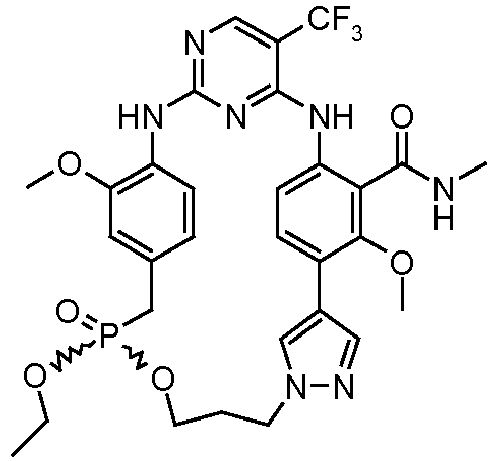
- Prepared analogously to Example 3 using ethyl hydrogen (4-{[4-({4-[1-(3-hydroxypropyl)-1H-pyrazol-4-yl]-3-methoxy-2-(methylcarbamoyl)phenyl}amino)-5-(trifluoromethyl)pyrimidin-2-yl]amino}-3-methoxybenzyl)phosphonate (Compound 30A). 1H NMR (CD3OD, 400 MHz): δ 8.30 (s, 1H), 8.26 (s, 1H), 8.08 (s, 1H), 7.74 (dd, J = 8.4, 1.5 Hz, 1H), 7.50 (d, J = 8.4 Hz, 1H), 7.27 (dd, J = 8.4, 1.3 Hz, 1H), 6.81 (s, 1H), 6.33 (d, J = 8.4 Hz, 1H), 4.48 (t, J = 5.6 Hz, 2H), 4.05 (m, 2H), 3.87 (s, 3H), 3.65-3.85 (m, 2H), 3.73 (s, 3H), 3.10-3.28 (m, 2H), 2.85 (s, 3H), 2.28 (m, 2H), 1.25 (t, J = 7.1 Hz, 3H). MS (ESI): m/z = 676.20 [M+H]+. UPLC: tR = 1.29 min (UPLC-TOF: polar_3 min).
- Prepared analogously to Compound 3A using diethyl (4-{[4-({4-[1-(3-hydroxypropyl)-1H-pyrazol-4-yl]-3-methoxy-2-(methyl carbamoyl)phenyl}amino)-5-(trifluoromethyl)pyrimidin-2-yl]amino}-3-methoxy benzyl)phosphonate (Compound 30B). 1H NMR (CD3OD, 400 MHz): δ 8.27 (s, 1H), 8.18 (s, 1H), 7.98 (s, 1H), 7.86 (d, J = 8.3 Hz, 1H), 7.83 (d, J = 7.8 Hz, 1H), 7.66 (d, J = 8.8 Hz, 1 H), 7.02 (s, 1 H), 6.69 (d, J = 8.1 Hz, 1 H), 4.33 (t, J = 6.8 Hz, 2H), 3.88 (s, 3H), 3.82 (m, 2H), 3.64 (s, 3H), 3.59 (t, J = 6.1 Hz, 2H), 2.92 (s, 3H), 2.91 (d, J = 20.2 Hz, 2H), 2.11 (m, 2H), 1.13 (t, J = 7.1 Hz, 3H). MS (ESI): m/z = 694.22 [M+H]+. UPLC: tR = 1.09 min (UPLC-TOF: polar_3 min).
- Prepared analogously to Compound 1B replacing Compound 1C with 6-amino-3-[1-(3-hydroxypropyl)-1H-pyrazol-4-yl]-2-methoxy-N-methyl benzamide (Compound 30C). 1H NMR (CD3OD, 400 MHz): δ 8.31 (s, 1H), 8.17 (s, 1H), 8.00 (s, 1H), 7.92 (d, J = 8.4 Hz, 1H), 7.84 (d, J = 8.6 Hz, 1 H), 7.67 (d, J = 8.6 Hz, 1 H), 6.96 (t, J = 2.0 Hz, 1 H), 6.70 (d, J = 8.3 Hz, 1 H), 4.33 (t, J = 6.8 Hz, 2H), 3.99 (m, 4H), 3.90 (s, 3H), 3.66 (s, 3H), 3.58 (t, J = 6.3 Hz, 2H), 3.19 (d, J = 21.5 Hz, 2H), 2.92 (s, 3H), 2.11 (m, 2H), 1.22 (t, J = 7.1 Hz, 6H). MS (ESI): m/z = 722.53 [M+H]+. HPLC: tR = 3.63 min (ZQ3: polar_5 min).
- Prepared analogously to Compound 3C substituting 6-amino-3-bromo-2-methoxy-N-methylbenzamide (Compound 30D) for 2-amino-5-bromo-N,N-diethylbenzamide (Compound 3D). MS (ESI): m/z = 305.23 [M+H]+. HPLC: tR = 2.48 min (ZQ3: polar_5 min).
- Prepared analogously to Compound 27D replacing 5-fluoro-1H-benzo[d][1,3]oxazine-2,4-dione (Compound 27E) with 5-methoxy-1H-benzo[d][1,3]oxazine-2,4-dione (Compound 30E). 1H NMR (CDCl3, 500 MHz) δ 2.98 (d, J = 4.5 Hz, 3H), 3.77 (s, 3H), 5.82 (br.s, 2H), 6.74 (d, J = 9.0 Hz, 1H), 7.27 (d, J = 9.0 Hz, 1H), 7.58 (br.s, 1H).
- Prepared analogously to Compound 27E replacing 2-amino-6-fluorobenzoic acid with 2-amino-6-methoxybenzoic acid. 1H NMR (DMSO-d6, 500 MHz) δ 3.87 (s, 3H), 6.64 (d, J = 8.6 Hz, 1H), 6.81 (d, J = 8.6 Hz, 1H), 7.65 (m, 1H), 11.59 (br.s, 1H).

- This compound was prepared analogously to Example 3 using ethyl hydrogen (4-{[4-({6-fluoro-7-[1-(3-hydroxypropyl)-1H-pyrazol-4-yl]-2-methyl-3-oxo-2,3-dihydro-1H-isoindol-4-yl}amino)-5-(trifluoromethyl)pyrimidin-2-yl]amino}-3-methoxybenzyl)phosphonate (Compound 31A). 1H NMR (CD3OD, 400 MHz): δ 8.36 (d, J = 3.0 Hz, 1 H), 8.34 (d, J = 0.5 Hz, 1 H), 7.94 (s, 1 H), 7.55 (d, J = 13.1 Hz, 1 H), 7.47 (d, J = 7.6 Hz, 1 H), 6.90 (s, 1 H), 6.62 (d, J = 8.3 Hz, 1 H), 4.71 - 4.58 (m, 2 H), 4.54-4.48 (m, 2 H), 3.86 (s, 3 H), 3.85 - 3.60 (m, 4 H), 3.33 (d, J = 4.8 Hz, 1 H), 3.28 (d, J = 4.8 Hz, 1 H), 3.12 (s, 3 H), 2.25 (quin, J = 5.8 Hz, 2 H), 0.96 (t, J = 7.1 Hz, 3 H). MS (ESI): m/z = 676.18 [M+H]+. UPLC: tR = 1.39 min (UPLC-TOF: polar_3 min). Compound 31A: Ethyl hydrogen (4-{[4-({6-fluoro-7-[1-(3-hydroxypropyl)-1H-pyrazol-4-yl]-2-methyl-3-oxo-2,3-dihydro-1H-isoindol-4-yl}amino)-5-(trifluoromethyl)pyrimidin-2-yl]amino}-3-methoxybenzyl)phosphonate
- This compound was prepared analogously to Compound 3A using diethyl (4-{[4-({6-fluoro-7-[1-(3-hydroxypropyl)-1H-pyrazol-4-yl]-2-methyl-3-oxo-2,3-dihydro-1H-isoindol-4-yl}amino)-5-(trifluoromethyl)pyrimidin-2-yl]amino}-3-methoxybenzyl)phosphonate (Compound 31 B). MS (ESI): m/z = 694.21 [M+H]+. UPLC: tR = 1.13 min (UPLC-TOF: polar_3 min). Compound 31B: Diethyl (4-{[4-({6-fluoro-7-[1-(3-hydroxypropyl)-1H-pyrazol-4-yl]-2-methyl-3-oxo-2,3-dihydro-1H-isoindol-4-yl}amino)-5-(trifluoromethyl)pyrimidin-2-yl]amino}-3-methoxybenzyl)phosphonate
- This compound was prepared analogously to Compound 1B replacing Compound 1C with 7-amino-5-fluoro-4-[1-(3-hydroxypropyl)-1H-pyrazol-4-yl]-2-methyl-2,3-dihydro-1H-isoindol-1-one (Compound 31 C). 1H NMR (CD3OD, 400 MHz): δ 8.39 (d, J = 13.9 Hz, 1 H), 8.30 (s, 1 H), 8.00 (s, 1 H), 7.85 (d, J = 7.3 Hz, 1 H), 7.82 (d, J = 1.3 Hz, 1 H), 7.05 (s, 1 H), 6.95 (d, J = 8.3 Hz, 1 H), 4.51 (s, 2 H), 4.33 (t, J = 6.9 Hz, 2 H), 4.08 (quin, J = 7.3 Hz, 4 H), 3.91 (s, 3 H), 3.58 (t, J = 6.1 Hz, 2 H), 3.28 (d, J = 21 Hz, 2 H, obscured), 3.12 (s, 3 H), 2.10 (quin, J = 6.5 Hz, 2 H), 1.28 (t, J = 7.1 Hz, 6 H). MS (ESI): m/z = 722.23 [M+H]+. UPLC: tR = 1.43 min (UPLC-TOF: polar_3 min).
- Prepared analogously to Compound 3C substituting 7-amino-4-bromo-5-fluoro-2-methyl-2,3-dihydro-1H-isoindol-1-one (Compound 31D) for 2-amino-5-bromo-N,N-diethylbenzamide (Compound 3D). 1H NMR (CDCl3, 400 MHz): δ 7.75 (d, J = 4.5 Hz, 2 H), 6.41 (d, J = 13.1 Hz, 1 H), 4.46 (t, J = 6.1 Hz, 2 H), 4.39 (s, 2 H), 3.70 (t, J = 5.6 Hz, 2 H), 3.17 (s, 3 H), 2.20 - 2.09 (m, 3 H). MS (ESI): m/z = 305.14 [M+H]+. UPLC: tR = 0.95 min (UPLC-TOF: polar_3 min).
- A suspension of 4-bromo-5-fluoro-2-methyl-7-nitro-2,3-dihydro-1H-isoindol-1-one (Compound 31 E, 490 mg, 1.70 mmol) in EtOH (10.0 mL) was charged with iron powder (473 mg, 8.48 mmol) and then heated to reflux. After 10 min of reflux, the reaction mixture was charged with 1 M of HCl in H2O (2.03 mL, 2.03 mmol) and stirred at reflux for 10 min. The reaction mixture was filtered through a pad of celite. The filtrate was concentrated under reduced pressure. The residue was quenched with NaHCO3 (10 mL) and extracted with DCM (15 mL). The organic layer was washed with brine, dried over Na2SO4, filtered and concentrated under reduced pressure to an orange solid. The crude material was purified using a Teledyne ISCO Combiflash® Rf system using DCM/MeOH (100:0→ 95:5) as eluent. The fractions containing product were combined and then concentrated under reduced pressure to yield a bright yellow solid (218 mg, 50%). 1H NMR (CDCl3, 400 MHz): δ 6.38 (d, J = 10.9 Hz, 1 H) 5.29 (br. s., 2 H) 4.22 (s, 2 H) 3.14 (s, 3 H). MS (ESI): m/z = 260.99 [M+H]+. UPLC: tR = 1.26 min (UPLC-TOF: polar_3 min).
- A solution of 4-bromo-5-fluoro-2-methyl-2,3-dihydro-1H-isoindol-1-one (Compound 31F, 1.5 g, 6.1 mmol) in sulfuric acid (3.0 mL, 56 mmol) was cooled in an ice bath to 0 °C and then charged with nitric acid (2.0 mL, 43 mmol). The reaction mixture was allowed to stir overnight while gradually warming to rt. The reaction mixture was quenched by adding the mixture dropwise into a separatory funnel containing ice and then extracted with DCM (15 mL). The organic layer was washed with brine (15 mL), dried over anhydrous Na2SO4, filtered and concentrated under reduced pressure to a yellow solid. The crude material was purified using a Teledyne ISCO Combiflash® Rf system using DCM/EtOAc (100:0→ 90:10) as eluent to afford the product compound as a yellow solid (493 mg, 28%). 1H NMR (CDCl3, 400 MHz): δ 7.60 (d, J = 7.6 Hz, 1 H) 4.39 (s, 2 H) 3.23 (s, 3 H). MS (ESI): m/z = 290.96 [M+H]+. UPLC: tR = 1.23 min (UPLC-TOF: polar_3 min).
- The regio-isomeric mixture of Compound 31G and Compound 31H (2.02 g, 8.18 mmol) was taken up in carbon tetrachloride (40 mL) and treated with NBS (2.91 g, 16.4 mmol) and 2,2'-azo-bis-isobutyronitrile (3.12 mg, 0.019 mmol) and allowed to stir at 80 °C overnight. The reaction mixture was quenched with water (10 mL) and extracted with DCM (2 x 20 mL). The organic layer was washed with water (10 mL), brine (10 mL), and then dried over anhydrous sodium sulfate. The solvents were evaporated under reduced pressure to give a light-yellow oil. The product mixture was taken up in THF (15 mL) and then treated with a solution of 2.0 M of methylamine in THF (8.18 mL, 16.4 mmol) and DIPEA (2.85 mL). After stirring overnight at rt, the reaction mixture was evaporated under reduced pressure to afford a crude solid which was purified using a Teledyne ISCO Combiflash® Rf system [gradient eluent EtOAc/Heptane = 50-100%) to give the desired product as 1.40 g of a white solid. 1H NMR (CDCl3, 400 MHz): δ 7.77 (dd, J = 8.3, 4.5 Hz, 1H), 7.24 (app t, J = 8.6 Hz, 1H), 4.33 (s, 2H), 3.22 (s, 3H). MS (ESI): m/z = 244.05/246.03 [M+H]+. UPLC: tR = 3.33 min (ZQ3: polar_5 min).

- n-BuLi (66.0 mmol, 41 mL of 1.6 M solution in hexanes) was added to a solution of 2,2,6,6-tetramethyl-piperidine (9.32 g, 66.0 mmol) in THF (80 mL) at -20 °C under an atmosphere of argon. The resulting mixture was stirred at this temperature for 30 min, cooled to -50 °C and then treated, drop-wise, with a solution of 3-bromo-4-fluorobenzoic acid (6.57 g, 30.0 mmol) in THF (20 mL). After 1 hour of stirring, a solution of methyl iodide (7.47 mL, 120 mmol) in THF (10 mL) was added. The mixture was slowly warmed to rt and then allowed to stir at rt overnight. The reaction was quenched with aq. NH4Cl (20 mL) and then diluted with EtOAc (100 mL). The organic layer was washed with brine (30 mL) and then dried over anhydrous sodium sulfate. The solvents were evaporated under reduced pressure to give a mixture of 2-and 5- methyl-substituted benzoic acid. This mixture was taken up in DMF (30 mL) and then treated with potassium carbonate (8.29 g, 60.0 mmol) and methyl iodide (3.74 mL, 60.0 mmol). The resulting mixture was stirred at rt overnight. The mixture was diluted with EtOAc (100 mL), washed with water (3 x 30 mL), brine (30 mL), and then dried over anhydrous sodium sulfate. The residue was purified using a Teledyne ISCO Combiflash® Rf system [gradient eluent EtOAc/Heptane = 0-20%) to afford a mixture of the desired compounds as 2.5 g of a light-yellow oil (ratio of Compound 31 G to Compound 31 H is 3:1). Compound 31 G: 1H NMR (CDCl3, 400 MHz) δ 7.82 (dd, J = 8.6, 5.6 Hz, 1H), 7.02 (app t, J = 8.1 Hz, 1H), 3.91 (s, 3H), 2.71 (s, 3H).

- Prepared analogously to Example 3 using ethyl hydrogen (3-bromo-4-{[4-({6-[1-(3-hydroxypropyl)-1H-pyrazol-4-yl]-2-(methylcarbamoyl)pyridin-3-yl}amino)-5-(trifluoromethyl) pyrimidin-2-yl]amino}benzyl)phosphonate (Compound 32A, 332 mg, 465 µmol) to afford the desired products (31.3 mg, 10%). 1H NMR (400 MHz, DMSO-d6) δ 11.24 (s, 1H), 9.36 (s, 1H), 8.63 (s, 1H), 8.45 (s, 1H), 8.33 (s, 1H), 8.18 (d, J = 8.6 Hz, 2H), 7.54 - 7.64 (m, 2H), 7.45 (d, J = 8.1 Hz, 1H), 7.32 (d, J = 8.1 Hz, 1H), 4.32 (t, J = 5.9 Hz, 2H), 3.61 - 3.72 (m, 1H), 3.48 - 3.60 (m, 3H), 3.29 (d, J = 21.0 Hz 2H, obscured), 2.78 - 2.85 (m, 3H), 2.09 - 2.23 (m, 2H), 0.80 (t, J = 7.1 Hz, 3H). MS (ESI): m/z = 695.09 [M+H]+. UPLC: tR = 1.43 min (UPLC-TOF: polar_3 min). Compound 32A: Ethyl hydrogen (3-bromo-4-{[4-({6-[1-(3-hydroxypropyl)-1H-pyrazol-4-yl]-2-(methylcarbamoyl)pyridin-3-yl}amino)-5-(trifluoromethyl)pyrimidin-2-yl]amino}benzyl) phosphonate
- Prepared analogously to Compound 3A using diethyl (3-bromo-4-{[4-({6-[1-(3-hydroxypropyl)-1h-pyrazol-4-yl]-2-(methylcarbamoyl)pyridin-3-yl}amino)-5-(trifluoromethyl)pyrimidin-2-yl]amino}benzyl)phosphonate (Compound 32B, 339 mg, 457 µmol) to afford 332 mg of the title compound (99%). MS (ESI): m/z = 713.10 [M+H]+. UPLC: tR = 1.17 min (UPLC-TOF: polar_3 min).
- Prepared analogously to Compound 1B replacing Compound 1C with 3-amino-6-[1-(3-hydroxypropyl)-1h-pyrazol-4-yl]-N-methylpyridine-2-carboxamide (Compound 6C, 229 mg, 832 µmol) and Compound 1E with diethyl (3-bromo-4-{[4-chloro-5-(trifluoromethyl)pyrimidin-2-yl]amino}benzyl)phosphonate (Compound 32C, 418 mg, 832 µmol) to afford 343 mg of the title compound (56%). 1H NMR (400 MHz, CD3OD) δ 8.91 (d, J = 8.8 Hz, 1H), 8.45 (s, 1H), 8.35 (s, 1H), 8.26 (s, 1H), 7.60-7.72 (m, 3H), 7.39 (td, J = 2.3, 8.3 Hz, 1H), 4.31 (t, J = 7.0 Hz, 2H), 4.05-4.16 (m, 4H), 3.56 - 3.61 (m, 2H), 3.34 (d, J = 21.0 Hz, 2H, obscured), 2.99 (s, 3H), 2.12 (quin, J = 6.5 Hz, 2H), 1.27 (t, J = 7.0 Hz, 6H). MS (ESI): m/z = 743.14 [M+H]+. UPLC: tR = 1.48 min (UPLC-TOF: polar_3 min).
- A 1M solution of zinc chloride in ether (18.7 mL, 18.7 mmol) was added to a solution of 2,6-dichloro-5-trifluoromethylpyrimidine (4 g, 18.72 mmol) in 20 mL of dichloroethane and t-butanol (1:1) under nitrogen atmosphere. The reaction mixture was stirred at rt for 30 min, cooled to 0 °C and then treated slowly over 10 min with a solution of diethyl (4-amino-3-bromobenzyl)phosphonate (Compound 32D, 3.35 gm, 10.4 mmol) in dichloroethane and t-butanol (10 mL, 1:1) through an addition funnel and stirred for 1 hr. Diisopropylethylamine (3.2 mL, 10.4 mmol) was added and the mixture was allowed to stir at rt for 3 days. The solvents were evaporated and the residue was purified using flash column chromatography (0 - 30% EtOAc/DCM) to afford 1.2g of the title compound (23%). 1H NMR (400 MHz, CDCl3): δ 1.23-1.25 (m, 6H), 3.10 (d, J = 22.0 Hz, 2H), 3.99-4.06 (m, 4H), 7.28 (d, J = 8.4 Hz, 1H), 7.52 (s, 1H), 7.8 (s, 1H), 8.26 (d, J = 8.4 Hz, 1H), 8.57 (s, 1H).
- Di-tert-butyl [2-bromo-4-(bromomethyl)phenyl]imidodicarbonate (Compound 32E, 6.0 g, 13 mmol) was taken up in triethyl phosphite (5.0 mL, 29 mmol) and stirred at 120 °C for 16 h. The reaction mixture was transferred to a microwave vial and was irradiated in the microwave for 4 h at 190 °C. The reaction mixture was concentrated in vacuo. The compound was purified by flash column chromatography eluting with 10 to 100% EtOAc in heptane. The product was partitioned between EtOAc and water and separated. The aqueous was extracted with EtOAc (3X) and the combined organic fractions were washed with brine, dried over sodium sulfate, filtered, and concentrated to afford the title compound. 1H NMR (400 MHz, chloroform-d) δ 7.33 (t, J = 2.3 Hz, 1H), 7.04 (ddd, J = 2.3, 2.4, 8.2 Hz, 1H), 6.71 (dd, J = 0.8, 8.1 Hz, 1H), 3.97 - 4.06 (m, 4H), 2.96 - 3.04 (m, 2H), 1.26 (t, J = 7.1 Hz, 6H); MS (ESI): m/z: 322.00, 323.96 [M+H]+. UPLC: tR = 2.83 min (UPLC-TOF: polar_3 min).
- A solution of di-tert-butyl (2-bromo-4-methylphenyl)imidodicarbonate (Compound 32F, 5.0 g, 13 mmol), NBS (2.56 g, 14.2 mmol) and 2,2'-Azo-bis-isobutyronitrile (0.217 g, 1.29 mmol) in α,α,α-trifluorotoluene (16 mL) was heated at 80 °C under an atmosphere of nitrogen for 3 h. Solvent was removed in vacuo and the residue was partitioned between EtOAc and water and separated. The aqueous was extracted with EtOAc (3X) and the combined organic fractions were washed with brine, dried over sodium sulfate, filtered, and concentrated to afford the title compound. 1H NMR (400 MHz, chloroform-d) δ 7.64 (d, J = 1.8 Hz, 1H), 7.34 (dd, J = 2.0, 8.1 Hz, 1H), 7.19 (d, J = 8.1 Hz, 1H), 4.44 (s, 2H), 1.41 (s, 18H); UPLC: tR = 1.83 min (UPLC-TOF: polar_3 min).
- A solution of 3-bromo-4-aminotoluene (4.0 g, 21 mmol) in THF (50 mL) was charged with di-tert-butyldicarbonate (4.7 g, 21 mmol) and stirred at reflux for 24 h. The reaction mixture was partitioned between EtOAc and water and separated. The aqueous layer was extracted with EtOAc (3X) and the combined organic fractions were washed with brine, dried over sodium sulfate, filtered, and concentrated. The compound was purified in two batches on an Isco Combiflash eluting with 0 to 10% EtOAc in heptane to afford the title compound. 1H NMR (400 MHz, chloroform-d) δ 7.40 - 7.44 (m, 1H), 7.08 - 7.10 (m, 2H), 2.35 (s, 3H), 1.41 (s, 18H).

- Prepared analogously to Example 3 using ethyl hydrogen (4-{[4-({6-[1-(3-hydroxypropyl)-1H-pyrazol-4-yl]-2-(methylcarbamoyl)pyridin-3-yl}amino)-5-(trifluoromethyl)pyrimidin-2-yl]amino}-3-methylbenzyl)phosphonate (Compound 33A, 330 mg, 509 µmol) to afford 23 mg of the title compounds (7%). 1H NMR (400 MHz, CD3OD) δ 8.42 (s, 1H), 8.30-8.35 (m, 2H), 8.13 (d, J = 8.8 Hz, 1H), 7.61 (d, J = 8.8 Hz, 1H), 7.37 (d, J = 8.3 Hz, 1 H), 7.14 (s, 1H), 7.09 (d, J = 8.1 Hz, 1H), 4.40-4.47 (m, 2H), 3.83 (dd, J = 6.1, 11.1 Hz, 1H), 3.69 (td, J = 7.4, 10.3 Hz, 1H), 3.55-3.62 (m, J = 5.8, 10.9 Hz, 1H), 3.46-3.52 (m, 1H), 3.36 (d, J = 21.9, 2H, obscured), 2.94 (s, 3H), 2.24-2.31 (m, 2H), 2.20 (s, 3H), 0.79 (t, J = 7.1 Hz, 3H). MS (ESI): m/z = 631.70 [M+H]+. UPLC: tR = 1.19 min (UPLC-SOD: analytical_2min).
- Prepared analogously to Compound 3A using diethyl (4-{[4-({6-[1-(3-hydroxypropyl)-1H-pyrazol-4-yl]-2-(methylcarbamoyl)pyridin-3-yl}amino)-5-(trifluoromethyl)pyrimidin-2-yl]amino}-3-methylbenzyl)phosphonate (Compound 33B, 345 mg, 510 µmol) to afford 330 mg of the title compound (99.8%). 1H NMR (400 MHz, CD3OD) δ 8.71-8.96 (m, 1H), 8.60 (s, 1H), 8.28 (s, 1H), 8.23 (s, 1H), 7.63 (d, J = 9.1 Hz, 1H), 7.34 (s, 1H), 7.22-7.28 (m, 2H), 4.32 (t, J = 6.8 Hz, 2H), 3.88 (t, J = 7.0 Hz, 2H), 3.59 (t, J = 6.1 Hz, 2H), 3.06 (d, J = 21.9 Hz, 2H), 2.98 (s, 3H), 2.23 (s, 3H), 2.11 (t, J = 6.3 Hz, 2H), 1.12 (t, J = 7.1 Hz, 3H). MS (ESI): m/z = 649.65 [M+H]+. UPLC: tR = 1.06 min (UPLC-SQD: analytical-2min).
- Prepared analogously to Compound 1B replacing Compound 1C with Compound 6C and Compound 1E with diethyl (4-{[4-chloro-5-(trifluoromethyl)pyrimidin-2-yl]amino}-3-methylbenzyl)phosphonate (Compound 33C, 339 mg, 774 µmol) to afford 345 mg of the title compound (66%). 1H NMR (400 MHz, CD3OD) δ 8.90 (br. s., 1H), 8.49 (s, 1H), 8.31 (d, J = 10.1 Hz, 2H), 7.63 (d, J = 9.1 Hz, 1H), 7.35 - 7.39 (m, 1H), 7.33 (s, 1H), 7.24 - 7.31 (m, 1H), 4.32 (t, J = 7.0 Hz, 2H), 4.11 (quin, J = 7.3 Hz, 4H), 3.56 - 3.61 (m, 2H), 3.33 (d, J = 21.0 Hz, 2H), 3.00 (s, 3H), 2.28 (s, 3H), 2.12 (quin, J = 6.5 Hz, 2H), 1.24 - 1.30 (m, 6H). MS (ESI): m/z = 677.21 [M+H]+. UPLC: tR = 1.42 min (UPLC-TOF: polar_3 min).
- A 1M solution of zinc chloride in ether (12.8 mL, 12.8 mmol) was added to a solution of 2,6-dichloro-5-trifluoromethylpyrimidine (2.76 gm, 12.8 mmol) in 20 mL of dichloroethane and t-butanol (1:1) under an atmosphere of nitrogen. The reaction mixture was stirred at rt for 30 min, cooled to 0 °C and then treated with a solution of (4-amino-3-methyl benzyl)phosphonic acid diethyl ester (Compound 33D, 2.2 gm, 8.5 mmol) in dichloroethane and t-butanol (10 mL, 1:1) slowly over 10 min through an addition funnel. After 1 hour, diisopropylethylamine (2.2 mL, 12.6 mmol) was added and then reaction gradually warmed up to rt over 4hrs. The reaction mixture was refrigerated overnight causing the desired product to precipitate out of solution. This was collected by filtration to afford 2.7 g of the title compound (73 %). 1H NMR (300 MHz, CDCl3): δ 1.21-1.26 (m, 6H), 2.3 (s, 3H), 3.15 (d, J = 22.0 Hz, 2H), 3.99-4.09 (m, 4H), 7.17 (m, 3H), 7.72 (d, J = 7.5 Hz, 1H), 8.52 (s, 1 H).
- Prepared starting with (3-methyl-4-nitrophenyl)methanol and following the procedures used to for Compounds 1H - 1F . 1H NMR (300 MHz, CDCl3): δ 1.24 (t, J = 7.0 Hz, 6 H), 2.14 (s, 3 H), 3.17 (d, J = 21.0 Hz, 2 H), 3.56 (br.s, 2 H), 3.94-4.05 (m, 4H), 6.65 (d, J = 8.1 Hz, 1H), 6.93-6.97 (m, 2H).

- Prepared analogously to Example 3 using ethyl hydrogen (4-{[4-({6-[1-(3-hydroxypropyl)-3-methyl-1H-pyrazol-4-yl]-2-(methylcarbamoyl)pyridin-3-yl}amino)-5-(trifluoromethyl)pyrimidin-2-yl]amino}-3-methoxybenzyl)phosphonate (Compound 34A, 533 mg, 785 µmol) to afford 89.6 mg of the racemic title compound (17%). 1H NMR (400 MHz, CD3OD) δ 8.33-8.38 (m, 1H), 8.19 (d, J = 8.6 Hz, 1H), 7.79 (d, J = 8.6 Hz, 1H), 7.63 (d, J = 8.8 Hz, 1H), 6.92 (s, 1 H), 6.67 (d, J = 8.3 Hz, 1H), 4.37-4.43 (m, 2H), 3.81-3.96 (m, 5H), 3.72 (d, J = 8.3 Hz, 2H), 3.37 (d, J = 21.0 Hz,, 2H), 2.97 (s, 3H), 2.67 (s, 3H), 2.23 (t, J = 5.8 Hz, 2H), 1.07 (t, J = 7.1 Hz, 3H). MS (ESI): m/z = 661.67 [M+H]+. UPLC: tR = 1.25 min (UPLC-SQD: analytical_2min).
- Prepared analogously to Compound 3A using diethyl (4-{[4-({6-[1-(3-hydroxypropyl)-3-methyl-1H-pyrazol-4-yl]-2-(methylcarbamoyl)pyridin-3-yl}amino)-5-(trifluoromethyl) pyrimidin-2-yl]amino}-3-methoxybenzyl) phosphonate (Compound 34B, 582 mg, 824 µmol) to afford 533 mg of the title compound (95%). 1H NMR (400 MHz, CD3OD) δ 8.95-9.04 (m, 1H), 8.41 (s, 1H), 8.30 (d, J = 0.5 Hz, 1H), 7.64 (d, J = 8.8 Hz, 2H), 7.11 (s, 1H), 6.87-6.96 (m, 1H), 4.24 (t, J = 6.8 Hz, 2H), 3.80-3.92 (m, 5H), 3.58 (t, J = 6.1 Hz, 2H), 3.02 (d, J = 21.0 Hz, 2H), 2.98 (s, 3H), 2.56 (s, 3H), 2.09 (t, J = 6.3 Hz, 2H), 1.14 (t, J = 7.1 Hz, 3H). MS (ESI): m/z = 679.67 [M+H]+. UPLC: tR = 1.15 min (UPLC-TOF: polar_3 min).
- Prepared analogously to Compound 1B replacing compound 1C with 3-Amino-6-[1-(3-hydroxypropyl)-3-methyl-1H-pyrazol-4-yl]-N-methylpyridine-2-carboxamide (Compound 34C, 343 mg, 1.19 mmol) to afford 582 mg of the title compound (69%). 1H NMR (400 MHz, CD3OD) δ 8.99 (d, J = 7.6 Hz, 1H), 8.28 (s, 2H), 7.82 (d, J = 6.8 Hz, 1H), 7.55 (d, J = 9.1 Hz, 1H), 7.01 (t, J = 1.9 Hz, 1H), 6.88 (td, J = 2.3, 8.1 Hz, 1H), 4.17-4.25 (m, 2H), 3.99-4.10 (m, 4H), 3.88 (s, 3H), 3.54-3.61 (m, 2H), 3.25 (d, J = 21.9 Hz, 2H), 2.94 (br. s., 3H), 2.53 (s, 3H), 2.01-2.14 (m, 2H), 1.25 (d, J = 13.9 Hz, 6H). MS (ESI): m/z = 707.17 [M+H]+. UPLC: tR = 3.91 min (ZQ3: polar_5 min).
- A mixture of 3-Amino-6-{1-[3-(benzyloxy)propyl]-3-methyl-1H-pyrazol-4-yl}-N-methylpyridine-2-carboxamide (Compound 34D, 639 mg, 1.68 mmol) in EtOH (18.0 mL) and palladium on carbon (10:90, Palladium 10% wt. on Calcium Carbonate:carbon black, 100.0 mg, 0.048 mmol) was evacuated and flushed with argon (3X). After a fourth evacuation, the mixture was flushed with H2 and allowed to stir overnight at rt. The reaction mixture was filtered, concentrated in vacuo and purified using a Teledyne ISCO Combiflash® Rf system [elution gradient: 0 → 10% MeOH in DCM] to afford 342 mg of the title compound (70%). 1H NMR (400 MHz, CDCl3) δ 8.01 (s, 1H), 7.42 (d, J = 8.6 Hz, 1H), 7.16 (d, J = 8.6 Hz, 1H), 4.19 (t, J = 7.0 Hz, 2H), 3.55 (t, J = 6.2 Hz, 2H), 2.94 (s, 3H), 2.48 (s, 3H), 2.05 (t, J = 6.4 Hz, 2H). MS (ESI): m/z = 290.58 [M+H]+. UPLC: tR = 0.65 min (UPLC-SQD: analytical_2min).
- Prepared analogously to Compound 3C replacing Compound 3D with 3-amino-6-bromo-N-methylpyridine-2-carboxamide (Compound 6D, 1 g, 4.35 mmol) and replacing 3E with a mixture of 1-[3-(benzyloxy)propyl]-3-methyl-4-(4,4,5,5-tetramethyl-1,3,2-dioxaborolan-2-yl)-1H-pyrazole and 1-[3-(benzyloxy)propyl]-5-methyl-4-(4,4,5,5-tetramethyl-1,3,2-dioxaborolan-2-yl)-1H-pyrazole (Compound 34F and Compound 34G, 1 g, 4.35 mmol). Additional purification to isolate the individual regioisomers was achieved using SFC to afford 647 mg of 3-amino-6-{1-[3-(benzyloxy)propyl]-3-methyl-1H-pyrazol-4-yl}-N-methylpyridine-2-carboxamide (Compound 34D, 39%). 1H NMR (400 MHz, CD3OD) δ 7.92 (s, 1H), 7.38 (d, J = 8.6 Hz, 1H), 7.21-7.35 (m, 5H), 7.17 (d, J = 8.6 Hz, 1H), 4.48 (s, 2H), 4.20 (t, J = 6.8 Hz, 2H), 3.46 (t, J = 5.9 Hz, 2H), 2.93 (s, 3H), 2.47 (s, 3H), 2.08-2.18 (m, J = 6.1, 6.06 Hz, 2H). MS (ESI): m/z = 380.18 [M+H]+. UPLC: tR = 1.37 min (UPLC-TOF: polar_3 min) and 439 mg of 3-amino-6-{1-[3-(benzyloxy)propyl]-5-methyl-1H-pyrazol-4-yl}-N-methylpyridine-2-carboxamide (Compound 34E, 27%). 1H NMR (400 MHz, CD3OD) δ 7.81 (s, 1H), 7.43 (d, J = 8.8 Hz, 1H), 7.23-7.36 (m, 5H), 7.19 (d, J = 8.8 Hz, 1 H), 4.49 (s, 2H), 4.25 (t, J = 6.8 Hz, 2H), 3.48 (t, J = 5.8 Hz, 2H), 2.94 (s, 3H), 2.54 (s, 3H), 2.12 (quin, J = 6.4 Hz, 2H). MS (ESI): m/z = 380.18 [M+H]+. UPLC: tR = 1.38 min (UPLC-TOF: polar_3 min).
- Prepared analogously to Compound 5E replacing Compound 5F with a mixture of 1-[3-(benzyloxy)propyl]-4-iodo-3-methyl-1H-pyrazole and 1-[3-(benzyloxy)propyl]-4-iodo-5-methyl-1H-pyrazole (Compound 34H and Compound 34I, 3.60 g, 10.1 mmol) to afford 5.8g of the title compounds as a mixture of regioisomers (80%). MS (ESI): m/z = 357.21 [M+H]+. UPLC: tR = 1.67-1.69 min (UPLC-TOF: polar_3 min).
- A mixture of 3-methyl-4-iodopyrazole (2.59 g, 12.5 mmol) and 1-bromo-3-benzyloxypropane (3.00 g, 13.1 mmol) in DMF (11.4 mL) was charged with potassium carbonate (2.07 g, 15.0 mmol). The reaction mixture was allowed to stir at rt for 16 hrs overnight. The reaction mixture was quenched with water and then extracted with EtOAc. The organic layer was washed with water, brine (2x), dried over sodium sulfate, filtered, and then concentrated in vacuo to yield an oil. The crude material was purified using a Teledyne ISCO Combiflash® Rf system [Heptane/EtOAc (100:0→ 0:100)] to afford the title products as a mixture of regioisomers (3.60 g, 41% combined yield). The reaction was carried onto the next step without any further purification. MS (ESI): m/z = 357.02 [M+H]+. UPLC: tR = 1.62 min (UPLC-TOF: polar_3 min).

- Prepared analogously to Example 3 using ethyl hydrogen (4-{[4-({6-[1-(3-hydroxypropyl)-5-methyl-1H-pyrazol-4-yl]-2-(methylcarbamoyl)pyridin-3-yl}amino)-5-(trifluoromethyl) pyrimidin-2-yl]amino}-3-methoxybenzyl)phosphonate (Compound 35A, 278 mg, 410 µmol) to afford 3 mg of racemic Example 35 (1%). 1H NMR (400 MHz, CD3OD) δ 8.32 (s, 1H), 8.19 (s, 1H), 7.89 (d, J = 8.6 Hz, 1H), 7.68 (d, J = 8.6 Hz, 1H), 7.26 (d, J = 8.3 Hz, 1H), 6.77 (s, 1H), 6.16 (td, J = 2.2, 8.2 Hz, 1H), 4.33-4.47 (m, 2H), 3.98 (quin, J = 7.3 Hz, 2H), 3.81 (s, 3H), 3.07 (d, J = 21.0 Hz, 2H), 2.91 (s, 3H), 2.66 (s, 3H), 2.30-2.38 (m, 2H), 1.29 (s, 2H), 1.19 (t, J = 7.1 Hz, 3H). MS (ESI): m/z = 661.67 [M+H]+. UPLC: tR = 1.17 min (UPLC-SQD: analytical_2min).
- Prepared analogously to Compound 3A using diethyl (4-{[4-({6-[1-(3-hydroxypropyl)-5-methyl-1H-pyrazol-4-yl]-2-(methylcarbamoyl)pyridin-3-yl}amino)-5-(trifluoromethyl) pyrimidin-2-yl] amino}-3-methoxybenzyl)phosphonate (Compound 35B, 270 mg, 382 µmol) to afford 278 mg of the title compound (100%). 1H NMR (400 MHz, CD3OD) δ 8.95-9.04 (m, 1H), 8.26 (s, 1H), 7.96-8.01 (m, 1H), 7.71-7.80 (m, 1H), 7.51 (d, J = 9.1 Hz, 1H), 7.08 (s, 1H), 6.83-6.90 (m, 1H), 4.25 (t, J = 7.1 Hz, 2H), 3.81-3.92 (m, 5H), 3.55-3.60 (m, 2H), 2.97 (d, J = 21.0 Hz, 2H), 2.92 (s, 1H), 2.61 (s, 3H), 2.03 (t, J = 6.7 Hz, 2H), 1.17 (t, J = 7.1 Hz, 3H). MS (ESI): m/z = 679.67 [M+H]+. UPLC: tR = 1.15 min (UPLC-SQD: analytical_2min).
- Prepared analogously to Compound 1B replacing Compound 1C with 3-Amino-6-[1-(3-hydroxypropyl)-5-methyl-1H-pyrazol-4-yl]-N-methylpyridine-2-carboxamide (Compound 35C, 177 mg, 644 µmol) to afford 270 mg of the title compound (59%). 1H NMR (400 MHz, CD3OD) d 8.59-8.68 (m, 1H), 8.30 (s, 1H), 8.03 (s, 1H), 7.76-7.86 (m, 1H), 7.58 (d, J = 9.1 Hz, 1H), 7.01 (s, 1H), 6.88 (d, J = 8.1 Hz, 1H), 4.26 (t, J = 7.1 Hz, 2H), 4.05 (quin, J = 7.3 Hz, 4H), 3.88 (s, 3H), 3.53-3.60 (m, 2H), 3.25 (d, J = 21.0 Hz, 2H), 2.92-2.98 (m, 3H), 2.63 (s, 3H), 2.04 (t, J = 6.7 Hz, 2H), 1.25 (t, J = 7.1 Hz, 6H). MS (ESI): m/z = 677.21 [M+H]+. UPLC: tR = 3.8 min (ZQ3: polar_5 min).
- Prepared analogously to Compound 34C replacing Compound 34D with 3-amino-6-{1-[3-(benzyloxy)propyl]-5-methyl-1H-pyrazol-4-yl}-N-methylpyridine-2-carboxamide (Compound 34E, 429 mg, 1.13 mmol) to afford 177 mg of the title compound (54%). 1H NMR (400 MHz, CD3OD) δ 7.75 (s, 1H), 7.35 (d, J = 8.8 Hz, 1H), 7.12 (d, J = 8.6 Hz, 1H), 4.18 (t, J = 7.1 Hz, 2H), 3.51 (t, J = 6.2 Hz, 2H), 2.89 (s, 3H), 2.51 (s, 3H), 1.97 (quin, J = 6.6 Hz, 2H). MS (ESI): m/z = 290.57 [M+H]+. UPLC: tR = 0.67 min (UPLC-SQD: analytical_2min).

- Prepared analogously to Example 3 using ethyl hydrogen (4-{[4-({6-[1-(3-hydroxypropyl)-1H-pyrazol-4-yl]-2-(methylcarbamoyl)pyridin-3-yl}amino)-5-(trifluoromethyl)pyridin-2-yl]amino}-3-methoxybenzyl)phosphonate (Compound 36A) to afford the title compound. 1H NMR (400 MHz, CDCl3) δ 10.07 (s, 1H), 8.29 (s, 1H), 8.15 (d, J = 5.1 Hz, 1H), 8.09 (s, 1H), 7.87 (s, 1H), 7.79 (d, J = 8.6 Hz, 1H), 7.52 (d, J = 8.8 Hz, 1H), 7.06 (d, J = 8.1 Hz, 1H), 6.79 - 6.88 (m, 2H), 6.72 (td, J = 2.5, 8.1 Hz, 1H), 6.52 (s, 1H), 4.43 (t, J = 5.9 Hz, 2H), 3.88 - 4.03 (m, 2H), 3.82 (s, 3H), 3.57 - 3.78 (m, 2H), 3.17 (d, J = 21.2 Hz, 1H), 3.16 (d, J = 21.2 Hz, 1H), 3.03 (d, J = 5.1 Hz, 3H), 2.21 (quin, J = 6 Hz, 2H), 1.12 (t, J = 7.1 Hz, 3H). MS(ESI): m/z 646.19 [M+H]+. UPLC: t R = 1.33 min (UPLC-TOF: polar_3min).
- Prepared analogously to Compound 3A using diethyl (4-{[4-({6-[1-(3-hydroxypropyl)-1H-pyrazol-4-yl]-2-(methylcarbamoyl)pyridin-3-yl}amino)-5-(trifluoromethyl)pyridin-2-yl]amino}-3-methoxybenzyl)phosphonate (Compound 36B). 1H NMR (400 MHz, CD3OD) δ 8.39 (s, 1H), 8.20 (s, 1H), 8.17 (s, 1H), 7.92 (d, J = 8.8 Hz, 1H), 7.72 (d, J = 8.8 Hz, 1H), 7.46 (d, J = 7.8 Hz, 1 H), 7.08 (t, J = 1.8 Hz, 1H), 6.88 (td, J = 2.0, 8.1 Hz, 1H), 6.63 (s, 1H), 4.31 (t, J = 6.8 Hz, 2H), 3.88 (s, 3H), 3.74 (quin, J = 7 Hz, 2H), 3.57 (t, J = 6.1 Hz, 2H), 2.89 - 2.98 (m, 5H), 2.10 (quin, J = 6.5 Hz, 2H), 1.03 (t, J = 7.1 Hz, 3H). MS(ESI): m/z 664.21 [M+H]+. UPLC: t R = 1.06 min (UPLC-TOF: polar_3min).
- A solution of 3-{[2-chloro-5-(trifluoromethyl)pyridin-4-yl]amino}-6-[1-(3-hydroxypropyl)-1H-pyrazol-4-yl]-N-methylpyridine-2-carboxamide (Compound 36C, 158 mg, 0.35 mmol) and diethyl (4-amino-3-methoxybenzyl)phosphonate (Compound 1F, 104 mg, 0.38 mmol) in 1,4-dioxane (4.0 mL) was treated with Pd(II)(OAc)2 (3.90 mg, 0.017 mmol), Xantphos (20.1 mg, 0.035 mmol) and Cs2CO3 (226 mg, 0.70 mmol). The mixture was purged with N2 for 2 minutes, sealed and irradiated in a microwave reactor for 40 minutes at 120 °C. The cooled reaction mixture was poured into water and extracted twice with EtOAc. The combined organic layers were washed with brine, dried over Na2SO4, filtered and concentrated to a brown residue which was taken purified using a Teledyne ISCO Combiflash® system (0% - 5% - 10% MeOH/DCM) to afford 27 mg of a brown foam (11%). 1H NMR (400 MHz, CDCl3) δ 10.91 (s, 1H), 8.38 (s, 1H), 8.23 (q, J = 5.6 Hz, 1H), 7.98 (s, 1H), 7.98 (s, 1H), 7.86 (d, J = 8.8 Hz, 1H), 7.76 (d, J = 7.8 Hz, 1 H), 7.51 (d, J = 8.6 Hz, 1H), 6.86-6.94 (m, 3H), 6.70 (s, 1 H), 4.38 (t, J = 6.3 Hz, 2H), 3.93-4.05 (m, 4H), 3.88 (s, 3H), 3.66 (q, J = 5.5 Hz, 2H), 3.12 (d, J = 21.2 Hz, 2H), 3.06 (d, J = 5.1 Hz, 3H), 2.79 (t, J = 5.2 Hz, 1H), 2.13 (quin, J = 6.1 Hz, 2H), 1.21 (t, J = 7.0 Hz, 6H).
- A mixture of 2-chloro-5-(trifluoromethyl)-4-iodopyridine (200.0 mg, 0.65 mmol), 3-amino-6-[1-(3-hydroxypropyl)-1H-pyrazol-4-yl]-N-methylpyridine-2-carboxamide (Compound 6C, 179 mg, 0.65 mmol), Pd(II)(OAc)2 (7.3 mg, 0.033 mmol), Xantphos (37.6 mg, 0.065 mmol), and Cs2CO3 (424 mg, 1.30 mmol) in anhydrous 1,4-dioxane (1.5 mL) was prepared in a sealable microwave tube and sparged with N2 for 2 min. The tube was sealed and irradiated in a microwave reactor for 30 min at 80 °C. Additional 2-chloro-5-(trifluoromethyl)-4-iodopyridine, catalyst, ligand and base were added followed by additional 30 min of irradiation at 80 °C. The reagent addition and re-irradiation was performed a total of 4 times. The cooled reaction mixture was poured into water and extracted with EtOAc (2X). The combined organic layers were washed with brine, dried over Na2SO4, filtered and concentrated to a green residue. This was purified using a Teledyne ISCO Combiflash® system (0 - 5% MeOH/DCM) to isolate the desired product as 158 mg of a yellow foam (53%). 1H NMR (400 MHz, CDCl3) δ 11.26 (s, 1H), 8.49 (s, 1H), 8.18-8.32 (m, J = 4.5 Hz, 1H), 7.99 (s, 1H), 7.95 (s, 1H), 7.89 (d, J = 8.8 Hz, 1H), 7.59 (d, J = 8.6 Hz, 1H), 7.31 (s, 1H), 4.39 (t, J = 6.4 Hz, 2H), 3.70 (t, J = 5.4 Hz, 2H), 3.07 (d, J = 5.1 Hz, 3H), 2.15 (quin, J = 6.1 Hz, 2H). MS (ESI): m/z = 455.10 [M+H]+; UPLC: tR = 1.33 min (UPLC-TOF: polar_3min).
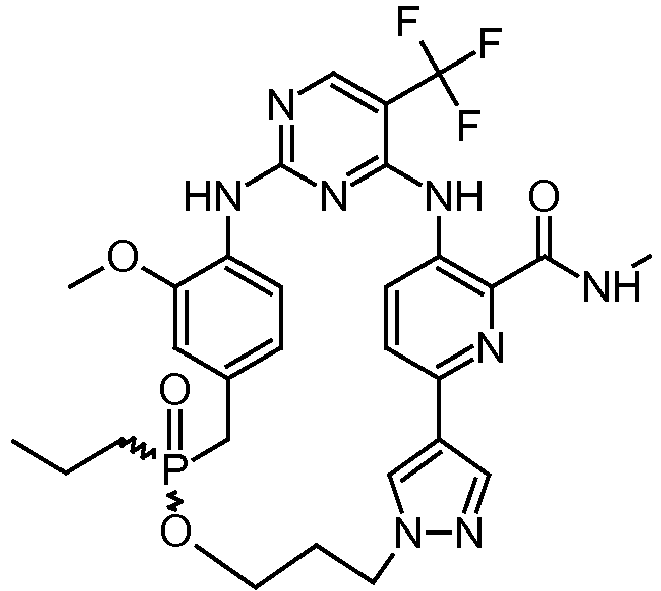
- The reaction mixture from Compound 37A was charged with DCC (60.0 mg, 0.29 mmol) and heated at reflux for 5-6 hours. The reaction mixture was concentrated under reduced pressure to a brown solid. The crude material was purified on a Teledyne ISCO Combiflash® Rf system using DCM/MeOH (100:0→ 90:10) to afford the title compound as 5.1 mg of a white solid (55%). 1H NMR (CDCl3, 400 MHz): δ 10.89 (br. s., 1H), 8.27-8.40 (m, 3H), 8.17 (s, 1H), 8.13 (d, J = 8.6 Hz, 1H), 7.81 (d, J = 8.3 Hz, 2H), 7.60 (d, J = 8.6 Hz, 1H), 6.59 (s, 1H), 6.29-6.38 (m, 1H), 4.34-4.55 (m, 2H), 4.00-4.13 (m, 1H), 3.87 (s, 3H), 3.47-3.59 (m, 1H), 2.98-3.21 (m, 5H), 2.19-2.38 (m, 2H), 1.66-1.73 (m, 4H), 1.04 (t, J = 5.8 Hz, 3H). MS (ESI): m/z 645.07 [M+H]+. HPLC: t R = 3.11 min (polar_4 min).
- A solution of ethyl (4-{[4-({6-[1-(3-hydroxypropyl)-1H-pyrazol-4-yl]-2-(methylcarbamoyl)pyridin-3-yl}amino)-5-(trifluoromethyl)pyrimidin-2-yl]amino}-3-methoxybenzyl)propylphosphinate (Compound 37B, 10 mg, 0.015 mmol) in pyridine (1 mL) was charged with bromotrimethylsilane (0.012 mL, 0.087 mmol). The reaction was stirred at rt for 20 min. The material was not isolated. MS (ESI): m/z 663.23 [M+H]+. UPLC: tR = 0.85 min (polar_2min).
- Prepared analogously to Compound 1B replacing Compound 1E with ethyl (4-{[4-chloro-5-(trifluoromethyl)pyrimidin-2-yl]amino}-3-methoxybenzyl)propylphosphinate (Compound 37C, 0.680 g, 1.50 mmol) and Compound 1C with Compound 6F (0.420 g, 1.52 mmol) to isolate the title compound as 650 mg of a light yellow solid (63%). MS (ESI): m/z 691.25 [M+H]+.UPLC: tR = 0.98 min (polar_2min).
- Prepared analogously to Compound 1E replacing compound 1F with ethyl (4-amino-3-methoxybenzyl)propylphosphinate (Compound 37D, 0.971 g, 3.58 mmol). The crude material was purified on a Teledyne ISCO Combiflash® Rf system using DCM/MeOH (100:0→ 95:5) as eluent to afford the title compound as 1.08g of a white foam (67%). MS (ESI): m/z 452.10 [M+H]+. UPLC: t R = 1.10 min (polar_2 min).
- A solution of ethyl (3-methoxy-4-nitrobenzyl)prop-2-en-1-ylphosphinate (Compound 37E, 1.075 g, 3.59 mmol) in EtOH (20.0 mL) was charged with Palladium 10% wt on activated carbon (0.365 mg, 0.34 mmol). The reaction mixture was evacuated and purged with hydrogen gas (3x). The reaction mixture was allowed to stir under hydrogen at rt for 16 h. The reaction mixture was filtered through a pad of celite. The filtrate was concentrated under reduced pressure to a light purple oil, (0.97 g, 99%). This material was used in successive reactions without further purification. 1H NMR (CDCl3, 400 MHz): δ = 6.79 (t, J = 1.8 Hz, 1H), 6.70-6.75 (m, 1H), 6.64-6.69 (m, 1H), 3.93-4.09 (m, 2H), 3.86 (s, 3H), 3.04 (d, J = 16.2 Hz, 2H), 1.60 (dt, J = 2.5, 4.9 Hz, 4H), 1.29 (t, J = 7.1 Hz, 3H), 0.98 (dt, J = 1.3, 7.1 Hz, 3H). MS (ESI): m/z 272.13 [M+H]+. UPLC: t R = 0.98 min (UPLC-TOF: polar_3 min).
- A mixture of (3-methoxy-4-nitrobenzyl)prop-2-en-1-ylphosphinic acid (Compound 37F, 1.28 g, 4.72 mmol) and iodoethane (1.47 g, 9.44 mmol) in DMF (5.0 mL) was charged with potassium carbonate (1.30 g, 9.44 mmol). The reaction mixture was allowed to stir at rt for 16 hours. The reaction mixture was quenched with water (15 mL) and extracted with EtOAc (25 mL). The organic layer was washed with water (10 mL), washed with brine (10 mL), dried over Na2SO4, filtered, concentrated under reduced pressure to yield a yellow oil. The crude material was purified on a Teledyne ISCO Combiflash® Rf system using DCM/MeOH (100:0→ 95:5) as eluent to afford the title compound as 1.08g of a yellow oil (77%). 1H NMR (CDCl3, 400 MHz): δ = 7.84 (d, J = 8.3 Hz, 1H), 7.11 (t, J = 1.8 Hz, 1H), 6.92 (td, J = 1.8, 8.3 Hz, 1H), 5.76-5.90 (m, 1H), 5.18-5.32 (m, 2H), 4.00-4.14 (m, 2H), 3.98 (s, 3H), 3.19 (d, J = 16.4 Hz, 2H), 2.60 (dd, J = 7.3, 17.7 Hz, 2H), 1.29 (t, J = 7.1 Hz, 3H). MS (ESI): m/z 300.10 [M+H]+. UPLC: t R = 1.22 min (UPLC-TOF: polar_3 min).
- A mixture of ammonium phosphinate (1.00 g, 12.0 mmol) and Hexamethyldisilazane (1.94 g, 12.0 mmol) was heated to 110°C under N2 for approximately 1.5 hours. The reaction mixture was cooled to 0°C, charged with anhydrous DCM (10 mL) followed by Allyl bromide (1.46 g, 12.0 mmol) and allowed to stir at RT for 16 hours. The reaction mixture was then cooled to 0°C and charged with more hexamethyldisilazane (1.94 g, 12.0 mmol). The reaction mixture was stirred at 0°C for 2 hours then treated with 4-(bromomethyl)-2-methoxy-1-nitrobenzene (3.00 g, 12.2 mmol). The reaction mixture was allowed to stir for 16 hours at rt after which it was filtered. The filtrate was quenched with 1 N HCl (10 mL) and extracted with DCM (20 mL). The organic layer was washed with brine (10 mL), dried over anhydrous Na2SO4, filtered and concentrated under reduced pressure to a yellow oil. The material was dissolved in DCM and extracted with aq. NaHCO3. The aqueous layer was cooled to 0°C and then acidified with 6 M HCl. The aqueous layer was saturated with solid NaCl then extracted with DCM. The organic layer was concentrated under reduced pressure to a yellow oil (1.29 g, 39%). This material was used in successive reactions without any further purification. 1H NMR (CDCl3, 400 MHz): δ = 9.81 (br. s., 1H), 7.81 (d, J = 8.3 Hz, 1H), 7.01 (s, 1H), 6.89 (td, J = 1.8, 8.3 Hz, 1H), 5.79-5.67 (m, 1H), 5.29-5.18 (m, 2H), 3.96 (s, 3H), 3.10 (d, J = 15.9 Hz, 2H), 2.53-2.44 (m, 2H). MS (ESI): m/z 270.37 [M-H]+. UPLC: t R = 0.76 min (UPLC-SQD: analytical_2min).

- Prepared analogously to Example 3 by adding (benzotriazol-1-yloxy)tripyrrolidino-phosphonium hexafluorophosphate (1.43 g, 2.74 mmol) to a stirring suspension of methyl 4-[5-({2-[(4-{[ethoxy(hydroxy)phosphoryl]methyl}-2-methoxyphenyl)amino]-5-(trifluoromethyl)pyrimidin-4-yl}amino)-6-(methylcarbamoyl) pyridin-2-yl]-1-(3-hydroxypropyl)-1H-pyrrole-2-carboxylate (Compound 38, 330 mg, 0.46 mmol), and DIPEA (0.4 mL, 2 mmol) in 1,2-dichloroethane (300 mL) at rt over 24hrs. The reaction mixture was diluted with EtOAc and washed with brine (2x), dried over sodium sulfate, filtered and concentrated in vacuo and purified using Teledyne ISCO Combiflash® Rf system [0 → 10% EtOH in DCM] to afford 186 mg of the title compound (58%). 1H NMR (400 MHz, CD3OD) δ 8.35 (s, 1H), 8.21 (d, J = 8.8 Hz, 1H), 7.81 (d, J = 2.0 Hz, 1H), 7.76-7.80 (m, 2H), 7.68 (d, J = 8.3 Hz, 1H), 6.92-6.96 (m, 1 H), 6.71 (td, J = 2.2, 8.3 Hz, 1H), 4.64-4.73 (m, 1H), 4.59 (d, J = 6.8 Hz, 1H), 3.78-3.97 (m, 8H), 3.63-3.76 (m, 2H), 3.33-3.41 (m, 2H), 2.96 (s, 3H), 2.20 (t, J = 5.3 Hz, 2H), 1.06 (t, J = 6.9 Hz, 3H). MS (ESI): m/z 704.19 [M+H]+. UPLC: tR = 1.59 min (UPLC-TOF: polar_3 min). Compound 38A: Methyl 4-[5-({2-[(4-{[ethoxy(hydroxy)phosphoryl]methyl}-2-methoxyphenyl)amino]-5-(trifluoromethyl)pyrimidin-4-yl}amino)-6-(methylcarbamoyl)pyridin-2-yl]-1-(3-hydroxypropyl)-1 H-pyrrole-2-carboxylate
- A mixture of methyl 1-[3-(benzyloxy)propyl]-4-[5-({2-[(4-{[ethoxy(hydroxy)phosphoryl]methyl}-2-methoxyphenyl)amino]-5-(trifluoromethyl)pyrimidin-4-yl}amino)-6-(methylcarbamoyl)pyridin-2-yl]-1H-pyrrole-2-carboxylate (Compound 38B, 582 mg, 0.717 mmol) and Palladium 10% wt. on Calcium Carbonate:Carbon black (63.4 mg, 0.031 mmol) in EtOH (11.4 mL), was evacuated and purged with d with H2(g) (3x) and left to stir overnight at rt for 16hrs. The reaction mixture was filtered and concentrated in vacuo to a 330mg of a solid which was used without further purification (64%). 1H NMR (400 MHz, CD3OD) δ 8.88-9.02 (m, 1H), 8.27 (s, 1H), 7.89 (s, 1H), 7.72 (d, J = 6.3 Hz, 1H), 7.56-7.62 (m, 1H), 7.52 (d, J = 1.5 Hz, 1H), 7.09 (s, 1H), 6.91 (d, J = 8.1 Hz, 1 H), 4.47 (t, J = 6.8 Hz, 2H), 3.85-3.92 (m, 5H), 3.85 (br. s., 3H), 3.54-3.61 (m, 2H), 3.03 (d, J = 22.0 Hz, 2H), 2.95-2.99 (m, 3H), 1.97-2.06 (m, 2H), 1.17 (t, J = 7.1 Hz, 3H). MS (ESI): m/z = 722.60 [M+H]+. UPLC: tR = 1.22 min (UPLC-TOF: polar_2 min).
- A mixture of [1,1'-Bis(diphenylphosphino)ferrocene]dichloropalladium(II),complex with dichloromethane (1:1) (77.9 mg, 0.095 mmol), potassium carbonate (366 mg, 2.65 mmol), ethyl hydrogen (4-{[4-{[6-bromo-2-(methylcarbamoyl)pyridin-3-yl]amino}-5-(trifluoromethyl)pyrimidin-2-yl]amino}-3-methoxybenzyl)phosphonate (Compound 38C, 543 mg, 0.877 mmol) and methyl 1-[3-(benzyloxy)propyl]-4-(4,4,5,5-tetramethyl-1,3,2-dioxaborolan-2-yl)-1H-pyrrole-2-carboxylate (Compound 38E, 385 mg, 0.964 mmol) in 4:1 dioxane:H2O (3.8 mL) was degassed with Argon and irradiated for 30 min at 100 °C in a CEM microwave reactor. The reaction was then concentrated in vacuo and purified using a Teledyne ISCO Combiflash® Rf system [5 → 100% MeOH in Water] to afford 586 mg of the title compound (82%). MS (ESI): m/z 812.60 [M+H]+. UPLC: tR = 1.57 min (UPLC-TOF: polar_2 min).
- A solution of {4-[4-(6-bromo-2-methylcarbamoyl-pyridin-3-ylamino)-5-trifluoromethyl-pyrimidin-2-ylamino]-3-methoxy-benzyl}-phosphonic acid diethyl ester (Compound 38D, 610 mg, 0.94 mmol) in pyridine (9.57 mL) was treated with Sodium iodide (847 mg, 5.65 mmol) and heated at 120 °C for 16hrs overnight. The reaction solution was concentrated in vacuo and purified using a Teledyne ISCO Combiflash® Rf system [5%→ 95% MeOH in Water over 25 CV] to afford 543 mg of the title compound (93%). 1H NMR (400 MHz, CD3OD) δ 8.99 (br. s, 1H), 8.80 (d, J = 4.6 Hz, 1H), 8.34 (s, 1H), 7.55 (d, J = 9.1 Hz, 1H), 7.10 (s, 1H), 6.90 (d, J = 8.1 Hz, 1H), 3.83 - 3.95 (m, 5H), 3.04 (s, 1H), 2.99 (s, 1H), 2.93 (d, J = 5.1 Hz, 3H), 1.21 (t, J = 7.0 Hz, 3H). MS (ESI): m/z 619.42/621.44 [M+H]+. UPLC: tR = 1.24 min (UPLC-TOF: polar_2 min).
- Prepared analogously to Compound 1B replacing Compound 1C with 3-amino-6-bromo-N-methylpyridine-2-carboxamide (Compound 6D, 279 mg, 1.21 mmol). The reaction mixture was concentrated in vacuo and purified using a Teledyne ISCO Combiflash® Rf system [0→ 5% MeOH in DCM] to afford 661 mg of the title compound (78%). 1H NMR (400 MHz, CD3OD) δ 8.94 - 9.11 (m, 1H), 8.37 (s, 1H), 7.68 (d, J = 7.1 Hz, 1H), 7.58 (d, J = 9.1 Hz, 1H), 7.07 (t, J = 2.0 Hz, 1H), 6.94 (td, J = 2.4, 8.2 Hz, 1H), 4.04 - 4.16 (m, 4H), 3.88 (s, 3H), 3.33 - 3.34 (m, 1H), 3.28 (s, 1H), 2.94 (s, 3H), 1.29 (t, J = 7.1 Hz, 6H). MS (ESI): m/z 647.53/649.53 [M+H]+. UPLC: tR = 1.49 min (UPLC-TOF: polar_2 min).
- A mixture of methyl 4-(4,4,5,5-tetramethyl-1,3,2-dioxaborolan-2-yl)-1H-pyrrole-2-carboxylate (Compound 38F, 600 mg, 2.39 mmol) and 1-bromo-3-benzyloxypropane (575 mg, 2.51 mmol) in DMF (2.19 mL) was charged with cesium carbonate (778 mg, 2.39 mmol). The reaction mixture was allowed to stir at 70 °C for 16 hrs. The reaction mixture was diluted with water and then extracted with EtOAc (2x). The organic layer was washed with water (2x), brine (1x), dried over Na2SO4, filtered, concentrated in vacuo and purified using a Teledyne ISCO Combiflash® Rf system [0 → 4% Ethanol in DCM] to afford 442mg of the title compound (46%). 1H NMR (400 MHz, CD3OD) δ 7.26 - 7.37 (m, 5H), 7.25 (d, J = 1.8 Hz, 1H), 7.17 (d, J = 1.8 Hz, 1H), 4.45 (s, 2H), 4.42 (t, J = 6.8 Hz, 2H), 3.78 (s, 3H), 3.38 (t, J = 5.9 Hz, 2H), 2.01 (t, J = 6.2 Hz, 2H), 1.31 (s, 12H). MS (ESI): m/z 440.59 [M+H]+. UPLC: tR = 1.60 min (UPLC-TOF: polar_2 min).
- 1-Boc-2-(methoxycarbonyl)pyrrole-4-boronic acid, pinacol ester (900 mg, 2.56 mmol) was heated at 180 °C for 18 min to afford 0.643 mg of the title compound which was used without further purification (99%). 1H NMR (400 MHz, CD3OD) δ 7.27 (d, J = 1.5 Hz, 1 H), 7.10 (d, J = 1.3 Hz, 1H), 3.82 (s, 3H), 1.31 (s, 12H). MS (ESI): m/z 252.13 [M+H]+. HPLC: tR = 1.32 min (UPLC-TOF: polar_3 min).

- Racemic Example 39 was prepared by adding a solution of lithium hydroxide, monohydrate (50.7 mg, 1.21 mmol) in H2O (0.32 mL) to a stirring solution of methyl 10-ethoxy-14-methoxy-24-(methylcarbamoyl)-20-(trifluoromethyl)-9-oxa-5,16,18,22,25,28-hexaaza-10-phosphapentacyclo[21.2.2.212,15.12,5.117,21]hentriaconta-1(25),2(31),3,12,14,17(28),18,20,23,26,29-undecaene-4-carboxylate 10-oxide (Example 38, 170 mg, 0.242 mmol) in THF (0.32 mL) and MeOH (0.32 mL) at rt for 30 hrs. The reaction was concentrated in vacuo and purified using a reverse phase chromatography (Teledyne ISCO Combiflash® Rf system, C-18 column [0 → 100% MeOH in Water]) to afford 137 mg of the title compound (82%). 1H NMR (400 MHz, CD3OD) δ 8.35 (s, 1 H), 8.19 (d, J = 8.8 Hz, 1 H), 7.78 (d, J = 8.8 Hz, 1 H), 7.66-7.74 (m, 3H), 6.94 (s, 1 H), 6.68-6.74 (m, 1 H), 4.67-4.75 (m, 1 H), 4.54-4.63 (m, 1H), 3.82-4.00 (m, 5H), 3.68-3.77 (m, 2H), 3.44 (s, 2H), 2.96 (s, 3H), 2.17-2.28 (m, J = 5.3 Hz, 2H), 1.09 (t, J = 7.1 Hz, 3H). MS (ESI): m/z = 690.61 [M+H]+. HPLC: tR = 1.29 min (UPLC-TOF: polar_3 min).
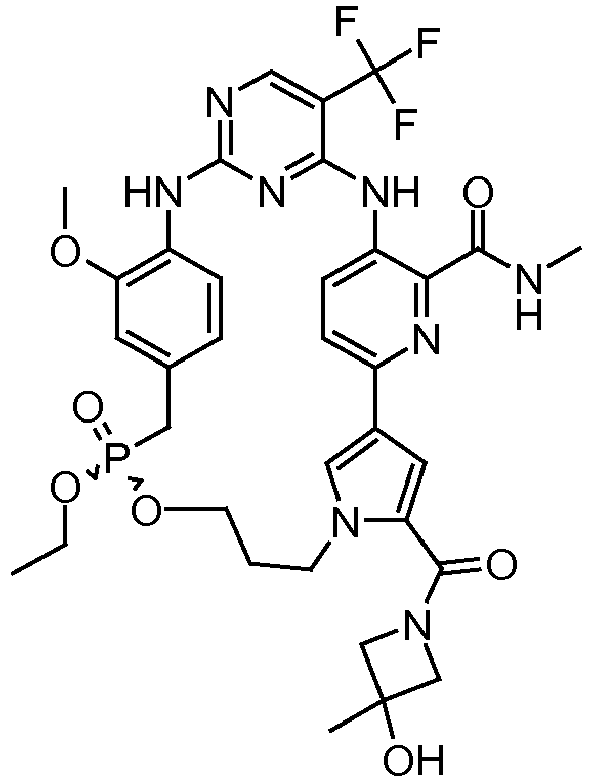
- Racemic Example 40 was prepared by adding 3-methyl-3-azetidinol (3.05 mg, 35.0 mmol) to a stirring solution of 10-ethoxy-14-methoxy-24-(methylcarbamoyl)-20-(trifluoromethyl)-9-oxa-5,16,18,22,25,28-hexaaza-10-phosphapentacyclo [21.2.2.212,15.12,5.117,21]hentriaconta-1(25),2(31),3,12,14,17(28),18,20,23,26,29-undecaene-4-carboxylic acid 10-oxide (Example 39, 15 mg, 21.8 mmol), TBTU (8.38 mg, 26.1 mmol) and DIPEA (30.3 ml 174 mmol) in DCM (836 ml) at 25 °C for 30 min. The reaction was diluted with water, extracted with EtOAc (3x), dried with sodium sulfate, filtered, concentrated in vacuo and purified using a Teledyne ISCO Combiflash® Rf system [elution gradient: 0→ 10% MeOH in DCM] to afford 16 mg of the title compound (97%). 1H NMR (400 MHz, CDCl3): δ 8.34 (s, 1H), 8.18 (d, J = 8.6 Hz, 1 H), 7.66-7.77 (m, 3H), 7.39 (d, J = 1.8 Hz, 1 H), 6.92 (t, J = 1.8 Hz, 1 H), 6.67 (td, J = 2.2, 8.3 Hz, 1 H), 4.51-4.70 (m, 2H), 4.29-4.52 (m, 2H), 3.96-4.09 (m, 2H), 3.85-3.95 (m, 5H), 3.66-3.74 (m, 2H), 3.34-3.42 (m, 2H), 2.97 (s, 3H), 2.14-2.24 (m, 2H), 1.55 (s, 3H), 1.10 (t, J = 7.1 Hz, 3H). MS (ESI): m/z = 759.60 [M+H]+. UPLC: tR = 1.31 min (UPLC-TOF: polar_2 min).

- Prepared analogously to Example 40 using dimethylamine (1.58 mg, 35.0 mmol) to afford 15.4 mg of the desired title compound (99%). 1H NMR (400 MHz, CD3OD) δ 8.33 (s, 1H), 8.15 (d, J = 8.8 Hz, 1 H), 7.75 (d, J = 8.8 Hz, 1 H), 7.67-7.72 (m, 2H), 7.35 (d, J = 1.8 Hz, 1 H), 6.91 (t, J = 1.8 Hz, 1H), 6.68 (td, J = 2.2, 8.2 Hz, 1H), 4.44 (q, J = 5.8 Hz, 2H), 3.84-4.00 (m, 5H), 3.74 (dd, J = 5.9, 9.0 Hz, 2H), 3.33-3.42 (m, 2H), 3.14-3.28 (m, 6H), 2.95 (s, 3H), 2.05-2.13 (m, 2H), 1.10 (t, J = 7.1 Hz, 3H). MS (ESI): m/z = 717.57 [M+H]+. UPLC: tR = 1.38 min (UPLC-TOF: polar_2 min).

- Prepared analogously to Example 40 using methylamine (1.09 mg, 35.0 mmol) to afford 10.9 mg of the desired title compound (71%). 1H NMR (400 MHz, CD3OD) δ 8.33 (s, 1H), 8.13 (d, J = 8.6 Hz, 1 H), 7.62-7.74 (m, 3H), 7.53 (d, J = 2.0 Hz, 1 H), 6.90 (s, 1 H), 6.60-6.67 (m, 1 H), 4.61-4.69 (m, 1 H), 4.52-4.61 (m, J = 7.1 Hz, 1 H), 3.84-3.99 (m, 5H), 3.63-3.73 (m, 2H), 3.34-3.41 (m, 1H), 3.20-3.27 (m, 1H), 2.96 (s, 3H), 2.88 (s, 3H), 2.13-2.23 (m, 2H), 1.10 (t, J = 7.1 Hz, 3H). MS (ESI): m/z = 703.57 [M+H]+. UPLC: tR = 1.35 min (UPLC-TOF: polar_2 min).

- Prepared analogously to Example 38 using ethyl hydrogen (4-{[4-({6-[1-(3-hydroxypropyl)-3,5-dimethyl-1H-pyrazol-4-yl]-2-(methylcarbamoyl)pyridin-3-yl}amino)-5-(trifluoromethyl)pyrimidin-2-yl]amino}-3-methoxybenzyl)phosphonate (Compound 43A, 127 mg, 0.183 mmol) to afford 1.7 mg of the desired title compound (1.4%). 1H NMR (400 MHz, CD3OD) δ 8.33 (s, 1 H), 7.95 (d, J = 8.3 Hz, 1 H), 7.46 (d, J = 8.3 Hz, 1 H), 7.27 (d, J = 8.1 Hz, 1 H), 6.78 (s, 1H), 6.21 (td, J = 2.1, 8.3 Hz, 1H), 4.15-4.39 (m, 2H), 3.96-4.12 (m, 2H), 3.73-3.95 (m, 5H), 3.10 (d, J = 4.8 Hz, 1 H), 3.04 (d, J = 4.8 Hz, 1 H), 2.90 (s, 3H), 2.43 (s, 3H), 2.38 (s, 3H), 2.30 (d, J = 5.1 Hz, 2H), 1.25 (t, J = 7.1 Hz, 3H). MS (ESI): m/z = 675.52 [M+H]+. UPLC: tR = 1.23 min (UPLC-TOF: polar_2 min).
- Prepared analogously to Example 38B using 3-[3,5-dimethyl-4-(4,4,5,5-tetramethyl-1,3,2-dioxaborolan-2-yl)-1H-pyrazol-1-yl]propan-1-ol (Compound 43B, 74.64 mg, 0.2664 mmol) to afford 131 mg of the desired title compound (78%). 1H NMR (400 MHz, CD3OD) δ 9.07 (br. s., 1H), 8.33 (s, 1H), 7.73 (d, J = 8.1 Hz, 1H), 7.41 (d, J = 8.8 Hz, 1H), 7.11 (s, 1H), 6.88 (d, J = 8.1 Hz, 1 H), 4.20 (t, J = 6.9 Hz, 2H), 3.78-3.92 (m, 5H), 3.57 (t, J = 5.9 Hz, 2H), 2.93-3.03 (m, 5H), 2.47 (s, 3H), 2.38 (s, 3H), 1.97-2.07 (m, 2H), 1.15 (t, J = 6.9 Hz, 3H). MS (ESI): m/z = 693.23 [M+H]+. HPLC: tR = 1.18 min (UPLC-TOF: polar_3 min).
- 1-[3-(Benzyloxy)propyl]-3,5-dimethyl-4-(4,4,5,5-tetramethyl-1,3,2-dioxaborolan-2-yl)-1H-pyrazole (Compound 43C, 560 mg, 1.5 mmol) was hydrogenated using the procedure from Compound 38A to afford 421 mg of the desired title compound (99%). 1H NMR (400 MHz, CD3OD) δ 4.08 (t, J = 7.1 Hz, 2H), 3.50 (t, J = 6.1 Hz, 2H), 2.40 (s, 3H), 2.27 (s, 3H), 1.95 (t, J = 6.7 Hz, 2H), 1.30 (s, 12H). MS (ESI): m/z = 280.37 [M+H]+. UPLC: tR = 1.29 min (UPLC-TOF: polar_2 min).
- Prepared analogously to Compound 38E replacing Compound 38F with 3,5-dimethylpyrazole-4-boronic acid, pinacol ester (0.75 g, 3.4 mmol) to afford 560 mg of the desired title compound (45%). 1H NMR (400 MHz, CD3OD δ 7.24-7.36 (m, 5H), 4.45-4.48 (m, 2H), 4.08 (t, J = 6.8 Hz, 2H), 3.41 (t, J = 5.8 Hz, 2H), 2.36 (s, 3H), 2.26 (s, 3H), 2.04 (t, J = 6.3 Hz, 2H), 1.30 (s, 12H). MS (ESI): m/z = 370.60 [M+H]+. UPLC: tR = 1.79 min (UPLC-TOF: polar_2 min).

- [1,1'-bis(diphenylphosphino)ferrocene]dichloropalladium(II),complex with dichloromethane (1:1) (9.56 mg, 0.012 mmol) and potassium carbonate (45 mg, 0.33 mmol) were added to a stirring suspension of racemic ethyl (3-{[4-(4,4,5,5-tetramethyl-1,3,2-dioxaborolan-2-yl)-1H-pyrazol-1-yl]methyl}oxetan-3-yl)methyl (4-{[4-{[6-bromo-2-(methylcarbamoyl)pyridin-3-yl]amino}-5-(trifluoromethyl)pyrimidin-2-yl]amino}-3-methoxybenzyl)phosphonate (Compound 44A, 96.4 mg, 0.108 mmol) in 8 mL of 4:1 dioxane:H2O (1.94 mL). The mixture was evacuated and charged with Argon (3x) and irradiated for 30 min at 100 °C in a CEM microwave reactor. The reaction was concentrated in vacuo and purified using a Teledyne ISCO Combiflash® Rf system [0 → 100% Acetone/Heptanes] to afford 31.6 mg of racemic Example 44 (43%). 1H NMR (400 MHz, CD3OD) δ 8.38 (s, 1H), 8.31-8.36 (m, 2H), 8.15 (d, J = 8.6 Hz, 1H), 7.78 (d, J = 8.6 Hz, 1H), 7.62 (d, J = 8.3 Hz, 1H), 6.89-6.94 (m, 1 H), 6.65 (td, J = 2.3, 8.1 Hz, 1 H), 4.68-4.82 (m, 4H), 4.49 (dd, J = 6.8, 9.1 Hz, 2H), 3.72-3.94 (m, 7H), 3.33-3.42 (m, 2H), 2.94 (s, 3H), 1.01 (t, J = 6.9 Hz, 3H). MS (ESI): m/z = 689.51 [M+H]+. UPLC: tR = 1.26 min (UPLC-TOF: polar_2 min).
- The mixture resulting from the addition of (Benzotriazol-1-yloxy)tripyrrolidino-phosphonium hexafluorophosphate (840 mg, 1.62 mmol) to a stirring suspension of ethyl hydrogen (4-{[4-{[6-bromo-2-(methylcarbamoyl)pyridin-3-yl]amino}-5-(trifluoromethyl)pyrimidin-2-yl]amino}-3-methoxybenzyl)phosphonate (Compound 38C, 500 mg, 0.807 mmol), (3-{[4-(4,4,5,5-tetramethyl-1,3,2-dioxaborolan-2-yl)-1H-pyrazol-1-yl]methyl}oxetan-3-yl)methanol (Compound 44B, 249 mg, 0.848 mmol) and DIPEA (0.8 mL, 4 mmol) in 1,2-dichloroethane (57.3 mL) was allowed to stir at rt for 24hrs. The reaction mixture was then diluted with EtOAc and washed with brine (2x), dried over sodium sulfate, filtered and concentrated in vacuo and purified using a Teledyne ISCO Combiflash® Rf system [0 → 60% Acetone/Heptanes] to afford 96.4 mg of racemic Compound 44A (13%). 1H NMR (400 MHz, CD3OD) δ 9.00 (br. s., 1H), 8.76 (d, J = 4.8 Hz, 1 H), 8.33 (s, 1 H), 7.73-7.75 (m, 1 H), 7.65 (s, 1 H), 7.50-7.56 (m, 1 H), 7.03 (s, 1 H), 6.90 (d, J = 8.1 Hz, 1 H), 4.55-4.66 (m, 2H), 4.32-4.45 (m, 4H), 3.96-4.19 (m, 4H), 3.88 (s, 3H), 3.35 (s, 2H), 2.93 (d, J = 4.8 Hz, 3H), 1.24-1.33 (m, 15H). MS (ESI): m/z = 897.21/899.24 [M+H]+. HPLC: tR = 1.19 min (UPLC-TOF: polar_2 min).
- 1-({3-[(Benzyloxy)methyl]oxetan-3-yl}methyl)-4-(4,4,5,5-tetramethyl-1,3,2-dioxaborolan-2-yl)-1H-pyrazole (Compound 44C, 1.37 mg, 3.56 mmol) was hydrogenated using the procedure from Compound 38A to afford 998 mg of the title compound (95%). 1H NMR (400 MHz, CD3OD) δ 7.86 (s, 1 H), 7.67 (s, 1 H), 4.65 (d, J = 6.3 Hz, 2H), 4.49 (s, 2H), 4.42 (d, J = 6.3 Hz, 2H), 3.57 (s, 2H), 1.32 (s, 12H).
- A mixture of 4-(4,4,5,5-tetramethyl[1,3,2]dioxaborolan-2-yl)-1H-pyrazole (0.825 g, 4.25 mmol) and {3-[(benzyloxy)methyl]oxetan-3-yl}methyl methyl sulfate (Compound 44D, 1.35 g, 4.46 mmol) in DMF (3.90 mL) was charged with potassium carbonate (588 mg, 4.25 mmol) and allowed to stir at rt for 16 hrs. The reaction mixture was diluted with EtOAc and washed with brine (2x), dried over sodium sulfate, filtered and concentrated in vacuo and purified using a Teledyne ISCO Combiflash® Rf system [0 → 40% Acetone/Heptanes] to afford 1.37g of the title compound (84%). 1H NMR (400 MHz, CD3OD) δ 7.76 (s, 1H), 7.66 (s, 1H), 7.25-7.37 (m, 5H), 4.67 (d, J = 6.6 Hz, 2H), 4.48-4.52 (m, 4H), 4.42 (d, J = 6.6 Hz, 2H), 3.45 (s, 2H), 1.20 (s, 12H). MS (ESI): m/z = 385.20 [M+H]+. HPLC: tR = 1.08 min (UPLC-TOF: polar_2 min).
- An ice cooled solution of (3-(benzyloxymethyl)oxetan-3-yl)methanol (Example 44E, 1.00 g, 4.80 mmol) in DCM (5.14 mL) was treated with triethylamine (1.31 mL, 9.43 mmol) and methanesulfonyl chloride (0.438 mL, 5.66 mmol) and gradually allowed to warm up to rt over 16hrs. The mixture was diluted with DCM, washed with saturated aqueous NaHCO3 solution (1x), brine (2x), dried over anhydrous sodium sulfate, filtered, concentrated in vacuo to a solid to afford 7.2 g of the title compound (100%). The crude product was used in next step without further purification. 1H NMR (400 MHz, CD3OD) δ 7.23-7.38 (m, 5H), 4.58 (s, 2H), 4.46-4.54 (m, 6H), 3.74 (s, 2H), 3.09 (s, 3H).
- This compound was prepared by selective monobenzylation of oxetane-3,3-diyldimethanol (
US 2010/0305113 A1 ) using the procedure of Maki et al in Tetrahedron Letters, 2009, 50, 1466- 1468. 1H NMR (400 MHz, CDCl3) δ 7.31-7.37 (m, 5H), 4.56 (s, 2H), 4.49 (d, J = 3.6 Hz, 2H), 4.42 (d, J = 3.9 Hz, 2H), 3.94 (d, J = 3.3 Hz, 2H), 3.80 (s, 2H), 2.21 (t, J = 3.6 Hz, 1 H).
- Prepared analogously to Example 44 using racemic ethyl (3-{[4-(4,4,5,5-tetramethyl-1,3,2-dioxaborolan-2-yl)-1H-pyrazol-1-yl]methyl}oxetan-3-yl)methyl (4-{[4-{[6-bromo-2-(ethylcarbamoyl)pyridin-3-yl]amino}-5-(trifluoromethyl)pyrimidin-2-yl]amino}-3-methoxybenzyl)phosphonate (Compound 45A, 37.7 mg, 0.0414 mmol) to afford 2.8 mg of the title compound (10%). 1H NMR (400 MHz, CD3OD) δ 8.39 (s, 1H), 8.34 (s, 1H), 8.31 (s, 1H), 8.13 (d, J = 8.6 Hz, 1H), 7.78 (d, J = 8.6 Hz, 1H), 7.62 (d, J = 8.1 Hz, 1H), 6.91 (t, J = 1.8 Hz, 1H), 6.64 (td, J = 2.3, 8.3 Hz, 1H), 4.49 (t, J = 6.4 Hz, 2H), 4.03-4.16 (m, 1H), 3.86-3.96 (m, 5H), 3.74-3.85 (m, 3H), 3.62 (br. s., 3H), 3.33-3.42 (m, 3H), 1.17-1.24 (m, 3H), 0.99-1.07 (m, 3H). MS (ESI): m/z = 703.39 [M+H]+. UPLC: tR = 1.29 min (UPLC-TOF: polar_2 min). Compound 45A: Ethyl (3-{[4-(4,4,5,5-tetramethyl-1,3,2-dioxaborolan-2-yl)-1H-pyrazol-1-yl]methyl}oxetan-3-yl)methyl (4-{[4-{[6-bromo-2-(ethylcarbamoyl)pyridin-3-yl]amino}-5-(trifluoromethyl)pyrimidin-2-yl]amino}-3-methoxybenzyl)phosphonate
- Racemic Compound 45A was prepared analogously to Compound 44A using ethyl hydrogen (4-{[4-{[6-bromo-2-(ethylcarbamoyl)pyridin-3-yl]amino}-5-(trifluoromethyl)pyrimidin-2-yl]amino}-3-methoxybenzyl)phosphonate (Compound 45B, 78.1 mg, 0.123 mmol) to afford 37.7 mg of the title compound (34%). MS (ESI): m/z = 909.40/991.51 [M+H]+. UPLC: tR = 1.60 min (UPLC-TOF: polar_2 min).
- Prepared analogously to Compound 38C with ethyl hydrogen (4-{[4-{[6-bromo-2-(ethylcarbamoyl)pyridin-3-yl]amino}-5-(trifluoromethyl)pyrimidin-2-yl]amino}-3-methoxybenzyl)phosphonate (Compound 45C) to afford 78.1 mg of the title compound (40%). 1H NMR (400 MHz, CD3OD) δ 8.92-9.10 (m, 1H), 8.33 (s, 1H), 7.59-7.71 (m, 1H), 7.54 (d, J = 9.1 Hz, 1H), 7.10 (s, 1H), 6.83-6.92 (m, 1H), 3.84-3.93 (m, 5H), 3.43 (q, J = 7.1 Hz, 2H), 2.95-3.06 (m, 2H), 1.22 (dt, J = 4.9, 7.1 Hz, 6H). MS (ESI): m/z = 633.16/635.17 [M+H]+. UPLC: tR = 1.45 min (UPLC-TOF: polar_2 min).
- Prepared analogously to Compound 1B replacing Compound 1C with Compound 45D (300.0 mg, 1.229 mmol) to afford 647mg of the title compound. (80%). 1H NMR (400 MHz, CDCl3) δ 12.32 (br. s., 1 H), 9.03 (d, J = 8.8 Hz, 1 H), 8.41 (s, 1 H), 7.88 - 8.16 (m, 2 H), 7.73 (br. s., 1 H), 7.52 (d, J = 8.8 Hz, 1 H), 6.94 (t, J = 2.0 Hz, 1 H), 6.86 (dt, J = 8.3, 2.1 Hz, 1 H), 4.01 - 4.13 (m, 4H), 3.91 (s, 3H), 3.46 - 3.57 (m, 2H), 3.12 - 3.23 (m, 2H), 1.29 (t, J = 6.9 Hz, 9H). MS (ESI): m/z = 661.10/663.11 [M+H]+ ; UPLC: tR = 1.17min (UPLC-TOF, polar_2min).
- A stirred suspension of ethyl 3-amino-6-bromopyridine-2-carboxylate (5 g, 20.3 mmol) in ethanol (40mL) in a steel bomb was treated with a 2M solution of ethylamine in THF (220 mL, 440 mmol) and heated to 120 °C for 2 days. The reaction mixture was cooled to RT, the solvents were evaporated under reduced pressure and the residue was purified by column chromatography (SiO2, 0.5% methanol in dichloromethane) to give 3.5 g (70 %) of the required material as white solid 1H NMR (400 MHz, CDCl3) δ 7.77 (brs, 1H), 7.21 (d, J=8.8 Hz, 1H), 6.85 (d, J=8.8 Hz, 1 H), 5.99 (brs, 2H), 3.4 (q, J=7.2 Hz, 2H), 1.24 (t, J=7.2 Hz, 3H).

- Prepared analogously to Example 44 using racemic ethyl 3-[4-(4,4,5,5-tetramethyl-1,3,2-dioxaborolan-2-yl)-1H-pyrazol-1-yl]propyl (4-{[4-{[6-bromo-2-(methoxycarbamoyl)pyridin-3-yl]amino}-5-(trifluoromethyl)pyrimidin-2-yl]amino}-3-methoxybenzyl)phosphonate (Compound 46A, 45.0 mg, 0.0518 mmol) to afford 3.6 mg of racemic Example 46 (10%). 1H NMR (400 MHz, CD3OD) δ 8.45-8.53 (m, 1H), 8.30-8.39 (m, 2H), 8.06-8.17 (m, 1H), 7.78-7.84 (m, 1H), 7.51-7.62 (m, 1 H), 6.86-6.92 (m, 1 H), 6.52-6.65 (m, 1 H), 4.46 (t, J = 5.9 Hz, 2H), 3.82-3.91 (m, 5H), 3.79 (br. s., 5H), 3.19-3.29 (m, 2H), 2.23-2.32 (m, 2H), 1.01-1.13 (m, 3H). MS (ESI): m/z = 663.33 [M+H]+. UPLC: tR = 1.14 min (UPLC-TOF: polar_2 min).
- Racemic Compound 46A was prepared analogously to Compound 44A using ethyl hydrogen (4-{[4-{[6-bromo-2-(methoxycarbamoyl)pyridin-3-yl]amino}-5-(trifluoromethyl)pyrimidin-2-yl]amino}-3-methoxybenzyl)phosphonate (Compound KS11B, 50.0 mg, 0.0787 mmol) and 3-[4-(4,4,5,5-tetramethyl-1,3,2-dioxaborolan-2-yl)-1H-pyrazol-1-yl]propan-1-ol (Compound 3E, 20.8 mg, 0.0826 mmol) to afford 45 mg of the desired material (28%). MS (ESI): m/z = 869.25/871.23 [M+H]+. UPLC: tR = 1.48 min (UPLC-TOF: polar_2 min). Compound 46B: Ethyl hydrogen (4-{[4-{[6-bromo-2-(methoxycarbamoyl)pyridin-3-yl]amino}-5-(trifluoromethyl)pyrimidin-2-yl]amino}-3-methoxybenzyl)phosphonate
- Prepared analogously to Compound 38C using ethyl hydrogen (4-{[4-{[6-bromo-2-(methoxycarbamoyl)pyridin-3-yl]amino}-5-(trifluoromethyl)pyrimidin-2-yl]amino}-3-methoxybenzyl)phosphonate to afford 107.1 mg of the title compound (28%). 1H NMR (400 MHz, CD3OD) δ 8.90-9.16 (m, 1H), 8.32-8.40 (m, 1H), 7.54-7.75 (m, 2H), 7.03-7.11 (m, 1H), 6.86-6.95 (m, 1 H), 3.98-4.07 (m, 2H), 3.88 (s, 3H), 3.82 (s, 3H), 3.09-3.21 (m, 2H), 1.27 (s, 3H). MS (ESI): m/z = 635.16/637.12 [M+H]+. UPLC: tR = 1.21 min (UPLC-TOF: polar_2 min).
- This material was prepared analogously to compound 1B using 3-Amino-6-bromo-N-methoxypyridine-2-carboxamide (Compound 46D, 302.0 mg, 1.227 mmol) and diethyl (4-{[4-chloro-5-(trifluoromethyl)pyrimidin-2-yl]amino}-3-methoxybenzyl)phosphonate (Compound 1 E, 612.6 mg, 1.350 mmol) to isolate 189mg of the title compound (23%). 1H NMR (400 MHz, DMSO-d6) d 12.18 (s, 1 H), 11.88 (s, 1 H), 9.21 (br. s., 1 H), 8.87 (br. s., 1 H), 8.44 (s, 1 H), 7.65 (d, J = 8.8 Hz, 1 H), 7.38 (br. s., 1 H), 7.06 (s, 1 H), 6.90 (d, J = 8.1 Hz, 1 H), 3.96 - 4.05 (m, 4H), 3.74 (s, 3H), 3.70 (s, 3H), 3.29 (d, J = 21.2 Hz, 2H), 1.20 (t, J = 7.0 Hz, 6H)
- A suspension of 3-amino-N-methoxypyridine-2-carboxamide (Compound 46E, 0.275 g, 1.64 mmol) in H2O (4.5 mL) was treated with a drop of Sulfuric acid and 0.6 mL of AcOH. After about 10 min of vigorous stirring, a solution of Bromine (84.7 uL, 1.64 mmol) in 0.4mL of AcOH was cautiously added. After an additional 15-20 min of stirring the texture of the reaction mixture/suspension changed to become a more coarse orange ppt. This material was collected by filtration and dried to afford 240mg of the title compound as an orange solid (59%). 1H NMR (400 MHz, DMSO-d6) δ 11.51 (s, 1 H), 7.40 (d, J = 8.8 Hz, 1 H), 7.14 (d, J = 8.8 Hz, 1 H), 6.91 (br. s., 2H), 3.66 (s, 3H); MS(ESI): m/z = 245.98, 247.98 [M+H]+; UPLC: tR = 0.67 min (UPLC-TOF: polar_2min)
- A solution of Methoxylamine hydrochloride (1.02 g, 12.2 mmol) in H2O (5.0 mL) was treated with Potassium carbonate (0.421 g, 3.05 mmol) followed by 1H-pyrido[3,2-d][1,3]oxazine-2,4-dione (J. Med. Chem, 1996 , 39, 4962 - 4703, 1.0 g, 6.1 mmol). This mixture was allowed to stir at 50°C for ∼ 1 hour forming a suspension. The ppt was collected via filtration and the filtrate was stored in the freezer O/N allowing an additional 35mg to be collected. The solids were combined to afford 257mg of the title compound (22%). 1 H NMR (400 MHz, DMSO-d6) d 11.62 (s, 1 H), 7.75 (dd, J = 1.4, 4.2 Hz, 1 H), 7.23 (dd, J = 4.2, 8.5 Hz, 1H), 7.15 (dd, J = 1.4, 8.5 Hz, 1H), 6.74 (br. s., 2H), 3.65 (s, 3H).

- Prepared analogously to Example 44 using racemic 2,2-dimethyl-3-[4-(4,4,5,5-tetramethyl-1,3,2-dioxaborolan-2-yl)-1H-pyrazol-1-yl]propylethyl (4-{[4-{[6-bromo-2-(methylcarbamoyl)pyridin-3-yl]amino}-5-(trifluoromethyl)pyrimidin-2-yl]amino}-3-methoxybenzyl)phosphonate (Compound 47A, 2.59 g, 1.76 mmol) to afford 462 mg of racemic Example 47 (39%). MS (ESI): m/z = 675.76 [M+H]+. UPLC: tR = 1.33 min (UPLC-TOF: polar_2 min).
- Racemic Compound 47A was prepared analogously to Compound 44A using ethyl hydrogen 2,2-dimethyl-3-[4-(4,4,5,5-tetramethyl-1,3,2-dioxaborolan-2-yl)-1H-pyrazol-1-yl]propan-1-ol (Compound 47B, 955 mg, 3.41 mmol) and Compound 38C to afford the title compound. MS (ESI): m/z = 883.93/885.93 [M+H]+. HPLC: tR = 2.71 min (ZQ3: polar_5 min).
- 1-[2,2-dimethyl-3-(tetrahydro-2H-pyran-2-yloxy)propyl]-4-(4,4,5,5-tetramethyl-1,3,2-dioxaborolan-2-yl)-1H-pyrazole (Compound 47C, 539 mg, 1.48 mmol) was dissolved in EtOH (2.64 mL) and p-TsOH•H2O (56.3 mg, 0.296 mmol) was added to the reaction mixture. The reaction was left to stir at rt for 16hrs. Solid NaHCO3 (1.24 g, 14.8 mmol) was added to the reaction mixture and left to stir at rt for an additional 30 min. The reaction mixture was quenched with water and then extracted with EtOAc. The organic layer was washed with sat. NaHCO3 (1x), brine (2x), extracted, dried over sodium sulfate, filtered, concentrated in vacuo and purified using a Teledyne ISCO Combiflash® Rf system [0 - 30% Acetone/Heptanes] to afford 237 mg of the title compound (57%). MS (ESI): m/z = 281.38 [M+H]+. UPLC: tR = 1.12 min (UPLC-TOF: polar_2 min).
- To a solution of 1-[2,2-dimethyl-3-(tetrahydro-2H-pyran-2-yloxy)propyl]-4-iodo-1H-pyrazole (Compound 47D, 539 mg, 1.48 mmol) in THF (20 mL) was added 1.3 M of i-PrMgCl•LiCl in THF(2.28 mL, 2.96 mmol) at 0 °C. The reaction was allowed to warm gradually to rt over 20 min. 2-Methoxy-4,4,5,5-tetramethyl-1,3,2-dioxaborolane (0.73 mL, 4.44 mmol) was added and the mixture was stirred at rt for 16hrs. The reaction mixture was quenched with water and then extracted with EtOAc. The organic layer was washed with water, brine (2x), dried over sodium sulfate, filtered, concentrated in vacuo and purified using a Teledyne ISCO Combiflash® Rf system [0 - 40% Acetone/Heptanes] to afford 500 mg the desired product (100%). 1H NMR (400 MHz, CD3OD) δ 7.81 (s, 1 H), 7.65 (s, 1 H), 4.58 (d, J = 2.8 Hz, 1 H), 4.14 (s, 2H), 3.80-3.91 (m, 1 H), 3.46-3.54 (m, 1 H), 3.44 (d, J = 9.6 Hz, 1 H), 3.02 (d, J = 9.3 Hz, 1 H), 1.80-1.97 (m, 1H), 1.68-1.79 (m, 1H), 1.49-1.67 (m, 5H), 1.31 (s, 10H), 0.87-0.98 (m, 6H), 0.84-1.01 (m, 1 H). MS (ESI): m/z = 365.51 [M+H]+. UPLC: tR = 1.54 min (UPLC-TOF: polar_2 min).
- p-Toluenesulfonic acid (44 mg, 0.26 mmol) was added to a stirring solution of 3-(4-iodo-pyrazol-1-yl)-2,2-dimethyl-propan-1-ol (Compound 47E, 500 mg, 1.79 mmol) in DCM (2.58 mL). The mixture was stirred under argon, chilled in an ice-bath, then dihydropyran (0.261 mL, 2.86 mmol) was added, stirred and gradually warmed to rt over 16hrs. The reaction mixture was diluted with EtOAc and washed with brine (2x), dried over sodium sulfate, filtered and concentrated in vacuo and purified using a Teledyne ISCO Combiflash® Rf system [0 → 10% EtOAc/Heptanes] to afford 597 mg of the title compound (92%). 1H NMR (400 MHz, CD3OD) δ 7.71 (s, 1H), 7.48 (s, 1H), 4.57 (t, J = 3.5 Hz, 1H), 4.04-4.12 (m, 2H), 3.86 (d, J = 3.0 Hz, 1H), 3.48-3.56 (m, 1 H), 3.45 (d, J = 9.3 Hz, 1 H), 3.03 (d, J = 9.6 Hz, 1 H), 1.81-1.91 (m, 1 H), 1.67-1.78 (m, 1 H), 1.51-1.66 (m, 4H), 0.93 (d, J = 4.8 Hz, 6H).
- A cold (-20 °C) solution of 3-(4-lodopyrazol-1-yl)-2,2-dimethylpropionic acid methyl ester (Compound 47F, 6.0 g, 19.48 mmol) in THF (80 mL) was treated with DIBAL (42.85 mL, 42.85 mmol, 1 M solution in toluene) and allowed to warm to RT over a period of 2h. The reaction mixture was treated with aq. ammonium hydroxide (20 mL) and the solids were filtered through celite. The filtrate was diluted with ethyl acetate (50 mL) and washed with brine (2x50 mL). The organic layer was dried over Na2SO4, filtered and concentrated to give 4.9 g (90 %) as an oil which crystallized upon standing. 1H NMR (500 MHz, CDCl3) δ 7.50 (s, 1H), 7.41 (s, 1H), 4.0 (s, 2H), 3.17 (s, 3H), 0.9 (s, 6H).
- A solution of 4-iodo-1H-pyrazole (194 mg, 1 mmol), 3-hydroxy-2,2-dimethylpropionic acid methyl ester (200 mg, 1.5 mmol) and triphenylphosphine (393 mg, 1.5 mmol) in THF (5 mL) was treated with DIAD (0.3 mL, 1.5 mmol) at room temperature. After 2h, the reaction mixture was concentrated and the crude residue was purified by column chromatography (SiO2, 10% ethyl acetate/hexanes) to give 249 mg (81%) of desired product as an oil. 1H NMR (500 MHz, EDCl3) δ 7.59 (s, 1 H), 7.46 (s, 1 H), 3.69 (s, 2H), 3.55 (s, 3H), 1.18 (s, 6H).
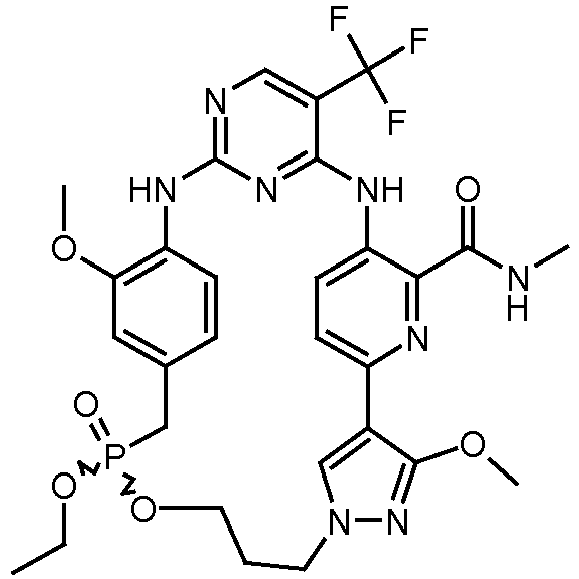
- Prepared analogously to Example 3 using ethyl hydrogen (4-{[4-({6-[1-(3-hydroxypropyl)-3-methoxy-1H-pyrazol-4-yl]-2-(methylcarbamoyl)pyridin-3-yl}amino)-5-(trifluoromethyl)pyrimidin-2-yl]amino}-3-methoxybenzyl)phosphonate (Compound 48A, 132 mg, 0.189 mmol) to afford 22.2 mg of racemic Example 48 (17%). 1H NMR (400 MHz,CD3OD) δ 8.39 (s, 1H), 8.28 (br. s., 1H), 7.79-7.89 (m, 2H), 7.35 (d, J = 8.1 Hz, 1H), 6.80 (t, J = 1.9 Hz, 1H), 6.36 (td, J = 2.3, 8.3 Hz, 1H), 4.26 (t, J = 5.8 Hz, 2H), 4.07 (s, 3H), 3.90-4.02 (m, 2H), 3.80-3.89 (m, 5H), 3.11-3.23 (m, 2H), 2.81 (s, 3H), 2.21-2.30 (m, 2H), 1.16 (t, J = 7.1 Hz, 3H). MS (ESI): m/z = 677.47 [M+H]+. UPLC: tR = 1.24 min (UPLC-TOF: polar_2 min).
- Prepared analogously to Compound 3A using diethyl (4-{[4-({6-[1-(3-hydroxypropyl)-3-methoxy-1H-pyrazol-4-yl]-2-(methylcarbamoyl)pyridin-3-yl}amino)-5-(trifluoromethyl)pyrimidin-2-yl]amino}-3-methoxybenzyl)phosphonate (Compound 48B, 286 mg, 0.395 mmol) affording 132 mg of the title compound (48%). 1H NMR (400 MHz,CD3OD) δ 8.86 (br. s., 1H), 8.29 (br. s., 2H), 7.63-7.77 (m, 2H), 7.12 (s, 1 H), 6.88 (d, J = 8.1 Hz, 1 H), 4.14 (t, J = 6.7 Hz, 2H), 4.07 (s, 3H), 3.80-3.90 (m, 5H), 3.59 (t, J = 6.1 Hz, 2H), 2.99-3.08 (m, 2H), 2.96 (s, 3H), 2.07 (quin, J = 6.4 Hz, 2H), 1.17 (t, J = 7.1 Hz, 3H). MS (ESI): m/z = 695.56 [M+H]+. UPLC: tR = 1.15 min (UPLC-TOF: polar_2 min).
- Prepared analogously to Compound 1B using diethyl (4-{[4-chloro-5-(trifluoromethyl)pyrimidin-2-yl]amino}-3-methoxybenzyl)phosphonate (Compound 1E, 251 mg, 0.553 mmol) and 3-amino-6-[1-(3-hydroxypropyl)- 3-methoxy-1H-pyrazol-4-yl]- N-methylpyridine-2-carboxamide (Compound 48C, 177 mg, 0.580 mmol) to afford 139 mg of the title compound (35%). 1H NMR (400 MHz, CD3OD) δ 8.90 (br. s., 1 H), 8.33 (s, 2H), 7.85 (d, J = 8.1 Hz, 1H), 7.79 (d, J = 8.6 Hz, 1H), 7.02-7.07 (m, 1H), 6.90 (td, J = 2.4, 8.1 Hz, 1H), 4.15 (t, J = 6.7 Hz, 2H), 4.00-4.10 (m, 7H), 3.90 (s, 3H), 3.59 (t, J = 6.2 Hz, 2H), 3.26 (s, 2H), 2.98 (s, 3H), 2.08 (quin, J = 6.5 Hz, 2H), 1.20-1.27 (m, 6H). MS (ESI): m/z = 723.42 [M+H]+. UPLC: tR = 1.31 min (UPLC-TOF: polar_2 min).
- Prepared analogously to Compound 3C using 3-amino-N-methyl-6-(4,4,5,5-tetramethyl-1,3,2-dioxaborolan-2-yl)pyridine-2-carboxamide (Compound 48D, 500 mg, 2 mmol) and 3-(4-iodo-3-methoxy-pyrazol-1-yl)-propan-1-ol (Compound 48E, 600 mg, 2.18 mmol) to afford 177 mg of the title compound (30%). 1H NMR (400 MHz, CD3OD) δ 8.13 (s, 1 H), 7.67 (d, J = 8.8 Hz, 1H), 7.11 (d, J = 8.8 Hz, 1H), 4.11 (t, J = 6.8 Hz, 2H), 3.98 (s, 3H), 3.57 (t, J = 6.2 Hz, 2H), 2.93 (s, 3H), 2.05 (t, J = 6.4 Hz, 2H). MS (ESI): m/z = 306.24 [M+H]+. UPLC: tR = 0.75 min (UPLC-TOF: polar_2 min).
- A solution of 3-amino-6-bromo-N-methylpyridine-2-carboxamide (Compound 6D, 1.15 g, 5.00 mmol), bis(pinacolato)diboron (1.27 g, 5.00 mmol), AcOK (1.47 g, 15.0 mmol), tricyclohexylphosphine (0.105 g, 0.375 mmol) and tris(dibenzylideneacetone)dipalladium (0.229 g, 0.250 mmol) in 1,4-dioxane (30 mL) was evacuated and refilled with argon (3x), then heated at 90 °C for 3 h. The mixture was cooled to rt, then diluted with EtOAc (50 mL) and water (10 mL). The insoluble material was filtered off through a pad of celite. The organic phase was washed with brine (20 mL), and dried over anhydrous sodium sulfate. The crude product was crystallized with EtOAc, affording the desired boronate as a yellow solid (0.72 g, 52% yield). 1H NMR (400 MHz, CDCl3): δ 8.37 (br s, 1 H), 7.67 (d, J = 8.3 Hz, 1 H), 6.94 (d, J = 8.3 Hz, 1 H), 6.40 (br s, 2H), 2.99 (d, J = 5.0 Hz, 3H), 1.37 (s, 12H). MS (ESI): m/z 195.86 [M+H]+ for the corresponding boronic acid. HPLC: t R = 0.63 min (ZQ3: polar_5 min).
- A solution of 4-iodo-3(5)-methoxypyrazole (Compound 48F, 2 g, 8.92 mmol) in DMF (5.0 mL) was cooled to 0 °C and NaH (386 mg) was added. After 45 minutes 3-bromopropanol (1.24 g, 8.92 mmol) was added. The reaction mixture was stirred at 0 °C for 1.5 h and then at RT for 1 h. It was then poured into water (30 mL) and extracted with EtOAc (3 x 20mL). The combined organic layers were dried over Na2SO4, filtered, concentrated and purified by column chromatography (SiO2, ethyl acetate/hexanes, 1:4) to yield 1.4 g (56 %) of the desired product. 1H NMR (300 MHz, CDCl3) δ 7.24 (s, 1 H), 4.12 (t, J = 6.3 Hz, 2H), 3.92 (s, 3H), 3.64 (q, J = 5.7 Hz, 2H), 2.63 (t, J = 6 Hz, 1 H), 1.95-2.03 (m, 2H).
- A solution of 3-methoxy-1H-pyrazole (Compound 48G, 1.6 g, 16.32 mmol) in DMF (25 mL) was cooled to -30 °C and charged with NIS (3.67 g, 16.31 mmol). The reaction mixture was stirred at -30 °C for 1.5 h, and then H2O (30 mL) and EtOAc (40 mL) were added at -30 °C. Organic layer was separated and the aqueous layer was re-extracted with EtOAc (3 x 20 mL) and the combined organic fractions were washed with H2O, 1 M aqueous Na2S2O3, followed by brine, dried over Na2SO4, filtered and concentrated in vacuo to afford 2.1 g (58 %) of the title compound as a light yellow solid. This material was taken on to the next step without further purification. 1H NMR (300 MHz, CDCl3) δ 7.41 (s, 1H), 3.96 (s, 3H).
- A solution of 1-acetyl-1,2-dihydro-3H-pyrazol-3-one (Molbank, 2006 pp M464/1-M464/3, 3.0 g, 23.8 mmol), potassium carbonate (3.28 g, 23.8 mmol) in 2-butanone (72 mL) was charged with dimethyl sulfate (2.48 mL, 26.2 mmol) and heated to reflux for 90 min. The reaction mixture was cooled to rt, filtered and concentrated in vacuo to afford a dark yellow oil. The crude oil was taken up in 10 M aqueous NaOH (1.1 mL) and 80 mL of a 1:1 mixture of THF/MeOH and stirred at rt for 30 min and neutralized with 1 N HCl. The reaction mixture was concentrated in vacuo and partitioned between EtOAc and brine (150 mL). The organic layer was dried over Na2SO4, filtered and concentrated in vacuo to afford 1.7 g (73 %) of the title compound as an orange oil. 1H NMR (300 MHz, CDCl3) δ 7.36 (d, J = 2.7 Hz, 1H), 5.74 (d, J = 2.4 Hz, 1 H), 3.91 (s, 3H).

- Prepared analogously to Example 3 using ethyl hydrogen (4-{[4-({6-[3-chloro-1-(3-hydroxypropyl)-1H-pyrazol-4-yl]-2-(methylcarbamoyl)pyridin-3-yl}amino)-5-(trifluoromethyl)pyrimidin-2-yl]amino}-3-methoxybenzyl)phosphonate (Compound 49A, 445.1 mg, 0.6368 mmol) to afford 118 mg of racemic Example 49 (27%). 1H NMR (400 MHz, CD3OD) δ 8.49 (s, 1 H), 8.34 (s, 1 H), 8.12 (d, J = 8.6 Hz, 1 H), 7.85 (d, J = 8.6 Hz, 1 H), 7.46 (d, J = 8.3 Hz, 1 H), 6.88 (s, 1 H), 6.55 (d, J = 8.3 Hz, 1 H), 4.36-4.44 (m, 2H), 3.70-3.95 (m, 7H), 3.25 (d, J = 6.6 Hz, 2H), 2.92 (s, 3H), 2.22-2.30 (m, 2H), 1.05 (t, J = 7.1 Hz, 3H). MS (ESI): m/z = 681.43/683.36 [M+H]+. UPLC: tR = 1.32 min (UPLC-TOF: polar_2 min).
- Prepared analogously to Compound 3A using diethyl (4-{[4-({6-[3-chloro-1-(3-hydroxypropyl)-1H-pyrazol-4-yl]-2-(methylcarbamoyl)pyridin-3-yl}amino)-5-(trifluoromethyl)pyrimidin-2-yl]amino}-3-methoxybenzyl)phosphonate (Compound 49B, 480 mg, 0.661 mmol) to afford 445 mg of the desired product (96%). 1H NMR (400 MHz, CD3OD) δ 8.93-9.09 (m, 1 H), 8.59 (s, 1 H), 8.32 (s, 1 H), 7.88 (d, J = 9.1 Hz, 1 H), 7.62 (d, J = 6.6 Hz, 1 H), 7.12 (s, 1H), 6.93 (d, J = 8.1 Hz, 1H), 4.27 (t, J = 6.8 Hz, 2H), 3.82-3.92 (m, 5H), 3.60 (t, J = 6.1 Hz, 2H), 3.05 (s, 1H), 2.97-3.02 (m, 4H), 2.11 (quin, J = 6.4 Hz, 2H), 1.16 (t, J = 6.9 Hz, 3H). MS (ESI): m/z = 699.54/701.48 [M+H]+. UPLC: tR = 1.21 min (UPLC-TOF: polar_2 min). Compound 49B: diethyl (4-{[4-({6-[3-chloro-1-(3-hydroxypropyl)-1H-pyrazol-4-yl]-2-(methylcarbamoyl)pyridin-3-yl}amino)-5-(trifluoromethyl)pyrimidin-2-yl]amino}-3-methoxybenzyl)phosphonate
- Prepared analogously to Compound 1B using 3-amino-6-[3-chloro-1-(3-hydroxypropyl)-1H-pyrazol-4-yl]-N-methylpyridine-2-carboxamide (Compound 49C, 365 mg, 1.18 mmol) to afford 480 mg of the title compound (59%). 1H NMR (400 MHz, CD3OD) δ 9.06 (br. s., 1 H), 8.51 (s, 1 H), 8.35 (s, 1 H), 7.89 (d, J = 9.1 Hz, 1 H), 7.82 (d, J = 8.1 Hz, 1 H), 7.04 (t, J = 2.0 Hz, 1 H), 6.91 (td, J = 2.3, 8.1 Hz, 1 H), 4.26 (t, J = 6.9 Hz, 2H), 4.00-4.11 (m, 4H), 3.89 (s, 3H), 3.59 (t, J = 6.1 Hz, 2H), 3.35 (s, 1 H), 3.23 (s, 1 H), 2.98 (s, 3H), 2.11 (quin, J = 6.5 Hz, 2H), 1.22-1.29 (m, 6H). MS (ESI): m/z = 727.38/729.32 [M+H]+. UPLC: tR = 1.35 min (UPLC-TOF: polar_2 min).
- Prepared analogously to Compound 3C using 3-amino-N-methyl-6-(4,4,5,5-tetramethyl-1,3,2-dioxaborolan-2-yl)pyridine-2-carboxamide (Compound 48D, 631.2 mg, 2.28 mmol) and 3-(4-bromo-3-chloro-pyrazol-1-yl)-propan-1-ol (Compound 49E, 600 mg, 2.51 mmol) to afford 365 mg of the title compound 52%. 1H NMR (400 MHz, CD3OD) δ 8.27 (s, 1 H), 7.73 (d, J = 8.8 Hz, 1H), 7.18 (d, J = 8.8 Hz, 1H), 4.23 (t, J = 6.9 Hz, 2H), 3.56 (t, J = 6.1 Hz, 2H), 2.94 (s, 3H), 2.07 (t, J = 6.4 Hz, 2H). MS (ESI): m/z = 310.20/312.23 [M+H]+. UPLC: tR = min (UPLC-TOF: polar_2 min).
- Sodium hydride (60% dispersion in oil, 0.57 g, 14.3 mmol) was added portionwise to a solution of 3-chloro-4-bromopyrazole (Chem. Ber, 1970, 103, 1942 - 1948, 2 g, 11 mmol) in DMF (5mL). After 30 min, the mixture was cooled to 0 °C and treated with 3-bromopropanol (1.3 mL,14.3 mmol) via dropwise addition. After stirring an additional 2 hrs at rt., the reaction mixture was concentrated in vacuo. The residue was purified by column chromatography (SiO2, 50% ethyl acetate in hexanes) to isolate Compound 49D as the nonpolar isomer (0.5 g, 18%) and Compound 49E as the polar isomer (1.6 g, 60%). 1H NMR (400 MHz, CDCl3) δ: 7.39 (s, 1H), 4.18 (t, J=6.8 Hz, 2H), 4.08 (q, J=6.8 Hz, 2H), 3.60 (t, J=6.8 Hz, 2H). MS (ESI): m/z = 239.01/241.08 [M+H]+. UPLC: tR = 0.92 min (UPLC-TOF: polar_2 min).

- Prepared analogously to Example 3 using ethyl hydrogen (4-{[4-({6-[1-(4-hydroxy-2-methylbutan-2-yl)-1H-pyrazol-4-yl]-2-(methylcarbamoyl)pyridin-3-yl}amino)-5-(trifluoromethyl)pyrimidin-2-yl]amino}-3-methoxybenzyl)phosphonate (Compound 50A, 88.6 mg, 0.128 mmol) to afford 17.5 mg of racemic Example 50 (20%).1H NMR (400 MHz, CD3OD) δ 8.77 (s, 1 H), 8.36 (s, 2H), 8.12 (d, J = 8.6 Hz, 1 H), 7.84 (d, J = 8.6 Hz, 1 H), 7.47-7.52 (m, 1 H), 6.86 (s, 1 H), 6.50-6.56 (m, 1 H), 3.83 (s, 7H), 3.16-3.26 (m, 2H), 2.94 (s, 3H), 2.27-2.46 (m, 2H), 1.77 (d, J = 1.0 Hz, 6H), 1.10 (t, J = 6.9 Hz, 3H). MS (ESI): m/z = 675.53 [M+H]+. UPLC: tR = 1.32 min (UPLC-TOF: polar_2 min).
- Prepared analogously to Compound 3A using diethyl (4-{[4-({6-[1-(4-hydroxy-2-methylbutan-2-yl)-1H-pyrazol-4-yl]-2-(methylcarbamoyl)pyridin-3-yl}amino)-5-(trifluoromethyl)pyrimidin-2-yl]amino}-3-methoxybenzyl)phosphonate (Compound 50B, 117 mg, 0.163 mmol) to afford 88.6 mg of the title compound (79%). 1H NMR (400 MHz, CD3OD) δ 8.76 (s, 1 H), 8.35 (s, 1 H), 8.11 (d, J = 8.6 Hz, 1 H), 7.83 (d, J = 8.6 Hz, 1 H), 7.50 (d, J = 8.1 Hz, 1 H), 6.85 (s, 1H), 6.52 (d, J = 8.1 Hz, 2H), 3.72-3.98 (m, 7H), 3.15-3.25 (m, 2H), 2.94 (s, 3H), 2.30-2.43 (m, 2H), 1.77 (s, 6H), 1.11 (t, J = 7.1 Hz, 3H). MS (ESI): m/z = 693.61 [M+H]+. UPLC: tR = 1.18 min (UPLC-TOF: polar_2 min).
- Prepared analogously to Compound 1B using diethyl (4-{[4-chloro-5-(trifluoromethyl)pyrimidin-2-yl]amino}-3-methoxybenzyl)phosphonate (Compound 1E, 304 mg, 0.671 mmol) and 2-amino-5-[1-(4-hydroxy-2-methylbutan-2-yl)-1H-pyrazol-4-yl]-N-methylbenzamide (Compound 50C, 213.1 mg, 0.705 mmol) to afford 117 mg of the title compound (24%). 1H NMR (400 MHz, CD3OD) δ 9.01 (d, J = 8.8 Hz, 1 H), 8.62 (s, 1 H), 8.34 (s, 1 H), 8.27 (s, 1 H), 7.70-7.76 (m, 2H), 7.07 (s, 1 H), 6.96 (dd, J = 2.3, 10.6 Hz, 1 H), 4.01-4.12 (m, 5H), 3.88 (s, 3H), 3.42 (t, J = 7.1 Hz, 2H), 2.99 (s, 3H), 2.14-2.24 (m, 3H), 1.70 (s, 6H), 1.21-1.30 (m, 6H). MS (ESI): m/z = 721.49 [M+H]+. UPLC: tR = 1.33 min (UPLC-TOF: polar_2 min).
- Prepared analogously to Compound 3C using 3-amino-N-methyl-6-(4,4,5,5-tetramethyl-1,3,2-dioxaborolan-2-yl)pyridine-2-carboxamide (Compound 48D, 649 mg, 2.34 mmol) and 3-(4-bromo-pyrazol-1-yl)-3-methyl-butan-1-ol (Compound 50D, 600 mg, 2.57 mmol) to afford 304 mg of the title compound (43%). 1H NMR (400 MHz, CD3OD) δ 8.34 (d, J = 0.5 Hz, 1 H), 8.01 (s, 1 H), 7.51 (d, J = 8.6 Hz, 1 H), 7.15 (d, J = 8.6 Hz, 1 H), 3.40 (t, J = 7.2 Hz, 2H), 2.94 (s, 3H), 2.17 (t, J = 7.3 Hz, 2H), 1.66 (s, 6H). MS (ESI): m/z = 304.26 [M+H]+. UPLC: tR = 0.77 min (UPLC-TOF: polar_2 min).
- Diisobutylaluminium hydride (1 M in toluene, 10.43 mL) was added dropwise to a solution of ethyl 3-(4-bromo-1H-pyrazol-1-yl)-3-methylbutanoate (Compound 50E, 1.3 g, 4.74 mmol), in THF (30 mL) at -78 °C and allowed to stir for 3 hours eventually warming to -10 °C. The reaction mixture was quenched with an aqueous solution of K/Na tartrate tetrahydrate (10 mL) and allowed to stir for 2 hours. The mixture was extracted with ethyl acetate (3 x 15 mL) and the combined organic extracts were washed with water, followed by brine, dried over sodium sulfate, filtered and concentrated to afford 1.0 g of the desired product (91 %). 1H NMR (300 MHz, CDCl3) δ 7.51 (s, 1 H), 7.46 (s, 1 H), 3.54-3.58 (q, J = 4.5 Hz, 2H), 2.28 (t, J = 4.2 Hz, 1 H), 2.09 (t, J = 4.5 Hz, 2H), 1.58 (s, 6H).
- A solution of 4-bromo-1H-pyrazole (3.42 g, 23.43) and 3-methyl-2-butenoic acid ethyl ester (1 g, 7.81 mmol) in DMF (50 mL) was treated with cesium carbonate (10.1 g, 31.07) and allowed to stir for 3 hours at room temperature. The reaction mixture was diluted with water (30 mL) and extracted with EtOAc (3 x 30 mL). The combined extracts were dried over sodium sulfate and concentrated to afford the desired product, 1.1 g (51 %) yield. 1H NMR (300 MHz, CDCl3) δ 7.51 (s, 1H), 7.45 (s, 1H), 3.98-4.05 (m, 2H), 2.82 (s, 2H), 1.62 (s, 6H), 1.18-1.10 (t, 3H).

- Prepared analogously to Example 3 using ethyl hydrogen (4-{[4-({6-[5-chloro-1-(3-hydroxypropyl)-1H-pyrazol-4-yl]-2-(methylcarbamoyl)pyridin-3-yl}amino)-5-(trifluoromethyl)pyrimidin-2-yl]amino}-3-methoxybenzyl)phosphonate (Compound 51A, 129 mg, 0.184 mmol) to afford 2.5 mg of the title compound (2%). 1H NMR (400 MHz, CD3OD) δ 8.55 (s, 1 H), 8.33 (br. s., 1 H), 8.16-8.22 (m, 1 H), 8.07-8.13 (m, 1 H), 7.39 (d, J = 8.1 Hz, 1 H), 6.81 (s, 1H), 6.56 (d, J = 7.1 Hz, 1H), 4.39-4.64 (m, 2H), 3.59-3.87 (m, 7H), 3.11-3.23 (m, 2H), 2.94 (s, 3H), 2.35 (t, J = 5.6 Hz, 2H), 0.87 (br. s., 3H). MS (ESI): m/z = 681.46/683.47 [M+H]+. UPLC: tR = 1.31 min (UPLC-TOF: polar_2 min).
- Prepared analogously to Compound 3A using diethyl (4-{[4-({6-[5-chloro-1-(3-hydroxypropyl)-1H-pyrazol-4-yl]-2-(methylcarbamoyl)pyridin-3-yl}amino)-5-(trifluoromethyl)pyrimidin-2-yl]amino}-3-methoxybenzyl)phosphonate (Compound 51 B, 161 mg, 0.222 mmol) to afford 129 mg of the title compound (83%). 1H NMR (400 MHz,CD3OD) δ 9.05 (br. s., 1 H), 8.29-8.35 (m, 2H), 7.81 (d, J = 8.8 Hz, 1 H), 7.69 (d, J = 7.3 Hz, 1 H), 7.12 (s, 1 H), 6.90 (d, J = 8.1 Hz, 1 H), 4.35 (t, J = 7.1 Hz, 2H), 3.79-3.92 (m, 5H), 3.59-3.65 (m, 2H), 3.03 (s, 1H), 2.95 (s, 4H), 2.09 (quin, J = 6.6 Hz, 2H), 1.16 (t, J = 6.9 Hz, 3H). MS (ESI): m/z = 699.54/701.60 [M+H]+. UPLC: tR = 1.21 min (UPLC-TOF: polar_2 min).
- Prepared analogously to Compound 1B using diethyl (4-{[4-chloro-5-(trifluoromethyl)pyrimidin-2-yl]amino}-3-methoxybenzyl)phosphonate (Compound 1 E, 304 mg, 0.671 mmol) and 3-amino-6-[5-chloro-1-(3-hydroxypropyl)-1H-pyrazol-4-yl]-N-methylpyridine-2-carboxamide (Compound 51C, 218 mg, 0.705 mmol) to afford 161 mg of the title compound (33%). 1H NMR (400 MHz, CD3OD) δ 9.09 (br. s., 1H), 8.31-8.39 (m, 2H), 7.76-7.91 (m, 2H), 7.04 (s, 1 H), 6.91 (td, J = 2.2, 8.1 Hz, 1 H), 4.36 (t, J = 7.2 Hz, 2H), 4.06 (quin, J = 7.3 Hz, 4H), 3.89 (s, 3H), 3.62 (t, J = 6.1 Hz, 2H), 3.25 (s, 1H), 2.99 (s, 3H), 2.09 (quin, J = 6.6 Hz, 2H), 1.21-1.29 (m, 7H). MS (ESI): m/z = 727.38/729.32 [M+H]+. UPLC: tR = 1.34 min (UPLC-TOF: polar_2 min).
- Prepared analogously to Compound 3C using 3-amino-N-methyl-6-(4,4,5,5-tetramethyl-1,3,2-dioxaborolan-2-yl)pyridine-2-carboxamide (Compound 48D, 284 mg, 1.03 mmol) and 3-(4-bromo-5-chloro-1H-pyrazol-1-yl)propan-1-ol (Compound 49D, 270 mg, 1.1 mmol) to afford 151 mg of the title compound (48%). 1H NMR (400 MHz, CD3OD) δ 8.12 (s, 1H), 7.67 (d, J = 8.6 Hz, 1 H), 7.20 (d, J = 8.6 Hz, 1 H), 4.32 (t, J = 7.1 Hz, 2H), 3.60 (t, J = 6.1 Hz, 2H), 2.94 (s, 3H), 2.06 (quin, J = 6.6 Hz, 2H). MS (ESI): m/z = 310.20/312.18 [M+H]+. UPLC: tR = 0.77 min (UPLC-TOF: polar_2 min).

- Prepared analogously to Example 3 using ethyl hydrogen (4-{[4-({6-[3-cyano-1-(3-hydroxypropyl)-1H-pyrazol-4-yl]-2-(methylcarbamoyl)pyridin-3-yl}amino)-5-(trifluoromethyl)pyrimidin-2-yl]amino}-3-methoxybenzyl)phosphonate (Compound 52A, 280 mg, 0.405 mmol) to afford 21.4 mg of the title compound (8%). 1H NMR (400 MHz, CD3OD) δ 8.69 (s, 1 H), 8.38 (br. s., 1 H), 8.30 (d, J = 8.8 Hz, 1 H), 7.84 (d, J = 8.6 Hz, 1 H), 7.52 (d, J = 8.1 Hz, 1H), 6.93 (s, 1H), 6.67 (d, J = 8.3 Hz, 1H), 4.55 (br. s., 2H), 3.86 (s, 3H), 3.74-3.85 (m, 2H), 3.54-3.71 (m, 2H), 3.37 (d, J = 9.1 Hz, 1 H), 3.15 (d, J = 3.3 Hz, 1 H), 2.97 (s, 3H), 2.32 (t, J = 5.1 Hz, 2H), 0.91 (t, J = 7.1 Hz, 3H). MS (ESI): m/z = 672.15 [M+H]+. UPLC: tR = 1.00 min (UPLC-TOF: polar_2 min).
- Prepared analogously to Compound 3A using diethyl (4-{[4-({6-[3-cyano-1-(3-hydroxypropyl)-1H-pyrazol-4-yl]-2-(methylcarbamoyl)pyridin-3-yl}amino)-5-(trifluoromethyl)pyrimidin-2-yl]amino}-3-methoxybenzyl)phosphonate (Compound 52B, 259 mg, 0.361 mmol) to afford 250 mg of the title compound (100%). 1H NMR (400 MHz, CD3OD) δ 9.09 (d, J = 7.8 Hz, 1 H), 8.88 (br. s., 1 H), 8.30 (s, 1 H), 7.86 (d, J = 9.1 Hz, 1 H), 7.51 (br. s., 1 H), 7.11 (s, 1 H), 6.97 (d, J = 7.8 Hz, 1 H), 4.39 (t, J = 6.8 Hz, 2H), 3.83-3.94 (m, 5H), 3.62 (t, J = 5.9 Hz, 2H), 3.00-3.08 (m, 2H), 2.97 (s, 3H), 2.10-2.20 (m, 2H), 1.14 (t, J = 7.1 Hz, 3H). MS (ESI): m/z = 690.49 [M+H]+. UPLC: tR = 1.26 min (UPLC-TOF: polar_2 min).
- Prepared analogously to Compound 1B using diethyl (4-{[4-chloro-5-(trifluoromethyl)pyrimidin-2-yl]amino}-3-methoxybenzyl)phosphonate (Compound 1 E, 236 mg, 0.520 mmol) and 3-amino-6-[3-cyano-1-(3-hydroxypropyl)-1H-pyrazol-4-yl]-N-methylpyridine-2-carboxamide (Compound 52C, 164 mg, 0.546 mmol) to afford 259 mg of the title compound (69%). 1H NMR (400 MHz, CD3OD) δ 9.17 (br. s., 1H), 8.47 (s, 1H), 8.38 (s, 1H), 7.91 (d, J = 9.1 Hz, 1 H), 7.68 (br. s., 1 H), 7.08 (s, 1 H), 6.98 (d, J = 7.8 Hz, 1 H), 4.52 (t, J = 6.9 Hz, 2H), 4.08 (quin, J = 7.3 Hz, 4H), 3.88 (s, 2H), 3.61 (t, J = 6.1 Hz, 2H), 3.33-3.42 (m, 2H), 2.99 (s, 3H), 2.17 (quin, J = 6.5 Hz, 2H), 1.26 (t, J = 7.1 Hz, 7H). MS (ESI): m/z = 718.47 [M+H]+. UPLC: tR = 1.39 min (UPLC-TOF: polar_2 min).
- Prepared analogously to Compound 3C using 3-amino-N-methyl-6-(4,4,5,5-tetramethyl-1,3,2-dioxaborolan-2-yl)pyridine-2-carboxamide (Compound 48D, 657 mg, 2.37 mmol) and 4-bromo-1-(3-hydroxypropyl)-1H-pyrazole-3-carbonitrile (Compound 52E, 600 mg, 2.61 mmol) to afford 164 mg of the title compound (23%). 1H NMR (400 MHz, CD3OD) δ 8.29 (s, 1 H), 7.57 (d, J = 8.6 Hz, 1H), 7.21 (d, J = 8.6 Hz, 1H), 4.35 (t, J = 6.8 Hz, 2H), 3.57 (t, J = 6.1 Hz, 2H), 2.94 (s, 3H), 2.11 (t, J = 6.1 Hz, 2H). MS (ESI): m/z = 301.24 [M+H]+. UPLC: tR = 0.79 min (UPLC-TOF: polar_2 min).
- Prepared analogously to 38E using 4-bromo-1H-pyrazole-3-carbonitrile (2.00 g, 11.6 mmol) to afford 434 mg and 2.21 g of the title compounds for Compound 52D and 52E (16% and 83%) respectively. Compound 52E: 1H NMR (400 MHz, CD3OD) δ 7.71 (s, 1H), 4.44 (t, J = 6.9 Hz, 2H), 3.55 (t, J = 6.1 Hz, 2H), 2.02-2.20 (m, 2H). Compound 52E: 1H NMR (400 MHz, CD3OD) δ 7.98 (s, 1 H), 4.32 (t, J = 6.9 Hz, 2H), 3.46-3.59 (m, 2H), 2.05 (quin, J = 6.4 Hz, 2H).

- Prepared analogously to Example 3 using ethyl hydrogen (4-{[4-({6-[5-cyano-1-(3-hydroxypropyl)-1H-pyrazol-4-yl]-2-(methylcarbamoyl)pyridin-3-yl}amino)-5-(trifluoromethyl)pyrimidin-2-yl]amino}-3-methoxybenzyl)phosphonate (Compound 53A, 146 mg, 0.212 mmol) to afford 3.80 mg of the title compound (3%). 1H NMR (400 MHz, DMSO-d6 ) δ 12.42-12.53 (m, 1H), 9.21-9.30 (m, 1H), 8.85-8.95 (m, 1H), 8.39-8.45 (m, 1H), 8.36 (s, 1H), 7.65-7.72 (m, 1H), 7.31-7.40 (m, 1H), 6.98-7.09 (m, 2H), 4.17-4.25 (m, 2H), 4.02-4.14 (m, 4H), 3.71 (s, 3H), 3.37-3.46 (m, 2H), 2.66 (s, 3H), 1.20-1.28 (m, 6H). MS (ESI): m/z = 672.65 [M+H]+. UPLC: tR = 1.61 min (UPLC-TOF: polar_2 min).
- Prepared analogously to Compound 3A using diethyl (4-{[4-({6-[5-cyano-1-(3-hydroxypropyl)-1H-pyrazol-4-yl]-2-(methylcarbamoyl)pyridin-3-yl}amino)-5-(trifluoromethyl)pyrimidin-2-yl]amino}-3-methoxybenzyl)phosphonate (Compound 53B, 191 mg, 0.266 mmol) to afford 146 mg of the title compound (80%). 1H NMR (400 MHz, CD3OD) δ 9.15 (br. s., 1H), 8.47 (br. s., 1H), 8.33 (s, 1H), 7.89 (d, J = 9.1 Hz, 1H), 7.61 (br. s., 1H), 7.12 (s, 1 H), 6.95 (d, J = 8.1 Hz, 1 H), 4.49 (t, J = 7.1 Hz, 2H), 3.83-3.93 (m, 5H), 3.60 (t, J = 6.2 Hz, 2H), 2.99-3.07 (m, 2H), 2.97 (s, 3H), 2.16 (quin, J = 6.5 Hz, 2H), 1.16 (t, J = 7.1 Hz, 3H). MS (ESI): m/z = 690.62 [M+H]+. UPLC: tR = 1.26 min (UPLC-TOF: polar_2 min).
- Prepared analogously to Compound 1B using diethyl (4-{[4-chloro-5-(trifluoromethyl)pyrimidin-2-yl]amino}-3-methoxybenzyl)phosphonate (Compound 1 E, 218 mg, 0.480 mmol) and 3-amino-6-[5-cyano-1-(3-hydroxypropyl)-1H-pyrazol-4-yl]-N-methylpyridine-2-carboxamide (Compound 53C, 151 mg, 0.504 mmol) to afford 191 mg of the title compound (55%). 1H NMR (400 MHz, CD3OD) δ 9.19 (br. s., 1H), 8.47 (s, 1H), 8.38 (s, 1H), 7.91 (d, J = 8.8 Hz, 1 H), 7.69 (br. s., 1 H), 7.08 (s, 1 H), 6.98 (d, J = 7.8 Hz, 1 H), 4.52 (t, J = 6.9 Hz, 2H), 4.01-4.14 (m, 3H), 3.88 (s, 2H), 3.61 (t, J = 6.1 Hz, 2H), 3.36 (s, 2H), 2.99 (s, 3H), 2.17 (quin, J = 6.5 Hz, 2H), 1.18-1.31 (m, 8H). MS (ESI): m/z = 718.56 [M+H]+. UPLC: tR = 1.36 min (UPLC-TOF: polar_2 min).
- Prepared analogously to 3C using 3-amino-N-methyl-6-(4,4,5,5-tetramethyl-1,3,2-dioxaborolan-2-yl)pyridine-2-carboxamide (Compound 48D, 475.3 mg, 1.715 mmol) and 4-bromo-1-(3-hydroxypropyl)-1H-pyrazole-5-carbonitrile (Compound 52D, 434 mg, 1.89 mmol) to afford 151 mg of the title compound (29%). 1H NMR (400 MHz, CD3OD) δ 8.08 (s, 1 H), 7.63 (d, J = 8.6 Hz, 1H), 7.21 (d, J = 8.8 Hz, 1H), 4.47 (t, J = 7.1 Hz, 2H), 3.60 (t, J = 6.1 Hz, 2H), 2.94 (s, 3H), 2.15 (quin, J = 6.6 Hz, 2H). MS (ESI): m/z = 301.24 [M+H]+. UPLC: tR = 0.79 min (UPLC-TOF: polar_2 min).

- Prepared analogously to Example 44 using racemic ethyl 3-[4-(4,4,5,5-tetramethyl-1,3,2-dioxaborolan-2-yl)-1H-pyrazol-1-yl]propyl (4-{[4-{[6-bromo-2-(methylcarbamoyl)pyridin-3-yl]amino}-5-(trifluoromethyl)pyrimidin-2-yl]amino}-2-chloro-3-methoxybenzyl)phosphonate (Compound 54A, 203 mg, 0.228 mmol) to afford 84.8 mg of Example 54 as a racemic mixture (55%). 1H NMR (400 MHz, CD3OD) δ 8.47 (s, 1 H), 8.35-8.42 (m, 2H), 8.17 (d, J = 8.6 Hz, 1 H), 7.82 (d, J = 8.8 Hz, 1 H), 7.52-7.61 (m, 1 H), 6.85 (dd, J = 2.8, 8.6 Hz, 1 H), 4.42-4.51 (m, 2H), 3.69 (br. s., 7H), 3.43-3.56 (m, 2H), 2.94 (s, 3H), 2.27 (br. s., 2H), 1.03 (t, J = 7.1 Hz, 3H). MS (ESI): m/z = 681.56 [M+H]+. UPLC: tR = 1.36 min (UPLC-TOF: polar_2 min).
- Prepared analogously to Compound 44A using ethyl hydrogen (4-{[4-{[6-bromo-2-(methylcarbamoyl)pyridin-3-yl]amino}-5-(trifluoromethyl)pyrimidin-2-yl]amino}-2-chloro-3-methoxybenzyl)phosphonate (Compound 54B, 200 mg, 0.306 mmol) and 3-[4-(4,4,5,5-tetramethyl-1,3,2-dioxaborolan-2-yl)-1H-pyrazol-1-yl]propan-1-ol (Compound 3E, 81 mg, 0.321 mmol) to afford 203 mg of the title compound as a racemic mixture (75%). MS (ESI): m/z = 887.65/889.64 [M+H]+. UPLC: tR = 1.68 min (UPLC-TOF: polar_2 min).
- Prepared analogously to Compound 38C with diethyl (4-{[4-{[6-bromo-2-(methylcarbamoyl)pyridin-3-yl]amino}-5-(trifluoromethyl)pyrimidin-2-yl]amino}-2-chloro-3-methoxybenzyl)phosphonate (Compound 54C). MS (ESI): m/z 653.03/655.02 [M+H]+. UPLC: t R = 0.98 min (UPLC-TOF: polar_2 min).
- Prepared analogously to Compound 1B with diethyl (2-chloro-4-{[4-chloro-5-(trifluoromethyl)pyrimidin-2-yl]amino}-3-methoxybenzyl)phosphonate (Compound 54D) and compound 6D. MS (ESI): m/z 681.34/683.34 [M+H]+. UPLC: t R = 1.51 min (UPLC-SQD: analytical_2min).
- To a solution of 2,4-dichloro-5-trifluromethylpyrimidine (2.1 g, 9.77 mmol) in a 1: 1 mixture of DCE and t-butanol (20 mL) was added ZinCl2 (1 M, 10 mL) and stirred for half an hour at RT. After cooling at 0°C diethyl 4-amino-2-chloro-3-methoxybenzylphosphonate (3 g, 9.77 mmol) in a 1: 1 mixture of DCE and t-butanol (20 mL) was added followed by N-methylimidazole (800 mg, 9.75 mmol) drop wise while stirring was continued for 24 hrs. The solvents were removed under reduced pressure and the residue was purified by column chromatography (SiO2, ethyl acetate and hexanes (1:1)) to yield the desired compound in 1.5 g (32 %) yield. 1H NMR (300 MHz, CDCl3) δ 8.61 (s, 1H), 8.38 (d, 1H), 8.03 (s, 1H), 4.01-4.18 (q, 4H), 3.98 (s, 3H), 3.29 (d, 2H), 1.24 (t, 6H).
- To a solution of diethyl 2-chloro-3-methoxy-4-nitrobenzylphosphonate (Compound 54F, 1g, 2.96 mmol) in ethanol (15 mL), and iron powder (1.63 g, 29.6 mmol) was added aqueous 2N HCl (5 mL). The reaction mixture was heated to reflux for 1.5 h. The reaction mixture was cooled to RT and saturated solution of Na2CO3 was added until the pH was 9. The reaction mixture was filtered through celite and concentrated to give the residue. It was dissolved in ethyl acetate (25 mL) and washed with water, dried over sodium sulfate, filtered and concentrated to give the required product (89 %, 900 mg). 1H NMR (300 MHz, CDCl3) δ 7.01 (d, 1 H), 6.62 (d, 1 H), 4.00-4.19 (m, 4H), 3.83 (s, 3H), 3.25 (d, 2H), 1.23 (t, 6H).
- To a solution of 1-(bromomethyl)-2-chloro-3-methoxy-4-nitrobenzene (Compound 54G, 900 mg, 3.21 mmol) in toluene (10 mL) was added triethylphosphite (586 mg, 3.53 mmol) and heated to reflux for 24 h. Toluene and triethylphosphite were distilled off under reduced pressure to provide the desired compound, 800 mg (79 %). 1H NMR (300 MHz, CDCl3) δ 7.77 (d, 1 H), 7.35 (d, 1 H), 4.19-4.05 (m, 4H), 4.00 (s, 3H), 3.43 (d, 2H), 1.31 (t, 6H).
- To a solution of (2-Chloro-3-methoxy-4-nitrophenyl)methanol (Compound 54H, 1.1 g, 5.06 mmol) in dichloromethane (10 mL) at 0 °C was added phosphorous tribromide (684 mg, 2.53 mmol). After the addition was over, the reaction mixture was allowed to stir at RT overnight. The reaction mixture was neutralized with NaHCO3, extracted with ethyl acetate (30 mL) and the solvent was removed under reduced pressure to get the compound 900 mg (64 %). 1H NMR (300 MHz, CDCl3) δ 7.72 (d, J = 8.4 Hz, 1 H), 7.34 (d, J = 8.4 Hz, 1 H), 4.58 (s, 2H), 4.04 (s, 3H).
- To a solution of 2-chloro-3-methoxy-4-nitrobenzaldehyde (Compound 54I, 1.6 g, 7.44 mmol) in methanol (25 mL) at 0 °C was added sodium borohydride (330 mg, 8.91 mmol). After stirring for 1.5 h, water (15 mL) was added. The solid obtained was filtered and dried to obtain the desired intermediate (1.1 g, 69 %). 1H NMR (300 MHz, CDCl3) δ 7.78 (d, J = 4.8 Hz, 1H), 7.47 (d, J = 5.1 Hz, 1 H), 4.83 (d, J = 3.6 Hz, 2H), 4.02 (s, 3H), 2.25 (t, J = 3.6 Hz, 1 H).
- Potassium nitrate (4 g, 39.6 mmol) was added slowly to a solution of 2-chloro-3-hydroxybenzaldehyde (6 g, 35.2 mmol) in sulfuric acid (28 mL) at 30-40 °C. The contents of the flasks were heated to 50-60 °C for 10 minutes and then poured onto ice (60 g). The solid obtained was steam distilled to provide the desired compound (1.6 g, 21 %). 1H NMR (300 MHz, CDCl3) δ 10.51 (s, 1 H), 7.82-7.79 (m, 2H), 4.08 (s, 3H).

- Prepared analogously to Example 44 using racemic ethyl (3-{[4-(4,4,5,5-tetramethyl-1,3,2-dioxaborolan-2-yl)-1H-pyrazol-1-yl]methyl}oxetan-3-yl)methyl (4-{[4-{[6-bromo-2-(methylcarbamoyl)pyridin-3-yl]amino}-5-(trifluoromethyl)pyrimidin-2-yl]amino}-2-chloro-3-methoxybenzyl)phosphonate (Compound 55A, 264 mg, 0.284 mmol) to afford 80 mg of Example 55 as a racemic mixture (39%). 1H NMR (400 MHz, CD3OD) δ 8.39 (d, J = 11.6 Hz, 2H), 8.32 (s, 1H), 8.19 (d, J = 8.6 Hz, 1H), 7.82 (d, J = 8.6 Hz, 1H), 7.61 (d, J = 9.1 Hz, 1H), 6.90 (dd, J = 2.9, 8.7 Hz, 1H), 4.71-4.82 (m, 4H), 4.49 (dd, J = 6.7, 16.8 Hz, 2H), 3.75-3.92 (m, 7H), 3.39-3.56 (m, 2H), 2.94 (s, 3H), 1.01 (t, J = 7.1 Hz, 3H). MS (ESI): ): m/z = 723.60/725.57 [M+H]+. UPLC: tR = 1.37 min (UPLC-TOF: polar_2 min).
- Prepared analogously to Compound 44A using ethyl hydrogen (4-{[4-{[6-bromo-2-(methylcarbamoyl)pyridin-3-yl]amino}-5-(trifluoromethyl)pyrimidin-2-yl]amino}-2-chloro-3-methoxybenzyl)phosphonate (Compound 54B, 200 mg, 0.306 mmol) and (3-{[4-(4,4,5,5-tetramethyl-1,3,2-dioxaborolan-2-yl)-1H-pyrazol-1-yl]methyl}oxetan- 3-yl)methanol (Compound 44B, 95 mg, 321 mmol) to afford 264 mg of the title compound as a racemic mixture (93%). MS (ESI): m/z = 929.64/931.71 [M+H]+. UPLC: tR = 1.67 min (UPLC-TOF: polar_2 min).

- Prepared analogously to Compound 44 using ethyl 3-[4-(4,4,5,5-tetramethyl-1,3,2-dioxaborolan-2-yl)-1H-pyrazol-1-yl]propyl (4-{[4-{[6-bromo-2-(methylcarbamoyl)pyridin-3-yl]amino}-5-(trifluoromethyl)pyrimidin-2-yl]amino}-2-chloro-5-methoxybenzyl)phosphonate (Compound 56A, 203 mg, 0.228 mmol) to afford 54.7 mg of the title compound as a racemic mixture (35%). 1H NMR (400 MHz, CD3OD) δ 8.47 (s, 1H), 8.39 (s, 1H), 8.30 (d, J = 0.5 Hz, 1H), 8.12 (d, J = 8.8 Hz, 1H), 7.70 (d, J = 8.8 Hz, 1H), 7.64 (d, J = 1.0 Hz, 1H), 6.96 (d, J = 2.5 Hz, 1H), 4.33-4.45 (m, 2H), 4.00-4.11 (m, 2H), 3.86-3.97 (m, 5H), 3.36-3.50 (m, 2H), 2.95 (s, 3H), 2.26-2.37 (m, 2H), 1.21-1.25 (m, 3H). MS (ESI): m/z = 681.53/683.56 [M+H]+. UPLC: tR = 1.42 min (UPLC-TOF: polar_2 min).
- Prepared analogously to Compound 44A using ethyl hydrogen (4-{[4-{[6-bromo-2-(methylcarbamoyl)pyridin-3-yl]amino}-5-(trifluoromethyl)pyrimidin-2-yl]amino}-2-chloro-5-methoxybenzyl)phosphonate (Compound 56B, 200 mg, 0.306 mmol) and 3-[4-(4,4,5,5-tetramethyl-1,3,2-dioxaborolan-2-yl)-1H-pyrazol-1-yl]propan-1-ol (Compound 3E, 81 mg, 0.321 mmol) to afford 181 mg of the title compound as a racemic mixture (67%). MS (ESI): m/z = 887.59/889.59 [M+H]+. UPLC: tR = 1.74 min (UPLC-TOF: polar_2 min).
- Prepared analogously to Compound 38C replacing Compound 38B with diethyl (4-{[4-{[6-bromo-2-(methylcarbamoyl)pyridin-3-yl]amino}-5-(trifluoromethyl)pyrimidin-2-yl]amino}-2-chloro-5-methoxybenzyl)phosphonate (Compound 56C). 1H NMR (400 MHz, DMSO-d6) δ = 12.39 (br. s., 1H), 9.18 (br. s., 1H), 8.91-8.99 (m, 1H), 8.49 (s, 1H), 7.71 (d, J = 9.1 Hz, 1H), 7.64 (br. s., 1H), 7.16 (d, J = 2.0 Hz, 1H), 3.95 (quin, J = 7.3 Hz, 2H), 3.77 (s, 3H), 3.22-3.27 (m, 2H), 2.81 (d, J = 5.1 Hz, 3H), 1.18 (t, J = 6.9 Hz, 3H). MS (ESI): m/z 653.02/655.02 [M+H]+. UPLC: t R = 0.89 min (polar_2 min).
- Prepared analogously to Compound 1B replacing Compound 1C with diethyl (4-{[4-{[6-bromo-2-(methylcarbamoyl)pyridin-3-yl]amino}-5-(trifluoromethyl)pyrimidin-2-yl]amino}-2-chloro-5-methoxybenzyl)phosphonate (Compound 56D). MS (ESI): m/z 681.02/683.27 [M+H]+. UPLC: t R = 1.56 min (analytical_2 min).
- A solution of 2,4-dichloro-5-trifluoromethyl-pyrimidine (2.8 g, 13 mmol) in a mixture dichloroethane and t-butanol (1:1, 10 mL) was treated with ZnCl2 (1M solution in ether, 13 mL) and stirred for half an hour at RT. The reaction mixture was cooled to 0 °C and a solution of (4-amino-2-chloro-5-methoxy-benzyl)-phosphonic acid diethylester (Compound 56E, 4 g, 13 mmol) in dichloroethane and t-butanol (1:1, 10 mL) followed by N-methylimidazole were added drop wise while stirring was continued for 24 hrs. The solvents were evaporated under reduced pressure and the residue was purified by column chromatography (SiO2, 1% methanol in dichloromethane) to give the mixture of isomers (3 g containing 20% impurity of the other isomer). Repeated recrystallizations from ethyl acetate gave pure required isomer (1.15 g) as white solid. 1H NMR (400 MHz, CDCl3) δ 8.60 (s, 1H), 8.52 (s, 1H), 8.04 (s, 1H), 7.01 (d, J=2.8 Hz, 1 H), 4.00-4.08 (m, 4H), 3.89 (s, 3H), 3.28 (d, J= 21.50 Hz, 2H), 1.25 (t, J= 7.07 Hz, 6H).
- A suspension of (2-chloro-5-methoxy-4 nitrobenzyl)-phosphonic acid diethylester (Compound 56F, 10.3 g, 30.5 mmol), iron powder (16.8 g, 305 mmol) in 2M aqueous hydrochloric acid (25 mL) and ethanol (150 mL) was heated to reflux for 1 hr. The reaction mixture was cooled to RT and solid Na2CO3 (6 g) was added until the pH was 9. The reaction mixture was filtered through celite, the filter cake was washed with dichloromethane and the filtrate was concentrated to give a residue which was dissolved in ethyl acetate, washed with water, dried over sodium sulfate, filtered and concentrated to give the required material as gum (8 g, 85%). 1H NMR (400 MHz, CDCl3) δ: 6.88 (s, 1 H), 6.71 (s, 1 H), 4.3 (brs, 2H), 4.05-4.13 (m, 4H), 3.85 (s, 3H), 3.26 (d, J= 20.50 Hz, 2H), 1.28 (t, J= 7.05 Hz, 6H).
- A mixture of 1-Bromomethyl-2-chloro-5-methoxy-4-nitro-benzene, 1-Chloro-4-methoxy-2-methyl-5nitro-benzene and 1-chloro-2-dibromomethyl-4-methoxy-5-nitro-benzene (Compound 56G, 24 g, 1:.015:0.5) in toluene (100 mL) were treated with triethylphosphite (15.6 g, 94.2 mmol) and heated to reflux for 24 hrs. Toluene and triethylphosphite were distilled off under reduced pressure. The residue was treated with hot diisopropyl ether to give 10 g of the required compound as dark yellow crystals.
1H NMR (400 MHz, CDCl3) δ: 7.89 (s, 1H), 7.21 (s, 1H), 4.02-4.06 (m, 4H), 3.93 (s, 3H), 3.32 (d, J= 20.50 Hz, 2H), 1.26 (t, J= 7.05 Hz, 6H). - A solution of 1-chloro-4-methoxy-2-methyl-5-nitro-benzene (13.2 g, 65.6 mmol) in dichloroethane (200 mL) was treated with N-bromosuccinimide (12.8 g, 72.2 mmol) and 1,1-azobis cyclohexane carbonitrile (0.5 g, 2 mmol). The reaction mixture was heated to reflux in presence of light for 24 hrs. The reaction mixture was then cooled to RT, washed with sodium thiosulfate (20% aq., 50 mL), water and brine. The organic layer was dried over magnesium sulfate, filtered and concentrated to give a residue (24 g) which by 1H NMR was a mixture of desired product, starting material and the dibrominated product (1-chloro-2-dibromomethyl-4-methoxy-5-nitro-benzene) in a ratio of 1:0.5:0.15 and was carried to the next step without further purification. 1H NMR (400 MHz, CDCl3) δ: 7.88 (s, 1 H), 7.14 (s, 1 H), 4.52 (s, 2H), 3.96 (s, 3H).

- Prepared analogously to Compound 44 using ethyl (3-{[4-(4,4,5,5-tetramethyl-1,3,2-dioxaborolan-2-yl)-1H-pyrazol-1-yl]methyl}oxetan-3-yl)methyl (4-{[4-{[6-bromo-2-(methylcarbamoyl)pyridin-3-yl]amino}-5-(trifluoromethyl)pyrimidin-2-yl]amino}-2-chloro-5-methoxybenzyl)phosphonate (Compound 57A, 175 mg, 0.188 mmol) to afford 63.6 mg of the title compound as a racemic mixture (47%). 1H NMR (400 MHz, CD3OD) δ 8.39 (s, 1H), 8.25 (d, J = 1.5 Hz, 2H), 8.09 (d, J = 8.8 Hz, 1H), 7.69 (d, J = 8.8 Hz, 1H), 7.64 (d, J = 1.0 Hz, 1H), 6.98 (d, J = 2.5 Hz, 1 H), 4.60-4.80 (m, 3H), 4.47-4.57 (m, 2H), 3.92-4.09 (m, 4H), 3.87 (s, 3H), 3.37-3.53 (m, 3H), 2.95 (s, 3H), 1.20 (t, J = 7.1 Hz, 3H). MS (ESI): m/z = 723.57/725.55 [M+H]+. UPLC: tR = 1.40 min (UPLC-TOF: polar_2 min).
- Prepared analogously to Compound 44A using ethyl hydrogen (4-{[4-{[6-bromo-2-(methylcarbamoyl)pyridin-3-yl]amino}-5-(trifluoromethyl)pyrimidin-2-yl]amino}-2-chloro-5-methoxybenzyl)phosphonate (Compound 56B, 200 mg, 0.306 mmol) and (3-{[4-(4,4,5,5-tetramethyl-1,3,2-dioxaborolan-2-yl)-1H-pyrazol-1-yl]methyl}oxetan-3-yl)methanol (Compound 44B, 94.5 mg, 0.321 mmol) to afford 175 mg of the title compound as a racemic mixture (61%). MS (ESI): m/z = 931.68/933.72 [M+H]+. UPLC: tR = 1.72 min (UPLC-TOF: polar_2 min).

- Prepared analogously to Example 44 using ethyl (3-{[4-(4,4,5,5-tetramethyl-1,3,2-dioxaborolan-2-yl)-1H-pyrazol-1-yl]methyl}oxetan-3-yl)methyl (4-{[4-{[6-bromo-2-(methylcarbamoyl)pyridin-3-yl]amino}-5-(trifluoromethyl)pyrimidin-2-yl]amino}-3-chlorobenzyl)phosphonate (Compound 58A, 170 mg, 0.188 mmol) to afford 27.1 mg of the title compound (21 %). 1H NMR (400 MHz, CD3OD) δ 8.39 (s, 1 H), 8.37 (s, 1 H), 8.31 (s, 1 H), 8.21 (d, J = 8.8 Hz, 1 H), 7.70 (d, J = 8.6 Hz, 1 H), 7.65 (d, J = 8.6 Hz, 1 H), 7.42 (t, J = 2.1 Hz, 1 H), 7.09-7.15 (m, 1 H), 4.73-4.80 (m, 3H), 4.63-4.70 (m, 1 H), 4.42-4.54 (m, 2H), 3.93 (dd, J = 5.8, 10.9 Hz, 1H), 3.76 (td, J = 7.4, 10.2 Hz, 1H), 3.67 (dd, J = 7.7, 10.7 Hz, 1H), 3.58 (dt, J = 7.2, 9.7 Hz, 1H), 3.34-3.44 (m, 2H), 2.94 (s, 3H), 0.84 (t, J = 7.1 Hz, 3H). MS (ESI): m/z = 693.58/695.58 [M+H]+. UPLC: tR = 1.38 min (UPLC-TOF: polar_2 min).
- Prepared analogously to Compound 44A using (4-{[4-{[6-bromo-2-(methylcarbamoyl)pyridin-3-yl]amino}-5-(trifluoromethyl)pyrimidin-2-yl]amino}-3-chlorobenzyl)phosphonate (Compound 58B, 200 mg, 0.321 mmol) and (3-{[4-(4,4,5,5-tetramethyl-1,3,2-dioxaborolan-2-yl)-1H-pyrazol-1-yl]methyl}oxetan-3-yl)methanol (Compound 44B, 99.0 mg, 0.337 mmol) to afford 160 mg of the title compound as a racemic mixture (56%). MS (ESI): m/z = 899.74/901.72 [M+H]+. UPLC: tR = 1.64 min (UPLC-TOF: polar-2 min).
- A mixture of diethyl (4-{[4-{[6-bromo-2-(methylcarbamoyl)pyridin-3-yl]amino}-5-(trifluoromethyl)pyrimidin-2-yl]amino}-3-chlorobenzyl)phosphonate (Compound 58C, 4.30 g, 6.60 mmol) and Sodium iodide (1.483 g, 9.896 mmol) in Pyridine (21.4 mL, 265 mmol) was heated to reflux for 18 hours. The pyridine was removed in vacuo and the remaining solids were taken up in water (∼50mL). This was treated with 6N HCl, dropwise with stirring, until pH∼2 was reached. A thick ppt formed. This mixture was extracted with DCM twice. The combined organic layers were dried over Na2SO4, filtered and concentrated to 3.719g of a tan solid (90%).The material was used without further purification. 1H NMR (400 MHz, CDCl3) δ 12.57 (br. s., 1 H) 8.81 (d, J = 8.8 Hz, 1 H) 8.33 (s, 1 H) 8.08 (q, J = 4.5 Hz, 1 H) 7.83 (br. s., 1 H) 7.35 - 7.44 (m, 2 H) 7.19 (dt, J = 8.3, 2.4 Hz, 1 H) 4.06 (quin, J = 7.3 Hz, 2 H) 3.10 (d, J = 22.0 Hz, 2 H) 3.02 (d, J = 5.1 Hz, 3 H) 1.29 (t, J=7.1 Hz, 3 H).
- This material was prepared analogously to Compound 1B replacing Compound 1C with Compound 6D and Compound 1 E with Compound 24C. MS (ES+): m/z 651.22/ 653.22 (MH+). UPLC: tR = 1.48 min (UPLC-SQD : analytical_2 min).

- Prepared analogously to Example 3 using ethyl hydrogen (4-{[4-({6-[1-(2,2-difluoro-3-hydroxypropyl)-1H-pyrazol-4-yl]-2-(methylcarbamoyl)pyridin-3-yl}amino)-5-(trifluoromethyl)pyrimidin-2-yl]amino}-3-methoxybenzyl)phosphonate (Compound 59A, 307 mg, 0.438 mmol) and allowing the mixture to stir over a period of 5 days to afford 32mg of Example 59 as a racemic mixture (11%) %) 1H NMR (CD3OD, 400 MHz): δ = 8.49 (s, 1H), 8.43 (s, 1H), 8.35 (s, 1 H), 8.17 (d, J = 8.6 Hz, 1 H), 7.76 (d, J = 8.6 Hz, 1 H), 7.60 (d, J = 8.4 Hz, 1 H), 6.92 (t, J = 1.8 Hz, 1H), 6.63 (dt, J = 8.3, 2.3 Hz, 1H), 4.84-4.91 (m, 2H), 3.87 (s, 3H), 3.80-3.96 (m, 4H), 3.35-3.60 (m, 2H), 2.95 (s, 3H), 1.04 (t, J = 7.1 Hz, 3H). 19F NMR (CD3OD, 376 MHz): δ = 64.1, 109.4, 109.5. 31P NMR (CD3OD, 162 MHz): δ = 28.0. MS (ESI): m/z 683.57 [M+H]+. UPLC: t R = 1.26 min (UPLC-SQD: analytical_2min).
19F NMR (CD3OD, 376 MHz): δ = 64.1, 109.4, 109.5. 31P NMR (CD3OD, 162 MHz): δ = 28.0. MS (ESI): m/z 683.57 [M+H]+. UPLC: t R = 1.26 min (UPLC-SQD: analytical_2min). - Prepared analogously to Compound 3C using diethyl (4-{[4-({6-[1-(2,2-difluoro-3-hydroxypropyl)-1H-pyrazol-4-yl]-2-(methylcarbamoyl)pyridin-3-yl}amino)-5-(trifluoromethyl)pyrimidin-2-yl]amino}-3-methoxybenzyl)phosphonate (Compound 59B, 388 mg, 0.532 mmol) to afford 348 mg of the title compound (93%). 1H NMR (400 MHz, CD3OD) δ 8.96-9.11 (m, 2H), 8.56 (s, 1H), 8.31 (s, 2H), 7.74 (d, J = 9.1 Hz, 1H), 7.10 (s, 1H), 6.94 (d, J = 8.1 Hz, 1H), 4.66 (d, J = 7.6 Hz, 2H), 3.88 (quin, J = 6.9 Hz, 5H), 3.65-3.77 (m, 2H), 3.06 (s, 5H), 1.15 (t, J = 6.9 Hz, 3H). MS (ESI): m/z = 701.68 [M+H]+. UPLC: tR = 1.27 min (UPLC-TOF: polar_2 min).
- Prepared analogously to Compound 1B using diethyl (4-{[4-chloro-5-(trifluoromethyl)pyrimidin-2-yl]amino}-3-methoxybenzyl)phosphonate (Compound 1E, 275 mg, 0.606 mmol) and 3-amino-6-[1-(2,2-difluoro-3-hydroxypropyl)-1H-pyrazol-4-yl]-N-methylpyridine-2-carboxamide (Compound 59C, 198 mg, 0.636 mmol) to afford 388 mg of the title compound (84%). MS (ESI): m/z = 729.68 [M+H]+. UPLC: tR = 1.33 min (UPLC-TOF: polar_2 min).
- Prepared analogously to Example 44C using 2-amino-5-{1-[3-(benzyloxy)-2,2-difluoropropyl]-1H-pyrazol-4-yl}-N-methylbenzamide (Compound 59D, 398 mg, 0.994 mmol) to afford 198 mg of the title compound (64%). 1H NMR (400 MHz, CD3OD) δ 8.24 (s, 1H), 8.09 (s, 1H), 7.50 (d, J = 8.6 Hz, 1H), 7.16 (d, J = 8.6 Hz, 1H), 4.67 (t, J = 13.4 Hz, 2H), 3.68 (t, J = 12.9 Hz, 3H), 2.94 (s, 2H). MS (ESI): m/z = 312.29 [M+H]+. UPLC: tR = 0.71 min (UPLC-TOF: polar_2 min).
- Prepared analogously to Compound 3C using 3-amino-6-bromo-N-methylpyridine-2-carboxamide (Compound 6D, 359 mg, 1.56 mmol) and 1-[3-(benzyloxy)-2,2-difluoropropyl]-4-(4,4,5,5-tetramethyl-1,3,2-dioxaborolan-2-yl)-1H-pyrazole (Compound 59E, 650 mg, 1.72 mmol) to afford 398 mg of the title compound (64%). MS (ESI): m/z = 402.16 [M+H]+. UPLC: tR = 0.93 min (UPLC-TOF: polar_2 min).
- A solution of 1-(3-benzyloxy-2,2-difluoropropyl)-4-iodo-1 H-pyrazole (Compound 59F, 1.8 g, 4.7 mmol) in THF (40 mL) was cooled to -78 °C, treated with iPrMgCl (4.75 mL, 9.5 mmol, 2M) and the temperature was raised to -40 °C. After 20 min stirring at -40 °C, reaction mixture was cooled to -78 °C and treated with 2-methoxy-4,4,5,5-tetramethyl-1,3,2-dioxaborolane (0.091 mL, 0.56 mmol). The reaction mixture was allowed to warm to RT, treated with sat. aq. ammonium chloride (20 mL) and extracted with ethyl acetate (20 mL). The organic layer was dried over Na2SO4, filtered and concentrated to give 1.56 g (89%) of desired product as an oil. 1H NMR (500 MHz, CDCl3) δ 7.81 (s, 1H), 7.78 (s, 1H), 7.36-7.33 (m, 5H), 4.64-4.59 (m, 4H), 3.56 (t, J = 12 Hz, 2H), 1.26 (s, 12H).
- A cold (0 °C) solution of 4-iodo-1H-pyrazole (10.1 g, 51.8 mmol) in DMF (20 mL) was treated with NaH (1.56 g, 38.82 mmol, 60%) and allowed to warm to RT. After 1 h, the reaction mixture was treated with methanesulfonic acid 3-benzyloxy-2,2-difluoropropyl ester (Compound 59G, 2.0 g, 6.47 mmol) and was stirred for 24h at 70 °C. The reaction mixture was poured into chilled sat. aq. ammonium chloride (20 mL) and extracted with ethyl acetate (100 mL). The organic layer was washed with water (5x30 mL), dried over Na2SO4, filtered, concentrated and purified by column chromatography (SiO2, 30% ethyl acetate/hexanes) to give 1.8 g (72%) of the title compound as a white solid. 1H NMR (500 MHz, CDCl3) δ 7.32-7.38 (m, 7H), 4.63 (s, 2H), 3.89 (s, J = 12.5 Hz, 2H), 3.77 (t, J =12.5 Hz, 2H).
- A solution of 3-benzyloxy-2,2-difluoropropan-1-ol (Compound 59H, 202 mg, 1 mmol) and methanesulfonyl chloride in DCM (3 mL) was cooled to 0 °C and treated with Et3N (0.28 mL, 2 mmol). The reaction mixture was allowed to warm at RT. After 12h, the reaction mixture was diluted with DCM (5 mL) and washed with aq. K2CO3 (4x5 mL). The organic layer was dried over Na2SO4, filtered and concentrated to give 220 mg (82%) of the title compound as yellow oil. 1H NMR (500 MHz, CDCl3) δ 7.37-7.33 (m, 5H), 4.62 (s, 2H), 4.47 (t, J = 12.4 Hz, 2H), 3.74 (t, J = 12.4 Hz, 2H), 3.05 (s, 3H).
- A suspension of 2,2-difluoropropane-1,3-diol (Compound 59I, 6.0 g, 53.5 mmol), 4-fluorophenylboronic acid (1.5 g, 10.7 mmol) and K2CO3 (11.0 g, 80.3 mmol) in DMF (50 mL) was treated with benzyl bromide (8.9 mL, 74.9 mmol). The reaction mixture was stirred at RT for 72h, diluted with ethyl acetate (200 mL) and washed with water (5x100 mL). The organic layer was dried over Na2SO4, filtered and concentrated to give yellow oil which was purified by column chromatography (SiO2, 20% ethyl acetate/hexanes) to give 5 g (50%) of the desired product as an oil. 1H NMR (500 MHz, CDCl3) δ 7.38-7.34 (m, 5H), 4.70 (s, 2H), 3.89-3.88 (m, 2H), 3.77 (t, J = 12.6 Hz, 2H).
- A solution of acetic acid 3-acetoxy-2-oxopropyl ester (6.2 g, 35.6 mmol) in DAST (11 mL) was stirred for 48h. The reaction mixture was added to a mixture of ice and sat. sodium carbonate drop wise. The aq. layer was extracted with ethyl acetate (3x100 mL). The combined organic layers were dried over Na2SO4, filtered and concentrated to give 4.8 g (69%) of acetic acid 3-acetoxy-2,2-difluoro-propyl ester which was dissolved in methanol and treated with NaOMe (3.9 g, 73 mmol). After 6h, the reaction mixture was neutralized with amberlite IR ion exchange resin (acidic). The resulting mixture was filtered and the filtrate was concentrated to 2.8 g (70%) of desired product as an oil. 1H NMR (500 MHz, CDCl3) δ 3.91 (t, J = 12.5 Hz, 4H), 1.8 (bs, 2H).

- Prepared analogously to Example 44 using racemic Ethyl (3-{[3-methyl-4-(4,4,5,5-tetramethyl-1,3,2-dioxaborolan-2-yl)-1H-pyrazol-1-yl]methyl}oxetan-3-yl)methyl (4-{[4-{[6-bromo-2-(methylcarbamoyl)pyridin-3-yl]amino}-5-(trifluoromethyl)pyrimidin-2-yl]amino}-3-methoxybenzyl)phosphonate (Compound 60A, 259 mg, 0.285 mmol) to give the desired product as a racemic mixture (88 mg, 44%). 1H NMR (CD3OD, 400 MHz): δ = 8.33 (s, 1H), 8.18 (s, 1H), 8.11 (d, J = 8.8 Hz, 1 H), 7.69 (d, J = 8.6 Hz, 1 H), 7.61 (d, J = 8.1 Hz, 1H), 6.90 (t, J = 1.8 Hz, 1H), 6.63 (dt, J = 8.4, 2.2 Hz, 1H), 4.81 (d, J = 6.6 Hz, 1H), 4.78 (d, J = 6.6 Hz, 1 H), 4.62 (d, J = 1.3 Hz, 2H), 4.47 (d, J = 6.6 Hz, 1H), 4.46 (d, J = 6.6 Hz, 1H), 3.85 (s, 3H), 3.81-3.94 (m, 4H), 3.37 (dd, J = 21.4, 2.8 Hz, 2H), 2.94 (s, 3H), 2.60 (s, 3H), 1.05 (t, J = 7.1 Hz, 3H). 19F NMR (CD3OD, 376 MHz): δ = 64.0. 31P NMR (CD3OD, 162 MHz): δ = 27.9. MS (ESI): m/z 703.60 [M+H]+. UPLC: tR = 1.27 min (UPLC-SQD: analytical_2min).
- Prepared analogously to Compound 44A using ethyl hydrogen (4-{[4-{[6-bromo-2-(methylcarbamoyl)pyridin-3-yl]amino}-5-(trifluoromethyl)pyrimidin-2-yl]amino}-3-methoxybenzyl)phosphonate (Compound 38C, 124 mg, 0.200 mmol) and (3-{[3-methyl-4-(4,4,5,5-tetramethyl-1,3,2-dioxaborolan-2-yl)-1H-pyrazol-1-yl]methyl}oxetan-3-yl)methanol (Compound 60B, 75 mg, 0.24 mmol) to give the desired product. MS (ESI): m/z 909.76/911.76 [M+H]+. UPLC: tR = 1.63 min (analytical 2 min).
- This material was prepared analogously to Compound 44B using Compound 60C 1H NMR (CDCl3, 400 MHz): 1.31 (s, 12H), 2.36 (s, 3H), 3.73 (s, 2H), 4.43 (d, J = 6.6 Hz, 2H), 4.47 (s, 2H), 4.48 (d, J = 6.6 Hz, 2H), 7.62 (s, 1H). MS (ESI): m/z 309.32 [M+H]+. UPLC: tR = 1.01 min (UPLC-SQD: analytical_2min).
- A solution of (4-(tetramethyl-1,3,2-dioxaborolan-2yl)-1H-3-methyl pyrazole (3.0 g, 14.4 mmol) in DMF (10 mL) was treated with sodium hydride (60% dispersion in oil, 519 mg, 12.98 mmol) and {3-[(benzyloxy)methyl]oxetan-3-yl}methyl methanesulfonate (Compound 44D, 4.15 g, 21.6 mmol) at RT and heated to 80 °C for 12 hrs. The Reaction mixture was cooled to RT, poured into water (100 mL) and extracted twice with ethyl acetate. The combined organic layers were dried over sodium sulfate, filtered, concentrated to give a residue which was purified by column chromatography (SiO2, 0.5 % methanol in dichloromethane) to give 1.6 g (36%) of the title compound as the predominant regioisomer. 1H NMR (400 MHz, CDCl3) δ: 7.51 (s, 1H), 7.25 -7.32 (m, 5H), 4.52 (d, J = 5.6 Hz, 2H), 4.36-448 (m, 6H), 3.45 (s, 2H), 2.35 (s, 3H), 1.27 (s, 12H).

- Racemic Example 61 was prepared analogously to Example 44 using [1-(3-{[(4-{[4-{[6-bromo-2-(methylcarbamoyl)pyridin-3-yl]amino}-5-(trifluoromethyl)pyrimidin-2-yl]amino}-3-methoxybenzyl)(methyl)phosphoryl]oxy}propyl)-1H-pyrazol-4-yl]boronic acid (Compound 61A, 196 mg, 0.264 mmol) to afford 112 mg of the title compound (69%). 1H NMR (400 MHz, CD3OD) δ 8.52 (s, 1H), 8.33-8.40 (m, 2H), 8.07 (d, J = 8.6 Hz, 1H), 7.80 (d, J = 8.6 Hz, 1H), 7.65 (d, J = 8.3 Hz, 1H), 6.83-6.88 (m, 1H), 6.47 (d, J = 8.3 Hz, 1H), 4.47 (t, J = 5.9 Hz, 2H), 3.87 (s, 4H), 3.47-3.60 (m, 1 H), 3.34 (s, 1 H), 3.17-3.28 (m, 1 H), 2.95 (s, 3H), 2.25 (d, J = 5.3 Hz, 2H), 1.39 (d, J = 13.9 Hz, 3H). MS (ESI): m/z = 617.60 [M+H]+. UPLC: tR = 1.14min (UPLC-TOF: polar_2 min).
- (Benzotriazol-1-yloxy)tripyrrolidino-phosphonium hexafluorophosphate (2.24 g, 4.30 mmol) was added to stirring suspension of (4-{[4-{[6-bromo-2-(methylcarbamoyl)pyridin-3-yl]amino}-5-(trifluoromethyl)pyrimidin-2-yl]amino}-3-methoxybenzyl)methylphosphinic acid (Compound 61 B, 845 mg, 1.43 mmol), 3-[4-(4,4,5,5-tetramethyl-1,3,2-dioxaborolan-2-yl)-1H-pyrazol-1-yl]propan-1-ol (Compound 3E, 362 mg, 1.43 mmol), and 1-methylimidazole (1.37 ml, 17.2 mmol) in 1,2-dichloroethane (31.2 ml) at 60 °C for 16hrs. The reaction was quenched with water and extracted with EtOAc (3x), dried over sodium sulfate, filtered, and concentrated in vacuo and purified using a Teledyne ISCO Combiflash® Rf system [0 → 10% MeOH in 1:1 EtOAc/DCM] to afford 194 mg of the title compound as a racemic mixture (16%). MS (ESI): m/z = 824.65 [M+H]+. UPLC: tR = 1.17 min (UPLC-TOF: polar_2 min).
- (4-{[4-{[6-bromo-2-(methylcarbamoyl)pyridin-3-yl]amino}-5-(trifluoromethyl) pyrimidin-2-yl]amino}-3-methoxybenzyl)methylphosphinate (Compound 61C, 130 mg, 0.215 mmol) in pyridine (10 mL) was charged with bromotrimethylsilane (0.171 mL, 1.29 mmol). The reaction mixture stirred at rt for 16 hrs. The reaction was concentrated in vacuo to solid to afford 100 mg of the title compound (79%). 1H NMR (400 MHz, CD3OD) δ 9.04 (br. s., 1H), 8.36 (s, 1H), 7.72 (br. s., 1H), 7.56 (d, J = 8.8 Hz, 1H), 7.05 (s, 1H), 6.84-6.95 (m, 1H), 3.86 (s, 3H), 3.20 (d, J = 17.7 Hz, 2H), 2.94 (s, 3H), 1.42 (s, 3H). MS (ESI): m/z = 589.38/591.37 [M+H]+. UPLC: tR = 1.19 min (UPLC-TOF: polar_2 min).
- Prepared analogously to Compound 1B using ethyl (4-{[4-chloro-5-(trifluoromethyl)pyrimidin-2-yl]amino}-3-methoxybenzyl)methylphosphinate (Compound 61D, 270 mg, 0.64 mmol) and 3-amino-6-bromo-N-methylpyridine-2-carboxamide (Compound 6D, 154 mg, 0.669 mmol) to afford 298 mg of the title compound (76%). 1H NMR (400 MHz, CD-3OD) δ 9.00 (br. s., 1H), 8.36 (s, 1H), 7.63-7.73 (m, 1H), 7.51-7.61 (m, 1H), 7.07 (t, J = 1.9 Hz, 1 H), 6.93 (td, J = 2.2, 8.1 Hz, 1H), 4.04-4.16 (m, 2H), 3.89 (s, 3H), 3.33 (s, 1H), 3.29 (s, 1H), 2.93 (s, 3H), 1.51 (s, 3H), 1.33 (t, J = 7.1 Hz, 3H). MS (ESI): m/z = 617.06/619.06 [M+H]+. HPLC: tR = 1.01 min (UPLC-TOF: polar_3 min).
- This material was prepared analogously to Compound 1E replacing Compound 1F with Compound 61E. After flash column chromatography the material was further purified by HPLC/mass-directed purification to isolate the title compound as 1.09g of a yellow oil (70 %). 1H NMR (400 MHz, CD3OD) δ 1.31 (t, J = 7.07 Hz, 3H), 1.44 - 1.50 (m, 3H), 3.27 (d, J = 17.68 Hz, 2H), 3.91 - 3.95 (m, 3H), 4.01 - 4.12 (m, 2H), 6.89 - 6.96 (m, 1H), 7.02 - 7.09 (m, 1H), 8.03 (d, J = 8.34 Hz, 1H), 8.62 (s, 1H).
- Pd /C (1.5 g) was added to a solution of (3-methoxy -4-nitrobenzyl)-methyl phosphonic acid ethyl ester (Compound 61 F, 8.0 g, 29.09 mmol) in ethanol (70 mL). This mixture was subjected to hydrogenation at RT overnight. The reaction mixture was filtered and the filtrate evaporated under reduced pressure to give a crude oil. The desired product was isolated as 6.3 g (86%) of a clear oil using silica-gel column chromatography (2% MeOH/DCM). 1H NMR (CDCl3-300 MHz): δ 1.23 (m, 3 H), 1.30 (d, J = 13.0 Hz, 3 H), 3.0 (d, J = 17.4 Hz, 2H), 3.67 (br. s., 2 H), 3.79 (s, 3 H), 4.02 (m, 2 H), 6.60 (s, 2 H), 6.69 (s, 1 H).
- A solution of 4-bromomethyl-2-methoxy-1-nitrobenzene (Compound 61G, 7.5 g, 30.36 mmol) and diethyl methylphosphonite (5.52 g, 40.59 mmol) in toluene (60 mL). was heated to reflux for 16 hr. The reaction mixture was cooled to RT, diluted with ethyl acetate (100 mL), washed with water, dried over anhydrous Na2SO4, filtered and concentrated to give a brown oily material (8.2 g). This crude material was triturated with hexane (6 X 20 mL) and the oily residue was concentrated on rotary evaporator to remove traces of hexane as well as diethyl methylphosphonite to give the desire product (8.0 g, 96%). 1H NMR (CDCl3- 300 MHz): δ 1.29 (m, 3H), 1.38 (d, J = 13.8 Hz, 3H), 3.17 (dd, J =17, 18 Hz, 2H), 3.94 (s, 3H), 4.05 (m, 2H), 6.88 (d, J = 8.1 Hz, 1H), 7.06 (d, J = 2.0 Hz, 1H), 7.81 (dd, J = 8.1, 8.1 Hz, 1H).
- N-Bromosuccinimide (58.62 g, 329.34 mmol) was added in portions over a period of 5-10 min to a well stirred solution of 4-methyl-2-methoxy-1- nitro benzene (50.0 g, 299.4 mmol) and 1, 1'-Azobis (cyclohexane carbonitrile) (1.0 g, 4.1 mmol) in dichloroethane (600 mL) and the resulting mixture was heated to reflux under a UV light for a maximum 7-8 hr. After cooling to rt, the reaction mixture was diluted with dichloromethane (400 mL) and washed with aqueous Na2S2O4 solution, water and brine. The organic phase was dried over anhydrous Na2SO4, filtered and concentrated to give a crude solid (102.0 g) which was triturated with diisopropyl ether to afford 43.0g of the desired product..The diisopropyl ether filtrate was concentrated and purified by silica-gel column chromatography (5 - 40% EtOAc/Hexanes) to obtain an additional 5.5g of the desired product (48.5 g, 66%). 1H NMR (CDCl3-300 MHz): δ = 3.98 (s, 3H), 4.46 (s, 2H), 7.05 (dd, J = 6.60 Hz, 1H), 7.10 (d, J = 1.5 Hz, 1H), 7.82 (d, J = 8.4 Hz, 1H).

- This material was prepared analogously to Example 44 using 2,2-dimethyl-3-[4-(4,4,5,5-tetramethyl-1,3,2-dioxaborolan-2-yl)-1H-pyrazol-1-yl]propyl (4-{[4-{[6-bromo-2-(methylcarbamoyl)pyridin-3-yl]amino}-5-(trifluoromethyl)pyrimidin-2-yl]amino}-3-methoxybenzyl)methylphosphinate (Compound 61 B, 66.3 mg, 0.0779 mmol) to afford 32 mg of Example 62 as a racemic mixture (64%). 1H NMR (400 MHz, CD3OD) δ 8.36 (s, 2H), 8.31 (s, 1H), 8.14 (d, J = 8.8 Hz, 1H), 7.76 (d, J = 8.6 Hz, 1H), 7.71 (d, J = 8.3 Hz, 1H), 6.91 (s, 1H), 6.47 (d, J = 8.3 Hz, 1H), 4.22-4.29 (m, 1H), 4.09-4.18 (m, 1H), 3.90 (s, 3H), 3.69 (t, J = 10.4 Hz, 1H), 3.36-3.49 (m, 3H), 2.96 (s, 3H), 1.46 (d, J = 13.9 Hz, 3H), 1.14 (s, 6H). MS (ESI): m/z = 645.20 [M+H]+. UPLC: tR = 0.94 min (UPLC-TOF: polar_2 min).
- This material was prepared analogously to Compound 61A using (4-{[4-{[6-bromo-2-(methylcarbamoyl)pyridin-3-yl]amino}-5-(trifluoromethyl)pyrimidin-2-yl]amino}-3-methoxybenzyl)methylphosphinic acid (Compound 61B, 250 mg, 0.42 mmol) and 2,2-dimethyl-3-[4-(4,4,5,5-tetramethyl-1,3,2-dioxaborolan-2-yl)-1H-pyrazol-1-yl]propan-1-ol (Compound 47B, 119 mg, 0.424 mmol) to afford 70 mg of the title compound (19%). MS (ESI): m/z = 851.22/853.23 [M+H]+. UPLC: tR = 1.17 min (UPLC-TOF: polar_2 min).

- This material was prepared analogously to Example 44 using ethyl (1-{[4-(4,4,5,5-tetramethyl-1,3,2-dioxaborolan-2-yl)-1H-pyrazol-1-yl]methyl}cyclopropyl)methyl(4-{[4-{[6-bromo-2-(methylcarbamoyl)pyridin-3-yl]amino}-5-(trifluoromethyl)pyrimidin-2-yl]amino}-3-methoxybenzyl)phosphonate (Compound 63A, 584 mg, 0.664 mmol) to afford 145 mg of the title compounds (33%). 1H NMR (400 MHz, CD3OD) δ 8.51 (s, 1H), 8.36 (d, J = 13.6 Hz, 2H), 8.17 (d, J = 8.8 Hz, 1H), 7.81 (d, J = 8.6 Hz, 1H), 7.62 (d, J = 7.8 Hz, 1H), 6.90 (s, 1H), 6.66 (d, J = 7.8 Hz, 1H), 4.32-4.38 (m, 1H), 4.17-4.22 (m, 1H), 3.81-3.91 (m, 5H), 3.34-3.61 (m, 7H), 2.95 (s, 3H), 1.04 (t, J = 7.1 Hz, 4H). MS (ESI): m/z = 673.73 [M+H]+. UPLC: tR = 1.26 min (UPLC-TOF: polar_2 min).
- Prepared analogously to Compound 61A using ethyl hydrogen (4-{[4-{[6-bromo-2-(methylcarbamoyl)pyridin-3-yl]amino}-5-(trifluoromethyl)pyrimidin-2-yl]amino}-3-methoxybenzyl)phosphonate (Compound 38C, 670 mg, 1.1 mmol) and (1-{[4-(4,4,5,5-tetramethyl-1,3,2-dioxaborolan-2-yl)-1H-pyrazol-1-yl]methyl}cyclopropyl)methanol (Compound 63B, 300 mg, 1.08 mmol) to afford 584 mg of the title compound as a racemic mixture (62%). MS (ESI): m/z = 879.92/881.81 [M+H]+. UPLC: tR = 1.61 min (UPLC-TOF: polar_2 min).
- A solution of-({1-[(benzyloxy)methyl]cyclopropyl}methyl)-4-(tetramethyl-1,3,2-dioxaborolan-2-yl)-1H-pyrazole (Compound 63C, 8 g, 21.7 mmol) in ethanol (100 mL) was treated with palladium on charcoal (10%, 6 g) and heated to 50 °C under hydrogen atmosphere for 24 hrs. The catalyst was filtered off and the filtrate was concentrated to a residue under reduced pressure. The residue was triturated with isopropyl ether to give 3.2 g (53 %) of the required material as white solid. 1H NMR (500 MHz, CDCl3) δ 7.81 (s, 1H), 7.7 (s, 1H), 4.14 (s, 2H), 3.38 (s, 2H), 1.33 (s, 12H), 0.54-0.65 (m, 4H).
- A solution of (4-(4,4,5,5-tetramethyl-1,3,2-dioxaborolan-2yl)-1H-pyrazole (8.62 g, 44.4 mmol) in DMF (12 mL) was treated with cesium carbonate (14.6 g, 44.4 mmol) and stirred at RT for 10 min. A solution of {1-[(benzyloxy)methyl]cyclopropyl}methyl methanesulfonate (Compound 63D, 12 g, 44.4 mmol) in DMF was added and heated to 70 °C for 24 hrs. The reaction mixture was cooled to RT, poured into water, extracted with ethyl acetate, dried over sodium sulfate, filtered and concentrated to give 12 g (73%) of required compound as a colorless gum which was used without further purification. 1H NMR (600 MHz, CDCl3) δ 7.78 (s, 1H), 7.68 (s, 1H), 7.25-7.34 (m, 5H), 4.48 (s, 2H), 4.15 (s, 2H), 3.16 (s, 2H), 1.33 (s, 12H), 0.71 (s, 2H), 0.56 (s, 2H).
- Methane sulfonyl chloride (5.2 mL, 68.7 mmol) was added drop wise to an ice cooled solution of {1-[(benzyloxy)methyl]cyclopropyl}methanol (Compound 63E, 11 g, 57.2 mmol) and triethylamine (15.5 mL,114 mmol) in dichloromethane (50 mL). The reaction mixture warmed to RT and allowed to stir overnight. The reaction mixture was filtered to remove solids. The filtrate was washed with saturated sodium bicarbonate solution followed by brine, dried over magnesium sulfate, filtered and concentrated to give 12 g (77%) of the desired product as light yellow oil which was used without further purification. 1H NMR (400 MHz, CDCl3) δ 7.25-7.41 (m, 5H), 4.58 (s, 2H), 4.21 (s, 2H), 3.42 (s, 2H), 2.96 (s, 3H), 0.61 -0.75 (m, 4H).
- This compound was prepared by selective monobenzylation of (1-hydroxymethyl-cyclopropyl)-methanol (30 g, 294 mmol) using the procedure of Maki et al in Tetrahedron Letters, 2009, 50, 1466- 1468. and purified by column chromatography (SiO2, 100% dichloromethane) to give 32 g (57%) of the title compound. 1H NMR (400 MHz, CDCl3) δ 7.23 - 7.34 (m, 5H), 4.52 (s, 2H), 3.54 (d, J = 5.6 Hz, 2H), 3.43 (s, 2H), 2.43-2.44 (m, 1H), 0.44-0.54 (m, 4H).

- A mixture of ethyl 3-[4-(tributylstannanyl)-1H-1,2,3-triazol-1-yl]propyl (4-{[4-{[6-bromo-2-(methylcarbamoyl)pyridin-3-yl]amino}-5-(trifluoromethyl)pyrimidin-2-yl]amino}-3-methoxybenzyl)phosphonate (Compound 64A, 0.331 mmol assumed) and Pd(PPh3)2Cl2 (11.6 mg, 0.0166 mmol) in 1,4-dioxane (8 mL) was evacuated and refilled with nitrogen (3x), then heated at 100 °C for 5 h. The mixture was concentrated under reduced pressure, the residue was purified by silica gel chromatography (ISCO system: MeOH / DCM-EtOAc (1:1) = 0-15%) to give the desired product as a white solid, (51 mg, 24% yield over 2 steps). 1H NMR (CDCl3, 400 MHz): δ 10.86 (s, 1H), 8.53 (s, 1H), 8.48 (m, 1H), 8.36 (s, 1H), 8.15 (d, J = 8.6 Hz, 1H), 7.80 (d, J = 8.6 Hz, 1H), 7.79 (br s, 1H), 7.56 (d, J = 7.8 Hz, 1H), 6.66 (s, 1H), 6.25 (d, J = 8.4 Hz, 1H), 4.66-4.77 (m, 2H), 4.05-4.11 (m, 2H), 3.89-3.97 (m, 2H), 3.84 (s, 3H), 3.09 (dd, J = 21.2, 2.2 Hz, 2H), 3.04 (d, J = 5.0 Hz, 3H), 2.36-2.49 (m, 2H), 1.28 (t, J = 7.1 Hz, 3H). MS (ESI): m/z 648.69 [M+H]+. UPLC: tR = 1.08 min (UPLC-SQD: analytical_2min).
- To a solution of ethyl hydrogen (4-{[4-{[6-bromo-2-(methylcarbamoyl)pyridin-3-yl]amino}-5-(trifluoromethyl)pyrimidin-2-yl]amino}-3-methoxybenzyl)phosphonate (Compound 38C, 205 mg, 0.331 mmol), 3-[4-(tributylstannanyl)-1 H-1,2,3-triazol-1-yl]propan-1-ol (Compound 64B, 165 mg, 0.397 mmol) and DIPEA (0.17 mL, 0.993 mmol) in 1,2-dichloroethane (8 mL) was added (benzotriazol-1-yloxy)tripyrrolidino-phosphonium hexafluorophosphate (517 mg, 0.993 mmol). The resulting mixture was stirred at rt overnight. The mixture was diluted with DCM (30 mL), washed with sat. aq. NaHCO3 (2 x 20 mL), brine (20 mL), and dried over anhydrous sodium sulfate. The solvents were evaporated under reduced pressure, and the residue was purified by silica gel chromatography (ISCO system: MeOH/DCM = 0-3%) to give the desired product, which was used in the following step. MS (ESI): m/z 1018.86 [M+H]+. UPLC: tR = 1.22 min (UPLC-SQD : very non-polar_2 min).
- A solution of tributylstannylethyne (1.47 g, 4.67 mmol) and 3-azidopropan-1-ol (450 mg, 4.4 mmol) in PhMe (15 mL) was heated at 80 °C under nitrogen for 3 days. Another 0.5 eq. of Tributylstannylethyne was added, and the resulting mixture was heated at 110 °C for 5 h. The solvent was evaporated under reduced pressure, and the residue was purified by silica gel chromatography (ISCO system: acetone/heptane = 0-30%) to give the desired product as a colorless oil, 1.42 g, 77% yield. 1H NMR (CDCl3, 400 MHz): δ = 7.48 (s, 1H), 4.57 (d, J = 6.6 Hz, 2H), 3.63-3.67 (m, 2H), 2.11-2.17 (m, 2H), 1.95 (br s, 1H), 1.54-1.58 (m, 6H), 1.33-1.37 (m, 6H), 1.10-1.14 (m, 6H), 0.89 (t, J = 7.3 Hz, 9H).
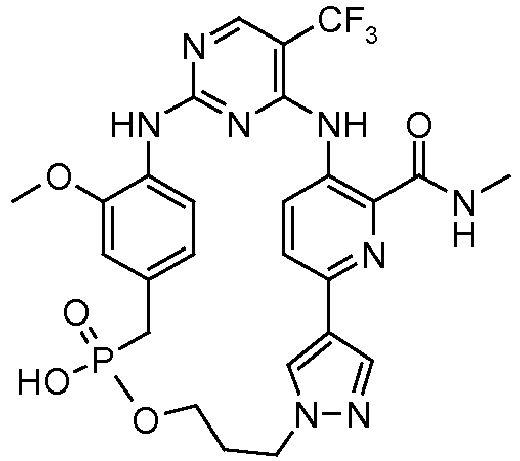
- A solution 10-ethoxy-14-methoxy-N-methyl-20-(trifluoromethyl)-9-oxa-4,5,16,18,22,25,28-heptaaza-10-phosphapentacyclo[21.2.2.212,15.12,5.117,21]hentriaconta-1(25),2(31),3,12,14,17(28),18,20,23,26,29-undecaene-24-carboxamide 10-oxide (Example 6, 30.0 mg, 0.0464 mmol) in concentrated HCl (6.0 mL) was stirred at 50 °C for 72 hours. The reaction mixture was concentrated under reduced pressure to a yellow foam. The material was purified on a Teledyne ISCO Combiflash® Rf system using a reverse phase column with Water/MeOH (100:0 → 0:100) as eluent to afford the title compound as 7.5mg of a white solid (26%). 1H NMR (400 MHz, CD3OD): δ = 8.41 (br. s., 1H), 8.31 (s, 1H), 8.27 (br. s., 1H), 7.87 (d, J = 6.6 Hz, 1H), 7.59 (d, J = 6.6 Hz, 1H), 7.45 (d, J = 6.6 Hz, 1H), 6.70 (br. s., 1H), 6.27 (d, J = 4.8 Hz, 1 H), 4.42 (br. s., 2H), 3.83 (br. s., 3H), 3.52 (br. s., 2H), 2.93 (s, 3H), 2.80 (d, J = 17.4 Hz, 2H), 2.16 (br. s., 2H). MS(ESI): m/z 619.17 [M+H]+. UPLC: t R = 0.80 min (polar_2 min).

- This material was prepared analogously to Example 44 using 3-[4-(4,4,5,5-tetramethyl-1,3,2-dioxaborolan-2-yl)-1H-pyrazol-1-yl]propyl(4-{[4-{[4-bromo-2-(methylcarbamoyl)phenyl]amino}-5-(trifluoromethyl)pyrimidin-2-yl]amino}-3-methoxybenzyl)propylphosphinate (Compound 66A, 0.245 g, 0.288 mmol). After column chromatography, the material was triturated with DCM/heptane. The precipitate was collected and dried to afford the title compounds as 4.5 mg of a white solid (2%). 1H NMR (CDCl3, 400 MHz): δ 9.37 (br. s., 1H), 8.30 (br. s., 1H), 8.03 (br. s., 1H), 7.91 (s, 1H), 7.84 (br. s., 1H), 7.70-7.77 (m, 2H), 7.61-7.70 (m, 2H), 6.61 (br. s., 1H), 6.46 (br. s., 1H), 6.21 (d, J = 8.1 Hz, 1H), 4.30-4.56 (m, 2H), 4.09 (br. s., 1H), 3.82 (s, 3H), 3.32 (br. s., 1H), 2.82-3.10 (m, 5H), 2.25 (br. s., 2H), 1.61 (d, J = 18.9 Hz, 4H), 1.01 (br. s., 3H). MS(ESI): m/z 644.73 [M+H]+. UPLC: tR = 1.15 min (UPLC-SQD: analytical_2min).
- A solution of 5-bromo-2-{[2-chloro-5-(trifluoromethyl)pyrimidin-4-yl]amino}-N-methylbenzamide (Compound 66B, 150.5 mg, 0.3674 mmol) and 3-[4-(4,4,5,5-tetramethyl-1,3,2-dioxaborolan-2-yl)-1H-pyrazol-1-yl]propyl (4-amino-3-methoxybenzyl)propylphosphinate (Compound 66C, 175.4 mg, 0.3674 mmol) in TFE (5.0 mL) was charged with TFA (0.0602 mL). The reaction mixture was stirred at 50 °C for 24 hours. The reaction mixture was concentrated under reduced pressure to a light yellow oil and purified on a Teledyne ISCO Combiflash® Rf system using DCM/MeOH (100:0→ 90:10) as eluent to afford the racemic title compound as 0.245g of a white solid (78%). MS(ESI): m/z 850.91/852.88 [M+H]+. UPLC: tR = 1.52 min (UPLC-SQD: analytical_2min).
- 2-{[2-chloro-5-(trifluoromethyl)pyrimidin-4-yl]amino}-N-methylbenzamide (
WO 2010141406 , 4.6 g, 13.9 mmol) and N-bromosuccinimide (2.46 g, 13.9 mmol) were taken up in DMF (8 mL) and stirred for 1 hr. The reaction mixture was poured into water and the resulting precipitate was collected via filtration, air dried and purified by column chromatography (SiO2, 1% methanol in dichloromethane) to give 2.4 g (42%) of the title compound.
1H NMR (600 MHz,DMSO-d6) δ: 11.88 (s, 1H), 8.93 (brs,1H), 8.67 (s, 1H), 8.28 (d, J = 9 Hz, 1H), 7.95 (s, 1H), 7.76 (d, J = 9 Hz, 1H), 2.75 (d, J = 4.2 Hz, 3H). - A solution of 3-[4-(4,4,5,5-tetramethyl-1,3,2-dioxaborolan-2-yl)-1H-pyrazol-1-yl]propyl-(3-methoxy-4-nitrobenzyl)prop-2-en-1-ylphosphinate (Compound 66D, 189.6 mg, 0.38 mmol) in EtOH (5.00 mL, 85.6 mmol) was charged with Palladium 10% wt on activated carbon (40.0 mg, 0.038 mmol). The reaction mixture was evacuated and purged with hydrogen gas (3x). The reaction mixture was allowed to stir under hydrogen at rt for 16 h. The reaction mixture was filtered through a pad of celite. The filtrate was concentrated under reduced pressure to a clear oil, (0.1754 g, 98%). This material was used in successive reactions without further purification. 1H NMR (CDCl3, 400 MHz): δ = 7.78 (s, 1H), 7.64 (s, 1H), 6.77 (s, 1H), 6.70 (s, 1H), 6.66 (t, J = 1.9 Hz, 1H), 4.17 (t, J = 7.1 Hz, 2H), 3.87-3.98 (m, 2H), 3.85 (s, 3H), 3.04 (d, J = 14.9 Hz, 2H), 2.14 (quin, J = 6.3 Hz, 2H), 1.59-1.66 (m, 4H), 1.33 (s, 12H), 1.25 (s, 3H). MS (ESI): m/z 478.26 [M+H]+. UPLC: tR = 0.77 min (UPLC-TOF: polar_2 min).
- A suspension of (3-methoxy-4-nitrobenzyl)prop-2-en-1-ylphosphinic acid (Compound 37E, 241 mg, 0.888 mmol) and 3-[4-(4,4,5,5-tetramethyl-1,3,2-dioxaborolan-2-yl)-1H-pyrazol-1-yl]propan-1-ol (Compound 3E, 224 mg, 0.888 mmol) in 1,2-Dichloroethane (19 mL) and DIPEA (0.928 mL, 5.33 mmol) was charged with (benzotriazol-1-yloxy)tripyrrolidino-phosphonium hexafluorophosphate (1387 mg, 2.665 mmol). The reaction mixture was stirred at rt for 16 hours. The reaction mixture was quenched with water (10 mL) and extracted with DCM (20 mL). The organic layer was washed with NaHCO3 (10 mL), washed with brine (15 mL), dried over anhydrous Na2SO4, filtered, and concentrated under reduced pressure to a yellow oil. The crude material was purified on a Teledyne ISCO Combiflash® Rf system using DCM/MeOH (100:0 → 95:5) as eluent. The fractions containing product were combined and concentrated under reduced pressure to yield a light yellow oil. The material was re-purified on a Teledyne ISCO Combiflash® Rf system using 1:1 DCM-EtOAc/MeOH (100:0→ 95:5) as eluent. The fractions containing product were combined and concentrated under reduced pressure to yield a light yellow solid (189.6 mg, 42%). 1H NMR (CDCl3, 400 MHz): δ = 7.81-7.87 (m, 2H), 7.71 (s, 1H), 7.11 (s, 1H), 6.92 (d, J = 7.8 Hz, 1H), 5.73-5.86 (m, 1H), 5.19-5.32 (m, 2H), 4.27 (t, J = 6.4 Hz, 2H), 3.90-4.04 (m, 5H), 3.20 (d, J = 16.2 Hz, 2H), 2.61 (dd, J = 7.6, 17.4 Hz, 2H), 2.15-2.25 (m, 2H), 1.33 (s, 12H). MS (ESI): m/z 506.63 [M+H]+. UPLC: tR = 1.23 min (UPLC-SQD: analytical_2min).
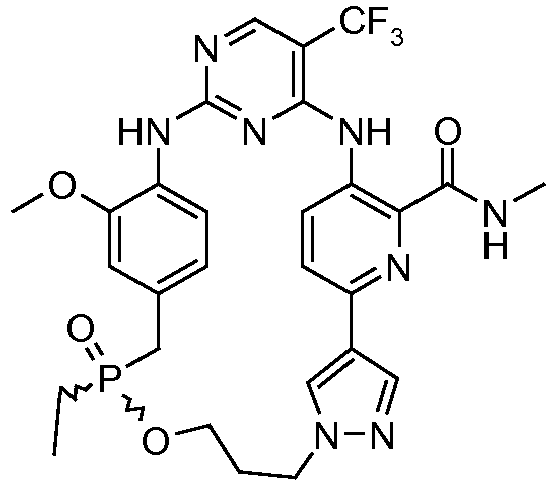
- This racemic material was prepared analogously to Example 44 using 3-[4-(4,4,5,5-tetramethyl-1,3,2-dioxaborolan-2-yl)-1 H-pyrazol-1-yl]propyl (4-{[4-{[6-bromo-2-(methylcarbamoyl)pyridin-3-yl]amino}-5-(trifluoromethyl)pyrimidin-2-yl]amino}-3-methoxybenzyl)ethylphosphinate (Compound 67A, 0.275 g, 0.328 mmol) to afford the title compounds. 1H NMR (400 MHz, CD3OD): δ 8.54 (s, 1H), 8.39 (s, 1H), 8.36 (s, 1H), 8.07 (d, J = 8.6 Hz, 1H), 7.80 (d, J = 8.6 Hz, 1H), 7.65 (d, J = 8.3 Hz, 1H), 6.86 (s, 1H), 6.43 (td, J = 2.1, 8.3 Hz, 1H), 4.44-4.49 (m, 2H), 3.98-4.07 (m, 1H), 3.87 (s, 3H), 3.48 (dtd, J = 4.3, 7.9, 11.7 Hz, 1H), 3.12-3.27 (m, 2H), 2.95 (s, 3H), 2.17-2.32 (m, 2H), 1.66-1.81 (m, 2H), 1.13 (td, J = 7.6, 18.6 Hz, 3H). MS (ESI): m/z 631.64 [M+H]+. UPLC: tR = 1.18 min (UPLC-SQD: analytical_2min).
- This material was prepared analogously to Example 44A using (4-{[4-{[6-bromo-2-(methylcarbamoyl)pyridin-3-yl]amino}-5-(trifluoromethyl)pyrimidin-2-yl]amino}-3-methoxybenzyl)ethylphosphinic acid (Compound 67B, 0.220 g, 0.365 mmol) and 3-[4-(4,4,5,5-tetramethyl-1,3,2-dioxaborolan-2-yl)-1H-pyrazol-1-yl]propan-1-ol (Compound 3E, 0.0918 g, 0.364 mmol) to afford the title compound as an off-white foam (275 mg, 90%). MS (ESI): m/z 837.21/839.20 [M+H]+. UPLC: tR = 1.14 min (UPLC-TOF: polar_2 min).
- A solution of ethyl (4-{[4-{[6-bromo-2-(methylcarbamoyl)pyridin-3-yl]amino}-5-(trifluoromethyl)pyrimidin-2-yl]amino}-3-methoxybenzyl)ethylphosphinate (Compound 67C, 1.11 g, 1.76 mmol) in pyridine (15.0 mL) was cooled to 0 °C and then charged with bromotrimethylsilane (1.39 mL, 10.6 mmol). The reaction mixture was slowly warmed to rt with stirring for 72 hours. The reaction mixture was quenched with MeOH (2.3 mL, 57 mmol) and then concentrated under reduced pressure to a yellow oil. The material was dissolved in DCM (10 mL) and washed with 3N HCl (10 mL), was washed with brine (10 mL), dried over Na2SO4, filtered, and concentrated under reduced pressure to a light yellow solid. The acid layer was saturated with solid NaCl and extracted with DCM (10 mL). The organic layer was dried over Na2SO4, filtered, and concentrated under reduced pressure to a light yellow solid. Both batches of solid were combined (932.5 mg, 88%). 1H NMR (CDCl3, 400 MHz): δ = 8.91 (d, J = 8.3 Hz, 1 H), 8.34 (s, 1H), 8.10 (q, J = 4.6 Hz, 1H), 7.47 (d, J = 8.8 Hz, 1H), 6.89 (s, 1H), 6.82 (d, J = 8.1 Hz, 1H), 3.87 (s, 3H), 3.00-3.10 (m, 5H), 1.54-1.68 (m, 2H), 1.13 (td, J = 7.5, 18.3 Hz, 3H). MS (ESI): m/z 603.42/605.40 [M+H]+. UPLC: tR = 1.24 min (UPLC-SQD: analytical_2min).
- A mixture of 3-amino-6-bromo-N-methylpyridine-2-carboxamide (Compound 6D, 477.74 mg, 2.0766 mmol) and ethyl (4-{[4-chloro-5-(trifluoromethyl)pyrimidin-2-yl]amino}-3-methoxybenzyl)ethylphosphinate (Compound 67C, 1000.0 mg, 2.2842 mmol) in TFE (8.29 mL) was prepared in a sealable pressure tube equipped with a stir bar and subsequently treated with TFA (319.97 uL, 4.1532 mmol). The tube was sealed and heated to 75°C overnight. The reaction solution was concentrated directly on to SiO2, loaded into a sample cartridge and purified by column chromatography (Teledyne-ISCO Combiflash, 0 - 5% MeOH/DCM) to isolate ∼800mg of pure material. The impure fractions were combined, concentrated and rechromatographed as described to isolate a further 300mg of desired product for a total of 1.11g (85%). 1H NMR (400 MHz, CD3OD) δ 9.03 (br. s., 1H) 8.38 (s, 1H) 7.72 (d, J = 7.6 Hz, 1H) 7.57 (d, J = 8.8 Hz, 1H) 7.07 (t ,J = 1.8 Hz, 1H) 6.93 (dt, J = 8.2,2.2 Hz, 1H) 4.01 - 4.14 (m, 2H) 3.89 (s, 3H) 2.94 (s, 3H) 1.70 - 1.84 (m, 2H) 1.31 (t, J = 7.1 Hz, 3H) 1.16 (dt, J = 18.2, 7.7 Hz, 3H); Benzylic carbon doublet (P coupling) obscured by MeOH. MS(ESI): 631.50, 633.47 [M+H]; UPLC: tR = 1.41 (analytical_2min).
- A solution of 2,4-dichloro-5-trifluoromethyl-pyrimidine (4.43 g, 20.5 mmol) in dichloroethane and t-butanol (1:1, 10 mL) was treated with ZnCl2 (1M in ether, 20.5 mL) and stirred for half an hour at RT. The reaction mixture was cooled to 0°C and a solution of ethyl (4-amino-3-methoxyphenyl)methyl-ethyl phosphinate (Compound 67E, 4 g, 13.69 mmol) in dichloroethane and t-butanol (1:1, 10 mL) followed by diisopropylethylamine (3.57 mL, 20.5 mmol) were added drop wise. The mixture was allowed to stir for 24 hrs. A thick residue settled at the bottom of the flask. The solvents were decanted and the residue was purified by column chromatography (SiO2, 1% methanol in dichloromethane) to give 4 g of the pure required isomer. 1H NMR (400 MHz, CDCl3) δ 8.55 (s, 1H), 8.32(d, J=8.4Hz, 1H), 8.04 (s,1H), 6.91 (s, 1H), 6.85 (d, J=8Hz, 1H), 4.04-4.11 (m, 2H), 3.9 (s, 3H), 3.11 (d, J= 19.5 Hz, 2H), 1.59-1.66 (m, 2H), 1.25 (t, J= 7Hz, 3H), 1.10 (t, J=7 Hz, 3H).
- A solution of ethyl ethyl [(3-methoxy-4-nitrophenyl) methyl]phosphinate(Compound 67F, 6 g, 20.9 mmol) in ethanol (20 mL) was treated with palladium on carbon (10%, 1 g) and hydrogenated at 45 psi for 24 hrs. The catalyst was filtered off and the filtrate was concentrated to give 5 g of pure amine. 1H NMR (400 MHz, CDCl3) δ: 6.72 (s, 1H), 6.6 (s, 2H), 4.05-4.13 (m, 2H), 3.81 (s, 3H), 3.1 (brs, 2H) 3.01 (d, J= 16.4 Hz, 2H), 1.55-161(m, 2H), 1.28 (t, 3H), 1.08 (t, 3H).
- A mixture of 4-(bromomethyl)-2-methoxy-1-nitrobenzene (Compound 61 F, 8 g, 32.5 mmol), diethyl ethyl phosphonite solution in THF (30 mL) (Synthetic Communications, 2003, 33, 1665-1674, 9g, 60.2 mmol) and Toluene (100mL) were heated to 90°C for 24 hrs. The solvents were distilled off under reduced pressure and the residue was purified by column chromatography (SiO2, 1% methanol in dichloromethane) to give 6 g of the pure required compound. 1H NMR (400 MHz, CDCl3) δ: 7.8 (d, J=8.4 Hz, 1H), 7.06 (s, 1H), 6.85 (d, J=8.5 Hz, 1H), 4.05-4.08 (m, 2H), 3.93 (s, 3H), 3.14 (d, J= 16 Hz, 2H), 1.30-1.7 (m, 2H), 1.28 (t, 3H), 1.12 (t, 3H).

- Racemic mixture prepared analogously to Example 67 using 3-[4-(4,4,5,5-tetramethyl-1,3,2-dioxaborolan-2-yl)-1H-pyrazol-1-yl]propyl (4-{[4-{[6-bromo-2-(methylcarbamoyl)pyridin-3-yl]amino}-5-(trifluoromethyl)pyrimidin-2-yl]amino}-3-methoxybenzyl)propan-2-ylphosphinate (Compound 68A, 0.330 g, 0.388 mmol). 1H NMR (CDCl3, 400 MHz): δ 10.97 (br. s., 1H), 8.55 (s, 1H), 8.27-8.38 (m, 2H), 8.17 (s, 1H), 8.14 (d, J = 8.6 Hz, 1H), 7.79 (d, J = 8.1 Hz, 1H), 7.64 (d, J = 8.6 Hz, 1 H), 6.62 (s, 1 H), 6.36 (d, J = 8.6 Hz, 1 H), 4.33-4.53 (m, 2H), 4.16 (tt, J = 5.2, 10.9 Hz, 1 H), 3.87 (s, 3H), 3.50-3.60 (m, 1 H), 2.99-3.18 (m, 5H), 2.27 (dd, J = 4.5, 9.3 Hz, 2H), 1.99 (tt, J = 7.2, 13.8 Hz, 1H), 1.26 (ddd, J = 7.2, 17.4, 18.4 Hz, 6H). MS (ESI): m/z 645.75 [M+H]+. UPLC: tR = 1.28 min (UPLC-SQD: analytical_2min).
- A suspension of (4-{[4-{[6-bromo-2-(methylcarbamoyl)pyridin-3-yl]amino}-5-(trifluoromethyl)pyrimidin-2-yl]amino}-3-methoxybenzyl)propan-2-ylphosphinic acid (Compound 68B, 0.240 g, 0.389 mmol) and 3-[4-(4,4,5,5-tetramethyl-1,3,2-dioxaborolan-2-yl)-1H-pyrazol-1-yl]propan-1-ol (Compound 3E, 97.9 g, 0.388 mmol) in 1,2-dichloroethane (8.53 mL) and DIPEA (0.812 mL, 4.66 mmol) was charged with (benzotriazol-1-yloxy)tripyrrolidino-phosphonium hexafluorophosphate (1.21 g, 2.33 mmol). The reaction mixture was stirred at 60 °C for 16 hours. The reaction mixture was quenched with water (10 mL) and extracted with DCM (20 mL). The organic layer was washed with NaHCO3 (10 mL), washed with brine (15 mL), dried over anhydrous Na2SO4, filtered, and concentrated under reduced pressure to a brown oil. The crude material was purified using a Teledyne ISCO Combiflash® Rf system using 1:1 DCM-EtOAc/MeOH (100:0 → 90:10) as eluent to afford the title compound as an off-white foam. MS (ESI): m/z 851.84/853.82 [M+H]+. UPLC: t R = 1.57 min (UPLC-SQD: analytical_2min).
- Prepared analogously to Compound 67B replacing Compound 67C with ethyl (4-{[4-{[6-bromo-2-(methylcarbamoyl)pyridin-3-yl]amino}-5-(trifluoromethyl)pyrimidin-2-yl]amino}-3-methoxybenzyl)propan-2-ylphosphinate (Compound 68C). MS (ESI): m/z 617.43/619.41 [M+H]+. UPLC: t R = 1.30 min (UPLC-SQD: analytical_2min).
- A solution of ethyl (4-{[4-chloro-5-(trifluoromethyl)pyrimidin-2-yl]amino}-3-methoxybenzyl)propan-2-ylphosphinate (Compound 68D, 1.00 g, 2.21 mmol) and 3-amino-6-bromo-N-methylpyridine-2-carboxamide (Compound 6D, 0.516 g, 2.24 mmol) in TFE (11.71 mL) was charged with TFA (0.341 mL, 4.43 mmol). The reaction mixture was heated at 80 °C for 16 hours. The reaction mixture was concentrated under reduced pressure to a light yellow oil. The crude material was purified using a Teledyne ISCO Combiflash® Rf system using DCM/MeOH (100:0 → 95:5) as eluent to afford the desired product as a white solid (865 mg, 61%). 1H NMR (CDCl3, 400 MHz): δ 12.97 (br. s., 1H), 8.85 (d, J = 9.3 Hz, 1H), 8.29 (s, 1H), 8.13 (q, J = 4.4 Hz, 1H), 7.66 (br. s., 1H), 7.59 (d, J = 9.1 Hz, 1H), 7.02 (t, J = 1.6 Hz, 1H), 6.88 (td, J = 1.8, 8.2 Hz, 1H), 3.92-4.10 (m, 2H), 3.87 (s, 3H), 3.19 (dd, J = 2.8, 14.9 Hz, 2H), 3.04 (d, J = 5.3 Hz, 3H), 1.87-2.00 (m, 1H), 1.18-1.27 (m, 9H). MS (ESI): m/z 645.55/647.54 [M+H]+. UPLC: tR = 1.47 min (UPLC-SQD: analytical_2min).
- This material was prepared analogously to Compound 67D replacing Compound 67E with (ethyl (4-amino-3-methoxybenzyl)propan-2-ylphosphinate (Compound 68E, 4 g, 14.7 mmol). The title compound was isolated as a 4g of a mixture containing 20% of the other regioisomer (ethyl (4-{[2-chloro-5-(trifluoromethyl)pyrimidin-4-yl]amino}-3-methoxybenzyl)propan-2-ylphosphinate after column chromatography purification (SiO2, 1% methanol in dichloromethane). 1H NMR (400 MHz, CDCl3) δ 8.60 (s, 1H), 8.3 (d, J=6.8 Hz,1H), 8.04 (s, 1H), 7.01 (s, 1H), 6.85 (d, J=6.8 Hz, 1H), 4.00-4.08 (m, 2H), 3.89 (s, 3H), 3.14 (m, 2H), 1.9 (m, 1H), 1.05-1.3 (m, 9H).
- A solution of ethyl (3-methoxy-4-nitrobenzyl)propan-2-ylphosphinate (Compound 68F, 6 g, 20.9 mmol) in ethanol (20 mL) was treated with palladium on carbon (10%, 1 g) and hydrogenated at 45 psi for 24 hrs. The catalyst was filtered and the filtrate was concentrated to give 5 g of pure amine. 1H NMR (400 MHz, CDCl3) δ: 6.77 (s, 1H), 6.59-6.63 (m, 2H), 4.10-4.20 (brs, 2H), 3.81 (s, 3H), 3.65-3.8 (q, 2H),) 2.97-3.02 (m, 2H), 1.80 -1.85 (m, 1H), 1.06-1.22 (m, 9H).
- A mixture of 4-(bromomethyl)-2-methoxy-1-nitrobenzene (Compound 61F, 8 g, 32.5 mmol), diethyl isopropyl phosphonite solution in THF (30 mL) (Synthetic Communications, 2003, 33, 1665-1674, 10.1 g, 60.2 mmol) and toluene (100mL) were heated to 90°C for 24 hrs. The solvents were distilled off under reduced pressure and the residue was purified by column chromatography (SiO2, 1% methanol in dichloromethane) to give 5 g (51%) of the pure required compound. 1H NMR (400 MHz, CDCl3) δ: 7.82 (d, J=8.4 Hz, 1H), 7.14 (s, 1H), 6.91 (d, J=8.5 Hz, 1H), 3.8-4(m, 5H), 3.09-3.18 (m, 2H), 1.86-1.91 (m,1H), 1.15-1.25 (m, 9H).

- Racemic mixture prepared analogously to Example 44 using ethyl (2R)-4-[4-(4,4,5,5-tetramethyl-1,3,2-dioxaborolan-2-yl)-1H-pyrazol-1-yl]butan-2-yl (4-{[4-{[6-bromo-2-(methylcarbamoyl)pyridin-3-yl]amino}-5-(trifluoromethyl)pyrimidin-2-yl]amino}-3-methoxybenzyl)phosphonate (Compound 69A, 442 mg, 0.510 mmol) to afford 45 mg of the title compound (13%). The diastereomers were separated by SFC on a chiral stationary phase as described in Table 1. Example 69A: 1H NMR (400 MHz, CD3OD) δ 8.69 (s, 1H), 8.46 (s, 1H), 8.30 (s, 1H), 8.05 (d, J = 8.6 Hz, 1H), 7.79 (d, J = 8.6 Hz, 1H), 7.29 (d, J = 8.1 Hz, 1H), 6.96 (s, 1H), 6.72 (d, J = 8.1 Hz, 1H), 4.43-4.53 (m, 1H), 4.26-4.36 (m, 1H), 4.09-4.19 (m, 1H), 3.82 (s, 3H), 3.68-3.77 (m, 1H), 3.42-3.51 (m, 1H), 3.19-3.28 (m, 2H), 2.88 (s, 3H), 2.27-2.44 (m, 2H), 1.38 (d, J = 6.3 Hz, 3H), 0.84 (t, J = 7.1 Hz, 3H). MS (ESI): m/z = 661.53 [M+H]+. UPLC: tR = 1.22 min (UPLC-TOF: polar_2 min). Example 69B: 1H NMR (400 MHz, CD3OD) δ 8.52 (s, 1H), 8.26-8.33 (m, 2H), 7.93 (d, J = 8.6 Hz, 1H), 7.61 (d, J = 8.6 Hz, 1H), 7.34 (d, J = 8.3 Hz, 1H), 6.84 (s, 1H), 6.60 (d, J = 7.8 Hz, 1H), 4.43-4.54 (m, 1H), 4.24-4.38 (m, 2H), 3.84-3.98 (m, 2H), 3.71-3.78 (m, 3H), 3.08-3.26 (m, 2H), 2.93 (s, 3H), 2.29 (d, J = 5.3 Hz, 2H), 1.36 (d, J = 6.3 Hz, 3H), 1.12 (t, J = 7.1 Hz, 3H). MS (ESI): m/z = 661.51 [M+H]+. UPLC: tR = 1.19 min (UPLC-TOF: polar_2 min).
- 1-Methylimidazole (1.91 mL, 24 mmol) was added to a stirring suspension of ethyl hydrogen (4-{[4-{[6-bromo-2-(methylcarbamoyl)pyridin-3-yl]amino}-5-(trifluoromethyl)pyrimidin-2-yl]amino}-3-methoxybenzyl)phosphonate (Compound 38C, 1 g, 2 mmol), (2R)-4-[4-(4,4,5,5-tetramethyl-1,3,2-dioxaborolan-2-yl)-1H-pyrazol-1-yl]butan-2-ol (Compound 69B, 430 mg, 1.6 mmol) and (benzotriazol-1-yloxy)tripyrrolidino-phosphonium hexafluorophosphate (5.04 g, 9.69 mmol) in 1,2-dichloroethane (49.5 mL). The reaction was allowed to stir at 60 °C for 24hrs, after which, it was concentrated in vacuo to a solid and purified using a Teledyne ISCO Combiflash® RF system [0 - 5% MeOH in 1:1 EtOAc/DCM] to afford 442 mg of the desired product as mixture of diastereomers (32%). MS (ESI): m/z = 867.78/869.81 [M+H]+. UPLC: tR = 1.69 min (UPLC-TOF: polar_2 min)
- A solution of (R)-1-(3-[(tert-butyldimethylsilyl)oxy]butyl]-4-(tetramethyl-1,3,2-dioxaborolan-2-yl)-1H-pyrazole (Compound 69C, 5 g, 13.1 mmol) in THF (20 mL) was treated with tetrabutylammonium fluoride (26 mL, 1M in THF) and stirred for 24 hrs at RT under nitrogen atmosphere. Tetrahydrofuran was evaporated under reduced pressure and the residue was purified by column chromatography (SiO2, 1% methanol in dichloromethane) to give colorless gum (600 mg, 17%). 1H NMR (400 MHz, CDCl3) δ 7.74 (s, 1H), 7.64 (s, 1H), 4.15-4.23(m, 2H), 3.60-3.3.71 (m, 1H), 1.7-1.98 (m, 2H), 1.23 (s, 12H), 1.12 (s, d, 3H).
- A stirring suspension of (R)-3-(tert-butyldimethylsilyloxy) butyl 4-methylbenzenesulfonate (J. Org. Chem. 2009, 74, 2842-2845, 5g, 13.9 mmol) and cesium carbonate (5 g, 15.2 mmol) in DMF (5 mL) was treated with 4-(tetramethyl-1,3,2-dioxaborolan-2yl)-1H-pyrazole (2.7 g, 13.9 mmol) and heated at 70 °C overnight. The reaction mixture was cooled to RT and diluted with water (25 mL). The oily layer was separated and the aqueous layer was extracted with hexanes (2x50 mL). The combined organic layers were washed with water and dried over sodium sulfate, filtered, concentrated to give the desired product as light yellow gum. Yield: 5.2 g (quantitative). 1H NMR (500 MHz, CDCl3) δ 7.79 (s, 1H), 7.69 (s, 1H), 4.24-4.15(m, 2H), 3.87-3.85 (m, 1H), 2.05-1.94_(m, 2H), 1.28 (s, 12H), 1.14 (d, J=8 Hz, 3H), 0.86 (s, 9H) 0.01 (s, 6H).

- Racemic mixture prepared analogously to Example 44 using ethyl (2S)-4-[4-(4,4,5,5-tetramethyl-1,3,2-dioxaborolan-2-yl)-1H-pyrazol-1-yl]butan-2-yl (4-{[4-{[6-bromo-2-(methylcarbamoyl)pyridin-3-yl]amino}-5-(trifluoromethyl)pyrimidin-2-yl]amino}-3-methoxybenzyl)phosphonate (Compound 70A, 453 mg, 0.523 mmol) to afford 72.7 mg of the title compound (21%). The diastereomers were separated by SFC on a chiral stationary phase as described in Table 1. Example 70A: 1H NMR (400 MHz, CD3OD) δ 8.57 (s, 1H), 8.32 (d, J = 3.5 Hz, 2H), 8.18 (d, J = 8.8 Hz, 1H), 7.74 (d, J = 8.6 Hz, 1H), 7.45 (d, J = 8.1 Hz, 1H), 6.92 (s, 1H), 6.75 (d, J = 8.3 Hz, 1H), 4.41-4.52 (m, J = 4.8 Hz, 1H), 4.25-4.36 (m, J = 19.7 Hz, 1H), 4.03-4.17 (m, 1H), 3.82 (s, 3H), 3.57-3.69 (m, 1H), 3.33-3.39 (m, 2H), 3.25 (d, J = 7.8 Hz, 1H), 2.93 (s, 3H), 2.23-2.41 (m, 2H), 1.34 (d, J = 6.1 Hz, 3H), 0.73 (t, J = 6.9 Hz, 3H). MS (ESI): m/z = 661.55 [M+H]+. UPLC: tR = 1.22 min (UPLC-TOF: polar_2 min). Example 70B: 1H NMR (400 MHz, CD3OD) δ 8.51 (s, 1H), 8.30 (d, J = 7.8 Hz, 2H), 7.93 (d, J = 8.6 Hz, 1H), 7.61 (d, J = 8.6 Hz, 1H), 7.34 (d, J = 8.3 Hz, 1H), 6.84 (s, 1H), 6.60 (d, J = 8.3 Hz, 1H), 4.43-4.55 (m, 1H), 4.24-4.37 (m, 2H), 3.83-3.98 (m, 2H), 3.75 (s, 3H), 3.04-3.27 (m, 2H), 2.93 (s, 3H), 2.29 (d, J = 5.1 Hz, 2H), 1.36 (d, J = 6.3 Hz, 3H), 1.12 (t, J = 7.1 Hz, 3H). MS (ESI): m/z = 661.50 [M+H]+. UPLC: tR = 1.19 min (UPLC-TOF: polar_2 min).
- Racemic Compound 70A was prepared analogously to Compound 69A using ethyl hydrogen (4-{[4-{[6-bromo-2-(methylcarbamoyl)pyridin-3-yl]amino}-5-(trifluoromethyl)pyrimidin-2-yl]amino}-3-methoxybenzyl)phosphonate (Compound 38C, 1 g, 2 mmol) and (2S)-4-[4-(4,4,5,5-tetramethyl-1,3,2-dioxaborolan-2-yl)-1H-pyrazol-1-yl]butan-2-ol (Compound 70B, 400 mg, 2 mmol) to afford 454 mg of the title compound as a mixture of diastereomers (30%). MS (ESI): m/z = 867.82/869.81 [M+H]+. UPLC: tR = 1.69 min (UPLC-TOF: polar_2 min).
- A solution of (S)-1-(3-[(tert-butyldimethylsilyl)oxy]butyl]-4-(tetramethyl-1,3,2-dioxaborolan-2-yl)-1H-pyrazole (Compound 70C, 7.7 g, 20.2 mmol) in THF (30 mL) was treated with tetrabutylammonium fluoride (30 mL, 1M solution in THF) and stirred for 24 hrs at RT under nitrogen atmosphere. Tetrahydrofuran was evaporated under reduced pressure and the residue was purified by column chromatography (SiO2, 1% methanol in dichloromethane) to give colorless gum (1g, 20%). 1H NMR (400 MHz, CDCl3) δ 7.74 (s, 1H), 7.64 (s, 1H), 4.15-4.23(m, 2H), 3.60-3.3.71 (m, 1 H), 1.7-1.98 (m, 2H), 1.23 (s, 12H), 1.12 (s, d, 3H).
- A stirred suspension of (S)-3-(tert-butyldimethylsilyloxy) butyl 4-methylbenzenesulfonate (Prepared using the procedure found in J. Org. Chem. 2009, 74, 2842-2845, 7.5 g, 20.8 mmol) and cesium carbonate (7.5 g, 22.8 mmol) in DMF (7.5 mL) was treated with 4-(tetramethyl-1,3,2-dioxaborolan-2yl)-1H-pyrazole (4 g, 20.8 mmol) and heated at 70°C overnight. The reaction mixture was cooled to RT and diluted water (25 mL). The oily layer was separated and the aqueous layer was extracted with hexanes (2x 50 mL). The combined organic layers were washed with water, dried over sodium sulfate, filtered and concentrated to give the desired product as light yellow gum. Yield: 7.7 g (quantitative). 1H NMR (500 MHz, CDCl3) δ 7.79 (s, 1H), 7.69 (s, 1H), 4.24-4.15(m, 2H), 3.87-3.85 (m, 1H), 2.05-1.94 (m, 2H), 1.28 (s, 12H), 1.14 (d, J= 8 Hz, 3H), 0.86 (s, 9H) 0.01 (s, 6H).
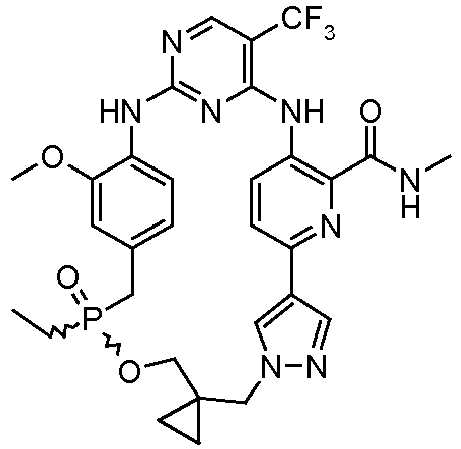
- Racemic mixture prepared analogously to Example 44 using ethyl (1-{[4-(4,4,5,5-tetramethyl-1,3,2-dioxaborolan-2-yl)-1H-pyrazol-1-yl]methyl}cyclopropyl)methyl(4-{[4-{[6-bromo-2-(methylcarbamoyl)pyridin-3-yl]amino}-5-(trifluoromethyl)pyrimidin-2-yl]amino}-3-methoxybenzyl)ethylphosphinate (Compound 71A, 129 mg, 0.150 mmol) to afford 23.7 mg of the title compound (24%). 1H NMR (400 MHz, CD3OD) δ 8.58 (s, 1H), 8.34-8.40 (m, 2H), 8.11 (d, J = 8.6 Hz, 1H), 7.82 (d, J = 8.6 Hz, 1H), 7.68 (d, J = 8.3 Hz, 1H), 6.86 (s, 1H), 6.49 (d, J = 8.3 Hz, 1H), 4.40 (d, J = 14.1 Hz, 1H), 4.14 (d, J = 14.4 Hz, 1H), 3.87 (s, 3H), 3.56-3.63 (m, 2H), 3.10-3.26 (m, 2H), 2.96 (s, 3H), 1.61-1.73 (m, 2H), 1.10 (td, J = 7.7, 18.5 Hz, 3H), 0.69-0.99 (m, 4H). MS (ESI): m/z = 657.65 [M+H]+. UPLC: tR = 1.23 min (UPLC-TOF: polar_2 min).
- Racemic Compound 71A was prepared analogously to Compound 69A using (4-{[4-{[6-bromo-2-(methylcarbamoyl)pyridin-3-yl]amino}-5-(trifluoromethyl)pyrimidin-2-yl]amino}-3-methoxybenzyl)ethylphosphinic acid (Compound 67B, 206 mg, 0.341 mmol) and (1-{[4-(4,4,5,5-tetramethyl-1,3,2-dioxaborolan-2-yl)-1H-pyrazol-1-yl]methyl}cyclopropyl)methanol (Compound 63B, 400 mg, 2 mmol) to afford 129 mg of the title compound (48%). MS (ESI): m/z = 879.92/881.81 [M+H]+. UPLC: tR = 1.61 min (UPLC-TOF: polar_2 min).

- Racemic mixture prepared analogously to Example 44 using propan-2-yl 3-[4-(4,4,5,5-tetramethyl-1,3,2-dioxaborolan-2-yl)-1H-pyrazol-1-yl]propyl(4-{[4-{[6-bromo-2-(methylcarbamoyl)pyridin-3-yl]amino}-5-(trifluoromethyl)pyrimidin-2-yl]amino}-3-methoxybenzyl)phosphonate (Compound 72A). 1H NMR (400 MHz, CD3OD): δ 8.48 (s, 1H), 8.38 (s, 1H), 8.34 (s, 1H), 8.12 (d, J = 8.6 Hz, 1H), 7.78 (d, J = 8.6 Hz, 1H), 7.58 (d, J = 8.3 Hz, 1H), 6.88 (t, J = 1.8 Hz, 1H), 6.60 (td, J = 2.1, 8.3 Hz, 1H), 4.51-4.59 (m, 1H), 4.41-4.50 (m, 2H), 3.86 (s, 3H), 3.65-3.76 (m, 2H), 3.33-3.39 (m, 1H), 3.20-3.29 (m, 1H), 2.95 (s, 3H), 2.27 (quin, J = 5.8 Hz, 2H), 1.20 (d, J = 6.3 Hz, 3H), 0.92 (d, J = 6.3 Hz, 3H). MS (ESI): m/z 661.73 [M+H]+. UPLC: tR = 1.30 min (UPLC-SQD: analytical_2min).
- Prepared analogously to Compound 44A replacing Compound 38C with propan-2-yl hydrogen (4-{[4-{[6-bromo-2-(methylcarbamoyl)pyridin-3-yl]amino}-5-(trifluoromethyl)pyrimidin-2-yl]amino}-3-methoxybenzyl)phosphonate (Compound 72B). MS (ESI): m/z 867.90/869.91 [M+H]+. UPLC: tR = 1.60 min (UPLC-SQD: analytical_2min).
- A solution of ethyl propan-2-yl (4-{[4-{[6-bromo-2-(methylcarbamoyl)pyridin-3-yl]amino}-5-(trifluoromethyl)pyrimidin-2-yl]amino}-3-methoxybenzyl)phosphonate (Compound 72C, 550.0 mg, 0.83 mmol) in pyridine (5.50 mL) was charged with sodium iodide (748 mg, 4.99 mmol). The reaction was heated at 120 °C for 24 hours.
The reaction mixture was concentrated under reduced pressure to a black solid. The solid residue was dissolved in water (15 mL), then acidified with conc. HCl (pH ∼ 1-2) and extracted with DCM (20 mL). The organic layer was washed with water (15 mL), washed with brine (15 mL), dried over anhydrous Na2SO4, filtered and concentrated under reduced pressure to a white solid (0.47 g, 90%). The material was used in successive reactions without any further purification. MS (ESI): m/z 633.50/635.54 [M+H]+. UPLC: t R = 0.57 min (analytical_1 min). - Prepared analogously to Compound 1B replacing Compound 1C with ethyl propan-2-yl (4-{[4-chloro-5-(trifluoromethyl)pyrimidin-2-yl]amino}-3-methoxybenzyl)phosphonate (Compound 72D). MS (ESI): m/z 661.11/663.09 [M+H]+. UPLC: t R = 1.14 min (UPLC-TOF: polar_2 min).
- A solution of 2,4-dichloro-5-trifluoromethyl-pyrimidine (7.5 g, 34.7 mmol) in dichloroethane and t-butanol (1:1, 10 mL) was treated with ZnCl2 (1 M solution in ether, 35 mL) and stirred for half an hour at RT. The reaction mixture was cooled to 0 °C and a solution of ethyl propan-2-yl [(4-amino-3-methoxyphenyl) methyl]phosphonate (Compound 72E, 5 g, 16.28 mmol) in dichloroethane and t-butanol (1:1, 10 mL) followed by diisopropylethylamine (6 mL , 34.7 mmol) were added drop wise while stirring was continued for 24 hrs. The resulting white precipitate was filtered. The solid was dissolved in dichloromethane, washed with water (2x 50mL), dried over magnesium sulfate, filtered and evaporated to give 6.3 g of pure required isomer. 1H NMR (400 MHz, CDCl3) δ 8.6 (s, 1H), 8.32(d, J=8.4Hz, 1H), 8.04 (s,1H), 7.04(s, 1H), 6.89 (d, J=8 Hz, 1H), 4.73-4.76 (m, 1H), 4.08-4.11 (m, 2H), 3.95 (s, 3H), 3.23 (d, J= 21 Hz, 2H), 1.24-1.33 (9H).
- A solution of ethyl propan-2-yl [(3-methoxy-4-nitrophenyl) methyl]phosphonate (6 g, 20.9 mmol) in ethanol (20 mL) was treated with palladium on carbon (10%, 1 g) and hydrogenated at 45 psi for 24 hrs. The catalyst was filtered and the filtrate was concentrated to give 5 g of pure amine. 1H NMR (600 MHz, CDCl3) δ 6.79 (s, 1H), 6.69-6.71 (m, 2H), 4.60-4.61 (m, 1H), 3.95-3.98 (m, 2H), 3.84 (s, 3H), 3.1 (brs, 2H) 3.01 (d, J= 16.4 Hz, 2H), 1.18-1.28 (m, 9H).
- A solution of diethyl (3-methoxy-4-nitrobenzyl)phosphonate (Compound 1G, 5g, 15.5 mmol) in thionyl chloride (50 mL, 690 mmol) was treated with catalytic amount of DMF and heated to reflux under nitrogen for 6 h. The mixture was concentrated under reduced pressure and co-evaporated with dichloroethane (50 mL) to give crude (ethyl chloro [(3-methoxy-4-nitrophenyl) methyl]phosphinate). This material was taken up in DCM (20 mL) and added to a solution of 2-propanol (4 mL, 52 mmol) and DIPEA (6 mL, 34.5 mmol) in DCM (20 mL). The resulting mixture was stirred at rt for 24 hrs. The solvents were evaporated and the residue was purified by column chromatography (SiO2, 5% methanol in dichloromethane) to give 3 g of the desired product as a light-yellow oil. 1H NMR (400 MHz, CDCl3) δ 7.8 2(d, J=8.4 Hz, 1H), 7.1 (s, 1H), 6.92 (d, J=8.5 Hz, 1H), 4.6-4.4.75 (m, 1H), 4.05-4.08 (m, 2H), 3.93 (s, 3H), 3.18 (d, J= 20 Hz, 2H), 1.18-1.25 (m, 9H).

- Racemic mixture prepared analogously to Example 44 using 2,2-dimethyl-3-[4-(4,4,5,5-tetramethyl-1,3,2-dioxaborolan-2-yl)-1H-pyrazol-1-yl]propylpropan-2-yl(4-{[4-{[6-bromo-2-(methylcarbamoyl)pyridin-3-yl]amino}-5-(trifluoromethyl)pyrimidin-2-yl]amino}-3-methoxybenzyl)phosphonate (Compound 73A, 149 mg, 0.167 mmol) to afford 22.4 mg of the title compound (20%). 1H NMR (400 MHz, CD3OD) δ 8.58 (s, 1H), 8.34-8.40 (m, 2H), 8.11 (d, J = 8.6 Hz, 1H), 7.82 (d, J = 8.6 Hz, 1H), 7.68 (d, J = 8.3 Hz, 1H), 6.86 (s, 1H), 6.49 (d, J = 8.3 Hz, 1H), 4.40 (d, J = 14.1 Hz, 1H), 4.14 (d, J = 14.4 Hz, 1H), 3.87 (s, 3H), 3.56-3.63 (m, 2H), 3.10-3.26 (m, 2H), 2.96 (s, 3H), 1.61-1.73 (m, 2H), 1.10 (td, J = 7.7, 18.5 Hz, 3H), 0.69-0.99 (m, 4H). MS (ESI): m/z = 689.71 [M+H]+. UPLC: tR = 1.38 min (UPLC-TOF: polar_2 min). Compound 73A: 2,2-dimethyl-3-[4-(4,4,5,5-tetramethyl-1,3,2-dioxaborolan-2-yl)-1H-pyrazol-1-yl]propyl propan-2-yl (4-{[4-{[6-bromo-2-(methylcarbamoyl)pyridin-3-yl]amino}-5-(trifluoromethyl)pyrimidin-2-yl]amino}-3-methoxybenzyl)phosphonate
- Racemic Compound 73A was prepared analogously to Compound 69A by using propan-2-yl hydrogen (4-{[4-{[6-bromo-2-(methylcarbamoyl)pyridin-3-yl]amino}-5-(trifluoromethyl)pyrimidin-2-yl]amino}-3-methoxybenzyl)phosphonate (Compound 72B, 265 mg, 0.418 mmol) and 2,2-dimethyl-3-[4-(4,4,5,5-tetramethyl-1,3,2-dioxaborolan-2-yl)-1H-pyrazol-1-yl]propan-1-ol (Compound 47B, 117 mg, 0.418 mmol) to afford 149 mg of the title compound (40%). MS (ESI): m/z = 895.81/897.83 [M+H]+. UPLC: tR = 1.77 min (UPLC-TOF: polar_2 min).

- Racemic mixture prepared analogously to Example 44 using 2,2-dimethyl-3-[4-(4,4,5,5-tetramethyl-1,3,2-dioxaborolan-2-yl)-1H-pyrazol-1-yl]propyl (4-{[4-{[6-bromo-2-(methylcarbamoyl)pyridin-3-yl]amino}-5-(trifluoromethyl)pyrimidin-2-yl]amino}-3-methoxybenzyl)propylphosphinate (Compound 6A, 0.318 g, 0.362 mmol). 1H NMR (400 MHz, CD3OD): δ 8.39 (s, 1H), 8.37 (s, 1H), 8.31 (s, 1H), 8.14 (d, J = 8.8 Hz, 1H), 7.75 (d, J = 8.6 Hz, 1H), 7.69 (d, J = 8.3 Hz, 1H), 6.90 (s, 1H), 6.41 (td, J = 2.0, 8.3 Hz, 1H), 4.21-4.29 (m, 1H), 4.09-4.16 (m, 1H), 3.90 (s, 3H), 3.81 (t, J = 10.6 Hz, 1H), 3.35-3.46 (m, 2H), 3.15-3.25 (m, 1H), 2.96 (s, 3H), 1.58-1.79 (m, 4H), 1.14 (s, 3H), 1.11 (s, 3H), 0.97-1.03 (m, 3H). MS (ESI): m/z 673.76 [M+H]+. UPLC: tR = 1.44 min (UPLC-SQD: analytical_2min).
- A suspension of (4-{[4-{[6-bromo-2-(methylcarbamoyl)pyridin-3-yl]amino}-5-(trifluoromethyl)pyrimidin-2-yl]amino}-3-methoxybenzyl)propylphosphinic acid (Compound 74B, 0.500 g, 0.810 mmol) and 2,2-dimethyl-3-[4-(4,4,5,5-tetramethyl-1,3,2-dioxaborolan-2-yl)-1H-pyrazol-1-yl]propan-1-ol (Compound 47B, 227 mg, 0.809 mmol) in 1,2-dichloroethane (24.4 mL) and 1-methylimidazole (0.967 mL, 12.1 mmol) was charged with (benzotriazol-1-yloxy)tripyrrolidino-phosphonium hexafluorophosphate (2530 mg, 4.85 mmol). After stirring at 60 °C for 16 hours, the reaction mixture was quenched with water (10 mL) and extracted with DCM (20 mL). The organic layer was washed with NaHCO3 (10 mL), washed with brine (15 mL), dried over anhydrous Na2SO4, filtered, and concentrated under reduced pressure to a brown oil. The crude material was purified using a Teledyne ISCO Combiflash® Rf system using 1:1 DCM- EtOAc/MeOH (100:0→ 95:5) as eluent. The fractions containing product were combined and concentrated under reduced pressure to yield an off-white foam (318.1 mg, 45%). MS (ESI): m/z 879.93/881.94 [M+H]+. UPLC: t R = 1.67 min (UPLC-TOF: polar_2 min). Compound 74B: (4-{[4-{[6-bromo-2-(methylcarbamoyl)pyridin-3-yl]amino}-5-(trifluoromethyl)pyrimidin-2-yl]amino}-3-methoxybenzyl)propylphosphinic acid
- Prepared analogously to Compound 67B replacing Compound 67C with ethyl (4-{[4-{[6-bromo-2-(methylcarbamoyl)pyridin-3-yl]amino}-5-(trifluoromethyl)pyrimidin-2-yl]amino}-3-methoxybenzyl)propylphosphinate (Compound 74C). MS (ESI): m/z 617.55/619.52 [M+H]+. UPLC: t R = 1.31 min (UPLC-SQD: analytical_2min).
- Prepared analogously to Compound 1B replacing Compound 1C with compound 6D and Compound 1E with ethyl (4-{[4-chloro-5-(trifluoromethyl)pyrimidin-2-yl]amino}-3-methoxybenzyl)propylphosphinate (Compound 37C). 1H NMR (CDCl3, 400 MHz): δ 12.25 (s, 1H), 9.05 (d, J = 8.8 Hz, 1H), 8.43 (s, 1H), 8.10 (d, J = 4.8 Hz, 2H), 7.69 (br. s., 1H), 7.51 (d, J = 8.8 Hz, 1H), 6.94 (t, J = 1.8 Hz, 1H), 6.82 (td, J = 1.8, 8.2 Hz, 1H), 3.98-4.13 (m, 2H), 3.92 (s, 3H), 3.13 (d, J = 16.4 Hz, 2H), 3.05 (d, J = 5.3 Hz, 3H), 1.62-1.68 (m, 4H), 1.31 (t, J = 7.1 Hz, 3H), 0.98-1.04 (m, 3H). MS (ESI): m/z 645.62/647.56 [M+H]+. UPLC: t R = 1.47 min (UPLC-SOD: analytical_2min).

- Racemic mixture prepared analogously to Example 44 using 2,2-dimethyl-3-[4-(4,4,5,5-tetramethyl-1,3,2-dioxaborolan-2-yl)-1H-pyrazol-1-yl]propyl (4-{[4-{[6-bromo-2-(methylcarbamoyl)pyridin-3-yl]amino}-5-(trifluoromethyl)pyrimidin-2-yl]amino}-3-methoxybenzyl)ethylphosphinate (Compound 75A, 0.4699 g, 0.5429 mmol). 1H NMR (400 MHz, CD3OD): δ 8.39 (s, 1H), 8.37 (s, 1H), 8.31 (s, 1H), 8.13 (d, J = 8.6 Hz, 1H), 7.75 (d, J = 8.6 Hz, 1H), 7.70 (d, J = 8.3 Hz, 1H), 6.90 (s, 1H), 6.41 (td, J = 2.0, 8.3 Hz, 1H), 4.23-4.30 (m, 1H), 4.09-4.15 (m, 1H), 3.90 (s, 3H), 3.81 (t, J = 10.5 Hz, 1H), 3.35-3.47 (m, 2H), 3.16-3.27 (m, 1H), 2.96 (s, 3H), 1.71-1.87 (m, 2H), 1.13-1.23 (m, 6H), 1.11 (s, 3H). MS (ESI): m/z 659.74 [M+H]+. UPLC: t R = 1.39 min (UPLC-SQD: analytical_2min).
- Prepared analogously to Compound 74A replacing Compound 74B with (4-{[4-{[6-bromo-2-(methylcarbamoyl)pyridin-3-yl]amino}-5-(trifluoromethyl)pyrimidin-2-yl]amino}-3-methoxybenzyl)ethylphosphinic acid (Compound 67B). MS (ESI): m/z 865.86/867.92 [M+H]+. UPLC: tR = 1.61 min (UPLC-SQD: analytical_2min).

- Racemic mixture prepared analogously to Example 67 using (1-{[4-(4,4,5,5-tetramethyl-1,3,2-dioxaborolan-2-yl)-1H-pyrazol-1-yl]methyl}cyclopropyl)methyl (4-{[4-{[6-bromo-2-(methylcarbamoyl)pyridin-3-yl]amino}-5-(trifluoromethyl)pyrimidin-2-yl]amino}-3-methoxybenzyl)propylphosphinate (Compound 8A, 0.340 g, 0.388 mmol). 1H NMR (400 MHz, DMSO-d6) δ = 10.99 (s, 1H), 9.03 (q, J = 4.7 Hz, 1H), 8.77 (s, 1H), 8.55 (s, 1H), 8.42 (s, 1H), 8.32 (s, 1H), 8.15 (d, J = 8.6 Hz, 1H), 7.76 (d, J = 8.8 Hz, 1H), 7.41 (d, J = 8.1 Hz, 1H), 6.93 (s, 1H), 6.63 (d, J = 8.3 Hz, 1H), 4.11-4.21 (m, 2H), 3.75 (s, 3H), 3.48-3.62 (m, 2H), 3.05-3.26 (m, 2H), 2.83 (d, J = 5.1 Hz, 3H), 1.30-1.54 (m, 4H), 0.76-0.87 (m, 5H), 0.67 (br. s., 2H). MS (ESI): m/z 671.64 [M+H]+. UPLC: t R = 1.28 min (UPLC-SQD: analytical_2min).
- Prepared analogously to Compound 74A replacing Compound 47B with (1-{[4-(4,4,5,5-tetramethyl-1,3,2-dioxaborolan-2-yl)-1H-pyrazol-1-yl]methyl}cyclopropyl)methanol (Compound 63B). MS (ESI): m/z 877.90/879.86 [M+H]+. UPLC: t R = 1.60 min (UPLC-SQD: analytical_2min).

- A mixture of 3-[4-(tributylstannanyl)-1H-1,2,3-triazol-1-yl]propyl (4-{[4-{[6-bromo-2-(methylcarbamoyl)pyridin-3-yl]amino}-5-(trifluoromethyl)pyrimidin-2-yl]amino}-3-methoxybenzyl)propylphosphinate (Compound 77A, 336 mg, 0.331 mmol) and Pd(PPh3)2Cl2 (11.6 mg, 0.0166 mmol) in 1,4-dioxane (8 mL) was evacuated and purged with nitrogen (3x). The reaction mixture was heated at 100 °C for 24 h. The reaction mixture was concentrated under reduced pressure to a brown oil. The crude material was purified on a Teledyne ISCO Combiflash® Rf system using 1:1 DCM-EtOAc/MeOH (100:0 → 90:10) as eluent. The fractions containing product were combined and concentrated under reduced pressure to yield a white solid (41.0 mg, 19%). 1H NMR (400 MHz, CD3OD): δ = 8.93 (s, 1H), 8.37 (s, 1H), 8.14 (d, J = 8.6 Hz, 1H), 7.97 (d, J = 8.6 Hz, 1H), 7.45 (d, J = 8.3 Hz, 1H), 6.82 (s, 1H), 6.33 (td, J = 2.1, 8.3 Hz, 1H), 4.69-4.82 (m, 2H), 4.11-4.17 (m, 1H), 3.84 (s, 3H), 3.75-3.83 (m, 1H), 3.24 (d, J = 16.9 Hz, 1H), 3.05-3.16 (m, 1H), 2.94 (s, 3H), 2.32-2.49 (m, 2H), 1.42-1.59 (m, 4H), 0.88-0.95 (m, 3H). MS (ESI): m/z 646.51 [M+H]+. UPLC: t R = 1.10 min (UPLC-SQD: analytical_2min). Compound 77A: 3-[4-(Tributylstannanyl)-1H-1,2,3-triazol-1-yl]propyl (4-{[4-{[6-bromo-2-(methylcarbamoyl)pyridin-3-yl]amino}-5-(trifluoromethyl)pyrimidin-2-yl]amino}-3-methoxybenzyl)propylphosphinate
- A solution of (4-{[4-{[6-bromo-2-(methylcarbamoyl)pyridin-3-yl]amino}-5-(trifluoromethyl)pyrimidin-2-yl]amino}-3-methoxybenzyl)propylphosphinic acid (Compound 74B, 0.370 g, 0.599 mmol), 3-[4-(tributylstannanyl)-1H-1,2,3-triazol-1-yl]propan-1-ol (Compound 64B, 0.299 g, 0.719 mmol) and DIPEA (0.313 mL, 1.80 mmol) in 1,2-dichloroethane (10.0 mL) was charged with (benzotriazol-1-yloxy)tripyrrolidino-phosphonium hexafluorophosphate (0.936 g, 1.80 mmol). The resulting mixture was stirred at rt for 16 hours. The reaction mixture was quenched with sat. aq. NaHCO3 (10 mL) and extracted with DCM (20 mL). The organic layer was washed with sat. aq. NaHCO3 (10 mL), washed with brine (15 mL), dried over anhydrous Na2SO4, filtered, and concentrated under reduced pressure to a brown oil. The crude material was purified using a Teledyne ISCO Combiflash® Rf system using 1:1 DCM- EtOAc/MeOH (100:0 → 90:10) as eluent. The fractions containing product were combined and concentrated under reduced pressure to yield an off-white solid (352.1 mg, 57.8%). MS (ESI): m/z 1016.90 [M+H]+. UPLC: t R = 1.44 min (UPLC-SQD: analytical_non-polar 2 min).
- SFC (Supercritical Fluid Chromatography) using a chiral stationary phase can be used to separate the preceding racemic Examples into the individual enantiomers. The following table lists each Example that was separated along with the relevant chiral SFC conditions used. With the exception of Examples 69 and 70, the 1H NMR and LC-MS data for the enantiomers was identical to the data obtained for the racemic mixture:
Table 1. Chiral SFC conditions used to separate and identify selected Examples Racemic Example # (Semi) Preparative conditions Analytical Conditions Enantiomer tR (min) Chiral Example # 4 Chiral column: CHIRALPACK IA 21 x 250mm, 5µ; Chiral column: CHIRALPACK IA 4.6 x 100mm, 5u 4.33 4A Modifier: 50/50 ACN/ MeOH Modifier: 50/50 ACN/ MeOH Flow Rate: 30mL/min Flow Rate: 4mL/min Gradient/Isocratic(modifier): isocratic 50% Gradient(modifier): 10 to 60% in 5min 4.73 4B tR (1) =11.72 tR (1)=4.33 tR (2) =15.33 tR (2)=4.73 6 Chiral Column: CHIRALPACK IC 21 x 250mm, 5µ Chiral Column: CHIRALPACK IC 4.6 x 100mm, 5u 2.58 6A Modifier: 0.2%IPAmine in MeOH Modifier: 0.2% IP Amine in MeOH Flow Rate: 30mL/min Isocratic: 60% Flow Rate: 4mL/min 5.80 6B tR (1) = 13.82 minutes Isocratic: 30% tR (2) = 23.17 minutes tR (1) = 2.58 minutes tR (2) = 5.80 minutes 24 Chiral column: CHIRALPACK AS 20 x 250mm, 5µ Chiral column: CHIRALPACK AS 4.6 x 100mm, 5µ 4.20 24A Modifier: 0.2% IPAmine in MeOH Modifier: 0.2% IPAmine in MeOH Flow Rate: 30mL/min Flow Rate: 4mL/min 5.17 24B Gradient(modifier): isocratic 50% Gradient(modifier): 10-60% in 5 min tR (1) = 9.42 tR (1) = 4.20 tR (2) = 12.95 tR (2) = 5.17 34 Chiral column: CHIRALPACK IA 21 x 250mm, 5µ Chiral column: CHIRALPACK IA 4.6 x 100mm, 5µ 4.17 34A Modifier: 0.2%IPAmine in MeOH Modifier: 0.2%IPAmine in MeOH Flow Rate: 30mL/min Flow Rate: 4mL/min Gradient: Gradient(modifier): 10 to 60% in 5min Start_% End_% Duration (Sec) 35 55 600 tR (1) = 4.17 5.08 34B 55 60 300 tR (2) = 5.08 60 60 540 60 35 60 35 35 120 tR (1) = 16.76 min tR (2) = 20.96 min 35 Chiral column: CHIRALPACK IA 20 x 250mm, 5µ Chiral column: CHIRALPACK IA 4.6 x 100mm, 5µ 3.95 35A Modifier: 0.2% IPAmine in MeOH Modifier: 0.2% IPAmine in MeOH Flow Rate: 30mL/min Gradient(modifier): Flow Rate: 4mL/min 4.58 35B Start%_ End%_ Duration(sec) Gradient(modifier) 40 60 120 tR (1) = 3.95 60 60 1500 tR (2) = 4.58 60 40 60 40 40 120 tR (1) = 12.03 tR (2) = 15.93 37 Chiral column: CHIRALPACK IA 21 x 250mm, 5µ; Chiral column: CHIRALPACK IA 4.6 x 100mm, 5µ; 5.01 37A Modifier: 50/50 ACN/ MeOH Modifier: 50/50 ACN/ MeOH Flow Rate: 30mL/min Flow Rate: 4mL/min 6.35 37B Gradient (modifier): isocratic 60% Gradient(modifier): 10 to 60% in 5min tR (1) = 11.83 tR (1) = 5.01 tR (2) = 28.62 tR (2) = 6.35 44 Chiral column: CHIRALPACK IA 20 x 250mm, 5µ Chiral column: CHIRALPACK IA 4.6 x 100mm, 5µ 5.45 44A Modifier: 0.2% IPAmine in MeOH Modifier: 0.2% IPAmine in MeOH Flow Rate: 30mL/min Flow Rate: 4mL/min 7.28 44B Gradient(modifier): isocratic 60% Gradient(modifier): 10-60% in 5 min tR (1) = 16.77 tR (1) = 5.45 tR (2) = 32.57 tR (2) = 7.28 45 Chiral column: CHIRALPACK IA 20 x 250mm, 5µ Chiral column: CHIRALPACK IA 4.6 x 100mm, 5µ 5.05 45A Modifier: 0.2% IPAmine in MeOH Modifier: 0.2% IPAmine in MeOH Flow Rate: 30mL/min Flow Rate: 4mL/min 6.75 45B Gradient(modifier): isocratic 60% Gradient(modifier): 10-60% in 5 min tR (1)= 15.75 tR (1) = 5.05 tR (2) = 27.32 tR (2) = 6.75 47 Chiral column: CHIRALPACK IA 20 x 250mm, 5µ Chiral column: CHIRALPACK IA 4.6 x 100mm, 5µ 4.77 47A Modifier: 0.2% IPAmine in MeOH Modifier: 0.2% IPAmine in MeOH Flow Rate: 30mL/min Gradient(modifier): Flow Rate: 4mL/min 5.85 47B Start_% End_% Duration (Sec) Gradient(modifier): 10-60% in 5 min 40 60 120 60 60 1500 tR (1) = 4.77 60 40 60 tR (2) = 5.85 40 40 120 tR (1) = 13.77 tR (2) = 17.60 48 Chiral column: CHIRALPACK IA 20 x 250mm, 5µ Chiral column: CHIRALPACK IA 4.6 x 100mm, 5µ 4.25 48A Modifier: 50/50 ACN/ MeOH Flow Rate: 30mL/min Modifier: 50/50 ACN/ MeOH Gradient(modifier): Flow Rate: 4mL/min Start_% End_% Duration (Sec) Gradient(modifier): 10-60% in 5 min 40 60 120 5.73 48B 60 60 1800 tR (1) = 4.25 60 40 60 tR (2) = 5.73 40 40 120 tR (1) = 9.32 tR (2) = 23.93 49 Chiral column: CHIRALPACK IA 20 x 250mm, 5µ Chiral column: CHIRALPACK IA 4.6 x 100mm, 5µ 4.32 49A Modifier: 50/50 ACN/ MeOH Flow Rate: 30mL/min Modifier: 50/50 ACN/ MeOH Gradient(modifier): Flow Rate: 4mL/min Start_% End_% Duration (Sec) Gradient(modifier): 10-60% in 5 min 4.97 49B 40 60 120 60 60 900 tR (1) = 4.32 60 40 60 tR (2) = 4.97 40 40 120 tR (1) = 9.03 tR (2) = 11.87 50 Chiral column: CHIRALPACK IA 20 x 250mm, 5µ Chiral column: CHIRALPACK IA 4.6 x 100mm, 5µ 4.70 50A Modifier: 50/50 ACN/ MeOH Flow Rate: 30mL/min Modifier: 50/50 ACN/ MeOH Gradient(modifier): Flow Rate: 4mL/min Start Start_% End_% Duration (Sec) Gradient(modifier): 10-60% in 5 min 5.65 50B 40 60 120 tR (1) = 4.70 60 60 1500 tR (2) = 5.65 60 40 60 40 40 120 tR (1) = 10.50 tR (2) = 17.35 Racemic Example # (Semi) Preparative conditions Analytical Conditions Enantiomer tR (min) Chiral Example # 54 Chiral column: CHIRALPACK IA 20 x 250mm, 5µ Chiral column: CHIRALPACK IA 4.6 x 100mm, 5µ 4.41 54A Modifier: 0.2% IPAmine in MeOH Modifier: 0.2% IPAmine in MeOH Flow Rate: 30mL/min Gradient(modifier): isocratic 40% Flow Rate: 4mL/min 4.83 54B Gradient(modifier): 10-60% in 5 min tR (1) = 28.22 tR (2) = 37.48 tR (1) = 4.41 tR (2) = 4.83 55 Chiral column: CHIRALPACK IC 20 x 250mm, 5µ Chiral column: CHIRALPACK IC 4.6 x 100mm, 5µ 6.00 55A Modifier: 0.2% IPAmine in MeOH Modifier: 0.2% IPAmine in MeOH Flow Rate: 30mL/min Gradient(modifier): isocratic 60% Flow Rate: 4mL/min Gradient(modifier): 10-60% in 5 min 6.53 55B tR (1) = 28.83 tR (2) = 37.17 tR (1) = 6.00 tR (2) = 6.53 56 Chiral column: CHIRALPACK AS 20 x 250mm, 5µ Chiral column: CHIRALPACK AS 4.6 x 100mm, 5µ 3.50 56A Modifier: 0.2% IPAmine in MeOH Modifier: 0.2% IPAmine in MeOH Flow Rate: 30mL/min Flow Rate: 4mL/min 4.22 56B Gradient(modifier): isocratic 40% Gradient(modifier): 10-60% in 5 min tR (1) = 10.27 tR (1) = 3.50 tR (2) = 17.18 tR (2) = 4.22 57 Chiral column: CHIRALPACK IA 20 x 250mm, 5µ Chiral column:CHIRALPACK IA 4.6 x 100mm, 5µ 4.98 57A Modifier: 0.2% IPAmine in MeOH Modifier: 0.2% IPAmine in MeOH Flow Rate: 30mL/min Flow Rate: 4mL/min Gradient(modifier): isocratic 45% Gradient(modifier): 10-60% in 5 min 5.50 57B tR (1) = 23.32 tR (1) = 4.98 tR (2) = 28.63 tR (2) = 5.50 58 Chiral column: CHIRALPACK IA 20 x 250mm, 5µ Chiral column:CHIRALPACK IA 4.6 x 100mm, 5µ 5.47 58A Modifier: 0.2% IPAmine in MeOH Modifier: 0.2% IPAmine in MeOH Flow Rate: 30mL/min Flow Rate: 4mL/min 6.32 58B Gradient(modifier): isocratic 60% Gradient(modifier): 10-60% in 5 min tR (1) = 17.75 tR (1) = 5.47 tR (2) = 25.62 tR (2) = 6.32 59 Chiral column: CHIRALPACK IA 20 x 250mm, 5 µ; Chiral column: CHIRALPACK IA 4.6 x 100 mm, 5 µ; 4.38 59A Modifier: 0.2% IPAmine in MeOH Modifier: 0.2% IPAmine in MeOH Flow Rate: 30 mL/min Flow Rate: 4 mL/min 5.28 59B Gradient (modifier): isocratic 45% Gradient(modifier): 10 to 60% in 5 min tR (1) = 17.15 tR (1) = 4.52 tR (2) = 24.20 tR (2) = 5.50 60 Chiral column: CHIRALPACK IA 20 x 250mm, 5µ; Chiral column: CHIRALPACK IA 4.6 x 100mm, 5 µ; 3.31 60A Modifier: 0.2% IPAmine in MeOH Modifier: 0.2% IPAmine in MeOH Flow Rate: 30 mL/min Flow Rate: 4 mL/min 3.94 60B Gradient(modifier): isocratic 60% Gradient(modifier): 20 to 40% in 5 min tR (1) = 16.12 tR (1) = 3.31 tR (2) = 28.32 tR (2) = 3.94 61 Chiral column: CHIRALPACK IA 20 x 250mm, 5µ Chiral column: CHIRALPACK IA 4.6 x 100mm, 5µ 5.05 61A Modifier: 50/50 ACN/ MeOH Flow Rate: 30mL/min Modifier: 50/50 ACN/ MeOH Gradient(modifier): isocratic 60% Flow Rate: 4mL/min Gradient(modifier): 10-60% in 5 min 6.18 61B tR (1) = 12.72 tR (2) = 23.89 tR (1) = 5.05 tR (2) = 6.18 62 Chiral column: CHIRALPACK IA 20 x 250mm, 5µ Chiral column: CHIRALPACK IA 4.6 x 100mm, 5µ 4.97 62A Modifier: 50/50 ACN/ MeOH Flow Rate: 30mL/min Modifier: 50/50 ACN/ MeOH Gradient(modifier): isocratic 60% Flow Rate: 4mL/min Gradient(modifier): 10-60% in 5 min 6.30 62B tR (1) = 11.37 tR (2) = 28.84 tR (1) = 4.97 tR (2) = 6.30 63 Chiral column: CHIRALPACK IA 20 x 250mm, 5µ Chiral column: CHIRALPACK IA 4.6 x 100mm, 5µ 5.44 63A Modifier: 50/50 ACN/ MeOH Flow Rate: 30mL/min Modifier: 50/50 ACN/ MeOH Gradient(modifier): isocratic 60% Flow Rate: 4mL/min Gradient(modifier): 10-60% in 5 min 6.73 63B tR (1) = 11.38 tR (2) = 31.67 tR (1) = 5.44 tR (2) = 6.73 64 Chiral column: CHIRALPACK IA 20 x 250 mm, 5µ; Chiral column: CHIRALPACK IA 4.6 x 100mm, 5 µ; 4.08 64A Modifier: 0.2% IPAmine in MeOH Flow Rate: 30 mL/min Modifier: 50/50 ACN/ MeOH Gradient(modifier): isocratic 50% Flow Rate: 4 mL/min 4.50 64B Gradient(modifier): 10 to 60% in 5 min tR (1) = 9.33 tR (2) = 13.13 tR (1) = 4.08 tR (2) = 4.50 66 Chiral column: CHIRALPACK IA 21 x 250mm, 5µ; Modifier: 0.2% IPA in MeOH Chiral column: CHIRALPACK IA 4.6 x 100mm, 5µ; 4.15 66A Flow Rate: 30mL/min Modifier: 0.2% IPA in MeOH Gradient(modifier): Flow Rate: 4mL/min Start %_ End %_ Total Duration (sec) Gradient(modifier): 10 to 60% in 5min 4.55 66B 20 40 600 tR (1) = 4.15 40 40 1200 tR (2) = 4.55 40 20 60 20 20 120 tR (1) = 22.6 tR (2) = 29.71 67 Chiral column: CHIRALPACK IA 21 x 250mm, 5µ; Chiral column: CHIRALPACK IA 4.6 x 100mm, 5µ; 5.37 67A Modifier: 0.2% IPA in MeOH Flow Rate: 30mL/min Modifier: 0.2% IPA in MeOH Gradient/Isocratic(modifier): isocratic 60% Flow Rate: 4mL/min 6.21 67B Gradient(modifier): 10 to 60% in 5min tR (1) = 13.73 tR (2) = 20.35 tR (1) = 5.37 tR (2) = 6.21 68 Chiral column: CHIRALPACK IA 21 x 250mm, 5µ; Chiral column: CHIRALPACK IA 4.6 x 100mm, 5µ; 5.27 68A Modifier: 0.2% IPA in MeOH Flow Rate: 30mL/min Modifier: 0.2% IPA in MeOH Gradient/Isocratic(modifier): isocratic 60% Flow Rate: 4mL/min 6.17 68B Gradient(modifier): 10 to 60% in 5min tR (1) = 13.15 tR (2) = 19.60 tR (1) = 5.27 tR (2) = 6.17 69 Chiral column: CHIRALPACK IA 20 x 250mm, 5u Chiral column: CHIRALPACK IA 4.6 x 100mm, 5u 4.45 69A Modifier: 50/50 ACN/ MeOH Flow Rate: 30mL/min Modifier: 50/50 ACN/ MeOH Gradient(modifier):): Flow Rate: 4mL/min Start %_ End %_ Total Duration (sec) Gradient(modifier): 10-60% in 5 min 30 40 120 4.65 69B 40 40 2100 tR (1) = 4.45 40 30 60 tR (2) = 4.65 30 30 120 tR (1) = 23.05 tR (2) = 29.25 70 Chiral column: CHIRALPACK IA 20 x 250mm, 5u Chiral column: CHIRALPACK IA 4.6 x 100mm, 5u 4.25 70A Modifier: 50/50 ACN/ MeOH Flow Rate: 30mL/min Modifier: 50/50 ACN/ MeOH Gradient(modifier): Flow Rate: 4mL/min Start %_ End %_ Total Duration (sec) Gradient(modifier): 10-60% in 5 min 4.50 70B 30 40 1200 40 40 1500 tR (1) = 4.25 40 30 60 tR (2) = 4.50 30 30 120 tR (1) = 22.37 tR (2) = 26.39 71 Chiral column: CHIRALPACK IA 20 x 250mm, 5u Chiral column: CHIRALPACK IA 4.6 x 100mm, 5u 5.48 71A Modifier: 50/50 ACN/ MeOH Flow Rate: 30mL/min Modifier: 50/50 ACN/ MeOH Gradient(modifier):): isocratic 60% Flow Rate: 4mL/min Gradient(modifier): 10-60% in 5 min 7.00 71B tR (1) = 16.03 tR (2) = 51.44 tR (1) = 5.48 tR (2) = 7.00 72 Chiral column: CHIRALPACK IA 21 x 250mm, 5µ; Chiral column: CHIRALPACK IA 4.6 x 100mm, 5µ; 4.52 72A Modifier: 50/50 ACN/ MeOH Modifier: 50/50 ACN/ MeOH Flow Rate: 30mL/min Flow Rate: 4mL/min 5.50 72B Gradient (modifier): isocratic 60% Gradient(modifier): 10 to 60% in 5min tR (1) = 15.42 tR (1) = 4.52 tR (2) = 21.10 tR (2) = 5.50 73 Chiral column: CHIRALPACK IA 20 x 250mm, 5u Chiral column: CHIRALPACK IA 4.6 x 4.43 73A Modifier: 50/50 ACN/ MeOH 100mm, 5u Flow Rate: 30mL/min Modifier: 50/50 ACN/ MeOH Gradient(modifier):): Flow Rate: 4mL/min Start %_ End %_ Total Duration (sec) Gradient(modifier): 10-60%in 5 min 4.85 73B 30 40 1200 tR (1) = 4.43 40 40 420 tR (2) = 4.85 40 50 60 50 50 1200 50 30 60 30 30 120 tR (1) = 34.82 tR (2) = 46.07 74 Chiral column: CHIRALPACK IA 21 x 250mm, 5□ Chiral column: CHIRALPACK IA 4.6 x 100mm, 5µ; 4.66 74A Modifier: 50/50 ACN/ MeOH Modifier: 50/50 ACN/ MeOH Flow Rate: 30mL/min Gradient(modifier): Flow Rate: 4mL/min Start %_ End %_ Total Duration (sec) Gradient(modifier): 10 to 60% in 5min 5.86 74B 40 60 600 tR (1) = 4.66 60 60 1042 tR (2) = 5.86 60 40 60 40 40 120 tR (1) = 11.67 tR (2) = 21.93 75 Chiral column: CHIRALPACK IA 21 x 250mm, 5µ; Chiral column: CHIRALPACK IA 4.6 x 100mm, 5µ; 4.85 75A Modifier: 50/50 ACN/ MeOH Modifier: 50/50 ACN/ MeOH Flow Rate: 30mL/min Gradient(modifier): isocratic 60% Flow Rate: 4mL/min 5.74 75B Gradient(modifier): 10 to 60% in 5min tR (1) = 11.97 tR (2) = 22.75 tR (1) = 4.85 tR (2) = 5.74 76 Chiral column: CHIRALPACK IA 21 x 250mm, 5µ; Chiral column: CHIRALPACK IA 4.6 x 100mm, 5µ; 5.67 76A Modifier: 50/50 ACN/ MeOH Modifier: 50/50 ACN/ MeOH Flow Rate: 30mL/min Flow Rate: 4mL/min Gradient(modifier): isocratic 60% Gradient(modifier): 10 to 60% in 5min 7.45 76B tR (1) = 14.57 tR (1) = 5.67 tR (2) = 61.32 tR (2) =7.45 77 Chiral column: CHIRALPACK IA 21 x 250mm, 5µ; Chiral column: CHIRALPACK IA 4.6 x 100mm, 5µ; 4.42 77A Modifier: 50/50 ACN/ MeOH Modifier: 50/50 ACN/ MeOH Flow Rate: 30mL/min Flow Rate: 4mL/min 5.07 77 B Gradient (modifier): isocratic 50% Gradient(modifier): 10 to 60% in 5min tR (1) = 12.75 tR (2) = 21.82 tR (1) = 4.42 tR (2) = 5.07 - In some aspects of the invention, compounds of the invention are inhibitors of kinases, including FAK. In some aspects of the invention, compounds of the invention are selective inhibitors of FAK.
- The invention includes compounds that exhibit inhibition of FAK in a biochemical assay (such as described herein) with an IC50 of about 1 µM or less, or about 100 nM or less, or about 10 nM or less.
- The invention includes compounds that exhibit inhibition of FAK in a cellular assay (such as described herein) with an IC50 of about 1 µM or less, or about 100 nM or less, or about 10 nM or less.
- In some aspects of the invention, compounds of the invention are selective inhibitors of FAK. In some embodiments, a compound is a selective inhibitor of FAK over other kinase targets. In some embodiments, a compound is at least about 50-fold selective for FAK over Aurora B in a cellular assay. In some embodiments, a compound is at least about 1000-fold selective for FAK over Src and/or KDR in a cellular assay.
- Compounds of the invention were evaluated in the following biochemical and mechanistic assays, results of which are shown in Table 1.
- The Omnia Assay (Invitrogen) has been optimized for GST-tagged full-length FAK enzyme (PTK2, Invitrogen PV4085). In this assay system, Omnia Y Peptide 3 (Invitrogen KNZ3031) functions as a substrate for FAK. Phosphorylation of this SOX-containing peptide by FAK results in an increase in fluorescence at 485 nm upon excitation at 360 nm. Assays were carried out in 384-well OptiPlates (Perkin Elmer 6007290) in a total volume of 20 µL containing FAK (25 nM), Omnia Y Peptide 3 (10 µM), ATP (50 µM), and test compound (variable) in assay buffer (50 mM HEPES, pH 7.5, 5 mM MgCl2, 0.15 mM MnCl2, 1% glycerol, 1 mM DTT, 1 mM EGTA, 0.01% BSA) with 1% DMSO.
- IC50s for test compounds were typically determined using an 11-point three-fold serial dilution with a final assay concentration ranging from 0.17 nM to 10 µM. All compound concentrations were assayed in duplicate. Initial compound dilutions were prepared at 100X concentration in 100% DMSO from a 10 mM stock solution. Compounds were further diluted 1:25 in assay buffer resulting in a 4X concentrated solution.
- In running the assay, 5 µL of the above 4X concentrated compound solution (or 4% DMSO for positive controls) was added to the assay plate followed by 5 µL of a solution containing peptide (40 µM) and ATP (200 µM) in assay buffer. The reaction was initiated by the addition of 10 µL of FAK (50 nM) in assay buffer, or assay buffer alone for negative controls. The increase in fluorescence due to peptide phosphorylation was monitored continuously as a function of time using a Spectramax M5 plate reader (Molecular Devices) equipped with SoftMax Pro 5.2 software.
- IC50 values were determined from the slopes of the linear progress curves by non-linear curve-fitting using GraphPad Prism 5 (GraphPad Software, Inc.). IC50's were determined in duplicate (n = 2).
- Cell-based Assays for Inhibition of FAK Autophosphorylation: MiaPaCa2 and U87MG
- The ability of compounds to inhibit FAK autophosphorylation was determined in a cell-based capture ELISA assay using U87MG glioblastoma cells (ATCC, Cat # HTB-14) and the FAK [pY397] ELISA kit from Invitrogen (KHO0441). The assay determines the ability of compounds to block endogenous autophosphorylation of FAK stimulated by fibronectin. Cells plated on fibronectin coated 96-well plate were incubated with compounds at various concentrations in the complete growth medium for 2h. Cell lysates were then prepared and FAK protein was captured onto a FAK antibody-coated 96-well ELISA plate. The phosphotyrosine content of FAK protein was then monitored by quantitation of degree of binding of an antibody that recognizes only the phosphorylated FAK at Y397 within the captured protein. The antibody used has a reporter enzyme (e.g. horse radish peroxidase, HRP) covalently attached, such that binding to phosphorylated FAK can be determined quantitatively by incubation with an appropriate HRP substrate.
- Cell Lysis Buffer (Biosource #FNN0011): 10 mM Tris-HCl, pH 7.4; 100 mM NaCl; 1 mM EDTA; 1mM EGTA; 1 mM NaF; 20 mM Na4P207; 2 mM Na3VO4; 1% Triton X-100; 10% glycerol; 0.1% SDS; 0.5% deoxycholate; 1 mM PMSF (stock is 0.1 M in ethanol, Sigma # 93482); Protease inhibitor cocktail (Sigma, P-2714).
- Reagents Provided in Biosource FAK [pY397] Immunoassay Kit (Cat # KHO0441]: Standard diluent buffer; FAK antibody-coated wells, 96 wells per plate; Rabbit anti-FAK [pY397] detection antibody; Goat anti-rabbit IgG-Horseradish Peroxidase (HRP) concentrate (100x); HRP diluent; Wash buffer concentrate (25x); Stabilized chromogen (TMB); Stop solution; Plate covers, adhesive strips.
- Cultures of U87MG cells growing in MEM (Earles) containing non-essential amino acids, sodium pyruvate (1 mM), L-glutamate (1%) and 10% fetal bovine serum were detached by trypsin-EDTA and suspended in cell growth medium. Cells were then plated onto fibronectin (600 ng/well)-coated 96-well flat bottom plates at 1.7 x 10⁴ cells per well in 60 uL cell growth medium and incubated overnight at 37°C in a CO2 incubator.
- Compound dilutions were prepared from 10 mM DMSO stocks by dilution in cell growth medium, the final concentration of DMSO in the assay being 0.6%. To compound incubation wells, 60 uL of test compound was added as 2x concentration (compounds were assayed at concentrations between 4 µM - 1.3 nM); to positive control wells, 60 µL of cell assay medium containing 1.3% DMSO was added. The cells were then incubated with compounds at 37 °C for 2h. The medium was removed by aspiration and cells were lysed by addition of 20 uL of ice-cold cell lysis buffer per well. The plates were kept on ice for 20 min and 50 uL of standard diluent was added to each well. 50 uL of cell lysate from each well was transferred to respective wells in an assay plate and 50 uL of detection antibody was added to all wells except H1-H6 which were no antibody control wells. Capture assay plates were incubated overnight in a cold room.
- Following incubation of the cell lysates and detection antibodies in the ELISA plate, the wells were washed 4 times with 120 uL of wash buffer (1x), then 100 uL of diluted HRP conjugated antibody (1:100 dil in diluent) was added to each well, and the plate was incubated at RT for 30 min. The wells were then washed for 4 times with 120 uL of wash buffer (1x) and 100 uL of chromogen was added to each well and incubated in the dark at RT for 5-10 min. 100 uL of stop solution was added to each well and the absorbance measured at 450 nm, 0.1s.
- Comparison of the assay signals obtained in the presence of compound with those of positive and negative controls (cells with no compound and no detection antibody being added), allows degree of inhibition of phospho-FAK [Y397] to be determined over a range of compound concentrations. These inhibition vales were fitted to a sigmoidal dose-response inhibition curve to determine the IC50 values (i.e. the concentration of the compound that inhibits phosphorylation of FAK by 50%). The assay as described above was modified to determine the effect of inclusion of 50% (v/v) mouse or human plasma. In this assay, the compound plate was prepared as 2x concentration in 100 uL of 100% mouse or human plasma, and 60 uL of this was added to 60 uL of culture medium and incubated at 37 °C incubator for 2h. The rest of the assay was carried out as described above.
- In Table 2, A indicates a mean IC50 of less than 0.4 µM; B indicates a mean IC50 of 0.4 to 4 µM; and C indicates a mean IC50 of greater than 4 µM. HP indicates assay in the presence of human plasma; MP indicates mouse plasma; NP indicates no plasma present.
Table 2. Biological Data FAK Activity Biochemical Mechanistic (U87MG) Ex # OMNIA; [ATP] = 50uM NP MP HP 1 A A A A 2 A A A 3 A C C 4 A A A A 4A A A B B 4B A A A A 6 A A A A 6A A A A A 6B A A A A 5 A A A A 7 A A A A 8 A A A A 9 A A B A 10 A B C C 11 A A B B 12 A A B B 13 A A A A 14 A A A A 15 A A A A 16 A A A A 17 A A A A 18 A A A A 19 A A A A 20 A A A A 21 A A A A 22 A B A A 23 A A A A 24 A B A A 24A A A B C 24B A A B B 25 A A A A 26 A A B A 27 A A B 28 A B C 29 A B C 30 A A B 31 A A A 32 A A A A 33 A A A A 34 A A A A 34A A A B B 34B A A A A 35 A A A A 35A A A A B 35B A A A A 36 A A B A 37 A A B A 37A A A B B 37B A A A A 38 A A B A 39 A B C 40 A A B 41 A A A A 42 A A B A 43 A A B B 44 A A A A 44A A A A A 44B A A A A 45 A A A A 45A A A B B 45B A A A A 46 A A B A 47 A A A A 47A A A A A 47B A A A A 48 A A B A 48A A A B C 48B A A A A 49 A A B A 49A A A B C 49B A A B A 50 A A A A 50A A A A B 50B A A A A 51 A A B A 52 A A 53 B C 54 A A B B 54A A B C C 54B A A A B 55 A A B A 55A A A B B 55B A B C C 56 A A B C 56A A A B C 56B A B C C 57 A A B B 57A A A B C 57B A A A A 58 A A A A 58A A A B B 58B A A A A 59A A A B B 59B A B B B 60A A A A A 60B A A A A 61 A A A A 61A A A A A 61B A A A A 62 A A A A 62A A B A 62B A A A 63 A A A 64 A A A A 64A A A A A 64B A A A A 65 A C C C 66 A A A A 66A A A B B 66B A A A A 67 A A A A 67A A A B B 67B A A A A 68 A A A A 68A A A B B 68B A A A A 69 A A A 70 A B A 71 A A A 72 A A A 72A A A B 72B A A A - The invention includes pharmaceutical compositions comprising a compound or pharmaceutically acceptable salt thereof of the invention, which is formulated for a desired mode of administration with or without one or more pharmaceutically acceptable and useful carriers. The compounds can also be included in pharmaceutical compositions in combination with one or more other therapeutically active compounds.
- The pharmaceutical compositions of the present invention comprise a compound of the invention (or a pharmaceutically acceptable salt thereof) as an active ingredient, optional pharmaceutically acceptable carrier(s) and optionally other therapeutic ingredients or adjuvants. The compositions include compositions suitable for oral, rectal, topical, and parenteral (including subcutaneous, intramuscular, and intravenous) administration, although the most suitable route in any given case will depend on the particular host, and nature and severity of the conditions for which the active ingredient is being administered. The pharmaceutical compositions can be conveniently presented in unit dosage form and prepared by any of the methods well known in the art of pharmacy.
- Compounds of the invention can be combined as the active ingredient in intimate admixture with a pharmaceutical carrier according to conventional pharmaceutical compounding techniques. The carrier can take a wide variety of forms depending on the form of preparation desired for administration, e.g., oral or parenteral (including intravenous). Thus, the pharmaceutical compositions of the present invention can be presented as discrete units suitable for oral administration such as capsules, cachets or tablets each containing a predetermined amount of the active ingredient. Further, the compositions can be presented as a powder, as granules, as a solution, as a suspension in an aqueous liquid, as a non-aqueous liquid, as an oil-in-water emulsion, or as a water-in-oil liquid emulsion. In addition to the common dosage forms set out above, the compound represented by Formula I, or a pharmaceutically acceptable salt thereof, can also be administered by controlled release means and/or delivery devices. The compositions can be prepared by any of the methods of pharmacy. In general, such methods include a step of bringing into association the active ingredient with the carrier that constitutes one or more necessary ingredients. In general, the compositions are prepared by uniformly and intimately admixing the active ingredient with liquid carriers or finely divided solid carriers or both. The product can then be conveniently shaped into the desired presentation.
- The pharmaceutical carrier employed can be, for example, a solid, liquid, or gas. Examples of solid carriers include lactose, terra alba, sucrose, talc, gelatin, agar, pectin, acacia, magnesium stearate, and stearic acid. Examples of liquid carriers are sugar syrup, peanut oil, olive oil, and water. Examples of gaseous carriers include carbon dioxide and nitrogen.
- A tablet containing the composition of this invention can be prepared by compression or molding, optionally with one or more accessory ingredients or adjuvants. Compressed tablets can be prepared by compressing, in a suitable machine, the active ingredient in a free-flowing form such as powder or granules, optionally mixed with a binder, lubricant, inert diluent, surface active or dispersing agent. Molded tablets can be made by molding in a suitable machine, a mixture of the powdered compound moistened with an inert liquid diluent. Each tablet preferably contains from about 0.05mg to about 5g of the active ingredient and each cachet or capsule preferably containing from about 0.05mg to about 5g of the active ingredient.
- A formulation intended for the oral administration to humans may contain from about 0.5mg to about 5g of active agent, compounded with an appropriate and convenient amount of carrier material which may vary from about 5 to about 95 percent of the total composition. Unit dosage forms will generally contain between from about 1 mg to about 2g of the active ingredient, typically 25mg, 50mg, 100mg, 200mg, 300mg, 400mg, 500mg, 600mg, 800mg, or 1000mg.
- Compounds of the invention can be provided for formulation at high purity, for example at least about 90%, 95%, or 98% pure by weight.
- Pharmaceutical compositions of the present invention suitable for parenteral administration may be prepared as solutions or suspensions of the active compounds in water. A suitable surfactant can be included such as, for example, hydroxypropylcellulose. Dispersions can also be prepared in glycerol, liquid polyethylene glycols, and mixtures thereof in oils. Further, a preservative can be included to prevent the detrimental growth of microorganisms.
- Pharmaceutical compositions of the present invention suitable for injectable use include sterile aqueous solutions or dispersions. Furthermore, the compositions can be in the form of sterile powders for the extemporaneous preparation of such sterile injectable solutions or dispersions. In all cases, the final injectable form must be sterile and must be effectively fluid for easy syringability. The pharmaceutical compositions must be stable under the conditions of manufacture and storage; thus, preferably should be preserved against the contaminating action of microorganisms such as bacteria and fungi. The carrier can be a solvent or dispersion medium containing, for example, water, ethanol, polyol (e.g., glycerol, propylene glycol and liquid polyethylene glycol), vegetable oils, and suitable mixtures thereof.
- Pharmaceutical compositions of the present invention can be in a form suitable for topical use such as, for example, an aerosol, cream, ointment, lotion, dusting powder, or the like. Further, the compositions can be in a form suitable for use in transdermal devices. These formulations may be prepared, utilizing a compound represented by Formula I of this invention, or a pharmaceutically acceptable salt thereof, via conventional processing methods. As an example, a cream or ointment is prepared by admixing hydrophilic material and water, together with about 5wt% to about 10wt% of the compound, to produce a cream or ointment having a desired consistency.
- Pharmaceutical compositions of this invention can be in a form suitable for rectal administration wherein the carrier is a solid. It is preferable that the mixture forms unit dose suppositories. Suitable carriers include cocoa butter and other materials commonly used in the art. The suppositories may be conveniently formed by first admixing the composition with the softened or melted carrier(s) followed by chilling and shaping in molds.
- In addition to the aforementioned carrier ingredients, the pharmaceutical formulations described above may include, as appropriate, one or more additional carrier ingredients such as diluents, buffers, flavoring agents, binders, surface-active agents, thickeners, lubricants, preservatives (including anti-oxidants) and the like. Furthermore, other adjuvants can be included to render the formulation isotonic with the blood of the intended recipient. Compositions containing a compound described by Formula I, or pharmaceutically acceptable salts thereof, may also be prepared in powder or liquid concentrate form.
- Compounds of the invention inhibit tyrosine kinase enzymes in animals, including humans, and may be useful in the treatment and/or prevention of various diseases and conditions such as hyperproliferative disorders, such as cancers. In particular, compounds of the invention, and compositions thereof, are inhibitors of FAK, and are useful in treating conditions modulated or driven, at least in part, by FAK, or for which inhibition of FAK is beneficial.
- In some aspects, the invention includes a method of treating cancer comprising administering to a mammal in need thereof a therapeutically effective amount of a compound or salt of the invention.
- A method of treating a cancer for which FAK inhibition is beneficial comprising administering to a mammal in need thereof a therapeutically effective amount of a compound or salt of the invention with or without one or more additional active agents.
- In some aspects, the invention includes a method of treating a cancer mediated or driven at least in part by FAK comprising administering to a mammal in need thereof a therapeutically effective amount of a compound or salt of the invention.
- In some aspects, the invention includes a method of treating or a method of manufacturing a medicament for treating a cancer, such as those above, which is mediated or driven at least in part by FAK, or for which inhibition of FAK is beneficial comprising administering to a mammal in need thereof a therapeutically effective amount of a compound or salt of the invention.
- Compounds of the invention may be useful in the treatment of a variety of cancers, including, but not limited to, solid tumors, sarcoma, fibrosarcoma, osteoma, melanoma, retinoblastoma, rhabdomyosarcoma, glioblastoma, neuroblastoma, teratocarcinoma, hematopoietic malignancy, and malignant ascites. More specifically, the cancers include, but not limited to, lung cancer, bladder cancer, pancreatic cancer, kidney cancer, gastric cancer, breast cancer, colon cancer, prostate cancer (including bone metastases), hepatocellular carcinoma, ovarian cancer, esophageal squamous cell carcinoma, melanoma, an anaplastic large cell lymphoma, an inflammatory myofibroblastic tumor, and a glioblastoma.
- In some aspects, the above methods are used to treat one or more of bladder, colorectal, nonsmall cell lung, breast, or pancreatic cancer. In some aspects, the above methods are used to treat one or more of ovarian, gastric, head and neck, prostate, hepatocellular, renal, glioma, or sarcoma cancer.
- In some aspects, the invention includes a method, including the above methods, wherein the compound is used to inhibit cellular epithelial to mesenchymal transition (EMT).
- In some embodiments, the method includes treatment with a compound of the invention as part of a regimen that includes administration of one or more additional active agents.
- The invention includes practicing the methods of the invention in human patients, and alternatively, in non-human animals.
- The invention includes selecting a compound of the invention and a method and treatment regimen according to the invention based on its physicochemical and biological properties.
- The dosage strength and regimen will depend upon several variables appreciated by the skilled artisan. Generally, dosage levels on the order of from about 0.01 mg/kg to about 150mg/kg of body weight per day, or about 0.1 mg/kg to about 10 mg/kg of body weight per day, may be useful or beneficial in the treatment of the above-indicated conditions, or about 0.5 mg to about 7 g per patient per day. For example, cancers may be treated by administration of from about 0.01 to 50 mg of the compound per kg body weight per day, or alternatively about 0.5 mg to about 3.5 g per day per patient.
- It is understood, however, that the specific dose level for any particular patient will depend upon a variety of factors including the age, body weight, general health, sex, diet, time of administration, route of administration, rate of excretion, drug combination and the severity of the particular disease undergoing therapy.
- As noted above, in some aspects, the method further comprises administering at least on additional active agent. In some aspects, the invention includes a method of treating cancer comprising administering to a mammal in need thereof a therapeutically effective amount of a compound or salt of the invention, wherein at least one additional active anti-cancer agent is used as part of the method. In some aspects, the invention includes a method of treating cancer mediated at least in part by FAK comprising administering to a mammal in need thereof a therapeutically effective regimen comprising a compound or salt of Formula I and at least one additional active agent.
- Except where otherwise indicated, the following general conventions and definitions apply. Unless otherwise indicated herein, language and terms are to be given their broadest reasonable interpretation as understood by the skilled artisan. Any examples given are nonlimiting.
- Any section headings or subheadings herein are for the reader's convenience and/or formal compliance and are non-limiting.
- A recitation of a compound herein is open to and embraces any material or composition containing the recited compound (e.g., a composition containing a racemic mixture, tautomers, epimers, stereoisomers, impure mixtures, etc.). In that a salt, solvate, or hydrate, polymorph, or other complex of a compound includes the compound itself, a recitation of a compound embraces materials containing such forms. Isotopically labeled compounds are also encompassed except where specifically excluded. For example, hydrogen is not limited to hydrogen containing zero neutrons.
- The compounds of the invention and term "compound" in the claims include any pharmaceutically acceptable salts or solvates, and any amorphous or crystal forms, or tautomers, whether or not specifically recited in context.
- The term "active agent" of the invention means a compound of the invention in any salt, polymorph, crystal, solvate, or hydrated form.
- The term "pharmaceutically acceptable salt(s)" is known in the art and includes salts of acidic or basic groups which can be present in the compounds and prepared or resulting from pharmaceutically acceptable bases or acids.
- The term "substituted" and substitutions contained in formulas herein refer to the replacement of one or more hydrogen radicals in a given structure with a specified radical, or, if not specified, to the replacement with any chemically feasible radical. When more than one position in a given structure can be substituted with more than one substituent selected from specified groups, the substituents can be either the same or different at every position (independently selected) unless otherwise indicated. In some cases, two positions in a given structure can be substituted with one shared substituent. It is understood that chemically impossible or highly unstable configurations are not desired or intended, as the skilled artisan would appreciate. It is also to be understood that in the proper context a moiety may be a diradical or otherwise be multiply substituted. For example, the term "aryl" can include arylene, and "heteroaryl" can include heteroarylene groups, etc, when indicated as such.
- In descriptions and claims where subject matter (e.g., substitution at a given molecular position) is recited as being selected from a group of possibilities, the recitation is specifically intended to include any subset of the recited group. In the case of multiple variable positions or substituents, any combination of group or variable subsets is also contemplated. Unless indicated otherwise, a substituent, diradical or other group referred to herein can be bonded through any suitable position to a referenced subject molecule. For example, the term "indolyl" includes 1-indolyl, 2-indolyl, 3-indolyl, etc.
- Moreover, a listing of variables need not be mutually exclusive and such is not limiting. For example, "carbocyclic" includes phenyl. A recitation of "carbocyclic or phenyl" does not imply that the meaning of "carbocyclic" is limited or excludes phenyl.
- The convention for describing the carbon content of certain moieties is "(Ca-b)" or "Ca-Cb" meaning that the moiety can contain any number of from "a" to "b" carbon atoms. C0alkyl means a single covalent chemical bond when it is a connecting moiety, and a hydrogen when it is a terminal moiety. Similarly, "x-y" can indicate a moiety containing from x to y atoms, e.g., 5-6heterocycloalkyl means a heterocycloalkyl having either five or six ring members. "Cx-y" may be used to define number of carbons in a group. For example, "C0-12alkyl" means alkyl having 0-12 carbons, wherein C0alkyl means a single covalent chemical bond when a linking group and means hydrogen when a terminal group.
- The term "absent," as used herein to describe a structural variable (e.g., "-R- is absent") means that diradical R has no atoms, and merely represents a bond between other adjoining atoms, unless otherwise indicated.
- Unless otherwise indicated (such as by a connecting "-"), the connections of compound name moieties are at the rightmost recited moiety. That is, the substituent name starts with a terminal moiety, continues with any bridging moieties, and ends with the connecting moiety. For example, "heteroarylthioC1-4alkyl is a heteroaryl group connected through a thio sulfur to a C1-4 alkyl, which alkyl connects to the chemical species bearing the substituent.
- The term "aliphatic" means any hydrocarbon moiety, and can contain linear, branched, and cyclic parts, and can be saturated or unsaturated.
- The term "alkyl" means any saturated hydrocarbon group that is straight-chain or branched. Examples of alkyl groups include methyl, ethyl, propyl, 2-propyl, n-butyl, iso-butyl, tert-butyl, pentyl, and the like.
- The term "alkenyl" means any ethylenically unsaturated straight-chain or branched hydrocarbon group. Representative examples include, but are not limited to, ethenyl, 1-propenyl, 2-propenyl, 1-, 2-, or 3-butenyl, and the like.
- The term "alkynyl" means any acetylenically unsaturated straight-chain or branched hydrocarbon group. Representative examples include, but are not limited to, ethynyl, 1-propynyl, 2-propynyl, 1-, 2-, or 3-butynyl, and the like.
- The term "alkoxy" means -O-alkyl, -O-alkenyl, or -O-alkynyl. "Haloalkoxy" means an--O-(haloalkyl) group. Representative examples include, but are not limited to, trifluoromethoxy, tribromomethoxy, and the like.
- "Haloalkyl" means an alkyl, preferably lower alkyl, that is substituted with one or more same or different halo atoms.
- "Hydroxyalkyl" means an alkyl, preferably lower alkyl, that is substituted with one, two, or three hydroxy groups; e.g., hydroxymethyl, 1 or 2-hydroxyethyl, 1,2-, 1,3-, or 2,3-dihydroxypropyl, and the like.
- The term "alkanoyl" means -C(O)-alkyl, -C(O)-alkenyl, or -C(O)-alkynyl.
- "Alkylthio" means an--S-(alkyl) or an--S-(unsubstituted cycloalkyl) group. Representative examples include, but are not limited to, methylthio, ethylthio, propylthio, butylthio, cyclopropylthio, cyclobutylthio, cyclopentylthio, cyclohexylthio, and the like.
- The term "cyclic" means any ring system with or without heteroatoms (N, O, or S(O)0-2), and which can be saturated or unsaturated. Ring systems can be bridged and can include fused rings. The size of ring systems may be described using terminology such as "x-ycyclic," which means a cyclic ring system that can have from x to y ring atoms. For example, the term "9-10carbocyclic" means a 5,6 or 6,6 fused bicyclic carbocyclic ring system which can be satd., unsatd. or aromatic. It also means a phenyl fused to one 5 or 6 membered satd. or unsatd. carbocyclic group. Nonlimiting examples of such groups include naphthyl, 1,2,3,4 tetrahydronaphthyl, indenyl, indanyl, and the like.
- The term "carbocyclic" means a cyclic ring moiety containing only carbon atoms in the ring(s) without regard to aromaticity, including monocyclic, fused, and bridged systems. For example, a 3-10 membered carbocyclic means any chemically feasible ring systems having from 3 to 10 ring atoms.
- The term "cycloalkyl" means a non-aromatic 3-12 carbocyclic mono-cyclic, bicyclic, or polycyclic aliphatic ring moiety. Cycloalkyl can be bicycloalkyl, polycycloalkyl, bridged, or spiroalkyl. One or more of the rings may contain one or more double bonds but none of the rings has a completely conjugated pi-electron system. Examples, without limitation, of cycloalkyl groups are cyclopropane, cyclobutane, cyclopentane, cyclopentene, cyclohexane, cyclohexadiene, adamantane, cycloheptane, cycloheptatriene, and the like.
- The term "unsaturated carbocyclic" means any cycloalkyl containing at least one double or triple bond. The term "cycloalkenyl" means a cycloalkyl having at least one double bond in the ring moiety.
- The terms "bicycloalkyl" and "polycycloalkyl" mean a structure consisting of two or more cycloalkyl moieties that have two or more atoms in common. If the cycloalkyl moieties have exactly two atoms in common they are said to be "fused". Examples include, but are not limited to, bicyclo[3.1.0]hexyl, perhydronaphthyl, and the like. If the cycloalkyl moieties have more than two atoms in common they are said to be "bridged". Examples include, but are not limited to, bicyclo[2.2.1]heptyl ("norbornyl"), bicyclo[2.2.2]octyl, and the like.
- The term "spirocyclic" means a structure consisting of two cycloalkyl (optionally containing one or more heteroatoms) moieties that have exactly one atom in common.
- The term "spiroalkyl" means a structure consisting of two cycloalkyl moieties that have exactly one atom in common. Examples include, but are not limited to, spiro[4.5]decyl, spiro[2.3]hexyl, and the like.
- The term "aromatic" means a planar ring moieties containing 4n+2 pi electrons, wherein n is an integer.
- The term "aryl" means an aromatic moieties containing only carbon atoms in its ring system. Non-limiting examples include phenyl, naphthyl, and anthracenyl. The terms "aryl-alkyl" or "arylalkyl" or "aralkyl" refer to any alkyl that forms a bridging portion with a terminal aryl.
- "Aralkyl" means alkyl, preferably lower alkyl, that is substituted with an aryl group as defined above; e.g.,--CH2 phenyl,--(CH2)2phenyl,--(CH2)3 phenyl, CH3CH(CH3)CH2phenyl, and the like and derivatives thereof.
- The term "heterocyclic" means a cyclic ring moiety containing at least one heteroatom (N, O, or S(O)0-2), including heteroaryl, heterocycloalkyl, including unsaturated heterocyclic rings.
- The term "heterocycloalkyl" means a non-aromatic monocyclic, bicyclic, or polycyclic heterocyclic ring moiety of 3 to 12 ring atoms containing at least one ring having one or more heteroatoms. The rings may also have one or more double bonds. However, the rings do not have a completely conjugated pi-electron system. Examples of heterocycloalkyl rings include azetidine, oxetane, tetrahydrofuran, tetrahydropyran, oxepane, oxocane, thietane, thiazolidine, oxazolidine, oxazetidine, pyrazolidine, isoxazolidine, isothiazolidine, tetrahydrothiophene, tetrahydrothiopyran, thiepane, thiocane, azetidine, pyrrolidine, piperidine, N-methylpiperidine, azepane, 1,4-diazapane, azocane, [1,3]dioxane, oxazolidine, piperazine, homopiperazine, morpholine, thiomorpholine, 1,2,3,6-tetrahydropyridine and the like. Other examples of heterocycloalkyl rings include the oxidized forms of the sulfur-containing rings. Thus, tetrahydrothiophene-1-oxide, tetrahydrothiophene-1,1-dioxide, thiomorpholine-1-oxide, thiomorpholine-1,1-dioxide, tetrahydrothiopyran-1-oxide, tetrahydrothiopyran-1,1-dioxide, thiazolidine-1-oxide, and thiazolidine-1,1-dioxide are also considered to be heterocycloalkyl rings. The term "heterocycloalkyl" also includes fused ring systems and can include a carbocyclic ring that is partially or fully unsaturated, such as a benzene ring, to form benzofused heterocycloalkyl rings. For example, 3,4-dihydro-1,4-benzodioxine, tetrahydroquinoline, tetrahydroisoquinoline and the like. The term "heterocycloalkyl" also includes heterobicycloalkyl, heteropolycycloalkyl, or heterospiroalkyl, which are bicycloalkyl, polycycloalkyl, or spiroalkyl, in which one or more carbon atom(s) are replaced by one or more heteroatoms selected from O, N, and S. For example, 2-oxa-spiro[3.3]heptane, 2,7-diaza-spiro[4.5]decane, 6-oxa-2-thia-spiro[3.4]octane, octahydropyrrolo[1,2-a]pyrazine, 7-aza-bicyclo[2.2.1]heptane, 2-oxa-bicyclo[2.2.2]octane, and the like, are such heterocycloalkyls.
- Examples of saturated heterocyclic groups include, but are not limited to oxiranyl, thiaranyl, aziridinyl, oxetanyl, thiatanyl, azetidinyl, tetrahydrofuranyl, tetrahydrothiophenyl, pyrrolidinyl, tetrahydropyranyl, tetrahydrothiopyranyl, piperidinyl, 1,4-dioxanyl, 1,4-oxathianyl, morpholinyl, 1,4-dithianyl, piperazinyl, 1,4-azathianyl, oxepanyl, thiepanyl, azepanyl, 1,4-dioxepanyl, 1,4-oxathiepanyl, 1,4-oxaazepanyl, 1,4-dithiepanyl, 1,4-thieazepanyl, 1,4-diazepanyl
- Non-aryl heterocyclic groups include satd. and unsatd. systems and can include groups having only 4 atoms in their ring system. The heterocyclic groups include benzo-fused ring systems and ring systems substituted with one or more oxo moieties. Recitation of ring sulfur is understood to include the sulfide, sulfoxide or sulfone where feasible. The heterocyclic groups also include partially unsatd. or fully satd. 4-10 membered ring systems, e.g., single rings of 4 to 8 atoms in size and bicyclic ring systems, including aromatic 6-membered aryl or heteroaryl rings fused to a non-aromatic ring. Also included are 4-6 membered ring systems ("4-6 membered heterocyclic"), which include 5-6 membered heteroaryls, and include groups such as azetidinyl and piperidinyl. Heterocyclics can be heteroatom-attached where such is possible. For instance, a group derived from pyrrole can be pyrrol-1-yl (N-attached) or pyrrol-3-yl (C-attached). Other heterocyclics include imidazo(4,5-b)pyridin-3-yl and benzoimidazol-1-yl.
- Examples of heterocyclic groups include pyrrolidinyl, tetrahydrofuranyl, tetrahydrothienyl, tetrahydropyranyl, tetrahydrothiopyranyl, piperidino, morpholino, thiomorpholino, thioxanyl, piperazinyl, azetidinyl, oxetanyl, thietanyl, homopiperidinyl, oxepanyl, thiepanyl, oxazepinyl, diazepinyl, thiazepinyl, 1,2,3,6-tetrahydropyridinyl, 2-pyrrolinyl, 3-pyrrolinyl, indolinyl, 2H-pyranyl, 4H-pyranyl, dioxanyl, 1,3-dioxolanyl, pyrazolinyl, dithianyl, dithiolanyl, dihydropyranyl, dihydrothienyl, dihydrofuranyl, pyrazolidinyl, imidazolinyl, imidazolidinyl, 3-azabicyclo[3.1.0]hexanyl, 3-azabicyclo[4.1.0]heptanyl, 3H-indolyl, quinolizinyl, and the like.
- The term "unsaturated heterocyclic" means a heterocycloalkyl containing at least one unsaturated bond. The term "heterobicycloalkyl" means a bicycloalkyl structure in which at least one carbon atom is replaced with a heteroatom. The term "heterospiroalkyl" means a spiroalkyl structure in which at least one carbon atom is replaced with a heteroatom.
- Examples of partially unsaturated heteroalicyclic groups include, but are not limited to: 3,4-dihydro-2H-pyranyl, 5,6-dihydro-2H-pyranyl, 2H-pyranyl, 1,2,3,4-tetrahydropyridinyl, and 1,2,5,6-tetrahydropyridinyl.
- The terms "heteroaryl" or "hetaryl" mean a monocyclic, bicyclic, or polycyclic aromatic heterocyclic ring moiety containing 5-12 atoms. Examples of such heteroaryl rings include, but are not limited to, furyl, thienyl, pyrrolyl, pyrazolyl, imidazolyl, oxazolyl, isoxazolyl, thiazolyl, isothiazolyl, triazolyl, oxadiazolyl, thiadiazolyl, tetrazolyl, pyridyl, pyridazinyl, pyrimidinyl, pyrazinyl, and triazinyl. The terms "heteroaryl" also include heteroaryl rings with fused carbocyclic ring systems that are partially or fully unsaturated, such as a benzene ring, to form a benzofused heteroaryl. For example, benzimidazole, benzoxazole, benzothiazole, benzofuran, quinoline, isoquinoline, quinoxaline, and the like. Furthermore, the terms "heteroaryl" include fused 5-6, 5-5, 6-6 ring systems, optionally possessing one nitrogen atom at a ring junction. Examples of such hetaryl rings include, but are not limited to, pyrrolopyrimidinyl, imidazo[1,2-a]pyridinyl, imidazo[2,1-b]thiazolyl, imidazo[4,5-b]pyridine, pyrrolo[2,1-f][1,2,4]triazinyl, and the like. Heteroaryl groups may be attached to other groups through their carbon atoms or the heteroatom(s), if applicable. For example, pyrrole may be connected at the nitrogen atom or at any of the carbon atoms.
- Heteroaryls include, e.g., 5 and 6 membered monocyclics such as pyrazinyl and pyridinyl, and 9 and 10 membered fused bicyclic ring moieties, such as quinolinyl. Other examples of heteroaryl include quinolin-4-yl, 7-methoxy-quinolin-4-yl, pyridin-4-yl, pyridin-3-yl, and pyridin-2-yl. Other examples of heteroaryl include pyridinyl, imidazolyl, pyrimidinyl, pyrazolyl, triazolyl, pyrazinyl, tetrazolyl, furanyl, thienyl, isoxazolyl, thiazolyl, oxazolyl, isothiazolyl, pyrrolyl, quinolinyl, isoquinolinyl, indolyl, benzimidazolyl, benzofuranyl, cinnolinyl, indazolyl, indolizinyl, phthalazinyl, pyridazinyl, triazinyl, isoindolyl, pteridinyl, purinyl, oxadiazolyl, thiadiazolyl, furazanyl, benzofurazanyl, benzothiophenyl, benzothiazolyl, benzoxazolyl, quinazolinyl, quinoxalinyl, naphthyridinyl, furopyridinyl, and the like. Examples of 5-6 membered heteroaryls include, thiophenyl, isoxazolyl, 1,2,3-triazolyl, 1,2,3-oxadiazolyl, 1,2,3-thiadiazolyl, 1,2,4-triazolyl, 1,3,4-oxadiazolyl, 1,3,4-thiadiazolyl, 1,2,5-oxadiazolyl, 1,2,5-thiadiazolyl, pyridyl, pyridazinyl, pyrimidinyl, pyrazinyl, 1,2,4 oxadiazolyl, 1,2,5-triazinyl, 1,3,5-triazinyl, and the like.
- "Heteroaralkyl" group means alkyl, preferably lower alkyl, that is substituted with a heteroaryl group; e.g.,--CH2 pyridinyl,--(CH2)2pyrimidinyl,--(CH2) 3imidazolyl, and the like, and derivatives thereof.
- A pharmaceutically acceptable heteroaryl is one that is sufficiently stable to be attached to a compound of the invention, formulated into a pharmaceutical composition and subsequently administered to a patient in need thereof.
- Examples of monocyclic heteroaryl groups include, but are not limited to: pyrrolyl, furanyl, thiophenyl, pyrazolyl, imidazolyl, isoxazolyl, oxazolyl, isothiazolyl, thiazolyl, 1,2,3-triazolyl, 1,3,4-triazolyl, 1-oxa-2,3-diazolyl, 1-oxa-2,4-diazolyl, 1-oxa-2,5-diazolyl, 1-oxa-3,4-diazolyl, 1-thia-2,3-diazolyl, 1-thia-2,4-diazolyl, 1-thia-2,5-diazolyl, 1-thia-3,4-diazolyl, tetrazolyl, pyridinyl, pyridazinyl, pyrimidinyl, pyrazinyl.
- Examples of fused ring heteroaryl groups include, but are not limited to: benzoduranyl, benzothiophenyl, indolyl, benzimidazolyl, indazolyl, benzotriazolyl, pyrrolo[2,3-b]pyridinyl, pyrrolo[2,3-c]pyridinyl, pyrrolo[3,2-c]pyridinyl, pyrrolo[3,2-b]pyridinyl, imidazo[4,5-b]pyridinyl, imidazo[4,5-c]pyridinyl, pyrazolo[4,3-d]pyridinyl, pyrazolo[4,3-c]pyridinyl, pyrazolo[3,4-c]pyridinyl, pyrazolo[3,4-b]pyridinyl, isoindolyl, indazolyl, purinyl, indolinyl, imidazo[1,2-a]pyridinyl, imidazo[1,5-a]pyridinyl, pyrazolo[1,5-a]pyridinyl, pyrrolo[1,2-b]pyridazinyl, imidazo[1,2-c]pyrimidinyl, quinolinyl, isoquinolinyl, cinnolinyl, azaquinazoline, quinoxalinyl, phthalazinyl, 1,6-naphthyridinyl, 1,7-naphthyridinyl, 1,8-naphthyridinyl, 1,5-naphthyridinyl, 2,6-naphthyridinyl, 2,7-naphthyridinyl, pyrido[3,2-d]pyrimidinyl, pyrido[4,3-d]pyrimidinyl, pyrido[3,4-d]pyrimidinyl, pyrido[2,3-d]pyrimidinyl, pyrido[2,3-b]pyrazinyl, pyrido[3,4-b]pyrazinyl, pyrimido[5,4-d]pyrimidinyl, pyrimido[2,3-b]pyrazinyl, pyrimido[4,5-d]pyrimidinyl.
- "Arylthio" means an--S-aryl or an--S-heteroaryl group, as defined herein. Representative examples include, but are not limited to, phenylthio, pyridinylthio, furanylthio, thienylthio, pyrimidinylthio, and the like and derivatives thereof.
- The term "9-10 membered heterocyclic" means a fused 5,6 or 6,6 bicyclic heterocyclic ring moiety, which can be satd., unsatd. or aromatic. The term "9-10 membered fused bicyclic heterocyclic" also means a phenyl fused to one 5 or 6 membered heterocyclic group. Examples include benzofuranyl, benzothiophenyl, indolyl, benzoxazolyl, 3H-imidazo[4,5-c]pyridin-yl, dihydrophthazinyl, 1H-imidazo[4,5-c]pyridin-1-yl, imidazo[4,5-b]pyridyl, 1,3 benzo[1,3]dioxolyl, 2H-chromanyl, isochromanyl, 5-oxo-2,3 dihydro-5H-[1,3]thiazolo[3,2-a]pyrimidyl, 1,3-benzothiazolyl, 1,4,5,6 tetrahydropyridazyl, 1,2,3,4,7,8 hexahydropteridinyl, 2-thioxo-2,3,6,9-tetrahydro-1H-purin-8-yl, 3,7-dihydro-1H-purin-8-yl, 3,4-dihydropyrimidin-1-yl, 2,3-dihydro-1,4-benzodioxinyl, benzo[1,3]dioxolyl, 2H-chromenyl, chromanyl, 3,4-dihydrophthalazinyl, 2,3-ihydro-1H-indolyl, 1,3-dihydro-2H-isoindol-2-yl, 2,4,7-trioxo-1,2,3,4,7,8-hexahydropteridin-yl, thieno[3,2-d]pyrimidinyl, 4-oxo-4,7-dihydro-3H-pyrrolo[2,3-d]pyrimidin-yl, 1,3-dimethyl-6-oxo-2-thioxo-2,3,6,9-tetrahydro-1H-purinyl, 1,2-dihydroisoquinolinyl, 2-oxo-1,3-benzoxazolyl, 2,3-dihydro-5H-1,3-thiazolo-[3,2-a]pyrimidinyl, 5,6,7,8-tetrahydro-quinazolinyl, 4-oxochromanyl, 1,3-benzothiazolyl, benzimidazolyl, benzotriazolyl, purinyl, furylpyridyl, thiophenylpyrimidyl, thiophenylpyridyl, pyrrolylpiridyl, oxazolylpyridyl, thiazolylpiridyl, 3,4-dihydropyrimidin-1-yl imidazolylpyridyl, quinoliyl, isoquinolinyl, quinazolinyl, quinoxalinyl, naphthyridinyl, pyrazolyl[3,4]pyridine, 1,2-dihydroisoquinolinyl, cinnolinyl, 2,3-dihydro-benzo[1,4]dioxin4-yl, 4,5,6,7-tetrahydro-benzo[b]-thiophenyl-2-yl, 1,8-naphthyridinyl, 1,5-napthyridinyl, 1,6-naphthyridinyl, 1,7-napthyridinyl, 3,4-dihydro-2H-1,4-benzothiazine, 4,8-dihydroxy-quinolinyl, 1-oxo-1,2-dihydro-isoquinolinyl, 4-phenyl-[1,2,3]thiadiazolyl, and the like.
- "Aryloxy" means an--O-aryl or an--O-heteroaryl group, as defined herein. Representative examples include, but are not limited to, phenoxy, pyridinyloxy, furanyloxy, thienyloxy, pyrimidinyloxy, pyrazinyloxy, and the like, and derivatives thereof.
- One in the art understands that an "oxo" requires a second bond from the atom to which the oxo is attached. Accordingly, it is understood that oxo cannot be subststituted onto an aryl or heteroaryl ring.
- The term "halo" or "halogen" means fluoro, chloro, bromo, or iodo.
- "Acyl" means a -C(O)R group, where R can be selected from the nonlimiting group of hydrogen or optionally substituted lower alkyl, trihalomethyl, unsubstituted cycloalkyl, aryl. "Thioacyl" or "thiocarbonyl" means a--C(S)R" group, with R as defined above.
- The term "protecting group" means a suitable chemical group that can be attached to a functional group and removed at a later stage to reveal the intact functional group. Examples of suitable protecting groups for various functional groups are described in T. W. Greene and P. G. M. Wuts, Protective Groups in Organic Synthesis, 2d Ed., John Wiley and Sons (1991 and later editions); L. Fieser and M. Fieser, Fieser and Fieser's Reagents for Organic Synthesis, John Wiley and Sons (1994); and L. Paquette, ed. Encyclopedia of Reagents for Organic Synthesis, John Wiley and Sons (1995). The term "hydroxy protecting group", as used herein, unless otherwise indicated, includes Ac, CBZ, and various hydroxy protecting groups familiar to those skilled in the art including the groups referred to in Greene.
- As used herein, the term "pharmaceutically acceptable salt" means those salts which retain the biological effectiveness and properties of the parent compound and do not present insurmountable safety or toxicity issues.
- The term "pharmaceutical composition" means an active compound in any form suitable for effective administration to a subject, e.g., a mixture of the compound and at least one pharmaceutically acceptable carrier.
- As used herein, a "physiologically/pharmaceutically acceptable carrier" means a carrier or diluent that does not cause significant irritation to an organism and does not abrogate the biological activity and properties of the administered compound.
- A "pharmaceutically acceptable excipient" means an inert substance added to a pharmaceutical composition to further facilitate administration of a compound. Examples, without limitation, of excipients include calcium carbonate, calcium phosphate, various sugars and types of starch, cellulose derivatives, gelatin, vegetable oils and polyethylene glycols.
- The terms "treat," "treatment," and "treating" means reversing, alleviating, inhibiting the progress of, or partially or completely preventing the disorder or condition to which such term applies, or one or more symptoms of such disorder or condition. "Preventing" means treating before an infection occurs.
- "Therapeutically effective amount" means that amount of the compound being administered which will relieve to some extent one or more of the symptoms of the disorder being treated, or result in inhibition of the progress or at least partial reversal of the condition.
- The following abbreviations are used:
- min.
- minute(s)
- h
- hour(s)
- d
- day(s)
- RT or rt
- room temperature
- t R
- retention time
- L
- liter
- mL
- milliliter
- mmol
- millimole
- µmol
- micromole
- equiv. or eq.
- equivalents
- NMR
- nuclear magnetic resonance
- SFC
- supercritical fluid chromatography
- MDP(S)
- mass-directed HPLC purification (system)
- LC/MS
- liquid chromatography mass spectrometry
- HPLC
- high performance liquid chromatography
- TLC
- thin layer chromatography
- CDCl3
- deuterated chloroform
- CV
- column volume(s)
- CD3OD or MeOD
- deuterated methanol
- DMSO-d6
- deuterated dimethylsulfoxide
- LDA
- lithium diisopropylamide
- DCM
- dichloromethane
- THF
- tetrahydrofuran
- EtOAc
- ethyl acetate
- EtOH
- ethanol
- MeCN
- acetonitrile
- DMSO
- dimethylsulfoxide
- Boc
- tert-butyloxycarbonyl
- DME
- 1,2-dimethoxyethane
- DMF
- N,N-dimethylformamide
- KOAc
- potassium acetate
- DIPEA
- diisopropylethylamine
- MeOH
- methanol
- MS(ESI)
- mass spectrometry, electrospray ionization
- PS-DIEA
- polymer-supported diisopropylethylamine
- PS-PPh3-Pd
- polymer-supported Pd(PPh3)4
- PyBOP
- (benzotriazol-1-yloxy)tripyrrolidinophosphonium hexafluorophosphate
- EDC
- 1-(3-dimethylaminopropyl)-3-ethylcarbodiimide
- HOBt
- 1-hydroxybenzotriazole
- DMAP
- 4-dimethylaminopyridine
- NBS
- N-bromosuccinimide
- NMP
- N-methylpyrrolidinone
- SCX
- solid cation exchange
- TBTU
- O-(benzotriazol-1-yl)-N,N,N',N'-tetramethyluronium tetrafluoroborate
- TEMPO
- 2,2,6,6-tetramethylpiperidine-1-oxyl
- THF
- tetrahydrofuran
- TFA
- trifluoroacetic acid
- TFE
- 1,1,1-trifluoroethanol
- UPLC
- ultra performance chromatography
Claims (15)
- A compound of Formula I:
 X is N or CH;A1 is phenylene optionally substituted by halo, -C1-3aliphatic, or -OC1-3aliphatic, either of which is optionally substituted by one or more halo or -OCF3;A3 is a 5-membered heteroaryl ring selected from pyrazolyl, triazolyl and pyrrolyl;L2 is -O- or a bond;L3 is C2-4aliphatic optionally substituted by one or more C1-6aliphatic or C3-6carbocyclic;L4 is -CH2- or -CH2CH2-;Q1 to Q3 are independently N or CR2;Q4 is CR3;Ra and Rb are independently H or C1-3aliphatic;R1 is selected from H, halo, -CN, C1-3aliphatic (optionally substituted by 1 to 3 halo), C3-6carbocyclic, -NO2, -N(C0-3aliphatic)2, -SO0-2(C1-3aliphatic), -C(O)O(C1-3aliphatic), -C(O)C0-3aliphatic, or -C(O)N(C0-3aliphatic)2;each R2 is independently H, halo, -OC1-3aliphatic, or -C1-3aliphatic;wherein R2 and R3 are optionally taken together to define an optionally substituted 5-6cyclic fused at Q1 and Q4 to Ring A2 and containing one or more heteroatoms;R3 is selected from halo, -OR12, R12, 3-6cyclic, -NR10R11, -NR10SO2R13, -OSO2(R13), - SO2(R13), -SO2CF3, -SO2NR10R11, -C(O)NR10R11, -C(O)R12, -C(O)O(R12), -C(O)(R12)-O(R12), - C(O)CF3, -C(O)(3-6cyclic), or -C(O)O(3-6cyclic); wherein any of the foregoing is optionally substituted with one or more, halo, -OH, -CF3, -NO2, -CN, -C1-6aliphatic, -OC1-6aliphatic, - C=N-OH, -C=N-OR12, -NR10R11, -SR13, -SOR13, -SO2R13, -CO2R12, -CONR10R11, - SO2NR10R11, -NHCOR12, -NR10CONR10R11, -NR10SO2R13, or -P(O)(OR10)2;R4 is OH, C1-4aliphatic, or -OC1-3aliphatic;R10, R11, R12, and R13 are independently H, C1-6aliphatic, or C3-6carbocyclic,or R10 and R11 attached to the same atom can be taken together with the atoms to which they are attached to form a ring containing one or more heteroatoms,or a pharmaceutically acceptable salt thereof.
 - The compound or salt of Claim 1, wherein:R1 is selected from Cl, -CN, -NO2, or -CF3.
- The compound or salt of Claim 1 or Claim 2, wherein:R1 is -CF3.
- The compound or salt of Claim 1, wherein:A1 is phenylene optionally substituted by halo, methyl, ethyl, or methoxy;L3 is C3-4aliphatic optionally substituted by one or more of C1-2aliphatic;R1 is H, halo, CF3, or CN;R3 is H, C1-6aliphatic, -S(O)2R10, -S(O)2NR10R11, -C(O)NR10R11, -C(O)R10, -C(O)OR10; - NR10S(O)2R11, or -NR10R11;R10 and R11 are independently C0-6aliphatic, which R10 and R11 of a given substituent can be taken together at any of their atoms to form a ring containing one or more heteroatoms;or alternatively R3 and Q1 define any optionally substituted 5-6cyclic containing one or more heteroatoms.
- The compound or salt of Claim 1, having the Formula II:
 A3 is selected from one of:

 wherein the upper dotted line is a bond to A2 and the lower dotted line is a bond to L3, and each X3 is N;L3 is C2-4aliphatic that is optionally substituted by one or more C1-2aliphatic;L4 is -CH2-, or -CH2CH2-;Q1 is N or CR2;R1 is halo, -CF3, or -CCH;each R2 is independently H, halo, C1-2aliphatic, or -OC1-2aliphatic;R3 is H, C1-6aliphatic, -C(O)R10, -S(O)2NR10R11 or -C(O)NR10R11;and Q1 and R3 optionally define a 5-6cyclic fused to ring A2 and optionally containing one or more heteroatoms of which each N atom is optionally substituted with an independent C1-2aliphatic;R4 is OH, -OC1-3aliphatic, or C1-3aliphatic;R5 is H, halo, C1-2aliphatic, or -OCH3;each R7 is independently H;each R10 and R11 is independently H, -OCH3, or C1-3aliphatic, and R10 and R11 can be taken together to form a ring optionally containing one or more additional heteroatoms.
 - The compound or salt of Claim 1, having the Formula III:
 Q1 is N or CR2;L3 is C2-4alkylene optionally substituted by 1-2 independent C1-2alkyl;R2 is H, halo, C1-2aliphatic, or -OC1-2aliphatic;R3 is -C(O)R10, -S(O)2NR10R11, or -C(O)NR10R11;R4 is OH or -OC1-3aliphatic;R5 is H or -OCH3;each R10 and R11 are independently H, or C1-3aliphatic, and R10 and R11 can be taken together to form a ring optionally containing one or more additional heteroatoms.
 - The compound or salt of Claim 5 or 6, having the formula:

- The compound or salt of Claim 5 or 6, wherein:R3 is -C(O)NR10R11;Q1 is CH, or N;each R10 and R11 is independently H, or C1-2aliphatic.
- The compound or salt of any one of Claims 5-8, wherein Q1 is N.
- The compound or salt of any one of Claims 1-9, which exhibits inhibition of FAK in a cellular assay with an IC50 of about 100 nM or less.
- A compound selected from any one of the examples herein or a pharmaceutically acceptable salt thereof.
- The compound or salt of any one of Claims 1-11, which is present as a material in substantially enantiomerically pure form.
- The compound or salt of any one of Claims 1-12, which is present as a material or in substantially pure form.
- A pharmaceutical composition comprising the compound or salt of any one of Claims 1-13, formulated with or without one or more pharmaceutical carriers.
- Use of a compound or salt of any one of Claims 1-13 in the manufacture of a pharmaceutical composition for treating cancer for which FAK inhibition is beneficial.
Priority Applications (1)
| Application Number | Priority Date | Filing Date | Title |
|---|---|---|---|
| PL11794899T PL2646448T3 (en) | 2010-11-29 | 2011-11-29 | Macrocyclic kinase inhibitors |
Applications Claiming Priority (2)
| Application Number | Priority Date | Filing Date | Title |
|---|---|---|---|
| US41760110P | 2010-11-29 | 2010-11-29 | |
| PCT/US2011/062290 WO2012074951A1 (en) | 2010-11-29 | 2011-11-29 | Macrocyclic kinase inhibitors |
Publications (2)
| Publication Number | Publication Date |
|---|---|
| EP2646448A1 EP2646448A1 (en) | 2013-10-09 |
| EP2646448B1 true EP2646448B1 (en) | 2017-08-30 |
Family
ID=45346560
Family Applications (1)
| Application Number | Title | Priority Date | Filing Date |
|---|---|---|---|
| EP11794899.2A Active EP2646448B1 (en) | 2010-11-29 | 2011-11-29 | Macrocyclic kinase inhibitors |
Country Status (7)
| Country | Link |
|---|---|
| US (1) | US9133224B2 (en) |
| EP (1) | EP2646448B1 (en) |
| JP (1) | JP6000273B2 (en) |
| ES (1) | ES2645508T3 (en) |
| PL (1) | PL2646448T3 (en) |
| PT (1) | PT2646448T (en) |
| WO (1) | WO2012074951A1 (en) |
Families Citing this family (5)
| Publication number | Priority date | Publication date | Assignee | Title |
|---|---|---|---|---|
| TW201100441A (en) | 2009-06-01 | 2011-01-01 | Osi Pharm Inc | Amino pyrimidine anticancer compounds |
| JP6000273B2 (en) | 2010-11-29 | 2016-09-28 | オーエスアイ・ファーマシューティカルズ,エルエルシー | Macrocyclic kinase inhibitor |
| US10738346B2 (en) | 2017-03-09 | 2020-08-11 | Elitechgroup, Inc. | Nitrodiarylethenes as fluorescence quenchers for nucleic acid probes |
| EP4534532A1 (en) * | 2022-05-27 | 2025-04-09 | Voronoi Inc. | Heteroaryl derivative compound and uses thereof |
| CN118724833A (en) * | 2023-03-28 | 2024-10-01 | 南京华狮新材料有限公司 | Amino acid derivative and preparation method thereof and method for synthesizing L-phosphinothricin as an intermediate |
Family Cites Families (46)
| Publication number | Priority date | Publication date | Assignee | Title |
|---|---|---|---|---|
| DE69933680T2 (en) | 1998-08-29 | 2007-08-23 | Astrazeneca Ab | PYRIMIDINE COMPOUNDS |
| HUP0301117A3 (en) | 2000-02-17 | 2004-01-28 | Amgen Inc Thousand Oaks | Imidazole derivatives kinase inhibitors, their use, process for their preparation and pharmaceutical compositions containing them |
| GB0004888D0 (en) | 2000-03-01 | 2000-04-19 | Astrazeneca Uk Ltd | Chemical compounds |
| GB0004890D0 (en) | 2000-03-01 | 2000-04-19 | Astrazeneca Uk Ltd | Chemical compounds |
| EE200200506A (en) | 2000-03-06 | 2004-02-16 | Warner-Lambert Company | 5-alkylpyrido [2,3-d] pyrimidines as tyrosine kinase inhibitors |
| AU2002312933B2 (en) | 2001-05-29 | 2007-12-06 | Schering Ag | CDK inhibiting pyrimidines, production thereof and their use as medicaments |
| US6878697B2 (en) | 2001-06-21 | 2005-04-12 | Ariad Pharmaceuticals, Inc. | Phenylamino-pyrimidines and uses thereof |
| WO2003030909A1 (en) | 2001-09-25 | 2003-04-17 | Bayer Pharmaceuticals Corporation | 2- and 4-aminopyrimidines n-substtituded by a bicyclic ring for use as kinase inhibitors in the treatment of cancer |
| DE10239042A1 (en) * | 2002-08-21 | 2004-03-04 | Schering Ag | New fused macrocyclic pyrimidine derivatives, useful as e.g. cyclin-dependent kinase inhibitors for treating e.g. cancer, autoimmune, cardiovascular or neurodegenerative diseases or viral infections |
| UA80767C2 (en) | 2002-12-20 | 2007-10-25 | Pfizer Prod Inc | Pyrimidine derivatives for the treatment of abnormal cell growth |
| EA013248B1 (en) | 2002-12-20 | 2010-04-30 | Пфайзер Продактс Инк. | Pyrimidine derivatives for the treatment of abnormal cell growth |
| US7109337B2 (en) | 2002-12-20 | 2006-09-19 | Pfizer Inc | Pyrimidine derivatives for the treatment of abnormal cell growth |
| DE602004021472D1 (en) | 2003-02-20 | 2009-07-23 | Smithkline Beecham Corp | Pyrimiidinverbindungen |
| RS53118B (en) | 2003-02-26 | 2014-06-30 | Sugen Inc. | AMINOHETEROARYL UNITS AS PROTEIN KINASE INHIBITORS |
| GB0305929D0 (en) | 2003-03-14 | 2003-04-23 | Novartis Ag | Organic compounds |
| MXPA06001758A (en) | 2003-08-15 | 2006-08-11 | Irm Llc | 6-substituted anilino purines as rtk inhibitors. |
| TWI378923B (en) | 2003-08-15 | 2012-12-11 | Novartis Ag | Pyrimidine derivatives |
| EP1663991B1 (en) | 2003-09-05 | 2007-01-10 | Pfizer Products Inc. | Selective synthesis of cf3-substituted pyrimidines |
| MXPA06011658A (en) | 2004-05-14 | 2006-12-14 | Pfizer Prod Inc | Pyrimidine derivatives for the treatment of abnormal cell growth. |
| US7521457B2 (en) | 2004-08-20 | 2009-04-21 | Boehringer Ingelheim International Gmbh | Pyrimidines as PLK inhibitors |
| GB0419160D0 (en) * | 2004-08-27 | 2004-09-29 | Novartis Ag | Organic compounds |
| GB0419161D0 (en) | 2004-08-27 | 2004-09-29 | Novartis Ag | Organic compounds |
| MY169441A (en) * | 2004-12-08 | 2019-04-11 | Janssen Pharmaceutica Nv | 2,4, (4,6) pyrimidine derivatives |
| US7563781B2 (en) | 2005-01-14 | 2009-07-21 | Janssen Pharmaceutica Nv | Triazolopyrimidine derivatives |
| DE102005008310A1 (en) | 2005-02-17 | 2006-08-24 | Schering Ag | Use of CDKII inhibitors for fertility control |
| US20070203161A1 (en) | 2006-02-24 | 2007-08-30 | Rigel Pharmaceuticals, Inc. | Compositions and methods for inhibition of the jak pathway |
| US8071609B2 (en) | 2005-08-11 | 2011-12-06 | Ariad Pharmaceuticals, Inc. | Unsaturated heterocyclic derivatives |
| RS20080272A (en) | 2005-12-21 | 2009-07-15 | Pfizer Products Inc., | Pyramidine derivatives for the treatment of abnormal cell growth |
| ES2555803T3 (en) | 2006-10-23 | 2016-01-08 | Cephalon, Inc. | Fusion of bicyclic 2,4-diaminopyrimidine derivatives as using ALK and c-Met inhibitors |
| BRPI0722383A2 (en) | 2006-12-08 | 2012-06-05 | Irm Llc | protein kinase inhibiting compounds, compositions containing them as well as their uses |
| WO2008079073A1 (en) | 2006-12-22 | 2008-07-03 | Astrazeneca Ab | Indazolyl sulphonamide derivatives for the treatment of glucocorticoid receptor mediated disorders |
| MX2009007944A (en) | 2007-01-26 | 2009-08-07 | Irm Llc | Compounds and compositions as kinase inhibitors. |
| JP2010516812A (en) | 2007-01-30 | 2010-05-20 | バイオジェン・アイデック・エムエイ・インコーポレイテッド | Mitotic kinase modulators |
| JP5642973B2 (en) | 2007-03-22 | 2014-12-17 | バーテックス ファーマシューティカルズ インコーポレイテッドVertex Pharmaceuticals Incorporated | N-heterocyclic compounds useful as JAK inhibitors |
| AP2009005010A0 (en) | 2007-04-18 | 2009-10-31 | Pfizer Prod Inc | Sulfonyl amide derivatives for the treatment of abnormal cell growth |
| PE20090215A1 (en) | 2007-05-09 | 2009-03-30 | Novartis Ag | COMPOUNDS DERIVED FROM IMIDAZOPYRIDAZINE AS KINASE INHIBITORS |
| RU2472797C2 (en) | 2007-08-08 | 2013-01-20 | ГЛАКСОСМИТКЛАЙН ЭлЭлСи | 2-[(2-(PHENYLAMINO)-1H-PYRROLO[2,3-d]PYRIMIDIN-4-YL)AMINO]BENZAMIDE DERIVATIVES AS IGF-IR INIBITORS FOR TREATING CANCER |
| WO2009071535A1 (en) | 2007-12-03 | 2009-06-11 | Boehringer Ingelheim International Gmbh | Diaminopyridines for the treatment of diseases which are characterised by excessive or anomal cell proliferation |
| US20100317663A1 (en) | 2008-02-19 | 2010-12-16 | Jerry Leroy Adams | Anilinopyridines as inhibitors of fak |
| CA2722326A1 (en) * | 2008-04-24 | 2009-10-29 | Incyte Corporation | Macrocyclic compounds and their use as kinase inhibitors |
| EP2300013B2 (en) | 2008-05-21 | 2024-11-13 | Takeda Pharmaceutical Company Limited | Phosphorous derivatives as kinase inhibitors |
| CA2735420C (en) | 2008-09-08 | 2016-06-28 | Merck Patent Gmbh | Macrocyclic pyrimidines as protein kinase inhibitors |
| TW201100441A (en) | 2009-06-01 | 2011-01-01 | Osi Pharm Inc | Amino pyrimidine anticancer compounds |
| JP6000273B2 (en) | 2010-11-29 | 2016-09-28 | オーエスアイ・ファーマシューティカルズ,エルエルシー | Macrocyclic kinase inhibitor |
| EP2704572B1 (en) | 2011-05-04 | 2015-12-30 | Ariad Pharmaceuticals, Inc. | Compounds for inhibiting cell proliferation in egfr-driven cancers |
| EP2718295A1 (en) | 2011-06-07 | 2014-04-16 | Pfizer Inc | Pyrazolo[3,4-d]pyrimidine compounds and their use as pde2 inhibitors and/or cyp3a4 inhibitors |
-
2011
- 2011-11-29 JP JP2013542087A patent/JP6000273B2/en not_active Expired - Fee Related
- 2011-11-29 US US13/990,045 patent/US9133224B2/en active Active
- 2011-11-29 ES ES11794899.2T patent/ES2645508T3/en active Active
- 2011-11-29 EP EP11794899.2A patent/EP2646448B1/en active Active
- 2011-11-29 WO PCT/US2011/062290 patent/WO2012074951A1/en not_active Ceased
- 2011-11-29 PT PT117948992T patent/PT2646448T/en unknown
- 2011-11-29 PL PL11794899T patent/PL2646448T3/en unknown
Non-Patent Citations (1)
| Title |
|---|
| None * |
Also Published As
| Publication number | Publication date |
|---|---|
| EP2646448A1 (en) | 2013-10-09 |
| PT2646448T (en) | 2017-10-04 |
| JP2013545769A (en) | 2013-12-26 |
| PL2646448T3 (en) | 2017-12-29 |
| US9133224B2 (en) | 2015-09-15 |
| ES2645508T3 (en) | 2017-12-05 |
| US20130261086A1 (en) | 2013-10-03 |
| JP6000273B2 (en) | 2016-09-28 |
| WO2012074951A1 (en) | 2012-06-07 |
Similar Documents
| Publication | Publication Date | Title |
|---|---|---|
| EP2438056B1 (en) | Amino pyrimidine anticancer compounds | |
| ES2977557T3 (en) | Pyrazolopyrimidine derivatives as kinase inhibitors | |
| EP3360878B9 (en) | Azetidine derivative, preparation method therefor, and use thereof | |
| EP2569314B1 (en) | Fused bicyclic kinase inhibitors | |
| JP2025504593A (en) | STAT Modulators and Their Uses | |
| CA3253876A1 (en) | Stat modulators and uses thereof | |
| EP3386992B1 (en) | Inhibitors of bruton's tyrosine kinase and methods of their use | |
| JP2021502383A (en) | STING modifier compounds, and methods of manufacture and use | |
| HUE028723T2 (en) | Piperidin-4-yl azetidine derivatives as jak1 inhibitors | |
| EP2324028A2 (en) | Therapeutic agents 414 | |
| EP3070085B1 (en) | Flap modulators | |
| US9133224B2 (en) | Macrocyclic kinase inhibitors | |
| EP4373817B1 (en) | Substituted pyrazine-2-carboxamides as hpk1 inhibitors for the treatment of cancer | |
| HK1231042B (en) | Flap modulators |
Legal Events
| Date | Code | Title | Description |
|---|---|---|---|
| PUAI | Public reference made under article 153(3) epc to a published international application that has entered the european phase |
Free format text: ORIGINAL CODE: 0009012 |
|
| 17P | Request for examination filed |
Effective date: 20130524 |
|
| AK | Designated contracting states |
Kind code of ref document: A1 Designated state(s): AL AT BE BG CH CY CZ DE DK EE ES FI FR GB GR HR HU IE IS IT LI LT LU LV MC MK MT NL NO PL PT RO RS SE SI SK SM TR |
|
| AX | Request for extension of the european patent |
Extension state: BA ME |
|
| 17Q | First examination report despatched |
Effective date: 20151013 |
|
| RAP1 | Party data changed (applicant data changed or rights of an application transferred) |
Owner name: OSI PHARMACEUTICALS, LLC |
|
| GRAP | Despatch of communication of intention to grant a patent |
Free format text: ORIGINAL CODE: EPIDOSNIGR1 |
|
| INTG | Intention to grant announced |
Effective date: 20170224 |
|
| GRAJ | Information related to disapproval of communication of intention to grant by the applicant or resumption of examination proceedings by the epo deleted |
Free format text: ORIGINAL CODE: EPIDOSDIGR1 |
|
| GRAR | Information related to intention to grant a patent recorded |
Free format text: ORIGINAL CODE: EPIDOSNIGR71 |
|
| GRAS | Grant fee paid |
Free format text: ORIGINAL CODE: EPIDOSNIGR3 |
|
| GRAA | (expected) grant |
Free format text: ORIGINAL CODE: 0009210 |
|
| INTC | Intention to grant announced (deleted) | ||
| AK | Designated contracting states |
Kind code of ref document: B1 Designated state(s): AL AT BE BG CH CY CZ DE DK EE ES FI FR GB GR HR HU IE IS IT LI LT LU LV MC MK MT NL NO PL PT RO RS SE SI SK SM TR |
|
| AX | Request for extension of the european patent |
Extension state: BA ME |
|
| INTG | Intention to grant announced |
Effective date: 20170721 |
|
| REG | Reference to a national code |
Ref country code: GB Ref legal event code: FG4D |
|
| REG | Reference to a national code |
Ref country code: CH Ref legal event code: EP Ref country code: CH Ref legal event code: NV Representative=s name: E. BLUM AND CO. AG PATENT- UND MARKENANWAELTE , CH |
|
| REG | Reference to a national code |
Ref country code: AT Ref legal event code: REF Ref document number: 923444 Country of ref document: AT Kind code of ref document: T Effective date: 20170915 |
|
| REG | Reference to a national code |
Ref country code: IE Ref legal event code: FG4D |
|
| REG | Reference to a national code |
Ref country code: NL Ref legal event code: FP Ref country code: PT Ref legal event code: SC4A Ref document number: 2646448 Country of ref document: PT Date of ref document: 20171004 Kind code of ref document: T Free format text: AVAILABILITY OF NATIONAL TRANSLATION Effective date: 20170927 |
|
| REG | Reference to a national code |
Ref country code: DE Ref legal event code: R096 Ref document number: 602011041134 Country of ref document: DE |
|
| REG | Reference to a national code |
Ref country code: FR Ref legal event code: PLFP Year of fee payment: 7 |
|
| REG | Reference to a national code |
Ref country code: ES Ref legal event code: FG2A Ref document number: 2645508 Country of ref document: ES Kind code of ref document: T3 Effective date: 20171205 Ref country code: SE Ref legal event code: TRGR |
|
| REG | Reference to a national code |
Ref country code: LT Ref legal event code: MG4D |
|
| PG25 | Lapsed in a contracting state [announced via postgrant information from national office to epo] |
Ref country code: NO Free format text: LAPSE BECAUSE OF FAILURE TO SUBMIT A TRANSLATION OF THE DESCRIPTION OR TO PAY THE FEE WITHIN THE PRESCRIBED TIME-LIMIT Effective date: 20171130 Ref country code: HR Free format text: LAPSE BECAUSE OF FAILURE TO SUBMIT A TRANSLATION OF THE DESCRIPTION OR TO PAY THE FEE WITHIN THE PRESCRIBED TIME-LIMIT Effective date: 20170830 Ref country code: LT Free format text: LAPSE BECAUSE OF FAILURE TO SUBMIT A TRANSLATION OF THE DESCRIPTION OR TO PAY THE FEE WITHIN THE PRESCRIBED TIME-LIMIT Effective date: 20170830 Ref country code: FI Free format text: LAPSE BECAUSE OF FAILURE TO SUBMIT A TRANSLATION OF THE DESCRIPTION OR TO PAY THE FEE WITHIN THE PRESCRIBED TIME-LIMIT Effective date: 20170830 |
|
| PG25 | Lapsed in a contracting state [announced via postgrant information from national office to epo] |
Ref country code: RS Free format text: LAPSE BECAUSE OF FAILURE TO SUBMIT A TRANSLATION OF THE DESCRIPTION OR TO PAY THE FEE WITHIN THE PRESCRIBED TIME-LIMIT Effective date: 20170830 Ref country code: IS Free format text: LAPSE BECAUSE OF FAILURE TO SUBMIT A TRANSLATION OF THE DESCRIPTION OR TO PAY THE FEE WITHIN THE PRESCRIBED TIME-LIMIT Effective date: 20171230 Ref country code: LV Free format text: LAPSE BECAUSE OF FAILURE TO SUBMIT A TRANSLATION OF THE DESCRIPTION OR TO PAY THE FEE WITHIN THE PRESCRIBED TIME-LIMIT Effective date: 20170830 Ref country code: BG Free format text: LAPSE BECAUSE OF FAILURE TO SUBMIT A TRANSLATION OF THE DESCRIPTION OR TO PAY THE FEE WITHIN THE PRESCRIBED TIME-LIMIT Effective date: 20171130 |
|
| REG | Reference to a national code |
Ref country code: GR Ref legal event code: EP Ref document number: 20170402618 Country of ref document: GR Effective date: 20180309 |
|
| PG25 | Lapsed in a contracting state [announced via postgrant information from national office to epo] |
Ref country code: RO Free format text: LAPSE BECAUSE OF FAILURE TO SUBMIT A TRANSLATION OF THE DESCRIPTION OR TO PAY THE FEE WITHIN THE PRESCRIBED TIME-LIMIT Effective date: 20170830 Ref country code: DK Free format text: LAPSE BECAUSE OF FAILURE TO SUBMIT A TRANSLATION OF THE DESCRIPTION OR TO PAY THE FEE WITHIN THE PRESCRIBED TIME-LIMIT Effective date: 20170830 Ref country code: CZ Free format text: LAPSE BECAUSE OF FAILURE TO SUBMIT A TRANSLATION OF THE DESCRIPTION OR TO PAY THE FEE WITHIN THE PRESCRIBED TIME-LIMIT Effective date: 20170830 |
|
| PG25 | Lapsed in a contracting state [announced via postgrant information from national office to epo] |
Ref country code: SM Free format text: LAPSE BECAUSE OF FAILURE TO SUBMIT A TRANSLATION OF THE DESCRIPTION OR TO PAY THE FEE WITHIN THE PRESCRIBED TIME-LIMIT Effective date: 20170830 Ref country code: EE Free format text: LAPSE BECAUSE OF FAILURE TO SUBMIT A TRANSLATION OF THE DESCRIPTION OR TO PAY THE FEE WITHIN THE PRESCRIBED TIME-LIMIT Effective date: 20170830 Ref country code: SK Free format text: LAPSE BECAUSE OF FAILURE TO SUBMIT A TRANSLATION OF THE DESCRIPTION OR TO PAY THE FEE WITHIN THE PRESCRIBED TIME-LIMIT Effective date: 20170830 |
|
| REG | Reference to a national code |
Ref country code: DE Ref legal event code: R097 Ref document number: 602011041134 Country of ref document: DE |
|
| PG25 | Lapsed in a contracting state [announced via postgrant information from national office to epo] |
Ref country code: MC Free format text: LAPSE BECAUSE OF FAILURE TO SUBMIT A TRANSLATION OF THE DESCRIPTION OR TO PAY THE FEE WITHIN THE PRESCRIBED TIME-LIMIT Effective date: 20170830 |
|
| PLBE | No opposition filed within time limit |
Free format text: ORIGINAL CODE: 0009261 |
|
| STAA | Information on the status of an ep patent application or granted ep patent |
Free format text: STATUS: NO OPPOSITION FILED WITHIN TIME LIMIT |
|
| 26N | No opposition filed |
Effective date: 20180531 |
|
| PG25 | Lapsed in a contracting state [announced via postgrant information from national office to epo] |
Ref country code: LU Free format text: LAPSE BECAUSE OF NON-PAYMENT OF DUE FEES Effective date: 20171129 Ref country code: SI Free format text: LAPSE BECAUSE OF FAILURE TO SUBMIT A TRANSLATION OF THE DESCRIPTION OR TO PAY THE FEE WITHIN THE PRESCRIBED TIME-LIMIT Effective date: 20170830 |
|
| PG25 | Lapsed in a contracting state [announced via postgrant information from national office to epo] |
Ref country code: MT Free format text: LAPSE BECAUSE OF NON-PAYMENT OF DUE FEES Effective date: 20171129 |
|
| PGFP | Annual fee paid to national office [announced via postgrant information from national office to epo] |
Ref country code: NL Payment date: 20181126 Year of fee payment: 8 |
|
| PGFP | Annual fee paid to national office [announced via postgrant information from national office to epo] |
Ref country code: PL Payment date: 20181106 Year of fee payment: 8 Ref country code: IE Payment date: 20181126 Year of fee payment: 8 Ref country code: AT Payment date: 20181101 Year of fee payment: 8 Ref country code: SE Payment date: 20181128 Year of fee payment: 8 Ref country code: GR Payment date: 20181129 Year of fee payment: 8 Ref country code: DE Payment date: 20181128 Year of fee payment: 8 Ref country code: PT Payment date: 20181102 Year of fee payment: 8 |
|
| PGFP | Annual fee paid to national office [announced via postgrant information from national office to epo] |
Ref country code: ES Payment date: 20181203 Year of fee payment: 8 Ref country code: BE Payment date: 20181127 Year of fee payment: 8 Ref country code: GB Payment date: 20181127 Year of fee payment: 8 Ref country code: TR Payment date: 20181112 Year of fee payment: 8 Ref country code: IT Payment date: 20181123 Year of fee payment: 8 Ref country code: FR Payment date: 20181127 Year of fee payment: 8 Ref country code: CH Payment date: 20181204 Year of fee payment: 8 |
|
| PG25 | Lapsed in a contracting state [announced via postgrant information from national office to epo] |
Ref country code: HU Free format text: LAPSE BECAUSE OF FAILURE TO SUBMIT A TRANSLATION OF THE DESCRIPTION OR TO PAY THE FEE WITHIN THE PRESCRIBED TIME-LIMIT; INVALID AB INITIO Effective date: 20111129 |
|
| PG25 | Lapsed in a contracting state [announced via postgrant information from national office to epo] |
Ref country code: CY Free format text: LAPSE BECAUSE OF NON-PAYMENT OF DUE FEES Effective date: 20170830 |
|
| PG25 | Lapsed in a contracting state [announced via postgrant information from national office to epo] |
Ref country code: MK Free format text: LAPSE BECAUSE OF FAILURE TO SUBMIT A TRANSLATION OF THE DESCRIPTION OR TO PAY THE FEE WITHIN THE PRESCRIBED TIME-LIMIT Effective date: 20170830 |
|
| REG | Reference to a national code |
Ref country code: DE Ref legal event code: R119 Ref document number: 602011041134 Country of ref document: DE |
|
| REG | Reference to a national code |
Ref country code: SE Ref legal event code: EUG Ref country code: CH Ref legal event code: PL |
|
| REG | Reference to a national code |
Ref country code: NL Ref legal event code: MM Effective date: 20191201 |
|
| PG25 | Lapsed in a contracting state [announced via postgrant information from national office to epo] |
Ref country code: AL Free format text: LAPSE BECAUSE OF FAILURE TO SUBMIT A TRANSLATION OF THE DESCRIPTION OR TO PAY THE FEE WITHIN THE PRESCRIBED TIME-LIMIT Effective date: 20170830 Ref country code: CH Free format text: LAPSE BECAUSE OF NON-PAYMENT OF DUE FEES Effective date: 20191130 Ref country code: GR Free format text: LAPSE BECAUSE OF NON-PAYMENT OF DUE FEES Effective date: 20200609 Ref country code: LI Free format text: LAPSE BECAUSE OF NON-PAYMENT OF DUE FEES Effective date: 20191130 |
|
| REG | Reference to a national code |
Ref country code: AT Ref legal event code: MM01 Ref document number: 923444 Country of ref document: AT Kind code of ref document: T Effective date: 20191129 |
|
| REG | Reference to a national code |
Ref country code: BE Ref legal event code: MM Effective date: 20191130 |
|
| PG25 | Lapsed in a contracting state [announced via postgrant information from national office to epo] |
Ref country code: SE Free format text: LAPSE BECAUSE OF NON-PAYMENT OF DUE FEES Effective date: 20191130 |
|
| GBPC | Gb: european patent ceased through non-payment of renewal fee |
Effective date: 20191129 |
|
| PG25 | Lapsed in a contracting state [announced via postgrant information from national office to epo] |
Ref country code: NL Free format text: LAPSE BECAUSE OF NON-PAYMENT OF DUE FEES Effective date: 20191201 |
|
| PG25 | Lapsed in a contracting state [announced via postgrant information from national office to epo] |
Ref country code: IT Free format text: LAPSE BECAUSE OF NON-PAYMENT OF DUE FEES Effective date: 20191129 Ref country code: FR Free format text: LAPSE BECAUSE OF NON-PAYMENT OF DUE FEES Effective date: 20191130 Ref country code: GB Free format text: LAPSE BECAUSE OF NON-PAYMENT OF DUE FEES Effective date: 20191129 Ref country code: IE Free format text: LAPSE BECAUSE OF NON-PAYMENT OF DUE FEES Effective date: 20191129 Ref country code: PT Free format text: LAPSE BECAUSE OF NON-PAYMENT OF DUE FEES Effective date: 20200702 Ref country code: DE Free format text: LAPSE BECAUSE OF NON-PAYMENT OF DUE FEES Effective date: 20200603 |
|
| PG25 | Lapsed in a contracting state [announced via postgrant information from national office to epo] |
Ref country code: BE Free format text: LAPSE BECAUSE OF NON-PAYMENT OF DUE FEES Effective date: 20191130 Ref country code: AT Free format text: LAPSE BECAUSE OF NON-PAYMENT OF DUE FEES Effective date: 20191129 |
|
| REG | Reference to a national code |
Ref country code: ES Ref legal event code: FD2A Effective date: 20210601 |
|
| PG25 | Lapsed in a contracting state [announced via postgrant information from national office to epo] |
Ref country code: ES Free format text: LAPSE BECAUSE OF NON-PAYMENT OF DUE FEES Effective date: 20191130 |
|
| REG | Reference to a national code |
Ref country code: AT Ref legal event code: UEP Ref document number: 923444 Country of ref document: AT Kind code of ref document: T Effective date: 20170830 |
|
| PG25 | Lapsed in a contracting state [announced via postgrant information from national office to epo] |
Ref country code: PL Free format text: LAPSE BECAUSE OF NON-PAYMENT OF DUE FEES Effective date: 20191129 |
|
| PG25 | Lapsed in a contracting state [announced via postgrant information from national office to epo] |
Ref country code: TR Free format text: LAPSE BECAUSE OF NON-PAYMENT OF DUE FEES Effective date: 20191129 |