EP2644663A1 - Image forming method - Google Patents
Image forming method Download PDFInfo
- Publication number
- EP2644663A1 EP2644663A1 EP13160584.2A EP13160584A EP2644663A1 EP 2644663 A1 EP2644663 A1 EP 2644663A1 EP 13160584 A EP13160584 A EP 13160584A EP 2644663 A1 EP2644663 A1 EP 2644663A1
- Authority
- EP
- European Patent Office
- Prior art keywords
- group
- ink composition
- pigment
- mass
- image forming
- Prior art date
- Legal status (The legal status is an assumption and is not a legal conclusion. Google has not performed a legal analysis and makes no representation as to the accuracy of the status listed.)
- Granted
Links
- 238000000034 method Methods 0.000 title claims abstract description 115
- 239000000049 pigment Substances 0.000 claims abstract description 172
- 239000000203 mixture Substances 0.000 claims abstract description 150
- -1 propyleneoxy Chemical group 0.000 claims abstract description 80
- 150000001875 compounds Chemical class 0.000 claims abstract description 72
- 125000004432 carbon atom Chemical group C* 0.000 claims abstract description 53
- XLYOFNOQVPJJNP-UHFFFAOYSA-N water Substances O XLYOFNOQVPJJNP-UHFFFAOYSA-N 0.000 claims abstract description 50
- IAYPIBMASNFSPL-UHFFFAOYSA-N Ethylene oxide Chemical group C1CO1 IAYPIBMASNFSPL-UHFFFAOYSA-N 0.000 claims abstract description 29
- 125000001183 hydrocarbyl group Chemical group 0.000 claims abstract 2
- 239000001993 wax Substances 0.000 claims description 118
- 229920005989 resin Polymers 0.000 claims description 113
- 239000011347 resin Substances 0.000 claims description 113
- 239000002245 particle Substances 0.000 claims description 56
- 125000000217 alkyl group Chemical group 0.000 claims description 38
- 238000010438 heat treatment Methods 0.000 claims description 37
- 125000003342 alkenyl group Chemical group 0.000 claims description 24
- 150000004040 pyrrolidinones Chemical class 0.000 claims description 22
- 125000003178 carboxy group Chemical group [H]OC(*)=O 0.000 claims description 16
- 239000004203 carnauba wax Substances 0.000 claims description 16
- 235000013869 carnauba wax Nutrition 0.000 claims description 16
- 238000004132 cross linking Methods 0.000 claims description 13
- SECXISVLQFMRJM-UHFFFAOYSA-N N-Methylpyrrolidone Chemical compound CN1CCCC1=O SECXISVLQFMRJM-UHFFFAOYSA-N 0.000 claims description 12
- 239000003431 cross linking reagent Substances 0.000 claims description 11
- HNJBEVLQSNELDL-UHFFFAOYSA-N pyrrolidin-2-one Chemical compound O=C1CCCN1 HNJBEVLQSNELDL-UHFFFAOYSA-N 0.000 claims description 8
- 229920006037 cross link polymer Polymers 0.000 claims description 7
- 230000009477 glass transition Effects 0.000 claims description 7
- 150000003839 salts Chemical class 0.000 claims description 7
- 239000004593 Epoxy Substances 0.000 claims description 5
- 239000011248 coating agent Substances 0.000 claims description 5
- 238000000576 coating method Methods 0.000 claims description 5
- 230000001588 bifunctional effect Effects 0.000 claims description 4
- 238000012545 processing Methods 0.000 claims description 3
- 229920006395 saturated elastomer Polymers 0.000 claims description 2
- 239000000976 ink Substances 0.000 description 161
- 239000002609 medium Substances 0.000 description 59
- 239000006185 dispersion Substances 0.000 description 47
- 239000002270 dispersing agent Substances 0.000 description 44
- 238000011156 evaluation Methods 0.000 description 33
- PEDCQBHIVMGVHV-UHFFFAOYSA-N Glycerine Chemical compound OCC(O)CO PEDCQBHIVMGVHV-UHFFFAOYSA-N 0.000 description 28
- KWYUFKZDYYNOTN-UHFFFAOYSA-M Potassium hydroxide Chemical compound [OH-].[K+] KWYUFKZDYYNOTN-UHFFFAOYSA-M 0.000 description 27
- 239000000178 monomer Substances 0.000 description 27
- 125000003118 aryl group Chemical group 0.000 description 22
- 238000005299 abrasion Methods 0.000 description 18
- 239000000839 emulsion Substances 0.000 description 18
- 239000003960 organic solvent Substances 0.000 description 18
- 150000002430 hydrocarbons Chemical group 0.000 description 17
- 125000002704 decyl group Chemical group [H]C([H])([H])C([H])([H])C([H])([H])C([H])([H])C([H])([H])C([H])([H])C([H])([H])C([H])([H])C([H])([H])C([H])([H])* 0.000 description 16
- NIXOWILDQLNWCW-UHFFFAOYSA-N acrylic acid group Chemical group C(C=C)(=O)O NIXOWILDQLNWCW-UHFFFAOYSA-N 0.000 description 14
- 235000011187 glycerol Nutrition 0.000 description 14
- 125000001117 oleyl group Chemical group [H]C([*])([H])C([H])([H])C([H])([H])C([H])([H])C([H])([H])C([H])([H])C([H])([H])C([H])([H])/C([H])=C([H])\C([H])([H])C([H])([H])C([H])([H])C([H])([H])C([H])([H])C([H])([H])C([H])([H])C([H])([H])[H] 0.000 description 14
- 125000000913 palmityl group Chemical group [H]C([*])([H])C([H])([H])C([H])([H])C([H])([H])C([H])([H])C([H])([H])C([H])([H])C([H])([H])C([H])([H])C([H])([H])C([H])([H])C([H])([H])C([H])([H])C([H])([H])C([H])([H])C([H])([H])[H] 0.000 description 14
- 239000007787 solid Substances 0.000 description 14
- 239000002904 solvent Substances 0.000 description 14
- 239000004094 surface-active agent Substances 0.000 description 14
- 230000015572 biosynthetic process Effects 0.000 description 13
- 238000001035 drying Methods 0.000 description 13
- 125000004435 hydrogen atom Chemical group [H]* 0.000 description 13
- 238000007641 inkjet printing Methods 0.000 description 13
- PPBRXRYQALVLMV-UHFFFAOYSA-N Styrene Chemical compound C=CC1=CC=CC=C1 PPBRXRYQALVLMV-UHFFFAOYSA-N 0.000 description 12
- 239000007788 liquid Substances 0.000 description 12
- 238000002360 preparation method Methods 0.000 description 12
- 230000000740 bleeding effect Effects 0.000 description 11
- 229920000642 polymer Polymers 0.000 description 11
- 239000000126 substance Substances 0.000 description 11
- 239000003795 chemical substances by application Substances 0.000 description 10
- 238000002788 crimping Methods 0.000 description 10
- 125000002947 alkylene group Chemical group 0.000 description 9
- 230000002209 hydrophobic effect Effects 0.000 description 9
- 238000002844 melting Methods 0.000 description 9
- 230000008018 melting Effects 0.000 description 9
- 238000003825 pressing Methods 0.000 description 9
- VZCYOOQTPOCHFL-UHFFFAOYSA-N trans-butenedioic acid Natural products OC(=O)C=CC(O)=O VZCYOOQTPOCHFL-UHFFFAOYSA-N 0.000 description 9
- VZCYOOQTPOCHFL-OWOJBTEDSA-N Fumaric acid Chemical compound OC(=O)\C=C\C(O)=O VZCYOOQTPOCHFL-OWOJBTEDSA-N 0.000 description 8
- 125000000129 anionic group Chemical group 0.000 description 8
- 238000001816 cooling Methods 0.000 description 8
- 229920001577 copolymer Polymers 0.000 description 8
- 239000000243 solution Substances 0.000 description 8
- OKTJSMMVPCPJKN-UHFFFAOYSA-N Carbon Chemical group [C] OKTJSMMVPCPJKN-UHFFFAOYSA-N 0.000 description 7
- 239000007864 aqueous solution Substances 0.000 description 7
- 230000000694 effects Effects 0.000 description 7
- 238000004945 emulsification Methods 0.000 description 7
- 238000005516 engineering process Methods 0.000 description 7
- 230000001965 increasing effect Effects 0.000 description 7
- 239000004816 latex Substances 0.000 description 7
- 229920000126 latex Polymers 0.000 description 7
- 230000002441 reversible effect Effects 0.000 description 7
- 239000004925 Acrylic resin Substances 0.000 description 6
- 229920000178 Acrylic resin Polymers 0.000 description 6
- XEKOWRVHYACXOJ-UHFFFAOYSA-N Ethyl acetate Chemical compound CCOC(C)=O XEKOWRVHYACXOJ-UHFFFAOYSA-N 0.000 description 6
- CERQOIWHTDAKMF-UHFFFAOYSA-N Methacrylic acid Chemical compound CC(=C)C(O)=O CERQOIWHTDAKMF-UHFFFAOYSA-N 0.000 description 6
- 241000047703 Nonion Species 0.000 description 6
- HEMHJVSKTPXQMS-UHFFFAOYSA-M Sodium hydroxide Chemical compound [OH-].[Na+] HEMHJVSKTPXQMS-UHFFFAOYSA-M 0.000 description 6
- 229910052799 carbon Inorganic materials 0.000 description 6
- 238000006243 chemical reaction Methods 0.000 description 6
- 239000000470 constituent Substances 0.000 description 6
- 125000003438 dodecyl group Chemical group [H]C([H])([H])C([H])([H])C([H])([H])C([H])([H])C([H])([H])C([H])([H])C([H])([H])C([H])([H])C([H])([H])C([H])([H])C([H])([H])C([H])([H])* 0.000 description 6
- 239000012188 paraffin wax Substances 0.000 description 6
- 235000019271 petrolatum Nutrition 0.000 description 6
- 125000001424 substituent group Chemical group 0.000 description 6
- JAHNSTQSQJOJLO-UHFFFAOYSA-N 2-(3-fluorophenyl)-1h-imidazole Chemical compound FC1=CC=CC(C=2NC=CN=2)=C1 JAHNSTQSQJOJLO-UHFFFAOYSA-N 0.000 description 5
- OFOBLEOULBTSOW-UHFFFAOYSA-N Propanedioic acid Natural products OC(=O)CC(O)=O OFOBLEOULBTSOW-UHFFFAOYSA-N 0.000 description 5
- 125000000304 alkynyl group Chemical group 0.000 description 5
- 238000007664 blowing Methods 0.000 description 5
- 239000013522 chelant Substances 0.000 description 5
- 125000004122 cyclic group Chemical group 0.000 description 5
- 230000001804 emulsifying effect Effects 0.000 description 5
- 229910052731 fluorine Inorganic materials 0.000 description 5
- 239000011976 maleic acid Substances 0.000 description 5
- 239000000463 material Substances 0.000 description 5
- 229920003145 methacrylic acid copolymer Polymers 0.000 description 5
- 229940117841 methacrylic acid copolymer Drugs 0.000 description 5
- 125000002496 methyl group Chemical group [H]C([H])([H])* 0.000 description 5
- LVHBHZANLOWSRM-UHFFFAOYSA-N methylenebutanedioic acid Natural products OC(=O)CC(=C)C(O)=O LVHBHZANLOWSRM-UHFFFAOYSA-N 0.000 description 5
- 125000002347 octyl group Chemical group [H]C([*])([H])C([H])([H])C([H])([H])C([H])([H])C([H])([H])C([H])([H])C([H])([H])C([H])([H])[H] 0.000 description 5
- 229930195734 saturated hydrocarbon Natural products 0.000 description 5
- LDHQCZJRKDOVOX-UHFFFAOYSA-N trans-crotonic acid Natural products CC=CC(O)=O LDHQCZJRKDOVOX-UHFFFAOYSA-N 0.000 description 5
- 229930195735 unsaturated hydrocarbon Natural products 0.000 description 5
- SMZOUWXMTYCWNB-UHFFFAOYSA-N 2-(2-methoxy-5-methylphenyl)ethanamine Chemical compound COC1=CC=C(C)C=C1CCN SMZOUWXMTYCWNB-UHFFFAOYSA-N 0.000 description 4
- AOBIOSPNXBMOAT-UHFFFAOYSA-N 2-[2-(oxiran-2-ylmethoxy)ethoxymethyl]oxirane Chemical compound C1OC1COCCOCC1CO1 AOBIOSPNXBMOAT-UHFFFAOYSA-N 0.000 description 4
- LYCAIKOWRPUZTN-UHFFFAOYSA-N Ethylene glycol Chemical compound OCCO LYCAIKOWRPUZTN-UHFFFAOYSA-N 0.000 description 4
- 239000004698 Polyethylene Substances 0.000 description 4
- MCMNRKCIXSYSNV-UHFFFAOYSA-N Zirconium dioxide Chemical compound O=[Zr]=O MCMNRKCIXSYSNV-UHFFFAOYSA-N 0.000 description 4
- 239000002253 acid Substances 0.000 description 4
- 125000003710 aryl alkyl group Chemical group 0.000 description 4
- 239000006229 carbon black Substances 0.000 description 4
- 125000001495 ethyl group Chemical group [H]C([H])([H])C([H])([H])* 0.000 description 4
- 239000001530 fumaric acid Substances 0.000 description 4
- VZCYOOQTPOCHFL-UPHRSURJSA-N maleic acid Chemical compound OC(=O)\C=C/C(O)=O VZCYOOQTPOCHFL-UPHRSURJSA-N 0.000 description 4
- 239000004200 microcrystalline wax Substances 0.000 description 4
- 235000019808 microcrystalline wax Nutrition 0.000 description 4
- 229920000573 polyethylene Polymers 0.000 description 4
- 125000001436 propyl group Chemical group [H]C([*])([H])C([H])([H])C([H])([H])[H] 0.000 description 4
- 125000004079 stearyl group Chemical group [H]C([*])([H])C([H])([H])C([H])([H])C([H])([H])C([H])([H])C([H])([H])C([H])([H])C([H])([H])C([H])([H])C([H])([H])C([H])([H])C([H])([H])C([H])([H])C([H])([H])C([H])([H])C([H])([H])C([H])([H])C([H])([H])[H] 0.000 description 4
- 229920002554 vinyl polymer Polymers 0.000 description 4
- ZFPGARUNNKGOBB-UHFFFAOYSA-N 1-Ethyl-2-pyrrolidinone Chemical compound CCN1CCCC1=O ZFPGARUNNKGOBB-UHFFFAOYSA-N 0.000 description 3
- IGGDKDTUCAWDAN-UHFFFAOYSA-N 1-vinylnaphthalene Chemical class C1=CC=C2C(C=C)=CC=CC2=C1 IGGDKDTUCAWDAN-UHFFFAOYSA-N 0.000 description 3
- ZCYVEMRRCGMTRW-UHFFFAOYSA-N 7553-56-2 Chemical group [I] ZCYVEMRRCGMTRW-UHFFFAOYSA-N 0.000 description 3
- 229920002126 Acrylic acid copolymer Polymers 0.000 description 3
- 239000002202 Polyethylene glycol Substances 0.000 description 3
- 239000004372 Polyvinyl alcohol Substances 0.000 description 3
- 125000002777 acetyl group Chemical group [H]C([H])([H])C(*)=O 0.000 description 3
- 125000003545 alkoxy group Chemical group 0.000 description 3
- 239000012736 aqueous medium Substances 0.000 description 3
- 125000001204 arachidyl group Chemical group [H]C([*])([H])C([H])([H])C([H])([H])C([H])([H])C([H])([H])C([H])([H])C([H])([H])C([H])([H])C([H])([H])C([H])([H])C([H])([H])C([H])([H])C([H])([H])C([H])([H])C([H])([H])C([H])([H])C([H])([H])C([H])([H])C([H])([H])C([H])([H])[H] 0.000 description 3
- 125000005129 aryl carbonyl group Chemical group 0.000 description 3
- 239000011324 bead Substances 0.000 description 3
- 125000002511 behenyl group Chemical group [H]C([*])([H])C([H])([H])C([H])([H])C([H])([H])C([H])([H])C([H])([H])C([H])([H])C([H])([H])C([H])([H])C([H])([H])C([H])([H])C([H])([H])C([H])([H])C([H])([H])C([H])([H])C([H])([H])C([H])([H])C([H])([H])C([H])([H])C([H])([H])C([H])([H])C([H])([H])[H] 0.000 description 3
- 229910052801 chlorine Inorganic materials 0.000 description 3
- 125000001309 chloro group Chemical group Cl* 0.000 description 3
- 230000000052 comparative effect Effects 0.000 description 3
- LDHQCZJRKDOVOX-NSCUHMNNSA-N crotonic acid Chemical compound C\C=C\C(O)=O LDHQCZJRKDOVOX-NSCUHMNNSA-N 0.000 description 3
- 239000000975 dye Substances 0.000 description 3
- 125000001153 fluoro group Chemical group F* 0.000 description 3
- 125000005843 halogen group Chemical group 0.000 description 3
- 229920001519 homopolymer Polymers 0.000 description 3
- 229930195733 hydrocarbon Natural products 0.000 description 3
- 125000002887 hydroxy group Chemical group [H]O* 0.000 description 3
- WGCNASOHLSPBMP-UHFFFAOYSA-N hydroxyacetaldehyde Natural products OCC=O WGCNASOHLSPBMP-UHFFFAOYSA-N 0.000 description 3
- 230000006872 improvement Effects 0.000 description 3
- 229910052740 iodine Inorganic materials 0.000 description 3
- 125000005647 linker group Chemical group 0.000 description 3
- 238000005259 measurement Methods 0.000 description 3
- 239000012528 membrane Substances 0.000 description 3
- 125000001997 phenyl group Chemical group [H]C1=C([H])C([H])=C(*)C([H])=C1[H] 0.000 description 3
- 125000003367 polycyclic group Chemical group 0.000 description 3
- 229920001223 polyethylene glycol Polymers 0.000 description 3
- 229920002451 polyvinyl alcohol Polymers 0.000 description 3
- BNXZHVUCNYMNOS-UHFFFAOYSA-N 1-butylpyrrolidin-2-one Chemical compound CCCCN1CCCC1=O BNXZHVUCNYMNOS-UHFFFAOYSA-N 0.000 description 2
- LXOFYPKXCSULTL-UHFFFAOYSA-N 2,4,7,9-tetramethyldec-5-yne-4,7-diol Chemical compound CC(C)CC(C)(O)C#CC(C)(O)CC(C)C LXOFYPKXCSULTL-UHFFFAOYSA-N 0.000 description 2
- XFCMNSHQOZQILR-UHFFFAOYSA-N 2-[2-(2-methylprop-2-enoyloxy)ethoxy]ethyl 2-methylprop-2-enoate Chemical compound CC(=C)C(=O)OCCOCCOC(=O)C(C)=C XFCMNSHQOZQILR-UHFFFAOYSA-N 0.000 description 2
- SEFYJVFBMNOLBK-UHFFFAOYSA-N 2-[2-[2-(oxiran-2-ylmethoxy)ethoxy]ethoxymethyl]oxirane Chemical compound C1OC1COCCOCCOCC1CO1 SEFYJVFBMNOLBK-UHFFFAOYSA-N 0.000 description 2
- KXGFMDJXCMQABM-UHFFFAOYSA-N 2-methoxy-6-methylphenol Chemical compound [CH]OC1=CC=CC([CH])=C1O KXGFMDJXCMQABM-UHFFFAOYSA-N 0.000 description 2
- CYUZOYPRAQASLN-UHFFFAOYSA-N 3-prop-2-enoyloxypropanoic acid Chemical compound OC(=O)CCOC(=O)C=C CYUZOYPRAQASLN-UHFFFAOYSA-N 0.000 description 2
- ALYNCZNDIQEVRV-UHFFFAOYSA-N 4-aminobenzoic acid Chemical compound NC1=CC=C(C(O)=O)C=C1 ALYNCZNDIQEVRV-UHFFFAOYSA-N 0.000 description 2
- KAKZBPTYRLMSJV-UHFFFAOYSA-N Butadiene Chemical compound C=CC=C KAKZBPTYRLMSJV-UHFFFAOYSA-N 0.000 description 2
- VTYYLEPIZMXCLO-UHFFFAOYSA-L Calcium carbonate Chemical compound [Ca+2].[O-]C([O-])=O VTYYLEPIZMXCLO-UHFFFAOYSA-L 0.000 description 2
- 239000004215 Carbon black (E152) Substances 0.000 description 2
- RTZKZFJDLAIYFH-UHFFFAOYSA-N Diethyl ether Chemical compound CCOCC RTZKZFJDLAIYFH-UHFFFAOYSA-N 0.000 description 2
- 241000196324 Embryophyta Species 0.000 description 2
- YCKRFDGAMUMZLT-UHFFFAOYSA-N Fluorine atom Chemical compound [F] YCKRFDGAMUMZLT-UHFFFAOYSA-N 0.000 description 2
- MHAJPDPJQMAIIY-UHFFFAOYSA-N Hydrogen peroxide Chemical compound OO MHAJPDPJQMAIIY-UHFFFAOYSA-N 0.000 description 2
- UQSXHKLRYXJYBZ-UHFFFAOYSA-N Iron oxide Chemical compound [Fe]=O UQSXHKLRYXJYBZ-UHFFFAOYSA-N 0.000 description 2
- KFZMGEQAYNKOFK-UHFFFAOYSA-N Isopropanol Chemical compound CC(C)O KFZMGEQAYNKOFK-UHFFFAOYSA-N 0.000 description 2
- 229920000877 Melamine resin Polymers 0.000 description 2
- 241001465754 Metazoa Species 0.000 description 2
- WHNWPMSKXPGLAX-UHFFFAOYSA-N N-Vinyl-2-pyrrolidone Chemical compound C=CN1CCCC1=O WHNWPMSKXPGLAX-UHFFFAOYSA-N 0.000 description 2
- 229910019142 PO4 Inorganic materials 0.000 description 2
- XTXRWKRVRITETP-UHFFFAOYSA-N Vinyl acetate Chemical compound CC(=O)OC=C XTXRWKRVRITETP-UHFFFAOYSA-N 0.000 description 2
- 230000002378 acidificating effect Effects 0.000 description 2
- 239000000654 additive Substances 0.000 description 2
- 125000002723 alicyclic group Chemical group 0.000 description 2
- 229920000180 alkyd Polymers 0.000 description 2
- 125000004448 alkyl carbonyl group Chemical group 0.000 description 2
- HSFWRNGVRCDJHI-UHFFFAOYSA-N alpha-acetylene Natural products C#C HSFWRNGVRCDJHI-UHFFFAOYSA-N 0.000 description 2
- 125000003368 amide group Chemical group 0.000 description 2
- 239000003945 anionic surfactant Substances 0.000 description 2
- 230000002421 anti-septic effect Effects 0.000 description 2
- TZCXTZWJZNENPQ-UHFFFAOYSA-L barium sulfate Chemical compound [Ba+2].[O-]S([O-])(=O)=O TZCXTZWJZNENPQ-UHFFFAOYSA-L 0.000 description 2
- 125000003236 benzoyl group Chemical group [H]C1=C([H])C([H])=C(C([H])=C1[H])C(*)=O 0.000 description 2
- 125000000484 butyl group Chemical group [H]C([*])([H])C([H])([H])C([H])([H])C([H])([H])[H] 0.000 description 2
- 238000004364 calculation method Methods 0.000 description 2
- 230000008859 change Effects 0.000 description 2
- 239000000084 colloidal system Substances 0.000 description 2
- 238000007334 copolymerization reaction Methods 0.000 description 2
- XCJYREBRNVKWGJ-UHFFFAOYSA-N copper(II) phthalocyanine Chemical compound [Cu+2].C12=CC=CC=C2C(N=C2[N-]C(C3=CC=CC=C32)=N2)=NC1=NC([C]1C=CC=CC1=1)=NC=1N=C1[C]3C=CC=CC3=C2[N-]1 XCJYREBRNVKWGJ-UHFFFAOYSA-N 0.000 description 2
- JHIVVAPYMSGYDF-UHFFFAOYSA-N cyclohexanone Chemical compound O=C1CCCCC1 JHIVVAPYMSGYDF-UHFFFAOYSA-N 0.000 description 2
- 125000000113 cyclohexyl group Chemical group [H]C1([H])C([H])([H])C([H])([H])C([H])(*)C([H])([H])C1([H])[H] 0.000 description 2
- 230000007547 defect Effects 0.000 description 2
- DOIRQSBPFJWKBE-UHFFFAOYSA-N dibutyl phthalate Chemical compound CCCCOC(=O)C1=CC=CC=C1C(=O)OCCCC DOIRQSBPFJWKBE-UHFFFAOYSA-N 0.000 description 2
- 238000004090 dissolution Methods 0.000 description 2
- 230000002708 enhancing effect Effects 0.000 description 2
- 125000003700 epoxy group Chemical group 0.000 description 2
- 125000004185 ester group Chemical group 0.000 description 2
- 150000002148 esters Chemical class 0.000 description 2
- 125000001033 ether group Chemical group 0.000 description 2
- 239000010419 fine particle Substances 0.000 description 2
- 239000011737 fluorine Substances 0.000 description 2
- 125000000524 functional group Chemical group 0.000 description 2
- YVIVRJLWYJGJTJ-UHFFFAOYSA-N gamma-Valerolactam Chemical compound CC1CCC(=O)N1 YVIVRJLWYJGJTJ-UHFFFAOYSA-N 0.000 description 2
- KWIUHFFTVRNATP-UHFFFAOYSA-N glycine betaine Chemical compound C[N+](C)(C)CC([O-])=O KWIUHFFTVRNATP-UHFFFAOYSA-N 0.000 description 2
- 125000005842 heteroatom Chemical group 0.000 description 2
- 230000001771 impaired effect Effects 0.000 description 2
- 230000000977 initiatory effect Effects 0.000 description 2
- 239000001023 inorganic pigment Substances 0.000 description 2
- 125000001449 isopropyl group Chemical group [H]C([H])([H])C([H])(*)C([H])([H])[H] 0.000 description 2
- 150000003951 lactams Chemical group 0.000 description 2
- 238000002156 mixing Methods 0.000 description 2
- 125000001421 myristyl group Chemical group [H]C([*])([H])C([H])([H])C([H])([H])C([H])([H])C([H])([H])C([H])([H])C([H])([H])C([H])([H])C([H])([H])C([H])([H])C([H])([H])C([H])([H])C([H])([H])C([H])([H])[H] 0.000 description 2
- 125000001624 naphthyl group Chemical group 0.000 description 2
- 239000002736 nonionic surfactant Substances 0.000 description 2
- 125000001400 nonyl group Chemical group [H]C([*])([H])C([H])([H])C([H])([H])C([H])([H])C([H])([H])C([H])([H])C([H])([H])C([H])([H])C([H])([H])[H] 0.000 description 2
- 239000012860 organic pigment Substances 0.000 description 2
- 230000003647 oxidation Effects 0.000 description 2
- 238000007254 oxidation reaction Methods 0.000 description 2
- 239000003208 petroleum Substances 0.000 description 2
- 229920001568 phenolic resin Polymers 0.000 description 2
- 239000005011 phenolic resin Substances 0.000 description 2
- NBIIXXVUZAFLBC-UHFFFAOYSA-K phosphate Chemical compound [O-]P([O-])([O-])=O NBIIXXVUZAFLBC-UHFFFAOYSA-K 0.000 description 2
- 239000010452 phosphate Substances 0.000 description 2
- XNGIFLGASWRNHJ-UHFFFAOYSA-N phthalic acid Chemical compound OC(=O)C1=CC=CC=C1C(O)=O XNGIFLGASWRNHJ-UHFFFAOYSA-N 0.000 description 2
- 239000002798 polar solvent Substances 0.000 description 2
- 229920000728 polyester Polymers 0.000 description 2
- 229920001451 polypropylene glycol Polymers 0.000 description 2
- 229920002635 polyurethane Polymers 0.000 description 2
- 239000004814 polyurethane Substances 0.000 description 2
- 230000002265 prevention Effects 0.000 description 2
- 230000008569 process Effects 0.000 description 2
- 125000001501 propionyl group Chemical group O=C([*])C([H])([H])C([H])([H])[H] 0.000 description 2
- 230000001953 sensory effect Effects 0.000 description 2
- 238000003860 storage Methods 0.000 description 2
- 238000012546 transfer Methods 0.000 description 2
- 125000000391 vinyl group Chemical group [H]C([*])=C([H])[H] 0.000 description 2
- DTGKSKDOIYIVQL-WEDXCCLWSA-N (+)-borneol Chemical group C1C[C@@]2(C)[C@@H](O)C[C@@H]1C2(C)C DTGKSKDOIYIVQL-WEDXCCLWSA-N 0.000 description 1
- ZGOQRUPIKZGTLQ-UHFFFAOYSA-N 1,2-benzothiazole 1-oxide;sodium Chemical compound [Na].C1=CC=C2S(=O)N=CC2=C1 ZGOQRUPIKZGTLQ-UHFFFAOYSA-N 0.000 description 1
- UWFRVQVNYNPBEF-UHFFFAOYSA-N 1-(2,4-dimethylphenyl)propan-1-one Chemical compound CCC(=O)C1=CC=C(C)C=C1C UWFRVQVNYNPBEF-UHFFFAOYSA-N 0.000 description 1
- WDQFELCEOPFLCZ-UHFFFAOYSA-N 1-(2-hydroxyethyl)pyrrolidin-2-one Chemical compound OCCN1CCCC1=O WDQFELCEOPFLCZ-UHFFFAOYSA-N 0.000 description 1
- 125000004973 1-butenyl group Chemical group C(=CCC)* 0.000 description 1
- FDCJDKXCCYFOCV-UHFFFAOYSA-N 1-hexadecoxyhexadecane Chemical compound CCCCCCCCCCCCCCCCOCCCCCCCCCCCCCCCC FDCJDKXCCYFOCV-UHFFFAOYSA-N 0.000 description 1
- LIKMAJRDDDTEIG-UHFFFAOYSA-N 1-hexene Chemical compound CCCCC=C LIKMAJRDDDTEIG-UHFFFAOYSA-N 0.000 description 1
- 125000006039 1-hexenyl group Chemical group 0.000 description 1
- 125000006023 1-pentenyl group Chemical group 0.000 description 1
- JMVIVASFFKKFQK-UHFFFAOYSA-N 1-phenylpyrrolidin-2-one Chemical compound O=C1CCCN1C1=CC=CC=C1 JMVIVASFFKKFQK-UHFFFAOYSA-N 0.000 description 1
- 125000006017 1-propenyl group Chemical group 0.000 description 1
- YQTCQNIPQMJNTI-UHFFFAOYSA-N 2,2-dimethylpropan-1-one Chemical group CC(C)(C)[C]=O YQTCQNIPQMJNTI-UHFFFAOYSA-N 0.000 description 1
- AVTLBBWTUPQRAY-UHFFFAOYSA-N 2-(2-cyanobutan-2-yldiazenyl)-2-methylbutanenitrile Chemical compound CCC(C)(C#N)N=NC(C)(CC)C#N AVTLBBWTUPQRAY-UHFFFAOYSA-N 0.000 description 1
- FWLHAQYOFMQTHQ-UHFFFAOYSA-N 2-N-[8-[[8-(4-aminoanilino)-10-phenylphenazin-10-ium-2-yl]amino]-10-phenylphenazin-10-ium-2-yl]-8-N,10-diphenylphenazin-10-ium-2,8-diamine hydroxy-oxido-dioxochromium Chemical compound O[Cr]([O-])(=O)=O.O[Cr]([O-])(=O)=O.O[Cr]([O-])(=O)=O.Nc1ccc(Nc2ccc3nc4ccc(Nc5ccc6nc7ccc(Nc8ccc9nc%10ccc(Nc%11ccccc%11)cc%10[n+](-c%10ccccc%10)c9c8)cc7[n+](-c7ccccc7)c6c5)cc4[n+](-c4ccccc4)c3c2)cc1 FWLHAQYOFMQTHQ-UHFFFAOYSA-N 0.000 description 1
- GEMDGOHOXMFBJK-UHFFFAOYSA-N 2-[(2-ethenylnaphthalen-1-yl)methyl]prop-2-enoic acid Chemical compound C1=CC=C2C(CC(=C)C(=O)O)=C(C=C)C=CC2=C1 GEMDGOHOXMFBJK-UHFFFAOYSA-N 0.000 description 1
- RQZUWSJHFBOFPI-UHFFFAOYSA-N 2-[1-[1-(oxiran-2-ylmethoxy)propan-2-yloxy]propan-2-yloxymethyl]oxirane Chemical compound C1OC1COC(C)COC(C)COCC1CO1 RQZUWSJHFBOFPI-UHFFFAOYSA-N 0.000 description 1
- WTYYGFLRBWMFRY-UHFFFAOYSA-N 2-[6-(oxiran-2-ylmethoxy)hexoxymethyl]oxirane Chemical compound C1OC1COCCCCCCOCC1CO1 WTYYGFLRBWMFRY-UHFFFAOYSA-N 0.000 description 1
- 125000004974 2-butenyl group Chemical group C(C=CC)* 0.000 description 1
- WROUWQQRXUBECT-UHFFFAOYSA-N 2-ethylacrylic acid Chemical compound CCC(=C)C(O)=O WROUWQQRXUBECT-UHFFFAOYSA-N 0.000 description 1
- WDQMWEYDKDCEHT-UHFFFAOYSA-N 2-ethylhexyl 2-methylprop-2-enoate Chemical compound CCCCC(CC)COC(=O)C(C)=C WDQMWEYDKDCEHT-UHFFFAOYSA-N 0.000 description 1
- 125000006020 2-methyl-1-propenyl group Chemical group 0.000 description 1
- JQXYBDVZAUEPDL-UHFFFAOYSA-N 2-methylidene-5-phenylpent-4-enoic acid Chemical compound OC(=O)C(=C)CC=CC1=CC=CC=C1 JQXYBDVZAUEPDL-UHFFFAOYSA-N 0.000 description 1
- HEBDGRTWECSNNT-UHFFFAOYSA-N 2-methylidenepentanoic acid Chemical compound CCCC(=C)C(O)=O HEBDGRTWECSNNT-UHFFFAOYSA-N 0.000 description 1
- FGQAOFZFZBZHGM-UHFFFAOYSA-N 2-methylprop-2-enoic acid;phenyl 2-methylidene-5-phenylpent-4-enoate Chemical compound CC(=C)C(O)=O.C=1C=CC=CC=1OC(=O)C(=C)CC=CC1=CC=CC=C1 FGQAOFZFZBZHGM-UHFFFAOYSA-N 0.000 description 1
- 125000006024 2-pentenyl group Chemical group 0.000 description 1
- AGBXYHCHUYARJY-UHFFFAOYSA-N 2-phenylethenesulfonic acid Chemical compound OS(=O)(=O)C=CC1=CC=CC=C1 AGBXYHCHUYARJY-UHFFFAOYSA-N 0.000 description 1
- SEILKFZTLVMHRR-UHFFFAOYSA-N 2-phosphonooxyethyl 2-methylprop-2-enoate Chemical compound CC(=C)C(=O)OCCOP(O)(O)=O SEILKFZTLVMHRR-UHFFFAOYSA-N 0.000 description 1
- 125000003903 2-propenyl group Chemical group [H]C([*])([H])C([H])=C([H])[H] 0.000 description 1
- MTNFAXLGPSLYEY-UHFFFAOYSA-N 3-(2-ethenylnaphthalen-1-yl)prop-2-enoic acid Chemical compound C1=CC=C2C(C=CC(=O)O)=C(C=C)C=CC2=C1 MTNFAXLGPSLYEY-UHFFFAOYSA-N 0.000 description 1
- 125000004975 3-butenyl group Chemical group C(CC=C)* 0.000 description 1
- 125000006041 3-hexenyl group Chemical group 0.000 description 1
- MBRVKEJIEFZNST-UHFFFAOYSA-N 3-methyl-2-methylidenebutanoic acid Chemical compound CC(C)C(=C)C(O)=O MBRVKEJIEFZNST-UHFFFAOYSA-N 0.000 description 1
- DBCAQXHNJOFNGC-UHFFFAOYSA-N 4-bromo-1,1,1-trifluorobutane Chemical compound FC(F)(F)CCCBr DBCAQXHNJOFNGC-UHFFFAOYSA-N 0.000 description 1
- 125000003119 4-methyl-3-pentenyl group Chemical group [H]\C(=C(/C([H])([H])[H])C([H])([H])[H])C([H])([H])C([H])([H])* 0.000 description 1
- 125000006043 5-hexenyl group Chemical group 0.000 description 1
- GZVHEAJQGPRDLQ-UHFFFAOYSA-N 6-phenyl-1,3,5-triazine-2,4-diamine Chemical compound NC1=NC(N)=NC(C=2C=CC=CC=2)=N1 GZVHEAJQGPRDLQ-UHFFFAOYSA-N 0.000 description 1
- HRPVXLWXLXDGHG-UHFFFAOYSA-N Acrylamide Chemical compound NC(=O)C=C HRPVXLWXLXDGHG-UHFFFAOYSA-N 0.000 description 1
- IJGRMHOSHXDMSA-UHFFFAOYSA-N Atomic nitrogen Chemical compound N#N IJGRMHOSHXDMSA-UHFFFAOYSA-N 0.000 description 1
- 241000894006 Bacteria Species 0.000 description 1
- 0 C*N(C(C)CC1)C1=O Chemical compound C*N(C(C)CC1)C1=O 0.000 description 1
- SNRUBQQJIBEYMU-UHFFFAOYSA-N Dodecane Natural products CCCCCCCCCCCC SNRUBQQJIBEYMU-UHFFFAOYSA-N 0.000 description 1
- 229920005682 EO-PO block copolymer Polymers 0.000 description 1
- IMROMDMJAWUWLK-UHFFFAOYSA-N Ethenol Chemical compound OC=C IMROMDMJAWUWLK-UHFFFAOYSA-N 0.000 description 1
- JOYRKODLDBILNP-UHFFFAOYSA-N Ethyl urethane Chemical compound CCOC(N)=O JOYRKODLDBILNP-UHFFFAOYSA-N 0.000 description 1
- 241000233866 Fungi Species 0.000 description 1
- 235000000177 Indigofera tinctoria Nutrition 0.000 description 1
- 239000004166 Lanolin Substances 0.000 description 1
- 239000004640 Melamine resin Substances 0.000 description 1
- VVQNEPGJFQJSBK-UHFFFAOYSA-N Methyl methacrylate Chemical compound COC(=O)C(C)=C VVQNEPGJFQJSBK-UHFFFAOYSA-N 0.000 description 1
- 240000007594 Oryza sativa Species 0.000 description 1
- 235000007164 Oryza sativa Nutrition 0.000 description 1
- CBENFWSGALASAD-UHFFFAOYSA-N Ozone Chemical compound [O-][O+]=O CBENFWSGALASAD-UHFFFAOYSA-N 0.000 description 1
- 229910018828 PO3H2 Inorganic materials 0.000 description 1
- 241000282320 Panthera leo Species 0.000 description 1
- 239000004264 Petrolatum Substances 0.000 description 1
- 229920003171 Poly (ethylene oxide) Polymers 0.000 description 1
- 239000004721 Polyphenylene oxide Substances 0.000 description 1
- 239000004743 Polypropylene Substances 0.000 description 1
- 239000004793 Polystyrene Substances 0.000 description 1
- GOOHAUXETOMSMM-UHFFFAOYSA-N Propylene oxide Chemical class CC1CO1 GOOHAUXETOMSMM-UHFFFAOYSA-N 0.000 description 1
- NRCMAYZCPIVABH-UHFFFAOYSA-N Quinacridone Chemical compound N1C2=CC=CC=C2C(=O)C2=C1C=C1C(=O)C3=CC=CC=C3NC1=C2 NRCMAYZCPIVABH-UHFFFAOYSA-N 0.000 description 1
- 229910006069 SO3H Inorganic materials 0.000 description 1
- 239000002174 Styrene-butadiene Substances 0.000 description 1
- YSMRWXYRXBRSND-UHFFFAOYSA-N TOTP Chemical compound CC1=CC=CC=C1OP(=O)(OC=1C(=CC=CC=1)C)OC1=CC=CC=C1C YSMRWXYRXBRSND-UHFFFAOYSA-N 0.000 description 1
- GWEVSGVZZGPLCZ-UHFFFAOYSA-N Titan oxide Chemical compound O=[Ti]=O GWEVSGVZZGPLCZ-UHFFFAOYSA-N 0.000 description 1
- XSTXAVWGXDQKEL-UHFFFAOYSA-N Trichloroethylene Chemical compound ClC=C(Cl)Cl XSTXAVWGXDQKEL-UHFFFAOYSA-N 0.000 description 1
- GTVWRXDRKAHEAD-UHFFFAOYSA-N Tris(2-ethylhexyl) phosphate Chemical compound CCCCC(CC)COP(=O)(OCC(CC)CCCC)OCC(CC)CCCC GTVWRXDRKAHEAD-UHFFFAOYSA-N 0.000 description 1
- 229920001807 Urea-formaldehyde Polymers 0.000 description 1
- BZHJMEDXRYGGRV-UHFFFAOYSA-N Vinyl chloride Chemical compound ClC=C BZHJMEDXRYGGRV-UHFFFAOYSA-N 0.000 description 1
- LXEKPEMOWBOYRF-UHFFFAOYSA-N [2-[(1-azaniumyl-1-imino-2-methylpropan-2-yl)diazenyl]-2-methylpropanimidoyl]azanium;dichloride Chemical compound Cl.Cl.NC(=N)C(C)(C)N=NC(C)(C)C(N)=N LXEKPEMOWBOYRF-UHFFFAOYSA-N 0.000 description 1
- 238000003916 acid precipitation Methods 0.000 description 1
- 125000005073 adamantyl group Chemical group C12(CC3CC(CC(C1)C3)C2)* 0.000 description 1
- 238000004220 aggregation Methods 0.000 description 1
- 230000002776 aggregation Effects 0.000 description 1
- 229910052783 alkali metal Inorganic materials 0.000 description 1
- 150000001340 alkali metals Chemical class 0.000 description 1
- 125000005250 alkyl acrylate group Chemical group 0.000 description 1
- 125000005011 alkyl ether group Chemical group 0.000 description 1
- XYLMUPLGERFSHI-UHFFFAOYSA-N alpha-Methylstyrene Chemical compound CC(=C)C1=CC=CC=C1 XYLMUPLGERFSHI-UHFFFAOYSA-N 0.000 description 1
- WNROFYMDJYEPJX-UHFFFAOYSA-K aluminium hydroxide Chemical compound [OH-].[OH-].[OH-].[Al+3] WNROFYMDJYEPJX-UHFFFAOYSA-K 0.000 description 1
- 150000001412 amines Chemical class 0.000 description 1
- 229960004050 aminobenzoic acid Drugs 0.000 description 1
- 239000002280 amphoteric surfactant Substances 0.000 description 1
- 150000001449 anionic compounds Chemical class 0.000 description 1
- PYKYMHQGRFAEBM-UHFFFAOYSA-N anthraquinone Natural products CCC(=O)c1c(O)c2C(=O)C3C(C=CC=C3O)C(=O)c2cc1CC(=O)OC PYKYMHQGRFAEBM-UHFFFAOYSA-N 0.000 description 1
- 150000004056 anthraquinones Chemical class 0.000 description 1
- 125000005428 anthryl group Chemical group [H]C1=C([H])C([H])=C2C([H])=C3C(*)=C([H])C([H])=C([H])C3=C([H])C2=C1[H] 0.000 description 1
- 230000003466 anti-cipated effect Effects 0.000 description 1
- 239000003429 antifungal agent Substances 0.000 description 1
- 229940121375 antifungal agent Drugs 0.000 description 1
- 125000005099 aryl alkyl carbonyl group Chemical group 0.000 description 1
- 125000000732 arylene group Chemical group 0.000 description 1
- 229910052788 barium Inorganic materials 0.000 description 1
- DSAJWYNOEDNPEQ-UHFFFAOYSA-N barium atom Chemical compound [Ba] DSAJWYNOEDNPEQ-UHFFFAOYSA-N 0.000 description 1
- 239000000981 basic dye Substances 0.000 description 1
- 235000013871 bee wax Nutrition 0.000 description 1
- 239000012166 beeswax Substances 0.000 description 1
- 238000005452 bending Methods 0.000 description 1
- 229960003237 betaine Drugs 0.000 description 1
- 239000004305 biphenyl Substances 0.000 description 1
- SQHOHKQMTHROSF-UHFFFAOYSA-N but-1-en-2-ylbenzene Chemical compound CCC(=C)C1=CC=CC=C1 SQHOHKQMTHROSF-UHFFFAOYSA-N 0.000 description 1
- MTAZNLWOLGHBHU-UHFFFAOYSA-N butadiene-styrene rubber Chemical compound C=CC=C.C=CC1=CC=CC=C1 MTAZNLWOLGHBHU-UHFFFAOYSA-N 0.000 description 1
- CQEYYJKEWSMYFG-UHFFFAOYSA-N butyl acrylate Chemical compound CCCCOC(=O)C=C CQEYYJKEWSMYFG-UHFFFAOYSA-N 0.000 description 1
- 229910052793 cadmium Inorganic materials 0.000 description 1
- BDOSMKKIYDKNTQ-UHFFFAOYSA-N cadmium atom Chemical compound [Cd] BDOSMKKIYDKNTQ-UHFFFAOYSA-N 0.000 description 1
- 229910000019 calcium carbonate Inorganic materials 0.000 description 1
- 239000004204 candelilla wax Substances 0.000 description 1
- 235000013868 candelilla wax Nutrition 0.000 description 1
- 229940073532 candelilla wax Drugs 0.000 description 1
- 150000007942 carboxylates Chemical class 0.000 description 1
- 150000001767 cationic compounds Chemical class 0.000 description 1
- 239000003093 cationic surfactant Substances 0.000 description 1
- 239000002738 chelating agent Substances 0.000 description 1
- 239000003086 colorant Substances 0.000 description 1
- 238000004040 coloring Methods 0.000 description 1
- 238000007796 conventional method Methods 0.000 description 1
- 125000001995 cyclobutyl group Chemical group [H]C1([H])C([H])([H])C([H])(*)C1([H])[H] 0.000 description 1
- 125000000582 cycloheptyl group Chemical group [H]C1([H])C([H])([H])C([H])([H])C([H])([H])C([H])(*)C([H])([H])C1([H])[H] 0.000 description 1
- NTBLYQLNKOIFMB-UHFFFAOYSA-N cyclohexyl 2-methylidene-5-phenylpent-4-enoate;2-methylprop-2-enoic acid Chemical compound CC(=C)C(O)=O.C1CCCCC1OC(=O)C(=C)CC=CC1=CC=CC=C1 NTBLYQLNKOIFMB-UHFFFAOYSA-N 0.000 description 1
- NKLCHDQGUHMCGL-UHFFFAOYSA-N cyclohexylidenemethanone Chemical group O=C=C1CCCCC1 NKLCHDQGUHMCGL-UHFFFAOYSA-N 0.000 description 1
- 125000000640 cyclooctyl group Chemical group [H]C1([H])C([H])([H])C([H])([H])C([H])([H])C([H])(*)C([H])([H])C([H])([H])C1([H])[H] 0.000 description 1
- 125000001511 cyclopentyl group Chemical group [H]C1([H])C([H])([H])C([H])([H])C([H])(*)C1([H])[H] 0.000 description 1
- 125000001559 cyclopropyl group Chemical group [H]C1([H])C([H])([H])C1([H])* 0.000 description 1
- 125000003493 decenyl group Chemical group [H]C([*])=C([H])C([H])([H])C([H])([H])C([H])([H])C([H])([H])C([H])([H])C([H])([H])C([H])([H])C([H])([H])[H] 0.000 description 1
- 238000000354 decomposition reaction Methods 0.000 description 1
- 230000003247 decreasing effect Effects 0.000 description 1
- 125000005070 decynyl group Chemical group [H]C([H])([H])C([H])([H])C([H])([H])C([H])([H])C([H])([H])C([H])([H])C([H])([H])C([H])([H])C#C* 0.000 description 1
- 229910001873 dinitrogen Inorganic materials 0.000 description 1
- MIMDHDXOBDPUQW-UHFFFAOYSA-N dioctyl decanedioate Chemical compound CCCCCCCCOC(=O)CCCCCCCCC(=O)OCCCCCCCC MIMDHDXOBDPUQW-UHFFFAOYSA-N 0.000 description 1
- PPSZHCXTGRHULJ-UHFFFAOYSA-N dioxazine Chemical compound O1ON=CC=C1 PPSZHCXTGRHULJ-UHFFFAOYSA-N 0.000 description 1
- 239000002612 dispersion medium Substances 0.000 description 1
- 239000004815 dispersion polymer Substances 0.000 description 1
- 239000012153 distilled water Substances 0.000 description 1
- 238000009826 distribution Methods 0.000 description 1
- 125000005066 dodecenyl group Chemical group C(=CCCCCCCCCCC)* 0.000 description 1
- 239000003995 emulsifying agent Substances 0.000 description 1
- 230000007613 environmental effect Effects 0.000 description 1
- 239000003822 epoxy resin Substances 0.000 description 1
- LDLDYFCCDKENPD-UHFFFAOYSA-N ethenylcyclohexane Chemical compound C=CC1CCCCC1 LDLDYFCCDKENPD-UHFFFAOYSA-N 0.000 description 1
- STVZJERGLQHEKB-UHFFFAOYSA-N ethylene glycol dimethacrylate Substances CC(=C)C(=O)OCCOC(=O)C(C)=C STVZJERGLQHEKB-UHFFFAOYSA-N 0.000 description 1
- 238000001704 evaporation Methods 0.000 description 1
- 230000008020 evaporation Effects 0.000 description 1
- 239000007888 film coating Substances 0.000 description 1
- 238000009501 film coating Methods 0.000 description 1
- 238000005187 foaming Methods 0.000 description 1
- 229920000578 graft copolymer Polymers 0.000 description 1
- JEGUKCSWCFPDGT-UHFFFAOYSA-N h2o hydrate Chemical compound O.O JEGUKCSWCFPDGT-UHFFFAOYSA-N 0.000 description 1
- 229910052736 halogen Inorganic materials 0.000 description 1
- 150000002367 halogens Chemical class 0.000 description 1
- IUJAMGNYPWYUPM-UHFFFAOYSA-N hentriacontane Chemical compound CCCCCCCCCCCCCCCCCCCCCCCCCCCCCCC IUJAMGNYPWYUPM-UHFFFAOYSA-N 0.000 description 1
- 125000004051 hexyl group Chemical group [H]C([H])([H])C([H])([H])C([H])([H])C([H])([H])C([H])([H])C([H])([H])* 0.000 description 1
- 239000012535 impurity Substances 0.000 description 1
- 229940097275 indigo Drugs 0.000 description 1
- COHYTHOBJLSHDF-UHFFFAOYSA-N indigo powder Natural products N1C2=CC=CC=C2C(=O)C1=C1C(=O)C2=CC=CC=C2N1 COHYTHOBJLSHDF-UHFFFAOYSA-N 0.000 description 1
- 125000000959 isobutyl group Chemical group [H]C([H])([H])C([H])(C([H])([H])[H])C([H])([H])* 0.000 description 1
- IQPQWNKOIGAROB-UHFFFAOYSA-N isocyanate group Chemical group [N-]=C=O IQPQWNKOIGAROB-UHFFFAOYSA-N 0.000 description 1
- PXZQEOJJUGGUIB-UHFFFAOYSA-N isoindolin-1-one Chemical compound C1=CC=C2C(=O)NCC2=C1 PXZQEOJJUGGUIB-UHFFFAOYSA-N 0.000 description 1
- 125000001972 isopentyl group Chemical group [H]C([H])([H])C([H])(C([H])([H])[H])C([H])([H])C([H])([H])* 0.000 description 1
- 235000019388 lanolin Nutrition 0.000 description 1
- 229940039717 lanolin Drugs 0.000 description 1
- MOUPNEIJQCETIW-UHFFFAOYSA-N lead chromate Chemical compound [Pb+2].[O-][Cr]([O-])(=O)=O MOUPNEIJQCETIW-UHFFFAOYSA-N 0.000 description 1
- 238000004519 manufacturing process Methods 0.000 description 1
- 239000011859 microparticle Substances 0.000 description 1
- 239000012046 mixed solvent Substances 0.000 description 1
- 239000012170 montan wax Substances 0.000 description 1
- PZYDAVFRVJXFHS-UHFFFAOYSA-N n-cyclohexyl-2-pyrrolidone Chemical compound O=C1CCCN1C1CCCCC1 PZYDAVFRVJXFHS-UHFFFAOYSA-N 0.000 description 1
- 125000001971 neopentyl group Chemical group [H]C([*])([H])C(C([H])([H])[H])(C([H])([H])[H])C([H])([H])[H] 0.000 description 1
- 238000006386 neutralization reaction Methods 0.000 description 1
- 229910001120 nichrome Inorganic materials 0.000 description 1
- 125000000449 nitro group Chemical group [O-][N+](*)=O 0.000 description 1
- 239000012299 nitrogen atmosphere Substances 0.000 description 1
- 125000000018 nitroso group Chemical group N(=O)* 0.000 description 1
- 125000001196 nonadecyl group Chemical group [H]C([*])([H])C([H])([H])C([H])([H])C([H])([H])C([H])([H])C([H])([H])C([H])([H])C([H])([H])C([H])([H])C([H])([H])C([H])([H])C([H])([H])C([H])([H])C([H])([H])C([H])([H])C([H])([H])C([H])([H])C([H])([H])C([H])([H])[H] 0.000 description 1
- 125000005187 nonenyl group Chemical group C(=CCCCCCCC)* 0.000 description 1
- 125000005071 nonynyl group Chemical group C(#CCCCCCCC)* 0.000 description 1
- 125000002868 norbornyl group Chemical group C12(CCC(CC1)C2)* 0.000 description 1
- 125000005064 octadecenyl group Chemical group C(=CCCCCCCCCCCCCCCCC)* 0.000 description 1
- 125000004365 octenyl group Chemical group C(=CCCCCCC)* 0.000 description 1
- 125000005069 octynyl group Chemical group [H]C([H])([H])C([H])([H])C([H])([H])C([H])([H])C([H])([H])C([H])([H])C#C* 0.000 description 1
- 238000007645 offset printing Methods 0.000 description 1
- 239000007800 oxidant agent Substances 0.000 description 1
- 230000001590 oxidative effect Effects 0.000 description 1
- 239000003002 pH adjusting agent Substances 0.000 description 1
- 235000019809 paraffin wax Nutrition 0.000 description 1
- 230000000149 penetrating effect Effects 0.000 description 1
- 230000035515 penetration Effects 0.000 description 1
- HVAMZGADVCBITI-UHFFFAOYSA-M pent-4-enoate Chemical compound [O-]C(=O)CCC=C HVAMZGADVCBITI-UHFFFAOYSA-M 0.000 description 1
- YWAKXRMUMFPDSH-UHFFFAOYSA-N pentene Chemical compound CCCC=C YWAKXRMUMFPDSH-UHFFFAOYSA-N 0.000 description 1
- 125000001147 pentyl group Chemical group C(CCCC)* 0.000 description 1
- DGBWPZSGHAXYGK-UHFFFAOYSA-N perinone Chemical compound C12=NC3=CC=CC=C3N2C(=O)C2=CC=C3C4=C2C1=CC=C4C(=O)N1C2=CC=CC=C2N=C13 DGBWPZSGHAXYGK-UHFFFAOYSA-N 0.000 description 1
- 125000002080 perylenyl group Chemical group C1(=CC=C2C=CC=C3C4=CC=CC5=CC=CC(C1=C23)=C45)* 0.000 description 1
- CSHWQDPOILHKBI-UHFFFAOYSA-N peryrene Natural products C1=CC(C2=CC=CC=3C2=C2C=CC=3)=C3C2=CC=CC3=C1 CSHWQDPOILHKBI-UHFFFAOYSA-N 0.000 description 1
- 229940066842 petrolatum Drugs 0.000 description 1
- QIWKUEJZZCOPFV-UHFFFAOYSA-N phenyl 2-methylprop-2-enoate Chemical compound CC(=C)C(=O)OC1=CC=CC=C1 QIWKUEJZZCOPFV-UHFFFAOYSA-N 0.000 description 1
- WRAQQYDMVSCOTE-UHFFFAOYSA-N phenyl prop-2-enoate Chemical compound C=CC(=O)OC1=CC=CC=C1 WRAQQYDMVSCOTE-UHFFFAOYSA-N 0.000 description 1
- 125000001476 phosphono group Chemical group [H]OP(*)(=O)O[H] 0.000 description 1
- IEQIEDJGQAUEQZ-UHFFFAOYSA-N phthalocyanine Chemical compound N1C(N=C2C3=CC=CC=C3C(N=C3C4=CC=CC=C4C(=N4)N3)=N2)=C(C=CC=C2)C2=C1N=C1C2=CC=CC=C2C4=N1 IEQIEDJGQAUEQZ-UHFFFAOYSA-N 0.000 description 1
- 238000009832 plasma treatment Methods 0.000 description 1
- 229920002037 poly(vinyl butyral) polymer Polymers 0.000 description 1
- 229920002647 polyamide Polymers 0.000 description 1
- 229920000767 polyaniline Polymers 0.000 description 1
- 229920000647 polyepoxide Polymers 0.000 description 1
- 229920001225 polyester resin Polymers 0.000 description 1
- 229920000570 polyether Polymers 0.000 description 1
- 238000006116 polymerization reaction Methods 0.000 description 1
- 230000000379 polymerizing effect Effects 0.000 description 1
- 229920001155 polypropylene Polymers 0.000 description 1
- 229920001296 polysiloxane Polymers 0.000 description 1
- 229920002223 polystyrene Polymers 0.000 description 1
- 229920002689 polyvinyl acetate Polymers 0.000 description 1
- 239000011118 polyvinyl acetate Substances 0.000 description 1
- 239000004800 polyvinyl chloride Substances 0.000 description 1
- 229920000915 polyvinyl chloride Polymers 0.000 description 1
- 239000000843 powder Substances 0.000 description 1
- 125000001844 prenyl group Chemical group [H]C([*])([H])C([H])=C(C([H])([H])[H])C([H])([H])[H] 0.000 description 1
- 125000002924 primary amino group Chemical group [H]N([H])* 0.000 description 1
- 238000007639 printing Methods 0.000 description 1
- HJWLCRVIBGQPNF-UHFFFAOYSA-N prop-2-enylbenzene Chemical compound C=CCC1=CC=CC=C1 HJWLCRVIBGQPNF-UHFFFAOYSA-N 0.000 description 1
- 230000001681 protective effect Effects 0.000 description 1
- 125000001453 quaternary ammonium group Chemical group 0.000 description 1
- IZMJMCDDWKSTTK-UHFFFAOYSA-N quinoline yellow Chemical compound C1=CC=CC2=NC(C3C(C4=CC=CC=C4C3=O)=O)=CC=C21 IZMJMCDDWKSTTK-UHFFFAOYSA-N 0.000 description 1
- 230000005855 radiation Effects 0.000 description 1
- 230000009257 reactivity Effects 0.000 description 1
- 238000001454 recorded image Methods 0.000 description 1
- 230000002829 reductive effect Effects 0.000 description 1
- 230000000717 retained effect Effects 0.000 description 1
- 238000001223 reverse osmosis Methods 0.000 description 1
- 235000009566 rice Nutrition 0.000 description 1
- 239000004576 sand Substances 0.000 description 1
- 125000002914 sec-butyl group Chemical group [H]C([H])([H])C([H])([H])C([H])(*)C([H])([H])[H] 0.000 description 1
- 229920002050 silicone resin Polymers 0.000 description 1
- 239000004402 sodium ethyl p-hydroxybenzoate Substances 0.000 description 1
- NHQVTOYJPBRYNG-UHFFFAOYSA-M sodium;2,4,7-tri(propan-2-yl)naphthalene-1-sulfonate Chemical compound [Na+].CC(C)C1=CC(C(C)C)=C(S([O-])(=O)=O)C2=CC(C(C)C)=CC=C21 NHQVTOYJPBRYNG-UHFFFAOYSA-M 0.000 description 1
- 239000007962 solid dispersion Substances 0.000 description 1
- 230000006641 stabilisation Effects 0.000 description 1
- 238000011105 stabilization Methods 0.000 description 1
- 229910001220 stainless steel Inorganic materials 0.000 description 1
- 239000010935 stainless steel Substances 0.000 description 1
- 238000003756 stirring Methods 0.000 description 1
- 239000011115 styrene butadiene Substances 0.000 description 1
- 229920003048 styrene butadiene rubber Polymers 0.000 description 1
- 150000003440 styrenes Chemical class 0.000 description 1
- 238000006467 substitution reaction Methods 0.000 description 1
- 125000000542 sulfonic acid group Chemical group 0.000 description 1
- 125000000472 sulfonyl group Chemical group *S(*)(=O)=O 0.000 description 1
- 229910052717 sulfur Inorganic materials 0.000 description 1
- 125000004434 sulfur atom Chemical group 0.000 description 1
- 238000010301 surface-oxidation reaction Methods 0.000 description 1
- 238000001308 synthesis method Methods 0.000 description 1
- 238000003786 synthesis reaction Methods 0.000 description 1
- 125000000999 tert-butyl group Chemical group [H]C([H])([H])C(*)(C([H])([H])[H])C([H])([H])[H] 0.000 description 1
- 125000005063 tetradecenyl group Chemical group C(=CCCCCCCCCCCCC)* 0.000 description 1
- 229920001169 thermoplastic Polymers 0.000 description 1
- 229920001187 thermosetting polymer Polymers 0.000 description 1
- 239000004416 thermosoftening plastic Substances 0.000 description 1
- JOUDBUYBGJYFFP-FOCLMDBBSA-N thioindigo Chemical compound S\1C2=CC=CC=C2C(=O)C/1=C1/C(=O)C2=CC=CC=C2S1 JOUDBUYBGJYFFP-FOCLMDBBSA-N 0.000 description 1
- OGIDPMRJRNCKJF-UHFFFAOYSA-N titanium oxide Inorganic materials [Ti]=O OGIDPMRJRNCKJF-UHFFFAOYSA-N 0.000 description 1
- 125000005040 tridecenyl group Chemical group C(=CCCCCCCCCCCC)* 0.000 description 1
- 125000002889 tridecyl group Chemical group [H]C([*])([H])C([H])([H])C([H])([H])C([H])([H])C([H])([H])C([H])([H])C([H])([H])C([H])([H])C([H])([H])C([H])([H])C([H])([H])C([H])([H])C([H])([H])[H] 0.000 description 1
- 229910021642 ultra pure water Inorganic materials 0.000 description 1
- 238000000108 ultra-filtration Methods 0.000 description 1
- 239000012498 ultrapure water Substances 0.000 description 1
- 238000002525 ultrasonication Methods 0.000 description 1
- 125000005065 undecenyl group Chemical group C(=CCCCCCCCCC)* 0.000 description 1
- 125000002948 undecyl group Chemical group [H]C([*])([H])C([H])([H])C([H])([H])C([H])([H])C([H])([H])C([H])([H])C([H])([H])C([H])([H])C([H])([H])C([H])([H])C([H])([H])[H] 0.000 description 1
- 229920006305 unsaturated polyester Polymers 0.000 description 1
- NLVXSWCKKBEXTG-UHFFFAOYSA-N vinylsulfonic acid Chemical compound OS(=O)(=O)C=C NLVXSWCKKBEXTG-UHFFFAOYSA-N 0.000 description 1
- 229920003169 water-soluble polymer Polymers 0.000 description 1
- 238000009279 wet oxidation reaction Methods 0.000 description 1
- 239000002023 wood Substances 0.000 description 1
Classifications
-
- C—CHEMISTRY; METALLURGY
- C09—DYES; PAINTS; POLISHES; NATURAL RESINS; ADHESIVES; COMPOSITIONS NOT OTHERWISE PROVIDED FOR; APPLICATIONS OF MATERIALS NOT OTHERWISE PROVIDED FOR
- C09D—COATING COMPOSITIONS, e.g. PAINTS, VARNISHES OR LACQUERS; FILLING PASTES; CHEMICAL PAINT OR INK REMOVERS; INKS; CORRECTING FLUIDS; WOODSTAINS; PASTES OR SOLIDS FOR COLOURING OR PRINTING; USE OF MATERIALS THEREFOR
- C09D11/00—Inks
- C09D11/30—Inkjet printing inks
- C09D11/38—Inkjet printing inks characterised by non-macromolecular additives other than solvents, pigments or dyes
-
- C—CHEMISTRY; METALLURGY
- C09—DYES; PAINTS; POLISHES; NATURAL RESINS; ADHESIVES; COMPOSITIONS NOT OTHERWISE PROVIDED FOR; APPLICATIONS OF MATERIALS NOT OTHERWISE PROVIDED FOR
- C09D—COATING COMPOSITIONS, e.g. PAINTS, VARNISHES OR LACQUERS; FILLING PASTES; CHEMICAL PAINT OR INK REMOVERS; INKS; CORRECTING FLUIDS; WOODSTAINS; PASTES OR SOLIDS FOR COLOURING OR PRINTING; USE OF MATERIALS THEREFOR
- C09D11/00—Inks
- C09D11/30—Inkjet printing inks
- C09D11/32—Inkjet printing inks characterised by colouring agents
- C09D11/322—Pigment inks
Definitions
- the present invention relates to an image forming method using a water-based ink composition.
- a trouble occurs such that when a character image is drawn, the character may become faint, and when dropout characters are drawn, the characters cannot be read.
- a trouble that the code may not be normally read in may occur.
- Such a trouble is likely to occur significantly, particularly in a paper in which an ink pigment can be easily retained at the paper surface, for example, a paper exclusive for inkjet printing that does not have a porous ink-receiving layer (for example, a business form paper for inkjet printing).
- a business form paper is generally used in applications where drawing is achieved at a high speed, and is required to have high strength against abrasion on images.
- ink compositions using compounds formed from ethylene oxide-propylene oxide block copolymers have been disclosed (see, for example, JP2005-82663A and JP2007-9132A ).
- inks for inkjet printing containing an organic solvent which has a structure containing an ethyleneoxy group or a propyleneoxy group together with a coloring material (pigment), water and the like have also been disclosed (see, for example, JP2000-345082A and JP2011-74255A ).
- inks containing a wax as a slipping agent provide abrasion resistance of an image (see, for example, JP2010-155359A and JP2867491B ).
- JP2009-191135A , JP2005-82613A , WO2001/048101 , JP1992-18465A ( JP-H04-18465A ), and JP2004-51779A the ink ejection performance, bleeding of an image and the like that may easily occur during image drawing are considered.
- JP2005-82663A , JP2007-9132A , JP2010-155359A , and JP2867491B glossiness of an image on glossy paper for inkjet printing and scratch resistance of an image are considered.
- scratch resistance of the image may be insufficient.
- JP2000-345082A and JP2011-74255A an improvement of print performance such as non-bleeding of characters, or prevention of white dropout defects in images have been attempted; however, there is still room for improvement in view of scratch resistance of the image on the occasion of performing high speed image drawing.
- the present invention was made in view of such circumstances, and it is an object of the invention to provide an image forming method which, in the case of forming an image at a high speed by using an arbitrary recording medium such as a business form paper for inkjet printing, is capable of producing an image having superior scratch resistance (may also be referred to as abrasion resistance) compared with conventional image forming methods, and to achieve the object described above.
- An image forming method for achieving the object described above is as follows.
- an image forming method including an ink applying step of applying an ink composition containing a pigment, a compound represented by the following structural formula (1), a compound represented by the following structural formula (2), and water onto a recording medium being conveyed at a conveyance speed of 80 m/min or higher (for example, in the sub-scanning direction).
- an image is formed by the application of the ink composition onto the recording medium.
- R represents a hydrocarbon group having 6 to 30 carbon atoms, and may be any one of a saturated group or an unsaturated group; PO represents propyleneoxy; EO represents ethyleneoxy; and p and q each independently represent an integer, and satisfies the relations: 0 ⁇ p ⁇ 10 and 1 ⁇ q ⁇ 50.
- the ink composition further includes a pyrrolidone derivative, and the pyrrolidone derivative is at least one of 2-pyrrolidone and N-methyl-2-pyrrolidone.
- the ink composition further includes a wax, and at least one kind of the wax is carnauba wax.
- the pigment is a resin-coated pigment in which at least a portion of the pigment surface is coated with a crosslinked polymer obtained by crosslinking a water-soluble resin with a crosslinking agent.
- the ink composition includes a pyrrolidone derivative
- the content of the pyrrolidone derivative is 3.0 mass% to 20.0 mass% relative to the total mass of the ink composition.
- the ink composition further includes resin particles having a glass transition temperature of 80°C or higher.
- the resin particles have a hydrophilic constituent unit and a hydrophobic constituent unit.
- an image forming method in which, in the case of forming an image at a high speed by using an arbitrary recording medium such as a business form paper for inkjet printing, an image having superior scratch resistance (may also be referred to as abrasion resistance) compared with conventional images may be obtained.
- the image forming method of the invention is configured to include an ink applying step of forming an image by applying an ink composition which contains a pigment, a compound represented by the following structural formula (1), a compound represented by the following structural formula (2) and water, on a recording medium being conveyed (for example, in the sub-scanning direction) at a conveyance speed of 80 m/min or higher.
- the image forming method of the invention may also be provided with, if necessary, another step such as heating and fixing of the image thus formed.
- ink composition for inkjet recording various compositions have been hitherto suggested, and ink compositions which use solvents having a structure containing an ethyleneoxy chain or a propyleneoxy chain are known.
- solvents having a structure containing an ethyleneoxy chain or a propyleneoxy chain are known.
- the ink composition is an ink composition which is used in the case of performing inkjet recording at a high speed, in which the conveyance speed of the recording medium as viewed from the ejection head is 80 m/min or higher (for example, in the case of drawing images sequentially at a high speed by using rolled paper or the like that is used for high speed recording applications, such as a business form paper), and which contains a compound having at least one of a propyleneoxy (PO) block and an ethyleneoxy (EO) block (compound represented by structural formula (2)) and a glycerin-based compound (compound represented by structural formula (1)).
- a propyleneoxy (PO) block and an ethyleneoxy (EO) block compound represented by structural formula (2)
- a glycerin-based compound compound represented by structural formula (1)
- this ink composition By using this ink composition, when an image is formed at a high speed, subduction of the pigment in the ink composition to the recording medium is promoted, and thus an image strength with which the image does not easily have blurring or the like caused by abrasion, is obtained. Thereby, when high speed image drawing is carried out by an inkjet method on a recording medium being conveyed at a high speed of 80 m/min or higher, an image having superior abrasion resistance compared with conventional ink images can be obtained.
- the image forming method of the invention also exhibits print suitability to crimped paper such as crimped postcard (prevention of ink transfer to the opposite surface by crimping).
- crimped paper such as crimped postcard
- an image is drawn on a crimped postcard paper which has been precoated with a crimping paste, and the crimped postcard paper sheets are laminated by passing them through a crimping machine to obtain a crimped postcard.
- the laminated section of the crimped postcard is peeled to open.
- the characters, images and the like that have been drawn should not be projected on the opposite surface.
- the paper when the paper is crimped by applying a paste after an image is formed, the phenomenon in which the image is transferred (ink impression) to the opposite surface that faces the surface where the image is formed is prevented. Therefore, an image having print suitability to a crimped surface can be obtained.
- the present invention is distinguished from conventional methods from the viewpoint that the invention is appropriate for the characteristics that are demanded in accordance with image formation at a high speed of 80 m/min or higher, by using a compound containing at least one of a PO block and an EO block and a specific glycerin-based compound in combination.
- the "business form paper” used as a recording medium according to the invention is also called fanfold paper and is a paper having form processing suitability.
- the business form paper is used in the field of business forms, for example, in the applications of slips, application forms, bills, leaflets, catalogues, and direct mails.
- the crimped paper refers to, for example, a crimped postcard in which a paste agent is applied on the facing surfaces of a paper that has been half-folded so that the facing surfaces adhere to each other at the time of crimping, and image drawing is carried out over the paste agent.
- the ink applying step according to the invention corresponds to image formation, and an ink composition containing a pigment, a compound represented by structural formula (1) shown below, a compound represented by structural formula (2) and water is applied on a recording medium being conveyed (for example, in a sub-scanning direction) at a conveyance speed of 80 m/min or higher.
- the ink applying step while multiple sheets of long paper or rolled long paper is conveyed at a conveyance speed of 80 m/min or higher in a direction that is perpendicular to the scanning direction of the inkjet head (for example, a sub-scanning direction), plural images are formed at a high speed.
- the conveyance speed of the recording medium is fast, the deposited ink composition rapidly penetrates into the recording medium, or when the image cannot maintain a certain degree of strength for a short time, different sheets of the recording medium undergo abrasion, and the image quality is likely to deteriorate. This phenomenon is particularly likely to occur at a conveyance speed in the range of 80 m/min or higher.
- the conveyance speed be faster, and the conveyance sped is more preferably 100 m/min or higher, and even more preferably 150 m/min or higher.
- the upper limit of the conveyance speed is not particularly limited, but from the viewpoint of the necessity of conveying a recording medium stably, the upper limit of the conveyance speed is preferably 350 m/min or less.
- the formation of an image by using an inkjet method can be carried out by ejecting an ink composition onto a desired recording medium by supplying energy. Meanwhile, regarding a preferred image forming method of the present invention, the method described in paragraphs [0093] to [0105] of JP2003-306623A can be applied.
- the inkjet method is not particularly limited, and may be of any known system, for example, a charge control system of ejecting an ink utilizing an electrostatic attraction force, a piezo-inkjet system of ejecting an ink by using a piezoelectric element which produces mechanical strain when a voltage is applied, an acoustic inkjet system of converting electric signals into acoustic beams, radiating them to an ink, and ejecting the ink utilizing a radiation pressure, and a thermal inkjet system of heating an ink to form bubbles and utilizing the resultant pressure (BUBBLEJET (registered trade mark)).
- BUBBLEJET registered trade mark
- Examples of the inkjet method include a system of injecting a number of ink droplets of low concentration, a so-called "photo-ink” each in a small volume, a system of improving an image quality using plural inks of a substantially identical hue and of different concentrations, and a system of using a colorless transparent ink.
- the inkjet method according to the invention is suitably a piezo-inkjet system.
- the strain form of the piezoelectric element may be any of a bending mode, a longitudinal mode, and a shear mode.
- the configuration of the piezoelectric element and the structure of the piezo head are not particularly limited, and any known technologies can be employed.
- the ink nozzle and the like used when recording is performed by an inkjet method are not particularly limited, and can be appropriately selected according to the purpose.
- the inkjet method applicable to the invention may be a shuttle system in which, as long as the conveyance speed of the recording medium can be maintained at 80 m/min or higher as described above, a short serial head is used and recording is performed while allowing the head to scan in the lateral direction of a recording medium (main-scanning direction).
- a line system using a line head in which recording elements are arranged corresponding to the entire region for one side of a recording medium is preferred.
- an image can be recorded over the entire surface of the recording medium by allowing the recording medium to be scanned in the direction (for example, sub-scanning direction) intersecting (for example, perpendicular) the direction of arrangement (main-scanning direction) of the recording elements.
- the conveyance speed of 80 m/min or higher means that the recording medium is conveyed at a conveyance speed of 80 m/min or higher. That is, the image forming method of the present invention includes an ink applying step of applying an ink composition on a recording medium being conveyed, for example, in a sub-scanning direction at a conveyance speed of 80 m/min or higher.
- the amount of ink droplet of the ink composition thus ejected is, when the resolution is 1200 dpi x 1200 dpi, preferably from 0.5 pl to 10 pl (picoliters), more preferably from 1 pl to 5 pl, and even more preferably from 2 pl to 4 pl, from the viewpoint of obtaining high accuracy images. Furthermore, when the resolution is 600 dpi x 600 dpi, the amount of ink droplet is preferably 2.0 pl to 24 pl (picoliters), more preferably 4 pl to 20 pl, and even more preferably 8 pl to 16 pl.
- the ink composition according to the invention contains at least one pigment.
- the pigment can be appropriately selected according to the purpose, and may be any of an organic pigment or an inorganic pigment.
- the organic pigment examples include an azo pigment, a polycyclic pigment, a dye chelate, a nitro pigment, a nitroso pigment, and aniline black.
- an azo pigment, a polycyclic pigment and the like are more preferred.
- the azo pigment include an azo lake, an insoluble azo pigment, a condensed azo pigment, and a chelate azo pigment.
- polycyclic pigment examples include a phthalocyanine pigment, a perylene pigment, a perinone pigment, an anthraquinone pigment, a quinacridone pigment, a dioxazine pigment, an indigo pigment, a thioindigo pigment, an isoindolinone pigment, and a quinophthalone pigment.
- dye chelate examples include a basic dye chelate and an acidic dye chelate.
- examples of the inorganic pigment include titanium oxide, iron oxide, calcium carbonate, barium sulfate, aluminum hydroxide, barium yellow, cadmium red, chrome yellow, and carbon black.
- carbon black is particularly preferred.
- examples of the carbon black include those produced according to known methods such as a contact method, a furnace method and a thermal method.
- a water-dispersible pigment is preferred.
- water-dispersible pigment examples include pigments of the following items (1) to (4).
- An encapsulated pigment that is, a polymer dispersion obtained by incorporating a pigment into polymer microparticles, and more particularly, a pigment which enables a pigment to be dispersed in water by coating at least a portion of the pigment surface with a water-insoluble resin and hydrophilizing the resin layer of the pigment surface.
- a self-dispersing pigment that is, a pigment having at least one hydrophilic functional group at the pigment surface and exhibits at least any one of water-dispersibility and water-solubility in the absence of a dispersant, and more particularly, a pigment in which mainly carbon black or the like is subjected to surface oxidation and hydrophilization, and the pigment simple substance is dispersed in water.
- a resin-dispersed pigment that is, a pigment dispersed by a water-soluble polymer compound having a weight average molecular weight of 50,000 or less.
- a surfactant-dispersed pigment that is, a pigment dispersed by a surfactant.
- the resin used in the encapsulated pigment is not limited, but is preferably a polymer compound which has self-dispersion capacity or dissolution capacity in a mixed solvent of water and a water-soluble organic solvent and has an anionic group (acidic group).
- This resin is usually a resin having a number average molecular weight preferably in the range of 1,000 to 100,000, and particularly preferably in the range of 3,000 to 50,000.
- this resin is preferably a resin which dissolves in an organic solvent and forms a solution. If the number average molecular weight of the resin is in the range described above, the function as a coating film for the pigment or as a coating film prepared into an ink can be exhibited.
- the resin is preferably used in the form of a salt of an alkali metal or an organic amine.
- the resin that is used in the encapsulated pigment include materials having anionic groups, including a thermoplastic, thermosetting or modified acrylic resin, an epoxy-based resin, a polyurethane-based resin, a polyether-based resin, a polyamide-based resin, an unsaturated polyester-based resin, a phenolic resin, a silicone-based resin, and a fluorine-based resin; polyvinyl-based resins such as polyvinyl chloride, polyvinyl acetate, polyvinyl alcohol, and polyvinyl butyral; polyester-based resins such as an alkyd resin and a phthalic acid resin; amino-based materials such as a melamine resin, a melamine formaldehyde resin, an amino-alkyd co-condensate resin, and a urea resin; and copolymers or mixtures thereof.
- anionic groups including a thermoplastic, thermosetting or modified acrylic resin, an epoxy-based resin, a polyurethane-based resin, a polyether-
- the anionic acrylic resin may be obtained by, for example, polymerizing an acrylic monomer having an anionic group (hereinafter, referred to as "anionic group-containing acrylic monomer") and if necessary, another monomer capable of copolymerizing with the anionic group-containing acrylic monomer in a solvent.
- anionic group-containing acrylic monomer examples include acrylic monomers having one or more anionic groups selected from the group consisting of a carboxyl group, a sulfonic acid group, and a phosphono group, and among them, an acrylic monomer having a carboxyl group is particularly preferred.
- acrylic monomer having a carboxyl group examples include acrylic acid, methacrylic acid, crotonic acid, ethacrylic acid, propylacrylic acid, isopropylacrylic acid, itaconic acid, and fumaric acid.
- acrylic acid or methacrylic acid is preferred.
- the encapsulated pigment can be produced by a conventional physical or chemical method by using the components described above.
- the encapsulated pigment can be produced by the methods described in JP1997-151342A ( JP-H9-151342A ), JP1998-140065A ( JP-H10-140065A ), JP1999-209672A ( JP-H11-209672A ), JP1999-172180A ( JP-H11-172180A ), JP1998-25440A ( JP-H10-25440A ), or JP1999-43636A ( JP-H11-43636A ).
- a reverse phase emulsification method and an acid precipitation method described in JP1997-151342A JP-H9-151342A
- JP1998-140065A JP-H10-140065A
- a reverse phase emulsification method is preferred from the viewpoint of dispersion stability.
- the reverse phase emulsification method will be described below.
- the self-dispersing pigment is another preferred example.
- the self-dispersing pigment is a pigment capable of dispersing in an aqueous medium without using a dispersant for pigment dispersion, by having plural hydrophilic functional groups and/or salts thereof (hereinafter, referred to as "dispersibility imparting groups) bonded to the pigment surface directly or indirectly through an alkyl group, an alkyl ether group, an aryl group or the like.
- the phrase "dispersing in an aqueous medium without using a dispersant” implies that the pigment can be dispersed in an aqueous medium even if a dispersant for dispersing a pigment is not used.
- An ink containing the self-dispersing pigment as a colorant usually needs not contain a dispersant which is incorporated in order to disperse a pigment, and therefore, an ink which hardly exhibits foaming caused by a decrease in defoamability attributable to the dispersant and has excellent ejection stability can be easily prepared.
- the dispersibility imparting group that is bonded to the surface of the self-dispersing pigment include -COOH, -CO, -OH, -SO 3 H, -PO 3 H 2 , quaternary ammonium and salts thereof.
- the dispersibility imparting group is bonded by subjecting a pigment to a physical treatment or a chemical treatment, and bonding (grafting) a dispersibility imparting group or an active species having a dispersibility imparting group to the pigment surface.
- the physical treatment include a vacuum plasma treatment.
- the chemical treatment include a wet oxidation method of oxidizing the pigment surface in water by using an oxidizing agent, and a method of bonding p-aminobenzoic acid to the pigment surface and thereby bonding a carboxyl group via a phenyl group.
- a self-dispersing pigment which is surface treated by an oxidation treatment using hypohalous acid and/or a hypohalite, or an oxidation treatment using ozone may be mentioned as a preferred example.
- a commercially available product may be used, and specifically, MICROJET CW-1 (product name; manufactured by Orient Chemical Industries Co., Ltd.), CAB-O-JET200, and CAB-O-JET300 (product name; manufactured by Cabot Corp.).
- the pigment is preferably an encapsulated pigment in which at least a portion of the pigment surface is coated with a water-insoluble resin by using a water-insoluble resin in the presence of a pigment dispersant (for example, a polymer emulsion in which a pigment is incorporated in water-insoluble resin particles), and more particularly, a water-dispersible pigment in which at least a portion of the pigment is coated with a water-insoluble resin, and a resin layer is formed at the pigment surface so that the pigment can be dispersed in water, is preferred.
- a pigment dispersant for example, a polymer emulsion in which a pigment is incorporated in water-insoluble resin particles
- a water-dispersible pigment in which at least a portion of the pigment is coated with a water-insoluble resin, and a resin layer is formed at the pigment surface so that the pigment can be dispersed in water
- the reverse phase emulsification method is in principle a self-dispersing (reverse phase emulsification) method of dispersing a mixed molten product of a resin having a self-dispersing capacity or dissolution capacity and a pigment in water. Furthermore, this mixed molten product may also include a curing agent, or a polymer compound and a curing agent.
- the mixed molten product refers to a product including any of a state of being mixed without being dissolved, a state of being dissolved and mixed, or both the states.
- a more specific production method of the "reverse phase emulsification method" may be a method described in JP1998-140065A ( JP-H10-140065A ).
- a pigment dispersant can promote easy dispersion when the pigment is dispersed, and dispersion stabilization after dispersion.
- the pigment dispersant include a nonionic compound, an anionic compound, a cationic compound, and an amphoteric compound.
- a copolymer of a monomer having an ⁇ , ⁇ -ethylenically unsaturated group may be used.
- Examples of the monomer having an ⁇ , ⁇ -ethylenically unsaturated group include ethylene, propylene, butene, pentene, hexene, vinyl acetate, allyl acetate, acrylic acid, methacrylic acid, crotonic acid, crotonic acid ester, itaconic acid, itaconic acid monoester, maleic acid, maleic acid monoester, maleic acid diester, fumaric acid, fumaric acid monoester, vinylsulfonic acid, styrenesulfonic acid, sulfonated vinylnaphthalene, vinyl alcohol, acrylamide, methacryloxyethyl phosphate, bismethacryloxyethyl phosphate, methacryloxyethylphenyl acid phosphate, ethylene glycol dimethacrylate, diethylene glycol dimethacrylate; styrene derivatives such as styrene, ⁇ -methylstyrene, and vinyltol
- a homopolymer obtainable by homopolymerizing a monomer having an ⁇ , ⁇ -ethylenically unsaturated group, or a copolymer obtainable by copolymerizing plural kinds of the foregoing monomers can be used as a polymeric dispersant (pigment dispersant).
- an acrylic acid alkyl ester-acrylic acid copolymer a methacrylic acid alkyl ester-methacrylic acid copolymer, a styrene-acrylic acid alkyl ester-acrylic acid copolymer, a styrene-methacrylic acid phenyl ester-methacrylic acid copolymer, a styrene-methacrylic acid cyclohexyl ester-methacrylic acid copolymer, a styrene-styrenesulfonic acid copolymer, a styrene-maleic acid copolymer, a styrene-methacrylic acid copolymer, a styrene-acrylic acid copolymer, a vinylnaphthalene-maleic acid copolymer, a vinylnaphthalene-methacrylic acid copolymer, a vinylnaphthalene-methacryl
- the pigment dispersant is preferably a dispersant having a weight average molecular weight of 2,000 to 60,000.
- the amount of the pigment dispersant added to the pigment is preferably in the range of from 10% to 100% by mass of the pigment, more preferably from 20% to 70% of the pigment, and even more preferably from 40% to 50% of the pigment.
- the pigment according to the invention is preferably a resin-coated pigment in which at least a portion of the pigment surface is coated with a crosslinked polymer obtained by crosslinking a water-soluble resin with a crosslinking agent.
- the water-soluble resin acts as a dispersant for dispersing the pigment. Since the pigment is coated with a crosslinked polymer, when the pigment is prepared into a pigment dispersion or into an ink composition using the pigment dispersion, excellent stability (stability against pH fluctuation, and stability against temperature fluctuation) can be imparted.
- water-soluble resin examples include polyvinyls, polyurethanes, and polyesters, and among them, polyvinyls are preferred.
- the water-soluble resin has a group which causes a crosslinking reaction caused by a crosslinking agent in the molecule (site to be crosslinked).
- a group is not particularly limited, but examples thereof include a carboxyl group or a salt thereof, an isocyanate group, and an epoxy group.
- a water-soluble resin having a carboxyl group or a salt thereof is preferred.
- the water-soluble resin that can be used in the invention is preferably a copolymer obtainable by using a carboxyl group-containing monomer as a copolymerization component.
- a carboxyl group-containing monomer examples include methacrylic acid, ⁇ -carboxyethyl acrylate, fumaric acid, itaconic acid, maleic acid, and crotonic acid, and among them, from the viewpoints of crosslinkability and dispersion stability, methacrylic acid or ⁇ -carboxyethyl acrylate is preferred.
- hydrophilic monomer or hydrophobic monomer may also be used as a copolymerization component.
- the hydrophilic monomer may be ionic or nonionic.
- the hydrophobic monomer is not particularly limited, but an alkyl methacrylate having 1 to 20 carbon atoms, or an alkyl acrylate having 1 to 20 carbon atoms is preferred.
- the water-soluble resin may be a random polymer, or any of a block polymer or a graft polymer.
- the acid value of the water-soluble resin (number of milligrams (mg) of KOH required to neutralize 1 g of the water-soluble resin) is preferably 135 mg KOH/g to 250 mg KOH/g, more preferably 135 mg KOH/g to 200 mg KOH/g, and particularly preferably 135 mg KOH/g to 180 mg KOH/g, from the viewpoints of the dispersibility of the pigment and the dispersion stability.
- the synthesis method of a polymer as a water-soluble resin is not particularly limited, but random polymerization of a vinyl monomer is preferred from the viewpoint of dispersion stability.
- a compound having two or more sites that cause a crosslinking reaction can be used, and among others, from the viewpoint of having excellent reactivity with a carboxyl group, a bifunctional or higher-functional epoxy compound (that is, a compound having two or more epoxy groups) is preferred.
- the bifunctional or higher-functional epoxy compound include ethylene glycol diglycidyl ether, polyethylene glycol diglycidyl ether, 1,6-hexanediol diglycidyl ether, diethylene glycol diglycidyl ether, dipropylene glycol diglycidyl ether, and polypropylene glycol diglycidyl ether. Polyethylene glycol diglycidyl ether or diethylene glycol diglycidyl ether is preferred.
- the molar ratio of the crosslinking site of the crosslinking agent and the site to be crosslinked of the water-soluble resin is, from the viewpoint of the crosslinking reaction rate and the stability of the dispersion after crosslinking, preferably 1:1.1 to 1:10, more preferably 1:1.1 to 1:5, and most preferably 1:1.1 to 1:3.
- the amount of the water-soluble resin with respect to the pigment is preferably 10 mass% to 250 mass%, more preferably 10 mass% to 200 mass%, even more preferably 20 mass% to 150 mass%, and particularly preferably 30 mass% to 100 mass%.
- a resin-coated pigment in which the pigment surface is coated with a crosslinked polymer obtained by crosslinking a water-soluble resin with a crosslinking agent can be obtained by a process of dispersing a pigment by using a water-soluble resin and then crosslinking the water-soluble resin with a crosslinking agent.
- a preferred example of the preparation method includes a method of carrying out the following steps (1) to (3):
- step (1) regarding the polar solvent and the like, any known agents can be appropriately used.
- one kind may be used alone, or plural kinds can be selected from within each group or among various groups and used in combination.
- the content of the pigment in the ink composition is, from the viewpoints of color density, particulate properties, ink stability, and ejection reliability, preferably an amount of 0.1 mass% to 15 mass%, more preferably an amount of 0.5 mass% to 12 mass%, and particularly preferably 1 mass% to 10 mass%, relative to the total mass of the ink composition.
- the ink composition according to the invention contains at least one kind of a compound represented by structural formula (1).
- the compound represented by the structural formula (1) is an alkylene oxide adduct of glycerin represented by the following structure.
- the value of l + m + n is 3 or more, the curl suppressing effect is satisfactory, and when the value is 15 or less, satisfactory ink ejection properties can be maintained.
- the value of l + m + n is preferably in the range of 3 to 12, and more preferably in the range of 3 to 10.
- AO in the structural formula (1) represents at least one of ethyleneoxy (may be abbreviated to EO) and propyleneoxy (may be abbreviated to PO), and among these, propyleneoxy is preferred.
- AO's in (AO) l , (AO) m , and (AO) n may be identical with or different from each other. Furthermore, when 1, m and n each represent an integer of 2 or more, plural AO's may be identical with or different from each other.
- EO and PO represent ethyleneoxy and propyleneoxy, respectively.
- alkylene oxide adduct of glycerin a commercially available product that is being marketed may be used.
- polyoxypropylated glycerin an ether of polypropylene glycol and glycerin
- SANNIX GP-250 average molecular weight 250
- SANNIX GP-400 average molecular weight 400
- SANNIX GP-600 average molecular weight
- LEOCON GP-250 average molecular weight 250
- LEOCON GP-300 average molecular weight 300
- LEOCON GP-400 average molecular weight 400
- LEOCON GP-700 average molecular weight 700
- Lion Corp. a commercially available product that is being marketed
- polypropylene triol glycol-triol type average molecular weight 300, average molecular weight 700
- the SP value (solubility parameter/unit: (cal/cm 3 ) 1/2 ) is a value represented by the root mean square of molecular aggregation energy, and is calculated by the method described in R.F. Fedors, Polymer Engineering Science, 14, p. 147-154 (1974 ).
- the SP value is preferably in the range of 27.5 or less.
- the ink composition may further contain another water-soluble organic solvent in addition to the compound represented by structural formula (1).
- 70 mass% or more of the total amount of the compound represented by the structural formula (1) and the other water-soluble organic solvent included in the ink composition is preferably such that the SP value is 27.5 or less.
- the SP value is 27.5 or less
- the occurrence of curling in various environmental humidity values after image formation is further suppressed.
- the ink composition contains the resin particles that will be described below, the organic solvent and the resin particles interact, and fixing properties are improved. Particularly, when components having relatively lower SP values ( ⁇ 27.5) are included in a large amount, scratch resistance of the image can be further enhanced. Furthermore, it is also effective in suppressing offset.
- the content of the compound represented by the structural formula (1) in the ink composition is preferably 3.0 mass% to 45.0 mass%, more preferably 5.0 mass% to 40.0 mass%, even more preferably 7.0 mass% to 35.0 mass%, and particularly preferably 8.0 mass% to 30.0 mass%, relatively to the total mass of the ink composition.
- the content of the compound represented by the structural formula (1) is 5.0 mass% or more, the penetrability of the ink composition to the recording medium is alleviated, and strike through of the ink is also prevented.
- Examples of the other water-soluble organic solvent include the water-soluble organic solvents described in paragraphs [0036] to [0039] of JP2009-190379A , and the other water-soluble organic solvent may be appropriately selected from these and used.
- the ink composition according to the invention contains at least one kind of a compound represented by the following structural formula (2).
- this compound is used in combination in the composition containing a compound represented by the structural formula (1) described above, abrasion resistance of the image is enhanced. Furthermore, transfer of ink (ink impression) after image formation at a high speed and crimping on a crimped paper that is obtained by crimping paper surfaces applied with paste after image drawing, can be prevented.
- [Chem. 5] R-O-[(PO) p -(EO) q ]-OH Structural formula (2)
- R represents a hydrocarbon group having 6 to 30 carbon atoms, and may be any of a saturated hydrocarbon group or an unsaturated hydrocarbon group. Furthermore, R may be linear, branched or cyclic.
- Examples of the hydrocarbon group having 6 to 30 carbon atoms represented by R include an alkyl group, an alkenyl group, an alkynyl group, an aromatic group, and an alicyclic group.
- the carbon chain be longer and more hydrophobic, and specifically, a chain-like saturated hydrocarbon group having 8 to 24 carbon atoms and a chain-like unsaturated hydrocarbon group having 8 to 24 carbon atoms are preferred; and a chain-like saturated hydrocarbon group having 10 to 22 carbon atoms and a chain-like unsaturated hydrocarbon group having 10 to 22 carbon atoms are more preferred.
- the chain-like saturated hydrocarbon groups and the chain-like unsaturated hydrocarbon groups include a linear structure and a branched structure, but a linear structure is preferred.
- the hydrocarbon group is particularly preferably a linear chain-like saturated hydrocarbon group having 10 to 22 carbon atoms, or a linear chain-like unsaturated hydrocarbon group having 10 to 22 carbon atoms.
- alkyl group examples include an octyl group, a nonyl group, a decyl group, an undecyl group, a lauryl (dodecyl) group, a tridecyl group, a tetradecyl group, a cetyl (hexadecyl) group, a stearyl (octadecyl) group, a nonadecyl group, an icosyl group, and a behenyl (docosyl) group.
- an alkyl group having 8 to 24 carbon atoms is preferred, and an alkyl group having 10 to 22 carbon atoms is more preferred.
- alkenyl group examples include an octenyl group, a nonenyl group, a decenyl group, an undecenyl group, a dodecenyl group, a tridecenyl group, a tetradecenyl group, a hexadecenyl group, an oleyl (octadecenyl) group, a nonadecenyl group, an icosenyl group, and a docosenyl group.
- an alkenyl group having 8 to 24 carbon atoms is preferred, and an alkenyl group having 10 to 22 carbon atoms is more preferred.
- alkynyl group examples include an octynyl group, a nonynyl group, a decynyl group, an undecynyl group, a dodecynyl group, a tridecynyl group, a tetradecynyl group, a hexadecynyl group, an octadecynyl group, a nonadecynyl group, an icosynyl group, and a docosynyl group.
- an alkynyl group having 8 to 24 carbon atoms is preferred, and an alkynyl group having 10 to 22 carbon atoms is more preferred.
- aromatic group examples include a nonylphenyl group, an octylphenyl group, a naphthyl group, and a trimethylphenyl group.
- Examples of the alicyclic group include an isobornyl group, a norbornyl group, a dicyclopentanyl group, a dicyclopentenyl group, and an adamantyl group.
- R is more preferably an alkyl group, an alkenyl group, or an alkynyl group; more preferably an alkyl group having 8 to 24 carbon atoms, or an alkenyl group having 8 to 24 carbon atoms; and even more preferably an alkyl group having 10 to 22 carbon atoms, or an alkenyl group having 10 to 22 carbon atoms.
- PO is propyleneoxy, and represents -CH 2 CH 2 CH 2 O- or -CH(CH 3 ) CH 2 O-.
- EO is ethyleneoxy, and represents -CH 2 CH 2 O-.
- the range of p is preferably 0 ⁇ p ⁇ 8
- the range of q is preferably 5 ⁇ q ⁇ 50.
- R represents an alkyl group having 8 to 24 carbon atoms or an alkenyl group having 8 to 24 carbon atoms
- p is in the range of 0 ⁇ p ⁇ 8
- p is in the range of 5 ⁇ q ⁇ 50, is particularly preferred.
- Preferred specific examples of the compound represented by the structural formula (2) include the following compounds.
- a commercially available product that is being marketed may also be used.
- Preferred examples of the commercially available product include EMULGEN 106, EMULGEN 123P, EMULGEN 210P, EMULGEN 220, EMULGEN 306P, EMULGEN 320P, EMULGEN 420 (all manufactured by Kao Corp.); NONION E-205S, NONION E-215, NONION E-220S, NONION E-230, UNISAFE 10P-4, UNISAFE 20P-4, UNISAFE 5P-8, UNISAFE 10P-8, and UNISAFE 20P-8 (all manufactured by NOF Corp.).
- the content of the compound represented by the structural formula (2) in the ink composition is preferably 0.01 mass% to 13.0 mass%, more preferably 0.01 mass% to 10.0 mass%, even more preferably 0.02 mass% to 8.5 mass%, and particularly preferably 0.02 mass% to 7.0 mass%, relative to the total mass of the ink composition, from the viewpoints of imparting suitability to crimped paper and ink ejection properties.
- the content is 13.0 mass% or less, ejection failure of ink caused by nozzle clogging or the like is avoided, and when the content is 0.01 mass% or more, it is preferable in view of imparting suitability to crimped paper.
- the ink composition according to the invention preferably further contains at least one kind of resin particles.
- the ink composition contains resin particles, scratch resistance of the image can be further enhanced by performing a heat treatment after image formation.
- the resin particles are preferably self-dispersing resin particles having a hydrophilic constituent unit (repeating unit derived from a hydrophilic monomer) and a hydrophobic constituent unit (repeating unit derived from a hydrophobic monomer), and it is more preferable that the ink composition contain resin particles (preferably, self-dispersing resin particles) which contain a hydrophilic constituent and a hydrophobic constituent unit and have a glass transition temperature (Tg) of 80°C or higher, from the viewpoint of further increasing the scratch resistance of the image. Tg being 80°C or higher means that the resin particles are hydrophobic.
- Tg glass transition temperature
- Tg of the resin particles is more preferably 100°C to 300°C, more preferably 130°C to 250°C, and particularly preferably 160°C to 200°C.
- the glass transition temperature of the resin particles is 300°C or lower, the abrasion resistance of recorded images is more effectively improved.
- Tg is a value measured under conventional measurement conditions by using a differential scanning calorimeter (DSC) EXSTAR6220 (manufactured by SII Nanotechnology, Inc.).
- DSC differential scanning calorimeter
- Tgi the value of the glass transition temperature of a homopolymer of each monomer (Tgi)
- Tgi Glass transition temperature of a homopolymer of each monomer
- the resin particles include particles of an acrylic resin, a vinyl acetate-based resin, a styrene-butadiene-based resin, a vinyl chloride-based resin, an acrylic-styrene-based resin, a butadiene-based resin, a styrene-based resin, a crosslinked acrylic resin, a crosslinked styrene-based resin, a benzoguanamine resin, a phenolic resin, a silicone resin, an epoxy resin, a urethane-based resin, a paraffin-based resin, and a fluorine-based resin.
- preferred examples include particles of an acrylic resin, an acrylic-styrene-based resin, a styrene-based resin, a crosslinked acrylic resin, and a crosslinked styrene-based resin.
- the weight average molecular weight of the resin particles is preferably from 10,000 to 200,000, and more preferably from 100,000 to 200,000, from the viewpoint of the stability of the ink composition.
- the average particle size of the resin particles is preferably in the range of 10 nm to 1 ⁇ m, more preferably 10 nm to 200 nm, even more preferably 20 nm to 100 nm, and particularly preferably 20 nm to 50 nm.
- the resin particles can be used in a dispersed state such as latex.
- the content of the resin particles in the ink composition is, in terms of solid content, preferably 0.5 mass% to 20 mass%, more preferably 3 mass% to 20 mass%, and even more preferably 5 mass% to 15 mass%, relative to the total mass of the ink composition from the viewpoints of fixability, abrasion resistance, and the viscosity of the ink composition.
- the ink composition according to the invention preferably contains at least one kind of wax.
- the ink composition contains a wax, scratch resistance can be further increased.
- the wax include natural waxes and synthetic waxes.
- Examples of natural waxes include petroleum-based waxes, plant-based waxes, and animal-based waxes.
- Examples of the petroleum-based waxes include paraffin wax, microcrystalline wax, and petrolatum.
- Examples of the plant-based waxes include carnauba wax, candelilla wax, rice wax, and wood wax.
- Examples of the animal-based waxes include lanolin and beeswax.
- Examples of synthetic waxes include synthetic hydrocarbon-based waxes and modified waxes.
- Examples of the synthetic hydrocarbon-based waxes include polyethylene wax and Fischer-Tropsch wax.
- Examples of the modified waxes include a paraffin wax derivative, a montan wax derivative, and a microcrystalline wax derivative.
- a paraffin wax contains hydrocarbons having 20 to 40 carbon atoms as main components, and is preferable from the viewpoint that image glossiness, and the effects of preventing moisture evaporation from nozzle tips and retaining moisture are excellent.
- a polyethylene wax has excellent compatibility with resins, and therefore, is preferable from the viewpoint that uniform satisfactory images can be easily formed. Furthermore, since polyethylene waxes can be easily modified, a modified glycol-modified polyethylene wax can impart wettability attributable to glycol, and the wettability effect of the ink composition is exhibited at nozzle tips. Therefore, it is more preferable from the viewpoint that ejection stability can be made more effective.
- the wax is preferably carnauba wax.
- the wax may be added to the ink composition in any form such as a solution form obtainable by dissolving the wax in an appropriate solvent, an emulsion dispersion form, or a solid fine particle dispersion form.
- An example of the emulsion dispersion method may be a method of dissolving the wax by using an oil such as dibutyl phthalate, tricresyl phosphate, dioctyl sebacate, or tri(2-ethylhexyl) phosphate, or an auxiliary solvent such as ethyl acetate or cyclohexanone, adding an emulsifying dispersant, and mechanically preparing an emulsion dispersion.
- an example of the solid fine particle dispersion method may be a method of preparing a solid dispersion by dispersing a wax powder in an appropriate solvent such as water, by means of a ball mill, a colloid mill, a vibratory ball mill, a sand mill, a jet mill, a roller mill or ultrasonication.
- a protective colloid for example, polyvinyl alcohol
- a surfactant for example, an anionic surfactant such as sodium triisopropylnaphthalenesulfonate (a mixture in which the substitution positions of three isopropyl groups are all different
- beads of zirconia or the like are usually used as a dispersion medium. It is preferable to incorporate a antiseptic (for example, benzoisothiazolinone sodium salt) in an aqueous dispersion.
- a particularly preferred method is an emulsion dispersion method, and the wax is preferably added into the ink composition in the form of a dispersion such as a wax emulsion. That is, the wax is preferably incorporated as wax particles (also called wax dispersed particles) in the ink composition.
- a wax emulsion is a wax dispersed composition containing at least a wax, water, and an emulsifying dispersant which emulsify and disperse the wax in water.
- the emulsifying dispersant that is used in a wax emulsion can be selected from many conventionally known emulsifying dispersants and used. Among them, a preferred emulsifying dispersant may be a dispersant represented by the following general formula (WA). R 3 a - G - D d General formula WA
- R 3 represents an alkyl group having 10 to 60 carbon atoms, an alkenyl group having 10 to 60 carbon atoms, an aralkyl group having 10 to 60 carbon atoms, or an aryl group having 10 to 60 carbon atoms;
- D represents (B) n -E;
- B represents -CH 2 CH 2 O-, -CH 2 CH 2 CH 2 O-, -CH(CH 3 )CH 2 O-, or -CH 2 CH(OH)CH 2 O-;
- n represents an integer from 1 to 50;
- E represents a hydrogen atom, an alkyl group having 1 to 8 carbon atoms, an aryl group having 6 to 8 carbon atoms, an alkylcarbonyl group having 2 to 8 carbon atoms, or an arylcarbonyl group having 7 to 8 carbon atoms;
- a and d each independently represent an integer from 1 to 6.
- R 3 , D and E that may be present in plural numbers when a or d is 2 or more, may be identical with or different from each other.
- G represents a linking group having a valency of (a + d), and satisfies the relation: 2 ⁇ a + d ⁇ 7.
- alkyl group, alkenyl group, aralkyl group and aryl group represented by R 3 , and the alkyl group, aryl group, aralkylcarbonyl group and arylcarbonyl group represented by E may be further substituted.
- the alkyl group, alkenyl group and aralkyl group represented by R 3 may be linear, branched or cyclic. Furthermore, the alkyl group, alkenyl group, aralkyl group and aryl group represented by R 3 may be each independently further substituted.
- R 3 examples include CgH 2g+1 (g represents an integer from 12 to 60), eicosyl, and docosanyl.
- Other examples include dodecyl, myristyl, cetyl, stearyl, oleyl, eicosyl, docasasyl, triacontasyl, tetracontasyl, heptacontasyl, dinonylphenyl, didodecylphenyl, tetradecylphenyl, tripentylphenyl, and dodecylnaphthyl.
- D represents a polyoxyalkylene group represented by (B) n -E.
- B represents -CH 2 CH 2 O-, -CH 2 CH 2 CH 2 O-, -CH(CH 3 )CH 2 O-, or -CH 2 CH(OH)CH 2 O-, and n represents an integer from 1 to 50.
- B is preferably -CH 2 CH 2 O-, and n is preferably an integer from 5 to 30.
- alkyl group having 1 to 8 carbon atoms represented by E is preferably methyl, ethyl, propyl, butyl, hexyl, or cyclohexyl, and is particularly preferably methyl, ethyl or propyl.
- the alkylcarbonyl group having 2 to 8 carbon atoms represented by E is preferably acetyl, propionyl, butyroyl, pivaloyl, or cyclohexanecarbonyl, and is particularly preferably acetyl.
- the aryl group having 6 to 8 carbon atoms represented by E may be a phenyl group.
- the arylcarbonyl group having 7 to 8 carbon atoms represented by E may be a benzoyl group.
- E is particularly preferably a hydrogen atom, methyl, ethyl, propyl, acetyl, propionyl, or benzoyl.
- the linking group having a valency of (a+d) represented by G may be a single bond when the value of (a + d) is 2.
- the value of (a + d) is preferably 2 to 5, more preferably 2 to 4, and even more preferably 2 or 3.
- G is preferably at least one of an alkylene group and an arylene group, and this may be an ester group, an ether group, an amide group, a sulfonyl group, or a divalent linking group interrupted by a heteroatom or a heteroatomic group, such as a sulfur atom.
- the heteroatom or heteroatomic group is particularly preferably an ester group, an ether group or an amide group.
- a and d each independently represent an integer from 1 to 6.
- the dispersant represented by general formula (WA) is preferably a dispersant having lower solubility in a water-based solvent, and for example, solubility in water is preferably 0.5 mass% or less (25°C), and more preferably 0.1 mass% or less.
- the solvent that disperses a wax at least water is used, but the solvent is not limited to this.
- a conventional organic solvent is appropriately selected and can be used at the time of dispersion of the wax.
- the organic solvents listed in paragraph [0049] of JP2010-155359A can be preferably used.
- the organic solvents described above may be used as mixtures of two or more kinds of same or different kinds of solvents.
- the composition ratio of the two components in wax particles that are composed of at least a wax and a dispersant represented by general formula (WA) is not particularly limited, but preferably, the wax particles are wax particles composed of 25 mass% to 99 mass% of a wax, and 1 mass% to 75 mass% of a dispersant. This is because as the wax content is higher, the characteristics of wax particles are exhibited more effectively.
- WA general formula
- the specific dispersant in the wax particles is preferably such that the content ratio is as low as possible.
- the wax and the specific dispersant that constitute the wax particles are preferably mixed at a temperature higher than the melting point of any component having a higher melting point between the wax and the specific dispersant, before being dispersed in water, so that the wax and the specific dispersant are subjected to so-called melt mixing.
- a solvent containing water which serves as a dispersing medium, is similarly heated to a temperature higher than the melting point of the wax and the specific dispersant, a molten mixture is added thereto, and the mixture may be finely dispersed by various dispersing methods.
- a wax and a specific dispersant may be dissolved in a non-water-based organic solvent which dissolves the wax and the specific dispersant, subsequently the solution may be finely dispersed in water by using another water-soluble surfactant, and the resulting wax particles may be directly added to the ink composition.
- the non-water-based organic solvent is preferably, for example, ethyl acetate or the like.
- the wax and the specific dispersant are also useful to disperse the wax and the specific dispersant in water, subsequently remove the organic solvent, and use the resultant as a wax particle dispersion.
- the melting points of the wax and the specific dispersant are not particularly restricted, but the melting points are preferably from 50°C to 200°C, more preferably 60°C or higher, and particularly preferably from 80°C to 150°C.
- water is most preferred from the viewpoint of being environment-friendly upon the preparation of the ink composition of the invention. Therefore, in the case of using a wax having a melting point of 80°C, it is necessary to disperse the wax after adjusting the water temperature to 80°C or higher.
- the average particle size of the wax particles is preferably 0.01 ⁇ m to 10 ⁇ m, more preferably 0.05 ⁇ m to 5 ⁇ m, and even more preferably 0.1 ⁇ m to 2 ⁇ m.
- the wax emulsion is preferably added to the ink composition after the average particle size of the wax particles are adjusted to the range described above.
- the content of wax in the ink composition is preferably 0.03 mass% to 15.0 mass% relative to the total mass of the ink composition. It is preferable if the content of wax is higher from the viewpoint of enhancing scratch resistance of the image, but if the content of wax increases, there is a risk that ink ejection properties from ejection orifices or ejection stability may be impaired. Therefore, when the content of wax is adjusted to 15.0 mass% or less, the scratch resistance of the image can be effectively increased while the ink ejection properties and ejection stability are maintained satisfactorily. Furthermore, as described above, a wax emulsion is an emulsion containing a dispersant so as to contain a wax that is not easily dispersed in water, in a dispersed state.
- the wax emulsion substantially contains a wax.
- the content of wax is more preferably 0.05 mass% to 10.0 mass%, even more preferably 0.07 mass% to 10.0 mass%, particularly preferably 0.10 mass% to 10.0 mass%, and most preferably 0.10 mass% to 7.0 mass%, relative to the total mass of the ink composition.
- the content of the wax in the ink composition is referred to as the solid content of the wax emulsion.
- the ink composition according to the invention preferably contains at least one pyrrolidone derivative.
- a pyrrolidone derivative is further incorporated in the ink composition containing the compound represented by the structural formula (1), abrasion resistance of the image is enhanced, and when multiple sheets are processed at a high speed, abrasion failure such as scratch on the image can be prevented.
- any compound having a 5-membered ring containing a lactam structure can be used without limitations.
- a lactam structure is a structure containing -CO-NR- in a portion of the ring, and R in the structure represents a monovalent group.
- the monovalent group examples include a hydrogen atom, an alkyl group, an aryl group, and alkenyl group.
- the monovalent group is preferably a hydrogen atom or an alkyl group; more preferably a hydrogen atom or an alkyl group having 1 to 4 carbon atoms; and particularly preferably a hydrogen atom.
- alkyl group, aryl group, and alkenyl group may be substituted or may not be substituted, but these groups are preferably unsubstituted.
- R represents an alkyl group
- the carbon number of the alkyl group is preferably 1 to 10, more preferably 1 to 6, and particularly preferably 1 to 4.
- the alkyl group may have a linear structure, a branched structure, or a cyclic structure.
- alkyl group examples include a methyl group, an ethyl group, a propyl group, an isopropyl group, a butyl group, an isobutyl group, a sec-butyl group, a tert-butyl group, a pentyl group, an isopentyl group, a neopentyl group, an octyl group, a nonyl group, a decyl group, a cyclopropyl group, a cyclobutyl group, a cyclopentyl group, a cyclohexyl group, a cycloheptyl group, and a cyclooctyl group.
- Examples of the substituent in the case where the alkyl group has a substituent include an alkoxy group having 1 to 8 carbon atoms, an aryl group having 6 to 14 carbon atoms, a hydroxyl group, a carboxyl group, and a halogen atom (a fluorine atom, a chlorine atom, an iodine atom, or the like).
- R represents an aryl group
- the carbon number of the aryl group is preferably 6 to 20, more preferably 6 to 14, and particularly preferably 6 to 10.
- Specific examples of the aryl group include a phenyl group, a naphthyl group, and an anthryl group.
- Examples of the substituent when the aryl group has a substituent include an alkoxy group having 1 to 8 carbon atoms, an alkyl group having 1 to 10 carbon atoms, a hydroxyl group, a carboxyl group, and a halogen atom (a fluorine atom, a chlorine atom, an iodine atom, or the like).
- R represents an alkenyl group
- the carbon number of the alkenyl group is preferably 2 to 10, more preferably 2 to 6, and particularly preferably 2 to 4.
- the alkenyl group may have a linear structure, a branched structure, or a cyclic structure.
- alkenyl group examples include an ethenyl group, a 1-propenyl group, a 2-propenyl group, a 2-methyl-1-propenyl group, a 1-butenyl group, a 2-butenyl group, a 3-butenyl group, a 3-methyl-2-butenyl group, a 1-pentenyl group, a 2-pentenyl group, a 3-pentenyl group, a 4-pentenyl group, a 4-methyl-3-pentenyl group, a 1-hexenyl group, a 3-hexenyl group, a 5-hexenyl group, a 1-heptenyl group, and a 1-octenyl group.
- Examples of the substituent when the alkenyl group has a substituent include an alkoxy group having 1 to 8 carbon atoms, an aryl group having 6 to 14 carbon atoms, a hydroxyl group, a carboxyl group, and a halogen atom (a fluorine atom, a chlorine atom, an iodine atom or the like).
- the pyrrolidone derivative is preferably a compound represented by the following general formula (P-1):
- R 1 represents a hydrogen atom, an alkyl group, an aryl group or an alkenyl group.
- the alkyl group, aryl group and alkenyl group represented by R 1 have the same meanings as the alkyl group, aryl group and alkenyl group represented by R in the "structure containing -CO-NR-", and preferred examples also have the same meanings.
- R 2 represents a hydrogen atom or an alkyl group.
- the alkyl group represented by R 2 preferably has 1 to 10 carbon atoms, and may have any of a linear structure, a branched structure and a cyclic structure. Specific examples of the alkyl group include the same examples of the alkyl group represented by R in the "structure containing -CO-NR-".
- R 2 is preferably a hydrogen atom or an alkyl group having 1 to 4 carbon atoms, and particularly preferably a hydrogen atom.
- R 1 represents a hydrogen atom or an alkyl group having 1 to 4 carbon atoms
- R 2 represents a hydrogen atom or an alkyl group having 1 to 4 carbon atoms
- R 1 and R 2 are together hydrogen atoms is particularly preferred.
- Examples of the pyrrolidone derivative according to the invention include 2-pyrrolidone; N-methyl-2-pyrrolidone, N-ethyl-2-pyrrolidone, N-butyl-2-pyrrolidone, N-vinyl-2-pyrrolidone, 5-methyl-2-pyrrolidone, N-phenyl-2-pyrrolidone, N-cyclohexyl-2-pyrrolidone, and N-hydroxyethyl-2-pyrrolidone.
- 2-pyrrolidone, N-methyl-2-pyrrolidone and N-ethyl-2-pyrrolidone are preferred; 2-pyrrolidone and N-methyl-2-pyrrolidone are more preferred; and 2-pyrrolidone is particularly preferred.
- the content of the pyrrolidone derivative in the ink composition according to the invention is preferably 3.0 mass% to 20.0 mass%, more preferably 4.0 mass% to 16.0 mass%, particularly preferably 6.0 mass% to 15.0 mass%, and most preferably 6.0 mass% to 12.0 mass%, relative to the total mass of the ink composition.
- the content of the pyrrolidone derivative is 3.0 mass% or more, scratch resistance of the image can be further increased.
- the content of the pyrrolidone derivative is 20.0 mass% or less, it is advantageous to maintain the ink composition stably.
- the content ratio (p/s; mass ratio) of the pyrrolidone derivative (p) to the compound (s) represented by the structural formula (1) is preferably from 0.075 to 4.0.
- the content ratio p/s is 0.075 or higher, scratch resistance of the image can be further enhanced.
- the content ratio p/s is 4.0 or less, the effect of preventing the strike through phenomenon occurring when the ink composition applied on a recording medium penetrates to the back surface of the recording medium is high, and it is advantageous in suppressing curling.
- the content ratio p/s is more preferably in the range of from 0.09 to 3.5, and particularly preferably in the range of from 0.11 to 3.2.
- the ink composition according to the invention contains water, but the content of water is not particularly limited. Above all, the content of water is preferably from 10 mass% to 99 mass%, more preferably from 20 mass% to 80 mass%, even more preferably 30 mass% to 70 mass%, and particularly preferably 40 mass% to 60 mass%, relative to the total mass of the ink composition from the viewpoints of securing stability and ejection reliability.
- Water is preferably water from which ionic impurities have been removed as much as possible, such as pure water or ultrapure water such as ion-exchanged water, ultrafiltration water, reverse osmosis water, or distilled water. Furthermore, when water that has been sterilized by ultraviolet irradiation or addition of hydrogen peroxide is used, when the pigment dispersion liquid and the ink composition using the dispersion liquid are stored for a long time period, it is suitable in view of preventing the occurrence of fungi or bacteria.
- the ink composition according to the invention may further contain, in addition to the components described above, additives such as a penetrating solvent, a moisture retaining agent, an antiseptic, an antifungal agent, a pH adjusting agent, a chelating agent, and a surfactant, as other components as necessary.
- additives such as a penetrating solvent, a moisture retaining agent, an antiseptic, an antifungal agent, a pH adjusting agent, a chelating agent, and a surfactant, as other components as necessary.
- the ink composition according to the invention may contain at least one surfactant.
- the surfactant can be used as a surface tension adjusting agent.
- a surface tension adjusting agent a compound having a structure which contains a hydrophilic part and a hydrophobic part in the molecule, or the like can be effectively used, and an anionic surfactant, a cationic surfactant, an amphoteric surfactant, a nonionic surfactant, and a betaine-based surfactant can all be used.
- a nonionic surfactant is preferred from the viewpoint of suppressing ejection interference of the ink composition, and among others, an acetylene glycol-based surfactant is more preferred.
- acetylene glycol-based surfactant examples include 2,4,7,9-tetramethyl-5-decyne-4,7-diol and an alkylene oxide adduct of 2,4,7,9-tetramethyl-5-decyne-4,7-diol, and the surfactant is preferably at least one selected from these.
- examples of commercially available products of these compounds include the E series of ORFIN E1010 and the like manufactured by Nissin Chemical Industry Co., Ltd.
- the surfactant is preferably incorporated in an amount such that the surface tension of the ink composition can be adjusted to 20 mN/m to 60 mN/m.
- the content is more preferably 20 mN/m to 45 mN/m, and even more preferably 25 mN/m to 40 mN/m.
- the specific amount of the surfactant in a yellow color ink composition is not particularly limited and it is preferable to have the surface tension adjusted to the range described above, and the specific amount is preferably 0.1 mass% or more, more preferably 0.1 mass% to 10 mass%, and even more preferably 0.2 mass% to 3 mass%.
- the recording medium used in the image forming method of the invention is not particularly limited, and any of ordinary paper or a paper intended for inkjet printing may be used.
- a business form paper used in the field of business forms, or a crimped paper such as a crimped postcard is suitable from the viewpoint that the effect is exhibited when an image is formed at a high speed.
- the image forming method of the invention may be provided with a drying step of heating and drying the ink composition applied in the ink applying step.
- the liquid medium specifically, water, a pyrrolidone derivative, or another water-soluble organic solvent
- the ink composition applied on the recording medium evaporates and scatters, and a colored resin coating film is formed.
- the drying step can be carried out by a known heating means such as a heater, an air blowing means utilizing air blow such as a dryer, or a means combining these.
- a known heating means such as a heater, an air blowing means utilizing air blow such as a dryer, or a means combining these.
- the heating method include a method of applying heat to the surface of the recording medium where ink has been applied, and an opposite surface, by a heater or the like (specifically, for example, a method of blowing warm air against the ink-applied surface, and heating the surface opposite to the ink-applied surface with a heater drum); a method of blowing warm air or hot air against the ink-applied surface of the recording medium; and a heating method using an infrared heater.
- heating may also be carried out by combining plural methods thereof.
- the temperature at the time of heating and drying is not particularly limited, and any temperature range capable of drying may be selected.
- any temperature range capable of drying may be selected.
- an embodiment of heating by air blowing such that the temperature of the recording medium is 40°C to 80°C, or an embodiment drying by bringing the recording medium into contact with a drying drum at 50°C to 110°C such that the temperature of the recording medium is 40°C to 80°C, may be used.
- drying may be performed by using these in combination.
- the image forming method of the invention may be provided with a cooling step of cooling the recording medium, after first heating and drying the recording medium in the drying step.
- the cooling method may be any method as long as a cooling step capable of actively lowering the temperature of the recording medium can be carried out.
- Examples of the cooling method include a method of passing the recording medium through a cooling zone, a method of blowing cold air against the recording medium, and a method of bringing the recording medium into contact with a cold object.
- the image forming method of the invention may be further provided, if necessary, with a heating and fixing step of heating the ink composition on the recording medium after the ink applying step and fixing the ink composition thereto.
- a heating and fixing step of heating the ink composition on the recording medium after the ink applying step and fixing the ink composition thereto.
- an image formed by applying the ink composition is heated and thus fixed to the recording medium.
- the heating and fixing treatment the image on the recording medium is subjected to fixing, and abrasion resistance of the image can be further enhanced.
- Heating of the ink composition on the recording medium is preferably carried out, for example, at a temperature equal to or higher than the minimum film-forming temperature (MFT) of the resin particles in the image.
- MFT minimum film-forming temperature
- the heating temperature is preferably in a temperature range of (MFT + 10°C) or higher.
- the heating temperature is preferably in the range of 40°C to 150°C, more preferably in the range of 50°C to 100°C, and even more preferably 60°C to 90°C.
- Pressing may also be carried out together with heating.
- the pressure at the time of pressing is preferably in the range of 0.1 MPa to 3.0 MPa, from the viewpoint of surface smoothening.
- the heating method is not particularly limited, but suitable examples include methods of drying the recording medium in a non-contact manner, such as a method of heating with a heat generator such as a nichrome wire heater; a method of supplying warm air or hot air; and a method of heating with a halogen lamp, an infrared lamp, or the like.
- the method of heating and pressing is not particularly limited; however, suitable examples thereof include methods of carrying out heating and fixing the recording medium in a contact manner, such as a method of pressing a hot plate on the image-formed surface of the recording medium, and a method of using a heating pressing apparatus equipped with a pair of heating pressing rollers, a pair of heating pressing belts, or a heating pressing belt disposed on the image-recorded surface of the recording medium and a retaining roller disposed on the opposite side, and passing the recording medium between the rollers forming a pair, or the like.
- the heating and fixing step of the present invention can be carried out by making reference to the descriptions of JP2010-202773A .
- water-soluble resins according to the invention can also be synthesized by the same method as described above.
- Samples 102 to 116 were prepared in the same manner as in the case of sample 101, except that the composition used in the preparation of the sample 101 was changed as shown in the following Table 1.
- the respective samples (ink composition) prepared as described above were charged in sequence into cartridges of a Dimatix Material Printer DMP-2831 manufactured by Fujifilm Dimatix, Inc., and images were formed at a conveyance speed of 100 m/min in a sub-scanning direction. The images thus formed were subjected to the following evaluations.
- cartridges As the cartridges, cartridges (DMC-11610) for 10 pl (picoliters) ejection were used. And, the printer was modified so as to be able to supply ink compositions from external sources to the relevant cartridges, and so as to be able to draw images at a conveyance speed of 100 m/min. Thus, image formation was carried out.
- IJ-PDW70 manufactured by Mitsubishi Paper Mills, Ltd. and Npi Form NEXT-IJ70 manufactured by Nippon Paper Industries Co., Ltd. were used as business form papers for inkjet printing.
- P MAIL manufactured by Kishu Paper Co., Ltd. was used as a crimped postcard
- Npi Form 55 manufactured by Nippon Paper Industries Co., Ltd. was used as normal paper.
- the respective samples were ejected in an amount such that the amount of ink applied would be 6 g/m 2 , and images formed from ordinary characters of " , and " (Japanese Kanji) and outlined characters of " and " were drawn on respective papers (recording media) of the business form papers IJ-PDW70 and Npi Form NEXT-IJ70, which are intended for inkjet printing.
- images formed from ordinary characters of " , and " (Japanese Kanji) and outlined characters of " and " were drawn on respective papers (recording media) of the business form papers IJ-PDW70 and Npi Form NEXT-IJ70, which are intended for inkjet printing.
- the recording media after the time passage were folded such that the image-drawn surfaces would come inside.
- the two facing image-drawn surfaces were rubbed each other twenty times under pressing the folded recording media at a pressure of 0.15 kg/cm 2 .
- This operation was carried out 10 times for each of the recording media after the time passage, and a sensory evaluation was carried out by five evaluators according to the following evaluation criteria.
- the average point of the scores of the five evaluators was determined for each of the recording media, and was used as an evaluation index.
- the evaluation results are indicated in the following Table 1.
- a solid image was formed such that the density would be 1.0.
- the crimped postcard was crimped within 24 hours.
- crimping was carried out such that the press pressure was adjusted to obtain a peeling force upon detaching after crimping of 500 gf.
- the crimped postcard was detached, and the presence or absence of an image reflected on the surface that faced the surface on which the solid image was formed, was visually observed.
- the evaluation was carried out by five evaluators according to the following evaluation criteria, and the average point of the scores of the five evaluators was determined and used as an evaluation index. The evaluation results are indicated in the following Table 1.
- ⁇ Evaluation criteria> 5 The boundary between the solid image area and the white background area on the opposite surface was completely unrecognizable, and the crimped postcard was in a state that could be used without any problems. 4: The boundary between the solid image area and the white background area on the opposite surface was almost unrecognizable, and then the crimped postcard was in a state that could be used without impediment. 3: The boundary between the solid image and the white background area on the opposite surface was recognizable, but the crimped postcard was in a state of being practically acceptable. 2: Pigments from various sites of the solid image area were reflected on the opposite surface, and the crimped postcard had a quality that caused impediment when used as a crimped postcard.
- the ink compositions of the invention that used a compound having a propyleneoxy block and an ethyleneoxy block and a glycerin-based compound having a specific structure, had excellent scratch resistance of the image, and an effect of preventing the occurrence of curling was exhibited. Furthermore, when images were formed on crimped postcards, ink impression of the images was suppressed.
- wax dispersion liquid 1 solid concentration 20.0% which was a solid-state dispersion in which particulate wax was emulsified and dispersed was obtained.
- the average particle size of the wax dispersion liquid 1 was 0.2 ⁇ m.
- Samples 201 and 203 to 214 were prepared in the same manner as in the case of the sample 202, except that the components (1) to (3) and (5) in the composition described above for the preparation of the sample 202 were changed as indicated in the following Table 2.
- SELOSOL 524 manufactured by Chukyo Yushi Co., Ltd. was used as carnauba wax
- SELOSOL R526 manufactured by Chukyo Yushi Co., Ltd. was used as paraffin wax.
- samples 201 to 214 (ink compositions) prepared as described above were respectively charged in sequence into cartridges of a Dimatix Material Printer DMP-2831 manufactured by Fujifilm Dimatix, Inc., and 96 lines were drawn for a length of 10 cm with an ink droplet amount of 5.5 pl on Kassai Photo Finish Pro (manufactured by Fujifilm Corp.). In this manner, 14 kinds of evaluation sample A (samples A 201 to sample A 214 ) were produced.
- the respective intervals (distances) between the 96 lines drawn in an area of 5 cm in width from the initiation point of ejection were measured by using a dot analyzer DA-6000 [manufactured by Oji Scientific Instruments Co., Ltd.], and the standard deviations were calculated.
- evaluation samples B samples B 201 to sample B 214
- the respective intervals (distances) between the 96 lines drawn in an area of 5 cm in width from the initiation point of ejection were measured as described above, and the standard deviations were also calculated by the same method.
- the measured values obtained after the rest were used as indicators for evaluating ejection reliability.
- samples 202 to 214 all had excellent abrasion resistance of the images and curling characteristics, as compared to sample 201. Furthermore, the sample 202 to sample 212 where the amount of wax added was smaller exhibited excellent ejection properties as compared with sample 213 and sample 214. Particularly, the sample 202 to sample 212 having an amount of wax added of 0.03 mass% to 7 mass% exhibited satisfactory ejection properties. As such, according to the image forming method of the invention, it was found that when a wax is added, even in the case of forming images at a high speed on a recording medium such as a business form paper, images having superior abrasion resistance can be formed.
- Samples 301 to 306 were prepared in the same manner as in Example 1, except that the pyrrolidone derivatives indicated in the following Table 3 were added to the composition of sample 101 used in Example 1, in the amount of addition indicated in the table.
- Sample Pyrrolidone derivative Amount added [mass %] Sample 301 (Invention) 2-Pyrrolidone 9 Sample 302 (Invention) N-methyl-2-pyrrolidone 9 Sample 303 (Invention) N-ethyl-2-pyrrolidone 7 Sample 304 (Invention) N-butyl-2-pyrrolidone 6 Sample 305 (Invention) N-vinyl-2-pyrrolidone 5 Sample 306 (Invention) 5-Methyl-2-pyrrolidone 4
- Example 3 The respective samples indicated in the Table 3 were evaluated for the scratch resistance of the image, curling characteristics, and suitability to crimped postcard in the same manner as in Example 1, and in samples 301 to 306, the same scratch resistance of the image, curling characteristics and suitability to crimped postcard as those obtained for the sample 101 of Example 1 were recognized. Furthermore, sample 301 was slightly superior to samples 302 to 306, among samples 301 to 306.
- a sample 401 was produced in the same manner as in Example 1, except that the crosslinked pigment (dispersion 1 of a crosslinked resin-coated pigment) in the composition of the sample 101 used in Example 1 was replaced with the dispersion N of an uncrosslinked resin-coated pigment.
- the sample 401 thus obtained was evaluated for the scratch resistance of the image, curling characteristics, and suitability to postcard in the same manner as in Example 1. As a result, satisfactory scratch resistance of the image, curling characteristics and suitability to postcard were also recognized in the sample 401, although the characteristics were slightly inferior to those of the sample 101.
- samples 101 to 113, samples 201 to 214, samples 301 to 306, and samples 401 which are ink compositions according to the invention, were stored for 14 days in a constant temperature chamber at 60°C, and the particle size and viscosity after completion of storage were measured.
- the dispersity stability was evaluated such that smaller widths of the particle size change and viscosity change before and after the storage mean satisfactory dispersity stability.
- the particle size was measured by using a NanoTrack particle size distribution analyzer, UPA-EX150 (manufactured by Nikkiso Co., Ltd.), and the viscosity was measured by using VISCOMETER TV-22 (manufactured by Toki Sangyo Co., Ltd.), under the conditions of 25°C.
- Latex PL-01 as described below in the composition of the sample 101 used in Example 1 were mixed and then filtered through a 5- ⁇ m membrane filter. Thus, a sample 501 was prepared.
- Dispersion 1 of crosslinked pigment-containing resin particles 27.0 parts
- Alkylene oxide adduct of glycerin 10.0 parts [compound represented by the structural formula (1) (AO: propyleneoxy, 1 + m+ n ⁇ 9)]
- ORFIN E1010 manufactured by Nissin Chemical Co., Ltd.
- Ion-exchanged water Balance (amount to make up 100 parts of the total amount)
- LATEMUL ASK manufactured by Kao Corp., carboxylate-based emulsifier
- 6 g of 5 mol/L aqueous solution of sodium hydroxide, and 0.3 g of 2,2'-azobis(2-amidinopropane) dihydrochloride were added to 120 g of water, and the mixture was uniformly dissolved to obtain a solution.
- the solution was heated to 70°C.
- a monomer mixture of 25.9 g of styrene, 26.3 g of butyl acrylate, and 5.1 g of acrylic acid was added thereto over 2 hours under a nitrogen gas stream. Thereafter, the mixture was heated for 2 hours at 70°C, and for 3 hours at 80°C.
- the reaction solution thus obtained was cooled to room temperature, and then while being stirred, 1 mol/L aqueous solution of sodium hydroxide was added to the reaction solution so that the pH would be adjusted to approximately 9.
- latex PL-01 was prepared.
- the volume average particle size of the resin particles in the latex thus obtained was 115 nm, and the glass transition temperature (Tg) was 80°C or higher. Furthermore, the solid content of the latex PL-01 was 33 mass%.
- the sample 501 thus obtained was evaluated for scratch resistance of the image, curling characteristics, and suitability to crimped postcard in the same manner as in Example 1. As a result, the sample 501 was also recognized to exhibit the same scratch resistance of the image, curling characteristics, and suitability to crimped postcard as those of the sample 101 of Example 1.
- the image thus obtained was subjected to a fixing treatment by passing the image between a pair of fixing rollers that had been heated to 80°C or higher, a further improvement of the scratch resistance of the image was recognized.
Landscapes
- Chemical & Material Sciences (AREA)
- Life Sciences & Earth Sciences (AREA)
- Engineering & Computer Science (AREA)
- Materials Engineering (AREA)
- Wood Science & Technology (AREA)
- Organic Chemistry (AREA)
- Inks, Pencil-Leads, Or Crayons (AREA)
- Ink Jet Recording Methods And Recording Media Thereof (AREA)
- Ink Jet (AREA)
Abstract

R-O-[(PO)p-(EO)q]-OH Structural formula (2)
wherein 1, m and n each represent an integer of 1 or more (1 + m + n = 3 to 15); AO represents ethyleneoxy or propyleneoxy; R represents a hydrocarbon group having 6 to 30 carbon atoms; PO represents propyleneoxy; EO represents ethyleneoxy; and p and q represent integers that satisfy the relations: 0 ≤ p ≤ 10 and 1 ≤ q ≤ 50.
Description
- 1. Field of the Invention
- The present invention relates to an image forming method using a water-based ink composition.
- 2. Description of the Related Art
- In recent years, as a result of the progress in inkjet recording technologies, there have been suggested image forming technologies utilizing an inkjet method as a method for forming high definition images directed to photograph applications or offset printing applications. Similarly to the conventional image forming technologies, in the case of forming an image by an inkjet method as well, it is required that high quality images can be formed at a high speed.
- More recently, there is a tendency that the demand for image forming at a high speed is further increasing. For example, in a system of drawing an image (forming an image) at a high speed by using a rolled paper, scratch resistance of an image obtained after drawing is important. That is, if the scratch resistance of an image is low, after an image is drawn, when the rolled paper that had been subjected to drawing is rolled and piled up for a short time, the image may be brought into contact with paper and rubbed, and blurring, bleeding or the like may occur in the image, so that the product value may be lost.
- Specifically, if the scratch resistance of a drawn image is poor, a trouble occurs such that when a character image is drawn, the character may become faint, and when dropout characters are drawn, the characters cannot be read. Furthermore, when an image of a bar code or a QR Code (registered trademark) is drawn, a trouble that the code may not be normally read in may occur. Such a trouble is likely to occur significantly, particularly in a paper in which an ink pigment can be easily retained at the paper surface, for example, a paper exclusive for inkjet printing that does not have a porous ink-receiving layer (for example, a business form paper for inkjet printing). Particularly, a business form paper is generally used in applications where drawing is achieved at a high speed, and is required to have high strength against abrasion on images.
- Furthermore, in the case of forming an image according to an inkjet method, there are occasions in which print suitability to crimped postcards is required in addition to the paper exclusive for inkjet printing.
- On the other hand, in regard to the ink used in inkjet methods, attention is paid to water-based inks in view of considering the environment. For example, from the viewpoints of ejection stability of the ink, and print quality such as less bleeding of an image on ordinary paper, aqueous inks containing ethylene oxide adducts or propylene oxide adducts of glycerin have been disclosed (see, for example,
JP2009-191135A JP2005-82613A WO2001/048101 ;JP1992-18465A JP-H04-18465A JP2004-51779A - Furthermore, in view of obtaining high glossiness on glossy paper for inkjet printing, ink compositions using compounds formed from ethylene oxide-propylene oxide block copolymers have been disclosed (see, for example,
JP2005-82663A JP2007-9132A JP2000-345082A JP2011-74255A - In addition to those, it has been disclosed that inks containing a wax as a slipping agent provide abrasion resistance of an image (see, for example,
JP2010-155359A JP2867491B - Among the conventional technologies described above, in the descriptions of
JP2009-191135A JP2005-82613A WO2001/048101 ,JP1992-18465A JP-H04-18465A JP2004-51779A JP2005-82663A JP2007-9132A JP2010-155359A JP2867491B JP2000-345082A JP2011-74255A - The present invention was made in view of such circumstances, and it is an object of the invention to provide an image forming method which, in the case of forming an image at a high speed by using an arbitrary recording medium such as a business form paper for inkjet printing, is capable of producing an image having superior scratch resistance (may also be referred to as abrasion resistance) compared with conventional image forming methods, and to achieve the object described above.
- An image forming method for achieving the object described above is as follows.
- <1> Provided is an image forming method including an ink applying step of applying an ink composition containing a pigment, a compound represented by the following structural formula (1), a compound represented by the following structural formula (2), and water onto a recording medium being conveyed at a conveyance speed of 80 m/min or higher (for example, in the sub-scanning direction). In the ink applying step, an image is formed by the application of the ink composition onto the recording medium.
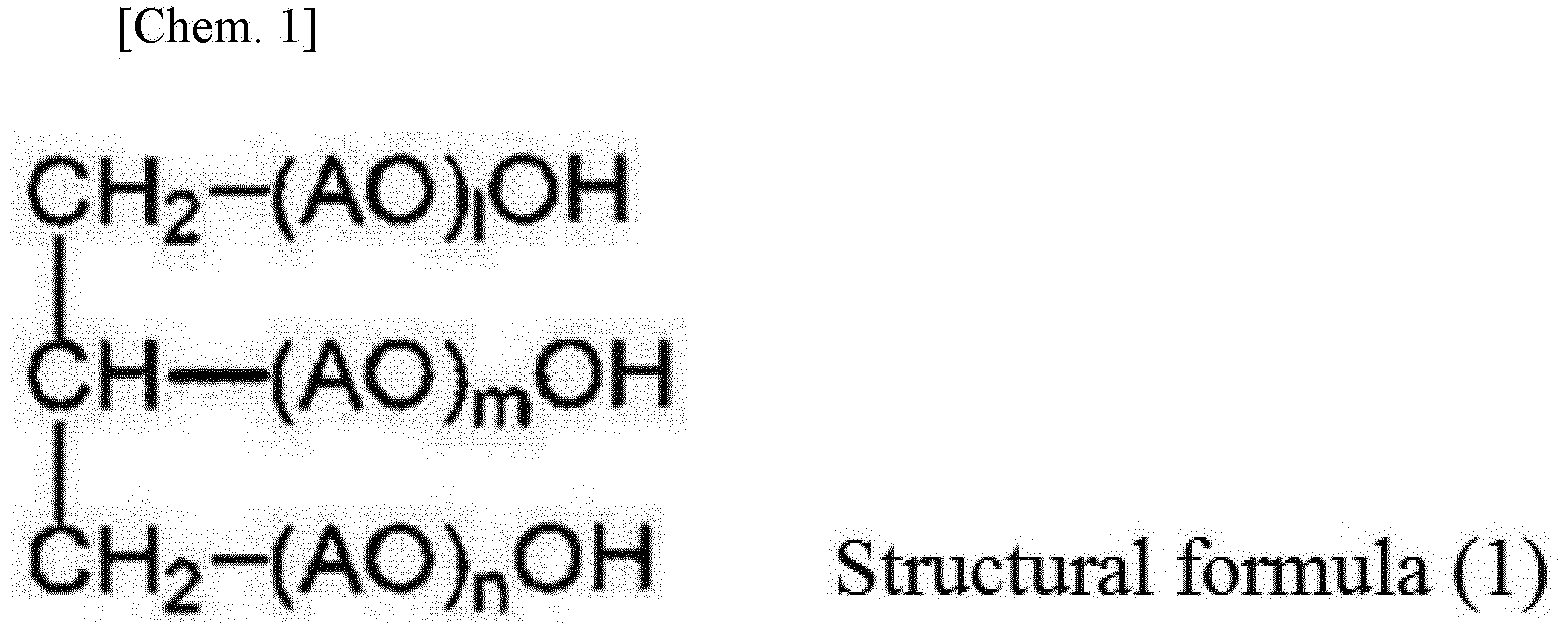
- In the structural formula (1), 1, m and n each independently represent an integer of 1 or more, and satisfy the relation: l + m + n = 3 to 15; and AO represents at least one of ethyleneoxy and propyleneoxy.
[Chem. 2] R-O-[(PO)p-(EO)q]-OH Structural formula (2)
- In the structural formula (2), R represents a hydrocarbon group having 6 to 30 carbon atoms, and may be any one of a saturated group or an unsaturated group; PO represents propyleneoxy; EO represents ethyleneoxy; and p and q each independently represent an integer, and satisfies the relations: 0 ≤ p ≤ 10 and 1 ≤ q ≤ 50.
- <2> The image forming method described in item <1>, wherein the ink composition further includes a wax, is provided.
- <3> The image forming method described in item <1> or <2>, wherein AO in the structural formula (1) is propyleneoxy, is provided.
- <4> The image forming method described in any one of items <1> to <3>, wherein in the structural formula (2), R represents an alkyl group having 8 to 24 carbon atoms or an alkenyl group having 8 to 24 carbon atoms, the range of p is such that 0 ≤ p ≤ 8, and the range of q is such that 5 ≤ q ≤ 50, is provided.
- <5> The image forming method described in any one of items <1> to <4>, wherein the ink composition further includes a wax, and the wax is in the form of wax particles.
- <6> The image forming method described in any one of items <1> to <5>, wherein the ink composition further includes a pyrrolidone derivative.
- <7> The image forming method described in any one of items <1> to <6>, wherein the ink composition further includes a pyrrolidone derivative, and the pyrrolidone derivative is at least one of 2-pyrrolidone and N-methyl-2-pyrrolidone.
- <8> The image forming method described in any one of items <1> to <7>, wherein the ink composition further includes a wax, and at least one kind of the wax is carnauba wax.
- <9> The image forming method described in any one of items <1> to <8>, wherein the pigment is a resin-coated pigment in which at least a portion of the pigment surface is coated with a crosslinked polymer obtained by crosslinking a water-soluble resin with a crosslinking agent.
- <10> The image forming method described in item <9>, wherein the water-soluble resin contains a carboxyl group or a salt thereof in the molecule, and the crosslinking agent is a bifunctional or higher-functional epoxy compound.
- <11> The image forming method described in any one of items <1> to <10>, wherein the content of the compound represented by structural formula (1) is 5.0 mass% to 40.0 mass% relative to the total mass of the ink composition.
- <12> The image forming method described in any one of items <1> to <11>, wherein the content of the compound represented by structural formula (2) is 0.01 mass% to 10.0 mass% relative to the total mass of the ink composition.
- <13> The image forming method described in any one of items <1> to <12>, wherein the ink composition further includes a wax, and the content of the wax is 0.03 mass% to 15.0 mass% relative to the total mass of the ink composition.
- <14> The image forming method described in any one of items <1> to <13>, wherein the ink composition includes a pyrrolidone derivative, and the content of the pyrrolidone derivative is 3.0 mass% to 20.0 mass% relative to the total mass of the ink composition.
- <15> The image forming method described in any one of items <1> to <14>, wherein the ink composition further includes resin particles having a glass transition temperature of 80°C or higher. Preferably, the resin particles have a hydrophilic constituent unit and a hydrophobic constituent unit.
- <16> The image forming method described in any one of items <1> to <15>, further including a heating and fixing step of heating the ink composition applied by applying processing to fix the ink composition onto the recording medium.
- According to the invention, there is provided an image forming method in which, in the case of forming an image at a high speed by using an arbitrary recording medium such as a business form paper for inkjet printing, an image having superior scratch resistance (may also be referred to as abrasion resistance) compared with conventional images may be obtained.
- Hereinafter, the image forming method of the invention will be described in detail.
- The image forming method of the invention is configured to include an ink applying step of forming an image by applying an ink composition which contains a pigment, a compound represented by the following structural formula (1), a compound represented by the following structural formula (2) and water, on a recording medium being conveyed (for example, in the sub-scanning direction) at a conveyance speed of 80 m/min or higher. The image forming method of the invention may also be provided with, if necessary, another step such as heating and fixing of the image thus formed.
- In regard to the ink composition for inkjet recording, various compositions have been hitherto suggested, and ink compositions which use solvents having a structure containing an ethyleneoxy chain or a propyleneoxy chain are known. However, it is conventional that the high abrasion resistance required in images formed on a recording medium being conveyed at a high speed of 80 m/min or higher is not taken into consideration.
- According to the invention, the ink composition is an ink composition which is used in the case of performing inkjet recording at a high speed, in which the conveyance speed of the recording medium as viewed from the ejection head is 80 m/min or higher (for example, in the case of drawing images sequentially at a high speed by using rolled paper or the like that is used for high speed recording applications, such as a business form paper), and which contains a compound having at least one of a propyleneoxy (PO) block and an ethyleneoxy (EO) block (compound represented by structural formula (2)) and a glycerin-based compound (compound represented by structural formula (1)). By using this ink composition, when an image is formed at a high speed, subduction of the pigment in the ink composition to the recording medium is promoted, and thus an image strength with which the image does not easily have blurring or the like caused by abrasion, is obtained. Thereby, when high speed image drawing is carried out by an inkjet method on a recording medium being conveyed at a high speed of 80 m/min or higher, an image having superior abrasion resistance compared with conventional ink images can be obtained.
- Furthermore, the image forming method of the invention also exhibits print suitability to crimped paper such as crimped postcard (prevention of ink transfer to the opposite surface by crimping).
- In the case of crimped paper such as crimped postcard, an image is drawn on a crimped postcard paper which has been precoated with a crimping paste, and the crimped postcard paper sheets are laminated by passing them through a crimping machine to obtain a crimped postcard. When it is intended to see the drawn image part, the laminated section of the crimped postcard is peeled to open. However, at that time, it is required that the characters, images and the like that have been drawn should not be projected on the opposite surface. When the characters and the like that are drawn as such are imprinted to the drawn image site on the opposite surface that faces the surface having a drawn image, and information is added thereto, it is difficult to read the characters and the like. Also, this may lead to a failure such as a problem that normal judgment cannot be achieved. However, in the technologies that have been conventionally suggested, nothing has been anticipated regarding impartation of print suitability (an image is not imprinted to the opposite face) to a crimped paper, that is, impartation of a performance in which ink impression in the case where high speed image drawing is carried out on the image-drawn surface having a paste applied thereon, and then the image is crimped by exerting a crimping force, is not likely to occur. Therefore, from the viewpoint of print suitability to a crimped paper, sufficient performance has not been secured in the current situation. In the present invention, when the paper is crimped by applying a paste after an image is formed, the phenomenon in which the image is transferred (ink impression) to the opposite surface that faces the surface where the image is formed is prevented. Therefore, an image having print suitability to a crimped surface can be obtained.
- As described above, the present invention is distinguished from conventional methods from the viewpoint that the invention is appropriate for the characteristics that are demanded in accordance with image formation at a high speed of 80 m/min or higher, by using a compound containing at least one of a PO block and an EO block and a specific glycerin-based compound in combination.
- The "business form paper" used as a recording medium according to the invention is also called fanfold paper and is a paper having form processing suitability. The business form paper is used in the field of business forms, for example, in the applications of slips, application forms, bills, leaflets, catalogues, and direct mails.
- Furthermore, the crimped paper refers to, for example, a crimped postcard in which a paste agent is applied on the facing surfaces of a paper that has been half-folded so that the facing surfaces adhere to each other at the time of crimping, and image drawing is carried out over the paste agent.
- Hereinafter, the ink applying step that constitutes the image forming method of the present invention and other processes provided as necessary will be described in detail.
- - Ink applying step -
- The ink applying step according to the invention corresponds to image formation, and an ink composition containing a pigment, a compound represented by structural formula (1) shown below, a compound represented by structural formula (2) and water is applied on a recording medium being conveyed (for example, in a sub-scanning direction) at a conveyance speed of 80 m/min or higher.
- In the ink applying step according to the invention, while multiple sheets of long paper or rolled long paper is conveyed at a conveyance speed of 80 m/min or higher in a direction that is perpendicular to the scanning direction of the inkjet head (for example, a sub-scanning direction), plural images are formed at a high speed. In general, when the conveyance speed of the recording medium is fast, the deposited ink composition rapidly penetrates into the recording medium, or when the image cannot maintain a certain degree of strength for a short time, different sheets of the recording medium undergo abrasion, and the image quality is likely to deteriorate. This phenomenon is particularly likely to occur at a conveyance speed in the range of 80 m/min or higher.
- From the viewpoint of increasing the speed of image formation, it is preferable that the conveyance speed be faster, and the conveyance sped is more preferably 100 m/min or higher, and even more preferably 150 m/min or higher. The upper limit of the conveyance speed is not particularly limited, but from the viewpoint of the necessity of conveying a recording medium stably, the upper limit of the conveyance speed is preferably 350 m/min or less.
- The formation of an image by using an inkjet method can be carried out by ejecting an ink composition onto a desired recording medium by supplying energy. Meanwhile, regarding a preferred image forming method of the present invention, the method described in paragraphs [0093] to [0105] of
JP2003-306623A - The inkjet method is not particularly limited, and may be of any known system, for example, a charge control system of ejecting an ink utilizing an electrostatic attraction force, a piezo-inkjet system of ejecting an ink by using a piezoelectric element which produces mechanical strain when a voltage is applied, an acoustic inkjet system of converting electric signals into acoustic beams, radiating them to an ink, and ejecting the ink utilizing a radiation pressure, and a thermal inkjet system of heating an ink to form bubbles and utilizing the resultant pressure (BUBBLEJET (registered trade mark)).
- Examples of the inkjet method include a system of injecting a number of ink droplets of low concentration, a so-called "photo-ink" each in a small volume, a system of improving an image quality using plural inks of a substantially identical hue and of different concentrations, and a system of using a colorless transparent ink.
- The inkjet method according to the invention is suitably a piezo-inkjet system. By combining the ink composition of the invention or an ink set containing this ink composition with the piezo-inkjet system, continuous ejectability and ejection stability of the ink are further enhanced. In the piezo-inkjet system, the strain form of the piezoelectric element may be any of a bending mode, a longitudinal mode, and a shear mode. The configuration of the piezoelectric element and the structure of the piezo head are not particularly limited, and any known technologies can be employed.
- The ink nozzle and the like used when recording is performed by an inkjet method are not particularly limited, and can be appropriately selected according to the purpose.
- The inkjet method applicable to the invention may be a shuttle system in which, as long as the conveyance speed of the recording medium can be maintained at 80 m/min or higher as described above, a short serial head is used and recording is performed while allowing the head to scan in the lateral direction of a recording medium (main-scanning direction). However, an embodiment in which a line system using a line head in which recording elements are arranged corresponding to the entire region for one side of a recording medium, is preferred. In the case of the line system, an image can be recorded over the entire surface of the recording medium by allowing the recording medium to be scanned in the direction (for example, sub-scanning direction) intersecting (for example, perpendicular) the direction of arrangement (main-scanning direction) of the recording elements. Further, in the present invention, the conveyance speed of 80 m/min or higher means that the recording medium is conveyed at a conveyance speed of 80 m/min or higher. That is, the image forming method of the present invention includes an ink applying step of applying an ink composition on a recording medium being conveyed, for example, in a sub-scanning direction at a conveyance speed of 80 m/min or higher.
- The amount of ink droplet of the ink composition thus ejected is, when the resolution is 1200 dpi x 1200 dpi, preferably from 0.5 pl to 10 pl (picoliters), more preferably from 1 pl to 5 pl, and even more preferably from 2 pl to 4 pl, from the viewpoint of obtaining high accuracy images. Furthermore, when the resolution is 600 dpi x 600 dpi, the amount of ink droplet is preferably 2.0 pl to 24 pl (picoliters), more preferably 4 pl to 20 pl, and even more preferably 8 pl to 16 pl.
- Next, the details of the ink composition according to the invention will be described in detail.
- (Pigment)
- The ink composition according to the invention contains at least one pigment. The pigment can be appropriately selected according to the purpose, and may be any of an organic pigment or an inorganic pigment.
- Examples of the organic pigment include an azo pigment, a polycyclic pigment, a dye chelate, a nitro pigment, a nitroso pigment, and aniline black. Among these, an azo pigment, a polycyclic pigment and the like are more preferred. Examples of the azo pigment include an azo lake, an insoluble azo pigment, a condensed azo pigment, and a chelate azo pigment. Examples of the polycyclic pigment include a phthalocyanine pigment, a perylene pigment, a perinone pigment, an anthraquinone pigment, a quinacridone pigment, a dioxazine pigment, an indigo pigment, a thioindigo pigment, an isoindolinone pigment, and a quinophthalone pigment. Examples of the dye chelate include a basic dye chelate and an acidic dye chelate.
- Examples of the inorganic pigment include titanium oxide, iron oxide, calcium carbonate, barium sulfate, aluminum hydroxide, barium yellow, cadmium red, chrome yellow, and carbon black. Among these, carbon black is particularly preferred. Meanwhile, examples of the carbon black include those produced according to known methods such as a contact method, a furnace method and a thermal method. Among these pigments, a water-dispersible pigment is preferred.
- Specific examples of the water-dispersible pigment include pigments of the following items (1) to (4).
- (1) An encapsulated pigment, that is, a polymer dispersion obtained by incorporating a pigment into polymer microparticles, and more particularly, a pigment which enables a pigment to be dispersed in water by coating at least a portion of the pigment surface with a water-insoluble resin and hydrophilizing the resin layer of the pigment surface.
- (2) A self-dispersing pigment, that is, a pigment having at least one hydrophilic functional group at the pigment surface and exhibits at least any one of water-dispersibility and water-solubility in the absence of a dispersant, and more particularly, a pigment in which mainly carbon black or the like is subjected to surface oxidation and hydrophilization, and the pigment simple substance is dispersed in water.
- (3) A resin-dispersed pigment, that is, a pigment dispersed by a water-soluble polymer compound having a weight average molecular weight of 50,000 or less.
- (4) A surfactant-dispersed pigment, that is, a pigment dispersed by a surfactant.
- Here, the (1) encapsulated pigment will be described in detail.
- The resin used in the encapsulated pigment is not limited, but is preferably a polymer compound which has self-dispersion capacity or dissolution capacity in a mixed solvent of water and a water-soluble organic solvent and has an anionic group (acidic group). This resin is usually a resin having a number average molecular weight preferably in the range of 1,000 to 100,000, and particularly preferably in the range of 3,000 to 50,000. Furthermore, this resin is preferably a resin which dissolves in an organic solvent and forms a solution. If the number average molecular weight of the resin is in the range described above, the function as a coating film for the pigment or as a coating film prepared into an ink can be exhibited. The resin is preferably used in the form of a salt of an alkali metal or an organic amine.
- Specific examples of the resin that is used in the encapsulated pigment include materials having anionic groups, including a thermoplastic, thermosetting or modified acrylic resin, an epoxy-based resin, a polyurethane-based resin, a polyether-based resin, a polyamide-based resin, an unsaturated polyester-based resin, a phenolic resin, a silicone-based resin, and a fluorine-based resin; polyvinyl-based resins such as polyvinyl chloride, polyvinyl acetate, polyvinyl alcohol, and polyvinyl butyral; polyester-based resins such as an alkyd resin and a phthalic acid resin; amino-based materials such as a melamine resin, a melamine formaldehyde resin, an amino-alkyd co-condensate resin, and a urea resin; and copolymers or mixtures thereof.
- Among these resins, the anionic acrylic resin may be obtained by, for example, polymerizing an acrylic monomer having an anionic group (hereinafter, referred to as "anionic group-containing acrylic monomer") and if necessary, another monomer capable of copolymerizing with the anionic group-containing acrylic monomer in a solvent. Examples of the anionic group-containing acrylic monomer include acrylic monomers having one or more anionic groups selected from the group consisting of a carboxyl group, a sulfonic acid group, and a phosphono group, and among them, an acrylic monomer having a carboxyl group is particularly preferred. Specific examples of the acrylic monomer having a carboxyl group include acrylic acid, methacrylic acid, crotonic acid, ethacrylic acid, propylacrylic acid, isopropylacrylic acid, itaconic acid, and fumaric acid. Among these, acrylic acid or methacrylic acid is preferred.
- The encapsulated pigment can be produced by a conventional physical or chemical method by using the components described above. For example, the encapsulated pigment can be produced by the methods described in
JP1997-151342A JP-H9-151342A JP1998-140065A JP-H10-140065A JP1999-209672A JP-H11-209672A JP1999-172180A JP-H11-172180A JP1998-25440A JP-H10-25440A JP1999-43636A JP-H11-43636A JP1997-151342A JP-H9-151342A JP1998-140065A JP-H10-140065A - Furthermore, the self-dispersing pigment is another preferred example. The self-dispersing pigment is a pigment capable of dispersing in an aqueous medium without using a dispersant for pigment dispersion, by having plural hydrophilic functional groups and/or salts thereof (hereinafter, referred to as "dispersibility imparting groups) bonded to the pigment surface directly or indirectly through an alkyl group, an alkyl ether group, an aryl group or the like. Here, the phrase "dispersing in an aqueous medium without using a dispersant" implies that the pigment can be dispersed in an aqueous medium even if a dispersant for dispersing a pigment is not used.
- An ink containing the self-dispersing pigment as a colorant usually needs not contain a dispersant which is incorporated in order to disperse a pigment, and therefore, an ink which hardly exhibits foaming caused by a decrease in defoamability attributable to the dispersant and has excellent ejection stability can be easily prepared. Examples of the dispersibility imparting group that is bonded to the surface of the self-dispersing pigment include -COOH, -CO, -OH, -SO3H, -PO3H2, quaternary ammonium and salts thereof. The dispersibility imparting group is bonded by subjecting a pigment to a physical treatment or a chemical treatment, and bonding (grafting) a dispersibility imparting group or an active species having a dispersibility imparting group to the pigment surface. Examples of the physical treatment include a vacuum plasma treatment. Furthermore, examples of the chemical treatment include a wet oxidation method of oxidizing the pigment surface in water by using an oxidizing agent, and a method of bonding p-aminobenzoic acid to the pigment surface and thereby bonding a carboxyl group via a phenyl group.
- In the present invention, for example, a self-dispersing pigment which is surface treated by an oxidation treatment using hypohalous acid and/or a hypohalite, or an oxidation treatment using ozone may be mentioned as a preferred example. Regarding the self-dispersing pigment, a commercially available product may be used, and specifically, MICROJET CW-1 (product name; manufactured by Orient Chemical Industries Co., Ltd.), CAB-O-JET200, and CAB-O-JET300 (product name; manufactured by Cabot Corp.).
- The pigment is preferably an encapsulated pigment in which at least a portion of the pigment surface is coated with a water-insoluble resin by using a water-insoluble resin in the presence of a pigment dispersant (for example, a polymer emulsion in which a pigment is incorporated in water-insoluble resin particles), and more particularly, a water-dispersible pigment in which at least a portion of the pigment is coated with a water-insoluble resin, and a resin layer is formed at the pigment surface so that the pigment can be dispersed in water, is preferred. Using these encapsulated pigments coated with water-insoluble resins is preferred from the viewpoint of the aggregatability of the pigment, and in the case of performing high speed recording, it is preferred from the viewpoint of being capable of forming images with high resolution.
- Here, the reverse phase emulsification method will be described.
- The reverse phase emulsification method is in principle a self-dispersing (reverse phase emulsification) method of dispersing a mixed molten product of a resin having a self-dispersing capacity or dissolution capacity and a pigment in water. Furthermore, this mixed molten product may also include a curing agent, or a polymer compound and a curing agent. Here, the mixed molten product refers to a product including any of a state of being mixed without being dissolved, a state of being dissolved and mixed, or both the states. A more specific production method of the "reverse phase emulsification method" may be a method described in
JP1998-140065A JP-H10-140065A - - Pigment dispersant -
- A pigment dispersant can promote easy dispersion when the pigment is dispersed, and dispersion stabilization after dispersion. Examples of the pigment dispersant include a nonionic compound, an anionic compound, a cationic compound, and an amphoteric compound. For example, a copolymer of a monomer having an α,β-ethylenically unsaturated group may be used. Examples of the monomer having an α,β-ethylenically unsaturated group include ethylene, propylene, butene, pentene, hexene, vinyl acetate, allyl acetate, acrylic acid, methacrylic acid, crotonic acid, crotonic acid ester, itaconic acid, itaconic acid monoester, maleic acid, maleic acid monoester, maleic acid diester, fumaric acid, fumaric acid monoester, vinylsulfonic acid, styrenesulfonic acid, sulfonated vinylnaphthalene, vinyl alcohol, acrylamide, methacryloxyethyl phosphate, bismethacryloxyethyl phosphate, methacryloxyethylphenyl acid phosphate, ethylene glycol dimethacrylate, diethylene glycol dimethacrylate; styrene derivatives such as styrene, α-methylstyrene, and vinyltoluene; vinylcyclohexane, vinylnaphthalene, vinylnaphthalene derivatives, an acrylic acid alkyl ester which may be substituted with aromatic groups, acrylic acid phenyl ester, a methacrylic acid alkyl ester which may be substituted with an aromatic group, methacrylic acid phenyl ester, a methacrylic acid cycloalkyl ester, a crotonic acid alkyl ester, an itaconic acid dialkyl ester, a maleic acid dialkyl ester, and derivatives of the above compounds.
- A homopolymer obtainable by homopolymerizing a monomer having an α,β-ethylenically unsaturated group, or a copolymer obtainable by copolymerizing plural kinds of the foregoing monomers can be used as a polymeric dispersant (pigment dispersant). Specific examples include an acrylic acid alkyl ester-acrylic acid copolymer, a methacrylic acid alkyl ester-methacrylic acid copolymer, a styrene-acrylic acid alkyl ester-acrylic acid copolymer, a styrene-methacrylic acid phenyl ester-methacrylic acid copolymer, a styrene-methacrylic acid cyclohexyl ester-methacrylic acid copolymer, a styrene-styrenesulfonic acid copolymer, a styrene-maleic acid copolymer, a styrene-methacrylic acid copolymer, a styrene-acrylic acid copolymer, a vinylnaphthalene-maleic acid copolymer, a vinylnaphthalene-methacrylic acid copolymer, a vinylnaphthalene-acrylic acid copolymer, polystyrene, polyester, and polyvinyl alcohol.
- The pigment dispersant is preferably a dispersant having a weight average molecular weight of 2,000 to 60,000.
- The amount of the pigment dispersant added to the pigment is preferably in the range of from 10% to 100% by mass of the pigment, more preferably from 20% to 70% of the pigment, and even more preferably from 40% to 50% of the pigment.
- Furthermore, the pigment according to the invention is preferably a resin-coated pigment in which at least a portion of the pigment surface is coated with a crosslinked polymer obtained by crosslinking a water-soluble resin with a crosslinking agent. The water-soluble resin acts as a dispersant for dispersing the pigment. Since the pigment is coated with a crosslinked polymer, when the pigment is prepared into a pigment dispersion or into an ink composition using the pigment dispersion, excellent stability (stability against pH fluctuation, and stability against temperature fluctuation) can be imparted.
- Examples of the water-soluble resin include polyvinyls, polyurethanes, and polyesters, and among them, polyvinyls are preferred.
- The water-soluble resin has a group which causes a crosslinking reaction caused by a crosslinking agent in the molecule (site to be crosslinked). Such a group is not particularly limited, but examples thereof include a carboxyl group or a salt thereof, an isocyanate group, and an epoxy group. According to the invention, from the viewpoint of enhancing dispersibility, a water-soluble resin having a carboxyl group or a salt thereof is preferred.
- The water-soluble resin that can be used in the invention is preferably a copolymer obtainable by using a carboxyl group-containing monomer as a copolymerization component. Examples of the carboxyl group-containing monomer include methacrylic acid, β-carboxyethyl acrylate, fumaric acid, itaconic acid, maleic acid, and crotonic acid, and among them, from the viewpoints of crosslinkability and dispersion stability, methacrylic acid or β-carboxyethyl acrylate is preferred.
- Furthermore, in addition to the carboxyl group-containing monomer, an arbitrarily selected hydrophilic monomer or hydrophobic monomer may also be used as a copolymerization component. The hydrophilic monomer may be ionic or nonionic. The hydrophobic monomer is not particularly limited, but an alkyl methacrylate having 1 to 20 carbon atoms, or an alkyl acrylate having 1 to 20 carbon atoms is preferred.
- The water-soluble resin may be a random polymer, or any of a block polymer or a graft polymer.
- The acid value of the water-soluble resin (number of milligrams (mg) of KOH required to neutralize 1 g of the water-soluble resin) is preferably 135 mg KOH/g to 250 mg KOH/g, more preferably 135 mg KOH/g to 200 mg KOH/g, and particularly preferably 135 mg KOH/g to 180 mg KOH/g, from the viewpoints of the dispersibility of the pigment and the dispersion stability.
- The synthesis method of a polymer as a water-soluble resin is not particularly limited, but random polymerization of a vinyl monomer is preferred from the viewpoint of dispersion stability.
- Regarding the crosslinking agent, a compound having two or more sites that cause a crosslinking reaction (crosslinking sites) can be used, and among others, from the viewpoint of having excellent reactivity with a carboxyl group, a bifunctional or higher-functional epoxy compound (that is, a compound having two or more epoxy groups) is preferred. Specific examples of the bifunctional or higher-functional epoxy compound include ethylene glycol diglycidyl ether, polyethylene glycol diglycidyl ether, 1,6-hexanediol diglycidyl ether, diethylene glycol diglycidyl ether, dipropylene glycol diglycidyl ether, and polypropylene glycol diglycidyl ether. Polyethylene glycol diglycidyl ether or diethylene glycol diglycidyl ether is preferred.
- The molar ratio of the crosslinking site of the crosslinking agent and the site to be crosslinked of the water-soluble resin is, from the viewpoint of the crosslinking reaction rate and the stability of the dispersion after crosslinking, preferably 1:1.1 to 1:10, more preferably 1:1.1 to 1:5, and most preferably 1:1.1 to 1:3.
- The amount of the water-soluble resin with respect to the pigment is preferably 10 mass% to 250 mass%, more preferably 10 mass% to 200 mass%, even more preferably 20 mass% to 150 mass%, and particularly preferably 30 mass% to 100 mass%.
- A resin-coated pigment in which the pigment surface is coated with a crosslinked polymer obtained by crosslinking a water-soluble resin with a crosslinking agent, can be obtained by a process of dispersing a pigment by using a water-soluble resin and then crosslinking the water-soluble resin with a crosslinking agent. A preferred example of the preparation method includes a method of carrying out the following steps (1) to (3):
- (1) A dispersion step of dispersing a pigment and a water-soluble resin in water or an aqueous solution of a polar solvent, and obtaining a pigment dispersion liquid;
- (2) A crosslinking step of heating the pigment dispersion liquid obtained in the step (1) with an added crosslinking agent, and performing a crosslinking reaction to coat the pigment surface with a crosslinked polymer; and
- (3) A step of purifying the resin-coated pigment coated with a crosslinked polymer.
- In addition to these steps, other steps may also be appropriately provided. In the step (1), regarding the polar solvent and the like, any known agents can be appropriately used.
- In regard to the pigment, one kind may be used alone, or plural kinds can be selected from within each group or among various groups and used in combination.
- The content of the pigment in the ink composition is, from the viewpoints of color density, particulate properties, ink stability, and ejection reliability, preferably an amount of 0.1 mass% to 15 mass%, more preferably an amount of 0.5 mass% to 12 mass%, and particularly preferably 1 mass% to 10 mass%, relative to the total mass of the ink composition.
- (Compound represented by structural formula (1))
- The ink composition according to the invention contains at least one kind of a compound represented by structural formula (1). The compound represented by the structural formula (1) is an alkylene oxide adduct of glycerin represented by the following structure. When this compound is incorporated into the ink composition, penetration of the ink into a recording medium can be suppressed to an extent that abrasion resistance of the image is not significantly impaired.

- In the structural formula (1), l, m and n each independently represent an integer of 1 or more, and satisfy the relation: l + m + n = 3 to 15. When the value of l + m+ n is 3 or more, the curl suppressing effect is satisfactory, and when the value is 15 or less, satisfactory ink ejection properties can be maintained. Among others, the value of l + m + n is preferably in the range of 3 to 12, and more preferably in the range of 3 to 10. AO in the structural formula (1) represents at least one of ethyleneoxy (may be abbreviated to EO) and propyleneoxy (may be abbreviated to PO), and among these, propyleneoxy is preferred. AO's in (AO)l, (AO)m, and (AO)n may be identical with or different from each other. Furthermore, when 1, m and n each represent an integer of 2 or more, plural AO's may be identical with or different from each other.
- Examples of the compound represented by the structural formula (1) will be described below. Meanwhile, the values within the parentheses are SP values. However, in the present invention, the compound is not limited to these.


- EO and PO represent ethyleneoxy and propyleneoxy, respectively.
- Regarding the alkylene oxide adduct of glycerin, a commercially available product that is being marketed may be used. For example, as polyoxypropylated glycerin (an ether of polypropylene glycol and glycerin), SANNIX GP-250 (average molecular weight 250), SANNIX GP-400 (average molecular weight 400), and SANNIX GP-600 (average molecular weight) [all manufactured by Sanyo Chemical Industries, Ltd.]; LEOCON GP-250 (average molecular weight 250), LEOCON GP-300 (average molecular weight 300), LEOCON GP-400 (average molecular weight 400), LEOCON GP-700 (average molecular weight 700) [all manufactured by Lion Corp.]; and polypropylene triol glycol-triol type (average molecular weight 300, average molecular weight 700) [all manufactured by Wako Pure Chemical Industries, Ltd.].
- The SP value (solubility parameter/unit: (cal/cm3)1/2) is a value represented by the root mean square of molecular aggregation energy, and is calculated by the method described in R.F. Fedors, Polymer Engineering Science, 14, p. 147-154 (1974).
- The SP value is preferably in the range of 27.5 or less.
- Furthermore, the ink composition may further contain another water-soluble organic solvent in addition to the compound represented by structural formula (1). In this case, 70 mass% or more of the total amount of the compound represented by the structural formula (1) and the other water-soluble organic solvent included in the ink composition is preferably such that the SP value is 27.5 or less. When the SP value is 27.5 or less, the occurrence of curling in various environmental humidity values after image formation is further suppressed. Also, when the ink composition contains the resin particles that will be described below, the organic solvent and the resin particles interact, and fixing properties are improved. Particularly, when components having relatively lower SP values (≤ 27.5) are included in a large amount, scratch resistance of the image can be further enhanced. Furthermore, it is also effective in suppressing offset.
- The content of the compound represented by the structural formula (1) in the ink composition is preferably 3.0 mass% to 45.0 mass%, more preferably 5.0 mass% to 40.0 mass%, even more preferably 7.0 mass% to 35.0 mass%, and particularly preferably 8.0 mass% to 30.0 mass%, relatively to the total mass of the ink composition.
- When the content of the compound represented by the structural formula (1) is 5.0 mass% or more, the penetrability of the ink composition to the recording medium is alleviated, and strike through of the ink is also prevented.
- Examples of the other water-soluble organic solvent include the water-soluble organic solvents described in paragraphs [0036] to [0039] of
JP2009-190379A - (Compound represented by structural formula (2))
- The ink composition according to the invention contains at least one kind of a compound represented by the following structural formula (2). When this compound is used in combination in the composition containing a compound represented by the structural formula (1) described above, abrasion resistance of the image is enhanced. Furthermore, transfer of ink (ink impression) after image formation at a high speed and crimping on a crimped paper that is obtained by crimping paper surfaces applied with paste after image drawing, can be prevented.
[Chem. 5] R-O-[(PO)p-(EO)q]-OH Structural formula (2)
- In the structural formula (2), R represents a hydrocarbon group having 6 to 30 carbon atoms, and may be any of a saturated hydrocarbon group or an unsaturated hydrocarbon group. Furthermore, R may be linear, branched or cyclic.
- Examples of the hydrocarbon group having 6 to 30 carbon atoms represented by R include an alkyl group, an alkenyl group, an alkynyl group, an aromatic group, and an alicyclic group.
- From the viewpoint of subduing the pigment onto the recording medium at the time of image formation, it is preferable that the carbon chain be longer and more hydrophobic, and specifically, a chain-like saturated hydrocarbon group having 8 to 24 carbon atoms and a chain-like unsaturated hydrocarbon group having 8 to 24 carbon atoms are preferred; and a chain-like saturated hydrocarbon group having 10 to 22 carbon atoms and a chain-like unsaturated hydrocarbon group having 10 to 22 carbon atoms are more preferred. The chain-like saturated hydrocarbon groups and the chain-like unsaturated hydrocarbon groups include a linear structure and a branched structure, but a linear structure is preferred. The hydrocarbon group is particularly preferably a linear chain-like saturated hydrocarbon group having 10 to 22 carbon atoms, or a linear chain-like unsaturated hydrocarbon group having 10 to 22 carbon atoms.
- Examples of the alkyl group include an octyl group, a nonyl group, a decyl group, an undecyl group, a lauryl (dodecyl) group, a tridecyl group, a tetradecyl group, a cetyl (hexadecyl) group, a stearyl (octadecyl) group, a nonadecyl group, an icosyl group, and a behenyl (docosyl) group. Among them, an alkyl group having 8 to 24 carbon atoms is preferred, and an alkyl group having 10 to 22 carbon atoms is more preferred.
- Examples of the alkenyl group include an octenyl group, a nonenyl group, a decenyl group, an undecenyl group, a dodecenyl group, a tridecenyl group, a tetradecenyl group, a hexadecenyl group, an oleyl (octadecenyl) group, a nonadecenyl group, an icosenyl group, and a docosenyl group. Among them, an alkenyl group having 8 to 24 carbon atoms is preferred, and an alkenyl group having 10 to 22 carbon atoms is more preferred.
- Examples of the alkynyl group include an octynyl group, a nonynyl group, a decynyl group, an undecynyl group, a dodecynyl group, a tridecynyl group, a tetradecynyl group, a hexadecynyl group, an octadecynyl group, a nonadecynyl group, an icosynyl group, and a docosynyl group. Among them, an alkynyl group having 8 to 24 carbon atoms is preferred, and an alkynyl group having 10 to 22 carbon atoms is more preferred.
- Examples of the aromatic group include a nonylphenyl group, an octylphenyl group, a naphthyl group, and a trimethylphenyl group.
- Examples of the alicyclic group include an isobornyl group, a norbornyl group, a dicyclopentanyl group, a dicyclopentenyl group, and an adamantyl group.
- Among the groups described above, R is more preferably an alkyl group, an alkenyl group, or an alkynyl group; more preferably an alkyl group having 8 to 24 carbon atoms, or an alkenyl group having 8 to 24 carbon atoms; and even more preferably an alkyl group having 10 to 22 carbon atoms, or an alkenyl group having 10 to 22 carbon atoms.
- In the structural formula (2), PO is propyleneoxy, and represents -CH2CH2CH2O- or -CH(CH3) CH2O-. EO is ethyleneoxy, and represents -CH2CH2O-.
- p and q that represent the repetition numbers of PO and EO, respectively, each independently represent an integer such that the relations: 0 ≤ p 10 and 1 ≤ q ≤ 50 are satisfied. From the viewpoint of imparting suitability to crimped paper, the range of p is preferably 0 ≤ p ≤ 8, and the range of q is preferably 5 ≤ q ≤ 50.
- In the structural formula (2), an embodiment in which R represents an alkyl group having 8 to 24 carbon atoms or an alkenyl group having 8 to 24 carbon atoms, p is in the range of 0 ≤ p ≤ 8, and p is in the range of 5 ≤ q ≤ 50, is particularly preferred.
- Preferred specific examples of the compound represented by the structural formula (2) include the following compounds.
R-O-[(PO)p-(EO)q]-OH [Chem. 6]R (Carbon number) p q 1 Octyl group (8) 0 4 2 Octyl group (8) 0 7 3 Octyl group (8) 0 15 4 Decyl group (10) 0 15 5 Lauryl group (12) 0 10 6 Lauryl group (12) 0 23 7 Cetyl group (16) 0 7 8 Cetyl group (16) 0 15 9 Cetyl group (16) 0 20 10 Cetyl group (16) 0 40 11 Cetyl group (16) 4 20 12 Cetyl group (16) 8 20 13 Stearyl group (18) 0 10 14 Stearyl group (18) 0 20 15 Behenyl group (22) 0 20 16 Behenyl group (22) 0 30 17 Oleyl group (18) 0 4 18 Oleyl group (18) 0 7 19 Oleyl group (18) 0 15 20 Oleyl group (18) 0 20 21 Oleyl group (18) 0 50 - Regarding the compound represented by the structural formula (2), a commercially available product that is being marketed may also be used. Preferred examples of the commercially available product include EMULGEN 106, EMULGEN 123P, EMULGEN 210P, EMULGEN 220, EMULGEN 306P, EMULGEN 320P, EMULGEN 420 (all manufactured by Kao Corp.); NONION E-205S, NONION E-215, NONION E-220S, NONION E-230, UNISAFE 10P-4, UNISAFE 20P-4, UNISAFE 5P-8, UNISAFE 10P-8, and UNISAFE 20P-8 (all manufactured by NOF Corp.).
- The content of the compound represented by the structural formula (2) in the ink composition is preferably 0.01 mass% to 13.0 mass%, more preferably 0.01 mass% to 10.0 mass%, even more preferably 0.02 mass% to 8.5 mass%, and particularly preferably 0.02 mass% to 7.0 mass%, relative to the total mass of the ink composition, from the viewpoints of imparting suitability to crimped paper and ink ejection properties. When the content is 13.0 mass% or less, ejection failure of ink caused by nozzle clogging or the like is avoided, and when the content is 0.01 mass% or more, it is preferable in view of imparting suitability to crimped paper.
- (Resin particles)
- The ink composition according to the invention preferably further contains at least one kind of resin particles. When the ink composition contains resin particles, scratch resistance of the image can be further enhanced by performing a heat treatment after image formation.
- The resin particles are preferably self-dispersing resin particles having a hydrophilic constituent unit (repeating unit derived from a hydrophilic monomer) and a hydrophobic constituent unit (repeating unit derived from a hydrophobic monomer), and it is more preferable that the ink composition contain resin particles (preferably, self-dispersing resin particles) which contain a hydrophilic constituent and a hydrophobic constituent unit and have a glass transition temperature (Tg) of 80°C or higher, from the viewpoint of further increasing the scratch resistance of the image. Tg being 80°C or higher means that the resin particles are hydrophobic. When the Tg of the resin particles included is 80°C or higher, the fixing properties of the ink composition to the recording medium and the abrasion resistance of the image are improved.
- Furthermore, Tg of the resin particles is more preferably 100°C to 300°C, more preferably 130°C to 250°C, and particularly preferably 160°C to 200°C. When the glass transition temperature of the resin particles is 300°C or lower, the abrasion resistance of recorded images is more effectively improved.
- In addition, Tg is a value measured under conventional measurement conditions by using a differential scanning calorimeter (DSC) EXSTAR6220 (manufactured by SII Nanotechnology, Inc.). However, if measurement is difficult due to decomposition of the resin or the like, a calculated Tg that is calculated by the following calculation formula is applied. The calculated Tg is calculated by the following formula (1):

- Here, the polymer that is subject to the calculation is considered to have n kinds of monomer components of i = 1 to n are copolymerized. Xi represents the mass fraction of the i-th monomer (ΣXi = 1), and the glass transition temperature (absolute temperature) of a homopolymer of the i-th monomer. However, Σ means the sum of i = 1 to n. Furthermore, for the value of the glass transition temperature of a homopolymer of each monomer (Tgi), the values described in Polymer Handbook (3rd Edition) (by J. Brandrup and E.H. Immergut (Wiley-Interscience, 1989)) are employed.
- Examples of the resin particles include particles of an acrylic resin, a vinyl acetate-based resin, a styrene-butadiene-based resin, a vinyl chloride-based resin, an acrylic-styrene-based resin, a butadiene-based resin, a styrene-based resin, a crosslinked acrylic resin, a crosslinked styrene-based resin, a benzoguanamine resin, a phenolic resin, a silicone resin, an epoxy resin, a urethane-based resin, a paraffin-based resin, and a fluorine-based resin. Among them, preferred examples include particles of an acrylic resin, an acrylic-styrene-based resin, a styrene-based resin, a crosslinked acrylic resin, and a crosslinked styrene-based resin.
- The weight average molecular weight of the resin particles is preferably from 10,000 to 200,000, and more preferably from 100,000 to 200,000, from the viewpoint of the stability of the ink composition.
- The average particle size of the resin particles is preferably in the range of 10 nm to 1 µm, more preferably 10 nm to 200 nm, even more preferably 20 nm to 100 nm, and particularly preferably 20 nm to 50 nm.
- The resin particles can be used in a dispersed state such as latex.
- When the ink composition contains resin particles, the content of the resin particles in the ink composition is, in terms of solid content, preferably 0.5 mass% to 20 mass%, more preferably 3 mass% to 20 mass%, and even more preferably 5 mass% to 15 mass%, relative to the total mass of the ink composition from the viewpoints of fixability, abrasion resistance, and the viscosity of the ink composition.
- (Wax)
- The ink composition according to the invention preferably contains at least one kind of wax. When the ink composition contains a wax, scratch resistance can be further increased. Examples of the wax include natural waxes and synthetic waxes.
- Examples of natural waxes include petroleum-based waxes, plant-based waxes, and animal-based waxes.
- Examples of the petroleum-based waxes include paraffin wax, microcrystalline wax, and petrolatum. Examples of the plant-based waxes include carnauba wax, candelilla wax, rice wax, and wood wax. Examples of the animal-based waxes include lanolin and beeswax.
- Examples of synthetic waxes include synthetic hydrocarbon-based waxes and modified waxes.
- Examples of the synthetic hydrocarbon-based waxes include polyethylene wax and Fischer-Tropsch wax. Examples of the modified waxes include a paraffin wax derivative, a montan wax derivative, and a microcrystalline wax derivative.
- A paraffin wax contains hydrocarbons having 20 to 40 carbon atoms as main components, and is preferable from the viewpoint that image glossiness, and the effects of preventing moisture evaporation from nozzle tips and retaining moisture are excellent.
- A polyethylene wax has excellent compatibility with resins, and therefore, is preferable from the viewpoint that uniform satisfactory images can be easily formed. Furthermore, since polyethylene waxes can be easily modified, a modified glycol-modified polyethylene wax can impart wettability attributable to glycol, and the wettability effect of the ink composition is exhibited at nozzle tips. Therefore, it is more preferable from the viewpoint that ejection stability can be made more effective.
- Among them, the wax is preferably carnauba wax.
- The wax may be added to the ink composition in any form such as a solution form obtainable by dissolving the wax in an appropriate solvent, an emulsion dispersion form, or a solid fine particle dispersion form. An example of the emulsion dispersion method may be a method of dissolving the wax by using an oil such as dibutyl phthalate, tricresyl phosphate, dioctyl sebacate, or tri(2-ethylhexyl) phosphate, or an auxiliary solvent such as ethyl acetate or cyclohexanone, adding an emulsifying dispersant, and mechanically preparing an emulsion dispersion. At this time, for the purpose of adjusting the viscosity of oil droplets or the refractive index, it is also preferable to add an α-ethylstyrene oligomer or a polymer such as poly(t-butylacrylamide).
- Furthermore, an example of the solid fine particle dispersion method may be a method of preparing a solid dispersion by dispersing a wax powder in an appropriate solvent such as water, by means of a ball mill, a colloid mill, a vibratory ball mill, a sand mill, a jet mill, a roller mill or ultrasonication. Furthermore, a protective colloid (for example, polyvinyl alcohol) or a surfactant (for example, an anionic surfactant such as sodium triisopropylnaphthalenesulfonate (a mixture in which the substitution positions of three isopropyl groups are all different) may also be used. In the mills, beads of zirconia or the like are usually used as a dispersion medium. It is preferable to incorporate a antiseptic (for example, benzoisothiazolinone sodium salt) in an aqueous dispersion.
- A particularly preferred method is an emulsion dispersion method, and the wax is preferably added into the ink composition in the form of a dispersion such as a wax emulsion. That is, the wax is preferably incorporated as wax particles (also called wax dispersed particles) in the ink composition.
- [Wax emulsion]
- A wax emulsion is a wax dispersed composition containing at least a wax, water, and an emulsifying dispersant which emulsify and disperse the wax in water. The emulsifying dispersant that is used in a wax emulsion can be selected from many conventionally known emulsifying dispersants and used. Among them, a preferred emulsifying dispersant may be a dispersant represented by the following general formula (WA).

- In the general formula (WA), R3 represents an alkyl group having 10 to 60 carbon atoms, an alkenyl group having 10 to 60 carbon atoms, an aralkyl group having 10 to 60 carbon atoms, or an aryl group having 10 to 60 carbon atoms; D represents (B)n-E; B represents -CH2CH2O-, -CH2CH2CH2O-, -CH(CH3)CH2O-, or -CH2CH(OH)CH2O-; n represents an integer from 1 to 50; E represents a hydrogen atom, an alkyl group having 1 to 8 carbon atoms, an aryl group having 6 to 8 carbon atoms, an alkylcarbonyl group having 2 to 8 carbon atoms, or an arylcarbonyl group having 7 to 8 carbon atoms; a and d each independently represent an integer from 1 to 6. R3, D and E that may be present in plural numbers when a or d is 2 or more, may be identical with or different from each other. G represents a linking group having a valency of (a + d), and satisfies the relation: 2 ≤ a + d ≤ 7.
- The alkyl group, alkenyl group, aralkyl group and aryl group represented by R3, and the alkyl group, aryl group, aralkylcarbonyl group and arylcarbonyl group represented by E may be further substituted.
- The respective groups in the general formula (WA) will be described in more detail.
- The alkyl group, alkenyl group and aralkyl group represented by R3 may be linear, branched or cyclic. Furthermore, the alkyl group, alkenyl group, aralkyl group and aryl group represented by R3 may be each independently further substituted.
- Preferred examples of R3 include CgH2g+1 (g represents an integer from 12 to 60), eicosyl, and docosanyl. Other examples include dodecyl, myristyl, cetyl, stearyl, oleyl, eicosyl, docasasyl, triacontasyl, tetracontasyl, heptacontasyl, dinonylphenyl, didodecylphenyl, tetradecylphenyl, tripentylphenyl, and dodecylnaphthyl.
- D represents a polyoxyalkylene group represented by (B)n-E.
- Here, B represents -CH2CH2O-, -CH2CH2CH2O-, -CH(CH3)CH2O-, or -CH2CH(OH)CH2O-, and n represents an integer from 1 to 50. Among them, B is preferably -CH2CH2O-, and n is preferably an integer from 5 to 30.
- Furthermore, the alkyl group having 1 to 8 carbon atoms represented by E is preferably methyl, ethyl, propyl, butyl, hexyl, or cyclohexyl, and is particularly preferably methyl, ethyl or propyl.
- The alkylcarbonyl group having 2 to 8 carbon atoms represented by E is preferably acetyl, propionyl, butyroyl, pivaloyl, or cyclohexanecarbonyl, and is particularly preferably acetyl.
- The aryl group having 6 to 8 carbon atoms represented by E may be a phenyl group.
- The arylcarbonyl group having 7 to 8 carbon atoms represented by E may be a benzoyl group.
- Among the groups described above, E is particularly preferably a hydrogen atom, methyl, ethyl, propyl, acetyl, propionyl, or benzoyl.
- The linking group having a valency of (a+d) represented by G may be a single bond when the value of (a + d) is 2. The value of (a + d) is preferably 2 to 5, more preferably 2 to 4, and even more preferably 2 or 3.
- G is preferably at least one of an alkylene group and an arylene group, and this may be an ester group, an ether group, an amide group, a sulfonyl group, or a divalent linking group interrupted by a heteroatom or a heteroatomic group, such as a sulfur atom.
- The heteroatom or heteroatomic group is particularly preferably an ester group, an ether group or an amide group. a and d each independently represent an integer from 1 to 6.
- In addition, the dispersant represented by general formula (WA) is preferably a dispersant having lower solubility in a water-based solvent, and for example, solubility in water is preferably 0.5 mass% or less (25°C), and more preferably 0.1 mass% or less.
- Hereinafter, specific examples (WA-1 to WA-19) of the dispersant represented by general formula (WA) will be described. However, in the present invention, the dispersant is not intended to be limited to these.


- In the wax emulsion, as the solvent that disperses a wax, at least water is used, but the solvent is not limited to this. For example, a conventional organic solvent is appropriately selected and can be used at the time of dispersion of the wax. Regarding the organic solvent that can be used at the time of dispersion of the wax, the organic solvents listed in paragraph [0049] of
JP2010-155359A - Thereby, the dispersion stability of the wax in a wax emulsion can be enhanced. Meanwhile, the organic solvents described above may be used as mixtures of two or more kinds of same or different kinds of solvents.
- Next, the dispersed particles of wax (wax particles) in the wax emulsion will be described in more detail.
- In the present invention, the composition ratio of the two components in wax particles that are composed of at least a wax and a dispersant represented by general formula (WA) (hereinafter, also referred to as a specific dispersant) is not particularly limited, but preferably, the wax particles are wax particles composed of 25 mass% to 99 mass% of a wax, and 1 mass% to 75 mass% of a dispersant. This is because as the wax content is higher, the characteristics of wax particles are exhibited more effectively.
- Therefore, the specific dispersant in the wax particles is preferably such that the content ratio is as low as possible.
- The wax and the specific dispersant that constitute the wax particles are preferably mixed at a temperature higher than the melting point of any component having a higher melting point between the wax and the specific dispersant, before being dispersed in water, so that the wax and the specific dispersant are subjected to so-called melt mixing. Furthermore, a solvent containing water, which serves as a dispersing medium, is similarly heated to a temperature higher than the melting point of the wax and the specific dispersant, a molten mixture is added thereto, and the mixture may be finely dispersed by various dispersing methods. In addition, it is also preferable to add a heated solvent into the molten mixture, and to disperse the molten mixture to obtain dispersed particles. Furthermore, a wax and a specific dispersant may be dissolved in a non-water-based organic solvent which dissolves the wax and the specific dispersant, subsequently the solution may be finely dispersed in water by using another water-soluble surfactant, and the resulting wax particles may be directly added to the ink composition. At this time, the non-water-based organic solvent is preferably, for example, ethyl acetate or the like.
- Furthermore, it is also useful to disperse the wax and the specific dispersant in water, subsequently remove the organic solvent, and use the resultant as a wax particle dispersion. In this case, it is advantageous that even if the melting points of the wax and the specific dispersant are 100°C or higher, the components can be melted and mixed in an organic solvent at a low temperature, and high melting point wax particles in an aqueous system can be produced.
- Here, the melting points of the wax and the specific dispersant are not particularly restricted, but the melting points are preferably from 50°C to 200°C, more preferably 60°C or higher, and particularly preferably from 80°C to 150°C.
- Regarding the solvent, water is most preferred from the viewpoint of being environment-friendly upon the preparation of the ink composition of the invention. Therefore, in the case of using a wax having a melting point of 80°C, it is necessary to disperse the wax after adjusting the water temperature to 80°C or higher.
- The average particle size of the wax particles is preferably 0.01 µm to 10 µm, more preferably 0.05 µm to 5 µm, and even more preferably 0.1 µm to 2 µm. The wax emulsion is preferably added to the ink composition after the average particle size of the wax particles are adjusted to the range described above.
- The content of wax in the ink composition is preferably 0.03 mass% to 15.0 mass% relative to the total mass of the ink composition. It is preferable if the content of wax is higher from the viewpoint of enhancing scratch resistance of the image, but if the content of wax increases, there is a risk that ink ejection properties from ejection orifices or ejection stability may be impaired. Therefore, when the content of wax is adjusted to 15.0 mass% or less, the scratch resistance of the image can be effectively increased while the ink ejection properties and ejection stability are maintained satisfactorily. Furthermore, as described above, a wax emulsion is an emulsion containing a dispersant so as to contain a wax that is not easily dispersed in water, in a dispersed state.
- On the other hand, when the content of wax is 0.03 mass% or higher, it is implied that the wax emulsion substantially contains a wax.
- Within the range of the content described above, the content of wax is more preferably 0.05 mass% to 10.0 mass%, even more preferably 0.07 mass% to 10.0 mass%, particularly preferably 0.10 mass% to 10.0 mass%, and most preferably 0.10 mass% to 7.0 mass%, relative to the total mass of the ink composition.
- In the present invention, when a wax emulsion is incorporated as a wax into the ink composition, the content of the wax in the ink composition is referred to as the solid content of the wax emulsion.
- (Pyrrolidone derivative)
- The ink composition according to the invention preferably contains at least one pyrrolidone derivative. When a pyrrolidone derivative is further incorporated in the ink composition containing the compound represented by the structural formula (1), abrasion resistance of the image is enhanced, and when multiple sheets are processed at a high speed, abrasion failure such as scratch on the image can be prevented.
- Regarding the pyrrolidone derivative according to the invention, any compound having a 5-membered ring containing a lactam structure can be used without limitations. A lactam structure is a structure containing -CO-NR- in a portion of the ring, and R in the structure represents a monovalent group.
- Examples of the monovalent group include a hydrogen atom, an alkyl group, an aryl group, and alkenyl group. Among them, the monovalent group is preferably a hydrogen atom or an alkyl group; more preferably a hydrogen atom or an alkyl group having 1 to 4 carbon atoms; and particularly preferably a hydrogen atom.
- The alkyl group, aryl group, and alkenyl group may be substituted or may not be substituted, but these groups are preferably unsubstituted.
- When R represents an alkyl group, the carbon number of the alkyl group is preferably 1 to 10, more preferably 1 to 6, and particularly preferably 1 to 4. The alkyl group may have a linear structure, a branched structure, or a cyclic structure. Specific examples of the alkyl group include a methyl group, an ethyl group, a propyl group, an isopropyl group, a butyl group, an isobutyl group, a sec-butyl group, a tert-butyl group, a pentyl group, an isopentyl group, a neopentyl group, an octyl group, a nonyl group, a decyl group, a cyclopropyl group, a cyclobutyl group, a cyclopentyl group, a cyclohexyl group, a cycloheptyl group, and a cyclooctyl group.
- Examples of the substituent in the case where the alkyl group has a substituent include an alkoxy group having 1 to 8 carbon atoms, an aryl group having 6 to 14 carbon atoms, a hydroxyl group, a carboxyl group, and a halogen atom (a fluorine atom, a chlorine atom, an iodine atom, or the like).
- When R represents an aryl group, the carbon number of the aryl group is preferably 6 to 20, more preferably 6 to 14, and particularly preferably 6 to 10. Specific examples of the aryl group include a phenyl group, a naphthyl group, and an anthryl group.
- Examples of the substituent when the aryl group has a substituent include an alkoxy group having 1 to 8 carbon atoms, an alkyl group having 1 to 10 carbon atoms, a hydroxyl group, a carboxyl group, and a halogen atom (a fluorine atom, a chlorine atom, an iodine atom, or the like).
- When R represents an alkenyl group, the carbon number of the alkenyl group is preferably 2 to 10, more preferably 2 to 6, and particularly preferably 2 to 4. The alkenyl group may have a linear structure, a branched structure, or a cyclic structure. Specific examples of the alkenyl group include an ethenyl group, a 1-propenyl group, a 2-propenyl group, a 2-methyl-1-propenyl group, a 1-butenyl group, a 2-butenyl group, a 3-butenyl group, a 3-methyl-2-butenyl group, a 1-pentenyl group, a 2-pentenyl group, a 3-pentenyl group, a 4-pentenyl group, a 4-methyl-3-pentenyl group, a 1-hexenyl group, a 3-hexenyl group, a 5-hexenyl group, a 1-heptenyl group, and a 1-octenyl group.
- Examples of the substituent when the alkenyl group has a substituent include an alkoxy group having 1 to 8 carbon atoms, an aryl group having 6 to 14 carbon atoms, a hydroxyl group, a carboxyl group, and a halogen atom (a fluorine atom, a chlorine atom, an iodine atom or the like).
- The pyrrolidone derivative is preferably a compound represented by the following general formula (P-1):

- In the general formula (P-1), R1 represents a hydrogen atom, an alkyl group, an aryl group or an alkenyl group. The alkyl group, aryl group and alkenyl group represented by R1 have the same meanings as the alkyl group, aryl group and alkenyl group represented by R in the "structure containing -CO-NR-", and preferred examples also have the same meanings.
- R2 represents a hydrogen atom or an alkyl group. The alkyl group represented by R2 preferably has 1 to 10 carbon atoms, and may have any of a linear structure, a branched structure and a cyclic structure. Specific examples of the alkyl group include the same examples of the alkyl group represented by R in the "structure containing -CO-NR-".
- R2 is preferably a hydrogen atom or an alkyl group having 1 to 4 carbon atoms, and particularly preferably a hydrogen atom.
- Among the compounds represented by the general formula (P-1), particularly an embodiment in which R1 represents a hydrogen atom or an alkyl group having 1 to 4 carbon atoms, and R2 represents a hydrogen atom or an alkyl group having 1 to 4 carbon atoms is preferred, and an embodiment in which R1 and R2 are together hydrogen atoms is particularly preferred.
- Examples of the pyrrolidone derivative according to the invention include 2-pyrrolidone; N-methyl-2-pyrrolidone, N-ethyl-2-pyrrolidone, N-butyl-2-pyrrolidone, N-vinyl-2-pyrrolidone, 5-methyl-2-pyrrolidone, N-phenyl-2-pyrrolidone, N-cyclohexyl-2-pyrrolidone, and N-hydroxyethyl-2-pyrrolidone. Among these, from the viewpoint of increasing the scratch resistance of an image, 2-pyrrolidone, N-methyl-2-pyrrolidone and N-ethyl-2-pyrrolidone are preferred; 2-pyrrolidone and N-methyl-2-pyrrolidone are more preferred; and 2-pyrrolidone is particularly preferred.
- The content of the pyrrolidone derivative in the ink composition according to the invention is preferably 3.0 mass% to 20.0 mass%, more preferably 4.0 mass% to 16.0 mass%, particularly preferably 6.0 mass% to 15.0 mass%, and most preferably 6.0 mass% to 12.0 mass%, relative to the total mass of the ink composition. When the content of the pyrrolidone derivative is 3.0 mass% or more, scratch resistance of the image can be further increased. Furthermore, when the content of the pyrrolidone derivative is 20.0 mass% or less, it is advantageous to maintain the ink composition stably.
- According to the invention, the content ratio (p/s; mass ratio) of the pyrrolidone derivative (p) to the compound (s) represented by the structural formula (1) is preferably from 0.075 to 4.0. When the content ratio p/s is 0.075 or higher, scratch resistance of the image can be further enhanced. Furthermore, when the content ratio p/s is 4.0 or less, the effect of preventing the strike through phenomenon occurring when the ink composition applied on a recording medium penetrates to the back surface of the recording medium is high, and it is advantageous in suppressing curling. For the same reasons, the content ratio p/s is more preferably in the range of from 0.09 to 3.5, and particularly preferably in the range of from 0.11 to 3.2.
- (Water)
- The ink composition according to the invention contains water, but the content of water is not particularly limited. Above all, the content of water is preferably from 10 mass% to 99 mass%, more preferably from 20 mass% to 80 mass%, even more preferably 30 mass% to 70 mass%, and particularly preferably 40 mass% to 60 mass%, relative to the total mass of the ink composition from the viewpoints of securing stability and ejection reliability.
- Water is preferably water from which ionic impurities have been removed as much as possible, such as pure water or ultrapure water such as ion-exchanged water, ultrafiltration water, reverse osmosis water, or distilled water. Furthermore, when water that has been sterilized by ultraviolet irradiation or addition of hydrogen peroxide is used, when the pigment dispersion liquid and the ink composition using the dispersion liquid are stored for a long time period, it is suitable in view of preventing the occurrence of fungi or bacteria.
- (Other components)
- The ink composition according to the invention may further contain, in addition to the components described above, additives such as a penetrating solvent, a moisture retaining agent, an antiseptic, an antifungal agent, a pH adjusting agent, a chelating agent, and a surfactant, as other components as necessary. Regarding the details of these additives, reference can be made to the descriptions of paragraphs [0067] to [0076] of
JP2010-90266 - (Surfactant)
- The ink composition according to the invention may contain at least one surfactant. The surfactant can be used as a surface tension adjusting agent. As the surface tension adjusting agent, a compound having a structure which contains a hydrophilic part and a hydrophobic part in the molecule, or the like can be effectively used, and an anionic surfactant, a cationic surfactant, an amphoteric surfactant, a nonionic surfactant, and a betaine-based surfactant can all be used. In the present invention, a nonionic surfactant is preferred from the viewpoint of suppressing ejection interference of the ink composition, and among others, an acetylene glycol-based surfactant is more preferred.
- Examples of the acetylene glycol-based surfactant include 2,4,7,9-tetramethyl-5-decyne-4,7-diol and an alkylene oxide adduct of 2,4,7,9-tetramethyl-5-decyne-4,7-diol, and the surfactant is preferably at least one selected from these. Examples of commercially available products of these compounds include the E series of ORFIN E1010 and the like manufactured by Nissin Chemical Industry Co., Ltd.
- When the ink composition contains a surfactant (surface tension adjusting agent), from the viewpoint of satisfactorily carrying out ejection of the ink composition by an inkjet system, the surfactant is preferably incorporated in an amount such that the surface tension of the ink composition can be adjusted to 20 mN/m to 60 mN/m. From the viewpoint of the surface tension, the content is more preferably 20 mN/m to 45 mN/m, and even more preferably 25 mN/m to 40 mN/m. The specific amount of the surfactant in a yellow color ink composition is not particularly limited and it is preferable to have the surface tension adjusted to the range described above, and the specific amount is preferably 0.1 mass% or more, more preferably 0.1 mass% to 10 mass%, and even more preferably 0.2 mass% to 3 mass%.
- (Recording medium)
- The recording medium used in the image forming method of the invention is not particularly limited, and any of ordinary paper or a paper intended for inkjet printing may be used. Among the papers intended for inkjet printing, a business form paper used in the field of business forms, or a crimped paper such as a crimped postcard is suitable from the viewpoint that the effect is exhibited when an image is formed at a high speed.
- - Drying step -
- The image forming method of the invention may be provided with a drying step of heating and drying the ink composition applied in the ink applying step. Through the drying step, the liquid medium (specifically, water, a pyrrolidone derivative, or another water-soluble organic solvent) contained in the ink composition applied on the recording medium evaporates and scatters, and a colored resin coating film is formed. Thereby, high quality images with fewer image defects such as scratches or peeling off can be formed at a high speed on a recording medium.
- The drying step can be carried out by a known heating means such as a heater, an air blowing means utilizing air blow such as a dryer, or a means combining these. Examples of the heating method include a method of applying heat to the surface of the recording medium where ink has been applied, and an opposite surface, by a heater or the like (specifically, for example, a method of blowing warm air against the ink-applied surface, and heating the surface opposite to the ink-applied surface with a heater drum); a method of blowing warm air or hot air against the ink-applied surface of the recording medium; and a heating method using an infrared heater. Regarding the heating method, heating may also be carried out by combining plural methods thereof.
- The temperature at the time of heating and drying is not particularly limited, and any temperature range capable of drying may be selected. For example, an embodiment of heating by air blowing such that the temperature of the recording medium is 40°C to 80°C, or an embodiment drying by bringing the recording medium into contact with a drying drum at 50°C to 110°C such that the temperature of the recording medium is 40°C to 80°C, may be used. Furthermore, drying may be performed by using these in combination.
- - Cooling step -
- The image forming method of the invention may be provided with a cooling step of cooling the recording medium, after first heating and drying the recording medium in the drying step.
- The cooling method may be any method as long as a cooling step capable of actively lowering the temperature of the recording medium can be carried out. Examples of the cooling method include a method of passing the recording medium through a cooling zone, a method of blowing cold air against the recording medium, and a method of bringing the recording medium into contact with a cold object.
- - Heating and fixing step -
- The image forming method of the invention may be further provided, if necessary, with a heating and fixing step of heating the ink composition on the recording medium after the ink applying step and fixing the ink composition thereto. In the heating and fixing step, an image formed by applying the ink composition is heated and thus fixed to the recording medium. Through the heating and fixing treatment, the image on the recording medium is subjected to fixing, and abrasion resistance of the image can be further enhanced.
- Heating of the ink composition on the recording medium is preferably carried out, for example, at a temperature equal to or higher than the minimum film-forming temperature (MFT) of the resin particles in the image. When the ink composition is heated to a temperature higher than or equal to the MFT, the resin particles form a film coating, and the image is reinforced. The heating temperature is preferably in a temperature range of (MFT + 10°C) or higher. Specifically, the heating temperature is preferably in the range of 40°C to 150°C, more preferably in the range of 50°C to 100°C, and even more preferably 60°C to 90°C. Pressing may also be carried out together with heating. When heating is carried out under pressure, the pressure at the time of pressing is preferably in the range of 0.1 MPa to 3.0 MPa, from the viewpoint of surface smoothening.
- The heating method is not particularly limited, but suitable examples include methods of drying the recording medium in a non-contact manner, such as a method of heating with a heat generator such as a nichrome wire heater; a method of supplying warm air or hot air; and a method of heating with a halogen lamp, an infrared lamp, or the like. Furthermore, the method of heating and pressing is not particularly limited; however, suitable examples thereof include methods of carrying out heating and fixing the recording medium in a contact manner, such as a method of pressing a hot plate on the image-formed surface of the recording medium, and a method of using a heating pressing apparatus equipped with a pair of heating pressing rollers, a pair of heating pressing belts, or a heating pressing belt disposed on the image-recorded surface of the recording medium and a retaining roller disposed on the opposite side, and passing the recording medium between the rollers forming a pair, or the like.
- The heating and fixing step of the present invention can be carried out by making reference to the descriptions of
JP2010-202773A - Hereinafter, the present invention will be described more specifically based on Examples, but the invention is not intended to be limited to the following Examples as long as the gist is maintained. Unless particularly stated otherwise, the unit "parts" is on a mass basis.
- - Synthesis of water-soluble resin (dispersant) P -
- 187.5 parts of isopropanol was heated to 80°C in a nitrogen atmosphere, and a mixed liquid prepared by mixing 478 parts of methyl methacrylate, 172 parts of methacrylic acid, 350 parts of 2-ethylhexyl methacrylate, and 22.05 parts of 2,2'-azobis(2-methylbutyronitrile) was added dropwise thereto over 2 hours. After completion of the dropwise addition, the solution thus obtained was maintained at 80°C for 4 hours, and then was cooled to 25°C. The solvent was removed under reduced pressure, and thereby, an aqueous solution of a water-soluble resin (dispersant) P having a weight average molecular weight of about 30,000 and an acid value of 154 mg KOH/g was obtained.
- Meanwhile, other water-soluble resins according to the invention can also be synthesized by the same method as described above.
- - Preparation of dispersion N of uncrosslinked resin-coated pigment -
- 150 parts of the water-soluble resin P obtained as described above was dissolved in water, and an aqueous solution of the water-soluble resin was prepared such that the pH after neutralization using an aqueous solution of potassium hydroxide would be 10.1, and the water-soluble resin concentration would be 30.6 mass%.
- 147 parts of the aqueous solution of the water-soluble resin thus obtained was mixed with 90 parts of Pigment Blue 15:3 (manufactured by Dainichiseika Color & Chemicals Manufacturing Co., Ltd.; Phthalocyanine Blue A220) and 362 parts of water were mixed, and the mixture was dispersed for 3 hours by using a bead mill (zirconia beads having a diameter of 0.1 mmφ). Thus, a dispersion N of an uncrosslinked resin-coated pigment having a pigment concentration of 15 mass% was obtained.
- - Preparation of dispersion 1 of crosslinked resin-coated pigment -
- Next, 0.35 parts of polyethylene glycol diglycidyl ether was added to 70 parts of the dispersion N of an uncrosslinked resin-coated pigment obtained as described above, and the mixture was allowed to react for 6.5 hours at 50°C and then cooled to 25°C. As such, a dispersion 1 of a crosslinked resin-coated pigment having a pigment concentration of 14.9 mass% was obtained.
- [Example 1]
- - Preparation of sample 101 -
- The following components including the "dispersion 1 of a crosslinked resin-coated pigment" obtained as described above were mixed and then filtered through a 5-µm membrane filter. Thus, a sample 101 (ink composition) was prepared.
- <Components>
(1) Dispersion 1 of a crosslinked resin-coated pigment 27.0 parts (2) Alkylene oxide adduct of glycerin 10.0 parts [compound represented by the structural formula (1) (AO: propyleneoxy, 1 + m + n ≈ 9)] (3) NONION E-220S 0.03 parts [compound represented by the structural formula (2) (R: oleyl group, p = 0, q = 20), manufactured by NOF Corp.] (4) ORFIN E1010 (manufactured by Nissin Chemical Industry Co., Ltd.) 0.4 parts (5) Ion-exchanged water Balance (amount to make up 100 parts of the total amount) - - Preparation of samples 102 to 116 -
- Samples 102 to 116 (ink compositions) were prepared in the same manner as in the case of sample 101, except that the composition used in the preparation of the sample 101 was changed as shown in the following Table 1.
- - Image formation -
- The respective samples (ink composition) prepared as described above were charged in sequence into cartridges of a Dimatix Material Printer DMP-2831 manufactured by Fujifilm Dimatix, Inc., and images were formed at a conveyance speed of 100 m/min in a sub-scanning direction. The images thus formed were subjected to the following evaluations.
- As the cartridges, cartridges (DMC-11610) for 10 pl (picoliters) ejection were used. And, the printer was modified so as to be able to supply ink compositions from external sources to the relevant cartridges, and so as to be able to draw images at a conveyance speed of 100 m/min. Thus, image formation was carried out. For the image formation, IJ-PDW70 manufactured by Mitsubishi Paper Mills, Ltd. and Npi Form NEXT-IJ70 manufactured by Nippon Paper Industries Co., Ltd. were used as business form papers for inkjet printing. Furthermore, P MAIL manufactured by Kishu Paper Co., Ltd. was used as a crimped postcard, and Npi Form 55 manufactured by Nippon Paper Industries Co., Ltd. was used as normal paper.
- - Evaluation 1 -
- (1) Scratch resistance
- The respective samples were ejected in an amount such that the amount of ink applied would be 6 g/m2, and images formed from ordinary characters of ", and
 " (Japanese Kanji) and outlined characters of "
 and
and " were drawn on respective papers (recording media) of the business form papers IJ-PDW70 and Npi Form NEXT-IJ70, which are intended for inkjet printing. One hour after the image drawing, the recording media after the time passage were folded such that the image-drawn surfaces would come inside. The two facing image-drawn surfaces were rubbed each other twenty times under pressing the folded recording media at a pressure of 0.15 kg/cm2. This operation was carried out 10 times for each of the recording media after the time passage, and a sensory evaluation was carried out by five evaluators according to the following evaluation criteria. The average point of the scores of the five evaluators was determined for each of the recording media, and was used as an evaluation index. The evaluation results are indicated in the following Table 1.
- <Evaluation criteria>
- 5: Blurring or bleeding of images did not occur in any of the ordinary characters and outlined characters, and a satisfactory image quality was obtained.
- 4: Slight blurring or bleeding of images occurred in both the ordinary characters and outlined characters, but the image quality was of an acceptable level.
- 3: Blurring or bleeding of images occasionally occurred in both the ordinary characters and outlined characters, but the characters could be discriminated, and the image quality was of a practically acceptable level.
- 2: Blurring or bleeding of images occurred in both the ordinary characters and outlined characters, and the image quality was a quality causing practical impediment, such that discrimination of outlined characters was made impossible particularly due to the influence of bleeding.
- 1: Blurring or bleeding of images occurred in both the ordinary characters and outlined characters, and the image quality was a quality causing practical impediment, such that discrimination of both the ordinary characters and the outlined characters was impossible due to the influence of bleeding.
- (2) Curling characteristics
- A data image that is actually used in the field of slips was assumed, and a image including solid images and character images was drawn on respective papers of Npi Form NEXT-IJ70, which is a business form paper intended for inkjet printing, and Npi Form 55 (manufactured by Nippon Paper Industries Co., Ltd.), which is an ordinary paper. After the image drawing, each of the papers was cut to a size of 254 x 127 mm and was left to stand for 24 hours under the conditions of a temperature of 25°C and a humidity of 55% RH Thereafter, a sensory evaluation of the curling behavior was carried out by five evaluators according to the following evaluation criteria. The average point of the scores of the five evaluators was determined for each of the papers, and was used as an evaluation index. The evaluation results are indicated in the following Table 1.
- <Evaluation criteria>
- 5: The image was at a level that curling could be hardly recognized, and was in a state that could be used without problems.
- 4: The image was at a level that slight curling could be recognized, but was in a state that could be used without hindrance.
- 3: The image was at a level that curling could be recognized, but was in a state that was practically acceptable.
- 2: The image was at a level that curling could be recognized, and had a quality that caused impediment in practical use.
- 1: The image was at a level that curling could be clearly recognized, and had a quality that caused impediment in practical use.
- (3) Suitability to crimped postcard
- On a crimped postcard, P MAIL, a solid image was formed such that the density would be 1.0. After the image formation, the crimped postcard was crimped within 24 hours. At this time, crimping was carried out such that the press pressure was adjusted to obtain a peeling force upon detaching after crimping of 500 gf. After forty-eight hours passed after crimping, the crimped postcard was detached, and the presence or absence of an image reflected on the surface that faced the surface on which the solid image was formed, was visually observed. The evaluation was carried out by five evaluators according to the following evaluation criteria, and the average point of the scores of the five evaluators was determined and used as an evaluation index. The evaluation results are indicated in the following Table 1.
- <Evaluation criteria>
5: The boundary between the solid image area and the white background area on the opposite surface was completely unrecognizable, and the crimped postcard was in a state that could be used without any problems.
4: The boundary between the solid image area and the white background area on the opposite surface was almost unrecognizable, and then the crimped postcard was in a state that could be used without impediment.
3: The boundary between the solid image and the white background area on the opposite surface was recognizable, but the crimped postcard was in a state of being practically acceptable.
2: Pigments from various sites of the solid image area were reflected on the opposite surface, and the crimped postcard had a quality that caused impediment when used as a crimped postcard.
1: Pigments from most of the solid image area were reflected on the opposite surface, and the crimped postcard had a quality that was not suitable to be used as a crimped postcard and caused impediment in practical use.[Table 1] Sample Composition Evaluation results Pigment Alkylene oxide adduct of glycerin (compound of structural formula (1)) R-O-[(PO)p-(EO)q]-OH (compound of structural formula (2)) Scratch resistance Curling characteristics Suitability to crimped postcard Kind Amount added [mass%] R (carbon number) p q Amount added [mass%] Sample 101 (Invention) Crosslinked pigment AO = propyleneoxy 1+m+n≈9 10 Oleyl group (18) 0 20 0.03 4.6 4.4 4.4 Sample 102 (Invention) Crosslinked pigment AO = propyleneoxy 1+m+n≈9 14 Oleyl group (18) 0 20 0.5 4.6 4.6 4.8 Sample 103 (Invention) Crosslinked pigment AO = propyleneoxy 1+m+n≈9 35 Oleyl group (18) 0 20 8 4.0 4.8 4.6 Sample 104 (Invention) Crosslinked pigment AO = propyleneoxy 1+m+n≈9 30 Oleyl group (18) 0 50 3 4.4 4.8 4.6 Sample 105 (Invention) Crosslinked pigment AO = propyleneoxy 1+m+n≈9 15 Oleyl group (18) 0 20 0.1 4.2 4.2 4.4 Sample 106 (Invention) Crosslinked pigment AO = propyleneoxy 1+m+n≈9 20 Decyl group (10) 0 15 2 4.6 4.6 4.8 Sample 107 (Invention) Crosslinked pigment AO = propyleneoxy 1+m+n≈3 18 Lauryl group (12) 0 7 3 4.4 4.4 4.2 Sample 108 (Invention) Crosslinked pigment AO = propyleneoxy 1+m+n≈5 18 Lauryl group (12) 0 30 5 4.2 4.8 4.2 Sample 109 (Invention) Crosslinked pigment AO = propyleneoxy 1+m+n≈9 3 Behenyl group (22) 0 30 0.03 3.4 3.0 3.6 Sample 110 (Invention) Crosslinked pigment AO = propyleneoxy 1+m+n≈14 8 Cetyl group (16) 8 20 0.05 4.2 4.2 4.0 Sample 111 (Invention) Crosslinked pigment AO = propyleneoxy 1+m+n≈9 6 Lauryl group (12) 5 6 7 4.0 3.2 4.0 Sample 112 (Invention) Crosslinked pigment AO = propyleneoxy 1+m+n≈9 5 Cetyl group (16) 4 5 13 4.2 3.0 4.4 Sample 113 (Invention) Crosslinked pigment AO = ethyleneoxy 1+m+n≈9 45 Decyl group (10) 0 30 0.01 3.2 4.4 3.4 Sample 114 (Invention) Crosslinked pigment AO = ethyleneoxy 1+m+n≈7 16 Decyl group (10) 0 15 1 4.4 4.0 4.6 Sample 115 (Comparative example) Crosslinked pigment AO = propyleneoxy 1+m+n≈9 25 Not added 1.0 3.2 1.0 Sample 116 (Comparative example) Crosslinked pigment Non-crosslinked Stearyl group 5 6 8 3.0 1.0 2.6 - As shown in the Table 1, the ink compositions of the invention that used a compound having a propyleneoxy block and an ethyleneoxy block and a glycerin-based compound having a specific structure, had excellent scratch resistance of the image, and an effect of preventing the occurrence of curling was exhibited. Furthermore, when images were formed on crimped postcards, ink impression of the images was suppressed.
- On the contrary, in the comparative ink compositions that did not use any of a compound having a propyleneoxy block and an ethyleneoxy block and a glycerin-based compound having a specific structure, satisfactory scratch resistance of the image could not be obtained, and an effect of preventing ink impression when an image was formed on the crimped postcard was not observed. Also, significant occurrence of curling was also recognized.
- [Example 2]
- - Method for preparing wax dispersion liquid -
- 140 g of a microcrystalline wax (HI-MIC1090 (melting point 88°C), manufactured by Nippon Seiro Co., Ltd.) and 60 g of the above-described dispersant WA-2 (dispersant represented by the general formula (WA)) were introduced into a 1-liter stainless steel dispersing machine, and the mixture was mixed while heated to 100°C to be uniform. Thereby, a molten mixture having consistency was obtained. To this molten mixture, 700 g of hot water at 95°C was added, and the mixture was dispersed for 10 minutes at 10,000 rpm by using a homogenizer (manufactured by Nippon Seiki Co., Ltd.). While stirring was continued, the internal temperature was slowly decreased by cooling the dispersing machine, and thus a wax dispersion liquid 1 (solid concentration 20.0%) which was a solid-state dispersion in which particulate wax was emulsified and dispersed was obtained. The average particle size of the wax dispersion liquid 1 was 0.2 µm.
- - Preparation of sample 202 -
- The following components including "wax dispersion liquid 1" obtained as described above were mixed and then filtered through a 5-µm membrane filter. Thus, a sample 202 (ink composition) was prepared.
- (Components)
1) Dispersion 1 of crosslinked resin-coated pigment 29.0 parts 2) Alkylene oxide adduct of glycerin 8.0 parts [compound represented by the structural formula (1) (AO: ethyleneoxy, 1 + m + n ≈ 7) Polyoxyethylene (20) cetyl ether 1.0 part [compound represented by the structural formula (2) (R: cetyl group, p = 0, q = 20), manufactured by Wako Pure Chemical Industries, Ltd.] 4) ORFIN E1010 [manufactured by Nissin Chemical Co., Ltd.] 1.0 part 5) Wax dispersion liquid 1 15.0 parts 6) Ion-exchanged water Balance (amount to make up 100 parts of the total amount) - - Preparation of samples 201, 203 to 214 -
- Samples 201 and 203 to 214 (ink compositions) were prepared in the same manner as in the case of the sample 202, except that the components (1) to (3) and (5) in the composition described above for the preparation of the sample 202 were changed as indicated in the following Table 2.
- Furthermore, SELOSOL 524 manufactured by Chukyo Yushi Co., Ltd. was used as carnauba wax, and SELOSOL R526 manufactured by Chukyo Yushi Co., Ltd. Was used as paraffin wax.
- - Evaluation 2 -
- (4) Ejection reliability
- The samples 201 to 214 (ink compositions) prepared as described above were respectively charged in sequence into cartridges of a Dimatix Material Printer DMP-2831 manufactured by Fujifilm Dimatix, Inc., and 96 lines were drawn for a length of 10 cm with an ink droplet amount of 5.5 pl on Kassai Photo Finish Pro (manufactured by Fujifilm Corp.). In this manner, 14 kinds of evaluation sample A (samples A201 to sample A214) were produced. For each of the evaluation samples, the respective intervals (distances) between the 96 lines drawn in an area of 5 cm in width from the initiation point of ejection were measured by using a dot analyzer DA-6000 [manufactured by Oji Scientific Instruments Co., Ltd.], and the standard deviations were calculated.
- Next, after the image drawing carried out upon the preparation of the evaluation samples, while the printer head was left to stand in an environment at 25°C and 50% RH, ejection was brought to rest for 1 minute. After the rest, printing was carried out again under the same conditions, and evaluation samples B (samples B201 to sample B214) were produced. For these evaluation samples B, the respective intervals (distances) between the 96 lines drawn in an area of 5 cm in width from the initiation point of ejection were measured as described above, and the standard deviations were also calculated by the same method. The measured values obtained after the rest were used as indicators for evaluating ejection reliability.
- From the calculated values of standard deviations after the rest obtained as described above, ejection reliability was scored according to the following evaluation criteria.
- <Evaluation criteria>
- 5: Equal to or more than 3 µm and less than 3.5 µm
- 4: Equal to or more than 3.5 µm and less than 4 µm
- 3: Equal to or more than 4 µm and less than 4.5 µm
- 2: Equal to or more than 4.5 µm and less than 5 µm
- 1: 5 µm or more
- In addition to that, the rest time for 1 minute in an environment at 25°C and 50% RH was changed to 3 minutes, 5 minutes, 10 minutes, and 15 minutes, and evaluations samples C, D, E and F were further produced. Thus, the evaluation samples were scored in the same manner as described above. The average points of the six evaluation samples obtained in this manner are shown in the following Table 2.
- Furthermore, the scratch resistance of the image and the curling characteristics were evaluated in the same manner as in Evaluation 1 of Example 1. The evaluation results are shown in the following Table 2.
[Table 2] Sample Composition Evaluation results Pigment Alkylene oxide adduct of glycerin (compound of structural formula (1)) R-O-[(PO)p-(EO)q]-OH (compound of structural formula (2)) Wax Scratch resistance Curling characteristics Ejection properties Kind Amount added [mass%] R (carbon number) p q Amount added [mass%] Kind Amount added Sample 201 (Invention) Crosslinked pigment AO = Ethyleneoxy 1+m+n≈7 8 Cetyl group (16) 0 20 1 None - 4.4 4.0 4.8 Sample 202 (Invention) Crosslinked pigment AO = Ethyleneoxy 1+m+n≈7 8 Cetyl group (16) 0 20 1 Wax dispersed liquid 1 (microcrystalline wax) 3 4.8 4.0 4.2 Sample 203 (Invention) Crosslinked pigment AO = Ethyleneoxy 1+m+n≈7 25 Cetyl group (16) 0 20 4 Paraffin wax 3 4.6 4.4 4.0 Sample 204 (Invention) Crosslinked pigment AO = Propyleneoxy 1+m+n≈9 16 Decyl group (10) 0 15 2 Carnauba wax 0.03 4.2 4.4 5.0 Sample 205 (Invention) Crosslinked pigment AO = Propyleneoxy 1+m+n≈9 16 Decyl group (10) 0 15 2 Carnauba wax 0.1 4.6 4.4 4.8 Sample 206 (Invention) Crosslinked pigment AO = Propyleneoxy 1+m+n≈9 16 Decyl group (10) 0 15 2 Carnauba wax 0.5 4.6 4.6 5.0 Sample 207 (Invention) Crosslinked pigment AO = Propyleneoxy 1+m+n≈9 16 Decyl group (10) 0 15 2 Carnauba wax 1 4.8 4.6 5.0 Sample 208 (Invention) Crosslinked pigment AO = Propyleneoxy 1+m+n≈9 16 Decyl group (10) 0 15 8 Carnauba wax 1 4.8 4.6 4.8 Sample 209 (Invention) Crosslinked pigment AO = Propyleneoxy 1+m+n≈9 16 Decyl group (10) 0 15 13 Carnauba wax 1 5.0 4.6 4.6 Sample 211 (Invention) Crosslinked pigment AO = Propyleneoxy 1+m+n≈9 40 Decyl group (10) 0 15 2 Carnauba wax 1 4.4 4.8 5.0 Sample 212 (Invention) Crosslinked pigment AO = Propyleneoxy 1+m+n≈9 7 Decyl group (10) 0 15 2 Carnauba wax 1 4.8 4.0 5.0 Sample 213 (Invention) Crosslinked pigment AO = Propyleneoxy 1+m+n≈9 34 Decyl group (10) 0 15 5 Carnauba wax 7 5.0 4.6 3.6 Sample 214 (Invention) Crosslinked pigment AO = Propyleneoxy 1+m+n≈9 34 Decyl group (10) 0 15 7 Carnauba wax 10 5.0 4.6 3.0 Sample 215 (Invention) Crosslinked pigment AO = Ethyleneoxy 1+m+n≈9 24 Cetyl group (16) 0 20 3 Carnauba wax 15 5.0 4.2 2.8 - As can be seen from the Table 2, while the recording medium was conveyed at a conveyance speed of 100 m/min and images were formed, samples 202 to 214 all had excellent abrasion resistance of the images and curling characteristics, as compared to sample 201. Furthermore, the sample 202 to sample 212 where the amount of wax added was smaller exhibited excellent ejection properties as compared with sample 213 and sample 214. Particularly, the sample 202 to sample 212 having an amount of wax added of 0.03 mass% to 7 mass% exhibited satisfactory ejection properties. As such, according to the image forming method of the invention, it was found that when a wax is added, even in the case of forming images at a high speed on a recording medium such as a business form paper, images having superior abrasion resistance can be formed.
- [Example 3]
- Samples 301 to 306 were prepared in the same manner as in Example 1, except that the pyrrolidone derivatives indicated in the following Table 3 were added to the composition of sample 101 used in Example 1, in the amount of addition indicated in the table.
[Table 3] Sample Pyrrolidone derivative Amount added [mass %] Sample 301 (Invention) 2-Pyrrolidone 9 Sample 302 (Invention) N-methyl-2-pyrrolidone 9 Sample 303 (Invention) N-ethyl-2-pyrrolidone 7 Sample 304 (Invention) N-butyl-2-pyrrolidone 6 Sample 305 (Invention) N-vinyl-2-pyrrolidone 5 Sample 306 (Invention) 5-Methyl-2-pyrrolidone 4 - The respective samples indicated in the Table 3 were evaluated for the scratch resistance of the image, curling characteristics, and suitability to crimped postcard in the same manner as in Example 1, and in samples 301 to 306, the same scratch resistance of the image, curling characteristics and suitability to crimped postcard as those obtained for the sample 101 of Example 1 were recognized. Furthermore, sample 301 was slightly superior to samples 302 to 306, among samples 301 to 306.
- [Example 4]
- A sample 401 was produced in the same manner as in Example 1, except that the crosslinked pigment (dispersion 1 of a crosslinked resin-coated pigment) in the composition of the sample 101 used in Example 1 was replaced with the dispersion N of an uncrosslinked resin-coated pigment.
- The sample 401 thus obtained was evaluated for the scratch resistance of the image, curling characteristics, and suitability to postcard in the same manner as in Example 1. As a result, satisfactory scratch resistance of the image, curling characteristics and suitability to postcard were also recognized in the sample 401, although the characteristics were slightly inferior to those of the sample 101.
- - Evaluation 3 -
- (5) Dispersion stability
- The respective ink compositions of samples 101 to 113, samples 201 to 214, samples 301 to 306, and samples 401, which are ink compositions according to the invention, were stored for 14 days in a constant temperature chamber at 60°C, and the particle size and viscosity after completion of storage were measured. The dispersity stability was evaluated such that smaller widths of the particle size change and viscosity change before and after the storage mean satisfactory dispersity stability.
- Meanwhile, the particle size was measured by using a NanoTrack particle size distribution analyzer, UPA-EX150 (manufactured by Nikkiso Co., Ltd.), and the viscosity was measured by using VISCOMETER TV-22 (manufactured by Toki Sangyo Co., Ltd.), under the conditions of 25°C.
- As a result of the measurements, when samples 101 to 113, samples 201 to 214, samples 301 to 306, and sample 401 were compared, the dispersity stability when the samples were formulated into ink compositions was superior in the samples 101 to 113, samples 201 to 214, and samples 301 to 306.
- [Example 5]
- The following components further including Latex PL-01 as described below in the composition of the sample 101 used in Example 1 were mixed and then filtered through a 5-µm membrane filter. Thus, a sample 501 was prepared.
- <Components>
(1) Dispersion 1 of crosslinked pigment-containing resin particles 27.0 parts (2) Alkylene oxide adduct of glycerin 10.0 parts [compound represented by the structural formula (1) (AO: propyleneoxy, 1 + m+ n ≈ 9)] (3) NONION E-220S 0.03 parts [compound represented by the structural formula (2) (R: oleyl group, p = 0, q = 20), manufactured by NOF Corp.] (4) Latex PL-01 described below 20.0 parts (5) ORFIN E1010 (manufactured by Nissin Chemical Co., Ltd.) 0.4 parts (6) Ion-exchanged water Balance (amount to make up 100 parts of the total amount) - - Preparation of latex -
- 19.8 g of LATEMUL ASK (manufactured by Kao Corp., carboxylate-based emulsifier), 6 g of 5 mol/L aqueous solution of sodium hydroxide, and 0.3 g of 2,2'-azobis(2-amidinopropane) dihydrochloride were added to 120 g of water, and the mixture was uniformly dissolved to obtain a solution. The solution was heated to 70°C. A monomer mixture of 25.9 g of styrene, 26.3 g of butyl acrylate, and 5.1 g of acrylic acid was added thereto over 2 hours under a nitrogen gas stream. Thereafter, the mixture was heated for 2 hours at 70°C, and for 3 hours at 80°C. The reaction solution thus obtained was cooled to room temperature, and then while being stirred, 1 mol/L aqueous solution of sodium hydroxide was added to the reaction solution so that the pH would be adjusted to approximately 9. Thus, latex PL-01 was prepared.
- The volume average particle size of the resin particles in the latex thus obtained was 115 nm, and the glass transition temperature (Tg) was 80°C or higher. Furthermore, the solid content of the latex PL-01 was 33 mass%.
- The sample 501 thus obtained was evaluated for scratch resistance of the image, curling characteristics, and suitability to crimped postcard in the same manner as in Example 1. As a result, the sample 501 was also recognized to exhibit the same scratch resistance of the image, curling characteristics, and suitability to crimped postcard as those of the sample 101 of Example 1.
- Meanwhile, similarly to the sample 501, when the ink composition was applied on a recording medium, the image thus obtained was subjected to a fixing treatment by passing the image between a pair of fixing rollers that had been heated to 80°C or higher, a further improvement of the scratch resistance of the image was recognized.
Claims (16)
- An image forming method comprising applying an ink composition containing a pigment, a compound represented by the following structural formula (1), a compound represented by the following structural formula (2) and water, onto a recording medium being conveyed at a conveyance speed of 80 m/min or higher:

[Chem. 2] R-O-[(PO)p-(EO)q]-OH Structural formula (2)
wherein in the structural formula (2), R represents a hydrocarbon group having 6 to 30 carbon atoms, and may be any of a saturated group or an unsaturated group; PO represents propyleneoxy; EO represents ethyleneoxy; and p and q each independently represent an integer, and the relations: 0 ≤ p ≤ 10 and 1 ≤ q ≤ 50 are satisfied. - The image forming method according to claim 1, wherein the ink composition further comprises a wax.
- The image forming method according to claim 1 or 2, wherein AO in the structural formula (1) is propyleneoxy.
- The image forming method according to any one of claims 1 to 3, wherein R in the structural formula (2) represents an alkyl group having 8 to 24 carbon atoms or an alkenyl group having 8 to 24 carbon atoms; p is in the range of 0 ≤ p ≤ 8, and q is in the range of 5 ≤ q ≤ 50.
- The image forming method according to any one of claims 1 to 4, wherein the ink composition further comprises a wax, and the wax is in the form of wax particles.
- The image forming method according to any one of claims 1 to 5, wherein the ink composition further comprises a pyrrolidone derivative.
- The image forming method according to any one of claims 1 to 6, wherein the ink composition further comprises a pyrrolidone derivative, and the pyrrolidone derivative is at least one of 2-pyrrolidone and N-methyl-2-pyrrolidone.
- The image forming method according to any one of claims 1 to 7 wherein the ink composition further comprises waxes, and at least one of the waxes is carnauba wax.
- The image forming method according to any one of claims 1 to 8, wherein the pigment is a resin-coated pigment obtained by coating at least a portion of the pigment surface with a crosslinked polymer that has been produced by crosslinking a water-soluble resin with a crosslinking agent.
- The image forming method according to claim 9, wherein the water-soluble resin contains a carboxyl group or a salt thereof in the molecule, and the crosslinking agent is a bifunctional or higher-functional epoxy compound.
- The image forming method according to any one of claims 1 to 10, wherein the content of the compound represented by the structural formula (1) is 3.0 mass% to 45.0 mass% relative to the total mass of the ink composition.
- The image forming method according to any one of claims 1 to 11, wherein the content of the compound represented by the structural formula (2) is 0.01 mass% to 13.0 mass%, relative to the total mass of the ink composition.
- The image forming method according to any one of claims 1 to 12, wherein the ink composition further comprises a wax, and the content of the wax is 0.03 mass% to 15.0 mass% relative to the total mass of the ink composition.
- The image forming method according to any one of claims 1 to 13, wherein the ink composition comprises a pyrrolidone derivative, and the content of the pyrrolidone derivative is 3.0 mass% to 20.0 mass% relative to the total mass of the ink composition.
- The image forming method according to any one of claims 1 to 14, wherein the ink composition further comprises resin particles having a glass transition temperature of 80°C or higher.
- The image forming method according to any one of claims 1 to 15, further comprising heating the ink composition applied by applying processing to fix the ink composition on the recording medium.
Applications Claiming Priority (3)
| Application Number | Priority Date | Filing Date | Title |
|---|---|---|---|
| JP2012075113 | 2012-03-28 | ||
| JP2012171402 | 2012-08-01 | ||
| JP2013028933A JP5735021B2 (en) | 2012-03-28 | 2013-02-18 | Image forming method |
Publications (2)
| Publication Number | Publication Date |
|---|---|
| EP2644663A1 true EP2644663A1 (en) | 2013-10-02 |
| EP2644663B1 EP2644663B1 (en) | 2015-07-29 |
Family
ID=48092681
Family Applications (1)
| Application Number | Title | Priority Date | Filing Date |
|---|---|---|---|
| EP13160584.2A Not-in-force EP2644663B1 (en) | 2012-03-28 | 2013-03-22 | Image forming method |
Country Status (4)
| Country | Link |
|---|---|
| US (1) | US9249327B2 (en) |
| EP (1) | EP2644663B1 (en) |
| JP (1) | JP5735021B2 (en) |
| CN (1) | CN103360861A (en) |
Families Citing this family (11)
| Publication number | Priority date | Publication date | Assignee | Title |
|---|---|---|---|---|
| JP6228443B2 (en) * | 2012-12-18 | 2017-11-08 | 花王株式会社 | Inkjet recording method |
| JP2016060186A (en) * | 2014-09-22 | 2016-04-25 | 富士ゼロックス株式会社 | Ink jet recording apparatus, and ink jet recording method |
| JP6666055B2 (en) * | 2016-06-09 | 2020-03-13 | 日本化薬株式会社 | Ink, inkjet recording method and recording medium |
| JP6851766B2 (en) * | 2016-10-12 | 2021-03-31 | 日本化薬株式会社 | Ink and inkjet recording method |
| JP6962636B2 (en) * | 2016-12-26 | 2021-11-05 | 花王株式会社 | Aqueous pigment dispersion |
| JP6931200B2 (en) * | 2018-03-07 | 2021-09-01 | セイコーエプソン株式会社 | Inkjet ink composition and forming method for pressure-bonded recording medium |
| CN108587319A (en) * | 2018-08-05 | 2018-09-28 | 王忠良 | A kind of wood wax based ink and preparation method thereof |
| JP7220061B2 (en) * | 2018-11-28 | 2023-02-09 | 花王株式会社 | water-based ink |
| JP2021046497A (en) * | 2019-09-19 | 2021-03-25 | 株式会社リコー | Ink, image forming method, and image forming apparatus |
| JP7501043B2 (en) * | 2020-03-30 | 2024-06-18 | セイコーエプソン株式会社 | Inkjet ink composition and recording method |
| JP7662434B2 (en) * | 2021-06-30 | 2025-04-15 | 花王株式会社 | Water-based ink for ink-jet printing |
Citations (24)
| Publication number | Priority date | Publication date | Assignee | Title |
|---|---|---|---|---|
| JPH0418465A (en) | 1990-05-10 | 1992-01-22 | Canon Inc | Ink and inkjet recording method using the same |
| EP0753552A1 (en) * | 1995-01-27 | 1997-01-15 | Toyo Ink Manufacturing Co., Ltd. | Recording fluid for ink-jet printing and process for production thereof |
| JPH09151342A (en) | 1995-09-28 | 1997-06-10 | Dainippon Ink & Chem Inc | Aqueous dispersion containing anionic microencapsulated pigment for recording liquid and recording liquid |
| JPH1025440A (en) | 1996-07-10 | 1998-01-27 | Dainippon Ink & Chem Inc | Inkjet full color recorded image |
| JPH10140065A (en) | 1996-09-11 | 1998-05-26 | Dainippon Ink & Chem Inc | Aqueous recording liquid |
| JPH1143636A (en) | 1997-07-30 | 1999-02-16 | Dainippon Ink & Chem Inc | Recording liquid for inkjet printer |
| JP2867491B2 (en) | 1989-11-17 | 1999-03-08 | セイコーエプソン株式会社 | Image recording ink |
| JPH11172180A (en) | 1997-12-09 | 1999-06-29 | Dainippon Ink & Chem Inc | Aqueous recording liquid for inkjet printer |
| JPH11209672A (en) | 1998-01-30 | 1999-08-03 | Dainippon Ink & Chem Inc | Aqueous recording liquid for ink jet printer and method for producing the same |
| JP2000345082A (en) | 1999-06-07 | 2000-12-12 | Seiko Epson Corp | Inkjet recording ink |
| WO2001048101A1 (en) | 1999-12-28 | 2001-07-05 | Seiko Epson Corporation | Ink compositions for ink-jet recording and ink set comprising the same |
| JP2003306623A (en) | 2002-04-16 | 2003-10-31 | Fuji Photo Film Co Ltd | Aqueous ink |
| JP2004051779A (en) | 2002-07-19 | 2004-02-19 | Mitsubishi Pencil Co Ltd | Pseudoplastic aqueous ballpoint pen ink composition |
| JP2005082663A (en) | 2003-09-05 | 2005-03-31 | Seiko Epson Corp | Ink composition |
| JP2005082613A (en) | 2003-09-04 | 2005-03-31 | Seiko Epson Corp | Water-based ink |
| JP2007009132A (en) | 2005-07-04 | 2007-01-18 | Seiko Epson Corp | Ink composition, recording method using the same, and recorded matter |
| EP2090627A1 (en) * | 2008-02-13 | 2009-08-19 | Fujifilm Corporation | Ink composition, ink set and image forming method |
| JP2009190379A (en) | 2008-02-18 | 2009-08-27 | Fujifilm Corp | Ink composition, ink set, and image forming method |
| JP2010090266A (en) | 2008-10-08 | 2010-04-22 | Seiko Epson Corp | Printing method by inkjet recording system |
| JP2010155359A (en) | 2008-12-26 | 2010-07-15 | Fujifilm Corp | Inkjet recording ink set and inkjet recording method |
| JP2010202773A (en) | 2009-03-03 | 2010-09-16 | Fujifilm Corp | Ink composition for use in inkjet, ink set, and method for forming image |
| EP2230281A1 (en) * | 2009-03-19 | 2010-09-22 | FUJIFILM Corporation | Ink composition for ink-jet recording, and ink-jet recording method |
| JP2011074255A (en) | 2009-09-30 | 2011-04-14 | Fujifilm Corp | Pigment dispersion, ink composition, method for producing pigment dispersion, and method for forming image |
| US20110234692A1 (en) * | 2010-03-29 | 2011-09-29 | Fujifilm Corporation | Maintenance liquid for ink jet recording, method of manufacturing maintenance liquid for ink jet recording, ink set for ink jet recording, and image forming method |
Family Cites Families (11)
| Publication number | Priority date | Publication date | Assignee | Title |
|---|---|---|---|---|
| JP3921893B2 (en) * | 1999-09-30 | 2007-05-30 | 富士ゼロックス株式会社 | Inkjet recording method |
| JP3463047B2 (en) * | 2000-05-23 | 2003-11-05 | 花王株式会社 | Aqueous ink composition |
| KR100798722B1 (en) * | 2002-06-24 | 2008-01-28 | 가부시키가이샤 리코 | Inkjet recording device and inkjet recording method |
| JP2006056234A (en) * | 2004-07-21 | 2006-03-02 | Konica Minolta Holdings Inc | Inkjet recording method/device |
| JP2006027194A (en) * | 2004-07-21 | 2006-02-02 | Konica Minolta Holdings Inc | Inkjet recording method and inkjet recording apparatus |
| JP5006230B2 (en) * | 2008-02-25 | 2012-08-22 | 京セラドキュメントソリューションズ株式会社 | Cleaning method of ink discharge unit |
| JP5544081B2 (en) * | 2008-12-16 | 2014-07-09 | 花王株式会社 | Water-based ink for inkjet recording |
| JP2011042150A (en) * | 2009-08-24 | 2011-03-03 | Fujifilm Corp | Image forming method |
| JP5398607B2 (en) * | 2010-03-17 | 2014-01-29 | 富士フイルム株式会社 | Image forming method |
| JP5813352B2 (en) * | 2010-04-09 | 2015-11-17 | 富士フイルム株式会社 | Ink composition and method for producing the same, ink set, and image forming method |
| JP5657486B2 (en) * | 2010-07-30 | 2015-01-21 | 富士フイルム株式会社 | Ink composition, ink set, and image forming method |
-
2013
- 2013-02-18 JP JP2013028933A patent/JP5735021B2/en active Active
- 2013-03-22 CN CN2013100929136A patent/CN103360861A/en active Pending
- 2013-03-22 US US13/849,338 patent/US9249327B2/en not_active Expired - Fee Related
- 2013-03-22 EP EP13160584.2A patent/EP2644663B1/en not_active Not-in-force
Patent Citations (25)
| Publication number | Priority date | Publication date | Assignee | Title |
|---|---|---|---|---|
| JP2867491B2 (en) | 1989-11-17 | 1999-03-08 | セイコーエプソン株式会社 | Image recording ink |
| JPH0418465A (en) | 1990-05-10 | 1992-01-22 | Canon Inc | Ink and inkjet recording method using the same |
| EP0753552A1 (en) * | 1995-01-27 | 1997-01-15 | Toyo Ink Manufacturing Co., Ltd. | Recording fluid for ink-jet printing and process for production thereof |
| JPH09151342A (en) | 1995-09-28 | 1997-06-10 | Dainippon Ink & Chem Inc | Aqueous dispersion containing anionic microencapsulated pigment for recording liquid and recording liquid |
| JPH1025440A (en) | 1996-07-10 | 1998-01-27 | Dainippon Ink & Chem Inc | Inkjet full color recorded image |
| JPH10140065A (en) | 1996-09-11 | 1998-05-26 | Dainippon Ink & Chem Inc | Aqueous recording liquid |
| JPH1143636A (en) | 1997-07-30 | 1999-02-16 | Dainippon Ink & Chem Inc | Recording liquid for inkjet printer |
| JPH11172180A (en) | 1997-12-09 | 1999-06-29 | Dainippon Ink & Chem Inc | Aqueous recording liquid for inkjet printer |
| JPH11209672A (en) | 1998-01-30 | 1999-08-03 | Dainippon Ink & Chem Inc | Aqueous recording liquid for ink jet printer and method for producing the same |
| JP2000345082A (en) | 1999-06-07 | 2000-12-12 | Seiko Epson Corp | Inkjet recording ink |
| WO2001048101A1 (en) | 1999-12-28 | 2001-07-05 | Seiko Epson Corporation | Ink compositions for ink-jet recording and ink set comprising the same |
| JP2003306623A (en) | 2002-04-16 | 2003-10-31 | Fuji Photo Film Co Ltd | Aqueous ink |
| JP2004051779A (en) | 2002-07-19 | 2004-02-19 | Mitsubishi Pencil Co Ltd | Pseudoplastic aqueous ballpoint pen ink composition |
| JP2005082613A (en) | 2003-09-04 | 2005-03-31 | Seiko Epson Corp | Water-based ink |
| JP2005082663A (en) | 2003-09-05 | 2005-03-31 | Seiko Epson Corp | Ink composition |
| JP2007009132A (en) | 2005-07-04 | 2007-01-18 | Seiko Epson Corp | Ink composition, recording method using the same, and recorded matter |
| EP2090627A1 (en) * | 2008-02-13 | 2009-08-19 | Fujifilm Corporation | Ink composition, ink set and image forming method |
| JP2009191135A (en) | 2008-02-13 | 2009-08-27 | Fujifilm Corp | Ink composition, ink set, and image forming method |
| JP2009190379A (en) | 2008-02-18 | 2009-08-27 | Fujifilm Corp | Ink composition, ink set, and image forming method |
| JP2010090266A (en) | 2008-10-08 | 2010-04-22 | Seiko Epson Corp | Printing method by inkjet recording system |
| JP2010155359A (en) | 2008-12-26 | 2010-07-15 | Fujifilm Corp | Inkjet recording ink set and inkjet recording method |
| JP2010202773A (en) | 2009-03-03 | 2010-09-16 | Fujifilm Corp | Ink composition for use in inkjet, ink set, and method for forming image |
| EP2230281A1 (en) * | 2009-03-19 | 2010-09-22 | FUJIFILM Corporation | Ink composition for ink-jet recording, and ink-jet recording method |
| JP2011074255A (en) | 2009-09-30 | 2011-04-14 | Fujifilm Corp | Pigment dispersion, ink composition, method for producing pigment dispersion, and method for forming image |
| US20110234692A1 (en) * | 2010-03-29 | 2011-09-29 | Fujifilm Corporation | Maintenance liquid for ink jet recording, method of manufacturing maintenance liquid for ink jet recording, ink set for ink jet recording, and image forming method |
Non-Patent Citations (2)
| Title |
|---|
| J. BRANDRUP; E.H. IMMERGUT: "Polymer Handbook (3rd Edition)", 1989, WILEY-INTERSCIENCE |
| R.F. FEDORS, POLYMER ENGINEERING SCIENCE, vol. 14, 1974, pages 147 - 154 |
Also Published As
| Publication number | Publication date |
|---|---|
| US20130260036A1 (en) | 2013-10-03 |
| CN103360861A (en) | 2013-10-23 |
| EP2644663B1 (en) | 2015-07-29 |
| JP5735021B2 (en) | 2015-06-17 |
| US9249327B2 (en) | 2016-02-02 |
| JP2014043544A (en) | 2014-03-13 |
Similar Documents
| Publication | Publication Date | Title |
|---|---|---|
| EP2644663B1 (en) | Image forming method | |
| EP2230281B1 (en) | Ink composition for ink-jet recording, and ink-jet recording method | |
| EP2467262B1 (en) | Image forming method, and image formed matter | |
| JP5599762B2 (en) | Ink composition, ink set, and image forming method | |
| EP2216373B1 (en) | Ink set for ink-jet recording and ink-jet recording method using the same | |
| JP5500938B2 (en) | Image forming method | |
| US20110043578A1 (en) | Image forming method | |
| JP5490419B2 (en) | Ink set and inkjet image forming method | |
| US20080028980A1 (en) | Ink composition and ink jet recording method using the same | |
| JP5606818B2 (en) | Ink composition, ink set, and image forming method | |
| US20100053236A1 (en) | Ink-jet recording method | |
| JP2010184413A (en) | Inkjet recording method | |
| US9033485B2 (en) | Image forming method | |
| JP5591753B2 (en) | Image forming method | |
| JP2013018164A (en) | Inkjet recording method, and recorded matter | |
| JP2013199094A (en) | Image forming method | |
| JP2013202956A (en) | Image forming method | |
| EP2535381B1 (en) | Image forming method | |
| JP5513839B2 (en) | Image forming method | |
| JP2010179519A (en) | Inkjet recording method | |
| JP5790930B2 (en) | Inkjet recording method | |
| JP2009226715A (en) | Inkjet recording apparatus | |
| JP2018111791A (en) | Ink and treatment solution set, recording method, recorder and treatment solution |
Legal Events
| Date | Code | Title | Description |
|---|---|---|---|
| PUAI | Public reference made under article 153(3) epc to a published international application that has entered the european phase |
Free format text: ORIGINAL CODE: 0009012 |
|
| AK | Designated contracting states |
Kind code of ref document: A1 Designated state(s): AL AT BE BG CH CY CZ DE DK EE ES FI FR GB GR HR HU IE IS IT LI LT LU LV MC MK MT NL NO PL PT RO RS SE SI SK SM TR |
|
| AX | Request for extension of the european patent |
Extension state: BA ME |
|
| 17P | Request for examination filed |
Effective date: 20131105 |
|
| RBV | Designated contracting states (corrected) |
Designated state(s): AL AT BE BG CH CY CZ DE DK EE ES FI FR GB GR HR HU IE IS IT LI LT LU LV MC MK MT NL NO PL PT RO RS SE SI SK SM TR |
|
| REG | Reference to a national code |
Ref country code: DE Ref legal event code: R079 Ref document number: 602013002411 Country of ref document: DE Free format text: PREVIOUS MAIN CLASS: C09D0011000000 Ipc: C09D0011322000 |
|
| RIC1 | Information provided on ipc code assigned before grant |
Ipc: C09D 11/38 20140101ALI20150202BHEP Ipc: C09D 11/322 20140101AFI20150202BHEP |
|
| GRAP | Despatch of communication of intention to grant a patent |
Free format text: ORIGINAL CODE: EPIDOSNIGR1 |
|
| INTG | Intention to grant announced |
Effective date: 20150318 |
|
| GRAS | Grant fee paid |
Free format text: ORIGINAL CODE: EPIDOSNIGR3 |
|
| GRAA | (expected) grant |
Free format text: ORIGINAL CODE: 0009210 |
|
| AK | Designated contracting states |
Kind code of ref document: B1 Designated state(s): AL AT BE BG CH CY CZ DE DK EE ES FI FR GB GR HR HU IE IS IT LI LT LU LV MC MK MT NL NO PL PT RO RS SE SI SK SM TR |
|
| REG | Reference to a national code |
Ref country code: GB Ref legal event code: FG4D |
|
| REG | Reference to a national code |
Ref country code: CH Ref legal event code: EP |
|
| REG | Reference to a national code |
Ref country code: AT Ref legal event code: REF Ref document number: 739282 Country of ref document: AT Kind code of ref document: T Effective date: 20150815 |
|
| REG | Reference to a national code |
Ref country code: IE Ref legal event code: FG4D |
|
| REG | Reference to a national code |
Ref country code: DE Ref legal event code: R096 Ref document number: 602013002411 Country of ref document: DE |
|
| REG | Reference to a national code |
Ref country code: AT Ref legal event code: MK05 Ref document number: 739282 Country of ref document: AT Kind code of ref document: T Effective date: 20150729 |
|
| REG | Reference to a national code |
Ref country code: LT Ref legal event code: MG4D |
|
| REG | Reference to a national code |
Ref country code: NL Ref legal event code: MP Effective date: 20150729 |
|
| PG25 | Lapsed in a contracting state [announced via postgrant information from national office to epo] |
Ref country code: LT Free format text: LAPSE BECAUSE OF FAILURE TO SUBMIT A TRANSLATION OF THE DESCRIPTION OR TO PAY THE FEE WITHIN THE PRESCRIBED TIME-LIMIT Effective date: 20150729 Ref country code: FI Free format text: LAPSE BECAUSE OF FAILURE TO SUBMIT A TRANSLATION OF THE DESCRIPTION OR TO PAY THE FEE WITHIN THE PRESCRIBED TIME-LIMIT Effective date: 20150729 Ref country code: LV Free format text: LAPSE BECAUSE OF FAILURE TO SUBMIT A TRANSLATION OF THE DESCRIPTION OR TO PAY THE FEE WITHIN THE PRESCRIBED TIME-LIMIT Effective date: 20150729 Ref country code: GR Free format text: LAPSE BECAUSE OF FAILURE TO SUBMIT A TRANSLATION OF THE DESCRIPTION OR TO PAY THE FEE WITHIN THE PRESCRIBED TIME-LIMIT Effective date: 20151030 Ref country code: NO Free format text: LAPSE BECAUSE OF FAILURE TO SUBMIT A TRANSLATION OF THE DESCRIPTION OR TO PAY THE FEE WITHIN THE PRESCRIBED TIME-LIMIT Effective date: 20151029 |
|
| REG | Reference to a national code |
Ref country code: FR Ref legal event code: PLFP Year of fee payment: 4 |
|
| PG25 | Lapsed in a contracting state [announced via postgrant information from national office to epo] |
Ref country code: RS Free format text: LAPSE BECAUSE OF FAILURE TO SUBMIT A TRANSLATION OF THE DESCRIPTION OR TO PAY THE FEE WITHIN THE PRESCRIBED TIME-LIMIT Effective date: 20150729 Ref country code: PT Free format text: LAPSE BECAUSE OF FAILURE TO SUBMIT A TRANSLATION OF THE DESCRIPTION OR TO PAY THE FEE WITHIN THE PRESCRIBED TIME-LIMIT Effective date: 20151130 Ref country code: HR Free format text: LAPSE BECAUSE OF FAILURE TO SUBMIT A TRANSLATION OF THE DESCRIPTION OR TO PAY THE FEE WITHIN THE PRESCRIBED TIME-LIMIT Effective date: 20150729 Ref country code: IS Free format text: LAPSE BECAUSE OF FAILURE TO SUBMIT A TRANSLATION OF THE DESCRIPTION OR TO PAY THE FEE WITHIN THE PRESCRIBED TIME-LIMIT Effective date: 20151129 Ref country code: AT Free format text: LAPSE BECAUSE OF FAILURE TO SUBMIT A TRANSLATION OF THE DESCRIPTION OR TO PAY THE FEE WITHIN THE PRESCRIBED TIME-LIMIT Effective date: 20150729 Ref country code: ES Free format text: LAPSE BECAUSE OF FAILURE TO SUBMIT A TRANSLATION OF THE DESCRIPTION OR TO PAY THE FEE WITHIN THE PRESCRIBED TIME-LIMIT Effective date: 20150729 Ref country code: PL Free format text: LAPSE BECAUSE OF FAILURE TO SUBMIT A TRANSLATION OF THE DESCRIPTION OR TO PAY THE FEE WITHIN THE PRESCRIBED TIME-LIMIT Effective date: 20150729 Ref country code: SE Free format text: LAPSE BECAUSE OF FAILURE TO SUBMIT A TRANSLATION OF THE DESCRIPTION OR TO PAY THE FEE WITHIN THE PRESCRIBED TIME-LIMIT Effective date: 20150729 |
|
| PG25 | Lapsed in a contracting state [announced via postgrant information from national office to epo] |
Ref country code: NL Free format text: LAPSE BECAUSE OF FAILURE TO SUBMIT A TRANSLATION OF THE DESCRIPTION OR TO PAY THE FEE WITHIN THE PRESCRIBED TIME-LIMIT Effective date: 20150729 |
|
| PG25 | Lapsed in a contracting state [announced via postgrant information from national office to epo] |
Ref country code: CZ Free format text: LAPSE BECAUSE OF FAILURE TO SUBMIT A TRANSLATION OF THE DESCRIPTION OR TO PAY THE FEE WITHIN THE PRESCRIBED TIME-LIMIT Effective date: 20150729 Ref country code: IT Free format text: LAPSE BECAUSE OF FAILURE TO SUBMIT A TRANSLATION OF THE DESCRIPTION OR TO PAY THE FEE WITHIN THE PRESCRIBED TIME-LIMIT Effective date: 20150729 Ref country code: DK Free format text: LAPSE BECAUSE OF FAILURE TO SUBMIT A TRANSLATION OF THE DESCRIPTION OR TO PAY THE FEE WITHIN THE PRESCRIBED TIME-LIMIT Effective date: 20150729 Ref country code: EE Free format text: LAPSE BECAUSE OF FAILURE TO SUBMIT A TRANSLATION OF THE DESCRIPTION OR TO PAY THE FEE WITHIN THE PRESCRIBED TIME-LIMIT Effective date: 20150729 Ref country code: SK Free format text: LAPSE BECAUSE OF FAILURE TO SUBMIT A TRANSLATION OF THE DESCRIPTION OR TO PAY THE FEE WITHIN THE PRESCRIBED TIME-LIMIT Effective date: 20150729 |
|
| REG | Reference to a national code |
Ref country code: DE Ref legal event code: R097 Ref document number: 602013002411 Country of ref document: DE |
|
| PG25 | Lapsed in a contracting state [announced via postgrant information from national office to epo] |
Ref country code: RO Free format text: LAPSE BECAUSE OF FAILURE TO SUBMIT A TRANSLATION OF THE DESCRIPTION OR TO PAY THE FEE WITHIN THE PRESCRIBED TIME-LIMIT Effective date: 20150729 |
|
| PLBE | No opposition filed within time limit |
Free format text: ORIGINAL CODE: 0009261 |
|
| STAA | Information on the status of an ep patent application or granted ep patent |
Free format text: STATUS: NO OPPOSITION FILED WITHIN TIME LIMIT |
|
| 26N | No opposition filed |
Effective date: 20160502 |
|
| PG25 | Lapsed in a contracting state [announced via postgrant information from national office to epo] |
Ref country code: SI Free format text: LAPSE BECAUSE OF FAILURE TO SUBMIT A TRANSLATION OF THE DESCRIPTION OR TO PAY THE FEE WITHIN THE PRESCRIBED TIME-LIMIT Effective date: 20150729 Ref country code: BE Free format text: LAPSE BECAUSE OF NON-PAYMENT OF DUE FEES Effective date: 20160331 |
|
| PG25 | Lapsed in a contracting state [announced via postgrant information from national office to epo] |
Ref country code: MC Free format text: LAPSE BECAUSE OF FAILURE TO SUBMIT A TRANSLATION OF THE DESCRIPTION OR TO PAY THE FEE WITHIN THE PRESCRIBED TIME-LIMIT Effective date: 20150729 Ref country code: LU Free format text: LAPSE BECAUSE OF FAILURE TO SUBMIT A TRANSLATION OF THE DESCRIPTION OR TO PAY THE FEE WITHIN THE PRESCRIBED TIME-LIMIT Effective date: 20160322 |
|
| REG | Reference to a national code |
Ref country code: CH Ref legal event code: PL |
|
| REG | Reference to a national code |
Ref country code: IE Ref legal event code: MM4A |
|
| PG25 | Lapsed in a contracting state [announced via postgrant information from national office to epo] |
Ref country code: BE Free format text: LAPSE BECAUSE OF FAILURE TO SUBMIT A TRANSLATION OF THE DESCRIPTION OR TO PAY THE FEE WITHIN THE PRESCRIBED TIME-LIMIT Effective date: 20150729 |
|
| PG25 | Lapsed in a contracting state [announced via postgrant information from national office to epo] |
Ref country code: LI Free format text: LAPSE BECAUSE OF NON-PAYMENT OF DUE FEES Effective date: 20160331 Ref country code: IE Free format text: LAPSE BECAUSE OF NON-PAYMENT OF DUE FEES Effective date: 20160322 Ref country code: CH Free format text: LAPSE BECAUSE OF NON-PAYMENT OF DUE FEES Effective date: 20160331 |
|
| REG | Reference to a national code |
Ref country code: FR Ref legal event code: PLFP Year of fee payment: 5 |
|
| PG25 | Lapsed in a contracting state [announced via postgrant information from national office to epo] |
Ref country code: MT Free format text: LAPSE BECAUSE OF FAILURE TO SUBMIT A TRANSLATION OF THE DESCRIPTION OR TO PAY THE FEE WITHIN THE PRESCRIBED TIME-LIMIT Effective date: 20150729 |
|
| REG | Reference to a national code |
Ref country code: FR Ref legal event code: PLFP Year of fee payment: 6 |
|
| PG25 | Lapsed in a contracting state [announced via postgrant information from national office to epo] |
Ref country code: CY Free format text: LAPSE BECAUSE OF FAILURE TO SUBMIT A TRANSLATION OF THE DESCRIPTION OR TO PAY THE FEE WITHIN THE PRESCRIBED TIME-LIMIT Effective date: 20150729 Ref country code: SM Free format text: LAPSE BECAUSE OF FAILURE TO SUBMIT A TRANSLATION OF THE DESCRIPTION OR TO PAY THE FEE WITHIN THE PRESCRIBED TIME-LIMIT Effective date: 20150729 Ref country code: HU Free format text: LAPSE BECAUSE OF FAILURE TO SUBMIT A TRANSLATION OF THE DESCRIPTION OR TO PAY THE FEE WITHIN THE PRESCRIBED TIME-LIMIT; INVALID AB INITIO Effective date: 20130322 |
|
| PG25 | Lapsed in a contracting state [announced via postgrant information from national office to epo] |
Ref country code: MK Free format text: LAPSE BECAUSE OF FAILURE TO SUBMIT A TRANSLATION OF THE DESCRIPTION OR TO PAY THE FEE WITHIN THE PRESCRIBED TIME-LIMIT Effective date: 20150729 Ref country code: TR Free format text: LAPSE BECAUSE OF FAILURE TO SUBMIT A TRANSLATION OF THE DESCRIPTION OR TO PAY THE FEE WITHIN THE PRESCRIBED TIME-LIMIT Effective date: 20150729 Ref country code: MT Free format text: LAPSE BECAUSE OF FAILURE TO SUBMIT A TRANSLATION OF THE DESCRIPTION OR TO PAY THE FEE WITHIN THE PRESCRIBED TIME-LIMIT Effective date: 20160331 |
|
| PG25 | Lapsed in a contracting state [announced via postgrant information from national office to epo] |
Ref country code: BG Free format text: LAPSE BECAUSE OF FAILURE TO SUBMIT A TRANSLATION OF THE DESCRIPTION OR TO PAY THE FEE WITHIN THE PRESCRIBED TIME-LIMIT Effective date: 20150729 |
|
| PG25 | Lapsed in a contracting state [announced via postgrant information from national office to epo] |
Ref country code: AL Free format text: LAPSE BECAUSE OF FAILURE TO SUBMIT A TRANSLATION OF THE DESCRIPTION OR TO PAY THE FEE WITHIN THE PRESCRIBED TIME-LIMIT Effective date: 20150729 |
|
| PGFP | Annual fee paid to national office [announced via postgrant information from national office to epo] |
Ref country code: FR Payment date: 20210210 Year of fee payment: 9 |
|
| PGFP | Annual fee paid to national office [announced via postgrant information from national office to epo] |
Ref country code: GB Payment date: 20210310 Year of fee payment: 9 Ref country code: DE Payment date: 20210310 Year of fee payment: 9 |
|
| REG | Reference to a national code |
Ref country code: DE Ref legal event code: R119 Ref document number: 602013002411 Country of ref document: DE |
|
| GBPC | Gb: european patent ceased through non-payment of renewal fee |
Effective date: 20220322 |
|
| PG25 | Lapsed in a contracting state [announced via postgrant information from national office to epo] |
Ref country code: GB Free format text: LAPSE BECAUSE OF NON-PAYMENT OF DUE FEES Effective date: 20220322 Ref country code: FR Free format text: LAPSE BECAUSE OF NON-PAYMENT OF DUE FEES Effective date: 20220331 Ref country code: DE Free format text: LAPSE BECAUSE OF NON-PAYMENT OF DUE FEES Effective date: 20221001 |