EP2644603A1 - Synthetic route for the preparation of substituted 2-phenyl-1,2,3,4-tetrahydronaphthalene-1-ols - Google Patents
Synthetic route for the preparation of substituted 2-phenyl-1,2,3,4-tetrahydronaphthalene-1-ols Download PDFInfo
- Publication number
- EP2644603A1 EP2644603A1 EP12162491.0A EP12162491A EP2644603A1 EP 2644603 A1 EP2644603 A1 EP 2644603A1 EP 12162491 A EP12162491 A EP 12162491A EP 2644603 A1 EP2644603 A1 EP 2644603A1
- Authority
- EP
- European Patent Office
- Prior art keywords
- compound
- formula
- dpen
- rucl
- teth
- Prior art date
- Legal status (The legal status is an assumption and is not a legal conclusion. Google has not performed a legal analysis and makes no representation as to the accuracy of the status listed.)
- Ceased
Links
- 238000002360 preparation method Methods 0.000 title claims abstract description 12
- OKDIYKQVCBYZIJ-UHFFFAOYSA-N 2-phenyl-1,2,3,4-tetrahydronaphthalen-1-ol Chemical class C1CC2=CC=CC=C2C(O)C1C1=CC=CC=C1 OKDIYKQVCBYZIJ-UHFFFAOYSA-N 0.000 title abstract description 10
- 150000001875 compounds Chemical class 0.000 claims abstract description 70
- 229960002367 lasofoxifene Drugs 0.000 claims abstract description 14
- GXESHMAMLJKROZ-IAPPQJPRSA-N lasofoxifene Chemical compound C1([C@@H]2[C@@H](C3=CC=C(C=C3CC2)O)C=2C=CC(OCCN3CCCC3)=CC=2)=CC=CC=C1 GXESHMAMLJKROZ-IAPPQJPRSA-N 0.000 claims abstract description 14
- 239000003054 catalyst Substances 0.000 claims description 67
- 238000000034 method Methods 0.000 claims description 58
- 230000008569 process Effects 0.000 claims description 57
- 239000003446 ligand Substances 0.000 claims description 44
- ZMANZCXQSJIPKH-UHFFFAOYSA-N Triethylamine Chemical compound CCN(CC)CC ZMANZCXQSJIPKH-UHFFFAOYSA-N 0.000 claims description 43
- LMBFAGIMSUYTBN-MPZNNTNKSA-N teixobactin Chemical compound C([C@H](C(=O)N[C@@H]([C@@H](C)CC)C(=O)N[C@@H](CO)C(=O)N[C@H](CCC(N)=O)C(=O)N[C@H]([C@@H](C)CC)C(=O)N[C@@H]([C@@H](C)CC)C(=O)N[C@@H](CO)C(=O)N[C@H]1C(N[C@@H](C)C(=O)N[C@@H](C[C@@H]2NC(=N)NC2)C(=O)N[C@H](C(=O)O[C@H]1C)[C@@H](C)CC)=O)NC)C1=CC=CC=C1 LMBFAGIMSUYTBN-MPZNNTNKSA-N 0.000 claims description 35
- 125000001424 substituent group Chemical group 0.000 claims description 34
- 238000009901 transfer hydrogenation reaction Methods 0.000 claims description 33
- 238000005984 hydrogenation reaction Methods 0.000 claims description 30
- 229910052717 sulfur Inorganic materials 0.000 claims description 26
- 150000003624 transition metals Chemical class 0.000 claims description 25
- 229910052723 transition metal Inorganic materials 0.000 claims description 22
- OKKJLVBELUTLKV-UHFFFAOYSA-N Methanol Chemical compound OC OKKJLVBELUTLKV-UHFFFAOYSA-N 0.000 claims description 18
- 150000004985 diamines Chemical class 0.000 claims description 18
- 239000001257 hydrogen Substances 0.000 claims description 17
- 229910052739 hydrogen Inorganic materials 0.000 claims description 17
- BDAGIHXWWSANSR-UHFFFAOYSA-N methanoic acid Natural products OC=O BDAGIHXWWSANSR-UHFFFAOYSA-N 0.000 claims description 15
- 150000003839 salts Chemical class 0.000 claims description 15
- KYVBNYUBXIEUFW-UHFFFAOYSA-N 1,1,3,3-tetramethylguanidine Chemical compound CN(C)C(=N)N(C)C KYVBNYUBXIEUFW-UHFFFAOYSA-N 0.000 claims description 14
- 239000000758 substrate Substances 0.000 claims description 14
- UFHFLCQGNIYNRP-UHFFFAOYSA-N Hydrogen Chemical compound [H][H] UFHFLCQGNIYNRP-UHFFFAOYSA-N 0.000 claims description 13
- 125000000217 alkyl group Chemical group 0.000 claims description 13
- 238000006243 chemical reaction Methods 0.000 claims description 13
- JGFZNNIVVJXRND-UHFFFAOYSA-N N,N-Diisopropylethylamine (DIPEA) Chemical compound CCN(C(C)C)C(C)C JGFZNNIVVJXRND-UHFFFAOYSA-N 0.000 claims description 10
- -1 alkylaryloxyalkyl Chemical group 0.000 claims description 10
- 239000007864 aqueous solution Substances 0.000 claims description 10
- 230000035484 reaction time Effects 0.000 claims description 9
- 125000003118 aryl group Chemical group 0.000 claims description 8
- 229910052799 carbon Inorganic materials 0.000 claims description 8
- 235000019253 formic acid Nutrition 0.000 claims description 8
- 238000004519 manufacturing process Methods 0.000 claims description 8
- 125000002496 methyl group Chemical group [H]C([H])([H])* 0.000 claims description 8
- 239000008194 pharmaceutical composition Substances 0.000 claims description 8
- OSWFIVFLDKOXQC-UHFFFAOYSA-N 4-(3-methoxyphenyl)aniline Chemical compound COC1=CC=CC(C=2C=CC(N)=CC=2)=C1 OSWFIVFLDKOXQC-UHFFFAOYSA-N 0.000 claims description 7
- 125000002877 alkyl aryl group Chemical group 0.000 claims description 7
- 239000000203 mixture Substances 0.000 claims description 7
- 125000004183 alkoxy alkyl group Chemical group 0.000 claims description 6
- 125000004184 methoxymethyl group Chemical group [H]C([H])([H])OC([H])([H])* 0.000 claims description 6
- 239000010948 rhodium Substances 0.000 claims description 6
- 239000002904 solvent Substances 0.000 claims description 6
- DYLIWHYUXAJDOJ-OWOJBTEDSA-N (e)-4-(6-aminopurin-9-yl)but-2-en-1-ol Chemical compound NC1=NC=NC2=C1N=CN2C\C=C\CO DYLIWHYUXAJDOJ-OWOJBTEDSA-N 0.000 claims description 5
- LFQSCWFLJHTTHZ-UHFFFAOYSA-N Ethanol Chemical compound CCO LFQSCWFLJHTTHZ-UHFFFAOYSA-N 0.000 claims description 5
- 239000000546 pharmaceutical excipient Substances 0.000 claims description 5
- 150000002431 hydrogen Chemical class 0.000 claims description 4
- 125000006239 protecting group Chemical group 0.000 claims description 4
- KJTLSVCANCCWHF-UHFFFAOYSA-N Ruthenium Chemical group [Ru] KJTLSVCANCCWHF-UHFFFAOYSA-N 0.000 claims description 3
- 239000004480 active ingredient Substances 0.000 claims description 3
- 125000006350 alkyl thio alkyl group Chemical group 0.000 claims description 3
- 238000011065 in-situ storage Methods 0.000 claims description 3
- 229910052741 iridium Inorganic materials 0.000 claims description 3
- GKOZUEZYRPOHIO-UHFFFAOYSA-N iridium atom Chemical compound [Ir] GKOZUEZYRPOHIO-UHFFFAOYSA-N 0.000 claims description 3
- 229910052703 rhodium Inorganic materials 0.000 claims description 3
- MHOVAHRLVXNVSD-UHFFFAOYSA-N rhodium atom Chemical compound [Rh] MHOVAHRLVXNVSD-UHFFFAOYSA-N 0.000 claims description 3
- 229910052707 ruthenium Inorganic materials 0.000 claims description 3
- DVFXLNFDWATPMW-IWOKLKJTSA-N tert-butyldiphenylsilyl Chemical compound O=C1NC(=O)C(C)=CN1[C@@H]1O[C@H](CO[Si](C=2C=CC=CC=2)(C=2C=CC=CC=2)C(C)(C)C)[C@@H](OP(O)(=O)OC[C@@H]2[C@H](C[C@@H](O2)N2C3=C(C(NC(N)=N3)=O)N=C2)OP(O)(=O)OC[C@@H]2[C@H](C[C@@H](O2)N2C3=C(C(NC(N)=N3)=O)N=C2)OP(O)(=O)OC[C@@H]2[C@H](C[C@@H](O2)N2C3=C(C(NC(N)=N3)=O)N=C2)OP(O)(=O)OC[C@@H]2[C@H](CC(O2)N2C3=NC=NC(N)=C3N=C2)OP(O)(=O)OC[C@@H]2[C@H](C[C@@H](O2)N2C3=C(C(NC(N)=N3)=O)N=C2)O)C1 DVFXLNFDWATPMW-IWOKLKJTSA-N 0.000 claims description 3
- 125000000037 tert-butyldiphenylsilyl group Chemical group [H]C1=C([H])C([H])=C([H])C([H])=C1[Si]([H])([*]C(C([H])([H])[H])(C([H])([H])[H])C([H])([H])[H])C1=C([H])C([H])=C([H])C([H])=C1[H] 0.000 claims description 3
- 125000004665 trialkylsilyl group Chemical group 0.000 claims description 3
- 125000002887 hydroxy group Chemical group [H]O* 0.000 abstract description 12
- 239000013543 active substance Substances 0.000 abstract description 11
- 239000000543 intermediate Substances 0.000 abstract description 9
- 238000003786 synthesis reaction Methods 0.000 abstract description 4
- 230000015572 biosynthetic process Effects 0.000 abstract description 2
- 125000001997 phenyl group Chemical group [H]C1=C([H])C([H])=C(*)C([H])=C1[H] 0.000 description 8
- 229940095743 selective estrogen receptor modulator Drugs 0.000 description 8
- 239000000333 selective estrogen receptor modulator Substances 0.000 description 8
- 125000005329 tetralinyl group Chemical group C1(CCCC2=CC=CC=C12)* 0.000 description 8
- 239000007858 starting material Substances 0.000 description 6
- 230000003287 optical effect Effects 0.000 description 5
- 239000011541 reaction mixture Substances 0.000 description 5
- 230000009467 reduction Effects 0.000 description 5
- IJGRMHOSHXDMSA-UHFFFAOYSA-N Atomic nitrogen Chemical compound N#N IJGRMHOSHXDMSA-UHFFFAOYSA-N 0.000 description 4
- 0 C*(*(CCCc1ccccc1)[C@]([C@@]1c2ccccc2)c2ccccc2)(N1S(C)(=O)=O)Cl Chemical compound C*(*(CCCc1ccccc1)[C@]([C@@]1c2ccccc2)c2ccccc2)(N1S(C)(=O)=O)Cl 0.000 description 4
- VYPSYNLAJGMNEJ-UHFFFAOYSA-N Silicium dioxide Chemical compound O=[Si]=O VYPSYNLAJGMNEJ-UHFFFAOYSA-N 0.000 description 4
- HEDRZPFGACZZDS-MICDWDOJSA-N Trichloro(2H)methane Chemical compound [2H]C(Cl)(Cl)Cl HEDRZPFGACZZDS-MICDWDOJSA-N 0.000 description 4
- 125000004432 carbon atom Chemical group C* 0.000 description 4
- 125000001559 cyclopropyl group Chemical group [H]C1([H])C([H])([H])C1([H])* 0.000 description 4
- 238000000746 purification Methods 0.000 description 4
- CXWXQJXEFPUFDZ-UHFFFAOYSA-N tetralin Chemical class C1=CC=C2CCCCC2=C1 CXWXQJXEFPUFDZ-UHFFFAOYSA-N 0.000 description 4
- JGLMVXWAHNTPRF-CMDGGOBGSA-N CCN1N=C(C)C=C1C(=O)NC1=NC2=CC(=CC(OC)=C2N1C\C=C\CN1C(NC(=O)C2=CC(C)=NN2CC)=NC2=CC(=CC(OCCCN3CCOCC3)=C12)C(N)=O)C(N)=O Chemical compound CCN1N=C(C)C=C1C(=O)NC1=NC2=CC(=CC(OC)=C2N1C\C=C\CN1C(NC(=O)C2=CC(C)=NN2CC)=NC2=CC(=CC(OCCCN3CCOCC3)=C12)C(N)=O)C(N)=O JGLMVXWAHNTPRF-CMDGGOBGSA-N 0.000 description 3
- YXFVVABEGXRONW-UHFFFAOYSA-N Toluene Chemical compound CC1=CC=CC=C1 YXFVVABEGXRONW-UHFFFAOYSA-N 0.000 description 3
- QVGXLLKOCUKJST-UHFFFAOYSA-N atomic oxygen Chemical compound [O] QVGXLLKOCUKJST-UHFFFAOYSA-N 0.000 description 3
- 239000011230 binding agent Substances 0.000 description 3
- 239000003153 chemical reaction reagent Substances 0.000 description 3
- RTZKZFJDLAIYFH-UHFFFAOYSA-N ether Substances CCOCC RTZKZFJDLAIYFH-UHFFFAOYSA-N 0.000 description 3
- 229910052751 metal Inorganic materials 0.000 description 3
- 239000002184 metal Substances 0.000 description 3
- 239000001301 oxygen Substances 0.000 description 3
- 229910052760 oxygen Inorganic materials 0.000 description 3
- 229910000033 sodium borohydride Inorganic materials 0.000 description 3
- 239000012279 sodium borohydride Substances 0.000 description 3
- 239000000126 substance Substances 0.000 description 3
- 238000003419 tautomerization reaction Methods 0.000 description 3
- WDYGPMAMBXJESZ-GOSISDBHSA-N (2r)-1,1-bis(4-methoxyphenyl)-3-methylbutane-1,2-diamine Chemical compound C1=CC(OC)=CC=C1C(N)([C@H](N)C(C)C)C1=CC=C(OC)C=C1 WDYGPMAMBXJESZ-GOSISDBHSA-N 0.000 description 2
- XSTDIWNKASNIET-UHFFFAOYSA-N 6-methoxy-2-phenyl-3,4-dihydro-2h-naphthalen-1-one Chemical compound C1CC2=CC(OC)=CC=C2C(=O)C1C1=CC=CC=C1 XSTDIWNKASNIET-UHFFFAOYSA-N 0.000 description 2
- HBAQYPYDRFILMT-UHFFFAOYSA-N 8-[3-(1-cyclopropylpyrazol-4-yl)-1H-pyrazolo[4,3-d]pyrimidin-5-yl]-3-methyl-3,8-diazabicyclo[3.2.1]octan-2-one Chemical class C1(CC1)N1N=CC(=C1)C1=NNC2=C1N=C(N=C2)N1C2C(N(CC1CC2)C)=O HBAQYPYDRFILMT-UHFFFAOYSA-N 0.000 description 2
- OKTJSMMVPCPJKN-UHFFFAOYSA-N Carbon Chemical compound [C] OKTJSMMVPCPJKN-UHFFFAOYSA-N 0.000 description 2
- IMNFDUFMRHMDMM-UHFFFAOYSA-N N-Heptane Chemical compound CCCCCCC IMNFDUFMRHMDMM-UHFFFAOYSA-N 0.000 description 2
- UIIMBOGNXHQVGW-UHFFFAOYSA-M Sodium bicarbonate Chemical compound [Na+].OC([O-])=O UIIMBOGNXHQVGW-UHFFFAOYSA-M 0.000 description 2
- 230000002411 adverse Effects 0.000 description 2
- 230000009286 beneficial effect Effects 0.000 description 2
- QARVLSVVCXYDNA-UHFFFAOYSA-N bromobenzene Chemical compound BrC1=CC=CC=C1 QARVLSVVCXYDNA-UHFFFAOYSA-N 0.000 description 2
- 230000003197 catalytic effect Effects 0.000 description 2
- 238000009903 catalytic hydrogenation reaction Methods 0.000 description 2
- 238000003776 cleavage reaction Methods 0.000 description 2
- 238000000354 decomposition reaction Methods 0.000 description 2
- 239000007884 disintegrant Substances 0.000 description 2
- 229920001971 elastomer Polymers 0.000 description 2
- 150000004678 hydrides Chemical class 0.000 description 2
- 230000002427 irreversible effect Effects 0.000 description 2
- 125000000468 ketone group Chemical group 0.000 description 2
- 150000002576 ketones Chemical class 0.000 description 2
- 150000002739 metals Chemical class 0.000 description 2
- 229910052757 nitrogen Inorganic materials 0.000 description 2
- 229940127244 non-steroidal selective estrogen receptor modulator Drugs 0.000 description 2
- 230000000737 periodic effect Effects 0.000 description 2
- 230000010287 polarization Effects 0.000 description 2
- 229920000642 polymer Polymers 0.000 description 2
- 239000003755 preservative agent Substances 0.000 description 2
- 239000000047 product Substances 0.000 description 2
- 230000007017 scission Effects 0.000 description 2
- 239000000741 silica gel Substances 0.000 description 2
- 229910002027 silica gel Inorganic materials 0.000 description 2
- 125000004169 (C1-C6) alkyl group Chemical group 0.000 description 1
- 238000001644 13C nuclear magnetic resonance spectroscopy Methods 0.000 description 1
- 238000005160 1H NMR spectroscopy Methods 0.000 description 1
- OAFWNGXFWQBXQK-UHFFFAOYSA-N 3-(2-phenoxyethyl)pyrrolidine Chemical group C=1C=CC=CC=1OCCC1CCNC1 OAFWNGXFWQBXQK-UHFFFAOYSA-N 0.000 description 1
- HDYCAECZWRIROU-UHFFFAOYSA-N 6-methoxy-2-phenyl-1,2,3,4-tetrahydronaphthalen-1-ol Chemical compound C1CC2=CC(OC)=CC=C2C(O)C1C1=CC=CC=C1 HDYCAECZWRIROU-UHFFFAOYSA-N 0.000 description 1
- MNALUTYMBUBKNX-UHFFFAOYSA-N 6-methoxy-3,4-dihydro-2h-naphthalen-1-one Chemical compound O=C1CCCC2=CC(OC)=CC=C21 MNALUTYMBUBKNX-UHFFFAOYSA-N 0.000 description 1
- UTVSNCZURCQGEV-UHFFFAOYSA-N 6-phenyl-5,6,7,8-tetrahydronaphthalen-2-ol Chemical group C1CC2=CC(O)=CC=C2CC1C1=CC=CC=C1 UTVSNCZURCQGEV-UHFFFAOYSA-N 0.000 description 1
- 206010003694 Atrophy Diseases 0.000 description 1
- 206010006187 Breast cancer Diseases 0.000 description 1
- 208000026310 Breast neoplasm Diseases 0.000 description 1
- 239000004215 Carbon black (E152) Substances 0.000 description 1
- XEKOWRVHYACXOJ-UHFFFAOYSA-N Ethyl acetate Chemical compound CCOC(C)=O XEKOWRVHYACXOJ-UHFFFAOYSA-N 0.000 description 1
- BZLVMXJERCGZMT-UHFFFAOYSA-N Methyl tert-butyl ether Chemical compound COC(C)(C)C BZLVMXJERCGZMT-UHFFFAOYSA-N 0.000 description 1
- 208000001132 Osteoporosis Diseases 0.000 description 1
- XUIMIQQOPSSXEZ-UHFFFAOYSA-N Silicon Chemical group [Si] XUIMIQQOPSSXEZ-UHFFFAOYSA-N 0.000 description 1
- 150000001412 amines Chemical class 0.000 description 1
- 239000012300 argon atmosphere Substances 0.000 description 1
- 125000004429 atom Chemical group 0.000 description 1
- 230000037444 atrophy Effects 0.000 description 1
- 230000001580 bacterial effect Effects 0.000 description 1
- 125000001797 benzyl group Chemical group [H]C1=C([H])C([H])=C(C([H])=C1[H])C([H])([H])* 0.000 description 1
- 150000001721 carbon Chemical group 0.000 description 1
- 239000003795 chemical substances by application Substances 0.000 description 1
- 238000001816 cooling Methods 0.000 description 1
- 238000005859 coupling reaction Methods 0.000 description 1
- 125000000753 cycloalkyl group Chemical group 0.000 description 1
- 238000004090 dissolution Methods 0.000 description 1
- 230000000694 effects Effects 0.000 description 1
- 102000015694 estrogen receptors Human genes 0.000 description 1
- 108010038795 estrogen receptors Proteins 0.000 description 1
- 230000001076 estrogenic effect Effects 0.000 description 1
- 125000001495 ethyl group Chemical group [H]C([H])([H])C([H])([H])* 0.000 description 1
- 239000000945 filler Substances 0.000 description 1
- 239000000706 filtrate Substances 0.000 description 1
- 239000012634 fragment Substances 0.000 description 1
- 239000011521 glass Substances 0.000 description 1
- 238000004128 high performance liquid chromatography Methods 0.000 description 1
- 238000002657 hormone replacement therapy Methods 0.000 description 1
- 229930195733 hydrocarbon Natural products 0.000 description 1
- 230000006698 induction Effects 0.000 description 1
- 125000001449 isopropyl group Chemical group [H]C([H])([H])C([H])(*)C([H])([H])[H] 0.000 description 1
- 239000000463 material Substances 0.000 description 1
- 230000007246 mechanism Effects 0.000 description 1
- 230000000813 microbial effect Effects 0.000 description 1
- 238000012986 modification Methods 0.000 description 1
- 230000004048 modification Effects 0.000 description 1
- 125000001624 naphthyl group Chemical group 0.000 description 1
- 239000012074 organic phase Substances 0.000 description 1
- 239000002245 particle Substances 0.000 description 1
- 125000001436 propyl group Chemical group [H]C([*])([H])C([H])([H])C([H])([H])[H] 0.000 description 1
- 229940044601 receptor agonist Drugs 0.000 description 1
- 239000000018 receptor agonist Substances 0.000 description 1
- 229940044551 receptor antagonist Drugs 0.000 description 1
- 239000002464 receptor antagonist Substances 0.000 description 1
- 229920006395 saturated elastomer Polymers 0.000 description 1
- 238000012216 screening Methods 0.000 description 1
- 239000000377 silicon dioxide Substances 0.000 description 1
- 229910000030 sodium bicarbonate Inorganic materials 0.000 description 1
- MFRIHAYPQRLWNB-UHFFFAOYSA-N sodium tert-butoxide Chemical compound [Na+].CC(C)(C)[O-] MFRIHAYPQRLWNB-UHFFFAOYSA-N 0.000 description 1
- 239000007787 solid Substances 0.000 description 1
- 239000000243 solution Substances 0.000 description 1
- 239000011550 stock solution Substances 0.000 description 1
- 238000006467 substitution reaction Methods 0.000 description 1
- 125000000999 tert-butyl group Chemical group [H]C([H])([H])C(*)(C([H])([H])[H])C([H])([H])[H] 0.000 description 1
- XLYOFNOQVPJJNP-UHFFFAOYSA-N water Substances O XLYOFNOQVPJJNP-UHFFFAOYSA-N 0.000 description 1
Classifications
-
- C—CHEMISTRY; METALLURGY
- C07—ORGANIC CHEMISTRY
- C07C—ACYCLIC OR CARBOCYCLIC COMPOUNDS
- C07C41/00—Preparation of ethers; Preparation of compounds having groups, groups or groups
- C07C41/01—Preparation of ethers
- C07C41/18—Preparation of ethers by reactions not forming ether-oxygen bonds
- C07C41/26—Preparation of ethers by reactions not forming ether-oxygen bonds by introduction of hydroxy or O-metal groups
-
- C—CHEMISTRY; METALLURGY
- C07—ORGANIC CHEMISTRY
- C07D—HETEROCYCLIC COMPOUNDS
- C07D295/00—Heterocyclic compounds containing polymethylene-imine rings with at least five ring members, 3-azabicyclo [3.2.2] nonane, piperazine, morpholine or thiomorpholine rings, having only hydrogen atoms directly attached to the ring carbon atoms
- C07D295/04—Heterocyclic compounds containing polymethylene-imine rings with at least five ring members, 3-azabicyclo [3.2.2] nonane, piperazine, morpholine or thiomorpholine rings, having only hydrogen atoms directly attached to the ring carbon atoms with substituted hydrocarbon radicals attached to ring nitrogen atoms
- C07D295/08—Heterocyclic compounds containing polymethylene-imine rings with at least five ring members, 3-azabicyclo [3.2.2] nonane, piperazine, morpholine or thiomorpholine rings, having only hydrogen atoms directly attached to the ring carbon atoms with substituted hydrocarbon radicals attached to ring nitrogen atoms substituted by singly bound oxygen or sulfur atoms
- C07D295/084—Heterocyclic compounds containing polymethylene-imine rings with at least five ring members, 3-azabicyclo [3.2.2] nonane, piperazine, morpholine or thiomorpholine rings, having only hydrogen atoms directly attached to the ring carbon atoms with substituted hydrocarbon radicals attached to ring nitrogen atoms substituted by singly bound oxygen or sulfur atoms with the ring nitrogen atoms and the oxygen or sulfur atoms attached to the same carbon chain, which is not interrupted by carbocyclic rings
- C07D295/088—Heterocyclic compounds containing polymethylene-imine rings with at least five ring members, 3-azabicyclo [3.2.2] nonane, piperazine, morpholine or thiomorpholine rings, having only hydrogen atoms directly attached to the ring carbon atoms with substituted hydrocarbon radicals attached to ring nitrogen atoms substituted by singly bound oxygen or sulfur atoms with the ring nitrogen atoms and the oxygen or sulfur atoms attached to the same carbon chain, which is not interrupted by carbocyclic rings to an acyclic saturated chain
-
- C—CHEMISTRY; METALLURGY
- C07—ORGANIC CHEMISTRY
- C07B—GENERAL METHODS OF ORGANIC CHEMISTRY; APPARATUS THEREFOR
- C07B2200/00—Indexing scheme relating to specific properties of organic compounds
- C07B2200/07—Optical isomers
-
- C—CHEMISTRY; METALLURGY
- C07—ORGANIC CHEMISTRY
- C07C—ACYCLIC OR CARBOCYCLIC COMPOUNDS
- C07C2602/00—Systems containing two condensed rings
- C07C2602/02—Systems containing two condensed rings the rings having only two atoms in common
- C07C2602/04—One of the condensed rings being a six-membered aromatic ring
- C07C2602/10—One of the condensed rings being a six-membered aromatic ring the other ring being six-membered, e.g. tetraline
Definitions
- the present invention relates in general to the field of organic chemistry and in particular to the preparation of substituted 2-phenyl-1,2,3,4-tetrahydronaphthalene-1-ols. These compounds can be used as intermediates in the synthesis of pharmaceutically active agents such as lasofoxifene or derivatives thereof.
- a non-steroidal selective estrogen receptor modulator comprises a 6-hydroxy-2-phenyl-1,2,3,4-tetrahydronaphthalene moiety substituted at its 1-position with a 4-phenoxyethylpyrrolidine moiety.
- SERMs Selective estrogen receptor modulators
- SERMs are a group of compounds that are classified to act on estrogen receptors. In contrast to pure receptor agonists and antagonists, SERMs reveal different effects depending on the tissue they are applied to. SERMs thereby offer the possibility to be selectively used in various tissues to inhibit or stimulate estrogen-like actions. Further, some SERMs may act as good replacements for hormone replacement therapy (HRT). Lasofoxifene as one selective estrogen receptor modulator was found to be effective for many applications and can be used against osteoporosis, breast cancer and the vaginal atrophy.
- HRT hormone replacement therapy
- the object of the present invention is to provide an improved process for preparing substituted 2-phenyl-1,2,3,4-tetrahydronaphthalene-1-ols representing valuable key intermediates for the preparation of pharmaceutically active agents such as lasofoxifene or derivatives thereof.
- chiral center means a tetrahedral carbon atom having four different substituents attached thereto.
- the arrangement of these different substituents around the asymmetric atom determines its optical activity which is determined in the art by the terms S or R and D or L respectively.
- transition metal as used herein means any element in the d-block of the periodic table, which includes groups 3 to 12 of the periodic table.
- ether-type substituent means that a carbon or silicium atom of the -OR group is adjacent to the oxygen located at the 1,2,3,4-tetrahydronaphthalene ring structure, wherein a C-O-C or Si-O-C ether bond is formed.
- alkyl as used herein means straight, branched or cyclic hydrocarbons of 1 to 12 carbon atoms, preferably 1 to 8 carbon atoms, more preferably 1 to 6 carbon atoms, and even more preferably 1 to 4 carbon atoms.
- aryl as used herein means hydrocarbon aryls, preferably single or condensed six-membered rings, more preferably phenyl or naphthyl, in particular phenyl.
- alkylaryl as used herein means that the aforementioned aryl moieties are incorporated into the aforementioned straight or branched alkyl moieties either at one of the proximal or distal ends of the alkyl chain or between the aforementioned alkyl chains.
- proximal end means for ether type substituent -OR adjacent to the oxygen bound to the benzene ring of the 1,2,3,4-tetrahydronaphthalene ring structure of compounds of formulae I and II, while distal means the terminal carbon of the alkyl moiety which is furthermost from said oxygen.
- the aryl moiety is located at the distal end of the alkyl moiety.
- substituted as employed herein means that the aforementioned alkyl, aryl and alkylaryl groups have one, two or three linear or branched C 1 -C 6 alkyl or alkoxy substituents.
- enantiopure and “diastereomerically pure means that an enantiomer or diastereomer is present in a purity of at least 99% enantiomeric excess and 99% diastereomeric excess respectively, preferably in a purity of 99.5-100% enantiomeric excess and 99.5-100% diastereomeric excess respectively.
- enantiomer as used herein means two stereoisomers which are mirror images of one another, but which are not superimposable. Enantiomers may also be denoted by the direction into which a solution of the enantiomer rotates the plane of polarization of a beam of polarized light.
- the enantiomer rotates the plane of polarization of a beam of polarized light in a clockwise direction
- the enantiomer is denoted as (+)-enantiomer
- the enantiomer is denoted as (-)-enantiomer.
- diastereomers as used herein means stereoisomers which do not represent enantiomers.
- tethered means that an alkylaryl moiety is covalently bound to the non-sulfonated amine functionality of the DPEN ligand.
- R and S used herein indicate the absolute configuration at a chiral center(s) of the respective compounds, determined by means of the Cahn Ingold Prelog convention (CIP-convention) known in the art (cf. e.g. M.B. Smith, J. March, “March's Advanced Organic Chemistry: Reactions, Mechanisms and Structure", 6th edition, John Wiley&Sons, Inc., p. 155-158 ).
- CIP-convention Cahn Ingold Prelog convention
- diastereomeric ratio means the molar ratio of cis-isomers to trans -isomers of compound of formula II.
- cis -isomer means that the OH substituent at 1-position and the phenyl substituent at 2-position of compound of formula II are located on the same side with respect to the cyclopropane ring plane, which is indicated by bonds depicted by two bold (that is, both substituents are located above the cyclopropane ring plane) or two dashed lines (that is, both substituents are located below the cyclopropane ring plane):
- trans -isomer means that the OH substituent at 1-position and the phenyl substituent at 2-position of compound of formula II are located on opposite sides with respect to the cyclopropane ring plane, which is indicated by bonds depicted by one bold and one dashed line respectively:
- enantiomeric excess means the difference between the percentage of one enantiomer of an optically active compound and the percentage of the other enantiomer of the same optically active compound. For example, an optically active compound which contains 75% R-enantiomer and 25% S-enantiomer will have an enantiomeric excess of 50% of R-enantiomer.
- a relatively simple 1,2,3,4-tetrahydronaphthalene substrate is used which is not substituted at the aromatic phenyl moiety.
- substitution of any one of the position 5,6,7 or 8 of the aromatic phenyl ring is useful or even necessary.
- a non-steroidal selective estrogen receptor modulator such as lasofoxifene
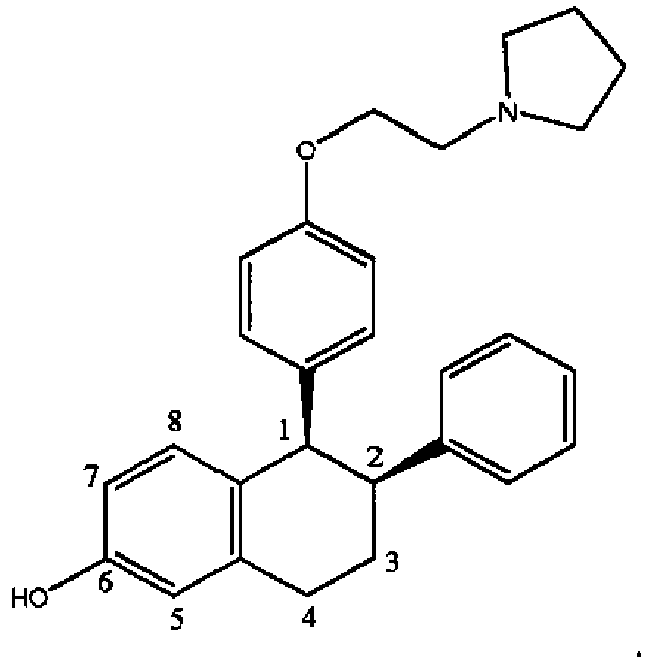
- a hydroxy group is present in the position 6, as can be gathered from the below structural formula in which the positions of the 1,2,3,4-tetrahydronaphthalene ring structure of lasofoxifene are indicated:
- 2-phenyf-1,2,3,4-tetrahydronaphthalene-1-ols being substituted with a protected hydroxyl group at any one of positions 5, 6, 7 and 8 of the 1,2,3,4-tetrahydronaphthalene ring structure represent valuable intermediate compounds in the field of pharmacy and have been surprisingly found, albeit their further substituent, to be susceptible substrates for transfer hydrogenation or H 2 -hydrogenation applying complexes comprising a transition metal.
- 2-phenyl-1,2,3,4-tetrahydronaphthalene-1-ol being substituted with a protected hydroxyl group at any one of positions 5, 6, 7 and 8 can be obtained in advantageous high enantiomeric excess combined with beneficial properties, such as high diastereomeric excess and/or conversion/yield.
- a 1,2,3,4-tetrahydronaphthalene derivative having the formula I wherein -OR is an ether-type substituent represents a particularly suitable substrate for both H 2 -hydrogenation and transfer hydrogenation reactions. Furthermore, especially when selecting particular types of transition metal complexes, it was possible to obtain both (-)- and (+)-enantiomer of compound of formula II in an advantageous high enantiomeric excess or even in enantiomerically pure state.
- the compound of formula I can be prepared by organic synthesis in order to be provided, preferably compound of formula I is provided in racemic form.
- a compound of formula I in which R in the ether-type substituent -OR is methyl can be prepared by a metal catalyzed coupling reaction illustrated in Scheme 1 below.
- a compound of formula II wherein -OR is an ether-type substituent is prepared by a process comprising transfer hydrogenation, in which an organic molecule acts as hydrogen source, of a compound of formula I wherein -OR is defined as above, wherein transfer hydrogenation is conducted in the presence of a catalyst selected from a complex comprising a transition metal.
- the substituent R in the ether-type substituent "-OR” can be selected from any hydroxy protecting group known in the art.
- "-OR” is substantially inert to hydrogenation conditions and the cleavage conditions for removing said hydroxy protecting group will not adversely affect the structure of compound of formula II or a derivative thereof.
- the ether-type substituent-OR located at the phenyl ring of 2-phenyl-1,2,3,4-tetrahydronaphthalene-1-ol moiety of compounds of formulae I and II can be located at any one of positions 5, 6, 7 or 8 of the 1,2,3,4-tetrahydronaphthalene ring structure.
- -OR group is located at the position 6 of the 1,2,3,4-tetrahydronaphthalene ring structure, as exemplary illustrated below for compound of formula II
- the procedural concept according to this aspect of the invention provides for unexpectedly high, preferably almost quantitative yield owing to dynamic kinetic resolution (DKR) of the starting material of compound of formula I.
- DKR dynamic kinetic resolution
- the term "dynamic kinetic resolution" (DKR) as used herein means that a starting material can racemise under the reaction conditions, wherein the faster reacting enantiomer is continually removed from the system by an irreversible reaction.
- DKR provides for remarkably high, even up to 100% yield, given that racemisation of the starting material is much faster than the irreversible reaction.
- the starting material in the form of compound of formula I is a ketone which racemises due to keto-enol tautomerism.
- catalytic transfer hydrogenation provides for a significantly simplified purification compared to purification of compounds of formula II obtained by means of conventional reduction of a keto group by a hydride reagent such as NaBH 4 .
- Compound of formula II represents a highly valuable intermediate compound for the preparation of pharmaceutically active agents such as lasofoxifene or derivatives thereof.
- transfer hydrogenation has been found to be particularly effective when applied to the compound of formula I.
- the protected hydroxyl group located at any one of the positions 5, 6, 7 or 8 of the 1,2,3,4-tetrahydronaphthalene ring does not affect, but surprisingly still provides for fast keto-enol tautomerism combined with effective transfer hydrogenation susceptible to DKR.
- R in the ether-type substituent -OR is selected from the group consisting of linear or branched alkyl, aryl, linear or branched alkylaryl, linear or branched alkoxyalkyl, linear or branched alkoxyalkoxyaryl, alkylthioalkyl, alkylaryloxyalkyl, trialkylsilyl, aryldialkylsilyl, diarylalkylsilyl, triarylalkylsilyl, trialkylalkoxyalkyl, preferably R is selected from the group consisting of linear or branched alkyl, linear or branched alkoxyalkyl, aryldialkylsilyl, diarylalkylsilyl and triarylalkylsilyl. More preferably, the R is selected from the group consisting of methyl, methoxymethyl (MOM) and tert -butyldiphenylsilyl (TBDPS), and in particular, R is methyl
- the ether-type substituent -OR is suitably selected with the proviso that both -OR is substantially inert to hydrogenation conditions, in particular to transfer hydrogenation conditions, and that the cleavage conditions for removing -OR will not adversely affect the structure of compound of formula II or a derivative thereof.
- the transition metal of the catalyst complex is selected from the group consisting of ruthenium (Ru), rhodium (Rh) and iridium (Ir), preferably the transition metal is Ru.
- the catalyst complex has chirality in its ligand(s) and/or at the transition metal atom, or the transition metal complex having chirality is formed in situ by using an achiral procatalyst comprising the transition metal together with a cocatalyst having chirality.
- chiral component(s) of the catalyst complex is/are in enantiopure or diastereomerically pure form.
- Suitable chiral component(s) for the catalyst complex are for example chiral diamine ligand(s) or a moiety deriving from the chiral diamine ligand.
- the diamine ligand or moiety deriving from the chiral diamine ligand comprised in the catalyst complex is a diphenylethyleneamine (DPEN) ligand, more preferably a monotosylated DPEN ligand, even more preferably a tethered monotosylated DPEN ligand.
- DPEN diphenylethyleneamine
- the catalyst complex comprises a tethered monotosylated DPEN ligand selected from the group consisting of (R,R) or (S,S) N-(toluenesulfonyl),N•-(propyl-3-phenyl)-1,2-diphenylenediamine (TsDPEN-teth), (R,R) or (S,S) N-(methanesulfonyl),N•-(propyl-3-phenyl)-1,2-diphenylenediamine (MsDPEN-teth).
- a tethered monotosylated DPEN ligand selected from the group consisting of (R,R) or (S,S) N-(toluenesulfonyl),N•-(propyl-3-phenyl)-1,2-diphenylenediamine (TsDPEN-teth), (R,R) or (S,S) N-(methanesulfonyl
- the catalyst complex is selected from the group consisting of [(R,R)-Ms-DPEN-teth RuCl] having the structural formula [(R,R)-Ts-DPEN-teth RuCl] having the structural formula [(S,S)-Ms-DPEN-teth RuCl] having the structural formula and [(S,S)-TsDPEN-teth RuCl] having the structural formula
- a compound of formula II having optical activity can be obtained, which optical activity can be beneficially controlled by selecting particularly suitable metals and/or ligands for the catalyst complex, or by selecting particularly suitable catalyst complexes.
- complex catalysts comprising diamine ligands, preferably DPEN ligands provide for surprising inductions of high diastereomeric ratio and enantiomeric excess in compound of formula II.
- transfer hydrogenation is carried out in a mixture of formic acid and triethylamine.
- the reaction mixture comprises formic acid and triethylamine in a volume ratio of 2/1 to 3/1, preferably 4.5/2 to 5.5/2.
- the transfer hydrogenation reaction is carried out at a temperature between 25 to 90°C, more preferably 30 to 80°C, even more preferably 35 to 70°C, yet even more preferably 36 to 60°C, still yet even more preferably 38 to 50°C, and in particular 40 to 45°C.
- Suitable reaction times for the transfer hydrogenation reaction according to the present invention are 15 to 100 h, preferably transfer hydrogenation is carried out for 20 to 70 h.
- such ratio is preferably at least 20/1, more preferably 30/1 to 500/1, even more preferably 35/1 to 250/1, yet even more preferably 40/1 to 150/1, still yet even more preferably 75/1 to 125/1. and in particular 90/1 to 110/1.
- a compound of formula II wherein -OR is an ether-type substituent is prepared by a process comprising hydrogenation with elemental hydrogen (H 2 ) of a compound of formula I wherein -OR is defined as above, wherein hydrogenation is conducted in the presence of a catalyst selected from a complex comprising a transition metal.
- compound of the formula II can not only be readily prepared from compound of the formula I by catalytic hydrogenation, but also in unexpected high, preferably almost quantitative yield owing to dynamic kinetic resolution (DKR) of the starting material of compound of formula I.
- catalytic hydrogenation provides for a significantly simplified purification compared to purification of compounds of formula II obtained by means of conventional reduction of a keto group by a hydride reagent such as NaBH 4 .
- Compound of formula II represents a highly valuable intermediate compound for the preparation of pharmaceutically active agents such as lasofoxifene or derivatives thereof.
- Compound of formula II represents a highly valuable intermediate compound for the preparation of pharmaceutically active agents such as lasofoxifene or derivatives thereof. Instead of quite different synthetic schemes and instead of other many possible strategies to convert the keto- into the hydroxy group by other hydrogenation or other reduction modalities, hydrogenation has been found to be particularly effective when applied to the compound of formula I.
- the -OR substituent located at the 1,2,3,4-tetrahydronaphthalene ring does not affect, but still provides for fast keto-enol tautomerism combined with effective transfer hydrogenation susceptible to DKR.
- the protecting group -OR is as defined above for the transfer hydrogenation process.
- features (a) to (e) representing particularly suitable selections for components of the catalyst complex for transfer hydrogenation also represent particularly suitable catalyst features for hydrogenation with elemental hydrogen.
- the catalyst complex comprises a monotosylated DPEN ligand which is selected from the group consisting of (R,R) or (S,S) N-(methanesulfonyl)-1,2-diphenylenediamine (MsDPEN), (R,R) or (S,S) N-(toluenesulfonyl)-1,2-diphenylenediamine (TsDPEN), (R,R) or (S,S) N-(toluenesulfonyl),N•-(propyl-3-phenyl)-1,2-diphenylenediamine (TsDPEN-teth), (R,R) or (S,S) N-(methanesulfonyl),N•-(propyl-3-phenyl)-1,2-diphenylenediamine (MsDPEN-teth).
- MsDPEN monotosylated DPEN ligand which is selected from the group consisting of (R,R
- the catalyst complex is selected from the group consisting of [(R,R)-Ms-DPEN RuCl (p-cym)] having the structural formula [(R,R)-Ts-DPEN RuCl (p-cym)] having the structural formula [(R,R)-Ms-DPEN-teth RuCl] having the structural formula [(R,R)-Ts-DPEN-teth RuCl] having the structural formula [(R,R)-MsDPEN RuCl (mes)] having the structural formula [(S,S)-Ms-DPEN RuCl (p-cym)] having the structural formula [(S,S)-Ts-DPEN RuCl (p-cym)] having the structural formula [(S,S)-Ms-DPEN-teth RuCl] having the structural formula [(S,S)-Ts-DPEN-teth RuCl] having the structural formula and [(S,S)-Ms
- a compound of formula II having optical activity can be obtained, which optical activity can be beneficially controlled by selecting suitable metals and/or ligands for the catalyst complex, or by selecting particularly suitable catalyst complexes.
- suitable metals and/or ligands for the catalyst complex or by selecting particularly suitable catalyst complexes.
- complex catalysts comprising diamine ligands, preferably DPEN ligands provide for surprisingly induce high diastereomeric ratio and enantiomeric excess in compound of formula II.
- hydrogenation is carried out in the presence of an aqueous solution comprising an amine compound selected from the group consisting of triethylamine (Et 3 N), diisopropyl ethyl amine (iPr 2 EtN) and tetramethylguanidine (TMG), preferably Et 3 N and TMG, more preferably TMG.
- said aqueous solution comprises the amine compound in an amount of 10 to 40% by weight relative to the total weight of the aqueous solution, preferably 20 to 30% by weight.
- H 2 -hydrogenation is carried out in a C1-C4 alcohol as the solvent, preferably methanol.
- hydrogen is applied at a hydrogen pressure of 20 to 40 bar, preferably 25 to 35 bar, more preferable 28 to 32 bar.
- Suitable reaction temperature for the present H 2 -hydrogenation lies between 30 to 80°C, preferably 35 to 75°C, more preferably 60 to 70°C.
- H 2 -hydrogenation reaction is carried out for a reaction time of 12 to 100 h, preferably 14 to 85 h, more preferably, in case reaction temperature is between 60 to 70°C, reaction time is 40 to 85 h.
- such ratio is preferably at least 20/1, more preferably 30/1 to 500/1, even more preferably 35/1 to 250/1, yet even more preferably 40/1 to 150/1, still yet even more preferably 75/1 to 125/1, and in particular 90/1 to 110/1.
- compound of formula II is obtained in a diastereomeric ratio of cis -isomer to trans-isomer of at least 100/1 and an enantiomeric excess of the cis-configured compound of at least 90%, more preferably enantiomeric excess of the cis -configured compound is at least 94%, even more preferably at least 96%, yet even more preferably at least 98%, and in particular at least 99%.
- compound of formula II is obtained in advantageous to exceptionally high diastereomeric ratio and enantiomeric excess.
- a compound of formula X or a pharmaceutical acceptable salt thereof is provided by a process comprising:
- This aspect of the invention provides a particularly advantageous process for preparing lasofoxifene owing to the application of the present procedural aspects of transfer hydrogenation or H 2 -hydrogenation and the beneficial effects involved therewith.
- compound of formula X is lasofoxifene (X') having the structural formula in which the substituents at 1- and 2-position are in (1 R ,2 S )-configuration.
- a pharmaceutical composition comprising compound of formula X or a pharmaceutically acceptable salt thereof as active ingredient, is provided by a process comprising the steps of:
- pharmaceutically acceptable excipient means any physiologically inert, pharmacologically inactive material known in the art being compatible with the physical and chemical characteristics of the active agent.
- the pharmaceutically acceptable excipient is selected from the group consisting of binders, disintegrants, bulk polymers and preservatives.
- binding agent means a binding agent which improves adhesion in between particles of the pharmaceutically active agent.
- disintegrant means an agent providing for rapid disintegration of a pharmaceutical composition into smaller fragments when in contact with water, wherein dissolution of the pharmaceutical composition and in particular of a pharmaceutically active agent comprised therein is improved.
- bulk polymer as used herein means a polymeric filling agent which is typically added to a pharmaceutical composition in large amounts, at least in an amount larger than 6% by weight relative to the total weight of the pharmaceutical composition.
- preservatives means a substance or mixture of substances which prevents decomposition of a pharmaceutical composition, e.g. microbial or bacterial decomposition.
Landscapes
- Chemical & Material Sciences (AREA)
- Organic Chemistry (AREA)
- Chemical Kinetics & Catalysis (AREA)
- Organic Low-Molecular-Weight Compounds And Preparation Thereof (AREA)
Abstract
The present invention relates in general to the field of organic chemistry and in particular to the preparation of 2-phenyl-1,2,3,4-tetrahydronaphthalene-1-ol substituted with a protected hydroxyl group. These compounds can be used as intermediates in the synthesis of pharmaceutically active agents such as lasofoxifene or derivatives thereof.
Description
- The present invention relates in general to the field of organic chemistry and in particular to the preparation of substituted 2-phenyl-1,2,3,4-tetrahydronaphthalene-1-ols. These compounds can be used as intermediates in the synthesis of pharmaceutically active agents such as lasofoxifene or derivatives thereof.
- The substituted 2-phenyl-1,2,3,4-tetrahydronaphthalene-1-ols represent useful intermediates for the preparation of active pharmaceutical active agents. For example, lasofoxifene, a non-steroidal selective estrogen receptor modulator (SERM) comprises a 6-hydroxy-2-phenyl-1,2,3,4-tetrahydronaphthalene moiety substituted at its 1-position with a 4-phenoxyethylpyrrolidine moiety.
- Selective estrogen receptor modulators (SERMs) are a group of compounds that are classified to act on estrogen receptors. In contrast to pure receptor agonists and antagonists, SERMs reveal different effects depending on the tissue they are applied to. SERMs thereby offer the possibility to be selectively used in various tissues to inhibit or stimulate estrogen-like actions. Further, some SERMs may act as good replacements for hormone replacement therapy (HRT). Lasofoxifene as one selective estrogen receptor modulator was found to be effective for many applications and can be used against osteoporosis, breast cancer and the vaginal atrophy.
- D. Hobbs-Mallyon et al., J. Chem. Soc., Perkin Trans. 1, 1997, issue 10, pages 1511-1516 disclose preparation of racemic 6-methoxy-2-phenyl-1,2,3,4-tetrahydronaphthalene-1-ol by reduction of 6-methoxy-2-phenyl-1,2,3,4-tetrahydronaphthalene-1-one using sodium borohydride as reducing reagent.
- The object of the present invention is to provide an improved process for preparing substituted 2-phenyl-1,2,3,4-tetrahydronaphthalene-1-ols representing valuable key intermediates for the preparation of pharmaceutically active agents such as lasofoxifene or derivatives thereof.
- Various aspects, advantageous features and preferred embodiments of the present invention as summarized in the following items, respectively alone or in combination, contribute to solving the object of the invention.
- (1) A process for preparing a compound of formula II

by transfer hydrogenation, in which an organic molecule acts as hydrogen source, of a compound of formula I
wherein transfer hydrogenation is conducted in the presence of a catalyst selected from a complex comprising a transition metal. - The designation "*" in the structural formulae of compounds of formula I and II indicates a chiral center.
- The term "chiral center" as used herein means a tetrahedral carbon atom having four different substituents attached thereto. The arrangement of these different substituents around the asymmetric atom determines its optical activity which is determined in the art by the terms S or R and D or L respectively.
- The term "transition metal" as used herein means any element in the d-block of the periodic table, which includes groups 3 to 12 of the periodic table.
- The term "ether-type substituent" as used herein means that a carbon or silicium atom of the -OR group is adjacent to the oxygen located at the 1,2,3,4-tetrahydronaphthalene ring structure, wherein a C-O-C or Si-O-C ether bond is formed.
- (2) The process according to item (1), wherein the R in the ether-type substituent -OR is selected from the group consisting of linear or branched alkyl, aryl, linear or branched alkylaryl, linear or branched alkoxyalkyl, linear or branched alkoxyalkoxyaryl, alkylthioalkyl, alkylaryloxyalkyl, trialkylsilyl, aryldialkylsilyl, diarylalkylsilyl, triarylalkylsilyl, fialkylalkoxyalkyl, preferably R is selected from the group consisting of linear or branched alkyl, linear or branched alkoxyalkyl, aryldialkylsilyl, diarylalkylsilyl and triarylalkylsilyl.
- The term "alkyl" as used herein means straight, branched or cyclic hydrocarbons of 1 to 12 carbon atoms, preferably 1 to 8 carbon atoms, more preferably 1 to 6 carbon atoms, and even more preferably 1 to 4 carbon atoms.
- The term "aryl" as used herein means hydrocarbon aryls, preferably single or condensed six-membered rings, more preferably phenyl or naphthyl, in particular phenyl.
- The term "alkylaryl" as used herein means that the aforementioned aryl moieties are incorporated into the aforementioned straight or branched alkyl moieties either at one of the proximal or distal ends of the alkyl chain or between the aforementioned alkyl chains. For example, proximal end means for ether type substituent -OR adjacent to the oxygen bound to the benzene ring of the 1,2,3,4-tetrahydronaphthalene ring structure of compounds of formulae I and II, while distal means the terminal carbon of the alkyl moiety which is furthermost from said oxygen. Preferably, in the alkylaryl moiety, the aryl moiety is located at the distal end of the alkyl moiety.
- The term "substituted" as employed herein means that the aforementioned alkyl, aryl and alkylaryl groups have one, two or three linear or branched C1-C6 alkyl or alkoxy substituents.
- (3) The process according to item (1) or (2), wherein R in the ether-type substituent -OR is selected from the group consisting of methyl, ethyl, propyl, isopropyl, t-butyl, phenyl, benzyl, methoxymethyl (MOM) and tert-butyldiphenylsilyl (TBDPS), preferably methyl.
- (4) The process according to any one of the preceding items, wherein the transition metal of the catalyst complex is selected from the group consisting of ruthenium (Ru), rhodium (Rh) and iridium (Ir), preferably the transition metal is Ru.
- (5) The process according to any one of the preceding items, wherein the catalyst has chirality in its ligand(s) and/or at the transition metal atom, or the transition metal complex having chirality is formed in situ by using an achiral procatalyst comprising the transition metal together with a cocatalyst having chirality.
- (6) The process according to item (5), wherein chiral component(s) is/are in enantiopure or diastereomerically pure form.
- The terms "chiral"/"chirality" as used herein means that a compound can not be superimposed on its mirror image.
- The terms "enantiopure" and "diastereomerically pure means that an enantiomer or diastereomer is present in a purity of at least 99% enantiomeric excess and 99% diastereomeric excess respectively, preferably in a purity of 99.5-100% enantiomeric excess and 99.5-100% diastereomeric excess respectively. The term "enantiomer" as used herein means two stereoisomers which are mirror images of one another, but which are not superimposable. Enantiomers may also be denoted by the direction into which a solution of the enantiomer rotates the plane of polarization of a beam of polarized light. In case the enantiomer rotates the plane of polarization of a beam of polarized light in a clockwise direction, the enantiomer is denoted as (+)-enantiomer, and in case of counter-clockwise rotation, the enantiomer is denoted as (-)-enantiomer.
- The term "diastereomers" as used herein means stereoisomers which do not represent enantiomers.
- (7) The process according to any one of the preceding items, wherein the catalyst complex comprises a chiral diamine ligand or a moiety deriving from the chiral diamine ligand.
- (8) The process according to item (7), wherein the diamine ligand or moiety deriving from the chiral diamine ligand is a diphenylethyleneamine (DPEN) ligand, more preferably a monotosylated DPEN ligand, even more preferably a tethered monotosylated DPEN ligand, particularly the tethered monotosylated DPEN ligand is selected from the group consisting of (R,R) or (S,S) N-(toluenesulfonyl),N•-(propyl-3-phenyl)-1,2-diphenylenediamine (TsDPEN-teth), (R,R) or (S,S) N-(methanesulfonyl),N•-(propyl-3-phenyl)-1,2-diphenylenediamine (MsDPEN-teth).
- The term "tethered" as used herein means that an alkylaryl moiety is covalently bound to the non-sulfonated amine functionality of the DPEN ligand.
- The designations "R" and "S" used herein indicate the absolute configuration at a chiral center(s) of the respective compounds, determined by means of the Cahn Ingold Prelog convention (CIP-convention) known in the art (cf. e.g. M.B. Smith, J. March, "March's Advanced Organic Chemistry: Reactions, Mechanisms and Structure", 6th edition, John Wiley&Sons, Inc., p. 155-158).
- (9) The process according to any one of the preceding items, wherein the catalyst complex is selected from the group consisting of [(R,R)-Ms-DPEN-teth RuCl] having the structural formula


- As to the designations "R" and "S" used in the above compound names, reference is made to the explanations under item (8) above.
- (10) The process according to any one of the preceding items, wherein transfer hydrogenation is carried out in a mixture of formic acid and triethylamine.
- (11) The process according to item (10), wherein the mixture comprises formic acid and triethylamine in a volume ratio of 2/1 to 3/1, preferably 4.5/2 to 5.5/2.
- (12) The process according to any one of the preceding items, wherein the transfer hydrogenation reaction is carried out at a temperature between 25 to 90°C, preferably 30 to 80°C, more preferably 35 to 70°C, even more preferably 36 to 60°C, yet even more preferably 38 to 50°C, and in particular 40 to 45°C.
- (13) The process according to any one of the preceding items, wherein the transfer hydrogenation reaction is carried out for a reaction time of 15 to 100 h, preferably 20 to 70 h.
- (14) The process according to any one of the preceding items, wherein the molar ratio of substrate to catalyst is at least 20/1, preferably 30/1 to 500/1, more preferably 35/1 to 250/1, even more preferably 40/1 to 150/1, yet even more preferably 75/1 to 125/1, and in particular 90/1 to 110/1.
- (15) A process for preparing a compound of formula II

by hydrogenation with elemental hydrogen (H2) of a compound of formula I
wherein hydrogenation is conducted in the presence of a catalyst selected from a complex comprising a transition metal. - As to the designation "*" in the structural formulae of compounds of formula I and II and to terms "transition metal", and "ether-type substituent", reference is made to the explanations under item (1) above.
- (16) The process according to item (15), wherein -OR is ether-type substituent as defined in item (2) or (3).
- (17) The process according to item (15) or (16), wherein the catalyst is a catalyst as defined in any one of items (2) to (4).
- (18) The process according to any one of items (15) to (17), wherein the catalyst complex comprises a chiral diamine ligand or a moiety deriving from the chiral diamine ligand, preferably the diamine ligand or moiety deriving from the chiral diamine ligand is a diphenylethyleneamine (DPEN) ligand, more preferably a monotosylated DPEN ligand, even more preferably the monotosylated DPEN ligand is selected from the group consisting of (R,R) or (S,S) N-(methanesulfonyl)-1,2-diphenylenediamine (MsDPEN), (R,R) or (S,S) N-(toluenesulfonyl)-1,2-diphenylenediamine (TsDPEN), (R,R) or (S,S) N-(toluenesulfonyl),N•-(propyl-3-phenyl)-1,2-diphenylenediamine (TsDPEN-teth), (R,R) or (S,S) N-(methanesulfonyl),N•-(propyl-3-pheny)-1,2-diphenylenediamine (MsDPEN-teth).
- As to the designations "R" and "S" used in the above compound names, reference is made to the explanations under item (8) above.
- (19) The process according to any one of items (15) to (18), wherein the catalyst complex is selected from the group consisting of
[(R,R)-Ms-DPEN RuCl (p-cym)] having the structural formula


[(S,S)-Ms-DPEN RuCl (mes)] having the structural formula
- As to the designations "R" and "S" used in the above compound names, reference is made to the explanations under item (8) above.
- (20) The process according to any one of items (15) to (19), wherein hydrogenation is carried out in a C1-C4 alcohol as the solvent, preferably methanol.
- (21) The process according to any one of items (15) to (20), wherein hydrogenation is carried out in the presence of an aqueous solution comprising an amine compound selected from the group consisting of triethylamine (Et3N), diisopropyl ethyl amine (iPr2EtN) and tetramethylguanidine (TMG), preferably Et3N and TMG, more preferably TMG.
- (22) The process according to item (21), wherein the aqueous solution comprises the amine compound in an amount of 10 to 40% by weight relative to the total weight of the aqueous solution, preferably 20 to 30% by weight.
- (23) The process according to any one of items (15) to (22), wherein hydrogen applied at a hydrogen pressure of 20 to 40 bar, preferably 25 to 35 bar, more preferable 28 to 32 bar.
- (24) The process according to any one of items (15) to (23), wherein the hydrogenation reaction is carried out at a temperature between 30 to 80°C, preferably 35 to 75°C, more preferably 60 to 70°C.
- (25) The process according to any one of items (15) to (24), wherein the hydrogenation reaction is carried out for a reaction time of 12 to 100 h, preferably 14 to 85 h, more preferably, in case reaction temperature is between 60 to 70°C, reaction time is 40 to 85 h.
- (26) The process according to any one of the preceding items, wherein the molar ratio of substrate to catalyst is at least 20/1, preferably 30/1 to 500/1, more preferably 35/1 to 250/1, even more preferably 40/1 to 150/1, yet even more preferably 75/1 to 125/1, and in particular 90/1 to 110/1.
- (27) The process according to any one of the preceding items, wherein compound of formula II is obtained in a diastereomeric ratio of cis-isomer to trans-isomer of at least 100/1 and an enantiomeric excess of the cis-configured compound of at least 90%, more preferably enantiomeric excess of the cis-configured compound is at least 94%, even more preferably at least 96%, yet even more preferably at least 98%, and in particular at least 99%.
- The term "diastereomeric ratio" as used herein means the molar ratio of cis-isomers to trans-isomers of compound of formula II. In this context, the term "cis-isomer" means that the OH substituent at 1-position and the phenyl substituent at 2-position of compound of formula II are located on the same side with respect to the cyclopropane ring plane, which is indicated by bonds depicted by two bold (that is, both substituents are located above the cyclopropane ring plane) or two dashed lines (that is, both substituents are located below the cyclopropane ring plane):

- The term "trans-isomer" means that the OH substituent at 1-position and the phenyl substituent at 2-position of compound of formula II are located on opposite sides with respect to the cyclopropane ring plane, which is indicated by bonds depicted by one bold and one dashed line respectively:

- The term "enantiomeric excess" as used herein means the difference between the percentage of one enantiomer of an optically active compound and the percentage of the other enantiomer of the same optically active compound. For example, an optically active compound which contains 75% R-enantiomer and 25% S-enantiomer will have an enantiomeric excess of 50% of R-enantiomer.
- (28) A process for preparing a compound of formula X

- a) preparing a compound of formula II,
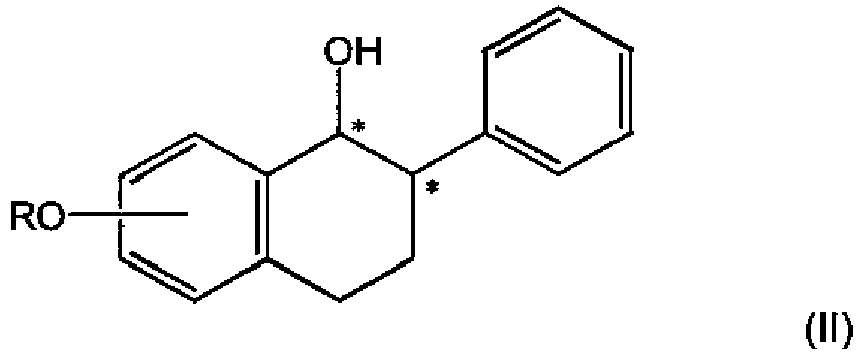
by a process according to any one of items (1) to (27), and - b) further converting the compound of formula II to a compound of formula X
or a pharmaceutically acceptable salt thereof.
- a) preparing a compound of formula II,
- (29) A process according to item (28), wherein compound of formula X is lasofoxifene (X') having the structural formula

- As to the designations "R" and "S" used in connection with the stereochemistry at 1- and 2-position of compound of formula (X'), reference is made to the explanations under item (8) above.
- (30) A process for the preparation of a pharmaceutical composition comprising a compound of formula X or a pharmaceutically acceptable salt thereof as active ingredient, comprising the steps of:
- a) preparing a compound of formula X or a salt thereof according to the process according to item (28) or (29), and
- b) admixing the prepared compound of formula X or pharmaceutically acceptable salt thereof with at least one pharmaceutically acceptable excipient.
- The present invention is now described in more detail by referring to further preferred and further advantageous embodiments and examples, which are however presented for illustrative purposes only and shall not be understood as limiting the scope of the present invention.
- Conventionally, chiral 2-phenyl-1,2,3,4-tetrahydronaphthalene-1-ols substituted with a protected hydroxyl group are synthesized by means of chemical synthesis affording the desired 1,2,3,4-tetrahydronaphthalene derivative in the form of a racemate. Therefore, in order to obtain enantiomerically enriched or pure 2-phenyl-1,2,3,4-tetrahydronaphthalene-1-ols substituted with a protected hydroxyl group, in conventional processes, it is necessary to subject the racemic compound to resolution of racemates. Resolution of racemates is a laborious procedure, since it typically requires multiple subsequent resolution steps in order to obtain a satisfactory high degree of enantio-enrichment. These multiple resolution steps in turn result in relatively poor yields of enantiomerically enriched or enantiopure product.
- P. Peach et al., Tetrahedron, 2006, 62, pages 1864 to 1876 disclose transfer hydrogenation of • - substituted ketones involving dynamic kinetic resolution wherein among others, 2-phenyl-1,2,3,4-tetrahydronaphthaiene-1(2H)-one is converted to cis-(-)-2-phenyl-1,2,3,4-tetrahydronaphthalene-1-ol having a diasteroemeric ratio of cis/trans-isomer higher than 97/1, and an enantiomeric excess of at least 98%:

- In this document, a relatively simple 1,2,3,4-tetrahydronaphthalene substrate is used which is not substituted at the aromatic phenyl moiety. However, distinct from such a relatively simple substrate compound for pharmaceutical active agents substitution of any one of the position 5,6,7 or 8 of the aromatic phenyl ring is useful or even necessary. For example, in a non-steroidal selective estrogen receptor modulator (SERM) such as lasofoxifene, a hydroxy group is present in the position 6, as can be gathered from the below structural formula in which the positions of the 1,2,3,4-tetrahydronaphthalene ring structure of lasofoxifene are indicated:
- Therefore, 2-phenyf-1,2,3,4-tetrahydronaphthalene-1-ols being substituted with a protected hydroxyl group at any one of positions 5, 6, 7 and 8 of the 1,2,3,4-tetrahydronaphthalene ring structure represent valuable intermediate compounds in the field of pharmacy and have been surprisingly found, albeit their further substituent, to be susceptible substrates for transfer hydrogenation or H2-hydrogenation applying complexes comprising a transition metal. Even further surprisingly, 2-phenyl-1,2,3,4-tetrahydronaphthalene-1-ol being substituted with a protected hydroxyl group at any one of positions 5, 6, 7 and 8 can be obtained in advantageous high enantiomeric excess combined with beneficial properties, such as high diastereomeric excess and/or conversion/yield.
- In particular, it was surprisingly found by the present inventors that a 1,2,3,4-tetrahydronaphthalene derivative having the formula I

represents a particularly suitable substrate for both H2-hydrogenation and transfer hydrogenation reactions. Furthermore, especially when selecting particular types of transition metal complexes, it was possible to obtain both (-)- and (+)-enantiomer of compound of formula II in an advantageous high enantiomeric excess or even in enantiomerically pure state. - The compound of formula I can be prepared by organic synthesis in order to be provided, preferably compound of formula I is provided in racemic form. For example, a compound of formula I in which R in the ether-type substituent -OR is methyl can be prepared by a metal catalyzed coupling reaction illustrated in Scheme 1 below.

- Analogous reactions can be carried out with corresponding substituents for the "OR" group instead of the methyl group shown in Scheme 1 above.
- According to one aspect of the invention, a compound of formula II
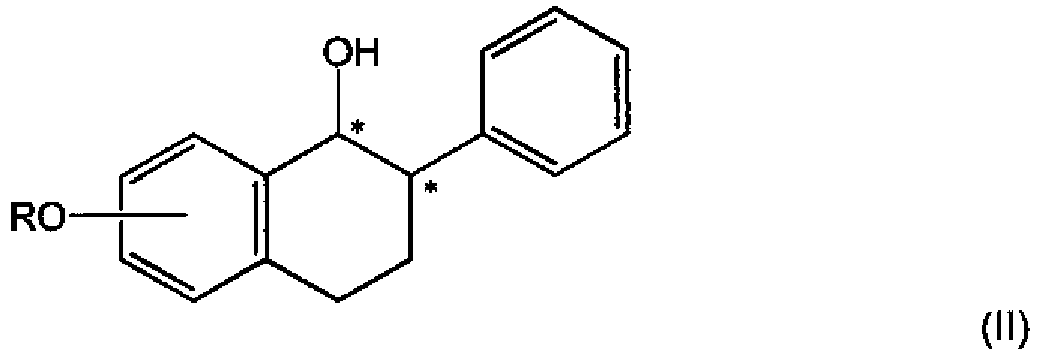
is prepared by a process comprising transfer hydrogenation, in which an organic molecule acts as hydrogen source, of a compound of formula I
wherein transfer hydrogenation is conducted in the presence of a catalyst selected from a complex comprising a transition metal. - Wherein the compound of formula II is the starting material for a target molecule or an intermediate comprising the hydroxy group (-OR, wherein R is H), the substituent R in the ether-type substituent "-OR" can be selected from any hydroxy protecting group known in the art. Preferably, "-OR" is substantially inert to hydrogenation conditions and the cleavage conditions for removing said hydroxy protecting group will not adversely affect the structure of compound of formula II or a derivative thereof.
- The ether-type substituent-OR located at the phenyl ring of 2-phenyl-1,2,3,4-tetrahydronaphthalene-1-ol moiety of compounds of formulae I and II can be located at any one of positions 5, 6, 7 or 8 of the 1,2,3,4-tetrahydronaphthalene ring structure. Preferably, -OR group is located at the position 6 of the 1,2,3,4-tetrahydronaphthalene ring structure, as exemplary illustrated below for compound of formula II

- The procedural concept according to this aspect of the invention provides for unexpectedly high, preferably almost quantitative yield owing to dynamic kinetic resolution (DKR) of the starting material of compound of formula I. The term "dynamic kinetic resolution" (DKR) as used herein means that a starting material can racemise under the reaction conditions, wherein the faster reacting enantiomer is continually removed from the system by an irreversible reaction. Hence, DKR provides for remarkably high, even up to 100% yield, given that racemisation of the starting material is much faster than the irreversible reaction. In the present process, the starting material in the form of compound of formula I is a ketone which racemises due to keto-enol tautomerism.
- Furthermore, catalytic transfer hydrogenation provides for a significantly simplified purification compared to purification of compounds of formula II obtained by means of conventional reduction of a keto group by a hydride reagent such as NaBH4. Compound of formula II represents a highly valuable intermediate compound for the preparation of pharmaceutically active agents such as lasofoxifene or derivatives thereof. Instead of quite different synthetic schemes and instead of other many possible strategies to convert the keto- into the hydroxyl group by other hydrogenation or other reduction modalities, transfer hydrogenation has been found to be particularly effective when applied to the compound of formula I.
- Importantly, the protected hydroxyl group located at any one of the positions 5, 6, 7 or 8 of the 1,2,3,4-tetrahydronaphthalene ring does not affect, but surprisingly still provides for fast keto-enol tautomerism combined with effective transfer hydrogenation susceptible to DKR.
- According to a preferred embodiment, R in the ether-type substituent -OR is selected from the group consisting of linear or branched alkyl, aryl, linear or branched alkylaryl, linear or branched alkoxyalkyl, linear or branched alkoxyalkoxyaryl, alkylthioalkyl, alkylaryloxyalkyl, trialkylsilyl, aryldialkylsilyl, diarylalkylsilyl, triarylalkylsilyl, trialkylalkoxyalkyl, preferably R is selected from the group consisting of linear or branched alkyl, linear or branched alkoxyalkyl, aryldialkylsilyl, diarylalkylsilyl and triarylalkylsilyl. More preferably, the R is selected from the group consisting of methyl, methoxymethyl (MOM) and tert-butyldiphenylsilyl (TBDPS), and in particular, R is methyl.
- In this way, the ether-type substituent -OR is suitably selected with the proviso that both -OR is substantially inert to hydrogenation conditions, in particular to transfer hydrogenation conditions, and that the cleavage conditions for removing -OR will not adversely affect the structure of compound of formula II or a derivative thereof.
- According to another preferred embodiment, the transition metal of the catalyst complex is selected from the group consisting of ruthenium (Ru), rhodium (Rh) and iridium (Ir), preferably the transition metal is Ru.
- In a further preferred embodiment, the catalyst complex has chirality in its ligand(s) and/or at the transition metal atom, or the transition metal complex having chirality is formed in situ by using an achiral procatalyst comprising the transition metal together with a cocatalyst having chirality. Preferably, chiral component(s) of the catalyst complex is/are in enantiopure or diastereomerically pure form.
- Suitable chiral component(s) for the catalyst complex are for example chiral diamine ligand(s) or a moiety deriving from the chiral diamine ligand. Preferably, the diamine ligand or moiety deriving from the chiral diamine ligand comprised in the catalyst complex is a diphenylethyleneamine (DPEN) ligand, more preferably a monotosylated DPEN ligand, even more preferably a tethered monotosylated DPEN ligand.
- According to a preferred embodiment, the catalyst complex comprises a tethered monotosylated DPEN ligand selected from the group consisting of (R,R) or (S,S) N-(toluenesulfonyl),N•-(propyl-3-phenyl)-1,2-diphenylenediamine (TsDPEN-teth), (R,R) or (S,S) N-(methanesulfonyl),N•-(propyl-3-phenyl)-1,2-diphenylenediamine (MsDPEN-teth).
- According to a particularly preferred embodiment, the catalyst complex is selected from the group consisting of
[(R,R)-Ms-DPEN-teth RuCl] having the structural formula


- According to the above embodiments relating to specific selections of components of the catalyst complex or a specific selection of the catalyst complex, a compound of formula II having optical activity can be obtained, which optical activity can be beneficially controlled by selecting particularly suitable metals and/or ligands for the catalyst complex, or by selecting particularly suitable catalyst complexes. In particular, it was surprisingly found that complex catalysts comprising diamine ligands, preferably DPEN ligands provide for surprising inductions of high diastereomeric ratio and enantiomeric excess in compound of formula II.
- According to a further preferred embodiment, transfer hydrogenation is carried out in a mixture of formic acid and triethylamine.
- In this way, a particularly suitable hydrogen source in form of formic acid is selected, wherein triethylamine provides for irreversibility of the transfer hydrogenation reaction.
- In a further preferred embodiment, in the transfer hydrogenation process, the reaction mixture comprises formic acid and triethylamine in a volume ratio of 2/1 to 3/1, preferably 4.5/2 to 5.5/2.
- Preferably, the transfer hydrogenation reaction is carried out at a temperature between 25 to 90°C, more preferably 30 to 80°C, even more preferably 35 to 70°C, yet even more preferably 36 to 60°C, still yet even more preferably 38 to 50°C, and in particular 40 to 45°C.
- Suitable reaction times for the transfer hydrogenation reaction according to the present invention are 15 to 100 h, preferably transfer hydrogenation is carried out for 20 to 70 h.
- As regards the molar ratio of substrate to catalyst in the present transfer hydrogenation, such ratio is preferably at least 20/1, more preferably 30/1 to 500/1, even more preferably 35/1 to 250/1, yet even more preferably 40/1 to 150/1, still yet even more preferably 75/1 to 125/1. and in particular 90/1 to 110/1.
- According to another aspect of the invention, a compound of formula II

is prepared by a process comprising hydrogenation with elemental hydrogen (H2) of a compound of formula I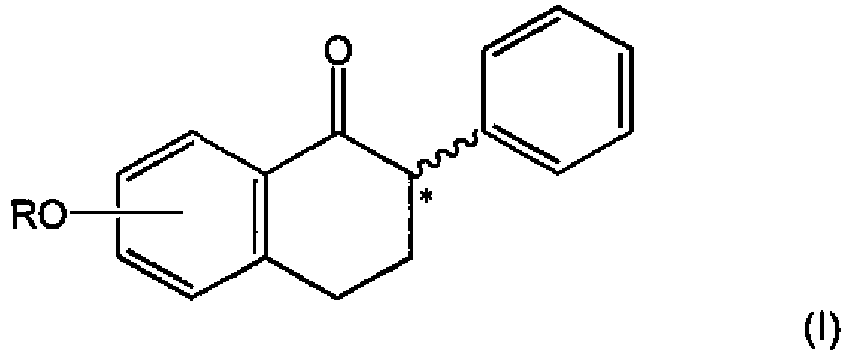
wherein hydrogenation is conducted in the presence of a catalyst selected from a complex comprising a transition metal. - According to this aspect of the invention, compound of the formula II can not only be readily prepared from compound of the formula I by catalytic hydrogenation, but also in unexpected high, preferably almost quantitative yield owing to dynamic kinetic resolution (DKR) of the starting material of compound of formula I. Furthermore, catalytic hydrogenation provides for a significantly simplified purification compared to purification of compounds of formula II obtained by means of conventional reduction of a keto group by a hydride reagent such as NaBH4. Compound of formula II represents a highly valuable intermediate compound for the preparation of pharmaceutically active agents such as lasofoxifene or derivatives thereof.
- Compound of formula II represents a highly valuable intermediate compound for the preparation of pharmaceutically active agents such as lasofoxifene or derivatives thereof. Instead of quite different synthetic schemes and instead of other many possible strategies to convert the keto- into the hydroxy group by other hydrogenation or other reduction modalities, hydrogenation has been found to be particularly effective when applied to the compound of formula I.
- Surprisingly, the -OR substituent located at the 1,2,3,4-tetrahydronaphthalene ring does not affect, but still provides for fast keto-enol tautomerism combined with effective transfer hydrogenation susceptible to DKR.
- According to a preferred embodiment, the protecting group -OR is as defined above for the transfer hydrogenation process.
- According to a further preferred embodiment, features (a) to (e) representing particularly suitable selections for components of the catalyst complex for transfer hydrogenation also represent particularly suitable catalyst features for hydrogenation with elemental hydrogen.
- According to a preferred embodiment, the catalyst complex comprises a monotosylated DPEN ligand which is selected from the group consisting of (R,R) or (S,S) N-(methanesulfonyl)-1,2-diphenylenediamine (MsDPEN), (R,R) or (S,S) N-(toluenesulfonyl)-1,2-diphenylenediamine (TsDPEN), (R,R) or (S,S) N-(toluenesulfonyl),N•-(propyl-3-phenyl)-1,2-diphenylenediamine (TsDPEN-teth), (R,R) or (S,S) N-(methanesulfonyl),N•-(propyl-3-phenyl)-1,2-diphenylenediamine (MsDPEN-teth).
- According to a particularly preferred embodiment,
the catalyst complex is selected from the group consisting of
[(R,R)-Ms-DPEN RuCl (p-cym)] having the structural formula


[(S,S)-Ms-DPEN RuCl (mes)] having the structural formula
- According to the above embodiments relating to specific selections of components of the catalyst complex or a specific selection of the catalyst complex, a compound of formula II having optical activity can be obtained, which optical activity can be beneficially controlled by selecting suitable metals and/or ligands for the catalyst complex, or by selecting particularly suitable catalyst complexes. In particular, it was surprisingly found that complex catalysts comprising diamine ligands, preferably DPEN ligands provide for surprisingly induce high diastereomeric ratio and enantiomeric excess in compound of formula II.
- According to another preferred embodiment, hydrogenation is carried out in the presence of an aqueous solution comprising an amine compound selected from the group consisting of triethylamine (Et3N), diisopropyl ethyl amine (iPr2EtN) and tetramethylguanidine (TMG), preferably Et3N and TMG, more preferably TMG. Preferably, said aqueous solution comprises the amine compound in an amount of 10 to 40% by weight relative to the total weight of the aqueous solution, preferably 20 to 30% by weight.
- According to this preferred embodiment of the invention, it was surprisingly found that by choosing a particularly suitable amine compound, the yield of compound of formula II can be substantially increased, while compound of formula II is obtained in both a desirable diasteriomeric cis/trans ratio and high enantiomeric excess.
- In a further preferred embodiment of the present invention, H2-hydrogenation is carried out in a C1-C4 alcohol as the solvent, preferably methanol.
- Preferably, in the H2-hydrogenation process according to the present invention, hydrogen is applied at a hydrogen pressure of 20 to 40 bar, preferably 25 to 35 bar, more preferable 28 to 32 bar.
- Suitable reaction temperature for the present H2-hydrogenation lies between 30 to 80°C, preferably 35 to 75°C, more preferably 60 to 70°C.
- According to a preferred embodiment, H2-hydrogenation reaction is carried out for a reaction time of 12 to 100 h, preferably 14 to 85 h, more preferably, in case reaction temperature is between 60 to 70°C, reaction time is 40 to 85 h.
- As regards the molar ratio of substrate to catalyst in the present transfer hydrogenation, such ratio is preferably at least 20/1, more preferably 30/1 to 500/1, even more preferably 35/1 to 250/1, yet even more preferably 40/1 to 150/1, still yet even more preferably 75/1 to 125/1, and in particular 90/1 to 110/1.
- In both above discussed procedural aspects according to the invention, that is in transfer hydrogenation process and in H2-hydrogenation process, according to a preferred embodiment, compound of formula II is obtained in a diastereomeric ratio of cis-isomer to trans-isomer of at least 100/1 and an enantiomeric excess of the cis-configured compound of at least 90%, more preferably enantiomeric excess of the cis-configured compound is at least 94%, even more preferably at least 96%, yet even more preferably at least 98%, and in particular at least 99%. According to this aspect of the invention, compound of formula II is obtained in advantageous to exceptionally high diastereomeric ratio and enantiomeric excess.
- According to another aspect of the invention a compound of formula X

- a) preparing a compound of formula II

by a process according to any one of items (1) to (26), and - b) further converting the compound of formula II to compound of formula X or a pharmaceutically acceptable salt thereof.
- This aspect of the invention provides a particularly advantageous process for preparing lasofoxifene owing to the application of the present procedural aspects of transfer hydrogenation or H2-hydrogenation and the beneficial effects involved therewith.
- According to a preferred embodiment of the invention, in the aforementioned process, compound of formula X is lasofoxifene (X') having the structural formula

- According to a further aspect of the invention, a pharmaceutical composition comprising compound of formula X or a pharmaceutically acceptable salt thereof as active ingredient, is provided by a process comprising the steps of:
- a) preparing compound of formula X or a salt thereof according to the process according to item (27) or (28), and
- b) admixing the prepared compound of formula X or pharmaceutically acceptable salt thereof with at least one pharmaceutically acceptable excipient.
- The term "pharmaceutically acceptable excipient" as used herein means any physiologically inert, pharmacologically inactive material known in the art being compatible with the physical and chemical characteristics of the active agent. Preferably, the pharmaceutically acceptable excipient is selected from the group consisting of binders, disintegrants, bulk polymers and preservatives.
- The term "binder" as used herein means a binding agent which improves adhesion in between particles of the pharmaceutically active agent.
- The term "disintegrant" as used herein means an agent providing for rapid disintegration of a pharmaceutical composition into smaller fragments when in contact with water, wherein dissolution of the pharmaceutical composition and in particular of a pharmaceutically active agent comprised therein is improved.
- The term "bulk polymer" as used herein means a polymeric filling agent which is typically added to a pharmaceutical composition in large amounts, at least in an amount larger than 6% by weight relative to the total weight of the pharmaceutical composition.
- The term "preservatives" as used herein means a substance or mixture of substances which prevents decomposition of a pharmaceutical composition, e.g. microbial or bacterial decomposition.
- The following examples are merely illustrative of the present invention and they should not be considered as limiting the scope of the invention in any way. The examples and modifications or other equivalents thereof will become apparent to those versed in the art in the light of the present entire disclosure.
- Compound of formula I' (6-methoxy-2-phenyl-3,4-dihydronaphthalene-1(2H)-one) was prepared as follows:

1H NMR (CDCl3) f = 2.39 - 2.44 (m, 2H), 3.0 - 3.1 (m, 2H), 3.8 (t, 1 H), 3.9 (s, 3H), 6.7 (d, 1H), 6.9 (dd, 1H), 7.2 (m, 2H), 7.3 (m, 1H), 7.4 (m, 2H), 8.1 (d, 1H) ppm.
13C NMR (CDCl3) f = 28.9, 31.2, 54.0, 55.4, 112.4, 113.2, 126.4, 126.7, 128.35, 128.4, 130.2, 140.0, 146.5, 163.5, 196.9 ppm. - Compound of formula I' (250 mg, 1 mmol) and the respective amount of catalyst indicated in Table 1 below (e.g. for entries 1 to 4 with substrate/catalyst (S/C) ratio of 50/1: 2 mol% relative to the molar amount of substrate; for entries 5, 6, 8 and 10 with S/C ratio of 100/1: 1 mol%) were placed in a tube under argon atmosphere and a mixture of HCOOH/NEt3 (3 mL) in a volume ratio of 5/2 was added. The resulting reaction mixture was heated at a temperature of 40 to 45 °C for the time indicated in Table 1 below. After cooling to room temperature, the reaction mixture was quenched with saturated aqueous solution NaHCO3/AcOEt. The organic phase was diluted in heptane/EtOH and analysed by HPLC to determine conversion to compound of formula II' and to determine diastereomeric ratio (dr) cis/trans and an enantiomeric excess (ee) of compound of formula II' as indicated in Table 1 below.
Table 1. T = 40-45°C Entry Catalyst S/C Time / h Conv to II' / % dr cis/trans ee cis / % 1 [(R,R)-TsDPEN RuCl (p-cym)] 50/1 24 5 >100/1 - 2 [(R,R)-TsDPEN teth Ru Cl] 50/1 24 88 >100/1 >99 (+) 3 [(S,S)-TsDPEN teth Ru Cl] 50/1 24 73 >100/1 99 (-) 4 [(S,S)-MsDPEN teth Ru Cl] 50/1 24 43 >100/1 98 (-) 5 [(R,R)-MsDPEN Ru Cl (mes)] 100/1 40 12 >100/1 - 6 [(R,R)-MsDPEN Ru Cl (mes)] 100/1 64 13 >100/1 - 7 [(R,R)-MsDPEN Ru Cl (mes)] 250/1 64 <1 >100/1 - 8 [(R,R)-MsDPEN teth Ru Cl] 100/1 40 88 >100/1 >99 (+) 9 [(R,R)-MsDPEN teth Ru Cl] 100/1 64 91 >100/1 >99 (+) 10 [(S,S)-TsDPEN teth Ru Cl] 100/1 64 90 >100/1 99 (-) - The structural formulae of the catalysts of entries 2 to 4 and 8 to 10 of Table 1 are illustrated in item (9) of the summary of invention.
- The structural formulae of the catalysts of entries 1 and 5 to 7 of Table 1 are as follows:

- Compound of formula I' (250 mg, 1 mmol) and the respective amount of catalyst indicated in Tables 2 and 3 below (e.g. for entries 1 to 5 of Table 3 with substrate/catalyst (S/C) ratio of 100/1: 1 mol% relative to the molar amount of substrate) were weighted in a glass tube that was placed in a Biotage Endeavour catalytic screening system and purged with nitrogen. A stock solution of TMG 25 % was added, followed by methanol as solvent. The reaction was purged three times with hydrogen, placed under hydrogen (3 bar), heated to the respective temperature indicated in Table 2 and 3 below, and pressurized to the respective hydrogen pressure indicated in Tables 2 and 3 below. After the time indicated in Tables 2 and 3 below, the reaction was vented, passed through a pad of silica gel and evaporated to dryness.
Table 2. Solvent = MeOH, p (H2) = 30 bar Entry Catalyst S/C T / °C p(H2) / bar Time / h Conv. to II' / % dr cis/trans ee cis / % 1 [(R,R)-MsDPEN teth RuCl] 100/1 50 30 16 38 >100/1 >97% (+) 2 [(S,S)-MsDPEN teth Ru Cl] 100/1 50 30 16 19 >100/1 96(-) 3 [(R,R)-TsDPEN teth Ru Cl] 100/1 50 30 16 9 >100/1 > 97 (+) 4 [(R,R)-TsDPEN Ru Cl (p-cym)] 100/1 50 30 16 23 >100/1 >9 7 (+) 5 [(S,S)-MsDPEN Ru Cl (p-cym)] 100/1 50 30 16 18 >100/1 95(-) 6 [R,R-MsDPEN Ir Cp*OTf] 100/1 50 30 16 5 >100/1 - 7 [(R,R)-MsDPEN teth Ru Cl] 100/1 40 30 64 48 95/1 97 (+) 8 [(R)- XylPPhosRuCl2(R)-DAIPEN] 50/1 50 20 12 72 1/1.1 47 (-) 9 [(S)- XylPPhosRuCl2(R)-DAIPEN] 50/1 50 20 12 72 1.4/1 77 (+) - The structural formulae of the catalysts of entries 1 to 5 and 7 of Table 2 are illustrated in item (18) of the summary of invention.
- The structural formulae of the catalyst of entry 6 of Table 2 and ligands of catalysts of entries 8 and 9 of Table 2 are as follows:

Table 3. Solvent = MeOH, S/C = 100/1, T = 65 °C, p(H2) = 30 bar Entry Catalyst Base Time / h Conv to II' / % dr cis/trans ee cis / % 1 [(R,R)-MsDPEN teth RuCl] iPr2EtN 25 % 16 53 >53/1 92% (+) 2 [(R,R)-MsDPEN teth Ru Cl] Et3N 25 % 16 51 >100/1 93 (+) 3 [(R,R)-MsDPEN teth Ru Cl] TMG 25 % 16 39 39/1 95 (+) 4 [(R,R)-MsDPEN Ru Cl (mes)] TMG 25 % 16 44 >100/1 95 (+) 5 [(R,R)-MsDPEN Ru Cl (mes)] TMG 25 % 64 80 >100/1 92 (+) - The structural formulae of the catalysts of entries 1 to 5 of Table 3 are illustrated in item (18) of the summary of invention.
Claims (15)
- A process for preparing a compound of formula II

by transfer hydrogenation, in which an organic molecule acts as hydrogen source, of a compound of formula I
wherein transfer hydrogenation is conducted in the presence of a catalyst selected from a complex comprising a transition metal. - The process according to claim 1, wherein R in the ether-type substituent -OR is selected from the group consisting of linear or branched alkyl, aryl, linear or branched alkylaryl, linear or branched alkoxyalkyl, linear or branched alkoxyalkoxyaryl, alkylthioalkyl, alkylaryloxyalkyl, trialkylsilyl, aryldialkylsilyl, diarylalkylsilyl, triarylalkylsilyl, trialkylalkoxyalkyl, preferably R is selected from the group consisting of linear or branched alkyl, linear or branched alkoxyalkyl, aryldialkylsilyl, diarylalkylsilyl and triarylalkylsilyl, more preferably R is selected from the group consisting of methyl, methoxymethyl (MOM) and tert-butyldiphenylsilyl (TBDPS), even more preferably R is methyl.
- The process according to any one of the preceding claims, characterized by either one or a combination of the following procedural features (a) to (e):(a) the transition metal of the catalyst complex is selected from the group consisting of ruthenium (Ru), rhodium (Rh) and iridium (Ir), preferably the transition metal is Ru;(b) the catalyst complex has chirality in its ligand(s) and/or at the transition metal atom, or the transition metal complex having chirality is formed in situ by using an achiral procatalyst comprising the transition metal together with a cocatalyst having chirality;(c) chiral component(s) of the catalyst complex is/are in enantiopure or diasteriomerically pure form;(d) the chiral component(s) are chiral diamine ligand(s) or a moiety deriving from the chiral diamine ligand;(e) a diamine ligand or moiety deriving from the chiral diamine ligand comprised in the catalyst complex is a diphenylethyleneamine (DPEN) ligand, more preferably a monotosylated DPEN ligand.
- The process according to any one of the preceding claims, wherein the catalyst complex comprises a tethered monotosylated DPEN ligand, preferably the tethered monotosylated DPEN ligand is selected from the group consisting of (R,R) or (S,S) N-(toluenesulfonyl),N-(propyl-3-phenyl)-1,2-diphenylenediamine (TsDPEN-teth), (R,R) or (S,S) N-(methanesulfonyl),N-(propyl-3-phenyl)-1,2-diphenylenediamine (MsDPEN-teth).
- The process according to any one of the preceding claims, wherein the catalyst complex is selected from the group consisting of
[(R,R)-Ms-DPEN-teth RuCl] having the structural formula

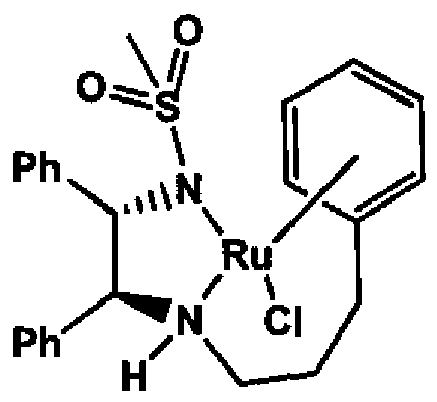

- The process according to any one of the preceding claims, characterized by either one or a combination of the following procedural features (f) to (i):(f) the transfer hydrogenation is carried out in a mixture comprising formic acid and triethylamine, preferably said mixture comprises formic acid and triethylamine in a volume ratio of 2/1 to 3/1, preferably 4.5/2 to 5.5/2;(g) the transfer hydrogenation reaction is carried out at a temperature between 25 to 90°C, preferably 30 to 80°C, more preferably 35 to 70°C, even more preferably 36 to 60°C, yet even more preferably 38 to 50°C, and in particular 40 to 45°C;(h) the transfer hydrogenation reaction is carried out for a reaction time of 15 to 100 h, preferably 20 to 70 h;(i) the molar ratio of substrate to catalyst is at least 20/1, preferably 30/1 to 500/1, more preferably 35/1 to 250/1, even more preferably 40/1 to 150/1, yet even more preferably 75/1 to 125/1, and in particular 90/1 to 110/1.
- A process for preparing a compound of formula II

by hydrogenation with elemental hydrogen (H2) of a compound of formula I
- The process according to claim 7, wherein -OR is a protecting group as defined in claim 1 or 2, and/or the catalyst is a catalyst as defined in claim 3.
- The process according to claim 7 or 8, wherein the catalyst complex comprises a monotosylated DPEN ligand selected from the group consisting of (R,R) or (S,S) N-(methanesulfonyl)-1,2-diphenylenediamine (MsDPEN), (R,R) or (S,S) N-(toluenesulfonyl)-1,2-diphenylenediamine (TsDPEN), (R,R) or (S,S) N-(toluenesulfonyl),N•-(propyl-3-phenyl)-1,2-diphenylenediamine (TsDPEN-teth), (R,R) or (S,S) N-(methanesulfonyl),N-(propyl-3-phenyl)-1,2-diphenylenediamine (MsDPEN-teth).
- The process according to any one of claims 7 to 9, wherein the catalyst complex is selected from the group consisting of
[(R,R)-Ms-DPEN RuCl (p-cym)] having the structural formula


[(S,S)-Ms-DPEN RuCl (mes)] having the structural formula
- The process according to any one of claims 7 to 10, characterized by either one or a combination of the following procedural features (i) to (vi):(i) hydrogenation is carried out in a C1-C4 alcohol as the solvent, preferably methanol;(ii) hydrogen is applied at a hydrogen pressure of 20 to 40 bar, preferably 25 to 35 bar, more preferable 28 to 32 bar;(iii) hydrogenation reaction is carried out at a temperature between 30 to 80°C, preferably 35 to 75°C, more preferably 60 to 70°C;(iv) hydrogenation reaction is carried out for a reaction time of 12 to 100 h, preferably 14 to 85 h, more preferably, in case reaction temperature is between 60 to 70°C, reaction time is 40 to 85 h;(v) the molar ratio of substrate to catalyst is at least 20/1, preferably 30/1 to 500/1, more preferably 35/1 to 250/1, even more preferably 40/1 to 150/1, yet even more preferably 75/1 to 125/1, and in particular 90/1 to 110/1;(vi) hydrogenation is carried out in the presence of an aqueous solution comprising an amine compound selected from the group consisting of triethylamine (Et3N), diisopropyl ethyl amine (iPr2EtN) and tetramethylguanidine (TMG); preferably, said aqueous solution comprises the amine compound in an amount of 10 to 40% by weight relative to the total weight of the aqueous solution.
- The process according to any one of the preceding claims, wherein compound of formula II is obtained in a diastereomeric ratio of cis-isomer to trans-isomer of at least 100/1 and an enantiomeric excess of the cis-configured compound of at least 90%, more preferably enantiomeric excess of the cis-configured compound is at least 94%, even more preferably at least 96%, yet even more preferably at least 98%, and in particular at least 99%.
- A process for preparing a compound of formula X
 a) preparing a compound of formula II
by a process according to any one of claims 1 to 12, andb) further converting the compound of formula II to compound of formula X or a pharmaceutically acceptable salt thereof. - A process according to claim 13, wherein compound of formula X is lasofoxifene (X') having the structural formula
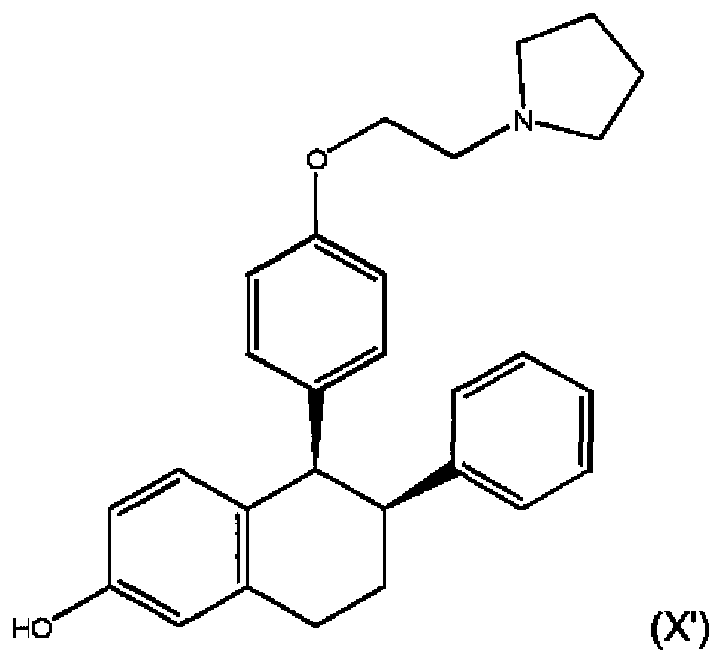
- A process for the preparation of a pharmaceutical composition comprising a compound of formula X or a pharmaceutically acceptable salt thereof as active ingredient, comprising the steps of:a) preparing compound of formula X or a salt thereof according to the process according to claim 13 or 14, andb) admixing the prepared compound of formula X or pharmaceutically acceptable salt thereof with at least one pharmaceutically acceptable excipient.
Priority Applications (1)
| Application Number | Priority Date | Filing Date | Title |
|---|---|---|---|
| EP12162491.0A EP2644603A1 (en) | 2012-03-30 | 2012-03-30 | Synthetic route for the preparation of substituted 2-phenyl-1,2,3,4-tetrahydronaphthalene-1-ols |
Applications Claiming Priority (1)
| Application Number | Priority Date | Filing Date | Title |
|---|---|---|---|
| EP12162491.0A EP2644603A1 (en) | 2012-03-30 | 2012-03-30 | Synthetic route for the preparation of substituted 2-phenyl-1,2,3,4-tetrahydronaphthalene-1-ols |
Publications (1)
| Publication Number | Publication Date |
|---|---|
| EP2644603A1 true EP2644603A1 (en) | 2013-10-02 |
Family
ID=45932214
Family Applications (1)
| Application Number | Title | Priority Date | Filing Date |
|---|---|---|---|
| EP12162491.0A Ceased EP2644603A1 (en) | 2012-03-30 | 2012-03-30 | Synthetic route for the preparation of substituted 2-phenyl-1,2,3,4-tetrahydronaphthalene-1-ols |
Country Status (1)
| Country | Link |
|---|---|
| EP (1) | EP2644603A1 (en) |
Cited By (1)
| Publication number | Priority date | Publication date | Assignee | Title |
|---|---|---|---|---|
| JP2015044770A (en) * | 2013-08-28 | 2015-03-12 | 国立大学法人北海道大学 | Method for producing optically active 3-substituted chroman-4-ol compound |
-
2012
- 2012-03-30 EP EP12162491.0A patent/EP2644603A1/en not_active Ceased
Non-Patent Citations (5)
| Title |
|---|
| D. HOBBS-MALLYON ET AL., J. CHEM. SOC., PERKIN TRANS, vol. 1, no. 10, 1997, pages 1511 - 1516 |
| D. HOBBS-MALLYON ET AL.: "Aryltricyclospirodienones; novel steroid mimics as inhibitors of aromatase", J. CHEM. SOC., PERKIN TRANS, vol. 1, no. 10, 1997, pages 1511 - 1516, XP002678679, ISSN: 0300-922X * |
| M.B. SMITH; J. MARCH: "March's Advanced Organic Chemistry: Reactions, Mechanisms and Structure", JOHN WILEY&SONS, INC., pages: 155 - 158 |
| P. PEACH ET AL., TETRAHEDRON, vol. 62, 2006, pages 1864 - 1876 |
| PEACH P ET AL: "Asymmetric transfer hydrogenation of alpha,beta-unsaturated, alpha-tosyloxy and alpha-substituted ketones", TETRAHEDRON, ELSEVIER SCIENCE PUBLISHERS, AMSTERDAM, NL, vol. 62, no. 8, 20 February 2006 (2006-02-20), pages 1864 - 1876, XP025001574, ISSN: 0040-4020, [retrieved on 20060220], DOI: 10.1016/J.TET.2005.11.036 * |
Cited By (1)
| Publication number | Priority date | Publication date | Assignee | Title |
|---|---|---|---|---|
| JP2015044770A (en) * | 2013-08-28 | 2015-03-12 | 国立大学法人北海道大学 | Method for producing optically active 3-substituted chroman-4-ol compound |
Similar Documents
| Publication | Publication Date | Title |
|---|---|---|
| MX2008000140A (en) | Process for the preparation of cinacalcet base. | |
| WO2011048727A1 (en) | Novel ruthenium carbonyl complex having a tridentate ligand and manufacturing method and usage therefor | |
| US20100197976A1 (en) | Catalysts | |
| CN1257468A (en) | Transfer Hydrogenation Processes and Catalysts | |
| Ruan et al. | Catalytic Asymmetric Alkynylation and Arylation of Aldehydes by an H8‐Binaphthyl‐Based Amino Alcohol Ligand | |
| JP3867250B2 (en) | Tetrahydroindeno [1,2-d] [1,3,2] oxazaborol and its use as an enantioselective catalyst | |
| CN1440374A (en) | Process for perparation of (R)-2-alkyl-3-phenyl-1-propanols | |
| WO2008071951A2 (en) | Catalytic process for asymmetric hydrogenation | |
| JP2008150376A (en) | NEW METHOD FOR SYNTHESIZING [R-(R*,R*)]-2-(4-FLUOROPHENYL)-beta, delta-DIHYDROXY-5-(1-METHYLETHYL)-3-PHENYL-4-[(PHENYLAMINO)CARBONYL]-1H-PYRROLE-1-HEPTANOIC ACID OR ITS PHARMACEUTICALLY ACCEPTABLE SALT | |
| Zanotti-Gerosa et al. | Acid promoted Ir–P^ N complex catalyzed hydrogenation of heavily hindered 3, 4-diphenyl-1, 2-dihydronaphthalenes: asymmetric synthesis of lasofoxifene tartrate | |
| US7601667B2 (en) | Sulfonate catalyst and method of producing alcohol compound using the same | |
| EP1601635B1 (en) | Process for producing optically active alcohol in the presence of rhodium, a chiral ferrocenyldiphosphine and an optically active diamine | |
| US20160304538A1 (en) | Composition of matter | |
| WO2007077111A1 (en) | Compounds and methods for carbazole synthesis | |
| US11124532B2 (en) | Chiral metal complex compounds | |
| EP2215069B1 (en) | Process for the preparation of tetranorlabdane derivatives | |
| US10179330B2 (en) | Chiral N-substituted allylic amine compounds | |
| EP1707556B1 (en) | Method of enantioselective nucleophilic addition reaction of an enamide to a glyoxylic acid ester | |
| US20210238200A1 (en) | Chiral n-substituted allylic amine compounds | |
| JP5172124B2 (en) | Method for producing optically active quinuclidinols having a substituent at the 2-position | |
| JP3569280B1 (en) | Method for producing optically active alcohol | |
| JP2016527214A (en) | Novel ruthenium catalyst and its use for asymmetric reduction of ketones | |
| JP5330706B2 (en) | Process for producing optically active 3-quinuclidinol | |
| JP4732180B2 (en) | Stereoselective production method of 1,3-aminoalcohol derivatives | |
| MXPA02005174A (en) | Ethers of o desmethyl venlafaxine. |
Legal Events
| Date | Code | Title | Description |
|---|---|---|---|
| PUAI | Public reference made under article 153(3) epc to a published international application that has entered the european phase |
Free format text: ORIGINAL CODE: 0009012 |
|
| AK | Designated contracting states |
Kind code of ref document: A1 Designated state(s): AL AT BE BG CH CY CZ DE DK EE ES FI FR GB GR HR HU IE IS IT LI LT LU LV MC MK MT NL NO PL PT RO RS SE SI SK SM TR |
|
| AX | Request for extension of the european patent |
Extension state: BA ME |
|
| STAA | Information on the status of an ep patent application or granted ep patent |
Free format text: STATUS: THE APPLICATION HAS BEEN REFUSED |
|
| 18R | Application refused |
Effective date: 20131025 |