EP2644004B1 - Subset-kodierung für kommunikationssysteme - Google Patents
Subset-kodierung für kommunikationssysteme Download PDFInfo
- Publication number
- EP2644004B1 EP2644004B1 EP11842985.1A EP11842985A EP2644004B1 EP 2644004 B1 EP2644004 B1 EP 2644004B1 EP 11842985 A EP11842985 A EP 11842985A EP 2644004 B1 EP2644004 B1 EP 2644004B1
- Authority
- EP
- European Patent Office
- Prior art keywords
- packets
- source
- batches
- node
- coded
- Prior art date
- Legal status (The legal status is an assumption and is not a legal conclusion. Google has not performed a legal analysis and makes no representation as to the accuracy of the status listed.)
- Active
Links
Images






Classifications
-
- H—ELECTRICITY
- H03—ELECTRONIC CIRCUITRY
- H03M—CODING; DECODING; CODE CONVERSION IN GENERAL
- H03M13/00—Coding, decoding or code conversion, for error detection or error correction; Coding theory basic assumptions; Coding bounds; Error probability evaluation methods; Channel models; Simulation or testing of codes
- H03M13/37—Decoding methods or techniques, not specific to the particular type of coding provided for in groups H03M13/03 - H03M13/35
- H03M13/3761—Decoding methods or techniques, not specific to the particular type of coding provided for in groups H03M13/03 - H03M13/35 using code combining, i.e. using combining of codeword portions which may have been transmitted separately, e.g. Digital Fountain codes, Raptor codes or Luby Transform [LT] codes
-
- H—ELECTRICITY
- H03—ELECTRONIC CIRCUITRY
- H03M—CODING; DECODING; CODE CONVERSION IN GENERAL
- H03M13/00—Coding, decoding or code conversion, for error detection or error correction; Coding theory basic assumptions; Coding bounds; Error probability evaluation methods; Channel models; Simulation or testing of codes
- H03M13/29—Coding, decoding or code conversion, for error detection or error correction; Coding theory basic assumptions; Coding bounds; Error probability evaluation methods; Channel models; Simulation or testing of codes combining two or more codes or code structures, e.g. product codes, generalised product codes, concatenated codes, inner and outer codes
- H03M13/2906—Coding, decoding or code conversion, for error detection or error correction; Coding theory basic assumptions; Coding bounds; Error probability evaluation methods; Channel models; Simulation or testing of codes combining two or more codes or code structures, e.g. product codes, generalised product codes, concatenated codes, inner and outer codes using block codes
- H03M13/2927—Decoding strategies
- H03M13/293—Decoding strategies with erasure setting
-
- H—ELECTRICITY
- H04—ELECTRIC COMMUNICATION TECHNIQUE
- H04L—TRANSMISSION OF DIGITAL INFORMATION, e.g. TELEGRAPHIC COMMUNICATION
- H04L1/00—Arrangements for detecting or preventing errors in the information received
- H04L1/004—Arrangements for detecting or preventing errors in the information received by using forward error control
- H04L1/0076—Distributed coding, e.g. network coding, involving channel coding
-
- H—ELECTRICITY
- H03—ELECTRONIC CIRCUITRY
- H03M—CODING; DECODING; CODE CONVERSION IN GENERAL
- H03M13/00—Coding, decoding or code conversion, for error detection or error correction; Coding theory basic assumptions; Coding bounds; Error probability evaluation methods; Channel models; Simulation or testing of codes
- H03M13/03—Error detection or forward error correction by redundancy in data representation, i.e. code words containing more digits than the source words
- H03M13/05—Error detection or forward error correction by redundancy in data representation, i.e. code words containing more digits than the source words using block codes, i.e. a predetermined number of check bits joined to a predetermined number of information bits
- H03M13/11—Error detection or forward error correction by redundancy in data representation, i.e. code words containing more digits than the source words using block codes, i.e. a predetermined number of check bits joined to a predetermined number of information bits using multiple parity bits
- H03M13/1102—Codes on graphs and decoding on graphs, e.g. low-density parity check [LDPC] codes
- H03M13/1191—Codes on graphs other than LDPC codes
-
- H—ELECTRICITY
- H03—ELECTRONIC CIRCUITRY
- H03M—CODING; DECODING; CODE CONVERSION IN GENERAL
- H03M13/00—Coding, decoding or code conversion, for error detection or error correction; Coding theory basic assumptions; Coding bounds; Error probability evaluation methods; Channel models; Simulation or testing of codes
- H03M13/61—Aspects and characteristics of methods and arrangements for error correction or error detection, not provided for otherwise
- H03M13/615—Use of computational or mathematical techniques
- H03M13/616—Matrix operations, especially for generator matrices or check matrices, e.g. column or row permutations
-
- H—ELECTRICITY
- H04—ELECTRIC COMMUNICATION TECHNIQUE
- H04L—TRANSMISSION OF DIGITAL INFORMATION, e.g. TELEGRAPHIC COMMUNICATION
- H04L1/00—Arrangements for detecting or preventing errors in the information received
- H04L2001/0092—Error control systems characterised by the topology of the transmission link
- H04L2001/0097—Relays
Definitions
- This invention relates to reliable communication of large amounts of related digital data, and more particularly to reliable point-to-multipoint communication of large files of data, Where a file is a collection of digital data.
- a single source node embodiment is described for illustration purposes in this document, though it is allowed to use multiple source nodes to send a single source file.
- the file can be an operating system update, a high-definition video, or the data collected by environmental sensors.
- the communication network can be a wireline network, a wireless network, or an overlay network built upon the combination of wireline and wireless networks. It is a prerequisite that the network transmission is packetized, i.e., all transmitted data are grouped into suitably-sized blocks, called packets.
- a network node can transmit packets to its neighbor nodes through wireless or wireline links.
- the network links are not perfect; as a packet can be corrupted or erased during transmission, or an intermediate node may fail during transmission.
- a corrupted packet can be deleted and treated as an erasure. (In this model, we consider only erasures on the network links.)
- Network coding is a known network transmission technique that generally improves the network throughput and is resilient to packet loss.
- linear network coding is a known efficient way to achieve the network capacity of multicast. Routing is a special case of linear network coding. Instead of just routing, linear network coding allows intermediate network nodes to transmit new packets generated by linear combinations of the packets they have received. Such operations in the intermediate network nodes are referred to as recoding of network codes.
- recoding the complexity of encoding, recoding and decoding also increases quickly.
- a number of file distribution schemes using network coding are known to the art.
- One common feature of known schemes is to use the concept of chunk (also called class or generation ) wherein a data file to be transmitted is divided into equally-sized packets, and all the packets are grouped into several chunks of equal size, which can be disjoint or overlapped.
- chunk also called class or generation
- network coding is applied to the packets in the same chunk.
- Overlapped chunks can improve the throughput of random scheduling for practical chunk sizes.
- the advantage of overlapped chunks is to use the decoded chunks to help the decoding of the other chunks.
- Known designs of overlapped chunks are heuristic, and the performance can only be evaluated by simulation.
- Fountain codes are the class of codes for transmitting messages through erasure channels with low encoding/decoding complexity.
- An erasure channel is a simple network with only one link.
- These include LT codes, a class of codes introduced by M. Luby for erasure channels with low encoding/decoding complexity, and Raptor codes, that achieve even lower encoding/decoding complexity by combining a variation of LT codes with certain pre-codes.
- the encoding of LT codes involves the following procedure: First, a pre-designed degree distribution is sampled and an integer value d is obtained. Then d distinct input packets are chosen randomly and added using bitwise sum to yield the output packet. Output packets are transmitted through an erasure channel and the number of transmitted output packets can be unlimited.
- An LT decoder can use any n output packets to recover the original K input packets, where n is certain number larger than K .
- the decoding process can be described by a decoding graph (called a Tanner graph) of the LT codes.
- a decoding graph is a bipartite graph with K nodes on one side and n nodes on the other side, called the variable nodes and the check nodes, which correspond to the input packets and output packets, respectively. There is an edge between an input packet and an output packet if the input packet contributes to the value of the output packet.
- the decoder identifies an output packet of degree one. The value of the output packet of degree one is just the value of its unique neighbor among the input packets. Once an input packet is recovered, its value is subtracted from the values of all the neighboring output packets, and this input packet and all its related edges are removed from the graph.
- the degree distribution of an LT code needs to be carefully designed so that the LT code has both a low encoding/decoding complexity and the above decoding algorithm succeeds with high probability.
- the LT codes proposed by M. Luby require that all the input packets are recovered by the LT decoder. Raptor codes relax this condition in a way that only a constant fraction of the input packets need to be recovered. The remaining input packets are recovered using precoding.
- Fountain codes are not designed for general communication networks; simply applying fountain codes in such networks may not be optimal.
- For the general network applying fountain codes link by link together with network coding can achieve the maximum throughput. But such a scheme has two drawbacks: First, both decoding and recoding of LT codes are needed at each intermediate node, so the complexity is not low. Second, a decoding delay in proportion with the file size is incurred at each intermediate node, and so the end-to-end decoding delay grows with size of the network.
- the delay can be reduced by applying fountain codes in a stack manner: An intermediate node buffers the packets it receives and re-encodes using fountain codes, and a destination node decodes multiple layers of fountain codes. This method only moves all the decoding to the destination nodes.
- the difficulty to apply fountain codes in networks employing linear network coding is because network coding changes the degrees of packets and results in the failure of efficient belief propagation decoding.
- Heuristic algorithms have been developed for special communication scenarios such that the set of coded packets received at a destination node approximates an LT code. But in general it is difficult to guarantee the degree of the received packets following a specific distribution using distributed encoding. Therefore, what is desired is a file transmission scheme that does not require excessive computation and storage at the intermediate nodes, and that can be used to efficiently distribute a file in a network employing linear network coding.
- US patent application US 2009/0248898 A1 discloses methods of encoding content for distribution over a network and methods for decoding encoded content which has been distributed over the network.
- the method comprises selecting a segment from the plurality of segments and selecting at least two blocks of the selected segment from a store of blocks. A new encoded block is created from a linear combination of the selected blocks.
- rateless codes a coding technique referred to as rateless codes to code multimedia bitstreams before they are transmitted over peer-to-peer links.
- rateless codes eliminates the requirements of content reconciliation, as well as the risks of delivering redundant content over the network.
- Rateless codes also help the streaming sessions to adapt to volatile network dynamics. Further, latencies in streaming sessions are minized by optimizing toward a latency-related objective in a linear optimization problem, the solution to which can be efficiently derived in a decentralized and iterative fashion.
- a method and system for data encoding and associated decoding are provided based on the concept of batches that allows transmission of a large data file from a source node to multiple destination nodes through communication networks that may employ network coding.
- An encoder can generate one or more batches that are generally independent of each other.
- the source node merely schedules the transmission of batches one by one. After transmitting M packets of a batch, the source node generates and transmits another batch.
- a major feature of batches is that during the transmission of a batch in a network, various corruptions of packets and various operations at the intermediate nodes are allowed, as long as the overall end-to-end transformation of the network is given by a linear function.
- packet correction is packet loss or erasure.
- intermediate nodes operations are routing and more generally linear network coding.
- an intermediate node recodes the received (coded) packets belonging to a common batch into new packets for the same batch, and then transmits these new packets on its outgoing links. This is the scenario in which linear network coding is employed within the network.
- a subset coding method wherein the file to be transmitted is separated into packets of equal length over a finite field with size q .
- a destination node receives packets, wherein each received packet belongs to one batch.
- the destination node uses a decoder that decodes the received batches using a belief propagation decoding algorithm of sparse matrix codes.
- the decoder needs to recover at least a pre-defined fraction of all the input packets.
- input packets are first encoded at a source node by a pre-code to introduce some redundancy.
- the pre-coded input packets are then encoded and transmitted at the source node using a sparse matrix code.
- a destination node uses a decoder that decodes the received batches using a belief propagation decoding algorithm of sparse matrix codes.
- the decoder needs to recover a pre-defined fraction of all the (pre-coded) input packets. The original input packets are recovered from the pre-code.
- This coding scheme provides a solution in a wide variety of situations.
- This scheme is suitable to be implemented in wireless networks.
- Examples of such wireless networks include wireless senor networks and ad hoc networks of cellular phones.
- This method can be used in a distributed storage system, where each batch can be regarded as a storage piece of the original file. Batches can be stored in storage devices in multiple network locations. To recover the file, a certain number of batches are retrieved.
- This coding method can also be realized in a peer-to-peer file distribution system. It is possible to adapt this method for video/audio streaming and broadcast systems, although the specific codes herein disclosed are not specifically optimized for such systems.
- FIG. 1 is a block diagram showing elements of a communication system 10 employing the methodology according to the invention.
- a source node 12 comprises an encoder 14 coupled to a data source 16 that provides as input to the encoder 14 multiple large data files, for example large data file 18.
- the encoder 14 may include a precoder 20.
- the output of the encoder 14 is coupled to a transmitter 26 which in turn is coupled to a link 28 over which batches 21, 23, 25 are transmitted.
- the link 28 is coupled to one or more intermediate nodes 30, 32, 34, typically within a mesh or cloud 36.
- the input to the encoder 14 is a sequence of source packets 15, 17, 19 corresponding to the large data file 18.
- the output of the encoder 14 to the transmitter 26 is a set of encoded output packets, herein autonomous batches 21, 23, 25.
- the transmitter 26 transmits these batches in a form that is suitable for the network.
- These batches are conveyed to the destination node 53 via the intermediate nodes, e.g., 30, which do not decode the file or any batches but they can apply network coding to produce the batches 40, 42, 44.
- the receiver 52 and the decoder 54 can recover the source large data file 18 as recovered packets 46, 48, 50 that provide input to a storage unit 56 or other utilization device.
- the techniques for encoding and decoding according to the invention are explained herein below.
- a method and coding scheme are proposed for the transmission of one file in the file distribution problem.
- the core component of this scheme is sparse matrix codes.
- a key component is the sparse matrix coder 22.
- a file consists of K disjoint packets, each of which has T symbols in a finite field F with size q.
- a batch is a set of M coded packets generated using M possible different linear combinations of a same subset of these input packets.
- G i is called the generator matrix of the i th batch. The details about the design of G i . are described below.
- the packet in B i are denoted the contributors of the i th batch.
- each batch is generated without regard to how other batches are generated.
- the design of ⁇ is different from the degree distribution of LT/Raptor codes, and is discussed elsewhere herein.
- the distribution ⁇ is first sampled to obtain a degree d i . Then uniformly at random choose d i input packets forming B i by juxtaposing these packets.
- One way to design a generator matrix is to simply use the G i that is pre-designed and shared by the source node and the destinations. Another way is to randomly generate G i by the source node. It is not necessary to deliver G i to the destination, since the destination only requires the multiplication of G i and the transfer matrix of the i th batch to decode.
- a destination requires the degree d i , the indices of the contributors, and the generator matrix G i for decoding.
- There are various methods that can realize this goal in previous art e.g., the methods introduced for LT codes and Raptor codes.
- One preferred method is to share a pseudo-random generator between the source node and the destination nodes. The source node generates the degrees, the indices of the contributors, and the generator matrices all using this pseudo-random generator initialized by certain seed. The destination nodes can recover this information using its pseudo-random generator initialized by the same seed.
- the encoding of sparse matrix codes can be described by bipartite Tanner graphs.
- the Tanner graph associated with a sparse matrix code is a bipartite graph. It has K variable nodes, corresponding to the input packets, and n check nodes, corresponding to the batches. Check node j is connected to variable node i if b i is the contributor of batch j .
- the top two layers of the graph illustrate the encoding procedure.
- batches can be transmitted sequentially.
- the source node transmits the M packets in the batch.
- the source can generate and transmit another batch. No individual acknowledgement is required for each batch as acknowledgement is done on the whole data set.
- the only requirement for the network is that the overall end-to-end transformation of the network for each batch is given by a linear function.
- the intermediate nodes can apply linear network coding.
- An intermediate node encodes the received packets of a batch into new packets using linear combinations and transmits these new packets on its outgoing links. These new packets are considered to be in the same batch.
- the packets in different batches are not mixed inside the network. Network topology dynamics and packet loss are allowed since the end-to-end network transformation remains linear.
- H i the transfer matrix of the i th batch determined by the network.
- the number of rows is equal to M, while the number of columns may depend on i .
- the nodes in the bottom layer of Figure 2 correspond to the received packets.
- the transfer matrix H i can be recovered from the packet headers of the coded packets.
- the i th batch is decodable if G i H i has rank d i . Assume that the i th batch is decodable.
- d i packets in B i are recovered. Then the values of these decoded input packets are substituted in the system of linear equations associated with the undecoded batches.
- this is equivalent to first removing the i th check node, its neighboring variable nodes and the corresponding edges, and then for each removed variable node, updating the associated linear system of equations of its neighboring check nodes.
- This decoding-substitution procedure is repeated on the new graph until no more check nodes are decodable.
- a destination node waits/requests for new batches and keeps on checking the decodability of new batches.
- Such decoding has complexity O ( n ⁇ d d 3 ⁇ d + Tn ⁇ d d 2 ⁇ d ) , where n is the number of check nodes in the decoding graph.
- the input packets are optionally first encoded using a traditional erasure code (pre-coding), and then a proper sparse matrix code is applied to the pre-coded input packets.
- pre-coding traditional erasure code
- a proper sparse matrix code is applied to the pre-coded input packets. It is necessary that the belief propagation decoding described in the section on decoding recover a large fraction of the (pre-coded) input packets. (The original input packets can be recovered from the pre-code.)
- a pre-code is used as in Raptor codes, so reference is made to discussions elsewhere of such precoding.
- Figure 4 illustrates such a coding scheme, where the input packets are appended by redundant packets in the case of a systematic pre-code.
- An appropriate sparse matrix code is used to generate output packets from the pre-coded input packets.
- the degree distribution ⁇ must guarantee that: i) the decoding is successful with high probability, ii) the encoding and decoding complexity is low, and iii) the coding rate is large.
- the following is an example of how to find a desired degree distribution when the generator matrices are randomly chosen and the transfer matrices for batches are independently generated following the same distribution of H. In fact, many degree distributions will perform well, as small variations in the degree distribution may lead to only small changes in performance.
- G d the random matrix with d rows, M columns and uniformly independently distributed components over the finite field with q elements.
- the generator matrix of a batch with degree d is just an instance of G d .
- h d,r can be determined by the rank distribution of the transfer matrix, which is assumed to be known.
- ⁇ >0 is a parameter that controls the fraction of input packets that can be decoded by the decoding algorithm above
- ⁇ is the design coding rate of the sparse matrix code and D is the maximum degree.
- D is the maximum degree.
- D can be the smallest integer larger or equal to M / ⁇ . This optimization can be approximately solved using linear programming by considering discrete values of x. For multiple destinations, the above design principle can be similarly applied by maximizing the smallest design coding rates of all destinations.
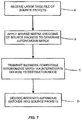
- Step A receives the large data files of source packets
- Step B to apply sparse matrix encoding to the source packets to generate the autonomous batches
- Step C transmits the autonomous batches in a network compatible form via one or more intermediate nodes to a destination node
- Step D At the receiving node representations of the autonomous batches are received and decoded into representations, that is, reproductions of the source packets (Step D).
- Step D At the receiving node representations of the autonomous batches are received and decoded into representations, that is, reproductions of the source packets (Step D).
- a destination node does not need to send acknowledgement for each recovered batch.
- One benefit of subset coding is that such feedback can be eliminated. An acknowledgement may only be needed when the whole file or a pre-defined fraction of the file is recovered.
- Figure 8 depicts a process at a specific embodiment of an intermediate node.
- the intermediate node recodes the packets of an autonomous batch into what is herein termed "new packets (Step F).
- new packets As soon as packets are received that do not belong to the current autonomous batch, the local buffer is cleared and the new packets are relayed or transmitted toward the destination node (Step G).
- Figure 9 reflects a detail of a specific process at the source node.
- redundancy is introduced by pre-coding the source packets with a pre-code (Step H).
- Step I Thereafter is a sparse matrix coding step (Step I).
- a degree is then obtained by sampling degree distribution (Step J).
- Step K distinct pre-coded packets are selected (Step K).
- Step L a batch of coded packets is generated from the distinct packets and a generator matrix (Step L). It is this batch that is then transmitted (Step M).
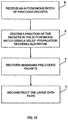
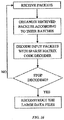
- Figure 10 is a flow chart of operation at a destination node.
- the node receives an autonomous batch that has been generated by the source node or recoded by intermediate nodes (Step N). It then decodes only a fraction of the pre-coded packets in the autonomous batch using a belief propagation decoding algorithm (Step O). Thereafter the remaining pre-coded packets are recovered (Step P) and the large data file or files is reconstructed (Step Q).
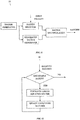
- FIG 11 is a block diagram of a sparse matrix code encoder embodied as a device in accordance with the invention as shown in Figure 1 .
- Input packets are received at a packet selector, such as from a precoder.
- a degree generator provides control/selection to the packet selector and a generator matrix generator, both of which provide input to a matrix multiplier the output of which is batches to the transmitter ( Figure 1 ).
- Figure 12 is a flow chart for a sparse matrix code decoder 54 ( Figure 1 ) of one embodiment of the invention.
- the batches received from receiver 52 ( Figure 1 ) are first tested to see if they are decodable, and if so, they are directed to a system of linear equation solver to extract data from the batches.
- the list of undecoded batches is then updated and any undecoded batches are retested for decidability and the process is repeated.
- Figure 13 is a flow chart for operations at a source node 12 ( Figure 1 ) according to one embodiment of the invention.
- Data files are organized into packets, then the autonomous batches are generated according to the invention by sparse matrix codes.
- the packets are transmitted in batches.
- Figure 14 is a flow chart for operations at a source node according to another embodiment of the invention. In this embodiment the step of introducing redundancy is implemented prior to generating autonomous batches as before.
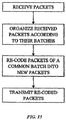
- Figure 15 is a flow chart for operations at an intermediate node according to one embodiment of the invention.
- the received packets are organized as received into their appropriate batches and the packets are re-coded into "new" packets containing the same batch data. Then the new packets are transmitted.
- FIG 16 is a flow chart for operations at a destination node according to one embodiment of the invention.
- Received packets as received in destination node 53 ( Figure 1 ) are organized according to their batches previously identified, then decoded using the sparse matrix decoder 54 ( Figure 1 ), until the data is exhausted. Once exhausted, reconstruction of large data files follows.
- Figure 17 is a flow chart for operations at a destination node according to another embodiment of the invention. the operation is similar to the procedure with respect to the flow chart of Figure 16 , except the decoder is pre-coded prior to reconstruction of the large data files.
- Sparse matrix codes are applicable for multicast, where more than one destination nodes demand a file transmitted by a source node.
- Each source node has a copy of a single file to be transmitted to a destination node.
- These two source nodes encode the file using sparse matrix codes distributively, and the destination node decodes the batches it receives from both source nodes jointly, using sparse matrix code decoding.
- Degenerated cases of the above optimization problem can also be used for various scenarios.
- we can optimize ⁇ ( i ) by treating the i th source node as the only source node, i 1,2.
- Sparse matrix codes for multiple source nodes can be used in peer-to-peer (P2P) file distribution as well as P2P streaming.
- P2P peer-to-peer
Landscapes
- Engineering & Computer Science (AREA)
- Physics & Mathematics (AREA)
- Probability & Statistics with Applications (AREA)
- Theoretical Computer Science (AREA)
- Computer Networks & Wireless Communication (AREA)
- Signal Processing (AREA)
- Data Exchanges In Wide-Area Networks (AREA)
Claims (11)
- Verfahren zum Verarbeiten großer Dateien in einem Telekommunikationsnetzwerk, Folgendes umfassend:Segmentieren einer Datei (18) in K Source-Pakete (15, 17, 19) gleicher Länge;Erzielen einer Teilmenge von Source-Paketen Bi durch Erlangen eines Grads di und zufälliges Auswählen von di Source-Paketen, die die Teilmenge von Source-Paketen Bi bilden;Erzeugen einer Mehrzahl von Batches Xi (21, 23, 25) codierter Pakete von den Source-Paketen, wobei jeder der Mehrzahl von Batches Xi (21, 23, 25) einen Satz von M codierten Paketen umfasst, wobei der Satz von M codierten Paketen unter Verwendung von M möglichen unterschiedlichen linearen Kombinationen der gleichen Teilmenge von Source-Paketen Bi gemäß Xi = BiGi erzeugt werden, wobei G1 eine Generatormatrix des i-ten Batches Xi ist.
- Verfahren nach Anspruch 1, ferner umfassend:
Senden der Mehrzahl von Batches Xi (21, 23, 25) von einem Quellknoten (12) zu einem Zielknoten (53) zum Decodieren an dem Zielknoten (53), um die Datei (18) wiederherzustellen. - Verfahren nach Anspruch 2, ferner umfassend:
Empfangen einer einzelnen Bestätigung von dem Zielknoten (53) an dem Quellknoten (12), wenn die gesamte Datei (18) oder ein vorbestimmter Teil davon wiederhergestellt ist. - Verfahren nach den Ansprüchen 2 und 3, wobei das Senden über einen Zwischenknoten (30, 32, 34) erfolgt.
- Verfahren nach Anspruch 4, wobei der Zwischenknoten (30, 32, 34) konfiguriert ist, um empfangene codierte Pakete unter Verwendung einer linearen Netzwerkcodierung zu codieren, wobei die codierten Pakete zu einem bestimmten Batch der Mehrzahl von Batches Xi (21, 23 25) gehören, um neue Pakete zu bilden, die zum Batch Xi gehören.
- Verfahren nach Anspruch 5, wobei, wenn an dem Zwischenknoten (30, 32, 34) codierte Pakete empfangen werden, die nicht zu dem einen bestimmten Batch der Mehrzahl von Batches Xi (21, 23, 25) gehören, veranlasst wird, dass der Zwischenknoten (30, 32, 34) die neuen Pakete, die zu dem einen bestimmten Batch gehören, sendet und einen lokalen Puffer des Zwischenknotens löscht.
- Verfahren nach Anspruch 3, wobei die großen Dateien (18) an mehrere Zielknoten (53) gesendet werden, wobeidie K Source-Pakete (15, 17, 19) an einem Quellknoten (12) unter Verwendung eines Löschcodes codiert sind, um eine Redundanz einzuführen, um vorcodierte Eingabepakete zu erzielen, bevor die Teilmenge von Source-Paketen Bi erzielt wird; undwobei das Erzielen einer Teilmenge von Source-Paketen Bi durch Erzielen eines Grades di und zufälliges Auswählen von di Source-Paketen, die die Teilmenge von Source-Paketen Bi bilden, das Erzielen eines Grades di für jede der Mehrzahl von Batches Xi (21, 23, 25) am Quellknoten umfasst, durch Abtasten einer Gradverteilung und Auswählen von di verschiedenen vorcodierten Eingangspaketen;wobei das Erzeugen einer Mehrzahl von Batches Xi (21, 23, 25) codierter Pakete von den Source-Paketen ferner das Erzeugen jedes Stapels Xi (21, 23, 25) aus jeweiligen di verschiedenen vorcodierten Eingangspaketen unter Verwendung einer Generatormatrix G umfasst; und wobei das Verfahren ferner umfasst:
das Senden des Batches Xi (21, 23, 25) an mehrere Zielknoten (53). - Verfahren nach Anspruch 7, wobei der Schritt des Codierens der K Source-Pakete an einer Mehrzahl von Quellknoten (12) durchgeführt wird, und wobei das Verfahren ferner die folgenden Schritte umfasst:Empfangen einer Kopie der Datei (18) an jedem der Mehrzahl von Quellknoten (12), wobei jede Kopie die K Source-Pakete (15, 17, 19) umfasst;Verteilen der Codierung der Source-Pakete (15, 17, 19) unter der Mehrzahl von Quellknoten; undEmpfangen eines spezifischen Feed-backs von allen oder einigen Zielknoten (53) an jedem der Mehrzahl von Quellknoten (12).
- System (10) zum Senden und Empfangen großer Dateien (18), wobei jede Datei (18) eine große Anzahl von Source-Paketen (15, 17, 19) aufweist, wobei das System Folgendes umfasst:einen Quellknoten (12) mit einem Codierer (14), konfiguriert zum Erzeugen einer Mehrzahl von Batches Xi (21, 23, 25) von codierten Paketen von einer jeweiligen der Mehrzahl von großen Dateien (18), wobei jeder der Mehrzahl von Batches Xi (21, 23, 25) einen Satz von M codierten Paketen umfasst, wobei der Satz von M codierten Paketen unter Verwendung von M möglichen unterschiedlichen linearen Kombinationen einer gleichen Teilmenge von Source-Paketen Bi gleicher Länge gemäß Xi = BiGi erzeugt wird, wobei Gi eine Generatormatrix der i-ten Batch-Xi ist, die auf die Pakete durch den Codierer (14) angewendet wird, und wobei die Teilmenge von Source-Paketen Bi erzielt wird, indem ein Grad di erzielt wird und zufällig di Source-Pakete von den Source-Paketen der jeweiligen einen von der Mehrzahl von Dateien ausgewählt wird; undeinen Zielknoten (53) mit einem Dekodierer (54) zum autonomen Rekonstruieren jeder großen Datei (18) aus der jeweiligen Mehrzahl von empfangenen Batches Xi (21, 23, 25).
- System (10) nach Anspruch 9, wobei der Quellknoten (12) und der Zielknoten (53) über mindestens einen Zwischenknoten (30, 32, 34) in einem Netzwerk miteinander in Verbindung stehen.
- System nach Anspruch 10, wobei der Zwischenknoten (30, 32, 34) konfiguriert ist, um empfangene codierte Pakete unter Verwendung einer linearen Netzwerkcodierung zu codieren, wobei die codierten Pakete zu einem bestimmten Batch der Mehrzahl von Batches Xi (21, 23 , 25) gehören, um neue Pakete zu bilden, die zum Batch Xi gehören.
Applications Claiming Priority (3)
| Application Number | Priority Date | Filing Date | Title |
|---|---|---|---|
| US41665410P | 2010-11-23 | 2010-11-23 | |
| US13/112,589 US8693501B2 (en) | 2010-11-23 | 2011-05-20 | Subset coding for communication systems |
| PCT/CN2011/082365 WO2012068969A1 (en) | 2010-11-23 | 2011-11-17 | Subset coding for communication systems |
Publications (3)
| Publication Number | Publication Date |
|---|---|
| EP2644004A1 EP2644004A1 (de) | 2013-10-02 |
| EP2644004A4 EP2644004A4 (de) | 2015-03-25 |
| EP2644004B1 true EP2644004B1 (de) | 2018-09-19 |
Family
ID=46064333
Family Applications (1)
| Application Number | Title | Priority Date | Filing Date |
|---|---|---|---|
| EP11842985.1A Active EP2644004B1 (de) | 2010-11-23 | 2011-11-17 | Subset-kodierung für kommunikationssysteme |
Country Status (4)
| Country | Link |
|---|---|
| US (1) | US8693501B2 (de) |
| EP (1) | EP2644004B1 (de) |
| CN (1) | CN103250463B (de) |
| WO (1) | WO2012068969A1 (de) |
Families Citing this family (42)
| Publication number | Priority date | Publication date | Assignee | Title |
|---|---|---|---|---|
| KR101651683B1 (ko) * | 2010-05-07 | 2016-08-29 | 삼성전자주식회사 | 통신 시스템에서의 채널 부호화 장치 및 방법 |
| CN103858337B (zh) | 2011-09-22 | 2017-05-03 | 大力系统有限公司 | 用于增加多信道宽带通信系统中数字预失真的带宽的系统和方法 |
| US9160687B2 (en) * | 2012-02-15 | 2015-10-13 | Massachusetts Institute Of Technology | Method and apparatus for performing finite memory network coding in an arbitrary network |
| US8995464B2 (en) * | 2012-05-18 | 2015-03-31 | Chinese University Of Hong Kong | Superposition coding for network communication |
| ES2834108T3 (es) | 2012-07-16 | 2021-06-16 | Code On Network Coding Llc | Codificación de red distribuida determinista |
| TWI485992B (zh) * | 2012-08-31 | 2015-05-21 | Ind Tech Res Inst | 猛禽碼之編碼加速裝置與方法 |
| US8913689B2 (en) | 2012-09-24 | 2014-12-16 | Dali Systems Co. Ltd. | Wide bandwidth digital predistortion system with reduced sampling rate |
| KR101420306B1 (ko) * | 2012-10-09 | 2014-07-23 | 주식회사 시큐아이 | 패킷을 처리하는 방법 및 이를 위한 장치 |
| WO2014144088A1 (en) * | 2013-03-15 | 2014-09-18 | Michelle Effros | Method and apparatus for improving communication performance through network coding |
| US9369920B2 (en) * | 2013-06-12 | 2016-06-14 | Qualcomm Incorporated | Degree reduction and degree-constrained combining for relaying a fountain code |
| CN103533055A (zh) * | 2013-10-16 | 2014-01-22 | 南京大学镇江高新技术研究院 | 一种基于网络编码的低冗余云存储系统及其实现方法 |
| CN103856560B (zh) * | 2014-02-19 | 2017-03-15 | 东莞中山大学研究院 | 一种基于编码耦合的p2p流媒体调度系统及方法 |
| CN103905152B (zh) * | 2014-03-21 | 2017-06-23 | 华南理工大学 | 删除信道中采用跨层联合编码的有效吞吐量随机优化方法 |
| CN103888225B (zh) * | 2014-04-17 | 2017-05-31 | 淮海工学院 | 一种二进制删除信道下的喷泉码方法 |
| KR102233371B1 (ko) * | 2014-06-24 | 2021-03-29 | 삼성전자주식회사 | 멀티캐스트 네트워크에서의 릴레이 방법 및 장치 |
| GB2527602A (en) * | 2014-06-27 | 2015-12-30 | Norwegian University Of Science And Technology | Galois field coding techniques |
| US10116418B2 (en) | 2014-08-08 | 2018-10-30 | University Of Florida Research Foundation, Incorporated | Joint fountain coding and network coding for loss-tolerant information spreading |
| CN104243098A (zh) * | 2014-09-23 | 2014-12-24 | 中国人民解放军理工大学 | 一种基于并行批次网络编码的传输方法 |
| US10999012B2 (en) | 2014-11-07 | 2021-05-04 | Strong Force Iot Portfolio 2016, Llc | Packet coding based network communication |
| US10320526B1 (en) | 2014-11-07 | 2019-06-11 | Strong Force Iot Portfolio 2016, Llc | Packet coding based network communication |
| US9825733B1 (en) | 2014-11-07 | 2017-11-21 | Speedy Packets, Inc. | Packet coding based network communication |
| US9992088B1 (en) | 2014-11-07 | 2018-06-05 | Speedy Packets, Inc. | Packet coding based network communication |
| US10530700B2 (en) | 2015-07-07 | 2020-01-07 | Strong Force Iot Portfolio 2016, Llc | Message reordering timers |
| US9992126B1 (en) | 2014-11-07 | 2018-06-05 | Speedy Packets, Inc. | Packet coding based network communication |
| US9942934B2 (en) * | 2015-11-04 | 2018-04-10 | Motorola Mobility Llc | Wireless ad hoc network assembly using network coding |
| US9936052B2 (en) * | 2015-11-04 | 2018-04-03 | Motorola Mobility Llc | Wireless ad hoc network assembly using network coding |
| US9967909B2 (en) | 2015-11-04 | 2018-05-08 | Motorola Mobility Llc | Wireless ad hoc network assembly using network coding |
| US10237782B2 (en) | 2015-12-30 | 2019-03-19 | The Chinese University Of Hong Kong | Hardware acceleration for batched sparse codes |
| WO2017161158A1 (en) * | 2016-03-17 | 2017-09-21 | University Of Florida Research Foundation, Incorporated | Method for exploiting diversity with network coding |
| US11366455B2 (en) | 2016-05-09 | 2022-06-21 | Strong Force Iot Portfolio 2016, Llc | Methods and systems for optimization of data collection and storage using 3rd party data from a data marketplace in an industrial internet of things environment |
| CA3036163A1 (en) * | 2018-03-13 | 2019-09-13 | Queen's Unviversity At Kingston | Fault-tolerant distributed digital storage |
| CN109347604B (zh) * | 2018-10-26 | 2021-01-19 | 香港中文大学(深圳) | 一种基于分批稀疏码的多跳网络通信方法和系统 |
| CN109921880B (zh) * | 2019-01-25 | 2020-10-23 | 北京航空航天大学 | 基于询问的目标定位方法、装置与电子设备 |
| WO2020210779A2 (en) * | 2019-04-12 | 2020-10-15 | Futurewei Technologies, Inc. | Coded data chunks for network qualitative services |
| US11108705B2 (en) * | 2019-04-30 | 2021-08-31 | Code On Network Coding, Llc | Linear network coding with pre-determined coefficient generation through parameter initialization and reuse |
| CN111726635B (zh) * | 2020-06-23 | 2021-08-17 | 电子科技大学 | 一种基于滑窗bats码的低时延图像渐进传输方法 |
| CN114070457A (zh) * | 2020-08-03 | 2022-02-18 | 华为技术有限公司 | 数据传输方法、系统和装置 |
| CN115189802B (zh) * | 2021-04-01 | 2025-05-30 | 香港中文大学 | 用于通信网络的兼容分组分离 |
| CN114386600B (zh) * | 2022-01-13 | 2024-09-06 | 河北工业大学 | 基于自适应结构和位置编码的网络表征方法 |
| CN114390565B (zh) * | 2022-02-23 | 2023-07-18 | 重庆邮电大学 | 基于稀疏网络编码的密度优化的解码方法 |
| CN116366074B (zh) * | 2023-03-17 | 2024-02-09 | 武汉大学 | 基于二元扩域及提高满度比的lt码混合编解码方法及系统 |
| US12132502B1 (en) | 2023-10-09 | 2024-10-29 | Qualcomm Incorporated | Packet-based universal bit-field masking coding using configurable sparsity information |
Family Cites Families (6)
| Publication number | Priority date | Publication date | Assignee | Title |
|---|---|---|---|---|
| US7068729B2 (en) | 2001-12-21 | 2006-06-27 | Digital Fountain, Inc. | Multi-stage code generator and decoder for communication systems |
| US6307487B1 (en) | 1998-09-23 | 2001-10-23 | Digital Fountain, Inc. | Information additive code generator and decoder for communication systems |
| US8189705B2 (en) | 2004-11-12 | 2012-05-29 | Intel Corporation | Method and apparatus to perform equalization and decoding for a communication system |
| ATE470993T1 (de) * | 2005-12-22 | 2010-06-15 | Microsoft Corp | Optimierungen für netzwerkkodierung und netzwerkdekodierung |
| EP1986363A1 (de) | 2007-04-25 | 2008-10-29 | Alcatel Lucent | Verfahren, Vorrichtung und Netzwerkelement zum Dekodieren eines Informationswortes aus einem kodierten Wort |
| CN101667885A (zh) * | 2009-09-29 | 2010-03-10 | 天津大学 | Dtn或icn网络上利用网络编码技术减少冗余消息的方法 |
-
2011
- 2011-05-20 US US13/112,589 patent/US8693501B2/en active Active
- 2011-11-17 WO PCT/CN2011/082365 patent/WO2012068969A1/en not_active Ceased
- 2011-11-17 CN CN201180055775.3A patent/CN103250463B/zh active Active
- 2011-11-17 EP EP11842985.1A patent/EP2644004B1/de active Active
Non-Patent Citations (1)
| Title |
|---|
| None * |
Also Published As
| Publication number | Publication date |
|---|---|
| CN103250463B (zh) | 2016-05-25 |
| US20120128009A1 (en) | 2012-05-24 |
| WO2012068969A1 (en) | 2012-05-31 |
| EP2644004A4 (de) | 2015-03-25 |
| EP2644004A1 (de) | 2013-10-02 |
| WO2012068969A9 (en) | 2013-01-10 |
| CN103250463A (zh) | 2013-08-14 |
| US8693501B2 (en) | 2014-04-08 |
Similar Documents
| Publication | Publication Date | Title |
|---|---|---|
| US8693501B2 (en) | Subset coding for communication systems | |
| Zhu et al. | Practical network coding technologies and softwarization in wireless networks | |
| US9236976B2 (en) | Multi stage code generator and decoder for communication systems | |
| KR101205758B1 (ko) | 파일 다운로드 및 스트리밍 시스템 | |
| KR101143282B1 (ko) | 연쇄 반응 코드의 체계적 인코딩 및 디코딩 | |
| Yang et al. | BATS codes: Theory and practice | |
| CN109347604B (zh) | 一种基于分批稀疏码的多跳网络通信方法和系统 | |
| EP2290826A2 (de) | Verfahren zur Wiederherstellung verlorener Informationspackete bei Packetübertragungsprotokollen | |
| IL144594A (en) | Information additive group code generator and decoder for communication systems | |
| Tang et al. | An LDPC approach for chunked network codes | |
| Garrido et al. | Role of intermediate nodes in sparse network coding: Characterization and practical recoding | |
| KR101643039B1 (ko) | 분산 lt 부호의 차수 분포 최적화 방법 | |
| Silva | Minimum-overhead network coding in the short packet regime | |
| Shokrollahi | Theory and applications of Raptor codes | |
| Nie et al. | A novel systematic raptor network coding scheme for Mars-to-Earth relay communications | |
| Karat et al. | Optimal error correcting delivery scheme for an optimal coded caching scheme with small buffers | |
| Yu et al. | Feedback-assisted random linear network coding in wireless broadcast | |
| Hung et al. | Content distribution network for streaming using multiple Galois fields | |
| Yang et al. | Large file transmission in network-coded networks with packet loss: A performance perspective | |
| Gerami et al. | Repair for distributed storage systems in packet erasure networks | |
| Botos et al. | Performance evaluation of rateless erasure correcting codes for content distribution | |
| Chareonvisal | ImplementingDistributed Storage System by Network Coding in Presence of Link Failure | |
| Thomos et al. | Media Coding for Streaming in Networks with | |
| El-Gohary et al. | Study the Performance of Fountain Codes in Wireless Communication Systems | |
| Mothi Venkatesan | Exit charts based analysis and design of rateless codes for the erasure and Gaussian channels |
Legal Events
| Date | Code | Title | Description |
|---|---|---|---|
| PUAI | Public reference made under article 153(3) epc to a published international application that has entered the european phase |
Free format text: ORIGINAL CODE: 0009012 |
|
| 17P | Request for examination filed |
Effective date: 20130624 |
|
| AK | Designated contracting states |
Kind code of ref document: A1 Designated state(s): AL AT BE BG CH CY CZ DE DK EE ES FI FR GB GR HR HU IE IS IT LI LT LU LV MC MK MT NL NO PL PT RO RS SE SI SK SM TR |
|
| DAX | Request for extension of the european patent (deleted) | ||
| A4 | Supplementary search report drawn up and despatched |
Effective date: 20150219 |
|
| RIC1 | Information provided on ipc code assigned before grant |
Ipc: H04L 1/00 20060101ALI20150213BHEP Ipc: H03M 13/11 20060101ALN20150213BHEP Ipc: H03M 13/37 20060101AFI20150213BHEP Ipc: H03M 13/29 20060101ALI20150213BHEP |
|
| 17Q | First examination report despatched |
Effective date: 20160302 |
|
| REG | Reference to a national code |
Ref country code: DE Ref legal event code: R079 Ref document number: 602011052267 Country of ref document: DE Free format text: PREVIOUS MAIN CLASS: H04W0092100000 Ipc: H03M0013370000 |
|
| GRAP | Despatch of communication of intention to grant a patent |
Free format text: ORIGINAL CODE: EPIDOSNIGR1 |
|
| RIC1 | Information provided on ipc code assigned before grant |
Ipc: H03M 13/29 20060101ALI20180328BHEP Ipc: H03M 13/37 20060101AFI20180328BHEP Ipc: H04L 1/00 20060101ALI20180328BHEP Ipc: H03M 13/11 20060101ALN20180328BHEP |
|
| RIC1 | Information provided on ipc code assigned before grant |
Ipc: H04L 1/00 20060101ALI20180412BHEP Ipc: H03M 13/37 20060101AFI20180412BHEP Ipc: H03M 13/29 20060101ALI20180412BHEP Ipc: H03M 13/11 20060101ALN20180412BHEP |
|
| INTG | Intention to grant announced |
Effective date: 20180424 |
|
| GRAS | Grant fee paid |
Free format text: ORIGINAL CODE: EPIDOSNIGR3 |
|
| GRAA | (expected) grant |
Free format text: ORIGINAL CODE: 0009210 |
|
| AK | Designated contracting states |
Kind code of ref document: B1 Designated state(s): AL AT BE BG CH CY CZ DE DK EE ES FI FR GB GR HR HU IE IS IT LI LT LU LV MC MK MT NL NO PL PT RO RS SE SI SK SM TR |
|
| REG | Reference to a national code |
Ref country code: GB Ref legal event code: FG4D |
|
| REG | Reference to a national code |
Ref country code: CH Ref legal event code: EP |
|
| REG | Reference to a national code |
Ref country code: FR Ref legal event code: PLFP Year of fee payment: 8 |
|
| REG | Reference to a national code |
Ref country code: AT Ref legal event code: REF Ref document number: 1044454 Country of ref document: AT Kind code of ref document: T Effective date: 20181015 |
|
| REG | Reference to a national code |
Ref country code: IE Ref legal event code: FG4D |
|
| REG | Reference to a national code |
Ref country code: DE Ref legal event code: R096 Ref document number: 602011052267 Country of ref document: DE |
|
| REG | Reference to a national code |
Ref country code: NL Ref legal event code: MP Effective date: 20180919 |
|
| REG | Reference to a national code |
Ref country code: SE Ref legal event code: TRGR |
|
| PG25 | Lapsed in a contracting state [announced via postgrant information from national office to epo] |
Ref country code: BG Free format text: LAPSE BECAUSE OF FAILURE TO SUBMIT A TRANSLATION OF THE DESCRIPTION OR TO PAY THE FEE WITHIN THE PRESCRIBED TIME-LIMIT Effective date: 20181219 Ref country code: GR Free format text: LAPSE BECAUSE OF FAILURE TO SUBMIT A TRANSLATION OF THE DESCRIPTION OR TO PAY THE FEE WITHIN THE PRESCRIBED TIME-LIMIT Effective date: 20181220 Ref country code: LT Free format text: LAPSE BECAUSE OF FAILURE TO SUBMIT A TRANSLATION OF THE DESCRIPTION OR TO PAY THE FEE WITHIN THE PRESCRIBED TIME-LIMIT Effective date: 20180919 Ref country code: RS Free format text: LAPSE BECAUSE OF FAILURE TO SUBMIT A TRANSLATION OF THE DESCRIPTION OR TO PAY THE FEE WITHIN THE PRESCRIBED TIME-LIMIT Effective date: 20180919 Ref country code: NO Free format text: LAPSE BECAUSE OF FAILURE TO SUBMIT A TRANSLATION OF THE DESCRIPTION OR TO PAY THE FEE WITHIN THE PRESCRIBED TIME-LIMIT Effective date: 20181219 |
|
| REG | Reference to a national code |
Ref country code: LT Ref legal event code: MG4D |
|
| PG25 | Lapsed in a contracting state [announced via postgrant information from national office to epo] |
Ref country code: HR Free format text: LAPSE BECAUSE OF FAILURE TO SUBMIT A TRANSLATION OF THE DESCRIPTION OR TO PAY THE FEE WITHIN THE PRESCRIBED TIME-LIMIT Effective date: 20180919 Ref country code: LV Free format text: LAPSE BECAUSE OF FAILURE TO SUBMIT A TRANSLATION OF THE DESCRIPTION OR TO PAY THE FEE WITHIN THE PRESCRIBED TIME-LIMIT Effective date: 20180919 Ref country code: AL Free format text: LAPSE BECAUSE OF FAILURE TO SUBMIT A TRANSLATION OF THE DESCRIPTION OR TO PAY THE FEE WITHIN THE PRESCRIBED TIME-LIMIT Effective date: 20180919 |
|
| REG | Reference to a national code |
Ref country code: AT Ref legal event code: MK05 Ref document number: 1044454 Country of ref document: AT Kind code of ref document: T Effective date: 20180919 |
|
| PG25 | Lapsed in a contracting state [announced via postgrant information from national office to epo] |
Ref country code: NL Free format text: LAPSE BECAUSE OF FAILURE TO SUBMIT A TRANSLATION OF THE DESCRIPTION OR TO PAY THE FEE WITHIN THE PRESCRIBED TIME-LIMIT Effective date: 20180919 Ref country code: AT Free format text: LAPSE BECAUSE OF FAILURE TO SUBMIT A TRANSLATION OF THE DESCRIPTION OR TO PAY THE FEE WITHIN THE PRESCRIBED TIME-LIMIT Effective date: 20180919 Ref country code: IS Free format text: LAPSE BECAUSE OF FAILURE TO SUBMIT A TRANSLATION OF THE DESCRIPTION OR TO PAY THE FEE WITHIN THE PRESCRIBED TIME-LIMIT Effective date: 20190119 Ref country code: EE Free format text: LAPSE BECAUSE OF FAILURE TO SUBMIT A TRANSLATION OF THE DESCRIPTION OR TO PAY THE FEE WITHIN THE PRESCRIBED TIME-LIMIT Effective date: 20180919 Ref country code: RO Free format text: LAPSE BECAUSE OF FAILURE TO SUBMIT A TRANSLATION OF THE DESCRIPTION OR TO PAY THE FEE WITHIN THE PRESCRIBED TIME-LIMIT Effective date: 20180919 Ref country code: IT Free format text: LAPSE BECAUSE OF FAILURE TO SUBMIT A TRANSLATION OF THE DESCRIPTION OR TO PAY THE FEE WITHIN THE PRESCRIBED TIME-LIMIT Effective date: 20180919 Ref country code: CZ Free format text: LAPSE BECAUSE OF FAILURE TO SUBMIT A TRANSLATION OF THE DESCRIPTION OR TO PAY THE FEE WITHIN THE PRESCRIBED TIME-LIMIT Effective date: 20180919 Ref country code: PL Free format text: LAPSE BECAUSE OF FAILURE TO SUBMIT A TRANSLATION OF THE DESCRIPTION OR TO PAY THE FEE WITHIN THE PRESCRIBED TIME-LIMIT Effective date: 20180919 Ref country code: ES Free format text: LAPSE BECAUSE OF FAILURE TO SUBMIT A TRANSLATION OF THE DESCRIPTION OR TO PAY THE FEE WITHIN THE PRESCRIBED TIME-LIMIT Effective date: 20180919 |
|
| PG25 | Lapsed in a contracting state [announced via postgrant information from national office to epo] |
Ref country code: PT Free format text: LAPSE BECAUSE OF FAILURE TO SUBMIT A TRANSLATION OF THE DESCRIPTION OR TO PAY THE FEE WITHIN THE PRESCRIBED TIME-LIMIT Effective date: 20190119 Ref country code: SM Free format text: LAPSE BECAUSE OF FAILURE TO SUBMIT A TRANSLATION OF THE DESCRIPTION OR TO PAY THE FEE WITHIN THE PRESCRIBED TIME-LIMIT Effective date: 20180919 Ref country code: SK Free format text: LAPSE BECAUSE OF FAILURE TO SUBMIT A TRANSLATION OF THE DESCRIPTION OR TO PAY THE FEE WITHIN THE PRESCRIBED TIME-LIMIT Effective date: 20180919 |
|
| REG | Reference to a national code |
Ref country code: DE Ref legal event code: R097 Ref document number: 602011052267 Country of ref document: DE |
|
| REG | Reference to a national code |
Ref country code: CH Ref legal event code: PL |
|
| PLBE | No opposition filed within time limit |
Free format text: ORIGINAL CODE: 0009261 |
|
| STAA | Information on the status of an ep patent application or granted ep patent |
Free format text: STATUS: NO OPPOSITION FILED WITHIN TIME LIMIT |
|
| PG25 | Lapsed in a contracting state [announced via postgrant information from national office to epo] |
Ref country code: DK Free format text: LAPSE BECAUSE OF FAILURE TO SUBMIT A TRANSLATION OF THE DESCRIPTION OR TO PAY THE FEE WITHIN THE PRESCRIBED TIME-LIMIT Effective date: 20180919 Ref country code: LU Free format text: LAPSE BECAUSE OF NON-PAYMENT OF DUE FEES Effective date: 20181117 Ref country code: MC Free format text: LAPSE BECAUSE OF FAILURE TO SUBMIT A TRANSLATION OF THE DESCRIPTION OR TO PAY THE FEE WITHIN THE PRESCRIBED TIME-LIMIT Effective date: 20180919 |
|
| REG | Reference to a national code |
Ref country code: BE Ref legal event code: MM Effective date: 20181130 |
|
| REG | Reference to a national code |
Ref country code: IE Ref legal event code: MM4A |
|
| 26N | No opposition filed |
Effective date: 20190620 |
|
| PG25 | Lapsed in a contracting state [announced via postgrant information from national office to epo] |
Ref country code: CH Free format text: LAPSE BECAUSE OF NON-PAYMENT OF DUE FEES Effective date: 20181130 Ref country code: LI Free format text: LAPSE BECAUSE OF NON-PAYMENT OF DUE FEES Effective date: 20181130 |
|
| PG25 | Lapsed in a contracting state [announced via postgrant information from national office to epo] |
Ref country code: IE Free format text: LAPSE BECAUSE OF NON-PAYMENT OF DUE FEES Effective date: 20181117 Ref country code: SI Free format text: LAPSE BECAUSE OF FAILURE TO SUBMIT A TRANSLATION OF THE DESCRIPTION OR TO PAY THE FEE WITHIN THE PRESCRIBED TIME-LIMIT Effective date: 20180919 |
|
| PG25 | Lapsed in a contracting state [announced via postgrant information from national office to epo] |
Ref country code: BE Free format text: LAPSE BECAUSE OF NON-PAYMENT OF DUE FEES Effective date: 20181130 |
|
| PG25 | Lapsed in a contracting state [announced via postgrant information from national office to epo] |
Ref country code: MT Free format text: LAPSE BECAUSE OF NON-PAYMENT OF DUE FEES Effective date: 20181117 |
|
| PG25 | Lapsed in a contracting state [announced via postgrant information from national office to epo] |
Ref country code: TR Free format text: LAPSE BECAUSE OF FAILURE TO SUBMIT A TRANSLATION OF THE DESCRIPTION OR TO PAY THE FEE WITHIN THE PRESCRIBED TIME-LIMIT Effective date: 20180919 |
|
| PG25 | Lapsed in a contracting state [announced via postgrant information from national office to epo] |
Ref country code: HU Free format text: LAPSE BECAUSE OF FAILURE TO SUBMIT A TRANSLATION OF THE DESCRIPTION OR TO PAY THE FEE WITHIN THE PRESCRIBED TIME-LIMIT; INVALID AB INITIO Effective date: 20111117 Ref country code: CY Free format text: LAPSE BECAUSE OF FAILURE TO SUBMIT A TRANSLATION OF THE DESCRIPTION OR TO PAY THE FEE WITHIN THE PRESCRIBED TIME-LIMIT Effective date: 20180919 Ref country code: MK Free format text: LAPSE BECAUSE OF NON-PAYMENT OF DUE FEES Effective date: 20180919 |
|
| PGFP | Annual fee paid to national office [announced via postgrant information from national office to epo] |
Ref country code: GB Payment date: 20250930 Year of fee payment: 15 |
|
| PGFP | Annual fee paid to national office [announced via postgrant information from national office to epo] |
Ref country code: FR Payment date: 20250930 Year of fee payment: 15 |
|
| PGFP | Annual fee paid to national office [announced via postgrant information from national office to epo] |
Ref country code: DE Payment date: 20250930 Year of fee payment: 15 |
|
| PGFP | Annual fee paid to national office [announced via postgrant information from national office to epo] |
Ref country code: FI Payment date: 20251113 Year of fee payment: 15 |
|
| PGFP | Annual fee paid to national office [announced via postgrant information from national office to epo] |
Ref country code: SE Payment date: 20251001 Year of fee payment: 15 |