EP2642417A2 - Method for estimating energy loss of high polymer material - Google Patents
Method for estimating energy loss of high polymer material Download PDFInfo
- Publication number
- EP2642417A2 EP2642417A2 EP13159681.9A EP13159681A EP2642417A2 EP 2642417 A2 EP2642417 A2 EP 2642417A2 EP 13159681 A EP13159681 A EP 13159681A EP 2642417 A2 EP2642417 A2 EP 2642417A2
- Authority
- EP
- European Patent Office
- Prior art keywords
- polymer material
- high polymer
- calculation
- model
- molecular structure
- Prior art date
- Legal status (The legal status is an assumption and is not a legal conclusion. Google has not performed a legal analysis and makes no representation as to the accuracy of the status listed.)
- Granted
Links
- 239000002861 polymer material Substances 0.000 title claims abstract description 51
- 238000000034 method Methods 0.000 title claims abstract description 16
- 238000004364 calculation method Methods 0.000 claims abstract description 68
- 239000002245 particle Substances 0.000 claims abstract description 27
- 230000010355 oscillation Effects 0.000 claims abstract description 21
- 125000004122 cyclic group Chemical group 0.000 claims abstract description 12
- 125000004429 atom Chemical group 0.000 description 8
- 229920001971 elastomer Polymers 0.000 description 8
- 239000000178 monomer Substances 0.000 description 7
- 239000005060 rubber Substances 0.000 description 7
- 239000005062 Polybutadiene Substances 0.000 description 5
- 238000000329 molecular dynamics simulation Methods 0.000 description 5
- 229920002857 polybutadiene Polymers 0.000 description 5
- 238000006116 polymerization reaction Methods 0.000 description 4
- 238000004088 simulation Methods 0.000 description 3
- 230000002159 abnormal effect Effects 0.000 description 2
- 229910052799 carbon Inorganic materials 0.000 description 2
- 150000001875 compounds Chemical class 0.000 description 2
- 238000005094 computer simulation Methods 0.000 description 2
- 238000010586 diagram Methods 0.000 description 2
- 238000005259 measurement Methods 0.000 description 2
- KAKZBPTYRLMSJV-UHFFFAOYSA-N Butadiene Chemical group C=CC=C KAKZBPTYRLMSJV-UHFFFAOYSA-N 0.000 description 1
- 238000005452 bending Methods 0.000 description 1
- 125000004432 carbon atom Chemical group C* 0.000 description 1
- 229920003193 cis-1,4-polybutadiene polymer Polymers 0.000 description 1
- 230000003247 decreasing effect Effects 0.000 description 1
- 230000006866 deterioration Effects 0.000 description 1
- 230000000694 effects Effects 0.000 description 1
- 239000000806 elastomer Substances 0.000 description 1
- 239000000446 fuel Substances 0.000 description 1
- 238000004519 manufacturing process Methods 0.000 description 1
- 239000000463 material Substances 0.000 description 1
- 125000001434 methanylylidene group Chemical group [H]C#[*] 0.000 description 1
- 125000001570 methylene group Chemical group [H]C([H])([*:1])[*:2] 0.000 description 1
- 230000000737 periodic effect Effects 0.000 description 1
- 239000004033 plastic Substances 0.000 description 1
- 229920000642 polymer Polymers 0.000 description 1
- 239000011347 resin Substances 0.000 description 1
- 229920005989 resin Polymers 0.000 description 1
Images




Classifications
-
- G—PHYSICS
- G16—INFORMATION AND COMMUNICATION TECHNOLOGY [ICT] SPECIALLY ADAPTED FOR SPECIFIC APPLICATION FIELDS
- G16C—COMPUTATIONAL CHEMISTRY; CHEMOINFORMATICS; COMPUTATIONAL MATERIALS SCIENCE
- G16C20/00—Chemoinformatics, i.e. ICT specially adapted for the handling of physicochemical or structural data of chemical particles, elements, compounds or mixtures
- G16C20/30—Prediction of properties of chemical compounds, compositions or mixtures
-
- G—PHYSICS
- G16—INFORMATION AND COMMUNICATION TECHNOLOGY [ICT] SPECIALLY ADAPTED FOR SPECIFIC APPLICATION FIELDS
- G16C—COMPUTATIONAL CHEMISTRY; CHEMOINFORMATICS; COMPUTATIONAL MATERIALS SCIENCE
- G16C99/00—Subject matter not provided for in other groups of this subclass
-
- G—PHYSICS
- G16—INFORMATION AND COMMUNICATION TECHNOLOGY [ICT] SPECIALLY ADAPTED FOR SPECIFIC APPLICATION FIELDS
- G16C—COMPUTATIONAL CHEMISTRY; CHEMOINFORMATICS; COMPUTATIONAL MATERIALS SCIENCE
- G16C10/00—Computational theoretical chemistry, i.e. ICT specially adapted for theoretical aspects of quantum chemistry, molecular mechanics, molecular dynamics or the like
Definitions
- the present invention relates to a computerized method for accurately estimating an energy loss of a high polymer material.
- the energy loss of a high polymer material such as plastic and rubber is a very important physical quantity which affects various performances of products from the high polymer material.
- a tire is a typical rubber product, and the energy loss of rubber used therein closely relates to grip performance, fuel consumption performance and the like of the tire. Therefore, it is important to exactly know and control the energy loss.
- a development cycle - namely, designing of a rubber composition, trial production of the rubber compound, and measurement of the energy loss - is repeated until the desired physical quantities can be obtained.
- the present inventor made a study and found that the calculation becomes unstable and abends when the oscillation cycle of the molecular structure model determined by the characteristic frequency of the potential, becomes substantially equal to the cycle of the cyclic deformation of the high polymer material model.
- an object of the present invention to provide a computerized method for estimating an energy loss of a high polymer material in which a deformation calculation is made only when the oscillation cycle of the molecular structure model does not coincide with the cycle of the cyclic deformation of the high polymer material model, and thereby the energy loss of the high polymer material can be accurately stably estimated.
- a computerized method for estimating an energy loss of a high polymer material comprises:
- the structure relaxation calculation is made under such a condition that a density lower than the actual density of the high polymer material is defined on the high polymer material model.
- the structure relaxation calculation for at least 10 picoseconds is made under a constant pressure and a constant temperature.
- the deformation calculation is made for only the molecular structure models whose radii of inertia are less that 0.5 times a size of a cell. It is preferable that, when the ratio Ts/Tp of the cycle Ts to the oscillation cycle Tp is out of a range from 0.8 to 1.2, the deformation calculation is made.
- the method for estimating an energy loss of a high polymer material is implemented by a computer.
- the high polymer material encompasses at least rubber, resin and elastomer.
- the high polymer material used in this embodiment is, as shown in Fig. 1 , cis-1,4 polybutadiene (hereinafter, simply referred to as polybutadiene).
- Fig. 2 shows a flow chart of the simulation method as an embodiment of the present invention.
- a molecular structure model of the high polymer material is generated by the computer and stored. (step s1).
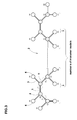
- Fig. 3 and Fig. 4 show a molecular structure model 2 which represents a unit of a macromolecular chain of polybutadiene.
- the reality of the molecular structure model is numerical data capable of being dealt with in a molecular dynamics calculation by the computer.
- the molecular structure model 2 is formed by linking a number (n) of monomer models 3 of a butadiene monomer.
- the polymerization degree is three.
- the monomer model 3 in this example is so called "full atom model" in which all of the atoms (C and H) are dealt with as particle models 4 in a computer simulation.
- the monomer model 3 is so called "united atom model" in which a plurality of atoms are incorporated into one particle represented by one particle model.
- each particle model 4 incorporated in the molecular structure model 2 is dealt with as a material point in a motion equation.
- numerical data about its parameters - mass, volume, diameter, electric charge and/or initial coordinates - are defined and stored in the computer.
- joining chains 5 are defined to bind each other.
- the joining chains 5 are dealt with as springs, and for that purpose, for each of the joining chains 5, its equilibrium length and spring constant are defined and stored in the computer.
- Each of the monomer models 3 is three-dimensional.
- bond lengths between particle models 4, bond angles each formed by three particle models 4 linked by joining chains 5, and dihedrals each formed by three adjacent particle models 4 of four particle models 4 linked by joining chains 5 are defined and stored in the computer.
- the bond lengths, bond angles and dihedrals may be changed, and accordingly, the three-dimensional structure of the molecular structure model 2 may be changed.
- J-OCTA software developed by JSOL Corporation, for example.
- step s2 Next, between the particle models 4, potentials are defined and stored in the computer.
- the potential is a function of an angle or a distance between the particles and used to calculate a force acting between two particle models 4.
- Major potentials are as follows: Potential of bond stretching between particle models 4 linked by joining chain 5; Potential of bending formed by three continuous particle models 4; Potential of torsion formed by three or four continuous particle models 4; and Potential of Van der waals' force between particle models 4 not linked with each other.
- the molecular structure models 2 initialized as above are arranged in a predetermined cell (space) S as shown in Fig. 5 , and thereby a high polymer material model P is defined.
- the molecular structure models 2 are randomly arranged to form a stable or metastable state.
- step S3 and S4 a structure relaxation calculation is carried out according to the potentials, predetermined conditions, and a molecular dynamics calculation.
- the cell S corresponds to a microstructural part of the high polymer material.
- the cell S is regular hexahedron.
- multiple molecular structure models 2 whose polymerization degree is three are randomly arranged.
- Conditions for the structure relaxation calculation may be variously defined.
- the density of the high polymer material model P is set to a value less than the actual density of the polybutadiene.
- the model's density is a quotient of the total mass of the molecular structure models 2 disposed in the cell S divided by the volume of the cell S.
- the density of the molecular structure model is set to 0.01 g/cm ⁇ 3 by default.
- the structure relaxation calculation for at least 10 picoseconds is made under a constant pressure and a constant temperature and under a periodic boundary condition.
- Fig. 6 shows a relationship between the density of the molecular structure model 2 and the calculation time as an example of the result of the structure relaxation calculation. As shown, by making the structure relaxation calculation for at least 10 picoseconds, the density of the high polymer material model is restored to its actual value.
- step S5 a deformation calculation is made by applying a cyclic deformation to the high polymer material model P stabilized through the structure relaxation calculation in order to calculate stress and strain.
- Fig. 7 shows a flow chart of an example of the deformation calculation step S5.
- an oscillation cycle Tp is calculated by the computer.
- the oscillation cycle Tp is the reciprocal of a characteristic frequency.
- a cycle TS of the deformation calculation made on high polymer material model P is set to a certain value.
- a tensile and compressive deformation is simulated, wherein the high polymer material model P is subjected to a uniaxial tensile strain and compressive strain of the same absolute value, and the course from the original state to original state (zero-strain to zero-strain) is regarded as one cycle.
- Fig. 8(b) shows an example of the cyclic deformation of the high polymer material model P.
- the strain is shown as a function of the time.
- the strain is varied like a sine wave. It is also possible to vary like a triangle wave.
- the magnitude of the strain, Poisson ratio and the like are set in addition to the cycle Ts.
- step S53 the computer judges if the cycle Ts is substantially equal to the oscillation cycle Tp.
- the cycle Ts is regarded as being substantially equal to the oscillation cycle Tp. It is of course possible to set the range differently.
- step S53 If equal (Y in step S53), then the cycle Ts of the deformation calculation is set to a different value than the former value. (step S52)
- step S53 If not equal (N in step S53), then the deformation calculation is made on the high polymer material model P with the cycle Ts. (step S54)
- the cycle Ts of the deformation of the high polymer material model P is compared with the oscillation cycle Tp determined based on the characteristic frequency of the potential of the molecular structure models 2, and if the cycle Ts is substantially not equal to the oscillation cycle Tp, the deformation calculation is made on the high polymer material model P. Therefore, in the deformation calculation, the cycle Ts is always different from the oscillation cycle Tp. Accordingly, the abend of the calculation and the deterioration of the calculation accuracy can be prevented.
- Fig. 9 shows a stress-strain curve (hysteresis loop) of the high polymer material model P obtained by the deformation calculation.
- the energy loss of the high polymer material model P can be obtained by computing the area surrounded by the hysteresis loop.
- the deformation calculation is made, targeted at only the molecular structure models whose radii of inertia are less than 0.5 times the size of the cell s.
- Fig. 10(a) shows an example where the radii of inertia Rg are more than 0.5 times the size L of the cell S (in this example, the length of a side of a cell S).
- a cycle boundary condition is defined where the cell S is repeated in a back-and-forth direction, a right-and-left direction and an up-and-down direction.
- the cycle boundary condition a boundary of a cell S abuts on a boundary of the next cell S.
- a molecular structure model 2 in a first cell S protrudes partially from a boundary Sa of the first cell S, then a part of a molecular structure model 2 in the next second cell S corresponding to the protruded part of the first cell protrudes from the opposite boundary Sb into the first cell s. Therefore, if the radius of inertia Rg is more than 0.5 times the size L of the cell S, there is a possibility that the particle models of the molecular structure models overlap each other, and as a resultan abnormal force is computed due to their potentials.
- the cycle Ts of the deformation was set to 2.07 [ ⁇ ], namely 10 times the oscillation cycle Tp based on the characteristic frequency of the potential.
- a stress and strain curve like a hysteresis loop shown in Fig. 9 could be obtained.
- the cycle Ts was set to 0.207 [ ⁇ ], namely, a value equal to the oscillation cycle, and the calculation was made. In this case, the calculation was abnormally ended.
- the calculation can be made stably without being abnormally ended, and accurate estimations are possible.
Landscapes
- Life Sciences & Earth Sciences (AREA)
- Engineering & Computer Science (AREA)
- Bioinformatics & Cheminformatics (AREA)
- Bioinformatics & Computational Biology (AREA)
- Computing Systems (AREA)
- Theoretical Computer Science (AREA)
- Chemical & Material Sciences (AREA)
- Crystallography & Structural Chemistry (AREA)
- Investigating Strength Of Materials By Application Of Mechanical Stress (AREA)
- Management, Administration, Business Operations System, And Electronic Commerce (AREA)
Abstract
Description
- The present invention relates to a computerized method for accurately estimating an energy loss of a high polymer material.
- The energy loss of a high polymer material such as plastic and rubber is a very important physical quantity which affects various performances of products from the high polymer material. For example, a tire is a typical rubber product, and the energy loss of rubber used therein closely relates to grip performance, fuel consumption performance and the like of the tire. Therefore, it is important to exactly know and control the energy loss.
- In general, in order to obtain, for example, a rubber compound having desired physical quantities, a development cycle - namely, designing of a rubber composition, trial production of the rubber compound, and measurement of the energy loss - is repeated until the desired physical quantities can be obtained.
- In recent years, on the other hand, it has been proposed to estimate the energy loss of a high polymer material from results of a computerized simulation of the high polymer material, for example as disclosed in the following
Patent documents 1 and 2. - [Patent document 1] Japanese Patent Application Publication No.
2007-107968 - [Patent document 2] Japanese Patent Application Publication No.
2009-271719 - In the methods disclosed in the
Patent documents 1 and 2, roughly, the following steps (a)-(e) are implemented in this sequence: (a) a model of a molecular structure of the high polymer material is defined, (b) potentials are defined on the molecular structure model, (c) a structure relaxation calculation is made using a high polymer material model in which the molecular structure models are randomly disposed in a cell, (d) after the structure relaxation calculation has been done, by applying a cyclic deformation to the high polymer material model, the stress and strain are computed, and (e) a hysteresis loop is obtained from the computed results, and the energy loss is computed from the area of the hysteresis loop. - In such methods, however, there are problems as follows: in the step (d), sometimes, the calculation becomes unstable and abends during the calculation; and in the step (e), sometimes, the calculated value of the energy loss differs greatly from the actual measurement value.
- The present inventor made a study and found that the calculation becomes unstable and abends when the oscillation cycle of the molecular structure model determined by the characteristic frequency of the potential, becomes substantially equal to the cycle of the cyclic deformation of the high polymer material model.
- It is therefor, an object of the present invention to provide a computerized method for estimating an energy loss of a high polymer material in which a deformation calculation is made only when the oscillation cycle of the molecular structure model does not coincide with the cycle of the cyclic deformation of the high polymer material model, and thereby the energy loss of the high polymer material can be accurately stably estimated.
- According to the present invention, a computerized method for estimating an energy loss of a high polymer material, comprises:
- a step in which a molecular structure model of a molecular structure of the high polymer material is defined, wherein the molecular structure model includes particle models each being of an atom or atoms and joining chains specifying relative positions between the particle models,
- a step in which potentials between the particle models of the molecular structure model are defined,
- a step in which a high polymer material model in which the molecular structure models are disposed in its cell is defined, and, based on the potentials and predetermined conditions, a structure relaxation calculation is made on the high polymer material model,
- a step in which, after the structure relaxation calculation has been done, by applying a cyclic deformation to the high polymer material model, a deformation calculation to obtain stress and strain is made,
- a step in which, based on results of the deformation calculation about the stress and strain, an energy loss is computed, wherein
- the deformation calculation is made only when the cycle Ts of the cyclic deformation is substantially not equal to the oscillation cycle Tp determined based on the characteristic frequency of the potential.
- Preferably, the structure relaxation calculation is made under such a condition that a density lower than the actual density of the high polymer material is defined on the high polymer material model. Preferably, the structure relaxation calculation for at least 10 picoseconds is made under a constant pressure and a constant temperature. Preferably, the deformation calculation is made for only the molecular structure models whose radii of inertia are less that 0.5 times a size of a cell. It is preferable that, when the ratio Ts/Tp of the cycle Ts to the oscillation cycle Tp is out of a range from 0.8 to 1.2, the deformation calculation is made.
-
-
Fig. 1 is the structural formula of polybutadiene. -
Fig. 2 is a flow chart of a simulation method as an embodiment of the present invention. -
Fig. 3 shows a molecular structure model used in this embodiment. -
Fig. 4 is a perspective view of a molecular structure model whose degree of polymerization is three. -
Fig. 5 is a schematic perspective view for explaining a high polymer material model. -
Fig. 6 is a graph showing a relationship between the density of the molecular structure model and the computing time of the structure relaxation calculation. -
Fig. 7 is a flow chart of a deformation calculation in this embodiment. -
Fig. 8(a) is a diagram of a cell for explaining the deformation calculation. -
Fig. 8(b) is a graph for explaining a variation of the strain. -
Fig. 9 is a graph showing a relationship between the strain and stress obtained by the deformation calculation. -
Figs.10(a) and 10(b) are diagrams for explaining relationship between the radius of inertia of the molecular structure model and the size of the cell. - An embodiment of present invention will now be described in detail in conjunction with accompanying drawings.
- According to the present invention, the method for estimating an energy loss of a high polymer material is implemented by a computer.
- The high polymer material encompasses at least rubber, resin and elastomer.
- The high polymer material used in this embodiment is, as shown in
Fig. 1 , cis-1,4 polybutadiene (hereinafter, simply referred to as polybutadiene). - The polybutadiene is a polymer formed from the polymerization process of the monomer {-[CH2-CH=CH-CH2]-} made from a methylene group(-CH2-) and a methine group(-CH-).
-
Fig. 2 shows a flow chart of the simulation method as an embodiment of the present invention. - In this embodiment, firstly, a molecular structure model of the high polymer material is generated by the computer and stored. (step s1).
-
Fig. 3 andFig. 4 show amolecular structure model 2 which represents a unit of a macromolecular chain of polybutadiene. - Of course, the reality of the molecular structure model is numerical data capable of being dealt with in a molecular dynamics calculation by the computer.
- The
molecular structure model 2 is formed by linking a number (n) ofmonomer models 3 of a butadiene monomer. In the example shown inFig. 4 , the polymerization degree is three. - The
monomer model 3 in this example is so called "full atom model" in which all of the atoms (C and H) are dealt with asparticle models 4 in a computer simulation. - However, it is also possible that the
monomer model 3 is so called "united atom model" in which a plurality of atoms are incorporated into one particle represented by one particle model. - In a computer simulation based on a molecular dynamics calculation, each
particle model 4 incorporated in themolecular structure model 2 is dealt with as a material point in a motion equation. In other words, on eachparticle model 4, numerical data about its parameters - mass, volume, diameter, electric charge and/or initial coordinates - are defined and stored in the computer. - Between the
particle models 4, joiningchains 5 are defined to bind each other. The joiningchains 5 are dealt with as springs, and for that purpose, for each of thejoining chains 5, its equilibrium length and spring constant are defined and stored in the computer. - Each of the
monomer models 3 is three-dimensional. - For each of the
monomer models 3, bond lengths betweenparticle models 4, bond angles each formed by threeparticle models 4 linked by joiningchains 5, and dihedrals each formed by threeadjacent particle models 4 of fourparticle models 4 linked by joiningchains 5 are defined and stored in the computer. - When the
monomer model 3 is subjected to an external force or an internal force, the bond lengths, bond angles and dihedrals may be changed, and accordingly, the three-dimensional structure of themolecular structure model 2 may be changed. - Such modeling is possible by the use of a software "J-OCTA" developed by JSOL Corporation, for example.
- Next, between the
particle models 4, potentials are defined and stored in the computer. (step s2) - The potential is a function of an angle or a distance between the particles and used to calculate a force acting between two
particle models 4. - Major potentials are as follows: Potential of bond stretching between
particle models 4 linked by joiningchain 5; Potential of bending formed by threecontinuous particle models 4; Potential of torsion formed by three or fourcontinuous particle models 4; and Potential of Van der waals' force betweenparticle models 4 not linked with each other. - Next, the
molecular structure models 2 initialized as above are arranged in a predetermined cell (space) S as shown inFig. 5 , and thereby a high polymer material model P is defined. Here, themolecular structure models 2 are randomly arranged to form a stable or metastable state. - Then, a structure relaxation calculation is carried out according to the potentials, predetermined conditions, and a molecular dynamics calculation. (step S3 and S4)
- The cell S corresponds to a microstructural part of the high polymer material. In this example, the cell S is regular hexahedron. In the cell S, multiple
molecular structure models 2 whose polymerization degree is three are randomly arranged. - Conditions for the structure relaxation calculation may be variously defined.
- In this embodiment, the density of the high polymer material model P is set to a value less than the actual density of the polybutadiene. Here, the model's density is a quotient of the total mass of the
molecular structure models 2 disposed in the cell S divided by the volume of the cell S. In this embodiment, the density of the molecular structure model is set to 0.01 g/cm^3 by default. - If a large number of
molecular structure models 2 are disposed in the cell S from the start, there is a possibility that abnormal forces occur in the molecular dynamics calculation, and the calculation by the computer becomes unstable, when themolecular structure models 2 are overlapped each other. In this embodiment, however, since the structure relaxation calculation starts with the lower density, the probability of overlapping themolecular structure models 2 with each other is decreased and it is possible to stabilize the calculation. - It is desirable that the structure relaxation calculation for at least 10 picoseconds is made under a constant pressure and a constant temperature and under a periodic boundary condition.
-
Fig. 6 shows a relationship between the density of themolecular structure model 2 and the calculation time as an example of the result of the structure relaxation calculation. As shown, by making the structure relaxation calculation for at least 10 picoseconds, the density of the high polymer material model is restored to its actual value. - As a result, a deformation calculation made on the high polymer material model P in the next step becomes stable.
- Next, a deformation calculation is made by applying a cyclic deformation to the high polymer material model P stabilized through the structure relaxation calculation in order to calculate stress and strain. (step S5)
-
Fig. 7 shows a flow chart of an example of the deformation calculation step S5. - In this example, firstly, based on the characteristic frequency of each potential defined on the
molecular structure models 2, an oscillation cycle Tp is calculated by the computer. (step S51) - In the case of the potential of bond stretching, for example, if the potential U of a C-C bond stretching is given by the following expression (1):

wherein - "k" is a spring constant,
- "x" is a C-C bond length,
- "x0" is the equilibrium length of the joining chain, then the characteristic frequency f of the bond stretching can be obtained by the following expression (2):
- "pi" is the circle ratio,
- "M" is the mass of a carbon atom.
- The oscillation cycle Tp is the reciprocal of a characteristic frequency.
- Therefore, the oscillation cycle Tp of the characteristic frequency f of the potential of the bond stretching is obtained by the following expression (3):

- Next, a cycle TS of the deformation calculation made on high polymer material model P is set to a certain value. (step S52)
- In the deformation calculation in this embodiment, as shown in
Fig. 8(a) , a tensile and compressive deformation is simulated, wherein the high polymer material model P is subjected to a uniaxial tensile strain and compressive strain of the same absolute value, and the course from the original state to original state (zero-strain to zero-strain) is regarded as one cycle. -
Fig. 8(b) shows an example of the cyclic deformation of the high polymer material model P. In the figure, the strain is shown as a function of the time. In this example, the strain is varied like a sine wave. It is also possible to vary like a triangle wave. - Also, the magnitude of the strain, Poisson ratio and the like are set in addition to the cycle Ts.
- Next, the computer judges if the cycle Ts is substantially equal to the oscillation cycle Tp. (step S53)
- In the case that a plurality of different oscillation cycles Tp exist, the judgment is made with respect to each of the oscillation cycles Tp.
- In this embodiment, if the ratio Ts/Tp is within a range of from 0.8 to 1.2, the cycle Ts is regarded as being substantially equal to the oscillation cycle Tp. It is of course possible to set the range differently.
- If equal (Y in step S53), then the cycle Ts of the deformation calculation is set to a different value than the former value. (step S52)
- If not equal (N in step S53), then the deformation calculation is made on the high polymer material model P with the cycle Ts. (step S54)
- As explained above, if the oscillation cycle Tp becomes substantially equal to the cycle Ts, the calculation becomes unstable and abends. Further, the accuracy of the calculated results is greatly lowered. The reason is assumed to be abnormally large forces acting on the atoms due to large variations of the distances between the atoms occurring during the repetition of deformation. Such problem seems to be solved by making the deformation calculation for only one cycle (namely, not repeating the deformation calculation). But, when cyclic deformation is made using the molecular dynamics, regardless of whether or not the cycle Tp is equal to the characteristic frequency Ts, the influence of the deformation on the stress can not be recognized or it is hard to recognize for a short while after the beginning of the deformation. For this reason, to make the deformation calculation for only one cycle is not a realistic way.
- In the present invention, therefore, before the deformation calculation is made on the high polymer material model P, the cycle Ts of the deformation of the high polymer material model P is compared with the oscillation cycle Tp determined based on the characteristic frequency of the potential of the
molecular structure models 2, and if the cycle Ts is substantially not equal to the oscillation cycle Tp, the deformation calculation is made on the high polymer material model P. Therefore, in the deformation calculation, the cycle Ts is always different from the oscillation cycle Tp. Accordingly, the abend of the calculation and the deterioration of the calculation accuracy can be prevented. -
Fig. 9 shows a stress-strain curve (hysteresis loop) of the high polymer material model P obtained by the deformation calculation. - The energy loss of the high polymer material model P can be obtained by computing the area surrounded by the hysteresis loop.
- It is preferable that the deformation calculation is made, targeted at only the molecular structure models whose radii of inertia are less than 0.5 times the size of the cell s.
-
Fig. 10(a) shows an example where the radii of inertia Rg are more than 0.5 times the size L of the cell S (in this example, the length of a side of a cell S). - In the deformation calculation using the molecular structure models, a cycle boundary condition is defined where the cell S is repeated in a back-and-forth direction, a right-and-left direction and an up-and-down direction. In the cycle boundary condition, a boundary of a cell S abuts on a boundary of the next cell S.
- If a
molecular structure model 2 in a first cell S protrudes partially from a boundary Sa of the first cell S, then a part of amolecular structure model 2 in the next second cell S corresponding to the protruded part of the first cell protrudes from the opposite boundary Sb into the first cell s. Therefore, if the radius of inertia Rg is more than 0.5 times the size L of the cell S, there is a possibility that the particle models of the molecular structure models overlap each other, and as a resultan abnormal force is computed due to their potentials. - On the other hand, as shown in
Fig. 10(b) , if the radius of inertia Rg is less than 0.5 times the size L of the cell S, the above-mentioned interference or overlap can be avoided and an accurate calculation is possible. - In order to confirm the effects of the present invention, an energy loss was estimated according to the above described embodiment. The conditions were as follows:
- the spring constant k of the potential of the bond stretching corresponding to the bond length = 918 [∈/σ^2],
- the mass M of the particle model = 1.0 [m],
- the characteristic frequency f = 4.82 [1/τ], and
- the oscillation cycle = 0.207 [τ],
- ∈: unit of energy,
- σ: unit of length,
- m : unit of mass, and
- τ: unit of time.
- In this embodiment, the cycle Ts of the deformation was set to 2.07 [τ], namely 10 times the oscillation cycle Tp based on the characteristic frequency of the potential. As a result, a stress and strain curve like a hysteresis loop shown in
Fig. 9 could be obtained. - For comparison, the cycle Ts was set to 0.207 [τ], namely, a value equal to the oscillation cycle, and the calculation was made. In this case, the calculation was abnormally ended.
- Further, it was also confirmed that when the ratios Ts/Tp were in a range of from 0.8 to 1.2, the calculations were abnormally ended with high probability.
- As described above, in the method according to the present invention, the calculation can be made stably without being abnormally ended, and accurate estimations are possible.

wherein
Claims (5)
- A computerized method for estimating an energy loss of a high polymer material, comprising:a step in which a molecular structure model of a molecular structure of the high polymer material is defined, wherein the molecular structure model includes particle models each being of an atom or atoms and joining chains specifying relative positions between the particle models,a step in which potentials between the particle models of the molecular structure model are defined,a step in which a high polymer material model in which the molecular structure models are disposed in its cell is defined, and, based on the potentials and predetermined conditions, a structure relaxation calculation is made on the high polymer material model,a step in which, after the structure relaxation calculation has been done, by applying a cyclic deformation to the high polymer material model, a deformation calculation to obtain stress and strain is made,a step in which, based on results of the deformation calculation about the stress and strain, an energy loss is computed, whereinthe deformation calculation is made only when the cycle Ts of the cyclic deformation is substantially not equal to the oscillation cycle Tp determined based on the characteristic frequency of the potential.
- The method according to claim 1, wherein
the structure relaxation calculation is made under such a condition that a density lower than the actual density of the high polymer material is defined on the high polymer material model. - The method according to claim 1 or 2, wherein
the structure relaxation calculation for at least 10 picoseconds is made under a constant pressure and a constant temperature. - The method according to claim 1, 2 or 3, wherein
the deformation calculation is made for only the molecular structure models whose radii of inertia are less that 0.5 times a size of a cell. - The method according to claim 1, 2, 3 or 4, wherein
when the ratio Ts/Tp of the cycle Ts to the oscillation cycle Tp is out of a range from 0.8 to 1.2, the deformation calculation is made.
Applications Claiming Priority (1)
| Application Number | Priority Date | Filing Date | Title |
|---|---|---|---|
| JP2012062358A JP5469696B2 (en) | 2012-03-19 | 2012-03-19 | Calculation method of energy loss of polymer materials |
Publications (3)
| Publication Number | Publication Date |
|---|---|
| EP2642417A2 true EP2642417A2 (en) | 2013-09-25 |
| EP2642417A3 EP2642417A3 (en) | 2017-03-22 |
| EP2642417B1 EP2642417B1 (en) | 2019-05-08 |
Family
ID=47901817
Family Applications (1)
| Application Number | Title | Priority Date | Filing Date |
|---|---|---|---|
| EP13159681.9A Active EP2642417B1 (en) | 2012-03-19 | 2013-03-18 | Method for estimating energy loss of high polymer material |
Country Status (4)
| Country | Link |
|---|---|
| US (1) | US20130245964A1 (en) |
| EP (1) | EP2642417B1 (en) |
| JP (1) | JP5469696B2 (en) |
| CN (1) | CN103324825B (en) |
Cited By (1)
| Publication number | Priority date | Publication date | Assignee | Title |
|---|---|---|---|---|
| EP3418928A1 (en) * | 2017-06-23 | 2018-12-26 | Sumitomo Rubber Industries, Ltd. | Method for defining bond potential of polymer material |
Families Citing this family (7)
| Publication number | Priority date | Publication date | Assignee | Title |
|---|---|---|---|---|
| JP6575062B2 (en) * | 2014-12-22 | 2019-09-18 | 住友ゴム工業株式会社 | Method for simulating polymer materials |
| JP6434805B2 (en) * | 2014-12-24 | 2018-12-05 | 住友ゴム工業株式会社 | Method for simulating polymer materials |
| JP6593050B2 (en) * | 2015-09-14 | 2019-10-23 | 住友ゴム工業株式会社 | Method for simulating polymer materials |
| JP6552938B2 (en) * | 2015-10-15 | 2019-07-31 | Toyo Tire株式会社 | Method, apparatus and program for calculating hysteresis loss of filler filled rubber |
| JP6763235B2 (en) | 2016-08-22 | 2020-09-30 | 住友ゴム工業株式会社 | Simulation method for polymer materials |
| JP6852551B2 (en) * | 2017-05-08 | 2021-03-31 | 住友ゴム工業株式会社 | Simulation method for polymer materials |
| CN113432978B (en) * | 2021-06-22 | 2024-02-06 | 郑州大学 | Microscopic analysis method for mechanical properties of high polymer material |
Citations (2)
| Publication number | Priority date | Publication date | Assignee | Title |
|---|---|---|---|---|
| JP2007107968A (en) | 2005-10-12 | 2007-04-26 | Sumitomo Rubber Ind Ltd | Method for simulating polymer materials |
| JP2009271719A (en) | 2008-05-07 | 2009-11-19 | Sumitomo Rubber Ind Ltd | Simulation method for polymeric material |
Family Cites Families (2)
| Publication number | Priority date | Publication date | Assignee | Title |
|---|---|---|---|---|
| EP1526468B1 (en) * | 2003-10-17 | 2009-09-30 | Sumitomo Rubber Industries Limited | Method of simulating viscoelastic material |
| CN101975704B (en) * | 2010-10-08 | 2013-03-06 | 中国船舶重工集团公司第七二五研究所 | Method for predicting vibration fatigue performance of viscoelastic material |
-
2012
- 2012-03-19 JP JP2012062358A patent/JP5469696B2/en not_active Expired - Fee Related
-
2013
- 2013-03-11 US US13/792,429 patent/US20130245964A1/en not_active Abandoned
- 2013-03-18 EP EP13159681.9A patent/EP2642417B1/en active Active
- 2013-03-18 CN CN201310086848.6A patent/CN103324825B/en not_active Expired - Fee Related
Patent Citations (2)
| Publication number | Priority date | Publication date | Assignee | Title |
|---|---|---|---|---|
| JP2007107968A (en) | 2005-10-12 | 2007-04-26 | Sumitomo Rubber Ind Ltd | Method for simulating polymer materials |
| JP2009271719A (en) | 2008-05-07 | 2009-11-19 | Sumitomo Rubber Ind Ltd | Simulation method for polymeric material |
Cited By (1)
| Publication number | Priority date | Publication date | Assignee | Title |
|---|---|---|---|---|
| EP3418928A1 (en) * | 2017-06-23 | 2018-12-26 | Sumitomo Rubber Industries, Ltd. | Method for defining bond potential of polymer material |
Also Published As
| Publication number | Publication date |
|---|---|
| CN103324825B (en) | 2017-07-25 |
| JP5469696B2 (en) | 2014-04-16 |
| JP2013195220A (en) | 2013-09-30 |
| CN103324825A (en) | 2013-09-25 |
| EP2642417A3 (en) | 2017-03-22 |
| US20130245964A1 (en) | 2013-09-19 |
| EP2642417B1 (en) | 2019-05-08 |
Similar Documents
| Publication | Publication Date | Title |
|---|---|---|
| EP2642417B1 (en) | Method for estimating energy loss of high polymer material | |
| US7292966B2 (en) | Method of simulating deformation of rubber material | |
| US11152083B2 (en) | Simulation method for polymer material | |
| US9864845B2 (en) | Simulation method for macromolecular material | |
| CN103678752B (en) | Method for replica polymerization object material | |
| US9946817B2 (en) | Method for calculating interaction potential between filler particles in polymeric material | |
| JP5668532B2 (en) | Simulation method and material parameter identification method | |
| JP6776876B2 (en) | Simulation method for polymer materials | |
| JP2009271719A (en) | Simulation method for polymeric material | |
| US9292637B2 (en) | Method for simulating polymer material | |
| US6829563B2 (en) | Simulation method for estimating performance of product made of viscoelastic material | |
| EP2787458A1 (en) | Simulation method for macromolecular material and filler | |
| EP4383263A1 (en) | Device for simulating viscoelastic property of polymer composite material | |
| US9460245B2 (en) | Method for simulating polymer material | |
| EP2787457A1 (en) | Contact simulation method for rubber material | |
| US7130748B2 (en) | Simulation method for estimating performance of product made of viscoelastic material | |
| JP6101159B2 (en) | Calculation method of energy loss of polymer materials | |
| JP2021081923A (en) | Method of simulating polymeric material | |
| JP6554995B2 (en) | Method for simulating polymer materials | |
| JP2020086835A (en) | Rubber material simulation method and rubber material manufacturing method | |
| JP6552938B2 (en) | Method, apparatus and program for calculating hysteresis loss of filler filled rubber | |
| Akhtar et al. | Predicting the surface elastic parameters of soft solids using multi-output decision tree regressor | |
| JP7736052B2 (en) | Polymer material simulation method | |
| JP2016070889A (en) | Method for simulating polymer materials | |
| JP6434805B2 (en) | Method for simulating polymer materials |
Legal Events
| Date | Code | Title | Description |
|---|---|---|---|
| PUAI | Public reference made under article 153(3) epc to a published international application that has entered the european phase |
Free format text: ORIGINAL CODE: 0009012 |
|
| AK | Designated contracting states |
Kind code of ref document: A2 Designated state(s): AL AT BE BG CH CY CZ DE DK EE ES FI FR GB GR HR HU IE IS IT LI LT LU LV MC MK MT NL NO PL PT RO RS SE SI SK SM TR |
|
| AX | Request for extension of the european patent |
Extension state: BA ME |
|
| PUAL | Search report despatched |
Free format text: ORIGINAL CODE: 0009013 |
|
| AK | Designated contracting states |
Kind code of ref document: A3 Designated state(s): AL AT BE BG CH CY CZ DE DK EE ES FI FR GB GR HR HU IE IS IT LI LT LU LV MC MK MT NL NO PL PT RO RS SE SI SK SM TR |
|
| AX | Request for extension of the european patent |
Extension state: BA ME |
|
| RIC1 | Information provided on ipc code assigned before grant |
Ipc: G06F 19/00 20110101AFI20170210BHEP |
|
| STAA | Information on the status of an ep patent application or granted ep patent |
Free format text: STATUS: REQUEST FOR EXAMINATION WAS MADE |
|
| 17P | Request for examination filed |
Effective date: 20170922 |
|
| RBV | Designated contracting states (corrected) |
Designated state(s): AL AT BE BG CH CY CZ DE DK EE ES FI FR GB GR HR HU IE IS IT LI LT LU LV MC MK MT NL NO PL PT RO RS SE SI SK SM TR |
|
| GRAP | Despatch of communication of intention to grant a patent |
Free format text: ORIGINAL CODE: EPIDOSNIGR1 |
|
| STAA | Information on the status of an ep patent application or granted ep patent |
Free format text: STATUS: GRANT OF PATENT IS INTENDED |
|
| INTG | Intention to grant announced |
Effective date: 20180925 |
|
| GRAS | Grant fee paid |
Free format text: ORIGINAL CODE: EPIDOSNIGR3 |
|
| GRAA | (expected) grant |
Free format text: ORIGINAL CODE: 0009210 |
|
| STAA | Information on the status of an ep patent application or granted ep patent |
Free format text: STATUS: THE PATENT HAS BEEN GRANTED |
|
| AK | Designated contracting states |
Kind code of ref document: B1 Designated state(s): AL AT BE BG CH CY CZ DE DK EE ES FI FR GB GR HR HU IE IS IT LI LT LU LV MC MK MT NL NO PL PT RO RS SE SI SK SM TR |
|
| REG | Reference to a national code |
Ref country code: GB Ref legal event code: FG4D |
|
| REG | Reference to a national code |
Ref country code: CH Ref legal event code: EP Ref country code: AT Ref legal event code: REF Ref document number: 1131313 Country of ref document: AT Kind code of ref document: T Effective date: 20190515 |
|
| REG | Reference to a national code |
Ref country code: DE Ref legal event code: R096 Ref document number: 602013054899 Country of ref document: DE Ref country code: IE Ref legal event code: FG4D |
|
| REG | Reference to a national code |
Ref country code: NL Ref legal event code: MP Effective date: 20190508 |
|
| REG | Reference to a national code |
Ref country code: LT Ref legal event code: MG4D |
|
| PG25 | Lapsed in a contracting state [announced via postgrant information from national office to epo] |
Ref country code: NO Free format text: LAPSE BECAUSE OF FAILURE TO SUBMIT A TRANSLATION OF THE DESCRIPTION OR TO PAY THE FEE WITHIN THE PRESCRIBED TIME-LIMIT Effective date: 20190808 Ref country code: LT Free format text: LAPSE BECAUSE OF FAILURE TO SUBMIT A TRANSLATION OF THE DESCRIPTION OR TO PAY THE FEE WITHIN THE PRESCRIBED TIME-LIMIT Effective date: 20190508 Ref country code: FI Free format text: LAPSE BECAUSE OF FAILURE TO SUBMIT A TRANSLATION OF THE DESCRIPTION OR TO PAY THE FEE WITHIN THE PRESCRIBED TIME-LIMIT Effective date: 20190508 Ref country code: NL Free format text: LAPSE BECAUSE OF FAILURE TO SUBMIT A TRANSLATION OF THE DESCRIPTION OR TO PAY THE FEE WITHIN THE PRESCRIBED TIME-LIMIT Effective date: 20190508 Ref country code: PT Free format text: LAPSE BECAUSE OF FAILURE TO SUBMIT A TRANSLATION OF THE DESCRIPTION OR TO PAY THE FEE WITHIN THE PRESCRIBED TIME-LIMIT Effective date: 20190908 Ref country code: ES Free format text: LAPSE BECAUSE OF FAILURE TO SUBMIT A TRANSLATION OF THE DESCRIPTION OR TO PAY THE FEE WITHIN THE PRESCRIBED TIME-LIMIT Effective date: 20190508 Ref country code: AL Free format text: LAPSE BECAUSE OF FAILURE TO SUBMIT A TRANSLATION OF THE DESCRIPTION OR TO PAY THE FEE WITHIN THE PRESCRIBED TIME-LIMIT Effective date: 20190508 Ref country code: SE Free format text: LAPSE BECAUSE OF FAILURE TO SUBMIT A TRANSLATION OF THE DESCRIPTION OR TO PAY THE FEE WITHIN THE PRESCRIBED TIME-LIMIT Effective date: 20190508 Ref country code: HR Free format text: LAPSE BECAUSE OF FAILURE TO SUBMIT A TRANSLATION OF THE DESCRIPTION OR TO PAY THE FEE WITHIN THE PRESCRIBED TIME-LIMIT Effective date: 20190508 |
|
| PG25 | Lapsed in a contracting state [announced via postgrant information from national office to epo] |
Ref country code: RS Free format text: LAPSE BECAUSE OF FAILURE TO SUBMIT A TRANSLATION OF THE DESCRIPTION OR TO PAY THE FEE WITHIN THE PRESCRIBED TIME-LIMIT Effective date: 20190508 Ref country code: LV Free format text: LAPSE BECAUSE OF FAILURE TO SUBMIT A TRANSLATION OF THE DESCRIPTION OR TO PAY THE FEE WITHIN THE PRESCRIBED TIME-LIMIT Effective date: 20190508 Ref country code: GR Free format text: LAPSE BECAUSE OF FAILURE TO SUBMIT A TRANSLATION OF THE DESCRIPTION OR TO PAY THE FEE WITHIN THE PRESCRIBED TIME-LIMIT Effective date: 20190809 Ref country code: BG Free format text: LAPSE BECAUSE OF FAILURE TO SUBMIT A TRANSLATION OF THE DESCRIPTION OR TO PAY THE FEE WITHIN THE PRESCRIBED TIME-LIMIT Effective date: 20190808 |
|
| REG | Reference to a national code |
Ref country code: AT Ref legal event code: MK05 Ref document number: 1131313 Country of ref document: AT Kind code of ref document: T Effective date: 20190508 |
|
| PG25 | Lapsed in a contracting state [announced via postgrant information from national office to epo] |
Ref country code: SK Free format text: LAPSE BECAUSE OF FAILURE TO SUBMIT A TRANSLATION OF THE DESCRIPTION OR TO PAY THE FEE WITHIN THE PRESCRIBED TIME-LIMIT Effective date: 20190508 Ref country code: EE Free format text: LAPSE BECAUSE OF FAILURE TO SUBMIT A TRANSLATION OF THE DESCRIPTION OR TO PAY THE FEE WITHIN THE PRESCRIBED TIME-LIMIT Effective date: 20190508 Ref country code: RO Free format text: LAPSE BECAUSE OF FAILURE TO SUBMIT A TRANSLATION OF THE DESCRIPTION OR TO PAY THE FEE WITHIN THE PRESCRIBED TIME-LIMIT Effective date: 20190508 Ref country code: CZ Free format text: LAPSE BECAUSE OF FAILURE TO SUBMIT A TRANSLATION OF THE DESCRIPTION OR TO PAY THE FEE WITHIN THE PRESCRIBED TIME-LIMIT Effective date: 20190508 Ref country code: DK Free format text: LAPSE BECAUSE OF FAILURE TO SUBMIT A TRANSLATION OF THE DESCRIPTION OR TO PAY THE FEE WITHIN THE PRESCRIBED TIME-LIMIT Effective date: 20190508 Ref country code: AT Free format text: LAPSE BECAUSE OF FAILURE TO SUBMIT A TRANSLATION OF THE DESCRIPTION OR TO PAY THE FEE WITHIN THE PRESCRIBED TIME-LIMIT Effective date: 20190508 |
|
| REG | Reference to a national code |
Ref country code: DE Ref legal event code: R097 Ref document number: 602013054899 Country of ref document: DE |
|
| PG25 | Lapsed in a contracting state [announced via postgrant information from national office to epo] |
Ref country code: SM Free format text: LAPSE BECAUSE OF FAILURE TO SUBMIT A TRANSLATION OF THE DESCRIPTION OR TO PAY THE FEE WITHIN THE PRESCRIBED TIME-LIMIT Effective date: 20190508 Ref country code: IT Free format text: LAPSE BECAUSE OF FAILURE TO SUBMIT A TRANSLATION OF THE DESCRIPTION OR TO PAY THE FEE WITHIN THE PRESCRIBED TIME-LIMIT Effective date: 20190508 |
|
| PLBE | No opposition filed within time limit |
Free format text: ORIGINAL CODE: 0009261 |
|
| STAA | Information on the status of an ep patent application or granted ep patent |
Free format text: STATUS: NO OPPOSITION FILED WITHIN TIME LIMIT |
|
| PG25 | Lapsed in a contracting state [announced via postgrant information from national office to epo] |
Ref country code: TR Free format text: LAPSE BECAUSE OF FAILURE TO SUBMIT A TRANSLATION OF THE DESCRIPTION OR TO PAY THE FEE WITHIN THE PRESCRIBED TIME-LIMIT Effective date: 20190508 |
|
| 26N | No opposition filed |
Effective date: 20200211 |
|
| PG25 | Lapsed in a contracting state [announced via postgrant information from national office to epo] |
Ref country code: PL Free format text: LAPSE BECAUSE OF FAILURE TO SUBMIT A TRANSLATION OF THE DESCRIPTION OR TO PAY THE FEE WITHIN THE PRESCRIBED TIME-LIMIT Effective date: 20190508 |
|
| PG25 | Lapsed in a contracting state [announced via postgrant information from national office to epo] |
Ref country code: SI Free format text: LAPSE BECAUSE OF FAILURE TO SUBMIT A TRANSLATION OF THE DESCRIPTION OR TO PAY THE FEE WITHIN THE PRESCRIBED TIME-LIMIT Effective date: 20190508 |
|
| PG25 | Lapsed in a contracting state [announced via postgrant information from national office to epo] |
Ref country code: MC Free format text: LAPSE BECAUSE OF FAILURE TO SUBMIT A TRANSLATION OF THE DESCRIPTION OR TO PAY THE FEE WITHIN THE PRESCRIBED TIME-LIMIT Effective date: 20190508 |
|
| REG | Reference to a national code |
Ref country code: CH Ref legal event code: PL |
|
| REG | Reference to a national code |
Ref country code: BE Ref legal event code: MM Effective date: 20200331 |
|
| PG25 | Lapsed in a contracting state [announced via postgrant information from national office to epo] |
Ref country code: LU Free format text: LAPSE BECAUSE OF NON-PAYMENT OF DUE FEES Effective date: 20200318 |
|
| PG25 | Lapsed in a contracting state [announced via postgrant information from national office to epo] |
Ref country code: CH Free format text: LAPSE BECAUSE OF NON-PAYMENT OF DUE FEES Effective date: 20200331 Ref country code: LI Free format text: LAPSE BECAUSE OF NON-PAYMENT OF DUE FEES Effective date: 20200331 Ref country code: IE Free format text: LAPSE BECAUSE OF NON-PAYMENT OF DUE FEES Effective date: 20200318 |
|
| PG25 | Lapsed in a contracting state [announced via postgrant information from national office to epo] |
Ref country code: BE Free format text: LAPSE BECAUSE OF NON-PAYMENT OF DUE FEES Effective date: 20200331 |
|
| GBPC | Gb: european patent ceased through non-payment of renewal fee |
Effective date: 20200318 |
|
| PG25 | Lapsed in a contracting state [announced via postgrant information from national office to epo] |
Ref country code: GB Free format text: LAPSE BECAUSE OF NON-PAYMENT OF DUE FEES Effective date: 20200318 |
|
| PG25 | Lapsed in a contracting state [announced via postgrant information from national office to epo] |
Ref country code: MT Free format text: LAPSE BECAUSE OF FAILURE TO SUBMIT A TRANSLATION OF THE DESCRIPTION OR TO PAY THE FEE WITHIN THE PRESCRIBED TIME-LIMIT Effective date: 20190508 Ref country code: CY Free format text: LAPSE BECAUSE OF FAILURE TO SUBMIT A TRANSLATION OF THE DESCRIPTION OR TO PAY THE FEE WITHIN THE PRESCRIBED TIME-LIMIT Effective date: 20190508 |
|
| PG25 | Lapsed in a contracting state [announced via postgrant information from national office to epo] |
Ref country code: MK Free format text: LAPSE BECAUSE OF FAILURE TO SUBMIT A TRANSLATION OF THE DESCRIPTION OR TO PAY THE FEE WITHIN THE PRESCRIBED TIME-LIMIT Effective date: 20190508 Ref country code: IS Free format text: LAPSE BECAUSE OF FAILURE TO SUBMIT A TRANSLATION OF THE DESCRIPTION OR TO PAY THE FEE WITHIN THE PRESCRIBED TIME-LIMIT Effective date: 20190908 |
|
| PGFP | Annual fee paid to national office [announced via postgrant information from national office to epo] |
Ref country code: FR Payment date: 20230208 Year of fee payment: 11 |
|
| PGFP | Annual fee paid to national office [announced via postgrant information from national office to epo] |
Ref country code: DE Payment date: 20230131 Year of fee payment: 11 |
|
| P01 | Opt-out of the competence of the unified patent court (upc) registered |
Effective date: 20230510 |
|
| REG | Reference to a national code |
Ref country code: DE Ref legal event code: R119 Ref document number: 602013054899 Country of ref document: DE |
|
| PG25 | Lapsed in a contracting state [announced via postgrant information from national office to epo] |
Ref country code: DE Free format text: LAPSE BECAUSE OF NON-PAYMENT OF DUE FEES Effective date: 20241001 |
|
| PG25 | Lapsed in a contracting state [announced via postgrant information from national office to epo] |
Ref country code: FR Free format text: LAPSE BECAUSE OF NON-PAYMENT OF DUE FEES Effective date: 20240331 |
|
| PG25 | Lapsed in a contracting state [announced via postgrant information from national office to epo] |
Ref country code: FR Free format text: LAPSE BECAUSE OF NON-PAYMENT OF DUE FEES Effective date: 20240331 Ref country code: DE Free format text: LAPSE BECAUSE OF NON-PAYMENT OF DUE FEES Effective date: 20241001 |