EP2641930A1 - Resin composition and resin molded product - Google Patents
Resin composition and resin molded product Download PDFInfo
- Publication number
- EP2641930A1 EP2641930A1 EP12188426.6A EP12188426A EP2641930A1 EP 2641930 A1 EP2641930 A1 EP 2641930A1 EP 12188426 A EP12188426 A EP 12188426A EP 2641930 A1 EP2641930 A1 EP 2641930A1
- Authority
- EP
- European Patent Office
- Prior art keywords
- resin composition
- parts
- mass
- lignophenol derivative
- composition according
- Prior art date
- Legal status (The legal status is an assumption and is not a legal conclusion. Google has not performed a legal analysis and makes no representation as to the accuracy of the status listed.)
- Withdrawn
Links
- 239000011342 resin composition Substances 0.000 title claims abstract description 51
- 229920005989 resin Polymers 0.000 title claims description 38
- 239000011347 resin Substances 0.000 title claims description 38
- -1 phosphate ester Chemical class 0.000 claims abstract description 52
- 229920003232 aliphatic polyester Polymers 0.000 claims abstract description 51
- 239000003365 glass fiber Substances 0.000 claims abstract description 42
- 229910019142 PO4 Inorganic materials 0.000 claims abstract description 38
- 239000010452 phosphate Substances 0.000 claims abstract description 38
- 125000003178 carboxy group Chemical group [H]OC(*)=O 0.000 claims abstract description 20
- 125000002887 hydroxy group Chemical group [H]O* 0.000 claims abstract description 20
- 150000001875 compounds Chemical class 0.000 claims abstract description 19
- 229920006037 cross link polymer Polymers 0.000 claims abstract description 17
- 229920000642 polymer Polymers 0.000 claims abstract description 15
- 238000006243 chemical reaction Methods 0.000 claims abstract description 6
- WNROFYMDJYEPJX-UHFFFAOYSA-K aluminium hydroxide Chemical compound [OH-].[OH-].[OH-].[Al+3] WNROFYMDJYEPJX-UHFFFAOYSA-K 0.000 claims description 13
- 239000000835 fiber Substances 0.000 claims description 8
- 125000000217 alkyl group Chemical group 0.000 claims description 6
- 125000003118 aryl group Chemical group 0.000 claims description 6
- 125000003545 alkoxy group Chemical group 0.000 claims description 4
- 125000003368 amide group Chemical group 0.000 claims description 3
- 125000003277 amino group Chemical group 0.000 claims description 3
- 125000000732 arylene group Chemical group 0.000 claims description 3
- 239000000047 product Substances 0.000 description 33
- 239000003063 flame retardant Substances 0.000 description 24
- 238000012360 testing method Methods 0.000 description 18
- 238000000034 method Methods 0.000 description 16
- 229920000747 poly(lactic acid) Polymers 0.000 description 15
- 239000004626 polylactic acid Substances 0.000 description 15
- 239000000203 mixture Substances 0.000 description 12
- 238000000465 moulding Methods 0.000 description 12
- RNFJDJUURJAICM-UHFFFAOYSA-N 2,2,4,4,6,6-hexaphenoxy-1,3,5-triaza-2$l^{5},4$l^{5},6$l^{5}-triphosphacyclohexa-1,3,5-triene Chemical compound N=1P(OC=2C=CC=CC=2)(OC=2C=CC=CC=2)=NP(OC=2C=CC=CC=2)(OC=2C=CC=CC=2)=NP=1(OC=1C=CC=CC=1)OC1=CC=CC=C1 RNFJDJUURJAICM-UHFFFAOYSA-N 0.000 description 10
- 230000000694 effects Effects 0.000 description 9
- 239000000126 substance Substances 0.000 description 9
- 238000002360 preparation method Methods 0.000 description 8
- BLRPTPMANUNPDV-UHFFFAOYSA-N Silane Chemical compound [SiH4] BLRPTPMANUNPDV-UHFFFAOYSA-N 0.000 description 7
- 238000004132 cross linking Methods 0.000 description 7
- 235000013312 flour Nutrition 0.000 description 7
- 238000005227 gel permeation chromatography Methods 0.000 description 7
- 239000000463 material Substances 0.000 description 7
- 229910000077 silane Inorganic materials 0.000 description 7
- 229920002554 vinyl polymer Polymers 0.000 description 7
- XLYOFNOQVPJJNP-UHFFFAOYSA-N water Substances O XLYOFNOQVPJJNP-UHFFFAOYSA-N 0.000 description 7
- 239000002023 wood Substances 0.000 description 7
- CSCPPACGZOOCGX-UHFFFAOYSA-N Acetone Chemical compound CC(C)=O CSCPPACGZOOCGX-UHFFFAOYSA-N 0.000 description 6
- RTZKZFJDLAIYFH-UHFFFAOYSA-N Diethyl ether Chemical compound CCOCC RTZKZFJDLAIYFH-UHFFFAOYSA-N 0.000 description 6
- 238000003860 storage Methods 0.000 description 6
- 229920006026 co-polymeric resin Polymers 0.000 description 5
- 229920001577 copolymer Polymers 0.000 description 5
- 238000004090 dissolution Methods 0.000 description 5
- 239000012153 distilled water Substances 0.000 description 5
- 239000011521 glass Substances 0.000 description 5
- 238000004898 kneading Methods 0.000 description 5
- 238000005259 measurement Methods 0.000 description 5
- 229910052698 phosphorus Inorganic materials 0.000 description 5
- 239000011574 phosphorus Substances 0.000 description 5
- IJGRMHOSHXDMSA-UHFFFAOYSA-N Atomic nitrogen Chemical compound N#N IJGRMHOSHXDMSA-UHFFFAOYSA-N 0.000 description 4
- HEDRZPFGACZZDS-UHFFFAOYSA-N Chloroform Chemical compound ClC(Cl)Cl HEDRZPFGACZZDS-UHFFFAOYSA-N 0.000 description 4
- 241000218691 Cupressaceae Species 0.000 description 4
- 241000196324 Embryophyta Species 0.000 description 4
- JVTAAEKCZFNVCJ-REOHCLBHSA-N L-lactic acid Chemical compound C[C@H](O)C(O)=O JVTAAEKCZFNVCJ-REOHCLBHSA-N 0.000 description 4
- 238000009826 distribution Methods 0.000 description 4
- 238000001746 injection moulding Methods 0.000 description 4
- 239000011572 manganese Substances 0.000 description 4
- 229920000728 polyester Polymers 0.000 description 4
- 230000000171 quenching effect Effects 0.000 description 4
- 125000000391 vinyl group Chemical group [H]C([*])=C([H])[H] 0.000 description 4
- 241000218645 Cedrus Species 0.000 description 3
- JVTAAEKCZFNVCJ-UWTATZPHSA-N D-lactic acid Chemical compound C[C@@H](O)C(O)=O JVTAAEKCZFNVCJ-UWTATZPHSA-N 0.000 description 3
- XEKOWRVHYACXOJ-UHFFFAOYSA-N Ethyl acetate Chemical compound CCOC(C)=O XEKOWRVHYACXOJ-UHFFFAOYSA-N 0.000 description 3
- OAICVXFJPJFONN-UHFFFAOYSA-N Phosphorus Chemical compound [P] OAICVXFJPJFONN-UHFFFAOYSA-N 0.000 description 3
- 239000004793 Polystyrene Substances 0.000 description 3
- 239000000654 additive Substances 0.000 description 3
- 238000005452 bending Methods 0.000 description 3
- 239000003054 catalyst Substances 0.000 description 3
- 238000002485 combustion reaction Methods 0.000 description 3
- 230000000052 comparative effect Effects 0.000 description 3
- 229940022769 d- lactic acid Drugs 0.000 description 3
- 125000002496 methyl group Chemical group [H]C([H])([H])* 0.000 description 3
- 239000008188 pellet Substances 0.000 description 3
- 229920003023 plastic Polymers 0.000 description 3
- 239000004033 plastic Substances 0.000 description 3
- 239000004631 polybutylene succinate Substances 0.000 description 3
- 229920002961 polybutylene succinate Polymers 0.000 description 3
- 238000006116 polymerization reaction Methods 0.000 description 3
- 229920001296 polysiloxane Polymers 0.000 description 3
- 229920002223 polystyrene Polymers 0.000 description 3
- 239000002994 raw material Substances 0.000 description 3
- 238000001308 synthesis method Methods 0.000 description 3
- 238000005979 thermal decomposition reaction Methods 0.000 description 3
- QTWJRLJHJPIABL-UHFFFAOYSA-N 2-methylphenol;3-methylphenol;4-methylphenol Chemical compound CC1=CC=C(O)C=C1.CC1=CC=CC(O)=C1.CC1=CC=CC=C1O QTWJRLJHJPIABL-UHFFFAOYSA-N 0.000 description 2
- 229930182843 D-Lactic acid Natural products 0.000 description 2
- 229920000331 Polyhydroxybutyrate Polymers 0.000 description 2
- 239000004743 Polypropylene Substances 0.000 description 2
- BZHJMEDXRYGGRV-UHFFFAOYSA-N Vinyl chloride Chemical compound ClC=C BZHJMEDXRYGGRV-UHFFFAOYSA-N 0.000 description 2
- 239000002253 acid Substances 0.000 description 2
- 230000015572 biosynthetic process Effects 0.000 description 2
- IISBACLAFKSPIT-UHFFFAOYSA-N bisphenol A Chemical compound C=1C=C(O)C=CC=1C(C)(C)C1=CC=C(O)C=C1 IISBACLAFKSPIT-UHFFFAOYSA-N 0.000 description 2
- 125000004432 carbon atom Chemical group C* 0.000 description 2
- 239000003795 chemical substances by application Substances 0.000 description 2
- 239000002131 composite material Substances 0.000 description 2
- 229930003836 cresol Natural products 0.000 description 2
- 150000002148 esters Chemical class 0.000 description 2
- 238000011156 evaluation Methods 0.000 description 2
- 238000001125 extrusion Methods 0.000 description 2
- 125000000524 functional group Chemical group 0.000 description 2
- 239000010954 inorganic particle Substances 0.000 description 2
- 150000002576 ketones Chemical class 0.000 description 2
- 229920005610 lignin Polymers 0.000 description 2
- VTHJTEIRLNZDEV-UHFFFAOYSA-L magnesium dihydroxide Chemical compound [OH-].[OH-].[Mg+2] VTHJTEIRLNZDEV-UHFFFAOYSA-L 0.000 description 2
- 239000000347 magnesium hydroxide Substances 0.000 description 2
- 229910001862 magnesium hydroxide Inorganic materials 0.000 description 2
- 238000002844 melting Methods 0.000 description 2
- 230000008018 melting Effects 0.000 description 2
- 238000002156 mixing Methods 0.000 description 2
- 229910052757 nitrogen Inorganic materials 0.000 description 2
- TWNQGVIAIRXVLR-UHFFFAOYSA-N oxo(oxoalumanyloxy)alumane Chemical compound O=[Al]O[Al]=O TWNQGVIAIRXVLR-UHFFFAOYSA-N 0.000 description 2
- NBIIXXVUZAFLBC-UHFFFAOYSA-K phosphate Chemical compound [O-]P([O-])([O-])=O NBIIXXVUZAFLBC-UHFFFAOYSA-K 0.000 description 2
- 150000003014 phosphoric acid esters Chemical class 0.000 description 2
- 239000005015 poly(hydroxybutyrate) Substances 0.000 description 2
- 229920002959 polymer blend Polymers 0.000 description 2
- 229920000098 polyolefin Polymers 0.000 description 2
- 229920006324 polyoxymethylene Polymers 0.000 description 2
- 229920001155 polypropylene Polymers 0.000 description 2
- 239000002244 precipitate Substances 0.000 description 2
- 238000001226 reprecipitation Methods 0.000 description 2
- 239000000243 solution Substances 0.000 description 2
- 239000002904 solvent Substances 0.000 description 2
- 238000003756 stirring Methods 0.000 description 2
- LTURHSAEWJPFAA-UHFFFAOYSA-N sulfuric acid;1,3,5-triazine-2,4,6-triamine Chemical compound OS(O)(=O)=O.NC1=NC(N)=NC(N)=N1 LTURHSAEWJPFAA-UHFFFAOYSA-N 0.000 description 2
- 238000004381 surface treatment Methods 0.000 description 2
- 238000005406 washing Methods 0.000 description 2
- PUPZLCDOIYMWBV-UHFFFAOYSA-N (+/-)-1,3-Butanediol Chemical compound CC(O)CCO PUPZLCDOIYMWBV-UHFFFAOYSA-N 0.000 description 1
- DHKHKXVYLBGOIT-UHFFFAOYSA-N 1,1-Diethoxyethane Chemical compound CCOC(C)OCC DHKHKXVYLBGOIT-UHFFFAOYSA-N 0.000 description 1
- 238000005160 1H NMR spectroscopy Methods 0.000 description 1
- IUPHTVOTTBREAV-UHFFFAOYSA-N 3-hydroxybutanoic acid;3-hydroxypentanoic acid Chemical compound CC(O)CC(O)=O.CCC(O)CC(O)=O IUPHTVOTTBREAV-UHFFFAOYSA-N 0.000 description 1
- 229920013642 Biopol™ Polymers 0.000 description 1
- WKBOTKDWSSQWDR-UHFFFAOYSA-N Bromine atom Chemical compound [Br] WKBOTKDWSSQWDR-UHFFFAOYSA-N 0.000 description 1
- BVKZGUZCCUSVTD-UHFFFAOYSA-L Carbonate Chemical compound [O-]C([O-])=O BVKZGUZCCUSVTD-UHFFFAOYSA-L 0.000 description 1
- 229920002943 EPDM rubber Polymers 0.000 description 1
- 238000005481 NMR spectroscopy Methods 0.000 description 1
- 239000004696 Poly ether ether ketone Substances 0.000 description 1
- 229930182556 Polyacetal Natural products 0.000 description 1
- 239000004952 Polyamide Substances 0.000 description 1
- 239000004693 Polybenzimidazole Substances 0.000 description 1
- 239000005062 Polybutadiene Substances 0.000 description 1
- 239000004695 Polyether sulfone Substances 0.000 description 1
- 239000004697 Polyetherimide Substances 0.000 description 1
- 239000004698 Polyethylene Substances 0.000 description 1
- 239000004721 Polyphenylene oxide Substances 0.000 description 1
- 239000004734 Polyphenylene sulfide Substances 0.000 description 1
- 230000001133 acceleration Effects 0.000 description 1
- 239000011354 acetal resin Substances 0.000 description 1
- 125000005396 acrylic acid ester group Chemical group 0.000 description 1
- 150000007933 aliphatic carboxylic acids Chemical class 0.000 description 1
- 239000003963 antioxidant agent Substances 0.000 description 1
- 230000003078 antioxidant effect Effects 0.000 description 1
- 238000013459 approach Methods 0.000 description 1
- 235000013361 beverage Nutrition 0.000 description 1
- 125000002529 biphenylenyl group Chemical group C1(=CC=CC=2C3=CC=CC=C3C12)* 0.000 description 1
- 229920001400 block copolymer Polymers 0.000 description 1
- 238000000071 blow moulding Methods 0.000 description 1
- GDTBXPJZTBHREO-UHFFFAOYSA-N bromine Substances BrBr GDTBXPJZTBHREO-UHFFFAOYSA-N 0.000 description 1
- 229910052794 bromium Inorganic materials 0.000 description 1
- VSGNNIFQASZAOI-UHFFFAOYSA-L calcium acetate Chemical compound [Ca+2].CC([O-])=O.CC([O-])=O VSGNNIFQASZAOI-UHFFFAOYSA-L 0.000 description 1
- 239000001639 calcium acetate Substances 0.000 description 1
- 229960005147 calcium acetate Drugs 0.000 description 1
- 235000011092 calcium acetate Nutrition 0.000 description 1
- 238000011088 calibration curve Methods 0.000 description 1
- BVKZGUZCCUSVTD-UHFFFAOYSA-N carbonic acid Chemical compound OC(O)=O BVKZGUZCCUSVTD-UHFFFAOYSA-N 0.000 description 1
- 230000021523 carboxylation Effects 0.000 description 1
- 238000006473 carboxylation reaction Methods 0.000 description 1
- 150000001732 carboxylic acid derivatives Chemical group 0.000 description 1
- 125000002843 carboxylic acid group Chemical group 0.000 description 1
- 239000003153 chemical reaction reagent Substances 0.000 description 1
- 239000011248 coating agent Substances 0.000 description 1
- 238000000576 coating method Methods 0.000 description 1
- 229940011182 cobalt acetate Drugs 0.000 description 1
- QAHREYKOYSIQPH-UHFFFAOYSA-L cobalt(II) acetate Chemical compound [Co+2].CC([O-])=O.CC([O-])=O QAHREYKOYSIQPH-UHFFFAOYSA-L 0.000 description 1
- 238000001816 cooling Methods 0.000 description 1
- 238000012937 correction Methods 0.000 description 1
- 238000011161 development Methods 0.000 description 1
- 238000007598 dipping method Methods 0.000 description 1
- 239000006185 dispersion Substances 0.000 description 1
- 230000007613 environmental effect Effects 0.000 description 1
- 235000013305 food Nutrition 0.000 description 1
- YBMRDBCBODYGJE-UHFFFAOYSA-N germanium oxide Inorganic materials O=[Ge]=O YBMRDBCBODYGJE-UHFFFAOYSA-N 0.000 description 1
- 125000004435 hydrogen atom Chemical group [H]* 0.000 description 1
- 230000007062 hydrolysis Effects 0.000 description 1
- 238000006460 hydrolysis reaction Methods 0.000 description 1
- 230000003301 hydrolyzing effect Effects 0.000 description 1
- 238000010191 image analysis Methods 0.000 description 1
- 239000003999 initiator Substances 0.000 description 1
- JJTUDXZGHPGLLC-UHFFFAOYSA-N lactide Chemical compound CC1OC(=O)C(C)OC1=O JJTUDXZGHPGLLC-UHFFFAOYSA-N 0.000 description 1
- 239000004973 liquid crystal related substance Substances 0.000 description 1
- 239000000395 magnesium oxide Substances 0.000 description 1
- CPLXHLVBOLITMK-UHFFFAOYSA-N magnesium oxide Inorganic materials [Mg]=O CPLXHLVBOLITMK-UHFFFAOYSA-N 0.000 description 1
- 229960000869 magnesium oxide Drugs 0.000 description 1
- AXZKOIWUVFPNLO-UHFFFAOYSA-N magnesium;oxygen(2-) Chemical compound [O-2].[Mg+2] AXZKOIWUVFPNLO-UHFFFAOYSA-N 0.000 description 1
- 229940071125 manganese acetate Drugs 0.000 description 1
- UOGMEBQRZBEZQT-UHFFFAOYSA-L manganese(2+);diacetate Chemical compound [Mn+2].CC([O-])=O.CC([O-])=O UOGMEBQRZBEZQT-UHFFFAOYSA-L 0.000 description 1
- 238000004519 manufacturing process Methods 0.000 description 1
- 125000005397 methacrylic acid ester group Chemical group 0.000 description 1
- 239000000178 monomer Substances 0.000 description 1
- 150000002825 nitriles Chemical class 0.000 description 1
- 230000003287 optical effect Effects 0.000 description 1
- 238000007254 oxidation reaction Methods 0.000 description 1
- PVADDRMAFCOOPC-UHFFFAOYSA-N oxogermanium Chemical compound [Ge]=O PVADDRMAFCOOPC-UHFFFAOYSA-N 0.000 description 1
- 239000002245 particle Substances 0.000 description 1
- 239000003208 petroleum Substances 0.000 description 1
- 125000001997 phenyl group Chemical group [H]C1=C([H])C([H])=C(*)C([H])=C1[H] 0.000 description 1
- 229920001432 poly(L-lactide) Polymers 0.000 description 1
- 229920001643 poly(ether ketone) Polymers 0.000 description 1
- 229920000218 poly(hydroxyvalerate) Polymers 0.000 description 1
- 229920002492 poly(sulfone) Polymers 0.000 description 1
- 229920000070 poly-3-hydroxybutyrate Polymers 0.000 description 1
- 229920000058 polyacrylate Polymers 0.000 description 1
- 229920002647 polyamide Polymers 0.000 description 1
- 229920006122 polyamide resin Polymers 0.000 description 1
- 229920000412 polyarylene Polymers 0.000 description 1
- 229920002480 polybenzimidazole Polymers 0.000 description 1
- 229920002857 polybutadiene Polymers 0.000 description 1
- 239000004417 polycarbonate Substances 0.000 description 1
- 229920000515 polycarbonate Polymers 0.000 description 1
- 229920005668 polycarbonate resin Polymers 0.000 description 1
- 239000004431 polycarbonate resin Substances 0.000 description 1
- 238000006068 polycondensation reaction Methods 0.000 description 1
- 229920001225 polyester resin Polymers 0.000 description 1
- 239000004645 polyester resin Substances 0.000 description 1
- 229920000570 polyether Polymers 0.000 description 1
- 229920006393 polyether sulfone Polymers 0.000 description 1
- 229920002530 polyetherether ketone Polymers 0.000 description 1
- 229920001601 polyetherimide Polymers 0.000 description 1
- 229920000573 polyethylene Polymers 0.000 description 1
- 229920000921 polyethylene adipate Polymers 0.000 description 1
- 229920001470 polyketone Polymers 0.000 description 1
- 230000000379 polymerizing effect Effects 0.000 description 1
- 229920005672 polyolefin resin Polymers 0.000 description 1
- 229920001955 polyphenylene ether Polymers 0.000 description 1
- 229920000069 polyphenylene sulfide Polymers 0.000 description 1
- 239000000843 powder Substances 0.000 description 1
- 229920005604 random copolymer Polymers 0.000 description 1
- 238000007151 ring opening polymerisation reaction Methods 0.000 description 1
- 230000000630 rising effect Effects 0.000 description 1
- 229920002050 silicone resin Polymers 0.000 description 1
- 239000007787 solid Substances 0.000 description 1
- 238000001228 spectrum Methods 0.000 description 1
- 125000001424 substituent group Chemical group 0.000 description 1
- 125000005415 substituted alkoxy group Chemical group 0.000 description 1
- 125000000547 substituted alkyl group Chemical group 0.000 description 1
- 125000003107 substituted aryl group Chemical group 0.000 description 1
- 125000005649 substituted arylene group Chemical group 0.000 description 1
- QAOWNCQODCNURD-UHFFFAOYSA-N sulfuric acid Substances OS(O)(=O)=O QAOWNCQODCNURD-UHFFFAOYSA-N 0.000 description 1
- 238000003786 synthesis reaction Methods 0.000 description 1
- 229920003002 synthetic resin Polymers 0.000 description 1
- 229920005992 thermoplastic resin Polymers 0.000 description 1
- KSBAEPSJVUENNK-UHFFFAOYSA-L tin(ii) 2-ethylhexanoate Chemical compound [Sn+2].CCCCC(CC)C([O-])=O.CCCCC(CC)C([O-])=O KSBAEPSJVUENNK-UHFFFAOYSA-L 0.000 description 1
- LLZRNZOLAXHGLL-UHFFFAOYSA-J titanic acid Chemical compound O[Ti](O)(O)O LLZRNZOLAXHGLL-UHFFFAOYSA-J 0.000 description 1
- 239000012745 toughening agent Substances 0.000 description 1
- 238000001721 transfer moulding Methods 0.000 description 1
Images

Classifications
-
- C—CHEMISTRY; METALLURGY
- C08—ORGANIC MACROMOLECULAR COMPOUNDS; THEIR PREPARATION OR CHEMICAL WORKING-UP; COMPOSITIONS BASED THEREON
- C08H—DERIVATIVES OF NATURAL MACROMOLECULAR COMPOUNDS
- C08H6/00—Macromolecular compounds derived from lignin, e.g. tannins, humic acids
-
- C—CHEMISTRY; METALLURGY
- C08—ORGANIC MACROMOLECULAR COMPOUNDS; THEIR PREPARATION OR CHEMICAL WORKING-UP; COMPOSITIONS BASED THEREON
- C08L—COMPOSITIONS OF MACROMOLECULAR COMPOUNDS
- C08L101/00—Compositions of unspecified macromolecular compounds
- C08L101/02—Compositions of unspecified macromolecular compounds characterised by the presence of specified groups, e.g. terminal or pendant functional groups
- C08L101/06—Compositions of unspecified macromolecular compounds characterised by the presence of specified groups, e.g. terminal or pendant functional groups containing oxygen atoms
- C08L101/08—Carboxyl groups
-
- C—CHEMISTRY; METALLURGY
- C08—ORGANIC MACROMOLECULAR COMPOUNDS; THEIR PREPARATION OR CHEMICAL WORKING-UP; COMPOSITIONS BASED THEREON
- C08G—MACROMOLECULAR COMPOUNDS OBTAINED OTHERWISE THAN BY REACTIONS ONLY INVOLVING UNSATURATED CARBON-TO-CARBON BONDS
- C08G63/00—Macromolecular compounds obtained by reactions forming a carboxylic ester link in the main chain of the macromolecule
- C08G63/91—Polymers modified by chemical after-treatment
-
- C—CHEMISTRY; METALLURGY
- C08—ORGANIC MACROMOLECULAR COMPOUNDS; THEIR PREPARATION OR CHEMICAL WORKING-UP; COMPOSITIONS BASED THEREON
- C08J—WORKING-UP; GENERAL PROCESSES OF COMPOUNDING; AFTER-TREATMENT NOT COVERED BY SUBCLASSES C08B, C08C, C08F, C08G or C08H
- C08J3/00—Processes of treating or compounding macromolecular substances
- C08J3/24—Crosslinking, e.g. vulcanising, of macromolecules
- C08J3/246—Intercrosslinking of at least two polymers
-
- C—CHEMISTRY; METALLURGY
- C08—ORGANIC MACROMOLECULAR COMPOUNDS; THEIR PREPARATION OR CHEMICAL WORKING-UP; COMPOSITIONS BASED THEREON
- C08K—Use of inorganic or non-macromolecular organic substances as compounding ingredients
- C08K3/00—Use of inorganic substances as compounding ingredients
- C08K3/18—Oxygen-containing compounds, e.g. metal carbonyls
- C08K3/20—Oxides; Hydroxides
- C08K3/22—Oxides; Hydroxides of metals
-
- C—CHEMISTRY; METALLURGY
- C08—ORGANIC MACROMOLECULAR COMPOUNDS; THEIR PREPARATION OR CHEMICAL WORKING-UP; COMPOSITIONS BASED THEREON
- C08K—Use of inorganic or non-macromolecular organic substances as compounding ingredients
- C08K5/00—Use of organic ingredients
- C08K5/49—Phosphorus-containing compounds
- C08K5/51—Phosphorus bound to oxygen
- C08K5/52—Phosphorus bound to oxygen only
- C08K5/521—Esters of phosphoric acids, e.g. of H3PO4
-
- C—CHEMISTRY; METALLURGY
- C08—ORGANIC MACROMOLECULAR COMPOUNDS; THEIR PREPARATION OR CHEMICAL WORKING-UP; COMPOSITIONS BASED THEREON
- C08K—Use of inorganic or non-macromolecular organic substances as compounding ingredients
- C08K5/00—Use of organic ingredients
- C08K5/49—Phosphorus-containing compounds
- C08K5/51—Phosphorus bound to oxygen
- C08K5/52—Phosphorus bound to oxygen only
- C08K5/521—Esters of phosphoric acids, e.g. of H3PO4
- C08K5/523—Esters of phosphoric acids, e.g. of H3PO4 with hydroxyaryl compounds
-
- C—CHEMISTRY; METALLURGY
- C08—ORGANIC MACROMOLECULAR COMPOUNDS; THEIR PREPARATION OR CHEMICAL WORKING-UP; COMPOSITIONS BASED THEREON
- C08K—Use of inorganic or non-macromolecular organic substances as compounding ingredients
- C08K7/00—Use of ingredients characterised by shape
- C08K7/02—Fibres or whiskers
- C08K7/04—Fibres or whiskers inorganic
- C08K7/14—Glass
-
- C—CHEMISTRY; METALLURGY
- C08—ORGANIC MACROMOLECULAR COMPOUNDS; THEIR PREPARATION OR CHEMICAL WORKING-UP; COMPOSITIONS BASED THEREON
- C08L—COMPOSITIONS OF MACROMOLECULAR COMPOUNDS
- C08L67/00—Compositions of polyesters obtained by reactions forming a carboxylic ester link in the main chain; Compositions of derivatives of such polymers
- C08L67/02—Polyesters derived from dicarboxylic acids and dihydroxy compounds
-
- C—CHEMISTRY; METALLURGY
- C08—ORGANIC MACROMOLECULAR COMPOUNDS; THEIR PREPARATION OR CHEMICAL WORKING-UP; COMPOSITIONS BASED THEREON
- C08L—COMPOSITIONS OF MACROMOLECULAR COMPOUNDS
- C08L67/00—Compositions of polyesters obtained by reactions forming a carboxylic ester link in the main chain; Compositions of derivatives of such polymers
- C08L67/04—Polyesters derived from hydroxycarboxylic acids, e.g. lactones
-
- C—CHEMISTRY; METALLURGY
- C08—ORGANIC MACROMOLECULAR COMPOUNDS; THEIR PREPARATION OR CHEMICAL WORKING-UP; COMPOSITIONS BASED THEREON
- C08L—COMPOSITIONS OF MACROMOLECULAR COMPOUNDS
- C08L97/00—Compositions of lignin-containing materials
- C08L97/005—Lignin
-
- C—CHEMISTRY; METALLURGY
- C08—ORGANIC MACROMOLECULAR COMPOUNDS; THEIR PREPARATION OR CHEMICAL WORKING-UP; COMPOSITIONS BASED THEREON
- C08J—WORKING-UP; GENERAL PROCESSES OF COMPOUNDING; AFTER-TREATMENT NOT COVERED BY SUBCLASSES C08B, C08C, C08F, C08G or C08H
- C08J2367/00—Characterised by the use of polyesters obtained by reactions forming a carboxylic ester link in the main chain; Derivatives of such polymers
-
- C—CHEMISTRY; METALLURGY
- C08—ORGANIC MACROMOLECULAR COMPOUNDS; THEIR PREPARATION OR CHEMICAL WORKING-UP; COMPOSITIONS BASED THEREON
- C08J—WORKING-UP; GENERAL PROCESSES OF COMPOUNDING; AFTER-TREATMENT NOT COVERED BY SUBCLASSES C08B, C08C, C08F, C08G or C08H
- C08J2397/00—Characterised by the use of lignin-containing materials
Definitions
- the present invention relates to a resin composition and a resin molded product.
- lignophenol derivatives obtained from plants are a material which draws attention as one of candidates of non-petroleum-based resin materials.
- the resin composition is a lignophenol-polylactic acid composite having at least three-branched-chains formed from a polylactic acid in a molecule, and the lignophenol-polylactic acid composite is obtained by a process of ring-opening polymerization of lactide by using lignophenol having at least three hydroxyl groups in a molecule as an initiator.
- An object of the present invention is to provide a resin composition having excellent flame retardancy.
- a resin composition having excellent flame retardancy may be provided, as compared with the case that fails to satisfy the requirement to include a crosslinked polymer compound having a crosslinked structure formed by reaction of a carboxyl group at an end of a polymer chain in aliphatic polyester with a hydroxyl group of a lignophenol derivative, a glass fiber and condensed phosphate ester.
- a resin composition having excellent flame retardancy may be provided as compared with the case of not having the above constitutions.
- a resin molded product having excellent flame retardancy may be provided, as compared with the case of not having the above constitutions.
- a resin composition according to the exemplary embodiment includes a crosslinked polymer compound having a crosslinked structure formed by reaction of a carboxyl group in aliphatic polyester having at least a carboxyl group at an end of a polymer chain with a hydroxyl group of a lignophenol derivative having at least a hydroxyl group in a molecular structure, a glass fiber, and condensed phosphate ester.
- glass fibers are added to aliphatic polyester, but in this case, a candle effect occurs in which glass fibers act like a wick to transmit flames, thereby accelerating combustion.
- the resin composition according to the exemplary embodiment which is obtained by using a crosslinked polymer compound formed by reaction of the carboxyl group at the end of the polymer chain of aliphatic polyester with the hydroxyl group of the lignophenol derivative, a glass fiber, and condensed phosphate ester in combination.
- the hydroxyl group, the carboxyl group or other functional groups present in the lignophenol derivative is reacted with the carboxyl group or the hydroxyl group at the end of the polymer chain of aliphatic polyester, to form a crosslinked structure of aliphatic polyester. It is inferred that some portions of the condensed phosphate ester as a flame retardant are coordinated with functional groups of the lignophenol derivative, and besides, are dispersed in a free volume in the crosslinked structure of the crosslinked polymer compound, and thus, very high dispersibility may be obtained. As a result, the drip effect of aliphatic polyester is suppressed and the flame quenching effect is accelerated.
- the glass fiber does not reach the level at which the flame quenching effect is exhibited, flame retardancy deteriorates due to the candle effect as described above, but it is considered that the candle effect can be suppressed, because the flame quenching effect improved by dispersion of condensed phosphate ester makes it possible for flames to be extinguished faster than to be transmitted along the glass fibers. Further, it is assumed that the glass fibers carry out a role as a frame of the resin composition to obtain an effect of suppressing the drip effect caused by aliphatic polyester, and accordingly, excellent flame retardancy is achieved.
- the lignophenol derivative includes at least a hydroxyl group in its molecular structure, to be crosslinked with a carboxyl group in aliphatic polyester.
- the lignophenol derivative is a polymer, and the polymer has a plurality of hydroxyl groups.
- the lignophenol derivative used in the exemplary embodiment is not particularly limited, but preferably has a structure represented by the following general formula (1).
- each of X 1 , X 2 and X 3 independently represents a substituted or unsubstituted alkyl group, a substituted or unsubstituted alkoxy group, a substituted or unsubstituted aryl group, a substituted or unsubstituted arylene group, a hydroxyl group, a carboxyl group, an amino group or an amide group.
- X 1 , X 2 and X 3 are substituted alkyl group, a substituted alkoxy group, a substituted aryl group or a substituted arylene group
- examples of a substituent thereof include a hydroxyl group, a carboxylic acid group, a carboxylic acid derivative group, an alkyl group, an alkoxy group and the like.
- each of a and c independently represents an integer of from 0 to 3
- b represents an integer of from 0 to 4
- n represents an integer of from 5 to 20.
- More preferred examples of the lignophenol derivative represented by general formula (1) include a lignophenol derivative represented by the following general formula (2) to general formula (4).
- n1 represents an integer of from 5 to 20.
- n2 represents an integer of from 5 to 20.
- n3 represents an integer of from 5 to 20.
- the lignophenol derivative represented by general formula (1) may be a single structure, or may be a mixture of two or more kinds of different structures. Meanwhile, the lignophenol derivative represented by general formula (1) is a polymer mixture, and n in general formula (1) means an average value of n with respect to the total polymer mixture.
- the lignophenol derivative used in the exemplary embodiment has a weight average molecular weight (Mw) of preferably from 3,000 to 6,000, and more preferably from 3,500 to 5,000.
- the molecular weight distribution (Mw/Mn) is preferably from 3 to 10, and more preferably from 5 to 8.
- the melting temperature is preferably from 150°C to 180°C.
- the weight average molecular weight is measured by gel permeation chromatography (GPC).
- GPC gel permeation chromatography
- the molecular weight measurement by GPC is performed with a chloroform solvent using HLC-8320 GPC manufactured by Tosoh Corporation as a measuring apparatus and a column TsKgel GMHHR-M+TSKgel GMHHR-M (7.8 mm I.D. 30 cm) manufactured by Tosoh Corporation.
- the weight average molecular weight is calculated by using a molecular weight calibration curve that is prepared from the measurement results by a monodispersed polystyrene standard sample.
- Examples of a synthesis method of a lignophenol derivative according the exemplary embodiment include a method, including: converting and separating lignin contained in plant resources such as cypress or cedar into a lignophenol derivative to be extracted, hydrolyzing an end thereof by water addition, and subjecting the end to carboxylation by an oxidation reaction using natural ketone.
- the structure of the lignophenol derivative obtained by such a preparation method may vary according to a difference in plant resources such as needle-leaved trees and broad-leaved trees, but there is no problem with characteristics thereof.
- a lignophenol derivative may be obtained by first converting lignin contained in plant resources into a lignophenol derivative to separate as a precipitate, washing with water, and subsequently, dissolving the washed precipitate in acetone, adding the resulting solution dropwise to a diethyl ether layer, and subjecting to re-precipitation.
- the weight average molecular weight or the molecular weight distribution (Mw/Mn) of the lignophenol derivative is adjusted by adjusting the repeating number of the processes of the dissolution and re-precipitation.
- the different structural unit may include a polyester structure such as an aliphatic polyester structure, a polycarbonate structure, an aromatic polyester structure, a polyamide structure, a polyolefin structure such as polypropylene and polyethylene, a polystyrene structure, a polyacrylate structure, a polybutadiene structure, a copolymer structure thereof and the like, and among them, an aliphatic polyester structure is preferred.
- the polymer may be any one of a block copolymer or a random copolymer.
- the ratio of the structural unit represented by general formula (1) based on the total structural unit is preferably from 5% by mol to 100% by mol, and more preferably from 10% by mol to 100% by mol.
- the aliphatic polyester is not particularly limited, but examples thereof include hydroxycarboxylic acid polymers, a polycondensate of aliphatic diol and aliphatic carboxylic acid and the like.
- both ends may be carboxyl groups, or only one end may be a carboxyl group and the other end may be a different group (for example, a hydroxyl group).
- both ends are carboxyl groups.
- aliphatic polyester examples include polylactic acid, poly-3-hydroxybutyrate, polyhydroxyhexanate, polyhydroxyvalerate, a copolymer thereof and the like, and polybutylene succinate, polybutylene adipate, polyethylene succinate, polyethylene adipate, a copolymer of two or more kinds thereof s and the like.
- the aliphatic polyester may be used either alone or in combination of two or more kinds.
- aliphatic polyester for example, a single continuous body (for example, polyhydroxybutyrate) may be used, optical isomers, such as L- and D-isomers of polylactic acid, may be intermixed, or a copolymer thereof may be used.
- polylactic acid polyhydroxybutyrate, polybutylene succinate and a copolymer of two or more kinds thereof are preferred, and polylactic acid is more preferred.
- the polylactic acid is not particularly limited as long as the acid has at least a carboxyl group at an end of a polymer chain (that is, an end of a main chain), and may be an L-lactic acid, a D-lactic acid, or a mixture thereof (for example, a stereo complex with poly-L-lactic acid and poly-D-lactic acid mixed, or a polylactic acid including both an L-lactic acid block and a D-lactic acid block in its structure).
- the polylactic acid as a kind of the aliphatic polyester is a resin having a structural unit represented by the following structural formula (1).
- aliphatic polyesters having various molecular weights may be used.
- the weight average molecular weight of the aliphatic polyester is preferably from 3,000 to 200,000, and more preferably from 5,000 to 150,000.
- the weight average molecular weight is measured by gel permeation chromatograph (GPC).
- GPC gel permeation chromatograph
- the molecular weight measurement by GPC is performed by a chloroform solvent using HLC-8320 GPC manufactured by Tosoh Corporation as a measuring apparatus and a column TSKgel GMHHR-M+TSKgel GMHHR-M (7.8 mm I.D. 30 cm) manufactured by Tosoh Corporation.
- the weight average molecular weight is calculated by using a molecular weight correction curve that is prepared from the measurement results by a monodispersed polystyrene standard sample.
- the crosslinked polymer compound according to the exemplary embodiment is obtained by mixing the aliphatic polyester and the lignophenol derivative, and melt-kneading the mixture to achieve crosslinking polymerization.
- a known means is used as a means for mixing or melt-kneading, and examples thereof include a twin-screw extruder, a Henschel mixer, a Banbury mixer, a single screw extruder, a multi screw extruder, a co-kneader and the like.
- crosslinking catalyst When aliphatic polyester and a lignophenol derivative are subjected to crosslinking polymerization, a crosslinking catalyst may be added thereto.
- crosslinking catalyst used in the exemplary embodiment examples include tetrabutoxy titanic acid, germanium oxide, stannous octoate, magnesium oxide, calcium acetate, manganese acetate, cobalt acetate and the like.
- the amount of the crosslinking catalyst added is preferably from 1 x 10 -4 % by mass to 1 % by mass and more preferably from 1 ⁇ 10 -3 % by mass to 0.5 % by mass, based on the total amount of the aliphatic polyester and the lignophenol derivative.
- the mass ratio (L/E ⁇ 100) of the content (E) of a component derived from aliphatic polyester and the content (L) of a component derived from the lignophenol derivative is adjusted by amounts of aliphatic polyester and the lignophenol derivative used in the crosslinking polymerization. Meanwhile, portions bound by polycondensation are calculated by including carboxylic acid oxygen atoms in an aliphatic polyester structure.
- the mass ratio (L/E ⁇ 100) is preferably from 0.1% by mass to 1% by mass, and more preferably from 0.2% by mass to 0.5% by mass.
- the mass ratio is 0.1% by mass or more, the drip is prevented and flame retardancy is improved by crosslinking, and the mechanical strength is also improved. Meanwhile, when the mass ratio is 1% by mass or less, the polymer compound is not excessively crosslinked, and thus, is suppressed from becoming hard and brittle, thereby obtaining excellent mechanical strength.
- the mass ratio (L/N x 100) from the crosslinked polymer compound according to the exemplary embodiment or a resin molded product formed by using the crosslinked polymer compound the following method is used.
- the proton nuclear magnetic resonance ( 1 H-NMR) spectrum the amount of protons derived from the aliphatic polyester and the amount of protons directly bonded to the benzene ring derived from the lignophenol derivative are obtained respectively, and the mass ratio (L/N ⁇ 100) is calculated from the obtained values.
- the resin composition according to the exemplary embodiment may also contain at least a condensed phosphate ester as a flame retardant.
- condensed phosphate ester examples include aromatic condensed phosphate esters such as bisphenol A type, biphenylene type and isophthal type, and specific examples thereof include condensed phosphate ester represented by the following general formula (I) or general formula (II).
- each of Q 1 , Q 2 , Q 3 and Q 4 independently represents an alkyl group having from 1 to 6 carbon atoms
- each of Q 5 and Q 6 independently represents a methyl group
- each of Q 7 and Q 8 independently represents a hydrogen atom or a methyl group
- each of m1, m2, m3 and m4 independently represents an integer of from 0 to 3
- each of m5 and m6 independently represents an integer of from 0 to 2
- n1 represents an integer of from 0 to 10.
- each of Q 9 , Q 10 , Q 11 and Q 12 independently represents a an alkyl group having from 1 to 6 carbon atoms
- Q 13 represents a methyl group
- each of m7, m8, m9 and m10 independently represents an integer of from 0 to 3
- m11 represents an integer of from 0 to 4
- n2 represents an integer of from 0 to 10.
- the condensed phosphate ester may be a synthetic product or a commercially available product.
- Specific examples of the commercially available product of condensed phosphate ester include commercially available products ("PX200”, “PX201”, “PX202”, “CR741” and the like) manufactured by DAIHACHI CHEMICAL INDUSTRY CO., LTD., commercially available products (“Adekastab FP2100", “FP2200” and the like) manufactured by ADEKA CORPORATION and the like.
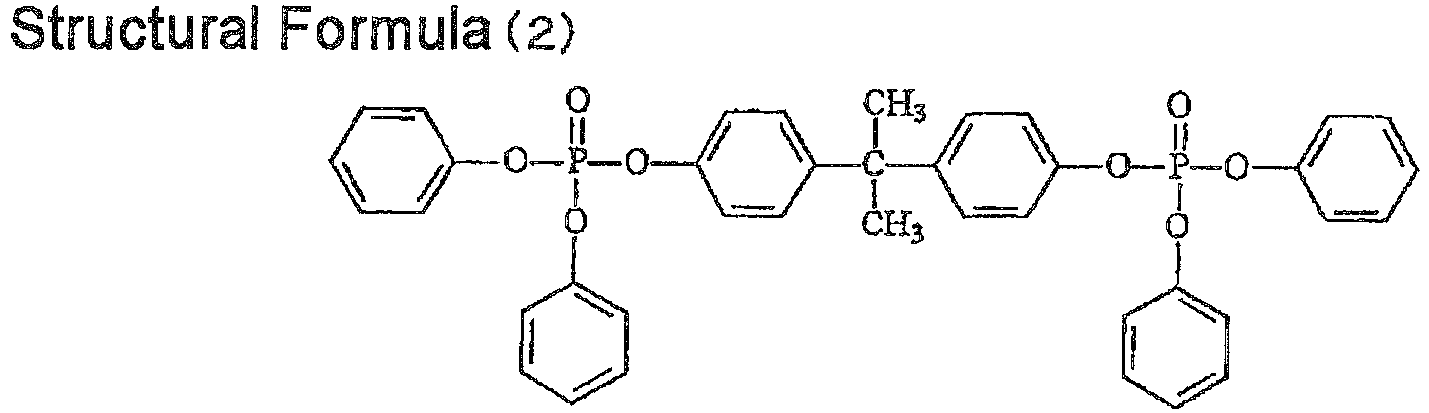
- the condensed phosphate ester may be at least one of a compound represented by the following structural formula (1) (for example, "PX200” manufactured by DAIHACHI CHEMICAL INDUSTRY CO., LTD.) and a compound represented by the following structural formula (2) (for example, "CR741” manufactured by DAIHACHI CHEMICAL INDUSTRY CO., LTD.).
- structural formula (1) for example, "PX200” manufactured by DAIHACHI CHEMICAL INDUSTRY CO., LTD.
- structural formula (2) for example, "CR741” manufactured by DAIHACHI CHEMICAL INDUSTRY CO., LTD.
- the content of condensed phosphate ester is preferably from 5% by mass to 30% by mass, and more preferably from 10% by mass to 15% by mass, based on the total amount of the resin composition.
- the content of condensed phosphate ester is preferably from 20 parts by mass to 300 parts by mass, and more preferably from 220 parts by mass to 280 parts by mass, based on 1 part by mass of the lignophenol derivative.
- the content of aluminum hydroxide which is added to condensed phosphate ester to be used in combination is preferably from 5% by mass to 30% by mass, and more preferably from 7% by mass to 20% by mass, based on the total amount of the resin composition. It is more preferred that a mass ratio of aluminum hydroxide to the condensed phosphate ester is from 6:1 to 1:1, and in such a case, excellent flame retardancy can be obtained.
- flame retardants may include bromine-based flame retardants, nitrogen-based flame retardants, phosphorus-based flame retardants, silicone-based flame retardants, inorganic particle-based flame retardants and the like.
- Preferred examples of the flame retardant include nitrogen-based flame retardants such as melamine sulfate, phosphorus-based flame retardants such as phosphate esters, condensed phosphate ester-based and phosphorus polymerized polyester-based flame retardants, silicone-based flame retardants such as silicone powder and silicone resin, inorganic particle-based flame retardants such as magnesium hydroxide and the like.
- the content of other flame retardants is preferably from 0% by mass to 10% by mass, and more preferably from 0% by mass to 5% by mass, based on condensed phosphate ester.
- the glass fiber is not particularly limited, and a known material is used as a glass fiber.
- the fiber length of the glass fiber is preferably from 0.1 mm to 6 mm, and more preferably from 0.5 mm to 4 mm.
- the diameter of the fiber is preferably from 5 ⁇ m to 20 ⁇ m and more preferably from 7 ⁇ m to 15 ⁇ m.
- the aspect ratio is preferably from 10 to 300, and more preferably from 20 to 200.
- the fiber length, the fiber diameter and the aspect ratio of the glass fiber are measured by performing image analysis using a needle type particle measuring instrument (manufactured by NIRECO Co., Ltd.).
- the glass fiber is subjected to surface treatment.
- the surface treatment material may include a silane-based material, low molecular weight polylactic acid or the like.
- a commercially available product may be used as a glass fiber, and examples thereof include PF-E-301-S#5, PF-E-001-S#5, PF-E-001-S and CS3J-332-S manufactured by Nittobo, Co., Ltd., ECS03-615, ESC03-631 K, ECS03-168, ECS03-650 and ECS03-350 manufactured by Central Glass, Co., Ltd. and the like.
- the content of the glass fiber is preferably from 30 parts by mass to 200 parts by mass, further preferably from 40 parts by mass to 150 parts by mass, and more preferably from 50 parts by mass to 100 parts by mass based on 1 part by mass of the lignophenol derivative.
- the content of the glass fiber is preferably from 7% by mass to 30% by mass based on the total amount of the resin composition.
- Resins other than aliphatic polyesters may be used.
- resins include thermoplastic resins known in the related art, and specific examples thereof include a polycarbonate resin, a polypropylene resin, a polyamide resin, an aromatic polyester resin, a polyolefin resin, a polyester carbonate resin, a polyphenylene ether resin, a polyphenylenesulfide resin, a polysulfone resin, a polyethersulfone resin, a polyarylene resin, a polyetherimide resin, a polyacetal resin, a polyvinyl acetal resin, a polyketone resin, a polyether ketone resin, a polyether ether ketone resin, a polyaryl ketone resin, a polyether nitrile resin, a liquid crystal resin, a polybenzimidazole resin, a polyparabanic acid resin, a vinyl-based polymer or copolymer resin that is obtained by polymerizing or copolymerizing at least one vinyl monomers selected from the group consisting of an aromatic alkenyl compound,
- These resins may be used either alone or in combination of two or more thereof.
- additives may be added, and examples thereof include an antioxidant, a toughening agent, a compatibilizer, a weathering agent, a hydrolysis resistant agent and the like. Each of the contents of these additives is preferably 5% by mass or less based on the total amount of the resin composition.
- the resin molded product according to the exemplary embodiment is configured by including the crosslinked polymer compound, the glass fiber and condensed phosphate ester.
- the molded product according to the exemplary embodiment is obtained, for example, by molding the resin composition according to the exemplary embodiment by a molding machine.
- examples of the molding method by a molding machine include injection molding, extrusion molding, blow molding, hot press molding, calender molding, coating molding, cast molding, dipping molding, vacuum molding, transfer molding and the like.
- the injection molding may be performed by using, for example, a commercially available apparatus such as NEX 150 manufactured by Nissei Plastic Industrial Co., Ltd., NEX 70000 manufactured by Nissei Plastic Industrial Co., Ltd., and SE50D manufactured by TOSHIBA MACHINE CO., LTD..
- a commercially available apparatus such as NEX 150 manufactured by Nissei Plastic Industrial Co., Ltd., NEX 70000 manufactured by Nissei Plastic Industrial Co., Ltd., and SE50D manufactured by TOSHIBA MACHINE CO., LTD..
- the cylinder temperature is preferably from 170 °C to 280 °C, and more preferably from 180 °C to 270 °C.
- the mold temperature is preferably from 40 °C to 110 °C, and more preferably from 50 °C to 110 °C.
- the molded product according to the exemplary embodiment is suitably used in the use such as electronic and electric devices, home electric appliances, containers and automotive interior materials. More specific examples thereof include cases for home electric appliances, electronic and electric devices and the like, various parts and the like, wrapping films, storage cases for CD-ROM, DVD and the like, tableware, food trays, beverage bottles, chemical wrapping materials and the like, and among them, the molded product is appropriate for parts for electronic and electric devices.
- FIG. 1 is an external perspective view of an image forming apparatus, which is an example of parts of an electronic and electric device provided with the molded product according to the exemplary embodiment, when viewed from the front side thereof.
- An image forming apparatus 100 of FIG. 1 is provided with front covers 120a and 120b in front of a main product apparatus 110. These front covers 120a and 120b are configured to be freely opened and closed such that an operator may manipulate inner parts of the apparatus. Accordingly, the operator replenishes a toner when the toner is consumed, exchanges a consumed process cartridge, or removes clogged papers when jamming occurs in the apparatus.
- FIG. 1 illustrates the apparatus in a state where the front covers 120a and 120b are opened.
- An operation panel 130 to which various conditions relating to image formation, such as a paper size or the number of copies are input by the operation of the operator, and a copy glass 132 on which an original copy to be read off is disposed are provided on the upper surface of the main product apparatus 110.
- the main product apparatus 110 is provided with, on the upper portion thereof, an automatic original copy conveying apparatus 134 that conveys the original copy on the copy glass 132.
- the main product apparatus 110 is provided with an image reading apparatus that obtains image data showing an image on the original copy by scanning the image on the original copy disposed on the copy glass 132.
- the image data obtained by the image reading apparatus are sent to an image forming unit through a control part.
- the image reading apparatus and the control part are housed in a case 150 constituting a part of the main product apparatus 110.
- the image forming unit is provided in the case 150 as a freely detachable process cartridge 142.
- the process cartridge 142 may be detached and attached by turning an operation lever 144.
- a toner storage part 146 is attached to the case 150 of the main product apparatus 110, and a toner is replenished from a toner supply port 148.
- the toner housed in the toner storage part 146 is supplied to a development apparatus.
- paper storage cassettes 140a, 140b and 140c are provided on the bottom part of the main product apparatus 110.
- a plurality of conveying rollers composed of a pair of rollers are arranged in the main product apparatus 110, and thus a conveying path is formed where papers in the paper storage cassettes are conveyed to the image forming unit located at the upper part thereof.
- paper in each paper storage cassette is ejected one by one by a paper eject mechanism disposed at the end of the conveying path, and is sent out to the conveying path.
- a manual paper supply part 136 is provided at the side of the main product apparatus 110, and paper is also supplied therefrom.
- the paper having an image formed thereon by the image forming unit is successively transported between two fixing rolls mutually in contact, supported by a case 152 constituting a part of the main product apparatus 110, and then paper-ejected to the outside of the main product apparatus 110.
- the main product apparatus 110 is provided with a plurality of paper discharge parts 138 at the opposite side of the side at which the paper supply part 136 is provided, and papers after image formation are discharged to these paper discharge parts.
- the molded product according to the exemplary embodiment is used in, for example, the front covers 120a and 120b, an exterior of the process cartridge 142, the case 150 and the case 152.
- 1 kg of cypress wood flour is washed with 10 L of acetone in a 20-liter stirring autoclave and filtered, and the wood flour after completion of the washing is dried under conditions of 60 °C/20 Pa for 4 hour by a vacuum dryer.
- the wood flour is placed into the 20-liter stirring autoclave and dissolved in 5 L of cresol, 5 L of 72% concentrated sulfuric acid is added thereto, and the mixture is stirred for 5 hour while cooling the autoclave such that the temperature is not increased. Only the cresol layer is extracted and concentrated until the volume reaches 500 ml, 1 L of diethyl ether is added thereto, the mixture is stirred, and then the solid content dispersed is filtered.
- Lignophenol derivative B is obtained by the same manner as in the preparation method in lignophenol derivative A, except that the process of "dissolution in acetone-concentration-dropwise addition into distilled water" is repeated ten times.
- Lignophenol derivative C is obtained by the same manner as in the preparation method in lignophenol derivative A, except that the process of "dissolution in acetone-concentration-dropwise addition into distilled water" is repeated twice.
- Lignophenol derivative D is obtained by the same manner as in the preparation method in lignophenol derivative A, except that the process of "dissolution in acetone-concentration-dropwise addition into distilled water" is repeated thirty times.
- Lignophenol derivative E is obtained by the same manner as in the preparation method in lignophenol derivative A, except that cedar wood flour is used instead of cypress wood flour as a raw material.
- Lignophenol derivative F is obtained by the same manner as in the preparation method in lignophenol derivative B, except that cedar wood flour is used instead of cypress wood flour as a raw material.
- a lignophenol derivative, aliphatic polyester, glass fiber, condensed phosphate ester and a flame retardant other than condensed phosphate ester are prepared in amounts shown in the following Tables 2 and 3. Among them, except for the glass fiber, the mixture of the lignophenol derivative, aliphatic polyester, condensed phosphate ester and the flame retardant other than condensed phosphate ester is kneaded at the kneading temperature shown in Tables 2 and 3 from a main hopper by a twin-screw extrusion apparatus (manufactured by Toshiba Machine Co., Ltd., TEM3000) by a method of supplying the glass fiber from a side feed hopper, cooled and pelletized to obtain a pellet type resin composition (resin pellet).
- a twin-screw extrusion apparatus manufactured by Toshiba Machine Co., Ltd., TEM3000
- Table 2 Composition Lignophenol derivative Aliphatic polyester Glass fiber Condensed phosphate ester Flame retardant other than condensed phosphate ester Kneading temperature [°C] Molding cylinder temperature [°C] Mold temperature [°C] Kind Part Kind Part Kind Part Kind Part 1 A-1 (A) 1 part (J) 500 parts (N) 40 parts (V) 100 parts - 0 part 180 170 30 2 A-2 (A) 1 part (J) 100 parts (N) 8 parts (V) 20 parts - 0 part 180 170 30 3 A-3 (A) 1 part (J) 1000 parts (N) 80 parts (V) 200 parts - 0 part 180 170 30 4 A-4 (A) 1 part (J) 90 parts (N) 8 parts (V) 20 parts - 0 part 180 170 30 5 A-5 (A) 1 part (J) 1100 parts (N) 80 parts (V) 200 parts - 0 part 180 170 30 6 A-6 (A) 1 part 500 parts (N) 30 parts (V) 100 parts - 0 part
- the resin pellet is manufactured into an ISO multi-purpose dumbbell test specimen (length 100 mm, width 10 mm and thickness 4 mm of test part) and a UL test specimen (length 125 mm, width 13 mm and thickness 0.5 mm, 1.6 mm) at the cylinder temperature and mold temperate shown in Tables 2 and 3 by using an injection molding machine (manufactured by Nissei Plastic Industrial Co., Ltd., NEX150).
- the ISO multi-purpose dumbbell test specimen is processed, and Charpy notched impact strength is measured in accordance with ISO179-1 and, bending strain at break is measured in accordance with ISO178, by using an impact resistance test apparatus (DG-5, manufactured by Toyo Electric, Co., Ltd.).
- DG-5 manufactured by Toyo Electric, Co., Ltd.
- a UL test specimen for V test (thickness 0.5 mm and 1.6 mm) is used to perform UL-V test by the method of UL-94.
- the UL-V test criteria are as follows.
- Flame retardancy test 5V is performed by the following method.
Landscapes
- Chemical & Material Sciences (AREA)
- Health & Medical Sciences (AREA)
- Chemical Kinetics & Catalysis (AREA)
- Medicinal Chemistry (AREA)
- Polymers & Plastics (AREA)
- Organic Chemistry (AREA)
- Engineering & Computer Science (AREA)
- Materials Engineering (AREA)
- Life Sciences & Earth Sciences (AREA)
- Biochemistry (AREA)
- General Chemical & Material Sciences (AREA)
- Compositions Of Macromolecular Compounds (AREA)
Abstract
There is provided a resin composition including: a crosslinked polymer compound having a crosslinked structure formed by reaction of a carboxyl group of aliphatic polyester having at least a carboxyl group at an end of polymer chain with a hydroxyl group of a lignophenol derivative having at least a hydroxyl group, a glass fiber, and condensed phosphate ester.
Description
- The present invention relates to a resin composition and a resin molded product.
- From the viewpoint of reducing environmental load, lignophenol derivatives obtained from plants are a material which draws attention as one of candidates of non-petroleum-based resin materials.
- For a resin composition using the lignophenol derivative, it is disclosed, for example, in Japanese Patent Application Laid-Open No.
2008-274068 - An object of the present invention is to provide a resin composition having excellent flame retardancy.
- (1) A resin composition including: a crosslinked polymer compound having a crosslinked structure formed by reaction of a carboxyl group of aliphatic polyester having at least a carboxyl group at an end of polymer chain with a hydroxyl group of a lignophenol derivative having at least a hydroxyl group, a glass fiber, and condensed phosphate ester.
- (2) The resin composition according to (1), wherein in the crosslinked polymer compound, a mass ratio of a content of a component derived from the lignophenol derivative to a content of a component derived from aliphatic polyester is from 0.1 % by mass to 1% by mass.
- (3) The resin composition according to (1) or (2), further including: aluminum hydroxide.
- (4) The resin composition according to any one of (1) to (3), wherein the lignophenol derivative is represented by formula (1):

- (5) The resin composition according to any one of (1) to (4), wherein the lignophenol derivative is represented by one selected from the group consisting of Formula (2), Formula (3) and Formula (4):


- (6) The resin composition according to any one of (1) to (5), wherein the lignophenol derivative has a ratio of a weight average molecular weight to a number average molecular weight of from 3 to 10.
- (7) The resin composition according to any one of (1) to (6), wherein the condensed ester phosphate has an amount of from 5% by mass to 30% by mass based on a total amount of the resin composition.
- (8) The resin composition according to (3), wherein the aluminum hydroxide has an amount of from 5% by mass to 30% by mass based on a total amount of the resin composition.
- (9) The resin composition according to (3) or (8), wherein a mass ratio of the aluminum hydroxide and the condensed phosphate ester is from 6:1 to 1:1.
- (10) The resin composition according to any one of (1) to (9), wherein a fiber length of the glass fiber is from 0.1 mm to 6 mm, and a fiber diameter of the glass fiber is 5 µm to 20 µm.
- (11) The resin composition according to any one of (1) to (10), wherein the glass fiber has an amount of from 7% by mass to 30% by mass based on a total amount of the resin composition.
- (12) A resin molded product including the resin composition according to any one of (1) to (11).
- (13) The resin molded product according to (12), wherein in the crosslinked polymer compound, a mass ratio of a content of a component derived from the lignophenol derivative to a content of a component derived from aliphatic polyester is from 0.1 % by mass to 1% by mass.
- According to an exemplary embodiment of the invention (1), a resin composition having excellent flame retardancy may be provided, as compared with the case that fails to satisfy the requirement to include a crosslinked polymer compound having a crosslinked structure formed by reaction of a carboxyl group at an end of a polymer chain in aliphatic polyester with a hydroxyl group of a lignophenol derivative, a glass fiber and condensed phosphate ester.
- According to exemplary embodiments of the inventions (2) to (11), a resin composition having excellent flame retardancy may be provided as compared with the case of not having the above constitutions.
- According to an exemplary embodiment of the invention (12) and (13), a resin molded product having excellent flame retardancy may be provided, as compared with the case of not having the above constitutions.
- Exemplary embodiments of the present invention will be described in detail based on the following figure, wherein:
-
FIG. 1 is a schematic view illustrating an example of parts of an electronic and electric device including a molded product according to the exemplary embodiment. - Hereinafter, a resin composition and a resin molded product according to the exemplary embodiment will be described in detail.
- A resin composition according to the exemplary embodiment includes a crosslinked polymer compound having a crosslinked structure formed by reaction of a carboxyl group in aliphatic polyester having at least a carboxyl group at an end of a polymer chain with a hydroxyl group of a lignophenol derivative having at least a hydroxyl group in a molecular structure, a glass fiber, and condensed phosphate ester.
- When a V combustion test suitable for UL-94 is performed on aliphatic polyester, a serious drip (dripping when melting) occurs, such that flame retardancy is evaluated as a V-Not level, that is, flame retardancy cannot be achieved. When a phosphorus compound is added as a flame retardant to aliphatic polyester, flame retardancy, although varying depending on a kind or an amount of the phosphorus compound added, is improved to a V-2 level due to a flame quenching effect and a drip acceleration effect. However, as the drip is accelerated as described above, it is difficult to achieve excellent flame retardancy of V-0 level when using aliphatic polyester.
- Further, from the viewpoint of improving mechanical strength or heat resistance, glass fibers are added to aliphatic polyester, but in this case, a candle effect occurs in which glass fibers act like a wick to transmit flames, thereby accelerating combustion.
- In contrast, excellent flame retardancy is achieved with the resin composition according to the exemplary embodiment which is obtained by using a crosslinked polymer compound formed by reaction of the carboxyl group at the end of the polymer chain of aliphatic polyester with the hydroxyl group of the lignophenol derivative, a glass fiber, and condensed phosphate ester in combination.
- The reason for this effect is not clear, but is thought to be as follows. First, the hydroxyl group, the carboxyl group or other functional groups present in the lignophenol derivative is reacted with the carboxyl group or the hydroxyl group at the end of the polymer chain of aliphatic polyester, to form a crosslinked structure of aliphatic polyester. It is inferred that some portions of the condensed phosphate ester as a flame retardant are coordinated with functional groups of the lignophenol derivative, and besides, are dispersed in a free volume in the crosslinked structure of the crosslinked polymer compound, and thus, very high dispersibility may be obtained. As a result, the drip effect of aliphatic polyester is suppressed and the flame quenching effect is accelerated.
- In the case where the glass fiber does not reach the level at which the flame quenching effect is exhibited, flame retardancy deteriorates due to the candle effect as described above, but it is considered that the candle effect can be suppressed, because the flame quenching effect improved by dispersion of condensed phosphate ester makes it possible for flames to be extinguished faster than to be transmitted along the glass fibers. Further, it is assumed that the glass fibers carry out a role as a frame of the resin composition to obtain an effect of suppressing the drip effect caused by aliphatic polyester, and accordingly, excellent flame retardancy is achieved.
- The lignophenol derivative used in the exemplary embodiment will be described.
- The lignophenol derivative includes at least a hydroxyl group in its molecular structure, to be crosslinked with a carboxyl group in aliphatic polyester. The lignophenol derivative is a polymer, and the polymer has a plurality of hydroxyl groups.
- The lignophenol derivative used in the exemplary embodiment is not particularly limited, but preferably has a structure represented by the following general formula (1).

- In general formula (1), each of X1, X2 and X3 independently represents a substituted or unsubstituted alkyl group, a substituted or unsubstituted alkoxy group, a substituted or unsubstituted aryl group, a substituted or unsubstituted arylene group, a hydroxyl group, a carboxyl group, an amino group or an amide group.
- When each of X1, X2 and X3 is a substituted alkyl group, a substituted alkoxy group, a substituted aryl group or a substituted arylene group, examples of a substituent thereof include a hydroxyl group, a carboxylic acid group, a carboxylic acid derivative group, an alkyl group, an alkoxy group and the like.
- In general formula (1), each of a and c independently represents an integer of from 0 to 3, b represents an integer of from 0 to 4, and n represents an integer of from 5 to 20.
- More preferred examples of the lignophenol derivative represented by general formula (1) include a lignophenol derivative represented by the following general formula (2) to general formula (4).

- In general formula (2), n1 represents an integer of from 5 to 20.

- In general formula (3), n2 represents an integer of from 5 to 20.

- In general formula (4), n3 represents an integer of from 5 to 20.
- The lignophenol derivative represented by general formula (1) may be a single structure, or may be a mixture of two or more kinds of different structures. Meanwhile, the lignophenol derivative represented by general formula (1) is a polymer mixture, and n in general formula (1) means an average value of n with respect to the total polymer mixture.
- Meanwhile, the lignophenol derivative used in the exemplary embodiment has a weight average molecular weight (Mw) of preferably from 3,000 to 6,000, and more preferably from 3,500 to 5,000.
- The molecular weight distribution (Mw/Mn) is preferably from 3 to 10, and more preferably from 5 to 8. The melting temperature is preferably from 150°C to 180°C.
- The weight average molecular weight is measured by gel permeation chromatography (GPC). The molecular weight measurement by GPC is performed with a chloroform solvent using HLC-8320 GPC manufactured by Tosoh Corporation as a measuring apparatus and a column TsKgel GMHHR-M+TSKgel GMHHR-M (7.8 mm I.D. 30 cm) manufactured by Tosoh Corporation. The weight average molecular weight is calculated by using a molecular weight calibration curve that is prepared from the measurement results by a monodispersed polystyrene standard sample.
- Examples of a synthesis method of a lignophenol derivative according the exemplary embodiment include a method, including: converting and separating lignin contained in plant resources such as cypress or cedar into a lignophenol derivative to be extracted, hydrolyzing an end thereof by water addition, and subjecting the end to carboxylation by an oxidation reaction using natural ketone. The structure of the lignophenol derivative obtained by such a preparation method may vary according to a difference in plant resources such as needle-leaved trees and broad-leaved trees, but there is no problem with characteristics thereof.
- For an example of synthesis methods of a lignophenol derivative, a lignophenol derivative may be obtained by first converting lignin contained in plant resources into a lignophenol derivative to separate as a precipitate, washing with water, and subsequently, dissolving the washed precipitate in acetone, adding the resulting solution dropwise to a diethyl ether layer, and subjecting to re-precipitation.
- Meanwhile, the weight average molecular weight or the molecular weight distribution (Mw/Mn) of the lignophenol derivative is adjusted by adjusting the repeating number of the processes of the dissolution and re-precipitation.
- When the lignophenol derivative used in the exemplary embodiment has a structural unit different from the structural unit represented by general formula (1), the different structural unit may include a polyester structure such as an aliphatic polyester structure, a polycarbonate structure, an aromatic polyester structure, a polyamide structure, a polyolefin structure such as polypropylene and polyethylene, a polystyrene structure, a polyacrylate structure, a polybutadiene structure, a copolymer structure thereof and the like, and among them, an aliphatic polyester structure is preferred. In this case, the polymer may be any one of a block copolymer or a random copolymer.
- In the lignophenol derivative used in the exemplary embodiment, the ratio of the structural unit represented by general formula (1) based on the total structural unit is preferably from 5% by mol to 100% by mol, and more preferably from 10% by mol to 100% by mol.
- Subsequently, the aliphatic polyester used in the exemplary embodiment will be described.
- The aliphatic polyester is not particularly limited, but examples thereof include hydroxycarboxylic acid polymers, a polycondensate of aliphatic diol and aliphatic carboxylic acid and the like. In the end of a polymer chain (end of a main chain), both ends may be carboxyl groups, or only one end may be a carboxyl group and the other end may be a different group (for example, a hydroxyl group). However, it is more preferred that both ends are carboxyl groups.
- Specific examples of the aliphatic polyester include polylactic acid, poly-3-hydroxybutyrate, polyhydroxyhexanate, polyhydroxyvalerate, a copolymer thereof and the like, and polybutylene succinate, polybutylene adipate, polyethylene succinate, polyethylene adipate, a copolymer of two or more kinds thereof s and the like.
- The aliphatic polyester may be used either alone or in combination of two or more kinds.
- As the aliphatic polyester, for example, a single continuous body (for example, polyhydroxybutyrate) may be used, optical isomers, such as L- and D-isomers of polylactic acid, may be intermixed, or a copolymer thereof may be used.
- Among them, as aliphatic polyester, polylactic acid, polyhydroxybutyrate, polybutylene succinate and a copolymer of two or more kinds thereof are preferred, and polylactic acid is more preferred.
- The polylactic acid is not particularly limited as long as the acid has at least a carboxyl group at an end of a polymer chain (that is, an end of a main chain), and may be an L-lactic acid, a D-lactic acid, or a mixture thereof (for example, a stereo complex with poly-L-lactic acid and poly-D-lactic acid mixed, or a polylactic acid including both an L-lactic acid block and a D-lactic acid block in its structure).
- The polylactic acid as a kind of the aliphatic polyester is a resin having a structural unit represented by the following structural formula (1).

- As the aliphatic polyester used in the exemplary embodiment, aliphatic polyesters having various molecular weights may be used. The weight average molecular weight of the aliphatic polyester is preferably from 3,000 to 200,000, and more preferably from 5,000 to 150,000.
- Meanwhile, the weight average molecular weight is measured by gel permeation chromatograph (GPC). The molecular weight measurement by GPC is performed by a chloroform solvent using HLC-8320 GPC manufactured by Tosoh Corporation as a measuring apparatus and a column TSKgel GMHHR-M+TSKgel GMHHR-M (7.8 mm I.D. 30 cm) manufactured by Tosoh Corporation. The weight average molecular weight is calculated by using a molecular weight correction curve that is prepared from the measurement results by a monodispersed polystyrene standard sample.
- The crosslinked polymer compound according to the exemplary embodiment is obtained by mixing the aliphatic polyester and the lignophenol derivative, and melt-kneading the mixture to achieve crosslinking polymerization.
- A known means is used as a means for mixing or melt-kneading, and examples thereof include a twin-screw extruder, a Henschel mixer, a Banbury mixer, a single screw extruder, a multi screw extruder, a co-kneader and the like.
- When aliphatic polyester and a lignophenol derivative are subjected to crosslinking polymerization, a crosslinking catalyst may be added thereto.
- Examples of the crosslinking catalyst used in the exemplary embodiment include tetrabutoxy titanic acid, germanium oxide, stannous octoate, magnesium oxide, calcium acetate, manganese acetate, cobalt acetate and the like.
- The amount of the crosslinking catalyst added is preferably from 1 x 10⁻⁴ % by mass to 1 % by mass and more preferably from 1 × 10⁻³ % by mass to 0.5 % by mass, based on the total amount of the aliphatic polyester and the lignophenol derivative.
- In the crosslinked polymer compound according to the exemplary embodiment, the mass ratio (L/E × 100) of the content (E) of a component derived from aliphatic polyester and the content (L) of a component derived from the lignophenol derivative is adjusted by amounts of aliphatic polyester and the lignophenol derivative used in the crosslinking polymerization. Meanwhile, portions bound by polycondensation are calculated by including carboxylic acid oxygen atoms in an aliphatic polyester structure.
- The mass ratio (L/E × 100) is preferably from 0.1% by mass to 1% by mass, and more preferably from 0.2% by mass to 0.5% by mass.
- When the mass ratio is 0.1% by mass or more, the drip is prevented and flame retardancy is improved by crosslinking, and the mechanical strength is also improved. Meanwhile, when the mass ratio is 1% by mass or less, the polymer compound is not excessively crosslinked, and thus, is suppressed from becoming hard and brittle, thereby obtaining excellent mechanical strength.
- In order to calculate the mass ratio (L/N x 100) from the crosslinked polymer compound according to the exemplary embodiment or a resin molded product formed by using the crosslinked polymer compound, the following method is used. By the measurement of the proton nuclear magnetic resonance (1H-NMR) spectrum, the amount of protons derived from the aliphatic polyester and the amount of protons directly bonded to the benzene ring derived from the lignophenol derivative are obtained respectively, and the mass ratio (L/N × 100) is calculated from the obtained values.
- The resin composition according to the exemplary embodiment may also contain at least a condensed phosphate ester as a flame retardant.
- Examples of condensed phosphate ester include aromatic condensed phosphate esters such as bisphenol A type, biphenylene type and isophthal type, and specific examples thereof include condensed phosphate ester represented by the following general formula (I) or general formula (II).
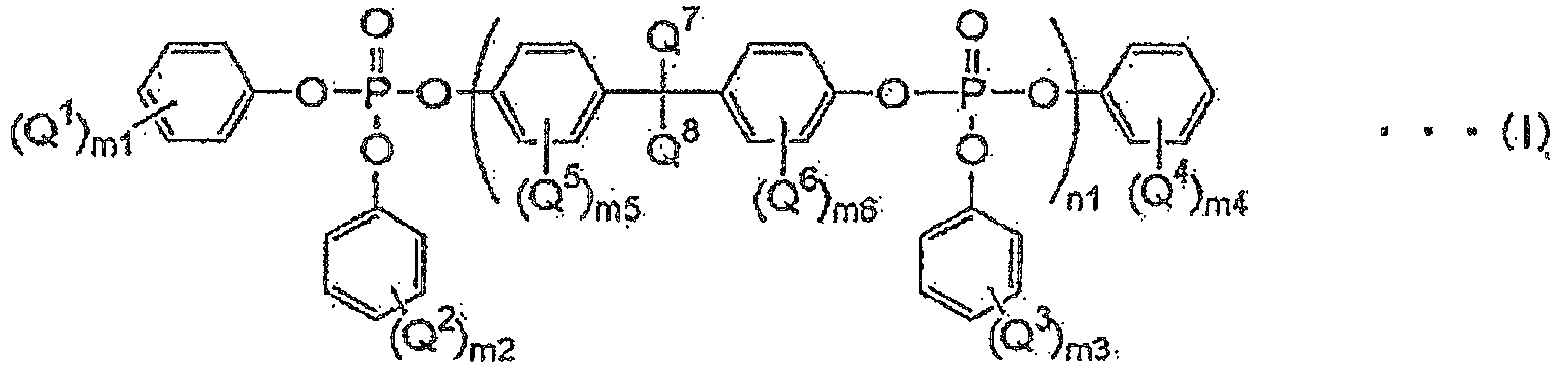
- In general formula (I), each of Q1, Q2, Q3 and Q4 independently represents an alkyl group having from 1 to 6 carbon atoms, each of Q5 and Q6 independently represents a methyl group, each of Q7 and Q8 independently represents a hydrogen atom or a methyl group, each of m1, m2, m3 and m4 independently represents an integer of from 0 to 3, each of m5 and m6 independently represents an integer of from 0 to 2, and n1 represents an integer of from 0 to 10.

- In general formula (II), each of Q9, Q10, Q11 and Q12 independently represents a an alkyl group having from 1 to 6 carbon atoms, Q13 represents a methyl group, each of m7, m8, m9 and m10 independently represents an integer of from 0 to 3, m11 represents an integer of from 0 to 4, and n2 represents an integer of from 0 to 10.
- The condensed phosphate ester may be a synthetic product or a commercially available product. Specific examples of the commercially available product of condensed phosphate ester include commercially available products ("PX200", "PX201", "PX202", "CR741" and the like) manufactured by DAIHACHI CHEMICAL INDUSTRY CO., LTD., commercially available products ("Adekastab FP2100", "FP2200" and the like) manufactured by ADEKA CORPORATION and the like.
- Among them, the condensed phosphate ester may be at least one of a compound represented by the following structural formula (1) (for example, "PX200" manufactured by DAIHACHI CHEMICAL INDUSTRY CO., LTD.) and a compound represented by the following structural formula (2) (for example, "CR741" manufactured by DAIHACHI CHEMICAL INDUSTRY CO., LTD.).

- The content of condensed phosphate ester is preferably from 5% by mass to 30% by mass, and more preferably from 10% by mass to 15% by mass, based on the total amount of the resin composition.
- The content of condensed phosphate ester is preferably from 20 parts by mass to 300 parts by mass, and more preferably from 220 parts by mass to 280 parts by mass, based on 1 part by mass of the lignophenol derivative.
- In the exemplary embodiment, it is more preferred to use aluminum hydroxide in combination as a flame retardant. By using the aluminum hydroxide in combination, excellent flame retardancy is achieved.
- The reason for this effect is not clear, but is thought to be as follows. With temperatures rising as flames approach, aluminum hydroxide depolymerizes aliphatic polyester, and thus, a thermal decomposition temperature of the crosslinked aliphatic polyester is lowered. Therefore, it is deemed that excellent flame retardancy can be obtained by setting the thermal decomposition temperature of condensed phosphate ester to be in the same range as the thermal decomposition temperature of the crosslinked aliphatic polyester.
- The content of aluminum hydroxide which is added to condensed phosphate ester to be used in combination is preferably from 5% by mass to 30% by mass, and more preferably from 7% by mass to 20% by mass, based on the total amount of the resin composition. It is more preferred that a mass ratio of aluminum hydroxide to the condensed phosphate ester is from 6:1 to 1:1, and in such a case, excellent flame retardancy can be obtained.
- Other flame retardants may be used in combination. Examples of the flame retardants may include bromine-based flame retardants, nitrogen-based flame retardants, phosphorus-based flame retardants, silicone-based flame retardants, inorganic particle-based flame retardants and the like. Preferred examples of the flame retardant include nitrogen-based flame retardants such as melamine sulfate, phosphorus-based flame retardants such as phosphate esters, condensed phosphate ester-based and phosphorus polymerized polyester-based flame retardants, silicone-based flame retardants such as silicone powder and silicone resin, inorganic particle-based flame retardants such as magnesium hydroxide and the like.
- The content of other flame retardants is preferably from 0% by mass to 10% by mass, and more preferably from 0% by mass to 5% by mass, based on condensed phosphate ester.
- The glass fiber is not particularly limited, and a known material is used as a glass fiber.
- The fiber length of the glass fiber is preferably from 0.1 mm to 6 mm, and more preferably from 0.5 mm to 4 mm.
- The diameter of the fiber is preferably from 5 µm to 20 µm and more preferably from 7 µm to 15 µm.
- The aspect ratio is preferably from 10 to 300, and more preferably from 20 to 200.
- The fiber length, the fiber diameter and the aspect ratio of the glass fiber are measured by performing image analysis using a needle type particle measuring instrument (manufactured by NIRECO Co., Ltd.).
- From the viewpoint of adhesion properties between the glass fiber and aliphatic polyester, it is more preferred that the glass fiber is subjected to surface treatment. Examples of the surface treatment material may include a silane-based material, low molecular weight polylactic acid or the like.
- A commercially available product may be used as a glass fiber, and examples thereof include PF-E-301-S#5, PF-E-001-S#5, PF-E-001-S and CS3J-332-S manufactured by Nittobo, Co., Ltd., ECS03-615, ESC03-631 K, ECS03-168, ECS03-650 and ECS03-350 manufactured by Central Glass, Co., Ltd. and the like.
- The content of the glass fiber is preferably from 30 parts by mass to 200 parts by mass, further preferably from 40 parts by mass to 150 parts by mass, and more preferably from 50 parts by mass to 100 parts by mass based on 1 part by mass of the lignophenol derivative. The content of the glass fiber is preferably from 7% by mass to 30% by mass based on the total amount of the resin composition.
- Resins other than aliphatic polyesters may be used.
- Examples of resins include thermoplastic resins known in the related art, and specific examples thereof include a polycarbonate resin, a polypropylene resin, a polyamide resin, an aromatic polyester resin, a polyolefin resin, a polyester carbonate resin, a polyphenylene ether resin, a polyphenylenesulfide resin, a polysulfone resin, a polyethersulfone resin, a polyarylene resin, a polyetherimide resin, a polyacetal resin, a polyvinyl acetal resin, a polyketone resin, a polyether ketone resin, a polyether ether ketone resin, a polyaryl ketone resin, a polyether nitrile resin, a liquid crystal resin, a polybenzimidazole resin, a polyparabanic acid resin, a vinyl-based polymer or copolymer resin that is obtained by polymerizing or copolymerizing at least one vinyl monomers selected from the group consisting of an aromatic alkenyl compound, a methacrylic acid ester, an acrylic acid ester and a cyanated vinyl compound, a diene-aromatic alkenyl compound copolymer resin, a vinyl cyanide-diene-aromatic alkenyl compound copolymer resin, an aromatic alkenyl compound-diene-vinyl cyanide-N-phenylmaleimide copolymer resin, a vinyl cyanide-(ethylene-diene-propylene (EPDM))-aromatic alkenyl compound copolymer resin, polyolefin, a vinyl chloride resin, a chlorinated vinyl chloride resin and the like.
- These resins may be used either alone or in combination of two or more thereof.
- Other additives may be added, and examples thereof include an antioxidant, a toughening agent, a compatibilizer, a weathering agent, a hydrolysis resistant agent and the like. Each of the contents of these additives is preferably 5% by mass or less based on the total amount of the resin composition.
- The resin molded product according to the exemplary embodiment is configured by including the crosslinked polymer compound, the glass fiber and condensed phosphate ester.
- Specifically, the molded product according to the exemplary embodiment is obtained, for example, by molding the resin composition according to the exemplary embodiment by a molding machine. Meanwhile, examples of the molding method by a molding machine include injection molding, extrusion molding, blow molding, hot press molding, calender molding, coating molding, cast molding, dipping molding, vacuum molding, transfer molding and the like.
- Herein, the injection molding may be performed by using, for example, a commercially available apparatus such as
NEX 150 manufactured by Nissei Plastic Industrial Co., Ltd., NEX 70000 manufactured by Nissei Plastic Industrial Co., Ltd., and SE50D manufactured by TOSHIBA MACHINE CO., LTD.. - In this case, the cylinder temperature is preferably from 170 °C to 280 °C, and more preferably from 180 °C to 270 °C. The mold temperature is preferably from 40 °C to 110 °C, and more preferably from 50 °C to 110 °C.
- The molded product according to the exemplary embodiment is suitably used in the use such as electronic and electric devices, home electric appliances, containers and automotive interior materials. More specific examples thereof include cases for home electric appliances, electronic and electric devices and the like, various parts and the like, wrapping films, storage cases for CD-ROM, DVD and the like, tableware, food trays, beverage bottles, chemical wrapping materials and the like, and among them, the molded product is appropriate for parts for electronic and electric devices.
-
FIG. 1 is an external perspective view of an image forming apparatus, which is an example of parts of an electronic and electric device provided with the molded product according to the exemplary embodiment, when viewed from the front side thereof. - An
image forming apparatus 100 ofFIG. 1 is provided withfront covers main product apparatus 110. Thesefront covers FIG. 1 illustrates the apparatus in a state where the front covers 120a and 120b are opened. - An
operation panel 130 to which various conditions relating to image formation, such as a paper size or the number of copies are input by the operation of the operator, and acopy glass 132 on which an original copy to be read off is disposed are provided on the upper surface of themain product apparatus 110. Themain product apparatus 110 is provided with, on the upper portion thereof, an automatic originalcopy conveying apparatus 134 that conveys the original copy on thecopy glass 132. Themain product apparatus 110 is provided with an image reading apparatus that obtains image data showing an image on the original copy by scanning the image on the original copy disposed on thecopy glass 132. The image data obtained by the image reading apparatus are sent to an image forming unit through a control part. Meanwhile, the image reading apparatus and the control part are housed in acase 150 constituting a part of themain product apparatus 110. The image forming unit is provided in thecase 150 as a freelydetachable process cartridge 142. Theprocess cartridge 142 may be detached and attached by turning anoperation lever 144. - A
toner storage part 146 is attached to thecase 150 of themain product apparatus 110, and a toner is replenished from atoner supply port 148. The toner housed in thetoner storage part 146 is supplied to a development apparatus. - Meanwhile,
paper storage cassettes main product apparatus 110. A plurality of conveying rollers composed of a pair of rollers are arranged in themain product apparatus 110, and thus a conveying path is formed where papers in the paper storage cassettes are conveyed to the image forming unit located at the upper part thereof. Meanwhile, paper in each paper storage cassette is ejected one by one by a paper eject mechanism disposed at the end of the conveying path, and is sent out to the conveying path. A manualpaper supply part 136 is provided at the side of themain product apparatus 110, and paper is also supplied therefrom. - The paper having an image formed thereon by the image forming unit is successively transported between two fixing rolls mutually in contact, supported by a
case 152 constituting a part of themain product apparatus 110, and then paper-ejected to the outside of themain product apparatus 110. Themain product apparatus 110 is provided with a plurality ofpaper discharge parts 138 at the opposite side of the side at which thepaper supply part 136 is provided, and papers after image formation are discharged to these paper discharge parts. - In the
image forming apparatus 100, the molded product according to the exemplary embodiment is used in, for example, the front covers 120a and 120b, an exterior of theprocess cartridge 142, thecase 150 and thecase 152. - Hereinafter, the present invention will be described in detail with reference to Examples, but the present invention is not limited thereto. "Parts" and "%" are on a mass basis unless otherwise specified.
- 1 kg of cypress wood flour is washed with 10 L of acetone in a 20-liter stirring autoclave and filtered, and the wood flour after completion of the washing is dried under conditions of 60 °C/20 Pa for 4 hour by a vacuum dryer. The wood flour is placed into the 20-liter stirring autoclave and dissolved in 5 L of cresol, 5 L of 72% concentrated sulfuric acid is added thereto, and the mixture is stirred for 5 hour while cooling the autoclave such that the temperature is not increased. Only the cresol layer is extracted and concentrated until the volume reaches 500 ml, 1 L of diethyl ether is added thereto, the mixture is stirred, and then the solid content dispersed is filtered. This is dissolved in 5 L of acetone and the mixture is concentrated until the volume reaches 200 ml, the mixture is added dropwise to 5 L of distilled water to suction-filter the insolubles, and a process of "dissolution in acetone-concentration-dropwise addition into distilled water" is repeated five times again. In this way, lignophenol derivative A is obtained.
- Lignophenol derivative B is obtained by the same manner as in the preparation method in lignophenol derivative A, except that the process of "dissolution in acetone-concentration-dropwise addition into distilled water" is repeated ten times.
- Lignophenol derivative C is obtained by the same manner as in the preparation method in lignophenol derivative A, except that the process of "dissolution in acetone-concentration-dropwise addition into distilled water" is repeated twice.
- Lignophenol derivative D is obtained by the same manner as in the preparation method in lignophenol derivative A, except that the process of "dissolution in acetone-concentration-dropwise addition into distilled water" is repeated thirty times.
- Lignophenol derivative E is obtained by the same manner as in the preparation method in lignophenol derivative A, except that cedar wood flour is used instead of cypress wood flour as a raw material.
- Lignophenol derivative F is obtained by the same manner as in the preparation method in lignophenol derivative B, except that cedar wood flour is used instead of cypress wood flour as a raw material.
- The chemical structures of Lignophenol derivative A to F are shown below.
-

-

-

-
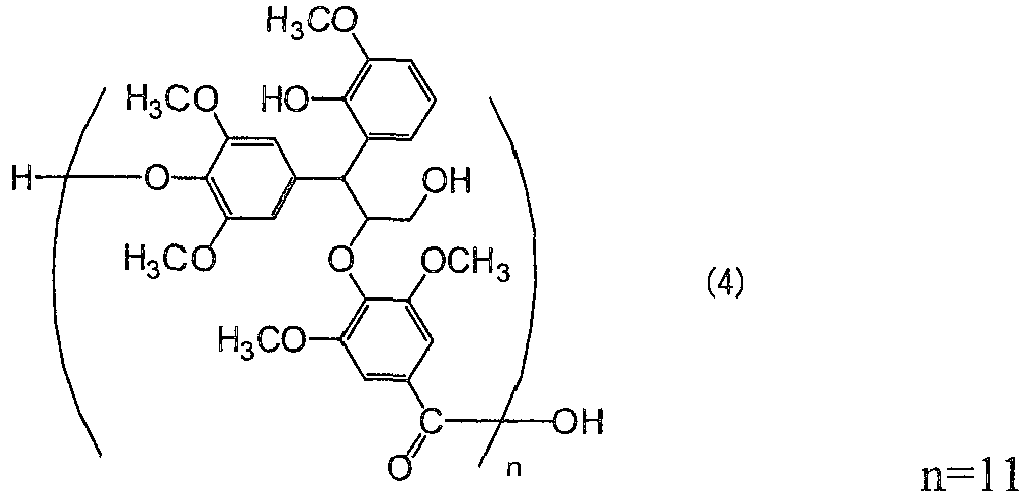
-

-
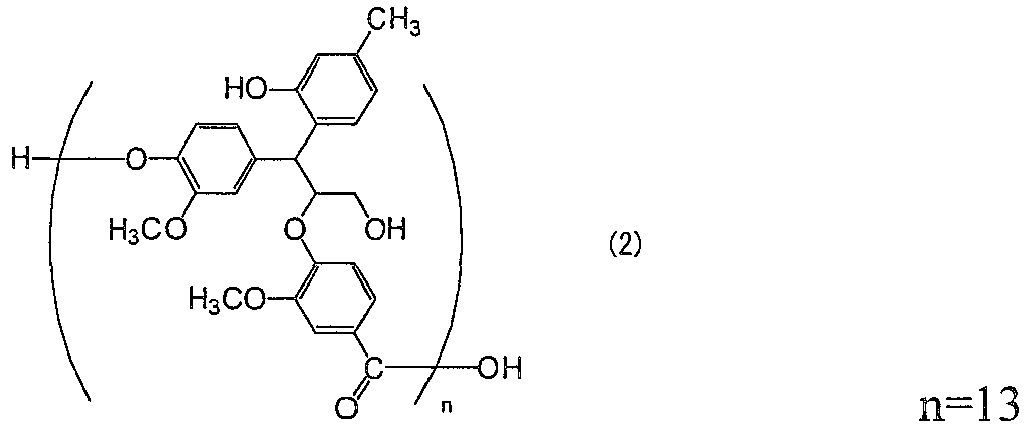
- The molecular weight (Mw) and molecular weight distribution (Mw/Mn) of each lignophenol derivative are shown in the following Table 1.
Table 1 Lignophenol derivative Raw material Molecular weight [Mw] Molecular weight distribution [Mw/Mn] A Cypress 5890 9.8 B Cypress 3025 3.1 C Cypress 6550 10.8 D Cypress 2890 2.8 E Cedar 5950 9.9 F Cedar 3150 3.3 - A lignophenol derivative, aliphatic polyester, glass fiber, condensed phosphate ester and a flame retardant other than condensed phosphate ester are prepared in amounts shown in the following Tables 2 and 3. Among them, except for the glass fiber, the mixture of the lignophenol derivative, aliphatic polyester, condensed phosphate ester and the flame retardant other than condensed phosphate ester is kneaded at the kneading temperature shown in Tables 2 and 3 from a main hopper by a twin-screw extrusion apparatus (manufactured by Toshiba Machine Co., Ltd., TEM3000) by a method of supplying the glass fiber from a side feed hopper, cooled and pelletized to obtain a pellet type resin composition (resin pellet).
Table 2 Composition Lignophenol derivative Aliphatic polyester Glass fiber Condensed phosphate ester Flame retardant other than condensed phosphate ester Kneading temperature [°C] Molding cylinder temperature [°C] Mold temperature [°C] Kind Part Kind Part Kind Part Kind Part Kind Part 1 A-1 (A) 1 part (J) 500 parts (N) 40 parts (V) 100 parts - 0 part 180 170 30 2 A-2 (A) 1 part (J) 100 parts (N) 8 parts (V) 20 parts - 0 part 180 170 30 3 A-3 (A) 1 part (J) 1000 parts (N) 80 parts (V) 200 parts - 0 part 180 170 30 4 A-4 (A) 1 part (J) 90 parts (N) 8 parts (V) 20 parts - 0 part 180 170 30 5 A-5 (A) 1 part (J) 1100 parts (N) 80 parts (V) 200 parts - 0 part 180 170 30 6 A-6 (A) 1 part 500 parts (N) 30 parts (V) 100 parts - 0 part 180 170 30 7 A-7 (A) 1 part (J) 500 parts (N) 200 parts (V) 100 parts - 0 part 180 170 30 8 A-8 (A) 1 part (J) 500 parts (N) 20 parts (V) 100 parts - 0 part 180 170 30 9 A-9 (A) 1 part (J) 500 parts (N) 210 parts (V) 100 parts - 0 part 180 170 30 Example 10 A-10 (A) 1 part (J) 500 parts (N) 40 parts (V) 300 parts - 0 part 180 170 30 11 A-11 (A) 1 part (J) 500 parts (N) 40 parts (V) 15 parts - 0 part 180 170 30 12 A-12 (A) 1 part (J) 500 parts (N) 40 parts (V) 320 parts - 0 part 180 170 30 13 A-13 (B) 1 part (J) 500 parts (N) 40 parts (V) 100 parts - 0 part 180 170 30 14 A-14 (C) 1 part (J) 500 parts (N) 40 parts (V) 100 parts - 0 part 180 170 30 15 A-15 (D) 1 part (J) 500 parts (N) 40 parts (V) 100 parts - 0 part 180 170 30 16 A-16 (E) 1 part (J) 500 parts (N) 40 parts (V) 100 parts - 0 part 180 170 30 17 A-17 (F) 1 part (J) 500 parts (N) 40 parts (V) 100 parts - 0 part 180 170 30 18 A-18 (A) 1 part (K) 500 parts (N) 40 parts (V) 100 parts - 0 part 170 160 30 19 A-19 (A) 1 part (L) 500 parts (N) 40 parts (V) 100 parts - 0 part 160 160 60 Table 3 Composition Lignophenol derivative Aliphatic polyester Glass fiber Condensed phosphate ester Flame retardant other than condensed phosphate ester Kneading temperature [°C] Molding cylinder temperature [°C] Mold temperature [°C] Kind Part Kind Part Kind Part Kind Part Kind Part 20 A-20 (A) 1 part (M) 500 parts (N) 40 parts (V) 100 parts - 0 part 170 160 60 21 A-21 (A) 1 part (J) 500 parts (O) 40 parts (V) 100 parts - 0 part 180 180 30 22 A-22 (A) 1 part (J) 500 parts (P) 40 parts (V) 100 parts - 0 part 180 180 30 23 A-23 (A) 1 part (J) 500 parts (Q) 40 parts . (V) 100 parts - 0 part 180 180 30 24 A-24 (A) 1 part (J) 500 parts (R) 40 parts (V) 100 parts - 0 part 180 180 30 25 A-25 (A) 1 part (J) 500 parts (S) 40 parts (V) 100 parts - 0 part 180 180 30 26 A-26 (A) 1 part (J) 500 parts (T) 40 parts (V) 100 parts - 0 part 180 180 30 27 A-27 (A) 1 part (J) 500 parts (U) 40 parts (V) 100 parts - 0 part 180 180 30 Example 28 A-28 (A) 1 part (J) 500 parts (N) 40 parts (W) 100 parts - 0 part 180 180 30 29 A-29 (A) 1 part (J) 500 parts (N) 40 parts (V) 100 parts (X) 60 parts 180 180 30 30 A-30 (A) 1 part (J) 500 parts (N) 40 parts (V) 100 parts (Y) 60 parts 180 180 30 31 A-31 (A) 1 part (J) 500 parts (N) 40 parts (V) 100 parts (Z1) 60 parts 180 180 30 32 A-32 (A) 1 part (J) 500 parts (N) 40 parts (V) 100 parts (Z2) 60 parts 180 180 30 Comparative example 1 B-1 (A) 1 part (J) 500 parts - 0 part - 0 part - 0 part 180 180 30 2 B-2 - 0 part (J) 500 parts (N) 40 parts - 0 part - 0 part 180 180 30 3 B-3 - 0 part (J) 500 parts - 0 part (V) 100 parts - 0 part 180 180 30 4 B-4 (A) 1 part (J) 500 parts (N) 40 parts - 0 parts - 0 part 180 180 30 5 B-5 (A) 1 part (J) 500 parts - 0 part (V) 100 part - 0 part 180 180 30 6 B-6 - 0 part (J) 500 parts (N) 40 parts (V) 100 parts - 0 part 180 180 30 - Meanwhile, each component used in Tables 2 and 3 is described as follows.
-
- · Aliphatic polyester J: polylactic acid (UNITIKA LTD./TERRAMAC TE2000)/weight average molecular weight 120,000
- · Aliphatic polyester K: polylactic acid (Mitsui, Co., Ltd./LACEA H 100)/weight average molecular weight 60,000
- · Aliphatic polyester L: polyhydroxy-3-butyrate (Monsant, Co., Ltd./Biopol #30)/weight average molecular weight 200,000
- · Aliphatic polyester M: polybutylene succinate (Showa Polymer, Co., Ltd./bionolle 3000)/weight average molecular weight 45,000
-
- · Glass fiber N: Nittobo, Co., Ltd. PF-E-301-S#5 (diameter 10 µm/length 0.5 mm, aspect ratio 50, silane treatment)
- · Glass fiber O: Nittobo, Co., Ltd. PF-E-001-S#5 (diameter 10 µm/length 0.5 mm, aspect ratio 50, no treatment)
- · Glass fiber P: treatment by immersing the glass fiber O in the ethyl acetate solution in which the low molecular weight polylactic acid (Toyobo, Co., Ltd./Bioechoroll) is dissolved
- · Glass fiber Q: Nittobo, Co., Ltd. PF-E-001-S (diameter 10 µm/length 0.1 mm, aspect ratio 10, silane treatment)
- · Glass fiber R: Nittobo, Co., Ltd. CS3J-332-S (diameter 11 µm/length 3 mm, aspect ratio 273, silane treatment)
- · Glass fiber S: Nittobo, Co., Ltd. sample (diameter 5 µm/length 0.5 mm,
aspect ratio 100, silane treatment) - · Glass fiber T: Nittobo, Co., Ltd. sample (diameter 20 µm/length 160 µm, aspect ratio 8, silane treatment)
- · Glass fiber U: Nittobo, Co., Ltd. sample (diameter 19 µm/length 6 m, aspect ratio 316, silane treatment)
-
- · Condensed phosphate ester V: DAIHACHI Chemical Industry, Co., Ltd./PX200
- · Condensed phosphate ester W: ADEKA, Co., Ltd./FP2200
- · Aluminum oxide X: Waco Pure Chemical Industries, Ltd./reagent: aluminum oxide
- · Aluminum hydroxide Y: Nippon Keikinzoku, Co., Ltd./B103T
- · Magnesium hydroxide Z1: Kamishima Chemical Industry, Co., Ltd./Magciz N-4
- · Melamine sulfate Z2: SANWA Chemical, Co., Ltd./APINONE 901
- The resin pellet is manufactured into an ISO multi-purpose dumbbell test specimen (
length 100 mm, width 10 mm and thickness 4 mm of test part) and a UL test specimen (length 125 mm, width 13 mm and thickness 0.5 mm, 1.6 mm) at the cylinder temperature and mold temperate shown in Tables 2 and 3 by using an injection molding machine (manufactured by Nissei Plastic Industrial Co., Ltd., NEX150).. - The ISO multi-purpose dumbbell test specimen is processed, and Charpy notched impact strength is measured in accordance with ISO179-1 and, bending strain at break is measured in accordance with ISO178, by using an impact resistance test apparatus (DG-5, manufactured by Toyo Electric, Co., Ltd.).
- A UL test specimen for V test (thickness 0.5 mm and 1.6 mm) is used to perform UL-V test by the method of UL-94. The UL-V test criteria are as follows.
- V-0: The flame retardancy is the highest level.
- V-1: The flame retardancy is the highest after V-0
- V-2: The flame retardancy is the highest after V-1
- V-Not: The flame retardancy is lower than V-2
- Flame retardancy test 5V is performed by the following method.
- A specimen for 5V test (thickness 0.5 mm, length x width = 200 x 200 mm) is molded by injection molding, and the test specimen is supported in a horizontal position and a flame is applied to the lower surface of the specimen for five seconds. The flame application is repeated five times, and the following evaluation is obtained by a combustion behavior.
- 5VB: Ignition by drops is not shown from the test specimen for 5V test.
- Below 5V: Ignition by drops is shown from the test specimen for 5V test.
- The results as described above are shown in Tables 4 and 5.
Table 4 Composition Charpy impact strength [KJ/m2] Bending strain at break [%] Flame retardancy V 0.5 mm Fame retardancy V 1.6 mm Flame retardancy 5V 0.5 mm Example 1 A-1 5.8 4.8 V-0 V-0 Below 5V 2 A-2 5.2 4.1 V-0 V-0 Below 5V 3 A-3 5.4 4.4 V-0 V-0 Bellow 5V 4 A-4 4.9 3.8 V-0 V-0 Bellow 5V 5 A-5 4.6 3.7 V-0 V-0 Below 5V 6 A-6 5.0 6.9 V-0 V-0 Blow 5V 7 A-7 7.8 4.0 V-0 V-0 Bellow 5V 8 A-8 4.5 6.7 V-0 V-0 Below 5V 9 A-9 7.6 3.6 V-0 V-0 Below 5V 10 A-10 5.6 6.5 V-0 V-0 Bellow 5V 11 A-11 5.1 4.4 V-0 V-0 Below 5V 12 A-12 4.0 6.5 V-0 V-0 Below 5V 13 A-13 6.5 6.8 V-0 V-0 Blow 5V 14 A-14 4.0 4.0 V-0 V-0 Below 5V 15 A-15 4.8 3.9 V-0 V-0 Blow 5V 16 A-16 5.8 4.7 V-0 V-0 Below 5V 17 A-17 6.4 6.7 V-0 V-0 Below 5V 18 A-18 6.0 5.2 V-0 V-0 Below 5V 19 A-19 4.5 4.0 V-0 V-0 Bellow 5V Table 5 Composition Charpy impact strength [KJ/m2] Bending strain at break [%] Flame retardancy V 0.5 mm Flame retardancy V 1.6mm Flame retardancy 5V 0.5 mm Example 20 A-20 5.6 6.5 V-0 V-0 Below 5V 21 A-21 4.8 4.4 V-0 V-0 Bellow 5V 22 A-22 6.0 4.8 V-0 V-0 Below 5V 23 A-23 5.0 5.0 V-0 V-0 Below 5V 24 A-24 6.9 3.9 V-0 V-0 Bellow 5V 25 A-25 6.0 4.4 V-0 V-0 Below 5V 26 A-26 4.0 5.0 V-0 V-0 Below 5V 27 A-27 6.7 3.7 V-0 V-0 Below 5V 28 A-28 5.1 5.4 V-0 V-0 Below 5V 29 A-29 4.2 4.2 V-0 V-0 5VB 30 A-30 4.0 4.1 V-0 V-0 5VB 31 A-31 3.9 3.8 V-0 V-0 Below 5V 32 A-32 4.0 4.2 V-0 V-0 Below 5V Comparative Examples 1 B-1 5.5 6.8 V-Not V-2 Below 5V 2 B-2 5.8 0.2 V-Not V-Not Below 5V 3 B-3 2.4 2.6 V-Not V-2 Below 5V 4 B-4 6.2 0.7 V-Not V-Not Below 5V 5 B-5 7.8 10.0 V-1 V-0 Below 5V 6 B-6 5.2 3.1 V-Not V-Not Below 5V
Claims (13)
- A resin composition comprising:a crosslinked polymer compound having a crosslinked structure formed by reaction of a carboxyl group of aliphatic polyester having at least a carboxyl group at an end of polymer chain with a hydroxyl group of a lignophenol derivative having at least a hydroxyl group,a glass fiber, andcondensed phosphate ester.
- The resin composition according to claim 1,
wherein in the crosslinked polymer compound, a mass ratio of a content of a component derived from the lignophenol derivative to a content of a component derived from aliphatic polyester is from 0.1% by mass to 1% by mass. - The resin composition according to claim 1 or 2, further comprising:aluminum hydroxide.
- The resin composition according to any one of claims 1 to 3,
wherein the lignophenol derivative is represented by formula (1):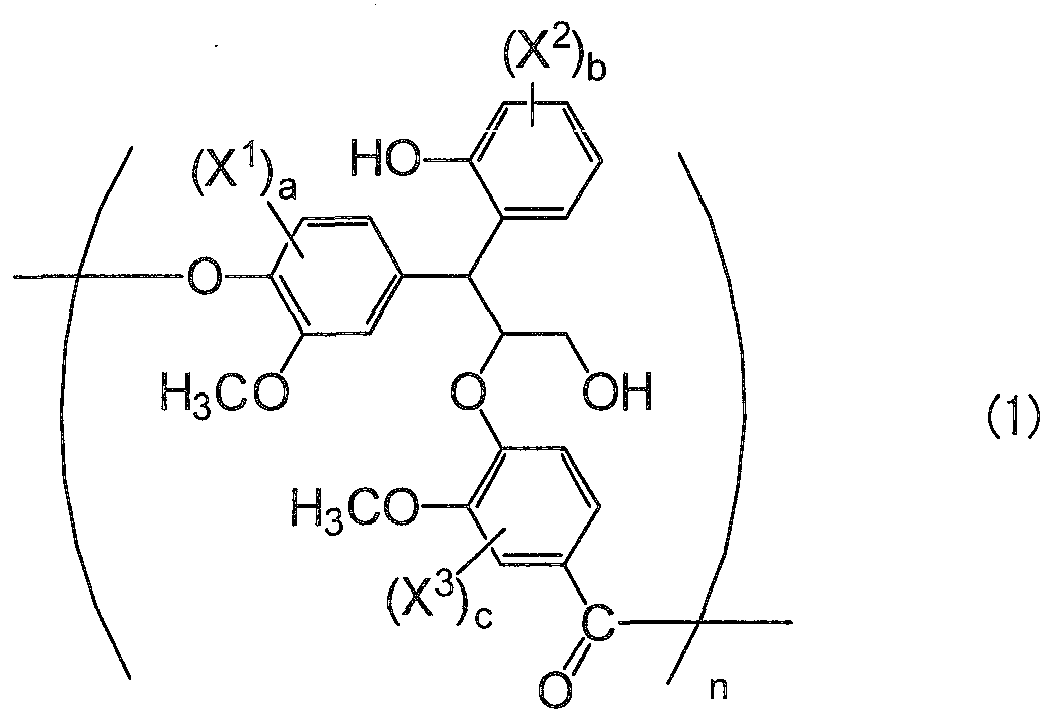
each of X1, X2 and X3 independently represents a substituted or unsubstituted alkyl group, a substituted or unsubstituted alkoxy group, a substituted or unsubstituted aryl group, a substituted or unsubstituted arylene group, a hydroxyl group, a carboxyl group, an amino group or an amide group,
each of a and c independently represents an integer of from 0 to 3, b represents an integer of from 0 to 4, and n represents an integer of from 5 to 20. - The resin composition according to any one of claims 1 to 4,
wherein the lignophenol derivative is represented by one selected from the group consisting of Formula (2), Formula (3) and Formula (4):


- The resin composition according to any one of claims 1 to 5,
wherein the lignophenol derivative has a ratio of a weight average molecular weight to a number average molecular weight of from 3 to 10. - The resin composition according to any one of claims 1 to 6,
wherein the condensed ester phosphate has an amount of from 5% by mass to 30% by mass based on a total amount of the resin composition. - The resin composition according to claim 3,
wherein the aluminum hydroxide has an amount of from 5% by mass to 30% by mass based on a total amount of the resin composition. - The resin composition according to claim 3 or 8,
wherein a mass ratio of the aluminum hydroxide and the condensed phosphate ester is from 6:1 1 to 1:1. - The resin composition according to any one of claims 1 to 9,
wherein a fiber length of the glass fiber is from 0.1 mm to 6 mm, and
a fiber diameter of the glass fiber is 5 µm to 20 µm. - The resin composition according to any one of claims 1 to 10,
wherein the glass fiber has an amount of from 7% by mass to 30% by mass based on a total amount of the resin composition. - A resin molded product comprising the resin composition according to any one of claims 1 to 11.
- The resin molded product according to claim 12,
wherein the condensed ester phosphate has an amount of from 1 part by mass to 30 parts by mass with respect to 100 parts by mass of the resin molded product.
Applications Claiming Priority (1)
| Application Number | Priority Date | Filing Date | Title |
|---|---|---|---|
| JP2012068291A JP5974574B2 (en) | 2012-03-23 | 2012-03-23 | Resin composition and resin molded body |
Publications (1)
| Publication Number | Publication Date |
|---|---|
| EP2641930A1 true EP2641930A1 (en) | 2013-09-25 |
Family
ID=47071151
Family Applications (1)
| Application Number | Title | Priority Date | Filing Date |
|---|---|---|---|
| EP12188426.6A Withdrawn EP2641930A1 (en) | 2012-03-23 | 2012-10-12 | Resin composition and resin molded product |
Country Status (5)
| Country | Link |
|---|---|
| US (1) | US8669308B2 (en) |
| EP (1) | EP2641930A1 (en) |
| JP (1) | JP5974574B2 (en) |
| KR (1) | KR101669090B1 (en) |
| CN (1) | CN103319859B (en) |
Cited By (1)
| Publication number | Priority date | Publication date | Assignee | Title |
|---|---|---|---|---|
| US9892830B2 (en) | 2013-11-13 | 2018-02-13 | Nippon Chemi-Con Corporation | Electronic component and production method therefor |
Families Citing this family (1)
| Publication number | Priority date | Publication date | Assignee | Title |
|---|---|---|---|---|
| JP6369168B2 (en) * | 2014-07-01 | 2018-08-08 | 富士電機株式会社 | Electrophotographic photoreceptor and image forming apparatus having the same |
Citations (4)
| Publication number | Priority date | Publication date | Assignee | Title |
|---|---|---|---|---|
| US20080051507A1 (en) * | 2006-08-23 | 2008-02-28 | Fuji Xerox Co., Ltd. | Resin composition, resin molding product, production method of resin molding product and recycling method of resin molding product |
| US20080048365A1 (en) * | 2006-08-23 | 2008-02-28 | Fuji Xerox Co., Ltd. | Resin composition, resin molding, package, production method of resin molding and recycling method of resin molding |
| JP2008274068A (en) | 2007-04-27 | 2008-11-13 | Osaka Univ | Lignophenol-polylactic acid complex |
| EP2371902A1 (en) * | 2008-12-25 | 2011-10-05 | Idemitsu Kosan Co., Ltd. | Polycarbonate resin composition |
Family Cites Families (8)
| Publication number | Priority date | Publication date | Assignee | Title |
|---|---|---|---|---|
| JP3971289B2 (en) * | 2002-11-25 | 2007-09-05 | 富士通株式会社 | Resin housing |
| US7790069B2 (en) * | 2003-12-19 | 2010-09-07 | Nec Corporation | Flame-retardant thermoplastic resin composition |
| JP4135760B2 (en) * | 2006-11-28 | 2008-08-20 | 富士ゼロックス株式会社 | Lignophenol derivative, polymer, resin composition and resin molding |
| CN101796136B (en) * | 2007-09-03 | 2012-09-26 | 尤尼吉可株式会社 | Resin composition and molded body using the same |
| KR20100098367A (en) * | 2007-12-20 | 2010-09-06 | 유니띠까 가부시키가이샤 | Thermoplastic resin composition and molded body obtained by molding the same |
| JP5435977B2 (en) * | 2008-04-08 | 2014-03-05 | 花王株式会社 | Polylactic acid resin composition |
| JP5467631B2 (en) * | 2009-03-12 | 2014-04-09 | 株式会社Adeka | Reinforced polyester resin composition |
| JP5732885B2 (en) * | 2011-02-10 | 2015-06-10 | 富士ゼロックス株式会社 | Compound, resin composition, and resin molded body |
-
2012
- 2012-03-23 JP JP2012068291A patent/JP5974574B2/en not_active Expired - Fee Related
- 2012-08-27 US US13/595,342 patent/US8669308B2/en not_active Expired - Fee Related
- 2012-10-12 EP EP12188426.6A patent/EP2641930A1/en not_active Withdrawn
- 2012-10-16 KR KR1020120114546A patent/KR101669090B1/en active Active
- 2012-10-16 CN CN201210392609.9A patent/CN103319859B/en active Active
Patent Citations (4)
| Publication number | Priority date | Publication date | Assignee | Title |
|---|---|---|---|---|
| US20080051507A1 (en) * | 2006-08-23 | 2008-02-28 | Fuji Xerox Co., Ltd. | Resin composition, resin molding product, production method of resin molding product and recycling method of resin molding product |
| US20080048365A1 (en) * | 2006-08-23 | 2008-02-28 | Fuji Xerox Co., Ltd. | Resin composition, resin molding, package, production method of resin molding and recycling method of resin molding |
| JP2008274068A (en) | 2007-04-27 | 2008-11-13 | Osaka Univ | Lignophenol-polylactic acid complex |
| EP2371902A1 (en) * | 2008-12-25 | 2011-10-05 | Idemitsu Kosan Co., Ltd. | Polycarbonate resin composition |
Cited By (1)
| Publication number | Priority date | Publication date | Assignee | Title |
|---|---|---|---|---|
| US9892830B2 (en) | 2013-11-13 | 2018-02-13 | Nippon Chemi-Con Corporation | Electronic component and production method therefor |
Also Published As
| Publication number | Publication date |
|---|---|
| KR101669090B1 (en) | 2016-10-25 |
| US20130253108A1 (en) | 2013-09-26 |
| JP5974574B2 (en) | 2016-08-23 |
| CN103319859B (en) | 2016-12-21 |
| KR20130108047A (en) | 2013-10-02 |
| CN103319859A (en) | 2013-09-25 |
| US8669308B2 (en) | 2014-03-11 |
| JP2013199571A (en) | 2013-10-03 |
Similar Documents
| Publication | Publication Date | Title |
|---|---|---|
| EP1927616B1 (en) | Lignophenol derivative, polymer, resin composition and molded resin | |
| CN102898686B (en) | Resin combination and synthetic resin | |
| EP2294140B1 (en) | Fire retardant resin composition | |
| KR101577381B1 (en) | Resin composition and resin molded article | |
| WO2007037450A9 (en) | Flame-retardant polybutylene terephthalate resin composition | |
| CN101544809A (en) | Resin composition and resin molded article | |
| JP2016106170A (en) | Resin composition and resin molded article | |
| KR20170039749A (en) | Flame retardant blended polycarbonate compositions with improved surface appearance | |
| JP5045030B2 (en) | RESIN COMPOSITION, RESIN MOLDED BODY AND CASE, AND METHOD FOR MANUFACTURING AND RECYCLING METHOD OF RESIN MOLDED BODY | |
| US8563633B2 (en) | Lignophenol derivative, resin composition, and resin molded article | |
| CN103044870B (en) | Resin combination and resin-formed body | |
| EP2639254A1 (en) | Crosslinked polymer compound, resin composition and resin molded product | |
| CN103013148B (en) | Material, its manufacture method and molded body containing wood powder | |
| US8669308B2 (en) | Resin composition and resin molded product | |
| EP3208311A1 (en) | Polymer resin composition | |
| JP5644363B2 (en) | Resin composition and resin molded body | |
| JP2008208335A (en) | Resin composition, resin molded body and method for producing the same | |
| CN102295763B (en) | Poly lactic acid resin, resin composition, and resin molding | |
| CN102633645B (en) | Compound, resin composition, and resin molded article | |
| US7893137B2 (en) | Resin composition and molded article |
Legal Events
| Date | Code | Title | Description |
|---|---|---|---|
| PUAI | Public reference made under article 153(3) epc to a published international application that has entered the european phase |
Free format text: ORIGINAL CODE: 0009012 |
|
| AK | Designated contracting states |
Kind code of ref document: A1 Designated state(s): AL AT BE BG CH CY CZ DE DK EE ES FI FR GB GR HR HU IE IS IT LI LT LU LV MC MK MT NL NO PL PT RO RS SE SI SK SM TR |
|
| AX | Request for extension of the european patent |
Extension state: BA ME |
|
| STAA | Information on the status of an ep patent application or granted ep patent |
Free format text: STATUS: THE APPLICATION IS DEEMED TO BE WITHDRAWN |
|
| 18D | Application deemed to be withdrawn |
Effective date: 20140326 |