EP2639240A2 - Peptides able to impair the inhibiting activity of MDM2/MDM4 heterodimer towards p53 and use thereof for cancer treatment - Google Patents
Peptides able to impair the inhibiting activity of MDM2/MDM4 heterodimer towards p53 and use thereof for cancer treatment Download PDFInfo
- Publication number
- EP2639240A2 EP2639240A2 EP13155985.8A EP13155985A EP2639240A2 EP 2639240 A2 EP2639240 A2 EP 2639240A2 EP 13155985 A EP13155985 A EP 13155985A EP 2639240 A2 EP2639240 A2 EP 2639240A2
- Authority
- EP
- European Patent Office
- Prior art keywords
- seq
- mdm4
- mdm2
- peptide
- amino acid
- Prior art date
- Legal status (The legal status is an assumption and is not a legal conclusion. Google has not performed a legal analysis and makes no representation as to the accuracy of the status listed.)
- Granted
Links
- 102000012199 E3 ubiquitin-protein ligase Mdm2 Human genes 0.000 title claims abstract description 146
- 108050002772 E3 ubiquitin-protein ligase Mdm2 Proteins 0.000 title claims abstract description 145
- 108090000765 processed proteins & peptides Proteins 0.000 title claims abstract description 136
- 102000004196 processed proteins & peptides Human genes 0.000 title claims abstract description 59
- 206010028980 Neoplasm Diseases 0.000 title claims abstract description 23
- 102000017274 MDM4 Human genes 0.000 title claims abstract 22
- 108050005300 MDM4 Proteins 0.000 title claims abstract 22
- 238000011282 treatment Methods 0.000 title claims description 6
- 239000000833 heterodimer Substances 0.000 title abstract description 15
- 201000011510 cancer Diseases 0.000 title abstract description 10
- 230000002401 inhibitory effect Effects 0.000 title abstract description 10
- 150000001413 amino acids Chemical class 0.000 claims description 69
- 229940024606 amino acid Drugs 0.000 claims description 68
- 235000001014 amino acid Nutrition 0.000 claims description 68
- 230000003993 interaction Effects 0.000 claims description 35
- 229960000310 isoleucine Drugs 0.000 claims description 12
- AGPKZVBTJJNPAG-UHFFFAOYSA-N isoleucine Natural products CCC(C)C(N)C(O)=O AGPKZVBTJJNPAG-UHFFFAOYSA-N 0.000 claims description 12
- ROHFNLRQFUQHCH-UHFFFAOYSA-N Leucine Natural products CC(C)CC(N)C(O)=O ROHFNLRQFUQHCH-UHFFFAOYSA-N 0.000 claims description 11
- 239000013598 vector Substances 0.000 claims description 11
- ROHFNLRQFUQHCH-YFKPBYRVSA-N L-leucine Chemical compound CC(C)C[C@H](N)C(O)=O ROHFNLRQFUQHCH-YFKPBYRVSA-N 0.000 claims description 10
- COLNVLDHVKWLRT-QMMMGPOBSA-N L-phenylalanine Chemical compound OC(=O)[C@@H](N)CC1=CC=CC=C1 COLNVLDHVKWLRT-QMMMGPOBSA-N 0.000 claims description 10
- 239000002773 nucleotide Substances 0.000 claims description 10
- 125000003729 nucleotide group Chemical group 0.000 claims description 10
- COLNVLDHVKWLRT-UHFFFAOYSA-N phenylalanine Natural products OC(=O)C(N)CC1=CC=CC=C1 COLNVLDHVKWLRT-UHFFFAOYSA-N 0.000 claims description 10
- AGPKZVBTJJNPAG-WHFBIAKZSA-N L-isoleucine Chemical compound CC[C@H](C)[C@H](N)C(O)=O AGPKZVBTJJNPAG-WHFBIAKZSA-N 0.000 claims description 9
- 150000001875 compounds Chemical class 0.000 claims description 8
- 125000000524 functional group Chemical group 0.000 claims description 8
- QNAYBMKLOCPYGJ-REOHCLBHSA-N L-alanine Chemical compound C[C@H](N)C(O)=O QNAYBMKLOCPYGJ-REOHCLBHSA-N 0.000 claims description 6
- 235000004279 alanine Nutrition 0.000 claims description 6
- 239000008194 pharmaceutical composition Substances 0.000 claims description 6
- 239000013604 expression vector Substances 0.000 claims description 5
- UFHFLCQGNIYNRP-UHFFFAOYSA-N Hydrogen Chemical compound [H][H] UFHFLCQGNIYNRP-UHFFFAOYSA-N 0.000 claims description 4
- 229910052739 hydrogen Inorganic materials 0.000 claims description 4
- 239000001257 hydrogen Substances 0.000 claims description 4
- 125000002887 hydroxy group Chemical group [H]O* 0.000 claims description 4
- 125000002924 primary amino group Chemical group [H]N([H])* 0.000 claims description 4
- 239000004480 active ingredient Substances 0.000 claims description 2
- 239000002671 adjuvant Substances 0.000 claims description 2
- 230000003463 hyperproliferative effect Effects 0.000 claims description 2
- 239000000546 pharmaceutical excipient Substances 0.000 claims description 2
- 238000012216 screening Methods 0.000 claims description 2
- 208000011580 syndromic disease Diseases 0.000 claims description 2
- 102100025064 Cellular tumor antigen p53 Human genes 0.000 abstract description 85
- 101000721661 Homo sapiens Cellular tumor antigen p53 Proteins 0.000 abstract description 85
- 230000001640 apoptogenic effect Effects 0.000 abstract description 9
- 230000002985 oncosuppressive effect Effects 0.000 abstract description 3
- 210000004027 cell Anatomy 0.000 description 49
- 108090000623 proteins and genes Proteins 0.000 description 25
- 102000004169 proteins and genes Human genes 0.000 description 24
- 235000018102 proteins Nutrition 0.000 description 23
- 230000027455 binding Effects 0.000 description 22
- 230000006907 apoptotic process Effects 0.000 description 15
- 230000000694 effects Effects 0.000 description 14
- 230000030833 cell death Effects 0.000 description 12
- 238000010494 dissociation reaction Methods 0.000 description 12
- 230000005593 dissociations Effects 0.000 description 12
- 238000004458 analytical method Methods 0.000 description 10
- 238000001114 immunoprecipitation Methods 0.000 description 10
- 238000001262 western blot Methods 0.000 description 10
- OBMZMSLWNNWEJA-XNCRXQDQSA-N C1=CC=2C(C[C@@H]3NC(=O)[C@@H](NC(=O)[C@H](NC(=O)N(CC#CCN(CCCC[C@H](NC(=O)[C@@H](CC4=CC=CC=C4)NC3=O)C(=O)N)CC=C)NC(=O)[C@@H](N)C)CC3=CNC4=C3C=CC=C4)C)=CNC=2C=C1 Chemical compound C1=CC=2C(C[C@@H]3NC(=O)[C@@H](NC(=O)[C@H](NC(=O)N(CC#CCN(CCCC[C@H](NC(=O)[C@@H](CC4=CC=CC=C4)NC3=O)C(=O)N)CC=C)NC(=O)[C@@H](N)C)CC3=CNC4=C3C=CC=C4)C)=CNC=2C=C1 OBMZMSLWNNWEJA-XNCRXQDQSA-N 0.000 description 9
- 101710176384 Peptide 1 Proteins 0.000 description 9
- 238000000034 method Methods 0.000 description 9
- 230000000861 pro-apoptotic effect Effects 0.000 description 9
- 230000014509 gene expression Effects 0.000 description 7
- QKNYBSVHEMOAJP-UHFFFAOYSA-N 2-amino-2-(hydroxymethyl)propane-1,3-diol;hydron;chloride Chemical compound Cl.OCC(N)(CO)CO QKNYBSVHEMOAJP-UHFFFAOYSA-N 0.000 description 6
- PEDCQBHIVMGVHV-UHFFFAOYSA-N Glycerine Chemical compound OCC(O)CO PEDCQBHIVMGVHV-UHFFFAOYSA-N 0.000 description 6
- FAPWRFPIFSIZLT-UHFFFAOYSA-M Sodium chloride Chemical compound [Na+].[Cl-] FAPWRFPIFSIZLT-UHFFFAOYSA-M 0.000 description 6
- 230000015556 catabolic process Effects 0.000 description 6
- 238000006731 degradation reaction Methods 0.000 description 6
- 230000001404 mediated effect Effects 0.000 description 6
- 230000004044 response Effects 0.000 description 6
- 238000004088 simulation Methods 0.000 description 6
- 238000002474 experimental method Methods 0.000 description 5
- MHMNJMPURVTYEJ-UHFFFAOYSA-N fluorescein-5-isothiocyanate Chemical compound O1C(=O)C2=CC(N=C=S)=CC=C2C21C1=CC=C(O)C=C1OC1=CC(O)=CC=C21 MHMNJMPURVTYEJ-UHFFFAOYSA-N 0.000 description 5
- 238000000338 in vitro Methods 0.000 description 5
- DHMQDGOQFOQNFH-UHFFFAOYSA-N Glycine Chemical compound NCC(O)=O DHMQDGOQFOQNFH-UHFFFAOYSA-N 0.000 description 4
- 238000003556 assay Methods 0.000 description 4
- 239000000872 buffer Substances 0.000 description 4
- 239000013592 cell lysate Substances 0.000 description 4
- 239000000284 extract Substances 0.000 description 4
- 238000001727 in vivo Methods 0.000 description 4
- 238000003780 insertion Methods 0.000 description 4
- 230000037431 insertion Effects 0.000 description 4
- 239000006166 lysate Substances 0.000 description 4
- 238000002703 mutagenesis Methods 0.000 description 4
- 231100000350 mutagenesis Toxicity 0.000 description 4
- 230000002018 overexpression Effects 0.000 description 4
- XJMOSONTPMZWPB-UHFFFAOYSA-M propidium iodide Chemical compound [I-].[I-].C12=CC(N)=CC=C2C2=CC=C(N)C=C2[N+](CCC[N+](C)(CC)CC)=C1C1=CC=CC=C1 XJMOSONTPMZWPB-UHFFFAOYSA-M 0.000 description 4
- DGVVWUTYPXICAM-UHFFFAOYSA-N β‐Mercaptoethanol Chemical compound OCCS DGVVWUTYPXICAM-UHFFFAOYSA-N 0.000 description 4
- 108020004414 DNA Proteins 0.000 description 3
- 230000005778 DNA damage Effects 0.000 description 3
- 231100000277 DNA damage Toxicity 0.000 description 3
- 101150007128 MDM4 gene Proteins 0.000 description 3
- OKKJLVBELUTLKV-UHFFFAOYSA-N Methanol Chemical compound OC OKKJLVBELUTLKV-UHFFFAOYSA-N 0.000 description 3
- 241001529936 Murinae Species 0.000 description 3
- 230000004913 activation Effects 0.000 description 3
- 125000003118 aryl group Chemical group 0.000 description 3
- 230000004071 biological effect Effects 0.000 description 3
- 230000001413 cellular effect Effects 0.000 description 3
- 230000034994 death Effects 0.000 description 3
- 238000001514 detection method Methods 0.000 description 3
- 239000000539 dimer Substances 0.000 description 3
- 210000002950 fibroblast Anatomy 0.000 description 3
- 230000012010 growth Effects 0.000 description 3
- 230000002209 hydrophobic effect Effects 0.000 description 3
- 230000005764 inhibitory process Effects 0.000 description 3
- 239000012160 loading buffer Substances 0.000 description 3
- 238000000329 molecular dynamics simulation Methods 0.000 description 3
- 230000035772 mutation Effects 0.000 description 3
- 238000011275 oncology therapy Methods 0.000 description 3
- 239000011780 sodium chloride Substances 0.000 description 3
- 239000000243 solution Substances 0.000 description 3
- 230000008685 targeting Effects 0.000 description 3
- 238000012546 transfer Methods 0.000 description 3
- 238000003146 transient transfection Methods 0.000 description 3
- AVWQQPYHYQKEIZ-UHFFFAOYSA-K trisodium;2-dodecylbenzenesulfonate;3-dodecylbenzenesulfonate;4-dodecylbenzenesulfonate Chemical compound [Na+].[Na+].[Na+].CCCCCCCCCCCCC1=CC=C(S([O-])(=O)=O)C=C1.CCCCCCCCCCCCC1=CC=CC(S([O-])(=O)=O)=C1.CCCCCCCCCCCCC1=CC=CC=C1S([O-])(=O)=O AVWQQPYHYQKEIZ-UHFFFAOYSA-K 0.000 description 3
- 230000034512 ubiquitination Effects 0.000 description 3
- 238000010798 ubiquitination Methods 0.000 description 3
- RZVAJINKPMORJF-UHFFFAOYSA-N Acetaminophen Chemical compound CC(=O)NC1=CC=C(O)C=C1 RZVAJINKPMORJF-UHFFFAOYSA-N 0.000 description 2
- 101100421200 Caenorhabditis elegans sep-1 gene Proteins 0.000 description 2
- OKTJSMMVPCPJKN-UHFFFAOYSA-N Carbon Chemical compound [C] OKTJSMMVPCPJKN-UHFFFAOYSA-N 0.000 description 2
- 239000004215 Carbon black (E152) Substances 0.000 description 2
- 206010009944 Colon cancer Diseases 0.000 description 2
- 108020004635 Complementary DNA Proteins 0.000 description 2
- KCXVZYZYPLLWCC-UHFFFAOYSA-N EDTA Chemical compound OC(=O)CN(CC(O)=O)CCN(CC(O)=O)CC(O)=O KCXVZYZYPLLWCC-UHFFFAOYSA-N 0.000 description 2
- 239000004471 Glycine Substances 0.000 description 2
- 102100032827 Homeodomain-interacting protein kinase 2 Human genes 0.000 description 2
- 101001066401 Homo sapiens Homeodomain-interacting protein kinase 2 Proteins 0.000 description 2
- 108090000144 Human Proteins Proteins 0.000 description 2
- 102000003839 Human Proteins Human genes 0.000 description 2
- 108700020796 Oncogene Proteins 0.000 description 2
- 101710120037 Toxin CcdB Proteins 0.000 description 2
- GLNADSQYFUSGOU-GPTZEZBUSA-J Trypan blue Chemical compound [Na+].[Na+].[Na+].[Na+].C1=C(S([O-])(=O)=O)C=C2C=C(S([O-])(=O)=O)C(/N=N/C3=CC=C(C=C3C)C=3C=C(C(=CC=3)\N=N\C=3C(=CC4=CC(=CC(N)=C4C=3O)S([O-])(=O)=O)S([O-])(=O)=O)C)=C(O)C2=C1N GLNADSQYFUSGOU-GPTZEZBUSA-J 0.000 description 2
- 125000000539 amino acid group Chemical group 0.000 description 2
- 230000005735 apoptotic response Effects 0.000 description 2
- 230000015572 biosynthetic process Effects 0.000 description 2
- UDSAIICHUKSCKT-UHFFFAOYSA-N bromophenol blue Chemical compound C1=C(Br)C(O)=C(Br)C=C1C1(C=2C=C(Br)C(O)=C(Br)C=2)C2=CC=CC=C2S(=O)(=O)O1 UDSAIICHUKSCKT-UHFFFAOYSA-N 0.000 description 2
- 229910052799 carbon Inorganic materials 0.000 description 2
- 239000003795 chemical substances by application Substances 0.000 description 2
- 231100000673 dose–response relationship Toxicity 0.000 description 2
- 125000000487 histidyl group Chemical group [H]N([H])C(C(=O)O*)C([H])([H])C1=C([H])N([H])C([H])=N1 0.000 description 2
- 229930195733 hydrocarbon Natural products 0.000 description 2
- 230000002779 inactivation Effects 0.000 description 2
- 230000006698 induction Effects 0.000 description 2
- 230000001939 inductive effect Effects 0.000 description 2
- 239000002502 liposome Substances 0.000 description 2
- 238000011068 loading method Methods 0.000 description 2
- 239000000203 mixture Substances 0.000 description 2
- 210000004897 n-terminal region Anatomy 0.000 description 2
- 239000013612 plasmid Substances 0.000 description 2
- 238000002360 preparation method Methods 0.000 description 2
- 230000002062 proliferating effect Effects 0.000 description 2
- 230000009870 specific binding Effects 0.000 description 2
- 230000006641 stabilisation Effects 0.000 description 2
- 238000011105 stabilization Methods 0.000 description 2
- 238000003756 stirring Methods 0.000 description 2
- 230000001225 therapeutic effect Effects 0.000 description 2
- 238000001890 transfection Methods 0.000 description 2
- FWMNVWWHGCHHJJ-SKKKGAJSSA-N 4-amino-1-[(2r)-6-amino-2-[[(2r)-2-[[(2r)-2-[[(2r)-2-amino-3-phenylpropanoyl]amino]-3-phenylpropanoyl]amino]-4-methylpentanoyl]amino]hexanoyl]piperidine-4-carboxylic acid Chemical compound C([C@H](C(=O)N[C@H](CC(C)C)C(=O)N[C@H](CCCCN)C(=O)N1CCC(N)(CC1)C(O)=O)NC(=O)[C@H](N)CC=1C=CC=CC=1)C1=CC=CC=C1 FWMNVWWHGCHHJJ-SKKKGAJSSA-N 0.000 description 1
- RTUZVPPGTJRELI-UHFFFAOYSA-N 5-amino-2-(4-amino-3-fluorophenyl)-6,8-difluoro-7-methylchromen-4-one Chemical compound FC=1C(C)=C(F)C(N)=C(C(C=2)=O)C=1OC=2C1=CC=C(N)C(F)=C1 RTUZVPPGTJRELI-UHFFFAOYSA-N 0.000 description 1
- HRPVXLWXLXDGHG-UHFFFAOYSA-N Acrylamide Chemical compound NC(=O)C=C HRPVXLWXLXDGHG-UHFFFAOYSA-N 0.000 description 1
- 108010032595 Antibody Binding Sites Proteins 0.000 description 1
- 102100021569 Apoptosis regulator Bcl-2 Human genes 0.000 description 1
- DCXYFEDJOCDNAF-UHFFFAOYSA-N Asparagine Natural products OC(=O)C(N)CC(N)=O DCXYFEDJOCDNAF-UHFFFAOYSA-N 0.000 description 1
- 108091012583 BCL2 Proteins 0.000 description 1
- 125000001433 C-terminal amino-acid group Chemical group 0.000 description 1
- 101100165942 Caenorhabditis elegans clp-1 gene Proteins 0.000 description 1
- 101001015963 Homo sapiens E3 ubiquitin-protein ligase Mdm2 Proteins 0.000 description 1
- 101000980354 Homo sapiens Protein Mdm4 Proteins 0.000 description 1
- DCXYFEDJOCDNAF-REOHCLBHSA-N L-asparagine Chemical compound OC(=O)[C@@H](N)CC(N)=O DCXYFEDJOCDNAF-REOHCLBHSA-N 0.000 description 1
- CKLJMWTZIZZHCS-REOHCLBHSA-N L-aspartic acid Chemical compound OC(=O)[C@@H](N)CC(O)=O CKLJMWTZIZZHCS-REOHCLBHSA-N 0.000 description 1
- WHUUTDBJXJRKMK-VKHMYHEASA-N L-glutamic acid Chemical compound OC(=O)[C@@H](N)CCC(O)=O WHUUTDBJXJRKMK-VKHMYHEASA-N 0.000 description 1
- ZDXPYRJPNDTMRX-VKHMYHEASA-N L-glutamine Chemical compound OC(=O)[C@@H](N)CCC(N)=O ZDXPYRJPNDTMRX-VKHMYHEASA-N 0.000 description 1
- 239000012097 Lipofectamine 2000 Substances 0.000 description 1
- -1 MDM4 or MDM4C437G Proteins 0.000 description 1
- 125000000729 N-terminal amino-acid group Chemical group 0.000 description 1
- 238000012408 PCR amplification Methods 0.000 description 1
- 239000002033 PVDF binder Substances 0.000 description 1
- 108091005804 Peptidases Proteins 0.000 description 1
- 102000003992 Peroxidases Human genes 0.000 description 1
- 229920001213 Polysorbate 20 Polymers 0.000 description 1
- 239000004365 Protease Substances 0.000 description 1
- 102100037486 Reverse transcriptase/ribonuclease H Human genes 0.000 description 1
- 238000012288 TUNEL assay Methods 0.000 description 1
- 239000007983 Tris buffer Substances 0.000 description 1
- 229920004890 Triton X-100 Polymers 0.000 description 1
- 125000002777 acetyl group Chemical group [H]C([H])([H])C(*)=O 0.000 description 1
- 125000003368 amide group Chemical group 0.000 description 1
- 230000000692 anti-sense effect Effects 0.000 description 1
- 230000000259 anti-tumor effect Effects 0.000 description 1
- 238000011319 anticancer therapy Methods 0.000 description 1
- 239000002246 antineoplastic agent Substances 0.000 description 1
- 230000005775 apoptotic pathway Effects 0.000 description 1
- 238000013459 approach Methods 0.000 description 1
- 239000003125 aqueous solvent Substances 0.000 description 1
- 229960001230 asparagine Drugs 0.000 description 1
- 235000009582 asparagine Nutrition 0.000 description 1
- 229940009098 aspartate Drugs 0.000 description 1
- 238000000376 autoradiography Methods 0.000 description 1
- 230000033228 biological regulation Effects 0.000 description 1
- 230000008512 biological response Effects 0.000 description 1
- 238000004364 calculation method Methods 0.000 description 1
- 239000006143 cell culture medium Substances 0.000 description 1
- 230000025084 cell cycle arrest Effects 0.000 description 1
- 230000010261 cell growth Effects 0.000 description 1
- 230000004700 cellular uptake Effects 0.000 description 1
- 238000007385 chemical modification Methods 0.000 description 1
- 238000006243 chemical reaction Methods 0.000 description 1
- 239000003153 chemical reaction reagent Substances 0.000 description 1
- 230000004186 co-expression Effects 0.000 description 1
- 230000001427 coherent effect Effects 0.000 description 1
- 238000010205 computational analysis Methods 0.000 description 1
- 238000004624 confocal microscopy Methods 0.000 description 1
- 230000021615 conjugation Effects 0.000 description 1
- 230000001276 controlling effect Effects 0.000 description 1
- 125000000151 cysteine group Chemical group N[C@@H](CS)C(=O)* 0.000 description 1
- 230000009089 cytolysis Effects 0.000 description 1
- 230000007423 decrease Effects 0.000 description 1
- 230000003413 degradative effect Effects 0.000 description 1
- 230000001934 delay Effects 0.000 description 1
- 230000001419 dependent effect Effects 0.000 description 1
- 230000003831 deregulation Effects 0.000 description 1
- 238000013461 design Methods 0.000 description 1
- 238000011161 development Methods 0.000 description 1
- 238000009510 drug design Methods 0.000 description 1
- 230000005684 electric field Effects 0.000 description 1
- 238000001962 electrophoresis Methods 0.000 description 1
- 238000000799 fluorescence microscopy Methods 0.000 description 1
- 230000009454 functional inhibition Effects 0.000 description 1
- 238000001415 gene therapy Methods 0.000 description 1
- 230000002068 genetic effect Effects 0.000 description 1
- 231100000024 genotoxic Toxicity 0.000 description 1
- 230000001738 genotoxic effect Effects 0.000 description 1
- 229930195712 glutamate Natural products 0.000 description 1
- ZDXPYRJPNDTMRX-UHFFFAOYSA-N glutamine Natural products OC(=O)C(N)CCC(N)=O ZDXPYRJPNDTMRX-UHFFFAOYSA-N 0.000 description 1
- 238000013537 high throughput screening Methods 0.000 description 1
- 102000056819 human MDM4 Human genes 0.000 description 1
- 239000012133 immunoprecipitate Substances 0.000 description 1
- 238000011534 incubation Methods 0.000 description 1
- 239000003112 inhibitor Substances 0.000 description 1
- 238000001990 intravenous administration Methods 0.000 description 1
- 230000034727 intrinsic apoptotic signaling pathway Effects 0.000 description 1
- 125000000741 isoleucyl group Chemical group [H]N([H])C(C(C([H])([H])[H])C([H])([H])C([H])([H])[H])C(=O)O* 0.000 description 1
- 230000003902 lesion Effects 0.000 description 1
- 125000001909 leucine group Chemical group [H]N(*)C(C(*)=O)C([H])([H])C(C([H])([H])[H])C([H])([H])[H] 0.000 description 1
- 150000002632 lipids Chemical class 0.000 description 1
- HWYHZTIRURJOHG-UHFFFAOYSA-N luminol Chemical compound O=C1NNC(=O)C2=C1C(N)=CC=C2 HWYHZTIRURJOHG-UHFFFAOYSA-N 0.000 description 1
- 230000014759 maintenance of location Effects 0.000 description 1
- 239000000463 material Substances 0.000 description 1
- 230000007246 mechanism Effects 0.000 description 1
- 230000002438 mitochondrial effect Effects 0.000 description 1
- 230000004048 modification Effects 0.000 description 1
- 238000012986 modification Methods 0.000 description 1
- ZIUHHBKFKCYYJD-UHFFFAOYSA-N n,n'-methylenebisacrylamide Chemical compound C=CC(=O)NCNC(=O)C=C ZIUHHBKFKCYYJD-UHFFFAOYSA-N 0.000 description 1
- 239000002105 nanoparticle Substances 0.000 description 1
- 230000003647 oxidation Effects 0.000 description 1
- 238000007254 oxidation reaction Methods 0.000 description 1
- 102000041788 p53 family Human genes 0.000 description 1
- 108091075611 p53 family Proteins 0.000 description 1
- 229940118537 p53 inhibitor Drugs 0.000 description 1
- 230000007170 pathology Effects 0.000 description 1
- 230000037361 pathway Effects 0.000 description 1
- 108040007629 peroxidase activity proteins Proteins 0.000 description 1
- 230000026731 phosphorylation Effects 0.000 description 1
- 238000006366 phosphorylation reaction Methods 0.000 description 1
- 238000002264 polyacrylamide gel electrophoresis Methods 0.000 description 1
- 239000000256 polyoxyethylene sorbitan monolaurate Substances 0.000 description 1
- 235000010486 polyoxyethylene sorbitan monolaurate Nutrition 0.000 description 1
- 229920002981 polyvinylidene fluoride Polymers 0.000 description 1
- 229940124606 potential therapeutic agent Drugs 0.000 description 1
- 230000003389 potentiating effect Effects 0.000 description 1
- 239000000843 powder Substances 0.000 description 1
- 239000002244 precipitate Substances 0.000 description 1
- 239000000047 product Substances 0.000 description 1
- 239000003531 protein hydrolysate Substances 0.000 description 1
- 230000007420 reactivation Effects 0.000 description 1
- 230000001105 regulatory effect Effects 0.000 description 1
- 230000008684 selective degradation Effects 0.000 description 1
- 235000020183 skimmed milk Nutrition 0.000 description 1
- 150000003384 small molecules Chemical class 0.000 description 1
- 125000006850 spacer group Chemical group 0.000 description 1
- 238000010186 staining Methods 0.000 description 1
- 238000006467 substitution reaction Methods 0.000 description 1
- 239000000758 substrate Substances 0.000 description 1
- 239000006228 supernatant Substances 0.000 description 1
- 238000002560 therapeutic procedure Methods 0.000 description 1
- 230000002103 transcriptional effect Effects 0.000 description 1
- 238000011830 transgenic mouse model Methods 0.000 description 1
- 230000007704 transition Effects 0.000 description 1
- LENZDBCJOHFCAS-UHFFFAOYSA-N tris Chemical compound OCC(N)(CO)CO LENZDBCJOHFCAS-UHFFFAOYSA-N 0.000 description 1
- 230000003827 upregulation Effects 0.000 description 1
- 238000005406 washing Methods 0.000 description 1
- 230000003313 weakening effect Effects 0.000 description 1
Images



Classifications
-
- C—CHEMISTRY; METALLURGY
- C07—ORGANIC CHEMISTRY
- C07K—PEPTIDES
- C07K7/00—Peptides having 5 to 20 amino acids in a fully defined sequence; Derivatives thereof
- C07K7/04—Linear peptides containing only normal peptide links
- C07K7/08—Linear peptides containing only normal peptide links having 12 to 20 amino acids
-
- C—CHEMISTRY; METALLURGY
- C07—ORGANIC CHEMISTRY
- C07K—PEPTIDES
- C07K14/00—Peptides having more than 20 amino acids; Gastrins; Somatostatins; Melanotropins; Derivatives thereof
- C07K14/435—Peptides having more than 20 amino acids; Gastrins; Somatostatins; Melanotropins; Derivatives thereof from animals; from humans
- C07K14/46—Peptides having more than 20 amino acids; Gastrins; Somatostatins; Melanotropins; Derivatives thereof from animals; from humans from vertebrates
- C07K14/47—Peptides having more than 20 amino acids; Gastrins; Somatostatins; Melanotropins; Derivatives thereof from animals; from humans from vertebrates from mammals
-
- A—HUMAN NECESSITIES
- A61—MEDICAL OR VETERINARY SCIENCE; HYGIENE
- A61K—PREPARATIONS FOR MEDICAL, DENTAL OR TOILETRY PURPOSES
- A61K38/00—Medicinal preparations containing peptides
Definitions
- the present invention concerns peptides able to impair the inhibiting activity of MDM2/MDM4 heterodimer towards p53 and their use for cancer treatment.
- the invention concerns peptides able to inhibit MDM2/MDM4 heterodimer and maintain the association between MDM4 and p53 so to restore the p53 oncosuppressive function in cancer cells harboring wild type p53 protein, directing its function specifically towards an apoptotic outcome.
- Inactivation of the oncosuppressor p53 by means of direct mutation of its gene is one of first genetic lesions recognized in human tumors (about 50% of human tumors).
- studies have evidenced alternative methods for p53 inactivation by deregulation of its partners, MDM4 and MDM2.
- MDM4 and MDM2 The latter ones are two crucial regulators of the oncosuppressor p53. These two proteins carry out mainly inhibiting activity towards p53 by controlling both protein levels and transcriptional function.
- WO 2008 106507 WO 2011 05219 patent applications are known and concern peptides inhibiting the interaction of p53 with MDM2 and MDM4, i.e. peptides aiming to break p53 binding with MDM4 and MDM2.
- WO201105219 patent application the dissociation of p53 from MDM2 and MDM4 results in a biological response consisting both of proliferative arrest and cell death, although it is not specified whether the observed cell death is due to apoptosis.
- WO2008106507 describes peptides able to bind with high affinity MDM2 and therefore, probably, inhibit the binding of MDM2 with all the members of the p53 family; however, such statement has not been experimentally proved. It is predicted, by computational analysis, that such peptides may bind MDM4 and therefore dissociate the same from p53. In vitro or in vivo experimental data have not been provided for a possible biological activity of these peptides. Therefore it is not predictable their effectiveness.
- WO200061193 patent application describes antisense compounds inhibiting MDM4 expression. Also in this case the importance of MDM4-p53 complex has not been taken into consideration for apoptosis induction.
- MDM2 and MDM4 p53 regulators as targets in anticancer therapy.
- p53 regulators as targets in anticancer therapy.
- Known methods aiming to inhibit the interaction of p53 with MDM2 and/or MDM4, cause therefore activation of p53 not only towards apoptosis, as it would be preferred, but also towards proliferative arrest.
- the release of MDM2 from association with p53 results in higher degradative activity of MDM2 towards MDM4 and other proapoptotic molecules (as demonstrated by several recent papers).
- MDM4/MDM2 heterodimer is the functional inhibitor of p53.
- This data suggest that agents aiming to inhibit MDM4/MDM2 heterodimer could represent new potential therapeutic agents.
- recent data suggest different activities of MDM2 and MDM4 under stress conditions. Under these conditions a weakening of association and degradation activity of MDM2 towards p53 mainly occurs (Marchenko ET to, 2007).
- MDM2 level increase and this results in degradation of MDM4 and some pro-apoptotic factors as HIPK2 ( Rinaldo C, Prodosmo A, Mancini F, Iacovelli S, Sacchi A, Moretti F, Soddu S. MDM2-regulated degradation of HIPK2 prevents p53Ser46 phosphorylation and DNA damage-induced apoptosis. Mol Cell. 2007 Mar 9;25(5):739-50 ).
- MDM4 stabilizes p53, preventing the MDM2-mediated degradation, and promotes p53 mediated apoptosis under stress conditions ( Jackson MW, Berberich SJ. MdmX protects p53 from Mdm2-mediated degradation.
- MDM2/MDM4 heterodimer inhibits p53 function
- heterodimer dissociation has not been assumed a current suitable strategy in order to favor p53 apoptotic activity. This due to the fact that MDM2 release, i.e. the main p53 inhibitor, could however carry out inhibiting function against p53. For this reason, current strategies are directed to the dissociation of p53 from MDM2 and MDM4 and not to hetorodimer dissociation.
- MDM4 Mitochondrial MDM4
- C437G MDM4 mutant
- unable of binding MDM2 induces the activation of p53, and this activation of p53 is not inhibited by concomitant expression of MDM2.
- MDM4 seeding MDM2 levels
- apoptosis apoptosis
- MDM4/MDM2 interaction region has been characterized. Amino acids involved in MDM4/MDM2 binding have been identified and tested by molecular mutagenesis. L430, A434 in MDM2 and L433, 1489, F488 residues in MDM4, respectively, have been identified as relevant for MDM2/MDM4 complex.
- peptides belonging to the region of MDM4/MDM2 interaction and able to impair the inhibiting activity of MDM2/MDM4 heterodimer towards p53 that is to restore the p53 oncosuppressive function in cancer cells still harboring p53 wild type protein (approximately 50% of human tumors), and to maintain the proapoptotic function of MDM4 directing therefore the p53 response towards the apoptosis, have been prepared.
- p53 wild type protein approximately 50% of human tumors
- MDM4 sequence at the levels of MDM4 and MDM2 interaction domain, is chosen between the following sequences from amino acid 473 to amino acid 490 and from amino acid 418 to amino acid 448, respectively:
- the peptide according to the invention comprises the aminoacids isoleucine and phenylalanine of MDM4 position 489 and 488, respectively.
- the present invention concerns a peptide or mimetic peptides thereof according to the invention, wherein said peptide has the following general formula I: R-KVFI-R1 (I)
- the present invention concerns a peptide or mimetic peptides thereof according to the invention, wherein said peptide has the following general formula II: R2-LPLNA-R3 (II) wherein
- An isolated nucleotide sequence encoding for peptide as above defined is a further object of the present invention.
- the invention concerns an expression vector comprising nucleotide sequence as above defined.
- the invention refers also to a pharmaceutical composition
- a pharmaceutical composition comprising or consisting of at least one peptide or mimetic peptides thereof, or at least one nucleotide sequence, or at least one vector as above defined, as an active ingredient, in association with one or more pharmaceutically acceptable adjuvant and/or excipients.
- a peptide or mimetic peptides thereof, nucleotide sequence, vector or pharmaceutical composition, as defined above, for use in the treatment of tumors preferably expressing wild type p53, or associated pathologies like hyperproliferative benign syndromes represent a further object of the present invention.
- Said peptides according to the invention can, for example, be administered by intravenous way, or using liposomal vectors directly deliverable to the tumor, or, at last, by means of nano-particles.
- said peptides can be delivered also by gene therapy using DNA expression vectors.
- peptides of the invention can be modified according to known methods in order to increase stability and bioavailability of the peptides and allow in vivo administration thereof.
- said peptides can be modified by insertion of hydrocarbon bridge suitable to increase alpha helicity thereof (carbon staples).
- carbon staples As reported in experimental section, peptides have been modified as below:
- the present invention concerns the use of interaction domain between MDM4 and MDM2 for the screening of compounds able to dissociate at least one amino acid chosen in the group consisting of leucine, isoleucine or phenylalanine of MDM4 position 433, 489 or 488, respectively, or at least one amino acid chosen in the group consisting of leucine or alanine of MDM2 position 430 or 434, respectively.
- the compounds selected by the above screneening method are antitumoral compounds.
- Transient transfections have been carried out using lipophilic vectors ("Lipofectamine 2000" for DNA, Invitrogen). This method is based on use of lipid vesicles (liposomes) mediating the transfer of DNA into eucaryotic cells.
- Cells in 100 mm plates have been transfected with following vectors: pShutlle-hMDM4 (WT, C437G), pCMV-hMDM2 (WT), pCAG-p53.
- Punctiform mutants have been obtained by PCR amplification with specific primers using plasmids containing hMdm4 and hMDM2 cDNAs and resulting products used for generation of plasmids containing hMdm4 and hMDM2 cDNAs using Qiagen mutagenesis kit.
- Electrophoretic run has been carried out at 100 V for approximately 2 hours in ionic buffer containing 25 mM Tris-HCl, pH 8,8, 200 mM glycine and 0.1 % SDS.
- ionic buffer containing 25 mM Tris-HCl, pH 8,8, 200 mM glycine and 0.1 % SDS.
- proteins have been transferred on PVDF filter (Millipore) under electric field in buffer consisting of 25 mM Tris Base, 200 mM glycine and 20% methanol. Transfer of proteins from anode to cathode has been carried out for 3 hours at 70 V.
- the filter After proteins transfer, the filter has been incubated under stirring for 1 hour in TPBS buffer 1X (10 mM Tris-HCl, pH 7,6, 150 mM NaCl and 0,1% Tween 20) containing 5% skimmed milk powder (Bio-Rad) in order to block not specific antibody binding sites.
- TPBS buffer 1X 10 mM Tris-HCl, pH 7,6, 150 mM NaCl and 0,1% Tween 20
- skimmed milk powder Bio-Rad
- MDM2/MDM4 heterodimer is the main control tool for p53 levels and therefore inhibition thereof inside of cell under normal growth conditions (Wade and Wahl, 2009). Therefore it has been assumed that the dissociation of MDM4 from MDM2 can favor the implementation of proapoptotic function thereof, in addition to preventing degradation activity with respect to p53.
- the binding leading to heterodimer formation occurs at the level of "RING finger" domains of both the proteins (Tanimura et al., 1999).
- MDM4 mutant mutated at 437 cysteine residue has been used.
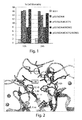
- DNX cells have been transfected with constructs for expression of p53, MDM4 or MDM4C437G, and MDM2 proteins. Then Trypan Blue staining positive death cells have been counted and compared to number of total counted cells ( Fig. 1 ). As it is apparent from obtained data MDM4 presence potentiates pro-apoptotic activity of p53, as previously observed and MDM4C437G expression acts analogously to MDM4-wt.
- MDM4 leucine in position 433 and isoleucine in position 489 are determinant for binding with MDM2 and therefore formation of heterodimer.
- MDM2 mutants have been tested.
- Murine fibroplast cells derived from p53 and Mdm2 (DN1) "knockout" mouse have been transfected with constructs expressing MDM4 protein and each of different mutants of MDM2 or MDM2-wt like control. After 24 hours, cells have been collected and corresponding lysates immunoprecipitated using anti-MDM4 antibody ( Fig. 4 ).
- MDM2-wt binds MDM4 meanwhile MDM2 L430E and A434D mutants are unable to bind MDM4 under the same conditions.
- MDM2 L430Q and A434N mutants instead prove to be able to bind MDM4 although in lower extent than MDM2-wt protein. This result indicates therefore that 430 leucine and 434 alanine are two determining sites for MDM2 and MDM4 binding.
- helicity of peptides 1 and 2 using simulations of molecular dynamics has been evaluated. These simulations have been carried out using Desmond software program and OPLS 2005 force field, as implemented according to Schrodinger software package. Particularly, simulations have carried out for 20 ns time length in aqueous solvent, at a temperature of 300°K, and according to NPT Berendesen protocol. Trajectories obtained by two simulations then have been analyzed through the calculation of secondary structure of peptides during said 20 ns. Resulting peptide helicities, expressed as percentage, has been 23,7% and 12,5% for peptide 1 and peptide 2, respectively. It has not been possible a similar analysis to be carried out for peptide 3.
- SEQ ID NO: 1-3 peptides have been modified by addition of FITC at N-terminal residue followed by a spacer.
- Amide group in order to increase peptide stability, has been attached at C-terminal residue:
- Ahx term indicates a linker
- Peptide 1 (SEQ ID NO: 1): the peptide has been tested by immunoprecipitation assays and detection of cell death.
- Peptide 3 (SEQ ID NO: 3): analogously to peptide 1, also for this peptide the ability to penetrate the cell has been evaluated by counting the number of cells positive for the presence of FITC fluorophore. This peptide has been proved to be internalized in cells both by liposomal vectors and independently although with lower efficiency. Successively, ability thereof to dissociate MDM4/MDM2 complex has been analyzed by immunoprecipitation experiments. We have observed that the peptide is highly effective in dissociating said two molecules while does not dissociate p53 from MDM4 ( Figure 7 ).
- this peptide has been proved to be highly effective in inducing cellular apoptosis in specific way since another peptide unable to dissociate MDM4/MDM2 does not induce cell death (not shown data). Apoptotic effect in addition is dependent on p53 since induced death is meaningfully lower in p53 lacking than harboring cells ( Figure 8 ).
- Example 2 Study about the role of peptide 3 (SEQ ID NO:3) composition in its molecular and biological activity
Landscapes
- Chemical & Material Sciences (AREA)
- Health & Medical Sciences (AREA)
- Organic Chemistry (AREA)
- Life Sciences & Earth Sciences (AREA)
- Proteomics, Peptides & Aminoacids (AREA)
- Biochemistry (AREA)
- Biophysics (AREA)
- General Health & Medical Sciences (AREA)
- Genetics & Genomics (AREA)
- Medicinal Chemistry (AREA)
- Molecular Biology (AREA)
- Gastroenterology & Hepatology (AREA)
- Zoology (AREA)
- Toxicology (AREA)
- Peptides Or Proteins (AREA)
- Medicines That Contain Protein Lipid Enzymes And Other Medicines (AREA)
Abstract
Description
- The present invention concerns peptides able to impair the inhibiting activity of MDM2/MDM4 heterodimer towards p53 and their use for cancer treatment. In particular, the invention concerns peptides able to inhibit MDM2/MDM4 heterodimer and maintain the association between MDM4 and p53 so to restore the p53 oncosuppressive function in cancer cells harboring wild type p53 protein, directing its function specifically towards an apoptotic outcome.
- Inactivation of the oncosuppressor p53 by means of direct mutation of its gene is one of first genetic lesions recognized in human tumors (about 50% of human tumors). In tumors carrying wilde type p53, studies have evidenced alternative methods for p53 inactivation by deregulation of its partners, MDM4 and MDM2. The latter ones are two crucial regulators of the oncosuppressor p53. These two proteins carry out mainly inhibiting activity towards p53 by controlling both protein levels and transcriptional function.
- The importance of MDM proteins on the inhibition of p53 activity resulted in development of different strategies aiming to disrupt the p53/MDM association.
- For example
WO 2008 106507 ,WO 2011 05219 WO201105219 -
WO2008106507 describes peptides able to bind with high affinity MDM2 and therefore, probably, inhibit the binding of MDM2 with all the members of the p53 family; however, such statement has not been experimentally proved. It is predicted, by computational analysis, that such peptides may bind MDM4 and therefore dissociate the same from p53. In vitro or in vivo experimental data have not been provided for a possible biological activity of these peptides. Therefore it is not predictable their effectiveness. - In addition, the strategy aiming to disrupt the binding of p53 to MDM4 and MDM2 does not consider recent studies suggesting that MDM4 binding to p53 potentiates its apoptotic activity. According to
WO201105219 MDM2 10 fold higher than to MDM4 (IC50=0.01 µM and 0.1 µM for MDM2 and MDM4, respectively). Therefore, it cannot be excluded that a part of the observed cell death, according toWO201105219 -
WO200061193 - Most promising results for reactivation of p53 are obtained using small molecules identified by high-throughput screening of compound libraries and drug design by computer analysis based on protein structure (Shangary S, Wang S. Targeting the MDM2-p53 interaction for cancer therapy. Clin Cancer Res. 2008 Sep 1; 14(17): 5318-24).
- However, known therapeutic strategies show various disadvantages. For example, compounds dissociating MDM2 from p53 are ineffective in displacing MDM4 from p53 because of the intrinsic differences in p53 binding domains of MDM4 and MDM2. This could enhance apoptosis induction by MDM4-p53 complex. However, since such compounds do not inhibit the binding of MDM4 with MDM2, it can be predicted that the heterodimer still inhibits p53 activity. Moreover, association of MDM2 to MDM4 antagonizes the pro-apoptotic activity of MDM4 preventing this response. In addition growth arrest rather than apoptotic response often occurs, while the preferred result in any cancer therapy is apoptosis (Toledo F, Wahl GM. MDM2 and MDM4: p53 regulators as targets in anticancer therapy. Int J Biochem Cell Biol. 2007; 39 (7-8): 1476-82. Epub 2007 Apr 8; Shangary S, Wang S. Targeting the MDM2-p53 interaction for cancer therapy. Clin Cancer Res. 2008 Sep 1; 14(17): 5318-24). Known methods, aiming to inhibit the interaction of p53 with MDM2 and/or MDM4, cause therefore activation of p53 not only towards apoptosis, as it would be preferred, but also towards proliferative arrest. In addition, the release of MDM2 from association with p53 results in higher degradative activity of MDM2 towards MDM4 and other proapoptotic molecules (as demonstrated by several recent papers).
- All current methods failed to pass
phase 1 of clinical trials, pointing out to existing limitations (Cheok CF, Verma CS, Baselga J, Lane DP. Translating p53 into the clinic. Nat Rev Clin Oncol. 2011 Jan;8(1):25-37. Epub 2010 Oct 26). - Based on these results, it emerges the need to provide new therapeutic methods for cancer treatment that overcomes the disadvantages of known methods.
- Recent studies suggest that the MDM4/MDM2 heterodimer is the functional inhibitor of p53. This data suggest that agents aiming to inhibit MDM4/MDM2 heterodimer could represent new potential therapeutic agents. On the other hand, recent data suggest different activities of MDM2 and MDM4 under stress conditions. Under these conditions a weakening of association and degradation activity of MDM2 towards p53 mainly occurs (Marchenko ET to, 2007). In addition, upon a sub-lethal type of DNA damage, usually associated with growth arrest, MDM2 level increase and this results in degradation of MDM4 and some pro-apoptotic factors as HIPK2 (Rinaldo C, Prodosmo A, Mancini F, Iacovelli S, Sacchi A, Moretti F, Soddu S. MDM2-regulated degradation of HIPK2 prevents p53Ser46 phosphorylation and DNA damage-induced apoptosis. Mol Cell. 2007 Mar 9;25(5):739-50). On the contrary, following a severe DNA damage, usually associated to apoptosis, levels of MDM2 do not increase or even decrease (Ashcroft M, Taya Y, Vousden KH Stress signals utilize multiple pathways to stabilize p53. Mol Cell Biol 200020: 3224-33; Latonen L, Taya Y, Laiho M UV-radiation induces dose-dependent regulation of p53 response and modulates p53-HDM2 interaction in human fibroblasts. Oncogene 2001 20: 6784-93; Meng LH, Kohn KW, Pommier Y Dose-response transition from cell cycle arrest to apoptosis with selective degradation of Mdm2 and p21WAF1/ClP1 in response to the novel anticancer agent, aminoflavone (NSC 686,288). Oncogene. 2007, 26, 4806-16).
- Based on these data, a recent model considers the up-regulation of MDM2 occurring during cell growth arrest, an event favoring this response in comparison to cell death (Shmueli A, Oren M. Mdm2: p53's lifesaver? Mol Cell. 2007 Mar 23;25(6):794-6). On the other hand, MDM4 stabilizes p53, preventing the MDM2-mediated degradation, and promotes p53 mediated apoptosis under stress conditions (Jackson MW, Berberich SJ. MdmX protects p53 from Mdm2-mediated degradation. Mol Cell Biol 2000; 20:1001-7; Stad R, Little NA, Xirodimas DP, Frenk R, van der Eb AJ, Lane DP, et al. Mdmx stabilizes p53 and Mdm2 via two distinct mechanisms. EMBO Rep 2001; 2:1029-34; Mancini F, Gentiletti F, D'Angelo M, Giglio S, Nanni S, D'Angelo C, et al. MDM4 (MDMX) over-expression enhances stabilization of stress-induced p53 and promotes apoptosis. J Biol Chem 2004, 279:8169-80; Barboza JA, Iwakuma T, Terzian T, El-Naggar AK, Lozano G. Mdm2 and Mdm4 loss regulates distinct p53 activities. Mol Cancer Res 2008; 6:947-54).
- Therefore, although it is known that MDM2/MDM4 heterodimer inhibits p53 function, heterodimer dissociation has not been assumed a current suitable strategy in order to favor p53 apoptotic activity. This due to the fact that MDM2 release, i.e. the main p53 inhibitor, could however carry out inhibiting function against p53. For this reason, current strategies are directed to the dissociation of p53 from MDM2 and MDM4 and not to hetorodimer dissociation.
- The authors of the present invention have demonstrated that MDM2 opposes the pro-apoptotic activity of MDM4 and that, when MDM4/MDM2 dissociation or partial dissociation at specific binding sites occurs as result of stress conditions, the p53-mediated apoptotic pathway is promoted, independently of MDM2. These results are coherent with the model proposed by Shmueli indicating p53 regulators not only for control of p53 activity, but also as having an important role in p53-mediated choice between cell life and death (Shmueli A, Oren M. Mdm2: p53's lifesaver? Mol Cell. 2007 Mar 23;25(6):794-6;Mitochondrial MDM4 (MDMX): An unpredicted role in the p53-mediated intrinsic apoptotic pathway. Mancini F, Moretti F. Cell Cycle. 2009 Dec; 8(23):3854-9). In particular, the inventors of the present invention observed that the over-expression of MDM4 mutant (C437G), unable of binding MDM2, induces the activation of p53, and this activation of p53 is not inhibited by concomitant expression of MDM2. Moreover, the over-expression of MDM4 (exceeding MDM2 levels) in a model of transgenic mouse causes an increase of cellular death (apoptosis) as a result of gamma irradiation and delays the tumor appearance induced by mouse exposure to genotoxic agents.
- On the basis of these data, MDM4/MDM2 interaction region has been characterized. Amino acids involved in MDM4/MDM2 binding have been identified and tested by molecular mutagenesis. L430, A434 in MDM2 and L433, 1489, F488 residues in MDM4, respectively, have been identified as relevant for MDM2/MDM4 complex.
- Therefore, peptides belonging to the region of MDM4/MDM2 interaction and able to impair the inhibiting activity of MDM2/MDM4 heterodimer towards p53, that is to restore the p53 oncosuppressive function in cancer cells still harboring p53 wild type protein (approximately 50% of human tumors), and to maintain the proapoptotic function of MDM4 directing therefore the p53 response towards the apoptosis, have been prepared. Currently the majority of human tumors is characterized in that 50% express wild type and 50% express mutated p53, respectively. Therefore, independently from tumor type, this approach is directed to tumors expressing wild type p53.
- In particular, three peptides of 12 amino acids (12 mer) have been prepared and tested at molecular and biological level. Since the peptides display some limitations for therapeutic application because of intrinsic instability thereof, chemical modifications necessary to increase the bioavailability and allow the in vivo administration have been carried out.
- Techniques in order to increase the stability and bioavailability of peptides and allow administration thereof in vivo are well known to those skilled in the art. Particularly, above said peptides could be modified by means of insertion of hydrocarbon bridge suitable to increase the alpha helicity of said peptides (carbon staples). These modifications are able to promote cellular uptake, confer resistance to protease and increase global stability.
- It is therefore a specific object of the present invention a peptide belonging to (i.e. comprised in, taking part of) MDM4 or MDM2 sequence, at the levels of the interaction domain between MDM4 and MDM2, or mimetic peptides of said peptide, said peptide having a number of amino acids from 5 to 16, ,preferably from 8 to 12, and comprising at least one amino acid chosen in the group consisting of leucine, isoleucine or phenylalanine of
MDM4 position MDM2 position - wherein said MDM4 sequence, at the levels of MDM4 and MDM2 interaction domain, is chosen between the following sequences from amino acid 473 to
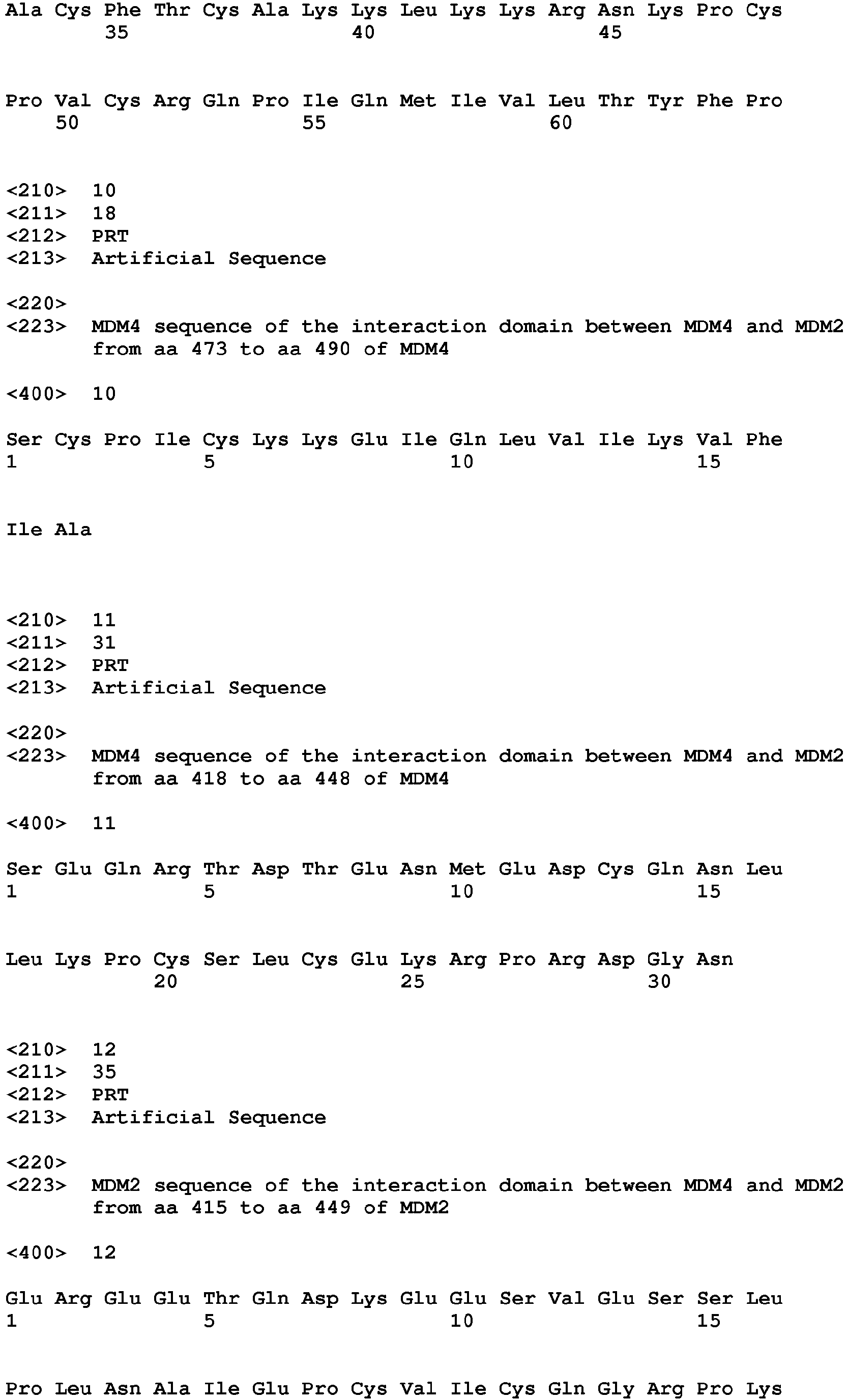
amino acid 490 and from amino acid 418 toamino acid 448, respectively: - 473 SCPICKKE IQLVIKVFIA 490 (SEQ ID NO: 10)
- 418 SEQ RTDTENMEDC QNLLKPCSLC EKRPRDGN 448 (SEQ ID NO: 11), preferably SEQ ID NO:10;
and said MDM2 sequence, at the levels of MDM4 and MDM2 interaction domain, is the following sequence from amino acid 415 to amino acid 449: - 415 EREETQ DKEESVESSL PLNAIEPCVI CQGRPKNGC 449 (SEQ ID NO:12).
- Preferably, when said peptide belongs to MDM4, the peptide according to the invention comprises the aminoacids isoleucine and phenylalanine of
MDM4 position - According to a preferred embodiment, the present invention concerns a peptide or mimetic peptides thereof according to the invention, wherein said peptide has the following general formula I:
R-KVFI-R1 (I)
- wherein
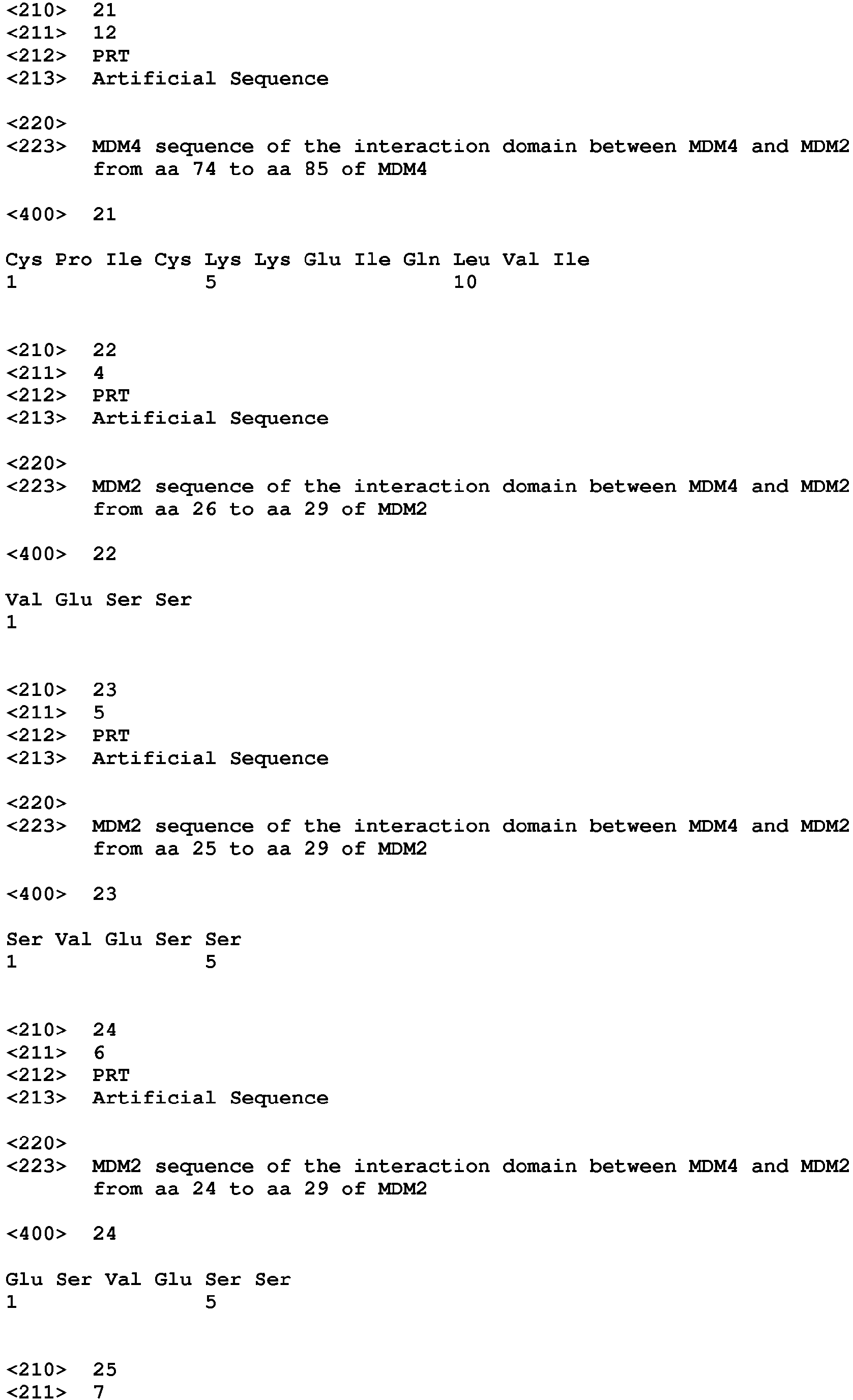
- R is chosen from the group consisting of I, VI, LVI, QLVI (SEQ ID NO:13), IQLVI (SEQ ID NO:14), EIQLVI (SEQ ID NO:15), KEIQLVI (SEQ ID NO:16), KKEIQLVI (SEQ ID NO:17), CKKEIQLVI (SEQ ID NO:18), ICKKEIQLVI (SEQ ID NO:19), PICKKEIQLVI (SEQ ID NO:20), CPICKKEIQLVI (SEQ ID NO:21) or hydrogen of amino functional group of K;
- R1 is chosen from the group consisting of A or hydroxyl of carboxylic functional group of I;
- wherein said R and R1 are chosen so that said peptide ranges from 5 to 16 amino acids, preferably, from 8 to 12. Preferably, the peptide belonging to the sequence of MDM4, at the levels of MDM4 and MDM2 interaction domain, can consist of the following sequence from amino acid 479 to
amino acid 490 of MDM4 or mimetic peptides thereof:- KEIQLVIKVFIA (SEQ ID NO: 3).
- Again according to a preferred embodiment, the present invention concerns a peptide or mimetic peptides thereof according to the invention, wherein said peptide has the following general formula II:
R2-LPLNA-R3 (II)
wherein - R2 is chosen from the group consisting of S, SS, ESS, VESS (SEQ ID NO:22), SVESS (SEQ ID NO:23), ESVESS (SEQ ID NO:24), EESVESS (SEQ ID NO:25), KEESVESS (SEQ ID NO:26), DKEESVESS (SEQ ID NO:27), QDKEESVESS (SEQ ID NO:28), TQDKEESVESS (SEQ ID NO:29) or hydrogen of amino functional group of L;
- R3 is chosen from the group consisting of I, IE, IEP, IEPC (SEQ ID NO:30), IEPCV (SEQ ID NO:31), IEPCVI (SEQ ID NO:32), IEPCVIC (SEQ ID NO:33), IEPCVICQ (SEQ ID NO:34), IEPCVICQG (SEQ ID NO:35), IEPCVICQGR (SEQ ID NO:36), IEPCVICQGRP (SEQ ID NO:37) or hydroxyl of carboxylic functional group of A;
- wherein said R2 and R3 are chosen so that said peptide ranges from 5 to 16 amino acids, preferably, from 8 to 12. Preferably, the peptide belonging to the sequence of MDM2, at the levels of MDM4 and MDM2 interaction domain, can consist of the following sequence from amino acid 427 to amino acid 438 of MDM2 or mimetic peptides thereof:
- ESSLPLNAIEPC (SEQ ID NO: 1)
- An isolated nucleotide sequence encoding for peptide as above defined is a further object of the present invention.
- Moreover, the invention concerns an expression vector comprising nucleotide sequence as above defined.
- The invention refers also to a pharmaceutical composition comprising or consisting of at least one peptide or mimetic peptides thereof, or at least one nucleotide sequence, or at least one vector as above defined, as an active ingredient, in association with one or more pharmaceutically acceptable adjuvant and/or excipients.
- A peptide or mimetic peptides thereof, nucleotide sequence, vector or pharmaceutical composition, as defined above, for use in the treatment of tumors preferably expressing wild type p53, or associated pathologies like hyperproliferative benign syndromes represent a further object of the present invention.
- Said peptides according to the invention can, for example, be administered by intravenous way, or using liposomal vectors directly deliverable to the tumor, or, at last, by means of nano-particles. In addition, said peptides can be delivered also by gene therapy using DNA expression vectors.
- As above reported, peptides of the invention can be modified according to known methods in order to increase stability and bioavailability of the peptides and allow in vivo administration thereof. Particularly, said peptides can be modified by insertion of hydrocarbon bridge suitable to increase alpha helicity thereof (carbon staples). As reported in experimental section, peptides have been modified as below:
- peptide 1: FITC-Ahx-ESSLPLNAIEPS-CONH2
- peptide 2: FITC-Ahx-MEDSQNLLKPSS- CONH2
- peptide 3: FITC-Ahx-KEIQLVIKVFIA-CONH2
- peptide 1: Acet - ESSLPLNAIEPS-CONH2
- peptide 2: Acet - MEDSQNLLKPSS- CONH2
- peptide 3: Acet- KEIQLVIKVFIA-CONH2
- In addition, the present invention concerns the use of interaction domain between MDM4 and MDM2 for the screening of compounds able to dissociate at least one amino acid chosen in the group consisting of leucine, isoleucine or phenylalanine of
MDM4 position MDM2 position - MDM4 sequence of interaction domain between MDM4 and MDM2 can consists of the following MDM4 sequence from amino acid 413 to amino acid 490:
- 413 QLDNLSEQ RTDTENMEDC QNLLKPCSLC EKRPRDGNII HGRTGHLVTC FHCARRLKKA GASCPICKKE IQLVIKVFIA 490 (SEQ ID NO:5) or the following MDM4 sequence from amino acid 428 to amino acid 490:
- 428 EDC QNLLKPCSLC EKRPRDGNII HGRTGHLVTC FHCARRLKKA GASCPICKKE IQLVIKVFIA 490 (SEQ ID NO:6)
- MDM2 sequence of interaction domain between MDM4 and MDM2 can consists of the following MDM2 sequence from amino acid 411 to amino acid 491:
- 411 VKEFEREETQ DKEESVESSL PLNAIEPCVI CQGRPKNGCI VHGKTGHLMA CFTCAKKLKK RNKPCPVCRQ PIQMIVLTYF P 491 (SEQ ID NO:8) or the following MDM2 sequence from amino acid 428 to amino acid 491:
- 428 SSL PLNAIEPCVI CQGRPKNGCI VHGKTGHLMA CFTCAKKLKK RNKPCPVCRQ PIQMIVLTYF P 491 (SEQ ID NO:9)
- The present invention now will be described by an illustrative, but not limitative way, according to preferred embodiments thereof, with detailed reference to enclosed drawings, wherein:
-
Figure 1 shows cell death analysis as a result of over-expression of MDM4+p53, or MDM4C437G+p53 in the presence or absence of MDM2, in embryonic murine Mdm4-/- p53-/- (DNX) fibroblasts compared to control cells transfected using an empty vector (null). The percentage of dead cells has been calculated as ratio of Trypan blue positive cells to all counted cells. The average of 2 different experiments is reported. -
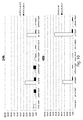
Figure 2 shows the binding interface of the two MDM4 and MDM2 RING finger domains. Boxed (in MDM4) and circled (in MDM2) positions represent potential key amino acids for this interaction. -
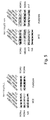
Figure 3 shows the binding analysis of MDM2 to various MDM4 point mutants. DNX cells were transfected with expression vectors carrying MDM2-wt and MDM4-wt or its mutated forms (MDM4 L433N, L433D, 1489Q, 1489E) as shown in the upper part of the figure. Cell lysates have been collected and 700 µg of whole cell extracts have been immunoprecipitated with anti-MDM2 antibody and immunocomplexes analyzed by western blotting, as indicated in the figure (right panel). Left panel shows western blot analysis of a fraction of cellular lysates in order to control the expression levels of reported proteins. -
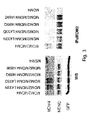
Figure 4 shows the binding analysis of MDM4 to various MDM2point mutants. Murine embryonic Mdm2-/-p53-/-(DN1) fibroblasts were transfected with expression vectors carrying MDM4-wt and MDM2-wt or its mutated forms (MDM2-L430Q, L430E, A434N, A434D) as shown in the upper part of the figure. Cell lysates have been collected and 700 µg of whole cell extracts have been immunoprecipitated with anti-MDM4 antibody and immunocomplexes analyzed by western blotting, as indicated in the figure (right panel). Left panel shows western blot analysis of a fraction of cellular lysates in order to control the expression levels of reported proteins. -
Figure 5 shows the ability ofpeptide 1 to dissociate MDM4/MDM2 complex by immunoprecipitation assay. Transient transfection of peptides has been carried out in HCT116 wt and p53-/- colon carcinoma cell lines and the immunoprecipitation of MDM4 has been carried out on cell lysates in order to detect the presence of MDM2 within the immunocomplex, by western blot analysis. -
Figure 6 shows the ability ofpeptide 1 to induce cell death. Cytofluorimetric analysis was carried out on HCT116 wt and p53-/- cells transfected with FITC tagged peptides and stained with Propidium Iodide (PI). Percentage of dead cells was evaluated specifically among the transfected cells (green population). -
Figure 7 shows the ability ofpeptide 3 to dissociate MDM4/MDM2 complex by immunoprecipitation assay. Transient transfection of peptides has been carried out in HCT116 wt and p53-/- colon carcinoma cell lines and the immunoprecipitation of MDM4 has been performed on cell lysates in order to detect the presence of MDM2 within the immunocomplex by western blot analysis. -
Figure 8 shows the ability ofpeptide 3 to induce cell death. Cytofluorimetric analysis was performed on HCT116 wt and p53-/- cells transfected with FITC tagged peptides and stained with Propidium Iodide (PI). Percentage of dead cells was evaluated specifically among the transfected cells (green population). -
Figure 9 shows in vitro ubiquitination assay of p53 performed by recombinant GST-MDM2. The figure shows the ability ofPeptide 3, compared to control peptides (3D, SC3A and SC3B), to inhibit the ubiquitinatin activity of MDM2 towards p53. -
Figure 10 shows the ability ofpeptide 3, compared to control peptides (3D and 2MUT), to induce apoptosis. In order to specifically detect apoptotic cells, TUNEL assay was carried out in HCT116 wt and p53-/- cells transfected with FITC tagged peptides. Percentage of apoptotic cells was evaluated specifically among the transfected cells (green population). -
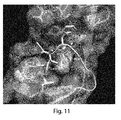
Figure 11 shows the binding mode ofpeptide 3 to MDM2 as resulting from molecular dynamic simulations. 1489 occupies a hydrophobic cleft composed of A434, 1435 and L458 of MDM2. F488 forms aromatic interactions with a H457 of MDM2 protein. - Tranfections. Transient transfections have been carried out using lipophilic vectors ("Lipofectamine 2000" for DNA, Invitrogen). This method is based on use of lipid vesicles (liposomes) mediating the transfer of DNA into eucaryotic cells.
- Cells in 100 mm plates have been transfected with following vectors: pShutlle-hMDM4 (WT, C437G), pCMV-hMDM2 (WT), pCAG-p53.
- Punctiform mutants have been obtained by PCR amplification with specific primers using plasmids containing hMdm4 and hMDM2 cDNAs and resulting products used for generation of plasmids containing hMdm4 and hMDM2 cDNAs using Qiagen mutagenesis kit.
- Cells have been lysed using Saito lysis modified reagent (50 mM Tris-HCl, pH 7.4, 0.15 M NaCl, 0.5% Triton-X100, 5 mM EDTA). For p53 immunoprecipitation and BCL2 and MDM4 analysis EBC modified solution has been used (50 mM Tris-HCl, pH 7.4, 0.12 M NaCl, 0.4% NP-40, 1 mM EDTA, 1 Mm β-mercaptoethanol).
- 400µg of total protein extract has been incubated with protein G (Invitrogen) for 2 hours under stirring at 4°C in order not specific binding of proteins with said substrate can occur. Afterwards the cellular extract has been centrifuged, not specific complexes removed with precipitate and supernatant has been incubated for 16 hours with specific antibody. Successively, protein G has been added and incubated for 2 hour at 4°C. Finally, immunoprecipitate has been washed twice with Saito buffer and resuspended in 10µl of loading buffer solution (loading buffer 4X: 0,6 M β-mercaptoethanol; 8% SDS; 0,25 M Tris-HCl,
pH - Different amounts (70-100 µg for samples to be analyzed) of total protein lysates have been separated by polyacrylamide gel electrophoresis (29% acrylamide and 1% bis-acrylamide) at 12% final concentration. Loading solution has been added to samples (loading buffer 4X: 0,6 M β-mercaptoethanol; 8% SDS; 0,25 M Tris-HCl,
pH pH
At the end of electrophoretic run proteins have been transferred on PVDF filter (Millipore) under electric field in buffer consisting of 25 mM Tris Base, 200 mM glycine and 20% methanol. Transfer of proteins from anode to cathode has been carried out for 3 hours at 70 V. - After proteins transfer, the filter has been incubated under stirring for 1 hour in TPBS buffer 1X (10 mM Tris-HCl,
pH 7,6, 150 mM NaCl and 0,1% Tween 20) containing 5% skimmed milk powder (Bio-Rad) in order to block not specific antibody binding sites. The filter successively has been incubated for 2 hours with opportunely diluted primary antibody. At the end of the incubation the filter has been washed twice for approximately 10 minutes each with TPBS 1X and then incubated for 45 minutes with corresponding peroxidase-conjugated secondary antibody. After two washings for approximately 10 minutes with TPBS 1X, immunoreactivity has been evaluated using chemiluminescence reaction based on luminol oxidation (Amersham). Successively, chemiluminescence has been detected by autoradiography on sensitive plates (Kodak). - MDM2/MDM4 heterodimer is the main control tool for p53 levels and therefore inhibition thereof inside of cell under normal growth conditions (Wade and Wahl, 2009). Therefore it has been assumed that the dissociation of MDM4 from MDM2 can favor the implementation of proapoptotic function thereof, in addition to preventing degradation activity with respect to p53. The binding leading to heterodimer formation occurs at the level of "RING finger" domains of both the proteins (Tanimura et al., 1999). In order to point out the role of dissociation in the accomplishment of MDM4 pro-apoptotic activity, MDM4 mutant mutated at 437 cysteine residue has been used. Such mutation results in the impossibility to form a correct RING finger domain and thus MDM2 binding impossibility. Therefore, DNX cells have been transfected with constructs for expression of p53, MDM4 or MDM4C437G, and MDM2 proteins. Then Trypan Blue staining positive death cells have been counted and compared to number of total counted cells (
Fig. 1 ). As it is apparent from obtained data MDM4 presence potentiates pro-apoptotic activity of p53, as previously observed and MDM4C437G expression acts analogously to MDM4-wt. However, MDM2 expression rescues cell death induced by co-expression of p53 and MDM4-wt, but not induced by MDM4C437G mutant. These data suggest, therefore, that factors suitable to prevent the association between MDM2 and MDM4 can avoid the functional inhibition of MDM2 and therefore potentiate the pro-apoptotic function of p53. - For design of peptide suitable to disrupt the interaction between MDM2 and MDM4, initially an analysis at crystallized structure interfaces of MDM2 and MDM4 RING domains (pdb code: 2vjf) has been carried out. This analysis, in particular, has been carried out using a software program (SiteMap, Schrodinger Software) suitable to characterize binding pockets in proteins. As result, two small binding pockets at level of MDM2 and MDM4 N-terminal regions, respectively, have been detected.
- Human MDM4 and MDM2 protein sequences, MDM4 and MDM2 amino acid sequences of MDM4 and MDM2 interaction domains and MDM4 and MDM2 amino acid sequences occurring in crystallographic structure of MDM4/MDM2 dimer are below reported:
- MDM4 human protein sequence (SEQ ID NO: 4)

- MDM4 sequence of MDM4-MDM2 interaction domain (SEQ ID NO: 5)

- MDM4 sequence occurring in crystallographic structure of MDM4/MDM2 dimer (SEQ ID NO: 6)

- MDM2 human protein sequence (SEQ ID NO: 7)

- MDM2 sequence of MDM4-MDM2 interaction domain (SEQ ID NO: 8)

- MDM2 sequence occurring in crystallographic structure of MDM4/MDM2 dimer (SEQ ID NO: 9)

- Starting from N-terminal regions of MDM2 and MDM4, the detection of key amino acid set involved in mediating interactions occurring at interface of MDM2/MDM4 complex has been carried out. Among these residues, Leu430 MDM2, Ala434 MDM2, Leu433 MDM4 and Ile489 MDM4 have been detected as particularly important for stabilization of heterodimeric complex of RING domain (
Figure 2 ). In order to prove that said amino acids carry out a determining role in interaction of two proteins, the same have been replaced with other amino acid residues by point mutagenesis experiments. Mutations have been carried out in such a way to replace every amino acid of interest with an amino acid unable to form the association but, at the same time, maintaining unaltered the correct "folding" of the corresponding domain and thus of the protein. Moreover, in order to prove that the cause of possible dissociation was effectively the replaced and not inserted amino acid, every amino acid residue has been replaced with two different residues with different total charge. Thus amino acids with net negative side chain charge, i.e. glutamate and aspartate, and corresponding polar side chain amino acids, i.e. glutamine and asparagine, have been selected. Accordingly, eight different mutants by in vitro mutagenesis have been produced: - 1. MDM4L433N
- 2. MDM4L433D
- 3. MDM4I489Q
- 4. MDM4I489E
- 5. MDM2L430Q
- 6. MDM2L430E
- 7. MDM2A434N
- 8. MDM2A434D
- At this point, the ability of each mutant to interact with corresponding "wild-type" protein has been analyzed. DNX cells have been transfected with constructs expressing MDM2-wt protein and each of the four MDM4 mutants or MDM4-wt protein like control. Cells successively have been collected and resulting lysates immunoprecipitated with anti-MDM2 antibody and the immunocomplexes analyzed for the presence of MDM4 different forms (
Fig. 3 ). Results have demonstrated that all and the four MDM4 mutants proved to be unable to bind MDM2, meanwhile it is very clear the binding of two "wild-type" proteins. This results indicates therefore that for MDM4 leucine inposition 433 and isoleucine inposition 489 are determinant for binding with MDM2 and therefore formation of heterodimer. In specular way, MDM2 mutants have been tested. Murine fibroplast cells derived from p53 and Mdm2 (DN1) "knockout" mouse have been transfected with constructs expressing MDM4 protein and each of different mutants of MDM2 or MDM2-wt like control. After 24 hours, cells have been collected and corresponding lysates immunoprecipitated using anti-MDM4 antibody (Fig. 4 ). According to western blot analysis of this immunoprecipitation it can be observed, as expected, that MDM2-wt binds MDM4 meanwhile MDM2 L430E and A434D mutants are unable to bind MDM4 under the same conditions. MDM2 L430Q and A434N mutants instead prove to be able to bind MDM4 although in lower extent than MDM2-wt protein. This result indicates therefore that 430 leucine and 434 alanine are two determining sites for MDM2 and MDM4 binding. However the insertion in these sites of an amino acid with weakly polar side chain clearly does not compromise remarkably the MDM2 ability to bind MDM4 while the insertion of amino acids with net negative side chain charge is suitable to dissociate the complex completely, suggesting that at level of these sites the bind is localized on side chain of involved amino acids. Starting from these residues, three MDM2 and MDM4 12mer peptides, corresponding to following amino acid sequences (SEQ ID NO: 1, SEQ ID NO: 2 and SEQ ID NO: 3), have been designed: - 1) ESSLPLNAIEPC i.e. Glu1-Ser2-Ser3-Leu4-Pro5-Leu6-Asn7-Ala8-Ile9-Glu10-Pro11-CYs12 (SEQ ID NO:1)
- 2) MEDCQNLLKPCS i.e. Met1-Glu2-Asp3-Cys4-Gln5-Asn6-Leu7-Leu8-Lys9-Pro10-Cys11-Ser12 (SEQ ID NO:2)
- 3) KEIQLVIKVFIA i.e. Lys1-Glu2-Ile3-Gln4-Leu5-Val6-Ile7-Lys8-Val9-Phe10-Ile11-Ala12 (SEQ ID NO:3)
- Since the alpha helix conformation stability (helicity) is important parameter in order to favor a strong interaction between peptides and MDM2 and MDM4 RING domains, helicity of
peptides peptide 1 andpeptide 2, respectively. It has not been possible a similar analysis to be carried out forpeptide 3. - SEQ ID NO: 1-3 peptides have been modified by addition of FITC at N-terminal residue followed by a spacer. Amide group, in order to increase peptide stability, has been attached at C-terminal residue:
- Peptide 1: FITC-Ahx-ESSLPLNAIEPS-CONH2
- Peptide 2: FITC-Ahx-MEDSQNLLKPSS- CONH2
- Peptide 3: FITC-Ahx-KEIQLVIKVFIA-CONH2
- Below properties thereof are shown.
- Peptide 1 (SEQ ID NO: 1): the peptide has been tested by immunoprecipitation assays and detection of cell death.
- It has been investigated whether peptides were able to enter the cell simply by addition thereof at given concentration (5µM) to cell culture medium and analyzing for the presence thereof by confocal and fluorescence microscopy, each peptide being labeled with green fluorophore (FAM). It has been observed that peptides were detected in cells only after transfection by liposomes. Successively, the ability of peptides to disrupt the binding by MDM4 or MDM2 immunoprecipitation after peptide transfection in HCT116 cancer cell line, and detection of presence of corresponding partner in immunocomplex by western blot assay have been evaluated. Two HCT116 wild type and HCT116 p53 -/syngeneic cell lines have been used in order to understand also observed effect dependence on the presence of p53. SEQ ID NO:1 peptide proved to be suitable to dissociate said two proteins and induce a significant apoptotic response (
Fig. 5 ,6 ). Of interest, this response was significantly higher in comparison to the control Scramble peptide in HCT116 p53+/+ cells but not in HCT116 p53-/- cells, indicating the specific activity of this peptide in the presence of p53 (Fig. 6 ). Accordingly, this peptide was able to preserve the binding of p53 to MDM4 (Fig. 5 ). - Peptide 3 (SEQ ID NO: 3): analogously to
peptide 1, also for this peptide the ability to penetrate the cell has been evaluated by counting the number of cells positive for the presence of FITC fluorophore. This peptide has been proved to be internalized in cells both by liposomal vectors and independently although with lower efficiency. Successively, ability thereof to dissociate MDM4/MDM2 complex has been analyzed by immunoprecipitation experiments. We have observed that the peptide is highly effective in dissociating said two molecules while does not dissociate p53 from MDM4 (Figure 7 ). - Moreover, this peptide has been proved to be highly effective in inducing cellular apoptosis in specific way since another peptide unable to dissociate MDM4/MDM2 does not induce cell death (not shown data). Apoptotic effect in addition is dependent on p53 since induced death is meaningfully lower in p53 lacking than harboring cells (
Figure 8 ). - Further experiments have been performed to define the role of
peptide 3 composition in its molecular and biological activity. These experiments have demonstrated that aminoacids Isoleucine atposition 489 and Phenylalanine atposition 488 of MDM4 protein are essential for the ability ofPeptide 3 to inhibit MDM4/MDM2 activity and apoptosis-promoting function. Indeed, a peptide with two substitutions atposition 10 and 11 of peptide 3 (Peptide 3D, KEIQLVIKVAEA (SEQ ID NO:38) was completely ineffective in inhibiting ubiquitination of p53 and inducing apoptosis (Figure 9 and10 ). Similarly, two peptides composed with the same aminoacids ofpeptide 3 but arranged in different order (Peptide SC3A, VQEAFKLIKIVI (SEQ ID NO:39) and Peptide SC3B, AIKIFVKVLEIQ (SEQ ID NO:40) are ineffective in inhibiting ubiquitination of p53 (Figure 9 ), confirming that the aminoacid Isoleucine at position 11 and Phenylalanine atposition 10 are crucial contact points for inhibition of MDM4/MDM2 heterodimer activity. - Supporting these new experimental data about the importance of
Isoleucine 489 andPhenylalanine 488, molecular dynamic simulations have shown that these residues engage in specific hydrophobic and aromatic interactions with MDM2 (Figure 11 ). In particular,Isoleucine 489 is harbored in a hydrophobic cleft composed ofAlanine 434, Isoleucine 435 andLeucine 458 of MDM2 protein. Likewise,Phenylalanine 488 forms aromatic interactions with a Histidine residue (HID-457) of MDM2 protein. - In addition, since SC3A and SC3B have different solubility and helical content (as estimated by AGADIR software), these data reinforce the importance of targeting aa A488 and 1489, independently of other peptide properties.






Claims (17)
- Peptide belonging to MDM4 or MDM2 sequence, at the levels of the interaction domain between MDM4 and MDM2, or mimetic peptides of said peptide, said peptide having a number of amino acids from 5 to 16, preferably from 8 to 12, and comprising at least one amino acid chosen in the group consisting of leucine, isoleucine or phenylalanine of MDM4 position 433, 489 or 488, respectively, or comprising at least one amino acid chosen in the group consisting of leucine or alanine of MDM2 position 430 or 434, respectively,
wherein said MDM4 sequence, at the levels of the interaction domain between MDM4 and MDM2, is chosen between the following sequences from amino acid 473 to amino acid 490 and from amino acid 418 to amino acid 448, respectively:473 SCPICKKE IQLVIKVFIA 490 (SEQ ID NO: 10);and said MDM2 sequence, at the levels of the interaction domain between MDM4 and MDM2, is the following sequence from amino acid 415 to amino acid 449:418 SEQ RTDTENMEDC QNLLKPCSLC EKRPRDGN 448 (SEQ ID NO: 11), preferably SEQ ID NO:10;415 EREETQ DKEESVESSL PLNAIEPCVI CQGRPKNGC 449 (SEQ ID NO:12). - Peptide according to claim 1, wherein, when said peptide belongs to MDM4, said peptide comprises the aminoacids isoleucine and phenylalanine of MDM4 position 489 and 488, respectively.
- Peptide or mimetic peptides thereof according to anyone of the claims 1-2, wherein said peptide has the following general formula I:
R-KVFI-R1 (I)
whereinR is chosen from the group consisting of I, VI, LVI, QLVI (SEQ ID NO:13), IQLVI (SEQ ID NO:14), EIQLVI (SEQ ID NO:15), KEIQLVI (SEQ ID NO:16), KKEIQLVI (SEQ ID NO:17), CKKEIQLVI (SEQ ID NO:18), ICKKEIQLVI (SEQ ID NO:19), PICKKEIQLVI (SEQ ID NO:20), CPICKKEIQLVI (SEQ ID NO:21) or hydrogen of amino functional group of K;R1 is chosen from the group consisting of A or hydroxyl of carboxylic functional group of I;wherein said R and R1 are chosen so that said peptide ranges from 5 to 16 amino acids, preferably, from 8 to 12. - Peptide or mimetic peptides thereof according to claim 3, wherein said peptide consists of the following MDM4 sequence from amino acid 479 to amino acid 490 or mimetic peptides thereof:KEIQLVIKVFIA (SEQ ID NO:3).
- Peptide or mimetic peptides thereof according to anyone of the claims 1-2, wherein said peptide has the following general formula II:
R2-LPLNA-R3 (II)
whereinR2 is chosen from the group consisting of S, SS, ESS, VESS (SEQ ID NO:22), SVESS (SEQ ID NO:23), ESVESS (SEQ ID NO:24), EESVESS (SEQ ID NO:25), KEESVESS (SEQ ID NO:26), DKEESVESS (SEQ ID NO:27), QDKEESVESS (SEQ ID NO:28), TQDKEESVESS (SEQ ID NO:29) or hydrogen of amino functional group of L;R3 is chosen from the group consisting of I, IE, IEP, IEPC (SEQ ID NO:30), IEPCV (SEQ ID NO:31), IEPCVI (SEQ ID NO:32), IEPCVIC (SEQ ID NO:33), IEPCVICQ (SEQ ID NO:34), IEPCVICQG (SEQ ID NO:35), IEPCVICQGR (SEQ ID NO:36), IEPCVICQGRP (SEQ ID NO:37) or hydroxyl of carboxylic functional group of A;wherein said R2 and R3 are chosen so that said peptide ranges from 5 to 16 amino acids, preferably, from 8 to 12. - Peptide or mimetic peptides thereof according to claim 5, wherein said peptide consists of the following MDM2 sequence from amino acid 427 to amino acid 438 or mimetic peptides thereof:ESSLPLNAIEPC (SEQ ID NO:1)
- Isolated nucleotide sequence codifying a peptide as defined in anyone of claims from 1 to 6.
- Expression vector comprising the nucleotide sequence as defined in claim 7.
- Pharmaceutical composition comprising or consisting of at least one peptide or mimetic peptides thereof as defined in anyone of the claims from 1 to 6, or at least one nucleotide sequence as defined in claim 7, or at least one vector as defined in claim 8, as active ingredient, in association with one or more pharmaceutically acceptable adjuvant and/or excipients.
- Peptide or mimetic peptides thereof as defined in anyone of the claims from 1 to 6, nucleotide sequence as defined in claim 7, vector as defined in claim 8, or pharmaceutical composition as defined in claim 9, for use in the treatment of tumors.
- Peptide or mimetic peptides thereof as defined in anyone of the claims from 1 to 6, nucleotide sequence as defined in claim 7, vector as defined in claim 8, or pharmaceutical composition as defined in claim 9, for use according to claim 10, wherein the tumors are wild type p53 expressing tumors.
- Peptide or mimetic peptides thereof as defined in anyone of the claims from 1 to 6, nucleotide sequence as defined in claim 7, vector as defined in claim 8, or pharmaceutical composition as defined in claim 9, for use in the treatment of hyperproliferative benign syndromes.
- Use of interaction domain between MDM4 and MDM2 for the screening of compounds able to dissociate at least one amino acid chosen in the group consisting of leucine, isoleucine or phenylalanine of MDM4 position 433, 489 or 488, respectively, or at least one amino acid chosen in the group consisting of leucine or alanine of MDM2 position 430 or 434, respectively.
- Use according to claim 13, wherein the MDM4 sequence of interaction domain between MDM4 and MDM2 consists of the following MDM4 sequence from amino acid 413 to amino acid 490:

- Use according to claim 14, wherein the MDM4 sequence of interaction domain between MDM4 and MDM2 consists of the following MDM4 sequence from amino acid 428 to amino acid 490:

- Use according to claim 13, wherein the MDM2 sequence of interaction domain between MDM4 and MDM2 consists of the following MDM2 sequence from amino acid 411 to amino acid 491:

- Use according to claim 16, wherein the MDM2 sequence of interaction domain between MDM4 and MDM2 consists of the following MDM2 sequence from amino acid 428 to amino acid 491:

Applications Claiming Priority (1)
| Application Number | Priority Date | Filing Date | Title |
|---|---|---|---|
| IT000060A ITRM20120060A1 (en) | 2012-02-21 | 2012-02-21 | PEPTIDES ABLE TO RELEASE THE MDM2 / MDM4 HETERODYMER AND THEIR USE IN CANCER TREATMENT. |
Publications (3)
| Publication Number | Publication Date |
|---|---|
| EP2639240A2 true EP2639240A2 (en) | 2013-09-18 |
| EP2639240A3 EP2639240A3 (en) | 2013-12-04 |
| EP2639240B1 EP2639240B1 (en) | 2016-06-22 |
Family
ID=46022560
Family Applications (1)
| Application Number | Title | Priority Date | Filing Date |
|---|---|---|---|
| EP13155985.8A Not-in-force EP2639240B1 (en) | 2012-02-21 | 2013-02-20 | Peptides able to impair the inhibiting activity of MDM2/MDM4 heterodimer towards p53 and use thereof for cancer treatment |
Country Status (3)
| Country | Link |
|---|---|
| US (1) | US20130217634A1 (en) |
| EP (1) | EP2639240B1 (en) |
| IT (1) | ITRM20120060A1 (en) |
Cited By (2)
| Publication number | Priority date | Publication date | Assignee | Title |
|---|---|---|---|---|
| WO2016042411A1 (en) * | 2014-09-18 | 2016-03-24 | University Of Oslo | Ncx1 peptides and uses thereof |
| WO2025022350A2 (en) | 2023-07-27 | 2025-01-30 | Consiglio Nazionale Delle Ricerche | Peptides capable of interfering with the mdm2/mdm4 heterodimer association and their use in cancer treatment |
Families Citing this family (4)
| Publication number | Priority date | Publication date | Assignee | Title |
|---|---|---|---|---|
| CN105936646B (en) * | 2015-02-09 | 2020-02-04 | 中国科学院苏州纳米技术与纳米仿生研究所 | Mini-protein and application thereof |
| KR20160126340A (en) | 2015-04-23 | 2016-11-02 | 삼성전자주식회사 | Three-helix bundle protein and use thereof |
| JP2019512539A (en) * | 2016-02-26 | 2019-05-16 | ヂュオウェイ フー | Polypeptides, their derivatives and their use in the preparation of anti-pulmonary agents for lung |
| CN118290528A (en) * | 2024-05-15 | 2024-07-05 | 中南大学 | Application of a MEIS1 protein and its derived peptides in the preparation of a product for increasing the content of p53 protein in cells |
Citations (3)
| Publication number | Priority date | Publication date | Assignee | Title |
|---|---|---|---|---|
| WO2000061193A1 (en) | 1999-04-09 | 2000-10-19 | Isis Pharmaceuticals, Inc. | Antisense modulation of mdmx expression |
| WO2008106507A2 (en) | 2007-02-27 | 2008-09-04 | University Of South Florida | Mdm2/mdmx inhibitor peptide |
| WO2011005219A1 (en) | 2009-07-07 | 2011-01-13 | Agency For Science, Technology And Research | Novel mdm2 binding peptides and uses thereof |
Family Cites Families (2)
| Publication number | Priority date | Publication date | Assignee | Title |
|---|---|---|---|---|
| WO1991016342A1 (en) * | 1990-04-20 | 1991-10-31 | Hisayuki Matsuo | Novel physiologically active peptide originating in hog |
| CA2427858A1 (en) * | 2000-11-03 | 2002-05-10 | University Of Vermont And State Agricultural College | Compositions for inhibiting grb7 |
-
2012
- 2012-02-21 IT IT000060A patent/ITRM20120060A1/en unknown
-
2013
- 2013-02-20 EP EP13155985.8A patent/EP2639240B1/en not_active Not-in-force
- 2013-02-21 US US13/773,377 patent/US20130217634A1/en not_active Abandoned
Patent Citations (3)
| Publication number | Priority date | Publication date | Assignee | Title |
|---|---|---|---|---|
| WO2000061193A1 (en) | 1999-04-09 | 2000-10-19 | Isis Pharmaceuticals, Inc. | Antisense modulation of mdmx expression |
| WO2008106507A2 (en) | 2007-02-27 | 2008-09-04 | University Of South Florida | Mdm2/mdmx inhibitor peptide |
| WO2011005219A1 (en) | 2009-07-07 | 2011-01-13 | Agency For Science, Technology And Research | Novel mdm2 binding peptides and uses thereof |
Non-Patent Citations (15)
| Title |
|---|
| ASHCROFT M; TAYA Y; VOUSDEN KH: "Stress signals utilize multiple pathways to stabilize p53", MOL CELL BIOL, vol. 20, 2000, pages 3224 - 33 |
| BARBOZA JA; IWAKUMA T; TERZIAN T; EI-NAGGAR AK; LOZANO G: "Mdm2 and Mdm4 loss regulates distinct p53 activities", MOL CANCER RES, vol. 6, 2008, pages 947 - 54 |
| CHEOK CF; VERMA CS; BASELGA J; LANE DP: "Translating p53 into the clinic", NAT REV CLIN ONCOL., vol. 8, no. L, 26 October 2010 (2010-10-26), pages 25 - 37 |
| JACKSON MW; BERBERICH SJ: "MdmX protects p53 from Mdm2-mediated degradation", MOL CELL BIOL, vol. 20, 2000, pages 1001 - 7, XP055000959, DOI: doi:10.1128/MCB.20.3.1001-1007.2000 |
| LATONEN L; TAYA Y; LAIHO M: "UV-radiation induces dose-dependent regulation of p53 response and modulates p53-HDM2 interaction in human fibroblasts", ONCOGENE, vol. 20, 2001, pages 6784 - 93 |
| MANCINI F; GENTILETTI F; D'ANGELO M; GIGLIO S; NANNI S; D'ANGELO C ET AL.: "MDM4 (MDMX) over-expression enhances stabilization of stress-induced p53 and promotes apoptosis", J BIOL CHEM, vol. 279, 2004, pages 8169 - 80 |
| MANCINI F; MORETTI F: "Mitochondrial MDM4 (MDMX): An unpredicted role in the p53-mediated intrinsic apoptotic pathway", CELL CYCLE, vol. 8, no. 23, December 2009 (2009-12-01), pages 3854 - 9 |
| MENG LH; KOHN KW; POMMIER Y: "Dose- response transition from cell cycle arrest to apoptosis with selective degradation of Mdm2 and p21WAF1/CIP1 in response to the novel anticancer agent, aminoflavone (NSC 686,288", ONCOGENE, vol. 26, 2007, pages 4806 - 16 |
| RINALDO C; PRODOSMO A; MANCINI F; LACOVELLI S; SACCHI A; MORETTI F; SODDU S: "MDM2-regulated degradation of HIPK2 prevents p53Ser46 phosphorylation and DNA damage-induced apoptosis", MOL CELL, vol. 25, no. 5, 9 March 2007 (2007-03-09), pages 739 - 50 |
| SHANGARY S; WANG S.: "Targeting the MDM2-p53 interaction for cancer therapy", CLIN CANCER RES., vol. 14, no. 17, 1 September 2008 (2008-09-01), pages 5318 - 24 |
| SHANGARY S; WANG S: "Targeting the MDM2-p53 interaction for cancer therapy", CLIN CANCER RES., vol. 14, no. 17, 1 September 2008 (2008-09-01), pages 5318 - 24 |
| SHMUELI A; OREN M.: "Mdm2: p53's lifesaver?", MOL CELL, vol. 25, no. 6, 23 March 2007 (2007-03-23), pages 794 - 6 |
| SHMUELI A; OREN M: "Mdm2: p53's lifesaver?", MOL CELL, vol. 25, no. 6, 23 March 2007 (2007-03-23), pages 794 - 6 |
| STAD R; LITTLE NA; XIRODIMAS DP; FRENK R; VAN DER EB AJ; LANE DP ET AL.: "Mdmx stabilizes p53 and Mdm2 via two distinct mechanisms", EMBO REP, vol. 2, 2001, pages 1029 - 34 |
| TOLEDO F; WAHL GM: "MDM2 and MDM4: p53 regulators as targets in anticancer therapy", INT J BIOCHEM CELL BIOL., vol. 39, no. 7-8, 8 April 2007 (2007-04-08), pages 1476 - 82, XP022145785, DOI: doi:10.1016/j.biocel.2007.03.022 |
Cited By (3)
| Publication number | Priority date | Publication date | Assignee | Title |
|---|---|---|---|---|
| WO2016042411A1 (en) * | 2014-09-18 | 2016-03-24 | University Of Oslo | Ncx1 peptides and uses thereof |
| WO2025022350A2 (en) | 2023-07-27 | 2025-01-30 | Consiglio Nazionale Delle Ricerche | Peptides capable of interfering with the mdm2/mdm4 heterodimer association and their use in cancer treatment |
| WO2025022350A3 (en) * | 2023-07-27 | 2025-03-06 | Consiglio Nazionale Delle Ricerche | Peptides capable of interfering with the mdm2/mdm4 heterodimer association and their use in cancer treatment |
Also Published As
| Publication number | Publication date |
|---|---|
| US20130217634A1 (en) | 2013-08-22 |
| ITRM20120060A1 (en) | 2013-08-22 |
| EP2639240A3 (en) | 2013-12-04 |
| EP2639240B1 (en) | 2016-06-22 |
Similar Documents
| Publication | Publication Date | Title |
|---|---|---|
| EP2639240B1 (en) | Peptides able to impair the inhibiting activity of MDM2/MDM4 heterodimer towards p53 and use thereof for cancer treatment | |
| Wu et al. | Structural and functional interaction between the human DNA repair proteins DNA ligase IV and XRCC4 | |
| Hermeking | The MYC oncogene as a cancer drug target | |
| JP4351896B2 (en) | Pharmaceutical composition for cancer treatment comprising p38 / JTV-1 as active ingredient and screening method for pharmaceutical composition for cancer treatment | |
| DK2254904T3 (en) | OILOPEPTIME COMPOUNDS AND APPLICATIONS THEREOF | |
| Delphin et al. | Characterization of baculovirus recombinant wild‐type p53: Dimerization of p53 is required for high‐affinity DNA binding and cysteine oxidation inhibits p53 DNA binding | |
| Zhang et al. | Recent progress and clinical development of inhibitors that block MDM4/p53 protein–protein interactions | |
| US10308926B2 (en) | Stablized EZH2 peptides | |
| Abuzeid et al. | Molecular disruption of RAD50 sensitizes human tumor cells to cisplatin-based chemotherapy | |
| Faust et al. | The HIV-1 Tat protein recruits a ubiquitin ligase to reorganize the 7SK snRNP for transcriptional activation | |
| JP2009527498A (en) | Inhibition of caPCNA interaction in cancer by peptides | |
| US20230227519A1 (en) | Peptides for angiogenic therapy | |
| EP2716756B1 (en) | Reic-expressing adenovirus vector for use in treating cancer | |
| CN101812127A (en) | Microtubule-associated protein and coding genes and application thereof | |
| Gatto et al. | Drugs acting on the beta isoform of human topoisomerase II (p180) | |
| CN108486218A (en) | Drug target based on mycobacterium tuberculosis ubiquitin-like ligase PafA and its application | |
| Liang et al. | Characterisation of a novel p53 down-regulated promoter in intron 3 of the human MDM2 oncogene | |
| US7053194B2 (en) | Compositions and methods for p53-mediated repression of gene expression | |
| US6544948B1 (en) | ΔP62, variants thereof, amino acid sequences coding therefor and their uses in gene therapy for cancer | |
| WO2020249946A1 (en) | Assays and inhibitors of oxygen-dependent n-terminal oxidation | |
| KR100880850B1 (en) | Pharmaceutical composition for inhibiting resistance to cisplatin comprising a substance which inhibits the expression of cyclophylline A in solid cancer cells and a method of inhibiting the resistance to cisplatin of solid cancer using the same | |
| EP2151452A1 (en) | Bag-1 peptide that inhibits prostate cancer | |
| Wheelan | Regulation of ICER Degradation and Its Role in Melanoma | |
| WO2025195090A1 (en) | Use of fbp1 mrna in tumor treatment | |
| Flores et al. | Histone H2A variant H2A. B is enriched in transcriptionally active HSV-1 lytic chromatin |
Legal Events
| Date | Code | Title | Description |
|---|---|---|---|
| PUAI | Public reference made under article 153(3) epc to a published international application that has entered the european phase |
Free format text: ORIGINAL CODE: 0009012 |
|
| AK | Designated contracting states |
Kind code of ref document: A2 Designated state(s): AL AT BE BG CH CY CZ DE DK EE ES FI FR GB GR HR HU IE IS IT LI LT LU LV MC MK MT NL NO PL PT RO RS SE SI SK SM TR |
|
| AX | Request for extension of the european patent |
Extension state: BA ME |
|
| PUAL | Search report despatched |
Free format text: ORIGINAL CODE: 0009013 |
|
| AK | Designated contracting states |
Kind code of ref document: A3 Designated state(s): AL AT BE BG CH CY CZ DE DK EE ES FI FR GB GR HR HU IE IS IT LI LT LU LV MC MK MT NL NO PL PT RO RS SE SI SK SM TR |
|
| AX | Request for extension of the european patent |
Extension state: BA ME |
|
| RIC1 | Information provided on ipc code assigned before grant |
Ipc: C07K 14/47 20060101AFI20131029BHEP |
|
| 17P | Request for examination filed |
Effective date: 20140603 |
|
| RBV | Designated contracting states (corrected) |
Designated state(s): AL AT BE BG CH CY CZ DE DK EE ES FI FR GB GR HR HU IE IS IT LI LT LU LV MC MK MT NL NO PL PT RO RS SE SI SK SM TR |
|
| GRAP | Despatch of communication of intention to grant a patent |
Free format text: ORIGINAL CODE: EPIDOSNIGR1 |
|
| INTG | Intention to grant announced |
Effective date: 20160122 |
|
| RIN1 | Information on inventor provided before grant (corrected) |
Inventor name: PELLICCIARI, ROBERTO Inventor name: MORETTI, FABIOLA Inventor name: PELLEGRINO, MARSHA Inventor name: MANCINI, FRANCESCA Inventor name: MACCHIARULO, ANTONIO |
|
| GRAS | Grant fee paid |
Free format text: ORIGINAL CODE: EPIDOSNIGR3 |
|
| GRAA | (expected) grant |
Free format text: ORIGINAL CODE: 0009210 |
|
| GRAT | Correction requested after decision to grant or after decision to maintain patent in amended form |
Free format text: ORIGINAL CODE: EPIDOSNCDEC |
|
| AK | Designated contracting states |
Kind code of ref document: B1 Designated state(s): AL AT BE BG CH CY CZ DE DK EE ES FI FR GB GR HR HU IE IS IT LI LT LU LV MC MK MT NL NO PL PT RO RS SE SI SK SM TR |
|
| REG | Reference to a national code |
Ref country code: GB Ref legal event code: FG4D |
|
| REG | Reference to a national code |
Ref country code: CH Ref legal event code: EP |
|
| REG | Reference to a national code |
Ref country code: IE Ref legal event code: FG4D |
|
| REG | Reference to a national code |
Ref country code: AT Ref legal event code: REF Ref document number: 807623 Country of ref document: AT Kind code of ref document: T Effective date: 20160715 |
|
| REG | Reference to a national code |
Ref country code: DE Ref legal event code: R096 Ref document number: 602013008690 Country of ref document: DE |
|
| REG | Reference to a national code |
Ref country code: LT Ref legal event code: MG4D |
|
| REG | Reference to a national code |
Ref country code: NL Ref legal event code: MP Effective date: 20160622 |
|
| PG25 | Lapsed in a contracting state [announced via postgrant information from national office to epo] |
Ref country code: NO Free format text: LAPSE BECAUSE OF FAILURE TO SUBMIT A TRANSLATION OF THE DESCRIPTION OR TO PAY THE FEE WITHIN THE PRESCRIBED TIME-LIMIT Effective date: 20160922 Ref country code: LT Free format text: LAPSE BECAUSE OF FAILURE TO SUBMIT A TRANSLATION OF THE DESCRIPTION OR TO PAY THE FEE WITHIN THE PRESCRIBED TIME-LIMIT Effective date: 20160622 Ref country code: FI Free format text: LAPSE BECAUSE OF FAILURE TO SUBMIT A TRANSLATION OF THE DESCRIPTION OR TO PAY THE FEE WITHIN THE PRESCRIBED TIME-LIMIT Effective date: 20160622 |
|
| REG | Reference to a national code |
Ref country code: AT Ref legal event code: MK05 Ref document number: 807623 Country of ref document: AT Kind code of ref document: T Effective date: 20160622 |
|
| PG25 | Lapsed in a contracting state [announced via postgrant information from national office to epo] |
Ref country code: SE Free format text: LAPSE BECAUSE OF FAILURE TO SUBMIT A TRANSLATION OF THE DESCRIPTION OR TO PAY THE FEE WITHIN THE PRESCRIBED TIME-LIMIT Effective date: 20160622 Ref country code: RS Free format text: LAPSE BECAUSE OF FAILURE TO SUBMIT A TRANSLATION OF THE DESCRIPTION OR TO PAY THE FEE WITHIN THE PRESCRIBED TIME-LIMIT Effective date: 20160622 Ref country code: LV Free format text: LAPSE BECAUSE OF FAILURE TO SUBMIT A TRANSLATION OF THE DESCRIPTION OR TO PAY THE FEE WITHIN THE PRESCRIBED TIME-LIMIT Effective date: 20160622 Ref country code: NL Free format text: LAPSE BECAUSE OF FAILURE TO SUBMIT A TRANSLATION OF THE DESCRIPTION OR TO PAY THE FEE WITHIN THE PRESCRIBED TIME-LIMIT Effective date: 20160622 Ref country code: GR Free format text: LAPSE BECAUSE OF FAILURE TO SUBMIT A TRANSLATION OF THE DESCRIPTION OR TO PAY THE FEE WITHIN THE PRESCRIBED TIME-LIMIT Effective date: 20160923 Ref country code: HR Free format text: LAPSE BECAUSE OF FAILURE TO SUBMIT A TRANSLATION OF THE DESCRIPTION OR TO PAY THE FEE WITHIN THE PRESCRIBED TIME-LIMIT Effective date: 20160622 |
|
| PG25 | Lapsed in a contracting state [announced via postgrant information from national office to epo] |
Ref country code: IT Free format text: LAPSE BECAUSE OF FAILURE TO SUBMIT A TRANSLATION OF THE DESCRIPTION OR TO PAY THE FEE WITHIN THE PRESCRIBED TIME-LIMIT Effective date: 20160622 Ref country code: CZ Free format text: LAPSE BECAUSE OF FAILURE TO SUBMIT A TRANSLATION OF THE DESCRIPTION OR TO PAY THE FEE WITHIN THE PRESCRIBED TIME-LIMIT Effective date: 20160622 Ref country code: IS Free format text: LAPSE BECAUSE OF FAILURE TO SUBMIT A TRANSLATION OF THE DESCRIPTION OR TO PAY THE FEE WITHIN THE PRESCRIBED TIME-LIMIT Effective date: 20161022 Ref country code: SK Free format text: LAPSE BECAUSE OF FAILURE TO SUBMIT A TRANSLATION OF THE DESCRIPTION OR TO PAY THE FEE WITHIN THE PRESCRIBED TIME-LIMIT Effective date: 20160622 Ref country code: RO Free format text: LAPSE BECAUSE OF FAILURE TO SUBMIT A TRANSLATION OF THE DESCRIPTION OR TO PAY THE FEE WITHIN THE PRESCRIBED TIME-LIMIT Effective date: 20160622 Ref country code: EE Free format text: LAPSE BECAUSE OF FAILURE TO SUBMIT A TRANSLATION OF THE DESCRIPTION OR TO PAY THE FEE WITHIN THE PRESCRIBED TIME-LIMIT Effective date: 20160622 |
|
| PG25 | Lapsed in a contracting state [announced via postgrant information from national office to epo] |
Ref country code: PT Free format text: LAPSE BECAUSE OF FAILURE TO SUBMIT A TRANSLATION OF THE DESCRIPTION OR TO PAY THE FEE WITHIN THE PRESCRIBED TIME-LIMIT Effective date: 20161024 Ref country code: ES Free format text: LAPSE BECAUSE OF FAILURE TO SUBMIT A TRANSLATION OF THE DESCRIPTION OR TO PAY THE FEE WITHIN THE PRESCRIBED TIME-LIMIT Effective date: 20160622 Ref country code: BE Free format text: LAPSE BECAUSE OF FAILURE TO SUBMIT A TRANSLATION OF THE DESCRIPTION OR TO PAY THE FEE WITHIN THE PRESCRIBED TIME-LIMIT Effective date: 20160622 Ref country code: AT Free format text: LAPSE BECAUSE OF FAILURE TO SUBMIT A TRANSLATION OF THE DESCRIPTION OR TO PAY THE FEE WITHIN THE PRESCRIBED TIME-LIMIT Effective date: 20160622 Ref country code: PL Free format text: LAPSE BECAUSE OF FAILURE TO SUBMIT A TRANSLATION OF THE DESCRIPTION OR TO PAY THE FEE WITHIN THE PRESCRIBED TIME-LIMIT Effective date: 20160622 Ref country code: SM Free format text: LAPSE BECAUSE OF FAILURE TO SUBMIT A TRANSLATION OF THE DESCRIPTION OR TO PAY THE FEE WITHIN THE PRESCRIBED TIME-LIMIT Effective date: 20160622 |
|
| REG | Reference to a national code |
Ref country code: DE Ref legal event code: R097 Ref document number: 602013008690 Country of ref document: DE |
|
| PLBE | No opposition filed within time limit |
Free format text: ORIGINAL CODE: 0009261 |
|
| STAA | Information on the status of an ep patent application or granted ep patent |
Free format text: STATUS: NO OPPOSITION FILED WITHIN TIME LIMIT |
|
| 26N | No opposition filed |
Effective date: 20170323 |
|
| PG25 | Lapsed in a contracting state [announced via postgrant information from national office to epo] |
Ref country code: DK Free format text: LAPSE BECAUSE OF FAILURE TO SUBMIT A TRANSLATION OF THE DESCRIPTION OR TO PAY THE FEE WITHIN THE PRESCRIBED TIME-LIMIT Effective date: 20160622 |
|
| PG25 | Lapsed in a contracting state [announced via postgrant information from national office to epo] |
Ref country code: SI Free format text: LAPSE BECAUSE OF FAILURE TO SUBMIT A TRANSLATION OF THE DESCRIPTION OR TO PAY THE FEE WITHIN THE PRESCRIBED TIME-LIMIT Effective date: 20160622 |
|
| REG | Reference to a national code |
Ref country code: DE Ref legal event code: R119 Ref document number: 602013008690 Country of ref document: DE |
|
| PG25 | Lapsed in a contracting state [announced via postgrant information from national office to epo] |
Ref country code: MC Free format text: LAPSE BECAUSE OF FAILURE TO SUBMIT A TRANSLATION OF THE DESCRIPTION OR TO PAY THE FEE WITHIN THE PRESCRIBED TIME-LIMIT Effective date: 20160622 |
|
| REG | Reference to a national code |
Ref country code: CH Ref legal event code: PL |
|
| GBPC | Gb: european patent ceased through non-payment of renewal fee |
Effective date: 20170220 |
|
| PG25 | Lapsed in a contracting state [announced via postgrant information from national office to epo] |
Ref country code: LI Free format text: LAPSE BECAUSE OF NON-PAYMENT OF DUE FEES Effective date: 20170228 Ref country code: CH Free format text: LAPSE BECAUSE OF NON-PAYMENT OF DUE FEES Effective date: 20170228 |
|
| REG | Reference to a national code |
Ref country code: IE Ref legal event code: MM4A |
|
| REG | Reference to a national code |
Ref country code: FR Ref legal event code: ST Effective date: 20171031 |
|
| PG25 | Lapsed in a contracting state [announced via postgrant information from national office to epo] |
Ref country code: LU Free format text: LAPSE BECAUSE OF NON-PAYMENT OF DUE FEES Effective date: 20170220 |
|
| PG25 | Lapsed in a contracting state [announced via postgrant information from national office to epo] |
Ref country code: DE Free format text: LAPSE BECAUSE OF NON-PAYMENT OF DUE FEES Effective date: 20170901 Ref country code: FR Free format text: LAPSE BECAUSE OF NON-PAYMENT OF DUE FEES Effective date: 20170228 |
|
| PG25 | Lapsed in a contracting state [announced via postgrant information from national office to epo] |
Ref country code: IE Free format text: LAPSE BECAUSE OF NON-PAYMENT OF DUE FEES Effective date: 20170220 Ref country code: GB Free format text: LAPSE BECAUSE OF NON-PAYMENT OF DUE FEES Effective date: 20170220 |
|
| PG25 | Lapsed in a contracting state [announced via postgrant information from national office to epo] |
Ref country code: MT Free format text: LAPSE BECAUSE OF NON-PAYMENT OF DUE FEES Effective date: 20170220 |
|
| PG25 | Lapsed in a contracting state [announced via postgrant information from national office to epo] |
Ref country code: AL Free format text: LAPSE BECAUSE OF FAILURE TO SUBMIT A TRANSLATION OF THE DESCRIPTION OR TO PAY THE FEE WITHIN THE PRESCRIBED TIME-LIMIT Effective date: 20160622 |
|
| PG25 | Lapsed in a contracting state [announced via postgrant information from national office to epo] |
Ref country code: HU Free format text: LAPSE BECAUSE OF FAILURE TO SUBMIT A TRANSLATION OF THE DESCRIPTION OR TO PAY THE FEE WITHIN THE PRESCRIBED TIME-LIMIT; INVALID AB INITIO Effective date: 20130220 |
|
| PG25 | Lapsed in a contracting state [announced via postgrant information from national office to epo] |
Ref country code: BG Free format text: LAPSE BECAUSE OF FAILURE TO SUBMIT A TRANSLATION OF THE DESCRIPTION OR TO PAY THE FEE WITHIN THE PRESCRIBED TIME-LIMIT Effective date: 20160622 |
|
| PG25 | Lapsed in a contracting state [announced via postgrant information from national office to epo] |
Ref country code: CY Free format text: LAPSE BECAUSE OF NON-PAYMENT OF DUE FEES Effective date: 20160622 |
|
| PG25 | Lapsed in a contracting state [announced via postgrant information from national office to epo] |
Ref country code: MK Free format text: LAPSE BECAUSE OF FAILURE TO SUBMIT A TRANSLATION OF THE DESCRIPTION OR TO PAY THE FEE WITHIN THE PRESCRIBED TIME-LIMIT Effective date: 20160622 |
|
| PG25 | Lapsed in a contracting state [announced via postgrant information from national office to epo] |
Ref country code: TR Free format text: LAPSE BECAUSE OF FAILURE TO SUBMIT A TRANSLATION OF THE DESCRIPTION OR TO PAY THE FEE WITHIN THE PRESCRIBED TIME-LIMIT Effective date: 20160622 |