EP2638583B1 - Process for preparing carbon-deposited alkali metal phosphosilicate cathode material including two dry high-energy milling steps - Google Patents
Process for preparing carbon-deposited alkali metal phosphosilicate cathode material including two dry high-energy milling steps Download PDFInfo
- Publication number
- EP2638583B1 EP2638583B1 EP11839321.4A EP11839321A EP2638583B1 EP 2638583 B1 EP2638583 B1 EP 2638583B1 EP 11839321 A EP11839321 A EP 11839321A EP 2638583 B1 EP2638583 B1 EP 2638583B1
- Authority
- EP
- European Patent Office
- Prior art keywords
- source
- carbon
- iron
- source compound
- lithium
- Prior art date
- Legal status (The legal status is an assumption and is not a legal conclusion. Google has not performed a legal analysis and makes no representation as to the accuracy of the status listed.)
- Not-in-force
Links
- 229910052783 alkali metal Inorganic materials 0.000 title claims description 72
- 150000001340 alkali metals Chemical class 0.000 title claims description 72
- 239000010406 cathode material Substances 0.000 title claims description 55
- 238000010316 high energy milling Methods 0.000 title claims description 55
- 238000004519 manufacturing process Methods 0.000 title description 4
- 150000001875 compounds Chemical class 0.000 claims description 134
- 238000000034 method Methods 0.000 claims description 121
- XEEYBQQBJWHFJM-UHFFFAOYSA-N iron Substances [Fe] XEEYBQQBJWHFJM-UHFFFAOYSA-N 0.000 claims description 119
- 230000008569 process Effects 0.000 claims description 117
- OKTJSMMVPCPJKN-UHFFFAOYSA-N Carbon Chemical compound [C] OKTJSMMVPCPJKN-UHFFFAOYSA-N 0.000 claims description 91
- 229910052799 carbon Inorganic materials 0.000 claims description 91
- 229910052751 metal Inorganic materials 0.000 claims description 78
- 239000002184 metal Substances 0.000 claims description 78
- 239000002245 particle Substances 0.000 claims description 74
- 239000002243 precursor Substances 0.000 claims description 66
- 239000000047 product Substances 0.000 claims description 63
- BOTDANWDWHJENH-UHFFFAOYSA-N Tetraethyl orthosilicate Chemical compound CCO[Si](OCC)(OCC)OCC BOTDANWDWHJENH-UHFFFAOYSA-N 0.000 claims description 41
- 238000000197 pyrolysis Methods 0.000 claims description 40
- 229910052744 lithium Inorganic materials 0.000 claims description 39
- -1 fatty acid salts Chemical class 0.000 claims description 32
- 229910052909 inorganic silicate Inorganic materials 0.000 claims description 32
- WHXSMMKQMYFTQS-UHFFFAOYSA-N Lithium Chemical compound [Li] WHXSMMKQMYFTQS-UHFFFAOYSA-N 0.000 claims description 29
- 239000012298 atmosphere Substances 0.000 claims description 27
- 229910052742 iron Inorganic materials 0.000 claims description 26
- XGZVUEUWXADBQD-UHFFFAOYSA-L lithium carbonate Chemical compound [Li+].[Li+].[O-]C([O-])=O XGZVUEUWXADBQD-UHFFFAOYSA-L 0.000 claims description 25
- 229910052808 lithium carbonate Inorganic materials 0.000 claims description 25
- 230000002829 reductive effect Effects 0.000 claims description 25
- 239000011572 manganese Substances 0.000 claims description 24
- 229910052710 silicon Inorganic materials 0.000 claims description 24
- 239000010703 silicon Substances 0.000 claims description 23
- 239000011734 sodium Substances 0.000 claims description 23
- 229910019142 PO4 Inorganic materials 0.000 claims description 22
- XUIMIQQOPSSXEZ-UHFFFAOYSA-N Silicon Chemical compound [Si] XUIMIQQOPSSXEZ-UHFFFAOYSA-N 0.000 claims description 22
- 229910052698 phosphorus Inorganic materials 0.000 claims description 22
- OAICVXFJPJFONN-UHFFFAOYSA-N Phosphorus Chemical compound [P] OAICVXFJPJFONN-UHFFFAOYSA-N 0.000 claims description 21
- 238000006243 chemical reaction Methods 0.000 claims description 21
- 239000011574 phosphorus Substances 0.000 claims description 21
- WBJZTOZJJYAKHQ-UHFFFAOYSA-K iron(3+) phosphate Chemical compound [Fe+3].[O-]P([O-])([O-])=O WBJZTOZJJYAKHQ-UHFFFAOYSA-K 0.000 claims description 19
- 229910010951 LiH2 Inorganic materials 0.000 claims description 15
- 230000015572 biosynthetic process Effects 0.000 claims description 14
- WMFOQBRAJBCJND-UHFFFAOYSA-M Lithium hydroxide Chemical compound [Li+].[OH-] WMFOQBRAJBCJND-UHFFFAOYSA-M 0.000 claims description 13
- 229910000399 iron(III) phosphate Inorganic materials 0.000 claims description 13
- 229910052708 sodium Inorganic materials 0.000 claims description 13
- 238000003801 milling Methods 0.000 claims description 12
- 229910052700 potassium Inorganic materials 0.000 claims description 12
- VEPSWGHMGZQCIN-UHFFFAOYSA-H ferric oxalate Chemical compound [Fe+3].[Fe+3].[O-]C(=O)C([O-])=O.[O-]C(=O)C([O-])=O.[O-]C(=O)C([O-])=O VEPSWGHMGZQCIN-UHFFFAOYSA-H 0.000 claims description 11
- 238000003786 synthesis reaction Methods 0.000 claims description 11
- 229910052726 zirconium Inorganic materials 0.000 claims description 11
- WAEMQWOKJMHJLA-UHFFFAOYSA-N Manganese(2+) Chemical compound [Mn+2] WAEMQWOKJMHJLA-UHFFFAOYSA-N 0.000 claims description 10
- 238000007254 oxidation reaction Methods 0.000 claims description 10
- 239000007787 solid Substances 0.000 claims description 10
- XPFVYQJUAUNWIW-UHFFFAOYSA-N furfuryl alcohol Chemical compound OCC1=CC=CO1 XPFVYQJUAUNWIW-UHFFFAOYSA-N 0.000 claims description 9
- 230000003647 oxidation Effects 0.000 claims description 9
- 229910001386 lithium phosphate Inorganic materials 0.000 claims description 8
- TWQULNDIKKJZPH-UHFFFAOYSA-K trilithium;phosphate Chemical compound [Li+].[Li+].[Li+].[O-]P([O-])([O-])=O TWQULNDIKKJZPH-UHFFFAOYSA-K 0.000 claims description 8
- 239000007795 chemical reaction product Substances 0.000 claims description 7
- 230000009467 reduction Effects 0.000 claims description 7
- MYRTYDVEIRVNKP-UHFFFAOYSA-N 1,2-Divinylbenzene Chemical compound C=CC1=CC=CC=C1C=C MYRTYDVEIRVNKP-UHFFFAOYSA-N 0.000 claims description 6
- UFWIBTONFRDIAS-UHFFFAOYSA-N Naphthalene Chemical compound C1=CC=CC2=CC=CC=C21 UFWIBTONFRDIAS-UHFFFAOYSA-N 0.000 claims description 6
- NBIIXXVUZAFLBC-UHFFFAOYSA-N Phosphoric acid Chemical compound OP(O)(O)=O NBIIXXVUZAFLBC-UHFFFAOYSA-N 0.000 claims description 6
- KWYUFKZDYYNOTN-UHFFFAOYSA-M Potassium hydroxide Chemical compound [OH-].[K+] KWYUFKZDYYNOTN-UHFFFAOYSA-M 0.000 claims description 6
- VYPSYNLAJGMNEJ-UHFFFAOYSA-N Silicium dioxide Chemical compound O=[Si]=O VYPSYNLAJGMNEJ-UHFFFAOYSA-N 0.000 claims description 6
- CDBYLPFSWZWCQE-UHFFFAOYSA-L Sodium Carbonate Chemical compound [Na+].[Na+].[O-]C([O-])=O CDBYLPFSWZWCQE-UHFFFAOYSA-L 0.000 claims description 6
- HEMHJVSKTPXQMS-UHFFFAOYSA-M Sodium hydroxide Chemical compound [OH-].[Na+] HEMHJVSKTPXQMS-UHFFFAOYSA-M 0.000 claims description 6
- PPBRXRYQALVLMV-UHFFFAOYSA-N Styrene Chemical compound C=CC1=CC=CC=C1 PPBRXRYQALVLMV-UHFFFAOYSA-N 0.000 claims description 6
- 230000015556 catabolic process Effects 0.000 claims description 6
- 238000006731 degradation reaction Methods 0.000 claims description 6
- 150000002148 esters Chemical class 0.000 claims description 6
- 229910000398 iron phosphate Inorganic materials 0.000 claims description 6
- 229910000155 iron(II) phosphate Inorganic materials 0.000 claims description 6
- NUJOXMJBOLGQSY-UHFFFAOYSA-N manganese dioxide Chemical compound O=[Mn]=O NUJOXMJBOLGQSY-UHFFFAOYSA-N 0.000 claims description 6
- 125000002080 perylenyl group Chemical group C1(=CC=C2C=CC=C3C4=CC=CC5=CC=CC(C1=C23)=C45)* 0.000 claims description 6
- CSHWQDPOILHKBI-UHFFFAOYSA-N peryrene Natural products C1=CC(C2=CC=CC=3C2=C2C=CC=3)=C3C2=CC=CC3=C1 CSHWQDPOILHKBI-UHFFFAOYSA-N 0.000 claims description 6
- 230000008021 deposition Effects 0.000 claims description 5
- MNNHAPBLZZVQHP-UHFFFAOYSA-N diammonium hydrogen phosphate Chemical class [NH4+].[NH4+].OP([O-])([O-])=O MNNHAPBLZZVQHP-UHFFFAOYSA-N 0.000 claims description 5
- 235000014113 dietary fatty acids Nutrition 0.000 claims description 5
- 239000000194 fatty acid Substances 0.000 claims description 5
- 229930195729 fatty acid Natural products 0.000 claims description 5
- MVFCKEFYUDZOCX-UHFFFAOYSA-N iron(2+);dinitrate Chemical compound [Fe+2].[O-][N+]([O-])=O.[O-][N+]([O-])=O MVFCKEFYUDZOCX-UHFFFAOYSA-N 0.000 claims description 5
- 239000007788 liquid Substances 0.000 claims description 5
- 229920000642 polymer Polymers 0.000 claims description 5
- 238000007669 thermal treatment Methods 0.000 claims description 5
- POILWHVDKZOXJZ-ARJAWSKDSA-M (z)-4-oxopent-2-en-2-olate Chemical compound C\C([O-])=C\C(C)=O POILWHVDKZOXJZ-ARJAWSKDSA-M 0.000 claims description 4
- IAYPIBMASNFSPL-UHFFFAOYSA-N Ethylene oxide Chemical compound C1CO1 IAYPIBMASNFSPL-UHFFFAOYSA-N 0.000 claims description 4
- UQSXHKLRYXJYBZ-UHFFFAOYSA-N Iron oxide Chemical compound [Fe]=O UQSXHKLRYXJYBZ-UHFFFAOYSA-N 0.000 claims description 4
- NBIIXXVUZAFLBC-UHFFFAOYSA-L Phosphate ion(2-) Chemical compound OP([O-])([O-])=O NBIIXXVUZAFLBC-UHFFFAOYSA-L 0.000 claims description 4
- 150000001298 alcohols Chemical class 0.000 claims description 4
- 229910002091 carbon monoxide Inorganic materials 0.000 claims description 4
- 229920001577 copolymer Polymers 0.000 claims description 4
- 238000000713 high-energy ball milling Methods 0.000 claims description 4
- 229930195733 hydrocarbon Natural products 0.000 claims description 4
- 150000002430 hydrocarbons Chemical class 0.000 claims description 4
- VCJMYUPGQJHHFU-UHFFFAOYSA-N iron(3+);trinitrate Chemical compound [Fe+3].[O-][N+]([O-])=O.[O-][N+]([O-])=O.[O-][N+]([O-])=O VCJMYUPGQJHHFU-UHFFFAOYSA-N 0.000 claims description 4
- SCVFZCLFOSHCOH-UHFFFAOYSA-M potassium acetate Chemical compound [K+].CC([O-])=O SCVFZCLFOSHCOH-UHFFFAOYSA-M 0.000 claims description 4
- BWHMMNNQKKPAPP-UHFFFAOYSA-L potassium carbonate Chemical compound [K+].[K+].[O-]C([O-])=O BWHMMNNQKKPAPP-UHFFFAOYSA-L 0.000 claims description 4
- NLHHRLWOUZZQLW-UHFFFAOYSA-N Acrylonitrile Chemical compound C=CC#N NLHHRLWOUZZQLW-UHFFFAOYSA-N 0.000 claims description 3
- 239000004215 Carbon black (E152) Substances 0.000 claims description 3
- DGAQECJNVWCQMB-PUAWFVPOSA-M Ilexoside XXIX Chemical compound C[C@@H]1CC[C@@]2(CC[C@@]3(C(=CC[C@H]4[C@]3(CC[C@@H]5[C@@]4(CC[C@@H](C5(C)C)OS(=O)(=O)[O-])C)C)[C@@H]2[C@]1(C)O)C)C(=O)O[C@H]6[C@@H]([C@H]([C@@H]([C@H](O6)CO)O)O)O.[Na+] DGAQECJNVWCQMB-PUAWFVPOSA-M 0.000 claims description 3
- 229910007562 Li2SiO3 Inorganic materials 0.000 claims description 3
- 229910017681 NH4FePO4 Inorganic materials 0.000 claims description 3
- 239000004372 Polyvinyl alcohol Substances 0.000 claims description 3
- 229920002472 Starch Polymers 0.000 claims description 3
- XTXRWKRVRITETP-UHFFFAOYSA-N Vinyl acetate Chemical compound CC(=O)OC=C XTXRWKRVRITETP-UHFFFAOYSA-N 0.000 claims description 3
- QSNQXZYQEIKDPU-UHFFFAOYSA-N [Li].[Fe] Chemical compound [Li].[Fe] QSNQXZYQEIKDPU-UHFFFAOYSA-N 0.000 claims description 3
- 229910000147 aluminium phosphate Inorganic materials 0.000 claims description 3
- PTZOLXYHGCJRHA-UHFFFAOYSA-L azanium;iron(2+);phosphate Chemical compound [NH4+].[Fe+2].[O-]P([O-])([O-])=O PTZOLXYHGCJRHA-UHFFFAOYSA-L 0.000 claims description 3
- JLUGKDWGQPNDGX-UHFFFAOYSA-L azanium;manganese(2+);phosphate Chemical compound [NH4+].[Mn+2].[O-]P([O-])([O-])=O JLUGKDWGQPNDGX-UHFFFAOYSA-L 0.000 claims description 3
- 235000014633 carbohydrates Nutrition 0.000 claims description 3
- 150000001720 carbohydrates Chemical class 0.000 claims description 3
- 239000001913 cellulose Substances 0.000 claims description 3
- 229920002678 cellulose Polymers 0.000 claims description 3
- 229910052681 coesite Inorganic materials 0.000 claims description 3
- 239000007859 condensation product Substances 0.000 claims description 3
- 229910052906 cristobalite Inorganic materials 0.000 claims description 3
- 235000019838 diammonium phosphate Nutrition 0.000 claims description 3
- YNQRWVCLAIUHHI-UHFFFAOYSA-L dilithium;oxalate Chemical compound [Li+].[Li+].[O-]C(=O)C([O-])=O YNQRWVCLAIUHHI-UHFFFAOYSA-L 0.000 claims description 3
- 150000002170 ethers Chemical class 0.000 claims description 3
- 229940116007 ferrous phosphate Drugs 0.000 claims description 3
- BAUYGSIQEAFULO-UHFFFAOYSA-L iron(2+) sulfate (anhydrous) Chemical compound [Fe+2].[O-]S([O-])(=O)=O BAUYGSIQEAFULO-UHFFFAOYSA-L 0.000 claims description 3
- LIKBJVNGSGBSGK-UHFFFAOYSA-N iron(3+);oxygen(2-) Chemical compound [O-2].[O-2].[O-2].[Fe+3].[Fe+3] LIKBJVNGSGBSGK-UHFFFAOYSA-N 0.000 claims description 3
- PVFSDGKDKFSOTB-UHFFFAOYSA-K iron(3+);triacetate Chemical compound [Fe+3].CC([O-])=O.CC([O-])=O.CC([O-])=O PVFSDGKDKFSOTB-UHFFFAOYSA-K 0.000 claims description 3
- SZVJSHCCFOBDDC-UHFFFAOYSA-N iron(II,III) oxide Inorganic materials O=[Fe]O[Fe]O[Fe]=O SZVJSHCCFOBDDC-UHFFFAOYSA-N 0.000 claims description 3
- JEIPFZHSYJVQDO-UHFFFAOYSA-N iron(III) oxide Inorganic materials O=[Fe]O[Fe]=O JEIPFZHSYJVQDO-UHFFFAOYSA-N 0.000 claims description 3
- SDEKDNPYZOERBP-UHFFFAOYSA-H iron(ii) phosphate Chemical compound [Fe+2].[Fe+2].[Fe+2].[O-]P([O-])([O-])=O.[O-]P([O-])([O-])=O SDEKDNPYZOERBP-UHFFFAOYSA-H 0.000 claims description 3
- XIXADJRWDQXREU-UHFFFAOYSA-M lithium acetate Chemical compound [Li+].CC([O-])=O XIXADJRWDQXREU-UHFFFAOYSA-M 0.000 claims description 3
- FUJCRWPEOMXPAD-UHFFFAOYSA-N lithium oxide Chemical compound [Li+].[Li+].[O-2] FUJCRWPEOMXPAD-UHFFFAOYSA-N 0.000 claims description 3
- 229910001947 lithium oxide Inorganic materials 0.000 claims description 3
- INHCSSUBVCNVSK-UHFFFAOYSA-L lithium sulfate Inorganic materials [Li+].[Li+].[O-]S([O-])(=O)=O INHCSSUBVCNVSK-UHFFFAOYSA-L 0.000 claims description 3
- 229940071125 manganese acetate Drugs 0.000 claims description 3
- 229940099596 manganese sulfate Drugs 0.000 claims description 3
- 239000011702 manganese sulphate Substances 0.000 claims description 3
- 235000007079 manganese sulphate Nutrition 0.000 claims description 3
- UOGMEBQRZBEZQT-UHFFFAOYSA-L manganese(2+);diacetate Chemical compound [Mn+2].CC([O-])=O.CC([O-])=O UOGMEBQRZBEZQT-UHFFFAOYSA-L 0.000 claims description 3
- MIVBAHRSNUNMPP-UHFFFAOYSA-N manganese(2+);dinitrate Chemical compound [Mn+2].[O-][N+]([O-])=O.[O-][N+]([O-])=O MIVBAHRSNUNMPP-UHFFFAOYSA-N 0.000 claims description 3
- RGVLTEMOWXGQOS-UHFFFAOYSA-L manganese(2+);oxalate Chemical compound [Mn+2].[O-]C(=O)C([O-])=O RGVLTEMOWXGQOS-UHFFFAOYSA-L 0.000 claims description 3
- VASIZKWUTCETSD-UHFFFAOYSA-N manganese(II) oxide Inorganic materials [Mn]=O VASIZKWUTCETSD-UHFFFAOYSA-N 0.000 claims description 3
- SQQMAOCOWKFBNP-UHFFFAOYSA-L manganese(II) sulfate Chemical compound [Mn+2].[O-]S([O-])(=O)=O SQQMAOCOWKFBNP-UHFFFAOYSA-L 0.000 claims description 3
- 235000019837 monoammonium phosphate Nutrition 0.000 claims description 3
- 150000002989 phenols Chemical class 0.000 claims description 3
- 229920002857 polybutadiene Polymers 0.000 claims description 3
- 229920000098 polyolefin Polymers 0.000 claims description 3
- 229920002451 polyvinyl alcohol Polymers 0.000 claims description 3
- 238000010298 pulverizing process Methods 0.000 claims description 3
- 239000000377 silicon dioxide Substances 0.000 claims description 3
- 229910000029 sodium carbonate Inorganic materials 0.000 claims description 3
- 239000008107 starch Substances 0.000 claims description 3
- 235000019698 starch Nutrition 0.000 claims description 3
- 229910052682 stishovite Inorganic materials 0.000 claims description 3
- 235000000346 sugar Nutrition 0.000 claims description 3
- 150000008163 sugars Chemical class 0.000 claims description 3
- RBTVSNLYYIMMKS-UHFFFAOYSA-N tert-butyl 3-aminoazetidine-1-carboxylate;hydrochloride Chemical compound Cl.CC(C)(C)OC(=O)N1CC(N)C1 RBTVSNLYYIMMKS-UHFFFAOYSA-N 0.000 claims description 3
- 229910052905 tridymite Inorganic materials 0.000 claims description 3
- YEXJPOZOJGTDPY-UHFFFAOYSA-L zirconium(2+);acetate;hydroxide Chemical compound [OH-].[Zr+2].CC([O-])=O YEXJPOZOJGTDPY-UHFFFAOYSA-L 0.000 claims description 3
- GFQYVLUOOAAOGM-UHFFFAOYSA-N zirconium(iv) silicate Chemical compound [Zr+4].[O-][Si]([O-])([O-])[O-] GFQYVLUOOAAOGM-UHFFFAOYSA-N 0.000 claims description 3
- YOBOXHGSEJBUPB-MTOQALJVSA-N (z)-4-hydroxypent-3-en-2-one;zirconium Chemical compound [Zr].C\C(O)=C\C(C)=O.C\C(O)=C\C(C)=O.C\C(O)=C\C(C)=O.C\C(O)=C\C(C)=O YOBOXHGSEJBUPB-MTOQALJVSA-N 0.000 claims description 2
- VEXZGXHMUGYJMC-UHFFFAOYSA-M Chloride anion Chemical compound [Cl-] VEXZGXHMUGYJMC-UHFFFAOYSA-M 0.000 claims description 2
- RAXXELZNTBOGNW-UHFFFAOYSA-O Imidazolium Chemical compound C1=C[NH+]=CN1 RAXXELZNTBOGNW-UHFFFAOYSA-O 0.000 claims description 2
- 229910021577 Iron(II) chloride Inorganic materials 0.000 claims description 2
- 229910021578 Iron(III) chloride Inorganic materials 0.000 claims description 2
- 239000007836 KH2PO4 Substances 0.000 claims description 2
- 229910013915 M3PO4 Inorganic materials 0.000 claims description 2
- 229910017736 MH2PO4 Inorganic materials 0.000 claims description 2
- BPQQTUXANYXVAA-UHFFFAOYSA-N Orthosilicate Chemical compound [O-][Si]([O-])([O-])[O-] BPQQTUXANYXVAA-UHFFFAOYSA-N 0.000 claims description 2
- ZLMJMSJWJFRBEC-UHFFFAOYSA-N Potassium Chemical compound [K] ZLMJMSJWJFRBEC-UHFFFAOYSA-N 0.000 claims description 2
- PMZURENOXWZQFD-UHFFFAOYSA-L Sodium Sulfate Chemical compound [Na+].[Na+].[O-]S([O-])(=O)=O PMZURENOXWZQFD-UHFFFAOYSA-L 0.000 claims description 2
- VMHLLURERBWHNL-UHFFFAOYSA-M Sodium acetate Chemical compound [Na+].CC([O-])=O VMHLLURERBWHNL-UHFFFAOYSA-M 0.000 claims description 2
- 150000001412 amines Chemical class 0.000 claims description 2
- IRXRGVFLQOSHOH-UHFFFAOYSA-L dipotassium;oxalate Chemical compound [K+].[K+].[O-]C(=O)C([O-])=O IRXRGVFLQOSHOH-UHFFFAOYSA-L 0.000 claims description 2
- UARGAUQGVANXCB-UHFFFAOYSA-N ethanol;zirconium Chemical compound [Zr].CCO.CCO.CCO.CCO UARGAUQGVANXCB-UHFFFAOYSA-N 0.000 claims description 2
- KTWOOEGAPBSYNW-UHFFFAOYSA-N ferrocene Chemical compound [Fe+2].C=1C=C[CH-]C=1.C=1C=C[CH-]C=1 KTWOOEGAPBSYNW-UHFFFAOYSA-N 0.000 claims description 2
- QOKYJGZIKILTCY-UHFFFAOYSA-J hydrogen phosphate;zirconium(4+) Chemical compound [Zr+4].OP([O-])([O-])=O.OP([O-])([O-])=O QOKYJGZIKILTCY-UHFFFAOYSA-J 0.000 claims description 2
- CPSYWNLKRDURMG-UHFFFAOYSA-L hydron;manganese(2+);phosphate Chemical compound [Mn+2].OP([O-])([O-])=O CPSYWNLKRDURMG-UHFFFAOYSA-L 0.000 claims description 2
- NMCUIPGRVMDVDB-UHFFFAOYSA-L iron dichloride Chemical compound Cl[Fe]Cl NMCUIPGRVMDVDB-UHFFFAOYSA-L 0.000 claims description 2
- RBTARNINKXHZNM-UHFFFAOYSA-K iron trichloride Chemical compound Cl[Fe](Cl)Cl RBTARNINKXHZNM-UHFFFAOYSA-K 0.000 claims description 2
- 239000011656 manganese carbonate Substances 0.000 claims description 2
- WPBNNNQJVZRUHP-UHFFFAOYSA-L manganese(2+);methyl n-[[2-(methoxycarbonylcarbamothioylamino)phenyl]carbamothioyl]carbamate;n-[2-(sulfidocarbothioylamino)ethyl]carbamodithioate Chemical compound [Mn+2].[S-]C(=S)NCCNC([S-])=S.COC(=O)NC(=S)NC1=CC=CC=C1NC(=S)NC(=O)OC WPBNNNQJVZRUHP-UHFFFAOYSA-L 0.000 claims description 2
- MMIPFLVOWGHZQD-UHFFFAOYSA-N manganese(3+) Chemical compound [Mn+3] MMIPFLVOWGHZQD-UHFFFAOYSA-N 0.000 claims description 2
- 229910000016 manganese(II) carbonate Inorganic materials 0.000 claims description 2
- 229910000402 monopotassium phosphate Inorganic materials 0.000 claims description 2
- 150000003014 phosphoric acid esters Chemical class 0.000 claims description 2
- 239000011591 potassium Substances 0.000 claims description 2
- 235000011056 potassium acetate Nutrition 0.000 claims description 2
- 229910000027 potassium carbonate Inorganic materials 0.000 claims description 2
- GNSKLFRGEWLPPA-UHFFFAOYSA-M potassium dihydrogen phosphate Chemical compound [K+].OP(O)([O-])=O GNSKLFRGEWLPPA-UHFFFAOYSA-M 0.000 claims description 2
- OTYBMLCTZGSZBG-UHFFFAOYSA-L potassium sulfate Chemical compound [K+].[K+].[O-]S([O-])(=O)=O OTYBMLCTZGSZBG-UHFFFAOYSA-L 0.000 claims description 2
- 229910052939 potassium sulfate Inorganic materials 0.000 claims description 2
- 235000011151 potassium sulphates Nutrition 0.000 claims description 2
- 150000003242 quaternary ammonium salts Chemical class 0.000 claims description 2
- 239000001632 sodium acetate Substances 0.000 claims description 2
- 235000017281 sodium acetate Nutrition 0.000 claims description 2
- AJPJDKMHJJGVTQ-UHFFFAOYSA-M sodium dihydrogen phosphate Chemical compound [Na+].OP(O)([O-])=O AJPJDKMHJJGVTQ-UHFFFAOYSA-M 0.000 claims description 2
- ZNCPFRVNHGOPAG-UHFFFAOYSA-L sodium oxalate Chemical compound [Na+].[Na+].[O-]C(=O)C([O-])=O ZNCPFRVNHGOPAG-UHFFFAOYSA-L 0.000 claims description 2
- 229940039790 sodium oxalate Drugs 0.000 claims description 2
- KKCBUQHMOMHUOY-UHFFFAOYSA-N sodium oxide Chemical compound [O-2].[Na+].[Na+] KKCBUQHMOMHUOY-UHFFFAOYSA-N 0.000 claims description 2
- 229910001948 sodium oxide Inorganic materials 0.000 claims description 2
- 229910000162 sodium phosphate Inorganic materials 0.000 claims description 2
- 229910052938 sodium sulfate Inorganic materials 0.000 claims description 2
- 235000011152 sodium sulphate Nutrition 0.000 claims description 2
- LWIHDJKSTIGBAC-UHFFFAOYSA-K tripotassium phosphate Chemical compound [K+].[K+].[K+].[O-]P([O-])([O-])=O LWIHDJKSTIGBAC-UHFFFAOYSA-K 0.000 claims description 2
- 229910000404 tripotassium phosphate Inorganic materials 0.000 claims description 2
- RYFMWSXOAZQYPI-UHFFFAOYSA-K trisodium phosphate Chemical compound [Na+].[Na+].[Na+].[O-]P([O-])([O-])=O RYFMWSXOAZQYPI-UHFFFAOYSA-K 0.000 claims description 2
- 229910000406 trisodium phosphate Inorganic materials 0.000 claims description 2
- 229910000328 zirconium(IV) silicate Inorganic materials 0.000 claims description 2
- 150000004665 fatty acids Chemical class 0.000 claims 1
- 150000002191 fatty alcohols Chemical class 0.000 claims 1
- 125000004108 n-butyl group Chemical group [H]C([H])([H])C([H])([H])C([H])([H])C([H])([H])* 0.000 claims 1
- 239000000203 mixture Substances 0.000 description 29
- PQLVXDKIJBQVDF-UHFFFAOYSA-N acetic acid;hydrate Chemical compound O.CC(O)=O PQLVXDKIJBQVDF-UHFFFAOYSA-N 0.000 description 24
- TUOYKASICGXDOZ-UHFFFAOYSA-N [Zr].[Fe].[Li] Chemical compound [Zr].[Fe].[Li] TUOYKASICGXDOZ-UHFFFAOYSA-N 0.000 description 21
- 239000010955 niobium Substances 0.000 description 19
- MCMNRKCIXSYSNV-UHFFFAOYSA-N Zirconium dioxide Chemical compound O=[Zr]=O MCMNRKCIXSYSNV-UHFFFAOYSA-N 0.000 description 18
- 238000002474 experimental method Methods 0.000 description 16
- NPLZZSLZTJVZSX-UHFFFAOYSA-L iron(2+);oxalate;dihydrate Chemical compound O.O.[Fe+2].[O-]C(=O)C([O-])=O NPLZZSLZTJVZSX-UHFFFAOYSA-L 0.000 description 15
- 238000003746 solid phase reaction Methods 0.000 description 15
- 238000010671 solid-state reaction Methods 0.000 description 15
- CWYNVVGOOAEACU-UHFFFAOYSA-N Fe2+ Chemical compound [Fe+2] CWYNVVGOOAEACU-UHFFFAOYSA-N 0.000 description 14
- 229910014562 C—LiFePO4 Inorganic materials 0.000 description 13
- 239000004698 Polyethylene Substances 0.000 description 12
- 229920000573 polyethylene Polymers 0.000 description 12
- 235000021355 Stearic acid Nutrition 0.000 description 11
- PXHVJJICTQNCMI-UHFFFAOYSA-N nickel Substances [Ni] PXHVJJICTQNCMI-UHFFFAOYSA-N 0.000 description 11
- QIQXTHQIDYTFRH-UHFFFAOYSA-N octadecanoic acid Chemical compound CCCCCCCCCCCCCCCCCC(O)=O QIQXTHQIDYTFRH-UHFFFAOYSA-N 0.000 description 11
- OQCDKBAXFALNLD-UHFFFAOYSA-N octadecanoic acid Natural products CCCCCCCC(C)CCCCCCCCC(O)=O OQCDKBAXFALNLD-UHFFFAOYSA-N 0.000 description 11
- 239000000843 powder Substances 0.000 description 11
- 239000008117 stearic acid Substances 0.000 description 11
- 239000010936 titanium Substances 0.000 description 11
- 230000008859 change Effects 0.000 description 9
- 229920000447 polyanionic polymer Polymers 0.000 description 9
- 229910052782 aluminium Inorganic materials 0.000 description 8
- 239000012535 impurity Substances 0.000 description 8
- 239000000463 material Substances 0.000 description 8
- 150000002739 metals Chemical class 0.000 description 8
- 239000012299 nitrogen atmosphere Substances 0.000 description 8
- 238000002083 X-ray spectrum Methods 0.000 description 7
- 229910052759 nickel Inorganic materials 0.000 description 7
- IJGRMHOSHXDMSA-UHFFFAOYSA-N Atomic nitrogen Chemical compound N#N IJGRMHOSHXDMSA-UHFFFAOYSA-N 0.000 description 6
- 229910001290 LiPF6 Inorganic materials 0.000 description 6
- 238000002441 X-ray diffraction Methods 0.000 description 6
- 239000011324 bead Substances 0.000 description 6
- XLYOFNOQVPJJNP-ZSJDYOACSA-N heavy water Substances [2H]O[2H] XLYOFNOQVPJJNP-ZSJDYOACSA-N 0.000 description 6
- 239000010450 olivine Substances 0.000 description 6
- 229910052609 olivine Inorganic materials 0.000 description 6
- NBIIXXVUZAFLBC-UHFFFAOYSA-K phosphate Chemical compound [O-]P([O-])([O-])=O NBIIXXVUZAFLBC-UHFFFAOYSA-K 0.000 description 6
- 239000010452 phosphate Substances 0.000 description 6
- 235000021317 phosphate Nutrition 0.000 description 6
- 238000001228 spectrum Methods 0.000 description 6
- 238000006467 substitution reaction Methods 0.000 description 6
- 239000011135 tin Substances 0.000 description 6
- 238000010438 heat treatment Methods 0.000 description 5
- 239000000126 substance Substances 0.000 description 5
- QAOWNCQODCNURD-UHFFFAOYSA-L sulfate group Chemical group S(=O)(=O)([O-])[O-] QAOWNCQODCNURD-UHFFFAOYSA-L 0.000 description 5
- VTLYFUHAOXGGBS-UHFFFAOYSA-N Fe3+ Chemical compound [Fe+3] VTLYFUHAOXGGBS-UHFFFAOYSA-N 0.000 description 4
- 229910013461 LiZr2(PO4)3 Inorganic materials 0.000 description 4
- LRHPLDYGYMQRHN-UHFFFAOYSA-N N-Butanol Chemical compound CCCCO LRHPLDYGYMQRHN-UHFFFAOYSA-N 0.000 description 4
- 239000003513 alkali Substances 0.000 description 4
- XAGFODPZIPBFFR-UHFFFAOYSA-N aluminium Chemical compound [Al] XAGFODPZIPBFFR-UHFFFAOYSA-N 0.000 description 4
- 229910001873 dinitrogen Inorganic materials 0.000 description 4
- 229910001416 lithium ion Inorganic materials 0.000 description 4
- 239000011777 magnesium Substances 0.000 description 4
- 229910052748 manganese Inorganic materials 0.000 description 4
- 229910052718 tin Inorganic materials 0.000 description 4
- 229910052727 yttrium Inorganic materials 0.000 description 4
- AGOMHFKGCMKLDA-UHFFFAOYSA-K 2-ethylhexanoate;yttrium(3+) Chemical compound [Y+3].CCCCC(CC)C([O-])=O.CCCCC(CC)C([O-])=O.CCCCC(CC)C([O-])=O AGOMHFKGCMKLDA-UHFFFAOYSA-K 0.000 description 3
- 239000006182 cathode active material Substances 0.000 description 3
- 150000001768 cations Chemical class 0.000 description 3
- 239000011248 coating agent Substances 0.000 description 3
- 238000000576 coating method Methods 0.000 description 3
- 230000001351 cycling effect Effects 0.000 description 3
- 239000007772 electrode material Substances 0.000 description 3
- 238000003780 insertion Methods 0.000 description 3
- 230000037431 insertion Effects 0.000 description 3
- 239000011133 lead Substances 0.000 description 3
- 229910052758 niobium Inorganic materials 0.000 description 3
- ZTILUDNICMILKJ-UHFFFAOYSA-N niobium(v) ethoxide Chemical compound CCO[Nb](OCC)(OCC)(OCC)OCC ZTILUDNICMILKJ-UHFFFAOYSA-N 0.000 description 3
- 239000003921 oil Substances 0.000 description 3
- 229910052720 vanadium Inorganic materials 0.000 description 3
- 238000004832 voltammetry Methods 0.000 description 3
- IXNCIJOVUPPCOF-UHFFFAOYSA-N 2-ethylhexan-1-ol;titanium Chemical compound [Ti].CCCCC(CC)CO.CCCCC(CC)CO.CCCCC(CC)CO.CCCCC(CC)CO IXNCIJOVUPPCOF-UHFFFAOYSA-N 0.000 description 2
- XKRFYHLGVUSROY-UHFFFAOYSA-N Argon Chemical compound [Ar] XKRFYHLGVUSROY-UHFFFAOYSA-N 0.000 description 2
- VTYYLEPIZMXCLO-UHFFFAOYSA-L Calcium carbonate Chemical compound [Ca+2].[O-]C([O-])=O VTYYLEPIZMXCLO-UHFFFAOYSA-L 0.000 description 2
- PWHULOQIROXLJO-UHFFFAOYSA-N Manganese Chemical compound [Mn] PWHULOQIROXLJO-UHFFFAOYSA-N 0.000 description 2
- SECXISVLQFMRJM-UHFFFAOYSA-N N-Methylpyrrolidone Chemical compound CN1CCCC1=O SECXISVLQFMRJM-UHFFFAOYSA-N 0.000 description 2
- 229910052772 Samarium Inorganic materials 0.000 description 2
- 229910052769 Ytterbium Inorganic materials 0.000 description 2
- GRQZLJKYNDCBID-UHFFFAOYSA-N [Zr].[Fe].[Na].[Li] Chemical compound [Zr].[Fe].[Na].[Li] GRQZLJKYNDCBID-UHFFFAOYSA-N 0.000 description 2
- FHRJLLWGZXLBTR-UHFFFAOYSA-N [Zr].[Mg].[Mn].[Fe].[Li] Chemical compound [Zr].[Mg].[Mn].[Fe].[Li] FHRJLLWGZXLBTR-UHFFFAOYSA-N 0.000 description 2
- DJTJUGSZFRFEGP-UHFFFAOYSA-N [Zr].[Mn].[Fe].[Li] Chemical compound [Zr].[Mn].[Fe].[Li] DJTJUGSZFRFEGP-UHFFFAOYSA-N 0.000 description 2
- 238000013019 agitation Methods 0.000 description 2
- 238000000137 annealing Methods 0.000 description 2
- 229910052797 bismuth Inorganic materials 0.000 description 2
- QORWLRPWMJEJKP-UHFFFAOYSA-N butan-1-olate;tantalum(5+) Chemical compound [Ta+5].CCCC[O-].CCCC[O-].CCCC[O-].CCCC[O-].CCCC[O-] QORWLRPWMJEJKP-UHFFFAOYSA-N 0.000 description 2
- 239000000919 ceramic Substances 0.000 description 2
- 229910052804 chromium Inorganic materials 0.000 description 2
- PYEOGJIUTIEIRN-UHFFFAOYSA-N cobalt;oxalic acid;dihydrate Chemical compound O.O.[Co].OC(=O)C(O)=O PYEOGJIUTIEIRN-UHFFFAOYSA-N 0.000 description 2
- 238000011109 contamination Methods 0.000 description 2
- 238000001816 cooling Methods 0.000 description 2
- 229910052802 copper Inorganic materials 0.000 description 2
- 238000000354 decomposition reaction Methods 0.000 description 2
- 230000001419 dependent effect Effects 0.000 description 2
- 229910000388 diammonium phosphate Inorganic materials 0.000 description 2
- 239000012467 final product Substances 0.000 description 2
- 239000007789 gas Substances 0.000 description 2
- 239000010439 graphite Substances 0.000 description 2
- 229910002804 graphite Inorganic materials 0.000 description 2
- 238000005087 graphitization Methods 0.000 description 2
- 229910052746 lanthanum Inorganic materials 0.000 description 2
- 229910052745 lead Inorganic materials 0.000 description 2
- 238000012986 modification Methods 0.000 description 2
- 230000004048 modification Effects 0.000 description 2
- 239000004570 mortar (masonry) Substances 0.000 description 2
- 229920005569 poly(vinylidene fluoride-co-hexafluoropropylene) Polymers 0.000 description 2
- 229910052709 silver Inorganic materials 0.000 description 2
- 238000005979 thermal decomposition reaction Methods 0.000 description 2
- 229910052719 titanium Inorganic materials 0.000 description 2
- 230000009466 transformation Effects 0.000 description 2
- 229910052721 tungsten Inorganic materials 0.000 description 2
- XLYOFNOQVPJJNP-UHFFFAOYSA-N water Substances O XLYOFNOQVPJJNP-UHFFFAOYSA-N 0.000 description 2
- 229910052725 zinc Inorganic materials 0.000 description 2
- 239000011701 zinc Substances 0.000 description 2
- JIAARYAFYJHUJI-UHFFFAOYSA-L zinc dichloride Chemical compound [Cl-].[Cl-].[Zn+2] JIAARYAFYJHUJI-UHFFFAOYSA-L 0.000 description 2
- ONDPHDOFVYQSGI-UHFFFAOYSA-N zinc nitrate Chemical compound [Zn+2].[O-][N+]([O-])=O.[O-][N+]([O-])=O ONDPHDOFVYQSGI-UHFFFAOYSA-N 0.000 description 2
- WRIDQFICGBMAFQ-UHFFFAOYSA-N (E)-8-Octadecenoic acid Natural products CCCCCCCCCC=CCCCCCCC(O)=O WRIDQFICGBMAFQ-UHFFFAOYSA-N 0.000 description 1
- HMKAPBRCJPGVDE-LNTINUHCSA-K (z)-4-oxopent-2-en-2-olate;yttrium(3+) Chemical compound [Y+3].C\C([O-])=C\C(C)=O.C\C([O-])=C\C(C)=O.C\C([O-])=C\C(C)=O HMKAPBRCJPGVDE-LNTINUHCSA-K 0.000 description 1
- LQJBNNIYVWPHFW-UHFFFAOYSA-N 20:1omega9c fatty acid Natural products CCCCCCCCCCC=CCCCCCCCC(O)=O LQJBNNIYVWPHFW-UHFFFAOYSA-N 0.000 description 1
- XBIUWALDKXACEA-UHFFFAOYSA-N 3-[bis(2,4-dioxopentan-3-yl)alumanyl]pentane-2,4-dione Chemical compound CC(=O)C(C(C)=O)[Al](C(C(C)=O)C(C)=O)C(C(C)=O)C(C)=O XBIUWALDKXACEA-UHFFFAOYSA-N 0.000 description 1
- OJWXYTCJBBNRNX-UHFFFAOYSA-N 6,12-dimethylanthanthrene Chemical compound C1=C2C(C)=C(C=CC=C3C=CC4=C5C)C3=C4C2=C2C5=CC=CC2=C1 OJWXYTCJBBNRNX-UHFFFAOYSA-N 0.000 description 1
- QSBYPNXLFMSGKH-UHFFFAOYSA-N 9-Heptadecensaeure Natural products CCCCCCCC=CCCCCCCCC(O)=O QSBYPNXLFMSGKH-UHFFFAOYSA-N 0.000 description 1
- ZOXJGFHDIHLPTG-UHFFFAOYSA-N Boron Chemical compound [B] ZOXJGFHDIHLPTG-UHFFFAOYSA-N 0.000 description 1
- HBBGRARXTFLTSG-UHFFFAOYSA-N Lithium ion Chemical compound [Li+] HBBGRARXTFLTSG-UHFFFAOYSA-N 0.000 description 1
- FYYHWMGAXLPEAU-UHFFFAOYSA-N Magnesium Chemical compound [Mg] FYYHWMGAXLPEAU-UHFFFAOYSA-N 0.000 description 1
- 239000005642 Oleic acid Substances 0.000 description 1
- ZQPPMHVWECSIRJ-UHFFFAOYSA-N Oleic acid Natural products CCCCCCCCC=CCCCCCCCC(O)=O ZQPPMHVWECSIRJ-UHFFFAOYSA-N 0.000 description 1
- 239000004743 Polypropylene Substances 0.000 description 1
- APQHKWPGGHMYKJ-UHFFFAOYSA-N Tributyltin oxide Chemical compound CCCC[Sn](CCCC)(CCCC)O[Sn](CCCC)(CCCC)CCCC APQHKWPGGHMYKJ-UHFFFAOYSA-N 0.000 description 1
- 101000803345 Ustilago maydis (strain 521 / FGSC 9021) Virulence-associated membrane protein 2 Proteins 0.000 description 1
- IDFHSLWBMJYUAN-UHFFFAOYSA-N [Fe].[Li].[Ta] Chemical compound [Fe].[Li].[Ta] IDFHSLWBMJYUAN-UHFFFAOYSA-N 0.000 description 1
- KAMBSBWEOJVGPJ-UHFFFAOYSA-N [Fe].[Sn].[Li] Chemical compound [Fe].[Sn].[Li] KAMBSBWEOJVGPJ-UHFFFAOYSA-N 0.000 description 1
- SJWRKDRVHVKZNY-UHFFFAOYSA-N [Fe].[Ti].[Li] Chemical compound [Fe].[Ti].[Li] SJWRKDRVHVKZNY-UHFFFAOYSA-N 0.000 description 1
- AMGAJYGWUJWIPO-UHFFFAOYSA-N [Li].[Fe].[Y] Chemical compound [Li].[Fe].[Y] AMGAJYGWUJWIPO-UHFFFAOYSA-N 0.000 description 1
- JQTPUISBPFCWET-UHFFFAOYSA-N [Nb].[Fe].[Li] Chemical compound [Nb].[Fe].[Li] JQTPUISBPFCWET-UHFFFAOYSA-N 0.000 description 1
- BRGCZVFVIZIEOY-UHFFFAOYSA-N [Zr].[Co].[Fe].[Li] Chemical compound [Zr].[Co].[Fe].[Li] BRGCZVFVIZIEOY-UHFFFAOYSA-N 0.000 description 1
- XIXMCDWINHNKPA-UHFFFAOYSA-N [Zr].[Ni].[Fe].[Li] Chemical compound [Zr].[Ni].[Fe].[Li] XIXMCDWINHNKPA-UHFFFAOYSA-N 0.000 description 1
- ZOIORXHNWRGPMV-UHFFFAOYSA-N acetic acid;zinc Chemical compound [Zn].CC(O)=O.CC(O)=O ZOIORXHNWRGPMV-UHFFFAOYSA-N 0.000 description 1
- HDYRYUINDGQKMC-UHFFFAOYSA-M acetyloxyaluminum;dihydrate Chemical compound O.O.CC(=O)O[Al] HDYRYUINDGQKMC-UHFFFAOYSA-M 0.000 description 1
- 230000001464 adherent effect Effects 0.000 description 1
- 150000001299 aldehydes Chemical class 0.000 description 1
- SMZOGRDCAXLAAR-UHFFFAOYSA-N aluminium isopropoxide Chemical compound [Al+3].CC(C)[O-].CC(C)[O-].CC(C)[O-] SMZOGRDCAXLAAR-UHFFFAOYSA-N 0.000 description 1
- DHAHRLDIUIPTCJ-UHFFFAOYSA-K aluminium metaphosphate Chemical compound [Al+3].[O-]P(=O)=O.[O-]P(=O)=O.[O-]P(=O)=O DHAHRLDIUIPTCJ-UHFFFAOYSA-K 0.000 description 1
- PNEYBMLMFCGWSK-UHFFFAOYSA-N aluminium oxide Inorganic materials [O-2].[O-2].[O-2].[Al+3].[Al+3] PNEYBMLMFCGWSK-UHFFFAOYSA-N 0.000 description 1
- JPUHCPXFQIXLMW-UHFFFAOYSA-N aluminium triethoxide Chemical compound CCO[Al](OCC)OCC JPUHCPXFQIXLMW-UHFFFAOYSA-N 0.000 description 1
- 229940009827 aluminum acetate Drugs 0.000 description 1
- 125000000129 anionic group Chemical group 0.000 description 1
- 229910052786 argon Inorganic materials 0.000 description 1
- QVGXLLKOCUKJST-UHFFFAOYSA-N atomic oxygen Chemical compound [O] QVGXLLKOCUKJST-UHFFFAOYSA-N 0.000 description 1
- 239000011230 binding agent Substances 0.000 description 1
- 229910052796 boron Inorganic materials 0.000 description 1
- FPCJKVGGYOAWIZ-UHFFFAOYSA-N butan-1-ol;titanium Chemical compound [Ti].CCCCO.CCCCO.CCCCO.CCCCO FPCJKVGGYOAWIZ-UHFFFAOYSA-N 0.000 description 1
- BSDOQSMQCZQLDV-UHFFFAOYSA-N butan-1-olate;zirconium(4+) Chemical compound [Zr+4].CCCC[O-].CCCC[O-].CCCC[O-].CCCC[O-] BSDOQSMQCZQLDV-UHFFFAOYSA-N 0.000 description 1
- VSGNNIFQASZAOI-UHFFFAOYSA-L calcium acetate Chemical compound [Ca+2].CC([O-])=O.CC([O-])=O VSGNNIFQASZAOI-UHFFFAOYSA-L 0.000 description 1
- 239000001639 calcium acetate Substances 0.000 description 1
- 235000011092 calcium acetate Nutrition 0.000 description 1
- 229960005147 calcium acetate Drugs 0.000 description 1
- 229910000019 calcium carbonate Inorganic materials 0.000 description 1
- 229960003563 calcium carbonate Drugs 0.000 description 1
- AXCZMVOFGPJBDE-UHFFFAOYSA-L calcium dihydroxide Chemical compound [OH-].[OH-].[Ca+2] AXCZMVOFGPJBDE-UHFFFAOYSA-L 0.000 description 1
- 239000000920 calcium hydroxide Substances 0.000 description 1
- 229910001861 calcium hydroxide Inorganic materials 0.000 description 1
- 229940095643 calcium hydroxide Drugs 0.000 description 1
- 229910002086 ceria-stabilized zirconia Inorganic materials 0.000 description 1
- 229910017052 cobalt Inorganic materials 0.000 description 1
- 239000010941 cobalt Substances 0.000 description 1
- GUTLYIVDDKVIGB-UHFFFAOYSA-N cobalt atom Chemical compound [Co] GUTLYIVDDKVIGB-UHFFFAOYSA-N 0.000 description 1
- 239000002482 conductive additive Substances 0.000 description 1
- 238000002484 cyclic voltammetry Methods 0.000 description 1
- 230000007423 decrease Effects 0.000 description 1
- 230000002939 deleterious effect Effects 0.000 description 1
- UGMCXQCYOVCMTB-UHFFFAOYSA-K dihydroxy(stearato)aluminium Chemical compound CCCCCCCCCCCCCCCCCC(=O)O[Al](O)O UGMCXQCYOVCMTB-UHFFFAOYSA-K 0.000 description 1
- 238000007599 discharging Methods 0.000 description 1
- 239000006185 dispersion Substances 0.000 description 1
- 238000002848 electrochemical method Methods 0.000 description 1
- 239000003995 emulsifying agent Substances 0.000 description 1
- CTCOPPBXAFHGRB-UHFFFAOYSA-N ethanolate;germanium(4+) Chemical compound [Ge+4].CC[O-].CC[O-].CC[O-].CC[O-] CTCOPPBXAFHGRB-UHFFFAOYSA-N 0.000 description 1
- 238000001722 flash pyrolysis Methods 0.000 description 1
- 238000007306 functionalization reaction Methods 0.000 description 1
- 238000000227 grinding Methods 0.000 description 1
- 229910052500 inorganic mineral Inorganic materials 0.000 description 1
- QXJSBBXBKPUZAA-UHFFFAOYSA-N isooleic acid Natural products CCCCCCCC=CCCCCCCCCC(O)=O QXJSBBXBKPUZAA-UHFFFAOYSA-N 0.000 description 1
- 239000011244 liquid electrolyte Substances 0.000 description 1
- HGPXWXLYXNVULB-UHFFFAOYSA-M lithium stearate Chemical compound [Li+].CCCCCCCCCCCCCCCCCC([O-])=O HGPXWXLYXNVULB-UHFFFAOYSA-M 0.000 description 1
- 229910052749 magnesium Inorganic materials 0.000 description 1
- 239000011159 matrix material Substances 0.000 description 1
- 238000005259 measurement Methods 0.000 description 1
- 238000005551 mechanical alloying Methods 0.000 description 1
- 150000002736 metal compounds Chemical class 0.000 description 1
- 239000011707 mineral Substances 0.000 description 1
- 235000010755 mineral Nutrition 0.000 description 1
- 229910052750 molybdenum Inorganic materials 0.000 description 1
- 239000002105 nanoparticle Substances 0.000 description 1
- VNYOIRCILMCTHO-UHFFFAOYSA-L nickel(2+);oxalate;dihydrate Chemical compound O.O.[Ni+2].[O-]C(=O)C([O-])=O VNYOIRCILMCTHO-UHFFFAOYSA-L 0.000 description 1
- ZCNDFHXTXLMYDM-UHFFFAOYSA-I niobium(5+);pentaphenoxide Chemical compound [Nb+5].[O-]C1=CC=CC=C1.[O-]C1=CC=CC=C1.[O-]C1=CC=CC=C1.[O-]C1=CC=CC=C1.[O-]C1=CC=CC=C1 ZCNDFHXTXLMYDM-UHFFFAOYSA-I 0.000 description 1
- 229910052757 nitrogen Inorganic materials 0.000 description 1
- ZQPPMHVWECSIRJ-KTKRTIGZSA-N oleic acid Chemical compound CCCCCCCC\C=C/CCCCCCCC(O)=O ZQPPMHVWECSIRJ-KTKRTIGZSA-N 0.000 description 1
- 239000001301 oxygen Substances 0.000 description 1
- 229910052760 oxygen Inorganic materials 0.000 description 1
- 230000000737 periodic effect Effects 0.000 description 1
- 238000004917 polyol method Methods 0.000 description 1
- 229920001155 polypropylene Polymers 0.000 description 1
- 238000002360 preparation method Methods 0.000 description 1
- 239000000376 reactant Substances 0.000 description 1
- 238000012552 review Methods 0.000 description 1
- 229920006395 saturated elastomer Polymers 0.000 description 1
- 229910052717 sulfur Inorganic materials 0.000 description 1
- 238000004381 surface treatment Methods 0.000 description 1
- 238000012360 testing method Methods 0.000 description 1
- YJGJRYWNNHUESM-UHFFFAOYSA-J triacetyloxystannyl acetate Chemical compound [Sn+4].CC([O-])=O.CC([O-])=O.CC([O-])=O.CC([O-])=O YJGJRYWNNHUESM-UHFFFAOYSA-J 0.000 description 1
- UONOETXJSWQNOL-UHFFFAOYSA-N tungsten carbide Chemical compound [W+]#[C-] UONOETXJSWQNOL-UHFFFAOYSA-N 0.000 description 1
- 239000000080 wetting agent Substances 0.000 description 1
- 229910001233 yttria-stabilized zirconia Inorganic materials 0.000 description 1
- JUWHRRAPBUAYTA-UHFFFAOYSA-K yttrium(3+);triacetate Chemical compound [Y+3].CC([O-])=O.CC([O-])=O.CC([O-])=O JUWHRRAPBUAYTA-UHFFFAOYSA-K 0.000 description 1
- BXJPTTGFESFXJU-UHFFFAOYSA-N yttrium(3+);trinitrate Chemical compound [Y+3].[O-][N+]([O-])=O.[O-][N+]([O-])=O.[O-][N+]([O-])=O BXJPTTGFESFXJU-UHFFFAOYSA-N 0.000 description 1
- 239000004246 zinc acetate Substances 0.000 description 1
- 239000011592 zinc chloride Substances 0.000 description 1
- 235000005074 zinc chloride Nutrition 0.000 description 1
- XOOUIPVCVHRTMJ-UHFFFAOYSA-L zinc stearate Chemical compound [Zn+2].CCCCCCCCCCCCCCCCCC([O-])=O.CCCCCCCCCCCCCCCCCC([O-])=O XOOUIPVCVHRTMJ-UHFFFAOYSA-L 0.000 description 1
- 229940057977 zinc stearate Drugs 0.000 description 1
- NWONKYPBYAMBJT-UHFFFAOYSA-L zinc sulfate Chemical compound [Zn+2].[O-]S([O-])(=O)=O NWONKYPBYAMBJT-UHFFFAOYSA-L 0.000 description 1
- 229910000368 zinc sulfate Inorganic materials 0.000 description 1
- 229960001763 zinc sulfate Drugs 0.000 description 1
- NHXVNEDMKGDNPR-UHFFFAOYSA-N zinc;pentane-2,4-dione Chemical compound [Zn+2].CC(=O)[CH-]C(C)=O.CC(=O)[CH-]C(C)=O NHXVNEDMKGDNPR-UHFFFAOYSA-N 0.000 description 1
Images





Classifications
-
- H—ELECTRICITY
- H01—ELECTRIC ELEMENTS
- H01M—PROCESSES OR MEANS, e.g. BATTERIES, FOR THE DIRECT CONVERSION OF CHEMICAL ENERGY INTO ELECTRICAL ENERGY
- H01M4/00—Electrodes
- H01M4/02—Electrodes composed of, or comprising, active material
- H01M4/36—Selection of substances as active materials, active masses, active liquids
- H01M4/58—Selection of substances as active materials, active masses, active liquids of inorganic compounds other than oxides or hydroxides, e.g. sulfides, selenides, tellurides, halogenides or LiCoFy; of polyanionic structures, e.g. phosphates, silicates or borates
-
- H—ELECTRICITY
- H01—ELECTRIC ELEMENTS
- H01M—PROCESSES OR MEANS, e.g. BATTERIES, FOR THE DIRECT CONVERSION OF CHEMICAL ENERGY INTO ELECTRICAL ENERGY
- H01M4/00—Electrodes
- H01M4/02—Electrodes composed of, or comprising, active material
- H01M4/04—Processes of manufacture in general
- H01M4/049—Manufacturing of an active layer by chemical means
-
- H—ELECTRICITY
- H01—ELECTRIC ELEMENTS
- H01M—PROCESSES OR MEANS, e.g. BATTERIES, FOR THE DIRECT CONVERSION OF CHEMICAL ENERGY INTO ELECTRICAL ENERGY
- H01M4/00—Electrodes
- H01M4/02—Electrodes composed of, or comprising, active material
- H01M4/04—Processes of manufacture in general
-
- H—ELECTRICITY
- H01—ELECTRIC ELEMENTS
- H01M—PROCESSES OR MEANS, e.g. BATTERIES, FOR THE DIRECT CONVERSION OF CHEMICAL ENERGY INTO ELECTRICAL ENERGY
- H01M4/00—Electrodes
- H01M4/02—Electrodes composed of, or comprising, active material
- H01M4/04—Processes of manufacture in general
- H01M4/0402—Methods of deposition of the material
- H01M4/0416—Methods of deposition of the material involving impregnation with a solution, dispersion, paste or dry powder
-
- H—ELECTRICITY
- H01—ELECTRIC ELEMENTS
- H01M—PROCESSES OR MEANS, e.g. BATTERIES, FOR THE DIRECT CONVERSION OF CHEMICAL ENERGY INTO ELECTRICAL ENERGY
- H01M4/00—Electrodes
- H01M4/02—Electrodes composed of, or comprising, active material
- H01M4/04—Processes of manufacture in general
- H01M4/0471—Processes of manufacture in general involving thermal treatment, e.g. firing, sintering, backing particulate active material, thermal decomposition, pyrolysis
-
- H—ELECTRICITY
- H01—ELECTRIC ELEMENTS
- H01M—PROCESSES OR MEANS, e.g. BATTERIES, FOR THE DIRECT CONVERSION OF CHEMICAL ENERGY INTO ELECTRICAL ENERGY
- H01M4/00—Electrodes
- H01M4/02—Electrodes composed of, or comprising, active material
- H01M4/13—Electrodes for accumulators with non-aqueous electrolyte, e.g. for lithium-accumulators; Processes of manufacture thereof
- H01M4/139—Processes of manufacture
- H01M4/1397—Processes of manufacture of electrodes based on inorganic compounds other than oxides or hydroxides, e.g. sulfides, selenides, tellurides, halogenides or LiCoFy
-
- H—ELECTRICITY
- H01—ELECTRIC ELEMENTS
- H01M—PROCESSES OR MEANS, e.g. BATTERIES, FOR THE DIRECT CONVERSION OF CHEMICAL ENERGY INTO ELECTRICAL ENERGY
- H01M4/00—Electrodes
- H01M4/02—Electrodes composed of, or comprising, active material
- H01M4/36—Selection of substances as active materials, active masses, active liquids
- H01M4/362—Composites
- H01M4/366—Composites as layered products
-
- H—ELECTRICITY
- H01—ELECTRIC ELEMENTS
- H01M—PROCESSES OR MEANS, e.g. BATTERIES, FOR THE DIRECT CONVERSION OF CHEMICAL ENERGY INTO ELECTRICAL ENERGY
- H01M4/00—Electrodes
- H01M4/02—Electrodes composed of, or comprising, active material
- H01M4/36—Selection of substances as active materials, active masses, active liquids
- H01M4/58—Selection of substances as active materials, active masses, active liquids of inorganic compounds other than oxides or hydroxides, e.g. sulfides, selenides, tellurides, halogenides or LiCoFy; of polyanionic structures, e.g. phosphates, silicates or borates
- H01M4/5825—Oxygenated metallic salts or polyanionic structures, e.g. borates, phosphates, silicates, olivines
-
- H—ELECTRICITY
- H01—ELECTRIC ELEMENTS
- H01M—PROCESSES OR MEANS, e.g. BATTERIES, FOR THE DIRECT CONVERSION OF CHEMICAL ENERGY INTO ELECTRICAL ENERGY
- H01M10/00—Secondary cells; Manufacture thereof
- H01M10/05—Accumulators with non-aqueous electrolyte
- H01M10/052—Li-accumulators
- H01M10/0525—Rocking-chair batteries, i.e. batteries with lithium insertion or intercalation in both electrodes; Lithium-ion batteries
-
- H—ELECTRICITY
- H01—ELECTRIC ELEMENTS
- H01M—PROCESSES OR MEANS, e.g. BATTERIES, FOR THE DIRECT CONVERSION OF CHEMICAL ENERGY INTO ELECTRICAL ENERGY
- H01M4/00—Electrodes
- H01M4/02—Electrodes composed of, or comprising, active material
- H01M4/13—Electrodes for accumulators with non-aqueous electrolyte, e.g. for lithium-accumulators; Processes of manufacture thereof
- H01M4/136—Electrodes based on inorganic compounds other than oxides or hydroxides, e.g. sulfides, selenides, tellurides, halogenides or LiCoFy
-
- H—ELECTRICITY
- H01—ELECTRIC ELEMENTS
- H01M—PROCESSES OR MEANS, e.g. BATTERIES, FOR THE DIRECT CONVERSION OF CHEMICAL ENERGY INTO ELECTRICAL ENERGY
- H01M4/00—Electrodes
- H01M4/02—Electrodes composed of, or comprising, active material
- H01M4/62—Selection of inactive substances as ingredients for active masses, e.g. binders, fillers
- H01M4/624—Electric conductive fillers
- H01M4/625—Carbon or graphite
-
- Y—GENERAL TAGGING OF NEW TECHNOLOGICAL DEVELOPMENTS; GENERAL TAGGING OF CROSS-SECTIONAL TECHNOLOGIES SPANNING OVER SEVERAL SECTIONS OF THE IPC; TECHNICAL SUBJECTS COVERED BY FORMER USPC CROSS-REFERENCE ART COLLECTIONS [XRACs] AND DIGESTS
- Y02—TECHNOLOGIES OR APPLICATIONS FOR MITIGATION OR ADAPTATION AGAINST CLIMATE CHANGE
- Y02E—REDUCTION OF GREENHOUSE GAS [GHG] EMISSIONS, RELATED TO ENERGY GENERATION, TRANSMISSION OR DISTRIBUTION
- Y02E60/00—Enabling technologies; Technologies with a potential or indirect contribution to GHG emissions mitigation
- Y02E60/10—Energy storage using batteries
-
- Y—GENERAL TAGGING OF NEW TECHNOLOGICAL DEVELOPMENTS; GENERAL TAGGING OF CROSS-SECTIONAL TECHNOLOGIES SPANNING OVER SEVERAL SECTIONS OF THE IPC; TECHNICAL SUBJECTS COVERED BY FORMER USPC CROSS-REFERENCE ART COLLECTIONS [XRACs] AND DIGESTS
- Y02—TECHNOLOGIES OR APPLICATIONS FOR MITIGATION OR ADAPTATION AGAINST CLIMATE CHANGE
- Y02P—CLIMATE CHANGE MITIGATION TECHNOLOGIES IN THE PRODUCTION OR PROCESSING OF GOODS
- Y02P70/00—Climate change mitigation technologies in the production process for final industrial or consumer products
- Y02P70/50—Manufacturing or production processes characterised by the final manufactured product
Definitions
- the present invention relates to the field of electrode materials, and more specifically, to a carbon-deposited alkali metal oxyanion electrode material as well as to a process for preparing same.
- Positive electrodes of lithium-ion battery generally comprise an electrochemically active cathode material, a binder and carbon particles which act as an electronically conductive additive.
- electrochemically active cathode material a binder and carbon particles which act as an electronically conductive additive.
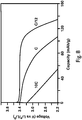
- the cathode material exhibits unit lattice volume expansion/shrinkage variations that are due to insertion/deinsertion of alkali cation in the cathode material. It is believed that these variations induce a loss of electronically conductive network contact with the cathode material and/or breaking of cathode material particles. As a result, the battery's capacity decreases and the battery has a resulting shorter life span.
- WO 2009/096255 (assigned to Sharp Kabushiki Kaisha), describes a Li y K a Fe 1-x X x PO 4 cathode material with reduced change of the unit cell volume, where X represents at least one element selected from group 2 to 13 elements; a and x are 0 ⁇ a ⁇ 0.25 and 0 ⁇ x ⁇ 0.25, respectively; and y is (1 - a).
- JP 2011/77030 (assigned to Sharp Corp. and Kyoto University), describes an alkali metal phosphosilicate material of general formula Li( 1-a )A a Fe( 1-x-b )M( x-c )P( 1-y )Si y O 4 , where A is at least one kind selected from a group consisting of Na, K, Fe and M.
- Average valence of Fe is +2 or more
- US 7 276 218 B2 discloses methods under reducing conditions of making transitional metal compounds useful as cathode active materials.
- the present invention relates to a process for the synthesis of a carbon-deposited alkali metal phosphosilicate cathode material comprising particles, where the particles carry, on at least a portion of the particle surface, carbon deposited by pyrolysis, the process comprising: a first dry high-energy milling step performed on precursors of the carbon-deposited alkali metal oxyanion prior to a first solid-state thermal reaction, wherein said first solid-state thermal reaction produces a first solid-state thermal reaction product; and a second dry high-energy milling step performed on said product prior to a second solid-state thermal reaction, wherein said precursors comprise at least one source compound of an alkali metal, at least one source compound of a metal M, where M is Fe and/or Mn; at least one source compound of a metal M', where M' is a 2+ or more metal in the carbon-deposited alkali metal phosphosilicate; at least one source compound of phosphorus (P), if the element P is not present in
- the present inventors have surprisingly and unexpectedly discovered, during an R&D project initiated to synthesize a specific carbon-deposited alkali metal phosphosilicate, C-LiFe 0.9 Zr 0.01 (PO 4 ) 0.9 (SiO 4 ) 0.1 , that known processes for obtaining carbon-deposited alkali metal oxyanion, such as those reported for the specific case of C-LiFePO 4 , e.g. wet-process, solid-state thermal process, polyol process, etc. produce low-quality materials.
- the present invention relates to a process for the production of a carbon-deposited alkali metal phosphosilicate cathode material as disclosed in the wording of the independent claim 1 and dependent clais 2-23.
- the present invention enables one to obtain a cathode having such properties that prevents and/or minimizes the expansion/shrinkage of the cathode. It is thus possible to prevent/minimize the internal resistance of the battery from increasing as the number of charging/discharging cycles increases. It is therefore possible to produce a cathode active material which allows production of a battery which not only excels in terms of safety and cost, but also has a longer life.
- the claimed process includes a first dry high-energy milling step of the carbon-deposited alkali metal oxyanion electrode material precursors that is performed prior to a first thermal step, and includes a second dry high-energy milling step of the product obtained after the first thermal step, where the second high-energy milling step is performed prior to a second thermal step as disclosed in the wordings of the claims.
- the process includes a step of pyrolysis of a source of carbon for obtaining a carbon deposit onto the alkali metal phosphosilicate and/or its precursors.
- the pyrolysis can be performed during the herein described first thermal step and/or second thermal step.
- an optional flash pyrolysis is performed after the synthesis reaction to improve carbon deposit graphitization.
- the deposit of carbon can present a more or less uniform, adherent and non-powdery deposit.
- the carbon deposit represents up to 15% by weight, with respect to the total weight of the material.
- the carbon deposit represents from 0.5 to 5% by weight with respect to the total weight of the material.
- Deposition of carbon by pyrolysis of a carbon source can be performed on the end product and/or on its precursors as described, for instance, in WO 02/027824 , WO 02/027823 , CA 2,307,119 , WO 2011/072397 , US 2002/195591 and US 2004/157126 .
- the process of the invention can be carried out continuously or in batch, in a reactor selected from rotary kilns, push kilns, fluidized beds, belt-driven kilns, that allow control of the composition and the circulation of the gaseous atmosphere. Utilization of large batch kiln, such as baking kiln, is not excluded. The person skilled in the art will be able to identify any alternative suitable alternative reactors or any from the above without departing from the present invention.
- high-energy milling is usually used in order to stress the character of applied milling equipments (mills) used for preparation of micro- and nanosized solids.
- mills mills
- High-energy milling of the precursors can be performed with a large choice of equipments, for example without any limitation, high-energy ball mills, pulverizing mixer mills, planetary ball mills, drum/ball-mills, shaker mills, stirred ball mills, mixer ball mills, vertical and horizontal attritors, and equivalent milling equipments.
- high-energy milling equipments are commercially available, for example but without any limitation, from SPEX CertiPrep Group L.L.C. (8000M Mixer/Mill®, etc.), Zoz GmbH (Simovier®), Retsch GmbH (Planetary Ball Mill PM 200/400/400 MA) and Union Process Inc. (Attritor®).
- the high-energy milling equipment is selected to avoid contamination of reactants, especially metallic contamination.
- milling parts of the equipment are preferably made of ceramics, or coated with ceramics, for example, without any limitation, alumina, zirconium silicate, zirconia, yttria or ceria stabilized zirconia, silicium nitride, tungsten carbide or silicium carbide.
- alumina zirconium silicate
- zirconia zirconia
- yttria or ceria stabilized zirconia zilicium nitride
- tungsten carbide or silicium carbide tungsten carbide
- the high-energy milling is high-energy ball milling.
- the process of the invention includes a first solid-state thermal step operated at a temperature selected from the following temperature ranges of 250 °C and 600 °C, 275 °C and 600 °C, 300 °C and 600 °C, 325 °C and 600 °C, 350 °C and 600 °C, or 375 °C and 600 °C, or 400 °C and 600 °C, or 200 °C and 500 °C, or 250 °C and 450 °C, or 300 °C and 400 °C.
- the process of the invention includes a second solid-state thermal step operated at a temperature selected from the following temperature ranges of between 450°C and 800 °C, 500 °C and 800 °C, 525 °C and 800 °C, 550 °C and 800 °C, or 575 °C and 800 °C, or 600 °C and 800 °C, or 400 °C and 700 °C, or 450 °C and 650 °C, or 500 °C and 600 °C.
- the process of the invention includes a first high-energy milling step that is performed during a time period selected from the following time ranges of between 10 minutes to 4 hours, 30 minutes to 4 hours, 60 minutes to 4 hours, 90 minutes to 4 hours, 120 minutes to 4 hours, 150 minutes to 4 hours, 180 minutes to 4 hours, 210 minutes to 4 hours, or 230 minutes to 4 hours.
- the process of the invention includes a second high-energy milling that is performed during a time period selected from the following time ranges of between 10 minutes to 4 hours, 30 minutes to 4 hours, 45 minutes to 4 hours, 60 minutes to 4 hours, 90 minutes to 4 hours, 120 minutes to 4 hours, 150 minutes to 4 hours, 180 minutes to 4 hours, 210 minutes to 4 hours, or 230 minutes to 4 hours.
- the process of the invention includes a subsequent flash thermal treatment on the alkali metal phosphosilicate end-product in order to improve the graphitization of carbon deposit while avoiding partial decomposition of the oxyanion.
- the flash thermal treatment can be operated at a temperature selected from the following temperature ranges of between 650 °C and 900 °C, 700 °C and 900 °C, 750 °C and 900 °C, 800 °C and 900 °C, or 825 °C and 900 °C, or 850 °C and 900 °C.
- the person skilled in the art will be able to select any alternative suitable temperature or any temperature falling within any of the ranges above without departing from the scope of the appended claims.
- the flash thermal treatment can be operated during a period of time selected from the following time ranges of between 10 seconds and ten minutes, 30 seconds and ten minutes, one minute and ten minutes, two minutes and ten minutes, three minutes and ten minutes, four minutes and ten minutes, or five minutes and ten minutes.
- the person skilled in the art will be able to select any alternative suitable time period or any time period falling within any of the ranges above without departing The scope of the claims.
- the herein described high-energy milling step produces a substantially amorphous product.
- the substantially amorphous product then becomes a substantially crystalline product after the herein described thermal reaction performed at a sufficiently high temperature.
- the person skilled in the art will be able to select a suitable temperature without departing from scope of the claims.
- the herein described first thermal reaction and/or second high-energy milling step produces a substantially amorphous product, which then becomes a substantially crystalline product after the herein described second thermal reaction which is performed at a sufficiently high temperature.
- the person skilled in the art will be able to select a suitable temperature without departing from the scope of the claims.
- the process of the invention includes reacting precursors of a carbon-deposited alkali metal phosphosilicate cathode material, where the precursors comprise:
- the source compound of carbon is present prior to the herein described first thermal step and/or prior to the herein described second thermal step.
- the herein described source compounds are totally present for the herein described first thermal step, or any part thereof is present for each of the herein described first and second thermal step.
- the process may include addition of one or more of the herein described source compound during / prior to the second high-energy milling and/or second thermal step.
- the source compound b) is partially replaced by at most 15% of: one or more other metals selected from Ni and Co, and/or atoms of one or more aliovalent or isovalent metals other than Ni or Co, and/or atoms of Fe(III).
- the source compound b) is partially replaced by at most 15% of: one or more other metals chosen from Ni and Co, and/or by one or more aliovalent or isovalent metals selected from the group consisting of Mg, Mo, Mn, V, Pb, Sn, Nb, Ti, Al, Ta, Ge, La, Y, Yb, Cu, Ag, Sm, Ce, Hf, Cr, Zr, Bi, Zn, Ca, B and W, and/or atoms of Fe(III).
- the "one or more metal” described herein is readily understood by the person skilled in the art as being one or more metal of those metals which are suitable in the art of batteries.
- the "one or more metal” described herein may be selected from any metal included in the 2, 3, 4, 5, or 6 periods from the periodic table that are suitable in the art of batteries without departing from the invention.
- the "one or more metal” described herein may be selected from at least one element selected from group 2 to 13 elements.
- the "one or more metal” described herein may be selected from Mg, Mo, Mn, V, Co, Ni, Pb, Sn, Nb, Ti, Al, Ta, Ge, La, Y, Yb, Cu, Ag, Sm, Ce, Hf, Cr, Zr, Bi, Zn, Ca, B and W.
- the person skilled in the art will be able to select any alternative suitable "one or more other metal” or any from the above without departing from the present invention.
- the carbon-deposited alkali metal phosphosilicate obtainable by the process of the invention is characterized in that a cathode material containing this material exhibits reduced change of the unit cell (lattice) volume concomitant to alkali cation insertion/deinsertion.
- the reduction of the unit cell (lattice) volume change can be characterized by the volume change of the de-cationated (e.g. delithiated) product versus the cationated (e.g. lithiated) product.
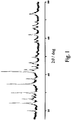
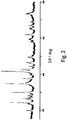
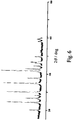
- the unit (lattice) volume of a given product can be evaluated by an XRD measurement of the product.
- the present inventors measured the increase in unit (lattice) cell volume of a given product relatively to the unit (lattice) cell volume of C-LiFePO 4 as a parameter to evaluate the performance of a given synthesis process.
- an end-product with an unsuitable increase in unit cell volume was characterized as representing a cathode material of low purity and/or inadequate substitution and/or presence of the M' in the phosphosilicate matrix.
- the source compound a) is an alkali compound selected, for example, from the group consisting of lithium oxide, sodium oxide, lithium hydroxide, sodium hydroxide, potassium hydroxide, lithium carbonate, sodium carbonate, potassium carbonate, Li 3 PO 4 , Na 3 PO 4 , K 3 PO 4 , the hydrogen phosphate LiH 2 PO 4 , LiNaHPO 4 , LiKHPO 4 , NaH 2 PO 4 , KH 2 PO 4 , Li 2 HPO 4 , lithium, sodium or potassium ortho-, meta- or polysilicates, lithium sulfate, sodium sulfate, potassium sulfate, lithium oxalate, sodium oxalate, potassium oxalate, lithium acetate, sodium acetate, potassium acetate and one of their mixtures.
- the person skilled in the art will be able to select any alternative suitable source compound a) or any from the above without departing from the spirit of the invention.
- the source compound b) comprise a compound selected, for example, from iron, iron(III) oxide or magnetite, trivalent iron phosphate, lithium iron hydroxyphosphate or trivalent iron nitrate, ferrous phosphate, hydrated or nonhydrated, vivianite Fe 3 (PO 4 ) 2 , iron acetate (CH 3 COO) 2 Fe, iron sulfate (FeSO 4 ), iron oxalate, iron(III) nitrate, iron(II) nitrate, FeCl 3 , FeCl 2 , FeO, ammonium iron phosphate (NH 4 FePO 4 ), Fe 2 P 2 O 7 , ferrocene or one of their mixtures; and/or manganese, MnO, MnO 2 , manganese acetate, manganese oxalate, Mn(III) acetylacetonate, Mn(II) acetylacetonate, Mn(II) chloride,
- the source compound c) is a source compound of a metal which in the final product is a metal having a valency of 2+ or more.
- it is a source compound of a metal selected from the group consisting of Zr 4+ , Ti 4+ , Nb 4+ , Mo 4+ , Ge 4+ , Ce 4+ and Sn 4+ , and/or a source compound a metal selected from the group consisting of Al 3+ , Y 3+ , Nb 3+ , Ti 3+ , Ga 3+ , Cr 3+ and V 3+ , and/or a source compound a metal selected from the group consisting of Ta 5+ and Nb 5+ , and/or a source compound a metal selected from the group consisting of Zn 2+ and Ca 2+ .
- the source compound c) may be selected from zinc acetate, zinc chloride, zinc acetylacetonate, zinc nitrate, zinc sulfate, zinc stearate, calcium carbonate, calcium hydroxide, calcium acetate, or a mixture thereof.
- the source compound c) may be selected from yttrium(III) 2-ethylhexanoate, yttrium(III) acetate, yttrium(III) acetylacetonate, yttrium(III) nitrate, aluminum acetate, aluminum isopropoxide, aluminum acetylacetonate, aluminum ethoxide, aluminum metaphosphate, aluminum monostearate, or a mixture thereof.
- the source compound c) may be selected from zirconium acetate hydroxide, zirconium alkoxide, zirconium(IV) acetylacetonate, zirconium(IV) ethoxide, zirconium(IV) hydrogenphosphate, zirconium(IV) silicate, titanium(IV) 2-ethylhexyloxide, titanium(IV) butoxide, germanium(IV) ethoxide, tin(IV) acetate, or a mixture thereof.
- the source compound c) may be selected from tantalum(V) butoxide, niobium(V) ethoxide, niobium(V) phenoxide, or a mixture thereof.
- the person skilled in the art will be able to select any alternative suitable source compound c) or any from the above without departing from the spirit of the invention.
- the source compound d) is a compound of phosphorus selected, for example, from phosphoric acid and its esters, M 3 PO 4 wherein M is at least one selected from Li, Na and K, the hydrogen phosphate MH 2 PO 4 wherein M is at least one selected from Li, Na and K, monoammonium or diammonium phosphates, trivalent iron phosphate or manganese ammonium phosphate (NH 4 MnPO 4 ), MnHPO 4 , Fe 2 P 2 O 7 .
- M 3 PO 4 wherein M is at least one selected from Li, Na and K
- the hydrogen phosphate MH 2 PO 4 wherein M is at least one selected from Li, Na and K, monoammonium or diammonium phosphates, trivalent iron phosphate or manganese ammonium phosphate (NH 4 MnPO 4 ), MnHPO 4 , Fe 2 P 2 O 7 .
- the source compound e) is a compound of silicon selected, for example, from organosilicon, silicon alkoxides, tetraethyl orthosilicate, nanosized SiO 2 , Li 2 SiO 3 , Li 4 SiO 4 or a mixture thereof.
- organosilicon silicon alkoxides, tetraethyl orthosilicate, nanosized SiO 2 , Li 2 SiO 3 , Li 4 SiO 4 or a mixture thereof.
- a subset or all of the source compounds a) to e) can also be additionally a source of oxygen and/or a source of at least two elements.
- the source compounds are selected to provide a cathode material having alkali metal:M:M':P:Si ratios of about 1:0.7 to 1:> 0 to 0.3:> 0.7 to 1:> 0 to 0.3, where "> 0" does not include 0, rather it means "more than 0".
- the deposition of carbon on the surface of the alkali metal phosphosilicate or its precursors is obtained by pyrolysis of the source compound of carbon f).
- the deposition of carbon at the surface of the oxyanion or its precursors can be obtained by thermal decomposition or transformation of highly varied source compounds of carbon.
- the source compound of carbon is a compound which is in the liquid state or in the gas state, a compound which changes to the liquid or gas state during its thermal decomposition or transformation, so as to more or less coat the compounds in the mixture.
- the source compound of carbon can, for example, be chosen from liquid, solid or gaseous hydrocarbons and their derivatives (in particular polycyclic aromatic entities, such as tar or pitch), perylene and its derivatives, polyhydric compounds (for example, sugars and carbohydrates, and their derivatives), polymers, cellulose, starch and their esters and ethers, fatty acid salts (for example stearic, oleic acid or lithium stearate), fatty acid esters, fatty alcohol esters, alkoxylated alcohols, alkoxylated amines, fatty alcohol sulfate or phosphate esters, imidazolium and quaternary ammonium salts, ethylene oxide/propylene oxide copolymer, ethylene oxide/butylene oxide copolymer and their mixtures.
- polycyclic aromatic entities such as tar or pitch
- polyhydric compounds for example, sugars and carbohydrates, and their derivatives
- polymers for example, cellulose, starch and their esters and ethers,
- a non-limiting example is UnithoxTM 550 ethoxylate (Baker Hughes).
- UnithoxTM ethoxylates are nonionic emulsifiers and wetting agents with high molecular weights and melt points.
- any of the herein described process steps are performed under an inert atmosphere such as, without any limitation, nitrogen, argon, theoretical chemical formula may slightly depart from electroneutrality, without being bond by any theory, it is believed that the carbon-deposited alkali metal phosphosilicate cathode material of the present invention may contain different phases that balance out the material overall charge in order to ultimately obtain overall electroneutrality.
- the present invention is not limited to any defined theoretical chemical formula since the person skilled in the art will understand how to optimize the precursors' ratios in order to obtain the desired carbon-deposited alkali metal phosphosilicate cathode material of the present invention without departing from the invention.
- the product obtainable by the process of the present invention relates to a carbon-deposited alkali metal phosphosilicate cathode material, comprising particles which carry, on at least a portion of their surface, carbon deposited by pyrolysis.
- the particles of the carbon deposited alkali metal phosphosilicate obtainable by the process of the present invention may have an olivine structure or may have an alternative structure.
- the carbon deposited alkali metal phosphosilicate cathode material can contain a metal of valence 2+ for example Fe(II) and /or Mn(II) within the limits of claims 1-23.
- the product obtainable by the process of the current invention may relate to a carbon-deposited alkali metal phosphosilicate cathode material, comprising particles which carry, on at least a portion of their surface, carbon deposited by pyrolysis, where the particles have a general formula A z M 1-x M' x P 1-y Si y O 4 where the average valency of M is +2 or greater; M is Fe and/or Mn; and A is at least one alkali metal selected from Li, Na and K.
- the Fe and/or Mn is substituted by at most 15% at. of one or more metal at oxidation levels between +1 and +5.
- M' is a metal of valency of 2+ or more as defined in claim 1.
- the product obtainable by the process of the present invention may relate to a carbon-deposited alkali metal phosphosilicate cathode material, comprising particles which carry, on at least a portion of their surface, carbon deposited by pyrolysis, where the particles have a general formula AM 1-x M' x P 1-y Si y O 4 where the average valency of M is +2 or greater; M is Fe and/or Mn; and A is at least one alkali metal selected from Li, Na and K.
- the Fe and/or Mn is substituted by at most 15% at. of one or more metal at oxidation levels between +1 and +5.
- M' is a metal of valency of 2+ or more.
- the product obtainable by the process of the current invention may relate to a carbon-deposited alkali metal phosphosilicate cathode material, comprising particles having an olivine structure and which carry, on at least a portion of their surface, carbon deposited by pyrolysis, where the particles have a general formula LiM 1-x M' x P 1-y Si y O 4 where the average valency of M is +2 or greater; M is Fe and/or Mn. Optionally, the Fe and/or Mn is substituted by at most 15% at. of one or more metal at oxidation levels between +1 and +5. M' is a metal of valency of 2+ or more.
- the phosphate polyanion (PO 4 ) and/or SiO 4 can also be partly substituted by another XO 4 oxyanion, in which X is either P, S, V, Si, Nb, Mo or any combinations thereof.
- the product obtainable by the process of the current invention may relate to a carbon-deposited alkali metal phosphosilicate cathode material, comprising particles which carry, on at least a portion of their surface, carbon deposited by pyrolysis, where the particles have a general element ratios Li:(Fe+Zr):PO 4 :SiO 4 of about 1:1:0.7-1:>0-0.3 ratios.
- the product obtainable by the process of the present invention can be an optimized carbon-deposited alkali metal phosphosilicate cathode material, comprising particles which carry, on at least a portion of their surface, carbon deposited by pyrolysis, where the particles have a general element ratios Li:Fe:Zr:PO 4 :SiO 4 , at about 1 +/- x:0.95 +/x:0.05 +/- x:0.95 +/- x:0.05 +/- x ratios, where x is independently about 20% of value.
- the product obtainable by the process of the present invention can be an optimized carbon-deposited alkali metal phosphosilicate cathode material, comprising particles which carry, on at least a portion of their surface, carbon deposited by pyrolysis, where the particles have a general element ratios Li:Fe:Zr:PO 4 :SiO 4 , at about 1 +/- x:0.95 +/x:0.05 +/- x:0.95 +/- x:0.05 +/- x ratios, where x is independently about 10% of value.
- x is about 5% of value.
- x is about 4% of value.
- x is about 3% of value.
- x is about 2% of value.
- the product obtainable by the process of the present invention may relate to a carbon-deposited alkali metal phosphosilicate cathode material, comprising particles which carry, on at least a portion of their surface, carbon deposited by pyrolysis, where the particles have the general formula LiM 1-x M' x (PO 4 ) 1-2x (SiO 4 ) 2x where M is Fe and/or Mn, and M' is 4+ metal.
- the phosphate polyanion (PO 4 ) can also be partly substituted by sulfate polyanion (SO 4 ) and/or the lithium metal can be partly substituted by Na and/or K.
- the product obtainable by the process of the present invention may relate to a carbon-deposited alkali metal phosphosilicate cathode material, comprising particles which carry, on at least a portion of their surface, carbon deposited by pyrolysis, where the particles have the general formula LiFe 1-x M' x (PO 4 ) 1-2x (SiO 4 ) 2x , where M' is a 4+ metal.
- the phosphate polyanion (PO 4 ) can also be partly substituted by sulfate polyanion (SO 4 ) and/or the lithium metal can be partly substituted by Na and/or K.
- the product obtainable by the process of the present invention may relate to a carbon-deposited alkali metal phosphosilicate cathode material, comprising particles which carry, on at least a portion of their surface, carbon deposited by pyrolysis, where the particles have the general formula AM 1-x M'x(XO 4 ) 1-2x (SiO 4 ) 2x , where:
- the product obtainable by the process of the present invention may relate to a carbon-deposited alkali metal phosphosilicate cathode material, comprising particles which carry, on at least a portion of their surface, carbon deposited by pyrolysis, where the particles have the general formula AM 1-x M' x (XO 4 ) 1-2x (SiO 4 ) 2x , where:
- the product obtainable by the process of the present invention may relate to a carbon-deposited alkali metal phosphosilicate cathode material, comprising particles which carry, on at least a portion of their surface, carbon deposited by pyrolysis, where the particles have the general formula AM 1-x M' x (XO 4 ) 1-2x (SiO 4 ) x , where:
- the product obtainable by the process of the present invention may relate to a carbon-deposited alkali metal phosphosilicate cathode material, comprising particles which carry, on at least a portion of their surface, carbon deposited by pyrolysis, where the particles have the general formula AM 1-X M' x (XO 4 ) 1-2x (SiO 4 ) 2x , where:
- the product obtainable by the process of the present invention may relate to a carbon-deposited alkali metal phosphosilicate cathode material, comprising particles which carry, on at least a portion of their surface, carbon deposited by pyrolysis, where the particles have the general formula LiFe 1-x Zr x (PO 4 ) 1-2x (SiO 4 ) 2x where 0.03 ⁇ x ⁇ 0.1, or 0.03 ⁇ x ⁇ 0.08, or 0.04 ⁇ x ⁇ 0.06.
- the product obtainable by the process of the present invention may relate to a carbon-deposited alkali metal phosphosilicate cathode material, comprising particles which carry, on at least a portion of their surface, carbon deposited by pyrolysis, where the particles have the general formula LiFe 0.9 Zr 0.1 (P0 4 ) 0.8 (SiO 4 ) 0.2 .
- the product obtainable by the process of the present invention may relate to a carbon-deposited alkali metal phosphosilicate cathode material, comprising particles which carry, on at least a portion of their surface, carbon deposited by pyrolysis, where the particles have the general formula LiM 1-x M' x (PO 4 ) 1-x (SiO 4 ) x where M is Fe and/or Mn, and M' is 3+ metal.
- the phosphate polyanion (PO 4 ) can also be partly substituted by sulfate polyanion (SO 4 ) and/or the lithium metal can be partly substituted by Na and/or K.
- the product obtainable by the process of the present invention may relate to a carbon-deposited alkali metal phosphosilicate cathode material, comprising particles which carry, on at least a portion of their surface, carbon deposited by pyrolysis, where the particles have the general formula LiFe 1-x M' x (PO 4 ) 1-x (SiO 4 ) x , where M' is a 3+ metal.
- the phosphate polyanion (PO 4 ) can also be partly substituted by sulfate polyanion (SO 4 ) and/or the lithium metal can be partly substituted by Na and/or K.
- the product obtainable by the process of the present invention may relate to a carbon-deposited alkali metal phosphosilicate cathode material, comprising particles which carry, on at least a portion of their surface, carbon deposited by pyrolysis, where the particles have the general formula AM 1-x M' x (XO 4 ) 1-x (SiO 4 ) x , where:
- the product obtainable by the process of the present invention may relate to a carbon-deposited alkali metal phosphosilicate cathode material, comprising particles which carry, on at least a portion of their surface, carbon deposited by pyrolysis, where the particles have the general formula AM 1-x M' x (XO 4 ) 1-x (SiO 4 ) x , where:
- the product obtainable by the process of the present invention may relate to a carbon-deposited alkali metal phosphosilicate cathode material, comprising particles which carry, on at least a portion of their surface, carbon deposited by pyrolysis, where the particles have the general formula AM 1-x M' x (XO 4 ) 1-x (SiO 4 ) x , where:
- the product obtainable by the process of the present invention may relate to a carbon-deposited alkali metal phosphosilicate cathode material, comprising particles which carry, on at least a portion of their surface, carbon deposited by pyrolysis, where the particles have the general formula AM 1-x M' x (XO 4 ) 1-x (SiO 4 ) x , where:
- the product obtainable by the process of the present invention may relate to a carbon-deposited alkali metal phosphosilicate cathode material, comprising particles which carry, on at least a portion of their surface, carbon deposited by pyrolysis, where the particles have the general formula LiFe 1-x M" x (PO 4 ) 1-x (SiO 4 ) x , where M" is Y 3+ and/or Al 3+ , and 0.03 ⁇ x ⁇ 0.1, or 0.03 ⁇ x ⁇ 0.08, or 0.04 ⁇ x ⁇ 0.06.
- the present invention may relate to a carbon-deposited alkali metal phosphosilicate cathode material, comprising particles which carry, on at least a portion of their surface, carbon deposited by pyrolysis, where the particles have the general formula LiFe 0.9 M" 0.1 (PO 4 ) 0.9 (SiO 4 ) 0.1 , where M" is Y 3+ and/or Al 3+ .
- the product obtainable by the process of the present invention may relate to a carbon-deposited alkali metal phosphosilicate cathode material, comprising particles which carry, on at least a portion of their surface, carbon deposited by pyrolysis, where the particles have the general formula LiFe 0.95 M" 0.05 (PO 4 ) 0.95 (SiO 4 ) 0.05 , where M" is Y 3+ and/or Al 3+ .
- FePO 4 •2H 2 O (0.4 mole) serving as a phosphorus (P) and iron source
- Zr(IV) acetate hydroxide (0.05 mole) serving as a Zr 4+ source, at an atomic ratio of Li:Fe:Zr:P:Si 1:0.9:0.1:0.8:0.2
- polymeric UnithoxTM 550 5 wt.% of precursors, manufactured by Baker Hughes) as a carbon source were mixed together in a mortar.
- the resulting mixture was heated at about 550 °C for about 6 hours under nitrogen atmosphere.
- the X-ray spectrum, represented in figure 1 of the resulting product showed formation of Li 3 PO 4 , ZrO 2 and LiZr 2 (PO 4 ) 3 impurity phases.
- the unit cell volume of the resulting olivine was 291 ⁇ 3 .
- Example 2 1-step high-energy milling and 1-step solid-state reaction
- FePO 4 •2H 2 O (0.4 mole) serving as a phosphorus (P) and iron source
- Zr(IV) acetate hydroxide (0.05 mole) serving as a Zr 4+ source, at an atomic ratio of Li:Fe:Zr:P:Si 1:0.9:0.1:0.8:0.2
- polymeric UnithoxTM 550 5 wt.% of precursors, manufactured by Baker Hughes) as a carbon source were high-energy milled in a SPEX Mill for about 2 hours.
- alkali metal phosphosilicate cathode material comprising particles which carry, on at least a portion of their surface, carbon deposited by pyrolysis, where the particles have the general formula AM 1-x M' x (XO 4 ) 1-x (SiO 4 ) x , where:
- the product obtainable by the process of the present invention relates to a carbon-deposited alkali metal phosphosilicate cathode material, comprising particles which carry, on at least a portion of their surface, carbon deposited by pyrolysis, where the particles have the general formula AM 1-x M' x (XO 4 ) 1-x (SiO 4 ) x , where:
- the product obtainable by the process of the present invention relates to a carbon-deposited alkali metal phosphosilicate cathode material, comprising particles which carry, on at least a portion of their surface, carbon deposited by pyrolysis, where the particles have the general formula LiFe 1-x M" x (PO 4 ) 1-x (SiO 4 ) x , where M" is Y 3+ and/or Al 3+ , and 0.03 ⁇ x ⁇ 0.1, or 0.03 ⁇ x ⁇ 0.08, or 0.04 ⁇ x ⁇ 0.06.
- the present invention relates to a carbon-deposited alkali metal phosphosilicate cathode material, comprising particles which carry, on at least a portion of their surface, carbon deposited by pyrolysis, where the particles have the general formula LiFe 0.9 M" 0.1 (PO 4 ) 0.9 (SiO 4 ) 0.1 , where M" is Y 3+ and/or Al 3+ .
- the product obtained by the process of the present invention relates to a carbon-deposited alkali metal phosphosilicate cathode material, comprising particles which carry, on at least a portion of their surface, carbon deposited by pyrolysis, where the particles have the general formula LiFe 0.95 M" 0.05 (PO 4 ) 0.95 (SiO 4 ) 0.05 , where M" is Y 3+ and/or Al 3+ .
- FePO 4 •2H 2 O (0.4 mole) serving as a phosphorus (P) and iron source
- Zr(IV) acetate hydroxide (0.05 mole) serving as a Zr 4+ source, at an atomic ratio of Li:Fe:Zr:P:Si 1:0.9:0.1:0.8:0.2
- polymeric UnithoxTM 550 5 wt.% of precursors, manufactured by Baker Hughes) as a carbon source were mixed together in a mortar.
- the resulting mixture was heated at about 550 °C for about 6 hours under nitrogen atmosphere.
- the X-ray spectrum, represented in figure 1 of the resulting product showed formation of Li 3 PO 4 , ZrO 2 and LiZr 2 (PO 4 ) 3 impurity phases.
- the unit cell volume of the resulting olivine was 291 ⁇ 3 .
- Example 2 1-step high-energy milling and 1-step solid-state reaction
- FePO 4 •2H 2 O (0.4 mole) serving as a phosphorus (P) and iron source
- Zr(IV) acetate hydroxide (0.05 mole) serving as a Zr 4+ source, at an atomic ratio of Li:Fe:Zr:P:Si 1:0.9:0.1:0.8:0.2
- polymeric UnithoxTM 550 5 wt.% of precursors, manufactured by Baker Hughes) as a carbon source were high-energy milled in a SPEX Mill for about 2 hours.
- the resulting high-energy milled mixture was then heated at about 550 °C for about 6 hours under nitrogen atmosphere.
- the X-ray spectrum, represented in figure 2 of the resulting product showed formation of Li 3 PO 4 , ZrO 2 and LiZr 2 (PO 4 ) 3 impurity phases.
- the unit cell volume of the resulting olivine was 291.1 ⁇ 3 .
- the experiment has been repeated with similar results by replacing the SPEX Mill with an Attritor® with a bead/precursor ratio of 20:1.
- Example 3 2-step high-energy milling and 2-step solid-state reaction, high temperature
- FePO 4 •2H 2 O (0.4 mole) serving as a phosphorus (P) and iron source
- Zr(IV) acetate hydroxide (0.05 mole) serving as a Zr 4+ source, at an atomic ratio of Li:Fe:Zr:P:Si 1:0.9:0.1:0.8:0.2
- polymeric UnithoxTM 550 5 wt.% of precursors, manufactured by Baker Hughes) as a carbon source were high-energy milled in a SPEX Mill for 2 hours.
- the resulting high-energy milled mixture was then heated at about 550 °C for 6 hours under nitrogen atmosphere.
- the process was then repeated a second time using the same high-energy milling and heating conditions.
- a second high-energy milling step and a second heating step were performed after the above first heating step.
- the X-ray spectrum, represented in figure 3 of the resulting product showed formation of Li 3 PO 4 and ZrO 2 impurity phases.
- the unit cell volume of the resulting olivine is 291.8 ⁇ 3 .
- the experiment has been repeated with similar results by replacing the SPEX Mill with an Attritor® with a bead/precursor ratio of 20:1.
- Example 4 2-step high-energy milling and 2-step solid-state reaction, low temperature
- FePO 4 •2H 2 O 0.4 mole as a phosphorus (P) and iron source
- iron oxalate dihydrate 0.05 mole
- Li 2 CO 3 (0.25 mole) as a lithium source
- tetraethyl orthosilicate Si(OC 2 H 5 ) 4 0.1 mole
- Si silicon
- Zr(IV) acetate hydroxide 0.05 mole
- Li:Fe:Zr:P:Si 1:0.9:0.1:0.8:0.2
- polymeric UnithoxTM 550 5 wt.% of precursors, manufactured by Baker Hughes
- the resulting high-energy milled mixture was then heated at about 300 °C for about 1 hour under nitrogen atmosphere. Gaseous products evolved during this thermal step.
- the resulting product was then high-energy milled for about one hour with a SPEX Mill to produce an amorphous precursor.
- the resulting high-energy milled amorphous precursor was then heated at about 550 °C for about 5 hours under nitrogen atmosphere.
- the X-ray spectrum of the resulting carbon-deposited lithium iron zirconium phosphosilicate product shown in figure 4 , shows a unit cell volume of 292.6 ⁇ 3 and no clear formation of impurity phase.
- the experiment has been repeated with similar results by replacing the SPEX Mill with an Attritor® with a bead/precursor ratio of 20:1.
- Table 1 Name 1 st milling 1 st annealing 2 nd milling 2 nd annealing cell volume ( ⁇ 3 ) % change
- Commercial C-LiFePO 4 291 Reference 1-step solid-state none 550°C, 6h none none 291 0% 1-step milling 2 hours 550°C, 6h none none 291,1 8,8% 2-step milling-high T 2 hours 550°C, 6h 2 hours 550°C, 6h 291,8 44,7% 2-step milling-low T 2 hours 300°C, 6h 2 hours 550°C, 6h 292,6 91,2%
- Example 5 2-step high-energy milling and 2-step solid-state reaction, low temperature
- Iron oxalate dihydrate (590.11 g) serving as an iron source
- Li 2 CO 3 (6.38 g) serving as a lithium source
- LiH 2 PO 4 340.92 g) serving as a phosphorus (P) and lithium source
- tetraethyl orthosilicate Si(OC 2 H 5 ) 4 35.96 g) serving as a silicon (Si) source
- Zr(IV) acetate hydroxide (36.63 g) serving as a Zr 4+ source, at an atomic ratio of Li:Fe:Zr:P:Si 1:0.95:0.05:0.95:0.05
- stearic acid (13.7 g)
- grade M 5005 micronized polyethylene wax powders (13.7 g, manufactured by Marcus Oil & Chemical), both as a carbon source, were charged in a high-energy ball milling vertical agitation attritor® (Union Process 1-S) containing 10 kg of yttrium-stabilized ZrO 2 beads (10
- the attritor® was then operated during 2 hours at a speed of 350 rpm.
- the resulting high-energy milled mixture was then heated at about 300 °C for about 1 hour under nitrogen atmosphere. Gaseous products evolved during this thermal step.
- the resulting product was then high-energy milled for about two hours in attritor® to produce an amorphous precursor.
- the resulting high-energy milled amorphous precursor was then heated at about 570 °C for about 6 hours under humid nitrogen gas (bubbled in water at around 80 °C), dry nitrogen gas is used during heating step (around 90 mn) and cooling step (around 180 mn).
- the X-ray spectrum of the resulting carbon-deposited lithium iron zirconium phosphosilicate shown in figure 5 , shows a unit cell volume of 291.3 ⁇ 3 and no clear formation of impurity phase.
- iron oxalate dihydrate (576.19 g) serving as an iron source
- Li 2 CO 3 (12.46 g) serving as a lithium source
- LiH 2 PO 4 (315.36 g) serving as a phosphorus (P) and lithium source
- tetraethyl orthosilicate Si(OC 2 H 5 ) 4 70.23 g) serving as a silicon (Si) source
- stearic acid (13.7 g) and grade M 5005 micronized polyethylene wax powders (13.7 g, manufactured by Marcus Oil & Chemical), both as a carbon source.
- the X-ray spectrum of the resulting carbon-deposited lithium iron zirconium phosphosilicate, provided in figure 6 shows a unit cell
- Example 6 2-step high-energy milling and 2-step solid-state reaction, low temperature
- LiOH serving as lithium source
- FePO 4 serving as an iron source and phosphorus (P) source
- yttrium(III) 2-ethylhexanoate serving as a Y 3+ source
- (NH 4 ) 2 HPO 4 serving as a phosphorus (P) source
- tetraethyl orthosilicate Si(OC 2 H 5 ) 4 serving as a silicon (Si) source
- Li:Fe:Y:P:Si 1:0.95:0.05:0.95:0.05
- stearic acid 2.5 wt.% of precursors
- grade M 5005 micronized polyethylene wax powders 2.5 wt.% of precursors
- Example 7 2-step high-energy milling and 2-step solid-state reaction, low temperature
- LiOH serving as lithium source
- iron oxalate dihydrate serving as an iron source
- MnO serving as a manganese source
- Zr(IV) acetate hydroxide serving as a Zr 4+ source
- (NH 4 ) 2 HPO 4 serving as a phosphorus (P) source
- tetraethyl orthosilicate Si(OC 2 H 5 ) 4 serving as a silicon (Si) source
- Si silicon
- Li:Fe:Mn:Zr:P:Si 1:0.8:0.15:0.05:0.9:0.1
- stearic acid 2.5 wt.% of precursors
- grade M 5005 micronized polyethylene wax powders (2.5 wt.% of precursors)
- Example 8 2-step high-energy milling and 2-step solid-state reaction, low temperature
- Li 2 CO 3 serving as lithium source
- Na 2 CO 3 serving as sodium source
- iron oxalate dihydrate serving as an iron source
- Zr(IV) acetate hydroxide serving as a Zr 4+ source
- LiH 2 PO 4 serving as a phosphorus (P) source and lithium source
- tetraethyl orthosilicate Si(OC 2 H 5 ) 4 serving as a silicon (Si) source
- Si silicon
- Example 9 2-step high-energy milling and 2-step solid-state reaction, low temperature
- Li 2 CO 3 serving as lithium source
- iron oxalate dihydrate serving as an iron source
- Zr(IV) acetate hydroxide serving as a Zr 4+ source
- LiH 2 PO 4 serving as a phosphorus (P) source and lithium source
- tetraethyl orthosilicate Si(OC 2 H 5 ) 4 serving as a silicon (Si) source
- Si silicon
- Li:Fe:Zr:P:Si 1.03:0.95:0.05:0.9:0.1
- stearic acid 1.5 wt.% of precursors
- grade M 5005 micronized polyethylene wax powders 1.5 wt.% of precursors
- Example 10 2-step high-energy milling and 2-step solid-state reaction, low temperature
- Li 2 CO 3 serving as lithium source
- iron oxalate dihydrate serving as an iron source
- niobium(V) ethoxide serving as a Nb 5+ source
- LiH 2 PO 4 serving as a phosphorus (P) source and lithium source
- tetraethyl orthosilicate Si(OC 2 H 5 ) 4 serving as a silicon (Si) source
- Si silicon
- Li:Fe:Nb:P:Si 1:0.97:0.03:0.91:0.09
- stearic acid (2 wt.% of precursors) and grade M 5005 micronized polyethylene wax powders (2 wt.% of precursors)
- both as a carbon source were high-energy milled in a SPEX Mill and heat treated as described in example 4. Carbon-deposited lithium iron niobium phosphosilicate was thus obtained.
- Example 11 2-step high-energy milling and 2-step solid-state reaction, low temperature
- Li 2 CO 3 serving as lithium source
- iron oxalate dihydrate serving as an iron source
- cobalt(II) oxalate dihydrate serving as a cobalt source
- Zr(IV) acetate hydroxide serving as a Zr 4+ source
- LiH 2 PO 4 serving as a phosphorus (P) source and lithium source
- tetraethyl orthosilicate Si(OC 2 H 5 ) 4 serving as a silicon (Si) source
- Si silicon
- Si silicon
- Example 12 2-step high-energy milling and 2-step solid-state reaction, low temperature
- Li 2 CO 3 serving as lithium source
- iron oxalate dihydrate serving as an iron source
- MnO serving as a manganese source
- Zr(IV) acetate hydroxide serving as a Zr 4+ source
- LiH 2 PO 4 serving as a phosphorus (P) source and lithium source
- tetraethyl orthosilicate Si(OC 2 H 5 ) 4 serving as a silicon (Si) source
- Si silicon
- Si silicon
- Example 13 2-step high-energy milling and 2-step solid-state reaction, low temperature
- Iron oxalate dihydrate (590.11 g) serving as an iron source
- Li 2 CO 3 (6.38 g) serving as a lithium source
- LiH 2 PO 4 340.92 g) serving as a phosphorus (P) and lithium source
- tetraethyl orthosilicate Si(OC 2 H 5 ) 4 35.96 g) serving as a silicon (Si) source
- stearic acid (9.13 g) and grade M 5005 micronized polyethylene wax powders (9.13 g, manufactured by Marcus Oil & Chemical), both as a carbon source, were charged in a high-energy ball milling vertical agitation attritor® (Union Process 1-S) containing 10 kg of yttrium-stabilized ZrO 2 beads
- the attritor® was then operated during 2 hours at a speed of 350 rpm.
- the resulting high-energy milled mixture was then heated at about 300 °C for about 1 hour under nitrogen atmosphere. Gaseous products evolved during this thermal step.
- the resulting product, stearic acid (4.57 g) and grade M 5005 micronized polyethylene wax powders (4.57 g), both as a carbon source, were then high-energy milled for about one hour in attritor®.
- the resulting high-energy milled amorphous precursor was then heated at about 570 °C for about 6 hours under humid nitrogen gas (bubbled in water at around 80 °C), dry nitrogen gas is used during heating step (around 90 mn) and cooling step (around 180 mn). Carbon-deposited lithium iron zirconium phosphosilicate was thus obtained.
- Liquid electrolyte batteries were prepared according to the following procedure.
- a cathode material of the present invention PVdF-HFP copolymer (supplied by Atochem), and EBN-1010 graphite powder (supplied by Superior Graphite) were ball milled in a jar mill with zirconia beads in N-methylpyrrolidone (NMP) for 10 hours in order to obtain a dispersion composed of the cathode/PVdF-HFP/graphite 80/10/10 by weight mixture.
- NMP N-methylpyrrolidone
- the mixture obtained was subsequently deposited, using a Gardner® device, on a sheet of aluminum carrying a carbon-treated coating (supplied by Exopack Advanced Coating) and the film deposited was dried under vacuum at 80°C for 24 hours and then stored in a glovebox.
- a battery of the "button" type was assembled and sealed in a glovebox, use being made of the carbon-treated sheet of aluminum carrying the coating comprising the carbon-deposited alkali metal phosphosilicate, as cathode, a film of lithium, as anode, and a separator having a thickness of 25 ⁇ m (supplied by Celgard) impregnated with a 1M solution of LiPF 6 in an EC/DEC 3/7 mixture.
- the batteries were subjected to scanning cyclic voltammetry at ambient temperature with a rate of 20 mV/80 s using a VMP2 multichannel potentiostat (Biologic Science Instruments), first in oxydation from the rest potential up to 4 V and then in reduction between 4 and 2.2 V. Voltammetry was repeated a second time and capacity of the cathode material (C in mAh/g) determined from the second reduction cycle.
- Mg 2+ is considered similarly isocharge with Fe 2+ and V 5+ is similarly isocharge with P 5+ .
- (PO 4 ) 3 tetrahedra can be substituted with (VO 4 ) 3 tetrahedra.
- Aliovalent substitution refers to substitution of one element on a given crystallographic site with an element of a different valence or charge.
- One example of an aliovalent substitution would be Cr 3+ or Ti 4+ on an Fe 2+ site.
Landscapes
- Chemical & Material Sciences (AREA)
- General Chemical & Material Sciences (AREA)
- Chemical Kinetics & Catalysis (AREA)
- Electrochemistry (AREA)
- Engineering & Computer Science (AREA)
- Manufacturing & Machinery (AREA)
- Inorganic Chemistry (AREA)
- Composite Materials (AREA)
- Materials Engineering (AREA)
- Crystallography & Structural Chemistry (AREA)
- Dispersion Chemistry (AREA)
- Battery Electrode And Active Subsutance (AREA)
- Silicates, Zeolites, And Molecular Sieves (AREA)
Description
- The present invention relates to the field of electrode materials, and more specifically, to a carbon-deposited alkali metal oxyanion electrode material as well as to a process for preparing same.
- Positive electrodes of lithium-ion battery generally comprise an electrochemically active cathode material, a binder and carbon particles which act as an electronically conductive additive. During battery cycling, it has been observed that such positive electrodes generally show a deleterious increase in electrode resistance. It has been proposed that as the number of cycles increases, the cathode material exhibits unit lattice volume expansion/shrinkage variations that are due to insertion/deinsertion of alkali cation in the cathode material. It is believed that these variations induce a loss of electronically conductive network contact with the cathode material and/or breaking of cathode material particles. As a result, the battery's capacity decreases and the battery has a resulting shorter life span.
- To address this problem, it has been proposed to fine-tune the composition of cathode materials in order to reduce the observed change of unit cell volume concomitant to alkali cation insertion/deinsertion.
-
WO 2009/096255 (assigned to Sharp Kabushiki Kaisha), describes a LiyKaFe1-xXxPO4 cathode material with reduced change of the unit cell volume, where X represents at least one element selected from group 2 to 13 elements; a and x are 0<a≤0.25 and 0≤x≤0.25, respectively; and y is (1 - a). -
WO 2010/134579 (assigned to Sharp Kabushiki Kaisha ), describes an alkali metal phosphosilicate material of general formula LiFe1-xMxP1-ySiyO4 where the average valency of Fe is +2 or greater; M is an element having a valency of +2 or greater and is at least one selected from the group consisting of Zr, Sn, Y and Al; the valency of M and the average valency of Fe are different; 0 < x ≤ 0.5; and y = x ∗ (valency of M-2) + (1-x) ∗ (average valency of Fe-2). -
JP 2011/77030 -
US 7 276 218 B2 discloses methods under reducing conditions of making transitional metal compounds useful as cathode active materials. - In a broad aspect, the present invention relates to a process for the synthesis of a carbon-deposited alkali metal phosphosilicate cathode material comprising particles, where the particles carry, on at least a portion of the particle surface, carbon deposited by pyrolysis, the process comprising: a first dry high-energy milling step performed on precursors of the carbon-deposited alkali metal oxyanion prior to a first solid-state
thermal reaction, wherein said first solid-state thermal reaction produces a first solid-state thermal reaction product; and
a second dry high-energy milling step performed on said product prior to a second solid-state thermal reaction,
wherein said precursors comprise at least one source compound of an alkali metal, at least one source compound of a metal M, where M is Fe and/or Mn; at least one source compound of a metal M', where M' is a 2+ or more metal in the carbon-deposited alkali metal phosphosilicate; at least one source compound of phosphorus (P), if the element P is not present in another source compound; at least one source compound of silicon (Si), if the element Si is not present in another source compound, and at least one source of carbon,
wherein said source compound of M' is a source compound a metal selected from the group consisting of Zr4±, Ti4±, Nb4±, Mo4±, Ge4±, Ce4+ and Sn4±, and/or a source compound of a metal selected from the group consisting of Al3+, Y3+ , Nb3+, Ti3+, Ga3+, Cr3+ and V3+, and/or a source compound of a metal selected from the group consisting of Ta5+ and Nb5+, and/or a source compound of a metal selected from the group consisting of Zn2± and Ca2+;
wherein pyrolysis of the at least one source of carbon and deposition of the carbon onto the precursors and/or the alkali metal phosphosilicate occurs during the first thermal step and/or the second thermal step
wherein the first solid state thermal step is operated at a temperature selected from the range of temperatures between 200°C and 600°C
wherein the second solid state thermal step is operated at a temperature selected from the range of temperatures between 400°C and 800°C
wherein the first and second solid state thermal steps are performed under an inert or reductive atmosphere wherein said atmosphere is optionally humidified
wherein said first and second high energy milling steps are performed during a time period selected from between 5 minutes and 4 hours
and wherein the high-energy milling steps produce a substantially amorphous product and the second thermal reaction produces a substantially crystalline product. - The subject-matter of the present invention is defined in the wording of
independent process claim 1 of the appended set of claims. Optional technical features of the claimed process are explicitly defined in the wordings of dependent claims 2-23. - These and other aspects and features of the present invention will now become apparent to those of ordinary skill in the art upon review of the following description of specific embodiments of the invention in conjunction with the accompanying figures.
- A detailed description of examples of implementation of the present invention is provided hereafter, by way of example only, with reference to the accompanying figures, in which:
- Figure 1
- represents the XRD spectrum (CoKα) of carbon-deposited lithium iron zirconium phosphosilicate, obtained from FePO4, iron oxalate, Li2CO3, Si(OC2H5)4, Zr(IV) acetate hydroxide, at an atomic ratio Li:Fe:Zr:P:Si = 1:0.9:0.1:0.8:0.2, as prepared in example 1. Unit cell volume calculated from XRD data is 291 Å3 comparatively to 291 Å3 for C-LiFePO4.
- Figure 2
- represents the XRD spectrum (CoKα) of carbon-deposited lithium iron zirconium phosphosilicate, obtained from FePO4, iron oxalate, Li2CO3, Si(OC2H5)4, Zr(IV) acetate hydroxide, at an atomic ratio Li:Fe:Zr:P:Si = 1:0.9:0.1:0.8:0.2, as prepared in example 2. Unit cell volume calculated from XRD data is 291.1 Å3 comparatively to 291 Å3 for C-LiFePO4.
- Figure 3
- represents the XRD spectrum (CoKa) of carbon-deposited lithium iron zirconium phosphosilicate, obtained from FePO4, iron oxalate, Li2CO3, Si(OC2H5)4, Zr(IV) acetate hydroxide, at an atomic ratio Li:Fe:Zr:P:Si = 1:0.9:0.1:0.8:0.2, as prepared in example 3. Unit cell volume calculated from XRD data is 291.8 Å3 comparatively to 291 Å3 for C-LiFePO4.
- Figure 4
- represents the XRD spectrum (CoKα) of carbon-deposited lithium iron zirconium phosphosilicate, obtained from FePO4, iron oxalate, Li2CO3, Si(OC2H5)4, Zr(IV) acetate hydroxide, at an atomic ratio Li:Fe:Zr:P:Si = 1:0.9:0.1:0.8:0.2, as prepared in example 4. Unit cell volume calculated from XRD data is 292.6 Å3 comparatively to 291 Å3 for C-LiFePO4.
- Figure 5
- represents the XRD spectrum (CoKα) of carbon-deposited lithium iron zirconium phosphosilicate, obtained from iron oxalate, LiH2PO4, Li2CO3, Si(OC2H5)4, Zr(IV) acetate hydroxide, at an atomic ratio Li:Fe:Zr:P:Si = 1:0.95:0.05:0.95:0.05, as prepared in example 5. Unit cell volume calculated from XRD data is 291.3 Å3 comparatively to 291 Å3 for C-LiFePO4.
- Figure 6
- represents the XRD spectrum (CoKα) of carbon-deposited lithium iron zirconium phosphosilicate, obtained from iron oxalate, LiH2PO4, Li2CO3, Si(OC2H5)4, Zr(IV) acetate hydroxide, at an atomic ratio Li:Fe:Zr:P:Si = 1:0.95:0.05:0.9:0.1, as prepared in example 5. Unit cell volume calculated from XRD data is 291.6 Å3 comparatively to 291 Å3 for C-LiFePO4.
- Figure 7
- represents cathode capacity, determined at room temperature and C/12, C and 10C discharge rate, for a Li / 1M LiPF6 EC:DEC 3:7 / carbon-deposited lithium iron zirconium phosphosilicate battery. Battery voltage (in Volt vs Li+/Li) is indicated on Y axis and capacity (in mAh/g) is indicated on X axis. Battery has been prepared with a positive electrode containing a cathode material embodiment of the present invention prepared in example 2.
- Figure 8
- represents cathode capacity, determined at room temperature and C/12, C and 10C discharge rate, for a Li / 1M LiPF6 EC:DEC 3:7 / carbon-deposited lithium iron zirconium phosphosilicate battery. Battery voltage (in Volt vs Li+/Li) is indicated on Y axis and capacity (in mAh/g) is indicated on X axis. Battery has been prepared with a positive electrode containing a carbon-deposited lithium iron zirconium phosphosilicate embodiment of the present invention, at an atomic ratio Li:Fe:Zr:P:Si = 1:0.95:0.05:0.9:0.1, prepared in example 5.
- Figure 9
- represents cathode capacity, determined at room temperature and C/12, C and 10C discharge rate, for a Li / 1M LiPF6 EC:DEC 3:7 / carbon-deposited lithium iron zirconium phosphosilicate battery. Battery voltage (in Volt vs Li+/Li) is indicated on Y axis and capacity (in mAh/g) is indicated on X axis. Battery has been prepared with a positive electrode containing a carbon-deposited lithium iron zirconium phosphosilicate embodiment of the present invention, at an atomic ratio Li:Fe:Zr:P:Si = 1:0.95:0.05:0.95:0.05, prepared in example 5.
- Figure 10
- represents battery power capability (ragone plot), determined at room temperature, for a Li / 1M LiPF6 EC:DEC 3:7 / carbon-deposited lithium iron zirconium phosphosilicate battery. Capacity (in mAh/g) is indicated on Y axis and discharge rate (C-rate; a 1C rate corresponding to discharge of full capacity in 1 hour) is indicated on X axis, initial capacity is determined by slow-scan voltammetry. Battery has been prepared with a positive electrode containing a carbon-deposited lithium iron zirconium phosphosilicate embodiment of the present invention, at an atomic ratio Li:Fe:Zr:P:Si = 1:0.95:0.05:0.95:0.05, prepared in example 5.
- Figure 11
- illustrates cycling capability, determined at 60°C and C/4 discharge rate, for a Li / 1M LiPF6 EC:DEC 3:7 / C-LiFePO4 carbon-deposited lithium iron zirconium phosphosilicate battery. Battery capacity (in mAh/g) is indicated on Y axis and cycle number is indicated on X axis, initial capacity is determined by slow-scan voltammetry. Battery has been prepared with a positive electrode containing a carbon-deposited lithium iron zirconium phosphosilicate embodiment of the present invention, at an atomic ratio Li:Fe:Zr:P:Si = 1:0.95:0.05:0.95:0.05, prepared in example 5. The square represent the battery capacity and the circles represent the ratio charge/discharge.
- The present inventors have surprisingly and unexpectedly discovered, during an R&D project initiated to synthesize a specific carbon-deposited alkali metal phosphosilicate, C-LiFe0.9Zr0.01(PO4)0.9(SiO4)0.1, that known processes for obtaining carbon-deposited alkali metal oxyanion, such as those reported for the specific case of C-LiFePO4, e.g. wet-process, solid-state thermal process, polyol process, etc. produce low-quality materials.
- The present invention relates to a process for the production of a carbon-deposited alkali metal phosphosilicate cathode material as disclosed in the wording of the
independent claim 1 and dependent clais 2-23. The present invention enables one to obtain a cathode having such properties that prevents and/or minimizes the expansion/shrinkage of the cathode. It is thus possible to prevent/minimize the internal resistance of the battery from increasing as the number of charging/discharging cycles increases. It is therefore possible to produce a cathode active material which allows production of a battery which not only excels in terms of safety and cost, but also has a longer life. - The claimed process includes a first dry high-energy milling step of the carbon-deposited alkali metal oxyanion electrode material precursors that is performed prior to a first thermal step, and includes a second dry high-energy milling step of the product obtained after the first thermal step, where the second high-energy milling step is performed prior to a second thermal step as disclosed in the wordings of the claims.
- In another non-limiting embodiment, the process includes a step of pyrolysis of a source of carbon for obtaining a carbon deposit onto the alkali metal phosphosilicate and/or its precursors. In one non-limiting embodiment, the pyrolysis can be performed during the herein described first thermal step and/or second thermal step. In another non-limiting embodiment, an optional flash pyrolysis is performed after the synthesis reaction to improve carbon deposit graphitization.
- The deposit of carbon can present a more or less uniform, adherent and non-powdery deposit. In one non-limiting embodiment, the carbon deposit represents up to 15% by weight, with respect to the total weight of the material. In another embodiment, the carbon deposit represents from 0.5 to 5% by weight with respect to the total weight of the material. Deposition of carbon by pyrolysis of a carbon source can be performed on the end product and/or on its precursors as described, for instance, in
WO 02/027824 WO 02/027823 CA 2,307,119 ,WO 2011/072397 ,US 2002/195591 andUS 2004/157126 . - In a non-limiting implementation, performed at an industrial scale, the process of the invention can be carried out continuously or in batch, in a reactor selected from rotary kilns, push kilns, fluidized beds, belt-driven kilns, that allow control of the composition and the circulation of the gaseous atmosphere. Utilization of large batch kiln, such as baking kiln, is not excluded. The person skilled in the art will be able to identify any alternative suitable alternative reactors or any from the above without departing from the present invention.
- In mechanochemistry, the term "high-energy milling" is usually used in order to stress the character of applied milling equipments (mills) used for preparation of micro- and nanosized solids. (See, e.g., P. Balaz, Mechanochemistry in Nanoscience and Minerals Engineering, Chapter 2, Springer-Verlag Berlin Heidelberg 2008; De Castro and Mitchell, Synthesis, Functionalization and surface treatment of nanoparticles, ; Zoz, Ren, Reichardt and Benz, High Energy Milling / Mechanical Alloying / Reactive Milling, Zoz GmbH, available on Zoz website at "http://www.zoz-group.de/zoz.engl/zoz.main/pdf_content/publications/v14.pdf").
- High-energy milling of the precursors, can be performed with a large choice of equipments, for example without any limitation, high-energy ball mills, pulverizing mixer mills, planetary ball mills, drum/ball-mills, shaker mills, stirred ball mills, mixer ball mills, vertical and horizontal attritors, and equivalent milling equipments. The person skill in the art is able to identify suitable equipments without undue experimentation and without departing from the present invention. High-energy milling equipments are commercially available, for example but without any limitation, from SPEX CertiPrep Group L.L.C. (8000M Mixer/Mill®, etc.), Zoz GmbH (Simoloyer®), Retsch GmbH (Planetary Ball Mill PM 200/400/400 MA) and Union Process Inc. (Attritor®).
- In one non-limiting embodiment, the high-energy milling equipment is selected to avoid contamination of reactants, especially metallic contamination. To perform metal-free grinding, milling parts of the equipment are preferably made of ceramics, or coated with ceramics, for example, without any limitation, alumina, zirconium silicate, zirconia, yttria or ceria stabilized zirconia, silicium nitride, tungsten carbide or silicium carbide. The person skill in the art is able to identify any alternative suitable milling parts of the equipment or any from the above without departing from the present invention.
- In one non-limiting embodiment, the high-energy milling is high-energy ball milling.
- In one non-limiting embodiment, the process of the invention includes a first solid-state thermal step operated at a temperature selected from the following temperature ranges of 250 °C and 600 °C, 275 °C and 600 °C, 300 °C and 600 °C, 325 °C and 600 °C, 350 °C and 600 °C, or 375 °C and 600 °C, or 400 °C and 600 °C, or 200 °C and 500 °C, or 250 °C and 450 °C, or 300 °C and 400 °C.
- In one non-limiting embodiment, the process of the invention includes a second solid-state thermal step operated at a temperature selected from the following temperature ranges of between 450°C and 800 °C, 500 °C and 800 °C, 525 °C and 800 °C, 550 °C and 800 °C, or 575 °C and 800 °C, or 600 °C and 800 °C, or 400 °C and 700 °C, or 450 °C and 650 °C, or 500 °C and 600 °C.
- In one non-limiting embodiment, the process of the invention includes a first high-energy milling step that is performed during a time period selected from the following time ranges of between 10 minutes to 4 hours, 30 minutes to 4 hours, 60 minutes to 4 hours, 90 minutes to 4 hours, 120 minutes to 4 hours, 150 minutes to 4 hours, 180 minutes to 4 hours, 210 minutes to 4 hours, or 230 minutes to 4 hours.
- In one non-limiting embodiment, the process of the invention includes a second high-energy milling that is performed during a time period selected from the following time ranges of between 10 minutes to 4 hours, 30 minutes to 4 hours, 45 minutes to 4 hours, 60 minutes to 4 hours, 90 minutes to 4 hours, 120 minutes to 4 hours, 150 minutes to 4 hours, 180 minutes to 4 hours, 210 minutes to 4 hours, or 230 minutes to 4 hours.
- In one non-limiting embodiment, the process of the invention includes a subsequent flash thermal treatment on the alkali metal phosphosilicate end-product in order to improve the graphitization of carbon deposit while avoiding partial decomposition of the oxyanion. The flash thermal treatment can be operated at a temperature selected from the following temperature ranges of between 650 °C and 900 °C, 700 °C and 900 °C, 750 °C and 900 °C, 800 °C and 900 °C, or 825 °C and 900 °C, or 850 °C and 900 °C. The person skilled in the art will be able to select any alternative suitable temperature or any temperature falling within any of the ranges above without departing from the scope of the appended claims.
- The flash thermal treatment can be operated during a period of time selected from the following time ranges of between 10 seconds and ten minutes, 30 seconds and ten minutes, one minute and ten minutes, two minutes and ten minutes, three minutes and ten minutes, four minutes and ten minutes, or five minutes and ten minutes. The person skilled in the art will be able to select any alternative suitable time period or any time period falling within any of the ranges above without departing The scope of the claims. The herein described high-energy milling step produces a substantially amorphous product. The substantially amorphous product then becomes a substantially crystalline product after the herein described thermal reaction performed at a sufficiently high temperature. The person skilled in the art will be able to select a suitable temperature without departing from scope of the claims.
- In one non-limiting embodiment, the herein described first thermal reaction and/or second high-energy milling step produces a substantially amorphous product, which then becomes a substantially crystalline product after the herein described second thermal reaction which is performed at a sufficiently high temperature. The person skilled in the art will be able to select a suitable temperature without departing from the scope of the claims.
- The process of the invention includes reacting precursors of a carbon-deposited alkali metal phosphosilicate cathode material, where the precursors comprise:
- a) at least one source compound of an alkali metal;
- b) at least one source compound of a metal M selected from Fe and/or Mn;
- c) at least one source compound of a metal M', where M' in the final product is a 2+ or more metal;
- d) at least one source compound of P, if the element P is not present in another source compound; and
- e) at least one source compound of Si, if the element Si is not present in another source compound.
- f) at least one source compound of carbon, with the limits to the metals M' explicitly referred to in the wording of
independent claim 1 and claims 2-23. - In one non-limiting embodiment, the source compound of carbon is present prior to the herein described first thermal step and/or prior to the herein described second thermal step.
- In one non-limiting embodiment, the herein described source compounds are totally present for the herein described first thermal step, or any part thereof is present for each of the herein described first and second thermal step. In other words, the person skilled in the art will understand that the process may include addition of one or more of the herein described source compound during / prior to the second high-energy milling and/or second thermal step.
- In one non-limiting embodiment the source compound b) is partially replaced by at most 15% of: one or more other metals selected from Ni and Co, and/or atoms of one or more aliovalent or isovalent metals other than Ni or Co, and/or atoms of Fe(III).
- In another non-limiting embodiment the source compound b) is partially replaced by at most 15% of: one or more other metals chosen from Ni and Co, and/or by one or more aliovalent or isovalent metals selected from the group consisting of Mg, Mo, Mn, V, Pb, Sn, Nb, Ti, Al, Ta, Ge, La, Y, Yb, Cu, Ag, Sm, Ce, Hf, Cr, Zr, Bi, Zn, Ca, B and W, and/or atoms of Fe(III).
- In the present invention, the "one or more metal" described herein is readily understood by the person skilled in the art as being one or more metal of those metals which are suitable in the art of batteries. For example, but without being limited thereto, the "one or more metal" described herein may be selected from any metal included in the 2, 3, 4, 5, or 6 periods from the periodic table that are suitable in the art of batteries without departing from the invention. In another example, but without being limited thereto, the "one or more metal" described herein may be selected from at least one element selected from group 2 to 13 elements. In another example, but without being limited thereto, the "one or more metal" described herein may be selected from Mg, Mo, Mn, V, Co, Ni, Pb, Sn, Nb, Ti, Al, Ta, Ge, La, Y, Yb, Cu, Ag, Sm, Ce, Hf, Cr, Zr, Bi, Zn, Ca, B and W. The person skilled in the art will be able to select any alternative suitable "one or more other metal" or any from the above without departing from the present invention.
- In one non-limiting embodiment, the carbon-deposited alkali metal phosphosilicate obtainable by the process of the invention is characterized in that a cathode material containing this material exhibits reduced change of the unit cell (lattice) volume concomitant to alkali cation insertion/deinsertion. In one aspect, the reduction of the unit cell (lattice) volume change can be characterized by the volume change of the de-cationated (e.g. delithiated) product versus the cationated (e.g. lithiated) product. In one non-limiting embodiment, the unit (lattice) volume of a given product can be evaluated by an XRD measurement of the product. In one non-limiting implementation of this concept, the present inventors measured the increase in unit (lattice) cell volume of a given product relatively to the unit (lattice) cell volume of C-LiFePO4 as a parameter to evaluate the performance of a given synthesis process. For example, an end-product with an unsuitable increase in unit cell volume was characterized as representing a cathode material of low purity and/or inadequate substitution and/or presence of the M' in the phosphosilicate matrix.
- In one non-limiting embodiment, the source compound a) is an alkali compound selected, for example, from the group consisting of lithium oxide, sodium oxide, lithium hydroxide, sodium hydroxide, potassium hydroxide, lithium carbonate, sodium carbonate, potassium carbonate, Li3PO4, Na3PO4, K3PO4, the hydrogen phosphate LiH2PO4, LiNaHPO4, LiKHPO4, NaH2PO4, KH2PO4, Li2HPO4, lithium, sodium or potassium ortho-, meta- or polysilicates, lithium sulfate, sodium sulfate, potassium sulfate, lithium oxalate, sodium oxalate, potassium oxalate, lithium acetate, sodium acetate, potassium acetate and one of their mixtures. The person skilled in the art will be able to select any alternative suitable source compound a) or any from the above without departing from the spirit of the invention.
- In one non-limiting embodiment, the source compound b) comprise a compound selected, for example, from iron, iron(III) oxide or magnetite, trivalent iron phosphate, lithium iron hydroxyphosphate or trivalent iron nitrate, ferrous phosphate, hydrated or nonhydrated, vivianite Fe3(PO4)2, iron acetate (CH3COO)2Fe, iron sulfate (FeSO4), iron oxalate, iron(III) nitrate, iron(II) nitrate, FeCl3, FeCl2, FeO, ammonium iron phosphate (NH4FePO4), Fe2P2O7, ferrocene or one of their mixtures; and/or manganese, MnO, MnO2, manganese acetate, manganese oxalate, Mn(III) acetylacetonate, Mn(II) acetylacetonate, Mn(II) chloride, MnCO3, manganese sulfate, manganese nitrate, manganese phosphate, manganocene or one of their mixtures. The person skilled in the art will be able to select any alternative suitable source compound b) or any from the above without departing from the spirit of the invention.
- The source compound c) is a source compound of a metal which in the final product is a metal having a valency of 2+ or more. For example, it is a source compound of a metal selected from the group consisting of Zr4+, Ti4+, Nb4+, Mo4+, Ge4+, Ce4+ and Sn4+, and/or a source compound a metal selected from the group consisting of Al3+, Y3+, Nb3+, Ti3+, Ga3+, Cr3+ and V3+, and/or a source compound a metal selected from the group consisting of Ta5+ and Nb5+, and/or a source compound a metal selected from the group consisting of Zn2+ and Ca2+. For example, in the specific case of a source compound of a valency 2+, the source compound c) may be selected from zinc acetate, zinc chloride, zinc acetylacetonate, zinc nitrate, zinc sulfate, zinc stearate, calcium carbonate, calcium hydroxide, calcium acetate, or a mixture thereof. For example, in the specific case of a source compound of valency 3+, the source compound c) may be selected from yttrium(III) 2-ethylhexanoate, yttrium(III) acetate, yttrium(III) acetylacetonate, yttrium(III) nitrate, aluminum acetate, aluminum isopropoxide, aluminum acetylacetonate, aluminum ethoxide, aluminum metaphosphate, aluminum monostearate, or a mixture thereof. For example, in the specific case of a source compound of valency 4+, the source compound c) may be selected from zirconium acetate hydroxide, zirconium alkoxide, zirconium(IV) acetylacetonate, zirconium(IV) ethoxide, zirconium(IV) hydrogenphosphate, zirconium(IV) silicate, titanium(IV) 2-ethylhexyloxide, titanium(IV) butoxide, germanium(IV) ethoxide, tin(IV) acetate, or a mixture thereof. For example, in the specific case of a source compound of valency 5+, the source compound c) may be selected from tantalum(V) butoxide, niobium(V) ethoxide, niobium(V) phenoxide, or a mixture thereof. The person skilled in the art will be able to select any alternative suitable source compound c) or any from the above without departing from the spirit of the invention.
- In one non-limiting embodiment, the source compound d) is a compound of phosphorus selected, for example, from phosphoric acid and its esters, M3PO4 wherein M is at least one selected from Li, Na and K, the hydrogen phosphate MH2PO4 wherein M is at least one selected from Li, Na and K, monoammonium or diammonium phosphates, trivalent iron phosphate or manganese ammonium phosphate (NH4MnPO4), MnHPO4, Fe2P2O7. The person skilled in the art will be able to select any alternative suitable source compound d) or any from the above without departing from the spirit of the invention.
- In one non-limiting embodiment, the source compound e) is a compound of silicon selected, for example, from organosilicon, silicon alkoxides, tetraethyl orthosilicate, nanosized SiO2, Li2SiO3, Li4SiO4 or a mixture thereof. The person skilled in the art will be able to select any alternative suitable source compound e) or any from the above without departing from the spirit of the invention.
- In one non-limiting embodiment, a subset or all of the source compounds a) to e) can also be additionally a source of oxygen and/or a source of at least two elements.
- The person skilled in the art will be able to determine the ratios required for each of the source compound depending on the desired carbon-deposited alkali metal oxyanion product without departing from the spirit of the invention. For example, in the case of a carbon-deposited alkali metal phosphosilicate product, the source compounds are selected to provide a cathode material having alkali metal:M:M':P:Si ratios of about 1:0.7 to 1:> 0 to 0.3:> 0.7 to 1:> 0 to 0.3, where "> 0" does not include 0, rather it means "more than 0".
- The deposition of carbon on the surface of the alkali metal phosphosilicate or its precursors is obtained by pyrolysis of the source compound of carbon f). The deposition of carbon at the surface of the oxyanion or its precursors can be obtained by thermal decomposition or transformation of highly varied source compounds of carbon. In one non-limiting embodiment, the source compound of carbon is a compound which is in the liquid state or in the gas state, a compound which changes to the liquid or gas state during its thermal decomposition or transformation, so as to more or less coat the compounds in the mixture. The source compound of carbon can, for example, be chosen from liquid, solid or gaseous hydrocarbons and their derivatives (in particular polycyclic aromatic entities, such as tar or pitch), perylene and its derivatives, polyhydric compounds (for example, sugars and carbohydrates, and their derivatives), polymers, cellulose, starch and their esters and ethers, fatty acid salts (for example stearic, oleic acid or lithium stearate), fatty acid esters, fatty alcohol esters, alkoxylated alcohols, alkoxylated amines, fatty alcohol sulfate or phosphate esters, imidazolium and quaternary ammonium salts, ethylene oxide/propylene oxide copolymer, ethylene oxide/butylene oxide copolymer and their mixtures. Mention may be made, as examples of polymers, of polyolefins, polyethylene, polypropylene, polybutadienes, polyvinyl alcohol, condensation products of phenols (including those obtained from reaction with aldehydes), polymers derived from furfuryl alcohol, from styrene, from divinylbenzene, from naphthalene, from perylene, from acrylonitrile and from vinyl acetate. A non-limiting example is Unithox™ 550 ethoxylate (Baker Hughes). Unithox™ ethoxylates are nonionic emulsifiers and wetting agents with high molecular weights and melt points. These Baker Petrolite ethoxylated products are produced from Unilin™ alcohols which are fully saturated, long chain, linear, C20 to C50, synthetic alcohols. The person skilled in the art will be able to select any alternative suitable source compound of carbon or any from the above without departing from the spirit of the invention.
- In one non-limiting embodiment, any of the herein described process steps are performed under an inert atmosphere such as, without any limitation, nitrogen, argon, theoretical chemical formula may slightly depart from electroneutrality, without being bond by any theory, it is believed that the carbon-deposited alkali metal phosphosilicate cathode material of the present invention may contain different phases that balance out the material overall charge in order to ultimately obtain overall electroneutrality. Hence, the present invention is not limited to any defined theoretical chemical formula since the person skilled in the art will understand how to optimize the precursors' ratios in order to obtain the desired carbon-deposited alkali metal phosphosilicate cathode material of the present invention without departing from the invention.
- The product obtainable by the process of the present invention relates to a carbon-deposited alkali metal phosphosilicate cathode material, comprising particles which carry, on at least a portion of their surface, carbon deposited by pyrolysis.
- The particles of the carbon deposited alkali metal phosphosilicate obtainable by the process of the present invention may have an olivine structure or may have an alternative structure.
- The carbon deposited alkali metal phosphosilicate cathode material can contain a metal of valence 2+ for example Fe(II) and /or Mn(II) within the limits of claims 1-23.
- The product obtainable by the process of the current invention may relate to a carbon-deposited alkali metal phosphosilicate cathode material, comprising particles which carry, on at least a portion of their surface, carbon deposited by pyrolysis, where the particles have a general formula AzM1-xM'xP1-ySiyO4 where the average valency of M is +2 or greater; M is Fe and/or Mn; and A is at least one alkali metal selected from Li, Na and K. Optionally, the Fe and/or Mn is substituted by at most 15% at. of one or more metal at oxidation levels between +1 and +5. M' is a metal of valency of 2+ or more as defined in
claim 1. The x, y and z are defined as follows: 0.8 < z ≤ 1.2; 0 < x ≤ 0.25; and y = x ∗ (valency of M'-2) + (1-x) ∗ (average valency of M-2). - The product obtainable by the process of the present invention may relate to a carbon-deposited alkali metal phosphosilicate cathode material, comprising particles which carry, on at least a portion of their surface, carbon deposited by pyrolysis, where the particles have a general formula AM1-xM'xP1-ySiyO4 where the average valency of M is +2 or greater; M is Fe and/or Mn; and A is at least one alkali metal selected from Li, Na and K. Optionally, the Fe and/or Mn is substituted by at most 15% at. of one or more metal at oxidation levels between +1 and +5. M' is a metal of valency of 2+ or more. The x, y and z are defined as follows: 0 < x ≤ 0.25; and y = x ∗ (valency of M'-2) + (1-x) ∗ (average valency of M-2).
- The product obtainable by the process of the current invention may relate to a carbon-deposited alkali metal phosphosilicate cathode material, comprising particles having an olivine structure and which carry, on at least a portion of their surface, carbon deposited by pyrolysis, where the particles have a general formula LiM1-xM'xP1-ySiyO4 where the average valency of M is +2 or greater; M is Fe and/or Mn. Optionally, the Fe and/or Mn is substituted by at most 15% at. of one or more metal at oxidation levels between +1 and +5. M' is a metal of valency of 2+ or more. The x, y and z are defined as follows: 0 < x ≤ 0.25; and y = x ∗ (valency of M'-2) + (1-x) ∗ (average valency of M-2).
- The phosphate polyanion (PO4) and/or SiO4 can also be partly substituted by another XO4 oxyanion, in which X is either P, S, V, Si, Nb, Mo or any combinations thereof.
- The product obtainable by the process of the current invention may relate to a carbon-deposited alkali metal phosphosilicate cathode material, comprising particles which carry, on at least a portion of their surface, carbon deposited by pyrolysis, where the particles have a general element ratios Li:(Fe+Zr):PO4:SiO4 of about 1:1:0.7-1:>0-0.3 ratios.
- The product obtainable by the process of the present invention can be an optimized carbon-deposited alkali metal phosphosilicate cathode material, comprising particles which carry, on at least a portion of their surface, carbon deposited by pyrolysis, where the particles have a general element ratios Li:Fe:Zr:PO4:SiO4, at about 1 +/- x:0.95 +/x:0.05 +/- x:0.95 +/- x:0.05 +/- x ratios, where x is independently about 20% of value.
- The product obtainable by the process of the present invention can be an optimized carbon-deposited alkali metal phosphosilicate cathode material, comprising particles which carry, on at least a portion of their surface, carbon deposited by pyrolysis, where the particles have a general element ratios Li:Fe:Zr:PO4:SiO4, at about 1 +/- x:0.95 +/x:0.05 +/- x:0.95 +/- x:0.05 +/- x ratios, where x is independently about 10% of value.
- In one non-limiting embodiment, x is about 5% of value.
- In another non-limiting embodiment, x is about 4% of value.
- In yet another non-limiting embodiment, x is about 3% of value.
- In yet another non-limiting embodiment, x is about 2% of value.
- The product obtainable by the process of the present invention may relate to a carbon-deposited alkali metal phosphosilicate cathode material, comprising particles which carry, on at least a portion of their surface, carbon deposited by pyrolysis, where the particles have the general formula LiM1-xM'x(PO4)1-2x(SiO4)2x where M is Fe and/or Mn, and M' is 4+ metal. Optionally, the phosphate polyanion (PO4) can also be partly substituted by sulfate polyanion (SO4) and/or the lithium metal can be partly substituted by Na and/or K.
- The product obtainable by the process of the present invention may relate to a carbon-deposited alkali metal phosphosilicate cathode material, comprising particles which carry, on at least a portion of their surface, carbon deposited by pyrolysis, where the particles have the general formula LiFe1-xM'x(PO4)1-2x(SiO4)2x, where M' is a 4+ metal. Optionally, the phosphate polyanion (PO4) can also be partly substituted by sulfate polyanion (SO4) and/or the lithium metal can be partly substituted by Na and/or K.
- The product obtainable by the process of the present invention may relate to a carbon-deposited alkali metal phosphosilicate cathode material, comprising particles which carry, on at least a portion of their surface, carbon deposited by pyrolysis, where the particles have the general formula AM1-xM'x(XO4)1-2x(SiO4)2x, where:
- A is Li, alone or partially replaced by at most 30% as atoms of Na and/or K;
- M is a metal comprising at least 90% at. of Fe(II) or Mn(II) or a mixture thereof, and at most 10% at. of one or more metal at oxidation levels between +1 and +5 ;
- M' is a 4+ valency metal comprising at least one of Zr4+, Ti4+, Nb4+, Mo4+, Ge4+, Ce4+ or Sn4+;
- XO4 is PO4, alone or partially replaced by at most 30 mol% of SO4; and
- 0.03 ≤ x ≤ 0.15.
- The product obtainable by the process of the present invention may relate to a carbon-deposited alkali metal phosphosilicate cathode material, comprising particles which carry, on at least a portion of their surface, carbon deposited by pyrolysis, where the particles have the general formula AM1-xM'x(XO4)1-2x(SiO4)2x, where:
- A is Li, alone or partially replaced by at most 10% as atoms of Na or K;
- M is a metal comprising at least 90% at. of Fe(II) or Mn(II) or a mixture thereof, and at most:
- I. 10% as atoms of Ni and/or Co;
- II. 10% as atoms of one or more aliovalent or isovalent metals other than Ni or Co;
- III. 10% as atoms of Fe(III); or
- IV. any combinations of I. to III.;
- M' is a 4+ valency metal comprising at least one of Zr4+, Ti4+, Nb4+, Mo4+, Ge4+, Ce4+ or Sn4+;
- XO4 is PO4, alone or partially replaced by at most 10 mol% of SO4; and
- 0.03 ≤ x ≤ 0.15.
- The product obtainable by the process of the present invention may relate to a carbon-deposited alkali metal phosphosilicate cathode material, comprising particles which carry, on at least a portion of their surface, carbon deposited by pyrolysis, where the particles have the general formula AM1-xM'x(XO4)1-2x(SiO4)x, where:
- A is Li;
- M is Fe(II);
- M' is a 4+ valency metal comprising at least one of Zr4+, Ti4+, Nb4+, Mo4+, Ge4+, Ce4+ or Sn4+;
- XO4 is PO4; and
- 0.03 ≤ x ≤ 0.15.
- The product obtainable by the process of the present invention may relate to a carbon-deposited alkali metal phosphosilicate cathode material, comprising particles which carry, on at least a portion of their surface, carbon deposited by pyrolysis, where the particles have the general formula AM1-XM'x(XO4)1-2x(SiO4)2x, where:
- A is Li;
- M is Fe(II);
- M' is Zr4+;
- XO4 is PO4; and
- 0.03 ≤ x ≤ 0.15.
- The product obtainable by the process of the present invention may relate to a carbon-deposited alkali metal phosphosilicate cathode material, comprising particles which carry, on at least a portion of their surface, carbon deposited by pyrolysis, where the particles have the general formula LiFe1-xZrx(PO4)1-2x(SiO4)2x where 0.03 ≤ x ≤ 0.1, or 0.03 ≤ x ≤ 0.08, or 0.04 ≤ x ≤ 0.06.
- The product obtainable by the process of the present invention may relate to a carbon-deposited alkali metal phosphosilicate cathode material, comprising particles which carry, on at least a portion of their surface, carbon deposited by pyrolysis, where the particles have the general formula LiFe0.9Zr0.1(P04)0.8(SiO4)0.2.
- The product obtainable by the process of the present invention may relate to a carbon-deposited alkali metal phosphosilicate cathode material, comprising particles which carry, on at least a portion of their surface, carbon deposited by pyrolysis, where the particles have the general formula LiM1-xM'x(PO4)1-x(SiO4)x where M is Fe and/or Mn, and M' is 3+ metal. Optionally, the phosphate polyanion (PO4) can also be partly substituted by sulfate polyanion (SO4) and/or the lithium metal can be partly substituted by Na and/or K.
- The product obtainable by the process of the present invention may relate to a carbon-deposited alkali metal phosphosilicate cathode material, comprising particles which carry, on at least a portion of their surface, carbon deposited by pyrolysis, where the particles have the general formula LiFe1-xM'x(PO4)1-x(SiO4)x, where M' is a 3+ metal. Optionally, the phosphate polyanion (PO4) can also be partly substituted by sulfate polyanion (SO4) and/or the lithium metal can be partly substituted by Na and/or K.
- The product obtainable by the process of the present invention may relate to a carbon-deposited alkali metal phosphosilicate cathode material, comprising particles which carry, on at least a portion of their surface, carbon deposited by pyrolysis, where the particles have the general formula AM1-xM'x(XO4)1-x(SiO4)x, where:
- A is Li, alone or partially replaced by at most 30% as atoms of Na and/or K;
- M is a metal comprising at least 90% at. of Fe(II) or Mn(II) or a mixture thereof, and at most 10% at. of one or more metal at oxidation levels between +1 and +5 ;
- M' is a 3+ valency metal comprising at least one of Al3+, Y3+, Nb3+, Ti3+, Ga3+, Cr3+ or V3+;
- XO4 is PO4, alone or partially replaced by at most 30 mol% of SO4; and
- 0.03 ≤ x ≤ 0.15.
- The product obtainable by the process of the present invention may relate to a carbon-deposited alkali metal phosphosilicate cathode material, comprising particles which carry, on at least a portion of their surface, carbon deposited by pyrolysis, where the particles have the general formula AM1-xM'x(XO4)1-x(SiO4)x, where:
- A is Li, alone or partially replaced by at most 10% as atoms of Na or K;
- M is a metal comprising at least 90% at. of Fe(II) or Mn(II) or a mixture thereof, and at most:
- I. 10% as atoms of Ni and/or Co;
- II. 10% as atoms of one or more aliovalent or isovalent metals other than Ni or Co;
- III. 10% as atoms of Fe(III); or
- IV. any combinations of I. to III.;
- M' is a 3+ valency metal comprising at least one of Al3+, Y3+, Nb3+, Ti3+, Ga3+, Cr+ or V3+;
- XO4 is PO4, alone or partially replaced by at most 10 mol% of SO4; and
- 0.03 ≤ x ≤ 0.15.
- The product obtainable by the process of the present invention may relate to a carbon-deposited alkali metal phosphosilicate cathode material, comprising particles which carry, on at least a portion of their surface, carbon deposited by pyrolysis, where the particles have the general formula AM1-xM'x(XO4)1-x(SiO4)x, where:
- A is Li;
- M is Fe(II);
- M' is a 3+ valency metal comprising at least one of Al3+, Y3+, Nb3+, Ti3+, Ga3+, Cr3+ or V3+;
- XO4 is PO4; and
- 0.03 ≤ x ≤ 0.15.
- The product obtainable by the process of the present invention may relate to a carbon-deposited alkali metal phosphosilicate cathode material, comprising particles which carry, on at least a portion of their surface, carbon deposited by pyrolysis, where the particles have the general formula AM1-xM'x(XO4)1-x(SiO4)x, where:
- A is Li;
- M is Fe(II);
- M' is Y3+ or Al3+;
- XO4 is PO4; and
- 0.03 ≤ x ≤ 0.15.
- The product obtainable by the process of the present invention may relate to a carbon-deposited alkali metal phosphosilicate cathode material, comprising particles which carry, on at least a portion of their surface, carbon deposited by pyrolysis, where the particles have the general formula LiFe1-xM"x(PO4)1-x(SiO4)x, where M" is Y3+ and/or Al3+, and 0.03 ≤ x ≤ 0.1, or 0.03 ≤ x ≤ 0.08, or 0.04 ≤ x ≤ 0.06. the present invention may relate to a carbon-deposited alkali metal phosphosilicate cathode material, comprising particles which carry, on at least a portion of their surface, carbon deposited by pyrolysis, where the particles have the general formula LiFe0.9M"0.1(PO4)0.9(SiO4)0.1, where M" is Y3+ and/or Al3+.
- The product obtainable by the process of the present invention may relate to a carbon-deposited alkali metal phosphosilicate cathode material, comprising particles which carry, on at least a portion of their surface, carbon deposited by pyrolysis, where the particles have the general formula LiFe0.95M"0.05(PO4)0.95(SiO4)0.05, where M" is Y3+ and/or Al3+.
- FePO4•2H2O (0.4 mole) serving as a phosphorus (P) and iron source, iron oxalate dihydrate (0.05 mole) serving as an iron source, Li2CO3 (0.25 mole) serving as a lithium source, tetraethyl orthosilicate Si(OC2H5)4 (0.1 mole) serving as a silicon (Si) source, Zr(IV) acetate hydroxide (0.05 mole) serving as a Zr4+ source, at an atomic ratio of Li:Fe:Zr:P:Si = 1:0.9:0.1:0.8:0.2, and polymeric Unithox™ 550 (5 wt.% of precursors, manufactured by Baker Hughes) as a carbon source were mixed together in a mortar. The resulting mixture was heated at about 550 °C for about 6 hours under nitrogen atmosphere. The X-ray spectrum, represented in
figure 1 , of the resulting product showed formation of Li3PO4, ZrO2 and LiZr2(PO4)3 impurity phases. The unit cell volume of the resulting olivine was 291 Å3. - FePO4•2H2O (0.4 mole) serving as a phosphorus (P) and iron source, iron oxalate dihydrate (0.05 mole) serving as an iron source, Li2CO3 (0.25 mole) serving as a lithium source, tetraethyl orthosilicate Si(OC2H5)4 (0.1 mole) serving as a silicon (Si) source, Zr(IV) acetate hydroxide (0.05 mole) serving as a Zr4+ source, at an atomic ratio of Li:Fe:Zr:P:Si = 1:0.9:0.1:0.8:0.2, and polymeric Unithox™ 550 (5 wt.% of precursors, manufactured by Baker Hughes) as a carbon source were high-energy milled in a SPEX Mill for about 2 hours. The resulting high-energy milled mixture was then heated at deposited alkali metal phosphosilicate cathode material, comprising particles which carry, on at least a portion of their surface, carbon deposited by pyrolysis, where the particles have the general formula AM1-xM'x(XO4)1-x(SiO4)x, where:
- A is Li;
- M is Fe(II);
- M' is a 3+ valency metal comprising at least one of Al3+, Y3+, Nb3+, Ti3+, Ga3+, Cr3+ or V3+;
- XO4 is PO4; and
- 0.03 ≤ x ≤ 0.15.
- The product obtainable by the process of the present invention relates to a carbon-deposited alkali metal phosphosilicate cathode material, comprising particles which carry, on at least a portion of their surface, carbon deposited by pyrolysis, where the particles have the general formula AM1-xM'x(XO4)1-x(SiO4)x, where:
- A is Li;
- M is Fe(II);
- M' is Y3+ or Al3+;
- XO4 is PO4; and
- 0.03 ≤ x ≤ 0.15.
- The product obtainable by the process of the present invention relates to a carbon-deposited alkali metal phosphosilicate cathode material, comprising particles which carry, on at least a portion of their surface, carbon deposited by pyrolysis, where the particles have the general formula LiFe1-xM"x(PO4)1-x(SiO4)x, where M" is Y3+ and/or Al3+, and 0.03 ≤ x ≤ 0.1, or 0.03 ≤ x ≤ 0.08, or 0.04 ≤ x ≤ 0.06.
- In yet another non-limiting embodiment, the present invention relates to a carbon-deposited alkali metal phosphosilicate cathode material, comprising particles which carry, on at least a portion of their surface, carbon deposited by pyrolysis, where the particles have the general formula LiFe0.9M"0.1(PO4)0.9(SiO4)0.1, where M" is Y3+ and/or Al3+.
- The product obtained by the process of the present invention relates to a carbon-deposited alkali metal phosphosilicate cathode material, comprising particles which carry, on at least a portion of their surface, carbon deposited by pyrolysis, where the particles have the general formula LiFe0.95M"0.05(PO4)0.95(SiO4)0.05, where M" is Y3+ and/or Al3+.
- FePO4•2H2O (0.4 mole) serving as a phosphorus (P) and iron source, iron oxalate dihydrate (0.05 mole) serving as an iron source, Li2CO3 (0.25 mole) serving as a lithium source, tetraethyl orthosilicate Si(OC2H5)4 (0.1 mole) serving as a silicon (Si) source, Zr(IV) acetate hydroxide (0.05 mole) serving as a Zr4+ source, at an atomic ratio of Li:Fe:Zr:P:Si = 1:0.9:0.1:0.8:0.2, and polymeric Unithox™ 550 (5 wt.% of precursors, manufactured by Baker Hughes) as a carbon source were mixed together in a mortar. The resulting mixture was heated at about 550 °C for about 6 hours under nitrogen atmosphere. The X-ray spectrum, represented in
figure 1 , of the resulting product showed formation of Li3PO4, ZrO2 and LiZr2(PO4)3 impurity phases. The unit cell volume of the resulting olivine was 291 Å3. - FePO4•2H2O (0.4 mole) serving as a phosphorus (P) and iron source, iron oxalate dihydrate (0.05 mole) serving as an iron source, Li2CO3 (0.25 mole) serving as a lithium source, tetraethyl orthosilicate Si(OC2H5)4 (0.1 mole) serving as a silicon (Si) source, Zr(IV) acetate hydroxide (0.05 mole) serving as a Zr4+ source, at an atomic ratio of Li:Fe:Zr:P:Si = 1:0.9:0.1:0.8:0.2, and polymeric Unithox™ 550 (5 wt.% of precursors, manufactured by Baker Hughes) as a carbon source were high-energy milled in a SPEX Mill for about 2 hours. The resulting high-energy milled mixture was then heated at about 550 °C for about 6 hours under nitrogen atmosphere. The X-ray spectrum, represented in
figure 2 , of the resulting product showed formation of Li3PO4, ZrO2 and LiZr2(PO4)3 impurity phases. The unit cell volume of the resulting olivine was 291.1 Å3. The experiment has been repeated with similar results by replacing the SPEX Mill with an Attritor® with a bead/precursor ratio of 20:1. - FePO4•2H2O (0.4 mole) serving as a phosphorus (P) and iron source, iron oxalate dihydrate (0.05 mole) serving as an iron source, Li2CO3 (0.25 mole) serving as a lithium source, tetraethyl orthosilicate Si(OC2H5)4 (0.1 mole) serving as a silicon (Si) source, Zr(IV) acetate hydroxide (0.05 mole) serving as a Zr4+ source, at an atomic ratio of Li:Fe:Zr:P:Si = 1:0.9:0.1:0.8:0.2, and polymeric Unithox™ 550 (5 wt.% of precursors, manufactured by Baker Hughes) as a carbon source were high-energy milled in a SPEX Mill for 2 hours. The resulting high-energy milled mixture was then heated at about 550 °C for 6 hours under nitrogen atmosphere. The process was then repeated a second time using the same high-energy milling and heating conditions. In other words, a second high-energy milling step and a second heating step were performed after the above first heating step. The X-ray spectrum, represented in
figure 3 , of the resulting product showed formation of Li3PO4 and ZrO2 impurity phases. The unit cell volume of the resulting olivine is 291.8 Å3. The experiment has been repeated with similar results by replacing the SPEX Mill with an Attritor® with a bead/precursor ratio of 20:1. - FePO4•2H2O (0.4 mole) as a phosphorus (P) and iron source, iron oxalate dihydrate (0.05 mole) as an iron source, Li2CO3 (0.25 mole) as a lithium source, tetraethyl orthosilicate Si(OC2H5)4 (0.1 mole) as a silicon (Si) source, Zr(IV) acetate hydroxide (0.05 mole) as a Zr4+ source, at an atomic ratio of Li:Fe:Zr:P:Si = 1:0.9:0.1:0.8:0.2, and polymeric Unithox™ 550 (5 wt.% of precursors, manufactured by Baker Hughes) as a carbon source were high-energy milled in a SPEX Mill for about 1 hour. The resulting high-energy milled mixture was then heated at about 300 °C for about 1 hour under nitrogen atmosphere. Gaseous products evolved during this thermal step. The resulting product was then high-energy milled for about one hour with a SPEX Mill to produce an amorphous precursor. The resulting high-energy milled amorphous precursor was then heated at about 550 °C for about 5 hours under nitrogen atmosphere. The X-ray spectrum of the resulting carbon-deposited lithium iron zirconium phosphosilicate product, provided in
figure 4 , shows a unit cell volume of 292.6 Å3 and no clear formation of impurity phase. The experiment has been repeated with similar results by replacing the SPEX Mill with an Attritor® with a bead/precursor ratio of 20:1. - The experiment has been repeated with similar results by replacing Zr(IV) acetate hydroxide with tetra n-butyl zirconate solution in butanol (Tyzor® NBZ with approximately 87% active content in n-butanol, manufactured by Dorf Ketal) using a SPEX Mill and using the precursors at same atomic ratio of Li:Fe:Zr:P:Si = 1:0.9:0.1:0.8:0.2.
- The experiment has also been repeated with similar results by replacing Zr(IV) acetate hydroxide with bis[tri-n-butyltin(IV)]oxide (0.025 mole) as a Sn4+ source, using a SPEX Mill and using the precursors at an atomic ratio of Li:Fe:Sn:P:Si = 1:0.9:0.1:0.8:0.2. This experiment produced a carbon-deposited lithium iron tin phosphosilicate. The experiment has also been repeated with similar results by replacing Zr(IV) acetate hydroxide with titanium(IV) 2-ethylhexyloxide (0.025 mole) as a Ti4+ source, using a SPEX Mill and using the precursors at an atomic ratio of Li:Fe:Ti:P:Si = 1:0.9:0.1:0.8:0.2. This experiment produced a carbon-deposited lithium iron titanium phosphosilicate.
- Results obtained from the above illustrative examples with Zr4+ are summarized in the following Table 1.
Table 1 Name 1st milling 1st annealing 2nd milling 2nd annealing cell volume (Å3) % change Commercial C-LiFePO4 291 Reference 1-step solid-state none 550°C, 6h none none 291 0% 1-step milling 2 hours 550°C, 6h none none 291,1 8,8% 2-step milling-high T 2 hours 550°C, 6h 2 hours 550°C, 6h 291,8 44,7% 2-step milling-low T 2 hours 300°C, 6h 2 hours 550°C, 6h 292,6 91,2% - The results in Table 1 suggest that a reaction which includes a single high-energy milling step of precursors prior to a thermal step provides an about 8.8% change in terms of unit cell volume relatively to the unit cell volume of commercial C-LiFePO4. The results also suggest that a reaction which includes two solid-state thermal steps and two high-energy milling steps prior to each of the thermal steps provides at least an about 44.7% change in terms of unit cell volume relatively to the unit cell volume of commercial C-LiFePO4.
- The results also suggest that a reaction which includes two solid-state thermal steps where the first thermal step is performed at a relatively low temperature, i.e. about 300 °C, in contrast to a relatively higher temperature, i.e. about 550 °C, provides a higher % change in terms of unit cell volume relatively to the unit cell volume of commercial C-LiFePO4, e.g. 91.2% vs. 44.7%, respectively. Moreover, the inventors have observed that a relatively high temperature during the second thermal step could lead to a decomposition of the end-compound resulting impurities phases, e.g. in the case of the illustrative end-compound of the examples the impurities phases include ZrO2 and LiZr2(PO4)3.
- Iron oxalate dihydrate (590.11 g) serving as an iron source, Li2CO3 (6.38 g) serving as a lithium source, LiH2PO4 (340.92 g) serving as a phosphorus (P) and lithium source, tetraethyl orthosilicate Si(OC2H5)4 (35.96 g) serving as a silicon (Si) source, Zr(IV) acetate hydroxide (36.63 g) serving as a Zr4+ source, at an atomic ratio of Li:Fe:Zr:P:Si = 1:0.95:0.05:0.95:0.05, stearic acid (13.7 g) and grade M 5005 micronized polyethylene wax powders (13.7 g, manufactured by Marcus Oil & Chemical), both as a carbon source, were charged in a high-energy ball milling vertical agitation attritor® (Union Process 1-S) containing 10 kg of yttrium-stabilized ZrO2 beads (10 mm diameter) as milling media. The attritor® was then operated during 2 hours at a speed of 350 rpm. The resulting high-energy milled mixture was then heated at about 300 °C for about 1 hour under nitrogen atmosphere. Gaseous products evolved during this thermal step. The resulting product was then high-energy milled for about two hours in attritor® to produce an amorphous precursor. The resulting high-energy milled amorphous precursor was then heated at about 570 °C for about 6 hours under humid nitrogen gas (bubbled in water at around 80 °C), dry nitrogen gas is used during heating step (around 90 mn) and cooling step (around 180 mn). The X-ray spectrum of the resulting carbon-deposited lithium iron zirconium phosphosilicate, provided in
figure 5 , shows a unit cell volume of 291.3 Å3 and no clear formation of impurity phase. - The experiment has been repeated with similar results, with the following precursors: iron oxalate dihydrate (576.19 g) serving as an iron source, Li2CO3 (12.46 g) serving as a lithium source, LiH2PO4 (315.36 g) serving as a phosphorus (P) and lithium source, tetraethyl orthosilicate Si(OC2H5)4 (70.23 g) serving as a silicon (Si) source, Zr(IV) acetate hydroxide (35.76 g) serving as a Zr4+ source, at an atomic ratio of Li:Fe:Zr:P:Si = 1:0.95:0.05:0.9:0.1, stearic acid (13.7 g) and grade M 5005 micronized polyethylene wax powders (13.7 g, manufactured by Marcus Oil & Chemical), both as a carbon source. The X-ray spectrum of the resulting carbon-deposited lithium iron zirconium phosphosilicate, provided in
figure 6 , shows a unit cell volume of 291.6 Å3. - LiOH serving as lithium source, FePO4 serving as an iron source and phosphorus (P) source, yttrium(III) 2-ethylhexanoate serving as a Y3+ source, (NH4)2HPO4 serving as a phosphorus (P) source, tetraethyl orthosilicate Si(OC2H5)4 serving as a silicon (Si) source, at an atomic ratio Li:Fe:Y:P:Si = 1:0.95:0.05:0.95:0.05, stearic acid (2.5 wt.% of precursors) and grade M 5005 micronized polyethylene wax powders (2.5 wt.% of precursors), both as a carbon source were high-energy milled in a SPEX Mill and heat treated as described in example 4. Carbon-deposited lithium iron yttrium phosphosilicate was thus obtained.
- The experiment has been repeated with similar results by replacing yttrium(III) 2-ethylhexanoate by aluminum 2,4-pentanedionate as a Al3+ source, at an atomic ratio of Li:Fe:AI:P:Si = 1:0.95:0.05:0.95:0.05. Carbon-deposited lithium iron aluminum phosphosilicate was thus obtained.
- LiOH serving as lithium source, iron oxalate dihydrate serving as an iron source, MnO serving as a manganese source, Zr(IV) acetate hydroxide serving as a Zr4+ source, (NH4)2HPO4 serving as a phosphorus (P) source, tetraethyl orthosilicate Si(OC2H5)4 serving as a silicon (Si) source, at an atomic ratio Li:Fe:Mn:Zr:P:Si = 1:0.8:0.15:0.05:0.9:0.1, stearic acid (2.5 wt.% of precursors) and grade M 5005 micronized polyethylene wax powders (2.5 wt.% of precursors), both as a carbon source were high-energy milled in a SPEX Mill and heat treated as described in example 4. Carbon-deposited lithium iron manganese zirconium phosphosilicate was thus obtained.
- The experiment has been repeated with similar results using the same precursors but at an atomic ratio of Li:Fe:Mn:Zr:P:Si = 1:0.5:0.45:0.05:0.9:0.1 and also at an atomic ratio of Li:Fe:Mn:Zr:P:Si = 1:0.2:0.75:0.05:0.9:0.1. In both cases, carbon-deposited lithium iron manganese zirconium phosphosilicate was thus obtained.
- Li2CO3 serving as lithium source, Na2CO3 serving as sodium source, iron oxalate dihydrate serving as an iron source, Zr(IV) acetate hydroxide serving as a Zr4+ source, LiH2PO4 serving as a phosphorus (P) source and lithium source, tetraethyl orthosilicate Si(OC2H5)4 serving as a silicon (Si) source, at an atomic ratio Li:Na:Fe:Zr:P:Si = 0.95:0.05:0.95:0.05:0.9:0.1, stearic acid (2.5 wt.% of precursors) and grade M 5005 micronized polyethylene wax powders (2.5 wt.% of precursors), both as a carbon source were high-energy milled in a SPEX Mill and heat treated as described in example 4. Carbon-deposited lithium sodium iron zirconium phosphosilicate was thus obtained.
- The experiment has been repeated with similar results using the same precursors but at an atomic ratio of Li:Na:Fe:Zr:P:Si = 0.85:0.15:0.95:0.05:0.9:0.1 and also at an atomic ratio of Li:Na:Fe:Zr:P:Si = 0.75:0.25:0.95:0.05:0.9:0.1. In both cases, carbon-deposited lithium sodium iron zirconium phosphosilicate was thus obtained.
- Li2CO3 serving as lithium source, iron oxalate dihydrate serving as an iron source, Zr(IV) acetate hydroxide serving as a Zr4+ source, LiH2PO4 serving as a phosphorus (P) source and lithium source, tetraethyl orthosilicate Si(OC2H5)4 serving as a silicon (Si) source, at an atomic ratio Li:Fe:Zr:P:Si = 1.03:0.95:0.05:0.9:0.1, stearic acid (1.5 wt.% of precursors) and grade M 5005 micronized polyethylene wax powders (1.5 wt.% of precursors), both as a carbon source were high-energy milled in a SPEX Mill and heat treated as described in example 4. Carbon-deposited lithium iron zirconium phosphosilicate was thus obtained.
- The experiment has been repeated with similar results using the same precursors at an atomic ratio of Li:Fe:Zr:P:Si = 0.97:0.95:0.05:0.9:0.1. Carbon-deposited lithium iron zirconium phosphosilicate was thus obtained.
- Li2CO3 serving as lithium source, iron oxalate dihydrate serving as an iron source, niobium(V) ethoxide serving as a Nb5+ source, LiH2PO4 serving as a phosphorus (P) source and lithium source, tetraethyl orthosilicate Si(OC2H5)4 serving as a silicon (Si) source, at an atomic ratio Li:Fe:Nb:P:Si = 1:0.97:0.03:0.91:0.09, stearic acid (2 wt.% of precursors) and grade M 5005 micronized polyethylene wax powders (2 wt.% of precursors), both as a carbon source were high-energy milled in a SPEX Mill and heat treated as described in example 4. Carbon-deposited lithium iron niobium phosphosilicate was thus obtained.
- The experiment has been repeated with similar results by replacing niobium(V) ethoxide by tantalum(V) butoxide as a Ta5+ source, at an atomic ratio of Li:Fe:Ta:P:Si = 1:0.98:0.02:0.94:0.06. Carbon-deposited lithium iron tantalum phosphosilicate was thus obtained.
- Li2CO3 serving as lithium source, iron oxalate dihydrate serving as an iron source, cobalt(II) oxalate dihydrate serving as a cobalt source, Zr(IV) acetate hydroxide serving as a Zr4+ source, LiH2PO4 serving as a phosphorus (P) source and lithium source, tetraethyl orthosilicate Si(OC2H5)4 serving as a silicon (Si) source, at an atomic ratio Li:Fe:Co:Zr:P:Si = 1:0.9:0.05:0.05:0.9:0.1, stearic acid (2.5wt.% of precursors) and grade M 5005 micronized polyethylene wax powders (2.5 wt.% of precursors), both as a carbon source were high-energy milled in a SPEX Mill and heat treated as described in example 4. Carbon-deposited lithium iron cobalt zirconium phosphosilicate was thus obtained.
- The experiment has been repeated with similar results by replacing cobalt(II) oxalate dihydrate by nickel oxalate dihydrate as a nickel source, at an atomic ratio of Li:Fe:Ni:Zr:P:Si = 1:0.9:0.05:0.05:0.9:0.1. Carbon-deposited lithium iron nickel zirconium phosphosilicate was thus obtained.
- Li2CO3 serving as lithium source, iron oxalate dihydrate serving as an iron source, MnO serving as a manganese source, magnesium acetylacetonate dihydrate as magnesium source, Zr(IV) acetate hydroxide serving as a Zr4+ source, LiH2PO4 serving as a phosphorus (P) source and lithium source, tetraethyl orthosilicate Si(OC2H5)4 serving as a silicon (Si) source, at an atomic ratio Li:Fe:Mn:Mg:Zr:P:Si = 1:0.8:0.1:0.05:0.05:0.9:0.1, stearic acid (2.5 wt.% of precursors) and grade M 5005 micronized polyethylene wax powders (2.5 wt.% of precursors), both as a carbon source were high-energy milled in a SPEX Mill and heat treated as described in example 4. Carbon-deposited lithium iron manganese magnesium zirconium phosphosilicate was thus obtained.
- The experiment has been repeated with similar results using the same precursors but at an atomic ratio of Li:Fe:Mn:Mg:Zr:P:Si = 1:0.45:0.45:0.05:0.05:0.9:0.1 and also at an atomic ratio of Li:Fe:Mn:Mg:Zr:P:Si = 1:0.2:0.7:0.05:0.05:0.9:0.1. In both cases, carbon-deposited lithium iron manganese magnesium zirconium phosphosilicate was thus obtained.
- Iron oxalate dihydrate (590.11 g) serving as an iron source, Li2CO3 (6.38 g) serving as a lithium source, LiH2PO4 (340.92 g) serving as a phosphorus (P) and lithium source, tetraethyl orthosilicate Si(OC2H5)4 (35.96 g) serving as a silicon (Si) source, Zr(IV) acetate hydroxide (36.63 g) serving as a Zr4+ source, at an atomic ratio of Li:Fe:Zr:P:Si = 1:0.95:0.05:0.95:0.05, stearic acid (9.13 g) and grade M 5005 micronized polyethylene wax powders (9.13 g, manufactured by Marcus Oil & Chemical), both as a carbon source, were charged in a high-energy ball milling vertical agitation attritor® (Union Process 1-S) containing 10 kg of yttrium-stabilized ZrO2 beads (10 mm diameter) as milling media. The attritor® was then operated during 2 hours at a speed of 350 rpm. The resulting high-energy milled mixture was then heated at about 300 °C for about 1 hour under nitrogen atmosphere. Gaseous products evolved during this thermal step. The resulting product, stearic acid (4.57 g) and grade M 5005 micronized polyethylene wax powders (4.57 g), both as a carbon source, were then high-energy milled for about one hour in attritor®. The resulting high-energy milled amorphous precursor was then heated at about 570 °C for about 6 hours under humid nitrogen gas (bubbled in water at around 80 °C), dry nitrogen gas is used during heating step (around 90 mn) and cooling step (around 180 mn). Carbon-deposited lithium iron zirconium phosphosilicate was thus obtained.
- Liquid electrolyte batteries were prepared according to the following procedure.
- A cathode material of the present invention, PVdF-HFP copolymer (supplied by Atochem), and EBN-1010 graphite powder (supplied by Superior Graphite) were ball milled in a jar mill with zirconia beads in N-methylpyrrolidone (NMP) for 10 hours in order to obtain a dispersion composed of the cathode/PVdF-HFP/
graphite 80/10/10 by weight mixture. The mixture obtained was subsequently deposited, using a Gardner® device, on a sheet of aluminum carrying a carbon-treated coating (supplied by Exopack Advanced Coating) and the film deposited was dried under vacuum at 80°C for 24 hours and then stored in a glovebox. A battery of the "button" type was assembled and sealed in a glovebox, use being made of the carbon-treated sheet of aluminum carrying the coating comprising the carbon-deposited alkali metal phosphosilicate, as cathode, a film of lithium, as anode, and a separator having a thickness of 25 µm (supplied by Celgard) impregnated with a 1M solution of LiPF6 in an EC/DEC 3/7 mixture. - The batteries were subjected to scanning cyclic voltammetry at ambient temperature with a rate of 20 mV/80 s using a VMP2 multichannel potentiostat (Biologic Science Instruments), first in oxydation from the rest potential up to 4 V and then in reduction between 4 and 2.2 V. Voltammetry was repeated a second time and capacity of the cathode material (C in mAh/g) determined from the second reduction cycle.
- Some batteries were subjected to C/12 galvanostatic cycling at 60°C between 2.2 and 4 Volt.
- Some batteries were subjected to power capability test at ambient temperature (ragone plot), by determining capacity (in mAh/g) at different discharge rate (C-rate; a 1C rate corresponding to discharge of full capacity in 1 hour).
- The following clauses provide a further description of examples of a process for the synthesis of a carbon-deposited alkali metal oxyanion cathode material:
-
- 1. A process for the synthesis of a carbon-deposited alkali metal oxyanion cathode material comprising particles, wherein said particles carry, on at least a portion of the particle surface, carbon deposited by pyrolysis, said process comprising:
- a first dry high-energy milling step performed on precursors of said carbon-deposited alkali metal oxyanion prior to a first solid-state thermal reaction, wherein said first solid-state thermal reaction produces a first solid-state thermal reaction product; and
- a second dry high-energy milling step performed on said product prior to a second solid-state thermal reaction.
- 2. The process of
clause 1, wherein said process comprises adding a source compound of carbon to said precursors prior to or during said first high-energy milling step and/or to said product prior to or during said second high-energy milling step. - 3. The process of clause 2, wherein said carbon source is a liquid, solid or gaseous hydrocarbon.
- 4. The process of clause 3, wherein said carbon source is selected from the group consisting of polycyclic aromatic entities, perylene and its derivatives, polyhydric compounds, cellulose, starch and their esters and ethers, polyolefins, polybutadienes, polyvinyl alcohol, condensation products of phenols, and polymers derived from furfuryl alcohol, from styrene, from divinylbenzene, from naphthalene, from perylene, from acrylonitrile and from vinyl acetate.
- 5. The process of clause 4, wherein said polycyclic aromatic entities are selected from the group consisting of tar and pitch.
- 6. The process of clause 4, wherein said polyhydric compounds are selected from the group consisting of sugars, carbohydrates, and their derivatives.
- 7. The process of any one of
clauses 1 to 6, wherein said precursors comprise at least one source compound of an alkali metal, at least one source compound of Fe and/or Mn; at least one source compound of a metal M', where M' is a 2+ or more metal in the carbon-deposited alkali metal oxyanion; and at least one source compound of an oxyanion, if the oxyanion is not present in another source compound. - 8. The process of clause 7, wherein said source of oxyanion comprises a source compound of phosphorus (P), if the element P is not present in another source compound; and at least one source compound of silicon (Si)
- 9. The process of clause 7 or clause 8, wherein said source compound of M is selected from the group consisting of iron(III) oxide, magnetite (Fe3O4), trivalent iron phosphate, lithium iron hydroxyphosphate, trivalent iron nitrate, ferrous phosphate, vivianite Fe3(PO4)2, iron acetate (CH3COO)2Fe, iron sulfate (FeSO4), iron oxalate, ammonium iron phosphate (NH4FePO4), and any combinations thereof.
- 10. The process of any one of clauses 7 to 9, wherein said source compound of M is selected from the group consisting of MnO, MnO2, manganese acetate, manganese oxalate, manganese sulfate, manganese nitrate, and any combinations thereof.
- 11. The process of any one of clauses 7 to 10, wherein said source compound of alkaline metal is selected from the group consisting of lithium oxide, lithium hydroxide, lithium carbonate, Li3PO4, LiH2PO4, lithium ortho-, meta- or polysilicates, lithium sulfate, lithium oxalate, lithium acetate, and any combinations thereof.
- 12. The process of any one of clauses 7 to 11, wherein said source compound of P is selected from the group consisting of phosphoric acid and its esters, Li3PO4, LiH2PO4, monoammonium or diammonium phosphates, trivalent iron phosphate, manganese ammonium phosphate, and any combinations thereof.
- 13. The process of any one of clauses 7 to 12, wherein said source compound of Si is selected from the group consisting of tetra orthosilicate, nanosized SiO2, Li2SiO3, Li4SiO4, and any combinations thereof.
- 14. The process of any one of clauses 7 to 12, wherein said source compound of a 2+ or more valency metal is a source compound of a 4+ valency metal selected from the group consisting of Zr4+, Ti4+, Nb4+, Mo4+, Ge4+, Ce4+ and Sn4+.
- 15. The process of clause 14, wherein said 4+ valency metal is Zr4+ and said source compound is selected from the group consisting of zirconium acetate hydroxide, zirconium alkoxide, and a combination thereof.
- 16. The process of any one of clauses 7 to 15, wherein said source compounds are selected to provide after said second thermal treatment a cathode material having alkali metal:M:M':P:Si ratios of about 1:1:0.7 to 1:>0 to 0.3.
- 17. The process of any one of
clauses 1 to 16, wherein said high-energy milling steps are performed with a milling apparatus selected from the group consisting of a high-energy ball mill, a pulverizing mixer mill, a planetary ball mill, a drum/ball-mill, a shaker mill, a stirred ball mill, a mixer ball mill, a vertical attritor, and a horizontal attritor. - 18. The process of any one of
clauses 1 to 17, wherein said first solid-state thermal step is operated at a temperature selected from the range of temperatures between about 200 °C and about 600 °C. - 19. The process of any one of
clauses 1 to 18, wherein said second solid-state thermal step is operated at a temperature selected from the range of temperatures between about 400 °C and about 800 °C. - 20. The process of any one of
clauses 1 to 18, wherein said first and/or second solid-state thermal step(s) is performed under an inert or reductive atmosphere. - 21. The process of any one of
clauses 1 to 20, wherein said first and/or second high-energy milling step(s) is performed under an inert or reductive atmosphere. - 22. The process of
clause 20 or 21, wherein said reductive atmosphere participates in the reduction or prevents the oxidation of the oxidation state of at least one metal in the precursors without full reduction to an elemental state. - 23. The process of any one of
clauses 20 to 22, wherein said reductive atmosphere comprises an externally applied reductive atmosphere, a reductive atmosphere derived from the degradation of a compound, a reductive atmosphere derived from the synthesis reaction, or any combinations thereof. - 24. The process of clause 23, wherein said externally applied reductive atmosphere comprises CO, H2, NH3, HC, and any combinations thereof, wherein HC is a hydrocarbon or carbonaceous product.
- 25. The process of clause 23 or 24, wherein said reductive atmosphere derived from the degradation of a compound comprises a reductive atmosphere which is produced when the compound is degraded or is transformed under heat.
- 26. The process of clause 23, wherein said reductive atmosphere derived from the degradation of a compound comprises CO, CO/CO2, H2 or any combinations thereof.
- 27. The process of any one of
clauses 1 to 24, wherein said precursors comprise FePO4, iron oxalate, Li2CO3, tetraethyl orthosilicate and Zr(IV) acetate hydroxide. - 28. A process for the synthesis of a carbon-deposited phosphosilicate cathode material comprising particles of a compound corresponding to the general formula AM1-xM'x(XO4)1-2x(SiO4)2x which carry, on at least a portion of the particle surface, carbon deposited by pyrolysis, wherein
- A is Li, alone or partially replaced by at most 30% as atoms of Na and/or K;
- M is a metal comprising at least 90% at. of Fe(II), or Mn(II), or a mixture thereof;
- M' is at least one 2+ or more valency metal;
- XO4 is PO4, alone or partially replaced by at most 30 mol% of SO4; and
- 0.05 ≤ x ≤ 0.15
- 29. The process according to clause 28, wherein said precursors comprise
- a) at least one source compound of A;
- b) at least one source compound of M;
- c) at least one source compound of M';
- d) at least one source compound of P, if the P is not in another source compound; and
- e) at least one source compound of Si, if the Si is not in another source compound.
- 30. A process for the synthesis of an alkali metal oxyanion cathode material comprising particles, wherein said particles carry, on at least a portion of the particle surface, carbon deposited by pyrolysis, said process comprising a first high-energy milling step performed on precursors of said alkali metal oxyanion prior to a first solid-state thermal reaction.
- 31. A process as defined in
clause 30, wherein said first solid-state thermal reaction produces a first solid-state thermal reaction product; and wherein a second high-energy milling step is performed on said product prior to a second solid-state thermal reaction. - 32. A process as defined in any of
clauses 30 and 31, wherein said precursors comprise:- a) at least one source compound of an alkaline metal;
- b) at least one source compound of Fe and/or Mn;
- c) at least one source compound of a metal having a valence of 2+ or more;
- d) at least one source compound of an oxyanion, if the oxyanion is not in another source compound; and
- e) a source of carbon.
- 33. A process as defined in clause 31, wherein said precursors comprise:
- a) at least one source compound of an alkaline metal;
- b) at least one source compound of Fe and/or Mn;
- c) at least one source compound of a metal having a valence of 2+ or more;
- d) at least one source compound of an oxyanion, if the oxyanion is not in another source compound; and
- e) a source of carbon,
- The person skilled in the art will understand that while the working examples illustrate an embodiment where the oxyanion is a phosphosilicate, other variations, modifications and refinements are possible. For example,
US Patent 6,085,015 , discloses that the orthosilicate anion being isosteric with the sulfate, phosphate, germanate and vanadate anions, the corresponding elements can easily replace silicon in this types of structure, as does boron and aluminum, offering a wide choice of materials with complete control of the charge density on the anionic sites. Another example,6,514,640 - The above description of the embodiments should not be interpreted in a limiting manner since other variations, modifications and refinements are possible within the scope of the present invention as defined in the appended claims.
- All of the compositions and/or process disclosed and claimed herein can be made and executed without undue experimentation in light of the present disclosure. While the process of this invention have been described in terms of preferred embodiments, it will be apparent to those of skill in the art that variations can be applied to the process and in the steps or in the sequence of steps of the process described herein without departing from the scope of the claims.
Claims (23)
- A process for the synthesis of a carbon-deposited alkali metal phosphosilicate cathode material comprising particles, wherein said particles carry, on at least a portion of the particle surface, carbon deposited by pyrolysis, said process comprising:a first dry high-energy milling step performed on precursors of said carbon-deposited alkali metal phosphosilicate prior to a first solid-state thermal reaction, wherein said first solid-state thermal reaction produces a first solid-state thermal reaction product; anda second dry high-energy milling step performed on said product prior to a second solid-state thermal reaction,wherein said precursors comprise at least one source compound of an alkali metal, at least one source compound of a metal M, where M is Fe and/or Mn; at least one source compound of a metal M', where M' is a 2+ or more metal in the carbon-deposited alkali metal phosphosilicate; at least one source compound of phosphorus (P), if the element P is not present in another source compound; at least one source compound of silicon (Si), if the element Si is not present in another source compound, and at least one source of carbon,wherein said source compound of M' is a source compound a metal selected from the group consisting of Zr4+, Ti4+, Nb4+, Mo4+, Ge4+, Ce4+ and Sn4+, and/or a source compound of a metal selected from the group consisting of Al3+, Y3+, Nb3+, Ti3+, Ga3+, Cr3+ and V3+, and/or a source compound of a metal selected from the group consisting of Ta5+ and Nb5+, and/or a source compound of a metal selected from the group consisting of Zn2+ and Ca2+;wherein pyrolysis of the at least one source of carbon and deposition of the carbon onto the precursors and/or the alkali metal phosphosilicate occurs during the first thermal step and/or the second thermal stepwherein the first solid state thermal step is operated at a temperature selected from the range of temperatures between 200°C and 600°Cwherein the second solid state thermal step is operated at a temperature selected from the range of temperatures between 400°C and 800°Cwherein the first and second solid state thermal steps are performed under an inert or reductive atmosphere wherein said atmosphere is optionally humidifiedwherein said first and second high energy milling steps are performed during a time period selected from between 5 minutes and 4 hoursand wherein the high-energy milling steps produce a substantially amorphous product and the second thermal reaction produces a substantially crystalline product.
- The process of claim 1, wherein said process comprises adding a source compound of carbon to said precursors prior to said first high-energy milling step and/or to said product prior to said second high-energy milling step.
- The process of claim 2, wherein said carbon source is a liquid, solid or gaseous hydrocarbonyl, or wherein said carbon source is selected from the group consisting of polycyclic aromatic entities, perylene and its derivatives, polyhydric compounds, cellulose, starch and their esters and ethers, fatty acid, fatty acid salts, fatty acid esters, fatty alcohol, fatty alcohol esters, alkoxylated alcohols, alkoxylated amines, fatty alcohol sulfate, phosphate esters, imidazolium and quaternary ammonium salts, ethylene oxide/propylene oxide copolymer, ethylene oxide/butylene oxide copolymer, polyolefins, polybutadienes, polyvinyl alcohol, condensation products of phenols, and polymers derived from furfuryl alcohol, from styrene, from divinylbenzene, from naphthalene, from perylene, from acrylonitrile and from vinyl acetate.
- The process of claim 3, wherein said polycyclic aromatic entities are selected from the group consisting of tar and pitch, or wherein said polyhydric compounds are selected from the group consisting of sugars, carbohydrates, and their derivatives.
- The process of claim 1, wherein said source compound of M is selected from the group consisting of iron, iron(III) oxide, magnetite (Fe3O4), trivalent iron phosphate, lithium iron hydroxyphosphate, trivalent iron nitrate, ferrous phosphate, vivianite Fe3(PO4)2, iron
acetate (CH3COO)2Fe, iron sulfate (FeSO4), iron oxalate, iron(III) nitrate, iron(II) nitrate, FeCl3, FeCl2, FeO, ammonium iron phosphate (NH4FePO4), Fe2P2O7, ferrocene, and any combinations thereof. - The process of claim 1, wherein said source compound of M is selected from the group consisting of manganese, MnO, MnO2, manganese acetate, manganese oxalate, Mn(III) acetylacetonate, Mn(II) acetylacetonate, Mn(II) chloride, MnCO3, manganese sulfate, manganese nitrate, manganese phosphate, manganocene, and any combinations thereof.
- The process of any one of claims 5 to 6, wherein said source compound of alkaline metal is selected from the group consisting of lithium oxide, sodium oxide, lithium hydroxide, sodium hydroxide, potassium hydroxide, lithium carbonate, sodium carbonate, potassium carbonate, Li3PO4, Na3PO4, K3PO4, the hydrogen phosphate LiH2PO4, LiNaHPO4, LiKHPO4, NaH2PO4, KH2PO4, Li2HPO4, lithium, sodium or potassium ortho-, meta- or polysilicates, lithium sulfate, sodium sulfate, potassium sulfate, lithium oxalate, sodium oxalate, potassium oxalate, lithium acetate, sodium acetate, potassium acetate, and any combinations thereof.
- The process of any one of claims 5 to 7, wherein said source compound of P is selected from the group consisting of phosphoric acid and its esters, M3PO4 wherein M is at least one selected from Li, Na and K, the hydrogen phosphate MH2PO4 wherein M is at least one selected from Li, Na and K, monoammonium or diammonium phosphates, trivalent iron phosphate or manganese ammonium phosphate (NH4MnPO4), MnHPO4, Fe2P2O7, and any combinations thereof.
- The process of any one of claims 5 to 8, wherein said source compound of Si is selected from the group consisting of organosilicon, silicon alkoxides, tetraalkyl orthosilicate, tetraethyl orthosilicate, nanosized SiO2, Li2SiO3, Li4SiO4, and any combinations thereof.
- The process of claim 1, wherein said metal is Zr4+ and said source compound is selected from the group consisting of zirconium acetate hydroxide, zirconium alkoxide, n-butyl zirconate, zirconium(IV) acetylacetonate, zirconium(IV) ethoxide, zirconium (IV) hydrogenphosphate, zirconium (IV) silicate and any combinations thereof.
- The process of any one of claims 5 to 10, wherein said source compounds are selected to provide a cathode material having alkali metal:M:M' :P:Si ratios of 1:0.7 to 1:> 0 to 0.3:> 0.7 to 1:> 0 to 0.3.
- The process of any one of claims 1 to 11, wherein said high-energy milling steps are performed with a milling apparatus selected from the group consisting of a high-energy ball mill, a pulverizing mixer mill, a planetary ball mill, a drum/ball-mill, a shaker mill, a stirred ball mill, a mixer ball mill, a vertical attritor, and a horizontal attritor.
- The process of any one of claims 1 to 12, wherein said first and/or second high-energy milling step(s) is performed under an inert or reductive atmosphere.
- The process of claim 13, wherein said reductive atmosphere participates in the reduction or prevents the oxidation of the oxidation state of at least one metal in the precursors without full reduction to an elemental state.
- The process of any one of claims 13 to 14, wherein said reductive atmosphere comprises an externally applied reductive atmosphere, a reductive atmosphere derived from the degradation of a compound, a reductive atmosphere derived from the synthesis reaction, or any combinations thereof.
- The process of claim 15, wherein said externally applied reductive atmosphere comprises CO, H2, NH3, HC, and any combinations thereof, wherein HC is a hydrocarbon or carbonaceous product, or wherein said reductive atmosphere derived from the degradation of a compound comprises CO, CO/CO2, H2 or any combinations thereof.
- The process of claim 15 or 16, wherein said reductive atmosphere derived from the degradation of a compound comprises a reductive atmosphere which is produced when the compound is degraded or is transformed under heat.
- The process of any one of claims 1 to 16, wherein said precursors comprise a source of iron comprising FePO4 or iron oxalate, a source of lithium comprising Li2CO3 or LiH2PO4, a source of SiO4 and a source of Zr(IV).
- The process of any one of claims 1 to 18, wherein said high-energy milling is high-energy ball milling.
- The process of any one of claims 1 to 19, wherein said first solid-state thermal step is operated at a temperature selected from the range of temperatures between 400 °C and 600 °C, or 200 °C and 500 °C, or 250 °C and 450 °C, or 300 °C and 400 °C.
- The process of any one of claims 1 to 20, wherein said second solid-state thermal step is operated at a temperature selected from the range of temperatures between 400 °C and 700 °C, or 450 °C and 650 °C, or 500 °C and 600 °C.
- The process of any one of claims 1 to 21, wherein said first and/or second high-energy milling step that is performed during a time period selected from the following time ranges of between 10 minutes to 4 hours, 30 minutes to 4 hours, 60 minutes to 4 hours, 90 minutes to 4 hours, 120 minutes to 4 hours, 150 minutes to 4 hours, 180 minutes to 4 hours, 210 minutes to 4 hours, or 230 minutes to 4 hours.
- The process of any one of claims 1 to 22, further comprising a subsequent flash thermal treatment which is operated at a temperature selected from the following temperature ranges of between 650 °C and 900 °C, 700 °C and 900 °C, 750 °C and 900 °C, 800 °C and 900 °C, or
825 °C and 900 °C, or 850 °C and 900 °C.
Applications Claiming Priority (2)
| Application Number | Priority Date | Filing Date | Title |
|---|---|---|---|
| US41254710P | 2010-11-11 | 2010-11-11 | |
| PCT/CA2011/001255 WO2012061934A1 (en) | 2010-11-11 | 2011-11-14 | Carbon-deposited alkali metal phosphosilicate cathode material and process for preparing same including two dry high-energy milling steps |
Publications (3)
| Publication Number | Publication Date |
|---|---|
| EP2638583A1 EP2638583A1 (en) | 2013-09-18 |
| EP2638583A4 EP2638583A4 (en) | 2014-04-02 |
| EP2638583B1 true EP2638583B1 (en) | 2019-01-02 |
Family
ID=46050275
Family Applications (1)
| Application Number | Title | Priority Date | Filing Date |
|---|---|---|---|
| EP11839321.4A Not-in-force EP2638583B1 (en) | 2010-11-11 | 2011-11-14 | Process for preparing carbon-deposited alkali metal phosphosilicate cathode material including two dry high-energy milling steps |
Country Status (7)
| Country | Link |
|---|---|
| US (2) | US20120138867A1 (en) |
| EP (1) | EP2638583B1 (en) |
| JP (2) | JP2014502007A (en) |
| KR (1) | KR20130137189A (en) |
| CN (1) | CN103403931B (en) |
| CA (1) | CA2813663A1 (en) |
| WO (1) | WO2012061934A1 (en) |
Families Citing this family (18)
| Publication number | Priority date | Publication date | Assignee | Title |
|---|---|---|---|---|
| KR20130048764A (en) * | 2010-07-15 | 2013-05-10 | 포스테크 리디움 인코포레이션 | Battery grade cathode coating formulation |
| WO2012174653A1 (en) * | 2011-06-22 | 2012-12-27 | Phostech Lithium Inc. | Improved carbon-deposited alkali metal oxyanion electrode material and process of preparing same |
| US9590247B2 (en) | 2012-06-20 | 2017-03-07 | Arizona Board Of Regents, A Body Corporate Of The State Of Arizona Acting For And On Behalf Of Arizona State University | Transition metal hydroxy-anion electrode materials for lithium-ion battery cathodes |
| WO2014021395A1 (en) * | 2012-07-31 | 2014-02-06 | シャープ株式会社 | Positive electrode active material for nonaqueous electrolyte secondary batteries |
| EP2698346A1 (en) * | 2012-08-14 | 2014-02-19 | Clariant International Ltd. | Mixed sulphate containing lithium-manganese-metal phosphate |
| US9755222B2 (en) | 2013-03-15 | 2017-09-05 | Johnson Matthey Public Limited Company | Alkali metal oxyanion electrode material having a carbon deposited by pyrolysis and process for making same |
| WO2015107839A1 (en) * | 2014-01-16 | 2015-07-23 | シャープ株式会社 | Positive electrode active material |
| JP5937151B2 (en) * | 2014-07-30 | 2016-06-22 | 太平洋セメント株式会社 | Zirconium-containing olivine-type positive electrode material and method for producing the same |
| KR102572648B1 (en) | 2016-06-17 | 2023-08-31 | 삼성전자주식회사 | Composite cathode active material for lithium battery, cathode for lithium battery including the same, and lithium battery including the cathode |
| CN106920942A (en) * | 2017-04-01 | 2017-07-04 | 哈尔滨师范大学 | Energy storage electrode material with various polyanion groups and preparation method thereof |
| FR3074160B1 (en) * | 2017-11-30 | 2019-11-22 | Commissariat A L'energie Atomique Et Aux Energies Alternatives | SILICATE PHOSPHATE MATERIAL WITH OLIVINE CRYSTALLOGRAPHIC STRUCTURE |
| FR3074159B1 (en) * | 2017-11-30 | 2019-11-22 | Commissariat A L'energie Atomique Et Aux Energies Alternatives | SILICATE PHOSPHATE MATERIAL WITH OLIVINE CRYSTALLOGRAPHIC STRUCTURE |
| US11251430B2 (en) | 2018-03-05 | 2022-02-15 | The Research Foundation For The State University Of New York | ϵ-VOPO4 cathode for lithium ion batteries |
| WO2020023017A1 (en) * | 2018-07-24 | 2020-01-30 | Camx Power, L.L.C. | Dry milling additive and process |
| WO2021019706A1 (en) | 2019-07-31 | 2021-02-04 | 国立大学法人信州大学 | Method for producing cell mass containing car-expressing immunocytes |
| CN113247915B (en) * | 2021-06-08 | 2022-07-29 | 哈尔滨工程大学 | A method for the preparation of two-dimensional magadiite/graphene oxide nanosheet composites induced by long carbon chain imidazoles |
| JP7810245B1 (en) * | 2024-12-25 | 2026-02-03 | トヨタ自動車株式会社 | Positive electrode active material, electrode and battery |
| JP7747158B1 (en) * | 2024-12-25 | 2025-10-01 | トヨタ自動車株式会社 | Positive electrode active material, electrode and battery |
Citations (1)
| Publication number | Priority date | Publication date | Assignee | Title |
|---|---|---|---|---|
| US6528033B1 (en) * | 2000-01-18 | 2003-03-04 | Valence Technology, Inc. | Method of making lithium-containing materials |
Family Cites Families (23)
| Publication number | Priority date | Publication date | Assignee | Title |
|---|---|---|---|---|
| US1470300A (en) * | 1920-06-03 | 1923-10-09 | Szarvasy Emerich | Process of graphitizing preformed carbon bodies |
| US3518128A (en) * | 1966-07-23 | 1970-06-30 | Nippon Piston Ring Co Ltd | Process for manufacturing high-strength,wear-resistant piston rings |
| US6085015A (en) * | 1997-03-25 | 2000-07-04 | Hydro-Quebec | Lithium insertion electrode materials based on orthosilicate derivatives |
| US6180284B1 (en) * | 1998-06-05 | 2001-01-30 | Mine Safety Appliances Company | Electrochemical power cells and method of improving electrochemical power cell performance |
| CA2270771A1 (en) * | 1999-04-30 | 2000-10-30 | Hydro-Quebec | New electrode materials with high surface conductivity |
| ES2476290T3 (en) * | 2001-07-31 | 2014-07-14 | Mitsui Engineering And Shipbuilding Co, Ltd. | Production procedure of secondary battery and secondary battery cathode materials |
| CA2468720C (en) * | 2002-01-03 | 2010-11-30 | Hood Environmental Engineering Ltd. | Thermal remediation process |
| US20030190527A1 (en) * | 2002-04-03 | 2003-10-09 | James Pugh | Batteries comprising alkali-transition metal phosphates and preferred electrolytes |
| CN1754275A (en) * | 2002-12-23 | 2006-03-29 | A123系统公司 | High energy and high power density electrochemical cells |
| US7338647B2 (en) * | 2004-05-20 | 2008-03-04 | Valence Technology, Inc. | Synthesis of cathode active materials |
| US7282301B2 (en) * | 2004-11-02 | 2007-10-16 | T/J Technologies, Inc. | Method for making a composite electrode material |
| US20080153002A1 (en) * | 2006-11-27 | 2008-06-26 | Nazar Linda Faye | Mixed Lithium/Sodium Ion Iron Fluorophosphate Cathodes for Lithium Ion Batteries |
| CA2569991A1 (en) * | 2006-12-07 | 2008-06-07 | Michel Gauthier | C-treated nanoparticles and agglomerate and composite thereof as transition metal polyanion cathode materials and process for making |
| KR100821832B1 (en) * | 2007-04-20 | 2008-04-14 | 정성윤 | Method for preparing nanoparticle powder of lithium transition metal phosphate |
| JP4745323B2 (en) * | 2007-11-26 | 2011-08-10 | ナミックス株式会社 | Lithium ion secondary battery and manufacturing method thereof |
| JP5470773B2 (en) * | 2007-12-19 | 2014-04-16 | 株式会社Gsユアサ | Nonaqueous electrolyte secondary battery |
| JP5121625B2 (en) * | 2008-08-11 | 2013-01-16 | 古河電池株式会社 | Method for producing positive electrode active material for lithium secondary battery, positive electrode active material and lithium secondary battery |
| DE112010006104A5 (en) * | 2009-05-22 | 2015-04-16 | Sharp Kabushiki Kaisha | Active material for a cathode, cathode, non-aqueous secondary battery, module and energy storage system |
| US8137841B2 (en) * | 2009-08-31 | 2012-03-20 | 3M Innovative Properties Company | Cathode compositions for lithium-ion electrochemical cells |
| JP5551019B2 (en) * | 2009-09-02 | 2014-07-16 | シャープ株式会社 | Positive electrode active material, positive electrode and non-aqueous secondary battery |
| CN102782902B (en) * | 2009-12-17 | 2017-02-08 | 庄信万丰股份有限公司 | Method for improving the electrochemical performances of an alkali metal oxyanion electrode material and alkali metal oxyanion electrode material obtained therefrom |
| CN101794878A (en) * | 2010-01-29 | 2010-08-04 | 北大先行科技产业有限公司 | Method for preparing polyanionic lithium ion battery anode material |
| JP5271975B2 (en) * | 2010-07-01 | 2013-08-21 | シャープ株式会社 | Positive electrode active material, positive electrode and non-aqueous electrolyte secondary battery |
-
2011
- 2011-11-11 US US13/294,853 patent/US20120138867A1/en not_active Abandoned
- 2011-11-14 CA CA2813663A patent/CA2813663A1/en active Pending
- 2011-11-14 WO PCT/CA2011/001255 patent/WO2012061934A1/en not_active Ceased
- 2011-11-14 KR KR1020137015037A patent/KR20130137189A/en not_active Ceased
- 2011-11-14 CN CN201180054166.6A patent/CN103403931B/en not_active Expired - Fee Related
- 2011-11-14 JP JP2013538013A patent/JP2014502007A/en active Pending
- 2011-11-14 EP EP11839321.4A patent/EP2638583B1/en not_active Not-in-force
-
2014
- 2014-08-28 US US14/471,454 patent/US9385364B2/en not_active Expired - Fee Related
-
2016
- 2016-08-18 JP JP2016160278A patent/JP6274628B2/en not_active Expired - Fee Related
Patent Citations (1)
| Publication number | Priority date | Publication date | Assignee | Title |
|---|---|---|---|---|
| US6528033B1 (en) * | 2000-01-18 | 2003-03-04 | Valence Technology, Inc. | Method of making lithium-containing materials |
Also Published As
| Publication number | Publication date |
|---|---|
| EP2638583A4 (en) | 2014-04-02 |
| CN103403931B (en) | 2017-06-13 |
| CN103403931A (en) | 2013-11-20 |
| JP2017022121A (en) | 2017-01-26 |
| US20140370186A1 (en) | 2014-12-18 |
| WO2012061934A1 (en) | 2012-05-18 |
| US20120138867A1 (en) | 2012-06-07 |
| CA2813663A1 (en) | 2012-05-18 |
| JP2014502007A (en) | 2014-01-23 |
| JP6274628B2 (en) | 2018-02-07 |
| EP2638583A1 (en) | 2013-09-18 |
| US9385364B2 (en) | 2016-07-05 |
| KR20130137189A (en) | 2013-12-16 |
Similar Documents
| Publication | Publication Date | Title |
|---|---|---|
| US9385364B2 (en) | Carbon-deposited alkali metal oxyanion electrode material and process for preparing same | |
| US12381227B2 (en) | Carbon coated electrochemically active powder | |
| EP1396038B1 (en) | Lithium transition-metal phosphate powder for rechargeable batteries | |
| EP1689011B1 (en) | Positive electrode material for secondary battery, and method for producing positive electrode material for secondary battery | |
| CN1833328B (en) | Positive electrode material for secondary battery, process for producing the same and secondary battery | |
| EP2936590B1 (en) | Lmfp cathode materials with improved electrochemical performance | |
| EP2938571B1 (en) | Process for preparing metal-containing compounds | |
| CN101946346B (en) | Mixed metal olivine electrode materials for lithium ion batteries | |
| EP3066708B1 (en) | Method of manufacturing an electrode material, electrode material and vehicle comprising a battery including such an electrode material | |
| US20120328774A1 (en) | Carbon-deposited alkali metal oxyanion electrode material and process of preparing same | |
| JP2022521083A (en) | A lithium secondary battery containing a positive electrode active material, a method for producing the same, and a positive electrode containing the positive electrode. | |
| KR20220167538A (en) | Negative electrode active material and fabrication method thereof | |
| US9755222B2 (en) | Alkali metal oxyanion electrode material having a carbon deposited by pyrolysis and process for making same | |
| US20160141601A1 (en) | High energy materials for a battery and methods for making and use | |
| EP4190744A1 (en) | Anode active material for secondary battery and method of preparing the same | |
| Kim et al. | Simplified Spray Pyrolysis Synthesis Enabling a Novel Dual‐Doping Strategy for Ultrahigh‐Rate Ni‐Rich Cathode Materials for Lithium‐Ion Batteries | |
| TW201332203A (en) | Carbon-deposited alkali metal oxyanion electrode material and process for preparing same | |
| US20120273717A1 (en) | LiMPO4-based compositions of matter for cathodes for high-performance Li batteries | |
| TW201307197A (en) | Method for producing nanoparticulate lithium transition metal phosphates | |
| HK1091036B (en) | Cathode material for secondary battery, method for producing same, and secondary battery |
Legal Events
| Date | Code | Title | Description |
|---|---|---|---|
| PUAI | Public reference made under article 153(3) epc to a published international application that has entered the european phase |
Free format text: ORIGINAL CODE: 0009012 |
|
| 17P | Request for examination filed |
Effective date: 20130528 |
|
| AK | Designated contracting states |
Kind code of ref document: A1 Designated state(s): AL AT BE BG CH CY CZ DE DK EE ES FI FR GB GR HR HU IE IS IT LI LT LU LV MC MK MT NL NO PL PT RO RS SE SI SK SM TR |
|
| DAX | Request for extension of the european patent (deleted) | ||
| A4 | Supplementary search report drawn up and despatched |
Effective date: 20140303 |
|
| RAP1 | Party data changed (applicant data changed or rights of an application transferred) |
Owner name: JOHNSON MATTHEY PUBLIC LIMITED COMPANY |
|
| STAA | Information on the status of an ep patent application or granted ep patent |
Free format text: STATUS: EXAMINATION IS IN PROGRESS |
|
| TPAC | Observations filed by third parties |
Free format text: ORIGINAL CODE: EPIDOSNTIPA |
|
| 17Q | First examination report despatched |
Effective date: 20161222 |
|
| RIC1 | Information provided on ipc code assigned before grant |
Ipc: H01M 4/136 20100101ALI20171023BHEP Ipc: H01M 4/58 20100101AFI20171023BHEP Ipc: H01M 4/04 20060101ALI20171023BHEP Ipc: H01M 4/1397 20100101ALI20171023BHEP |
|
| GRAJ | Information related to disapproval of communication of intention to grant by the applicant or resumption of examination proceedings by the epo deleted |
Free format text: ORIGINAL CODE: EPIDOSDIGR1 |
|
| STAA | Information on the status of an ep patent application or granted ep patent |
Free format text: STATUS: GRANT OF PATENT IS INTENDED |
|
| GRAP | Despatch of communication of intention to grant a patent |
Free format text: ORIGINAL CODE: EPIDOSNIGR1 |
|
| INTG | Intention to grant announced |
Effective date: 20171219 |
|
| GRAJ | Information related to disapproval of communication of intention to grant by the applicant or resumption of examination proceedings by the epo deleted |
Free format text: ORIGINAL CODE: EPIDOSDIGR1 |
|
| STAA | Information on the status of an ep patent application or granted ep patent |
Free format text: STATUS: EXAMINATION IS IN PROGRESS |
|
| INTC | Intention to grant announced (deleted) | ||
| GRAP | Despatch of communication of intention to grant a patent |
Free format text: ORIGINAL CODE: EPIDOSNIGR1 |
|
| STAA | Information on the status of an ep patent application or granted ep patent |
Free format text: STATUS: GRANT OF PATENT IS INTENDED |
|
| INTG | Intention to grant announced |
Effective date: 20180725 |
|
| GRAS | Grant fee paid |
Free format text: ORIGINAL CODE: EPIDOSNIGR3 |
|
| GRAA | (expected) grant |
Free format text: ORIGINAL CODE: 0009210 |
|
| STAA | Information on the status of an ep patent application or granted ep patent |
Free format text: STATUS: THE PATENT HAS BEEN GRANTED |
|
| AK | Designated contracting states |
Kind code of ref document: B1 Designated state(s): AL AT BE BG CH CY CZ DE DK EE ES FI FR GB GR HR HU IE IS IT LI LT LU LV MC MK MT NL NO PL PT RO RS SE SI SK SM TR |
|
| REG | Reference to a national code |
Ref country code: GB Ref legal event code: FG4D |
|
| REG | Reference to a national code |
Ref country code: CH Ref legal event code: EP Ref country code: AT Ref legal event code: REF Ref document number: 1085536 Country of ref document: AT Kind code of ref document: T Effective date: 20190115 |
|
| REG | Reference to a national code |
Ref country code: IE Ref legal event code: FG4D |
|
| REG | Reference to a national code |
Ref country code: DE Ref legal event code: R096 Ref document number: 602011055443 Country of ref document: DE |
|
| REG | Reference to a national code |
Ref country code: NL Ref legal event code: MP Effective date: 20190102 |
|
| REG | Reference to a national code |
Ref country code: LT Ref legal event code: MG4D |
|
| REG | Reference to a national code |
Ref country code: AT Ref legal event code: MK05 Ref document number: 1085536 Country of ref document: AT Kind code of ref document: T Effective date: 20190102 |
|
| PG25 | Lapsed in a contracting state [announced via postgrant information from national office to epo] |
Ref country code: NL Free format text: LAPSE BECAUSE OF FAILURE TO SUBMIT A TRANSLATION OF THE DESCRIPTION OR TO PAY THE FEE WITHIN THE PRESCRIBED TIME-LIMIT Effective date: 20190102 |
|
| PG25 | Lapsed in a contracting state [announced via postgrant information from national office to epo] |
Ref country code: PT Free format text: LAPSE BECAUSE OF FAILURE TO SUBMIT A TRANSLATION OF THE DESCRIPTION OR TO PAY THE FEE WITHIN THE PRESCRIBED TIME-LIMIT Effective date: 20190502 Ref country code: NO Free format text: LAPSE BECAUSE OF FAILURE TO SUBMIT A TRANSLATION OF THE DESCRIPTION OR TO PAY THE FEE WITHIN THE PRESCRIBED TIME-LIMIT Effective date: 20190402 Ref country code: FI Free format text: LAPSE BECAUSE OF FAILURE TO SUBMIT A TRANSLATION OF THE DESCRIPTION OR TO PAY THE FEE WITHIN THE PRESCRIBED TIME-LIMIT Effective date: 20190102 Ref country code: SE Free format text: LAPSE BECAUSE OF FAILURE TO SUBMIT A TRANSLATION OF THE DESCRIPTION OR TO PAY THE FEE WITHIN THE PRESCRIBED TIME-LIMIT Effective date: 20190102 Ref country code: PL Free format text: LAPSE BECAUSE OF FAILURE TO SUBMIT A TRANSLATION OF THE DESCRIPTION OR TO PAY THE FEE WITHIN THE PRESCRIBED TIME-LIMIT Effective date: 20190102 Ref country code: ES Free format text: LAPSE BECAUSE OF FAILURE TO SUBMIT A TRANSLATION OF THE DESCRIPTION OR TO PAY THE FEE WITHIN THE PRESCRIBED TIME-LIMIT Effective date: 20190102 Ref country code: LT Free format text: LAPSE BECAUSE OF FAILURE TO SUBMIT A TRANSLATION OF THE DESCRIPTION OR TO PAY THE FEE WITHIN THE PRESCRIBED TIME-LIMIT Effective date: 20190102 |
|
| PG25 | Lapsed in a contracting state [announced via postgrant information from national office to epo] |
Ref country code: RS Free format text: LAPSE BECAUSE OF FAILURE TO SUBMIT A TRANSLATION OF THE DESCRIPTION OR TO PAY THE FEE WITHIN THE PRESCRIBED TIME-LIMIT Effective date: 20190102 Ref country code: LV Free format text: LAPSE BECAUSE OF FAILURE TO SUBMIT A TRANSLATION OF THE DESCRIPTION OR TO PAY THE FEE WITHIN THE PRESCRIBED TIME-LIMIT Effective date: 20190102 Ref country code: HR Free format text: LAPSE BECAUSE OF FAILURE TO SUBMIT A TRANSLATION OF THE DESCRIPTION OR TO PAY THE FEE WITHIN THE PRESCRIBED TIME-LIMIT Effective date: 20190102 Ref country code: IS Free format text: LAPSE BECAUSE OF FAILURE TO SUBMIT A TRANSLATION OF THE DESCRIPTION OR TO PAY THE FEE WITHIN THE PRESCRIBED TIME-LIMIT Effective date: 20190502 Ref country code: GR Free format text: LAPSE BECAUSE OF FAILURE TO SUBMIT A TRANSLATION OF THE DESCRIPTION OR TO PAY THE FEE WITHIN THE PRESCRIBED TIME-LIMIT Effective date: 20190403 Ref country code: BG Free format text: LAPSE BECAUSE OF FAILURE TO SUBMIT A TRANSLATION OF THE DESCRIPTION OR TO PAY THE FEE WITHIN THE PRESCRIBED TIME-LIMIT Effective date: 20190402 |
|
| REG | Reference to a national code |
Ref country code: DE Ref legal event code: R082 Ref document number: 602011055443 Country of ref document: DE Representative=s name: BARDEHLE PAGENBERG PARTNERSCHAFT MBB PATENTANW, DE |
|
| REG | Reference to a national code |
Ref country code: DE Ref legal event code: R097 Ref document number: 602011055443 Country of ref document: DE |
|
| PG25 | Lapsed in a contracting state [announced via postgrant information from national office to epo] |
Ref country code: RO Free format text: LAPSE BECAUSE OF FAILURE TO SUBMIT A TRANSLATION OF THE DESCRIPTION OR TO PAY THE FEE WITHIN THE PRESCRIBED TIME-LIMIT Effective date: 20190102 Ref country code: DK Free format text: LAPSE BECAUSE OF FAILURE TO SUBMIT A TRANSLATION OF THE DESCRIPTION OR TO PAY THE FEE WITHIN THE PRESCRIBED TIME-LIMIT Effective date: 20190102 Ref country code: AT Free format text: LAPSE BECAUSE OF FAILURE TO SUBMIT A TRANSLATION OF THE DESCRIPTION OR TO PAY THE FEE WITHIN THE PRESCRIBED TIME-LIMIT Effective date: 20190102 Ref country code: IT Free format text: LAPSE BECAUSE OF FAILURE TO SUBMIT A TRANSLATION OF THE DESCRIPTION OR TO PAY THE FEE WITHIN THE PRESCRIBED TIME-LIMIT Effective date: 20190102 Ref country code: EE Free format text: LAPSE BECAUSE OF FAILURE TO SUBMIT A TRANSLATION OF THE DESCRIPTION OR TO PAY THE FEE WITHIN THE PRESCRIBED TIME-LIMIT Effective date: 20190102 Ref country code: AL Free format text: LAPSE BECAUSE OF FAILURE TO SUBMIT A TRANSLATION OF THE DESCRIPTION OR TO PAY THE FEE WITHIN THE PRESCRIBED TIME-LIMIT Effective date: 20190102 Ref country code: CZ Free format text: LAPSE BECAUSE OF FAILURE TO SUBMIT A TRANSLATION OF THE DESCRIPTION OR TO PAY THE FEE WITHIN THE PRESCRIBED TIME-LIMIT Effective date: 20190102 Ref country code: SK Free format text: LAPSE BECAUSE OF FAILURE TO SUBMIT A TRANSLATION OF THE DESCRIPTION OR TO PAY THE FEE WITHIN THE PRESCRIBED TIME-LIMIT Effective date: 20190102 |
|
| PLBE | No opposition filed within time limit |
Free format text: ORIGINAL CODE: 0009261 |
|
| STAA | Information on the status of an ep patent application or granted ep patent |
Free format text: STATUS: NO OPPOSITION FILED WITHIN TIME LIMIT |
|
| PG25 | Lapsed in a contracting state [announced via postgrant information from national office to epo] |
Ref country code: SM Free format text: LAPSE BECAUSE OF FAILURE TO SUBMIT A TRANSLATION OF THE DESCRIPTION OR TO PAY THE FEE WITHIN THE PRESCRIBED TIME-LIMIT Effective date: 20190102 |
|
| 26N | No opposition filed |
Effective date: 20191003 |
|
| PG25 | Lapsed in a contracting state [announced via postgrant information from national office to epo] |
Ref country code: SI Free format text: LAPSE BECAUSE OF FAILURE TO SUBMIT A TRANSLATION OF THE DESCRIPTION OR TO PAY THE FEE WITHIN THE PRESCRIBED TIME-LIMIT Effective date: 20190102 |
|
| PG25 | Lapsed in a contracting state [announced via postgrant information from national office to epo] |
Ref country code: TR Free format text: LAPSE BECAUSE OF FAILURE TO SUBMIT A TRANSLATION OF THE DESCRIPTION OR TO PAY THE FEE WITHIN THE PRESCRIBED TIME-LIMIT Effective date: 20190102 |
|
| REG | Reference to a national code |
Ref country code: DE Ref legal event code: R119 Ref document number: 602011055443 Country of ref document: DE |
|
| REG | Reference to a national code |
Ref country code: CH Ref legal event code: PL |
|
| PG25 | Lapsed in a contracting state [announced via postgrant information from national office to epo] |
Ref country code: LI Free format text: LAPSE BECAUSE OF NON-PAYMENT OF DUE FEES Effective date: 20191130 Ref country code: LU Free format text: LAPSE BECAUSE OF NON-PAYMENT OF DUE FEES Effective date: 20191114 Ref country code: CH Free format text: LAPSE BECAUSE OF NON-PAYMENT OF DUE FEES Effective date: 20191130 Ref country code: MC Free format text: LAPSE BECAUSE OF FAILURE TO SUBMIT A TRANSLATION OF THE DESCRIPTION OR TO PAY THE FEE WITHIN THE PRESCRIBED TIME-LIMIT Effective date: 20190102 |
|
| REG | Reference to a national code |
Ref country code: BE Ref legal event code: MM Effective date: 20191130 |
|
| GBPC | Gb: european patent ceased through non-payment of renewal fee |
Effective date: 20191114 |
|
| PG25 | Lapsed in a contracting state [announced via postgrant information from national office to epo] |
Ref country code: DE Free format text: LAPSE BECAUSE OF NON-PAYMENT OF DUE FEES Effective date: 20200603 Ref country code: GB Free format text: LAPSE BECAUSE OF NON-PAYMENT OF DUE FEES Effective date: 20191114 Ref country code: IE Free format text: LAPSE BECAUSE OF NON-PAYMENT OF DUE FEES Effective date: 20191114 Ref country code: FR Free format text: LAPSE BECAUSE OF NON-PAYMENT OF DUE FEES Effective date: 20191130 |
|
| PG25 | Lapsed in a contracting state [announced via postgrant information from national office to epo] |
Ref country code: BE Free format text: LAPSE BECAUSE OF NON-PAYMENT OF DUE FEES Effective date: 20191130 |
|
| PG25 | Lapsed in a contracting state [announced via postgrant information from national office to epo] |
Ref country code: CY Free format text: LAPSE BECAUSE OF FAILURE TO SUBMIT A TRANSLATION OF THE DESCRIPTION OR TO PAY THE FEE WITHIN THE PRESCRIBED TIME-LIMIT Effective date: 20190102 |
|
| PG25 | Lapsed in a contracting state [announced via postgrant information from national office to epo] |
Ref country code: HU Free format text: LAPSE BECAUSE OF FAILURE TO SUBMIT A TRANSLATION OF THE DESCRIPTION OR TO PAY THE FEE WITHIN THE PRESCRIBED TIME-LIMIT; INVALID AB INITIO Effective date: 20111114 Ref country code: MT Free format text: LAPSE BECAUSE OF FAILURE TO SUBMIT A TRANSLATION OF THE DESCRIPTION OR TO PAY THE FEE WITHIN THE PRESCRIBED TIME-LIMIT Effective date: 20190102 |
|
| PG25 | Lapsed in a contracting state [announced via postgrant information from national office to epo] |
Ref country code: MK Free format text: LAPSE BECAUSE OF FAILURE TO SUBMIT A TRANSLATION OF THE DESCRIPTION OR TO PAY THE FEE WITHIN THE PRESCRIBED TIME-LIMIT Effective date: 20190102 |