EP2637599B1 - Dental devices - Google Patents
Dental devices Download PDFInfo
- Publication number
- EP2637599B1 EP2637599B1 EP11839111.9A EP11839111A EP2637599B1 EP 2637599 B1 EP2637599 B1 EP 2637599B1 EP 11839111 A EP11839111 A EP 11839111A EP 2637599 B1 EP2637599 B1 EP 2637599B1
- Authority
- EP
- European Patent Office
- Prior art keywords
- dental
- tagua
- hydroxylapatite
- endosperm
- nuts
- Prior art date
- Legal status (The legal status is an assumption and is not a legal conclusion. Google has not performed a legal analysis and makes no representation as to the accuracy of the status listed.)
- Active
Links
Images



Classifications
-
- A—HUMAN NECESSITIES
- A61—MEDICAL OR VETERINARY SCIENCE; HYGIENE
- A61C—DENTISTRY; APPARATUS OR METHODS FOR ORAL OR DENTAL HYGIENE
- A61C13/00—Dental prostheses; Making same
- A61C13/08—Artificial teeth; Making same
-
- A—HUMAN NECESSITIES
- A61—MEDICAL OR VETERINARY SCIENCE; HYGIENE
- A61C—DENTISTRY; APPARATUS OR METHODS FOR ORAL OR DENTAL HYGIENE
- A61C13/00—Dental prostheses; Making same
- A61C13/0003—Making bridge-work, inlays, implants or the like
- A61C13/0004—Computer-assisted sizing or machining of dental prostheses
-
- A—HUMAN NECESSITIES
- A61—MEDICAL OR VETERINARY SCIENCE; HYGIENE
- A61C—DENTISTRY; APPARATUS OR METHODS FOR ORAL OR DENTAL HYGIENE
- A61C13/00—Dental prostheses; Making same
- A61C13/0003—Making bridge-work, inlays, implants or the like
- A61C13/0006—Production methods
-
- A—HUMAN NECESSITIES
- A61—MEDICAL OR VETERINARY SCIENCE; HYGIENE
- A61C—DENTISTRY; APPARATUS OR METHODS FOR ORAL OR DENTAL HYGIENE
- A61C13/00—Dental prostheses; Making same
- A61C13/0003—Making bridge-work, inlays, implants or the like
- A61C13/0022—Blanks or green, unfinished dental restoration parts
-
- A—HUMAN NECESSITIES
- A61—MEDICAL OR VETERINARY SCIENCE; HYGIENE
- A61C—DENTISTRY; APPARATUS OR METHODS FOR ORAL OR DENTAL HYGIENE
- A61C13/00—Dental prostheses; Making same
- A61C13/01—Palates or other bases or supports for the artificial teeth; Making same
-
- A—HUMAN NECESSITIES
- A61—MEDICAL OR VETERINARY SCIENCE; HYGIENE
- A61C—DENTISTRY; APPARATUS OR METHODS FOR ORAL OR DENTAL HYGIENE
- A61C5/00—Filling or capping teeth
- A61C5/70—Tooth crowns; Making thereof
- A61C5/73—Composite crowns
-
- A—HUMAN NECESSITIES
- A61—MEDICAL OR VETERINARY SCIENCE; HYGIENE
- A61C—DENTISTRY; APPARATUS OR METHODS FOR ORAL OR DENTAL HYGIENE
- A61C5/00—Filling or capping teeth
- A61C5/70—Tooth crowns; Making thereof
- A61C5/77—Methods or devices for making crowns
-
- A—HUMAN NECESSITIES
- A61—MEDICAL OR VETERINARY SCIENCE; HYGIENE
- A61C—DENTISTRY; APPARATUS OR METHODS FOR ORAL OR DENTAL HYGIENE
- A61C8/00—Means to be fixed to the jaw-bone for consolidating natural teeth or for fixing dental prostheses thereon; Dental implants; Implanting tools
-
- A—HUMAN NECESSITIES
- A61—MEDICAL OR VETERINARY SCIENCE; HYGIENE
- A61K—PREPARATIONS FOR MEDICAL, DENTAL OR TOILETRY PURPOSES
- A61K6/00—Preparations for dentistry
- A61K6/80—Preparations for artificial teeth, for filling teeth or for capping teeth
- A61K6/831—Preparations for artificial teeth, for filling teeth or for capping teeth comprising non-metallic elements or compounds thereof, e.g. carbon
- A61K6/838—Phosphorus compounds, e.g. apatite
-
- A—HUMAN NECESSITIES
- A61—MEDICAL OR VETERINARY SCIENCE; HYGIENE
- A61L—METHODS OR APPARATUS FOR STERILISING MATERIALS OR OBJECTS IN GENERAL; DISINFECTION, STERILISATION OR DEODORISATION OF AIR; CHEMICAL ASPECTS OF BANDAGES, DRESSINGS, ABSORBENT PADS OR SURGICAL ARTICLES; MATERIALS FOR BANDAGES, DRESSINGS, ABSORBENT PADS OR SURGICAL ARTICLES
- A61L27/00—Materials for grafts or prostheses or for coating grafts or prostheses
- A61L27/50—Materials characterised by their function or physical properties, e.g. injectable or lubricating compositions, shape-memory materials, surface modified materials
- A61L27/54—Biologically active materials, e.g. therapeutic substances
-
- A—HUMAN NECESSITIES
- A61—MEDICAL OR VETERINARY SCIENCE; HYGIENE
- A61L—METHODS OR APPARATUS FOR STERILISING MATERIALS OR OBJECTS IN GENERAL; DISINFECTION, STERILISATION OR DEODORISATION OF AIR; CHEMICAL ASPECTS OF BANDAGES, DRESSINGS, ABSORBENT PADS OR SURGICAL ARTICLES; MATERIALS FOR BANDAGES, DRESSINGS, ABSORBENT PADS OR SURGICAL ARTICLES
- A61L2300/00—Biologically active materials used in bandages, wound dressings, absorbent pads or medical devices
- A61L2300/20—Biologically active materials used in bandages, wound dressings, absorbent pads or medical devices containing or releasing organic materials
- A61L2300/30—Compounds of undetermined constitution extracted from natural sources, e.g. Aloe Vera
Definitions
- the invention concerns a dental device according to claim 1, a biocompatible composite material according to claim 9 and a method of making a dental device according to claim 3.
- the present invention applies to typical dental devices or appliances having chewing surfaces comprising naturally derived materials obtained from sustainable resources.
- the natural material has physical characteristics providing durability, texture, color and shading that match natural teeth necessary for utilitarian and cosmetically pleasing dental devices.
- the natural materials are sufficiently workable when using normal manufacturing techniques and equipment routinely applied for making currently available dental devices comprising non-natural or sustainable materials such as metal and ceramics.
- Teeth Animals, particularly humans have natural teeth to assist in mastication of food and are essential for sustaining good health. Teeth, however, comprise living tissue that may be corruptible by neglect, abuse and, or disease. In extreme cases decayed or damaged teeth are not reparable with typically available prophylaxis and must be extracted for the well being of the patient. Notwithstanding removal, in the opinion of dental professionals, it Is important that extracted teeth be replaced by prosthesis equipped with chewing surfaces. Replacements for teeth and the method for making such replacements are well known to those skilled In the art and include devices selected from the group consisting of bridges, full dentures, partial dentures, crowns, caps and combinations thereof.
- the aforementioned dental devices are currently made from a number of materials that provide sufficient durability to sustain the rigors of chewing as well as provide good cosmetic aesthetics to match the remaining natural teeth in terms of physical factors including, but not necessarily limited to shape, size, texture and color.
- the materials used to make such devices include non-sustainable precious metals such as gold, ceramics, porcelain, plastics or composites of these materials.
- Standard dental devices are typically made of the above materials with a uniform high degree of hardness throughout the material. Unlike natural teeth which consist of multiple layers of organic and mineral material in an ascending degree of hardness, from root to dentin to enamel, which has both formal and functional qualities and characteristics.
- EP 1 097 692 A2 discloses tooth crowns milled form Tagua palm nut.
- the present Invention provides a natural, agriculturally derived solution that has substantially the same variable component hardness, and cushioning effect, as natural teeth.
- the drawings consist of seven figures relating to the seed of the Tagua Nut Palm and the an exemplary series of steps involved in processing the endosperm portion of it to produce dental devices that are the subject of the present Invention. They consist of seven figures depicting the Tagua Nut, its endosperm, typical shapes of processed material, the chemical formula of hydroxyapatite, sample computerized milling devices, and examples of possible dental devices. The figures are numbered one through seven (1-7).
- the dental devices comprise dehydrated and hardened endosperm of the nut of the Tagua palm, a species of the genus Phytelephas [Figure 1].
- Phytelephas is a genus containing six species of palms (family Arecaceae), occurring from southern Panama along the Andes to Ecuador, Venezuela and Peru. They are medium-sized to tall palms reaching 20 meters tall, with pinnate leaves. They are commonly known as ivory palms, Ivory-nut palms or Tagua palms; their scientific name means "plant elephant”. This and the first two of the common names refer to the very hard white endosperm of their seeds (Tagua nuts), which resembles elephant ivory.
- the "nut” In Its original state, the "nut” is covered with pericarp .
- the nut is covered with a brown, flaky skin and shaped like a small avocado, roughly 4-8 cm in diameter. Since the nut has a protective husk or shell, once the nuts are harvested there are no extreme inspection, sorting and handling that must be taken to sort the nuts before processing. This material is harvested by the usual manual or machine harvesting methods generally known in the art.
- the dehydrated Tagua nut material's texture, color and shading vary over the range normally associated with natural teeth. To that end, the desired shading and color of the material is selected individually for the patient prior to manufacturing the device. Furthermore, the color of the material can be modified by routine method known In the art for bleaching material or foods such as wheat flour. Additionally the texture of the material may be manipulated to create a consistent surface of the device that matches the natural teeth to avoid preoccupation by the patient's tongue.
- Processing the dental device material derived from the Tagua nuts Includes the steps of shelling, and curing the nuts by dehydration or desiccation. Dehydration or desiccation may be achieved wherein the nuts are dried at ambient conditions or accelerated using industrial equipment to rapidly drive off water to a desired level of dryness. Such equipment is well known in the foods industry. The point whereupon the nuts are sufficiently dehydrated for manufacturing dental devices Is at the point of comparable hardness of the natural dentin part of a tooth. Standard testing equipment to makes such measurements includes an instron®
- This device may be set to measure compressive strength in Pascals that Is defined as the value of uniaxial compressive stress necessary to achieve complete failure of the material.
- the Mohs Hardness method The Mohs Scale of mineral hardness characterizes the scratch resistance of various minerals through the ability of a harder material to scratch a softer material.
- the Mohs Hardness of dehydrated Tagua is roughly the equivalent to the Mohs Hardness of natural tooth dentin, ranging between 2.5 and 4 on the Mohs Hardness scale.
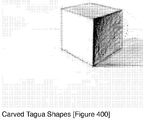
- the nut meat [ Figure 2] is processed and shaped into blocks, or other shapes [Figure 3], that are of certain standard dimensions that are equivalent to those of the standard artificial material currently used In the computer aided design or CAD and manufacturing of dental prostheses.
- Such milling devices carve blocks of ceramic, composite, or other suitably hard material that are made in such dimensions as to fit in the milling compartment of the machine.
- the milling device fashions a product of certain size and quality based upon a computer generated 3 dimensional rendering of a particular patient's data.
- the dehydrated Tagua nut endosperm is preliminarily shaped according to the requirements for use in the CEREC device, or any other brand of milling device, in such a way that a uniform and consistently solid piece in the desired shape and dimensions Is produced without any of the naturally occurring gaps or crevices found in the nut.
- the pieces of Tagua may at this stage of production be treated in one of several ways with the mineral hydroxylapatite [Figure 3] which is a naturally occurring mineral which Is a primary element in human teeth and bone.
- One method of treating the dehydrated Tagua endosperm is to bath the Tagua within a solution of hydroxylapatite under such conditions that achieves a suitable coating and desired hardening of the surface.
- Hydroxylapatite also called hydroxyapatite (HA)
- HA hydroxyapatite
- HA hydroxyapatite
- Hydroxylapatite is the hydroxyl end member of the complex apatite group.
- the OH - Ion can be replaced by fluoride, chloride or carbonate, producing fluorapatite or chlorapatite. It crystallizes in the hexagonal crystal system. Pure hydroxylapatite powder is white.
- Naturally occurring apatites are the hydroxyl end member of the complex apatite group.
- the OH - Ion can be replaced by fluoride, chloride or carbonate, producing fluorapatite or chlorapatite. It crystallizes in the hexagonal crystal system. Pure hydroxylapatite powder is white.
- Naturally occurring apatites Naturally occurring apatites
- Pulverization of dehydrated Tagua provides for later reconstitution of the material in various admixtures with hydroxyapatite such that desired qualities of size, shape, and hardness may be achieved [Figure 4].
- Various standard chemical treatments can be applied to adjust qualities of size, color, and hardness.
- a standard abutment or stem may be attached to the piece so that it can be held and manipulated by the device during the milling step. [Figure 5]. Then the appropriately sized and shaped piece that is suitable to produce the desired prosthetic for given patient Is carved in accordance with the computer assisted design data related to the patient using the milling device [ Figure 6], so as to be capable of attachment to a dental implant.
- the prosthetic can be fitted to cap a broken tooth by mounting upon a suitably prepared fractional part of an original remaining tooth or teeth.
- the resulting prosthesis may be of any type, without limitation to, a cap, crown, bridge, partial, or complete denture set.
- the prosthetic need not attach permanently to Implants, as when comprising a removable denture set or bridge for example.
- the dehydrated endosperm of the Tagua nut while sufficiently hard, Is not superfluously hard In comparison to natural teeth as are the typical ceramic and composite materials ordinarily used by dental milling devices, the carving bits need changing less frequently. What's more less expensive carving bits may be used In place of the diamond bits otherwise needed.
- prostheses contemplated can also be hand carved, using standard power or hand carving tools, both during the fabrication stage and for the purpose of making fitting adjustments.
- a sustainable green business is attained by the practice of the methods here that provides a more biocompatible dental prosthesis without any adverse impact on patient health in contrast to the potentially toxic elements, byproducts, and waste related to the manufacturing of other currently used ceramic, composite, artificial products.
Landscapes
- Health & Medical Sciences (AREA)
- Oral & Maxillofacial Surgery (AREA)
- Life Sciences & Earth Sciences (AREA)
- Epidemiology (AREA)
- Animal Behavior & Ethology (AREA)
- General Health & Medical Sciences (AREA)
- Public Health (AREA)
- Veterinary Medicine (AREA)
- Dentistry (AREA)
- Engineering & Computer Science (AREA)
- Medicinal Chemistry (AREA)
- Chemical & Material Sciences (AREA)
- Manufacturing & Machinery (AREA)
- Biomedical Technology (AREA)
- Molecular Biology (AREA)
- Dermatology (AREA)
- Transplantation (AREA)
- Plastic & Reconstructive Surgery (AREA)
- Orthopedic Medicine & Surgery (AREA)
- Dental Prosthetics (AREA)
- Dental Preparations (AREA)
- Dental Tools And Instruments Or Auxiliary Dental Instruments (AREA)
- Instructional Devices (AREA)
Description
- The invention concerns a dental device according to claim 1, a biocompatible composite material according to claim 9 and a method of making a dental device according to claim 3. The present invention applies to typical dental devices or appliances having chewing surfaces comprising naturally derived materials obtained from sustainable resources. The natural material has physical characteristics providing durability, texture, color and shading that match natural teeth necessary for utilitarian and cosmetically pleasing dental devices. The natural materials are sufficiently workable when using normal manufacturing techniques and equipment routinely applied for making currently available dental devices comprising non-natural or sustainable materials such as metal and ceramics.
- Animals, particularly humans have natural teeth to assist in mastication of food and are essential for sustaining good health. Teeth, however, comprise living tissue that may be corruptible by neglect, abuse and, or disease. In extreme cases decayed or damaged teeth are not reparable with typically available prophylaxis and must be extracted for the well being of the patient. Notwithstanding removal, in the opinion of dental professionals, it Is important that extracted teeth be replaced by prosthesis equipped with chewing surfaces. Replacements for teeth and the method for making such replacements are well known to those skilled In the art and include devices selected from the group consisting of bridges, full dentures, partial dentures, crowns, caps and combinations thereof.
- The aforementioned dental devices are currently made from a number of materials that provide sufficient durability to sustain the rigors of chewing as well as provide good cosmetic aesthetics to match the remaining natural teeth in terms of physical factors including, but not necessarily limited to shape, size, texture and color. Currently the materials used to make such devices include non-sustainable precious metals such as gold, ceramics, porcelain, plastics or composites of these materials. Standard dental devices are typically made of the above materials with a uniform high degree of hardness throughout the material. Unlike natural teeth which consist of multiple layers of organic and mineral material in an ascending degree of hardness, from root to dentin to enamel, which has both formal and functional qualities and characteristics. Those qualities and characteristics are perfectly adapted to provide a kind of cushion or shock absorbing effect which protects the surrounding maxillofacial structure from stress induced damage. Such damage can include serious bone, muscular, and nerve damage, which is more likely to occur when superfluously hard and rigid dental prosthetics, replace natural teeth which have a shock absorbing quality.
-
EP 1 097 692 A2 discloses tooth crowns milled form Tagua palm nut. - The present Invention provides a natural, agriculturally derived solution that has substantially the same variable component hardness, and cushioning effect, as natural teeth.
- Most dentists and dental patients have expressed high interest in prosthetic dental devices comprising natural, sustainable or "green" materials. Up to now, however no suitable natural and sustainable materials has been found to be a satisfactory In terms of the physical attributes previously mentioned. Therefore, there remains an unmet need for dental devices comprising a natural, sustainable material.
- The drawings consist of seven figures relating to the seed of the Tagua Nut Palm and the an exemplary series of steps involved in processing the endosperm portion of it to produce dental devices that are the subject of the present Invention. They consist of seven figures depicting the Tagua Nut, its endosperm, typical shapes of processed material, the chemical formula of hydroxyapatite, sample computerized milling devices, and examples of possible dental devices. The figures are numbered one through seven (1-7).
- In a embodiment of the invention, the dental devices comprise dehydrated and hardened endosperm of the nut of the Tagua palm, a species of the genus Phytelephas [Figure 1]. Phytelephas is a genus containing six species of palms (family Arecaceae), occurring from southern Panama along the Andes to Ecuador, Bolivia and Peru. They are medium-sized to tall palms reaching 20 meters tall, with pinnate leaves. They are commonly known as ivory palms, Ivory-nut palms or Tagua palms; their scientific name means "plant elephant". This and the first two of the common names refer to the very hard white endosperm of their seeds (Tagua nuts), which resembles elephant ivory. In Its original state, the "nut" is covered with pericarp . The nut is covered with a brown, flaky skin and shaped like a small avocado, roughly 4-8 cm in diameter. Since the nut has a protective husk or shell, once the nuts are harvested there are no extreme inspection, sorting and handling that must be taken to sort the nuts before processing. This material is harvested by the usual manual or machine harvesting methods generally known in the art.
- The dehydrated Tagua nut material's texture, color and shading vary over the range normally associated with natural teeth. To that end, the desired shading and color of the material is selected individually for the patient prior to manufacturing the device. Furthermore, the color of the material can be modified by routine method known In the art for bleaching material or foods such as wheat flour. Additionally the texture of the material may be manipulated to create a consistent surface of the device that matches the natural teeth to avoid preoccupation by the patient's tongue.
- Processing the dental device material derived from the Tagua nuts Includes the steps of shelling, and curing the nuts by dehydration or desiccation. Dehydration or desiccation may be achieved wherein the nuts are dried at ambient conditions or accelerated using industrial equipment to rapidly drive off water to a desired level of dryness. Such equipment is well known in the foods industry. The point whereupon the nuts are sufficiently dehydrated for manufacturing dental devices Is at the point of comparable hardness of the natural dentin part of a tooth. Standard testing equipment to makes such measurements includes an instron®
- Device. This device may be set to measure compressive strength in Pascals that Is defined as the value of uniaxial compressive stress necessary to achieve complete failure of the material.
- Other methods of testing hardness include the Mohs Hardness method. The Mohs Scale of mineral hardness characterizes the scratch resistance of various minerals through the ability of a harder material to scratch a softer material. The Mohs Hardness of dehydrated Tagua is roughly the equivalent to the Mohs Hardness of natural tooth dentin, ranging between 2.5 and 4 on the Mohs Hardness scale. Upon reaching compressive strength comparable to the primary dentin subsurface part of a natural tooth, the nut meat [Figure 2] is processed and shaped into blocks, or other shapes [Figure 3], that are of certain standard dimensions that are equivalent to those of the standard artificial material currently used In the computer aided design or CAD and manufacturing of dental prostheses.
- Among the systems known to those skilled in the art of dental device manufacturing Is the Chairside Economical Restoration of Esthetic Ceramics™ Series including the CEREC™ AC dental milling device. Such milling devices carve blocks of ceramic, composite, or other suitably hard material that are made in such dimensions as to fit in the milling compartment of the machine. The milling device fashions a product of certain size and quality based upon a computer generated 3 dimensional rendering of a particular patient's data. The dehydrated Tagua nut endosperm is preliminarily shaped according to the requirements for use in the CEREC device, or any other brand of milling device, in such a way that a uniform and consistently solid piece in the desired shape and dimensions Is produced without any of the naturally occurring gaps or crevices found in the nut. The pieces of Tagua may at this stage of production be treated in one of several ways with the mineral hydroxylapatite [Figure 3] which is a naturally occurring mineral which Is a primary element in human teeth and bone. One method of treating the dehydrated Tagua endosperm is to bath the Tagua within a solution of hydroxylapatite under such conditions that achieves a suitable coating and desired hardening of the surface. Hydroxylapatite, also called hydroxyapatite (HA), is a naturally occurring mineral form of calcium apatite with the formula Ca5(PO4)3(OH), but is usually written Ca10(PO4)6(OH)2 to denote that the crystal unit cell comprises two entitles. Hydroxylapatite is the hydroxyl end member of the complex apatite group. The OH- Ion can be replaced by fluoride, chloride or carbonate, producing fluorapatite or chlorapatite. It crystallizes in the hexagonal crystal system. Pure hydroxylapatite powder is white. Naturally occurring apatites
- can, however, also have brown, yellow, or green colorations, comparable to the discolorations of dental fluorosis. Alternative coating methods can be used that involve adhesion or admixture of the Tagua endosperm with the hydroxylapatite. A thermal or plasma surface treatment method may be used for example. Moreover the treatment may also be made, or repeated, after the final dental prosthetic has been carved. Such treatment is used when additional hardness or other qualities that result from the treatment are desired.
- Pulverization of dehydrated Tagua provides for later reconstitution of the material in various admixtures with hydroxyapatite such that desired qualities of size, shape, and hardness may be achieved [Figure 4]. Various standard chemical treatments can be applied to adjust qualities of size, color, and hardness.
- Before placing the dehydrated Tagua nut endosperm Into the CEREC or other milling device, a standard abutment or stem may be attached to the piece so that it can be held and manipulated by the device during the milling step. [Figure 5]. Then the appropriately sized and shaped piece that is suitable to produce the desired prosthetic for given patient Is carved in accordance with the computer assisted design data related to the patient using the milling device [Figure 6], so as to be capable of attachment to a dental implant.
- The resulting prosthetic [Figure 71 Is then attachable to a patient's standard implant which may be of any type. Alternatively, the prosthetic can be fitted to cap a broken tooth by mounting upon a suitably prepared fractional part of an original remaining tooth or teeth. The resulting prosthesis may be of any type, without limitation to, a cap, crown, bridge, partial, or complete denture set. The prosthetic need not attach permanently to Implants, as when comprising a removable denture set or bridge for example.
- Because the dehydrated endosperm of the Tagua nut, while sufficiently hard, Is not superfluously hard In comparison to natural teeth as are the typical ceramic and composite materials ordinarily used by dental milling devices, the carving bits need changing less frequently. What's more less expensive carving bits may be used In place of the diamond bits otherwise needed.
- The prostheses contemplated can also be hand carved, using standard power or hand carving tools, both during the fabrication stage and for the purpose of making fitting adjustments.
- A sustainable green business is attained by the practice of the methods here that provides a more biocompatible dental prosthesis without any adverse impact on patient health in contrast to the potentially toxic elements, byproducts, and waste related to the manufacturing of other currently used ceramic, composite, artificial products.
Claims (9)
- A dental device having chewing surfaces comprising naturally derived materials having physical characteristics to provide comparable hardness and appearance qualities as natural teeth, wherein the naturally derived material comprises the
dehydrated endosperm of Tagua palm nut,
characterized in that
the material has been treated with a solution of hydroxylapatite which results in the formation of hydroxylapatite upon the material under such conditions that achieves a suitable coating on and desired hardening of the surface, and/or wherein the material has been subjected to a thermal or plasma surface treatment that involve adhesion or admixture of the Tagua endosperm with hydroxylapatite. - The dental device of claim 1, wherein the hardness of the dehydrated endosprerm of Tagual palm nut is from 2.5 to 4 on the Mohs Hardness Scale.
- The dental device of claim 2, wherein the device is selected from the group consisting of bridges, full dentures, partial dentures, crowns, caps and combinations thereof.
- The dental device of claim 3, wherein the device is in the form of a dental crown.
- The dental device claim 4, wherein the crown material matches the color and shading of natural teeth.
- A method of making the dental device of claim 3 comprising the steps of:a. harvesting Tagua nuts;b. remove the shells of the Tagua nuts;c. dehydrating the nuts; andd. milling the nuts to the shape of the subject teeth.
- The dental device of claim 1, wherein the device is a dental cap or crown made of carved or milled Tagua endosperm material.
- The dental device of claim 1, wherein the device is a denture.
- A biocompatible composite material for fabricating dental prostheses comprising dehydrated Tagua nut endosperm, wherein the composite material is in shapes and sizes suitable for use in standard dental milling devices,
characterized in that
the material has been treated with a solution of hydroxylapatite which results in the formation of hydroxylapatite upon the material under such conditions that achieves a suitable coating on and desired hardening of the surface, and/or wherein the material has been subjected to a thermal or plasma surface treatment that involve adhesion or admixture of the Tagua endosperm with hydroxylapatite.
Applications Claiming Priority (2)
| Application Number | Priority Date | Filing Date | Title |
|---|---|---|---|
| US41306110P | 2010-11-12 | 2010-11-12 | |
| PCT/US2011/060529 WO2012065152A2 (en) | 2010-11-12 | 2011-11-14 | Dental devices |
Publications (3)
| Publication Number | Publication Date |
|---|---|
| EP2637599A2 EP2637599A2 (en) | 2013-09-18 |
| EP2637599A4 EP2637599A4 (en) | 2015-06-24 |
| EP2637599B1 true EP2637599B1 (en) | 2019-06-05 |
Family
ID=46051604
Family Applications (1)
| Application Number | Title | Priority Date | Filing Date |
|---|---|---|---|
| EP11839111.9A Active EP2637599B1 (en) | 2010-11-12 | 2011-11-14 | Dental devices |
Country Status (7)
| Country | Link |
|---|---|
| US (1) | US9839499B2 (en) |
| EP (1) | EP2637599B1 (en) |
| AU (1) | AU2011325965A1 (en) |
| BR (1) | BR112013011834A2 (en) |
| CA (1) | CA2817749A1 (en) |
| IL (1) | IL226340A0 (en) |
| WO (1) | WO2012065152A2 (en) |
Families Citing this family (3)
| Publication number | Priority date | Publication date | Assignee | Title |
|---|---|---|---|---|
| US9877813B2 (en) | 2010-12-30 | 2018-01-30 | Frederick Ralph Guy | Dental device material preparation |
| US11571584B2 (en) | 2010-12-30 | 2023-02-07 | Frederick R. Guy | Tooth and bone restoration via plasma deposition |
| EP4129230A1 (en) | 2013-01-22 | 2023-02-08 | Frederick Guy | Kit for tooth and bone restoration via plasma deposition |
Family Cites Families (8)
| Publication number | Priority date | Publication date | Assignee | Title |
|---|---|---|---|---|
| US4693986A (en) * | 1985-06-25 | 1987-09-15 | Orthomatrix, Inc. | Ceramic process and products |
| NL8702391A (en) * | 1987-10-07 | 1989-05-01 | Elephant Edelmetaal Bv | METHOD FOR MANUFACTURING A DENTAL CROWN FOR A TEETH PREPARATION USING A CAD-CAM SYSTEM |
| ES2127785T3 (en) | 1992-04-06 | 1999-05-01 | Elephant Dental Bv | DENTAL PROSTHESIS AND METHOD FOR MAKING A DENTAL PROSTHESIS. |
| DE19953180B4 (en) * | 1999-11-04 | 2004-05-06 | Wilfried Aichhorn | Dental filling material |
| KR20060054668A (en) | 2004-11-15 | 2006-05-23 | 채수길 | Dental Ceramic Materials |
| US8491936B2 (en) * | 2005-03-16 | 2013-07-23 | North Carolina State University | Functionally graded biocompatible coating and coated implant |
| US7708557B2 (en) * | 2006-10-16 | 2010-05-04 | Natural Dental Implants Ag | Customized dental prosthesis for periodontal- or osseointegration, and related systems and methods |
| KR101162424B1 (en) | 2009-11-23 | 2012-07-04 | 김영화 | Artificial teeth |
-
2011
- 2011-11-14 WO PCT/US2011/060529 patent/WO2012065152A2/en not_active Ceased
- 2011-11-14 CA CA2817749A patent/CA2817749A1/en not_active Abandoned
- 2011-11-14 BR BR112013011834A patent/BR112013011834A2/en not_active IP Right Cessation
- 2011-11-14 EP EP11839111.9A patent/EP2637599B1/en active Active
- 2011-11-14 AU AU2011325965A patent/AU2011325965A1/en not_active Abandoned
- 2011-11-14 US US13/295,248 patent/US9839499B2/en active Active
-
2013
- 2013-05-12 IL IL226340A patent/IL226340A0/en unknown
Non-Patent Citations (1)
| Title |
|---|
| None * |
Also Published As
| Publication number | Publication date |
|---|---|
| CA2817749A1 (en) | 2012-05-18 |
| US9839499B2 (en) | 2017-12-12 |
| WO2012065152A3 (en) | 2012-08-09 |
| WO2012065152A2 (en) | 2012-05-18 |
| EP2637599A2 (en) | 2013-09-18 |
| AU2011325965A2 (en) | 2013-08-01 |
| US20130224684A1 (en) | 2013-08-29 |
| WO2012065152A9 (en) | 2012-12-06 |
| EP2637599A4 (en) | 2015-06-24 |
| AU2011325965A1 (en) | 2013-07-04 |
| IL226340A0 (en) | 2015-08-31 |
| BR112013011834A2 (en) | 2016-08-16 |
Similar Documents
| Publication | Publication Date | Title |
|---|---|---|
| Martinez-Rus et al. | Marginal discrepancy of monolithic and veneered all-ceramic crowns on titanium and zirconia implant abutments before and after adhesive cementation: a scanning electron microscopy analysis. | |
| Preis et al. | In-vitro fatigue and fracture testing of CAD/CAM-materials in implant-supported molar crowns | |
| Çağlar et al. | Three-dimensional finite element analysis of titanium and yttrium-stabilized zirconium dioxide abutments and implants. | |
| Ambica et al. | Comparative evaluation of fracture resistance under static and fatigue loading of endodontically treated teeth restored with carbon fiber posts, glass fiber posts, and an experimental dentin post system: an in vitro study | |
| Skouridou et al. | Fracture strength of minimally prepared all-ceramic CEREC crowns after simulating 5 years of service | |
| WO2007089894A3 (en) | Materials and methods for manufacturing amorphous tricalcium phosphate and metal oxide alloys of amorphous tricalcium phosphate and methods of using the same | |
| US11957926B2 (en) | Tooth and bone restoration via plasma deposition | |
| Schlichting et al. | An approach to biomimetics: the natural CAD/CAM restoration: a clinical report | |
| Ivanoff et al. | Fracture resistance of mandibular premolars with contracted or traditional endodontic access cavities and class II temporary composite restorations. | |
| US10617494B2 (en) | Dental device material preparation | |
| US9839499B2 (en) | Dental devices | |
| Abarno et al. | Stress distribution around dental implants, generated by six different ceramic materials for unitary restoration: An experimental photoelastic study | |
| Almohammed et al. | Fracture Resistance and Failure Mode of Monolithic Zirconia, Veneered Zirconia, and Metal-Ceramic Full-Coverage Restorations: A Comparative In Vitro Study. | |
| Mendes Tribst et al. | Effect of Framework Type on the Biomechanical Behavior of Provisional Crowns: Strain Gauge and Finite Element Analyses. | |
| Eliguzeloglu et al. | The effect of cavity shape and hybrid layer on the stress distribution of cervical composite restorations | |
| Mostafa et al. | The fracture resistance of occlusal veneers fabricated from different materials and thicknesses | |
| Hickel | Trends in materials science from the point of view of a practicing dentist | |
| CN106619142A (en) | Novel dental restoration material for stomatology and preparation method of novel dental restoration material | |
| KR101689535B1 (en) | Composite Resin | |
| Gürkan et al. | Biomechanics of the implant‐supported full arch fixed complete denture manufactured by milling and injection techniques: An experimental and FEA study | |
| Silva et al. | Can ceramic veneer spark erosion and mechanical cycling affect the accuracy of milled complete-arch frameworks supported by 6 implants? | |
| US20260021316A1 (en) | Sustainable material and method of making | |
| CN106619141A (en) | Novel dental restoration product for stomatology and preparation method thereof | |
| Moreira Cançado et al. | Impact of aging on the fracture strength of 3D‐printed fixed implant prostheses: A comparative analysis of monolithic and bi‐layer with or without fiber‐reinforced composite frameworks | |
| CN106726624A (en) | A kind of Oral Science Dental Erosion technology new material and preparation method thereof |
Legal Events
| Date | Code | Title | Description |
|---|---|---|---|
| PUAI | Public reference made under article 153(3) epc to a published international application that has entered the european phase |
Free format text: ORIGINAL CODE: 0009012 |
|
| 17P | Request for examination filed |
Effective date: 20130610 |
|
| AK | Designated contracting states |
Kind code of ref document: A2 Designated state(s): AL AT BE BG CH CY CZ DE DK EE ES FI FR GB GR HR HU IE IS IT LI LT LU LV MC MK MT NL NO PL PT RO RS SE SI SK SM TR |
|
| DAX | Request for extension of the european patent (deleted) | ||
| A4 | Supplementary search report drawn up and despatched |
Effective date: 20150528 |
|
| RIC1 | Information provided on ipc code assigned before grant |
Ipc: A61C 5/10 20060101ALI20150521BHEP Ipc: A61C 13/00 20060101ALI20150521BHEP Ipc: A61K 6/02 20060101ALI20150521BHEP Ipc: A61L 27/36 20060101ALI20150521BHEP Ipc: A61C 5/08 20060101ALI20150521BHEP Ipc: A61C 13/08 20060101AFI20150521BHEP |
|
| STAA | Information on the status of an ep patent application or granted ep patent |
Free format text: STATUS: EXAMINATION IS IN PROGRESS |
|
| 17Q | First examination report despatched |
Effective date: 20180802 |
|
| REG | Reference to a national code |
Ref country code: DE Ref legal event code: R079 Ref document number: 602011059521 Country of ref document: DE Free format text: PREVIOUS MAIN CLASS: A61C0013080000 Ipc: A61C0013000000 |
|
| GRAP | Despatch of communication of intention to grant a patent |
Free format text: ORIGINAL CODE: EPIDOSNIGR1 |
|
| STAA | Information on the status of an ep patent application or granted ep patent |
Free format text: STATUS: GRANT OF PATENT IS INTENDED |
|
| RIC1 | Information provided on ipc code assigned before grant |
Ipc: A61C 5/77 20170101ALI20181109BHEP Ipc: A61C 13/00 20060101ALI20181109BHEP Ipc: A61C 13/08 20060101ALI20181109BHEP Ipc: A61C 5/73 20170101AFI20181109BHEP |
|
| RIC1 | Information provided on ipc code assigned before grant |
Ipc: A61C 5/73 20170101ALI20181116BHEP Ipc: A61C 13/00 20060101AFI20181116BHEP Ipc: A61C 13/01 20060101ALI20181116BHEP Ipc: A61C 5/77 20170101ALI20181116BHEP Ipc: A61C 13/08 20060101ALI20181116BHEP Ipc: A61K 6/033 20060101ALI20181116BHEP Ipc: A61L 27/54 20060101ALI20181116BHEP |
|
| INTG | Intention to grant announced |
Effective date: 20181211 |
|
| RIC1 | Information provided on ipc code assigned before grant |
Ipc: A61C 13/08 20060101ALI20181116BHEP Ipc: A61K 6/033 20060101ALI20181116BHEP Ipc: A61L 27/54 20060101ALI20181116BHEP Ipc: A61C 13/01 20060101ALI20181116BHEP Ipc: A61C 5/77 20170101ALI20181116BHEP Ipc: A61C 13/00 20060101AFI20181116BHEP Ipc: A61C 5/73 20170101ALI20181116BHEP |
|
| GRAS | Grant fee paid |
Free format text: ORIGINAL CODE: EPIDOSNIGR3 |
|
| GRAA | (expected) grant |
Free format text: ORIGINAL CODE: 0009210 |
|
| STAA | Information on the status of an ep patent application or granted ep patent |
Free format text: STATUS: THE PATENT HAS BEEN GRANTED |
|
| AK | Designated contracting states |
Kind code of ref document: B1 Designated state(s): AL AT BE BG CH CY CZ DE DK EE ES FI FR GB GR HR HU IE IS IT LI LT LU LV MC MK MT NL NO PL PT RO RS SE SI SK SM TR |
|
| REG | Reference to a national code |
Ref country code: GB Ref legal event code: FG4D |
|
| REG | Reference to a national code |
Ref country code: CH Ref legal event code: EP |
|
| REG | Reference to a national code |
Ref country code: AT Ref legal event code: REF Ref document number: 1139235 Country of ref document: AT Kind code of ref document: T Effective date: 20190615 |
|
| REG | Reference to a national code |
Ref country code: IE Ref legal event code: FG4D |
|
| REG | Reference to a national code |
Ref country code: DE Ref legal event code: R096 Ref document number: 602011059521 Country of ref document: DE |
|
| REG | Reference to a national code |
Ref country code: NL Ref legal event code: MP Effective date: 20190605 |
|
| REG | Reference to a national code |
Ref country code: LT Ref legal event code: MG4D |
|
| PG25 | Lapsed in a contracting state [announced via postgrant information from national office to epo] |
Ref country code: SE Free format text: LAPSE BECAUSE OF FAILURE TO SUBMIT A TRANSLATION OF THE DESCRIPTION OR TO PAY THE FEE WITHIN THE PRESCRIBED TIME-LIMIT Effective date: 20190605 Ref country code: LT Free format text: LAPSE BECAUSE OF FAILURE TO SUBMIT A TRANSLATION OF THE DESCRIPTION OR TO PAY THE FEE WITHIN THE PRESCRIBED TIME-LIMIT Effective date: 20190605 Ref country code: NO Free format text: LAPSE BECAUSE OF FAILURE TO SUBMIT A TRANSLATION OF THE DESCRIPTION OR TO PAY THE FEE WITHIN THE PRESCRIBED TIME-LIMIT Effective date: 20190905 Ref country code: ES Free format text: LAPSE BECAUSE OF FAILURE TO SUBMIT A TRANSLATION OF THE DESCRIPTION OR TO PAY THE FEE WITHIN THE PRESCRIBED TIME-LIMIT Effective date: 20190605 Ref country code: AL Free format text: LAPSE BECAUSE OF FAILURE TO SUBMIT A TRANSLATION OF THE DESCRIPTION OR TO PAY THE FEE WITHIN THE PRESCRIBED TIME-LIMIT Effective date: 20190605 Ref country code: HR Free format text: LAPSE BECAUSE OF FAILURE TO SUBMIT A TRANSLATION OF THE DESCRIPTION OR TO PAY THE FEE WITHIN THE PRESCRIBED TIME-LIMIT Effective date: 20190605 Ref country code: FI Free format text: LAPSE BECAUSE OF FAILURE TO SUBMIT A TRANSLATION OF THE DESCRIPTION OR TO PAY THE FEE WITHIN THE PRESCRIBED TIME-LIMIT Effective date: 20190605 |
|
| PG25 | Lapsed in a contracting state [announced via postgrant information from national office to epo] |
Ref country code: BG Free format text: LAPSE BECAUSE OF FAILURE TO SUBMIT A TRANSLATION OF THE DESCRIPTION OR TO PAY THE FEE WITHIN THE PRESCRIBED TIME-LIMIT Effective date: 20190905 Ref country code: GR Free format text: LAPSE BECAUSE OF FAILURE TO SUBMIT A TRANSLATION OF THE DESCRIPTION OR TO PAY THE FEE WITHIN THE PRESCRIBED TIME-LIMIT Effective date: 20190906 Ref country code: RS Free format text: LAPSE BECAUSE OF FAILURE TO SUBMIT A TRANSLATION OF THE DESCRIPTION OR TO PAY THE FEE WITHIN THE PRESCRIBED TIME-LIMIT Effective date: 20190605 Ref country code: LV Free format text: LAPSE BECAUSE OF FAILURE TO SUBMIT A TRANSLATION OF THE DESCRIPTION OR TO PAY THE FEE WITHIN THE PRESCRIBED TIME-LIMIT Effective date: 20190605 |
|
| REG | Reference to a national code |
Ref country code: AT Ref legal event code: MK05 Ref document number: 1139235 Country of ref document: AT Kind code of ref document: T Effective date: 20190605 |
|
| PG25 | Lapsed in a contracting state [announced via postgrant information from national office to epo] |
Ref country code: EE Free format text: LAPSE BECAUSE OF FAILURE TO SUBMIT A TRANSLATION OF THE DESCRIPTION OR TO PAY THE FEE WITHIN THE PRESCRIBED TIME-LIMIT Effective date: 20190605 Ref country code: AT Free format text: LAPSE BECAUSE OF FAILURE TO SUBMIT A TRANSLATION OF THE DESCRIPTION OR TO PAY THE FEE WITHIN THE PRESCRIBED TIME-LIMIT Effective date: 20190605 Ref country code: SK Free format text: LAPSE BECAUSE OF FAILURE TO SUBMIT A TRANSLATION OF THE DESCRIPTION OR TO PAY THE FEE WITHIN THE PRESCRIBED TIME-LIMIT Effective date: 20190605 Ref country code: PT Free format text: LAPSE BECAUSE OF FAILURE TO SUBMIT A TRANSLATION OF THE DESCRIPTION OR TO PAY THE FEE WITHIN THE PRESCRIBED TIME-LIMIT Effective date: 20191007 Ref country code: NL Free format text: LAPSE BECAUSE OF FAILURE TO SUBMIT A TRANSLATION OF THE DESCRIPTION OR TO PAY THE FEE WITHIN THE PRESCRIBED TIME-LIMIT Effective date: 20190605 Ref country code: CZ Free format text: LAPSE BECAUSE OF FAILURE TO SUBMIT A TRANSLATION OF THE DESCRIPTION OR TO PAY THE FEE WITHIN THE PRESCRIBED TIME-LIMIT Effective date: 20190605 Ref country code: RO Free format text: LAPSE BECAUSE OF FAILURE TO SUBMIT A TRANSLATION OF THE DESCRIPTION OR TO PAY THE FEE WITHIN THE PRESCRIBED TIME-LIMIT Effective date: 20190605 |
|
| PG25 | Lapsed in a contracting state [announced via postgrant information from national office to epo] |
Ref country code: IS Free format text: LAPSE BECAUSE OF FAILURE TO SUBMIT A TRANSLATION OF THE DESCRIPTION OR TO PAY THE FEE WITHIN THE PRESCRIBED TIME-LIMIT Effective date: 20191005 Ref country code: SM Free format text: LAPSE BECAUSE OF FAILURE TO SUBMIT A TRANSLATION OF THE DESCRIPTION OR TO PAY THE FEE WITHIN THE PRESCRIBED TIME-LIMIT Effective date: 20190605 Ref country code: IT Free format text: LAPSE BECAUSE OF FAILURE TO SUBMIT A TRANSLATION OF THE DESCRIPTION OR TO PAY THE FEE WITHIN THE PRESCRIBED TIME-LIMIT Effective date: 20190605 |
|
| REG | Reference to a national code |
Ref country code: DE Ref legal event code: R097 Ref document number: 602011059521 Country of ref document: DE |
|
| PG25 | Lapsed in a contracting state [announced via postgrant information from national office to epo] |
Ref country code: TR Free format text: LAPSE BECAUSE OF FAILURE TO SUBMIT A TRANSLATION OF THE DESCRIPTION OR TO PAY THE FEE WITHIN THE PRESCRIBED TIME-LIMIT Effective date: 20190605 |
|
| PLBE | No opposition filed within time limit |
Free format text: ORIGINAL CODE: 0009261 |
|
| STAA | Information on the status of an ep patent application or granted ep patent |
Free format text: STATUS: NO OPPOSITION FILED WITHIN TIME LIMIT |
|
| PG25 | Lapsed in a contracting state [announced via postgrant information from national office to epo] |
Ref country code: PL Free format text: LAPSE BECAUSE OF FAILURE TO SUBMIT A TRANSLATION OF THE DESCRIPTION OR TO PAY THE FEE WITHIN THE PRESCRIBED TIME-LIMIT Effective date: 20190605 Ref country code: DK Free format text: LAPSE BECAUSE OF FAILURE TO SUBMIT A TRANSLATION OF THE DESCRIPTION OR TO PAY THE FEE WITHIN THE PRESCRIBED TIME-LIMIT Effective date: 20190605 |
|
| 26N | No opposition filed |
Effective date: 20200306 |
|
| PG25 | Lapsed in a contracting state [announced via postgrant information from national office to epo] |
Ref country code: SI Free format text: LAPSE BECAUSE OF FAILURE TO SUBMIT A TRANSLATION OF THE DESCRIPTION OR TO PAY THE FEE WITHIN THE PRESCRIBED TIME-LIMIT Effective date: 20190605 |
|
| PG25 | Lapsed in a contracting state [announced via postgrant information from national office to epo] |
Ref country code: MC Free format text: LAPSE BECAUSE OF FAILURE TO SUBMIT A TRANSLATION OF THE DESCRIPTION OR TO PAY THE FEE WITHIN THE PRESCRIBED TIME-LIMIT Effective date: 20190605 Ref country code: LU Free format text: LAPSE BECAUSE OF NON-PAYMENT OF DUE FEES Effective date: 20191114 |
|
| REG | Reference to a national code |
Ref country code: BE Ref legal event code: MM Effective date: 20191130 |
|
| PG25 | Lapsed in a contracting state [announced via postgrant information from national office to epo] |
Ref country code: BE Free format text: LAPSE BECAUSE OF NON-PAYMENT OF DUE FEES Effective date: 20191130 |
|
| PG25 | Lapsed in a contracting state [announced via postgrant information from national office to epo] |
Ref country code: CY Free format text: LAPSE BECAUSE OF FAILURE TO SUBMIT A TRANSLATION OF THE DESCRIPTION OR TO PAY THE FEE WITHIN THE PRESCRIBED TIME-LIMIT Effective date: 20190605 |
|
| PG25 | Lapsed in a contracting state [announced via postgrant information from national office to epo] |
Ref country code: HU Free format text: LAPSE BECAUSE OF FAILURE TO SUBMIT A TRANSLATION OF THE DESCRIPTION OR TO PAY THE FEE WITHIN THE PRESCRIBED TIME-LIMIT; INVALID AB INITIO Effective date: 20111114 Ref country code: MT Free format text: LAPSE BECAUSE OF FAILURE TO SUBMIT A TRANSLATION OF THE DESCRIPTION OR TO PAY THE FEE WITHIN THE PRESCRIBED TIME-LIMIT Effective date: 20190605 |
|
| PG25 | Lapsed in a contracting state [announced via postgrant information from national office to epo] |
Ref country code: MK Free format text: LAPSE BECAUSE OF FAILURE TO SUBMIT A TRANSLATION OF THE DESCRIPTION OR TO PAY THE FEE WITHIN THE PRESCRIBED TIME-LIMIT Effective date: 20190605 |
|
| GBPC | Gb: european patent ceased through non-payment of renewal fee |
Effective date: 20221114 |
|
| PG25 | Lapsed in a contracting state [announced via postgrant information from national office to epo] |
Ref country code: GB Free format text: LAPSE BECAUSE OF NON-PAYMENT OF DUE FEES Effective date: 20221114 |
|
| REG | Reference to a national code |
Ref country code: GB Ref legal event code: S28 Free format text: APPLICATION FILED |
|
| REG | Reference to a national code |
Ref country code: GB Ref legal event code: S28 Free format text: RESTORATION ALLOWED Effective date: 20240123 |
|
| REG | Reference to a national code |
Ref country code: CH Ref legal event code: U11 Free format text: ST27 STATUS EVENT CODE: U-0-0-U10-U11 (AS PROVIDED BY THE NATIONAL OFFICE) Effective date: 20260106 |
|
| PGFP | Annual fee paid to national office [announced via postgrant information from national office to epo] |
Ref country code: DE Payment date: 20251124 Year of fee payment: 15 |
|
| PGFP | Annual fee paid to national office [announced via postgrant information from national office to epo] |
Ref country code: GB Payment date: 20251115 Year of fee payment: 15 |
|
| PGFP | Annual fee paid to national office [announced via postgrant information from national office to epo] |
Ref country code: FR Payment date: 20251115 Year of fee payment: 15 |
|
| PGFP | Annual fee paid to national office [announced via postgrant information from national office to epo] |
Ref country code: IE Payment date: 20251108 Year of fee payment: 15 |
|
| PGFP | Annual fee paid to national office [announced via postgrant information from national office to epo] |
Ref country code: CH Payment date: 20260106 Year of fee payment: 15 |