EP2637134A1 - Information processing device, information processing method, program for information processing device, and recording medium - Google Patents
Information processing device, information processing method, program for information processing device, and recording medium Download PDFInfo
- Publication number
- EP2637134A1 EP2637134A1 EP11871098.7A EP11871098A EP2637134A1 EP 2637134 A1 EP2637134 A1 EP 2637134A1 EP 11871098 A EP11871098 A EP 11871098A EP 2637134 A1 EP2637134 A1 EP 2637134A1
- Authority
- EP
- European Patent Office
- Prior art keywords
- store
- information
- map
- map data
- product
- Prior art date
- Legal status (The legal status is an assumption and is not a legal conclusion. Google has not performed a legal analysis and makes no representation as to the accuracy of the status listed.)
- Ceased
Links
Images











Classifications
-
- G—PHYSICS
- G06—COMPUTING OR CALCULATING; COUNTING
- G06Q—INFORMATION AND COMMUNICATION TECHNOLOGY [ICT] SPECIALLY ADAPTED FOR ADMINISTRATIVE, COMMERCIAL, FINANCIAL, MANAGERIAL OR SUPERVISORY PURPOSES; SYSTEMS OR METHODS SPECIALLY ADAPTED FOR ADMINISTRATIVE, COMMERCIAL, FINANCIAL, MANAGERIAL OR SUPERVISORY PURPOSES, NOT OTHERWISE PROVIDED FOR
- G06Q30/00—Commerce
- G06Q30/06—Buying, selling or leasing transactions
- G06Q30/0601—Electronic shopping [e-shopping]
- G06Q30/0623—Electronic shopping [e-shopping] by investigating goods or services
-
- G—PHYSICS
- G06—COMPUTING OR CALCULATING; COUNTING
- G06Q—INFORMATION AND COMMUNICATION TECHNOLOGY [ICT] SPECIALLY ADAPTED FOR ADMINISTRATIVE, COMMERCIAL, FINANCIAL, MANAGERIAL OR SUPERVISORY PURPOSES; SYSTEMS OR METHODS SPECIALLY ADAPTED FOR ADMINISTRATIVE, COMMERCIAL, FINANCIAL, MANAGERIAL OR SUPERVISORY PURPOSES, NOT OTHERWISE PROVIDED FOR
- G06Q30/00—Commerce
- G06Q30/06—Buying, selling or leasing transactions
- G06Q30/0601—Electronic shopping [e-shopping]
- G06Q30/0639—Locating goods or services, e.g. based on physical position of the goods or services within a shopping facility
Definitions
- the present invention relates to a technical field of an information processing device, an information processing method, an information processing device program, and a recording medium which generate a search result by a search word.
- Patent Document 1 discloses a store information search system which searches for stores for which types of business, company names, product names and areas are set as keywords.
- Patent Document 1 Japanese Patent Application Laid-Open No. 2002-082958
- the present invention is made in light of such a problem, and an example of a task of the present invention is to provide, for example, information processing of displaying, on a map, stores which handle a search target product at a point of time when the search target product is searched for.
- the invention described in claim 1 includes: a search word acquiring means that acquires a search word related to a product; a position information searching means that refers to a memory means that stores position information of a store which provides the product and stock information of the product which the store has, and searches for position information of a store which has a predetermined number of stocks of a product or more which is searched for from the search word acquired by the search query acquiring means; a map data generating means that generates map data of a map on which information indicating the store is mapped, in accordance with the position information of the store searched for by the position information searching means; and an output means that outputs the map data.
- the invention described in claim 2 further includes: a designated area acquiring means that acquires information related to a designated area designated by being encircled by a user operation on the map of the map data, and is characterized in that the map data generating means maps information indicating stores positioned only in the designated area acquired by the designated area acquiring means, on the map.
- the invention described in claim 3 further has: a density calculating means that calculates a density of stores on the map in accordance with the position information of the store searched for by the position information searching means; and an area setting means that sets an area of a predetermined density of the stores or more calculated by the density calculating means, on the map, and is characterized in that the map data generating means generates map data of the map on which the information related to the store is mapped only in the area set by the area setting means.
- the invention described in claim 4 is characterized in that the map data generating means generates map data of an emphasized area set by the area setting means.
- the invention described in claim 5 further has a specific area acquiring means that, when a plurality of areas are set by the area setting means, acquires information related to a specific area specified by a user operation among the plurality of areas on the map of the map data, and is characterized in that the map data generating means generates map data of an emphasized the designated area.
- the invention described in claim 6 is characterized in that the position information searching means searches for the position information in accordance with user store information from a user about the store which has the predetermined number of stocks of a product searched for from the search word acquired by the search word acquiring means.
- the invention described in claim 7 further has: a designated position acquiring means that acquires information related to a position designated by a user operation on the map of the map data; and a road specifying means that specifies a road on the map of the map data corresponding to the information related to the designated position acquired by the designated position acquiring means, and is characterized in that the map data generating means generates map data of a map on which information indicating only a store within a predetermined width from the road specified by the road specifying means among stores mapped on the map is mapped.
- the invention described in claim 8 further has a trajectory position acquiring means that acquires information related to a position of a trajectory traced by a user operation on the map of the map data, and is characterized in that the map data generating means generates map data of a map on which information indicating only a store within a predetermined width from the trajectory among stores mapped on the map is mapped based on the information related to the position of the trajectory acquired by the trajectory position acquiring means.
- the invention described in claim 9 includes: a search word acquiring step of acquiring a search word related to a product; a position information searching step of referring to a memory means that stores position information of a store which provides the product and stock information of the product which the store has, and searching for position information of a store which has a predetermined number of stocks of a product or more which is searched for from the search word acquired in the search query acquiring step; a map data generating step of generating map data of a map on which information indicating the store is mapped, in accordance with the position information of the store searched for in the position information searching step; and an output step of outputting the map data.
- the invention described in claim 10 causes a computer to function as: a search word acquiring means that acquires a search word related to a product; a position information searching means that refers to a memory means that stores position information of a store which provides the product and stock information of the product which the store has, and searches for position information of a store which has a predetermined number of stocks of a product or more which is searched for from the search word acquired by the search query acquiring means; a map data generating means that generates map data of a map on which information indicating the store is mapped, in accordance with the position information of the store searched for by the position information searching means; and an output means that outputs the map data.
- the invention described in claim 11 has a computer-readable information processing device program recorded thereon that causes a computer to function as: a search word acquiring means that acquires a search word related to a product; a position information searching means that refers to a memory means that stores position information of a store which provides the product and stock information of the product which the store has, and searches for position information of a store which has a predetermined number of stocks of a product or more which is searched for from the search word acquired by the search query acquiring means; a map data generating means that generates map data of a map on which information indicating the store is mapped, in accordance with the position information of the store searched for by the position information searching means; and an output means that outputs the map data.
- the present invention acquires a search word related to a product, refers to a memory means which stores position information of a store which provides the product and stock information of the product which the store has, and searches for position information of a store which has a predetermined number of stocks of a product or more which is searched for by the acquired search word, generates map data of a map on which information indicating the store is mapped, in accordance with the position information of the searched store, and outputs the map data, so that it is possible to display on the map a distribution of stores which handle a search target product at a point of time when the product is searched for.
- Fig. 1 is a schematic view illustrating a schematic configuration example of an information processing system 1 according to the present embodiment.
- the information processing system 1 has an information processing server 10 (an example of an information processing device) which is disposed to operate a shopping site and which provides information relates to products and services, store terminal devices 20 of stores which provide products and services to the shopping site, and terminal devices 30 of users who do shopping at the shopping site.
- an information processing server 10 an example of an information processing device
- store terminal devices 20 of stores which provide products and services to the shopping site
- terminal devices 30 of users who do shopping at the shopping site terminal devices
- the information processing server 10, the store terminal devices 20 and the terminal devices 30 can transmit and receive data to and from each other using, for example, TCP/IP for a communication protocol through a network 3.
- the network 3 is constructed with, for example, Internet, a dedicated communication line (for example, a CATV (Community Antenna Television) line), a mobile communication network (including, for example, base stations), and a gateway.
- the store terminal device 20 is a computer of a participant who provides products to a shopping site. The participant registers products or services to provide through the store terminal device 20.
- the terminal device 30 is a computer of a user who purchases a product or service at the shopping site.
- the terminal device 30 has a web browser function, and, when a user searches for a product, transmits a search query to the information processing server 10 and displays a search result and a distribution of stores which provides products or services on a map, on a screen of the web browser.
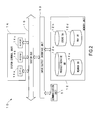
- Fig. 2 is a block diagram illustrating an example of a schematic configuration of the information processing server 10.
- Fig. 3 is a schematic view illustrating an example of data of a correspondence between search words and products.
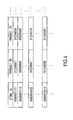
- Fig. 4 is a schematic view illustrating an example of data of a correspondence between stores and product provided by the stores.
- Fig. 5 is a schematic view illustrating an example of data of a correspondence between stores and position information of the stores.
- Fig. 6 is a schematic view illustrating an example of data of a correspondence between the numbers of stocks of products at a store.
- the information processing server 10 has a communication unit 11, a memory unit 12, an input/output interface unit 13 and a system control unit 14. Further, the system control unit 14 and the input/output interface unit 13 are connected through a system bus 15.
- the communication unit 11 connects to the network 3 to control communication states with the store terminal devices 20 and the terminal devices 30.
- the memory unit 12 is configured to include, for example, a hard disk drive, and stores various programs such as an operating system and a server program and files of webpages described by, for example, a markup language such as HTML.
- various programs may be acquired from another server device through the network 3 or may be recorded in a recording medium and read through a drive device.
- a product/service database 12a (referred to as a "product/service DB 12a” below), a store database 12b (referred to as a “store DB 12b” below), a member database 12c (referred to as a “member DB 12c” below) and a map database 12d (referred to as a “map DB 12d” below) are constructed.
- product information such as a product name, a type, a product image, a specification and a summary of an introduction of a product and advertisement information are stored in association with, for example, a product ID which is an identifier for identifying, for example, a product.
- a product/service search database is constructed to search for a product and a service from a search word.
- search words are stored in association with product IDs. For example, products related to search words such as an apple of a given production area associated with a product ID "01234567" and an "apple juice” associated with a product ID "01234568" are stored for a search word "apple”.
- the product/service DB 12a content tweeted on each product or service, information related to a popular product at a shopping site and information related to a ranking of a search word used for searching are stored. To the tweeted information, a shortened URL (Uniform Resource Locator) related to the tweeted product or service is added.
- Uniform Resource Locator Uniform Resource Locator
- store information such as a store ID, a name, store position information (for example, an address and longitude/latitude), a telephone number and product information of a product provided at the store is registered.
- This store information can be identified per store from a store ID.
- store IDs of stores which provide products and product IDs of products provided by the stores are associated and stored.
- store IDs, store addresses and store position information such as longitude/latitude information are associated and stored in the store DB 12b.
- the longitude/latitude information is stored in the store DB 12b in a format of "(a value of the longitude and a value of the latitude) ". Further, as illustrated in Fig. 6 , in the store DB 12b, the numbers of stocks of products for products IDs of the products handled at a store are stored per store ID based on stock information of each product transmitted from each store terminal device 20.
- the member DB 12c user information of user IDs of users registered as members (users of a shopping site), names, addresses, telephone numbers, electronic mail addresses, occupations, hobbies, purchase histories, themes or genres in which users are interested is registered. Further, in the member DB 12c, user IDs, log-in IDs and passwords which users require to log in the shopping site from the terminal devices 30 are registered. Meanwhile, log-in IDs and passwords are log-in information used for log-in processing (user authentication processing).
- map data which associates image information of a map and an address and longitude/latitude information is stored.
- the image information of the map is, for example, image information of the map tiled in accordance with a scale size of the map.
- the input/output interface unit 13 performs interface processing between the communication unit 11 and the memory unit 12, and the system control unit 14.
- the system control unit 14 has, for example, a CPU (Central Processing Unit) 14a, a ROM (Read Only Memory) 14b and a RAM (Random Access Memory) 14c. Further, when the CPU 14a reads and executes various programs stored in the ROM 14b and the memory unit 12, the system control unit 14 functions as, for example, a map data generating means which generates map data of a map on which information indicating stores is mapped in accordance with position information of searched stores.
- a CPU Central Processing Unit
- ROM Read Only Memory
- RAM Random Access Memory
- Fig. 7 is a block diagram illustrating an example of a schematic configuration of the store terminal device 20.
- the store terminal device 20 which functions as a computer is, for example, a personal computer or a mobile wireless telephone such as a smart phone or a PDA, and has a communication unit 21, a memory unit 22, a display unit 23, an operation unit 24, an input/output interface unit 25 and a system control unit 26. Further, the system control unit 26 and the input/output interface unit 25 are connected through a system bus 27.
- the communication unit 21 controls communication with, for example, the information processing server 10 through the network 3.
- the communication unit 21 has a wireless communication function to connect to a mobile communication network of the network 3.
- the memory unit 22 includes, for example, a hard disk drive, and stores, for example, programs such as an operating system and a web browser and programs such as a web browser tool bar.
- the display unit 23 is formed with, for example, liquid crystal display elements or EL (Electro Luminescence) elements, and has a function of a display panel of the touch/switch system like a touch panel.
- EL Electro Luminescence
- the operation unit 24 is formed with, for example, a keyboard and a mouse. Further, the operation unit 24 acquires information about a position on the display unit 23 which a user touches or comes close to according to the touch/switch system of the display unit 23, or acquires information about a position pointed by a pointer according to an operation of the mouse. Operation information of a user is acquired from the operation unit 24.
- the input/output interface unit 25 is an interface between the communication unit 21 and the memory unit 22, and the system control unit 26.
- the system control unit 26 has, for example, a CPU 26a, a ROM 26b and a RAM 26c.
- the CPU 26a reads the various programs stored in the ROM 26b, the RAM 26c and the memory unit 22, the system control unit 26 executes the programs.
- the system control unit 26 executes a web browser program, and functions as a web browser.
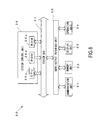
- Fig. 8 is a block diagram illustrating an example of a schematic configuration of the terminal device 30.
- the terminal device 30 which functions as a computer is, for example, a personal computer or a mobile wireless telephone such as a smart phone or a PDA, and has a communication unit 31, a memory unit 32, a display unit 33, an operation unit 34, an input/output interface unit 35 and a system control unit 36. Further, the system control unit 36 and the input/output interface unit 35 are connected through a system bus 37.
- a webpage for searching for a product a webpage for a search result and a webpage indicating a distribution of stores on a map are displayed on the display unit 33 by a web browser. Furthermore, information about a user operation with respect to the displayed map is acquired by a user operation with respect to the display unit 33 of the touch panel or an operation of the operation unit 34 such as a user operation using the mouse.
- the terminal device 30 has a GPS (Global Positioning System) function of acquiring information related to a current position of the terminal device 30.
- GPS Global Positioning System
- Fig. 9 is a sequence diagram illustrating an example of an operation of the information processing server 10 according to the first embodiment.
- Fig. 10 is a schematic view illustrating an example of display of generated map data.
- Figs. 11 and 12 are schematic views illustrating examples of display designated by a user.
- the terminal device 30 transmits a search word (step S1).
- a user who is searching for a product as a search target inputs a search word (an example of a search word related to a product) such as an "apple" in a webpage for product search displayed on the display unit 33 of the terminal device 30.
- a search button of this webpage is clicked or tapped, the system control unit 36 of the terminal device 30 transmits the search word to the information processing server 10.
- the information processing server 10 acquires the search word from the terminal device 30 (step S2).
- the information processing server 10 functions as an example of a search word acquiring means which acquires the search word related to the product.
- the information processing server 10 searches for a product by the search word (step S3). More specifically, as illustrated in Fig. 3 , the system control unit 14 of the information processing server 10 refers to the product/service DB 12a which stores data of the correspondence between search words and products, searches for a product by the acquired search word and finds a product ID corresponding to the search word.
- the information processing server 10 searches for stores which have a predetermined number of stocks of the product or more (step S4). More specifically, as illustrated in Fig. 4 , the system control unit 14 of the information processing server 10 refers to the store DB 12b which stores data of the correspondence between stores and products provided by the stores, searches for stores corresponding to the found product IDs, and finds store IDs corresponding to the product IDs. Further, as illustrated in Fig. 6 , the system control unit 14 of the information processing server 10 refers to the store DB 12b which stores data of the correspondence between the numbers of stocks of products at a store, and finds the numbers of stocks of products of each store corresponding to the found store IDs and product IDs. When the found numbers of stocks are a predetermined number or more, the system control unit 14 of the information processing server 10 obtains as a store search result stores which have a predetermined number of stocks of a product or more.
- the information processing server 10 acquires position information of a store (step S5). More specifically, as illustrated in Fig. 5 , the system control unit 14 of the information processing server 10 refers to the store DB 12b which stores data of the correspondence between stores and position information of the stores, and acquires position information of stores such as addresses or longitude/latitude corresponding to store IDs of stores which have a predetermined number of stocks of a product or more corresponding to a search word.
- the information processing server 10 finds a store of a predetermined store density or more (step S6). More specifically, the system control unit 14 of the information processing server 10 partitions the entire map to be displayed to unit areas having predetermined areas. Further, the system control unit 14 of the information processing server 10 finds the number of stores in each partitioned unit area based on the acquired position information of the stores, and calculates the density of stores on the map. Furthermore, the system control unit 14 of the information processing server 10 finds stores of a predetermined store density or more.
- the information processing server 10 functions as an example of a density calculating means which calculates the density of stores on the map in accordance with the position information of the stores searched for by the position information searching means. Further, the information processing server 10 functions as an example of an area setting means which sets on the map an area of a predetermined store density or more calculated by the density calculating means.
- system control unit 14 of the information processing server 10 may calculate the distance to each store from the longitude/latitude information, form a cluster of stores within a predetermined distance and, when the number of clusters is a predetermined number or more, find stores included in the cluster assuming that a store density is a predetermined store density or more. Further, stores of a predetermined store density or more are found to find an area (condition matching area) which matches conditions for displaying the area on the map.
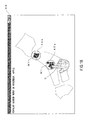
- the information processing server 10 generates map data (step S7). More specifically, as illustrated in Fig. 10 , the system control unit 14 of the information processing server 10 generates a webpage 40 of a HTML format which includes store display areas 40a and 40b (examples of areas of a predetermined store density or more) in which stores concentrate and stores of a predetermined store density or more are displayed. In the display areas 40a and 40b of the webpage 40, stores of the predetermined store density or more are mapped at positions on the map in accordance with the position information of the stores as indicated by marks M1 (an example of information related to stores).
- the system control unit 14 of the information processing server 10 refers to the map DB 12, acquires map information to display on the webpage 40, maps the marks M1 indicating stores on the acquired information in accordance with the position information of the stores and displays outer frames of the store display areas 40a and 40b. Further, the webpage 40 also displays information about the map outside the store display areas 40a and 40b, and displays an input search word.
- the shape of the marks M1 which are an example of information related to stores may be a dot or a circle as long as stores can be identified on the map.
- the information processing server 10 transmits the map data (step S8). More specifically, the system control unit 14 of the information processing server 10 transmits information of the webpage 40 which is an example of the generated map data, to the terminal device 30 which has transmitted the search word. Thus, the information processing server 10 functions as an example of an output means which outputs the map data.
- the terminal device 30 displays the map data (step S9). More specifically, the system control unit 36 of the terminal device 30 has the display unit 33 display the webpage 40 as illustrated in Fig. 10 , based on the information of the webpage 40 received from the information processing server 10.
- the terminal device 30 receives an input from the user (step S10).
- the system control unit 36 of the terminal device 30 acquires information about coordinates of a position tapped on the display unit 33.
- the system control unit 36 of the terminal device 30 acquires information of the position coordinates of a clicked position.
- the tapped or clicked position may be anywhere in the display area 40a.
- the terminal device 30 transmits input information (step S11).
- the system control unit 36 of the terminal device 30 decides whether or not the tapped position coordinates on the display unit 33 are in the store display area 40a, and, when the position coordinates are in the store display area 40a, transmits input information that the display area 40a is instructed, to the information processing server 10.
- the information processing server 10 performs processing in accordance with input information (step S12). More specifically, the system control unit 14 of the information processing server 10 receives the input information that the display area 40a is instructed, and generates a webpage 41 of a list of stores in the display area 40a as illustrated in Fig. 11 . Further, as illustrated in Fig. 12 , the system control unit 14 of the information processing server 10 generates a webpage 42 of map data of an enlarged vicinity of the display area 40a (an example of map data of an emphasized area set by the area setting means) without displaying the display area 40b. In addition, the system control unit 14 of the information processing server 10 may choose which one of the webpage 41 and the webpage 42 is generated depending on how the display unit 33 is tapped (for example, one tap or double tap).
- the information processing server 10 functions as a specific area acquiring means which, when a plurality of areas (store display areas 40a and 40b) are set by the area setting means, acquires information related to a specific area (store display area 40a) specified by a user operation among the plurality areas on the map of map data. Further, the information processing server 10 functions as an example of a map data generating means which generates map data (webpage 42) of the emphasized the designated area.
- the information processing server 10 transmits a processing result (step S13). More specifically, the system control unit 14 of the information processing server 10 transmits information of the webpage 41 of the list of the stores or information of the webpage 42 of the enlarged map data, to the terminal device 30.
- the terminal device 30 displays a processing result (step S14). More specifically, the system control unit 36 of the terminal device 30 has the display unit 33 display the webpage 41 as illustrated in Fig. 11 or the webpage 42 as illustrated in Fig. 12 based on the received information of the webpage 41 or the webpage 42.
- step S10 the terminal device 30 may receive an input from the user and the information processing server 10 may generate the webpage 41 illustrated in Fig. 11 in step S12 if the position coordinates tapped on the display unit 33 is in the store display area 40a.
- the store DB 12b (an example of a memory means) which stores position information of stores which provides products and stock information of products which the stores have, and searching for position information of stores which have a predetermined number of stocks of a product searched for from the acquired search word, generating the webpages 40 and 42 (map data) of a map on which marks M1 (an example of information indicating stores) are mapped in accordance with the searched position information of the stores, and outputting the map data, it is possible to display on the map a distribution of stores which handle a search target product at a point of time when the product is searched for.
- the stores are narrowed down, so that it is possible to reduce the number of drawing objects such as the marks M1 to be displayed, improve a processing speed and save a memory to use.
- map data of emphasized set areas is generated by, for example, displaying only the display areas 40a and 40b of stores of a predetermined store density or more as illustrated in Fig. 10 and enlarging the store display area 40a as illustrated in Fig. 12 , an area which displays stores to be presented to the user is automatically focused and emphasized, so that the user can easily select a store and access information which the user desires. Particularly when the store display area 40a is automatically enlarged, the user does not need to perform an enlarging operation.
- a plurality of areas are set as illustrated in Fig. 10 , information related to a specific area specified by a user operation among a plurality of areas on a map of map data, and, when map data of an emphasized the designated area is generated as illustrated in Fig. 12 , the store display area 40b which is not designated by the user is deleted and the store display area 40a which is designated by the user is displayed, so that stores are further narrowed down and the user can easily select a store. Furthermore, areas other than the designated area are not shown, so that the number of drawing objects such as the marks M1 is less, a load on the computer is reduced, a processing speed increases and a memory to use can be saved.
- a plurality of store display areas 40a and 40b are displayed and one store display area 40a is specified as illustrated in Fig. 10
- the store display area 40a is enlarged and displayed as illustrated in Fig. 12 , so that the user can easily specify an area.
- the display area 40a is enlarged and displayed, so that the user can easily select the mark M1 of each store.
- Fig. 13 is a schematic view illustrating a modified example of display of map data generated by the processing in Fig. 9 .
- Fig. 14 is a schematic view illustrating an example of a designated area designated by a user in Fig. 13 .
- Fig. 15 is a schematic view illustrating an example of a trajectory for designating a designated area.
- Fig. 16 is a schematic view illustrating an example of display designated by a user in Fig. 14 .
- step S7 processing of the information processing server 10 of finding stores of a predetermined store density or more in step S6 may be skipped.
- step S7 a webpage 43 is generated as illustrated in Fig. 13 .
- the webpage 43 all stores are displayed on a map of the webpage 43 searched for in step S4.
- step S9 the webpage 43 is displayed on the display unit 33.
- step S10 as reception of an input from the user, the information processing server 10 acquires information related to a designated area designated by being encircled by a user operation by way of free-hand on a map of map data.
- the terminal device 30 acquires data of position coordinates of a trajectory T which is traced by being encircled from a position (start point) touched by the finger 5 to a position (end point) at which the finger is separated, on the display unit 33 of the touch panel.
- a trajectory T1 of position information extends from a start point Ts1 to an end point Tel. Further, when the trajectory T1 has an intersection point at which the trajectory T1 crosses itself between the start point Ts1 and the end point Te1, the trajectory T1 of the position information forms a closed area. As illustrated in Fig. 15 , when the trajectory T1 of the position information forms a closed area, the system control unit 14 of the information processing server 10 specifies this closed area as a designated area. That is, an operation of encircling an arbitrary area is performed when a user continuously inputs instructions to the display unit 33 of the touch panel, the system control unit 14 of the information processing server 10 specifies the designated area based on the trajectory T of the position information.
- processing of deciding whether or not a closed area or a designated area is formed based on a continuous trajectory of position information can be realized by, for example, appropriating, for example, a known character recognition technique.
- the known character recognition technique uses, for example, an open source library which is known to person skilled in art.
- a designated area may be specified assuming that there is a trajectory of position information between a start point and an end point of the trajectory of position information.
- the trajectory T2 of position information reaches from a start point Ts2 to an end point Te2 without intersecting itself, and the trajectory T2 doesn't form a closed area.
- the system control unit 14 of the information processing server 10 can specify a designated area assuming that there is a trajectory of position information between the start point TS2 and the end point TE2 of the trajectory T2.
- the system control unit 14 of the information processing server 10 may specify a designated area assuming that there is a trajectory of position information between the start point Ts2 and the end point Te2 of the trajectory T2.
- step S11 the terminal device 30 transmits data of the position coordinates of the trajectory T or information of the designated area encircled by the trajectory T or, for example, store IDs of stores encircled by the trajectory T as input information to the information processing server 10.
- the terminal device 30 may transmit scale size information or longitude/latitude information of a displayed map.
- step S12 the information processing server 10 generates the webpage 45 on which the map is enlarged as illustrated in Fig. 16 and which includes the display area 40a, as an example of map data of an emphasized area set by the area setting means by deleting stores in other than the store display area 40a based on, for example, the received input information.
- the information processing server 10 may set the display area 40a in which the trajectory T is an outer rim of the display area 40a, or may set the display area 40a to include stores encircled by the trajectory T.
- the information processing server 10 functions as an example of a designated area acquiring means which acquires information related to a designated area designated by being encircled by a user operation. Further, the information processing server 10 functions as an example of a map data generating means which maps information indicating stores positioned only in the designated area acquired by the designated area acquiring means, on the map.
- step S13 a processing result is transmitted, and, in step S14, a webpage 45 is displayed on the display unit 33.
- an area that is, "an area including part of a prefecture A and part of an adjacent prefecture B" which the user wants to see.
- the map is enlarged, so that the user can easily select each store.
- the information processing server 10 When the information processing server 10 generates map data of an emphasized set area as illustrated in Fig. 16 such that the store mark M1 in other than the designated area (store display area 40a) is deleted and only the store display area 40a is displayed, the store display area 40b which is not designated by the user is deleted and the store display area 40a which is designated by the user is displayed, so that stores are further narrowed down and the user can easily select a store. Further, areas other than the designated area are not shown, so that the number of drawing objects such as the marks M1 is less, a load on the computer is reduced, a processing speed increases and a memory to use can be saved.
- a designated area may be designated by tapping by the finger 5 a site at which stores gather on the map.
- the terminal device 30 acquires the position tapped by the finger 5 on the display unit 33. Further, the information processing server 10 generates a webpage including a store display area 41a in a predetermined radius around the position tapped by the finger 5 like the webpage 45 in Fig. 16 .
- a distribution of stores on a map is displayed, so that the user can comprehend where there are more pieces of information, and can easily select information.
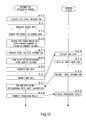
- Fig. 17 is a sequence diagram illustrating a modified example of an operation of the information processing server 10.
- Fig. 18 is a schematic view illustrating an example of display of map data generated by processing in Fig. 17 .
- the information processing server 10 acquires user store information (step S20). More specifically, the system control unit 14 of the information processing server 10 refers to the product/service DB 12a, and acquires information tweeted on, for example, products of stores by various users or a search word which is highly frequently by users at the shopping site operated by the information processing server 10 as an example of user store information about stores from users. Further, the information processing server 10 may acquire information about a current location measured by a GPS from the terminal device 30 of the user as an example of user store information to search for stores near the current location of the user. Furthermore, users' voting results for, for example, products handled by stores may be used as an example of user store information.
- the information processing server 10 generates a search word (step S21). More specifically, the system control unit 14 of the information processing server 10 analyzes a structure of information tweeted on a product of a store, and generates a word of a high frequency or a word extracted using, for example, tf-idf (term frequency - inverse document frequency) as a search word. Further, when a search word which is frequently used at a shopping site is acquired, the search word is used as a generated search word. Furthermore, a search word which is highly frequently used in an area may be acquired from current information of the terminal device 30 referring to the product/service DB 12a, and the search word may be used as a generated search word. Still further, shortened URL information included in information tweeted on a product of a store may be acquired as a search word.
- tf-idf term frequency - inverse document frequency
- the information processing server 10 searches for a product by the search word (step S22). The same processing as in step S3 is performed. In addition, in case of the shortened URL information, for example, a product indicated by the URL is found.
- step S23 to step S33 the information processing server 10 and the terminal device 30 perform the same processings as in step S4 to step S14.
- a webpage 46 is displayed on the display unit 33.
- position information is searched for in accordance with user store information from users about stores which have predetermined numbers of stocks of products searched for from an acquired search word, it is possible to present an area of stores corresponding to a search word which is frequently used and an area of currently popular stores or stores of interest, so that the users can select an area or a store. Further, it is possible to comprehend in which area search words input by various users are recently tweeted frequently on a map, so that, even when users do not known which area on the map is popular, the users can easily select a store or a facility included in a popular area. Furthermore, precision to narrow down stores is improved in accordance with user store information.
- a configuration of the information processing system according to the present embodiment is the same as in an information processing system according to the first embodiment, and the same or corresponding portions as in the first embodiment will be assigned the same reference numerals to describe, for example, configurations. The same applies to the other embodiments and modified examples.
- product names are stored in association with product/service IDs which are identifiers for identifying products and services instead of product IDs.
- search words are stored in association with product IDs.
- products/services related to search words such as an apple of a given production area associated with a product/service ID "01234567”, an "apple juice” associated with a product/service ID "01234568” and apple picking service associated with a product/service ID "0051234568" are stored for a search word "apple”.
- the products/services related to search words such as service for a certain type of massage associated with a product/service ID "0070234567”, service for another type of massage associated with a product/service ID "0070234568” and a product of a massage tool associated with a product/service "0001234568" are stored for a search word "massage”.
- the store IDs of stores which provide products or services, and product/service IDs of products/services provided by stores are associated and stored.
- the numbers of available services are stored in association with products/service IDs of services provided by stores per store ID based on availability information of service such as an status of availability of service, waiting information and a usable status of a facility in each service transmitted from each store terminal device 20 of a store which provides service.
- an operation of an information processing system 1 according to the second embodiment of the present invention will be described using Figs. 22 to 24 .
- an operation of the information processing system according to the present embodiment is the same operation as in the information processing system according to the first embodiment, and the same or corresponding portions as in the first embodiment will be assigned the same reference numerals to describe, for example, operations. The same applies to the other embodiments and modified examples.
- Fig. 22 is a sequence diagram illustrating an example of an operation of the information processing server according to the second embodiment.
- Fig. 23 is a schematic view illustrating an example of display of map data generated by processing in Fig. 22 .
- Fig. 24 is a schematic view illustrating an example of display designated by a user in Fig. 23 .
- a terminal device 30 transmits a search word as in step S1 (step S41).
- a user who is searching for a product inputs a search word (an example of a search word related to a product or service) such as "massage" in a webpage for product search displayed on a display unit 33 of the terminal device 30.
- a search button of this webpage is clicked or tapped, a system control unit 36 of the terminal device 30 transmits the search word to an information processing server 10.
- the information processing server 10 acquires the search word from the terminal device 30 as in step S2 (step S42) .
- the information processing server 10 functions as an example of a search word acquiring means which acquires the search word related to the product or the service.
- the information processing server 10 searches for a product or service by the search word as in step S3 (step S43) . More specifically, as illustrated in Fig. 19 , a system control unit 14 of the information processing server 10 refers to the product/service DB 12a which stores data of the correspondence between search words and products, searches for a product and service by the acquired search word and finds a product/service ID corresponding to the search word.
- the information processing server 10 searches for stores which has a predetermined number of stocks of products or more, or the number of available services or more as in step S4 (step S44). More specifically, as illustrated in Fig. 20 , the system control unit 14 of the information processing server 10 refers to the store DB 12b which stores data of the correspondence between stores and products/services provided by the stores, searches for stores corresponding to respective found product/service IDs, and finds store IDs corresponding to the product/service IDs. Further, as illustrated in Fig.
- the system control unit 14 of the information processing server 10 refers to the store DB 12b which stores data of the correspondence between the numbers of stocks of products at a store and the number of available services, and finds the numbers of stocks of products or the number of available services (an example of the number of available services) of each store corresponding to the found store IDs and product/service IDs.
- the system control unit 14 of the information processing server 10 obtains stores which have a predetermined number of stocks of a product or more, or the number of available services or more as a store search result.
- the information processing server 10 acquires position information of a store as in step S5 (step S45). More specifically, as illustrated in Fig. 5 , the system control unit 14 of the information processing server 10 refers to the store DB 12b which stores data of the correspondence between stores and position information of the stores, and acquires position information of stores such as addresses or longitude/latitude corresponding to store IDs of stores which have a predetermined number of stocks of a product or more corresponding to a search word or a predetermined number of available services or more corresponding to the search word.
- the information processing server 10 finds a store of a predetermined store density or more as in step S6 (step S46) .
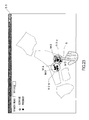
- the information processing server 10 generates map data as in step S7 (step S47). More specifically, as illustrated in Fig. 23 , the system control unit 14 of the information processing server 10 generates a webpage 50 of a HTML format which includes display areas 50a and 50b (examples of areas of a predetermined store density or more) of stores in which stores of a predetermined store density or more are displayed. In the display areas 50a and 50b of the webpage 50, the stores of the predetermined store density or more are mapped on positions on a map in accordance with position information of the stores as indicated by marks M2 indicating stores which provide services (an example of information related to stores) and marks M3 indicating stores which provide products (an example of information related to stores).
- the information processing server 10 transmits the map data as in step S8 (step S48).
- the terminal device 30 displays the map data as in step S9 (step S49). More specifically, the system control unit 36 of the terminal device 30 has the display unit 33 display the webpage 50 as illustrated in Fig. 23 , based on the information of the webpage 50 received from the information processing server 10.
- the terminal device 30 receives an input from the user as in step S10 (step S50).
- step S10 the store display area 50a on the display unit 33 is tapped by a finger 5 of the user as illustrated in Fig. 23
- the system control unit 36 of the terminal device 30 acquires information about coordinates of a position tapped on the display unit 33.
- the terminal device 30 transmits input information as in step S11 (step S51).
- the system control unit 36 of the terminal device 30 decides whether or not the tapped position coordinates on the display unit 33 are in the store display area 50a, and, when the position coordinates are in the store display area 50a, transmits input information that the display area 50a is instructed, to the information processing server 10.
- the information processing server 10 performs processing in accordance with input information as in step S12 (step S52). More specifically, the system control unit 14 of the information processing server 10 receives the input information that the display area 50a is instructed, and generates a webpage 51 of a list of stores in the display area 50a as illustrated in Fig. 24 . In the webpage 51, stores which provide products and stores which provide services displayed separately. In addition, as illustrated in Fig. 12 according to the first embodiment, the system control unit 14 of the information processing server 10 may generate a webpage of map data of an enlarged vicinity of the display area 50a to emphasize.
- step S53 the information processing server 10 transmits a processing result as in step S13 (step S53).
- step S54 the terminal device 30 displays a processing result as in step S14 (step S54).
- step may return to step S50 and the terminal device 30 may receive an input from the user.
- the information processing server 10 functions as an example of a position information searching means of referring to a memory means which stores position information of stores which provide products or services, or stock information of products which the stores have or services and information about service availability provided by the stores, and searches for position information of stores which have a predetermined number of stocks of products or a predetermined number of available services.
- the present embodiment by acquiring a search word related to a product or service, referring to the store DB 12b (an example of a memory means) which stores position information of stores which provide products or services and stock information of products which the stores have or information about service availability provided by the store, and searching for position information of stores which have a predetermined number of stocks of products or a predetermined number of available services, generating the webpage 50 (map data) of a map on which marks M1 (an example of information indicating stores) are mapped in accordance with the searched position information of the stores, and outputting the map data, it is possible to display on the map a distribution of stores which handle a search target product at a point of time when the product is searched for.
- the second embodiment provides the same effect as the first embodiment (the same applies to the following modified example).
- Fig. 25 is a schematic view illustrating a modified example of display of map data generated by the processing in Fig. 22 .
- Fig. 26 is a schematic view illustrating an example of a designated area designated by a user in Fig. 25 .
- Fig. 27 is a schematic view illustrating an example of display designated by a user in Fig. 26 .
- step S47 a webpage 52 is generated as illustrated in Fig. 25 .
- step S49 the webpage 52 is displayed on the display unit 33.
- step S50 as reception of an input from the user, the information processing server 10 acquires information related to a designated area designated by being encircled by a user operation by way of free-hand on a map of map data.
- the terminal device 30 acquires data of position coordinates of a trajectory T which is traced by being encircled from a position (start point) touched by the finger 5 to a position (end point) at which the finger is separated, on the display unit 33 of the touch panel.
- step S51 the terminal device 30 transmits data of the position coordinates of the trajectory T or information of the designated area encircled by the trajectory T or, for example, store IDs of stores encircled by the trajectory T as input information to the information processing server 10.
- step S52 the information processing server 10 generates the webpage 54 on which the map is enlarged and which includes a display area 54a, as an example of map data of an emphasized area set by the area setting means by deleting stores in other than the store display area 50a based on, for example, the input information.
- the information processing server 10 generates map data of the emphasized set area such that the marks M2 and M3 other than in the designated area (store display area 54a) are deleted and only the store display area 54a is displayed.
- step S53 a processing result is transmitted, and, in step S54, a webpage 54 is displayed on the display unit 33.
- a designated area may be designated by tapping by the finger 5 a predetermined position looking at how stores are distributed on the map.
- the terminal device 30 acquires the position tapped by the finger 5 on the display unit 33.
- the information processing server 10 generates a webpage including a store display area 54a in a predetermined radius around the position tapped by the finger 5 like the webpage 54 in Fig. 27 .
- a distribution of stores on a map is displayed, so that the user can comprehend positions of stores on the map, and can easily select information.
- Fig. 28 is a schematic view illustrating a modified example of display of map data generated by the information processing server 1.
- Figs. 29 and 30 are schematic views illustrating examples of display designated by a user in Fig. 28 .
- step S41 step S1
- step S43 step S46
- step S46 may be skipped
- stores corresponding to the search word "eat” are searched for.
- step S47 step S7
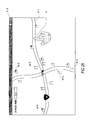
- the information processing server 10 generates a webpage 60 which is an example of map data of a map on which information indicating stores is mapped as illustrated in Fig. 28 .
- the terminal device 30 displays the webpage 60 on the display unit 33.
- roads R1 and R2 which are examples of roads
- marks M4 and M5 indicating stores which provide products or services related to the search word "eat” an example of information related to stores
- roads may be railroads, drives, pavements, mountain tracks or routes in addition to roads.
- step S50 when the road R1 on the display unit 33 is tapped (designated) by the finger 5 of the user as illustrated in Fig. 28 , the terminal device 30 acquires information about coordinates of a position tapped on the display unit 33.
- the terminal device 30 transmits input information that the road R1 is tapped, to the information processing server 10.
- information that the road R1 is tapped as input information may be transmitted to the information processing server 10 instead of position information.
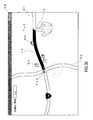
- the information processing server 10 specifies a road on the map of the map data corresponding to information related to the acquired designated position based on, for example, the received input information. Further, the information processing server 10 sets stores within a predetermined width from the specified road, and, as illustrated in Fig. 29 , generates map data of the map on which information indicating only stores within a predetermined width (an example of a store display area) from the specified road R1 among the stores mapped on the map. Meanwhile, as illustrated in Fig. 29 , the road R1 is painted as a road to emphasize the specified road. In addition, stores within a predetermined width may be, for example, stores which is in several fold of a width of the road or stores which are associated with the specified road in advance. Further, the predetermined width may be set based on scale size information of the map.
- the information processing server 10 functions as an example of a designated position acquiring means which acquires information related to a position designated by a user operation on the map of map data. Further, the information processing server 10 functions as an example of a road specifying means which specifies a road on the map of the map data corresponding to information related to the designated position acquired by the designated position acquiring means. Furthermore, the information processing server 10 functions as an example of a map data generating means which generates map data of a map on which information indicating only stores within a predetermined width from the road specified by the road specifying means among stores mapped on the map is mapped.
- the information processing server 10 transmits a processing result in step S53.
- the terminal device 30 displays a processing result in step S54 as illustrated in Fig. 29 .
- the marks M4 and M5 are designated by the user, information related to stores indicated by these marks are displayed on the display unit 33.
- a trajectory T3 may be designated by the user by being traced from a point Ts3 on the road R1 on the map displayed on the display unit 33 of the touch panel to a point Te3 on the road R1 along the road R1.
- the terminal device 30 acquires position information of the traced trajectory (trajectory traced according to a continuous input of instructions) T3. Further, the terminal device 30 transmits position information of the trajectory T3 as input information, to the information processing server 10.
- the information processing server 10 functions as a trajectory position acquiring means which acquires position related to the position of the trajectory traced by a user operation to receive position information of the trajectory T3. Further, the information processing server 10 sets stores within a predetermined width from the trajectory T3 based on, for example, received input information, and, as illustrated in Fig. 30 , generates map data (webpage 62) of the map on which information indicating only stores within a predetermined width (an example of a store display area) from the trajectory T3 among the stores mapped on the map is mapped. Meanwhile, as illustrated in Fig. 30 , the road R1 corresponding to the trajectory T3 is painted as a road to emphasize the road of the designated trajectory.
- the trajectory T3 may not be traced along the road, and stores to display may be set from an arbitrary trajectory on the map.
- the information processing server 10 may set stores within a predetermined width from a trajectory traced on the map, and generate map data of a map on which information indicating only stores within a predetermined width from this trajectory is mapped.
- the map does not include position information indicating roads or when the map does not include position information indicating narrow roads even though the map includes position information indicating main streets, it is possible to easily designate stores in a vicinity which the user is looking for and search for a store.
- the present invention is by no means limited to the above embodiments.
- the above embodiments are exemplary embodiments, and all embodiments are included in a technical scope of the present invention as long as the embodiments employ substantially the same configurations as a technical idea recited in the claims of the present invention and provide the same function and effect.
Landscapes
- Business, Economics & Management (AREA)
- Accounting & Taxation (AREA)
- Finance (AREA)
- Development Economics (AREA)
- Economics (AREA)
- Marketing (AREA)
- Strategic Management (AREA)
- Physics & Mathematics (AREA)
- General Business, Economics & Management (AREA)
- General Physics & Mathematics (AREA)
- Engineering & Computer Science (AREA)
- Theoretical Computer Science (AREA)
- Information Retrieval, Db Structures And Fs Structures Therefor (AREA)
- User Interface Of Digital Computer (AREA)
- Instructional Devices (AREA)
Abstract
Description
- The present invention relates to a technical field of an information processing device, an information processing method, an information processing device program, and a recording medium which generate a search result by a search word.
- Conventionally, there is a technique of displaying on a map a distribution of stores associated with a product name which is searched for by way of keyword search. For example,
Patent Document 1 discloses a store information search system which searches for stores for which types of business, company names, product names and areas are set as keywords. - Patent Document 1: Japanese Patent Application Laid-Open No.
2002-082958 - However, according to the conventional technique as in
Patent Document 1, even though a product name is set as a keyword, whether or not a store is handling a product at a point of time of searching is not known. - The present invention is made in light of such a problem, and an example of a task of the present invention is to provide, for example, information processing of displaying, on a map, stores which handle a search target product at a point of time when the search target product is searched for.
- In order to solve the above problem, the invention described in
claim 1 includes: a search word acquiring means that acquires a search word related to a product; a position information searching means that refers to a memory means that stores position information of a store which provides the product and stock information of the product which the store has, and searches for position information of a store which has a predetermined number of stocks of a product or more which is searched for from the search word acquired by the search query acquiring means; a map data generating means that generates map data of a map on which information indicating the store is mapped, in accordance with the position information of the store searched for by the position information searching means; and an output means that outputs the map data. - In the information processing device described in
claim 1, the invention described inclaim 2 further includes: a designated area acquiring means that acquires information related to a designated area designated by being encircled by a user operation on the map of the map data, and is characterized in that the map data generating means maps information indicating stores positioned only in the designated area acquired by the designated area acquiring means, on the map. - In the information processing device described in
claim 1 orclaim 2, the invention described inclaim 3 further has: a density calculating means that calculates a density of stores on the map in accordance with the position information of the store searched for by the position information searching means; and an area setting means that sets an area of a predetermined density of the stores or more calculated by the density calculating means, on the map, and is characterized in that the map data generating means generates map data of the map on which the information related to the store is mapped only in the area set by the area setting means. - In the information processing device described in
claim 3, the invention described inclaim 4 is characterized in that the map data generating means generates map data of an emphasized area set by the area setting means. - In the information processing device described in
claim 3 orclaim 4, the invention described inclaim 5 further has a specific area acquiring means that, when a plurality of areas are set by the area setting means, acquires information related to a specific area specified by a user operation among the plurality of areas on the map of the map data, and is characterized in that the map data generating means generates map data of an emphasized the designated area. - In the information processing device described in any one of
claim 1 to claim 5, the invention described inclaim 6 is characterized in that the position information searching means searches for the position information in accordance with user store information from a user about the store which has the predetermined number of stocks of a product searched for from the search word acquired by the search word acquiring means. - In the information processing device described in any one of
claim 1 to claim 6, the invention described inclaim 7 further has: a designated position acquiring means that acquires information related to a position designated by a user operation on the map of the map data; and a road specifying means that specifies a road on the map of the map data corresponding to the information related to the designated position acquired by the designated position acquiring means, and is characterized in that the map data generating means generates map data of a map on which information indicating only a store within a predetermined width from the road specified by the road specifying means among stores mapped on the map is mapped. - In the information processing device described in any one of
claim 1 to claim 7, the invention described inclaim 8 further has a trajectory position acquiring means that acquires information related to a position of a trajectory traced by a user operation on the map of the map data, and is characterized in that the map data generating means generates map data of a map on which information indicating only a store within a predetermined width from the trajectory among stores mapped on the map is mapped based on the information related to the position of the trajectory acquired by the trajectory position acquiring means. - In an information processing method of an information processing device which processes information, the invention described in
claim 9 includes: a search word acquiring step of acquiring a search word related to a product; a position information searching step of referring to a memory means that stores position information of a store which provides the product and stock information of the product which the store has, and searching for position information of a store which has a predetermined number of stocks of a product or more which is searched for from the search word acquired in the search query acquiring step; a map data generating step of generating map data of a map on which information indicating the store is mapped, in accordance with the position information of the store searched for in the position information searching step; and an output step of outputting the map data. - The invention described in
claim 10 causes a computer to function as: a search word acquiring means that acquires a search word related to a product; a position information searching means that refers to a memory means that stores position information of a store which provides the product and stock information of the product which the store has, and searches for position information of a store which has a predetermined number of stocks of a product or more which is searched for from the search word acquired by the search query acquiring means; a map data generating means that generates map data of a map on which information indicating the store is mapped, in accordance with the position information of the store searched for by the position information searching means; and an output means that outputs the map data. - The invention described in
claim 11 has a computer-readable information processing device program recorded thereon that causes a computer to function as: a search word acquiring means that acquires a search word related to a product; a position information searching means that refers to a memory means that stores position information of a store which provides the product and stock information of the product which the store has, and searches for position information of a store which has a predetermined number of stocks of a product or more which is searched for from the search word acquired by the search query acquiring means; a map data generating means that generates map data of a map on which information indicating the store is mapped, in accordance with the position information of the store searched for by the position information searching means; and an output means that outputs the map data. - The present invention acquires a search word related to a product, refers to a memory means which stores position information of a store which provides the product and stock information of the product which the store has, and searches for position information of a store which has a predetermined number of stocks of a product or more which is searched for by the acquired search word, generates map data of a map on which information indicating the store is mapped, in accordance with the position information of the searched store, and outputs the map data, so that it is possible to display on the map a distribution of stores which handle a search target product at a point of time when the product is searched for.
-
-
Fig. 1 is a schematic view illustrating a schematic configuration example of an information processing system according to a first embodiment of the present invention. -
Fig. 2 is a block diagram illustrating an example of a schematic configuration of an information processing server inFig. 1 . -
Fig. 3 is a schematic view illustrating an example of data of a correspondence between search words and products. -
Fig. 4 is a schematic view illustrating an example of data of a correspondence between stores and products provided by the stores. -
Fig. 5 is a schematic view illustrating an example of data of a correspondence between stores and position information of the stores. -
Fig. 6 is a schematic view illustrating an example of data of a correspondence between the numbers of stocks of products at a store. -
Fig. 7 is a block diagram illustrating an example of a schematic configuration of a store terminal device inFig. 1 . -
Fig. 8 is a block diagram illustrating an example of a schematic configuration of a terminal device inFig. 1 . -
Fig. 9 is a sequence diagram illustrating an example of an operation of the information processing server inFig. 1 according to the first embodiment. -
Fig. 10 is a schematic view illustrating an example of display of map data generated by processing inFig. 9 . -
Fig. 11 is a schematic view illustrating an example of display designated by a user inFig. 10 . -
Fig. 12 is a schematic view illustrating an example of display designated by a user inFig. 10 . -
Fig. 13 is a schematic view illustrating a modified example of display of map data generated by the processing inFig. 9 . -
Fig. 14 is a schematic view illustrating an example of a designated area designated by a user inFig. 13 . -
Fig. 15 is a schematic view illustrating an example of a trajectory for designating a designated area. -
Fig. 16 is a schematic view illustrating an example of display designated by a user inFig. 14 . -
Fig. 17 is a sequence diagram illustrating a modified example of an operation of the information processing server inFig. 1 . -
Fig. 18 is a schematic view illustrating an example of display of map data generated by processing inFig. 17 . -
Fig. 19 is a schematic view illustrating an example of data of a correspondence between search words and products/services in an information processing system according to a second embodiment of the present invention. -
Fig. 20 is a schematic view illustrating an example of data of a correspondence between stores and products/services provided by the stores. -
Fig. 21 is a schematic view illustrating an example of data of a correspondence of the numbers of stocks of products or the numbers of available services at a store. -
Fig. 22 is a sequence diagram illustrating an example of an operation of the information processing server inFig. 1 according to the second embodiment. -
Fig. 23 is a schematic view illustrating an example of display of map data generated by processing inFig. 22 . -
Fig. 24 is a schematic view illustrating an example of display designated by a user inFig. 23 . -
Fig. 25 is a schematic view illustrating a modified example of display of map data generated by the processing inFig. 22 . -
Fig. 26 is a schematic view illustrating an example of a designated area designated by a user inFig. 25 . -
Fig. 27 is a schematic view illustrating an example of display designated by a user inFig. 26 . -
Fig. 28 is a schematic view illustrating a modified example of display of map data generated by the information processing server inFig. 1 . -
Fig. 29 is a schematic view illustrating an example of display designated by a user inFig. 28 . -
Fig. 30 is a schematic view illustrating an example of display designated by a user inFig. 28 . - Hereinafter, embodiments of the present invention will be described with reference to the drawings. In addition, the embodiments will be described below where the present invention is applied to an information processing system.
-
- First, a configuration and a schematic function of an information processing system according to a first embodiment of the present invention will be described using
Fig. 1 . -
Fig. 1 is a schematic view illustrating a schematic configuration example of aninformation processing system 1 according to the present embodiment. - As illustrated in
Fig. 1 , theinformation processing system 1 has an information processing server 10 (an example of an information processing device) which is disposed to operate a shopping site and which provides information relates to products and services, storeterminal devices 20 of stores which provide products and services to the shopping site, andterminal devices 30 of users who do shopping at the shopping site. - The
information processing server 10, the storeterminal devices 20 and theterminal devices 30 can transmit and receive data to and from each other using, for example, TCP/IP for a communication protocol through anetwork 3. In addition, thenetwork 3 is constructed with, for example, Internet, a dedicated communication line (for example, a CATV (Community Antenna Television) line), a mobile communication network (including, for example, base stations), and a gateway. - The
store terminal device 20 is a computer of a participant who provides products to a shopping site. The participant registers products or services to provide through thestore terminal device 20. - The
terminal device 30 is a computer of a user who purchases a product or service at the shopping site. Theterminal device 30 has a web browser function, and, when a user searches for a product, transmits a search query to theinformation processing server 10 and displays a search result and a distribution of stores which provides products or services on a map, on a screen of the web browser. - Next, a configuration and a function of the
information processing server 10 will be described usingFigs. 2 to 6 . -
Fig. 2 is a block diagram illustrating an example of a schematic configuration of theinformation processing server 10.Fig. 3 is a schematic view illustrating an example of data of a correspondence between search words and products.Fig. 4 is a schematic view illustrating an example of data of a correspondence between stores and product provided by the stores.Fig. 5 is a schematic view illustrating an example of data of a correspondence between stores and position information of the stores.Fig. 6 is a schematic view illustrating an example of data of a correspondence between the numbers of stocks of products at a store. - As illustrated in
Fig. 2 , theinformation processing server 10 has acommunication unit 11, amemory unit 12, an input/output interface unit 13 and asystem control unit 14. Further, thesystem control unit 14 and the input/output interface unit 13 are connected through a system bus 15. - The
communication unit 11 connects to thenetwork 3 to control communication states with thestore terminal devices 20 and theterminal devices 30. - The
memory unit 12 is configured to include, for example, a hard disk drive, and stores various programs such as an operating system and a server program and files of webpages described by, for example, a markup language such as HTML. In addition, for example, the various programs may be acquired from another server device through thenetwork 3 or may be recorded in a recording medium and read through a drive device. - Further, in the
memory unit 12, for example, a product/service database 12a (referred to as a "product/service DB 12a" below), a store database 12b (referred to as a "store DB 12b" below), a member database 12c (referred to as a "member DB 12c" below) and a map database 12d (referred to as a "map DB 12d" below) are constructed. - In the product/service DB 12a, product information such as a product name, a type, a product image, a specification and a summary of an introduction of a product and advertisement information are stored in association with, for example, a product ID which is an identifier for identifying, for example, a product.
- Further, in the product/service DB 12a, for example, files of product webpages described by, for example, markup languages such as HTML and XML are stored. Furthermore, in the product/service DB 12a, a product/service search database is constructed to search for a product and a service from a search word. As illustrated in
Fig. 3 , in the product/service DB 12a, search words are stored in association with product IDs. For example, products related to search words such as an apple of a given production area associated with a product ID "01234567" and an "apple juice" associated with a product ID "01234568" are stored for a search word "apple". - Further, in the product/service DB 12a, content tweeted on each product or service, information related to a popular product at a shopping site and information related to a ranking of a search word used for searching are stored. To the tweeted information, a shortened URL (Uniform Resource Locator) related to the tweeted product or service is added.
- In the store DB 12b (an example of a memory means), store information such as a store ID, a name, store position information (for example, an address and longitude/latitude), a telephone number and product information of a product provided at the store is registered. This store information can be identified per store from a store ID. Further, in the store DB 12b, as illustrated in
Fig. 4 , store IDs of stores which provide products and product IDs of products provided by the stores are associated and stored. As illustrated inFig. 5 , store IDs, store addresses and store position information such as longitude/latitude information are associated and stored in the store DB 12b. The longitude/latitude information is stored in the store DB 12b in a format of "(a value of the longitude and a value of the latitude) ". Further, as illustrated inFig. 6 , in the store DB 12b, the numbers of stocks of products for products IDs of the products handled at a store are stored per store ID based on stock information of each product transmitted from eachstore terminal device 20. - In the member DB 12c, user information of user IDs of users registered as members (users of a shopping site), names, addresses, telephone numbers, electronic mail addresses, occupations, hobbies, purchase histories, themes or genres in which users are interested is registered. Further, in the member DB 12c, user IDs, log-in IDs and passwords which users require to log in the shopping site from the
terminal devices 30 are registered. Meanwhile, log-in IDs and passwords are log-in information used for log-in processing (user authentication processing). - In the map DB 12d, map data which associates image information of a map and an address and longitude/latitude information is stored. The image information of the map is, for example, image information of the map tiled in accordance with a scale size of the map.
- The input/
output interface unit 13 performs interface processing between thecommunication unit 11 and thememory unit 12, and thesystem control unit 14. - The
system control unit 14 has, for example, a CPU (Central Processing Unit) 14a, a ROM (Read Only Memory) 14b and a RAM (Random Access Memory) 14c. Further, when the CPU 14a reads and executes various programs stored in the ROM 14b and thememory unit 12, thesystem control unit 14 functions as, for example, a map data generating means which generates map data of a map on which information indicating stores is mapped in accordance with position information of searched stores. - Next, a configuration and a function of the
store terminal device 20 will be described usingFig. 7 .
Fig. 7 is a block diagram illustrating an example of a schematic configuration of thestore terminal device 20. - As illustrated in
Fig. 7 , thestore terminal device 20 which functions as a computer is, for example, a personal computer or a mobile wireless telephone such as a smart phone or a PDA, and has acommunication unit 21, amemory unit 22, adisplay unit 23, anoperation unit 24, an input/output interface unit 25 and asystem control unit 26. Further, thesystem control unit 26 and the input/output interface unit 25 are connected through asystem bus 27. - The
communication unit 21 controls communication with, for example, theinformation processing server 10 through thenetwork 3. In addition, when thestore terminal device 20 is a mobile terminal device, thecommunication unit 21 has a wireless communication function to connect to a mobile communication network of thenetwork 3. - The
memory unit 22 includes, for example, a hard disk drive, and stores, for example, programs such as an operating system and a web browser and programs such as a web browser tool bar. - The
display unit 23 is formed with, for example, liquid crystal display elements or EL (Electro Luminescence) elements, and has a function of a display panel of the touch/switch system like a touch panel. - The
operation unit 24 is formed with, for example, a keyboard and a mouse. Further, theoperation unit 24 acquires information about a position on thedisplay unit 23 which a user touches or comes close to according to the touch/switch system of thedisplay unit 23, or acquires information about a position pointed by a pointer according to an operation of the mouse. Operation information of a user is acquired from theoperation unit 24. - The input/
output interface unit 25 is an interface between thecommunication unit 21 and thememory unit 22, and thesystem control unit 26. - The
system control unit 26 has, for example, a CPU 26a, a ROM 26b and a RAM 26c. When the CPU 26a reads the various programs stored in the ROM 26b, the RAM 26c and thememory unit 22, thesystem control unit 26 executes the programs. For example, thesystem control unit 26 executes a web browser program, and functions as a web browser. - Next, a configuration and a function of the
terminal device 30 will be described usingFig. 8 .
Fig. 8 is a block diagram illustrating an example of a schematic configuration of theterminal device 30. - Similar to, for example, the
store terminal device 20, as illustrated inFig. 8 , theterminal device 30 which functions as a computer is, for example, a personal computer or a mobile wireless telephone such as a smart phone or a PDA, and has a communication unit 31, amemory unit 32, adisplay unit 33, anoperation unit 34, an input/output interface unit 35 and asystem control unit 36. Further, thesystem control unit 36 and the input/output interface unit 35 are connected through asystem bus 37. - In addition, the configuration and the function of the
terminal device 30 are substantially the same as the configuration and the function of thestore terminal device 20, and therefore will not be described in detail. Further, a webpage for searching for a product, a webpage for a search result and a webpage indicating a distribution of stores on a map are displayed on thedisplay unit 33 by a web browser. Furthermore, information about a user operation with respect to the displayed map is acquired by a user operation with respect to thedisplay unit 33 of the touch panel or an operation of theoperation unit 34 such as a user operation using the mouse. - Still further, the
terminal device 30 has a GPS (Global Positioning System) function of acquiring information related to a current position of theterminal device 30. - Next, an operation of the
information processing system 1 according to the first embodiment of the present invention will be described usingFigs. 9 to 12 . -
Fig. 9 is a sequence diagram illustrating an example of an operation of theinformation processing server 10 according to the first embodiment.Fig. 10 is a schematic view illustrating an example of display of generated map data.Figs. 11 and12 are schematic views illustrating examples of display designated by a user. - As illustrated in
Fig. 9 , theterminal device 30 transmits a search word (step S1). A user who is searching for a product as a search target inputs a search word (an example of a search word related to a product) such as an "apple" in a webpage for product search displayed on thedisplay unit 33 of theterminal device 30. When a search button of this webpage is clicked or tapped, thesystem control unit 36 of theterminal device 30 transmits the search word to theinformation processing server 10. - Next, the
information processing server 10 acquires the search word from the terminal device 30 (step S2). Thus, theinformation processing server 10 functions as an example of a search word acquiring means which acquires the search word related to the product. - Next, the
information processing server 10 searches for a product by the search word (step S3). More specifically, as illustrated inFig. 3 , thesystem control unit 14 of theinformation processing server 10 refers to the product/service DB 12a which stores data of the correspondence between search words and products, searches for a product by the acquired search word and finds a product ID corresponding to the search word. - Next, the
information processing server 10 searches for stores which have a predetermined number of stocks of the product or more (step S4). More specifically, as illustrated inFig. 4 , thesystem control unit 14 of theinformation processing server 10 refers to the store DB 12b which stores data of the correspondence between stores and products provided by the stores, searches for stores corresponding to the found product IDs, and finds store IDs corresponding to the product IDs. Further, as illustrated inFig. 6 , thesystem control unit 14 of theinformation processing server 10 refers to the store DB 12b which stores data of the correspondence between the numbers of stocks of products at a store, and finds the numbers of stocks of products of each store corresponding to the found store IDs and product IDs. When the found numbers of stocks are a predetermined number or more, thesystem control unit 14 of theinformation processing server 10 obtains as a store search result stores which have a predetermined number of stocks of a product or more. - Next, the
information processing server 10 acquires position information of a store (step S5). More specifically, as illustrated inFig. 5 , thesystem control unit 14 of theinformation processing server 10 refers to the store DB 12b which stores data of the correspondence between stores and position information of the stores, and acquires position information of stores such as addresses or longitude/latitude corresponding to store IDs of stores which have a predetermined number of stocks of a product or more corresponding to a search word. - Next, the
information processing server 10 finds a store of a predetermined store density or more (step S6). More specifically, thesystem control unit 14 of theinformation processing server 10 partitions the entire map to be displayed to unit areas having predetermined areas. Further, thesystem control unit 14 of theinformation processing server 10 finds the number of stores in each partitioned unit area based on the acquired position information of the stores, and calculates the density of stores on the map. Furthermore, thesystem control unit 14 of theinformation processing server 10 finds stores of a predetermined store density or more. - Thus, the
information processing server 10 functions as an example of a density calculating means which calculates the density of stores on the map in accordance with the position information of the stores searched for by the position information searching means. Further, theinformation processing server 10 functions as an example of an area setting means which sets on the map an area of a predetermined store density or more calculated by the density calculating means. - In addition, the
system control unit 14 of theinformation processing server 10 may calculate the distance to each store from the longitude/latitude information, form a cluster of stores within a predetermined distance and, when the number of clusters is a predetermined number or more, find stores included in the cluster assuming that a store density is a predetermined store density or more. Further, stores of a predetermined store density or more are found to find an area (condition matching area) which matches conditions for displaying the area on the map. - Next, the
information processing server 10 generates map data (step S7). More specifically, as illustrated inFig. 10 , thesystem control unit 14 of theinformation processing server 10 generates awebpage 40 of a HTML format which includesstore display areas 40a and 40b (examples of areas of a predetermined store density or more) in which stores concentrate and stores of a predetermined store density or more are displayed. In thedisplay areas 40a and 40b of thewebpage 40, stores of the predetermined store density or more are mapped at positions on the map in accordance with the position information of the stores as indicated by marks M1 (an example of information related to stores). - The
system control unit 14 of theinformation processing server 10 refers to themap DB 12, acquires map information to display on thewebpage 40, maps the marks M1 indicating stores on the acquired information in accordance with the position information of the stores and displays outer frames of thestore display areas 40a and 40b. Further, thewebpage 40 also displays information about the map outside thestore display areas 40a and 40b, and displays an input search word. In addition, the shape of the marks M1 which are an example of information related to stores may be a dot or a circle as long as stores can be identified on the map. - Next, the
information processing server 10 transmits the map data (step S8). More specifically, thesystem control unit 14 of theinformation processing server 10 transmits information of thewebpage 40 which is an example of the generated map data, to theterminal device 30 which has transmitted the search word. Thus, theinformation processing server 10 functions as an example of an output means which outputs the map data. - Next, the
terminal device 30 displays the map data (step S9). More specifically, thesystem control unit 36 of theterminal device 30 has thedisplay unit 33 display thewebpage 40 as illustrated inFig. 10 , based on the information of thewebpage 40 received from theinformation processing server 10. - Next, the
terminal device 30 receives an input from the user (step S10). When the store display area 40a on thedisplay unit 33 is tapped by afinger 5 of the user as illustrated inFig. 10 , thesystem control unit 36 of theterminal device 30 acquires information about coordinates of a position tapped on thedisplay unit 33. In addition, when the user moves apointer 6 to thedisplay area 40 by the mouse of theoperation unit 34 and clicks the mouse, thesystem control unit 36 of theterminal device 30 acquires information of the position coordinates of a clicked position. Further, the tapped or clicked position may be anywhere in the display area 40a. - Next, the
terminal device 30 transmits input information (step S11). Thesystem control unit 36 of theterminal device 30 decides whether or not the tapped position coordinates on thedisplay unit 33 are in the store display area 40a, and, when the position coordinates are in the store display area 40a, transmits input information that the display area 40a is instructed, to theinformation processing server 10. - Next, the
information processing server 10 performs processing in accordance with input information (step S12). More specifically, thesystem control unit 14 of theinformation processing server 10 receives the input information that the display area 40a is instructed, and generates awebpage 41 of a list of stores in the display area 40a as illustrated inFig. 11 . Further, as illustrated inFig. 12 , thesystem control unit 14 of theinformation processing server 10 generates awebpage 42 of map data of an enlarged vicinity of the display area 40a (an example of map data of an emphasized area set by the area setting means) without displaying thedisplay area 40b. In addition, thesystem control unit 14 of theinformation processing server 10 may choose which one of thewebpage 41 and thewebpage 42 is generated depending on how thedisplay unit 33 is tapped (for example, one tap or double tap). - Thus, the
information processing server 10 functions as a specific area acquiring means which, when a plurality of areas (store display areas 40a and 40b) are set by the area setting means, acquires information related to a specific area (store display area 40a) specified by a user operation among the plurality areas on the map of map data. Further, theinformation processing server 10 functions as an example of a map data generating means which generates map data (webpage 42) of the emphasized the designated area. - Next, the
information processing server 10 transmits a processing result (step S13). More specifically, thesystem control unit 14 of theinformation processing server 10 transmits information of thewebpage 41 of the list of the stores or information of thewebpage 42 of the enlarged map data, to theterminal device 30. - Next, the
terminal device 30 displays a processing result (step S14). More specifically, thesystem control unit 36 of theterminal device 30 has thedisplay unit 33 display thewebpage 41 as illustrated inFig. 11 or thewebpage 42 as illustrated inFig. 12 based on the received information of thewebpage 41 or thewebpage 42. - Further, when the
webpage 42 illustrated inFig. 12 is displayed, the step may return to step S10, theterminal device 30 may receive an input from the user and theinformation processing server 10 may generate thewebpage 41 illustrated inFig. 11 in step S12 if the position coordinates tapped on thedisplay unit 33 is in the store display area 40a. - According to the present embodiment, by acquiring a search word related to a product, referring to the store DB 12b (an example of a memory means) which stores position information of stores which provides products and stock information of products which the stores have, and searching for position information of stores which have a predetermined number of stocks of a product searched for from the acquired search word, generating the
webpages 40 and 42 (map data) of a map on which marks M1 (an example of information indicating stores) are mapped in accordance with the searched position information of the stores, and outputting the map data, it is possible to display on the map a distribution of stores which handle a search target product at a point of time when the product is searched for. - Consequently, it is possible to comprehend on a map the distribution of the stores which handle a product at a point of time when the user searches for the product, and, if there is a product which the user wants to buy, immediately purchase the product. Meanwhile, when stores which cannot currently sell a product are displayed without taking into account the number of stocks, users access these stores, and, if the users know that there is no stock, the users have to find another store.
- Further, the stores are narrowed down, so that it is possible to reduce the number of drawing objects such as the marks M1 to be displayed, improve a processing speed and save a memory to use.
- When the density of stores on the map is calculated in accordance with searched position information of stores, areas of a predetermined calculated store density or more (
store display areas 40a and 40b) are set on the map, map data of a map on which the marks M1 are mapped only in the set areas is generated, the condition matching areas (store display areas 40a and 40b) and stores included in the other areas are identifiably displayed, so that the user can easily select a store included in the condition matching areas. - Further, when map data of emphasized set areas is generated by, for example, displaying only the
display areas 40a and 40b of stores of a predetermined store density or more as illustrated inFig. 10 and enlarging the store display area 40a as illustrated inFig. 12 , an area which displays stores to be presented to the user is automatically focused and emphasized, so that the user can easily select a store and access information which the user desires. Particularly when the store display area 40a is automatically enlarged, the user does not need to perform an enlarging operation. - Further, when a plurality of areas are set as illustrated in
Fig. 10 , information related to a specific area specified by a user operation among a plurality of areas on a map of map data, and, when map data of an emphasized the designated area is generated as illustrated inFig. 12 , thestore display area 40b which is not designated by the user is deleted and the store display area 40a which is designated by the user is displayed, so that stores are further narrowed down and the user can easily select a store. Furthermore, areas other than the designated area are not shown, so that the number of drawing objects such as the marks M1 is less, a load on the computer is reduced, a processing speed increases and a memory to use can be saved. - In addition, when a plurality of
store display areas 40a and 40b are displayed and one store display area 40a is specified as illustrated inFig. 10 , wherever in the store display area 40a is selected by way of tapping or clicking, the store display area 40a is enlarged and displayed as illustrated inFig. 12 , so that the user can easily specify an area. Further, the display area 40a is enlarged and displayed, so that the user can easily select the mark M1 of each store. - Next, an operation of displaying a modified example of display of map data will be described using
Figs. 13 to 16 .
Fig. 13 is a schematic view illustrating a modified example of display of map data generated by the processing inFig. 9 .Fig. 14 is a schematic view illustrating an example of a designated area designated by a user inFig. 13 .Fig. 15 is a schematic view illustrating an example of a trajectory for designating a designated area.Fig. 16 is a schematic view illustrating an example of display designated by a user inFig. 14 . - In
Fig. 9 , processing of theinformation processing server 10 of finding stores of a predetermined store density or more in step S6 may be skipped. In this case, in step S7, awebpage 43 is generated as illustrated inFig. 13 . In thewebpage 43, all stores are displayed on a map of thewebpage 43 searched for in step S4. In step S9, thewebpage 43 is displayed on thedisplay unit 33. - Further, in step S10, as reception of an input from the user, the
information processing server 10 acquires information related to a designated area designated by being encircled by a user operation by way of free-hand on a map of map data. - As illustrated in
Fig. 14 , theterminal device 30 acquires data of position coordinates of a trajectory T which is traced by being encircled from a position (start point) touched by thefinger 5 to a position (end point) at which the finger is separated, on thedisplay unit 33 of the touch panel. - Next, the designated area designated by being encircled will be described using
Fig. 15 . As illustrated inFig. 15 , a trajectory T1 of position information extends from a start point Ts1 to an end point Tel. Further, when the trajectory T1 has an intersection point at which the trajectory T1 crosses itself between the start point Ts1 and the end point Te1, the trajectory T1 of the position information forms a closed area. As illustrated inFig. 15 , when the trajectory T1 of the position information forms a closed area, thesystem control unit 14 of theinformation processing server 10 specifies this closed area as a designated area. That is, an operation of encircling an arbitrary area is performed when a user continuously inputs instructions to thedisplay unit 33 of the touch panel, thesystem control unit 14 of theinformation processing server 10 specifies the designated area based on the trajectory T of the position information. - In addition, processing of deciding whether or not a closed area or a designated area is formed based on a continuous trajectory of position information can be realized by, for example, appropriating, for example, a known character recognition technique. The known character recognition technique uses, for example, an open source library which is known to person skilled in art.
- Further, even when a closed area is not formed by the trajectory T2 as illustrated in
Fig. 15 , if the trajectory T2 satisfies predetermined conditions, a designated area may be specified assuming that there is a trajectory of position information between a start point and an end point of the trajectory of position information. - As illustrated in
Fig. 15 , the trajectory T2 of position information reaches from a start point Ts2 to an end point Te2 without intersecting itself, and the trajectory T2 doesn't form a closed area. Even in this case, when, for example, a distance L between the start point Ts2 and the end point Te2 is a predetermined distance or less or a rate of the distance L between the start point Ts2 and the end point Te2 with respect to the length of the trajectory T2 is a predetermined rate or less, that is, when predetermined conditions are satisfied, thesystem control unit 14 of theinformation processing server 10 can specify a designated area assuming that there is a trajectory of position information between the start point TS2 and the end point TE2 of the trajectory T2. - Further, when a gravity point of an area encircled by the trajectory T2 and a line connecting the points Te2 and Ts2 is calculated, and an angle formed by a line connecting the point Te2 and the gravity point and a line connecting the point Ts2 and the gravity point is a predetermined angle or less, the
system control unit 14 of theinformation processing server 10 may specify a designated area assuming that there is a trajectory of position information between the start point Ts2 and the end point Te2 of the trajectory T2. - Furthermore, information related to the designated area designated by being encircled from the position pointed by the pointer by operating the mouse may be acquired.
- Next, in step S11, the
terminal device 30 transmits data of the position coordinates of the trajectory T or information of the designated area encircled by the trajectory T or, for example, store IDs of stores encircled by the trajectory T as input information to theinformation processing server 10. In addition, theterminal device 30 may transmit scale size information or longitude/latitude information of a displayed map. - Next, in step S12, the
information processing server 10 generates thewebpage 45 on which the map is enlarged as illustrated inFig. 16 and which includes the display area 40a, as an example of map data of an emphasized area set by the area setting means by deleting stores in other than the store display area 40a based on, for example, the received input information. In addition, theinformation processing server 10 may set the display area 40a in which the trajectory T is an outer rim of the display area 40a, or may set the display area 40a to include stores encircled by the trajectory T. - Thus, the
information processing server 10 functions as an example of a designated area acquiring means which acquires information related to a designated area designated by being encircled by a user operation. Further, theinformation processing server 10 functions as an example of a map data generating means which maps information indicating stores positioned only in the designated area acquired by the designated area acquiring means, on the map. - Next, in step S13, a processing result is transmitted, and, in step S14, a
webpage 45 is displayed on thedisplay unit 33. - When information related to a designated area designated by being encircled by a user operation on the map of map data is acquired as illustrated in
Fig. 14 , and the map is enlarged and information indicating stores positioned only in the acquired designated area is mapped on the map as illustrated inFig. 16 , stores and facilities are narrowed down only to stores and facilities included in a range encircled on the map, so that it is possible to exclude stores and facilities outside the designated range. Further, an unnecessary portion which is an area other than an area designated by a user as an area which the user wants to see does not need to be shown to the user. Furthermore, it is possible to flexibly select an area, that is, "an area including part of a prefecture A and part of an adjacent prefecture B" which the user wants to see. Still further, the map is enlarged, so that the user can easily select each store. - When the
information processing server 10 generates map data of an emphasized set area as illustrated inFig. 16 such that the store mark M1 in other than the designated area (store display area 40a) is deleted and only the store display area 40a is displayed, thestore display area 40b which is not designated by the user is deleted and the store display area 40a which is designated by the user is displayed, so that stores are further narrowed down and the user can easily select a store. Further, areas other than the designated area are not shown, so that the number of drawing objects such as the marks M1 is less, a load on the computer is reduced, a processing speed increases and a memory to use can be saved. - In addition, instead of designating a designated area by being encircled by a user operation as illustrated in
Fig. 13 , a designated area may be designated by tapping by the finger 5 a site at which stores gather on the map. In step S10, when receiving an input from the user, theterminal device 30 acquires the position tapped by thefinger 5 on thedisplay unit 33. Further, theinformation processing server 10 generates a webpage including a store display area 41a in a predetermined radius around the position tapped by thefinger 5 like thewebpage 45 inFig. 16 . Thus, a distribution of stores on a map is displayed, so that the user can comprehend where there are more pieces of information, and can easily select information. - Next, a modified example of an operation of the information processing system will be described using
Figs. 17 and18 .
Fig. 17 is a sequence diagram illustrating a modified example of an operation of theinformation processing server 10.Fig. 18 is a schematic view illustrating an example of display of map data generated by processing inFig. 17 . - As illustrated in
Fig. 17 , theinformation processing server 10 acquires user store information (step S20). More specifically, thesystem control unit 14 of theinformation processing server 10 refers to the product/service DB 12a, and acquires information tweeted on, for example, products of stores by various users or a search word which is highly frequently by users at the shopping site operated by theinformation processing server 10 as an example of user store information about stores from users. Further, theinformation processing server 10 may acquire information about a current location measured by a GPS from theterminal device 30 of the user as an example of user store information to search for stores near the current location of the user. Furthermore, users' voting results for, for example, products handled by stores may be used as an example of user store information. - Next, the
information processing server 10 generates a search word (step S21). More specifically, thesystem control unit 14 of theinformation processing server 10 analyzes a structure of information tweeted on a product of a store, and generates a word of a high frequency or a word extracted using, for example, tf-idf (term frequency - inverse document frequency) as a search word. Further, when a search word which is frequently used at a shopping site is acquired, the search word is used as a generated search word. Furthermore, a search word which is highly frequently used in an area may be acquired from current information of theterminal device 30 referring to the product/service DB 12a, and the search word may be used as a generated search word. Still further, shortened URL information included in information tweeted on a product of a store may be acquired as a search word. - The
information processing server 10 searches for a product by the search word (step S22). The same processing as in step S3 is performed. In addition, in case of the shortened URL information, for example, a product indicated by the URL is found. - Further, in step S23 to step S33, the
information processing server 10 and theterminal device 30 perform the same processings as in step S4 to step S14. As illustrated inFig. 18 , awebpage 46 is displayed on thedisplay unit 33. - Thus, when position information is searched for in accordance with user store information from users about stores which have predetermined numbers of stocks of products searched for from an acquired search word, it is possible to present an area of stores corresponding to a search word which is frequently used and an area of currently popular stores or stores of interest, so that the users can select an area or a store. Further, it is possible to comprehend in which area search words input by various users are recently tweeted frequently on a map, so that, even when users do not known which area on the map is popular, the users can easily select a store or a facility included in a popular area. Furthermore, precision to narrow down stores is improved in accordance with user store information.
- Next, an information processing system according to a second embodiment of the present invention will be described using
Figs. 19 to 24 . In addition, a configuration of the information processing system according to the present embodiment is the same as in an information processing system according to the first embodiment, and the same or corresponding portions as in the first embodiment will be assigned the same reference numerals to describe, for example, configurations. The same applies to the other embodiments and modified examples. - In addition, in the present embodiment, services provided by stores are extended.
- Only differences of configurations of a product/service DB 12a and a store DB 12b from the first embodiment will be described using
Figs. 19 to 21 . - In the product/service DB 12a, for example, product names are stored in association with product/service IDs which are identifiers for identifying products and services instead of product IDs.
- Further, as illustrated in
Fig. 19 , in the product/service DB 12a, search words are stored in association with product IDs. For example, products/services related to search words such as an apple of a given production area associated with a product/service ID "01234567", an "apple juice" associated with a product/service ID "01234568" and apple picking service associated with a product/service ID "0051234568" are stored for a search word "apple". The products/services related to search words such as service for a certain type of massage associated with a product/service ID "0070234567", service for another type of massage associated with a product/service ID "0070234568" and a product of a massage tool associated with a product/service "0001234568" are stored for a search word "massage". - Further, in the store DB 12b, as illustrated in
Fig. 20 , store IDs of stores which provide products or services, and product/service IDs of products/services provided by stores are associated and stored. Furthermore, as illustrated inFig. 21 , in the store DB 12b, for example, the numbers of available services are stored in association with products/service IDs of services provided by stores per store ID based on availability information of service such as an status of availability of service, waiting information and a usable status of a facility in each service transmitted from eachstore terminal device 20 of a store which provides service. - Next, an operation of an
information processing system 1 according to the second embodiment of the present invention will be described usingFigs. 22 to 24 . In addition, an operation of the information processing system according to the present embodiment is the same operation as in the information processing system according to the first embodiment, and the same or corresponding portions as in the first embodiment will be assigned the same reference numerals to describe, for example, operations. The same applies to the other embodiments and modified examples. -
Fig. 22 is a sequence diagram illustrating an example of an operation of the information processing server according to the second embodiment.Fig. 23 is a schematic view illustrating an example of display of map data generated by processing inFig. 22 .Fig. 24 is a schematic view illustrating an example of display designated by a user inFig. 23 . - As illustrated in
Fig. 22 , aterminal device 30 transmits a search word as in step S1 (step S41). A user who is searching for a product inputs a search word (an example of a search word related to a product or service) such as "massage" in a webpage for product search displayed on adisplay unit 33 of theterminal device 30. When a search button of this webpage is clicked or tapped, asystem control unit 36 of theterminal device 30 transmits the search word to aninformation processing server 10. - Next, the
information processing server 10 acquires the search word from theterminal device 30 as in step S2 (step S42) . Thus, theinformation processing server 10 functions as an example of a search word acquiring means which acquires the search word related to the product or the service. - Next, the
information processing server 10 searches for a product or service by the search word as in step S3 (step S43) . More specifically, as illustrated inFig. 19 , asystem control unit 14 of theinformation processing server 10 refers to the product/service DB 12a which stores data of the correspondence between search words and products, searches for a product and service by the acquired search word and finds a product/service ID corresponding to the search word. - Next, the
information processing server 10 searches for stores which has a predetermined number of stocks of products or more, or the number of available services or more as in step S4 (step S44). More specifically, as illustrated inFig. 20 , thesystem control unit 14 of theinformation processing server 10 refers to the store DB 12b which stores data of the correspondence between stores and products/services provided by the stores, searches for stores corresponding to respective found product/service IDs, and finds store IDs corresponding to the product/service IDs. Further, as illustrated inFig. 21 , thesystem control unit 14 of theinformation processing server 10 refers to the store DB 12b which stores data of the correspondence between the numbers of stocks of products at a store and the number of available services, and finds the numbers of stocks of products or the number of available services (an example of the number of available services) of each store corresponding to the found store IDs and product/service IDs. When the found numbers of stocks or numbers of availability is a predetermined number or more, thesystem control unit 14 of theinformation processing server 10 obtains stores which have a predetermined number of stocks of a product or more, or the number of available services or more as a store search result. - Next, the
information processing server 10 acquires position information of a store as in step S5 (step S45). More specifically, as illustrated inFig. 5 , thesystem control unit 14 of theinformation processing server 10 refers to the store DB 12b which stores data of the correspondence between stores and position information of the stores, and acquires position information of stores such as addresses or longitude/latitude corresponding to store IDs of stores which have a predetermined number of stocks of a product or more corresponding to a search word or a predetermined number of available services or more corresponding to the search word. - Next, the
information processing server 10 finds a store of a predetermined store density or more as in step S6 (step S46) . - Next, the
information processing server 10 generates map data as in step S7 (step S47). More specifically, as illustrated inFig. 23 , thesystem control unit 14 of theinformation processing server 10 generates awebpage 50 of a HTML format which includes display areas 50a and 50b (examples of areas of a predetermined store density or more) of stores in which stores of a predetermined store density or more are displayed. In the display areas 50a and 50b of thewebpage 50, the stores of the predetermined store density or more are mapped on positions on a map in accordance with position information of the stores as indicated by marks M2 indicating stores which provide services (an example of information related to stores) and marks M3 indicating stores which provide products (an example of information related to stores). - Next, the
information processing server 10 transmits the map data as in step S8 (step S48). - Next, the
terminal device 30 displays the map data as in step S9 (step S49). More specifically, thesystem control unit 36 of theterminal device 30 has thedisplay unit 33 display thewebpage 50 as illustrated inFig. 23 , based on the information of thewebpage 50 received from theinformation processing server 10. - Next, the
terminal device 30 receives an input from the user as in step S10 (step S50). When the store display area 50a on thedisplay unit 33 is tapped by afinger 5 of the user as illustrated inFig. 23 , thesystem control unit 36 of theterminal device 30 acquires information about coordinates of a position tapped on thedisplay unit 33. - Next, the
terminal device 30 transmits input information as in step S11 (step S51). Thesystem control unit 36 of theterminal device 30 decides whether or not the tapped position coordinates on thedisplay unit 33 are in the store display area 50a, and, when the position coordinates are in the store display area 50a, transmits input information that the display area 50a is instructed, to theinformation processing server 10. - Next, the
information processing server 10 performs processing in accordance with input information as in step S12 (step S52). More specifically, thesystem control unit 14 of theinformation processing server 10 receives the input information that the display area 50a is instructed, and generates awebpage 51 of a list of stores in the display area 50a as illustrated inFig. 24 . In thewebpage 51, stores which provide products and stores which provide services displayed separately. In addition, as illustrated inFig. 12 according to the first embodiment, thesystem control unit 14 of theinformation processing server 10 may generate a webpage of map data of an enlarged vicinity of the display area 50a to emphasize. - Next, the
information processing server 10 transmits a processing result as in step S13 (step S53). - Next, the
terminal device 30 displays a processing result as in step S14 (step S54). - Further, when a webpage of enlarged map data as illustrated in
Fig. 12 is displayed, the step may return to step S50 and theterminal device 30 may receive an input from the user. - Thus, the
information processing server 10 functions as an example of a position information searching means of referring to a memory means which stores position information of stores which provide products or services, or stock information of products which the stores have or services and information about service availability provided by the stores, and searches for position information of stores which have a predetermined number of stocks of products or a predetermined number of available services. - As described above, according to the present embodiment, by acquiring a search word related to a product or service, referring to the store DB 12b (an example of a memory means) which stores position information of stores which provide products or services and stock information of products which the stores have or information about service availability provided by the store, and searching for position information of stores which have a predetermined number of stocks of products or a predetermined number of available services, generating the webpage 50 (map data) of a map on which marks M1 (an example of information indicating stores) are mapped in accordance with the searched position information of the stores, and outputting the map data, it is possible to display on the map a distribution of stores which handle a search target product at a point of time when the product is searched for. Further, the second embodiment provides the same effect as the first embodiment (the same applies to the following modified example).
- Next, an operation of displaying a modified example of display of map data will be described using
Figs. 25 to 27 .
Fig. 25 is a schematic view illustrating a modified example of display of map data generated by the processing inFig. 22 .Fig. 26 is a schematic view illustrating an example of a designated area designated by a user inFig. 25 .Fig. 27 is a schematic view illustrating an example of display designated by a user inFig. 26 . - Similar to the operation according to the first embodiment, processing of the
information processing server 10 of finding stores of a predetermined density or more in step S46 may be skipped. In this case, in step S47, awebpage 52 is generated as illustrated inFig. 25 . In thewebpage 52,all stores on a map of thewebpage 52 searched for in step S44 are displayed. In step S49, thewebpage 52 is displayed on thedisplay unit 33. - Further, in step S50, as reception of an input from the user, the
information processing server 10 acquires information related to a designated area designated by being encircled by a user operation by way of free-hand on a map of map data. As illustrated inFig. 26 , theterminal device 30 acquires data of position coordinates of a trajectory T which is traced by being encircled from a position (start point) touched by thefinger 5 to a position (end point) at which the finger is separated, on thedisplay unit 33 of the touch panel. - Next, in step S51, the
terminal device 30 transmits data of the position coordinates of the trajectory T or information of the designated area encircled by the trajectory T or, for example, store IDs of stores encircled by the trajectory T as input information to theinformation processing server 10. - Next, as illustrated in
Fig. 27 , in step S52, theinformation processing server 10 generates thewebpage 54 on which the map is enlarged and which includes a display area 54a, as an example of map data of an emphasized area set by the area setting means by deleting stores in other than the store display area 50a based on, for example, the input information. Thus, theinformation processing server 10 generates map data of the emphasized set area such that the marks M2 and M3 other than in the designated area (store display area 54a) are deleted and only the store display area 54a is displayed. - Next, in step S53, a processing result is transmitted, and, in step S54, a
webpage 54 is displayed on thedisplay unit 33. - In addition, as illustrated in
Fig. 25 , instead of designating a designated area by being encircled by a user operation, a designated area may be designated by tapping by the finger 5 a predetermined position looking at how stores are distributed on the map. In step S50, when receiving an input from the user, theterminal device 30 acquires the position tapped by thefinger 5 on thedisplay unit 33. Further, theinformation processing server 10 generates a webpage including a store display area 54a in a predetermined radius around the position tapped by thefinger 5 like thewebpage 54 inFig. 27 . Thus, a distribution of stores on a map is displayed, so that the user can comprehend positions of stores on the map, and can easily select information. - Next, a modified example of specification by a user according to the first and second embodiments will be described using
Figs. 28 and30 . In addition, a case of service according to the second embodiment will be described with the present modified example.
Fig. 28 is a schematic view illustrating a modified example of display of map data generated by theinformation processing server 1.Figs. 29 and30 are schematic views illustrating examples of display designated by a user inFig. 28 . - For example, in step S41 (step S1), a search word "eat" is transmitted and, in step S43 to step S46 (step S46 may be skipped), stores corresponding to the search word "eat" are searched for. Further, in step S47 (step S7), the
information processing server 10 generates awebpage 60 which is an example of map data of a map on which information indicating stores is mapped as illustrated inFig. 28 . Furthermore, theterminal device 30 displays thewebpage 60 on thedisplay unit 33. In thewebpage 60, roads R1 and R2 which are examples of roads, and marks M4 and M5 indicating stores which provide products or services related to the search word "eat" (an example of information related to stores) are displayed. In addition, roads may be railroads, drives, pavements, mountain tracks or routes in addition to roads. - In step S50, when the road R1 on the
display unit 33 is tapped (designated) by thefinger 5 of the user as illustrated inFig. 28 , theterminal device 30 acquires information about coordinates of a position tapped on thedisplay unit 33. Theterminal device 30 transmits input information that the road R1 is tapped, to theinformation processing server 10. In addition, information that the road R1 is tapped as input information may be transmitted to theinformation processing server 10 instead of position information. - Next, in step S52, the
information processing server 10 specifies a road on the map of the map data corresponding to information related to the acquired designated position based on, for example, the received input information. Further, theinformation processing server 10 sets stores within a predetermined width from the specified road, and, as illustrated inFig. 29 , generates map data of the map on which information indicating only stores within a predetermined width (an example of a store display area) from the specified road R1 among the stores mapped on the map. Meanwhile, as illustrated inFig. 29 , the road R1 is painted as a road to emphasize the specified road. In addition, stores within a predetermined width may be, for example, stores which is in several fold of a width of the road or stores which are associated with the specified road in advance. Further, the predetermined width may be set based on scale size information of the map. - Thus, the
information processing server 10 functions as an example of a designated position acquiring means which acquires information related to a position designated by a user operation on the map of map data. Further, theinformation processing server 10 functions as an example of a road specifying means which specifies a road on the map of the map data corresponding to information related to the designated position acquired by the designated position acquiring means. Furthermore, theinformation processing server 10 functions as an example of a map data generating means which generates map data of a map on which information indicating only stores within a predetermined width from the road specified by the road specifying means among stores mapped on the map is mapped. - Next, the
information processing server 10 transmits a processing result in step S53. - Next, the
terminal device 30 displays a processing result in step S54 as illustrated inFig. 29 . When the marks M4 and M5 are designated by the user, information related to stores indicated by these marks are displayed on thedisplay unit 33. - Thus, when information related to a position (road R1) designated by a user operation on a map of map data is acquired, the road (road R1) on the map of the map data corresponding to the information related to the acquired designated position is specified, and the map data (webpage 61) of the map on which information indicating only stores within a predetermined width from the specified road among the stores mapped on the map is generated, stores related to the road R2 are deleted and only stores related to the road R1 are displayed, so that the user can easily focus on an area which the user is looking for and find a store. Further, areas other than the designated area are not shown, so that the number of drawing objects such as the marks M4 and M5 is less, a load on the computer is reduced, a processing speed increases and a memory to use can be saved.
- In addition, as illustrated in
Fig. 30 , a trajectory T3 may be designated by the user by being traced from a point Ts3 on the road R1 on the map displayed on thedisplay unit 33 of the touch panel to a point Te3 on the road R1 along the road R1. When thetracing finger 5 is separated from thedisplay unit 33 of the touch panel, theterminal device 30 acquires position information of the traced trajectory (trajectory traced according to a continuous input of instructions) T3. Further, theterminal device 30 transmits position information of the trajectory T3 as input information, to theinformation processing server 10. - Next, the
information processing server 10 functions as a trajectory position acquiring means which acquires position related to the position of the trajectory traced by a user operation to receive position information of the trajectory T3. Further, theinformation processing server 10 sets stores within a predetermined width from the trajectory T3 based on, for example, received input information, and, as illustrated inFig. 30 , generates map data (webpage 62) of the map on which information indicating only stores within a predetermined width (an example of a store display area) from the trajectory T3 among the stores mapped on the map is mapped. Meanwhile, as illustrated inFig. 30 , the road R1 corresponding to the trajectory T3 is painted as a road to emphasize the road of the designated trajectory. - In addition, the trajectory T3 may not be traced along the road, and stores to display may be set from an arbitrary trajectory on the map. For example, in
Figs. 13 or25 , theinformation processing server 10 may set stores within a predetermined width from a trajectory traced on the map, and generate map data of a map on which information indicating only stores within a predetermined width from this trajectory is mapped. Thus, when the map does not include position information indicating roads or when the map does not include position information indicating narrow roads even though the map includes position information indicating main streets, it is possible to easily designate stores in a vicinity which the user is looking for and search for a store. - Further, the present invention is by no means limited to the above embodiments. The above embodiments are exemplary embodiments, and all embodiments are included in a technical scope of the present invention as long as the embodiments employ substantially the same configurations as a technical idea recited in the claims of the present invention and provide the same function and effect.
-
- 1: INFORMATION PROCESSING SYSTEM
- 3: NETWORK
- 10: INFORMATION PROCESSING SERVER (INFORMATION PROCESSING DEVICE)
- 12a: PRODUCT/SERVICE DB
- 12b STORE DB
- 12d MAP DB
- 30: TERMINAL DEVICE
- 33: DISPLAY UNIT
- 40, 42, 43, 44, 45, 46, 50, 52, 53, 54, 60, 61, 62: WEBPAGE (MAP DATA)
- 40a, 42b, 50a, 50b, 54a: STORE DISPLAY AREA
- M1, M2, M3, M4, M5: MARK (INFORMATION INDICATING STORES)
- T: TRAJECTORY (DESIGNATED AREA DESIGNATED BY BEING ENCIRCLED)
Claims (11)
- An information processing device comprising:a search word acquiring means that acquires a search word related to a product;a position information searching means that refers to a memory means that stores position information of a store which provides the product and stock information of the product which the store has, and searches for position information of a store which comprises a predetermined number of stocks of a product or more which is searched for from the search word acquired by the search query acquiring means;a map data generating means that generates map data of a map on which information indicating the store is mapped, in accordance with the position information of the store searched for by the position information searching means; andan output means that outputs the map data.
- The information processing device according to claim 1, further comprising a designated area acquiring means that acquires information related to a designated area designated by being encircled by a user operation on the map of the map data,
the map data generating means maps information indicating stores positioned only in the designated area acquired by the designated area acquiring means, on the map. - The information processing device according to claim 1 or claim 2, further comprising:a density calculating means that calculates a density of stores on the map in accordance with the position information of the store searched for by the position information searching means; andan area setting means that sets an area of a predetermined density of the stores or more calculated by the density calculating means, on the map,wherein the map data generating means generates map data of the map on which the information related to the store is mapped only in the area set by the area setting means.
- The information processing device according to claim 3,
wherein the map data generating means generates map data of an emphasized area set by the area setting means. - The information processing device according to claim 3 or claim 4, further comprising a specific area acquiring means that, when a plurality of areas are set by the area setting means, acquires information related to a specific area specified by a user operation among the plurality of areas on the map of the map data,
wherein the map data generating means generates map data of an emphasized the designated area. - The information processing device according to any one of claims 1 to claim 5,
wherein the position information searching means searches for the position information in accordance with user store information from a user about the store which comprises the predetermined number of stocks of a product searched for from the search word acquired by the search word acquiring means. - The information processing device according to any one of claims 1 to claim 6, further comprising:a designated position acquiring means that acquires information related to a position designated by a user operation on the map of the map data; anda road specifying means that specifies a road on the map of the map data corresponding to the information related to the designated position acquired by the designated position acquiring means,wherein the map data generating means generates map data of a map on which information indicating only a store within a predetermined width from the road specified by the road specifying means among stores mapped on the map is mapped.
- The information processing device according to any one of claim 1 to claim 7, further comprising a trajectory position acquiring means that acquires information related to a position of a trajectory traced by a user operation on the map of the map data,
wherein the map data generating means generates map data of a map on which information indicating only a store within a predetermined width from the trajectory among stores mapped on the map is mapped based on the information related to the position of the trajectory acquired by the trajectory position acquiring means. - An information processing method of an information processing device that processes information, the information processing method comprising:a search word acquiring step of acquiring a search word related to a product;a position information searching step of referring to a memory means that stores position information of a store which provides the product and stock information of the product which the store has, and searching for position information of a store which comprises a predetermined number of stocks of a product or more which is searched for from the search word acquired in the search query acquiring step;a map data generating step of generating map data of a map on which information indicating the store is mapped, in accordance with the position information of the store searched for in the position information searching step; andan output step of outputting the map data.
- An information processing device program causing a computer to function as:a search word acquiring means that acquires a search word related to a product;a position information searching means that refers to a memory means that stores position information of a store which provides the product and stock information of the product which the store has, and searches for position information of a store which comprises a predetermined number of stocks of a product or more which is searched for from the search word acquired by the search query acquiring means;a map data generating means that generates map data of a map on which information indicating the store is mapped, in accordance with the position information of the store searched for by the position information searching means; andan output means that outputs the map data.
- A computer-readable recording medium recording an information processing program causing a computer to function as:a search word acquiring means that acquires a search word related to a product;a position information searching means that refers to a memory means that stores position information of a store which provides the product and stock information of the product which the store has, and searches for position information of a store which comprises a predetermined number of stocks of a product or more which is searched for from the search word acquired by the search query acquiring means;a map data generating means that generates map data of a map on which information indicating the store is mapped, in accordance with the position information of the store searched for by the position information searching means; andan output means that outputs the map data.
Applications Claiming Priority (1)
| Application Number | Priority Date | Filing Date | Title |
|---|---|---|---|
| PCT/JP2011/077661 WO2013080329A1 (en) | 2011-11-30 | 2011-11-30 | Information processing device, information processing method, program for information processing device, and recording medium |
Publications (2)
| Publication Number | Publication Date |
|---|---|
| EP2637134A1 true EP2637134A1 (en) | 2013-09-11 |
| EP2637134A4 EP2637134A4 (en) | 2014-08-27 |
Family
ID=47890597
Family Applications (1)
| Application Number | Title | Priority Date | Filing Date |
|---|---|---|---|
| EP20110871098 Ceased EP2637134A4 (en) | 2011-11-30 | 2011-11-30 | INFORMATION PROCESSING DEVICE, INFORMATION PROCESSING METHOD, PROGRAM FOR INFORMATION PROCESSING DEVICE, AND RECORDING MEDIUM |
Country Status (5)
| Country | Link |
|---|---|
| US (1) | US9342848B2 (en) |
| EP (1) | EP2637134A4 (en) |
| JP (1) | JP5150799B1 (en) |
| CN (1) | CN103229205B (en) |
| WO (1) | WO2013080329A1 (en) |
Families Citing this family (12)
| Publication number | Priority date | Publication date | Assignee | Title |
|---|---|---|---|---|
| JP6254803B2 (en) * | 2013-09-20 | 2017-12-27 | 株式会社Nttドコモ | Map image display device |
| CN105662020A (en) * | 2014-11-21 | 2016-06-15 | 陈庭辉 | Novel showcase system |
| JP6546440B2 (en) * | 2015-04-28 | 2019-07-17 | 株式会社日立製作所 | Data processing support method, data processing server and program |
| US20170061458A1 (en) * | 2015-09-01 | 2017-03-02 | Mastercard International Incorporated | Method of compiling city guide database using payment system data |
| JP2017049218A (en) * | 2015-09-04 | 2017-03-09 | パイオニア株式会社 | Display device, display method, retrieval device, terminal device and program |
| JP6367847B2 (en) * | 2016-01-29 | 2018-08-01 | Line株式会社 | Information processing apparatus, program, terminal, and display control method |
| CN107562783A (en) * | 2017-06-30 | 2018-01-09 | 深圳市瑞锋智能制造有限公司 | Information query method, terminal and server |
| CN110019317B (en) * | 2017-08-01 | 2023-08-29 | 智能云科信息科技有限公司 | System and method for displaying and searching machining productivity |
| CN109255011B (en) * | 2018-07-20 | 2021-07-02 | 深圳点猫科技有限公司 | Search prompting method based on artificial intelligence and electronic equipment |
| CN109472666A (en) * | 2018-10-19 | 2019-03-15 | 北京金和网络股份有限公司 | Pass through the method for map retrieval commodity |
| JP7242258B2 (en) * | 2018-11-07 | 2023-03-20 | 東芝テック株式会社 | Inventory control device |
| CN114979678B (en) * | 2021-02-25 | 2024-09-06 | 阿里巴巴集团控股有限公司 | Video playback method, device, system and computer program product |
Family Cites Families (14)
| Publication number | Priority date | Publication date | Assignee | Title |
|---|---|---|---|---|
| EP0767358B1 (en) | 1995-10-04 | 2004-02-04 | Aisin Aw Co., Ltd. | Vehicle navigation system |
| JP3590827B2 (en) * | 1996-03-27 | 2004-11-17 | アイシン・エィ・ダブリュ株式会社 | Navigation device |
| JP2002082958A (en) | 2000-09-05 | 2002-03-22 | Nippon Telegraph & Telephone East Corp | Store information search system |
| US20070064018A1 (en) * | 2005-06-24 | 2007-03-22 | Idelix Software Inc. | Detail-in-context lenses for online maps |
| JP4386797B2 (en) * | 2004-06-21 | 2009-12-16 | アルパイン株式会社 | Car navigation system |
| JP2006163639A (en) * | 2004-12-03 | 2006-06-22 | Nec Corp | System and method for providing shop information, and program for providing shop information |
| KR20070077270A (en) * | 2006-01-23 | 2007-07-26 | 엘지전자 주식회사 | Information providing device and method of navigation system |
| US7945484B1 (en) | 2006-09-28 | 2011-05-17 | A9.Com, Inc. | Local product information |
| JP4924937B2 (en) * | 2007-03-12 | 2012-04-25 | アイシン・エィ・ダブリュ株式会社 | Navigation device |
| WO2009066392A1 (en) * | 2007-11-22 | 2009-05-28 | Pioneer Corporation | Map-searching device, map-searching method, map-searching program, and recording medium |
| WO2010085791A1 (en) * | 2009-01-26 | 2010-07-29 | Google Inc. | System and method of displaying search results based on density |
| US9141987B2 (en) * | 2010-11-15 | 2015-09-22 | Microsoft Technology Licensing, Llc | System, method, and medium for generating a map of a geographic region based on client location data |
| CN102176206B (en) | 2011-01-18 | 2013-08-28 | 宇龙计算机通信科技(深圳)有限公司 | Periphery searching method and device of points of interest |
| US8983953B2 (en) * | 2011-10-18 | 2015-03-17 | Nokia Corporation | Methods and apparatuses for facilitating interaction with a geohash-indexed data set |
-
2011
- 2011-11-30 JP JP2012547363A patent/JP5150799B1/en active Active
- 2011-11-30 US US13/819,904 patent/US9342848B2/en active Active
- 2011-11-30 WO PCT/JP2011/077661 patent/WO2013080329A1/en not_active Ceased
- 2011-11-30 CN CN201180041611.5A patent/CN103229205B/en active Active
- 2011-11-30 EP EP20110871098 patent/EP2637134A4/en not_active Ceased
Also Published As
| Publication number | Publication date |
|---|---|
| EP2637134A4 (en) | 2014-08-27 |
| US9342848B2 (en) | 2016-05-17 |
| WO2013080329A1 (en) | 2013-06-06 |
| JPWO2013080329A1 (en) | 2015-04-27 |
| CN103229205A (en) | 2013-07-31 |
| JP5150799B1 (en) | 2013-02-27 |
| US20130332314A1 (en) | 2013-12-12 |
| CN103229205B (en) | 2015-09-30 |
Similar Documents
| Publication | Publication Date | Title |
|---|---|---|
| US9342848B2 (en) | Apparatus and method for providing a search result with position information and recording medium therefor | |
| KR102340228B1 (en) | Message service providing method for message service linking search service and message server and user device for performing the method | |
| KR20100128321A (en) | Ad display method, ad display system and ad display program | |
| JP5198838B2 (en) | Information providing program, information providing apparatus, and information providing method | |
| US20140372217A1 (en) | Optimal zoom indicators for map search results | |
| KR20180131925A (en) | Program, method and system for providing recommendation contents | |
| CN103874997A (en) | Apparatus and method for generating and retrieving location-tagged content in computing device | |
| JP5273610B2 (en) | Map server device | |
| JP2010287048A (en) | Device and program for retrieving information and mobile terminal device | |
| JP2016075985A (en) | Advertisement publication system, advertisement publication program, advertisement publication device, and advertisement publication method | |
| JP2011128806A (en) | Advertisement information providing device, method and program for providing advertisement information, and recording medium recording program | |
| US9482546B2 (en) | Method and system for providing route information to a destination location | |
| JP5331166B2 (en) | Search server and method | |
| JP2020118610A (en) | Information display program, information display device, information display method, and distribution device | |
| JP2014078246A (en) | Device and program for retrieving information | |
| JP2012190167A (en) | Information processor and information processing method | |
| US8898135B2 (en) | Information processing device, information processing method, information processing method, information processing program and recording medium | |
| KR20140089960A (en) | Method, search server and computer readable recording medium for providing branch office information | |
| KR20130022211A (en) | Apparatus and method for providing advertising service in portable terminal | |
| KR102647917B1 (en) | System for providing information and sale service of book and digital contents using big data and artificial intelligence, and its method | |
| JP5913399B2 (en) | Information providing apparatus, information providing system, information providing method, and program | |
| US20150222588A1 (en) | Apparatus and method for sharing experience of communication terminal user | |
| KR101431664B1 (en) | Method of providing location information and server apparatus thereof | |
| TW201835792A (en) | Information providing system, information providing method, and information providing program | |
| JP4758284B2 (en) | Web page display system, web page display method, and web page display program |
Legal Events
| Date | Code | Title | Description |
|---|---|---|---|
| PUAI | Public reference made under article 153(3) epc to a published international application that has entered the european phase |
Free format text: ORIGINAL CODE: 0009012 |
|
| 17P | Request for examination filed |
Effective date: 20130225 |
|
| AK | Designated contracting states |
Kind code of ref document: A1 Designated state(s): AL AT BE BG CH CY CZ DE DK EE ES FI FR GB GR HR HU IE IS IT LI LT LU LV MC MK MT NL NO PL PT RO RS SE SI SK SM TR |
|
| A4 | Supplementary search report drawn up and despatched |
Effective date: 20140725 |
|
| RIC1 | Information provided on ipc code assigned before grant |
Ipc: G06Q 30/06 20120101AFI20140721BHEP |
|
| DAX | Request for extension of the european patent (deleted) | ||
| 17Q | First examination report despatched |
Effective date: 20150519 |
|
| RAP1 | Party data changed (applicant data changed or rights of an application transferred) |
Owner name: RAKUTEN, INC. |
|
| APBK | Appeal reference recorded |
Free format text: ORIGINAL CODE: EPIDOSNREFNE |
|
| APBN | Date of receipt of notice of appeal recorded |
Free format text: ORIGINAL CODE: EPIDOSNNOA2E |
|
| APBR | Date of receipt of statement of grounds of appeal recorded |
Free format text: ORIGINAL CODE: EPIDOSNNOA3E |
|
| APAF | Appeal reference modified |
Free format text: ORIGINAL CODE: EPIDOSCREFNE |
|
| APAF | Appeal reference modified |
Free format text: ORIGINAL CODE: EPIDOSCREFNE |
|
| REG | Reference to a national code |
Ref country code: DE Ref legal event code: R003 |
|
| APBT | Appeal procedure closed |
Free format text: ORIGINAL CODE: EPIDOSNNOA9E |
|
| STAA | Information on the status of an ep patent application or granted ep patent |
Free format text: STATUS: THE APPLICATION HAS BEEN REFUSED |
|
| 18R | Application refused |
Effective date: 20210422 |