EP2634184B1 - C-arylglucoside derivative, preparation method therefor, and use thereof - Google Patents
C-arylglucoside derivative, preparation method therefor, and use thereof Download PDFInfo
- Publication number
- EP2634184B1 EP2634184B1 EP11835443.0A EP11835443A EP2634184B1 EP 2634184 B1 EP2634184 B1 EP 2634184B1 EP 11835443 A EP11835443 A EP 11835443A EP 2634184 B1 EP2634184 B1 EP 2634184B1
- Authority
- EP
- European Patent Office
- Prior art keywords
- alkyl
- compound
- added
- group
- thienyl
- Prior art date
- Legal status (The legal status is an assumption and is not a legal conclusion. Google has not performed a legal analysis and makes no representation as to the accuracy of the status listed.)
- Active
Links
- 0 *[C@]([C@]([C@]([C@@]1O)O)O)O[C@]1c1cccc(CC2=CC=C(*I)*2)c1 Chemical compound *[C@]([C@]([C@]([C@@]1O)O)O)O[C@]1c1cccc(CC2=CC=C(*I)*2)c1 0.000 description 1
- JZNKRVGHHFJJTF-WINJHBAJSA-N CC(C)(O[C@H]12)O[C@@H]1O[C@@H](C(c1ccc(C)c(Cc3ccc(-c4cc(C#N)ccc4)[s]3)c1)O)[C@H]2O Chemical compound CC(C)(O[C@H]12)O[C@@H]1O[C@@H](C(c1ccc(C)c(Cc3ccc(-c4cc(C#N)ccc4)[s]3)c1)O)[C@H]2O JZNKRVGHHFJJTF-WINJHBAJSA-N 0.000 description 1
- ODBPTAWMAGJBIV-YGHZGWSKSA-N CC(OC([C@@H]([C@@H](OC(C)=O)OC1c2ccc(C)c(Cc3ccc(-c4cc(CN5CCN(C)CC5)ccc4)[s]3)c2)OC(C)=O)[C@H]1SC)=O Chemical compound CC(OC([C@@H]([C@@H](OC(C)=O)OC1c2ccc(C)c(Cc3ccc(-c4cc(CN5CCN(C)CC5)ccc4)[s]3)c2)OC(C)=O)[C@H]1SC)=O ODBPTAWMAGJBIV-YGHZGWSKSA-N 0.000 description 1
- HKOJSPKJMGBZAJ-HMBKEXHQSA-N CC(O[C@@H]([C@@H]([C@@H](OC(C)=O)OC1c2cc(Cc3ccc(-c4c(C=O)cccc4)[s]3)c(C)cc2)OC(C)=O)[C@H]1SC)=O Chemical compound CC(O[C@@H]([C@@H]([C@@H](OC(C)=O)OC1c2cc(Cc3ccc(-c4c(C=O)cccc4)[s]3)c(C)cc2)OC(C)=O)[C@H]1SC)=O HKOJSPKJMGBZAJ-HMBKEXHQSA-N 0.000 description 1
- WFFHAMUXOQIMCX-USFOTKPRSA-N CC(O[C@H]([C@H](C(c1cc(Cc2ccc(-c3cc(C#N)ccc3)[s]2)c(C)cc1)O[C@@H]1OC(C)=O)OC(C)=O)[C@@H]1OC(C)=O)=O Chemical compound CC(O[C@H]([C@H](C(c1cc(Cc2ccc(-c3cc(C#N)ccc3)[s]2)c(C)cc1)O[C@@H]1OC(C)=O)OC(C)=O)[C@@H]1OC(C)=O)=O WFFHAMUXOQIMCX-USFOTKPRSA-N 0.000 description 1
- QBLWXYWKZAOCBK-AXMZGBSTSA-N C[C@@H]([C@@H]1O)O[C@H](CO)C[C@@H]1O Chemical compound C[C@@H]([C@@H]1O)O[C@H](CO)C[C@@H]1O QBLWXYWKZAOCBK-AXMZGBSTSA-N 0.000 description 1
- WGLNXCHUORWSFY-ZHXVYXOISA-N Cc1c(Cc2ccc(-c3ccc[o]3)[s]2)cc(C([C@@H]([C@H]([C@@H]2O)O)O)O[C@@H]2SC)cc1 Chemical compound Cc1c(Cc2ccc(-c3ccc[o]3)[s]2)cc(C([C@@H]([C@H]([C@@H]2O)O)O)O[C@@H]2SC)cc1 WGLNXCHUORWSFY-ZHXVYXOISA-N 0.000 description 1
- KBTPCUDFMXZJQW-FCQNWVOVSA-N Cc1c(Cc2ccc(-c3ccccc3C=O)[s]2)cc(C([C@@H]([C@H]([C@@H]2O)O)O)O[C@@H]2SC)cc1 Chemical compound Cc1c(Cc2ccc(-c3ccccc3C=O)[s]2)cc(C([C@@H]([C@H]([C@@H]2O)O)O)O[C@@H]2SC)cc1 KBTPCUDFMXZJQW-FCQNWVOVSA-N 0.000 description 1
- JUXPDIHEMIUVSS-DFHYHORYSA-N Cc1ccc(C([C@@H](C([C@@H]2O)O)SC)O[C@@H]2O)cc1Cc1ccc(-c2cc(CN3CCN(C)CC3)ccc2)[s]1 Chemical compound Cc1ccc(C([C@@H](C([C@@H]2O)O)SC)O[C@@H]2O)cc1Cc1ccc(-c2cc(CN3CCN(C)CC3)ccc2)[s]1 JUXPDIHEMIUVSS-DFHYHORYSA-N 0.000 description 1
Images

Classifications
-
- A—HUMAN NECESSITIES
- A61—MEDICAL OR VETERINARY SCIENCE; HYGIENE
- A61P—SPECIFIC THERAPEUTIC ACTIVITY OF CHEMICAL COMPOUNDS OR MEDICINAL PREPARATIONS
- A61P3/00—Drugs for disorders of the metabolism
- A61P3/08—Drugs for disorders of the metabolism for glucose homeostasis
- A61P3/10—Drugs for disorders of the metabolism for glucose homeostasis for hyperglycaemia, e.g. antidiabetics
-
- C—CHEMISTRY; METALLURGY
- C07—ORGANIC CHEMISTRY
- C07D—HETEROCYCLIC COMPOUNDS
- C07D409/00—Heterocyclic compounds containing two or more hetero rings, at least one ring having sulfur atoms as the only ring hetero atoms
- C07D409/02—Heterocyclic compounds containing two or more hetero rings, at least one ring having sulfur atoms as the only ring hetero atoms containing two hetero rings
- C07D409/10—Heterocyclic compounds containing two or more hetero rings, at least one ring having sulfur atoms as the only ring hetero atoms containing two hetero rings linked by a carbon chain containing aromatic rings
-
- C—CHEMISTRY; METALLURGY
- C07—ORGANIC CHEMISTRY
- C07D—HETEROCYCLIC COMPOUNDS
- C07D409/00—Heterocyclic compounds containing two or more hetero rings, at least one ring having sulfur atoms as the only ring hetero atoms
- C07D409/14—Heterocyclic compounds containing two or more hetero rings, at least one ring having sulfur atoms as the only ring hetero atoms containing three or more hetero rings
-
- C—CHEMISTRY; METALLURGY
- C07—ORGANIC CHEMISTRY
- C07H—SUGARS; DERIVATIVES THEREOF; NUCLEOSIDES; NUCLEOTIDES; NUCLEIC ACIDS
- C07H15/00—Compounds containing hydrocarbon or substituted hydrocarbon radicals directly attached to hetero atoms of saccharide radicals
- C07H15/02—Acyclic radicals, not substituted by cyclic structures
- C07H15/14—Acyclic radicals, not substituted by cyclic structures attached to a sulfur, selenium or tellurium atom of a saccharide radical
Definitions
- the present invention relates to a C-aryl glucoside derivative that inhibits the activity of the sodium-dependent glucose cotransporter 2 (SGLT-2) relevant to the intestinal or renal glucose reabsorption, a preparation method therefor, a pharmaceutical composition containing said derivative, and said derivative for use in treating diabetes mellitus and the related diseases.
- SGLT-2 sodium-dependent glucose cotransporter 2
- diabetes mellitus diabetes mellitus
- diabetes mellitus diabetes mellitus
- most of them are the type II (i.e. noninsulin-dependent) diabetic patient, who is characterized by the insulin resistance.
- the hyperglycemia is a sign of the type II diabetes mellitus, and is considered as a major risk factor for forming a complication of diabetes mellitus.
- the clinically-used anti-diabetic drug mainly includes dimethyl biguanides, sulfonyl ureas, and insulin sensitivity enhancers.
- Dimethyl biguanides and sulfonyl ureas occasionally show the side-effects such as lactic acidosis and hypoglycemia.
- Insulin sensitivity enhancers occasionally show the side-effects such as edema and obesity.
- the newly marketed anti-diabetic drugs include the drugs such as thiazolidinediones and ⁇ -glucosidase inhibitors. These drugs have good therapeutic effects, but still have the safe problem if administered for a long term. Therefore, in order to solve these problems, there is a need to develop the anti-diabetic drug having a new action mechanism.
- SGLT Sodium-dependent glucose cotransporter
- SGLT-1 is a protein composed of 672 amino acids and containing 14 transmembrane segments; and is mainly expressed in the first S1 segments of the proximal renal tubule.
- SGLT-1 is distributed in small intestine, heart and kidney.
- SGLT-2 absorbs 90% of glucose in the primary urine. Only 10% of glucose is recycled to the body by the SGLT-1 absorption.
- SGLT-2 inhibitor is not involved in the glucose metabolism, therefore it can be used as the supplementary means for the main method of controlling the blood glucose. Therefore, it is urgently desired to develop an anti-diabetic drug that has a strong inhibitory activity on SGLT-2 and has the new action mechanism. It is believed that this drug may reduce or prevent obesity while it promotes the excretion of the excessive glucose through the urine and therefore reduce the accumulation of glucose in the body.
- the related analogues can be divided into O-carbocyclic glycoside derivative, O-heterocyclic glycoside derivative, C-carbocyclic glycoside derivative, C-heterocyclic glycoside derivative, N-glycoside derivative, and the like.
- phlorizine or the above closely related analogues can promote the excretion of the glucose but have no side effect of low blood glucose. They can inhibit the glucose re-uptaking in the experiment with dogs suffering from diabetes mellitus, and therefore cause the glucose level in the plasma to normalize.
- WO 01/27128 (Bristol-Myers Squibb) discloses a compound represented by the following structure: wherein A is O, S, NH or (CH 2 ) n , n is 0-3; R 1 , R 2 and R 2a are independently H, OH, alkyl, CF 3 , OCHF 2 , OCF 3 , halogen or the like; R 3 and R 4 are independently H, OH, O-aryl, OCH 2 -aryl, alkyl, cycloalkyl, CF 3 , -OCHF 2 , -OCF 3 , halogen, or like. It is reported that these compounds are the inhibitors of the SGLT-2 transport protein, and therefore represent an approach for treating diabetes mellitus and its complications.
- WO 2003/099836 (Bristol-Myers Squibb) further discloses a SGLT-2 inhibiting compound, which has a structure as shown below and is subsequently named as dapagliflozin:
- This application teaches a method of treating diabetes mellitus and the related diseases by administering a SGLT-2 inhibitory amount of the above compound alone or in combination with other anti-diabetic agents or other therapeutic agents. It is also reported that Dapagliflozin is a SGLT-2 inhibitor having a good selectivity, and has an IC 50 value on the human SGLT-2 of 1.12nM and an IC 50 value on the human SGLT-1 of 1391nM ( Diabetes 57:1723-1729, 2008 ). Dapagliflozin is now in the stage III clinical trial, and has an effect of regulating the glucosuria, controlling the blood glucose and reducing the body weight. Its side effect mainly includes the hypoglycemia and the vaginal infection.
- WO 98/31697 discloses a compound represented by the following structure: wherein Ar can be an aryl having 6-18 carbon atoms, including phenyl, biphenyl, diphenylmethane, diphenylethane and diphenylether, and R 1 is glycoside, R 2 is H, OH, amino, halogen, carboxyl, alkyl, cycloalkyl or the like, R 3 is hydrogen, alkyl or acyl, and each of k, m and n is independently 1-4. It is said that the disclosed compound can be used to treat or prevent inflammatory diseases, autoimmune diseases, infections, cancer and cancer metastasis, reperfusion disorders, thrombosis, ulcer, wounds and osteoporosis.
- WO 2005/012326 discloses a compound represented by the following structure: wherein Ring A and Ring B can be: Ring A is an optionally substituted benzene ring; and Ring B is an optionally substituted unsaturated monocyclic heterocyclic ring or an optionally substituted unsaturated fused heterobicyclic ring; X is a carbon atom or a nitrogen atom; Y is -(CH 2 ) n -, wherein n is 1 or 2.
- the compound disclosed in this PCT application comprises a compound with the following structure: wherein Ring A is an optionally substituted benzene ring; and Ring B is an optionally substituted unsaturated monocyclic heterocyclic ring or an optionally substituted unsaturated fused heterobicyclic ring. It is said that the disclosed compound can be used as the SGLT-2 inhibitor.
- This application further discloses a SGLT-2 inhibiting compound, which has the following structure: and subsequently named as Canagliflozin. It is also reported that Canagliflozin has an IC 50 value on the human SGLT-2 of 2.2nM and an IC 50 value on the human SGLT-1 of 910nM ( J. Med.
- Canagliflozin has a high oral bioavailability, and can effectively improve the glucose level in the patient and reduce the body weight. It is indicated by the research data that those diabetic patients, who got less therapeutic effect by treating with dimethyl biguanide (Metformin) alone, have got better therapeutic effect by treating with Canagliflozin and Metformin in combination, which is benefited from the action mechanism of the drug inhibiting SGLT-2.
- Metalformin dimethyl biguanide
- WO 2008/042688 discloses a compound represented by the following structure: wherein A is optionally substituted aryl, cycloalkyl or heterocycle; X is O, S or NR 3 ; when X is O, R 1 is OR 1A , SR 1A , SOR 1A , SO 2 R 1A or N(R 1A ) 2 ; when X is S, R 1 is hydrogen, OR 1A , SR 1A , SOR 1A or SO 2 R 1A ; when X is NR 3 , R 1 is OR 1A , SR 1A , SOR 1A , SO 2 R 1A , or R 1A ; wherein each R 1A is independently hydrogen or optionally substituted alkyl, aryl or heterocycle; R 2 is fluoro or OR 2A ; each of R 2A ,, R 2B and R 2c is independently hydrogen, or optionally substituted alkyl, C(O)alkyl, C(O)aryl or aryl; R
- each of R 6 and R 7 is independently hydrogen, hydroxyl, halogen, amino, nitro, C CR 6A , OR 6A , SR 6A , SOR 6A , SO 2 R 6A , C(O)R 6A , CO 2 R 6A , CO 2 H, CON(R 6A ) (R 6A ), CONH(R 6A ), CONH 2 , NHC(O)R 6A , NHSO 2 R 6A , or optionally substituted alkyl, aryl or heterocycle; wherein R 6A is optionally substituted alkyl, aryl or heterocycle; m is 1-3; and n is 1-3. It is said that the disclosed compound can be used to treat diabetes mellitus and obesity.
- the present invention provides a compound represented by the following general formula (I): wherein:
- the present invention further provides a pharmaceutical composition, which contains a compound of the general formula (I) or a pharmaceutically acceptable salt thereof, and a pharmaceutically acceptable carrier, vehicle or diluent.
- the present invention further provides the use of a compound of the general formula (I) or a pharmaceutically acceptable salt thereof in the manufacture of a medicament for inhibiting the activity of the sodium-dependent glucose cotransporter 2 (SGLT-2) relevant to the intestinal or renal glucose reabsorption.
- SGLT-2 sodium-dependent glucose cotransporter 2
- the present invention further provides the use of a compound of the general formula (I) or a pharmaceutically acceptable salt thereof in the manufacture of a medicament for treating diabetes mellitus.
- the present invention further provides a compound for use in a method of treating diabetes mellitus in a mammal, which comprises administrating to a subject in need thereof a compound of the general formula (I) or a pharmaceutically acceptable salt thereof according to the present invention.
- aryl an aromatic cyclic hydrocarbon group, preferably an aryl having 6-14 carbon atoms, such as phenyl and naphthyl, more preferably phenyl.
- heteroaryl a 5-6 membered monocyclic heterocycle group containing 1-4 heteroatoms selected from the group consisting of N, S and O, or a bicyclic heterocycle group formed by fusing said 5-6 membered monocyclic heterocycle with a benzene ring. It is unsaturated.
- the monocyclic heterocycle group is a 5-6 membered monocyclic heteroaryl, in particular, furyl, thienyl, pyrrolyl, imidazolyl, pyrazolyl, thiazolyl, isothiazolyl, oxazolyl, isooxazolyl, triazolyl, tetrazolyl, thiadiazolyl, pyridyl, pyrimidinyl, pyridazinyl, and pyrazinyl, more preferably imidazolyl, thiazolyl, triazolyl, pyridyl and pyrazinyl; it is preferable for the bicyclic heterocycle group to be benzofuryl, benzothienyl, benzothiadiazolyl, benzothiazolyl, benzoimidazolyl, indolyl, isoindolyl, indazolyl, quinolinyl, isoquinolin
- nitrogen-containing saturated heterocyclic group a 5-6 membered saturated nitrogen-containing heterocycle group that contains 1-4 heteroatoms selected from the group consisting of N, O and S, preferably a 5-6 membered monocyclic nitrogen-containing saturated heterocyclic group, more preferably pyrrolidinyl, pyrazolidinyl, piperidinyl, piperazinyl, morpholinyl, and triazolidinyl, and further more preferably pyrrolidinyl, piperazinyl, piperidinyl or morpholinyl.
- nitrogen-containing partially unsaturated heterocyclic group is meant a 5-6 membered nitrogen-containing heterocycle group that contains 1-4 heteroatoms selected from the group consisting of N, O and S and is partially unsaturated.
- the nitrogen-containing partially unsaturated heterocyclic group it is preferable for the nitrogen-containing partially unsaturated heterocyclic group to be a 5-6 membered monocyclic nitrogen-containing partially unsaturated heterocyclic group, preferably pyrrolinyl and pyrazolinyl, and more preferably pyrrolinyl.
- halogen is meant fluoro, chloro, bromo or iodo, preferably chloro or fluoro.
- C 1 -C 4 alkyl an alkyl that contains 1-4 carbon atoms, including but not limited to, for example, methyl, ethyl, propyl, isopropyl, butyl, isobutyl, sec-butyl or tert-butyl; preferably methyl, ethyl, propyl, isopropyl or butyl.
- C 3 -C 6 cycloalkyl and “C 3 -C 8 cycloalkyl” are respectively meant a cycloalkyl that contains 3-6 carbon atoms and a cycloalkyl that contains 3-8 carbon atoms, including, for example, cyclopropyl, cyclobutyl, cyclopentyl, cyclohexyl, cycloheptyl or cyclooctyl; preferably cyclopropyl, cyclobutyl or cyclohexyl.
- X is S
- R 4 is -S-C 1 -C 4 alkyl, -SO-C 1 -C 4 alkyl or -SO 2 -C 1 -C 4 alkyl, in particular -S-CH 3 or -SO 2 -CH 3 .
- each of R 1 and R 2 is independently hydrogen, -OH, -NH 2 , -NO 2 , -CN, -COOH, halogen, -C 1 -C 4 alkyl, -O-C 1 -C 4 alkyl or -C 3 -C 6 cycloalkyl, both of m and n are 1, and the substituent R 1 may be located at the ortho position, the meta position or the para position, preferably the para position of the glycoside.
- R 1 is hydrogen, halogen or -C 1 -C 4 alkyl, preferably chloro or methyl, m is 1;
- R 2 is hydrogen, halogen or -C 1 -C 4 alkyl, preferably hydrogen, and n is 1.
- R 3 is halogen, an aryl having 1-3 substituents selected from the groups in Group A, a heteroaryl having 1-3 substituents selected from the groups in Group A, a nitrogen-containing saturated heterocyclic group having 1-3 substituents selected from the groups in Group A or a nitrogen-containing partially unsaturated heterocyclic group having 1-3 substituents selected from the groups in Group A, wherein, the group in Group A is selected from the group consisting of: hydrogen, halogen, -OH, -SH, -NH 2 , -NO 2 , -COH, -COOH, -C 1 -C 4 alkyl, -O-C 1 -C 4 alkyl, -S-C 1 -C 4 alkyl, -CONH-C 3 -C 6 cycloalkyl, -C 1 -C 4 alkyl-OH, -C 1 -C 4 alkyl-a nitrogen
- R 3 is halogen, preferably fluoro or chloro.
- R 3 is a phenyl having 1-3 substituents selected from the groups in Group A, wherein, the group in Group A is selected from the group consisting of: hydrogen, halogen, -OH, -NH 2 , -NO 2 , -COH, -COOH, -C 1 -C 4 alkyl, -O-C 1 -C 4 alkyl, -S-C 1 -C 4 alkyl, -CONH-C 3 -C 6 cycloalkyl, -C 1 -C 4 alkyl-OH, -C 1 -C 4 alkyl-a nitrogen-containing saturated heterocyclic group.
- the group in Group A is selected from the group consisting of: hydrogen, halogen, -OH, -NH 2 , -NO 2 , -COH, -COOH, -C 1 -C 4 alkyl, -O-C 1 -C 4 alkyl, -S-C 1 -C 4 alkyl,
- R 3 is a pyridyl having 1-3 substituents selected from the groups in Group A, wherein, the group in Group A is selected from the group consisting of: hydrogen, halogen, -OH, -NH 2 , -NO 2 , -COH, -COOH, -C 1 -C 4 alkyl, -O-C 1 -C 4 alkyl, -S-C 1 -C 4 alkyl, -CONH-C 3 -C 6 cycloalkyl, -C 1 -C 4 alkyl-OH, -C 1 -C 4 alkyl-a nitrogen-containing saturated heterocyclic group.
- the group in Group A is selected from the group consisting of: hydrogen, halogen, -OH, -NH 2 , -NO 2 , -COH, -COOH, -C 1 -C 4 alkyl, -O-C 1 -C 4 alkyl, -S-C 1 -C 4 alky
- X is S; each of R 1 and R 2 is independently hydrogen, -OH, -NH 2 , -NO 2 , -CN, -COOH, halogen, -C 1 -C 4 alkyl, -O-C 1 -C 4 alkyl or -C 3 -C 6 cycloalkyl, both of m and n are 1; R 3 is halogen, a phenyl having 1-3 substituents selected from the groups in Group A or a pyridyl having 1-3 substituents selected from the groups in Group A, wherein, the group in Group A is selected from the group consisting of: hydrogen; halogen; -OH; -NH 2 ; -NO 2 ; -COH; -COOH; -C 1 -C 4 alkyl; -O-C 1 -C 4 alkyl such as -O-CH 3 , -O-CH 2
- the preferable specific compounds of the general formula (I) are the following compounds and pharmaceutically acceptable salts thereof:
- the present invention further provides a process for preparing a compound of the general formula (I), which comprises the steps of: wherein, X, R 1 , R 2 , R 3 , R 4 , m and n are defined as above, (3a S ,5 R ,6 S ,6a S )-[6-hydroxy-2,2-dimethyl-tetrahydrofuro[3,2-d][1,3]-dioxol-5-yl]-(morpholino)-methanone I(g) (which is synthesized according to WO 2010/009197 , starting from L-xylose, through bis-acetonide protection, selective acetonide deprotection, oxidation, amidation, and the like) is used as starting material, to which a halide e.g.
- iodide or bromide of formula I(a) is added, and then an alcohol I(b) is obtained;
- I(b) is treated with an alcohol and water in the presence of an acid such as acetic acid or sulfuric acid, and acetylated with acetic anhydride in the presence of an organic base such as pyridine to obtain a compound I(c);
- the compound of the present invention further comprises a pharmaceutically acceptable salt of the compound of the general formula (I).
- pharmaceutically acceptable salt is meant a comparatively innoxious acid or base addition salt of the compound of the general formula (I) according to the present invention.
- the acid addition salt is a salt formed from the compound of formula (I) and a suitable inorganic or organic acid.
- the salt can be prepared during the final separation and purification of the compound, or prepared by the reaction of the purified compound in form of its free base and a suitable organic or inorganic acid, and the separation of the resulting salt.
- the representative acid addition salt includes but is not limited to hydrobromide, hydrochloride, sulfate, sulfite, acetate, oxalate, pentanoate, oleate, palmitate, stearate, laurate, borate, benzoate, lactate, phosphate, toluate, citrate, maleate, fumarate, succinate, tartrate, benzoate, mesylate, p-toluene sulfonate, gluconate, lactobionate, laurylsulfonate, and the like.
- the base addition salt is a salt formed from the compound of formula (I) and a suitable inorganic or organic base, including, for example, a salt formed from an alkali metal, an alkaline earth metal or a quaternary ammonium cation, such as a sodium salt, a lithium salt, a potassium salt, a calcium salt, a magnesium salt, a tetramethyl quaternary ammonium salt, a tetraethyl quaternary ammonium salt and the like; an amine salt, including a salt formed from ammonia (NH 3 ), a primary amine, a secondary amine, or a tertiary amine, such as a methylamine salt, a dimethylamine salt, a trimethylamine salt, a triethylamine salt, an ethylamine salt, and the like.
- a salt formed from an alkali metal, an alkaline earth metal or a quaternary ammonium cation such as a sodium
- the compound of the general formula (I) according to the present invention and a pharmaceutically acceptable salt thereof can administrated to a mammal, e.g. human orally, rectally, parenterally (intravenously, intramuscularly, subcutaneously), topically (e.g. in a dosage form such as pulvis, ointment and drop), and the like.
- a mammal e.g. human orally, rectally, parenterally (intravenously, intramuscularly, subcutaneously), topically (e.g. in a dosage form such as pulvis, ointment and drop), and the like.
- the compound of the general formula (I) according to the present invention and a pharmaceutically acceptable salt thereof can be formulated to a solid dosage form for the oral administration, including but not limited to, e.g. capsules, tablets, pills, powders and granules.
- the present compound or a pharmaceutically acceptable salt thereof can be mixed with at least one conventional inert vehicle (or carrier), such as sodium citrate or dicalcium phosphate and/or the following substances: (a) filler or bulking agent, such as starch, lactose, sucrose, glucose, mannitol and silicic acid; (b) binding agent, such as carboxymethyl cellulose, alginate, gelatin, polyvinyl pyrrolidone, sucrose, and arabic gum; (c) humectant, such as glycerol; (d) disintegrating agent, such as agar, calcium carbonate, potato or cassava starch, alginic acid, some complex silicates and sodium carbonate; (e) solution-blocking agent, such as paraffin wax; (f) absorption accelerator, such as quaternary ammonium compounds; (g) wetting agent, such as cetanol and glycerol monostearate; (h) adsorbent, such as
- the solid dosage forms such as tablets, dragees, capsules, pills and granules can be prepared with coating agents and shell materials such as enteric coating materials and other coating materials well-known in the field of medical preparations.
- These solid dosage forms can optionally comprise sun-screening agent, and their composition can allow they merely or preferentially release active ingredient at some sites of intestinal tract optionally in a delayed manner.
- Examples of embedding composition comprise high molecular materials and waxes. If appropriate, the present compound or a pharmaceutically acceptable salt thereof can be formulated to form of microcapsules with one or more aforementioned vehicles.
- the compound of the general formula (I) according to the present invention and a pharmaceutically acceptable salt thereof can also be formulated to a liquid dosage form for oral administration, including pharmaceutically acceptable emulsion, solution, suspension, syrup and elixir.
- the liquid formulation may comprise an inert diluent commonly used in the art such as, for example, water or other solvent, solubilizing agent and emulsifier (e.g., ethyl alcohol, isopropyl alcohol, ethyl carbonate, ethyl acetate, propylene glycol, 1,3-butylene glycol, dimethylformamide, oil (in particular, cottonseed, groundnut, corn germ, olive, castor or sesame oil), and mixtures thereof.)
- solubilizing agent and emulsifier e.g., ethyl alcohol, isopropyl alcohol, ethyl carbonate, ethyl acetate, propylene glycol, 1,3-butylene glycol,
- these dosage forms may also comprise an adjuvant such as a wetting agent, an emulsifier, a suspending agent, a sweetener, a flavor and a perfume.
- an adjuvant such as a wetting agent, an emulsifier, a suspending agent, a sweetener, a flavor and a perfume.
- a suspension in addition to the compound of the general formula (I) according to the present invention or a pharmaceutically acceptable salt thereof, may comprise a suspending agent (e.g., ethoxylated isostearyl alcohol, polyoxyethylene sorbitol and sorbitan ester, microcrystalline cellulose, aluminum metahydroxide, agar-agar, or mixtures thereof).
- a suspending agent e.g., ethoxylated isostearyl alcohol, polyoxyethylene sorbitol and sorbitan ester, microcrystalline cellulose, aluminum metahydroxide, agar-agar, or mixtures thereof.
- the compound of the general formula (I) according to the present invention and a pharmaceutically acceptable salt thereof can be formulated to a formulation suitable for parenteral injection, including but not limited to a physiologically acceptable sterile aqueous or oleaginous solution, dispersion, suspension or emulsion, and sterile powder which can be dissolved or dispersed in to prepare sterile injectable solution or dispersion.
- a physiologically acceptable sterile aqueous or oleaginous solution, dispersion, suspension or emulsion, and sterile powder which can be dissolved or dispersed in to prepare sterile injectable solution or dispersion.
- suitable aqueous or oleaginous carrier, diluent, solvent or vehicle include water, ethanol, polyol, and adequate mixtures thereof.
- the compound of the general formula (I) according to the present invention and a pharmaceutically acceptable salt thereof can be formulated to a dosage form for topical administration, including ointment, powder, spray and inhalant.
- the compound of the general formula (I) according to the present invention or a pharmaceutically acceptable salt thereof can be mixed under sterile condition with physiologically acceptable carriers and any antiseptics, buffers, or required propellants, if necessary.
- the present invention further provides a pharmaceutical composition, which comprises 0.01-50mg of the compound of the general formula (I) according to the present invention or a pharmaceutically acceptable salt thereof as mentioned above, and a pharmaceutically acceptable carrier, vehicle or diluent.
- the pharmaceutical composition of the present invention can be prepared by any conventional method, for example, by mixing the compound of the general formula (I) according to the present invention or a pharmaceutically acceptable salt thereof and a pharmaceutically acceptable carrier, vehicle or diluents.
- the present invention further provides a method for treating a disease, which disease can be alleviated or treated by promoting the urine glucose excretion, such as type II diabetes mellitus, comprising the step of administering to a patient in need thereof the compound of formula (I) or a pharmaceutically acceptable salt thereof in a dose of 0.1-50mg/kg body weight/day.
- the present compound or a pharmaceutically acceptable salt thereof can be administered alone or in combination with other pharmaceutically acceptable therapeutic agents, in particular other anti-diabetic drugs.
- the therapeutic agent includes but is not limited to: biguanides, such as dimethyl biguanide; thiazolidinediones, such as troglitazone, rosiglitazone, pioglitazone; ⁇ -glucosidase inhibitors, such as acarbose, voglibose, migltol; sulfonylurea insulin secretagogues, such as glibenclamide, glipizide, glibornuride, gliclazide, glimepiride; postprandial glucose regulators such as repaglinide; PPAR ⁇ / ⁇ dual-agonists ; DPP-IV inhibitors; PTP1B inhibitors and the like.
- the ingredients to be combined can be administered simultaneously or sequentially, and can be administered either in a unitary formulation or in separate
- the present compounds can promote the urine glucose excretion and therefore can be useful for preparing the medicament for treating diabetes mellitus.
- the drug effect of promoting the urine glucose excretion can be determined according to the conventional assay.
- One preferable evaluation assay is to detect the effect of the present compound on the urine glucose excretion of the normal rat.
- the assay can be conducted as follows. Thirty 7-week-old male SD rats (about 200g) are used in the assay. The tested compound having a purity of 97.8% is formulated with 0.75% CMC-Na. The positive control drug (Dapagliflozin) having a purity of 98% is formulated with 0.75% CMC-Na. The SD rats are acclimatized for 7 days, and then placed in the metabolic cages. The rats are fasted overnight (18hr) under the free access to water.
- the basic urine samples are collected, and then thirty rats are weighed and grouped randomly into five groups, six rats per group.
- the rats are administered with the tested compounds or the positive control drug at low dosage, medium dosage, or high dosage. Fifteen minutes after the administration, the rats are intragastrically administrated with 50% glucose solution (2g/kg).
- the rats are immediately placed in the metabolic cage after the administration of the tested compounds or the positive control drug.
- the feeds are supplied to the rats.
- the urines after the administration of the tested compounds or the positive control drug are collected for 24 hours, and then the urine volumes are calculated and the urine glucose concentrations are detected.
- the data are analyzed with the software SPSS 12.0, and the quantized data are expressed in "average ⁇ standard deviation”. Multiple sets of data are compared according to the analysis of variance (One-way ANOVA). P ⁇ 0.05 represents statistical difference.
- i-PrMgCl represents isopropyl magnesium chloride
- THF represents tetrahydrofuran
- HOAc represents acetic acid
- Ac 2 O represents acetic anhydride
- Py represents pyridine
- TEA represents triethylamine
- Et 3 N represents triethylamine
- MeCN represents acetonitrile
- the solid 1(a') (2.3g, 8.5mmol) (which was synthesized according to WO 2010/309197 , starting from L-xylose, through bis-acetonide protection, selective acetonide deprotection, oxidation, amidation, and the like) was added. The stirring was continued for 1 hr. Then the reaction was quenched with a saturated NH 4 Cl solution. The aqueous phase was removed and extracted with ethyl acetate. The organic phases were combined, washed with water and a saturated aqueous NaCl solution successively, dried with anhydrous Na 2 SO 4 and concentrated.
- the crude Compound 1(b) was dissolved in acetic acid (12mL) and water (8mL). The mixture was heated at 100°C for 15 hrs, cooled to room temperature, and rotary-evaporated to remove the solvent. Toluene was used to remove water from the reaction system to produce an oily solid.
- the crude Compound 2(b) was dissolved in acetic acid (12mL) and water (8mL). The mixture was heated at 100°C for 15 hrs, cooled to room temperature, and rotary-evaporated to remove the solvent. Toluene was used to remove water from the reaction system to produce an oily solid.
- the crude Compound 3(b) was dissolved in acetic acid (12mL) and water (8mL). The mixture was heated at 100°C for 15 hrs, cooled to room temperature, and rotary-evaporated to remove the solvent. Toluene was used to remove water from the reaction system to produce an oily solid.
- the crude Compound 4(b) was dissolved in acetic acid (12mL) and water (8mL). The mixture was heated at 100°C for 15 hrs, cooled to room temperature, and rotary-evaporated to remove the solvent. Toluene was used to remove water from the reaction system to produce an oily solid.
- the crude Compound 5(b) was dissolved in acetic acid (12mL) and water (8mL). The mixture was heated at 100°C for 15 hrs, cooled to room temperature, and rotary-evaporated to remove the solvent. Toluene was used to remove water from the reaction system to produce an oily solid.
- the crude Compound 6(b) was dissolved in acetic acid (12mL) and water (8mL). The mixture was heated at 100°C for 15 hrs, cooled to room temperature, and rotary-evaporated to remove the solvent. Toluene was used to remove water from the reaction system to produce an oily solid.
- the crude Compound 7(b) was dissolved in acetic acid (12mL) and water (8mL). The mixture was heated at 100°C for 15 hrs, cooled to room temperature, and rotary-evaporated to remove the solvent. Toluene was used to remove water from the reaction system to produce an oily solid.
- the crude Compound 8(b) was dissolved in acetic acid (12mL) and water (8mL). The mixture was heated at 100°C for 15 hrs, cooled to room temperature, and rotary-evaporated to remove the solvent. Toluene was used to remove water from the reaction system to produce an oily solid.
- the crude Compound 9(b) was dissolved in acetic acid (12mL) and water (8mL). The mixture was heated at 100°C for 15 hrs, cooled to room temperature, and rotary-evaporated to remove the solvent. Toluene was used to remove water from the reaction system to produce an oily solid.
- the crude Compound 10(b) was dissolved in acetic acid (12mL) and water (8mL). The mixture was heated at 100°C for 15 hrs, cooled to room temperature, and rotary-evaporated to remove the solvent. Toluene was used to remove water from the reaction system to produce an oily solid.
- the crude Compound 11(b) was dissolved in acetic acid (12mL) and water (8mL). The mixture was heated at 100°C for 15 hrs, cooled to room temperature, and rotary-evaporated to remove the solvent. Toluene was used to remove water from the reaction system to produce an oily solid.
- the crude Compound 12(b) was dissolved in acetic acid (12mL) and water (8mL). The mixture was heated at 100°C for 15 hrs, cooled to room temperature, and rotary-evaporated to remove the solvent. Toluene was used to remove water from the reaction system to produce an oily solid.
- the crude Compound 13(b) was dissolved in acetic acid (12mL) and water (8mL). The mixture was heated at 100°C for 15 hrs, cooled to room temperature, and rotary-evaporated to remove the solvent. Toluene was used to remove water from the reaction system to produce an oily solid.
- the crude Compound 14(b) was dissolved in acetic acid (12mL) and water (8mL). The mixture was heated at 100°C for 15 hrs, cooled to room temperature, and rotary-evaporated to remove the solvent. Toluene was used to remove water from the reaction system to produce an oily solid.
- the crude Compound 15(b) was dissolved in acetic acid (12mL) and water (8mL). The mixture was heated at 100°C for 15 hrs, cooled to room temperature, and rotary-evaporated to remove the solvent. Toluene was used to remove water from the reaction system to produce an oily solid.
- the crude Compound 16(b) was dissolved in acetic acid (12mL) and water (8mL). The mixture was heated at 100°C for 15 hrs, cooled to room temperature, and rotary-evaporated to remove the solvent. Toluene was used to remove water from the reaction system to produce an oily solid.
- the crude Compound 17(b) was dissolved in acetic acid (12mL) and water (8mL). The mixture was heated at 100°C for 15 hrs, cooled to room temperature, and rotary-evaporated to remove the solvent. Toluene was used to remove water from the reaction system to produce an oily solid.
- the crude Compound 18(b) was dissolved in acetic acid (12mL) and water (8mL). The mixture was heated at 100°C for 15 hrs, cooled to room temperature, and rotary-evaporated to remove the solvent. Toluene was used to remove water from the reaction system to produce an oily solid.
- the crude Compound 19(b) was dissolved in acetic acid (12mL) and water (8mL). The mixture was heated at 100°C for 15 hrs, cooled to room temperature, and rotary-evaporated to remove the solvent. Toluene was used to remove water from the reaction system to produce an oily solid.
- the crude Compound 20(b) was dissolved in acetic acid (12mL) and water (8mL). The mixture was heated at 100°C for 15 hrs, cooled to room temperature, and rotary-evaporated to remove the solvent. Toluene was used to remove water from the reaction system to produce an oily solid.
- the SD rats were acclimatized for 7 days, and then placed in the metabolic cages. The rats were fasted overnight (18hr) under the free access to water. The basic urine samples were collected, and then thirty rats were weighed and grouped randomly into five groups, six rats per group. The grouping and the administration were shown in the following table.
- Group (n) Administration Control group ( 6) 0.75% CMC-Na Compound of Example 2 low dosage (6) 1 mg/kg medium dosage (6) 10 mg/kg high dosage(6) 20 mg/kg Dapagliflozin low dosage(6) 1 mg/kg high dosage(6) 10 mg/kg
- the rats were intragastrically administrated with 50% glucose solution (2g/kg).
- 50% glucose solution 50% glucose solution (2g/kg).
- the rats were immediately placed in the metabolic cage after the administration of the tested compounds or the positive control drug.
- the feeds were supplied to the rats.
- the urines after the administration of the tested compounds or the positive control drug were collected for 24 hours, and then the urine volumes were calculated and the urine glucose concentrations were detected.
- the data were analyzed with the software SPSS 12.0, and the quantized data were expressed in "average ⁇ standard deviation”. Multiple sets of data were compared according to the analysis of variance (One-way ANOVA). P ⁇ 0.05 represented statistical difference.
- the cells were then treated with 200 ⁇ L of KRH-Na + containing the compound of Example 2, and 50 ⁇ L of an uptake buffer (KRH-Na + plus methyl-a-D-[U-14C] glucopyranoside and 1mM methyl-a-D-glucopyranoside).
- the cells were washed with 500 ⁇ L wash buffer thrice with the operation on ice, and baked overnight.
- the cells were lysed with 200 ⁇ L of 0.25N NaOH at 4°C for 1 hr. The lysate was removed into an EPPENDORF tube, and centrifuged at 4 °C under 12000g for 5 mins.
- IC 50 value could be determined by nonlinear curve fitting of sample activities vs. sample concentrations.
- the fitting calculation was done with the software Graphpad Prism 4, and the model used in the fitting was the sigmoidal dose-response (varible slope).
- Example 2 The compound of Example 2 had an IC 50 value for inhibiting the human SGLT-2 of 0.172 nM.
- the cells were then treated with 200 ⁇ L of KRH-Na + containing the compound of Example 2, and 50 ⁇ L of an uptake buffer (KRH-Na + plus methyl-a-D-[U-14C] glucopyranoside and 1mM methyl-a-D-glucopyranoside).
- the cells were washed with 500 ⁇ L wash buffer thrice with the operation on ice, and baked overnight.
- the cells were lysed with 200 ⁇ L of 0.25N NaOH at 4°C for 1 hr. The lysate was removed into an EPPENDORF tube, and centrifuged at 4 °C under 12000g for 5 mins.
- IC 50 value could be determined by nonlinear curve fitting of sample activities vs. sample concentrations.
- the fitting calculation was done with the software Graphpad Prism 4, and the model used in the fitting was the sigmoidal dose-response (varible slope).
- the compound of Example 2 had an IC 50 value for inhibiting the human SGLT-1 of 28.70 ⁇ M.
Landscapes
- Chemical & Material Sciences (AREA)
- Organic Chemistry (AREA)
- Health & Medical Sciences (AREA)
- Engineering & Computer Science (AREA)
- General Health & Medical Sciences (AREA)
- Life Sciences & Earth Sciences (AREA)
- Diabetes (AREA)
- Molecular Biology (AREA)
- Genetics & Genomics (AREA)
- Biotechnology (AREA)
- Biochemistry (AREA)
- Crystallography & Structural Chemistry (AREA)
- Nuclear Medicine, Radiotherapy & Molecular Imaging (AREA)
- Veterinary Medicine (AREA)
- Pharmacology & Pharmacy (AREA)
- General Chemical & Material Sciences (AREA)
- Animal Behavior & Ethology (AREA)
- Chemical Kinetics & Catalysis (AREA)
- Public Health (AREA)
- Medicinal Chemistry (AREA)
- Obesity (AREA)
- Hematology (AREA)
- Bioinformatics & Cheminformatics (AREA)
- Endocrinology (AREA)
- Emergency Medicine (AREA)
- Pharmaceuticals Containing Other Organic And Inorganic Compounds (AREA)
Description
- The present invention relates to a C-aryl glucoside derivative that inhibits the activity of the sodium-dependent glucose cotransporter 2 (SGLT-2) relevant to the intestinal or renal glucose reabsorption, a preparation method therefor, a pharmaceutical composition containing said derivative, and said derivative for use in treating diabetes mellitus and the related diseases.
- The incidence of diabetes mellitus (diabetes) is rising years by years. This disease seriously harms the health of human being. In the patients having diabetes mellitus, most of them are the type II (i.e. noninsulin-dependent) diabetic patient, who is characterized by the insulin resistance. The hyperglycemia is a sign of the type II diabetes mellitus, and is considered as a major risk factor for forming a complication of diabetes mellitus. Currently, the clinically-used anti-diabetic drug mainly includes dimethyl biguanides, sulfonyl ureas, and insulin sensitivity enhancers. Dimethyl biguanides and sulfonyl ureas occasionally show the side-effects such as lactic acidosis and hypoglycemia. Insulin sensitivity enhancers occasionally show the side-effects such as edema and obesity. The newly marketed anti-diabetic drugs include the drugs such as thiazolidinediones and α-glucosidase inhibitors. These drugs have good therapeutic effects, but still have the safe problem if administered for a long term. Therefore, in order to solve these problems, there is a need to develop the anti-diabetic drug having a new action mechanism.
- Sodium-dependent glucose cotransporter (SGLT) is a new target that is discovered recently and used for treating diabetes mellitus. It can be divided into two sub-types, SGLT-1 and SGLT-2. SGLT-2 is a protein composed of 672 amino acids and containing 14 transmembrane segments; and is mainly expressed in the first S1 segments of the proximal renal tubule. SGLT-1 is distributed in small intestine, heart and kidney. SGLT-2 absorbs 90% of glucose in the primary urine. Only 10% of glucose is recycled to the body by the SGLT-1 absorption. It is promising for the selective inhibition of SGLT-2 to normalize the glucose in the blood plasma by increasing the urine glucose excretion, so as to increase the insulin sensitivity and retard the development of the complication of diabetes mellitus. Because the SGLT-2 inhibitor is not involved in the glucose metabolism, therefore it can be used as the supplementary means for the main method of controlling the blood glucose. Therefore, it is urgently desired to develop an anti-diabetic drug that has a strong inhibitory activity on SGLT-2 and has the new action mechanism. It is believed that this drug may reduce or prevent obesity while it promotes the excretion of the excessive glucose through the urine and therefore reduce the accumulation of glucose in the body.
- A study shows that a glucose derivative, phlorizine, which is separated from nature substance and has a structure as shown below, may hinder the re-absorption of the excessive glucose in the kidney, promote the excretion of the glucose, and have an effect of reducing the blood glucose (Rossetti, L., et al. J. Clin. Invest., Vol. 80, page 1037, 1987; Vol. 79, page 1510, 1987). By modifying the structure of phlorizine, the related analogues can be divided into O-carbocyclic glycoside derivative, O-heterocyclic glycoside derivative, C-carbocyclic glycoside derivative, C-heterocyclic glycoside derivative, N-glycoside derivative, and the like. As a specific inhibitor for SGLT-2, phlorizine or the above closely related analogues can promote the excretion of the glucose but have no side effect of low blood glucose. They can inhibit the glucose re-uptaking in the experiment with dogs suffering from diabetes mellitus, and therefore cause the glucose level in the plasma to normalize.

- It is reported that upon the oral administration of O-carbocyclic glycoside derivative or O-heterocyclic glycoside derivative, the glucoside bond is hydrolyzed by the β-glycosidase present in the small intestine, and there is a poor absorption efficiency for the glycoside derivative in its original form (Ehrenkranz, J. R., Lewis, N. G., Kahn, C. R. & Roth, J.Phlorizin: a review. Diabetes Metab. Res. Revs. 21, 31-38 (2005)).
-
WO 01/27128 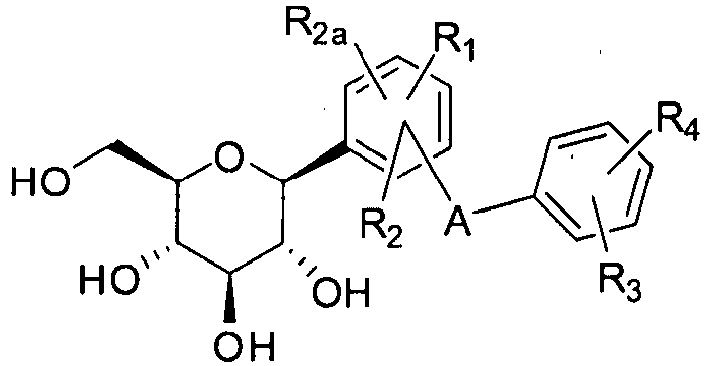
-
WO 2003/099836 (Bristol-Myers Squibb) further discloses a SGLT-2 inhibiting compound, which has a structure as shown below and is subsequently named as dapagliflozin:
- This application teaches a method of treating diabetes mellitus and the related diseases by administering a SGLT-2 inhibitory amount of the above compound alone or in combination with other anti-diabetic agents or other therapeutic agents. It is also reported that Dapagliflozin is a SGLT-2 inhibitor having a good selectivity, and has an IC50 value on the human SGLT-2 of 1.12nM and an IC50 value on the human SGLT-1 of 1391nM (Diabetes 57:1723-1729, 2008). Dapagliflozin is now in the stage III clinical trial, and has an effect of regulating the glucosuria, controlling the blood glucose and reducing the body weight. Its side effect mainly includes the hypoglycemia and the vaginal infection.
-
WO 98/31697 
-
WO 2005/012326 discloses a compound represented by the following structure:


-
WO 2008/042688 discloses a compound represented by the following structure:

- Wherein each of R6 and R7 is independently hydrogen, hydroxyl, halogen, amino, nitro, CCR6A, OR6A, SR6A, SOR6A, SO2R6A, C(O)R6A, CO2R6A, CO2H, CON(R6A) (R6A), CONH(R6A), CONH2, NHC(O)R6A, NHSO2R6A, or optionally substituted alkyl, aryl or heterocycle; wherein R6A is optionally substituted alkyl, aryl or heterocycle; m is 1-3; and n is 1-3. It is said that the disclosed compound can be used to treat diabetes mellitus and obesity.

- In summary, it is a hotspot in the current anti-diabetic research to seek for a specific SGLT-2 inhibitor with a high efficiency and a low toxicity.
- The present invention provides a compound represented by the following general formula (I):

- X is O or S;
- each of R1 and R2 is independently hydrogen, -OH, -SH, -NH2, -NO2, -CN, -COH, -COOH, -CONH2, halogen, C1-C4alkyl, -O-C1-C4alkyl, -S-C1-C4alkyl, -SO-C1-C4alkyl, -SO2-C1-C4alkyl, -CO-C1-C4alkyl, -CO2-C1-C4alkyl, -CONH-C1-C4alkyl, -CC-C1-C4alkyl, -NHSO2-C1-C4alkyl, -NHCO-C1-C4alkyl or -C3-C6cycloalkyl;
- R3 is hydrogen, -OH, -SH, -NH2, -NO2, -CN, -COH, -COOH, -CONH2, halogen, -C1-C4alkyl, -O-C1-C4alkyl, -S-C1-C4alkyl, -CO-C1-C4alkyl, -CO2-C1-C4alkyl, -CONH-C1-C4alkyl, an aryl having 1-3 substituents selected from the groups in Group A, a heteroaryl having 1-3 substituents selected from the groups in Group A, a C3-C8cycloalkyl having 1-3 substituents selected from the groups in Group A, a nitrogen-containing saturated heterocyclic group having 1-3 substituents selected from the groups in Group A or a nitrogen-containing partially unsaturated heterocyclic group having 1-3 substituents selected from the groups in Group A,
- wherein, the group in Group A is selected from the group consisting of: hydrogen, halogen, -OH, -SH, -NH2, -NO2, -CN, -COH, -COOH, -CONH2, C1-C4alkyl, -O-C1-C4alkyl, -NH-C1-C4alkyl, -S-C1-C4alkyl, -SO2-C1-C4alkyl, -CO-C1-C4alkyl, -CO2-C1-C4alkyl, -CONH-C1-C4alkyl, -CONH-C3-C6cycloalkyl, -C1-C4alkyl-OH, -aryl, -O-aryl, -NH-aryl, -S-aryl, -SO2-aryl, -CO-aryl, -CO2-aryl, -CONH-aryl, -cycloalkyl, heteroaryl, -a nitrogen-containing saturated heterocyclic group, -C1-C4alkyl-a nitrogen-containing saturated heterocyclic group and -a nitrogen-containing partially unsaturated heterocyclic group;
- R4 is -O-R5, -S-R5, -SO-R5, -SO2 -R5, R5 is -C1-C4alkyl or -C3-C8cycloalkyl;
- m is 1, 2 or 3; and
- n is 1 or 2, or a pharmaceutically acceptable salt thereof.
- The present invention further provides a pharmaceutical composition, which contains a compound of the general formula (I) or a pharmaceutically acceptable salt thereof, and a pharmaceutically acceptable carrier, vehicle or diluent.
- The present invention further provides the use of a compound of the general formula (I) or a pharmaceutically acceptable salt thereof in the manufacture of a medicament for inhibiting the activity of the sodium-dependent glucose cotransporter 2 (SGLT-2) relevant to the intestinal or renal glucose reabsorption.
- The present invention further provides the use of a compound of the general formula (I) or a pharmaceutically acceptable salt thereof in the manufacture of a medicament for treating diabetes mellitus.
- The present invention further provides a compound for use in a method of treating diabetes mellitus in a mammal, which comprises administrating to a subject in need thereof a compound of the general formula (I) or a pharmaceutically acceptable salt thereof according to the present invention.
- According to the present invention, by the term "aryl" is meant an aromatic cyclic hydrocarbon group, preferably an aryl having 6-14 carbon atoms, such as phenyl and naphthyl, more preferably phenyl.
- According to the present invention, by the term "heteroaryl" is meant a 5-6 membered monocyclic heterocycle group containing 1-4 heteroatoms selected from the group consisting of N, S and O, or a bicyclic heterocycle group formed by fusing said 5-6 membered monocyclic heterocycle with a benzene ring. It is unsaturated. Herein, it is preferable for the monocyclic heterocycle group to be a 5-6 membered monocyclic heteroaryl, in particular, furyl, thienyl, pyrrolyl, imidazolyl, pyrazolyl, thiazolyl, isothiazolyl, oxazolyl, isooxazolyl, triazolyl, tetrazolyl, thiadiazolyl, pyridyl, pyrimidinyl, pyridazinyl, and pyrazinyl, more preferably imidazolyl, thiazolyl, triazolyl, pyridyl and pyrazinyl; it is preferable for the bicyclic heterocycle group to be benzofuryl, benzothienyl, benzothiadiazolyl, benzothiazolyl, benzoimidazolyl, indolyl, isoindolyl, indazolyl, quinolinyl, isoquinolinyl, and quinazolinyl.
- According to the present invention, by the term "nitrogen-containing saturated heterocyclic group" is meant a 5-6 membered saturated nitrogen-containing heterocycle group that contains 1-4 heteroatoms selected from the group consisting of N, O and S, preferably a 5-6 membered monocyclic nitrogen-containing saturated heterocyclic group, more preferably pyrrolidinyl, pyrazolidinyl, piperidinyl, piperazinyl, morpholinyl, and triazolidinyl, and further more preferably pyrrolidinyl, piperazinyl, piperidinyl or morpholinyl.
- According to the present invention, by the term "nitrogen-containing partially unsaturated heterocyclic group" is meant a 5-6 membered nitrogen-containing heterocycle group that contains 1-4 heteroatoms selected from the group consisting of N, O and S and is partially unsaturated. Herein, it is preferable for the nitrogen-containing partially unsaturated heterocyclic group to be a 5-6 membered monocyclic nitrogen-containing partially unsaturated heterocyclic group, preferably pyrrolinyl and pyrazolinyl, and more preferably pyrrolinyl.
- According to the present invention, by the term "halogen" is meant fluoro, chloro, bromo or iodo, preferably chloro or fluoro.
- According to the present invention, by the term "C1-C4alkyl" is meant an alkyl that contains 1-4 carbon atoms, including but not limited to, for example, methyl, ethyl, propyl, isopropyl, butyl, isobutyl, sec-butyl or tert-butyl; preferably methyl, ethyl, propyl, isopropyl or butyl.
- According to the present invention, by the term "C3-C6cycloalkyl" and "C3-C8cycloalkyl" are respectively meant a cycloalkyl that contains 3-6 carbon atoms and a cycloalkyl that contains 3-8 carbon atoms, including, for example, cyclopropyl, cyclobutyl, cyclopentyl, cyclohexyl, cycloheptyl or cyclooctyl; preferably cyclopropyl, cyclobutyl or cyclohexyl.
- In a preferable embodiment of the present invention, in the compound of the general formula (I), X is S, and R4 is -S-C1-C4alkyl, -SO-C1-C4alkyl or -SO2-C1-C4alkyl, in particular -S-CH3 or -SO2-CH3.
- In another preferable embodiment of the present invention, in the compound of the general formula (I), each of R1 and R2 is independently hydrogen, -OH, -NH2, -NO2, -CN, -COOH, halogen, -C1-C4alkyl, -O-C1-C4alkyl or -C3-C6cycloalkyl, both of m and n are 1, and the substituent R1 may be located at the ortho position, the meta position or the para position, preferably the para position of the glycoside.
- In a more preferable embodiment of the present invention, in the compound of the general formula (I), R1 is hydrogen, halogen or -C1-C4alkyl, preferably chloro or methyl, m is 1; R2 is hydrogen, halogen or -C1-C4alkyl, preferably hydrogen, and n is 1.
- In a preferable embodiment of the present invention, in the compound of the general formula (I), R3 is halogen, an aryl having 1-3 substituents selected from the groups in Group A, a heteroaryl having 1-3 substituents selected from the groups in Group A, a nitrogen-containing saturated heterocyclic group having 1-3 substituents selected from the groups in Group A or a nitrogen-containing partially unsaturated heterocyclic group having 1-3 substituents selected from the groups in Group A, wherein, the group in Group A is selected from the group consisting of: hydrogen, halogen, -OH, -SH, -NH2, -NO2, -COH, -COOH, -C1-C4alkyl, -O-C1-C4alkyl, -S-C1-C4alkyl, -CONH-C3-C6cycloalkyl, -C1-C4alkyl-OH, -C1-C4alkyl-a nitrogen-containing saturated heterocyclic group.
- In a preferable embodiment of the present invention, in the compound of the general formula (I), R3 is halogen, preferably fluoro or chloro.
- In another preferable embodiment of the present invention, in the compound of the general formula (I), R3 is a phenyl having 1-3 substituents selected from the groups in Group A, wherein, the group in Group A is selected from the group consisting of: hydrogen, halogen, -OH, -NH2, -NO2, -COH, -COOH, -C1-C4alkyl, -O-C1-C4alkyl, -S-C1-C4alkyl, -CONH-C3-C6cycloalkyl, -C1-C4alkyl-OH, -C1-C4alkyl-a nitrogen-containing saturated heterocyclic group.
- In another preferable embodiment of the present invention, in the compound of the general formula (I), R3 is a pyridyl having 1-3 substituents selected from the groups in Group A, wherein, the group in Group A is selected from the group consisting of: hydrogen, halogen, -OH, -NH2, -NO2, -COH, -COOH, -C1-C4alkyl, -O-C1-C4alkyl, -S-C1-C4alkyl, -CONH-C3-C6cycloalkyl, -C1-C4alkyl-OH, -C1-C4alkyl-a nitrogen-containing saturated heterocyclic group.
- In another preferable embodiment of the present invention, in the compound of the general formula (I),
X is S;
each of R1 and R2 is independently hydrogen, -OH, -NH2, -NO2, -CN, -COOH, halogen, -C1-C4alkyl, -O-C1-C4alkyl or -C3-C6cycloalkyl,
both of m and n are 1;
R3 is halogen, a phenyl having 1-3 substituents selected from the groups in Group A or a pyridyl having 1-3 substituents selected from the groups in Group A, wherein, the group in Group A is selected from the group consisting of: hydrogen; halogen; -OH; -NH2; -NO2; -COH; -COOH; -C1-C4alkyl; -O-C1-C4alkyl such as -O-CH3, -O-CH2-CH3, -O-CH2-CH2-CH3; -S-C1-C4alkyl such as -S-CH3, -S-CH2-CH3, -S-CH2-CH2-CH3; -CONH-C3-C6cycloalkyl such as -CONH-cyclopropyl, -CONH-cyclopentyl, -CONH-cyclohexyl; -C1-C4alkyl-OH such as -CH2-OH, -CH2-CH2-OH, -CH2-CH2-CH2-OH; and -C1-C4alkyl-a nitrogen-containing saturated heterocyclic group such as -CH2-piperazinyl, -CH2-morpholinyl, -CH2-piperidinyl, -CH2-pyrrolidinyl, -CH2-CH2-piperazinyl, -CH2-CH2-morpholinyl, -CH2-CH2-piperidinyl, -CH2-CH2-pyrrolidinyl; and
R4 is -S-C1-C4alkyl, -SO-C1-C4alkyl or -SO2-C1-C4alkyl, in particular -S-CH3 or -SO2-CH3. - According to the present invention, the preferable specific compounds of the general formula (I) are the following compounds and pharmaceutically acceptable salts thereof:
- (2S,3R,4R,5S,6R)-2-[3-((5-(4-fluorophenyl)thienyl)-2-methylene)-4-chloro-phenyl)-6-methylthio-tetrahydrop yran-3,4,5-triol;
- (2S,3R,4R,5S,6R)-2-[3-((5-(4-fluorophenyl)thienyl)-2-methylene)-4-methylphenyl)-6-methylthio-tetrahydrop yran-3,4,5-triol;
- (2S,3R,4R,5S,6R)-2-[3-((5-(4-fluoropyridyl)thienyl)-2-methylene)-4-chloro-phenyl)-6-methylthio-tetrahydrop yran-3,4,5-triol;
- (2S,3R,4R,5S,6R)-2-[3-((5-(4-chloro)thienyl)-2-methylene)-4-chloro-phenyl)-6-methylthio-tetrahydropyran-3, 4,5-triol;
- (2S,3R,4R,5S,6R)-2-[3-((5-(4-bromo)thienyl)-2-methylene)-4-methyl-phenyl)-6-methylthio-tetrahydropyran-3,4,5-triol;
- (2S,3R,4R,5S,6R)-2-[3-((5-(3,4,5-trifluorophenyl)thienyl)-2-methylene)-4-methylphenyl)-6-methylthio-tetrah ydropyran-3,4,5-triol;
- (2S,3R,4R,5S,6R)-2-[3-((5-(3,4-difluorophenyl)thienyl)-2-methylene)-4-methylphenyl)-6-methylthio-tetrahyd ropyran-3,4,5-triol;
- (2S,3R,4R,5S,6R)-2-[3-((5-(4-methoxyphenyl)thienyl)-2-methylene)-4-methylphenyl)-6-methylthio-tetrahydr opyran-3,4,5-triol;
- (2S,3R,4R,5S,6R)-2-[3-((5-(3-cynaophenyl)thienyl)-2-methylene)-4-methylphenyl)-6-methylthio-tetrahydrop yran-3,4,5-triol;
- (2S,3R,4R,5S,6R)-2-[3-((5-(2-formylphenyl)thienyl)-2-methylene)-4-methylphenyl)-6-methylthio-tetrahydrop yran-3,4,5-triol;
- (2S,3R,4R,5S,6R)-2-[3-((5-(3-formylphenyl)thienyl)-2-methylene)-4-methylphenyl)-6-methylthio-tetrahydrop yran-3,4,5-triol;
- (2S,3R,4R,5S,6R)-2-[3-((5-((4-methylpiperazin-1-yl)methyl)phenyl)thienyl)-2-methylene)-4-methylphenyl)-6-methylthio-tetrahydropyran-3,4,5-triol;
- (2S,3R,4R,5S,6R)-2-[3-((5-(3-(morpholinylmethyl)phenyl)thienyl)-2-methylene)-4-methylphenyl)-6-methylthi o-tetrahydropyran-3,4,5-triol;
- (2S,3R,4R,5S,6R)-2-[3-((5-(4-carboxylphenyl)thienyl)-2-methylene)-4-methylphenyl)-6-methylthio-tetrahydr opyran-3,4,5-triol;
- (2S,3R,4R,5S,6R)-2-[3-((5-(4-N-cyclopropylbenzamide)thienyl)-2-methylene)-4-methylphenyl)-6-methylthio-tetrahydropyran-3,4,5-triol;
- (2S,3R,4R,5S,6R)-2-[3-((5-(4-methylthiophenyl)thienyl)-2-methylene)-4-methylphenyl)-6-methylthio-tetra-hydropyran-3,4,5-triol;
- (2S,3R,4R,5S,6R)-2-[3-((5-(2-furyl)thienyl)-2-methylene)-4-methylphenyl)-6-methylthio-tetrahydropyran-3,4, 5-triol;
- (2S,3R,4R,5S,6R)-2-[3-((5-(4-hydroxymethylphenyl)thienyl)-2-methylene)-4-methylphenyl)-6-methylthio-tetrahydropyran-3,4,5-triol;
- (2S,3R,4R,5S,6R)-2-[3-((5-(3-aminophenyl)thienyl)-2-methylene)-4-methylphenyl)-6-methylthio-tetrahydro-pyran-3,4,5-triol;
- (2S,3R,4R,5S,6R)-2-[3-((5-(4-fluorophenyl)thienyl)-2-methylene)-2-methoxy-4-methylphenyl)-6-methylthio-tetrahydropyran-3,4,5-triol; and
- (2S,3R,4R,5S,6R)-2-[3-((5-(4-fluorophenyl)thienyl)-2-methylene)-4-chloro-phenyl)-6-methylsulfonyl-tetra-hydropyran-3,4,5-triol.
- The present invention further provides a process for preparing a compound of the general formula (I), which comprises the steps of:

(3aS,5R,6S,6aS)-[6-hydroxy-2,2-dimethyl-tetrahydrofuro[3,2-d][1,3]-dioxol-5-yl]-(morpholino)-methanone I(g) (which is synthesized according toWO 2010/009197 , starting from L-xylose, through bis-acetonide protection, selective acetonide deprotection, oxidation, amidation, and the like) is used as starting material, to which a halide e.g. iodide or bromide of formula I(a) is added, and then an alcohol I(b) is obtained; I(b) is treated with an alcohol and water in the presence of an acid such as acetic acid or sulfuric acid, and acetylated with acetic anhydride in the presence of an organic base such as pyridine to obtain a compound I(c); I(c) is added to an acetic acid solution containing bromide hydrogen to conduct the reaction to obtain a compound I(d), which is reacted with a nucleophilic reagent such as alkoxide, mercaptide such as sodium alkoxide, sodium mercaptide or mercaptan without separation and purification to obtain a compound I(e) directly (if R4=-O-R5, -S-R5) or after the oxidation (if R4=-SO-R5 or -SO2-R5); and the acetyl of the saccharide moiety in the compound I(e) is hydrolyzed according to any conventional method well known in the prior art to obtain the target compound I. - The compound of the present invention further comprises a pharmaceutically acceptable salt of the compound of the general formula (I). By the term "pharmaceutically acceptable salt" is meant a comparatively innoxious acid or base addition salt of the compound of the general formula (I) according to the present invention. The acid addition salt is a salt formed from the compound of formula (I) and a suitable inorganic or organic acid. The salt can be prepared during the final separation and purification of the compound, or prepared by the reaction of the purified compound in form of its free base and a suitable organic or inorganic acid, and the separation of the resulting salt. The representative acid addition salt includes but is not limited to hydrobromide, hydrochloride, sulfate, sulfite, acetate, oxalate, pentanoate, oleate, palmitate, stearate, laurate, borate, benzoate, lactate, phosphate, toluate, citrate, maleate, fumarate, succinate, tartrate, benzoate, mesylate, p-toluene sulfonate, gluconate, lactobionate, laurylsulfonate, and the like.
- The base addition salt is a salt formed from the compound of formula (I) and a suitable inorganic or organic base, including, for example, a salt formed from an alkali metal, an alkaline earth metal or a quaternary ammonium cation, such as a sodium salt, a lithium salt, a potassium salt, a calcium salt, a magnesium salt, a tetramethyl quaternary ammonium salt, a tetraethyl quaternary ammonium salt and the like; an amine salt, including a salt formed from ammonia (NH3), a primary amine, a secondary amine, or a tertiary amine, such as a methylamine salt, a dimethylamine salt, a trimethylamine salt, a triethylamine salt, an ethylamine salt, and the like.
- The compound of the general formula (I) according to the present invention and a pharmaceutically acceptable salt thereof can administrated to a mammal, e.g. human orally, rectally, parenterally (intravenously, intramuscularly, subcutaneously), topically (e.g. in a dosage form such as pulvis, ointment and drop), and the like.
- The compound of the general formula (I) according to the present invention and a pharmaceutically acceptable salt thereof can be formulated to a solid dosage form for the oral administration, including but not limited to, e.g. capsules, tablets, pills, powders and granules. In such solid dosage forms, the present compound or a pharmaceutically acceptable salt thereof can be mixed with at least one conventional inert vehicle (or carrier), such as sodium citrate or dicalcium phosphate and/or the following substances: (a) filler or bulking agent, such as starch, lactose, sucrose, glucose, mannitol and silicic acid; (b) binding agent, such as carboxymethyl cellulose, alginate, gelatin, polyvinyl pyrrolidone, sucrose, and arabic gum; (c) humectant, such as glycerol; (d) disintegrating agent, such as agar, calcium carbonate, potato or cassava starch, alginic acid, some complex silicates and sodium carbonate; (e) solution-blocking agent, such as paraffin wax; (f) absorption accelerator, such as quaternary ammonium compounds; (g) wetting agent, such as cetanol and glycerol monostearate; (h) adsorbent, such as kaolin; and (i) lubricant, such as talc, calcium stearate, magnesium stearate, solid polyethylene glycol, sodium dodecylsulfate and their mixtures. In the cases of capsules, tablets and pills, these dosage forms may also comprise a buffering agent.
- The solid dosage forms such as tablets, dragees, capsules, pills and granules can be prepared with coating agents and shell materials such as enteric coating materials and other coating materials well-known in the field of medical preparations. These solid dosage forms can optionally comprise sun-screening agent, and their composition can allow they merely or preferentially release active ingredient at some sites of intestinal tract optionally in a delayed manner. Examples of embedding composition comprise high molecular materials and waxes. If appropriate, the present compound or a pharmaceutically acceptable salt thereof can be formulated to form of microcapsules with one or more aforementioned vehicles.
- The compound of the general formula (I) according to the present invention and a pharmaceutically acceptable salt thereof can also be formulated to a liquid dosage form for oral administration, including pharmaceutically acceptable emulsion, solution, suspension, syrup and elixir. In addition to the compound of the general formula (I) according to the present invention or a pharmaceutically acceptable salt thereof as the active compound, the liquid formulation may comprise an inert diluent commonly used in the art such as, for example, water or other solvent, solubilizing agent and emulsifier (e.g., ethyl alcohol, isopropyl alcohol, ethyl carbonate, ethyl acetate, propylene glycol, 1,3-butylene glycol, dimethylformamide, oil (in particular, cottonseed, groundnut, corn germ, olive, castor or sesame oil), and mixtures thereof.)
- Besides the inert diluent, these dosage forms may also comprise an adjuvant such as a wetting agent, an emulsifier, a suspending agent, a sweetener, a flavor and a perfume.
- A suspension, in addition to the compound of the general formula (I) according to the present invention or a pharmaceutically acceptable salt thereof, may comprise a suspending agent (e.g., ethoxylated isostearyl alcohol, polyoxyethylene sorbitol and sorbitan ester, microcrystalline cellulose, aluminum metahydroxide, agar-agar, or mixtures thereof).
- The compound of the general formula (I) according to the present invention and a pharmaceutically acceptable salt thereof can be formulated to a formulation suitable for parenteral injection, including but not limited to a physiologically acceptable sterile aqueous or oleaginous solution, dispersion, suspension or emulsion, and sterile powder which can be dissolved or dispersed in to prepare sterile injectable solution or dispersion. Examples of suitable aqueous or oleaginous carrier, diluent, solvent or vehicle include water, ethanol, polyol, and adequate mixtures thereof.
- The compound of the general formula (I) according to the present invention and a pharmaceutically acceptable salt thereof can be formulated to a dosage form for topical administration, including ointment, powder, spray and inhalant. The compound of the general formula (I) according to the present invention or a pharmaceutically acceptable salt thereof can be mixed under sterile condition with physiologically acceptable carriers and any antiseptics, buffers, or required propellants, if necessary.
- The present invention further provides a pharmaceutical composition, which comprises 0.01-50mg of the compound of the general formula (I) according to the present invention or a pharmaceutically acceptable salt thereof as mentioned above, and a pharmaceutically acceptable carrier, vehicle or diluent.
- The pharmaceutical composition of the present invention can be prepared by any conventional method, for example, by mixing the compound of the general formula (I) according to the present invention or a pharmaceutically acceptable salt thereof and a pharmaceutically acceptable carrier, vehicle or diluents.
- The present invention further provides a method for treating a disease, which disease can be alleviated or treated by promoting the urine glucose excretion, such as type II diabetes mellitus, comprising the step of administering to a patient in need thereof the compound of formula (I) or a pharmaceutically acceptable salt thereof in a dose of 0.1-50mg/kg body weight/day.
- The present compound or a pharmaceutically acceptable salt thereof can be administered alone or in combination with other pharmaceutically acceptable therapeutic agents, in particular other anti-diabetic drugs. The therapeutic agent includes but is not limited to: biguanides, such as dimethyl biguanide; thiazolidinediones, such as troglitazone, rosiglitazone, pioglitazone; α-glucosidase inhibitors, such as acarbose, voglibose, migltol; sulfonylurea insulin secretagogues, such as glibenclamide, glipizide, glibornuride, gliclazide, glimepiride; postprandial glucose regulators such as repaglinide; PPARα/γ dual-agonists ; DPP-IV inhibitors; PTP1B inhibitors and the like. The ingredients to be combined can be administered simultaneously or sequentially, and can be administered either in a unitary formulation or in separate formulations. Such combination includes not only the combination of the present compound with one other active agent but also the combination of the present compound with two or more other active agents.
- It is proved by the assays that the present compounds can promote the urine glucose excretion and therefore can be useful for preparing the medicament for treating diabetes mellitus.
- The drug effect of promoting the urine glucose excretion can be determined according to the conventional assay. One preferable evaluation assay is to detect the effect of the present compound on the urine glucose excretion of the normal rat. The assay can be conducted as follows. Thirty 7-week-old male SD rats (about 200g) are used in the assay. The tested compound having a purity of 97.8% is formulated with 0.75% CMC-Na. The positive control drug (Dapagliflozin) having a purity of 98% is formulated with 0.75% CMC-Na. The SD rats are acclimatized for 7 days, and then placed in the metabolic cages. The rats are fasted overnight (18hr) under the free access to water. The basic urine samples are collected, and then thirty rats are weighed and grouped randomly into five groups, six rats per group. The rats are administered with the tested compounds or the positive control drug at low dosage, medium dosage, or high dosage. Fifteen minutes after the administration, the rats are intragastrically administrated with 50% glucose solution (2g/kg). For ensuring a complete collection of the 24-hour urine, the rats are immediately placed in the metabolic cage after the administration of the tested compounds or the positive control drug. One hour after the administration of the glucose solution, the feeds are supplied to the rats. The urines after the administration of the tested compounds or the positive control drug are collected for 24 hours, and then the urine volumes are calculated and the urine glucose concentrations are detected.
- The data are analyzed with the software SPSS 12.0, and the quantized data are expressed in "average ± standard deviation". Multiple sets of data are compared according to the analysis of variance (One-way ANOVA). P<0.05 represents statistical difference.
-
-
Figure 1 shows the volumes of the urine excreted in 24 hours after the single intragastric oral administrations of the compound of Example 2 and the positive control drug (dapagliflozin) to normal rats. -
Figure 2 shows the masses of the urine glucose excreted in 24 hours after the single intragastric oral administrations of the compound of Example 2 and the positive control drug (dapagliflozin) to normal rats. - The present invention will now be described in connection with certain embodiments which are not intended to limit its scope. It should be recognized thus that the following examples are for the purposes of illustration of the practice of the present invention only. The specific condition of the experimental methods used in the following examples, which was not set forth, is generally according to the conventional condition, or according to the condition suggested by the manufacturers. Unless otherwise indicated, the parts and percents are by weight.
- The abbreviations used in Examples have the meanings well known in the field to which the present invention belongs. For example, i-PrMgCl represents isopropyl magnesium chloride; THF represents tetrahydrofuran; HOAc represents acetic acid; Ac2O represents acetic anhydride; Py represents pyridine; TEA represents triethylamine; Et3N represents triethylamine; and MeCN represents acetonitrile.
-

- The title compound was prepared by the following steps:
-

- To a single-neck bottle containing LiCl (1.0g, 23.66mmol), THF (10mL) was added, and then 2 mol/L i-PrMgCl/tetrahydrofuran solution (23.66 mmol, 11.83mL) was added slowly. After the completion of the dropwise addition, the mixture was stirred at room temperature for 2 hrs. Then this reaction system was placed in an ice-water bath, and diluted with THF (10mL). To the reaction system 1(a) (4.04g, 9.46mmol) was added in batch. Then the reaction system was kept at this temperature and stirred for 1 hr. Then to the reaction system, the solid 1(a') (2.3g, 8.5mmol) (which was synthesized according to
WO 2010/309197 , starting from L-xylose, through bis-acetonide protection, selective acetonide deprotection, oxidation, amidation, and the like) was added. The stirring was continued for 1 hr. Then the reaction was quenched with a saturated NH4Cl solution. The aqueous phase was removed and extracted with ethyl acetate. The organic phases were combined, washed with water and a saturated aqueous NaCl solution successively, dried with anhydrous Na2SO4 and concentrated. The resulting residue was purified by a silica gel column chromatography (petroleum ether/ethyl acetate = 2:1) to produce a pale yellow solid (2.1g). This compound (535mg, 1.1mmol) was dissolved in methanol (9mL). CeCl3˙7H2O (490mg, 1.32mmol) was added at room temperature. The mixture was stirred for 20mins until it completely dissolved, and cooled to -78°C. NaBH4 (50mg, 1.32mmol) was added in batch. One hour later, the starting material consumed completely. Water (5mL) was added to quench the reaction. The reaction system was warmed to room temperature and subjected to the rotary-evaporation to remove the solvent. The resulting aqueous phase was extracted with dichloromethane (3×10mL). The organic phases were combined, washed with water and a saturated aqueous NaCl solution successively, dried with anhydrous Na2SO4 and concentrated to produce a crude pale yellow oily product 1(b).
1H NMR (400 Hz, CDCl3) δ1.24 (s, 6 H), 4.33 (s, 2 H), 4.59-4.61 (m, 2 H), 5.27 (d, J = 2 Hz, 1 H), 6.08 (d, J = 3.2 Hz, 1 H), 6.82 (d, J = 3.6 Hz, 1 H),7.03-7.09 (m, 3 H), 7.50-7.54 (m, 3 H), 7.91-8.00 (m, 2 H). -

- The crude Compound 1(b) was dissolved in acetic acid (12mL) and water (8mL). The mixture was heated at 100°C for 15 hrs, cooled to room temperature, and rotary-evaporated to remove the solvent. Toluene was used to remove water from the reaction system to produce an oily solid.
- The resulting solid was dissolved in dichloromethane (10mL). Pyridine (1mL) and Ac2O (0.5mL) were added slowly under an ice-water bath cooling. After the completion of the addition, the mixture was stirred at room temperature for 2 hrs. A saturated aqueous NaHCO3 solution was added to the reaction system to quench the reaction. The organic phase was separated. The aqueous phase was extracted with dichloromethane (3x5mL). The organic phases were combined, washed with water and a saturated aqueous NaCl solution successively, dried with anhydrous Na2SO4, and concentrated. The resulting residue was separated by a silica gel column chromatography (petroleum ether/ethyl acetate = 2:1) to produce a pale yellow solid 1(c) (518mg, 76%).
-

- Under an ice-water bath, to a single-neck bottle containing Compound 1(c) (418mg, 0.676mmol), 30%HBr/HOAc solution (3mL) was added. After the completion of the dropwise addition, the mixture was stirred at room temperature for 1 hr. Then dichloromethane (5mL) was added to dilute the mixture. After stirring for 0.5hr, more dichloromethane was added. The reaction was quenched with a saturated aqueous NaHCO3 solution. The organic phase was separated. The aqueous phase was extracted with dichloromethane (3×10mL). The organic phases were combined, washed with water and a saturated aqueous NaCl solution successively, dried with anhydrous Na2SO4, and concentrated to produce a pale yellow liquid.
- At room temperature, 8 mL MeCN and 154 mg S(NH2)2 were added to the above resulting pale yellow liquid . The mixture was heated under reflux for 1 hr, and then cooled to room temperature. Et3N (4eq) and CH3I (3eq) were added. The mixture was stirred for 1 hr. The reaction was quenched with a saturated aqueous NaHCO3 solution and subjected to the rotary-evaporation to remove the organic solvent. Dichloromethane (10mL) was added. The organic phase was separated. The aqueous phase was extracted with dichloromethane (3×10mL). The organic phases were combined, washed with water and a saturated aqueous NaCl solution successively, dried with anhydrous Na2SO4, and concentrated. The resulting residue was purified by a silica gel column chromatography (petroleum ether/ethyl acetate=5:1) to produce a pale yellow solid 1(e) (251mg, 60% (three steps)).
1H NMR (400 Hz, CDCl3)δ1.77 (s, 3 H), 2.02 (s, 3 H), 2.11 (s, 3 H), 2.17 (s, 3 H), 4.28 (2 H), 4.43 (d, J = 10 Hz, 1 H), 4.53 (d, J = 10 Hz, 1 H), 5.08 (t, J = 9.6 Hz, 1 H), 5.22 (t, J = 9.6 Hz, 1 H), 5.32 (t, J = 9.2 Hz, 1 H), 6.76 (d, J = 3.6 Hz, 1 H), 7.03-7.08 (m, 3 H), 7.23-7.25 (m,2 H), 7.39-7.41 (m, 2 H), 7.49-7.53 (m, 3 H). -

- Compound 1(e) (251mg, 0.414mmol) was placed in a 50mL single-neck bottle. After adding 15mL methanol to form a suspension, sodium methoxide (50mg, 0.455mmol) was added. After the reaction liquid became clear, TLC indicated that the reaction was completed (1.5 hrs). Water was added dropwise until the white solid separated out. After filtering, the filtered caked was dried to produce Compound 1 (172mg, 86%).
1H NMR (400 Hz, CDCl3) δ2.17 (d, J = 2.8 Hz, 1 H), 2.21 (s, 3 H), 2.58 (d, J = 2.0 Hz, 1 H), 2.89 (d, J = 2.0 Hz, 1 H), 3.53-3.59 (m, 2 H), 3.73 (t, J = 4.6 Hz, 1 H), 4.24-4.30 (m, 3 H), 4.42 (d, J = 9.6 Hz, 1 H), 6.81 (d, J = 3.2 Hz, 1 H), 7.04-7.08 (m, 3 H), 7.27-7.30 (m, 1 H), 7.35-7.53 (m, 4 H).
ESI(+)m/z: 480 -

-

- To a single-neck bottle containing LiCl (1.0g, 23.66mmol), THF (10mL) was added, and then 2 mol/L i-PrMgCl/tetrahydrofuran solution (23.66 mmol, 11.83mL) was added slowly. After the completion of the dropwise addition, the mixture was stirred at room temperature for 2 hrs. Then this reaction system was placed in an ice-water bath, and diluted with THF (10mL). To the reaction system, 2(a) (3.9g, 9.46mmol) was added in batch. Then the reaction system was kept at this temperature and stirred for 1 hr. Then to the reaction system, the solid 1(a') (2.3g, 8.5mmol) was added. The stirring was continued for 1 hr. Then the reaction was quenched with a saturated NH4Cl solution. The aqueous phase was removed and extracted with ethyl acetate. The organic phases were combined, washed with water and a saturated aqueous NaCl solution successively, dried with anhydrous Na2SO4, and concentrated. The resulting residue was separated by a silica gel column chromatography (petroleum ether/ethyl acetate = 2:1) to produce a pale yellow solid (2.1g). This compound (535mg, 1.1mmol) was dissolved in methanol (9mL). CeCl3˙7H2O (490mg, 1.32mmol) was added at room temperature. The mixture was stirred for 20mins until it completely dissolved, and cooled to -78°C. NaBH4 (50mg, 1.32mmol) was added in batch. One hour later, the starting material consumed completely. Water (5mL) was added to quench the reaction. The reaction system was warmed to room temperature and subjected to the rotary-evaporation to remove the solvent. The resulting aqueous phase was extracted with dichloromethane (3×10mL). The organic phases were combined, washed with water and a saturated aqueous NaCl solution successively, dried with anhydrous Na2SO4 and concentrated to produce a crude pale yellow oily product 2(b).
-

- The crude Compound 2(b) was dissolved in acetic acid (12mL) and water (8mL). The mixture was heated at 100°C for 15 hrs, cooled to room temperature, and rotary-evaporated to remove the solvent. Toluene was used to remove water from the reaction system to produce an oily solid.
- The resulting solid was dissolved in dichloromethane (10mL). Pyridine (1mL) and Ac2O (0.5mL) were added slowly under an ice-water bath cooling. After the completion of the addition, the mixture was stirred at room temperature for 2 hrs. A saturated aqueous NaHCO3 solution was added to the reaction system to quench the reaction. The organic phase was separated. The aqueous phase was extracted with dichloromethane (3x5mL).
- The organic phases were combined, washed with water and a saturated aqueous NaCl solution successively, dried with anhydrous Na2SO4, and concentrated. The resulting residue was separated by a silica gel column chromatography (petroleum ether/ethyl acetate = 2:1) to produce a pale yellow solid 2(c) (404mg, 61%).
-

- Under an ice-water bath, to a single-neck bottle containing Compound 2(c) (404mg, 0.676mmol), 30%HBr/HOAc solution (3mL) was added. After the completion of the dropwise addition, the mixture was stirred at room temperature for 1 hr. Then dichloromethane (5mL) was added to dilute the mixture. After stirring for 0.5hr, more dichloromethane was added. The reaction was quenched with a saturated aqueous NaHCO3 solution. The organic phase was separated. The aqueous phase was extracted with dichloromethane (3×10mL). The organic phases were combined, washed with water and a saturated aqueous NaCl solution successively, dried with anhydrous Na2SO4, and concentrated to produce a pale yellow liquid.
- At room temperature, to the above resulting pale yellow liquid, 8 mL MeCN and 154 mg S(NH2)2 were added. The mixture was heated under reflux for 1 hr, and then cooled to room temperature. Et3N (4eq) and CH3I (3eq) were added. The mixture was stirred for 1 hr. The reaction was quenched with a saturated aqueous NaHCO3 solution and subjected to the rotary-evaporation to remove the organic solvent. Dichloromethane (10mL) was added. The organic phase was separated. The aqueous phase was extracted with dichloromethane (3×10mL). The organic phases were combined, washed with water and a saturated aqueous NaCl solution successively, dried with anhydrous Na2SO4, and concentrated. The resulting residue was purified by a silica gel column chromatography (petroleum ether/ethyl acetate=5:1) to produce a pale yellow solid 2(e) (242mg, 61% (three steps)).
-

- Compound 2(e) (242mg, 0.414mmol) was placed in a 50mL single-neck bottle. After adding 15mL methanol to form a suspension, sodium methoxide (50mg, 0.455mmol) was added. After the reaction liquid became clear, TLC indicated that the reaction was completed (1.5 hrs). Water was added dropwise until the white solid separated out. After filtering, the filtered caked was dried to produce Compound 2(92mg, 48%).
1H NMR (400 MHz, CDCl3) δ7.63 7.42 (m, 2H), 7.28 7.18 (m, 3H), 7.10 6.99 (m, 3H), 6.70 (d, J = 3.6 Hz, 1H), 4.43 (d, J = 9.6 Hz, 1H), 4.24 (d, J = 9.4 Hz, 1H), 4.17 (s, 2H), 3.75 (t, J = 8.8 Hz, 1H), 3.61 (t, J = 9.1 Hz, 2H), 2.91 (s, 1H), 2.60 (s, 1H), 2.35 (s, 3H), 2.22 (s, 3H), 2.07 (s, 1H).
ESI(+)m/z: 460 -

-
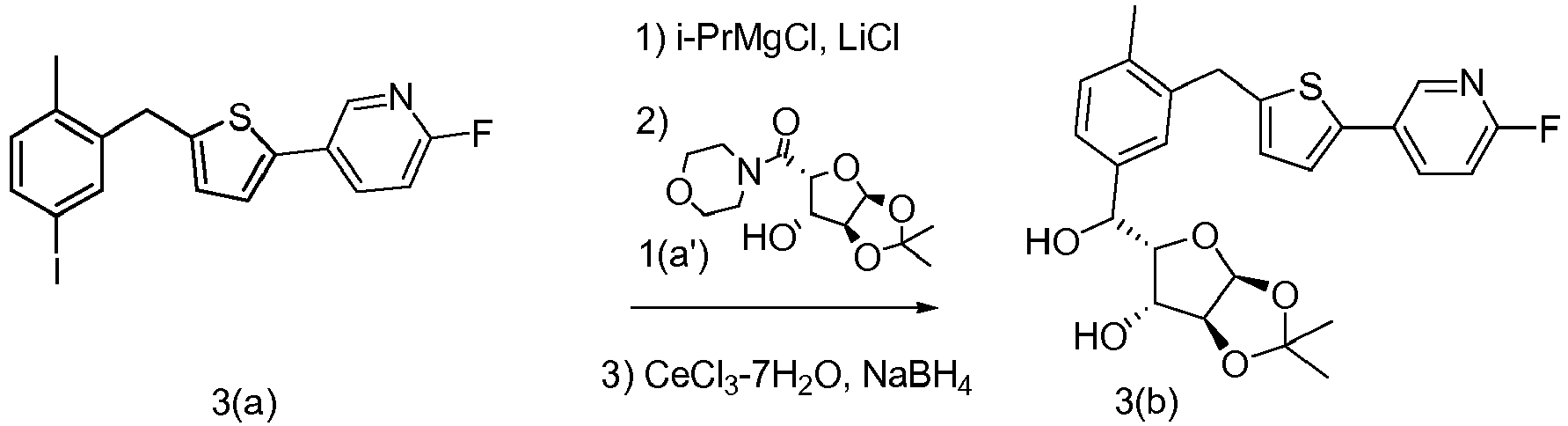
- To a single-neck bottle containing LiCl (1.0g, 23.66mmol), THF (10mL) was added, and then 2 mol/L i-PrMgCl/tetrahydrofuran solution (23.66 mmol, 11.83mL) was added slowly. After the completion of the dropwise addition, the mixture was stirred at room temperature for 2 hrs. Then this reaction system was placed in an ice-water bath, and diluted with THF (10mL). To the reaction system, 3(a) (3.87g, 9.46mmol) was added in batch. Then the reaction system was kept at this temperature and stirred for 1 hr. Then to the reaction system, the solid 1(a') (2.3g, 8.5mmol) was added. The stirring was continued for 1 hr. Then the reaction was quenched with a saturated NH4Cl solution. The aqueous phase was removed and extracted with ethyl acetate. The organic phases were combined, washed with water and a saturated aqueous NaCl solution successively, dried with anhydrous Na2SO4, and concentrated. The resulting residue was purified by a silica gel column chromatography (petroleum ether/ethyl acetate = 2:1) to produce a pale yellow solid (2.1g). This compound (535mg, 1.1mmol) was dissolved in methanol (9mL). CeCl3˙7H2O (490mg, 1.32mmol) was added at room temperature. The mixture was stirred for 20mins until it completely dissolved, and cooled to -78°C. NaBH4 (50mg, 1.32mmol) was added in batch. One hour later, the starting material consumed completely. Water (5mL) was added to quench the reaction. The reaction system was warmed to room temperature and subjected to the rotary-evaporation to remove the solvent. The resulting aqueous phase was extracted with dichloromethane (3×10mL). The organic phases were combined, washed with water and a saturated aqueous NaCl solution successively, dried with anhydrous Na2SO4 and concentrated to produce a crude pale yellow oily product 3(b).
-

- The crude Compound 3(b) was dissolved in acetic acid (12mL) and water (8mL). The mixture was heated at 100°C for 15 hrs, cooled to room temperature, and rotary-evaporated to remove the solvent. Toluene was used to remove water from the reaction system to produce an oily solid.
- The resulting solid was dissolved in dichloromethane (10mL). Pyridine (1mL) and Ac2O (0.5mL) were added slowly under an ice-water bath cooling. After the completion of the addition, the mixture was stirred at room temperature for 2 hrs. A saturated aqueous NaHCO3 solution was added to the reaction system to quench the reaction. The organic phase was separated. The aqueous phase was extracted with dichloromethane (3x5mL).
- The organic phases were combined, washed with water and a saturated aqueous NaCl solution successively, dried with anhydrous Na2SO4, and concentrated. The resulting residue was separated by a silica gel column chromatography (petroleum ether/ethyl acetate = 2:1) to produce a pale yellow solid 3(c) (522mg, 79%).
-

- Under an ice-water bath, to a single-neck bottle containing Compound 3(c) (406mg, 0.676mmol), 30%HBr/HOAc solution (3mL) was added. After the completion of the dropwise addition, the mixture was stirred at room temperature for 1 hr. Then dichloromethane (5mL) was added to dilute the mixture. After stirring for 0.5hr, more dichloromethane was added. The reaction was quenched with a saturated aqueous NaHCO3 solution. The organic phase was separated. The aqueous phase was extracted with dichloromethane (3×10mL). The organic phases were combined, washed with water and a saturated aqueous NaCl solution successively, dried with anhydrous Na2SO4, and concentrated to produce a pale yellow liquid.
- At room temperature, to the above resulting pale yellow liquid, 8 mL MeCN and 154 mg S(NH2)2 were added. The mixture was heated under reflux for 1 hr, and then cooled to room temperature. Et3N (4eq) and CH3I (3eq) were added. The mixture was stirred for 1 hr. The reaction was quenched with a saturated aqueous NaHCO3 solution and subjected to the rotary-evaporation to remove the organic solvent. Dichloromethane (10mL) was added. The organic phase was separated. The aqueous phase was extracted with dichloromethane (3×10mL). The organic phases were combined, washed with water and a saturated aqueous NaCl solution successively, dried with anhydrous Na2SO4, and concentrated. The resulting residue was purified by a silica gel column chromatography (petroleum ether/ethyl acetate=5:1) to produce a pale yellow solid 3(e) (243mg, 61% (three steps)).
-

- Compound 3(e) (243mg, 0.414mmol) was placed in a 50mL single-neck bottle. After adding 15mL methanol to form a suspension, sodium methoxide (50mg, 0.455mmol) was added. After the reaction liquid became clear, TLC indicated that the reaction was completed (1.5 hrs). Water was added dropwise until the white solid separated out. After filtering, the filtered caked was dried to produce Compound 3 (172mg, 86%).
1H NMR (400 Hz, CDCl3) δ2.19 (d, J = 2.8 Hz, 1 H), 2.23 (s, 3 H), 2.60 (d, J = 2.0 Hz, 1 H), 2.87 (d, J = 2.0 Hz, 1 H), 3.55-3.59 (m, 2 H), 3.72 (t, J = 4.6 Hz, 1 H), 4.26-4.30 (m, 3 H), 4.44 (d, J = 9.6 Hz, 1 H), 6.84 (d, J = 3.2 Hz, 1 H), 7.06-7.12 (m, 2 H), 7.31-7.34 (m, 3 H), 8.31-8.34 (m, 1 H), 8.61 (d, J = 1.8 Hz, 1 H).
ESI(+)m/z: 481 -

-

- To a single-neck bottle containing LiCl (1.0g, 23.66mmol), THF (10mL) was added, and then 2 mol/L i-PrMgCl/tetrahydrofuran solution (23.66 mmol, 11.83mL) was added slowly. After the completion of the dropwise addition, the mixture was stirred at room temperature for 2 hrs. Then this reaction system was placed in an ice-water bath, and diluted with THF (10mL). To the reaction system, 4(a) (3.5g, 9.46mmol) was added in batch. Then the reaction system was kept at this temperature and stirred for 1 hr. Then to the reaction system, the solid 1(a') (2.3g, 8.5mmol) was added. The stirring was continued for 1 hr. Then the reaction was quenched with a saturated NH4Cl solution. The aqueous phase was removed and extracted with ethyl acetate. The organic phases were combined, washed with water and a saturated aqueous NaCl solution successively, dried with anhydrous Na2SO4 and concentrated. The resulting residue was purified by a silica gel column chromatography (petroleum ether/ethyl acetate = 2:1) to produce a pale yellow solid (2.1g). This compound (535mg, 1.1mmol) was dissolved in methanol (9mL). CeCl3˙7H2O (490mg, 1.32mmol) was added at room temperature. The mixture was stirred for 20mins until it completely dissolved, and cooled to -78°C. NaBH4 (50mg, 1.32mmol) was added in batch. One hour later, the starting material consumed completely. Water (5mL) was added to quench the reaction. The reaction system was warmed to room temperature and subjected to the rotary-evaporation to remove the solvent. The resulting aqueous phase was extracted with dichloromethane (3×10mL). The organic phases were combined, washed with water and a saturated aqueous NaCl solution successively, dried with anhydrous Na2SO4 and concentrated to produce a crude pale yellow oily product 4(b).
-

- The crude Compound 4(b) was dissolved in acetic acid (12mL) and water (8mL). The mixture was heated at 100°C for 15 hrs, cooled to room temperature, and rotary-evaporated to remove the solvent. Toluene was used to remove water from the reaction system to produce an oily solid.
- The resulting solid was dissolved in dichloromethane (10mL). Pyridine (1mL) and Ac2O (0.5mL) were added slowly under an ice-water bath cooling. After the completion of the addition, the mixture was stirred at room temperature for 2 hrs. A saturated aqueous NaHCO3 solution was added to the reaction system to quench the reaction. The organic phase was separated. The aqueous phase was extracted with dichloromethane (3x5mL).
- The organic phases were combined, washed with water and a saturated aqueous NaCl solution successively, dried with anhydrous Na2SO4, and concentrated. The resulting residue was separated by a silica gel column chromatography (petroleum ether/ethyl acetate = 2:1) to produce a pale yellow solid 4(c) (528mg, 86%).
-

- Under an ice-water bath, to a single-neck bottle containing Compound 4(c) (378mg, 0.676mmol), 30%HBr/HOAc solution (3mL) was added. After the completion of the dropwise addition, the mixture was stirred at room temperature for 1 hr. Then dichloromethane (5mL) was added to dilute the mixture. After stirring for 0.5hr, more dichloromethane was added. The reaction was quenched with a saturated aqueous NaHCO3 solution. The organic phase was separated. The aqueous phase was extracted with dichloromethane (3×10mL). The organic phases were combined, washed with water and a saturated aqueous NaCl solution successively, dried with anhydrous Na2SO4, and concentrated to produce a pale yellow liquid.
- At room temperature, to the above resulting pale yellow liquid, 8 mL MeCN and 154 mg S(NH2)2 were added. The mixture was heated under reflux for 1 hr, and then cooled to room temperature. Et3N (4eq) and CH3I (3eq) were added. The mixture was stirred for 1 hr. The reaction was quenched with a saturated aqueous NaHCO3 solution and subjected to the rotary-evaporation to remove the organic solvent. Dichloromethane (10mL) was added. The organic phase was separated. The aqueous phase was extracted with dichloromethane (3×10mL). The organic phases were combined, washed with water and a saturated aqueous NaCl solution successively, dried with anhydrous Na2SO4, and concentrated. The resulting residue was purified by a silica gel column chromatography (petroleum ether/ethyl acetate=5:1) to produce a pale yellow solid 4(e) (278mg, 75% (three steps)).
-

- Compound 4(e) (226mg, 0.414mmol) was placed in a 50mL single-neck bottle. After adding 15mL methanol to form a suspension, sodium methoxide (50mg, 0.455mmol) was added. After the reaction liquid became clear, TLC indicated that the reaction was completed (1.5 hrs). Water was added dropwise until the white solid separated out. After filtering, the filtered caked was dried to produce Compound 4 (143mg, 82%).
1H NMR (400 Hz, CDCl3) δ2.17 (d, J = 2.8 Hz, 1 H), 2.21 (s, 3 H), 2.58 (d, J = 2.0 Hz, 1 H), 2.89 (d, J = 2.0 Hz, 1 H), 3.53-3.59 (m, 2 H), 3.73 (t, J = 4.6 Hz, 1 H), 4.24-4.30 (m, 3 H), 4.42 (d, J = 9.6 Hz, 1 H), 6.88 (d, J = 3.2 Hz, 1 H), 6.94 (d, J = 3.2 Hz, 1 H), 7.14-7.18 (m, 2 H), 8.25-8.28 (m, 1 H).
ESI(+)m/z: 420 -

-

- To a single-neck bottle containing LiCl (1.0g, 23.66mmol), THF (10mL) was added , and then 2 mol/L i-PrMgCl/tetrahydrofuran solution (23.66 mmol, 11.83mL) was added slowly. After the completion of the dropwise addition, the mixture was stirred at room temperature for 2 hrs. Then this reaction system was placed in an ice-water bath, and diluted with THF (10mL). To the reaction system, 5(a) (3.7g, 9.46mmol) was added in batch. Then the reaction system was kept at this temperature and stirred for 1 hr. Then to the reaction system, the solid 1(a') (2.3g, 8.5mmol) was added. The stirring was continued for 1 hr. Then the reaction was quenched with a saturated NH4Cl solution. The aqueous phase was removed and extracted with ethyl acetate. The organic phases were combined, washed with water and a saturated aqueous NaCl solution successively, dried with anhydrous Na2SO4 and concentrated. The resulting residue was purified by a silica gel column chromatography (petroleum ether/ethyl acetate = 2:1) to produce a pale yellow solid (2.1g). This compound (535mg, 1.1mmol) was dissolved in methanol (9mL). CeCl3˙7H2O (490mg, 1.32mmol) was added at room temperature. The mixture was stirred for 20mins until it completely dissolved, and cooled to -78°C. NaBH4 (50mg, 1.32mmol) was added in batch. One hour later, the starting material consumed completely. Water (5mL) was added to quench the reaction. The reaction system was warmed to room temperature and subjected to the rotary-evaporation to remove the solvent. The resulting aqueous phase was extracted with dichloromethane (3×10mL). The organic phases were combined, washed with water and a saturated aqueous NaCl solution successively, dried with anhydrous Na2SO4 and concentrated to produce a crude pale yellow oily product 5(b).
-

- The crude Compound 5(b) was dissolved in acetic acid (12mL) and water (8mL). The mixture was heated at 100°C for 15 hrs, cooled to room temperature, and rotary-evaporated to remove the solvent. Toluene was used to remove water from the reaction system to produce an oily solid.
- The resulting solid was dissolved in dichloromethane (10mL). Pyridine (1mL) and Ac2O (0.5mL) were added slowly under an ice-water bath cooling. After the completion of the addition, the mixture was stirred at room temperature for 2 hrs. A saturated aqueous NaHCO3 solution was added to the reaction system to quench the reaction. The organic phase was separated. The aqueous phase was extracted with dichloromethane (3x5mL).
- The organic phases were combined, washed with water and a saturated aqueous NaCl solution successively, dried with anhydrous Na2SO4, and concentrated. The resulting residue was separated by a silica gel column chromatography (petroleum ether/ethyl acetate = 2:1) to produce a pale yellow solid 5(c) (499mg, 78%).
-

- Under an ice-water bath, to a single-neck bottle containing Compound 5(c) (394mg, 0.676mmol), 30%HBr/HOAc solution (3mL) was added. After the completion of the dropwise addition, the mixture was stirred at room temperature for 1 hr. Then dichloromethane (5mL) was added to dilute the mixture. After stirring for 0.5hr, more dichloromethane was added. The reaction was quenched with a saturated aqueous NaHCO3 solution. The organic phase was separated. The aqueous phase was extracted with dichloromethane (3×10mL). The organic phases were combined, washed with water and a saturated aqueous NaCl solution successively, dried with anhydrous Na2SO4, and concentrated to produce a pale yellow liquid.
- At room temperature, to the above resulting pale yellow liquid, 8 mL MeCN and 154 mg S(NH2)2 were added. The mixture was heated under reflux for 1 hr, and then cooled to room temperature. Et3N (4eq) and CH3I (3eq) were added. The mixture was stirred for 1 hr. The reaction was quenched with a saturated aqueous NaHCO3 solution and subjected to the rotary-evaporation to remove the organic solvent. Dichloromethane (10mL) was added. The organic phase was separated. The aqueous phase was extracted with dichloromethane (3×10mL). The organic phases were combined, washed with water and a saturated aqueous NaCl solution successively, dried with anhydrous Na2SO4, and concentrated. The resulting residue was purified by a silica gel column chromatography (petroleum ether/ethyl acetate=5:1) to produce a pale yellow solid 5(e) (237mg, 61% (three steps)).
1H NMR (400 Hz, CDCl3) δ1.80 (s, 3 H), 2.03 (s, 3 H), 2.12 (s, 3 H), 2.20 (s, 3 H), 2.28 (s, 3 H), 4.04 (d, J = 2 Hz, 2 H), 4.42 (d, J = 10 Hz, 1 H), 4.54 (d, J = 10 Hz, 1 H), 5.13 (t, J = 9.6 Hz, 1 H), 5.23 (d, J = 9.6 Hz, 1 H), 5.36 (t, J = 9.6 Hz, 1 H), 6.44 (d, J = 4 Hz, 1 H), 6.86 (d, J = 3.6 Hz, 1 H), 7.12 (s, 1 H), 7.16-7.20 (m, 2 H). -

- Compound 5(e) (237mg, 0.414mmol) was placed in a 50mL single-neck bottle. After adding 15mL methanol to form a suspension, sodium methoxide (50mg, 0.455mmol) was added. After the reaction liquid became clear, TLC indicated that the reaction was completed (1.5 hrs). Water was added dropwise until the white solid separated out. After filtering, the filtered caked was dried to produce Compound 5 (158mg, 86%).
1H NMR (400 Hz, CDCl3) δ2.23 (s, 3 H), 2.32 (s, 3 H), 3.68-3.72 (m, 2 H), 3.76-3.80 (m, 1 H), 4.19 (s, 2 H), 4.25 (d, J = 8.4 Hz, 1 H), 4.40 (d, J = 9.2 Hz, 1 H), 6.47 (d, J = 4 Hz, 1 H), 6.88 (d, J = 3.6 Hz, 1 H), 7.15 (s, 1 H), 7.16-7.20 (m, 2 H).
ESI(+)m/z: 446 -

-

- To a single-neck bottle containing LiCl (1.0g, 23.66mmol), THF (10mL) was added, and then 2 mol/L i-PrMgCl/tetrahydrofuran solution (23.66 mmol, 11.83mL) was added slowly. After the completion of the dropwise addition, the mixture was stirred at room temperature for 2 hrs. Then this reaction system was placed in an ice-water bath, and diluted with THF (10mL). To the reaction system, 6(a) (4.2g, 9.46mmol) was added in batch. Then the reaction system was kept at this temperature and stirred for 1 hr. Then to the reaction system, the solid 1(a') (2.3g, 8.5mmol) was added. The stirring was continued for 1 hr. Then the reaction was quenched with a saturated NH4Cl solution. The aqueous phase was removed and extracted with ethyl acetate. The organic phases were combined, washed with water and a saturated aqueous NaCl solution successively, dried with anhydrous Na2SO4, and concentrated. The resulting residue was purified by a silica gel column chromatography (petroleum ether/ethyl acetate = 2:1) to produce a pale yellow solid (2.1g). This compound (535mg, 1.1mmol) was dissolved in methanol (9mL). CeCl3˙7H2O (490mg, 1.32mmol) was added at room temperature. The mixture was stirred for 20mins until it completely dissolved, and cooled to -78°C. NaBH4 (50mg, 1.32mmol) was added in batch. One hour later, the starting material consumed completely. Water (5mL) was added to quench the reaction. The reaction system was warmed to room temperature and subjected to the rotary-evaporation to remove the solvent. The resulting aqueous phase was extracted with dichloromethane (3×10mL). The organic phases were combined, washed with water and a saturated aqueous NaCl solution successively, dried with anhydrous Na2SO4, and concentrated to produce a crude pale yellow oily product 6(b).
-

- The crude Compound 6(b) was dissolved in acetic acid (12mL) and water (8mL). The mixture was heated at 100°C for 15 hrs, cooled to room temperature, and rotary-evaporated to remove the solvent. Toluene was used to remove water from the reaction system to produce an oily solid.
- The resulting solid was dissolved in dichloromethane (10mL). Pyridine (1mL) and Ac2O (0.5mL) were added slowly under an ice-water bath cooling. After the completion of the addition, the mixture was stirred at room temperature for 2 hrs. A saturated aqueous NaHCO3 solution was added to the reaction system to quench the reaction. The organic phase was separated. The aqueous phase was extracted with dichloromethane (3x5mL).
- The organic phases were combined, washed with water and a saturated aqueous NaCl solution successively, dried with anhydrous Na2SO4, and concentrated. The resulting residue was separated by a silica gel column chromatography (petroleum ether/ethyl acetate = 2:1) to produce a pale yellow solid 6(c) (520mg, 74%).
-

- Under an ice-water bath, to a single-neck bottle containing Compound 6(c) (429mg, 0.676mmol), 30%HBr/HOAc solution (3mL) was added. After the completion of the dropwise addition, the mixture was stirred at room temperature for 1 hr. Then dichloromethane (5mL) was added to dilute the mixture. After stirring for 0.5hr, more dichloromethane was added. The reaction was quenched with a saturated aqueous NaHCO3 solution. The organic phase was separated. The aqueous phase was extracted with dichloromethane (3×10mL). The organic phases were combined, washed with water and a saturated aqueous NaCl solution successively, dried with anhydrous Na2SO4, and concentrated to produce a pale yellow liquid.
- At room temperature, to the above resulting pale yellow liquid, 8 mL MeCN and 154 mg S(NH2)2were added. The mixture was heated under reflux for 1 hr, and then cooled to room temperature. Et3N (4eq) and CH3I (3eq) were added. The mixture was stirred for 1 hr. The reaction was quenched with a saturated aqueous NaHCO3 solution and subjected to the rotary-evaporation to remove the organic solvent. Dichloromethane (10mL) was added. The organic phase was separated. The aqueous phase was extracted with dichloromethane (3×10mL). The organic phases were combined, washed with water and a saturated aqueous NaCl solution successively, dried with anhydrous Na2SO4, and concentrated. The resulting residue was purified by a silica gel column chromatography (petroleum ether/ethyl acetate=5:1) to produce a pale yellow solid 6(e) (269mg, 64% (three steps)).
1H NMR (400 Hz, CDCl3) δ1.79 (s, 3 H), 2.03 (s, 3 H), 2.12 (s, 3 H), 2.20 (s, 3 H), 2.31 (s, 3 H), 4.13 (s, 2 H), 4.44 (d, J = 9.6 Hz, 1 H), 4.55 (d, J = 9.6 Hz, 1 H), 5.15 (t, J = 9.6 Hz, 1 H), 5.24 (d, J = 9.6 Hz, 1 H), 5.34 (t, J = 9.6 Hz, 1 H), 6.66 (d, J = 3.6 Hz, 1 H), 7.07 (d, J = 3.6 Hz, 1 H), 7.11-7.20 (m, 5 H). -

- Compound 6(e) (258mg, 0.414mmol) was placed in a 50mL single-neck bottle. After adding 15mL methanol to form a suspension, sodium methoxide (50mg, 0.455mmol) was added. After the reaction liquid became clear, TLC indicated that the reaction was completed (1.5 hrs). Water was added dropwise until the white solid separated out. After filtering, the filtered caked was dried to produce Compound 6 (166mg, 81%).
1H NMR (400 Hz, CDCl3) δ2.22 (s, 3 H), 2.33 (s, 3 H), 2.78 (s, 1 H), 3.24 (s, 1 H),3.58-3.62 (m, 2 H), 3.71-3.74 (m, 1 H), 4.15 (s, 2 H), 4.23 (d, J = 8.4 Hz, 1 H), 4.42 (d, J = 9.2 Hz, 1 H), 6.71 (s, 1 H), 7.07-7.26 (m, 6 H).
ESI(+)m/z: 496.1 -

-

- To a single-neck bottle containing LiCl (1.0g, 23.66mmol), THF (10mL) was added, and then 2 mol/L i-PrMgCl/tetrahydrofuran solution (23.66 mmol, 11.83mL) was added slowly. After the completion of the dropwise addition, the mixture was stirred at room temperature for 2 hrs. Then this reaction system was placed in an ice-water bath, and diluted with THF (10mL). To the reaction system, 7(a) (4.4g, 9.46mmol) was added in batch. Then the reaction system was kept at this temperature and stirred for 1 hr. Then to the reaction system, the solid 1(a') (2.3g, 8.5mmol) was added. The stirring was continued for 1 hr. Then the reaction was quenched with a saturated NH4Cl solution. The aqueous phase was removed and extracted with ethyl acetate. The organic phases were combined, washed with water and a saturated aqueous NaCl solution successively, dried with anhydrous Na2SO4 and concentrated. The resulting residue was purified by a silica gel column chromatography (petroleum ether/ethyl acetate = 2:1) to produce a pale yellow solid (2.1g). This compound (535mg, 1.1mmol) was dissolved in methanol (9mL). CeCl3˙7H2O (490mg, 1.32mmol) was added at room temperature. The mixture was stirred for 20mins until it completely dissolved, and cooled to -78°C. NaBH4 (50mg, 1.32mmol) was added in batch. One hour later, the starting material consumed completely. Water (5mL) was added to quench the reaction. The reaction system was warmed to room temperature and subjected to the rotary-evaporation to remove the solvent. The resulting aqueous phase was extracted with dichloromethane (3×10mL). The organic phases were combined, washed with water and a saturated aqueous NaCl solution successively, dried with anhydrous Na2SO4, and concentrated to produce a crude pale yellow oily product 7(b).
-

- The crude Compound 7(b) was dissolved in acetic acid (12mL) and water (8mL). The mixture was heated at 100°C for 15 hrs, cooled to room temperature, and rotary-evaporated to remove the solvent. Toluene was used to remove water from the reaction system to produce an oily solid.
- The resulting solid was dissolved in dichloromethane (10mL). Pyridine (1mL) and Ac2O (0.5mL) were added slowly under an ice-water bath cooling. After the completion of the addition, the mixture was stirred at room temperature for 2 hrs. A saturated aqueous NaHCO3 solution was added to the reaction system to quench the reaction. The organic phase was separated. The aqueous phase was extracted with dichloromethane (3x5mL).
- The organic phases were combined, washed with water and a saturated aqueous NaCl solution successively, dried with anhydrous Na2SO4, and concentrated. The resulting residue was separated by a silica gel column chromatography (petroleum ether/ethyl acetate = 2:1) to produce a pale yellow solid 7(c) (515mg, 76%).
-

- Under an ice-water bath, to a single-neck bottle containing Compound 7(c) (416mg, 0.676mmol), 30%HBr/HOAc solution (3mL) was added. After the completion of the dropwise addition, the mixture was stirred at room temperature for 1 hr. Then dichloromethane (5mL) was added to dilute the mixture. After stirring for 0.5hr, more dichloromethane was added. The reaction was quenched with a saturated aqueous NaHCO3 solution. The organic phase was separated. The aqueous phase was extracted with dichloromethane (3×10mL). The organic phases were combined, washed with water and a saturated aqueous NaCl solution successively, dried with anhydrous Na2SO4, and concentrated to produce a pale yellow liquid.
- At room temperature, to the above resulting pale yellow liquid, 8 mL MeCN and 154 mg S(NH2)2 were added. The mixture was heated under reflux for 1 hr, and then cooled to room temperature. Et3N (4eq) and CH3I (3eq) were added. The mixture was stirred for 1 hr. The reaction was quenched with a saturated aqueous NaHCO3 solution and subjected to the rotary-evaporation to remove the organic solvent. Dichloromethane (10mL) was added. The organic phase was separated. The aqueous phase was extracted with dichloromethane (3×10mL). The organic phases were combined, washed with water and a saturated aqueous NaCl solution successively, dried with anhydrous Na2SO4, and concentrated. The resulting residue was purified by a silica gel column chromatography (petroleum ether/ethyl acetate=5:1) to produce a pale yellow solid 7(e) (258mg, 63% (three steps)).
1H NMR (400 Hz, CDCl3) δ1.79 (s, 3 H), 2.03 (s, 3 H), 2.12 (s, 3 H), 2.19 (s, 3 H), 2.31 (s, 3 H), 4.12 (s, 2 H), 4.43 (d, J = 9.6 Hz, 1 H), 4.54 (d, J = 9.6 Hz, 1 H), 5.14 (t, J = 9.6 Hz, 1 H), 5.23 (d, J = 9.6 Hz, 1 H), 5.36 (t, J = 9.6 Hz, 1 H), 6.65 (d, J = 4 Hz, 1 H), 7.07 (d, J = 4 Hz, 1 H), 7.13-7.36 (m, 6 H). -

- Compound 7(e) (250mg, 0.414mmol) was placed in a 50mL single-neck bottle. After adding 15mL methanol to form a suspension, sodium methoxide (50mg, 0.455mmol) was added. After the reaction liquid became clear, TLC indicated that the reaction was completed (1.5 hrs). Water was added dropwise until the white solid separated out. After filtering, the filtered caked was dried to produce Compound 7 (176mg, 89%).
1H NMR (400 Hz, CDCl3) δ2.13 (s, 1 H), 2.23 (s, 3 H), 2.33 (s, 3 H), 2.63 (s, 1 H), 2.98 (s, 1 H),3.59-3.63 (m, 2 H), 3.75 (t, J = 8.4 Hz, 1 H), 4.16 (s, 2 H), 4.24 (d, J = 9.2 Hz, 1 H), 4.43 (d, J = 10 Hz, 1 H), 6.71 (d, J = 3.6 Hz, 1 H), 7.06 (d, J = 3.6 Hz, 1 H), 7.13-7.35 (m, 6 H).
ESI(+)m/z: 478.1 -
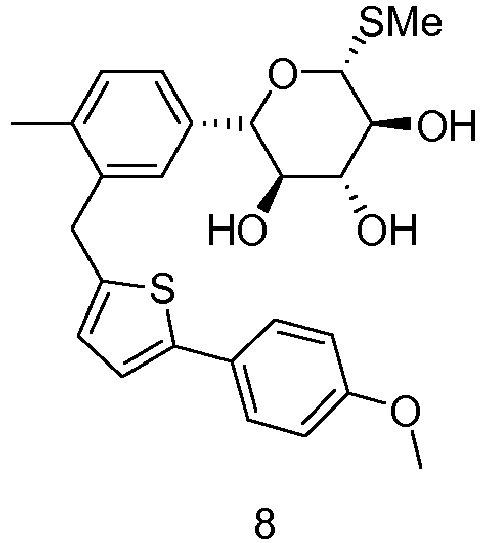
-

- To a single-neck bottle containing LiCl (1.0g, 23.66mmol), THF (10mL) was added, and then 2 mol/L i-PrMgCl/tetrahydrofuran solution (23.66 mmol, 11.83mL) was added slowly. After the completion of the dropwise addition, the mixture was stirred at room temperature for 2 hrs. Then this reaction system was placed in an ice-water bath, and diluted with THF (10mL). To the reaction system, 8(a) (3.9g, 9.46mmol) was added in batch. Then the reaction system was kept at this temperature and stirred for 1 hr. Then to the reaction system, the solid 1(a') (2.3g, 8.5mmol) was added. The stirring was continued for 1 hr. Then the reaction was quenched with a saturated NH4Cl solution. The aqueous phase was removed and extracted with ethyl acetate. The organic phases were combined, washed with water and a saturated aqueous NaCl solution successively, dried with anhydrous Na2SO4, and concentrated. The resulting residue was purified by a silica gel column chromatography (petroleum ether/ethyl acetate = 2:1) to produce a pale yellow solid (2.1g). This compound (535mg, 1.1mmol) was dissolved in methanol (9mL). CeCl3˙7H2O (490mg, 1.32mmol) was added at room temperature. The mixture was stirred for 20mins until it completely dissolved, and cooled to -78°C. NaBH4 (50mg, 1.32mmol) was added in batch. One hour later, the starting material consumed completely. Water (5mL) was added to quench the reaction. The reaction system was warmed to room temperature and subjected to the rotary-evaporation to remove the solvent. The resulting aqueous phase was extracted with dichloromethane (3×10mL). The organic phases were combined, washed with water and a saturated aqueous NaCl solution successively, dried with anhydrous Na2SO4, and concentrated to produce a crude pale yellow oily product 8(b).
-

- The crude Compound 8(b) was dissolved in acetic acid (12mL) and water (8mL). The mixture was heated at 100°C for 15 hrs, cooled to room temperature, and rotary-evaporated to remove the solvent. Toluene was used to remove water from the reaction system to produce an oily solid.
- The resulting solid was dissolved in dichloromethane (10mL). Pyridine (1mL) and Ac2O (0.5mL) were added slowly under an ice-water bath cooling. After the completion of the addition, the mixture was stirred at room temperature for 2 hrs. A saturated aqueous NaHCO3 solution was added to the reaction system to quench the reaction. The organic phase was separated. The aqueous phase was extracted with dichloromethane (3x5mL).
- The organic phases were combined, washed with water and a saturated aqueous NaCl solution successively, dried with anhydrous Na2SO4, and concentrated. The resulting residue was separated by a silica gel column chromatography (petroleum ether/ethyl acetate = 2:1) to produce a pale yellow solid 8(c) (503mg, 75%).
-

- Under an ice-water bath, to a single-neck bottle containing Compound 8(c) (413mg, 0.676mmol), 30%HBr/HOAc solution (3mL) was added. After the completion of the dropwise addition, the mixture was stirred at room temperature for 1 hr. Then dichloromethane (5mL) was added to dilute the mixture. After stirring for 0.5hr, more dichloromethane was added. The reaction was quenched with a saturated aqueous NaHCO3 solution. The organic phase was separated. The aqueous phase was extracted with dichloromethane (3×10mL). The organic phases were combined, washed with water and a saturated aqueous NaCl solution successively, dried with anhydrous Na2SO4, and concentrated to produce a pale yellow liquid.
- At room temperature, to the above resulting pale yellow liquid, 8 mL MeCN and 154 mg S(NH2)2were added. The mixture was heated under reflux for 1 hr, and then cooled to room temperature. Et3N (4eq) and CH3I (3eq) were added. The mixture was stirred for 1 hr. The reaction was quenched with a saturated aqueous NaHCO3 solution and subjected to the rotary-evaporation to remove the organic solvent. Dichloromethane (10mL) was added. The organic phase was separated. The aqueous phase was extracted with dichloromethane (3×10mL). The organic phases were combined, washed with water and a saturated aqueous NaCl solution successively, dried with anhydrous Na2SO4, and concentrated. The resulting residue was purified by a silica gel column chromatography (petroleum ether/ethyl acetate=5:1) to produce a pale yellow solid 8(e) (247mg, 61% (three steps)).
1H NMR (400 Hz, CDCl3) δ1.78 (s, 3 H), 2.03 (s, 3 H), 2.12 (s, 3 H), 2.19 (s, 3 H), 2.32 (s, 3 H), 3.85 (s, 3 H), 4.12 (d, J = 2.8 Hz,2 H), 4.44 (d, J = 9.6 Hz, 1 H), 4.55 (d, J = 9.6 Hz, 1 H), 5.14 (t, J = 9.8 Hz, 1 H), 5.24 (t, J = 9.6 Hz, 1 H), 5.36 (t, J = 9.6 Hz, 1 H), 6.64 (d, J = 3.2 Hz, 1 H), 6.80-6.82 ((m, 1 H), 7.07-7.30 (m, 7 H). -
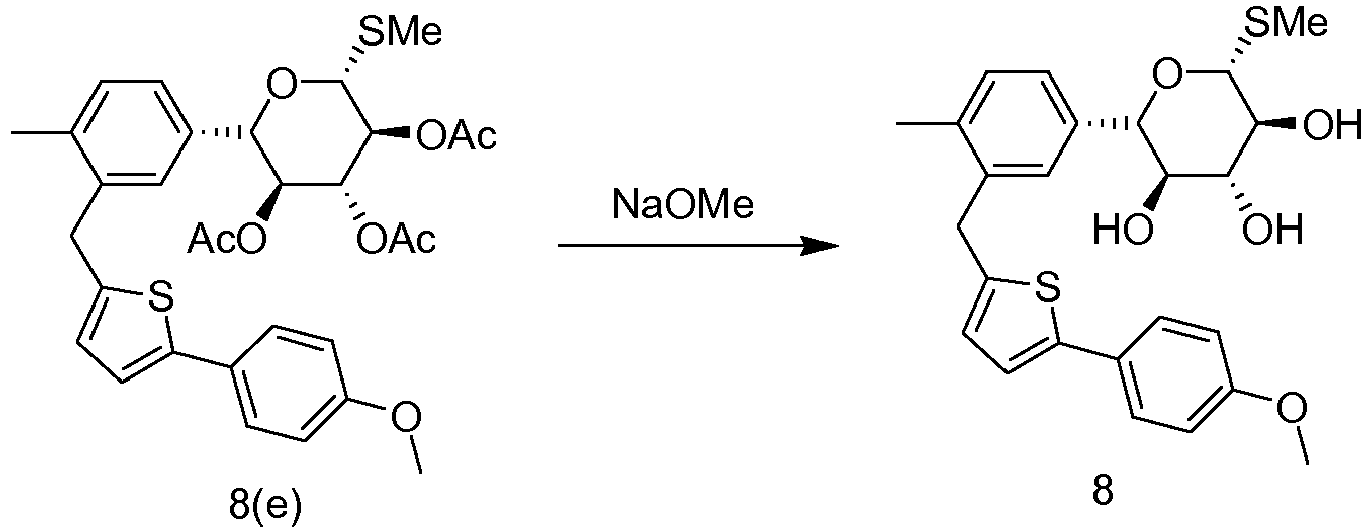
- Compound 8(e) (248mg, 0.414mmol) was placed in a 50mL single-neck bottle. After adding 15mL methanol to form a suspension, sodium methoxide (50mg, 0.455mmol) was added. After the reaction liquid became clear, TLC indicated that the reaction was completed (1.5 hrs). Water was added dropwise until the white solid separated out. After filtering, the filtered caked was dried to produce Compound 8 (158mg, 81%).
1H NMR (400 Hz, CDCl3) δ2.19 (s, 3 H), 2.32 (s, 3 H), 3.68-3.72 (m, 2 H), 3.76-3.81 (m, 1 H), 3.85 (s, 3 H), 4.15 (s, 2 H), 4.25 (d, J = 8.6 Hz, 1 H), 4.45 (d, J = 9.6 Hz, 1 H), 6.64 (d, J = 3.2 Hz, 1 H), 6.80-6.82 ((m, 1 H), 7.07-7.30 (m, 7 H).
ESI(+)m/z: 472.1 -

-

- To a single-neck bottle containing LiCl (1.0g, 23.66mmol), THF (10mL) was added, and then 2 mol/L i-PrMgCl/tetrahydrofuran solution (23.66 mmol, 11.83mL) was added slowly. After the completion of the dropwise addition, the mixture was stirred at room temperature for 2 hrs. Then this reaction system was placed in an ice-water bath, and diluted with THF (10mL). To the reaction system, 9(a) (3.9g, 9.46mmol) was added in batch. Then the reaction system was kept at this temperature and stirred for 1 hr. Then to the reaction system, the solid 1(a') (2.3g, 8.5mmol) was added. The stirring was continued for 1 hr. Then the reaction was quenched with a saturated NH4Cl solution. The aqueous phase was removed and extracted with ethyl acetate. The organic phases were combined, washed with water and a saturated aqueous NaCl solution successively, dried with anhydrous Na2SO4 and concentrated. The resulting residue was purified by a silica gel column chromatography (petroleum ether/ethyl acetate = 2:1) to produce a pale yellow solid (2.1g). This compound (535mg, 1.1mmol) was dissolved in methanol (9mL). CeCl3˙7H2O (490mg, 1.32mmol) was added at room temperature. The mixture was stirred for 20mins until it completely dissolved, and cooled to -78°C. NaBH4 (50mg, 1.32 mmol) was added in batch. One hour later, the starting material consumed completely. Water (5mL) was added to quench the reaction. The reaction system was warmed to room temperature and subjected to the rotary-evaporation to remove the solvent. The resulting aqueous phase was extracted with dichloromethane (3×10mL). The organic phases were combined, washed with water and a saturated aqueous NaCl solution successively, dried with anhydrous Na2SO4, and concentrated to produce a crude pale yellow oily product 9(b).
-

- The crude Compound 9(b) was dissolved in acetic acid (12mL) and water (8mL). The mixture was heated at 100°C for 15 hrs, cooled to room temperature, and rotary-evaporated to remove the solvent. Toluene was used to remove water from the reaction system to produce an oily solid.
- The resulting solid was dissolved in dichloromethane (10mL). Pyridine (1mL) and Ac2O (0.5mL) were added slowly under an ice-water bath cooling. After the completion of the addition, the mixture was stirred at room temperature for 2 hrs. A saturated aqueous NaHCO3 solution was added to the reaction system to quench the reaction. The organic phase was separated. The aqueous phase was extracted with dichloromethane (3x5mL).
- The organic phases were combined, washed with water and a saturated aqueous NaCl solution successively, dried with anhydrous Na2SO4, and concentrated. The resulting residue was separated by a silica gel column chromatography (petroleum ether/ethyl acetate = 2:1) to produce a pale yellow solid 9(c) (519mg, 78%).
-

- Under an ice-water bath, to a single-neck bottle containing Compound 9(c) (418mg, 0.676mmol), 30%HBr/HOAc solution (3mL) was added. After the completion of the dropwise addition, the mixture was stirred at room temperature for 1 hr. Then dichloromethane (5mL) was added to dilute the mixture. After stirring for 0.5hr, more dichloromethane was added. The reaction was quenched with a saturated aqueous NaHCO3 solution. The organic phase was separated. The aqueous phase was extracted with dichloromethane (3×10mL). The organic phases were combined, washed with water and a saturated aqueous NaCl solution successively, dried with anhydrous Na2SO4, and concentrated to produce a pale yellow liquid.
- At room temperature, to the above resulting pale yellow liquid, 8 mL MeCN and 154 mg S(NH2)2were added. The mixture was heated under reflux for 1 hr, and then cooled to room temperature. Et3N (4eq) and CH3I (3eq) were added. The mixture was stirred for 1 hr. The reaction was quenched with a saturated aqueous NaHCO3 solution and subjected to the rotary-evaporation to remove the organic solvent. Dichloromethane (10mL) was added. The organic phase was separated. The aqueous phase was extracted with dichloromethane (3×10mL). The organic phases were combined, washed with water and a saturated aqueous NaCl solution successively, dried with anhydrous Na2SO4, and concentrated. The resulting residue was purified by a silica gel column chromatography (petroleum ether/ethyl acetate=5:1) to produce a pale yellow solid 9(e) (253mg, 63% (three steps)).
1H NMR (400 Hz, CDCl3) δ1.80 (s, 3 H), 2.03 (s, 3 H), 2.12 (s, 3 H), 2.20 (s, 3 H), 2.32 (s, 3 H), 4.15 (s, 2 H), 4.44 (d, J = 9.2 Hz, 1 H), 4.55 (d, J = 9.6 Hz, 1 H), 5.15 (t, J = 9.6 Hz, 1 H), 5.24 (t, J = 9.6 Hz, 1 H), 5.36 (t, J = 9.6 Hz, 1 H), 6.70 (d, J = 3.6 Hz, 1 H), 7.17-7.20 (m, 4 H), 7.44-7.53 (m, 2 H),7.75 (d, J = 8 Hz, 1 H), 7.81 (s, 1 H). -

- Compound 9(e) (245mg, 0.414mmol) was placed in a 50mL single-neck bottle. After adding 15mL methanol to form a suspension, sodium methoxide (50mg, 0.455mmol) was added. After the reaction liquid became clear, TLC indicated that the reaction was completed (1.5 hrs). Water was added dropwise until the white solid separated out. After filtering, the filtered caked was dried to produce Compound 9 (170mg, 88%).
1H NMR (400 Hz, CDCl3) δ2.20 (s, 3 H), 2.32 (s, 3 H), 3.64-3.68 (m, 2 H), 3.77-3.81 (m, 1 H), 4.15 (s, 2 H), 4.25 (d, J = 8.6 Hz, 1 H), 4.45 (d, J = 9.6 Hz, 1 H), 6.73 (d, J = 3.8 Hz, 1 H), 7.15-7.18 (m, 4 H), 7.44-7.53 (m, 2 H),7.75 (d, J = 8 Hz, 1 H), 7.81 (s, 1 H).
ESI(+)m/z: 467.1 -

-

- To a single-neck bottle containing LiCl (1.0g, 23.66mmol), THF (10mL) was added, and then 2 mol/L i-PrMgCl/tetrahydrofuran solution (23.66 mmol, 11.83mL) was added slowly. After the completion of the dropwise addition, the mixture was stirred at room temperature for 2 hrs. Then this reaction system was placed in an ice-water bath, and diluted with THF (10mL). To the reaction system, 10(a) (3.3g, 9.46mmol) was added in batch. Then the reaction system was kept at this temperature and stirred for 1 hr. Then to the reaction system, the solid 1(a') (2.3g, 8.5mmol) was added. The stirring was continued for 1 hr. Then the reaction was quenched with a saturated NH4Cl solution. The aqueous phase was removed and extracted with ethyl acetate. The organic phases were combined, washed with water and a saturated aqueous NaCl solution successively, dried with anhydrous Na2SO4, and concentrated. The resulting residue was purified by a silica gel column chromatography (petroleum ether/ethyl acetate = 2:1) to produce a pale yellow solid (2.1g). This compound (535mg, 1.1mmol) was dissolved in methanol (9mL). CeCl3˙7H2O (490mg, 1.32mmol) was added at room temperature. The mixture was stirred for 20mins until it completely dissolved, and cooled to -78°C. NaBH4 (50mg, 1.32mmol) was added in batch. One hour later, the starting material consumed completely. Water (5mL) was added to quench the reaction. The reaction system was warmed to room temperature and subjected to the rotary-evaporation to remove the solvent. The resulting aqueous phase was extracted with dichloromethane (3×10mL). The organic phases were combined, washed with water and a saturated aqueous NaCl solution successively, dried with anhydrous Na2SO4, and concentrated to produce a crude pale yellow oily product 10(b).
-

- The crude Compound 10(b) was dissolved in acetic acid (12mL) and water (8mL). The mixture was heated at 100°C for 15 hrs, cooled to room temperature, and rotary-evaporated to remove the solvent. Toluene was used to remove water from the reaction system to produce an oily solid.
- The resulting solid was dissolved in dichloromethane (10mL). Pyridine (1mL) and Ac2O (0.5mL) were added slowly under an ice-water bath cooling. After the completion of the addition, the mixture was stirred at room temperature for 2 hrs. A saturated aqueous NaHCO3 solution was added to the reaction system to quench the reaction. The organic phase was separated. The aqueous phase was extracted with dichloromethane (3x5mL).
- The organic phases were combined, washed with water and a saturated aqueous NaCl solution successively, dried with anhydrous Na2SO4, and concentrated. The resulting residue was separated by a silica gel column chromatography (petroleum ether/ethyl acetate = 2:1) to produce a pale yellow solid 10(c) (516mg, 77%).
-

- Under an ice-water bath, to a single-neck bottle containing Compound 10(c) (418mg, 0.676mmol), 30%HBr/HOAc solution (3mL) was added. After the completion of the dropwise addition, the mixture was stirred at room temperature for 1 hr. Then dichloromethane (5mL) was added to dilute the mixture. After stirring for 0.5hr, more dichloromethane was added. The reaction was quenched with a saturated aqueous NaHCO3 solution. The organic phase was separated. The aqueous phase was extracted with dichloromethane (3×10mL). The organic phases were combined, washed with water and a saturated aqueous NaCl solution successively, dried with anhydrous Na2SO4, and concentrated to produce a pale yellow liquid.
- At room temperature, to the above resulting pale yellow liquid, 8 mL MeCN and 154 mg S(NH2)2were added. The mixture was heated under reflux for 1 hr, and then cooled to room temperature. Et3N (4eq) and CH3I (3eq) were added. The mixture was stirred for 1 hr. The reaction was quenched with a saturated aqueous NaHCO3 solution and subjected to the rotary-evaporation to remove the organic solvent. Dichloromethane (10mL) was added. The organic phase was separated. The aqueous phase was extracted with dichloromethane (3×10mL). The organic phases were combined, washed with water and a saturated aqueous NaCl solution successively, dried with anhydrous Na2SO4, and concentrated. The resulting residue was purified by a silica gel column chromatography (petroleum ether/ethyl acetate=5:1) to produce a pale yellow solid 10(e) (266mg, 66% (three steps)).
1H NMR (400 Hz, CDCl3) δ1.79 (s, 3 H), 2.03 (s, 3 H), 2.12 (s, 3 H), 2.20 (s, 3 H), 2.33 (s, 3 H), 4.18 (s, 2 H), 4.44 (d, J = 9.6 Hz, 1 H), 4.56 (d, J = 10 Hz, 1 H), 5.16 (t, J = 9.8 Hz, 1 H), 5.24 (t, J = 9.8 Hz, 1 H), 5.37 (t, J = 9.4 Hz, 1 H), 6.72 (d, J = 3.6 Hz, 1 H), 6.87 (d, J = 3.6 Hz, 1 H), 7.20-7.22 (m, 3 H), 7.46-7.60 (m, 3 H), 7.99 (dd, J = 8 Hz, J = 1.2 Hz 1 H), 10.21 (s, 1 H) -

- Compound 10(e) (247mg, 0.414mmol) was placed in a 50mL single-neck bottle. After adding 15mL methanol to form a suspension, sodium methoxide (50mg, 0.455mmol) was added. After the reaction liquid became clear, TLC indicated that the reaction was completed (1.5 hrs). Water was added dropwise until the white solid separated out. After filtering, the filtered caked was dried to produce Compound 10 (160mg, 82%).
-

-

- To a single-neck bottle containing LiCl (1.0g, 23.66mmol), THF (10mL) was added, and then 2 mol/L i-PrMgCl/tetrahydrofuran solution (23.66 mmol, 11.83mL) was added slowly. After the completion of the dropwise addition, the mixture was stirred at room temperature for 2 hrs. Then this reaction system was placed in an ice-water bath, and diluted with THF (10mL). To the reaction system, 11(a) (4.0g, 9.46mmol) was added in batch. Then the reaction system was kept at this temperature and stirred for 1 hr. Then to the reaction system, the solid 1(a') (2.3g, 8.5mmol) was added. The stirring was continued for 1 hr. Then the reaction was quenched with a saturated NH4Cl solution. The aqueous phase was removed and extracted with ethyl acetate. The organic phases were combined, washed with water and a saturated aqueous NaCl solution successively, dried with anhydrous Na2SO4 and concentrated. The resulting residue was purified by a silica gel column chromatography (petroleum ether/ethyl acetate = 2:1) to produce a pale yellow solid (2.1g). This compound (535mg, 1.1mmol) was dissolved in methanol (9mL). CeCl3˙7H2O (490mg, 1.32mmol) was added at room temperature. The mixture was stirred for 20mins until it completely dissolved, and cooled to -78°C. NaBH4 (50mg, 1.32mmol) was added in batch. One hour later, the starting material consumed completely. Water (5mL) was added to quench the reaction. The reaction system was warmed to room temperature and subjected to the rotary-evaporation to remove the solvent. The resulting aqueous phase was extracted with dichloromethane (3×10mL). The organic phases were combined, washed with water and a saturated aqueous NaCl solution successively, dried with anhydrous Na2SO4, and concentrated to produce a crude pale yellow oily product 11(b).
-

- The crude Compound 11(b) was dissolved in acetic acid (12mL) and water (8mL). The mixture was heated at 100°C for 15 hrs, cooled to room temperature, and rotary-evaporated to remove the solvent. Toluene was used to remove water from the reaction system to produce an oily solid.
- The resulting solid was dissolved in dichloromethane (10mL). Pyridine (1mL) and Ac2O (0.5mL) were added slowly under an ice-water bath cooling. After the completion of the addition, the mixture was stirred at room temperature for 2 hrs. A saturated aqueous NaHCO3 solution was added to the reaction system to quench the reaction. The organic phase was separated. The aqueous phase was extracted with dichloromethane (3x5mL).
- The organic phases were combined, washed with water and a saturated aqueous NaCl solution successively, dried with anhydrous Na2SO4, and concentrated. The resulting residue was separated by a silica gel column chromatography (petroleum ether/ethyl acetate = 2:1) to produce a pale yellow solid 11(c) (516mg, 77%).
-
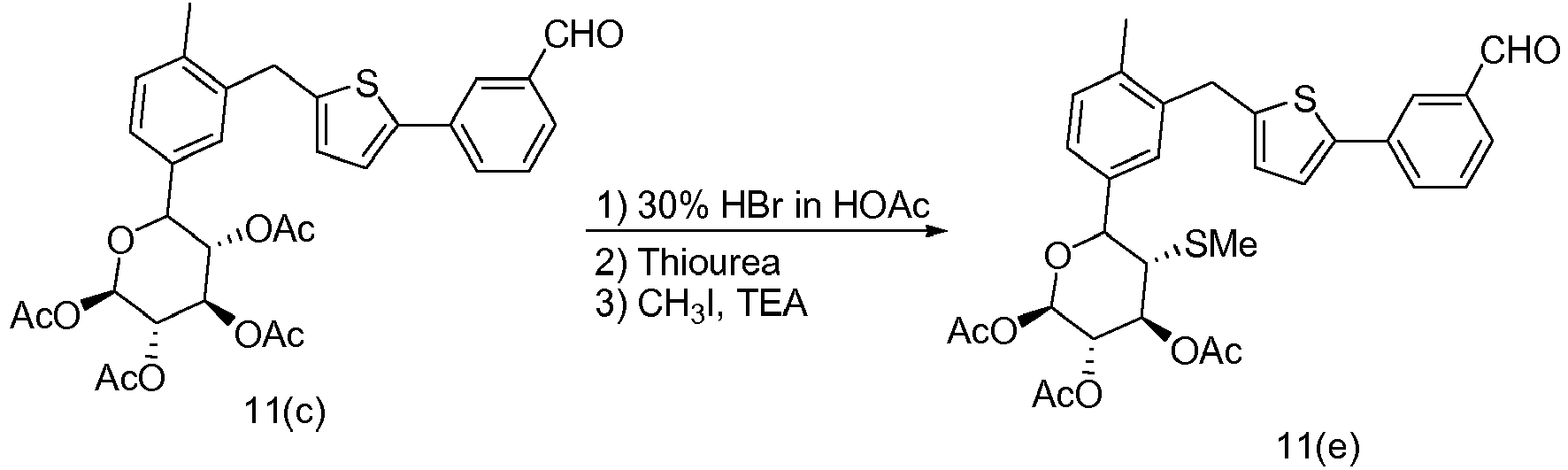
- Under an ice-water bath, to a single-neck bottle containing Compound 11(c) (412mg, 0.676mmol), 30%HBr/HOAc solution (3mL) was added. After the completion of the dropwise addition, the mixture was stirred at room temperature for 1 hr. Then dichloromethane (5mL) was added to dilute the mixture. After stirring for 0.5hr, more dichloromethane was added. The reaction was quenched with a saturated aqueous NaHCO3 solution. The organic phase was separated. The aqueous phase was extracted with dichloromethane (3×10mL). The organic phases were combined, washed with water and a saturated aqueous NaCl solution successively, dried with anhydrous Na2SO4, and concentrated to produce a pale yellow liquid.
- At room temperature, to the above resulting pale yellow liquid, 8 mL MeCN and 154 mg S(NH2)2were added. The mixture was heated under reflux for 1 hr, and then cooled to room temperature. Et3N (4eq) and CH3I (3eq) were added. The mixture was stirred for 1 hr. The reaction was quenched with a saturated aqueous NaHCO3 solution and subjected to the rotary-evaporation to remove the organic solvent. Dichloromethane (10mL) was added. The organic phase was separated. The aqueous phase was extracted with dichloromethane (3×10mL). The organic phases were combined, washed with water and a saturated aqueous NaCl solution successively, dried with anhydrous Na2SO4, and concentrated. The resulting residue was purified by a silica gel column chromatography (petroleum ether/ethyl acetate=5:1) to produce a pale yellow solid 11(e) (266mg, 66% (three steps)).
1H NMR (400 Hz, CDCl3) δ1.79 (s, 3 H), 2.03 (s, 3 H), 2.11 (s, 3 H), 2.20 (s, 3 H), 2.33 (s, 3 H), 4.15 (s, 2 H), 4.44 (d, J = 9.6 Hz, 1 H), 4.56 (d, J = 10 Hz, 1 H), 5.15 (t, J = 9.8 Hz, 1 H), 5.24 (t, J = 9.8 Hz, 1 H), 5.36 (t, J = 9.4 Hz, 1 H), 6.70 (d, J = 3.6 Hz, 1 H), 7.19-7.24 (m, 4 H), 7.53 (t, J = 7.8 Hz, 1 H), 7.76 (d, J = 7.6 Hz, 1 H), 7.79 (d, J = 8 Hz, 1 H), 8.03 (s, 1 H), 10.05 (s, 1 H). -

- Compound 11(e) (247mg, 0.414mmol) was placed in a 50mL single-neck bottle. After adding 15mL methanol to form a suspension, sodium methoxide (50mg, 0.455mmol) was added. After the reaction liquid became clear, TLC indicated that the reaction was completed (1.5 hrs). Water was added dropwise until the white solid separated out. After filtering, the filtered caked was dried to produce Compound 11 (167mg, 86%).
1H NMR (400 Hz, CDCl3) δ2.20 (s, 3 H), 2.33 (s, 3 H), 3.66-3.72 (m, 2 H), 3.77-3.81 (m, 1 H), 4.18 (s, 2 H), 4.23 (d, J = 8.4 Hz, 1 H), 4.45 (d, J = 9.2 Hz, 1 H), 6.73 (d, J = 3.6 Hz, 1 H), 7.21-7.26 (m, 4 H), 7.55 (t, J = 7.8 Hz, 1 H), 7.81 (d, J = 7.6 Hz, 1 H), 7.84 (d, J = 8 Hz, 1 H), 8.03 (s, 1 H), 10.05 (s, 1 H).
ESI(+)m/z: 470.1 -

-

- To a single-neck bottle containing LiCl (1.0g, 23.66mmol), THF (10mL) was added, and then 2 mol/L i-PrMgCl/tetrahydrofuran solution (23.66 mmol, 11.83mL) was added slowly. After the completion of the dropwise addition, the mixture was stirred at room temperature for 2 hrs. Then this reaction system was placed in an ice-water bath, and diluted with THF (10mL). To the reaction system, 12(a) (4.7g, 9.46mmol) was added in batch. Then the reaction system was kept at this temperature and stirred for 1 hr. Then to the reaction system, the solid 1(a') (2.3g, 8.5mmol) was added. The stirring was continued for 1 hr. Then the reaction was quenched with a saturated NH4Cl solution. The aqueous phase was removed and extracted with ethyl acetate. The organic phases were combined, washed with water and a saturated aqueous NaCl solution successively, dried with anhydrous Na2SO4 and concentrated. The resulting residue was purified by a silica gel column chromatography (petroleum ether/ethyl acetate = 2:1) to produce a pale yellow solid (2.1g). This compound (535mg, 1.1mmol) was dissolved in methanol (9mL). CeCl3˙7H2O (490mg, 1.32mmol) was added at room temperature. The mixture was stirred for 20mins until it completely dissolved, and cooled to -78°C. NaBH4 (50mg, 1.32mmol) was added in batch. One hour later, the starting material consumed completely. Water (5mL) was added to quench the reaction. The reaction system was warmed to room temperature and subjected to the rotary-evaporation to remove the solvent. The resulting aqueous phase was extracted with dichloromethane (3×10mL). The organic phases were combined, washed with water and a saturated aqueous NaCl solution successively, dried with anhydrous Na2SO4, and concentrated to produce a crude pale yellow oily product 12(b).
-
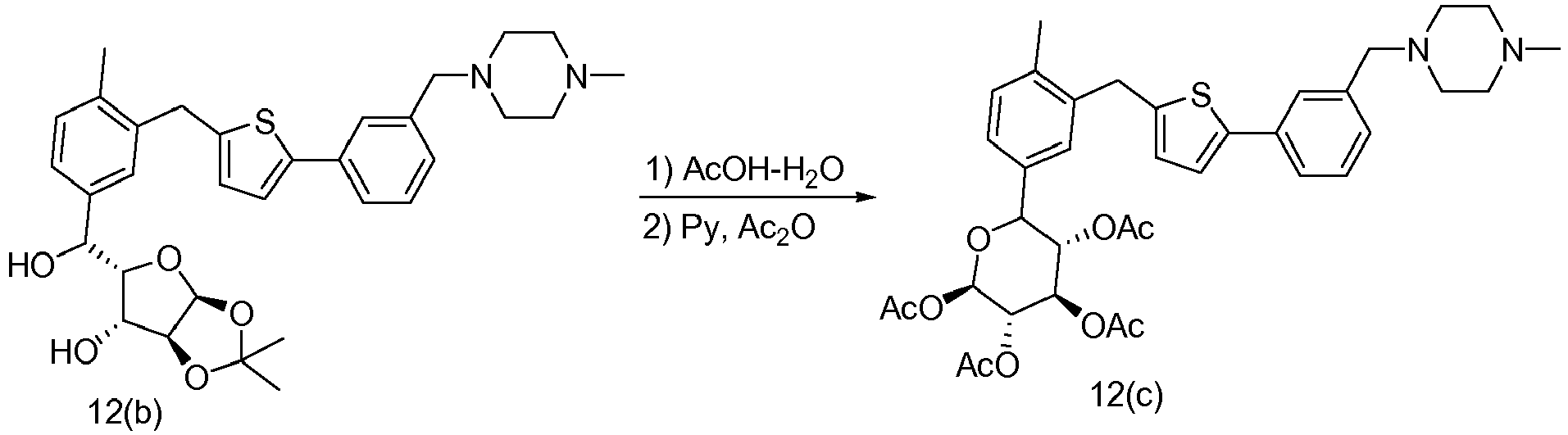
- The crude Compound 12(b) was dissolved in acetic acid (12mL) and water (8mL). The mixture was heated at 100°C for 15 hrs, cooled to room temperature, and rotary-evaporated to remove the solvent. Toluene was used to remove water from the reaction system to produce an oily solid.
- The resulting solid was dissolved in dichloromethane (10mL). Pyridine (1mL) and Ac2O (0.5mL) were added slowly under an ice-water bath cooling. After the completion of the addition, the mixture was stirred at room temperature for 2 hrs. A saturated aqueous NaHCO3 solution was added to the reaction system to quench the reaction. The organic phase was separated. The aqueous phase was extracted with dichloromethane (3x5mL).
- The organic phases were combined, washed with water and a saturated aqueous NaCl solution successively, dried with anhydrous Na2SO4, and concentrated. The resulting residue was separated by a silica gel column chromatography (petroleum ether/ethyl acetate = 2:1) to produce a pale yellow solid 12(c) (541mg, 71%).
-

- Under an ice-water bath, to a single-neck bottle containing Compound 12(c) (468mg, 0.676mmol), 30%HBr/HOAc solution (3mL) was added. After the completion of the dropwise addition, the mixture was stirred at room temperature for 1 hr. Then dichloromethane (5mL) was added to dilute the mixture. After stirring for 0.5hr, more dichloromethane was added. The reaction was quenched with a saturated aqueous NaHCO3 solution. The organic phase was separated. The aqueous phase was extracted with dichloromethane (3×10mL). The organic phases were combined, washed with water and a saturated aqueous NaCl solution successively, dried with anhydrous Na2SO4, and concentrated to produce a pale yellow liquid.
- At room temperature, to the above resulting pale yellow liquid, 8 mL MeCN and 154 mg S(NH2)2were added. The mixture was heated under reflux for 1 hr, and then cooled to room temperature. Et3N (4eq) and CH3I (3eq) were added. The mixture was stirred for 1 hr. The reaction was quenched with a saturated aqueous NaHCO3 solution and subjected to the rotary-evaporation to remove the organic solvent. Dichloromethane (10mL) was added. The organic phase was separated. The aqueous phase was extracted with dichloromethane (3×10mL). The organic phases were combined, washed with water and a saturated aqueous NaCl solution successively, dried with anhydrous Na2SO4, and concentrated. The resulting residue was purified by a silica gel column chromatography (petroleum ether/ethyl acetate=5:1) to produce a pale yellow solid 12(e) (280mg, 61% (three steps)).
1H NMR (400 Hz, CDCl3) δ1.79 (s, 3 H), 2.02 (s, 3 H), 2.11 (s, 3 H), 2.18 (s, 3 H), 2.31 (s, 3 H), 2.61 (s, 3 H), 2.77 (s, 4 H), 2.92 (s, 4 H), 3.56 (s, 2 H), 4.12 (s, 2 H), 4.43 (d, J = 9.6 Hz, 1 H), 4.54 (d, J = 9.6 Hz, 1 H), 5.13 (t, J = 9.6 Hz, 1 H), 5.23 (t, J = 9.6 Hz, 1 H), 5.35 (t, J = 9.4 Hz, 1 H), 6.65 (d, J = 3.6 Hz, 1 H), 7.14-7.21 (m, 5 H), 7.31 (d, J = 7.6 Hz, 1 H), 7.44 (d, J = 7.6 Hz, 1 H), 7.48 (s, 1 H). -

- Compound 12(e) (251mg, 0.414mmol) was placed in a 50mL single-neck bottle. After adding 15mL methanol to form a suspension, sodium methoxide (50mg, 0.455mmol) was added. After the reaction liquid became clear, TLC indicated that the reaction was completed (1.5 hrs). Water was added dropwise until the white solid separated out. After filtering, the filtered caked was dried to produce Compound 12(202mg, 88%).
-
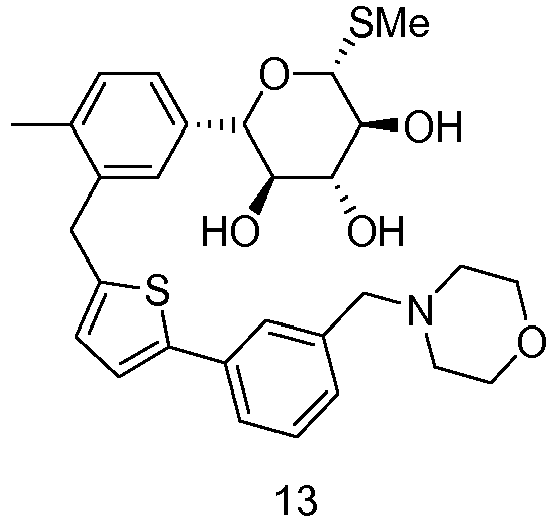
-

- To a single-neck bottle containing LiCl (1.0g, 23.66mmol), THF (10mL) was added, and then 2 mol/L i-PrMgCl/tetrahydrofuran solution (23.66 mmol, 11.83mL) was added slowly. After the completion of the dropwise addition, the mixture was stirred at room temperature for 2 hrs. Then this reaction system was placed in an ice-water bath, and diluted with THF (10mL). To the reaction system, 13(a) (4.6g, 9.46mmol) was added in batch. Then the reaction system was kept at this temperature and stirred for 1 hr. Then to the reaction system, the solid 1(a') (2.3g, 8.5mmol) was added. The stirring was continued for 1 hr. Then the reaction was quenched with a saturated NH4Cl solution. The aqueous phase was removed and extracted with ethyl acetate. The organic phases were combined, washed with water and a saturated aqueous NaCl solution successively, dried with anhydrous Na2SO4 and concentrated. The resulting residue was purified by a silica gel column chromatography (petroleum ether/ethyl acetate = 2:1) to produce a pale yellow solid (2.1g). This compound (535mg, 1.1mmol) was dissolved in methanol (9mL). CeCl3˙7H2O (490mg, 1.32mmol) was added at room temperature. The mixture was stirred for 20mins until it completely dissolved, and cooled to -78°C. NaBH4 (50mg, 1.32mmol) was added in batch. One hour later, the starting material consumed completely. Water (5mL) was added to quench the reaction. The reaction system was warmed to room temperature and subjected to the rotary-evaporation to remove the solvent. The resulting aqueous phase was extracted with dichloromethane (3x10mL). The organic phases were combined, washed with water and a saturated aqueous NaCl solution successively, dried with anhydrous Na2SO4, and concentrated to produce a crude pale yellow oily product 13(b).
-

- The crude Compound 13(b) was dissolved in acetic acid (12mL) and water (8mL). The mixture was heated at 100°C for 15 hrs, cooled to room temperature, and rotary-evaporated to remove the solvent. Toluene was used to remove water from the reaction system to produce an oily solid.
- The resulting solid was dissolved in dichloromethane (10mL). Pyridine (1mL) and Ac2O (0.5mL) were added slowly under an ice-water bath cooling. After the completion of the addition, the mixture was stirred at room temperature for 2 hrs. A saturated aqueous NaHCO3 solution was added to the reaction system to quench the reaction. The organic phase was separated. The aqueous phase was extracted with dichloromethane (3x5mL).
- The organic phases were combined, washed with water and a saturated aqueous NaCl solution successively, dried with anhydrous Na2SO4, and concentrated. The resulting residue was separated by a silica gel column chromatography (petroleum ether/ethyl acetate = 2:1) to produce a pale yellow solid 13(c) (576mg, 77%).
-

- Under an ice-water bath, to a single-neck bottle containing Compound 13(c) (460mg, 0.676mmol), 30%HBr/HOAc solution (3mL) was added. After the completion of the dropwise addition, the mixture was stirred at room temperature for 1 hr. Then dichloromethane (5mL) was added to dilute the mixture. After stirring for 0.5hr, more dichloromethane was added. The reaction was quenched with a saturated aqueous NaHCO3 solution. The organic phase was separated. The aqueous phase was extracted with dichloromethane (3x10mL). The organic phases were combined, washed with water and a saturated aqueous NaCl solution successively, dried with anhydrous Na2SO4, and concentrated to produce a pale yellow liquid.
- At room temperature, to the above resulting pale yellow liquid, 8 mL MeCN and 154 mg S(NH2)2were added. The mixture was heated under reflux for 1 hr, and then cooled to room temperature. Et3N (4eq) and CH3l (3eq) were added. The mixture was stirred for 1 hr. The reaction was quenched with a saturated aqueous NaHCO3 solution and subjected to the rotary-evaporation to remove the organic solvent. Dichloromethane (10mL) was added. The organic phase was separated. The aqueous phase was extracted with dichloromethane (3x10mL). The organic phases were combined, washed with water and a saturated aqueous NaCl solution successively, dried with anhydrous Na2SO4, and concentrated. The resulting residue was purified by a silica gel column chromatography (petroleum ether/ethyl acetate=5:1) to produce a pale yellow solid 13(e) (284mg, 63% (three steps)).
1H NMR (400 Hz, CDCl3) δ1.79 (s, 3 H), 2.03 (s, 3 H), 2.12 (s, 3 H), 2.19 (s, 3 H), 2.32 (s, 3 H), 2.48 (s, 4 H), 3.52 (s, 2 H), 3.72-3.75 (m, 4 H), 4.13 (s, 2 H), 4.44 (d, J = 10 Hz, 1 H), 4.54 (d, J = 9.6 Hz, 1 H), 5.14 (t, J = 9.8 Hz, 1 H), 5.24 (t, J = 9.6 Hz, 1 H), 5.36 (t, J = 9.4 Hz, 1 H), 6.65 (d, J = 3.6 Hz, 1 H), 7.14-7.24 (m, 5 H), 7.32 (d, J = 7.6 Hz, 1 H), 7.44 (d, J = 8 Hz, 1 H), 7.50 (s, 1 H). -
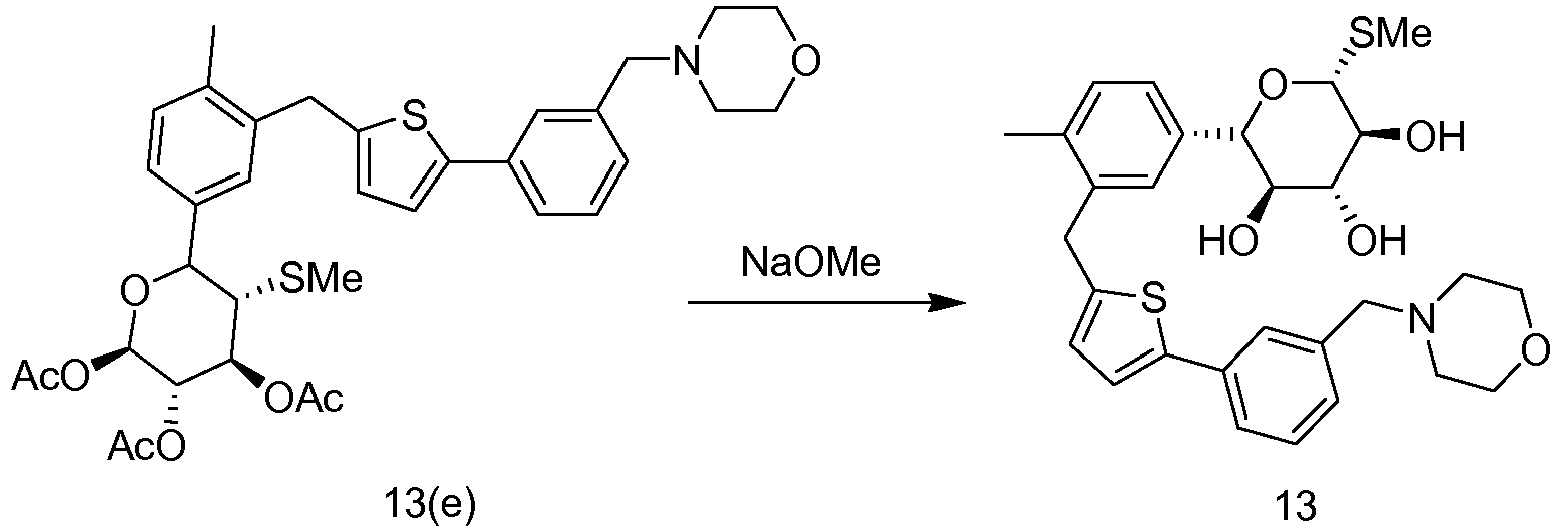
- Compound 13(e) (277mg, 0.414mmol) was placed in a 50mL single-neck bottle. After adding 15mL methanol to form a suspension, sodium methoxide (50mg, 0.455mmol) was added. After the reaction liquid became clear, TLC indicated that the reaction was completed (1.5 hrs). Water was added dropwise until the white solid separated out. After filtering, the filtered caked was dried to produce Compound 13 (184mg, 82%).
1H NMR (400 Hz, CDCl3) δ2.19 (s, 3 H), 2.32 (s, 3 H), 2.48 (s, 4 H), 3.52 (s, 2 H), 3.65-3.70 (m, 1 H), 3.72-3.75 (m, 4 H), 3.78-3.85 (m, 1 H), 3.90-3.94 (m, 1 H), 4.13 (s, 2 H), 4.38 (d, J = 9.6 Hz, 1 H), 4.86 (m, 1 H), 6.65 (d, J = 3.6 Hz, 1 H), 7.14-7.24 (m, 5 H), 7.32 (d, J = 7.6 Hz, 1 H), 7.44 (d, J = 8 Hz, 1 H), 7.50 (s, 1 H).
ESI(+)m/z: 541.7 -

-

- To a single-neck bottle containing LiCl (1.0g, 23.66mmol), THF (10mL) was added, and then 2 mol/L i-PrMgCl/tetrahydrofuran solution (23.66 mmol, 11.83mL) was added slowly. After the completion of the dropwise addition, the mixture was stirred at room temperature for 2 hrs. Then this reaction system was placed in an ice-water bath, and diluted with THF (10mL). To the reaction system, 14(a) (4.1g, 9.46mmol) was added in batch. Then the reaction system was kept at this temperature and stirred for 1 hr. Then to the reaction system, the solid 1(a') (2.3g, 8.5mmol) was added. The stirring was continued for 1 hr. Then the reaction was quenched with a saturated NH4Cl solution. The aqueous phase was removed and extracted with ethyl acetate. The organic phases were combined, washed with water and a saturated aqueous NaCl solution successively, dried with anhydrous Na2SO4 and concentrated. The resulting residue was purified by a silica gel column chromatography (petroleum ether/ethyl acetate = 2:1) to produce a pale yellow solid (2.1g). This compound (535mg, 1.lmmol) was dissolved in methanol (9mL). CeCl3˙7H2O (490mg, 1.32mmol) was added at room temperature. The mixture was stirred for 20mins until it completely dissolved, and cooled to -78°C. NaBH4 (50mg, 1.32mmol) was added in batch. One hour later, the starting material consumed completely. Water (5mL) was added to quench the reaction. The reaction system was warmed to room temperature and subjected to the rotary-evaporation to remove the solvent. The resulting aqueous phase was extracted with dichloromethane (3×10mL). The organic phases were combined, washed with water and a saturated aqueous NaCl solution successively, dried with anhydrous Na2SO4, and concentrated to produce a crude pale yellow oily product 14(b).
-

- The crude Compound 14(b) was dissolved in acetic acid (12mL) and water (8mL). The mixture was heated at 100°C for 15 hrs, cooled to room temperature, and rotary-evaporated to remove the solvent. Toluene was used to remove water from the reaction system to produce an oily solid.
- The resulting solid was dissolved in dichloromethane (10mL). Pyridine (1mL) and Ac2O (0.5mL) were added slowly under an ice-water bath cooling. After the completion of the addition, the mixture was stirred at room temperature for 2 hrs. A saturated aqueous NaHCO3 solution was added to the reaction system to quench the reaction. The organic phase was separated. The aqueous phase was extracted with dichloromethane (3×5mL).
- The organic phases were combined, washed with water and a saturated aqueous NaCl solution successively, dried with anhydrous Na2SO4, and concentrated. The resulting residue was separated by a silica gel column chromatography (petroleum ether/ethyl acetate = 2:1) to produce a pale yellow solid 14(c) (488mg, 71%).
-

- Under an ice cooling, to a single-neck bottle containing Compound 14(c) (423mg, 0.676mmol), 30%HBr/HOAc solution (3mL) was added. After the completion of the dropwise addition, the mixture was stirred at room temperature for 1 hr. Then dichloromethane (5mL) was added to dilute the mixture. After stirring for 0.5hr, more dichloromethane was added. The reaction was quenched with a saturated aqueous NaHCO3 solution. The organic phase was separated. The aqueous phase was extracted with dichloromethane (3×10mL). The organic phases were combined, washed with water and a saturated aqueous NaCl solution successively, dried with anhydrous Na2SO4, and concentrated to produce a pale yellow liquid.
- At room temperature, to the above resulting pale yellow liquid, 8 mL MeCN and 154 mg S(NH2)2 were added. The mixture was heated under reflux for 1 hr, and then cooled to room temperature. Et3N (4eq) and CH3l (3eq) were added. The mixture was stirred for 1 hr. The reaction was quenched with a saturated aqueous NaHCO3 solution and subjected to the rotary-evaporation to remove the organic solvent. Dichloromethane (10mL) was added. The organic phase was separated. The aqueous phase was extracted with dichloromethane (3x10mL). The organic phases were combined, washed with water and a saturated aqueous NaCl solution successively, dried with anhydrous Na2SO4, and concentrated. The resulting residue was purified by a silica gel column chromatography (petroleum ether/ethyl acetate=5:1) to produce a pale yellow solid 14(e) (261mg, 61% (three steps)).
1H NMR (400 Hz, CDCl3) δ1.78 (s, 3 H), 2.04 (s, 3 H), 2.12 (s, 3 H), 2.20 (s, 3 H), 2.32 (s, 3 H), 4.16 (s, 2 H), 4.44 (d, J = 9.6 Hz, 1 H), 4.55 (d, J = 9.6 Hz, 1 H), 5.14 (t, J = 9.8 Hz, 1 H), 5.24 (t, J = 9.6 Hz, 1 H), 5.36 (t, J = 9.4 Hz, 1 H), 7.00 (s, 1 H), 7.20-7.21(m, 3 H), 7.43 (s, 1 H), 7.66 (d, J = 7.6 Hz, 1 H), 8.11 (d, J = 8.4 Hz, 1 H) -

- Compound 14(e) (254mg, 0.414mmol) was placed in a 50mL single-neck bottle. After adding 15mL methanol to form a suspension, sodium methoxide (50mg, 0.455mmol) was added. After the reaction liquid became clear, TLC indicated that the reaction was completed (1.5 hrs). Water was added dropwise until the white solid separated out. After filtering, the filtered caked was dried to produce Compound 14 (181mg, 90%).
-

-
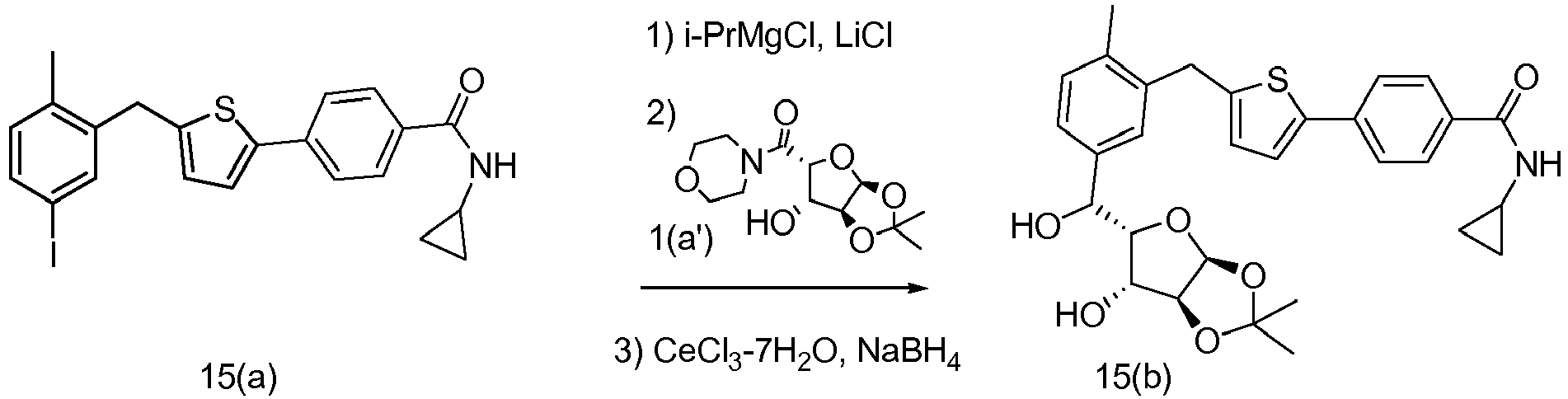
- To a single-neck bottle containing LiCl (1.0g, 23.66mmol), THF (10mL) was added, and then 2 mol/L i-PrMgCl/tetrahydrofuran solution (23.66 mmol, 11.83mL) was added slowly. After the completion of the dropwise addition, the mixture was stirred at room temperature for 2 hrs. Then this reaction system was placed in an ice-water bath, and diluted with THF (10mL). To the reaction system, 15(a) (4.5g, 9.46mmol) was added in batch. Then the reaction system was kept at this temperature and stirred for 1 hr. Then to the reaction system, the solid 1(a') (2.3g, 8.5mmol) was added. The stirring was continued for 1 hr. Then the reaction was quenched with a saturated NH4Cl solution. The aqueous phase was removed and extracted with ethyl acetate. The organic phases were combined, washed with water and a saturated aqueous NaCl solution successively, dried with anhydrous Na2SO4 and concentrated. The resulting residue was purified by a silica gel column chromatography (petroleum ether/ethyl acetate = 2:1) to produce a pale yellow solid (2.1g). This compound (535mg, 1.1mmol) was dissolved in methanol (9mL). CeCl3˙7H2O (490mg, 1.32mmol) was added at room temperature. The mixture was stirred for 20mins until it completely dissolved, and cooled to -78°C. NaBH4 (50mg, 1.32mmol) was added in batch. One hour later, the starting material consumed completely. Water (5mL) was added to quench the reaction. The reaction system was warmed to room temperature and subjected to the rotary-evaporation to remove the solvent. The resulting aqueous phase was extracted with dichloromethane (3x10mL). The organic phases were combined, washed with water and a saturated aqueous NaCl solution successively, dried with anhydrous Na2SO4, and concentrated to produce a crude pale yellow oily product 15(b).
-

- The crude Compound 15(b) was dissolved in acetic acid (12mL) and water (8mL). The mixture was heated at 100°C for 15 hrs, cooled to room temperature, and rotary-evaporated to remove the solvent. Toluene was used to remove water from the reaction system to produce an oily solid.
- The resulting solid was dissolved in dichloromethane (10mL). Pyridine (1mL) and Ac2O (0.5mL) were added slowly under an ice-water bath cooling. After the completion of the addition, the mixture was stirred at room temperature for 2 hrs. A saturated aqueous NaHCO3 solution was added to the reaction system to quench the reaction. The organic phase was separated. The aqueous phase was extracted with dichloromethane (3x5mL).
- The organic phases were combined, washed with water and a saturated aqueous NaCl solution successively, dried with anhydrous Na2SO4, and concentrated. The resulting residue was separated by a silica gel column chromatography (petroleum ether/ethyl acetate = 2:1) to produce a pale yellow solid 15(c) (555mg, 76%).
-

- Under an ice-water bath, to a single-neck bottle containing Compound 15(c) (449mg, 0.676mmol), 30%HBr/HOAc solution (3mL) was added. After the completion of the dropwise addition, the mixture was stirred at room temperature for 1 hr. Then dichloromethane (5mL) was added to dilute the mixture. After stirring for 0.5hr, more dichloromethane was added. The reaction was quenched with a saturated aqueous NaHCO3 solution. The organic phase was separated. The aqueous phase was extracted with dichloromethane (3×10mL). The organic phases were combined, washed with water and a saturated aqueous NaCl solution successively, dried with anhydrous Na2SO4, and concentrated to produce a pale yellow liquid.
- At room temperature, to the above resulting pale yellow liquid, 8 mL MeCN and 154 mg S(NH2)2 were added. The mixture was heated under reflux for 1 hr, and then cooled to room temperature. Et3N (4eq) and CH31 (3eq) were added. The mixture was stirred for 1 hr. The reaction was quenched with a saturated aqueous NaHCO3 solution and subjected to the rotary-evaporation to remove the organic solvent. Dichloromethane (10mL) was added. The organic phase was separated. The aqueous phase was extracted with dichloromethane (3×10mL). The organic phases were combined, washed with water and a saturated aqueous NaCl solution successively, dried with anhydrous Na2SO4, and concentrated. The resulting residue was purified by a silica gel column chromatography (petroleum ether/ethyl acetate=5:1) to produce a pale yellow solid 15(e) (278mg, 63% (three steps)).
1H NMR (400 Hz, CDCl3) δ0.64 (d, J = 8.4 Hz, 2 H), 0.88 (d, J = 10 Hz, 2 H), 1.76 (s, 3 H), 2.03 (s, 3 H), 2.12 (s, 3 H), 2.19 (s, 3 H), 2.31 (s, 3 H), 2.92-2.94 (m, 1 H), 4.15 (s, 2 H), 4.43 (d, J = 9.6 Hz, 1 H), 4.55 (d, J = 9.6 Hz, 1 H), 5.15 (t, J = 9.6 Hz, 1 H), 5.23 (t, J = 9.8 Hz, 1 H), 5.36 (t, J = 9.4 Hz, 1 H), 6.98 (s, 1 H), 7.19-7.22 (m, 3 H), 7.36 (s, 1 H), 7.62-7.66 (m, 2 H), 7.74-7.77 (m, 2 H) -

- Compound 15(e) (270mg, 0.414mmol) was placed in a 50mL single-neck bottle. After adding 15mL methanol to form a suspension, sodium methoxide (50mg, 0.455mmol) was added. After the reaction liquid became clear, TLC indicated that the reaction was completed (1.5 hrs). Water was added dropwise until the white solid separated out. After filtering, the filtered caked was dried to produce Compound 15 (177mg, 81%).
1H NMR (400 Hz, CDCl3) δ0.64 (d, J = 8.4 Hz, 2 H), 0.88 (d, J = 10 Hz, 2 H), 2.19 (s, 3 H), 2.31 (s, 3 H), 2.92-2.94 (m, 1 H), 3.58-3.62 (m, 2 H), 3.71-3.74 (m, 1 H), 4.15 (s, 2 H), 4.23 (d, J = 8.4 Hz, 1 H), 4.42 (d, J = 9.2 Hz, 1 H), 6.98 (s, 1 H), 7.23-7.27 (m, 3 H), 7.36 (s, 1 H), 7.61-7.65 (m, 2 H), 7.74-7.78 (m, 2 H)
ESI(+)m/z: 526 -
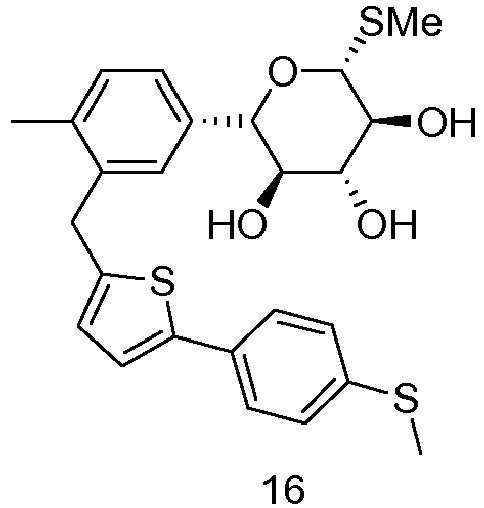
-

- To a single-neck bottle containing LiCl (1.0g, 23.66mmol), THF (10mL) was added, and then 2 mol/L i-PrMgCl/tetrahydrofuran solution (23.66 mmol, 11.83mL) was added slowly. After the completion of the dropwise addition, the mixture was stirred at room temperature for 2 hrs. Then this reaction system was placed in an ice-water bath, and diluted with THF (10mL). To the reaction system, 16(a) (4.1g, 9.46mmol) was added in batch. Then the reaction system was kept at this temperature and stirred for 1 hr. Then to the reaction system, the solid 1(a') (2.3g, 8.5mmol) was added. The stirring was continued for 1 hr. Then the reaction was quenched with a saturated NH4Cl solution. The aqueous phase was removed and extracted with ethyl acetate. The organic phases were combined, washed with water and a saturated aqueous NaCl solution successively, dried with anhydrous Na2SO4 and concentrated. The resulting residue was purified by a silica gel column chromatography (petroleum ether/ethyl acetate = 2:1) to produce a pale yellow solid (2.1g). This compound (535mg, 1.1mmol) was dissolved in methanol (9mL). CeCl3˙7H2O (490mg, 1.32mmol) was added at room temperature. The mixture was stirred for 20mins until it completely dissolved, and cooled to -78°C. NaBH4 (50mg, 1.32mmol) was added in batch. One hour later, the starting material consumed completely. Water (5mL) was added to quench the reaction. The reaction system was warmed to room temperature and subjected to the rotary-evaporation to remove the solvent. The resulting aqueous phase was extracted with dichloromethane (3×10mL). The organic phases were combined, washed with water and a saturated aqueous NaCl solution successively, dried with anhydrous Na2SO4, and concentrated to produce a crude pale yellow oily product 16(b).
-

- The crude Compound 16(b) was dissolved in acetic acid (12mL) and water (8mL). The mixture was heated at 100°C for 15 hrs, cooled to room temperature, and rotary-evaporated to remove the solvent. Toluene was used to remove water from the reaction system to produce an oily solid.
- The resulting solid was dissolved in dichloromethane (10mL). Pyridine (1mL) and Ac2O (0.5mL) were added slowly under an ice-water bath cooling. After the completion of the addition, the mixture was stirred at room temperature for 2 hrs. A saturated aqueous NaHCO3 solution was added to the reaction system to quench the reaction. The organic phase was separated. The aqueous phase was extracted with dichloromethane (3x5mL).
- The organic phases were combined, washed with water and a saturated aqueous NaCl solution successively, dried with anhydrous Na2SO4, and concentrated. The resulting residue was separated by a silica gel column chromatography (petroleum ether/ethyl acetate = 2:1) to produce a pale yellow solid 16(c) (538mg, 78%).
-

- Under an ice-water bath, to a single-neck bottle containing Compound 16(c) (423mg, 0.676mmol), 30%HBr/HOAc solution (3mL) was added. After the completion of the dropwise addition, the mixture was stirred at room temperature for 1 hr. Then dichloromethane (5mL) was added to dilute the mixture. After stirring for 0.5hr, more dichloromethane was added. The reaction was quenched with a saturated aqueous NaHCO3 solution. The organic phase was separated. The aqueous phase was extracted with dichloromethane (3×10mL). The organic phases were combined, washed with water and a saturated aqueous NaCl solution successively, dried with anhydrous Na2SO4, and concentrated to produce a pale yellow liquid.
- At room temperature, to the above resulting pale yellow liquid, 8 mL MeCN and 154 mg S(NH2)2 were added. The mixture was heated under reflux for 1 hr, and then cooled to room temperature. Et3N (4eq) and CH3l (3eq) were added. The mixture was stirred for 1 hr. The reaction was quenched with a saturated aqueous NaHCO3 solution and subjected to the rotary-evaporation to remove the organic solvent. Dichloromethane (10mL) was added. The organic phase was separated. The aqueous phase was extracted with dichloromethane (3×10mL). The organic phases were combined, washed with water and a saturated aqueous NaCl solution successively, dried with anhydrous Na2SO4, and concentrated. The resulting residue was purified by a silica gel column chromatography (petroleum ether/ethyl acetate=5:1) to produce a pale yellow solid 16(e) (258mg, 62% (three steps)).
1H NMR (400 Hz, CDCl3) δ1.78 (s, 3 H), 2.03 (s, 3 H), 2.12 (s, 3 H), 2.19 (s, 3 H), 2.32 (s, 3 H), 2.51 (s, 3 H), 4.12 (d, J = 2.4 Hz, 2 H), 4.43 (d, J = 10 Hz, 1 H), 4.54 (d, J = 9.6 Hz, 1 H), 5.14 (t, J = 9.6 Hz, 1 H), 5.24 (t, J = 9.6 Hz, 1 H), 5.36 (t, J = 9.4 Hz, 1 H), 6.64 (d, J = 3.6 Hz, 1 H), 7.09 (d, J = 3.6 Hz, 1 H), 7.17-7.20 (m, 3 H), 7.23 (d, J = 8.4 Hz, 2 H), 7.45 (d, J = 8.4 Hz, 2 H) -

- Compound 16(e) (255mg, 0.414mmol) was placed in a 50mL single-neck bottle. After adding 15mL methanol to form a suspension, sodium methoxide (50mg, 0.455mmol) was added. After the reaction liquid became clear, TLC indicated that the reaction was completed (1.5 hrs). Water was added dropwise until the white solid separated out. After filtering, the filtered caked was dried to produce Compound 16 (172mg, 85%).
1H NMR (400 Hz, CDCl3) δ2.19 (s, 3 H), 2.32 (s, 3 H), 2.51 (s, 3 H), 3.68-3.75 (m, 1 H), 3.78-3.85 (m, 1 H), 3.92-3.97 (m, 1 H), 4.23 (s, 2 H), 4.44 (d, J = 9.6 Hz, 1 H), 4.92 (m, 1 H), 6.66 (d, J = 3.6 Hz, 1 H), 7.09 (d, J = 3.6Hz, 1H), 7.18-7.20(m, 3H), 7.20(d, J=8.4Hz, 2H), 7.47(d, J=8.4Hz, 2H)
ESI(+)m/z: 489.1 -

-

- To a single-neck bottle containing LiCl (1.0g, 23.66mmol), THF (10mL) was added, and then 2 mol/L i-PrMgCl/tetrahydrofuran solution (23.66 mmol, 11.83mL) was added slowly. After the completion of the dropwise addition, the mixture was stirred at room temperature for 2 hrs. Then this reaction system was placed in an ice-water bath, and diluted with THF (10mL). To the reaction system, 17(a) (3.6g, 9.46mmol) was added in batch. Then the reaction system was kept at this temperature and stirred for 1 hr. Then to the reaction system, the solid 1(a') (2.3g, 8.5mmol) was added. The stirring was continued for 1 hr. Then the reaction was quenched with a saturated NH4Cl solution. The aqueous phase was removed and extracted with ethyl acetate. The organic phases were combined, washed with water and a saturated aqueous NaCl solution successively, dried with anhydrous Na2SO4 and concentrated. The resulting residue was purified by a silica gel column chromatography (petroleum ether/ethyl acetate = 2:1) to produce a pale yellow solid (2.1g). This compound (535mg, 1.1mmol) was dissolved in methanol (9mL). CeCl3˙7H2O (490mg, 1.32mmol) was added at room temperature. The mixture was stirred for 20mins until it completely dissolved, and cooled to -78°C. NaBH4 (50mg, 1.32mmol) was added in batch. One hour later, the starting material consumed completely. Water (5mL) was added to quench the reaction. The reaction system was warmed to room temperature and subjected to the rotary-evaporation to remove the solvent. The resulting aqueous phase was extracted with dichloromethane (3×10mL). The organic phases were combined, washed with water and a saturated aqueous NaCl solution successively, dried with anhydrous Na2SO4, and concentrated to produce a crude pale yellow oily product 17(b).
-

- The crude Compound 17(b) was dissolved in acetic acid (12mL) and water (8mL). The mixture was heated at 100°C for 15 hrs, cooled to room temperature, and rotary-evaporated to remove the solvent. Toluene was used to remove water from the reaction system to produce an oily solid.
- The resulting solid was dissolved in dichloromethane (10mL). Pyridine (1mL) and Ac2O (0.5mL) were added slowly under an ice-water bath cooling. After the completion of the addition, the mixture was stirred at room temperature for 2 hrs. A saturated aqueous NaHCO3 solution was added to the reaction system to quench the reaction. The organic phase was separated. The aqueous phase was extracted with dichloromethane (3x5mL).
- The organic phases were combined, washed with water and a saturated aqueous NaCl solution successively, dried with anhydrous Na2SO4, and concentrated. The resulting residue was separated by a silica gel column chromatography (petroleum ether/ethyl acetate = 2:1) to produce a pale yellow solid 17(c) (465mg, 74%).
-

- Under an ice-water bath, to a single-neck bottle containing Compound 17(c) (386mg, 0.676mmol), 30%HBr/HOAc solution (3mL) was added. After the completion of the dropwise addition, the mixture was stirred at room temperature for 1 hr. Then dichloromethane (5mL) was added to dilute the mixture. After stirring for 0.5hr, more dichloromethane was added. The reaction was quenched with a saturated aqueous NaHCO3 solution. The organic phase was separated. The aqueous phase was extracted with dichloromethane (3×10mL). The organic phases were combined, washed with water and a saturated aqueous NaCl solution successively, dried with anhydrous Na2SO4, and concentrated to produce a pale yellow liquid.
- At room temperature, to the above resulting pale yellow liquid, 8 mL MeCN and 154 mg S(NH2)2 were added. The mixture was heated under reflux for 1 hr, and then cooled to room temperature. Et3N (4eq) and CH3l (3eq) were added. The mixture was stirred for 1 hr. The reaction was quenched with a saturated aqueous NaHCO3 solution and subjected to the rotary-evaporation to remove the organic solvent. Dichloromethane (10mL) was added. The organic phase was separated. The aqueous phase was extracted with dichloromethane (3×10mL). The organic phases were combined, washed with water and a saturated aqueous NaCl solution successively, dried with anhydrous Na2SO4, and concentrated. The resulting residue was purified by a silica gel column chromatography (petroleum ether/ethyl acetate=5:1) to produce a pale yellow solid 17(e) (231mg, 61% (three steps)).
1H NMR (400 Hz, CDCl3) δ1.80 (s, 3 H), 2.03 (s, 3 H), 2.12 (s, 3 H), 2.19 (s, 3 H), 2.30(s, 3 H), 4.11 (d, J = 4 Hz, 2 H), 4.43 (d, J = 9.6 Hz, 1 H), 4.54 (d, J = 10 Hz, 1 H), 5.14 (t, J = 9.6 Hz, 1 H), 5.24 (t, J = 9.4 Hz, 1 H), 5.36 (t, J = 9.4 Hz, 1 H), 6.40-6.43 (m, 2 H), 6.61 (d, J = 4 Hz, 1 H), 7.06 (d, J = 3.6 Hz, 1 H), 7.15-7.21 (m, 2 H), 7.36-7.37 (m, 1 H). -

- Compound 17(e) (231mg, 0.414mmol) was placed in a 50mL single-neck bottle. After adding 15mL methanol to form a suspension, sodium methoxide (50mg, 0.455mmol) was added. After the reaction liquid became clear, TLC indicated that the reaction was completed (1.5 hrs). Water was added dropwise until the white solid separated out. After filtering, the filtered caked was dried to produce Compound 17 (147mg, 82%).
1H NMR (400 Hz, CDCl3) δ2.19 (s, 3 H), 2.30(s, 3 H), 3.60-3.65 (m, 1 H), 3.78-3.85 (m, 1 H), 3.90-3.94 (m, 1 H), 4.18 (s, 2 H), 4.38 (d, J = 9.6 Hz, 1 H), 4.86 (m, 1 H), 6.40-6.43 (m, 2 H), 6.61 (d, J = 4 Hz, 1 H), 7.08 (d, J = 3.6 Hz, 1 H), 7.18-7.24 (m, 2 H), 7.33-7.36 (m, 1 H).
ESI(+)m/z: 433.1 -

-

- To a single-neck bottle containing LiCl (1.0g, 23.66mmol), THF (10mL) was added, and then 2 mol/L i-PrMgCl/tetrahydrofuran solution (23.66 mmol, 11.83mL) was added slowly. After the completion of the dropwise addition, the mixture was stirred at room temperature for 2 hrs. Then this reaction system was placed in an ice-water bath, and diluted with THF (10mL). To the reaction system, 18(a) (3.8g, 9.46mmol) was added in batch. Then the reaction system was kept at this temperature and stirred for 1 hr. Then to the reaction system, the solid 1(a') (2.3g, 8.5mmol) was added. The stirring was continued for 1 hr. Then the reaction was quenched with a saturated NH4Cl solution. The aqueous phase was removed and extracted with ethyl acetate. The organic phases were combined, washed with water and a saturated aqueous NaCl solution successively, dried with anhydrous Na2SO4 and concentrated. The resulting residue was purified by a silica gel column chromatography (petroleum ether/ethyl acetate = 2:1) to produce a pale yellow solid (2.1g). This compound (535mg, 1.1mmol) was dissolved in methanol (9mL). CeCl3˙7H2O (490mg, 1.32mmol) was added at room temperature. The mixture was stirred for 20mins until it completely dissolved, and cooled to -78°C. NaBH4 (50mg, 1.32mmol) was added in batch. One hour later, the starting material consumed completely. Water (5mL) was added to quench the reaction. The reaction system was warmed to room temperature and subjected to the rotary-evaporation to remove the solvent. The resulting aqueous phase was extracted with dichloromethane (3×10mL). The organic phases were combined, washed with water and a saturated aqueous NaCl solution successively, dried with anhydrous Na2SO4, and concentrated to produce a crude pale yellow oily product 18(b).
-

- The crude Compound 18(b) was dissolved in acetic acid (12mL) and water (8mL). The mixture was heated at 100°C for 15 hrs, cooled to room temperature, and rotary-evaporated to remove the solvent. Toluene was used to remove water from the reaction system to produce an oily solid.
- The resulting solid was dissolved in dichloromethane (10mL). Pyridine (1mL) and Ac2O (0.5mL) were added slowly under an ice-water bath cooling. After the completion of the addition, the mixture was stirred at room temperature for 2 hrs. A saturated aqueous NaHCO3 solution was added to the reaction system to quench the reaction. The organic phase was separated. The aqueous phase was extracted with dichloromethane (3x5mL).
- The organic phases were combined, washed with water and a saturated aqueous NaCl solution successively, dried with anhydrous Na2SO4, and concentrated. The resulting residue was separated by a silica gel column chromatography (petroleum ether/ethyl acetate = 2:1) to produce a pale yellow solid 18(c) (477mg, 71%).
-

- Under an ice-water bath, to a single-neck bottle containing Compound 18(c) (413mg, 0.676mmol), 30%HBr/HOAc solution (3mL) was added. After the completion of the dropwise addition, the mixture was stirred at room temperature for 1 hr. Then dichloromethane (5mL) was added to dilute the mixture. After stirring for 0.5hr, more dichloromethane was added. The reaction was quenched with a saturated aqueous NaHCO3 solution. The organic phase was separated. The aqueous phase was extracted with dichloromethane (3×10mL). The organic phases were combined, washed with water and a saturated aqueous NaCl solution successively, dried with anhydrous Na2SO4, and concentrated to produce a pale yellow liquid.
- At room temperature, to the above resulting pale yellow liquid, 8 mL MeCN and 154 mg S(NH2)2 were added. The mixture was heated under reflux for 1 hr, and then cooled to room temperature. Et3N (4eq) and CH3l (3eq) were added. The mixture was stirred for 1 hr. The reaction was quenched with a saturated aqueous NaHCO3 solution and subjected to the rotary-evaporation to remove the organic solvent. Dichloromethane (10mL) was added. The organic phase was separated. The aqueous phase was extracted with dichloromethane (3×10mL). The organic phases were combined, washed with water and a saturated aqueous NaCl solution successively, dried with anhydrous Na2SO4, and concentrated. The resulting residue was purified by a silica gel column chromatography (petroleum ether/ethyl acetate=5:1) to produce a pale yellow solid 18(e) (251mg, 62% (three steps)).
-
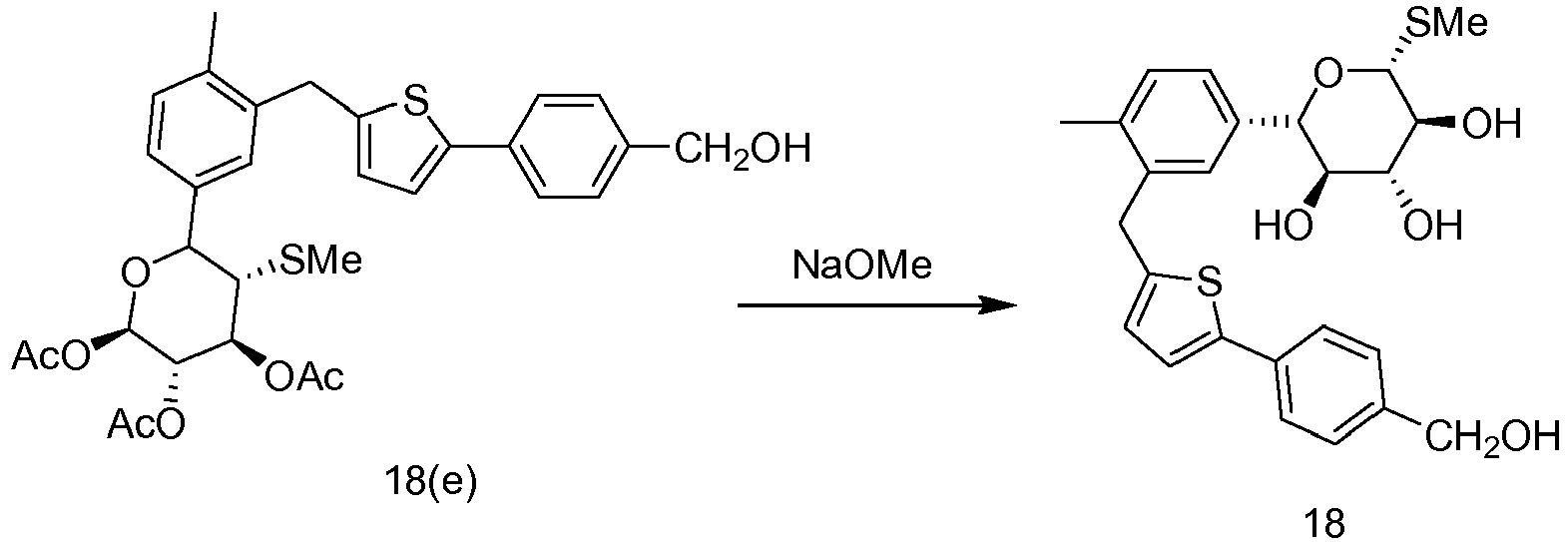
- Compound 18(e) (248mg, 0.414mmol) was placed in a 50mL single-neck bottle. After adding 15mL methanol to form a suspension, sodium methoxide (50mg, 0.455mmol) was added. After the reaction liquid became clear, TLC indicated that the reaction was completed (1.5 hrs). Water was added dropwise until the white solid separated out. After filtering, the filtered caked was dried to produce Compound 18 (172mg, 88%).
1H NMR (400 Hz, CDCl3) δ2.18 (s, 3 H), 2.30 (s, 3 H), 3.72-3.75 (m, 1 H), 3.78-3.85 (m, 1 H), 3.88-3.92 (m, 1 H), 4.23 (s, 2 H), 4.43 (d, J = 9.6 Hz, 1 H), 4.90 (m, 1 H), 6.68 (d, J = 3.6 Hz, 1 H), 7.20 (d, J = 3.6 Hz, 1 H), 7.23-7.27 (m, 3 H), 7.36 (d, J = 8.4 Hz, 2 H), 7.58 (d, J = 8.4 Hz, 2 H).
ESI(+)m/z: 473.1 -

-

- To a single-neck bottle containing LiCl (1.0g, 23.66mmol), THF (10mL) was added, and then 2 mol/L i-PrMgCl/tetrahydrofuran solution (23.66 mmol, 11.83mL) was added slowly. After the completion of the dropwise addition, the mixture was stirred at room temperature for 2 hrs. Then this reaction system was placed in an ice-water bath, and diluted with THF (10mL). To the reaction system, 19(a) (3.8g, 9.46mmol) was added in batch. Then the reaction system was kept at this temperature and stirred for 1 hr. Then to the reaction system, the solid 1(a') (2.3g, 8.5mmol) was added. The stirring was continued for 1 hr. Then the reaction was quenched with a saturated NH4Cl solution. The aqueous phase was removed and extracted with ethyl acetate. The organic phases were combined, washed with water and a saturated aqueous NaCl solution successively, dried with anhydrous Na2SO4, and concentrated. The resulting residue was purified by a silica gel column chromatography (petroleum ether/ethyl acetate = 2:1) to produce a pale yellow solid (2.1g). This compound (535mg, 1.1mmol) was dissolved in methanol (9mL). CeCl3˙7H2O (490mg, 1.32mmol) was added at room temperature. The mixture was stirred for 20mins until it completely dissolved, and cooled to -78°C. NaBH4 (50mg, 1.32mmol) was added in batch. One hour later, the starting material consumed completely. Water (5mL) was added to quench the reaction. The reaction system was warmed to room temperature and subjected to the rotary-evaporation to remove the solvent. The resulting aqueous phase was extracted with dichloromethane (3×10mL). The organic phases were combined, washed with water and a saturated aqueous NaCl solution successively, dried with anhydrous Na2SO4, and concentrated to produce a crude pale yellow oily product 19(b).
-

- The crude Compound 19(b) was dissolved in acetic acid (12mL) and water (8mL). The mixture was heated at 100°C for 15 hrs, cooled to room temperature, and rotary-evaporated to remove the solvent. Toluene was used to remove water from the reaction system to produce an oily solid.
- The resulting solid was dissolved in dichloromethane (10mL). Pyridine (1mL) and Ac2O (0.5mL) were added slowly under an ice-water bath cooling. After the completion of the addition, the mixture was stirred at room temperature for 2 hrs. A saturated aqueous NaHCO3 solution was added to the reaction system to quench the reaction. The organic phase was separated. The aqueous phase was extracted with dichloromethane (3x5mL).
- The organic phases were combined, washed with water and a saturated aqueous NaCl solution successively, dried with anhydrous Na2SO4, and concentrated. The resulting residue was separated by a silica gel column chromatography (petroleum ether/ethyl acetate = 2:1) to produce a pale yellow solid 19(c) (504mg, 77%).
-

- Under an ice-water bath, to a single-neck bottle containing Compound 19(c) (403mg, 0.676mmol), 30%HBr/HOAc solution (3mL) was added. After the completion of the dropwise addition, the mixture was stirred at room temperature for 1 hr. Then dichloromethane (5mL) was added to dilute the mixture. After stirring for 0.5hr, more dichloromethane was added. The reaction was quenched with a saturated aqueous NaHCO3 solution. The organic phase was separated. The aqueous phase was extracted with dichloromethane (3×10mL). The organic phases were combined, washed with water and a saturated aqueous NaCl solution successively, dried with anhydrous Na2SO4, and concentrated to produce a pale yellow liquid.
- At room temperature, to the above resulting pale yellow liquid, 8 mL MeCN and 154 mg S(NH2)2 were added. The mixture was heated under reflux for 1 hr, and then cooled to room temperature. Et3N (4eq) and CH3l (3eq) were added. The mixture was stirred for 1 hr. The reaction was quenched with a saturated aqueous NaHCO3 solution and subjected to the rotary-evaporation to remove the organic solvent. Dichloromethane (10mL) was added. The organic phase was separated. The aqueous phase was extracted with dichloromethane (3×10mL). The organic phases were combined, washed with water and a saturated aqueous NaCl solution successively, dried with anhydrous Na2SO4, and concentrated. The resulting residue was purified by a silica gel column chromatography (petroleum ether/ethyl acetate=5:1) to produce a pale yellow solid 19(e) (268mg, 68% (three steps)).
1H NMR (400 Hz, CDCl3) δ1.78 (s, 3 H), 2.03 (s, 3 H), 2.12 (s, 3 H), 2.19 (s, 3 H), 2.32 (s, 3 H), 4.11 (d, J = 3.2 Hz, 2 H), 4.43 (d, J = 9.6 Hz, 1 H), 4.54 (d, J = 9.6 Hz, 1 H), 5.14 (t, J = 9.8 Hz, 1 H), 5.24 (t, J = 9.6 Hz, 1 H), 5.34 (t, J = 9.2 Hz, 1 H), 6.58-6.63 (m, 2 H), 6.87-6.88 (m, 1 H), 6.96 (d, J = 7.6 Hz, 1 H), 7.09 (d, J = 3.6 Hz, 1 H), 7.12-7.20 (m, 4 H). -

- Compound 19(e) (242mg, 0.414mmol) was placed in a 50mL single-neck bottle. After adding 15mL methanol to form a suspension, sodium methoxide (50mg, 0.455mmol) was added. After the reaction liquid became clear, TLC indicated that the reaction was completed (1.5 hrs). Water was added dropwise until the white solid separated out. After filtering, the filtered caked was dried to produce Compound 19 (167mg, 88%).
1H NMR (400 Hz, CDCl3) δ2.19 (s, 3 H), 2.32 (s, 3 H), 3.68-3.72 (m, 1 H), 3.68-3.72 (m, 1 H), 3.91-3.96 (m, 1 H), 4.17 (s, 2 H), 4.43 (d, J = 9.4 Hz, 1 H), 4.90 (m, 1 H), 6.58-6.63 (m, 2 H), 6.87-6.90 (m, 1 H), 6.96 (d, J = 7.6 Hz, 1 H), 7.09 (d, J = 3.6 Hz, 1 H), 7.12-7.20 (m, 4 H).
ESI(+)m/z: 458.2 -

-

- To a single-neck bottle containing LiCl (1.0g, 23.66mmol), THF (10mL) was added, and then 2 mol/L i-PrMgCl/tetrahydrofuran solution (23.66 mmol, 11.83mL) was added slowly. After the completion of the dropwise addition, the mixture was stirred at room temperature for 2 hrs. Then this reaction system was placed in an ice-water bath, and diluted with THF (10mL). To the reaction system, 20(a) (4.1g, 9.46mmol) was added in batch. Then the reaction system was kept at this temperature and stirred for 1 hr. Then to the reaction system, the solid 1(a') (2.3g, 8.5mmol) was added. The stirring was continued for 1 hr. Then the reaction was quenched with a saturated NH4Cl solution. The aqueous phase was removed and extracted with ethyl acetate. The organic phases were combined, washed with water and a saturated aqueous NaCl solution successively, dried with anhydrous Na2SO4 and concentrated. The resulting residue was purified by a silica gel column chromatography (petroleum ether/ethyl acetate = 2:1) to produce a pale yellow solid (2.1g). This compound (535mg, 1.1mmol) was dissolved in methanol (9mL). CeCl3·7H2O (490mg, 1.32mmol) was added at room temperature. The mixture was stirred for 20mins until it completely dissolved, and cooled to -78°C. NaBH4 (50mg, 1.32mmol) was added in batch. One hour later, the starting material consumed completely. Water (5mL) was added to quench the reaction. The reaction system was warmed to room temperature and subjected to the rotary-evaporation to remove the solvent. The resulting aqueous phase was extracted with dichloromethane (3×10mL). The organic phases were combined, washed with water and a saturated aqueous NaCl solution successively, dried with anhydrous Na2SO4, and concentrated to produce a crude pale yellow oily product 20(b).
-

- The crude Compound 20(b) was dissolved in acetic acid (12mL) and water (8mL). The mixture was heated at 100°C for 15 hrs, cooled to room temperature, and rotary-evaporated to remove the solvent. Toluene was used to remove water from the reaction system to produce an oily solid.
- The resulting solid was dissolved in dichloromethane (10mL). Pyridine (1mL) and Ac2O (0.5mL) were added slowly under an ice-water bath cooling. After the completion of the addition, the mixture was stirred at room temperature for 2 hrs. A saturated aqueous NaHCO3 solution was added to the reaction system to quench the reaction. The organic phase was separated. The aqueous phase was extracted with dichloromethane (3x5mL).
- The organic phases were combined, washed with water and a saturated aqueous NaCl solution successively, dried with anhydrous Na2SO4, and concentrated. The resulting residue was separated by a silica gel column chromatography (petroleum ether/ethyl acetate = 2:1) to produce a pale yellow solid 20(c) (512mg, 74%).
-

- Under an ice-water bath, to a single-neck bottle containing Compound 20(c) (425mg, 0.676mmol), 30%HBr/HOAc solution (3mL) was added. After the completion of the dropwise addition, the mixture was stirred at room temperature for 1 hr. Then dichloromethane (5mL) was added to dilute the mixture. After stirring for 0.5hr, more dichloromethane was added. The reaction was quenched with a saturated aqueous NaHCO3 solution. The organic phase was separated. The aqueous phase was extracted with dichloromethane (3×10mL). The organic phases were combined, washed with water and a saturated aqueous NaCl solution successively, dried with anhydrous Na2SO4, and concentrated to produce a pale yellow liquid.
- At room temperature, to the above resulting pale yellow liquid, 8 mL MeCN and 154 mg S(NH2)2 were added. The mixture was heated under reflux for 1 hr, and then cooled to room temperature. Et3N (4eq) and CH3I (3eq) were added. The mixture was stirred for 1 hr. The reaction was quenched with a saturated aqueous NaHCO3 solution and subjected to the rotary-evaporation to remove the organic solvent. Dichloromethane (10mL) was added. The organic phase was separated. The aqueous phase was extracted with dichloromethane (3×10mL). The organic phases were combined, washed with water and a saturated aqueous NaCl solution successively, dried with anhydrous Na2SO4, and concentrated. The resulting residue was purified by a silica gel column chromatography (petroleum ether/ethyl acetate=5:1) to produce a pale yellow solid 20(e) (254mg, 61% (three steps)).
1H NMR (400 Hz, CDCl3) δ1.80 (s, 3 H), 2.05 (s, 3 H), 2.12 (s, 3 H), 2.18 (s, 3 H), 2.30 (s, 3 H), 3.82 (s, 3 H), 4.14 (s, 2 H), 4.38 (d, J = 9.6 Hz, 1 H), 4.92 (m, 1 H), 5.27 (m, 1 H), 5.34 (m, 2 H), 6.78-6.85 (m, 1 H), 6.92 (s, 1 H), 7.03-7.06 (m, 3 H), 7.28 (s, 1 H), 7.45-7.51 (m, 2 H). -
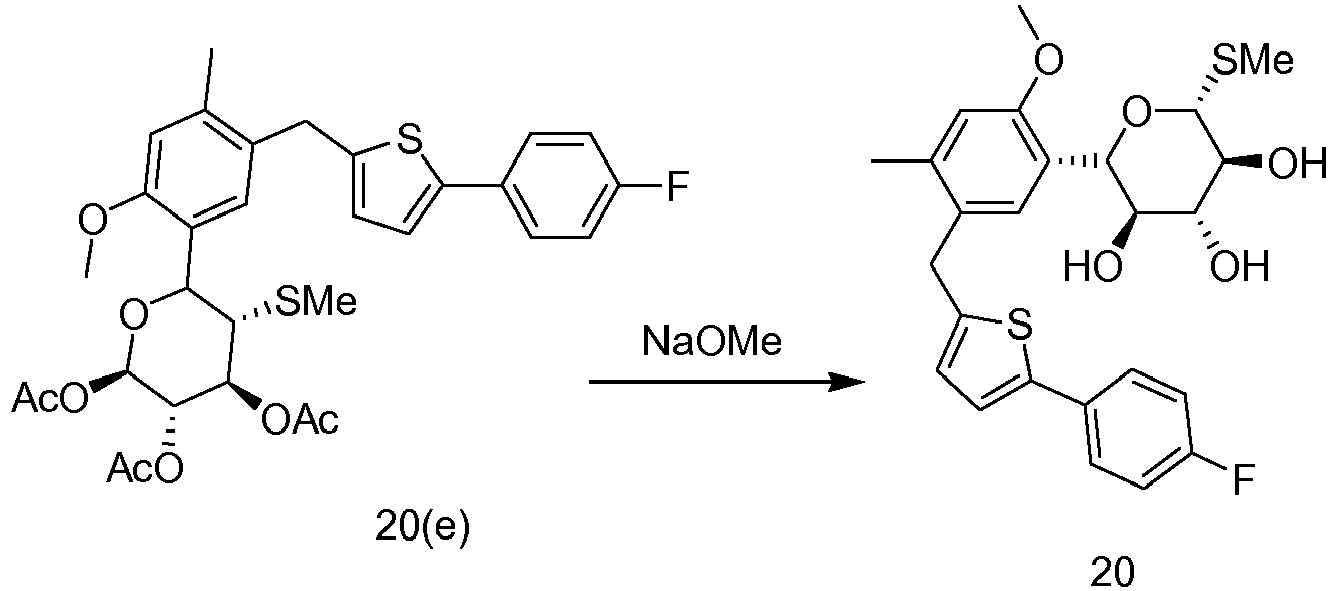
- Compound 20(e) (255mg, 0.414mmol) was placed in a 50mL single-neck bottle. After adding 15mL methanol to form a suspension, sodium methoxide (50mg, 0.455mmol) was added. After the reaction liquid became clear, TLC indicated that the reaction was completed (1.5 hrs). Water was added dropwise until the white solid separated out. After filtering, the filtered caked was dried to produce Compound 20 (163mg, 80%).
1H NMR (400 Hz, CDCl3) δ2.18 (s, 3 H), 2.30 (s, 3 H), 3.68-3.72 (m, 1 H), 3.78-3.84 (m, 1 H), 3.87 (s, 3 H), 3.91-3.96 (m, 1 H), 4.14 (s, 2 H), 4.40 (d, J = 9.6 Hz, 1 H), 4.90 (m, 1 H), 6.78-6.85 (s, 1 H), 6.87 (s, 1 H), 7.08-7.12 (m, 3 H), 7.25 (s, 1 H), 7.45-7.51 (m, 2 H).
ESI(+)m/z: 491.1 -

- The title compound was prepared by the following steps:
-

- To a mixed solution of acetonitrile (72ml) and methanol (18ml) was added hydrogen peroxide-urea (9.223g). The resulting mixture was stirred at room temperature until it became a clear solution. To this solution was added dropwise a solution of 2(e) (9.37g, 0.016mol) in acetonitrile (54ml) at room temperature. After the completion of the dropwise addition, the reaction was conducted overnight under stirring at the room temperature. To the reaction was added ethyl acetate (90mL). The reaction was washed with saturated NaHCO3 (90mL) and water (50mL) successively, dried with Na2SO4, and concentrated to produce 21(a).
-

- To the above obtained 21(a) was added methanol (60ml). After dissolving, a sodium methoxide solid (128mg, 32mmol) was added. The reaction was conducted overnight under stirring at the room temperature. To the reaction was added water (150mL) to separate off a white solid. After filtering, the filtered cake was dried to produce the target product 21(7.8g, 79%).
1H NMR (400 Hz, CDCl3) δ2.17 (d, J = 2.8 Hz, 1 H), 2.98 (s, 3 H), 3.28 (brs, 1 H), 3.54-3.59 (m, 1 H), 3.74-3.78 (m, 1 H), 4.14 (s, 2 H), 4.16-4.20 (m, 1 H), 4.28-4.34 (m, 1 H), 4.44-4.4.48 (m, 1 H),6.92 (d, J = 3.2 Hz, 1 H), 7.04-7.08 (m, 3 H), 7.35-7.42 (m, 3 H), 7.48-7.53 (m, 2 H).
ESI(+)m/z: 619.2 - Thirty 7-week-old male SD rats (about 200g) were used. The compound of Example 2 having a purity of 97.8% was chose as the present compound and formulated with 0.75% CMC-Na. The positive control drug (SGLT-2 inhibitor, Dapagliflozin, synthesized according to Wei Meng et al., J. Med. Chem., Vol 51, 2008, pages 1145-1149) having a purity of 98% was formulated with 0.75% CMC-Na.
- The SD rats were acclimatized for 7 days, and then placed in the metabolic cages. The rats were fasted overnight (18hr) under the free access to water. The basic urine samples were collected, and then thirty rats were weighed and grouped randomly into five groups, six rats per group. The grouping and the administration were shown in the following table.
Group (n) Administration Control group ( 6) 0.75% CMC-Na Compound of Example 2 low dosage (6) 1 mg/kg medium dosage (6) 10 mg/kg high dosage(6) 20 mg/kg Dapagliflozin low dosage(6) 1 mg/kg high dosage(6) 10 mg/kg - The data were analyzed with the software SPSS 12.0, and the quantized data were expressed in "average ± standard deviation". Multiple sets of data were compared according to the analysis of variance (One-way ANOVA). P<0.05 represented statistical difference.
- In comparison with the blank control, after the single intragastric oral administrations of the compound of Example 2 or the SGLT-2 inhibitor Dapagliflozin to normal rats, the 24-hour urine volumes and the 24-hour urine glucose masses remarkably increased (P<0.01), and showed the dosage-dependencies. The urine volume and the excreted urine glucose mass in each of groups were respectively shown in Tables 1 and 2.
- The results of the assays showed that the present compound of example 2 could promote the urine glucose excretion.
- 0.2% gelatin was plated on a 24-well plate, and the plate was kept overnight. The plate was washed with PBS once before use. The NIH3T3 cells expressing human SGLT-2 by transfection were inoculated into the 24-well plate in 100,000 cells per well and 1mL culture medium per well. On the third day, the culture medium was changed once, and simultaneously sodium butyrate was added thereto with a final concentration of 2mM. The cells were washed with KRH-Na+ (500µL) twice, and then incubated with KRH-Na+ (500µL) for 30 minutes. The cells were then treated with 200µL of KRH-Na+ containing the compound of Example 2, and 50µL of an uptake buffer (KRH-Na+ plus methyl-a-D-[U-14C] glucopyranoside and 1mM methyl-a-D-glucopyranoside). The cells were washed with 500µL wash buffer thrice with the operation on ice, and baked overnight. The cells were lysed with 200µL of 0.25N NaOH at 4°C for 1 hr. The lysate was removed into an EPPENDORF tube, and centrifuged at 4 °C under 12000g for 5 mins. 150µL of supernatant was placed in a 2mL EPPENDORF tube, and 1.7mL of scintillation cocktail was added thereto. The mixture was shaked vigorously, and then counted. The inhibition rate of the compound of Example 2 at each of concentrations on the transporting activity was calculated.
- IC50 value could be determined by nonlinear curve fitting of sample activities vs. sample concentrations. The fitting calculation was done with the software Graphpad Prism 4, and the model used in the fitting was the sigmoidal dose-response (varible slope).
- Result: The compound of Example 2 had an IC50 value for inhibiting the human SGLT-2 of 0.172 nM.
- 0.2% gelatin was plated on a 24-well plate, and the plate was kept overnight. The plate was washed with PBS once before use. The NIH3T3 cells expressing human SGLT-1 by transfection were inoculated into the 24-well plate in 100,000 cells per well and 1mL culture medium per well. On the third day, the culture medium was changed once, and simultaneously sodium butyrate was added thereto with a final concentration of 2mM. The cells were washed with KRH-Na+ (500µL) twice, and then incubated with KRH-Na+ (500µL) for 30 minutes. The cells were then treated with 200µL of KRH-Na+ containing the compound of Example 2, and 50µL of an uptake buffer (KRH-Na+ plus methyl-a-D-[U-14C] glucopyranoside and 1mM methyl-a-D-glucopyranoside). The cells were washed with 500µL wash buffer thrice with the operation on ice, and baked overnight. The cells were lysed with 200µL of 0.25N NaOH at 4°C for 1 hr. The lysate was removed into an EPPENDORF tube, and centrifuged at 4 °C under 12000g for 5 mins. 150µL of supernatant was placed in a 2mL EPPENDORF tube, and 1.7mL of scintillation cocktail was added thereto. The mixture was shaked vigorously, and then counted. The inhibition rate of the compound of Example 2 at each of concentrations on the transporting activity was calculated.
- IC50 value could be determined by nonlinear curve fitting of sample activities vs. sample concentrations. The fitting calculation was done with the software Graphpad Prism 4, and the model used in the fitting was the sigmoidal dose-response (varible slope).
- Result: The compound of Example 2 had an IC50 value for inhibiting the human SGLT-1 of 28.70 µM.
- The results in the
above assays 2 and 3 showed that the present compound had a strong inhibition effect on the human SGLT-2, while had a weak inhibition effect on the human SGLT-1; and therefore it would be a high selective SGLT-2 inhibitor. - While only selected embodiments have been chosen to illustrate the present invention, it will be apparent to those skilled in the art from this disclosure that various change and modification can be made herein without departing from the scope of the invention as defined in the appended claims. Furthermore, the foregoing descriptions of the embodiments according to the present invention are provided for illustration only, and not for the purpose of limiting the invention as defined by the appended claims.
Claims (14)
- A compound represented by the following general formula (I):
 X is O or S;each of R1 and R2 is independently hydrogen, -OH, -SH, -NH2, -NO2, -CN, -COH, -COOH, -CONH2, halogen, C1-C4alkyl, -O-C1-C4alkyl, -S-C1-C4alkyl, -SO-C1-C4alkyl, -SO2-C1-C4alkyl, -CO-C1-C4alkyl, -CO2-C1-C4alkyl, -CONH-C1-C4alkyl, -C≡C-C1-C4alkyl, -NHSO2-C1-C4alkyl, -NHCO-C1-C4alkyl or -C3-C6cycloalkyl;R3 is hydrogen, -OH, -SH, -NH2, -NO2, -CN, -COH, -COOH, -CONH2, halogen, -C1-C4alkyl, -O-C1-C4alkyl, -S-C1-C4alkyl, -CO-C1-C4alkyl, -CO2-C1-C4alkyl, -CONH-C1-C4alkyl, an aryl having 1-3 substituents selected from the groups in Group A, a heteroaryl having 1-3 substituents selected from the groups in Group A, a C3-C8cycloalkyl having 1-3 substituents selected from the groups in Group A, a nitrogen-containing saturated heterocyclic group having 1-3 substituents selected from the groups in Group A or a nitrogen-containing partially unsaturated heterocyclic group having 1-3 substituents selected from the groups in Group A,wherein, the group in Group A is selected from the group consisting of: hydrogen, halogen, -OH, -SH, -NH2, -NO2, -CN, -COH, -COOH, -CONH2, C1-C4alkyl, -O-C1-C4alkyl, -NH-C1-C4alkyl, -S-C1-C4alkyl, -SO2-C1-C4alkyl, -CO-C1-C4alkyl, -CO2-C1-C4alkyl, -CONH-C1-C4alkyl, -CONH-C3-C6cycloalkyl, -C1-C4alkyl-OH, -aryl, -O-aryl, -NH-aryl, -S-aryl, -SO2-aryl, -CO-aryl, -CO2-aryl, -CONH-aryl, -cycloalkyl, -heteroaryl, -a nitrogen-containing saturated heterocyclic group, -C1-C4alkyl-a nitrogen-containing saturated heterocyclic group and -a nitrogen-containing partially unsaturated heterocyclic group;R4 is -O-R5, -S-R5, -SO-R5, -SO2 -R5, R5 is -C1-C4alkyl or -C3-C8cycloalkyl;m is 1, 2 or 3; andn is 1 or 2,or a pharmaceutically acceptable salt thereof.
 - The compound of Claim 1, or a pharmaceutically acceptable salt thereof, wherein said X is S, R4 is -S-CH3 or -SO2-CH3.
- The compound of Claim 1 or 2, or a pharmaceutically acceptable salt thereof, wherein each of said R1 and R2 is independently hydrogen, -OH, -NH2, -NO2, -CN, -COOH, halogen, -C1-C4alkyl, -O-C1-C4alkyl or -C3-C6cycloalkyl, both m and n are 1.
- The compound of Claim 3, or a pharmaceutically acceptable salt thereof, wherein each of said R1 and R2 is independently hydrogen, halogen or -C1-C4alkyl.
- The compound of Claim 4, or a pharmaceutically acceptable salt thereof, wherein said R1 is chloro or methyl, R2 is hydrogen.
- The compound of any one of claims 1-5, or a pharmaceutically acceptable salt thereof, wherein R3 is halogen, an aryl having 1-3 substituents selected from the groups in Group A, a heteroaryl having 1-3 substituents selected from the groups in Group A, a nitrogen-containing saturated heterocyclic group having 1-3 substituents selected from the groups in Group A or a nitrogen-containing partially unsaturated heterocyclic group having 1-3 substituents selected from the groups in Group A,
wherein, the group in Group A is selected from the group consisting of: hydrogen, halogen, -OH, -NH2, -NO2, -COH, -COOH, C1-C4alkyl, -O-C1-C4alkyl, -S-C1-C4alkyl, -CONH-C3-C6cycloalkyl, -C1-C4alkyl-OH and -C1-C4alkyl-a nitrogen-containing saturated heterocyclic group. - The compound of claim 6, or a pharmaceutically acceptable salt thereof, wherein said R3 is halogen.
- The compound of claim 6, or a pharmaceutically acceptable salt thereof, wherein said R3 is a phenyl having 1-3 substituents selected from the groups in Group A, wherein, the group in Group A is selected from the group consisting of: hydrogen, halogen, -OH, -NH2, -NO2, -COH, -COOH, -C1-C4alkyl, -O-C1-C4alkyl, -S-C1-C4alkyl, -CONH-C3-C6cycloalkyl,-C1-C4alkyl-OH and -C1-C4alkyl-a nitrogen-containing saturated heterocyclic group.
- The compound of claim 6, or a pharmaceutically acceptable salt thereof, wherein said R3 is a pyridyl having 1-3 substituents selected from the groups in Group A, wherein, the group in Group A is selected from the group consisting of: hydrogen, halogen, -OH, -NH2, -NO2, -COH, -COOH, -C1-C4alkyl, -O-C1-C4alkyl, -S-C1-C4alkyl, -CONH-C3-C6cycloalkyl,-C1-C4alkyl-OH and -C1-C4alkyl-a nitrogen-containing saturated heterocyclic group.
- The compound of claim 1, selected from the group of the following compounds:(2S,3R,4R,5S,6R)-2-[3-((5-(4-fluorophenyl)thienyl)-2-methylene)-4-chloro-phenyl)-6-methylthio-tetrahydro-pyran-3,4,5-triol;(2S,3R,4R,5S,6R)-2-[3-((5-(4-fluorophenyl)thienyl)-2-methylene)-4-methylphenyl)-6-methylthio-tetrahydro-pyran-3,4,5-triol;(2S,3R,4R,5S,6R)-2-[3-((5-(4-fluoropyridyl)thienyl)-2-methylene)-4-chloro-phenyl)-6-methylthio-tetrahydro-pyran-3,4,5-triol;(2S,3R,4R,5S,6R)-2-[3-((5-(4-chloro)thienyl)-2-methylene)-4-chloro-phenyl)-6-methylthio-tetrahydropyran-3, 4,5-triol,(2S,3R,4R,5S,6R)-2-[3-((5-(4-bromo)thienyl)-2-methylene)-4-methyl-phenyl)-6-methylthio-tetrahydropyran-3,4,5-triol;(2S,3R,4R,5S,6R)-2-[3-((5-(3,4,5-trifluorophenyl)thienyl)-2-methylene)-4-methylphenyl)-6-methylthio-tetra-hydropyran-3,4,5-triol;(2S,3R,4R,5S,6R)-2-[3-((5-(3,4-difluorophenyl)thienyl)-2-methylene)-4-methylphenyl)-6-methylthio-tetra-hydropyran-3,4,5-triol;(2S,3R,4R,5S,6R)-2-[3-((5-(4-methoxyphenyl)thienyl)-2-methylene)-4-methylphenyl)-6-methylthio-tetra-hydropyran-3,4,5-triol;(2S,3R,4R,5S,6R)-2-[3-((5-(3-cynaophenyl)thienyl)-2-methylene)-4-methylphenyl)-6-methylthio-tetrahydro-pyra n-3,4,5-triol;(2S,3R,4R,5S,6R)-2-[3-((5-(2-formylphenyl)thienyl)-2-methylene)-4-methylphenyl)-6-methylthio-tetrahydro-pyra n-3,4,5-triol;(2S,3R,4R,5S,6R)-2-[3-((5-(3-formylphenyl)thienyl)-2-methylene)-4-methylphenyl)-6-methylthio-tetrahydro-pyran-3,4,5-triol;(2S,3R,4R,5S,6R)-2-[3-((5-((4-methylpiperazin-1-yl)methyl)phenyl)thienyl)-2-methylene)-4-methylphenyl)-6-methylthio-tetrahydropyran-3,4,5-triol;(2S,3R,4R,5S,6R)-2-[3-((5-(3-(morpholinylmethyl)phenyl)thienyl)-2-methylene)-4-methylphenyl)-6-methyl-thio-tetrahydropyran-3,4,5-triol;(2S,3R,4R,5S,6R)-2-[3-((5-(4-carboxylphenyl)thienyl)-2-methylene)-4-methylphenyl)-6-methylthio-tetra-hydropyran-3,4,5-triol;(2S,3R,4R,5S,6R)-2-[3-((5-(4-N-cyclopropylbenzamide)thienyl)-2-methylene)-4-methylphenyl)-6-methylthio-tetrahydropyran-3,4,5-triol;(2S,3R,4R,5S,6R)-2-[3-((5-(4-methylthiophenyl)thienyl)-2-methylene)-4-methylphenyl)-6-methylthio-tetra-hydropyran-3,4,5-triol;(2S,3R,4R,5S,6R)-2-[3-((5-(2-furyl)thienyl)-2-methylene)-4-methylphenyl)-6-methylthio-tetrahydropyran-3,4, 5-triol;(2S,3R,4R,5S,6R)-2-[3-((5-(4-hydroxymethylphenyl)thienyl)-2-methylene)-4-methylphenyl)-6-methylthio-tetrahydropyran-3,4,5-triol;(2S,3R,4R,5S,6R)-2-[3-((5-(3-aminophenyl)thienyl)-2-methylene)-4-methylphenyl)-6-methylthio-tetrahydro-pyran-3,4,5-triol;(2S,3R,4R,5S,6R)-2-[3-((5-(4-fluorophenyl)thienyl)-2-methylene)-2-methoxy-4-methylphenyl)-6-methylthio-tetrahydropyran-3,4,5-triol; and(2S,3R,4R,5S,6R)-2-[3-((5-(4-fluorophenyl)thienyl)-2-methylene)-4-chloro-phenyl)-6-methylsulfonyl-tetra-hydropyran-3,4,5-triol, or a pharmaceutically acceptable salt thereof.
- A pharmaceutical composition, which contains the compound according to any of claims 1-10 or a pharmaceutically acceptable salt thereof and a pharmaceutically acceptable carrier.
- Use of the compound according to any of claims 1-10 in the manufacture of a medicament for treating type II diabetes mellitus.
- A process for preparing the compound of general formula (I) according to claim 1, which comprises the steps of:

(3aS,5R,65,6aS)-[6-hydroxy-2,2-dimethyl-tetrahydrofuro[3,2-d][1,3]-dioxol-5-yl]-(morpholino)-methanone I(g) is used as starting material, to which is added a halide of formula I(a), and then an alcohol I(b) is obtained; I(b) is treated with an alcohol and water in the presence of an acid, and acetylated with acetic anhydride in the presence of an organic base to obtain a compound I(c); I(c) is added to an acetic acid solution containing bromide hydrogen to conduct the reaction to obtain a compound I(d), which is reacted with a nucleophilic reagent alkoxide, mercaptide or mercaptan without separation and purification to obtain a compound I(e) directly (if R4=-O-R5, -S-R5) or after the oxidation (if R4=-SO-R5 or -SO2-R5); and the acetyl of the saccharide moiety in the compound I(e) is hydrolyzed conventionally to obtain the target compound I. - Compound according to any one of the claims 1 to 10 for the use in a method for treating a disease, which disease can be alleviated or treated by promoting the urine glucose excretion, comprising the step of administering to a patient in need thereof said compound or a pharmaceutically acceptable salt thereof.
Applications Claiming Priority (2)
| Application Number | Priority Date | Filing Date | Title |
|---|---|---|---|
| CN2010105234657A CN102453026A (en) | 2010-10-27 | 2010-10-27 | C-aryl glucoside derivative, preparation method and application thereof |
| PCT/CN2011/001794 WO2012055169A1 (en) | 2010-10-27 | 2011-10-27 | C-arylglucoside derivative, preparation method therefor, and use thereof |
Publications (3)
| Publication Number | Publication Date |
|---|---|
| EP2634184A1 EP2634184A1 (en) | 2013-09-04 |
| EP2634184A4 EP2634184A4 (en) | 2014-02-26 |
| EP2634184B1 true EP2634184B1 (en) | 2015-10-14 |
Family
ID=45993097
Family Applications (1)
| Application Number | Title | Priority Date | Filing Date |
|---|---|---|---|
| EP11835443.0A Active EP2634184B1 (en) | 2010-10-27 | 2011-10-27 | C-arylglucoside derivative, preparation method therefor, and use thereof |
Country Status (4)
| Country | Link |
|---|---|
| US (1) | US8871726B2 (en) |
| EP (1) | EP2634184B1 (en) |
| CN (2) | CN102453026A (en) |
| WO (1) | WO2012055169A1 (en) |
Families Citing this family (4)
| Publication number | Priority date | Publication date | Assignee | Title |
|---|---|---|---|---|
| CN105001213B (en) * | 2014-04-14 | 2020-08-28 | 上海迪诺医药科技有限公司 | C-aryl glycoside derivative, pharmaceutical composition, preparation method and application thereof |
| CN106188022A (en) * | 2015-04-30 | 2016-12-07 | 上海医药工业研究院 | The preparation method that Yi Gelie is clean |
| EP3712147B8 (en) * | 2018-01-05 | 2023-04-26 | Shandong Danhong Pharmaceutical Co., Ltd. | Sglts inhibitor and application thereof |
| CN110840879B (en) * | 2019-11-11 | 2022-09-02 | 三峡大学 | Preparation method and application of rhamnose carbon glycoside drugs |
Family Cites Families (9)
| Publication number | Priority date | Publication date | Assignee | Title |
|---|---|---|---|---|
| AU6024998A (en) | 1997-01-15 | 1998-08-07 | Glycomed Incorporated | Aryl c-glycoside compounds and sulfated esters thereof |
| US6515117B2 (en) | 1999-10-12 | 2003-02-04 | Bristol-Myers Squibb Company | C-aryl glucoside SGLT2 inhibitors and method |
| PH12000002657B1 (en) | 1999-10-12 | 2006-02-21 | Bristol Myers Squibb Co | C-aryl glucoside SGLT2 inhibitors |
| MXPA06001274A (en) * | 2003-08-01 | 2006-04-11 | Tanabe Seiyaku Co | NEW COMPOUNDS THAT HAVE INHIBITORY ACTIVITY AGAINST SODIUM-DEPENDENT CARRIER. |
| EP2360165A3 (en) * | 2004-03-16 | 2012-01-04 | Boehringer Ingelheim International GmbH | Glucopyranosyl-substituted benzene derivatives, medicaments containing such compounds, their use and process for their manufacture |
| TW200812995A (en) * | 2006-05-19 | 2008-03-16 | Taisho Pharmaceutical Co Ltd | C-phenyl glycitol compound |
| TWI499414B (en) | 2006-09-29 | 2015-09-11 | Lexicon Pharmaceuticals Inc | Inhibitors of sodium glucose co-transporter 2 and methods of their use |
| CN101343296B (en) * | 2007-07-10 | 2013-04-10 | 莱西肯医药有限公司 | Inhibitors of sodium-glucose cotransporter 2 and uses thereof |
| TWI472521B (en) | 2008-07-17 | 2015-02-11 | Lexicon Pharmaceuticals Inc | Solid forms of (2s,3r,4r,5s,6r)-2-(4-chloro-3-(4-ethoxybenzyl)phenyl)-6-(methylthio)tetrahydro-2h-pyran-3,4,5-triol and methods of their use |
-
2010
- 2010-10-27 CN CN2010105234657A patent/CN102453026A/en active Pending
-
2011
- 2011-10-27 WO PCT/CN2011/001794 patent/WO2012055169A1/en not_active Ceased
- 2011-10-27 EP EP11835443.0A patent/EP2634184B1/en active Active
- 2011-10-27 US US13/881,939 patent/US8871726B2/en active Active
- 2011-10-27 CN CN201180052158.8A patent/CN103270033B/en active Active
Non-Patent Citations (4)
| Title |
|---|
| HAN SONGPING ET AL: "Dapagliflozin, a selective SGLT2 inhibitor, improves glucose homeostasis in normal and diabetic rats", DIABETES, AMERICAN DIABETES ASSOCIATION, vol. 57, no. 6, 1 June 2008 (2008-06-01), pages 1723 - 1729, XP008096369, ISSN: 0012-1797, DOI: 10.2337/DB07-1472 * |
| LEXICON PHARMACEUTICALS INC: "Lexicon Pharmaceuticals reports positive results from its LX4211 Phase 2 trial in type 2 diabetic patients", INTERNET CITATION, 20 January 2010 (2010-01-20), pages 2 - 3, XP002632758, Retrieved from the Internet <URL:http://www.news-medical.net/news/20100120/Lexicon-Pharmaceuticals-reports-positive-results-from-its-LX4211-Phase-2-trial-in-type-2-diabetic-patients.aspx> [retrieved on 20110404] * |
| NOMURA S ET AL: "Discovery of canagliflozin, a novel C-glucoside with thiophene ring, as sodium-dependent glucose cotransporter 2 inhibitor for the treatment of type 2 diabetes mellitus (1)", JOURNAL OF MEDICINAL CHEMISTRY, AMERICAN CHEMICAL SOCIETY, US, vol. 53, no. 17, 9 September 2010 (2010-09-09), pages 6355 - 6360, XP007915324, ISSN: 0022-2623, DOI: 10.1021/JM100332N * |
| WASHBURN WILLIAM N: "Evolution of sodium glucose co-transporter 2 inhibitors as anti-diabetic agents", EXPERT OPINION ON THERAPEUTIC PATENTS, INFORMA HEALTHCARE, GB, vol. 19, no. 11, 1 November 2009 (2009-11-01), pages 1485 - 1499, XP002593697, ISSN: 1354-3776, DOI: 10.1517/13543770903337828 * |
Also Published As
| Publication number | Publication date |
|---|---|
| US8871726B2 (en) | 2014-10-28 |
| CN103270033A (en) | 2013-08-28 |
| CN102453026A (en) | 2012-05-16 |
| CN103270033B (en) | 2015-07-29 |
| EP2634184A1 (en) | 2013-09-04 |
| EP2634184A4 (en) | 2014-02-26 |
| US20130225514A1 (en) | 2013-08-29 |
| WO2012055169A1 (en) | 2012-05-03 |
Similar Documents
| Publication | Publication Date | Title |
|---|---|---|
| JP3813160B2 (en) | Aryl 5-thio-β-D-glucopyranoside derivative and therapeutic agent for diabetes containing the same | |
| CN101503399B (en) | C-aryl glucoside SGLT2 inhibitor | |
| CN101490028B (en) | C-phenyl glycitol compound | |
| CN104761522B (en) | C-Glycoside Derivatives of Optically Pure Benzyl-4-Chlorophenyl | |
| TW200901965A (en) | C-glycoside derivatives or salts thereof | |
| EP2970353B1 (en) | Mannose derivatives for treating bacterial infections | |
| JP2010059173A (en) | 1-thio-d-glucitol derivatives | |
| WO2002036602A1 (en) | Novel pyrazole derivatives and diabetes remedies containing the same | |
| CZ419797A3 (en) | Diglycosylated 1,2-diols, process of their preparation and pharmaceutical composition containing thereof | |
| WO2011091710A1 (en) | Phenyl c-glucoside derivatives, preparation methods and uses thereof | |
| JP2008031161A (en) | Diabetes preventive or therapeutic agent containing 1-thio-D-glucitol derivative as an active ingredient | |
| EP1045856A1 (en) | Novel aromatic amides, preparation method and application as medicines | |
| CN102159586B (en) | C-aryl glucoside derivatives, preparation process and pharmaceutical use thereof | |
| EP2634184A1 (en) | C-arylglucoside derivative, preparation method therefor, and use thereof | |
| CN108699098B (en) | C-glucoside derivative having fused benzene ring or pharmaceutically acceptable salt thereof, preparation method thereof, and pharmaceutical composition comprising same | |
| CN111057036B (en) | A kind of coumarin derivative and its preparation method and application | |
| CN113402414A (en) | Benzoic acid derivative and preparation method and pharmaceutical application thereof | |
| EP4119550B1 (en) | Aryl glucoside derivative and use thereof in drug | |
| CN111620816B (en) | Propeller derivatives, preparation method, pharmaceutical composition and application thereof | |
| EP4163287A1 (en) | A class of aryl glucoside derivatives, preparation method therefor and application thereof | |
| CN108285439A (en) | A kind of 2 inhibitor of carbon glycoside class sodium glucose transporter body | |
| CN114599643A (en) | An aryl glucoside derivative | |
| CN118580233A (en) | Hydrochloride crystal form of 3CLpro protease inhibitor | |
| JP3928057B2 (en) | Coumarin derivative | |
| JPS6299391A (en) | Chartreusin derivative and anticancer agent containing the same |
Legal Events
| Date | Code | Title | Description |
|---|---|---|---|
| PUAI | Public reference made under article 153(3) epc to a published international application that has entered the european phase |
Free format text: ORIGINAL CODE: 0009012 |
|
| 17P | Request for examination filed |
Effective date: 20130513 |
|
| AK | Designated contracting states |
Kind code of ref document: A1 Designated state(s): AL AT BE BG CH CY CZ DE DK EE ES FI FR GB GR HR HU IE IS IT LI LT LU LV MC MK MT NL NO PL PT RO RS SE SI SK SM TR |
|
| DAX | Request for extension of the european patent (deleted) | ||
| A4 | Supplementary search report drawn up and despatched |
Effective date: 20140123 |
|
| RIC1 | Information provided on ipc code assigned before grant |
Ipc: C07D 409/10 20060101AFI20140117BHEP Ipc: C07D 409/14 20060101ALI20140117BHEP Ipc: A61K 31/4436 20060101ALI20140117BHEP Ipc: A61P 3/10 20060101ALI20140117BHEP Ipc: A61K 31/381 20060101ALI20140117BHEP |
|
| GRAP | Despatch of communication of intention to grant a patent |
Free format text: ORIGINAL CODE: EPIDOSNIGR1 |
|
| INTG | Intention to grant announced |
Effective date: 20150306 |
|
| GRAS | Grant fee paid |
Free format text: ORIGINAL CODE: EPIDOSNIGR3 |
|
| GRAP | Despatch of communication of intention to grant a patent |
Free format text: ORIGINAL CODE: EPIDOSNIGR1 |
|
| INTG | Intention to grant announced |
Effective date: 20150625 |
|
| GRAA | (expected) grant |
Free format text: ORIGINAL CODE: 0009210 |
|
| REG | Reference to a national code |
Ref country code: FR Ref legal event code: PLFP Year of fee payment: 5 |
|
| AK | Designated contracting states |
Kind code of ref document: B1 Designated state(s): AL AT BE BG CH CY CZ DE DK EE ES FI FR GB GR HR HU IE IS IT LI LT LU LV MC MK MT NL NO PL PT RO RS SE SI SK SM TR |
|
| REG | Reference to a national code |
Ref country code: GB Ref legal event code: FG4D |
|
| REG | Reference to a national code |
Ref country code: AT Ref legal event code: REF Ref document number: 755005 Country of ref document: AT Kind code of ref document: T Effective date: 20151015 Ref country code: CH Ref legal event code: EP |
|
| REG | Reference to a national code |
Ref country code: IE Ref legal event code: FG4D |
|
| REG | Reference to a national code |
Ref country code: DE Ref legal event code: R096 Ref document number: 602011020686 Country of ref document: DE |
|
| REG | Reference to a national code |
Ref country code: NL Ref legal event code: MP Effective date: 20151014 |
|
| REG | Reference to a national code |
Ref country code: LT Ref legal event code: MG4D |
|
| REG | Reference to a national code |
Ref country code: AT Ref legal event code: MK05 Ref document number: 755005 Country of ref document: AT Kind code of ref document: T Effective date: 20151014 |
|
| PG25 | Lapsed in a contracting state [announced via postgrant information from national office to epo] |
Ref country code: IS Free format text: LAPSE BECAUSE OF FAILURE TO SUBMIT A TRANSLATION OF THE DESCRIPTION OR TO PAY THE FEE WITHIN THE PRESCRIBED TIME-LIMIT Effective date: 20160214 Ref country code: IT Free format text: LAPSE BECAUSE OF FAILURE TO SUBMIT A TRANSLATION OF THE DESCRIPTION OR TO PAY THE FEE WITHIN THE PRESCRIBED TIME-LIMIT Effective date: 20151014 Ref country code: HR Free format text: LAPSE BECAUSE OF FAILURE TO SUBMIT A TRANSLATION OF THE DESCRIPTION OR TO PAY THE FEE WITHIN THE PRESCRIBED TIME-LIMIT Effective date: 20151014 Ref country code: NO Free format text: LAPSE BECAUSE OF FAILURE TO SUBMIT A TRANSLATION OF THE DESCRIPTION OR TO PAY THE FEE WITHIN THE PRESCRIBED TIME-LIMIT Effective date: 20160114 Ref country code: NL Free format text: LAPSE BECAUSE OF FAILURE TO SUBMIT A TRANSLATION OF THE DESCRIPTION OR TO PAY THE FEE WITHIN THE PRESCRIBED TIME-LIMIT Effective date: 20151014 Ref country code: LT Free format text: LAPSE BECAUSE OF FAILURE TO SUBMIT A TRANSLATION OF THE DESCRIPTION OR TO PAY THE FEE WITHIN THE PRESCRIBED TIME-LIMIT Effective date: 20151014 |
|
| PG25 | Lapsed in a contracting state [announced via postgrant information from national office to epo] |
Ref country code: LV Free format text: LAPSE BECAUSE OF FAILURE TO SUBMIT A TRANSLATION OF THE DESCRIPTION OR TO PAY THE FEE WITHIN THE PRESCRIBED TIME-LIMIT Effective date: 20151014 Ref country code: RS Free format text: LAPSE BECAUSE OF FAILURE TO SUBMIT A TRANSLATION OF THE DESCRIPTION OR TO PAY THE FEE WITHIN THE PRESCRIBED TIME-LIMIT Effective date: 20151014 Ref country code: PT Free format text: LAPSE BECAUSE OF FAILURE TO SUBMIT A TRANSLATION OF THE DESCRIPTION OR TO PAY THE FEE WITHIN THE PRESCRIBED TIME-LIMIT Effective date: 20160215 Ref country code: GR Free format text: LAPSE BECAUSE OF FAILURE TO SUBMIT A TRANSLATION OF THE DESCRIPTION OR TO PAY THE FEE WITHIN THE PRESCRIBED TIME-LIMIT Effective date: 20160115 Ref country code: SE Free format text: LAPSE BECAUSE OF FAILURE TO SUBMIT A TRANSLATION OF THE DESCRIPTION OR TO PAY THE FEE WITHIN THE PRESCRIBED TIME-LIMIT Effective date: 20151014 Ref country code: FI Free format text: LAPSE BECAUSE OF FAILURE TO SUBMIT A TRANSLATION OF THE DESCRIPTION OR TO PAY THE FEE WITHIN THE PRESCRIBED TIME-LIMIT Effective date: 20151014 Ref country code: PL Free format text: LAPSE BECAUSE OF FAILURE TO SUBMIT A TRANSLATION OF THE DESCRIPTION OR TO PAY THE FEE WITHIN THE PRESCRIBED TIME-LIMIT Effective date: 20151014 Ref country code: AT Free format text: LAPSE BECAUSE OF FAILURE TO SUBMIT A TRANSLATION OF THE DESCRIPTION OR TO PAY THE FEE WITHIN THE PRESCRIBED TIME-LIMIT Effective date: 20151014 |
|
| REG | Reference to a national code |
Ref country code: CH Ref legal event code: PL |
|
| REG | Reference to a national code |
Ref country code: DE Ref legal event code: R097 Ref document number: 602011020686 Country of ref document: DE |
|
| REG | Reference to a national code |
Ref country code: IE Ref legal event code: MM4A |
|
| PG25 | Lapsed in a contracting state [announced via postgrant information from national office to epo] |
Ref country code: MC Free format text: LAPSE BECAUSE OF FAILURE TO SUBMIT A TRANSLATION OF THE DESCRIPTION OR TO PAY THE FEE WITHIN THE PRESCRIBED TIME-LIMIT Effective date: 20151014 Ref country code: CH Free format text: LAPSE BECAUSE OF NON-PAYMENT OF DUE FEES Effective date: 20151031 Ref country code: CZ Free format text: LAPSE BECAUSE OF FAILURE TO SUBMIT A TRANSLATION OF THE DESCRIPTION OR TO PAY THE FEE WITHIN THE PRESCRIBED TIME-LIMIT Effective date: 20151014 Ref country code: LI Free format text: LAPSE BECAUSE OF NON-PAYMENT OF DUE FEES Effective date: 20151031 |
|
| PLBE | No opposition filed within time limit |
Free format text: ORIGINAL CODE: 0009261 |
|
| STAA | Information on the status of an ep patent application or granted ep patent |
Free format text: STATUS: NO OPPOSITION FILED WITHIN TIME LIMIT |
|
| PG25 | Lapsed in a contracting state [announced via postgrant information from national office to epo] |
Ref country code: SK Free format text: LAPSE BECAUSE OF FAILURE TO SUBMIT A TRANSLATION OF THE DESCRIPTION OR TO PAY THE FEE WITHIN THE PRESCRIBED TIME-LIMIT Effective date: 20151014 Ref country code: EE Free format text: LAPSE BECAUSE OF FAILURE TO SUBMIT A TRANSLATION OF THE DESCRIPTION OR TO PAY THE FEE WITHIN THE PRESCRIBED TIME-LIMIT Effective date: 20151014 Ref country code: RO Free format text: LAPSE BECAUSE OF FAILURE TO SUBMIT A TRANSLATION OF THE DESCRIPTION OR TO PAY THE FEE WITHIN THE PRESCRIBED TIME-LIMIT Effective date: 20151014 Ref country code: SM Free format text: LAPSE BECAUSE OF FAILURE TO SUBMIT A TRANSLATION OF THE DESCRIPTION OR TO PAY THE FEE WITHIN THE PRESCRIBED TIME-LIMIT Effective date: 20151014 Ref country code: DK Free format text: LAPSE BECAUSE OF FAILURE TO SUBMIT A TRANSLATION OF THE DESCRIPTION OR TO PAY THE FEE WITHIN THE PRESCRIBED TIME-LIMIT Effective date: 20151014 |
|
| REG | Reference to a national code |
Ref country code: FR Ref legal event code: PLFP Year of fee payment: 6 |
|
| 26N | No opposition filed |
Effective date: 20160715 |
|
| PG25 | Lapsed in a contracting state [announced via postgrant information from national office to epo] |
Ref country code: IE Free format text: LAPSE BECAUSE OF NON-PAYMENT OF DUE FEES Effective date: 20151027 |
|
| PG25 | Lapsed in a contracting state [announced via postgrant information from national office to epo] |
Ref country code: SI Free format text: LAPSE BECAUSE OF FAILURE TO SUBMIT A TRANSLATION OF THE DESCRIPTION OR TO PAY THE FEE WITHIN THE PRESCRIBED TIME-LIMIT Effective date: 20151014 |
|
| PG25 | Lapsed in a contracting state [announced via postgrant information from national office to epo] |
Ref country code: BE Free format text: LAPSE BECAUSE OF FAILURE TO SUBMIT A TRANSLATION OF THE DESCRIPTION OR TO PAY THE FEE WITHIN THE PRESCRIBED TIME-LIMIT Effective date: 20151014 |
|
| PG25 | Lapsed in a contracting state [announced via postgrant information from national office to epo] |
Ref country code: BG Free format text: LAPSE BECAUSE OF FAILURE TO SUBMIT A TRANSLATION OF THE DESCRIPTION OR TO PAY THE FEE WITHIN THE PRESCRIBED TIME-LIMIT Effective date: 20151014 Ref country code: HU Free format text: LAPSE BECAUSE OF FAILURE TO SUBMIT A TRANSLATION OF THE DESCRIPTION OR TO PAY THE FEE WITHIN THE PRESCRIBED TIME-LIMIT; INVALID AB INITIO Effective date: 20111027 |
|
| PG25 | Lapsed in a contracting state [announced via postgrant information from national office to epo] |
Ref country code: CY Free format text: LAPSE BECAUSE OF FAILURE TO SUBMIT A TRANSLATION OF THE DESCRIPTION OR TO PAY THE FEE WITHIN THE PRESCRIBED TIME-LIMIT Effective date: 20151014 Ref country code: ES Free format text: LAPSE BECAUSE OF FAILURE TO SUBMIT A TRANSLATION OF THE DESCRIPTION OR TO PAY THE FEE WITHIN THE PRESCRIBED TIME-LIMIT Effective date: 20151014 |
|
| PG25 | Lapsed in a contracting state [announced via postgrant information from national office to epo] |
Ref country code: MT Free format text: LAPSE BECAUSE OF FAILURE TO SUBMIT A TRANSLATION OF THE DESCRIPTION OR TO PAY THE FEE WITHIN THE PRESCRIBED TIME-LIMIT Effective date: 20151014 |
|
| REG | Reference to a national code |
Ref country code: FR Ref legal event code: PLFP Year of fee payment: 7 |
|
| PG25 | Lapsed in a contracting state [announced via postgrant information from national office to epo] |
Ref country code: LU Free format text: LAPSE BECAUSE OF NON-PAYMENT OF DUE FEES Effective date: 20151027 |
|
| PG25 | Lapsed in a contracting state [announced via postgrant information from national office to epo] |
Ref country code: TR Free format text: LAPSE BECAUSE OF FAILURE TO SUBMIT A TRANSLATION OF THE DESCRIPTION OR TO PAY THE FEE WITHIN THE PRESCRIBED TIME-LIMIT Effective date: 20151014 Ref country code: MK Free format text: LAPSE BECAUSE OF FAILURE TO SUBMIT A TRANSLATION OF THE DESCRIPTION OR TO PAY THE FEE WITHIN THE PRESCRIBED TIME-LIMIT Effective date: 20151014 |
|
| REG | Reference to a national code |
Ref country code: FR Ref legal event code: PLFP Year of fee payment: 8 |
|
| PG25 | Lapsed in a contracting state [announced via postgrant information from national office to epo] |
Ref country code: AL Free format text: LAPSE BECAUSE OF FAILURE TO SUBMIT A TRANSLATION OF THE DESCRIPTION OR TO PAY THE FEE WITHIN THE PRESCRIBED TIME-LIMIT Effective date: 20151014 |
|
| REG | Reference to a national code |
Ref country code: DE Ref legal event code: R082 Ref document number: 602011020686 Country of ref document: DE Representative=s name: EPPING HERMANN FISCHER PATENTANWALTSGESELLSCHA, DE Ref country code: DE Ref legal event code: R081 Ref document number: 602011020686 Country of ref document: DE Owner name: SHANGHAI ALLIST PHARMACEUTICALS CO., LTD., CN Free format text: FORMER OWNER: SHANGHAI ALLIST PHARMACEUTICALS, INC., SHANGHAI, CN |
|
| P01 | Opt-out of the competence of the unified patent court (upc) registered |
Effective date: 20230526 |
|
| PGFP | Annual fee paid to national office [announced via postgrant information from national office to epo] |
Ref country code: GB Payment date: 20250904 Year of fee payment: 15 |
|
| PGFP | Annual fee paid to national office [announced via postgrant information from national office to epo] |
Ref country code: FR Payment date: 20250908 Year of fee payment: 15 |
|
| PGFP | Annual fee paid to national office [announced via postgrant information from national office to epo] |
Ref country code: DE Payment date: 20250902 Year of fee payment: 15 |