EP2634142A1 - Method for purifying chlorosilanes - Google Patents
Method for purifying chlorosilanes Download PDFInfo
- Publication number
- EP2634142A1 EP2634142A1 EP11835769.8A EP11835769A EP2634142A1 EP 2634142 A1 EP2634142 A1 EP 2634142A1 EP 11835769 A EP11835769 A EP 11835769A EP 2634142 A1 EP2634142 A1 EP 2634142A1
- Authority
- EP
- European Patent Office
- Prior art keywords
- chlorosilanes
- distillate
- trichlorosilane
- chlorosilane
- chlorosilane distillate
- Prior art date
- Legal status (The legal status is an assumption and is not a legal conclusion. Google has not performed a legal analysis and makes no representation as to the accuracy of the status listed.)
- Granted
Links
Images




Classifications
-
- C—CHEMISTRY; METALLURGY
- C01—INORGANIC CHEMISTRY
- C01B—NON-METALLIC ELEMENTS; COMPOUNDS THEREOF; METALLOIDS OR COMPOUNDS THEREOF NOT COVERED BY SUBCLASS C01C
- C01B33/00—Silicon; Compounds thereof
- C01B33/08—Compounds containing halogen
- C01B33/107—Halogenated silanes
- C01B33/10778—Purification
- C01B33/10794—Purification by forming addition compounds or complexes, the reactant being possibly contained in an adsorbent
-
- C—CHEMISTRY; METALLURGY
- C01—INORGANIC CHEMISTRY
- C01B—NON-METALLIC ELEMENTS; COMPOUNDS THEREOF; METALLOIDS OR COMPOUNDS THEREOF NOT COVERED BY SUBCLASS C01C
- C01B33/00—Silicon; Compounds thereof
- C01B33/08—Compounds containing halogen
- C01B33/107—Halogenated silanes
- C01B33/1071—Tetrachloride, trichlorosilane or silicochloroform, dichlorosilane, monochlorosilane or mixtures thereof
-
- C—CHEMISTRY; METALLURGY
- C01—INORGANIC CHEMISTRY
- C01B—NON-METALLIC ELEMENTS; COMPOUNDS THEREOF; METALLOIDS OR COMPOUNDS THEREOF NOT COVERED BY SUBCLASS C01C
- C01B33/00—Silicon; Compounds thereof
- C01B33/08—Compounds containing halogen
- C01B33/107—Halogenated silanes
- C01B33/1071—Tetrachloride, trichlorosilane or silicochloroform, dichlorosilane, monochlorosilane or mixtures thereof
- C01B33/10742—Tetrachloride, trichlorosilane or silicochloroform, dichlorosilane, monochlorosilane or mixtures thereof prepared by hydrochlorination of silicon or of a silicon-containing material
- C01B33/10757—Tetrachloride, trichlorosilane or silicochloroform, dichlorosilane, monochlorosilane or mixtures thereof prepared by hydrochlorination of silicon or of a silicon-containing material with the preferential formation of trichlorosilane
- C01B33/10763—Tetrachloride, trichlorosilane or silicochloroform, dichlorosilane, monochlorosilane or mixtures thereof prepared by hydrochlorination of silicon or of a silicon-containing material with the preferential formation of trichlorosilane from silicon
-
- C—CHEMISTRY; METALLURGY
- C01—INORGANIC CHEMISTRY
- C01B—NON-METALLIC ELEMENTS; COMPOUNDS THEREOF; METALLOIDS OR COMPOUNDS THEREOF NOT COVERED BY SUBCLASS C01C
- C01B33/00—Silicon; Compounds thereof
- C01B33/08—Compounds containing halogen
- C01B33/107—Halogenated silanes
- C01B33/10778—Purification
Definitions
- the present invention relates to a method for purifying chlorosilanes, more particularly to a method for efficiently removing donor impurities and acceptor impurities contained in chlorosilanes to obtain high purity chlorosilanes.
- Semiconductor-grade high purity polycrystalline silicon is generally produced by a CVD method referred to as the "Siemens method" by using a chlorosilane gas mainly comprising trichlorosilane as a raw material in the presence of hydrogen. Therefore, it is required that chlorosilanes used as a raw material of high purity polycrystalline silicon should also have an extremely high purity.
- the impurities contained in raw material chlorosilanes are impurities such as phosphorus and arsenic which serve as a donor in a silicon crystal or impurities such as boron and aluminum used as an acceptor therein, even a very small amount of these impurities will result in having significant influence on the electrical properties (resistivity) of polycrystalline silicon produced. Therefore, practically, it will be considerably meaningful to provide a technique of efficiently removing donor impurities and acceptor impurities contained in raw material chlorosilanes to thereby highly purify the raw material chlorosilanes.
- chlorosilanes for producing polycrystalline silicon are produced by first obtaining a chlorosilane distillate from a metallurgical-grade silicon (so-called metal-grade silicon, hereinafter referred to as "metal silicon") which contains a relatively large amount of impurities by a publicly known method and then purifying the chlorosilane distillate by a method such as distillation to further highly purify the same.
- metal-grade silicon metallurgical-grade silicon
- the donor impurities and acceptor impurities as described above are generally contained in metal silicon in an amount in the order of several hundred ppb (atomic) to several hundred ppm (atomic) in terms of the atomic ratio. Therefore, these impurities are not sufficiently removed in the processes of purifying the chlorosilane distillate, but the donor impurities and acceptor impurities may remain in the chlorosilanes finally obtained, which may pose a problem in that such residual impurities may reduce the quality of polycrystalline silicon.
- a hydrogenation step of reacting a tetrachlorosilane (SiCl 4 )-containing material with hydrogen in the presence of metal silicon to obtain a chlorosilane distillate containing trichlorosilane (SiHCl 3 ) for example, refer to National Publication of International Patent Application No. 2008-532907 (Patent Literature 1), Japanese Patent Laid-Open No. 58-217422 (Patent Literature 2), Japanese Patent Laid-Open No. 58-161915 (Patent Literature 3), and the like).
- the chlorosilane distillate is a fraction of crude chlorosilanes which are the products synthesized by the hydrogenation reaction, and is generally a mixture mainly comprising chlorosilanes such as dichlorosilane (SiH 2 Cl 2 ), trichlorosilane (SiHCl 3 ), and tetrachlorosilane (SiCl 4 ).
- the chlorosilane distillate is a fraction of crude chlorosilanes which are the products synthesized by the chlorination reaction, and also in this case, the chlorosilane distillate is generally a mixture mainly comprising chlorosilanes such as dichlorosilane, trichlorosilane, and tetrachlorosilane.
- the donor impurities and acceptor impurities contained in metal silicon are hydrogenated or chlorinated at the same time when crude chlorosilanes are produced, and are probably mixed into the crude chlorosilanes as a form of compounds having various structures.
- Such crude chlorosilanes are purified to obtain high purity chlorosilanes, but it is difficult to separate and remove these impurities by a common distillation method when the boiling points of the compounds of the donor impurities and acceptor impurities are close to the boiling point of trichlorosilane. If polycrystalline silicon is produced by using chlorosilanes from which the donor impurities and acceptor impurities have been insufficiently removed as a raw material, the result will be that a polycrystalline silicon having desired properties cannot be obtained.
- Patent Literature 4 discloses a method of adding an ether to chlorosilanes, followed by distillation and purification.
- U.S. Patent No. 3,126,248 discloses a method of adding an organic compound comprising dioxane, benzaldehyde, methyl ethyl ketone, dimethylglyoxime, and valerolactone to remove impurities.
- Patent Laid-Open No. 2005-67979 discloses a method of adding an ether to chlorosilanes, followed by distillation and purification.
- Patent Literature 5 discloses a method of adding an organic compound comprising dioxane, benzaldehyde, methyl ethyl ketone, dimethylglyoxime, and valerolactone to remove impurities.
- Patent Literature 6 discloses a method of reacting chlorosilanes with oxygen in the presence of benzaldehyde to convert impurities to a high-boiling-point compound and distilling the chlorosilanes after the treatment to separate the high-boiling-point compound of the impurities from the chlorosilanes.
- Patent Literature 7 discloses a method of adding an aluminum chloride to chlorosilanes to form an AlCl 3 ⁇ PCl 5 complex, followed by distillation and purification.
- Patent Literature 8 discloses a method of adding an aqueous solution of inorganic salt such as TiCl 4 in a high concentration to hydrolyze impurities to convert the impurities to a high-boiling-point compound, followed by distillation and purification.
- Patent Literature 9 discloses a method of immobilizing a substance having a lone pair of electrons (for example, a substance such as propionitrile having a nitrogen atom and benzaldehyde having an oxygen atom) on an adsorbent such as activated carbon and silica gel and therethrough passing a chlorosilane gas to capture and remove impurities.
- German Patent No. 1,289,834 discloses a method of bringing chlorosilanes in a state of liquid or vapor into contact with activated alumina to remove impurities.
- Patent Literature 11 discloses a method of bringing chlorosilanes into contact with metal oxides such as hydrated silica gel and alumina gel to remove impurities
- Patent Literature 12 discloses a method of bringing chlorosilanes into contact with an alkali or alkaline earth fluoride salt to remove impurities.
- the method of adding organic matter or a metal chloride to a chlorosilane distillate to produce an adduct with donor impurities and acceptor impurities allows chlorosilanes to be purified with high purity by a subsequent distillation step, when a boiling point difference arises between the adduct and trichlorosilane which is the main component.
- the organic matter which exhibits an effect to remove impurities in the purification method of adding the organic matter to a chlorosilane distillate is the organic matter containing an element having a lone pair of electrons, which poses a considerable limitation to the selection of such organic matter.
- the organic matter to be added must not be the one that is very easily decomposed in the purification step and is also required not to produce a product which has a boiling point that is close to the boiling point of chlorosilanes by a reaction with a substance in the chlorosilane distillate.
- the organic matter containing an element having a lone pair of electrons is a solid, it is necessary to study whether it is soluble at a temperature for handling the chlorosilane distillate or not, and whether it is precipitated by the operating conditions during the handling thereof, and the like; and a sufficient consideration to prevent the incorporation of water during the charge is also necessary. That is, it is necessary to carefully select organic matter that is effective in removing impurities after taking the various conditions of the purification step into consideration.
- Benzaldehyde (C 6 H 5 CHO) is known as organic matter containing an element having a lone pair of electrons that is effective in removing donor impurities and acceptor impurities (refer to Patent Literature 5, Patent Literature 6, and Patent Literature 9).
- Benzaldehyde is easily handled at the time of addition thereof and is also easily available, but benzaldehydes form a solid polymer according to the following reaction formula in the presence of a metal chloride such as iron chloride. Since such a polymer may solidify and produce a blocker in piping or a vessel, it is necessary to periodically stop the production facilities in order to remove the solid.
- the purification method of adding a metal chloride to the chlorosilane distillate cannot be said that the handling is easy and poses such a problem in that waste treatment is complicated.
- the method of adsorbing impurities contained in chlorosilanes on alumina, silica gel, activated carbon, or the like to thereby remove the impurities requires an apparatus such as an adsorption column, leading to complicated facilities; and in addition, the method poses such problems in that an adsorbent carrying method is not simple, or handling and waste treatment of the adsorbent after the breakthrough are complicated.
- the present invention has been made in view of the problems of conventional methods for purifying chlorosilanes as described above, and an object of the present invention is to provide a technique of removing donor impurities and acceptor impurities from a chlorosilane distillate to reduce the content of these impurities.
- a method for purifying chlorosilanes according to the present invention comprises the following steps (A) to (C):
- the present invention may include an embodiment further comprising the following step (D):
- the present invention may also include an embodiment further comprising the following step (E):
- the present invention may also include an embodiment further comprising the following step (F):
- the present invention may also include an embodiment further comprising the following step (G):
- the present invention may also include an embodiment further comprising the following step (H):
- the present invention may also include an embodiment further comprising the following step (I):
- the treatment temperature in the impurity conversion step (B) is preferably 0°C or higher and 150°C or lower.
- the impurity conversion step (B) is preferably performed by adding the aldehyde compound represented by the general formula Ar-R-CHO in an amount equal to or more than the stoichiometric amount of the donor impurities and acceptor impurities contained in the chlorosilane distillate.
- the aldehyde compound represented by the general formula Ar-R-CHO may include one represented by the following structural formula.
- Ar denotes a substituted or unsubstituted aryl group
- R1 and R2 each denote hydrogen or a hydrocarbon group having 1 to 20 carbon atoms.
- the aldehyde compound represented by the above structural formula is, for example, a cinnamaldehyde derivative.
- cinnamaldehyde derivative examples include cinnamaldehyde, ⁇ -methylcinnamaldehyde, ⁇ -pentylcinnamaldehyde, ⁇ -hexylcinnamaldehyde, p-isopropyl- ⁇ -methylhydrocinnamaldehyde, and p-tert-butyl- ⁇ -methylhydrocinnamaldehyde.
- the electronic-grade chlorosilanes purified by the present invention are useful as a raw material, for example, for producing polycrystalline silicon for semiconductor applications, for producing polycrystalline silicon for solar cell applications, for forming a silicon oxide film, for forming a polycrystalline silicon film, for forming a silicon compound thin film, or for producing an epitaxial wafer.
- the method for purifying chlorosilanes comprises at least three steps of a hydrogenation step and/or a chlorination step, an impurity conversion step, and a purification step.
- an aldehyde compound represented by the general formula Ar-R-CHO (wherein Ar denotes a substituted or unsubstituted aryl group, and R denotes an organic group having two or more carbon atoms) is added to convert donor impurities and acceptor impurities contained in a chlorosilane distillate to a high-boiling substance.
- the chlorosilane distillate after the donor impurities and acceptor impurities have been converted to a high-boiling substance is sent to the purification step.
- the purification step high purity chlorosilanes from which the donor impurities and acceptor impurities have been thoroughly removed are obtained by using a distillation column or the like, where the high purity chlorosilanes are recovered outside the system from the top of the column.
- the technique based on the method for purifying chlorosilanes having the above-described constitution is easily handled and does not have problems such as complicated waste treatment. Further, an apparatus such as an adsorption column is not required, and the facilities will not be complicated. That is, the problems of conventional methods are eliminated.
- the present invention provides a new technique of removing donor impurities and acceptor impurities from a chlorosilane distillate to reduce the content of these impurities.
- chlorosilanes are purified by a hydrogenation step of reacting chlorosilanes mainly comprising tetrachlorosilane with hydrogen in the presence of a metal-grade silicon to obtain a chlorosilane distillate containing trichlorosilane or a chlorination step of reacting a metal-grade silicon with hydrogen chloride to obtain a chlorosilane distillate containing trichlorosilane, and an impurity conversion step of treating the chlorosilane distillate obtained in the hydrogenation step or chlorination step in the presence of an aldehyde compound represented by the general formula Ar-R-CHO to convert donor impurities and acceptor impurities contained in the chlorosilane distillate to a high-boiling substance, followed by separating an electronic-grade chlorosilanes from the chlorosilane distillate which has been subjected to the impurity conversion step and recovering the electronic-grade chlorosilanes outside the system.
- a hydrogenation step
- the aldehyde compound represented by the general formula Ar-R-CHO may include those represented by the following structural formula.
- Ar denotes a substituted or unsubstituted aryl group
- R1 and R2 each denote hydrogen or a hydrocarbon group having 1 to 20 carbon atoms.
- the aldehyde compound represented by the above structural formula is, for example, a cinnamaldehyde derivative, and examples include cinnamaldehyde, ⁇ -methylcinnamaldehyde, ⁇ -pentylcinnamaldehyde, ⁇ -hexylcinnamaldehyde, p-isopropyl- ⁇ -methylhydrocinnamaldehyde, and p-tert-butyl- ⁇ -methylhydrocinnamaldehyde.
- the present invention not only allows purification of semiconductor grade chlorosilanes having sufficiently high purity that are used, for example, for producing high purity polycrystalline silicon, but also allows continuous operation of production facilities because a solid polymer which is a material resulting from the reactions shown in the above [Formula 3] and [Formula 4] is not produced.
- the aldehyde compound represented by Ar-R-CHO as described above is chlorinated in the presence of metal chloride such as iron chloride, as in the case of benzaldehydes.
- metal chloride such as iron chloride
- cinnamaldehyde is chlorinated by the reaction according to the following formula.
- a remover of the donor impurities and acceptor impurities contained in the chlorosilane distillate is preferably a compound containing an aldehyde group, and a substance that undergoes intramolecular reaction not to thereby be polymerized even when the aldehyde part in the compound is chlorinated.
- the aldehyde compound represented by Ar-R-CHO as described above has a feature in that it has an organic group having two or more carbon atoms between the aryl group and the aldehyde group, unlike benzaldehydes. That is, since the aldehyde compound represented by the general formula Ar-R-CHO has an organic group represented by R, it can form an intramolecular reaction with a benzene ring, and is considered to show a feature in that a polymer is hardly formed.
- Figure 1 is a block diagram for explaining one embodiment of the method for purifying chlorosilanes of the present invention.
- the method for purifying chlorosilanes shown in this figure comprises at least three steps of a hydrogenation step 101 and/or a chlorination step 102, an impurity conversion step 103, and a purification step 104.
- the method may comprise only one or both of the hydrogenation step 101 and the chlorination step 102 depending on the requirements of the system.
- metal silicon, chlorosilanes mainly comprising tetrachlorosilane, and hydrogen are supplied, and crude chlorosilanes containing trichlorosilane are obtained.
- chlorination step 102 metal silicon and hydrogen chloride are supplied, and crude chlorosilanes containing trichlorosilane are obtained in the presence of a catalyst.
- the crude chlorosilanes obtained in the hydrogenation step 101 or the chlorination step 102 are purified as needed and then sent to the impurity conversion step 103 as a chlorosilane distillate mainly comprising chlorosilanes such as dichlorosilane, trichlorosilane, and tetrachlorosilane.
- the aldehyde compound represented by the general formula Ar-R-CHO as described above is added to the chlorosilane distillate, and donor impurities and acceptor impurities contained in the chlorosilane distillate are converted to a high-boiling substance.
- the temperature during the conversion treatment to the high-boiling substance may be set to a temperature equal to the boiling point of the chlorosilane distillate or lower under the pressure in a reaction vessel, and it is common to perform the treatment at a temperature of 0°C or higher and 150°C or lower. It takes a long time to convert the impurities to the high-boiling substance when the treatment temperature is too low, while when the temperature is too high, it will be necessary to set the pressure in the reaction vessel to a higher value.
- the amount of the aldehyde compound supplied (added) to the impurity conversion step 103 is preferably equal to or more than the stoichiometric amount of the donor impurities and acceptor impurities contained in the chlorosilane distillate.
- the conversion of the donor impurities and acceptor impurities to the high-boiling substance is accelerated with the increase in the concentration of the aldehyde compound, but the necessity of recovering the aldehyde compound may occur if the feed rate of the aldehyde compound is excessive.
- the amount of the aldehyde compound supplied to the impurity conversion step 103 may be equimolar to or more than that of the donor impurities and acceptor impurities contained in the chlorosilane distillate, and may be an excessive amount to be judged to be economically rational. For example, an amount of 20% by mass or less relative to the chlorosilane distillate to be treated is enough in terms of the amount of the impurities generally contained.
- the chlorosilane distillate after the donor impurities and acceptor impurities contained in the chlorosilane distillate have been converted to the high-boiling substance by the treatment in the presence of the aldehyde compound represented by the general formula Ar-R-CHO is sent to the purification step 104.
- the chlorosilane distillate sent to the purification step 104 contains an excess of the aldehyde compound added in the impurity conversion step 103 and the high-boiling substance produced by the conversion of the donor impurities and acceptor impurities, in addition to the chlorosilanes containing trichlorosilane.
- the separation and purification of chlorosilanes mainly comprising trichlorosilane are performed using a distillation column and the like.
- the contents of the chlorosilane distillate sent from the impurity conversion step 103 comprise chlorosilanes, the aldehyde compound represented by the general formula Ar-R-CHO, and the high-boiling substance derived from the donor impurities and acceptor impurities. Therefore, purified chlorosilanes can be easily obtained by using a distillation column or the like, where they are recovered outside the system from the top of the column.
- the obtained chlorosilanes are high purity chlorosilanes from which the donor impurities and acceptor impurities have been thoroughly removed, and are also highly pure (electronic grade) to the extent sufficient for use as raw material chlorosilanes for producing semiconductor grade high purity polycrystalline silicon and the like.
- a residual solution after the purified chlorosilanes have been separated in the purification step 104 is discharged from the bottom side of the distillation column or the like.
- This residual solution contains chlorosilanes, the aldehyde compound represented by the general formula Ar-R-CHO used excessively, and the high-boiling substance derived from the donor impurities and acceptor impurities.
- the chlorosilanes and the aldehyde compound represented by the general formula Ar-R-CHO can be reused in the impurity conversion step 103.
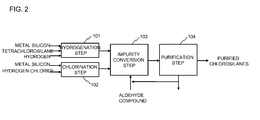
- FIG. 2 is a block diagram showing an embodiment of reusing the residual solution after the purified chlorosilanes have been separated in the purification step 104, in the impurity conversion step 103.
- at least a part of the residual chlorosilane distillate after the electronic-grade chlorosilanes have been separated in the purification step 104 is supplied to the impurity conversion step 103 as at least a part of the aldehyde compound (residual distillate supplying step).
- Such reuse not only allows effective use of the chlorosilanes in the residual solution, but also allows reduction in the amount of the aldehyde compound supplied from the outside by the amount of the aldehyde compound to be resupplied to the separation step 103.
- a distillation column or the like may be used in such high-boiling substance separation step 201.
- the residual solution mainly comprising a high-boiling substance from which the fraction mainly comprising the aldehyde compound and chlorosilanes have been separated contains the high-boiling substance derived from the donor impurities and acceptor impurities which is a useless substance, and it is possible to recover a useful substance while removing a part of the useless substance out of the system.
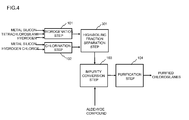
- FIGS. 4 to 9 are block diagrams for explaining other embodiments of the method for purifying chlorosilanes of the present invention.
- the method for purifying chlorosilanes shown in these figures at least one of a high-boiling fraction separation step 301 and a low-boiling fraction separation step 302 is provided in addition to the steps provided in the first embodiment.
- the high-boiling fraction separation step 301 is a step of separating the chlorosilane distillate obtained in the hydrogenation step 101 or chlorination step 102 into a first chlorosilane distillate mainly comprising trichlorosilane and a fraction having a boiling point lower than the boiling point of trichlorosilane and a second chlorosilane distillate mainly comprising tetrachlorosilane and a fraction having a boiling point higher than the boiling point of tetrachlorosilane, and supplying the first chlorosilane distillate to the impurity conversion step 103 or the low-boiling fraction separation step separately provided before the impurity conversion step.
- the low-boiling fraction separation step 302 is a step of separating the chlorosilane distillate obtained in the hydrogenation step 101 or chlorination step 102 into a third chlorosilane distillate mainly comprising a fraction having a boiling point lower than the boiling point of trichlorosilane and a fourth chlorosilane distillate mainly comprising trichlorosilane and a fraction having a boiling point higher than the boiling point of trichlorosilane, and supplying the fourth chlorosilane distillate to the impurity conversion step 103 or the high-boiling fraction separation step separately provided before the impurity conversion step.
- the chlorosilane distillate containing trichlorosilane produced in the hydrogenation step 101 and/or chlorination step 102 is purified in the high-boiling fraction separation step 301 to increase the concentration of trichlorosilane in the chlorosilane distillate, and then the resulting chlorosilane distillate is sent to the impurity conversion step 103.
- impurities having a boiling point lower than the boiling point of dichlorosilane and impurities having a boiling point higher than the boiling point of tetrachlorosilane are mixed in addition to dichlorosilane, trichlorosilane, and tetrachlorosilane.
- the previous separation of tetrachlorosilane and a fraction having a boiling point higher than the boiling point of tetrachlorosilane to thereby increase the concentration of trichlorosilane in the chlorosilane distillate to be sent to the impurity conversion step 103 will be useful in terms of purifying the raw material for producing polycrystalline silicon, for example, in terms of reduction in the apparatus load of the impurity conversion step 103.
- the chlorosilane distillate containing trichlorosilane which is sent from the hydrogenation step 101 or chlorination step 102 is separated into chlorosilanes mainly comprising trichlorosilane and a fraction having a boiling point lower than the boiling point of trichlorosilane (for convenience, referred to as the "first chlorosilane distillate") and chlorosilanes mainly comprising tetrachlorosilane and a fraction having a boiling point higher than the boiling point of tetrachlorosilane (for convenience, referred to as the "second chlorosilane distillate").
- a distillation column or the like may be used for such separation.
- the first chlorosilane distillate is removed from the top of the column, and the second chlorosilane distillate is removed from the bottom of the column.
- the chlorosilanes mainly comprising trichlorosilane and a fraction having a boiling point lower than the boiling point of trichlorosilane are sent to the impurity conversion step 103.
- the chlorosilane distillate containing trichlorosilane produced in the hydrogenation step 101 and/or chlorination step 102 may be purified in the low-boiling fraction separation step 302 to increase the concentration of trichlorosilane in the chlorosilane distillate, and then the resulting chlorosilane distillate may be sent to the impurity conversion step 103.
- the chlorosilane distillate containing trichlorosilane which is sent from the hydrogenation step 101 or chlorination step 102 is separated into chlorosilanes mainly comprising a fraction having a boiling point lower than the boiling point of trichlorosilane (for convenience, referred to as the "third chlorosilane distillate") and chlorosilanes mainly comprising trichlorosilane and a fraction having a boiling point higher than the boiling point of trichlorosilane (for convenience, referred to as the "fourth chlorosilane distillate").
- a distillation column or the like may be used for such separation.
- the third chlorosilane distillate is removed from the top of the column, and the fourth chlorosilane distillate is removed from the bottom of the column.
- the chlorosilanes mainly comprising trichlorosilane and a fraction having a boiling point higher than the boiling point of trichlorosilane are sent to the impurity conversion step 103.
- the chlorosilanes mainly comprising trichlorosilane and a fraction having a boiling point lower than the boiling point of trichlorosilane (first chlorosilane distillate) obtained by the treatment in the high-boiling fraction separation step 301 may be further treated in the low-boiling fraction separation step 302 to separate chlorosilanes having a boiling point lower than the boiling point of trichlorosilane such as dichlorosilane to increase further the concentration of trichlorosilane, and then the resulting chlorosilanes may be sent to the impurity conversion step 103.
- the low-boiling fraction separation step 302 may be first provided, and chlorosilanes after the chlorosilanes mainly comprising a fraction having a boiling point lower than the boiling point of trichlorosilane (third chlorosilane distillate) have been separated may be sent to the high-boiling fraction separation step 301 to separate chlorosilanes mainly comprising tetrachlorosilane and a fraction having a boiling point higher than the boiling point of tetrachlorosilane (second chlorosilane distillate), as in the embodiment shown in Figure 7 .
- the residual solution after the purified chlorosilanes have been separated in the purification step 104 is reused in the impurity conversion step 103, as described with reference to Figure 2 .
- at least a part of the residual chlorosilane distillate after the electronic-grade chlorosilanes have been separated in the purification step 104 is supplied to the impurity conversion step 103 as at least a part of the aldehyde compound as described above.
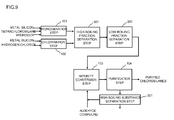
- a high-boiling substance separation step 201 of previously separating the residual chlorosilane distillate after the electronic-grade chlorosilanes have been separated in the purification step 104 into a fraction mainly comprising the aldehyde compound and chlorosilanes and a fraction mainly comprising a high-boiling substance, and supplying the former (the fraction mainly comprising the aldehyde compound and chlorosilanes) to the impurity conversion step 103 as at least a part of the aldehyde compound, as described with reference to Figure 3 .
- a sample vessel was charged with 7,006 g of a chlorosilane distillate mainly comprising trichlorosilane under a room temperature condition of 20 to 30°C, and then thereto was added 27 g of cinnamaldehyde. The mixture was stirred for 1 hour and measured for the concentration of boron and phosphorus in the chlorosilane solution.
- the amount of boron and phosphorus in the chlorosilane solution before cinnamaldehyde has been added was 11.5 ppba and 0.2 ppba, respectively.
- the amount of boron and phosphorus in the chlorosilane solution after stirring was 1.0 ppba and 0.14 ppba, respectively.
- a mixed solution of cinnamaldehyde and chlorosilane solution after stirring was sufficiently evaporated under nitrogen blowing at normal pressure. A evaporation residue was able to be easily discharged from the vessel, and the residue was found to be a liquid mainly comprising cinnamaldehyde.
- Comparative Example 1 was performed under the same conditions as in Example 1 except that benzaldehyde was added instead of cinnamaldehyde.
- a sample vessel was charged with 6,988 g of chlorosilane distillate mainly comprising trichlorosilane under a room temperature condition of 20 to 30°C.
- the charged chlorosilane distillate is the same stock solution as used in Example 1.
- the amount of boron and phosphorus in the chlorosilane solution after stirring was 0.8 ppba and 0.1 ppba, respectively.
- a mixed solution of benzaldehyde and chlorosilane solution after stirring was sufficiently evaporated under nitrogen blowing at normal pressure. A evaporation residue was not able to be discharged from the vessel. When the vessel was opened and the evaporation residue was observed, it was found to be a black solid.
- Examples 2 to 4 were each performed under the same conditions as in Example 1 except that an aldehyde compound as shown in Table 1 was added instead of cinnamaldehyde.
- a sample vessel was charged with a chlorosilane distillate mainly comprising trichlorosilane under a room temperature condition of 20 to 30°C.
- the charged chlorosilane distillate is the same stock solution as used in Example 1.
- To the charged chlorosilane distillate was added each aldehyde compound so as to be the same number of moles as that of cinnamaldehyde used in Example 1. The mixture was stirred for 1 hour and measured for the concentration of boron and phosphorus in the chlorosilane solution.
- the amount of boron and phosphorus in the chlorosilane solution after stirring is shown in Table 1.
- a mixed solution of each aldehyde and chlorosilane solution after stirring was sufficiently evaporated under nitrogen blowing at normal pressure.
- a evaporation residue was able to be easily discharged from the vessel, and the residual solution was found to be a liquid mainly comprising each aldehyde.
- Chlorosilanes were purified in the facilities shown in the block diagram of Figure 3 .
- ⁇ -methylcinnamaldehyde was added to a chlorosilane distillate mixed solution comprising 70% of trichlorosilane and 30% of tetrachlorosilane so that the ⁇ -methylcinnamaldehyde would be 1,000 times the amount of boron in the mixed solution in terms of moles.
- the chlorosilane distillate to which ⁇ -methylcinnamaldehyde has been added was sent to the purification step 104 to be subjected to separation in the distillation column.
- Purified chlorosilanes mainly comprising trichlorosilane were obtained from the top of the distillation column.
- polysilicon was produced using the purified chlorosilanes as a raw material and measured for the resistivity thereof, it was found to be as high as 3,500 ⁇ cm in the N-type.
- the residual solution discharged from the bottom of the distillation column in the purification step 104 was, following separation of ⁇ -methylcinnamaldehyde in the high-boiling substance separation step 201, resupplied to the impurity conversion step 103.
- the electronic-grade chlorosilanes obtained by the present invention is not only useful as a raw material for producing polycrystalline silicon for semiconductor applications, but also useful as a raw material for producing polycrystalline silicon for solar cell applications, for forming a silicon oxide film, for forming a polycrystalline silicon film, for forming a silicon compound thin film, or for producing an epitaxial wafer.
- the present invention provides a technique of removing donor impurities and acceptor impurities from a chlorosilane distillate to reduce the content of these impurities.
Landscapes
- Chemical & Material Sciences (AREA)
- Organic Chemistry (AREA)
- Inorganic Chemistry (AREA)
- Silicon Compounds (AREA)
Abstract
Description
- The present invention relates to a method for purifying chlorosilanes, more particularly to a method for efficiently removing donor impurities and acceptor impurities contained in chlorosilanes to obtain high purity chlorosilanes.
- Semiconductor-grade high purity polycrystalline silicon is generally produced by a CVD method referred to as the "Siemens method" by using a chlorosilane gas mainly comprising trichlorosilane as a raw material in the presence of hydrogen. Therefore, it is required that chlorosilanes used as a raw material of high purity polycrystalline silicon should also have an extremely high purity.
- In particular, when the impurities contained in raw material chlorosilanes are impurities such as phosphorus and arsenic which serve as a donor in a silicon crystal or impurities such as boron and aluminum used as an acceptor therein, even a very small amount of these impurities will result in having significant influence on the electrical properties (resistivity) of polycrystalline silicon produced. Therefore, practically, it will be considerably meaningful to provide a technique of efficiently removing donor impurities and acceptor impurities contained in raw material chlorosilanes to thereby highly purify the raw material chlorosilanes.
- Generally, chlorosilanes for producing polycrystalline silicon are produced by first obtaining a chlorosilane distillate from a metallurgical-grade silicon (so-called metal-grade silicon, hereinafter referred to as "metal silicon") which contains a relatively large amount of impurities by a publicly known method and then purifying the chlorosilane distillate by a method such as distillation to further highly purify the same.
- However, the donor impurities and acceptor impurities as described above are generally contained in metal silicon in an amount in the order of several hundred ppb (atomic) to several hundred ppm (atomic) in terms of the atomic ratio. Therefore, these impurities are not sufficiently removed in the processes of purifying the chlorosilane distillate, but the donor impurities and acceptor impurities may remain in the chlorosilanes finally obtained, which may pose a problem in that such residual impurities may reduce the quality of polycrystalline silicon.
- As a method for obtaining a chlorosilane distillate, there is known a hydrogenation step of reacting a tetrachlorosilane (SiCl4)-containing material with hydrogen in the presence of metal silicon to obtain a chlorosilane distillate containing trichlorosilane (SiHCl3) (for example, refer to National Publication of International Patent Application No.
2008-532907 58-217422 58-161915 - This hydrogenation reaction proceeds according to the following reaction formula.
[Formula 1] 3SiCl4 + 2H2 + Si→ 4SiHCl3
- The chlorosilane distillate is a fraction of crude chlorosilanes which are the products synthesized by the hydrogenation reaction, and is generally a mixture mainly comprising chlorosilanes such as dichlorosilane (SiH2Cl2), trichlorosilane (SiHCl3), and tetrachlorosilane (SiCl4).
- As another method for obtaining the chlorosilane distillate, there is also known a chlorination step of performing a chlorination reaction by bringing metal silicon into contact with hydrogen chloride in the presence of a catalyst to obtain a chlorosilane distillate containing trichlorosilane (for example, refer to Japanese Patent Laid-Open No.
2005-67979 - This chlorination reaction proceeds according to the following reaction formula.
[Formula 2] Si + 3HCl→ SiHCl3 + H2
- The chlorosilane distillate is a fraction of crude chlorosilanes which are the products synthesized by the chlorination reaction, and also in this case, the chlorosilane distillate is generally a mixture mainly comprising chlorosilanes such as dichlorosilane, trichlorosilane, and tetrachlorosilane.
- The donor impurities and acceptor impurities contained in metal silicon are hydrogenated or chlorinated at the same time when crude chlorosilanes are produced, and are probably mixed into the crude chlorosilanes as a form of compounds having various structures. Such crude chlorosilanes are purified to obtain high purity chlorosilanes, but it is difficult to separate and remove these impurities by a common distillation method when the boiling points of the compounds of the donor impurities and acceptor impurities are close to the boiling point of trichlorosilane.
If polycrystalline silicon is produced by using chlorosilanes from which the donor impurities and acceptor impurities have been insufficiently removed as a raw material, the result will be that a polycrystalline silicon having desired properties cannot be obtained. - Under these circumstances, various methods have been proposed as a method for removing the donor impurities and acceptor impurities in the chlorosilane distillate. For example, there has been proposed a method of adding organic matter to a chlorosilane distillate to produce an adduct with donor impurities and acceptor impurities, followed by distillation and purification to obtain high purity chlorosilanes.
- Specifically, Japanese Patent Laid-Open No.
2005-67979 U.S. Patent No. 3,126,248 (Patent Literature 5) discloses a method of adding an organic compound comprising dioxane, benzaldehyde, methyl ethyl ketone, dimethylglyoxime, and valerolactone to remove impurities. Furthermore, Japanese Patent Laid-Open No.2009-62213 - There has been also proposed a method of adding a metal chloride to a chlorosilane distillate to produce an adduct with donor impurities and acceptor impurities, followed by distillation and purification to obtain high purity chlorosilanes.
- Specifically,
U.S. Patent No. 2,821,460 (Patent Literature 7) discloses a method of adding an aluminum chloride to chlorosilanes to form an AlCl3·PCl5 complex, followed by distillation and purification. Further, Japanese Patent Laid-Open No.04-300206 - There has been also proposed a method of adsorbing impurities contained in chlorosilanes to alumina, silica gel, activated carbon, or the like to thereby remove the impurities.
- Specifically,
U.S. Patent No. 3,252,752 (Patent Literature 9) discloses a method of immobilizing a substance having a lone pair of electrons (for example, a substance such as propionitrile having a nitrogen atom and benzaldehyde having an oxygen atom) on an adsorbent such as activated carbon and silica gel and therethrough passing a chlorosilane gas to capture and remove impurities. Further, German Patent No.1,289,834 (Patent Literature 10) discloses a method of bringing chlorosilanes in a state of liquid or vapor into contact with activated alumina to remove impurities. Furthermore,U.S. Patent No. 4,112,057 (Patent Literature 11) discloses a method of bringing chlorosilanes into contact with metal oxides such as hydrated silica gel and alumina gel to remove impurities; and Japanese Patent Laid-Open No.2001-2407 - Besides these methods, there has been proposed a method of obtaining chlorosilanes having a low impurity concentration by introducing a small amount of oxygen into chlorosilanes in a high temperature condition to react them with each other to form a complex; reacting the complex with donor impurities and acceptor impurities to form a new complex; and separating the new complex in a distillation step of chlorosilanes (refer to National Publication of International Patent Application No. 1983-500895 (Patent Literature 13)).
-
- Patent Literature 1
National Publication of International Patent Application No.2008-532907 - Patent Literature 2
Japanese Patent Laid-Open No.58-217422 - Patent Literature 3
Japanese Patent Laid-Open No.58-161915 - Patent Literature 4
Japanese Patent Laid-Open No.2005-67979 - Patent Literature 5
U.S. Patent No. 3,126,248 - Patent Literature 6
Japanese Patent Laid-Open No.2009-62213 - Patent Literature 7
U.S. Patent No. 2,821,460 - Patent Literature 8
Japanese Patent Laid-Open No.04-300206 - Patent Literature 9
U.S. Patent No. 3,252,752 - Patent Literature 10
German Patent No.1,289,834 - Patent Literature 11
U.S. Patent No. 4,112,057 - Patent Literature 12
Japanese Patent Laid-Open No.2001-2407 - Patent Literature 13
National Publication of International Patent Application No.1983-500895 - Among the conventional purification methods as described above, the method of adding organic matter or a metal chloride to a chlorosilane distillate to produce an adduct with donor impurities and acceptor impurities allows chlorosilanes to be purified with high purity by a subsequent distillation step, when a boiling point difference arises between the adduct and trichlorosilane which is the main component.
- However, as described also in the prior art literatures as listed above, the organic matter which exhibits an effect to remove impurities in the purification method of adding the organic matter to a chlorosilane distillate is the organic matter containing an element having a lone pair of electrons, which poses a considerable limitation to the selection of such organic matter.
- For example, the organic matter to be added must not be the one that is very easily decomposed in the purification step and is also required not to produce a product which has a boiling point that is close to the boiling point of chlorosilanes by a reaction with a substance in the chlorosilane distillate. Particularly, when the organic matter containing an element having a lone pair of electrons is a solid, it is necessary to study whether it is soluble at a temperature for handling the chlorosilane distillate or not, and whether it is precipitated by the operating conditions during the handling thereof, and the like; and a sufficient consideration to prevent the incorporation of water during the charge is also necessary. That is, it is necessary to carefully select organic matter that is effective in removing impurities after taking the various conditions of the purification step into consideration.
- Benzaldehyde (C6H5CHO) is known as organic matter containing an element having a lone pair of electrons that is effective in removing donor impurities and acceptor impurities (refer to Patent Literature 5, Patent Literature 6, and Patent Literature 9). Benzaldehyde is easily handled at the time of addition thereof and is also easily available, but benzaldehydes form a solid polymer according to the following reaction formula in the presence of a metal chloride such as iron chloride. Since such a polymer may solidify and produce a blocker in piping or a vessel, it is necessary to periodically stop the production facilities in order to remove the solid.
-

-

- The purification method of adding a metal chloride to the chlorosilane distillate cannot be said that the handling is easy and poses such a problem in that waste treatment is complicated.
- The method of adsorbing impurities contained in chlorosilanes on alumina, silica gel, activated carbon, or the like to thereby remove the impurities requires an apparatus such as an adsorption column, leading to complicated facilities; and in addition, the method poses such problems in that an adsorbent carrying method is not simple, or handling and waste treatment of the adsorbent after the breakthrough are complicated.
- Also in other methods for removing impurities, it is necessary to introduce a small amount of oxygen into chlorosilanes in a high temperature condition to react them with each other at high temperatures, and these methods have various problems such as the reaction cannot be operated under simple and moderate conditions.
- The present invention has been made in view of the problems of conventional methods for purifying chlorosilanes as described above, and an object of the present invention is to provide a technique of removing donor impurities and acceptor impurities from a chlorosilane distillate to reduce the content of these impurities.
- A method for purifying chlorosilanes according to the present invention comprises the following steps (A) to (C):
- (A) a hydrogenation step of reacting chlorosilanes mainly comprising tetrachlorosilane with hydrogen in the presence of a metal-grade silicon to obtain a chlorosilane distillate containing trichlorosilane, or
a chlorination step of reacting a metal-grade silicon with hydrogen chloride to obtain a chlorosilane distillate containing trichlorosilane; - (B) an impurity conversion step of treating the chlorosilane distillate obtained in the hydrogenation step or chlorination step (A) in the presence of an aldehyde compound represented by the general formula Ar-R-CHO (wherein Ar denotes a substituted or unsubstituted aryl group, and R denotes an organic group having two or more carbon atoms) to convert donor impurities and acceptor impurities contained in the chlorosilane distillate to a high-boiling substance; and
- (C) a purification step of separating electronic-grade chlorosilanes from the chlorosilane distillate which has been subjected to the impurity conversion step and recovering the electronic-grade chlorosilanes outside the system.
- The present invention may include an embodiment further comprising the following step (D):
- (D) a residual distillate supplying step of supplying at least a part of a residual chlorosilane distillate after the electronic-grade chlorosilanes have been separated in the purification step (C) to the impurity conversion step (B) as at least a part of the aldehyde compound.
- The present invention may also include an embodiment further comprising the following step (E):
- (E) a high-boiling substance separation step of separating a fraction mainly comprising the aldehyde compound and chlorosilanes from a residual chlorosilane distillate after the electronic-grade chlorosilanes have been separated in the purification step (C) and supplying the fraction mainly comprising the aldehyde compound and chlorosilanes to the impurity conversion step (B) as at least a part of the aldehyde compound.
- In these embodiments, the present invention may also include an embodiment further comprising the following step (F):
- (F) a high-boiling fraction separation step of separating the chlorosilane distillate obtained in the hydrogenation step or chlorination step (A) into a first chlorosilane distillate mainly comprising trichlorosilane and a fraction having a boiling point lower than the boiling point of trichlorosilane and a second chlorosilane distillate mainly comprising tetrachlorosilane and a fraction having a boiling point higher than the boiling point of tetrachlorosilane, and supplying the first chlorosilane distillate to the impurity conversion step (B).
- In this case, the present invention may also include an embodiment further comprising the following step (G):
- (G) a step of further separating the first chlorosilane distillate into a distillate mainly comprising trichlorosilane and a distillate mainly comprising a fraction having a boiling point lower than the boiling point of trichlorosilane, and supplying the distillate mainly comprising trichlorosilane to the impurity conversion step (B).
- As another embodiment, the present invention may also include an embodiment further comprising the following step (H):
- (H) a low-boiling fraction separation step of separating the chlorosilane distillate obtained in the hydrogenation step or chlorination step (A) into a third chlorosilane distillate mainly comprising a fraction having a boiling point lower than the boiling point of trichlorosilane and a fourth chlorosilane distillate mainly comprising trichlorosilane and a fraction having a boiling point higher than the boiling point of trichlorosilane, and supplying the fourth chlorosilane distillate to the impurity conversion step (B).
- In this case, the present invention may also include an embodiment further comprising the following step (I):
- (I) a step of further separating the fourth chlorosilane distillate into a distillate mainly comprising trichlorosilane and a distillate mainly comprising a fraction having a boiling point higher than the boiling point of trichlorosilane, and supplying the distillate mainly comprising trichlorosilane to the impurity conversion step (B).
- The treatment temperature in the impurity conversion step (B) is preferably 0°C or higher and 150°C or lower.
- Further, the impurity conversion step (B) is preferably performed by adding the aldehyde compound represented by the general formula Ar-R-CHO in an amount equal to or more than the stoichiometric amount of the donor impurities and acceptor impurities contained in the chlorosilane distillate.
- The aldehyde compound represented by the general formula Ar-R-CHO may include one represented by the following structural formula. Here, in the following structural formula, Ar denotes a substituted or unsubstituted aryl group, and R1 and R2 each denote hydrogen or a hydrocarbon group having 1 to 20 carbon atoms.
-

- The aldehyde compound represented by the above structural formula is, for example, a cinnamaldehyde derivative.
- Examples of the cinnamaldehyde derivative include cinnamaldehyde, α-methylcinnamaldehyde, α-pentylcinnamaldehyde, α-hexylcinnamaldehyde, p-isopropyl-α-methylhydrocinnamaldehyde, and p-tert-butyl-α-methylhydrocinnamaldehyde.
- The electronic-grade chlorosilanes purified by the present invention are useful as a raw material, for example, for producing polycrystalline silicon for semiconductor applications, for producing polycrystalline silicon for solar cell applications, for forming a silicon oxide film, for forming a polycrystalline silicon film, for forming a silicon compound thin film, or for producing an epitaxial wafer.
- The method for purifying chlorosilanes according to the present invention comprises at least three steps of a hydrogenation step and/or a chlorination step, an impurity conversion step, and a purification step. In the impurity conversion step, an aldehyde compound represented by the general formula Ar-R-CHO (wherein Ar denotes a substituted or unsubstituted aryl group, and R denotes an organic group having two or more carbon atoms) is added to convert donor impurities and acceptor impurities contained in a chlorosilane distillate to a high-boiling substance. The chlorosilane distillate after the donor impurities and acceptor impurities have been converted to a high-boiling substance is sent to the purification step. In the purification step, high purity chlorosilanes from which the donor impurities and acceptor impurities have been thoroughly removed are obtained by using a distillation column or the like, where the high purity chlorosilanes are recovered outside the system from the top of the column.
- The technique based on the method for purifying chlorosilanes having the above-described constitution is easily handled and does not have problems such as complicated waste treatment. Further, an apparatus such as an adsorption column is not required, and the facilities will not be complicated. That is, the problems of conventional methods are eliminated.
- Thus, the present invention provides a new technique of removing donor impurities and acceptor impurities from a chlorosilane distillate to reduce the content of these impurities.
-
- [
Figure 1]Figure 1 is a block diagram for explaining one embodiment of a method for purifying chlorosilanes of the present invention. - [
Figure 2]Figure 2 is a block diagram showing an embodiment of reusing a residual solution after purified chlorosilanes have been separated in a separation step, in an impurity conversion step. - [
Figure 3]Figure 3 is a block diagram of an embodiment of providing a high-boiling substance separation step for separating a residual solution into a fraction mainly comprising an aldehyde compound and chlorosilanes and a fraction mainly comprising a high-boiling substance, before the residual solution is supplied to the impurity conversion step. - [
Figure 4]Figure 4 is a block diagram for explaining another embodiment of the method for purifying chlorosilanes of the present invention. - [
Figure 5]Figure 5 is a block diagram for explaining another embodiment of the method for purifying chlorosilanes of the present invention. - [
Figure 6]Figure 6 is a block diagram for explaining another embodiment of the method for purifying chlorosilanes of the present invention. - [
Figure 7]Figure 7 is a block diagram for explaining another embodiment of the method for purifying chlorosilanes of the present invention. - [
Figure 8]Figure 8 is a block diagram for explaining another embodiment of the method for purifying chlorosilanes of the present invention. - [
Figure 9]Figure 9 is a block diagram for explaining another implementation of the method for purifying chlorosilanes of the present invention. - Hereinafter, embodiments for performing a method for purifying chlorosilanes according to the present invention will be described.
- In the present invention, chlorosilanes are purified by a hydrogenation step of reacting chlorosilanes mainly comprising tetrachlorosilane with hydrogen in the presence of a metal-grade silicon to obtain a chlorosilane distillate containing trichlorosilane or a chlorination step of reacting a metal-grade silicon with hydrogen chloride to obtain a chlorosilane distillate containing trichlorosilane, and an impurity conversion step of treating the chlorosilane distillate obtained in the hydrogenation step or chlorination step in the presence of an aldehyde compound represented by the general formula Ar-R-CHO to convert donor impurities and acceptor impurities contained in the chlorosilane distillate to a high-boiling substance, followed by separating an electronic-grade chlorosilanes from the chlorosilane distillate which has been subjected to the impurity conversion step and recovering the electronic-grade chlorosilanes outside the system. Here, in the above general formula (Ar-R-CHO), Ar denotes a substituted or unsubstituted aryl group, and R denotes an organic group having two or more carbon atoms.
- The aldehyde compound represented by the general formula Ar-R-CHO may include those represented by the following structural formula. Here, in the following structural formula, Ar denotes a substituted or unsubstituted aryl group, and R1 and R2 each denote hydrogen or a hydrocarbon group having 1 to 20 carbon atoms.
-

- The aldehyde compound represented by the above structural formula is, for example, a cinnamaldehyde derivative, and examples include cinnamaldehyde, α-methylcinnamaldehyde, α-pentylcinnamaldehyde, α-hexylcinnamaldehyde, p-isopropyl-α-methylhydrocinnamaldehyde, and p-tert-butyl-α-methylhydrocinnamaldehyde.
- The present invention not only allows purification of semiconductor grade chlorosilanes having sufficiently high purity that are used, for example, for producing high purity polycrystalline silicon, but also allows continuous operation of production facilities because a solid polymer which is a material resulting from the reactions shown in the above [Formula 3] and [Formula 4] is not produced.
- The aldehyde compound represented by Ar-R-CHO as described above is chlorinated in the presence of metal chloride such as iron chloride, as in the case of benzaldehydes. For example, cinnamaldehyde is chlorinated by the reaction according to the following formula.
-

- However, even if a substance in which the aldehyde part has been chlorinated is produced, this substance undergoes intramolecular reaction of the molecule itself by the reaction according to the following formula, unlike benzaldehydes that react only with other molecules, and therefore, this substance hardly forms a polymer and will not probably results in forming a solid.
-

- That is, from the point of view of industrial production, a remover of the donor impurities and acceptor impurities contained in the chlorosilane distillate is preferably a compound containing an aldehyde group, and a substance that undergoes intramolecular reaction not to thereby be polymerized even when the aldehyde part in the compound is chlorinated.
- The aldehyde compound represented by Ar-R-CHO as described above has a feature in that it has an organic group having two or more carbon atoms between the aryl group and the aldehyde group, unlike benzaldehydes. That is, since the aldehyde compound represented by the general formula Ar-R-CHO has an organic group represented by R, it can form an intramolecular reaction with a benzene ring, and is considered to show a feature in that a polymer is hardly formed.
- Hereinafter, specific embodiments for performing the method for purifying chlorosilanes according to the present invention will be described with reference to drawings.
-
Figure 1 is a block diagram for explaining one embodiment of the method for purifying chlorosilanes of the present invention. The method for purifying chlorosilanes shown in this figure comprises at least three steps of ahydrogenation step 101 and/or achlorination step 102, animpurity conversion step 103, and apurification step 104. The method may comprise only one or both of thehydrogenation step 101 and thechlorination step 102 depending on the requirements of the system. - In the
hydrogenation step 101, metal silicon, chlorosilanes mainly comprising tetrachlorosilane, and hydrogen are supplied, and crude chlorosilanes containing trichlorosilane are obtained. On the other hand, in thechlorination step 102, metal silicon and hydrogen chloride are supplied, and crude chlorosilanes containing trichlorosilane are obtained in the presence of a catalyst. - The crude chlorosilanes obtained in the
hydrogenation step 101 or thechlorination step 102 are purified as needed and then sent to theimpurity conversion step 103 as a chlorosilane distillate mainly comprising chlorosilanes such as dichlorosilane, trichlorosilane, and tetrachlorosilane. - In the
impurity conversion step 103, the aldehyde compound represented by the general formula Ar-R-CHO as described above is added to the chlorosilane distillate, and donor impurities and acceptor impurities contained in the chlorosilane distillate are converted to a high-boiling substance. - The temperature during the conversion treatment to the high-boiling substance may be set to a temperature equal to the boiling point of the chlorosilane distillate or lower under the pressure in a reaction vessel, and it is common to perform the treatment at a temperature of 0°C or higher and 150°C or lower. It takes a long time to convert the impurities to the high-boiling substance when the treatment temperature is too low, while when the temperature is too high, it will be necessary to set the pressure in the reaction vessel to a higher value.
- The amount of the aldehyde compound supplied (added) to the
impurity conversion step 103 is preferably equal to or more than the stoichiometric amount of the donor impurities and acceptor impurities contained in the chlorosilane distillate. - The conversion of the donor impurities and acceptor impurities to the high-boiling substance is accelerated with the increase in the concentration of the aldehyde compound, but the necessity of recovering the aldehyde compound may occur if the feed rate of the aldehyde compound is excessive.
- Therefore, the amount of the aldehyde compound supplied to the
impurity conversion step 103 may be equimolar to or more than that of the donor impurities and acceptor impurities contained in the chlorosilane distillate, and may be an excessive amount to be judged to be economically rational. For example, an amount of 20% by mass or less relative to the chlorosilane distillate to be treated is enough in terms of the amount of the impurities generally contained. - The chlorosilane distillate after the donor impurities and acceptor impurities contained in the chlorosilane distillate have been converted to the high-boiling substance by the treatment in the presence of the aldehyde compound represented by the general formula Ar-R-CHO is sent to the
purification step 104. - The chlorosilane distillate sent to the
purification step 104 contains an excess of the aldehyde compound added in theimpurity conversion step 103 and the high-boiling substance produced by the conversion of the donor impurities and acceptor impurities, in addition to the chlorosilanes containing trichlorosilane. - In the
purification step 104, the separation and purification of chlorosilanes mainly comprising trichlorosilane are performed using a distillation column and the like. The contents of the chlorosilane distillate sent from theimpurity conversion step 103 comprise chlorosilanes, the aldehyde compound represented by the general formula Ar-R-CHO, and the high-boiling substance derived from the donor impurities and acceptor impurities. Therefore, purified chlorosilanes can be easily obtained by using a distillation column or the like, where they are recovered outside the system from the top of the column. - The obtained chlorosilanes are high purity chlorosilanes from which the donor impurities and acceptor impurities have been thoroughly removed, and are also highly pure (electronic grade) to the extent sufficient for use as raw material chlorosilanes for producing semiconductor grade high purity polycrystalline silicon and the like.
- A residual solution after the purified chlorosilanes have been separated in the
purification step 104 is discharged from the bottom side of the distillation column or the like. This residual solution contains chlorosilanes, the aldehyde compound represented by the general formula Ar-R-CHO used excessively, and the high-boiling substance derived from the donor impurities and acceptor impurities. Among these, the chlorosilanes and the aldehyde compound represented by the general formula Ar-R-CHO can be reused in theimpurity conversion step 103. -
Figure 2 is a block diagram showing an embodiment of reusing the residual solution after the purified chlorosilanes have been separated in thepurification step 104, in theimpurity conversion step 103. In this embodiment, at least a part of the residual chlorosilane distillate after the electronic-grade chlorosilanes have been separated in thepurification step 104 is supplied to theimpurity conversion step 103 as at least a part of the aldehyde compound (residual distillate supplying step). Such reuse not only allows effective use of the chlorosilanes in the residual solution, but also allows reduction in the amount of the aldehyde compound supplied from the outside by the amount of the aldehyde compound to be resupplied to theseparation step 103. - Note that, before supplying the residual solution to the
impurity conversion step 103, there may be previously provided a high-boilingsubstance separation step 201 of separating a fraction mainly comprising the aldehyde compound and chlorosilanes from the residual chlorosilane distillate after the electronic-grade chlorosilanes have been separated in thepurification step 104 and supplying the fraction mainly comprising the aldehyde compound and chlorosilanes to theimpurity conversion step 103 as at least a part of the aldehyde compound, as in the embodiment shown inFigure 3 . A distillation column or the like may be used in such high-boilingsubstance separation step 201. The residual solution mainly comprising a high-boiling substance from which the fraction mainly comprising the aldehyde compound and chlorosilanes have been separated contains the high-boiling substance derived from the donor impurities and acceptor impurities which is a useless substance, and it is possible to recover a useful substance while removing a part of the useless substance out of the system. - Note that if the whole amount of the residual solution is continuously resupplied to the
impurity conversion step 103, inconvenience may occur by the concentration of the high-boiling substance of the donor impurities and acceptor impurities. Therefore, it is preferred to adjust the amount of resupply of the residual solution depending on the amount of the donor impurities and acceptor impurities contained in the chlorosilane distillate. -
Figures 4 to 9 are block diagrams for explaining other embodiments of the method for purifying chlorosilanes of the present invention. In the method for purifying chlorosilanes shown in these figures, at least one of a high-boilingfraction separation step 301 and a low-boilingfraction separation step 302 is provided in addition to the steps provided in the first embodiment. - Here, the high-boiling
fraction separation step 301 is a step of separating the chlorosilane distillate obtained in thehydrogenation step 101 orchlorination step 102 into a first chlorosilane distillate mainly comprising trichlorosilane and a fraction having a boiling point lower than the boiling point of trichlorosilane and a second chlorosilane distillate mainly comprising tetrachlorosilane and a fraction having a boiling point higher than the boiling point of tetrachlorosilane, and supplying the first chlorosilane distillate to theimpurity conversion step 103 or the low-boiling fraction separation step separately provided before the impurity conversion step. - Further, the low-boiling
fraction separation step 302 is a step of separating the chlorosilane distillate obtained in thehydrogenation step 101 orchlorination step 102 into a third chlorosilane distillate mainly comprising a fraction having a boiling point lower than the boiling point of trichlorosilane and a fourth chlorosilane distillate mainly comprising trichlorosilane and a fraction having a boiling point higher than the boiling point of trichlorosilane, and supplying the fourth chlorosilane distillate to theimpurity conversion step 103 or the high-boiling fraction separation step separately provided before the impurity conversion step. - In the embodiment shown in
Figure 4 , the chlorosilane distillate containing trichlorosilane produced in thehydrogenation step 101 and/orchlorination step 102 is purified in the high-boilingfraction separation step 301 to increase the concentration of trichlorosilane in the chlorosilane distillate, and then the resulting chlorosilane distillate is sent to theimpurity conversion step 103. - In the chlorosilane distillate produced in the
hydrogenation step 101 orchlorination step 102, impurities having a boiling point lower than the boiling point of dichlorosilane and impurities having a boiling point higher than the boiling point of tetrachlorosilane are mixed in addition to dichlorosilane, trichlorosilane, and tetrachlorosilane. - Therefore, the previous separation of tetrachlorosilane and a fraction having a boiling point higher than the boiling point of tetrachlorosilane to thereby increase the concentration of trichlorosilane in the chlorosilane distillate to be sent to the
impurity conversion step 103 will be useful in terms of purifying the raw material for producing polycrystalline silicon, for example, in terms of reduction in the apparatus load of theimpurity conversion step 103. - In the high-boiling
fraction separation step 301 as described herein, the chlorosilane distillate containing trichlorosilane which is sent from thehydrogenation step 101 orchlorination step 102 is separated into chlorosilanes mainly comprising trichlorosilane and a fraction having a boiling point lower than the boiling point of trichlorosilane (for convenience, referred to as the "first chlorosilane distillate") and chlorosilanes mainly comprising tetrachlorosilane and a fraction having a boiling point higher than the boiling point of tetrachlorosilane (for convenience, referred to as the "second chlorosilane distillate"). - A distillation column or the like may be used for such separation. For example, the first chlorosilane distillate is removed from the top of the column, and the second chlorosilane distillate is removed from the bottom of the column. Subsequently, the chlorosilanes mainly comprising trichlorosilane and a fraction having a boiling point lower than the boiling point of trichlorosilane (first chlorosilane distillate) are sent to the
impurity conversion step 103. - As in the embodiment shown in
Figure 5 , the chlorosilane distillate containing trichlorosilane produced in thehydrogenation step 101 and/orchlorination step 102 may be purified in the low-boilingfraction separation step 302 to increase the concentration of trichlorosilane in the chlorosilane distillate, and then the resulting chlorosilane distillate may be sent to theimpurity conversion step 103. - In the low-boiling
fraction separation step 302 as described herein, the chlorosilane distillate containing trichlorosilane which is sent from thehydrogenation step 101 orchlorination step 102 is separated into chlorosilanes mainly comprising a fraction having a boiling point lower than the boiling point of trichlorosilane (for convenience, referred to as the "third chlorosilane distillate") and chlorosilanes mainly comprising trichlorosilane and a fraction having a boiling point higher than the boiling point of trichlorosilane (for convenience, referred to as the "fourth chlorosilane distillate"). - A distillation column or the like may be used for such separation. For example, the third chlorosilane distillate is removed from the top of the column, and the fourth chlorosilane distillate is removed from the bottom of the column. Subsequently, the chlorosilanes mainly comprising trichlorosilane and a fraction having a boiling point higher than the boiling point of trichlorosilane (fourth chlorosilane distillate) are sent to the
impurity conversion step 103. - As in the embodiment shown in
Figure 6 , the chlorosilanes mainly comprising trichlorosilane and a fraction having a boiling point lower than the boiling point of trichlorosilane (first chlorosilane distillate) obtained by the treatment in the high-boilingfraction separation step 301 may be further treated in the low-boilingfraction separation step 302 to separate chlorosilanes having a boiling point lower than the boiling point of trichlorosilane such as dichlorosilane to increase further the concentration of trichlorosilane, and then the resulting chlorosilanes may be sent to theimpurity conversion step 103. - Further, contrary to the embodiment shown in
Figure 6 , the low-boilingfraction separation step 302 may be first provided, and chlorosilanes after the chlorosilanes mainly comprising a fraction having a boiling point lower than the boiling point of trichlorosilane (third chlorosilane distillate) have been separated may be sent to the high-boilingfraction separation step 301 to separate chlorosilanes mainly comprising tetrachlorosilane and a fraction having a boiling point higher than the boiling point of tetrachlorosilane (second chlorosilane distillate), as in the embodiment shown inFigure 7 . - In the embodiment shown in
Figure 8 , the residual solution after the purified chlorosilanes have been separated in thepurification step 104 is reused in theimpurity conversion step 103, as described with reference toFigure 2 . In this embodiment, at least a part of the residual chlorosilane distillate after the electronic-grade chlorosilanes have been separated in thepurification step 104 is supplied to theimpurity conversion step 103 as at least a part of the aldehyde compound as described above. - In the embodiment shown in
Figure 9 , before supplying the residual solution to theimpurity conversion step 103, there is provided a high-boilingsubstance separation step 201 of previously separating the residual chlorosilane distillate after the electronic-grade chlorosilanes have been separated in thepurification step 104 into a fraction mainly comprising the aldehyde compound and chlorosilanes and a fraction mainly comprising a high-boiling substance, and supplying the former (the fraction mainly comprising the aldehyde compound and chlorosilanes) to theimpurity conversion step 103 as at least a part of the aldehyde compound, as described with reference toFigure 3 . - Hereinafter, the present invention will be more specifically described with reference to Examples and a Comparative Example, but the present invention is not limited to these Examples.
- A sample vessel was charged with 7,006 g of a chlorosilane distillate mainly comprising trichlorosilane under a room temperature condition of 20 to 30°C, and then thereto was added 27 g of cinnamaldehyde. The mixture was stirred for 1 hour and measured for the concentration of boron and phosphorus in the chlorosilane solution.
- The amount of boron and phosphorus in the chlorosilane solution before cinnamaldehyde has been added was 11.5 ppba and 0.2 ppba, respectively. The amount of boron and phosphorus in the chlorosilane solution after stirring was 1.0 ppba and 0.14 ppba, respectively. A mixed solution of cinnamaldehyde and chlorosilane solution after stirring was sufficiently evaporated under nitrogen blowing at normal pressure. A evaporation residue was able to be easily discharged from the vessel, and the residue was found to be a liquid mainly comprising cinnamaldehyde.
- Comparative Example 1 was performed under the same conditions as in Example 1 except that benzaldehyde was added instead of cinnamaldehyde. A sample vessel was charged with 6,988 g of chlorosilane distillate mainly comprising trichlorosilane under a room temperature condition of 20 to 30°C. The charged chlorosilane distillate is the same stock solution as used in Example 1. To the charged chlorosilane distillate, was added 22 g of benzaldehyde so as to be the same number of moles as that of cinnamaldehyde used in Example 1. The mixture was stirred for 1 hour and measured for the concentration of boron and phosphorus in the chlorosilane solution.
- The amount of boron and phosphorus in the chlorosilane solution after stirring was 0.8 ppba and 0.1 ppba, respectively. A mixed solution of benzaldehyde and chlorosilane solution after stirring was sufficiently evaporated under nitrogen blowing at normal pressure. A evaporation residue was not able to be discharged from the vessel. When the vessel was opened and the evaporation residue was observed, it was found to be a black solid.
- Examples 2 to 4 were each performed under the same conditions as in Example 1 except that an aldehyde compound as shown in Table 1 was added instead of cinnamaldehyde. A sample vessel was charged with a chlorosilane distillate mainly comprising trichlorosilane under a room temperature condition of 20 to 30°C. The charged chlorosilane distillate is the same stock solution as used in Example 1. To the charged chlorosilane distillate, was added each aldehyde compound so as to be the same number of moles as that of cinnamaldehyde used in Example 1. The mixture was stirred for 1 hour and measured for the concentration of boron and phosphorus in the chlorosilane solution. The amount of boron and phosphorus in the chlorosilane solution after stirring is shown in Table 1. A mixed solution of each aldehyde and chlorosilane solution after stirring was sufficiently evaporated under nitrogen blowing at normal pressure. A evaporation residue was able to be easily discharged from the vessel, and the residual solution was found to be a liquid mainly comprising each aldehyde.
-
[Table 1] Example Aldehyde compound Amount of chlorosilane distillate charged Amount of aldehyde compound added Boron concentration Phosphorus concentration 2 α-methylcinnamaldehyde 7,040 g 30 g 0.6 ppba 0.07 ppba 3 α-pentylcinnamaldehyde 7,018 g 42 g 0.4 ppba 0.07 ppba 4 α-hexylcinnamaldehyde 7,006 g 45 g 0.5 ppba 0.14 ppba - Chlorosilanes were purified in the facilities shown in the block diagram of
Figure 3 . In theimpurity conversion step 103, α-methylcinnamaldehyde was added to a chlorosilane distillate mixed solution comprising 70% of trichlorosilane and 30% of tetrachlorosilane so that the α-methylcinnamaldehyde would be 1,000 times the amount of boron in the mixed solution in terms of moles. The chlorosilane distillate to which α-methylcinnamaldehyde has been added was sent to thepurification step 104 to be subjected to separation in the distillation column. Purified chlorosilanes mainly comprising trichlorosilane were obtained from the top of the distillation column. When polysilicon was produced using the purified chlorosilanes as a raw material and measured for the resistivity thereof, it was found to be as high as 3,500 Ωcm in the N-type. The residual solution discharged from the bottom of the distillation column in thepurification step 104 was, following separation of α-methylcinnamaldehyde in the high-boilingsubstance separation step 201, resupplied to theimpurity conversion step 103. - The electronic-grade chlorosilanes obtained by the present invention is not only useful as a raw material for producing polycrystalline silicon for semiconductor applications, but also useful as a raw material for producing polycrystalline silicon for solar cell applications, for forming a silicon oxide film, for forming a polycrystalline silicon film, for forming a silicon compound thin film, or for producing an epitaxial wafer.
- The present invention provides a technique of removing donor impurities and acceptor impurities from a chlorosilane distillate to reduce the content of these impurities.
-
- 101
- Hydrogenation Step
- 102
- Chlorination Step
- 103
- Impurity Conversion Step
- 104
- Purification Step
- 201
- High-boiling Substance Separation Step
- 301
- High-boiling Fraction Separation Step
- 302
- Low-boiling Fraction Separation Step
Claims (13)
- A method for purifying chlorosilanes comprising the following steps (A) to (C):(A) a hydrogenation step of reacting chlorosilanes mainly comprising tetrachlorosilane with hydrogen in the presence of a metal-grade silicon to obtain a chlorosilane distillate containing trichlorosilane, or
a chlorination step of reacting a metal-grade silicon with hydrogen chloride to obtain a chlorosilane distillate containing trichlorosilane;(B) an impurity conversion step of treating the chlorosilane distillate obtained in the hydrogenation step or chlorination step (A) in the presence of an aldehyde compound represented by the general formula Ar-R-CHO (wherein Ar denotes a substituted or unsubstituted aryl group, and R denotes an organic group having two or more carbon atoms) to convert donor impurities and acceptor impurities contained in the chlorosilane distillate to a high-boiling substance; and(C) a purification step of separating electronic-grade chlorosilanes from the chlorosilane distillate which has been subjected to the impurity conversion step and recovering the electronic-grade chlorosilanes outside the system. - The method for purifying chlorosilanes according to claim 1, further comprising the following step (D):(D) a residual distillate supplying step of supplying at least a part of a residual chlorosilane distillate after the electronic-grade chlorosilanes have been separated in the purification step (C) to the impurity conversion step (B) as at least a part of the aldehyde compound.
- The method for purifying chlorosilanes according to claim 1, further comprising the following step (E):(E) a high-boiling substance separation step of separating a fraction mainly comprising the aldehyde compound and chlorosilanes from a residual chlorosilane distillate after the electronic-grade chlorosilanes have been separated in the purification step (C) and supplying the fraction mainly comprising the aldehyde compound and chlorosilanes to the impurity conversion step (B) as at least a part of the aldehyde compound.
- The method for purifying chlorosilanes according to any one of claims 1 to 3, further comprising the following step (F):(F) a high-boiling fraction separation step of separating the chlorosilane distillate obtained in the hydrogenation step or chlorination step (A) into a first chlorosilane distillate mainly comprising trichlorosilane and a fraction having a boiling point lower than the boiling point of trichlorosilane and a second chlorosilane distillate mainly comprising tetrachlorosilane and a fraction having a boiling point higher than the boiling point of tetrachlorosilane, and supplying the first chlorosilane distillate to the impurity conversion step (B).
- The method for purifying chlorosilanes according to claim 4, further comprising the following step (G):(G) a step of further separating the first chlorosilane distillate into a distillate mainly comprising trichlorosilane and a distillate mainly comprising a fraction having a boiling point lower than the boiling point of trichlorosilane, and supplying the distillate mainly comprising trichlorosilane to the impurity conversion step (B).
- The method for purifying chlorosilanes according to any one of claims 1 to 3, further comprising the following step (H):(H) a low-boiling fraction separation step of separating the chlorosilane distillate obtained in the hydrogenation step or chlorination step (A) into a third chlorosilane distillate mainly comprising a fraction having a boiling point lower than the boiling point of trichlorosilane and a fourth chlorosilane distillate mainly comprising trichlorosilane and a fraction having a boiling point higher than the boiling point of trichlorosilane, and supplying the fourth chlorosilane distillate to the impurity conversion step (B).
- The method for purifying chlorosilanes according to claim 6, further comprising the following step (I):(I) a step of further separating the fourth chlorosilane distillate into a distillate mainly comprising trichlorosilane and a distillate mainly comprising a fraction having a boiling point higher than the boiling point of trichlorosilane, and supplying the distillate mainly comprising trichlorosilane to the impurity conversion step (B).
- The method for purifying chlorosilanes according to claim 1, wherein the treatment temperature in the impurity conversion step (B) is 0°C or higher and 150°C or lower.
- The method for purifying chlorosilanes according to claim 1, wherein the impurity conversion step (B) is performed by adding the aldehyde compound represented by the general formula Ar-R-CHO in an amount equal to or more than the stoichiometric amount of the donor impurities and acceptor impurities contained in the chlorosilane distillate.
- The method for purifying chlorosilanes according to claim 1, wherein the aldehyde compound represented by the general formula Ar-R-CHO is one represented by the following structural formula:

- The method for purifying chlorosilanes according to claim 10, wherein the aldehyde compound represented by the structural formula is a cinnamaldehyde derivative.
- The method for purifying chlorosilanes according to claim 11, wherein the cinnamaldehyde derivative is any of cinnamaldehyde, α-methylcinnamaldehyde, α-pentylcinnamaldehyde, α-hexylcinnamaldehyde, p-isopropyl-α-methylhydrocinnamaldehyde, and p-tert-butyl-α-methylhydrocinnamaldehyde.
- The method for purifying chlorosilanes according to claim 1, wherein the electronic-grade chlorosilanes are used as a raw material for producing polycrystalline silicon for semiconductor applications, for producing polycrystalline silicon for solar cell applications, for forming a silicon oxide film, for forming a polycrystalline silicon film, for forming a silicon compound thin film, or for producing an epitaxial wafer.
Applications Claiming Priority (2)
| Application Number | Priority Date | Filing Date | Title |
|---|---|---|---|
| JP2010240285A JP5542026B2 (en) | 2010-10-27 | 2010-10-27 | Purification method of chlorosilanes |
| PCT/JP2011/004937 WO2012056621A1 (en) | 2010-10-27 | 2011-09-02 | Method for purifying chlorosilanes |
Publications (3)
| Publication Number | Publication Date |
|---|---|
| EP2634142A1 true EP2634142A1 (en) | 2013-09-04 |
| EP2634142A4 EP2634142A4 (en) | 2014-11-05 |
| EP2634142B1 EP2634142B1 (en) | 2017-07-05 |
Family
ID=45993369
Family Applications (1)
| Application Number | Title | Priority Date | Filing Date |
|---|---|---|---|
| EP11835769.8A Active EP2634142B1 (en) | 2010-10-27 | 2011-09-02 | Method for purifying chlorosilanes |
Country Status (6)
| Country | Link |
|---|---|
| US (1) | US9126838B2 (en) |
| EP (1) | EP2634142B1 (en) |
| JP (1) | JP5542026B2 (en) |
| CN (1) | CN103201218B (en) |
| AU (1) | AU2011322027B2 (en) |
| WO (1) | WO2012056621A1 (en) |
Cited By (2)
| Publication number | Priority date | Publication date | Assignee | Title |
|---|---|---|---|---|
| RU2672428C1 (en) * | 2017-10-25 | 2018-11-14 | Акционерное общество "Государственный научно-исследовательский и проектный институт редкометаллической промышленности АО "Гиредмет" | Method for producing high-purity silicon tetrachloride |
| US20200283298A1 (en) * | 2017-10-27 | 2020-09-10 | Nexwafe Gmbh | Process and apparatus for removal of impurities from chlorosilanes |
Families Citing this family (18)
| Publication number | Priority date | Publication date | Assignee | Title |
|---|---|---|---|---|
| JP5507498B2 (en) * | 2011-06-21 | 2014-05-28 | 信越化学工業株式会社 | Purification method of chlorosilanes |
| JP5879283B2 (en) * | 2013-02-13 | 2016-03-08 | 信越化学工業株式会社 | Method for producing trichlorosilane |
| KR20140120507A (en) * | 2013-04-03 | 2014-10-14 | 주식회사 케이씨씨 | Method for producing polysilane |
| JP6069167B2 (en) | 2013-10-23 | 2017-02-01 | 信越化学工業株式会社 | Method for producing polycrystalline silicon |
| DE102016014900A1 (en) * | 2016-12-15 | 2018-06-21 | Psc Polysilane Chemicals Gmbh | Process for increasing the purity of oligosilanes and oligosilane compounds |
| US10584035B2 (en) * | 2017-02-24 | 2020-03-10 | Shin-Etsu Chemical Co., Ltd. | Purification system of trichlorosilane and silicon crystal |
| CN107055550B (en) * | 2017-04-06 | 2020-02-11 | 洛阳中硅高科技有限公司 | Method for preparing electronic-grade dichlorosilane |
| CN106904617B (en) * | 2017-04-06 | 2020-07-21 | 洛阳中硅高科技有限公司 | Device for preparing electronic-grade dichlorosilane |
| CN107055549A (en) * | 2017-04-06 | 2017-08-18 | 洛阳中硅高科技有限公司 | A kind of method for preparing electron level trichlorosilane |
| CN106927468A (en) * | 2017-04-06 | 2017-07-07 | 洛阳中硅高科技有限公司 | A kind of device for preparing electron level trichlorosilane |
| CN108467042B (en) * | 2018-03-20 | 2019-12-31 | 中国恩菲工程技术有限公司 | Preparation method of electronic grade polysilicon |
| CN109279611B (en) * | 2018-11-30 | 2020-07-28 | 亚洲硅业(青海)股份有限公司 | Method and device for removing impurities in chlorosilane |
| US20220064009A1 (en) * | 2018-12-27 | 2022-03-03 | Tokuyama Corporation | Chlorosilane Manufacturing Method |
| WO2020153342A1 (en) * | 2019-01-22 | 2020-07-30 | 株式会社トクヤマ | Method for producing refined chlorosilane |
| WO2020204141A1 (en) | 2019-04-05 | 2020-10-08 | 株式会社トクヤマ | Polycrystalline silicon material |
| EP3936642A4 (en) | 2019-04-05 | 2022-09-14 | Tokuyama Corporation | POLYCRYSTALLINE SILICON MATERIAL |
| CN116715242B (en) * | 2023-05-31 | 2024-02-02 | 宁夏润阳硅材料科技有限公司 | Method and system for controlling content of carbon impurities in hydrogen for reduction process |
| CN119240708A (en) * | 2024-09-25 | 2025-01-03 | 内蒙古大全新能源有限公司 | A method for removing boron and phosphorus impurities in chlorosilane |
Family Cites Families (15)
| Publication number | Priority date | Publication date | Assignee | Title |
|---|---|---|---|---|
| US3126248A (en) | 1964-03-24 | Process for producing purified | ||
| US2821460A (en) | 1955-08-31 | 1958-01-28 | Bell Telephone Labor Inc | Method of purifying silicon tetrachloride and germanium tetrachloride |
| NL235008A (en) | 1958-01-11 | |||
| DE1289834B (en) | 1960-08-11 | 1969-02-27 | Haldor Frederik Axel Dipl Ing | Process for purifying an inorganic halide compound or a mixture of such halide compounds |
| DE2546957C3 (en) | 1975-10-20 | 1980-10-23 | Wacker-Chemitronic Gesellschaft Fuer Elektronik-Grundstoffe Mbh, 8263 Burghausen | Process for cleaning halosilanes |
| US4676967A (en) | 1978-08-23 | 1987-06-30 | Union Carbide Corporation | High purity silane and silicon production |
| JPS5734012A (en) * | 1980-07-29 | 1982-02-24 | Shin Etsu Chem Co Ltd | Purifying method of chlorosilane |
| US4374110A (en) | 1981-06-15 | 1983-02-15 | Motorola, Inc. | Purification of silicon source materials |
| JPS58161915A (en) | 1982-03-17 | 1983-09-26 | Shin Etsu Chem Co Ltd | Manufacture of trichlorosilane |
| JPH04300206A (en) | 1991-03-28 | 1992-10-23 | Osaka Titanium Co Ltd | Purification of silicon chloride |
| JP3734009B2 (en) | 1999-06-17 | 2006-01-11 | 信越化学工業株式会社 | Method for separating boron compounds from chlorosilanes and composition for evaporating chlorosilanes |
| JP2005067979A (en) | 2003-08-27 | 2005-03-17 | Tokuyama Corp | Purification method of chlorosilanes |
| CN101189245B (en) | 2005-03-09 | 2012-06-13 | 瑞科硅公司 | Process for preparing hydrochlorosilanes |
| JP4714197B2 (en) | 2007-09-05 | 2011-06-29 | 信越化学工業株式会社 | Method for producing trichlorosilane and method for producing polycrystalline silicon |
| JP4714198B2 (en) * | 2007-09-05 | 2011-06-29 | 信越化学工業株式会社 | Purification method of chlorosilanes |
-
2010
- 2010-10-27 JP JP2010240285A patent/JP5542026B2/en active Active
-
2011
- 2011-09-02 EP EP11835769.8A patent/EP2634142B1/en active Active
- 2011-09-02 WO PCT/JP2011/004937 patent/WO2012056621A1/en not_active Ceased
- 2011-09-02 CN CN201180052072.5A patent/CN103201218B/en active Active
- 2011-09-02 US US13/822,673 patent/US9126838B2/en active Active
- 2011-09-02 AU AU2011322027A patent/AU2011322027B2/en not_active Ceased
Cited By (3)
| Publication number | Priority date | Publication date | Assignee | Title |
|---|---|---|---|---|
| RU2672428C1 (en) * | 2017-10-25 | 2018-11-14 | Акционерное общество "Государственный научно-исследовательский и проектный институт редкометаллической промышленности АО "Гиредмет" | Method for producing high-purity silicon tetrachloride |
| US20200283298A1 (en) * | 2017-10-27 | 2020-09-10 | Nexwafe Gmbh | Process and apparatus for removal of impurities from chlorosilanes |
| US11560316B2 (en) * | 2017-10-27 | 2023-01-24 | Nexwafe Gmbh | Process and apparatus for removal of impurities from chlorosilanes |
Also Published As
| Publication number | Publication date |
|---|---|
| EP2634142B1 (en) | 2017-07-05 |
| CN103201218B (en) | 2015-10-07 |
| JP5542026B2 (en) | 2014-07-09 |
| WO2012056621A1 (en) | 2012-05-03 |
| US9126838B2 (en) | 2015-09-08 |
| EP2634142A4 (en) | 2014-11-05 |
| US20130177492A1 (en) | 2013-07-11 |
| CN103201218A (en) | 2013-07-10 |
| AU2011322027A1 (en) | 2013-03-21 |
| JP2012091960A (en) | 2012-05-17 |
| AU2011322027B2 (en) | 2013-12-05 |
Similar Documents
| Publication | Publication Date | Title |
|---|---|---|
| EP2634142B1 (en) | Method for purifying chlorosilanes | |
| EP2036858B1 (en) | Method for purifying chlorosilanes | |
| JP4714197B2 (en) | Method for producing trichlorosilane and method for producing polycrystalline silicon | |
| JP5442780B2 (en) | Purification method by distillation of chlorosilane | |
| CN101378990A (en) | Recovery of high-boiling compounds in an integrated chlorosilane system | |
| KR20150119084A (en) | Method for producing trichlorosilane | |
| EP2465819B1 (en) | Method for purifying chlorosilanes | |
| JP4659797B2 (en) | Method for producing polycrystalline silicon | |
| CN108502888B (en) | Purification system of trichlorosilane and silicon crystals | |
| JP2007001791A (en) | Method of purifying trichlorosilane | |
| US10207932B2 (en) | Trichlorosilane purification system and method for producing polycrystalline silicon | |
| US20170190585A1 (en) | Method for purifying chlorosilane | |
| WO2011024257A1 (en) | Purification of chlorosilane using amine compound | |
| EP3901090B1 (en) | Method for producing purified chlorosilanes | |
| JP2018140927A (en) | Trichlorosilane purification system and silicon crystals |
Legal Events
| Date | Code | Title | Description |
|---|---|---|---|
| PUAI | Public reference made under article 153(3) epc to a published international application that has entered the european phase |
Free format text: ORIGINAL CODE: 0009012 |
|
| 17P | Request for examination filed |
Effective date: 20130327 |
|
| AK | Designated contracting states |
Kind code of ref document: A1 Designated state(s): AL AT BE BG CH CY CZ DE DK EE ES FI FR GB GR HR HU IE IS IT LI LT LU LV MC MK MT NL NO PL PT RO RS SE SI SK SM TR |
|
| DAX | Request for extension of the european patent (deleted) | ||
| A4 | Supplementary search report drawn up and despatched |
Effective date: 20141002 |
|
| RIC1 | Information provided on ipc code assigned before grant |
Ipc: C01B 33/107 20060101AFI20140926BHEP |
|
| 17Q | First examination report despatched |
Effective date: 20150730 |
|
| GRAP | Despatch of communication of intention to grant a patent |
Free format text: ORIGINAL CODE: EPIDOSNIGR1 |
|
| INTG | Intention to grant announced |
Effective date: 20170221 |
|
| GRAS | Grant fee paid |
Free format text: ORIGINAL CODE: EPIDOSNIGR3 |
|
| GRAA | (expected) grant |
Free format text: ORIGINAL CODE: 0009210 |
|
| AK | Designated contracting states |
Kind code of ref document: B1 Designated state(s): AL AT BE BG CH CY CZ DE DK EE ES FI FR GB GR HR HU IE IS IT LI LT LU LV MC MK MT NL NO PL PT RO RS SE SI SK SM TR |
|
| REG | Reference to a national code |
Ref country code: GB Ref legal event code: FG4D |
|
| REG | Reference to a national code |
Ref country code: CH Ref legal event code: EP |
|
| REG | Reference to a national code |
Ref country code: AT Ref legal event code: REF Ref document number: 906475 Country of ref document: AT Kind code of ref document: T Effective date: 20170715 |
|
| REG | Reference to a national code |
Ref country code: IE Ref legal event code: FG4D |
|
| REG | Reference to a national code |
Ref country code: DE Ref legal event code: R096 Ref document number: 602011039372 Country of ref document: DE |
|
| REG | Reference to a national code |
Ref country code: NL Ref legal event code: MP Effective date: 20170705 |
|
| REG | Reference to a national code |
Ref country code: AT Ref legal event code: MK05 Ref document number: 906475 Country of ref document: AT Kind code of ref document: T Effective date: 20170705 |
|
| REG | Reference to a national code |
Ref country code: LT Ref legal event code: MG4D |
|
| PG25 | Lapsed in a contracting state [announced via postgrant information from national office to epo] |
Ref country code: AT Free format text: LAPSE BECAUSE OF FAILURE TO SUBMIT A TRANSLATION OF THE DESCRIPTION OR TO PAY THE FEE WITHIN THE PRESCRIBED TIME-LIMIT Effective date: 20170705 Ref country code: SE Free format text: LAPSE BECAUSE OF FAILURE TO SUBMIT A TRANSLATION OF THE DESCRIPTION OR TO PAY THE FEE WITHIN THE PRESCRIBED TIME-LIMIT Effective date: 20170705 Ref country code: NL Free format text: LAPSE BECAUSE OF FAILURE TO SUBMIT A TRANSLATION OF THE DESCRIPTION OR TO PAY THE FEE WITHIN THE PRESCRIBED TIME-LIMIT Effective date: 20170705 Ref country code: LT Free format text: LAPSE BECAUSE OF FAILURE TO SUBMIT A TRANSLATION OF THE DESCRIPTION OR TO PAY THE FEE WITHIN THE PRESCRIBED TIME-LIMIT Effective date: 20170705 Ref country code: NO Free format text: LAPSE BECAUSE OF FAILURE TO SUBMIT A TRANSLATION OF THE DESCRIPTION OR TO PAY THE FEE WITHIN THE PRESCRIBED TIME-LIMIT Effective date: 20171005 Ref country code: HR Free format text: LAPSE BECAUSE OF FAILURE TO SUBMIT A TRANSLATION OF THE DESCRIPTION OR TO PAY THE FEE WITHIN THE PRESCRIBED TIME-LIMIT Effective date: 20170705 Ref country code: FI Free format text: LAPSE BECAUSE OF FAILURE TO SUBMIT A TRANSLATION OF THE DESCRIPTION OR TO PAY THE FEE WITHIN THE PRESCRIBED TIME-LIMIT Effective date: 20170705 |
|
| PG25 | Lapsed in a contracting state [announced via postgrant information from national office to epo] |
Ref country code: ES Free format text: LAPSE BECAUSE OF FAILURE TO SUBMIT A TRANSLATION OF THE DESCRIPTION OR TO PAY THE FEE WITHIN THE PRESCRIBED TIME-LIMIT Effective date: 20170705 Ref country code: RS Free format text: LAPSE BECAUSE OF FAILURE TO SUBMIT A TRANSLATION OF THE DESCRIPTION OR TO PAY THE FEE WITHIN THE PRESCRIBED TIME-LIMIT Effective date: 20170705 Ref country code: GR Free format text: LAPSE BECAUSE OF FAILURE TO SUBMIT A TRANSLATION OF THE DESCRIPTION OR TO PAY THE FEE WITHIN THE PRESCRIBED TIME-LIMIT Effective date: 20171006 Ref country code: BG Free format text: LAPSE BECAUSE OF FAILURE TO SUBMIT A TRANSLATION OF THE DESCRIPTION OR TO PAY THE FEE WITHIN THE PRESCRIBED TIME-LIMIT Effective date: 20171005 Ref country code: LV Free format text: LAPSE BECAUSE OF FAILURE TO SUBMIT A TRANSLATION OF THE DESCRIPTION OR TO PAY THE FEE WITHIN THE PRESCRIBED TIME-LIMIT Effective date: 20170705 Ref country code: IS Free format text: LAPSE BECAUSE OF FAILURE TO SUBMIT A TRANSLATION OF THE DESCRIPTION OR TO PAY THE FEE WITHIN THE PRESCRIBED TIME-LIMIT Effective date: 20171105 Ref country code: PL Free format text: LAPSE BECAUSE OF FAILURE TO SUBMIT A TRANSLATION OF THE DESCRIPTION OR TO PAY THE FEE WITHIN THE PRESCRIBED TIME-LIMIT Effective date: 20170705 |
|
| REG | Reference to a national code |
Ref country code: DE Ref legal event code: R097 Ref document number: 602011039372 Country of ref document: DE |
|
| PG25 | Lapsed in a contracting state [announced via postgrant information from national office to epo] |
Ref country code: CZ Free format text: LAPSE BECAUSE OF FAILURE TO SUBMIT A TRANSLATION OF THE DESCRIPTION OR TO PAY THE FEE WITHIN THE PRESCRIBED TIME-LIMIT Effective date: 20170705 Ref country code: DK Free format text: LAPSE BECAUSE OF FAILURE TO SUBMIT A TRANSLATION OF THE DESCRIPTION OR TO PAY THE FEE WITHIN THE PRESCRIBED TIME-LIMIT Effective date: 20170705 Ref country code: RO Free format text: LAPSE BECAUSE OF FAILURE TO SUBMIT A TRANSLATION OF THE DESCRIPTION OR TO PAY THE FEE WITHIN THE PRESCRIBED TIME-LIMIT Effective date: 20170705 |
|
| REG | Reference to a national code |
Ref country code: CH Ref legal event code: PL |
|
| PLBE | No opposition filed within time limit |
Free format text: ORIGINAL CODE: 0009261 |
|
| STAA | Information on the status of an ep patent application or granted ep patent |
Free format text: STATUS: NO OPPOSITION FILED WITHIN TIME LIMIT |
|
| PG25 | Lapsed in a contracting state [announced via postgrant information from national office to epo] |
Ref country code: IT Free format text: LAPSE BECAUSE OF FAILURE TO SUBMIT A TRANSLATION OF THE DESCRIPTION OR TO PAY THE FEE WITHIN THE PRESCRIBED TIME-LIMIT Effective date: 20170705 Ref country code: MC Free format text: LAPSE BECAUSE OF FAILURE TO SUBMIT A TRANSLATION OF THE DESCRIPTION OR TO PAY THE FEE WITHIN THE PRESCRIBED TIME-LIMIT Effective date: 20170705 Ref country code: SK Free format text: LAPSE BECAUSE OF FAILURE TO SUBMIT A TRANSLATION OF THE DESCRIPTION OR TO PAY THE FEE WITHIN THE PRESCRIBED TIME-LIMIT Effective date: 20170705 Ref country code: EE Free format text: LAPSE BECAUSE OF FAILURE TO SUBMIT A TRANSLATION OF THE DESCRIPTION OR TO PAY THE FEE WITHIN THE PRESCRIBED TIME-LIMIT Effective date: 20170705 Ref country code: SM Free format text: LAPSE BECAUSE OF FAILURE TO SUBMIT A TRANSLATION OF THE DESCRIPTION OR TO PAY THE FEE WITHIN THE PRESCRIBED TIME-LIMIT Effective date: 20170705 |
|
| 26N | No opposition filed |
Effective date: 20180406 |
|
| GBPC | Gb: european patent ceased through non-payment of renewal fee |
Effective date: 20171005 |
|
| REG | Reference to a national code |
Ref country code: IE Ref legal event code: MM4A |
|
| REG | Reference to a national code |
Ref country code: BE Ref legal event code: MM Effective date: 20170930 |
|
| PG25 | Lapsed in a contracting state [announced via postgrant information from national office to epo] |
Ref country code: LU Free format text: LAPSE BECAUSE OF NON-PAYMENT OF DUE FEES Effective date: 20170902 |
|
| REG | Reference to a national code |
Ref country code: FR Ref legal event code: ST Effective date: 20180531 |
|
| PG25 | Lapsed in a contracting state [announced via postgrant information from national office to epo] |
Ref country code: CH Free format text: LAPSE BECAUSE OF NON-PAYMENT OF DUE FEES Effective date: 20170930 Ref country code: GB Free format text: LAPSE BECAUSE OF NON-PAYMENT OF DUE FEES Effective date: 20171005 Ref country code: IE Free format text: LAPSE BECAUSE OF NON-PAYMENT OF DUE FEES Effective date: 20170902 Ref country code: LI Free format text: LAPSE BECAUSE OF NON-PAYMENT OF DUE FEES Effective date: 20170930 |
|
| PG25 | Lapsed in a contracting state [announced via postgrant information from national office to epo] |
Ref country code: FR Free format text: LAPSE BECAUSE OF NON-PAYMENT OF DUE FEES Effective date: 20171002 Ref country code: BE Free format text: LAPSE BECAUSE OF NON-PAYMENT OF DUE FEES Effective date: 20170930 Ref country code: SI Free format text: LAPSE BECAUSE OF FAILURE TO SUBMIT A TRANSLATION OF THE DESCRIPTION OR TO PAY THE FEE WITHIN THE PRESCRIBED TIME-LIMIT Effective date: 20170705 |
|
| PG25 | Lapsed in a contracting state [announced via postgrant information from national office to epo] |
Ref country code: MT Free format text: LAPSE BECAUSE OF NON-PAYMENT OF DUE FEES Effective date: 20170902 |
|
| PG25 | Lapsed in a contracting state [announced via postgrant information from national office to epo] |
Ref country code: HU Free format text: LAPSE BECAUSE OF FAILURE TO SUBMIT A TRANSLATION OF THE DESCRIPTION OR TO PAY THE FEE WITHIN THE PRESCRIBED TIME-LIMIT; INVALID AB INITIO Effective date: 20110902 |
|
| PG25 | Lapsed in a contracting state [announced via postgrant information from national office to epo] |
Ref country code: CY Free format text: LAPSE BECAUSE OF NON-PAYMENT OF DUE FEES Effective date: 20170705 |
|
| PG25 | Lapsed in a contracting state [announced via postgrant information from national office to epo] |
Ref country code: MK Free format text: LAPSE BECAUSE OF FAILURE TO SUBMIT A TRANSLATION OF THE DESCRIPTION OR TO PAY THE FEE WITHIN THE PRESCRIBED TIME-LIMIT Effective date: 20170705 |
|
| REG | Reference to a national code |
Ref country code: DE Ref legal event code: R082 Ref document number: 602011039372 Country of ref document: DE Representative=s name: WITTHOFF JAEKEL STEINECKE PATENTANWAELTE PARTG, DE |
|
| PG25 | Lapsed in a contracting state [announced via postgrant information from national office to epo] |
Ref country code: TR Free format text: LAPSE BECAUSE OF FAILURE TO SUBMIT A TRANSLATION OF THE DESCRIPTION OR TO PAY THE FEE WITHIN THE PRESCRIBED TIME-LIMIT Effective date: 20170705 |
|
| PG25 | Lapsed in a contracting state [announced via postgrant information from national office to epo] |
Ref country code: PT Free format text: LAPSE BECAUSE OF FAILURE TO SUBMIT A TRANSLATION OF THE DESCRIPTION OR TO PAY THE FEE WITHIN THE PRESCRIBED TIME-LIMIT Effective date: 20170705 |
|
| PG25 | Lapsed in a contracting state [announced via postgrant information from national office to epo] |
Ref country code: AL Free format text: LAPSE BECAUSE OF FAILURE TO SUBMIT A TRANSLATION OF THE DESCRIPTION OR TO PAY THE FEE WITHIN THE PRESCRIBED TIME-LIMIT Effective date: 20170705 |
|
| PGFP | Annual fee paid to national office [announced via postgrant information from national office to epo] |
Ref country code: DE Payment date: 20250730 Year of fee payment: 15 |