EP2634137A1 - Organic/inorganic hybrid and process for producing same - Google Patents
Organic/inorganic hybrid and process for producing same Download PDFInfo
- Publication number
- EP2634137A1 EP2634137A1 EP11836027.0A EP11836027A EP2634137A1 EP 2634137 A1 EP2634137 A1 EP 2634137A1 EP 11836027 A EP11836027 A EP 11836027A EP 2634137 A1 EP2634137 A1 EP 2634137A1
- Authority
- EP
- European Patent Office
- Prior art keywords
- organic
- inorganic hybrid
- inorganic
- unit layers
- recited
- Prior art date
- Legal status (The legal status is an assumption and is not a legal conclusion. Google has not performed a legal analysis and makes no representation as to the accuracy of the status listed.)
- Granted
Links
- 238000000034 method Methods 0.000 title claims description 23
- XLYOFNOQVPJJNP-UHFFFAOYSA-M hydroxide Chemical compound [OH-] XLYOFNOQVPJJNP-UHFFFAOYSA-M 0.000 claims abstract description 69
- 150000002484 inorganic compounds Chemical group 0.000 claims abstract description 69
- 229910052500 inorganic mineral Inorganic materials 0.000 claims abstract description 69
- 239000011707 mineral Substances 0.000 claims abstract description 69
- 150000002894 organic compounds Chemical class 0.000 claims abstract description 53
- 150000001720 carbohydrates Chemical class 0.000 claims abstract description 47
- 125000004432 carbon atom Chemical group C* 0.000 claims abstract description 40
- 239000000920 calcium hydroxide Substances 0.000 claims abstract description 28
- 229910001679 gibbsite Inorganic materials 0.000 claims abstract description 20
- FAHBNUUHRFUEAI-UHFFFAOYSA-M hydroxidooxidoaluminium Chemical compound O[Al]=O FAHBNUUHRFUEAI-UHFFFAOYSA-M 0.000 claims abstract description 12
- AEIXRCIKZIZYPM-UHFFFAOYSA-M hydroxy(oxo)iron Chemical compound [O][Fe]O AEIXRCIKZIZYPM-UHFFFAOYSA-M 0.000 claims abstract description 12
- AXCZMVOFGPJBDE-UHFFFAOYSA-L calcium dihydroxide Chemical compound [OH-].[OH-].[Ca+2] AXCZMVOFGPJBDE-UHFFFAOYSA-L 0.000 claims abstract description 10
- 229910001861 calcium hydroxide Inorganic materials 0.000 claims abstract description 10
- VTHJTEIRLNZDEV-UHFFFAOYSA-L magnesium dihydroxide Chemical compound [OH-].[OH-].[Mg+2] VTHJTEIRLNZDEV-UHFFFAOYSA-L 0.000 claims abstract description 8
- 229910001862 magnesium hydroxide Inorganic materials 0.000 claims abstract description 8
- 239000000347 magnesium hydroxide Substances 0.000 claims abstract description 8
- WNROFYMDJYEPJX-UHFFFAOYSA-K aluminium hydroxide Chemical compound [OH-].[OH-].[OH-].[Al+3] WNROFYMDJYEPJX-UHFFFAOYSA-K 0.000 claims abstract description 7
- 229910021502 aluminium hydroxide Inorganic materials 0.000 claims abstract description 7
- FLTRNWIFKITPIO-UHFFFAOYSA-N iron;trihydrate Chemical compound O.O.O.[Fe] FLTRNWIFKITPIO-UHFFFAOYSA-N 0.000 claims abstract description 7
- 229910021519 iron(III) oxide-hydroxide Inorganic materials 0.000 claims abstract description 6
- 229910017089 AlO(OH) Inorganic materials 0.000 claims abstract description 5
- 235000010755 mineral Nutrition 0.000 claims description 66
- 229910052599 brucite Inorganic materials 0.000 claims description 38
- FBPFZTCFMRRESA-FSIIMWSLSA-N D-Glucitol Natural products OC[C@H](O)[C@H](O)[C@@H](O)[C@H](O)CO FBPFZTCFMRRESA-FSIIMWSLSA-N 0.000 claims description 26
- FBPFZTCFMRRESA-JGWLITMVSA-N D-glucitol Chemical compound OC[C@H](O)[C@@H](O)[C@H](O)[C@H](O)CO FBPFZTCFMRRESA-JGWLITMVSA-N 0.000 claims description 26
- 239000001257 hydrogen Substances 0.000 claims description 24
- 229910052739 hydrogen Inorganic materials 0.000 claims description 24
- HEBKCHPVOIAQTA-UHFFFAOYSA-N meso ribitol Natural products OCC(O)C(O)C(O)CO HEBKCHPVOIAQTA-UHFFFAOYSA-N 0.000 claims description 22
- 239000000203 mixture Substances 0.000 claims description 22
- 235000011116 calcium hydroxide Nutrition 0.000 claims description 20
- 150000005846 sugar alcohols Chemical class 0.000 claims description 19
- 235000000346 sugar Nutrition 0.000 claims description 18
- TVXBFESIOXBWNM-UHFFFAOYSA-N Xylitol Natural products OCCC(O)C(O)C(O)CCO TVXBFESIOXBWNM-UHFFFAOYSA-N 0.000 claims description 14
- 238000002844 melting Methods 0.000 claims description 14
- 230000008018 melting Effects 0.000 claims description 14
- 239000000811 xylitol Substances 0.000 claims description 14
- 235000010447 xylitol Nutrition 0.000 claims description 14
- HEBKCHPVOIAQTA-SCDXWVJYSA-N xylitol Chemical compound OC[C@H](O)[C@@H](O)[C@H](O)CO HEBKCHPVOIAQTA-SCDXWVJYSA-N 0.000 claims description 14
- 229960002675 xylitol Drugs 0.000 claims description 14
- UNXHWFMMPAWVPI-UHFFFAOYSA-N Erythritol Natural products OCC(O)C(O)CO UNXHWFMMPAWVPI-UHFFFAOYSA-N 0.000 claims description 13
- 238000002156 mixing Methods 0.000 claims description 13
- 125000002887 hydroxy group Chemical group [H]O* 0.000 claims description 11
- 239000004386 Erythritol Substances 0.000 claims description 9
- UNXHWFMMPAWVPI-ZXZARUISSA-N erythritol Chemical compound OC[C@H](O)[C@H](O)CO UNXHWFMMPAWVPI-ZXZARUISSA-N 0.000 claims description 9
- 235000019414 erythritol Nutrition 0.000 claims description 9
- 229940009714 erythritol Drugs 0.000 claims description 9
- DRDSDQVQSRICML-UHFFFAOYSA-N D-Erythro-D-galacto-octitol Chemical compound OCC(O)C(O)C(O)C(O)C(O)C(O)CO DRDSDQVQSRICML-UHFFFAOYSA-N 0.000 claims description 8
- OXQKEKGBFMQTML-UHFFFAOYSA-N D-glycero-D-gluco-heptitol Natural products OCC(O)C(O)C(O)C(O)C(O)CO OXQKEKGBFMQTML-UHFFFAOYSA-N 0.000 claims description 8
- 229910001593 boehmite Inorganic materials 0.000 claims description 8
- 230000007935 neutral effect Effects 0.000 claims description 6
- 238000005979 thermal decomposition reaction Methods 0.000 claims description 6
- WQZGKKKJIJFFOK-PHYPRBDBSA-N alpha-D-galactose Chemical compound OC[C@H]1O[C@H](O)[C@H](O)[C@@H](O)[C@H]1O WQZGKKKJIJFFOK-PHYPRBDBSA-N 0.000 claims description 5
- 229930182830 galactose Natural products 0.000 claims description 5
- 229910021645 metal ion Inorganic materials 0.000 claims description 5
- KIUKXJAPPMFGSW-DNGZLQJQSA-N (2S,3S,4S,5R,6R)-6-[(2S,3R,4R,5S,6R)-3-Acetamido-2-[(2S,3S,4R,5R,6R)-6-[(2R,3R,4R,5S,6R)-3-acetamido-2,5-dihydroxy-6-(hydroxymethyl)oxan-4-yl]oxy-2-carboxy-4,5-dihydroxyoxan-3-yl]oxy-5-hydroxy-6-(hydroxymethyl)oxan-4-yl]oxy-3,4,5-trihydroxyoxane-2-carboxylic acid Chemical compound CC(=O)N[C@H]1[C@H](O)O[C@H](CO)[C@@H](O)[C@@H]1O[C@H]1[C@H](O)[C@@H](O)[C@H](O[C@H]2[C@@H]([C@@H](O[C@H]3[C@@H]([C@@H](O)[C@H](O)[C@H](O3)C(O)=O)O)[C@H](O)[C@@H](CO)O2)NC(C)=O)[C@@H](C(O)=O)O1 KIUKXJAPPMFGSW-DNGZLQJQSA-N 0.000 claims description 4
- LUEWUZLMQUOBSB-FSKGGBMCSA-N (2s,3s,4s,5s,6r)-2-[(2r,3s,4r,5r,6s)-6-[(2r,3s,4r,5s,6s)-4,5-dihydroxy-2-(hydroxymethyl)-6-[(2r,4r,5s,6r)-4,5,6-trihydroxy-2-(hydroxymethyl)oxan-3-yl]oxyoxan-3-yl]oxy-4,5-dihydroxy-2-(hydroxymethyl)oxan-3-yl]oxy-6-(hydroxymethyl)oxane-3,4,5-triol Chemical compound O[C@H]1[C@@H](O)[C@H](O)[C@@H](CO)O[C@H]1O[C@@H]1[C@@H](CO)O[C@@H](O[C@@H]2[C@H](O[C@@H](OC3[C@H](O[C@@H](O)[C@@H](O)[C@H]3O)CO)[C@@H](O)[C@H]2O)CO)[C@H](O)[C@H]1O LUEWUZLMQUOBSB-FSKGGBMCSA-N 0.000 claims description 4
- OWEGMIWEEQEYGQ-UHFFFAOYSA-N 100676-05-9 Natural products OC1C(O)C(O)C(CO)OC1OCC1C(O)C(O)C(O)C(OC2C(OC(O)C(O)C2O)CO)O1 OWEGMIWEEQEYGQ-UHFFFAOYSA-N 0.000 claims description 4
- 229920000936 Agarose Polymers 0.000 claims description 4
- GUBGYTABKSRVRQ-XLOQQCSPSA-N Alpha-Lactose Chemical compound O[C@@H]1[C@@H](O)[C@@H](O)[C@@H](CO)O[C@H]1O[C@@H]1[C@@H](CO)O[C@H](O)[C@H](O)[C@H]1O GUBGYTABKSRVRQ-XLOQQCSPSA-N 0.000 claims description 4
- 229920002101 Chitin Polymers 0.000 claims description 4
- FBPFZTCFMRRESA-KVTDHHQDSA-N D-Mannitol Chemical compound OC[C@@H](O)[C@@H](O)[C@H](O)[C@H](O)CO FBPFZTCFMRRESA-KVTDHHQDSA-N 0.000 claims description 4
- HEBKCHPVOIAQTA-QWWZWVQMSA-N D-arabinitol Chemical compound OC[C@@H](O)C(O)[C@H](O)CO HEBKCHPVOIAQTA-QWWZWVQMSA-N 0.000 claims description 4
- FBPFZTCFMRRESA-ZXXMMSQZSA-N D-iditol Chemical compound OC[C@@H](O)[C@H](O)[C@@H](O)[C@H](O)CO FBPFZTCFMRRESA-ZXXMMSQZSA-N 0.000 claims description 4
- WQZGKKKJIJFFOK-QTVWNMPRSA-N D-mannopyranose Chemical compound OC[C@H]1OC(O)[C@@H](O)[C@@H](O)[C@@H]1O WQZGKKKJIJFFOK-QTVWNMPRSA-N 0.000 claims description 4
- UNXHWFMMPAWVPI-QWWZWVQMSA-N D-threitol Chemical compound OC[C@@H](O)[C@H](O)CO UNXHWFMMPAWVPI-QWWZWVQMSA-N 0.000 claims description 4
- 229930091371 Fructose Natural products 0.000 claims description 4
- 239000005715 Fructose Substances 0.000 claims description 4
- RFSUNEUAIZKAJO-ARQDHWQXSA-N Fructose Chemical compound OC[C@H]1O[C@](O)(CO)[C@@H](O)[C@@H]1O RFSUNEUAIZKAJO-ARQDHWQXSA-N 0.000 claims description 4
- 229920002581 Glucomannan Polymers 0.000 claims description 4
- WQZGKKKJIJFFOK-GASJEMHNSA-N Glucose Natural products OC[C@H]1OC(O)[C@H](O)[C@@H](O)[C@@H]1O WQZGKKKJIJFFOK-GASJEMHNSA-N 0.000 claims description 4
- 229920002527 Glycogen Polymers 0.000 claims description 4
- GUBGYTABKSRVRQ-QKKXKWKRSA-N Lactose Natural products OC[C@H]1O[C@@H](O[C@H]2[C@H](O)[C@@H](O)C(O)O[C@@H]2CO)[C@H](O)[C@@H](O)[C@H]1O GUBGYTABKSRVRQ-QKKXKWKRSA-N 0.000 claims description 4
- GUBGYTABKSRVRQ-PICCSMPSSA-N Maltose Natural products O[C@@H]1[C@@H](O)[C@H](O)[C@@H](CO)O[C@@H]1O[C@@H]1[C@@H](CO)OC(O)[C@H](O)[C@H]1O GUBGYTABKSRVRQ-PICCSMPSSA-N 0.000 claims description 4
- 229930195725 Mannitol Natural products 0.000 claims description 4
- OXQKEKGBFMQTML-WAHCGKIUSA-N Perseitol Natural products OC[C@H](O)[C@H](O)C(O)[C@H](O)[C@H](O)CO OXQKEKGBFMQTML-WAHCGKIUSA-N 0.000 claims description 4
- MUPFEKGTMRGPLJ-RMMQSMQOSA-N Raffinose Natural products O(C[C@H]1[C@@H](O)[C@H](O)[C@@H](O)[C@@H](O[C@@]2(CO)[C@H](O)[C@@H](O)[C@@H](CO)O2)O1)[C@@H]1[C@H](O)[C@@H](O)[C@@H](O)[C@@H](CO)O1 MUPFEKGTMRGPLJ-RMMQSMQOSA-N 0.000 claims description 4
- JVWLUVNSQYXYBE-UHFFFAOYSA-N Ribitol Natural products OCC(C)C(O)C(O)CO JVWLUVNSQYXYBE-UHFFFAOYSA-N 0.000 claims description 4
- UQZIYBXSHAGNOE-USOSMYMVSA-N Stachyose Natural products O(C[C@H]1[C@@H](O)[C@H](O)[C@H](O)[C@@H](O[C@@]2(CO)[C@H](O)[C@@H](O)[C@@H](CO)O2)O1)[C@@H]1[C@H](O)[C@@H](O)[C@@H](O)[C@H](CO[C@@H]2[C@@H](O)[C@@H](O)[C@@H](O)[C@H](CO)O2)O1 UQZIYBXSHAGNOE-USOSMYMVSA-N 0.000 claims description 4
- 229920002472 Starch Polymers 0.000 claims description 4
- CZMRCDWAGMRECN-UGDNZRGBSA-N Sucrose Chemical compound O[C@H]1[C@H](O)[C@@H](CO)O[C@@]1(CO)O[C@@H]1[C@H](O)[C@@H](O)[C@H](O)[C@@H](CO)O1 CZMRCDWAGMRECN-UGDNZRGBSA-N 0.000 claims description 4
- 229930006000 Sucrose Natural products 0.000 claims description 4
- MUPFEKGTMRGPLJ-UHFFFAOYSA-N UNPD196149 Natural products OC1C(O)C(CO)OC1(CO)OC1C(O)C(O)C(O)C(COC2C(C(O)C(O)C(CO)O2)O)O1 MUPFEKGTMRGPLJ-UHFFFAOYSA-N 0.000 claims description 4
- 239000000783 alginic acid Substances 0.000 claims description 4
- 235000010443 alginic acid Nutrition 0.000 claims description 4
- 229920000615 alginic acid Polymers 0.000 claims description 4
- 229960001126 alginic acid Drugs 0.000 claims description 4
- 150000004781 alginic acids Chemical class 0.000 claims description 4
- WQZGKKKJIJFFOK-VFUOTHLCSA-N beta-D-glucose Chemical compound OC[C@H]1O[C@@H](O)[C@H](O)[C@@H](O)[C@@H]1O WQZGKKKJIJFFOK-VFUOTHLCSA-N 0.000 claims description 4
- GUBGYTABKSRVRQ-QUYVBRFLSA-N beta-maltose Chemical compound OC[C@H]1O[C@H](O[C@H]2[C@H](O)[C@@H](O)[C@H](O)O[C@@H]2CO)[C@H](O)[C@@H](O)[C@@H]1O GUBGYTABKSRVRQ-QUYVBRFLSA-N 0.000 claims description 4
- 239000001913 cellulose Substances 0.000 claims description 4
- 229920002678 cellulose Polymers 0.000 claims description 4
- 235000010980 cellulose Nutrition 0.000 claims description 4
- 229910001681 doyleite Inorganic materials 0.000 claims description 4
- FTSSQIKWUOOEGC-RULYVFMPSA-N fructooligosaccharide Chemical compound OC[C@H]1O[C@@](CO)(OC[C@@]2(OC[C@@]3(OC[C@@]4(OC[C@@]5(OC[C@@]6(OC[C@@]7(OC[C@@]8(OC[C@@]9(OC[C@@]%10(OC[C@@]%11(O[C@H]%12O[C@H](CO)[C@@H](O)[C@H](O)[C@H]%12O)O[C@H](CO)[C@@H](O)[C@@H]%11O)O[C@H](CO)[C@@H](O)[C@@H]%10O)O[C@H](CO)[C@@H](O)[C@@H]9O)O[C@H](CO)[C@@H](O)[C@@H]8O)O[C@H](CO)[C@@H](O)[C@@H]7O)O[C@H](CO)[C@@H](O)[C@@H]6O)O[C@H](CO)[C@@H](O)[C@@H]5O)O[C@H](CO)[C@@H](O)[C@@H]4O)O[C@H](CO)[C@@H](O)[C@@H]3O)O[C@H](CO)[C@@H](O)[C@@H]2O)[C@@H](O)[C@@H]1O FTSSQIKWUOOEGC-RULYVFMPSA-N 0.000 claims description 4
- 229940107187 fructooligosaccharide Drugs 0.000 claims description 4
- FBPFZTCFMRRESA-GUCUJZIJSA-N galactitol Chemical compound OC[C@H](O)[C@@H](O)[C@@H](O)[C@H](O)CO FBPFZTCFMRRESA-GUCUJZIJSA-N 0.000 claims description 4
- 229940046240 glucomannan Drugs 0.000 claims description 4
- 239000008103 glucose Substances 0.000 claims description 4
- 229940096919 glycogen Drugs 0.000 claims description 4
- 229920002674 hyaluronan Polymers 0.000 claims description 4
- 229960003160 hyaluronic acid Drugs 0.000 claims description 4
- 239000008101 lactose Substances 0.000 claims description 4
- 239000000594 mannitol Substances 0.000 claims description 4
- 235000010355 mannitol Nutrition 0.000 claims description 4
- 229910001682 nordstrandite Inorganic materials 0.000 claims description 4
- 239000001814 pectin Substances 0.000 claims description 4
- 229920001277 pectin Polymers 0.000 claims description 4
- 235000010987 pectin Nutrition 0.000 claims description 4
- 229960000292 pectin Drugs 0.000 claims description 4
- OXQKEKGBFMQTML-BIVRFLNRSA-N perseitol Chemical compound OC[C@H](O)[C@@H](O)[C@@H](O)[C@H](O)[C@H](O)CO OXQKEKGBFMQTML-BIVRFLNRSA-N 0.000 claims description 4
- MUPFEKGTMRGPLJ-ZQSKZDJDSA-N raffinose Chemical compound O[C@H]1[C@H](O)[C@@H](CO)O[C@@]1(CO)O[C@@H]1[C@H](O)[C@@H](O)[C@H](O)[C@@H](CO[C@@H]2[C@@H]([C@@H](O)[C@@H](O)[C@@H](CO)O2)O)O1 MUPFEKGTMRGPLJ-ZQSKZDJDSA-N 0.000 claims description 4
- HEBKCHPVOIAQTA-ZXFHETKHSA-N ribitol Chemical compound OC[C@H](O)[C@H](O)[C@H](O)CO HEBKCHPVOIAQTA-ZXFHETKHSA-N 0.000 claims description 4
- 239000000600 sorbitol Substances 0.000 claims description 4
- UQZIYBXSHAGNOE-XNSRJBNMSA-N stachyose Chemical compound O[C@H]1[C@H](O)[C@@H](CO)O[C@@]1(CO)O[C@@H]1[C@H](O)[C@@H](O)[C@H](O)[C@@H](CO[C@@H]2[C@@H]([C@@H](O)[C@@H](O)[C@@H](CO[C@@H]3[C@@H]([C@@H](O)[C@@H](O)[C@@H](CO)O3)O)O2)O)O1 UQZIYBXSHAGNOE-XNSRJBNMSA-N 0.000 claims description 4
- 239000008107 starch Substances 0.000 claims description 4
- 235000019698 starch Nutrition 0.000 claims description 4
- 239000005720 sucrose Substances 0.000 claims description 4
- OXQKEKGBFMQTML-KVTDHHQDSA-N volemitol Chemical compound OC[C@@H](O)[C@@H](O)C(O)[C@H](O)[C@H](O)CO OXQKEKGBFMQTML-KVTDHHQDSA-N 0.000 claims description 4
- 235000021255 galacto-oligosaccharides Nutrition 0.000 claims description 3
- 150000003271 galactooligosaccharides Chemical class 0.000 claims description 3
- 239000010410 layer Substances 0.000 description 79
- 238000006243 chemical reaction Methods 0.000 description 36
- 239000000463 material Substances 0.000 description 27
- 229960002920 sorbitol Drugs 0.000 description 25
- 238000001157 Fourier transform infrared spectrum Methods 0.000 description 14
- 238000002441 X-ray diffraction Methods 0.000 description 10
- 239000004033 plastic Substances 0.000 description 10
- 229920003023 plastic Polymers 0.000 description 10
- 239000011229 interlayer Substances 0.000 description 9
- 229910010272 inorganic material Inorganic materials 0.000 description 7
- 238000009830 intercalation Methods 0.000 description 7
- 230000002687 intercalation Effects 0.000 description 7
- 150000002500 ions Chemical class 0.000 description 7
- 238000013268 sustained release Methods 0.000 description 7
- 239000012730 sustained-release form Substances 0.000 description 7
- OKKJLVBELUTLKV-UHFFFAOYSA-N Methanol Chemical compound OC OKKJLVBELUTLKV-UHFFFAOYSA-N 0.000 description 6
- 229910052782 aluminium Inorganic materials 0.000 description 5
- XAGFODPZIPBFFR-UHFFFAOYSA-N aluminium Chemical compound [Al] XAGFODPZIPBFFR-UHFFFAOYSA-N 0.000 description 5
- 239000013583 drug formulation Substances 0.000 description 4
- 239000002114 nanocomposite Substances 0.000 description 4
- 239000002994 raw material Substances 0.000 description 4
- 239000002904 solvent Substances 0.000 description 4
- 239000000126 substance Substances 0.000 description 4
- XLYOFNOQVPJJNP-UHFFFAOYSA-N water Substances O XLYOFNOQVPJJNP-UHFFFAOYSA-N 0.000 description 4
- 239000004698 Polyethylene Substances 0.000 description 3
- 238000010521 absorption reaction Methods 0.000 description 3
- 239000006185 dispersion Substances 0.000 description 3
- 229940079593 drug Drugs 0.000 description 3
- 239000003814 drug Substances 0.000 description 3
- 229910052751 metal Inorganic materials 0.000 description 3
- 239000002184 metal Substances 0.000 description 3
- -1 polyethylene Polymers 0.000 description 3
- 229920000573 polyethylene Polymers 0.000 description 3
- 238000002360 preparation method Methods 0.000 description 3
- 150000008163 sugars Chemical class 0.000 description 3
- XEEYBQQBJWHFJM-UHFFFAOYSA-N Iron Chemical compound [Fe] XEEYBQQBJWHFJM-UHFFFAOYSA-N 0.000 description 2
- 239000003463 adsorbent Substances 0.000 description 2
- 229910001680 bayerite Inorganic materials 0.000 description 2
- 230000015572 biosynthetic process Effects 0.000 description 2
- 230000015556 catabolic process Effects 0.000 description 2
- 239000003054 catalyst Substances 0.000 description 2
- 239000007795 chemical reaction product Substances 0.000 description 2
- 239000003795 chemical substances by application Substances 0.000 description 2
- 230000000052 comparative effect Effects 0.000 description 2
- 239000002131 composite material Substances 0.000 description 2
- 238000006731 degradation reaction Methods 0.000 description 2
- 230000001627 detrimental effect Effects 0.000 description 2
- GDVKFRBCXAPAQJ-UHFFFAOYSA-A dialuminum;hexamagnesium;carbonate;hexadecahydroxide Chemical compound [OH-].[OH-].[OH-].[OH-].[OH-].[OH-].[OH-].[OH-].[OH-].[OH-].[OH-].[OH-].[OH-].[OH-].[OH-].[OH-].[Mg+2].[Mg+2].[Mg+2].[Mg+2].[Mg+2].[Mg+2].[Al+3].[Al+3].[O-]C([O-])=O GDVKFRBCXAPAQJ-UHFFFAOYSA-A 0.000 description 2
- 238000005516 engineering process Methods 0.000 description 2
- 238000010438 heat treatment Methods 0.000 description 2
- 229910001701 hydrotalcite Inorganic materials 0.000 description 2
- 229960001545 hydrotalcite Drugs 0.000 description 2
- 150000004679 hydroxides Chemical class 0.000 description 2
- 230000001939 inductive effect Effects 0.000 description 2
- 238000004898 kneading Methods 0.000 description 2
- 238000010309 melting process Methods 0.000 description 2
- 239000003921 oil Substances 0.000 description 2
- 238000005120 petroleum cracking Methods 0.000 description 2
- 238000000746 purification Methods 0.000 description 2
- 230000000979 retarding effect Effects 0.000 description 2
- 239000002689 soil Substances 0.000 description 2
- 230000003595 spectral effect Effects 0.000 description 2
- 238000003756 stirring Methods 0.000 description 2
- XTQHKBHJIVJGKJ-UHFFFAOYSA-N sulfur monoxide Chemical class S=O XTQHKBHJIVJGKJ-UHFFFAOYSA-N 0.000 description 2
- 229910052815 sulfur oxide Inorganic materials 0.000 description 2
- 238000003786 synthesis reaction Methods 0.000 description 2
- 239000002699 waste material Substances 0.000 description 2
- KVGZZAHHUNAVKZ-UHFFFAOYSA-N 1,4-Dioxin Chemical compound O1C=COC=C1 KVGZZAHHUNAVKZ-UHFFFAOYSA-N 0.000 description 1
- RNFJDJUURJAICM-UHFFFAOYSA-N 2,2,4,4,6,6-hexaphenoxy-1,3,5-triaza-2$l^{5},4$l^{5},6$l^{5}-triphosphacyclohexa-1,3,5-triene Chemical compound N=1P(OC=2C=CC=CC=2)(OC=2C=CC=CC=2)=NP(OC=2C=CC=CC=2)(OC=2C=CC=CC=2)=NP=1(OC=1C=CC=CC=1)OC1=CC=CC=C1 RNFJDJUURJAICM-UHFFFAOYSA-N 0.000 description 1
- 229910018626 Al(OH) Inorganic materials 0.000 description 1
- OYPRJOBELJOOCE-UHFFFAOYSA-N Calcium Chemical compound [Ca] OYPRJOBELJOOCE-UHFFFAOYSA-N 0.000 description 1
- VTYYLEPIZMXCLO-UHFFFAOYSA-L Calcium carbonate Chemical class [Ca+2].[O-]C([O-])=O VTYYLEPIZMXCLO-UHFFFAOYSA-L 0.000 description 1
- 238000005033 Fourier transform infrared spectroscopy Methods 0.000 description 1
- FYYHWMGAXLPEAU-UHFFFAOYSA-N Magnesium Chemical compound [Mg] FYYHWMGAXLPEAU-UHFFFAOYSA-N 0.000 description 1
- 229910019440 Mg(OH) Inorganic materials 0.000 description 1
- 150000004703 alkoxides Chemical class 0.000 description 1
- SNAAJJQQZSMGQD-UHFFFAOYSA-N aluminum magnesium Chemical compound [Mg].[Al] SNAAJJQQZSMGQD-UHFFFAOYSA-N 0.000 description 1
- 229940069428 antacid Drugs 0.000 description 1
- 239000003159 antacid agent Substances 0.000 description 1
- 230000001458 anti-acid effect Effects 0.000 description 1
- QVGXLLKOCUKJST-UHFFFAOYSA-N atomic oxygen Chemical compound [O] QVGXLLKOCUKJST-UHFFFAOYSA-N 0.000 description 1
- 239000011575 calcium Substances 0.000 description 1
- 229910052791 calcium Inorganic materials 0.000 description 1
- 230000003197 catalytic effect Effects 0.000 description 1
- 150000001786 chalcogen compounds Chemical class 0.000 description 1
- 239000002734 clay mineral Substances 0.000 description 1
- 150000001875 compounds Chemical class 0.000 description 1
- 239000013078 crystal Substances 0.000 description 1
- 238000005520 cutting process Methods 0.000 description 1
- 238000000354 decomposition reaction Methods 0.000 description 1
- 239000012153 distilled water Substances 0.000 description 1
- 238000009826 distribution Methods 0.000 description 1
- 238000012377 drug delivery Methods 0.000 description 1
- 238000001035 drying Methods 0.000 description 1
- 239000003063 flame retardant Substances 0.000 description 1
- 235000011187 glycerol Nutrition 0.000 description 1
- 150000002314 glycerols Chemical class 0.000 description 1
- 150000002334 glycols Chemical class 0.000 description 1
- 229910052736 halogen Inorganic materials 0.000 description 1
- 150000002367 halogens Chemical class 0.000 description 1
- 230000007062 hydrolysis Effects 0.000 description 1
- 238000006460 hydrolysis reaction Methods 0.000 description 1
- 238000001027 hydrothermal synthesis Methods 0.000 description 1
- 239000012535 impurity Substances 0.000 description 1
- 229910052742 iron Inorganic materials 0.000 description 1
- 239000007788 liquid Substances 0.000 description 1
- 230000007774 longterm Effects 0.000 description 1
- 239000011777 magnesium Substances 0.000 description 1
- 229910052749 magnesium Inorganic materials 0.000 description 1
- 150000002739 metals Chemical class 0.000 description 1
- 238000006386 neutralization reaction Methods 0.000 description 1
- 230000003472 neutralizing effect Effects 0.000 description 1
- 239000003960 organic solvent Substances 0.000 description 1
- 229910052760 oxygen Inorganic materials 0.000 description 1
- 239000001301 oxygen Substances 0.000 description 1
- 238000004806 packaging method and process Methods 0.000 description 1
- 239000000843 powder Substances 0.000 description 1
- 238000001556 precipitation Methods 0.000 description 1
- 230000002265 prevention Effects 0.000 description 1
- 230000000630 rising effect Effects 0.000 description 1
- 230000000391 smoking effect Effects 0.000 description 1
- 239000007787 solid Substances 0.000 description 1
- 239000002344 surface layer Substances 0.000 description 1
- 230000002459 sustained effect Effects 0.000 description 1
- 239000002341 toxic gas Substances 0.000 description 1
- 238000005406 washing Methods 0.000 description 1
Images




Classifications
-
- C—CHEMISTRY; METALLURGY
- C09—DYES; PAINTS; POLISHES; NATURAL RESINS; ADHESIVES; COMPOSITIONS NOT OTHERWISE PROVIDED FOR; APPLICATIONS OF MATERIALS NOT OTHERWISE PROVIDED FOR
- C09K—MATERIALS FOR MISCELLANEOUS APPLICATIONS, NOT PROVIDED FOR ELSEWHERE
- C09K21/00—Fireproofing materials
- C09K21/06—Organic materials
-
- C—CHEMISTRY; METALLURGY
- C01—INORGANIC CHEMISTRY
- C01B—NON-METALLIC ELEMENTS; COMPOUNDS THEREOF; METALLOIDS OR COMPOUNDS THEREOF NOT COVERED BY SUBCLASS C01C
- C01B13/00—Oxygen; Ozone; Oxides or hydroxides in general
- C01B13/14—Methods for preparing oxides or hydroxides in general
-
- C—CHEMISTRY; METALLURGY
- C01—INORGANIC CHEMISTRY
- C01B—NON-METALLIC ELEMENTS; COMPOUNDS THEREOF; METALLOIDS OR COMPOUNDS THEREOF NOT COVERED BY SUBCLASS C01C
- C01B13/00—Oxygen; Ozone; Oxides or hydroxides in general
- C01B13/14—Methods for preparing oxides or hydroxides in general
- C01B13/145—After-treatment of oxides or hydroxides, e.g. pulverising, drying, decreasing the acidity
-
- C—CHEMISTRY; METALLURGY
- C01—INORGANIC CHEMISTRY
- C01F—COMPOUNDS OF THE METALS BERYLLIUM, MAGNESIUM, ALUMINIUM, CALCIUM, STRONTIUM, BARIUM, RADIUM, THORIUM, OR OF THE RARE-EARTH METALS
- C01F11/00—Compounds of calcium, strontium, or barium
- C01F11/02—Oxides or hydroxides
-
- C—CHEMISTRY; METALLURGY
- C01—INORGANIC CHEMISTRY
- C01F—COMPOUNDS OF THE METALS BERYLLIUM, MAGNESIUM, ALUMINIUM, CALCIUM, STRONTIUM, BARIUM, RADIUM, THORIUM, OR OF THE RARE-EARTH METALS
- C01F5/00—Compounds of magnesium
- C01F5/14—Magnesium hydroxide
-
- C—CHEMISTRY; METALLURGY
- C01—INORGANIC CHEMISTRY
- C01F—COMPOUNDS OF THE METALS BERYLLIUM, MAGNESIUM, ALUMINIUM, CALCIUM, STRONTIUM, BARIUM, RADIUM, THORIUM, OR OF THE RARE-EARTH METALS
- C01F7/00—Compounds of aluminium
- C01F7/02—Aluminium oxide; Aluminium hydroxide; Aluminates
- C01F7/021—After-treatment of oxides or hydroxides
-
- C—CHEMISTRY; METALLURGY
- C01—INORGANIC CHEMISTRY
- C01G—COMPOUNDS CONTAINING METALS NOT COVERED BY SUBCLASSES C01D OR C01F
- C01G49/00—Compounds of iron
- C01G49/02—Oxides; Hydroxides
-
- C—CHEMISTRY; METALLURGY
- C01—INORGANIC CHEMISTRY
- C01P—INDEXING SCHEME RELATING TO STRUCTURAL AND PHYSICAL ASPECTS OF SOLID INORGANIC COMPOUNDS
- C01P2002/00—Crystal-structural characteristics
- C01P2002/08—Intercalated structures, i.e. with atoms or molecules intercalated in their structure
-
- C—CHEMISTRY; METALLURGY
- C01—INORGANIC CHEMISTRY
- C01P—INDEXING SCHEME RELATING TO STRUCTURAL AND PHYSICAL ASPECTS OF SOLID INORGANIC COMPOUNDS
- C01P2002/00—Crystal-structural characteristics
- C01P2002/20—Two-dimensional structures
- C01P2002/22—Two-dimensional structures layered hydroxide-type, e.g. of the hydrotalcite-type
-
- C—CHEMISTRY; METALLURGY
- C01—INORGANIC CHEMISTRY
- C01P—INDEXING SCHEME RELATING TO STRUCTURAL AND PHYSICAL ASPECTS OF SOLID INORGANIC COMPOUNDS
- C01P2002/00—Crystal-structural characteristics
- C01P2002/70—Crystal-structural characteristics defined by measured X-ray, neutron or electron diffraction data
- C01P2002/72—Crystal-structural characteristics defined by measured X-ray, neutron or electron diffraction data by d-values or two theta-values, e.g. as X-ray diagram
-
- C—CHEMISTRY; METALLURGY
- C01—INORGANIC CHEMISTRY
- C01P—INDEXING SCHEME RELATING TO STRUCTURAL AND PHYSICAL ASPECTS OF SOLID INORGANIC COMPOUNDS
- C01P2002/00—Crystal-structural characteristics
- C01P2002/80—Crystal-structural characteristics defined by measured data other than those specified in group C01P2002/70
- C01P2002/82—Crystal-structural characteristics defined by measured data other than those specified in group C01P2002/70 by IR- or Raman-data
Definitions
- the present invention relates to organic/inorganic hybrids, and a process of producing them.
- Hydroxide minerals represented by brucite, portlandite, gibbsite, boehmite, lepidocrocite, etc. are ubiquitous substances that occur abundantly in the surface layer of the earth. Hydroxide minerals have a variety of features inclusive of absorption capability, catalytic activity, and harmless to the human body (free from antigen-antibody reactions). For this reason, they have been used in a variety of fields in the form of purification adsorbents for water and waste oils, catalysts for petroleum cracking, agents form removal of sulfur oxides from thermal power plant emissions, counteragents for acidified rivers and soils, pharmaceutical raw materials, flame retarders for plastics, and so on. Now they attract attention as pharmaceutical raw materials and retarders in particular.
- Patent Publication 1 discloses pharmaceutical raw materials harnessing hydroxide minerals excelling in antacid capability
- Patent Publication 2 discloses materials for drug delivery systems (DDS for short) making use of hydroxide minerals.
- DDS is a technology for quantitative, spatial and time control of the distribution of biomolecules and drugs injected into the living body.
- a typical hydroxide mineral is a multilayered structure having as a basic structure unit layers wherein octahedrons having OH - or O 2- hexacoordinating to a metal such as Mg 2+ , Ca 2+ , Al 3+ , and Fe 3+ are lined up through edge sharing in a planar configuration. If an organic compound is inserted between the unit layers, its affinity for that organic compound could grow high.
- an organic compound is inserted between the unit layers instead of interlayer ions (hereinafter also called exchangeable ions) to form a structure (hereinafter called the organic/inorganic hybrid) where the organic compound is hybridized with the inorganic compound in a nanoarea (hereinafter called the nanohybridization).
- the organic/inorganic hybrid formed in which biomolecules or drugs having exchangeable ions are included (or intercalated) between the unit layers.
- Non-Patent Publications 1 and 2 show organic/ inorganic hybrids prepared by high-temperature treatment of glycols having two carbon atoms or glycerols having three carbon atoms, all being sugar alcohols that are liquid at room temperature.
- the unit layers of the hydroxide mineral is electrically neutral, and do not have any interlayer ions for neutralizing their charges, with the adjacent planes of the unit layers being strongly bonded to each other by way of hydrogen bonds. It is still difficult to include the organic compound in a narrow space between the unit layers. There is also still no effective method of cutting hydrogen bonds by way of which the unit layers are bonded together, and it is still impossible to include the organic molecules between the unit layers either. With the possibility of using hydroxide minerals as DDS materials in consideration, many organic compounds having medication efficacies have a large number of carbon atoms, and it is still difficult to include an organic compound having a lot of carbon atoms in a narrow space between the unit layers.
- the aforesaid hydrotalcite contains aluminum, and as it is used as the DDS material, there is a risk of inducing aluminum-associated encephalosis or the like.
- hydroxide minerals are usable as flame retarders for plastics.
- brucite and gibbsite dehydrate and decompose drastically at 200 to 400°C, causing an endothermic reaction.
- gibbsite an endothermic reaction of about 1.5 kJ/g keeps going on
- brucite an endothermic reaction of 1.39 kJ/g keeps going on.
- An exothermic reaction of polyethylene is 43.4 kJ per gram. If polyethylene is blended with 66% by mass of gibbsite, the generation of heat by burning is almost leveled with the absorption of heat by the decomposition of gibbsite, resulting in a lowering of the temperature of a burning reaction field, which prevents burning from going on.
- Hydroxide minerals hinder a burning reaction of plastics, keeps temperature against rising upon burning of plastics, have a self-extinguishing feature, and facilitate prevention of smoking. Furthermore, brucite and gibbsite do not give rise to dioxin or other toxic gases upon burning; they are used as eco-friendly non-halogen flame retarders. Upon high-density packaging of hydroxide minerals in high molecules such as polyethylene, however, there is a risk of being noticeably detrimental to flexibility and moldability, which offers a grave practical challenging problem.
- an inorganic compound is pulverized down to a nanometer level for dispersion throughout a plastic or rubber component, it is then possible to obtain a nanocomposite material having high flame retardancy.
- the finely pulverized inorganic compound forms a carbide film called a char on a burning surface, which keeps oxygen against being fed under burning reactions, producing a flame retarding effect.
- hydrophilic hydroxide minerals are hybridized into high molecules as they stand, however, it is much detrimental to dispersibility, encountering difficulty obtaining flame retarding features through fine dispersion.
- the invention has for its objects to provide an organic/inorganic hybrid that has high flame retardancy, flexibility, moldability and affinities for organic compounds, and is capable of including therein an organic compound having a large number of carbon atoms, and a process of producing the same.
- the inventors have found out that a saccharide having four or more carbon atoms can be included between the unit layers of an electrically neutral organic compound layer, accomplishing the invention disclosed herein. That is, the invention disclosed herein is embodied as the following (1) to (10).
- the invention disclosed here provides an organic/inorganic hybrid comprising a hydroxide mineral with sheet-like inorganic compound unit layers lined up and laminated one upon another and an organic compound included between said inorganic compound unit layers, wherein said hydroxide mineral is at least one hydroxide mineral selected from the group consisting of Mg(OH) 2 , Ca(OH) 2 , Al(OH) 3 , AlO(OH), Fe(OH) 3 and FeO(OH), and said organic compound is a saccharide having 4 to 40 carbon atoms.
- the inventive organic/inorganic hybrid provides a material that combines the high flame retardancy inherent in the hydroxide mineral with the high flexibility and moldability inherent in the saccharide having 4 to 40 carbon atoms, and that may be used as a flame retardant by itself. That material has an affinity for organic compounds, and may easily be mixed with plastics for possible applications to nanocomposiste or nanohybrid materials having high flame retardancy.
- an organic compound having a high affinity for saccharides may be held in gaps between saccharides between the unit layers of the hydroxide mineral, and there is a sustained release material obtained as well. This may allow the inventive organic/inorganic hybrid to be applied to substance delivery materials.
- the invention disclosed herein also provides a process of producing the aforesaid organic/inorganic hybrid, comprising the step of mixing the hydroxide mineral with the saccharide having 4 to 40 carbon atoms, and the step of melting said mixture.
- This enables hydrogen bonds via which the unit layers of the hydroxide mineral are firmly bonded together to be cut to make spaces between said unit layers so wide that there can be an organic/inorganic hybrid easily produced, comprising a hydroxide mineral with sheet-like inorganic compound unit layers lined up and laminated one upon another and an organic compound included between said inorganic compound unit layers.
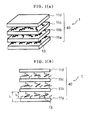
- an organic/inorganic hybrid 1 is a structure comprising an organic compound and an inorganic compound. That structure is generally made up of a layered hydroxide mineral 40 with sheet-like inorganic compound unit layers 11a, 11b, 11c and 11d, and an organic compound 13 inserted between the inorganic compound unit layers 11a, 11b, 11c and 11d.
- inorganic compound unit layers 11a, 11b, 11c and 11d are shown to be laminated one upon another in Fig. 1(a) , it is to be understood that there is no specific limitation on how many layers are laminated one upon another; two or more such layers may be laminated together because the organic compound 13 may be inserted between them.
- the hydroxide mineral 40 used herein is at least one hydroxide mineral selected from the group consisting of magnesium hydroxide Mg(OH) (brucite), calcium hydroxide Ca(OH) 2 (portlandite), aluminum hydroxides represented by ⁇ -Al(OH) 3 (gibbsite), ⁇ -AlO(OH) (boehmite), ⁇ -Al(OH) 3 (nordstrandite), ⁇ -Al(OH) 3 (doyleite) and ⁇ -Al(OH) 3 (bialite), and ferric hydroxides represented by Fe(OH) 3 (bernalite) and ⁇ -FeO (lepidocrocite), among which brucite, gibbsite, boehmite and portlandite are more preferred.
- These materials are composed of ions of metals: magnesium, calcium, aluminum, and iron, and the inorganic compound unit layers 11a, 11b, 11c and 11d are bonded together by way of hydrogen bonds into a crystal structure that makes it possible to produce an organic/inorganic hybrid having high stability.
- the hydroxide mineral 40 may be either a naturally occurring one or a man-made synthetic one. Synthesis processes, for instance, may rely on alkali-neutralization reactions at relatively low temperatures, precipitation from oversaturated solutions, and hydrolysis of metal alkoxides.
- Fig. 1(b) is a side view of the organic/inorganic hybrid 1 shown in Fig. 1(a) .
- Fig. 1(b) there are none of hydrogen bonds formed between the OH groups of the adjacent inorganic compound unit layers 11a, 11b, 11c and 11d, and instead there is the organic compound 13 included between the inorganic compound unit layers 11a, 11b, 11c and 11d.
- the organic/inorganic hybrid 1 shown in Fig. 1 all hydrogen bonds between the inorganic compound unit layers are cut, it is to be understood that a part of the hydrogen bonds may remain uncut.
- the distance between the adjacent planes of the inorganic compound unit layers 11a and 11b is defined by t 2
- the base-to-base distance of the inorganic compound unit layers 11a and 11b is defined by t 1 .
- the inorganic compound unit layer 11a, 11b, 11c, 11d is in a sheet configuration in which the inorganic compounds are lined up.
- the inorganic compound is at least one hydroxide mineral selected from the group consisting of Mg(OH) 2 , Ca(OH) 2 , Al(OH) 3 , AlO(OH), Fe(OH) 3 and FeO(OH).
- Fig. 2 is a perspective view of one example of the inorganic compound unit layers: it is illustrative of one example wherein brucite, portlandite or the like is used as the hydroxide mineral.
- Fig. 3 is a perspective view of another example of the inorganic compound unit layers: it is illustrative of one example wherein boehmite, lepidocrocite or the like is used as the hydroxide mineral.
- An octahedron that provides a component unit of the inorganic compound unit layer 11a depicted in Figs.
- the inorganic compound unit layer 11a should preferably be such that octahedrons having OH - ions or O 2- ions hexacoordinating to at least one metal ion of Mg 2+ , Ca 2+ , Al 3+ or Fe 3+ are lined up through edge sharing in a sheet configuration. This is because there can be stable inorganic compound unit layer obtained.
- the inorganic compound unit layer 11a, 11b, 11c, 11d should preferably be electrically neutral, and have a lot of hydroxyl groups on its surface. In the presence of layer charges, there must be exchangeable ions between the unit layers so as to neutralize them. When there are exchangeable ions, it will be difficult to include an organic compound between the unit layers unless it is an ionic one that forms pairs with them. According to the invention, hydroxyl groups on the surface of the unit layer have a strong affinity for a sugar and/or a sugar alcohol having 4 to 40 carbon atoms, making sure the formation of a stable inclusion compound.
- the organic compound 13 should preferably be a saccharide having 4 to 40 carbon atoms.
- a saccharide having less than 4 carbon atoms because of having an insufficient affinity for high molecules, will encounter difficulty achieving fine dispersion, resulting in the inability to allow for sufficient improvements in flame retardancy and mechanical properties.
- a saccharide having more than 40 carbon atoms because of being too large in molecular size, will encounter difficulty being included between the inorganic compound unit layers of the hydroxide mineral.
- Use of the saccharide having 4 to 40 carbon atoms allows the organic/inorganic hybrid 1 that is one embodiment of the invention to have high flexibility and high moldability, and be used as a flame retarder by itself.
- hybrid 1 into a material that enables the fine inorganic compound unit layers to be easily dispersed in plastics. This may have applications to a nanocomposite or nanohybrid material having improved flame retardancy.
- the saccharides having more than 4 carbon atoms include sugar alcohols, and sugars or derivatives of them.
- the sugar alcohols used herein should preferably be at least one selected from the group consisting of erythritol, threitol, arabinitol, xylitol, ribitol, iditol, galactitol, sorbitol, mannitol, volemitol, perseitol, and D-erythro-D-galacto-octitol.
- the sugars used herein should preferably be at least one selected from the group consisting of glucose, fructose, galactose, mannose, maltose, sucrose, lactose, fructo-oligosaccharide, galacto-oligosaccharide, raffinose, galactose, stachyose, starch, glycogen, cellulose, pectin, alginic acid, glucomannan, chitin, hyaluronic acid, chondoroitin, and agarose.
- the process of producing the inorganic/organic hybrid that is one embodiment of the invention is what is called a mixing/melting process. More specifically, the invention provides a process of producing the organic/inorganic hybrid 1, comprising a step of mixing together the hydroxide mineral and the saccharide(s) having 4 to 40 carbon atoms to form a mixture (hereinafter referred to as the mixture-formation step) and a step of melting that mixture (hereinafter referred to as the melting step).
- hydroxide mineral and the saccharide(s) having 4 to 40 carbon atoms are provided and mixed together to form a mixture. If the hydroxide mineral is in a pulverized state, it is then possible to form a mixture at a uniform mixing ratio. It is here important to bring the hydroxide mineral in contact with the saccharide(s) having 4 to 40 carbon atoms over as many areas as possible.
- Fig. 4 is a schematic side view of one example of the hydroxide mineral 40. As depicted, the inorganic compound unit layers 11a, 11b, 11c and 11d are laminated one upon another, and firmly bonded to each other via hydrogen bonds between OH groups.
- the mixture is placed in a reactor controllable in terms of temperature and stirring. Subsequently, the mixture is molten in a temperature range that is below the thermal decomposition temperature of the saccharide and higher than 150°C.
- the melting time is set at 24 hours as an example. It is thus possible to easily produce the organic/inorganic hybrid 1 depicted in Fig. 1 .
- the reaction product may be washed with an organic solvent such as methanol, filtered, and dried. This enables impurities to be removed to make the purity of the organic/inorganic hybrid 1 high.
- the mixture melting process of the invention may be carried out such that after the mixing of the components, the mixture is melted and kneaded.
- melt kneading may be done in a continuous or batch mode by known heating/kneading processes such as those using a Banbury mixer, a Brabender, a kneader, a roll, a uniaxial or multiaxial extruder, and a co-kneader.
- the mixture should preferably be molten in a temperature range that is below the thermal decomposition temperature of the saccharide(s) and higher than 150°C.
- the mixture is molten at a temperature below 150°C, some hydrogen bonds between the inorganic compound unit layers remain uncut with the result that a sufficient amount of the organic compound will not be included.
- the mixture is molten at a temperature higher than the thermal decomposition temperature of the saccharide(s) having 4 to 40 carbon atoms, conversely, thermal degradation of the sugar or sugar alcohol keeps going on excessively by long-term melting and mixing, resulting in a failure in the preparation of a uniform organic/inorganic hybrid.
- the distance t 4 between the adjacent planes of the inorganic compound unit layers 11a and 11b of the hydroxide mineral 40 before formed into the organic/inorganic hybrid is narrower than the distance t 2 between the adjacent planes of the inorganic compound unit layers 11a and 11b after formed into the organic/inorganic hybrid, and the base-to-base distance t 3 of the inorganic compound unit layers 11a and 11b of the hydroxide mineral 40 before formed into the organic/inorganic hybrid is narrower than the base-to base distance t 1 of the inorganic compound unit layers 11a and 11b of the hydroxide mineral 40 after formed into the organic/inorganic hybrid.
- the organic/inorganic hybrid 1 that is one embodiment of the invention comprises the layered hydroxide mineral 40 with sheet-like inorganic compound unit layers 11a, 11b,11c and 11d and the organic compound 13 included between the inorganic compound unit layers 11a, 11b, 11c and 11d, wherein the hydroxide mineral is at least one selected from the group consisting of Mg(OH) 2 , Ca(OH) 2 , Al(OH) 3 , AlO(OH), Fe(OH) 3 and FeO(OH), and the organic compound is a saccharide having 4 to 40 carbon atoms.
- organic/inorganic hybrid that is one embodiment of the invention is modified such that there is none of aluminum contained, for instance, into an organic compound/brucite (Mg(OH) 2 ) hybrid, it provides a DDS material having no risk of inducing aluminum-associated encephalosis.
- the hydroxide mineral 40 is at least one hydroxide mineral selected from the group consisting of brucite, portlandite, gibbsite, boehmite, nordstrandite, doyleite, bialite, bernalite, and lepidocrocite. It is thus possible to produce an organic/inorganic hybrid of high stability that has a stable layer structure.
- the inorganic compound unit layer 11a, 11b, 11c, and 11d is electrically neutral, and has a lot of hydroxyl groups on its surface. It is thus possible to include the sugar alcohols and/or sugars having 4 to 40 carbon atoms in it.
- the inorganic compound unit layer 11a, 11b, 11c, 11d is such that octahedrons having OH - ion or O 2- ions hexacoorinating to at least one metal ion of Mg 2+ , Ca 2+ , Al 3+ or Fe 3+ are lined up through edge sharing in a sheet configuration. It is thus possible to obtain stable inorganic compound unit layers thereby improving the stability of the organic/inorganic hybrid 1.
- the saccharide 13 having 4 to 40 carbon atoms is a sugar alcohol, a sugar or a derivative thereof. This allows the organic/inorganic hybrid 1 to have high flexibility and moldability, and be used as a flame retarder by itself. If that hybrid has a high affinity for organic compounds, it may provide a material that can easily, finely be dispersed in plastics to form a composite material. This may lead to a nanocomposite or nanohybrid material having high flame retardancy.
- the sugar alcohol is at least one sugar alcohol selected from the group consisting of erythritol, threitol, arabinitol, xylitol, ribitol, iditol, galactitol, sorbitol, mannitol, volemitol, perseitol, and D-erythro-D-galacto-octitol.
- erythritol threitol
- arabinitol arabinitol
- xylitol ribitol
- iditol galactitol
- sorbitol mannitol
- volemitol perseitol
- D-erythro-D-galacto-octitol D-erythro-D-galacto-octitol.
- the sugar is at least one sugar selected from the group consisting of glucose, fructose, mannose, maltose, sucrose, lactose, fructo-oligosaccharide, galacto-oligasaccharide, raffinose, galactose, stachyose, starch, glycogen, cellulose, pectin, alginic acid, glucomannan, chitin, hyaluronic acid, chondoroitin, and agarose. Having high flame retardancy, flexibility, moldability and affinities for organic compounds, that organic/inorganic hybrid 1 can include therein an organic compound having a lot of carbon atoms.
- the process of producing the organic/inorganic hybrid 1 comprises a step of mixing the hydroxide mineral 40 with the saccharide(s) 13 having 4 to 40 carbon atoms to form a mixture, and a step of melting said mixture.
- the hydrogen bonds via which the inorganic compound unit layers of the hydroxide mineral 40 are firmly bonded together are cut to make the interlayer space so wide that the saccharide(s) 13 can be included therein. It is thus possible to easily produce an organic/inorganic hybrid comprising an inorganic compound layer having inorganic compound unit layers lined up in a sheet configuration and an organic compound included between the laminated inorganic compound unit layers.
- the interlayer hydrogen bonds of the inorganic compound unit layers can sufficiently be cut to include a sufficient amount of the organic compound therein. Even though melting/mixing is carried out for an extended period of time, there is no risk of accelerating thermal degradation of sugar(s) and sugar alcohol(s), which makes sure the preparation of a homogeneous organic/inorganic hybrid.
- the saccharide(s) having 4 to 40 carbon atoms is any one of a sugar alcohol, a sugar or a derivative thereof. With that saccharide having high flame retardancy, flexibility, moldability and affinities for organic compounds, it is possible to easily produce an organic/inorganic hybrid that can include therein an organic compound having a lot of carbon atoms.
- the invention provides an organic/inorganic hybrid having high flame retardancy, flexibility, moldability and affinities for organic compounds, and a process of producing the same.
- the inventive organic/inorganic hybrid may be used in various fields, for instance, as purification adsorbents for water and waste oils, catalysts for petroleum cracking, agents form removal of sulfur oxides from thermal power plant emissions, counteragents for acidified rivers and soils, pharmaceutical raw materials, and flame retarders for plastics.
- the inventive hybrids are effective as flame retarders and DDS materials, and may have applications to the organic synthesis chemistry, pharmaceutics or like industries.
Landscapes
- Chemical & Material Sciences (AREA)
- Organic Chemistry (AREA)
- Inorganic Chemistry (AREA)
- Life Sciences & Earth Sciences (AREA)
- Geology (AREA)
- Engineering & Computer Science (AREA)
- Materials Engineering (AREA)
- Compounds Of Alkaline-Earth Elements, Aluminum Or Rare-Earth Metals (AREA)
- Oxygen, Ozone, And Oxides In General (AREA)
- Fireproofing Substances (AREA)
Abstract
Description
- The present invention relates to organic/inorganic hybrids, and a process of producing them.
- Hydroxide minerals represented by brucite, portlandite, gibbsite, boehmite, lepidocrocite, etc. are ubiquitous substances that occur abundantly in the surface layer of the earth.
Hydroxide minerals have a variety of features inclusive of absorption capability, catalytic activity, and harmless to the human body (free from antigen-antibody reactions). For this reason, they have been used in a variety of fields in the form of purification adsorbents for water and waste oils, catalysts for petroleum cracking, agents form removal of sulfur oxides from thermal power plant emissions, counteragents for acidified rivers and soils, pharmaceutical raw materials, flame retarders for plastics, and so on.
Now they attract attention as pharmaceutical raw materials and retarders in particular. - For instance, Patent Publication 1 discloses pharmaceutical raw materials harnessing hydroxide minerals excelling in antacid capability, and Patent Publication 2 discloses materials for drug delivery systems (DDS for short) making use of hydroxide minerals. Note here that DDS is a technology for quantitative, spatial and time control of the distribution of biomolecules and drugs injected into the living body.
- A typical hydroxide mineral is a multilayered structure having as a basic structure unit layers wherein octahedrons having OH- or O2- hexacoordinating to a metal such as Mg2+, Ca2+, Al3+, and Fe3+ are lined up through edge sharing in a planar configuration. If an organic compound is inserted between the unit layers, its affinity for that organic compound could grow high.
- In practical applications of inorganic compounds having a laminated structure like clay minerals, layered titanates, chalcogen compounds, and aluminum-magnesium composite hydroxides (hereinafter called hydrotalcite), an organic compound is inserted between the unit layers instead of interlayer ions (hereinafter also called exchangeable ions) to form a structure (hereinafter called the organic/inorganic hybrid) where the organic compound is hybridized with the inorganic compound in a nanoarea (hereinafter called the nanohybridization). Especially in the development of DDS going deep into the nanoarea, there is an organic/inorganic hybrid formed in which biomolecules or drugs having exchangeable ions are included (or intercalated) between the unit layers.
- Non-Patent Publications 1 and 2 show organic/ inorganic hybrids prepared by high-temperature treatment of glycols having two carbon atoms or glycerols having three carbon atoms, all being sugar alcohols that are liquid at room temperature.
- However, the unit layers of the hydroxide mineral is electrically neutral, and do not have any interlayer ions for neutralizing their charges, with the adjacent planes of the unit layers being strongly bonded to each other by way of hydrogen bonds. It is still difficult to include the organic compound in a narrow space between the unit layers.
There is also still no effective method of cutting hydrogen bonds by way of which the unit layers are bonded together, and it is still impossible to include the organic molecules between the unit layers either.
With the possibility of using hydroxide minerals as DDS materials in consideration, many organic compounds having medication efficacies have a large number of carbon atoms, and it is still difficult to include an organic compound having a lot of carbon atoms in a narrow space between the unit layers.
There has also been difficulty achieving a material that has a sustained release feature good enough to release the included organic compound slowly in constant amounts over the elapse of constant times.
In addition, the aforesaid hydrotalcite contains aluminum, and as it is used as the DDS material, there is a risk of inducing aluminum-associated encephalosis or the like. - It has also been known in the art that hydroxide minerals are usable as flame retarders for plastics.
For instance, brucite and gibbsite dehydrate and decompose drastically at 200 to 400°C, causing an endothermic reaction. With gibbsite, an endothermic reaction of about 1.5 kJ/g keeps going on, and with brucite, an endothermic reaction of 1.39 kJ/g keeps going on. An exothermic reaction of polyethylene is 43.4 kJ per gram. If polyethylene is blended with 66% by mass of gibbsite, the generation of heat by burning is almost leveled with the absorption of heat by the decomposition of gibbsite, resulting in a lowering of the temperature of a burning reaction field, which prevents burning from going on. Hydroxide minerals hinder a burning reaction of plastics, keeps temperature against rising upon burning of plastics, have a self-extinguishing feature, and facilitate prevention of smoking. Furthermore, brucite and gibbsite do not give rise to dioxin or other toxic gases upon burning; they are used as eco-friendly non-halogen flame retarders.
Upon high-density packaging of hydroxide minerals in high molecules such as polyethylene, however, there is a risk of being noticeably detrimental to flexibility and moldability, which offers a grave practical challenging problem. - If an inorganic compound is pulverized down to a nanometer level for dispersion throughout a plastic or rubber component, it is then possible to obtain a nanocomposite material having high flame retardancy. The finely pulverized inorganic compound forms a carbide film called a char on a burning surface, which keeps oxygen against being fed under burning reactions, producing a flame retarding effect.
Even though hydrophilic hydroxide minerals are hybridized into high molecules as they stand, however, it is much detrimental to dispersibility, encountering difficulty obtaining flame retarding features through fine dispersion. -
- Patent Publication 1: Patent No.
3977724 - Patent Publication 2:
W02007-029376 -
- Non-Patent Publication 1:
- M. Inoue, H. Kominami, Y. Kondo, T. Inui, "Organic Derivatives of Layered Inorganics Having the Second Stage Structure" Chem. Mater., 9, 1614-1619 (1997)
- Non-Patent Publication 2:
- F. Wypych, W. H. Schreiner, R. Marangoni, "Covalent Grafting of Ethylene Glycol and Glycerol into Brucite", J. Colloid. Interface. Sci., 253, 180-184 (2002)
- The invention has for its objects to provide an organic/inorganic hybrid that has high flame retardancy, flexibility, moldability and affinities for organic compounds, and is capable of including therein an organic compound having a large number of carbon atoms, and a process of producing the same.
- The inventors have found out that a saccharide having four or more carbon atoms can be included between the unit layers of an electrically neutral organic compound layer, accomplishing the invention disclosed herein.
That is, the invention disclosed herein is embodied as the following (1) to (10). -
- (1) An organic/inorganic hybrid, comprising a layered hydroxide mineral with sheet-like inorganic compound unit layers, and an organic compound included between said inorganic compound unit layers, characterized in that said hydroxide mineral is at least one hydroxide mineral selected from the group consisting of Mg(OH)2, Ca(OH)2, Al(OH)3, Al(OH), Fe(OH)3 and FeO(OH), and said organic compound is a saccharide having 4 to 40 carbon atoms.
- (2) The organic/inorganic hybrid as recited in (1), characterized in that said hydroxide mineral is one hydroxide mineral selected from the group consisting of brucite, portlandite, gibbsite, boehmite, nordstrandite, doyleite, bialite, bernalite, and lepidocrocite.
- (3) The organic/inorganic hybrid as recited in (1) or (2), characterized in that each of said inorganic compound unit layers is electrically neutral and has hydroxyl groups on its surface.
- (4) The organic/inorganic hybrid as recited in (3), characterized in that hydrogen bonds between said hydroxyl groups between adjacent said inorganic compound unit layers are cut.
- (5) The organic/inorganic hybrid as recited in (4), characterized in that a part of said hydrogen bonds between said hydroxyl groups remains uncut.
- (6) The organic/inorganic hybrid as recited in any one of (1) to (5), characterized in that each of said inorganic compound unit layers has octahedrons lined up through edge sharing in a sheet configuration, wherein each octahedron has OH- or O2- ions hexacoordinating to any one metal ion of Mg2+, Ca2+, Al3+ or Fe3+.
- (7) The organic/inorganic hybrid as recited in any one of (1) to (6), characterized in that said saccharide having 4 to 40 carbon atoms is at least one saccharide selected from the group consisting of a sugar alcohol, a sugar, and a derivative thereof.
- (8) The organic/inorganic hybrid as recited in (7), characterized in that said sugar alcohol is at least one sugar alcohol selected from the group consisting of erythritol, threitol, arabinitol, xylitol, ribitol, iditol, galactitol, sorbitol, mannitol, volemitol, perseitol, and D-erythro-D-galacto-octitol.
- (9) The organic/inorganic hybrid as recited in (7), characterized in that said sugar is at least one sugar selected from the group consisting of glucose, fructose, galactose, mannose, maltose, sucrose, lactose, fructo-oligosaccharide, galacto-oligosaccharide, raffinose, stachyose, starch, glycogen, cellulose, pectin, alginic acid, glucomannan, chitin, hyaluronic acid, chondoroitin, and agarose.
- (10) A process of producing the organic/inorganic hybrid as recited in any one of (1) to (9), characterized by comprising a step of mixing said hydroxide mineral with said saccharide having 4 to 40 carbon atoms to form a mixture, and a step of melting said mixture to cut hydrogen bonds between adjacent said inorganic compound unit layers.
- (11) The process of producing the organic/inorganic hybrid as recited in (10), characterized in that said mixture is molten in a temperature range that is below the thermal decomposition temperature of said saccharide having 4 to 40 carbon atoms and higher than 150°C.
- The invention disclosed here provides an organic/inorganic hybrid comprising a hydroxide mineral with sheet-like inorganic compound unit layers lined up and laminated one upon another and an organic compound included between said inorganic compound unit layers, wherein said hydroxide mineral is at least one hydroxide mineral selected from the group consisting of Mg(OH)2, Ca(OH)2, Al(OH)3, AlO(OH), Fe(OH)3 and FeO(OH), and said organic compound is a saccharide having 4 to 40 carbon atoms. Thus, the inventive organic/inorganic hybrid provides a material that combines the high flame retardancy inherent in the hydroxide mineral with the high flexibility and moldability inherent in the saccharide having 4 to 40 carbon atoms, and that may be used as a flame retardant by itself. That material has an affinity for organic compounds, and may easily be mixed with plastics for possible applications to nanocomposiste or nanohybrid materials having high flame retardancy. To add to this, an organic compound having a high affinity for saccharides may be held in gaps between saccharides between the unit layers of the hydroxide mineral, and there is a sustained release material obtained as well. This may allow the inventive organic/inorganic hybrid to be applied to substance delivery materials.
- The invention disclosed herein also provides a process of producing the aforesaid organic/inorganic hybrid, comprising the step of mixing the hydroxide mineral with the saccharide having 4 to 40 carbon atoms, and the step of melting said mixture. This enables hydrogen bonds via which the unit layers of the hydroxide mineral are firmly bonded together to be cut to make spaces between said unit layers so wide that there can be an organic/inorganic hybrid easily produced, comprising a hydroxide mineral with sheet-like inorganic compound unit layers lined up and laminated one upon another and an organic compound included between said inorganic compound unit layers.
-
-
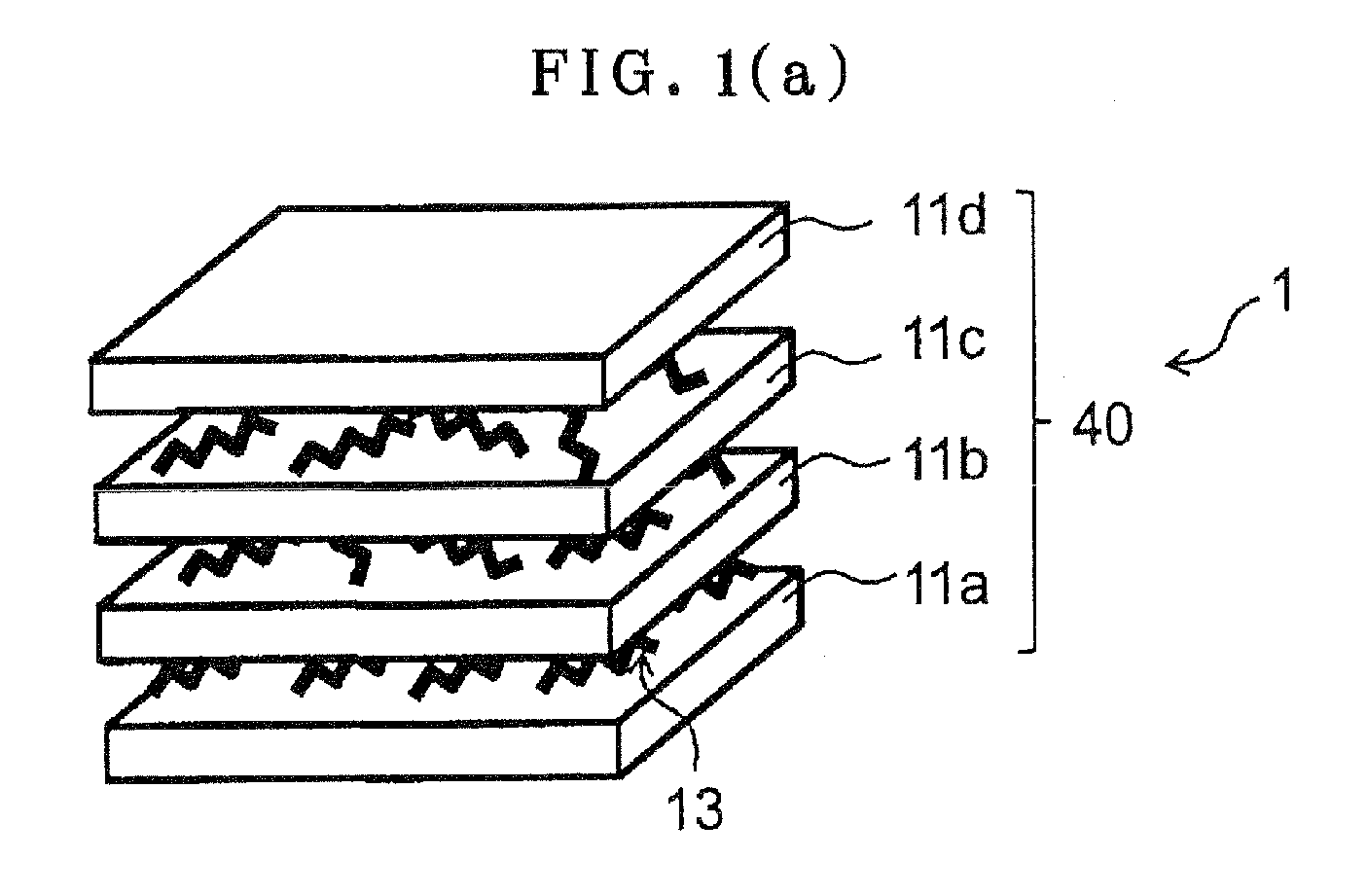
Fig. 1 is illustrative in schematic of one example of the inventive organic/inorganic hybrid:Fig. 1(a) is a perspective view andFig. 1(b) is a side view. -
Fig. 2 is illustrative in perspective of one example of the inorganic compound unit layers. -
Fig. 3 is illustrative in perspective of another example of the inorganic compound unit layers. -
Fig. 4 is a side schematic of one example of the hydroxide mineral. -
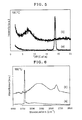
Fig. 5 is indicative of XRD patterns for brucite (a) and a brucite/D-sorbitol hybrid (b) (180°C reaction). -
Fig. 6 is indicative of FT-IR spectra for brucite (a) and a brucite/D-sorbitol hybrid (b) (180°C reaction). -
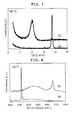
Fig. 7 is indicative of XRD patterns for brucite (a) and a brucite/xylitol hybrid (b) (180°C reaction). -
Fig. 8 is indicative of FT-IR spectra for brucite (a) and a brucite/xylitol hybrid (b) (180°C reaction). -
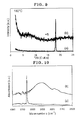
Fig. 9 is indicative of XRD patterns for portlandite (a) and a portlandite/D-sorbitol hybrid (b) (180°C reaction). -
Fig. 10 is indicative of FT-IR spectra for portlandite (a) and a portlandite/D-sorbitol hybrid (b) (180°C reaction). -
Fig. 11 is indicative of XRD patterns for portlandite (a) and a portlandite/erythritol hybrid (b) (180°C reaction). -
Fig. 12 is indicative of FT-IR spectra for portlandite (a) and a portlandite/erythritol hybrid (b) (180°C reaction). -
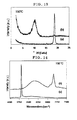
Fig. 13 is indicative of XRD patterns for brucite (a) and a brucite/D-sorbitol hybrid (b) (150°C reaction). -
Fig. 14 is indicative of FT-IR spectra for brucite (a) and a brucite/D-sorbitol hybrid (b) (150°C reaction). -
Fig. 15 is indicative of XRD patterns for brucite (a) and a brucite/D-sorbitol hybrid (b) (120°C reaction). -
Fig. 16 is indicative of FT-IR spectra for brucite (a) and a brusite/D-scrbitol hybrid (b) (120°C reaction). -
Fig. 17 is indicative of FT-IR spectra for brusite (a) and a brucite/D-sorbitol hybrid prepared with a water solvent (180°C hydrothermal reaction for 24 hours). - The organic/inorganic hybrids according to some embodiments of the invention will now be explained with reference to the accompanying drawings.
Fig. 1 is illustrative in schematic of the organic/inorganic hybrid according to one embodiment of the invention.
As depicted inFig. 1(a) , an organic/inorganic hybrid 1 according to one embodiment of the invention is a structure comprising an organic compound and an inorganic compound. That structure is generally made up of a layeredhydroxide mineral 40 with sheet-like inorganic compound unit layers 11a, 11b, 11c and 11d, and anorganic compound 13 inserted between the inorganic compound unit layers 11a, 11b, 11c and 11d.
While four inorganic compound unit layers 11a, 11b, 11c and 11d are shown to be laminated one upon another inFig. 1(a) , it is to be understood that there is no specific limitation on how many layers are laminated one upon another; two or more such layers may be laminated together because theorganic compound 13 may be inserted between them. - The
hydroxide mineral 40 used herein is at least one hydroxide mineral selected from the group consisting of magnesium hydroxide Mg(OH) (brucite), calcium hydroxide Ca(OH)2 (portlandite), aluminum hydroxides represented by γ-Al(OH)3 (gibbsite), γ-AlO(OH) (boehmite), β-Al(OH)3 (nordstrandite), δ-Al(OH)3 (doyleite) and α-Al(OH)3 (bialite), and ferric hydroxides represented by Fe(OH)3 (bernalite) and γ-FeO (lepidocrocite), among which brucite, gibbsite, boehmite and portlandite are more preferred. These materials are composed of ions of metals: magnesium, calcium, aluminum, and iron, and the inorganic compound unit layers 11a, 11b, 11c and 11d are bonded together by way of hydrogen bonds into a crystal structure that makes it possible to produce an organic/inorganic hybrid having high stability. - The
hydroxide mineral 40 may be either a naturally occurring one or a man-made synthetic one. Synthesis processes, for instance, may rely on alkali-neutralization reactions at relatively low temperatures, precipitation from oversaturated solutions, and hydrolysis of metal alkoxides. -
Fig. 1(b) is a side view of the organic/inorganic hybrid 1 shown inFig. 1(a) .
As depicted inFig. 1(b) , there are none of hydrogen bonds formed between the OH groups of the adjacent inorganic compound unit layers 11a, 11b, 11c and 11d, and instead there is theorganic compound 13 included between the inorganic compound unit layers 11a, 11b, 11c and 11d.
While, in the organic/inorganic hybrid 1 shown inFig. 1 , all hydrogen bonds between the inorganic compound unit layers are cut, it is to be understood that a part of the hydrogen bonds may remain uncut.
It is also to be understood that the distance between the adjacent planes of the inorganic compound unit layers 11a and 11b is defined by t2, and the base-to-base distance of the inorganic compound unit layers 11a and 11b is defined by t1. - The inorganic
compound unit layer
Preferably, the inorganic compound is at least one hydroxide mineral selected from the group consisting of Mg(OH)2, Ca(OH)2, Al(OH)3, AlO(OH), Fe(OH)3 and FeO(OH). -
Fig. 2 is a perspective view of one example of the inorganic compound unit layers: it is illustrative of one example wherein brucite, portlandite or the like is used as the hydroxide mineral.
Fig. 3 is a perspective view of another example of the inorganic compound unit layers: it is illustrative of one example wherein boehmite, lepidocrocite or the like is used as the hydroxide mineral.
An octahedron that provides a component unit of the inorganiccompound unit layer 11a depicted inFigs. 2 and 3 has any one metal ion of Mg2+, Ca2+, Al3+ or Fe3+ at its center, with a OH- ion or O2- ion coordinating to each apex.
As shown inFigs. 2 and 3 , the inorganiccompound unit layer 11a should preferably be such that octahedrons having OH- ions or O2- ions hexacoordinating to at least one metal ion of Mg2+, Ca2+, Al3+ or Fe3+ are lined up through edge sharing in a sheet configuration. This is because there can be stable inorganic compound unit layer obtained. - The inorganic
compound unit layer - The
organic compound 13 should preferably be a saccharide having 4 to 40 carbon atoms. A saccharide having less than 4 carbon atoms, because of having an insufficient affinity for high molecules, will encounter difficulty achieving fine dispersion, resulting in the inability to allow for sufficient improvements in flame retardancy and mechanical properties. A saccharide having more than 40 carbon atoms, because of being too large in molecular size, will encounter difficulty being included between the inorganic compound unit layers of the hydroxide mineral.
Use of the saccharide having 4 to 40 carbon atoms allows the organic/inorganic hybrid 1 that is one embodiment of the invention to have high flexibility and high moldability, and be used as a flame retarder by itself. It is also possible to modify thathybrid 1 into a material that enables the fine inorganic compound unit layers to be easily dispersed in plastics. This may have applications to a nanocomposite or nanohybrid material having improved flame retardancy. In addition, it is possible to retain an organic compound having a high affinity for thesaccharide 13 and usable as a drug formulation in gaps between the saccharides between the inorganic compound unit layers 11a, 11b, 11c and 11d, and modify that drug formulation into a material having sustained release features as good as making sure sustained release of small amounts over the elapse of constant times. This may be applied to DDS materials. - The saccharides having more than 4 carbon atoms, for instance, include sugar alcohols, and sugars or derivatives of them.
The sugar alcohols used herein should preferably be at least one selected from the group consisting of erythritol, threitol, arabinitol, xylitol, ribitol, iditol, galactitol, sorbitol, mannitol, volemitol, perseitol, and D-erythro-D-galacto-octitol. - The sugars used herein should preferably be at least one selected from the group consisting of glucose, fructose, galactose, mannose, maltose, sucrose, lactose, fructo-oligosaccharide, galacto-oligosaccharide, raffinose, galactose, stachyose, starch, glycogen, cellulose, pectin, alginic acid, glucomannan, chitin, hyaluronic acid, chondoroitin, and agarose.
- It is here to be noted that just only a saccharide but also two or more saccharides may be included between the inorganic compound unit layers. This may help optimize the properties of the organic/inorganic hybrid.
- The process of producing the inorganic/organic hybrid that is one embodiment of the invention will now be explained.
The process of producing the inorganic/organic hybrid that is one embodiment of the invention is what is called a mixing/melting process. More specifically, the invention provides a process of producing the organic/inorganic hybrid 1, comprising a step of mixing together the hydroxide mineral and the saccharide(s) having 4 to 40 carbon atoms to form a mixture (hereinafter referred to as the mixture-formation step) and a step of melting that mixture (hereinafter referred to as the melting step). - First of all, given amounts of the hydroxide mineral and the saccharide(s) having 4 to 40 carbon atoms are provided and mixed together to form a mixture. If the hydroxide mineral is in a pulverized state, it is then possible to form a mixture at a uniform mixing ratio. It is here important to bring the hydroxide mineral in contact with the saccharide(s) having 4 to 40 carbon atoms over as many areas as possible.
-
Fig. 4 is a schematic side view of one example of thehydroxide mineral 40. As depicted, the inorganic compound unit layers 11a, 11b, 11c and 11d are laminated one upon another, and firmly bonded to each other via hydrogen bonds between OH groups. - Then, the mixture is placed in a reactor controllable in terms of temperature and stirring.
Subsequently, the mixture is molten in a temperature range that is below the thermal decomposition temperature of the saccharide and higher than 150°C. The melting time is set at 24 hours as an example. It is thus possible to easily produce the organic/inorganic hybrid 1 depicted inFig. 1 .
It is here to be noted that after the reaction, the reaction product may be washed with an organic solvent such as methanol, filtered, and dried. This enables impurities to be removed to make the purity of the organic/inorganic hybrid 1 high.
The mixture melting process of the invention may be carried out such that after the mixing of the components, the mixture is melted and kneaded. It is thus possible for the organic compound to be more uniformly included between the inorganic compound unit layers of the hydroxide mineral. Melt kneading, for instance, may be done in a continuous or batch mode by known heating/kneading processes such as those using a Banbury mixer, a Brabender, a kneader, a roll, a uniaxial or multiaxial extruder, and a co-kneader. - The mixture should preferably be molten in a temperature range that is below the thermal decomposition temperature of the saccharide(s) and higher than 150°C.
When the mixture is molten at a temperature below 150°C, some hydrogen bonds between the inorganic compound unit layers remain uncut with the result that a sufficient amount of the organic compound will not be included. When the mixture is molten at a temperature higher than the thermal decomposition temperature of the saccharide(s) having 4 to 40 carbon atoms, conversely, thermal degradation of the sugar or sugar alcohol keeps going on excessively by long-term melting and mixing, resulting in a failure in the preparation of a uniform organic/inorganic hybrid. - The distance t4 between the adjacent planes of the inorganic compound unit layers 11a and 11b of the
hydroxide mineral 40 before formed into the organic/inorganic hybrid is narrower than the distance t2 between the adjacent planes of the inorganic compound unit layers 11a and 11b after formed into the organic/inorganic hybrid, and the base-to-base distance t3 of the inorganic compound unit layers 11a and 11b of thehydroxide mineral 40 before formed into the organic/inorganic hybrid is narrower than the base-to base distance t1 of the inorganic compound unit layers 11a and 11b of thehydroxide mineral 40 after formed into the organic/inorganic hybrid.
By use of the process of producing the organic/inorganic hybrid that is one embodiment of the invention, however, it is possible to cut the hydrogen bonds via which the inorganic compound unit layers are bonded together and extend the distance between the adjacent planes and the base-to-base distance thereby including between the unit layers the organic compound that is the saccharide(s) having 4 to 40 carbon atoms.
Although, in order to include an organic compound in a hydroxide mineral, there has generally been a solvent method used in which a powdery, solid saccharide is dissolved in a good solvent for reactions with the hydroxide mineral, yet it is impossible to efficiently cut the hydrogen bonds between the inorganic compound unit layers, resulting in a failure in including a sufficient amount of the organic compound in the hydroxide mineral. In other words, it is impossible to produce the organic/inorganic hybrid 1 that is one embodiment of the invention. - The organic/
inorganic hybrid 1 that is one embodiment of the invention comprises the layeredhydroxide mineral 40 with sheet-like inorganic compound unit layers 11a, 11b,11c and 11d and theorganic compound 13 included between the inorganic compound unit layers 11a, 11b, 11c and 11d, wherein the hydroxide mineral is at least one selected from the group consisting of Mg(OH)2, Ca(OH)2, Al(OH)3, AlO(OH), Fe(OH)3 and FeO(OH), and the organic compound is a saccharide having 4 to 40 carbon atoms. It is thus possible to achieve a material that combines the high flame retardancy of the hydroxide mineral with the high flexibility and moldability of the saccharide having 4 to 40 carbon atoms, and that may be used as a flame retarder by itself. According to the invention, it is further possible to provide a material that may have applications to a nanocomposite or nanohybrid material of high flame retardancy that has an affinity for organic compounds, and may easily be mixed with plastics. Furthermore, it is possible to obtain a material that may retain organic compounds having a high affinity for saccharides in gaps between the saccharides between the unit layers of the hydroxide mineral and has sustained release features. That sustained releasing material may then be applied to substance delivery materials.
Especially if the organic/inorganic hybrid that is one embodiment of the invention is modified such that there is none of aluminum contained, for instance, into an organic compound/brucite (Mg(OH)2) hybrid, it provides a DDS material having no risk of inducing aluminum-associated encephalosis. - In the organic/
inorganic hybrid 1 that is one embodiment of the invention, thehydroxide mineral 40 is at least one hydroxide mineral selected from the group consisting of brucite, portlandite, gibbsite, boehmite, nordstrandite, doyleite, bialite, bernalite, and lepidocrocite. It is thus possible to produce an organic/inorganic hybrid of high stability that has a stable layer structure. - In the organic/
inorganic hybrid 1 that is one embodiment of the invention, the inorganiccompound unit layer - In the organic/
inorganic hybrid 1 that is one embodiment of the invention, the inorganiccompound unit layer inorganic hybrid 1. - In the organic/
inorganic hybrid 1 that is one embodiment of the invention, thesaccharide 13 having 4 to 40 carbon atoms is a sugar alcohol, a sugar or a derivative thereof. This allows the organic/inorganic hybrid 1 to have high flexibility and moldability, and be used as a flame retarder by itself. If that hybrid has a high affinity for organic compounds, it may provide a material that can easily, finely be dispersed in plastics to form a composite material. This may lead to a nanocomposite or nanohybrid material having high flame retardancy. In addition, it is possible to retain an organic compound having a high affinity for thesaccharide 13 and usable as a drug formulation in gaps between the saccharides between the inorganic compound unit layers 11a, 11b, 11c and 11d, and modify that drug formulation into a material having sustained release features as good as making sure sustained release of small amounts over the elapse of constant times. This hybrid may be applied to DDS materials. - In the organic/
inorganic hybrid 1 that is one embodiment of the invention, the sugar alcohol is at least one sugar alcohol selected from the group consisting of erythritol, threitol, arabinitol, xylitol, ribitol, iditol, galactitol, sorbitol, mannitol, volemitol, perseitol, and D-erythro-D-galacto-octitol. Having high flame retardancy, flexibility, moldability and affinities for organic compounds, that organic/inorganic hybrid 1 can include therein an organic compound having a lot of carbon atoms. - In the organic/
inorganic hybrid 1 that is one embodiment of the invention, the sugar is at least one sugar selected from the group consisting of glucose, fructose, mannose, maltose, sucrose, lactose, fructo-oligosaccharide, galacto-oligasaccharide, raffinose, galactose, stachyose, starch, glycogen, cellulose, pectin, alginic acid, glucomannan, chitin, hyaluronic acid, chondoroitin, and agarose. Having high flame retardancy, flexibility, moldability and affinities for organic compounds, that organic/inorganic hybrid 1 can include therein an organic compound having a lot of carbon atoms. - The process of producing the organic/
inorganic hybrid 1 that is one embodiment of the invention comprises a step of mixing thehydroxide mineral 40 with the saccharide(s) 13 having 4 to 40 carbon atoms to form a mixture, and a step of melting said mixture. With this process, the hydrogen bonds via which the inorganic compound unit layers of thehydroxide mineral 40 are firmly bonded together are cut to make the interlayer space so wide that the saccharide(s) 13 can be included therein. It is thus possible to easily produce an organic/inorganic hybrid comprising an inorganic compound layer having inorganic compound unit layers lined up in a sheet configuration and an organic compound included between the laminated inorganic compound unit layers. - According to the process of producing the organic/
inorganic hybrid 1 that is one embodiment of the invention wherein the mixture is molten in a temperature range that is below the thermal decomposition temperature of the saccharide(s) and higher than 150°C, the interlayer hydrogen bonds of the inorganic compound unit layers can sufficiently be cut to include a sufficient amount of the organic compound therein. Even though melting/mixing is carried out for an extended period of time, there is no risk of accelerating thermal degradation of sugar(s) and sugar alcohol(s), which makes sure the preparation of a homogeneous organic/inorganic hybrid. - In the process of producing the organic/
inorganic hybrid 1 that is one embodiment of the invention, the saccharide(s) having 4 to 40 carbon atoms is any one of a sugar alcohol, a sugar or a derivative thereof. With that saccharide having high flame retardancy, flexibility, moldability and affinities for organic compounds, it is possible to easily produce an organic/inorganic hybrid that can include therein an organic compound having a lot of carbon atoms. - The organic/inorganic hybrid that is one embodiment of the invention is not limited to what has been described above: it may be modified in various ways within the scope of the technical concept of the invention. By way of illustration but not by way of limitation, some specific examples of one embodiment of the invention will now be given just below.
- For estimation of hydroxide mineral/sugar hybrid samples before and after preparation, base reflection changes were examined by means of an X-ray diffractometer (Cu-Kα rays) (ULTIMA-IV made by Rigaku Co., Ltd.)
At the same time, spectral changes in the hydrogen bonds between the unit layers of the hydroxide mineral were investigated by the ATR method using a Fourier transform infrared absorption detector (IRAffinity made by Shimadzu Corporation). - One gram of brucite (Rare Metallic Co., Ltd.) as the hydroxide mineral was mixed with 10 grams of D-sorbitol (made by Nakalai Tesque Inc.), and the mixture was placed in a reactor controllable in terms of temperature and stirring (Chemist Plaza made by Shibata Scientific Technology Ltd.). The mixing/melting conditions were 180°C and 24 hours. After reaction, the reaction product was washed with methanol, filtered, and dried to prepare hydroxide mineral/sugar alcohol hybrid powders.
As a result of X-ray diffractometry, the base-to-base distance (0.48 nm) of brucite was found to be extended to 1.2 nm after reaction with D-sorbitol (Fig. 5 ). In the FT-IR spectra, OH stretching vibration near 3,690 cm-1 vanished off, and 2,900 cm-1 and 2,840 cm-1 CH stretching vibrations appeared after reaction with D-sorbitol. This has suggested that the brucite interlayer hydrogen bonds were cut, and D-sorbitol was intercalated instead (Fig. 6 ). - Experimentation was carried out much the same way as in Example 1 with the exception that xylitol was used as the sugar (made by Nakalai Tesque Inc.). The results of X-ray diffractometry are plotted in
Fig. 7 . The base-to-base distance (0.48 nm) of brucite was found to be extended to 0.9 nm after reaction with xylitol (Fig. 7 ). In the FT-IR spectra, OH stretching vibration near 3,690 cm-1 vanished off, and 2,900 cm-1 and 2,840 cm-1 CH stretching vibrations appeared after reaction with xylitol, indicating that the intercalation of xylitol occurred (Fig. 8 ). - Experimentation was carried out much the same way as in Example 1 with the exception that the hydroxide mineral used was changed to calcium hydroxide Ca(OH)2 (made by Wako Pure Chemical Industries Ltd.)(portlandite). The results of X-ray diffractometry are plotted in
Fig. 9 . The portlandite base-to-base distance of 0.49 nm was found to be extended to 1.3 nm after reaction with D-sorbitol. In the FT-IR spectra, OH stretching vibration near 3,640 cm-1 vanished off, and broad 2,900 cm-1 and 2,840 cm-1 CH stretching vibrations appeared after reaction with D-sorbitol, indicating that the intercalation of D-sorbitol occurred (Fig. 10 ). - Experimentation was carried out much the same way as in Example 3 with the exception that the sugar alcohol used was changed to erythritol (made by Nakalai Tesque Inc.). The results of X-ray diffractometry are plotted in
Fig. 11 . The portlandite base-to-base distance of 0.49 nm was found to be extended to 0.9 nm. In the FT-IR spectra, OH stretching vibration near 3,640 cm-1 vanished off, and 2,900 cm-1 and 2,840 cm-1 CH stretching vibrations appeared after reaction with erythritol, indicating that the intercalation of erythritol occurred (Fig. 12 ). - Experimentation was carried out much the same way as in Example 2 with the exception that the mixing/melting conditions were changed to 150°C and 72 hours. The brucite base-to-base distance of 0.48 nm was found to be extended to 0.9 nm after reaction with xylitol (
Fig. 13 ). In the FT-IR spectra, OH stretching vibration near 3,690 cm-1 vanished off, and 2,900 cm-1 and 2,840 cm-1 CH stretching vibrations appeared after reaction with xylitol, indicating that the intercalation of xylitol occurred (Fig. 14 ). This reveals that the brucite interlayer hydrogen bonds were cut with the intercalation of xylitol. - Experimentation was carried out much the same way as in Example 1 with the exception that the mixing/melting conditions were changed to 120°C and 24 hours. The brucite base-to-base distance of 0.48 nm was found to be invariable even after reaction with D-sorbitol (
Fig. 15 ). In the FT-IR spectra, OH stretching vibration near 3,690 cm-1 was observed even after reaction with D-sorbitol. Weak 2,900 cm-1 and 2,840 cm-1 CH stretching vibrations appeared (Fig. 16 ). This indicates that the brucite interlayer hydrogen bonds were not cut by reason of low melting temperature, and the intercalation of D-sorbitol did not occur either. - Twenty (20) grams of D-sorbitol (made by Nakalai Tesque Inc.) were dissolved in 20 ml of distilled water with the addition of 0.3 gram of brucite (made by Rare Metallic Co., Ltd.), after which the aforesaid hydrothermal reactor was used to perform heating at 180°C for 24 hours thereby preparing a sample. After washing and drying, the obtained sample was estimated as in the above examples. As a result, it was found that there was no change in the brucite interlayer base-to-base distance of 0.48 nm even after reaction with D-sorbitol (
Fig. 17 ). In the FT-IR spectra, OH stretching vibration near 3,690 cm-1 was observed even after reaction with D-sorbitol, with the spectral being much the same as inFig. 16 . This reveals that, with the solvent method, the brucite interlayer hydrogen bonds were not cut, and the intercalation of D-sorbitol did not occur either. - The invention provides an organic/inorganic hybrid having high flame retardancy, flexibility, moldability and affinities for organic compounds, and a process of producing the same. The inventive organic/inorganic hybrid may be used in various fields, for instance, as purification adsorbents for water and waste oils, catalysts for petroleum cracking, agents form removal of sulfur oxides from thermal power plant emissions, counteragents for acidified rivers and soils, pharmaceutical raw materials, and flame retarders for plastics. In particular, the inventive hybrids are effective as flame retarders and DDS materials, and may have applications to the organic synthesis chemistry, pharmaceutics or like industries.
-
- 1: Organic/inorganic hybrid
- 11a, 11b, 11c, 11d: Inorganic compound unit layers
- 13: Organic compound (saccharides having 4 to 40 carbon atoms)
- 40: Hydroxide mineral
- t1, t3: Base-to-base distance
- t2, t4: Distance between the adjacent planes of the inorganic compound unit layers
Claims (11)
- An organic/inorganic hybrid, comprising a layered hydroxide mineral with sheet-like inorganic compound unit layers, and an organic compound included between said inorganic compound unit layers, characterized in that:said hydroxide mineral is at least one hydroxide mineral selected from the group consisting of Mg(OH)2, Ca(OH)2, Al(OH)3, AlO(OH), Fe(OH)3 and FeO(OH), andsaid organic compound is a saccharide having 4 to 40 carbon atoms.
- The organic/inorganic hybrid as recited in claim 1, characterized in that said hydroxide mineral is at least one hydroxide mineral selected from the group consisting of brucite, portlandite, gibbsite, boehmite, nordstrandite, doyleite, bialite, bernalite, and lepidocrocite.
- The organic/inorganic hybrid as recited in claim 1, characterized in that each of said inorganic compound unit layers is electrically neutral and has a lot of hydroxyl groups on its surface.
- The organic/inorganic hybrid as recited in claim 3, characterized in that hydrogen bonds between said hydroxyl groups between adjacent said inorganic compound unit layers are cut.
- The organic/inorganic hybrid as recited in claim 4, characterized in that a part of the hydrogen bonds between said hydroxyl groups remains uncut.
- The organic/inorganic hybrid as recited in claim 1, characterized in that each of said inorganic compound unit layers has octahedrons lined up through edge sharing in a sheet configuration, wherein each octahedron has OH- or O2- ions hexacoordinating to any one metal ion of Mg2+, Ca2+, Al3+ or Fe3+.
- The organic/inorganic hybrid as recited in claim 1, characterized in that said saccharide having 4 to 40 carbon atoms is at least one saccharide selected from the group consisting of a sugar alcohol, a sugar, and a derivative thereof.
- The organic/inorganic hybrid as recited in claim 7, characterized in that said sugar alcohol is at least one sugar alcohol selected from the group consisting of erythritol, threitol, arabinitol, xylitol, ribitol, iditol, galactitol, sorbitol, mannitol, volemitol, perseitol, and D-erythro-D-galacto-octitol.
- The organic/inorganic hybrid as recited in claim 7, characterized in that said sugar is at least one sugar selected from the group consisting of glucose, fructose, galactose, mannose, maltose, sucrose, lactose, fructo-oligosaccharide, galacto-oligosaccharide, raffinose, stachyose, starch, glycogen, cellulose, pectin, alginic acid, glucomannan, chitin, hyaluronic acid, chondoroitin, and agarose.
- A process of producing the organic/inorganic hybrid as recited in any one of claims 1 to 9, characterized by comprising a step of mixing said hydroxide mineral with a saccharide having 4 to 40 carbon atoms to form a mixture, and a step of melting said mixture to cut hydrogen bonds between adjacent said inorganic compound unit layers.
- The process of producing the organic/inorganic hybrid as recited in claim 10, characterized in that said mixture is molten in a temperature range that is below a thermal decomposition temperature of said saccharide having 4 to 40 carbon atoms and higher than 150°C.
Applications Claiming Priority (2)
| Application Number | Priority Date | Filing Date | Title |
|---|---|---|---|
| JP2010242726A JP5700368B2 (en) | 2010-10-28 | 2010-10-28 | Organic / inorganic hybrid and manufacturing method thereof |
| PCT/JP2011/073487 WO2012056888A1 (en) | 2010-10-28 | 2011-10-13 | Organic/inorganic hybrid and process for producing same |
Publications (3)
| Publication Number | Publication Date |
|---|---|
| EP2634137A1 true EP2634137A1 (en) | 2013-09-04 |
| EP2634137A4 EP2634137A4 (en) | 2014-04-16 |
| EP2634137B1 EP2634137B1 (en) | 2016-12-28 |
Family
ID=45993613
Family Applications (1)
| Application Number | Title | Priority Date | Filing Date |
|---|---|---|---|
| EP11836027.0A Not-in-force EP2634137B1 (en) | 2010-10-28 | 2011-10-13 | Organic/inorganic hybrids and process for producing them |
Country Status (4)
| Country | Link |
|---|---|
| US (1) | US9284490B2 (en) |
| EP (1) | EP2634137B1 (en) |
| JP (1) | JP5700368B2 (en) |
| WO (1) | WO2012056888A1 (en) |
Cited By (1)
| Publication number | Priority date | Publication date | Assignee | Title |
|---|---|---|---|---|
| KR20190008404A (en) | 2019-01-15 | 2019-01-23 | 재단법인 철원플라즈마 산업기술연구원 | An Organic-Inorganic hybrid Complex comprising a Universal Molecular glue for hybridizing organic-inorganic materials and A Manufacture Method thereof |
Families Citing this family (7)
| Publication number | Priority date | Publication date | Assignee | Title |
|---|---|---|---|---|
| JP5604566B1 (en) * | 2013-07-05 | 2014-10-08 | 株式会社フジクラ | Membrane switch and seat device |
| CN105037810B (en) * | 2015-07-23 | 2017-08-22 | 北京理工大学 | A kind of alginate is modified the preparation method of shepardite composite flame-retardant agent |
| CN109826011B (en) * | 2018-12-14 | 2021-07-27 | 石狮市川大先进高分子材料研究中心 | A kind of alginic acid derivative halogen-free flame retardant fiber cloth and preparation method thereof |
| JP7003188B2 (en) * | 2020-01-17 | 2022-02-21 | イノネップ インク. | Method for Producing Organic-Inorganic Hybrid Compound with Low Density Pillar Structure |
| JP7003187B2 (en) * | 2020-01-17 | 2022-02-21 | イノネップ インク. | Organic-inorganic hybrid compound with low density column structure |
| JP7763457B2 (en) * | 2021-07-26 | 2025-11-04 | 国立大学法人千葉大学 | Structural color-exhibiting material and its manufacturing method |
| CN115259095B (en) * | 2022-07-13 | 2023-11-07 | 塔里木大学 | A method and application of preparing hydrotalcite type layered hydroxide using saline-alkali soil |
Family Cites Families (5)
| Publication number | Priority date | Publication date | Assignee | Title |
|---|---|---|---|---|
| JP3977724B2 (en) | 2001-11-06 | 2007-09-19 | ロート製薬株式会社 | Pharmaceutical composition |
| JP2004091421A (en) * | 2002-09-03 | 2004-03-25 | Tayca Corp | Layered double hydroxide incorporating ascorbic acid and cosmetic composition containing the same |
| JP4701437B2 (en) * | 2004-02-04 | 2011-06-15 | 独立行政法人産業技術総合研究所 | Aromatic compound-layered inorganic compound porous body and method for producing the same |
| JP5074190B2 (en) | 2005-09-02 | 2012-11-14 | 富士化学工業株式会社 | Orally rapidly disintegrating tablets |
| JP4841379B2 (en) * | 2006-09-29 | 2011-12-21 | ニチアス株式会社 | Metal oxide catalyst powder, method for producing the same, purification filter, method for decomposing volatile organic solvent, and method for decomposing nitrogen oxide |
-
2010
- 2010-10-28 JP JP2010242726A patent/JP5700368B2/en not_active Expired - Fee Related
-
2011
- 2011-10-13 WO PCT/JP2011/073487 patent/WO2012056888A1/en not_active Ceased
- 2011-10-13 EP EP11836027.0A patent/EP2634137B1/en not_active Not-in-force
- 2011-10-13 US US13/881,556 patent/US9284490B2/en not_active Expired - Fee Related
Non-Patent Citations (4)
| Title |
|---|
| DATABASE WPI Week 200426 Thomson Scientific, London, GB; AN 2004-274901 XP002720871, & JP 2004 091421 A (TAYCA CORP) 25 March 2004 (2004-03-25) * |
| S. AISAWA, H. HIRAHARA, K.ISHIYAMA, W.OGASAWARA,Y.UMETSU,E.NARITA: "sugar-anionic clay composite materials: intercalation of pentoses in layered double hydroxide", JOURNAL OF SOLID STATE CHEMISTRY, vol. 174, 25 April 2003 (2003-04-25), pages 342-348, XP002720870, * |
| See also references of WO2012056888A1 * |
| WANG D Y ET AL: "Preparation and burning behaviors of flame retarding biodegradable poly(lactic acid) nanocomposite based on zinc aluminum layered double hydroxide", POLYMER DEGRADATION AND STABILITY, BARKING, GB, vol. 95, no. 12, 1 December 2010 (2010-12-01), pages 2474-2480, XP027527407, ISSN: 0141-3910 [retrieved on 2010-08-14] * |
Cited By (1)
| Publication number | Priority date | Publication date | Assignee | Title |
|---|---|---|---|---|
| KR20190008404A (en) | 2019-01-15 | 2019-01-23 | 재단법인 철원플라즈마 산업기술연구원 | An Organic-Inorganic hybrid Complex comprising a Universal Molecular glue for hybridizing organic-inorganic materials and A Manufacture Method thereof |
Also Published As
| Publication number | Publication date |
|---|---|
| EP2634137B1 (en) | 2016-12-28 |
| JP5700368B2 (en) | 2015-04-15 |
| JP2012091986A (en) | 2012-05-17 |
| US9284490B2 (en) | 2016-03-15 |
| EP2634137A4 (en) | 2014-04-16 |
| US20130221295A1 (en) | 2013-08-29 |
| WO2012056888A1 (en) | 2012-05-03 |
Similar Documents
| Publication | Publication Date | Title |
|---|---|---|
| US9284490B2 (en) | Organic/inorganic hybrids, and process of producing them | |
| Yang et al. | Transformation mechanism of magnesium and aluminum precursor solution into crystallites of layered double hydroxide | |
| Feng et al. | Studies on synthesis of electrochemically exfoliated functionalized graphene and polylactic acid/ferric phytate functionalized graphene nanocomposites as new fire hazard suppression materials | |
| Wang et al. | Synthesis and properties of Mg2Al layered double hydroxides containing 5-fluorouracil | |
| Nabipour et al. | Zeolitic imidazolate framework-8/polyvinyl alcohol hybrid aerogels with excellent flame retardancy | |
| He et al. | Changes in the morphology of organoclays with HDTMA+ surfactant loading | |
| Chen et al. | Structural characteristics and thermal properties of PE-g-MA/MgAl-LDH exfoliation nanocomposites synthesized by solution intercalation | |
| Wang et al. | Synthesis of organo cobalt− aluminum layered double hydroxide via a novel single-step self-assembling method and its use as flame retardant nanofiller in PP | |
| Pilarska et al. | Synthesis of magnesium hydroxide and its calcinates by a precipitation method with the use of magnesium sulfate and poly (ethylene glycols) | |
| Yadollahi et al. | Synthesis and characterization of carboxymethyl cellulose/layered double hydroxide nanocomposites | |
| Lonkar et al. | Nanohybrids of phenolic antioxidant intercalated into MgAl-layered double hydroxide clay | |
| Abdul Latip et al. | Release behavior and toxicity profiles towards A549 cell lines of ciprofloxacin from its layered zinc hydroxide intercalation compound | |
| Mosby et al. | Surface modification of layered zirconium phosphates: a novel pathway to multifunctional materials | |
| Yu et al. | Aspect ratio control of layered double hydroxide nanosheets and their application for high oxygen barrier coating in flexible food packaging | |
| Marras et al. | Nanostructure vs. microstructure: morphological and thermomechanical characterization of poly (L-lactic acid)/layered silicate hybrids | |
| Mallakpour et al. | Novel bionanocomposites of poly (vinyl alcohol) and modified chiral layered double hydroxides: synthesis, properties and a morphological study | |
| Gordijo et al. | Evidences for decarbonation and exfoliation of layered double hydroxide in N, N-dimethylformamide–ethanol solvent mixture | |
| Sid et al. | Experimental and theoretical studies of the interaction of ketoprofen in halloysite nanotubes | |
| Costantino et al. | Preparation and characterisation of hydrotalcite/carboxyadamantane intercalation compounds as fillers of polymeric nanocomposites | |
| EP2542337A1 (en) | Method of producing inorganic layered double hydroxides, novel inorganic layered double hydroxides and uses of the same | |
| Wang et al. | Synthesis and characterization of CuMoO4/Zn–Al layered double hydroxide hybrids and their application as a reinforcement in polypropylene | |
| Xu et al. | Flame retardancy and smoke suppression of MgAl layered double hydroxides containing P and Si in polyurethane elastomer | |
| Gao et al. | Preparation of montmorillonite nanosheets with a high aspect ratio through heating/rehydrating and gas-pushing exfoliation | |
| Hou et al. | Preparation of layered organic-inorganic aluminum phosphonate for enhancing fire safety of polystyrene | |
| Chen et al. | Synergistic effect of multifunctional layered double hydroxide-based hybrids and modified phosphagen with an active amino group for enhancing the smoke suppression and flame retardancy of epoxy |
Legal Events
| Date | Code | Title | Description |
|---|---|---|---|
| PUAI | Public reference made under article 153(3) epc to a published international application that has entered the european phase |
Free format text: ORIGINAL CODE: 0009012 |
|
| 17P | Request for examination filed |
Effective date: 20130522 |
|
| AK | Designated contracting states |
Kind code of ref document: A1 Designated state(s): AL AT BE BG CH CY CZ DE DK EE ES FI FR GB GR HR HU IE IS IT LI LT LU LV MC MK MT NL NO PL PT RO RS SE SI SK SM TR |
|
| DAX | Request for extension of the european patent (deleted) | ||
| RIC1 | Information provided on ipc code assigned before grant |
Ipc: C01F 11/02 20060101ALI20140226BHEP Ipc: C01B 13/14 20060101AFI20140226BHEP Ipc: C01F 5/14 20060101ALI20140226BHEP Ipc: C09K 21/02 20060101ALI20140226BHEP |
|
| A4 | Supplementary search report drawn up and despatched |
Effective date: 20140313 |
|
| GRAP | Despatch of communication of intention to grant a patent |
Free format text: ORIGINAL CODE: EPIDOSNIGR1 |
|
| RIC1 | Information provided on ipc code assigned before grant |
Ipc: C01F 7/02 20060101ALI20151111BHEP Ipc: C09K 21/02 20060101ALI20151111BHEP Ipc: C09K 21/06 20060101ALI20151111BHEP Ipc: C01F 11/02 20060101ALI20151111BHEP Ipc: C01G 49/02 20060101ALI20151111BHEP Ipc: C01B 13/14 20060101AFI20151111BHEP Ipc: C01F 5/14 20060101ALI20151111BHEP |
|
| INTG | Intention to grant announced |
Effective date: 20151126 |
|
| GRAS | Grant fee paid |
Free format text: ORIGINAL CODE: EPIDOSNIGR3 |
|
| GRAP | Despatch of communication of intention to grant a patent |
Free format text: ORIGINAL CODE: EPIDOSNIGR1 |
|
| GRAS | Grant fee paid |
Free format text: ORIGINAL CODE: EPIDOSNIGR3 |
|
| INTG | Intention to grant announced |
Effective date: 20160608 |
|
| GRAA | (expected) grant |
Free format text: ORIGINAL CODE: 0009210 |
|
| AK | Designated contracting states |
Kind code of ref document: B1 Designated state(s): AL AT BE BG CH CY CZ DE DK EE ES FI FR GB GR HR HU IE IS IT LI LT LU LV MC MK MT NL NO PL PT RO RS SE SI SK SM TR |
|
| REG | Reference to a national code |
Ref country code: GB Ref legal event code: FG4D |
|
| REG | Reference to a national code |
Ref country code: CH Ref legal event code: EP |
|
| REG | Reference to a national code |
Ref country code: AT Ref legal event code: REF Ref document number: 857092 Country of ref document: AT Kind code of ref document: T Effective date: 20170115 |
|
| REG | Reference to a national code |
Ref country code: IE Ref legal event code: FG4D |
|
| REG | Reference to a national code |
Ref country code: DE Ref legal event code: R096 Ref document number: 602011033919 Country of ref document: DE |
|
| PG25 | Lapsed in a contracting state [announced via postgrant information from national office to epo] |
Ref country code: LV Free format text: LAPSE BECAUSE OF FAILURE TO SUBMIT A TRANSLATION OF THE DESCRIPTION OR TO PAY THE FEE WITHIN THE PRESCRIBED TIME-LIMIT Effective date: 20161228 |
|
| REG | Reference to a national code |
Ref country code: LT Ref legal event code: MG4D |
|
| PG25 | Lapsed in a contracting state [announced via postgrant information from national office to epo] |
Ref country code: LT Free format text: LAPSE BECAUSE OF FAILURE TO SUBMIT A TRANSLATION OF THE DESCRIPTION OR TO PAY THE FEE WITHIN THE PRESCRIBED TIME-LIMIT Effective date: 20161228 Ref country code: SE Free format text: LAPSE BECAUSE OF FAILURE TO SUBMIT A TRANSLATION OF THE DESCRIPTION OR TO PAY THE FEE WITHIN THE PRESCRIBED TIME-LIMIT Effective date: 20161228 Ref country code: NO Free format text: LAPSE BECAUSE OF FAILURE TO SUBMIT A TRANSLATION OF THE DESCRIPTION OR TO PAY THE FEE WITHIN THE PRESCRIBED TIME-LIMIT Effective date: 20170328 Ref country code: GR Free format text: LAPSE BECAUSE OF FAILURE TO SUBMIT A TRANSLATION OF THE DESCRIPTION OR TO PAY THE FEE WITHIN THE PRESCRIBED TIME-LIMIT Effective date: 20170329 |
|
| REG | Reference to a national code |
Ref country code: NL Ref legal event code: MP Effective date: 20161228 |
|
| REG | Reference to a national code |
Ref country code: AT Ref legal event code: MK05 Ref document number: 857092 Country of ref document: AT Kind code of ref document: T Effective date: 20161228 |
|
| PG25 | Lapsed in a contracting state [announced via postgrant information from national office to epo] |
Ref country code: FI Free format text: LAPSE BECAUSE OF FAILURE TO SUBMIT A TRANSLATION OF THE DESCRIPTION OR TO PAY THE FEE WITHIN THE PRESCRIBED TIME-LIMIT Effective date: 20161228 Ref country code: RS Free format text: LAPSE BECAUSE OF FAILURE TO SUBMIT A TRANSLATION OF THE DESCRIPTION OR TO PAY THE FEE WITHIN THE PRESCRIBED TIME-LIMIT Effective date: 20161228 Ref country code: HR Free format text: LAPSE BECAUSE OF FAILURE TO SUBMIT A TRANSLATION OF THE DESCRIPTION OR TO PAY THE FEE WITHIN THE PRESCRIBED TIME-LIMIT Effective date: 20161228 |
|
| PG25 | Lapsed in a contracting state [announced via postgrant information from national office to epo] |
Ref country code: NL Free format text: LAPSE BECAUSE OF FAILURE TO SUBMIT A TRANSLATION OF THE DESCRIPTION OR TO PAY THE FEE WITHIN THE PRESCRIBED TIME-LIMIT Effective date: 20161228 |
|
| PG25 | Lapsed in a contracting state [announced via postgrant information from national office to epo] |
Ref country code: EE Free format text: LAPSE BECAUSE OF FAILURE TO SUBMIT A TRANSLATION OF THE DESCRIPTION OR TO PAY THE FEE WITHIN THE PRESCRIBED TIME-LIMIT Effective date: 20161228 Ref country code: RO Free format text: LAPSE BECAUSE OF FAILURE TO SUBMIT A TRANSLATION OF THE DESCRIPTION OR TO PAY THE FEE WITHIN THE PRESCRIBED TIME-LIMIT Effective date: 20161228 Ref country code: SK Free format text: LAPSE BECAUSE OF FAILURE TO SUBMIT A TRANSLATION OF THE DESCRIPTION OR TO PAY THE FEE WITHIN THE PRESCRIBED TIME-LIMIT Effective date: 20161228 Ref country code: IS Free format text: LAPSE BECAUSE OF FAILURE TO SUBMIT A TRANSLATION OF THE DESCRIPTION OR TO PAY THE FEE WITHIN THE PRESCRIBED TIME-LIMIT Effective date: 20170428 Ref country code: CZ Free format text: LAPSE BECAUSE OF FAILURE TO SUBMIT A TRANSLATION OF THE DESCRIPTION OR TO PAY THE FEE WITHIN THE PRESCRIBED TIME-LIMIT Effective date: 20161228 |
|
| PG25 | Lapsed in a contracting state [announced via postgrant information from national office to epo] |
Ref country code: PL Free format text: LAPSE BECAUSE OF FAILURE TO SUBMIT A TRANSLATION OF THE DESCRIPTION OR TO PAY THE FEE WITHIN THE PRESCRIBED TIME-LIMIT Effective date: 20161228 Ref country code: SM Free format text: LAPSE BECAUSE OF FAILURE TO SUBMIT A TRANSLATION OF THE DESCRIPTION OR TO PAY THE FEE WITHIN THE PRESCRIBED TIME-LIMIT Effective date: 20161228 Ref country code: AT Free format text: LAPSE BECAUSE OF FAILURE TO SUBMIT A TRANSLATION OF THE DESCRIPTION OR TO PAY THE FEE WITHIN THE PRESCRIBED TIME-LIMIT Effective date: 20161228 Ref country code: IT Free format text: LAPSE BECAUSE OF FAILURE TO SUBMIT A TRANSLATION OF THE DESCRIPTION OR TO PAY THE FEE WITHIN THE PRESCRIBED TIME-LIMIT Effective date: 20161228 Ref country code: ES Free format text: LAPSE BECAUSE OF FAILURE TO SUBMIT A TRANSLATION OF THE DESCRIPTION OR TO PAY THE FEE WITHIN THE PRESCRIBED TIME-LIMIT Effective date: 20161228 Ref country code: BE Free format text: LAPSE BECAUSE OF FAILURE TO SUBMIT A TRANSLATION OF THE DESCRIPTION OR TO PAY THE FEE WITHIN THE PRESCRIBED TIME-LIMIT Effective date: 20161228 Ref country code: PT Free format text: LAPSE BECAUSE OF FAILURE TO SUBMIT A TRANSLATION OF THE DESCRIPTION OR TO PAY THE FEE WITHIN THE PRESCRIBED TIME-LIMIT Effective date: 20170428 Ref country code: BG Free format text: LAPSE BECAUSE OF FAILURE TO SUBMIT A TRANSLATION OF THE DESCRIPTION OR TO PAY THE FEE WITHIN THE PRESCRIBED TIME-LIMIT Effective date: 20170328 |
|
| REG | Reference to a national code |
Ref country code: DE Ref legal event code: R097 Ref document number: 602011033919 Country of ref document: DE |
|
| PLBE | No opposition filed within time limit |
Free format text: ORIGINAL CODE: 0009261 |
|
| STAA | Information on the status of an ep patent application or granted ep patent |
Free format text: STATUS: NO OPPOSITION FILED WITHIN TIME LIMIT |
|
| PG25 | Lapsed in a contracting state [announced via postgrant information from national office to epo] |
Ref country code: DK Free format text: LAPSE BECAUSE OF FAILURE TO SUBMIT A TRANSLATION OF THE DESCRIPTION OR TO PAY THE FEE WITHIN THE PRESCRIBED TIME-LIMIT Effective date: 20161228 |
|
| 26N | No opposition filed |
Effective date: 20170929 |
|
| PG25 | Lapsed in a contracting state [announced via postgrant information from national office to epo] |
Ref country code: SI Free format text: LAPSE BECAUSE OF FAILURE TO SUBMIT A TRANSLATION OF THE DESCRIPTION OR TO PAY THE FEE WITHIN THE PRESCRIBED TIME-LIMIT Effective date: 20161228 |
|
| PG25 | Lapsed in a contracting state [announced via postgrant information from national office to epo] |
Ref country code: MC Free format text: LAPSE BECAUSE OF FAILURE TO SUBMIT A TRANSLATION OF THE DESCRIPTION OR TO PAY THE FEE WITHIN THE PRESCRIBED TIME-LIMIT Effective date: 20161228 |
|
| REG | Reference to a national code |
Ref country code: CH Ref legal event code: PL |
|
| REG | Reference to a national code |
Ref country code: IE Ref legal event code: MM4A |
|
| REG | Reference to a national code |
Ref country code: FR Ref legal event code: ST Effective date: 20180629 |
|
| PG25 | Lapsed in a contracting state [announced via postgrant information from national office to epo] |
Ref country code: CH Free format text: LAPSE BECAUSE OF NON-PAYMENT OF DUE FEES Effective date: 20171031 Ref country code: LI Free format text: LAPSE BECAUSE OF NON-PAYMENT OF DUE FEES Effective date: 20171031 Ref country code: LU Free format text: LAPSE BECAUSE OF NON-PAYMENT OF DUE FEES Effective date: 20171013 |
|
| PG25 | Lapsed in a contracting state [announced via postgrant information from national office to epo] |
Ref country code: FR Free format text: LAPSE BECAUSE OF NON-PAYMENT OF DUE FEES Effective date: 20171031 |
|
| PG25 | Lapsed in a contracting state [announced via postgrant information from national office to epo] |
Ref country code: MT Free format text: LAPSE BECAUSE OF NON-PAYMENT OF DUE FEES Effective date: 20171013 |
|
| PG25 | Lapsed in a contracting state [announced via postgrant information from national office to epo] |
Ref country code: IE Free format text: LAPSE BECAUSE OF NON-PAYMENT OF DUE FEES Effective date: 20171013 |
|
| PGFP | Annual fee paid to national office [announced via postgrant information from national office to epo] |
Ref country code: DE Payment date: 20181030 Year of fee payment: 8 |
|
| PGFP | Annual fee paid to national office [announced via postgrant information from national office to epo] |
Ref country code: GB Payment date: 20181030 Year of fee payment: 8 |
|
| PG25 | Lapsed in a contracting state [announced via postgrant information from national office to epo] |
Ref country code: HU Free format text: LAPSE BECAUSE OF FAILURE TO SUBMIT A TRANSLATION OF THE DESCRIPTION OR TO PAY THE FEE WITHIN THE PRESCRIBED TIME-LIMIT; INVALID AB INITIO Effective date: 20111013 |
|
| PG25 | Lapsed in a contracting state [announced via postgrant information from national office to epo] |
Ref country code: CY Free format text: LAPSE BECAUSE OF NON-PAYMENT OF DUE FEES Effective date: 20161228 |
|
| PG25 | Lapsed in a contracting state [announced via postgrant information from national office to epo] |
Ref country code: MK Free format text: LAPSE BECAUSE OF FAILURE TO SUBMIT A TRANSLATION OF THE DESCRIPTION OR TO PAY THE FEE WITHIN THE PRESCRIBED TIME-LIMIT Effective date: 20161228 |
|
| PG25 | Lapsed in a contracting state [announced via postgrant information from national office to epo] |
Ref country code: TR Free format text: LAPSE BECAUSE OF FAILURE TO SUBMIT A TRANSLATION OF THE DESCRIPTION OR TO PAY THE FEE WITHIN THE PRESCRIBED TIME-LIMIT Effective date: 20161228 |
|
| REG | Reference to a national code |
Ref country code: DE Ref legal event code: R119 Ref document number: 602011033919 Country of ref document: DE |
|
| PG25 | Lapsed in a contracting state [announced via postgrant information from national office to epo] |
Ref country code: DE Free format text: LAPSE BECAUSE OF NON-PAYMENT OF DUE FEES Effective date: 20200501 Ref country code: AL Free format text: LAPSE BECAUSE OF FAILURE TO SUBMIT A TRANSLATION OF THE DESCRIPTION OR TO PAY THE FEE WITHIN THE PRESCRIBED TIME-LIMIT Effective date: 20161228 |
|
| GBPC | Gb: european patent ceased through non-payment of renewal fee |
Effective date: 20191013 |
|
| PG25 | Lapsed in a contracting state [announced via postgrant information from national office to epo] |
Ref country code: GB Free format text: LAPSE BECAUSE OF NON-PAYMENT OF DUE FEES Effective date: 20191013 |