EP2631970A2 - Cathode for cable-type secondary battery and method for manufacturing same - Google Patents
Cathode for cable-type secondary battery and method for manufacturing same Download PDFInfo
- Publication number
- EP2631970A2 EP2631970A2 EP11834573.5A EP11834573A EP2631970A2 EP 2631970 A2 EP2631970 A2 EP 2631970A2 EP 11834573 A EP11834573 A EP 11834573A EP 2631970 A2 EP2631970 A2 EP 2631970A2
- Authority
- EP
- European Patent Office
- Prior art keywords
- anode
- cable
- secondary battery
- type secondary
- solid electrolyte
- Prior art date
- Legal status (The legal status is an assumption and is not a legal conclusion. Google has not performed a legal analysis and makes no representation as to the accuracy of the status listed.)
- Granted
Links
Images



Classifications
-
- H—ELECTRICITY
- H01—ELECTRIC ELEMENTS
- H01M—PROCESSES OR MEANS, e.g. BATTERIES, FOR THE DIRECT CONVERSION OF CHEMICAL ENERGY INTO ELECTRICAL ENERGY
- H01M10/00—Secondary cells; Manufacture thereof
- H01M10/05—Accumulators with non-aqueous electrolyte
- H01M10/058—Construction or manufacture
-
- H—ELECTRICITY
- H01—ELECTRIC ELEMENTS
- H01M—PROCESSES OR MEANS, e.g. BATTERIES, FOR THE DIRECT CONVERSION OF CHEMICAL ENERGY INTO ELECTRICAL ENERGY
- H01M10/00—Secondary cells; Manufacture thereof
- H01M10/05—Accumulators with non-aqueous electrolyte
- H01M10/056—Accumulators with non-aqueous electrolyte characterised by the materials used as electrolytes, e.g. mixed inorganic/organic electrolytes
- H01M10/0564—Accumulators with non-aqueous electrolyte characterised by the materials used as electrolytes, e.g. mixed inorganic/organic electrolytes the electrolyte being constituted of organic materials only
- H01M10/0565—Polymeric materials, e.g. gel-type or solid-type
-
- H—ELECTRICITY
- H01—ELECTRIC ELEMENTS
- H01M—PROCESSES OR MEANS, e.g. BATTERIES, FOR THE DIRECT CONVERSION OF CHEMICAL ENERGY INTO ELECTRICAL ENERGY
- H01M10/00—Secondary cells; Manufacture thereof
- H01M10/05—Accumulators with non-aqueous electrolyte
- H01M10/056—Accumulators with non-aqueous electrolyte characterised by the materials used as electrolytes, e.g. mixed inorganic/organic electrolytes
- H01M10/0564—Accumulators with non-aqueous electrolyte characterised by the materials used as electrolytes, e.g. mixed inorganic/organic electrolytes the electrolyte being constituted of organic materials only
- H01M10/0566—Liquid materials
- H01M10/0568—Liquid materials characterised by the solutes
-
- H—ELECTRICITY
- H01—ELECTRIC ELEMENTS
- H01M—PROCESSES OR MEANS, e.g. BATTERIES, FOR THE DIRECT CONVERSION OF CHEMICAL ENERGY INTO ELECTRICAL ENERGY
- H01M4/00—Electrodes
- H01M4/02—Electrodes composed of, or comprising, active material
- H01M4/04—Processes of manufacture in general
- H01M4/0402—Methods of deposition of the material
- H01M4/0416—Methods of deposition of the material involving impregnation with a solution, dispersion, paste or dry powder
-
- H—ELECTRICITY
- H01—ELECTRIC ELEMENTS
- H01M—PROCESSES OR MEANS, e.g. BATTERIES, FOR THE DIRECT CONVERSION OF CHEMICAL ENERGY INTO ELECTRICAL ENERGY
- H01M4/00—Electrodes
- H01M4/02—Electrodes composed of, or comprising, active material
- H01M4/04—Processes of manufacture in general
- H01M4/0438—Processes of manufacture in general by electrochemical processing
-
- H—ELECTRICITY
- H01—ELECTRIC ELEMENTS
- H01M—PROCESSES OR MEANS, e.g. BATTERIES, FOR THE DIRECT CONVERSION OF CHEMICAL ENERGY INTO ELECTRICAL ENERGY
- H01M4/00—Electrodes
- H01M4/02—Electrodes composed of, or comprising, active material
- H01M4/04—Processes of manufacture in general
- H01M4/0438—Processes of manufacture in general by electrochemical processing
- H01M4/045—Electrochemical coating; Electrochemical impregnation
- H01M4/0452—Electrochemical coating; Electrochemical impregnation from solutions
-
- H—ELECTRICITY
- H01—ELECTRIC ELEMENTS
- H01M—PROCESSES OR MEANS, e.g. BATTERIES, FOR THE DIRECT CONVERSION OF CHEMICAL ENERGY INTO ELECTRICAL ENERGY
- H01M4/00—Electrodes
- H01M4/02—Electrodes composed of, or comprising, active material
- H01M4/04—Processes of manufacture in general
- H01M4/0438—Processes of manufacture in general by electrochemical processing
- H01M4/0469—Electroforming a self-supporting electrode; Electroforming of powdered electrode material
-
- H—ELECTRICITY
- H01—ELECTRIC ELEMENTS
- H01M—PROCESSES OR MEANS, e.g. BATTERIES, FOR THE DIRECT CONVERSION OF CHEMICAL ENERGY INTO ELECTRICAL ENERGY
- H01M4/00—Electrodes
- H01M4/02—Electrodes composed of, or comprising, active material
- H01M4/13—Electrodes for accumulators with non-aqueous electrolyte, e.g. for lithium-accumulators; Processes of manufacture thereof
- H01M4/139—Processes of manufacture
- H01M4/1395—Processes of manufacture of electrodes based on metals, Si or alloys
-
- H—ELECTRICITY
- H01—ELECTRIC ELEMENTS
- H01M—PROCESSES OR MEANS, e.g. BATTERIES, FOR THE DIRECT CONVERSION OF CHEMICAL ENERGY INTO ELECTRICAL ENERGY
- H01M4/00—Electrodes
- H01M4/02—Electrodes composed of, or comprising, active material
- H01M4/64—Carriers or collectors
- H01M4/66—Selection of materials
- H01M4/661—Metal or alloys, e.g. alloy coatings
-
- H—ELECTRICITY
- H01—ELECTRIC ELEMENTS
- H01M—PROCESSES OR MEANS, e.g. BATTERIES, FOR THE DIRECT CONVERSION OF CHEMICAL ENERGY INTO ELECTRICAL ENERGY
- H01M4/00—Electrodes
- H01M4/02—Electrodes composed of, or comprising, active material
- H01M4/64—Carriers or collectors
- H01M4/66—Selection of materials
- H01M4/665—Composites
- H01M4/667—Composites in the form of layers, e.g. coatings
-
- H—ELECTRICITY
- H01—ELECTRIC ELEMENTS
- H01M—PROCESSES OR MEANS, e.g. BATTERIES, FOR THE DIRECT CONVERSION OF CHEMICAL ENERGY INTO ELECTRICAL ENERGY
- H01M4/00—Electrodes
- H01M4/02—Electrodes composed of, or comprising, active material
- H01M4/64—Carriers or collectors
- H01M4/66—Selection of materials
- H01M4/668—Composites of electroconductive material and synthetic resins
-
- H—ELECTRICITY
- H01—ELECTRIC ELEMENTS
- H01M—PROCESSES OR MEANS, e.g. BATTERIES, FOR THE DIRECT CONVERSION OF CHEMICAL ENERGY INTO ELECTRICAL ENERGY
- H01M4/00—Electrodes
- H01M4/02—Electrodes composed of, or comprising, active material
- H01M4/64—Carriers or collectors
- H01M4/70—Carriers or collectors characterised by shape or form
-
- H—ELECTRICITY
- H01—ELECTRIC ELEMENTS
- H01M—PROCESSES OR MEANS, e.g. BATTERIES, FOR THE DIRECT CONVERSION OF CHEMICAL ENERGY INTO ELECTRICAL ENERGY
- H01M10/00—Secondary cells; Manufacture thereof
- H01M10/05—Accumulators with non-aqueous electrolyte
- H01M10/052—Li-accumulators
-
- H—ELECTRICITY
- H01—ELECTRIC ELEMENTS
- H01M—PROCESSES OR MEANS, e.g. BATTERIES, FOR THE DIRECT CONVERSION OF CHEMICAL ENERGY INTO ELECTRICAL ENERGY
- H01M4/00—Electrodes
- H01M4/02—Electrodes composed of, or comprising, active material
- H01M2004/025—Electrodes composed of, or comprising, active material with shapes other than plane or cylindrical
-
- H—ELECTRICITY
- H01—ELECTRIC ELEMENTS
- H01M—PROCESSES OR MEANS, e.g. BATTERIES, FOR THE DIRECT CONVERSION OF CHEMICAL ENERGY INTO ELECTRICAL ENERGY
- H01M4/00—Electrodes
- H01M4/02—Electrodes composed of, or comprising, active material
- H01M2004/026—Electrodes composed of, or comprising, active material characterised by the polarity
- H01M2004/027—Negative electrodes
-
- Y—GENERAL TAGGING OF NEW TECHNOLOGICAL DEVELOPMENTS; GENERAL TAGGING OF CROSS-SECTIONAL TECHNOLOGIES SPANNING OVER SEVERAL SECTIONS OF THE IPC; TECHNICAL SUBJECTS COVERED BY FORMER USPC CROSS-REFERENCE ART COLLECTIONS [XRACs] AND DIGESTS
- Y02—TECHNOLOGIES OR APPLICATIONS FOR MITIGATION OR ADAPTATION AGAINST CLIMATE CHANGE
- Y02E—REDUCTION OF GREENHOUSE GAS [GHG] EMISSIONS, RELATED TO ENERGY GENERATION, TRANSMISSION OR DISTRIBUTION
- Y02E60/00—Enabling technologies; Technologies with a potential or indirect contribution to GHG emissions mitigation
- Y02E60/10—Energy storage using batteries
-
- Y—GENERAL TAGGING OF NEW TECHNOLOGICAL DEVELOPMENTS; GENERAL TAGGING OF CROSS-SECTIONAL TECHNOLOGIES SPANNING OVER SEVERAL SECTIONS OF THE IPC; TECHNICAL SUBJECTS COVERED BY FORMER USPC CROSS-REFERENCE ART COLLECTIONS [XRACs] AND DIGESTS
- Y02—TECHNOLOGIES OR APPLICATIONS FOR MITIGATION OR ADAPTATION AGAINST CLIMATE CHANGE
- Y02P—CLIMATE CHANGE MITIGATION TECHNOLOGIES IN THE PRODUCTION OR PROCESSING OF GOODS
- Y02P70/00—Climate change mitigation technologies in the production process for final industrial or consumer products
- Y02P70/50—Manufacturing or production processes characterised by the final manufactured product
Definitions
- the present invention relates to a method for manufacturing an anode suitable for a cable-type secondary battery and a cable-type secondary battery comprising the same.
- Secondary batteries are devices capable of storing energy in chemical form and of converting into electrical energy to generate electricity when needed.
- the secondary batteries are also referred to as rechargeable batteries because they can be recharged repeatedly.
- Common secondary batteries include lead accumulators, NiCd batteries, NiMH accumulators, Li-ion batteries, Li-ion polymer batteries, and the like. When compared with disposable primary batteries, not only are the secondary batteries more economically efficient, they are also more environmentally friendly.
- Secondary batteries are currently used in applications requiring low electric power, for example, equipment to start vehicles, mobile devices, tools, uninterruptible power supplies, and the like. Recently, as the development of wireless communication technologies has been leading to the popularization of mobile devices and even to the mobilization of many kinds of conventional devices, the demand for secondary batteries has been dramatically increasing. Secondary batteries are also used in environmentally friendly next-generation vehicles such as hybrid vehicles and electric vehicles to reduce the costs and weight and to increase the service life of the vehicles.
- secondary batteries have a cylindrical, prismatic, or pouch shape. This is associated with a fabrication process of the secondary batteries in which an electrode assembly composed of an anode, a cathode, and a separator is mounted in a cylindrical or prismatic metal casing or a pouch-shaped casing of an aluminum laminate sheet, and in which the casing is filled with electrolyte. Because a predetermined mounting space for the electrode assembly is necessary in this process, the cylindrical, prismatic or pouch shape of the secondary batteries is a limitation in developing various shapes of mobile devices. Accordingly, there is a need for secondary batteries of a new structure that are adaptable in shape. To fulfill this need, suggestions have been made to develop flexible linear secondary batteries having a very high ratio of length to cross-sectional diameter, hereinafter referred to as cable-type secondary batteries.
- the flexible cable-type secondary batteries are frequently subject to the external physical impact due to their structural characteristics, which may result in a short circuit. Further, when Si or Sn is used as an anode active material, the active material may fall off due to expansion and shrinkage of electrodes caused by the repeated charging and discharging. For this reason, the performance of the cable-type secondary batteries may deteriorate more severely than general secondary batteries.
- an object of the present invention to provide an anode of a lithium secondary battery having a pore structure that is excellent in electrochemical reactivity and capable of relieving the stress and pressure in the battery, and a method for manufacturing the same.
- a method for manufacturing an anode of a cable-type secondary battery having a solid electrolyte layer may include preparing an aqueous solution of an anode active material, making an anode by immersing a core as a current collector having a horizontal cross section of a predetermined shape and extending longitudinally in the aqueous solution, then applying an electric current to form a porous shell of the anode active material on the surface of the core, and forming a solid electrolyte layer on the surface of the anode by passing the anode through a solid electrolyte solution.
- the anode active material may include any one selected from the group consisting of Si, Sn, Li, Zn, Mg, Cd, Ce, Ni, Fe and oxide thereof, or mixtures thereof.
- the current collector may be made from stainless steel, aluminum, titanium, silver, palladium, nickel, copper, or stainless steel surface-treated with titanium, silver, palladium, nickel, or copper.
- the current collector may have a polymer core and a metal coating layer formed on the surface of the polymer core.
- the polymer core is formed from any one polymer selected from the group consisting of polyacetylene, polyaniline, polypyrrole, polythiophene, polysulfur nitride, polyethylene (PE), polypropylene (PP), polyvinyl chloride (PVC), polyvinyl alcohol (PVA), polyacrylate, and polytetrafluoroethylene (PTFE), or mixtures thereof
- the metal coating layer is formed from any one metal selected from the group consisting of silver, palladium, nickel, and copper, or mixtures thereof.
- the solid electrolyte may be any one selected from the group consisting of a gel polymer electrolyte of polyethylene oxide (PEO), polyvinylidene fluoride (PVdF), PVdF-hexafluoropropene (HFP), polymethylmethacrylate (PMMA), polyacrylonitrile (PAN), or polyvinylacetate (PVAc), a solid polymer electrolyte of PEO, polypropylene oxide (PPO), polyethylene imine (PEI), polyethylene sulphide (PES), or PVAc, and a plastic crystal electrolyte of succinonitrile.
- PEO polyethylene oxide
- PVdF polyvinylidene fluoride
- HFP PVdF-hexafluoropropene
- PMMA polymethylmethacrylate
- PAN polyacrylonitrile
- PVAc polyvinylacetate
- PEO polyethylene oxide
- PPO polypropylene oxide
- PEI polyethylene imine
- PES polyethylene
- the solid electrolyte solution further includes a lithium salt
- the lithium salt may be LiCl, LiBr, LiI, LiClO 4 , LiBF 4 , LiB 10 Cl 10 , LiPF 6 , LiCF 3 SO 3 , LiCF 3 CO 2 , LiAsF 6 , LiSbF 6 , LiAlCl 4 , CH 3 SO 3 Li, CF 3 SO 3 Li, (CF 3 SO 2 ) 2 NLi, chlorine borane lithium, aliphatic lower lithium carbonate, or tetra phenyl lithium borate.
- an anode of a cable-type secondary battery may include a core as a current collector having a horizontal cross section of a predetermined shape and extending longitudinally, a porous shell formed by coating the surface of the core with an anode active material, and a solid electrolyte layer formed by filling the pores of the porous shell with a solid electrolyte.
- the porous shell has a pore size of 10 to 150 ⁇ m and a porosity of 60 to 95%. Also, the porous shell preferably has a surface area of 8 ⁇ 10 4 to 5 ⁇ 10 5 cm 2 /g.
- the porous anode of the present invention may be used in a lithium secondary battery, particularly a cable-type secondary battery.
- the anode manufactured by the manufacturing method of the present invention is capable of absorbing shocks due to its pore structure, and thus is resistant to external physical impact such as warping, thereby preventing a short circuit.
- the anode is capable of relieving the stress and pressure in the battery such as volume expansion that may occur during charging and discharging, thereby preventing the deformation of the battery and ensuring the stability of the battery.
- the anode manufactured by the manufacturing method of the present invention has a porous shell and consequently a high surface area, thereby increasing an area in contact with an electrolyte, particularly a solid electrolyte.
- the mobility of lithium ions may increase, thereby improving the ionic conductivity and the performance of the battery.
- the porous shell of the anode of the present invention has high porosity but low hardness, and thus is apt to break during the fabrication of the battery.
- the manufacturing method of the present invention includes coating the surface of the porous shell with the solid electrolyte in a continuous manner when forming the porous shell. The resulting solid electrolyte layer can protect the porous shell and minimize the likelihood of the porous shell breaking.
- porous anode 110 current collector 120: anode active material layer 130: solid electrolyte layer 111: polymer core 112: metal coating layer 210: first bath 211: anode active material solution 212: wire-type current collector 213: anode active material layer 220: second bath 221: solid electrolyte solution 222: porous anode 223: solid electrolyte coating layer 300: cable-type secondary battery 310: anode current collector 320: anode active material layer 330: solid electrolyte layer 340: cathode active material layer 350: cathode current collector 360: protection coating
- FIG. 1 schematically illustrates a porous anode having a solid electrolyte layer according to an embodiment of the present invention.
- the anode 100 of the present invention may include a core 110 serving as a current collector having a horizontal cross section of a predetermined shape and extending longitudinally, a porous shell 120 formed by coating the outer surface of the core 110 with an anode active material, and a solid electrolyte layer 130 formed on the outer surface of the anode 100.
- the predetermined shape is not limited to a specific shape, and may include any shape without departing from the spirit and scope of the present invention.
- the horizontal cross section of the current collector 110 may have a circular shape or a polygonal shape, wherein the circular shape may include a circular shape of geometrical symmetry or an oval shape of geometrical asymmetry, and the polygonal shape may include, but is not limited to, a triangular, square, pentagonal, or hexagonal shape.
- the porous shell 120 or the porous anode active material layer may be formed on the surface of the current collector 110 using an electroplating process or an anodic oxidation process.
- the anode active material may include any one selected from the group consisting of Si, Sn, Li, Zn, Mg, Cd, Ce, Ni, Fe and oxide thereof, or mixtures thereof.
- hydrogen bubbles may be generated. It is possible to form an active material layer of a three-dimensional pore structure having a desired pore size by adjusting the amount generated and the size of the hydrogen bubbles.
- An anodic oxidation process may be used in forming a metal oxide-based active material layer on the surface of the current collector.
- the porous shell 120 may have a pore size of 10 to 150 ⁇ m. Also, the porous shell 120 may have a porosity of 60 to 95% and a surface area of 8 ⁇ 10 4 to 5 ⁇ 10 5 cm 2 /g.
- the solid electrolyte layer 130 may be formed on the outer surface of the anode 100.
- the solid electrolyte may be a gel polymer electrolyte of polyethylene oxide (PEO), polyvinylidene fluoride (PVdF), PVdF-hexafluoropropene (HFP), polymethylmethacrylate (PMMA), polyacrylonitrile (PAN), or polyvinylacetate (PVAc), a solid polymer electrolyte of PEO, polypropylene oxide (PPO), polyethylene imine (PEI), polyethylene sulphide (PES), or PVAc, or a plastic crystal electrolyte of succinonitrile.
- PEO polyethylene oxide
- PVdF polyvinylidene fluoride
- HFP PVdF-hexafluoropropene
- PMMA polymethylmethacrylate
- PAN polyacrylonitrile
- PVAc polyvinylacetate
- PEO polyethylene oxide
- PPO polypropylene
- a method for manufacturing the anode 100 of the present invention including the core 110 as a current collector having a horizontal cross section of a predetermined shape and extending longitudinally, the porous shell 120 formed by coating the outer surface of the core 110 with an anode active material, and the solid electrolyte layer 130 formed on the outer surface of the anode 100, may be as follows:
- the aqueous solution of the anode active material is prepared by dissolving an anode active material in an aqueous acid solution.
- a precursor existing in an acid salt form is primarily used for the anode active material.
- the anode active material may be Si, Sn, Li, Zn, Mg, Cd, Ce, Ni or Fe, preferably Si or Sn.
- the core serving as a current collector having a horizontal cross section of a predetermined shape and extending longitudinally is immersed in the aqueous solution of the anode active material, followed by the application of an electric current, to form the porous shell on the outer surface of the core.
- the core as a current collector is put in a beaker containing the aqueous solution of the anode active material where an anode and a cathode are placed.
- An electric current is applied for a predetermined time, so that the anode active material is deposited onto the surface of the core, resulting in the anode active material layer or the shell.
- hydrogen gas is generated in the core to make the anode active material layer porous.
- the secondary battery swells due to the repeated expansion and shrinkage during charging and discharging.
- the swelling becomes even more severe when Sn or Si is used as an anode active material.
- This volume change causes the active material to fall off or deteriorate, and provokes a side reaction which leads to a reduction in the performance of the battery.
- the active material layer of the present invention has a pore structure to relieve the volume change and consequently to prevent the problems caused by the volume change.
- the porous active material layer increases the surface area of the anode contacting an electrolyte, which makes lithium ions move fast and smoothly, thereby making it advantageous in an electrochemical reaction, which improves the performance of the battery.
- washing may be performed to prevent a side reaction caused by the aqueous solution of the anode active material remaining in the porous shell.
- the porous shell of the anode of the present invention has high porosity but low hardness, and thus is apt to break during the fabrication of the battery.
- the manufacturing method of the present invention includes coating the surface of the porous shell with a solid electrolyte in a continuous manner when forming the porous shell. The resulting solid electrolyte layer can protect the porous shell and minimize the likelihood that the porous shell will break during the fabrication of the battery.
- the solid electrolyte solution may be prepared by dissolving a solid electrolyte in a solvent or by dissolving polymerizable polymer monomers or polymer oligomers of a solid electrolyte in a solvent.
- drying may be performed as post-processing to remove the solvent.
- the solid electrolyte solution contains polymer monomers or polymer oligomers
- ultraviolet (UV) radiation or heating may be further performed for polymerization of the solid electrolyte.
- the solid electrolyte solution may further contain an additive such as a cross-linking agent.
- the wire-type current collector 110 of the present invention may be made from stainless steel, aluminum, nickel, titanium, sintered carbon, or copper; stainless steel surface-treated with carbon, nickel, titanium, or silver; aluminum-cadmium alloys; polyacetylene, polyaniline, polypyrrole, polythiophene, or polysulfur nitride.
- the wire-type current collector 110 preferably has a polymer core 111 and a metal coating layer 112 formed on the surface of the polymer core 111, in particular, to ensure the flexibility of the cable-type secondary battery.
- the polymer core 111 may be made from polyacetylene, polyaniline, polypyrrole, polythiophene, polysulfur nitride, polyethylene (PE), polypropylene (PP), polyvinyl chloride (PVC), polyvinyl alcohol (PVA), polyacrylate, or polytetrafluoroethylene (PTFE).
- the metal coating layer 112 may be formed from any one metal selected from the group consisting of silver, palladium, nickel and copper, or mixtures thereof.
- the anode of the present invention forms an electrode assembly with a cathode and is used in a lithium secondary battery.
- the cathode is not specially limited, and any typical cathode used in fabricating a lithium secondary battery may be used.
- lithium-containing transition metal sulfide lithium-containing
- the prevent invention provides an anode of a cable-type secondary battery including the core serving as a current collector having a horizontal cross section of a predetermined shape and extending longitudinally, the porous shell formed by coating the outer surface of the core with an anode active material, and the solid electrolyte layer formed by filling the pores of the porous shell with a solid electrolyte.
- the solid electrolyte permeates into the pores of the porous shell formed from the anode active material.
- an area in contact with the solid electrolyte may increase, and consequently, the mobility of lithium ions may increase, thereby improving the ionic conductivity and the performance of the battery.
- the brittle porous shell may be physically protected.
- the porous shell has a pore size of 10 to 150 ⁇ m.
- the porous shell preferably has a porosity of 60 to 95% and a surface area of 8 ⁇ 10 4 to 5 ⁇ 10 5 cm 2 /g.
- the porous anode of the present invention may be used in a lithium secondary battery, in particular, a cable-type secondary battery.
- a cable-type secondary battery 300 comprising a porous anode having a solid electrolyte layer according to an embodiment of the present invention may include an anode arranged in parallel including an anode current collector 310 having a horizontal cross section of a predetermined shape and an anode active material 320 applied to the anode current collector 310, an electrolyte layer 330 surrounding the anode and serving as an ion channel, a cathode including a pipe-type current collector 350 having a horizontal cross section of a predetermined shape surrounding the electrolyte layer 330 and a cathode active material 340 applied to the cathode current collector 350, and a protection coating 360 surrounding the cathode.
- the protection coating 360 is formed on the outermost surface of the battery 300 and acts as an insulator to protect the electrode from moisture in the air or from external impact.
- the protection coating 360 may be formed from typical polymer resins, for example, PVC, high-density polyethylene (HDPE), or epoxy resin.
- Example 1 Manufacture of wire-type porous anode
- a method for manufacturing a wire-type porous anode is described with reference to FIG. 3 .
- a wire-type copper current collector 212 was washed with acetone and diluted hydrochloric acid.
- As an aqueous solution of an anode active material 211 a mixed solution of 0.15M SnSO 4 and 1.5M H 2 SO 4 was prepared in a first bath 210.
- a platinum anode was used, and the copper current collector 212 was used as a cathode.
- the copper current collector 212 was electroplated while passing through the first bath 210 at a predetermined rate in the presence of an electric current of 3 A/cm 2 or more. Tin (Sn) was deposited onto the copper current collector 212, so that a wire-type porous anode 222 was manufactured.
- a solid electrolyte solution 221 was prepared in a second bath 220 as follows: 50 parts by weight of succinonitrile, 15 parts by weight of polyethylene oxide, and 35 parts by weight of polyethylene glycol dimethacrylate (PEGDMA) having a molecular weight of 400 g/mol were mixed. Next, lithium bis-trifluoromethane sulfonylimide was added, followed by uniform mixing, and a mole ratio of lithium bis-trifluoromethane sulfonylimide to ethylene oxide of the PEGDMA was 1:8. Also, 3 w% of benzoin as a UV initiator was added per the weight of the PEGDMA. In this way, the preparation of the solid electrolyte solution 221 was completed.
- PGDMA polyethylene glycol dimethacrylate
- the wire-type porous anode 222 was passed through the second bath 220 containing the solid electrolyte solution 221, so that the wire-type porous anode 222 was coated with the solid electrolyte solution 221, followed by UV radiation, to form a solid electrolyte layer on the surface of the porous anode 222.
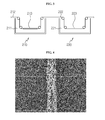
- FIGS. 4 and 5 illustrate SEM images of the porous anode manufactured according to Example 1. As shown in FIG. 4 , it can be determined that an Sn-based anode active material layer of a three-dimensional pore structure was formed on the surface of a copper current collector.
- FIG. 6 is a photo of a porous anode having a solid electrolyte layer.
Landscapes
- Chemical & Material Sciences (AREA)
- Chemical Kinetics & Catalysis (AREA)
- Electrochemistry (AREA)
- General Chemical & Material Sciences (AREA)
- Engineering & Computer Science (AREA)
- Manufacturing & Machinery (AREA)
- Materials Engineering (AREA)
- General Physics & Mathematics (AREA)
- Condensed Matter Physics & Semiconductors (AREA)
- Inorganic Chemistry (AREA)
- Dispersion Chemistry (AREA)
- Physics & Mathematics (AREA)
- Composite Materials (AREA)
- Secondary Cells (AREA)
- Battery Electrode And Active Subsutance (AREA)
- Cell Electrode Carriers And Collectors (AREA)
Abstract
Description
- The present invention relates to a method for manufacturing an anode suitable for a cable-type secondary battery and a cable-type secondary battery comprising the same.
- This application claims priority from Korean Patent Application No.
10-2010-0101862 - Secondary batteries are devices capable of storing energy in chemical form and of converting into electrical energy to generate electricity when needed. The secondary batteries are also referred to as rechargeable batteries because they can be recharged repeatedly. Common secondary batteries include lead accumulators, NiCd batteries, NiMH accumulators, Li-ion batteries, Li-ion polymer batteries, and the like. When compared with disposable primary batteries, not only are the secondary batteries more economically efficient, they are also more environmentally friendly.
- Secondary batteries are currently used in applications requiring low electric power, for example, equipment to start vehicles, mobile devices, tools, uninterruptible power supplies, and the like. Recently, as the development of wireless communication technologies has been leading to the popularization of mobile devices and even to the mobilization of many kinds of conventional devices, the demand for secondary batteries has been dramatically increasing. Secondary batteries are also used in environmentally friendly next-generation vehicles such as hybrid vehicles and electric vehicles to reduce the costs and weight and to increase the service life of the vehicles.
- Generally, secondary batteries have a cylindrical, prismatic, or pouch shape. This is associated with a fabrication process of the secondary batteries in which an electrode assembly composed of an anode, a cathode, and a separator is mounted in a cylindrical or prismatic metal casing or a pouch-shaped casing of an aluminum laminate sheet, and in which the casing is filled with electrolyte. Because a predetermined mounting space for the electrode assembly is necessary in this process, the cylindrical, prismatic or pouch shape of the secondary batteries is a limitation in developing various shapes of mobile devices. Accordingly, there is a need for secondary batteries of a new structure that are adaptable in shape. To fulfill this need, suggestions have been made to develop flexible linear secondary batteries having a very high ratio of length to cross-sectional diameter, hereinafter referred to as cable-type secondary batteries.
- However, the flexible cable-type secondary batteries are frequently subject to the external physical impact due to their structural characteristics, which may result in a short circuit. Further, when Si or Sn is used as an anode active material, the active material may fall off due to expansion and shrinkage of electrodes caused by the repeated charging and discharging. For this reason, the performance of the cable-type secondary batteries may deteriorate more severely than general secondary batteries.
- Accordingly, it is an object of the present invention to provide an anode of a lithium secondary battery having a pore structure that is excellent in electrochemical reactivity and capable of relieving the stress and pressure in the battery, and a method for manufacturing the same.
- A method for manufacturing an anode of a cable-type secondary battery having a solid electrolyte layer may include preparing an aqueous solution of an anode active material, making an anode by immersing a core as a current collector having a horizontal cross section of a predetermined shape and extending longitudinally in the aqueous solution, then applying an electric current to form a porous shell of the anode active material on the surface of the core, and forming a solid electrolyte layer on the surface of the anode by passing the anode through a solid electrolyte solution.
- The anode active material may include any one selected from the group consisting of Si, Sn, Li, Zn, Mg, Cd, Ce, Ni, Fe and oxide thereof, or mixtures thereof.
- The current collector may be made from stainless steel, aluminum, titanium, silver, palladium, nickel, copper, or stainless steel surface-treated with titanium, silver, palladium, nickel, or copper.
- Also, the current collector may have a polymer core and a metal coating layer formed on the surface of the polymer core.
- Preferably, the polymer core is formed from any one polymer selected from the group consisting of polyacetylene, polyaniline, polypyrrole, polythiophene, polysulfur nitride, polyethylene (PE), polypropylene (PP), polyvinyl chloride (PVC), polyvinyl alcohol (PVA), polyacrylate, and polytetrafluoroethylene (PTFE), or mixtures thereof, and the metal coating layer is formed from any one metal selected from the group consisting of silver, palladium, nickel, and copper, or mixtures thereof.
- The solid electrolyte may be any one selected from the group consisting of a gel polymer electrolyte of polyethylene oxide (PEO), polyvinylidene fluoride (PVdF), PVdF-hexafluoropropene (HFP), polymethylmethacrylate (PMMA), polyacrylonitrile (PAN), or polyvinylacetate (PVAc), a solid polymer electrolyte of PEO, polypropylene oxide (PPO), polyethylene imine (PEI), polyethylene sulphide (PES), or PVAc, and a plastic crystal electrolyte of succinonitrile.
- Preferably, the solid electrolyte solution further includes a lithium salt, and the lithium salt may be LiCl, LiBr, LiI, LiClO4, LiBF4, LiB10Cl10, LiPF6, LiCF3SO3, LiCF3CO2, LiAsF6, LiSbF6, LiAlCl4, CH3SO3Li, CF3SO3Li, (CF3SO2)2NLi, chlorine borane lithium, aliphatic lower lithium carbonate, or tetra phenyl lithium borate.
- Also, an anode of a cable-type secondary battery according to the present invention may include a core as a current collector having a horizontal cross section of a predetermined shape and extending longitudinally, a porous shell formed by coating the surface of the core with an anode active material, and a solid electrolyte layer formed by filling the pores of the porous shell with a solid electrolyte.
- Preferably, the porous shell has a pore size of 10 to 150 µm and a porosity of 60 to 95%. Also, the porous shell preferably has a surface area of 8×10⁴ to 5×105 cm2/g.
- The porous anode of the present invention may be used in a lithium secondary battery, particularly a cable-type secondary battery.
- According to teachings above, the anode manufactured by the manufacturing method of the present invention is capable of absorbing shocks due to its pore structure, and thus is resistant to external physical impact such as warping, thereby preventing a short circuit. Also, when Si or Sn is used as an anode active material, the anode is capable of relieving the stress and pressure in the battery such as volume expansion that may occur during charging and discharging, thereby preventing the deformation of the battery and ensuring the stability of the battery.
- Also, the anode manufactured by the manufacturing method of the present invention has a porous shell and consequently a high surface area, thereby increasing an area in contact with an electrolyte, particularly a solid electrolyte. As a result, the mobility of lithium ions may increase, thereby improving the ionic conductivity and the performance of the battery.
- The porous shell of the anode of the present invention has high porosity but low hardness, and thus is apt to break during the fabrication of the battery. The manufacturing method of the present invention includes coating the surface of the porous shell with the solid electrolyte in a continuous manner when forming the porous shell. The resulting solid electrolyte layer can protect the porous shell and minimize the likelihood of the porous shell breaking.
- The accompanying drawing illustrates a preferred embodiment of the present disclosure and, together with the foregoing disclosure, serves to provide further understanding of the technical spirit of the present disclosure. However, the present disclosure is not to be construed as being limited to the drawings.
-
FIG. 1 is a cross-sectional view illustrating a porous anode having a core as a current collector and a solid electrolyte layer formed on the surface of the core. -
FIG. 2 is a cross-sectional view illustrating a current collector having a polymer core and a metal coating layer formed on the surface of the polymer core. -
FIG. 3 is a diagram illustrating a method for manufacturing a porous anode having a solid electrolyte layer. -
FIG. 4 is a scanning electron microscopy (SEM) image illustrating a porous anode according to Example 1. -
FIG. 5 is an enlarged SEM image illustrating a porous anode according to Example 1. -
FIG. 6 is a photo illustrating a porous anode having a solid electrolyte layer according to an embodiment of the present invention. -
FIG. 7 is a cross-sectional view illustrating a cable-type secondary battery with a porous anode having a solid electrolyte layer according to an embodiment of the present invention. -
100: porous anode 110: current collector 120: anode active material layer 130: solid electrolyte layer 111: polymer core 112: metal coating layer 210: first bath 211: anode active material solution 212: wire-type current collector 213: anode active material layer 220: second bath 221: solid electrolyte solution 222: porous anode 223: solid electrolyte coating layer 300: cable-type secondary battery 310: anode current collector 320: anode active material layer 330: solid electrolyte layer 340: cathode active material layer 350: cathode current collector 360: protection coating - The following detailed description is provided to assist the reader in gaining a comprehensive understanding of the methods, apparatuses, and/or systems described herein. Accordingly, various changes, modifications, and equivalents of the systems, apparatuses and/or methods described herein will be suggested to those of ordinary skill in the art. Also, descriptions of well-known functions and constructions may be omitted for increased clarity and conciseness.
-
FIG. 1 schematically illustrates a porous anode having a solid electrolyte layer according to an embodiment of the present invention. Although a few exemplary embodiments of the present invention are shown and described, the present invention is not limited to the described exemplary embodiments. Instead, it would be appreciated by those skilled in the art that changes may be made to these exemplary embodiments without departing from the principles and spirit of the invention, the scope of which is defined by the claims and their equivalents. - The
anode 100 of the present invention may include acore 110 serving as a current collector having a horizontal cross section of a predetermined shape and extending longitudinally, aporous shell 120 formed by coating the outer surface of thecore 110 with an anode active material, and asolid electrolyte layer 130 formed on the outer surface of theanode 100. Here, the predetermined shape is not limited to a specific shape, and may include any shape without departing from the spirit and scope of the present invention. For example, the horizontal cross section of thecurrent collector 110 may have a circular shape or a polygonal shape, wherein the circular shape may include a circular shape of geometrical symmetry or an oval shape of geometrical asymmetry, and the polygonal shape may include, but is not limited to, a triangular, square, pentagonal, or hexagonal shape. - The
porous shell 120 or the porous anode active material layer may be formed on the surface of thecurrent collector 110 using an electroplating process or an anodic oxidation process. The anode active material may include any one selected from the group consisting of Si, Sn, Li, Zn, Mg, Cd, Ce, Ni, Fe and oxide thereof, or mixtures thereof. - When an electroplating process is used in forming the active material layer on the surface of the current collector, hydrogen bubbles may be generated. It is possible to form an active material layer of a three-dimensional pore structure having a desired pore size by adjusting the amount generated and the size of the hydrogen bubbles.
- An anodic oxidation process may be used in forming a metal oxide-based active material layer on the surface of the current collector. In this case, it is possible to form a metal oxide-based active material layer of a one-dimensional channel-shaped pore structure by adjusting the amount generated and the size of oxygen bubbles that may be generated under anodic oxidation conditions.
- The
porous shell 120 may have a pore size of 10 to 150 µm. Also, theporous shell 120 may have a porosity of 60 to 95% and a surface area of 8×10⁴ to 5×105 cm2/g. - The
solid electrolyte layer 130 may be formed on the outer surface of theanode 100. The solid electrolyte may be a gel polymer electrolyte of polyethylene oxide (PEO), polyvinylidene fluoride (PVdF), PVdF-hexafluoropropene (HFP), polymethylmethacrylate (PMMA), polyacrylonitrile (PAN), or polyvinylacetate (PVAc), a solid polymer electrolyte of PEO, polypropylene oxide (PPO), polyethylene imine (PEI), polyethylene sulphide (PES), or PVAc, or a plastic crystal electrolyte of succinonitrile. - A method for manufacturing the
anode 100 of the present invention, including thecore 110 as a current collector having a horizontal cross section of a predetermined shape and extending longitudinally, theporous shell 120 formed by coating the outer surface of the core 110 with an anode active material, and thesolid electrolyte layer 130 formed on the outer surface of theanode 100, may be as follows: - The aqueous solution of the anode active material is prepared by dissolving an anode active material in an aqueous acid solution. In this instance, a precursor existing in an acid salt form is primarily used for the anode active material. The anode active material may be Si, Sn, Li, Zn, Mg, Cd, Ce, Ni or Fe, preferably Si or Sn.
- Next, the core serving as a current collector having a horizontal cross section of a predetermined shape and extending longitudinally is immersed in the aqueous solution of the anode active material, followed by the application of an electric current, to form the porous shell on the outer surface of the core. (S2)
- For electroplating, the core as a current collector is put in a beaker containing the aqueous solution of the anode active material where an anode and a cathode are placed. An electric current is applied for a predetermined time, so that the anode active material is deposited onto the surface of the core, resulting in the anode active material layer or the shell. When the anode active material layer is formed, hydrogen gas is generated in the core to make the anode active material layer porous.
- Generally, the secondary battery swells due to the repeated expansion and shrinkage during charging and discharging. The swelling becomes even more severe when Sn or Si is used as an anode active material. This volume change causes the active material to fall off or deteriorate, and provokes a side reaction which leads to a reduction in the performance of the battery. However, the active material layer of the present invention has a pore structure to relieve the volume change and consequently to prevent the problems caused by the volume change. Also, the porous active material layer increases the surface area of the anode contacting an electrolyte, which makes lithium ions move fast and smoothly, thereby making it advantageous in an electrochemical reaction, which improves the performance of the battery.
- Optionally, washing may be performed to prevent a side reaction caused by the aqueous solution of the anode active material remaining in the porous shell.
- Next, the electrolyte layer is formed on the surface of the anode by passing the anode through the solid electrolyte solution. (S3)
- The porous shell of the anode of the present invention has high porosity but low hardness, and thus is apt to break during the fabrication of the battery. The manufacturing method of the present invention includes coating the surface of the porous shell with a solid electrolyte in a continuous manner when forming the porous shell. The resulting solid electrolyte layer can protect the porous shell and minimize the likelihood that the porous shell will break during the fabrication of the battery.
- The solid electrolyte solution may be prepared by dissolving a solid electrolyte in a solvent or by dissolving polymerizable polymer monomers or polymer oligomers of a solid electrolyte in a solvent.
- Thereafter, drying may be performed as post-processing to remove the solvent. Particularly, when the solid electrolyte solution contains polymer monomers or polymer oligomers, ultraviolet (UV) radiation or heating may be further performed for polymerization of the solid electrolyte. Also, the solid electrolyte solution may further contain an additive such as a cross-linking agent.
- The wire-type
current collector 110 of the present invention may be made from stainless steel, aluminum, nickel, titanium, sintered carbon, or copper; stainless steel surface-treated with carbon, nickel, titanium, or silver; aluminum-cadmium alloys; polyacetylene, polyaniline, polypyrrole, polythiophene, or polysulfur nitride. - Referring to
FIG. 2 , the wire-typecurrent collector 110 preferably has apolymer core 111 and ametal coating layer 112 formed on the surface of thepolymer core 111, in particular, to ensure the flexibility of the cable-type secondary battery. - The
polymer core 111 may be made from polyacetylene, polyaniline, polypyrrole, polythiophene, polysulfur nitride, polyethylene (PE), polypropylene (PP), polyvinyl chloride (PVC), polyvinyl alcohol (PVA), polyacrylate, or polytetrafluoroethylene (PTFE). Themetal coating layer 112 may be formed from any one metal selected from the group consisting of silver, palladium, nickel and copper, or mixtures thereof. - The anode of the present invention forms an electrode assembly with a cathode and is used in a lithium secondary battery. The cathode is not specially limited, and any typical cathode used in fabricating a lithium secondary battery may be used.
- Specifically, a cathode active material usable in the present invention preferably is lithium-containing transition metal oxide, for example, any one selected from the group consisting of LiCoO2, LiNiO2, LiMnO2, LiMn2O4, Li(NiaCobMnc)O2(0<a<1, 0<b<1, 0<c<1, a+b+c=1), LiNi1-yCoyO2, LiCo1-yMnyO2, LiNi1-yMnyO2(O≤y<1), Li(NiaCobMnc)O4(0<a<2, 0<b<2, 0<c<2, a+b+c=2), LiMn2-zNizO4, LiMn2-zCozO4(0<z<2), LiCoPO4, and LiFePO4, or mixtures thereof. Also, lithium-containing transition metal sulfide, selenide, or halide may be used as well as the lithium-containing transition metal oxide.
- The prevent invention provides an anode of a cable-type secondary battery including the core serving as a current collector having a horizontal cross section of a predetermined shape and extending longitudinally, the porous shell formed by coating the outer surface of the core with an anode active material, and the solid electrolyte layer formed by filling the pores of the porous shell with a solid electrolyte.
- According to the present invention, the solid electrolyte permeates into the pores of the porous shell formed from the anode active material. Thus, an area in contact with the solid electrolyte may increase, and consequently, the mobility of lithium ions may increase, thereby improving the ionic conductivity and the performance of the battery. Also, the brittle porous shell may be physically protected.
- Preferably, the porous shell has a pore size of 10 to 150 µm. Also, the porous shell preferably has a porosity of 60 to 95% and a surface area of 8×10⁴ to 5×105 cm2/g.
- The porous anode of the present invention may be used in a lithium secondary battery, in particular, a cable-type secondary battery.
- Hereinafter, a cable-type secondary battery comprising the anode of the present invention is briefly described with reference to
FIG. 7 below. - Referring to
FIG. 7 , a cable-typesecondary battery 300 comprising a porous anode having a solid electrolyte layer according to an embodiment of the present invention may include an anode arranged in parallel including an anodecurrent collector 310 having a horizontal cross section of a predetermined shape and an anodeactive material 320 applied to the anodecurrent collector 310, anelectrolyte layer 330 surrounding the anode and serving as an ion channel, a cathode including a pipe-typecurrent collector 350 having a horizontal cross section of a predetermined shape surrounding theelectrolyte layer 330 and a cathodeactive material 340 applied to the cathodecurrent collector 350, and aprotection coating 360 surrounding the cathode. - The
protection coating 360 is formed on the outermost surface of thebattery 300 and acts as an insulator to protect the electrode from moisture in the air or from external impact. Theprotection coating 360 may be formed from typical polymer resins, for example, PVC, high-density polyethylene (HDPE), or epoxy resin. - Hereinafter, the present invention will be described in detail through specific examples. However, the description proposed herein is just a preferable example for the purpose of illustrations only, not intended to limit the scope of the invention, so it should be understood that the examples are provided for a more definite explanation to an ordinary person skilled in the art.
- A method for manufacturing a wire-type porous anode is described with reference to
FIG. 3 . - A wire-type
copper current collector 212 was washed with acetone and diluted hydrochloric acid. As an aqueous solution of an anodeactive material 211, a mixed solution of 0.15M SnSO4 and 1.5M H2SO4 was prepared in afirst bath 210. - In this instance, a platinum anode was used, and the copper
current collector 212 was used as a cathode. The coppercurrent collector 212 was electroplated while passing through thefirst bath 210 at a predetermined rate in the presence of an electric current of 3 A/cm2 or more. Tin (Sn) was deposited onto the coppercurrent collector 212, so that a wire-typeporous anode 222 was manufactured. - To form a solid electrolyte layer, a
solid electrolyte solution 221 was prepared in asecond bath 220 as follows: 50 parts by weight of succinonitrile, 15 parts by weight of polyethylene oxide, and 35 parts by weight of polyethylene glycol dimethacrylate (PEGDMA) having a molecular weight of 400 g/mol were mixed. Next, lithium bis-trifluoromethane sulfonylimide was added, followed by uniform mixing, and a mole ratio of lithium bis-trifluoromethane sulfonylimide to ethylene oxide of the PEGDMA was 1:8. Also, 3 w% of benzoin as a UV initiator was added per the weight of the PEGDMA. In this way, the preparation of thesolid electrolyte solution 221 was completed. - The wire-type
porous anode 222 was passed through thesecond bath 220 containing thesolid electrolyte solution 221, so that the wire-typeporous anode 222 was coated with thesolid electrolyte solution 221, followed by UV radiation, to form a solid electrolyte layer on the surface of theporous anode 222. -
FIGS. 4 and5 illustrate SEM images of the porous anode manufactured according to Example 1. As shown inFIG. 4 , it can be determined that an Sn-based anode active material layer of a three-dimensional pore structure was formed on the surface of a copper current collector. -
FIG. 6 is a photo of a porous anode having a solid electrolyte layer.
Claims (15)
- A method for manufacturing an anode of a cable-type secondary battery having a solid electrolyte layer, the method comprising:preparing an aqueous solution of an anode active material;making an anode by immersing a core as a current collector having a horizontal cross section of a predetermined shape and extending longitudinally in the aqueous solution, then applying an electric current to form a porous shell of the anode active material on the surface of the core; andforming a solid electrolyte layer on the surface of the anode by passing the anode through a solid electrolyte solution.
- The method for manufacturing an anode of a cable-type secondary battery according to claim 1,
wherein the aqueous solution of the anode active material includes any one selected from the group consisting of Si, Sn, Li, Zn, Mg, Cd, Ce, Ni, Fe and oxide thereof, or mixtures thereof. - The method for manufacturing an anode of a cable-type secondary battery according to claim 1,
wherein the current collector is made from stainless steel, aluminum, titanium, silver, palladium, nickel, copper, or stainless steel surface-treated with titanium, silver, palladium, nickel, or copper. - The method for manufacturing an anode of a cable-type secondary battery according to claim 1,
wherein the current collector has a polymer core and a metal coating layer formed on the surface of the polymer core. - The method for manufacturing an anode of a cable-type secondary battery according to claim 4,
wherein the polymer core is formed from any one polymer selected from the group consisting of polyacetylene, polyaniline, polypyrrole, polythiophene, polysulfur nitride, polyethylene (PE), polypropylene (PP), polyvinyl chloride (PVC), polyvinyl alcohol (PVA), polyacrylate, and polytetrafluoroethylene (PTFE), or mixtures thereof. - The method for manufacturing an anode of a cable-type secondary battery according to claim 4,
wherein the metal coating layer is formed from any one metal selected from the group consisting of silver, palladium, nickel, and copper, or mixtures thereof. - The method for manufacturing an anode of a cable-type secondary battery according to claim 1,
wherein the solid electrolyte solution includes any one electrolyte selected from the group consisting of a gel polymer electrolyte of polyethylene oxide (PEO), polyvinylidene fluoride (PVdF), PVdF-hexafluoropropene (HFP), polymethylmethacrylate (PMMA), polyacrylonitrile (PAN), or polyvinylacetate (PVAc), a solid polymer electrolyte of PEO, polypropylene oxide (PPO), polyethylene imine (PEI), polyethylene sulphide (PES), or PVAc, and a plastic crystal electrolyte of succinonitrile. - The method for manufacturing an anode of a cable-type secondary battery according to claim 1,
wherein the solid electrolyte solution further includes a lithium salt. - The method for manufacturing an anode of a cable-type secondary battery according to claim 8,
wherein the lithium salt is any one selected from the group consisting of LiCl, LiBr, LiI, LiClO4, LiBF4, LiB10Cl10, LiPF6, LiCF3SO3, LiCF3CO2, LiAsF6, LiSbF6, LiAlCl4, CH3SO3Li, CF3SO3Li, (CF3SO2)2NLi, chlorine borane lithium, aliphatic lower lithium carbonate, and tetra phenyl lithium borate, or mixtures thereof. - An anode of a cable-type secondary battery, comprising:a core as a current collector having a horizontal cross section of a predetermined shape and extending longitudinally;a porous shell formed by coating the surface of the core with an anode active material; anda solid electrolyte layer formed by filling the pores of the porous shell with a solid electrolyte.
- The anode of a cable-type secondary battery according to claim 10,
wherein the porous shell has a pore size of 10 to 150 µm. - The anode of a cable-type secondary battery according to claim 10,
wherein the porous shell has a porosity of 60 to 95%. - The anode of a cable-type secondary battery according to claim 10,
wherein the porous shell has a surface area of 8×10⁴ to 5×105 cm2/g. - The anode of a cable-type secondary battery according to claim 10,
wherein the anode active material includes any one selected from the group consisting of Si, Sn, Li, Zn, Mg, Cd, Ce, Ni, Fe and oxide thereof, or mixtures thereof. - A cable-type secondary battery comprising:an anode defined in any one of claims 10 to 14.
Applications Claiming Priority (2)
| Application Number | Priority Date | Filing Date | Title |
|---|---|---|---|
| KR1020100101862A KR101351901B1 (en) | 2010-10-19 | 2010-10-19 | Anode For Cable Type Secondary Battery And Preparation Method thereof |
| PCT/KR2011/007625 WO2012053773A2 (en) | 2010-10-19 | 2011-10-13 | Cathode for cable-type secondary battery and method for manufacturing same |
Publications (3)
| Publication Number | Publication Date |
|---|---|
| EP2631970A2 true EP2631970A2 (en) | 2013-08-28 |
| EP2631970A4 EP2631970A4 (en) | 2014-12-24 |
| EP2631970B1 EP2631970B1 (en) | 2016-01-13 |
Family
ID=45975698
Family Applications (1)
| Application Number | Title | Priority Date | Filing Date |
|---|---|---|---|
| EP11834573.5A Active EP2631970B1 (en) | 2010-10-19 | 2011-10-13 | Cathode for cable-type secondary battery and method for manufacturing same |
Country Status (6)
| Country | Link |
|---|---|
| US (1) | US9673485B2 (en) |
| EP (1) | EP2631970B1 (en) |
| JP (1) | JP5604599B2 (en) |
| KR (1) | KR101351901B1 (en) |
| CN (1) | CN103181002B (en) |
| WO (1) | WO2012053773A2 (en) |
Cited By (1)
| Publication number | Priority date | Publication date | Assignee | Title |
|---|---|---|---|---|
| DE102014113833A1 (en) | 2014-09-24 | 2016-03-24 | Universität Augsburg | Polymer electrolyte membrane and method of manufacture |
Families Citing this family (6)
| Publication number | Priority date | Publication date | Assignee | Title |
|---|---|---|---|---|
| KR101705733B1 (en) * | 2013-08-27 | 2017-02-10 | 주식회사 엘지화학 | Wire electrode for a cable secondary battery and cable secondary battery including the same |
| US10205187B2 (en) * | 2015-04-03 | 2019-02-12 | Intel Corporation | Constrained anode fiber for rechargeable battery |
| TWI540782B (en) | 2015-06-30 | 2016-07-01 | 財團法人工業技術研究院 | Electrolyte composition, and energy storage device employing the same |
| EP3474346B1 (en) * | 2017-10-23 | 2020-06-17 | Nokia Technologies Oy | Method, apparatus and computer program for manufacturing an apparatus |
| US11242152B2 (en) | 2017-11-17 | 2022-02-08 | Ge Aviation Systems Llc | Method and apparatus for detecting ice accretion |
| JP7243734B2 (en) * | 2018-09-27 | 2023-03-22 | 株式会社村田製作所 | Yarn battery and Yarn battery with connector |
Family Cites Families (27)
| Publication number | Priority date | Publication date | Assignee | Title |
|---|---|---|---|---|
| JPS5788669A (en) * | 1980-11-20 | 1982-06-02 | Matsushita Electric Ind Co Ltd | Manufacture of electrode for alkaline storage battery |
| JP2643019B2 (en) * | 1990-10-31 | 1997-08-20 | 新神戸電機株式会社 | Battery and battery pack |
| JPH0888019A (en) * | 1994-09-20 | 1996-04-02 | Sony Corp | Sealed storage battery |
| JPH09161793A (en) * | 1995-12-06 | 1997-06-20 | Toyota Motor Corp | Method for manufacturing battery electrode and electrode |
| US6579649B2 (en) * | 1998-02-18 | 2003-06-17 | Matsushita Electric Industrial Co., Ltd. | Polymer electrolyte battery |
| JP2001110445A (en) * | 1999-10-12 | 2001-04-20 | Sony Corp | Cord type battery |
| JP2004139768A (en) * | 2002-10-16 | 2004-05-13 | Hitachi Maxell Ltd | Porous thin film electrode and lithium secondary battery using this as a negative electrode |
| US20040214085A1 (en) | 2003-01-06 | 2004-10-28 | Kyou-Yoon Sheem | Negative active material for rechargeable lithium battery, method of preparing same, and rechargeable lithium battery |
| JP3827642B2 (en) | 2003-01-06 | 2006-09-27 | 三星エスディアイ株式会社 | Negative electrode active material for lithium secondary battery, method for producing the same, and lithium secondary battery |
| JP4920880B2 (en) * | 2003-09-26 | 2012-04-18 | 三星エスディアイ株式会社 | Lithium ion secondary battery |
| KR100560541B1 (en) * | 2003-09-26 | 2006-03-15 | 삼성에스디아이 주식회사 | Lithium secondary battery |
| KR100625892B1 (en) | 2004-04-12 | 2006-09-20 | 경상대학교산학협력단 | True Variable Battery |
| DE602006020980D1 (en) * | 2005-01-20 | 2011-05-12 | Oticon As | HEARING DEVICE WITH RECHARGEABLE BATTERY AND RECHARGEABLE BATTERY |
| JP5031193B2 (en) * | 2005-03-16 | 2012-09-19 | 独立行政法人科学技術振興機構 | Metal porous negative electrode and lithium secondary battery using the same |
| KR100742739B1 (en) * | 2005-07-15 | 2007-07-25 | 경상대학교산학협력단 | Thread type variable battery for easy weaving |
| JP2007087789A (en) * | 2005-09-22 | 2007-04-05 | Hitachi Cable Ltd | Negative electrode for lithium ion secondary battery and method for producing the same |
| CN102931434B (en) * | 2005-10-20 | 2015-09-16 | 三菱化学株式会社 | Lithium secondary battery and non-aqueous electrolyte used therein |
| KR100804411B1 (en) * | 2006-01-17 | 2008-02-20 | 주식회사 엘지화학 | Electrode assembly with novel structure and secondary battery comprising the same |
| KR20090009598A (en) * | 2007-07-20 | 2009-01-23 | 경상대학교산학협력단 | Wireless rechargeable linear battery |
| JP2010073533A (en) * | 2008-09-19 | 2010-04-02 | National Institute Of Advanced Industrial Science & Technology | Chargeable and dischargeable battery |
| JP5422360B2 (en) * | 2008-12-15 | 2014-02-19 | トヨタ自動車株式会社 | Method for producing porous metal body for lithium secondary battery active material |
| KR101024635B1 (en) * | 2008-12-29 | 2011-03-25 | 경상대학교산학협력단 | Seal-type battery and connector for connecting it |
| JP5679257B2 (en) | 2009-01-16 | 2015-03-04 | ヒューマン・メタボローム・テクノロジーズ株式会社 | Measurement data acquisition and evaluation method |
| KR20110127972A (en) * | 2010-05-20 | 2011-11-28 | 주식회사 엘지화학 | Cable type secondary battery with metal coated polymer current collector |
| KR101351896B1 (en) * | 2010-06-28 | 2014-01-22 | 주식회사 엘지화학 | Anode For Cable Type Secondary Battery And Cable Type Secondary Battery Having The Same |
| KR101322695B1 (en) * | 2010-08-25 | 2013-10-25 | 주식회사 엘지화학 | Cable-Type Secondary Battery |
| JP4923168B1 (en) | 2011-01-14 | 2012-04-25 | パナソニック株式会社 | Light source for illumination |
-
2010
- 2010-10-19 KR KR1020100101862A patent/KR101351901B1/en active Active
-
2011
- 2011-10-13 CN CN201180050682.1A patent/CN103181002B/en active Active
- 2011-10-13 JP JP2013534802A patent/JP5604599B2/en active Active
- 2011-10-13 EP EP11834573.5A patent/EP2631970B1/en active Active
- 2011-10-13 WO PCT/KR2011/007625 patent/WO2012053773A2/en not_active Ceased
-
2012
- 2012-02-17 US US13/399,614 patent/US9673485B2/en active Active
Cited By (1)
| Publication number | Priority date | Publication date | Assignee | Title |
|---|---|---|---|---|
| DE102014113833A1 (en) | 2014-09-24 | 2016-03-24 | Universität Augsburg | Polymer electrolyte membrane and method of manufacture |
Also Published As
| Publication number | Publication date |
|---|---|
| KR101351901B1 (en) | 2014-01-17 |
| KR20120040440A (en) | 2012-04-27 |
| WO2012053773A2 (en) | 2012-04-26 |
| EP2631970A4 (en) | 2014-12-24 |
| CN103181002A (en) | 2013-06-26 |
| US20120148918A1 (en) | 2012-06-14 |
| JP5604599B2 (en) | 2014-10-08 |
| US9673485B2 (en) | 2017-06-06 |
| JP2013540340A (en) | 2013-10-31 |
| EP2631970B1 (en) | 2016-01-13 |
| CN103181002B (en) | 2016-07-13 |
| WO2012053773A3 (en) | 2012-08-30 |
Similar Documents
| Publication | Publication Date | Title |
|---|---|---|
| KR101351896B1 (en) | Anode For Cable Type Secondary Battery And Cable Type Secondary Battery Having The Same | |
| EP2772965B1 (en) | Cathode for secondary battery and secondary battery having same | |
| US8920979B2 (en) | Cable-type secondary battery | |
| US9306237B2 (en) | Cable-type secondary battery | |
| US8835057B2 (en) | Anode for secondary battery and secondary battery having the same | |
| CN103081205B (en) | Cable type secondary battery | |
| KR101351900B1 (en) | Cable-Type Secondary Battery | |
| EP2610956A2 (en) | Cable-type secondary battery | |
| EP2717351B1 (en) | Negative electrode for a secondary battery and secondary battery having the same | |
| US9755266B2 (en) | Cable-type secondary battery | |
| EP2768058A1 (en) | Cable-type secondary battery | |
| EP2631970B1 (en) | Cathode for cable-type secondary battery and method for manufacturing same | |
| US9537154B2 (en) | Anode for secondary battery and secondary battery having the same | |
| US20140193681A1 (en) | Cable-type secondary battery |
Legal Events
| Date | Code | Title | Description |
|---|---|---|---|
| PUAI | Public reference made under article 153(3) epc to a published international application that has entered the european phase |
Free format text: ORIGINAL CODE: 0009012 |
|
| 17P | Request for examination filed |
Effective date: 20130426 |
|
| AK | Designated contracting states |
Kind code of ref document: A2 Designated state(s): AL AT BE BG CH CY CZ DE DK EE ES FI FR GB GR HR HU IE IS IT LI LT LU LV MC MK MT NL NO PL PT RO RS SE SI SK SM TR |
|
| RIN1 | Information on inventor provided before grant (corrected) |
Inventor name: SHIN, HEON-CHEOL Inventor name: KWON, YO-HAN Inventor name: KIM, JE-YOUNG Inventor name: KIM, KI-TAE Inventor name: LEE, SANG-YOUNG |
|
| DAX | Request for extension of the european patent (deleted) | ||
| A4 | Supplementary search report drawn up and despatched |
Effective date: 20141120 |
|
| RIC1 | Information provided on ipc code assigned before grant |
Ipc: H01M 10/052 20100101ALN20141114BHEP Ipc: H01M 10/05 20100101ALI20141114BHEP Ipc: H01M 4/70 20060101ALI20141114BHEP Ipc: H01M 10/0565 20100101ALI20141114BHEP Ipc: H01M 4/1395 20100101ALI20141114BHEP Ipc: H01M 10/058 20100101ALI20141114BHEP Ipc: C25D 7/06 20060101ALI20141114BHEP Ipc: H01M 4/04 20060101AFI20141114BHEP Ipc: H01M 4/02 20060101ALI20141114BHEP Ipc: H01M 4/66 20060101ALI20141114BHEP Ipc: H01M 10/0568 20100101ALI20141114BHEP |
|
| GRAP | Despatch of communication of intention to grant a patent |
Free format text: ORIGINAL CODE: EPIDOSNIGR1 |
|
| RIC1 | Information provided on ipc code assigned before grant |
Ipc: H01M 10/058 20100101ALI20150924BHEP Ipc: H01M 4/02 20060101ALI20150924BHEP Ipc: H01M 4/66 20060101ALI20150924BHEP Ipc: H01M 10/05 20100101ALI20150924BHEP Ipc: H01M 4/1395 20100101ALI20150924BHEP Ipc: C25D 7/06 20060101ALI20150924BHEP Ipc: H01M 4/70 20060101ALI20150924BHEP Ipc: H01M 10/0565 20100101ALI20150924BHEP Ipc: H01M 10/052 20100101ALN20150924BHEP Ipc: H01M 4/04 20060101AFI20150924BHEP Ipc: H01M 10/0568 20100101ALI20150924BHEP |
|
| GRAS | Grant fee paid |
Free format text: ORIGINAL CODE: EPIDOSNIGR3 |
|
| INTG | Intention to grant announced |
Effective date: 20151014 |
|
| GRAA | (expected) grant |
Free format text: ORIGINAL CODE: 0009210 |
|
| AK | Designated contracting states |
Kind code of ref document: B1 Designated state(s): AL AT BE BG CH CY CZ DE DK EE ES FI FR GB GR HR HU IE IS IT LI LT LU LV MC MK MT NL NO PL PT RO RS SE SI SK SM TR |
|
| REG | Reference to a national code |
Ref country code: GB Ref legal event code: FG4D |
|
| REG | Reference to a national code |
Ref country code: CH Ref legal event code: EP |
|
| REG | Reference to a national code |
Ref country code: IE Ref legal event code: FG4D |
|
| REG | Reference to a national code |
Ref country code: AT Ref legal event code: REF Ref document number: 771041 Country of ref document: AT Kind code of ref document: T Effective date: 20160215 |
|
| REG | Reference to a national code |
Ref country code: DE Ref legal event code: R096 Ref document number: 602011022718 Country of ref document: DE |
|
| REG | Reference to a national code |
Ref country code: LT Ref legal event code: MG4D |
|
| REG | Reference to a national code |
Ref country code: NL Ref legal event code: MP Effective date: 20160113 |
|
| REG | Reference to a national code |
Ref country code: AT Ref legal event code: MK05 Ref document number: 771041 Country of ref document: AT Kind code of ref document: T Effective date: 20160113 |
|
| PG25 | Lapsed in a contracting state [announced via postgrant information from national office to epo] |
Ref country code: NL Free format text: LAPSE BECAUSE OF FAILURE TO SUBMIT A TRANSLATION OF THE DESCRIPTION OR TO PAY THE FEE WITHIN THE PRESCRIBED TIME-LIMIT Effective date: 20160113 |
|
| PG25 | Lapsed in a contracting state [announced via postgrant information from national office to epo] |
Ref country code: FI Free format text: LAPSE BECAUSE OF FAILURE TO SUBMIT A TRANSLATION OF THE DESCRIPTION OR TO PAY THE FEE WITHIN THE PRESCRIBED TIME-LIMIT Effective date: 20160113 Ref country code: GR Free format text: LAPSE BECAUSE OF FAILURE TO SUBMIT A TRANSLATION OF THE DESCRIPTION OR TO PAY THE FEE WITHIN THE PRESCRIBED TIME-LIMIT Effective date: 20160414 Ref country code: ES Free format text: LAPSE BECAUSE OF FAILURE TO SUBMIT A TRANSLATION OF THE DESCRIPTION OR TO PAY THE FEE WITHIN THE PRESCRIBED TIME-LIMIT Effective date: 20160113 Ref country code: IT Free format text: LAPSE BECAUSE OF FAILURE TO SUBMIT A TRANSLATION OF THE DESCRIPTION OR TO PAY THE FEE WITHIN THE PRESCRIBED TIME-LIMIT Effective date: 20160113 Ref country code: HR Free format text: LAPSE BECAUSE OF FAILURE TO SUBMIT A TRANSLATION OF THE DESCRIPTION OR TO PAY THE FEE WITHIN THE PRESCRIBED TIME-LIMIT Effective date: 20160113 Ref country code: NO Free format text: LAPSE BECAUSE OF FAILURE TO SUBMIT A TRANSLATION OF THE DESCRIPTION OR TO PAY THE FEE WITHIN THE PRESCRIBED TIME-LIMIT Effective date: 20160413 |
|
| PG25 | Lapsed in a contracting state [announced via postgrant information from national office to epo] |
Ref country code: IS Free format text: LAPSE BECAUSE OF FAILURE TO SUBMIT A TRANSLATION OF THE DESCRIPTION OR TO PAY THE FEE WITHIN THE PRESCRIBED TIME-LIMIT Effective date: 20160513 Ref country code: PT Free format text: LAPSE BECAUSE OF FAILURE TO SUBMIT A TRANSLATION OF THE DESCRIPTION OR TO PAY THE FEE WITHIN THE PRESCRIBED TIME-LIMIT Effective date: 20160513 Ref country code: AT Free format text: LAPSE BECAUSE OF FAILURE TO SUBMIT A TRANSLATION OF THE DESCRIPTION OR TO PAY THE FEE WITHIN THE PRESCRIBED TIME-LIMIT Effective date: 20160113 Ref country code: RS Free format text: LAPSE BECAUSE OF FAILURE TO SUBMIT A TRANSLATION OF THE DESCRIPTION OR TO PAY THE FEE WITHIN THE PRESCRIBED TIME-LIMIT Effective date: 20160113 Ref country code: PL Free format text: LAPSE BECAUSE OF FAILURE TO SUBMIT A TRANSLATION OF THE DESCRIPTION OR TO PAY THE FEE WITHIN THE PRESCRIBED TIME-LIMIT Effective date: 20160113 Ref country code: SE Free format text: LAPSE BECAUSE OF FAILURE TO SUBMIT A TRANSLATION OF THE DESCRIPTION OR TO PAY THE FEE WITHIN THE PRESCRIBED TIME-LIMIT Effective date: 20160113 Ref country code: LV Free format text: LAPSE BECAUSE OF FAILURE TO SUBMIT A TRANSLATION OF THE DESCRIPTION OR TO PAY THE FEE WITHIN THE PRESCRIBED TIME-LIMIT Effective date: 20160113 Ref country code: LT Free format text: LAPSE BECAUSE OF FAILURE TO SUBMIT A TRANSLATION OF THE DESCRIPTION OR TO PAY THE FEE WITHIN THE PRESCRIBED TIME-LIMIT Effective date: 20160113 |
|
| REG | Reference to a national code |
Ref country code: FR Ref legal event code: PLFP Year of fee payment: 6 |
|
| REG | Reference to a national code |
Ref country code: DE Ref legal event code: R097 Ref document number: 602011022718 Country of ref document: DE |
|
| PG25 | Lapsed in a contracting state [announced via postgrant information from national office to epo] |
Ref country code: EE Free format text: LAPSE BECAUSE OF FAILURE TO SUBMIT A TRANSLATION OF THE DESCRIPTION OR TO PAY THE FEE WITHIN THE PRESCRIBED TIME-LIMIT Effective date: 20160113 Ref country code: DK Free format text: LAPSE BECAUSE OF FAILURE TO SUBMIT A TRANSLATION OF THE DESCRIPTION OR TO PAY THE FEE WITHIN THE PRESCRIBED TIME-LIMIT Effective date: 20160113 |
|
| PLBE | No opposition filed within time limit |
Free format text: ORIGINAL CODE: 0009261 |
|
| STAA | Information on the status of an ep patent application or granted ep patent |
Free format text: STATUS: NO OPPOSITION FILED WITHIN TIME LIMIT |
|
| PG25 | Lapsed in a contracting state [announced via postgrant information from national office to epo] |
Ref country code: SM Free format text: LAPSE BECAUSE OF FAILURE TO SUBMIT A TRANSLATION OF THE DESCRIPTION OR TO PAY THE FEE WITHIN THE PRESCRIBED TIME-LIMIT Effective date: 20160113 Ref country code: SK Free format text: LAPSE BECAUSE OF FAILURE TO SUBMIT A TRANSLATION OF THE DESCRIPTION OR TO PAY THE FEE WITHIN THE PRESCRIBED TIME-LIMIT Effective date: 20160113 Ref country code: CZ Free format text: LAPSE BECAUSE OF FAILURE TO SUBMIT A TRANSLATION OF THE DESCRIPTION OR TO PAY THE FEE WITHIN THE PRESCRIBED TIME-LIMIT Effective date: 20160113 Ref country code: RO Free format text: LAPSE BECAUSE OF FAILURE TO SUBMIT A TRANSLATION OF THE DESCRIPTION OR TO PAY THE FEE WITHIN THE PRESCRIBED TIME-LIMIT Effective date: 20160113 |
|
| 26N | No opposition filed |
Effective date: 20161014 |
|
| PG25 | Lapsed in a contracting state [announced via postgrant information from national office to epo] |
Ref country code: BE Free format text: LAPSE BECAUSE OF FAILURE TO SUBMIT A TRANSLATION OF THE DESCRIPTION OR TO PAY THE FEE WITHIN THE PRESCRIBED TIME-LIMIT Effective date: 20160113 |
|
| PG25 | Lapsed in a contracting state [announced via postgrant information from national office to epo] |
Ref country code: BG Free format text: LAPSE BECAUSE OF FAILURE TO SUBMIT A TRANSLATION OF THE DESCRIPTION OR TO PAY THE FEE WITHIN THE PRESCRIBED TIME-LIMIT Effective date: 20160413 Ref country code: SI Free format text: LAPSE BECAUSE OF FAILURE TO SUBMIT A TRANSLATION OF THE DESCRIPTION OR TO PAY THE FEE WITHIN THE PRESCRIBED TIME-LIMIT Effective date: 20160113 |
|
| REG | Reference to a national code |
Ref country code: CH Ref legal event code: PL |
|
| REG | Reference to a national code |
Ref country code: IE Ref legal event code: MM4A |
|
| PG25 | Lapsed in a contracting state [announced via postgrant information from national office to epo] |
Ref country code: LI Free format text: LAPSE BECAUSE OF NON-PAYMENT OF DUE FEES Effective date: 20161031 Ref country code: CH Free format text: LAPSE BECAUSE OF NON-PAYMENT OF DUE FEES Effective date: 20161031 |
|
| PG25 | Lapsed in a contracting state [announced via postgrant information from national office to epo] |
Ref country code: LU Free format text: LAPSE BECAUSE OF NON-PAYMENT OF DUE FEES Effective date: 20161013 |
|
| REG | Reference to a national code |
Ref country code: FR Ref legal event code: PLFP Year of fee payment: 7 |
|
| PG25 | Lapsed in a contracting state [announced via postgrant information from national office to epo] |
Ref country code: IE Free format text: LAPSE BECAUSE OF NON-PAYMENT OF DUE FEES Effective date: 20161013 |
|
| PG25 | Lapsed in a contracting state [announced via postgrant information from national office to epo] |
Ref country code: CY Free format text: LAPSE BECAUSE OF FAILURE TO SUBMIT A TRANSLATION OF THE DESCRIPTION OR TO PAY THE FEE WITHIN THE PRESCRIBED TIME-LIMIT Effective date: 20160113 Ref country code: HU Free format text: LAPSE BECAUSE OF FAILURE TO SUBMIT A TRANSLATION OF THE DESCRIPTION OR TO PAY THE FEE WITHIN THE PRESCRIBED TIME-LIMIT; INVALID AB INITIO Effective date: 20111013 |
|
| PG25 | Lapsed in a contracting state [announced via postgrant information from national office to epo] |
Ref country code: MC Free format text: LAPSE BECAUSE OF FAILURE TO SUBMIT A TRANSLATION OF THE DESCRIPTION OR TO PAY THE FEE WITHIN THE PRESCRIBED TIME-LIMIT Effective date: 20160113 Ref country code: MT Free format text: LAPSE BECAUSE OF NON-PAYMENT OF DUE FEES Effective date: 20161031 Ref country code: MK Free format text: LAPSE BECAUSE OF FAILURE TO SUBMIT A TRANSLATION OF THE DESCRIPTION OR TO PAY THE FEE WITHIN THE PRESCRIBED TIME-LIMIT Effective date: 20160113 |
|
| REG | Reference to a national code |
Ref country code: FR Ref legal event code: PLFP Year of fee payment: 8 |
|
| PG25 | Lapsed in a contracting state [announced via postgrant information from national office to epo] |
Ref country code: TR Free format text: LAPSE BECAUSE OF FAILURE TO SUBMIT A TRANSLATION OF THE DESCRIPTION OR TO PAY THE FEE WITHIN THE PRESCRIBED TIME-LIMIT Effective date: 20160113 Ref country code: AL Free format text: LAPSE BECAUSE OF FAILURE TO SUBMIT A TRANSLATION OF THE DESCRIPTION OR TO PAY THE FEE WITHIN THE PRESCRIBED TIME-LIMIT Effective date: 20160113 |
|
| REG | Reference to a national code |
Ref country code: DE Ref legal event code: R081 Ref document number: 602011022718 Country of ref document: DE Owner name: LG ENERGY SOLUTION LTD., KR Free format text: FORMER OWNER: LG CHEM, LTD., SEOUL, KR Ref country code: DE Ref legal event code: R081 Ref document number: 602011022718 Country of ref document: DE Owner name: LG ENERGY SOLUTION, LTD., KR Free format text: FORMER OWNER: LG CHEM, LTD., SEOUL, KR |
|
| P01 | Opt-out of the competence of the unified patent court (upc) registered |
Effective date: 20230323 |
|
| REG | Reference to a national code |
Ref country code: GB Ref legal event code: 732E Free format text: REGISTERED BETWEEN 20230824 AND 20230831 |
|
| REG | Reference to a national code |
Ref country code: DE Ref legal event code: R081 Ref document number: 602011022718 Country of ref document: DE Owner name: LG ENERGY SOLUTION, LTD., KR Free format text: FORMER OWNER: LG ENERGY SOLUTION LTD., SEOUL, KR |
|
| PGFP | Annual fee paid to national office [announced via postgrant information from national office to epo] |
Ref country code: GB Payment date: 20250922 Year of fee payment: 15 |
|
| PGFP | Annual fee paid to national office [announced via postgrant information from national office to epo] |
Ref country code: FR Payment date: 20250925 Year of fee payment: 15 |
|
| PGFP | Annual fee paid to national office [announced via postgrant information from national office to epo] |
Ref country code: DE Payment date: 20250922 Year of fee payment: 15 |