EP2630118B1 - Synthesis of aliskiren - Google Patents
Synthesis of aliskiren Download PDFInfo
- Publication number
- EP2630118B1 EP2630118B1 EP11811559.1A EP11811559A EP2630118B1 EP 2630118 B1 EP2630118 B1 EP 2630118B1 EP 11811559 A EP11811559 A EP 11811559A EP 2630118 B1 EP2630118 B1 EP 2630118B1
- Authority
- EP
- European Patent Office
- Prior art keywords
- compound
- formula
- alkyl
- alkoxy
- aliskiren
- Prior art date
- Legal status (The legal status is an assumption and is not a legal conclusion. Google has not performed a legal analysis and makes no representation as to the accuracy of the status listed.)
- Active
Links
- 0 CC(C)[C@](C[C@](*)[C@](C[C@]1C(C)C)OC1=O)Cc(cc1)cc(OCCCOC)c1OC Chemical compound CC(C)[C@](C[C@](*)[C@](C[C@]1C(C)C)OC1=O)Cc(cc1)cc(OCCCOC)c1OC 0.000 description 3
- VFJGAQNGDVAFIC-UHFFFAOYSA-N CC(C)(CN)C#N Chemical compound CC(C)(CN)C#N VFJGAQNGDVAFIC-UHFFFAOYSA-N 0.000 description 1
Classifications
-
- C—CHEMISTRY; METALLURGY
- C07—ORGANIC CHEMISTRY
- C07C—ACYCLIC OR CARBOCYCLIC COMPOUNDS
- C07C231/00—Preparation of carboxylic acid amides
- C07C231/14—Preparation of carboxylic acid amides by formation of carboxamide groups together with reactions not involving the carboxamide groups
-
- C—CHEMISTRY; METALLURGY
- C07—ORGANIC CHEMISTRY
- C07C—ACYCLIC OR CARBOCYCLIC COMPOUNDS
- C07C231/00—Preparation of carboxylic acid amides
- C07C231/12—Preparation of carboxylic acid amides by reactions not involving the formation of carboxamide groups
-
- C—CHEMISTRY; METALLURGY
- C07—ORGANIC CHEMISTRY
- C07C—ACYCLIC OR CARBOCYCLIC COMPOUNDS
- C07C241/00—Preparation of compounds containing chains of nitrogen atoms singly-bound to each other, e.g. hydrazines, triazanes
-
- C—CHEMISTRY; METALLURGY
- C07—ORGANIC CHEMISTRY
- C07C—ACYCLIC OR CARBOCYCLIC COMPOUNDS
- C07C247/00—Compounds containing azido groups
- C07C247/02—Compounds containing azido groups with azido groups bound to acyclic carbon atoms of a carbon skeleton
- C07C247/08—Compounds containing azido groups with azido groups bound to acyclic carbon atoms of a carbon skeleton being unsaturated
- C07C247/10—Compounds containing azido groups with azido groups bound to acyclic carbon atoms of a carbon skeleton being unsaturated and containing rings
-
- C—CHEMISTRY; METALLURGY
- C07—ORGANIC CHEMISTRY
- C07C—ACYCLIC OR CARBOCYCLIC COMPOUNDS
- C07C255/00—Carboxylic acid nitriles
- C07C255/01—Carboxylic acid nitriles having cyano groups bound to acyclic carbon atoms
- C07C255/24—Carboxylic acid nitriles having cyano groups bound to acyclic carbon atoms containing cyano groups and singly-bound nitrogen atoms, not being further bound to other hetero atoms, bound to the same saturated acyclic carbon skeleton
- C07C255/29—Carboxylic acid nitriles having cyano groups bound to acyclic carbon atoms containing cyano groups and singly-bound nitrogen atoms, not being further bound to other hetero atoms, bound to the same saturated acyclic carbon skeleton containing cyano groups and acylated amino groups bound to the carbon skeleton
-
- C—CHEMISTRY; METALLURGY
- C07—ORGANIC CHEMISTRY
- C07C—ACYCLIC OR CARBOCYCLIC COMPOUNDS
- C07C43/00—Ethers; Compounds having groups, groups or groups
- C07C43/02—Ethers
- C07C43/20—Ethers having an ether-oxygen atom bound to a carbon atom of a six-membered aromatic ring
- C07C43/215—Ethers having an ether-oxygen atom bound to a carbon atom of a six-membered aromatic ring having unsaturation outside the six-membered aromatic rings
-
- C—CHEMISTRY; METALLURGY
- C07—ORGANIC CHEMISTRY
- C07D—HETEROCYCLIC COMPOUNDS
- C07D307/00—Heterocyclic compounds containing five-membered rings having one oxygen atom as the only ring hetero atom
- C07D307/02—Heterocyclic compounds containing five-membered rings having one oxygen atom as the only ring hetero atom not condensed with other rings
- C07D307/26—Heterocyclic compounds containing five-membered rings having one oxygen atom as the only ring hetero atom not condensed with other rings having one double bond between ring members or between a ring member and a non-ring member
- C07D307/30—Heterocyclic compounds containing five-membered rings having one oxygen atom as the only ring hetero atom not condensed with other rings having one double bond between ring members or between a ring member and a non-ring member with hetero atoms or with carbon atoms having three bonds to hetero atoms with at the most one bond to halogen, e.g. ester or nitrile radicals, directly attached to ring carbon atoms
- C07D307/32—Oxygen atoms
- C07D307/33—Oxygen atoms in position 2, the oxygen atom being in its keto or unsubstituted enol form
Definitions
- the present invention relates to novel process for the preparation of renin inhibitor Aliskiren or its derivatives, and its pharmaceutically acceptable salts.
- Aliskiren is marketed by Novartis as TEKTURNA® in the form of its hemifumarate salt in a once-daily formulation. More recently Aliskiren is also formulated as combination with other API.
- U.S. pat. No. 5,559,111 discloses Aliskiren and related compounds along with the different approaches for the synthesis of Aliskiren.
- the present invention provides novel intermediates used in the preparation of Aliskiren and process for the preparation of Aliskiren.
- Principle object of the present invention is to provide a novel process for the preparation of Aliskiren, (2S,4S,5S,7S)-N-(2-carbamoyl-2-methylpropyl)-5-amino-4-hydroxy-2,7-diisopropyl-8-[4-methoxy-3-(3-methoxypropoxy)phenyl] octanamide or its pharmaceutically acceptable salts.
- Another object of the present invention is to provide novel intermediate of compound of Formula-III used in the preparation of Aliskiren.
- the present invention provides, novel process for the preparation of renin inhibitor of compound of Formula-Ia comprising the steps of:
- the present invention relates to novel process for the preparation of renin inhibitors like Aliskiren or its pharmaceutically acceptable salts.
- the present invention further relates to novel intermediates used in the preparation of Aliskiren or its pharmaceutically acceptable salts.
- the main aspect of the present invention provides, novel process for the preparation of renin inhibitor of compound of Formula-Ia comprising the steps of:
- the obtained renin inhibitor compound of Formula-Ia is Aliskiren of Formula-I, wherein R 1 is O(CH 2 ) 3 OCH 3 , R 2 is OCH 3 , R 3 and R 4 are isopropyl groups.
- the 3-amino-2,2-dimethyl-propionitrile being a liquid at room temperature in contrast to the 3-amino-2,2-dimethylpropionamide which is a solid using 3-amino-2,2-dimethyl-propionitrile for the aminolysis reaction in neat condition give a uniform homogeneous reaction mass causing effective mixing of the two reactants and thus a better, faster reaction.
- 3-amino-2,2-dimethyl-propionitrile being a liquid having lower solubility in water compare to the 3-amino-2,2-dimethylpropionamide its recovery after reaction form the reaction system by acid base treatment is much easier and effective. There by resulting almost quantitative recovery of unreacted/unused 3-amino-2,2-dimethyl-propionitrile.
- the 3-amino-2,2-dimethyl-propionitrile having lower boiling point it is easy to purify by distillation either during its preparation/recovery.
- compound of Formula-III is prepared by the reaction of compound of Formula-II with 3-Amino-2,2-dimethyl-propionitrile optionally in the presence of a base.
- the base used in this step may be organic or inorganic base, preferably organic base such as Triethylamine, diisopropylethylamine, etc., more preferably Triethylamine.
- cyano group of compound of Formula-III is converted into amide group in the presence of a base and an oxidizing agent like hydrogen peroxide.
- the base used here may be organic or inorganic base, preferably inorganic base such as alkaline earth metal hydroxides, carbonates, bicarbonates etc., more preferably Sodium hydroxide.
- the amide compound of Formula-IV is converted into Aliskiren of compound of Formula-I by reducing the compound of Formula-IV.
- the process comprises reducing the azide group of compound of Formula-IV in the presence of alcoholic solvents and isolating Aliskiren or its pharmaceutically acceptable salts.
- the reduction of compound of Formula-IV is carried out in the presence of Palladium catalyst.
- alcoholic solvents used in the reduction of azide intermediate is selected from ethanol, methanol and isopropanol, preferably methanol and ethanol.
- the lactone compound of Formula-II is prepared by the conventional prior art methods for example disclosed in US 7009078 .
- the compound of Formula-II is alternatively prepared by cyclisation and azidation of the compound of Formula-V.
- the process for the preparation of compound of Formula-II from compound of Formula-V is schematically shown below.
- the compound of Formula-V wherein R 1 , R 2 , R 3 and R 4 are defined above, R 6 is C 1 -C 6 alkyl, R 7 is C 1 -C 6 alkyl or C 1 -C 6 alkoxy, including the preferences, Y is Cl, Br or I, and Z is Cl, Br or I is prepared by condensing the compound of Formula-A with Compound of Formula-B in the presence of an alkali metal or alkaline earth metal, wherein the improvement comprises after completion of the reaction the formed compound of Formula-V is purified by fractional distillation.
- R 1 , R 2 , R 3 and R 4 are defined above, R 6 is C 1 -C 6 alkyl, R 7 is C 1 -C 6 alkyl or Cl-C 6 alkoxy, including the preferences, Y is Cl, Br or I, and Z is Cl, Br or I.
- Prior art US 7132569 discloses that the compound of Formula-V is purified by using flash chromatography, which is not suitable on commercial scale.
- Present invention provides purification of compound of formula V by using fractional distillation method.
- fraction-I which contains low boiling impurities are distilled out at bath/mass temperature of 90 °C to 150 °C, (vapour temperature 40 °C to 130 °C), preferably at a temperature of 110 °C to 130 °C, (vapour temperature 60 °C to 110 °C).
- Fraction-II which contains starting material A2
- Methyl impurity and hydroxyl impurities are distilled out at bath/mass temperature of 170 °C to 260 °C, (vapour temperature 120 °C to 180 °C), preferably at a temperature of 200 °C to 240 °C, (vapour temperature 140 °C to 160 °C) to yield the compound of Formula-V.
- the purity of the compound increases from 70 to above 90 % after distillation; preferably it is above 95%. This purity will enhance the purity of Aliskiren. Hydroxy impurity Methyl impurity Impurity A1 Starting material A2
- the compounds of Formula-A and Formula-B are prepared as per the conventional methods, for example the processes disclosed in US 5559111 and US 7009078 .
- the present invention provides novel intermediate of compound of Formula-III wherein R 1 and R 2 are independently of one another H, C 1 -C 6 alkyl, C 1 -C 6 halogen alkyl, C 1 -C 6 alkoxy, C 1 -C 6 alkoxy-C 1 -C 6 alkyl, or C 1 -C 6 alkoxy-C 1 -C 6 alkyloxy, R 3 is C 1 -C 6 alkyl, and R 4 is C 1 -C 6 alkyl.
- the compound of Formula-III is converted into Aliskiren or its pharmaceutically acceptable salts thereof.
- the azide compound of Formula-IV was hydrogenated for 4 hours in the presence of 10% Pd/C (1 g) and ethanolamine (1 g) in ethanol (100 ml) at ambient temperature and 3.0 Mbar pressure.
- the reaction mixture was filtered and the catalyst was washed with ethanol (25 ml).
- the obtained residue was dissolved in tert-butyl methyl ether and consequently washed with water and brine.
- the combined organic phases were dried over anhydrous sodium sulfate and concentrated to give the residue.
- the residue was mixed with fumaric acid (0.5 g) dissolved in ethanol and filtered.
- the filtrate was concentrated by evaporation to a total weight of 7.0 grams and dissolved in acetonitrile (125 ml) at 35 °C.
- the resulting mixture was inoculated with 10mg of Aliskiren hemifumarate and agitated for 17 hours at ambient temperature.
- the suspension was cooled to 0 °C and filtered off by suction after 2 hours.
- the residue was washed with acetonitrile and then dried under vacuum at 35°C to yield Aliskiren hemifumarate as white crystals.
- the azide compound of Formula-IV was hydrogenated for 4 hours in the presence of 10% Pd/C (1 g) and ethanolamine (1 g) in methanol (100 ml) at ambient temperature and 3.0 Mbar pressure.
- the reaction mixture was filtered and the catalyst was washed with methanol (25 ml).
- the obtained residue was dissolved in tert-butyl methyl ether and consequently washed with water and brine.
- the combined organic phases were dried over anhydrous sodium sulfate and concentrated to give the residue.
- the residue was mixed with fumaric acid (0.5 g) dissolved in ethanol and filtered.
- the filtrate was concentrated by evaporation to a total weight of 7.0 grams and dissolved in acetonitrile (125 ml) at 35 °C.
- the resulting mixture was inoculated with 10mg of Aliskiren hemifumarate and agitated for 17 hours at ambient temperature.
- the suspension was cooled to 0 °C and filtered off by suction after 2 hours.
- the residue was washed with acetonitrile and then dried under vacuum at 35°C to yield Aliskiren hemifumarate as white crystals.
Landscapes
- Chemical & Material Sciences (AREA)
- Organic Chemistry (AREA)
- Chemical Kinetics & Catalysis (AREA)
- Organic Low-Molecular-Weight Compounds And Preparation Thereof (AREA)
- Crystals, And After-Treatments Of Crystals (AREA)
- Acyclic And Carbocyclic Compounds In Medicinal Compositions (AREA)
Description
- The present invention relates to novel process for the preparation of renin inhibitor Aliskiren or its derivatives, and its pharmaceutically acceptable salts.
- Aliskiren, (2S, 4S, 5S, 7S)-N-(2-carbamoyl-2-methylpropyl)-5-amino-4-hydroxy-2,7-diisopropyl-8-[4-methoxy-3-(3-methoxypropoxy)phenyl] octanamide having the Formula-I, a new antihypertensive has been developed which interferes with the renin-angiotensin system at the beginning of angiotensin II biosynthesis.

- Aliskiren is marketed by Novartis as TEKTURNA® in the form of its hemifumarate salt in a once-daily formulation. More recently Aliskiren is also formulated as combination with other API.
-
U.S. pat. No. 5,559,111 discloses Aliskiren and related compounds along with the different approaches for the synthesis of Aliskiren. - Further
US 7132569 ,US 7009078 ,US 6730798 andUS 6800769 claims novel intermediates used in the preparation of Aliskiren and process for the preparation of Aliskiren, which are incorporated here for reference. - As the compound comprises, 4 chiral carbon atoms, the synthesis of the enantiomerically pure compound is quite demanding. Therefore, novel routes of synthesis needed for the preparation of Aliskiren.
- The present invention provides novel intermediates used in the preparation of Aliskiren and process for the preparation of Aliskiren.
- Principle object of the present invention is to provide a novel process for the preparation of Aliskiren, (2S,4S,5S,7S)-N-(2-carbamoyl-2-methylpropyl)-5-amino-4-hydroxy-2,7-diisopropyl-8-[4-methoxy-3-(3-methoxypropoxy)phenyl] octanamide or its pharmaceutically acceptable salts.
- Another object of the present invention is to provide novel intermediate of compound of Formula-III used in the preparation of Aliskiren.
- In one aspect the present invention provides, novel process for the preparation of renin inhibitor of compound of Formula-Ia comprising the steps of:
- a) reacting compound of Formula-II, with a cyano compound 3-Amino-2,2-dimethyl-propionitrile


- b) converting cyano group of compound of Formula-III into amide group to give compound of Formula-IV

- c) reducing azide group of compound of Formula-IV to form the amine group and isolating the compound of Formula-Ia; and

- d) optionally converting compound of Formula-Ia into pharmaceutically acceptable salts.
- The present invention relates to novel process for the preparation of renin inhibitors like Aliskiren or its pharmaceutically acceptable salts.
- The present invention further relates to novel intermediates used in the preparation of Aliskiren or its pharmaceutically acceptable salts.
- The main aspect of the present invention provides, novel process for the preparation of renin inhibitor of compound of Formula-Ia comprising the steps of:
- a) reacting compound of Formula-II, with a cyano compound 3-Amino-2,2-dimethyl-propionitrile


- b) converting cyano group of compound of Formula-III into amide group to give compound of Formula-IV;

- c) reducing azide group of compound of Formula-IV to form the amine group and isolating the compound of Formula-Ia; and

- d) optionally converting compound of Formula-Ia into pharmaceutically acceptable salts.
- In one embodiment, the obtained renin inhibitor compound of Formula-Ia is Aliskiren of Formula-I, wherein R1 is O(CH2)3OCH3, R2 is OCH3, R3 and R4 are isopropyl groups.

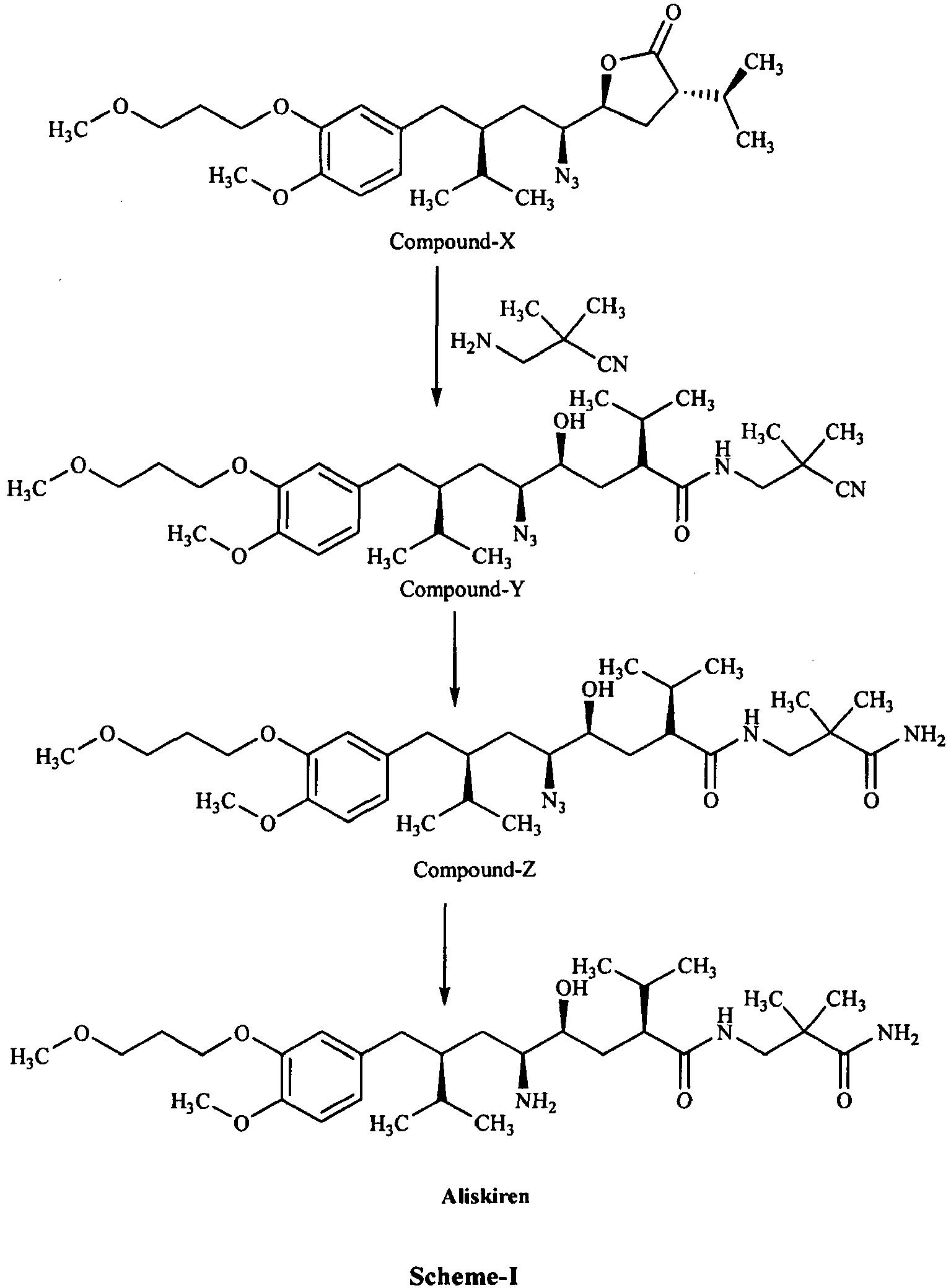
- In literature Aliskiren has been prepared by aminolysis of the lactone intermediate with an amine followed by the reduction to get the 5,4-amino alcohol moiety. The aminolysis of the lactone has been carried out with 3-amino-2,2-dimethylpropionamide. It has been disclosed in literature that this aminolysis reaction is best carried out in neat with out a solvent using excess of 3-amino-2,2-dimethylpropionamide. It has been suggested that this aminolysis reaction could be only completed if the amide used 5mol equivalents with respect to lactone. Also it has been described that the aminolysis can be completed in reasonable time if the reaction is carried out at higher temperature about 90-100°C. It is described in literature that this aminolysis reaction is a reversible reaction and the reaction equilibrium can be only shifted to right if more quantity of the amine is used. Therefore to have a industrially/commercially viable process for production of aliskiren its imperative to have a reaction condition where this aminolysis could be done in reasonable time at comparatively lower temperature along with a simple recovery process for the un reacted 3-amino-2,2-dimethylpropionamide. The 3-amino-2,2-dimethyl-propionitrile being a liquid at room temperature in contrast to the 3-amino-2,2-dimethylpropionamide which is a solid using 3-amino-2,2-dimethyl-propionitrile for the aminolysis reaction in neat condition give a uniform homogeneous reaction mass causing effective mixing of the two reactants and thus a better, faster reaction. Also 3-amino-2,2-dimethyl-propionitrile being a liquid having lower solubility in water compare to the 3-amino-2,2-dimethylpropionamide its recovery after reaction form the reaction system by acid base treatment is much easier and effective. There by resulting almost quantitative recovery of unreacted/unused 3-amino-2,2-dimethyl-propionitrile. Further the 3-amino-2,2-dimethyl-propionitrile having lower boiling point it is easy to purify by distillation either during its preparation/recovery.
- Accordingly compound of Formula-III is prepared by the reaction of compound of Formula-II with 3-Amino-2,2-dimethyl-propionitrile optionally in the presence of a base. The base used in this step may be organic or inorganic base, preferably organic base such as Triethylamine, diisopropylethylamine, etc., more preferably Triethylamine.
- In one more embodiment cyano group of compound of Formula-III is converted into amide group in the presence of a base and an oxidizing agent like hydrogen peroxide. The base used here may be organic or inorganic base, preferably inorganic base such as alkaline earth metal hydroxides, carbonates, bicarbonates etc., more preferably Sodium hydroxide.
- The amide compound of Formula-IV is converted into Aliskiren of compound of Formula-I by reducing the compound of Formula-IV. The process comprises reducing the azide group of compound of Formula-IV in the presence of alcoholic solvents and isolating Aliskiren or its pharmaceutically acceptable salts.

- In one embodiment, the reduction of compound of Formula-IV is carried out in the presence of Palladium catalyst.
- In one more embodiment, alcoholic solvents used in the reduction of azide intermediate is selected from ethanol, methanol and isopropanol, preferably methanol and ethanol.
- The prior art processes involves the use of tert-butyl methyl ether as a solvent in the reduction of azide intermediate. The yield obtained by this process is low.
- In one more embodiment the lactone compound of Formula-II is prepared by the conventional prior art methods for example disclosed in
US 7009078 . - The compound of Formula-II is alternatively prepared by cyclisation and azidation of the compound of Formula-V. The process for the preparation of compound of Formula-II from compound of Formula-V is schematically shown below.

- The compound of Formula-V, wherein R1, R2, R3 and R4 are defined above, R6 is C1-C6 alkyl, R7 is C1-C6 alkyl or C1-C6 alkoxy, including the preferences, Y is Cl, Br or I, and Z is Cl, Br or I is prepared by condensing the compound of Formula-A with Compound of Formula-B in the presence of an alkali metal or alkaline earth metal, wherein the improvement comprises after completion of the reaction the formed compound of Formula-V is purified by fractional distillation.

- Prior art
US 7132569 discloses that the compound of Formula-V is purified by using flash chromatography, which is not suitable on commercial scale. Present invention provides purification of compound of formula V by using fractional distillation method. - The condensation of compound of Formula-A and compound of Formula-B takes place in the presence of alkali or alkaline earth metals like magnesium. The coupling of Grignard reagents with compound of formula B in an ether such as, for example, tetrahydrofuran, methyl tetrahydrofuran or dioxan as solvents in the presence of catalytic quantities of a soluble metal complex, for example an iron complex such as iron acetonyl acetate, and in the presence of more than equimolar quantities of a solvent stabilizing the metal complex, for example N-methylpyrrolidone. It is expedient to carry out the reaction so that initially a compound of formula-A is converted to a Grignard compound (for example with magnesium) and then adding a solution of a compound of formula-B, metal complex and N-methylpyrrolidone, or vice versa.
- According to the present invention, fraction-I, which contains low boiling impurities are distilled out at bath/mass temperature of 90 °C to 150 °C, (vapour temperature 40 °C to 130 °C), preferably at a temperature of 110 °C to 130 °C, (vapour temperature 60 °C to 110 °C). Fraction-II, which contains starting material A2, Methyl impurity and hydroxyl impurities are distilled out at bath/mass temperature of 170 °C to 260 °C, (vapour temperature 120 °C to 180 °C), preferably at a temperature of 200 °C to 240 °C, (vapour temperature 140 °C to 160 °C) to yield the compound of Formula-V. The purity of the compound increases from 70 to above 90 % after distillation; preferably it is above 95%. This purity will enhance the purity of Aliskiren.
Hydroxy impurity 
Methyl impurity 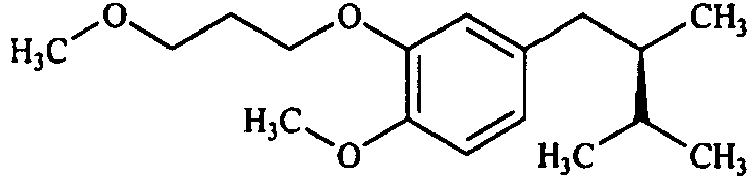
Impurity A1 
Starting material A2 
- The compounds of Formula-A and Formula-B are prepared as per the conventional methods, for example the processes disclosed in
US 5559111 andUS 7009078 . - Process for the preparation of Aliskiren as per the present invention, is summarized in the scheme-I.
- In one more aspect, the present invention provides novel intermediate of compound of Formula-III

- In one embodiment, the compound of Formula-III is converted into Aliskiren or its pharmaceutically acceptable salts thereof.
- The following examples are provided to illustrate the process of the present invention. They, are however, not intended to limiting the scope of the present invention in any way and several variants of these examples would be evident to person ordinarily skilled in the art.
- A mixture of 3-amino-2,2-dimethylpropionamide (2.0 g) and thionyl chloride (3.0 g) in 15 ml ethylenedichloride was refluxed at 75-80° C for a period of 5 hrs. The reaction mixture was concentrated to remove excess thionyl chloride and the residue was diluted with dichloromethane and washed with saturated sodium hydrogen carbonate solution. The dichloromethane solution was further washed with brine and concentrated to get 3-Amino-2,2-dimethyl-propionitrile as an oil.
- A mixture of 3-amino-2,2-dimethylpropionamide (10 g) and POCl3 (40 g) in 50ml toluene was maintained at 90-95° C for a period of 12-16 hrs. The reaction mixture was concentrated to remove excess POCl3. The reaction mass was cooled to 10-15° C and diluted with water. pH of the reaction mass was adjusted 14 with 30% aq. Sodium hydroxide solution. The aqueous layer was extracted with dichloromethane (2x50 mL). Combined dichloromethane layer was washed with brine solution (20 mL) and concentrated to get 3-Amino-2,2-dimethyl-propionitrile (7g) as an oil.
- A mixture of magnesium powder (15.5 g) and 2-methyltetrahydrofuran (175 ml) was heated to 60 °C and 1,2-dibromoethane (1 ml) was added over a period of 2 minutes. A solution of 2-{4-methoxy-3-(3-methoxypropoxyl)]-phenylmethyl-3-methyl-1-chlorobutane (50 g), 1,2-dibromoethane (5.6 ml) and 2-methyltetrahydrofuran (500 ml) was added dropwise over a period of 15 minutes at 60-65 °C. The reaction mixture was stirred under reflux and cooled to ambient temperature. There after was added to a solution of 5-chloro-2-isopropyl-n,n-dimethylpent-4-enamide-(2S,4E) (27.5 g), N-methylpyrrolidone (0.30 g) and iron (III) acetyl acetonate (1.2 g) in 2-methyltetrahydrofuran (300 ml). The reaction mixture was agitated further 15 minutes at 10 °C and quenched with dilute hydrochloric acid. The reaction mixture was extracted with ethyl acetate and the organic phases washed consecutively with water and saturated aqueous sodium chloride solution. The combined organic phases were dried over sodium sulfate, filtered and concentrated. Product purified by fractional distillation (0.1-3 mbar) at 250°C. The unreacted starting materials along with the process byproducts are removed at 200°C under reduced pressure leaving behind pure product. (~57g, 80% yield).
- A mixture of Magnesium powder (15.5 g) and tetrahydrofuran (175 ml) was heated to reflux and 1,2-dibromoethane (1 ml) was added over a period of 2 minutes. A solution of 2-{4-methoxy-3-(3-methoxypropoxyl)]-phenylmethyl-3-methyl-1-chlorobutane (50 g), 1,2-dibromoethane (5.6 ml) and Tetrahydrofuran (500 ml) was added dropwise over a period of 15 minutes at 60-65 °C. The reaction mixture was stirred under reflux and cooled to ambient temperature. There after was added to a solution of 5-chloro-2-isopropyl-n,n-dimethylpent-4-enamide-(2S,4E) (27.5 g), N-methylpyrrolidone (0.30 g) and iron (III) acetyl acetonate (1.2 g) in tetrahydrofuran (300 ml). The reaction mixture was agitated further 15 minutes at 10 °C and quenched with dilute hydrochloric acid. The reaction mixture was extracted with diisopropylether and the organic phases washed consecutively with water and saturated aqueous sodium chloride solution. The combined organic phases were dried over sodium sulfate, filtered and concentrated. Product purified by fractional distillation (0.1-3 mbar) at 250°C. The unreacted starting materials along with the process byproducts are removed at 200°C under reduced pressure leaving behind pure product. (~57g, 80% yield).
- A mixture of magnesium powder (8.4 g) and tetrahydrofuran (75 ml) was heated to 60-65°C and Iodine (100mg) was added. A solution of 2-{4-methoxy-3-(3-methoxypropoxyl)]-phenylmethyl-3-methyl-1-chlorobutane (40 g), 1,2-dibromoethane (1.2g) and tetrahydrofuran (200 ml) was added dropwise over a period of 15-30 minutes at 60-65 °C. The reaction mixture was stirred under reflux and cooled to ambient temperature. There after was added a solution of 5-chloro-2-isopropyl-n,n-dimethylpent-4-enamide-(2S,4E) (25.4 g), N-methylpyrrolidone (0.36 g) and iron (III) acetyl acetonate (0.54 g) in tetrahydrofuran (300 ml) at 0°C. The reaction mixture was agitated further 15 minutes at 10 °C and quenched with dilute hydrochloric acid. The reaction mixture was extracted with diisopropylether and the organic phases washed consecutively with water and saturated aqueous sodium chloride solution. The combined organic phases were dried over sodium sulfate, filtered and concentrated. Product purified by fractional distillation (0.1-3 mbar) at 250°C. The unreacted starting materials along with the process byproducts are removed at 200°C under reduced pressure leaving behind pure product. (~46g, 80% yield).
-

- Compound of Formula-V (15 gm), obtained from example-2 and THF (165 ml) was taken in a RB flask at 30°C. To this reaction mixture DM water (1.68 ml) was added and stirred. The reaction mass was cooled and to this ortho-phospharic acid (2.3 ml) and N-bromo succinamide (6.6 gm) were added lotwise alternatively in every 3 min gap and temperature was maintained at 5°C for 1-2 hrs. After completion of the reaction, reaction mass was quenched with Sodium hydrogen sulphite and reaction mass was extracted with isopropyl ether (225 ml). Organic layer was washed with IN HCl (150 ml) followed by water. The organic layer was washed with saturated sodium bicarbonate solution and brine solution. Organic layer was dried with sodium sulphate and the solvent was distilled out completely under vacuum. The obtained residue was crystallized in a mixture of 1:2 IPE/n-hexane. The compound was filtered and washed with pre cooled 1:2 IPE/n-hexane. The wet compound was dried to yield Bromo lactone compound.
-

- Toluene (150 ml) and the bromo lactone compound (4.28 gm) obtained from example-3 was taken in a flask and sodium azide (5.2 gm) was added. To this DM water (10 ml) and Aiquat-336 (1.0 gm) was added and the reaction mass was maintained at 75-80°C for 48 hrs. To this DM water (50 ml) was added. The layers were separated and reaction mass was extracted with toluene (100 ml) .Organic layers were combined and washed with DM water (50 ml). Organic layer was dried with sodium sulphate and the solvent was distilled out completely under vacuum. The Obtained residue, was crystallized in a mixture of 1:2 IPE/n-hexane. The compound was filtered and washed with pre cooled 1:2 IPE/n-hexane. The wet compound was dried to yield azide compound-X.
- Synthesis of compound-Y:

- A mixture of compound-X (12.0 g), 3-Amino-2,2-dimethyl-propionitrile (4.2 g), 45 mg 2-hydroxypyridine in 12 ml triethylamine was stirred for about 30 hours at 80-90°C. The progress of the reaction was monitored by HPLC analysis. After completion of the reaction it was concentrated to residue and the residue was dissolved in diisopropyl ether and stirred with aqueous NaOH to remove unreacted compound X. The layers were separated and the diisopropyl ether extract was concentrated to give residue (13.0g).
- A mixture of compound-X (12.0 g), 3-Amino-2,2-dimethyl-propionitrile (4.2 g), 3.7g of 2-hydroxypyridine in 12 ml triethylamine was stirred for about 30 hours at 80-90°C. The progress of the reaction was monitored by HPLC analysis. After completion of the reaction it was concentrated to residue and the residue was dissolved in diisopropyl ether and stirred with aqueous NaOH to remove unreacted compound X. The layers were separated and the diisopropyl ether extract was concentrated to give residue (12.0g).
- A mixture of compound-X (12.0 g), 3-Amino-2,2-dimethyl-propionitrile (4.2 g), 3.7g 2-hydroxypyridine in 12ml triethylamine was stirred for about 36 hours at 60-65°C. The progress of the reaction was monitored by HPLC analysis. After completion of the reaction it was concentrated to residue and the residue was dissolved in diisopropyl ether and stirred with aqueous NaOH to remove unreacted compound X. The layers were separated and the diisopropyl ether extract was concentrated to give residue (12.5g).
-

- To a solution of Compound-Y (13g, obtained in example 2) was dissolved in aqueous NaOH (5g dissolved in 45 ml of DM water), 35% Hydrogen peroxide (20 ml) was added at room temperature and stirred the at 30°- 40 °C for 2-4h. The progress of the reaction was monitored by HPLC analysis. After completion of the reaction the peroxides were destroyed by stirring with sodium bisulfite solution. Thereafter product was extracted in dichloromethane (3x75 ml). The dichloromethane extract was washed with brine and concentrated to obtain compound Z as a viscous liquid (12.3 g).
- Compound-Z (12.3g, obtained in example 3) and of ethanolamine (1.3g) were dissolved in ethanol and hydrogenated at about 3Kg pressure in presence of Pd/C (600mg, 5% w/w) for 3-4h. The catalyst was filtered and the clear filtrate was treated with fumaric acid (1.23g). The solution was filtered through Celite pad to get a particle free solution which was further concentrated under reduced pressure below 40°C. Acetonitrile was added to the concentrate and distillation was continued to remove residual ethanol. To this residue a mixture of acetonitrile/ethanol (97:3) was added and the obtained solution was stirred overnight to crystallize the product. The product slurry was cooled, filtered and washed with pre chilled acetonitrile. The product was dried under vacuum at 35°C to give the Aliskiren hemifumarate (9g).
- Compound-Z (6g) and ethanolamine (0.9g) were dissolved in methanol and hydrogenated at about 3Kg pressure in presence of Pd/C (600mg, 5% w/w) for 3-4h. The catalyst was filtered and the clear filtrate was treated with fumaric acid (600mg). The solution was filtered through Celite pad to get a particle free solution which was further concentrated under reduced pressure below 40°C. Acetonitrile was added to the concentrate and distillation was continued to remove residual methanol. To this residue a mixture of acetonitrile/ethanol (97:3) was added and the obtained solution was stirred overnight to crystallize the product. The product slurry was cooled, filtered and washed with pre chilled acetonitrile. The product was dried under vacuum at 35°C to give the Aliskiren hemifumarate (4g).
- The azide compound of Formula-IV was hydrogenated for 4 hours in the presence of 10% Pd/C (1 g) and ethanolamine (1 g) in ethanol (100 ml) at ambient temperature and 3.0 Mbar pressure. The reaction mixture was filtered and the catalyst was washed with ethanol (25 ml). The obtained residue was dissolved in tert-butyl methyl ether and consequently washed with water and brine. The combined organic phases were dried over anhydrous sodium sulfate and concentrated to give the residue. The residue was mixed with fumaric acid (0.5 g) dissolved in ethanol and filtered. The filtrate was concentrated by evaporation to a total weight of 7.0 grams and dissolved in acetonitrile (125 ml) at 35 °C. The resulting mixture was inoculated with 10mg of Aliskiren hemifumarate and agitated for 17 hours at ambient temperature. The suspension was cooled to 0 °C and filtered off by suction after 2 hours. The residue was washed with acetonitrile and then dried under vacuum at 35°C to yield Aliskiren hemifumarate as white crystals.
- The azide compound of Formula-IV was hydrogenated for 4 hours in the presence of 10% Pd/C (1 g) and ethanolamine (1 g) in methanol (100 ml) at ambient temperature and 3.0 Mbar pressure. The reaction mixture was filtered and the catalyst was washed with methanol (25 ml). The obtained residue was dissolved in tert-butyl methyl ether and consequently washed with water and brine. The combined organic phases were dried over anhydrous sodium sulfate and concentrated to give the residue. The residue was mixed with fumaric acid (0.5 g) dissolved in ethanol and filtered. The filtrate was concentrated by evaporation to a total weight of 7.0 grams and dissolved in acetonitrile (125 ml) at 35 °C. The resulting mixture was inoculated with 10mg of Aliskiren hemifumarate and agitated for 17 hours at ambient temperature. The suspension was cooled to 0 °C and filtered off by suction after 2 hours. The residue was washed with acetonitrile and then dried under vacuum at 35°C to yield Aliskiren hemifumarate as white crystals.
Claims (10)
- A process for the preparation of Aliskiren or its pharmaceutically acceptable salts thereof comprising the steps of:a) converting the cyano group of a compound of Formula-III into an amide group to give a compound of Formula-IV;
 b) reducing the azide group of the compound of Formula-IV to form an amine group and isolating the compound of Formula-Ia; and
 c) optionally converting the compound of Formula-Ia into a pharmaceutically acceptable salt.
 - The process according to claim 1, wherein the compound of Formula-III is prepared by reacting a compound of Formula-II, with 3-Amino-2,2-dimethyl-propionitrile

- The process according to claim 1, wherein the reduction of the azide group of compound of Formula-IV is carried out by using Pd/C.
- The process according to claim 1, wherein the reduction of the azide group of the compound of Formula-IV is carried out in the presence of an alcoholic solvent.
- The process according to claim 4, wherein the alcoholic solvent used in the reduction of the azide group of the compound of Formula-IV is selected from ethanol, methanol and isopropanol.
- The process according to claim 2, wherein the compound of Formula-II is prepared from compound of Formula-V.

- The process according to claim 6, wherein the compound of Formula-V is purified by fractional distillation.
- A compound of Formula-III

- Use of a compound of Formula-III in the preparation of Aliskiren or pharmaceutically acceptable salts thereof.
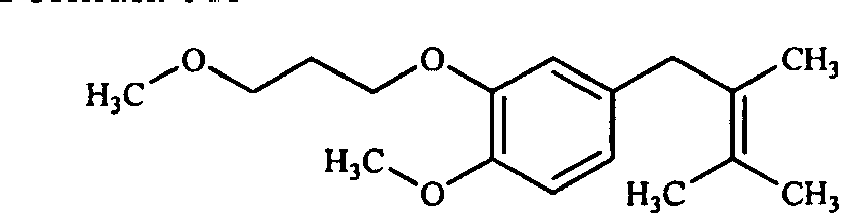
- A compound of Formula-A1
Priority Applications (4)
| Application Number | Priority Date | Filing Date | Title |
|---|---|---|---|
| PL11811559T PL2630118T3 (en) | 2010-10-19 | 2011-10-19 | Synthesis of aliskiren |
| HRP20150068AT HRP20150068T1 (en) | 2010-10-19 | 2011-10-19 | Synthesis of aliskiren |
| SI201130373T SI2630118T1 (en) | 2010-10-19 | 2011-10-19 | Synthesis of aliskiren |
| CY20151100111T CY1115983T1 (en) | 2010-10-19 | 2015-02-02 | COMPOSITION TO ALISKIREN |
Applications Claiming Priority (3)
| Application Number | Priority Date | Filing Date | Title |
|---|---|---|---|
| IN3087CH2010 | 2010-10-19 | ||
| IN2395CH2011 | 2011-07-13 | ||
| PCT/IB2011/002507 WO2012052829A1 (en) | 2010-10-19 | 2011-10-19 | Synthesis of aliskiren |
Publications (2)
| Publication Number | Publication Date |
|---|---|
| EP2630118A1 EP2630118A1 (en) | 2013-08-28 |
| EP2630118B1 true EP2630118B1 (en) | 2014-11-05 |
Family
ID=45529137
Family Applications (1)
| Application Number | Title | Priority Date | Filing Date |
|---|---|---|---|
| EP11811559.1A Active EP2630118B1 (en) | 2010-10-19 | 2011-10-19 | Synthesis of aliskiren |
Country Status (12)
| Country | Link |
|---|---|
| US (1) | US9187409B2 (en) |
| EP (1) | EP2630118B1 (en) |
| CY (1) | CY1115983T1 (en) |
| DK (1) | DK2630118T3 (en) |
| ES (1) | ES2528701T3 (en) |
| HR (1) | HRP20150068T1 (en) |
| PL (1) | PL2630118T3 (en) |
| PT (1) | PT2630118E (en) |
| RS (1) | RS53772B1 (en) |
| SI (1) | SI2630118T1 (en) |
| SM (1) | SMT201500035B (en) |
| WO (1) | WO2012052829A1 (en) |
Families Citing this family (5)
| Publication number | Priority date | Publication date | Assignee | Title |
|---|---|---|---|---|
| WO2013118138A1 (en) | 2011-12-13 | 2013-08-15 | Laboratories Ltd Mylan | Novel process for the preparation of renin inhibitors |
| WO2013124868A2 (en) | 2012-02-21 | 2013-08-29 | Mylan Laboratories Limited | Solid form of aliskiren intermediate |
| WO2013171767A1 (en) | 2012-05-18 | 2013-11-21 | Mylan Laboratories Limited | An improved process for the preparation of aliskiren |
| CN104592054A (en) * | 2013-10-31 | 2015-05-06 | 徐州万邦金桥制药有限公司 | Preparation method of high-purity aliskiren hemifumarate |
| KR102587542B1 (en) * | 2017-06-14 | 2023-10-11 | 바이엘 악티엔게젤샤프트 | Method for producing 3,4-dichloro-N-(2-cyanophenyl)-5-isothiazolecarboxamide |
Family Cites Families (5)
| Publication number | Priority date | Publication date | Assignee | Title |
|---|---|---|---|---|
| MY119161A (en) | 1994-04-18 | 2005-04-30 | Novartis Ag | Delta-amino-gamma-hydroxy-omega-aryl-alkanoic acid amides with enzyme especially renin inhibiting activities |
| US6777574B1 (en) | 1999-07-29 | 2004-08-17 | Speedel Pharma Ag | 2-alkyl-5-halogen-pent-4-ene carboxylic acids and their production |
| US6730798B2 (en) | 2000-07-05 | 2004-05-04 | Speedel Pharma Ag | Process for the preparation of substituted octanoyl amides |
| AU2001273764A1 (en) | 2000-07-25 | 2002-02-05 | Speedel Pharma Ag | Process for the preparation of substituted octanoyl amides |
| WO2011148392A1 (en) * | 2010-05-28 | 2011-12-01 | Msn Laboratories Limited | Process for the preparation of (2s,4s,5s,7s)-n-(2-carbamyl-2- methylpropyl)-5-amino-4-hydroxy-2,7-diisopropyl-8-[4-methoxy-3-(3- methoxypropoxy)phenyl]-octanamide hemifumarate and its intermediates thereof |
-
2011
- 2011-10-19 DK DK11811559.1T patent/DK2630118T3/en active
- 2011-10-19 PT PT118115591T patent/PT2630118E/en unknown
- 2011-10-19 WO PCT/IB2011/002507 patent/WO2012052829A1/en not_active Ceased
- 2011-10-19 RS RS20150062A patent/RS53772B1/en unknown
- 2011-10-19 PL PL11811559T patent/PL2630118T3/en unknown
- 2011-10-19 ES ES11811559.1T patent/ES2528701T3/en active Active
- 2011-10-19 HR HRP20150068AT patent/HRP20150068T1/en unknown
- 2011-10-19 SI SI201130373T patent/SI2630118T1/en unknown
- 2011-10-19 US US13/879,849 patent/US9187409B2/en not_active Expired - Fee Related
- 2011-10-19 EP EP11811559.1A patent/EP2630118B1/en active Active
-
2015
- 2015-02-02 CY CY20151100111T patent/CY1115983T1/en unknown
- 2015-02-12 SM SM201500035T patent/SMT201500035B/en unknown
Also Published As
| Publication number | Publication date |
|---|---|
| EP2630118A1 (en) | 2013-08-28 |
| SI2630118T1 (en) | 2015-03-31 |
| RS53772B1 (en) | 2015-06-30 |
| CY1115983T1 (en) | 2017-01-25 |
| US9187409B2 (en) | 2015-11-17 |
| SMT201500035B (en) | 2015-03-05 |
| PL2630118T3 (en) | 2015-04-30 |
| HRP20150068T1 (en) | 2015-04-10 |
| WO2012052829A1 (en) | 2012-04-26 |
| DK2630118T3 (en) | 2015-02-09 |
| US20130261324A1 (en) | 2013-10-03 |
| PT2630118E (en) | 2015-02-10 |
| ES2528701T3 (en) | 2015-02-11 |
Similar Documents
| Publication | Publication Date | Title |
|---|---|---|
| DK2630118T3 (en) | SYNTHESIS OF aliskiren | |
| JP2017088632A (en) | Compounds useful in the synthesis of benzamide compounds | |
| RU2650110C2 (en) | Processes for synthesis of 2-amino-4,6-dimethoxybenzamide and other benzamide compounds | |
| MXPA05002874A (en) | Process for the synthesis of intermediates useful for the synthesis of tubulin inhibitors. | |
| WO2011148392A1 (en) | Process for the preparation of (2s,4s,5s,7s)-n-(2-carbamyl-2- methylpropyl)-5-amino-4-hydroxy-2,7-diisopropyl-8-[4-methoxy-3-(3- methoxypropoxy)phenyl]-octanamide hemifumarate and its intermediates thereof | |
| EP2598476B1 (en) | Process for preparation of lacosamide and some n-benzyl-propanamide intermediate derivatives | |
| CN101952242B (en) | Convergent synthesis of renin inhibitors and intermediates useful therein | |
| JP4522263B2 (en) | Method for producing benzylamine derivative | |
| EP2814806B1 (en) | An improved process for the preparation of aliskiren | |
| US10364211B1 (en) | Methods and intermediates for synthesizing SK1-I | |
| JP4181233B2 (en) | Method for producing pyrrolidine-2,4-dione derivative | |
| WO2013118138A1 (en) | Novel process for the preparation of renin inhibitors | |
| JP2004238322A (en) | Method for producing (r)-3-aminopentanenitrile methanesulfonic acid salt | |
| JP3855686B2 (en) | 3,3-dialkoxy-2-hydroxyimino derivative and process for producing the same | |
| KR101163864B1 (en) | Method for preparing valsartan and novel intermediates used therein | |
| KR100850558B1 (en) | Efficient preparation of atorvastatin | |
| JPH0142253B2 (en) | ||
| KR100225534B1 (en) | Stereoselective Preparation of (2R, 3S) -beta-phenylisoserine Derivatives [Storcospecific process for preparing (2R, 3S) -β0phenylisoserine] | |
| JP2004026652A (en) | beta-ALKOXYACRYLONITRILE DERIVATIVE | |
| JPWO2005063678A1 (en) | Method for producing phenylacetic acid derivative | |
| JP2022035954A (en) | N-boc-lactam derivative and method for producing the same, and method for producing cyclic amine derivative | |
| JP2002069069A (en) | 3,5,6-trihydroxyhexanoic acid ammonium salt derivative and method for producing the same | |
| JP2002080442A (en) | 4-cyano-3-hydroxybutanoic acid and method for producing the same | |
| JPH11279154A (en) | Method for producing α, α'-diamino alcohol derivative | |
| HK1153189B (en) | Convergent synthesis of renin inhibitors and intermediates useful therein |
Legal Events
| Date | Code | Title | Description |
|---|---|---|---|
| PUAI | Public reference made under article 153(3) epc to a published international application that has entered the european phase |
Free format text: ORIGINAL CODE: 0009012 |
|
| 17P | Request for examination filed |
Effective date: 20130416 |
|
| AK | Designated contracting states |
Kind code of ref document: A1 Designated state(s): AL AT BE BG CH CY CZ DE DK EE ES FI FR GB GR HR HU IE IS IT LI LT LU LV MC MK MT NL NO PL PT RO RS SE SI SK SM TR |
|
| DAX | Request for extension of the european patent (deleted) | ||
| GRAP | Despatch of communication of intention to grant a patent |
Free format text: ORIGINAL CODE: EPIDOSNIGR1 |
|
| INTG | Intention to grant announced |
Effective date: 20140506 |
|
| GRAS | Grant fee paid |
Free format text: ORIGINAL CODE: EPIDOSNIGR3 |
|
| GRAA | (expected) grant |
Free format text: ORIGINAL CODE: 0009210 |
|
| AK | Designated contracting states |
Kind code of ref document: B1 Designated state(s): AL AT BE BG CH CY CZ DE DK EE ES FI FR GB GR HR HU IE IS IT LI LT LU LV MC MK MT NL NO PL PT RO RS SE SI SK SM TR |
|
| REG | Reference to a national code |
Ref country code: GB Ref legal event code: FG4D |
|
| REG | Reference to a national code |
Ref country code: CH Ref legal event code: EP |
|
| REG | Reference to a national code |
Ref country code: AT Ref legal event code: REF Ref document number: 694538 Country of ref document: AT Kind code of ref document: T Effective date: 20141115 |
|
| REG | Reference to a national code |
Ref country code: IE Ref legal event code: FG4D |
|
| REG | Reference to a national code |
Ref country code: DE Ref legal event code: R096 Ref document number: 602011011206 Country of ref document: DE Effective date: 20141224 |
|
| REG | Reference to a national code |
Ref country code: HR Ref legal event code: TUEP Ref document number: P20150068 Country of ref document: HR |
|
| REG | Reference to a national code |
Ref country code: RO Ref legal event code: EPE |
|
| REG | Reference to a national code |
Ref country code: CH Ref legal event code: NV Representative=s name: MICHELI AND CIE SA, CH |
|
| REG | Reference to a national code |
Ref country code: SE Ref legal event code: TRGR |
|
| REG | Reference to a national code |
Ref country code: DK Ref legal event code: T3 Effective date: 20150203 |
|
| REG | Reference to a national code |
Ref country code: PT Ref legal event code: SC4A Free format text: AVAILABILITY OF NATIONAL TRANSLATION Effective date: 20150130 |
|
| REG | Reference to a national code |
Ref country code: NL Ref legal event code: T3 Ref country code: ES Ref legal event code: FG2A Ref document number: 2528701 Country of ref document: ES Kind code of ref document: T3 Effective date: 20150211 |
|
| REG | Reference to a national code |
Ref country code: SK Ref legal event code: T3 Ref document number: E 17865 Country of ref document: SK |
|
| REG | Reference to a national code |
Ref country code: HR Ref legal event code: T1PR Ref document number: P20150068 Country of ref document: HR |
|
| REG | Reference to a national code |
Ref country code: EE Ref legal event code: FG4A Ref document number: E010271 Country of ref document: EE Effective date: 20150121 |
|
| REG | Reference to a national code |
Ref country code: GR Ref legal event code: EP Ref document number: 20150400213 Country of ref document: GR Effective date: 20150318 |
|
| REG | Reference to a national code |
Ref country code: NO Ref legal event code: T2 Effective date: 20141105 |
|
| REG | Reference to a national code |
Ref country code: PL Ref legal event code: T3 |
|
| REG | Reference to a national code |
Ref country code: HU Ref legal event code: AG4A Ref document number: E023354 Country of ref document: HU |
|
| REG | Reference to a national code |
Ref country code: DE Ref legal event code: R097 Ref document number: 602011011206 Country of ref document: DE |
|
| PLBE | No opposition filed within time limit |
Free format text: ORIGINAL CODE: 0009261 |
|
| STAA | Information on the status of an ep patent application or granted ep patent |
Free format text: STATUS: NO OPPOSITION FILED WITHIN TIME LIMIT |
|
| 26N | No opposition filed |
Effective date: 20150806 |
|
| REG | Reference to a national code |
Ref country code: AT Ref legal event code: UEP Ref document number: 694538 Country of ref document: AT Kind code of ref document: T Effective date: 20141105 |
|
| REG | Reference to a national code |
Ref country code: FR Ref legal event code: PLFP Year of fee payment: 5 |
|
| REG | Reference to a national code |
Ref country code: DE Ref legal event code: R082 Ref document number: 602011011206 Country of ref document: DE Representative=s name: HERNANDEZ, YORCK, DIPL.-ING., DE |
|
| REG | Reference to a national code |
Ref country code: SE Ref legal event code: EUG |
|
| PG25 | Lapsed in a contracting state [announced via postgrant information from national office to epo] |
Ref country code: SE Free format text: LAPSE BECAUSE OF NON-PAYMENT OF DUE FEES Effective date: 20151020 |
|
| REG | Reference to a national code |
Ref country code: FR Ref legal event code: PLFP Year of fee payment: 6 |
|
| REG | Reference to a national code |
Ref country code: FR Ref legal event code: PLFP Year of fee payment: 7 |
|
| REG | Reference to a national code |
Ref country code: FR Ref legal event code: PLFP Year of fee payment: 8 |
|
| PGFP | Annual fee paid to national office [announced via postgrant information from national office to epo] |
Ref country code: IT Payment date: 20181218 Year of fee payment: 17 |
|
| REG | Reference to a national code |
Ref country code: HR Ref legal event code: ODRP Ref document number: P20150068 Country of ref document: HR Payment date: 20191014 Year of fee payment: 9 |
|
| PGFP | Annual fee paid to national office [announced via postgrant information from national office to epo] |
Ref country code: LU Payment date: 20191010 Year of fee payment: 9 |
|
| PGFP | Annual fee paid to national office [announced via postgrant information from national office to epo] |
Ref country code: MC Payment date: 20191010 Year of fee payment: 9 Ref country code: BG Payment date: 20191031 Year of fee payment: 9 Ref country code: PT Payment date: 20191010 Year of fee payment: 9 Ref country code: SK Payment date: 20191018 Year of fee payment: 9 Ref country code: IE Payment date: 20191009 Year of fee payment: 9 Ref country code: NO Payment date: 20191009 Year of fee payment: 9 Ref country code: HU Payment date: 20191104 Year of fee payment: 9 Ref country code: RO Payment date: 20191014 Year of fee payment: 9 Ref country code: LT Payment date: 20191015 Year of fee payment: 9 Ref country code: FI Payment date: 20191009 Year of fee payment: 9 Ref country code: CZ Payment date: 20191018 Year of fee payment: 9 Ref country code: CY Payment date: 20191014 Year of fee payment: 9 Ref country code: DE Payment date: 20191009 Year of fee payment: 9 Ref country code: NL Payment date: 20191011 Year of fee payment: 9 |
|
| PGFP | Annual fee paid to national office [announced via postgrant information from national office to epo] |
Ref country code: GR Payment date: 20191030 Year of fee payment: 9 Ref country code: FR Payment date: 20191010 Year of fee payment: 9 Ref country code: PL Payment date: 20191011 Year of fee payment: 9 Ref country code: HR Payment date: 20191014 Year of fee payment: 9 Ref country code: IS Payment date: 20191025 Year of fee payment: 9 Ref country code: SM Payment date: 20191029 Year of fee payment: 9 Ref country code: BE Payment date: 20191007 Year of fee payment: 9 Ref country code: RS Payment date: 20191011 Year of fee payment: 9 Ref country code: SI Payment date: 20191010 Year of fee payment: 9 Ref country code: LV Payment date: 20191029 Year of fee payment: 9 Ref country code: DK Payment date: 20191015 Year of fee payment: 9 Ref country code: EE Payment date: 20191029 Year of fee payment: 9 |
|
| PGFP | Annual fee paid to national office [announced via postgrant information from national office to epo] |
Ref country code: CH Payment date: 20191011 Year of fee payment: 9 Ref country code: AT Payment date: 20191009 Year of fee payment: 9 Ref country code: MK Payment date: 20191014 Year of fee payment: 9 Ref country code: MT Payment date: 20191029 Year of fee payment: 9 Ref country code: TR Payment date: 20191015 Year of fee payment: 9 |
|
| PGFP | Annual fee paid to national office [announced via postgrant information from national office to epo] |
Ref country code: GB Payment date: 20191010 Year of fee payment: 9 |
|
| REG | Reference to a national code |
Ref country code: HR Ref legal event code: PBON Ref document number: P20150068 Country of ref document: HR Effective date: 20201019 |
|
| REG | Reference to a national code |
Ref country code: DE Ref legal event code: R119 Ref document number: 602011011206 Country of ref document: DE |
|
| REG | Reference to a national code |
Ref country code: EE Ref legal event code: MM4A Ref document number: E010271 Country of ref document: EE Effective date: 20201031 |
|
| REG | Reference to a national code |
Ref country code: NO Ref legal event code: MMEP Ref country code: DK Ref legal event code: EBP Effective date: 20201031 |
|
| REG | Reference to a national code |
Ref country code: CH Ref legal event code: PL Ref country code: FI Ref legal event code: MAE |
|
| REG | Reference to a national code |
Ref country code: NL Ref legal event code: MM Effective date: 20201101 |
|
| REG | Reference to a national code |
Ref country code: AT Ref legal event code: MM01 Ref document number: 694538 Country of ref document: AT Kind code of ref document: T Effective date: 20201019 |
|
| GBPC | Gb: european patent ceased through non-payment of renewal fee |
Effective date: 20201019 |
|
| REG | Reference to a national code |
Ref country code: SK Ref legal event code: MM4A Ref document number: E 17865 Country of ref document: SK Effective date: 20201019 |
|
| PG25 | Lapsed in a contracting state [announced via postgrant information from national office to epo] |
Ref country code: LU Free format text: LAPSE BECAUSE OF NON-PAYMENT OF DUE FEES Effective date: 20201019 Ref country code: MC Free format text: LAPSE BECAUSE OF NON-PAYMENT OF DUE FEES Effective date: 20201103 |
|
| REG | Reference to a national code |
Ref country code: BE Ref legal event code: MM Effective date: 20201031 |
|
| PG25 | Lapsed in a contracting state [announced via postgrant information from national office to epo] |
Ref country code: RO Free format text: LAPSE BECAUSE OF NON-PAYMENT OF DUE FEES Effective date: 20201019 Ref country code: PT Free format text: LAPSE BECAUSE OF NON-PAYMENT OF DUE FEES Effective date: 20210419 Ref country code: SK Free format text: LAPSE BECAUSE OF NON-PAYMENT OF DUE FEES Effective date: 20201019 Ref country code: FI Free format text: LAPSE BECAUSE OF NON-PAYMENT OF DUE FEES Effective date: 20201019 Ref country code: FR Free format text: LAPSE BECAUSE OF NON-PAYMENT OF DUE FEES Effective date: 20201031 Ref country code: HR Free format text: LAPSE BECAUSE OF NON-PAYMENT OF DUE FEES Effective date: 20201019 Ref country code: GR Free format text: LAPSE BECAUSE OF NON-PAYMENT OF DUE FEES Effective date: 20210510 Ref country code: SM Free format text: LAPSE BECAUSE OF NON-PAYMENT OF DUE FEES Effective date: 20210521 Ref country code: EE Free format text: LAPSE BECAUSE OF NON-PAYMENT OF DUE FEES Effective date: 20201031 Ref country code: BG Free format text: LAPSE BECAUSE OF NON-PAYMENT OF DUE FEES Effective date: 20210430 Ref country code: CZ Free format text: LAPSE BECAUSE OF NON-PAYMENT OF DUE FEES Effective date: 20201019 Ref country code: DE Free format text: LAPSE BECAUSE OF NON-PAYMENT OF DUE FEES Effective date: 20210501 Ref country code: CY Free format text: LAPSE BECAUSE OF NON-PAYMENT OF DUE FEES Effective date: 20201019 Ref country code: NL Free format text: LAPSE BECAUSE OF NON-PAYMENT OF DUE FEES Effective date: 20201101 Ref country code: NO Free format text: LAPSE BECAUSE OF NON-PAYMENT OF DUE FEES Effective date: 20201031 |
|
| REG | Reference to a national code |
Ref country code: LT Ref legal event code: MM4D Effective date: 20201019 |
|
| PG25 | Lapsed in a contracting state [announced via postgrant information from national office to epo] |
Ref country code: GB Free format text: LAPSE BECAUSE OF NON-PAYMENT OF DUE FEES Effective date: 20201019 Ref country code: LI Free format text: LAPSE BECAUSE OF NON-PAYMENT OF DUE FEES Effective date: 20201031 Ref country code: ES Free format text: LAPSE BECAUSE OF NON-PAYMENT OF DUE FEES Effective date: 20191020 Ref country code: HU Free format text: LAPSE BECAUSE OF NON-PAYMENT OF DUE FEES Effective date: 20201020 Ref country code: SI Free format text: LAPSE BECAUSE OF NON-PAYMENT OF DUE FEES Effective date: 20201020 Ref country code: LV Free format text: LAPSE BECAUSE OF NON-PAYMENT OF DUE FEES Effective date: 20201019 Ref country code: BE Free format text: LAPSE BECAUSE OF NON-PAYMENT OF DUE FEES Effective date: 20201031 Ref country code: CH Free format text: LAPSE BECAUSE OF NON-PAYMENT OF DUE FEES Effective date: 20201031 Ref country code: AT Free format text: LAPSE BECAUSE OF NON-PAYMENT OF DUE FEES Effective date: 20201019 |
|
| PG25 | Lapsed in a contracting state [announced via postgrant information from national office to epo] |
Ref country code: RS Free format text: LAPSE BECAUSE OF NON-PAYMENT OF DUE FEES Effective date: 20201019 |
|
| REG | Reference to a national code |
Ref country code: SI Ref legal event code: KO00 Effective date: 20210816 |
|
| PG25 | Lapsed in a contracting state [announced via postgrant information from national office to epo] |
Ref country code: IE Free format text: LAPSE BECAUSE OF NON-PAYMENT OF DUE FEES Effective date: 20201019 Ref country code: IT Free format text: LAPSE BECAUSE OF NON-PAYMENT OF DUE FEES Effective date: 20201019 Ref country code: LT Free format text: LAPSE BECAUSE OF NON-PAYMENT OF DUE FEES Effective date: 20201019 |
|
| PG25 | Lapsed in a contracting state [announced via postgrant information from national office to epo] |
Ref country code: DK Free format text: LAPSE BECAUSE OF NON-PAYMENT OF DUE FEES Effective date: 20201031 |
|
| PG25 | Lapsed in a contracting state [announced via postgrant information from national office to epo] |
Ref country code: TR Free format text: LAPSE BECAUSE OF NON-PAYMENT OF DUE FEES Effective date: 20201019 Ref country code: MT Free format text: LAPSE BECAUSE OF NON-PAYMENT OF DUE FEES Effective date: 20201019 Ref country code: AL Free format text: LAPSE BECAUSE OF FAILURE TO SUBMIT A TRANSLATION OF THE DESCRIPTION OR TO PAY THE FEE WITHIN THE PRESCRIBED TIME-LIMIT Effective date: 20141105 |
|
| PG25 | Lapsed in a contracting state [announced via postgrant information from national office to epo] |
Ref country code: PL Free format text: LAPSE BECAUSE OF NON-PAYMENT OF DUE FEES Effective date: 20201019 |
|
| PG25 | Lapsed in a contracting state [announced via postgrant information from national office to epo] |
Ref country code: IS Free format text: LAPSE BECAUSE OF NON-PAYMENT OF DUE FEES Effective date: 20210512 |