EP2629552B1 - Audiosurroundverarbeitungssystem - Google Patents
Audiosurroundverarbeitungssystem Download PDFInfo
- Publication number
- EP2629552B1 EP2629552B1 EP13154275.5A EP13154275A EP2629552B1 EP 2629552 B1 EP2629552 B1 EP 2629552B1 EP 13154275 A EP13154275 A EP 13154275A EP 2629552 B1 EP2629552 B1 EP 2629552B1
- Authority
- EP
- European Patent Office
- Prior art keywords
- components
- audio
- signal
- center
- audio signal
- Prior art date
- Legal status (The legal status is an assumption and is not a legal conclusion. Google has not performed a legal analysis and makes no representation as to the accuracy of the status listed.)
- Active
Links
Images



Classifications
-
- H—ELECTRICITY
- H04—ELECTRIC COMMUNICATION TECHNIQUE
- H04S—STEREOPHONIC SYSTEMS
- H04S5/00—Pseudo-stereo systems, e.g. in which additional channel signals are derived from monophonic signals by means of phase shifting, time delay or reverberation
- H04S5/005—Pseudo-stereo systems, e.g. in which additional channel signals are derived from monophonic signals by means of phase shifting, time delay or reverberation of the pseudo five- or more-channel type, e.g. virtual surround
-
- H—ELECTRICITY
- H04—ELECTRIC COMMUNICATION TECHNIQUE
- H04R—LOUDSPEAKERS, MICROPHONES, GRAMOPHONE PICK-UPS OR LIKE ACOUSTIC ELECTROMECHANICAL TRANSDUCERS; ELECTRIC HEARING AIDS; PUBLIC ADDRESS SYSTEMS
- H04R2205/00—Details of stereophonic arrangements covered by H04R5/00 but not provided for in any of its subgroups
- H04R2205/024—Positioning of loudspeaker enclosures for spatial sound reproduction
-
- H—ELECTRICITY
- H04—ELECTRIC COMMUNICATION TECHNIQUE
- H04S—STEREOPHONIC SYSTEMS
- H04S2400/00—Details of stereophonic systems covered by H04S but not provided for in its groups
- H04S2400/05—Generation or adaptation of centre channel in multi-channel audio systems
-
- H—ELECTRICITY
- H04—ELECTRIC COMMUNICATION TECHNIQUE
- H04S—STEREOPHONIC SYSTEMS
- H04S3/00—Systems employing more than two channels, e.g. quadraphonic
-
- H—ELECTRICITY
- H04—ELECTRIC COMMUNICATION TECHNIQUE
- H04S—STEREOPHONIC SYSTEMS
- H04S7/00—Indicating arrangements; Control arrangements, e.g. balance control
- H04S7/30—Control circuits for electronic adaptation of the sound field
-
- H—ELECTRICITY
- H04—ELECTRIC COMMUNICATION TECHNIQUE
- H04S—STEREOPHONIC SYSTEMS
- H04S7/00—Indicating arrangements; Control arrangements, e.g. balance control
- H04S7/30—Control circuits for electronic adaptation of the sound field
- H04S7/305—Electronic adaptation of stereophonic audio signals to reverberation of the listening space
Definitions
- This application relates generally to audio signal processing and, in particular, to generating a number of surround sound signals using an estimate of the ambient energy contained in the source signal.
- Two-channel recording is one of the popular formats for music recordings.
- the audio signal from a two-channel stereo audio system or device is limited in its ability to provide a true surround sound because only two frontal loudspeakers (left and right) are available.
- For multi-channel audio devices enhancing the sound experience beyond stereo involves the addition of surround sound signals in order to generate a surround sound effect for the listener.
- Technologies enabling a surround sound effect by processing a two-channel stereo sound signal have been implemented.
- U.S. Patent No. 7 412 380 B1 describes a method to identify an ambience component of each channel of a source audio signal by separately processing each channel.
- U.S. Publication No. 2007/041592 A1 describes a method to separate a source in a stereo signal with a left and right channel by transforming the stereo signal into the time domain and processing the stereo signal in the time domain.
- An audio surround processing system to perform spatial processing of audio signals receives an audio signal having at least two channels (such as left and right audio channels) and generates a number of surround sound signals in which the amount of artificially generated ambient energy is at least partially controlled in real-time by estimated ambient energy that is contained in the source signal.
- the audio surround processing system may divide an audio signal having at least two channels into at least two sets of components, such as first and second components.
- the first and second components may be determined by identifying a low frequency range of the audio signal as the first component, and identifying the high frequency range of the audio signal as the second component.
- the first component may be transformed from a time domain to a frequency domain.
- An ambience estimate control coefficient may be generated using the transformed first component.
- the overall gain of the generated surround sound signals may be determined using the ambience estimate control coefficient.
- a feature of the audio surround processing system involves extraction of a center channel from the audio signal.
- the audio surround processing system may extract a first center channel signal from the first component and extract a second center channel signal from the second component.
- the extracted first and second center channel signals may be combined to form an extracted center channel output signal.
- Another feature of the audio surround processing system involves generation of surround sound signals using the audio signal and the extracted center channel output signal within a matrix.
- the generated surround sound signals may be output by the matrix and combined with synthesized surround sound signals to generate surround sound output signals on output channels.
- FIG. 1 shows a block diagram representation depicting an example of audio/video receiver (AVR) 102 having an audio surround processing system (ASPS) 104 within a listening room 110.
- the AVR 102 may be connected to one or more audio generating devices.
- the example audio generating device is depicted as a television 112.
- the audio generating device may be a DVD player, a Blu-rayTM player, a set-top-box, a game console (e.g., an Xbox360TM or a PlayStation3TM), a car audio/video system, a compact disc player, a memory device (such as an MP3 player, IPOD or smart tablet), a personal computer, a high-definition television (HDTV) receiver, a cable television system, a satellite television system, and/or any other device or system capable of providing audio signals to the AVR 102.
- a game console e.g., an Xbox360TM or a PlayStation3TM
- a car audio/video system e.g., a car audio/video system
- a compact disc player e.g., a compact disc player
- a memory device such as an MP3 player, IPOD or smart tablet
- HDTV high-definition television
- the ASPS 104 may process an incoming audio signal, such as a two-channel stereo signal to generate additional audio channels, such as five additional audio channels, in addition to the original left audio channel and right audio channel signal. In other examples, any number of audio channels may be processed by the ASPS 104.
- Each audio channel output from the AVR 102 may be connected to a loudspeaker, such as a center channel loudspeaker 122, surround channel loudspeakers (such as left surround 126, right surround 128, left back surround 130, and right back surround 132), a left loudspeaker 120 and a right loudspeaker 124.
- the loudspeakers may be arranged around a central listening location or listening area, such as an area that includes a sofa 108 located in listening room 110.
- the example listening space is depicted as a room. In other examples, the listening space may be in a vehicle, outdoors, or in any other space where an audio system can be operated to produce audible sound.
- the AVR 102 is connected to television 112 via a left audio cable 140 and right audio cable 142.
- the ASPS 104 within the AVR 102 may receive and process the left and right audio channels carried by the left audio cable 140 and right audio cable 142 and generate additional audio channels.
- the connection from the television 112 or other audio/video components to the AVR 102 may be via wires, fiber optics, or electromagnetic waves (radio frequency, infrared, BluetoothTM, wireless universal serial bus, or other non-wired connections), and may include additional channels.
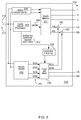
- FIG. 2 is an example block diagram of an audio surround processing system (ASPS) 202 showing components for upmixing from two channels to seven channels. In other examples, any other number of channels may be illustrated.
- Audio signal processor module (ASP) 222 of ASPS 202 may generate a time-varying ambience estimate control coefficient 242 and derive a center audio channel 240 from incoming audio signals supplied on a left audio channel 210 and right audio channel 212.
- the ASP 222 may be a module executed by one or more processors included in the ASPS 202.
- the one or more processors may be any computing device capable of processing audio and/or video signals, such as a computer processor, a digital signal processor, a field programmable gate array (FPGA), or any other device capable of executing logic.
- FPGA field programmable gate array
- the processor may operate in association with a memory to execute instructions stored in the memory.
- the memory may be any form of one or more data storage devices, such as volatile memory, non-volatile memory, electronic memory, magnetic memory, optical memory, or any other form of device or system capable of storing data and/or instructions.
- the time-varying ambience estimate control coefficient 242 may be an output signal of the ASP module 222 that represents an estimate of the magnitude or amount of ambient energy detected in the stereo source signal provided as the incoming left and right audio signals.
- the ambience estimate control coefficient 242 may be represented as one or more coefficients.
- the signal may be time varying in accordance with the audio content contained in the left and right incoming audio signals. Multiple coefficients may be assigned to different frequency bands, in order to more accurately mimic specific characteristics of small and large rooms or halls.
- the functionality of the ASPS 202 is described using modules.
- the modules described herein are defined to include software, hardware or some combination of hardware and software executable by the processor.
- Software portions of modules may include instructions stored in the memory, or any other memory device that are executable by the one or more processors included in the ASPS 202 or any other processor.
- Hardware portions of modules may include various devices, components, circuits, gates, circuit boards, and the like that are executable, directed, and/or controlled for performance by the processor.
- the modules include a room model 226 that may generate artificial surround sound signals using the incoming audio signals provided on the left audio channel 210 and the right audio channel 212.
- Room model 226 may generate the surround sound signals using any surround sound signal generation technique that involves modeling a room.
- room model 226 receives the incoming audio signals and a number of user input parameters associated with spatial attributes of a room, such as "room size" and "stage distance".
- the input parameters may be used to define a listening room and generate coefficients, room impulse responses, and scaling factors that can be used to generate surround sound signals. Examples of generation of a synthesized ambient sound field using the spatial attributes of a room are discussed in US Patent Publication No. 2009/0147975 published June 11, 2009 . In FIG.
- room model 226 uses the incoming audio signals on the left audio channel 210 and right audio channel 212 to create a synthesized ambient sound field by generating additional synthesized surround sound channels 244, such as four synthesized surround sound channels (SLS, SRS, SLB, and SRB).
- the synthetically generated surround sound signals 244 may include a synthetic left side signal (SLS), a synthetic right side signal (SRS), a synthetic left back signal (SLB), and a synthetic right back signal (SRB).
- techniques for generating artificial surround sound signals that do not employ room modeling may be used to generate the synthesized surround sound signals on the surround sound channels 244.
- the energy of the synthesized ambient sound field generated by room model 226 may be automatically controlled in real-time using estimated features of the incoming data.
- Estimated features of the incoming data may include determination of estimated ambient energy based on the incoming audio signals provided on the left audio channel 210 and the right audio channel 212.
- One or more final gain factors for application to each of the synthesized ambient surround sound signals may be obtained through a nonlinear mapping function module 228 using the ambience estimate control coefficient 242.
- the final gain factors may be applied to the synthetic surround sound channels (SLB, SRB, SLS, and SRS) 244, such as via summation, using an overall gain module 230.
- Controlling, using the gain factors, the magnitude of artificially generated ambient energy in real-time based on the estimated ambient energy in the source signal allows for adjustment of room impression, envelopment and stage distance. This is useful, for example, in surround sound systems that receive varying program material during a broadcast that cannot easily be continuously adjusted (e.g., automotive installations) without changes in the audio output becoming noticeable to a listener.
- the ambience estimate control coefficient 242 may be substantially continuously updated by the audio signal processor module 222, depending on music program statistics derived from the incoming audio signals provided on the left audio channel 210 and the right audio channel 212.
- the center audio channel 240 may be derived by the audio signal processor module 222 from the stereo source signal provided on the left audio channel 210 and the right audio channel 212.
- the center audio signal may be extracted and provided on the center audio channel 240 to drive a dedicated center speaker.
- the center channel component may be extracted from the left and right components using a center channel extraction technique, such as using the differences in the spatial content between the left and right components to identify common content.
- the frequencies not identified as common content may be attenuated resulting in extraction of audio content that forms the center channel component.
- the extracted center audio channel 240 may be provided to a width matrix module 224.
- the incoming audio signals provided on the left audio channel 210 and the right audio channel 212 may be supplied to a delay compensation module 220 to account for the processing time of the audio signal processor module 222.
- the delay compensation module 220 may be an all pass filter, or any other form of signal processing technique or mechanism that time delays the incoming audio signals provided on the left audio channel 210 and the right audio channel 212, and provides the time-delayed incoming audio signals to the width matrix module 224.
- the delayed incoming audio signals provided on the left audio channel 210 and the right audio channel 212 may be supplied to the width matrix module 224 substantially in phase with the extracted center audio signal provided on the center audio channel 240.
- the width matrix module 224 may use the delayed incoming audio signals on the left audio channel 210 and the right audio channel 212, and the extracted center audio signal generated on the center audio channel 240 to produce output channels 246 that include surround sound signals L, R, C, LS, and RS to drive one or more corresponding loudspeakers in an audio system.
- the width matrix module 224 may provide the output channels 246 with adjustable width control.
- the adjustable width control may be used to vary the effective width, or listener perceived width of the surround sound presentation being produced on a virtual sound stage.
- the width of the virtual sound stage can be set to 0 to 90 degrees, where 0 degrees represents a relatively small perceived sound stage, and a 90 degree sound stage represents a very large perceived sound stage with 45 degrees appearing at substantially the middle, or center of the listener perceived sound stage.
- the adjustable width control may be manually entered by a user, selected by a user from a preset list of available values, automatically set by the processor, or determined by any other means.
- the outputs of the width matrix module 224 may be a left channel signal, a right channel signal, and a center channel signal that are provided directly as center (C), left (L), and right (R) output channels of the respective output channels 246.
- the width matrix module 224 may also output a left side signal (LS) and a right side signal (RS) that are derived from the delayed left and right audio signals and the extracted center channel signal in accordance with the adjustable width control.
- the left side signal (LS) and a right side signal (RS) output by the width matrix module 224 may be output to respective summation modules 250 and 252.
- the left side signal (LS) may be combined with the synthesized left side signal (SLS) provided by the overall gain module 230 using the summation module 250 to form a left side output signal on the left side channel output (LS) of the output channels 246.
- the right side signal (RS) may be combined with the synthesized right side signal (SRS) provided by the overall gain module 230 using the summation module 252 to form a right side output signal on the right side channel output (RS) of the output channels 246.
- the overall gain module 230 may also output the synthesized left back signal (SLB) as a left back output signal on a left back output channel (LB) included among the output channels 246.
- overall gain module 230 may also output the synthesized right back signal (SRB) as a right back output signal on a right back output channel (RB) included among the output channels 246.
- the resulting output signals (L, R, C, LS, RS, LB, RB) on the output channels 246 may be used to drive one or more corresponding loudspeakers in a listening area. In other examples, fewer or greater numbers of output channels and corresponding output signals may be generated with the ASPS 202.
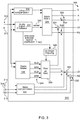
- FIG. 3 is an example block diagram that depicts an example audio surround processing system (ASPS) 302 showing components for up-mixing from five channels to seven channels. In other examples fewer or greater numbers of input and output channels may be used in the up-mixing operation.
- the ASPS 302 of this example can be applied to further enhance original surround sound channels, such as recorded surround music (e.g., movie soundtracks).
- ASP 322 of ASPS 302 generates an ambience estimate control coefficient 342 and derives a center audio channel 340 from incoming audio signals on the left audio channel 310 and right audio channel 312.
- Ambient sound in the form of synthetically produced surround sound signals 344 may be generated with a room model module 326.
- the synthetically generated surround sound signals 344 may include a synthetic left side signal (SLS), a synthetic right side signal (SRS), a synthetic left back signal (SLR), and a synthetic right rear signal (SRR).
- the synthetically generated surround sound signals 344 may be generated through linear filtering with a predefined optimized room model.
- the ambience estimate control coefficient 342 may be applied to a nonlinear mapping module 328 to determine a gain for each of the synthesized surround sound signals.
- the gains for each of the synthesized surround sound signals may be used to control the overall gain module 330 to selectively and independently apply gain to the ambient surround sound signals.
- the gains may be respectively applied to the synthetic surround sound channels (SLB, SRB, SLS, and SRS) 344 using the overall gain module 330, such as via summation of the overall gain and the surround sound channels (SLB, SRB, SLS, and SRS) 344.
- the center audio signal on the center channel 340 may be derived from the stereo source signal, and may be used to drive a dedicated center speaker from a center output (C) of the output channels 346 following processing by the width matrix module 324. Derivation of the center audio signal may be based on extraction of a portion of the audio content from each of the incoming audio signals on the left audio channel 310 and right audio channel 312. The extracted center channel 340, together with the source signal after being delayed by the delay compensation module 320, may be fed into the width matrix module 324, which produces the output channels 346 (loudspeaker channels L, R, C, LS, and RS) with adjustable width control.
- the input surround sound channels (C 314, LS 316, RS 318) may be delayed in time with delay compensation module 332.
- Delay compensation module 332 may be one or more filters, such as all pass filters, or any other mechanism or technique capable of introducing time delay of the incoming surround sound channels (C 314, LS 316, RS 318).
- the incoming surround sound channels (C 314, LS 316, RS 318) may be time delayed to maintain phasing with the synthetic surround sound signals generated with the room model module 326 from the incoming audio signals on the left audio channel 310 and right audio channel 312.
- the delayed incoming surround sound channels may be processed through the delay compensation module 332 to maintain phase with the audio signals on the left and right channels 310 and 312 that are being separately processed.
- the delayed left side signal on the left side channel (LS) 316 may be superimposed on the synthetic left back signal (SLB) included in the upmixed sound field at a summation point 348.
- the delayed left side signal and the synthetic left back signal (SLB) may be attenuated with attenuation factors, such as -3dB to -6 dB at the summation point 348 and provided as a left back output signal on a left back output channel (LB) included in the output channels 346.
- the delayed right side signal on the right side channel 318 may be attenuated with attenuation factors and superimposed on the attenuated synthetic right back signal (SRB) included in the upmixed sound field at a summation point 350 and provided as a right back signal on a right back output channel (RB) included in the output channels 346.
- the delayed center signal on the center channel 314 may be attenuated with attenuation factors and superimposed on the center channel 340 following processing of the center channel signal by the width matrix 324 and attenuation by a summation point 352.
- the output of the summation point 352 may be a center output signal on the center output channel included among the output channels 346.
- the attenuation factors may be variable to allow balancing of the energies of the original five channel soundfield provided by the audio signals, and the up-mixed five channel soundfield, in order to provide the best listening experience.
- the ratio of the attenuation factors may be varied depending on the source material, for example depending on how much room information and ambience is already contained in the source material provided in the audio signals.
- the synthetic left side signal (SLS) included in the upmixed sound field may be combined with the left side signal generated by the width matrix 324 at a summation point 354 to form a left side output signal on a left side output channel (LS), and the synthetic right side signal (SRS) included in the upmixed sound field may be combined with the right side signal generated by the width matrix 324 at a summation point 356 to form a right side output signal on a right side output channel (RS).
- the left and right side output channels (LS and RS) may be included among the output channels 346.
- the delayed left and right signals may be processed by the width matrix 324 and output as left and right output signals on left and right output channels (L and R) included among the output channels 346.
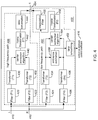
- FIG. 4 illustrates an example block diagram representation of an audio signal processor module (ASP) 402 which could be the ASP 222 of FIG. 2 , or the ASP 322 of FIG. 3 .
- ASP audio signal processor module
- the incoming audio signals on the left audio channel 410 and right audio channel 412 are split into two paths, a highfrequency path 460 and a low frequency path 462 using crossover filters and decimation.
- the high frequency components of left audio signal are obtained by filtering the left audio channel 410 using filter module F1 420.
- the high frequency components of right audio signal are obtained by filtering the right audio channel 412 using filter module F2 422.
- the low frequency components of left audio channel are obtained by filtering the left audio channel 410 using filter module F3 424.
- the low frequency components of right audio signal are obtained by filtering the right audio channel 412 using filter module F4 426.
- These high and low frequency components may be first and second components of the input audio signal that are independently filtered, transformed and processed.
- the filters F1 and F2 420 and 422 of the high frequency path may use a low-order recursive Infinite Impulse Response (IIR) high pass filter, while the filters F3 and F4 424 and 426 of the low frequency path may use a pair of Finite Impulse Response (FIR) decimation filters.
- IIR Infinite Impulse Response
- FIR Finite Impulse Response
- Transformer module T1 430 receives the high frequency components of left audio channel 410.
- Transformer module T2 432 receives the high frequency components of right audio channel 412.
- Transformer module T3 434 receives the low frequency components of left audio channel 410.
- Transformer module T4 436 receives the low frequency components of right audio channel 412.
- Each transformer 430, 432, 434, 436 may transform the respective audio signal components from a time domain into a frequency domain.
- the transformers 430, 432, 434, 436 employ a time/frequency analysis scheme that uses short-time Fourier transform (STFT) lengths of 128 with a hop size of 48, thereby achieving much higher time resolution than with other methods.
- STFT short-time Fourier transform
- a single fast Fourier transform (FFT) of length 1024 results in a time resolution of (10 to 20 msec.), depending on overlap length.
- FFT fast Fourier transform
- the resulting time resolution may be 1 to 2 msec.
- the time resolution may now be more closely related to human perception (1 to 2 msec.).
- the audio signals extracted from the left and right audio channels may contain less audible artifacts such as modulation noise, coloration and nonlinear distortion.
- Ambience estimation module 450 and center extraction algorithm module 454 receive the transformed low frequency left and right components from transformer T3 434 and transformer T4 436 along the low frequency path 462.
- the ambience estimation module 450 estimates a level of ambient energy contained in the left and right audio input signals.
- Time smoothing 452 may be applied to the output of ambience estimation module 450 to reduce short-term variations in order to create a smoothed version of ambience estimate control coefficient 416 that is output by the time smoothing module 452.
- Ambience estimate control coefficient 416 may be similar to ambience estimate control coefficients 242 and 342 discussed with respect to FIGs. 2 and 3 , respectively. Smoothing may be performed with filtering, modeling, or any other technique to create a slowly evolving signal. An example smoothing technique is described later.
- the transformers 434, 436, the center extraction algorithm 454 and the ambience estimation module 450 in the low frequency path 462 may run at a predetermined reduced sample rate that is determined based on the sample frequency (fs) and an oversampling ratio (rs).
- fs 48kHz
- frequency resolution may be improved due to sub-sampling of the lower frequency band in the low frequency path 462.
- aliasing distortion which can be a problem in poly-phase filter banks with nonlinear processing, may be minimized or avoided completely.
- Use of the predetermined reduced sample rate may also lead to exceptional fidelity and sound quality with artifacts suppressed to below the audibility of a human listener, because of the resulting high frequency resolution, while not compromising high time resolution.
- Using a reduced sample rate may also result in an increase, such as an rs-fold increase, in the low frequency resolution of the audio signal, thus the same downsampling ratio can be used for the filters F3 and F4 424 and 426, and also for the interpolation filter 456.
- the filters F3 and F4 424 and 426 may be decimation filters.
- the center extraction algorithm module 440 in the high frequency path 460 extracts a high frequency center channel component based on the transformed high frequency left and right components from transformer T1 430 and transformer T2 432.
- the center extraction algorithm module 454 of the low frequency path 462 may extract a low frequency center channel component based on the transformed low frequency left and right components from transformer T3 434 and transformer T4 436.
- the high and low frequency center channel components may be extracted from the left and right components using a center channel extraction technique, such as using the differences in the spatial content between the left and right components to identify common content.
- the frequencies not identified as common content may be attenuated resulting in extraction of audio content that forms the high and low frequency center channel components.
- inverse transformer IT1 442 of the high frequency path 460 receives the extracted high frequency center component from center extraction algorithm module 440 and transforms the center component from the frequency domain to the time domain.
- Inverse transformer IT2 458 of the low frequency path 462 receives the center components from center extraction algorithm 454 along the low frequency path 462 and transforms the center components from the frequency domain to the time domain.
- Inverse transformation by the inverse transformers IT1 and IT2 442 and 454 may be performed with a Short-Term Fourier Transform (STFT) block similar to the transformation by the transformers T1,T2,T3,T4, 430, 432, 434, 436.
- STFT Short-Term Fourier Transform
- recombination of the center channel components after respective center audio channel extraction processing in the high and low frequency paths 460 and 462 is accomplished using inverse STFTs and interpolation from the reduced sample rate fs/16 to the original sample rate fs.
- the delay compensation 444 in the high frequency path 460 may be used to match the higher latency due to FIR filtering of the low frequency path 462.
- Delay compensation may be performed with one or more all pass filters, or any other form of signal processing technique or mechanism that time delays the output of the time domain based signal from the inverse transformer IT1 442, and provides the time-delayed signal to a combiner 464.
- the Interpolation filter 456 restores the reduced sample rate to the original sample rate.
- the reduced sample rate fs/16 may be interpolated to obtain the original sample rate fs.
- the center audio components extracted from the high frequency path 460 and low frequency path 462 are combined by the combiner 464 to form the center channel signal on the center audio channel, such as the center audio channel 240 or 340.
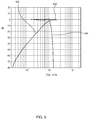
- FIG. 5 illustrates an example combined response based on the filtering in the high frequency path 460 and the low frequency path 462 of FIG. 4 .
- an example high pass filter response 502 is combined with an example low pass filter response 504 resulting in a combined response 506.
- the high pass filter response 502 may be based on the high pass filters F1 and F2 420 and 422 included in the high frequency path 460.
- the high pass filters F1 and F2 420 and 422 are configured as second order Butterworth filters with a (-3dB) rolloff frequency of about 700 Hz to about 1000 Hz.
- the low pass filter response 504 may be a summed response based on the low pass filters F3 and F4 424 and 426 being finite impulse response (FIR) decimation filters summed with the interpolation filter module 456 in the form of an FIR interpolation filter.
- the combined response 506 is substantially linear and flat for the previously discussed example filter parameters.
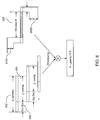
- FIG. 6 illustrates a block diagram representation of an example STFT implementation for the filters F1, F2, F3, F4 420, 422, 424, 426, and the interpolation filter 456.
- the STFT implement uses an overlap-add method.
- the overlap-add method of digital filtering may involve using a series of overlapping Hanning windowed segments of the input waveform and filtering each segment separately in the frequency domain. After filtering, the segments may be recombined by adding the overlapped sections together.
- the overlap-add method may permit frequency domain filtering to be performed on continuous signals in real time, without excessive memory requirements.
- the STFT may have a predetermined FFT length 602 of X samples, a predetermined overlap length 604 of Z samples, and a hop size 606 equal to the difference between the FFT length 602 and the overlap length 604.
- the FFT length 602 is 128 samples
- the overlap length 604 is 80 samples, thus creating a hop size 606 of 48 (128 - 80) samples.
- the FFT length 602 and overlap length 604 may be different.
- Sampling may be performed with a windowing function 608 of a predetermined window size (M) that includes a predetermined number of zero samples (N) 610.
- a 96-tap Hanning window 608 is applied.
- a 48-tap Hanning window, a 192-tap Hanning window, or any other size Hanning window may be used.
- the Hanning window 608 includes a predetermined number, such as sixteen, of zero samples (610A and 610B) on each side of the Hanning window 608.
- the sets of zero samples may be positioned on either side of the Hanning window 608 in order to minimize transient distortion due to pre-and post-ringing of applied signal processes in the spectral domain.
- FIG. 7 illustrates a flowchart of an example process for extracting a center channel from a two-channel audio signal that may be used with center extraction algorithm module 440 in the high frequency path 460, or the center extraction algorithm 454 in the low frequency path 462.
- Input signals in FIG. 7 are complex vectors of the short-term signal spectra of the left input signal, V L , and the right input signal, V R , respectively.
- a mean signal energy P an absolute value V x of the cross spectral density between both input signals ( V L and V R ), and their quotient p c in the form of a ratio, are computed at block 702.
- the coefficient p c is bound between zero when there is no cross correlation between the left and right channels, and therefore the left and right audio signals are not contributing to the desired center channel, and one when the left and right signal components are highly correlated or identical, i.e., fully contributing to the center channel.
- the desired center channel output signal may be obtained (extracted) by multiplying the sum of the inputs (mono signal) with a non-linear mapping function F of time average vector p c at block 706.
- the function F can be optimized for the best compromise between channel separation and low distortion.
- FIG. 8 illustrates mapping of an example representation of the non-linear function F 802 as a function of the time average vector of p c versus a linear function 804.
- FIG. 9 illustrates a flowchart of an example process for generating an ambience estimate control coefficient from a two-channel audio signal using the ASP module 222 or 322 of FIGs. 2 and 3 .
- mean signal energy ( P ) and the cross spectral density ( V x ) of the input signal are computed at block 902 using the left and right audio low frequency signal components (V L and V R ) from the low frequency path 462.
- the time averages of P and V x which is a complex vector in the case of V x with a coefficient ⁇ chosen as a predetermined value, such as between 0.1 and 0.3, are computed at block 904.
- An ambient energy estimate Y E of the level of ambient energy contained in the low frequency component of the left and right audio signal is computed using the formula depicted in block 906.
- the mean value of the ambient energy estimate Y E across the spectrum, Y S which is a real-valued, time-dependent function, is computed.
- Time smoothing is applied by the time smoothing module 452 to reduce short-term variations in order to get a smoothed version Y SM of the ambience estimate control coefficient 416.
- the final gain factor A G is obtained using the nonlinear mapping module 228 or 328 through a nonlinear mapping using the tanh function at block 908.
- Constant c may be set to a predetermined value. In one example, the constant c may be set to a value of 0.35.
- the gain factor A G may be applied to one or more of the synthesized surround audio signals (SLS, SRS, SLR, SRB). Where the gain factor A G is selectively applied to the synthesized surround sound signals such that the gain factor A G is not uniformly applied to all the synthesized surround audio signals, the gain module 230 or 330 may include filter pairs to split the audio signal into low and high frequency components that are separately controlled.
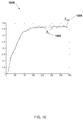
- FIG. 10 illustrates a graph depicting an example of an estimated ambience control coefficient and a smoothed version of the estimated ambience control coefficient.
- Estimated ambience control coefficient Y S 1002 and smoothed version of the estimated ambience control coefficient Y SM 1004 are shown.
- the ambience estimation process performed by the ambience estimation module 450 has analyzed an audio signal, such as a music signal and the estimated ambience control coefficient has settled to a nearly constant value of 0.37.
- the smoothed version of the estimated ambience control coefficient may be used by the overall gain module 230 or 330 to determine the overall gain factor(s) of the pre-generated synthetic surround sound channels.
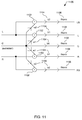
- FIG. 11 is an example width control matrix used by the width matrix module 224 or 324 to produce the frontal stage sound represented by the left (L) and right (R) audio signals, and the extracted center channel signal (C).
- the width control matrix is used to map the audio signals from the audio channels (L, C, and R) to the loudspeaker output channels (L, C, R, LS, and RS) 246 or 346 using four summation points 1102, and five control parameters (a1, a2, b0, b1, b2) 1104.
- additional or fewer summation points and control parameters may be used depending on the upmixing desired.
- Parameters a1 and a2 may be predetermined fixed, empirically defined values.
- parameters a1 and a2 are set to 0.53 and 0.75 respectively.
- Parameters b0, b1, b2 may be variable values that are dependent on a predefined "StageWidth" value, as depicted in Chart 1.
- the "StageWidth” value may be provided by the user, either by manual input of a value or user selection from a preset listing of values.
- a scale factor "fNorm" 1106, calculated in accordance with below equation, may be applied to ensure substantially equal loudness for each setting of "StageWidth".
- fNorm 1.0 / 2 b 2 2 1 ⁇ a 2 2 + 2 b 1 2 1 ⁇ a 1 2 + b 0 2
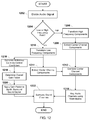
- FIG. 12 illustrates an example operational flow diagram of the audio sound processing system (ASPS) 104 generating surround sound from an audio signal having at least two channels.
- the at least two channels include a left audio channel and a right audio channel.
- the source audio signal having at least two channels is divided into a high frequency component and a low frequency component based on a predetermined high frequency range and a predetermined low frequency range.
- the divided components follow two separate processing paths at block 1204.
- the high frequency components are transformed from a time domain to a frequency domain at block 1206.
- a high frequency center channel component is extracted by a center channel extraction algorithm module using the high frequency components derived from the left and right audio channels.
- the low frequency components are transformed from a time domain to a frequency domain at block 1210.
- a low frequency center channel component is extracted by a center channel extraction algorithm module using the low frequency components derived from the left and right audio channels.
- the output center channel components from the high frequency path and low frequency path center channel extraction algorithm modules are recombined to create a center channel signal (C).
- a width control matrix is used to map the audio channels (L, C, and R) to the frontal sound stage channels (L, C, R, LS, and RS) at block 1214.
- an ambience estimate control coefficient is generated along the low frequency path after transformation at block 1210.
- the overall gain factor for synthetic surround sound signals generated from the left and right audio channel signals is obtained using the ambience estimate control coefficient and non-linear mapping at block 1218.
- the overall gain factor is applied to the synthetic surround sound signals.
- Surround sound output audio signals are generated on the surround sound output channels (L, R, C, LS, RS, LB, RB) by selective summation of the synthetic surround sound signals, the center channel signal (C) and the audio signal having at least two channels at block 1222.
- the example operational flow diagram of FIG. 12 describes generation of a number of additional surround sound audio channels from a fewer number of source input audio channels in which the amount of artificially generated ambient energy is controlled in real-time by the estimated ambient energy that is contained in the source input audio signal.
- the logic may include additional, different, or fewer operations.
- the operations may be executed in a different order than is illustrated in FIG. 12 .
- the audio surround processing system 104 may be implemented in many different ways. For example, although some features are described as stored in computer-readable memories (e.g., as logic implemented as computer-executable instructions or as data structures in memory), all or part of the system and its logic and data structures may be stored on, distributed across, or read from other machine-readable media.
- the media may include hard disks, floppy disks, CD-ROMs, a signal, such as a signal received from a network or received over multiple packets communicated across the network.
- the features may be implemented in hardware based circuitry and logic or some combination of hardware and software to implement the described functionality.
- the processing capability of the audio surround processing system 104 may be distributed among multiple entities, such as among multiple processors and memories, optionally including multiple distributed processing systems.
- Parameters, databases, and other data structures may be separately stored and managed, may be incorporated into a single memory or database, may be logically and physically organized in many different ways, and may implemented with different types of data structures such as linked lists, hash tables, or implicit storage mechanisms.
- Logic such as programs or circuitry, may be combined or split among multiple programs, distributed across several memories and processors, and may be implemented in a library, such as a shared library (e.g., a dynamic link library (DLL)).
- the DLL for example, may store code that prepares intermediate mappings or implements a search of the mappings. As another example, the DLL may itself provide all or some of the functionality of the system.
- the audio surround processing system 104 may be implemented with additional, different, or fewer modules with similar functionality.
- the audio surround processing system 104 may include one or more processors that selectively execute the modules.
- the one or more processors may be implemented as a microprocessor, a microcontroller, a digital signal processor (DSP), an application specific integrated circuit (ASIC), discrete logic, or a combination of other types of circuits or logic.
- DSP digital signal processor
- ASIC application specific integrated circuit
- any memory used by the one or more processors may be a non-volatile and/or volatile memory, such as a random access memory (RAM), a read-only memory (ROM), an erasable programmable read-only memory (EPROM), flash memory, any other type of memory, such as a non-transient memory, now known or later discovered, or any combination thereof.
- the memory used by the one or more processors may include an optical, magnetic (hard-drive) or any other form of data storage device.
- the one or more processors may include one or more devices operable to execute computer executable instructions or computer code embodied in memory to extract a center channel and generate an ambience estimate control parameter.
- the computer code may include instructions executable with the one or more processors.
- the computer code may include embedded logic.
- the computer code may be written in any computer language now known or later discovered, such as C++, C#, Java, Pascal, Visual Basic, Perl, HyperText Markup Language (HTML), JavaScript, assembly language, shell script, or any combination thereof.
- the computer code may include source code and/or compiled code.
Landscapes
- Physics & Mathematics (AREA)
- Engineering & Computer Science (AREA)
- Acoustics & Sound (AREA)
- Signal Processing (AREA)
- Stereophonic System (AREA)
Claims (15)
- Verfahren zur Tonsignalverarbeitung in einem Raumtonverarbeitungssystem (104, 202, 302), umfassend:Aufteilen eines Quellentonsignals mit wenigstens zwei Kanälen (140, 142) in einen ersten Satz von Komponenten und einen zweiten Satz von Komponenten, wobei ein Frequenzbereich des ersten Satzes von Komponenten niedriger ist als der Frequenzbereich des zweiten Satzes von Komponenten;Umwandeln des ersten Satzes von Komponenten von einer Zeitdomäne in eine Frequenzdomäne;Erzeugen eines Umgebungsschätzungs-Steuerungskoeffizienten (242, 342, 416) unter Verwendung der geschätzten Umgebungsenergie, die nur in dem ersten Satz von Komponenten enthalten ist, wobei sich der erste Satz von Komponenten in der Frequenzdomäne befindet; undBestimmen einer Gesamtverstärkung einer Vielzahl an zuvor erzeugten Umgebungstonsignalen unter Verwendung des Umgebungsschätzungs-Steuerungskoeffizienten (242, 342, 416).
- Verfahren nach Anspruch 1, weiter umfassend das Umwandeln des ersten Satzes von Komponenten und des zweiten Satzes von Komponenten von der Zeitdomäne in die Frequenzdomäne durch Berechnen einer Kurzzeit-Fourier-Transformation (STFT) des ersten und zweiten Satzes von Komponenten.
- Verfahren nach Anspruch 1, weiter umfassend:Umwandeln des zweiten Satzes von Komponenten von der Zeitdomäne in die Frequenzdomäne;Erzeugen eines ersten Satzes von zentralen Tondaten aus dem ersten Satz von umgewandelten Komponenten;Erzeugen eines zweiten Satzes von zentralen Tondaten aus dem zweiten Satz von umgewandelten Komponenten;Kombinieren des ersten Satzes von zentralen Tondaten und des zweiten Satzes von zentralen Tondaten;undUmwandeln der kombinierten zentralen Tondaten von einer Frequenzdomäne in eine Zeitdomäne, um ein zentrales Ausgangssignal auf einem zentralen Ausgangskanal (246, 346) zu erzeugen, um einen zentralen Lautsprecher (122) zu betreiben.
- Verfahren nach Anspruch 3, weiter umfassend das Erzeugen von wenigstens zwei zusätzlichen Raumtonkanälen unter Verwendung einer Matrix mit dem Quellentonsignal und dem erzeugten zentralen Kanal als Eingänge.
- Verfahren nach einem der Ansprüche 1-4, weiter umfassend das Verwenden eines vorher festgelegten Parameters, der ein Automatisierungsniveau darstellt, um den Umgebungsschätzungs-Steuerungskoeffizienten (242, 342, 416) zu erzeugen.
- Verfahren nach einem der Ansprüche 1-5, weiter umfassend das Bestimmen des Gesamtverstärkungsfaktors unter Verwendung einer nicht-linearen Zuordnungsfunktion.
- Raumtonverarbeitungssystem (104, 202, 302), umfassend einen Prozessor und einen Speicher in Verbindung mit dem Prozessor; umfassend:ein Tonsignalprozessormodul (222, 322), das durch den Prozessor so ausführbar ist, dass es ein Quellentonsignal mit wenigstens zwei Tonkanälen in einen ersten Satz von Komponenten und einen zweiten Satz von Komponenten aufteilt, wobei ein Frequenzbereich des ersten Satzes von Komponenten niedriger ist als der Frequenzbereich des zweiten Satzes von Komponenten;wobei das Tonsignalprozessormodul (222, 322) durch den Prozessor weiter so ausführbar ist, dass es ein Umgebungsenergieniveau schätzt, das nur in dem ersten Satz von Komponenten enthalten ist;wobei das Tonsignalprozessormodul (222, 322) durch den Prozessor weiter so ausführbar ist, dass es unter Verwendung des Umgebungsenergieniveaus einen Umgebungsschätzungs-Steuerungskoeffizienten (242, 342, 416) generiert; undwobei das Tonsignalprozessormodul (222, 322) durch den Prozessor weiter so ausführbar ist, dass es unter Verwendung des Umgebungsschätzungs-Steuerungskoeffizienten (242, 342, 416) einen Ertragsfaktor einer Mehrzahl von synthetisierten Raumtonsignalen bestimmt.
- Raumtonverarbeitungssystem (104, 202, 302) nach Anspruch 7, wobei das Quellentonsignal eine vorher festgelegte Quellenabtastrate aufweist und der erste Satz von Komponenten bei der vorher festgelegten Abtastrate abgetastet wird, die geringer ist als die Quellenabtastrate, um das Umgebungsenergieniveau zu schätzen und um den Umgebungsschätzungs-Steuerungskoeffizienten (242, 342, 416) zu erzeugen.
- Raumtonverarbeitungssystem (104, 202, 302) nach Anspruch 8, wobei das Tonsignalprozessormodul (222, 322) durch den Prozessor weiter so ausführbar ist, dass es den zweiten Satz von Komponenten unter Verwendung der vorher festgelegten Abtastrate von einer Zeitdomäne in eine Frequenzdomäne umwandelt.
- Raumtonverarbeitungssystem (104, 202, 302) nach einem der Ansprüche 7-9, wobei das Tonsignalprozessormodul (222, 322) durch den Prozessor weiter so ausführbar ist, dass es ein erstes zentrales Tonsignal aus dem ersten Satz von Komponenten extrahiert, ein zweites zentrales Tonsignal aus dem zweiten Satz von Komponenten extrahiert und das erste zentrale Tonsignal und das zweite zentrale Tonsignal kombiniert, um ein zentrales Kanalausgangssignal zu erzeugen.
- Raumtonverarbeitungssystem (104, 202, 302) nach einem der Ansprüche 7-10, wobei das Tonsignalprozessormodul (222, 322) durch den Prozessor weiter so ausführbar ist, dass es ein zentrales Kanalsignal aus dem Quellentonsignal extrahiert, und das System weiter eine Weitenmatrize umfasst, die durch den Prozessor so ausführbar ist, dass sie das Quellentonsignal und das zentrale Kanalsignal als Eingänge empfängt, wenigstens zwei Raumtonsignale (246, 346) erzeugt und eine Weite einer von einem Hörer wahrgenommenen Tonstufe durch Anpassung und Ausgabe des angepassten Quellentonsignals, des zentralen Kanalsignals und der wenigstens zwei Raumtonsignale (246, 346) anpasst.
- Raumtonverarbeitungssystem (104, 202, 302) nach einem der Ansprüche 7-11, weiter umfassend ein Gesamtverstärkungsmodul (230, 330), das durch den Prozessor so ausführbar ist, dass es den Verstärkungsfaktor auf wenigstens ein synthetisiertes Raumtonsignal (246, 346) anwendet, wobei eine Verstärkungsgröße gemäß dem Umgebungsschätzungs-Steuerungskoeffizienten (242, 342, 416) gesteuert wird.
- Raumtonverarbeitungssystem (104, 202, 302) nach einem der Ansprüche 7-12, weiter umfassend ein nicht-lineares Zuordnungsmodul (228, 328), das so konfiguriert ist, dass es unter Verwendung einer nicht-linearen Zuordnungsfunktion und dem Umgebungsschätzungs-Steuerungskoeffizienten (242, 342, 416) den Gesamtverstärkungsfaktor bestimmt.
- Nicht-transitorisches, computerlesbares Medium, umfassend eine Mehrzahl von durch einen Prozessor ausführbaren Anweisungen, umfassend:Anweisungen zum Aufteilen eines Quellentonsignals mit wenigstens zwei Kanälen (140, 142) in einen ersten Satz von Komponenten und einen zweiten Satz von Komponenten, wobei ein Frequenzbereich des ersten Satzes von Komponenten niedriger ist als der Frequenzbereich des zweiten Satzes von Komponenten;Anweisungen zum Erzeugen eines Umgebungsschätzungs-Steuerungskoeffizienten (242, 342, 416) unter Verwendung der geschätzten Umgebungsenergie, die nur in dem ersten Satz von Komponenten enthalten ist, wobei sich der erste Satz von Komponenten in der Frequenzdomäne befindet; undAnweisungen zum Bestimmen eines Verstärkungsfaktors einer Mehrzahl von synthetisierten Raumtonsignalen (246, 346) unter Verwendung des Umgebungsschätzungs-Steuerungskoeffizienten (242, 342, 416).
- Computerlesbares Medium nach Anspruch 14, weiter umfassend:Anweisungen zum Extrahieren eines zentralen Kanalsignals von dem ersten Satz von Komponenten und dem zweiten Satz von Komponenten;Anweisungen zum Erzeugen eines Raumtonsignals (246, 346) aus dem Quellentonsignal und dem extrahierten zentralen Kanalsignal; undAnweisungen zum Kombinieren des Raumtonsignals (246, 346) mit wenigstens einem aus den synthetisierten Raumtonsignalen (246, 346), um ein Raumton-Ausgangssignal zu erzeugen.
Applications Claiming Priority (1)
| Application Number | Priority Date | Filing Date | Title |
|---|---|---|---|
| US13/396,987 US9986356B2 (en) | 2012-02-15 | 2012-02-15 | Audio surround processing system |
Publications (2)
| Publication Number | Publication Date |
|---|---|
| EP2629552A1 EP2629552A1 (de) | 2013-08-21 |
| EP2629552B1 true EP2629552B1 (de) | 2016-06-22 |
Family
ID=47747409
Family Applications (1)
| Application Number | Title | Priority Date | Filing Date |
|---|---|---|---|
| EP13154275.5A Active EP2629552B1 (de) | 2012-02-15 | 2013-02-06 | Audiosurroundverarbeitungssystem |
Country Status (2)
| Country | Link |
|---|---|
| US (2) | US9986356B2 (de) |
| EP (1) | EP2629552B1 (de) |
Cited By (2)
| Publication number | Priority date | Publication date | Assignee | Title |
|---|---|---|---|---|
| WO2020211017A1 (zh) * | 2019-04-17 | 2020-10-22 | 深圳市大疆创新科技有限公司 | 音频信号处理方法、设备及存储介质 |
| EP3833047B1 (de) * | 2019-12-02 | 2025-07-23 | Samsung Electronics Co., Ltd. | Elektronische vorrichtung und steuerungsverfahren dafür |
Families Citing this family (16)
| Publication number | Priority date | Publication date | Assignee | Title |
|---|---|---|---|---|
| DE202014010599U1 (de) * | 2014-01-05 | 2016-02-02 | Kronoton Gmbh | Gerät mit Lautsprechern |
| EP2975864B1 (de) * | 2014-07-17 | 2020-05-13 | Alpine Electronics, Inc. | Signalverarbeitungsvorrichtung für ein Fahrzeug und Signalverarbeitungsverfahren für ein Kraftfahrzeug-Soundsystem |
| US9948261B2 (en) | 2014-11-20 | 2018-04-17 | Tymphany Hk Limited | Method and apparatus to equalize acoustic response of a speaker system using multi-rate FIR and all-pass IIR filters |
| FR3050601B1 (fr) * | 2016-04-26 | 2018-06-22 | Arkamys | Procede et systeme de diffusion d'un signal audio a 360° |
| US9838737B2 (en) * | 2016-05-05 | 2017-12-05 | Google Inc. | Filtering wind noises in video content |
| US9820073B1 (en) * | 2017-05-10 | 2017-11-14 | Tls Corp. | Extracting a common signal from multiple audio signals |
| CN108156575B (zh) * | 2017-12-26 | 2019-09-27 | 广州酷狗计算机科技有限公司 | 音频信号的处理方法、装置及终端 |
| EP3573058B1 (de) | 2018-05-23 | 2021-02-24 | Harman Becker Automotive Systems GmbH | Trocken- und raumschalltrennung |
| US10667071B2 (en) | 2018-05-31 | 2020-05-26 | Harman International Industries, Incorporated | Low complexity multi-channel smart loudspeaker with voice control |
| CN109168024B (zh) * | 2018-09-26 | 2022-05-27 | 平安科技(深圳)有限公司 | 一种目标信息的识别方法及设备 |
| DE102020108958A1 (de) | 2020-03-31 | 2021-09-30 | Harman Becker Automotive Systems Gmbh | Verfahren zum Darbieten eines ersten Audiosignals während der Darbietung eines zweiten Audiosignals |
| JP2023553489A (ja) * | 2020-12-15 | 2023-12-21 | シング,インコーポレイテッド | オーディオアップミキシングのためのシステムおよび方法 |
| CN113542984B (zh) * | 2021-06-09 | 2022-04-15 | 荣耀终端有限公司 | 立体声实现系统、方法、电子设备及存储介质 |
| CN114860659B (zh) * | 2022-05-11 | 2025-06-06 | 深圳创维-Rgb电子有限公司 | 数据处理方法、装置、设备及计算机存储介质 |
| US20240069081A1 (en) * | 2022-08-31 | 2024-02-29 | Keysight Technologies, Inc. | Signal analysis for computing a complementary cumulative distribution function |
| WO2024097651A1 (en) * | 2022-10-31 | 2024-05-10 | Aman Christopher | Method and apparatus for mitigating phase interference or cancellation by aligning waveforms to 3rd harmonics |
Citations (1)
| Publication number | Priority date | Publication date | Assignee | Title |
|---|---|---|---|---|
| US20060039573A1 (en) * | 2004-08-23 | 2006-02-23 | Vernon Stephen D | Method for expanding an audio mix to fill all available output channels |
Family Cites Families (17)
| Publication number | Priority date | Publication date | Assignee | Title |
|---|---|---|---|---|
| US5625696A (en) * | 1990-06-08 | 1997-04-29 | Harman International Industries, Inc. | Six-axis surround sound processor with improved matrix and cancellation control |
| US6198826B1 (en) * | 1997-05-19 | 2001-03-06 | Qsound Labs, Inc. | Qsound surround synthesis from stereo |
| US7257231B1 (en) | 2002-06-04 | 2007-08-14 | Creative Technology Ltd. | Stream segregation for stereo signals |
| US7412380B1 (en) * | 2003-12-17 | 2008-08-12 | Creative Technology Ltd. | Ambience extraction and modification for enhancement and upmix of audio signals |
| ATE472905T1 (de) * | 2006-03-13 | 2010-07-15 | Dolby Lab Licensing Corp | Ableitung von mittelkanalton |
| US8204237B2 (en) * | 2006-05-17 | 2012-06-19 | Creative Technology Ltd | Adaptive primary-ambient decomposition of audio signals |
| US7818079B2 (en) * | 2006-06-09 | 2010-10-19 | Nokia Corporation | Equalization based on digital signal processing in downsampled domains |
| EP2162882B1 (de) * | 2007-06-08 | 2010-12-29 | Dolby Laboratories Licensing Corporation | Hybridableitung von surround-sound-audiokanälen durch steuerbares kombinieren von umgebungs- und matrixdekodierten signalkomponenten |
| US8588427B2 (en) * | 2007-09-26 | 2013-11-19 | Frauhnhofer-Gesellschaft Zur Foerderung Der Angewandten Forschung E.V. | Apparatus and method for extracting an ambient signal in an apparatus and method for obtaining weighting coefficients for extracting an ambient signal and computer program |
| US8107631B2 (en) * | 2007-10-04 | 2012-01-31 | Creative Technology Ltd | Correlation-based method for ambience extraction from two-channel audio signals |
| US8126172B2 (en) * | 2007-12-06 | 2012-02-28 | Harman International Industries, Incorporated | Spatial processing stereo system |
| WO2009128078A1 (en) * | 2008-04-17 | 2009-10-22 | Waves Audio Ltd. | Nonlinear filter for separation of center sounds in stereophonic audio |
| KR101485462B1 (ko) | 2009-01-16 | 2015-01-22 | 삼성전자주식회사 | 후방향 오디오 채널의 적응적 리마스터링 장치 및 방법 |
| CN102439585B (zh) * | 2009-05-11 | 2015-04-22 | 雅基达布鲁公司 | 从任意信号对提取共同及唯一分量 |
| US8705769B2 (en) * | 2009-05-20 | 2014-04-22 | Stmicroelectronics, Inc. | Two-to-three channel upmix for center channel derivation |
| GB2473266A (en) * | 2009-09-07 | 2011-03-09 | Nokia Corp | An improved filter bank |
| WO2017164156A1 (ja) * | 2016-03-22 | 2017-09-28 | ヤマハ株式会社 | 信号処理装置、音響信号の転送方法、及び、信号処理システム |
-
2012
- 2012-02-15 US US13/396,987 patent/US9986356B2/en active Active
-
2013
- 2013-02-06 EP EP13154275.5A patent/EP2629552B1/de active Active
-
2018
- 2018-05-25 US US15/989,637 patent/US20180279062A1/en not_active Abandoned
Patent Citations (1)
| Publication number | Priority date | Publication date | Assignee | Title |
|---|---|---|---|---|
| US20060039573A1 (en) * | 2004-08-23 | 2006-02-23 | Vernon Stephen D | Method for expanding an audio mix to fill all available output channels |
Cited By (2)
| Publication number | Priority date | Publication date | Assignee | Title |
|---|---|---|---|---|
| WO2020211017A1 (zh) * | 2019-04-17 | 2020-10-22 | 深圳市大疆创新科技有限公司 | 音频信号处理方法、设备及存储介质 |
| EP3833047B1 (de) * | 2019-12-02 | 2025-07-23 | Samsung Electronics Co., Ltd. | Elektronische vorrichtung und steuerungsverfahren dafür |
Also Published As
| Publication number | Publication date |
|---|---|
| US9986356B2 (en) | 2018-05-29 |
| US20180279062A1 (en) | 2018-09-27 |
| US20130208895A1 (en) | 2013-08-15 |
| EP2629552A1 (de) | 2013-08-21 |
Similar Documents
| Publication | Publication Date | Title |
|---|---|---|
| US9986356B2 (en) | Audio surround processing system | |
| JP7683101B2 (ja) | 少なくとも一つのフィードバック遅延ネットワークを使ったマルチチャネル・オーディオに応答したバイノーラル・オーディオの生成 | |
| JP6832968B2 (ja) | クロストーク処理の方法 | |
| US11611828B2 (en) | Systems and methods for improving audio virtualization | |
| KR101989062B1 (ko) | 오디오 신호를 향상시키기 위한 장치 및 방법 및 음향 향상 시스템 | |
| US9307338B2 (en) | Upmixing method and system for multichannel audio reproduction | |
| US20090304189A1 (en) | Rendering Center Channel Audio | |
| EP3739908A1 (de) | Binaurale filter für monophone kompatibilität und lautsprecherkompatibilität | |
| JP2005530432A (ja) | 部屋における拡声器からの音声のデジタル等化方法、および、この方法の使用法 | |
| JP7370415B2 (ja) | 空間オーディオ信号のクロストーク処理のためのスペクトル欠陥補償 | |
| KR102660704B1 (ko) | 스펙트럼적 직교 오디오 성분 처리 | |
| HK40020211A (en) | Generating binaural audio in response to multi-channel audio using at least one feedback delay network | |
| HK1252865A1 (zh) | 响应於多通道音频通过使用至少一个反馈延迟网络产生双耳音频 | |
| HK1246057A1 (en) | Generating binaural audio in response to multi-channel audio using at least one feedback delay network |
Legal Events
| Date | Code | Title | Description |
|---|---|---|---|
| PUAI | Public reference made under article 153(3) epc to a published international application that has entered the european phase |
Free format text: ORIGINAL CODE: 0009012 |
|
| AK | Designated contracting states |
Kind code of ref document: A1 Designated state(s): AL AT BE BG CH CY CZ DE DK EE ES FI FR GB GR HR HU IE IS IT LI LT LU LV MC MK MT NL NO PL PT RO RS SE SI SK SM TR |
|
| AX | Request for extension of the european patent |
Extension state: BA ME |
|
| 17P | Request for examination filed |
Effective date: 20140218 |
|
| RBV | Designated contracting states (corrected) |
Designated state(s): AL AT BE BG CH CY CZ DE DK EE ES FI FR GB GR HR HU IE IS IT LI LT LU LV MC MK MT NL NO PL PT RO RS SE SI SK SM TR |
|
| 17Q | First examination report despatched |
Effective date: 20140923 |
|
| RIC1 | Information provided on ipc code assigned before grant |
Ipc: H04S 7/00 20060101ALN20160118BHEP Ipc: H04S 5/00 20060101AFI20160118BHEP |
|
| GRAP | Despatch of communication of intention to grant a patent |
Free format text: ORIGINAL CODE: EPIDOSNIGR1 |
|
| INTG | Intention to grant announced |
Effective date: 20160302 |
|
| GRAS | Grant fee paid |
Free format text: ORIGINAL CODE: EPIDOSNIGR3 |
|
| GRAA | (expected) grant |
Free format text: ORIGINAL CODE: 0009210 |
|
| AK | Designated contracting states |
Kind code of ref document: B1 Designated state(s): AL AT BE BG CH CY CZ DE DK EE ES FI FR GB GR HR HU IE IS IT LI LT LU LV MC MK MT NL NO PL PT RO RS SE SI SK SM TR |
|
| REG | Reference to a national code |
Ref country code: GB Ref legal event code: FG4D |
|
| REG | Reference to a national code |
Ref country code: CH Ref legal event code: EP |
|
| REG | Reference to a national code |
Ref country code: IE Ref legal event code: FG4D |
|
| REG | Reference to a national code |
Ref country code: AT Ref legal event code: REF Ref document number: 808272 Country of ref document: AT Kind code of ref document: T Effective date: 20160715 |
|
| REG | Reference to a national code |
Ref country code: DE Ref legal event code: R096 Ref document number: 602013008688 Country of ref document: DE |
|
| REG | Reference to a national code |
Ref country code: LT Ref legal event code: MG4D |
|
| REG | Reference to a national code |
Ref country code: NL Ref legal event code: MP Effective date: 20160622 |
|
| PG25 | Lapsed in a contracting state [announced via postgrant information from national office to epo] |
Ref country code: LT Free format text: LAPSE BECAUSE OF FAILURE TO SUBMIT A TRANSLATION OF THE DESCRIPTION OR TO PAY THE FEE WITHIN THE PRESCRIBED TIME-LIMIT Effective date: 20160622 Ref country code: NO Free format text: LAPSE BECAUSE OF FAILURE TO SUBMIT A TRANSLATION OF THE DESCRIPTION OR TO PAY THE FEE WITHIN THE PRESCRIBED TIME-LIMIT Effective date: 20160922 Ref country code: FI Free format text: LAPSE BECAUSE OF FAILURE TO SUBMIT A TRANSLATION OF THE DESCRIPTION OR TO PAY THE FEE WITHIN THE PRESCRIBED TIME-LIMIT Effective date: 20160622 |
|
| REG | Reference to a national code |
Ref country code: AT Ref legal event code: MK05 Ref document number: 808272 Country of ref document: AT Kind code of ref document: T Effective date: 20160622 |
|
| PG25 | Lapsed in a contracting state [announced via postgrant information from national office to epo] |
Ref country code: SE Free format text: LAPSE BECAUSE OF FAILURE TO SUBMIT A TRANSLATION OF THE DESCRIPTION OR TO PAY THE FEE WITHIN THE PRESCRIBED TIME-LIMIT Effective date: 20160622 Ref country code: GR Free format text: LAPSE BECAUSE OF FAILURE TO SUBMIT A TRANSLATION OF THE DESCRIPTION OR TO PAY THE FEE WITHIN THE PRESCRIBED TIME-LIMIT Effective date: 20160923 Ref country code: NL Free format text: LAPSE BECAUSE OF FAILURE TO SUBMIT A TRANSLATION OF THE DESCRIPTION OR TO PAY THE FEE WITHIN THE PRESCRIBED TIME-LIMIT Effective date: 20160622 Ref country code: HR Free format text: LAPSE BECAUSE OF FAILURE TO SUBMIT A TRANSLATION OF THE DESCRIPTION OR TO PAY THE FEE WITHIN THE PRESCRIBED TIME-LIMIT Effective date: 20160622 Ref country code: LV Free format text: LAPSE BECAUSE OF FAILURE TO SUBMIT A TRANSLATION OF THE DESCRIPTION OR TO PAY THE FEE WITHIN THE PRESCRIBED TIME-LIMIT Effective date: 20160622 Ref country code: RS Free format text: LAPSE BECAUSE OF FAILURE TO SUBMIT A TRANSLATION OF THE DESCRIPTION OR TO PAY THE FEE WITHIN THE PRESCRIBED TIME-LIMIT Effective date: 20160622 |
|
| PG25 | Lapsed in a contracting state [announced via postgrant information from national office to epo] |
Ref country code: SK Free format text: LAPSE BECAUSE OF FAILURE TO SUBMIT A TRANSLATION OF THE DESCRIPTION OR TO PAY THE FEE WITHIN THE PRESCRIBED TIME-LIMIT Effective date: 20160622 Ref country code: IT Free format text: LAPSE BECAUSE OF FAILURE TO SUBMIT A TRANSLATION OF THE DESCRIPTION OR TO PAY THE FEE WITHIN THE PRESCRIBED TIME-LIMIT Effective date: 20160622 Ref country code: IS Free format text: LAPSE BECAUSE OF FAILURE TO SUBMIT A TRANSLATION OF THE DESCRIPTION OR TO PAY THE FEE WITHIN THE PRESCRIBED TIME-LIMIT Effective date: 20161022 Ref country code: RO Free format text: LAPSE BECAUSE OF FAILURE TO SUBMIT A TRANSLATION OF THE DESCRIPTION OR TO PAY THE FEE WITHIN THE PRESCRIBED TIME-LIMIT Effective date: 20160622 Ref country code: CZ Free format text: LAPSE BECAUSE OF FAILURE TO SUBMIT A TRANSLATION OF THE DESCRIPTION OR TO PAY THE FEE WITHIN THE PRESCRIBED TIME-LIMIT Effective date: 20160622 Ref country code: EE Free format text: LAPSE BECAUSE OF FAILURE TO SUBMIT A TRANSLATION OF THE DESCRIPTION OR TO PAY THE FEE WITHIN THE PRESCRIBED TIME-LIMIT Effective date: 20160622 |
|
| PG25 | Lapsed in a contracting state [announced via postgrant information from national office to epo] |
Ref country code: PT Free format text: LAPSE BECAUSE OF FAILURE TO SUBMIT A TRANSLATION OF THE DESCRIPTION OR TO PAY THE FEE WITHIN THE PRESCRIBED TIME-LIMIT Effective date: 20161024 Ref country code: AT Free format text: LAPSE BECAUSE OF FAILURE TO SUBMIT A TRANSLATION OF THE DESCRIPTION OR TO PAY THE FEE WITHIN THE PRESCRIBED TIME-LIMIT Effective date: 20160622 Ref country code: PL Free format text: LAPSE BECAUSE OF FAILURE TO SUBMIT A TRANSLATION OF THE DESCRIPTION OR TO PAY THE FEE WITHIN THE PRESCRIBED TIME-LIMIT Effective date: 20160622 Ref country code: BE Free format text: LAPSE BECAUSE OF FAILURE TO SUBMIT A TRANSLATION OF THE DESCRIPTION OR TO PAY THE FEE WITHIN THE PRESCRIBED TIME-LIMIT Effective date: 20160622 Ref country code: ES Free format text: LAPSE BECAUSE OF FAILURE TO SUBMIT A TRANSLATION OF THE DESCRIPTION OR TO PAY THE FEE WITHIN THE PRESCRIBED TIME-LIMIT Effective date: 20160622 Ref country code: SM Free format text: LAPSE BECAUSE OF FAILURE TO SUBMIT A TRANSLATION OF THE DESCRIPTION OR TO PAY THE FEE WITHIN THE PRESCRIBED TIME-LIMIT Effective date: 20160622 |
|
| REG | Reference to a national code |
Ref country code: DE Ref legal event code: R097 Ref document number: 602013008688 Country of ref document: DE |
|
| PLBE | No opposition filed within time limit |
Free format text: ORIGINAL CODE: 0009261 |
|
| STAA | Information on the status of an ep patent application or granted ep patent |
Free format text: STATUS: NO OPPOSITION FILED WITHIN TIME LIMIT |
|
| 26N | No opposition filed |
Effective date: 20170323 |
|
| PG25 | Lapsed in a contracting state [announced via postgrant information from national office to epo] |
Ref country code: DK Free format text: LAPSE BECAUSE OF FAILURE TO SUBMIT A TRANSLATION OF THE DESCRIPTION OR TO PAY THE FEE WITHIN THE PRESCRIBED TIME-LIMIT Effective date: 20160622 |
|
| PG25 | Lapsed in a contracting state [announced via postgrant information from national office to epo] |
Ref country code: SI Free format text: LAPSE BECAUSE OF FAILURE TO SUBMIT A TRANSLATION OF THE DESCRIPTION OR TO PAY THE FEE WITHIN THE PRESCRIBED TIME-LIMIT Effective date: 20160622 |
|
| PG25 | Lapsed in a contracting state [announced via postgrant information from national office to epo] |
Ref country code: MC Free format text: LAPSE BECAUSE OF FAILURE TO SUBMIT A TRANSLATION OF THE DESCRIPTION OR TO PAY THE FEE WITHIN THE PRESCRIBED TIME-LIMIT Effective date: 20160622 |
|
| REG | Reference to a national code |
Ref country code: CH Ref legal event code: PL |
|
| PG25 | Lapsed in a contracting state [announced via postgrant information from national office to epo] |
Ref country code: LI Free format text: LAPSE BECAUSE OF NON-PAYMENT OF DUE FEES Effective date: 20170228 Ref country code: CH Free format text: LAPSE BECAUSE OF NON-PAYMENT OF DUE FEES Effective date: 20170228 |
|
| REG | Reference to a national code |
Ref country code: IE Ref legal event code: MM4A |
|
| REG | Reference to a national code |
Ref country code: FR Ref legal event code: ST Effective date: 20171031 |
|
| PG25 | Lapsed in a contracting state [announced via postgrant information from national office to epo] |
Ref country code: LU Free format text: LAPSE BECAUSE OF NON-PAYMENT OF DUE FEES Effective date: 20170206 |
|
| PG25 | Lapsed in a contracting state [announced via postgrant information from national office to epo] |
Ref country code: FR Free format text: LAPSE BECAUSE OF NON-PAYMENT OF DUE FEES Effective date: 20170228 |
|
| PG25 | Lapsed in a contracting state [announced via postgrant information from national office to epo] |
Ref country code: IE Free format text: LAPSE BECAUSE OF NON-PAYMENT OF DUE FEES Effective date: 20170206 |
|
| PG25 | Lapsed in a contracting state [announced via postgrant information from national office to epo] |
Ref country code: MT Free format text: LAPSE BECAUSE OF NON-PAYMENT OF DUE FEES Effective date: 20170206 |
|
| PG25 | Lapsed in a contracting state [announced via postgrant information from national office to epo] |
Ref country code: AL Free format text: LAPSE BECAUSE OF FAILURE TO SUBMIT A TRANSLATION OF THE DESCRIPTION OR TO PAY THE FEE WITHIN THE PRESCRIBED TIME-LIMIT Effective date: 20160622 |
|
| PG25 | Lapsed in a contracting state [announced via postgrant information from national office to epo] |
Ref country code: HU Free format text: LAPSE BECAUSE OF FAILURE TO SUBMIT A TRANSLATION OF THE DESCRIPTION OR TO PAY THE FEE WITHIN THE PRESCRIBED TIME-LIMIT; INVALID AB INITIO Effective date: 20130206 |
|
| PG25 | Lapsed in a contracting state [announced via postgrant information from national office to epo] |
Ref country code: BG Free format text: LAPSE BECAUSE OF FAILURE TO SUBMIT A TRANSLATION OF THE DESCRIPTION OR TO PAY THE FEE WITHIN THE PRESCRIBED TIME-LIMIT Effective date: 20160622 |
|
| PG25 | Lapsed in a contracting state [announced via postgrant information from national office to epo] |
Ref country code: CY Free format text: LAPSE BECAUSE OF NON-PAYMENT OF DUE FEES Effective date: 20160622 |
|
| PG25 | Lapsed in a contracting state [announced via postgrant information from national office to epo] |
Ref country code: MK Free format text: LAPSE BECAUSE OF FAILURE TO SUBMIT A TRANSLATION OF THE DESCRIPTION OR TO PAY THE FEE WITHIN THE PRESCRIBED TIME-LIMIT Effective date: 20160622 |
|
| PG25 | Lapsed in a contracting state [announced via postgrant information from national office to epo] |
Ref country code: TR Free format text: LAPSE BECAUSE OF FAILURE TO SUBMIT A TRANSLATION OF THE DESCRIPTION OR TO PAY THE FEE WITHIN THE PRESCRIBED TIME-LIMIT Effective date: 20160622 |
|
| P01 | Opt-out of the competence of the unified patent court (upc) registered |
Effective date: 20230527 |
|
| PGFP | Annual fee paid to national office [announced via postgrant information from national office to epo] |
Ref country code: GB Payment date: 20260121 Year of fee payment: 14 |
|
| PGFP | Annual fee paid to national office [announced via postgrant information from national office to epo] |
Ref country code: DE Payment date: 20260121 Year of fee payment: 14 |