EP2625151B1 - Composite particle and use for making a fiber-reinforced barrier matrix composition - Google Patents
Composite particle and use for making a fiber-reinforced barrier matrix composition Download PDFInfo
- Publication number
- EP2625151B1 EP2625151B1 EP11831674.4A EP11831674A EP2625151B1 EP 2625151 B1 EP2625151 B1 EP 2625151B1 EP 11831674 A EP11831674 A EP 11831674A EP 2625151 B1 EP2625151 B1 EP 2625151B1
- Authority
- EP
- European Patent Office
- Prior art keywords
- sealant layer
- composite particle
- hydratable
- barrier
- fiber
- Prior art date
- Legal status (The legal status is an assumption and is not a legal conclusion. Google has not performed a legal analysis and makes no representation as to the accuracy of the status listed.)
- Active
Links
Images
Classifications
-
- C—CHEMISTRY; METALLURGY
- C04—CEMENTS; CONCRETE; ARTIFICIAL STONE; CERAMICS; REFRACTORIES
- C04B—LIME, MAGNESIA; SLAG; CEMENTS; COMPOSITIONS THEREOF, e.g. MORTARS, CONCRETE OR LIKE BUILDING MATERIALS; ARTIFICIAL STONE; CERAMICS; REFRACTORIES; TREATMENT OF NATURAL STONE
- C04B14/00—Use of inorganic materials as fillers, e.g. pigments, for mortars, concrete or artificial stone; Treatment of inorganic materials specially adapted to enhance their filling properties in mortars, concrete or artificial stone
- C04B14/02—Granular materials, e.g. microballoons
- C04B14/04—Silica-rich materials; Silicates
- C04B14/10—Clay
-
- C—CHEMISTRY; METALLURGY
- C04—CEMENTS; CONCRETE; ARTIFICIAL STONE; CERAMICS; REFRACTORIES
- C04B—LIME, MAGNESIA; SLAG; CEMENTS; COMPOSITIONS THEREOF, e.g. MORTARS, CONCRETE OR LIKE BUILDING MATERIALS; ARTIFICIAL STONE; CERAMICS; REFRACTORIES; TREATMENT OF NATURAL STONE
- C04B28/00—Compositions of mortars, concrete or artificial stone, containing inorganic binders or the reaction product of an inorganic and an organic binder, e.g. polycarboxylate cements
- C04B28/001—Compositions of mortars, concrete or artificial stone, containing inorganic binders or the reaction product of an inorganic and an organic binder, e.g. polycarboxylate cements containing unburned clay
-
- C—CHEMISTRY; METALLURGY
- C04—CEMENTS; CONCRETE; ARTIFICIAL STONE; CERAMICS; REFRACTORIES
- C04B—LIME, MAGNESIA; SLAG; CEMENTS; COMPOSITIONS THEREOF, e.g. MORTARS, CONCRETE OR LIKE BUILDING MATERIALS; ARTIFICIAL STONE; CERAMICS; REFRACTORIES; TREATMENT OF NATURAL STONE
- C04B28/00—Compositions of mortars, concrete or artificial stone, containing inorganic binders or the reaction product of an inorganic and an organic binder, e.g. polycarboxylate cements
- C04B28/02—Compositions of mortars, concrete or artificial stone, containing inorganic binders or the reaction product of an inorganic and an organic binder, e.g. polycarboxylate cements containing hydraulic cements other than calcium sulfates
-
- C—CHEMISTRY; METALLURGY
- C04—CEMENTS; CONCRETE; ARTIFICIAL STONE; CERAMICS; REFRACTORIES
- C04B—LIME, MAGNESIA; SLAG; CEMENTS; COMPOSITIONS THEREOF, e.g. MORTARS, CONCRETE OR LIKE BUILDING MATERIALS; ARTIFICIAL STONE; CERAMICS; REFRACTORIES; TREATMENT OF NATURAL STONE
- C04B28/00—Compositions of mortars, concrete or artificial stone, containing inorganic binders or the reaction product of an inorganic and an organic binder, e.g. polycarboxylate cements
- C04B28/02—Compositions of mortars, concrete or artificial stone, containing inorganic binders or the reaction product of an inorganic and an organic binder, e.g. polycarboxylate cements containing hydraulic cements other than calcium sulfates
- C04B28/021—Ash cements, e.g. fly ash cements ; Cements based on incineration residues, e.g. alkali-activated slags from waste incineration ; Kiln dust cements
-
- C—CHEMISTRY; METALLURGY
- C04—CEMENTS; CONCRETE; ARTIFICIAL STONE; CERAMICS; REFRACTORIES
- C04B—LIME, MAGNESIA; SLAG; CEMENTS; COMPOSITIONS THEREOF, e.g. MORTARS, CONCRETE OR LIKE BUILDING MATERIALS; ARTIFICIAL STONE; CERAMICS; REFRACTORIES; TREATMENT OF NATURAL STONE
- C04B28/00—Compositions of mortars, concrete or artificial stone, containing inorganic binders or the reaction product of an inorganic and an organic binder, e.g. polycarboxylate cements
- C04B28/14—Compositions of mortars, concrete or artificial stone, containing inorganic binders or the reaction product of an inorganic and an organic binder, e.g. polycarboxylate cements containing calcium sulfate cements
-
- C—CHEMISTRY; METALLURGY
- C04—CEMENTS; CONCRETE; ARTIFICIAL STONE; CERAMICS; REFRACTORIES
- C04B—LIME, MAGNESIA; SLAG; CEMENTS; COMPOSITIONS THEREOF, e.g. MORTARS, CONCRETE OR LIKE BUILDING MATERIALS; ARTIFICIAL STONE; CERAMICS; REFRACTORIES; TREATMENT OF NATURAL STONE
- C04B2111/00—Mortars, concrete or artificial stone or mixtures to prepare them, characterised by specific function, property or use
- C04B2111/00474—Uses not provided for elsewhere in C04B2111/00
- C04B2111/00482—Coating or impregnation materials
-
- C—CHEMISTRY; METALLURGY
- C04—CEMENTS; CONCRETE; ARTIFICIAL STONE; CERAMICS; REFRACTORIES
- C04B—LIME, MAGNESIA; SLAG; CEMENTS; COMPOSITIONS THEREOF, e.g. MORTARS, CONCRETE OR LIKE BUILDING MATERIALS; ARTIFICIAL STONE; CERAMICS; REFRACTORIES; TREATMENT OF NATURAL STONE
- C04B2111/00—Mortars, concrete or artificial stone or mixtures to prepare them, characterised by specific function, property or use
- C04B2111/00474—Uses not provided for elsewhere in C04B2111/00
- C04B2111/00612—Uses not provided for elsewhere in C04B2111/00 as one or more layers of a layered structure
-
- Y—GENERAL TAGGING OF NEW TECHNOLOGICAL DEVELOPMENTS; GENERAL TAGGING OF CROSS-SECTIONAL TECHNOLOGIES SPANNING OVER SEVERAL SECTIONS OF THE IPC; TECHNICAL SUBJECTS COVERED BY FORMER USPC CROSS-REFERENCE ART COLLECTIONS [XRACs] AND DIGESTS
- Y02—TECHNOLOGIES OR APPLICATIONS FOR MITIGATION OR ADAPTATION AGAINST CLIMATE CHANGE
- Y02W—CLIMATE CHANGE MITIGATION TECHNOLOGIES RELATED TO WASTEWATER TREATMENT OR WASTE MANAGEMENT
- Y02W30/00—Technologies for solid waste management
- Y02W30/50—Reuse, recycling or recovery technologies
- Y02W30/91—Use of waste materials as fillers for mortars or concrete
Definitions
- Cementitious compositions are well known and include, for example, ready-mix concrete, precast concrete, masonry concrete (mortar), shotcrete, bituminous concrete, gypsum compositions, gypsum- and/or Portland cement-based fireproofing compositions, and others. These compositions are used for a wide variety of purposes. For example, concrete is used for the construction of roads and bridges, and for the construction of commercial and residential building structures, such as skyscrapers, high rises, and the foundations of homes.
- Cementitious compositions while recognized as having significant compressive strength, typically have low tensile strength and have been known to undergo degradation, deterioration, crumbling, cracking and/or separation of the matrix. This can occur over time or by exposure to extreme or repeated weather or other environmental conditions. Stresses, such as wear, movement, vibrations, repeated expansion and contraction due to temperature changes and the like may also contribute to these problems.
- concrete is known to have a very low tensile strength
- embedded steel reinforcement bars (“re-bar") are incorporated in designs to address the otherwise low tensile strength of concrete.
- brick making includes the addition of straw to clay to provide reinforcement during initial drying, a technique also used to make wattle and adobe structures.
- Modem materials such as manufactured geotextiles and extruded plastic forms, have also been developed to reinforce earthen structures such as roadbases, dams, and levees - these geotextile materials providing the tensile strength to enable better distribution of loads, a property not found in un-reinforced, non-cementatious, un-fired earthen based building materials.
- a type of barrier matrix composition can be prepared using composite particles like those sold as the AquaBlok ® composite particle system by AquaBlok, Ltd., Toledo, Ohio.
- the AquaBlok ® composite particle system is described in U.S. Patent Nos. 5,538,787 issued July 23, 1996 ; U.S. 5,897,946 issued April 27, 1999 ; U.S. 6,386,796 issued May 14, 2002 ; and U.S. 6,558,081 issued May 6, 2003 .
- the invention which is defined in the appended claims, relates to composite particles useful for making fiber- reinforced barrier matrix compositions.
- the invention relates to a composite particle.
- the invention in a second aspect, relates to a fiber-reinforced barrier matrix composition, made with the composite particles.
- the barrier matrix thus comprises the composite particles and water, which hydrates the hydratable material to form a matrix in which are dispersed the core and fibrous reinforcing material.
- the invention includes a method of making a fiber-reinforced barrier matrix composition using the composite particles. The method broadly comprises:
- the hydratable material may be a clay, such as a mineral clay selected from the Phyllosilicates or Tektosillicates, typically the Phyllosilicates of the Nikel-Strunz groups 9EC, 9ED or 9EE.
- the hydratable material may be selected from the kaolinite, montmorillonite/ smectite/ bentonite, palygorskite / attapulgite, vermiculite, and minnesotaite groups.
- the core may be any solid matter. It may be relatively dense, as when the particles are intended to sink. It may be, for example, a stone or a degradable material.
- the fibrous material may be a natural or synthetic fiber, which may be chemically reactive or inert; dispersed within the second hydratable layer - either homogenously or not.
- the fibrous reinforcing material may constitute from about 1% to about 20 % of the total weight of the dry composite particle. More than one hydratable layer is present.
- a protective coating while desirable in some cases, is optional.
- the composite particles may contain all the ingredients necessary to form the barrier matrix, or additional ingredients may be added.
- the added ingredients may include binders, cements and/or aggregates typical of cementitious compositions, for example, Portland cement, cement kiln dust, lime dust, stone dust, fly ash, plaster of Paris, gypsum, gypsum fines, gravel, stones, sand, or a mixture of these materials.
- the additional ingredients may be dry-blended with the composite particles prior to hydration, or blended with them and water at the same time.
- Additional components of the barrier matrix and method of making it may also include structural reinforcements like geotextiles or re-bar.
- the present disclosure relates to fiber-reinforced, barrier matrix compositions that are made with a plurality of manufactured composite particles having a reinforcing fiber incorporated therein, and to such composite particles themselves.
- Microx compositions as used herein broadly refers to materials that comprise one or more aggregate materials dispersed in and held together by a binder matrix material.
- the aggregate is stone and/or sand
- the binder is typically Portland cement, activated by water to effect a cure reaction and crystallize the matrix.
- matrix compositions of the present invention differ from other cementitious compositions in the mechanism by which the aggregate is held in the matrix; namely, the aggregates or particulates are held in the binder matrix by cohesion, not crystalline structure.
- Cohesion in a chemical sense generally refers to the action or property of like molecules sticking together, being mutually attractive. This is an intrinsic property of a substance that is caused by the shape and structure of its molecules which makes the distribution of orbiting electrons irregular when molecules get close to one another, creating electrical attraction that can maintain a macroscopic structure.
- a water drop for example, illustrates chemical cohesion since each molecule may make four hydrogen bonds to other water molecules in a tetrahedral configuration. Cohesion is the principle force behind phenomena such as meniscus, surface tension and capillary action.
- cohesion is the component of shear strength of a rock or soil that is independent of interparticle friction. In soils, true cohesion is caused by one of three things:
- Cohesion or “cohesive attraction” or “cohesive force” as used herein refers to the electrostatic forces that clay mineral molecules exhibit for other clay mineral molecules; and in this sense is a hybrid of the first aspect of geological cohesion and the chemistry meaning of cohesion.
- barrier matrix compositions of the present invention are held together by cohesive forces.
- Fiber-reinforced barrier matrix compositions of the present invention can be made simply by combining the composite particles of the present invention with water. The composite particles themselves supply the aggregate the binder matrix material and the reinforcing fibers. Upon hydration, the matrix layer expands and the fibers are re-oriented during the expansion to form a fiber-reinforced binder matrix that cohesively holds the aggregate cores dispersed within the matrix. The mixture may be allowed to self-compact to solidify to form the reinforced composition, which exhibits improved tensile strength, shear strength, and/or scour strength as a result of the fiber reinforcement.
- the barrier matrix compositions may include further optional ingredients as is generally known in the art.
- an auxiliary binder may promote the adhesion of the binder (i.e. hydratable sealant material) to the aggregate and/or help to hold the binder material together.
- Some auxiliary binders include, for example, glues, lignites (sap), starch grafted polyacrylates, and soybean oil lecithins and their derivatives.
- optional materials include other, more traditional reinforcements besides the fibers, such as metal, plastic, fiberglass, or carbon reinforcing bars, scrims, fabrics, lathing material, or other similar structures. Further optional materials include chemical additives such as accelerators, retarders, air entrainers, plasticizers, colorants or pigments, biocidal agents, bird or insect aversion agents, sorptive media, corrosion inhibitors, and bonding agents.
- the composite particles used in the disclosure may have a wide variety of general physical configurations and sizes and are similar to the manufactured composite particles of the type sold as the AquaBlok ® composite particle system by AquaBlok, Ltd., Toledo, Ohio.
- the AquaBlok ® composite particle system is described in the following patents: U.S. 5,538,787 issued July 23, 1996 ; U.S. 5,897,946 issued April 27, 1999 ; U.S. 6,386,796 issued May 14, 2002 ; and U.S. 6,558,081 issued May 6, 2003 .
- the size of the composite particle 10 can range from a small pebble to a large size rock or even larger.
- the composite particle is generally spherical in form, but it can also be other shapes such as oval, egg, oblong, or irregular giving rise to a major axis and minor axis (which are equal in spherical particles).
- Particles generally have a major axis dimension of from about 1 mm to 30 mm or more; more typically from about 2 mm to 10 mm.
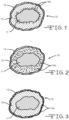
- Figures 1 to 4 illustrate several embodiments.
- the composite particle 10 is formed of a core 11 which is encapsulated by a hydratable sealant layer 12 (which is a first hydratable sealant layer). Reinforcing fibers 14 (a-d) are found within the composite particle at one or more of several locations as described below. There may be an optional protective coating 13 at least partially encapsulating the hydratable sealant layer 12.
- the core 11 of the composite particle 10 may be formed of nearly any material. It may comprise from about 10 to about 80% of the major axis dimension and from about 45 to 95% of the total weight of the particle. It may comprise a solid stone or rock core such as a fine aggregate and/or coarse aggregate. Fine aggregate includes small particles such as sand and other sand-sized materials. Coarse aggregate includes larger particles such as gravel, crushed stone, recycled aggregates (from construction, demolition and excavation waste), and manufactured aggregates (for example, furnace slag and bottom ash).
- the core 11 of the composite particle 10 is formed of a material which is relatively dense and preferably relatively hard when compared to the sealant layer 12.
- the core may need to be relatively dense so it can carry the composite particle to the isolated or treated surface, such as for underwater applications.
- suitable materials for forming the core include pieces of rock or stone, iron ore, slag, glass cullet, crushed glass or crushed porcelain, gravel, or other solid aggregate.
- a less dense core e.g., perlite
- the core of the composite particle is formed of a degradable material so that it can slowly dissipate over a period of time.
- a degradable core offers some advantages, particularly in underwater situations. It facilitates hydraulic dredging operations.
- a degradable core also allows the underwater surface to be replenished with a new barrier layer from time to time, such as for revegetation of the surface.
- a degradable core can also deliver remediation /restoration materials to the underwater surface.
- a degradable core so long as the core remains relatively dense compared to the sealant layer and the composite particle as a whole has a specific gravity greater than one.
- Sand is a preferred material for forming a degradable core. The sand will function as a carrier of the composite particle to an underwater surface, and when hydrated it will disperse into the material of the sealant layer.
- Other suitable materials for the degradable core include very small stones or rocks, rubber tire chips, sugar-based materials such as rock candy, pelletized recycled paper such as magazines or newspapers, pelletized clay mineral that hydrates very slowly, or high-density fertilizer. These materials can be held together by a binder, such as those used in the sealant layer, to create any size core needed.
- the core of the composite particle can also be formed of pozzolanic materials such as gypsum, gypsum fines, portland cement, cement kiln dust, lime dust, stone dust, fly ash, and plaster of Paris.
- pozzolanic materials such as gypsum, gypsum fines, portland cement, cement kiln dust, lime dust, stone dust, fly ash, and plaster of Paris.
- the hydratable sealant layer 12 of the composite particle 10 is formed of a cohesive hydratable material.
- the sealant layer may comprise from about 10 to about 60% of the major axis dimension and from about 5 to 60% of the total weight of the particle.
- hydratable is meant that the sealant material absorbs water in a substantial amount, swelling in volume as it does. For example, compared to a volume of dry clay, a hydrated clay may swell to at least 1.5 times its volume, at least 2.0 times its volume, at least 3.0 times its volume, at least 5.0 times its volume, or at least 10 times its volume.
- the hydratable material is a clay mineral or a mixture of clay minerals that, while not hardening, does generate cohesive strength by the hydration process.
- Clay is common name for a wide variety of weathered mineral or igneous rock.
- Various classification schemes such as the Nickel-Strunz classification, divide up mineral clays according to composition and/or structure. Suitable clays may be found in the kaolinite group, the smectite or montmorillonite group, the attapulgite group and the zeolite group. Generally, these groups contain sheets or layers formed of specific tetrahedral and/or octahedral structures of aluminum and silicon oxides.
- the layers or platelets are held together by ionic bonds with charged ions (usually cations) located between the layers.
- the Nickel-Strunz classification (version 10) divides silicates (group 9) into nine different subcategories, the most useful being Phyllosilicates (group 9E) and the Tektosillicates with and without Zeolitic H 2 0 (groups 9G and GF, respectively).
- Phyllosilicates (group 9E) are divided into nine subcategories, the most useful being group 9EC (with mica sheets), group 9ED (with kaolin layers), and group 9EE (single tetrahedral nets of six-membered rings).
- Exemplary clays from these groups include kaolinite, montmorillonite (also called smectite and bentonite), talc, mondorite, nontronite, palygorskite or attapulgite, muscovite, vermiculite, saponite, hectorite, rectorite, and minnesotaite.
- Bentonite is a useful impure clay largely containing montmorillonite.
- lt is the layers or "platelets” of phyllosilicates that give them many of their properties, including the plasticity for use as pottery.
- the layers are of thickness dimensions in the few nanometer range, they are often referred to as nanoclays.
- An example is the NANOLIN DK series of nanoclays available from Zhejiang Fenghong Clay Chemicals Co., LTD., which are made from highly purified smectite that exhibits ultra-fine phase dimensions.
- the size of these nanoclays is typically in the range of 1-100 nm; the average fully dispersed thickness of platelets is around 25 nm; the aspect ratio ranges from 100 tol000.
- Modified clays are formed when various processes are used to separate and expand the layers or platelets. Intercalation, exfoliation, and fuming are processes that modify the layered structure. Intercalation inserts a polymer or other molecule between the platelet layers to isolate them, but without much physical separation. Exfoliation, on the other hand, inserts a polymer or molecule and expands the space between layers by 10-20 fold. Fuming is a flaming process that introduces hydroxyl groups onto the surface of the silica structures.
- Organoclays are modified by the replacement of the cation (usually sodium) between layers with alkylammonium (RiN+) compounds, a type of surfactant.
- the nitrogen end of the quaternary amine, the hydrophilic end, is positively charged, and ion exchanges onto the clay platelet for sodium or calcium.
- the amines used generally have long-chain R groups with 12-18 carbon atoms, making them more compatible with many organic polymers. After about 30 per cent of the clay surface is coated with these amines, it becomes hydrophobic and, with certain amines, organophilic. Additionally, exfoliation of organoclays becomes easier since there is a larger distance between the platelets due to the bigger size of the ammonium salts compared to sodium ions.
- a clay-sized material can also be used, such as gypsum or other materials, having an average particle size of less than about 10 microns.
- the hydratable material may also include other clay-sized or quasi clay-sized materials such as organophilic bentonite, zeolites, and inorganic oxides of aluminum, iron, and/or manganese.
- the relative proportion of core particles to hydratable material can impact the permeability of the compositions.
- "Barrier" does not exclude permeable matrix layers. More permeable compositions may have higher proportions of core particles (relative to hydratable layer material) than less permeable compositions, but permeability depends on other factors as well. Barriers can be formed having permeabilities from about 10- 2 cm/sec (relatively permeable) to as low as 10- 10 cm/sec (relatively impermeable), e.g. with mechanical compaction.
- the composite particles 10 include fibers 14(a-d) that are useful for reinforcing the barrier matrix compositions to improve at least one of (a) tensile strength, (b) shear strength, and (c) scour strength of the barrier matrix.
- Tensile strength represents resistance to a force pulling the composition apart, producing a parting failure generally transverse to the pulling force.
- Shear strength represents resistance to a force tending to fracture the composition along a plane generally parallel to the shear force.
- Scour strength represents resistance to degradation and failure arising from the motion of a fluid such as air or water (e.g. wave action or current flow) and particulates (e.g. sand) the fluid may contain.
- fiber As used herein, “fiber”, “fibrous material”, and “reinforcement fiber” are all used interchangeably and include any type of fibrous material having a long axis, equivalent to a length, and a short axis, equivalent to a diameter in many fiber shapes, including fibers, filaments, microfibers, and others.
- the aspect ratio of long axis to short axis may be from about 5 to tens of thousands, more typically from about 100 to about 10,000.
- Fiber material is generally sized commensurate with the size of the composite particle, so it can be large enough to be visible to the naked-eye (e.g. about 0.1 mm to about 100 mm) or small enough to be categorized as a nano-material.
- the fibers may be composed of many different types of materials, natural or synthetic, including for example, plastic, metal, carbon, mineral, ceramic, glass, cellulose, other inorganic materials, and organic materials.
- natural fiber refers to plant fibers extracted from any part of a plant, including, but not limited to, the stem, seeds, leaves, roots, or phloem.
- natural fibers suitable for use as the reinforcing fiber material include cotton, jute, bamboo, ramie, bagasse, hemp, coir, linen, kenaf, sisal, flax, henequen, sphagnum, peat moss, Spanish moss, and combinations thereof.
- suitable inorganic fibers include glass fibers, wool glass fibers, ceramic fibers, and other mineral fibers.
- Mineral fibers refers to any mineral material that can be melted to form molten mineral that can be drawn or attenuated into fibers. Glass is the most commonly used mineral fiber, but other useful mineral fibers include rock, slag and basalt.
- Synthetic fibers include man-made polymeric fibers including, but not limited to, polymers like polyester, polyethylene, polyethylene terephthalate, polypropylene, polyamide, aramid, and/or polyaramid.
- Metal fibers may be composed of any metallic element(s) alone or in alloy combinations with other elements and/or minerals.
- Fibrous materials useful in the invention may be homogenous, that is composed of only one type of fiber, or they may be heterogeneous blends of mixed fiber types.
- the fibers may be relatively inert or chemically reactive.
- the typical chemical reactivity found in fibers is related to oxidation-reduction reactions, chelation or sequestration processes, and ion exchange processes.
- iron fibers may reduce other compounds, thereby becoming oxidized.
- ions found in the clay materials e.g. sodium
- other ions in the environment e.g. calcium
- the fibers may be disposed in the composite particle in one or more of a variety of locations. In general, the fibers are located within layers or at the interfaces between layers. Fibers within layers may be dispersed substantially homogenously throughout the layer, or concentrated to specific regions of the layer.
- Figures 1 to 4 illustrate several of many locations for fibers 14 a-d.
- the fibers 14a are adhered to the core 11 before the hydratable sealant layer 12 is applied. Fibers may be adhered to the core 11 using conventional binders.
- the fibers 14b are interspersed as a dispersion in the hydratable sealant material in the layer 12.
- This dispersion may be homogeneous or not, and fibers 14b may be concentrated nearer the core 11 or nearer the outer edge if desired.
- the fibers 14c are found in or comprise the optional protective layer 13, formed around the composite particle 10. Fibers may be found in any combination of these locations, as well as in others not illustrated.
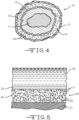
- Figure 4 shows an embodiment falling under the claimed scope, where a core 11 is coated with a first hydratable sealant layer 12.
- a boundary or barrier layer 15 is formed around layer 12 and divide it from a second hydratable sealant layer 16 disposed around the layers 12, 15.
- An optional protective coating 13 may surround the particle forming an outer shell, as it did in the embodiments of Figures 1-3 .
- the multi-layer embodiment of Figure 4 may include from two to about ten such layers if desired, more likely two to four layers.
- the hydratable sealant materials of each layer are different, thus potentially introducing differential cohesive forces, which affords a mechanism to form barrier matrix compositions with staged generation of cohesive forces.
- the fibers 14d shown in Figure 4 are shown in the second hydratable sealant layer 16 disposed around the layers 12, 15.
- Fibers selected for chemical reactivity the choice of fiber should be governed in part by the intended use, and some uses are described below.
- "sacrificial" fibers known to have a deterioration rate, may be preferred in temporary structures or environmentally sensitive areas.
- Fibers, such as cellulosic or carbon fibers may serve as a source of nutrition for micro- or macro-organisms, and may also be desired in specific locations.
- the fibrous material may constitute from about 1% to about 20% by weight (dry) of the composite particle.
- Fibers may range in specific gravity from less than 1 (e.g. carbon fibers) to more than 7 (e.g. iron fibers).
- the optional protective coating 13 is designed to make the particles easier to handle, ship and store. It should be a durable, but dissolvable or water permeable, coating, such as a polymeric coating.
- the coating 13 should be of a thickness that, under intended use conditions and timeframe for matrix formation, does not prevent hydration of the hydratable material layer 12.
- Suitable polymeric materials include latex and acrylic resins.
- a gypsum-in-water slurry may also be suitable.
- the coating 13 may be applied by any means, such as coating drums or spraying.
- the optional coating may comprise from 0% to about 5% of the particle weight.
- the barrier matrix composition can be manufactured by any suitable method.
- the composite particles include all the materials (other than water) needed to make the cohesive barrier matrix compositions of the invention. It is a feature and advantage that the composite particles are flowable and can readily be deposited to virtually any location. Composite particles are deposited in a desired location and are simply mixed with water to hydrate the hydratable materials of the sealant layers.
- the composite particles are mixed with additional ingredients such as might be used in traditional cementitious compositions, like concrete.
- additional ingredients might include additional aggregate such as sand, gravel, or rock; or additional binders such as Portland cement, cement kiln dust, lime dust, stone dust, fly ash, plaster of Paris, gypsum, gypsum fines, or a mixture of these materials.
- additional aggregate such as sand, gravel, or rock
- additional binders such as Portland cement, cement kiln dust, lime dust, stone dust, fly ash, plaster of Paris, gypsum, gypsum fines, or a mixture of these materials.
- other optional materials include the more traditional reinforcements, such as metal, plastic, fiberglass, or carbon reinforcing bars, scrims, fabrics, lathing material, or other similar structures, as well as chemical additives such as accelerators, retarders, air entrainers, plasticizers, colorants or pigments, biocidal agents, bird or insect aversion agents, corrosion inhibitors, bonding agents and the like.
- reinforcements such as metal, plastic, fiberglass, or carbon reinforcing bars, scrims, fabrics, lathing material, or other similar structures
- chemical additives such as accelerators, retarders, air entrainers, plasticizers, colorants or pigments, biocidal agents, bird or insect aversion agents, corrosion inhibitors, bonding agents and the like.
- the hydratable material of the composite particles becomes hydrated, swells and forms cohesive attractions that hold the core and reinforcing fibers in place.
- the fibers 14b, 14c, and 14d are generally re-oriented during the expansion and may become essentially homogeneously dispersed throughout the matrix.
- Fibers 14a may have portions that stay adhered to the core 11 and portions that expand into the matrix to help to secure the core particle in the matrix.
- the mixture may be actively compacted or allowed to self-compact passively, to solidify to form the reinforced barrier matrix composition. In some cases, agitation such as stirring or mixing may be desired, but in other applications agitation may be impossible or not desirable.
- Figure 5 illustrates one potential use of a barrier matrix composition 20 in accordance with the invention.
- the composite particles are spread and hydrated. Hydration swells the particles to form a substantially continuous matrix 22 in which are dispersed the core particles 11 and the reinforcing fibers 24. Some fibers 24 are shown attached to core particles and others are dispersed in the hydratable layer.
- One or more additional layers 23, 25 may be disposed over the barrier matrix composition 20, as might be the case for a roadbed or other application.
- one additional layer 25 comprises water, for example, an ocean, river, stream, or lake.
- barrier layers may range from a 1 or 2 cm to 50 or more cm in thickness.
- barriers may be formed from about 5 cm to about 25 cm in thickness.
- the composite particles of the invention are advantageous in that the fibrous reinforcements provide the barrier matrix compositions with at least one of additional tensile strength, shear strength, and scour strength. In some cases, all three are improved.
- compositions according to the invention can be used in road beds, dams, berms, levees and more.
- Uses such as landfill liners, contamination recovery, pipe encasements and others described in the aforementioned patents are exemplary uses for the barrier matrix compositions of the invention as well. Use in place of or in combination with geotextiles is also envisioned.
- Geotextiles include soil additive structures such as the Geoweb TM products from Presto Geosystems (Appleton, WI); Strataweb TM and Stratagrid ® products of Strata Systems (Cumming, GA); and Tensar ® TriAx ® and Prism ® products (Alpharetta, GA), for example.
- barrier matrix compositions made according to the invention are especially suitable in sloped locations with greater angle of repose than was possible with prior compositions.
- the angle of repose is a measure of the steepest angle with horizontal that a given soil or material can assume under given conditions, and it varies greatly with the nature of the soil, its cohesiveness, its hydration, water action, and buoyancy forces. But under equivalent conditions and soils, barrier layers made with the fiber-containing composite particles of the invention tend to improve useful angles of repose by 10% or more. This advantageous feature also permits use in shoreline locations that experience a high degree of wear, such as at boat ramps or beaches where water craft and/or foot traffic may abrade the surface.
Landscapes
- Chemical & Material Sciences (AREA)
- Engineering & Computer Science (AREA)
- Ceramic Engineering (AREA)
- Materials Engineering (AREA)
- Organic Chemistry (AREA)
- Structural Engineering (AREA)
- Inorganic Chemistry (AREA)
- Chemical Kinetics & Catalysis (AREA)
- Dispersion Chemistry (AREA)
- Combustion & Propulsion (AREA)
- Civil Engineering (AREA)
- Curing Cements, Concrete, And Artificial Stone (AREA)
- Reinforced Plastic Materials (AREA)
- Compositions Of Macromolecular Compounds (AREA)
Description
- Cementitious compositions are well known and include, for example, ready-mix concrete, precast concrete, masonry concrete (mortar), shotcrete, bituminous concrete, gypsum compositions, gypsum- and/or Portland cement-based fireproofing compositions, and others. These compositions are used for a wide variety of purposes. For example, concrete is used for the construction of roads and bridges, and for the construction of commercial and residential building structures, such as skyscrapers, high rises, and the foundations of homes.
- Cementitious compositions, while recognized as having significant compressive strength, typically have low tensile strength and have been known to undergo degradation, deterioration, crumbling, cracking and/or separation of the matrix. This can occur over time or by exposure to extreme or repeated weather or other environmental conditions. Stresses, such as wear, movement, vibrations, repeated expansion and contraction due to temperature changes and the like may also contribute to these problems. In addition, like constructed soil structures, concrete is known to have a very low tensile strength, and embedded steel reinforcement bars ("re-bar") are incorporated in designs to address the otherwise low tensile strength of concrete. Similarly, brick making includes the addition of straw to clay to provide reinforcement during initial drying, a technique also used to make wattle and adobe structures. Modem materials, such as manufactured geotextiles and extruded plastic forms, have also been developed to reinforce earthen structures such as roadbases, dams, and levees - these geotextile materials providing the tensile strength to enable better distribution of loads, a property not found in un-reinforced, non-cementatious, un-fired earthen based building materials.
- To address these problems, it is known to include fibers or filaments in the cementitious compositions to reinforce them and to primarily provide a tensile strength. See, for example,
U.S. Patent 7,441,600 to Brothers et al. These materials can strengthen the cementitious composition and improve its tensile strength thereby maintain its integrity and/or prevent it from cracking or fracturing. - A type of barrier matrix composition can be prepared using composite particles like those sold as the AquaBlok® composite particle system by AquaBlok, Ltd., Toledo, Ohio. The AquaBlok® composite particle system is described in
U.S. Patent Nos. 5,538,787 issued July 23, 1996 ;U.S. 5,897,946 issued April 27, 1999 ;U.S. 6,386,796 issued May 14, 2002 ; andU.S. 6,558,081 issued May 6, 2003 . - However, no prior art known to applicant is capable of producing fiber reinforced barrier matrix compositions easily and quickly via small pellets like applicant's composite particles, or one that derives improved tensile, shear, and/or scour strength via the cohesive forces of a hydratable material.
- The invention, which is defined in the appended claims, relates to composite particles useful for making fiber- reinforced barrier matrix compositions. Thus, in a first aspect, the invention relates to a composite particle.
- In a second aspect, the invention relates to a fiber-reinforced barrier matrix composition, made with the composite particles. The barrier matrix thus comprises the composite particles and water, which hydrates the hydratable material to form a matrix in which are dispersed the core and fibrous reinforcing material.
In a third aspect, the invention includes a method of making a fiber-reinforced barrier matrix composition using the composite particles. The method broadly comprises: - depositing a plurality of composite particles to a desired barrier location;
- hydrating the particles with water, wherein the water and hydratable materials form a matrix in which the cores and fibrous reinforcing material are dispersed and held by cohesive forces; and
- allowing the matrix to coalesce to produce the fiber-reinforced barrier matrix composition.
- In each of the three aspects, the hydratable material may be a clay, such as a mineral clay selected from the Phyllosilicates or Tektosillicates, typically the Phyllosilicates of the Nikel-Strunz groups 9EC, 9ED or 9EE. In some embodiments, the hydratable material may be selected from the kaolinite, montmorillonite/ smectite/ bentonite, palygorskite / attapulgite, vermiculite, and minnesotaite groups. In each of the three aspects, the core may be any solid matter. It may be relatively dense, as when the particles are intended to sink. It may be, for example, a stone or a degradable material.
- In each of the three aspects, the fibrous material may be a natural or synthetic fiber, which may be chemically reactive or inert; dispersed within the second hydratable layer - either homogenously or not. The fibrous reinforcing material may constitute from about 1% to about 20 % of the total weight of the dry composite particle. More than one hydratable layer is present. A protective coating, while desirable in some cases, is optional.
- In the second and third aspects, the composite particles may contain all the ingredients necessary to form the barrier matrix, or additional ingredients may be added. In embodiments with additional ingredients, the added ingredients may include binders, cements and/or aggregates typical of cementitious compositions, for example, Portland cement, cement kiln dust, lime dust, stone dust, fly ash, plaster of Paris, gypsum, gypsum fines, gravel, stones, sand, or a mixture of these materials. When used, the additional ingredients may be dry-blended with the composite particles prior to hydration, or blended with them and water at the same time. Additional components of the barrier matrix and method of making it may also include structural reinforcements like geotextiles or re-bar.
- Other features and advantages of the invention will be apparent from the detailed description that follows.
- The accompanying drawings, incorporated herein and forming apart of the specification, illustrate the present invention in its several aspects and, together with the description, serve to explain the principles of the invention. In the drawings, the thickness of the lines, layers, and regions may be exaggerated for clarity.
-
Fig. 1 is a sectioned view of a single bead according to a first embodiment (not falling under the claimed scope); -
Fig. 2 is a sectioned view of a single bead according to a second embodiment (not falling under the claimed scope); -
Fig. 3 is a sectioned view of a single bead according to a third embodiment (not falling under the claimed scope); -
Fig. 4 is a sectioned view of a single bead according to a fourth embodiment (falling under the claimed scope); and -
Fig. 5 is a sectioned view of an illustrative barrier matrix composition. - The present disclosure relates to fiber-reinforced, barrier matrix compositions that are made with a plurality of manufactured composite particles having a reinforcing fiber incorporated therein, and to such composite particles themselves.
- "Matrix compositions" as used herein broadly refers to materials that comprise one or more aggregate materials dispersed in and held together by a binder matrix material. In the cementitious matrix, concrete, the aggregate is stone and/or sand, and the binder is typically Portland cement, activated by water to effect a cure reaction and crystallize the matrix. However, "matrix compositions" of the present invention differ from other cementitious compositions in the mechanism by which the aggregate is held in the matrix; namely, the aggregates or particulates are held in the binder matrix by cohesion, not crystalline structure.
- "Cohesion" in a chemical sense generally refers to the action or property of like molecules sticking together, being mutually attractive. This is an intrinsic property of a substance that is caused by the shape and structure of its molecules which makes the distribution of orbiting electrons irregular when molecules get close to one another, creating electrical attraction that can maintain a macroscopic structure. A water drop, for example, illustrates chemical cohesion since each molecule may make four hydrogen bonds to other water molecules in a tetrahedral configuration. Cohesion is the principle force behind phenomena such as meniscus, surface tension and capillary action.
- However, in geological disciplines, "cohesion" is the component of shear strength of a rock or soil that is independent of interparticle friction. In soils, true cohesion is caused by one of three things:
- 1. Electrostatic forces in stiff over-consolidated clays (which may be lost through weathering)
- 2. Cementing by Fe2O3, CaCO3, NaCl, etc.,
- 3. Root cohesion (which may be lost through logging or fire of the contributing plants, or through solution)
- "Cohesion" or "cohesive attraction" or "cohesive force" as used herein refers to the electrostatic forces that clay mineral molecules exhibit for other clay mineral molecules; and in this sense is a hybrid of the first aspect of geological cohesion and the chemistry meaning of cohesion.
- Unlike the crystalline structure caused by the curing reaction of concrete, it is a key feature that barrier matrix compositions of the present invention are held together by cohesive forces. Fiber-reinforced barrier matrix compositions of the present invention can be made simply by combining the composite particles of the present invention with water. The composite particles themselves supply the aggregate the binder matrix material and the reinforcing fibers. Upon hydration, the matrix layer expands and the fibers are re-oriented during the expansion to form a fiber-reinforced binder matrix that cohesively holds the aggregate cores dispersed within the matrix.
The mixture may be allowed to self-compact to solidify to form the reinforced composition, which exhibits improved tensile strength, shear strength, and/or scour strength as a result of the fiber reinforcement. - The barrier matrix compositions may include further optional ingredients as is generally known in the art. For example, an auxiliary binder may promote the adhesion of the binder (i.e. hydratable sealant material) to the aggregate and/or help to hold the binder material together. Some auxiliary binders include, for example, glues, lignites (sap), starch grafted polyacrylates, and soybean oil lecithins and their derivatives.
- Other optional materials include other, more traditional reinforcements besides the fibers, such as metal, plastic, fiberglass, or carbon reinforcing bars, scrims, fabrics, lathing material, or other similar structures. Further optional materials include chemical additives such as accelerators, retarders, air entrainers, plasticizers, colorants or pigments, biocidal agents, bird or insect aversion agents, sorptive media, corrosion inhibitors, and bonding agents.
- The composite particles used in the disclosure may have a wide variety of general physical configurations and sizes and are similar to the manufactured composite particles of the type sold as the AquaBlok® composite particle system by AquaBlok, Ltd., Toledo, Ohio. The AquaBlok® composite particle system is described in the following patents:
U.S. 5,538,787 issued July 23, 1996 ;U.S. 5,897,946 issued April 27, 1999 ;U.S. 6,386,796 issued May 14, 2002 ; andU.S. 6,558,081 issued May 6, 2003 . - The size of the
composite particle 10 can range from a small pebble to a large size rock or even larger. Preferably, the composite particle is generally spherical in form, but it can also be other shapes such as oval, egg, oblong, or irregular giving rise to a major axis and minor axis (which are equal in spherical particles). Particles generally have a major axis dimension of from about 1 mm to 30 mm or more; more typically from about 2 mm to 10 mm.Figures 1 to 4 illustrate several embodiments. Thecomposite particle 10 is formed of a core 11 which is encapsulated by a hydratable sealant layer 12 (which is a first hydratable sealant layer).
Reinforcing fibers 14 (a-d) are found within the composite particle at one or more of several locations as described below. There may be an optionalprotective coating 13 at least partially encapsulating thehydratable sealant layer 12. - The
core 11 of thecomposite particle 10 may be formed of nearly any material. It may comprise from about 10 to about 80% of the major axis dimension and from about 45 to 95% of the total weight of the particle. It may comprise a solid stone or rock core such as a fine aggregate and/or coarse aggregate. Fine aggregate includes small particles such as sand and other sand-sized materials. Coarse aggregate includes larger particles such as gravel, crushed stone, recycled aggregates (from construction, demolition and excavation waste), and manufactured aggregates (for example, furnace slag and bottom ash). - In some embodiments, the
core 11 of thecomposite particle 10 is formed of a material which is relatively dense and preferably relatively hard when compared to thesealant layer 12. The core may need to be relatively dense so it can carry the composite particle to the isolated or treated surface, such as for underwater applications. Examples of suitable materials for forming the core include pieces of rock or stone, iron ore, slag, glass cullet, crushed glass or crushed porcelain, gravel, or other solid aggregate. For some specific project applications, a less dense core (e.g., perlite) relative to thesealant layer 12 may be used, although the specific gravity of the composite particle, as a whole, is typically greater than one. - In another embodiment, the core of the composite particle is formed of a degradable material so that it can slowly dissipate over a period of time. The use of a degradable core offers some advantages, particularly in underwater situations. It facilitates hydraulic dredging operations. A degradable core also allows the underwater surface to be replenished with a new barrier layer from time to time, such as for revegetation of the surface. A degradable core can also deliver remediation /restoration materials to the underwater surface.
- Various materials can be used to form a degradable core so long as the core remains relatively dense compared to the sealant layer and the composite particle as a whole has a specific gravity greater than one. Sand is a preferred material for forming a degradable core. The sand will function as a carrier of the composite particle to an underwater surface, and when hydrated it will disperse into the material of the sealant layer. Other suitable materials for the degradable core include very small stones or rocks, rubber tire chips, sugar-based materials such as rock candy, pelletized recycled paper such as magazines or newspapers, pelletized clay mineral that hydrates very slowly, or high-density fertilizer. These materials can be held together by a binder, such as those used in the sealant layer, to create any size core needed.
- The core of the composite particle can also be formed of pozzolanic materials such as gypsum, gypsum fines, portland cement, cement kiln dust, lime dust, stone dust, fly ash, and plaster of Paris.
- The
hydratable sealant layer 12 of thecomposite particle 10 is formed of a cohesive hydratable material. The sealant layer may comprise from about 10 to about 60% of the major axis dimension and from about 5 to 60% of the total weight of the particle. By "hydratable" is meant that the sealant material absorbs water in a substantial amount, swelling in volume as it does. For example, compared to a volume of dry clay, a hydrated clay may swell to at least 1.5 times its volume, at least 2.0 times its volume, at least 3.0 times its volume, at least 5.0 times its volume, or at least 10 times its volume. - In many embodiments, the hydratable material is a clay mineral or a mixture of clay minerals that, while not hardening, does generate cohesive strength by the hydration process. Clay is common name for a wide variety of weathered mineral or igneous rock. Various classification schemes, such as the Nickel-Strunz classification, divide up mineral clays according to composition and/or structure. Suitable clays may be found in the kaolinite group, the smectite or montmorillonite group, the attapulgite group and the zeolite group. Generally, these groups contain sheets or layers formed of specific tetrahedral and/or octahedral structures of aluminum and silicon oxides. The layers or platelets are held together by ionic bonds with charged ions (usually cations) located between the layers. The Nickel-Strunz classification (version 10) divides silicates (group 9) into nine different subcategories, the most useful being Phyllosilicates (group 9E) and the Tektosillicates with and without Zeolitic H20 (groups 9G and GF, respectively). Phyllosilicates (group 9E) are divided into nine subcategories, the most useful being group 9EC (with mica sheets), group 9ED (with kaolin layers), and group 9EE (single tetrahedral nets of six-membered rings). Exemplary clays from these groups include kaolinite, montmorillonite (also called smectite and bentonite), talc, mondorite, nontronite, palygorskite or attapulgite, muscovite, vermiculite, saponite, hectorite, rectorite, and minnesotaite. Bentonite is a useful impure clay largely containing montmorillonite.
- lt is the layers or "platelets" of phyllosilicates that give them many of their properties, including the plasticity for use as pottery. When the layers are of thickness dimensions in the few nanometer range, they are often referred to as nanoclays. An example is the NANOLIN DK series of nanoclays available from Zhejiang Fenghong Clay Chemicals Co., LTD., which are made from highly purified smectite that exhibits ultra-fine phase dimensions. The size of these nanoclays is typically in the range of 1-100 nm; the average fully dispersed thickness of platelets is around 25 nm; the aspect ratio ranges from 100 tol000.
- Modified clays are formed when various processes are used to separate and expand the layers or platelets. Intercalation, exfoliation, and fuming are processes that modify the layered structure. Intercalation inserts a polymer or other molecule between the platelet layers to isolate them, but without much physical separation. Exfoliation, on the other hand, inserts a polymer or molecule and expands the space between layers by 10-20 fold. Fuming is a flaming process that introduces hydroxyl groups onto the surface of the silica structures.
- A specific type of modified clay that impacts hydrophilicity and solubility produces clays known as "organoclays." Organoclays are modified by the replacement of the cation (usually sodium) between layers with alkylammonium (RiN+) compounds, a type of surfactant. The nitrogen end of the quaternary amine, the hydrophilic end, is positively charged, and ion exchanges onto the clay platelet for sodium or calcium. The amines used generally have long-chain R groups with 12-18 carbon atoms, making them more compatible with many organic polymers. After about 30 per cent of the clay surface is coated with these amines, it becomes hydrophobic and, with certain amines, organophilic. Additionally, exfoliation of organoclays becomes easier since there is a larger distance between the platelets due to the bigger size of the ammonium salts compared to sodium ions.
- A clay-sized material can also be used, such as gypsum or other materials, having an average particle size of less than about 10 microns. The hydratable material may also include other clay-sized or quasi clay-sized materials such as organophilic bentonite, zeolites, and inorganic oxides of aluminum, iron, and/or manganese.
- As is known in the art, the relative proportion of core particles to hydratable material can impact the permeability of the compositions. "Barrier" does not exclude permeable matrix layers. More permeable compositions may have higher proportions of core particles (relative to hydratable layer material) than less permeable compositions, but permeability depends on other factors as well. Barriers can be formed having permeabilities from about 10-2 cm/sec (relatively permeable) to as low as 10-10 cm/sec (relatively impermeable), e.g. with mechanical compaction.
- The
composite particles 10 include fibers 14(a-d) that are useful for reinforcing the barrier matrix compositions to improve at least one of (a) tensile strength, (b) shear strength, and (c) scour strength of the barrier matrix. Tensile strength represents resistance to a force pulling the composition apart, producing a parting failure generally transverse to the pulling force. Shear strength represents resistance to a force tending to fracture the composition along a plane generally parallel to the shear force. Scour strength represents resistance to degradation and failure arising from the motion of a fluid such as air or water (e.g. wave action or current flow) and particulates (e.g. sand) the fluid may contain. - As used herein, "fiber", "fibrous material", and "reinforcement fiber" are all used interchangeably and include any type of fibrous material having a long axis, equivalent to a length, and a short axis, equivalent to a diameter in many fiber shapes, including fibers, filaments, microfibers, and others. The aspect ratio of long axis to short axis may be from about 5 to tens of thousands, more typically from about 100 to about 10,000. Fiber material is generally sized commensurate with the size of the composite particle, so it can be large enough to be visible to the naked-eye (e.g. about 0.1 mm to about 100 mm) or small enough to be categorized as a nano-material.
- The fibers may be composed of many different types of materials, natural or synthetic, including for example, plastic, metal, carbon, mineral, ceramic, glass, cellulose, other inorganic materials, and organic materials. The term "natural fiber" refers to plant fibers extracted from any part of a plant, including, but not limited to, the stem, seeds, leaves, roots, or phloem. Examples of natural fibers suitable for use as the reinforcing fiber material include cotton, jute, bamboo, ramie, bagasse, hemp, coir, linen, kenaf, sisal, flax, henequen, sphagnum, peat moss, Spanish moss, and combinations thereof. Examples of suitable inorganic fibers include glass fibers, wool glass fibers, ceramic fibers, and other mineral fibers. "Mineral fibers" refers to any mineral material that can be melted to form molten mineral that can be drawn or attenuated into fibers. Glass is the most commonly used mineral fiber, but other useful mineral fibers include rock, slag and basalt. "Synthetic fibers" include man-made polymeric fibers including, but not limited to, polymers like polyester, polyethylene, polyethylene terephthalate, polypropylene, polyamide, aramid, and/or polyaramid. "Metal fibers" may be composed of any metallic element(s) alone or in alloy combinations with other elements and/or minerals. Some useful metallic fibers include iron, steel, stainless steel, aluminum, copper, nickel, cobalt, zinc and alloys thereof. Fibrous materials useful in the invention may be homogenous, that is composed of only one type of fiber, or they may be heterogeneous blends of mixed fiber types.
- Further, the fibers may be relatively inert or chemically reactive. The typical chemical reactivity found in fibers is related to oxidation-reduction reactions, chelation or sequestration processes, and ion exchange processes. For example, iron fibers may reduce other compounds, thereby becoming oxidized. In another example, ions found in the clay materials (e.g. sodium) may exchange with other ions in the environment (e.g. calcium), in a natural process analogous to the modified clays described above.
- The fibers may be disposed in the composite particle in one or more of a variety of locations. In general, the fibers are located within layers or at the interfaces between layers. Fibers within layers may be dispersed substantially homogenously throughout the layer, or concentrated to specific regions of the layer.
Figures 1 to 4 illustrate several of many locations for fibers 14 a-d. For example inFigure 1 , thefibers 14a are adhered to the core 11 before thehydratable sealant layer 12 is applied. Fibers may be adhered to the core 11 using conventional binders. InFigure 2 , thefibers 14b are interspersed as a dispersion in the hydratable sealant material in thelayer 12. This dispersion may be homogeneous or not, andfibers 14b may be concentrated nearer the core 11 or nearer the outer edge if desired. InFigure 3 , the fibers 14c are found in or comprise the optionalprotective layer 13, formed around thecomposite particle 10. Fibers may be found in any combination of these locations, as well as in others not illustrated. -
Figure 4 shows an embodiment falling under the claimed scope, where acore 11 is coated with a firsthydratable sealant layer 12. A boundary orbarrier layer 15 is formed aroundlayer 12 and divide it from a secondhydratable sealant layer 16 disposed around thelayers protective coating 13 may surround the particle forming an outer shell, as it did in the embodiments ofFigures 1-3 . The multi-layer embodiment ofFigure 4 may include from two to about ten such layers if desired, more likely two to four layers. The hydratable sealant materials of each layer are different, thus potentially introducing differential cohesive forces, which affords a mechanism to form barrier matrix compositions with staged generation of cohesive forces. Thefibers 14d shown inFigure 4 are shown in the secondhydratable sealant layer 16 disposed around thelayers - In addition to fibers selected for chemical reactivity, the choice of fiber should be governed in part by the intended use, and some uses are described below. For example, "sacrificial" fibers, known to have a deterioration rate, may be preferred in temporary structures or environmentally sensitive areas. Fibers, such as cellulosic or carbon fibers, may serve as a source of nutrition for micro- or macro-organisms, and may also be desired in specific locations.
- Depending on the choice of fiber and the intended application, the fibrous material may constitute from about 1% to about 20% by weight (dry) of the composite particle. Fibers may range in specific gravity from less than 1 (e.g. carbon fibers) to more than 7 (e.g. iron fibers).
- The optional
protective coating 13 is designed to make the particles easier to handle, ship and store. It should be a durable, but dissolvable or water permeable, coating, such as a polymeric coating. Thecoating 13 should be of a thickness that, under intended use conditions and timeframe for matrix formation, does not prevent hydration of thehydratable material layer 12. Suitable polymeric materials include latex and acrylic resins. A gypsum-in-water slurry may also be suitable. Thecoating 13 may be applied by any means, such as coating drums or spraying. The optional coating may comprise from 0% to about 5% of the particle weight. - The barrier matrix composition can be manufactured by any suitable method. In general, the composite particles include all the materials (other than water) needed to make the cohesive barrier matrix compositions of the invention. It is a feature and advantage that the composite particles are flowable and can readily be deposited to virtually any location. Composite particles are deposited in a desired location and are simply mixed with water to hydrate the hydratable materials of the sealant layers.
- In another method, the composite particles are mixed with additional ingredients such as might be used in traditional cementitious compositions, like concrete. For example, optional additional ingredients might include additional aggregate such as sand, gravel, or rock; or additional binders such as Portland cement, cement kiln dust, lime dust, stone dust, fly ash, plaster of Paris, gypsum, gypsum fines, or a mixture of these materials. These optional materials maybe dry blended with the composite particles prior to hydration, or they may be wet mixed all together to form the barrier matrix compositions.
- As noted above, other optional materials include the more traditional reinforcements, such as metal, plastic, fiberglass, or carbon reinforcing bars, scrims, fabrics, lathing material, or other similar structures, as well as chemical additives such as accelerators, retarders, air entrainers, plasticizers, colorants or pigments, biocidal agents, bird or insect aversion agents, corrosion inhibitors, bonding agents and the like.
- In use, the hydratable material of the composite particles becomes hydrated, swells and forms cohesive attractions that hold the core and reinforcing fibers in place. Upon hydration, at least the
fibers Fibers 14a may have portions that stay adhered to thecore 11 and portions that expand into the matrix to help to secure the core particle in the matrix. The mixture may be actively compacted or allowed to self-compact passively, to solidify to form the reinforced barrier matrix composition. In some cases, agitation such as stirring or mixing may be desired, but in other applications agitation may be impossible or not desirable. -
Figure 5 illustrates one potential use of abarrier matrix composition 20 in accordance with the invention. Over aground layer 21, the composite particles are spread and hydrated. Hydration swells the particles to form a substantiallycontinuous matrix 22 in which are dispersed thecore particles 11 and the reinforcingfibers 24. Somefibers 24 are shown attached to core particles and others are dispersed in the hydratable layer. One or moreadditional layers barrier matrix composition 20, as might be the case for a roadbed or other application. In one embodiment, oneadditional layer 25 comprises water, for example, an ocean, river, stream, or lake. - A sufficient quantity of particles are deposited to form a barrier of desired thickness. lt is typical for the composite particles to swell considerably, for example up to 100% or more of their initial volume. Depending on purpose, barrier layers may range from a 1 or 2 cm to 50 or more cm in thickness. For example, barriers may be formed from about 5 cm to about 25 cm in thickness.
- The composite particles of the invention are advantageous in that the fibrous reinforcements provide the barrier matrix compositions with at least one of additional tensile strength, shear strength, and scour strength. In some cases, all three are improved. This allows the compositions to be used in a broad range of applications. For example, compositions according to the invention can be used in road beds, dams, berms, levees and more. Uses such as landfill liners, contamination recovery, pipe encasements and others described in the aforementioned patents are exemplary uses for the barrier matrix compositions of the invention as well. Use in place of or in combination with geotextiles is also envisioned. Geotextiles include soil additive structures such as the Geoweb™ products from Presto Geosystems (Appleton, WI); Strataweb™ and Stratagrid® products of Strata Systems (Cumming, GA); and Tensar® TriAx® and Prism® products (Alpharetta, GA), for example.
- Due to the improved tensile, shear, and/or scour strength, barrier matrix compositions made according to the invention are especially suitable in sloped locations with greater angle of repose than was possible with prior compositions. The angle of repose is a measure of the steepest angle with horizontal that a given soil or material can assume under given conditions, and it varies greatly with the nature of the soil, its cohesiveness, its hydration, water action, and buoyancy forces. But under equivalent conditions and soils, barrier layers made with the fiber-containing composite particles of the invention tend to improve useful angles of repose by 10% or more. This advantageous feature also permits use in shoreline locations that experience a high degree of wear, such as at boat ramps or beaches where water craft and/or foot traffic may abrade the surface.
Claims (14)
- A composite particle comprising:a core;a first sealant layer formed of a cohesive hydratable material encapsulating the core;a second sealant layer formed of a hydratable material disposed around the first sealant layer;a fibrous reinforcing material in the second sealant layer; anda barrier layer formed around the first sealant layer dividing the first sealant layer from the second sealant layer, wherein the second sealant layer is disposed around the barrier layer and the first sealant layer, and optionally a protective coating surrounding the composite particle forming an outer shell;wherein the hydratable materials of the first sealant layer and the second sealant layer are different.
- The composite particle of claim 1, comprising the protective coating forming an outer shell.
- The composite particle of claim 1 or 2, wherein the hydratable material of the first sealant layer is selected from Phyllosilicates or Tektosilicates.
- The composite particle of claim 3, wherein the hydratable material of the first sealant layer is selected from Phyllosilicates of the Nikel-Strunz groups 9EC, 9ED and 9EE or
wherein the hydratable material of the first sealant layer is selected from the kaolinite, montmorillonite/ smectite/ bentonite, palygorskite / attapulgite, vermiculate, and minnesotaite. - The composite particle of claim 1, wherein the fibrous reinforcing material is a natural fiber.
- The composite particle of claim 1, wherein the fibrous reinforcing material is a synthetic fiber.
- The composite particle of claim 1, wherein the fibrous reinforcing material is an mineral fiber.
- The composite particle of claim 1, wherein the fibrous reinforcing material is a chemically reactive fiber.
- The composite particle of claim 1, wherein the fibrous reinforcing material is 1 to 20 % of the total weight of the dry composite particle.
- A barrier matrix composition comprising the composite particles according to any of claims 1-9 and water.
- A barrier matrix composition according to claim 10, further comprising additional aggregate.
- A barrier matrix composition according to claim 10, further comprising additional binder selected from Portland cement, cement kiln dust, lime dust, stone dust, fly ash, plaster of Paris, gypsum, gypsum fines, or a mixture of these materials.
- A method of making a barrier matrix composition comprising:depositing a plurality of composite particles according to any of claims 1-9 to a desired barrier location;hydrating the particles with water, wherein the water and hydratable materials form a matrix in which the cores and fibrous reinforcing material are dispersed and held by cohesive forces; andallowing the matrix to coalesce to produce the fiber-reinforced barrier matrix composition.
- A method according to claim 13, further comprising mixing the composite particles with at least one additional ingredient selected from a binder cement and aggregate,wherein the mixing of composite particles with the additional ingredient is preferably done prior to hydration orwherein the mixing of composite particles with the additional ingredient is done concurrently with hydration.
Applications Claiming Priority (2)
| Application Number | Priority Date | Filing Date | Title |
|---|---|---|---|
| US39063610P | 2010-10-07 | 2010-10-07 | |
| PCT/US2011/055356 WO2012048215A2 (en) | 2010-10-07 | 2011-10-07 | Composite particle and use for making a fiber-reinforced barrier matrix composition |
Publications (3)
| Publication Number | Publication Date |
|---|---|
| EP2625151A2 EP2625151A2 (en) | 2013-08-14 |
| EP2625151A4 EP2625151A4 (en) | 2017-04-12 |
| EP2625151B1 true EP2625151B1 (en) | 2024-06-26 |
Family
ID=45928462
Family Applications (1)
| Application Number | Title | Priority Date | Filing Date |
|---|---|---|---|
| EP11831674.4A Active EP2625151B1 (en) | 2010-10-07 | 2011-10-07 | Composite particle and use for making a fiber-reinforced barrier matrix composition |
Country Status (5)
| Country | Link |
|---|---|
| US (1) | US20130196061A1 (en) |
| EP (1) | EP2625151B1 (en) |
| AU (1) | AU2011311860B2 (en) |
| CA (1) | CA2813428C (en) |
| WO (1) | WO2012048215A2 (en) |
Families Citing this family (14)
| Publication number | Priority date | Publication date | Assignee | Title |
|---|---|---|---|---|
| CN102850083B (en) * | 2012-10-11 | 2014-03-05 | 祁振君 | Energy-saving embedded type light inside and outside wall board |
| US11554969B2 (en) | 2013-08-09 | 2023-01-17 | Aquablok Ltd. | Reactive treatment cell and systems for environmental remediation |
| US10926309B2 (en) | 2014-07-22 | 2021-02-23 | Aquablok, Ltd. | Self-regenerating remediation treatments and methods |
| US10053860B2 (en) | 2015-07-31 | 2018-08-21 | United States Gypsum Company | Gypsum wallboard with reinforcing mesh |
| AU2016202228B2 (en) * | 2016-04-04 | 2022-05-19 | Aquablok, Ltd. | Soil-like material and method of making a barrier for containing waste |
| ES2950899T3 (en) | 2016-09-01 | 2023-10-16 | Aquablok Ltd | Using composite particles to protect a lifeline structure from damage by seismic waves |
| US11077422B2 (en) * | 2017-06-16 | 2021-08-03 | Aquablok, Ltd. | Spalling composite particles and methods of using them |
| PL3752283T3 (en) | 2018-02-15 | 2022-08-29 | Praxair Technology, Inc. | BETTER ADSORBENTS COMPOSITE CORES IN COATINGS FOR VSA / VPSA / PSA |
| EP3650603B1 (en) * | 2018-11-12 | 2021-08-11 | BAUER Spezialtiefbau GmbH | Method for producing a sealed base in the floor |
| US11346072B2 (en) * | 2020-07-07 | 2022-05-31 | Saudi Arabian Oil Company | Flow barrier to prevent infiltration of wastewater from wastewater disposal ponds |
| WO2022203901A1 (en) * | 2021-03-26 | 2022-09-29 | Summa-Magna 1 Corporation | Cementitious composition |
| CN113860836B (en) * | 2021-10-11 | 2022-06-28 | 中国水利水电第四工程局有限公司 | A kind of degradable ecological gypsum brick and its preparation method and use |
| US20260092007A1 (en) * | 2024-04-17 | 2026-04-02 | Building Armour Industries LLC | Geopolymer Construction Materials with Fire Resistant and Water Repellent Properties |
| CN121405419B (en) * | 2025-12-30 | 2026-03-27 | 四川省建筑科学研究院有限公司 | A high-ductility concrete based on composite modified rubber powder and its preparation method |
Family Cites Families (10)
| Publication number | Priority date | Publication date | Assignee | Title |
|---|---|---|---|---|
| US3775141A (en) * | 1972-05-03 | 1973-11-27 | Du Pont | Hardened inorganic refractory fibrous compositions |
| JPS60108356A (en) * | 1983-11-16 | 1985-06-13 | ニチアス株式会社 | Composite fiber composition for molten aluminum |
| US4777206A (en) * | 1986-04-07 | 1988-10-11 | Corning Glass Works | Article of manufacture composed of gel |
| US5897946A (en) * | 1994-05-16 | 1999-04-27 | New Waste Concepts, Inc. | Flowable material to isolate or treat a surface |
| EP1028095A4 (en) * | 1997-07-16 | 2002-12-04 | Toho Tenax Co Ltd | Reinforcing material, method of production thereof, reinforcing/repairing method using the reinforcing material, reinforcing/repairing structure, and structural element |
| US6386796B1 (en) * | 2000-03-06 | 2002-05-14 | John H. Hull | Composite particles and methods for their application and implementation |
| US7438500B2 (en) * | 2005-11-23 | 2008-10-21 | Hull John H | Erosion resistant barrier with varying permeabilities |
| US20080132632A1 (en) * | 2006-03-02 | 2008-06-05 | Schiraldi David A | Absorbent compositions with clay aerogels and methods for forming absorbent compositions |
| US20080032901A1 (en) * | 2006-08-07 | 2008-02-07 | Hull John H | Subsurface reactive sealant product |
| KR20100015732A (en) * | 2007-04-17 | 2010-02-12 | 슐저메트코(유에스)아이엔씨 | Protective coatings and methods of forming same |
-
2011
- 2011-10-07 US US13/877,945 patent/US20130196061A1/en not_active Abandoned
- 2011-10-07 AU AU2011311860A patent/AU2011311860B2/en active Active
- 2011-10-07 EP EP11831674.4A patent/EP2625151B1/en active Active
- 2011-10-07 WO PCT/US2011/055356 patent/WO2012048215A2/en not_active Ceased
- 2011-10-07 CA CA2813428A patent/CA2813428C/en active Active
Also Published As
| Publication number | Publication date |
|---|---|
| EP2625151A2 (en) | 2013-08-14 |
| US20130196061A1 (en) | 2013-08-01 |
| CA2813428A1 (en) | 2012-04-12 |
| AU2011311860B2 (en) | 2016-03-03 |
| CA2813428C (en) | 2019-07-23 |
| EP2625151A4 (en) | 2017-04-12 |
| AU2011311860A1 (en) | 2013-05-30 |
| WO2012048215A3 (en) | 2012-07-12 |
| WO2012048215A2 (en) | 2012-04-12 |
Similar Documents
| Publication | Publication Date | Title |
|---|---|---|
| CA2813428C (en) | Composite particle and use for making a fiber-reinforced barrier matrix composition | |
| Vickers et al. | Fire-resistant geopolymers: role of fibres and fillers to enhance thermal properties | |
| CN111954648B (en) | Desert sand and filamentary cellulose in concrete and mortar | |
| Choobbasti et al. | Mechanical Properties of Sandy Soil Improved with Cement and Nanosilica. | |
| Winterkorn et al. | Soil stabilization and grouting | |
| Amu et al. | The suitability and lime stabilization requirement of some lateritic soil samples as pavement | |
| Higgins | Soil stabilisation with ground granulated blastfurnace slag | |
| KR20100118666A (en) | Eco light soil | |
| US11414351B2 (en) | Seamix: basalt and graphene infused concrete admixture for preparing cementitious composition with non-potable water | |
| KR20100123930A (en) | Eco underground pile and wall | |
| WO2022203901A1 (en) | Cementitious composition | |
| CN106542769A (en) | A kind of composite of laying porous pavement | |
| Al-Adhadh et al. | Improving the shear strength and compressibility of sandy soil by utilizing calcined shale and cement | |
| DE202012011152U1 (en) | Catalyst composition for use in pozzolan compositions | |
| CN107032660A (en) | A kind of preparation method for the composite for laying porous pavement | |
| Mugambı et al. | A comprehensive review on methods, agents and durability factors for stabilization of expansive soils | |
| KR100405164B1 (en) | Manufacturing Methods of Mutual joined Double Layer Type High Performance Porous Planting Block Utilizing Industry Wastes and Polymer | |
| KR101279752B1 (en) | Environment-friendly concrete composition made by field soils and preparation method thereof | |
| Ali et al. | Chemical stabilisation of sandstone road aggregate layers: A literature review | |
| Guleria et al. | Improvement of geotechnical properties of soil using calcium carbide, waste foundry sand and polypropylene fibre | |
| Mandadapu et al. | A review of fresh and hardened properties of concrete reinforced with waste materials | |
| US12089521B1 (en) | Method for stabilizing soil | |
| Safhi et al. | Reuse of dredged materials as filler, fine, and lightweight aggregates in cementitious matrix | |
| Khadka | A Comprehensive Experimental Study of Mineralogical and Mechanical Properties of Geopolymer Modified Fine-and Coarse-Grained Soils | |
| Maaitah et al. | Geotechnical Properties of Stabilized Brown Soil in Al-Karak, South Jordan. |
Legal Events
| Date | Code | Title | Description |
|---|---|---|---|
| PUAI | Public reference made under article 153(3) epc to a published international application that has entered the european phase |
Free format text: ORIGINAL CODE: 0009012 |
|
| 17P | Request for examination filed |
Effective date: 20130426 |
|
| AK | Designated contracting states |
Kind code of ref document: A2 Designated state(s): AL AT BE BG CH CY CZ DE DK EE ES FI FR GB GR HR HU IE IS IT LI LT LU LV MC MK MT NL NO PL PT RO RS SE SI SK SM TR |
|
| DAX | Request for extension of the european patent (deleted) | ||
| A4 | Supplementary search report drawn up and despatched |
Effective date: 20170313 |
|
| RIC1 | Information provided on ipc code assigned before grant |
Ipc: C04B 28/14 20060101ALI20170307BHEP Ipc: C04B 28/00 20060101ALI20170307BHEP Ipc: C04B 111/00 20060101ALI20170307BHEP Ipc: C04B 28/02 20060101AFI20170307BHEP |
|
| STAA | Information on the status of an ep patent application or granted ep patent |
Free format text: STATUS: EXAMINATION IS IN PROGRESS |
|
| 17Q | First examination report despatched |
Effective date: 20180212 |
|
| GRAP | Despatch of communication of intention to grant a patent |
Free format text: ORIGINAL CODE: EPIDOSNIGR1 |
|
| STAA | Information on the status of an ep patent application or granted ep patent |
Free format text: STATUS: GRANT OF PATENT IS INTENDED |
|
| INTG | Intention to grant announced |
Effective date: 20240117 |
|
| GRAS | Grant fee paid |
Free format text: ORIGINAL CODE: EPIDOSNIGR3 |
|
| GRAA | (expected) grant |
Free format text: ORIGINAL CODE: 0009210 |
|
| STAA | Information on the status of an ep patent application or granted ep patent |
Free format text: STATUS: THE PATENT HAS BEEN GRANTED |
|
| AK | Designated contracting states |
Kind code of ref document: B1 Designated state(s): AL AT BE BG CH CY CZ DE DK EE ES FI FR GB GR HR HU IE IS IT LI LT LU LV MC MK MT NL NO PL PT RO RS SE SI SK SM TR |
|
| REG | Reference to a national code |
Ref country code: GB Ref legal event code: FG4D |
|
| REG | Reference to a national code |
Ref country code: CH Ref legal event code: EP |
|
| REG | Reference to a national code |
Ref country code: DE Ref legal event code: R096 Ref document number: 602011074848 Country of ref document: DE |
|
| REG | Reference to a national code |
Ref country code: NL Ref legal event code: FP |
|
| PG25 | Lapsed in a contracting state [announced via postgrant information from national office to epo] |
Ref country code: BG Free format text: LAPSE BECAUSE OF FAILURE TO SUBMIT A TRANSLATION OF THE DESCRIPTION OR TO PAY THE FEE WITHIN THE PRESCRIBED TIME-LIMIT Effective date: 20240626 |
|
| PG25 | Lapsed in a contracting state [announced via postgrant information from national office to epo] |
Ref country code: HR Free format text: LAPSE BECAUSE OF FAILURE TO SUBMIT A TRANSLATION OF THE DESCRIPTION OR TO PAY THE FEE WITHIN THE PRESCRIBED TIME-LIMIT Effective date: 20240626 Ref country code: FI Free format text: LAPSE BECAUSE OF FAILURE TO SUBMIT A TRANSLATION OF THE DESCRIPTION OR TO PAY THE FEE WITHIN THE PRESCRIBED TIME-LIMIT Effective date: 20240626 |
|
| REG | Reference to a national code |
Ref country code: LT Ref legal event code: MG9D |
|
| PG25 | Lapsed in a contracting state [announced via postgrant information from national office to epo] |
Ref country code: GR Free format text: LAPSE BECAUSE OF FAILURE TO SUBMIT A TRANSLATION OF THE DESCRIPTION OR TO PAY THE FEE WITHIN THE PRESCRIBED TIME-LIMIT Effective date: 20240927 |
|
| PG25 | Lapsed in a contracting state [announced via postgrant information from national office to epo] |
Ref country code: LV Free format text: LAPSE BECAUSE OF FAILURE TO SUBMIT A TRANSLATION OF THE DESCRIPTION OR TO PAY THE FEE WITHIN THE PRESCRIBED TIME-LIMIT Effective date: 20240626 |
|
| PG25 | Lapsed in a contracting state [announced via postgrant information from national office to epo] |
Ref country code: LV Free format text: LAPSE BECAUSE OF FAILURE TO SUBMIT A TRANSLATION OF THE DESCRIPTION OR TO PAY THE FEE WITHIN THE PRESCRIBED TIME-LIMIT Effective date: 20240626 Ref country code: HR Free format text: LAPSE BECAUSE OF FAILURE TO SUBMIT A TRANSLATION OF THE DESCRIPTION OR TO PAY THE FEE WITHIN THE PRESCRIBED TIME-LIMIT Effective date: 20240626 Ref country code: GR Free format text: LAPSE BECAUSE OF FAILURE TO SUBMIT A TRANSLATION OF THE DESCRIPTION OR TO PAY THE FEE WITHIN THE PRESCRIBED TIME-LIMIT Effective date: 20240927 Ref country code: FI Free format text: LAPSE BECAUSE OF FAILURE TO SUBMIT A TRANSLATION OF THE DESCRIPTION OR TO PAY THE FEE WITHIN THE PRESCRIBED TIME-LIMIT Effective date: 20240626 Ref country code: BG Free format text: LAPSE BECAUSE OF FAILURE TO SUBMIT A TRANSLATION OF THE DESCRIPTION OR TO PAY THE FEE WITHIN THE PRESCRIBED TIME-LIMIT Effective date: 20240626 Ref country code: RS Free format text: LAPSE BECAUSE OF FAILURE TO SUBMIT A TRANSLATION OF THE DESCRIPTION OR TO PAY THE FEE WITHIN THE PRESCRIBED TIME-LIMIT Effective date: 20240926 |
|
| REG | Reference to a national code |
Ref country code: AT Ref legal event code: MK05 Ref document number: 1697589 Country of ref document: AT Kind code of ref document: T Effective date: 20240626 |
|
| PG25 | Lapsed in a contracting state [announced via postgrant information from national office to epo] |
Ref country code: PT Free format text: LAPSE BECAUSE OF FAILURE TO SUBMIT A TRANSLATION OF THE DESCRIPTION OR TO PAY THE FEE WITHIN THE PRESCRIBED TIME-LIMIT Effective date: 20241028 |
|
| PG25 | Lapsed in a contracting state [announced via postgrant information from national office to epo] |
Ref country code: PT Free format text: LAPSE BECAUSE OF FAILURE TO SUBMIT A TRANSLATION OF THE DESCRIPTION OR TO PAY THE FEE WITHIN THE PRESCRIBED TIME-LIMIT Effective date: 20241028 |
|
| PG25 | Lapsed in a contracting state [announced via postgrant information from national office to epo] |
Ref country code: PL Free format text: LAPSE BECAUSE OF FAILURE TO SUBMIT A TRANSLATION OF THE DESCRIPTION OR TO PAY THE FEE WITHIN THE PRESCRIBED TIME-LIMIT Effective date: 20240626 |
|
| PG25 | Lapsed in a contracting state [announced via postgrant information from national office to epo] |
Ref country code: EE Free format text: LAPSE BECAUSE OF FAILURE TO SUBMIT A TRANSLATION OF THE DESCRIPTION OR TO PAY THE FEE WITHIN THE PRESCRIBED TIME-LIMIT Effective date: 20240626 |
|
| PG25 | Lapsed in a contracting state [announced via postgrant information from national office to epo] |
Ref country code: IS Free format text: LAPSE BECAUSE OF FAILURE TO SUBMIT A TRANSLATION OF THE DESCRIPTION OR TO PAY THE FEE WITHIN THE PRESCRIBED TIME-LIMIT Effective date: 20241026 Ref country code: AT Free format text: LAPSE BECAUSE OF FAILURE TO SUBMIT A TRANSLATION OF THE DESCRIPTION OR TO PAY THE FEE WITHIN THE PRESCRIBED TIME-LIMIT Effective date: 20240626 |
|
| PG25 | Lapsed in a contracting state [announced via postgrant information from national office to epo] |
Ref country code: CZ Free format text: LAPSE BECAUSE OF FAILURE TO SUBMIT A TRANSLATION OF THE DESCRIPTION OR TO PAY THE FEE WITHIN THE PRESCRIBED TIME-LIMIT Effective date: 20240626 |
|
| PG25 | Lapsed in a contracting state [announced via postgrant information from national office to epo] |
Ref country code: RO Free format text: LAPSE BECAUSE OF FAILURE TO SUBMIT A TRANSLATION OF THE DESCRIPTION OR TO PAY THE FEE WITHIN THE PRESCRIBED TIME-LIMIT Effective date: 20240626 Ref country code: SK Free format text: LAPSE BECAUSE OF FAILURE TO SUBMIT A TRANSLATION OF THE DESCRIPTION OR TO PAY THE FEE WITHIN THE PRESCRIBED TIME-LIMIT Effective date: 20240626 |
|
| PG25 | Lapsed in a contracting state [announced via postgrant information from national office to epo] |
Ref country code: ES Free format text: LAPSE BECAUSE OF FAILURE TO SUBMIT A TRANSLATION OF THE DESCRIPTION OR TO PAY THE FEE WITHIN THE PRESCRIBED TIME-LIMIT Effective date: 20240626 Ref country code: SM Free format text: LAPSE BECAUSE OF FAILURE TO SUBMIT A TRANSLATION OF THE DESCRIPTION OR TO PAY THE FEE WITHIN THE PRESCRIBED TIME-LIMIT Effective date: 20240626 |
|
| PG25 | Lapsed in a contracting state [announced via postgrant information from national office to epo] |
Ref country code: SM Free format text: LAPSE BECAUSE OF FAILURE TO SUBMIT A TRANSLATION OF THE DESCRIPTION OR TO PAY THE FEE WITHIN THE PRESCRIBED TIME-LIMIT Effective date: 20240626 Ref country code: SK Free format text: LAPSE BECAUSE OF FAILURE TO SUBMIT A TRANSLATION OF THE DESCRIPTION OR TO PAY THE FEE WITHIN THE PRESCRIBED TIME-LIMIT Effective date: 20240626 Ref country code: RO Free format text: LAPSE BECAUSE OF FAILURE TO SUBMIT A TRANSLATION OF THE DESCRIPTION OR TO PAY THE FEE WITHIN THE PRESCRIBED TIME-LIMIT Effective date: 20240626 Ref country code: PL Free format text: LAPSE BECAUSE OF FAILURE TO SUBMIT A TRANSLATION OF THE DESCRIPTION OR TO PAY THE FEE WITHIN THE PRESCRIBED TIME-LIMIT Effective date: 20240626 Ref country code: IS Free format text: LAPSE BECAUSE OF FAILURE TO SUBMIT A TRANSLATION OF THE DESCRIPTION OR TO PAY THE FEE WITHIN THE PRESCRIBED TIME-LIMIT Effective date: 20241026 Ref country code: ES Free format text: LAPSE BECAUSE OF FAILURE TO SUBMIT A TRANSLATION OF THE DESCRIPTION OR TO PAY THE FEE WITHIN THE PRESCRIBED TIME-LIMIT Effective date: 20240626 Ref country code: EE Free format text: LAPSE BECAUSE OF FAILURE TO SUBMIT A TRANSLATION OF THE DESCRIPTION OR TO PAY THE FEE WITHIN THE PRESCRIBED TIME-LIMIT Effective date: 20240626 Ref country code: CZ Free format text: LAPSE BECAUSE OF FAILURE TO SUBMIT A TRANSLATION OF THE DESCRIPTION OR TO PAY THE FEE WITHIN THE PRESCRIBED TIME-LIMIT Effective date: 20240626 Ref country code: AT Free format text: LAPSE BECAUSE OF FAILURE TO SUBMIT A TRANSLATION OF THE DESCRIPTION OR TO PAY THE FEE WITHIN THE PRESCRIBED TIME-LIMIT Effective date: 20240626 |
|
| REG | Reference to a national code |
Ref country code: DE Ref legal event code: R097 Ref document number: 602011074848 Country of ref document: DE |
|
| PG25 | Lapsed in a contracting state [announced via postgrant information from national office to epo] |
Ref country code: DK Free format text: LAPSE BECAUSE OF FAILURE TO SUBMIT A TRANSLATION OF THE DESCRIPTION OR TO PAY THE FEE WITHIN THE PRESCRIBED TIME-LIMIT Effective date: 20240626 |
|
| PLBE | No opposition filed within time limit |
Free format text: ORIGINAL CODE: 0009261 |
|
| STAA | Information on the status of an ep patent application or granted ep patent |
Free format text: STATUS: NO OPPOSITION FILED WITHIN TIME LIMIT |
|
| REG | Reference to a national code |
Ref country code: CH Ref legal event code: PL |
|
| 26N | No opposition filed |
Effective date: 20250327 |
|
| PG25 | Lapsed in a contracting state [announced via postgrant information from national office to epo] |
Ref country code: MC Free format text: LAPSE BECAUSE OF FAILURE TO SUBMIT A TRANSLATION OF THE DESCRIPTION OR TO PAY THE FEE WITHIN THE PRESCRIBED TIME-LIMIT Effective date: 20240626 |
|
| PG25 | Lapsed in a contracting state [announced via postgrant information from national office to epo] |
Ref country code: LU Free format text: LAPSE BECAUSE OF NON-PAYMENT OF DUE FEES Effective date: 20241007 |
|
| PG25 | Lapsed in a contracting state [announced via postgrant information from national office to epo] |
Ref country code: CH Free format text: LAPSE BECAUSE OF NON-PAYMENT OF DUE FEES Effective date: 20241031 |
|
| PG25 | Lapsed in a contracting state [announced via postgrant information from national office to epo] |
Ref country code: SE Free format text: LAPSE BECAUSE OF FAILURE TO SUBMIT A TRANSLATION OF THE DESCRIPTION OR TO PAY THE FEE WITHIN THE PRESCRIBED TIME-LIMIT Effective date: 20240626 |
|
| PG25 | Lapsed in a contracting state [announced via postgrant information from national office to epo] |
Ref country code: IE Free format text: LAPSE BECAUSE OF NON-PAYMENT OF DUE FEES Effective date: 20241007 |
|
| PGFP | Annual fee paid to national office [announced via postgrant information from national office to epo] |
Ref country code: NL Payment date: 20251026 Year of fee payment: 15 |
|
| PGFP | Annual fee paid to national office [announced via postgrant information from national office to epo] |
Ref country code: DE Payment date: 20251029 Year of fee payment: 15 |
|
| PGFP | Annual fee paid to national office [announced via postgrant information from national office to epo] |
Ref country code: GB Payment date: 20251027 Year of fee payment: 15 |
|
| PGFP | Annual fee paid to national office [announced via postgrant information from national office to epo] |
Ref country code: NO Payment date: 20251029 Year of fee payment: 15 |
|
| PGFP | Annual fee paid to national office [announced via postgrant information from national office to epo] |
Ref country code: IT Payment date: 20251021 Year of fee payment: 15 |
|
| PGFP | Annual fee paid to national office [announced via postgrant information from national office to epo] |
Ref country code: FR Payment date: 20251027 Year of fee payment: 15 |
|
| PGFP | Annual fee paid to national office [announced via postgrant information from national office to epo] |
Ref country code: BE Payment date: 20251027 Year of fee payment: 15 |
|
| PG25 | Lapsed in a contracting state [announced via postgrant information from national office to epo] |
Ref country code: CY Free format text: LAPSE BECAUSE OF FAILURE TO SUBMIT A TRANSLATION OF THE DESCRIPTION OR TO PAY THE FEE WITHIN THE PRESCRIBED TIME-LIMIT; INVALID AB INITIO Effective date: 20111007 |
|
| PG25 | Lapsed in a contracting state [announced via postgrant information from national office to epo] |
Ref country code: HU Free format text: LAPSE BECAUSE OF FAILURE TO SUBMIT A TRANSLATION OF THE DESCRIPTION OR TO PAY THE FEE WITHIN THE PRESCRIBED TIME-LIMIT; INVALID AB INITIO Effective date: 20111007 |