EP2621920B1 - Novel piperazine analogs with substituted heteroaryl groups as broad-spectrum influenza antivirals - Google Patents
Novel piperazine analogs with substituted heteroaryl groups as broad-spectrum influenza antivirals Download PDFInfo
- Publication number
- EP2621920B1 EP2621920B1 EP11764930.1A EP11764930A EP2621920B1 EP 2621920 B1 EP2621920 B1 EP 2621920B1 EP 11764930 A EP11764930 A EP 11764930A EP 2621920 B1 EP2621920 B1 EP 2621920B1
- Authority
- EP
- European Patent Office
- Prior art keywords
- formula
- acid
- mmol
- methyl
- compounds
- Prior art date
- Legal status (The legal status is an assumption and is not a legal conclusion. Google has not performed a legal analysis and makes no representation as to the accuracy of the status listed.)
- Not-in-force
Links
- 206010022000 influenza Diseases 0.000 title description 18
- 125000001072 heteroaryl group Chemical group 0.000 title description 5
- 239000003443 antiviral agent Substances 0.000 title description 2
- 229940121357 antivirals Drugs 0.000 title description 2
- 150000004885 piperazines Chemical class 0.000 title description 2
- 150000001875 compounds Chemical class 0.000 claims description 53
- 150000003839 salts Chemical class 0.000 claims description 12
- 241000712461 unidentified influenza virus Species 0.000 claims description 9
- 239000003085 diluting agent Substances 0.000 claims description 7
- 239000003937 drug carrier Substances 0.000 claims description 6
- 239000008194 pharmaceutical composition Substances 0.000 claims description 5
- 239000000546 pharmaceutical excipient Substances 0.000 claims description 5
- 241000124008 Mammalia Species 0.000 claims description 4
- 230000000840 anti-viral effect Effects 0.000 claims description 4
- YMWUJEATGCHHMB-UHFFFAOYSA-N Dichloromethane Chemical compound ClCCl YMWUJEATGCHHMB-UHFFFAOYSA-N 0.000 description 36
- DTQVDTLACAAQTR-UHFFFAOYSA-N trifluoroacetic acid Substances OC(=O)C(F)(F)F DTQVDTLACAAQTR-UHFFFAOYSA-N 0.000 description 32
- 238000000034 method Methods 0.000 description 31
- OKKJLVBELUTLKV-UHFFFAOYSA-N Methanol Chemical compound OC OKKJLVBELUTLKV-UHFFFAOYSA-N 0.000 description 30
- 238000005160 1H NMR spectroscopy Methods 0.000 description 27
- IAZDPXIOMUYVGZ-UHFFFAOYSA-N Dimethylsulphoxide Chemical compound CS(C)=O IAZDPXIOMUYVGZ-UHFFFAOYSA-N 0.000 description 26
- 239000000543 intermediate Substances 0.000 description 25
- OKKJLVBELUTLKV-MZCSYVLQSA-N Deuterated methanol Chemical compound [2H]OC([2H])([2H])[2H] OKKJLVBELUTLKV-MZCSYVLQSA-N 0.000 description 22
- HEDRZPFGACZZDS-MICDWDOJSA-N Trichloro(2H)methane Chemical compound [2H]C(Cl)(Cl)Cl HEDRZPFGACZZDS-MICDWDOJSA-N 0.000 description 21
- 239000000203 mixture Substances 0.000 description 20
- XLYOFNOQVPJJNP-UHFFFAOYSA-N water Substances O XLYOFNOQVPJJNP-UHFFFAOYSA-N 0.000 description 19
- XEKOWRVHYACXOJ-UHFFFAOYSA-N Ethyl acetate Chemical compound CCOC(C)=O XEKOWRVHYACXOJ-UHFFFAOYSA-N 0.000 description 17
- 238000011282 treatment Methods 0.000 description 13
- HEMHJVSKTPXQMS-UHFFFAOYSA-M Sodium hydroxide Chemical compound [OH-].[Na+] HEMHJVSKTPXQMS-UHFFFAOYSA-M 0.000 description 12
- -1 heterocyclic amides Chemical class 0.000 description 12
- 238000002360 preparation method Methods 0.000 description 12
- ZMXDDKWLCZADIW-UHFFFAOYSA-N N,N-Dimethylformamide Chemical compound CN(C)C=O ZMXDDKWLCZADIW-UHFFFAOYSA-N 0.000 description 11
- 238000004895 liquid chromatography mass spectrometry Methods 0.000 description 11
- 238000004128 high performance liquid chromatography Methods 0.000 description 10
- 239000000243 solution Substances 0.000 description 9
- 239000002904 solvent Substances 0.000 description 9
- QTBSBXVTEAMEQO-UHFFFAOYSA-N Acetic acid Chemical compound CC(O)=O QTBSBXVTEAMEQO-UHFFFAOYSA-N 0.000 description 8
- 239000000872 buffer Substances 0.000 description 8
- 235000019439 ethyl acetate Nutrition 0.000 description 8
- 239000011541 reaction mixture Substances 0.000 description 8
- OVKXEUNBXUPEAP-UHFFFAOYSA-N 1-(2-methyl-4-nitrophenyl)piperazine Chemical compound CC1=CC([N+]([O-])=O)=CC=C1N1CCNCC1 OVKXEUNBXUPEAP-UHFFFAOYSA-N 0.000 description 7
- UVEPOHNXGXVOJE-UHFFFAOYSA-N 3-(2-chlorophenyl)-5-methyl-1,2-oxazole-4-carboxylic acid Chemical compound OC(=O)C1=C(C)ON=C1C1=CC=CC=C1Cl UVEPOHNXGXVOJE-UHFFFAOYSA-N 0.000 description 6
- VHYFNPMBLIVWCW-UHFFFAOYSA-N 4-Dimethylaminopyridine Chemical compound CN(C)C1=CC=NC=C1 VHYFNPMBLIVWCW-UHFFFAOYSA-N 0.000 description 6
- WEVYAHXRMPXWCK-UHFFFAOYSA-N Acetonitrile Chemical compound CC#N WEVYAHXRMPXWCK-UHFFFAOYSA-N 0.000 description 6
- BAVYZALUXZFZLV-UHFFFAOYSA-N Methylamine Chemical compound NC BAVYZALUXZFZLV-UHFFFAOYSA-N 0.000 description 6
- PCLIMKBDDGJMGD-UHFFFAOYSA-N N-bromosuccinimide Chemical compound BrN1C(=O)CCC1=O PCLIMKBDDGJMGD-UHFFFAOYSA-N 0.000 description 6
- JRNVZBWKYDBUCA-UHFFFAOYSA-N N-chlorosuccinimide Chemical compound ClN1C(=O)CCC1=O JRNVZBWKYDBUCA-UHFFFAOYSA-N 0.000 description 6
- WYURNTSHIVDZCO-UHFFFAOYSA-N Tetrahydrofuran Chemical compound C1CCOC1 WYURNTSHIVDZCO-UHFFFAOYSA-N 0.000 description 6
- ZMANZCXQSJIPKH-UHFFFAOYSA-N Triethylamine Chemical compound CCN(CC)CC ZMANZCXQSJIPKH-UHFFFAOYSA-N 0.000 description 6
- 241000700605 Viruses Species 0.000 description 6
- 239000002585 base Substances 0.000 description 6
- VEXZGXHMUGYJMC-UHFFFAOYSA-N Hydrochloric acid Chemical compound Cl VEXZGXHMUGYJMC-UHFFFAOYSA-N 0.000 description 5
- VYPSYNLAJGMNEJ-UHFFFAOYSA-N Silicium dioxide Chemical compound O=[Si]=O VYPSYNLAJGMNEJ-UHFFFAOYSA-N 0.000 description 5
- 239000007787 solid Substances 0.000 description 5
- 239000000725 suspension Substances 0.000 description 5
- 208000024891 symptom Diseases 0.000 description 5
- LMDZBCPBFSXMTL-UHFFFAOYSA-N 1-Ethyl-3-(3-dimethylaminopropyl)carbodiimide Substances CCN=C=NCCCN(C)C LMDZBCPBFSXMTL-UHFFFAOYSA-N 0.000 description 4
- RTZKZFJDLAIYFH-UHFFFAOYSA-N Diethyl ether Chemical compound CCOCC RTZKZFJDLAIYFH-UHFFFAOYSA-N 0.000 description 4
- 238000005481 NMR spectroscopy Methods 0.000 description 4
- KDLHZDBZIXYQEI-UHFFFAOYSA-N Palladium Chemical compound [Pd] KDLHZDBZIXYQEI-UHFFFAOYSA-N 0.000 description 4
- PXIPVTKHYLBLMZ-UHFFFAOYSA-N Sodium azide Chemical compound [Na+].[N-]=[N+]=[N-] PXIPVTKHYLBLMZ-UHFFFAOYSA-N 0.000 description 4
- 150000001299 aldehydes Chemical class 0.000 description 4
- 125000003118 aryl group Chemical group 0.000 description 4
- 230000037396 body weight Effects 0.000 description 4
- 150000001735 carboxylic acids Chemical class 0.000 description 4
- 239000003795 chemical substances by application Substances 0.000 description 4
- BERDEBHAJNAUOM-UHFFFAOYSA-N copper(i) oxide Chemical compound [Cu]O[Cu] BERDEBHAJNAUOM-UHFFFAOYSA-N 0.000 description 4
- 230000000694 effects Effects 0.000 description 4
- 208000015181 infectious disease Diseases 0.000 description 4
- 150000002545 isoxazoles Chemical class 0.000 description 4
- NUJOXMJBOLGQSY-UHFFFAOYSA-N manganese dioxide Chemical compound O=[Mn]=O NUJOXMJBOLGQSY-UHFFFAOYSA-N 0.000 description 4
- GAILREFEWIRTQV-UHFFFAOYSA-N methyl 3-(2-methoxyphenyl)prop-2-ynoate Chemical compound COC(=O)C#CC1=CC=CC=C1OC GAILREFEWIRTQV-UHFFFAOYSA-N 0.000 description 4
- 150000004702 methyl esters Chemical class 0.000 description 4
- 239000012044 organic layer Substances 0.000 description 4
- CSCPPACGZOOCGX-UHFFFAOYSA-N Acetone Chemical compound CC(C)=O CSCPPACGZOOCGX-UHFFFAOYSA-N 0.000 description 3
- 206010011224 Cough Diseases 0.000 description 3
- WMFOQBRAJBCJND-UHFFFAOYSA-M Lithium hydroxide Chemical compound [Li+].[OH-] WMFOQBRAJBCJND-UHFFFAOYSA-M 0.000 description 3
- XUIMIQQOPSSXEZ-UHFFFAOYSA-N Silicon Chemical compound [Si] XUIMIQQOPSSXEZ-UHFFFAOYSA-N 0.000 description 3
- UIIMBOGNXHQVGW-UHFFFAOYSA-M Sodium bicarbonate Chemical compound [Na+].OC([O-])=O UIIMBOGNXHQVGW-UHFFFAOYSA-M 0.000 description 3
- 238000003556 assay Methods 0.000 description 3
- KRKNYBCHXYNGOX-UHFFFAOYSA-N citric acid Chemical compound OC(=O)CC(O)(C(O)=O)CC(O)=O KRKNYBCHXYNGOX-UHFFFAOYSA-N 0.000 description 3
- 239000012043 crude product Substances 0.000 description 3
- 201000010099 disease Diseases 0.000 description 3
- 208000037265 diseases, disorders, signs and symptoms Diseases 0.000 description 3
- 238000000132 electrospray ionisation Methods 0.000 description 3
- 238000009472 formulation Methods 0.000 description 3
- 239000000499 gel Substances 0.000 description 3
- 125000000956 methoxy group Chemical group [H]C([H])([H])O* 0.000 description 3
- VLKZOEOYAKHREP-UHFFFAOYSA-N n-Hexane Chemical compound CCCCCC VLKZOEOYAKHREP-UHFFFAOYSA-N 0.000 description 3
- 231100000252 nontoxic Toxicity 0.000 description 3
- 230000003000 nontoxic effect Effects 0.000 description 3
- 239000000047 product Substances 0.000 description 3
- 229910052710 silicon Inorganic materials 0.000 description 3
- 239000010703 silicon Substances 0.000 description 3
- PUPZLCDOIYMWBV-UHFFFAOYSA-N (+/-)-1,3-Butanediol Chemical compound CC(O)CCO PUPZLCDOIYMWBV-UHFFFAOYSA-N 0.000 description 2
- PKZJLOCLABXVMC-UHFFFAOYSA-N 2-Methoxybenzaldehyde Chemical compound COC1=CC=CC=C1C=O PKZJLOCLABXVMC-UHFFFAOYSA-N 0.000 description 2
- FPQQSJJWHUJYPU-UHFFFAOYSA-N 3-(dimethylamino)propyliminomethylidene-ethylazanium;chloride Chemical compound Cl.CCN=C=NCCCN(C)C FPQQSJJWHUJYPU-UHFFFAOYSA-N 0.000 description 2
- 229960000549 4-dimethylaminophenol Drugs 0.000 description 2
- PWEKQRFYCHCRIJ-UHFFFAOYSA-N 5-(2-methoxyphenyl)-3-methylimidazole-4-carbaldehyde Chemical compound COC1=CC=CC=C1C1=C(C=O)N(C)C=N1 PWEKQRFYCHCRIJ-UHFFFAOYSA-N 0.000 description 2
- QGZKDVFQNNGYKY-UHFFFAOYSA-N Ammonia Chemical compound N QGZKDVFQNNGYKY-UHFFFAOYSA-N 0.000 description 2
- 108091003079 Bovine Serum Albumin Proteins 0.000 description 2
- QUSNBJAOOMFDIB-UHFFFAOYSA-N Ethylamine Chemical compound CCN QUSNBJAOOMFDIB-UHFFFAOYSA-N 0.000 description 2
- VZCYOOQTPOCHFL-OWOJBTEDSA-N Fumaric acid Chemical compound OC(=O)\C=C\C(O)=O VZCYOOQTPOCHFL-OWOJBTEDSA-N 0.000 description 2
- ATFVTAOSZBVGHC-UHFFFAOYSA-N Glycolaldehyde dimer Chemical compound OC1COC(O)CO1 ATFVTAOSZBVGHC-UHFFFAOYSA-N 0.000 description 2
- 229910004373 HOAc Inorganic materials 0.000 description 2
- WTDHULULXKLSOZ-UHFFFAOYSA-N Hydroxylamine hydrochloride Chemical compound Cl.ON WTDHULULXKLSOZ-UHFFFAOYSA-N 0.000 description 2
- AFVFQIVMOAPDHO-UHFFFAOYSA-N Methanesulfonic acid Chemical compound CS(O)(=O)=O AFVFQIVMOAPDHO-UHFFFAOYSA-N 0.000 description 2
- 229920000168 Microcrystalline cellulose Polymers 0.000 description 2
- YNAVUWVOSKDBBP-UHFFFAOYSA-N Morpholine Chemical compound C1COCCN1 YNAVUWVOSKDBBP-UHFFFAOYSA-N 0.000 description 2
- 102000005348 Neuraminidase Human genes 0.000 description 2
- 108010006232 Neuraminidase Proteins 0.000 description 2
- 206010068319 Oropharyngeal pain Diseases 0.000 description 2
- 201000007100 Pharyngitis Diseases 0.000 description 2
- NBIIXXVUZAFLBC-UHFFFAOYSA-N Phosphoric acid Chemical compound OP(O)(O)=O NBIIXXVUZAFLBC-UHFFFAOYSA-N 0.000 description 2
- GLUUGHFHXGJENI-UHFFFAOYSA-N Piperazine Chemical compound C1CNCCN1 GLUUGHFHXGJENI-UHFFFAOYSA-N 0.000 description 2
- NQRYJNQNLNOLGT-UHFFFAOYSA-N Piperidine Chemical compound C1CCNCC1 NQRYJNQNLNOLGT-UHFFFAOYSA-N 0.000 description 2
- ZLMJMSJWJFRBEC-UHFFFAOYSA-N Potassium Chemical compound [K] ZLMJMSJWJFRBEC-UHFFFAOYSA-N 0.000 description 2
- 206010037660 Pyrexia Diseases 0.000 description 2
- PMZURENOXWZQFD-UHFFFAOYSA-L Sodium Sulfate Chemical compound [Na+].[Na+].[O-]S([O-])(=O)=O PMZURENOXWZQFD-UHFFFAOYSA-L 0.000 description 2
- QAOWNCQODCNURD-UHFFFAOYSA-N Sulfuric acid Chemical compound OS(O)(=O)=O QAOWNCQODCNURD-UHFFFAOYSA-N 0.000 description 2
- GNLDZXDFXFDMAE-UHFFFAOYSA-N [5-(2-methoxyphenyl)-3-methylimidazol-4-yl]methanol Chemical compound COC1=CC=CC=C1C1=C(CO)N(C)C=N1 GNLDZXDFXFDMAE-UHFFFAOYSA-N 0.000 description 2
- 235000011054 acetic acid Nutrition 0.000 description 2
- 239000004480 active ingredient Substances 0.000 description 2
- 230000001154 acute effect Effects 0.000 description 2
- ORILYTVJVMAKLC-UHFFFAOYSA-N adamantane Chemical compound C1C(C2)CC3CC1CC2C3 ORILYTVJVMAKLC-UHFFFAOYSA-N 0.000 description 2
- 239000000443 aerosol Substances 0.000 description 2
- 150000003973 alkyl amines Chemical class 0.000 description 2
- 230000000890 antigenic effect Effects 0.000 description 2
- 150000001503 aryl iodides Chemical class 0.000 description 2
- 229910052796 boron Inorganic materials 0.000 description 2
- ILAHWRKJUDSMFH-UHFFFAOYSA-N boron tribromide Chemical compound BrB(Br)Br ILAHWRKJUDSMFH-UHFFFAOYSA-N 0.000 description 2
- 239000003054 catalyst Substances 0.000 description 2
- 238000006243 chemical reaction Methods 0.000 description 2
- 239000003153 chemical reaction reagent Substances 0.000 description 2
- 230000000052 comparative effect Effects 0.000 description 2
- 239000013078 crystal Substances 0.000 description 2
- PAFZNILMFXTMIY-UHFFFAOYSA-N cyclohexylamine Chemical compound NC1CCCCC1 PAFZNILMFXTMIY-UHFFFAOYSA-N 0.000 description 2
- 238000010828 elution Methods 0.000 description 2
- 150000002081 enamines Chemical class 0.000 description 2
- 238000003818 flash chromatography Methods 0.000 description 2
- 230000036541 health Effects 0.000 description 2
- 150000007857 hydrazones Chemical class 0.000 description 2
- 150000002460 imidazoles Chemical class 0.000 description 2
- 208000037797 influenza A Diseases 0.000 description 2
- 239000003112 inhibitor Substances 0.000 description 2
- INQOMBQAUSQDDS-UHFFFAOYSA-N iodomethane Chemical compound IC INQOMBQAUSQDDS-UHFFFAOYSA-N 0.000 description 2
- 239000012948 isocyanate Substances 0.000 description 2
- 150000002513 isocyanates Chemical class 0.000 description 2
- JVTAAEKCZFNVCJ-UHFFFAOYSA-N lactic acid Chemical compound CC(O)C(O)=O JVTAAEKCZFNVCJ-UHFFFAOYSA-N 0.000 description 2
- 239000010410 layer Substances 0.000 description 2
- 210000004185 liver Anatomy 0.000 description 2
- HQKMJHAJHXVSDF-UHFFFAOYSA-L magnesium stearate Chemical compound [Mg+2].CCCCCCCCCCCCCCCCCC([O-])=O.CCCCCCCCCCCCCCCCCC([O-])=O HQKMJHAJHXVSDF-UHFFFAOYSA-L 0.000 description 2
- 238000004949 mass spectrometry Methods 0.000 description 2
- OKKJLVBELUTLKV-VMNATFBRSA-N methanol-d1 Chemical compound [2H]OC OKKJLVBELUTLKV-VMNATFBRSA-N 0.000 description 2
- HPTZLWPDUFRUJP-UHFFFAOYSA-N methyl 5-(2-methoxyphenyl)-3-methyltriazole-4-carboxylate Chemical compound N1=NN(C)C(C(=O)OC)=C1C1=CC=CC=C1OC HPTZLWPDUFRUJP-UHFFFAOYSA-N 0.000 description 2
- IMAKHNTVDGLIRY-UHFFFAOYSA-N methyl prop-2-ynoate Chemical compound COC(=O)C#C IMAKHNTVDGLIRY-UHFFFAOYSA-N 0.000 description 2
- 239000008108 microcrystalline cellulose Substances 0.000 description 2
- 229940016286 microcrystalline cellulose Drugs 0.000 description 2
- 235000019813 microcrystalline cellulose Nutrition 0.000 description 2
- 230000003228 microsomal effect Effects 0.000 description 2
- 201000009240 nasopharyngitis Diseases 0.000 description 2
- QYSGYZVSCZSLHT-UHFFFAOYSA-N octafluoropropane Chemical compound FC(F)(F)C(F)(F)C(F)(F)F QYSGYZVSCZSLHT-UHFFFAOYSA-N 0.000 description 2
- 229910052763 palladium Inorganic materials 0.000 description 2
- XNGIFLGASWRNHJ-UHFFFAOYSA-N phthalic acid Chemical compound OC(=O)C1=CC=CC=C1C(O)=O XNGIFLGASWRNHJ-UHFFFAOYSA-N 0.000 description 2
- 229910052700 potassium Inorganic materials 0.000 description 2
- 239000011591 potassium Substances 0.000 description 2
- BWHMMNNQKKPAPP-UHFFFAOYSA-L potassium carbonate Chemical compound [K+].[K+].[O-]C([O-])=O BWHMMNNQKKPAPP-UHFFFAOYSA-L 0.000 description 2
- 239000012286 potassium permanganate Substances 0.000 description 2
- 238000002953 preparative HPLC Methods 0.000 description 2
- 150000003233 pyrroles Chemical class 0.000 description 2
- YGSDEFSMJLZEOE-UHFFFAOYSA-N salicylic acid Chemical compound OC(=O)C1=CC=CC=C1O YGSDEFSMJLZEOE-UHFFFAOYSA-N 0.000 description 2
- 229910052938 sodium sulfate Inorganic materials 0.000 description 2
- 239000000126 substance Substances 0.000 description 2
- 239000000758 substrate Substances 0.000 description 2
- 239000000375 suspending agent Substances 0.000 description 2
- 201000010740 swine influenza Diseases 0.000 description 2
- FWBCUCWRVYAFRX-UHFFFAOYSA-N tert-butyl 4-(3-bromo-5-nitropyridin-2-yl)piperazine-1-carboxylate Chemical compound C1CN(C(=O)OC(C)(C)C)CCN1C1=NC=C([N+]([O-])=O)C=C1Br FWBCUCWRVYAFRX-UHFFFAOYSA-N 0.000 description 2
- UDYJCJJOZFEDNQ-UHFFFAOYSA-N tert-butyl 4-[3-(2-chlorophenyl)-5-methyl-1,2-oxazole-4-carbonyl]piperazine-1-carboxylate Chemical compound CC=1ON=C(C=2C(=CC=CC=2)Cl)C=1C(=O)N1CCN(C(=O)OC(C)(C)C)CC1 UDYJCJJOZFEDNQ-UHFFFAOYSA-N 0.000 description 2
- HPHXOBPIVFPQKB-UHFFFAOYSA-N tert-butyl 5-(fluoromethyl)-3-(2-methoxyphenyl)-1,2-oxazole-4-carboxylate Chemical compound COC1=CC=CC=C1C1=NOC(CF)=C1C(=O)OC(C)(C)C HPHXOBPIVFPQKB-UHFFFAOYSA-N 0.000 description 2
- CWXPZXBSDSIRCS-UHFFFAOYSA-N tert-butyl piperazine-1-carboxylate Chemical compound CC(C)(C)OC(=O)N1CCNCC1 CWXPZXBSDSIRCS-UHFFFAOYSA-N 0.000 description 2
- FPGGTKZVZWFYPV-UHFFFAOYSA-M tetrabutylammonium fluoride Chemical compound [F-].CCCC[N+](CCCC)(CCCC)CCCC FPGGTKZVZWFYPV-UHFFFAOYSA-M 0.000 description 2
- VZGDMQKNWNREIO-UHFFFAOYSA-N tetrachloromethane Chemical compound ClC(Cl)(Cl)Cl VZGDMQKNWNREIO-UHFFFAOYSA-N 0.000 description 2
- 230000001225 therapeutic effect Effects 0.000 description 2
- VZCYOOQTPOCHFL-UHFFFAOYSA-N trans-butenedioic acid Natural products OC(=O)C=CC(O)=O VZCYOOQTPOCHFL-UHFFFAOYSA-N 0.000 description 2
- 150000003852 triazoles Chemical class 0.000 description 2
- 239000003643 water by type Substances 0.000 description 2
- WRIDQFICGBMAFQ-UHFFFAOYSA-N (E)-8-Octadecenoic acid Natural products CCCCCCCCCC=CCCCCCCC(O)=O WRIDQFICGBMAFQ-UHFFFAOYSA-N 0.000 description 1
- 239000001124 (E)-prop-1-ene-1,2,3-tricarboxylic acid Substances 0.000 description 1
- RYHBNJHYFVUHQT-UHFFFAOYSA-N 1,4-Dioxane Chemical compound C1COCCO1 RYHBNJHYFVUHQT-UHFFFAOYSA-N 0.000 description 1
- JNUWBYPJOBSXDN-UHFFFAOYSA-N 1-(2-chloro-4-nitrophenyl)piperazine Chemical group ClC1=CC([N+](=O)[O-])=CC=C1N1CCNCC1 JNUWBYPJOBSXDN-UHFFFAOYSA-N 0.000 description 1
- WZKRONNEADXAQR-UHFFFAOYSA-N 1-(3,5-dichloropiperidin-2-yl)piperazine Chemical group ClC1CC(Cl)CNC1N1CCNCC1 WZKRONNEADXAQR-UHFFFAOYSA-N 0.000 description 1
- OSQUTVIVKAKFCN-UHFFFAOYSA-N 1-(3-bromo-5-nitropyridin-2-yl)piperazine Chemical compound BrC1=CC([N+](=O)[O-])=CN=C1N1CCNCC1 OSQUTVIVKAKFCN-UHFFFAOYSA-N 0.000 description 1
- BTXVFJYPHAIAST-UHFFFAOYSA-N 1-[isocyano-(4-methylphenyl)sulfonylmethyl]-2-methoxybenzene Chemical compound COC1=CC=CC=C1C([N+]#[C-])S(=O)(=O)C1=CC=C(C)C=C1 BTXVFJYPHAIAST-UHFFFAOYSA-N 0.000 description 1
- DVQWNQBEUKXONL-UHFFFAOYSA-N 1-iodo-2-methoxybenzene Chemical compound COC1=CC=CC=C1I DVQWNQBEUKXONL-UHFFFAOYSA-N 0.000 description 1
- IXPNQXFRVYWDDI-UHFFFAOYSA-N 1-methyl-2,4-dioxo-1,3-diazinane-5-carboximidamide Chemical compound CN1CC(C(N)=N)C(=O)NC1=O IXPNQXFRVYWDDI-UHFFFAOYSA-N 0.000 description 1
- 125000001637 1-naphthyl group Chemical group [H]C1=C([H])C([H])=C2C(*)=C([H])C([H])=C([H])C2=C1[H] 0.000 description 1
- YMFWYDYJHRGGPF-UHFFFAOYSA-N 2,3-dibromoprop-1-ene Chemical compound BrCC(Br)=C YMFWYDYJHRGGPF-UHFFFAOYSA-N 0.000 description 1
- CAPGAGLCMRWZDU-UHFFFAOYSA-N 2-(2-chlorophenyl)-4-methyl-1h-pyrrole-3-carboxylic acid Chemical compound CC1=CNC(C=2C(=CC=CC=2)Cl)=C1C(O)=O CAPGAGLCMRWZDU-UHFFFAOYSA-N 0.000 description 1
- LQJBNNIYVWPHFW-UHFFFAOYSA-N 20:1omega9c fatty acid Natural products CCCCCCCCCCC=CCCCCCCCC(O)=O LQJBNNIYVWPHFW-UHFFFAOYSA-N 0.000 description 1
- OMUAGEPCOGDFNL-UHFFFAOYSA-N 3-(2-chloropyridin-3-yl)-5-methyl-1,2-oxazole-4-carboxylic acid Chemical compound OC(=O)C1=C(C)ON=C1C1=CC=CN=C1Cl OMUAGEPCOGDFNL-UHFFFAOYSA-N 0.000 description 1
- JGFDBRCQZXENAY-UHFFFAOYSA-N 3-(2-methoxynaphthalen-1-yl)-5-methyl-1,2-oxazole-4-carboxylic acid Chemical compound COC1=CC=C2C=CC=CC2=C1C1=NOC(C)=C1C(O)=O JGFDBRCQZXENAY-UHFFFAOYSA-N 0.000 description 1
- KOQSJBSGCNLIJY-UHFFFAOYSA-N 3-(2-methoxyphenyl)-5-methyl-1,2-oxazole-4-carboxylic acid Chemical compound COC1=CC=CC=C1C1=NOC(C)=C1C(O)=O KOQSJBSGCNLIJY-UHFFFAOYSA-N 0.000 description 1
- MDWPQXCMEOMHDV-UHFFFAOYSA-N 3-(2-methoxyphenyl)-5-methyl-1h-pyrazole-4-carboxylic acid Chemical compound COC1=CC=CC=C1C1=NNC(C)=C1C(O)=O MDWPQXCMEOMHDV-UHFFFAOYSA-N 0.000 description 1
- BMYNFMYTOJXKLE-UHFFFAOYSA-N 3-azaniumyl-2-hydroxypropanoate Chemical compound NCC(O)C(O)=O BMYNFMYTOJXKLE-UHFFFAOYSA-N 0.000 description 1
- PTTQIUHVDDBART-UHFFFAOYSA-N 3-bromo-2-chloro-5-nitropyridine Chemical compound [O-][N+](=O)C1=CN=C(Cl)C(Br)=C1 PTTQIUHVDDBART-UHFFFAOYSA-N 0.000 description 1
- KOCKNIQRSYAZFQ-UHFFFAOYSA-N 3-isoquinolin-5-yl-5-methyl-1,2-oxazole-4-carboxylic acid Chemical compound OC(=O)C1=C(C)ON=C1C1=CC=CC2=CN=CC=C12 KOCKNIQRSYAZFQ-UHFFFAOYSA-N 0.000 description 1
- PVNWIGZEKUFTLZ-UHFFFAOYSA-N 5-(2-methoxyphenyl)-3-methylimidazole-4-carboxylic acid Chemical compound COC1=CC=CC=C1C1=C(C(O)=O)N(C)C=N1 PVNWIGZEKUFTLZ-UHFFFAOYSA-N 0.000 description 1
- HVXQCDPOXUTBRX-UHFFFAOYSA-N 5-(2-methoxyphenyl)-3-methyltriazole-4-carboxylic acid Chemical compound COC1=CC=CC=C1C1=C(C(O)=O)N(C)N=N1 HVXQCDPOXUTBRX-UHFFFAOYSA-N 0.000 description 1
- MIEYOCQUMYQTGF-UHFFFAOYSA-N 5-(fluoromethyl)-3-(2-methoxyphenyl)-1,2-oxazole-4-carboxylic acid Chemical compound COC1=CC=CC=C1C1=NOC(CF)=C1C(O)=O MIEYOCQUMYQTGF-UHFFFAOYSA-N 0.000 description 1
- LOBKTZANERHFOF-UHFFFAOYSA-N 5-methyl-3-(3-methylthiophen-2-yl)-1,2-oxazole-4-carboxylic acid Chemical compound C1=CSC(C=2C(=C(C)ON=2)C(O)=O)=C1C LOBKTZANERHFOF-UHFFFAOYSA-N 0.000 description 1
- PXRRJXZFSMXIEX-UHFFFAOYSA-N 5-methyl-3-naphthalen-1-yl-1,2-oxazole-4-carboxylic acid Chemical compound OC(=O)C1=C(C)ON=C1C1=CC=CC2=CC=CC=C12 PXRRJXZFSMXIEX-UHFFFAOYSA-N 0.000 description 1
- BGXWWJBNAWXMTQ-UHFFFAOYSA-N 5-methyl-3-quinolin-8-yl-1,2-oxazole-4-carboxylic acid Chemical compound OC(=O)C1=C(C)ON=C1C1=CC=CC2=CC=CN=C12 BGXWWJBNAWXMTQ-UHFFFAOYSA-N 0.000 description 1
- WTIIWYVOTCGMOC-UHFFFAOYSA-N 5-methyl-3-quinoxalin-5-yl-1,2-oxazole-4-carboxylic acid Chemical compound OC(=O)C1=C(C)ON=C1C1=CC=CC2=NC=CN=C12 WTIIWYVOTCGMOC-UHFFFAOYSA-N 0.000 description 1
- HBAQYPYDRFILMT-UHFFFAOYSA-N 8-[3-(1-cyclopropylpyrazol-4-yl)-1H-pyrazolo[4,3-d]pyrimidin-5-yl]-3-methyl-3,8-diazabicyclo[3.2.1]octan-2-one Chemical class C1(CC1)N1N=CC(=C1)C1=NNC2=C1N=C(N=C2)N1C2C(N(CC1CC2)C)=O HBAQYPYDRFILMT-UHFFFAOYSA-N 0.000 description 1
- QSBYPNXLFMSGKH-UHFFFAOYSA-N 9-Heptadecensaeure Natural products CCCCCCCC=CCCCCCCCC(O)=O QSBYPNXLFMSGKH-UHFFFAOYSA-N 0.000 description 1
- QTBSBXVTEAMEQO-UHFFFAOYSA-M Acetate Chemical compound CC([O-])=O QTBSBXVTEAMEQO-UHFFFAOYSA-M 0.000 description 1
- GUBGYTABKSRVRQ-XLOQQCSPSA-N Alpha-Lactose Chemical compound O[C@@H]1[C@@H](O)[C@@H](O)[C@@H](CO)O[C@H]1O[C@@H]1[C@@H](CO)O[C@H](O)[C@H](O)[C@H]1O GUBGYTABKSRVRQ-XLOQQCSPSA-N 0.000 description 1
- QGZKDVFQNNGYKY-UHFFFAOYSA-O Ammonium Chemical compound [NH4+] QGZKDVFQNNGYKY-UHFFFAOYSA-O 0.000 description 1
- 241000271566 Aves Species 0.000 description 1
- 239000004342 Benzoyl peroxide Substances 0.000 description 1
- OMPJBNCRMGITSC-UHFFFAOYSA-N Benzoylperoxide Chemical compound C=1C=CC=CC=1C(=O)OOC(=O)C1=CC=CC=C1 OMPJBNCRMGITSC-UHFFFAOYSA-N 0.000 description 1
- NVHGSIIYOSCYQI-UHFFFAOYSA-N C[n]1nnc(-c(cccc2)c2OC)c1C(N(CC1)CCN1c(ccc([N+2](N)O)c1)c1Cl)=O Chemical compound C[n]1nnc(-c(cccc2)c2OC)c1C(N(CC1)CCN1c(ccc([N+2](N)O)c1)c1Cl)=O NVHGSIIYOSCYQI-UHFFFAOYSA-N 0.000 description 1
- OYPRJOBELJOOCE-UHFFFAOYSA-N Calcium Chemical compound [Ca] OYPRJOBELJOOCE-UHFFFAOYSA-N 0.000 description 1
- UXVMQQNJUSDDNG-UHFFFAOYSA-L Calcium chloride Chemical compound [Cl-].[Cl-].[Ca+2] UXVMQQNJUSDDNG-UHFFFAOYSA-L 0.000 description 1
- 241000282465 Canis Species 0.000 description 1
- RIXLCXZEXMQNAY-UHFFFAOYSA-N Cc1c(C(N(CC2)CCN2c(c(Cl)c2)ccc2[N+](O)=O)=O)c(-c2c(ccnc3)c3ccc2)n[o]1 Chemical compound Cc1c(C(N(CC2)CCN2c(c(Cl)c2)ccc2[N+](O)=O)=O)c(-c2c(ccnc3)c3ccc2)n[o]1 RIXLCXZEXMQNAY-UHFFFAOYSA-N 0.000 description 1
- HEDRZPFGACZZDS-UHFFFAOYSA-N Chloroform Chemical compound ClC(Cl)Cl HEDRZPFGACZZDS-UHFFFAOYSA-N 0.000 description 1
- FBPFZTCFMRRESA-KVTDHHQDSA-N D-Mannitol Chemical compound OC[C@@H](O)[C@@H](O)[C@H](O)[C@H](O)CO FBPFZTCFMRRESA-KVTDHHQDSA-N 0.000 description 1
- FEWJPZIEWOKRBE-JCYAYHJZSA-N Dextrotartaric acid Chemical compound OC(=O)[C@H](O)[C@@H](O)C(O)=O FEWJPZIEWOKRBE-JCYAYHJZSA-N 0.000 description 1
- 206010012735 Diarrhoea Diseases 0.000 description 1
- 235000019739 Dicalciumphosphate Nutrition 0.000 description 1
- 206010013082 Discomfort Diseases 0.000 description 1
- 239000004606 Fillers/Extenders Substances 0.000 description 1
- 238000005033 Fourier transform infrared spectroscopy Methods 0.000 description 1
- 208000005577 Gastroenteritis Diseases 0.000 description 1
- 206010017918 Gastroenteritis viral Diseases 0.000 description 1
- 206010069767 H1N1 influenza Diseases 0.000 description 1
- DGAQECJNVWCQMB-PUAWFVPOSA-M Ilexoside XXIX Chemical compound C[C@@H]1CC[C@@]2(CC[C@@]3(C(=CC[C@H]4[C@]3(CC[C@@H]5[C@@]4(CC[C@@H](C5(C)C)OS(=O)(=O)[O-])C)C)[C@@H]2[C@]1(C)O)C)C(=O)O[C@H]6[C@@H]([C@H]([C@@H]([C@H](O6)CO)O)O)O.[Na+] DGAQECJNVWCQMB-PUAWFVPOSA-M 0.000 description 1
- 241000491226 Influenza A virus (A/WSN/1933(H1N1)) Species 0.000 description 1
- 206010022004 Influenza like illness Diseases 0.000 description 1
- GUBGYTABKSRVRQ-QKKXKWKRSA-N Lactose Natural products OC[C@H]1O[C@@H](O[C@H]2[C@H](O)[C@@H](O)C(O)O[C@@H]2CO)[C@H](O)[C@@H](O)[C@H]1O GUBGYTABKSRVRQ-QKKXKWKRSA-N 0.000 description 1
- 206010024971 Lower respiratory tract infections Diseases 0.000 description 1
- FYYHWMGAXLPEAU-UHFFFAOYSA-N Magnesium Chemical compound [Mg] FYYHWMGAXLPEAU-UHFFFAOYSA-N 0.000 description 1
- 229930195725 Mannitol Natural products 0.000 description 1
- 208000000112 Myalgia Diseases 0.000 description 1
- MQUQNUAYKLCRME-INIZCTEOSA-N N-tosyl-L-phenylalanyl chloromethyl ketone Chemical compound C1=CC(C)=CC=C1S(=O)(=O)N[C@H](C(=O)CCl)CC1=CC=CC=C1 MQUQNUAYKLCRME-INIZCTEOSA-N 0.000 description 1
- 239000007832 Na2SO4 Substances 0.000 description 1
- 229940123424 Neuraminidase inhibitor Drugs 0.000 description 1
- 239000005642 Oleic acid Substances 0.000 description 1
- ZQPPMHVWECSIRJ-UHFFFAOYSA-N Oleic acid Natural products CCCCCCCCC=CCCCCCCCC(O)=O ZQPPMHVWECSIRJ-UHFFFAOYSA-N 0.000 description 1
- 241000712464 Orthomyxoviridae Species 0.000 description 1
- 208000009620 Orthomyxoviridae Infections Diseases 0.000 description 1
- 206010035664 Pneumonia Diseases 0.000 description 1
- OFOBLEOULBTSOW-UHFFFAOYSA-N Propanedioic acid Natural products OC(=O)CC(O)=O OFOBLEOULBTSOW-UHFFFAOYSA-N 0.000 description 1
- FAPWRFPIFSIZLT-UHFFFAOYSA-M Sodium chloride Chemical compound [Na+].[Cl-] FAPWRFPIFSIZLT-UHFFFAOYSA-M 0.000 description 1
- 229920002472 Starch Polymers 0.000 description 1
- FEWJPZIEWOKRBE-UHFFFAOYSA-N Tartaric acid Natural products [H+].[H+].[O-]C(=O)C(O)C(O)C([O-])=O FEWJPZIEWOKRBE-UHFFFAOYSA-N 0.000 description 1
- GSEJCLTVZPLZKY-UHFFFAOYSA-N Triethanolamine Chemical compound OCCN(CCO)CCO GSEJCLTVZPLZKY-UHFFFAOYSA-N 0.000 description 1
- OKJPEAGHQZHRQV-UHFFFAOYSA-N Triiodomethane Natural products IC(I)I OKJPEAGHQZHRQV-UHFFFAOYSA-N 0.000 description 1
- 102000004142 Trypsin Human genes 0.000 description 1
- 108090000631 Trypsin Proteins 0.000 description 1
- 208000036142 Viral infection Diseases 0.000 description 1
- 206010047700 Vomiting Diseases 0.000 description 1
- GSCNVRUTPFQBJE-UHFFFAOYSA-N [3-(2-chlorophenyl)-5-methyl-1,2-oxazol-4-yl]-[4-(2-methyl-4-nitrophenyl)piperazin-1-yl]methanone Chemical compound CC=1ON=C(C=2C(=CC=CC=2)Cl)C=1C(=O)N(CC1)CCN1C1=CC=C([N+]([O-])=O)C=C1C GSCNVRUTPFQBJE-UHFFFAOYSA-N 0.000 description 1
- JYUVEPILPLAJEY-UHFFFAOYSA-N [3-(2-chlorophenyl)-5-methyl-1,2-oxazol-4-yl]-piperazin-1-ylmethanone Chemical compound CC=1ON=C(C=2C(=CC=CC=2)Cl)C=1C(=O)N1CCNCC1 JYUVEPILPLAJEY-UHFFFAOYSA-N 0.000 description 1
- OYXCSBQRPNXMSN-UHFFFAOYSA-N [4-(2-chloro-4-nitrophenyl)piperazin-1-yl]-[3-(2-hydroxyphenyl)-5-methyl-1,2-oxazol-4-yl]methanone Chemical compound CC=1ON=C(C=2C(=CC=CC=2)O)C=1C(=O)N(CC1)CCN1C1=CC=C([N+]([O-])=O)C=C1Cl OYXCSBQRPNXMSN-UHFFFAOYSA-N 0.000 description 1
- OUCMBZHSDKPIOR-UHFFFAOYSA-N [4-(3,5-dichloropyridin-2-yl)piperazin-1-yl]-[3-(2-hydroxyphenyl)-5-methyl-1,2-oxazol-4-yl]methanone Chemical compound CC=1ON=C(C=2C(=CC=CC=2)O)C=1C(=O)N(CC1)CCN1C1=NC=C(Cl)C=C1Cl OUCMBZHSDKPIOR-UHFFFAOYSA-N 0.000 description 1
- AJCQXGJODOKPLI-UHFFFAOYSA-N [4-(3,5-dichloropyridin-2-yl)piperazin-1-yl]-[3-(2-methoxyphenyl)-5-methyl-1,2-oxazol-4-yl]methanone Chemical compound COC1=CC=CC=C1C1=NOC(C)=C1C(=O)N1CCN(C=2C(=CC(Cl)=CN=2)Cl)CC1 AJCQXGJODOKPLI-UHFFFAOYSA-N 0.000 description 1
- 238000002835 absorbance Methods 0.000 description 1
- 230000035508 accumulation Effects 0.000 description 1
- 238000009825 accumulation Methods 0.000 description 1
- 239000002253 acid Substances 0.000 description 1
- 230000002378 acidificating effect Effects 0.000 description 1
- 150000007513 acids Chemical class 0.000 description 1
- 229940091181 aconitic acid Drugs 0.000 description 1
- 230000009471 action Effects 0.000 description 1
- 230000004913 activation Effects 0.000 description 1
- 239000002671 adjuvant Substances 0.000 description 1
- 235000010443 alginic acid Nutrition 0.000 description 1
- 239000000783 alginic acid Substances 0.000 description 1
- 229920000615 alginic acid Polymers 0.000 description 1
- 229960001126 alginic acid Drugs 0.000 description 1
- 150000004781 alginic acids Chemical class 0.000 description 1
- 229910052783 alkali metal Inorganic materials 0.000 description 1
- 229910052784 alkaline earth metal Inorganic materials 0.000 description 1
- 229910000147 aluminium phosphate Inorganic materials 0.000 description 1
- 229910021529 ammonia Inorganic materials 0.000 description 1
- 230000002924 anti-infective effect Effects 0.000 description 1
- 238000002832 anti-viral assay Methods 0.000 description 1
- 229960005475 antiinfective agent Drugs 0.000 description 1
- 239000012298 atmosphere Substances 0.000 description 1
- 230000008901 benefit Effects 0.000 description 1
- 235000019400 benzoyl peroxide Nutrition 0.000 description 1
- 239000011230 binding agent Substances 0.000 description 1
- 230000005540 biological transmission Effects 0.000 description 1
- 230000015572 biosynthetic process Effects 0.000 description 1
- 239000012267 brine Substances 0.000 description 1
- 229910052791 calcium Inorganic materials 0.000 description 1
- 239000011575 calcium Substances 0.000 description 1
- 239000001110 calcium chloride Substances 0.000 description 1
- 229910001628 calcium chloride Inorganic materials 0.000 description 1
- 239000001506 calcium phosphate Substances 0.000 description 1
- 150000007942 carboxylates Chemical class 0.000 description 1
- 229940082638 cardiac stimulant phosphodiesterase inhibitors Drugs 0.000 description 1
- 238000013375 chromatographic separation Methods 0.000 description 1
- GTZCVFVGUGFEME-IWQZZHSRSA-N cis-aconitic acid Chemical compound OC(=O)C\C(C(O)=O)=C\C(O)=O GTZCVFVGUGFEME-IWQZZHSRSA-N 0.000 description 1
- 229960004106 citric acid Drugs 0.000 description 1
- 229910052681 coesite Inorganic materials 0.000 description 1
- 239000012230 colorless oil Substances 0.000 description 1
- 238000004440 column chromatography Methods 0.000 description 1
- 230000000295 complement effect Effects 0.000 description 1
- 229910052906 cristobalite Inorganic materials 0.000 description 1
- 238000003235 crystal violet staining Methods 0.000 description 1
- 231100000135 cytotoxicity Toxicity 0.000 description 1
- 230000003013 cytotoxicity Effects 0.000 description 1
- 238000002784 cytotoxicity assay Methods 0.000 description 1
- 231100000263 cytotoxicity test Toxicity 0.000 description 1
- OKKJLVBELUTLKV-MICDWDOJSA-N deuteriomethanol Chemical compound [2H]CO OKKJLVBELUTLKV-MICDWDOJSA-N 0.000 description 1
- NEFBYIFKOOEVPA-UHFFFAOYSA-K dicalcium phosphate Chemical compound [Ca+2].[Ca+2].[O-]P([O-])([O-])=O NEFBYIFKOOEVPA-UHFFFAOYSA-K 0.000 description 1
- 229940038472 dicalcium phosphate Drugs 0.000 description 1
- 229910000390 dicalcium phosphate Inorganic materials 0.000 description 1
- 235000005911 diet Nutrition 0.000 description 1
- 230000037213 diet Effects 0.000 description 1
- 235000014113 dietary fatty acids Nutrition 0.000 description 1
- ZBCBWPMODOFKDW-UHFFFAOYSA-N diethanolamine Chemical compound OCCNCCO ZBCBWPMODOFKDW-UHFFFAOYSA-N 0.000 description 1
- 231100000676 disease causative agent Toxicity 0.000 description 1
- 239000007884 disintegrant Substances 0.000 description 1
- 239000000890 drug combination Substances 0.000 description 1
- 241001493065 dsRNA viruses Species 0.000 description 1
- 238000002330 electrospray ionisation mass spectrometry Methods 0.000 description 1
- 239000003623 enhancer Substances 0.000 description 1
- BEFDCLMNVWHSGT-UHFFFAOYSA-N ethenylcyclopentane Chemical compound C=CC1CCCC1 BEFDCLMNVWHSGT-UHFFFAOYSA-N 0.000 description 1
- MSOQKPXSIHLODG-CMDGGOBGSA-N ethyl (e)-3-pyrrolidin-1-ylbut-2-enoate Chemical compound CCOC(=O)\C=C(/C)N1CCCC1 MSOQKPXSIHLODG-CMDGGOBGSA-N 0.000 description 1
- HVFZXOJUFGNQDK-UHFFFAOYSA-N ethyl 3-(2-methoxyphenyl)-5-methyl-1,2-oxazole-4-carboxylate Chemical compound CCOC(=O)C1=C(C)ON=C1C1=CC=CC=C1OC HVFZXOJUFGNQDK-UHFFFAOYSA-N 0.000 description 1
- XYIBRDXRRQCHLP-UHFFFAOYSA-N ethyl acetoacetate Chemical compound CCOC(=O)CC(C)=O XYIBRDXRRQCHLP-UHFFFAOYSA-N 0.000 description 1
- 125000001495 ethyl group Chemical group [H]C([H])([H])C([H])([H])* 0.000 description 1
- 238000001704 evaporation Methods 0.000 description 1
- 230000008020 evaporation Effects 0.000 description 1
- 230000005284 excitation Effects 0.000 description 1
- 230000029142 excretion Effects 0.000 description 1
- 238000002474 experimental method Methods 0.000 description 1
- 239000000194 fatty acid Substances 0.000 description 1
- 229930195729 fatty acid Natural products 0.000 description 1
- 150000004665 fatty acids Chemical class 0.000 description 1
- 210000003608 fece Anatomy 0.000 description 1
- 239000000706 filtrate Substances 0.000 description 1
- 238000001914 filtration Methods 0.000 description 1
- 238000013100 final test Methods 0.000 description 1
- 239000000796 flavoring agent Substances 0.000 description 1
- VUWZPRWSIVNGKG-UHFFFAOYSA-N fluoromethane Chemical compound F[CH2] VUWZPRWSIVNGKG-UHFFFAOYSA-N 0.000 description 1
- 235000013355 food flavoring agent Nutrition 0.000 description 1
- 235000003599 food sweetener Nutrition 0.000 description 1
- 239000001530 fumaric acid Substances 0.000 description 1
- 229960002598 fumaric acid Drugs 0.000 description 1
- 230000035876 healing Effects 0.000 description 1
- 230000007062 hydrolysis Effects 0.000 description 1
- 238000006460 hydrolysis reaction Methods 0.000 description 1
- 239000012729 immediate-release (IR) formulation Substances 0.000 description 1
- 239000002955 immunomodulating agent Substances 0.000 description 1
- 229940121354 immunomodulator Drugs 0.000 description 1
- 239000012535 impurity Substances 0.000 description 1
- 238000011534 incubation Methods 0.000 description 1
- 208000037801 influenza A (H1N1) Diseases 0.000 description 1
- 238000002329 infrared spectrum Methods 0.000 description 1
- 238000001802 infusion Methods 0.000 description 1
- 239000004615 ingredient Substances 0.000 description 1
- 230000005764 inhibitory process Effects 0.000 description 1
- 238000002347 injection Methods 0.000 description 1
- 239000007924 injection Substances 0.000 description 1
- 238000007918 intramuscular administration Methods 0.000 description 1
- 238000001990 intravenous administration Methods 0.000 description 1
- 229940126181 ion channel inhibitor Drugs 0.000 description 1
- QXJSBBXBKPUZAA-UHFFFAOYSA-N isooleic acid Natural products CCCCCCCC=CCCCCCCCCC(O)=O QXJSBBXBKPUZAA-UHFFFAOYSA-N 0.000 description 1
- 210000003734 kidney Anatomy 0.000 description 1
- 239000004310 lactic acid Substances 0.000 description 1
- 235000014655 lactic acid Nutrition 0.000 description 1
- 239000008101 lactose Substances 0.000 description 1
- 229960001375 lactose Drugs 0.000 description 1
- 239000000314 lubricant Substances 0.000 description 1
- 229910052749 magnesium Inorganic materials 0.000 description 1
- 239000011777 magnesium Substances 0.000 description 1
- 235000019359 magnesium stearate Nutrition 0.000 description 1
- 229940057948 magnesium stearate Drugs 0.000 description 1
- VZCYOOQTPOCHFL-UPHRSURJSA-N maleic acid Chemical compound OC(=O)\C=C/C(O)=O VZCYOOQTPOCHFL-UPHRSURJSA-N 0.000 description 1
- 239000011976 maleic acid Substances 0.000 description 1
- 229940098895 maleic acid Drugs 0.000 description 1
- 239000000594 mannitol Substances 0.000 description 1
- 235000010355 mannitol Nutrition 0.000 description 1
- 239000000463 material Substances 0.000 description 1
- 230000007246 mechanism Effects 0.000 description 1
- 230000008018 melting Effects 0.000 description 1
- 238000002844 melting Methods 0.000 description 1
- 230000002503 metabolic effect Effects 0.000 description 1
- 229940098779 methanesulfonic acid Drugs 0.000 description 1
- MTMRHUPNYPORJX-UHFFFAOYSA-N methyl 3-(2-chlorophenyl)-5-methyltriazole-4-carboxylate Chemical compound COC(=O)C1=C(C)N=NN1C1=CC=CC=C1Cl MTMRHUPNYPORJX-UHFFFAOYSA-N 0.000 description 1
- OCMHDEWHWZOASC-UHFFFAOYSA-N methyl 5-(2-methoxyphenyl)-1-methyltriazole-4-carboxylate Chemical compound N1=NN(C)C(C=2C(=CC=CC=2)OC)=C1C(=O)OC OCMHDEWHWZOASC-UHFFFAOYSA-N 0.000 description 1
- 229920000609 methyl cellulose Polymers 0.000 description 1
- 239000001923 methylcellulose Substances 0.000 description 1
- 150000007522 mineralic acids Chemical class 0.000 description 1
- 208000013465 muscle pain Diseases 0.000 description 1
- 239000007922 nasal spray Substances 0.000 description 1
- 125000004433 nitrogen atom Chemical group N* 0.000 description 1
- QJGQUHMNIGDVPM-UHFFFAOYSA-N nitrogen group Chemical group [N] QJGQUHMNIGDVPM-UHFFFAOYSA-N 0.000 description 1
- 239000000346 nonvolatile oil Substances 0.000 description 1
- 239000003921 oil Substances 0.000 description 1
- ZQPPMHVWECSIRJ-KTKRTIGZSA-N oleic acid Chemical compound CCCCCCCC\C=C/CCCCCCCC(O)=O ZQPPMHVWECSIRJ-KTKRTIGZSA-N 0.000 description 1
- 150000007524 organic acids Chemical class 0.000 description 1
- 150000007530 organic bases Chemical class 0.000 description 1
- 229960003752 oseltamivir Drugs 0.000 description 1
- NENPYTRHICXVCS-YNEHKIRRSA-N oseltamivir acid Chemical compound CCC(CC)O[C@@H]1C=C(C(O)=O)C[C@H](N)[C@H]1NC(C)=O NENPYTRHICXVCS-YNEHKIRRSA-N 0.000 description 1
- PGZUMBJQJWIWGJ-ONAKXNSWSA-N oseltamivir phosphate Chemical compound OP(O)(O)=O.CCOC(=O)C1=C[C@@H](OC(CC)CC)[C@H](NC(C)=O)[C@@H](N)C1 PGZUMBJQJWIWGJ-ONAKXNSWSA-N 0.000 description 1
- LXNAVEXFUKBNMK-UHFFFAOYSA-N palladium(II) acetate Substances [Pd].CC(O)=O.CC(O)=O LXNAVEXFUKBNMK-UHFFFAOYSA-N 0.000 description 1
- YJVFFLUZDVXJQI-UHFFFAOYSA-L palladium(ii) acetate Chemical compound [Pd+2].CC([O-])=O.CC([O-])=O YJVFFLUZDVXJQI-UHFFFAOYSA-L 0.000 description 1
- FJKROLUGYXJWQN-UHFFFAOYSA-N papa-hydroxy-benzoic acid Natural products OC(=O)C1=CC=C(O)C=C1 FJKROLUGYXJWQN-UHFFFAOYSA-N 0.000 description 1
- 230000001717 pathogenic effect Effects 0.000 description 1
- 239000002571 phosphodiesterase inhibitor Substances 0.000 description 1
- 208000030761 polycystic kidney disease Diseases 0.000 description 1
- 229920001184 polypeptide Polymers 0.000 description 1
- 229910000027 potassium carbonate Inorganic materials 0.000 description 1
- 230000002265 prevention Effects 0.000 description 1
- 102000004196 processed proteins & peptides Human genes 0.000 description 1
- 108090000765 processed proteins & peptides Proteins 0.000 description 1
- 230000000069 prophylactic effect Effects 0.000 description 1
- 238000011321 prophylaxis Methods 0.000 description 1
- 238000000425 proton nuclear magnetic resonance spectrum Methods 0.000 description 1
- 238000000746 purification Methods 0.000 description 1
- 150000003217 pyrazoles Chemical class 0.000 description 1
- 125000004553 quinoxalin-5-yl group Chemical group N1=CC=NC2=C(C=CC=C12)* 0.000 description 1
- 150000003254 radicals Chemical class 0.000 description 1
- 238000004007 reversed phase HPLC Methods 0.000 description 1
- 229960004889 salicylic acid Drugs 0.000 description 1
- 238000012216 screening Methods 0.000 description 1
- 230000001932 seasonal effect Effects 0.000 description 1
- 230000028327 secretion Effects 0.000 description 1
- 208000018316 severe headache Diseases 0.000 description 1
- 239000002911 sialidase inhibitor Substances 0.000 description 1
- 239000000741 silica gel Substances 0.000 description 1
- 229910002027 silica gel Inorganic materials 0.000 description 1
- 239000000377 silicon dioxide Substances 0.000 description 1
- 239000011734 sodium Substances 0.000 description 1
- 229910052708 sodium Inorganic materials 0.000 description 1
- 239000000661 sodium alginate Substances 0.000 description 1
- 235000010413 sodium alginate Nutrition 0.000 description 1
- 229940005550 sodium alginate Drugs 0.000 description 1
- 229910000030 sodium bicarbonate Inorganic materials 0.000 description 1
- 235000011152 sodium sulphate Nutrition 0.000 description 1
- HPALAKNZSZLMCH-UHFFFAOYSA-M sodium;chloride;hydrate Chemical compound O.[Na+].[Cl-] HPALAKNZSZLMCH-UHFFFAOYSA-M 0.000 description 1
- 239000004334 sorbic acid Substances 0.000 description 1
- 235000010199 sorbic acid Nutrition 0.000 description 1
- 229940075582 sorbic acid Drugs 0.000 description 1
- 241000894007 species Species 0.000 description 1
- 239000007921 spray Substances 0.000 description 1
- 239000008107 starch Substances 0.000 description 1
- 235000019698 starch Nutrition 0.000 description 1
- 229940032147 starch Drugs 0.000 description 1
- 229910052682 stishovite Inorganic materials 0.000 description 1
- 239000007929 subcutaneous injection Substances 0.000 description 1
- 238000010254 subcutaneous injection Methods 0.000 description 1
- BUUPQKDIAURBJP-UHFFFAOYSA-N sulfinic acid Chemical compound OS=O BUUPQKDIAURBJP-UHFFFAOYSA-N 0.000 description 1
- 239000000829 suppository Substances 0.000 description 1
- 239000003765 sweetening agent Substances 0.000 description 1
- 238000003786 synthesis reaction Methods 0.000 description 1
- 229940066769 systemic antihistamines substituted alkylamines Drugs 0.000 description 1
- 229940061367 tamiflu Drugs 0.000 description 1
- 239000011975 tartaric acid Substances 0.000 description 1
- 235000002906 tartaric acid Nutrition 0.000 description 1
- YKGWMNDHGAHJFR-UHFFFAOYSA-N tert-butyl 3-(2-methoxyphenyl)-5-methyl-1,2-oxazole-4-carboxylate Chemical compound COC1=CC=CC=C1C1=NOC(C)=C1C(=O)OC(C)(C)C YKGWMNDHGAHJFR-UHFFFAOYSA-N 0.000 description 1
- PJKUSRSBYCRKCJ-UHFFFAOYSA-N tert-butyl 5-(bromomethyl)-3-(2-methoxyphenyl)-1,2-oxazole-4-carboxylate Chemical compound COC1=CC=CC=C1C1=NOC(CBr)=C1C(=O)OC(C)(C)C PJKUSRSBYCRKCJ-UHFFFAOYSA-N 0.000 description 1
- 238000012360 testing method Methods 0.000 description 1
- YLQBMQCUIZJEEH-UHFFFAOYSA-N tetrahydrofuran Natural products C=1C=COC=1 YLQBMQCUIZJEEH-UHFFFAOYSA-N 0.000 description 1
- CZDYPVPMEAXLPK-UHFFFAOYSA-N tetramethylsilane Chemical compound C[Si](C)(C)C CZDYPVPMEAXLPK-UHFFFAOYSA-N 0.000 description 1
- 238000002560 therapeutic procedure Methods 0.000 description 1
- 238000004809 thin layer chromatography Methods 0.000 description 1
- GTZCVFVGUGFEME-UHFFFAOYSA-N trans-aconitic acid Natural products OC(=O)CC(C(O)=O)=CC(O)=O GTZCVFVGUGFEME-UHFFFAOYSA-N 0.000 description 1
- 229910052905 tridymite Inorganic materials 0.000 description 1
- LENZDBCJOHFCAS-UHFFFAOYSA-N tris Chemical compound OCC(N)(CO)CO LENZDBCJOHFCAS-UHFFFAOYSA-N 0.000 description 1
- 239000012588 trypsin Substances 0.000 description 1
- 229960005486 vaccine Drugs 0.000 description 1
- 230000029812 viral genome replication Effects 0.000 description 1
- 230000009385 viral infection Effects 0.000 description 1
- 230000003612 virological effect Effects 0.000 description 1
- 238000009736 wetting Methods 0.000 description 1
- 239000000080 wetting agent Substances 0.000 description 1
Classifications
-
- C—CHEMISTRY; METALLURGY
- C07—ORGANIC CHEMISTRY
- C07D—HETEROCYCLIC COMPOUNDS
- C07D413/00—Heterocyclic compounds containing two or more hetero rings, at least one ring having nitrogen and oxygen atoms as the only ring hetero atoms
- C07D413/02—Heterocyclic compounds containing two or more hetero rings, at least one ring having nitrogen and oxygen atoms as the only ring hetero atoms containing two hetero rings
- C07D413/06—Heterocyclic compounds containing two or more hetero rings, at least one ring having nitrogen and oxygen atoms as the only ring hetero atoms containing two hetero rings linked by a carbon chain containing only aliphatic carbon atoms
-
- A—HUMAN NECESSITIES
- A61—MEDICAL OR VETERINARY SCIENCE; HYGIENE
- A61P—SPECIFIC THERAPEUTIC ACTIVITY OF CHEMICAL COMPOUNDS OR MEDICINAL PREPARATIONS
- A61P31/00—Antiinfectives, i.e. antibiotics, antiseptics, chemotherapeutics
- A61P31/12—Antivirals
-
- A—HUMAN NECESSITIES
- A61—MEDICAL OR VETERINARY SCIENCE; HYGIENE
- A61P—SPECIFIC THERAPEUTIC ACTIVITY OF CHEMICAL COMPOUNDS OR MEDICINAL PREPARATIONS
- A61P31/00—Antiinfectives, i.e. antibiotics, antiseptics, chemotherapeutics
- A61P31/12—Antivirals
- A61P31/14—Antivirals for RNA viruses
- A61P31/16—Antivirals for RNA viruses for influenza or rhinoviruses
-
- C—CHEMISTRY; METALLURGY
- C07—ORGANIC CHEMISTRY
- C07D—HETEROCYCLIC COMPOUNDS
- C07D403/00—Heterocyclic compounds containing two or more hetero rings, having nitrogen atoms as the only ring hetero atoms, not provided for by group C07D401/00
- C07D403/02—Heterocyclic compounds containing two or more hetero rings, having nitrogen atoms as the only ring hetero atoms, not provided for by group C07D401/00 containing two hetero rings
- C07D403/06—Heterocyclic compounds containing two or more hetero rings, having nitrogen atoms as the only ring hetero atoms, not provided for by group C07D401/00 containing two hetero rings linked by a carbon chain containing only aliphatic carbon atoms
-
- C—CHEMISTRY; METALLURGY
- C07—ORGANIC CHEMISTRY
- C07D—HETEROCYCLIC COMPOUNDS
- C07D413/00—Heterocyclic compounds containing two or more hetero rings, at least one ring having nitrogen and oxygen atoms as the only ring hetero atoms
- C07D413/14—Heterocyclic compounds containing two or more hetero rings, at least one ring having nitrogen and oxygen atoms as the only ring hetero atoms containing three or more hetero rings
Definitions
- the present invention relates to novel piperazine compounds with one or more substituted heteroaryl groups, useful for the prophylaxis and treatment of influenza virus, and to compositions and formulations containing these compounds.
- Influenza virus is a significant causative agent of acute lower respiratory tract infections in humans. It transmits readily, resulting in annual epidemics that can manifest in severe illness and death for high-risk populations. It is one of the RNA viruses of the family Orthomyxoviridae that affects birds and mammals, and is responsible for the illness commonly referred to as the "flu". The most common symptoms of the flu are chills, fever, sore throat, muscle pains, severe headache, coughing, weakness/fatigue and general discomfort. Sore throat, fever and coughs are the most frequent symptoms. In more serious cases, influenza causes pneumonia, which can be fatal, particularly for the young and the elderly.
- influenza is a more severe disease than the common cold and is caused by a different type of virus. Influenza may produce nausea and vomiting, particularly in children, but these symptoms are more common in the unrelated gastroenteritis, which is sometimes called "stomach flu” or "24-hour flu”.
- influenza virus is transmitted through the air by coughs or sneezes, creating aerosols containing the virus.
- Influenza can also be transmitted by direct contact with bird droppings or nasal secretions, or through contact with contaminated surfaces. Airborne aerosols have been thought to cause most infections, although which means of transmission is most important is not absolutely clear.
- Influenza remains a constant threat, as new variants emerge seasonally. Annual epidemics take an economic toll through lost workforce productivity, while straining health service resources. Additionally, influenza virus is responsible for major pandemics every 10-50 years. In 2009, a new H1N1 triple re-assortment of swine influenza emerged in North America and reached pandemic proportion (Zimmer and Burke, 2009). Influenza virus' ability to mutate (antigenic drift), as well as re-assort with other influenza viruses from different mammalian species (antigenic shift), are mechanisms causing seasonal epidemic variation and pandemic virus insurgence, respectively (Chen and Deng, 2009). Moreover, resistance to available anti-influenza agents is increasing.
- H3N2 isolates and 2009 H1N1 are resistant to the adamantane M2 ion channel inhibitors (Deyde et al, 2009). Furthermore, 2008 H1N1 has shown resistance to the neuraminidase inhibitor Tamiflu (Oseltamivir), the standard of care (Moscona, 2009). Neither class has been shown to be effective against highly pathogenic H5N1 avian virus (Soepandi, 2010).
- WO 2011/015037 discloses compounds having antiviral activity.
- this document discloses heterocyclic amides containing piperazine and isozazole rings that may be useful in the treatment of influenza.
- Su et al. (PNAS, 2010, vol 7, no. 45, 19151-19156 ) discusses a screening procedure developed to search for new anti influenza inhibitors.
- WO 2009/131957 discloses compositions and methods for treating a disease in a mammal that is responsive to inhibition of CFTR polypeptide, such as diarrhea and polycystic kidney disease.
- EP 1396487 A1 discloses compounds that are type 4 phosphodiesterase inhibitors.
- the invention provides compounds that are selected from the group consisting of: and pharmaceutically acceptable salts thereof.
- composition which comprises an antiviral effective amount of one or more of the compounds of the invention, including pharmaceutically acceptable salts thereof, together with one or more pharmaceutically acceptable carriers, excipients or diluents.
- a compound of the invention including pharmaceutically acceptable salts thereof, and one or more pharmaceutically acceptable carriers, excipients or diluents for use in treating a mammal infected with influenza virus.
- the invention is directed to these and other important ends, hereinafter described.
- the present invention includes the individual diastereoisomeric and enantiomeric forms of the compounds of the invention in addition to the mixtures thereof.
- Physiologically acceptable salts of compounds disclosed herein are within the scope of this disclosure.
- the term "pharmaceutically acceptable salt” as used herein and in the claims is intended to include nontoxic base addition salts. Suitable salts include those derived from organic and inorganic acids such as, without limitation, hydrochloric acid, hydrobromic acid, phosphoric acid, sulfuric acid, methanesulfonic acid, acetic acid, tartaric acid, lactic acid, sulfinic acid, citric acid, maleic acid, fumaric acid, sorbic acid, aconitic acid, salicylic acid, phthalic acid, and the like.
- salts of acidic groups such as a carboxylate
- counterions such as ammonium, alkali metal salts, particularly sodium or potassium, alkaline earth metal salts, particularly calcium or magnesium
- suitable organic bases such as lower alkylamines (methylamine, ethylamine, cyclohexylamine, and the like) or with substituted lower alkylamines (e.g. hydroxyl-substituted alkylamines such as diethanolamine, triethanolamine or tris(hydroxymethyl)-aminomethane), or with bases such as piperidine or morpholine.
- the compounds of the present invention may be administered orally, parenterally (including subcutaneous injections, intravenous, intramuscular, intrasternal injection or infusion techniques), by inhalation spray, or rectally or by other means available in the art, in dosage unit formulations containing conventional non-toxic pharmaceutically acceptable carriers, adjuvants and diluents.
- a pharmaceutical composition comprising a pharmaceutical carrier and a therapeutically effective amount of a compound of the present disclosure for use in treating viral infections such as influenza infection.
- the pharmaceutical composition may be in the form of orally administrable suspensions or tablets; nasal sprays, sterile injectable preparations, for example, as sterile injectable aqueous or oleaginous suspensions or suppositories.
- these compositions When administered orally as a suspension, these compositions are prepared according to techniques available in the art of pharmaceutical formulation and may contain microcrystalline cellulose for imparting bulk, alginic acid or sodium alginate as a suspending agent, methylcellulose as a viscosity enhancer, and sweeteners/flavoring agents known in the art.
- these compositions may contain microcrystalline cellulose, dicalcium phosphate, starch, magnesium stearate and lactose and/or other excipients, binders, extenders, disintegrants, diluents, and lubricants known in the art.
- the injectable solutions or suspensions may be formulated according to known art, using suitable non-toxic, parenterally acceptable diluents or solvents, such as mannitol, 1,3-butanediol, water, Ringer's solution or isotonic sodium chloride solution, or suitable dispersing or wetting and suspending agents, such as sterile, bland, fixed oils, including synthetic mono- or diglycerides, and fatty acids, including oleic acid.
- suitable non-toxic, parenterally acceptable diluents or solvents such as mannitol, 1,3-butanediol, water, Ringer's solution or isotonic sodium chloride solution, or suitable dispersing or wetting and suspending agents, such as sterile, bland, fixed oils, including synthetic mono- or diglycerides, and fatty acids, including oleic acid.
- the compounds herein set forth can be administered orally to humans in a dosage range of 1 to 100 mg/kg body weight, perhaps in divided doses.
- One preferred dosage range is 1 to 10 mg/kg body weight orally in divided doses.
- Another preferred dosage range is 1 to 20 mg/kg body weight in divided doses.
- the specific dose level and frequency of dosage for any particular patient may be varied and will depend upon a variety of factors including the activity of the specific compound employed, the metabolic stability and length of action of that compound, the age, body weight, general health, sex, diet, mode and time of administration, rate of excretion, drug combination, the severity of the particular condition, and the host undergoing therapy.
- antiviral effective amount means the total amount of each active compound or component of the composition or method that is sufficient to show a meaningful patient benefit, e.g., prevention of infection by influenza or healing of acute conditions or symptoms characterized by influenza infection.
- treat, treating, treatment as used herein and in the claims means preventing or ameliorating diseases and symptoms associated with influenza infection.
- an individual active ingredient, administered alone the term refers to that ingredient alone.
- the term refers to combined amounts of the active ingredients that result in the therapeutic effect, whether administered in combination, serially or simultaneously.
- the present invention is also directed to combinations of the compounds herein described with one or more other agents useful in the treatment of influenza.
- the compounds of this invention may be effectively administered, whether at periods of pre-exposure and/or post-exposure, in combination with effective amounts of other influenza antivirals, immunomodulators, antiinfectives, or vaccines available in the art.
- Intermediates of formula IV were treated with TFA to provide intermediates of formula V (also referred to as the "RHS” or right hand side). Intermediates of formula V were treated with carboxylic acids of formula VI (also referred to as the "LHS” or left hand side) and an amide-bond forming reagent (i.e. EDC) to provide compounds of formula I .
- Carboxylic acids of formula IV can be obtained commercially, can be prepared by methods known in the literature, or can be readily prepared by one skilled in the art. In the second route, the synthetic steps described in the first route are reversed.
- Aryl iodides of formula XII were coupled with methyl propiolate in the presence of copper (I) oxide [See: Liliebris, C.; Larsen, S.D; Ogg, D.; Palazuk, B.J; and Pleasdale, J.E. J.Med.Chem., 2002, 45, 1785 .] to provide intermediates of formula XIII .
- Aryl iodide derivatives of formula XII can be obtained commercially, can be prepared by methods known in the literature, or can be readily prepared by one skilled in the art.
- Beta-ketoesters of formula XVII were treated with ammonia to afford enamines of formula XVIII .
- Beta-ketoesters of formula XVII can be obtained commercially, can be prepared by methods known in the literature, or can be readily prepared by one skilled in the art.
- Treatment of enamines of formula XVIII with 2,3-dibromoprop-1-ene provided intermediates of formula XIX , which upon treatment with palladium(II) acetate afforded pyrroles of formula XX .
- Treatment of pyrroles of formula XX with lithium hydroxide provided compounds of formula VId .
- Isocyanates of formula XXI were treated with 1,4-dioxane-2,5-diol and methylamine to afford imidazoles of formula XXII .
- Isocyanates of formula XXI can be obtained commercially, can be prepared by methods known in the literature, or can be readily prepared by one skilled in the art. Sequential treatment of imidazoles of formula XXII with manganese (IV) oxide and potassium permanganate afforded compounds of formula VIe .
- HPLC is an abbreviation used herein for high pressure liquid chromatography. Reverse-phase HPLC can be carried out using a Vydac C-18 column with gradient elution from 10% to 100 % buffer B in buffer A (buffer A: water containing 0.1% trifluoroacetic acid, buffer B: 10% water, 90% acetonitrile containing 0.1% trifluoroacetic acid). If necessary, organic layers can be dried over sodium sulfate unless otherwise indicated. However, unless otherwise indicated, the following conditions are generally applicable. “LC-MS” refers to high pressure liquid chromatography carried out according to the definition for HPLC with a mass spectrometry detector.
- Preparatory HPLC When described as performed under “standard conditions", samples (approx. 20 mg) were dissolved in methanol (10 mg/mL) and purified on a 25mm X 50 mm Vydac C18 column with a 5 minute gradient elution from 10% to 100 % buffer B in buffer A (buffer A: water containing 0.1% trifluoroacetic acid, buffer B: 10% water, 90% acetonitrile containing 0.1% trifluoroacetic acid) at 10 mL/minute.
- buffer A water containing 0.1% trifluoroacetic acid
- buffer B 10% water, 90% acetonitrile containing 0.1% trifluoroacetic acid
- IR spectra were obtained on a single-beam Nicolet Nexus FT-IR spectrometer using 16 accumulations at a resolution of 4.00 cm-1 on samples prepared in a pressed disc of KBr or as a film on KBr plates.
- Proton NMR spectra 300 MHz, referenced to tetramethylsilane were obtained on a Varian INOUA 300, Bruker Avance 300, Avance 400, or Avance 500 spectrometer. Data were referred to the lock solvent.
- Electrospray Ionization (ESI) experiments were performed on a Micromass II Platform single-quadrupole mass spectrometer, or on a Finnigan SSQ7000 mass spectrometer.
- Step A1 Ethyl 3-(2-methoxyphenyl)-5-methylisoxazole-4-carboxylate was synthesized from 2-methoxybenzaldehyde as described in [ Zamponi, G. W.; Stotz, S. C.; Staples, R. J.; Andro, T. M.; Nelson, J. K.; Hulubei, V.; Blumenfeld, A.; Natale, N. R. J. Med. Chem. 2003, 46, 87-96 .]
- Step A2 The reaction mixture of ethyl 3-(2-methoxyphenyl)-5-methylisoxazole-4-carboxylate (12.85 g, 49.2 mmol) and sodium hydroxide (9.84 g, 246 mmol) in MeOH (100 mL) and Water (10 mL) in a 500-mL round bottom flask was stirred at 65 °C for 20 hours. The MeOH was removed in vacuo, then the concentrated reaction mixture was transferred to a 500-mL separatory funnel with 150 mL of water and 100 mL of ether. The organic layer was discarded. The aqueous layer was acidified by adding concentrated HCl (26 mL).
- Acid-X 5-methyl-3-(naphthalen-1-yl)isoxazole-4-carboxylic acid
- Acid-AH 3-(2-chloropyridin-3-yl)-5-methylisoxazole-4-carboxylic acid
- Acid-AI 5-methyl-3-(quinoxalin-5-yl)isoxazole-4-carboxylic acid
- Acid-AK 5-(fluoromethyl)-3-(2-methoxyphenyl)isoxazole-4-carboxylic acid
- Step AK1 A solution of tert -butyl 3-(2-methoxyphenyl)-5-methylisoxazole-4-carboxylate (0.795 g, 2.75 mmol), NBS (0.978 g, 5.50 mmol) and benzoyl peroxide (0.033 g, 0.137 mmol) in CCl 4 (10 mL) was stirred at 90 °C for 16 hours. The reaction mixture was cooled to RT and the solid was filtered off. Solvent was removed in vacuo . The product was purified by flash chromatography (DCM, R f 0.56) to give 0.44 g (44% yield).
- DCM flash chromatography
- Step AK2 tert -butyl 5-(fluoromethyl)-3-(2-methoxyphenyl)isoxazole-4-carboxylate was prepared from tert -Butyl 5-(bromomethyl)-3-(2-methoxyphenyl)isoxazole-4-carboxylate by the method described in Sun, H.; DiMagno, S. G., J.Am. Chem. Soc. 2005, 127, 2050-2051 .
- Step AK3 Treating tert -butyl 5-(fluoromethyl)-3-(2-methoxyphenyl)isoxazole-4-carboxylate with TFA/DCM (1:1) at room temperature for one hour followed by evaporation of DCM/TFA in vacuo provided the title compound.
- 1 H-NMR (CD 3 OD, 400 MHz): ⁇ 7.53-7.44 (1H, m), 7.42-7.35 (1H, m), 7.13-6.98 (2H, m), 5.74 (2H, d, J 47.2 Hz), 3.78 (3H, s).
- Acid-AT 5-(2-methoxyphenyl)-3-methyl-1H-pyrazole-4-carboxylic acid
- Acid-AU 4-(2-methoxyphenyl)-1-methyl-1H-1,2,3-triazole-5-carboxylic acid
- Step AU1 Reference: Liliebris, C.; Larsen, S.D; Ogg, D.; Palazuk, B.J; and Pleasdale, J.E. J.Med.Chem., 2002, 45, 1785 .
- Step AU2 A mixture of methyl 3-(2-methoxyphenyl)propiolate ( 3 , 932 mg, 4.90 mmol), sodium azide (478 mg, 7.35 mmol), and iodomethane (0.458 ml, 7.35 mmol) in Water (7 ml) and DMF(3 ml) was heated to 100 °C in a Microwave reactor for 6hrs.
- Step AU3 To a soln. of methyl 4-(2-methoxyphenyl)-1-methyl-1H-1,2,3-triazole-5-carboxylate (183 mg, 0.74 mmol) in MeOH (5ml) was added sodium hydroxide (1.3 ml, 3M aq. solution). The mixture was stirred at r.t for 2hrs, then concentrated in vacuo. The residue was taken up in water, washed w/ether (3x) to remove the possible impurity. The aq. phase was acidified w/6M HCl to pH 3, extracted w/EtOAc (4x). The combined organic layer was dried and evaporated to afford the title compound (164mg, 0.703 mmol, 95 % yield). 1 H-NMR(500MHz, CD3OD), ⁇ : 7.46-7.42(m,2H), 7.09-7.05(m,2H), 4.32(s,3H), 3.73(s,3H).
- Acid-AV 4-(2-methoxyphenyl)-1-methyl-1H-imidazole-5-carboxylic acid
- Step AV1 To a soln. of 1,4-dioxane-2,5-diol (120 mg, 0.995 mmol) in THF (8ml) was added methylamine (2.8 ml, 0.664 mmol) at r.t. The resulting mixture was stirred at r.t for 75min.
- Step AV2 To a soln. of (4-(2-methoxyphenyl)-1-methyl-1H-imidazol-5-yl)methanol (84mg, 0.385 mmol) in 1,4-Dioxane (5ml) was added MnO2 (147 mg, 1.693 mmol). The mixture was heated to 90 °C for 4hrs or until LC/MS showed the completion of the reaction. The reaction mixture was Filtered through celite, and evaporated to afford 4-(2-methoxyphenyl)-1-methyl- 1 H-imidazole-5-carbaldehyde (78mg, 0.325 mmol, 84 % yield), which was used for the next reaction w/o purification.
- Step AV3 To a soln. of 4-(2-methoxyphenyl)-1-methyl-1H-imidazole-5-carbaldehyde (78 mg, 0.361 mmol) in acetone (5ml) and water (1 ml) was added potassium carbonate (100 mg, 0.721 mmol). After potassium was dissolved, KMnO4 (123 mg, 0.776 mmol) was added at r.t. The mixture was stirred for 24hrs. LC/MS showed the completion. The mixture was filtered through celite, washed w/water. The actone was evaporated from the filtrate which was extracted with EtOAc (2x). The aq.
- Methyl 1-(2-chlorophenyl)-4-methyl- 1 H-1,2,3-triazole-5-carboxylate (methyl ester of Acid-AX ) was prepared as described in [ Bell, M. G. et al. PCT Int. Appl. 2007, WO 2007140174 .] The methyl ester was hydrolyzed (NaOH/ H2O/ MeOH, RT) to afford the title compound.
- NMR for methyl ester of Acid-AX 1 H-NMR (CD 3 OD, 400 MHz): ⁇ 7.67-7.58 (2H, m), 7.55-7.51 (2H, m), 3.77 (3H, s), 2.61 (3H, s).
- NMR for Acid-AX 1 H-NMR (CD 3 OD, 400 MHz): ⁇ 7.65-7.50 (4H, m), 2.61 (3H, s).
- Step B1 A solution of 3-bromo-2-chloro-5-nitropyridine (0.475 g, 2.000 mmol), tert-butyl piperazine-1-carboxylate (0.373 g, 2 mmol), and triethylamine (0.405 g, 4.00 mmol) in DCM (10 mL) was stirred at RT overnight. Purified by silicon gel column with 5% EtOAc in DCM gave tert-butyl 4-(3-bromo-5-nitropyridin-2-yl)piperazine-1-carboxylate (0.68 g, 1.756 mmol, 88 % yield). yellow solid.
- Step B2 tert-butyl 4-(3-bromo-5-nitropyridin-2-yl)piperazine-1-carboxylate was treated with 30% TFA in DCM (5ml) for 2 hours. Drained and dried to afford the title compound (0.71 g, 1.770 mmol, 88 % yield) as a yellow solid.
- Steps E1 - E2 To a solution of 3-(2-chlorophenyl)-5-methylisoxazole-4-carboxylic acid (2.376 g, 10.00 mmol) in DCM (70 mL) was added 2 drops of DMF, then oxalyl dichloride (1.523 g, 12.00 mmol) in portions. The mixture was stirred for 2 hours and the solution turn clear. The solvent was removed by rotovap and the residue was dried in vacuum for 10 min.
- Example 5 was synthesized by analogy to Example 1, substituting the appropriate RHS Preparation for 1-(2-methyl-4-nitrophenyl)piperazine.
- Examples 10 and 18 were synthesized by analogy to Example 1, substituting the appropriate RHS Preparation for 1-(2-methyl-4-nitrophenyl)piperazine and the appropriate LHS Preparation for 3-(2-chlorophenyl)-5-methylisoxazole-4-carboxylic acid.
- Example 67 was synthesized by analogy to Example 1, substituting the appropriate RHS Preparation for 1-(2-methyl-4-nitrophenyl)piperazine and the appropriate LHS Preparation for 3-(2-chlorophenyl)-5-methylisoxazole-4-carboxylic acid.
- Example 96 was synthesized by analogy to Example 1, substituting 1-(3,5-dichloro-piperidin-2-yl)piperazine for 1-(2-methyl-4-nitrophenyl)piperazine and the appropriate LHS Preparation for 3-(2-chlorophenyl)-5-methylisoxazole-4-carboxylic acid.
- MDCK Madin Darby canine kidney
- influenza A/WSN/33 were obtained from ATCC.
- Influenza A/Solomon Islands/3/06 and influenza A/Brisbane/10/2007 were obtained from the CDC.
- Test compounds at 100x the final test concentration, were serially diluted in DMSO in 3-fold steps. One ul of diluted compound was added to each well of a 96-well plate.
- MDCK cells were re-suspended in assay media (MEM with pen/strep plus 0.125% BA (bovine albumin) and 1 ug/ml TPCK-treated trypsin) at 4.5 x 10 5 cells per ml.
- Virus was added for final multiplicity of infection (MOI) of 0.001 plaque forming units per cell and 100 ul was added to each well of a 96-well plate (lul of compound/well).
- MOI multiplicity of infection
- cytotoxicity assays only cells were added to the assay plates.
- viral replication in the presence of inhibitor was determined by measuring viral neuraminidase (NA) activity via activation of the quenched substrate 2'-(4-Methylunbelliferyl)- ⁇ -D-N-acetylneuraminic acid (MUNANA).
- NA viral neuraminidase
- MUNANA 2'-(4-Methylunbelliferyl)- ⁇ -D-N-acetylneuraminic acid
- a 5x substrate solution was added to yield a final concentration of 100 uM MUNANA, 50 mM MES, 2 mM CaCl 2 and 0.25% NP-40. After a 30 minute incubation at 37 °C the plates were read on a fluorescence plate reader set at 360 nm excitation and 460 nm emission. Cytotoxicity was ascertained via crystal violet staining of treated cells.
Landscapes
- Organic Chemistry (AREA)
- Chemical & Material Sciences (AREA)
- Health & Medical Sciences (AREA)
- Life Sciences & Earth Sciences (AREA)
- Virology (AREA)
- Medicinal Chemistry (AREA)
- Public Health (AREA)
- Animal Behavior & Ethology (AREA)
- Pharmacology & Pharmacy (AREA)
- Nuclear Medicine, Radiotherapy & Molecular Imaging (AREA)
- Oncology (AREA)
- Communicable Diseases (AREA)
- General Chemical & Material Sciences (AREA)
- General Health & Medical Sciences (AREA)
- Chemical Kinetics & Catalysis (AREA)
- Veterinary Medicine (AREA)
- Pulmonology (AREA)
- Molecular Biology (AREA)
- Pharmaceuticals Containing Other Organic And Inorganic Compounds (AREA)
- Pyrrole Compounds (AREA)
- Thiazole And Isothizaole Compounds (AREA)
- Heterocyclic Carbon Compounds Containing A Hetero Ring Having Nitrogen And Oxygen As The Only Ring Hetero Atoms (AREA)
- Plural Heterocyclic Compounds (AREA)
Description
- The present invention relates to novel piperazine compounds with one or more substituted heteroaryl groups, useful for the prophylaxis and treatment of influenza virus, and to compositions and formulations containing these compounds.
- Influenza virus is a significant causative agent of acute lower respiratory tract infections in humans. It transmits readily, resulting in annual epidemics that can manifest in severe illness and death for high-risk populations. It is one of the RNA viruses of the family Orthomyxoviridae that affects birds and mammals, and is responsible for the illness commonly referred to as the "flu". The most common symptoms of the flu are chills, fever, sore throat, muscle pains, severe headache, coughing, weakness/fatigue and general discomfort. Sore throat, fever and coughs are the most frequent symptoms. In more serious cases, influenza causes pneumonia, which can be fatal, particularly for the young and the elderly. Although it is often confused with other influenza-like illnesses, especially the common cold, influenza is a more severe disease than the common cold and is caused by a different type of virus. Influenza may produce nausea and vomiting, particularly in children, but these symptoms are more common in the unrelated gastroenteritis, which is sometimes called "stomach flu" or "24-hour flu".
- Typically, the influenza virus is transmitted through the air by coughs or sneezes, creating aerosols containing the virus. Influenza can also be transmitted by direct contact with bird droppings or nasal secretions, or through contact with contaminated surfaces. Airborne aerosols have been thought to cause most infections, although which means of transmission is most important is not absolutely clear.
- Influenza remains a constant threat, as new variants emerge seasonally. Annual epidemics take an economic toll through lost workforce productivity, while straining health service resources. Additionally, influenza virus is responsible for major pandemics every 10-50 years. In 2009, a new H1N1 triple re-assortment of swine influenza emerged in North America and reached pandemic proportion (Zimmer and Burke, 2009). Influenza virus' ability to mutate (antigenic drift), as well as re-assort with other influenza viruses from different mammalian species (antigenic shift), are mechanisms causing seasonal epidemic variation and pandemic virus insurgence, respectively (Chen and Deng, 2009). Moreover, resistance to available anti-influenza agents is increasing. The majority of H3N2 isolates and 2009 H1N1 are resistant to the adamantane M2 ion channel inhibitors (Deyde et al, 2009). Furthermore, 2008 H1N1 has shown resistance to the neuraminidase inhibitor Tamiflu (Oseltamivir), the standard of care (Moscona, 2009). Neither class has been shown to be effective against highly pathogenic H5N1 avian virus (Soepandi, 2010).
-
WO 2011/015037 discloses compounds having antiviral activity. In particular, this document discloses heterocyclic amides containing piperazine and isozazole rings that may be useful in the treatment of influenza. Su et al. (PNAS, 2010, vol 7, no. 45, 19151-19156) discusses a screening procedure developed to search for new anti influenza inhibitors.WO 2009/131957 discloses compositions and methods for treating a disease in a mammal that is responsive to inhibition of CFTR polypeptide, such as diarrhea and polycystic kidney disease.EP 1396487 A1 discloses compounds that are type 4 phosphodiesterase inhibitors. - Multiple novel therapeutic and prophylactic agents against influenza virus are therefore currently needed in the art. Also needed are new compositions and formulations containing these agents.
- The invention provides compounds that are selected from the group consisting of:


- Also provided as part of the invention is a pharmaceutical composition which comprises an antiviral effective amount of one or more of the compounds of the invention, including pharmaceutically acceptable salts thereof, together with one or more pharmaceutically acceptable carriers, excipients or diluents.
- In addition, there is provided a compound of the invention including pharmaceutically acceptable salts thereof, and one or more pharmaceutically acceptable carriers, excipients or diluents for use in treating a mammal infected with influenza virus.
- Methods for making the compounds of the invention are also herein provided.
- The invention is directed to these and other important ends, hereinafter described.
- Since the compounds of the present invention may possess asymmetric centers and therefore occur as mixtures of diastereomers and enantiomers, the present invention includes the individual diastereoisomeric and enantiomeric forms of the compounds of the invention in addition to the mixtures thereof.
- Unless otherwise specifically set forth elsewhere in the application, one or more of the following terms may be used herein, and shall have the following meanings:
- It is known in the art that nitrogen atoms in heteroaryl systems can be "participating in a heteroaryl ring double bond", and this refers to the form of double bonds in the two tautomeric structures which comprise five-member ring heteroaryl groups. This dictates whether nitrogens can be substituted as well understood by chemists in the art. The disclosure and claims of the present disclosure are based on the known general principles of chemical bonding. It is understood that the claims do not encompass structures known to be unstable or not able to exist based on the literature.
- Physiologically acceptable salts of compounds disclosed herein are within the scope of this disclosure. The term "pharmaceutically acceptable salt" as used herein and in the claims is intended to include nontoxic base addition salts. Suitable salts include those derived from organic and inorganic acids such as, without limitation, hydrochloric acid, hydrobromic acid, phosphoric acid, sulfuric acid, methanesulfonic acid, acetic acid, tartaric acid, lactic acid, sulfinic acid, citric acid, maleic acid, fumaric acid, sorbic acid, aconitic acid, salicylic acid, phthalic acid, and the like. The term "pharmaceutically acceptable salt" as used herein is also intended to include salts of acidic groups, such as a carboxylate, with such counterions as ammonium, alkali metal salts, particularly sodium or potassium, alkaline earth metal salts, particularly calcium or magnesium, and salts with suitable organic bases such as lower alkylamines (methylamine, ethylamine, cyclohexylamine, and the like) or with substituted lower alkylamines (e.g. hydroxyl-substituted alkylamines such as diethanolamine, triethanolamine or tris(hydroxymethyl)-aminomethane), or with bases such as piperidine or morpholine.
- As set forth above, the present invention is directed to the specific compounds below, including pharmaceutically acceptable salts thereof:


- The compounds of the present invention may be administered orally, parenterally (including subcutaneous injections, intravenous, intramuscular, intrasternal injection or infusion techniques), by inhalation spray, or rectally or by other means available in the art, in dosage unit formulations containing conventional non-toxic pharmaceutically acceptable carriers, adjuvants and diluents.
- Thus, in accordance with the present invention, there is further provided a pharmaceutical composition comprising a pharmaceutical carrier and a therapeutically effective amount of a compound of the present disclosure for use in treating viral infections such as influenza infection.
- The pharmaceutical composition may be in the form of orally administrable suspensions or tablets; nasal sprays, sterile injectable preparations, for example, as sterile injectable aqueous or oleaginous suspensions or suppositories.
- When administered orally as a suspension, these compositions are prepared according to techniques available in the art of pharmaceutical formulation and may contain microcrystalline cellulose for imparting bulk, alginic acid or sodium alginate as a suspending agent, methylcellulose as a viscosity enhancer, and sweeteners/flavoring agents known in the art. As immediate release tablets, these compositions may contain microcrystalline cellulose, dicalcium phosphate, starch, magnesium stearate and lactose and/or other excipients, binders, extenders, disintegrants, diluents, and lubricants known in the art.
- The injectable solutions or suspensions may be formulated according to known art, using suitable non-toxic, parenterally acceptable diluents or solvents, such as mannitol, 1,3-butanediol, water, Ringer's solution or isotonic sodium chloride solution, or suitable dispersing or wetting and suspending agents, such as sterile, bland, fixed oils, including synthetic mono- or diglycerides, and fatty acids, including oleic acid.
- The compounds herein set forth can be administered orally to humans in a dosage range of 1 to 100 mg/kg body weight, perhaps in divided doses. One preferred dosage range is 1 to 10 mg/kg body weight orally in divided doses. Another preferred dosage range is 1 to 20 mg/kg body weight in divided doses. It will be understood, however, that the specific dose level and frequency of dosage for any particular patient may be varied and will depend upon a variety of factors including the activity of the specific compound employed, the metabolic stability and length of action of that compound, the age, body weight, general health, sex, diet, mode and time of administration, rate of excretion, drug combination, the severity of the particular condition, and the host undergoing therapy.
- The term "antiviral effective amount" means the total amount of each active compound or component of the composition or method that is sufficient to show a meaningful patient benefit, e.g., prevention of infection by influenza or healing of acute conditions or symptoms characterized by influenza infection. The terms "treat, treating, treatment" as used herein and in the claims means preventing or ameliorating diseases and symptoms associated with influenza infection. When applied to an individual active ingredient, administered alone, the term refers to that ingredient alone. When applied to a combination, the term refers to combined amounts of the active ingredients that result in the therapeutic effect, whether administered in combination, serially or simultaneously.
- The present invention is also directed to combinations of the compounds herein described with one or more other agents useful in the treatment of influenza. For example, the compounds of this invention may be effectively administered, whether at periods of pre-exposure and/or post-exposure, in combination with effective amounts of other influenza antivirals, immunomodulators, antiinfectives, or vaccines available in the art.
- The following schemata are generalized procedures for making the compounds of the invention by those skilled in the art.


- Compounds of formula VIa were prepared as outlined in Scheme 2 and as described in the literature. [See: Gerald W.Zamponi, Stephanie C. Stotz, Richard J. Staples, Tina M. Andro, Jared K. Nelson, Victoria Hulubei, Alex Blumenfeld, and Nicholas R. Natale, J. Med. Chem., 2003, 46, 87-96.] Sequential treatment of aryl aldehyde derivatives of formula IX with hydroxylamine hydrochloride, then n-chlorosuccinimide provided intermediates of formula X. Aldehyde derivatives of formula IX can be obtained commercially, can be prepared by methods known in the literature, or can be readily prepared by one skilled in the art. Intermediates of formula XI were prepared by treatment of chlorooximes of formula XII with (E)-ethyl 3-(pyrrolidin-1-yl)but-2-enoate to afford isoxazoles of formula XI. Hydrolysis of the methyl ester of isoxazoles of formula XI afforded compounds of formula VIa.

- Compounds of formula VIb were prepared as outlined in Scheme 3. Aryl iodides of formula XII were coupled with methyl propiolate in the presence of copper (I) oxide [See: Liliebris, C.; Larsen, S.D; Ogg, D.; Palazuk, B.J; and Pleasdale, J.E. J.Med.Chem., 2002, 45, 1785.] to provide intermediates of formula XIII. Aryl iodide derivatives of formula XII can be obtained commercially, can be prepared by methods known in the literature, or can be readily prepared by one skilled in the art. Intermediates of formula XIII were treated with sodium azide and methyl iodide to afford triazoles of formula XIV after chromatographic separation from an undesired regioisomer. Treatment of triazoles of formula XIV with sodium hydroxide provided compounds of formula VIb.

- Compounds of formula VId were prepared as outlined in Scheme 5 and as described in the literature. [See: Grigg, R.; Savic, V. Chem. Commun. 2000, (10), 873-874.] Beta-ketoesters of formula XVII were treated with ammonia to afford enamines of formula XVIII. Beta-ketoesters of formula XVII can be obtained commercially, can be prepared by methods known in the literature, or can be readily prepared by one skilled in the art. Treatment of enamines of formula XVIII with 2,3-dibromoprop-1-ene provided intermediates of formula XIX, which upon treatment with palladium(II) acetate afforded pyrroles of formula XX. Treatment of pyrroles of formula XX with lithium hydroxide provided compounds of formula VId.

- Compounds of formula VIe were prepared as outlined in Scheme 6 and as described in the literature. [See:
Luke, R.W.A.; Jones, C.D.; McCoull, W; Hayter, B.R. WO Patent 2004013141, 2004 .] Isocyanates of formula XXI were treated with 1,4-dioxane-2,5-diol and methylamine to afford imidazoles of formula XXII. Isocyanates of formula XXI can be obtained commercially, can be prepared by methods known in the literature, or can be readily prepared by one skilled in the art. Sequential treatment of imidazoles of formula XXII with manganese (IV) oxide and potassium permanganate afforded compounds of formula VIe.
- Compounds of formula VIf were prepared as outlined in Scheme 7. Isoxazoles of formula XXIII were brominated under free radical conditions to provide intermediates of formula XXIV. Isoxazoles of formula XXIV can be obtained commercially, can be prepared by methods known in the literature, can be prepared by analogy to Scheme 2, or can be readily prepared by one skilled in the art. Intermediates of formula XXIV were treated with tetrabutylammonium fluoride to afford intermediates of formula XXV. [See: Sun, H.; DiMagno, S. G., J.Am. Chem. Soc. 2005, 127, 2050-2051.] Treatment of intermediates of formula XXV with trifluoroacetic acid provided compounds of formula VIf.
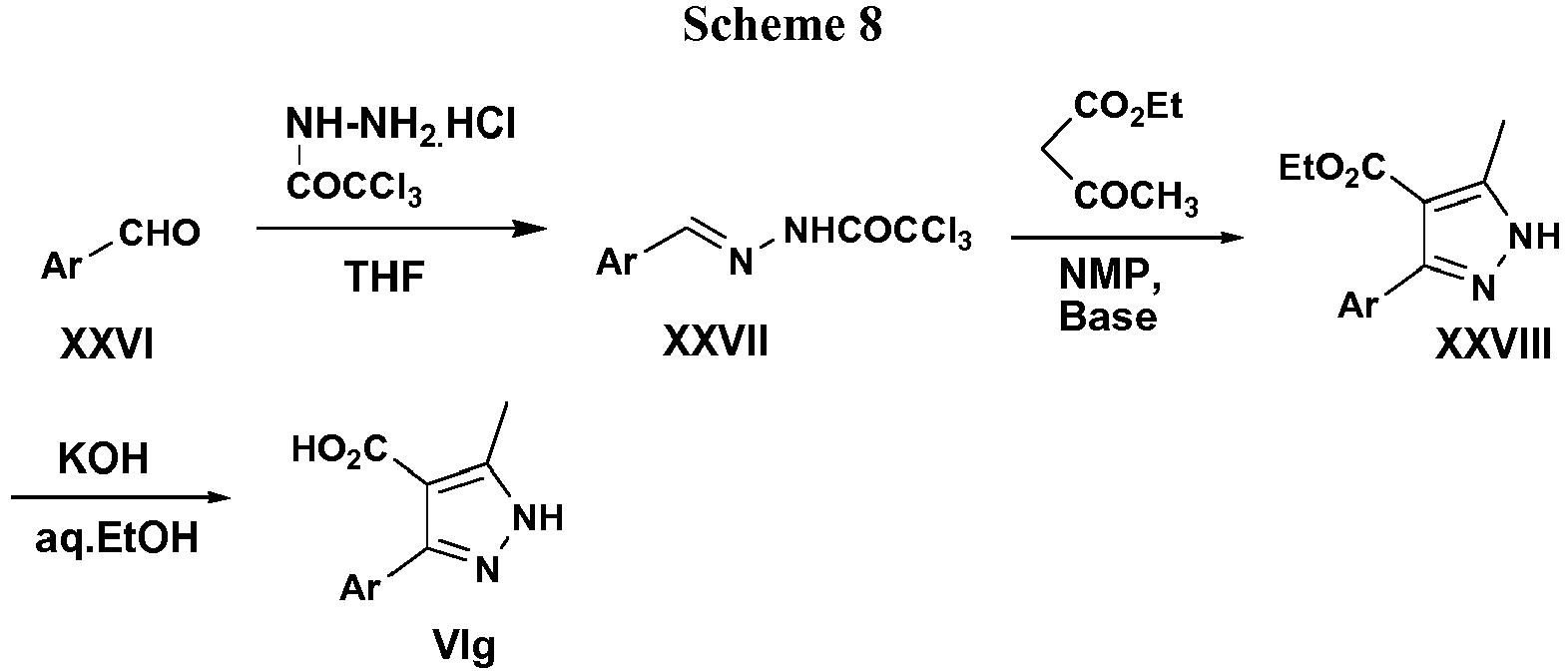
- Compounds of formula VIg were prepared as outlined in Scheme 8 and as described in the literature. [See: El Kaim,L.; Lacroix, S. Synlett, 2000, 3, 353-354.] Aldehydes of formula XXVI were condensed with trichloroacetylhydrazide to afford hydrazones of formula XXVII. Aldehydes of formula XXVI can be obtained commercially, can be prepared by methods known in the literature, or can be readily prepared by one skilled in the art. Treatment of hydrazones of formula XXVII with ethyl acetoacetate under basic conditions afforded pyrazoles of formula XXVIII, which were hydrolyzed in a subsequent step to afford compounds of formula VIg.
- The compounds herein described and set forth and their preparation can be understood further by the following working examples. These examples are meant to be illustrative of the present invention.
- Chemical abbreviations used in the Examples are defined as follows:
- "Ac" for acetate,
- "CD3OD" for deuteromethanol,
- "CDCl3" for deuterochloroform,
- "DCM" for dichloromethane
- "DMF" for N,N-dimethylformamide,
- "DMAP" for 4-dimethylaminopyridine,
- "DMSO" for dimethylsulfoxide,
- "EDC" or "EDCI" for 1-(3-dimethylaminopropyl)-3-ethylcarbodiimide hydrochloride,
- "Et" for ethyl,
- "EtOAC" for ethyl acetate,
- "HOAc" for acetic acid,
- "NBS" for N-bromosuccinimide,
- "NCS" for N-chlorosuccinimide,
- "TFA" for trifluoroacetic acid, and
- "THF" for tetrahydrofuran.
- Abbreviations used in the Examples are defined as follows: "°C" for degrees Celsius, "MS" for mass spectrometry, "ESI" for electrospray ionization mass spectroscopy, "HR" for high resolution, "LC-MS" for liquid chromatography mass spectrometry, "eq" for equivalent or equivalents, "g" for gram or grams, "h" for hour or hours, "mg" for milligram or milligrams, "mL" for milliliter or milliliters, "mmol" for millimolar, "M" for molar, "min" for minute or minutes, "rt" for room temperature, "NMR" for nuclear magnetic resonance spectroscopy, "tlc" for thin layer chromatography, "atm" for atmosphere, and "α", "β", "R", "S", "E", and "Z" are stereochemical designations familiar to one skilled in the art.
- "HPLC" is an abbreviation used herein for high pressure liquid chromatography. Reverse-phase HPLC can be carried out using a Vydac C-18 column with gradient elution from 10% to 100 % buffer B in buffer A (buffer A: water containing 0.1% trifluoroacetic acid, buffer B: 10% water, 90% acetonitrile containing 0.1% trifluoroacetic acid). If necessary, organic layers can be dried over sodium sulfate unless otherwise indicated. However, unless otherwise indicated, the following conditions are generally applicable. "LC-MS" refers to high pressure liquid chromatography carried out according to the definition for HPLC with a mass spectrometry detector.
Method Start %B Final %B Gradient Time (min) Flow rate (ml/min) λ Column Solvent A Solvent B A 0 100 3 4 220 Xterra 4.6 X 30mm S5 10% MeOH-90% H2O-0.1% TFA 90% MeOH-10% H2O-0.1% TFA C 0 100 3 4 220 SunFire C18 5u 4.6 X50mm 90% Water/ 10% ACN/ 0.1% TFA 10% Water/ 90% ACN/ 0.1% TFA F 0 100 3 4 220 Luna 4.6 X 30 mm S10 5% ACN - 95% H2O -10mM NH4Ac 95% ACN-5% H2O-10mM NH4Ac G 0 100 4 0.8 220 Phenomenex-Luna, 2.0X50mm,3u 90% H2O-10%ACN-0.1%TFA 10% H2O-90%ACN -0.1%TFA I 0 100 3 4 220 Luna 3.0 X 50 mm S10 5% ACN - 95% H2O -10mM NH4Ac 95% ACN-5% H2O-10mM NH4Ac L 0 100 2 4 254 Phenomenex-Luna 4.6 X 50 mm S10 10% MeOH-90% H2O-0.1% TFA 90% MeOH-10% H2O-0.1% TFA M 0 100 2 4 254 Phenomenex-Luna 4.6 X 50 mm S10 90% Water/ 10% ACN/ 0.1% TFA 10% Water/ 90% ACN/ 0.1% TFA O 0 95 15 1.2 220 Ascentis C-18, 4.6 X150 mm 5% ACN - 95% H2O -10mM NH4Ac 95% ACN-5% H2O-10mM NH4Ac Q 0 100 10 2 220 Waters Xbridge C-18 4.6X50 mm 5% ACN - 95% H2O -10mM NH4Ac 5% ACN-95% H2O-10mM NH4Ac R 20 95 7 3 220 Ascentis C-18, 4.6 X50 mm 5% ACN - 95% H2O -10mM NH4Ac 95% ACN-5% H2O-10mM NH4Ac U 30 95 15 20 220 Waters Xbridge C-18 150X19 mm, 5u H2O -10mM NH4Ac ACN - 10mM NH4Ac - Preparatory HPLC: When described as performed under "standard conditions", samples (approx. 20 mg) were dissolved in methanol (10 mg/mL) and purified on a 25mm X 50 mm Vydac C18 column with a 5 minute gradient elution from 10% to 100 % buffer B in buffer A (buffer A: water containing 0.1% trifluoroacetic acid, buffer B: 10% water, 90% acetonitrile containing 0.1% trifluoroacetic acid) at 10 mL/minute.
- Melting points were determined on a Mel-Temp II apparatus and are uncorrected. IR spectra were obtained on a single-beam Nicolet Nexus FT-IR spectrometer using 16 accumulations at a resolution of 4.00 cm-1 on samples prepared in a pressed disc of KBr or as a film on KBr plates. Proton NMR spectra (300 MHz, referenced to tetramethylsilane) were obtained on a Varian INOUA 300, Bruker Avance 300, Avance 400, or Avance 500 spectrometer. Data were referred to the lock solvent. Electrospray Ionization (ESI) experiments were performed on a Micromass II Platform single-quadrupole mass spectrometer, or on a Finnigan SSQ7000 mass spectrometer.
-

- Step A1. Ethyl 3-(2-methoxyphenyl)-5-methylisoxazole-4-carboxylate was synthesized from 2-methoxybenzaldehyde as described in [Zamponi, G. W.; Stotz, S. C.; Staples, R. J.; Andro, T. M.; Nelson, J. K.; Hulubei, V.; Blumenfeld, A.; Natale, N. R. J. Med. Chem. 2003, 46, 87-96.]
- Step A2. The reaction mixture of ethyl 3-(2-methoxyphenyl)-5-methylisoxazole-4-carboxylate (12.85 g, 49.2 mmol) and sodium hydroxide (9.84 g, 246 mmol) in MeOH (100 mL) and Water (10 mL) in a 500-mL round bottom flask was stirred at 65 °C for 20 hours. The MeOH was removed in vacuo, then the concentrated reaction mixture was transferred to a 500-mL separatory funnel with 150 mL of water and 100 mL of ether. The organic layer was discarded. The aqueous layer was acidified by adding concentrated HCl (26 mL). The product precipitated and was separated by filtration and dried under high vacuum to give 10.63 g (93%, theoretical yield 11.47 g). 1H NMR (400 MHz, CD3OD) δ 2.69 (s, 3H, CH 3), 3.77 (s, 3H, OCH 3), 7.00-7.07 (m, 2H, aryl), 7.32-7.34 (m, 1H, aryl), 7.43-7.48 (m, 1H, aryl).
- The acids below were synthesized by analogy to Acid-A, substituting the appropriate aldehyde for 2-methoxybenzaldehyde.
-

- 1H-NMR (DMSO, 400 MHz): δ 8.85 (1H, s), 8.17 (1H, dd, J1 = 7.5 Hz, J2 = 1.5 Hz), 8.14 (1H, dd, J1 = 7.5 Hz, J2 = 1.5 Hz), 7.82 (1H, m),7.69 (1H, s), 7.58 (1H, m), 2.73 (3H, s).
-

- 1H-NMR (DMSO, 400 MHz): δ 7.49-7.74 (dd, 1H), 6.96-7.24(dd, 1H), 2.7 (s, 3H), 2.13 (s,3H). m/e 224(M+1)+.
-

- 1H-NMR (DMSO, 400 MHz): δ 7.83-8.22 (m, 3H), 7.4-7.7 (m, 4H), 3.5 (2H, bs), 2.74 (3H, s). m/e 253.97 (M+1)+.
-

- 1H-NMR (DMSO, 400 MHz): δ 9.14-9.49 (1H, m), 8.37-8.47 (1H, m), 8.24-8.37(1H, m), 7.76-7.98 (2H, m),7.52-7.72 (1H, m), 2.82 (3H, s). m/e 254.80 (M+1)+.
-

- 1H-NMR (CD3OD, 500 MHz): δ 8.52-8.44 (1H, m), 7.92-7.83 (1H, m), 7.53-7.44 (1H, m), 2.76 (3H, s).
-

- 1H-NMR (DMSO, 500 MHz): δ 12.62 (1H, s), 9.01 (1H, d, J = 1.8Hz), 8.91 (1H, d, J = 1.5 Hz), 8.28-8.21 (1H, m), 7.99-7.92 (2H, m), 2.74 (3H, s).
-

- 1H-NMR (DMSO, 400 MHz): δ 12.60 (1H, s), 8.09 (1H, d, J = 9.0 Hz), 7.93 (1H, d, J = 7.8 Hz), 7.55 (1H, d, J = 9.0 Hz), 7.46-7.33 (3H, m), 3.84 (3H, s), 2.77 (3H, s).
-

- Step AK1. A solution of tert-butyl 3-(2-methoxyphenyl)-5-methylisoxazole-4-carboxylate (0.795 g, 2.75 mmol), NBS (0.978 g, 5.50 mmol) and benzoyl peroxide (0.033 g, 0.137 mmol) in CCl4 (10 mL) was stirred at 90 °C for 16 hours. The reaction mixture was cooled to RT and the solid was filtered off. Solvent was removed in vacuo. The product was purified by flash chromatography (DCM, Rf 0.56) to give 0.44 g (44% yield). 1H-NMR (CDCl3, 400 MHz): δ 7.49-7.37 (2H, m), 7.04 (1H, t, J = 7.5 Hz), 6.96 (1H, d, J = 8.3 Hz), 4.79 (2H, s), 3.79 (3H, s), 1.38 (9H, s).
- Step AK2. tert-butyl 5-(fluoromethyl)-3-(2-methoxyphenyl)isoxazole-4-carboxylate was prepared from tert-Butyl 5-(bromomethyl)-3-(2-methoxyphenyl)isoxazole-4-carboxylate by the method described in Sun, H.; DiMagno, S. G., J.Am. Chem. Soc. 2005, 127, 2050-2051. 1H-NMR (CDCl3, 400 MHz): δ 7.49-7.37 (2H, m), 7.08-7.01 (1H, m), 6.97 (1H, d, J = 8.3 Hz), 5.72 (2H, d, J = 47.2 Hz), 3.79 (3H, s), 1.35 (9H, s).
- Step AK3. Treating tert-butyl 5-(fluoromethyl)-3-(2-methoxyphenyl)isoxazole-4-carboxylate with TFA/DCM (1:1) at room temperature for one hour followed by evaporation of DCM/TFA in vacuo provided the title compound. 1H-NMR (CD3OD, 400 MHz): δ 7.53-7.44 (1H, m), 7.42-7.35 (1H, m), 7.13-6.98 (2H, m), 5.74 (2H, d, J = 47.2 Hz), 3.78 (3H, s).
-

- The title compound was prepared according to the literature procedure: Grigg, R.; Savic, V. Chem. Commun. 2000, (10), 873-874. 1H-NMR (CDCl3, 400 MHz): δ 7.52-7.63(1H, m), 7.41-7.48 (2H, m), 7.28-7.32 (1H,m), 6.8-6.85 (1H, m), 2.17 (3H, s).
-

- The title compound was prepared according to the literature procedure: El Kaim,L.; Lacroix, S. Synlett, 2000, 3, 353-354. 1H-NMR (CDCl3, 400 MHz): δ 7.28-7.40 (1H, m), 7.17-7.25 (1H,m), 6.90-7.08 (2H, m), 2.38 (3H, s). m/e 233.23 (M+1)+.
-

- Step AU1. Reference: Liliebris, C.; Larsen, S.D; Ogg, D.; Palazuk, B.J; and Pleasdale, J.E. J.Med.Chem., 2002, 45, 1785.
- To a suspension of methyl propiolate (2, 1.314 ml, 15.41 mmol) and copper(I) oxide (1.086 g, 7.59 mmol) in DMF (20 ml) was added 1-iodo-2-methoxybenzene (1, 1.262 ml, 9.48 mmol). The resulting mixture was heated in a Microwave reactor to 110 °C for 2hrs. The reaction mixture was filtered through a short pad of silica gel and washed w/ EtOAc. The organic layer was washed w/1M HCl, brine and sat'd NaHCO3, dried (Na2SO4) and concentrated to leave an oil as crude product, which was purified by flash chromatography (SiO2, EtOAc/Hexane, 1:2) to afford methyl 3-(2-methoxyphenyl)propiolate 3 (932mg, 4.66 mmol, 49.1 % yield). 1H-NMR(500MHz, CDCl3), δ : 7.54(1H, dd), 7.44(1H, td), 6.98-6.92(m,2H), 3.92(s,3H), 3.86(s,3H).
- Step AU2. A mixture of methyl 3-(2-methoxyphenyl)propiolate (3, 932 mg, 4.90 mmol), sodium azide (478 mg, 7.35 mmol), and iodomethane (0.458 ml, 7.35 mmol) in Water (7 ml) and DMF(3 ml) was heated to 100 °C in a Microwave reactor for 6hrs. Purified by Prep-HPLC (Varian, 15-90B in min., B=90% MeOH/10% H2O) to afford methyl 5-(2-methoxyphenyl)-1-methyl-1H-1,2,3-triazole-4-carboxylate (701 mg, 2.69 mmol, 55.0 % yield), 1H-NMR(500MHz, CD3OD), δ : 7.52-7.56(m, 1H), 7.30 (dd, 1H), 7.12, (td, 1H), 7.06, (d,1H), 3.90 (s, 3H), 3.86(s,3H), 3.82(s, 3H). and methyl 4-(2-methoxyphenyl)-1-methyl-1H-1,2,3-triazole-5-carboxylate (185 mg, 0.711 mmol, 14.51 % yield), 1H-NMR( 500MHz, CD3OD), δ : 7.49-7.46(m,2H), 7.10-7.07(m,2H), 4.32(s,3H), 3.79(s, 3H), 3.78(s,3H).
- Step AU3. To a soln. of methyl 4-(2-methoxyphenyl)-1-methyl-1H-1,2,3-triazole-5-carboxylate (183 mg, 0.74 mmol) in MeOH (5ml) was added sodium hydroxide (1.3 ml, 3M aq. solution). The mixture was stirred at r.t for 2hrs, then concentrated in vacuo. The residue was taken up in water, washed w/ether (3x) to remove the possible impurity. The aq. phase was acidified w/6M HCl to pH 3, extracted w/EtOAc (4x). The combined organic layer was dried and evaporated to afford the title compound (164mg, 0.703 mmol, 95 % yield). 1H-NMR(500MHz, CD3OD), δ : 7.46-7.42(m,2H), 7.09-7.05(m,2H), 4.32(s,3H), 3.73(s,3H).
-

-
- Step AV1. To a soln. of 1,4-dioxane-2,5-diol (120 mg, 0.995 mmol) in THF (8ml) was added methylamine (2.8 ml, 0.664 mmol) at r.t. The resulting mixture was stirred at r.t for 75min.
- Then 1-(isocyano(tosyl)methyl)-2-methoxybenzene (200 mg, 0.664 mmol) was added while keeping reaction mixture at <30 °C by a water bath. The reaction mixture was stirred at r.t overnight. Evaporated to leave white solid, dissolved in DMF, and purified by Pre-HPLC to afford (4-(2-methoxyphenyl)-1-methyl-1H-imidazol-5-yl)methanol (84mg, 0.377 mmol, 38.6 % yield) as a colorless oil. 1H-NMR(MeOD), δ: 8.97(1H,s), 7.55(1H,t, J=7.5Hz), 7.47(1H, d, J=8.0Hz), 7.22(1H, d, 8.0Hz), 7.15(1H, t, J=7.5Hz), 4.67(2H,s), 4.05(3H,s), 3.89(3H,s).
- Step AV2. To a soln. of (4-(2-methoxyphenyl)-1-methyl-1H-imidazol-5-yl)methanol (84mg, 0.385 mmol) in 1,4-Dioxane (5ml) was added MnO2 (147 mg, 1.693 mmol). The mixture was heated to 90 °C for 4hrs or until LC/MS showed the completion of the reaction. The reaction mixture was Filtered through celite, and evaporated to afford 4-(2-methoxyphenyl)-1-methyl-1H-imidazole-5-carbaldehyde (78mg, 0.325 mmol, 84 % yield), which was used for the next reaction w/o purification.
- Step AV3. To a soln. of 4-(2-methoxyphenyl)-1-methyl-1H-imidazole-5-carbaldehyde (78 mg, 0.361 mmol) in acetone (5ml) and water (1 ml) was added potassium carbonate (100 mg, 0.721 mmol). After potassium was dissolved, KMnO4 (123 mg, 0.776 mmol) was added at r.t. The mixture was stirred for 24hrs. LC/MS showed the completion. The mixture was filtered through celite, washed w/water. The actone was evaporated from the filtrate which was extracted with EtOAc (2x). The aq. layer was acidified w/ HOAc to PH=5, reduced the volume to half volume, freezed and lyphilized to leave solid, which was purified by Pre-HPLC to afford the title compound (41 mg, 0.173 mmol, 48 % yield). 1H-NMR(MeOD), δ: 8.06(s,1H), 7.41-7.36(m, 2H), 7.05-6.99(m, 2H), 3.98(s,3H), 3.80(s,3H).
- Methyl 1-(2-chlorophenyl)-4-methyl-1H-1,2,3-triazole-5-carboxylate (methyl ester of Acid-AX) was prepared as described in [
Bell, M. G. et al. PCT Int. Appl. 2007, WO 2007140174 .] The methyl ester was hydrolyzed (NaOH/ H2O/ MeOH, RT) to afford the title compound. NMR for methyl ester of Acid-AX: 1H-NMR (CD3OD, 400 MHz): δ 7.67-7.58 (2H, m), 7.55-7.51 (2H, m), 3.77 (3H, s), 2.61 (3H, s).
NMR for Acid-AX: 1H-NMR (CD3OD, 400 MHz): δ 7.65-7.50 (4H, m), 2.61 (3H, s). -

- Step B1. A solution of 3-bromo-2-chloro-5-nitropyridine (0.475 g, 2.000 mmol), tert-butyl piperazine-1-carboxylate (0.373 g, 2 mmol), and triethylamine (0.405 g, 4.00 mmol) in DCM (10 mL) was stirred at RT overnight. Purified by silicon gel column with 5% EtOAc in DCM gave tert-butyl 4-(3-bromo-5-nitropyridin-2-yl)piperazine-1-carboxylate (0.68 g, 1.756 mmol, 88 % yield). yellow solid. 1H-NMR(CDCl3, 500MHz) δ9.02 (1H, s), 8.55 (1H, s), 3.59-3.65 (8H,m), 1.50(9H,s).
- Step B2. tert-butyl 4-(3-bromo-5-nitropyridin-2-yl)piperazine-1-carboxylate was treated with 30% TFA in DCM (5ml) for 2 hours. Drained and dried to afford the title compound (0.71 g, 1.770 mmol, 88 % yield) as a yellow solid. 1H-NMR(CD3OD, 500MHz) δ 9.08 (1H, s), 8.72 (1H, s), 3.85 (4H,m), 3.41 (4H,m).
-

- Steps E1-E2. To a solution of 3-(2-chlorophenyl)-5-methylisoxazole-4-carboxylic acid (2.376 g, 10.00 mmol) in DCM (70 mL) was added 2 drops of DMF, then oxalyl dichloride (1.523 g, 12.00 mmol) in portions. The mixture was stirred for 2 hours and the solution turn clear. The solvent was removed by rotovap and the residue was dried in vacuum for 10 min. The residue was dissolved in DCM (70 mL), then triethylamine (3.04 g, 30.0 mmol) and tert-butyl piperazine-1-carboxylate (1.862 g, 10.00 mmol) was added, the resulting mixture was stirred overnight. After the solvent was removed by rotovap, the residue was purified by silicon gel column with DCM, then 10% EtOAc in DCM to give tert-butyl 4-(3-(2-chlorophenyl)-5-methylisoxazole-4-carbonyl)piperazine-1-carboxylate (3.6 g, 8.87 mmol, 89 % yield).
- Step E3. tert-butyl 4-(3-(2-chlorophenyl)-5-methylisoxazole-4-carbonyl)piperazine-1-carboxylate was treated with 50% TFA in DCM (20ml) for 2 hours. After the solvent was removed, the residue was purified by silicon gel column with 10% MeOH in DCM to give (3-(2-chlorophenyl)-5-methylisoxazol-4-yl)(piperazin-1-yl)methanone (2.4g, 7.85 mmol, 79 % yield). 1H-NMR(CD3OD, 500MHz) δ 7.54-7.61(3H, m.), 7.50(1H, t, J =7.3Hz), 3.63 (4H,s), 2.94 (4H,s), 2.58 (3H,s).
-

- A mixture of 3-(2-chlorophenyl)-5-methylisoxazole-4-carboxylic acid (0.050 g, 0.210 mmol), 1-(2-methyl-4-nitrophenyl)piperazine (0.071 g, 0.210 mmol) (TFA salt), EDC (0.048 g, 0.252 mmol) and DMAP (0.051 g, 0.421 mmol) in dichloromethane (3 mL) was stirred at room temperature overnight. The solvent was evaporated in vacuo. The crude product was purified by preparative HPLC (methanol/ water with 0.1% TFA) to give 41 mg (44% yield) of the title compound. 1H-NMR (300 MHz, CDCl3) δ 8.08-7.99 (2 H, m), 7.60-7.36 (4 H, m), 6.81 (1 H, d, J=8.4 Hz), 3.79 (2 H, br. s.), 3.39 (2 H, br. s.), 2.89 (2 H, br. s.), 2.61 (3 H, s), 2.40 (2 H, br. s.), 2.33 (3 H, s). HPLC/MS (Method U): (ES+) m/z (M+H)+ = 441; Rt = 5.67 min.
-

-
Example R X MH+ RT LC/MS Method RHS Preparation 5 Br N 508 1.60 M Amine-B -

-
Example R1 R2 X MH+ RT LC/MS Method LHS Prep. RHS Prep. 10 OCH3 Br N 504 2.28 L Acid-A Amine-B 18 OCH3 Cl CH 457 2.92 A Acid-A Commercial -

-
Example R MH+ RT LC/MS Method LHS Prep 39 quinolin-8-yl 479 8.96 O Acid-N 44 3-methylthiophen-2-yl 447 5.39 Q Acid-S 49 naphth-1-yl 477 4.88 Q Acid-X 51 isoquinolin-5-yl 478 4.55 Q Acid-Z 61 2-chloropyrid-3-yl 462 2.74 A Acid-AH 62 quinoxalin-5-yl 479 1.76 I Acid-AI 63 2-methoxynaphth-1-yl 507 2.48 C Acid-AJ -

-
Example R MH+ RT LC/MS Method LHS Prep. RHS Prep. 67 
475 2.30 C Acid-AK Commer cial -

-
Example X R MH+ RT LC/MS Method LHS Prep. RHS Prep. 75 CH 
459 8.09 O Acid-AO Commercial 80 CH 
456 3.59 R Acid-AT Commercial 81 CH 
457 2.97 G Acid-AU Commercial 82 CH 
456 2.24 G Acid-AV Commercial -

-
Example R MH+ RT LC/MS Method LHS Prep. 96 OCH3 447 2.20 F Acid-A -

- A 1.0 M solution of boron tribromide (5.70 mL, 5.70 mmol) was cooled to -78 °C. A solution of (4-(3,5-dichloropyridin-2-yl)piperazin-1-yl)(3-(2-methoxyphenyl)-5-methylisoxazol-4-yl)methanone (Example 96, 0.85 g, 1.900 mmol) in DCM (10 mL) was added dropwise. The reaction mixture was stirred at -78 °C for 3 hr. and at room temperature overnight. Water was added slowly, followed by the addition of saturated NaHCO3 solution. The product was extracted with DCM (3 X 50 mL). The crude product was purified via column chromatography (20% EtOAc/ DCM Rf0.45) to give 0.75 g (92%, theoretical yield 0.823 g) of the title compound. 1H-NMR (CDCl3, 300 MHz): δ 9.31 (1H, s), 8.12 (1H, d, J = 2.2 Hz), 7.62 (1H, d, J = 2.2 Hz), 7.50-7.40 (1H, m), 7.40-7.30 (1H, m), 7.14-7.06 (1H, m), 6.99-6.87 (1H, m), 3.98 (2H, t, J = 5.1 Hz), 3.40 (2H, t, J = 5.1 Hz), 3.35 (2H, s), 3.05 (2H, s), 2.54 (3H, s). HPLC/MS (Method F): (ES+) m/z (M+H)+ = 433; Rt = 2.05 min.
-

- The title compound was prepared by analogy to Example 142, substituting Example 18 for Example 96. 1H-NMR (CDCl3, 500 MHz): δ 9.20 (1H, s), 8.26 (1H, d, J = 2.7 Hz), 8.10 (1H, dd, J1 = 9.0 Hz, J2 = 2.7 Hz), 7.47-7.42 (1H, m), 7.40-7.34 (1H, m), 7.12 (1H, d, J = 8.6 Hz), 6.99-6.90 (2H, m), 4.03 (2H, s), 3.37 (2H, s), 3.23 (2H, s), 2.69 (2H, s), 2.56 (3H, s). HPLC/MS (Method C): (ES+) m/z (M+H)+ = 443; Rt = 2.16 min.
- Madin Darby canine kidney (MDCK) cells and influenza A/WSN/33 were obtained from ATCC. Influenza A/Solomon Islands/3/06 and influenza A/Brisbane/10/2007 were obtained from the CDC.
- Test compounds, at 100x the final test concentration, were serially diluted in DMSO in 3-fold steps. One ul of diluted compound was added to each well of a 96-well plate.
- For antiviral assays, MDCK cells were re-suspended in assay media (MEM with pen/strep plus 0.125% BA (bovine albumin) and 1 ug/ml TPCK-treated trypsin) at 4.5 x 10⁵ cells per ml. Virus was added for final multiplicity of infection (MOI) of 0.001 plaque forming units per cell and 100 ul was added to each well of a 96-well plate (lul of compound/well). For cytotoxicity assays, only cells were added to the assay plates. 48 hrs post infection, viral replication in the presence of inhibitor was determined by measuring viral neuraminidase (NA) activity via activation of the quenched substrate 2'-(4-Methylunbelliferyl)-α-D-N-acetylneuraminic acid (MUNANA). A 5x substrate solution was added to yield a final concentration of 100 uM MUNANA, 50 mM MES, 2 mM CaCl2 and 0.25% NP-40. After a 30 minute incubation at 37 °C the plates were read on a fluorescence plate reader set at 360 nm excitation and 460 nm emission. Cytotoxicity was ascertained via crystal violet staining of treated cells. Cells were washed once with PBS, stained for 20 min with 0.5% crystal violet in 20% methanol, washed with water and air dried. 50ul of methanol was added to each well to solubilize the crystal violet and 50 ul PBS was added before the absorbance was read at 540 nM.
-
- Chen J, Deng YM. 2009. Influenza virus antigenic variation, host antibody production and new approach to control epidemic. Virol J. Mar 13;6:30.
- Deyde VM, Sheu TG, Trujillo AA, Okomo-Adhiambo M, Garten R, Klimov AI, Gubareva LV. 2010. Detection of molecular markers of drug resistance in 2009 pandemic influenza A (H1N1) viruses by pyrosequencing. Antimicrob Agents Chemother. Mar;54(3):1102-10.
- Moscona A. 2009. Global transmission of oseltamivir-resistant influenza. N Engl J Med. Mar 5;360(10):953-6.
- Soepandi PZ, Burhan E, Mangunnegoro H, Nawas A, Aditama TY, Partakusuma L, Isbaniah F, Malik S, Benamore R, Baird JK, Taylor WR. 2010. Clinical course of H5N1 avian influenza in patients at the Persahabatan Hospital, Jakarta, Indonesia, 2005-2008. Chest 09-2644.
- Zimmer SM, Burke DS. 2009. Historical perspective--Emergence of influenza A (H1N1) viruses. N Engl J Med. Jul 16;361(3):279-85.
| Example | A/H1N1/WSN | A/H1N1/ Solomon Islands | A/H3N2 Brisbane | A/H5N1/Duck MN | A/H5N1/Duck_PA | A/H5N1/Gull_PA |
| + | + | - | + | + | ++ | |
| 82 | ++ | - | - | + | + | ++ |
| 18 | +++ | ++ | + | ++ | ++ | +++ |
| 81 | +++ | + | - | ++ | ++ | +++ |
| 75 | +++ | + | - | ++ | ++ | +++ |
| 61 | +++ | + | - | ++ | ++ | ++ |
| 63 | +++ | ++ | - | ++ | ++ | +++ |
| Table Key: "-" = EC50 > 10 uM; "+" = EC50 ≤10 uM; "++" = EC50 < 1 uM; "+++" = EC50 < 0.1 uM |
| Example | Human Liver Microsomal Stability (%Remaining after 10 minutes) | Mouse Liver Microsomal Stability (%Remaining after 10 minutes) |
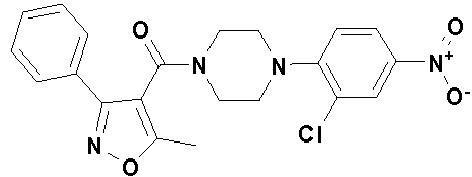 |
40 | 20 |
| (comparative) | ||
 |
6 | 0 |
| (comparative) | ||
| 81 | 73 | 45 |
| 80 | 72 | 65 |
| 61 | 50 | 18 |
| 82 | 45 | 43 |
| 67 | 40 | 29 |
Claims (3)
- A compound which is selected from the group consisting of:


- A pharmaceutical composition which comprises an antiviral effective amount of one or more of the compounds of claim 1, together with one or more pharmaceutically acceptable carriers, excipients or diluents.
- A compound of claim 1, and one or more pharmaceutically acceptable carriers, excipients or diluents for use in treating a mammal infected with influenza virus.
Applications Claiming Priority (2)
| Application Number | Priority Date | Filing Date | Title |
|---|---|---|---|
| US38718610P | 2010-09-28 | 2010-09-28 | |
| PCT/US2011/052965 WO2012044531A1 (en) | 2010-09-28 | 2011-09-23 | Novel piperazine analogs with substituted heteroaryl groups as broad-spectrum influenza antivirals |
Publications (2)
| Publication Number | Publication Date |
|---|---|
| EP2621920A1 EP2621920A1 (en) | 2013-08-07 |
| EP2621920B1 true EP2621920B1 (en) | 2016-01-27 |
Family
ID=44759794
Family Applications (1)
| Application Number | Title | Priority Date | Filing Date |
|---|---|---|---|
| EP11764930.1A Not-in-force EP2621920B1 (en) | 2010-09-28 | 2011-09-23 | Novel piperazine analogs with substituted heteroaryl groups as broad-spectrum influenza antivirals |
Country Status (10)
| Country | Link |
|---|---|
| US (1) | US20120245176A1 (en) |
| EP (1) | EP2621920B1 (en) |
| JP (1) | JP2013542201A (en) |
| CN (1) | CN103209977A (en) |
| BR (1) | BR112013007651A2 (en) |
| CA (1) | CA2812935A1 (en) |
| EA (1) | EA201390476A1 (en) |
| ES (1) | ES2564257T3 (en) |
| MX (1) | MX2013003227A (en) |
| WO (1) | WO2012044531A1 (en) |
Families Citing this family (11)
| Publication number | Priority date | Publication date | Assignee | Title |
|---|---|---|---|---|
| KR101369584B1 (en) | 2011-04-19 | 2014-03-06 | 일양약품주식회사 | Phenyl-isoxazol derivatives and preparation process thereof |
| CN102432555A (en) * | 2011-09-09 | 2012-05-02 | 中国科学院广州生物医药与健康研究院 | 1,2, 3-triazole-4 (5) carboxamide compound and application thereof |
| US9676734B2 (en) | 2012-05-18 | 2017-06-13 | Vironova Influenza Ab | Compounds and methods |
| WO2013171334A1 (en) * | 2012-05-18 | 2013-11-21 | Vironova Ab | Methanethione compounds having antiviral activity |
| CN104447625B (en) * | 2013-09-16 | 2016-08-17 | 中国科学院广州生物医药与健康研究院 | Benzamide compound or its pharmaceutically acceptable salt and application thereof |
| WO2015196086A1 (en) * | 2014-06-20 | 2015-12-23 | The University of Montana, Missoula, MT | NOVEL INHIBITORS OF SYSTEM Xc(-) |
| CN107056762B (en) * | 2016-12-22 | 2020-08-28 | 四川百利药业有限责任公司 | Bis-carbonyl analogues for use against influenza virus |
| WO2021204923A1 (en) | 2020-04-09 | 2021-10-14 | Vironova Medical Ab | Antiviral agents |
| WO2021204924A1 (en) | 2020-04-09 | 2021-10-14 | Vironova Medical Ab | Compounds for use in the treatment of hypercytokinemia |
| CN118076585A (en) * | 2021-07-23 | 2024-05-24 | 国家医疗保健研究所 | Gram-negative bacterial efflux pump inhibitors |
| CN114507220B (en) * | 2022-03-08 | 2023-01-10 | 中国医学科学院医药生物技术研究所 | A substituted 4-phenyl-5-position functionalized 1,2,4-triazole derivative and its preparation method and application |
Family Cites Families (8)
| Publication number | Priority date | Publication date | Assignee | Title |
|---|---|---|---|---|
| CN1242995C (en) | 1999-05-21 | 2006-02-22 | 比奥维特罗姆股份公司 | Novel compounds, their use and preparation |
| ATE417038T1 (en) * | 2001-06-15 | 2008-12-15 | Astellas Pharma Inc | PHENYLPYRIDINE CARBONYL PIPERAZINE DERIVATIVES |
| DE60304718T2 (en) | 2002-08-06 | 2007-04-26 | Astrazeneca Ab | CONDENSED PYRIDINES AND PYRIMIDINES WITH TIE2 (TEK) ACTIVITY |
| WO2007002220A2 (en) | 2005-06-21 | 2007-01-04 | Bristol-Myers Squibb Company | Aminoacetamide acyl guanidines as beta-secretase inhibitors |
| AU2007267692B2 (en) | 2006-05-24 | 2012-06-14 | Eli Lilly And Company | Compounds and methods for modulating FXR |
| WO2009131957A2 (en) * | 2008-04-21 | 2009-10-29 | Institute For Oneworld Health | Compounds, compositions and methods comprising oxadiazole derivatives |
| CN102596946B (en) * | 2009-08-05 | 2015-06-17 | 港大科桥有限公司 | Antiviral compounds and methods of making and using same |
| US9212177B2 (en) * | 2009-08-05 | 2015-12-15 | Versitech Limited | Antiviral compounds and methods of making and using thereof |
-
2011
- 2011-09-23 CA CA2812935A patent/CA2812935A1/en not_active Abandoned
- 2011-09-23 EA EA201390476A patent/EA201390476A1/en unknown
- 2011-09-23 CN CN2011800566517A patent/CN103209977A/en active Pending
- 2011-09-23 US US13/242,676 patent/US20120245176A1/en not_active Abandoned
- 2011-09-23 JP JP2013531678A patent/JP2013542201A/en not_active Withdrawn
- 2011-09-23 ES ES11764930.1T patent/ES2564257T3/en active Active
- 2011-09-23 WO PCT/US2011/052965 patent/WO2012044531A1/en not_active Ceased
- 2011-09-23 EP EP11764930.1A patent/EP2621920B1/en not_active Not-in-force
- 2011-09-23 MX MX2013003227A patent/MX2013003227A/en not_active Application Discontinuation
- 2011-09-23 BR BR112013007651A patent/BR112013007651A2/en not_active IP Right Cessation
Also Published As
| Publication number | Publication date |
|---|---|
| CN103209977A (en) | 2013-07-17 |
| EA201390476A1 (en) | 2013-08-30 |
| BR112013007651A2 (en) | 2019-09-24 |
| MX2013003227A (en) | 2013-05-31 |
| WO2012044531A1 (en) | 2012-04-05 |
| ES2564257T3 (en) | 2016-03-21 |
| WO2012044531A8 (en) | 2012-08-09 |
| EP2621920A1 (en) | 2013-08-07 |
| US20120245176A1 (en) | 2012-09-27 |
| JP2013542201A (en) | 2013-11-21 |
| CA2812935A1 (en) | 2012-04-05 |
Similar Documents
| Publication | Publication Date | Title |
|---|---|---|
| US20120245176A1 (en) | Novel piperazine analogs with substituted heteroaryl groups as broad-spectrum influenza antivirals | |
| JP5902172B2 (en) | Novel piperazine analogs as a broad spectrum of influenza antiviral drugs | |
| JP7001601B2 (en) | Functionalized pentanic acid for use in influenza virus infection | |
| US11447501B2 (en) | Biphenyl-containing diarylpyrimido compounds, pharmaceutically-acceptable salts thereof, composition and preparation thereof | |
| KR20180087290A (en) | Heterocyclic indole for use in influenza virus infection | |
| CZ366697A3 (en) | Derivatives of 6-carboxamidodihydropyran | |
| JP6034960B2 (en) | Fluorine-substituted (3R, 4R, 5S) -5-guanidino-4-acetamido-3- (pentan-3-yloxy) cyclohexene-1-carboxylic acid, ester thereof and use thereof | |
| EP2870141B1 (en) | Methanethione compounds having antiviral activity | |
| WO2014082594A1 (en) | Neuraminidase inhibitor and pharmaceutical purpose of prodrug thereof | |
| US20220306592A1 (en) | N-substituted oseltamivir derivatives with antimicrobial activity | |
| WO2014082592A1 (en) | Neuraminidase inhibitor prodrug and composition and use thereof | |
| CN109053606B (en) | 4-(4-Hydroxyphenylmethyleneamino)-1,2,4-triazole-5-thione and its application | |
| JP2012502881A (en) | Benzimidazole NF-kappa B inhibitor | |
| CN107556248B (en) | Novel neuraminidase inhibitory compound and preparation method and medical application thereof | |
| RU2815649C1 (en) | Pyrrolopyridine derivative and its use | |
| EP4698279A1 (en) | Compounds with activity against sars-cov-2 | |
| US9676734B2 (en) | Compounds and methods | |
| US20040157900A1 (en) | Isoxazole-containing thiourea inhibitors useful for treatment of varicella zoster virus | |
| HK1210165B (en) | Methanethione compounds having antiviral activity |
Legal Events
| Date | Code | Title | Description |
|---|---|---|---|
| PUAI | Public reference made under article 153(3) epc to a published international application that has entered the european phase |
Free format text: ORIGINAL CODE: 0009012 |
|
| 17P | Request for examination filed |
Effective date: 20130416 |
|
| AK | Designated contracting states |
Kind code of ref document: A1 Designated state(s): AL AT BE BG CH CY CZ DE DK EE ES FI FR GB GR HR HU IE IS IT LI LT LU LV MC MK MT NL NO PL PT RO RS SE SI SK SM TR |
|
| DAX | Request for extension of the european patent (deleted) | ||
| 17Q | First examination report despatched |
Effective date: 20140325 |
|
| GRAP | Despatch of communication of intention to grant a patent |
Free format text: ORIGINAL CODE: EPIDOSNIGR1 |
|
| INTG | Intention to grant announced |
Effective date: 20150807 |
|
| GRAS | Grant fee paid |
Free format text: ORIGINAL CODE: EPIDOSNIGR3 |
|
| GRAA | (expected) grant |
Free format text: ORIGINAL CODE: 0009210 |
|
| AK | Designated contracting states |
Kind code of ref document: B1 Designated state(s): AL AT BE BG CH CY CZ DE DK EE ES FI FR GB GR HR HU IE IS IT LI LT LU LV MC MK MT NL NO PL PT RO RS SE SI SK SM TR |
|
| REG | Reference to a national code |
Ref country code: GB Ref legal event code: FG4D |
|
| REG | Reference to a national code |
Ref country code: CH Ref legal event code: EP |
|
| REG | Reference to a national code |
Ref country code: AT Ref legal event code: REF Ref document number: 772639 Country of ref document: AT Kind code of ref document: T Effective date: 20160215 |
|
| REG | Reference to a national code |
Ref country code: IE Ref legal event code: FG4D |
|
| REG | Reference to a national code |
Ref country code: DE Ref legal event code: R096 Ref document number: 602011023036 Country of ref document: DE |
|
| REG | Reference to a national code |
Ref country code: ES Ref legal event code: FG2A Ref document number: 2564257 Country of ref document: ES Kind code of ref document: T3 Effective date: 20160321 |
|
| REG | Reference to a national code |
Ref country code: LT Ref legal event code: MG4D |
|
| REG | Reference to a national code |
Ref country code: NL Ref legal event code: MP Effective date: 20160127 |
|
| REG | Reference to a national code |
Ref country code: AT Ref legal event code: MK05 Ref document number: 772639 Country of ref document: AT Kind code of ref document: T Effective date: 20160127 |
|
| PG25 | Lapsed in a contracting state [announced via postgrant information from national office to epo] |
Ref country code: NL Free format text: LAPSE BECAUSE OF FAILURE TO SUBMIT A TRANSLATION OF THE DESCRIPTION OR TO PAY THE FEE WITHIN THE PRESCRIBED TIME-LIMIT Effective date: 20160127 |
|
| PG25 | Lapsed in a contracting state [announced via postgrant information from national office to epo] |
Ref country code: GR Free format text: LAPSE BECAUSE OF FAILURE TO SUBMIT A TRANSLATION OF THE DESCRIPTION OR TO PAY THE FEE WITHIN THE PRESCRIBED TIME-LIMIT Effective date: 20160428 Ref country code: NO Free format text: LAPSE BECAUSE OF FAILURE TO SUBMIT A TRANSLATION OF THE DESCRIPTION OR TO PAY THE FEE WITHIN THE PRESCRIBED TIME-LIMIT Effective date: 20160427 Ref country code: HR Free format text: LAPSE BECAUSE OF FAILURE TO SUBMIT A TRANSLATION OF THE DESCRIPTION OR TO PAY THE FEE WITHIN THE PRESCRIBED TIME-LIMIT Effective date: 20160127 Ref country code: FI Free format text: LAPSE BECAUSE OF FAILURE TO SUBMIT A TRANSLATION OF THE DESCRIPTION OR TO PAY THE FEE WITHIN THE PRESCRIBED TIME-LIMIT Effective date: 20160127 |
|
| REG | Reference to a national code |
Ref country code: FR Ref legal event code: PLFP Year of fee payment: 6 |
|
| PG25 | Lapsed in a contracting state [announced via postgrant information from national office to epo] |
Ref country code: PL Free format text: LAPSE BECAUSE OF FAILURE TO SUBMIT A TRANSLATION OF THE DESCRIPTION OR TO PAY THE FEE WITHIN THE PRESCRIBED TIME-LIMIT Effective date: 20160127 Ref country code: RS Free format text: LAPSE BECAUSE OF FAILURE TO SUBMIT A TRANSLATION OF THE DESCRIPTION OR TO PAY THE FEE WITHIN THE PRESCRIBED TIME-LIMIT Effective date: 20160127 Ref country code: SE Free format text: LAPSE BECAUSE OF FAILURE TO SUBMIT A TRANSLATION OF THE DESCRIPTION OR TO PAY THE FEE WITHIN THE PRESCRIBED TIME-LIMIT Effective date: 20160127 Ref country code: LV Free format text: LAPSE BECAUSE OF FAILURE TO SUBMIT A TRANSLATION OF THE DESCRIPTION OR TO PAY THE FEE WITHIN THE PRESCRIBED TIME-LIMIT Effective date: 20160127 Ref country code: LT Free format text: LAPSE BECAUSE OF FAILURE TO SUBMIT A TRANSLATION OF THE DESCRIPTION OR TO PAY THE FEE WITHIN THE PRESCRIBED TIME-LIMIT Effective date: 20160127 Ref country code: PT Free format text: LAPSE BECAUSE OF FAILURE TO SUBMIT A TRANSLATION OF THE DESCRIPTION OR TO PAY THE FEE WITHIN THE PRESCRIBED TIME-LIMIT Effective date: 20160527 Ref country code: IS Free format text: LAPSE BECAUSE OF FAILURE TO SUBMIT A TRANSLATION OF THE DESCRIPTION OR TO PAY THE FEE WITHIN THE PRESCRIBED TIME-LIMIT Effective date: 20160527 Ref country code: AT Free format text: LAPSE BECAUSE OF FAILURE TO SUBMIT A TRANSLATION OF THE DESCRIPTION OR TO PAY THE FEE WITHIN THE PRESCRIBED TIME-LIMIT Effective date: 20160127 |
|
| REG | Reference to a national code |
Ref country code: DE Ref legal event code: R097 Ref document number: 602011023036 Country of ref document: DE |
|
| PG25 | Lapsed in a contracting state [announced via postgrant information from national office to epo] |
Ref country code: DK Free format text: LAPSE BECAUSE OF FAILURE TO SUBMIT A TRANSLATION OF THE DESCRIPTION OR TO PAY THE FEE WITHIN THE PRESCRIBED TIME-LIMIT Effective date: 20160127 Ref country code: EE Free format text: LAPSE BECAUSE OF FAILURE TO SUBMIT A TRANSLATION OF THE DESCRIPTION OR TO PAY THE FEE WITHIN THE PRESCRIBED TIME-LIMIT Effective date: 20160127 |
|
| PG25 | Lapsed in a contracting state [announced via postgrant information from national office to epo] |
Ref country code: SM Free format text: LAPSE BECAUSE OF FAILURE TO SUBMIT A TRANSLATION OF THE DESCRIPTION OR TO PAY THE FEE WITHIN THE PRESCRIBED TIME-LIMIT Effective date: 20160127 Ref country code: SK Free format text: LAPSE BECAUSE OF FAILURE TO SUBMIT A TRANSLATION OF THE DESCRIPTION OR TO PAY THE FEE WITHIN THE PRESCRIBED TIME-LIMIT Effective date: 20160127 Ref country code: RO Free format text: LAPSE BECAUSE OF FAILURE TO SUBMIT A TRANSLATION OF THE DESCRIPTION OR TO PAY THE FEE WITHIN THE PRESCRIBED TIME-LIMIT Effective date: 20160127 Ref country code: CZ Free format text: LAPSE BECAUSE OF FAILURE TO SUBMIT A TRANSLATION OF THE DESCRIPTION OR TO PAY THE FEE WITHIN THE PRESCRIBED TIME-LIMIT Effective date: 20160127 |
|
| PLBE | No opposition filed within time limit |
Free format text: ORIGINAL CODE: 0009261 |
|
| STAA | Information on the status of an ep patent application or granted ep patent |
Free format text: STATUS: NO OPPOSITION FILED WITHIN TIME LIMIT |
|
| PG25 | Lapsed in a contracting state [announced via postgrant information from national office to epo] |
Ref country code: BE Free format text: LAPSE BECAUSE OF FAILURE TO SUBMIT A TRANSLATION OF THE DESCRIPTION OR TO PAY THE FEE WITHIN THE PRESCRIBED TIME-LIMIT Effective date: 20160127 |
|
| 26N | No opposition filed |
Effective date: 20161028 |
|
| PG25 | Lapsed in a contracting state [announced via postgrant information from national office to epo] |
Ref country code: BG Free format text: LAPSE BECAUSE OF FAILURE TO SUBMIT A TRANSLATION OF THE DESCRIPTION OR TO PAY THE FEE WITHIN THE PRESCRIBED TIME-LIMIT Effective date: 20160427 Ref country code: SI Free format text: LAPSE BECAUSE OF FAILURE TO SUBMIT A TRANSLATION OF THE DESCRIPTION OR TO PAY THE FEE WITHIN THE PRESCRIBED TIME-LIMIT Effective date: 20160127 |
|
| PG25 | Lapsed in a contracting state [announced via postgrant information from national office to epo] |
Ref country code: MC Free format text: LAPSE BECAUSE OF FAILURE TO SUBMIT A TRANSLATION OF THE DESCRIPTION OR TO PAY THE FEE WITHIN THE PRESCRIBED TIME-LIMIT Effective date: 20160127 |
|
| REG | Reference to a national code |
Ref country code: CH Ref legal event code: PL |
|
| REG | Reference to a national code |
Ref country code: IE Ref legal event code: MM4A |
|
| PG25 | Lapsed in a contracting state [announced via postgrant information from national office to epo] |
Ref country code: LI Free format text: LAPSE BECAUSE OF NON-PAYMENT OF DUE FEES Effective date: 20160930 Ref country code: CH Free format text: LAPSE BECAUSE OF NON-PAYMENT OF DUE FEES Effective date: 20160930 Ref country code: IE Free format text: LAPSE BECAUSE OF NON-PAYMENT OF DUE FEES Effective date: 20160923 |
|
| REG | Reference to a national code |
Ref country code: FR Ref legal event code: PLFP Year of fee payment: 7 |
|
| PG25 | Lapsed in a contracting state [announced via postgrant information from national office to epo] |
Ref country code: LU Free format text: LAPSE BECAUSE OF NON-PAYMENT OF DUE FEES Effective date: 20160923 |
|
| PG25 | Lapsed in a contracting state [announced via postgrant information from national office to epo] |
Ref country code: CY Free format text: LAPSE BECAUSE OF FAILURE TO SUBMIT A TRANSLATION OF THE DESCRIPTION OR TO PAY THE FEE WITHIN THE PRESCRIBED TIME-LIMIT Effective date: 20160127 Ref country code: HU Free format text: LAPSE BECAUSE OF FAILURE TO SUBMIT A TRANSLATION OF THE DESCRIPTION OR TO PAY THE FEE WITHIN THE PRESCRIBED TIME-LIMIT; INVALID AB INITIO Effective date: 20110923 |
|
| PG25 | Lapsed in a contracting state [announced via postgrant information from national office to epo] |
Ref country code: TR Free format text: LAPSE BECAUSE OF FAILURE TO SUBMIT A TRANSLATION OF THE DESCRIPTION OR TO PAY THE FEE WITHIN THE PRESCRIBED TIME-LIMIT Effective date: 20160127 Ref country code: MK Free format text: LAPSE BECAUSE OF FAILURE TO SUBMIT A TRANSLATION OF THE DESCRIPTION OR TO PAY THE FEE WITHIN THE PRESCRIBED TIME-LIMIT Effective date: 20160127 Ref country code: MT Free format text: LAPSE BECAUSE OF NON-PAYMENT OF DUE FEES Effective date: 20160930 |
|
| REG | Reference to a national code |
Ref country code: FR Ref legal event code: PLFP Year of fee payment: 8 |
|
| PG25 | Lapsed in a contracting state [announced via postgrant information from national office to epo] |
Ref country code: AL Free format text: LAPSE BECAUSE OF FAILURE TO SUBMIT A TRANSLATION OF THE DESCRIPTION OR TO PAY THE FEE WITHIN THE PRESCRIBED TIME-LIMIT Effective date: 20160127 |
|
| PGFP | Annual fee paid to national office [announced via postgrant information from national office to epo] |
Ref country code: DE Payment date: 20190910 Year of fee payment: 9 Ref country code: FR Payment date: 20190815 Year of fee payment: 9 Ref country code: IT Payment date: 20190917 Year of fee payment: 9 |
|
| PGFP | Annual fee paid to national office [announced via postgrant information from national office to epo] |
Ref country code: GB Payment date: 20190920 Year of fee payment: 9 |
|
| PGFP | Annual fee paid to national office [announced via postgrant information from national office to epo] |
Ref country code: ES Payment date: 20191001 Year of fee payment: 9 |
|
| REG | Reference to a national code |
Ref country code: DE Ref legal event code: R119 Ref document number: 602011023036 Country of ref document: DE |
|
| GBPC | Gb: european patent ceased through non-payment of renewal fee |
Effective date: 20200923 |
|
| PG25 | Lapsed in a contracting state [announced via postgrant information from national office to epo] |
Ref country code: DE Free format text: LAPSE BECAUSE OF NON-PAYMENT OF DUE FEES Effective date: 20210401 Ref country code: FR Free format text: LAPSE BECAUSE OF NON-PAYMENT OF DUE FEES Effective date: 20200930 |
|
| PG25 | Lapsed in a contracting state [announced via postgrant information from national office to epo] |
Ref country code: GB Free format text: LAPSE BECAUSE OF NON-PAYMENT OF DUE FEES Effective date: 20200923 |
|
| PG25 | Lapsed in a contracting state [announced via postgrant information from national office to epo] |
Ref country code: IT Free format text: LAPSE BECAUSE OF NON-PAYMENT OF DUE FEES Effective date: 20200923 |
|
| REG | Reference to a national code |
Ref country code: ES Ref legal event code: FD2A Effective date: 20220119 |
|
| PG25 | Lapsed in a contracting state [announced via postgrant information from national office to epo] |
Ref country code: ES Free format text: LAPSE BECAUSE OF NON-PAYMENT OF DUE FEES Effective date: 20200924 |
|
| P01 | Opt-out of the competence of the unified patent court (upc) registered |
Effective date: 20230404 |