EP2620880A2 - System, computer-implemented method, and computer-readable medium for routing and/or management paths in an electronic map - Google Patents
System, computer-implemented method, and computer-readable medium for routing and/or management paths in an electronic map Download PDFInfo
- Publication number
- EP2620880A2 EP2620880A2 EP12008578.2A EP12008578A EP2620880A2 EP 2620880 A2 EP2620880 A2 EP 2620880A2 EP 12008578 A EP12008578 A EP 12008578A EP 2620880 A2 EP2620880 A2 EP 2620880A2
- Authority
- EP
- European Patent Office
- Prior art keywords
- key
- user
- trip
- path
- data
- Prior art date
- Legal status (The legal status is an assumption and is not a legal conclusion. Google has not performed a legal analysis and makes no representation as to the accuracy of the status listed.)
- Ceased
Links
Images







Classifications
-
- G—PHYSICS
- G06—COMPUTING OR CALCULATING; COUNTING
- G06F—ELECTRIC DIGITAL DATA PROCESSING
- G06F16/00—Information retrieval; Database structures therefor; File system structures therefor
- G06F16/20—Information retrieval; Database structures therefor; File system structures therefor of structured data, e.g. relational data
- G06F16/29—Geographical information databases
Definitions
- Routing including travelling between source and destination locations may use information, such as, for example, route to the destination and travel time. Travelling may also use information related to landmarks or points of interest along a route, such as, for example, restaurants, fuel stations, monuments, sights of interest, and location of a friend's home. Information such assights of interest to a particular user and location of a friend's home may not generally be captured in existing map or navigation systems, for example, due to limitations in data storage, management and efficient retrieval capabilities of travel related systems. Further, if multiple travelers are involved, travelling may use information related to pick-up time for such travelers, location and timing of areas of pick-up and estimated arrival time at such pick-up areas.
- IM instant messaging
- SMS short message service
- IM instant messaging
- SMS short message service
- a path may be a directed graph between a sequence of nodes including a starting node (or point) and an ending node (or) point.
- the starting node may be a source location and the ending node may be a destination location.
- the nodes may represent (way) points on a path (also referred to as route and/or trip hereinafter).
- the nodes may be specified using global positioning system (GPS) coordinates and/or directions.
- travel related systems may be based on limitations in data storage, management and retrieval capabilities of such systems.
- travel related systems may use relational databases to store, manage and retrieve information.
- relational databases have limited capabilities for handling large sets of unstructured data. Relational databases also have limited capabilities for handling significant data growth over a short time-period and a high rate of concurrent access.
- a user of a travel related system using a relational database may request landmark, reviews and images for a point of interest.
- the relational database may normalize the data related to the point of interest, but would require joins for each component (e.g., landmark, reviews or images) of the request.
- the query would require additional joins.
- each component of a query would significantly increase the size of data for a search.
- the relational database including, for example, n t trips would include at least n t * (n c +n i +n l + n r ) records.
- the number of overall records would thus be based, for example, on the number of trips times the related comments, images, landmarks, reviews and other factors.
- multiplicity of the number of overall records and other aspects of relational database functionality could thus limit capabilities of a travel related system for handling, for example, large sets of unstructured data, significant data growth and high rate of concurrent access.
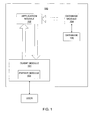
- Figure 1 illustrates a high-level system diagram for a travel management system, according to an embodiment
- Figure 2 illustrates an example of a data model for the travel management system of Figure 1 , according to an embodiment
- Figure 3 illustrates an example of an object store for the travel management system of Figure 1 , according to an embodiment
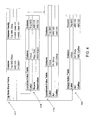
- Figure 4 illustrates an example of a physical data layout for the travel management system of Figure 1 , according to an embodiment
- Figure 5 illustrates an Extensible Markup Language (XML) example in a trip data store tablefor the travel management system of Figure 1 , according to an embodiment
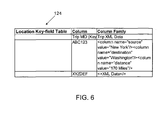
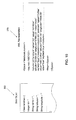
- Figure 6 illustrates an example of a location key-field table for the travel management system of Figure 1 , according to an embodiment
- Figure 7 illustrates a flowchart for updating a new trip and searching for an existing trip, according to an embodiment
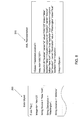
- Figure 8 illustrates an example of a data object and related XML representation for the flowchartof Figure 7 , according to an embodiment
- Figure 9 illustrates a flowchart for updating landmarks over a trip and searching for a landmark, according to an embodiment
- Figure 10 illustrates an example of a data object and related XML representation for the flowchartof Figure 9 , according to an embodiment
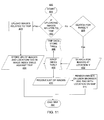
- Figure 11 illustrates a flowchart for updating images and searching for animage based on its location tag, according to an embodiment
- Figure 12 illustrates an example of a data object and related XML representation for the flowchartof Figure 11 , according to an embodiment
- Figure 13 illustrates a method for travel management, according to an embodiment
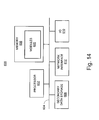
- Figure 14 illustrates a computer system, according to an embodiment.
- the system for routing and/or managing a path on an electronic map may store the trip in a database with all unique user experiences, such as, for example, trip comments, trip landmarks, trip ratings, trip images and trip landmark reviews. This information related to a trip may be readily shared and downloaded with other users.
- the travel management system may maintain a state of all members belonging to a community of users subscribed to the system.
- the travel management system provides, for example, customizable navigation, customizable routes with landmarks, live sharing of traffic update information among a closed group, authoring of routes and sharing thereof within a closed group, adherence to timelines in trips including multiple stops, runtime monitoring and assist from remote locations.
- the travel management system may generally include a client module to generate a request to update and/or search for data related to a trip.
- a database module may receive the request and communicate with a database.
- the database may include data organized in a trip data store table including unique keys respectively identifying trips.
- the database may further include index tables related to attributes of the trips and identified by the unique keys.
- the database module may obtain data related to the request from an index table corresponding to a unique key and forward a response to the client module.
- the index tables may include value and the unique key pairs, and the value may be related to an attribute of a trip.
- the request and the response may be a XMLbasedrequest and response.
- the XMLbased response may be rendered into a HyperText Markup Language (HTML) viewfor presenting toa user.
- the unique key may be a unique identification related to the trip from a source location to a destination location.
- the index table may include an index and a key-field, where an index set to true may determine that a value related to an attribute of a trip is searchable, and a key-field set to true may determine that the value is to be presented to a user as a search result.
- the database may further include key-field tablesrelated to the attributes of the trips and identified by the unique keys. Corresponding values for key-fields set to true may be stored in a corresponding key-field table.
- the database module may query the key-field tables based on the request and forward a preliminary response to the client module. Upon approval of the preliminary response by the user, the database module may load appropriate content from the trip data store table identified by the unique key.
- the trip data store table may store XMLdata related to the trip in a single row in a multiple nodes form.
- the client module may provide for live sharing of traffic update information among a closed group of users. Hence, the system provides for dynamic management of information and maintenance of the state of any given system member.
- the client module may provide for access to a first user's trip information to an authorized second user.
- the client module may provide for tracking and monitoring of a user in real time.
- the client module may also provide an authorized user the ability to assist a traveler in real-time by updating the trip with alternate route maps, landmarks, images, comments and/or reviews.
- a method for travel management may include receiving a request to update and/or search for data related to a trip.
- the method may further include communicating with a database including the data related to the trip.
- the method may include organizing the data in a trip data store table including unique keys respectively identifying trips, and further including index tables related to attributes of the trips and identified by the unique keys.
- the method may include obtaining data related to the request from an index table corresponding to a unique key and forwarding a response to a user.
- the index tables may include value and the unique key pairs.
- the value may be related to an attribute of a trip.
- the index table may include an index and a key-field, and an index set to true may determine that a value related to an attribute of a trip is searchable, and a key-field set to true may determine that the value is to be presented to the user as a search result.
- the database may further include key-field tablesrelated to the attributes of the trips and identified by the unique keys. Corresponding values for key-fields set to true may be stored in a corresponding key-field table.
- the method may further include querying the key-field tables based on the request, forwarding a preliminary response to the user, and upon approval of the preliminary response by the user, loading appropriate content from the trip data store table identified by the unique key.
- the trip data store table may store XMLdata related to the trip in a single row in a multiple nodes form.
- a non-transitory computer readable medium may have stored thereon a computer executable program for travel management.
- the computer executable program when executed, may cause a computer system to receive a request to update and/or search for data related to a trip.
- the computer executable program may cause the computer system to communicate with a database including the data related to the trip.
- the computer executable program may cause the computer system to organize the data in a trip data store table including unique keys respectively identifying trips, and further including index tables related to attributes of the trips and identified by the unique keys.
- the computer executable program may cause the computer system to obtain data related to the request from an index table corresponding to a unique key and forward a response to a user.
- the travel management system thus provides an efficient framework for storing and organizing data related to a trip, and further, for efficient sharing of data from a client to the database and vice-versa.
- the travel management system further provides for efficient handling of large sets of unstructured data, elastic scalability in management of rapid growth of data, and the ability to handle high rate of concurrent access.
- the travel management system may provide customizable navigation. For example, for known map sites, a route may be based on a fixed criterionsuch as, for example, shortest path, shortest time or highway-onlyto a destination. A route provided by such a site however does not provide the ability to follow a custom route previously taken, for example, by a friend or family member, that may include personalized experiences of the previous traveler(s) as specified, for example, through photos of landmarks and annotations. In addition, such sites do not provide support to a traveler who may request online monitoring and assistance either at specific times during the trip or on a continuous basis. The travel management system provides for the download of customized routes between any two points, where a route may be customized, for example, by a friend or family member.
- a route may be based on a fixed criterion such as, for example, shortest path, shortest time or highway-onlyto a destination.
- a route provided by such a site does not provide the ability to follow a custom route previously taken, for example, by
- the travel management system provides customizable routes with landmarks. For example, for landmarks on a route, the travel management system allowsa user to author personalized landmarks on the route and provide appropriate user-specific details.
- the travel management system provides for live sharing of traffic update information among a closed group. Members of a group may navigate dynamically and reach their destination in the least possible time.
- the system provides for live updates that include, for example, information related to traffic, accidents, road blocks and construction.
- the system may be implemented as a mobile application for transmitting live route updates to a community of the system users.
- the travel management system provides for authoring of routes and sharing thereof within a closed group. For example, in the event of no route information on a map, a system user may record and share a route with a community of users associated with the system. A user may also record and share information, such as, for example, sights of interest and location of a friend's home.
- the travel management system facilitates adherence to timelines in trips including multiple stops. For example, if a trip requires strict adherence to a timeline and multiple stops, the travel management system allows all members related to such a trip to not only obtain instant update of the current location of the user in-route (e.g., to monitor a user), but also to remotely assist the user in-route with navigation based on current road conditions.
- the travel management system may also assist a traveler by drawing an alternate path or by drawing landmarks that get shared with the traveler at runtime.
- the travel management system may also assist a traveler to prepare for a trip in advance by drawing landmarks, uploading reference images, uploading landmarks and by providing for download of the entire custom trip information to a mobile device and use that as a reference.
- the travel management system may also consider multiple parties on a trip, providing each party with the ability to keep track of the other party members during the trip and assisting one another.
- the travel management system also allows a user to set automated alert preferences. For example, the system may track the distance travelled and based on the distance, set alert preferences (e.g., an automatic SMS) to the user or a specified person.
- alert preferences e.g., an automatic SMS
- the travel management system thus provides for storage, management and efficient retrieval of information.
- the system may store routes between any two points, personalized by users with their own landmarks of interest. Other users in the future may retrieve the personalized trip routes and experience the routes in the same manner as experienced by the route author.
- a route may be personalized with location images, points of interest, landmarks, alternate routes, comments and reviews for the landmarks.
- a traveler who is about to embark on a trip mayefficiently browse through all possible personalized trip experiences between the traveler's points of interest from a given travel management site before making a choice as to the route.
- the traveler may further download the desired route into a navigation system, for example, of a mobile device with a single click.
- the systems and methods described herein provide a technical solution to the technical problem of travel management and data storage, management and efficient retrieval for large sets of unstructured data, for data growth over a short time-period, and for a high rate of concurrent access.
- data storage, management and retrieval for large sets of unstructured data may limit capabilities, such as, for example, response time and the number of users that may access the data at any given time for a travel related system.
- the type of data storage and management may also increase the data storage requirements for a system, thus increasing system cost.
- the systems and methods according to the embodiments provide the technical solution of providing travel management by communicating with a database including data organized in a trip data store table including unique keys respectively identifying trips, index tables related to attributes of the trips and identified by the unique keys, and key-field tablesrelated to the attributes of the trips and identified by the unique keys.
- FIG. 1 illustrates a high-level system diagram for the travel management system 100, according to an embodiment.
- the system 100 may include a client module 101.
- the client module 101 may be designed to make XMLbased requests to an application module102 to be processed.
- the client module 101 may also include, for example, mobile or web-based communication.
- the response to the client module 101 may also be a XML based response.
- the XML response may be rendered into HTMLviews to be presented to a user.
- the client module 101 may be equipped with a parser module 103 to convert the XML response into HTML views.
- the application module 102 and its associated application layer or service layer may include the parser module 103.
- the parsing of the XML response at the client end i.e., at the client module 101
- the application module 102 may provide a communication medium between the client module 101 and a database module104.
- the application module 102 may read the XML for data manipulation queries and perform decisions, such as, for example, updating correct index tables, described in detail below, in a database 106.
- the database 106 may include multiple index tables, such as, for example, a location index table, an image index table, and a landmark index table.
- index table e.g., location index table, image index table, and landmark index table
- each index table for the data model 107 may include a value 109 and a key (MID) 110 pair.
- MID may be a Metadatatagld, which may be, for example, a 16 digit unique identification (ID).
- the Key may also be used to generate a unique trip uniform resource locator (URL) that can be used by the trip author(i.e., primary user) to invite (or deny) specific users to obtain access to a live trip. Once approved, the other users may obtain full access to all the metadata about the trip authenticated by the original trip author.
- URL uniform resource locator
- an example of a simple object store is shown at 113 and a converted XML at 114.
- the index and key-field columns may allow the system 100 to control variable and text values for search and visual presentation.
- the corresponding tables may include a location index table 118, a landmark index table 119 and an image index table 120.
- the XML data in the trip data store table 117 may store the entire XML data related to a trip in a single row in a multiple nodes form.
- the trip data store table 117 may also include multiple columns. Data related to a trip may be stored in the XML format in a single row that is linked with a unique ID.
- the unique ID may be the row key (MID) 110 (see Figure 2 ).
- a XML example of the trip data store table 117 is shown.
- the system 100 may load the trip XML from trip data store table 117.
- the trip XML may include all data stored in a column family manner in XML format.
- the XML result may be processed at the client side (i.e., at the client module 101) to create the required HTML views.
- the amount of data in the database 106 may be reduced.
- the trip data store table 117 may also be loaded on demand. For example,the trip data store table 117 may only be accessed when the trip MID is known.
- the index tables e.g., location index table 118, landmark index table 119 and image index table 120
- key-field tables e.g., location key-field table 124 of Figure 6 , similar corresponding landmark and image key-field tables are not shown
- the index tables may serve all incoming data retrieval requests, thus reducing overhead on the database 106.
- the search may proceed to the location index table 118.
- the exact matches in the location index table 118 (for one or multiple trip IDs) may be obtained for the requested location, and a XML response may be created.
- the location key-field table 124 for the travel management system 100 is illustrated.
- the generated XML response may be the responsibility of the key-field tables, which are similar to index tables.
- every location column that has key-field set to "true" may store the corresponding value in the location key-field table 124 and the view XML may be sent to a user without loading the trip data store table 117.
- the trip data store table 117 may be loaded on demand after loading of the key-field tables. For example, once the key-field tables are searched, upon approval by a user to load a particular record, the trip data store table 117 may be loaded. Referring to Figure 5 , since all the three location columns 125 have key-field set to true, all three corresponding values may remain in the database 106 as the XML column family. Thus, when a user searches for a record in the system 100, the user may be presented with links to the most relevant records, withthe links being formed using the key-field tables. Thus, as discussed above, the trip data store table 117 may be loaded on demand when a user requests further review of a record. Until then, the key-field tables may be used to present links to the most relevant records for a search.
- Figure 7 illustrates a flowchart200 for updating a new trip and searching for an existing trip
- Figure 8 illustrates an example of a data object 250 and related XML representation 270 for the flowchartof Figure 7 , according to an embodiment.
- a user may start a trip.
- the system 100 may proceed to block 203, where the trip may be started using a key (MID) or the system 100 may generate a unique trip ID.
- the system 100 may determine the start and end points of the trip based on user input.
- the system 100 may obtain the locations using global positioning system (GPS).
- GPS global positioning system
- the system 100 may update the start and end points in the location index table 118(see block 207) against the particular trip.
- the trip data store table 117 may be updated.
- the user may complete the trip.At block 210, the system 100 may proceed from block 202 if a user is to search for a trip based on location. At block 211, the user may search for a tripfrom locations X to Y. Based on the inputs of locations X to Y, the system 100 may proceed to the location index table 118at block 207. At block 212, a list of trips takenbetween locations X to Y may be received from the location index table 118 (or from multiple location index tables). At block 213, the received information may be sent back to a user's browser. At block 209, the user may complete the trip.
- the data model for the update operation may include the data object 250 and related XML representation 270.
- the system 100 may take both values (i.e., New York and Washington) and update (see Figure 7 ) both values in the location index table 118 with the trip ID.
- the values may be saved in thelocation index table 118 (see Figure 4 ).
- FIG 8 an example of a search operation for a trip from New York to Washington is discussed.
- the search for keywords New York and Washington may be performed in thelocation index table 118.
- the trip MID may then beused to obtain the trip data XML from the trip data store table 117.
- Figure 9 illustrates a flowchart300 for updating landmarks over a trip and searching for a landmark
- Figure 10 illustrates an example of a data object 350 and related XML representation 370 for the flowchartof Figure 9 , according to an embodiment.
- a user may start a trip.
- the system 100 may proceed to block 303 for updating a landmark on a map using, for example, a phone or aweb browser, and tagging the landmark with a keyword (e.g., friend's home, ABC Coffee).
- the system 100 may determine the latitude and longitude of a landmark.
- the system 100 may update the latitude and longitude of the landmark in the landmarkindex table 119 (see block 306) with the key (MID)for a trip.
- the trip data store table 117 may be updated.
- the user may complete the trip.
- the system 100 may proceed from block 302 if a user is to search for a landmark on a map.
- the user may search for a landmark (e.g., landmark X) against akeyword.
- the search request may proceed to the landmarkindex table 119 at block 306.
- a list of landmarkstagged against the keyword may be received.
- the received information may be sent back to a user's browser.
- the user may complete the trip.
- the data model for the update operation may include the data object 350 and related XML representation 370.
- the XML represents the landmarks of trip ID ABC123.
- the index and the key field column attributes may be set to true for Iandmarks.
- the values for each landmark may be saved in the landmark index table (e.g., landmark index table 119 of Figure 4 ) against the trip ID (i.e., key (MID)).
- the keyword "ABC Coffee” may be directly searched in the landmark index table.
- the keyword "ABC Coffee” may be directly searched in the landmark index table 119 of Figure 4 . Since the results may have multiple trips IDs, eachXML may be retrieved from the trip data store table 117 against the trip ID.
- Figure 11 illustrates a flowchart400 for updating images and searching for an image based on its location tag
- Figure 12 illustrates an example of a data object 450 and related XML representation 470 for the flowchartof Figure 11 , according to an embodiment.
- a user may start a trip.
- the images related to a trip may be uploaded.
- the external uniform resource identifier (URI) ofthe images may be stored and the location of the images may be tagged in the image index table (at block 405) against the trip.
- the images may be stored and the location of the images may be tagged in the image index table 120 of Figure 4 .
- the trip data store table 117 may be updated.
- the user may complete the trip.
- the system 100 may proceed from block 402 if a user is to search for an image (e.g., image Y).
- the system 100 may search for images at location Y and proceed to the image index table 120.
- a list of images may be received.
- the received information may be sent back to a user's browser (e.g., displayed on the user's browser) and tagged with the location on a map.
- the user may complete the trip.
- the data model for the uploading operation may include the data object 450 and related XML representation 470.
- the values for the indexed columns maybe saved in the image index table.
- the values for the indexed columns maybe saved in the image index table 120 of Figure 4 .
- the image index table 120 may include the tag and the trip ID associated with the image.
- trips may be searched against a keyword.
- the control may proceed directly to the image index table 120.
- the matched trip ID against the tag may be returned and the trip ID may be used to load trips from the trip data store table 117.
- the system 100 provides for the download of customized routes between any two points, where a route may be customized, for example, by a friend or family member.
- a route may be customized, for example, by a friend or family member.
- the travel management system 100 allowsa user to author personalized landmarks on the route and provide appropriate user-specific details.
- the travel management system 100 provides for live sharing of traffic update information among a closed group. Members of a group may navigate dynamically and reach their destination in the least possible time.
- the system provides for live updates that include, for example, information related to traffic, accidents, road blocks and construction.
- the travel management system 100 provides for authoring of routes and sharing thereof within a closed group.
- a system user may record and share a route with a community of users associated with the system.
- a user may also record and share information, such as, for example, sights of interest and location of a friend's home.
- the travel management system 100 also facilitates adherence to timelines in trips including multiple stops. For example, if a trip requires strict adherence to a timeline and multiple stops, the travel management system allows all members related to such a trip to not only obtain instant update of the current location of the user in-route, but also to remotely assist the user in-route with navigation based on current road conditions.
- Figure 13 illustrates a flowchart of a method 500 for travel management, according to an embodiment.
- the method 500 may be implemented on the travel management systemdescribed above with reference to Figures 1-12 by way of example and not limitation.
- the method 500 may be practiced in other systems.
- the method may include receiving a request to update and/or search for data related to a trip.
- the system 100 may include the client module 101, which may be designed to make XMLbased requests to the application module102 to be processed.
- the response to the client module 101 may also be a XML based response.
- the method may include communicating with a database including the data related to the trip.
- the application module 102 may provide a communication medium between the client module 101 and the database module104.
- the application module 102 may read the XML for data manipulation queries and perform decisions, such as, for example, updating correct index tables in the database 106.
- the method may include organizing the data in a trip data store table including unique keys respectively identifying trips, and further including index tables related to attributes of the trips and identified by the unique keys.
- the database 106 may include multiple index tables, such as, for example, the location index table, the image index table, and the landmark index table.
- each index table e.g., location index table, image index table, and landmark index table
- MID may be a Metadatatagld, which may be, for example, a 16 digit ID.
- the index and key-field columns may allow the system 100 to control variable and text values for search and visual presentation.
- the corresponding tables may include the location index table 118, the landmark index table 119 and the image index table 120.
- the XML data in the trip data store table 117 may store the entire XML data related to a trip in a single row in a multiple nodes form.
- the trip data store table 117 may also include multiple columns. Data related to a trip may be stored in the XML format in a single row that is linked with a unique ID.
- the unique ID may be the row key (MID) 110.
- the method may include generating key-field tablesrelated to the attributes of the trips and identified by the unique keys and storing corresponding values for key-fields set to true in a corresponding key-field table.
- the generated XML response may be the responsibility of the location key-field table 124.
- the value may be stored in the corresponding key-field tables (e.g., the location key-field table 124) and, as discussed below, the view XML may be sent to a user without loading the trip data store table 117.
- the method may includequerying key-field tables based on the request.
- the method may includeforwarding a preliminary response to the user.
- the preliminary response may include the data in the key-field table corresponding to the unique key.
- the method may include,upon approval of the preliminary response by the user, loading appropriate content from the trip data store table identified by the unique key.
- the trip data store table 117 may be loaded on demand only after loading of the key-field table (e.g., the location key-field table 124).
- the key-field table e.g., the location key-field table 124
- the trip data store table 117 may be loaded. Referring to Figure 5 , since all the three location columns 125 have key-field set to true, all three values may remain in the database 106 as the XML column family.
- the user when a user searches for a record in the system 100, the user may be presented with links to the most relevant records, withthe links being formed using the key-field table.
- the trip data store table 117 may be loaded on demand when a user requests further review of a record.
- the system 100 may load the trip XML from the trip data store table 117.
- the trip XML may include all the data stored in a column family manner in XML format.
- the XML result may be processed at the client side (i.e., at the client module 101) to create the required HTML views.
- the method may include forwarding a response to a user.
- the XML response may be rendered into HTMLviews to be presented to a user.
- the client module 101 may be equipped with the parser module 103 to convert the XML response into HTML views.
- the application module 102 and its associated application layer or service layer may include the parser module 103.
- the parsing of the XML response at the client end may be performed using, for example, JavaScript. Parsing the XML response at the client end may increase the speed of the parsing operation as opposed to the parsing being performed at the application module 102.
- FIG 14 shows a computer system 600 that may be used with the embodiments described herein.
- the computer system 600 represents a generic platform that includes components that may be in a server or another computer system.
- the computer system 600 may be used as a platform for the system 100.
- the computer system 600 may execute, by a processor or other hardware processing circuit, the methods, functions and other processes described herein. These methods, functions and other processes may be embodied as machine readable instructions stored on computer readable medium, which may be non-transitory, such as hardware storage devices (e.g., RAM (random access memory), ROM (read only memory), EPROM (erasable, programmable ROM), EEPROM (electrically erasable, programmable ROM), hard drives, and flash memory).
- RAM random access memory
- ROM read only memory
- EPROM erasable, programmable ROM
- EEPROM electrically erasable, programmable ROM
- hard drives and flash memory
- the computer system 600 includes a processor 602 that may implement or execute machine readable instructions performing some or all of the methods, functions and other processes described herein. Commands and data from the processor 602 are communicated over a communication bus 604.
- the computer system 600 also includes a main memory 606, such as a random access memory (RAM), where the machine readable instructions and data for the processor 602 may reside during runtime, and a secondary data storage 608, which may be nonvolatile and stores machine readable instructions and data.
- the memory and data storage are examples of computer readable mediums.
- the memory 606 may include modules 620 including machine readable instructions residing in the memory 606 during runtime and executed by the processor 602.
- the modules 620 may include the modules 101-104 of the system 100 shown in Figure 1 .
- the computer system 600 may include an I/O device 610, such as a keyboard, a mouse, a display, etc.
- the computer system 600 may include a network interface 612 for connecting to a network.
- Other known electronic components may be added or substituted in the computer system 600.
Landscapes
- Engineering & Computer Science (AREA)
- Databases & Information Systems (AREA)
- Theoretical Computer Science (AREA)
- General Physics & Mathematics (AREA)
- Physics & Mathematics (AREA)
- General Engineering & Computer Science (AREA)
- Data Mining & Analysis (AREA)
- Remote Sensing (AREA)
- Information Retrieval, Db Structures And Fs Structures Therefor (AREA)
- Information Transfer Between Computers (AREA)
- Data Exchanges In Wide-Area Networks (AREA)
- Management, Administration, Business Operations System, And Electronic Commerce (AREA)
- Navigation (AREA)
Abstract
Description
- Routing including travelling between source and destination locations may use information, such as, for example, route to the destination and travel time. Travelling may also use information related to landmarks or points of interest along a route, such as, for example, restaurants, fuel stations, monuments, sights of interest, and location of a friend's home. Information such assights of interest to a particular user and location of a friend's home may not generally be captured in existing map or navigation systems, for example, due to limitations in data storage, management and efficient retrieval capabilities of travel related systems. Further, if multiple travelers are involved, travelling may use information related to pick-up time for such travelers, location and timing of areas of pick-up and estimated arrival time at such pick-up areas.
- Known travel related systems provide navigation based on static data and updates by instant messaging (IM) or short message service (SMS). Such systems may use algorithms based on shortest path, highway use or mode of transport, which rely on static data. Such systems however may not leverage information based on user experiences, or information which changes dynamically as a user continues on a path such as a trip.A path may be a directed graph between a sequence of nodes including a starting node (or point) and an ending node (or) point.The starting node may be a source location and the ending node may be a destination location. The nodes may represent (way) points on a path (also referred to as route and/or trip hereinafter).The nodes may be specified using global positioning system (GPS) coordinates and/or directions.Hence, the state of any given system user may not be maintained.
- The foregoing features of travel related systems may be based on limitations in data storage, management and retrieval capabilities of such systems. For example, travel related systems may use relational databases to store, manage and retrieve information. However, relational databases have limited capabilities for handling large sets of unstructured data. Relational databases also have limited capabilities for handling significant data growth over a short time-period and a high rate of concurrent access.
- For example, a user of a travel related system using a relational database may request landmark, reviews and images for a point of interest. The relational database may normalize the data related to the point of interest, but would require joins for each component (e.g., landmark, reviews or images) of the request. For any additional components (e.g., ratings per review) of a request, the query would require additional joins. Thus, each component of a query would significantly increase the size of data for a search. For example, if a trip includes nc comments, ni images, nl landmarks, and nr reviews, the relational database including, for example, nt trips, would include at least nt * (nc +ni+nl+ nr) records. For a database of millions of trips, the number of overall records would thus be based, for example, on the number of trips times the related comments, images, landmarks, reviews and other factors. Such multiplicity of the number of overall records and other aspects of relational database functionality could thus limit capabilities of a travel related system for handling, for example, large sets of unstructured data, significant data growth and high rate of concurrent access.
- The embodiments are described with reference to the following figures:
-
Figure 1 illustrates a high-level system diagram for a travel management system, according to an embodiment; -
Figure 2 illustrates an example of a data model for the travel management system ofFigure 1 , according to an embodiment; -
Figure 3 illustrates an example of an object store for the travel management system ofFigure 1 , according to an embodiment; -
Figure 4 illustrates an example of a physical data layout for the travel management system ofFigure 1 , according to an embodiment; -
Figure 5 illustrates an Extensible Markup Language (XML) example in a trip data store tablefor the travel management system ofFigure 1 , according to an embodiment; -
Figure 6 illustrates an example of a location key-field table for the travel management system ofFigure 1 , according to an embodiment; -
Figure 7 illustrates a flowchart for updating a new trip and searching for an existing trip, according to an embodiment; -
Figure 8 illustrates an example ofa data object and related XML representation for the flowchartofFigure 7 , according to an embodiment; -
Figure 9 illustrates a flowchart for updating landmarks over a trip and searching for a landmark, according to an embodiment; -
Figure 10 illustrates an example ofa data object and related XML representation for the flowchartofFigure 9 , according to an embodiment; -
Figure 11 illustrates a flowchart for updating images and searching for animage based on its location tag, according to an embodiment; -
Figure 12 illustrates an example ofa data object and related XML representation for the flowchartofFigure 11 , according to an embodiment; -
Figure 13 illustrates a method for travel management, according to an embodiment; -
Figure 14 illustrates a computer system, according to an embodiment. - For simplicity and illustrative purposes, the principles of the embodiments are described by referring mainly to examples thereof. In the following description, numerous specific details are set forth in order to provide a thorough understanding of the embodiments. It will be apparent that the embodiments may be practiced without limitation to all the specific details. Also, the embodiments may be used together in various combinations.
- For a path (referred to herein also as route or trip) between source and destination locations, the system for routing and/or managing a path on an electronic map (also referred to herein as travel management system) may store the trip in a database with all unique user experiences, such as, for example, trip comments, trip landmarks, trip ratings, trip images and trip landmark reviews. This information related to a trip may be readily shared and downloaded with other users. The travel management system may maintain a state of all members belonging to a community of users subscribed to the system. As discussed below, the travel management system provides, for example, customizable navigation, customizable routes with landmarks, live sharing of traffic update information among a closed group, authoring of routes and sharing thereof within a closed group, adherence to timelines in trips including multiple stops, runtime monitoring and assist from remote locations.
- As described in detail below, the travel management system may generally include a client module to generate a request to update and/or search for data related to a trip. A database module may receive the request and communicate with a database. The database may include data organized in a trip data store table including unique keys respectively identifying trips. The database may further include index tables related to attributes of the trips and identified by the unique keys. The database module may obtain data related to the request from an index table corresponding to a unique key and forward a response to the client module.
- For the travel management system described above,the index tables may include value and the unique key pairs, and the value may be related to an attribute of a trip. The request and the response may be a XMLbasedrequest and response. The XMLbased response may be rendered into a HyperText Markup Language (HTML) viewfor presenting toa user. The unique key may be a unique identification related to the trip from a source location to a destination location. The index table may include an index and a key-field, where an index set to true may determine that a value related to an attribute of a trip is searchable, and a key-field set to true may determine that the value is to be presented to a user as a search result. The database may further include key-field tablesrelated to the attributes of the trips and identified by the unique keys. Corresponding values for key-fields set to true may be stored in a corresponding key-field table. The database module may query the key-field tables based on the request and forward a preliminary response to the client module. Upon approval of the preliminary response by the user, the database module may load appropriate content from the trip data store table identified by the unique key. The trip data store table may store XMLdata related to the trip in a single row in a multiple nodes form. The client module may provide for live sharing of traffic update information among a closed group of users. Hence, the system provides for dynamic management of information and maintenance of the state of any given system member. The client module may provide for access to a first user's trip information to an authorized second user. The client module may provide for tracking and monitoring of a user in real time. The client module may also provide an authorized user the ability to assist a traveler in real-time by updating the trip with alternate route maps, landmarks, images, comments and/or reviews.
- As described in detail below, a method for travel management may include receiving a request to update and/or search for data related to a trip. The method may further include communicating with a database including the data related to the trip. The method may include organizing the data in a trip data store table including unique keys respectively identifying trips, and further including index tables related to attributes of the trips and identified by the unique keys. The method may include obtaining data related to the request from an index table corresponding to a unique key and forwarding a response to a user.
- For the method described above, as similarly described for the travel management system, the index tables may include value and the unique key pairs. The value may be related to an attribute of a trip. The index table may include an index and a key-field, and an index set to true may determine that a value related to an attribute of a trip is searchable, and a key-field set to true may determine that the value is to be presented to the user as a search result. The database may further include key-field tablesrelated to the attributes of the trips and identified by the unique keys. Corresponding values for key-fields set to true may be stored in a corresponding key-field table. The method may further include querying the key-field tables based on the request, forwarding a preliminary response to the user, and upon approval of the preliminary response by the user, loading appropriate content from the trip data store table identified by the unique key. The trip data store table may store XMLdata related to the trip in a single row in a multiple nodes form.
- As described in detail below, a non-transitory computer readable medium may have stored thereon a computer executable program for travel management. The computer executable program, when executed, may cause a computer system to receive a request to update and/or search for data related to a trip. The computer executable program may cause the computer system to communicate with a database including the data related to the trip. The computer executable program may cause the computer system to organize the data in a trip data store table including unique keys respectively identifying trips, and further including index tables related to attributes of the trips and identified by the unique keys. The computer executable program may cause the computer system to obtain data related to the request from an index table corresponding to a unique key and forward a response to a user.
- The travel management system thus provides an efficient framework for storing and organizing data related to a trip, and further, for efficient sharing of data from a client to the database and vice-versa. The travel management system further provides for efficient handling of large sets of unstructured data, elastic scalability in management of rapid growth of data, and the ability to handle high rate of concurrent access.
- The travel management system may provide customizable navigation. For example, for known map sites, a route may be based on a fixed criterionsuch as, for example, shortest path, shortest time or highway-onlyto a destination. A route provided by such a site however does not provide the ability to follow a custom route previously taken, for example, by a friend or family member, that may include personalized experiences of the previous traveler(s) as specified, for example, through photos of landmarks and annotations. In addition, such sites do not provide support to a traveler who may request online monitoring and assistance either at specific times during the trip or on a continuous basis. The travel management system provides for the download of customized routes between any two points, where a route may be customized, for example, by a friend or family member.
- The travel management system provides customizable routes with landmarks. For example, for landmarks on a route, the travel management system allowsa user to author personalized landmarks on the route and provide appropriate user-specific details.
- The travel management system provides for live sharing of traffic update information among a closed group. Members of a group may navigate dynamically and reach their destination in the least possible time. The system provides for live updates that include, for example, information related to traffic, accidents, road blocks and construction. The system may be implemented as a mobile application for transmitting live route updates to a community of the system users.
- The travel management system provides for authoring of routes and sharing thereof within a closed group. For example, in the event of no route information on a map, a system user may record and share a route with a community of users associated with the system. A user may also record and share information, such as, for example, sights of interest and location of a friend's home.
- The travel management system facilitates adherence to timelines in trips including multiple stops. For example, if a trip requires strict adherence to a timeline and multiple stops, the travel management system allows all members related to such a trip to not only obtain instant update of the current location of the user in-route (e.g., to monitor a user), but also to remotely assist the user in-route with navigation based on current road conditions. The travel management system may also assist a traveler by drawing an alternate path or by drawing landmarks that get shared with the traveler at runtime.
- The travel management system may also assist a traveler to prepare for a trip in advance by drawing landmarks, uploading reference images, uploading landmarks and by providing for download of the entire custom trip information to a mobile device and use that as a reference. The travel management system may also consider multiple parties on a trip, providing each party with the ability to keep track of the other party members during the trip and assisting one another.
- The travel management system also allows a user to set automated alert preferences. For example, the system may track the distance travelled and based on the distance, set alert preferences (e.g., an automatic SMS) to the user or a specified person.
- The travel management system thus provides for storage, management and efficient retrieval of information. The system may store routes between any two points, personalized by users with their own landmarks of interest. Other users in the future may retrieve the personalized trip routes and experience the routes in the same manner as experienced by the route author. A route may be personalized with location images, points of interest, landmarks, alternate routes, comments and reviews for the landmarks. Moreover, a traveler who is about to embark on a trip mayefficiently browse through all possible personalized trip experiences between the traveler's points of interest from a given travel management site before making a choice as to the route. The traveler may further download the desired route into a navigation system, for example, of a mobile device with a single click.
- The systems and methods described herein provide a technical solution to the technical problem of travel management and data storage, management and efficient retrieval for large sets of unstructured data, for data growth over a short time-period, and for a high rate of concurrent access. In many cases, data storage, management and retrieval for large sets of unstructured data may limit capabilities, such as, for example, response time and the number of users that may access the data at any given time for a travel related system. The type of data storage and management may also increase the data storage requirements for a system, thus increasing system cost. The systems and methods according to the embodiments provide the technical solution of providing travel management by communicating with a database including data organized in a trip data store table including unique keys respectively identifying trips, index tables related to attributes of the trips and identified by the unique keys, and key-field tablesrelated to the attributes of the trips and identified by the unique keys.
-
Figure 1 illustrates a high-level system diagram for thetravel management system 100, according to an embodiment. Referring toFigure 1 , thesystem 100 may include aclient module 101. Theclient module 101 may be designed to make XMLbased requests to an application module102 to be processed. Theclient module 101 may also include, for example, mobile or web-based communication. The response to theclient module 101 may also be a XML based response. The XML response may be rendered into HTMLviews to be presented to a user. Theclient module 101 may be equipped with aparser module 103 to convert the XML response into HTML views. Alternatively, theapplication module 102 and its associated application layer or service layer may include the parser module 103.The parsing of the XML response at the client end (i.e., at the client module 101) may be performed using, for example, JavaScript. Parsing the XML response at the client end may increase the speed of the parsing operation as opposed to the parsing being performed at theapplication module 102. - The
application module 102 may provide a communication medium between theclient module 101 and a database module104. Theapplication module 102 may read the XML for data manipulation queries and perform decisions, such as, for example, updating correct index tables, described in detail below, in adatabase 106. - The
database 106 may include multiple index tables, such as, for example, a location index table, an image index table, and a landmark index table. Referring toFigure 2 , an example of adata model 107 for thetravel management system 100 is illustrated. As shown inFigure 2 , each index table (e.g., location index table, image index table, and landmark index table) for thedata model 107 may include avalue 109 and a key (MID) 110 pair. The rows are shown at 111 and the columns at 112. MID may be a Metadatatagld, which may be, for example, a 16 digit unique identification (ID). The Key (MID) may also be used to generate a unique trip uniform resource locator (URL) that can be used by the trip author(i.e., primary user) to invite (or deny) specific users to obtain access to a live trip. Once approved, the other users may obtain full access to all the metadata about the trip authenticated by the original trip author. - As shown in
Figures 2 and3 , an example of a simple object store is shown at 113 and a converted XML at 114. For the simple object store at 113, for an example for ID = "123", string name = "SB", and string address = "Bangalore", the converted XML is shown at 114. For the converted XML at 114, for an index column at 115, a column defined as index = "true" determines that a value is searchable.For a key-field column at 116, a column defined as key-field ="true" determines that a value is presented as part of a view to the client machine (e.g., the user) as a result of a search result. The index and key-field columns may allow thesystem 100 to control variable and text values for search and visual presentation. - As shown in
Figure 4 , an example of sample data for thetravel management system 100 is shown. For example, for a trip data store table 117, the corresponding tables may include a location index table 118, a landmark index table 119 and an image index table 120. The XML data in the trip data store table 117 may store the entire XML data related to a trip in a single row in a multiple nodes form. The trip data store table 117 may also include multiple columns. Data related to a trip may be stored in the XML format in a single row that is linked with a unique ID. For example, the unique ID may be the row key (MID) 110 (seeFigure 2 ). - Referring to
Figure 5 , a XML example of the trip data store table 117 is shown. For the XML example, at 121, id= "location"informs thesystem 100 that the location index table 118 needs to be populated ifindex = "true". Similarly, at 122, id= "landmark"informs thesystem 100 that the landmark index table 119 is to be updatedif index = "true". At 123, since the name attribute is not indexed to true (i.e., index = "false"), the value is not saved in the location index table 118. If a user were to search for comments, images and reviews of the ABC coffee landmark, the search request would proceed directly to the landmark index table 119 to obtain the trip MID.Based on the trip MID, thesystem 100 may load the trip XML from trip data store table 117. The trip XML may include all data stored in a column family manner in XML format. The XML result may be processed at the client side (i.e., at the client module 101) to create the required HTML views. - Based on the foregoing, compared, for example, to a relational database, no complex joins are needed to combine the data, resulting in a reduction in speed of data retrieval. If any new functionality is to be added to the
system 100, the data does not need to be normalized and no new tables are needed. Instead, the existing data model may be updated and values may be saved in a XML format in a column family without changing the database or adding new columns manually. - Compared to databases, such as, for example, relational databases, the amount of data in the
database 106 may be reduced. For example, since each trip is stored as a single record, for nt trips, thedatabase 106 would include nt records, as opposed at least nt * (nc +ni+nl+ nr) records (where nc= comments, ni= images, nl= landmarks andnr= reviews). The trip data store table 117 may also be loaded on demand. For example,the trip data store table 117 may only be accessed when the trip MID is known. Prior to this, the index tables (e.g., location index table 118, landmark index table 119 and image index table 120) and key-field tables (e.g., location key-field table 124 ofFigure 6 , similar corresponding landmark and image key-field tables are not shown) may serve all incoming data retrieval requests, thus reducing overhead on thedatabase 106. For example, when a search is requested on a location, the search may proceed to the location index table 118. The exact matches in the location index table 118 (for one or multiple trip IDs) may be obtained for the requested location, and a XML response may be created. - Referring to
Figure 6 , an example of the location key-field table 124 for thetravel management system 100 is illustrated. The generated XML response may be the responsibility of the key-field tables, which are similar to index tables. Referring toFigures 5 and6 , for the trip data store table 117, every location column that has key-field set to "true" may store the corresponding value in the location key-field table 124 and the view XML may be sent to a user without loading the trip data store table 117. - In order to limit the amount of data loaded for any particular search, as discussed above, the trip data store table 117 may be loaded on demand after loading of the key-field tables. For example, once the key-field tables are searched, upon approval by a user to load a particular record, the trip data store table 117 may be loaded. Referring to
Figure 5 , since all the threelocation columns 125 have key-field set to true, all three corresponding values may remain in thedatabase 106 as the XML column family. Thus, when a user searches for a record in thesystem 100, the user may be presented with links to the most relevant records, withthe links being formed using the key-field tables. Thus, as discussed above, the trip data store table 117 may be loaded on demand when a user requests further review of a record. Until then, the key-field tables may be used to present links to the most relevant records for a search. - Referring next to
Figures 7 and8 ,Figure 7 illustrates a flowchart200 for updating a new trip and searching for an existing trip, andFigure 8 illustrates an example of adata object 250 andrelated XML representation 270 for the flowchartofFigure 7 , according to an embodiment. - Referring to
Figure 7 , atblock 201, a user may start a trip. Atblock 202, if starting a new trip, thesystem 100 may proceed to block 203, where the trip may be started using a key (MID) or thesystem 100 may generate a unique trip ID. Atblock 204, thesystem 100 may determine the start and end points of the trip based on user input. At block 205, if no user input is obtained, thesystem 100 may obtain the locations using global positioning system (GPS). Atblock 206, if user input is obtained as to the start and end points, thesystem 100 may update the start and end points in the location index table 118(see block 207) against the particular trip. Atblock 208, the trip data store table 117 may be updated. Atblock 209, the user may complete the trip.At block 210, thesystem 100 may proceed fromblock 202 if a user is to search for a trip based on location. Atblock 211, the user may search for a tripfrom locations X to Y. Based on the inputs of locations X to Y, thesystem 100 may proceed to the location indextable 118at block 207. Atblock 212, a list of trips takenbetween locations X to Y may be received from the location index table 118 (or from multiple location index tables). Atblock 213, the received information may be sent back to a user's browser. Atblock 209, the user may complete the trip. - Referring to
Figure 8 , an example of an update operation for a trip from New York to Washington is discussed. The data model for the update operation may include the data object 250 andrelated XML representation 270. For theXML representation 270, since the column name of source and destination are marked as index ="true", thesystem 100 may take both values (i.e., New York and Washington) and update (seeFigure 7 ) both values in the location index table 118 with the trip ID. The values may be saved in thelocation index table 118 (seeFigure 4 ). - Referring to
Figure 8 , an example of a search operation for a trip from New York to Washington is discussed. For example, referring toFigure 4 , the search for keywords New York and Washington may be performed in thelocation index table 118. The search result returns the trip MID = "ABC123". As shown inFigures 4 and7 , the trip MID may then beused to obtain the trip data XML from the trip data store table 117. - Referring next to
Figures 9 and10 ,Figure 9 illustrates a flowchart300 for updating landmarks over a trip and searching for a landmark, andFigure 10 illustrates an example of adata object 350 andrelated XML representation 370 for the flowchartofFigure 9 , according to an embodiment. - Referring to
Figure 9 , atblock 301, a user may start a trip. Atblock 302, if updating a landmark, thesystem 100 may proceed to block 303 for updating a landmark on a map using, for example, a phone or aweb browser, and tagging the landmark with a keyword (e.g., friend's home, ABC Coffee). Atblock 304, thesystem 100 may determine the latitude and longitude of a landmark. Atblock 305, thesystem 100 may update the latitude and longitude of the landmark in the landmarkindex table 119 (see block 306) with the key (MID)for a trip. Atblock 307, the trip data store table 117 may be updated. Atblock 308, the user may complete the trip. At block 309, thesystem 100 may proceed fromblock 302 if a user is to search for a landmark on a map. Atblock 310, the user may search for a landmark (e.g., landmark X) against akeyword. The search request may proceed to the landmarkindex table 119 atblock 306. Atblock 311, a list of landmarkstagged against the keyword may be received. Atblock 312, the received information may be sent back to a user's browser. Atblock 308, the user may complete the trip. - Referring to
Figure 10 , an example of an operation for updating landmarks is discussed. The data model for the update operation may include the data object 350 andrelated XML representation 370. For example, referring toFigure 10 , the XML represents the landmarks of trip ID ABC123. For updating the landmarks, for example, in the landmark index table 119 ofFigure 4 , the index and the key field column attributes may be set to true for Iandmarks.The values for each landmark may be saved in the landmark index table (e.g., landmark index table 119 ofFigure 4 ) against the trip ID (i.e., key (MID)). For searching for landmarks, for example, searching for all the trips having ABC Coffee as landmarks, the keyword "ABC Coffee" may be directly searched in the landmark index table. For example, the keyword "ABC Coffee" may be directly searched in the landmark index table 119 ofFigure 4 . Since the results may have multiple trips IDs, eachXML may be retrieved from the trip data store table 117 against the trip ID. - Referring next to
Figures 11 and12 ,Figure 11 illustrates a flowchart400 for updating images and searching for an image based on its location tag, andFigure 12 illustrates an example of adata object 450 andrelated XML representation 470 for the flowchartofFigure 11 , according to an embodiment. - Referring to
Figure 11 , atblock 401, a user may start a trip. Atblock 402, if the user is to upload images related to a trip, atblock 403, the images related to a trip may be uploaded. Atblock 404, the external uniform resource identifier (URI) ofthe images may be stored and the location of the images may be tagged in the image index table (at block 405) against the trip. For example,the images may be stored and the location of the images may be tagged in the image index table 120 ofFigure 4 . At block 406, the trip data store table 117 may be updated. Atblock 407, the user may complete the trip. Atblock 408, thesystem 100 may proceed fromblock 402 if a user is to search for an image (e.g., image Y). Atblock 409, thesystem 100 may search for images at location Y and proceed to the image index table 120. Atblock 410, a list of images may be received. Atblock 411, the received information may be sent back to a user's browser (e.g., displayed on the user's browser) and tagged with the location on a map. Atblock 407, the user may complete the trip. - Referring to
Figure 12 , an example of an operation for uploading images is discussed. The data model for the uploading operation may include the data object 450 andrelated XML representation 470. For example, referring toFigure 12 , for updating, the values for the indexed columns maybe saved in the image index table. For example, the values for the indexed columns maybe saved in the image index table 120 ofFigure 4 . The image index table 120 may include the tag and the trip ID associated with the image. For searching for images, trips may be searched against a keyword. For example, while searching for an image, the control may proceed directly to the image index table 120. The matched trip ID against the tag may be returned and the trip ID may be used to load trips from the trip data store table 117. - Based on the discussion herein with respect to
Figures 1-6 and the related update and search capabilities of thetravel management system 100 described with respect toFigures 7-12 , thesystem 100 provides for the download of customized routes between any two points, where a route may be customized, for example, by a friend or family member. For landmarks on a route, thetravel management system 100 allowsa user to author personalized landmarks on the route and provide appropriate user-specific details.Thetravel management system 100 provides for live sharing of traffic update information among a closed group. Members of a group may navigate dynamically and reach their destination in the least possible time. The system provides for live updates that include, for example, information related to traffic, accidents, road blocks and construction. Thetravel management system 100 provides for authoring of routes and sharing thereof within a closed group. For example, in the event of no route information on a map, a system user may record and share a route with a community of users associated with the system. A user may also record and share information, such as, for example, sights of interest and location of a friend's home. Thetravel management system 100 also facilitates adherence to timelines in trips including multiple stops. For example, if a trip requires strict adherence to a timeline and multiple stops, the travel management system allows all members related to such a trip to not only obtain instant update of the current location of the user in-route, but also to remotely assist the user in-route with navigation based on current road conditions. -
Figure 13 illustrates a flowchart of amethod 500 for travel management, according to an embodiment. Themethod 500 may be implemented on the travel management systemdescribed above with reference toFigures 1-12 by way of example and not limitation. Themethod 500 may be practiced in other systems. - Referring to
Figure13 , atblock 501, the method may include receiving a request to update and/or search for data related to a trip. For example, referring toFigure 1 , thesystem 100 may include theclient module 101, which may be designed to make XMLbased requests to the application module102 to be processed. The response to theclient module 101 may also be a XML based response. - At
block 502, the method may include communicating with a database including the data related to the trip. For example, referring toFigure 1 , theapplication module 102 may provide a communication medium between theclient module 101 and the database module104. Theapplication module 102 may read the XML for data manipulation queries and perform decisions, such as, for example, updating correct index tables in thedatabase 106. - At
block 503, the method may include organizing the data in a trip data store table including unique keys respectively identifying trips, and further including index tables related to attributes of the trips and identified by the unique keys. For example, thedatabase 106 may include multiple index tables, such as, for example, the location index table, the image index table, and the landmark index table. As shown inFigure 2 , each index table (e.g., location index table, image index table, and landmark index table) for thedata model 107 may include thevalue 109 and the key (MID) 110 pair. As discussed above, MID may be a Metadatatagld, which may be, for example, a 16 digit ID. As also discussed above with reference toFigure 3 , for the converted XML at 114, for the index column at 115, a column defined as index = "true" determines that a value is searchable. For the key-field column at 116, a column defined as key-field ="true" determines that a value is presented as part of a view to the client machine as a result of a search result. The index and key-field columns may allow thesystem 100 to control variable and text values for search and visual presentation.As also discussed above with reference toFigure 4 , for the trip data store table 117, the corresponding tables may include the location index table 118, the landmark index table 119 and the image index table 120. The XML data in the trip data store table 117 may store the entire XML data related to a trip in a single row in a multiple nodes form. The trip data store table 117 may also include multiple columns. Data related to a trip may be stored in the XML format in a single row that is linked with a unique ID. For example, the unique ID may be the row key (MID) 110. - At
block 504, the method may includegenerating key-field tablesrelated to the attributes of the trips and identified by the unique keys and storing corresponding values for key-fields set to true in a corresponding key-field table. For example,referring toFigure 6 , the generated XML response may be the responsibility of the location key-field table 124. Referring toFigures 5 and6 , for the trip data store table 117, for every column that has key-field set to "true", the value may be stored in the corresponding key-field tables (e.g., the location key-field table 124) and, as discussed below, the view XML may be sent to a user without loading the trip data store table 117. - At
block 505, the method may includequerying key-field tables based on the request. - At block 506, the method may includeforwarding a preliminary response to the user. The preliminary response may include the data in the key-field table corresponding to the unique key.
- At block 507, the method may include,upon approval of the preliminary response by the user, loading appropriate content from the trip data store table identified by the unique key. For example, in order to limit the amount of data loaded for any particular search, the trip data store table 117 may be loaded on demand only after loading of the key-field table (e.g., the location key-field table 124). For example, once the key-field table is searched, upon approval by a user to load a particular record, the trip data store table 117 may be loaded. Referring to
Figure 5 , since all the threelocation columns 125 have key-field set to true, all three values may remain in thedatabase 106 as the XML column family. Thus, when a user searches for a record in thesystem 100, the user may be presented with links to the most relevant records, withthe links being formed using the key-field table. Thus, as discussed above, the trip data store table 117 may be loaded on demand when a user requests further review of a record. Until then, the key-field table may be used to present links to the most relevant records for a search.Further, referring toFigure 5 , a XML example of the trip data store table 117 is shown. For the XML example, at 121, id= "location"informs thesystem 100 that the location index table 118 needs to be populated ifindex = "true". Similarly, at 122, id= "landmark"informs thesystem 100 that the landmark index table 119 is to be updatedif index = "true". At 123, since the name attribute is not indexed to true (i.e., index = "false"), the value is not saved in the location index table 118. If a user were to search for comments, images and reviews, for example, of ABC coffee landmark, the search request would proceed directly to the landmark index table 119 to obtain the trip MID.Based on the trip MID, thesystem 100 may load the trip XML from the trip data store table 117. The trip XML may include all the data stored in a column family manner in XML format. The XML result may be processed at the client side (i.e., at the client module 101) to create the required HTML views. - At block 508, the method may include forwarding a response to a user. For example, the XML response may be rendered into HTMLviews to be presented to a user. As discussed above, the
client module 101 may be equipped with theparser module 103 to convert the XML response into HTML views. Alternatively, theapplication module 102 and its associated application layer or service layer may include the parser module 103.The parsing of the XML response at the client end may be performed using, for example, JavaScript. Parsing the XML response at the client end may increase the speed of the parsing operation as opposed to the parsing being performed at theapplication module 102. -
Figure 14 shows acomputer system 600 that may be used with the embodiments described herein. Thecomputer system 600 represents a generic platform that includes components that may be in a server or another computer system. Thecomputer system 600 may be used as a platform for thesystem 100. Thecomputer system 600 may execute, by a processor or other hardware processing circuit, the methods, functions and other processes described herein. These methods, functions and other processes may be embodied as machine readable instructions stored on computer readable medium, which may be non-transitory, such as hardware storage devices (e.g., RAM (random access memory), ROM (read only memory), EPROM (erasable, programmable ROM), EEPROM (electrically erasable, programmable ROM), hard drives, and flash memory). - The
computer system 600 includes aprocessor 602 that may implement or execute machine readable instructions performing some or all of the methods, functions and other processes described herein. Commands and data from theprocessor 602 are communicated over acommunication bus 604. Thecomputer system 600 also includes amain memory 606, such as a random access memory (RAM), where the machine readable instructions and data for theprocessor 602 may reside during runtime, and asecondary data storage 608, which may be nonvolatile and stores machine readable instructions and data. The memory and data storage are examples of computer readable mediums. Thememory 606 may includemodules 620 including machine readable instructions residing in thememory 606 during runtime and executed by theprocessor 602. Themodules 620 may include the modules 101-104 of thesystem 100 shown inFigure 1 . - The
computer system 600 may include an I/O device 610, such as a keyboard, a mouse, a display, etc. Thecomputer system 600 may include anetwork interface 612 for connecting to a network. Other known electronic components may be added or substituted in thecomputer system 600. - While the embodiments have been described with reference to examples, various modifications to the described embodiments may be made without departing from the scope of the claimed embodiments.
Claims (15)
- A system for routing and/or managing a path on an electronic map, the system comprising:a client module to generate a request to at least one of update and search for data related to a path; anda database module, executed by a processor, to receive the request and to communicate with a database, wherein the database includes data organized in a path data store table including unique keys respectively identifying paths, wherein the database further includes index tables related to attributes of the paths and identified by the unique keys, and wherein the database module is to obtain data related to the request from an index table corresponding to a unique key and forward a response to the client module.
- The system of claim 1,wherein the index tables include value and the unique key pairs, and wherein the value is related to an attribute of a path.
- The system of claim 1 or 2,wherein the request and the response are an Extensible Markup Language (XML)basedrequest and response, preferably wherein the XMLbased response is rendered into a HyperText Markup Language (HTML) viewfor presenting toa user.
- The system of any one of the preceding claims, wherein the unique key is a unique identification related to the path from a source location to a destination location.
- The system of any one of the preceding claims, wherein the index table includes an index and a key-field, and wherein an index set to true determines that a value related to an attribute of a path is searchable, and a key-field set to true determines that the value is to be presented to a user as a search result.
- The system of claim 5, wherein the database further includes key-field tablesrelated to the attributes of the paths and identified by the unique keys, and wherein corresponding values for key-fields set to true are stored in a corresponding key-field table.
- The system of claim 6, wherein the database module is to query the key-field tables based on the request and forward a preliminary response to the client module, and upon approval of the preliminary response by the user, the database module is to load appropriate content from the path data store table identified by the unique key.
- The system of any one of the preceding claims, wherein the path data store table is to store Extensible Markup Language (XML) data related to thepath in a single row in a multiple nodes form.
- The system of any one of the preceding claims, wherein the client module is to
provide for live sharing of traffic update information among a closed group of users; and/or
provide for access to a first user's path information to an authorized second user; and/or
provide for tracking and monitoring of a user in real time; and/or
provide an authorized user the ability to assist a traveler in real-time by updating the path with one of alternate route maps, landmarks, images, comments and reviews. - A computer-implemented method for routing and/or managing a path on an electronic map, the method comprising:receiving a request to at least one of update and search for data related to a path;communicating with a database including the data related to the path;organizing, by a processor, the data in a path data store table including unique keys respectively identifying paths, and further including index tables related to attributes of the paths and identified by the unique keys;obtaining data related to the request from an index table corresponding to a unique key; andforwarding a response to a user.
- The method of claim 10,wherein the index tables include value and the unique key pairs, and wherein the value is related to an attribute of a path.
- The method of claim 10 or 11, wherein the index table includes an index and a key-field, and wherein an index set to true determines that a value related to an attribute of a path is searchable, and a key-field set to true determines that the value is to be presented to the user as a search result.
- The method of claim 12, wherein organizing the data further comprises
generating key-field tablesrelated to the attributes of the paths and identified by the unique keys, and storing corresponding values for key-fields set to true in a corresponding key-field table; and/or
storing Extensible Markup Language (XML) data related to thepath in a single row in a multiple nodes form. - The method of claim 13, further comprising:querying the key-field tables based on the request;forwarding a preliminary response to the user; andupon approval of the preliminary response by the user, loading appropriate content from the path data store table identified by the unique key.
- A non-transitory computer readable medium having stored thereon a computer executable program for travel management, the computer executable program when executed causes a computer system to perform a method according to any one of claims 10 to 14.
Applications Claiming Priority (1)
| Application Number | Priority Date | Filing Date | Title |
|---|---|---|---|
| IN337CH2012 | 2012-01-30 |
Publications (2)
| Publication Number | Publication Date |
|---|---|
| EP2620880A2 true EP2620880A2 (en) | 2013-07-31 |
| EP2620880A3 EP2620880A3 (en) | 2013-10-30 |
Family
ID=47602750
Family Applications (1)
| Application Number | Title | Priority Date | Filing Date |
|---|---|---|---|
| EP12008578.2A Ceased EP2620880A3 (en) | 2012-01-30 | 2012-12-21 | System, computer-implemented method, and computer-readable medium for routing and/or management paths in an electronic map |
Country Status (5)
| Country | Link |
|---|---|
| US (1) | US9720930B2 (en) |
| EP (1) | EP2620880A3 (en) |
| CN (1) | CN103226567B (en) |
| AU (1) | AU2013200436B2 (en) |
| CA (1) | CA2797933C (en) |
Families Citing this family (7)
| Publication number | Priority date | Publication date | Assignee | Title |
|---|---|---|---|---|
| US20130191171A1 (en) * | 2012-01-19 | 2013-07-25 | National Railroad Passenger Corporation | Reservation container object and reference thereto |
| US10408631B2 (en) | 2015-07-24 | 2019-09-10 | International Business Machines Corporation | Journey planning |
| TWI604403B (en) * | 2016-05-24 | 2017-11-01 | Fungogo Co Ltd | A quick and accurate way to search for tourist attractions |
| US10482776B2 (en) * | 2016-09-26 | 2019-11-19 | Sikorsky Aircraft Corporation | Landing zone evaluation and rating sharing among multiple users |
| US11062243B2 (en) | 2017-07-25 | 2021-07-13 | Bank Of America Corporation | Activity integration associated with resource sharing management application |
| US10489432B2 (en) * | 2017-09-07 | 2019-11-26 | Follow Me L.L.C. | Recording and sharing travel experiences |
| CN107831967B (en) * | 2017-11-02 | 2020-06-23 | 携程旅游网络技术(上海)有限公司 | Travel footprint interaction method and system, storage medium and electronic device |
Family Cites Families (25)
| Publication number | Priority date | Publication date | Assignee | Title |
|---|---|---|---|---|
| US6360254B1 (en) * | 1998-09-15 | 2002-03-19 | Amazon.Com Holdings, Inc. | System and method for providing secure URL-based access to private resources |
| AU2001236781A1 (en) * | 2000-02-11 | 2001-08-20 | Shopeaze Systems, Inc. | System and method for facilitating online shopping activities |
| US6766320B1 (en) * | 2000-08-24 | 2004-07-20 | Microsoft Corporation | Search engine with natural language-based robust parsing for user query and relevance feedback learning |
| US6611751B2 (en) * | 2001-03-23 | 2003-08-26 | 981455 Alberta Ltd. | Method and apparatus for providing location based data services |
| DE60317488T2 (en) * | 2002-07-23 | 2008-10-02 | Samsung Electronics Co., Ltd., Suwon | INDEX STRUCTURE OF METADATA, METHOD FOR PROVISION OF INDICES OF METADATA AND METHOD AND DEVICE FOR SEARCHING METADATA USING THE INDICES OF METADATA |
| US7346526B2 (en) * | 2002-10-16 | 2008-03-18 | Ita Software, Inc. | System and method for entering flexible travel queries with layover description |
| JP4199026B2 (en) * | 2003-03-03 | 2008-12-17 | 富士通株式会社 | Information relevance display method, program, storage medium, and apparatus |
| US7634498B2 (en) * | 2003-10-24 | 2009-12-15 | Microsoft Corporation | Indexing XML datatype content system and method |
| CN100582667C (en) * | 2004-03-29 | 2010-01-20 | 株式会社日立制作所 | Navigation device and route guidance method |
| US20060074881A1 (en) * | 2004-10-02 | 2006-04-06 | Adventnet, Inc. | Structure independent searching in disparate databases |
| US20070010941A1 (en) * | 2005-07-07 | 2007-01-11 | Marsh David C | Land navigation system |
| US7389289B2 (en) * | 2005-10-20 | 2008-06-17 | Microsoft Corporation | Filtering search results by grade level readability |
| CN101192215B (en) | 2006-11-24 | 2010-08-11 | 中国科学院声学研究所 | A Method of Information Aggregation and Query Based on Geographical Coordinates |
| US7711587B2 (en) * | 2007-01-05 | 2010-05-04 | Ita Software, Inc. | Providing travel information using cached query answers |
| US20080167887A1 (en) | 2007-01-05 | 2008-07-10 | Carl De Marcken | Anticipatory presentation of travel information |
| US8930135B2 (en) * | 2007-04-17 | 2015-01-06 | Esther Abramovich Ettinger | Device, system and method of landmark-based routing and guidance |
| CN101216921A (en) | 2008-01-07 | 2008-07-09 | 宋依达 | Virtual guide methods for websites of travel agencies |
| US20090240429A1 (en) * | 2008-03-19 | 2009-09-24 | Xanavi Informatics Corporation | Method for route planning on a navigation system including points of interest |
| JPWO2009130837A1 (en) * | 2008-04-23 | 2011-08-11 | 三菱電機株式会社 | Content playback apparatus and program |
| US20090282342A1 (en) * | 2008-05-07 | 2009-11-12 | Traxo, Llc | System and method for travel plan monitoring and notification |
| US8682576B2 (en) | 2008-12-04 | 2014-03-25 | Verizon Patent And Licensing Inc. | Navigation based on user-defined points and paths |
| FR2939536B1 (en) | 2008-12-05 | 2012-07-13 | Thales Sa | METHODS OF ACCESSING A NAVIGATION DATABASE |
| US20110238603A1 (en) * | 2010-03-29 | 2011-09-29 | Raytheon Company | System and Method for Predicting Events Via Dynamic Ontologies |
| US8244743B2 (en) | 2010-06-08 | 2012-08-14 | Google Inc. | Scalable rendering of large spatial databases |
| AU2011308518B2 (en) * | 2010-09-30 | 2014-12-04 | Commvault Systems, Inc. | Efficient data management improvements, such as docking limited-feature data management modules to a full-featured data management system |
-
2012
- 2012-05-07 US US13/465,396 patent/US9720930B2/en not_active Expired - Fee Related
- 2012-12-04 CA CA2797933A patent/CA2797933C/en active Active
- 2012-12-21 EP EP12008578.2A patent/EP2620880A3/en not_active Ceased
-
2013
- 2013-01-18 CN CN201310051422.7A patent/CN103226567B/en not_active Expired - Fee Related
- 2013-01-29 AU AU2013200436A patent/AU2013200436B2/en not_active Ceased
Non-Patent Citations (1)
| Title |
|---|
| None |
Also Published As
| Publication number | Publication date |
|---|---|
| CN103226567B (en) | 2016-06-29 |
| AU2013200436B2 (en) | 2014-08-21 |
| US20130197789A1 (en) | 2013-08-01 |
| EP2620880A3 (en) | 2013-10-30 |
| CA2797933A1 (en) | 2013-07-30 |
| CN103226567A (en) | 2013-07-31 |
| AU2013200436A1 (en) | 2013-08-15 |
| US9720930B2 (en) | 2017-08-01 |
| CA2797933C (en) | 2018-02-13 |
Similar Documents
| Publication | Publication Date | Title |
|---|---|---|
| CA2797933C (en) | Travel management | |
| US20190332615A1 (en) | Interpersonal Spacetime Interaction System | |
| US11294981B2 (en) | System and method for large scale crowdsourcing of map data cleanup and correction | |
| US8504512B2 (en) | Identifying geospatial patterns from device data | |
| US9268826B2 (en) | System and method for crowdsourced template based search | |
| CN103927369B (en) | bus information displaying method and device | |
| US20140200803A1 (en) | Guidance system, server, terminal device, and guidance method | |
| US20150134664A1 (en) | Experience graph | |
| US8706732B1 (en) | Managing information about entities using clusters of received observations | |
| US8862103B2 (en) | Dynamic navigational system | |
| US20120317091A1 (en) | System and method for users to get newly updates | |
| US10928212B2 (en) | Providing online mapping with user selected preferences | |
| Smirnov et al. | Smart space-based intelligent mobile tourist guide: Service-based implementation | |
| CN114428917A (en) | Map-based information sharing method, map-based information sharing device, electronic equipment and medium | |
| US20110093192A1 (en) | Application apparatus, server, system and method of travel service | |
| US20170004456A1 (en) | Search by applicant ranker scores | |
| Ma et al. | Location explorer with information services: A mobile application to deliver location-based web services | |
| US20210241395A1 (en) | System and method for trip planning | |
| Jo et al. | Design and implementation of a service platform that recommends the optimal shortest distance as a patrol route | |
| CN114719871B (en) | Map data management methods and devices | |
| US20120110000A1 (en) | Method and apparatus for personalized search | |
| US20200106679A1 (en) | Computational rating of electronic communication mechanisms | |
| US20220316889A1 (en) | System and method for trip planning | |
| Smirnov et al. | Smart space-based in-vehicle application for e-tourism: technological framework and implementation for Ford SYNC | |
| CN120893641A (en) | A method and apparatus for planning travel routes |
Legal Events
| Date | Code | Title | Description |
|---|---|---|---|
| PUAI | Public reference made under article 153(3) epc to a published international application that has entered the european phase |
Free format text: ORIGINAL CODE: 0009012 |
|
| 17P | Request for examination filed |
Effective date: 20130117 |
|
| AK | Designated contracting states |
Kind code of ref document: A2 Designated state(s): AL AT BE BG CH CY CZ DE DK EE ES FI FR GB GR HR HU IE IS IT LI LT LU LV MC MK MT NL NO PL PT RO RS SE SI SK SM TR |
|
| AX | Request for extension of the european patent |
Extension state: BA ME |
|
| PUAL | Search report despatched |
Free format text: ORIGINAL CODE: 0009013 |
|
| AK | Designated contracting states |
Kind code of ref document: A3 Designated state(s): AL AT BE BG CH CY CZ DE DK EE ES FI FR GB GR HR HU IE IS IT LI LT LU LV MC MK MT NL NO PL PT RO RS SE SI SK SM TR |
|
| AX | Request for extension of the european patent |
Extension state: BA ME |
|
| RIC1 | Information provided on ipc code assigned before grant |
Ipc: G06F 17/30 20060101AFI20130924BHEP |
|
| RBV | Designated contracting states (corrected) |
Designated state(s): AL AT BE BG CH CY CZ DE DK EE ES FI FR GB GR HR HU IE IS IT LI LT LU LV MC MK MT NL NO PL PT RO RS SE SI SK SM TR |
|
| 17Q | First examination report despatched |
Effective date: 20160509 |
|
| STAA | Information on the status of an ep patent application or granted ep patent |
Free format text: STATUS: THE APPLICATION HAS BEEN REFUSED |
|
| 18R | Application refused |
Effective date: 20180225 |