EP2620750A2 - Apparatus and method for generating a path - Google Patents
Apparatus and method for generating a path Download PDFInfo
- Publication number
- EP2620750A2 EP2620750A2 EP20130151681 EP13151681A EP2620750A2 EP 2620750 A2 EP2620750 A2 EP 2620750A2 EP 20130151681 EP20130151681 EP 20130151681 EP 13151681 A EP13151681 A EP 13151681A EP 2620750 A2 EP2620750 A2 EP 2620750A2
- Authority
- EP
- European Patent Office
- Prior art keywords
- path
- section
- unit
- recommended
- user
- Prior art date
- Legal status (The legal status is an assumption and is not a legal conclusion. Google has not performed a legal analysis and makes no representation as to the accuracy of the status listed.)
- Granted
Links
Images




Classifications
-
- G—PHYSICS
- G01—MEASURING; TESTING
- G01C—MEASURING DISTANCES, LEVELS OR BEARINGS; SURVEYING; NAVIGATION; GYROSCOPIC INSTRUMENTS; PHOTOGRAMMETRY OR VIDEOGRAMMETRY
- G01C21/00—Navigation; Navigational instruments not provided for in groups G01C1/00 - G01C19/00
- G01C21/26—Navigation; Navigational instruments not provided for in groups G01C1/00 - G01C19/00 specially adapted for navigation in a road network
- G01C21/34—Route searching; Route guidance
- G01C21/3453—Special cost functions, i.e. other than distance or default speed limit of road segments
- G01C21/3461—Preferred or disfavoured areas, e.g. dangerous zones, toll or emission zones, intersections, manoeuvre types or segments such as motorways, toll roads or ferries
-
- G—PHYSICS
- G01—MEASURING; TESTING
- G01C—MEASURING DISTANCES, LEVELS OR BEARINGS; SURVEYING; NAVIGATION; GYROSCOPIC INSTRUMENTS; PHOTOGRAMMETRY OR VIDEOGRAMMETRY
- G01C21/00—Navigation; Navigational instruments not provided for in groups G01C1/00 - G01C19/00
- G01C21/26—Navigation; Navigational instruments not provided for in groups G01C1/00 - G01C19/00 specially adapted for navigation in a road network
- G01C21/34—Route searching; Route guidance
- G01C21/3453—Special cost functions, i.e. other than distance or default speed limit of road segments
- G01C21/3469—Fuel consumption; Energy use; Emission aspects
Definitions
- the present invention relates to an apparatus and method for generating a path (e.g., a space of interest path), and more particularly, to a method of providing a theme of use and recommended paths for each section corresponding to the theme of use based on at least one path matched to each arbitrarily set section to allow them to be selected.
- a space of interest refers to a collection of data about a space of people's interest or use. An SOI is made up of point, line and/or plane and has a unique identifying data.
- the SOI indicating a path between a start point and an arrival point of an arbitrarily set section includes a path SOI that does not include information on a relationship with a content as well as a path SOI that includes the information on a relationship with contents.
- the content has a form in which a text, an image, a moving picture, and the like, are provided, respectively, or are combined with each other.
- a path generating system when a path generating system receives an origination and a destination from a user, it searches for path data stored in a database to extract path data from the origination to the destination. In this case, the path generating system extracts path data according to the shortest path or the shortest time.
- the present invention has been made to solve the above-mentioned problems occurring in the prior art while advantages achieved by the prior art are maintained intact.
- An object to be achieved by the present invention is to provide an SOI-based path generating apparatus and method capable of allowing a user to select paths for each section in his/her desired theme by including a database storing at least one path SOI for each arbitrarily set section and providing at least one recommended path for each theme and each section corresponding to each theme.
- an object to be achieved by the present invention is to provide an SOI-based path generating apparatus and method capable of allowing a user to select paths for each section in his/her desired theme by setting a main path corresponding to an origination and a destination input from the user and providing at least one recommended path for each section corresponding to a specific theme in the case in which the user selects the specific theme.
- a space of interest (SOI) based path generating apparatus including: a storing unit storing at least one path SOI for each arbitrarily set section; an input unit receiving an origination and a destination input from a user, receiving a theme selected from the user, and receiving at least one recommended path selected for each section corresponding to the selected theme from the user; a path setting unit setting a main path from the origination to the destination input through the input unit; a display unit displaying the main path set by the path setting unit, a theme list, each section corresponding to the selected theme, and at least one recommended path corresponding to each section; and a path generating unit searching the at least one recommended path for each section corresponding to the selected theme from the storing unit to transfer the searched recommended path to the display unit and generating a final path based on the recommended path for each section corresponding to the theme selected through the input unit, on the main path set by the path setting unit.
- SOI space of interest
- an SOI-based path generating method including: storing, in a storing unit, at least one path SOI for each arbitrarily set section; setting, in a path setting unit, a main path from an origination to a destination input from a user and then displaying the main path through a display unit; searching, in a path generating unit, at least one recommended path for each section corresponding to a theme selected from the user and then displaying the searched recommended path through the display unit; receiving, in an input unit, one recommended path selected for each section corresponding to the theme; and generating, in the path generating unit, a final path based on one recommended path for each section corresponding to the selected theme on the main path.
- the path generating system does not provide a recommended path associated with the path from the origination to the destination received from the user in setting a path using path data based on a node or a link and providing recommended paths for each theme. That is, the path generating system according to the related art provides recommended paths for each theme that can not be associated with a path set according to a user's request.
- the path generating system provides a recommended path associated with the path to the destination, it has provided a fixed recommended path in which a section can not be changed, such that all users have used a unified recommended path, thereby making it impossible to satisfy users having various tendencies.
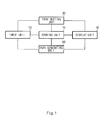
- FIG. 1 is a configuration diagram of an SOI-based path generating apparatus according to an exemplary embodiment of the present invention.
- the SOI-based path generating apparatus can be configured to include a storing unit 10, an input unit 20, a path setting unit 30, a display unit 40, and a path generating unit 50.
- the storing unit 10 stores at least one path SOI for each arbitrarily set section. That is, the storing unit 10 stores a path SOI indicating a path between a start point and an arrival point of each arbitrarily set section regardless of a distance, a time, or the like, and the number of path SOIs for each section is at least one.
- the path SOI may or may not include information on a relationship with contents.
- the content can include a blog, a reply, a description, an event, an advertisement, and the like, having a form in which a text, an image, a moving picture, and the like, are provided, respectively, or are combined with each other.
- an arbitrary section can be configured of A (a start point) and B (an arrival point), be configured of B (a start point) and C (an arrival point), or be configured of A (a start point) and C (an arrival point).
- the section configured of A (start point) and C (arrival point) includes B (path point); however, the path point does not have any special meaning.
- each section is arbitrarily set without a special reference.
- each section is divided using various kinds of themes and stored in the storing unit 10.
- the theme can include a festival, a restaurant, a famous sight, foliage, a sunrise, or the like.
- the section configured of A (the start point) and B (the arrival point) is a first section
- the section configured of B (the start point) and C (the arrival point) is a second section
- the section configured of A (the start point) and C (the arrival point) is a third section
- the number of path SOIs corresponding to each of the first to third sections is at least one. That is, at least one different path SOI is included for each section.
- This path SOI can be generated and uploaded by a user, be generated and uploaded by an operator himself/herself, be generated and uploaded by an external professional agent, or be a computer-generated optimal path (e.g., optimal with respect to distance, travel time, fuel consumption, and the like).
- the input unit 20 receives an origination and a destination input from the user.
- the input unit 20 receives a theme selected from the user and receives recommended paths (i.e., path SOIs) selected for each section corresponding to the selected theme.
- path SOIs recommended paths
- the user can select his/her desired paths for each section with respect to sections corresponding to the theme on the path from the origination to the destination.
- the input unit 20 is implemented in a touch screen
- the input unit 20 and the display unit 40 can be implemented as a single module.
- the path setting unit 30 sets a main path from an origination to a destination input through the input unit 20 based on the path SOI stored in the storing unit 30.
- the path setting unit 30 can set the main path only using section information without considering the theme or can further include a path SOI storing unit having section information that is not associated with the theme to set the main path based on the section information that is not associated with the theme.
- the path setting unit 30 can also set the main path from the origination to the destination using the known technology.
- the display unit 40 displays the main path set by the path setting unit 30 on a screen.
- the display unit 40 displays a theme list on the screen to allow the user to select a specific theme.
- the display unit 40 displays sections corresponding to the specific theme on the main path when the user selects the specific theme, thereby allowing the user to select a specific section.
- the display unit 40 displays at least one recommended path corresponding to the specific section when the user selects the specific section, thereby allowing the user to select his/her desired recommended path.
- the recommended path which is a result of performing a search from the storing unit 10 by the path generating unit 50, is transferred from the path generating unit 50.
- This display unit 40 collectively displays the recommended path selected by the user with respect to the section selected by the user in the theme selected by the user, thereby allowing the user to recognize the recommended paths for each section in the theme selected by him/her at a time. That is, the display unit 40 displays a final path generated by the path generating unit 50 on the screen.
- the display unit 40 displays information processed in a multimedia system for a vehicle. For example, in a navigation mode, the display unit 40 displays a user interface (UI) or a graphic user interface (GUI) related to a map, a speed, a direction, a distance indication, or the like, associated with a current position, a destination, a path, or the like, in connection with driving. In a black box mode or a photographing mode, the display unit 40 displays a photographed image, a UI, or a GUI.
- UI user interface
- GUI graphic user interface
- the display unit 40 can include at least one of a liquid crystal display (LCD), a thin film transistor-liquid crystal display (TFT LCD), an organic light-emitting diode (OLED), a flexible display, a three-dimensional display (3D display), a dual display displaying different images according to a viewing direction (for example, when a single display is viewed from a driver's seat, a map is viewed, and when it is viewed from a passenger seat, a broadcasting screen is viewed).
- LCD liquid crystal display
- TFT LCD thin film transistor-liquid crystal display
- OLED organic light-emitting diode
- a flexible display for example, when a single display is viewed from a driver's seat, a map is viewed, and when it is viewed from a passenger seat, a broadcasting screen is viewed.
- 3D display three-dimensional display
- Some of these displays can be formed in a transparent type or a light transmitting type so that the outside can be viewed therethrough.
- This display can be called a transparent display, a typical example of which includes a transparent OLED (TOLED), or the like.
- a rear structure of the display unit 40 can also be a light transmitting structure.
- the display unit 40 and a sensor (hereinafter, referred to as a 'touch sensor') sensing a touch operation are formed in a mutual layer structure (hereinafter, referred to as a 'touch screen')
- the display unit 40 can be used as an input device in addition to an output device.
- the touch sensor can have a form such as a touch film, a touch sheet, a touch pad, or the like.
- the touch sensor can be configured to convert pressure applied to a specific portion of the display unit 40 or a change in capacitance, or the like, generated in the specific portion of the display unit 40 into an electrical input signal.
- the touch sensor can be configured to detect pressure at the time of being touched as well as a touched position and area.
- the path generating unit 50 searches at least one recommended path (a path SOI) corresponding to the section selected from the user from the storing unit 10 to transfer the searched recommended path to the display unit 40.
- a path SOI a recommended path corresponding to the section selected from the user from the storing unit 10
- the path generating unit 50 generates the final path based on the recommended paths for each section corresponding to the theme selected from the user through the input unit 20, on the main path set by the path setting unit 30.
- the path generating unit 50 generating the final path based on a single recommended path for each section selected from the user among at least one recommended path matched to each section corresponding to the theme selected from the user.
- the path generating unit 50 arbitrarily selects the recommended path with respect to the section that is not selected by the user.
- the recommended paths are selected based on the priority.
- the number of recommended paths is one, a selection problem is not generated.
- the path setting unit 30 and the path generating unit 50 are separately implemented, the path setting unit 30 and the path generating unit 50 can also be implemented as a single module by a user's request/selection.
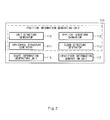
- FIG. 2 is a configuration diagram of an SOI information generating apparatus according to an exemplary embodiment of the present invention.
- the SOI information generating apparatus is configured to include a position information generating unit 111 generating position information, SOI structure information, SOI combination information, or the like, on a map, a shape information generating unit 116 generating shape information such as dot, line, region information, building information, or the like, on the position information, and an identifier information generating unit 117 generating and assigning identifier information for distinguishing each SOI from each other.
- the position information generating unit 111 generates the position information and generates and manages SOIs for the position information.
- the position information generating unit 111 manages relationship structure information in the case in which the SOIs are generated to have a relationship structure and manages combination information in the case in which the relationship structures of the SOIs are combined with each other.
- the position information generating unit 111 includes a unit relationship structure generator 112 generating and managing one SOI, a vertical relationship structure generator 113 generating and managing a vertical relationship structure of SOIs so that a plurality of SOIs are included in one SOI, a horizontal relationship structure generator 114 generating and managing a horizontal relationship structure of SOIs so that a plurality of SOIs are connected in parallel with each other, and a floor structure generator 115 generating and managing a floor structure of SOIs so that a plurality of SOIs form a floor in one SOI.
- the vertical relationship structure generator 113 generates the SOIs in a vertical relationship structure so that at least one other position information can be included in one position information so that at least one lower SOI is positioned in one SOI.
- the vertical relationship structure generator 113 can generate the SOI so that a building 1 and a building 2 are included in a region A. That is, the region A is generated as an upper SOI, and each of the building 1 and the building 2 is managed as an upper SOI and a lower SOI.
- the horizontal relationship structure generator 114 generates the SOIs in a horizontal relationship structure so that the plurality of SOIs are horizontally positioned without a floor.
- the horizontal relationship structure generator 114 can generate the SOI so that a region B, a building 1, and a building 2 are horizontally connected to each other. That is, the region B, the building 1, and the building 2 are generated as the respective SOIs and are managed to be connected to each other.
- the floor structure generator 115 generates and manages a plurality of SOIs so that a plurality of floors can be included in one region or a building, that is, so that the plurality of sub SOIs can form a floor of one building (i.e. one SOI).
- the floor structure generator 114 can generate the SOI so that the plurality of SOIs form the floor in one building. That is, one building is generated as an upper SOI, each floor is divided into an upper SOI and a lower SOI, and each SOI is separately managed.
- the shape information generating unit 116 generates the shape information, which is a substantial image, such as dot, line, region information, building information, or the like, on the position information, and manages the shape information in an SOI unit.
- the shape information generating unit 116 can image the region in the SOI unit, image a building in the region in the SOI unit, and image a configuration in the building in the SOI unit.
- the identifier information generating unit 117 generates and manages the identifier information in the SOI generated according to each structure in the position information generating unit 111.
- the identifier information generating unit 117 can assign an SOI identifier sign according to one SOI when one SOI is generated, thereby allowing information to be managed in the SOI unit.
- FIG. 3 is a flow chart of an SOI-based path generating method according to an exemplary embodiment of the present invention.
- the storing unit 10 stores at least one path SOI for each arbitrarily set section (301).
- the path setting unit 30 generates a main path from an origination to a destination input from a user through the input unit 20 and then displays the main path through the display unit 20 (302).
- the path generating unit 50 searches at least one recommended path for each section corresponding to a theme selected from the user through the input unit 20 from the storing unit 10 and then displays the searched recommended path through the display unit 20 (303).
- the input unit 20 receives one recommended path selected for each section corresponding to the theme (304).
- the path generating unit 50 generates a final path based on one recommended path for each section corresponding to the theme selected through the input unit 20, on the main path set in the path setting unit 30 (305).
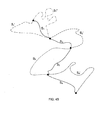
- a user wishes to travel from origination point A to destination point E.
- a system e.g., a computer
- the main path passes through points B, C, and D, which can divide the main path into a plurality of sections S 1 , S 2 , S 3 , and S 4 .
- the system After the user selects a theme (e.g., foliage), the system searches a database of paths and proposes one or more paths that are associated with the selected theme. As shown in FIG. 4B , these alternative paths can be presented along with the main path so that the user can appreciate how the paths differ and select whether to follow an alternative path.
- a theme e.g., foliage
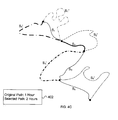
- a user can select one or more alternative path segments, for example, by clicking on the desired path segments.
- Selected path segments can be denoted, for example, by a change of color, a change of thickness (as depicted in FIG. 4C ), highlighting, and the like.
- a graphical element 402 can provide a comparison between the duration of the main path and the selected alternative path, for example, in units of distance and/or time.
- the user submits the selection (e.g., by pressing a "SUBMIT" button or other graphical element).
- the system then generates a final path based on the selected paths.
- the user need not affirmatively select a desired path for each path section. Rather, sections of the main path can be treated as default sections. For example, the user did not select either path segments S 4 or S 4 ' in FIG. 4C . Accordingly, default path segment S 4 is utilized in the final path depicted in FIG. 4D .
- each path section is referred to as a single SOI, it is noted that each section can be further divided into sub-SOIs. Likewise, a user can deviate from the set path at any point (including points along a path) and/or request a new path at any point.
- one or more recommended path segments can be presented for a single path segment, which can be one of many segments in a path.
- a recommended path segment (depicted as a dashed line) may not be coterminous with any segments along the main path.
- the systems and methods described herein can add extensions to one or both ends of the recommended path segment (depicted as dotted lines) to connect the recommended path segment with other segments along the main path.
- a user can select between one or more alternative paths, which can have special features that are not located at a discrete point, but instead are distributed along the path.
- detours from a main path that eventually return to the main path the user is provided with more useful information about the total delay associated with taking an alternative route.
- the main path corresponding to the origination and the destination input from the user is set and at least one recommended path for each section corresponding to a specific theme is provided in the case in which the user selects the specific theme, thereby making it possible to allow the user to select the paths for each section in his/her desired theme.
Landscapes
- Engineering & Computer Science (AREA)
- Radar, Positioning & Navigation (AREA)
- Remote Sensing (AREA)
- Automation & Control Theory (AREA)
- Physics & Mathematics (AREA)
- General Physics & Mathematics (AREA)
- Navigation (AREA)
- Telephonic Communication Services (AREA)
- Mobile Radio Communication Systems (AREA)
- Management, Administration, Business Operations System, And Electronic Commerce (AREA)
Abstract
Description
- This application claims priority under 35 U.S.C. § 119(e) to
U.S. Provisional Patent Application Serial No. 61/591,221, filed January 26, 2012 - The present invention relates to an apparatus and method for generating a path (e.g., a space of interest path), and more particularly, to a method of providing a theme of use and recommended paths for each section corresponding to the theme of use based on at least one path matched to each arbitrarily set section to allow them to be selected. A space of interest (SOI) refers to a collection of data about a space of people's interest or use. An SOI is made up of point, line and/or plane and has a unique identifying data.
- Here, the SOI indicating a path between a start point and an arrival point of an arbitrarily set section ("path SOI"), includes a path SOI that does not include information on a relationship with a content as well as a path SOI that includes the information on a relationship with contents. Here, the content has a form in which a text, an image, a moving picture, and the like, are provided, respectively, or are combined with each other.
- In general, when a path generating system receives an origination and a destination from a user, it searches for path data stored in a database to extract path data from the origination to the destination. In this case, the path generating system extracts path data according to the shortest path or the shortest time.
- Accordingly, the present invention has been made to solve the above-mentioned problems occurring in the prior art while advantages achieved by the prior art are maintained intact.
- An object to be achieved by the present invention is to provide an SOI-based path generating apparatus and method capable of allowing a user to select paths for each section in his/her desired theme by including a database storing at least one path SOI for each arbitrarily set section and providing at least one recommended path for each theme and each section corresponding to each theme.
- That is, an object to be achieved by the present invention is to provide an SOI-based path generating apparatus and method capable of allowing a user to select paths for each section in his/her desired theme by setting a main path corresponding to an origination and a destination input from the user and providing at least one recommended path for each section corresponding to a specific theme in the case in which the user selects the specific theme.
- In one aspect of the present invention, it is provided a space of interest (SOI) based path generating apparatus including: a storing unit storing at least one path SOI for each arbitrarily set section; an input unit receiving an origination and a destination input from a user, receiving a theme selected from the user, and receiving at least one recommended path selected for each section corresponding to the selected theme from the user; a path setting unit setting a main path from the origination to the destination input through the input unit; a display unit displaying the main path set by the path setting unit, a theme list, each section corresponding to the selected theme, and at least one recommended path corresponding to each section; and a path generating unit searching the at least one recommended path for each section corresponding to the selected theme from the storing unit to transfer the searched recommended path to the display unit and generating a final path based on the recommended path for each section corresponding to the theme selected through the input unit, on the main path set by the path setting unit.
- In another aspect of the present invention, it is provided an SOI-based path generating method including: storing, in a storing unit, at least one path SOI for each arbitrarily set section; setting, in a path setting unit, a main path from an origination to a destination input from a user and then displaying the main path through a display unit; searching, in a path generating unit, at least one recommended path for each section corresponding to a theme selected from the user and then displaying the searched recommended path through the display unit; receiving, in an input unit, one recommended path selected for each section corresponding to the theme; and generating, in the path generating unit, a final path based on one recommended path for each section corresponding to the selected theme on the main path.
- The above and other objects, features and advantages of the present invention will be more apparent from the following detailed description taken in conjunction with the accompanying drawings, in which:
-
FIG. 1 is a configuration diagram of an SOI-based path generating apparatus according to an exemplary embodiment of the present invention; -
FIG. 2 is a configuration diagram of an SOI information generating apparatus according to an exemplary embodiment of the present invention; -
FIG. 3 is a flow chart of an SOI-based path generating method according to an exemplary embodiment of the present invention; -
FIGS. 4A-4C depicts a sample user interface according to an exemplary embodiment of the present invention; -
FIG. 5 depicts the presentation of one or more recommended path segments for a single path segment according to an exemplary embodiment of the present invention; and -
FIG. 6 depicts the extension of a recommend path segment to reach one or more path segments along the main path according to an exemplary embodiment of the present invention. - The path generating system according to the related art does not provide a recommended path associated with the path from the origination to the destination received from the user in setting a path using path data based on a node or a link and providing recommended paths for each theme. That is, the path generating system according to the related art provides recommended paths for each theme that can not be associated with a path set according to a user's request.
- Even though the path generating system according to the related art provides a recommended path associated with the path to the destination, it has provided a fixed recommended path in which a section can not be changed, such that all users have used a unified recommended path, thereby making it impossible to satisfy users having various tendencies.
- Hereinafter, exemplary embodiments of the present invention will be described in detail with reference to the accompanying drawings.
-
FIG. 1 is a configuration diagram of an SOI-based path generating apparatus according to an exemplary embodiment of the present invention. - As shown in
FIG. 1 , the SOI-based path generating apparatus according to the exemplary embodiment of the present invention can be configured to include astoring unit 10, aninput unit 20, apath setting unit 30, adisplay unit 40, and apath generating unit 50. - Each of the above-mentioned components will be described. First, the storing
unit 10 stores at least one path SOI for each arbitrarily set section. That is, the storingunit 10 stores a path SOI indicating a path between a start point and an arrival point of each arbitrarily set section regardless of a distance, a time, or the like, and the number of path SOIs for each section is at least one. - The path SOI may or may not include information on a relationship with contents. The content can include a blog, a reply, a description, an event, an advertisement, and the like, having a form in which a text, an image, a moving picture, and the like, are provided, respectively, or are combined with each other.
- Hereinafter, the meaning of the arbitrarily set section and the number of paths corresponding to the section will be described in detail.
- For example, when it is assumed that arbitrary points are A, B, C, and D in a distance sequence, an arbitrary section can be configured of A (a start point) and B (an arrival point), be configured of B (a start point) and C (an arrival point), or be configured of A (a start point) and C (an arrival point). Here, the section configured of A (start point) and C (arrival point) includes B (path point); however, the path point does not have any special meaning.
- As described above, each section is arbitrarily set without a special reference.
- In addition, each section is divided using various kinds of themes and stored in the
storing unit 10. Here, the theme can include a festival, a restaurant, a famous sight, foliage, a sunrise, or the like. - Meanwhile, when it is assumed that the section configured of A (the start point) and B (the arrival point) is a first section, the section configured of B (the start point) and C (the arrival point) is a second section, and the section configured of A (the start point) and C (the arrival point) is a third section, the number of path SOIs corresponding to each of the first to third sections is at least one. That is, at least one different path SOI is included for each section.
- This path SOI can be generated and uploaded by a user, be generated and uploaded by an operator himself/herself, be generated and uploaded by an external professional agent, or be a computer-generated optimal path (e.g., optimal with respect to distance, travel time, fuel consumption, and the like).
- Next, the
input unit 20 receives an origination and a destination input from the user. - In addition, the
input unit 20 receives a theme selected from the user and receives recommended paths (i.e., path SOIs) selected for each section corresponding to the selected theme. - That is, when the user selects a specific theme through the
input unit 20, sections corresponding to the selected theme on a path from an origination to a destination are displayed on thedisplay unit 40 by thepath generating unit 50. At this time, the user can select his/her desired path among at least one of the recommended paths provided for each section. - Therefore, the user can select his/her desired paths for each section with respect to sections corresponding to the theme on the path from the origination to the destination.
- In the case in which the
input unit 20 is implemented in a touch screen, theinput unit 20 and thedisplay unit 40 can be implemented as a single module. - Next, the
path setting unit 30 sets a main path from an origination to a destination input through theinput unit 20 based on the path SOI stored in thestoring unit 30. In this case, thepath setting unit 30 can set the main path only using section information without considering the theme or can further include a path SOI storing unit having section information that is not associated with the theme to set the main path based on the section information that is not associated with the theme. - In addition, the
path setting unit 30 can also set the main path from the origination to the destination using the known technology. - Next, the
display unit 40 displays the main path set by thepath setting unit 30 on a screen. - In addition, the
display unit 40 displays a theme list on the screen to allow the user to select a specific theme. - Further, the
display unit 40 displays sections corresponding to the specific theme on the main path when the user selects the specific theme, thereby allowing the user to select a specific section. - In addition, the
display unit 40 displays at least one recommended path corresponding to the specific section when the user selects the specific section, thereby allowing the user to select his/her desired recommended path. Here, the recommended path, which is a result of performing a search from thestoring unit 10 by thepath generating unit 50, is transferred from thepath generating unit 50. - This
display unit 40 collectively displays the recommended path selected by the user with respect to the section selected by the user in the theme selected by the user, thereby allowing the user to recognize the recommended paths for each section in the theme selected by him/her at a time. That is, thedisplay unit 40 displays a final path generated by thepath generating unit 50 on the screen. - Meanwhile, the
display unit 40 displays information processed in a multimedia system for a vehicle. For example, in a navigation mode, thedisplay unit 40 displays a user interface (UI) or a graphic user interface (GUI) related to a map, a speed, a direction, a distance indication, or the like, associated with a current position, a destination, a path, or the like, in connection with driving. In a black box mode or a photographing mode, thedisplay unit 40 displays a photographed image, a UI, or a GUI. - The
display unit 40 can include at least one of a liquid crystal display (LCD), a thin film transistor-liquid crystal display (TFT LCD), an organic light-emitting diode (OLED), a flexible display, a three-dimensional display (3D display), a dual display displaying different images according to a viewing direction (for example, when a single display is viewed from a driver's seat, a map is viewed, and when it is viewed from a passenger seat, a broadcasting screen is viewed). - Some of these displays can be formed in a transparent type or a light transmitting type so that the outside can be viewed therethrough. This display can be called a transparent display, a typical example of which includes a transparent OLED (TOLED), or the like. A rear structure of the
display unit 40 can also be a light transmitting structure. - In the case in which the
display unit 40 and a sensor (hereinafter, referred to as a 'touch sensor') sensing a touch operation are formed in a mutual layer structure (hereinafter, referred to as a 'touch screen'), thedisplay unit 40 can be used as an input device in addition to an output device. The touch sensor can have a form such as a touch film, a touch sheet, a touch pad, or the like. - The touch sensor can be configured to convert pressure applied to a specific portion of the
display unit 40 or a change in capacitance, or the like, generated in the specific portion of thedisplay unit 40 into an electrical input signal. The touch sensor can be configured to detect pressure at the time of being touched as well as a touched position and area. - Next, the
path generating unit 50 searches at least one recommended path (a path SOI) corresponding to the section selected from the user from the storingunit 10 to transfer the searched recommended path to thedisplay unit 40. - In addition, the
path generating unit 50 generates the final path based on the recommended paths for each section corresponding to the theme selected from the user through theinput unit 20, on the main path set by thepath setting unit 30. - That is, the
path generating unit 50 generating the final path based on a single recommended path for each section selected from the user among at least one recommended path matched to each section corresponding to the theme selected from the user. - In addition, the
path generating unit 50 arbitrarily selects the recommended path with respect to the section that is not selected by the user. Here, in the case in which priority is assigned to each of the recommended paths, the recommended paths are selected based on the priority. In addition, in the case in which the number of recommended paths is one, a selection problem is not generated. - Although the exemplary embodiment of the present invention has described that the
path setting unit 30 and thepath generating unit 50 are separately implemented, thepath setting unit 30 and thepath generating unit 50 can also be implemented as a single module by a user's request/selection. -
FIG. 2 is a configuration diagram of an SOI information generating apparatus according to an exemplary embodiment of the present invention. - As shown in
FIG. 2 , the SOI information generating apparatus according to the exemplary embodiment of the present invention is configured to include a positioninformation generating unit 111 generating position information, SOI structure information, SOI combination information, or the like, on a map, a shapeinformation generating unit 116 generating shape information such as dot, line, region information, building information, or the like, on the position information, and an identifierinformation generating unit 117 generating and assigning identifier information for distinguishing each SOI from each other. - Here, the position
information generating unit 111 generates the position information and generates and manages SOIs for the position information. In addition, the positioninformation generating unit 111 manages relationship structure information in the case in which the SOIs are generated to have a relationship structure and manages combination information in the case in which the relationship structures of the SOIs are combined with each other. - The position
information generating unit 111 includes a unitrelationship structure generator 112 generating and managing one SOI, a verticalrelationship structure generator 113 generating and managing a vertical relationship structure of SOIs so that a plurality of SOIs are included in one SOI, a horizontalrelationship structure generator 114 generating and managing a horizontal relationship structure of SOIs so that a plurality of SOIs are connected in parallel with each other, and afloor structure generator 115 generating and managing a floor structure of SOIs so that a plurality of SOIs form a floor in one SOI. - The vertical
relationship structure generator 113 generates the SOIs in a vertical relationship structure so that at least one other position information can be included in one position information so that at least one lower SOI is positioned in one SOI. - For example, the vertical
relationship structure generator 113 can generate the SOI so that abuilding 1 and abuilding 2 are included in a region A. That is, the region A is generated as an upper SOI, and each of thebuilding 1 and thebuilding 2 is managed as an upper SOI and a lower SOI. - The horizontal
relationship structure generator 114 generates the SOIs in a horizontal relationship structure so that the plurality of SOIs are horizontally positioned without a floor. - For example, the horizontal
relationship structure generator 114 can generate the SOI so that a region B, abuilding 1, and abuilding 2 are horizontally connected to each other. That is, the region B, thebuilding 1, and thebuilding 2 are generated as the respective SOIs and are managed to be connected to each other. - The
floor structure generator 115 generates and manages a plurality of SOIs so that a plurality of floors can be included in one region or a building, that is, so that the plurality of sub SOIs can form a floor of one building (i.e. one SOI). - For example, the
floor structure generator 114 can generate the SOI so that the plurality of SOIs form the floor in one building. That is, one building is generated as an upper SOI, each floor is divided into an upper SOI and a lower SOI, and each SOI is separately managed. - The shape
information generating unit 116 generates the shape information, which is a substantial image, such as dot, line, region information, building information, or the like, on the position information, and manages the shape information in an SOI unit. For example, the shapeinformation generating unit 116 can image the region in the SOI unit, image a building in the region in the SOI unit, and image a configuration in the building in the SOI unit. - The identifier
information generating unit 117 generates and manages the identifier information in the SOI generated according to each structure in the positioninformation generating unit 111. The identifierinformation generating unit 117 can assign an SOI identifier sign according to one SOI when one SOI is generated, thereby allowing information to be managed in the SOI unit. -
FIG. 3 is a flow chart of an SOI-based path generating method according to an exemplary embodiment of the present invention. - First, the storing
unit 10 stores at least one path SOI for each arbitrarily set section (301). - Then, the
path setting unit 30 generates a main path from an origination to a destination input from a user through theinput unit 20 and then displays the main path through the display unit 20 (302). - Thereafter, the
path generating unit 50 searches at least one recommended path for each section corresponding to a theme selected from the user through theinput unit 20 from the storingunit 10 and then displays the searched recommended path through the display unit 20 (303). - Next, the
input unit 20 receives one recommended path selected for each section corresponding to the theme (304). - Then, the
path generating unit 50 generates a final path based on one recommended path for each section corresponding to the theme selected through theinput unit 20, on the main path set in the path setting unit 30 (305). - Referring now to
FIG. 4 , the embodiments of the invention are further illustrated through an example. A user wishes to travel from origination point A to destination point E. A system (e.g., a computer) generates a main path (depicted in solid lines inFIG. 4A ). The main path passes through points B, C, and D, which can divide the main path into a plurality of sections S1, S2, S3, and S4. - After the user selects a theme (e.g., foliage), the system searches a database of paths and proposes one or more paths that are associated with the selected theme. As shown in
FIG. 4B , these alternative paths can be presented along with the main path so that the user can appreciate how the paths differ and select whether to follow an alternative path. - Referring now to
FIG. 4C , a user can select one or more alternative path segments, for example, by clicking on the desired path segments. Selected path segments can be denoted, for example, by a change of color, a change of thickness (as depicted inFIG. 4C ), highlighting, and the like. Agraphical element 402 can provide a comparison between the duration of the main path and the selected alternative path, for example, in units of distance and/or time. - Referring now to
FIG. 4D , once the user completes selection of an alternative path, the user submits the selection (e.g., by pressing a "SUBMIT" button or other graphical element). The system then generates a final path based on the selected paths. In some embodiments, the user need not affirmatively select a desired path for each path section. Rather, sections of the main path can be treated as default sections. For example, the user did not select either path segments S4 or S4' inFIG. 4C . Accordingly, default path segment S4 is utilized in the final path depicted inFIG. 4D . - Although each path section is referred to as a single SOI, it is noted that each section can be further divided into sub-SOIs. Likewise, a user can deviate from the set path at any point (including points along a path) and/or request a new path at any point.
- Referring now to
FIG. 5 , one or more recommended path segments can be presented for a single path segment, which can be one of many segments in a path. - Referring now to
FIG. 6 , a recommended path segment (depicted as a dashed line) may not be coterminous with any segments along the main path. In such situations, the systems and methods described herein can add extensions to one or both ends of the recommended path segment (depicted as dotted lines) to connect the recommended path segment with other segments along the main path. - Through the above-mentioned process, it is possible to allow the user to select the path for each section in his/her desired theme. Advantageously, a user can select between one or more alternative paths, which can have special features that are not located at a discrete point, but instead are distributed along the path. Moreover, by presenting detours from a main path that eventually return to the main path, the user is provided with more useful information about the total delay associated with taking an alternative route.
- As set forth above, according to the exemplary embodiments of the present invention, the main path corresponding to the origination and the destination input from the user is set and at least one recommended path for each section corresponding to a specific theme is provided in the case in which the user selects the specific theme, thereby making it possible to allow the user to select the paths for each section in his/her desired theme.
- Although preferred embodiments of the present invention have been described for illustrative purposes, those skilled in the art will appreciate that various modifications, additions and substitutions are possible, without departing from the scope and spirit of the invention as disclosed in the accompanying claims.
-
-
FIG. 1 - 10:
- STORING UNIT
- 20:
- INPUT UNIT
- 30:
- PATH SETTING UNIT
- 40:
- DISPLAY UNIT
- 50:
- PATH GENERATING UNIT
-
FIG. 2 - 111:
- position information GENERATING UNIT
- 112:
- unit structure GENERATOR
- 113:
- vertical structure GENERATOR
- 114:
- horizontal structure GENERATOR
- 115:
- FLOOR STRUCTURE GENERATOR
- 116:
- shape information GENERATING UNIT
- 117:
- identifier information GENERATING UNIT
Claims (20)
- A method for generating a path comprising:storing, in a storing unit, at least one path for each arbitrarily set section;setting, in a path setting unit, a main path from an origination to a destination input from a user and then displaying the main path through a display unit;searching, in a path generating unit, for at least one recommended path for one or more sections corresponding to a theme selected from the user and then displaying a searched recommended path through the display unit;receiving, in an input unit, a selection of one or more recommended paths; andgenerating, in the path generating unit, a final path based on the selection of one or more recommended paths for the one or more sections.
- The method of claim 1, wherein in the step of generating of the final path, a section of the main path is arbitrarily selected for inclusion in the final path where a recommended path was not selected by the user for the section.
- The method claim 1, further comprising displaying, in the display unit, the final path.
- The method of claim 1, wherein in the setting of the main path step, the main path is set based on previously-stored paths.
- The method of claim 1, wherein in the storing step, paths uploaded by other users are stored.
- The method of claim 1, wherein the main path is initially set in the setting step as an optimal path from the origination to the destination.
- The method of claim 6, wherein the optimal path minimizes one or more selected from the group consisting of: distance, travel time, and fuel consumption.
- The method of claim 1, wherein the at least one recommended path for each section is displayed in the searching step concurrently with the corresponding section from the main path proposed in the setting step.
- The method of claim 8, wherein a degree of deviation from the main path proposed in the setting step to a recommended path for each section is displayed.
- The method of claim 9, wherein the degree of deviation is expressed in terms of one or more selected from the group consisting of: distance, travel time, and fuel consumption.
- The method of claim 9, wherein the recommended path is extended to connect with one or more other sections.
- An apparatus for generating path, the apparatus comprising:a storing unit configured for storing at least one path SOI for each arbitrarily set section;an input unit configured for receiving an origination and a destination input from a user, receiving a theme selected from the user, and receiving a selection of one or more recommended paths for one or more sections corresponding to the selected theme from the user;a path setting unit configured for setting a main path from the origination to the destination input through the input unit;a display unit configured for displaying the main path set by the path setting unit, a theme list, each section corresponding to the selected theme, and at least one recommended path corresponding to each section; anda path generating unit configured for searching for at least one recommended path for each section corresponding to the selected theme from the storing unit to transfer a searched recommended path to the display unit and generating a final path based on the selection of one or more recommended paths for each section corresponding to the theme selected through the input unit, on the main path set by the path setting unit.
- The apparatus of claim 12, wherein the path generating unit arbitrarily selects a section of the main path for inclusion in the final path where a recommend path was not selected by the user for the section.
- The apparatus of claim 12, wherein the display unit further performs a function of displaying the final path generated by the path generating unit.
- The apparatus of claim 12, wherein the path setting unit sets the main path based on paths previously-stored in the storing unit.
- The apparatus of claim 12, wherein the storing unit stores paths uploaded by other users.
- The apparatus of claim 12, wherein path setting unit is further configured to initially set the main path as an optimal path from the origination to the destination.
- The apparatus of claim 17, wherein the optimal path minimizes one or more selected from the group consisting of: distance, travel time, and fuel consumption.
- The method of claim 12, wherein the display unit is further configured to display at least one recommended path for each section concurrently with the corresponding section from the main path proposed in the setting step.
- The apparatus of claim 19, wherein display unit is further configured to display a degree of deviation from the main path to a recommended path for each section.
Applications Claiming Priority (1)
| Application Number | Priority Date | Filing Date | Title |
|---|---|---|---|
| US201261591221P | 2012-01-26 | 2012-01-26 |
Publications (3)
| Publication Number | Publication Date |
|---|---|
| EP2620750A2 true EP2620750A2 (en) | 2013-07-31 |
| EP2620750A3 EP2620750A3 (en) | 2015-06-17 |
| EP2620750B1 EP2620750B1 (en) | 2024-11-06 |
Family
ID=47664141
Family Applications (1)
| Application Number | Title | Priority Date | Filing Date |
|---|---|---|---|
| EP13151681.7A Active EP2620750B1 (en) | 2012-01-26 | 2013-01-17 | Apparatus and method for generating a path |
Country Status (2)
| Country | Link |
|---|---|
| EP (1) | EP2620750B1 (en) |
| CN (1) | CN103294750B (en) |
Cited By (1)
| Publication number | Priority date | Publication date | Assignee | Title |
|---|---|---|---|---|
| CN111201503A (en) * | 2017-10-12 | 2020-05-26 | 奥迪股份公司 | Method and system for operating at least one pair of virtual reality glasses in a motor vehicle |
Families Citing this family (2)
| Publication number | Priority date | Publication date | Assignee | Title |
|---|---|---|---|---|
| CN108351217B (en) * | 2015-09-10 | 2022-03-01 | 欧里伊恩特新媒体有限公司 | Navigation, tracking and positioning of mobile devices that deny access to GPS |
| CN107270914A (en) * | 2017-07-17 | 2017-10-20 | 广州地理研究所 | Indoor paths planning method based on major trunk roads |
Family Cites Families (9)
| Publication number | Priority date | Publication date | Assignee | Title |
|---|---|---|---|---|
| DE04773640T1 (en) * | 2003-09-30 | 2007-02-08 | Kabushiki Kaisha Kenwood, Hachiouji | GUIDE ROUTE SEARCH AND GUIDANCE ROUTE SEARCH METHOD |
| US7480567B2 (en) * | 2004-09-24 | 2009-01-20 | Nokia Corporation | Displaying a map having a close known location |
| KR100713465B1 (en) * | 2005-01-25 | 2007-05-02 | 삼성전자주식회사 | How to calculate the route in the navigation system |
| JP4605051B2 (en) * | 2005-07-22 | 2011-01-05 | 株式会社デンソー | Navigation device |
| JP4682732B2 (en) * | 2005-07-27 | 2011-05-11 | 株式会社デンソー | Navigation device |
| WO2008089364A1 (en) * | 2007-01-17 | 2008-07-24 | Weidner David P | Multi-level path mapping for street grid and non-street grid entities |
| US8254953B2 (en) * | 2008-07-18 | 2012-08-28 | Disney Enterprises, Inc. | System and method for providing location-based data on a wireless portable device |
| US8417447B2 (en) * | 2009-10-18 | 2013-04-09 | International Business Machines Corporation | Method and system for visualizing shared route information |
| US20120016576A1 (en) * | 2010-07-13 | 2012-01-19 | Telenav, Inc. | Navigation system with ecological route based destination guidance mechanism and method of operation thereof |
-
2013
- 2013-01-17 EP EP13151681.7A patent/EP2620750B1/en active Active
- 2013-01-28 CN CN201310032518.9A patent/CN103294750B/en active Active
Non-Patent Citations (1)
| Title |
|---|
| None * |
Cited By (2)
| Publication number | Priority date | Publication date | Assignee | Title |
|---|---|---|---|---|
| CN111201503A (en) * | 2017-10-12 | 2020-05-26 | 奥迪股份公司 | Method and system for operating at least one pair of virtual reality glasses in a motor vehicle |
| CN111201503B (en) * | 2017-10-12 | 2023-09-01 | 奥迪股份公司 | Method and system for operating at least one pair of virtual reality glasses in a motor vehicle |
Also Published As
| Publication number | Publication date |
|---|---|
| EP2620750A3 (en) | 2015-06-17 |
| CN103294750B (en) | 2016-10-05 |
| CN103294750A (en) | 2013-09-11 |
| EP2620750B1 (en) | 2024-11-06 |
Similar Documents
| Publication | Publication Date | Title |
|---|---|---|
| CA2942543C (en) | Solution for highly customized interactive mobile maps | |
| US9983021B1 (en) | Time-inclusive route and trip planning | |
| KR102780803B1 (en) | Immersive multi-state uni-card | |
| JP6580703B2 (en) | System and method for disambiguating a location entity associated with a mobile device's current geographic location | |
| US20240044665A1 (en) | Navigation directions with a familiar location as an intermediate destination | |
| US9336695B2 (en) | Method and system for providing customized regional maps | |
| US11442596B1 (en) | Interactive digital map including context-based photographic imagery | |
| US20150253143A1 (en) | Navigation Directions Between Automatically Determined Starting Points and Selected Destinations | |
| EP3985357A1 (en) | Providing navigation directions using personalized landmarks | |
| EP2620750B1 (en) | Apparatus and method for generating a path | |
| US9183249B2 (en) | Apparatus and method for generating a path | |
| Paay et al. | Understanding and representing the social prospects of hybrid urban spaces | |
| KR101316262B1 (en) | Apparatus and method for establishing path based on soi | |
| KR102174339B1 (en) | Method for displaying of image according to location, apparatus and system for the same | |
| JP2005221312A (en) | Point information providing device | |
| KR200430083Y1 (en) | One stop road information system | |
| JP2013130551A (en) | Display system, display method and display program | |
| CN114822062A (en) | Traffic station prompting method and device and storage medium | |
| WO2016072837A1 (en) | Multimedia location trends management | |
| Cooley | Productive mis-mappings: Critical disorientations on the University of South Carolina’s historic horseshoe | |
| CN120260418A (en) | A route display method, device and computer program product | |
| Shahid et al. | RACE: towards exploring the design dimensions of a route assisting and communicating system for elderly | |
| Grace et al. | THE LINK | |
| TW201417062A (en) | Information guide device and method thereof |
Legal Events
| Date | Code | Title | Description |
|---|---|---|---|
| PUAI | Public reference made under article 153(3) epc to a published international application that has entered the european phase |
Free format text: ORIGINAL CODE: 0009012 |
|
| 17P | Request for examination filed |
Effective date: 20130117 |
|
| AK | Designated contracting states |
Kind code of ref document: A2 Designated state(s): AL AT BE BG CH CY CZ DE DK EE ES FI FR GB GR HR HU IE IS IT LI LT LU LV MC MK MT NL NO PL PT RO RS SE SI SK SM TR |
|
| AX | Request for extension of the european patent |
Extension state: BA ME |
|
| PUAL | Search report despatched |
Free format text: ORIGINAL CODE: 0009013 |
|
| AK | Designated contracting states |
Kind code of ref document: A3 Designated state(s): AL AT BE BG CH CY CZ DE DK EE ES FI FR GB GR HR HU IE IS IT LI LT LU LV MC MK MT NL NO PL PT RO RS SE SI SK SM TR |
|
| AX | Request for extension of the european patent |
Extension state: BA ME |
|
| RIC1 | Information provided on ipc code assigned before grant |
Ipc: G01C 21/34 20060101AFI20150508BHEP |
|
| STAA | Information on the status of an ep patent application or granted ep patent |
Free format text: STATUS: EXAMINATION IS IN PROGRESS |
|
| 17Q | First examination report despatched |
Effective date: 20180416 |
|
| P01 | Opt-out of the competence of the unified patent court (upc) registered |
Effective date: 20230420 |
|
| GRAP | Despatch of communication of intention to grant a patent |
Free format text: ORIGINAL CODE: EPIDOSNIGR1 |
|
| GRAP | Despatch of communication of intention to grant a patent |
Free format text: ORIGINAL CODE: EPIDOSNIGR1 |
|
| STAA | Information on the status of an ep patent application or granted ep patent |
Free format text: STATUS: GRANT OF PATENT IS INTENDED |
|
| INTG | Intention to grant announced |
Effective date: 20240614 |
|
| GRAS | Grant fee paid |
Free format text: ORIGINAL CODE: EPIDOSNIGR3 |
|
| GRAA | (expected) grant |
Free format text: ORIGINAL CODE: 0009210 |
|
| STAA | Information on the status of an ep patent application or granted ep patent |
Free format text: STATUS: THE PATENT HAS BEEN GRANTED |
|
| AK | Designated contracting states |
Kind code of ref document: B1 Designated state(s): AL AT BE BG CH CY CZ DE DK EE ES FI FR GB GR HR HU IE IS IT LI LT LU LV MC MK MT NL NO PL PT RO RS SE SI SK SM TR |
|
| REG | Reference to a national code |
Ref country code: GB Ref legal event code: FG4D |
|
| REG | Reference to a national code |
Ref country code: CH Ref legal event code: EP |
|
| REG | Reference to a national code |
Ref country code: DE Ref legal event code: R096 Ref document number: 602013086259 Country of ref document: DE |
|
| REG | Reference to a national code |
Ref country code: IE Ref legal event code: FG4D |
|
| REG | Reference to a national code |
Ref country code: LT Ref legal event code: MG9D |
|
| REG | Reference to a national code |
Ref country code: NL Ref legal event code: MP Effective date: 20241106 |
|
| PG25 | Lapsed in a contracting state [announced via postgrant information from national office to epo] |
Ref country code: HR Free format text: LAPSE BECAUSE OF FAILURE TO SUBMIT A TRANSLATION OF THE DESCRIPTION OR TO PAY THE FEE WITHIN THE PRESCRIBED TIME-LIMIT Effective date: 20241106 Ref country code: IS Free format text: LAPSE BECAUSE OF FAILURE TO SUBMIT A TRANSLATION OF THE DESCRIPTION OR TO PAY THE FEE WITHIN THE PRESCRIBED TIME-LIMIT Effective date: 20250306 Ref country code: PT Free format text: LAPSE BECAUSE OF FAILURE TO SUBMIT A TRANSLATION OF THE DESCRIPTION OR TO PAY THE FEE WITHIN THE PRESCRIBED TIME-LIMIT Effective date: 20250306 |
|
| PGFP | Annual fee paid to national office [announced via postgrant information from national office to epo] |
Ref country code: DE Payment date: 20250130 Year of fee payment: 13 |
|
| PG25 | Lapsed in a contracting state [announced via postgrant information from national office to epo] |
Ref country code: FI Free format text: LAPSE BECAUSE OF FAILURE TO SUBMIT A TRANSLATION OF THE DESCRIPTION OR TO PAY THE FEE WITHIN THE PRESCRIBED TIME-LIMIT Effective date: 20241106 Ref country code: NL Free format text: LAPSE BECAUSE OF FAILURE TO SUBMIT A TRANSLATION OF THE DESCRIPTION OR TO PAY THE FEE WITHIN THE PRESCRIBED TIME-LIMIT Effective date: 20241106 |
|
| REG | Reference to a national code |
Ref country code: AT Ref legal event code: MK05 Ref document number: 1739782 Country of ref document: AT Kind code of ref document: T Effective date: 20241106 |
|
| PG25 | Lapsed in a contracting state [announced via postgrant information from national office to epo] |
Ref country code: BG Free format text: LAPSE BECAUSE OF FAILURE TO SUBMIT A TRANSLATION OF THE DESCRIPTION OR TO PAY THE FEE WITHIN THE PRESCRIBED TIME-LIMIT Effective date: 20241106 |
|
| PG25 | Lapsed in a contracting state [announced via postgrant information from national office to epo] |
Ref country code: ES Free format text: LAPSE BECAUSE OF FAILURE TO SUBMIT A TRANSLATION OF THE DESCRIPTION OR TO PAY THE FEE WITHIN THE PRESCRIBED TIME-LIMIT Effective date: 20241106 |
|
| PG25 | Lapsed in a contracting state [announced via postgrant information from national office to epo] |
Ref country code: NO Free format text: LAPSE BECAUSE OF FAILURE TO SUBMIT A TRANSLATION OF THE DESCRIPTION OR TO PAY THE FEE WITHIN THE PRESCRIBED TIME-LIMIT Effective date: 20250206 |
|
| PG25 | Lapsed in a contracting state [announced via postgrant information from national office to epo] |
Ref country code: AT Free format text: LAPSE BECAUSE OF FAILURE TO SUBMIT A TRANSLATION OF THE DESCRIPTION OR TO PAY THE FEE WITHIN THE PRESCRIBED TIME-LIMIT Effective date: 20241106 Ref country code: LV Free format text: LAPSE BECAUSE OF FAILURE TO SUBMIT A TRANSLATION OF THE DESCRIPTION OR TO PAY THE FEE WITHIN THE PRESCRIBED TIME-LIMIT Effective date: 20241106 Ref country code: GR Free format text: LAPSE BECAUSE OF FAILURE TO SUBMIT A TRANSLATION OF THE DESCRIPTION OR TO PAY THE FEE WITHIN THE PRESCRIBED TIME-LIMIT Effective date: 20250207 |
|
| PG25 | Lapsed in a contracting state [announced via postgrant information from national office to epo] |
Ref country code: PL Free format text: LAPSE BECAUSE OF FAILURE TO SUBMIT A TRANSLATION OF THE DESCRIPTION OR TO PAY THE FEE WITHIN THE PRESCRIBED TIME-LIMIT Effective date: 20241106 |
|
| PGFP | Annual fee paid to national office [announced via postgrant information from national office to epo] |
Ref country code: FR Payment date: 20250127 Year of fee payment: 13 |
|
| PGFP | Annual fee paid to national office [announced via postgrant information from national office to epo] |
Ref country code: GB Payment date: 20250128 Year of fee payment: 13 |
|
| PG25 | Lapsed in a contracting state [announced via postgrant information from national office to epo] |
Ref country code: RS Free format text: LAPSE BECAUSE OF FAILURE TO SUBMIT A TRANSLATION OF THE DESCRIPTION OR TO PAY THE FEE WITHIN THE PRESCRIBED TIME-LIMIT Effective date: 20250206 |
|
| PG25 | Lapsed in a contracting state [announced via postgrant information from national office to epo] |
Ref country code: SM Free format text: LAPSE BECAUSE OF FAILURE TO SUBMIT A TRANSLATION OF THE DESCRIPTION OR TO PAY THE FEE WITHIN THE PRESCRIBED TIME-LIMIT Effective date: 20241106 |
|
| PG25 | Lapsed in a contracting state [announced via postgrant information from national office to epo] |
Ref country code: DK Free format text: LAPSE BECAUSE OF FAILURE TO SUBMIT A TRANSLATION OF THE DESCRIPTION OR TO PAY THE FEE WITHIN THE PRESCRIBED TIME-LIMIT Effective date: 20241106 |
|
| PG25 | Lapsed in a contracting state [announced via postgrant information from national office to epo] |
Ref country code: EE Free format text: LAPSE BECAUSE OF FAILURE TO SUBMIT A TRANSLATION OF THE DESCRIPTION OR TO PAY THE FEE WITHIN THE PRESCRIBED TIME-LIMIT Effective date: 20241106 |
|
| PG25 | Lapsed in a contracting state [announced via postgrant information from national office to epo] |
Ref country code: RO Free format text: LAPSE BECAUSE OF FAILURE TO SUBMIT A TRANSLATION OF THE DESCRIPTION OR TO PAY THE FEE WITHIN THE PRESCRIBED TIME-LIMIT Effective date: 20241106 |
|
| PG25 | Lapsed in a contracting state [announced via postgrant information from national office to epo] |
Ref country code: SK Free format text: LAPSE BECAUSE OF FAILURE TO SUBMIT A TRANSLATION OF THE DESCRIPTION OR TO PAY THE FEE WITHIN THE PRESCRIBED TIME-LIMIT Effective date: 20241106 |
|
| PG25 | Lapsed in a contracting state [announced via postgrant information from national office to epo] |
Ref country code: CZ Free format text: LAPSE BECAUSE OF FAILURE TO SUBMIT A TRANSLATION OF THE DESCRIPTION OR TO PAY THE FEE WITHIN THE PRESCRIBED TIME-LIMIT Effective date: 20241106 |
|
| PG25 | Lapsed in a contracting state [announced via postgrant information from national office to epo] |
Ref country code: IT Free format text: LAPSE BECAUSE OF FAILURE TO SUBMIT A TRANSLATION OF THE DESCRIPTION OR TO PAY THE FEE WITHIN THE PRESCRIBED TIME-LIMIT Effective date: 20241106 |
|
| REG | Reference to a national code |
Ref country code: DE Ref legal event code: R097 Ref document number: 602013086259 Country of ref document: DE |
|
| REG | Reference to a national code |
Ref country code: CH Ref legal event code: PL |
|
| PG25 | Lapsed in a contracting state [announced via postgrant information from national office to epo] |
Ref country code: SE Free format text: LAPSE BECAUSE OF FAILURE TO SUBMIT A TRANSLATION OF THE DESCRIPTION OR TO PAY THE FEE WITHIN THE PRESCRIBED TIME-LIMIT Effective date: 20241106 |
|
| PLBE | No opposition filed within time limit |
Free format text: ORIGINAL CODE: 0009261 |
|
| STAA | Information on the status of an ep patent application or granted ep patent |
Free format text: STATUS: NO OPPOSITION FILED WITHIN TIME LIMIT |
|
| PG25 | Lapsed in a contracting state [announced via postgrant information from national office to epo] |
Ref country code: MC Free format text: LAPSE BECAUSE OF FAILURE TO SUBMIT A TRANSLATION OF THE DESCRIPTION OR TO PAY THE FEE WITHIN THE PRESCRIBED TIME-LIMIT Effective date: 20241106 Ref country code: LU Free format text: LAPSE BECAUSE OF NON-PAYMENT OF DUE FEES Effective date: 20250117 |
|
| 26N | No opposition filed |
Effective date: 20250807 |
|
| PG25 | Lapsed in a contracting state [announced via postgrant information from national office to epo] |
Ref country code: BE Free format text: LAPSE BECAUSE OF NON-PAYMENT OF DUE FEES Effective date: 20250131 |
|
| PG25 | Lapsed in a contracting state [announced via postgrant information from national office to epo] |
Ref country code: CH Free format text: LAPSE BECAUSE OF NON-PAYMENT OF DUE FEES Effective date: 20250131 |
|
| REG | Reference to a national code |
Ref country code: BE Ref legal event code: MM Effective date: 20250131 |
|
| PG25 | Lapsed in a contracting state [announced via postgrant information from national office to epo] |
Ref country code: IE Free format text: LAPSE BECAUSE OF NON-PAYMENT OF DUE FEES Effective date: 20250117 |