EP2620453A1 - FUSION PROTEIN SAmB, CODING GENE AND APPLICATION THEREOF - Google Patents
FUSION PROTEIN SAmB, CODING GENE AND APPLICATION THEREOF Download PDFInfo
- Publication number
- EP2620453A1 EP2620453A1 EP11826306.0A EP11826306A EP2620453A1 EP 2620453 A1 EP2620453 A1 EP 2620453A1 EP 11826306 A EP11826306 A EP 11826306A EP 2620453 A1 EP2620453 A1 EP 2620453A1
- Authority
- EP
- European Patent Office
- Prior art keywords
- shiga toxin
- subunit
- fusion protein
- gene
- protein
- Prior art date
- Legal status (The legal status is an assumption and is not a legal conclusion. Google has not performed a legal analysis and makes no representation as to the accuracy of the status listed.)
- Granted
Links
Images


Classifications
-
- C—CHEMISTRY; METALLURGY
- C07—ORGANIC CHEMISTRY
- C07K—PEPTIDES
- C07K14/00—Peptides having more than 20 amino acids; Gastrins; Somatostatins; Melanotropins; Derivatives thereof
- C07K14/195—Peptides having more than 20 amino acids; Gastrins; Somatostatins; Melanotropins; Derivatives thereof from bacteria
- C07K14/24—Peptides having more than 20 amino acids; Gastrins; Somatostatins; Melanotropins; Derivatives thereof from bacteria from Enterobacteriaceae (F), e.g. Citrobacter, Serratia, Proteus, Providencia, Morganella, Yersinia
- C07K14/25—Shigella (G)
-
- A—HUMAN NECESSITIES
- A61—MEDICAL OR VETERINARY SCIENCE; HYGIENE
- A61K—PREPARATIONS FOR MEDICAL, DENTAL OR TOILETRY PURPOSES
- A61K39/00—Medicinal preparations containing antigens or antibodies
- A61K39/02—Bacterial antigens
- A61K39/025—Enterobacteriales, e.g. Enterobacter
- A61K39/0283—Shigella
-
- A—HUMAN NECESSITIES
- A61—MEDICAL OR VETERINARY SCIENCE; HYGIENE
- A61P—SPECIFIC THERAPEUTIC ACTIVITY OF CHEMICAL COMPOUNDS OR MEDICINAL PREPARATIONS
- A61P31/00—Antiinfectives, i.e. antibiotics, antiseptics, chemotherapeutics
- A61P31/04—Antibacterial agents
-
- A—HUMAN NECESSITIES
- A61—MEDICAL OR VETERINARY SCIENCE; HYGIENE
- A61K—PREPARATIONS FOR MEDICAL, DENTAL OR TOILETRY PURPOSES
- A61K39/00—Medicinal preparations containing antigens or antibodies
- A61K2039/555—Medicinal preparations containing antigens or antibodies characterised by a specific combination antigen/adjuvant
- A61K2039/55511—Organic adjuvants
- A61K2039/55566—Emulsions, e.g. Freund's adjuvant, MF59
-
- A—HUMAN NECESSITIES
- A61—MEDICAL OR VETERINARY SCIENCE; HYGIENE
- A61K—PREPARATIONS FOR MEDICAL, DENTAL OR TOILETRY PURPOSES
- A61K38/00—Medicinal preparations containing peptides
-
- C—CHEMISTRY; METALLURGY
- C07—ORGANIC CHEMISTRY
- C07K—PEPTIDES
- C07K2319/00—Fusion polypeptide
-
- C—CHEMISTRY; METALLURGY
- C07—ORGANIC CHEMISTRY
- C07K—PEPTIDES
- C07K2319/00—Fusion polypeptide
- C07K2319/55—Fusion polypeptide containing a fusion with a toxin, e.g. diphteria toxin
Definitions
- the present invention relates to a fusion protein SAmB which is associated with the prevention and/or treatment of infections caused by Shiga toxin-producing pathogenic bacteria, its coding gene and the use thereof.
- EHEC O157: H7 enterohemorrhagic Escherichia coli
- H7 enterohemorrhagic Escherichia coli
- This infection mainly causes severe complications such as infantile diarrhea, hemorrhagic colitis (HC), hemolytic uremic syndrome (HUS) and thrombotic thrombocytopenic purpura (TTP).
- HC hemorrhagic colitis
- HUS hemolytic uremic syndrome
- TTP thrombotic thrombocytopenic purpura
- the infection may also lead to death. Since first explosively found in USA in 1982, the outbreaks of EHEC O157:H7 infection were found in Japan, USA, England, Canada, Australia etc., especially during May to August in 1996, in China, EHEC O157: H7 E. Coli.
- EHEC O157: H7 infection Attention has been made to EHEC O157: H7 infection by professionals and scientists all over the world because of its explosively epidemic trend, its severe pathogenicity and its fatality and the fact that if an antibiotic treatment is applied, it will make the condition even worse.
- Retrospective studies on EHEC O157: H7 infection have shown that the infection may stimulate immunity. This is reflected by the following facts, the occurrence of EHEC O157: H7-associated diarrhea becomes less frequent with age, and the ratio of symptomatic EHEC infections to asymptomatic infections decreased with age. Further, the relationship between the primary EHEC O157: H7 infection and subsequent infections with similar toxin and colonization factor (showing a protecting effect) also illustrates the effect of infection on immunity strengtherns the above facts.
- EHEC O157: H7 vaccine for human yet but many vaccine candidates are being studied.
- the whole molecule or the partial structure of some components such as the adhesion - associated factor, toxin and hemolysin have become the most important targets to be screened as protective antigens.
- the toxin Stx family mainly includes type-I and type-II Stxs (Stx1 and Stx2), two members without immunological cross-reactions.
- An EHEC O157: H7 strain may express either one of Stx1 or Stx2 or both Stx1 and Stx2.
- Stx1 and Stx2 have different antigenicity
- Stx1 and Stx2 have the same molecular structure and receptor(s) as well as similar toxicity mechanism.
- Stx1 and Stx2 are all composed of one A subunit and five B subunits.
- the A subunit has intracellular toxicity and binds to 28S rRNA to stop the protein synthesis, which is the underlying pathological mechanism of the clinical manifestation caused by EHEC O157: H7 infection.
- the B subunit has a cell-binding property and binds to cells having a specific receptor, the globotriaos-ylceramide (Gb3) or globotatrasylceramide (Gb4) so as to activate the enzymatic activity of the A subunit.
- Gb3 globotriaos-ylceramide
- Gb4 globotatrasylceramide
- the B subunit of Stx is a protective antigen and has several effective epitopes.
- Boyd et al. used the purified Stx B subunit or synthesized fragment of B subunit to provide a protective effect to inoculated rabbits against the attack of Stx1 with a lethal dose.
- Marcato P et al. has suggested that Stx2B is not toxic to Vero cells and does not induce apoptosis of Burkitt's lymphoma cells.
- the specific anti-Stx2B antibody generated in inoculated rabbits fights against the Stx2 with a lethal dose.
- the pre-study by present inventors also has revealed that the cloned and expressed Stx B subunit and its polypeptide fragments have no toxicity and provide good immune protection. Futher, the polyclonal antibodies for Stx1B and Stx2B could block the activity of the toxins but cannot provide protection against the strains producing both Stx1B and Stx2B ( Bao, Shizhong et al. Bulletin of the Academy of Military Medical Sciences, 2008,32(6):537-540 ; Gao et al., Vaccine 2009,27:2070-2076 ).
- Stx2B-Stx1B fusion protein (simply referred to as 2S) constructed based on Stx1B and Stx2B could induce the mice to generate antibodies respectively against type-I and type-II Shiga toxins but the neutralization titers are type-dependent.
- the neutralization titer was relatively low for Stx2, with the expression being that the protection ratio for the immunized animals decreased when the amount of bacteria (lysate) was higher than the lethal dose. Therefore, in order to improve the immune protection level agrainst dual-type toxins, this invention is aimed to select novel and more effective protective antigen components to build up a novel fusion protein which may be developed into a novel vaccine having better protective effects.
- an inactivated antigen of the Stx2 A subunit is a good antigen and may induce antibodies with a high titer in vivo.
- a relevant study reported that the Stx2 A subunit was inactivated by site-directed mutagenesis at enzyme activity-associated Tyr77 (Ser77), Glu167 (Gln167) and Arg170 (Lys170) so as to construct a Stx2 mutant.
- Ser77 site-directed mutagenesis at enzyme activity-associated Tyr77
- Glu167 Gln167
- Arg170 Arg170
- StxB was an effective biological adjuvant having an immune-facilitating effect and thus can be used as an intramolecular adjuvant to improve the immune efficacy of a new fusion protein so that a better protective effect could be obtained ( Nacilla H et al., Int Immunol 2003 ; Nacilla H et al., J Immunol 2000 ).
- a vaccine that is safer, more effective and has a wider protection scope is still needed against the infection of Escherichia coli 0157.
- the present invention aims to provide a fusion protein.
- the fusion protein provided in the present invention is named SAmB and comprises at the N-terminal a Shiga toxin type-II A subunit mutant protein and at the C-terminal a Shiga toxin type-I B subunit.
- the above-metioned Shiga toxin type-II A subunit mutant protein is a protein obtained by mutating amino acid residues in the active site in the Shiga toxin type-II A subunit.
- amino acid residues in the active site are residue 77, 167 and 170 in the Shiga toxin type-II A subunit.
- amino acid sequence of the Shiga toxin type-II A subunit is represented by SEQ ID NO. 5 in the Sequence List.
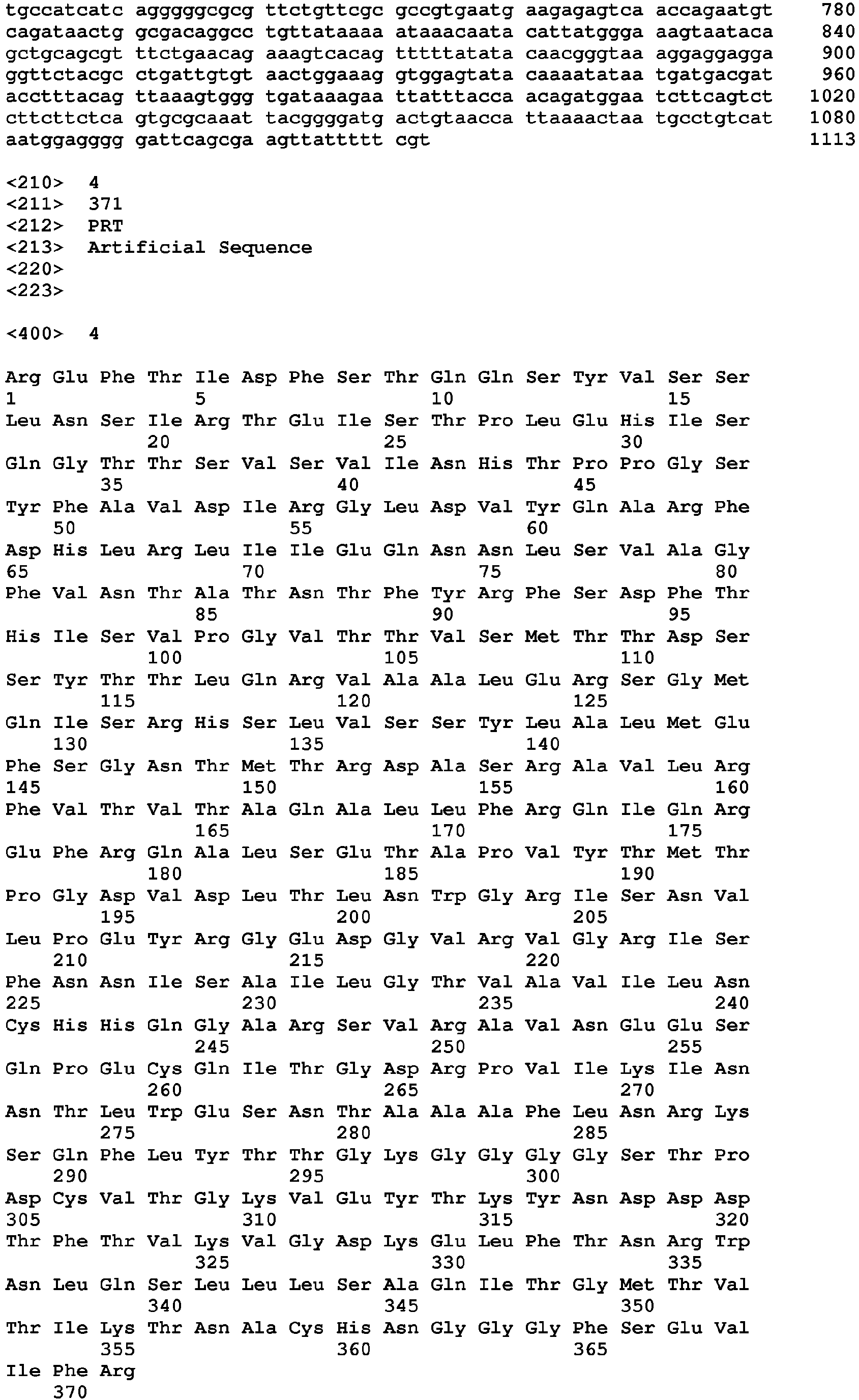
- amino acid sequence of the Shiga toxin type-II A subunit mutant protein is represented by amino acids 1-297 of SEQ ID NO. 4 in the Sequence List.
- amino acid sequence of the B subunit of type-I Shiga toxin is represented by animo acids 303-371 of SEQ ID NO. 4 in the Sequence List.
- amino acid sequence of the above-metioned fusion protein is represented by SEQ ID NO. 4 in the Sequence List.
- the coding gene for any of the above-described fusion proteins is also within the protecting scope of the present invention.
- recombinant vectors, recombinant bacteria or transgenic cell lines containing the above-described genes are also within the protecting scope of the present invention.
- the above-described recombinant vector is a recombinant expresion vector obtained by inserting the above gene into the topoiso-site of pEASYE2 plasmid.
- the recombinant bacterium is recombinant E. coli or recombinant yeast.
- Shiga toxin-producing pathogenic bacterium is EHEC O157: H7.
- the bacterial strains and plasmids used in the present invention were shown in Table 1 and the primers used were shown in Table 2.
- the HisTRAP FFTM (a Ni affinity chromatographic column) and ⁇ KTA FPLC system for purification were both purchased from GE. Table 1.
- Bacterial strains and plasmids used in the experiments Strains and plasmids Characteristics Sources E.
- the gene of the Shiga toxin type-II A subunit ( Stx2A ) (represented by SEQ ID NO. 1 in the Sequence List, the SEQ ID NO. 1 being capable of encoding the protein represented by SEQ ID NO. 5) was amplified from the genome of EHEC O157: H7 EDL933 (see the characteristics of the strain and its source in Table 1) using primers 1 and 2.
- the gene of the Shiga toxin type-I B subunit ( Stx1B ) (represented by SEQ ID NO. 2 in the Sequence List) was amplified using primers 3 and 4 (see the primers in Table 2).
- Two fragments were amplified from Stx2A gene resepectively using two primer pairs, primers 1 and 6 as one pair and primers 2 and 5 as another.
- the obtained fragment mixture was used as the template (primers 1 and 2 were used as the primers) and then the gene for a Stx2A with one amino acid mutated was obtained by overlapping PCR. Thereafter, two fragments were amplified from the gene with one base mutated using a two primer pairs, primers 1 and 8 as one pair and peimers 2 and 7 being another.
- the obtained fragments was mixed and used as the template and primers 1 and 2 were used as the primer pair.
- An overlapping PCR was performed to obtain a Stx2A gene named Stx2Am with 3 amino acids mutated.
- Stx2A gene with 3 amino acids mutated ( Stx2Am ) was mixed with Stx1B gene, which would be used as the template later.
- a gene encoding fusion protein was obtained by overlapping PCR (using primers 1 and 4) and named SAmB. 2) Construction of the recombinant expression vector
- the nucleic acid sequence of Stx2A gene with three-sites mutations was represented by nucleotides 1-891 of SEQ ID NO. 3 in the Sequence List and that of Stx1B gene was represented by nucleotides 907-1113 of SEQ ID NO. 3 in the Sequence List (i.e., SEQ ID NO. 2).
- the nucleic acid sequence represented by SEQ ID NO. 3 can encode the protein represented by SEQ ID NO. 4 in the Sequence List, the protein being named SAmB.
- the above-confirmed plasmid p SAm B was transformed into E.coli TransB (DE3) to construct an engineered bacteria strain.
- PCR was used to identify the clones of the engineered bacteria strain by using primers 1 and 4 ( Figure 1 ).
- a gene product of 1113bp was amplified from the positive clones which was consistent with sAmB gene in size indicating that p SAm B had been successfully transformed into E. coli TransB (DE3).
- the engineered bacteria strain was inoculated into liquid LB medium containing ampicillin (100 ⁇ g/mL) and shaked overnight at 37 °C. The next day, the bacteria were subcultured to liquid LB medium in a ratio of 1:100 to further grow with shaking at 37 °C until the culture reached OD 600 of 0.4-0.6. Then, IPTG was added to a final concentration of 1mM. Culture was continued for another 4 hours in water bath shaking bed with 150r/min at 37 °C. Bacteria were centrifuged at 6000 r/min for 15 minutes at 4 °C and resuspended in PBS (the concentration of EDTA was 1 mM, pH7.4). After lysed by ultrasonication, the bacterial lysates were centrifuged at 10000g for 15 minutes. Then, the obtained precipitations were collected.
- the isolated inclusion bodies were denatured in purification buffer A (8M urea, 20 mM sodium phosphate, 0.5 M NaCl, 40 mM imidazol, pH 7.4) wherein the purification step was performed according to the instruction of the Ni-NTA purification column (Amersham). Then, the purified products were dialysed with urea gradient (8M, 6M, 4M, 2M, 1M) and renatured. The products were finally dialysed into PBS.
- purification buffer A 8M urea, 20 mM sodium phosphate, 0.5 M NaCl, 40 mM imidazol, pH 7.4
- the purified products were dialysed with urea gradient (8M, 6M, 4M, 2M, 1M) and renatured. The products were finally dialysed into PBS.
- the reagents used in the present example were listed below.
- the MacConkey agar containing sorbitol, MTT and Gimsa stain were all purchased from Beijing Kehaijunzhou Company (China).
- the DMEM media, fetal bovine serum and dual antibodies were respectively purchased from GIBCO, Biochrom and Hyclone.
- the Cefixime granules were the product of the Pharmaceutical Factory, Guangzhou Baiyun Mountain.
- the potassium tellurite (1%) was purchased from Beijing Land Bridge Technology Co., Ltd. Animals were purchased from the Laboratory Animal Center of the Academy of Military Medical Sciences.
- the Freund's complete adjuvant and Freund's incomplete adjuvant were purchased from Sigma.
- the present invention used 2S protein as the positive control to evaluate the immunogenicity and protective efficacy of SAmB.
- the 2S protein was a fusion protein obtained by concatenating Stx2B and Stx1B with GGGGS as a linker, that is, Stx2B-Stx1B.
- This protein was constructed by the inventors and the preparing process had been published in Vaccine ( Gao X, Cai K, Shi J, Liu H, Hou XJ, Tu W, Xiao L, Wang Q, Wang H. Immunogenicity of a novel Stx2B-Stx1B fusion protein in a mice model of Enterohemorrhagic Escherichia coli O157: H7 infection.
- Stx1B gene was amplified from EHEC O157:H7 EDL933 by PCR using primer P1 (5'-AAGTGCAGTTTAATAATGACGGAGGAGGAGGTTCTCCTGATTGTGTAACTG GAAA-3') and primer P2 (5'- GCGGCCGC ACGAAAAATAACTTCGCTGAAT-3'), and stx2B was amplified using primer p3 (5'- CCCCCCC CATATGGCTAAAGGTAAAATTGAGTTTTCCAAG-3') and primer p4 (5'-GTCATTATTAAACTGCACTTCAGCAAATCCGGAGCCTGATTC-3').
- the 2S protein was ligated by Splicing Overlap Extension PCR, i.e., primers p3 and p2 were used to amplify the full-length 2s gene. Then, the double-chained PCR product was purified and ligated into pMD18-T. The pMD18-T was transformed into E. coli DH5 ⁇ which was then sequenced in Invitrogen (Beijing). The confirmed plasmid was digested by two restriction endonucleases and ligated with pET22b(+) vector (purchased from Novagen) treated by the same two endonucleases to construct a recombinant expression vector p2S. Then, the p2S was transformed into E. coli BL21 (DE3). The obtained engineering bacteria with p2S were expressed under IPTG induction. The expressed inclusion bodies were denatured, renatured and then purified by Q column to obtain the 2S protein.
- Splicing Overlap Extension PCR i
- Stx1 and Stx2 were used in the present invention as the antigens to test the immunogenicity of SAmB.
- the preparation methods were similar for these two proteins, the details of which had been published ( Tu W, Cai K, Gao X, Xiao L, Chen RC, Shi J, Liu H, Hou XJ, Wang Q, Wang H, Improved production of holotoxin Stx2 with biological activities by using a single-promoter vector and an auto-induction expression system. Protein Expr. Purif, 2009, 67(2):169-174 ). Wherein Stx2 was prepared as described below.
- the full-length Shiga toxin stx2 gene was amplified from EHEC O157:H7 using primers p5 (5'-GGGGGGAATTCATGAAGTGTATATTATTTAAATGGG-3') and p6 (5'-TTTTTTGTCGACTTAGTGGTGGTGGTGGTGGTGGTCATTATTAAACTGCACT TCAG-3'). Then, the stx2 was sequenced using clone vector pEASY-T1. The sequencing results suggested indicated that the nucleic acid of the amplified product was actually the same as the nucleotide from No.1352290-1353527 of the nucleotide of Genbank NC_002655.
- a recombinant strain pET32a- stx 2/plysS was constructed, which contained by two open reading frames strategy with a single promoter. Specifically, the amplified product was inserted into pET32a digested with restriction endonucleases EcoR I and Sal I to construct a recombinant plasmid pET32a- stx2 . Then this plasmid was transformed into E. coli BL21 (DE3) plysS strain (purchased from Transgen) to obtain construct a recombinant strain pET32a- stx2 /plysS.
- the recombinant plasmid pET32a-stx2 had one T7 promoter and the full-length clone of Shiga toxin stx2 contained two open reading frames (stx2a and stx2b). IPTG was added to a final concentration of 1 mmol/L. Then, the cells grew at 30°C in water bath under shaking condition for 5 hours, leading to the highly efficiencyective expression of Stx2. Stx2 with 90% purity or higher more was obtained after treatment in Ni-HisTrap FF column and the obtained Stx2 showed biological activity.
- the producing method of Stx1 was similar with the above producing method of Stx2 with the difference in using the primers of p7 (5-ggggggggaattcatgaaaataattatttttagagtgctaacttttttc-3) and p8 (5-gtcgactcagtggtggtggtggtggtggtgacgaaaataacttcgctgaat-3).
- the nucleotide sequence of the amplified product was actually the same as from No.2995757-2996977 of the nucleotide of Genbank NC_002655.
- coli TransB (DE3) was chosen as the host bacteria in the construction of pET32a-stx1/E.coli TransB(DE3). Stx1 with 90% purity or higher was obtained after treatment with Ni-HisTrap FF column and the obtained Stx1 showed a biological activity.
- mice Female BALB/c mice (15-17g) were randomly divided into five groups and according to the immunizing antigens, i.e., they were divided into (1) SAmB group, (2) 2S group and (3) PBS group. These antigens were intraperitoneally injected.
- the first immunization (referred to as Day 0) was taken with equal volumes of mixture of the antigens and Freund's complete adjuvant (total volume: 100 ⁇ l).
- the boosts immunization was taken with equal volumes of mixture of the antigens and Freund's incomplete adjuvant (at Day14 and Day 28). Immunization was performed for three times with a two-week interval.
- the final concentration of the antigen for the first immunization was 25 ⁇ g and the final concentration of the antigent for the boosts immunization was 50 ⁇ g.
- HRP-conjugated anti-mouse IgA or IgG was used as the secondary antibody (Pierce, diluted with a ratio of 1:10 5 ). Absorption was read after the colorimetric reaction was stopped. As shown in Figure 3 , the antibody titers against Stx1B and Stx2A in SAmB group were both higher than those in 2S group.
- Neutralization titers of the serum on Stx1 and Stx2 in immunized mice were measured.
- the 50% cytotoxic dose of Stx1 and Stx2 to Vero cells (ATCC) was tested in a preliminary experiment.
- the dose of the toxin in the detection of neutralization titers was 5CD50.
- 500 pg of Stx1 and 20 ng of Stx2 were referred to as 1CD50.
- the supernatant of the lysed O157: H7 bacteria was obtained by centrifugating EHEC O157: H7 bacteria cultured overnight in Luria-Bertani medium (LB, Oxoid LTD, Basingstok, Hampshire, England) at 37°C, wherein 5 ⁇ 10 4 CFU of supernatant of lysed O157: H7 bacteria can be referred to as 1CD50.
- the extent of dilution was defined as the neutralization titer of the serum when 50% of the cells were protected from 5CD50 of toxins.
- the detailed testing procedure was shown as below: serums gradiently diluted with DMEM medium (with 2% of FBS) was respectively incubated with 5CD50 of the supernatant of lysed O157: H7 88321 bacteria, Stx1 and Stx2 at 37°C for 1 hour. Then, the mixture was added into the 96-well plate and cultured in monolayered Vero cells (10 6 /well) in a CO 2 incubator at 37°C for 4 hours. After washed by PBS, fresh DMEM medium (with 0.5 mg/ml MTT) was added to continue the culture for another 4 hours.
- Example 2 The procedure for animal immunization was the same as described in Example 2. As two toxins, Stx1 and Stx2 proteins were used to attack SAmB immuned mice. The preparation method of these two proteins was the same as described in Example 2.
- mice were under protection in SAmB group (14/15) while all mice died in placebo (PBS) group (0/15) and 26.7% survived in 2S group (4/15).
- PBS placebo
- mice 100% of mice were under protection against high lethal dose of Stx1 and 93.3% of mice were protected against high lethal dose of Stx2.
- 80% of mice were under protection in the SAmB group when mixture of high lethal dose of Stx1 and high lethal dose of Stx2 were used.
Landscapes
- Health & Medical Sciences (AREA)
- Chemical & Material Sciences (AREA)
- Life Sciences & Earth Sciences (AREA)
- General Health & Medical Sciences (AREA)
- Medicinal Chemistry (AREA)
- Organic Chemistry (AREA)
- Veterinary Medicine (AREA)
- Animal Behavior & Ethology (AREA)
- Public Health (AREA)
- Pharmacology & Pharmacy (AREA)
- Mycology (AREA)
- Gastroenterology & Hepatology (AREA)
- Communicable Diseases (AREA)
- General Chemical & Material Sciences (AREA)
- Chemical Kinetics & Catalysis (AREA)
- Immunology (AREA)
- Microbiology (AREA)
- Nuclear Medicine, Radiotherapy & Molecular Imaging (AREA)
- Epidemiology (AREA)
- Oncology (AREA)
- Biochemistry (AREA)
- Biophysics (AREA)
- Genetics & Genomics (AREA)
- Molecular Biology (AREA)
- Proteomics, Peptides & Aminoacids (AREA)
- Peptides Or Proteins (AREA)
- Medicines Containing Antibodies Or Antigens For Use As Internal Diagnostic Agents (AREA)
Abstract
Description
- The present invention relates to a fusion protein SAmB which is associated with the prevention and/or treatment of infections caused by Shiga toxin-producing pathogenic bacteria, its coding gene and the use thereof.
- The infection caused by enterohemorrhagic Escherichia coli (EHEC) O157: H7 is a newly developed foodborne infectious disease, which has become a global health problem. This infection mainly causes severe complications such as infantile diarrhea, hemorrhagic colitis (HC), hemolytic uremic syndrome (HUS) and thrombotic thrombocytopenic purpura (TTP). The infection may also lead to death. Since first explosively found in USA in 1982, the outbreaks of EHEC O157:H7 infection were found in Japan, USA, England, Canada, Australia etc., especially during May to August in 1996, in China, EHEC O157: H7 E. Coli. have been isolated from human, livestocks and other animals in Fujian, Gansu, Zhejiang, Anhui and other provinces since the first infection was reported in Xuzhou in 1986. In 2001, infectious diarrhea caused by EHEC O157: H7 broke out epidemically in Jiangsu and Anhui provinces, resulting in more than 20000 patients of which 177 died.
- Attention has been made to EHEC O157: H7 infection by professionals and scientists all over the world because of its explosively epidemic trend, its severe pathogenicity and its fatality and the fact that if an antibiotic treatment is applied, it will make the condition even worse. Retrospective studies on EHEC O157: H7 infection have shown that the infection may stimulate immunity. This is reflected by the following facts, the occurrence of EHEC O157: H7-associated diarrhea becomes less frequent with age, and the ratio of symptomatic EHEC infections to asymptomatic infections decreased with age. Further, the relationship between the primary EHEC O157: H7 infection and subsequent infections with similar toxin and colonization factor (showing a protecting effect) also illustrates the effect of infection on immunity strengtherns the above facts. Up to now, there is no available EHEC O157: H7 vaccine for human yet but many vaccine candidates are being studied. For example, the whole molecule or the partial structure of some components such as the adhesion - associated factor, toxin and hemolysin have become the most important targets to be screened as protective antigens.
- The toxin Stx family mainly includes type-I and type-II Stxs (Stx1 and Stx2), two members without immunological cross-reactions. An EHEC O157: H7 strain may express either one of Stx1 or Stx2 or both Stx1 and Stx2. Though Stx1 and Stx2 have different antigenicity, Stx1 and Stx2 have the same molecular structure and receptor(s) as well as similar toxicity mechanism. In particular, Stx1 and Stx2 are all composed of one A subunit and five B subunits. The A subunit has intracellular toxicity and binds to 28S rRNA to stop the protein synthesis, which is the underlying pathological mechanism of the clinical manifestation caused by EHEC O157: H7 infection. The B subunit has a cell-binding property and binds to cells having a specific receptor, the globotriaos-ylceramide (Gb3) or globotatrasylceramide (Gb4) so as to activate the enzymatic activity of the A subunit. Most EHEC O157: H7 strains contain at least Stx2 and Stx2 has a higher toxicity than Stx1. Clinical studies have revealed that Stx is closely related to severe infection complications such as HUS and TTP and is the key factor resulting in EHEC O157: H7 infection-caused renal injury or even death.
- The B subunit of Stx is a protective antigen and has several effective epitopes. Boyd et al. used the purified Stx B subunit or synthesized fragment of B subunit to provide a protective effect to inoculated rabbits against the attack of Stx1 with a lethal dose. Marcato P et al. has suggested that Stx2B is not toxic to Vero cells and does not induce apoptosis of Burkitt's lymphoma cells. Further, the specific anti-Stx2B antibody generated in inoculated rabbits fights against the Stx2 with a lethal dose. The pre-study by present inventors also has revealed that the cloned and expressed Stx B subunit and its polypeptide fragments have no toxicity and provide good immune protection. Futher, the polyclonal antibodies for Stx1B and Stx2B could block the activity of the toxins but cannot provide protection against the strains producing both Stx1B and Stx2B (Bao, Shizhong et al. Bulletin of the Academy of Military Medical Sciences, 2008,32(6):537-540; Gao et al., Vaccine 2009,27:2070-2076). The previous studies of the inventors have also revealed that Stx2B-Stx1B fusion protein (simply referred to as 2S) constructed based on Stx1B and Stx2B could induce the mice to generate antibodies respectively against type-I and type-II Shiga toxins but the neutralization titers are type-dependent. For example, the neutralization titer was relatively low for Stx2, with the expression being that the protection ratio for the immunized animals decreased when the amount of bacteria (lysate) was higher than the lethal dose. Therefore, in order to improve the immune protection level agrainst dual-type toxins, this invention is aimed to select novel and more effective protective antigen components to build up a novel fusion protein which may be developed into a novel vaccine having better protective effects.
- Some experiments implied that an inactivated antigen of the Stx2 A subunit is a good antigen and may induce antibodies with a high titer in vivo. A relevant study reported that the Stx2 A subunit was inactivated by site-directed mutagenesis at enzyme activity-associated Tyr77 (Ser77), Glu167 (Gln167) and Arg170 (Lys170) so as to construct a Stx2 mutant. Different from the natural toxin, the obtained recombinant toxin as such did not have cytotoxicity in Hela cells and could induce the mice to generation of immune antibodies or naturalization antibodies with a high titer in mice (O' Brien et al., Vaccine, 2006). However, as these recombinant toxins mimicked the structures of the natural ones (1A:5B) having one A subunit and five B subunits, it is hard to prepare them due to the structure assembly during the expression process. Such process cannot be performed in large scale and the obtained proteins are neither stable nor easy to be stored, which limits the application of the above-mentioned method. In addition, it has been reported that StxB was an effective biological adjuvant having an immune-facilitating effect and thus can be used as an intramolecular adjuvant to improve the immune efficacy of a new fusion protein so that a better protective effect could be obtained (Nacilla H et al., Int Immunol 2003; Nacilla H et al., J Immunol 2000). Up to now, a vaccine that is safer, more effective and has a wider protection scope is still needed against the infection of Escherichia coli 0157.
- The present invention aims to provide a fusion protein.
- The fusion protein provided in the present invention is named SAmB and comprises at the N-terminal a Shiga toxin type-II A subunit mutant protein and at the C-terminal a Shiga toxin type-I B subunit.
- The above-metioned Shiga toxin type-II A subunit mutant protein is a protein obtained by mutating amino acid residues in the active site in the Shiga toxin type-II A subunit.
- Furthermore, the above-metioned amino acid residues in the active site are residue 77, 167 and 170 in the Shiga toxin type-II A subunit. The amino acid sequence of the Shiga toxin type-II A subunit is represented by SEQ ID NO. 5 in the Sequence List.
- More specifically, the amino acid sequence of the Shiga toxin type-II A subunit mutant protein is represented by amino acids 1-297 of SEQ ID NO. 4 in the Sequence List. The amino acid sequence of the B subunit of type-I Shiga toxin is represented by animo acids 303-371 of SEQ ID NO. 4 in the Sequence List.
- Further, the amino acid sequence of the above-metioned fusion protein is represented by SEQ ID NO. 4 in the Sequence List.
- The coding gene for any of the above-described fusion proteins is also within the protecting scope of the present invention.
- The above-mentioned coding genes are as below 1) - 3):
- 1) a coding sequence represented by
sequence 3 in the Sequence List; - 2) a gene capable of hybridizing with the gene of 1) under stringent conditions and encoding the above-described fusion protein;
- 3) a gene having at least 90% homology with the gene of 1) and encoding the above-described fusion protein.
- The recombinant vectors, recombinant bacteria or transgenic cell lines containing the above-described genes are also within the protecting scope of the present invention.
- The above-described recombinant vector is a recombinant expresion vector obtained by inserting the above gene into the topoiso-site of pEASYE2 plasmid. The recombinant bacterium is recombinant E. coli or recombinant yeast.
- The use of the fusion protein or gene mentioned above in the preparation of drugs for preventing and/or treating diseases caused by Shiga toxin or Shiga toxin-producing pathogenic bacteria are also within the protection scope of the present invention.
- Further, the above-described Shiga toxin-producing pathogenic bacterium is EHEC O157: H7.
-
-
Figure 1 is a PCR electrophoretogram showing the identification of the recombinant bacteria pSAmB/E.coli TransB (DE3), whereinlane 1 is the PCR amplified product of sAmB gene and lane M is the DL2000 DNA marker. -
Figure 2 shows the SDS-PAGE and Western blot results about the expressed products and purified products of the recombinant SAmB expressed in prokaryotic system, whereinlanes lane 2 shows the supernatant of the lysed induced bacteria,lane 4 shows the precipitation of lysed bacteria,lane 5 shows the protein marker of low molecular weights,lane 6 shows the purified SAmB product,lanes -
Figure 3 shows the antibody titer in the serum of immunized mice by 14 days after the last immunization, wherein antigens used for detection are Stx1 and Stx2 respectively. Mice were divided into three groups, wherein the black columns represent the group with SAmB as the immunogen, the blank columns represent the group with 2S as the immunogen and the grid columns represent the group with PBS as the immunogen. The vertical axis is the logarithm value of the ELISA titer of the serum antibody tobase 2. The horizontal axis represents that antibodies in the serum are IgA or IgG, respectively. The mice in the placebo group has very low titer of serum IgA and IgG (<2) while the immuned groups have relative high titers. When compared to the placebo control PBS group, the symbol * denotes P<0.01 and # denotes P>0.05. When compared to the 2S group, the symbol ** denotes P<0.01 and ## denotes P<0.05. -
Figure 4 shows the test on neutralization titers of the immune serums against the supernatant of lysed O157: H7 88321 bacteria, Stx1 and Stx2, wherein each value is obtained from a mixture of three serum samples. The vertical axis is the logarithm of neutralization titer tobase 10. When compared to the placebo control PBS group, the symbol * denotes P<0.01. When compared to the 2S group, the symbol ** denotes P<0.01 and # denotes P>0.05. The experimental results revealed that immune serum of SAmB group could better neutralize Stx2 and had a higher neutralization titer (103.4) than the 2S group (102.8). -
Figure 5 shows the protective effect against bacteria in immunized mice. Figure A shows the experimental results of immunized mice challenged with lysed E.coli O157: H7 of a dose of 10 LD50. Figure B shows the results of immunized mice challenged with 10 LD50 of Stx1 or 10 LD50 of Stx2 or the mixture of 10 LD50 of Stx1 and 10 LD50 of Stx2. The vertical axis represents the number of mice in each group and the horizontal axis represents the number of days from the application of toxins (Day 0). - The present invention will be further illustrated by referring to specific examples but the present invention is not limited to the following examples.
- The methods used in the examples are conventional means if not indicated otherwise.
- The bacterial strains and plasmids used in the present invention were shown in Table 1 and the primers used were shown in Table 2. The HisTRAP FF™ (a Ni affinity chromatographic column) and ÄKTA FPLC system for purification were both purchased from GE.
Table 1. Bacterial strains and plasmids used in the experiments Strains and plasmids Characteristics Sources E. coli strain O157:H7 88321 Toxigenic strain, dual toxins-producing strain producing both Stx1 and Stx2 Purchased from ATCC O157:H7 EDL 933 an international standard strain, dual toxins-producing strain producing both Stx1 and Stx2 Purchased from ATCC Trans5α F- ϕ80d lacZΔM15 Δ(lacZYA-argF) U169 endA1 recA1 hsdR17(rK -, mK +) supE44 λ-thi-1 gyrA96 relA1 phoA Transgen TransB (DE3) F- ompT hsdSB (rB -mB -)gal dcm lacY1 ahpC (DE3) gor522::Tn10 trxB (KanR, TetR) Transgen Vector pEASYE2 E. coli expression vector (Ampr) Transgen Table 2. Pimers used in the experiments Primers Sequences (5'-3')a, b Homologous regions 1 
Forward primer for Stx2A 2 
Reverse primer for Stx2A 3 
Forward primer for Stx1B 4 
Reverse primer for Stx1B 5 
The primer for mutation (77Y→77S) in Stx2A, used in combination with primer 66 
The primer for mutation (77Y→77S) in Stx2A, used in combination with primer 57 
The primer for mutation (167E→167Q and 170R→170L) in Stx2A, used in combination with primer 88 
The primer for mutation (167E→167Q and 170R→170L) in Stx2A, used in combination with primer 7 a: Restriction endonuclease cleavage sites (underlined)
b: Linker Sequence (bold font) - The gene of the Shiga toxin type-II A subunit (Stx2A) (represented by SEQ ID NO. 1 in the Sequence List, the SEQ ID NO. 1 being capable of encoding the protein represented by SEQ ID NO. 5) was amplified from the genome of EHEC O157: H7 EDL933 (see the characteristics of the strain and its source in Table 1) using
primers primers 3 and 4 (see the primers in Table 2). - Two fragments were amplified from Stx2A gene resepectively using two primer pairs,
primers primers primers primers primers primers 1 and 4) and named SAmB. 2) Construction of the recombinant expression vector - The above-amplified SAmB after purified was ligated into the expression vector pEASYE2 (the vector was a topoiso-vector which did not need any restriction endonuclease cleavage site) (the detailed operations see the instruction from Transgen) to construct a recombinant expression vector called pSAmB.
- Subsequently, pSAmB was transformed into E.coli DH5α and sequenced by Beijing Sunbiotech Co., Ltd. The sequencing results indicated that the obtained sequence was completely the same as previously designed.
- Also, the sequencing results demonstrated that pSAmB fragment represented by SEQ ID NO. 3 in the Sequence List had been inserted in the the topoiso-site of pEASYE2.
- In SEQ ID NO. 3, the nucleic acid sequence of Stx2A gene with three-sites mutations (i.e., Stx2Am) was represented by nucleotides 1-891 of SEQ ID NO. 3 in the Sequence List and that of Stx1B gene was represented by nucleotides 907-1113 of SEQ ID NO. 3 in the Sequence List (i.e., SEQ ID NO. 2). The nucleic acid sequence represented by SEQ ID NO. 3 can encode the protein represented by SEQ ID NO. 4 in the Sequence List, the protein being named SAmB. 2. Construction of the engineered bacteria, expression induction and purification 1) Construction of the engineered bacteria
- The above-confirmed plasmid pSAmB was transformed into E.coli TransB (DE3) to construct an engineered bacteria strain. PCR was used to identify the clones of the engineered bacteria strain by using
primers 1 and 4 (Figure 1 ). A gene product of 1113bp was amplified from the positive clones which was consistent with sAmB gene in size indicating that pSAmB had been successfully transformed into E. coli TransB (DE3). - The engineered bacteria strain was inoculated into liquid LB medium containing ampicillin (100 µg/mL) and shaked overnight at 37 °C. The next day, the bacteria were subcultured to liquid LB medium in a ratio of 1:100 to further grow with shaking at 37 °C until the culture reached OD600 of 0.4-0.6. Then, IPTG was added to a final concentration of 1mM. Culture was continued for another 4 hours in water bath shaking bed with 150r/min at 37 °C. Bacteria were centrifuged at 6000 r/min for 15 minutes at 4 °C and resuspended in PBS (the concentration of EDTA was 1 mM, pH7.4). After lysed by ultrasonication, the bacterial lysates were centrifuged at 10000g for 15 minutes. Then, the obtained precipitations were collected.
- The isolated inclusion bodies were denatured in purification buffer A (8M urea, 20 mM sodium phosphate, 0.5 M NaCl, 40 mM imidazol, pH 7.4) wherein the purification step was performed according to the instruction of the Ni-NTA purification column (Amersham). Then, the purified products were dialysed with urea gradient (8M, 6M, 4M, 2M, 1M) and renatured. The products were finally dialysed into PBS.
- Analysis using SDS-PAGE was done as follows. The recombinant bacteria after induction and the purified proteins were collected and identified by 15% SDS-PAGE electrophoresis. The results showed that a protein band of 40kDa was found in the recombinant bacterial sample, the molecular weight of which was the same as expected molecular weight of SAmB (
Figure 2 ). The thin layer chromatography scan indicated that the expressed target proteins accounted for about 50% of the total bacterial proteins. It was also indicated that the purity of SAmB purified by Ni-NTA was 95% or above which can be used in immuning animals to test its immunogenicity. - Western blot was done on the above purified SAmB using anti-Stx1 and anti-Stx2 monoclonal antibodies (purchased from Biodesign). HRP-conjugated IgG (produced in chickens or rabbits) was used as the second antibody, and DAB was used in the colorimetric reaction. A specific band of 40 kDa was found in positive clones, the molecular weight was with the same as expected one (
Figure 2 ,lanes 7 and 8), indicating that the recombinant SAmB had a good immunoreactivity. - The reagents used in the present example were listed below. The MacConkey agar containing sorbitol, MTT and Gimsa stain were all purchased from Beijing Kehaijunzhou Company (China). The DMEM media, fetal bovine serum and dual antibodies were respectively purchased from GIBCO, Biochrom and Hyclone. The Cefixime granules were the product of the Pharmaceutical Factory, Guangzhou Baiyun Mountain. The potassium tellurite (1%) was purchased from Beijing Land Bridge Technology Co., Ltd. Animals were purchased from the Laboratory Animal Center of the Academy of Military Medical Sciences. The Freund's complete adjuvant and Freund's incomplete adjuvant were purchased from Sigma.
- The present invention used 2S protein as the positive control to evaluate the immunogenicity and protective efficacy of SAmB. The 2S protein was a fusion protein obtained by concatenating Stx2B and Stx1B with GGGGS as a linker, that is, Stx2B-Stx1B. This protein was constructed by the inventors and the preparing process had been published in Vaccine (Gao X, Cai K, Shi J, Liu H, Hou XJ, Tu W, Xiao L, Wang Q, Wang H. Immunogenicity of a novel Stx2B-Stx1B fusion protein in a mice model of Enterohemorrhagic Escherichia coli O157: H7 infection. Vaccine, 2009, 27 (14): 2070-6). Specifically, the producing method was as below: Stx1B gene was amplified from EHEC O157:H7 EDL933 by PCR using primer P1 (5'-AAGTGCAGTTTAATAATGACGGAGGAGGAGGTTCTCCTGATTGTGTAACTG GAAA-3') and primer P2 (5'-GCGGCCGCACGAAAAATAACTTCGCTGAAT-3'), and stx2B was amplified using primer p3 (5'-CCCCCCCCATATGGCTAAAGGTAAAATTGAGTTTTCCAAG-3') and primer p4 (5'-GTCATTATTAAACTGCACTTCAGCAAATCCGGAGCCTGATTC-3'). The 2S protein was ligated by Splicing Overlap Extension PCR, i.e., primers p3 and p2 were used to amplify the full-length 2s gene. Then, the double-chained PCR product was purified and ligated into pMD18-T. The pMD18-T was transformed into E. coli DH5α which was then sequenced in Invitrogen (Beijing). The confirmed plasmid was digested by two restriction endonucleases and ligated with pET22b(+) vector (purchased from Novagen) treated by the same two endonucleases to construct a recombinant expression vector p2S. Then, the p2S was transformed into E. coli BL21 (DE3). The obtained engineering bacteria with p2S were expressed under IPTG induction. The expressed inclusion bodies were denatured, renatured and then purified by Q column to obtain the 2S protein.
- The two toxins, Stx1 and Stx2, were used in the present invention as the antigens to test the immunogenicity of SAmB. The preparation methods were similar for these two proteins, the details of which had been published (Tu W, Cai K, Gao X, Xiao L, Chen RC, Shi J, Liu H, Hou XJ, Wang Q, Wang H, Improved production of holotoxin Stx2 with biological activities by using a single-promoter vector and an auto-induction expression system. Protein Expr. Purif, 2009, 67(2):169-174). Wherein Stx2 was prepared as described below. Firstly, the full-length Shiga toxin stx2 gene was amplified from EHEC O157:H7 using primers p5 (5'-GGGGGGAATTCATGAAGTGTATATTATTTAAATGGG-3') and p6 (5'-TTTTTTGTCGACTTAGTGGTGGTGGTGGTGGTGGTCATTATTAAACTGCACT TCAG-3'). Then, the stx2 was sequenced using clone vector pEASY-T1. The sequencing results suggested indicated that the nucleic acid of the amplified product was actually the same as the nucleotide from No.1352290-1353527 of the nucleotide of Genbank NC_002655. A recombinant strain pET32a-stx2/plysS was constructed, which contained by two open reading frames strategy with a single promoter. Specifically, the amplified product was inserted into pET32a digested with restriction endonucleases EcoR I and Sal I to construct a recombinant plasmid pET32a-stx2. Then this plasmid was transformed into E. coli BL21 (DE3) plysS strain (purchased from Transgen) to obtain construct a recombinant strain pET32a-stx2/plysS. The recombinant plasmid pET32a-stx2 had one T7 promoter and the full-length clone of Shiga toxin stx2 contained two open reading frames (stx2a and stx2b). IPTG was added to a final concentration of 1 mmol/L. Then, the cells grew at 30°C in water bath under shaking condition for 5 hours, leading to the highly efficiencyective expression of Stx2. Stx2 with 90% purity or higher more was obtained after treatment in Ni-HisTrap FF column and the obtained Stx2 showed biological activity. Details of related experiments have been published (Tu W, Cai K, Gao X, Xiao L, Chen RC, Shi J, Liu H, Hou XJ, Wang Q, Wang H, Improved production of holotoxin Stx2 with biological activities by using a single-promoter vector and an auto-induction expression system. Protein Expr. Purif. 2009, 67(2):169-174).
- The producing method of Stx1 was similar with the above producing method of Stx2 with the difference in using the primers of p7 (5-ggggggggaattcatgaaaataattatttttagagtgctaacttttttc-3) and p8 (5-gtcgactcagtggtggtggtggtggtgacgaaaaataacttcgctgaat-3). The nucleotide sequence of the amplified product was actually the same as from No.2995757-2996977 of the nucleotide of Genbank NC_002655. The E. coli TransB (DE3) was chosen as the host bacteria in the construction of pET32a-stx1/E.coli TransB(DE3). Stx1 with 90% purity or higher was obtained after treatment with Ni-HisTrap FF column and the obtained Stx1 showed a biological activity.
- Female BALB/c mice (15-17g) were randomly divided into five groups and according to the immunizing antigens, i.e., they were divided into (1) SAmB group, (2) 2S group and (3) PBS group. These antigens were intraperitoneally injected. The first immunization (referred to as Day 0) was taken with equal volumes of mixture of the antigens and Freund's complete adjuvant (total volume: 100 µl). The boosts immunization was taken with equal volumes of mixture of the antigens and Freund's incomplete adjuvant (at Day14 and Day 28). Immunization was performed for three times with a two-week interval. The final concentration of the antigen for the first immunization was 25µg and the final concentration of the antigent for the boosts immunization was 50µg.
- Blood was collected from the
eyepit 14 days after the last immunization (Day 42) and the serum was separated from the blood. The serum titer was detected by ELISA by using anti-Stx1 and anti-Stx2 antibodies. Specifically, purified proteins Stx1 and Stx2 were respectively used to coat the plates (100 ng/well) and incubated at 4°C overnight. After washes by PBST, BSA was used for blocking. After washes, mouse serums with serial 2-fold dilution were added to the wells (the first one was diluted at a ratio of 1:50), wherein a double recovery was set for each well. After washes, HRP-conjugated anti-mouse IgA or IgG was used as the secondary antibody (Pierce, diluted with a ratio of 1:105). Absorption was read after the colorimetric reaction was stopped. As shown inFigure 3 , the antibody titers against Stx1B and Stx2A in SAmB group were both higher than those in 2S group. - Neutralization titers of the serum on Stx1 and Stx2 in immunized mice were measured. The 50% cytotoxic dose of Stx1 and Stx2 to Vero cells (ATCC) was tested in a preliminary experiment. The dose of the toxin in the detection of neutralization titers was 5CD50. Respectively, 500 pg of Stx1 and 20 ng of Stx2 were referred to as 1CD50. The supernatant of the lysed O157: H7 bacteria was obtained by centrifugating EHEC O157: H7 bacteria cultured overnight in Luria-Bertani medium (LB, Oxoid LTD, Basingstok, Hampshire, England) at 37°C, wherein 5×10⁴ CFU of supernatant of lysed O157: H7 bacteria can be referred to as 1CD50.
- The extent of dilution was defined as the neutralization titer of the serum when 50% of the cells were protected from 5CD50 of toxins. The detailed testing procedure was shown as below: serums gradiently diluted with DMEM medium (with 2% of FBS) was respectively incubated with 5CD50 of the supernatant of lysed O157: H7 88321 bacteria, Stx1 and Stx2 at 37°C for 1 hour. Then, the mixture was added into the 96-well plate and cultured in monolayered Vero cells (106/well) in a CO2 incubator at 37°C for 4 hours. After washed by PBS, fresh DMEM medium (with 0.5 mg/ml MTT) was added to continue the culture for another 4 hours. Then, impurities were washed away by PBS and 150 µl of DMSO was added to each well. Incubation was done for 10 min, and then the absorbance was read at 570 nm in a microplate reader. Each sample had three repeats and the test was independently repeated twice.
- As shown in
Figure 4 , the results demonstrated that specific neutralizing antibodies against the supernatant of the lysed O157: H7 bacteria, Stx1 and Stx2 were generated in the serums after 14 days from the last immunization of SAmB, wherein neutralization titer against Stx2 was significantly higher in SAmB group than 2S group. - The procedure for animal immunization was the same as described in Example 2. As two toxins, Stx1 and Stx2 proteins were used to attack SAmB immuned mice. The preparation method of these two proteins was the same as described in Example 2.
- 1. Protective effect in the mice of immunization group against lethal dose of lysed EHEC O157:H7 bacteria
The lysed O157: H7 bacteria of 10LD50 (1LD50=107CFU) were used to attack mice who had received three times of SAmB immunization. There were 15 mice in each group. The survival rate of mice was counted throughout the 21 days. The results demonstrated that 93.3% of mice were protected in SAmB group (14/15) while all mice died in placebo (PBS) group (0/15) (Figure 5A ) and 26.7% survived in 2S immunization group (4/15). - 2. Protective effect in the mice of immunization group against lethal dose of Stx
Mice received three times of SAmB immunization. There were 15 mice in each group and the survival rate of mice was counted during the 21 days. The results demonstrated that 100% of mice were protected against 10LD50 (15µg) of Stx1 (15/15) and 93.3% of mice were protected against 10LD50 (60ng) of Stx2 (14/15). Meanwhile, 80% of mice were protected when the mixture of 10LD50 of Stx1 and 10LD50 of Stx2 were used in attacking (12/15) (Figure 5B ). - The experiments indicated that the fusion protein SAmB provided in the present invention had a good immunoreactivity and the antibody titers against Stx1B and Stx2A were both better in SAmB group than 2S group (i.e., the control group). Further, specific neutralizing antibodies against the supernatant of the lysed O157: H7 bacteria, Stx1 and Stx2 were generated in the serums after 14 days from the last immunization of SAmB, wherein neutralization titer against Stx2 was significantly higher in SAmB group than 2S group. In another aspect, the animal experiments implied that under the attack of high lethal dose of lysed EHEC O157:H79 bacteria, 93.3% of mice were under protection in SAmB group (14/15) while all mice died in placebo (PBS) group (0/15) and 26.7% survived in 2S group (4/15). In addition, in the SAmB group, 100% of mice were under protection against high lethal dose of Stx1 and 93.3% of mice were protected against high lethal dose of Stx2. Further, 80% of mice were under protection in the SAmB group when mixture of high lethal dose of Stx1 and high lethal dose of Stx2 were used.


Claims (10)
- A fusion protein, comprising on the N-terminal a Shiga toxin type-II A subunit mutant protein and on the C-terminal a Shiga toxin type-I B subunit protein, the Shiga toxin type-II A subunit mutant protein is a protein obtained by mutating amino acid residues at active sites of Shiga toxin type-II A subunit.
- The fusion protein of claim 1, characterized in that:the amino acid residues at active sites were amino acids No. 77, 167 and 170 in the Shiga toxin type-II A subunit, and the amino acid sequence of the A subunit of type-II Shigo toxin is represented by SEQ ID NO. 5 in the Sequence List.
- The fusion protein of claims 1 or 2, characterized in that:the amino acid sequence of the mutant protein of A subunit mutation of type-II Shiga toxin is represented by amino acids 1-297 of SEQ ID NO. 4 in the Sequence List, andthe amino acid sequence of the Shiga toxin type-I B subunit protein is represented by amino acids 303-371 of Sequence 4 in the Sequence List.
- The fusion protein of any one of claims 1 to 3, characterized in that:the amino acid sequence is represented by SEQ ID NO. 4 in the Sequence List.
- A coding gene for encoding the fusion protein of any one of claims 1-4.
- The coding gene of claim 5, characterized in that:the coding gene is1) a coding sequence represented by SEQ ID NO. 3 in the Sequence List;2) a gene capable of hybridizing with the gene of 1) under stringent conditions and encoding the fusion protein of any one of claims 1-4;3) a gene having at least 90% homology with the gene of 1) and encoding the fusion protein of any one of claims 1-4.
- A recombinant vector, a recombinant bacterium or a transgenic cell line containing the genes of claim 5 or 6.
- The recombinant vector or the recombinant bacterium of claim 7, characterized in that:the recombinant vector is a recombinant expression vector obtained by inserting the gene of claim 5 or 6 into the topoiso-site in the pEASYE2 plasmid, and the recombant bacterium is a recombinant E. coli or a recombinant yeast.
- The use of the fusion protein of any one of claims 1-4 or the gene of claim 5 or 6 in the drug preparation for preventing and/or treating diseases caused by Shiga toxin or Shiga toxin-producing pathogenic bacterium.
- The use of claim 9, characterized in that:the Shiga toxin-producing pathogenic bacterium is EHEC O157: H7.
Applications Claiming Priority (2)
| Application Number | Priority Date | Filing Date | Title |
|---|---|---|---|
| CN2010102904712A CN101948546B (en) | 2010-09-25 | 2010-09-25 | Fusion protein SAmB as well as coding gene and applications thereof |
| PCT/CN2011/001542 WO2012037779A1 (en) | 2010-09-25 | 2011-09-09 | FUSION PROTEIN SAmB, CODING GENE AND APPLICATION THEREOF |
Publications (3)
| Publication Number | Publication Date |
|---|---|
| EP2620453A1 true EP2620453A1 (en) | 2013-07-31 |
| EP2620453A4 EP2620453A4 (en) | 2014-04-02 |
| EP2620453B1 EP2620453B1 (en) | 2017-03-15 |
Family
ID=43452184
Family Applications (1)
| Application Number | Title | Priority Date | Filing Date |
|---|---|---|---|
| EP11826306.0A Active EP2620453B1 (en) | 2010-09-25 | 2011-09-09 | Fusion protein samb, coding gene and application thereof |
Country Status (4)
| Country | Link |
|---|---|
| EP (1) | EP2620453B1 (en) |
| CN (1) | CN101948546B (en) |
| AU (1) | AU2011304942B2 (en) |
| WO (1) | WO2012037779A1 (en) |
Families Citing this family (5)
| Publication number | Priority date | Publication date | Assignee | Title |
|---|---|---|---|---|
| CN101948546B (en) * | 2010-09-25 | 2012-11-07 | 中国人民解放军军事医学科学院微生物流行病研究所 | Fusion protein SAmB as well as coding gene and applications thereof |
| CN102286106B (en) * | 2011-07-11 | 2013-05-01 | 中国人民解放军军事医学科学院微生物流行病研究所 | Sandwich outer membrane protein display vector and escherichia coli vaccine prepared by applying same |
| CN103212060B (en) * | 2013-04-23 | 2014-11-05 | 中国人民解放军军事医学科学院微生物流行病研究所 | Application of protein and composition thereof in preparation of product used for preventing, diagnosing or treating EHEC (Enterohemorrhagic Escherichia Coli) infection |
| JP5884108B2 (en) * | 2014-02-07 | 2016-03-15 | 山梨県 | Batch detection method for food poisoning bacteria by multiplex shuttle PCR |
| CN114656573B (en) * | 2015-05-30 | 2024-09-27 | 分子模板公司 | Deimmunized Shiga toxin A subunit scaffolds and cell targeting molecules containing them |
Family Cites Families (8)
| Publication number | Priority date | Publication date | Assignee | Title |
|---|---|---|---|---|
| EP1057895A1 (en) * | 1999-06-04 | 2000-12-06 | Lohmann Animal Health GmbH & Co. KG | Fusion protein comprising Shiga toxin 2e B subunit, (vaccine)compositions comprising it, and methods for their production |
| CN1305525C (en) * | 2004-03-27 | 2007-03-21 | 中国人民解放军第三军医大学 | 0157 bacterium gene engineering multivalence subunit vaccine of human and sensitive animals and its preparing method |
| EP1991565B1 (en) * | 2006-02-16 | 2015-01-21 | The Henry M. Jackson Foundation for the Advancement of Military Medicine, Inc. | Shiga toxoid chimeric proteins |
| CN100478028C (en) * | 2007-02-05 | 2009-04-15 | 中国人民解放军第三军医大学 | Genetic engineering vaccine of enterohemorrhagic escherichia coli O157:H7 and the preparing method thereof |
| CN101240019B (en) * | 2008-02-27 | 2012-05-23 | 中国人民解放军第三军医大学 | Enterohaemorrhagic Escherichia coli O157:H7 Shiga toxin 2A1 subunit active fragment Stx2a1 recombinant protein and its expression method and application |
| CN101314616B (en) * | 2008-05-30 | 2011-05-11 | 中国人民解放军第三军医大学 | Hemorrhagic bacillus coli of intestine 0157:H7 shiga toxin IIB epitope peptide and uses thereof |
| CN101629158A (en) * | 2008-07-17 | 2010-01-20 | 冯书章 | Recombinant vaccine for enterohemorrhagic escherichia coli O157 |
| CN101948546B (en) * | 2010-09-25 | 2012-11-07 | 中国人民解放军军事医学科学院微生物流行病研究所 | Fusion protein SAmB as well as coding gene and applications thereof |
-
2010
- 2010-09-25 CN CN2010102904712A patent/CN101948546B/en active Active
-
2011
- 2011-09-09 EP EP11826306.0A patent/EP2620453B1/en active Active
- 2011-09-09 WO PCT/CN2011/001542 patent/WO2012037779A1/en not_active Ceased
- 2011-09-09 AU AU2011304942A patent/AU2011304942B2/en active Active
Non-Patent Citations (4)
| Title |
|---|
| DATABASE JPO Proteins [Online] 24 August 2012 (2012-08-24), "JP 2009527226-A/25: Shiga Toxoid Chimeric Proteins.", XP002720449, retrieved from EBI accession no. JPOP:DD923320 Database accession no. DD923320 -& JP 2009 527226 A 30 July 2009 (2009-07-30) -& WO 2007/098201 A2 (HENRY M JACKSON FOUNDATION [US]; SMITH MICHAEL J [US]; O'BRIEN ALISON) 30 August 2007 (2007-08-30) * |
| GAO X ET AL: "Immunogenicity of a novel Stx2B-Stx1B fusion protein in a mice model of Enterohemorrhagic Escherichia coli O157:H7 infection", VACCINE, ELSEVIER LTD, GB, vol. 27, no. 14, 23 March 2009 (2009-03-23), pages 2070-2076, XP025969109, ISSN: 0264-410X, DOI: 10.1016/J.VACCINE.2009.01.115 [retrieved on 2009-02-02] * |
| See also references of WO2012037779A1 * |
| SMITH M J ET AL: "Development of a hybrid Shiga holotoxoid vaccine to elicit heterologous protection against Shiga toxins types 1 and 2", VACCINE, ELSEVIER LTD, GB, vol. 24, no. 19, 8 May 2006 (2006-05-08), pages 4122-4129, XP028010812, ISSN: 0264-410X, DOI: 10.1016/J.VACCINE.2006.02.035 [retrieved on 2006-05-08] * |
Also Published As
| Publication number | Publication date |
|---|---|
| EP2620453B1 (en) | 2017-03-15 |
| EP2620453A4 (en) | 2014-04-02 |
| WO2012037779A1 (en) | 2012-03-29 |
| CN101948546A (en) | 2011-01-19 |
| CN101948546B (en) | 2012-11-07 |
| AU2011304942A1 (en) | 2013-02-28 |
| AU2011304942B2 (en) | 2015-02-12 |
Similar Documents
| Publication | Publication Date | Title |
|---|---|---|
| US9346860B2 (en) | Expression system | |
| CN103237807A (en) | Clostridium difficile antigens | |
| US12227545B2 (en) | Acinetobacter baumannii immunogenic protein and composition and application thereof | |
| US10588955B2 (en) | Streptococcus pneumoniae protein antigen, and preparation method and use thereof | |
| WO2007098201A2 (en) | Shiga toxoid chimeric proteins | |
| EP2620453B1 (en) | Fusion protein samb, coding gene and application thereof | |
| CN108273054B (en) | Porcine foot-and-mouth disease virus O-type and A-type Fc polypeptide bivalent vaccine as well as preparation method and application thereof | |
| KR102094569B1 (en) | Vaccine for preventing porcine edema disease | |
| Kazemi et al. | Immunogenic properties of trivalent recombinant protein composed of B-subunits of LT, STX-2, and CT toxins | |
| US20120034239A1 (en) | Proteins with improved solubility and methods for producing and using same | |
| Smith et al. | The 13C4 monoclonal antibody that neutralizes Shiga toxin type 1 (Stx1) recognizes three regions on the Stx1 B subunit and prevents Stx1 from binding to its eukaryotic receptor globotriaosylceramide | |
| Shafaghi et al. | A new candidate epitope-based vaccine against PspA PhtD of Streptococcus pneumoniae: a computational experimental approach | |
| US6287566B1 (en) | Protective peptides neurotoxin of C. botulinum | |
| CN105980562B (en) | Immunogenic compositions and vaccines derived from bacterial surface receptor proteins | |
| Bakhshi et al. | A single point mutation within the coding sequence of cholera toxin B subunit will increase its expression yield | |
| HK1185889A (en) | Fusion protein samb, coding gene and application thereof | |
| HK1185889B (en) | Fusion protein samb, coding gene and application thereof | |
| CN110922456B (en) | Pseudomonas aeruginosa vaccine recombinant protein reaSBP-ExoU, and preparation method and application thereof | |
| Kim et al. | Functional pentameric formation via coexpression of the Escherichia coli heat-labile enterotoxin B subunit and its fusion protein subunit with a neutralizing epitope of ApxIIA exotoxin improves the mucosal immunogenicity and protection against challenge by Actinobacillus pleuropneumoniae | |
| CN101691406B (en) | New fusion protein SSI, application and special gene thereof | |
| CN107365366A (en) | A kind of application in albumen and its encoding gene and vaccine and the vaccine that they infect in preparation for preventing zika virus | |
| CN110938150B (en) | Preparation method and application of E-type botulinum toxin recombinant L-HN antigen | |
| Kim et al. | Immunological characterization of full and truncated recombinant clones of ompH (D: 4) obtained from Pasteurella multocida (D: 4) in Korea | |
| HK1229841B (en) | Immunogenic compositions and vaccines derived from bacterial surface receptor proteins | |
| HK1229841A1 (en) | Immunogenic compositions and vaccines derived from bacterial surface receptor proteins |
Legal Events
| Date | Code | Title | Description |
|---|---|---|---|
| PUAI | Public reference made under article 153(3) epc to a published international application that has entered the european phase |
Free format text: ORIGINAL CODE: 0009012 |
|
| 17P | Request for examination filed |
Effective date: 20130208 |
|
| AK | Designated contracting states |
Kind code of ref document: A1 Designated state(s): AL AT BE BG CH CY CZ DE DK EE ES FI FR GB GR HR HU IE IS IT LI LT LU LV MC MK MT NL NO PL PT RO RS SE SI SK SM TR |
|
| DAX | Request for extension of the european patent (deleted) | ||
| REG | Reference to a national code |
Ref country code: HK Ref legal event code: DE Ref document number: 1185889 Country of ref document: HK |
|
| A4 | Supplementary search report drawn up and despatched |
Effective date: 20140305 |
|
| RIC1 | Information provided on ipc code assigned before grant |
Ipc: C12N 15/62 20060101ALI20140221BHEP Ipc: A61K 48/00 20060101ALI20140221BHEP Ipc: A61P 31/04 20060101ALI20140221BHEP Ipc: C07K 19/00 20060101AFI20140221BHEP |
|
| 17Q | First examination report despatched |
Effective date: 20160112 |
|
| GRAP | Despatch of communication of intention to grant a patent |
Free format text: ORIGINAL CODE: EPIDOSNIGR1 |
|
| INTG | Intention to grant announced |
Effective date: 20161025 |
|
| GRAS | Grant fee paid |
Free format text: ORIGINAL CODE: EPIDOSNIGR3 |
|
| GRAA | (expected) grant |
Free format text: ORIGINAL CODE: 0009210 |
|
| AK | Designated contracting states |
Kind code of ref document: B1 Designated state(s): AL AT BE BG CH CY CZ DE DK EE ES FI FR GB GR HR HU IE IS IT LI LT LU LV MC MK MT NL NO PL PT RO RS SE SI SK SM TR |
|
| REG | Reference to a national code |
Ref country code: CH Ref legal event code: EP Ref country code: GB Ref legal event code: FG4D |
|
| REG | Reference to a national code |
Ref country code: IE Ref legal event code: FG4D |
|
| REG | Reference to a national code |
Ref country code: AT Ref legal event code: REF Ref document number: 875465 Country of ref document: AT Kind code of ref document: T Effective date: 20170415 |
|
| REG | Reference to a national code |
Ref country code: DE Ref legal event code: R096 Ref document number: 602011036060 Country of ref document: DE |
|
| REG | Reference to a national code |
Ref country code: NL Ref legal event code: MP Effective date: 20170315 |
|
| REG | Reference to a national code |
Ref country code: LT Ref legal event code: MG4D |
|
| PG25 | Lapsed in a contracting state [announced via postgrant information from national office to epo] |
Ref country code: FI Free format text: LAPSE BECAUSE OF FAILURE TO SUBMIT A TRANSLATION OF THE DESCRIPTION OR TO PAY THE FEE WITHIN THE PRESCRIBED TIME-LIMIT Effective date: 20170315 Ref country code: HR Free format text: LAPSE BECAUSE OF FAILURE TO SUBMIT A TRANSLATION OF THE DESCRIPTION OR TO PAY THE FEE WITHIN THE PRESCRIBED TIME-LIMIT Effective date: 20170315 Ref country code: GR Free format text: LAPSE BECAUSE OF FAILURE TO SUBMIT A TRANSLATION OF THE DESCRIPTION OR TO PAY THE FEE WITHIN THE PRESCRIBED TIME-LIMIT Effective date: 20170616 Ref country code: LT Free format text: LAPSE BECAUSE OF FAILURE TO SUBMIT A TRANSLATION OF THE DESCRIPTION OR TO PAY THE FEE WITHIN THE PRESCRIBED TIME-LIMIT Effective date: 20170315 Ref country code: NO Free format text: LAPSE BECAUSE OF FAILURE TO SUBMIT A TRANSLATION OF THE DESCRIPTION OR TO PAY THE FEE WITHIN THE PRESCRIBED TIME-LIMIT Effective date: 20170615 |
|
| REG | Reference to a national code |
Ref country code: AT Ref legal event code: MK05 Ref document number: 875465 Country of ref document: AT Kind code of ref document: T Effective date: 20170315 |
|
| PG25 | Lapsed in a contracting state [announced via postgrant information from national office to epo] |
Ref country code: BG Free format text: LAPSE BECAUSE OF FAILURE TO SUBMIT A TRANSLATION OF THE DESCRIPTION OR TO PAY THE FEE WITHIN THE PRESCRIBED TIME-LIMIT Effective date: 20170615 Ref country code: LV Free format text: LAPSE BECAUSE OF FAILURE TO SUBMIT A TRANSLATION OF THE DESCRIPTION OR TO PAY THE FEE WITHIN THE PRESCRIBED TIME-LIMIT Effective date: 20170315 Ref country code: SE Free format text: LAPSE BECAUSE OF FAILURE TO SUBMIT A TRANSLATION OF THE DESCRIPTION OR TO PAY THE FEE WITHIN THE PRESCRIBED TIME-LIMIT Effective date: 20170315 Ref country code: RS Free format text: LAPSE BECAUSE OF FAILURE TO SUBMIT A TRANSLATION OF THE DESCRIPTION OR TO PAY THE FEE WITHIN THE PRESCRIBED TIME-LIMIT Effective date: 20170315 |
|
| REG | Reference to a national code |
Ref country code: FR Ref legal event code: PLFP Year of fee payment: 7 |
|
| PG25 | Lapsed in a contracting state [announced via postgrant information from national office to epo] |
Ref country code: NL Free format text: LAPSE BECAUSE OF FAILURE TO SUBMIT A TRANSLATION OF THE DESCRIPTION OR TO PAY THE FEE WITHIN THE PRESCRIBED TIME-LIMIT Effective date: 20170315 |
|
| PG25 | Lapsed in a contracting state [announced via postgrant information from national office to epo] |
Ref country code: EE Free format text: LAPSE BECAUSE OF FAILURE TO SUBMIT A TRANSLATION OF THE DESCRIPTION OR TO PAY THE FEE WITHIN THE PRESCRIBED TIME-LIMIT Effective date: 20170315 Ref country code: RO Free format text: LAPSE BECAUSE OF FAILURE TO SUBMIT A TRANSLATION OF THE DESCRIPTION OR TO PAY THE FEE WITHIN THE PRESCRIBED TIME-LIMIT Effective date: 20170315 Ref country code: AT Free format text: LAPSE BECAUSE OF FAILURE TO SUBMIT A TRANSLATION OF THE DESCRIPTION OR TO PAY THE FEE WITHIN THE PRESCRIBED TIME-LIMIT Effective date: 20170315 Ref country code: CZ Free format text: LAPSE BECAUSE OF FAILURE TO SUBMIT A TRANSLATION OF THE DESCRIPTION OR TO PAY THE FEE WITHIN THE PRESCRIBED TIME-LIMIT Effective date: 20170315 Ref country code: ES Free format text: LAPSE BECAUSE OF FAILURE TO SUBMIT A TRANSLATION OF THE DESCRIPTION OR TO PAY THE FEE WITHIN THE PRESCRIBED TIME-LIMIT Effective date: 20170315 Ref country code: SK Free format text: LAPSE BECAUSE OF FAILURE TO SUBMIT A TRANSLATION OF THE DESCRIPTION OR TO PAY THE FEE WITHIN THE PRESCRIBED TIME-LIMIT Effective date: 20170315 Ref country code: IT Free format text: LAPSE BECAUSE OF FAILURE TO SUBMIT A TRANSLATION OF THE DESCRIPTION OR TO PAY THE FEE WITHIN THE PRESCRIBED TIME-LIMIT Effective date: 20170315 |
|
| PG25 | Lapsed in a contracting state [announced via postgrant information from national office to epo] |
Ref country code: PT Free format text: LAPSE BECAUSE OF FAILURE TO SUBMIT A TRANSLATION OF THE DESCRIPTION OR TO PAY THE FEE WITHIN THE PRESCRIBED TIME-LIMIT Effective date: 20170717 Ref country code: PL Free format text: LAPSE BECAUSE OF FAILURE TO SUBMIT A TRANSLATION OF THE DESCRIPTION OR TO PAY THE FEE WITHIN THE PRESCRIBED TIME-LIMIT Effective date: 20170315 Ref country code: SM Free format text: LAPSE BECAUSE OF FAILURE TO SUBMIT A TRANSLATION OF THE DESCRIPTION OR TO PAY THE FEE WITHIN THE PRESCRIBED TIME-LIMIT Effective date: 20170315 Ref country code: IS Free format text: LAPSE BECAUSE OF FAILURE TO SUBMIT A TRANSLATION OF THE DESCRIPTION OR TO PAY THE FEE WITHIN THE PRESCRIBED TIME-LIMIT Effective date: 20170715 |
|
| REG | Reference to a national code |
Ref country code: DE Ref legal event code: R097 Ref document number: 602011036060 Country of ref document: DE |
|
| PLBE | No opposition filed within time limit |
Free format text: ORIGINAL CODE: 0009261 |
|
| STAA | Information on the status of an ep patent application or granted ep patent |
Free format text: STATUS: NO OPPOSITION FILED WITHIN TIME LIMIT |
|
| PG25 | Lapsed in a contracting state [announced via postgrant information from national office to epo] |
Ref country code: DK Free format text: LAPSE BECAUSE OF FAILURE TO SUBMIT A TRANSLATION OF THE DESCRIPTION OR TO PAY THE FEE WITHIN THE PRESCRIBED TIME-LIMIT Effective date: 20170315 |
|
| REG | Reference to a national code |
Ref country code: HK Ref legal event code: GR Ref document number: 1185889 Country of ref document: HK |
|
| 26N | No opposition filed |
Effective date: 20171218 |
|
| PG25 | Lapsed in a contracting state [announced via postgrant information from national office to epo] |
Ref country code: SI Free format text: LAPSE BECAUSE OF FAILURE TO SUBMIT A TRANSLATION OF THE DESCRIPTION OR TO PAY THE FEE WITHIN THE PRESCRIBED TIME-LIMIT Effective date: 20170315 |
|
| REG | Reference to a national code |
Ref country code: CH Ref legal event code: PL |
|
| PG25 | Lapsed in a contracting state [announced via postgrant information from national office to epo] |
Ref country code: MC Free format text: LAPSE BECAUSE OF FAILURE TO SUBMIT A TRANSLATION OF THE DESCRIPTION OR TO PAY THE FEE WITHIN THE PRESCRIBED TIME-LIMIT Effective date: 20170315 |
|
| REG | Reference to a national code |
Ref country code: IE Ref legal event code: MM4A |
|
| REG | Reference to a national code |
Ref country code: BE Ref legal event code: MM Effective date: 20170930 |
|
| PG25 | Lapsed in a contracting state [announced via postgrant information from national office to epo] |
Ref country code: LU Free format text: LAPSE BECAUSE OF NON-PAYMENT OF DUE FEES Effective date: 20170909 |
|
| PG25 | Lapsed in a contracting state [announced via postgrant information from national office to epo] |
Ref country code: CH Free format text: LAPSE BECAUSE OF NON-PAYMENT OF DUE FEES Effective date: 20170930 Ref country code: IE Free format text: LAPSE BECAUSE OF NON-PAYMENT OF DUE FEES Effective date: 20170909 Ref country code: LI Free format text: LAPSE BECAUSE OF NON-PAYMENT OF DUE FEES Effective date: 20170930 |
|
| PG25 | Lapsed in a contracting state [announced via postgrant information from national office to epo] |
Ref country code: BE Free format text: LAPSE BECAUSE OF NON-PAYMENT OF DUE FEES Effective date: 20170930 |
|
| REG | Reference to a national code |
Ref country code: FR Ref legal event code: PLFP Year of fee payment: 8 |
|
| PG25 | Lapsed in a contracting state [announced via postgrant information from national office to epo] |
Ref country code: MT Free format text: LAPSE BECAUSE OF NON-PAYMENT OF DUE FEES Effective date: 20170909 |
|
| PG25 | Lapsed in a contracting state [announced via postgrant information from national office to epo] |
Ref country code: HU Free format text: LAPSE BECAUSE OF FAILURE TO SUBMIT A TRANSLATION OF THE DESCRIPTION OR TO PAY THE FEE WITHIN THE PRESCRIBED TIME-LIMIT; INVALID AB INITIO Effective date: 20110909 |
|
| PG25 | Lapsed in a contracting state [announced via postgrant information from national office to epo] |
Ref country code: CY Free format text: LAPSE BECAUSE OF NON-PAYMENT OF DUE FEES Effective date: 20170315 |
|
| PG25 | Lapsed in a contracting state [announced via postgrant information from national office to epo] |
Ref country code: MK Free format text: LAPSE BECAUSE OF FAILURE TO SUBMIT A TRANSLATION OF THE DESCRIPTION OR TO PAY THE FEE WITHIN THE PRESCRIBED TIME-LIMIT Effective date: 20170315 |
|
| PG25 | Lapsed in a contracting state [announced via postgrant information from national office to epo] |
Ref country code: TR Free format text: LAPSE BECAUSE OF FAILURE TO SUBMIT A TRANSLATION OF THE DESCRIPTION OR TO PAY THE FEE WITHIN THE PRESCRIBED TIME-LIMIT Effective date: 20170315 |
|
| PG25 | Lapsed in a contracting state [announced via postgrant information from national office to epo] |
Ref country code: AL Free format text: LAPSE BECAUSE OF FAILURE TO SUBMIT A TRANSLATION OF THE DESCRIPTION OR TO PAY THE FEE WITHIN THE PRESCRIBED TIME-LIMIT Effective date: 20170315 |
|
| PGFP | Annual fee paid to national office [announced via postgrant information from national office to epo] |
Ref country code: DE Payment date: 20250919 Year of fee payment: 15 |
|
| PGFP | Annual fee paid to national office [announced via postgrant information from national office to epo] |
Ref country code: GB Payment date: 20250716 Year of fee payment: 15 |
|
| PGFP | Annual fee paid to national office [announced via postgrant information from national office to epo] |
Ref country code: FR Payment date: 20250716 Year of fee payment: 15 |