EP2617752A1 - Composition usable as heat-latent polymerization initiator - Google Patents
Composition usable as heat-latent polymerization initiator Download PDFInfo
- Publication number
- EP2617752A1 EP2617752A1 EP11825164.4A EP11825164A EP2617752A1 EP 2617752 A1 EP2617752 A1 EP 2617752A1 EP 11825164 A EP11825164 A EP 11825164A EP 2617752 A1 EP2617752 A1 EP 2617752A1
- Authority
- EP
- European Patent Office
- Prior art keywords
- group
- polymerization initiator
- thermal
- amine compound
- mass
- Prior art date
- Legal status (The legal status is an assumption and is not a legal conclusion. Google has not performed a legal analysis and makes no representation as to the accuracy of the status listed.)
- Granted
Links
- 0 *C1CC2(CC2)*CC1 Chemical compound *C1CC2(CC2)*CC1 0.000 description 2
Classifications
-
- C—CHEMISTRY; METALLURGY
- C08—ORGANIC MACROMOLECULAR COMPOUNDS; THEIR PREPARATION OR CHEMICAL WORKING-UP; COMPOSITIONS BASED THEREON
- C08F—MACROMOLECULAR COMPOUNDS OBTAINED BY REACTIONS ONLY INVOLVING CARBON-TO-CARBON UNSATURATED BONDS
- C08F4/00—Polymerisation catalysts
- C08F4/42—Metals; Metal hydrides; Metallo-organic compounds; Use thereof as catalyst precursors
- C08F4/44—Metals; Metal hydrides; Metallo-organic compounds; Use thereof as catalyst precursors selected from light metals, zinc, cadmium, mercury, copper, silver, gold, boron, gallium, indium, thallium, rare earths or actinides
- C08F4/52—Metals; Metal hydrides; Metallo-organic compounds; Use thereof as catalyst precursors selected from light metals, zinc, cadmium, mercury, copper, silver, gold, boron, gallium, indium, thallium, rare earths or actinides selected from boron, aluminium, gallium, indium, thallium or rare earths
-
- C—CHEMISTRY; METALLURGY
- C08—ORGANIC MACROMOLECULAR COMPOUNDS; THEIR PREPARATION OR CHEMICAL WORKING-UP; COMPOSITIONS BASED THEREON
- C08F—MACROMOLECULAR COMPOUNDS OBTAINED BY REACTIONS ONLY INVOLVING CARBON-TO-CARBON UNSATURATED BONDS
- C08F4/00—Polymerisation catalysts
-
- C—CHEMISTRY; METALLURGY
- C08—ORGANIC MACROMOLECULAR COMPOUNDS; THEIR PREPARATION OR CHEMICAL WORKING-UP; COMPOSITIONS BASED THEREON
- C08G—MACROMOLECULAR COMPOUNDS OBTAINED OTHERWISE THAN BY REACTIONS ONLY INVOLVING UNSATURATED CARBON-TO-CARBON BONDS
- C08G59/00—Polycondensates containing more than one epoxy group per molecule; Macromolecules obtained by polymerising compounds containing more than one epoxy group per molecule using curing agents or catalysts which react with the epoxy groups
- C08G59/18—Macromolecules obtained by polymerising compounds containing more than one epoxy group per molecule using curing agents or catalysts which react with the epoxy groups ; e.g. general methods of curing
- C08G59/68—Macromolecules obtained by polymerising compounds containing more than one epoxy group per molecule using curing agents or catalysts which react with the epoxy groups ; e.g. general methods of curing characterised by the catalysts used
- C08G59/686—Macromolecules obtained by polymerising compounds containing more than one epoxy group per molecule using curing agents or catalysts which react with the epoxy groups ; e.g. general methods of curing characterised by the catalysts used containing nitrogen
Definitions
- the present invention relates to a composition which is usable as a thermal-latent polymerization initiator, a thermal-latent polymerization initiator, a method of polymerization using the thermal-latent polymerization initiator, and a curable composition containing the thermal-latent polymerization initiator.
- a Lewis acid can receive an electron pair from a Lewis base; as a result, the Lewis base becomes a cation.
- a Lewis acid is used as a catalyst.
- a Lewis acid such as tris(pentafluorophenyl)borane is used as a catalyst for polymerizing and curing a monomer such as an epoxy monomer and an acrylic monomer, and a prepolymer which is an oligomer of the monomers.
- the polymerization initiator does not exhibit a catalytic activity at ordinary temperature even when mixed with a monomer or a prepolymer, but exhibit a catalytic activity with heating.
- Patent Document 1 discloses a curing catalyst which contains a Lewis acid and a nitrogen-containing compound such as a monoamine and a heterocyclic aromatic organic compound.
- a nitrogen-containing compound such as a monoamine and a heterocyclic aromatic organic compound.
- N-methylimidazole is actually used in the Examples in the Patent Document 1.
- the curing onset temperature of a prepolymer composition which contains the catalyst is very high as about 200°C.
- Patent Documents 2 to 6 disclose a polymerization catalyst which contains an organoborane and an ethanolamine derivative, polyoxyalkylenepolyamine or an aziridine compound.
- Patent Document 7 discloses a polymerization catalyst consisting of a salt obtained from an ammonium salt and a Lewis acid compound.
- a thermal-latent polymerization initiator of which catalytic ability can be controlled depending on temperature, has been already developed.
- a polymerization initiator which does not catalyze a polymerization at ordinary temperature but can catalyze at comparatively low temperature and which has an excellent catalytic ability is needed.
- the objective of the present invention is to provide a composition used as a thermal-latent polymerization initiator which does not catalyze a polymerization at ordinary temperature but can catalyze at lower temperature in comparison with the case of using a conventional thermal-latent polymerization initiator and which has an excellent catalytic ability.
- the objective of the present invention is to provide a thermal-latent polymerization initiator consisting of the composition, a method of polymerization using the thermal-latent polymerization initiator, and a curable composition containing the thermal-latent polymerization initiator.
- the present inventors intensively studied so as to solve the above problems. As a result, the inventors found that a mixture of tris(pentafluorophenyl)borane and an amine compound having a piperidine structure does not exhibit a catalytic ability at ordinary temperature but can exhibit a very excellent catalytic ability by heating at comparatively low temperature, to complete the present invention.
- composition according to the present invention is characterized in comprising tris(pentafluorophenyl)borane and an amine compound having a piperidine structure represented by the following formula:
- R 1 to R 5 are independently a hydrogen atom or a C 1-6 alkyl group.
- the above-described amine compound is exemplified by a compound which has a piperidine structure represented by the following formula:
- R 1 to R 5 are the same as the above;
- R 1 to R 5 are the same as the above;
- Y is an optionally-substituted C 1-20 alkylene group;
- R 6 is a hydrogen atom, a C 1-6 alkyl group or the piperidine structure;
- a substituent in the optionally-substituted C 1-20 alkylene group is one or more substituents selected from the group consisting of a halogen atom, a hydroxy group, a C 3-10 cycloalkyl group, a C 1-6 alkoxy group and an optionally-substi
- an amine compound which is a polymer means a compound which has two or more repeated units and three or more the above-described piperidine structures.
- the hydrogen atom in the >N-H group of the above piperidine structure may be substituted with a cross-linking group which crosslinks the piperidine structures.
- R 1 to R 5 are the same as the above.
- a C 1-6 alkyl group means a linear or branched monovalent aliphatic saturated hydrocarbon group of which carbon number is not less than 1 and not more than 6, and is exemplified by a methyl group, an ethyl group, a n-propyl group, an isopropyl group, a n-butyl group, an isobutyl group, a t-butyl group, a n-pentyl group, a n-hexyl group and the like.
- a C 1-4 alkyl group is preferred, a C 1-2 alkyl group is more preferred, and a methyl group is particularly preferred.
- a C 1-20 alkylene group means a linear or branched divalent aliphatic saturated hydrocarbon group of which carbon number is not less than 1 and not more than 20, and is exemplified by a methylene group, an ethylene group, a propylene group, a 2,2-propylene group (a dimethylmethylene group), a butylene group, a dimethylethylene group, a pentylene group, a hexylene group, a 2,2-hexylene group (a butyl-methylmethylene group), an octylene group, a decylene group, a dodecylene group, a tetradecylene group, a hexadecylene group, an eicosylene group and the like.
- a C 1-16 alkylene group is preferred, and a C 1-12 alkylene group is more preferred.
- a halogen atom is exemplified by a fluorine atom, a chlorine atom, a bromine atom and an iodine atom, and is preferably a chlorine atom or a bromine atom, and more preferably a chlorine atom.
- a C 3-10 cycloalkylene group means a cyclic monovalent aliphatic saturated hydrocarbon group of which carbon number is not less than 3 and not more than 10, and is exemplified by a cyclopropyl group, a cyclobutyl group, a cyclopentyl group, a cyclohexyl group, an adamantyl group and the like.
- a C 1-6 alkoxy group means a linear or branched monovalent aliphatic saturated hydrocarbon oxy group of which carbon number is not less than 1 and not more than 6, and is exemplified by a methoxy group, an ethoxy group, a propoxy group, an isopropoxy group, a n-butoxy group, an isobutoxy group, a t-butoxy group, a pentoxy group, a hexoxy group and the like.
- a C 1-4 alkoxy group is preferred, a C 1-2 alkoxy group is more preferred, and a methoxy group is particularly preferred.
- a C 6-14 aryl group means a monovalent aromatic hydrocarbon group of which carbon number is not less than 6 and not more than 14, and is exemplified by a phenyl group, a naphthyl group, an indenyl group, a biphenyl group, a phenanthrenyl group, an anthracenyl group and the like. Among the above-described groups, a phenyl group is more preferred.
- a C 1-20 alkyl group means a linear or branched monovalent aliphatic saturated hydrocarbon group of which carbon number is not less than 1 and not more than 20, and is exemplified by a n-octyl group, a n-decyl group, a n-dodecyl group, a n-tridecyl group, a n-tetradecyl group, a n-hexadecyl group, a n-octadecyl group, a n-eicosyl group and the like in addition to the examples of a C 1-6 alkyl group.
- the thermal-latent polymerization initiator according to the present invention is characterized in consisting of the above composition according to the present invention.
- the method for producing a polymer according to the present invention is characterized in comprising the steps of mixing the above thermal-latent polymerization initiator with one monomer or not less than two monomers selected from an epoxy monomer, a cationically polymerizable monomer and an oligomer of an epoxy monomer and/or a cationically polymerizable monomer; and heating the obtained mixture at not less than 50°C.
- An polymerization onset temperature of the thermal-latent polymerization initiator according to the present invention is not less than about 50°C, and an ordinary temperature is not generally 50°C or more.
- the thermal-latent polymerization initiator according to the present invention has a very excellent thermal-latent property, as the polymerization initiator does not cure a monomer and a prepolymer at ordinary temperature but exhibits polymerization catalytic activity at relatively low temperature as not less than 50°C.
- the curable composition according to the present invention is characterized in comprising the above thermal-latent polymerization initiator, and one monomer or not less than two monomers selected from an epoxy monomer, a cationically polymerizable monomer and an oligomer of an epoxy monomer and/or a cationically polymerizable monomer.
- the composition of the present invention exhibits a very excellent thermal-latent property. Specifically, the composition does not exhibit a polymerization catalytic ability at ordinary temperature but can exhibit a very excellent polymerization catalytic ability at comparatively low temperature as not less than 50°C. Therefore, when the composition of the present invention is mixed with a monomer or a prepolymer to obtain a curable composition, the obtained curable composition can be directly distributed to the market as a product. In addition, the curable composition can be easily cured by heating at comparatively low temperature as needed basis. Therefore, the composition of the present invention is industrially very useful as a thermal-latent polymerization catalyst.
- composition according to the present invention can be easily produced by mixing a specific amine compound with tris(pentafluorophenyl)borane in a solvent. More specifically, a specific amine compound or a solution thereof may be added dropwise to a solution of tris(pentafluorophenyl)borane, or a solution of tris (pentafluorophenyl) borane may be added dropwise to a specific amine compound or a solution thereof.
- a solvent to be used is not particularly limited as long as the solvent does not inhibit a complex formation from the amine compound and tris(pentafluorophenyl)borane and can appropriately dissolve the compounds, and is exemplified by an aromatic hydrocarbon solvent such as toluene; an aliphatic hydrocarbon solvent such as n-hexane; a ketone solvent such as acetone; an alcohol solvent such as methanol; an ether solvent such as tetrahydrofuran; an ester solvent such as ethyl acetate; a nitrile solvent such as acetonitrile; a halogenated hydrocarbon solvent such as chloroform; an amide solvent such as dimethylformamide; a sulfoxide solvent such as dimethylsulfoxide; a lactone solvent such as ⁇ -butyrolactone; a carbonate ester solvent such as ethylene carbonate; a mixed solvent of two or more the above-described solvents.
- a concentration of a tris(pentafluorophenyl)borane solution may be properly adjusted, and may be generally adjusted to be not less than 0.1 mass% and not more than 90 mass%.
- the compound may be directly added dropwise.
- the amine compound may be dissolved in a solvent to be added dropwise.
- a concentration in the amine compound solution may be properly adjusted, and is generally adjusted to be not less than 0.1 mass% and not more than 90 mass%.
- the amine compound is commercially available, such a product may be used. Even when the amine compound is not commercially available, the person skilled in the art can easily synthesize the compound.
- the amine compound (Ia) has a simple chemical structure; and therefore, the compound is commercially available or can be easily synthesized from a commercially available compound.
- the amine compound (Ib) has an ester group and the like in the chemical structure; and therefore, the compound can be easily synthesized by a conventional esterification reaction or transesterification reaction.
- a molar ratio of the piperidine structure in the amine compound relative to tris(pentafluorophenyl)borane is adjusted to be not less than 0.9, and more preferably not less than 1.0. It is likely in the composition of the present invention that some or all of the lone electron pair of the nitrogen atom in the piperidine is coordinated to a boron atom of tris(pentafluorophenyl)borane to form a complex, and as a result, the catalytic activity is controlled. Therefore, a thermal-latent property may be possibly improved by allowing the above lone electron pair to sufficiently coordinate to the above boron atom.
- the molar ratio is preferably not more than 20, more preferably not more than 15, even more preferably not more than 10, and particularly preferably not more than 5.
- a molar number of the piperidine structure in the amine compound can be represented by [a molar number of the amine compound] x [the number of the piperidine structure in the amine compound].
- a condition for mixing the amine compound and tris (pentafluorophenyl) borane is not particularly limited, and may be properly adjusted.
- the amine compound or a solution thereof is added dropwise to a stirred tris(pentafluorophenyl)borane solution, but the opposite condition may be employed.
- a reaction temperature may be an ordinary temperature, and is more preferably not less than 20°C and not more than 40°C.
- a reaction time is not also particularly limited, and it is not necessary to further progress the reaction after the dropwise addition since a complex is immediately formed by adding the amine compound or a solution thereof in drops. However, the reaction mixture may be further continuously stirred after the dropwise addition for not less than about 30 minutes and not more than about 5 hours.
- a treatment after the reaction may be carried out in a usual manner.
- the precipitated composition may be removed by filtration and washed using a poor solvent such as n-hexane. Thereafter, the precipitated composition may be preferably dried under reduced pressure.
- composition according to the present invention can be used as a thermal-latent polymerization catalyst.
- composition according to the present invention is particularly useful as a polymerization catalyst of an epoxy monomer, a cationically polymerizable monomer and a prepolymer which is an oligomer of an epoxy monomer and/or a cationically polymerizable monomer.
- An epoxy monomer is exemplified by glycidyl phenyl ether, allyl glycidyl ether, 1,6-hexanediol diglycidylether, hydrogenerated bisphenol A diglycidylether, 3,4-epoxycyclohexenylmethyl-3',4'-epoxycyclohexene carboxylate, epoxylated polyorganosiloxane and the like.
- a cationically polymerizable monomer is exemplified by isobutene, styrene, ⁇ -methylstyrene, vinyl ether compound, N-vinylcarbazole and the like.
- an oligomer is not particularly limited, and is generally a polymer consisting of not less than 2 and not more than 100 of monomers.
- a polymerization number of an oligomer is preferably not less than 5, and preferably not more than 90, more preferably not more than 70.
- a ratio of the thermal-latent polymerization initiator can be adjusted to be not less than about 0.01 mass% and not more than about 50 mass% relative to a prepolymer and the like.
- the ratio is preferably not less than 0.05 mass%, more preferably not less than 0.1 mass%, even more preferably not less than 0.2 mass%, and preferably not more than 30 mass%, more preferably not more than 20 mass%, even more preferably not more than 10 mass%, particularly preferably not more than 5 mass%.
- the above-described curable composition may contain a solvent.
- a solvent When a solvent is used, it becomes easy to mix the thermal-latent polymerization initiator with a prepolymer and the like.
- a solvent used for the curable composition is not limited as long as the solvent can adequately dissolve both of the amine compound according to the present invention and tris(pentafluorophenyl)borane, and is exemplified by an aromatic hydrocarbon solvent such as toluene; an aliphatic hydrocarbon solvent such as n-hexane; a ketone solvent such as acetone; an alcohol solvent such as methanol; an ether solvent such as tetrahydrofuran; an ester solvent such as ethyl acetate; a nitrile solvent such as acetonitrile; a halogenated hydrocarbon solvent such as chloroform; an amide solvent such as dimethylformamide; a sulfoxide solvent such as dimethylsulfoxide; a lac
- an additive agent such as an antistatic agent, a curing agent, a flame retardant, an antimicrobial agent, an antioxidizing agent and a pigment may be compounded in the curable composition according to the present invention.
- the curable composition according to the present invention is not cured at ordinary temperature by the effect of the thermal-latent polymerization initiator, which is a polymerization catalyst, according to the present invention. However, when the composition is heated, the thermal-latent polymerization initiator according to the present invention exhibits a polymerization catalytic activity and the composition is cured.
- a heating temperature for curing is preferably not less than 50°C, and more preferably not less than 60°C.
- the heating temperature is preferably not more than 500°C, more preferably not more than 400°C, even more preferably not more than 300°C, and particularly preferably not more than 200°C.
- a curing start temperature by the thermal-latent polymerization initiator according to the present invention is preferably not less than 50°C, since when the curing start temperature is not less than 50°C, curing hardly starts at ordinary temperature.
- the curing onset temperature is more preferably not less than 60°C, more preferably not less than 70°C, even more preferably not less than 80°C, particularly preferably not less than 90°C, and preferably not more than 500°C, more preferably not more than 400°C, even more preferably not more than 300°C, particularly preferably not more than 200°C.
- Tris(pentafluorophenyl)borane (0.928 g, 1.813 mmol) is dissolved in acetone (0.301 g).
- tris(pentafluorophenyl)borane is abbreviated to "TPB”.
- TTB tris(pentafluorophenyl)borane
- 2,2,6,6-tetramethylpiperidine (0.301 g, 2.130 mmol) was added dropwise at ordinary temperature. A white crystal was precipitated during the dropwise addition.
- the obtained slurry was filtrated under reduced pressure and the crystal washed with n-hexane.
- the obtained cake was dried under reduced pressure at 40°C, to obtain 0.533 g of the thermal-latent polymerization initiator as a white crystal.
- the obtained thermal-latent polymerization initiator was analyzed by LC. As a result, a content rate of TPB was 78.0%, and a ratio of the piperidine structure relative to TPB was 1.02.
- thermal-latent polymerization initiator In 1 part by mass of ⁇ -butyrolactone, 1 part by mass of the above obtained thermal-latent polymerization initiator was dissolved. With 99 parts by mass of a hydrogenerated bisphenol A type epoxy resin (YX-8000, manufactured by Japan Epoxy Resins Co. Ltd.), which was a bifunctional epoxy monomer, 1 part by mass of the thermal-latent polymerization initiator solution was mixed. The amount of the polymerization initiator solution corresponded to 0.5 parts by mass of a TPB complex. The obtained solution (10 mg) was analyzed by differential scanning calorimetry. In the analysis, a range of measurement temperature and a rate of temperature increase were set to be 30 to 300°C and 10°C/min, respectively. As a result, heat generation was observed from 79.7°C and exothermic peak was observed at 129.2°C. A gross heating value was 428 mJ/mg. After the analysis, the resin was completely cured.
- TPB (0.1713 g, 0.335 mmol)
- bis(2,2,6,6-tetramethyl-4-piperidyl) sebacate (TINUVIN770DF, manufactured by BASF, the chemical structure is demonstrated in Table 1, 0.0781 g, 0.162 mmol) and ⁇ -butyrolactone (0.2427 g) were mixed under stirring, to prepare a ⁇ -butyrolactone solution which contained 50 wt% of the thermal-latent polymerization initiator.
- a content rate of TPB was 68.7% and a ratio of the piperidine structure relative to TPB was 0.97.
- TPB (1.613 g, 3.151 mmol) was dissolved in a mixed solvent of toluene (8.74 g) and n-hexane (75.07 g).
- TINUVIN770DF bis(2,2,6,6-tetramethyl-4-piperidyl) sebacate
- thermal-latent polymerization initiator In 1 part by mass of ⁇ -butyrolactone, 1 part by mass of the above thermal-latent polymerization initiator was dissolved. With 99 parts by mass of a hydrogenerated bisphenol A type epoxy resin (YX-8000, manufactured by Japan Epoxy Resins Co. Ltd.), 1 part by mass of the thermal-latent polymerization initiator solution was mixed. The amount of the polymerization initiator solution corresponded to 0.5 parts by mass of a TPB complex. The obtained solution (10 mg) was analyzed by differential scanning calorimetry. In the analysis, a range of measurement temperature and a rate of temperature increase were set to be 30 to 300°C and 10°C/min, respectively. As a result, heat generation was observed from 82.5°C and exothermic peak was observed at 124.5°C. A gross heating value was 429 mJ/mg. After the analysis, the resin was completely cured.
- a hydrogenerated bisphenol A type epoxy resin YX-8000, manufactured by Japan Epoxy Resins
- TPB (0.1004 g, 0.196 mmol)
- TINUVIN765 manufactured by BASF, of which chemical structure is demonstrated in Table 1
- ⁇ -butyrolactone (0.1786 g) were mixed under stirring, to prepare a ⁇ -butyrolactone solution which contained 50 wt% of the thermal-latent polymerization initiator.
- a content rate of TPB was 57.4% and a ratio of the piperidine structure relative to TPB was 1.49.
- thermo-latent polymerization initiator solution With 99 parts by mass of a hydrogenerated bisphenol A type epoxy resin (YX-8000, manufactured by Japan Epoxy Resins Co. Ltd.), 1 part by mass of the thermal-latent polymerization initiator solution was mixed. The amount of the polymerization initiator solution corresponded to 0.5 parts by mass of a TPB complex.
- the obtained solution (10 mg) was analyzed by differential scanning calorimetry. In the analysis, a range of measurement temperature and a rate of temperature increase were set to be 30 to 300°C and 10°C/min, respectively. As a result, heat generation was observed from 74.8°C and exothermic peak was observed at 119.0°C. A gross heating value was 426 mJ/mg. After the analysis, the resin was completely cured.
- TPB (0.0430 g, 0.0840 mmol), TINUVIN765 (manufactured by BASF, of which chemical structure is demonstrated in Table 1, 0.0419 g, 0.0824 mmol) and ⁇ -butyrolactone (0.0857 g) were mixed under stirring, to prepare a ⁇ -butyrolactone solution which contained 50 wt% of the thermal-latent polymerization initiator.
- a content rate of TPB was 50.7% and a ratio of the piperidine structure relative to TPB was 1.96.
- thermo-latent polymerization initiator solution With 99 parts by mass of a hydrogenerated bisphenol A type epoxy resin (YX-8000, manufactured by Japan Epoxy Resins Co. Ltd.), 1 part by mass of the thermal-latent polymerization initiator solution was mixed. The amount of the polymerization initiator solution corresponded to 0.5 parts by mass of a TPB complex.
- the obtained solution (10 mg) was analyzed by differential scanning calorimetry. In the analysis, a range of measurement temperature and a rate of temperature increase were set to be 30 to 300°C and 10°C/min, respectively. As a result, heat generation was observed from 85.0°C and exothermic peak was observed at 122.9°C. A gross heating value was 455 mJ/mg. After the analysis, the resin was completely cured.
- TPB (3.242 g, 6.332 mmol) was dissolved in a mixed solvent of toluene (47.00 g) and methylcyclohexane (278.24 g).
- a solution obtained by dissolving CHIMASSORB2020FDL (manufactured by BASF, 2.898 g, of which chemical structure is demonstrated in Table 1) in methylcyclohexane (61.38 g) was added dropwise at ordinary temperature. A white crystal was precipitated during the dropwise addition. The obtained slurry was filtrated under reduced pressure and the crystal was washed with n-hexane.
- the obtained cake was dried under reduced pressure at ordinary temperature, to obtain 4.258 g of the thermal-latent polymerization initiator as a white crystal.
- the obtained complex was analyzed by LC. As a result, a content rate of TPB was 59.9%, and a ratio of the piperidine structure relative to TPB was 2.01.
- thermal-latent polymerization initiator In 1 part by mass of ⁇ -butyrolactone, 1 part by mass of the above thermal-latent polymerization initiator was dissolved. With 99 parts by mass of a hydrogenerated bisphenol A type epoxy resin (YX-8000, manufactured by Japan Epoxy Resins Co. Ltd.), 1 part by mass of the thermal-latent polymerization initiator solution was mixed. The amount of the polymerization initiator solution corresponded to 0.5 parts by mass of a TPB complex. The obtained solution (10 mg) was analyzed by differential scanning calorimetry. In the analysis, a range of measurement temperature and a rate of temperature increase were set to be 30 to 300°C and 10°C/min, respectively. As a result, heat generation was observed from 69.5°C and exothermic peak was observed at 110.5°C. A gross heating value was 437 mJ/mg. After the analysis, the resin was completely cured.
- a hydrogenerated bisphenol A type epoxy resin YX-8000, manufactured by Japan Epoxy Resins
- TPB (0.0881 g, 0.172 mmol)
- 2,2,6,6-tetramethyl-4-piperidine ester of 1,2,3,4-butanetetracarboxylic acid (Adekastab LA57, manufactured by Adeka Corporation, of which chemical structure is demonstrated in Table 1, 0.0438 g, 0.055 mmol) and ⁇ -butyrolactone (0.1368 g) were mixed under stirring, to prepare a ⁇ -butyrolactone solution which contained 50 wt% of the thermal-latent polymerization initiator.
- a content rate of TPB was 66.8% and a ratio of the piperidine structure relative to TPB was 1.29.
- thermo-latent polymerization initiator solution With 99 parts by mass of a hydrogenerated bisphenol A type epoxy resin (YX-8000, manufactured by Japan Epoxy Resins Co. Ltd.), 1 part by mass of the thermal-latent polymerization initiator solution was mixed. The amount of the polymerization initiator solution corresponded to 0.5 parts by mass of a TPB complex.
- the obtained solution (10 mg) was analyzed by differential scanning calorimetry. In the analysis, a range of measurement temperature and a rate of temperature increase were set to be 30 to 300°C and 10°C/min, respectively. As a result, heat generation was observed from 76.8°C and exothermic peak was observed at 115.5°C. A gross heating value was 438 mJ/mg. After the analysis, the resin was completely cured.
- TPB (1.63 g) was dissolved in a mixed solvent of toluene (8.88 g) and n-hexane (76.31 g). To the stirred solution, diazabicycloundecene (0.530 g, DBU) was added dropwise. A white crystal was precipitated. The obtained solid was filtrated and washed with n-hexane. The solid was dried, to obtain 0.61 g of a TPB-DBU mixture as a white solid. With respect to the obtained mixture, a content rate of TPB was 42.9%, and a ratio of nitrogen atom relative to TPB was 8.95.
- a ratio of TPB and an amine compound in Comparative Example 1 corresponds to a molar number of nitrogen atom relative to 1 mole of TPB.
- the composition was not cured at ordinary temperature but curing was started at relatively low temperature as not less than 50°C.
- a gross heating value was not less than 400 mJ/mg, which was evidence that polymerization reaction was sufficiently progressed. From the above results, it was experimentally demonstrated that the thermal-latent polymerization initiator according to the present invention has very excellent properties as a thermal-latent polymerization initiator.
- TPB 1,2,3,4-butanetetracarboxylic acid
- Adekastab LA57 2,2,6,6-tetramethyl-4-piperidine ester of 1,2,3,4-butanetetracarboxylic acid
- 0.0671 g, 0.085 mmol 0.0671 g, 0.085 mmol
- ⁇ -butyrolactone 0.2352 g
- a content rate of TPB was 71.8% and a ratio of the piperidine structure relative to TPB was 1.02.
- thermo-latent polymerization initiator solution With 99 parts by mass of a hydrogenerated bisphenol A type epoxy resin (YX-8000, manufactured by Japan Epoxy Resins Co. Ltd.), 1 part by mass of the thermal-latent polymerization initiator solution was mixed. The amount of the polymerization initiator solution corresponded to 0.5 parts by mass of TPB complex.
- the obtained solution (10 mg) was analyzed by differential scanning calorimetry. In the analysis, a range of measurement temperature and a rate of temperature increase were set to be 30 to 300°C and 10°C/min, respectively. As a result, heat generation was observed from 68.3°C and exothermic peak was observed at 113.6°C. A gross heating value was 426 mJ/mg. After the analysis, the resin was completely cured.
- Example 8(1) With 99 parts by mass of an aliphatic cyclic epoxy resin (CELLOXIDE 2021P, manufactured by DAICEL Corporation), 1 part by mass of the thermal-latent polymerization initiator solution obtained in the Example 8(1) was mixed. The amount of the polymerization initiator solution corresponded to 0.5 parts by mass of TPB complex.
- the obtained solution (10 mg) was analyzed by differential scanning calorimetry. In the analysis, a range of measurement temperature and a rate of temperature increase were set to be 30 to 300°C and 10°C/min, respectively. As a result, heat generation was observed from 69.2°C and exothermic peak was observed at 123.1°C. A gross heating value was 565 mJ/mg. After the analysis, the resin was completely cured.
- An epoxy resin was preliminarily prepared by mixing 75 parts by mass of a hydrogenerated bisphenol A type epoxy resin (YX-8000, manufactured by Japan Epoxy Resins Co. Ltd.) and 25 parts by mass of a high polymer hydrogenerated bisphenol A type epoxy resin (YX-8040, manufactured by Japan Epoxy Resins Co. Ltd.). With the epoxy resin, 1 part by mass of the thermal-latent polymerization initiator solution obtained in the Example 8(1) was mixed. The amount of the polymerization initiator solution corresponded to 0.5 parts by mass of TPB complex. The obtained solution (10 mg) was analyzed by differential scanning calorimetry. In the analysis, a range of measurement temperature and a rate of temperature increase were set to be 30 to 300°C and 10°C/min, respectively. As a result, heat generation was observed from 75.2°C and exothermic peak was observed at 120.6°C. A gross heating value was 356 mJ/mg. After the analysis, the resin was completely cured.
- thermo-latent polymerization initiator solution obtained in the Example 8 (1) was mixed.
- the amount of the polymerization initiator solution corresponded to 0.5 parts by mass of TPB complex.
- the obtained solution (10 mg) was analyzed by differential scanning calorimetry. In the analysis, a range of measurement temperature and a rate of temperature increase were set to be 30 to 300°C and 10°C/min, respectively. As a result, heat generation was observed from 51.6°C and exothermic peak was observed at 102.5°C. A gross heating value was 415 mJ/mg. After the analysis, the resin was completely cured.
- TPB (0.1714 g, 0.335 mmol)
- N-methylimidazole 0.0282 g, 0.343 mmol
- ⁇ -butyrolactone 0.2032 g
- a content rate of TPB was 85.9% and a ratio of nitrogen atom relative to TPB was 2.05.
- thermo-latent polymerization initiator solution With 99 parts by mass of a hydrogenerated bisphenol A type epoxy resin (YX-8000, manufactured by Japan Epoxy Resins Co. Ltd.), 1 part by mass of the above thermal-latent polymerization initiator solution was mixed. The amount of the polymerization initiator solution corresponded to 0.5 parts by mass of TPB complex.
- the obtained solution (10 mg) was analyzed by differential scanning calorimetry. In the analysis, a range of measurement temperature and a rate of temperature increase were set to be 30 to 300°C and 10°C/min, respectively. As a result, heat generation was observed from 67.2°C and exothermic peak was observed at 87.9°C. A gross heating value was 4.6 mJ/mg. After the analysis, the resin was not cured.
- TPB (0.1709 g, 0.334 mmol)
- N-methylimidazole 0.0154 g, 0.188 mmol
- ⁇ -butyrolactone (0.1898 g)
- a content rate of TPB was 91.7% and a ratio of nitrogen atom relative to TPB was 1.12.
- thermo-latent polymerization initiator solution With 99 parts by mass of a hydrogenerated bisphenol A type epoxy resin (YX-8000, manufactured by Japan Epoxy Resins Co. Ltd.), 1 part by mass of the above thermal-latent polymerization initiator solution was mixed. The amount of the polymerization initiator solution corresponded to 0.5 parts by mass of TPB complex. A preservation stability of the obtained resin composition was low, and the composition was cured at room temperature after a while.
- a hydrogenerated bisphenol A type epoxy resin YX-8000, manufactured by Japan Epoxy Resins Co. Ltd.
- the composition was not cured at ordinary temperature but curing was started at relatively low temperature as not less than 50°C.
- a gross heating value was not less than 400 mJ/mg, which was evidence that polymerization reaction was sufficiently progressed. From the above results, it was experimentally demonstrated that the thermal-latent polymerization initiator according to the present invention has very excellent properties as a thermal-latent polymerization initiator.
Landscapes
- Chemical & Material Sciences (AREA)
- Health & Medical Sciences (AREA)
- Chemical Kinetics & Catalysis (AREA)
- Medicinal Chemistry (AREA)
- Polymers & Plastics (AREA)
- Organic Chemistry (AREA)
- Engineering & Computer Science (AREA)
- Materials Engineering (AREA)
- Epoxy Resins (AREA)
- Polymerization Catalysts (AREA)
Abstract
Description
- The present invention relates to a composition which is usable as a thermal-latent polymerization initiator, a thermal-latent polymerization initiator, a method of polymerization using the thermal-latent polymerization initiator, and a curable composition containing the thermal-latent polymerization initiator.
- A Lewis acid can receive an electron pair from a Lewis base; as a result, the Lewis base becomes a cation. Such a cation derived from a Lewis base has a high reactivity. Therefore, a Lewis acid is used as a catalyst. For example, a Lewis acid such as tris(pentafluorophenyl)borane is used as a catalyst for polymerizing and curing a monomer such as an epoxy monomer and an acrylic monomer, and a prepolymer which is an oligomer of the monomers.
- However, when tris(pentafluorophenyl)borane or the like is used, a reaction starts immediately after the catalyst contacts a monomer or a prepolymer due to a superior catalytic ability. Therefore, it is extremely difficult to distribute a composition which contains such a catalyst and a monomer or a prepolymer to the market as a product.
- Under the above-described situation, a thermal-latent polymerization initiator has been developed. The polymerization initiator does not exhibit a catalytic activity at ordinary temperature even when mixed with a monomer or a prepolymer, but exhibit a catalytic activity with heating.
- For example, Patent Document 1 discloses a curing catalyst which contains a Lewis acid and a nitrogen-containing compound such as a monoamine and a heterocyclic aromatic organic compound. However, although there is conceptual description having a broad range, such as a monoamine or heterocyclic aromatic organic compound, only N-methylimidazole is actually used in the Examples in the Patent Document 1. In addition, the curing onset temperature of a prepolymer composition which contains the catalyst is very high as about 200°C.
- Furthermore, Patent Documents 2 to 6 disclose a polymerization catalyst which contains an organoborane and an ethanolamine derivative, polyoxyalkylenepolyamine or an aziridine compound. In addition, Patent Document 7 discloses a polymerization catalyst consisting of a salt obtained from an ammonium salt and a Lewis acid compound.
-
- Patent Document 1:
JP 2008-544067 T - Patent Document 2:
JP 2000-504353 A - Patent Document 3:
JP H11-503729 A - Patent Document 4:
JP H11-504625 A - Patent Document 5:
JP H11-510845 A - Patent Document 6:
JP 2001-502689 A - Patent Document 7:
JP 2004-533467 A - As described above, a thermal-latent polymerization initiator, of which catalytic ability can be controlled depending on temperature, has been already developed. However, a polymerization initiator which does not catalyze a polymerization at ordinary temperature but can catalyze at comparatively low temperature and which has an excellent catalytic ability is needed.
- Under the above-described circumstance, the objective of the present invention is to provide a composition used as a thermal-latent polymerization initiator which does not catalyze a polymerization at ordinary temperature but can catalyze at lower temperature in comparison with the case of using a conventional thermal-latent polymerization initiator and which has an excellent catalytic ability. In addition, the objective of the present invention is to provide a thermal-latent polymerization initiator consisting of the composition, a method of polymerization using the thermal-latent polymerization initiator, and a curable composition containing the thermal-latent polymerization initiator.
- The present inventors intensively studied so as to solve the above problems. As a result, the inventors found that a mixture of tris(pentafluorophenyl)borane and an amine compound having a piperidine structure does not exhibit a catalytic ability at ordinary temperature but can exhibit a very excellent catalytic ability by heating at comparatively low temperature, to complete the present invention.
- The composition according to the present invention is characterized in comprising tris(pentafluorophenyl)borane and an amine compound having a piperidine structure represented by the following formula:
-

- wherein R1 to R5 are independently a hydrogen atom or a C1-6 alkyl group.
The above-described amine compound is exemplified by a compound which has a piperidine structure represented by the following formula: -

- wherein R1 to R5 are the same as the above; X is a -O- group, a - (C=O) - group, a -NR7 - group (wherein R7 is a hydrogen atom or a C1-6 alkyl group), a -O(C=O)- group, a -(C=O)O- group, a -NH(C=O)- group or a -(C=O)NH- group.
The above-described amine compound having the piperidine structure is exemplified by the following compounds. - Amine compound (Ia):
-

- wherein R1 to R5 are the same as the above;
X and Z are independently a -O- group, a - (C=O) - group, a -NR7-group (wherein R7 is a hydrogen atom or a C1-6 alkyl group), a -O (C=O) - group, a -(C=O)O- group, a -NH(C=O)- group or a -(C=O)NH- group;
Y is an optionally-substituted C1-20 alkylene group;
R6 is a hydrogen atom, a C1-6 alkyl group or the piperidine structure;
a substituent in the optionally-substituted C1-20 alkylene group is one or more substituents selected from the group consisting of a halogen atom, a hydroxy group, a C3-10 cycloalkyl group, a C1-6 alkoxy group and an optionally-substituted C6-14 aryl group;
a substituent in the optionally-substituted C6-14 aryl group is one or more substituents selected from the group consisting of a halogen atom, a hydroxy group, a C1-6 alkyl group and a C1-6 alkoxy group. - Amine compound (Ib):
-

- wherein at least one of R7 to R10 is the piperidine structure and the remnant is a C1-20 alkyl group.
Amine compound which is a polymer
In the present invention, an amine compound which is a polymer means a compound which has two or more repeated units and three or more the above-described piperidine structures. In addition, the hydrogen atom in the >N-H group of the above piperidine structure may be substituted with a cross-linking group which crosslinks the piperidine structures. - Amine compound (Ic):
-

- wherein R1 to R5 are the same as the above.
- In the present invention, the term "a C1-6 alkyl group" means a linear or branched monovalent aliphatic saturated hydrocarbon group of which carbon number is not less than 1 and not more than 6, and is exemplified by a methyl group, an ethyl group, a n-propyl group, an isopropyl group, a n-butyl group, an isobutyl group, a t-butyl group, a n-pentyl group, a n-hexyl group and the like. Among the above-described groups, a C1-4 alkyl group is preferred, a C1-2 alkyl group is more preferred, and a methyl group is particularly preferred.
- The term "a C1-20 alkylene group" means a linear or branched divalent aliphatic saturated hydrocarbon group of which carbon number is not less than 1 and not more than 20, and is exemplified by a methylene group, an ethylene group, a propylene group, a 2,2-propylene group (a dimethylmethylene group), a butylene group, a dimethylethylene group, a pentylene group, a hexylene group, a 2,2-hexylene group (a butyl-methylmethylene group), an octylene group, a decylene group, a dodecylene group, a tetradecylene group, a hexadecylene group, an eicosylene group and the like. Among the above-described groups, a C1-16 alkylene group is preferred, and a C1-12 alkylene group is more preferred.
- A halogen atom is exemplified by a fluorine atom, a chlorine atom, a bromine atom and an iodine atom, and is preferably a chlorine atom or a bromine atom, and more preferably a chlorine atom.
- The term "a C3-10 cycloalkylene group" means a cyclic monovalent aliphatic saturated hydrocarbon group of which carbon number is not less than 3 and not more than 10, and is exemplified by a cyclopropyl group, a cyclobutyl group, a cyclopentyl group, a cyclohexyl group, an adamantyl group and the like.
- The term "a C1-6 alkoxy group" means a linear or branched monovalent aliphatic saturated hydrocarbon oxy group of which carbon number is not less than 1 and not more than 6, and is exemplified by a methoxy group, an ethoxy group, a propoxy group, an isopropoxy group, a n-butoxy group, an isobutoxy group, a t-butoxy group, a pentoxy group, a hexoxy group and the like. Among the above-described groups, a C1-4 alkoxy group is preferred, a C1-2 alkoxy group is more preferred, and a methoxy group is particularly preferred.
- The term "a C6-14 aryl group" means a monovalent aromatic hydrocarbon group of which carbon number is not less than 6 and not more than 14, and is exemplified by a phenyl group, a naphthyl group, an indenyl group, a biphenyl group, a phenanthrenyl group, an anthracenyl group and the like. Among the above-described groups, a phenyl group is more preferred.
- The term "a C1-20 alkyl group" means a linear or branched monovalent aliphatic saturated hydrocarbon group of which carbon number is not less than 1 and not more than 20, and is exemplified by a n-octyl group, a n-decyl group, a n-dodecyl group, a n-tridecyl group, a n-tetradecyl group, a n-hexadecyl group, a n-octadecyl group, a n-eicosyl group and the like in addition to the examples of a C1-6 alkyl group.
- The thermal-latent polymerization initiator according to the present invention is characterized in consisting of the above composition according to the present invention.
- The method for producing a polymer according to the present invention is characterized in comprising the steps of mixing the above thermal-latent polymerization initiator with one monomer or not less than two monomers selected from an epoxy monomer, a cationically polymerizable monomer and an oligomer of an epoxy monomer and/or a cationically polymerizable monomer; and heating the obtained mixture at not less than 50°C. An polymerization onset temperature of the thermal-latent polymerization initiator according to the present invention is not less than about 50°C, and an ordinary temperature is not generally 50°C or more. Accordingly, the thermal-latent polymerization initiator according to the present invention has a very excellent thermal-latent property, as the polymerization initiator does not cure a monomer and a prepolymer at ordinary temperature but exhibits polymerization catalytic activity at relatively low temperature as not less than 50°C.
- The curable composition according to the present invention is characterized in comprising the above thermal-latent polymerization initiator, and one monomer or not less than two monomers selected from an epoxy monomer, a cationically polymerizable monomer and an oligomer of an epoxy monomer and/or a cationically polymerizable monomer.
- The composition of the present invention exhibits a very excellent thermal-latent property. Specifically, the composition does not exhibit a polymerization catalytic ability at ordinary temperature but can exhibit a very excellent polymerization catalytic ability at comparatively low temperature as not less than 50°C. Therefore, when the composition of the present invention is mixed with a monomer or a prepolymer to obtain a curable composition, the obtained curable composition can be directly distributed to the market as a product. In addition, the curable composition can be easily cured by heating at comparatively low temperature as needed basis. Therefore, the composition of the present invention is industrially very useful as a thermal-latent polymerization catalyst.
- The composition according to the present invention can be easily produced by mixing a specific amine compound with tris(pentafluorophenyl)borane in a solvent. More specifically, a specific amine compound or a solution thereof may be added dropwise to a solution of tris(pentafluorophenyl)borane, or a solution of tris (pentafluorophenyl) borane may be added dropwise to a specific amine compound or a solution thereof.
- It is likely in the composition of the present invention that some or all of the lone electron pair of the nitrogen atom in the piperidine is coordinated to a boron atom of tris(pentafluorophenyl)borane to form a complex, and as a result, the catalytic activity is controlled.
- A solvent to be used is not particularly limited as long as the solvent does not inhibit a complex formation from the amine compound and tris(pentafluorophenyl)borane and can appropriately dissolve the compounds, and is exemplified by an aromatic hydrocarbon solvent such as toluene; an aliphatic hydrocarbon solvent such as n-hexane; a ketone solvent such as acetone; an alcohol solvent such as methanol; an ether solvent such as tetrahydrofuran; an ester solvent such as ethyl acetate; a nitrile solvent such as acetonitrile; a halogenated hydrocarbon solvent such as chloroform; an amide solvent such as dimethylformamide; a sulfoxide solvent such as dimethylsulfoxide; a lactone solvent such as γ-butyrolactone; a carbonate ester solvent such as ethylene carbonate; a mixed solvent of two or more the above-described solvents. A solvent of a tris(pentafluorophenyl)borane solution may be same as or may be different from a solvent of an amine compound solution.
- A concentration of a tris(pentafluorophenyl)borane solution may be properly adjusted, and may be generally adjusted to be not less than 0.1 mass% and not more than 90 mass%.
- If the amine compound is in the form of a liquid, the compound may be directly added dropwise. Alternatively, the amine compound may be dissolved in a solvent to be added dropwise. A concentration in the amine compound solution may be properly adjusted, and is generally adjusted to be not less than 0.1 mass% and not more than 90 mass%.
- If the amine compound is commercially available, such a product may be used. Even when the amine compound is not commercially available, the person skilled in the art can easily synthesize the compound. For example, the amine compound (Ia) has a simple chemical structure; and therefore, the compound is commercially available or can be easily synthesized from a commercially available compound. The amine compound (Ib) has an ester group and the like in the chemical structure; and therefore, the compound can be easily synthesized by a conventional esterification reaction or transesterification reaction.
- Specific examples of the amine compound (Ia) are demonstrated as follows.
-


- Specific examples of the amine compound (Ib) are demonstrated as follows.
-

- Specific examples of the amine compounds which are polymers are demonstrated as follows.
-

- Specific examples of the amine compound (Ic) are demonstrated as follows.
-

- In the composition of the present invention, it is preferred that a molar ratio of the piperidine structure in the amine compound relative to tris(pentafluorophenyl)borane is adjusted to be not less than 0.9, and more preferably not less than 1.0. It is likely in the composition of the present invention that some or all of the lone electron pair of the nitrogen atom in the piperidine is coordinated to a boron atom of tris(pentafluorophenyl)borane to form a complex, and as a result, the catalytic activity is controlled. Therefore, a thermal-latent property may be possibly improved by allowing the above lone electron pair to sufficiently coordinate to the above boron atom. On the other hand, when the molar ratio is too large, an amount of tris(pentafluorophenyl)borane becomes too small relative to the amine compound in the composition, and a polymerization catalytic property may not be possibly exhibited sufficiently due to inhibition of polymerization. Therefore, the molar ratio is preferably not more than 20, more preferably not more than 15, even more preferably not more than 10, and particularly preferably not more than 5. A molar number of the piperidine structure in the amine compound can be represented by [a molar number of the amine compound] x [the number of the piperidine structure in the amine compound].
- A condition for mixing the amine compound and tris (pentafluorophenyl) borane is not particularly limited, and may be properly adjusted. For example, it is preferred that the amine compound or a solution thereof is added dropwise to a stirred tris(pentafluorophenyl)borane solution, but the opposite condition may be employed. A reaction temperature may be an ordinary temperature, and is more preferably not less than 20°C and not more than 40°C. A reaction time is not also particularly limited, and it is not necessary to further progress the reaction after the dropwise addition since a complex is immediately formed by adding the amine compound or a solution thereof in drops. However, the reaction mixture may be further continuously stirred after the dropwise addition for not less than about 30 minutes and not more than about 5 hours.
- A treatment after the reaction may be carried out in a usual manner. For example, when the composition is insolubilized or crystallized to be precipitated during the addition of the amine compound or the solution thereof, the precipitated composition may be removed by filtration and washed using a poor solvent such as n-hexane. Thereafter, the precipitated composition may be preferably dried under reduced pressure.
- The composition according to the present invention can be used as a thermal-latent polymerization catalyst.
- The composition according to the present invention is particularly useful as a polymerization catalyst of an epoxy monomer, a cationically polymerizable monomer and a prepolymer which is an oligomer of an epoxy monomer and/or a cationically polymerizable monomer.
- An epoxy monomer is exemplified by glycidyl phenyl ether, allyl glycidyl ether, 1,6-hexanediol diglycidylether, hydrogenerated bisphenol A diglycidylether, 3,4-epoxycyclohexenylmethyl-3',4'-epoxycyclohexene carboxylate, epoxylated polyorganosiloxane and the like. A cationically polymerizable monomer is exemplified by isobutene, styrene, α-methylstyrene, vinyl ether compound, N-vinylcarbazole and the like.
- In the present invention, an oligomer is not particularly limited, and is generally a polymer consisting of not less than 2 and not more than 100 of monomers. A polymerization number of an oligomer is preferably not less than 5, and preferably not more than 90, more preferably not more than 70.
- When the curable composition is obtained by mixing the thermal-latent polymerization initiator according to the present invention with a prepolymer and the like, a ratio of the thermal-latent polymerization initiator can be adjusted to be not less than about 0.01 mass% and not more than about 50 mass% relative to a prepolymer and the like. The ratio is preferably not less than 0.05 mass%, more preferably not less than 0.1 mass%, even more preferably not less than 0.2 mass%, and preferably not more than 30 mass%, more preferably not more than 20 mass%, even more preferably not more than 10 mass%, particularly preferably not more than 5 mass%.
- The above-described curable composition may contain a solvent. When a solvent is used, it becomes easy to mix the thermal-latent polymerization initiator with a prepolymer and the like. A solvent used for the curable composition is not limited as long as the solvent can adequately dissolve both of the amine compound according to the present invention and tris(pentafluorophenyl)borane, and is exemplified by an aromatic hydrocarbon solvent such as toluene; an aliphatic hydrocarbon solvent such as n-hexane; a ketone solvent such as acetone; an alcohol solvent such as methanol; an ether solvent such as tetrahydrofuran; an ester solvent such as ethyl acetate; a nitrile solvent such as acetonitrile; a halogenated hydrocarbon solvent such as chloroform; an amide solvent such as dimethylformamide; a sulfoxide solvent such as dimethylsulfoxide; a lactone solvent such as γ-butyrolactone; a carbonate ester solvent such as ethylene carbonate.
- Other than the above-described components, an additive agent such as an antistatic agent, a curing agent, a flame retardant, an antimicrobial agent, an antioxidizing agent and a pigment may be compounded in the curable composition according to the present invention.
- The curable composition according to the present invention is not cured at ordinary temperature by the effect of the thermal-latent polymerization initiator, which is a polymerization catalyst, according to the present invention. However, when the composition is heated, the thermal-latent polymerization initiator according to the present invention exhibits a polymerization catalytic activity and the composition is cured.
- A heating temperature for curing is preferably not less than 50°C, and more preferably not less than 60°C. On the other hand, when the temperature is too high, a cured substance may be possibly decomposed; therefore, the heating temperature is preferably not more than 500°C, more preferably not more than 400°C, even more preferably not more than 300°C, and particularly preferably not more than 200°C. A curing start temperature by the thermal-latent polymerization initiator according to the present invention is preferably not less than 50°C, since when the curing start temperature is not less than 50°C, curing hardly starts at ordinary temperature. The curing onset temperature is more preferably not less than 60°C, more preferably not less than 70°C, even more preferably not less than 80°C, particularly preferably not less than 90°C, and preferably not more than 500°C, more preferably not more than 400°C, even more preferably not more than 300°C, particularly preferably not more than 200°C.
- Hereinafter, the present invention is described in more detail with Examples. However, the present invention is not limited to the Examples in any way, and it is possible to carry out the present invention according to the Examples with an additional appropriate change within the range of the above description and the following description. Such a change is also included in the technical scope of the present invention.
- Tris(pentafluorophenyl)borane (0.928 g, 1.813 mmol) is dissolved in acetone (0.301 g). Hereinafter, tris(pentafluorophenyl)borane is abbreviated to "TPB". To the stirred mixture, 2,2,6,6-tetramethylpiperidine (0.301 g, 2.130 mmol) was added dropwise at ordinary temperature. A white crystal was precipitated during the dropwise addition. The obtained slurry was filtrated under reduced pressure and the crystal washed with n-hexane. The obtained cake was dried under reduced pressure at 40°C, to obtain 0.533 g of the thermal-latent polymerization initiator as a white crystal. The obtained thermal-latent polymerization initiator was analyzed by LC. As a result, a content rate of TPB was 78.0%, and a ratio of the piperidine structure relative to TPB was 1.02.
1H-NMR (CDCl3) ppm: δ1.25 (12H, s), 1.58 (4H, m), 1.74 (2H, m) 19F-NMR (CDCl3) ppm: δ-89.3(6F, m), -84.7(3F, m), -60.0(6F, d) - In 1 part by mass of γ-butyrolactone, 1 part by mass of the above obtained thermal-latent polymerization initiator was dissolved. With 99 parts by mass of a hydrogenerated bisphenol A type epoxy resin (YX-8000, manufactured by Japan Epoxy Resins Co. Ltd.), which was a bifunctional epoxy monomer, 1 part by mass of the thermal-latent polymerization initiator solution was mixed. The amount of the polymerization initiator solution corresponded to 0.5 parts by mass of a TPB complex. The obtained solution (10 mg) was analyzed by differential scanning calorimetry. In the analysis, a range of measurement temperature and a rate of temperature increase were set to be 30 to 300°C and 10°C/min, respectively. As a result, heat generation was observed from 79.7°C and exothermic peak was observed at 129.2°C. A gross heating value was 428 mJ/mg. After the analysis, the resin was completely cured.
- TPB (0.1713 g, 0.335 mmol), bis(2,2,6,6-tetramethyl-4-piperidyl) sebacate (TINUVIN770DF, manufactured by BASF, the chemical structure is demonstrated in Table 1, 0.0781 g, 0.162 mmol) and γ-butyrolactone (0.2427 g) were mixed under stirring, to prepare a γ-butyrolactone solution which contained 50 wt% of the thermal-latent polymerization initiator. With respect to the polymerization initiator, a content rate of TPB was 68.7% and a ratio of the piperidine structure relative to TPB was 0.97.
- With 99 parts by mass of a hydrogenerated bisphenol A type epoxy resin (YX-8000, manufactured by Japan Epoxy Resins Co. Ltd.), 1 part by mass of the above thermal-latent polymerization initiator solution was mixed. The amount of the solution corresponded to 0.5 parts by mass of a TPB complex. The obtained solution (10 mg) was analyzed by differential scanning calorimetry. In the analysis, a range of measurement temperature and a rate of temperature increase were set to be 30 to 300°C and 10°C/min, respectively. As a result, heat generation was observed from 64.4°C and exothermic peak was observed at 111.1°C. A gross heating value was 446 mJ/mg. After the analysis, the resin was completely cured.
- TPB (1.613 g, 3.151 mmol) was dissolved in a mixed solvent of toluene (8.74 g) and n-hexane (75.07 g). To the stirred solution, a solution obtained by dissolving bis(2,2,6,6-tetramethyl-4-piperidyl) sebacate (TINUVIN770DF, manufactured by BASF, of which chemical structure is demonstrated in Table 1, 1.514 g, 3.150 mmol) in n-hexane (31.99 g) was added dropwise at ordinary temperature. During the addition, a white crystal was precipitated. The obtained slurry was filtered under reduced pressure and the crystal was washed with n-hexane. The obtained cake was dried under reduced pressure at ordinary temperature, to obtain 2.244 g of the thermal-latent polymerization initiator as a white crystal. The complex was analysis by LC. As a result, a content rate of TPB was 56.2% and a ratio of the piperidine structure relative to TPB was 1.66.
1H-NMR (acetone-d6) ppm: δ1.20-1.70 (42H, m), 2.10 (4H, dd), 2.31 (4H, t), 5.24 (2H, m)
19F-NMR (acetone-d6) ppm: δ-90.9 (6F, m), -87.3(3F, m), -58.9(6F, d) - In 1 part by mass of γ-butyrolactone, 1 part by mass of the above thermal-latent polymerization initiator was dissolved. With 99 parts by mass of a hydrogenerated bisphenol A type epoxy resin (YX-8000, manufactured by Japan Epoxy Resins Co. Ltd.), 1 part by mass of the thermal-latent polymerization initiator solution was mixed. The amount of the polymerization initiator solution corresponded to 0.5 parts by mass of a TPB complex. The obtained solution (10 mg) was analyzed by differential scanning calorimetry. In the analysis, a range of measurement temperature and a rate of temperature increase were set to be 30 to 300°C and 10°C/min, respectively. As a result, heat generation was observed from 82.5°C and exothermic peak was observed at 124.5°C. A gross heating value was 429 mJ/mg. After the analysis, the resin was completely cured.
- TPB (0.1004 g, 0.196 mmol), TINUVIN765 (manufactured by BASF, of which chemical structure is demonstrated in Table 1, 0.0744 g, 0.146 mmol) and γ-butyrolactone (0.1786 g) were mixed under stirring, to prepare a γ-butyrolactone solution which contained 50 wt% of the thermal-latent polymerization initiator. With respect to the polymerization initiator, a content rate of TPB was 57.4% and a ratio of the piperidine structure relative to TPB was 1.49.
- With 99 parts by mass of a hydrogenerated bisphenol A type epoxy resin (YX-8000, manufactured by Japan Epoxy Resins Co. Ltd.), 1 part by mass of the thermal-latent polymerization initiator solution was mixed. The amount of the polymerization initiator solution corresponded to 0.5 parts by mass of a TPB complex. The obtained solution (10 mg) was analyzed by differential scanning calorimetry. In the analysis, a range of measurement temperature and a rate of temperature increase were set to be 30 to 300°C and 10°C/min, respectively. As a result, heat generation was observed from 74.8°C and exothermic peak was observed at 119.0°C. A gross heating value was 426 mJ/mg. After the analysis, the resin was completely cured.
- TPB (0.0430 g, 0.0840 mmol), TINUVIN765 (manufactured by BASF, of which chemical structure is demonstrated in Table 1, 0.0419 g, 0.0824 mmol) and γ-butyrolactone (0.0857 g) were mixed under stirring, to prepare a γ-butyrolactone solution which contained 50 wt% of the thermal-latent polymerization initiator. With respect to the polymerization initiator, a content rate of TPB was 50.7% and a ratio of the piperidine structure relative to TPB was 1.96.
- With 99 parts by mass of a hydrogenerated bisphenol A type epoxy resin (YX-8000, manufactured by Japan Epoxy Resins Co. Ltd.), 1 part by mass of the thermal-latent polymerization initiator solution was mixed. The amount of the polymerization initiator solution corresponded to 0.5 parts by mass of a TPB complex. The obtained solution (10 mg) was analyzed by differential scanning calorimetry. In the analysis, a range of measurement temperature and a rate of temperature increase were set to be 30 to 300°C and 10°C/min, respectively. As a result, heat generation was observed from 85.0°C and exothermic peak was observed at 122.9°C. A gross heating value was 455 mJ/mg. After the analysis, the resin was completely cured.
- TPB (3.242 g, 6.332 mmol) was dissolved in a mixed solvent of toluene (47.00 g) and methylcyclohexane (278.24 g). To the stirred solution, a solution obtained by dissolving CHIMASSORB2020FDL (manufactured by BASF, 2.898 g, of which chemical structure is demonstrated in Table 1) in methylcyclohexane (61.38 g) was added dropwise at ordinary temperature. A white crystal was precipitated during the dropwise addition. The obtained slurry was filtrated under reduced pressure and the crystal was washed with n-hexane. The obtained cake was dried under reduced pressure at ordinary temperature, to obtain 4.258 g of the thermal-latent polymerization initiator as a white crystal. The obtained complex was analyzed by LC. As a result, a content rate of TPB was 59.9%, and a ratio of the piperidine structure relative to TPB was 2.01.
1H-NMR (acetone-d6) ppm: δ0.80-0.96 (2nH, m), 1.2-2.0(22nH, m), 2.8-3.8(22nH, m), 5.3-5.6(nH, m)
19F-NMR (acetone-d6) ppm: δ-90.3 (6F, m), -86.6(3F, dd), -58.7(6F, d) - In 1 part by mass of γ-butyrolactone, 1 part by mass of the above thermal-latent polymerization initiator was dissolved. With 99 parts by mass of a hydrogenerated bisphenol A type epoxy resin (YX-8000, manufactured by Japan Epoxy Resins Co. Ltd.), 1 part by mass of the thermal-latent polymerization initiator solution was mixed. The amount of the polymerization initiator solution corresponded to 0.5 parts by mass of a TPB complex. The obtained solution (10 mg) was analyzed by differential scanning calorimetry. In the analysis, a range of measurement temperature and a rate of temperature increase were set to be 30 to 300°C and 10°C/min, respectively. As a result, heat generation was observed from 69.5°C and exothermic peak was observed at 110.5°C. A gross heating value was 437 mJ/mg. After the analysis, the resin was completely cured.
- TPB (0.0881 g, 0.172 mmol), 2,2,6,6-tetramethyl-4-piperidine ester of 1,2,3,4-butanetetracarboxylic acid (Adekastab LA57, manufactured by Adeka Corporation, of which chemical structure is demonstrated in Table 1, 0.0438 g, 0.055 mmol) and γ-butyrolactone (0.1368 g) were mixed under stirring, to prepare a γ-butyrolactone solution which contained 50 wt% of the thermal-latent polymerization initiator. With respect to the polymerization initiator, a content rate of TPB was 66.8% and a ratio of the piperidine structure relative to TPB was 1.29.
- With 99 parts by mass of a hydrogenerated bisphenol A type epoxy resin (YX-8000, manufactured by Japan Epoxy Resins Co. Ltd.), 1 part by mass of the thermal-latent polymerization initiator solution was mixed. The amount of the polymerization initiator solution corresponded to 0.5 parts by mass of a TPB complex. The obtained solution (10 mg) was analyzed by differential scanning calorimetry. In the analysis, a range of measurement temperature and a rate of temperature increase were set to be 30 to 300°C and 10°C/min, respectively. As a result, heat generation was observed from 76.8°C and exothermic peak was observed at 115.5°C. A gross heating value was 438 mJ/mg. After the analysis, the resin was completely cured.
- TPB (1.63 g) was dissolved in a mixed solvent of toluene (8.88 g) and n-hexane (76.31 g). To the stirred solution, diazabicycloundecene (0.530 g, DBU) was added dropwise. A white crystal was precipitated. The obtained solid was filtrated and washed with n-hexane. The solid was dried, to obtain 0.61 g of a TPB-DBU mixture as a white solid. With respect to the obtained mixture, a content rate of TPB was 42.9%, and a ratio of nitrogen atom relative to TPB was 8.95.
- In 1 part by mass of γ-butyrolactone, 1 part by mass of the above TPB-DBU mixture was dissolved. With 99 parts by mass of a hydrogenerated bisphenol A type epoxy resin (YX-8000, manufactured by Japan Epoxy Resins Co. Ltd.), 1 part by mass of the mixture solution was mixed. The amount of the mixture solution corresponded to 0.5 parts by mass of a TPB-DBU mixture. The obtained solution (10 mg) was analyzed by differential scanning calorimetry. In the analysis, a range of measurement temperature and a rate of temperature increase were set to be 30 to 300°C and 10°C/min, respectively. As a result, a peak which was associated with an exothermal reaction was not observed. After the analysis, the resin was not cured.
- The above results are arranged in Table 1. In Table 1, a ratio of TPB and an amine compound in Comparative Example 1 corresponds to a molar number of nitrogen atom relative to 1 mole of TPB.
-
Table 1 Amine compound Piperidine structure/TPB (mol/mol) Curing onset temperature Exothermic peak temperature Gross heating value Example 1 
1.02 79.7°C 129.2°C 428mJ/mg Example 2 
0.97 64.4°C 111.1°C 446mJ/mg Example 3 1.66 82.5°C 124.5°C 429mJ/mg Example 4 
1.49 74.8°C 119.0°C 426mJ/mg Example 5 1.96 85.0°C 122.9°C 455mJ/mg Example 6 
2.01 (calcularted under the condition of n=∞) 69.5°C 110.5°C 437mJ/mg Example 7 
1.29 76.8°C 115.5°C 438mJ/mg Comparative Example 1 
8.95 (N/TPB) Resin was not cured. - As the above results, in the case of using a mixture of DBU and TPB, which did not have the piperidine structure according to the present invention, the composition was not cured even if the composition was heated.
- On the other hand, in the case of using a mixture of TPB and the amine compound having the piperidine structure according to the present invention, which is the thermal-latent polymerization initiator according to the present invention, the composition was not cured at ordinary temperature but curing was started at relatively low temperature as not less than 50°C. In addition, a gross heating value was not less than 400 mJ/mg, which was evidence that polymerization reaction was sufficiently progressed. From the above results, it was experimentally demonstrated that the thermal-latent polymerization initiator according to the present invention has very excellent properties as a thermal-latent polymerization initiator.
- TPB (0.1709 g, 0.334 mmol), 2,2,6,6-tetramethyl-4-piperidine ester of 1,2,3,4-butanetetracarboxylic acid (Adekastab LA57, manufactured by Adeka Corporation, of which chemical structure is demonstrated in Table 2, 0.0671 g, 0.085 mmol) and γ-butyrolactone (0.2352 g) were mixed under stirring, to prepare a γ-butyrolactone solution which contained 50 wt% of the thermal-latent polymerization initiator. With respect to the polymerization initiator, a content rate of TPB was 71.8% and a ratio of the piperidine structure relative to TPB was 1.02.
- With 99 parts by mass of a hydrogenerated bisphenol A type epoxy resin (YX-8000, manufactured by Japan Epoxy Resins Co. Ltd.), 1 part by mass of the thermal-latent polymerization initiator solution was mixed. The amount of the polymerization initiator solution corresponded to 0.5 parts by mass of TPB complex. The obtained solution (10 mg) was analyzed by differential scanning calorimetry. In the analysis, a range of measurement temperature and a rate of temperature increase were set to be 30 to 300°C and 10°C/min, respectively. As a result, heat generation was observed from 68.3°C and exothermic peak was observed at 113.6°C. A gross heating value was 426 mJ/mg. After the analysis, the resin was completely cured.
- With 99 parts by mass of an aliphatic cyclic epoxy resin (CELLOXIDE 2021P, manufactured by DAICEL Corporation), 1 part by mass of the thermal-latent polymerization initiator solution obtained in the Example 8(1) was mixed. The amount of the polymerization initiator solution corresponded to 0.5 parts by mass of TPB complex. The obtained solution (10 mg) was analyzed by differential scanning calorimetry. In the analysis, a range of measurement temperature and a rate of temperature increase were set to be 30 to 300°C and 10°C/min, respectively. As a result, heat generation was observed from 69.2°C and exothermic peak was observed at 123.1°C. A gross heating value was 565 mJ/mg. After the analysis, the resin was completely cured.
- An epoxy resin was preliminarily prepared by mixing 75 parts by mass of a hydrogenerated bisphenol A type epoxy resin (YX-8000, manufactured by Japan Epoxy Resins Co. Ltd.) and 25 parts by mass of a high polymer hydrogenerated bisphenol A type epoxy resin (YX-8040, manufactured by Japan Epoxy Resins Co. Ltd.). With the epoxy resin, 1 part by mass of the thermal-latent polymerization initiator solution obtained in the Example 8(1) was mixed. The amount of the polymerization initiator solution corresponded to 0.5 parts by mass of TPB complex. The obtained solution (10 mg) was analyzed by differential scanning calorimetry. In the analysis, a range of measurement temperature and a rate of temperature increase were set to be 30 to 300°C and 10°C/min, respectively. As a result, heat generation was observed from 75.2°C and exothermic peak was observed at 120.6°C. A gross heating value was 356 mJ/mg. After the analysis, the resin was completely cured.
- With 60 parts by mass of a hydrogenerated bisphenol A type epoxy resin (YX-8000, manufactured by Japan Epoxy Resins Co. Ltd.) and 40 parts by mass of an oxetane resin (Aron Oxetane OXT-221, manufactured by TOAGOSEI Co., Ltd.), 1 part by mass of the thermal-latent polymerization initiator solution obtained in the Example 8 (1) was mixed. The amount of the polymerization initiator solution corresponded to 0.5 parts by mass of TPB complex. The obtained solution (10 mg) was analyzed by differential scanning calorimetry. In the analysis, a range of measurement temperature and a rate of temperature increase were set to be 30 to 300°C and 10°C/min, respectively. As a result, heat generation was observed from 51.6°C and exothermic peak was observed at 102.5°C. A gross heating value was 415 mJ/mg. After the analysis, the resin was completely cured.
- TPB (0.1714 g, 0.335 mmol), N-methylimidazole (0.0282 g, 0.343 mmol) and γ-butyrolactone (0.2032 g) were mixed under stirring, to obtain a γ-butyrolactone solution which contained 50 wt% of a thermal-latent polymerization initiator. With respect to the polymerization initiator, a content rate of TPB was 85.9% and a ratio of nitrogen atom relative to TPB was 2.05.
- With 99 parts by mass of a hydrogenerated bisphenol A type epoxy resin (YX-8000, manufactured by Japan Epoxy Resins Co. Ltd.), 1 part by mass of the above thermal-latent polymerization initiator solution was mixed. The amount of the polymerization initiator solution corresponded to 0.5 parts by mass of TPB complex. The obtained solution (10 mg) was analyzed by differential scanning calorimetry. In the analysis, a range of measurement temperature and a rate of temperature increase were set to be 30 to 300°C and 10°C/min, respectively. As a result, heat generation was observed from 67.2°C and exothermic peak was observed at 87.9°C. A gross heating value was 4.6 mJ/mg. After the analysis, the resin was not cured.
- TPB (0.1709 g, 0.334 mmol), N-methylimidazole (0.0154 g, 0.188 mmol) and γ-butyrolactone (0.1898 g) were mixed under stirring, to obtain a γ-butyrolactone solution which contained 50 wt% of a thermal-latent polymerization initiator. With respect to the polymerization initiator, a content rate of TPB was 91.7% and a ratio of nitrogen atom relative to TPB was 1.12.
- With 99 parts by mass of a hydrogenerated bisphenol A type epoxy resin (YX-8000, manufactured by Japan Epoxy Resins Co. Ltd.), 1 part by mass of the above thermal-latent polymerization initiator solution was mixed. The amount of the polymerization initiator solution corresponded to 0.5 parts by mass of TPB complex. A preservation stability of the obtained resin composition was low, and the composition was cured at room temperature after a while.
- The above results are arranged in Table 2.
-
Table 2 Amine compound Resin Piperidine structure/TPB (mol/mol) Curing onset temperature Exothermic peak temperature Gross heating value Example 8 
YX-8000 1.02 68.3°C 113.6°C 426mJ/mg Example 9 CELLOXIDE 2021P 1.02 69.2°C 123.1°C 565mJ/mg Example 10 YX-8000/YX-8040 = 75/25 1.02 75.2°C 120.6°C 356mJ/mg Example 11 YX-8000/OXT-221 = 60/40 1.02 51.6°C 102.5°C 415mJ/mg Comparative Example 2 
YX-8000 2.05 (N/TPB) 67.2°C 87.9°C 4.6mJ/mg Comparative Example 3 1.12 (N/TPB) Ordinary temperature - - - As the above results, in the case of using a mixture of an imidazole derivative and TPB, which did not have the piperidine structure according to the present invention, a curing reaction was progressed even at ordinary temperature when an amount of the mixture was small, and a curing reaction was not sufficiently progressed even when an amount of the mixture was increased.
- On the other hand, in the case of using a mixture of TPB and the amine compound having the piperidine structure according to the present invention, which is the thermal-latent polymerization initiator according to the present invention, the composition was not cured at ordinary temperature but curing was started at relatively low temperature as not less than 50°C. In addition, a gross heating value was not less than 400 mJ/mg, which was evidence that polymerization reaction was sufficiently progressed. From the above results, it was experimentally demonstrated that the thermal-latent polymerization initiator according to the present invention has very excellent properties as a thermal-latent polymerization initiator.
Claims (9)
- A composition, comprising tris (pentafluorophenyl) borane and an amine compound having a piperidine structure represented by the following formula:

- The composition according to claim 1, wherein the amine compound has a piperidine structure represented by the following formula:

- The composition according to claim 1, wherein the amine compound is represented by the following formula (Ia):

R1 to R5 are the same as the above;
X and Z are independently a -O- group, a - (C=O) - group, a -NR7-group (wherein R7 is a hydrogen atom or a C1-6 alkyl group), a -O (C=O) - group, a -(C=O)O- group, a -NH(C=O)- group or a -(C=O) NH- group;
Y is an optionally-substituted C1-20 alkylene group;
R6 is a hydrogen atom, a C1-6 alkyl group or the piperidine structure;
a substituent in the optionally-substituted C1-20 alkylene group is one or more substituents selected from the group consisting of a halogen atom, a hydroxy group, a C3-10 cycloalkyl group, a C1-6 alkoxy group and an optionally-substituted C6-14 aryl group;
a substituent in the optionally-substituted C6-14 aryl group is one or more substituents selected from the group consisting of a halogen atom, a hydroxy group, a C1-6 alkyl group and a C1-6 alkoxy group. - The composition according to claim 1, wherein the amine compound is represented by the following formula (Ib):

- The composition according to claim 1, wherein the amine compound is a polymer.
- The composition according to claim 1, wherein the amine compound is represented by the following formula (Ic):
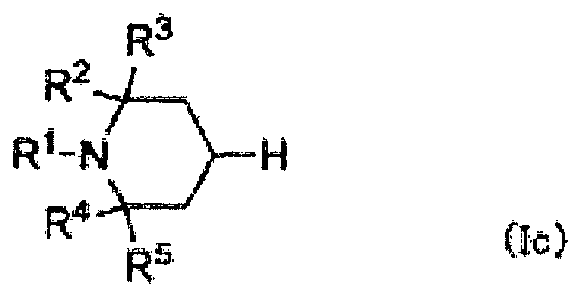
- A thermal-latent polymerization initiator, consisting of a composition according to any one of claims 1 to 6.
- A method for producing a polymer, comprising the steps of:,
mixing the thermal-latent polymerization initiator according to claim 7 with one monomer or not less than two monomers selected from an epoxy monomer, a cationically polymerizable monomer and an oligomer of an epoxy monomer and/or a cationically polymerizable monomer; and
heating the obtained mixture at not less than 50°C. - A curable composition, comprising the thermal-latent polymerization initiator according to claim 7, and one monomer or not less than two monomers selected from an epoxy monomer, a cationically polymerizable monomer and an oligomer of an epoxy monomer and/or a cationically polymerizable monomer.
Applications Claiming Priority (2)
| Application Number | Priority Date | Filing Date | Title |
|---|---|---|---|
| JP2010207120 | 2010-09-15 | ||
| PCT/JP2011/070885 WO2012036164A1 (en) | 2010-09-15 | 2011-09-13 | Composition usable as heat-latent polymerization initiator |
Publications (3)
| Publication Number | Publication Date |
|---|---|
| EP2617752A1 true EP2617752A1 (en) | 2013-07-24 |
| EP2617752A4 EP2617752A4 (en) | 2015-04-22 |
| EP2617752B1 EP2617752B1 (en) | 2018-07-25 |
Family
ID=45831623
Family Applications (1)
| Application Number | Title | Priority Date | Filing Date |
|---|---|---|---|
| EP11825164.4A Active EP2617752B1 (en) | 2010-09-15 | 2011-09-13 | Composition usable as thermal-latent polymerization initiator |
Country Status (4)
| Country | Link |
|---|---|
| EP (1) | EP2617752B1 (en) |
| JP (1) | JP5579859B2 (en) |
| CN (1) | CN103249755A (en) |
| WO (1) | WO2012036164A1 (en) |
Cited By (2)
| Publication number | Priority date | Publication date | Assignee | Title |
|---|---|---|---|---|
| JP2015152861A (en) * | 2014-02-18 | 2015-08-24 | 株式会社日本触媒 | Resin composition for lamination and application thereof |
| US20220204687A1 (en) * | 2019-04-09 | 2022-06-30 | Eneos Corporation | A curable composition and a cured product thereof |
Families Citing this family (8)
| Publication number | Priority date | Publication date | Assignee | Title |
|---|---|---|---|---|
| JP6001318B2 (en) * | 2012-05-07 | 2016-10-05 | 株式会社日本触媒 | Epoxy cured product |
| JP6001317B2 (en) * | 2012-05-07 | 2016-10-05 | 株式会社日本触媒 | Cationic curable resin composition |
| JP2013234231A (en) * | 2012-05-07 | 2013-11-21 | Nippon Shokubai Co Ltd | Cation-curable resin composition |
| JP6131062B2 (en) * | 2013-02-05 | 2017-05-17 | 株式会社日本触媒 | Curable resin composition, cured product thereof and optical material |
| JP6772685B2 (en) * | 2016-09-06 | 2020-10-21 | 三菱ケミカル株式会社 | Epoxy compounds, methods for producing epoxy compounds, epoxy compound-containing compositions and cured products thereof |
| JP7163078B2 (en) * | 2018-06-14 | 2022-10-31 | 株式会社日本触媒 | Compositions containing triarylboron compounds |
| JP7498587B2 (en) * | 2020-04-08 | 2024-06-12 | 株式会社日本触媒 | Thermal Latent Polymerization Initiator |
| CN121969667A (en) | 2023-10-10 | 2026-05-01 | 株式会社日本触媒 | Thermal latent cationic polymerization initiator, curable resin composition, and metal-bonded body |
Family Cites Families (8)
| Publication number | Priority date | Publication date | Assignee | Title |
|---|---|---|---|---|
| PL331526A1 (en) * | 1996-08-08 | 1999-07-19 | Dow Chemical Co | Metal complexes containing cyclopentadienyl substututed with a heteroatom at position 2 and method of polymerising olefins |
| FR2752582B1 (en) * | 1996-08-21 | 2003-06-13 | Rhone Poulenc Chimie | POLYORGANOSILOXANE COMPOSITIONS HAVING CROSS-LINKED FUNCTIONAL GROUPS AND THEIR USE FOR MAKING ANTI-ADHERENT COATINGS |
| US5844026A (en) * | 1997-06-30 | 1998-12-01 | Ciba Specialty Chemicals Corporation | N,N',N''-tris{2,4-bis Hydrocarbyloxy-2,2,6,6-tetra-methylpiperidin-4-yl)alkylamino!-s-triazin-6-yl}-3,3'-ethylenediiminodipropylamines, their isomers and bridged derivatives and polymer compositions stabilized therewith |
| JP4040792B2 (en) * | 1999-06-01 | 2008-01-30 | 株式会社日本触媒 | Cationic polymerization method and catalyst used therefor |
| MXPA03003962A (en) * | 2000-11-06 | 2004-04-02 | Exxonmobil Chem Patents Inc | Fluorinated zwitterionic cocatalyst activators for olefin polymerization. |
| FR2818553B1 (en) * | 2000-12-22 | 2003-02-07 | Rhodia Chimie Sa | DENTAL COMPOSITION BASED ON A CROSSLINKED FUNCTIONALIZED SILICONE AND / OR THERMALLY POLYMERIZABLE |
| US8048819B2 (en) * | 2005-06-23 | 2011-11-01 | Momentive Performance Materials Inc. | Cure catalyst, composition, electronic device and associated method |
| JP5527600B2 (en) * | 2009-10-07 | 2014-06-18 | 日立化成株式会社 | Epoxy resin composition and electronic component device using the same |
-
2011
- 2011-09-13 EP EP11825164.4A patent/EP2617752B1/en active Active
- 2011-09-13 JP JP2012534014A patent/JP5579859B2/en active Active
- 2011-09-13 WO PCT/JP2011/070885 patent/WO2012036164A1/en not_active Ceased
- 2011-09-13 CN CN2011800438792A patent/CN103249755A/en active Pending
Cited By (2)
| Publication number | Priority date | Publication date | Assignee | Title |
|---|---|---|---|---|
| JP2015152861A (en) * | 2014-02-18 | 2015-08-24 | 株式会社日本触媒 | Resin composition for lamination and application thereof |
| US20220204687A1 (en) * | 2019-04-09 | 2022-06-30 | Eneos Corporation | A curable composition and a cured product thereof |
Also Published As
| Publication number | Publication date |
|---|---|
| WO2012036164A1 (en) | 2012-03-22 |
| EP2617752A4 (en) | 2015-04-22 |
| CN103249755A (en) | 2013-08-14 |
| JPWO2012036164A1 (en) | 2014-02-03 |
| JP5579859B2 (en) | 2014-08-27 |
| EP2617752B1 (en) | 2018-07-25 |
Similar Documents
| Publication | Publication Date | Title |
|---|---|---|
| EP2617752B1 (en) | Composition usable as thermal-latent polymerization initiator | |
| KR102100099B1 (en) | Resin composition, stretched film , circularly polarizing plate, and image display device | |
| CN102250147B (en) | Preparation method and application of cyclotriphosphazene containing silicon functional groups | |
| US11440995B2 (en) | Method for preparing aliphatic polythioether | |
| CN1163546C (en) | Ion-conductive polymer electrolyte composition and ion-conductive solid polymer electrolyte | |
| CN107216354B (en) | Preparation method of hexafunctional epoxy resin based on cyclotriphosphazene | |
| Kim et al. | Synthesis and thermal analysis of crosslinked imidazolium-containing polyester networks prepared by Michael addition polymerization | |
| US10954446B2 (en) | Sorbitol, glucaric acid, and gluconic acid based flame-retardants | |
| CN104910327A (en) | Phosphorus-nitrogen cooperative flame-retardant epoxy polymer and preparation method thereof | |
| CN108250240A (en) | A kind of 626 synthesis technology of antioxidant | |
| JP2012224559A (en) | Rotaxane, crosslinking agent, crosslinking method, crosslinked polymer, and method of decomposing the crosslinked polymer | |
| Tanaka et al. | Design of metal salt/amide-based deep eutectic monomers toward sustainable production of ion-conductive polymers by radical polymerization | |
| US10611897B2 (en) | Arabitol and xylitol based flame retardants | |
| WO2022163360A1 (en) | Method for producing (meth)acyrlic acid ester compound | |
| US9879103B2 (en) | Initiation of controlled radical polymerization from lactide monomer | |
| JP2017132938A (en) | Fire retardant polyhydroxyurethane resin and fire retardant coated film | |
| US11884866B2 (en) | Flame retardant levulinic acid-based compounds | |
| CN105377911A (en) | Composition, curable composition, production method therefor, and cured product | |
| JP7498587B2 (en) | Thermal Latent Polymerization Initiator | |
| KR20140039015A (en) | Hyperbranched polyether compounds and method of preparing the same | |
| US10717930B2 (en) | Lysine and proline based flame retardants | |
| KR20200069042A (en) | Process for preparing indene derivative, process for preparing metallocene catalyst, process for olefin polymer using the same | |
| JP5504929B2 (en) | NOVEL COMPOUND, METHOD FOR SYNTHESIZING THE COMPOUND, ANTIOXIDANT, RESIN COMPOSITION, AND RESIN MOLDED BODY CONTAINING THE COMPOUND | |
| JP2013234207A (en) | New polymer and new n-carboxyamino acid anhydride, and method for producing them | |
| CN116462654A (en) | A kind of preparation method of cyclic ethylene carbonate compound |
Legal Events
| Date | Code | Title | Description |
|---|---|---|---|
| PUAI | Public reference made under article 153(3) epc to a published international application that has entered the european phase |
Free format text: ORIGINAL CODE: 0009012 |
|
| 17P | Request for examination filed |
Effective date: 20130314 |
|
| AK | Designated contracting states |
Kind code of ref document: A1 Designated state(s): AL AT BE BG CH CY CZ DE DK EE ES FI FR GB GR HR HU IE IS IT LI LT LU LV MC MK MT NL NO PL PT RO RS SE SI SK SM TR |
|
| DAX | Request for extension of the european patent (deleted) | ||
| RA4 | Supplementary search report drawn up and despatched (corrected) |
Effective date: 20150325 |
|
| RIC1 | Information provided on ipc code assigned before grant |
Ipc: C08F 4/54 20060101ALI20150319BHEP Ipc: C08G 59/68 20060101AFI20150319BHEP |
|
| 17Q | First examination report despatched |
Effective date: 20161028 |
|
| GRAP | Despatch of communication of intention to grant a patent |
Free format text: ORIGINAL CODE: EPIDOSNIGR1 |
|
| INTG | Intention to grant announced |
Effective date: 20180223 |
|
| GRAS | Grant fee paid |
Free format text: ORIGINAL CODE: EPIDOSNIGR3 |
|
| GRAA | (expected) grant |
Free format text: ORIGINAL CODE: 0009210 |
|
| AK | Designated contracting states |
Kind code of ref document: B1 Designated state(s): AL AT BE BG CH CY CZ DE DK EE ES FI FR GB GR HR HU IE IS IT LI LT LU LV MC MK MT NL NO PL PT RO RS SE SI SK SM TR |
|
| REG | Reference to a national code |
Ref country code: GB Ref legal event code: FG4D |
|
| REG | Reference to a national code |
Ref country code: CH Ref legal event code: EP |
|
| REG | Reference to a national code |
Ref country code: AT Ref legal event code: REF Ref document number: 1021684 Country of ref document: AT Kind code of ref document: T Effective date: 20180815 |
|
| REG | Reference to a national code |
Ref country code: DE Ref legal event code: R096 Ref document number: 602011050423 Country of ref document: DE |
|
| REG | Reference to a national code |
Ref country code: IE Ref legal event code: FG4D |
|
| REG | Reference to a national code |
Ref country code: NL Ref legal event code: MP Effective date: 20180725 |
|
| REG | Reference to a national code |
Ref country code: LT Ref legal event code: MG4D |
|
| PG25 | Lapsed in a contracting state [announced via postgrant information from national office to epo] |
Ref country code: NL Free format text: LAPSE BECAUSE OF FAILURE TO SUBMIT A TRANSLATION OF THE DESCRIPTION OR TO PAY THE FEE WITHIN THE PRESCRIBED TIME-LIMIT Effective date: 20180725 |
|
| REG | Reference to a national code |
Ref country code: AT Ref legal event code: MK05 Ref document number: 1021684 Country of ref document: AT Kind code of ref document: T Effective date: 20180725 |
|
| PG25 | Lapsed in a contracting state [announced via postgrant information from national office to epo] |
Ref country code: BG Free format text: LAPSE BECAUSE OF FAILURE TO SUBMIT A TRANSLATION OF THE DESCRIPTION OR TO PAY THE FEE WITHIN THE PRESCRIBED TIME-LIMIT Effective date: 20181025 Ref country code: SE Free format text: LAPSE BECAUSE OF FAILURE TO SUBMIT A TRANSLATION OF THE DESCRIPTION OR TO PAY THE FEE WITHIN THE PRESCRIBED TIME-LIMIT Effective date: 20180725 Ref country code: NO Free format text: LAPSE BECAUSE OF FAILURE TO SUBMIT A TRANSLATION OF THE DESCRIPTION OR TO PAY THE FEE WITHIN THE PRESCRIBED TIME-LIMIT Effective date: 20181025 Ref country code: AT Free format text: LAPSE BECAUSE OF FAILURE TO SUBMIT A TRANSLATION OF THE DESCRIPTION OR TO PAY THE FEE WITHIN THE PRESCRIBED TIME-LIMIT Effective date: 20180725 Ref country code: RS Free format text: LAPSE BECAUSE OF FAILURE TO SUBMIT A TRANSLATION OF THE DESCRIPTION OR TO PAY THE FEE WITHIN THE PRESCRIBED TIME-LIMIT Effective date: 20180725 Ref country code: GR Free format text: LAPSE BECAUSE OF FAILURE TO SUBMIT A TRANSLATION OF THE DESCRIPTION OR TO PAY THE FEE WITHIN THE PRESCRIBED TIME-LIMIT Effective date: 20181026 Ref country code: LT Free format text: LAPSE BECAUSE OF FAILURE TO SUBMIT A TRANSLATION OF THE DESCRIPTION OR TO PAY THE FEE WITHIN THE PRESCRIBED TIME-LIMIT Effective date: 20180725 Ref country code: IS Free format text: LAPSE BECAUSE OF FAILURE TO SUBMIT A TRANSLATION OF THE DESCRIPTION OR TO PAY THE FEE WITHIN THE PRESCRIBED TIME-LIMIT Effective date: 20181125 Ref country code: FI Free format text: LAPSE BECAUSE OF FAILURE TO SUBMIT A TRANSLATION OF THE DESCRIPTION OR TO PAY THE FEE WITHIN THE PRESCRIBED TIME-LIMIT Effective date: 20180725 Ref country code: PL Free format text: LAPSE BECAUSE OF FAILURE TO SUBMIT A TRANSLATION OF THE DESCRIPTION OR TO PAY THE FEE WITHIN THE PRESCRIBED TIME-LIMIT Effective date: 20180725 |
|
| PG25 | Lapsed in a contracting state [announced via postgrant information from national office to epo] |
Ref country code: LV Free format text: LAPSE BECAUSE OF FAILURE TO SUBMIT A TRANSLATION OF THE DESCRIPTION OR TO PAY THE FEE WITHIN THE PRESCRIBED TIME-LIMIT Effective date: 20180725 Ref country code: AL Free format text: LAPSE BECAUSE OF FAILURE TO SUBMIT A TRANSLATION OF THE DESCRIPTION OR TO PAY THE FEE WITHIN THE PRESCRIBED TIME-LIMIT Effective date: 20180725 Ref country code: HR Free format text: LAPSE BECAUSE OF FAILURE TO SUBMIT A TRANSLATION OF THE DESCRIPTION OR TO PAY THE FEE WITHIN THE PRESCRIBED TIME-LIMIT Effective date: 20180725 |
|
| REG | Reference to a national code |
Ref country code: DE Ref legal event code: R097 Ref document number: 602011050423 Country of ref document: DE |
|
| PG25 | Lapsed in a contracting state [announced via postgrant information from national office to epo] |
Ref country code: EE Free format text: LAPSE BECAUSE OF FAILURE TO SUBMIT A TRANSLATION OF THE DESCRIPTION OR TO PAY THE FEE WITHIN THE PRESCRIBED TIME-LIMIT Effective date: 20180725 Ref country code: IT Free format text: LAPSE BECAUSE OF FAILURE TO SUBMIT A TRANSLATION OF THE DESCRIPTION OR TO PAY THE FEE WITHIN THE PRESCRIBED TIME-LIMIT Effective date: 20180725 Ref country code: MC Free format text: LAPSE BECAUSE OF FAILURE TO SUBMIT A TRANSLATION OF THE DESCRIPTION OR TO PAY THE FEE WITHIN THE PRESCRIBED TIME-LIMIT Effective date: 20180725 Ref country code: ES Free format text: LAPSE BECAUSE OF FAILURE TO SUBMIT A TRANSLATION OF THE DESCRIPTION OR TO PAY THE FEE WITHIN THE PRESCRIBED TIME-LIMIT Effective date: 20180725 Ref country code: CZ Free format text: LAPSE BECAUSE OF FAILURE TO SUBMIT A TRANSLATION OF THE DESCRIPTION OR TO PAY THE FEE WITHIN THE PRESCRIBED TIME-LIMIT Effective date: 20180725 Ref country code: RO Free format text: LAPSE BECAUSE OF FAILURE TO SUBMIT A TRANSLATION OF THE DESCRIPTION OR TO PAY THE FEE WITHIN THE PRESCRIBED TIME-LIMIT Effective date: 20180725 |
|
| REG | Reference to a national code |
Ref country code: CH Ref legal event code: PL |
|
| PG25 | Lapsed in a contracting state [announced via postgrant information from national office to epo] |
Ref country code: DK Free format text: LAPSE BECAUSE OF FAILURE TO SUBMIT A TRANSLATION OF THE DESCRIPTION OR TO PAY THE FEE WITHIN THE PRESCRIBED TIME-LIMIT Effective date: 20180725 Ref country code: SM Free format text: LAPSE BECAUSE OF FAILURE TO SUBMIT A TRANSLATION OF THE DESCRIPTION OR TO PAY THE FEE WITHIN THE PRESCRIBED TIME-LIMIT Effective date: 20180725 Ref country code: SK Free format text: LAPSE BECAUSE OF FAILURE TO SUBMIT A TRANSLATION OF THE DESCRIPTION OR TO PAY THE FEE WITHIN THE PRESCRIBED TIME-LIMIT Effective date: 20180725 |
|
| PLBE | No opposition filed within time limit |
Free format text: ORIGINAL CODE: 0009261 |
|
| STAA | Information on the status of an ep patent application or granted ep patent |
Free format text: STATUS: NO OPPOSITION FILED WITHIN TIME LIMIT |
|
| REG | Reference to a national code |
Ref country code: BE Ref legal event code: MM Effective date: 20180930 |
|
| GBPC | Gb: european patent ceased through non-payment of renewal fee |
Effective date: 20181025 |
|
| REG | Reference to a national code |
Ref country code: IE Ref legal event code: MM4A |
|
| PG25 | Lapsed in a contracting state [announced via postgrant information from national office to epo] |
Ref country code: LU Free format text: LAPSE BECAUSE OF NON-PAYMENT OF DUE FEES Effective date: 20180913 |
|
| 26N | No opposition filed |
Effective date: 20190426 |
|
| PG25 | Lapsed in a contracting state [announced via postgrant information from national office to epo] |
Ref country code: IE Free format text: LAPSE BECAUSE OF NON-PAYMENT OF DUE FEES Effective date: 20180913 |
|
| PG25 | Lapsed in a contracting state [announced via postgrant information from national office to epo] |
Ref country code: CH Free format text: LAPSE BECAUSE OF NON-PAYMENT OF DUE FEES Effective date: 20180930 Ref country code: FR Free format text: LAPSE BECAUSE OF NON-PAYMENT OF DUE FEES Effective date: 20180925 Ref country code: LI Free format text: LAPSE BECAUSE OF NON-PAYMENT OF DUE FEES Effective date: 20180930 Ref country code: SI Free format text: LAPSE BECAUSE OF FAILURE TO SUBMIT A TRANSLATION OF THE DESCRIPTION OR TO PAY THE FEE WITHIN THE PRESCRIBED TIME-LIMIT Effective date: 20180725 Ref country code: BE Free format text: LAPSE BECAUSE OF NON-PAYMENT OF DUE FEES Effective date: 20180930 |
|
| PG25 | Lapsed in a contracting state [announced via postgrant information from national office to epo] |
Ref country code: GB Free format text: LAPSE BECAUSE OF NON-PAYMENT OF DUE FEES Effective date: 20181025 |
|
| PG25 | Lapsed in a contracting state [announced via postgrant information from national office to epo] |
Ref country code: MT Free format text: LAPSE BECAUSE OF NON-PAYMENT OF DUE FEES Effective date: 20180913 |
|
| PG25 | Lapsed in a contracting state [announced via postgrant information from national office to epo] |
Ref country code: TR Free format text: LAPSE BECAUSE OF FAILURE TO SUBMIT A TRANSLATION OF THE DESCRIPTION OR TO PAY THE FEE WITHIN THE PRESCRIBED TIME-LIMIT Effective date: 20180725 |
|
| PG25 | Lapsed in a contracting state [announced via postgrant information from national office to epo] |
Ref country code: HU Free format text: LAPSE BECAUSE OF FAILURE TO SUBMIT A TRANSLATION OF THE DESCRIPTION OR TO PAY THE FEE WITHIN THE PRESCRIBED TIME-LIMIT; INVALID AB INITIO Effective date: 20110913 Ref country code: PT Free format text: LAPSE BECAUSE OF FAILURE TO SUBMIT A TRANSLATION OF THE DESCRIPTION OR TO PAY THE FEE WITHIN THE PRESCRIBED TIME-LIMIT Effective date: 20180725 |
|
| PG25 | Lapsed in a contracting state [announced via postgrant information from national office to epo] |
Ref country code: CY Free format text: LAPSE BECAUSE OF FAILURE TO SUBMIT A TRANSLATION OF THE DESCRIPTION OR TO PAY THE FEE WITHIN THE PRESCRIBED TIME-LIMIT Effective date: 20180725 Ref country code: MK Free format text: LAPSE BECAUSE OF NON-PAYMENT OF DUE FEES Effective date: 20180725 |
|
| PGFP | Annual fee paid to national office [announced via postgrant information from national office to epo] |
Ref country code: DE Payment date: 20250730 Year of fee payment: 15 |