EP2617712A1 - Nitrogen-containing aromatic heterocyclic derivative and organic electroluminescence device using same - Google Patents
Nitrogen-containing aromatic heterocyclic derivative and organic electroluminescence device using same Download PDFInfo
- Publication number
- EP2617712A1 EP2617712A1 EP11802255.7A EP11802255A EP2617712A1 EP 2617712 A1 EP2617712 A1 EP 2617712A1 EP 11802255 A EP11802255 A EP 11802255A EP 2617712 A1 EP2617712 A1 EP 2617712A1
- Authority
- EP
- European Patent Office
- Prior art keywords
- group
- carbon atoms
- substituted
- ring
- unsubstituted
- Prior art date
- Legal status (The legal status is an assumption and is not a legal conclusion. Google has not performed a legal analysis and makes no representation as to the accuracy of the status listed.)
- Withdrawn
Links
- 0 CCC(C)N=[C@]=C1C=CC=C[C@](CC)/C=C/*1 Chemical compound CCC(C)N=[C@]=C1C=CC=C[C@](CC)/C=C/*1 0.000 description 12
- WUIRAUMKMAWGGQ-UHFFFAOYSA-N Cc1cc(-c2ccccc2)c(ccc2c3nc(C)cc2C2=CCCC=C2)c3n1 Chemical compound Cc1cc(-c2ccccc2)c(ccc2c3nc(C)cc2C2=CCCC=C2)c3n1 WUIRAUMKMAWGGQ-UHFFFAOYSA-N 0.000 description 1
Classifications
-
- H—ELECTRICITY
- H10—SEMICONDUCTOR DEVICES; ELECTRIC SOLID-STATE DEVICES NOT OTHERWISE PROVIDED FOR
- H10K—ORGANIC ELECTRIC SOLID-STATE DEVICES
- H10K85/00—Organic materials used in the body or electrodes of devices covered by this subclass
- H10K85/60—Organic compounds having low molecular weight
- H10K85/649—Aromatic compounds comprising a hetero atom
- H10K85/657—Polycyclic condensed heteroaromatic hydrocarbons
- H10K85/6572—Polycyclic condensed heteroaromatic hydrocarbons comprising only nitrogen in the heteroaromatic polycondensed ring system, e.g. phenanthroline or carbazole
-
- C—CHEMISTRY; METALLURGY
- C07—ORGANIC CHEMISTRY
- C07D—HETEROCYCLIC COMPOUNDS
- C07D209/00—Heterocyclic compounds containing five-membered rings, condensed with other rings, with one nitrogen atom as the only ring hetero atom
- C07D209/56—Ring systems containing three or more rings
- C07D209/80—[b, c]- or [b, d]-condensed
- C07D209/82—Carbazoles; Hydrogenated carbazoles
- C07D209/86—Carbazoles; Hydrogenated carbazoles with only hydrogen atoms, hydrocarbon or substituted hydrocarbon radicals, directly attached to carbon atoms of the ring system
-
- C—CHEMISTRY; METALLURGY
- C07—ORGANIC CHEMISTRY
- C07D—HETEROCYCLIC COMPOUNDS
- C07D219/00—Heterocyclic compounds containing acridine or hydrogenated acridine ring systems
- C07D219/02—Heterocyclic compounds containing acridine or hydrogenated acridine ring systems with only hydrogen, hydrocarbon or substituted hydrocarbon radicals, directly attached to carbon atoms of the ring system
-
- C—CHEMISTRY; METALLURGY
- C07—ORGANIC CHEMISTRY
- C07D—HETEROCYCLIC COMPOUNDS
- C07D401/00—Heterocyclic compounds containing two or more hetero rings, having nitrogen atoms as the only ring hetero atoms, at least one ring being a six-membered ring with only one nitrogen atom
- C07D401/14—Heterocyclic compounds containing two or more hetero rings, having nitrogen atoms as the only ring hetero atoms, at least one ring being a six-membered ring with only one nitrogen atom containing three or more hetero rings
-
- C—CHEMISTRY; METALLURGY
- C07—ORGANIC CHEMISTRY
- C07D—HETEROCYCLIC COMPOUNDS
- C07D403/00—Heterocyclic compounds containing two or more hetero rings, having nitrogen atoms as the only ring hetero atoms, not provided for by group C07D401/00
- C07D403/14—Heterocyclic compounds containing two or more hetero rings, having nitrogen atoms as the only ring hetero atoms, not provided for by group C07D401/00 containing three or more hetero rings
-
- C—CHEMISTRY; METALLURGY
- C07—ORGANIC CHEMISTRY
- C07D—HETEROCYCLIC COMPOUNDS
- C07D405/00—Heterocyclic compounds containing both one or more hetero rings having oxygen atoms as the only ring hetero atoms, and one or more rings having nitrogen as the only ring hetero atom
- C07D405/14—Heterocyclic compounds containing both one or more hetero rings having oxygen atoms as the only ring hetero atoms, and one or more rings having nitrogen as the only ring hetero atom containing three or more hetero rings
-
- C—CHEMISTRY; METALLURGY
- C09—DYES; PAINTS; POLISHES; NATURAL RESINS; ADHESIVES; COMPOSITIONS NOT OTHERWISE PROVIDED FOR; APPLICATIONS OF MATERIALS NOT OTHERWISE PROVIDED FOR
- C09B—ORGANIC DYES OR CLOSELY-RELATED COMPOUNDS FOR PRODUCING DYES, e.g. PIGMENTS; MORDANTS; LAKES
- C09B15/00—Acridine dyes
-
- C—CHEMISTRY; METALLURGY
- C09—DYES; PAINTS; POLISHES; NATURAL RESINS; ADHESIVES; COMPOSITIONS NOT OTHERWISE PROVIDED FOR; APPLICATIONS OF MATERIALS NOT OTHERWISE PROVIDED FOR
- C09B—ORGANIC DYES OR CLOSELY-RELATED COMPOUNDS FOR PRODUCING DYES, e.g. PIGMENTS; MORDANTS; LAKES
- C09B17/00—Azine dyes
-
- C—CHEMISTRY; METALLURGY
- C09—DYES; PAINTS; POLISHES; NATURAL RESINS; ADHESIVES; COMPOSITIONS NOT OTHERWISE PROVIDED FOR; APPLICATIONS OF MATERIALS NOT OTHERWISE PROVIDED FOR
- C09B—ORGANIC DYES OR CLOSELY-RELATED COMPOUNDS FOR PRODUCING DYES, e.g. PIGMENTS; MORDANTS; LAKES
- C09B19/00—Oxazine dyes
-
- C—CHEMISTRY; METALLURGY
- C09—DYES; PAINTS; POLISHES; NATURAL RESINS; ADHESIVES; COMPOSITIONS NOT OTHERWISE PROVIDED FOR; APPLICATIONS OF MATERIALS NOT OTHERWISE PROVIDED FOR
- C09B—ORGANIC DYES OR CLOSELY-RELATED COMPOUNDS FOR PRODUCING DYES, e.g. PIGMENTS; MORDANTS; LAKES
- C09B21/00—Thiazine dyes
-
- C—CHEMISTRY; METALLURGY
- C09—DYES; PAINTS; POLISHES; NATURAL RESINS; ADHESIVES; COMPOSITIONS NOT OTHERWISE PROVIDED FOR; APPLICATIONS OF MATERIALS NOT OTHERWISE PROVIDED FOR
- C09B—ORGANIC DYES OR CLOSELY-RELATED COMPOUNDS FOR PRODUCING DYES, e.g. PIGMENTS; MORDANTS; LAKES
- C09B57/00—Other synthetic dyes of known constitution
-
- C—CHEMISTRY; METALLURGY
- C09—DYES; PAINTS; POLISHES; NATURAL RESINS; ADHESIVES; COMPOSITIONS NOT OTHERWISE PROVIDED FOR; APPLICATIONS OF MATERIALS NOT OTHERWISE PROVIDED FOR
- C09K—MATERIALS FOR MISCELLANEOUS APPLICATIONS, NOT PROVIDED FOR ELSEWHERE
- C09K11/00—Luminescent materials, e.g. electroluminescent or chemiluminescent
- C09K11/06—Luminescent materials, e.g. electroluminescent or chemiluminescent containing organic luminescent materials
-
- H—ELECTRICITY
- H05—ELECTRIC TECHNIQUES NOT OTHERWISE PROVIDED FOR
- H05B—ELECTRIC HEATING; ELECTRIC LIGHT SOURCES NOT OTHERWISE PROVIDED FOR; CIRCUIT ARRANGEMENTS FOR ELECTRIC LIGHT SOURCES, IN GENERAL
- H05B33/00—Electroluminescent light sources
- H05B33/12—Light sources with substantially two-dimensional [2D] radiating surfaces
- H05B33/14—Light sources with substantially two-dimensional [2D] radiating surfaces characterised by the chemical or physical composition or the arrangement of the electroluminescent material, or by the simultaneous addition of the electroluminescent material in or onto the light source
-
- H—ELECTRICITY
- H05—ELECTRIC TECHNIQUES NOT OTHERWISE PROVIDED FOR
- H05B—ELECTRIC HEATING; ELECTRIC LIGHT SOURCES NOT OTHERWISE PROVIDED FOR; CIRCUIT ARRANGEMENTS FOR ELECTRIC LIGHT SOURCES, IN GENERAL
- H05B33/00—Electroluminescent light sources
- H05B33/12—Light sources with substantially two-dimensional [2D] radiating surfaces
- H05B33/20—Light sources with substantially two-dimensional [2D] radiating surfaces characterised by the chemical or physical composition or the arrangement of the material in which the electroluminescent material is embedded
-
- H—ELECTRICITY
- H10—SEMICONDUCTOR DEVICES; ELECTRIC SOLID-STATE DEVICES NOT OTHERWISE PROVIDED FOR
- H10K—ORGANIC ELECTRIC SOLID-STATE DEVICES
- H10K50/00—Organic light-emitting devices
- H10K50/10—OLEDs or polymer light-emitting diodes [PLED]
- H10K50/11—OLEDs or polymer light-emitting diodes [PLED] characterised by the electroluminescent [EL] layers
-
- H—ELECTRICITY
- H10—SEMICONDUCTOR DEVICES; ELECTRIC SOLID-STATE DEVICES NOT OTHERWISE PROVIDED FOR
- H10K—ORGANIC ELECTRIC SOLID-STATE DEVICES
- H10K85/00—Organic materials used in the body or electrodes of devices covered by this subclass
- H10K85/60—Organic compounds having low molecular weight
- H10K85/649—Aromatic compounds comprising a hetero atom
- H10K85/657—Polycyclic condensed heteroaromatic hydrocarbons
-
- C—CHEMISTRY; METALLURGY
- C09—DYES; PAINTS; POLISHES; NATURAL RESINS; ADHESIVES; COMPOSITIONS NOT OTHERWISE PROVIDED FOR; APPLICATIONS OF MATERIALS NOT OTHERWISE PROVIDED FOR
- C09K—MATERIALS FOR MISCELLANEOUS APPLICATIONS, NOT PROVIDED FOR ELSEWHERE
- C09K2211/00—Chemical nature of organic luminescent or tenebrescent compounds
- C09K2211/10—Non-macromolecular compounds
- C09K2211/1003—Carbocyclic compounds
- C09K2211/1007—Non-condensed systems
-
- C—CHEMISTRY; METALLURGY
- C09—DYES; PAINTS; POLISHES; NATURAL RESINS; ADHESIVES; COMPOSITIONS NOT OTHERWISE PROVIDED FOR; APPLICATIONS OF MATERIALS NOT OTHERWISE PROVIDED FOR
- C09K—MATERIALS FOR MISCELLANEOUS APPLICATIONS, NOT PROVIDED FOR ELSEWHERE
- C09K2211/00—Chemical nature of organic luminescent or tenebrescent compounds
- C09K2211/10—Non-macromolecular compounds
- C09K2211/1018—Heterocyclic compounds
- C09K2211/1025—Heterocyclic compounds characterised by ligands
- C09K2211/1029—Heterocyclic compounds characterised by ligands containing one nitrogen atom as the heteroatom
-
- C—CHEMISTRY; METALLURGY
- C09—DYES; PAINTS; POLISHES; NATURAL RESINS; ADHESIVES; COMPOSITIONS NOT OTHERWISE PROVIDED FOR; APPLICATIONS OF MATERIALS NOT OTHERWISE PROVIDED FOR
- C09K—MATERIALS FOR MISCELLANEOUS APPLICATIONS, NOT PROVIDED FOR ELSEWHERE
- C09K2211/00—Chemical nature of organic luminescent or tenebrescent compounds
- C09K2211/10—Non-macromolecular compounds
- C09K2211/1018—Heterocyclic compounds
- C09K2211/1025—Heterocyclic compounds characterised by ligands
- C09K2211/1029—Heterocyclic compounds characterised by ligands containing one nitrogen atom as the heteroatom
- C09K2211/1033—Heterocyclic compounds characterised by ligands containing one nitrogen atom as the heteroatom with oxygen
-
- C—CHEMISTRY; METALLURGY
- C09—DYES; PAINTS; POLISHES; NATURAL RESINS; ADHESIVES; COMPOSITIONS NOT OTHERWISE PROVIDED FOR; APPLICATIONS OF MATERIALS NOT OTHERWISE PROVIDED FOR
- C09K—MATERIALS FOR MISCELLANEOUS APPLICATIONS, NOT PROVIDED FOR ELSEWHERE
- C09K2211/00—Chemical nature of organic luminescent or tenebrescent compounds
- C09K2211/10—Non-macromolecular compounds
- C09K2211/1018—Heterocyclic compounds
- C09K2211/1025—Heterocyclic compounds characterised by ligands
- C09K2211/1029—Heterocyclic compounds characterised by ligands containing one nitrogen atom as the heteroatom
- C09K2211/1037—Heterocyclic compounds characterised by ligands containing one nitrogen atom as the heteroatom with sulfur
-
- C—CHEMISTRY; METALLURGY
- C09—DYES; PAINTS; POLISHES; NATURAL RESINS; ADHESIVES; COMPOSITIONS NOT OTHERWISE PROVIDED FOR; APPLICATIONS OF MATERIALS NOT OTHERWISE PROVIDED FOR
- C09K—MATERIALS FOR MISCELLANEOUS APPLICATIONS, NOT PROVIDED FOR ELSEWHERE
- C09K2211/00—Chemical nature of organic luminescent or tenebrescent compounds
- C09K2211/10—Non-macromolecular compounds
- C09K2211/1018—Heterocyclic compounds
- C09K2211/1025—Heterocyclic compounds characterised by ligands
- C09K2211/1044—Heterocyclic compounds characterised by ligands containing two nitrogen atoms as heteroatoms
-
- C—CHEMISTRY; METALLURGY
- C09—DYES; PAINTS; POLISHES; NATURAL RESINS; ADHESIVES; COMPOSITIONS NOT OTHERWISE PROVIDED FOR; APPLICATIONS OF MATERIALS NOT OTHERWISE PROVIDED FOR
- C09K—MATERIALS FOR MISCELLANEOUS APPLICATIONS, NOT PROVIDED FOR ELSEWHERE
- C09K2211/00—Chemical nature of organic luminescent or tenebrescent compounds
- C09K2211/10—Non-macromolecular compounds
- C09K2211/1018—Heterocyclic compounds
- C09K2211/1025—Heterocyclic compounds characterised by ligands
- C09K2211/1088—Heterocyclic compounds characterised by ligands containing oxygen as the only heteroatom
-
- C—CHEMISTRY; METALLURGY
- C09—DYES; PAINTS; POLISHES; NATURAL RESINS; ADHESIVES; COMPOSITIONS NOT OTHERWISE PROVIDED FOR; APPLICATIONS OF MATERIALS NOT OTHERWISE PROVIDED FOR
- C09K—MATERIALS FOR MISCELLANEOUS APPLICATIONS, NOT PROVIDED FOR ELSEWHERE
- C09K2211/00—Chemical nature of organic luminescent or tenebrescent compounds
- C09K2211/10—Non-macromolecular compounds
- C09K2211/1018—Heterocyclic compounds
- C09K2211/1025—Heterocyclic compounds characterised by ligands
- C09K2211/1092—Heterocyclic compounds characterised by ligands containing sulfur as the only heteroatom
-
- H—ELECTRICITY
- H10—SEMICONDUCTOR DEVICES; ELECTRIC SOLID-STATE DEVICES NOT OTHERWISE PROVIDED FOR
- H10K—ORGANIC ELECTRIC SOLID-STATE DEVICES
- H10K85/00—Organic materials used in the body or electrodes of devices covered by this subclass
- H10K85/30—Coordination compounds
- H10K85/341—Transition metal complexes, e.g. Ru(II)polypyridine complexes
- H10K85/342—Transition metal complexes, e.g. Ru(II)polypyridine complexes comprising iridium
-
- H—ELECTRICITY
- H10—SEMICONDUCTOR DEVICES; ELECTRIC SOLID-STATE DEVICES NOT OTHERWISE PROVIDED FOR
- H10K—ORGANIC ELECTRIC SOLID-STATE DEVICES
- H10K85/00—Organic materials used in the body or electrodes of devices covered by this subclass
- H10K85/60—Organic compounds having low molecular weight
- H10K85/631—Amine compounds having at least two aryl rest on at least one amine-nitrogen atom, e.g. triphenylamine
Definitions
- the invention relates to a nitrogen-containing aromatic heterocyclic derivative and an organic electroluminescence device using the same.
- organic electroluminescence device is a promising solid-state emitting type inexpensive and large full-color display device, and has been extensively developed.
- an organic EL device includes an emitting layer and a pair of opposing electrodes holding the emitting layer therebetween. When an electric field is applied between the electrodes, electrons are injected from a cathode and holes are injected from an anode. The electrons recombine with the holes in the emitting layer to produce an excited state, and energy is emitted as light when the excited state returns to the ground state.
- a phosphorescent organic EL device has been proposed wherein an organic phosphorescent material is used for an emitting layer of the organic EL device.
- the phosphorescent organic EL device high luminous efficiency is achieved by utilizing a singlet state and a triplet state of the excited state of the organic phosphorescent material.
- an electron and a hole are recombined in the organic EL device, since it is believed that singlet exciton and triplet exciton are generated at a rate of 1:3 due to the difference in spin multiplicity, three to four times greater luminous efficiency is considered to be achieved if a phosphorescent emitting material is used, in comparison with a device using a fluorescent material only.
- Patent Document 1 discloses a biscarbazole derivative which can be used as a hole-transporting material. This biscarbazole skeleton has a function to improve heat resistance.
- Patent Document 2 discloses a biscarbazole derivative which can be used as a phosphorescent emitting host material.
- Patent Documents 3 and 4 disclose compounds having carbazole, dibenzofuran, and dibenzothiophene skeletons for a phosphorescent emitting host material.
- Patent Document 1 describes that a biscarbazole derivative is a hole-transporting material having high Tg and excellent heat resistance, there is no description suggesting a combination with a phosphorescent emitting layer.
- a biscarbazole derivative is used as a phosphorescent emitting host material, and there is concern that luminous efficiency will significantly be deteriorated.
- Patent Document 3 and Patent Document 4 describe derivatives having carbazole, dibenzofuran, and dibenzothiophene skeletons as a phosphorescent emitting host material, they do not suggest a function as a hole-transporting material.
- An object of the invention is to provide a novel compound which can be used for an organic EL device. Another object of the invention is to provide an organic EL device which has high luminous efficiency and a long life time, and which can be driven at a low voltage.
- a novel compound which can be used for an organic EL device can be provided.
- the compound of the invention is used for a host-transporting material and the like, an organic EL device having high luminous efficiency, low-voltage driving, and a long life time can be achieved.
- the nitrogen-containing aromatic heterocyclic derivative of the invention is represented by the following formula (1):
- X 1 to X 3 are independently a single bond, CRaRb, NRc, an oxygen atom or a sulfur atom.
- Ra, Rb and Rc are independently a linear or branched alkyl group having 1 to 15 carbon atoms, a cycloalkyl group having 3 to 15 carbon atoms, an aryl group having 6 to 20 ring carbon atoms or a heteroaryl group having 5 to 20 ring atoms.
- Ar a , Ar b and Arc are independently a substituted or unsubstituted aryl group having 6 to 20 ring carbon atoms or a substituted or unsubstituted heteroaryl group having 5 to 20 ring atoms.
- Ar a , Ar b and Arc is an aryl group having 6 to 20 ring carbon atoms substituted with a heteroaryl group, an aryloxy group or a heteroaryloxy group, or a substituted or unsubstituted heteroaryl group having 5 to 20 ring atoms.
- a substituent of Ar a , Ar b and Ar c includes a linear or branched alkyl group having 1 to 15 carbon atoms, a cycloalkyl group having 3 to 15 carbon atoms, a substituted or unsubstituted silyl group, an aryl group having 6 to 20 ring carbon atoms, a heteroaryl group having 5 to 20 ring atoms, a halogen atom or a cyano group.
- R 1 to R 6 are independently a linear or branched alkyl group having 1 to 15 carbon atoms, a cycloalkyl group having 3 to 15 carbon atoms, a substituted or unsubstituted silyl group, an aryl group having 6 to 20 ring carbon atoms, a heteroaryl group having 5 to 20 ring atoms, a halogen atom or a cyano group.
- Two adjacent groups of R 1 to R 6 may be saturated or unsaturated divalent groups that are bonded each other to form a ring.
- a and f are independently an integer of 0 to 4.
- b, c, d and e are independently an integer of 0 to 3.
- the "ring carbon atom” means a carbon atom which constitutes a saturated ring, an unsaturated ring or an aromatic ring.
- the "ring atom” means a carbon atom or a hetero atom which constitutes these rings.
- the "unsubstituted” means a substitution with a hydrogen atom, and the hydrogen atom of the invention includes light hydrogen, deuterium and tritiated hydrogen.
- the aryl group includes a monocyclic aromatic hydrocarbon ring (also referred to simply as an aromatic hydrocarbon ring) and a fused aromatic hydrocarbon ring.
- the heteroaryl group includes a monocyclic aromatic heterocyclic ring (also referred to simply as an aromatic heterocyclic ring) and a fused aromatic heterocyclic ring.
- the aryl group and the heteroaryl group are one monocyclic ring or one fused ring.
- the nitrogen-containing aromatic heterocyclic derivative of the invention is characterized in having the structure wherein three nitrogen-containing aromatic heterocyclic rings are connected each other via an endocyclic benzene ring.
- an unshared electron pair of nitrogen atom in the heterocyclic ring has an electron-donating effect due to its existing in the same planar surface as the endocyclic benzene ring. Therefore, the nitrogen-containing aromatic heterocyclic ring functions as an electron-donating substituent and increases an electron density in the whole molecule.
- X 1 to X 3 which are the cites for crosslinking benzene rings in the nitrogen-containing aromatic heterocyclic ring, are any of CRaRb (C is a carbon atom), NRc (N is a nitrogen atom), an oxygen atom and a sulfur atom, an electron density in the ring is increased and lp is decreased compared with the case where they are single bonds.
- the nitrogen-containing aromatic heterocyclic derivative of the invention has increased singlet energy gap and triplet energy gap as a result of being constituted with nitrogen-containing aromatic heterocyclic rings only, compared with the conventional hole-transporting material having a triphenylamine structure such as NPD and the like. Therefore, use of the derivative as a hole-transporting material in contact with an emitting layer enables charge and exciton to be effectively enclosed within the emitting layer, thereby improving luminous efficiency. In particular, since triplet energy gap is greater, the derivative can be used effectively in combination with a phosphorescent emitting layer. Further, the nitrogen-containing aromatic heterocyclic derivative of the invention can be used for a phosphorescent host. In addition, since singlet energy gap is greater, Af (affinity) is reduced and electron resistance is improved, and therefore, a life time of the organic EL device can be improved.
- the nitrogen-containing aromatic heterocyclic derivative of the invention is preferably represented by the following formula (2):
- X 2 , R 1 to R 6 , Ar a , Ar b , Arc and a to f are the same as those in the formula (1).
- X 2 is a single bond
- at least one of Ar a , Ar b and Ar c is an aryl group having 6 to 20 ring carbon atoms substituted with a heteroaryl group, an aryloxy group or a heteroaryloxy group, or a substituted or unsubstituted heteroaryl group having 5 to 20 ring atoms.
- the nitrogen-containing aromatic heterocyclic derivative of the invention is more preferably represented by the following formula (3):
- R 1 to R 6 , Ar a , Ar b , Arc and a to f are the same as those in the formula (1).
- At least one of Ar a , Ar b and Ar c is an aryl group having 6 to 20 ring carbon atoms substituted with a heteroaryl group, an aryloxy group or a heteroaryloxy group, or a substituted or unsubstituted heteroaryl group having 5 to 20 ring atoms.
- the nitrogen-containing aromatic heterocyclic derivative of the invention is more preferably represented by the following formula (4):
- R 1 to R 6 , Ar a , Ar b , Arc and a to f are the same as those in the formula (1).
- At least one of Ar a , Ar b and Ar c is an aryl group having 6 to 20 ring carbon atoms substituted with a heteroaryl group, an aryloxy group or a heteroaryloxy group, or a substituted or unsubstituted heteroaryl group having 5 to 20 ring atoms.
- Ar a , Ar b and Ar c are preferably independently a phenyl group or a group represented by any of the following formulas (5-1) to (5-3), except for a case that all of Ar a , Ar b and Arc is a phenyl group.
- Ar a and Arc be a phenyl group and Ar b be any of the following formulas (5-1) to (5-3) (more preferably the formula (5-3)).
- R 7 and R 8 are independently a linear or branched alkyl group having 1 to 15 carbon atoms, a cycloalkyl group having 3 to 15 carbon atoms, a substituted or unsubstituted silyl group, an aryl group having 6 to 20 ring carbon atoms, a heteroaryl group having 5 to 20 ring atoms, a halogen atom or a cyano group.
- Two adjacent R 7 and R 8 may be saturated or unsaturated divalent groups that are bonded each other to form a ring.
- Y 1 is an oxygen atom, a sulfur atom or NRd.
- Rd is a substituted or unsubstituted aryl group having 6 to 20 ring carbon atoms, or a substituted or unsubstituted heteroaryl group having 5 to 20 ring atoms.
- a substituent of Rd is a linear or branched alkyl group having 1 to 15 carbon atoms, a cycloalkyl group having 3 to 15 carbon atoms, a substituted or unsubstituted silyl group, an aryl group having 6 to 20 ring carbon atoms, a heteroaryl group having 5 to 20 ring atoms, a halogen atom or a cyano group.
- L 1 is a single bond, a substituted or unsubstituted arylene group having 6 to 20 ring carbon atoms, or a substituted or unsubstituted heteroarylene group having 5 to 20 ring atoms.
- h is an integer of 0 to 4
- g is an integer of 0 to 3
- i is an integer of 0 to 6.
- alkyl group a methyl group, an ethyl group, a propyl group, an isopropyl group, a n-butyl group, a s-butyl group, an isobutyl group, a t-butyl group, a n-pentyl group, a n-hexyl group, a n-heptyl group, a n-octyl group and the like can be given.
- the alkyl group preferably has 1 to 15 carbon atoms, more preferably 1 to 10 carbon atoms, and further preferably 1 to 6 carbon atoms.
- a methyl group, an ethyl group, a propyl group, an isopropyl group, a n-butyl group, a s-butyl group, an isobutyl group, a t-butyl group, a n-pentyl group and a n-hexyl group are preferable.
- cycloalkyl group a cyclopropyl group, a cyclobutyl group, a cyclopentyl group, a cyclohexyl group, an adamantyl group, a norbornyl group and the like can be given.
- the cycloalkyl group prefarably has 3 to 10 ring carbon atoms, and more preferably 3 to 8 ring carbon atoms.
- aryl group a phenyl group, a 1-naphthyl group, a 2-naphthyl group, a 1-anthryl group, a 2-anthryl group, a 9-anthryl group, a 1-phenanthryl group, a 2-phenanthryl group, a 3-phenanthryl group, a 4-phenanthryl group, a 9-phenanthryl group, a naphthacenyl group, a pyrenyl group, a chrysenyl group, a benzo[c]phenanthryl group, a benzo[g]chrysenyl group, a triphenylenyl group, a 1-fluorenyl group, a 2-fluorenyl group, a 3-fluorenyl group, a 4-fluorenyl group, a 9-fluorenyl group, a benzofluorenyl group, a dibenzofluorenyl group,
- arylene group a divalent group corresponding to each of the above aryl groups can be given.
- the aryl group preferably has 6 to 20 ring carbon atoms, and more preferably 6 to 12 ring carbon atoms.
- a phenyl group, a biphenyl group, a tolyl group, a xylyl group and a 1-naphthyl group are particularly preferable.
- the heteroaryl group preferably has 5 to 20 ring atoms, and more preferably 5 to 14 ring atoms.
- the heteroaryl group is a 1-dibenzofuranyl group, a 2-dibenzofuranyl group, a 3-dibenzofuranyl group, a 4-dibenzofuranyl group, a 1-dibenzothiophenyl group, a 2-dibenzothiophenyl group, a 3-dibenzothiophenyl group, a 4-dibenzothiophenyl group, a 1-carbazolyl group, a 2-carbazolyl group, a 3-carbazolyl group, a 4-carbazolyl group, or a 9-carbazolyl group.
- an alkylsilyl group having 3 to 30 carbon atoms for example, a trialkylsilyl group having 3 to 10 carbon atoms
- an arylsilyl group having 8 to 30 carbon atoms for example, a triarylsilyl group having 18 to 30 carbon atoms
- an alkylarylsilyl group having 8 to 15 carbon atoms (the ring carbon atoms of the aryl part can be 6 to 14)
- a trimethylsilyl group, a triethylsilyl group, a t-butyldimethylsilyl group, a vinyldimethylsilyl group, a propyldimethylsilyl group, a triisopropylsilyl group, a triphenylsilyl group and the like can be given.
- halogen atom fluorine, chlorine, bromine, iodine and the like can be given, and the halogen atom is preferably a fluorine atom.
- the aryloxy group is represented by -OZ, and examples of Z are the same as those of the aryl group.
- the aryl group contained in the aryloxy group preferably has 6 to 20 ring carbon atoms, and more preferably 6 to 12 ring carbon atoms.
- a phenyl group, a biphenyl group, a tolyl group, a xylyl group and a 1-naphthyl group are particularly preferable.
- the heteroaryloxy group is represented by -OY, and examples of Y are the same as those of the heteroaryl group.
- the heteroaryl group contained in the heteroaryloxy group preferably has 5 to 20 ring atoms, and more preferably 5 to 14 ring atoms.
- a 1-dibenzofuranyl group, a 2-dibenzofuranyl group, a 3-dibenzofuranyl group, a 4-dibenzofuranyl group, a 1-dibenzothiophenyl group, a 2-dibenzothiophenyl group, a 3-dibenzothiophenyl, and a 4-dibenzothiophenyl group are particularly preferable.
- aryl group having 6 to 20 carbon atoms substituted with an aryloxy group a phenoxyphenyl group, a phenoxynaphthyl group, a naphthoxyphenyl group, a biphenyloxyphenyl group and the like can be given.
- aryl group having 6 to 20 carbon atoms substituted with an heteroaryloxy group a dibenzofuran-1-yloxyphenyl group, a dibenzofuran-2-yloxyphenyl group, a dibenzofuran-3-yloxyphenyl group, a dibenzofuran-4-yloxyphenyl group, a dibenzothiophen-1-yloxyphenyl group, a dibenzothiophen-2-yloxyphenyl group, a dibenzothiophen-3-yloxyphenyl group, a dibenzothiophen-4-yloxyphenyl group, a benzofuran-2-yloxyphenyl group, a benzofuran-3-yloxyphenyl group, a benzothiophen-2-yloxyphenyl group, a benzothiophen-3-yloxyphenyl group, a 1-phenylindole-2-yloxyphenyl group, a 1-phenylindole-2
- the aryloxy group and the heteroaryloxy group are stable against an oxidizing condition relative to the alkoxy group, and improve a life time of the organic EL device.
- a dibenzofuran-1-ylphenyl group As the aryl group having 6 to 20 carbon atoms substituted with an heteroaryl group, a dibenzofuran-1-ylphenyl group, a dibenzofuran-2-ylphenyl group, a dibenzofuran-3-ylphenyl group, a dibenzofuran-4-ylphenyl group, a dibenzothiophen-1-ylphenyl group, a dibenzothiophen-2-ylphenyl group, a dibenzothiophen-3-ylphenyl group, a dibenzothiophen-4-ylphenyl group, a carbazole-9-ylphenyl group, a benzofuran-2-ylphenyl group, a benzofuran-3-ylphenyl group, a benzothiophen-2-ylphenyl group, a benzothiophen-3-ylphenyl group, a 1-phenylindole
- the nitrogen-containing aromatic heterocyclic derivative of the invention can be used as a material for an organic EL device, and preferably as a hole-transporting material.
- the organic EL device of the invention comprises one or more organic thin film layers comprising at least an emitting layer between an anode and a cathode, and at least one layer of the organic thin film layers contains the above-mentioned nitrogen-containing aromatic heterocyclic derivative.
- the emitting layer preferably contains a phosphorescent emitting material.
- the organic EL device of the invention is not particularly limited as long as it comprises an anode, one or more organic thin film layers, and a cathode in sequence.
- the organic thin film layer comprises an emitting layer, and may further comprise one or more other organic layers.
- the organic EL device may also comprise one or more inorganic layers.
- the organic thin film layer preferably comprises a hole-transporting layer and/or a hole-injecting layer, and the nitrogen-containing aromatic heterocyclic derivative is contained in at least one of the hole-transporting layer and the hole-injecting layer.
- the hole-transporting layer and/or the hole-injecting layer may be constituted to contain the nitrogen-containing aromatic heterocyclic derivative as a main component, or may be constituted by the nitrogen-containing aromatic heterocyclic derivative only.
- the emitting layer may comprise the nitrogen-containing aromatic heterocyclic derivative of the invention as a host material.
- the emitting layer may be a stack of plural emitting layers.
- a hole-transporting zone is preferably provided between the anode and the emitting layer.
- the organic EL device of this embodiment has a device structure having at least one emitting layer. Specific examples of the structure are provided as follows.
- hole-injecting and/or-transporting layer means one or both of the hole-injecting layer and the hole-transporting layer
- electron-injecting and/or -transporting layer means one or both of the electron-injecting layer and the electron-transporting layer
- the organic EL device of this embodiment has a tandem device structure having at least two emitting layers (two units each comprising an emitting layer).
- a charge-generating layer also referred to as CGL
- an electron-transporting zone may be provided for each of the units.
- tandem device structure Specific examples of the tandem device structure are provided as follows. anode/hole-injecting and/or-transporting layer/fluorescent emitting layer/charge-generating layer/fluorescent emitting layer/electron-injecting and/or-transporting layer/cathode anode/hole-injecting and/or -transporting layer/fluorescent emitting layer/ electron-injecting and/or -transporting layer/charge-generating layer/fluorescent emitting layer/cathode anode/hole-injecting and/or -transporting layer/fluorescent emitting layer/ electron-injecting and/or -transporting layer/charge-generating layer/fluorescent emitting layer/blocking layer/cathode anode/hole-injecting and/or -transporting layer/phosphorescent emitting layer/charge-generating layer/fluorescent emitting layer/electron-injecting and/or -transporting layer/cathode anode/hole-injecting and/or-
- the organic EL device of this embodiment comprises plural emitting layers and a charge-blocking layer between any two of the plural emitting layers.
- such a structure as described in Japanese Patent Publication No. 4134280 B , US 2007/0273270 A1 , and WO 2008/023623 A1 can be given wherein an anode, a first emitting layer, a charge-blocking layer, a second emitting layer and a cathode are stacked in sequence, and an electron-transporting zone which has a blocking layer for preventing diffusion of a triplet exciton is provided between the second emitting layer and the cathode.
- the charge-blocking layer is to adjust a carrier balance of the injected electron and hole in the emitting layer by providing the energy barriers of HOMO and LUMO levels between the charge-blocking layer and the adjacent emitting layer thereby to adjust the injection of a carrier into the emitting layer.
- anode/hole-injecting and/or -transporting layer/first emitting layer/charge-blocking layer/second emitting layer/electron-injecting and/or -transporting layer/cathode anode/hole-injecting and/or -transporting layer/first emitting layer/charge-blocking layer/second emitting layer/third emitting layer/electron-injecting and/or -transporting layer/cathode
- the hole-injecting layer or the hole-transporting layer which is in contact with the anode preferably contains an acceptor material. Further, it is preferable that the hole-transporting layer and/or the hole-injecting layer containing the nitrogen-containing aromatic heterocyclic derivative of the invention be in contact with the layer containing the compound represented by the following formula (10). With such a structure, low-voltage driving and highly efficient emission can be attained by the effects described in the patents identified below.
- the acceptor material in addition to hexaazatriphenylene derivative and the like described in Japanese Patent Publication Nos.
- inorganic compounds such as p-type Si, p-type SiC and the like; electron-accepting inorganic oxides such as molybdenum oxide and the like; electron-accepting organic compounds such as TCNQ derivative and the like can also be preferably used.
- the compound represented by the following formula (10) or (11) is preferably used as the acceptor material.
- R 7 to R 12 are independently a cyano group, -CONH 2 , a carboxy group, or -COOR 13 wherein R 13 is an alkyl group having 1 to 20 carbon atoms, or R 7 and R 8 , R 9 and R 10 , or R 11 and R 12 are bonded each other to form -CO-O-CO-.
- R 13 is an alkyl group having 1 to 20 carbon atoms
- R 7 and R 8 , R 9 and R 10 , or R 11 and R 12 are bonded each other to form -CO-O-CO-.
- alkyl group a straight chain, branched, or cyclic alkyl group can be given, and preferably an alkyl group having 1 to 12 carbon atoms, more preferably an alkyl group having 1 to 8 carbon atoms can be given.
- a methyl group, an ethyl group, a n-propyl group, an isopropyl group, a n-butyl group, a sec-butyl group, a t-butyl group, a n-hexyl group, a n-octyl group, a n-decyl group, a n-hexadecyl group and the like can be given.
- Ar is a hydrocarbon monocyclic ring or fused ring having 6 to 24 ring carbon atoms, or a heterocyclic monocyclic ring or fused ring having 6 to 24 ring atoms.
- ar 1 and ar 2 may be the same or different and is represented by the following formula (i) or (ii).
- X 11 and X 12 may be the same or different, and may be a divalent group represented by the following formulas (a) to (g).
- R 61 to R 64 may be the same or different, and is a hydrogen atom, a substituted or unsubstituted fluoroalkyl group having 1 to 20 carbon atoms, a substituted or unsubstituted alkyl group having 1 to 20 carbon atoms, a substituted or unsubstituted aryl group having 6 to 50 carbon atoms, or a substituted or unsubstituted heterocyclic group having 3 to 50 ring atoms.
- R 62 and R 63 may be bonded each other to form a ring.
- R 51 to R 54 in the formula (11) may be the same or different, and is a hydrogen atom, a substituted or unsubstituted alkyl group having 1 to 20 carbon atoms, a substituted or unsubstituted aryl group having 6 to 50 carbon atoms, a substituted or unsubstituted heterocyclic group having 3 to 50 ring atoms, a halogen atom, a substituted or unsubstituted fluoroalkyl group having 1 to 20 carbon atoms, a substituted or unsubstituted alkoxy group having 1 to 20 carbon atoms, a substituted or unsubstituted fluoroalkoxy group having 1 to 20 carbon atoms, a substituted or unsubstituted aryloxy group having 6 to 50 carbon atoms, or a cyano group.
- R 51 to R 54 the adjacent two may be bonded each other to form a ring.
- Y 1 to Y 4 may be the same or different, and is N, CH, or C(R 55 ).
- R 55 is a substituted or unsubstituted alkyl group having 1 to 20 carbon atoms, a substituted or unsubstituted aryl group having 6 to 50 carbon atoms, a substituted or unsubstituted heterocyclic group having 3 to 50 ring atoms, a halogen atom, a substituted or unsubstituted fluoroalkyl group having 1 to 20 carbon atoms, a substituted or unsubstituted alkoxy group having 1 to 20 carbon atoms, a substituted or unsubstituted fluoroalkoxy group having 1 to 20 carbon atoms, a substituted or unsubstituted aryloxy group having 6 to 50 carbon atoms, or a cyano group.
- the organic EL device of the invention preferably contains at least one of the carbazolyl compounds represented by the following formulas (20) and (21) in at least one layer, preferably an emitting layer, of the organic thin film layers.
- the compounds are preferably used as a host material in the emitting layer.
- Cz is a substituted or unsubstituted arylcarbazolyl group, a substituted or unsubstituted carbazolylaryl group, or a substituted or unsubstituted carbazolylalkylene group.
- a 3 is a group represented by the following formula (A). a and b are independently an integer of 1 to 3.
- M 1 and M 2 are independently a substituted or unsubstituted nitrogen-containing aromatic heterocyclic ring having 3 to 40 ring atoms or a substituted or unsubstituted nitrogen-containing fused aromatic heterocyclic ring having 3 to 40 ring atoms, and may be the same or different.
- L 5 is a single bond, a substituted or unsubstituted aromatic hydrocarbon ring group or fused aromatic hydrocarbon ring group having 6 to 30 carbon atoms, a substituted or unsubstituted cycloalkylene group having 5 to 30 carbon atoms, or a substituted or unsubstituted aromatic heterocyclic group or fused aromatic heterocyclic group having 2 to 30 carbon atoms.
- c is an integer of 0 to 2
- d is an integer of 1 to 2
- e is an integer of 0 to 2.
- c+e is 1 or more.
- Cz is a substituted or unsubstituted arylcarbazolyl group, a substituted or unsubstituted carbazolylaryl group, or a substituted or unsubstituted carbazolylalkyl group.
- the arylcarbazolyl group is a carbazolyl group having as a substituent at least one aryl group or heteroaryl group, and the position at which the carbazolyl group is substituted with the aryl group or heteroaryl group is not restricted. Specifically, the following can be given, for example.
- Ar is an aryl group or a heteroaryl group, and * represents a position at which another group is connected.
- the carbazolylaryl group is an aryl group having as a substituent at least one carbazolyl group, and the position at which the aryl group is substituted with the carbazolyl group is not restricted. Specifically, the following can be given, for example.
- Ar is an aryl group, and * represents a position at which another group is connected.
- the carbazolylalkyl group is an alkyl group having as a substituent at least one carbazolyl group, and the position at which the alkyl group is substituted with the carbazolyl group is not restricted.
- a group in which Ar that is an aryl group is replaced with an alkyl group can be given
- the substituted arylcarbazolyl group is the above-mentioned arylcarbazolyl group having at least one substituent wherein the position of substitution is not restricted
- the substituted carbazolylaryl group is the above-mentioned carbazolylaryl group having at least one substituent wherein the position of substitution is not restricted.
- a and b are independently an integer of 1 to 3.
- the aryl group of the arylcarbazolyl group or the carbazolylaryl group has preferably 6 to 30 carbon atoms, and a phenyl group, a naphthyl group, an anthryl group, phenanthryl group, a naphthathenyl group, a pyrenyl group, a fluorenyl group, a biphenyl group, a terphenyl group and the like can be given, for example.
- a phenyl group, a naphthyl group, a biphenyl group, and a terphenyl group are preferable.
- heteroaryl group of the heteroarylcarbazolyl group pyridine, pyrimidine, pyrazine, triazine, aziridine, azaindolizine, indolizine, imidazole, indole, isoindole, indazole, purine, pteridine, ⁇ -carbotine, naphthyridine, quinoxaline, terpyridine, bipyridine, acridine, phenanthroline, phenazine, imidazopyridine and the like can be given.
- a group formed by a ring of pyridine, terpyridine, pyrimidine, imidazopyridine, or triazine is preferable.
- the alkyl group of the carbazolylalkyl group preferably has 1 to 10 carbon atoms, and specifically, a methyl group, an ethyl group, a propyl group, an isopropyl group, a n-butyl group, a s-butyl group, a t-butyl group, an isobutyl group, a n-pentyl group, a n-hexyl group, a n-heptyl group, a n-octyl group, a hydroxymethyl group, a chloromethyl group, an aminomethyl group and the like can be given.
- a methyl group, an ethyl group, a propyl group, an isopropyl group, a n-butyl group, a t-butyl group, and a n-pentyl group are preferable.
- a 3 in the formulas (20) and (21) is a group represented by the formula (A).
- M 1 and M 2 are preferably independently a substituted or unsubstituted nitrogen-containing heterocyclic group having 3 to 40 ring atoms, and may be the same or different.
- pyridine, pyrimidine, pyrazine, triazine aziridine, azaindolizine, indolizine, imidazole, indole, isoindole, indazole, purine, pteridine, ⁇ -carboline, naphthyridine, quinoxaline, terpyridine, bipyridine, acridine, phenanthroline, phenazine, imidazopyridine and the like
- a group formed by a ring of pyridine, terpyridine, pyrimidine, imidazopyridine, or triazine is preferable.
- L 5 is a single bond, a substituted or unsubstituted aromatic hydrocarbon ring group or fused aromatic hydrocarbon ring group having 6 to 30 carbon atoms, a substituted or unsubstituted cycloalkylene group having 5 to 30 carbon atoms, or a substituted or unsubstituted aromatic heterocyclic group or fused aromatic heterocyclic group having 2 to 30 carbon atoms.
- c is an integer of 0 to 2
- d is an integer of 1 to 2
- e is an integer of 0 to 2.
- c+e is 1 or more.
- the compounds represented by the formulas (30) to (33) be contained in at least one layer of the organic thin film layers, preferably in an emitting layer. These compounds are preferably used as a host material in the emitting layer.
- X 5 and X 6 are independently oxygen (O), sulfur (S), N-R 1 or CR 2 R 3 .
- R 1 , R 2 and R 3 above are independently an alkyl group having 1 to 20 carbon atoms, a substituted or unsubstituted cycloalkyl group having 3 to 20 ring carbon atoms, an aralkyl group having 7 to 24 carbon atoms, a silyl group or a substituted silyl group having 3 to 20 carbon atoms, a substituted or unsubstituted aromatic hydrocarbon ring group or fused aromatic hydrocarbon ring group having 6 to 24 ring carbon atoms, or a substituted or unsubstituted aromatic heterocyclic group or fused aromatic heterocyclic group having 3 to 24 ring carbon atoms.
- both X 5 and X 6 are N-R 1
- at least one R 1 is a substituted or unsubstituted, monovalent fused aromatic heterocyclic group having 8 to 24 atom
- s is 2, 3 or 4 wherein the compound is a dimer, a trimer, or a tetramer having L 4 as a linking group.
- L 2 is a single bond, an alkylene group having 1 to 20 carbon atoms, a substituted or unsubstituted cycloalkylene group having 3 to 20 ring carbon atoms, a substituted or unsubstituted silylene group having 2 to 20 carbon atoms, a substituted or unsubstituted divalent aromatic hydrocarbon ring group or fused aromatic hydrocarbon ring group having 6 to 24 ring carbon atoms, or a substituted or unsubstituted divalent aromatic heterocyclic group or fused aromatic heterocyclic group having 3 to 24 ring carbon atoms.
- L 3 is a single bond, an alkylene group having 1 to 20 carbon atoms, a substituted or unsubstituted cycloalkylene group having 3 to 20 ring carbon atoms, a substituted or unsubstituted silylene group having 2 to 20 carbon atoms, a substituted or unsubstituted divalent aromatic hydrocarbon ring group or fused aromatic hydrocarbon ring group having 6 to 24 ring carbon atoms, or a substituted or unsubstituted divalent aromatic heterocyclic group or fused aromatic heterocyclic group having 3 to 24 ring carbon atoms.
- L 4 is a single bond, an alkylene group having 1 to 20 carbon atoms, a substituted or unsubstituted cycloalkylene group having 3 to 20 ring carbon atoms, a substituted or unsubstituted silylene group having 2 to 20 carbon atoms, a substituted or unsubstituted divalent aromatic hydrocarbon ring group or fused aromatic hydrocarbon ring group having 6 to 24 ring carbon atoms, or a substituted or unsubstituted divalent aromatic heterocyclic group or fused aromatic heterocyclic group having 3 to 24 ring carbon atoms.
- L 4 is a trivalent group of the above groups.
- L 4 is a tetravalent group of the above groups.
- a 1 is a hydrogen atom, a substituted or unsubstituted cycloalkyl group having 3 to 20 ring carbon atoms, a substituted or unsubstituted silyl group having 3 to 20 carbon atoms, a substituted or unsubstituted aromatic hydrocarbon ring group or fused aromatic hydrocarbon ring group having 6 to 24 ring carbon atoms, or a substituted or unsubstituted aromatic heterocyclic group or fused aromatic heterocyclic group having 3 to 24 ring carbon atoms.
- a 2 is a hydrogen atom, a substituted or unsubstituted cycloalkyl group having 3 to 20 ring carbon atoms, a substituted or unsubstituted silyl group having 3 to 20 carbon atoms, a substituted or unsubstituted aromatic hydrocarbon ring group or fused aromatic hydrocarbon ring group having 6 to 24 ring carbon atoms, or a substituted or unsubstituted aromatic heterocyclic group or fused aromatic heterocyclic group having 3 to 24 ring carbon atoms.
- Y 5 , Y 6 and Y 7 are an alkyl group having 1 to 20 carbon atoms, a substituted or unsubstituted cycloalkyl group having 3 to 20 ring carbon atoms, an alkoxy group having 1 to 20 carbon atoms, an aralkyl group having 7 to 24 carbon atoms, a substituted or unsubstituted silyl group having 3 to 20 carbon atoms, a substituted or unsubstituted aromatic hydrocarbon ring group or fused aromatic hydrocarbon ring group having 6 to 24 ring carbon atoms, or a substituted or unsubstituted aromatic heterocyclic group or fused aromatic heterocyclic group having 3 to 24 ring carbon atoms.
- j and I are 0, 1,2 or 3 and k is 0, 1 or 2.
- a 1 , A 2 , L 2 , L 3 and L 4 contain no carbonyl group.
- anthracene derivative represented by the following formula (40) or the pyrene derivative represented by the following formula (41) be contained in at least one layer of the organic thin film layers, preferably in an emitting layer. These compounds are preferably used as a host material in the emitting layer.
- the anthracene derivative represented by the formula (40) is the following compound.
- Ar 101 and Ar 102 are independently a group selected from a substituted or unsubstituted monocyclic group having 5 to 50 ring atoms, a substituted or unsubstituted fused ring group having 8 to 50 ring atoms, or a group formed from a combination of a monocyclic group and a fused ring group.
- R 101 to R 108 are independently a group selected from a hydrogen atom, a substituted or unsubstituted monocyclic group having 5 to 50 ring atoms, a substituted or unsubstituted fused ring group having 8 to 50 ring atoms, a group formed from a combination of a monocyclic group and a fused ring group, a substituted or unsubstituted alkyl group having 1 to 50 carbon atoms, a substituted or unsubstituted cycloalkyl group having 3 to 50 ring carbon atoms, a substituted or unsubstituted alkoxy group having 1 to 50 carbon atoms, a substituted or unsubstituted aralkyl group having 7 to 50 carbon atoms, a substituted or unsubstituted aryloxy group having 6 to 50 ring carbon atoms, a substituted or unsubstituted silyl group, a halogen atom, and a cyano
- an aromatic group such as a phenyl group, a biphenyl group, a terphenyl group, a quarterphenyl group and the like, and a heterocyclic group such as a pyridyl group, a pyrazyl group, a pyrimidyl group, a triazinyl group, a furyl group, a thienyl group and the like are specifically preferable.
- a phenyl group, a biphenyl group, and a terphenyl group are preferable.
- a fused aromatic ring group such as a naphthyl group, a phenanthryl group, an anthryl group, a chrysenyl group, a benzoanthryl group, a benzophenanthryl group, a triphenylenyl group, a benzochrysenyl group, an indenyl group, a fluorenyl group, a 9,9-dimethylfluorenyl group, a benzofluorenyl group, a dibenzofluorenyl group, a fluoranthenyl group, a benzofluoranthenyl group and the like, and a fused heterocyclic group such as a benzofuranyl group, a benzothiophenyl group, an indoryl group, a dibenzofuranyl group, a dibenzothiophen
- a naphthyl group, a phenanthryl group, an anthryl group, a 9,9-dimethylfluorenyl group, a fluoranthenyl group, a benzoanthryl group, a dibenzothiophenyl group, a dibenzofuranyl group, and a carbazolyl group are preferable.
- an alkyl group, a substituted silyl group, a cycloalkyl group, and a halogen atom of the formula (40) are the same as those of the groups of the above formulas (1) to (3).
- the alkoxy group is represented by -OY, and as an example of Y, the examples of the alkyl group above can be given.
- the alkoxy group is a methoxy group or an ethoxy group, for example.
- the aryloxy group is represented by -OZ, and as an example of Z, the examples of the aryl group above can be given.
- the aryloxy group is a phenoxy group, for example.
- the aralkyl group is represented by -Y-Z.
- Y the examples of the alkylene corresponding to the alkyl above can be given
- Z the examples of the aryl above can be given.
- the aralkyl group is preferably an aralkyl group having 7 to 50 carbon atoms (the aryl part has 6 to 49 carbon atoms (preferably 6 to 30, more preferably 6 to 20, particularly preferably 6 to 12 carbon atoms) and the alkyl part has 1 to 44 carbon atoms (preferably 1 to 30, more preferably 1 to 20, further preferably 1 to 10, particularly preferably 1 to 6 carbon atoms)), and is a benzyl group, a phenylethyl group, or a 2-phenylpropane-2-yl group, for example.
- the anthracene derivative represented by the formula (40) is preferably one of the following anthracene derivatives (A), (B) and (C), and is selected depending on the structure and the desired property of an organic EL device to which the derivative is applied.
- Ar 101 and Ar 102 in the formula (40) are independently a substituted or unsubstituted fused ring group having 8 to 50 ring atoms.
- the anthracene derivative can be classified into an instance where Ar 101 and Ar 102 are the same substituted or unsubstituted fused ring group and an instance where Ar 101 and Ar 102 are different substituted or unsubstituted fused ring groups.
- Ar 101 and Ar 102 in the formula (40) be different substituted or unsubstituted fused ring groups (including the difference in substitution position), and specific preferable examples of the fused ring group are as shown above. Of these, a naphthyl group, a phenanthryl group, a benzanthryl group, a 9,9-dimethylfluorenyl group, and a dibenzofuranyl group are preferable.
- one of Ar 101 and Ar 102 in the formula (40) is a substituted or unsubstituted monocyclic group having 5 to 50 ring atoms, and the other is a substituted or unsubstituted fused ring group having 8 to 50 ring atoms.
- Ar 102 is a naphthyl group, a phenanthryl group, a benzanthryl group, a 9,9-dimethylfluorenyl group, or a dibenzofuranyl group
- Ar 101 is a phenyl group substituted with a monocyclic group or a fused ring group. Specific preferable monocyclic group and fused ring group are as shown above.
- Ar 102 is a fused ring group and Ar 101 is a unsubstituted phenyl group.
- a fused ring group a phenanthryl group, a 9,9-dimethylfluorenyl group, a dibenzofuranyl group, and a benzanthryl group are particularly preferable.
- Ar 101 and Ar 102 in the formula (40) are independently a substituted or unsubstituted monocyclic group having 5 to 50 ring atoms.
- Ar 101 and Ar 102 are both a substituted or unsubstituted phenyl group.
- Ar 101 is an unsubstituted phenyl group and Ar 102 is a phenyl group having a monocyclic group and/or a fused ring group as a substituent, or Ar 101 and Ar 102 are independently a phenyl group having a monocyclic group and/or a fused ring group as a substituent.
- the monocyclic group may be a phenyl group or a biphenyl group
- the fused ring group may be a naphthyl group, a phenanthryl group, a 9,9-dimethylfluorenyl group, a dibenzofuranyl group, or a benzoanthryl group.
- the pyrene derivative represented by the following formula (41) is the following compound.
- Ar 111 and Ar 222 are independently a substituted or unsubstituted aryl group having 6 to 30 ring carbon atoms.
- L 21 and L 22 are independently a substituted or unsubstituted divalent aryl group or heterocyclic group having 6 to 30 ring carbon atoms.
- m is an integer of 0 to 1
- n is an integer of 1 to 4
- s is an integer of 0 to 1
- t is an integer of 0 to 3.
- L 21 or Ar 111 is connected with any of 1 st to 5th position of the pyrene
- L 22 or Ar 222 is connected with any of 6- to 10-position of the pyrene.
- L 21 and L 22 of the formula (41) are preferably a substituted or unsubstituted phenylene group, a substituted or unsubstituted biphenylene group, a substituted or unsubstituted naphthylene group, a substituted or unsubstituted terphenylene group, a substituted or unsubstituted fluorenylene group, and a divalent aryl group composed of a combination of these substituent groups.
- substituent groups are as shown above.
- the substituent groups of L 21 and L 22 are preferably an alkyl group having 1 to 20 carbon atoms.
- n in the formula (41) is preferably an integer of 1 to 2.
- s in the formula (41) is preferably an integer of 0 to 1.
- t in the formula (41) is preferably an integer of 0 to 2.
- the aryl groups of Ar 111 and Ar 222 are as shown above.
- the aryl group is preferably a substituted or unsubstituted aryl group having 6 to 20 ring carbon atoms, more preferably a substituted or unsubstituted aryl group having 6 to 16 ring carbon atoms, and specific preferable examples of the aryl group include a phenyl group, a naphthyl group, a phenanthryl group, a fluorenyl group, a biphenyl group, an anthryl group, and a pyrenyl group.
- the compounds of the above formulas (20), (21), (30) to (33), (40), and (41) are used as a host material in an emitting layer, two or more of these can be used in combination.
- the emitting layer may contain an emitting dopant (a phosphorescent dopant and or a fluorescent dopant) in addition to the emitting material.
- an emitting dopant a phosphorescent dopant and or a fluorescent dopant
- the fluorescent dopant is a compound capable of emitting from a singlet exciton.
- the fluorescent dopant is preferably selected from an amine compound, an aromatic compound, a chelate complex such as tris(8-quinolinolate) aluminum complex, a coumarin derivative, a tetraphenylbutadiene derivative, a bisstyrylarylene derivative, an oxadiazole derivative and the like, depending on the desired emission color.
- a styrylamine compound, a styryldiamine compound, an arylamine compound, and an aryldiamine compound are more preferable, and a fused polycyclic amine derivative is further preferable.
- These fluorescent dopants may be used alone or in combination.
- the fused polycyclic amine derivative be one represented by the following formula (50).
- Y is a substituted or unsubstituted fused aryl group having 10 to 50 ring carbon atoms.
- Ar 201 and Ar 202 are independently a substituted or unsubstituted aryl group having 6 to 50 ring carbon atoms, or a substituted or unsubstituted heterocyclic group having 5 to 50 ring atoms.
- the fused aryl group is a group composed by fusion of two or more ring structures, among the aryl groups above.
- the fused aryl group is a fused aryl group having 10 to 50 ring carbon atoms (preferably 10 to 30, more preferably 10 to 20 ring carbon atoms), and among specific examples of the aryl group above, a naphthyl group, an anthryl group, a pyrenyl group, a phenanthryl group, a fluorenyl group, a fluoranthenyl group, a naphthacenyl group and the like can preferably be given.
- the fused aryl group above can be given, and a substituted or unsubstituted anthryl group, a substituted or unsubstituted pyrenyl group, and a substituted or unsubstituted chrysenyl group are preferable.
- Ar 201 and Ar 202 a substituted or unsubstituted phenyl group, a substituted or unsubstituted dibenzofuranyl group and the like can be given.
- substituent of Ar 201 and Ar 202 an alkyl group, a cyano group, and a substituted or unsubstituted silyl group can be given.
- n is an integer of 1 to 4, and is preferably an integer of 1 to 2.
- styrylamine compound and the styryldiamine compound compounds represented by the following formulas (51) and (52) are preferable.
- Ar 301 is a group having a valence of k, and is a group having a valence of k corresponding to a phenyl group, a naphthyl group, a biphenyl group, a terphenyl group, a stilbene group, a styrylaryl group, or a distyrylaryl group.
- Ar 302 and Ar 303 are independently an aryl group having 6 to 20 ring carbon atoms, and Ar 301 , Ar 302 and Ar 303 may be substituted.
- k is an integer of 1 to 4, and is preferably an integer of 1 to 2. Any one of Ar 301 , to Ar 303 is a group comprising a styryl group.
- At least one of Ar 302 and Ar 303 is substituted with a styryl group.
- a styryl group As the aryl group having 6 to 20 ring carbon atoms, the aryl groups shown above can specifically be given, and a phenyl group, a naphthyl group, an anthranyl group, a phenanthryl group, a terpenyl group and the like can preferably be given.
- Ar 304 to Ar 306 are a substituted or unsubstituted aryl group having 6 to 40 ring carbon atoms and a valence of v.
- v is an integer of 1 to 4, and is preferably an integer of 1 to 2.
- the aryl group having 6 to 40 ring carbon atoms of the formula (52) the aryl groups shown above can specifically be given, and an aryl group represented by a naphthyl group, an anthranyl group, a chrysenyl group, or a pyrenyl group is preferable.
- an alkyl group having 1 to 6 carbon atoms, an alkoxy group having 1 to 6 carbon atoms, an aryl group having 6 to 40 ring carbon atoms, an amino group substituted with an aryl group having 6 to 40 ring carbon atoms, an ester group which has an aryl group having 5 to 40 ring carbon atoms, an ester group which has an alkyl group having 1 to 6 carbon atoms, a cyano group, a nitro group, a halogen atom and the like can be given.
- the phosphorescent dopant is a compound capable of emitting from a triplet exciton.
- the phosphorescent dopant contains a metal complex, and the metal complex preferably has a metal atom selected from Ir, Pt, Os, Au, Cu, Re and Ru, and a ligand.
- the ligand preferably has an ortho-metal bond.
- the compound containing the metal atom selected from Ir, Os and Pt is preferable in that phosphorescent quantum efficiency is high so that external quantum efficiency of a light emitting device can be more improved.
- the metal complex such as an iridium complex, an osmium complex, a platinum complex and the like is further preferable, and of these, an iridium complex and a platinum complex are more preferable with an ortho-metalated iridium complex being most preferable. Specific preferable examples of the metal complex are shown below.
- an electron-injecting and/or -transporting material a compound having a capability of transporting an electron, an electron-injecting effect from a cathode, an excellent electron-injecting effect against an emitting layer or an emitting material, and an excellent capability of forming a thin film is preferable.
- a more effective electron-injecting material is a metal complex compound and a nitrogen-containing heterocyclic derivative.
- the metal complex compound although not being limited thereto, 8-hydroxyquinolinate lithium, bis(8-hydroxyquinolinate) zinc, tris(8-hydroxyquinolinate) aluminum, tris(8-hydroxyquinolinato) gallium, bis(10-hydroxybenzo[h]quinolinato) beryllium, bis(10-hydroxybenzo[h]quinolinato) zinc and the like can be given, for example.
- these electron-injecting materials further contain a dopant, and it is more preferable that a dopant represented by an alkali metal be contained near the boundary face between an organic layer and a cathode so as to facilitate receipt of an electron from a cathode.
- a dopant represented by an alkali metal be contained near the boundary face between an organic layer and a cathode so as to facilitate receipt of an electron from a cathode.
- a donating metal, a donating metal compound, and a donating metal complex can be given, and these reducing dopants may be used alone or in combination of two or more.
- the device in the organic EL device of the invention, it is preferable that the device have at least an electron-transporting layer as an organic thin film layer and that the nitrogen-containing heterocyclic derivative represented by any of the following formulas (60) to (62) be contained in the electron-transporting layer.
- Z 1 , Z 2 and Z 3 are independently a nitrogen atom or a carbon atom.
- R 1 and R 2 are independently a substituted or unsubstituted aryl group having 6 to 50 ring carbon atoms, a substituted or unsubstituted heteroaryl group having 3 to 50 ring atoms, an alkyl group having 1 to 20 carbon atoms, an alkyl group substituted with a halogen atom having 1 to 20 carbon atoms, or an alkoxy group substituted having 1 to 20 carbon atoms.
- the aryl group such as a substituted or unsubstituted phenyl group having 6 to 50 ring carbon atoms and the like is preferable.
- n is an integer of 0 to 4, and when n is an integer of 2 or more, plural R 1 s may be the same or different each other. In addition, adjacent two R 1 s may be bonded each other to form a substituted or unsubstituted aromatic hydrocarbon ring.
- Ar 1 is a substituted or unsubstituted aryl group having 6 to 50 ring carbon atoms, or a substituted or unsubstituted heteroaryl group having 3 to 50 ring atoms.
- Ar 2 is a hydrogen atom, an alkyl group having 1 to 20 carbon atoms, an alkyl group substituted with a halogen atom having 1 to 20 carbon atoms, an alkoxy group having 1 to 20 carbon atoms, a substituted or unsubstituted aryl group having 6 to 50 ring carbon atoms, or a substituted or unsubstituted heteroaryl group having 3 to 50 ring atoms.
- one of Ar 1 and Ar 2 is a substituted or unsubstituted fused aromatic hydrocarbon ring group having 10 to 50 ring carbon atoms (for example, a naphthyl group), or a substituted or unsubstituted fused aromatic heterocyclic group having 9 to 50 ring atoms.
- Ar 3 is a substituted or unsubstituted arylene group having 6 to 50 ring carbon atoms (for example, an anthracenylene group), or a substituted or unsubstituted heteroarylene group having 3 to 50 ring atoms.
- L 1 , L 2 and L 3 are independently a single bond, a substituted or unsubstituted arylene group having 6 to 50 ring carbon atoms (for example, a phenylene group and a fluorenylene group), or a substituted or unsubstituted hetero fused ring group having 9 to 50 ring atoms.
- the extracted organic phase was washed with saturated saline, dried with anhydrous magnesium sulfate, and subjected to filtration and concentration.
- the solids obtained were purified with silica gel chromatography (with toluene), washed with tetrahydrofuran/methanol, and dried under reduced pressure to obtain 70 g of solids.
- the solids were identified as Intermediate 5 by FD-MS analysis.
- the residual concentrate was purified with silica gel column chromatography to obtain 89.6 g of 4-buromo-2-fluoro-2'-methoxybiphenyl white crystals (yield 80%). Under an argon atmosphere, 900 mL of dichloromethane was added to 89.6 g of 4-buromo-2-fluoro-2'-methoxybiphenyl (319 millimoles), and the mixture was stirred under cooling with ice. 95.9 g of boron tribromide (382 millimoles) was then dropped and the mixture was stirred at a room temperature for 12 hours. After completion of a reaction, 200 mL of water was added, the mixture was stirred for 1 hour, and the water phase was removed.
- the organic phase was dried with sodium sulfate and concentrated.
- the residual concentrate was purified with silica gel column chromatography to obtain 68.1 g of 4-buromo-2-fluoro-2'-hydroxybiphenyl white crystals (yield 70%).
- 1500 mL of N-methyl pyrrolidone was added to 68.1 g of 4-buromo-2-fluoro-2'-hydroxybiphenyl (255 millimoles) and 70.4 g of potassium carbonate (510 millimoles), and the mixture was stirred for 3 hours at 180 °C.
- water was added and the mixture was subjected to extraction with toluene.
- the organic phase was dried with sodium sulfate and concentrated.
- the residual concentrate was purified by recrystallization from toluene to obtain 44.2 g of 3-buromodibenzofuran white crystals (yield 60%). The crystals were identified as Intermediate 6 by FD-MS analysis.
- the dried extract was concentrated under reduced pressure, and the crude product obtained was purified with column chromatography and recrystallized from toluene. The recrystallized product was filtrated and dried to obtain 5.6 g of white powder.
- the white powder was identified as Nitrogen-containing aromatic heterocyclic derivative (H1) by FD-MS analysis.
- Example 1-1 (Production of Organic EL device)
- a glass substrate of 25 mm by 75 mm by 1.1 mm with an ITO transparent electrode (manufactured by GEOMATEC CO., LTD.) was subjected to ultrasonic cleaning in isopropyl alcohol for 5 minutes, and cleaning with ultraviolet rays and ozone for 30 minutes.
- the resultant glass substrate with transparent electrode lines was mounted on a substrate holder in a vacuum deposition device.
- the following electron-acceptor compound (A) was deposited to form a 5 nm-thick A film so as to cover the surface of the transparent electrode on which the transparent electrode lines were formed.
- the following aromatic amine derivative (X1) was deposited as a first hole-transporting material on the A film to form a 120 nm-thick first hole-transporting layer.
- the nitrogen-containing aromatic heterocyclic derivative (H1) obtained in Synthesis Example 1 was deposited as a second hole-transporting material to form a 47 nm-thick second hole-transporting layer.
- a compound (B) as a phosphorescent host and Ir(ppy) 3 as a phosphorescent dopant were co-deposited to obtain a 40 nm-thick phosphorescent layer.
- the concentration of Ir(ppy) 3 was 10 mass%.
- a 20 nm-thick compound (C) layer was formed on the phosphorescent layer as an electron-transporting layer, and a 1 nm-thick LiF layer and a 80 nm-thick Al metal layer were sequentially formed to obtain a cathode.
- the LiF layer which was an electron-injecting electrode, was formed at a speed of 1 ⁇ /min.
- the organic EL device obtained was made to emit light with DC driving, and was measured for luminance (L) and a current density to determine luminous efficiency (UJ) and driving voltage (V) at a current density of 1 mA/cm 2 . In addition, half life at an initial luminance of 20000 cd/m 2 was determined. The results were shown in Table 1.
- Example 1-2 (Production and Evaluation of Luminescent Performance of Organic EL device)
- the organic EL devices using the nitrogen-containing aromatic heterocyclic derivative according to the invention as the hole-transporting material could have a higher luminous efficiency, a lower driving voltage and a longer device life compared with the organic EL devices using the comparative compounds.
- a glass substrate of 25 mm by 75 mm by 1.1 mm with an ITO transparent electrode (GEOMATEC CO., LTD.) was subjected to ultrasonic cleaning in isopropyl alcohol for 5 minutes, and cleaning with ultraviolet rays and ozone for 30 minutes.
- the resultant substrate with transparent electrode lines was mounted on a substrate holder in a vacuum deposition device.
- the above aromatic amine derivative (X1) was deposited as a hole-injecting material to form a 90 nm-thick hole-injecting layer so as to cover the surface of the transparent electrode on which the transparent electrode lines were formed.
- the following aromatic amine derivative (X2) was deposited as a hole-transporting material to form a 20 nm-thick hole-transporting layer.
- Nitrogen-containing aromatic heterocyclic derivative (H1) as a host for phosphorescence and Flrpic as a dopant for phosphorescence were co-deposited on the hole-transporting layer to form a 40 nm-thick phosphorescent layer.
- the concentration of Flrpic was 10 mass%.
- a 10 nm-thick BCP layer was formed as a hole-blocking layer.
- a 20 nm-thick compound (C) layer was formed as an electron-transporting layer, and a 1 nm-thick LiF layer and a 80 nm-thick Al metal layer were sequentially formed to obtain a cathode.
- the LiF layer which was an electron-injecting electrode, was formed at a speed of 1 ⁇ /min.
- the organic EL device obtained was made to emit light with DC driving, and was measured for luminance (L) and a current density to determine luminous efficiency (UJ) at a current density of 1 mA/cm 2 and driving voltage (V). In addition, half life at an initial luminance of 1000 cd/m 2 was determined. The results were shown in Table 2.
- Nitrogen-containing aromatic heterocyclic derivative (H2) was used instead of Nitrogen-containing aromatic heterocyclic derivative (H1) as a phosphorescent host material, an organic EL device was produced and evaluation was performed in the same manner as in Example 2-1. The results were shown in Table 2.
- the organic EL devices using in the phosphorescent emitting layer the nitrogen-containing aromatic heterocyclic derivatives according to the invention could have a higher luminous efficiency, a lower driving voltage and longer life compared with the organic EL devices using the comparative compounds.
- the compound of the present invention can be used for an organic EL device.
- the organic EL device of the invention can be used as a planar emitting body such as a flat panel display of a wall-hanging television, backlight of a copier, a printer or a liquid crystal display, light sources for instruments, a display panel, a navigation light, and the like.
Landscapes
- Chemical & Material Sciences (AREA)
- Organic Chemistry (AREA)
- Engineering & Computer Science (AREA)
- Materials Engineering (AREA)
- Physics & Mathematics (AREA)
- Spectroscopy & Molecular Physics (AREA)
- Optics & Photonics (AREA)
- Electroluminescent Light Sources (AREA)
- Plural Heterocyclic Compounds (AREA)
- Indole Compounds (AREA)
Abstract
Description
- The invention relates to a nitrogen-containing aromatic heterocyclic derivative and an organic electroluminescence device using the same.
- An organic electroluminescence device (organic EL device) is a promising solid-state emitting type inexpensive and large full-color display device, and has been extensively developed. In general, an organic EL device includes an emitting layer and a pair of opposing electrodes holding the emitting layer therebetween. When an electric field is applied between the electrodes, electrons are injected from a cathode and holes are injected from an anode. The electrons recombine with the holes in the emitting layer to produce an excited state, and energy is emitted as light when the excited state returns to the ground state.
In addition, a phosphorescent organic EL device has been proposed wherein an organic phosphorescent material is used for an emitting layer of the organic EL device. In the phosphorescent organic EL device, high luminous efficiency is achieved by utilizing a singlet state and a triplet state of the excited state of the organic phosphorescent material. When an electron and a hole are recombined in the organic EL device, since it is believed that singlet exciton and triplet exciton are generated at a rate of 1:3 due to the difference in spin multiplicity, three to four times greater luminous efficiency is considered to be achieved if a phosphorescent emitting material is used, in comparison with a device using a fluorescent material only. - Early organic EL devices are insufficient in driving voltage, luminous efficiency and durability, and various technical improvements have been made for the problems.
The improvements of luminous efficiency and lifetime of the organic EL device are important subjects which lead to a low power consumption of display and improvement of durability. Therefore, further improvement is required. In addition, a variety of studies have been carried out to improve luminous efficiency and life time of an organic EL device using a phosphorescent emitting material. - To solve the problems, Patent Document 1 discloses a biscarbazole derivative which can be used as a hole-transporting material. This biscarbazole skeleton has a function to improve heat resistance. Patent Document 2 discloses a biscarbazole derivative which can be used as a phosphorescent emitting host material.
Patent Documents 3 and 4 disclose compounds having carbazole, dibenzofuran, and dibenzothiophene skeletons for a phosphorescent emitting host material. -
- [Patent Document 1]
JP-A-H8-3547 - [Patent Document 2]
JP-A-2008-135498 - [Patent Document 3]
JP-A-2007-288035 - [Patent Document 4]
JP-A-2007-311460 - Although Patent Document 1 describes that a biscarbazole derivative is a hole-transporting material having high Tg and excellent heat resistance, there is no description suggesting a combination with a phosphorescent emitting layer.
In addition, in the invention of Patent Document 2, a biscarbazole derivative is used as a phosphorescent emitting host material, and there is concern that luminous efficiency will significantly be deteriorated.
Although Patent Document 3 and Patent Document 4 describe derivatives having carbazole, dibenzofuran, and dibenzothiophene skeletons as a phosphorescent emitting host material, they do not suggest a function as a hole-transporting material. - An object of the invention is to provide a novel compound which can be used for an organic EL device. Another object of the invention is to provide an organic EL device which has high luminous efficiency and a long life time, and which can be driven at a low voltage.
- According to the invention, the following nitrogen-containing aromatic heterocyclic derivative and the like are provided.
- 1. A nitrogen-containing aromatic heterocyclic derivative represented by the following formula (1):

Ra, Rb and Rc are independently a linear or branched alkyl group having 1 to 15 carbon atoms, a cycloalkyl group having 3 to 15 carbon atoms, an aryl group having 6 to 20 carbon atoms that form a ring (hereinafter referred to as "ring carbon atoms") or a heteroaryl group having 5 to 20 atoms that form a ring (hereinafter referred to as "ring atoms"),
Ara, Arb and Arc are independently a substituted or unsubstituted aryl group having 6 to 20 ring carbon atoms or a substituted or unsubstituted heteroaryl group having 5 to 20 ring atoms,
when all of X1 to X3 is a single bond, at least one of Ara, Arb and Arc is an aryl group having 6 to 20 ring carbon atoms substituted with a heteroaryl group, an aryloxy group or a heteroaryloxy group, or a substituted or unsubstituted heteroaryl group having 5 to 20 ring atoms,
R1 to R6 are independently a linear or branched alkyl group having 1 to 15 carbon atoms, a cycloalkyl group having 3 to 15 carbon atoms, a substituted or unsubstituted silyl group, an aryl group having 6 to 20 ring carbon atoms, a heteroaryl group having 5 to 20 ring atoms, a halogen atom or a cyano group,
two adjacent groups of R1 to R6 may be saturated or unsaturated divalent groups that are bonded each other to form a ring,
a and f are independently an integer of 0 to 4, and
b, c, d and e are independently an integer of 0 to 3. - 2. The nitrogen-containing aromatic heterocyclic derivative according to 1, represented by the following formula (2):

Ra, Rb and Rc are independently a linear or branched alkyl group having 1 to 15 carbon atoms, a cycloalkyl group having 3 to 15 carbon atoms, an aryl group having 6 to 20 ring carbon atoms or a heteroaryl group having 5 to 20 ring atoms,
Ara, Arb and Arc are independently a substituted or unsubstituted aryl group having 6 to 20 ring carbon atoms or a substituted or unsubstituted heteroaryl group having 5 to 20 ring atoms,
when X2 is a single bond, at least one of Ara, Arb and Arc is an aryl group having 6 to 20 ring carbon atoms substituted with a heteroaryl group, an aryloxy group or a heteroaryloxy group, or a substituted or unsubstituted heteroaryl group having 5 to 20 ring atoms,
R1 to R6 are independently a linear or branched alkyl group having 1 to 15 carbon atoms, a cycloalkyl group having 3 to 15 carbon atoms, a substituted or unsubstituted silyl group, an aryl group having 6 to 20 ring carbon atoms, a heteroaryl group having 5 to 20 ring atoms, a halogen atom or a cyano group,
two adjacent groups of R1 to R6 may be saturated or unsaturated divalent groups that are bonded each other to form a ring,
a and f are independently an integer of 0 to 4, and
b, c, d and e are independently an integer of 0 to 3. - 3. The nitrogen-containing aromatic heterocyclic derivative according to 1, represented by the following formula (3):

at least one of Ara, Arb and Arc is an aryl group having 6 to 20 ring carbon atoms substituted with a heteroaryl group, an aryloxy group or a heteroaryloxy group, or a substituted or unsubstituted heteroaryl group having 5 to 20 ring atoms,
R1 to R6 are independently a linear or branched alkyl group having 1 to 15 carbon atoms, a cycloalkyl group having 3 to 15 carbon atoms, a substituted or unsubstituted silyl group, an aryl group having 6 to 20 ring carbon atoms, a heteroaryl group having 5 to 20 ring atoms, a halogen atom or a cyano group,
two adjacent groups of R1 to R6 may be saturated or unsaturated divalent groups that are bonded each other to form a ring,
a and f are independently an integer of 0 to 4, and
b, c, d and e are independently an integer of 0 to 3. - 4. The nitrogen-containing aromatic heterocyclic derivative according to 1, represented by the following formula (4):

at least one of Ara, Arb and Arc is an aryl group having 6 to 20 ring carbon atoms substituted with a heteroaryl group, an aryloxy group or a heteroaryloxy group, or a substituted or unsubstituted heteroaryl group having 5 to 20 ring atoms,
R1 to R6 are independently a linear or branched alkyl group having 1 to 15 carbon atoms, a cycloalkyl group having 3 to 15 carbon atoms, a substituted or unsubstituted silyl group, an aryl group having 6 to 20 ring carbon atoms, a heteroaryl group having 5 to 20 ring atoms, a halogen atom or a cyano group,
two adjacent groups of R1 to R6 may be saturated or unsaturated divalent groups that are bonded each other to form a ring,
a and f are independently an integer of 0 to 4, and
b, c, d and e are independently an integer of 0 to 3. - 5. The nitrogen-containing aromatic heterocyclic derivative according to any one of 1 to 4, wherein Ara, Arb and Arc are independently a phenyl group or a group represented by any of the following formulas (5-1) to (5-3):


two adjacent R7 and R8 may be saturated or unsaturated divalent groups that are bonded each other to form a ring,
Y1 is an oxygen atom, a sulfur atom or NRd,
Rd is a substituted or unsubstituted aryl group having 6 to 20 ring carbon atoms, or a substituted or unsubstituted heteroaryl group having 5 to 20 ring atoms,
a substituent of Rd is a linear or branched alkyl group having 1 to 15 carbon atoms, a cycloalkyl group having 3 to 15 carbon atoms, a substituted or unsubstituted silyl group, an aryl group having 6 to 20 ring carbon atoms, a heteroaryl group having 5 to 20 ring atoms, a halogen atom or a cyano group,
L1 is a single bond, a substituted or unsubstituted arylene group having 6 to 20 ring carbon atoms, or a substituted or unsubstituted heteroarylene group having 5 to 20 ring atoms,
h is an integer of 0 to 4, g is an integer of 0 to 3, and i is an integer of 0 to 6. - 6. The nitrogen-containing aromatic heterocyclic derivative according to any one of 1 to 5, which is a material for an organic electroluminescence device.
- 7. The nitrogen-containing aromatic heterocyclic derivative according to any one of 1 to 5, which is a hole-transporting material for an organic electroluminescence device.
- 8. An organic electroluminescence device comprising:
- a cathode;
- an anode; and
- one or more organic thin film layers between the cathode and the anode,
wherein one or more of the organic thin film layers comprise the nitrogen-containing aromatic heterocyclic derivative according to any one of 1 to 7.
- 9. The organic electroluminescence device according to 8, wherein the one or more organic thin film layers comprise a hole-transporting layer and/or a hole-injecting layer, and the hole-transporting layer and/or the hole-injecting layer comprises the nitrogen-containing aromatic heterocyclic derivative.
- 10. The organic electroluminescence device according to 9, wherein the hole-transporting layer and/or the hole-injecting layer is in contact with a layer comprising a compound represented by the following formula (10):

R7 and R8, R9 and R10, or R" and R12 are bonded each other to form -CO-O-CO-. - 11. The organic electroluminescence device according to any one of 8 to 10, wherein the one or more organic thin film layers comprise an emitting layer, and the emitting layer comprises a phosphorescent emitting material.
- 12. The organic electroluminescence device according to any one of 8 to 10, wherein the one or more organic thin film layers comprise an emitting layer, and the emitting layer comprises a phosphorescent emitting material and the nitrogen-containing aromatic heterocyclic derivative as a host material.
- 13. The organic electroluminescence device according to 11 or 12, wherein the phosphorescent emitting material is an ortho-metalated complex of iridium (Ir), osmium (Os) or platinum (Pt) metal.
- 14. The organic electroluminescence device according to any one of 8 to 13, wherein the one or more organic thin film layers comprise an electron transporting layer, and the electron transporting layer comprises a nitrogen-containing aromatic heterocyclic derivative represented by any one of the following formulas:


R1 and R2 are independently a substituted or unsubstituted aryl group having 6 to 50 ring carbon atoms, a substituted or unsubstituted heteroaryl group having 3 to 50 ring atoms, an alkyl group having 1 to 20 carbon atoms, an alkyl group having 1 to 20 carbon atoms substituted with a halogen atom, or an alkoxy group having 1 to 20 carbon atoms,
n is an integer of 0 to 4,
when n is an integer of 2 or more, R1s may be the same or different, or two adjacent R1s may be bonded each other to form a substituted or unsubstituted aromatic hydrocarbon ring,
Ar1 is a substituted or unsubstituted aryl group having 6 to 50 ring carbon atoms, or a substituted or unsubstituted heteroaryl group having 3 to 50 ring atoms,
Ar2 is a hydrogen atom, an alkyl group having 1 to 20 carbon atoms, an alkyl group having 1 to 20 carbon atoms substituted with a halogen atom, an alkoxy group having 1 to 20 carbon atoms, a substituted or unsubstituted aryl group having 6 to 50 ring carbon atoms, or a substituted or unsubstituted heteroaryl group having 3 to 50 ring atoms,
in the formula (60), one of Ar1 and Ar2 is a substituted or unsubstituted fused aromatic hydrocarbon ring group having 10 to 50 ring carbon atoms, or a substituted or unsubstituted fused aromatic heterocyclic group having 9 to 50 ring atoms,
Ar3 is a substituted or unsubstituted arylene group having 6 to 50 ring carbon atoms, or a substituted or unsubstituted heteroarylene group having 3 to 50 ring atoms, and
L1, L2 and L3 are independently a single bond, a substituted or unsubstituted arylene group having 6 to 50 ring carbon atoms, or a substituted or unsubstituted hetero fused ring group having 9 to 50 ring atoms. - According to the invention, a novel compound which can be used for an organic EL device can be provided. When the compound of the invention is used for a host-transporting material and the like, an organic EL device having high luminous efficiency, low-voltage driving, and a long life time can be achieved.
- The nitrogen-containing aromatic heterocyclic derivative of the invention is represented by the following formula (1):
-

Ra, Rb and Rc are independently a linear or branched alkyl group having 1 to 15 carbon atoms, a cycloalkyl group having 3 to 15 carbon atoms, an aryl group having 6 to 20 ring carbon atoms or a heteroaryl group having 5 to 20 ring atoms.
Ara, Arb and Arc are independently a substituted or unsubstituted aryl group having 6 to 20 ring carbon atoms or a substituted or unsubstituted heteroaryl group having 5 to 20 ring atoms.
When all of X1 to X3 is a single bond, at least one of Ara, Arb and Arc is an aryl group having 6 to 20 ring carbon atoms substituted with a heteroaryl group, an aryloxy group or a heteroaryloxy group, or a substituted or unsubstituted heteroaryl group having 5 to 20 ring atoms.
A substituent of Ara, Arb and Arc includes a linear or branched alkyl group having 1 to 15 carbon atoms, a cycloalkyl group having 3 to 15 carbon atoms, a substituted or unsubstituted silyl group, an aryl group having 6 to 20 ring carbon atoms, a heteroaryl group having 5 to 20 ring atoms, a halogen atom or a cyano group.
R1 to R6 are independently a linear or branched alkyl group having 1 to 15 carbon atoms, a cycloalkyl group having 3 to 15 carbon atoms, a substituted or unsubstituted silyl group, an aryl group having 6 to 20 ring carbon atoms, a heteroaryl group having 5 to 20 ring atoms, a halogen atom or a cyano group. Two adjacent groups of R1 to R6 may be saturated or unsaturated divalent groups that are bonded each other to form a ring.
a and f are independently an integer of 0 to 4.
b, c, d and e are independently an integer of 0 to 3. - In this specification, the "ring carbon atom" means a carbon atom which constitutes a saturated ring, an unsaturated ring or an aromatic ring. The "ring atom" means a carbon atom or a hetero atom which constitutes these rings.
The "unsubstituted" means a substitution with a hydrogen atom, and the hydrogen atom of the invention includes light hydrogen, deuterium and tritiated hydrogen.
The aryl group includes a monocyclic aromatic hydrocarbon ring (also referred to simply as an aromatic hydrocarbon ring) and a fused aromatic hydrocarbon ring. The heteroaryl group includes a monocyclic aromatic heterocyclic ring (also referred to simply as an aromatic heterocyclic ring) and a fused aromatic heterocyclic ring. Preferably, the aryl group and the heteroaryl group are one monocyclic ring or one fused ring. - As shown by the formula (1), the nitrogen-containing aromatic heterocyclic derivative of the invention is characterized in having the structure wherein three nitrogen-containing aromatic heterocyclic rings are connected each other via an endocyclic benzene ring.
When nitrogen-containing aromatic heterocyclic rings are connected each other via an endocyclic benzene ring, an unshared electron pair of nitrogen atom in the heterocyclic ring has an electron-donating effect due to its existing in the same planar surface as the endocyclic benzene ring. Therefore, the nitrogen-containing aromatic heterocyclic ring functions as an electron-donating substituent and increases an electron density in the whole molecule.
Further, due to the fact that three nitrogen-containing aromatic heterocyclic rings are connected via an endocyclic benzene ring, an electron density in the whole molecule is much more increased and lp (ionization potential) is decreased. Accordingly, by use of the nitrogen-containing aromatic heterocyclic derivative of the invention as a hole-transporting layer in contact with an emitting layer, an injection of a hole into the emitting layer is facilitated, and in the result, a driving voltage of the organic EL device can be reduced. - When X1 to X3, which are the cites for crosslinking benzene rings in the nitrogen-containing aromatic heterocyclic ring, are any of CRaRb (C is a carbon atom), NRc (N is a nitrogen atom), an oxygen atom and a sulfur atom, an electron density in the ring is increased and lp is decreased compared with the case where they are single bonds.
On the other hand, when all of X1 to X3 is a single bond, by introducing into at least one of Ara, Arb and Arc an aryl group having 6 to 20 ring carbon atoms substituted by a heteroaryl group, an aryloxy group or a heteroaryloxy group, or a substituted or unsubstituted heteroaryl group having 5 to 20 ring atoms, an effect by a hetero atom contained in such substituents increases an electron density and decreases lp. - The nitrogen-containing aromatic heterocyclic derivative of the invention has increased singlet energy gap and triplet energy gap as a result of being constituted with nitrogen-containing aromatic heterocyclic rings only, compared with the conventional hole-transporting material having a triphenylamine structure such as NPD and the like. Therefore, use of the derivative as a hole-transporting material in contact with an emitting layer enables charge and exciton to be effectively enclosed within the emitting layer, thereby improving luminous efficiency. In particular, since triplet energy gap is greater, the derivative can be used effectively in combination with a phosphorescent emitting layer.
Further, the nitrogen-containing aromatic heterocyclic derivative of the invention can be used for a phosphorescent host.
In addition, since singlet energy gap is greater, Af (affinity) is reduced and electron resistance is improved, and therefore, a life time of the organic EL device can be improved. - The nitrogen-containing aromatic heterocyclic derivative of the invention is preferably represented by the following formula (2):
-

When X2 is a single bond, at least one of Ara, Arb and Arc is an aryl group having 6 to 20 ring carbon atoms substituted with a heteroaryl group, an aryloxy group or a heteroaryloxy group, or a substituted or unsubstituted heteroaryl group having 5 to 20 ring atoms. - The nitrogen-containing aromatic heterocyclic derivative of the invention is more preferably represented by the following formula (3):
-

At least one of Ara, Arb and Arc is an aryl group having 6 to 20 ring carbon atoms substituted with a heteroaryl group, an aryloxy group or a heteroaryloxy group, or a substituted or unsubstituted heteroaryl group having 5 to 20 ring atoms. - The nitrogen-containing aromatic heterocyclic derivative of the invention is more preferably represented by the following formula (4):
-

At least one of Ara, Arb and Arc is an aryl group having 6 to 20 ring carbon atoms substituted with a heteroaryl group, an aryloxy group or a heteroaryloxy group, or a substituted or unsubstituted heteroaryl group having 5 to 20 ring atoms. - In the formulas (1) to (4), Ara, Arb and Arc are preferably independently a phenyl group or a group represented by any of the following formulas (5-1) to (5-3), except for a case that all of Ara, Arb and Arc is a phenyl group. When all of X1 to X3 is a single bond, it is preferable that Ara and Arc be a phenyl group and Arb be any of the following formulas (5-1) to (5-3) (more preferably the formula (5-3)).
-


Y1 is an oxygen atom, a sulfur atom or NRd. Rd is a substituted or unsubstituted aryl group having 6 to 20 ring carbon atoms, or a substituted or unsubstituted heteroaryl group having 5 to 20 ring atoms. A substituent of Rd is a linear or branched alkyl group having 1 to 15 carbon atoms, a cycloalkyl group having 3 to 15 carbon atoms, a substituted or unsubstituted silyl group, an aryl group having 6 to 20 ring carbon atoms, a heteroaryl group having 5 to 20 ring atoms, a halogen atom or a cyano group.
L1 is a single bond, a substituted or unsubstituted arylene group having 6 to 20 ring carbon atoms, or a substituted or unsubstituted heteroarylene group having 5 to 20 ring atoms.
h is an integer of 0 to 4, g is an integer of 0 to 3, and i is an integer of 0 to 6. - Each group in the formulas above and substituents thereof will be specified in detail below.
- As the alkyl group, a methyl group, an ethyl group, a propyl group, an isopropyl group, a n-butyl group, a s-butyl group, an isobutyl group, a t-butyl group, a n-pentyl group, a n-hexyl group, a n-heptyl group, a n-octyl group and the like can be given.
The alkyl group preferably has 1 to 15 carbon atoms, more preferably 1 to 10 carbon atoms, and further preferably 1 to 6 carbon atoms. Of these, a methyl group, an ethyl group, a propyl group, an isopropyl group, a n-butyl group, a s-butyl group, an isobutyl group, a t-butyl group, a n-pentyl group and a n-hexyl group are preferable. - As the cycloalkyl group, a cyclopropyl group, a cyclobutyl group, a cyclopentyl group, a cyclohexyl group, an adamantyl group, a norbornyl group and the like can be given. The cycloalkyl group prefarably has 3 to 10 ring carbon atoms, and more preferably 3 to 8 ring carbon atoms.
- As the aryl group, a phenyl group, a 1-naphthyl group, a 2-naphthyl group, a 1-anthryl group, a 2-anthryl group, a 9-anthryl group, a 1-phenanthryl group, a 2-phenanthryl group, a 3-phenanthryl group, a 4-phenanthryl group, a 9-phenanthryl group, a naphthacenyl group, a pyrenyl group, a chrysenyl group, a benzo[c]phenanthryl group, a benzo[g]chrysenyl group, a triphenylenyl group, a 1-fluorenyl group, a 2-fluorenyl group, a 3-fluorenyl group, a 4-fluorenyl group, a 9-fluorenyl group, a benzofluorenyl group, a dibenzofluorenyl group, a 2-biphenylyl group, a 3-biphenylyl group, a 4-biphenylyl group, a terphenyl group, a fluoranthenyl group and the like can be given.
As the arylene group, a divalent group corresponding to each of the above aryl groups can be given.
The aryl group preferably has 6 to 20 ring carbon atoms, and more preferably 6 to 12 ring carbon atoms. Of the foregoing aryl groups, a phenyl group, a biphenyl group, a tolyl group, a xylyl group and a 1-naphthyl group are particularly preferable. - As the heteroaryl group, a pyrrolyl group, a pyrazinyl group, a pyridinyl group, an indolyl group, an isoindolyl group, an imidazolyl group, a furyl group, a benzofuranyl group, an isobenzofuranyl group, a 1-dibenzofuranyl group, a 2-dibenzofuranyl group, a 3-dibenzofuranyl group, a 4-dibenzofuranyl group, a 1-dibenzothiophenyl group, a 2-dibenzothiophenyl group, a 3-dibenzothiophenyl group, a 4-dibenzothiophenyl group, a quinolyl group, an isoquinolyl group, a quinoxalinyl group, a 1-carbazolyl group, a 2-carbazolyl group, a 3-carbazolyl group, a 4-carbazolyl group, a 9-carbazolyl group, a phenanthridinyl group, an acrydinyl group, a phenanthrolinyl group, a phenadinyl group, a phenothiazinyl group, a phenoxazinyl group, an oxazolyl group, an oxadiazolyl group, a furazanyl group, a thienyl group, a benzothiophenyl group and the like can be given.
- The heteroaryl group preferably has 5 to 20 ring atoms, and more preferably 5 to 14 ring atoms.
Preferably, the heteroaryl group is a 1-dibenzofuranyl group, a 2-dibenzofuranyl group, a 3-dibenzofuranyl group, a 4-dibenzofuranyl group, a 1-dibenzothiophenyl group, a 2-dibenzothiophenyl group, a 3-dibenzothiophenyl group, a 4-dibenzothiophenyl group, a 1-carbazolyl group, a 2-carbazolyl group, a 3-carbazolyl group, a 4-carbazolyl group, or a 9-carbazolyl group. - As the substituted silyl group, an alkylsilyl group having 3 to 30 carbon atoms (for example, a trialkylsilyl group having 3 to 10 carbon atoms), an arylsilyl group having 8 to 30 carbon atoms (for example, a triarylsilyl group having 18 to 30 carbon atoms), and an alkylarylsilyl group having 8 to 15 carbon atoms (the ring carbon atoms of the aryl part can be 6 to 14) can be given, and for example, a trimethylsilyl group, a triethylsilyl group, a t-butyldimethylsilyl group, a vinyldimethylsilyl group, a propyldimethylsilyl group, a triisopropylsilyl group, a triphenylsilyl group and the like can be given.
- As the halogen atom, fluorine, chlorine, bromine, iodine and the like can be given, and the halogen atom is preferably a fluorine atom.
- The aryloxy group is represented by -OZ, and examples of Z are the same as those of the aryl group.
The aryl group contained in the aryloxy group preferably has 6 to 20 ring carbon atoms, and more preferably 6 to 12 ring carbon atoms. Of the foregoing aryl groups, a phenyl group, a biphenyl group, a tolyl group, a xylyl group and a 1-naphthyl group are particularly preferable. - The heteroaryloxy group is represented by -OY, and examples of Y are the same as those of the heteroaryl group.
The heteroaryl group contained in the heteroaryloxy group preferably has 5 to 20 ring atoms, and more preferably 5 to 14 ring atoms. A 1-dibenzofuranyl group, a 2-dibenzofuranyl group, a 3-dibenzofuranyl group, a 4-dibenzofuranyl group, a 1-dibenzothiophenyl group, a 2-dibenzothiophenyl group, a 3-dibenzothiophenyl, and a 4-dibenzothiophenyl group are particularly preferable. - As the aryl group having 6 to 20 carbon atoms substituted with an aryloxy group, a phenoxyphenyl group, a phenoxynaphthyl group, a naphthoxyphenyl group, a biphenyloxyphenyl group and the like can be given.
- As the aryl group having 6 to 20 carbon atoms substituted with an heteroaryloxy group, a dibenzofuran-1-yloxyphenyl group, a dibenzofuran-2-yloxyphenyl group, a dibenzofuran-3-yloxyphenyl group, a dibenzofuran-4-yloxyphenyl group, a dibenzothiophen-1-yloxyphenyl group, a dibenzothiophen-2-yloxyphenyl group, a dibenzothiophen-3-yloxyphenyl group, a dibenzothiophen-4-yloxyphenyl group, a benzofuran-2-yloxyphenyl group, a benzofuran-3-yloxyphenyl group, a benzothiophen-2-yloxyphenyl group, a benzothiophen-3-yloxyphenyl group, a 1-phenylindole-2-yloxyphenyl group, a 1-phenylindole-3-yloxyphenyl group and the like can be given.
- The aryloxy group and the heteroaryloxy group are stable against an oxidizing condition relative to the alkoxy group, and improve a life time of the organic EL device.
- As the aryl group having 6 to 20 carbon atoms substituted with an heteroaryl group, a dibenzofuran-1-ylphenyl group, a dibenzofuran-2-ylphenyl group, a dibenzofuran-3-ylphenyl group, a dibenzofuran-4-ylphenyl group, a dibenzothiophen-1-ylphenyl group, a dibenzothiophen-2-ylphenyl group, a dibenzothiophen-3-ylphenyl group, a dibenzothiophen-4-ylphenyl group, a carbazole-9-ylphenyl group, a benzofuran-2-ylphenyl group, a benzofuran-3-ylphenyl group, a benzothiophen-2-ylphenyl group, a benzothiophen-3-ylphenyl group, a 1-phenylindole-2-ylphenyl group, a 1-phenylindole-3-yiphenyl group, a 5-phenylfuran-2-ylphenyl group, a 5-phenylthiophen-2-ylphenyl group and the like can be given.
- Specific examples of the nitrogen-containing aromatic heterocyclic derivative of the invention are given below.
-


-


-


-


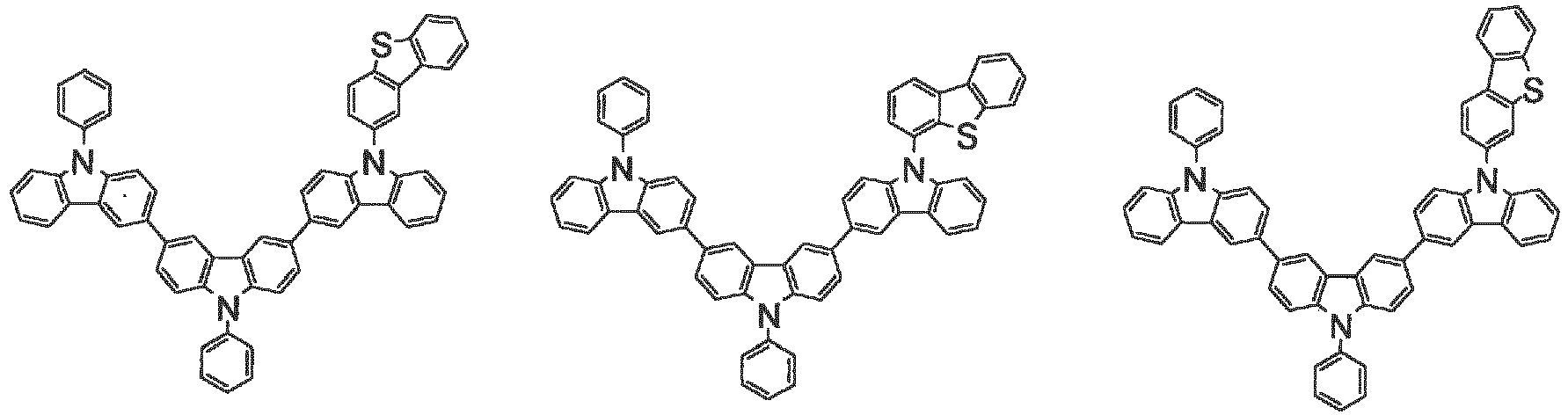


-


-


-
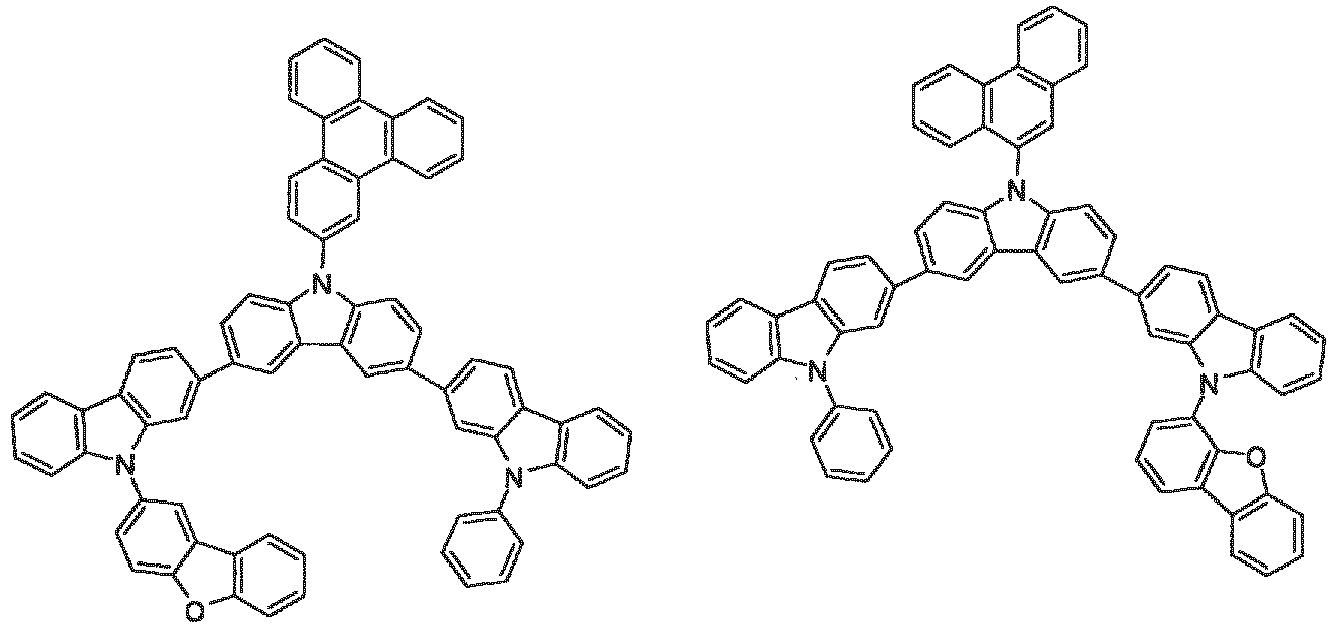


-


-

-

-


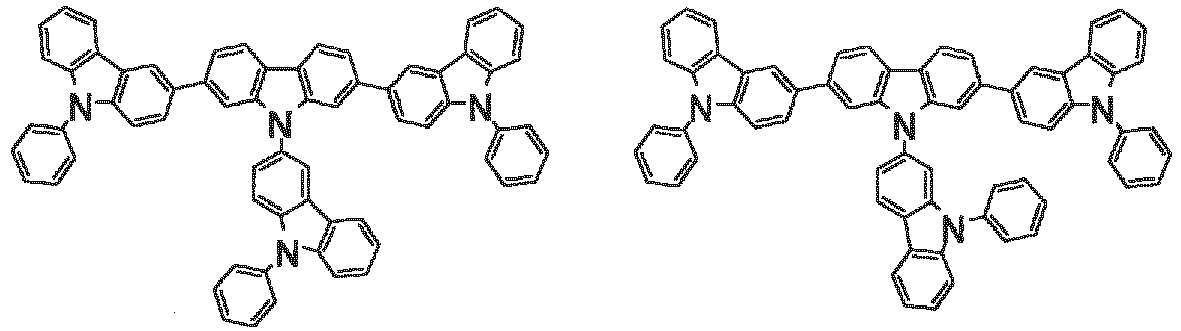


-


-
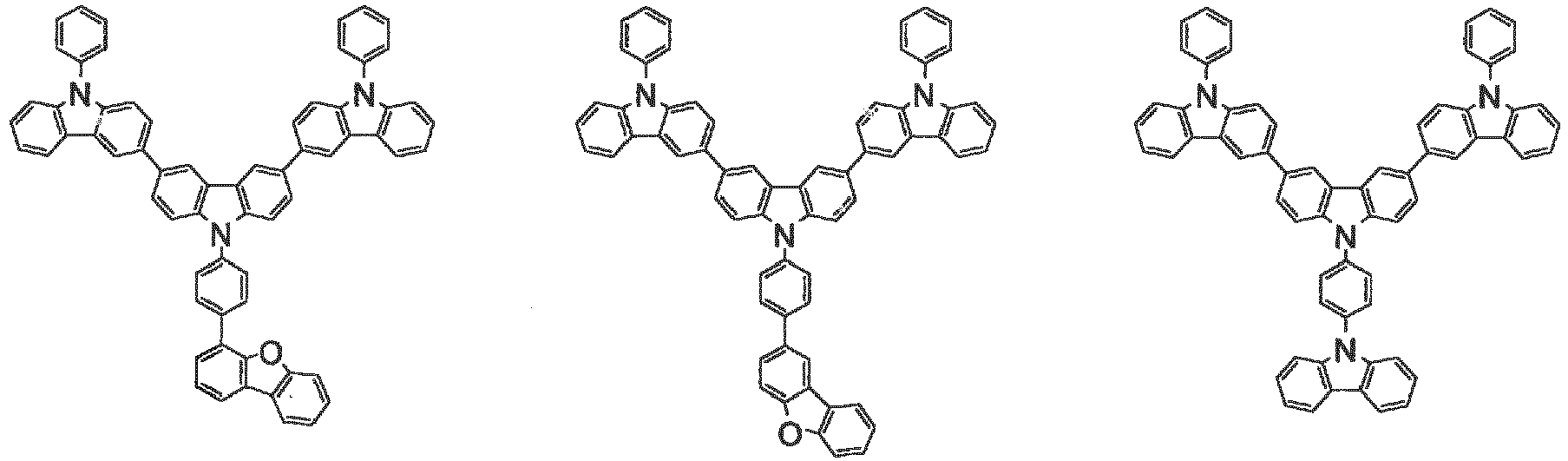
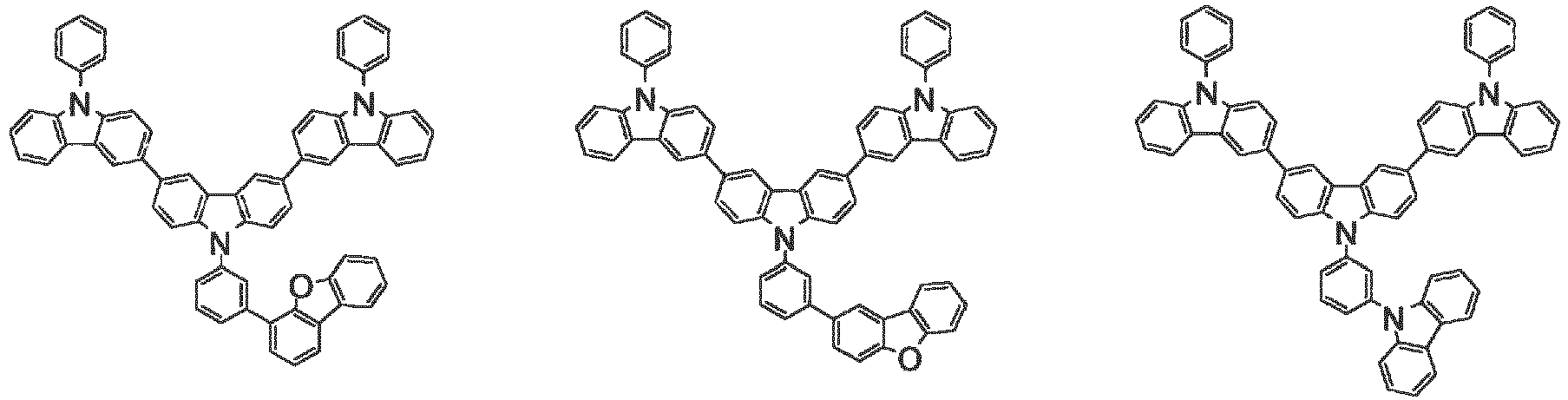


-


-


-


-


- The nitrogen-containing aromatic heterocyclic derivative of the invention can be used as a material for an organic EL device, and preferably as a hole-transporting material.
- The organic EL device of the invention comprises one or more organic thin film layers comprising at least an emitting layer between an anode and a cathode, and at least one layer of the organic thin film layers contains the above-mentioned nitrogen-containing aromatic heterocyclic derivative. The emitting layer preferably contains a phosphorescent emitting material.
The organic EL device of the invention is not particularly limited as long as it comprises an anode, one or more organic thin film layers, and a cathode in sequence. The organic thin film layer comprises an emitting layer, and may further comprise one or more other organic layers. In addition, the organic EL device may also comprise one or more inorganic layers. - The organic thin film layer preferably comprises a hole-transporting layer and/or a hole-injecting layer, and the nitrogen-containing aromatic heterocyclic derivative is contained in at least one of the hole-transporting layer and the hole-injecting layer. The hole-transporting layer and/or the hole-injecting layer may be constituted to contain the nitrogen-containing aromatic heterocyclic derivative as a main component, or may be constituted by the nitrogen-containing aromatic heterocyclic derivative only.
- In addition, the emitting layer may comprise the nitrogen-containing aromatic heterocyclic derivative of the invention as a host material.
- As the device structure of the organic EL device, the following first to third embodiments can be exemplified. In these embodiments, the emitting layer may be a stack of plural emitting layers. In addition, a hole-transporting zone is preferably provided between the anode and the emitting layer.
- The organic EL device of this embodiment has a device structure having at least one emitting layer. Specific examples of the structure are provided as follows.
- (1) anode/emitting layer/electron-injecting and/or-transporting layer/cathode
- (2) anode/hole-injecting and/or -transporting layer/emitting layer/electron-injecting and/or -transporting layer/cathode
- (3) anode/hole-injecting layer/hole-transporting layer/emitting layer/electron-injecting and/or -transporting layer/cathode
- In this specification, "hole-injecting and/or-transporting layer" means one or both of the hole-injecting layer and the hole-transporting layer, and "electron-injecting and/or -transporting layer" means one or both of the electron-injecting layer and the electron-transporting layer.
- The organic EL device of this embodiment has a tandem device structure having at least two emitting layers (two units each comprising an emitting layer).
A charge-generating layer (also referred to as CGL) may be provided between the two emitting layers, and an electron-transporting zone may be provided for each of the units. - Specific examples of the tandem device structure are provided as follows.
anode/hole-injecting and/or-transporting layer/fluorescent emitting layer/charge-generating layer/fluorescent emitting layer/electron-injecting and/or-transporting layer/cathode
anode/hole-injecting and/or -transporting layer/fluorescent emitting layer/ electron-injecting and/or -transporting layer/charge-generating layer/fluorescent emitting layer/cathode
anode/hole-injecting and/or -transporting layer/fluorescent emitting layer/ electron-injecting and/or -transporting layer/charge-generating layer/fluorescent emitting layer/blocking layer/cathode
anode/hole-injecting and/or -transporting layer/phosphorescent emitting layer/charge-generating layer/fluorescent emitting layer/electron-injecting and/or -transporting layer/cathode
anode/hole-injecting and/or-transporting layer/fluorescent emitting layer/ electron-injecting and/or -transporting layer/charge-generating layer/phosphorescent emitting layer/cathode - The organic EL device of this embodiment comprises plural emitting layers and a charge-blocking layer between any two of the plural emitting layers.
- As a preferable structure of the organic EL device of the third embodiment, such a structure as described in Japanese Patent Publication No.
4134280 B US 2007/0273270 A1 , andWO 2008/023623 A1 can be given wherein an anode, a first emitting layer, a charge-blocking layer, a second emitting layer and a cathode are stacked in sequence, and an electron-transporting zone which has a blocking layer for preventing diffusion of a triplet exciton is provided between the second emitting layer and the cathode. The charge-blocking layer is to adjust a carrier balance of the injected electron and hole in the emitting layer by providing the energy barriers of HOMO and LUMO levels between the charge-blocking layer and the adjacent emitting layer thereby to adjust the injection of a carrier into the emitting layer. - Specific examples of the structure are provided as follows.
anode/hole-injecting and/or -transporting layer/first emitting layer/charge-blocking layer/second emitting layer/electron-injecting and/or -transporting layer/cathode
anode/hole-injecting and/or -transporting layer/first emitting layer/charge-blocking layer/second emitting layer/third emitting layer/electron-injecting and/or -transporting layer/cathode - The hole-injecting layer or the hole-transporting layer which is in contact with the anode preferably contains an acceptor material. Further, it is preferable that the hole-transporting layer and/or the hole-injecting layer containing the nitrogen-containing aromatic heterocyclic derivative of the invention be in contact with the layer containing the compound represented by the following formula (10).
With such a structure, low-voltage driving and highly efficient emission can be attained by the effects described in the patents identified below.
As the acceptor material, in addition to hexaazatriphenylene derivative and the like described in Japanese Patent Publication Nos.3614405 B 3571977 B US 4,780,536 B , inorganic compounds such as p-type Si, p-type SiC and the like; electron-accepting inorganic oxides such as molybdenum oxide and the like; electron-accepting organic compounds such as TCNQ derivative and the like can also be preferably used. - As the acceptor material, the compound represented by the following formula (10) or (11) is preferably used.
-

- In the above formula (10), R7 to R12 are independently a cyano group, -CONH2, a carboxy group, or -COOR13 wherein R13 is an alkyl group having 1 to 20 carbon atoms, or R7 and R8, R9 and R10, or R11 and R12 are bonded each other to form -CO-O-CO-.
As the above alkyl group, a straight chain, branched, or cyclic alkyl group can be given, and preferably an alkyl group having 1 to 12 carbon atoms, more preferably an alkyl group having 1 to 8 carbon atoms can be given. Specifically, a methyl group, an ethyl group, a n-propyl group, an isopropyl group, a n-butyl group, a sec-butyl group, a t-butyl group, a n-hexyl group, a n-octyl group, a n-decyl group, a n-hexadecyl group and the like can be given. -

-

-


- In the above formulas, R61 to R64 may be the same or different, and is a hydrogen atom, a substituted or unsubstituted fluoroalkyl group having 1 to 20 carbon atoms, a substituted or unsubstituted alkyl group having 1 to 20 carbon atoms, a substituted or unsubstituted aryl group having 6 to 50 carbon atoms, or a substituted or unsubstituted heterocyclic group having 3 to 50 ring atoms. R62 and R63 may be bonded each other to form a ring.
- R51 to R54 in the formula (11) may be the same or different, and is a hydrogen atom, a substituted or unsubstituted alkyl group having 1 to 20 carbon atoms, a substituted or unsubstituted aryl group having 6 to 50 carbon atoms, a substituted or unsubstituted heterocyclic group having 3 to 50 ring atoms, a halogen atom, a substituted or unsubstituted fluoroalkyl group having 1 to 20 carbon atoms, a substituted or unsubstituted alkoxy group having 1 to 20 carbon atoms, a substituted or unsubstituted fluoroalkoxy group having 1 to 20 carbon atoms, a substituted or unsubstituted aryloxy group having 6 to 50 carbon atoms, or a cyano group. Among R51 to R54, the adjacent two may be bonded each other to form a ring. Y1 to Y4 may be the same or different, and is N, CH, or C(R55). R55 is a substituted or unsubstituted alkyl group having 1 to 20 carbon atoms, a substituted or unsubstituted aryl group having 6 to 50 carbon atoms, a substituted or unsubstituted heterocyclic group having 3 to 50 ring atoms, a halogen atom, a substituted or unsubstituted fluoroalkyl group having 1 to 20 carbon atoms, a substituted or unsubstituted alkoxy group having 1 to 20 carbon atoms, a substituted or unsubstituted fluoroalkoxy group having 1 to 20 carbon atoms, a substituted or unsubstituted aryloxy group having 6 to 50 carbon atoms, or a cyano group.
- The organic EL device of the invention preferably contains at least one of the carbazolyl compounds represented by the following formulas (20) and (21) in at least one layer, preferably an emitting layer, of the organic thin film layers. The compounds are preferably used as a host material in the emitting layer.
-
(Cz-)a A3 (20)
Cz(-A3)b (21)
- In the formulas (20) and (21), Cz is a substituted or unsubstituted arylcarbazolyl group, a substituted or unsubstituted carbazolylaryl group, or a substituted or unsubstituted carbazolylalkylene group.
A3 is a group represented by the following formula (A).
a and b are independently an integer of 1 to 3. -
(M1)c- (L5)d- (M2 )e (4)
- In the formula (A), M1 and M2 are independently a substituted or unsubstituted nitrogen-containing aromatic heterocyclic ring having 3 to 40 ring atoms or a substituted or unsubstituted nitrogen-containing fused aromatic heterocyclic ring having 3 to 40 ring atoms, and may be the same or different.
L5 is a single bond, a substituted or unsubstituted aromatic hydrocarbon ring group or fused aromatic hydrocarbon ring group having 6 to 30 carbon atoms, a substituted or unsubstituted cycloalkylene group having 5 to 30 carbon atoms, or a substituted or unsubstituted aromatic heterocyclic group or fused aromatic heterocyclic group having 2 to 30 carbon atoms.
c is an integer of 0 to 2, d is an integer of 1 to 2, and e is an integer of 0 to 2. c+e is 1 or more. - The compounds represented by the formulas (20) and (21) will be explained in detail below.
Cz is a substituted or unsubstituted arylcarbazolyl group, a substituted or unsubstituted carbazolylaryl group, or a substituted or unsubstituted carbazolylalkyl group. - The arylcarbazolyl group is a carbazolyl group having as a substituent at least one aryl group or heteroaryl group, and the position at which the carbazolyl group is substituted with the aryl group or heteroaryl group is not restricted.
Specifically, the following can be given, for example. In the following chemical formulas, Ar is an aryl group or a heteroaryl group, and * represents a position at which another group is connected. -


- In addition, the carbazolylaryl group is an aryl group having as a substituent at least one carbazolyl group, and the position at which the aryl group is substituted with the carbazolyl group is not restricted.
Specifically, the following can be given, for example. In the following chemical formulas, Ar is an aryl group, and * represents a position at which another group is connected. -

- The carbazolylalkyl group is an alkyl group having as a substituent at least one carbazolyl group, and the position at which the alkyl group is substituted with the carbazolyl group is not restricted.
Specifically, in the above-mentioned carbazolylaryl group, a group in which Ar that is an aryl group is replaced with an alkyl group can be given
The substituted arylcarbazolyl group is the above-mentioned arylcarbazolyl group having at least one substituent wherein the position of substitution is not restricted, and the substituted carbazolylaryl group is the above-mentioned carbazolylaryl group having at least one substituent wherein the position of substitution is not restricted. - In the formulas (20) and (21), a and b are independently an integer of 1 to 3.
- The aryl group of the arylcarbazolyl group or the carbazolylaryl group has preferably 6 to 30 carbon atoms, and a phenyl group, a naphthyl group, an anthryl group, phenanthryl group, a naphthathenyl group, a pyrenyl group, a fluorenyl group, a biphenyl group, a terphenyl group and the like can be given, for example. Of these, a phenyl group, a naphthyl group, a biphenyl group, and a terphenyl group are preferable.
- In addition, as the heteroaryl group of the heteroarylcarbazolyl group, pyridine, pyrimidine, pyrazine, triazine, aziridine, azaindolizine, indolizine, imidazole, indole, isoindole, indazole, purine, pteridine, β-carbotine, naphthyridine, quinoxaline, terpyridine, bipyridine, acridine, phenanthroline, phenazine, imidazopyridine and the like can be given. In particular, a group formed by a ring of pyridine, terpyridine, pyrimidine, imidazopyridine, or triazine is preferable.
- The alkyl group of the carbazolylalkyl group preferably has 1 to 10 carbon atoms, and specifically, a methyl group, an ethyl group, a propyl group, an isopropyl group, a n-butyl group, a s-butyl group, a t-butyl group, an isobutyl group, a n-pentyl group, a n-hexyl group, a n-heptyl group, a n-octyl group, a hydroxymethyl group, a chloromethyl group, an aminomethyl group and the like can be given. Of these, a methyl group, an ethyl group, a propyl group, an isopropyl group, a n-butyl group, a t-butyl group, and a n-pentyl group are preferable.
- A3 in the formulas (20) and (21) is a group represented by the formula (A).
In the formula (A), M1 and M2 are preferably independently a substituted or unsubstituted nitrogen-containing heterocyclic group having 3 to 40 ring atoms, and may be the same or different. - As the nitrogen-containing heterocyclic ring, pyridine, pyrimidine, pyrazine, triazine, aziridine, azaindolizine, indolizine, imidazole, indole, isoindole, indazole, purine, pteridine, β-carboline, naphthyridine, quinoxaline, terpyridine, bipyridine, acridine, phenanthroline, phenazine, imidazopyridine and the like can be given, and in particular, a group formed by a ring of pyridine, terpyridine, pyrimidine, imidazopyridine, or triazine is preferable.
- L5 is a single bond, a substituted or unsubstituted aromatic hydrocarbon ring group or fused aromatic hydrocarbon ring group having 6 to 30 carbon atoms, a substituted or unsubstituted cycloalkylene group having 5 to 30 carbon atoms, or a substituted or unsubstituted aromatic heterocyclic group or fused aromatic heterocyclic group having 2 to 30 carbon atoms.
c is an integer of 0 to 2, d is an integer of 1 to 2, and e is an integer of 0 to 2. c+e is 1 or more. - Specific examples of the compounds represented by the formula (20) are shown below.
-


-


- Specific examples of the compounds represented by the formula (21) are shown below.
-
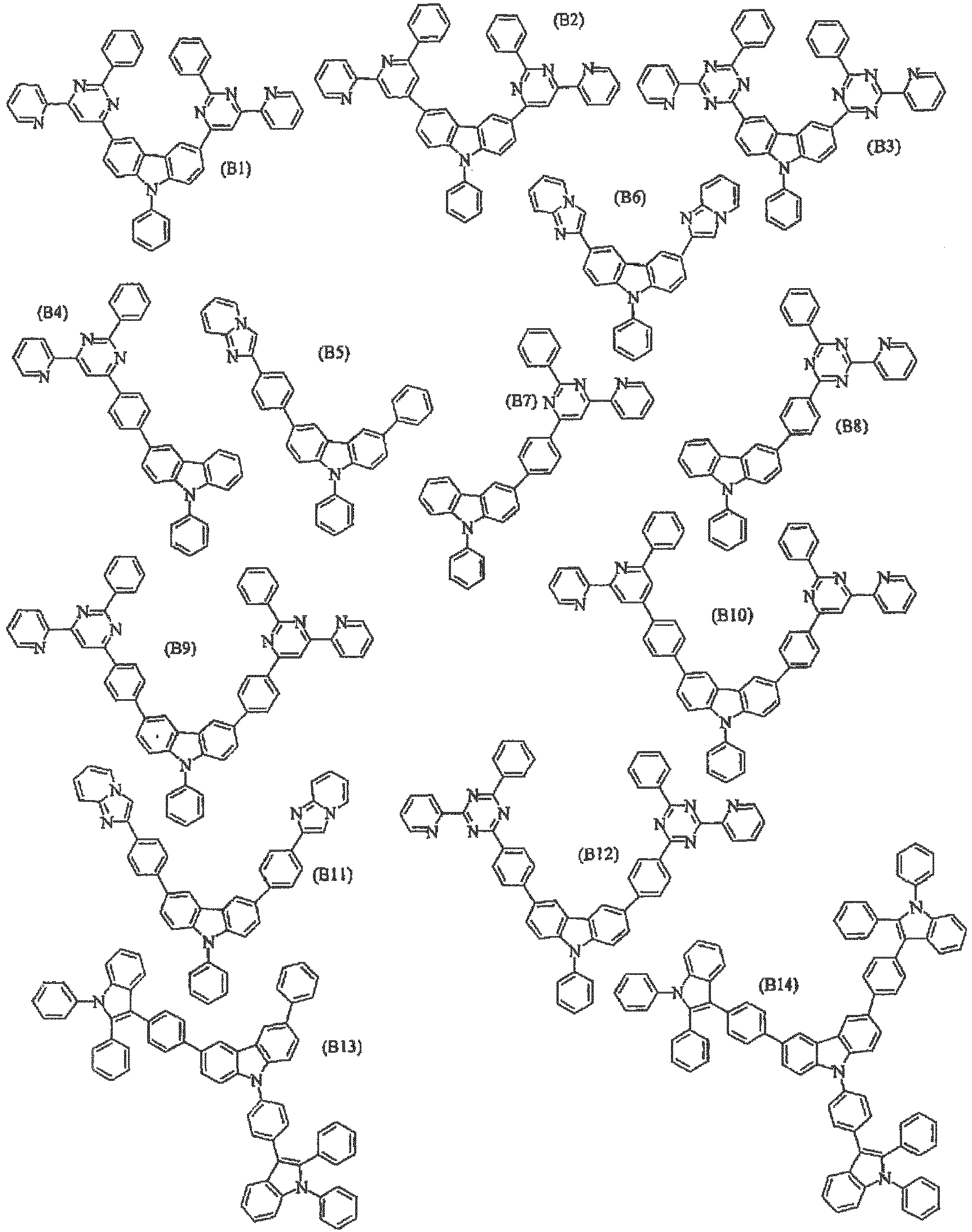
- In addition, it is preferable that the compounds represented by the formulas (30) to (33) be contained in at least one layer of the organic thin film layers, preferably in an emitting layer. These compounds are preferably used as a host material in the emitting layer.
-
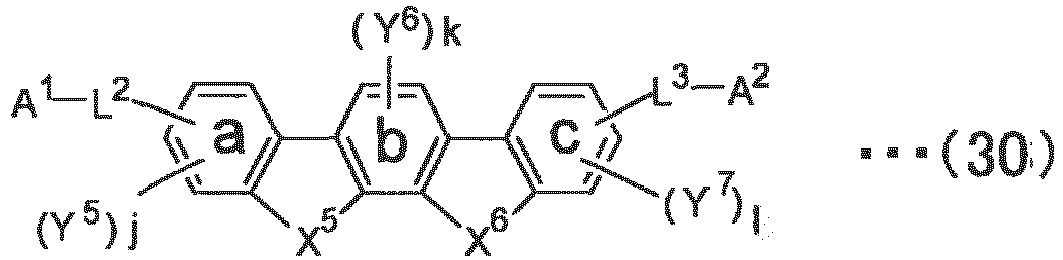
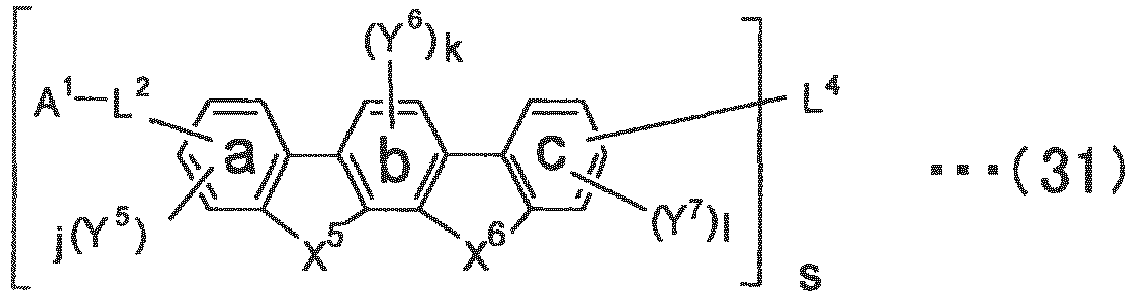


- In the formulas (30) to (33), X5 and X6 are independently oxygen (O), sulfur (S), N-R1 or CR2R3.
R1, R2 and R3 above are independently an alkyl group having 1 to 20 carbon atoms, a substituted or unsubstituted cycloalkyl group having 3 to 20 ring carbon atoms, an aralkyl group having 7 to 24 carbon atoms, a silyl group or a substituted silyl group having 3 to 20 carbon atoms, a substituted or unsubstituted aromatic hydrocarbon ring group or fused aromatic hydrocarbon ring group having 6 to 24 ring carbon atoms, or a substituted or unsubstituted aromatic heterocyclic group or fused aromatic heterocyclic group having 3 to 24 ring carbon atoms. When both X5 and X6 are N-R1, at least one R1 is a substituted or unsubstituted, monovalent fused aromatic heterocyclic group having 8 to 24 ring atoms. - In the formulas (31) and (33), s is 2, 3 or 4 wherein the compound is a dimer, a trimer, or a tetramer having L4 as a linking group.
- In the formulas (30) to (33), L2 is a single bond, an alkylene group having 1 to 20 carbon atoms, a substituted or unsubstituted cycloalkylene group having 3 to 20 ring carbon atoms, a substituted or unsubstituted silylene group having 2 to 20 carbon atoms, a substituted or unsubstituted divalent aromatic hydrocarbon ring group or fused aromatic hydrocarbon ring group having 6 to 24 ring carbon atoms, or a substituted or unsubstituted divalent aromatic heterocyclic group or fused aromatic heterocyclic group having 3 to 24 ring carbon atoms.
- In the formulas (30) and (32), L3 is a single bond, an alkylene group having 1 to 20 carbon atoms, a substituted or unsubstituted cycloalkylene group having 3 to 20 ring carbon atoms, a substituted or unsubstituted silylene group having 2 to 20 carbon atoms, a substituted or unsubstituted divalent aromatic hydrocarbon ring group or fused aromatic hydrocarbon ring group having 6 to 24 ring carbon atoms, or a substituted or unsubstituted divalent aromatic heterocyclic group or fused aromatic heterocyclic group having 3 to 24 ring carbon atoms.
- In the formulas (31) and (33), when s is 2, L4 is a single bond, an alkylene group having 1 to 20 carbon atoms, a substituted or unsubstituted cycloalkylene group having 3 to 20 ring carbon atoms, a substituted or unsubstituted silylene group having 2 to 20 carbon atoms, a substituted or unsubstituted divalent aromatic hydrocarbon ring group or fused aromatic hydrocarbon ring group having 6 to 24 ring carbon atoms, or a substituted or unsubstituted divalent aromatic heterocyclic group or fused aromatic heterocyclic group having 3 to 24 ring carbon atoms. When s is 3, L4 is a trivalent group of the above groups. When s is 4, L4 is a tetravalent group of the above groups.
- In the formulas (30) to (33), A1 is a hydrogen atom, a substituted or unsubstituted cycloalkyl group having 3 to 20 ring carbon atoms, a substituted or unsubstituted silyl group having 3 to 20 carbon atoms, a substituted or unsubstituted aromatic hydrocarbon ring group or fused aromatic hydrocarbon ring group having 6 to 24 ring carbon atoms, or a substituted or unsubstituted aromatic heterocyclic group or fused aromatic heterocyclic group having 3 to 24 ring carbon atoms.
- In the formulas (30) and (32), A2 is a hydrogen atom, a substituted or unsubstituted cycloalkyl group having 3 to 20 ring carbon atoms, a substituted or unsubstituted silyl group having 3 to 20 carbon atoms, a substituted or unsubstituted aromatic hydrocarbon ring group or fused aromatic hydrocarbon ring group having 6 to 24 ring carbon atoms, or a substituted or unsubstituted aromatic heterocyclic group or fused aromatic heterocyclic group having 3 to 24 ring carbon atoms.
- In the formulas (30) to (33), Y5, Y6 and Y7 are an alkyl group having 1 to 20 carbon atoms, a substituted or unsubstituted cycloalkyl group having 3 to 20 ring carbon atoms, an alkoxy group having 1 to 20 carbon atoms, an aralkyl group having 7 to 24 carbon atoms, a substituted or unsubstituted silyl group having 3 to 20 carbon atoms, a substituted or unsubstituted aromatic hydrocarbon ring group or fused aromatic hydrocarbon ring group having 6 to 24 ring carbon atoms, or a substituted or unsubstituted aromatic heterocyclic group or fused aromatic heterocyclic group having 3 to 24 ring carbon atoms. j and I are 0, 1,2 or 3, and k is 0, 1 or 2.
In the formulas (30) to (33), A1, A2, L2, L3 and L4 contain no carbonyl group. - In addition, it is preferable that the anthracene derivative represented by the following formula (40) or the pyrene derivative represented by the following formula (41) be contained in at least one layer of the organic thin film layers, preferably in an emitting layer. These compounds are preferably used as a host material in the emitting layer.
- The anthracene derivative represented by the formula (40) is the following compound.
-

- In the formula (40), Ar101 and Ar102 are independently a group selected from a substituted or unsubstituted monocyclic group having 5 to 50 ring atoms, a substituted or unsubstituted fused ring group having 8 to 50 ring atoms, or a group formed from a combination of a monocyclic group and a fused ring group. R101 to R108 are independently a group selected from a hydrogen atom, a substituted or unsubstituted monocyclic group having 5 to 50 ring atoms, a substituted or unsubstituted fused ring group having 8 to 50 ring atoms, a group formed from a combination of a monocyclic group and a fused ring group, a substituted or unsubstituted alkyl group having 1 to 50 carbon atoms, a substituted or unsubstituted cycloalkyl group having 3 to 50 ring carbon atoms, a substituted or unsubstituted alkoxy group having 1 to 50 carbon atoms, a substituted or unsubstituted aralkyl group having 7 to 50 carbon atoms, a substituted or unsubstituted aryloxy group having 6 to 50 ring carbon atoms, a substituted or unsubstituted silyl group, a halogen atom, and a cyano group.
- As the monocyclic group having 5 to 50 ring atoms (preferably 5 to 30, more preferably 5 to 20 ring atoms), an aromatic group such as a phenyl group, a biphenyl group, a terphenyl group, a quarterphenyl group and the like, and a heterocyclic group such as a pyridyl group, a pyrazyl group, a pyrimidyl group, a triazinyl group, a furyl group, a thienyl group and the like are specifically preferable.
Of these, a phenyl group, a biphenyl group, and a terphenyl group are preferable. - As the fused ring group having 8 to 50 ring atoms (preferably 8 to 30, more preferably 8 to 20 ring atoms), a fused aromatic ring group such as a naphthyl group, a phenanthryl group, an anthryl group, a chrysenyl group, a benzoanthryl group, a benzophenanthryl group, a triphenylenyl group, a benzochrysenyl group, an indenyl group, a fluorenyl group, a 9,9-dimethylfluorenyl group, a benzofluorenyl group, a dibenzofluorenyl group, a fluoranthenyl group, a benzofluoranthenyl group and the like, and a fused heterocyclic group such as a benzofuranyl group, a benzothiophenyl group, an indoryl group, a dibenzofuranyl group, a dibenzothiophenyl group, a carbazolyl group, a quinolyl group, a phenanthrolinyl group and the like are specifically preferable.
Of these, a naphthyl group, a phenanthryl group, an anthryl group, a 9,9-dimethylfluorenyl group, a fluoranthenyl group, a benzoanthryl group, a dibenzothiophenyl group, a dibenzofuranyl group, and a carbazolyl group are preferable. - Specific examples of an alkyl group, a substituted silyl group, a cycloalkyl group, and a halogen atom of the formula (40) are the same as those of the groups of the above formulas (1) to (3).
- The alkoxy group is represented by -OY, and as an example of Y, the examples of the alkyl group above can be given. The alkoxy group is a methoxy group or an ethoxy group, for example.
- The aryloxy group is represented by -OZ, and as an example of Z, the examples of the aryl group above can be given. The aryloxy group is a phenoxy group, for example.
- The aralkyl group is represented by -Y-Z. As an example of Y, the examples of the alkylene corresponding to the alkyl above can be given, and as an example of Z, the examples of the aryl above can be given. The aralkyl group is preferably an aralkyl group having 7 to 50 carbon atoms (the aryl part has 6 to 49 carbon atoms (preferably 6 to 30, more preferably 6 to 20, particularly preferably 6 to 12 carbon atoms) and the alkyl part has 1 to 44 carbon atoms (preferably 1 to 30, more preferably 1 to 20, further preferably 1 to 10, particularly preferably 1 to 6 carbon atoms)), and is a benzyl group, a phenylethyl group, or a 2-phenylpropane-2-yl group, for example.
- Specific preferable examples of the formula (40) are shown below.
As a preferable substitutent of the "substituted or unsubstituted" instance of Ar101, Ar102, and R101 to R108, a monocyclic group, a fused ring group, an alkyl group, a cycloalkyl group, a silyl group, an alkoxy group, a cyano group, and a halogen atom (particularly fluorine) can be given, and a monocyclic group and a fused ring group are particularly preferable. Specific preferable examples are as shown above. - The anthracene derivative represented by the formula (40) is preferably one of the following anthracene derivatives (A), (B) and (C), and is selected depending on the structure and the desired property of an organic EL device to which the derivative is applied.
- In the anthracene derivative (A), Ar101 and Ar102 in the formula (40) are independently a substituted or unsubstituted fused ring group having 8 to 50 ring atoms. The anthracene derivative can be classified into an instance where Ar101 and Ar102 are the same substituted or unsubstituted fused ring group and an instance where Ar101 and Ar102 are different substituted or unsubstituted fused ring groups.
- It is preferable that Ar101 and Ar102 in the formula (40) be different substituted or unsubstituted fused ring groups (including the difference in substitution position), and specific preferable examples of the fused ring group are as shown above. Of these, a naphthyl group, a phenanthryl group, a benzanthryl group, a 9,9-dimethylfluorenyl group, and a dibenzofuranyl group are preferable.
- In the anthracene derivative (B), one of Ar101 and Ar102 in the formula (40) is a substituted or unsubstituted monocyclic group having 5 to 50 ring atoms, and the other is a substituted or unsubstituted fused ring group having 8 to 50 ring atoms.
As a preferable embodiment, Ar102 is a naphthyl group, a phenanthryl group, a benzanthryl group, a 9,9-dimethylfluorenyl group, or a dibenzofuranyl group, and Ar101 is a phenyl group substituted with a monocyclic group or a fused ring group.
Specific preferable monocyclic group and fused ring group are as shown above.
As another preferable embodiment, Ar102 is a fused ring group and Ar101 is a unsubstituted phenyl group. In this case, as the fused ring group, a phenanthryl group, a 9,9-dimethylfluorenyl group, a dibenzofuranyl group, and a benzanthryl group are particularly preferable. - In the anthracene derivative (C), Ar101 and Ar102 in the formula (40) are independently a substituted or unsubstituted monocyclic group having 5 to 50 ring atoms.
As a preferable embodiment, Ar101 and Ar102 are both a substituted or unsubstituted phenyl group.
As a further preferable embodiment, Ar101 is an unsubstituted phenyl group and Ar102 is a phenyl group having a monocyclic group and/or a fused ring group as a substituent, or Ar101 and Ar102 are independently a phenyl group having a monocyclic group and/or a fused ring group as a substituent.
Specific preferable monocyclic group and fused ring group as the substituent are as shown above. More preferably, as a substituent, the monocyclic group may be a phenyl group or a biphenyl group, and the fused ring group may be a naphthyl group, a phenanthryl group, a 9,9-dimethylfluorenyl group, a dibenzofuranyl group, or a benzoanthryl group. - The pyrene derivative represented by the following formula (41) is the following compound.
-

- In the formula (41), Ar111 and Ar222 are independently a substituted or unsubstituted aryl group having 6 to 30 ring carbon atoms.
L21 and L22 are independently a substituted or unsubstituted divalent aryl group or heterocyclic group having 6 to 30 ring carbon atoms.
m is an integer of 0 to 1, n is an integer of 1 to 4, s is an integer of 0 to 1, and t is an integer of 0 to 3.
In addition, L21 or Ar111 is connected with any of 1 st to 5th position of the pyrene, and L22 or Ar222 is connected with any of 6- to 10-position of the pyrene. - L21 and L22 of the formula (41) are preferably a substituted or unsubstituted phenylene group, a substituted or unsubstituted biphenylene group, a substituted or unsubstituted naphthylene group, a substituted or unsubstituted terphenylene group, a substituted or unsubstituted fluorenylene group, and a divalent aryl group composed of a combination of these substituent groups.
In addition, examples of the substituent groups are as shown above. The substituent groups of L21 and L22 are preferably an alkyl group having 1 to 20 carbon atoms. - m in the formula (41) is preferably an integer of 0 to 1. n in the formula (41) is preferably an integer of 1 to 2. s in the formula (41) is preferably an integer of 0 to 1.
t in the formula (41) is preferably an integer of 0 to 2.
The aryl groups of Ar111 and Ar222 are as shown above.
The aryl group is preferably a substituted or unsubstituted aryl group having 6 to 20 ring carbon atoms, more preferably a substituted or unsubstituted aryl group having 6 to 16 ring carbon atoms, and specific preferable examples of the aryl group include a phenyl group, a naphthyl group, a phenanthryl group, a fluorenyl group, a biphenyl group, an anthryl group, and a pyrenyl group.
When the compounds of the above formulas (20), (21), (30) to (33), (40), and (41) are used as a host material in an emitting layer, two or more of these can be used in combination. - The emitting layer may contain an emitting dopant (a phosphorescent dopant and or a fluorescent dopant) in addition to the emitting material.
- The fluorescent dopant is a compound capable of emitting from a singlet exciton. The fluorescent dopant is preferably selected from an amine compound, an aromatic compound, a chelate complex such as tris(8-quinolinolate) aluminum complex, a coumarin derivative, a tetraphenylbutadiene derivative, a bisstyrylarylene derivative, an oxadiazole derivative and the like, depending on the desired emission color. A styrylamine compound, a styryldiamine compound, an arylamine compound, and an aryldiamine compound are more preferable, and a fused polycyclic amine derivative is further preferable. These fluorescent dopants may be used alone or in combination.
- It is preferable that the fused polycyclic amine derivative be one represented by the following formula (50).
-
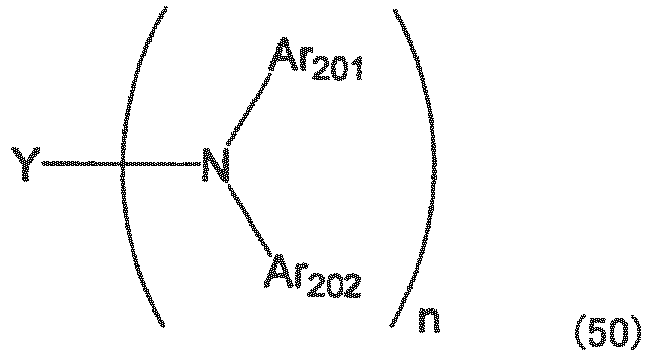
- In the formula (50), Y is a substituted or unsubstituted fused aryl group having 10 to 50 ring carbon atoms.
Ar201 and Ar202 are independently a substituted or unsubstituted aryl group having 6 to 50 ring carbon atoms, or a substituted or unsubstituted heterocyclic group having 5 to 50 ring atoms. - The fused aryl group is a group composed by fusion of two or more ring structures, among the aryl groups above.
The fused aryl group is a fused aryl group having 10 to 50 ring carbon atoms (preferably 10 to 30, more preferably 10 to 20 ring carbon atoms), and among specific examples of the aryl group above, a naphthyl group, an anthryl group, a pyrenyl group, a phenanthryl group, a fluorenyl group, a fluoranthenyl group, a naphthacenyl group and the like can preferably be given. - As specific examples of Y, the fused aryl group above can be given, and a substituted or unsubstituted anthryl group, a substituted or unsubstituted pyrenyl group, and a substituted or unsubstituted chrysenyl group are preferable.
- As a preferable example of Ar201 and Ar202, a substituted or unsubstituted phenyl group, a substituted or unsubstituted dibenzofuranyl group and the like can be given. As a preferable example of the substituent of Ar201 and Ar202, an alkyl group, a cyano group, and a substituted or unsubstituted silyl group can be given.
n is an integer of 1 to 4, and is preferably an integer of 1 to 2. - As the styrylamine compound and the styryldiamine compound, compounds represented by the following formulas (51) and (52) are preferable.
-


- In the formula (51), Ar301 is a group having a valence of k, and is a group having a valence of k corresponding to a phenyl group, a naphthyl group, a biphenyl group, a terphenyl group, a stilbene group, a styrylaryl group, or a distyrylaryl group. Ar302 and Ar303 are independently an aryl group having 6 to 20 ring carbon atoms, and Ar301, Ar302 and Ar303 may be substituted.
k is an integer of 1 to 4, and is preferably an integer of 1 to 2. Any one of Ar301, to Ar303 is a group comprising a styryl group. More preferably, at least one of Ar302 and Ar303 is substituted with a styryl group.
As the aryl group having 6 to 20 ring carbon atoms, the aryl groups shown above can specifically be given, and a phenyl group, a naphthyl group, an anthranyl group, a phenanthryl group, a terpenyl group and the like can preferably be given. - In the formula (52), Ar304 to Ar306 are a substituted or unsubstituted aryl group having 6 to 40 ring carbon atoms and a valence of v. v is an integer of 1 to 4, and is preferably an integer of 1 to 2.
As the aryl group having 6 to 40 ring carbon atoms of the formula (52), the aryl groups shown above can specifically be given, and an aryl group represented by a naphthyl group, an anthranyl group, a chrysenyl group, or a pyrenyl group is preferable. - As a preferable substituent on the aryl group above, an alkyl group having 1 to 6 carbon atoms, an alkoxy group having 1 to 6 carbon atoms, an aryl group having 6 to 40 ring carbon atoms, an amino group substituted with an aryl group having 6 to 40 ring carbon atoms, an ester group which has an aryl group having 5 to 40 ring carbon atoms, an ester group which has an alkyl group having 1 to 6 carbon atoms, a cyano group, a nitro group, a halogen atom and the like can be given.
- The phosphorescent dopant is a compound capable of emitting from a triplet exciton.
The phosphorescent dopant contains a metal complex, and the metal complex preferably has a metal atom selected from Ir, Pt, Os, Au, Cu, Re and Ru, and a ligand. In particular, the ligand preferably has an ortho-metal bond.
The compound containing the metal atom selected from Ir, Os and Pt is preferable in that phosphorescent quantum efficiency is high so that external quantum efficiency of a light emitting device can be more improved. The metal complex such as an iridium complex, an osmium complex, a platinum complex and the like is further preferable, and of these, an iridium complex and a platinum complex are more preferable with an ortho-metalated iridium complex being most preferable.
Specific preferable examples of the metal complex are shown below. -


-


-

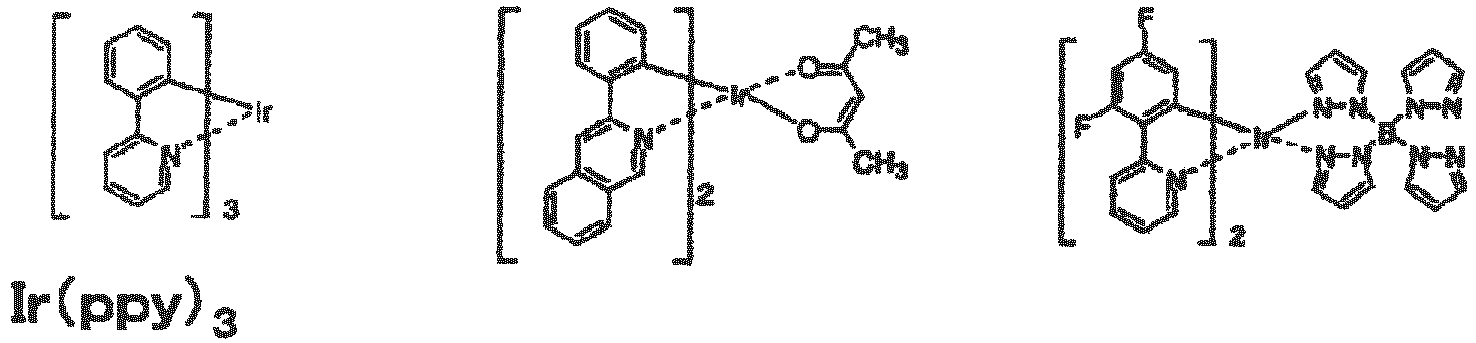


-


- As an electron-injecting and/or -transporting material, a compound having a capability of transporting an electron, an electron-injecting effect from a cathode, an excellent electron-injecting effect against an emitting layer or an emitting material, and an excellent capability of forming a thin film is preferable.
- In the organic EL device of the invention, a more effective electron-injecting material is a metal complex compound and a nitrogen-containing heterocyclic derivative.
As the metal complex compound, although not being limited thereto, 8-hydroxyquinolinate lithium, bis(8-hydroxyquinolinate) zinc, tris(8-hydroxyquinolinate) aluminum, tris(8-hydroxyquinolinato) gallium, bis(10-hydroxybenzo[h]quinolinato) beryllium, bis(10-hydroxybenzo[h]quinolinato) zinc and the like can be given, for example. - As the nitrogen-containing heterocyclic derivative, oxazole, thiazole, oxadiazole, thiadiazole, triazole, pyridine, pyrimidine, triazine, phenanthroline, benzimidazole, imidazopyridine and the like are preferable, for example. Of these, a benzimidazole derivative, a phenanthroline derivative, and an imidazopyridine derivative are preferable.
As a preferable embodiment, these electron-injecting materials further contain a dopant, and it is more preferable that a dopant represented by an alkali metal be contained near the boundary face between an organic layer and a cathode so as to facilitate receipt of an electron from a cathode.
As the dopant, a donating metal, a donating metal compound, and a donating metal complex can be given, and these reducing dopants may be used alone or in combination of two or more. - In addition, in the organic EL device of the invention, it is preferable that the device have at least an electron-transporting layer as an organic thin film layer and that the nitrogen-containing heterocyclic derivative represented by any of the following formulas (60) to (62) be contained in the electron-transporting layer.
-


R1 and R2 are independently a substituted or unsubstituted aryl group having 6 to 50 ring carbon atoms, a substituted or unsubstituted heteroaryl group having 3 to 50 ring atoms, an alkyl group having 1 to 20 carbon atoms, an alkyl group substituted with a halogen atom having 1 to 20 carbon atoms, or an alkoxy group substituted having 1 to 20 carbon atoms. The aryl group such as a substituted or unsubstituted phenyl group having 6 to 50 ring carbon atoms and the like is preferable.
n is an integer of 0 to 4, and when n is an integer of 2 or more, plural R1s may be the same or different each other. In addition, adjacent two R1s may be bonded each other to form a substituted or unsubstituted aromatic hydrocarbon ring.
Ar1 is a substituted or unsubstituted aryl group having 6 to 50 ring carbon atoms, or a substituted or unsubstituted heteroaryl group having 3 to 50 ring atoms.
Ar2 is a hydrogen atom, an alkyl group having 1 to 20 carbon atoms, an alkyl group substituted with a halogen atom having 1 to 20 carbon atoms, an alkoxy group having 1 to 20 carbon atoms, a substituted or unsubstituted aryl group having 6 to 50 ring carbon atoms, or a substituted or unsubstituted heteroaryl group having 3 to 50 ring atoms.
In the formula (60), one of Ar1 and Ar2 is a substituted or unsubstituted fused aromatic hydrocarbon ring group having 10 to 50 ring carbon atoms (for example, a naphthyl group), or a substituted or unsubstituted fused aromatic heterocyclic group having 9 to 50 ring atoms.
Ar3 is a substituted or unsubstituted arylene group having 6 to 50 ring carbon atoms (for example, an anthracenylene group), or a substituted or unsubstituted heteroarylene group having 3 to 50 ring atoms.
L1, L2 and L3 are independently a single bond, a substituted or unsubstituted arylene group having 6 to 50 ring carbon atoms (for example, a phenylene group and a fluorenylene group), or a substituted or unsubstituted hetero fused ring group having 9 to 50 ring atoms. - For the members such as a substrate, an anode and a cathode of the organic EL device, in addition to those described above, it is possible to select appropriately and use known materials described in documents such as
WO 2009/107596 A1 ,WO 2009/081857 A1 ,US 2009/0243473 A1 ,US 2008/0014464 A1 andUS 2009/0021160 A1 . - Although the present invention will be explained more specifically with the following examples, it shall not be limited thereto.
The structures of intermediates produced in Intermediate Synthesis Examples 1 to 9 are as follows: -


- 17.7 g of 9-phenylcarbazole, 6.03 g of potassium iodide, 7.78 g of potassium iodate, 5.90 mL of sulfuric acid and ethanol were placed and reacted at 75 °C for 2 hours.
After cooling, water and ethyl acetate were added thereto to be separated into a water phase and an organic phase. The organic phase was extracted, washed with sodium bicarbonate water and water, and concentrated to obtain a crude product. The crude product was purified with silica gel chromatography (with toluene), and the resultant solids were dried under reduced pressure to obtain 21.8 g of white solids. The solids were identified as Intermediate 1 by FD-MS analysis. - Under a flow of argon, dehydrated toluene and dehydrated ether were added to 13.1 g of Intermediate 1 and the mixture was cooled to -45 °C. 25 mL of n-butyllithium hexane solution (1.58 M) was dropped to the mixture, the temperature of which was raised over 1 hour to -5 °C under stirring. The resultant mixture was cooled again to -45 °C, and was reacted for 2 hours after 25 mL of boronic acid triisopropyl ester was slowly dropped thereto.
After the mixture was allowed to be at a room temperature, 10% dilute hydrochloric solution was added and stirred therewith, and the resultant organic phase was extracted. After being washed with saturated saline, the organic phase was dried with anhydrous magnesium sulfate and subjected to separation and concentration. The solids obtained were purified with silica gel chromatography (with toluene), and the resultant was washed with n-hexane and dried under reduced pressure to obtain 7.10 g of solids. The solids were identified as Intermediate 2 by FD-MS analysis. - Under an argon atmosphere, 100 mL of toluene, 100 mL of 1,2-dimethoxyethane, and 50 mL of 2 M sodium carbonate aqueous solution were added to 32.5 g of 3,6-dibromocarbazole, 63.2 g of Intermediate 2, and 0.92 g of tetrakis(triphenylphosphine)palladium (0), and the mixture was heated under reflux for 10 hours.
After completion of a reaction, the reacted mixture was immediately subjected to filtration and the water phase was then removed. The organic phase was dried with sodium sulfate and concentrated. The residual concentrate was purified with silica gel column chromatography to obtain 45.5 g of white crystals. The crystals were identified as Intermediate 3 by FD-MS analysis. - 150 g of dibenzofuran (892 millimoles) and 1 liter of acetic acid were placed in a flask, which was then replaced with nitrogen and the contents of which were dissolved under heating. After 188 g of bromine (1.18 moles) were dropped while being occasionally cooled with water, the mixture was stirred for 20 hours under cooling with air. The precipitated crystals were filtrated, washed sequentially with acetic acid and water, and dried under reduced pressure. After the crystals obtained were purified by distillation under reduced pressure, recrystallization from methanol was performed several times to obtain 66.8 g of 2-bromodibenzofuran (yield 31 %). The resultant was identified as Intermediate 4 by FD-MS analysis.
- Under an argon atmosphere, 600 mL of dehydrated tetrahydrofuran was added to 78.0 g of dibenzofuran and the mixture was cooled to -30 °C. 300 mL of n-butyllithiumhexane solution (1.65 M) was then dropped and the mixture was heated to a room temperature over 1 hour under stirring. After being stirred for 5 hours at a room temperature, the mixture was cooled to -60 °C, and 60 mL of 1,2-dibromoethane was dropped thereto over 1 hour.
After being stirred for 15 hours at a room temperature, the mixture was poured into 1000 mL of ice water, and the organic phase was extracted with dichloromethane. The extracted organic phase was washed with saturated saline, dried with anhydrous magnesium sulfate, and subjected to filtration and concentration. The solids obtained were purified with silica gel chromatography (with toluene), washed with tetrahydrofuran/methanol, and dried under reduced pressure to obtain 70 g of solids. The solids were identified as Intermediate 5 by FD-MS analysis. - Under an argon atmosphere, 1000 mL of toluene and 500 mL of 2 M sodium carbonate aqueous solution were added to 120.0 g of 1-buromo-3-fluoro-4-iodobenzene (399 millimoles), 72.7 g of 2-methoxyphenylboronic acid (479 millimoles) and 9.2 g of tetrakis(triphenylphosphine)palladium (0) (7.96 millimoles), and the mixture was heated under reflux for 10 hours.
After completion of a reaction, the reacted mixture was immediately subjected to filtration and the water phase was then removed. The organic phase was dried with sodium sulfate and concentrated. The residual concentrate was purified with silica gel column chromatography to obtain 89.6 g of 4-buromo-2-fluoro-2'-methoxybiphenyl white crystals (yield 80%).
Under an argon atmosphere, 900 mL of dichloromethane was added to 89.6 g of 4-buromo-2-fluoro-2'-methoxybiphenyl (319 millimoles), and the mixture was stirred under cooling with ice. 95.9 g of boron tribromide (382 millimoles) was then dropped and the mixture was stirred at a room temperature for 12 hours. After completion of a reaction, 200 mL of water was added, the mixture was stirred for 1 hour, and the water phase was removed. The organic phase was dried with sodium sulfate and concentrated. The residual concentrate was purified with silica gel column chromatography to obtain 68.1 g of 4-buromo-2-fluoro-2'-hydroxybiphenyl white crystals (yield 70%).
1500 mL of N-methyl pyrrolidone was added to 68.1 g of 4-buromo-2-fluoro-2'-hydroxybiphenyl (255 millimoles) and 70.4 g of potassium carbonate (510 millimoles), and the mixture was stirred for 3 hours at 180 °C. After completion of a reaction, water was added and the mixture was subjected to extraction with toluene. The organic phase was dried with sodium sulfate and concentrated. The residual concentrate was purified by recrystallization from toluene to obtain 44.2 g of 3-buromodibenzofuran white crystals (yield 60%). The crystals were identified as Intermediate 6 by FD-MS analysis. - Under an argon atmosphere, 350 mL of dimethylformamide (DMF) was added to 28.5 g of 9,9-dimethyl-10-phenyl-9,10-dihydroacridine (100 millimoles) and 35.6 g of N-buromosuccinimide (NBS) (200 millimoles), and the mixture was stirred at a room temperature for 8 hours. After completion of a reaction, the reacted mixture was transferred to a separatory funnel, water (500 mL) was added thereto, and the mixture was subjected to extraction with ethyl acetate. The extract was purified with column chromatography to obtain 35.4 g of white solids. The solids were identified as Intermediate 7 by FD-MS analysis.
- Under an argon atmosphere, 350 mL of DMF was added to 28.5 g of 9,9-dimethyl-10-phenyl-9,10-dihydroacridine (100 millimoles) and 17.8 g of NBS (100 millimoles), and the mixture was stirred at a room temperature for 8 hours. After completion of a reaction, the reacted mixture was transferred to a separatory funnel, water (500 mL) was added thereto, and the mixture was subjected to extraction with ethyl acetate. The extract was purified with column chromatography to obtain 18.4 g of white solids. The solids were identified as Intermediate 8 by FD-MS analysis.
- Reaction was conducted in a similar way to Intermediate Synthesis Example 2 except that 12.9 g of Intermediate 8 was used instead of Intermediate 1 to obtain 8.2 g of white solids. The solids were identified as Intermediate 9 by FD-MS analysis.
- The structures of the nitrogen-containing aromatic heterocyclic derivatives according to the present invention prepared in Intermediate Synthesis Examples 1 to 7 are as follows:
-


- Under a flow of argon, 6.5 g of Intermediate 3, 2.5 g of Intermediate 4, 1.3 g of sodium t-butoxide (manufactured by Hiroshima Wako Ltd.), 46 mg of tris(dibenzylideneacetone)dipalladium (manufactured by Aldrich Corp.), 29 mg of tri-tert-butylphosphoniumtetrafluoroborate, and 50 mL of dehydrated toluene were mixed and reacted for 8 hours at 80 °C.
After cooling, 500 mL of water was added and the mixture was filtrated with cellite. The filtrate was extracted with toluene and the extract was dried with anhydrous magnesium sulfate. The dried extract was concentrated under reduced pressure, and the crude product obtained was purified with column chromatography and recrystallized from toluene. The recrystallized product was filtrated and dried to obtain 5.6 g of white powder. The white powder was identified as Nitrogen-containing aromatic heterocyclic derivative (H1) by FD-MS analysis. - Reaction was conducted in a similar way to Synthesis Example 1 except that 2.5 g of Intermediate 5 was used instead of Intermediate 4 to obtain 5.3 g of white powder. The white powder was identified as Nitrogen-containing aromatic heterocyclic derivative (H2) by FD-MS analysis.
- Reaction was conducted in a similar way to Synthesis Example 1 except that 2.5 g of Intermediate 6 was used instead of Intermediate 4 to obtain 5.7 g of white powder. The white powder was identified as Nitrogen-containing aromatic heterocyclic derivative (H3) by FD-MS analysis.
- Reaction was conducted in a similar way to Synthesis Example 1 except that 3.7 g of Intermediate 1 was used instead of Intermediate 4 to obtain 6.3 g of white powder. The white powder was identified as Nitrogen-containing aromatic heterocyclic derivative (H4) by FD-MS analysis.
- Under an argon atmosphere, 10 mL of toluene and 10 mL of 1,2-dimethoxyethane, and 5 mL of 2M sodium carbonate aqueous solution were added to 4.4 g of Intermediate 7, 6.3 g of Intermediate 2, and 92 mg of tetrakis(triphenylphosphine)palladium (0), and the mixture was heated under reflux for 10 hours.
After completion of a reaction, the reacted mixture was immediately subjected to filtration and the water phase was then removed. The organic phase was dried with sodium sulfate and concentrated. The residual concentrate was purified with silica gel column chromatography to obtain 5.4 g of white powder. The white powder was identified as Nitrogen-containing aromatic heterocyclic derivative (H5) by FD-MS analysis. - Reaction was conducted in a similar way to Synthesis Example 5 except that 7.2 g of Intermediate 9 was used instead of Intermediate 2 to obtain 6.0 g of white powder. The white powder was identified as Nitrogen-containing aromatic heterocyclic derivative (H6) by FD-MS analysis.
- Reaction was conducted in a similar way to Synthesis Example 5 except that 4.0 g of 3,6-dibromo-9-phenylcarbazole was used instead of Intermediate 7 and 7.2 g of Intermediate 9 was used instead of Intermediate 2 to obtain 5.4 g of white powder. The white powder was identified as Nitrogen-containing aromatic heterocyclic derivative (H7) by FD-MS analysis.
- A glass substrate of 25 mm by 75 mm by 1.1 mm with an ITO transparent electrode (manufactured by GEOMATEC CO., LTD.) was subjected to ultrasonic cleaning in isopropyl alcohol for 5 minutes, and cleaning with ultraviolet rays and ozone for 30 minutes.
The resultant glass substrate with transparent electrode lines was mounted on a substrate holder in a vacuum deposition device. First, the following electron-acceptor compound (A) was deposited to form a 5 nm-thick A film so as to cover the surface of the transparent electrode on which the transparent electrode lines were formed. The following aromatic amine derivative (X1) was deposited as a first hole-transporting material on the A film to form a 120 nm-thick first hole-transporting layer. Then, the nitrogen-containing aromatic heterocyclic derivative (H1) obtained in Synthesis Example 1 was deposited as a second hole-transporting material to form a 47 nm-thick second hole-transporting layer. Onto the second hole-transporting layer, a compound (B) as a phosphorescent host and Ir(ppy)3 as a phosphorescent dopant were co-deposited to obtain a 40 nm-thick phosphorescent layer. The concentration of Ir(ppy)3 was 10 mass%.
Subsequently, a 20 nm-thick compound (C) layer was formed on the phosphorescent layer as an electron-transporting layer, and a 1 nm-thick LiF layer and a 80 nm-thick Al metal layer were sequentially formed to obtain a cathode. The LiF layer, which was an electron-injecting electrode, was formed at a speed of 1 Å/min. -


- The organic EL device obtained was made to emit light with DC driving, and was measured for luminance (L) and a current density to determine luminous efficiency (UJ) and driving voltage (V) at a current density of 1 mA/cm2.
In addition, half life at an initial luminance of 20000 cd/m2 was determined. The results were shown in Table 1. - Except that Nitrogen-containing aromatic heterocyclic derivative (H2) was used instead of Nitrogen-containing aromatic heterocyclic derivative (H1) as the second hole-transporting material, an organic EL device was produced and evaluation was performed in the same manner as in Example 1-1. The results were shown in Table 1.
- Except that the following Comparative Compounds 1 to 3 were used instead of Nitrogen-containing aromatic heterocyclic derivative (H1) as the second hole-transporting material, an organic EL device was produced and evaluation was performed in the same manner as in Example 1-1. The results were shown in Table 1.
-

-
[Table 1] Hole-transporting material Luminous efficiency [cd/A] @ 1mA/cm2 Driving voltage [V] @ 1mA/cm2 Half life [hour] Examples 1-1 H1 58.7 3.4 700 1-2 H2 58.1 3.4 720 Comparative Examples 1-1 Comparative compound 1 58.0 3.7 500 1-2 Comparative compound 2 57.5 4.0 450 1-3 Comparative compound 3 53.5 3.4 150 - As shown in Table 1, the organic EL devices using the nitrogen-containing aromatic heterocyclic derivative according to the invention as the hole-transporting material could have a higher luminous efficiency, a lower driving voltage and a longer device life compared with the organic EL devices using the comparative compounds.
- A glass substrate of 25 mm by 75 mm by 1.1 mm with an ITO transparent electrode (GEOMATEC CO., LTD.) was subjected to ultrasonic cleaning in isopropyl alcohol for 5 minutes, and cleaning with ultraviolet rays and ozone for 30 minutes.
The resultant substrate with transparent electrode lines was mounted on a substrate holder in a vacuum deposition device. First, the above aromatic amine derivative (X1) was deposited as a hole-injecting material to form a 90 nm-thick hole-injecting layer so as to cover the surface of the transparent electrode on which the transparent electrode lines were formed. Subsequent to the forming of the hole-injecting layer, the following aromatic amine derivative (X2) was deposited as a hole-transporting material to form a 20 nm-thick hole-transporting layer.
Nitrogen-containing aromatic heterocyclic derivative (H1) as a host for phosphorescence and Flrpic as a dopant for phosphorescence were co-deposited on the hole-transporting layer to form a 40 nm-thick phosphorescent layer. The concentration of Flrpic was 10 mass%.
Next, on the phosphorescent layer, a 10 nm-thick BCP layer was formed as a hole-blocking layer. Furthermore, a 20 nm-thick compound (C) layer was formed as an electron-transporting layer, and a 1 nm-thick LiF layer and a 80 nm-thick Al metal layer were sequentially formed to obtain a cathode. The LiF layer, which was an electron-injecting electrode, was formed at a speed of 1 Å/min. -

- The organic EL device obtained was made to emit light with DC driving, and was measured for luminance (L) and a current density to determine luminous efficiency (UJ) at a current density of 1 mA/cm2 and driving voltage (V).
In addition, half life at an initial luminance of 1000 cd/m2 was determined. The results were shown in Table 2. - Except that Nitrogen-containing aromatic heterocyclic derivative (H2) was used instead of Nitrogen-containing aromatic heterocyclic derivative (H1) as a phosphorescent host material, an organic EL device was produced and evaluation was performed in the same manner as in Example 2-1. The results were shown in Table 2.
- Except that the above Comparative Compounds 1 and 2 were used instead of Nitrogen-containing aromatic heterocyclic derivative (H1) as a phosphorescent host material, an organic EL device was produced and evaluation was performed in the same manner as in Example 2-1. The results were shown in Table 2.
-
[Table 2] Phosphorescent host material Luminous efficiency [cd/A] @1mA/cm2 Driving voltage [V]@1mA/cm2 Half life [hour] Examples 2-1 H1 17.9 4.7 50 2-2 H2 17.5 4.7 50 Comparative Examples 2-1 Comparative compound 1 3.4 5.0 3 2-2 Comparative compound 2 3.5 5.3 3 - As shown in Table 2, the organic EL devices using in the phosphorescent emitting layer the nitrogen-containing aromatic heterocyclic derivatives according to the invention could have a higher luminous efficiency, a lower driving voltage and longer life compared with the organic EL devices using the comparative compounds.
- The compound of the present invention can be used for an organic EL device. The organic EL device of the invention can be used as a planar emitting body such as a flat panel display of a wall-hanging television, backlight of a copier, a printer or a liquid crystal display, light sources for instruments, a display panel, a navigation light, and the like.
- Although only some exemplary embodiments and/or examples of this invention have been described in detail above, those skilled in the art will readily appreciated that many modifications are possible in the exemplary embodiments and/or examples without materially departing from the novel teachings and advantages of this invention. Accordingly, all such modifications are intended to be included within the scope of this invention.
The contents of the above-described documents are herein incorporated by reference in its entirety.
Claims (14)
- A nitrogen-containing aromatic heterocyclic derivative represented by the following formula (1):

Ra, Rb and Rc are independently a linear or branched alkyl group having 1 to 15 carbon atoms, a cycloalkyl group having 3 to 15 carbon atoms, an aryl group having 6 to 20 ring carbon atoms or a heteroaryl group having 5 to 20 ring atoms,
Ara, Arb and Arc are independently a substituted or unsubstituted aryl group having 6 to 20 ring carbon atoms or a substituted or unsubstituted heteroaryl group having 5 to 20 ring atoms,
when all of X1 to X3 is a single bond, at least one of Ara, Arb and Arc is an aryl group having 6 to 20 ring carbon atoms substituted with a heteroaryl group, an aryloxy group or a heteroaryloxy group, or a substituted or unsubstituted heteroaryl group having 5 to 20 ring atoms,
R1 to R6 are independently a linear or branched alkyl group having 1 to 15 carbon atoms, a cycloalkyl group having 3 to 15 carbon atoms, a substituted or unsubstituted silyl group, an aryl group having 6 to 20 ring carbon atoms, a heteroaryl group having 5 to 20 ring atoms, a halogen atom or a cyano group,
two adjacent groups of R1 to R6 may be saturated or unsaturated divalent groups that are bonded each other to form a ring,
a and f are independently an integer of 0 to 4, and
b, c, d and e are independently an integer of 0 to 3. - The nitrogen-containing aromatic heterocyclic derivative according to claim 1, represented by the following formula (2):

Ra, Rb and Rc are independently a linear or branched alkyl group having 1 to 15 carbon atoms, a cycloalkyl group having 3 to 15 carbon atoms, an aryl group having 6 to 20 ring carbon atoms or a heteroaryl group having 5 to 20 ring atoms,
Ara, Arb and Arc are independently a substituted or unsubstituted aryl group having 6 to 20 ring carbon atoms or a substituted or unsubstituted heteroaryl group having 5 to 20 ring atoms,
when X2 is a single bond, at least one of Ara, Arb and Arc is an aryl group having 6 to 20 ring carbon atoms substituted with a heteroaryl group, an aryloxy group or a heteroaryloxy group, or a substituted or unsubstituted heteroaryl group having 5 to 20 ring atoms,
R1 to R6 are independently a linear or branched alkyl group having 1 to 15 carbon atoms, a cycloalkyl group having 3 to 15 carbon atoms, a substituted or unsubstituted silyl group, an aryl group having 6 to 20 ring carbon atoms, a heteroaryl group having 5 to 20 ring atoms, a halogen atom or a cyano group,
two adjacent groups of R1 to R6 may be saturated or unsaturated divalent groups that are bonded each other to form a ring,
a and f are independently an integer of 0 to 4, and
b, c, d and e are independently an integer of 0 to 3. - The nitrogen-containing aromatic heterocyclic derivative according to claim 1, represented by the following formula (3):

at least one of Ara, Arb and Arc is an aryl group having 6 to 20 ring carbon atoms substituted with a heteroaryl group, an aryloxy group or a heteroaryloxy group, or a substituted or unsubstituted heteroaryl group having 5 to 20 ring atoms,
R1 to R6 are independently a linear or branched alkyl group having 1 to 15 carbon atoms, a cycloalkyl group having 3 to 15 carbon atoms, a substituted or unsubstituted silyl group, an aryl group having 6 to 20 ring carbon atoms, a heteroaryl group having 5 to 20 ring atoms, a halogen atom or a cyano group,
two adjacent groups of R1 to R6 may be saturated or unsaturated divalent groups that are bonded each other to form a ring,
a and f are independently an integer of 0 to 4, and
b, c, d and e are independently an integer of 0 to 3. - The nitrogen-containing aromatic heterocyclic derivative according to claim 1, represented by the following formula (4):

at least one of Ara, Arb and Arc is an aryl group having 6 to 20 ring carbon atoms substituted with a heteroaryl group, an aryloxy group or a heteroaryloxy group, or a substituted or unsubstituted heteroaryl group having 5 to 20 ring atoms,
R1 to R6 are independently a linear or branched alkyl group having 1 to 15 carbon atoms, a cycloalkyl group having 3 to 15 carbon atoms, a substituted or unsubstituted silyl group, an aryl group having 6 to 20 ring carbon atoms, a heteroaryl group having 5 to 20 ring atoms, a halogen atom or a cyano group,
two adjacent groups of R1 to R6 may be saturated or unsaturated divalent groups that are bonded each other to form a ring,
a and f are independently an integer of 0 to 4, and
b, c, d and e are independently an integer of 0 to 3. - The nitrogen-containing aromatic heterocyclic derivative according to any one of claims 1 to 4, wherein Ara, Arb and Arc are independently a phenyl group or a group represented by any of the following formulas (5-1) to (5-3):


two adjacent R7 and R8 may be saturated or unsaturated divalent groups that are bonded each other to form a ring,
Y1 is an oxygen atom, a sulfur atom or NRd,
Rd is a substituted or unsubstituted aryl group having 6 to 20 ring carbon atoms, or a substituted or unsubstituted heteroaryl group having 5 to 20 ring atoms,
a substituent of Rd is a linear or branched alkyl group having 1 to 15 carbon atoms, a cycloalkyl group having 3 to 15 carbon atoms, a substituted or unsubstituted silyl group, an aryl group having 6 to 20 ring carbon atoms, a heteroaryl group having 5 to 20 ring carbon atoms, a halogen atom or a cyano group,
L1 is a single bond, a substituted or unsubstituted arylene group having 6 to 20 ring carbon atoms, or a substituted or unsubstituted heteroarylene group having 5 to 20 ring atoms,
h is an integer of 0 to 4, g is an integer of 0 to 3, and i is an integer of 0 to 6. - The nitrogen-containing aromatic heterocyclic derivative according to any one of claims 1 to 5, which is a material for an organic electroluminescence device.
- The nitrogen-containing aromatic heterocyclic derivative according to any one of claims 1 to 5, which is a hole-transporting material for an organic electroluminescence device.
- An organic electroluminescence device comprising:a cathode;an anode; andone or more organic thin film layers between the cathode and the anode,
wherein one or more of the organic thin film layers comprise the nitrogen-containing aromatic heterocyclic derivative according to any one of claims 1 to 7. - The organic electroluminescence device according to claim 8, wherein the one or more organic thin film layers comprise a hole-transporting layer and/or a hole-injecting layer, and the hole-transporting layer and/or the hole-injecting layer comprises the nitrogen-containing aromatic heterocyclic derivative.
- The organic electroluminescence device according to claim 9, wherein the hole-transporting layer and/or the hole-injecting layer is in contact with a layer comprising a compound represented by the following formula (10):

R7 and R8, R9 and R10, or R11 and R12 are bonded each other to form -CO-O-CO-. - The organic electroluminescence device according to any one of claims 8 to 10, wherein the one or more organic thin film layers comprise an emitting layer, and the emitting layer comprises a phosphorescent emitting material.
- The organic electroluminescence device according to any one of claims 8 to 10, wherein the one or more organic thin film layers comprise an emitting layer, and the emitting layer comprises a phosphorescent emitting material and the nitrogen-containing aromatic heterocyclic derivative as a host material.
- The organic electroluminescence device according to claim 11 or 12, wherein the phosphorescent emitting material is an ortho-metalated complex of iridium (Ir), osmium (Os) or platinum (Pt) metal.
- The organic electroluminescence device according to any one of claims 8 to 13, wherein the one or more organic thin film layers comprise an electron transporting layer, and the electron transporting layer comprises a nitrogen-containing aromatic heterocyclic derivative represented by any one of the following formulas:


R1 and R2 are independently a substituted or unsubstituted aryl group having 6 to 50 ring carbon atoms, a substituted or unsubstituted heteroaryl group having 3 to 50 ring atoms, an alkyl group having 1 to 20 carbon atoms, an alkyl group having 1 to 20 carbon atoms substituted with a halogen atom, or an alkoxy group having 1 to 20 carbon atoms,
n is an integer of 0 to 4,
when n is an integer of 2 or more, R1s may be the same or different, or two adjacent R1s may be bonded each other to form a substituted or unsubstituted aromatic hydrocarbon ring,
Ar1 is a substituted or unsubstituted aryl group having 6 to 50 ring carbon atoms, or a substituted or unsubstituted heteroaryl group having 3 to 50 ring atoms,
Ar2 is a hydrogen atom, an alkyl group having 1 to 20 carbon atoms, an alkyl group having 1 to 20 carbon atoms substituted with a halogen atom, an alkoxy group having 1 to 20 carbon atoms, a substituted or unsubstituted aryl group having 6 to 50 ring carbon atoms, or a substituted or unsubstituted heteroaryl group having 3 to 50 ring atoms,
in the formula (60), one of Ar1 and Ar2 is a substituted or unsubstituted fused aromatic hydrocarbon ring group having 10 to 50 ring carbon atoms, or a substituted or unsubstituted fused aromatic heterocyclic group having 9 to 50 ring atoms,
Ar3 is a substituted or unsubstituted arylene group having 6 to 50 ring carbon atoms, or a substituted or unsubstituted heteroarylene group having 3 to 50 ring atoms, and
L1, L2 and L3 are independently a single bond, a substituted or unsubstituted arylene group having 6 to 50 ring carbon atoms, or a substituted or unsubstituted hetero fused ring group having 9 to 50 ring atoms.
Applications Claiming Priority (2)
| Application Number | Priority Date | Filing Date | Title |
|---|---|---|---|
| JP2010194904 | 2010-08-31 | ||
| PCT/JP2011/004700 WO2012029253A1 (en) | 2010-08-31 | 2011-08-24 | Nitrogen-containing aromatic heterocyclic derivative and organic electroluminescence device using same |
Publications (2)
| Publication Number | Publication Date |
|---|---|
| EP2617712A1 true EP2617712A1 (en) | 2013-07-24 |
| EP2617712A4 EP2617712A4 (en) | 2014-02-19 |
Family
ID=45772380
Family Applications (1)
| Application Number | Title | Priority Date | Filing Date |
|---|---|---|---|
| EP11802255.7A Withdrawn EP2617712A4 (en) | 2010-08-31 | 2011-08-24 | AROMATIC HETEROCYCLIC DERIVATIVE CONTAINING NITROGEN AND ORGANIC ELECTROLUMINESCENCE DEVICE USING THE SAME |
Country Status (7)
| Country | Link |
|---|---|
| US (1) | US9382206B2 (en) |
| EP (1) | EP2617712A4 (en) |
| JP (1) | JPWO2012029253A1 (en) |
| KR (1) | KR20120104086A (en) |
| CN (1) | CN102812004A (en) |
| TW (1) | TW201211205A (en) |
| WO (1) | WO2012029253A1 (en) |
Cited By (10)
| Publication number | Priority date | Publication date | Assignee | Title |
|---|---|---|---|---|
| EP2628729A4 (en) * | 2010-10-12 | 2014-04-16 | Idemitsu Kosan Co | AROMATIC HETEROCYCLIC DERIVATIVE, AND ORGANIC ELECTROLUMINESCENT ELEMENT COMPRISING SAME |
| EP2674429A4 (en) * | 2011-02-07 | 2014-07-30 | Idemitsu Kosan Co | BIS-CARBAZOLE DERIVATIVE AND ORGANIC ELECTROLUMINESCENT ELEMENT USING THE SAME |
| WO2017028941A1 (en) * | 2015-08-14 | 2017-02-23 | Merck Patent Gmbh | Phenoxazine derivatives for organic electroluminescent devices |
| US10147889B2 (en) | 2011-02-07 | 2018-12-04 | Idemitsu Kosan Co., Ltd. | Biscarbazole derivative and organic electroluminescent element using same |
| US10600972B2 (en) | 2012-04-20 | 2020-03-24 | Semiconductor Energy Laboratory Co., Ltd. | Light-emitting element, light-emitting device, electronic appliance, and lighting device |
| US20210175430A1 (en) * | 2019-11-29 | 2021-06-10 | Samsung Display Co., Ltd. | Organic electroluminescence device and amine compound for organic electroluminescence device |
| US11245080B2 (en) | 2015-04-06 | 2022-02-08 | Universal Display Corporation | Organic electroluminescent materials and devices |
| US11495749B2 (en) | 2015-04-06 | 2022-11-08 | Universal Display Corporation | Organic electroluminescent materials and devices |
| US11818949B2 (en) | 2015-04-06 | 2023-11-14 | Universal Display Corporation | Organic electroluminescent materials and devices |
| US11834459B2 (en) | 2018-12-12 | 2023-12-05 | Universal Display Corporation | Host materials for electroluminescent devices |
Families Citing this family (21)
| Publication number | Priority date | Publication date | Assignee | Title |
|---|---|---|---|---|
| WO2011132683A1 (en) | 2010-04-20 | 2011-10-27 | 出光興産株式会社 | Bis-carbazole derivative, material for organic electroluminescent element and organic electroluminescent element using same |
| US9905770B2 (en) | 2011-04-27 | 2018-02-27 | Hodogaya Chemical Co., Ltd. | Compound having acridan ring structure, and organic electroluminescent device |
| KR102126877B1 (en) | 2012-02-03 | 2020-06-25 | 이데미쓰 고산 가부시키가이샤 | Carbazole compound, organic electroluminescent material, and organic electroluminescent element |
| US9386657B2 (en) * | 2012-03-15 | 2016-07-05 | Universal Display Corporation | Organic Electroluminescent materials and devices |
| CN104205393B (en) * | 2012-03-26 | 2016-11-09 | 东丽株式会社 | Light emitting element material and light-emitting component |
| US20150060803A1 (en) * | 2012-04-10 | 2015-03-05 | Hodogaya Chemical Co., Ltd. | Compound having acridan ring structure, and organic electroluminescent device |
| KR102004388B1 (en) * | 2012-04-19 | 2019-10-17 | 에스에프씨 주식회사 | Aromatic compound and organoelectroluminescent device comprising the compound |
| WO2014013721A1 (en) * | 2012-07-20 | 2014-01-23 | 出光興産株式会社 | Nitrogen-containing heteroaromatic ring compound and organic electroluminescence element using same |
| WO2014017844A1 (en) * | 2012-07-26 | 2014-01-30 | 주식회사 동진쎄미켐 | Organic light-emitting compound comprising acridine derivatives, and organic light-emitting device comprising same |
| KR102169273B1 (en) * | 2012-07-26 | 2020-10-23 | 주식회사 동진쎄미켐 | Organic electroluminescent compound comprising acridine derivative and organic electroluminescent device comprising same |
| JP2014108938A (en) | 2012-11-30 | 2014-06-12 | Samsung Display Co Ltd | Arylamine compound and organic electroluminescence device using the same |
| KR101728498B1 (en) | 2013-02-13 | 2017-04-19 | 삼성전자주식회사 | Compound for organic optoelectronic device, organic light emitting diode including the same and display including the organic light emitting diode |
| JP6381874B2 (en) * | 2013-07-18 | 2018-08-29 | 三星ディスプレイ株式會社Samsung Display Co.,Ltd. | Material for organic electroluminescence device and organic electroluminescence device using the same |
| EP3038181A1 (en) * | 2014-12-22 | 2016-06-29 | Solvay SA | Organic electronic devices comprising acridine derivatives in an emissive layer free of heavy atom compounds |
| DE102015110091B4 (en) * | 2015-06-23 | 2019-06-06 | Novaled Gmbh | Phosphepin matrix compound for a semiconductor material |
| US10862037B2 (en) * | 2015-10-16 | 2020-12-08 | Lg Chem, Ltd. | Electroactive materials |
| KR102450436B1 (en) | 2017-08-01 | 2022-10-04 | 삼성디스플레이 주식회사 | Heterocyclic compound and organic electroluminescence device including the same |
| CN109928962A (en) * | 2017-12-18 | 2019-06-25 | 江苏三月光电科技有限公司 | It is a kind of using carbazole as the compound of core, preparation method and its application on organic electroluminescence device |
| CN112794798A (en) * | 2019-11-14 | 2021-05-14 | 材料科学有限公司 | Intermediate product of deuterated aromatic compound and method for producing deuterated aromatic compound using intermediate product |
| CN111848492B (en) * | 2020-03-25 | 2021-05-18 | 陕西莱特光电材料股份有限公司 | Organic compound, and device and electronic device using same |
| CN113972332B (en) * | 2021-11-05 | 2024-05-24 | 陕西莱特光电材料股份有限公司 | Organic electroluminescent device and electronic device including the same |
Family Cites Families (32)
| Publication number | Priority date | Publication date | Assignee | Title |
|---|---|---|---|---|
| US4780536A (en) | 1986-09-05 | 1988-10-25 | The Ohio State University Research Foundation | Hexaazatriphenylene hexanitrile and its derivatives and their preparations |
| JP3139321B2 (en) | 1994-03-31 | 2001-02-26 | 東レ株式会社 | Light emitting element |
| JP3571977B2 (en) | 1999-11-12 | 2004-09-29 | キヤノン株式会社 | Organic light emitting device |
| KR100377321B1 (en) | 1999-12-31 | 2003-03-26 | 주식회사 엘지화학 | Electronic device comprising organic compound having p-type semiconducting characteristics |
| TW532048B (en) * | 2000-03-27 | 2003-05-11 | Idemitsu Kosan Co | Organic electroluminescence element |
| US7990046B2 (en) | 2002-03-15 | 2011-08-02 | Idemitsu Kosan Co., Ltd. | Material for organic electroluminescent devices and organic electroluminescent devices made by using the same |
| WO2004066685A1 (en) * | 2003-01-24 | 2004-08-05 | Idemitsu Kosan Co., Ltd. | Organic electroluminescence device |
| KR100573137B1 (en) * | 2004-04-02 | 2006-04-24 | 삼성에스디아이 주식회사 | Fluorene compound and organic electroluminescent device using same |
| JP4975318B2 (en) * | 2004-12-28 | 2012-07-11 | 株式会社半導体エネルギー研究所 | CARBAZOLE DERIVATIVE, LIGHT EMITTING ELEMENT USING CARBAZOLE DERIVATIVE, AND LIGHT EMITTING DEVICE |
| US20080254318A1 (en) | 2004-12-28 | 2008-10-16 | Semiconductor Energy Laboratory Co., Ltd. | Carbazole Derivative, and Light-Emitting Element and Light-Emitting Device Using the Carbzole Derivative |
| EP1961741B1 (en) * | 2005-12-12 | 2013-10-16 | Hodogaya Chemical Co., Ltd. | m-CARBAZOLYLPHENYL COMPOUNDS |
| WO2007097178A1 (en) | 2006-02-23 | 2007-08-30 | Idemitsu Kosan Co., Ltd. | Material for organic electroluminescent device, method for producing same and organic electroluminescent device |
| JP5055818B2 (en) | 2006-04-19 | 2012-10-24 | コニカミノルタホールディングス株式会社 | ORGANIC ELECTROLUMINESCENT ELEMENT MATERIAL, ORGANIC ELECTROLUMINESCENT ELEMENT, DISPLAY DEVICE AND LIGHTING DEVICE |
| WO2007132704A1 (en) * | 2006-05-11 | 2007-11-22 | Idemitsu Kosan Co., Ltd. | Organic electroluminescence element |
| US8076839B2 (en) * | 2006-05-11 | 2011-12-13 | Idemitsu Kosan Co., Ltd. | Organic electroluminescence device |
| JP5233081B2 (en) | 2006-05-17 | 2013-07-10 | コニカミノルタ株式会社 | ORGANIC ELECTROLUMINESCENT ELEMENT MATERIAL, ORGANIC ELECTROLUMINESCENT ELEMENT, DISPLAY DEVICE AND LIGHTING DEVICE |
| KR100991292B1 (en) | 2006-05-25 | 2010-11-01 | 이데미쓰 고산 가부시키가이샤 | Organic electroluminescent device and full color light emitting device |
| US7768195B2 (en) | 2006-05-25 | 2010-08-03 | Idemitsu Kosan Co., Ltd. | Organic electroluminescent device with improved luminous efficiency |
| EP2031670B1 (en) | 2006-06-22 | 2013-11-27 | Idemitsu Kosan Co., Ltd. | Organic electroluminescent device employing heterocycle-containing arylamine derivative |
| KR20090051163A (en) | 2006-08-04 | 2009-05-21 | 이데미쓰 고산 가부시키가이샤 | Organic electroluminescent element |
| US20080049413A1 (en) | 2006-08-22 | 2008-02-28 | Idemitsu Kosan Co., Ltd. | Organic electroluminescence device |
| JP2008135498A (en) | 2006-11-28 | 2008-06-12 | Toray Ind Inc | Light emitting element |
| TW200903877A (en) * | 2007-07-10 | 2009-01-16 | Idemitsu Kosan Co | Material for organic electroluminescence device and organic electroluminescence device utilizing the same |
| KR20090028943A (en) * | 2007-09-17 | 2009-03-20 | (주)루디스 | Hole injection layer / hole transport layer material and organic light emitting device comprising the same |
| JP5355421B2 (en) | 2007-12-21 | 2013-11-27 | 出光興産株式会社 | Organic electroluminescence device |
| WO2009107596A1 (en) | 2008-02-25 | 2009-09-03 | 出光興産株式会社 | Organic luminescent medium and organic el element |
| JP5481076B2 (en) * | 2008-05-07 | 2014-04-23 | ケミプロ化成株式会社 | Novel 9,10-diphenylanthracene derivative, hole transport material comprising the same, light emitting material, and organic electroluminescence device using the same |
| JP5536054B2 (en) * | 2008-06-30 | 2014-07-02 | ユニバーサル・ディスプレイ・コーポレーション | Hole transport material having sulfur-containing groups |
| WO2010150593A1 (en) | 2009-06-24 | 2010-12-29 | コニカミノルタホールディングス株式会社 | Organic electroluminescent element, display device, illuminating device and condensed polycyclic heterocyclic compound |
| CN102598343B (en) * | 2009-10-23 | 2015-07-08 | 保土谷化学工业株式会社 | Organic electroluminescent element |
| EP2492985A4 (en) * | 2009-10-23 | 2017-03-29 | Hodogaya Chemical Co., Ltd. | Organic electroluminescent element |
| KR20110066494A (en) * | 2009-12-11 | 2011-06-17 | 다우어드밴스드디스플레이머티리얼 유한회사 | Novel organic light emitting compound and organic electroluminescent device employing the same |
-
2011
- 2011-08-24 EP EP11802255.7A patent/EP2617712A4/en not_active Withdrawn
- 2011-08-24 CN CN2011800026275A patent/CN102812004A/en active Pending
- 2011-08-24 WO PCT/JP2011/004700 patent/WO2012029253A1/en not_active Ceased
- 2011-08-24 US US13/496,995 patent/US9382206B2/en not_active Expired - Fee Related
- 2011-08-24 JP JP2011548443A patent/JPWO2012029253A1/en not_active Withdrawn
- 2011-08-24 KR KR20117031481A patent/KR20120104086A/en not_active Ceased
- 2011-08-29 TW TW100130839A patent/TW201211205A/en unknown
Cited By (24)
| Publication number | Priority date | Publication date | Assignee | Title |
|---|---|---|---|---|
| EP2628729A4 (en) * | 2010-10-12 | 2014-04-16 | Idemitsu Kosan Co | AROMATIC HETEROCYCLIC DERIVATIVE, AND ORGANIC ELECTROLUMINESCENT ELEMENT COMPRISING SAME |
| US9818958B2 (en) | 2011-02-07 | 2017-11-14 | Idemitsu Kosan Co., Ltd. | Biscarbazole derivatives and organic electroluminescence device employing the same |
| US11271171B2 (en) | 2011-02-07 | 2022-03-08 | Idemitsu Kosan Co., Ltd. | Biscarbazole derivative and organic electroluminescent element using same |
| EP2674418B1 (en) * | 2011-02-07 | 2021-01-06 | Idemitsu Kosan Co., Ltd. | Biscarbazole derivative and organic electroluminescent element using same |
| EP2674429A4 (en) * | 2011-02-07 | 2014-07-30 | Idemitsu Kosan Co | BIS-CARBAZOLE DERIVATIVE AND ORGANIC ELECTROLUMINESCENT ELEMENT USING THE SAME |
| US10147889B2 (en) | 2011-02-07 | 2018-12-04 | Idemitsu Kosan Co., Ltd. | Biscarbazole derivative and organic electroluminescent element using same |
| US10147888B2 (en) | 2011-02-07 | 2018-12-04 | Idemitsu Kosan Co., Ltd. | Biscarbazole derivative and organic electroluminescent element using same |
| US10230057B2 (en) | 2011-02-07 | 2019-03-12 | Idemitsu Kosan Co., Ltd. | Biscarbazole derivatives and organic electroluminescence device employing the same |
| US9373802B2 (en) | 2011-02-07 | 2016-06-21 | Idemitsu Kosan Co., Ltd. | Biscarbazole derivatives and organic electroluminescence device employing the same |
| US10600972B2 (en) | 2012-04-20 | 2020-03-24 | Semiconductor Energy Laboratory Co., Ltd. | Light-emitting element, light-emitting device, electronic appliance, and lighting device |
| US11183644B2 (en) | 2012-04-20 | 2021-11-23 | Semiconductor Energy Laboratory Co., Ltd. | Light-emitting element, light-emitting device, electronic appliance, and lighting device |
| US11672177B2 (en) | 2012-04-20 | 2023-06-06 | Semiconductor Energy Laboratory Co., Ltd. | Light-emitting element, light-emitting device, electronic appliance, and lighting device |
| US12250884B2 (en) | 2012-04-20 | 2025-03-11 | Semiconductor Energy Laboratory Co., Ltd. | Light-emitting element, light-emitting device, electronic appliance, and lighting device |
| US12284913B2 (en) | 2015-04-06 | 2025-04-22 | Universal Display Corporation | Organic electroluminescent materials and devices |
| US11818949B2 (en) | 2015-04-06 | 2023-11-14 | Universal Display Corporation | Organic electroluminescent materials and devices |
| US11245080B2 (en) | 2015-04-06 | 2022-02-08 | Universal Display Corporation | Organic electroluminescent materials and devices |
| US12295262B2 (en) | 2015-04-06 | 2025-05-06 | Universal Display Corporation | Organic electroluminescent materials and devices |
| US11495749B2 (en) | 2015-04-06 | 2022-11-08 | Universal Display Corporation | Organic electroluminescent materials and devices |
| US11672175B2 (en) | 2015-04-06 | 2023-06-06 | Universal Display Corporation | Organic electroluminescent materials and devices |
| US11189801B2 (en) | 2015-08-14 | 2021-11-30 | Merck Patent Gmbh | Phenoxazine derivatives for organic electroluminescent devices |
| WO2017028941A1 (en) * | 2015-08-14 | 2017-02-23 | Merck Patent Gmbh | Phenoxazine derivatives for organic electroluminescent devices |
| US11834459B2 (en) | 2018-12-12 | 2023-12-05 | Universal Display Corporation | Host materials for electroluminescent devices |
| US11737356B2 (en) * | 2019-11-29 | 2023-08-22 | Samsung Display Co., Ltd. | Organic electroluminescence device and amine compound for organic electroluminescence device |
| US20210175430A1 (en) * | 2019-11-29 | 2021-06-10 | Samsung Display Co., Ltd. | Organic electroluminescence device and amine compound for organic electroluminescence device |
Also Published As
| Publication number | Publication date |
|---|---|
| US20120181524A1 (en) | 2012-07-19 |
| EP2617712A4 (en) | 2014-02-19 |
| TW201211205A (en) | 2012-03-16 |
| KR20120104086A (en) | 2012-09-20 |
| JPWO2012029253A1 (en) | 2013-10-28 |
| US9382206B2 (en) | 2016-07-05 |
| CN102812004A (en) | 2012-12-05 |
| WO2012029253A1 (en) | 2012-03-08 |
Similar Documents
| Publication | Publication Date | Title |
|---|---|---|
| US9382206B2 (en) | Nitrogen-containing aromatic heterocyclic derivative and organic electroluminescence device using the same | |
| CN107266481B (en) | Material for organic electroluminescence element, organic electroluminescence element, display device, and lighting device | |
| KR101588941B1 (en) | Biscarbazole derivative and organic electroluminescent element using same | |
| JP5617398B2 (en) | Benzofluorene compound, light emitting layer material and organic electroluminescent device using the compound | |
| US20120273766A1 (en) | Aromatic heterocyclic derivative and organic electroluminescence device using the same | |
| JP5780132B2 (en) | Benzofluorene compound, light emitting layer material and organic electroluminescent device using the compound | |
| KR101763995B1 (en) | Aromatic amine derivative, organic electroluminescent element and electronic device | |
| KR101852926B1 (en) | An electroluminescent compound and an electroluminescent device comprising the same | |
| US8586206B2 (en) | Aromatic amine derivative and organic electroluminescence device using the same | |
| JP6156389B2 (en) | Benzofluorene compound, light emitting layer material and organic electroluminescent device using the compound | |
| KR20120116282A (en) | Novel organic electroluminescence compounds and organic electroluminescence device using the same | |
| KR20130130236A (en) | Novel organic electroluminescent compounds and an organic electroluminescent device using the same | |
| KR20120042633A (en) | Novel organic electroluminescent compounds and organic electroluminescent device using the same | |
| KR101837048B1 (en) | An electroluminescent compound and an electroluminescent device comprising the same | |
| KR20150047858A (en) | Organic compounds and organic electro luminescence device comprising the same | |
| KR20160078125A (en) | Organic compound and organic electroluminescent device comprising the same | |
| JP5699581B2 (en) | Fused pyrrole polycyclic compound, material for light emitting layer, and organic electroluminescent device using the same | |
| JP2014205641A (en) | Condensed ring amine compound and organic electroluminescent element using the same | |
| KR20140009260A (en) | Organic light emitting device and materials for use in same | |
| KR101891714B1 (en) | An electroluminescent compound and an electroluminescent device comprising the same | |
| KR101859372B1 (en) | An electroluminescent compound and an electroluminescent device comprising the same |
Legal Events
| Date | Code | Title | Description |
|---|---|---|---|
| PUAI | Public reference made under article 153(3) epc to a published international application that has entered the european phase |
Free format text: ORIGINAL CODE: 0009012 |
|
| 17P | Request for examination filed |
Effective date: 20120110 |
|
| AK | Designated contracting states |
Kind code of ref document: A1 Designated state(s): AL AT BE BG CH CY CZ DE DK EE ES FI FR GB GR HR HU IE IS IT LI LT LU LV MC MK MT NL NO PL PT RO RS SE SI SK SM TR |
|
| DAX | Request for extension of the european patent (deleted) | ||
| A4 | Supplementary search report drawn up and despatched |
Effective date: 20140121 |
|
| RIC1 | Information provided on ipc code assigned before grant |
Ipc: C09K 11/06 20060101ALI20140115BHEP Ipc: H01L 51/50 20060101ALI20140115BHEP Ipc: C07D 209/86 20060101AFI20140115BHEP Ipc: C07D 403/14 20060101ALI20140115BHEP Ipc: C07D 401/14 20060101ALI20140115BHEP Ipc: C07D 405/14 20060101ALI20140115BHEP Ipc: C07D 219/02 20060101ALI20140115BHEP |
|
| STAA | Information on the status of an ep patent application or granted ep patent |
Free format text: STATUS: THE APPLICATION IS DEEMED TO BE WITHDRAWN |
|
| 18D | Application deemed to be withdrawn |
Effective date: 20140819 |