EP2617706B1 - Novel intermediate used for preparing tapentadol or analogues thereof - Google Patents
Novel intermediate used for preparing tapentadol or analogues thereof Download PDFInfo
- Publication number
- EP2617706B1 EP2617706B1 EP11870206.7A EP11870206A EP2617706B1 EP 2617706 B1 EP2617706 B1 EP 2617706B1 EP 11870206 A EP11870206 A EP 11870206A EP 2617706 B1 EP2617706 B1 EP 2617706B1
- Authority
- EP
- European Patent Office
- Prior art keywords
- substituted
- methyl
- unsubstituted
- pentan
- methoxyphenyl
- Prior art date
- Legal status (The legal status is an assumption and is not a legal conclusion. Google has not performed a legal analysis and makes no representation as to the accuracy of the status listed.)
- Active
Links
- 0 CCC=C[C@@](C)(CCN)I(CC)[C@@](C)I(*1CCOCC1)=O Chemical compound CCC=C[C@@](C)(CCN)I(CC)[C@@](C)I(*1CCOCC1)=O 0.000 description 4
- WDOMOMDIJJVTRS-MLWJPKLSSA-N CC(CC=CC1)[C@H]1O Chemical compound CC(CC=CC1)[C@H]1O WDOMOMDIJJVTRS-MLWJPKLSSA-N 0.000 description 1
Classifications
-
- C—CHEMISTRY; METALLURGY
- C07—ORGANIC CHEMISTRY
- C07D—HETEROCYCLIC COMPOUNDS
- C07D295/00—Heterocyclic compounds containing polymethylene-imine rings with at least five ring members, 3-azabicyclo [3.2.2] nonane, piperazine, morpholine or thiomorpholine rings, having only hydrogen atoms directly attached to the ring carbon atoms
- C07D295/16—Heterocyclic compounds containing polymethylene-imine rings with at least five ring members, 3-azabicyclo [3.2.2] nonane, piperazine, morpholine or thiomorpholine rings, having only hydrogen atoms directly attached to the ring carbon atoms acylated on ring nitrogen atoms
- C07D295/18—Heterocyclic compounds containing polymethylene-imine rings with at least five ring members, 3-azabicyclo [3.2.2] nonane, piperazine, morpholine or thiomorpholine rings, having only hydrogen atoms directly attached to the ring carbon atoms acylated on ring nitrogen atoms by radicals derived from carboxylic acids, or sulfur or nitrogen analogues thereof
- C07D295/182—Radicals derived from carboxylic acids
- C07D295/192—Radicals derived from carboxylic acids from aromatic carboxylic acids
-
- C—CHEMISTRY; METALLURGY
- C07—ORGANIC CHEMISTRY
- C07C—ACYCLIC OR CARBOCYCLIC COMPOUNDS
- C07C213/00—Preparation of compounds containing amino and hydroxy, amino and etherified hydroxy or amino and esterified hydroxy groups bound to the same carbon skeleton
-
- C—CHEMISTRY; METALLURGY
- C07—ORGANIC CHEMISTRY
- C07C—ACYCLIC OR CARBOCYCLIC COMPOUNDS
- C07C213/00—Preparation of compounds containing amino and hydroxy, amino and etherified hydroxy or amino and esterified hydroxy groups bound to the same carbon skeleton
- C07C213/02—Preparation of compounds containing amino and hydroxy, amino and etherified hydroxy or amino and esterified hydroxy groups bound to the same carbon skeleton by reactions involving the formation of amino groups from compounds containing hydroxy groups or etherified or esterified hydroxy groups
-
- C—CHEMISTRY; METALLURGY
- C07—ORGANIC CHEMISTRY
- C07C—ACYCLIC OR CARBOCYCLIC COMPOUNDS
- C07C213/00—Preparation of compounds containing amino and hydroxy, amino and etherified hydroxy or amino and esterified hydroxy groups bound to the same carbon skeleton
- C07C213/10—Separation; Purification; Stabilisation; Use of additives
-
- C—CHEMISTRY; METALLURGY
- C07—ORGANIC CHEMISTRY
- C07C—ACYCLIC OR CARBOCYCLIC COMPOUNDS
- C07C231/00—Preparation of carboxylic acid amides
- C07C231/02—Preparation of carboxylic acid amides from carboxylic acids or from esters, anhydrides, or halides thereof by reaction with ammonia or amines
-
- C—CHEMISTRY; METALLURGY
- C07—ORGANIC CHEMISTRY
- C07C—ACYCLIC OR CARBOCYCLIC COMPOUNDS
- C07C233/00—Carboxylic acid amides
- C07C233/01—Carboxylic acid amides having carbon atoms of carboxamide groups bound to hydrogen atoms or to acyclic carbon atoms
- C07C233/02—Carboxylic acid amides having carbon atoms of carboxamide groups bound to hydrogen atoms or to acyclic carbon atoms having nitrogen atoms of carboxamide groups bound to hydrogen atoms or to carbon atoms of unsubstituted hydrocarbon radicals
- C07C233/11—Carboxylic acid amides having carbon atoms of carboxamide groups bound to hydrogen atoms or to acyclic carbon atoms having nitrogen atoms of carboxamide groups bound to hydrogen atoms or to carbon atoms of unsubstituted hydrocarbon radicals with carbon atoms of carboxamide groups bound to carbon atoms of an unsaturated carbon skeleton containing six-membered aromatic rings
-
- C—CHEMISTRY; METALLURGY
- C07—ORGANIC CHEMISTRY
- C07C—ACYCLIC OR CARBOCYCLIC COMPOUNDS
- C07C235/00—Carboxylic acid amides, the carbon skeleton of the acid part being further substituted by oxygen atoms
- C07C235/02—Carboxylic acid amides, the carbon skeleton of the acid part being further substituted by oxygen atoms having carbon atoms of carboxamide groups bound to acyclic carbon atoms and singly-bound oxygen atoms bound to the same carbon skeleton
- C07C235/32—Carboxylic acid amides, the carbon skeleton of the acid part being further substituted by oxygen atoms having carbon atoms of carboxamide groups bound to acyclic carbon atoms and singly-bound oxygen atoms bound to the same carbon skeleton the carbon skeleton containing six-membered aromatic rings
- C07C235/34—Carboxylic acid amides, the carbon skeleton of the acid part being further substituted by oxygen atoms having carbon atoms of carboxamide groups bound to acyclic carbon atoms and singly-bound oxygen atoms bound to the same carbon skeleton the carbon skeleton containing six-membered aromatic rings having the nitrogen atoms of the carboxamide groups bound to hydrogen atoms or to acyclic carbon atoms
-
- C—CHEMISTRY; METALLURGY
- C07—ORGANIC CHEMISTRY
- C07C—ACYCLIC OR CARBOCYCLIC COMPOUNDS
- C07C237/00—Carboxylic acid amides, the carbon skeleton of the acid part being further substituted by amino groups
- C07C237/02—Carboxylic acid amides, the carbon skeleton of the acid part being further substituted by amino groups having the carbon atoms of the carboxamide groups bound to acyclic carbon atoms of the carbon skeleton
- C07C237/20—Carboxylic acid amides, the carbon skeleton of the acid part being further substituted by amino groups having the carbon atoms of the carboxamide groups bound to acyclic carbon atoms of the carbon skeleton the carbon skeleton containing six-membered aromatic rings
-
- C—CHEMISTRY; METALLURGY
- C07—ORGANIC CHEMISTRY
- C07C—ACYCLIC OR CARBOCYCLIC COMPOUNDS
- C07C253/00—Preparation of carboxylic acid nitriles
- C07C253/14—Preparation of carboxylic acid nitriles by reaction of cyanides with halogen-containing compounds with replacement of halogen atoms by cyano groups
-
- C—CHEMISTRY; METALLURGY
- C07—ORGANIC CHEMISTRY
- C07C—ACYCLIC OR CARBOCYCLIC COMPOUNDS
- C07C255/00—Carboxylic acid nitriles
- C07C255/01—Carboxylic acid nitriles having cyano groups bound to acyclic carbon atoms
- C07C255/32—Carboxylic acid nitriles having cyano groups bound to acyclic carbon atoms having cyano groups bound to acyclic carbon atoms of a carbon skeleton containing at least one six-membered aromatic ring
- C07C255/36—Carboxylic acid nitriles having cyano groups bound to acyclic carbon atoms having cyano groups bound to acyclic carbon atoms of a carbon skeleton containing at least one six-membered aromatic ring the carbon skeleton being further substituted by hydroxy groups
-
- C—CHEMISTRY; METALLURGY
- C07—ORGANIC CHEMISTRY
- C07C—ACYCLIC OR CARBOCYCLIC COMPOUNDS
- C07C255/00—Carboxylic acid nitriles
- C07C255/01—Carboxylic acid nitriles having cyano groups bound to acyclic carbon atoms
- C07C255/32—Carboxylic acid nitriles having cyano groups bound to acyclic carbon atoms having cyano groups bound to acyclic carbon atoms of a carbon skeleton containing at least one six-membered aromatic ring
- C07C255/37—Carboxylic acid nitriles having cyano groups bound to acyclic carbon atoms having cyano groups bound to acyclic carbon atoms of a carbon skeleton containing at least one six-membered aromatic ring the carbon skeleton being further substituted by etherified hydroxy groups
-
- C—CHEMISTRY; METALLURGY
- C07—ORGANIC CHEMISTRY
- C07C—ACYCLIC OR CARBOCYCLIC COMPOUNDS
- C07C327/00—Thiocarboxylic acids
- C07C327/20—Esters of monothiocarboxylic acids
- C07C327/22—Esters of monothiocarboxylic acids having carbon atoms of esterified thiocarboxyl groups bound to hydrogen atoms or to acyclic carbon atoms
-
- C—CHEMISTRY; METALLURGY
- C07—ORGANIC CHEMISTRY
- C07C—ACYCLIC OR CARBOCYCLIC COMPOUNDS
- C07C327/00—Thiocarboxylic acids
- C07C327/20—Esters of monothiocarboxylic acids
- C07C327/28—Esters of monothiocarboxylic acids having sulfur atoms of esterified thiocarboxyl groups bound to carbon atoms of hydrocarbon radicals substituted by singly-bound oxygen atoms
-
- C—CHEMISTRY; METALLURGY
- C07—ORGANIC CHEMISTRY
- C07C—ACYCLIC OR CARBOCYCLIC COMPOUNDS
- C07C327/00—Thiocarboxylic acids
- C07C327/38—Amides of thiocarboxylic acids
- C07C327/40—Amides of thiocarboxylic acids having carbon atoms of thiocarboxamide groups bound to hydrogen atoms or to acyclic carbon atoms
- C07C327/44—Amides of thiocarboxylic acids having carbon atoms of thiocarboxamide groups bound to hydrogen atoms or to acyclic carbon atoms to carbon atoms of an unsaturated carbon skeleton
-
- C—CHEMISTRY; METALLURGY
- C07—ORGANIC CHEMISTRY
- C07C—ACYCLIC OR CARBOCYCLIC COMPOUNDS
- C07C41/00—Preparation of ethers; Preparation of compounds having groups, groups or groups
- C07C41/01—Preparation of ethers
- C07C41/18—Preparation of ethers by reactions not forming ether-oxygen bonds
- C07C41/22—Preparation of ethers by reactions not forming ether-oxygen bonds by introduction of halogens; by substitution of halogen atoms by other halogen atoms
-
- C—CHEMISTRY; METALLURGY
- C07—ORGANIC CHEMISTRY
- C07C—ACYCLIC OR CARBOCYCLIC COMPOUNDS
- C07C41/00—Preparation of ethers; Preparation of compounds having groups, groups or groups
- C07C41/01—Preparation of ethers
- C07C41/18—Preparation of ethers by reactions not forming ether-oxygen bonds
- C07C41/26—Preparation of ethers by reactions not forming ether-oxygen bonds by introduction of hydroxy or O-metal groups
-
- C—CHEMISTRY; METALLURGY
- C07—ORGANIC CHEMISTRY
- C07C—ACYCLIC OR CARBOCYCLIC COMPOUNDS
- C07C51/00—Preparation of carboxylic acids or their salts, halides or anhydrides
- C07C51/347—Preparation of carboxylic acids or their salts, halides or anhydrides by reactions not involving formation of carboxyl groups
- C07C51/367—Preparation of carboxylic acids or their salts, halides or anhydrides by reactions not involving formation of carboxyl groups by introduction of functional groups containing oxygen only in singly bound form
-
- C—CHEMISTRY; METALLURGY
- C07—ORGANIC CHEMISTRY
- C07C—ACYCLIC OR CARBOCYCLIC COMPOUNDS
- C07C51/00—Preparation of carboxylic acids or their salts, halides or anhydrides
- C07C51/58—Preparation of carboxylic acid halides
- C07C51/60—Preparation of carboxylic acid halides by conversion of carboxylic acids or their anhydrides or esters, lactones, salts into halides with the same carboxylic acid part
-
- C—CHEMISTRY; METALLURGY
- C07—ORGANIC CHEMISTRY
- C07C—ACYCLIC OR CARBOCYCLIC COMPOUNDS
- C07C59/00—Compounds having carboxyl groups bound to acyclic carbon atoms and containing any of the groups OH, O—metal, —CHO, keto, ether, groups, groups, or groups
- C07C59/40—Unsaturated compounds
- C07C59/42—Unsaturated compounds containing hydroxy or O-metal groups
- C07C59/48—Unsaturated compounds containing hydroxy or O-metal groups containing six-membered aromatic rings
-
- C—CHEMISTRY; METALLURGY
- C07—ORGANIC CHEMISTRY
- C07C—ACYCLIC OR CARBOCYCLIC COMPOUNDS
- C07C59/00—Compounds having carboxyl groups bound to acyclic carbon atoms and containing any of the groups OH, O—metal, —CHO, keto, ether, groups, groups, or groups
- C07C59/40—Unsaturated compounds
- C07C59/58—Unsaturated compounds containing ether groups, groups, groups, or groups
- C07C59/64—Unsaturated compounds containing ether groups, groups, groups, or groups containing six-membered aromatic rings
-
- C—CHEMISTRY; METALLURGY
- C07—ORGANIC CHEMISTRY
- C07C—ACYCLIC OR CARBOCYCLIC COMPOUNDS
- C07C67/00—Preparation of carboxylic acid esters
- C07C67/08—Preparation of carboxylic acid esters by reacting carboxylic acids or symmetrical anhydrides with the hydroxy or O-metal group of organic compounds
-
- C—CHEMISTRY; METALLURGY
- C07—ORGANIC CHEMISTRY
- C07C—ACYCLIC OR CARBOCYCLIC COMPOUNDS
- C07C69/00—Esters of carboxylic acids; Esters of carbonic or haloformic acids
- C07C69/66—Esters of carboxylic acids having esterified carboxylic groups bound to acyclic carbon atoms and having any of the groups OH, O—metal, —CHO, keto, ether, acyloxy, groups, groups, or in the acid moiety
- C07C69/73—Esters of carboxylic acids having esterified carboxylic groups bound to acyclic carbon atoms and having any of the groups OH, O—metal, —CHO, keto, ether, acyloxy, groups, groups, or in the acid moiety of unsaturated acids
- C07C69/732—Esters of carboxylic acids having esterified carboxylic groups bound to acyclic carbon atoms and having any of the groups OH, O—metal, —CHO, keto, ether, acyloxy, groups, groups, or in the acid moiety of unsaturated acids of unsaturated hydroxy carboxylic acids
-
- C—CHEMISTRY; METALLURGY
- C07—ORGANIC CHEMISTRY
- C07C—ACYCLIC OR CARBOCYCLIC COMPOUNDS
- C07C69/00—Esters of carboxylic acids; Esters of carbonic or haloformic acids
- C07C69/66—Esters of carboxylic acids having esterified carboxylic groups bound to acyclic carbon atoms and having any of the groups OH, O—metal, —CHO, keto, ether, acyloxy, groups, groups, or in the acid moiety
- C07C69/73—Esters of carboxylic acids having esterified carboxylic groups bound to acyclic carbon atoms and having any of the groups OH, O—metal, —CHO, keto, ether, acyloxy, groups, groups, or in the acid moiety of unsaturated acids
- C07C69/734—Ethers
-
- C—CHEMISTRY; METALLURGY
- C07—ORGANIC CHEMISTRY
- C07D—HETEROCYCLIC COMPOUNDS
- C07D211/00—Heterocyclic compounds containing hydrogenated pyridine rings, not condensed with other rings
- C07D211/04—Heterocyclic compounds containing hydrogenated pyridine rings, not condensed with other rings with only hydrogen or carbon atoms directly attached to the ring nitrogen atom
- C07D211/06—Heterocyclic compounds containing hydrogenated pyridine rings, not condensed with other rings with only hydrogen or carbon atoms directly attached to the ring nitrogen atom having no double bonds between ring members or between ring members and non-ring members
- C07D211/08—Heterocyclic compounds containing hydrogenated pyridine rings, not condensed with other rings with only hydrogen or carbon atoms directly attached to the ring nitrogen atom having no double bonds between ring members or between ring members and non-ring members with hydrocarbon or substituted hydrocarbon radicals directly attached to ring carbon atoms
- C07D211/10—Heterocyclic compounds containing hydrogenated pyridine rings, not condensed with other rings with only hydrogen or carbon atoms directly attached to the ring nitrogen atom having no double bonds between ring members or between ring members and non-ring members with hydrocarbon or substituted hydrocarbon radicals directly attached to ring carbon atoms with radicals containing only carbon and hydrogen atoms attached to ring carbon atoms
- C07D211/16—Heterocyclic compounds containing hydrogenated pyridine rings, not condensed with other rings with only hydrogen or carbon atoms directly attached to the ring nitrogen atom having no double bonds between ring members or between ring members and non-ring members with hydrocarbon or substituted hydrocarbon radicals directly attached to ring carbon atoms with radicals containing only carbon and hydrogen atoms attached to ring carbon atoms with acylated ring nitrogen atom
-
- C—CHEMISTRY; METALLURGY
- C07—ORGANIC CHEMISTRY
- C07D—HETEROCYCLIC COMPOUNDS
- C07D295/00—Heterocyclic compounds containing polymethylene-imine rings with at least five ring members, 3-azabicyclo [3.2.2] nonane, piperazine, morpholine or thiomorpholine rings, having only hydrogen atoms directly attached to the ring carbon atoms
- C07D295/16—Heterocyclic compounds containing polymethylene-imine rings with at least five ring members, 3-azabicyclo [3.2.2] nonane, piperazine, morpholine or thiomorpholine rings, having only hydrogen atoms directly attached to the ring carbon atoms acylated on ring nitrogen atoms
- C07D295/18—Heterocyclic compounds containing polymethylene-imine rings with at least five ring members, 3-azabicyclo [3.2.2] nonane, piperazine, morpholine or thiomorpholine rings, having only hydrogen atoms directly attached to the ring carbon atoms acylated on ring nitrogen atoms by radicals derived from carboxylic acids, or sulfur or nitrogen analogues thereof
- C07D295/182—Radicals derived from carboxylic acids
- C07D295/185—Radicals derived from carboxylic acids from aliphatic carboxylic acids
Definitions
- the invention belongs to the field of pharmaceutical preparation, and relates to a novel intermediate for preparing tapentadol and analogues thereof.
- Tapentadol hydrochloride is the hydrochloride of tapentadol, and a novel central analgesic with dual mechanism of action developed by Johnson & Johnson Inc. in USA. It is used as medicine in the form of single isomer of (1R,2R), molecular formula: C 14 H 24 CINO, chemical name: (1R,2R)-3-(3-dimethylamino-1-ethyl-2-methyl-propyl)-phenol hydrochloride.
- the structural formula is as follows:
- Tapentadol belongs to the 1-phenyl-3-(dimethylamine) propane compound which has various pharmacological activities, and can be used for relieving pain ( EP 693475 ), also for treating psychosis ( DE 10 2007 012 165 ), depression ( DE 102 33 048 ), urinary incontinence ( WO 2002043715 ), etc.
- Tapentadol hydrochloride was on the market under the approval of U.S. Food and Drug Administration on November 21, 2008, and the clinic showed that it has good analgesic effect.
- Tapentadol hydrochloride is not only a ⁇ opiate receptor agonist, but a norepinephrine reuptake inhibitor ( Tzschentke TM, et al., J. Pharm. Exper. Therap., 2007, 323, 265 ), with the analgesic effect on various animal subjects suffering from acute, inflammatory and chronic neuropathic pains. Its effect is between morphine and tramadol, and the satisfied plasma drug concentration can be reached by intravenous injection or oral administration.
- the side effect (especially the gastrointestinal side effect) is further improved compared with the strong opioids of the equivalent analgesic dosage, so the prospect in the treatment of acute and chronic moderate to severe pains is better and better.
- the defect of this process is that the halide is obtained by the excessive strong chloridizing agent, thionyl chloride. And, from the point of view of fire and health, it is too hazardous by using the hydriding reagent, such as zinc borohydride, zinc cyanoborohydride and tin cyanoborohydride, in the industrial scale.
- the hydriding reagent such as zinc borohydride, zinc cyanoborohydride and tin cyanoborohydride
- Tapentadol is obtained by converting (2S,3S)-1-(dimethylamino)-3-(3-methoxyphenyl)-2-methyl-3-pentanol into the mixture of (2R,3R) and (2R,3S)-3-(3-methoxy-phenyl)-N,N,2-trimethylpentylamine by the prepared precursors in WO-2004/108658 and WO-2005/000788 .
- the two replacement methods are characterized in that the obtained 3-(3-methoxyphenyl)-N,N,2-trimethylpentylamine is the mixture of (2R,3R) and (2R,3S) stereoisomers and must be separated to obtain the required (2R,3R) stereoisomer.
- the invention provides a novel method for preparing tapentadol and analogues thereof, and a novel intermediate compound for preparing tapentadol and analogues thereof and a preparation method of the intermediate.
- Tapentadol or salts and analogues thereof can be obtained by preparation through the novel intermediate easily.
- the implementation of the invention can remarkably improve the product yield of tapentadol (total yield: 12.3%) and product quality (chemical purity > 99.5% (HPLC), optical ee% > 99%), greatly reduce the production cost, and simplify the production procedure (the multi-step product can be used for the next reaction directly without refinement).
- the preparation process is environment friendly (all the reagents used for the reactions comply with the requirements of Guideline for Residual Solvents: ICH), thus more suitable for the requirements of industrial production (reaction condition mild and no special equipment required).
- the first objective of the invention is to provide a novel intermediate compound for preparing tapentadol and analogues thereof.
- the substituted in the invention refers to that the position capable of being substituted on the group may be substituted by any suitable normal groups, with no special limit.
- the alkyl in the invention is preferably selected from straight or branched alkyl containing 1 to 6 carbon atoms.
- the alkoxyl in the invention is preferably selected from straight or branched alkoxyl containing 1 to 6 carbon atoms.
- the cycloalkyl in the invention is preferably selected from monocyclic saturated carbon ring group containing 3 to 7 carbon atoms.
- the aryl in the invention is preferably selected from unsaturated carbon ring group containing 5 to 12 carbon atoms.
- the heteroaryl in the invention is preferably selected from unsaturated cyclic group containing 5 to 12 carbon atoms and 1 to 3 oxygen, nitrogen or sulfur atoms.
- aralkyl and heteroaralkyl in the invention are preferably selected from the combinations of the groups above.
- R 1 is further preferably selected from Cl, methyl, ethyl, propyl, isopropyl, n-butyl, isobutyl, n-pentyl, methoxy, propoxyl, ethoxyl, isopropoxyl, cyclopropyl, cyclobutyl, cyclopentyl, cyclohexyl, cycloheptyl, OH, or NH 2 .
- R 1 is most preferably selected from Cl, methyl, OH, NH 2 or methoxy.
- R 2 is preferably selected from the saturated alkyl containing 1 to 3 atoms and further preferably selected from methyl, ethyl, propyl or isopropyl.
- R 3 and R 4 are separately selected from hydrogen, substituted or unsubstituted saturated alkyl; or R 3 , R 4 and N form substituted or unsubstituted saturated nitrogen-containing heterocyclyl containing oxygen or not jointly.
- R 3 and R 4 are preferably and separately selected from hydrogen, methyl, ethyl, propyl or isopropyl; or R 3 , R 4 and N form tetrahydropyrrole ring, piperidine ring, 4-methylpiperidine ring, morpholine ring, methylpiperazine ring or 4-hydroxypiperidine jointly; and R 3 and R 4 are preferably selected from methyl, ethyl, propyl or isopropyl at the same time.
- the compounds in the invention are preferably selected from the following compounds: Number Name Structural Formula 1 2- methyl- 3- (3- methoxyphenyl)valeryl chloride 2 methyl 2-methyl-3-(3-methoxyphenyl) valerate 3 methyl 2-methyl-3-(3-methoxyphenyl) thiovalerate 4 methyl 2-methyl-3-(3-hydroxyphenyl) valerate 5 methyl 2-methyl-3-(3-hydroxyphenyl) thiovalerate 6 2-methyl-3-(3-hydroxyphenyl) thiovaleramide 7 N,N-dimethyl-2-methyl-3-(3-methoxyphenyl) valeramide 8 N,N-dimethyl-2-methyl-3-(3-methoxyphenyl) thiovaleramide 9 N,N-dimethyl-2-methyl-3-(3-hydroxyphenyl) valeramide 10 N,N-dimethyl-2-methyl-3-(3-hydroxyphenyl) thiovaleramide 11 N,N-diethyl-2-
- the compounds in the invention as the intermediate are used for preparing tapentadol and analogues thereof.
- the compounds in the invention preferably form tapentadol and analogues thereof after the salt is obtained by asymmetric preparation or chiral separation.
- the compound of formula I in the invention can be prepared by the following methods, however, the conditions of the methods below, such as reactor, solvent, acid, alkali, reaction temperature and time, are not limited to the explanations below.
- the compounds in the invention can be conveniently prepared by combining various preparation methods in the specification or known in the field, so those skilled in the art of the invention can easily implement such combinations.
- the method is shown as Scheme 1: where the substitution reaction is to react bromide with substituted malonates in a solvent, and is carried out under the condition suitable for catalyzing alkaline compounds; the hydrolysis decarboxylation reaction is to hydrolyze the relevant substituted malonate into substitued malonic acid in an alkaline aqeuous solution to obtain the target compound by high temperature decarboxylation; and the acylation reaction is to react with an acylating reagent, such as thionyl chloride, phosphorus pentachloride and phosphorus tribromide to obtain an acyl halide compound, i.e., compound I.
- an acylating reagent such as thionyl chloride, phosphorus pentachloride and phosphorus tribromide
- R 1 , R 2 , X and Y are defined as above; X 1 and X 2 are selected from oxygen or sulfur, and they may be same or not; R 5 is selected from hydrogen, substituted or unsubstituted alkyl, substituted or unsubstituted cycloalkyl, substituted or unsubstituted aryl, substituted or unsubstituted aralkyl, substituted or unsubstituted heteroaryl, and substituted or unsubstituted heteroaralkyl.
- the method for preparing tapentadol by using the compound in the invention as the intermediate is as follows: where the amidation reaction is to react compound I with the relevant amide to obtain the relevant amide compound; the reduction reaction is to reduce the amide into the relevant amine compound by using a proper reducer which usually is hydrogen, borane, sodium borohydride, lithium aluminum hydrid or the like; and the separation step is to separate the prepared racemic compound into a single chiral compound by a relevant chiral separator which is an acidic chiral separator, and through the HPLC detection, the content of the chiral compound is 99.56%, and ee% > 99.5%.
- R 1 , R 2 , R 3 , R 4 , X and Y are defined as above; and preferably, R 1 is hydroxyl, R 2 , R 3 and R 4 are methyl, and the product is tapentadol.
- Compound 11 can be obtained by replacing dimethylamine in Embodiment 6 with diethylamine.
- Compound 12 can be obtained according to the operation of the method by replacing dimethylamine in Embodiment 6 with dipropylamine.
- Compound 13 can be obtained according to the operation of the method by replacing dimethylamine in Embodiment 6 with diisopropylamine.
- Compound 14 can be obtained according to the operation of the method by replacing dimethylamine in Embodiment 6 with piperidine.
- Compound 15 can be obtained according to the operation of the method by replacing dimethylamine in Embodiment 6 with 4-methylpiperidine.
- Compound 16 can be obtained according to the operation of the method by replacing dimethylamine in Embodiment 6 with morpholine.
- Compound 17 can be obtained according to the operation of the method by replacing dimethylamine in Embodiment 6 with pyrrolidine.
- Compound 18 can be obtained according to the operation of the method by replacing 3-(1-bromopropyl) anisole in Embodiment 1 with 3-(1-bromopropyl) chlorobenzene.
- Compound 19 can be obtained according to the operation of the method by replacing dimethylamine in Embodiment 12 with diethylamine.
- Compound 20 can be obtained according to the operation of the method by replacing dimethylamine in Embodiment 12 with dipropylamine.
- Compound 21 can be obtained according to the operation of the method by replacing dimethylamine in Embodiment 12 with isopropylamine.
- Compound 22 can be obtained according to the operation of the method by replacing dimethylamine in Embodiment 12 with piperidine.
- Compound 23 can be obtained according to the operation of the method by replacing dimethylamine in Embodiment 12 with 4-methylpiperidine.
- Compound 24 can be obtained according to the operation of the method by replacing dimethylamine in Embodiment 12 with morpholine.
- Compound 25 can be obtained according to the operation of the method by replacing dimethylamine in Embodiment 12 with pyrrolidine.
- the steps are: add anhydrous ether into a reaction flask, and add lithium aluminum hydride under the condition of ice bath; dip compound 7, control the temperature within 10°C, after the dipping detect the reaction process by TLC; after the reaction is ended, pour the reaction liquid in the ice water slowly, separate the ether layer out, rinse by water, perform drying, and recycle the solvent by decompression to obtain a light yellow liquid, 3-(3-methoxy-phenyl)-N,N-2-trimethyl pentylamine. Yield: 85%.
- the steps are: add 3-(3-methoxy-phenyl)-N,N,2-trimethyl pentylamine into a reaction flask, add hydroiodic acid, and perform heating and reflux for 5 hours; detect the reaction process by TLC; after that, cool the resultant to the room temperature, pour it to an alkaline solution to make the pH become 9, perform extraction by ethyl acetate and rinse by water; recycle the solvent by drying and decompression to obtain a light yellow liquid, 3-(3-hydroxy-phenyl)-N,N-2-trimethyl pentylamine; and separate the mother solution by a separator, form the salt by the acidification of hydrochloric acid to obtain tapentadol hydrochloride.
- HPLC 99.56%, ee% > 99.5%.
- 3-(3-methoxy-phenyl)-2-methyl-N,N-diethyl pentylamine can be obtained by compound 11 according to Embodiment 23.
- 3-(3-methoxy-phenyl)-2-methyl-N,N-dipropyl pentylamine can be obtained by compound 12 according to Embodiment 23.
- 3-(3-methoxy-phenyl)-2-methyl-N,N-isopropyl pentylamine can be obtained by compound 13 according to Embodiment 23.
- the steps are: under the condition of ice bath, add methanol and 3-(3-methoxyphenyl)-2-pentanone into a reaction flask, stir, introduce N 2 , after the system is reduced about 0°C add 96% sodium borohydride for four times, keep performing the reaction at the temperature for 30 minutes, track that the reaction is substantially completed by TLC, distil the solvent by decompression, pour the reaction product in the water, and perform extraction by ethyl acetate and drying by anhydrous magnesium sulfate to obtain 3-(3-methoxyphenyl)-2-pentanol after decompression and concentration, yield: 99%.
Landscapes
- Chemical & Material Sciences (AREA)
- Organic Chemistry (AREA)
- Chemical Kinetics & Catalysis (AREA)
- Engineering & Computer Science (AREA)
- Oil, Petroleum & Natural Gas (AREA)
- Health & Medical Sciences (AREA)
- Toxicology (AREA)
- Pharmaceuticals Containing Other Organic And Inorganic Compounds (AREA)
- Hydrogenated Pyridines (AREA)
- Organic Low-Molecular-Weight Compounds And Preparation Thereof (AREA)
Description
- The invention belongs to the field of pharmaceutical preparation, and relates to a novel intermediate for preparing tapentadol and analogues thereof.
- Tapentadol hydrochloride is the hydrochloride of tapentadol, and a novel central analgesic with dual mechanism of action developed by Johnson & Johnson Inc. in USA. It is used as medicine in the form of single isomer of (1R,2R), molecular formula: C14H24CINO, chemical name: (1R,2R)-3-(3-dimethylamino-1-ethyl-2-methyl-propyl)-phenol hydrochloride.
The structural formula is as follows:
- Tapentadol belongs to the 1-phenyl-3-(dimethylamine) propane compound which has various pharmacological activities, and can be used for relieving pain (
EP 693475 DE 10 2007 012 165 ), depression (DE 102 33 048 ), urinary incontinence (WO 2002043715 ), etc. - Tapentadol hydrochloride was on the market under the approval of U.S. Food and Drug Administration on November 21, 2008, and the clinic showed that it has good analgesic effect. Tapentadol hydrochloride is not only a µ opiate receptor agonist, but a norepinephrine reuptake inhibitor (Tzschentke TM, et al., J. Pharm. Exper. Therap., 2007, 323, 265), with the analgesic effect on various animal subjects suffering from acute, inflammatory and chronic neuropathic pains. Its effect is between morphine and tramadol, and the satisfied plasma drug concentration can be reached by intravenous injection or oral administration. It has good tolerance, and is difficult to produce analgesic tolerance and physical dependence compared with morphine. The side effect (especially the gastrointestinal side effect) is further improved compared with the strong opioids of the equivalent analgesic dosage, so the prospect in the treatment of acute and chronic moderate to severe pains is better and better.
- The chemical structures of tapentadol and analogues thereof have been disclosed in
EP-A-0,693,475 where the prepared precursor of tapentadol, (2R,3R)-3-(3-methoxy-phenyl)-N,N,2-trimethylamylamine, is obtained by continuously converting (2R,3R)-1-(dimethylamino)-3-(3-methoxyphenyl)-2-methyl-3-pentanol into the relevant halide by thionyl chloride, removing the tertiary hydroxyl on (2R,3R)-1-(dimethylamino)-3-(3-methoxyphenyl)-2-methyl-3-pentanol, and removing chlorine by zinc borohydride, zinc cyanoborohydride and/or tin cyanoborohydride. The defect of this process is that the halide is obtained by the excessive strong chloridizing agent, thionyl chloride. And, from the point of view of fire and health, it is too hazardous by using the hydriding reagent, such as zinc borohydride, zinc cyanoborohydride and tin cyanoborohydride, in the industrial scale. - Tapentadol is obtained by converting (2S,3S)-1-(dimethylamino)-3-(3-methoxyphenyl)-2-methyl-3-pentanol into the mixture of (2R,3R) and (2R,3S)-3-(3-methoxy-phenyl)-N,N,2-trimethylpentylamine by the prepared precursors in
WO-2004/108658 andWO-2005/000788 . The two replacement methods are characterized in that the obtained 3-(3-methoxyphenyl)-N,N,2-trimethylpentylamine is the mixture of (2R,3R) and (2R,3S) stereoisomers and must be separated to obtain the required (2R,3R) stereoisomer. - Based on
EP-A-0,693,475 , the improvement has been made inCN200780028472.6 -
WO 2011/080756 A1 discloses a process for the preparation of 1-phenyl-3-dimethylaminopropane derivatives. -
WO 2011/080736 A1 relates to intermediate compounds and processes for the preparation of tapentadol and related compounds. -
US 6,077,963 A discloses a process to produce a protease inhibitor. - D. L. Romero et al., Journal of Organic Chemistry, 1999, 64(13), 4980-4984, disclose a study on an asymmetric synthesis of the C3α fragment of 5,6-dihydro-α-pyrone nonpeptidic HIV-1 protease inhibitors.
- D. H. Barton et al., Journal of the Chemical Society, 1965, 1772-1778, disclose a review on the constitution of glauconic and glaucanic acids.
- K. S. Fors et al., Journal of Organic Chemistry, 1998, 63(21), 7348-7356, disclose a study on a convergent, scalable synthesis of HIV protease inhibitor PNU-140690.
- K. R. Romines et al., Journal of Organic Chemistry, 1999, 64(5), 1733-1737, disclose a facile asymmetric synthesis of 1,2,3-substituted indenes.
- S. Thaisrivongs et al., Journal of Medicinal Chemistry, 1995, 18(38), 3624-3637, disclose a study on carboxamide-containing 4-hydroxycoumarins and 4-hydroxy-2-pyrones as potent nonpeptidic inhibitors.
- J. H. Burckhalter et al., Journal of Organic Chemistry, 1959, 81(2), 394-395, disclose a study on the synthesis of 4-(m-acetylphenyl)-3-(p-methoxyphenyl)-2-hexanone.
- J. H. Burckhalter et al., Journal of Organic Chemistry, 1959, 81(2), 395-397, disclose a study on the synthesis of 1-ethyl-6-methoxy-2-(p-methoxyphenyl)-3-methylindene.
- To overcome the shortcomings of the current methods for preparing tapentadol above, the invention provides a novel method for preparing tapentadol and analogues thereof, and a novel intermediate compound for preparing tapentadol and analogues thereof and a preparation method of the intermediate. Tapentadol or salts and analogues thereof can be obtained by preparation through the novel intermediate easily. The implementation of the invention can remarkably improve the product yield of tapentadol (total yield: 12.3%) and product quality (chemical purity > 99.5% (HPLC), optical ee% > 99%), greatly reduce the production cost, and simplify the production procedure (the multi-step product can be used for the next reaction directly without refinement). The preparation process is environment friendly (all the reagents used for the reactions comply with the requirements of Guideline for Residual Solvents: ICH), thus more suitable for the requirements of industrial production (reaction condition mild and no special equipment required).
- The first objective of the invention is to provide a novel intermediate compound for preparing tapentadol and analogues thereof.
- This objective is achieved by the compounds as claimed in claim 2.
- The substituted in the invention refers to that the position capable of being substituted on the group may be substituted by any suitable normal groups, with no special limit.
- The alkyl in the invention is preferably selected from straight or branched alkyl containing 1 to 6 carbon atoms.
- The alkoxyl in the invention is preferably selected from straight or branched alkoxyl containing 1 to 6 carbon atoms.
- The cycloalkyl in the invention is preferably selected from monocyclic saturated carbon ring group containing 3 to 7 carbon atoms.
- The aryl in the invention is preferably selected from unsaturated carbon ring group containing 5 to 12 carbon atoms.
- The heteroaryl in the invention is preferably selected from unsaturated cyclic group containing 5 to 12 carbon atoms and 1 to 3 oxygen, nitrogen or sulfur atoms.
- The aralkyl and heteroaralkyl in the invention are preferably selected from the combinations of the groups above.
- The acyl in the invention refers to the group containing -C(=O).
- The acyloxy in the invention refers to the group containing -C(=O)O.
- The oxyacyl in the invention refers to the group containing -OC(=O).
- The sulfonyl in the invention refers to the group containing -(=O)S(=O).
- R1 is selected from F, Cl, Br, CHF2, CF3, OH, SO2CH3, NH2, CN, CHO, -C1-6 alkyl, -C1-6 alkoxyl, -C3-7 cycloalkyl, -C1-3alkylenephenyl, -C1-3 alkylenenaphthyl, tetrahydrofuran or -C(=O) C1-6 alkyl.
- R1 is further preferably selected from Cl, methyl, ethyl, propyl, isopropyl, n-butyl, isobutyl, n-pentyl, methoxy, propoxyl, ethoxyl, isopropoxyl, cyclopropyl, cyclobutyl, cyclopentyl, cyclohexyl, cycloheptyl, OH, or NH2. R1 is most preferably selected from Cl, methyl, OH, NH2 or methoxy.
- When Y is selected from OR2, R2 is preferably selected from the saturated alkyl containing 1 to 3 atoms and further preferably selected from methyl, ethyl, propyl or isopropyl.
- When Y is selected from NR3R4, preferably, R3 and R4 are separately selected from hydrogen, substituted or unsubstituted saturated alkyl; or R3, R4 and N form substituted or unsubstituted saturated nitrogen-containing heterocyclyl containing oxygen or not jointly.
- When Y is selected from NR3R4, furthermore, R3 and R4 are preferably and separately selected from hydrogen, methyl, ethyl, propyl or isopropyl; or R3, R4 and N form tetrahydropyrrole ring, piperidine ring, 4-methylpiperidine ring, morpholine ring, methylpiperazine ring or 4-hydroxypiperidine jointly; and R3 and R4 are preferably selected from methyl, ethyl, propyl or isopropyl at the same time.
- The compounds in the invention are preferably selected from the following compounds:
Number Name Structural Formula 1 2- methyl- 3- (3- methoxyphenyl)valeryl chloride 
2 methyl 2-methyl-3-(3-methoxyphenyl) valerate 
3 methyl 2-methyl-3-(3-methoxyphenyl) thiovalerate 
4 methyl 2-methyl-3-(3-hydroxyphenyl) valerate 
5 methyl 2-methyl-3-(3-hydroxyphenyl) thiovalerate 
6 2-methyl-3-(3-hydroxyphenyl) thiovaleramide 
7 N,N-dimethyl-2-methyl-3-(3-methoxyphenyl) valeramide 
8 N,N-dimethyl-2-methyl-3-(3-methoxyphenyl) thiovaleramide 
9 N,N-dimethyl-2-methyl-3-(3-hydroxyphenyl) valeramide 
10 N,N-dimethyl-2-methyl-3-(3-hydroxyphenyl) thiovaleramide 
11 N,N-diethyl-2-methyl-3-(3-methoxyphenyl) valeramide 
12 N,N-dipropyl-2-methyl-3-(3-methoxyphenyl) valeramide 
13 N,N-isopropyl-2-methyl-3-(3-methoxyphenyl) valeramide 
14 3-(3-methoxyphenyl)-2-methyl-1-(piperidin-1-yl) pentan-1-one 
15 3-(3-methoxyphenyl)-2-methyl-1-(4-methylpiperidin-1-yl) pentan-1-one 
16 3-(3-methoxyphenyl)-2-methyl-1-(morpholin-1-yl) pentan-1-one 
17 3-(3-methoxyphenyl)-2-methyl-1-(pyrrolidin-1-yl) pentan-1-one 
18 N,N-dimethyl-2-methyl-3-(3-chlorophenyl) valeramide 
19 N,N-diethyl-2-methyl-3-(3-chlorophenyl) valeramide 
20 N,N-dipropyl-2-methyl-3-(3-chlorophenyl) valeramide 
21 N,N-isopropyl-2-methyl-3-(3-chlorophenyl) valeramide 
22 3-(3-chlorophenyl)-2-methyl-1-(piperidin-1-yl) pentan-1-one 
23 3-(3-chlorophenyl)-2-methyl-1-(4-methylpiperidin-1-yl) pentan-1-one 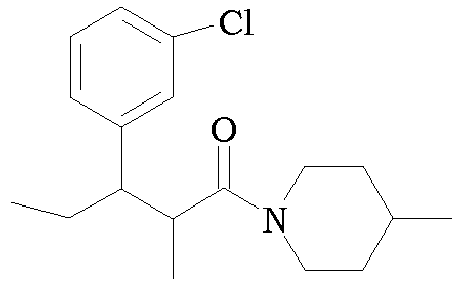
24 3-(3-chlorophenyl)-2-methyl-1-(morpholin-1-yl) pentan-1-one 
25 3-(3-chlorophenyl)-2-methyl-1-(pyrrolidin-1-yl) pentan-1-one 
26 N,N-dimethyl-2-methyl-3-(3-methylphenyl) valeramide 
27 N,N-diethyl-2-methyl-3-(3-methylphenyl) valeramide 
28 N,N-dipropyl-2-methyl-3-(3-methylphenyl) valeramide 
29 N,N-isopropyl-2-methyl-3-(3-methylphenyl) valeramide 
30 3-(3-methylphenyl)-2-methyl-1-(piperidin-1-yl) pentan-1-one 
31 3-(3-methylphenyl)-2-methyl-1-(4-methylpiperidin-1-yl) pentan-1-one 
32 3-(3-methylphenyl)-2-methyl-1-(morpholin-1-yl) pentan-1-one 
33 3-(3-methylphenyl)-2-methyl-1-(pyrrolidin-1-yl) pentan-1-one 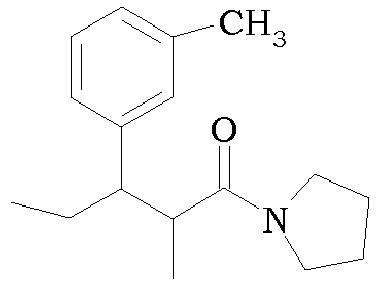
34 N,N-dimethyl-2-methyl-3-(3-aminophenyl) valeramide 
35 N,N-diethyl-2-methyl-3-(3-aminophenyl) valeramide 
36 N,N-dipropyl-2-methyl-3-(3-aminophenyl) valeramide 
37 N,N-isopropyl-2-methyl-3-(3-aminophenyl) valeramide 
38 3-(3-aminophenyl)-2-methyl-1-(piperidin-1-yl) pentan-1-one 
39 3-(3-aminophenyl)-2-methyl-1-(4-methylpiperidin-1-yl) pentan-1-one 
40 3-(3-aminophenyl)-2-methyl-1-(morpholin-1-yl) pentan-1-one 
41 3-(3-aminophenyl)-2-methyl-1-(pyrrolidin-1-yl) pentan-1-one 
- The compounds in the invention as the intermediate are used for preparing tapentadol and analogues thereof. The compounds in the invention preferably form tapentadol and analogues thereof after the salt is obtained by asymmetric preparation or chiral separation.
- The methods for preparing the compound of formula I in the invention are explained hereinafter, and are not intended to limit the composition of the invention.
- The compound of formula I in the invention can be prepared by the following methods, however, the conditions of the methods below, such as reactor, solvent, acid, alkali, reaction temperature and time, are not limited to the explanations below. The compounds in the invention can be conveniently prepared by combining various preparation methods in the specification or known in the field, so those skilled in the art of the invention can easily implement such combinations.
- The compounds above are prepared by the following method in the invention.
- The method is shown as Scheme 1:


the hydrolysis decarboxylation reaction is to hydrolyze the relevant substituted malonate into substitued malonic acid in an alkaline aqeuous solution to obtain the target compound by high temperature decarboxylation; and
the acylation reaction is to react with an acylating reagent, such as thionyl chloride, phosphorus pentachloride and phosphorus tribromide to obtain an acyl halide compound, i.e., compound I. - In the reaction route above, R1, R2, X and Y are defined as above; X1 and X2 are selected from oxygen or sulfur, and they may be same or not; R5 is selected from hydrogen, substituted or unsubstituted alkyl, substituted or unsubstituted cycloalkyl, substituted or unsubstituted aryl, substituted or unsubstituted aralkyl, substituted or unsubstituted heteroaryl, and substituted or unsubstituted heteroaralkyl.
- The method for preparing tapentadol by using the compound in the invention as the intermediate is as follows:

the reduction reaction is to reduce the amide into the relevant amine compound by using a proper reducer which usually is hydrogen, borane, sodium borohydride, lithium aluminum hydrid or the like; and
the separation step is to separate the prepared racemic compound into a single chiral compound by a relevant chiral separator which is an acidic chiral separator, and through the HPLC detection, the content of the chiral compound is 99.56%, and ee% > 99.5%. - In the reaction route above, R1, R2, R3, R4, X and Y are defined as above; and preferably, R1 is hydroxyl, R2, R3 and R4 are methyl, and the product is tapentadol.
- The embodiments below explain the invention more specifically. However, it should be construed that such embodiments are only for explaining the invention by examples, instead of limiting the scope of the invention in any forms.
-
- The steps are: add diethyl methylmalonate and anhydrous DMF into a reaction flask, stir well, T = 40°C, add NaH, after 1-hour consecutive reaction dip the DMF solution of 3-(1-bromopropyl) anisole while stirring, stir at 85°C for 18 hours, track that the reaction is substantially completed by TLC (developer: petroleum ether/ethyl acetate (8:1)), pour the reaction product in the water, perform extraction by ethyl acetate until the water layer is not fluorescent, wash the organic layer twice by water without drying to obtain a yellow oily product after decompression and concentration, i.e., diethyl 2-(3-methoxyphenyl)-2-methyl-propylmalonate.
- Molecular formula: C18H26O5, molecular weight: 322.4, MS (m/z): 322.
- Elementary analysis: theoretical values: C: 67.06%, H: 8.13%; measured values: C: 67.16%, H: 8.19%.
-
- The steps are: add diethyl 2-(3-methoxyphenyl)-2-methyl-propylmalonate, ethanol and water into a reaction flask, adjust the pH value to 14 by sodium hydroxide after stirring them well, perform heating reflux reaction, track the reaction by TLC, keep the pH value of the solution at 14 (developer: petroleum ether/ethyl acetate (4:1)), distil ethanol by decompression, and perform extraction twice by ethyl acetate to separate an organic layer out; adjust the pH value of the water layer to 2 to 3 by an acid, perform extraction by ethyl acetate, separate organic layers out, combine the organic layers, and perform drying by anhydrous magnesium sulphate to obtain a yellow oily product after decompression and concentration; add the yellow oily production in a three-neck flask, reflux and heat it in an oil bath of 15°C for 5 hours, pour the resultant into the sodium hydroxide solution to make the pH become alkaline, and extract the undissolved substance by ethyl acetate; and adjust the pH of the water layer to 3 by hydrochloric acid, perform extraction by ethyl acetate, and distil a solvent out after drying and decompression to obtain a yellow liquid, i.e., 2-methyl-3-(3-methoxyphenyl) valeric acid.
- Molecular formula: C13H18O3, molecular weight: 222.3, MS (m/z): 223 (M++ H).
- Elementary analysis: theoretical values: C: 70.24%, H: 8.16%; measured values: C: 70.32%, H: 8.09%.
- 1H-NMR(CDCl3, 500 MHz):
- δ: 7.09 (t, J=8.5 Hz, 1H, Ar-H), 6.77 (d, J=8.5 Hz, 2H, Ar-H), 6.77 (d, J=8.5 Hz, 1H, Ar-H), 3.90 (s, 3H, -OCH3), 3.10 (m, 1H, Ar-CH), 2.90 (m, 1H, Ar-CH-CH-COOH), 1.62 (m, 2H), 1.19 (d, J=6.5 Hz, 3H), 0.73 (d, J=6.0 Hz, 3H); 13C-NMR (CDCl3, 125 MHz) δ: 176.0, 160.1, 139.6, 127.3, 123.1, 116.3, 113.1, 60.3, 56.8, 55.8, 44.5, 26.5, 14.3, 11.2.
-
- The steps are: add 2-methyl-3-(3-methoxyphenyl) valeric acid into a reaction flask, add hydroiodic acid, and perform heating and reflux for 12 hours; detect the reaction process by TLC; after that, cool the resultant to room temperature, pour it into an alkaline solution to make the pH become 9, perform extraction by ethyl acetate, reversely adjust the pH of the water layer to about 3.0 after the water layer is separated out, and add ethyl acetate for extraction; and dry the ethyl acetate extracting solution by anhydrous magnesium sulphate, and recycle the solvent by decompression to obtain a light yellow liquid, 2-methyl-3-(3-hydroxyphenyl) valeric acid.
- Molecular formula: C18H26O5, molecular weight: 208.3, MS (m/z): 209 (M++H).
- Elementary analysis: theoretical values: C: 69.21%, H: 7.74%; measured values: C: 65.35%, H: 7.56%.
-
- The steps are: add 2-methyl-3-(3-hydroxyphenyl) valeric acid into a three-neck flask, add thionyl chloride, perform reflux for 4 hours, detect that the reaction is substantially completed by TLC (developer: petroleum ether/ethyl acetate (4:1)); and distil a solvent by decompression to obtain 2-methyl-3-(3-methoxyphenyl)valeryl chloride (compound 1).
- Molecular formula: C13H17ClO2, molecular weight: 240.7, MS (m/z): 240 (M+).
- Elementary analysis: theoretical values: C: 64.86%, H: 7.12%; measured values: C: 65.02%, H: 7.24%.
-
- The steps are: add compound 1 and methanol into a three-neck flask, perform reflux for 5 hours, detect that the reaction is substantially completed by TLC, distil a solvent by decompression to obtain a light yellow oily product, methyl 2-methyl-3-(3-methoxyphenyl)valerate (compound 2).
- Molecular formula: C14H20O3, molecular weight: 236.3, MS (m/z): 236 (M+).
- Elementary analysis: theoretical values: C: 71.16%, H: 8.53%; measured values: C: 71.09%, H: 8.39%.
-
- The step are: add the aqueous solution of dimethylamine (33%) into a three-neck flask, T = 10°C, dip compound 1 and NaOH to make pH = 12 to 14; after that, keep performing the reaction at the room temperature for 2 hours; perform extraction twice by ethyl acetate, prepare the organic phase, rinse twice by 10% hydrochloric acid, and perform drying by anhydrous magnesium sulfate; recycle the solvent by decompression to obtain a light yellow oily product which is dissolved by isopropanol; and add a seed crystal to obtain a white solid, N,N-dimethyl-2-methyl-3-(3-methoxyphenyl) valeramide (compound 7).
- Molecular formula: C15H23NO2, molecular weight: 249.4, MS (m/z): 249 (M+).
- Elementary analysis: theoretical values: C: 72.25%, H: 9.30%, N: 5.62%; measured values: C: 72.31%, H: 9.35%, N: 5.73%.
-
- The steps are: add compound 7 into a reaction flask, add hydroiodic acid, perform heating and reflux for 5 hours; detect the reaction process by TLC; after that, cool the resultant to the room temperature, pour it to an alkaline solution to make the pH become 9, and perform extraction by ethyl acetate and rinse by water; and recycle the solvent after drying and decompression to obtain a light yellow liquid, N,N-dimethyl-2-methyl-3-(3-hydroxyphenyl) valeramide (compound 9).
- Molecular formula: C14H21NO2, molecular weight: 235.3, MS (m/z): 235 (M+).
- Elementary analysis: theoretical values: C: 71.46%, H: 8.99%, N: 5.95%; measured values: C: 71.33%, H: 9.05%, N: 5.92%.
- 1H-NMR (CDCl3, 500 MHz) δ: 7.11 (t, J=8.0 Hz, 1H, Ar-H), 6.74 (d, J=8.0 Hz, 2H, Ar-H), 6.62 (d, J=8.0 Hz, 1H, Ar-H), 3.03 (m, 2H, Ar-CH, Ar-CH-CH-COOH), 2.86 (s, 6H, N(CH3)2), 1.66 (m, 2H), 1.12 (d, J=6.5 Hz, 3H), 0.75 (d, J=6.0 Hz, 3H); 13C-NMR (CDCl3, 125 MHz) δ: 176.0, 158.3, 140.6, 129.3, 121.8, 114.9, 113.6, 59.2, 42.7, 39.4, 26.5, 15.2, 11.1.
- Compound 11 can be obtained by replacing dimethylamine in Embodiment 6 with diethylamine.
- Molecular formula: C17H27NO2, molecular weight: 277.4, MS (m/z): 277 (M+).
- Elementary analysis: theoretical values: C: 73.61%, H: 9.81%, N: 5.05%; measured values: C: 73.43%, H: 9.75%, N: 5.09%.
- Compound 12 can be obtained according to the operation of the method by replacing dimethylamine in Embodiment 6 with dipropylamine.
- Molecular formula: C19H31NO2, molecular weight: 305.5, MS (m/z): 305 (M+).
- Elementary analysis: theoretical values: C: 74.71%, H: 10.23%, N: 4.59%; measured values: C: 74.68%, H: 10.21%, N: 4.61%.
- Compound 13 can be obtained according to the operation of the method by replacing dimethylamine in Embodiment 6 with diisopropylamine.
- Molecular formula: C19H31NO2, molecular weight: 305.5, MS (m/z): 305 (M+).
- Elementary analysis: theoretical values: C: 74.71%, H: 10.23%, N: 4.59%; measured values: C: 74.74%, H: 10.30%, N: 4.56%.
- Compound 14 can be obtained according to the operation of the method by replacing dimethylamine in Embodiment 6 with piperidine.
- Molecular formula: C18H27NO2, molecular weight: 289.4, MS (m/z): 289 (M+).
- Elementary analysis: theoretical values: C: 74.70%, H: 9.40%, N: 4.84%; measured values: C: 74.79%, H: 9.35%, N: 4.77%.
- Compound 15 can be obtained according to the operation of the method by replacing dimethylamine in Embodiment 6 with 4-methylpiperidine.
- Molecular formula: C19H29NO2, molecular weight: 303.45, MS (m/z): 304 (M++1).
- Elementary analysis: theoretical values: C: 75.21%, H: 9.63%, N: 4.62%; measured values: C: 75.19%, H: 9.57%, N: 4.76%.
- Compound 16 can be obtained according to the operation of the method by replacing dimethylamine in Embodiment 6 with morpholine.
- Molecular formula: C17H25NO3, molecular weight: 291.39, MS (m/z): 291 (M+).
- Elementary analysis: theoretical values: C: 70.07%, H: 8.65%, N: 4.81%; measured values: C: 70.11%, H: 8.57%, N: 4.79%.
- Compound 17 can be obtained according to the operation of the method by replacing dimethylamine in Embodiment 6 with pyrrolidine.
- Molecular formula: C17H25NO2, molecular weight: 275.39, MS (m/z): 275 (M+).
- Elementary analysis: theoretical values: C: 74.14%, H: 9.15%, N: 5.09%; measured values: C: 74.12%, H: 9.17%, N: 4.98%.
- Compound 18 can be obtained according to the operation of the method by replacing 3-(1-bromopropyl) anisole in Embodiment 1 with 3-(1-bromopropyl) chlorobenzene.
- Molecular formula: C14H20ClNO, molecular weight: 253.77, MS (m/z): 253 (M+).
- Elementary analysis: theoretical values: C: 66.26%, H: 7.94%, N: 5.52%; measured values: C: 66.32%, H: 8.05%, N: 5.56%.
- Compound 19 can be obtained according to the operation of the method by replacing dimethylamine in Embodiment 12 with diethylamine.
- Molecular formula: C16H24CINO, molecular weight: 281.83, MS (m/z): 281 (M+).
- Elementary analysis: theoretical values: C: 68.19%, H: 8.58%, N: 4.97%; measured values: C: 68.22%, H: 8.65%, N: 4.86%.
- Compound 20 can be obtained according to the operation of the method by replacing dimethylamine in Embodiment 12 with dipropylamine.
- Molecular formula: C18H28ClNO, molecular weight: 309.88, MS (m/z): 309 (M+).
- Elementary analysis: theoretical values: C: 69.77%, H: 9.11%, N: 4.52%; measured values: C: 69.83%, H: 9.21%, N: 4.56%.
- Compound 21 can be obtained according to the operation of the method by replacing dimethylamine in Embodiment 12 with isopropylamine.
- Molecular formula: C17H24CINO, molecular weight: 293.84, MS (m/z): 294 (M+).
- Elementary analysis: theoretical values: C: 69.77%, H: 9.11%, N: 4.52%; measured values: C: 69.84%, H: 9.23%, N: 4.59%.
- Compound 22 can be obtained according to the operation of the method by replacing dimethylamine in Embodiment 12 with piperidine.
- Molecular formula: C17H24CINO, molecular weight: 293.84, MS (m/z): 294 (M+).
- Elementary analysis: theoretical values: C: 69.49%, H: 8.23%, N: 12.07%; measured values: C: 69.44%, H: 8.31%, N: 4.75%.
- Compound 23 can be obtained according to the operation of the method by replacing dimethylamine in Embodiment 12 with 4-methylpiperidine.
- Molecular formula: C18H26CINO, molecular weight: 307.87, MS (m/z): 307 (M+).
- Elementary analysis: theoretical values: C: 70.23%, H: 8.51%, N: 4.55%; measured values: C: 70.22%, H: 8.65%, N: 4.62%.
- Compound 24 can be obtained according to the operation of the method by replacing dimethylamine in Embodiment 12 with morpholine.
- Molecular formula: C18H26CINO, molecular weight: 307.87, MS (m/z): 307 (M+).
- Elementary analysis: theoretical values: C: 64.97%, H: 7.50%, N: 4.73%; measured values: C: 65.02%, H: 7.55%, N: 4.68%.
- Compound 25 can be obtained according to the operation of the method by replacing dimethylamine in Embodiment 12 with pyrrolidine.
- Molecular formula: C16H22CINO, molecular weight: 279.81, MS (m/z): 279 (M+).
- Elementary analysis: theoretical values: C: 68.68%, H: 7.93%, N: 5.01%; measured values: C: 68.70%, H: 7.02%, N: 5.12%.
- The steps are: add anhydrous ether into a reaction flask, and add lithium aluminum hydride under the condition of ice bath; dip compound 7, control the temperature within 10°C, after the dipping detect the reaction process by TLC; after the reaction is ended, pour the reaction liquid in the ice water slowly, separate the ether layer out, rinse by water, perform drying, and recycle the solvent by decompression to obtain a light yellow liquid, 3-(3-methoxy-phenyl)-N,N-2-trimethyl pentylamine. Yield: 85%.
- Molecular formula: C15H25NO, molecular weight: 235.4, MS (m/z): 235 (M+).
- The steps are: add 3-(3-methoxy-phenyl)-N,N,2-trimethyl pentylamine into a reaction flask, add hydroiodic acid, and perform heating and reflux for 5 hours; detect the reaction process by TLC; after that, cool the resultant to the room temperature, pour it to an alkaline solution to make the pH become 9, perform extraction by ethyl acetate and rinse by water; recycle the solvent by drying and decompression to obtain a light yellow liquid, 3-(3-hydroxy-phenyl)-N,N-2-trimethyl pentylamine; and separate the mother solution by a separator, form the salt by the acidification of hydrochloric acid to obtain tapentadol hydrochloride. HPLC: 99.56%, ee% > 99.5%.
- Molecular formula: C14H23NO.HCl, molecular weight: 257.8, MS (m/z): 221 (M+-HCl).
- Elementary analysis: theoretical values: C: 65.23%, H: 9.38%, N: 5.43%; measured values: C: 65.31%, H: 9.35%, N: 5.31%.
- 1H-NMR (D2O, 500 MHz) δ: 7.15 (t, J=8.0 Hz , 1H , Ar-H), 6.69 (dd,J=8.0 Hz,2H,Ar-H), 6.65 (d,J=8.0Hz,1H,Ar-H), 2.71 (m, 2H, -CH2), 2.62 (s, 6H, N(CH3)2), 2.20 (m,1H,-CH-CH3), 2.04 (m,1H,-CH-), 1.73, 1.42 (m,2H,-CH2CH3), 0.96 (d,3H,-CHCH3), 0.54 (t,3H,-CH2CH3).
- 3-(3-methoxy-phenyl)-2-methyl-N,N-diethyl pentylamine can be obtained by compound 11 according to Embodiment 23.
- Molecular formula: C17H29NO, molecular weight: 263.4, MS (m/z): 264 (M++H).
- Elementary analysis: theoretical values: C: 77.51%, H: 11.09%, N: 5.31%; measured values: C: 77.39%, H: 11.15%, N: 5.42%.
- (1R,2R)-3-(3-diethylamine-1-ethyl-2-methylpropyl)-phenol hydrochloride can be obtained by 3-(3-methoxy-phenyl)-2-methyl-N,N-diethyl pentylamine according to Embodiment 24.
- Molecular formula: C16H27NO.HCl, molecular weight: 285.8, MS (m/z): 249 (M+-HCl).
- Elementary analysis: theoretical values: C: 71.21%, H: 10.46%, N: 5.19%; measured values: C: 71.11%, H: 10.35%, N: 5.21%.
- 3-(3-methoxy-phenyl)-2-methyl-N,N-dipropyl pentylamine can be obtained by compound 12 according to Embodiment 23.
- Molecular formula: C19H33NO, molecular weight: 291.5, MS (m/z): 290 (M+-H).
- Elementary analysis: theoretical values: C: 78.29%, H: 11.41%, N: 4.81%; measured values: C: 78.33%, H: 11.52%, N: 4.76%.
- (1R,2R)-3-(3-dipropylamine-1-ethyl-2-methylpropyl)-phenol hydrochloride can be obtained by 3-(3-methoxy-phenyl)-2-methyl-N,N-dipropyl pentylamine according to Embodiment 24.
- Molecular formula: C18H31NO.HCl, molecular weight: 313.9, MS (m/z): 277 (M+-HCl).
- Elementary analysis: theoretical values: C: 68.87%, H: 10.28%, N: 4.46%; measured values: C: 68.74%, H: 10.33%, N: 4.36%.
- 3-(3-methoxy-phenyl)-2-methyl-N,N-isopropyl pentylamine can be obtained by compound 13 according to Embodiment 23.
- Molecular formula: C19H33NO, molecular weight: 291.5, MS (m/z): 290 (M+-H).
- Elementary analysis: theoretical values: C: 78.29%, H: 11.41%, N: 4.81%; measured values: C: 78.33%, H: 11.52%, N: 4.76%.
- (1R,2R)-3-(3-isopropylamine-1-ethyl-2-methylpropyl)-phenol hydrochloride can be obtained by 3-(3-methoxy-phenyl)-2-methyl-N,N-dipropyl pentylamine according to Embodiment 24.
- Molecular formula: C18H31NO.HCl, molecular weight: 313.9, MS (m/z): 277 (M+-HCl).
- Elementary analysis: theoretical values: C: 68.87%, H: 10.28%, N: 4.46%; measured values: C: 68.74%, H: 10.33%, N: 4.36%.
- 1-[3-(3-methoxyphenyl)-2-methyl-pentyl]-piperidine can be obtained by compound 14 according to Embodiment 23.
- Molecular formula: C18H29NO, molecular weight: 275.4, MS (m/z): 275 (M+).
- Elementary analysis: theoretical values: C: 78.49%, H: 10.61%, N: 5.09%; measured values: C: 78.42%, H: 10.55%, N: 5.21%.
- (1R,2R)-3-(1-ethyl-2-methyl-3-piperidin-1-yl-propyl)-phenol hydrochloride can be obtained by 1-[3-(3-methoxyphenyl)-2-methyl-pentyl]-piperidine according to Embodiment 24.
- Molecular formula: C17H27NO.HCl, molecular weight: 297.9, MS (m/z): 261 (M+-HCl).
- Elementary analysis: theoretical values: C: 72.44%, H: 10.01%, N: 4.97%; measured values: C: 72.36%, H: 10.15%, N: 5.02%.
- 1-[3-(3-methoxyphenyl)-2-methyl-pentalkyl]-4-methyl-piperidine can be obtained by compound 15 according to Embodiment 23.
- Molecular formula: C19H33NO, molecular weight: 291.5, MS (m/z): 291 (M+).
- Elementary analysis: theoretical values: C: 78.29%, H: 11.41%, N: 4.80%; measured values: C: 78.31%, H: 11.35%, N: 4.82%.
- (1R,2R)-3-[1-ethyl-2-methyl-3-(4-methyl-piperidin-1-yl)-propyl]-phenol hydrochloride can be obtained by 1-[3-(3-methoxyphenyl)-2-methyl-pentyl]-4-methyl-piperidine according to Embodiment 24.
- Molecular formula: C18H29NO.HCl, molecular weight: 311.89, MS (m/z): 275 (M+-HCl).
- Elementary analysis: theoretical values: C: 69.31%, H: 9.70%, N: 4.49%; measured values: C: 69.42%, H: 9.72%, N: 4.46%.
- 4-[3-(3-methoxyphenyl)-2-methyl-pentyl]-morpholine can be obtained by compound 16 according to Embodiment 23.
- Molecular formula: C17H27NO2, molecular weight: 277.4, MS (m/z): 277 (M+).
- Elementary analysis: theoretical values: C: 73.60%, H: 9.81%, N: 5.05%; measured values: C: 73.71%, H: 9.85%, N: 5.01%.
- (1R,2R)-3-(1-ethyl-2-methyl-3-morpholin-4-yl-propyl)-phenol hydrochloride can be obtained by 4-[3-(3-methoxyphenyl)-2-methyl-pentyl]-morpholine according to Embodiment 24.
- Molecular formula: C16H27NO2.HCl, molecular weight: 299.8, MS (m/z): 263 (M+-HCl).
- Elementary analysis: theoretical values: C: 64.09%, H: 8.74%, N: 4.67%; measured values: C: 64.12%, H: 9.79%, N: 4.71%.
- 1-[3-(3-methoxyphenyl)-2-methyl-pentyl]-pyrrolidine can be obtained by compound 17 according to Embodiment 23.
- Molecular formula: C17H27NO, molecular weight: 261.4, MS (m/z): 261 (M+).
- Elementary analysis: theoretical values: C: 78.11%, H: 10.41%, N: 5.35%; measured values: C: 78.24%, H: 10.35%, N: 5.29%.
- (1R,2R)-3-(1-ethyl-2-methyl-3-pyrrolidin-1-yl-propyl)-phenol hydrochloride can be obtained by 1-[3-(3-methoxyphenyl)-2-methyl-pentyl]-pyrrolidine according to Embodiment 24.
- Molecular formula: C14H23NO.HCl, molecular weight: 283.8, MS (m/z): 247 (M+-HCl).
- Elementary analysis: theoretical values: C: 67.70%, H: 9.23%, N: 5.64%; measured values: C: 67.76%, H: 9.31%, N: 5.59%.
- The steps are: under the condition of ice bath, add methanol and 3-(3-methoxyphenyl)-2-pentanone into a reaction flask, stir, introduce N2, after the system is reduced about 0°C add 96% sodium borohydride for four times, keep performing the reaction at the temperature for 30 minutes, track that the reaction is substantially completed by TLC, distil the solvent by decompression, pour the reaction product in the water, and perform extraction by ethyl acetate and drying by anhydrous magnesium sulfate to obtain 3-(3-methoxyphenyl)-2-pentanol after decompression and concentration, yield: 99%.
- Molecular formula: C12H18O2, molecular weight: 194.3, MS (m/z): 195 (M++H).
- Elementary analysis: theoretical values: C: 74.19%, H: 9.34%; measured values: C: 74.22%, H: 9.32%.
-
- The steps are: under the protection of N2, add 3-(3-methoxyphenyl)-2-pentanol and dichloromethane into a reaction flask, lower the temperature to about -5°C by ice bath, dip PBr3, keep the temperature, stir at the temperature for 1 hour, track that the reaction is substantially completed by TLC, pour the reaction product in the ice water, perform extraction by dichloromethane, rinse the organic layer by the aqueous solution of sodium bicarbonate and then by water, and perform drying by anhydrous magnesium sulfate to obtain 1-(2-bromopentane)-3-methoxybenzene after decompression and concentration, yield: 95%.
- Molecular formula: C12H17BrO, molecular weight: 256.2, MS (m/z): 257 (M++H).
- Elementary analysis: theoretical values: C: 56.04%, H: 6.66%; measured values: C: 56.11%, H: 6.62%.
- The invention has been described in connection with the embodiments. It should be construed that the description and embodiments above are only used for explaining the invention by examples.
Claims (8)
- A method for preparing the compound shown as formula I or II, characterized in that the reaction route is:
 R1 is selected from halogen, hydroxy, amino, nitrile, nitro, acyl, substituted or unsubstituted alkyl, substituted or unsubstituted cycloalkyl, substituted or unsubstituted alkoxyl, substituted or unsubstituted aryl, substituted or unsubstituted aralkyl, substituted or unsubstituted heteroaryl, substituted or unsubstituted heteroaralkyl, acyloxy, oxyacyl and sulfonyl;R2 is selected from substituted or unsubstituted alkyl, substituted or unsubstituted cycloalkyl, substituted or unsubstituted aryl, substituted or unsubstituted aralkyl, substituted or unsubstituted heteroaryl, and substituted or unsubstituted heteroaralkyl;X is selected from oxygen or sulfur;Y is selected from halogen, OR2 or NR3R4;R3 and R4 are separately hydrogen, substituted or unsubstituted alkyl, substituted or unsubstituted cycloalkyl, substituted or unsubstituted aryl, substituted or unsubstituted aralkyl, substituted or unsubstituted heteroaryl, and substituted or unsubstituted heteroaralkyl; or R3, R4 and N form substituted or unsubstituted saturated or unsaturated heterocyclyl jointly;X1 and X2 are selected from oxygen or sulfur, and they can be same or not; andR5 is selected from hydrogen, substituted or unsubstituted alkyl, substituted or unsubstituted cycloalkyl, substituted or unsubstituted aryl, substituted or unsubstituted aralkyl, substituted or unsubstituted heteroaryl, and substituted or unsubstituted heteroaralkyl.
 - A compound having the following structural formula I:
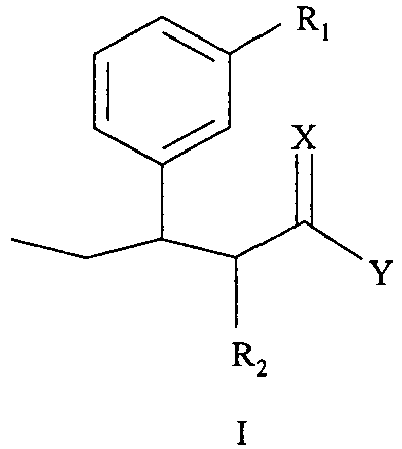 R1 is selected from halogen, hydroxy, nitrile, acyl, substituted alkyl, substituted or unsubstituted cycloalkyl, substituted alkoxyl, substituted or unsubstituted aryl, substituted or unsubstituted aralkyl, substituted or unsubstituted heteroaryl, substituted or unsubstituted heteroaralkyl, acyloxy, oxyacyl and sulfonyl;R2 is selected from substituted or unsubstituted alkyl, substituted or unsubstituted cycloalkyl, substituted or unsubstituted aryl, substituted or unsubstituted aralkyl, substituted or unsubstituted heteroaryl, and substituted or unsubstituted heteroaralkyl;X is selected from oxygen or sulfur;when X is selected from oxygen, Y is selected from halogen, OR2 or NR3R4;R3 and R4 are separately selected from substituted or unsubstituted cycloalkyl, substituted or unsubstituted heteroaryl, substituted or unsubstituted heteroaralkyl; or R3, R4 and N form saturated or unsaturated heterocyclyl;when X is selected from sulfur, Y is selected from halogen, OR2 or NR3R4; andR3 and R4 are separately hydrogen, substituted or unsubstituted alkyl, substituted or unsubstituted cycloalkyl, substituted or unsubstituted aryl, substituted or unsubstituted aralkyl, substituted or unsubstituted heteroaryl, and substituted or unsubstituted heteroaralkyl; or R3, R4 and N form saturated or unsaturated heterocyclyl jointly.
 - The compound according to claim 2, wherein R1 is selected from F, Cl, Br, CHF2, CF3, OH, SO2CH3, CN, CHO, -C3-7 cycloalkyl, -C1-3 alkylenephenyl, -C1-3 alkylenenaphthyl, tetrahydrofuran or -C(=O) C1-6 alkyl; and Y is selected from OR2, wherein R2 is selected from methyl, ethyl, n-propyl or isopropyl.
- The compound according to claim 3, wherein R1 is selected from Cl or OH.
- The compound according to claim 2, wherein Y is selected from NR3R4, and R3, R4 and N form substituted or unsubstituted saturated nitrogen-containing heteorcyclyl containing oxygen or not jointly.
- The compound according to claim 5, wherein R3, R4 and N form tetrahydropyrrole ring, piperidine ring, 4-methylpiperidine ring, morpholine ring, methylpiperazine ring or 4-hydroxypiperidine ring jointly.
- A compound, selected from the following compounds:2-methyl-3-(3-methoxyphenyl)valeryl chloride;methyl 2-methyl-3-(3-methoxyphenyl) thiovalerate;methyl 2-methyl-3-(3-hydroxyphenyl) thiovalerate;2-methyl-3-(3-hydroxyphenyl) thiovaleramide;N,N-dimethyl-2-methyl-3-(3-methoxyphenyl) thiovaleramide;N,N-dimethyl-2-methyl-3-(3-hydroxyphenyl)thiovaleramide;N,N-diethyl-2-methyl-3-(3-methoxyphenyl) valeramide;3-(3-methoxyphenyl)-2-methyl-1-(piperidin-1-yl) pentan-1-one;3-(3-methoxyphenyl)-2-methyl-1-(4-methylpiperidin-1-yl) pentan-1-one;3-(3-methoxyphenyl)-2-methyl-1-(morpholin-1-yl) pentan-1-one;3-(3-methoxyphenyl)-2-methyl-1-(pyrrolidin-1-yl) pentan-1-one;3-(3-chlorophenyl)-2-methyl-1-(piperidin-1-yl) pentan-1-one;3-(3-chlorophenyl)-2-methyl-1-(4-methylpiperidin-1-yl) pentan-1-one;3-(3-chlorophenyl)-2-methyl-1-(morpholin-1-yl) pentan-1-one;3-(3-chlorophenyl)-2-methyl-1-(pyrrolidin-1-yl) pentan-1-one;3-(3-methylphenyl)-2-methyl-1-(piperidin-1-yl) pentan-1-one;3-(3-methylphenyl)-2-methyl-1-(4-methylpiperidin-1-yl) pentan-1-one;3-(3-methylphenyl)-2-methyl-1-(morpholin-1-yl) pentan-1-one;3-(3-methylphenyl)-2-methyl-1-(pyrrolidin-1-yl) pentan-1-one;3-(3-aminophenyl)-2-methyl-1-(piperidin-1-yl) pentan-1-one;3-(3-aminophenyl)-2-methyl-1-(4-methylpiperidin-1-yl) pentan-1-one;3-(3-aminophenyl)-2-methyl-1-(morpholin-1-yl) pentan-1-one; and3-(3-aminophenyl)-2-methyl-1-(pyrrolidin-1-yl) pentan-1-one.
- A method for preparing analogues of tapentadol, characterized in that the reaction route is:

Applications Claiming Priority (1)
| Application Number | Priority Date | Filing Date | Title |
|---|---|---|---|
| PCT/CN2011/001248 WO2013016840A1 (en) | 2011-07-29 | 2011-07-29 | Novel intermediate used for preparing tapentadol or analogues thereof |
Publications (3)
| Publication Number | Publication Date |
|---|---|
| EP2617706A1 EP2617706A1 (en) | 2013-07-24 |
| EP2617706A4 EP2617706A4 (en) | 2015-05-20 |
| EP2617706B1 true EP2617706B1 (en) | 2017-09-06 |
Family
ID=47628602
Family Applications (1)
| Application Number | Title | Priority Date | Filing Date |
|---|---|---|---|
| EP11870206.7A Active EP2617706B1 (en) | 2011-07-29 | 2011-07-29 | Novel intermediate used for preparing tapentadol or analogues thereof |
Country Status (3)
| Country | Link |
|---|---|
| US (1) | US8853393B2 (en) |
| EP (1) | EP2617706B1 (en) |
| WO (1) | WO2013016840A1 (en) |
Families Citing this family (1)
| Publication number | Priority date | Publication date | Assignee | Title |
|---|---|---|---|---|
| US9682918B2 (en) * | 2011-07-29 | 2017-06-20 | Anhui New Star Pharmaceutical Devlopment Co., Ltd. | intermediate used for preparing tapentadol or analogues thereof |
Family Cites Families (13)
| Publication number | Priority date | Publication date | Assignee | Title |
|---|---|---|---|---|
| DE4426245A1 (en) | 1994-07-23 | 1996-02-22 | Gruenenthal Gmbh | 1-phenyl-3-dimethylamino-propane compounds with pharmacological activity |
| AU6344098A (en) | 1997-02-28 | 1998-09-18 | Shaw Industries, Inc. | Carpet, carpet backings and methods |
| CZ298847B6 (en) * | 1997-09-11 | 2008-02-27 | Pharmacia & Upjohn Company | A method for producing a protease inhibitor |
| PE20020444A1 (en) * | 2000-09-22 | 2002-06-14 | Merck & Co Inc | ANTAGONISTS OF ZWITTERIONIC TACHYQUININ RECEPTORS |
| DE10059412A1 (en) | 2000-11-30 | 2002-06-13 | Gruenenthal Gmbh | Use of 1-phenyl-3-dimethylamino-propane compounds for the treatment of urinary incontinence |
| DE10233048A1 (en) | 2002-07-19 | 2004-01-29 | Grünenthal GmbH | Use of 1-phenyl-3dimethylamino-propane compounds for the treatment of depressive symptoms |
| DE10326097A1 (en) | 2003-06-06 | 2005-01-05 | Grünenthal GmbH | Process for the preparation of dimethyl (3-aryl-butyl) -amine compounds |
| AU2003252426A1 (en) | 2003-06-30 | 2005-01-13 | Qing Dao Ru Li Electric Appliances Co., Ltd | Device for cleaning and sterilizing fruit and vegetable |
| DE102007012165A1 (en) | 2007-03-12 | 2008-09-18 | Grünenthal GmbH | Use of 1-phenyl-3-dimethylamino-propane compounds for the therapy of neuropathy pain |
| PL2519100T3 (en) * | 2009-12-29 | 2017-09-29 | Mapi Pharma Limited | Intermediate compounds and processes for the preparation of tapentadol and related compounds |
| WO2011080756A1 (en) * | 2009-12-29 | 2011-07-07 | Ind-Swift Laboratories Limited | Process for the preparation of 1-phenyl-3-dimethylaminopropane derivatives |
| WO2011092719A2 (en) * | 2010-02-01 | 2011-08-04 | Ind-Swift Laboratories Limited | Process for the preparation of l-phenyl-3-dimethylaminopropane derivatives |
| CN103168025B (en) * | 2010-06-15 | 2015-02-25 | 格吕伦塔尔有限公司 | Process for the preparation of substituted 3-(1-amino-2-methylpentan-3-yl)phenyl compounds |
-
2011
- 2011-07-29 EP EP11870206.7A patent/EP2617706B1/en active Active
- 2011-07-29 US US13/884,810 patent/US8853393B2/en not_active Expired - Fee Related
- 2011-07-29 WO PCT/CN2011/001248 patent/WO2013016840A1/en not_active Ceased
Non-Patent Citations (1)
| Title |
|---|
| None * |
Also Published As
| Publication number | Publication date |
|---|---|
| US8853393B2 (en) | 2014-10-07 |
| US20130231478A1 (en) | 2013-09-05 |
| EP2617706A1 (en) | 2013-07-24 |
| EP2617706A4 (en) | 2015-05-20 |
| WO2013016840A1 (en) | 2013-02-07 |
Similar Documents
| Publication | Publication Date | Title |
|---|---|---|
| NO335587B1 (en) | Process for the preparation of substituted 3-aryl-butylamine compounds | |
| EP2403823B1 (en) | Process for the preparation of cinacalcet and salts thereof, and intermediates for use in the process | |
| US8222454B2 (en) | Process for preparing optical pure milnacipran and its pharmaceutically accepted salts | |
| US20130096346A1 (en) | Resolution methods for isolating desired enantiomers of tapentadol intermediates and use thereof for the preparation of tapentadol | |
| EP0443606A2 (en) | 4-(4-alkoxyphenyl)-2-butylamine derivatives and process therefor | |
| US20080146844A1 (en) | Process for preparing tolterodine | |
| US8853456B2 (en) | Process for the preparation of tapentadol | |
| CN103172539B (en) | The preparation method of Glucovance sitagliptin intermediate aminobenzene butyric acid derivative | |
| US7612210B2 (en) | Process for selective synthesis of enantiomers of substituted 1-(2-amino-1-phenyl-ethyl)-cyclohexanols | |
| US8552219B2 (en) | Process for preparing L-phenyl-3-dimethylaminopropane derivative | |
| US7507861B2 (en) | Process for the preparation of atomoxetine hydrochloride | |
| EP2617706B1 (en) | Novel intermediate used for preparing tapentadol or analogues thereof | |
| CN104610076B (en) | A kind of S-dapoxetine and the synthetic method of salt thereof | |
| EP2686288B1 (en) | A process for preparing fesoterodine | |
| WO2011007136A2 (en) | Process for the preparation of o-desmethyl venlafaxine and intermediate for use therein | |
| EP2563757A2 (en) | Method for preparing ritodrine hydrochloride | |
| US9682918B2 (en) | intermediate used for preparing tapentadol or analogues thereof | |
| EP2711354B1 (en) | Preparation method for rivastigmine, intermediates thereof, and preparation method for said intermediates | |
| CN101265201B (en) | A kind of synthetic method of tramadol hydrochloride | |
| WO2007026373A2 (en) | Process for preparing rivastigmine | |
| CN104628500A (en) | Catalytic hydrogenation synthesis method for N-substituted alpha-amino alcohol | |
| CN106146385A (en) | A kind of synthetic method of triglyceride transfer protein enzyme inhibitor | |
| NZ503397A (en) | 3-amino-3-arylpropan-1-ol derivatives, and their preparation and use as a medicament in the treatment of chronic pain and other illnesses | |
| WO2013105109A1 (en) | Process for the preparation of tapentadol | |
| CN108033902A (en) | A kind of preparation method of his cis-isomer of high-purity Baily department |
Legal Events
| Date | Code | Title | Description |
|---|---|---|---|
| PUAI | Public reference made under article 153(3) epc to a published international application that has entered the european phase |
Free format text: ORIGINAL CODE: 0009012 |
|
| 17P | Request for examination filed |
Effective date: 20130418 |
|
| AK | Designated contracting states |
Kind code of ref document: A1 Designated state(s): AL AT BE BG CH CY CZ DE DK EE ES FI FR GB GR HR HU IE IS IT LI LT LU LV MC MK MT NL NO PL PT RO RS SE SI SK SM TR |
|
| DAX | Request for extension of the european patent (deleted) | ||
| RA4 | Supplementary search report drawn up and despatched (corrected) |
Effective date: 20150416 |
|
| RIC1 | Information provided on ipc code assigned before grant |
Ipc: C07C 59/48 20060101ALI20150414BHEP Ipc: C07C 59/64 20060101ALI20150414BHEP Ipc: C07C 233/11 20060101ALI20150414BHEP Ipc: C07C 235/34 20060101ALI20150414BHEP Ipc: C07C 69/732 20060101ALI20150414BHEP Ipc: C07C 41/22 20060101AFI20150414BHEP Ipc: C07C 51/367 20060101ALI20150414BHEP Ipc: C07C 237/20 20060101ALI20150414BHEP Ipc: C07C 69/734 20060101ALI20150414BHEP Ipc: C07C 215/54 20060101ALI20150414BHEP Ipc: C07C 59/60 20060101ALI20150414BHEP Ipc: C07C 43/225 20060101ALI20150414BHEP Ipc: C07C 213/10 20060101ALI20150414BHEP Ipc: C07C 41/26 20060101ALI20150414BHEP Ipc: C07C 213/00 20060101ALI20150414BHEP Ipc: C07C 51/60 20060101ALI20150414BHEP |
|
| 17Q | First examination report despatched |
Effective date: 20160630 |
|
| REG | Reference to a national code |
Ref country code: DE Ref legal event code: R079 Ref document number: 602011041465 Country of ref document: DE Free format text: PREVIOUS MAIN CLASS: C07C0233050000 Ipc: C07C0041220000 |
|
| RIC1 | Information provided on ipc code assigned before grant |
Ipc: C07C 213/00 20060101ALI20170220BHEP Ipc: C07C 59/60 20060101ALI20170220BHEP Ipc: C07C 327/22 20060101ALI20170220BHEP Ipc: C07C 51/367 20060101ALI20170220BHEP Ipc: C07C 327/44 20060101ALI20170220BHEP Ipc: C07C 69/734 20060101ALI20170220BHEP Ipc: C07C 43/225 20060101ALI20170220BHEP Ipc: C07D 295/182 20060101ALI20170220BHEP Ipc: C07C 237/20 20060101ALI20170220BHEP Ipc: C07C 215/54 20060101ALI20170220BHEP Ipc: C07C 41/22 20060101AFI20170220BHEP Ipc: C07C 51/60 20060101ALI20170220BHEP Ipc: C07C 43/23 20060101ALI20170220BHEP Ipc: C07C 213/10 20060101ALI20170220BHEP Ipc: C07C 41/26 20060101ALI20170220BHEP Ipc: C07C 69/732 20060101ALI20170220BHEP Ipc: C07C 233/11 20060101ALI20170220BHEP Ipc: C07C 235/34 20060101ALI20170220BHEP Ipc: C07C 59/64 20060101ALI20170220BHEP Ipc: C07C 59/48 20060101ALI20170220BHEP |
|
| GRAP | Despatch of communication of intention to grant a patent |
Free format text: ORIGINAL CODE: EPIDOSNIGR1 |
|
| INTG | Intention to grant announced |
Effective date: 20170425 |
|
| RIN1 | Information on inventor provided before grant (corrected) |
Inventor name: LI, XIAOXIANG Inventor name: LI, DEGANG Inventor name: XU, ZIAO Inventor name: ZHAO, YUANHAI |
|
| GRAS | Grant fee paid |
Free format text: ORIGINAL CODE: EPIDOSNIGR3 |
|
| GRAA | (expected) grant |
Free format text: ORIGINAL CODE: 0009210 |
|
| RIN1 | Information on inventor provided before grant (corrected) |
Inventor name: XU, ZIAO Inventor name: ZHAO, YONGHAI Inventor name: LI, DEGANG Inventor name: LI, XIAOXIANG |
|
| AK | Designated contracting states |
Kind code of ref document: B1 Designated state(s): AL AT BE BG CH CY CZ DE DK EE ES FI FR GB GR HR HU IE IS IT LI LT LU LV MC MK MT NL NO PL PT RO RS SE SI SK SM TR |
|
| REG | Reference to a national code |
Ref country code: GB Ref legal event code: FG4D |
|
| REG | Reference to a national code |
Ref country code: AT Ref legal event code: REF Ref document number: 925711 Country of ref document: AT Kind code of ref document: T Effective date: 20170915 Ref country code: CH Ref legal event code: NV Representative=s name: ISLER AND PEDRAZZINI AG, CH Ref country code: CH Ref legal event code: EP |
|
| REG | Reference to a national code |
Ref country code: NL Ref legal event code: FP Ref country code: IE Ref legal event code: FG4D |
|
| REG | Reference to a national code |
Ref country code: SE Ref legal event code: TRGR |
|
| REG | Reference to a national code |
Ref country code: DE Ref legal event code: R096 Ref document number: 602011041465 Country of ref document: DE |
|
| REG | Reference to a national code |
Ref country code: LT Ref legal event code: MG4D |
|
| PG25 | Lapsed in a contracting state [announced via postgrant information from national office to epo] |
Ref country code: NO Free format text: LAPSE BECAUSE OF FAILURE TO SUBMIT A TRANSLATION OF THE DESCRIPTION OR TO PAY THE FEE WITHIN THE PRESCRIBED TIME-LIMIT Effective date: 20171206 Ref country code: FI Free format text: LAPSE BECAUSE OF FAILURE TO SUBMIT A TRANSLATION OF THE DESCRIPTION OR TO PAY THE FEE WITHIN THE PRESCRIBED TIME-LIMIT Effective date: 20170906 Ref country code: HR Free format text: LAPSE BECAUSE OF FAILURE TO SUBMIT A TRANSLATION OF THE DESCRIPTION OR TO PAY THE FEE WITHIN THE PRESCRIBED TIME-LIMIT Effective date: 20170906 Ref country code: LT Free format text: LAPSE BECAUSE OF FAILURE TO SUBMIT A TRANSLATION OF THE DESCRIPTION OR TO PAY THE FEE WITHIN THE PRESCRIBED TIME-LIMIT Effective date: 20170906 |
|
| REG | Reference to a national code |
Ref country code: AT Ref legal event code: MK05 Ref document number: 925711 Country of ref document: AT Kind code of ref document: T Effective date: 20170906 |
|
| PG25 | Lapsed in a contracting state [announced via postgrant information from national office to epo] |
Ref country code: BG Free format text: LAPSE BECAUSE OF FAILURE TO SUBMIT A TRANSLATION OF THE DESCRIPTION OR TO PAY THE FEE WITHIN THE PRESCRIBED TIME-LIMIT Effective date: 20171206 Ref country code: LV Free format text: LAPSE BECAUSE OF FAILURE TO SUBMIT A TRANSLATION OF THE DESCRIPTION OR TO PAY THE FEE WITHIN THE PRESCRIBED TIME-LIMIT Effective date: 20170906 Ref country code: GR Free format text: LAPSE BECAUSE OF FAILURE TO SUBMIT A TRANSLATION OF THE DESCRIPTION OR TO PAY THE FEE WITHIN THE PRESCRIBED TIME-LIMIT Effective date: 20171207 Ref country code: ES Free format text: LAPSE BECAUSE OF FAILURE TO SUBMIT A TRANSLATION OF THE DESCRIPTION OR TO PAY THE FEE WITHIN THE PRESCRIBED TIME-LIMIT Effective date: 20170906 Ref country code: RS Free format text: LAPSE BECAUSE OF FAILURE TO SUBMIT A TRANSLATION OF THE DESCRIPTION OR TO PAY THE FEE WITHIN THE PRESCRIBED TIME-LIMIT Effective date: 20170906 |
|
| PG25 | Lapsed in a contracting state [announced via postgrant information from national office to epo] |
Ref country code: RO Free format text: LAPSE BECAUSE OF FAILURE TO SUBMIT A TRANSLATION OF THE DESCRIPTION OR TO PAY THE FEE WITHIN THE PRESCRIBED TIME-LIMIT Effective date: 20170906 Ref country code: CZ Free format text: LAPSE BECAUSE OF FAILURE TO SUBMIT A TRANSLATION OF THE DESCRIPTION OR TO PAY THE FEE WITHIN THE PRESCRIBED TIME-LIMIT Effective date: 20170906 Ref country code: PL Free format text: LAPSE BECAUSE OF FAILURE TO SUBMIT A TRANSLATION OF THE DESCRIPTION OR TO PAY THE FEE WITHIN THE PRESCRIBED TIME-LIMIT Effective date: 20170906 |
|
| PG25 | Lapsed in a contracting state [announced via postgrant information from national office to epo] |
Ref country code: AT Free format text: LAPSE BECAUSE OF FAILURE TO SUBMIT A TRANSLATION OF THE DESCRIPTION OR TO PAY THE FEE WITHIN THE PRESCRIBED TIME-LIMIT Effective date: 20170906 Ref country code: IT Free format text: LAPSE BECAUSE OF FAILURE TO SUBMIT A TRANSLATION OF THE DESCRIPTION OR TO PAY THE FEE WITHIN THE PRESCRIBED TIME-LIMIT Effective date: 20170906 Ref country code: EE Free format text: LAPSE BECAUSE OF FAILURE TO SUBMIT A TRANSLATION OF THE DESCRIPTION OR TO PAY THE FEE WITHIN THE PRESCRIBED TIME-LIMIT Effective date: 20170906 Ref country code: SM Free format text: LAPSE BECAUSE OF FAILURE TO SUBMIT A TRANSLATION OF THE DESCRIPTION OR TO PAY THE FEE WITHIN THE PRESCRIBED TIME-LIMIT Effective date: 20170906 Ref country code: IS Free format text: LAPSE BECAUSE OF FAILURE TO SUBMIT A TRANSLATION OF THE DESCRIPTION OR TO PAY THE FEE WITHIN THE PRESCRIBED TIME-LIMIT Effective date: 20180106 Ref country code: SK Free format text: LAPSE BECAUSE OF FAILURE TO SUBMIT A TRANSLATION OF THE DESCRIPTION OR TO PAY THE FEE WITHIN THE PRESCRIBED TIME-LIMIT Effective date: 20170906 |
|
| REG | Reference to a national code |
Ref country code: DE Ref legal event code: R097 Ref document number: 602011041465 Country of ref document: DE |
|
| PLBE | No opposition filed within time limit |
Free format text: ORIGINAL CODE: 0009261 |
|
| STAA | Information on the status of an ep patent application or granted ep patent |
Free format text: STATUS: NO OPPOSITION FILED WITHIN TIME LIMIT |
|
| REG | Reference to a national code |
Ref country code: FR Ref legal event code: PLFP Year of fee payment: 8 |
|
| PG25 | Lapsed in a contracting state [announced via postgrant information from national office to epo] |
Ref country code: DK Free format text: LAPSE BECAUSE OF FAILURE TO SUBMIT A TRANSLATION OF THE DESCRIPTION OR TO PAY THE FEE WITHIN THE PRESCRIBED TIME-LIMIT Effective date: 20170906 |
|
| 26N | No opposition filed |
Effective date: 20180607 |
|
| PG25 | Lapsed in a contracting state [announced via postgrant information from national office to epo] |
Ref country code: SI Free format text: LAPSE BECAUSE OF FAILURE TO SUBMIT A TRANSLATION OF THE DESCRIPTION OR TO PAY THE FEE WITHIN THE PRESCRIBED TIME-LIMIT Effective date: 20170906 |
|
| PG25 | Lapsed in a contracting state [announced via postgrant information from national office to epo] |
Ref country code: MC Free format text: LAPSE BECAUSE OF FAILURE TO SUBMIT A TRANSLATION OF THE DESCRIPTION OR TO PAY THE FEE WITHIN THE PRESCRIBED TIME-LIMIT Effective date: 20170906 Ref country code: LU Free format text: LAPSE BECAUSE OF NON-PAYMENT OF DUE FEES Effective date: 20180729 |
|
| PG25 | Lapsed in a contracting state [announced via postgrant information from national office to epo] |
Ref country code: MT Free format text: LAPSE BECAUSE OF NON-PAYMENT OF DUE FEES Effective date: 20180729 |
|
| PG25 | Lapsed in a contracting state [announced via postgrant information from national office to epo] |
Ref country code: TR Free format text: LAPSE BECAUSE OF FAILURE TO SUBMIT A TRANSLATION OF THE DESCRIPTION OR TO PAY THE FEE WITHIN THE PRESCRIBED TIME-LIMIT Effective date: 20170906 |
|
| PG25 | Lapsed in a contracting state [announced via postgrant information from national office to epo] |
Ref country code: PT Free format text: LAPSE BECAUSE OF FAILURE TO SUBMIT A TRANSLATION OF THE DESCRIPTION OR TO PAY THE FEE WITHIN THE PRESCRIBED TIME-LIMIT Effective date: 20170906 Ref country code: HU Free format text: LAPSE BECAUSE OF FAILURE TO SUBMIT A TRANSLATION OF THE DESCRIPTION OR TO PAY THE FEE WITHIN THE PRESCRIBED TIME-LIMIT; INVALID AB INITIO Effective date: 20110729 |
|
| PG25 | Lapsed in a contracting state [announced via postgrant information from national office to epo] |
Ref country code: CY Free format text: LAPSE BECAUSE OF FAILURE TO SUBMIT A TRANSLATION OF THE DESCRIPTION OR TO PAY THE FEE WITHIN THE PRESCRIBED TIME-LIMIT Effective date: 20170906 Ref country code: MK Free format text: LAPSE BECAUSE OF NON-PAYMENT OF DUE FEES Effective date: 20170906 |
|
| PG25 | Lapsed in a contracting state [announced via postgrant information from national office to epo] |
Ref country code: AL Free format text: LAPSE BECAUSE OF FAILURE TO SUBMIT A TRANSLATION OF THE DESCRIPTION OR TO PAY THE FEE WITHIN THE PRESCRIBED TIME-LIMIT Effective date: 20170906 |
|
| REG | Reference to a national code |
Ref country code: DE Ref legal event code: R082 Ref document number: 602011041465 Country of ref document: DE Representative=s name: ALPSPITZ IP ALLGAYER UND PARTNER PATENTANWAELT, DE |
|
| PGFP | Annual fee paid to national office [announced via postgrant information from national office to epo] |
Ref country code: NL Payment date: 20240722 Year of fee payment: 14 |
|
| PGFP | Annual fee paid to national office [announced via postgrant information from national office to epo] |
Ref country code: IE Payment date: 20240708 Year of fee payment: 14 Ref country code: DE Payment date: 20240719 Year of fee payment: 14 |
|
| PGFP | Annual fee paid to national office [announced via postgrant information from national office to epo] |
Ref country code: GB Payment date: 20240709 Year of fee payment: 14 |
|
| PGFP | Annual fee paid to national office [announced via postgrant information from national office to epo] |
Ref country code: BE Payment date: 20240722 Year of fee payment: 14 |
|
| PGFP | Annual fee paid to national office [announced via postgrant information from national office to epo] |
Ref country code: FR Payment date: 20240705 Year of fee payment: 14 |
|
| PGFP | Annual fee paid to national office [announced via postgrant information from national office to epo] |
Ref country code: CH Payment date: 20240801 Year of fee payment: 14 |
|
| PGFP | Annual fee paid to national office [announced via postgrant information from national office to epo] |
Ref country code: SE Payment date: 20240711 Year of fee payment: 14 |
|
| REG | Reference to a national code |
Ref country code: DE Ref legal event code: R119 Ref document number: 602011041465 Country of ref document: DE |
|
| REG | Reference to a national code |
Ref country code: CH Ref legal event code: H13 Free format text: ST27 STATUS EVENT CODE: U-0-0-H10-H13 (AS PROVIDED BY THE NATIONAL OFFICE) Effective date: 20260224 |
|
| REG | Reference to a national code |
Ref country code: NL Ref legal event code: MM Effective date: 20250801 |
|
| GBPC | Gb: european patent ceased through non-payment of renewal fee |
Effective date: 20250729 |
|
| REG | Reference to a national code |
Ref country code: BE Ref legal event code: MM Effective date: 20250731 |
|
| PG25 | Lapsed in a contracting state [announced via postgrant information from national office to epo] |
Ref country code: GB Free format text: LAPSE BECAUSE OF NON-PAYMENT OF DUE FEES Effective date: 20250729 |
|
| PG25 | Lapsed in a contracting state [announced via postgrant information from national office to epo] |
Ref country code: DE Free format text: LAPSE BECAUSE OF NON-PAYMENT OF DUE FEES Effective date: 20260203 |
|
| PG25 | Lapsed in a contracting state [announced via postgrant information from national office to epo] |
Ref country code: BE Free format text: LAPSE BECAUSE OF NON-PAYMENT OF DUE FEES Effective date: 20250731 |
|
| PG25 | Lapsed in a contracting state [announced via postgrant information from national office to epo] |
Ref country code: NL Free format text: LAPSE BECAUSE OF NON-PAYMENT OF DUE FEES Effective date: 20250801 |
|
| PG25 | Lapsed in a contracting state [announced via postgrant information from national office to epo] |
Ref country code: FR Free format text: LAPSE BECAUSE OF NON-PAYMENT OF DUE FEES Effective date: 20250731 |
|
| PG25 | Lapsed in a contracting state [announced via postgrant information from national office to epo] |
Ref country code: CH Free format text: LAPSE BECAUSE OF NON-PAYMENT OF DUE FEES Effective date: 20250731 |