EP2616450B1 - Sulfonamide compounds - Google Patents
Sulfonamide compounds Download PDFInfo
- Publication number
- EP2616450B1 EP2616450B1 EP11761329.9A EP11761329A EP2616450B1 EP 2616450 B1 EP2616450 B1 EP 2616450B1 EP 11761329 A EP11761329 A EP 11761329A EP 2616450 B1 EP2616450 B1 EP 2616450B1
- Authority
- EP
- European Patent Office
- Prior art keywords
- methyl
- alkyl
- phenyl
- amino
- tetrazol
- Prior art date
- Legal status (The legal status is an assumption and is not a legal conclusion. Google has not performed a legal analysis and makes no representation as to the accuracy of the status listed.)
- Active
Links
- 0 Cc1ccc(*C(S(NI)(=O)=O)=C2*)c2c1 Chemical compound Cc1ccc(*C(S(NI)(=O)=O)=C2*)c2c1 0.000 description 2
- HCLMSQXPPXNNKE-UHFFFAOYSA-N CC(CSc(cc1)ccc1Br)=O Chemical compound CC(CSc(cc1)ccc1Br)=O HCLMSQXPPXNNKE-UHFFFAOYSA-N 0.000 description 1
- ONPHUYMFCNCLBZ-UHFFFAOYSA-N Cc(c(cc(cc1)Cl)c1[s]1)c1S(Nc(cc1)cc(C(O)=O)c1O)(=O)=O Chemical compound Cc(c(cc(cc1)Cl)c1[s]1)c1S(Nc(cc1)cc(C(O)=O)c1O)(=O)=O ONPHUYMFCNCLBZ-UHFFFAOYSA-N 0.000 description 1
- AYVAUFFBMMTJAO-UHFFFAOYSA-N Cc(c1cc(Br)ccc1[s]1)c1S(Nc1cccc(-c2nnn[nH]2)c1)(=O)=O Chemical compound Cc(c1cc(Br)ccc1[s]1)c1S(Nc1cccc(-c2nnn[nH]2)c1)(=O)=O AYVAUFFBMMTJAO-UHFFFAOYSA-N 0.000 description 1
- ZXGIVVURURUTEG-UHFFFAOYSA-N Cc(c1cc(Cl)ccc1[s]1)c1S(Nc1cccc(C(OCc2ccccc2)=O)c1)(=O)=O Chemical compound Cc(c1cc(Cl)ccc1[s]1)c1S(Nc1cccc(C(OCc2ccccc2)=O)c1)(=O)=O ZXGIVVURURUTEG-UHFFFAOYSA-N 0.000 description 1
- JBNOQYLNSKWZKP-UHFFFAOYSA-N Cc(c1cc(N)ccc1[s]1)c1S(Nc1cc(-c2nnn[nH]2)ccc1)(=O)=O Chemical compound Cc(c1cc(N)ccc1[s]1)c1S(Nc1cc(-c2nnn[nH]2)ccc1)(=O)=O JBNOQYLNSKWZKP-UHFFFAOYSA-N 0.000 description 1
- OECDRCWSKWSPMR-UHFFFAOYSA-N Cc(c1cc(NC=O)ccc1[s]1)c1S(Nc1cccc(C(O)=O)c1)(=O)=O Chemical compound Cc(c1cc(NC=O)ccc1[s]1)c1S(Nc1cccc(C(O)=O)c1)(=O)=O OECDRCWSKWSPMR-UHFFFAOYSA-N 0.000 description 1
- CRDJIMSKQPOQFJ-UHFFFAOYSA-N Cc(c1cc(OC)ccc1[s]1)c1S(Nc1cc(C(O)=O)ccc1)(=O)=O Chemical compound Cc(c1cc(OC)ccc1[s]1)c1S(Nc1cc(C(O)=O)ccc1)(=O)=O CRDJIMSKQPOQFJ-UHFFFAOYSA-N 0.000 description 1
- ZQCZJMLNTPWLIL-UHFFFAOYSA-N Cc(c1cccc(OC)c1[s]1)c1S(Nc1cc(C(OC)=O)ccc1)(=O)=O Chemical compound Cc(c1cccc(OC)c1[s]1)c1S(Nc1cc(C(OC)=O)ccc1)(=O)=O ZQCZJMLNTPWLIL-UHFFFAOYSA-N 0.000 description 1
- YSYLNZAFOPVZLP-UHFFFAOYSA-N Cc1c[s]c(cc2)c1cc2Br Chemical compound Cc1c[s]c(cc2)c1cc2Br YSYLNZAFOPVZLP-UHFFFAOYSA-N 0.000 description 1
- MRYZAHFVGXURJQ-UHFFFAOYSA-N Cc1nc(-c([s]2)ccc2S(Nc2cccc(-c3nnn[nH]3)c2)(=O)=O)c[s]1 Chemical compound Cc1nc(-c([s]2)ccc2S(Nc2cccc(-c3nnn[nH]3)c2)(=O)=O)c[s]1 MRYZAHFVGXURJQ-UHFFFAOYSA-N 0.000 description 1
- CGSUSMNJDUMENA-UHFFFAOYSA-N Cc1nc(-c([s]2)ccc2S(Nc2cccc(C(OC)=O)c2)(=O)=O)c[s]1 Chemical compound Cc1nc(-c([s]2)ccc2S(Nc2cccc(C(OC)=O)c2)(=O)=O)c[s]1 CGSUSMNJDUMENA-UHFFFAOYSA-N 0.000 description 1
- KSHOQKKCPJELBV-UHFFFAOYSA-N Clc([s]cc1)c1Br Chemical compound Clc([s]cc1)c1Br KSHOQKKCPJELBV-UHFFFAOYSA-N 0.000 description 1
- YQWHHLQIUABNBI-UHFFFAOYSA-N Fc(cc1-c(cc[s]2)c2Cl)ccc1F Chemical compound Fc(cc1-c(cc[s]2)c2Cl)ccc1F YQWHHLQIUABNBI-UHFFFAOYSA-N 0.000 description 1
- XLNJFNBFPKJPPZ-UHFFFAOYSA-N NC(c1cc(-c([s]2)ccc2S(Nc2cccc(-c3nnn[nH]3)c2)(=O)=O)ccc1)=O Chemical compound NC(c1cc(-c([s]2)ccc2S(Nc2cccc(-c3nnn[nH]3)c2)(=O)=O)ccc1)=O XLNJFNBFPKJPPZ-UHFFFAOYSA-N 0.000 description 1
- LNUZRCWIMBPGIM-UHFFFAOYSA-N O=S(c([s]1)cc(-c(cc(cc2)F)c2F)c1Cl)(Cl)=O Chemical compound O=S(c([s]1)cc(-c(cc(cc2)F)c2F)c1Cl)(Cl)=O LNUZRCWIMBPGIM-UHFFFAOYSA-N 0.000 description 1
- HPAPOOVVQHAFPE-UHFFFAOYSA-N O=S(c1ccc(-c(cc2)cc(Cl)c2F)[s]1)(Nc1cccc(-c2nnn[nH]2)c1)=O Chemical compound O=S(c1ccc(-c(cc2)cc(Cl)c2F)[s]1)(Nc1cccc(-c2nnn[nH]2)c1)=O HPAPOOVVQHAFPE-UHFFFAOYSA-N 0.000 description 1
- XNXVBFHLTSQKDC-UHFFFAOYSA-N O=S(c1ccc(-c2cccc(C(F)(F)F)c2)[s]1)(Nc1cccc(-c2nnn[nH]2)c1)=O Chemical compound O=S(c1ccc(-c2cccc(C(F)(F)F)c2)[s]1)(Nc1cccc(-c2nnn[nH]2)c1)=O XNXVBFHLTSQKDC-UHFFFAOYSA-N 0.000 description 1
- KTOJGSDLJNUAEP-UHFFFAOYSA-N OB(c1cc(F)ccc1F)O Chemical compound OB(c1cc(F)ccc1F)O KTOJGSDLJNUAEP-UHFFFAOYSA-N 0.000 description 1
- FTBCOQFMQSTCQQ-UHFFFAOYSA-N Sc(cc1)ccc1Br Chemical compound Sc(cc1)ccc1Br FTBCOQFMQSTCQQ-UHFFFAOYSA-N 0.000 description 1
Images

Classifications
-
- C—CHEMISTRY; METALLURGY
- C07—ORGANIC CHEMISTRY
- C07D—HETEROCYCLIC COMPOUNDS
- C07D333/00—Heterocyclic compounds containing five-membered rings having one sulfur atom as the only ring hetero atom
- C07D333/50—Heterocyclic compounds containing five-membered rings having one sulfur atom as the only ring hetero atom condensed with carbocyclic rings or ring systems
- C07D333/52—Benzo[b]thiophenes; Hydrogenated benzo[b]thiophenes
- C07D333/62—Benzo[b]thiophenes; Hydrogenated benzo[b]thiophenes with hetero atoms or with carbon atoms having three bonds to hetero atoms with at the most one bond to halogen, e.g. ester or nitrile radicals, directly attached to carbon atoms of the hetero ring
-
- A—HUMAN NECESSITIES
- A61—MEDICAL OR VETERINARY SCIENCE; HYGIENE
- A61P—SPECIFIC THERAPEUTIC ACTIVITY OF CHEMICAL COMPOUNDS OR MEDICINAL PREPARATIONS
- A61P29/00—Non-central analgesic, antipyretic or antiinflammatory agents, e.g. antirheumatic agents; Non-steroidal antiinflammatory drugs [NSAID]
-
- A—HUMAN NECESSITIES
- A61—MEDICAL OR VETERINARY SCIENCE; HYGIENE
- A61P—SPECIFIC THERAPEUTIC ACTIVITY OF CHEMICAL COMPOUNDS OR MEDICINAL PREPARATIONS
- A61P35/00—Antineoplastic agents
-
- C—CHEMISTRY; METALLURGY
- C07—ORGANIC CHEMISTRY
- C07C—ACYCLIC OR CARBOCYCLIC COMPOUNDS
- C07C311/00—Amides of sulfonic acids, i.e. compounds having singly-bound oxygen atoms of sulfo groups replaced by nitrogen atoms, not being part of nitro or nitroso groups
- C07C311/15—Sulfonamides having sulfur atoms of sulfonamide groups bound to carbon atoms of six-membered aromatic rings
- C07C311/21—Sulfonamides having sulfur atoms of sulfonamide groups bound to carbon atoms of six-membered aromatic rings having the nitrogen atom of at least one of the sulfonamide groups bound to a carbon atom of a six-membered aromatic ring
-
- C—CHEMISTRY; METALLURGY
- C07—ORGANIC CHEMISTRY
- C07C—ACYCLIC OR CARBOCYCLIC COMPOUNDS
- C07C311/00—Amides of sulfonic acids, i.e. compounds having singly-bound oxygen atoms of sulfo groups replaced by nitrogen atoms, not being part of nitro or nitroso groups
- C07C311/22—Sulfonamides, the carbon skeleton of the acid part being further substituted by singly-bound oxygen atoms
- C07C311/29—Sulfonamides, the carbon skeleton of the acid part being further substituted by singly-bound oxygen atoms having the sulfur atom of at least one of the sulfonamide groups bound to a carbon atom of a six-membered aromatic ring
-
- C—CHEMISTRY; METALLURGY
- C07—ORGANIC CHEMISTRY
- C07D—HETEROCYCLIC COMPOUNDS
- C07D257/00—Heterocyclic compounds containing rings having four nitrogen atoms as the only ring hetero atoms
- C07D257/02—Heterocyclic compounds containing rings having four nitrogen atoms as the only ring hetero atoms not condensed with other rings
- C07D257/04—Five-membered rings
-
- C—CHEMISTRY; METALLURGY
- C07—ORGANIC CHEMISTRY
- C07D—HETEROCYCLIC COMPOUNDS
- C07D307/00—Heterocyclic compounds containing five-membered rings having one oxygen atom as the only ring hetero atom
- C07D307/77—Heterocyclic compounds containing five-membered rings having one oxygen atom as the only ring hetero atom ortho- or peri-condensed with carbocyclic rings or ring systems
- C07D307/78—Benzo [b] furans; Hydrogenated benzo [b] furans
- C07D307/82—Benzo [b] furans; Hydrogenated benzo [b] furans with hetero atoms or with carbon atoms having three bonds to hetero atoms with at the most one bond to halogen, e.g. ester or nitrile radicals, directly attached to carbon atoms of the hetero ring
-
- C—CHEMISTRY; METALLURGY
- C07—ORGANIC CHEMISTRY
- C07D—HETEROCYCLIC COMPOUNDS
- C07D333/00—Heterocyclic compounds containing five-membered rings having one sulfur atom as the only ring hetero atom
- C07D333/02—Heterocyclic compounds containing five-membered rings having one sulfur atom as the only ring hetero atom not condensed with other rings
- C07D333/04—Heterocyclic compounds containing five-membered rings having one sulfur atom as the only ring hetero atom not condensed with other rings not substituted on the ring sulphur atom
-
- C—CHEMISTRY; METALLURGY
- C07—ORGANIC CHEMISTRY
- C07D—HETEROCYCLIC COMPOUNDS
- C07D333/00—Heterocyclic compounds containing five-membered rings having one sulfur atom as the only ring hetero atom
- C07D333/02—Heterocyclic compounds containing five-membered rings having one sulfur atom as the only ring hetero atom not condensed with other rings
- C07D333/04—Heterocyclic compounds containing five-membered rings having one sulfur atom as the only ring hetero atom not condensed with other rings not substituted on the ring sulphur atom
- C07D333/26—Heterocyclic compounds containing five-membered rings having one sulfur atom as the only ring hetero atom not condensed with other rings not substituted on the ring sulphur atom with hetero atoms or with carbon atoms having three bonds to hetero atoms with at the most one bond to halogen, e.g. ester or nitrile radicals, directly attached to ring carbon atoms
- C07D333/30—Hetero atoms other than halogen
- C07D333/34—Sulfur atoms
-
- C—CHEMISTRY; METALLURGY
- C07—ORGANIC CHEMISTRY
- C07D—HETEROCYCLIC COMPOUNDS
- C07D405/00—Heterocyclic compounds containing both one or more hetero rings having oxygen atoms as the only ring hetero atoms, and one or more rings having nitrogen as the only ring hetero atom
- C07D405/02—Heterocyclic compounds containing both one or more hetero rings having oxygen atoms as the only ring hetero atoms, and one or more rings having nitrogen as the only ring hetero atom containing two hetero rings
- C07D405/12—Heterocyclic compounds containing both one or more hetero rings having oxygen atoms as the only ring hetero atoms, and one or more rings having nitrogen as the only ring hetero atom containing two hetero rings linked by a chain containing hetero atoms as chain links
-
- C—CHEMISTRY; METALLURGY
- C07—ORGANIC CHEMISTRY
- C07D—HETEROCYCLIC COMPOUNDS
- C07D409/00—Heterocyclic compounds containing two or more hetero rings, at least one ring having sulfur atoms as the only ring hetero atoms
- C07D409/02—Heterocyclic compounds containing two or more hetero rings, at least one ring having sulfur atoms as the only ring hetero atoms containing two hetero rings
- C07D409/04—Heterocyclic compounds containing two or more hetero rings, at least one ring having sulfur atoms as the only ring hetero atoms containing two hetero rings directly linked by a ring-member-to-ring-member bond
-
- C—CHEMISTRY; METALLURGY
- C07—ORGANIC CHEMISTRY
- C07D—HETEROCYCLIC COMPOUNDS
- C07D409/00—Heterocyclic compounds containing two or more hetero rings, at least one ring having sulfur atoms as the only ring hetero atoms
- C07D409/02—Heterocyclic compounds containing two or more hetero rings, at least one ring having sulfur atoms as the only ring hetero atoms containing two hetero rings
- C07D409/10—Heterocyclic compounds containing two or more hetero rings, at least one ring having sulfur atoms as the only ring hetero atoms containing two hetero rings linked by a carbon chain containing aromatic rings
-
- C—CHEMISTRY; METALLURGY
- C07—ORGANIC CHEMISTRY
- C07D—HETEROCYCLIC COMPOUNDS
- C07D409/00—Heterocyclic compounds containing two or more hetero rings, at least one ring having sulfur atoms as the only ring hetero atoms
- C07D409/02—Heterocyclic compounds containing two or more hetero rings, at least one ring having sulfur atoms as the only ring hetero atoms containing two hetero rings
- C07D409/12—Heterocyclic compounds containing two or more hetero rings, at least one ring having sulfur atoms as the only ring hetero atoms containing two hetero rings linked by a chain containing hetero atoms as chain links
-
- C—CHEMISTRY; METALLURGY
- C07—ORGANIC CHEMISTRY
- C07D—HETEROCYCLIC COMPOUNDS
- C07D409/00—Heterocyclic compounds containing two or more hetero rings, at least one ring having sulfur atoms as the only ring hetero atoms
- C07D409/14—Heterocyclic compounds containing two or more hetero rings, at least one ring having sulfur atoms as the only ring hetero atoms containing three or more hetero rings
-
- C—CHEMISTRY; METALLURGY
- C07—ORGANIC CHEMISTRY
- C07D—HETEROCYCLIC COMPOUNDS
- C07D413/00—Heterocyclic compounds containing two or more hetero rings, at least one ring having nitrogen and oxygen atoms as the only ring hetero atoms
- C07D413/02—Heterocyclic compounds containing two or more hetero rings, at least one ring having nitrogen and oxygen atoms as the only ring hetero atoms containing two hetero rings
- C07D413/04—Heterocyclic compounds containing two or more hetero rings, at least one ring having nitrogen and oxygen atoms as the only ring hetero atoms containing two hetero rings directly linked by a ring-member-to-ring-member bond
-
- C—CHEMISTRY; METALLURGY
- C07—ORGANIC CHEMISTRY
- C07D—HETEROCYCLIC COMPOUNDS
- C07D413/00—Heterocyclic compounds containing two or more hetero rings, at least one ring having nitrogen and oxygen atoms as the only ring hetero atoms
- C07D413/02—Heterocyclic compounds containing two or more hetero rings, at least one ring having nitrogen and oxygen atoms as the only ring hetero atoms containing two hetero rings
- C07D413/10—Heterocyclic compounds containing two or more hetero rings, at least one ring having nitrogen and oxygen atoms as the only ring hetero atoms containing two hetero rings linked by a carbon chain containing aromatic rings
-
- C—CHEMISTRY; METALLURGY
- C07—ORGANIC CHEMISTRY
- C07D—HETEROCYCLIC COMPOUNDS
- C07D413/00—Heterocyclic compounds containing two or more hetero rings, at least one ring having nitrogen and oxygen atoms as the only ring hetero atoms
- C07D413/02—Heterocyclic compounds containing two or more hetero rings, at least one ring having nitrogen and oxygen atoms as the only ring hetero atoms containing two hetero rings
- C07D413/12—Heterocyclic compounds containing two or more hetero rings, at least one ring having nitrogen and oxygen atoms as the only ring hetero atoms containing two hetero rings linked by a chain containing hetero atoms as chain links
-
- C—CHEMISTRY; METALLURGY
- C07—ORGANIC CHEMISTRY
- C07D—HETEROCYCLIC COMPOUNDS
- C07D413/00—Heterocyclic compounds containing two or more hetero rings, at least one ring having nitrogen and oxygen atoms as the only ring hetero atoms
- C07D413/14—Heterocyclic compounds containing two or more hetero rings, at least one ring having nitrogen and oxygen atoms as the only ring hetero atoms containing three or more hetero rings
-
- C—CHEMISTRY; METALLURGY
- C07—ORGANIC CHEMISTRY
- C07D—HETEROCYCLIC COMPOUNDS
- C07D417/00—Heterocyclic compounds containing two or more hetero rings, at least one ring having nitrogen and sulfur atoms as the only ring hetero atoms, not provided for by group C07D415/00
- C07D417/02—Heterocyclic compounds containing two or more hetero rings, at least one ring having nitrogen and sulfur atoms as the only ring hetero atoms, not provided for by group C07D415/00 containing two hetero rings
- C07D417/04—Heterocyclic compounds containing two or more hetero rings, at least one ring having nitrogen and sulfur atoms as the only ring hetero atoms, not provided for by group C07D415/00 containing two hetero rings directly linked by a ring-member-to-ring-member bond
-
- C—CHEMISTRY; METALLURGY
- C07—ORGANIC CHEMISTRY
- C07D—HETEROCYCLIC COMPOUNDS
- C07D417/00—Heterocyclic compounds containing two or more hetero rings, at least one ring having nitrogen and sulfur atoms as the only ring hetero atoms, not provided for by group C07D415/00
- C07D417/02—Heterocyclic compounds containing two or more hetero rings, at least one ring having nitrogen and sulfur atoms as the only ring hetero atoms, not provided for by group C07D415/00 containing two hetero rings
- C07D417/12—Heterocyclic compounds containing two or more hetero rings, at least one ring having nitrogen and sulfur atoms as the only ring hetero atoms, not provided for by group C07D415/00 containing two hetero rings linked by a chain containing hetero atoms as chain links
-
- C—CHEMISTRY; METALLURGY
- C07—ORGANIC CHEMISTRY
- C07D—HETEROCYCLIC COMPOUNDS
- C07D417/00—Heterocyclic compounds containing two or more hetero rings, at least one ring having nitrogen and sulfur atoms as the only ring hetero atoms, not provided for by group C07D415/00
- C07D417/14—Heterocyclic compounds containing two or more hetero rings, at least one ring having nitrogen and sulfur atoms as the only ring hetero atoms, not provided for by group C07D415/00 containing three or more hetero rings
Definitions
- This invention relates to new sulfonamide derivatives, to pharmaceutical compositions comprising these compounds, to processes for their preparation, as well as their use for the preparation of a medicament for use in therapy, e.g. for the treatment of cancer and inflammation, as well as the compounds for use in methods of treatment of these disorders.
- hypoxic microenvironment and consequential lactate accumulation resulting from altered tumor metabolism are predictive for both metastatic potential and therapy resistance, and thus survival of cancer patients ( Brown, (1999) Cancer Res. 59, 5863-5870 ; Walenta & Mueller-Klieser, (2004) Semin. Radiat. Oncol. 14, 267-274 ; Walenta et al., (2004) Curr. Med. Chem. 11, 2195-2204 ).
- Targeting of these hypoxic and acidotic tumor areas has therefore drawn attention as a complement to anti-proliferative treatments (see e.g. Pan & Mak, (2007) Sci. STKE 381, pe14 ; Bache et al., (2008) Curr. Med. Chem. 15, 322-338 for reviews).
- Fructose-2,6-bisphosphate plays a regulatory role in glucose metabolism by relieving ATP inhibition of phosphofructokinase-1.
- the levels of F-2,6-P 2 are regulated by the bifunctional enzyme family 6-phosphofructo-2-kinase/fructose-2,6-bisphosphatase (PFKFB1-4).
- PFKFB3 and PFKFB4 are of particular interest for playing a role in cancer.
- Anti-sense treatment against PFKFB3 was shown to reduce tumor growth rate in vivo ( Chesney et al., (1999) Proc. Natl. Acad. Sci. USA 96, 3047-3052 ) Also, a decreased anchorage independent growth was shown for siRNA treated fibroblasts ( Telang et al., (2006) Oncogene 25, 7225-7234 ). It has recently been demonstrated that the proinflammatory cytokine interleukin (IL)-6 enhances glycolysis in mouse embryonic fibroblasts and human cell lines ( Ando et al.
- IL cytokine interleukin
- Minchenko et al. showed increased expression of PFKFB4 mRNA in breast and colon malignant tumors as compared to corresponding non-malignant tissue counterparts as well as in several cancer cell lines.
- PFKFB4 was reported to be strongly responsive to hypoxia ( Minchenko et al., (2004) FEBS Lett. 576, 14-20 ); Minchenko et al., (2005), Biochemie 87, 1005-1010 ; Bobarykina et al., (2006), Acta Biochemica Polonica 3, 789-799 ).
- Telang et al. showed decreased levels of F-2,6-P 2 and lactate as well as decreased tumor growth following siRNA silencing of PFKFB4 ( Telang, S. et al, (2010) US2010/0267815 A1 ).
- a drug-like compound was described ( Clem et al. (2008) Mol. Cancer Ther. 7, 110-120 ; Chesney et al. (2008) WO 2008/156783 ) where 3-(3-pyridinyl)-1-(4-pyridinyl)-2-propen-1-one (3PO), by computational methods, was identified as a PFKFB3 inhibitor.
- Administration of 3PO reduced the intracellular concentration of F-2,6-P 2 , glucose uptake, and growth of established tumors in vivo.
- substituted benzindoles were described as inhibitors of PFKFB3. The benzindoles were shown to inhibit proliferation in several cancer cell lines, inhibit glucose uptake as well as to reduce tumor growth in vivo in tumor models ( Chand et al. (2011) WO2011/103557A1 ).
- WO 2010/076034 discloses certain toluidine sulfonamides for the treatment or prevention of diseases or disorders such as inflammatory diseases and hyperproliferative diseases.
- WO 2006/051270 discloses certain thiazole derivatives and for the treatment of e.g. cancer, inflammatory or obstructive airways diseases, immune or cardiovascular diseases.
- WO 2005/060963 discloses certain benzenesulfonylamino-pyridin-2-yl derivatives as inhibitors of 11-beta-hydroxysteroid dehydrogenase type 1 for the treatment of diabetes and obesity.
- WO 2008/074132 discloses certain sulfonamides for the treatment of diseases or conditions cell proliferative diseases and conditions, and fungal infection.
- WO 2007/076055 discloses certain sulfonamides for the treatment of disorders and diseases such as those associated with abnormal cellular proliferation, angiogenesis, inflammation and cancer.
- US 2004/167128 discloses certain sulfonamides for inhibiting angiogenesis and treating cancer.
- WO 2010/075869 discloses certain toluidine sulfonamides for the treatment or prevention of diseases or disorders such as inflammatory diseases and hyperproliferative diseases.
- WO 2007/054623 discloses certain sulfonamides as inhibitors of the mammalian Hedgehog signaling pathway, for use in the treatment of cell proliferative disorders.
- WO 2008/114022 discloses to certain sulfonamides in treatment and/or prevention, of for example, inflammation and/or joint destruction and/or bone loss.
- One object of the present invention is to provide small molecule inhibitors of the kinase activities of PFKFB3 and/or PFKFB4.
- Another object of the present invention is to provide compounds for use in the treatment of inflammation or cancer.
- the present invention provides a compound of formula (I) wherein:
- Another object of the invention is to provide a compound of formula (I) as defined herein above, for use in therapy, provided that the compound is not:
- Another object of the present invention relates to compounds as defined therein for the inhibition of the PFKFB3 and/or PFKFB4 protein.
- a compound as defined herein is provided for use in the treatment of a disorder related to or mediated by the PFKFB3 protein.
- a compound as defined herein is provided, for use in the treatment of a disorder related to or mediated by the PFKFB4 protein.
- a method of treatment of cancer and inflammation, by the inhibition of PFKFB3 and/or PFKFB4 is provided.
- the compounds of the present invention may act as inhibitors of the PFKFB3 and/or PFKFB4 protein.
- the compounds of the above formula can exhibit a PFKFB3 and/or PFKFB4 inhibiting activity corresponding to an IC 50 of from about 1 nM to about 15 ⁇ M; e.g., from about 2 nM to about 10 ⁇ M, from about 5 nM to about 5 ⁇ M, from about 10 nM to about 1 ⁇ M, or from about 20 nM to about 100 nM) or a lower concentration as tested in an conventional assay as will be described below.
- the compounds described herein can be used, e.g., for the treatment or prevention of cancer and inflammation, and/or in treatment of disorders related to cancer and inflammation.
- tumors with elevated glucose uptake compared to normal nontumor tissues, identified by for example PET studies.
- These tumors include, but are not limited to breast cancer, lung cancer, prostate cancer, colorectal cancers, haematological cancers and malignant melanoma.
- a further object of this invention relates to compounds of formula (I) for use as a medicament, especially for the treatment of cancer and inflammation.
- a method for the treatment or prophylaxis of a disease, disorder, or condition related to undesired activity of PFKFB3 and/or PFKFB4 e.g., inflammatory disorder and cancer.
- the method includes administering to a subject (e.g., a subject in need thereof, e.g., a mammal; e.g., a human; e.g., a human having, identified as having, at risk of having, or identified as being at risk of having one or more of the diseases or disorders described herein) an effective amount of a compound of formula I or a pharmaceutically acceptable salt thereof.
- a method for the treatment or prophylaxis of cancer and inflammation which includes administering to a subject (e.g., a subject in need of such treatment as described herein) an effective amount of a compound of formula I or a pharmaceutically acceptable salt thereof.
- a method for the treatment or prophylaxis (e.g., treatment) of cancer which includes administering to a subject (e.g., a subject in need of such treatment as described herein) an effective amount of a compound of formula I or a pharmaceutically acceptable salt thereof.
- the subject can be a subject in need of such treatment as described herein. Identifying a subject in need of such treatment can be in the judgment of a subject or a health care professional and can be subjective (e.g. opinion) or objective (e.g. measurable by a test or diagnostic method).
- the subject can be a mammal. In certain embodiments, the subject is a human.
- a compound of formula I e.g., as a medicament
- a compound of formula I for the treatment or prophylaxis (e.g., treatment) of a disease, disorder, or condition related to undesired activity of PFKFB3 and/or PFKFB4 as described herein.
- the invention relates to a compound (including a pharmaceutically acceptable salt thereof) of any of the formulae delineated herein (e.g., a compound having formula I, or subgenera thereof), including the specific compounds described herein); or a composition or formulation (e.g., a pharmaceutical composition or formulation) comprising a compound (including a pharmaceutically acceptable salt thereof) of any of the formulae delineated herein (e.g., a compound having formula I, or subgenera thereof), including the specific compounds described herein).
- the composition or formulation can further include a pharmaceutically acceptable adjuvant, carrier or diluent. Any such compound can be used in the methods described herein.
- Figure 1 is a bar chart representing the effect of the compound of Example 74 on cell proliferation in NUGC-3.
- “Pharmaceutically acceptable” means being useful in preparing a pharmaceutical composition that is generally safe, non-toxic and neither biologically nor otherwise undesirable and includes being useful for veterinary use as well as human pharmaceutical use.
- Treatment includes prophylaxis of the named disorder or condition, or amelioration or elimination of the disorder once it has been established.
- An effective amount refers to an amount of a compound that confers a therapeutic effect on the treated subject.
- the therapeutic effect may be objective (i.e., measurable by some test or marker) or subjective (i.e., subject gives an indication of or feels an effect).
- C 1-6 alkyl denotes a straight or branched alkyl group having from 1 to 6 carbon atoms.
- Examples of said C 1-6 alkyl include methyl, ethyl, n-propyl, iso-propyl, n-butyl, iso-butyl, sec-butyl, t-butyl and straight- and branched-chain pentyl and hexyl.
- C 1-6 alkoxy such as "C 1-6 alkoxy”, "C 1-6 alkylthio” and “C 1-6 alkylamino” are to be construed accordingly where an oxy group, thio group or an amino group, respectively, is bridging the C 1-6 alkyl group to the node at which that substituent is substituted.
- Examples of said C 1-6 alkoxy include methoxy, ethoxy, n-propoxy, iso-propoxy, n-butoxy, iso-butoxy, sec-butoxy, t-butoxy and straight- and branched-chain pentoxy and hexoxy.
- alkyl substituted with at least one halogen is meant an alkyl radical of the formula C n X p H (2n+1-p) -, wherein X p refers to p independently selected halogen atoms, replacing p hydrogen atoms of the alkyl radical C n H 2n+1 - at the same or different carbon atoms.
- An example of an alkyl substituted with at least one halogen is trifluoromethyl.
- the alkyl substituted with at least one halogen may be a moiety forming a part of another radical, such as in trifluoro-methoxy or difluoromethoxy.
- carbamoyl shall mean the monoacyl derivative of ammonia that corresponds to -CONH 2 .
- halogen shall mean fluorine, chlorine, bromine or iodine.
- aryl refers to a hydrocarbon ring system having at least one aromatic ring.
- heteroaryl refers to a hydrocarbon cyclic radical having at least one aromatic ring which contains at least one heteroatom such as O, N, or S.
- heteroaryl groups include furyl, pyrrolyl, thienyl, oxazolyl, imidazolyl, thiazolyl, pyridinyl, pyrimidinyl, quinazolinyl, and indolyl groups.
- heteroaromatic ring refers to a hydrocarbon ring system having at least one aromatic ring which contains at least one heteroatom such as O, N, or S.
- heteroaromatic rings include furane, pyrrole, thiophene, oxazole, imidazole, thiazole, pyridine, pyrimidine, quinazoline, and indole.
- heterocyclyl refers to a saturated or unsaturated hydrocarbon cyclic radical having at least one ring which contains at least one heteroatom such as O, N, or S.
- heterocyclyl groups include morpholinyl, pyrrolidinyl, piperazinyl and tetrahydrofuryl groups.
- heterocyclic ring refers to a saturated or unsaturated hydrocarbon ring system having at least one ring which contains at least one heteroatom such as O, N, or S.
- heterocyclic rings include morpholine, pyrrolidine, piperazine and tetrahydrofurane.
- arylsulfonyl refers to a radical of the type R-S(O) 2 - wherein R is aryl.
- heteroarylsulfonyl refers to a radical of the type R-S(O) 2 - wherein R is heteroaryl.
- C0 alkyl-COOR refers to the radical -COOR
- C1 alkyl-COOR refers to the radical -CH 2 -COOR
- alkylcarbonylamino refers to a radical of the type RC(O)NH-, wherein R is an alkyl moiety.
- cyclic amino refers to a radical of the type RR'N-, wherein R and R' together with the nitrogen atom to which they are attached form a nitrogen-containing cycle.
- hydroxy refers to the radical HO-.
- cyano refers to the radical NC-.
- C0 alkyl refers to a direct, covalent bond.
- C0-C2 alkyl encompasses C0 alkyl, i.e. a direct covalent bond, C1 alkyl, i.e. a methylene group -CH 2 -, and C2 alkyl, i.e. an ethylene group -CH 2 CH 2 -.
- dialkylamino refers to a radical RR'N-, wherein R and R' are independently selected alkyl groups.
- nitro refers to the radical -NO 2 .
- ethyleneoxy biradical refers to the moiety -CH 2 -CH 2 -O-.
- the end products of formula (I) are obtained either in neutral or salt form. Both the free base, free acid and the salts of these end products are within the scope of the invention.
- Acid addition salts of the inventive compounds may in a manner known per se be transformed into the free base using basic agents such as alkali or by ion exchange.
- the free base obtained may also form salts with organic or inorganic acids.
- Alkali addition salts of the inventive compounds may in a manner known per se be transformed into the free acid by using acidic agents such as acid or by ion exchange.
- the free acid obtained may also form salts with organic or inorganic bases.
- acids or bases are used which form suitably therapeutically acceptable salts.
- acids are hydrohalogen acids, sulfuric acid, phosphoric acid, nitric acid, aliphatic, alicyclic, aromatic or heterocyclic carboxylic or sulfonic acids, such as formic acid, acetic acid, propionic acid, succinic acid, glycolic acid, lactic acid, malic acid, tartaric acid, citric acid, ascorbic acid, maleic acid, hydroxymaleic acid, pyruvic acid, p-hydroxybenzoic acid, embonic acid, methanesulfonic acid, ethanesulfonic acid, hydroxyethanesulfonic acid, halogenbenzenesulfonic acid, toluenesulfonic acid or naphthalenesulfonic acid.
- Base addition salts include those derived from inorganic bases, such as ammonium or alkali or alkaline earth metal hydroxides, carbonates, bicarbonates, and the like, and organic bases such as alkoxides, alkyl amides, alkyl and aryl amines, and the like.
- bases useful in preparing salts of the present invention include sodium hydroxide, potassium hydroxide, ammonium hydroxide, potassium carbonate, and the like.
- a given chemical formula or name shall also encompass all salts, hydrates, solvates, and N-oxides thereof. Further, a given chemical formula or name shall encompass all stereoisomeric forms thereof.
- Stereoisomers include enantiomers and diastereomers. Enantiomers can be present in their pure forms, or as racemic (equal) or unequal mixtures of two enantiomers. Diastereomers can be present in their pure forms, or as mixtures of diastereomers. Diastereomers also include geometric isomers, which can be present in their pure cis or trans forms or as mixtures of those.
- compositions are usually prepared by mixing the active substance, i.e. a compound of the invention, or a pharmaceutically acceptable salt thereof, with conventional pharmaceutical excipients.
- the formulations can be further prepared by known methods such as granulation, compression, microencapsulation, spray coating, etc.
- the formulations may be prepared by conventional methods in the dosage form of tablets, capsules, granules, powders, syrups, suspensions, suppositories or injections.
- Liquid formulations may be prepared by dissolving or suspending the active substance in water or other suitable vehicles. Tablets and granules may be coated in a conventional manner.
- the compounds of the invention are formulated into pharmaceutical formulations for oral, rectal, parenteral or other mode of administration. These pharmaceutical preparations are a further object of the invention.
- the amount of active compounds is between 0.1-95% by weight of the preparation, preferably between 0.2-20% by weight in preparations for parenteral use and preferably between 1 and 50% by weight in preparations for oral administration.
- the dose level and frequency of dosage of the specific compound will vary depending on a variety of factors including the potency of the specific compound employed, the metabolic stability and length of action of that compound, the patient's age, body weight, general health, sex, diet, mode and time of administration, rate of excretion, drug combination, the severity of the condition to be treated, and the patient undergoing therapy.
- the daily dosage may, for example, range from about 0.001 mg to about 100 mg per kilo of body weight, administered singly or multiply in doses, e.g. from about 0.01 mg to about 25 mg each. Normally, such a dosage is given orally but parenteral administration may also be chosen.
- the compound selected may be mixed with solid, powdered ingredients, such as lactose, saccharose, sorbitol, mannitol, starch, amylopectin, cellulose derivatives, gelatin, or another suitable ingredient, as well as with disintegrating agents and lubricating agents such as magnesium stearate, calcium stearate, sodium stearyl fumarate and polyethylene glycol waxes.
- solid, powdered ingredients such as lactose, saccharose, sorbitol, mannitol, starch, amylopectin, cellulose derivatives, gelatin, or another suitable ingredient, as well as with disintegrating agents and lubricating agents such as magnesium stearate, calcium stearate, sodium stearyl fumarate and polyethylene glycol waxes.
- disintegrating agents and lubricating agents such as magnesium stearate, calcium stearate, sodium stearyl fumarate and polyethylene glycol waxes.
- Soft gelatine capsules may be prepared with capsules containing a mixture of the active compound or compounds of the invention, vegetable oil, fat, or other suitable vehicle for soft gelatine capsules.
- Hard gelatine capsules may contain granules of the active compound.
- Hard gelatine capsules may also contain the active compound in combination with solid powdered ingredients such as lactose, saccharose, sorbitol, mannitol, potato starch, corn starch, amylopectin, cellulose derivatives or gelatine.
- Dosage units for rectal administration may be prepared (i) in the form of suppositories which contain the active substance mixed with a neutral fat base; (ii) in the form of a gelatine rectal capsule which contains the active substance in a mixture with a vegetable oil, paraffin oil or other suitable vehicle for gelatine rectal capsules; (iii) in the form of a ready-made micro enema; or (iv) in the form of a dry micro enema formulation to be reconstituted in a suitable solvent just prior to administration.
- Liquid preparations for oral administration may be prepared in the form of syrups or suspensions, e.g. solutions or suspensions containing from 0.2% to 20% by weight of the active ingredient and the remainder consisting of sugar or sugar alcohols and a mixture of ethanol, water, glycerol, propylene glycol and polyethylene glycol. If desired, such liquid preparations may contain colouring agents, flavouring agents, saccharine and carboxymethyl cellulose or other thickening agent.
- Liquid preparations for oral administration may also be prepared in the form of a dry powder to be reconstituted with a suitable solvent prior to use.
- Solutions for parenteral, e.g. intravenous, administration may be prepared as a solution of a compound of the invention in a pharmaceutically acceptable solvent, preferably in a concentration from 0.1% to 10% by weight. These solutions may also contain stabilizing ingredients and/or buffering ingredients and are dispensed into unit doses in the form of ampoules or vials. Solutions for parenteral administration may also be prepared as a dry preparation to be reconstituted with a suitable solvent extemporaneously before use.
- the compounds of the present invention may also be used or administered in combination with one or more additional therapeutically active agents, e.g. drugs useful in the treatment of inflammation and inflammatory diseases or cancer.
- additional therapeutically active agents e.g. drugs useful in the treatment of inflammation and inflammatory diseases or cancer.
- the components may be in the same formulation or in separate formulations for administration simultaneously or sequentially.
- Such combination products provide for the administration of a compound of the invention in conjunction with the other therapeutic agent, and may thus be presented either as separate formulations, wherein at least one of those formulations comprises a compound of the invention, and at least one comprises the other therapeutic agent, or may be presented (i.e. formulated) as a combined preparation (i.e. presented as a single formulation including a compound of the invention and the other therapeutic agent).
- the compounds of the present invention may also be used or administered in combination with other treatment such as irradiation for the treatment of cancer.
- R 1 is selected from H; halogen, e.g. F and Cl; and C1-C6 alkyl, e.g. C1-C3 alkyl, optionally substituted with at least one halogen, e.g. F.
- R 1 is selected from H and C1-C6 alkyl, e.g. C1-C3 alkyl, optionally substituted with at least one halogen.
- R 1 is selected from H and halogen.
- R 1 is selected from H, halogen, and methyl, optionally substituted with at least one halogen, e.g. F.
- R 1 may be selected from H, F, Cl, CH 3 and CF 3 .
- R 1 is H.
- R 1 is CH 3 , optionally substituted with at least one halogen, e.g. R 1 is selected from CH 3 and CF 3 .
- R 1 is CH 3 .
- R 1 is selected from halogen, e.g. F and Cl; and C1-C6 alkyl, e.g. C1-C3 alkyl, optionally substituted with at least one halogen.
- R1 may be selected from F, Cl, CH 3 and CF 3 .
- R 1 and R 2 together with the carbon atoms to which they are attached form a benzene ring optionally substituted with at least one R 6 ; or a 5- or 6-membered heteroaromatic or heterocyclic ring, optionally substituted with at least one R 6 .
- R 1 and R 2 together with the carbon atoms to which they are attached may form a a 5- or 6-membered heteroaromatic or heterocyclic ring, optionally substituted with at least one R 6 , e.g. a 5-membered heteroaromatic or heterocyclic ring, such as 1,2,5-oxadiazole.
- R 1 and R 2 form a 5- or 6-membered heteroaromatic ring optionally substituted by R 6 .
- R 2 and R 3 are independently selected from H; halogen; C1-C6 alkyl, optionally substituted with at least one halogen; phenyl optionally substituted with at least one R 6 ; 5- or 6-membered heteroaryl optionally substituted with at least one R 6 ; and 5- or 6-membered arylsulfonyl or heteroarylsulfonyl optionally substituted with at least one R 6 ; or R 2 and R 3 form, together with the carbon atoms to which they are attached, a benzene ring, optionally substituted with at least one R 6 ; or a 5- or 6-membered heteroaromatic or heterocyclic ring, optionally substituted with at least one R 6 .
- one of R 2 and R 3 is a non-cyclic moiety selected from H; halogen; and C1-C6 alkyl optionally substituted with at least one halogen, e.g. F; and the other one is a cyclic moiety selected from phenyl optionally substituted with at least one R 6 ; 5- or 6-membered heteroaryl optionally substituted with at least one R 6 ; and 5- or 6-membered arylsulfonyl or heteroarylsulfonyl optionally substituted with at least one R 6 .
- the non-cyclic moiety may be selected from H and halogen, e.g. H, F, Cl, and Br, in particular H, F and Cl, e.g. H and Cl; or may be selected from H and C1-C6 alkyl optionally substituted with at least one halogen, e.g. from H and C1-C3 alkyl optionally substituted with at least one halogen, such as H, CH3 and CF3.
- H and halogen e.g. H, F, Cl, and Br
- H, F and Cl e.g. H and Cl
- H and C1-C6 alkyl optionally substituted with at least one halogen
- H and C1-C3 alkyl optionally substituted with at least one halogen, such as H, CH3 and CF3.
- R 2 and R 3 are a cyclic moiety
- this moiety is selected from phenyl optionally substituted with at least one R 6 ; 5- or 6-membered heteroaryl optionally substituted with at least one R 6 ; and 5- or 6-membered arylsulfonyl or heteroarylsulfonyl optionally substituted with at least one R 6 .
- the cyclic moiety is selected from phenyl optionally substituted with at least one R 6 ; and 5- or 6-membered heteroaryl optionally substituted with at least one R 6 .
- the cyclic moiety may be phenyl optionally substituted with at least one R 6 .
- the cyclic moiety is a heteroaryl or heterocyclyl, this e.g. may contain 1-5, or 1-4, or 1, 2 or 3 heteroatoms selected from N, O and S.
- the cyclic moiety may be a heteroaryl, e.g. selected from oxazolyl, pyrimidinyl, thiazolyl, thiadiazolyl, isoxazolyl and pyrimidinyl.
- one of R 2 and R 3 is H and the other one is selected from phenyl optionally substituted with at least one R 6 ; 5- or 6-membered heteroaryl optionally substituted with at least one R 6 ; and 5- or 6-membered arylsulfonyl or heteroarylsulfonyl optionally substituted with at least one R 6 .
- R 2 is H and R 3 is phenyl optionally substituted with at least one R 6 .
- R 2 is phenyl optionally substituted with at least one R 6 and R 3 is H.
- R 2 is a cyclic moiety as defined herein above and R 3 is selected from H; halogen and optionally substituted C1-C6 alkyl, e.g. H, halogen and optionally substituted C1-C3 alkyl; e.g. H, F, Cl, Br, CH3 and CF3, in particular H and halogen, and more particularly H.
- R 3 is selected from H; halogen and optionally substituted C1-C6 alkyl, e.g. H, halogen and optionally substituted C1-C3 alkyl; e.g. H, F, Cl, Br, CH3 and CF3, in particular H and halogen, and more particularly H.
- R 3 is a cyclic moiety as defined herein above and R 2 is selected from H; halogen and optionally substituted C1-C6 alkyl, e.g. H, halogen and optionally substituted C1-C3 alkyl; e.g. H, F, Cl, Br, CH3 and CF3, in particular H and halogen, and more particularly H.
- R 2 and R 3 together with the carbon atoms to which they are attached form a benzene ring, which ring is optionally substituted with at least one R 6 , e.g. 1-3 or 1-2 R 6 .
- the moiety containing A may be represented by the formula (II) wherein A, R 1 and R 6 are as defined herein, and m is an integer of e.g. from 0 to 3, or from 0 to 2, in particular 0 or 1, representing the number of substituents R 6 attached to the benzene ring.
- n is 0; in some other embodiments m is an integer of from 1 to 3, e.g. m is 1 or 2, or m is 1.
- the compound of formula (I) may be represented by formula (Ia) wherein R 1 , R 6 , A, L and m are as defined herein.
- formula (II) where m in formula (II) is 1, the moiety of formula (II) more specifically may be according to formula (IIa) in which case the compound of formula (Ia) may be represented by formula (Iaa)
- formula (II) where m is 1 in formula (II) is 1, the moiety of formula (II) may be according to formula (IIb) in which case the compound of formula (Ia) may be represented by formula (lab)
- R 6 when present in a compound of formula (I), is independently selected from C1-C6 alkyl, e.g. C1-C3 alkyl, such as methyl or isopropyl; halogen, e.g. F, Cl or Br; hydroxy, C1-C6 alkoxy, e.g. C1-C3 alkoxy, e.g. methoxy; C1-C6 alkylthio, e.g. C1-C3 alkylthio, e.g. methylthio; R 10 R 11 N, carbamoyl, and C1-C6 alkylcarbonylamino, e.g.
- C1-C3 alkylcarbonylamino e.g. methylcarbonylamino; or from an ethyleneoxy biradical; wherein any alkyl, alone or as part of any of the aforementioned groups, is optionally substituted with at least one halogen, e.g. F, such as in trifluoromethyl; and wherein R 10 and R 11 are independently selected from H and C1-C6 alkyl, e.g. C1-C3 alkyl, such as methyl, or R 10 and R 11 form, together with the nitrogen to which they are attached, a 5- or 6-membered cyclic amino, optionally containing one other heteroatom, e.g. tetrahydro-pyrrol-1-yl, morpholinyl, or piperazin-1-yl.
- halogen e.g. F
- R 10 and R 11 are independently selected from H and C1-C6 alkyl, e.g. C1-C3 alkyl, such as methyl, or
- each R 6 is independently selected from C1-C6 alkyl, e.g. C1-C3 alkyl, such as methyl or isopropyl; halogen, e.g. F, Cl or Br; C1-C6 alkoxy, e.g. C1-C3 alkoxy, e.g. methoxy; and C1-C6 alkylthio, e.g. C1-C3 alkylthio, e.g. methylthio; wherein any alkyl, alone or as part of any of the aforementioned groups, is optionally substituted with at least one halogen, e.g. F, such as in trifluoromethyl.
- halogen e.g. F, Cl or Br
- C1-C6 alkoxy e.g. C1-C3 alkoxy, e.g. methoxy
- C1-C6 alkylthio e.g. C1-C3 alkylthio, e.g
- each R 6 is independently selected from C1-C6 alkyl, e.g. C1-C3 alkyl, such as methyl or isopropyl and halogen, e.g. F, Cl or Br.
- each R 6 is selected from C1-C6 alkyl, e.g. C1-C3 alkyl, such as methyl or isopropyl; halogen; C1-C6 alkoxy, e.g. C1-C3 alkoxy, such as methoxy; R 10 R 11 N, e.g. NH 2 , and C1-C6 alkylcarbonylamino, e.g. C1-C3 alkylcarbonylamino, e.g. methylcarbonylamino.
- each R 6 is selected from halogen and C1-C6 alkoxy, e.g. C1-C3 alkoxy, such as methoxy.
- L is substituted with a group C0-C1 alkyl-COOR 12 , wherein R 12 is as defined herein above, i.e. R 12 is selected from H, C1-C6 alkyl; heteroaryl-C0-C2 alkyl; (C1-C3 alkoxy) p C1-C3 alkyl, wherein p is 1 or 2; aryl-C0-C2 alkyl, e.g. phenyl and benzyl; heterocyclyl-C0-C2 alkyl; and C1-C6 dialkylamino-C1-C6 alkyl, wherein any cyclic moiety is optionally substituted with C1-C6 alkyl, e.g. C1-C3 alkyl, such as methyl.
- R 12 is as defined herein above, i.e. R 12 is selected from H, C1-C6 alkyl; heteroaryl-C0-C2 alkyl; (C1-C3 alkoxy) p
- R 12 may be selected from H, methyl, ethyl, n-propyl, isopropyl, n-butyl, n-pentyl, n-hexyl, 2-(1H-pyrrol-1-yl)ethyl, 2-methoxyethyl, phenyl, benzyl, tetrahydrofuran-3-yl, (tetrahydrofuran-3-yl)methyl, and 3-(dimethylamino)propyl.
- R 12 is selected from H and C1-C6 alkyl.
- R 12 is H. In some other embodiments, R 12 is as defined herein above, but is not H.
- L is a phenyl ring
- R 4 is selected from H and C1-C6 alkyl
- R 5 is tetrazol-5-yl, said tetrazol-5-yl optionally being substituted by R 9
- R" is selected from H and C1-C6 alkyl
- R 7 is selected from H and C1-C6 alkyl
- R 8 is selected from H and C1-C6 alkyl.
- R 4 is H;
- R 5 is tetrazol-5-yl, said tetrazol-5-yl optionally being substituted by R 9 ; more preferably, R 5 is tetrazol-5-yl, such as 1H-tetrazol-5-yl;
- R" is H;
- R 7 is H; and
- R 8 is H.
- R 5 When R 5 is tetrazol-5-yl it may be 1H-tetrazol-5-yl or 2H-tetrazol-5-yl, but preferably is 1H-tetrazol-5-yl.
- R 5 is tetrazolyl substituted by one R 9 , it e.g. may be 2H-tetrazol-5-yl substituted by one R 9 .
- R 4 is selected from H and C1-C6 alkyl
- R 5 is 1H-tetrazol-5-yl
- R" is selected from H and C1-C6 alkyl
- R 7 is selected from H and C1-C6 alkyl
- R 8 is selected from H and C1-C6 alkyl
- L may then be represented as a phenyl ring (c1)
- R 4 is H; R 5 is 1H-tetrazol-5-yl; R" is H; R 7 is H; and R 8 is H; i.e. L may be represented as a phenyl ring (c2)
- R 4 is selected from H, hydroxy and C1-C6 alkyl
- R 5 is selected from H and C1-C6 alkyl
- R" is selected from C0-C1 alkyl-COOR 12 ; or R 5 is COOR 12 ; and R" is selected from H, C1-C6 alkyl, and nitro
- R 7 is selected from H, C1-C6 alkyl, and nitro
- R 8 is selected from H, hydroxy, and C1-C6 alkyl.
- R 4 and R 8 are not both hydroxy, i.e. R 4 is selected from H, hydroxy and C1-C6 alkyl; and R 8 is selected from H and C1-C6 alkyl; or R 4 is selected from H and C1-C6 alkyl; and R 8 is selected from H and C1-C6 alkyl.
- R 4 is selected from H and C1-C6 alkyl; R 5 is selected from H and C1-C6 alkyl; and R" is selected from C0-C1 alkyl-COOR 12 ; or R 5 is COOR 12 ; and R" is selected from H and C1-C6 alkyl; R 7 is selected from H and C1-C6 alkyl; and R 8 is selected from H and C1-C6 alkyl.
- R 4 is selected from H and hydroxy;
- R 5 is selected from H and C1-C6 alkyl; and
- R" is selected from C0-C1 alkyl-COOR 12 ; or
- R 5 is COOR 12 ; and
- R" is selected from H, C1-C6 alkyl, and nitro;
- R 7 is H; and
- R 8 is selected from H and hydroxy.
- R 4 is selected from H and hydroxy; and R 8 is H; or R 4 is H; and R 8 is selected from H and hydroxy;
- R 5 is selected from H and C1-C6 alkyl; and
- R" is selected from C0-C1 alkyl-COOR 12 ; or R 5 is COOR 12 ; and
- R" is selected from H, C1-C6 alkyl, and nitro; and
- R 7 is H.
- R 5 is COOR 12 .
- R 4 is selected from H, hydroxy and C1-C6 alkyl; e.g. from H and hydroxy; in particular H;
- R 5 is COOR 12 ;
- R" is selected from H, C1-C6 alkyl, and nitro; e.g. from H and C1-C6 alkyl;
- R 7 is selected from H, C1-C6 alkyl, and nitro; e.g. from H and C1-C6 alkyl;
- R 8 is selected from H, hydroxy, and C1-C6 alkyl; e.g. from H and hydroxy; in particular H;
- L may then be represented as a phenyl ring (c3) wherein R 4 , R 7 , R 8 , R 12 and R" is as defined herein above.
- L may be represented as a phenyl ring (c4) wherein R 12 is as defined herein above.
- R" is C0-C1 alkyl-COOR 12 .
- R" may be COOR 12 .
- R 5 or R is COOR 12 or, in the case of R", -CH 2 COOR 12
- R 12 may be as defined herein above, i.e. selected from H, C1-C6 alkyl; heteroaryl-C0-C2 alkyl; (C1-C3 alkoxy) p C1-C3 alkyl, wherein p is 1 or 2; aryl-C0-C2 alkyl, e.g.
- R 12 is H, in others R 12 is different from H.
- R 1 is selected from H; halogen; and C1-C6 alkyl optionally substituted with at least one halogen; or R 1 and R 2 form, together with the carbon atoms to which they are attached, a benzene ring optionally substituted with at least one R 6 ; or a 5- or 6-membered heteroaromatic or heterocyclic ring, optionally substituted with at least one R 6 ; and R 2 and R 3 are independently selected from H; halogen; C1-C6 alkyl optionally substituted with at least one halogen; phenyl optionally substituted with at least one R 6 ; 5- or 6-membered heteroaryl optionally substituted with at least one R 6 ; and 5- or 6-membered arylsulfonyl or heteroarylsulfonyl, optionally substituted with at least one R 6 ; provided that - at least one of R 2 and R 3 is selected from said phenyl, heteroaryl, aryl
- R 1 is selected from H; halogen; and C1-C6 alkyl optionally substituted with at least one halogen; and R 2 and R 3 are independently selected from H; halogen; C1-C6 alkyl optionally substituted with at least one halogen; phenyl optionally substituted with at least one R 6 ; 5- or 6-membered heteroaryl optionally substituted with at least one R 6 ; and 5- or 6-membered arylsulfonyl or heteroarylsulfonyl, optionally substituted with at least one R 6 ; provided that - at least one of R 2 and R 3 is selected from said phenyl, heteroaryl, arylsulfonyl and heteroarylsulfonyl; or R 2 and R 3 form, together with the carbon atoms to which they are attached, a benzene ring optionally substituted with at least one R 6 ; or a 5- or 6-membered heteroaromatic or heterocyclic ring
- R 2 is a radical selected from H; halogen; and C1-C6 alkyl optionally substituted with at least one halogen; and R 3 is a radical selected from phenyl optionally substituted with at least one R 6 ; 5- or 6-membered heteroaryl optionally substituted with at least one R 6 ; and 5- or 6-membered arylsulfonyl or heteroarylsulfonyl, optionally substituted with at least one R 6 .
- R 2 is a radical selected from phenyl optionally substituted with at least one R 6 ; 5- or 6-membered heteroaryl optionally substituted with at least one R 6 ; and 5- or 6-membered arylsulfonyl or heteroarylsulfonyl, optionally substituted with at least one R 6 ; and R 3 is a radical selected from H; halogen; and C1-C6 alkyl optionally substituted with at least one halogen.
- R 2 or R 3 is a radical selected from H; halogen; and C1-C6 alkyl
- this radical more particularly can be H, F, Cl or C1-C3 alkyl, e.g. H, F, Cl and methyl, such as H and Cl, in particular H.
- R 2 or R 3 is a radical selected from phenyl optionally substituted with at least one R 6 ; 5- or 6-membered heteroaryl optionally substituted with at least one R 6 ; and 5- or 6-membered arylsulfonyl or heteroarylsulfonyl, optionally substituted with at least one R 6
- this radical in particular may be selected from phenyl or a 5- or 6-membered heteroaryl having 1-3 ring heteroatoms independently selected from N, O and S, such as 1,3-oxazolyl, 5-isoxazolyl, pyrimidinyl, 1,3-thiazolyl, 1,2,4-thiadiazolyl, isoxazolyl, e.g.
- the moiety R 6 may be selected from C1-C6 alkyl, halogen; hydroxy, C1-C6 alkoxy; C1-C6 alkylthio, and carbamoyl, e.g. F, Cl, OH, CH 3 S, CH 3 O, CH 3 , and CF 3 and an ethyleneoxy biradical.
- R 2 or R 3 e.g. R 3
- this cyclic moiety e.g.
- 2-chlorophenyl 3-chlorophenyl, 4-chlorophenyl, 2-methylphenyl, 4-methylphenyl, 3-trifluromethylphenyl, 2-methoxyphenyl, 3-methoxyphenyl, 2-hydroxyphenyl ,3-carbamoylphenyl,5-fluoro-2-methoxyphenyl, 3,5-difluorophenyl, 2,4-difluorophenyl, 3-chloro-4-fluorophenyl, 2,4-dimethoxyphenyl, 3,4-dichlorophenyl, 4-fluoro-2-methoxyphenyl, 2,3-dihydrobenzofuran-5-yl, 2-(methylthio)pyrimidin-4-yl, 2-methylsulfanylpyrimidin-4-yl,2-methyl-1,3-thiazol-4-yl, 5-chloro-1,2,4-thiadiazol-3-yl, and 5-(trifluoromethyl)
- the compound of formula (I) may be represented by formula (Ic) wherein R 3 is selected from phenyl optionally substituted with at least one R 6 ; 5- or 6-membered heteroaryl optionally substituted with at least one R 6 ; and 5- or 6-membered arylsulfonyl or heteroarylsulfonyl, e.g. optionally substituted with at least one R 6 ; and R 6 and L are as defined herein above.
- R 1 and R 2 or R 2 and R 3 together with the atoms to which they are attached, form a benzene ring optionally substituted with at least one R 6 ; or a 5- or 6-membered heteroaromatic or heterocyclic ring, optionally substituted with at least one R 6 , in particular a benzene ring, optionally substituted with at least one R 6 , e.g. 1-3 R 6 or 1-2 R 6 , e.g. 1 R 6 ; whereby R 6 is as defined herein above.
- R 6 may be selected from C1-C6 alkyl, such as methyl and isopropyl; halogen, such as F, Cl, and Br; C1-C6 alkoxy, such as methoxy, R 10 R 11 N, wherein R 10 and R 11 is as defined herein above, e.g. pyrrolidin-1-yl, morpholinyl, piperazin-1-yl; and C1-C6 alkylcarbonylamino, such as acetamido.
- C1-C6 alkyl such as methyl and isopropyl
- halogen such as F, Cl, and Br
- C1-C6 alkoxy such as methoxy, R 10 R 11 N, wherein R 10 and R 11 is as defined herein above, e.g. pyrrolidin-1-yl, morpholinyl, piperazin-1-yl
- C1-C6 alkylcarbonylamino such as acetamido.
- the compound of formula (I) may be represented by formula (Ie) wherein R 1 , R 2 , R 3 , R 4 , R 5 , R 7 , R 8 and R" are as defined herein above.
- R 2 and R 3 together with the carbon atoms to which they are attached, form a benzene ring optionally substituted with at least one R 6 , in which case the compound may be represented by formula (lea) wherein R 1 , R 4 , R 5 , R 6 , R 7 , R 8 , and R" are as defined herein above, and m is an integer from 0 to 4, e.g. from 0 to 3, or from 0 to 2, e.g. 0 or 1.
- L is a tetrazole-substituted phenyl ring (c1) as described herein above, and the compound of formula (Ie) is represented by formula (Ieb) wherein A is S, and R 1 , R 2 , R 3 , R 4 , R 7 , R 8 and R" are as defined herein above.
- the compound of formula (lea) may be represented by formula (Iec) wherein A is S, and R 1 , R 4 , R 6 , R 7 , R 8 , R'' and m are as defined herein above.
- L is a phenyl ring (c3) as described herein above, and the compound of formula (Ie) may then be represented by formula (led) wherein A is S, and R 1 , R 2 , R 3 , R 4 , R 7 , R 8 , R 12 and R" are as defined herein above.
- the compound of the invention when L is a phenyl ring (c3) as described herein above the compound of the invention may be represented by formula (lee) wherein A is S, and R 1 , R 4 , R 6 , R 7 , R 8 , R 12 , R" and m are as defined herein above.
- any reference herein to a compound according to formula (I) should also be understood as a reference to any one of the formulas covering embodiments thereof, i.e. compounds according to formulas (Ia), (Ic), or (Ie), or any of the embodiments of these compounds.
- any reference to a moiety according to a given formula also should be construed as referring to a reference to any embodiment of this formula, unless the contrary is explicitly indicated or apparent from the context.
- a pharmaceutical composition is provided, comprising a compound of formula (I) as defined herein, and optionally at least one pharmaceutically acceptable excipient.
- a compound as defined herein for use in the treatment of a disorder related to or mediated by the PFKFB3 protein.
- a compound as defined herein is provided, for use in the treatment of a disorder related to or mediated by the PFKFB4 protein.
- a compound as defined herein is provided, for use in the treatment of cancer, inflammation or an inflammatory disorder. The use of a compound as defined herein in the manufacturing of a medicament for the treatment of cancer, inflammation or an inflammatory disorder also is disclosed herein.
- the preparation of the sulfonyl chlorides were performed either by a two step procedure (SO 3 /dioxane complex or H 2 SO 4 /Ac 2 O followed by POCl 3 , POCl 3 /PCl 5 or SOCl 2 ) or with chlorosulfonic acid.
- SO 3 /dioxane complex or H 2 SO 4 /Ac 2 O followed by POCl 3 , POCl 3 /PCl 5 or SOCl 2
- chlorosulfonic acid Regarding the handling and use of SO 3 /dioxane-complex see Paquette, Encyclopedia of Reagents for Organic Synthesis and references therein.
- Sulfonyl chlorides of aryl-substituted thiophenes were prepared via palladium-mediated Suzuki couplings followed by sulfonylations using chlorosulfonic acid (Scheme 3).
- the targeted acids were obtained by alkaline hydrolysis (Scheme 6) of the intermediate esters.
- ester functionality was introduced by reacting the corresponding acids with a coupling reagent (1,1'-carbonyldiimidazole) followed by the appropriate alcohol.
- a coupling reagent (1,1'-carbonyldiimidazole) followed by the appropriate alcohol.
- the desired ester was obtained by transesterification using the corresponding methyl ester as starting material (Scheme 7).
- biaryl compounds (wherein A is S) were prepared by Suzuki couplings at 80 °C according to modifications of the procedures described by Jiang et al. ( Jiang et al., (2006) Tetrahedron Lett. 47, 197-200 ) (Scheme 8, steps d or e).
- Preparative HPLC/MS was performed on a Waters/Micromass Platform ZQ system and preparative HPLC/UV was performed on a Gilson system in accordance to the experimental details specified in the examples.
- Analytical HPLC/MS was performed using an Agilent 1100/1200 Series Liquid Chromatograph/Mass Selective Detector (MSD) (Single Quadrupole) (1946A/1946C/1956C/6110) equipped with an electrospray interface.
- MSD Single Quadrupole
- GC-MS was performed on a Hewlett-Packard 5890/6890 gas chromatograph equipped with a HP-5MS crosslinked 5% PhMe Siloxane column (30 m x 0.25 mm x 0.25 ⁇ m film thickness) with a Hewlett-Packard 5971A/5972A mass selective detector using EI.
- Preparative flash chromatography was performed on Merck silica gel 60 (230-400 mesh). The compounds were named using ACD Name 6.0 or ISIS Draw 2.4. Microwave reactions were performed with a Personal Chemistry Smith Creator or Optimizer using 0.5-2 mL or 2-5 mL Smith Process Vials fitted with aluminum caps and septa.
- Methyl 3-aminobenzoate (8 mg, 0.05 mmol) was dissolved in CH 2 Cl 2 (100 ⁇ L) and pyridine (24 ⁇ L). A solution of 5-isopropyl-3-methylbenzothiophene-2-sulfonyl chloride (Intermediate 2) (16 mg, 0.055 mmol) in CH 2 Cl 2 (100 ⁇ L) was added. The mixture was stirred at 60 °C for 4 h. The solvent was evaporated and the crude product was purified by preparative HPLC (Xterra C18, 50 mM NH 4 HCO 3 (pH 10) - CH 3 CN).
- a micro-tube was charged with tris(benzylideneacetone)dipalladium (Pd 2 (dba) 3 ) (0.5 mg, 0.0005 mmol), 2-dicyclohexylphosphino-2'-(N,N-dimethylamino)biphenyl (0.5 mg, 0.0012 mmol) and pyrrolidine (9 mg, 0.12 mmol).
- the tube was sealed and flushed with nitrogen.
- the intermediate ethyl 3- ⁇ [(5-amino-3-methyl-1-benzothien-2-yl)sulfonyl]amino ⁇ benzoate was prepared from ethyl 3- ⁇ [(5-bromo-3-methyl-1-benzothien-2-yl)sulfonyl]amino ⁇ benzoate (Intermediate 18) (45 mg, 0.1 mmol) and LiHMDS (1M in THF, 120 ⁇ L, 0.12 mmol) according to General Procedure 4, described in Example 45, using a modified reaction time and reaction temperature (100 °C, 1500 s, microwave reactor) yielding 7.3 mg of ethyl 3- ⁇ [(5-amino-3-methyl-1-benzothien-2-yl)sulfonyl]-amino ⁇ benzoate.
- the product was prepared from 5-bromo-3-methyl-N-[3-(1H-tetrazol-5-yl)phenyl]-1-benzothiophene-2-sulfonamide (Example 34) (45 mg, 0.1 mmol) and LiHMDS (1M in THF, 120 ⁇ L, 0.12 mmol) according to the General Procedure 4, described in Example 45, using a modified reaction time (130 °C, 300 s, microwave reactor). The title compound was obtained in 2% yield (0.6 mg). MS (ESI+) calcd for C 16 H 14 N 6 O 2 S 2 386.061965, found 386.061875.
- the intermediate methyl 3- ⁇ [(5-bromo-3-methyl-1-benzothiophen-2-yl)sulfonyl]amino ⁇ benzoate was prepared according to General Procedure 1, described in Example 1, starting from 5-bromo-3-methylbenzothiophene-2-sulfonyl chloride (Intermediate 10) (870 mg, 2.67 mmol) and methyl 3-aminobenzoate (367 mg, 2.43 mmol). The reaction mixture was diluted with CH 2 Cl 2 (20 mL) and washed with 1M HCl (30 mL). The organic phase was dried (Na 2 SO 4 ). Evaporation of the solvents afforded 600 mg of crude methyl-3- ⁇ [(5-bromo-3-methyl-1-benzothien-2-yl)sulfonyl]amino ⁇ benzoate, which was used without further purification.
- the intermediate methyl 3- ⁇ [(5-amino-3-methyl-1-benzothien-2-yl)sulfonyl]amino ⁇ benzoate was prepared from methyl 3- ⁇ [(5-bromo-3-methyl-1-benzothien-2-yl)sulfonyl]amino ⁇ benzoate (45 mg, 0.1 mmol) and LiHMDS (1M in THF, 120 ⁇ L, 0.12 mmol) according to the General Procedure 4, described in Example 45, using a modified reaction time (130 °C, 300 s, microwave reactor). The experiment was repeated four times giving 14 mg of methyl 3- ⁇ [(5-amino-3-methyl-1-benzothien-2-yl)sulfonyl]amino ⁇ benzoate.
- the product was prepared according to General Procedure 1, described in Example 1, starting with 5-[5-(trifluoromethyl)isoxazol-3-yl-thiophene-2-sulfonyl chloride (17.5 mg, 0.055 mmol) and 5-(3-amino-phenyl)tetrazole (8 mg, 0.05 mmol) affording 9.5 mg (43%) of the title compound.
- a reaction mixture containing 3- ⁇ [(5-chloro-3-methyl-1-benzothien-2-yl)sulfonyl]-amino ⁇ benzoic acid (21 mg, 0.055 mmol) (Intermediate 19), 1,1'-carbonyldiimidazole (17 mg, 0.106 mmol) and pyridine (9 ⁇ L, 0.113 mmol) in MeCN (0.75 mL) was stirred at 60 °C for 30 min, and then a second portion of pyridine (5 ⁇ L, 0.062 mmol) was added. After additional 30 min of stirring at 60 °C, EtOH (6 ⁇ L, 0.100 mmol) was added.
- reaction mixture was stirred at 50 °C over night, and then diluted with DMSO/MeCN/water.
- TFA 50 ⁇ L was added and the crude product was purified by reversed phase chromatography (ACE C8, 5 ⁇ m, 21x50mm, flow 25 ml/min, gradient: 0.1% TFA in water/MeCN over 6 minutes). The title compound was obtained in 54% yield (12.2 mg).
- the product was prepared from 3- ⁇ [(5-chloro-3-methyl-1-benzothien-2-yl)sulfonyl]amino ⁇ benzoic acid (21 mg, 0.055 mmol) (Intermediate 19) and isopropyl alcohol (6.0 mg, 0.100 mmol) according to the General Procedure 7, described in Example 107, using a slightly modified reaction time (2 days). The title compound was obtained in 57% yield (13.3 mg).
- the product was prepared from 3- ⁇ [(5-chloro-3-methyl-1-benzothien-2-yl)sulfonyl]amino ⁇ benzoic acid (21 mg, 0.055 mmol) (Intermediate 19) and benzyl alcohol (10.8 mg, 0.100 mmol) according to the General Procedure 7, described in Example 107, using a slightly modified reaction time (2 days). The title compound was obtained in 68% yield (17.6 mg).
- the product was prepared from 3- ⁇ [(5-chloro-3-methyl-1-benzothien-2-yl)sulfonyl]amino ⁇ benzoic acid (21 mg, 0.055 mmol) (Intermediate 19) and 1-propanol (6.0 mg, 0.100 mmol) according to the General Procedure 7, described in Example 107.
- the title compound was obtained in 75% yield (17.6 mg).
- the product was prepared from 3- ⁇ [(5-chloro-3-methyl-1-benzothien-2-yl)sulfonyl]amino ⁇ benzoic acid (21 mg, 0.055 mmol) (Intermediate 19) and 1-pentanol (8.8 mg, 0.100 mmol) according to the General Procedure 7, described in Example 107.
- the title compound was obtained in 76% yield (18.8 mg).
- the product was prepared from 3- ⁇ [(5-chloro-3-methyl-1-benzothien-2-yl)sulfonyl]amino ⁇ benzoic acid (21 mg, 0.055 mmol) (Intermediate 19) and 3-hydroxytetrahydrofuran (8.8 mg, 0.100 mmol) according to the General Procedure 7, described in Example 107.
- the title compound was obtained in 63% yield (15.6 mg).
- the product was prepared from 3- ⁇ [(5-chloro-3-methyl-1-benzothien-2-yl)sulfonyl]amino ⁇ benzoic acid (21 mg, 0.055 mmol) (Intermediate 19) and 3-hydroxymethyltetrahydrofuran (10.2 mg, 0.100 mmol) according to the General Procedure 7, described in Example 107.
- the title compound was obtained in 64% yield (16.5 mg).
- the product was prepared from 3- ⁇ [(5-chloro-3-methyl-1-benzothien-2-yl)sulfonyl]amino ⁇ benzoic acid (21 mg, 0.055 mmol) (Intermediate 19) and 3-dimethylamino-1-propanol (10.3 mg, 0.100 mmol) according to the General Procedure 7, described in Example 107.
- the title compound was obtained in 99% yield (25.5 mg).
- a reaction mixture containing [5-(3- ⁇ [(5-isopropyl-3-methyl-1-benzothien-2-yl)sulfonyl]-amino ⁇ phenyl)-2H-tetrazol-2-yl]acetic acid (5.7 mg, 0.012 mmol) (Example 12), 1,1'-carbonyldiimidazole (4.0 mg, 0.025 mmol) and pyridine (5.0 ⁇ L, 0.062 mmol) in MeCN (0.60 mL) was stirred at room temperature for 25 min. MeOH (50 ⁇ L, 1.23 mmol) was added. The reaction mixture was stirred at room temperature over night, and then diluted with DMSO/MeOH/water.
- the product was prepared from 3- ⁇ [(5-bromo-3-methyl-1-benzothien-2-yl)sulfonyl]-amino ⁇ benzoic acid (20.4 mg, 0.048 mmol) (Example 41) and MeOH (50 ⁇ L, 1.23 mmol) according to the General Procedure 8, described in Example 119, using different amounts of pyridine (7.5 ⁇ L, 0.092 mmol) and a slightly modified reaction volume (0.80 mL). The title compound was obtained in 47% yield (9.9 mg).
- the product was prepared from 3- ⁇ [(7-chloro-3-methyl-1-benzothien-2-yl)sulfonyl]amino ⁇ benzoic acid (9.2 mg, 0.024 mmol) (Example 44) and MeOH (50 ⁇ L, 1.23 mmol) according to the General Procedure 8, described in Example 119, using a different amount of 1,1'-carbonyldiimidazole (10.0 mg, 0.0621 mmol). The title compound was obtained in 74% yield (7.0 mg).
- the product was prepared from 3- ⁇ [(4-bromo-5-chlorothiophen-2-yl)sulfonyl]amino ⁇ -2-hydroxybenzoic acid (Intermediate 22) (20.6 mg, 0.050 mmol) and 2,3-dihydrobenzofuran-5-boronic acid (9 mg, 0.055 mmol) according to the General Procedure 12, described in Example 135. The title compound was obtained in 46% yield (10.6 mg).
- the product was prepared from 3- ⁇ [(4-bromo-5-chlorothiophen-2-yl)sulfonyl]amino ⁇ -2-hydroxybenzoic acid (Intermediate 22) (20.6 mg, 0.050 mmol) and 2-(4,4,5,5-tetramethyl-1,3,2-dioxaborolan-2-yl)phenol (11 ⁇ l, 0.055 mmol) according to the General Procedure 12, described in Example 135. The title compound was obtained in 24% yield (5.3 mg).
- 6-phosphofructo-2-kinase/fructose-2,6-bisphosphatase is a bi-functional enzyme that catalyses the formation and degradation of fructose-2,6-bisphosphate (F-2,6-P 2 ) (see e.g. Pilkis et al., (1995) Annu. Rev. Biochem. 64, 799-835 ; and Okar et al., (2001) Trends Biochem. Sci. 26, 30-5 ; for reviews).
- the relative kinase (formation) and phosphatase (degradation) activities of the bi-functional enzyme control the intracellular levels of this regulator (F-2,6-P 2 ), which acts as an allosteric activator of glycolysis. Both the relative activities as well as the kinase to phosphatase ratios differ between the isoforms of the bi-functional enzymes, referred to as PFKFB1, PFKFB2, PFKFB3 and PFKFB4. Intracellular F-2,6-P 2 levels are consequently controlled by variable tissue expression of these isoforms, including splice variants or post-translational modifications (see e.g. Rider et al. (2007) Biochem J. 381, 561-579 ).
- PFKFB3 placenta form
- PFKFB4 PFKFB4
- Two independent methods have been used for determination of the kinase activity of PFKFB3 (Method A and Method B).
- Method B has been used for determination of the kinase activity of PFKFB4.
- Method A The kinase activity of the bi-functional enzyme is readily quantified based on the production of F-2,6-P 2 as described by Van Schaftingen et al. (1982) Eur. J. Biochem. 129, 191-5 .
- This sensitive assay is based on the potent activation of pyrophosphate dependent phosphofructokinase-1 (PP i -PFK) from potato tubers by F-2,6-P 2 .
- NADH nicotinamide adenine dinucleotide
- spectrophotometrically an updated protocol is available in Van Schaftingen, (1984) Methods of Enzymatic Analysis (Bergmeyer, H. U., ed.), 3rd edn., vol. 6, pp. 335-341 , Verlag Chemie, Weinheim).
- a protocol for measurements in 96-well microtiter plate format is also available ( Bruni et al., (1989) Anal. Biochem. 178, 324-6 ). These assay protocols have been adopted for the measurement of the kinase activity of PFKFB3 with some modifications as described in the protocol below.
- the assay was run in 96-well microtiter plates (Costar 3365 round bottom polypropylene) by consecutive additions of 30 ⁇ l each of a test compound solution (diluted from a DMSO stock solution), a PFKFB3 solution and a substrate (fructose-6-phosphate (F6P) and adenosine-5'-triphosphate (ATP)) containing solution. Controls in the absence of inhibitor (uninhibited activity) and 50 ⁇ M of an in-house inhibitor (completely inhibited kinase activity) were included in column 12 of the plate. The final concentrations of all reagents in a total assay volume of 90 ⁇ l per well were:
- test compound at various concentrations (which also added 0.83% DMSO to the final solution)
- the enzymatic reaction was allowed to proceed for 10 minutes at room temperature while on a plate shaker at medium speed (750 RPM). The reaction was then terminated by the addition of 90 ⁇ l of a 0.4 M NaOH solution to all wells. The plate was then placed on the plateshaker at the same speed for two minutes to allow sufficient mixing. All samples were then diluted by a factor of 10 by transferring 20 ⁇ l from each well to the corresponding well of a new plate with 180 ⁇ l distilled water predispensed to all wells.
- the next step in the protocol was quantification of the levels of F-2,6-P 2 in each well of the microtiter plate. This was done by transferring 20 ⁇ l of the content in each well to the corresponding position in a new plate (Nunc 269620 transparent 96-well plate). The control samples representing uninhibited and completely inhibited (two each) reactions were placed in column 12 of the plate.
- Test samples containing variable F-2,6-P 2 concentrations were diluted in NaOH (including also additional diluted components from the PFKFB3 reaction)
- the coupled enzymatic reaction was allowed to proceed for 30 minutes at room temperature while on a plate shaker at medium speed (750 RPM). The reaction was then terminated by the addition of 20 ⁇ l of a 0.5M EDTA solution to all wells. The plate was then read in a Victor2 plate reader from Perkin-Elmer Life Sciences using the standard absorbance filter at 355 nm. The measured absorbance is proportional to the concentration of NADH, which in turn is proportional to the levels of F-2,6-P 2 within the linear range. This was defined by the 0.5 and 1.0 nM controls together with the completely inhibited control (corresponding to 0 nM F-2,6-P 2 ) on each plate.
- inhibitory potency or IC 50 values of test compounds on the kinase activity of PFKFB3 were calculated using a four-parameter model (model 205) in XLfit (IDBS ActivityBase).
- Method B The kinase activity of the bi-functional enzyme is readily quantified based on the production of ADP and F-2,6-P 2 from ATP and F6P.
- the ADP is detected with a kit, ADP-GloTM Kinase Assay (a-e) , from Promega.
- the assay is a luminescent ADP detection assay that measures kinase activity by quantifying the amount of ADP produced during the kinase reaction.
- the assay is performed in two steps; first, after the kinase reaction, an equal volume of ADP-GloTM Reagent is added to terminate the kinase reaction and deplete the remaining ATP.
- the Kinase Detection Reagent is added to simultaneously convert ADP to ATP and allow the newly synthesized ATP to be measured using a luciferase/ luciferine reaction.
- the light generated is measured using a luminescence counter (1450 MicroBeta TriLux).
- the assay was performed in white 384-well microtiter plates (OptiPlate, 6007299, PerkinElmer) by consecutive additions of 0.1 ⁇ L of a test compound solution (serial diluted in DMSO from compound DMSO stock solution and dispensed by acoustic dispensing from UV-star 384-well plate 7360153, VWR), 5 ⁇ L of enzyme solution and 5 ⁇ L of a substrate (fructose-6-phosphate (F6P) and adenosine-5'-triphosphate (ATP)) containing solution.
- a test compound solution serial diluted in DMSO from compound DMSO stock solution and dispensed by acoustic dispensing from UV-star 384-well plate 7360153, VWR
- enzyme solution 5 ⁇ L
- 5 a substrate fructtose-6-phosphate (F6P) and adenosine-5'-triphosphate (ATP)
- Controls in the absence of inhibitor (uninhibited activity, only DMSO), 100 nM of an in-house inhibitor (QC, 50% inhibited kinase activity) and 49.5 ⁇ M of an in-house inhibitor (completely inhibited kinase activity) were included in column 23, 24 of the plate.
- the final concentrations of all reagents in a total assay volume of 10.1 ⁇ L per well were:
- Enzyme, compounds and controls were pre-incubated at room temperature for 15 min before the addition of substrate solution.
- the enzymatic reaction was allowed to proceed for 20 min (PFKFB3) or 40 min (PFKFB4) at room temperature.
- the reaction was terminated by the addition of 10 ⁇ L of ADP-GloTM Reagent to all wells and the plate was incubated for 40 min at room temperature.
- After addition of 20 ⁇ L Kinase Detection Reagent to all wells the plate was incubated for 30 min at room temperature, followed by measurement in 1450 MicroBeta TriLux. All plates were centrifuged after each addition (room temperature, short spin, 500 RPM, Megafuge 1.0 Heraeus Instruments).
- inhibitory potency or IC 50 values of test compounds on the kinase activity of PFKFB3 or PFKFB4 were calculated using a four-parameter model (model 205) in XLfit (IDBS ActivityBase XE Runner).
- PFKFB3 IC 50 values for representative compounds as measured by Method A and/or B.
- Example Number IC50 ( ⁇ M) Assay Example Number IC50 ( ⁇ M) Assay 2 3.91 A 49 5.07 A 5 0.03 A 58 0.54 A 11 0.85 A 59 0.56 A 12 1.02 A 60 1.30 B 15 0.23 A 61 2.24 B 23 0.62 B 78 6.69 A 25 0.31 A 79 6.31 A 33 0.13 B 99 1.42 B 38 0.18 A 137 5.18 B 39 0.28 B 138 9.03 B 48 0.36 A TABLE II.
- PFKFB4 IC 50 values for representative compounds as measured by Method B
- Example Number IC50 ( ⁇ M) Example Number IC50 ( ⁇ M) 5 0.06 42 0.42 21 0.42 43 0.17 24 0.66 44 0.20 26 0.75 101 0.60 27 0.48 102 0.66 38 0.13 134 0.18 40 0.14
- the relative kinase (formation) and phosphatase (degradation) activities of the bi-functional enzymes PFKFB3 and PFKFB4 control the intracellular levels of the regulator F-2,6-P 2 , which acts as an allosteric activator of glycolysis.
- the levels of F-2,6-P 2 have been determined in three different cancer cell lines (MCF-7, PANC-1 and NUGC-3) using the van Shaftingen assay.
- MCF-7 human breast adenocarcinoma cell line
- Cell line B (PANC-1, human pancreatic carcinoma cell line)
- Cells PANC-1(ATCC-CRL-1469). Lot.no: 58564651.
- Growth medium Dulbecco's Modified Eagle's Medium, DMEM, ATCC-30-2002 10% FBS, Invitrogen, 10106-169 Cells were seeded at a concentration of 250 000 cells/mL in 100 ⁇ L growth medium (25 000 cells/well)
- Cell line C (NUGC-3, human gastric cancer cell line)
- Cells NUGC-3(JCRB0822). Lot no: 04272009.
- Growth medium RPMI1640, Sigma-Aldrich, R8758 10% FBS, Invitrogen, 10106-169 Cells were seeded at a concentration of 350 000 cells/mL in 100 ⁇ L growth medium (35 000 cells/well)
- Starvation medium DMEM/F12 without phenol red and glucose free, SVA, 991373 0.25% FBS, Invitrogen, 10106-169
- Induction medium DMEM/F12 without phenol red and glucose free, SVA, 991373 0.25% FBS, Invitrogen, 10106-169 (same as starvation medium)
- Cells were seeded in 96-well Corning Costar tissue culture plates (CLS3595, Sigma-Aldrich) using the concentrations specified above for the three different cell lines A-C and incubated over night at 37 °C and 5% CO 2 . Row A was left empty. Next day the growth medium was discarded and replaced with 100 ⁇ L starvation medium. The plates were incubated for 18 h at 37 °C and 5% CO 2 . After 18 h of starvation the cells were induced with 100 ⁇ L compound or control solutions. Compounds were either tested in two concentrations (50 ⁇ M and 10 ⁇ M) or in dose response curves starting from 50 ⁇ M and the final DMSO concentration in assay plates was 0.5%.
- a dose response curve of a reference inhibitor was included in row H on each plate. All compounds were tested in duplicate plates. Compounds (in 96 well CLS 3365, Sigma-Aldrich) were serial diluted in DMSO from 10 mM compound DMSO stock solutions with Janus (automated liquid handling workstation from PerkinElmer). 5 ⁇ L were transferred to a Greiner deep well plate (736-0155, VWR) with 495 ⁇ L starvation medium. The final start concentration of compounds in the dilution plate was 100 ⁇ M, 1% DMSO.
- F-2,6-P 2 The amount of F-2,6-P 2 was quantified based on the coupled enzymatic reaction described by Van Schaftingen. If necessary the samples were further diluted in 20 mM NaOH before quantification. Plates stored at -20 °C were thawed and the F-2,6-P 2 quantification was initiated by transferring 40 ⁇ L from each well of the NUNC plate to the corresponding position in a transparent 96-well SpectraPlate-MB (6005649, PerkinElmer).
- the coupled enzymatic reaction was allowed to proceed for 45 minutes at room temperature and the absorbance at 340 nm was continuously measured every 30 seconds (SpectraMax plate reader, Molecular Devices).
- the measured absorbance is proportional to the concentration of NADH, which in turn is proportional to the levels of F-2,6-P 2 within the linear range. This was defined by the 0 to 1.0 nM F-2,6-P 2 controls in row A of the SpectraPlate.
- the IC 50 values for test compounds were calculated using a four-parameter model (model 205) in XLfit (Excel).
- Examples included herein have IC 50 values in the range 100 nM to 15 ⁇ M (see Table III for exemplary data) or >50% inhibition at 12.5 ⁇ M as measured using the above described assay.
- Examples 106 , 107 , 109 , 111 , 113 , 115 and 117 are representative examples showing >50% inhibition at 12.5 ⁇ M in PANC-1 cells. TABLE III.
- IC 50 values for representative compounds in different cell lines based on quantification of F-2,6-P 2 Example Number IC50 ( ⁇ M) Cell line Example Number IC50 ( ⁇ M) Cell line 4 7.5 PANC-1 108 3.1 PANC-1 5 2.3 PANC-1 112 4.3 PANC-1 24 11.0 PANC-1 116 1.3 PANC-1 27 13.8 PANC-1 118 2.8 PANC-1 38 10.1 PANC-1 119 7.0 PANC-1 74 4.0 NUGC-3 120 3.5 PANC-1 74 3.7 PANC-1 121 9.0 PANC-1 88 5.4 PANC-1 122 8.7 PANC-1 92 0.5 PANC-1 140 1.2* MCF-7 * The cells were seeded in the starvation medium containing 25 mM glucose. The cells were seeded at a concentration of 25 000 cells/well.
- Cells from selected tumour cell lines were cultured at 37°C, 5% CO 2 , normoxia, in DMEM/F12 medium + 10 % FBS. Cells were plated at a density of 6-12 000 cells/well, depending on cell-line specific size and growth characteristics, and allowed to attach overnight. Culture media supernatants were then removed and replaced with either fresh medium or with compounds of the present invention diluted in cell culture medium to indicated concentrations, and to a maximal DMSO concentration of 0.1%. All treatments were in quadruplicate. After indicated incubation times, samples were washed with PBS and the total cellular protein in each sample was quantitated after precipitation with TCA according to the manufacturer's instructions.
- FIG. 1 An example demonstrating a growth-inhibitory effect on the gastric tumor cell line NUGC3 is illustrated in Figure 1 .
- the Example 74 was added at the indicated concentrations at 0 h and again at 48 h. After a total of 120 h, the measured effect on cancer cell proliferation was quantified as described above.
Landscapes
- Organic Chemistry (AREA)
- Chemical & Material Sciences (AREA)
- Health & Medical Sciences (AREA)
- Life Sciences & Earth Sciences (AREA)
- General Health & Medical Sciences (AREA)
- Nuclear Medicine, Radiotherapy & Molecular Imaging (AREA)
- General Chemical & Material Sciences (AREA)
- Pharmacology & Pharmacy (AREA)
- Chemical Kinetics & Catalysis (AREA)
- Animal Behavior & Ethology (AREA)
- Medicinal Chemistry (AREA)
- Public Health (AREA)
- Veterinary Medicine (AREA)
- Pain & Pain Management (AREA)
- Rheumatology (AREA)
- Pharmaceuticals Containing Other Organic And Inorganic Compounds (AREA)
- Plural Heterocyclic Compounds (AREA)
Description
- This invention relates to new sulfonamide derivatives, to pharmaceutical compositions comprising these compounds, to processes for their preparation, as well as their use for the preparation of a medicament for use in therapy, e.g. for the treatment of cancer and inflammation, as well as the compounds for use in methods of treatment of these disorders.
- In the 1920s Otto Warburg first proposed non-oxidative metabolism of glucose as a unique feature of tumors (Warburg, (1930) Ueber den stoffwechsel der tumoren (London: Constable); Warburg, (1956) Science 123, 309-314). This hypothesis has since caused significant interest and although mechanistic links are still, almost 100 years later, under investigation, a high glucose flux of tumor is today exploited clinically, using PET imaging of 18F-2-deoxyglucose uptake as a diagnostic tool for solid tumors.
Lately abnormal energy processing of cancer cells has been given new attention (Vander Heiden, et al. (2009) Science 324, 1029). The hypoxic microenvironment and consequential lactate accumulation resulting from altered tumor metabolism are predictive for both metastatic potential and therapy resistance, and thus survival of cancer patients (Brown, (1999) Cancer Res. 59, 5863-5870; Walenta & Mueller-Klieser, (2004) Semin. Radiat. Oncol. 14, 267-274; Walenta et al., (2004) Curr. Med. Chem. 11, 2195-2204). Targeting of these hypoxic and acidotic tumor areas, has therefore drawn attention as a complement to anti-proliferative treatments (see e.g. Pan & Mak, (2007) Sci. STKE 381, pe14; Bache et al., (2008) Curr. Med. Chem. 15, 322-338 for reviews).
Known inhibitors of glycolysis are 2-deoxyglucose and 2-bromo-puruvate targeting hexokinase (Liu et al., (2001) Biochemistry 40, 5542-5547; Liu et al. (2002) Biochem. Pharmacol. 64, 1745-1751; Xu et al., (2005) Cancer Res. 65, 613-621; Ramanathan et al., (2005) Proc. Natl. Acad. Sci. USA 102, 5992-5997). Fructose-2,6-bisphosphate (F-2,6-P2) plays a regulatory role in glucose metabolism by relieving ATP inhibition of phosphofructokinase-1. The levels of F-2,6-P2 are regulated by the bifunctional enzyme family 6-phosphofructo-2-kinase/fructose-2,6-bisphosphatase (PFKFB1-4). - Of these four isozymes, mainly PFKFB3 and PFKFB4 are of particular interest for playing a role in cancer. Anti-sense treatment against PFKFB3 was shown to reduce tumor growth rate in vivo (Chesney et al., (1999) Proc. Natl. Acad. Sci. USA 96, 3047-3052) Also, a decreased anchorage independent growth was shown for siRNA treated fibroblasts (Telang et al., (2006) Oncogene 25, 7225-7234). It has recently been demonstrated that the proinflammatory cytokine interleukin (IL)-6 enhances glycolysis in mouse embryonic fibroblasts and human cell lines (Ando et al. J Nippon Med Sch (2010), 77, (2), 97-105) indicating the potential for PFKFB3 inhibitors as anti-inflammatory agents. Hypoxia is a prominent feature in rheumatoid arthritis (RA) synovium, and induce significant changes in the expression of PFKFB3 and PFKFB 4 (Del Rey et al., (2010) Arthritis & Rheumatism 62, 3584-3594).
- Minchenko et al. showed increased expression of PFKFB4 mRNA in breast and colon malignant tumors as compared to corresponding non-malignant tissue counterparts as well as in several cancer cell lines. PFKFB4 was reported to be strongly responsive to hypoxia (Minchenko et al., (2004) FEBS Lett. 576, 14-20); Minchenko et al., (2005), Biochemie 87, 1005-1010; Bobarykina et al., (2006), Acta Biochemica Polonica 3, 789-799). Recently, Telang et al. showed decreased levels of F-2,6-P2 and lactate as well as decreased tumor growth following siRNA silencing of PFKFB4 (
Telang, S. et al, (2010) US2010/0267815 A1 ). - Only a small number of specific inhibitors of the kinase activities of PFKFB3 and PFKFB4 have been identified. In one study, an alkylating inhibitor, N-bromoacetylethanolamine phosphate, was used as a tool to investigate the binding sites of the kinase and phosphatase domains of PFKFB3 and was demonstrated to irreversibly inactivate PFK-2 (Sakakibara et al. (1984), J. Bio Chem 259, 14023-14028). The compound is a competitive inhibitor of PFK-2 with respect to F6P but a noncompetitive inhibitor with respect to ATP. Analogues of this compound, N-(2-methoxyethyl)-bromoacetamide, N-(2-ethoxyethyl)-bromoacetamide and N-(3-methoxypropyl)-bromoacetamide, have demonstrated in vivo activity with increased survival rate of P388 transplant BDF1 mice (Hirata et al. (2000) Biosci. Biotechnol. Biochem. 64, 2047-2052).
- A crystal structure of the PFKFB3*ADP*phosphoenolpyruvate complex was described by Kim et al. (Kim et al. (2007), J. Mol. Biol. 370, 14-26). This paper also described the crystal structures of PFKFB3*AMPPCP*fructose-6 phosphate complex where β,γ-methylene-adenosine 5'-triphosphate (AMPPCP) constituted a non-hydrolysable ATP-analogue.
- A drug-like compound was described (Clem et al. (2008) Mol. Cancer Ther. 7, 110-120;
Chesney et al. (2008) WO 2008/156783 ) where 3-(3-pyridinyl)-1-(4-pyridinyl)-2-propen-1-one (3PO), by computational methods, was identified as a PFKFB3 inhibitor. Administration of 3PO reduced the intracellular concentration of F-2,6-P2, glucose uptake, and growth of established tumors in vivo. Recently, substituted benzindoles were described as inhibitors of PFKFB3. The benzindoles were shown to inhibit proliferation in several cancer cell lines, inhibit glucose uptake as well as to reduce tumor growth in vivo in tumor models (Chand et al. (2011) WO2011/103557A1 ). -
WO 2010/076034 discloses certain toluidine sulfonamides for the treatment or prevention of diseases or disorders such as inflammatory diseases and hyperproliferative diseases. -
WO 2006/051270 discloses certain thiazole derivatives and for the treatment of e.g. cancer, inflammatory or obstructive airways diseases, immune or cardiovascular diseases. -
WO 2005/060963 discloses certain benzenesulfonylamino-pyridin-2-yl derivatives as inhibitors of 11-beta-hydroxysteroid dehydrogenase type 1 for the treatment of diabetes and obesity. -
WO 2008/074132 discloses certain sulfonamides for the treatment of diseases or conditions cell proliferative diseases and conditions, and fungal infection. -
WO 2007/076055 discloses certain sulfonamides for the treatment of disorders and diseases such as those associated with abnormal cellular proliferation, angiogenesis, inflammation and cancer. -
US 2004/167128 discloses certain sulfonamides for inhibiting angiogenesis and treating cancer. - Desai R D et al. in Journal of the Indian Chemical Society, vol. 46, No. 5, 1969, pages 411-415 describes the testing of a number of sulfonamides as antibacterial agents.
-
WO 2010/075869 discloses certain toluidine sulfonamides for the treatment or prevention of diseases or disorders such as inflammatory diseases and hyperproliferative diseases. -
WO 2007/054623 discloses certain sulfonamides as inhibitors of the mammalian Hedgehog signaling pathway, for use in the treatment of cell proliferative disorders. -
WO 2008/114022 discloses to certain sulfonamides in treatment and/or prevention, of for example, inflammation and/or joint destruction and/or bone loss. - One object of the present invention is to provide small molecule inhibitors of the kinase activities of PFKFB3 and/or PFKFB4.
- Another object of the present invention is to provide compounds for use in the treatment of inflammation or cancer.
- According to a first aspect the present invention provides a compound of formula (I)

- A is S;
- R1 is selected from H; halogen; and C1-C6 alkyl optionally substituted with at least one halogen; or
- R1 and R2 form, together with the carbon atoms to which they are attached, a benzene ring optionally substituted with at least one R6; or a 5- or 6-membered heteroaromatic or heterocyclic ring, optionally substituted with at least one R6;
- R2 and R3 are independently selected from H; halogen; C1-C6 alkyl optionally substituted with at least one halogen; phenyl optionally substituted with at least one R6; 5- or 6-membered heteroaryl optionally substituted with at least one R6; and 5- or 6-membered arylsulfonyl or heteroarylsulfonyl, optionally substituted with at least one R6; provided that - at least one of R2 and R3 is selected from said phenyl, heteroaryl, arylsulfonyl and heteroarylsulfonyl; or
- R2 and R3 form, together with the carbon atoms to which they are attached, a benzene ring optionally substituted with at least one R6; or a 5- or 6-membered heteroaromatic or heterocyclic ring, optionally substituted with at least one R6;
- L is

- R4 is selected from H, hydroxy and C1-C6 alkyl;
- R5 is selected from H, C1-C6 alkyl; and R" is selected from CO-C1 alkyl-COOR12; or
- R5 is selected from COOR12 and tetrazol-5-yl, said tetrazol-5-yl optionally being substituted by R9; and R" is selected from H, C1-C6 alkyl, and nitro;
- R7 is selected from H, C1-C6 alkyl, and nitro; and
- R8 is selected from H, hydroxy, and C1-C6 alkyl;
- provided that R5 and R" are selected from C0-C1 alkyl-COOR12 only when at least one of R2 or R3 is optionally substituted phenyl or optionally substituted heteroaryl; or when R2 and R3 together with the carbon atoms to which they are attached form a benzene ring optionally substituted by at least one R6;
- R6 is selected from C1-C6 alkyl, cyano, halogen, hydroxy, C1-C6 alkoxy, C1-C6 alkylthio, tetrahydropyrrolyl, R10R11N, carbamoyl, and C1-C6 alkylcarbonylamino, or is an ethyleneoxy biradical forming, together with the atoms to which it is attached, a five-membered oxygen containing cycle; wherein any alkyl is optionally substituted with at least one halogen;
- R9 is selected from C0-C1 alkyl-COOR12;
- R10 and R11 are independently selected from H and C1-C6 alkyl or form, together with the nitrogen to which they are attached, a 5- or 6-membered cyclic amino optionally containing one other cyclic heteroatom;
- R12 is selected from H, C1-C6 alkyl; heteroaryl-C0-C2 alkyl; (C1-C3 alkoxy)pC1-C3 alkyl;
- aryl-C0-C2 alkyl; heterocyclyl-C0-C2 alkyl; and C1-C6 dialkylamino-C1-C6 alkyl, wherein any cyclic moiety is optionally substituted with C1-C6 alkyl; and
- p is 1 or 2;
- 2-(3-(benzo[b]thiophene-2-sulfonamido)phenyl)acetic acid;
- methyl 2-(3-(benzo[b]thiophene-2-sulfonamido)phenyl)acetate;
- ethyl 3-(5-(4,5-dimethyl-1H-pyrazol-3-yl)thiophene-2-sulfonamido)benzoate;
- ethyl 3-(5-(5-methyl-1H-pyrazol-3-yl)thiophene-2-sulfonamido)benzoate;
- ethyl 3-(5-(5-(trifluoromethyl)isoxazol-3-yl)thiophene-2-sulfonamido)benzoate;
- ethyl 3-(5-(3-(trifluoromethyl)isoxazol-5-yl)thiophene-2-sulfonamido)benzoate;
- ethyl 3-(5-(3-methylisoxazol-5-yl)thiophene-2-sulfonamido)benzoate;
- ethyl 3-(4-(4-(tert-butyl)thiazol-2-yl)thiophene-2-sulfonamido)benzoate; or
- methyl 3-(4-(4-(tert-butyl)thiazol-2-yl)thiophene-2-sulfonamido)benzoate.
- The above disclaimed compounds within the scope of formula (I) were found in a database search using the Internet search tool SciFinder. However, for most of these compounds, no particular use was found to be indicated; in particular, there was no indication that they had ever been used in therapy, with a few exceptions:
- The compounds ethyl 3-(5-(4,5-dimethyl-1H-pyrazol-3-yl)thiophene-2-sulfonamido)benzoate, and ethyl 3-(5-(5-methyl-1H-pyrazol-3-yl)thiophene-2-sulfonamido)benzoate are disclosed in patent application
WO 2010126002 A1 , directed to treatment of Alzheimer's disease. - Therefore, another object of the invention is to provide a compound of formula (I) as defined herein above, for use in therapy, provided that the compound is not:
- ethyl 3-(5-(4,5-dimethyl-1H-pyrazol-3-yl)thiophene-2-sulfonamido)benzoate; or
- ethyl 3-(5-(5-methyl-1H-pyrazol-3-yl)thiophene-2-sulfonamido)benzoate.
- In one embodiment, there is provided a compound according to formula (I) as defined herein above, for use in therapy, provided that the compound is not:
- ethyl 3-(5-(4,5-dimethyl-1H-pyrazol-3-yl)thiophene-2-sulfonamido)benzoate; or
- ethyl 3-(5-(5-methyl-1H-pyrazol-3-yl)thiophene-2-sulfonamido)benzoate.
- Another object of the present invention relates to compounds as defined therein for the inhibition of the PFKFB3 and/or PFKFB4 protein. Thus, in one aspect, a compound as defined herein is provided for use in the treatment of a disorder related to or mediated by the PFKFB3 protein.
In another aspect, a compound as defined herein is provided, for use in the treatment of a disorder related to or mediated by the PFKFB4 protein.
Thus, disclosed herein is a method of treatment of cancer and inflammation, by the inhibition of PFKFB3 and/or PFKFB4, and a compound for use in such a method is provided. This is achieved by either a single molecule inhibiting both PFKFB3 and PFKFB4 or by separate molecules with selective specificities for either PFKFB3 or PFKFB4.
The compounds of the present invention may act as inhibitors of the PFKFB3 and/or PFKFB4 protein. In some embodiments, the compounds of the above formula can exhibit a PFKFB3 and/or PFKFB4 inhibiting activity corresponding to an IC50 of from about 1 nM to about 15 µM; e.g., from about 2 nM to about 10 µM, from about 5 nM to about 5 µM, from about 10 nM to about 1 µM, or from about 20 nM to about 100 nM) or a lower concentration as tested in an conventional assay as will be described below.
While not wishing to be bound by theory, it is believed that the compounds described herein, by virtue of their PFKFB3 and/or PFKFB4 inhibitory activity, can be used, e.g., for the treatment or prevention of cancer and inflammation, and/or in treatment of disorders related to cancer and inflammation.
Of particular interest are tumors with elevated glucose uptake compared to normal nontumor tissues, identified by for example PET studies. These tumors include, but are not limited to breast cancer, lung cancer, prostate cancer, colorectal cancers, haematological cancers and malignant melanoma. - A further object of this invention relates to compounds of formula (I) for use as a medicament, especially for the treatment of cancer and inflammation.
- Further disclosed herein is a method for the treatment or prophylaxis of a disease, disorder, or condition related to undesired activity of PFKFB3 and/or PFKFB4 (e.g., inflammatory disorder and cancer). The method includes administering to a subject (e.g., a subject in need thereof, e.g., a mammal; e.g., a human; e.g., a human having, identified as having, at risk of having, or identified as being at risk of having one or more of the diseases or disorders described herein) an effective amount of a compound of formula I or a pharmaceutically acceptable salt thereof.
- Further disclosed herein is a method for the treatment or prophylaxis of cancer and inflammation, which includes administering to a subject (e.g., a subject in need of such treatment as described herein) an effective amount of a compound of formula I or a pharmaceutically acceptable salt thereof.
- Further disclosed herein is a method for the treatment or prophylaxis (e.g., treatment) of cancer, which includes administering to a subject (e.g., a subject in need of such treatment as described herein) an effective amount of a compound of formula I or a pharmaceutically acceptable salt thereof.
- In some embodiments, the subject can be a subject in need of such treatment as described herein. Identifying a subject in need of such treatment can be in the judgment of a subject or a health care professional and can be subjective (e.g. opinion) or objective (e.g. measurable by a test or diagnostic method). In some embodiments, the subject can be a mammal. In certain embodiments, the subject is a human.
- Further disclosed herein is the use of a compound of formula I (e.g., as a medicament) in the manufacture of a medicament containing a compound of formula I for the treatment or prophylaxis (e.g., treatment) of a disease, disorder, or condition related to undesired activity of PFKFB3 and/or PFKFB4 as described herein.
- In one aspect, the invention relates to a compound (including a pharmaceutically acceptable salt thereof) of any of the formulae delineated herein (e.g., a compound having formula I, or subgenera thereof), including the specific compounds described herein); or a composition or formulation (e.g., a pharmaceutical composition or formulation) comprising a compound (including a pharmaceutically acceptable salt thereof) of any of the formulae delineated herein (e.g., a compound having formula I, or subgenera thereof), including the specific compounds described herein). In some embodiments, the composition or formulation can further include a pharmaceutically acceptable adjuvant, carrier or diluent. Any such compound can be used in the methods described herein.
-
Figure 1 is a bar chart representing the effect of the compound of Example 74 on cell proliferation in NUGC-3. - The following definitions shall apply throughout the specification and the appended claims.
- "Pharmaceutically acceptable" means being useful in preparing a pharmaceutical composition that is generally safe, non-toxic and neither biologically nor otherwise undesirable and includes being useful for veterinary use as well as human pharmaceutical use.
- "Treatment" as used herein includes prophylaxis of the named disorder or condition, or amelioration or elimination of the disorder once it has been established.
- "An effective amount" refers to an amount of a compound that confers a therapeutic effect on the treated subject. The therapeutic effect may be objective (i.e., measurable by some test or marker) or subjective (i.e., subject gives an indication of or feels an effect).
- Combinations of substituents and variables envisioned by this invention are only those that result in the formation of stable compounds. The term "stable" as used herein, refers to compounds which possess stability sufficient to allow manufacture and which maintains the integrity of the compound for a sufficient period of time to be useful for the purposes detailed herein (e.g., therapeutic administration to a subject for the treatment of cancer and inflammation). The recitation of a listing of chemical groups in any definition of a variable herein includes definitions of that variable as any single group or combination of listed groups. The recitation of an embodiment for a variable herein includes that embodiment as any single embodiment or in combination with any other embodiments or portions thereof.
- Unless otherwise stated or indicated, the term "C1-6 alkyl" denotes a straight or branched alkyl group having from 1 to 6 carbon atoms. Examples of said C1-6 alkyl include methyl, ethyl, n-propyl, iso-propyl, n-butyl, iso-butyl, sec-butyl, t-butyl and straight- and branched-chain pentyl and hexyl. Derived expressions such as "C1-6 alkoxy", "C1-6 alkylthio" and "C1-6 alkylamino" are to be construed accordingly where an oxy group, thio group or an amino group, respectively, is bridging the C1-6 alkyl group to the node at which that substituent is substituted. Examples of said C1-6 alkoxy include methoxy, ethoxy, n-propoxy, iso-propoxy, n-butoxy, iso-butoxy, sec-butoxy, t-butoxy and straight- and branched-chain pentoxy and hexoxy.
- By "alkyl substituted with at least one halogen" is meant an alkyl radical of the formula CnXpH(2n+1-p)-, wherein Xp refers to p independently selected halogen atoms, replacing p hydrogen atoms of the alkyl radical CnH2n+1- at the same or different carbon atoms. An example of an alkyl substituted with at least one halogen is trifluoromethyl. The alkyl substituted with at least one halogen may be a moiety forming a part of another radical, such as in trifluoro-methoxy or difluoromethoxy.
- Unless otherwise stated or indicated, the term "carbamoyl" shall mean the monoacyl derivative of ammonia that corresponds to -CONH2.
- Unless otherwise stated or indicated, the term "halogen" (or "halo") shall mean fluorine, chlorine, bromine or iodine.
- Unless otherwise stated or indicated, the term "aryl" refers to a hydrocarbon ring system having at least one aromatic ring.
- The term "heteroaryl" refers to a hydrocarbon cyclic radical having at least one aromatic ring which contains at least one heteroatom such as O, N, or S. Examples of heteroaryl groups include furyl, pyrrolyl, thienyl, oxazolyl, imidazolyl, thiazolyl, pyridinyl, pyrimidinyl, quinazolinyl, and indolyl groups.
- The term "heteroaromatic ring" refers to a hydrocarbon ring system having at least one aromatic ring which contains at least one heteroatom such as O, N, or S. Examples of heteroaromatic rings include furane, pyrrole, thiophene, oxazole, imidazole, thiazole, pyridine, pyrimidine, quinazoline, and indole.
- The term "heterocyclyl" refers to a saturated or unsaturated hydrocarbon cyclic radical having at least one ring which contains at least one heteroatom such as O, N, or S. Examples of heterocyclyl groups include morpholinyl, pyrrolidinyl, piperazinyl and tetrahydrofuryl groups.
- The term "heterocyclic ring" refers to a saturated or unsaturated hydrocarbon ring system having at least one ring which contains at least one heteroatom such as O, N, or S. Examples of heterocyclic rings include morpholine, pyrrolidine, piperazine and tetrahydrofurane.
- The term "arylsulfonyl" refers to a radical of the type R-S(O)2- wherein R is aryl.
- The term "heteroarylsulfonyl" refers to a radical of the type R-S(O)2- wherein R is heteroaryl.
- The term "C0 alkyl-COOR" refers to the radical -COOR, whereas the term C1 alkyl-COOR refers to the radical -CH2-COOR.
- The term "alkylcarbonylamino" refers to a radical of the type RC(O)NH-, wherein R is an alkyl moiety.
The term "cyclic amino" refers to a radical of the type RR'N-, wherein R and R' together with the nitrogen atom to which they are attached form a nitrogen-containing cycle. - The term "hydroxy" refers to the radical HO-.
- The term "cyano" refers to the radical NC-.
- The term "C0 alkyl", as present in the expression "C0-C2 alkyl", refers to a direct, covalent bond.
- The term "C0-C2 alkyl" encompasses C0 alkyl, i.e. a direct covalent bond, C1 alkyl, i.e. a methylene group -CH2-, and C2 alkyl, i.e. an ethylene group -CH2CH2-.
- The term dialkylamino refers to a radical RR'N-, wherein R and R' are independently selected alkyl groups.
- The term "nitro" refers to the radical -NO2.
- The term "ethyleneoxy biradical" refers to the moiety -CH2-CH2-O-.
- Depending on the process conditions the end products of formula (I) are obtained either in neutral or salt form. Both the free base, free acid and the salts of these end products are within the scope of the invention. Acid addition salts of the inventive compounds may in a manner known per se be transformed into the free base using basic agents such as alkali or by ion exchange. The free base obtained may also form salts with organic or inorganic acids. Alkali addition salts of the inventive compounds may in a manner known per se be transformed into the free acid by using acidic agents such as acid or by ion exchange. The free acid obtained may also form salts with organic or inorganic bases.
- In the preparation of acid or base addition salts, preferably such acids or bases are used which form suitably therapeutically acceptable salts. Examples of such acids are hydrohalogen acids, sulfuric acid, phosphoric acid, nitric acid, aliphatic, alicyclic, aromatic or heterocyclic carboxylic or sulfonic acids, such as formic acid, acetic acid, propionic acid, succinic acid, glycolic acid, lactic acid, malic acid, tartaric acid, citric acid, ascorbic acid, maleic acid, hydroxymaleic acid, pyruvic acid, p-hydroxybenzoic acid, embonic acid, methanesulfonic acid, ethanesulfonic acid, hydroxyethanesulfonic acid, halogenbenzenesulfonic acid, toluenesulfonic acid or naphthalenesulfonic acid. Base addition salts include those derived from inorganic bases, such as ammonium or alkali or alkaline earth metal hydroxides, carbonates, bicarbonates, and the like, and organic bases such as alkoxides, alkyl amides, alkyl and aryl amines, and the like. Examples of bases useful in preparing salts of the present invention include sodium hydroxide, potassium hydroxide, ammonium hydroxide, potassium carbonate, and the like.
- Throughout the specification and the appended claims, a given chemical formula or name shall also encompass all salts, hydrates, solvates, and N-oxides thereof. Further, a given chemical formula or name shall encompass all stereoisomeric forms thereof. Stereoisomers include enantiomers and diastereomers. Enantiomers can be present in their pure forms, or as racemic (equal) or unequal mixtures of two enantiomers. Diastereomers can be present in their pure forms, or as mixtures of diastereomers. Diastereomers also include geometric isomers, which can be present in their pure cis or trans forms or as mixtures of those.
- Pharmaceutical formulations are usually prepared by mixing the active substance, i.e. a compound of the invention, or a pharmaceutically acceptable salt thereof, with conventional pharmaceutical excipients. The formulations can be further prepared by known methods such as granulation, compression, microencapsulation, spray coating, etc. The formulations may be prepared by conventional methods in the dosage form of tablets, capsules, granules, powders, syrups, suspensions, suppositories or injections. Liquid formulations may be prepared by dissolving or suspending the active substance in water or other suitable vehicles. Tablets and granules may be coated in a conventional manner.
- For clinical use, the compounds of the invention are formulated into pharmaceutical formulations for oral, rectal, parenteral or other mode of administration. These pharmaceutical preparations are a further object of the invention.
- For cancer therapy administration of the compounds of the present invention may be by in
- Usually the amount of active compounds is between 0.1-95% by weight of the preparation, preferably between 0.2-20% by weight in preparations for parenteral use and preferably between 1 and 50% by weight in preparations for oral administration.
- The dose level and frequency of dosage of the specific compound will vary depending on a variety of factors including the potency of the specific compound employed, the metabolic stability and length of action of that compound, the patient's age, body weight, general health, sex, diet, mode and time of administration, rate of excretion, drug combination, the severity of the condition to be treated, and the patient undergoing therapy. The daily dosage may, for example, range from about 0.001 mg to about 100 mg per kilo of body weight, administered singly or multiply in doses, e.g. from about 0.01 mg to about 25 mg each. Normally, such a dosage is given orally but parenteral administration may also be chosen.
- In the preparation of pharmaceutical formulations containing a compound of the present invention in the form of dosage units for oral administration the compound selected may be mixed with solid, powdered ingredients, such as lactose, saccharose, sorbitol, mannitol, starch, amylopectin, cellulose derivatives, gelatin, or another suitable ingredient, as well as with disintegrating agents and lubricating agents such as magnesium stearate, calcium stearate, sodium stearyl fumarate and polyethylene glycol waxes. The mixture is then processed into granules or pressed into tablets.
- Soft gelatine capsules may be prepared with capsules containing a mixture of the active compound or compounds of the invention, vegetable oil, fat, or other suitable vehicle for soft gelatine capsules. Hard gelatine capsules may contain granules of the active compound. Hard gelatine capsules may also contain the active compound in combination with solid powdered ingredients such as lactose, saccharose, sorbitol, mannitol, potato starch, corn starch, amylopectin, cellulose derivatives or gelatine.
- Dosage units for rectal administration may be prepared (i) in the form of suppositories which contain the active substance mixed with a neutral fat base; (ii) in the form of a gelatine rectal capsule which contains the active substance in a mixture with a vegetable oil, paraffin oil or other suitable vehicle for gelatine rectal capsules; (iii) in the form of a ready-made micro enema; or (iv) in the form of a dry micro enema formulation to be reconstituted in a suitable solvent just prior to administration.
- Liquid preparations for oral administration may be prepared in the form of syrups or suspensions, e.g. solutions or suspensions containing from 0.2% to 20% by weight of the active ingredient and the remainder consisting of sugar or sugar alcohols and a mixture of ethanol, water, glycerol, propylene glycol and polyethylene glycol. If desired, such liquid preparations may contain colouring agents, flavouring agents, saccharine and carboxymethyl cellulose or other thickening agent. Liquid preparations for oral administration may also be prepared in the form of a dry powder to be reconstituted with a suitable solvent prior to use.
- Solutions for parenteral, e.g. intravenous, administration may be prepared as a solution of a compound of the invention in a pharmaceutically acceptable solvent, preferably in a concentration from 0.1% to 10% by weight. These solutions may also contain stabilizing ingredients and/or buffering ingredients and are dispensed into unit doses in the form of ampoules or vials. Solutions for parenteral administration may also be prepared as a dry preparation to be reconstituted with a suitable solvent extemporaneously before use.
- The compounds of the present invention may also be used or administered in combination with one or more additional therapeutically active agents, e.g. drugs useful in the treatment of inflammation and inflammatory diseases or cancer. The components may be in the same formulation or in separate formulations for administration simultaneously or sequentially.
- Accordingly, in a further aspect of the invention, there is provided a combination product comprising:
- (A) a compound of the invention, as defined herein; and
- (B) another therapeutic agent, e.g. one that is useful in the treatment of, inflammation, inflammatory diseases, or cancer; whereby (A) and (B) is formulated in admixture with a pharmaceutically acceptable excipient.
- Such combination products provide for the administration of a compound of the invention in conjunction with the other therapeutic agent, and may thus be presented either as separate formulations, wherein at least one of those formulations comprises a compound of the invention, and at least one comprises the other therapeutic agent, or may be presented (i.e. formulated) as a combined preparation (i.e. presented as a single formulation including a compound of the invention and the other therapeutic agent).
- Thus, there is further provided:
- (1) a pharmaceutical formulation including a compound of the invention, as hereinbefore defined, another therapeutic agent, and a pharmaceutically acceptable excipient, e.g. an adjuvant, diluent or carrier; and
- (2) a kit of parts comprising, as components:
- (a) a pharmaceutical formulation including a compound of the invention, as defined herein, in admixture with a pharmaceutically acceptable excipient, e.g. an adjuvant, diluent or carrier; and
- (b) a pharmaceutical formulation including another therapeutic agent in admixture with a pharmaceutically acceptable excipient, e.g. an adjuvant, diluent or carrier, which components (a) and (b) are each provided in a form that is suitable for administration in conjunction with the other.
- The compounds of the present invention may also be used or administered in combination with other treatment such as irradiation for the treatment of cancer.
- As noted herein above, according to one aspect, a compound of formula (I)

- In a compound of the general formula (I), R1 is selected from H; halogen, e.g. F and Cl; and C1-C6 alkyl, e.g. C1-C3 alkyl, optionally substituted with at least one halogen, e.g. F. In some embodiments, R1 is selected from H and C1-C6 alkyl, e.g. C1-C3 alkyl, optionally substituted with at least one halogen. In some other embodiments, R1 is selected from H and halogen.
- In some embodiments, R1 is selected from H, halogen, and methyl, optionally substituted with at least one halogen, e.g. F. For example R1 may be selected from H, F, Cl, CH3 and CF3. In some embodiments, R1 is H. In some other embodiments, R1 is CH3, optionally substituted with at least one halogen, e.g. R1 is selected from CH3 and CF3. In some other embodiments, R1 is CH3.
- In some embodiments, R1 is selected from halogen, e.g. F and Cl; and C1-C6 alkyl, e.g. C1-C3 alkyl, optionally substituted with at least one halogen. For example, R1 may be selected from F, Cl, CH3 and CF3.
- In other embodiments R1 and R2 together with the carbon atoms to which they are attached form a benzene ring optionally substituted with at least one R6; or a 5- or 6-membered heteroaromatic or heterocyclic ring, optionally substituted with at least one R6.
- For example, R1 and R2 together with the carbon atoms to which they are attached may form a a 5- or 6-membered heteroaromatic or heterocyclic ring, optionally substituted with at least one R6, e.g. a 5-membered heteroaromatic or heterocyclic ring, such as 1,2,5-oxadiazole. In some embodiments, R1 and R2 form a 5- or 6-membered heteroaromatic ring optionally substituted by R6.
- In a compound of formula (I) as defined herein above, R2 and R3 are independently selected from H; halogen; C1-C6 alkyl, optionally substituted with at least one halogen; phenyl optionally substituted with at least one R6; 5- or 6-membered heteroaryl optionally substituted with at least one R6; and 5- or 6-membered arylsulfonyl or heteroarylsulfonyl optionally substituted with at least one R6; or R2 and R3 form, together with the carbon atoms to which they are attached, a benzene ring, optionally substituted with at least one R6; or a 5- or 6-membered heteroaromatic or heterocyclic ring, optionally substituted with at least one R6.
- In some embodiments, one of R2 and R3 is a non-cyclic moiety selected from H; halogen; and C1-C6 alkyl optionally substituted with at least one halogen, e.g. F; and the other one is a cyclic moiety selected from phenyl optionally substituted with at least one R6; 5- or 6-membered heteroaryl optionally substituted with at least one R6; and 5- or 6-membered arylsulfonyl or heteroarylsulfonyl optionally substituted with at least one R6.
- For example, the non-cyclic moiety may be selected from H and halogen, e.g. H, F, Cl, and Br, in particular H, F and Cl, e.g. H and Cl; or may be selected from H and C1-C6 alkyl optionally substituted with at least one halogen, e.g. from H and C1-C3 alkyl optionally substituted with at least one halogen, such as H, CH3 and CF3.
- When one of R2 and R3 is a cyclic moiety, this moiety is selected from phenyl optionally substituted with at least one R6; 5- or 6-membered heteroaryl optionally substituted with at least one R6; and 5- or 6-membered arylsulfonyl or heteroarylsulfonyl optionally substituted with at least one R6.
- In some embodiments, the cyclic moiety is selected from phenyl optionally substituted with at least one R6; and 5- or 6-membered heteroaryl optionally substituted with at least one R6.
- For example, the cyclic moiety may be phenyl optionally substituted with at least one R6. When the cyclic moiety is a heteroaryl or heterocyclyl, this e.g. may contain 1-5, or 1-4, or 1, 2 or 3 heteroatoms selected from N, O and S. For example, the cyclic moiety may be a heteroaryl, e.g. selected from oxazolyl, pyrimidinyl, thiazolyl, thiadiazolyl, isoxazolyl and pyrimidinyl.
- In some embodiments, one of R2 and R3 is H and the other one is selected from phenyl optionally substituted with at least one R6; 5- or 6-membered heteroaryl optionally substituted with at least one R6; and 5- or 6-membered arylsulfonyl or heteroarylsulfonyl optionally substituted with at least one R6. For example, R2 is H and R3 is phenyl optionally substituted with at least one R6. In some other embodiments, R2 is phenyl optionally substituted with at least one R6 and R3 is H.
- In other embodiments, R2 is a cyclic moiety as defined herein above and R3 is selected from H; halogen and optionally substituted C1-C6 alkyl, e.g. H, halogen and optionally substituted C1-C3 alkyl; e.g. H, F, Cl, Br, CH3 and CF3, in particular H and halogen, and more particularly H.
- In other embodiments, R3 is a cyclic moiety as defined herein above and R2 is selected from H; halogen and optionally substituted C1-C6 alkyl, e.g. H, halogen and optionally substituted C1-C3 alkyl; e.g. H, F, Cl, Br, CH3 and CF3, in particular H and halogen, and more particularly H.
- In some embodiments, R2 and R3 together with the carbon atoms to which they are attached form a benzene ring, which ring is optionally substituted with at least one R6, e.g. 1-3 or 1-2 R6. In this case, the moiety containing A may be represented by the formula (II)

- In some embodiments, m is 0; in some other embodiments m is an integer of from 1 to 3, e.g. m is 1 or 2, or m is 1.
- When the moiety containing A is represented by the formula (II), the compound of formula (I) may be represented by formula (Ia)

- In some embodiments, where m in formula (II) is 1, the moiety of formula (II) more specifically may be according to formula (IIa)


- In some other embodiments, where m is 1 in formula (II) is 1, the moiety of formula (II) may be according to formula (IIb)


- Any substituent R6, when present in a compound of formula (I), is independently selected from C1-C6 alkyl, e.g. C1-C3 alkyl, such as methyl or isopropyl; halogen, e.g. F, Cl or Br; hydroxy, C1-C6 alkoxy, e.g. C1-C3 alkoxy, e.g. methoxy; C1-C6 alkylthio, e.g. C1-C3 alkylthio, e.g. methylthio; R10R11N, carbamoyl, and C1-C6 alkylcarbonylamino, e.g. C1-C3 alkylcarbonylamino, e.g. methylcarbonylamino; or from an ethyleneoxy biradical; wherein any alkyl, alone or as part of any of the aforementioned groups, is optionally substituted with at least one halogen, e.g. F, such as in trifluoromethyl; and wherein R10 and R11 are independently selected from H and C1-C6 alkyl, e.g. C1-C3 alkyl, such as methyl, or R10 and R11 form, together with the nitrogen to which they are attached, a 5- or 6-membered cyclic amino, optionally containing one other heteroatom, e.g. tetrahydro-pyrrol-1-yl, morpholinyl, or piperazin-1-yl.
- In some embodiments, each R6 is independently selected from C1-C6 alkyl, e.g. C1-C3 alkyl, such as methyl or isopropyl; halogen, e.g. F, Cl or Br; C1-C6 alkoxy, e.g. C1-C3 alkoxy, e.g. methoxy; and C1-C6 alkylthio, e.g. C1-C3 alkylthio, e.g. methylthio; wherein any alkyl, alone or as part of any of the aforementioned groups, is optionally substituted with at least one halogen, e.g. F, such as in trifluoromethyl.
- In some embodiments, each R6 is independently selected from C1-C6 alkyl, e.g. C1-C3 alkyl, such as methyl or isopropyl and halogen, e.g. F, Cl or Br.
- In some embodiments, each R6 is selected from C1-C6 alkyl, e.g. C1-C3 alkyl, such as methyl or isopropyl; halogen; C1-C6 alkoxy, e.g. C1-C3 alkoxy, such as methoxy; R10R11N, e.g. NH2, and C1-C6 alkylcarbonylamino, e.g. C1-C3 alkylcarbonylamino, e.g. methylcarbonylamino. In some embodiments, each R6 is selected from halogen and C1-C6 alkoxy, e.g. C1-C3 alkoxy, such as methoxy.
- One moiety of the compound of formula (I) is the 6-membered ring L represented by

- In some embodiments, L is substituted with a group C0-C1 alkyl-COOR12, wherein R12 is as defined herein above, i.e. R12 is selected from H, C1-C6 alkyl; heteroaryl-C0-C2 alkyl; (C1-C3 alkoxy)pC1-C3 alkyl, wherein p is 1 or 2; aryl-C0-C2 alkyl, e.g. phenyl and benzyl; heterocyclyl-C0-C2 alkyl; and C1-C6 dialkylamino-C1-C6 alkyl, wherein any cyclic moiety is optionally substituted with C1-C6 alkyl, e.g. C1-C3 alkyl, such as methyl.
- For example, R12 may be selected from H, methyl, ethyl, n-propyl, isopropyl, n-butyl, n-pentyl, n-hexyl, 2-(1H-pyrrol-1-yl)ethyl, 2-methoxyethyl, phenyl, benzyl, tetrahydrofuran-3-yl, (tetrahydrofuran-3-yl)methyl, and 3-(dimethylamino)propyl.
- In some embodiments, R12 is selected from H and C1-C6 alkyl.
- In some embodiments, R12 is H. In some other embodiments, R12 is as defined herein above, but is not H.
- In a compound of formula (I), L is a phenyl ring

- R4 is selected from H, hydroxy and C1-C6 alkyl;
- R5 is selected from H, C1-C6 alkyl; and R" is selected from C0-C1 alkyl-COOR12; or
- R5 is selected from COOR12 and tetrazol-5-yl, said tetrazol-5-yl optionally being substituted by R9; and R" is selected from H, C1-C6 alkyl, and nitro;
- R7 is selected from H, C1-C6 alkyl, and nitro; and
- R8 is selected from H, hydroxy, and C1-C6 alkyl.
- In some embodiments,
R4 is selected from H and C1-C6 alkyl;
R5 is tetrazol-5-yl, said tetrazol-5-yl optionally being substituted by R9;
R" is selected from H and C1-C6 alkyl;
R7 is selected from H and C1-C6 alkyl; and
R8 is selected from H and C1-C6 alkyl. - For example
R4 is H;
R5 is tetrazol-5-yl, said tetrazol-5-yl optionally being substituted by R9; more preferably, R5 is tetrazol-5-yl, such as 1H-tetrazol-5-yl;
R" is H;
R7 is H; and
R8 is H. - When R5 is tetrazol-5-yl it may be 1H-tetrazol-5-yl or 2H-tetrazol-5-yl, but preferably is 1H-tetrazol-5-yl.
- When R5 is tetrazolyl substituted by one R9, it e.g. may be 2H-tetrazol-5-yl substituted by one R9.
- In some embodiments,
R4 is selected from H and C1-C6 alkyl;
R5 is 1H-tetrazol-5-yl
R" is selected from H and C1-C6 alkyl;
R7 is selected from H and C1-C6 alkyl; and
R8 is selected from H and C1-C6 alkyl;
and L may then be represented as a phenyl ring (c1)
- For example
R4 is H;
R5 is 1H-tetrazol-5-yl;
R" is H;
R7 is H; and
R8 is H; i.e. L may be represented as a phenyl ring (c2)
- In some other embodiments,
R4 is selected from H, hydroxy and C1-C6 alkyl;
R5 is selected from H and C1-C6 alkyl; and R" is selected from C0-C1 alkyl-COOR12; or R5 is COOR12; and R" is selected from H, C1-C6 alkyl, and nitro;
R7 is selected from H, C1-C6 alkyl, and nitro; and
R8 is selected from H, hydroxy, and C1-C6 alkyl. - Preferably, in these embodiments, R4 and R8 are not both hydroxy, i.e.
R4 is selected from H, hydroxy and C1-C6 alkyl; and R8 is selected from H and C1-C6 alkyl; or R4 is selected from H and C1-C6 alkyl; and R8 is selected from H and C1-C6 alkyl. - In some of these embodiments
R4 is selected from H and C1-C6 alkyl;
R5 is selected from H and C1-C6 alkyl; and R" is selected from C0-C1 alkyl-COOR12; or R5 is COOR12; and R" is selected from H and C1-C6 alkyl;
R7 is selected from H and C1-C6 alkyl; and
R8 is selected from H and C1-C6 alkyl. - In some other of these embodiments,
R4 is selected from H and hydroxy;
R5 is selected from H and C1-C6 alkyl; and R" is selected from C0-C1 alkyl-COOR12; or R5 is COOR12; and R" is selected from H, C1-C6 alkyl, and nitro;
R7 is H; and
R8 is selected from H and hydroxy. - For example,
R4 is selected from H and hydroxy; and R8 is H; or
R4 is H; and R8 is selected from H and hydroxy;
R5 is selected from H and C1-C6 alkyl; and R" is selected from C0-C1 alkyl-COOR12; or R5 is COOR12; and R" is selected from H, C1-C6 alkyl, and nitro; and
R7 is H. - In some of the above embodiments, R5 is COOR12.
- For example, in some embodiments,
R4 is selected from H, hydroxy and C1-C6 alkyl; e.g. from H and hydroxy; in particular H; R5 is COOR12;
R" is selected from H, C1-C6 alkyl, and nitro; e.g. from H and C1-C6 alkyl;
R7 is selected from H, C1-C6 alkyl, and nitro; e.g. from H and C1-C6 alkyl; and
R8 is selected from H, hydroxy, and C1-C6 alkyl; e.g. from H and hydroxy; in particular H; L may then be represented as a phenyl ring (c3)
- In those embodiments where R4, R7, R8 and R" are all H, L may be represented as a phenyl ring (c4)

- In some embodiments, R" is C0-C1 alkyl-COOR12. For example, R" may be COOR12.
- When either R5 or R", but preferably R5, is COOR12 or, in the case of R", -CH2COOR12, R12 may be as defined herein above, i.e. selected from H, C1-C6 alkyl; heteroaryl-C0-C2 alkyl; (C1-C3 alkoxy)pC1-C3 alkyl, wherein p is 1 or 2; aryl-C0-C2 alkyl, e.g. phenyl and benzyl; heterocyclyl-C0-C2 alkyl; and C1-C6 dialkylamino-C1-C6 alkyl, wherein any cyclic moiety is optionally substituted with C1-C6 alkyl, e.g. C1-C3 alkyl, such as methyl. In some embodiments, R12 is H, in others R12 is different from H.
- In a compound of formula (I) R1 is selected from H; halogen; and C1-C6 alkyl optionally substituted with at least one halogen; or
R1 and R2 form, together with the carbon atoms to which they are attached, a benzene ring optionally substituted with at least one R6; or a 5- or 6-membered heteroaromatic or heterocyclic ring, optionally substituted with at least one R6; and
R2 and R3 are independently selected from H; halogen; C1-C6 alkyl optionally substituted with at least one halogen; phenyl optionally substituted with at least one R6; 5- or 6-membered heteroaryl optionally substituted with at least one R6; and 5- or 6-membered arylsulfonyl or heteroarylsulfonyl, optionally substituted with at least one R6; provided that - at least one of R2 and R3 is selected from said phenyl, heteroaryl, arylsulfonyl and heteroarylsulfonyl; or
R2 and R3 form, together with the carbon atoms to which they are attached, a benzene ring optionally substituted with at least one R6; or a 5- or 6-membered heteroaromatic or heterocyclic ring, optionally substituted with at least one R6. - In some embodiments, R1 is selected from H; halogen; and C1-C6 alkyl optionally substituted with at least one halogen; and
R2 and R3 are independently selected from H; halogen; C1-C6 alkyl optionally substituted with at least one halogen; phenyl optionally substituted with at least one R6; 5- or 6-membered heteroaryl optionally substituted with at least one R6; and 5- or 6-membered arylsulfonyl or heteroarylsulfonyl, optionally substituted with at least one R6; provided that - at least one of R2 and R3 is selected from said phenyl, heteroaryl, arylsulfonyl and heteroarylsulfonyl; or
R2 and R3 form, together with the carbon atoms to which they are attached, a benzene ring optionally substituted with at least one R6; or a 5- or 6-membered heteroaromatic or heterocyclic ring, optionally substituted with at least one R6. - In some embodiments, R2 is a radical selected from H; halogen; and C1-C6 alkyl optionally substituted with at least one halogen; and
R3 is a radical selected from phenyl optionally substituted with at least one R6; 5- or 6-membered heteroaryl optionally substituted with at least one R6; and 5- or 6-membered arylsulfonyl or heteroarylsulfonyl, optionally substituted with at least one R6. - In some other embodiments R2 is a radical selected from phenyl optionally substituted with at least one R6; 5- or 6-membered heteroaryl optionally substituted with at least one R6; and 5- or 6-membered arylsulfonyl or heteroarylsulfonyl, optionally substituted with at least one R6; and
R3 is a radical selected from H; halogen; and C1-C6 alkyl optionally substituted with at least one halogen. - For example, when either R2 or R3 is a radical selected from H; halogen; and C1-C6 alkyl, this radical more particularly can be H, F, Cl or C1-C3 alkyl, e.g. H, F, Cl and methyl, such as H and Cl, in particular H.
- When either R2 or R3 is a radical selected from phenyl optionally substituted with at least one R6; 5- or 6-membered heteroaryl optionally substituted with at least one R6; and 5- or 6-membered arylsulfonyl or heteroarylsulfonyl, optionally substituted with at least one R6, this radical in particular may be selected from phenyl or a 5- or 6-membered heteroaryl having 1-3 ring heteroatoms independently selected from N, O and S, such as 1,3-oxazolyl, 5-isoxazolyl, pyrimidinyl, 1,3-thiazolyl, 1,2,4-thiadiazolyl, isoxazolyl, e.g. 1,3-oxazol-5-yl, 5-isoxazol-3-yl, pyrimidin-4-yl, 1,3-thiazol-4-yl, 1,2,4-thiadiazol-3-yl, or isoxazol-3-yl, wherein the phenyl or heteroaryl is optionally substituted with at least one R6, e.g. 1-3 R6 as defined herein above.
- The moiety R6 may be selected from C1-C6 alkyl, halogen; hydroxy, C1-C6 alkoxy; C1-C6 alkylthio, and carbamoyl, e.g. F, Cl, OH, CH3S, CH3O, CH3, and CF3 and an ethyleneoxy biradical. Thus, when either R2 or R3, e.g. R3, is a cyclic moiety substituted with at least one R6, this cyclic moiety e.g. may be selected from 2-chlorophenyl, 3-chlorophenyl, 4-chlorophenyl, 2-methylphenyl, 4-methylphenyl, 3-trifluromethylphenyl, 2-methoxyphenyl, 3-methoxyphenyl, 2-hydroxyphenyl ,3-carbamoylphenyl,5-fluoro-2-methoxyphenyl, 3,5-difluorophenyl, 2,4-difluorophenyl, 3-chloro-4-fluorophenyl, 2,4-dimethoxyphenyl, 3,4-dichlorophenyl, 4-fluoro-2-methoxyphenyl, 2,3-dihydrobenzofuran-5-yl, 2-(methylthio)pyrimidin-4-yl, 2-methylsulfanylpyrimidin-4-yl,2-methyl-1,3-thiazol-4-yl, 5-chloro-1,2,4-thiadiazol-3-yl, and 5-(trifluoromethyl)isoxazol-3-yl.
- In those embodiments, wherein both R1 and R2 are H, the compound of formula (I) may be represented by formula (Ic)
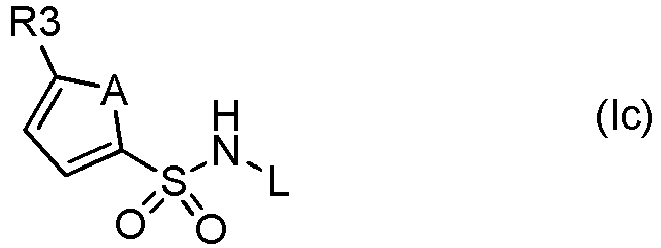
- In some embodiments, either R1 and R2 or R2 and R3, e.g. R2 and R3, together with the atoms to which they are attached, form a benzene ring optionally substituted with at least one R6; or a 5- or 6-membered heteroaromatic or heterocyclic ring, optionally substituted with at least one R6, in particular a benzene ring, optionally substituted with at least one R6, e.g. 1-3 R6 or 1-2 R6, e.g. 1 R6; whereby R6 is as defined herein above.
- For example, R6 may be selected from C1-C6 alkyl, such as methyl and isopropyl; halogen, such as F, Cl, and Br; C1-C6 alkoxy, such as methoxy, R10R11N, wherein R10 and R11 is as defined herein above, e.g. pyrrolidin-1-yl, morpholinyl, piperazin-1-yl; and C1-C6 alkylcarbonylamino, such as acetamido.
- The compound of formula (I) may be represented by formula (Ie)

- In some embodiments of a compound of formula (Ie), R2 and R3 together with the carbon atoms to which they are attached, form a benzene ring optionally substituted with at least one R6, in which case the compound may be represented by formula (lea)

- In some embodiments, L is a tetrazole-substituted phenyl ring (c1) as described herein above, and the compound of formula (Ie) is represented by formula (Ieb)


- In some other embodiments, L is a phenyl ring (c3) as described herein above, and the compound of formula (Ie) may then be represented by formula (led)

- In some other embodiments, when L is a phenyl ring (c3) as described herein above the compound of the invention may be represented by formula (lee)

- It should be realized that, unless the contrary is explicitly indicated or apparent from the context, any reference herein to a compound according to formula (I), should also be understood as a reference to any one of the formulas covering embodiments thereof, i.e. compounds according to formulas (Ia), (Ic), or (Ie), or any of the embodiments of these compounds.
In the same way, any reference to a moiety according to a given formula also should be construed as referring to a reference to any embodiment of this formula, unless the contrary is explicitly indicated or apparent from the context.
Furthermore, a pharmaceutical composition is provided, comprising a compound of formula (I) as defined herein, and optionally at least one pharmaceutically acceptable excipient. - Another object of the present invention relates to the compounds of the above formula described therein for use in inhibition of the PFKFB3 and/or PFKFB4. Thus, in one aspect, a compound as defined herein is provided for use in the treatment of a disorder related to or mediated by the PFKFB3 protein.
In another aspect, a compound as defined herein is provided, for use in the treatment of a disorder related to or mediated by the PFKFB4 protein.
In one aspect, a compound as defined herein is provided, for use in the treatment of cancer, inflammation or an inflammatory disorder.
The use of a compound as defined herein in the manufacturing of a medicament for the treatment of cancer, inflammation or an inflammatory disorder also is disclosed herein.
Finally, disclosed herein is a method for the treatment of cancer, inflammation or an inflammatory disorder in a mammal in need of such treatment by administering to said mammal a compound as defined herein.
The invention will now be further illustrated by the following non-limiting Examples. The specific examples below are to be construed as merely illustrative, and not limitative of the remainder of the disclosure in any way whatsoever. Without further elaboration, it is believed that one skilled in the art can, based on the description herein, utilize the present invention to its fullest extent. The necessary starting materials for preparing the compounds of formula I are either known or may be prepared, by a person skilled in the art, in analogy with the preparation of known compounds. The compounds of the invention may be prepared according to known methods for those skilled in the art. Other reaction schemes, as well as a variety of different solvents, temperatures and other reaction conditions, could be readily devised by those skilled in the art. - The benzothiophene sulfonyl chlorides were synthesized according to Scheme 1 as described in by Plé et al. (Plé et al., (1988) J. Heterocyclic Chem. 25, 1271-1272). Alkylation of substituted thiophenols with chloroacetone, followed by PPA-mediated cyclization of the ketones gave 5- and 7-substituted 3-methylbenzothiophenes. The preparation of the sulfonyl chlorides were performed either by a two step procedure (SO3/dioxane complex or H2SO4/Ac2O followed by POCl3, POCl3/PCl5 or SOCl2) or with chlorosulfonic acid. Regarding the handling and use of SO3/dioxane-complex see Paquette, Encyclopedia of Reagents for Organic Synthesis and references therein.

- a) Chloroacetone, K2CO3 or NaHCO3, acetone, reflux b) polyphosphoric acid, chlorobenzene, reflux c) SO3/dioxane-complex, 1,2-dichloroethane, room temperature or H2SO4/Ac2O, EtOAc, room temperature d) POCl3/CH2Cl2, 60 °C or SOCl2, DMF, e) Chlorosulfonic acid, CHCl3, 0 °C.
- Sulfonyl chlorides of aryl-substituted thiophenes were prepared via palladium-mediated Suzuki couplings followed by sulfonylations using chlorosulfonic acid (Scheme 3).


- a) DIPEA, Pd(dppf)Cl2:CH2Cl2, aq. dioxane 80 °C over night. b) Chlorosulfonic acid, CHCl3, 0 °C.
- The starting material for the compounds described in Examples 12 and 119 (cf. below), 5-(3-amino-phenyl)-tetrazol-2-yl]-acetic acid, was synthesised according to Scheme 4 (Kothari et al., (1980) J. Heterocyclic Chem. 17, 1393-1398).

- The sulfonamides were, for example, synthesised from sulfonyl chlorides and anilines /heteroaromatic amines according to any of the methods illustrated in Scheme 5, wherein L corresponds to the L-ring of a compound according to formula (I) and A=S.

- a) Pyridine, CH2Cl2, temperature ranging from room temperature to 60 °C b) aq. dioxane, room temperature c) pyridine, MeCN, temperature ranging from room temperature to 60 °C.
- For some of examples described below, the targeted acids were obtained by alkaline hydrolysis (Scheme 6) of the intermediate esters.

- a) aq. NaOH, room temperature or 50 °C b) LiOH, aq. THF, room temperature
- For some of the examples described below, the ester functionality was introduced by reacting the corresponding acids with a coupling reagent (1,1'-carbonyldiimidazole) followed by the appropriate alcohol. Alternatively, the desired ester was obtained by transesterification using the corresponding methyl ester as starting material (Scheme 7).

- a) 1,1'-carbonyldiimidazole, pyridine, MeCN, room temperature or 50 °C b) NaH, THF, 60 °C.
- The biaryl compounds (wherein A is S) were prepared by Suzuki couplings at 80 °C according to modifications of the procedures described by Jiang et al. (Jiang et al., (2006) Tetrahedron Lett. 47, 197-200) (Scheme 8, steps d or e).

- a) Pyridine, CH2Cl2, temperature ranging from room temperature to 60 °C b) aq. dioxane, room temperature c) pyridine, MeCN, temperature ranging from room temperature to 60 °C d) Aryl boronic acid, NaHCO3 (aq), Pd(PPh3)4, aq. EtOH, 80 °C over night e) Aryl boronic acid, DIPEA, Pd(dppf)Cl2:CH2Cl2, aq. dioxane 80 °C over night. A=S or CR=CR.
- Amine substituted benzothiophene analogues were synthesised from the corresponding bromides following the procedures described by Harris et. al (Harris et al., (2001) Org. ) (Scheme 9). For the aniline analogues, LiHMDS was used as a nitrogen equivalent and the free anilines were obtained by hydrolysis.

- a) Amine or LiHMDS, Pd2(dba)3, 2-dicyclohexyl-phosphino-2'-(N,N-dimethylamino)biphenyl, LiHMDS, THF, 130 °C in a micro wave reactor b) Amine, Pd(OAc)2, 2-(di- t butylphosphino)biphenyl, Cs2CO3, dioxane, 110 °C over night.
- Preparative HPLC/MS was performed on a Waters/Micromass Platform ZQ system and preparative HPLC/UV was performed on a Gilson system in accordance to the experimental details specified in the examples. Analytical HPLC/MS was performed using an Agilent 1100/1200 Series Liquid Chromatograph/Mass Selective Detector (MSD) (Single Quadrupole) (1946A/1946C/1956C/6110) equipped with an electrospray interface. GC-MS was performed on a Hewlett-Packard 5890/6890 gas chromatograph equipped with a HP-5MS crosslinked 5% PhMe Siloxane column (30 m x 0.25 mm x 0.25 µm film thickness) with a Hewlett-Packard 5971A/5972A mass selective detector using EI. Preparative flash chromatography was performed on Merck silica gel 60 (230-400 mesh). The compounds were named using ACD Name 6.0 or ISIS Draw 2.4. Microwave reactions were performed with a Personal Chemistry Smith Creator or Optimizer using 0.5-2 mL or 2-5 mL Smith Process Vials fitted with aluminum caps and septa. Accurate masses were measured using an Agilent MSD-TOF connected to an Agilent 1100 HPLC system. During the analyses the calibration was checked by two masses and automatically corrected when needed. Spectra were acquired in positive electrospray mode. The acquired mass range was m/z 100-1100. Profile detection of the mass peaks was used. NMR spectra were recorded on four different instruments, a Varian Inova 500 instrument equipped with a 5 mm triple resonance probe, a Varian Inova 400 instrument equipped with a 5 mm four nucleus probe, a Bruker DRX400 equipped with a 5 mm four nucleus probe probe and a Bruker DRX500 equipped with a 4 mm two nucleus flow-probe.
-

- A mixture of 4-isopropyl-thiophenol (5.0 g, 32.8 mmol), chloroacetone (7.0 mL, 88 mmol) and K2CO3 (6.4 g, 46.3 mmol) in acetone (100 mL) was refluxed over night. More K2CO3 (2 g, 14.5 mmol) and chloroacetone (3.5 mL, 43 mmol) were added and the reaction mixture was heated for another 5 h. The reaction mixture was filtered and the solvent was evaporated. The crude product was mixed with polyphosphoric acid (15 g) and chlorobenzene (100 mL) and the reaction mixture was heated at reflux for 5 h. (Plé et al., (1988) J. Heterocyclic Chem. 25, 1271-1272). The reaction mixture was diluted with CH2Cl2 and washed with water. The combined organic phases were dried and the solvent was evaporated. The crude product was purified on silica using heptane as eluent, giving 4.2 g of the title compound as a colourless oil (67% over two steps). 1H NMR (400 MHz, CDCl3) δ ppm 1.37 (d, 6 H) 2.47 (d, 3 H) 3.02 - 3.16 (m, 1 H) 7.08 (s, 1 H) 7.27-7.30 (m, 1 H) 7.58 (d, 1 H) 7.80 (d, 1 H).
-

- A solution of sulfur trioxide (580 mg, 7.24 mmol) in 1,2-dichloroethane (10 mL) was cooled on ice and dioxane (610 µL, 7.15 mmol) in 1,2-dichloroethane (1 mL) was added dropwise. The resulting white mixture was stirred 30 min at 0 °C. A solution of 5-isopropyl-3-methylbenzothiophene (420 g, 2.2 mmol) (Intermediate 1) in 1,2-dichloroethane (4 mL) was added and the resulting dark purple mixture was stirred at room temperature for 1 h. The mixture was poured on ice and extracted with EtOAc. The acid crystallized spontaneously in the organic phase and 265 mg (44%) of 5-isopropyl-3-methylbenzothiophene-2-sulfonic acid were collected. 1H NMR (400 MHz, MeOH-d 4) δ ppm 1.32 (d, J=6.90 Hz, 6 H) 2.64 (s, 3 H) 3.05 (spt, J=6.90 Hz, 1 H) 7.32 (ddd, J=8.34, 1.70, 0.44 Hz, 1 H) 7.61 (dt, J=1.70, 0.70 Hz, 1 H) 7.72 (dd, J=8.34, 0.70 Hz, 1 H).
- A mixture of 5-isopropyl-3-methylbenzothiophene-2-sulfonic acid (2.54 g, 9.4 mmol), POCl3 (10 mL) and PCl5 (4.0 g, 19.2 mmol) in CH2Cl2 (100 mL) was stirred at room temperature for 2 h. The reaction was quenched by addition of ice and water and stirred for 1 h. The organic phase was separated and dried. 1.74 g sulfonyl chloride was obtained as an oil after evaporation of the solvents. The crude product was purified on silica using CH2Cl2 as eluent giving 1.46 g (54%) of the title compound.
-

- A mixture of 2-methoxylthiophenol (915 mg, 6.5 mmol), chloroacetone (1.1 mL, 13.8 mmol) and K2CO3 (1.8 g, 13 mmol) in acetone (15 mL) was refluxed for 2 h. The mixture was filtered and the solvent evaporated. The crude product was dissolved in chlorobenzene (30 mL) and polyphosphoric acid (PPA, 0.5 g) was added (Plé et al., (1988) J. Heterocyclic Chem. 25, 1271-1272). The resulting mixture was heated at 100 °C over night, and then refluxed for 5 h. The solvent was decanted from the PPA-residue. The residue was then treated with CH2Cl2 and the combined organic extracts were washed with water and dried before the solvents were evaporated. The crude product was purified on silica using heptane as eluent, to give the title compound (620 mg, 53% yield over two steps). 1H NMR (400 MHz, CDCl3) δ ppm 2.43 (d, J=1.13 Hz, 3 H) 4.01 (s, 3 H) 6.77 - 6.83 (m, 1 H) 7.06 (qd, J=1.17, 0.53 Hz, 1 H) 7.32 - 7.39 (m, 2 H).
-

- A solution of 7-methoxy-3-methylbenzothiophene (365 mg, 2.0 mmol) (Intermediate 3), Ac2O (900 µL, 9.45 mmol) and conc. H2SO4 (170 µL) in EtOAc (5 mL) was shaken for 9 h at room temperature, then diluted with more EtOAc. The product was precipitated with KOAc (300 mg in EtOH, 5 mL). The solid was collected and dried giving 0.62 g of potassium 7-methoxy-3-methylbenzothiophene-2-sulfonate (100%). 1H NMR (400 MHz, DMSO-d 6) δ ppm 2.46 (s, 3 H) 3.93 (s, 3 H) 6.93 (dd, J=7.03, 1.51 Hz, 1 H) 7.31 (dd, J=8.03, 1.51 Hz, 1 H) 7.34 (dd, J=8.03, 7.03 Hz, 1 H).
- A mixture of potassium 7-methoxy-3-methylbenzothiophene-2-sulfonate (100 mg, 0.34 mmol) in POCl3 (5 mL) was heated at 60 °C over night. The POCl3 was evaporated and the crude product was purified on a small amount of silica eluting with CH2Cl2 to give the title compound in 46% yield (43 mg).
-

- A mixture of 2-chlorothiophenol (750 µL, 6.6 mmol), chloroacetone (1.1 mL, 13.8 mmol) and K2CO3 (1.8 g, 13 mmol) in acetone (15 mL) was refluxed for 2 h. The mixture was filtered and the solvent evaporated. The crude product was dissolved in chlorobenzene (30 mL) and polyphosphoric acid (PPA, 0.5 g) was added. The resulting mixture was refluxed over night (Plé et al., (1988) J. Heterocyclic Chem. 25, 1271-1272). Additional PPA (0.5 g) was added and the reaction mixture was refluxed for another 7 h. The solvent was decanted from the PPA-residue, the residue was treated with CH2Cl2 and the combined organic extracts were washed with water and dried, and then the solvents were removed by evaporation. The crude product was purified on silica using heptane as eluent, to give the title compound (770 mg, 64% over two steps). 1H NMR (400 MHz, CDCl3) δ ppm 2.44 (d, J=1.20 Hz, 3 H) 7.14 (q, J=1.20 Hz, 1 H) 7.32 - 7.38 (m, 2 H) 7.60 - 7.65 (m, 1 H)
-

- A solution of 7-chloro-3-methylbenzothiophene (Intermediate 5) (360 mg, 2.0 mmol), Ac2O (600 µL, 6.3 mmol) and conc. H2SO4 (115 µL) in EtOAc (5 mL) was shaken for 4 h at room temperature, then diluted with more EtOAc and washed with a small amount of water. The aqueous phase was extracted several times with EtOAc and the combined organic phases were dried and evaporated. The crude product was dissolved in EtOAc (50 mL) and the product was precipitated with KOAc (200 mg in EtOH, 3 mL). Since only small amounts of precipitate was formed a second portion of KOAc (200 mg in EtOH, 3 mL) was added, followed by Et2O (100 mL). The potassium 7-chloro-3-methylbenzothiophene-2-sulfonate was collected and dried in vacuum (0.76 g). 1H NMR (400 MHz, DMSO-d 6) δ ppm 2.50 (s, 3 H) 7.43 (t, J=7.78 Hz, 1 H) 7.48 (dd, J=7.78, 1.13 Hz, 1 H) 7.73 (dd, J=7.78, 1.13 Hz, 1 H).
- A mixture of potassium 7-chloro-3-methylbenzothiophene-2-sulfonate (100 mg, 0.34 mmol) in POCl3 (5 mL) was heated at 60 °C over night. The POCl3 was evaporated and the crude product was purified on a small amount of silica using CH2Cl2 as eluent to give 58 mg of the title compound (61%).
-

- A mixture of 4-methoxythiophenol (2.8 g, 20 mmol), K2CO3 (5.5 g, 40 mmol) and chloroacetone (6.6 mL, 82 mmol) in acetone (50 mL) was heated at reflux over night. The reaction mixture was filtered and the solvent was evaporated giving 5.0 g crude product. The intermediate thioether was dissolved in chlorobenzene (50 mL) and polyphosphoric acid (PPA, 0.5 g) was added (Plé et al., (1988) J. Heterocyclic Chem. 25, 1271-1272). The reaction mixture was refluxed over night. The solvent was decanted and the PPA residue was treated with CH2Cl2. The combined organic extracts were washed with water and dried before the solvents were evaporated. The crude product was purified on silica using heptane as eluent to give the title compound (0.96 g, 27% over two steps). 1H NMR (400 MHz, CDCl3) δ ppm 2.44 (d, J=1.20 Hz, 3 H) 3.93 (s, 3 H) 7.03 (ddd, J=8.78, 2.51, 0.50 Hz, 1 H) 7.11 (dq, J=1.20, 0.50 Hz, 1 H) 7.17 (d, J=2.51 Hz, 1 H) 7.73 (dd, J=8.78, 0.50 Hz, 1 H).
-

- A solution of 5-methoxy-3-methylbenzothiophene (Intermediate 7) (360 mg, 2.0 mmol), Ac2O (600 µL, 6.3 mmol) and conc. H2SO4 (115 µL) in EtOAc (5 mL) was shaken for 4 h at room temperature and then diluted with EtOAc. The potassium salt of the product was precipitated by addition of KOAc (196 mg) in EtOH (3 mL). The solid was collected and dried giving 0.47 g of potassium 5-methoxy-3-methylbenzothiophene-2-sulfonate (80%). 1H NMR (400 MHz, DMSO-d 6) δ ppm 2.46 (s, 3 H) 3.83 (s, 3 H) 6.99 (dd, J=8.78, 2.51 Hz, 1 H) 7.17 (dd, J=2.51, 0.50 Hz, 1 H) 7.72 (dd, J=8.78, 0.50 Hz, 1 H).
- A mixture of potassium 5-methoxy-3-methylbenzothiophene-2-sulfonate (100 mg, 0.34 mmol) in POCl3 (5 mL) was heated at 60 °C over night. The POCl3 was evaporated and the remaining crude product was purified on a small amount of silica using CH2Cl2 as eluent to give 80 mg of the title compound (90%).
-

- A mixture of 4-bromothiophenol (3.9 g, 20 mmol), K2CO3 (5.5 g, 40 mmol) and chloroacetone (6.6 mL, 82 mmol) in acetone (50 mL) was heated at reflux over night. The reaction mixture was filtered and the solvent was evaporated giving 5.0 g crude product. The intermediate thioether was dissolved in chlorobenzene (50 mL) and polyphosphoric acid (PPA, 2.5 g) was added (Plé et al., (1988) J. Heterocyclic Chem. 25, 1271-1272). After reflux for 24 h, the solvent was decanted and the PPA residue was treated with CH2Cl2. The combined organic extracts were washed with water and dried. Evaporation of the solvents afforded the crude product which was purified on silica (heptane as eluent) to give the title compound (2.36 g, 50% over two steps). 1H NMR (400 MHz, CDCl3) δ ppm 2.41 (d, J=1.20 Hz, 3 H) 7.11 (qd, J=1.20, 0.54 Hz, 1 H) 7.44 (ddd, J=8.53, 1.90, 0.54 Hz, 1 H) 7.70 (dd, J=8.53, 0.54 Hz, 1 H) 7.85 (dd, J=1.90, 0.54 Hz, 1 H).
-

- Chlorosulfonic acid (2.20 ml, 0.033 mmol) was added dropwise at -5 °C to a solution of 5-bromo-3-methylbenzothiophene (Intermediate 9) (3.0 g, 13.2 mmol) in CHCl3 (30 mL). The reaction mixture was stirred at 0 °C for 3 h, and then poured into a mixture of ice/NaHCO3 and stirred vigorously for 5 min. The organic phase was immediately separated, dried and concentrated to give the title compound (1.70 g, 39%).
-

- A solution of 3-methyl-benzothiophene (900 mg, 6.1 mmol), Ac2O (1.75 mL, 18.5 mmol) and conc. H2SO4 (350 µL, 6.2 mmol) in EtOAc (5 mL) was stirred at room temperature for 3 h. The reaction mixture was diluted with EtOAc. The organic phase was washed with water and brine and then dried. Upon evaporation of some of the solvent the product precipitated. Et2O was added, and the precipitate was collected giving 193 mg of 3-methylbenzothiophene-2-sulfonic acid (14%). 1H NMR (400 MHz, DMSO-d 6) δ ppm 2.48 (s, 3 H) 7.33 - 7.41 (m, 2 H) 7.69 - 7.75 (m, 1 H) 7.83 - 7.88 (m, 1 H).
- The 3-methylbenzothiophene-2-sulfonic acid (45 mg, 0.20 mmol) was mixed with POCl3 (2 mL, 20 mmol) and CH2Cl2 (2 mL) and heated at 70 °C for 6 h. The reaction mixture was diluted with CH2Cl2 before the reaction was quenched with ice and stirred at room temperature for 1 h. The organic phase was separated. Evaporation of the solvents afforded 57 mg the title compound (91%).
-

- Chloroacetone (11.6 g, 125 mmol) and NaHCO3 (12.6 g, 150 mmol) were added to a solution of 4-methylthiophenol (10 g, 80.5 mmol) in dry DMF (50 mL). The mixture was stirred at 50-60 °C for 1 h. The cooled reaction mixture was poured into water (200 mL) and extracted with EtOAc (2x50 mL). The combined organic extracts were dried with K2CO3, evaporated to dryness and the residue was distilled (b.p. 145-148 °C/12 mm) to give 11.7 g of 1-(p-tolylsulfanyl)propan-2-one (81%).
- A solution of 10 mL of polyphosphoric acid (PPA) in chlorobenzene (200 mL) was heated to reflux. To this solution 1-(p-tolylsulfanyl)-propan-2-one 5.0 g (20.3 mmol) was added in portions within 20 minutes. The resulting mixture was refluxed for 18 h and then cooled to room temperature. The organic phase was separated and concentrated under reduced pressure. The oily residue was purified by flash chromatography on silica gel (90:10 hexane/EtOAc) to give 3.72 g (81%) the title compound.
-

- To a solution of 3,5-dimethylbenzothiophene (Intermediate 12) (5.0 g, 33.8 mmol) in CHCl3 (70 mL), chlorosulfonic acid (5.6 mL, 85 mmol) was added dropwise at -5°C. The reaction mixture was stirred at 0 °C for 3 h before it was poured into a mixture of ice and NaHCO3 and stirred vigorously for 5 min. The organic phase was immediately separated, dried with MgSO4 and concentrated yielding 3.5 g (40%) of the title compound.
-

- A solution of 5-fluoro-3-methyl-1-benzothiophene (1000 mg, 6.02 mmol), Ac2O (1.75 mL, 18.5 mmol) and conc. H2SO4 (350 µL, 6.2 mmol) in EtOAc (5 mL) was shaken at room temperature for 3h. The reaction mixture was diluted with EtOAc, washed with water and brine and then dried. Upon addition of Et2O the product crystallized (120 mg). A second crop of product was obtained by evaporation of the mother liquid (0.71 g). The 5-fluoro-3-methyl-benzothiophene-2-sulfonic acid was obtained in 55% total yield (0.83 g). 1H NMR (400 MHz, DMSO-d 6) δ ppm 2.45 (s, 3 H) 7.22 (ddd, J=9.09, 8.78, 2.60 Hz, 1 H) 7.52 (ddd, J=10.16, 2.60, 0.50 Hz, 1 H) 7.89 (ddd, J=8.78, 5.10, 0.50 Hz, 1 H).
- A mixture of 5-fluoro-3-methylbenzothiophene-2-sulfonic acid (230 mg, 0.93 mmol) in POCl3 (5 mL) was heated at 60 °C over night. The POCl3 was evaporated and the crude product was dissolved in CH2Cl2 and washed with water. The organic phase was dried and evaporated to give 0.23 g (93%) of the title compound.
-

- A solution of 5-(3-aminophenyl)tetrazole (8.1 mg, 0.05 mmol), 5-bromothiophene-2-sulfonyl chloride (14 mg, 0.055 mmol) and pyridine (12 µL, 0.015 mmol) in CH2Cl2 (200 µL) was
- stirred at room temperature over night. The title compound was obtained after purification by preparative HPLC (16.7 mg, 43%). MS (ESI+) m/z 386 [M+H]+. The procedure was repeated on a larger scale with a modified purification method (flash chromatography, 10% MeOH in CH2Cl2), giving enough of the title compound to be used as starting material for further derivatisations.
-

- A solution of 5-bromo-3-methyl-benzothiophene-2-sulfonyl chloride (Intermediate 10) (1.00 g, 3.26 mmol), ethyl 3-aminobenzoate (550 mg, 3.33.mmol) and pyridine (3 mL) in CH2Cl2 (150 mL) was stirred at room temperature overnight. The reaction was diluted with CH2Cl2, washed with water and aqueous HCl, dried and concentrated. The residue was purified on silica, using CH2Cl2 as eluent, resulting in 532 mg (36%) of the title compound. 1H NMR (400 MHz, CDCl3) δ ppm 1.34 (t, J=7.09 Hz, 3 H) 2.44 (s, 3 H) 4.34 (q, J=7.09 Hz, 2 H) 6.85 (s, 1 H) 7.36 (dd, J=8.03, 7.62 Hz, 1 H) 7.43 (ddd, J=8.03, 2.26, 1.25 Hz, 1 H) 7.57 (dd, J=8.66, 1.88 Hz, 1 H) 7.65 (dd, J=8.66, 0.50 Hz, 1 H) 7.72 (dd, J=2.26, 1.63 Hz, 1 H) 7.84 (ddd, J=7.62, 1.63, 1.25 Hz, 1 H) 7.87 (dd, J=1.88, 0.50 Hz, 1 H). MS (ESI+) m/z 454 [M+H]+.
-

- Pyridine (200 µL, 2.48 mmol) was added to a solution of methyl 3-aminobenzoate (188 mg, 1.24 mmol) and 5-chloro-3-methyl-benzothiophene-2-sulfonyl chloride (349 mg, 1.24 mmol) in MeCN (10 mL). The reaction mixture was stirred at room temperature over night. After removal of the solvents, the residue was dissolved in EtOAc and water. The phases were separated, and the organic solution was washed with 1M HCl twice, water twice and brine then dried (MgSO4). The crude product, obtained after evaporation of the solvents, was crystallized from MeOH (ca 5 mL). The solid product was triturated using heptane, giving the intermediate methyl 3-{[(5-chloro-3-methyl-1-benzothien-2-yl)sulfonyl]amino}benzoate as an off-white solid (432 mg, 88%). 1H NMR (500 MHz, CDCl3) δ ppm 2.46 (s, 3 H) 2.45 (s, 3 H) 6.91 (s, 1 H) 7.37 (t, J=7.81 Hz, 1 H) 7.43 - 7.47 (m, 2 H) 7.72 (d, J=1.96 Hz, 1H) 7.72 (d, J=8.76 Hz, 1H) 7.76 (t, J=1.83 Hz, 1 H) 7.85 (dt, J=7.81, 1.34 Hz, 1 H). MS (ESI+) 396 m/z [M+H]+.
- 1.7 M aq. KOH (5 mL) was added to a slurry of methyl 3-{[(5-chloro-3-methyl-1-benzothien-2-yl)sulfonyl]amino}benzoate (400 mg, 1.01 mmol) in MeOH (5 mL). The reaction mixture was stirred at 50 °C for 1.5h. After removal of the MeOH under reduced pressure, the remaining aqueous solution was acidified to
pH 3 by addition of ortho-phosphoric acid. The precipitate was collected, washed with water and dried giving the title compound as an off-white solid (363 mg, 91%). 1H NMR (500 MHz, MeOH-d 4) δ ppm 2.49 (s, 3 H) 7.32 - 7.39 (m, 2 H) 7.46 (dd, J=8.67, 2.08 Hz, 1 H) 7.75 (dt, J=7.32, 1.59 Hz, 1 H) 7.82 - 7.86 (m, 3 H). MS (ESI+) m/z 399 [M+NH4]+. -

- A solution of 3-bromo-2-chlorothiophene (2.43 g, 12.3 mmol), 2,5-difluorophenylboronic acid (2.91 g, 18.4 mmol), diisopropylethylamine (4.8 g, 37 mmol) and [1,1'-bis(diphenylphosphino)ferrocene]dichloropalladium(II), complex with dichloromethane (300 mg, 0.37 mmol) was stirred in dioxane (100 mL) and water (10 mL) at 80 °C for two days. Toluene (100 mL) was added. The organic phase was washed with 1 M NaOH (aq.), 1 M HCl (aq.) and brine, dried and concentrated to a brown oil. The brown oil was purified by distillation (twice) in a Kugelrohr apparatus at 120 °C and ∼10 mbar resulting in 0.73 g (26%) of the intermediate 2-chloro-3-(2,5-difluorophenyl)thiophene. 1H NMR (500 MHz, CDCl3) δ ppm 7.01 - 7.23 (m, 5 H).
- To a solution of 2-chloro-3-(2,5-difluorophenyl)thiophene (0.73 g, 3.2 mmol) in CH2Cl2 (100 mL), cooled on ice, chlorosulfonic acid (0.37 g, 3.2 mmol) in CH2Cl2 (50 mL) was added dropwise over 1 h. The reaction was refluxed over night. The reaction mixture was cooled and washed with water (2x 100 mL) and brine, dried over MgSO4, filtered and concentrated to a dark brown oil. The oil was dissolved in heptane (50 mL) and stored in the fridge over the weekend. A black tar precipitated. The solution was decanted and concentrated to give the title compound as a light brown oil (0.87 g, 21% over two steps). MS (ESI+) m/z 293 [M-Cl]+.
-

- A mixture of 2-bromothiophene (2.00 g, 12.3 mmol), 3,5-difluorobenzeneboronic acid (1.94 g, 12.3 mmol), bis(triphenylphosphine)palladium chloride (0.17 g, 0.24 mmol) and dipotassium hydrogen phosphate (6.43 g, 36.9 mmol) was stirred in aqueous EtOH (1:1, 150 mL) at reflux over night. Water and EtOAc were added. After separation of the phases, the organic phase was washed with NaHCO3 (aq.) and brine, dried over MgSO4, filtered and concentrated to a brown semi-solid. The residue was distilled in a Kugelrohr apparatus at 140 °C and ∼10 mbar yielding 2.1 g (87%) of the intermediate 2-(3,5-difluorophenyl)thiophene. 1H NMR (500 MHz, CDCl3) δ ppm 6.70 - 6.76 (m, 1 H) 7.10 (dd, J=5.13, 3.66 Hz, 1 H) 7.12 - 7.14 (m, 2 H) 7.32 - 7.36 (m, 2 H).
- A solution of 2-(3,5-difluorophenyl)thiophene (2.1 g, 10.7 mmol) in CHCl3 (50 mL) was cooled on ice and chlorosulfonic acid (3.7 g, 32.1 mmol) was added dropwise. After 10 min all material had been converted to the intermediate sulfonic acid. The reaction was stirred at 35 °C over night giving complete conversion to the sulfonyl chloride in about 80% purity. The reaction mixture was cooled to -20 °C in the freezer and then quenched with a spoon of ice. Water (100 mL) and brine (100 mL) were added. The organic phase was washed with 100 mL of brine, dried over MgSO4, filtered and concentrated to a white solid. The solid was slurried in hexane (20 mL), stirred for 30 min and collected by filtration. The title compound was obtained in 41% yield (1.3 g). 1H NMR (500 MHz, CDCl3) δ ppm 6.89 - 6.95 (m, 1 H) 7.15 - 7.18 (m, 2 H) 7.34 (d, J=4.15 Hz, 1 H) 7.87 (d, J=3.91 Hz, 1 H).
-

- A solution of 3-aminosalicylic acid (0.17 g, 1.11 mmol) and 3-bromo-2-chlorothiophene-5-sulfonyl chloride (0.33 g, 1.11 mmol) in aqueous dioxane (20 mL, 95:5 dioxane/water) was stirred at room temperature for 4 weeks. The pH of the reaction mixture was adjusted to about 9 using 1M Na2CO3 and then EtOAc (200 mL) and water(100 mL) were added. The organic phase was removed and the aqueous phase washed with more EtOAc. The pH of the aqueous phase was adjusted to about 3 with concentrated phosphoric acid and EtOAc (200 mL) was added. The aqueous phase was removed and the organic phase was washed with 1 M HCl and brine, dried over MgSO4, filtered and concentrated. The brown residue was recrystallized from aqueous MeOH at 60 °C. The precipitate was collected by filtration and dried over night. The title compound was obtained in 53% yield (0.24 g). 1H NMR (500 MHz, MeOH-d 4) δ ppm 6.92 (t, J=7.93 Hz, 1 H) 7.34 (s, 1 H) 7.65 (dd, J=7.93, 1.59 Hz, 1 H) 7.75 (dd, J=7.93, 1.59 Hz, 1 H). MS (ESI+) m/z 412 [M+H]+.
-

- The product was prepared according to General Procedure 1, described in Example 1, starting with 5-(1,3-oxazol-5-yl)thiophene-2-sulfonyl chloride (13.7 mg, 0.055 mmol) and 5-(3-amino-phenyl)tetrazole (8 mg, 0.05 mmol) yielding 9.7 mg (52%) of the title compound. MS (ESI+) calcd for C14H10N6O3S2 374.02558, found 374.02547.
-

- To a solution of 5-isopropyl-3-methylbenzothiophene-2-sulfonyl chloride (Intermediate 2) (746 mg, 2.5 mmol) in dry CH2Cl2 (10 mL) were added dry pyridine (5 mL) and 3-(1H-tetrazol-5-yl)aniline (511 mg, 2.5 mmol). The reaction mixture was stirred over night. The mixture was concentrated to dryness, the residue was treated with water (5 mL), extracted with CHCl3 (2x10 mL) and the combined organic extracts were concentrated. The product was purified by flash chromatography on silica gel (eluent CHCl3/MeOH 4:1) giving 290 mg (28%) of the title compound. MS (ESI+) calcd for C19H19N5O2S2 413.098016, found 413.097776.
-

- Methyl 3-aminobenzoate (8 mg, 0.05 mmol) was dissolved in CH2Cl2 (100 µL) and pyridine (24 µL). A solution of 5-isopropyl-3-methylbenzothiophene-2-sulfonyl chloride (Intermediate 2) (16 mg, 0.055 mmol) in CH2Cl2 (100 µL) was added. The mixture was stirred at 60 °C for 4 h. The solvent was evaporated and the crude product was purified by preparative HPLC (Xterra C18, 50 mM NH4HCO3 (pH 10) - CH3CN). The purified ester was dissolved in aqueous THF (1 mL, 1:1 THF/water) and LiOH (6 equiv.) was added. The reaction mixture was stirred at 75 °C for 3 days. The solvent was evaporated and the crude material was purified by preparative HPLC (ACE C8 5 µm, 0.1% TFA in water/CH3CN) to give 5.7 mg of the title compound (30% over two steps). MS (ESI+) calcd for C19H19NO4S2 389.0755, found 389.0741.
-

- The product was prepared according to General Procedure 1, described in Example 1, starting from 5-isopropyl-3-methylbenzothiophene-2-sulfonyl chloride (Intermediate 2) (16 mg, 0.055 mmol) and 3-amino-5-nitrobenzoic acid (9 mg, 0.05 mmol) giving 6 mg of the title compound (30%). MS (ESI+) calcd for C19H18N2O6S2 434.060628, found 434.060168.
-

- Ethyl chloroacetate (33 mL, 0.31 mmol), [3-(2H-tetrazol-5-yl)phenyl]amine (50 mg, 0.31 mmol) and K2CO3 (86 mg, 0.62 mmol) were mixed in dry DMF (5 mL). The mixture was heated at 50 °C for 2 h using a Stem block. The reaction mixture was partitioned between water (15 mL) and EtOAc (10 mL). The aqueous layer was extracted once with EtOAc (10 mL). The organic layers were combined, dried (Na2SO4), filtered and concentrated to give 60 mg of a light brown gum. The intermediate was dissolved in dry CH2Cl2 (3 mL) followed by addition of 5-isopropyl-3-methylbenzothiophene-2-sulfonyl chloride (Intermediate 2) (58 mg, 0.20 mmol) and pyridine (113 µL, 1.41 mmol). The reaction mixture was stirred for 2 h at room temperature. Aqueous NaOH (1M, 1 mL) was added and the reaction mixture was stirred for an additional 5 minutes. The mixture was acidified with aqueous HCl (1M, 1 mL) and partitioned between CH2Cl2 (10 mL) and water (10 mL). The aqueous layer was extracted once with EtOAc (10 mL). The organic layers were combined, dried (Na2SO4), filtered and concentrated to give the crude product (250 mg) as a brown gum. The crude product was dissolved in MeOH/DMSO (7:1, 4 mL) and purified by reversed phase preparative HPLC (ACE C8, 0.1%TFA in water/CH3CN) to give 34 mg of the title compound as a light brown solid (36% over two steps). 1H NMR (400 MHz, MeOH-d 4) δ ppm 1.27 (d, 6 H) 2.53 (s, 3 H) 2.95 - 3.07 (m, 1 H) 5.59 (s, 2 H) 7.25 - 7.31 (m, 1 H) 7.33 - 7.40 (m, 2 H) 7.59 - 7.63 (m, 1 H) 7.73 (d, 1 H) 7.79 - 7.85 (m, 1 H) 7.94 - 8.00 (m, 1 H). The structure was confirmed by extended NMR analysis (1H NMR, 13C NMR, gDQFCOSY, 13C-gHSQC, 13C-gHMBC, 15N-gHMBC and DPFGSE-NOE). MS (ESI+) calcd for C21H21N5O4S2 471.103496, found 471.103976.
-

- A solution of 5-isopropyl-3-methylbenzothiophene-2-sulfonyl chloride (Intermediate 2) (15 mg, 0.05 mmol), 3-aminophenyl acetic acid (16 mg, 0.10 mmol) and dry pyridine (100 µL) in CH2Cl2 (1 mL) was heated in a sealed tube at 70 °C in a Stem block. The solvent was evaporated and the crude product was purified by preparative HPLC (ACE C8, 5 µm 21x50mm, flow 25ml/min, 50 mM NH4OAc in water/CH3CN) to give 14.8 mg (73%) of the title compound. MS (ESI+) calcd for C20H21NO4S2 403.0912, found 403.09047.
-

- The product was prepared according to General Procedure 1, described in Example 1, starting from 5-[2-(methylthio)pyrimidin-4-yl]thiophene-2-sulfonyl chloride (17 mg, 0.055 mmol) and 5-(3-aminophenyl)tetrazole (8 mg, 0.05 mmol) giving 9.3 mg (43%) of the title compound. MS (ESI+) calcd for C16H13N7O2S3 431.029285, found 431.029205.
-

- A mixture of 5-bromo-N-[3-(1H-tetrazol-5-yl)phenyl]thiophene-2-sulfonamide (Intermediate 17) (19 mg, 0.05 mmol), 5-fluoro-2-methoxyphenylboronic acid (10 mg, 0.06 mmol), Pd(PPh3)4 (3 mg, 0.0025 mmol), NaHCO3 (13 mg, 0.15 mmol), EtOH (750 µL) and water (250 µL) was heated in a sealed tube at 80 °C over night. The mixture was concentrated and purified by preparative HPLC (ACE C8 5 µm, 0.1% TFA in water/CH3CN) giving 4.1 mg (19%) of the title compound. MS (ESI+) calcd for C18H14FN5O3S2 431.052209, found 431.051439.
-

- The product was prepared according to
General Procedure 3, described in Example 22, starting from 5-bromo-N-[3-(1H-tetrazol-5-yl)phenyl]thiophene-2-sulfonamide (Intermediate 17) (19 mg, 0.05 mmol) and 3,5-difluorophenylboronic acid (9 mg, 0.06 mmol) giving 7.2 mg (34%) of the title compound. MS (ESI+) calcd for C17H11F2N5O2S2 419.032222, found 419.032222. -

- The product was prepared according to
General Procedure 3, described in Example 22, starting from 5-bromo-N-[3-(1H-tetrazol-5-yl)phenyl]thiophene-2-sulfonamide (Intermediate 17) (19 mg, 0.05 mmol) and 2-methoxyphenylboronic acid (9 mg, 0.06 mmol) giving 5.7 mg (28%) of the title compound. MS (ESI+) calcd for C18H15N5O3S2 413.061631, found 413.062971. -

- The product was prepared according to General Procedure 1, described in Example 1, starting from 5-(2-methylthiazol-4-yl)thiophene-2-sulphonylchloride (15 mg, 0.055 mmol) and [3-(1H-tetrazol-5-yl)phenyl]amine (8 mg, 0.05 mmol) giving 5.2 mg (26%) of the title compound. MS (ESI+) calcd for C15H12N6O2S3 404.0184, found 404.0182.
-

- The product was prepared according to
General Procedure 3, described in Example 22, starting from 5-bromo-N-[3-(1H-tetrazol-5-yl)phenyl]thiophene-2-sulfonamide (Intermediate 17) (19 mg, 0.05 mmol) and 2-chlorophenylboronic acid (9 mg, 0.06 mmol) giving 3.5 mg (16%) of the title compound. MS (ESI+) calcd for C17H12ClN5O2S2 417.012094, found 417.012204. -

- The product was prepared according to
General Procedure 3, described in Example 22, starting from 5-bromo-N-[3-(1H-tetrazol-5-yl)phenyl]thiophene-2-sulfonamide (Intermediate 17) (19 mg, 0.05 mmol) and 4-methylbenzene boronic acid (8 mg, 0.06 mmol) giving 5.5 mg (28%) of the title compound. MS (ESI+) calcd for C18H15N5O2S2 397.066716, found 397.066596. -

- The product was prepared according to
General Procedure 3, described in Example 22, starting from 5-bromo-N-[3-(1H-tetrazol-5-yl)phenyl]thiophene-2-sulfonamide (Intermediate 17) (19 mg, 0.05 mmol) and 2,4-dimethoxyphenylboronic acid (11 mg, 0.06 mmol) giving 3.5 mg (16%) of the title compound. MS (ESI+) calcd for C19H17N5O4S2 443.072195, found 443.071935. -

- The product was prepared according to
General Procedure 3, described in Example 22, starting from 5-bromo-N-[3-(1H-tetrazol-5-yl)phenyl]thiophene-2-sulfonamide (Intermediate 17) (19 mg, 0.05 mmol) and 4-chlorophenylboronic acid (9 mg, 0.06 mmol) giving 4.4 mg (21%) of the title compound. MS (ESI+) calcd for C17H12ClN5O2S2 417.012094, found 417.013904. -

- The product was prepared according to
General Procedure 3, described in Example 22, starting from 5-bromo-N-[3-(1H-tetrazol-5-yl)phenyl]thiophene-2-sulfonamide (Intermediate 17) (19 mg, 0.05 mmol) and 4-fluoro-2-methoxyphenylboronic acid (10 mg, 0.06 mmol) giving 8.3 mg (37%) of the title compound. MS (ESI+) calcd for C18H14FN5O3S2 431.052209, found 431.052249. -

- The product was prepared according to General Procedure 1, described in Example 1, starting from 5-chloro-3-methyl-benzothiophene-2-sulfonyl chloride (15 mg, 0.055 mmol) and 5-(3-aminophenyl)tetrazole (8 mg, 0.05 mmol) giving 8 mg (40%) of the title product. MS (ESI+) calcd for C16H12ClN5O2S2 405.012094, found 405.012744.
-
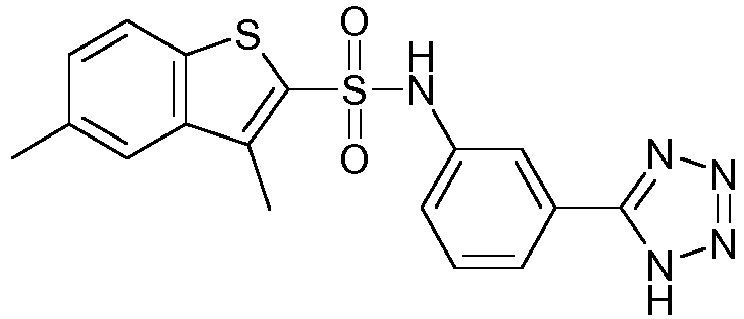
- To a solution of 3-(1H-tetrazol-5-yl)-phenylamine (161 mg, 10 mmol) in dry CH2Cl2 (10 mL) pyridine (0.5 mL) and 3, 5-dimethyl-benzothiophene-2-sulfonyl chloride (Intermediate 13) (260 mg, 10 mmol) were added. The mixture was stirred for 4 h and then concentrated in vac-uo. The product was purified by column chromatography on silica gel (eluent: 2 to 15% MeOH in CHCl3) affording 104 mg (27%) of the title compound. 1H NMR (DMSO-d 6) δ ppm 2.40 (s, 3H) 2.52 (s, 3H) 7.29 (d, 1H) 7.35 (d, 1H) 7.42 (t, 1H) 7.70 (m, 2H) 7.85 (d, 1H) 7.92 (s, 1H). MS (ESI+) calcd for C17H15N5O2S2 385.066716, found 385.065826.
-

- The product was prepared according to General Procedure 1, described in Example 1, starting from 5-bromo-3-methylbenzothiophene-2-sulfonyl chloride (Intermediate 10) (510 mg, 1.57 mmol) and [3-(1H-tetrazol-5-yl)phenyl]amine (230 mg, 1.4 mmol) giving 300 mg (27%) of the title compound. MS (ESI+) calcd for C16H12BrN5O2S2 448.961579, found 448.961839.
-

- The product was prepared according to General Procedure 1, described in Example 1, starting from 7-methoxy-3-methylbenzothiophene-2-sulfonyl chloride (Intermediate 4) (23 mg, 0.09 mmol) and [3-(1H-tetrazol-5-yl)phenyl]amine (29 mg, 0.18 mmol) giving 18.7 mg (40%) of the title compound. MS (ESI+) calcd for C17H15N5O3S2 401.061631, found 401.060921.
-

- The product was prepared according to General Procedure 1, described in Example 1, starting from 7-chloro-3-methylbenzothiophene-2-sulfonyl chloride (Intermediate 6) (30 mg, 0.10 mmol) and 5-(3-amino-phenyl)tetrazole (34 mg, 0.21 mmol) giving 20.2 mg (50%) of the title compound. MS (ESI+) calcd for C16H12ClN5O2S2 405.012094, found 405.012294.
-

- The product was prepared according to General Procedure 1, described in Example 1, starting from 5-methoxy-3-methylbenzothiophene-2-sulfonyl chloride (Intermediate 8) (42 mg, 0.15 mmol) and 5-(3-amino-phenyl)tetrazole (49 mg, 0.30 mmol) giving 26.6 mg (44%) of the title compound. MS (ESI+) calcd for C17H15N5O3S2 401.061631, found 401.062391.
-

- A solution of 5-chloro-3-methylbenzothiophene-2-sulfonyl chloride (200 mg, 0.711 mmol) in CH2Cl2 (5 mL) was added to a mixture of methyl 3-aminobenzoate (107 mg, 0.711 mmol) and pyridine (1 mL) in CH2Cl2 (5 mL). The reaction mixture was stirred at room temperature over night. The solvent was evaporated and the crude methyl 3-{[(5-chloro-3-methyl-1-benzothien-2-yl)sulfonyl]amino}benzoate (100 mg) was slurried in water (4 mL). LiOH (300 mg) was added and the mixture was stirred at room temperature for 2 h. The reaction was acidified by aqueous 2 M HCl and the white precipitate was collected by filtration, washed with CH2Cl2 (5 mL) and dried. The title compound was obtained in 28% yield (75 mg, over two steps). MS (ESI+) calcd for C16H12ClNO4S2 380.989627, found 380.989527.
-

- The product was prepared according to General Procedure 1, described in Example 1, starting from 3-methylbenzothiophene-2-sulfonyl chloride (Intermediate 11) (25 mg, 0.10 mmol) and 5-(3-amino-phenyl)tetrazole (33 mg, 0.20 mmol). The title compound was obtained in 34% yield (13.3 mg). MS (ESI+) calcd for C16H13N5O2S2 371.051066, found 371.049276.
-

- The product was prepared according to General Procedure 1, described in Example 1, starting from 5-methyl-benzothiophene-2-sulfonyl chloride (30 mg, 0.12 mmol) and 5-(3-aminophenyl)tetrazole (20 mg, 0.12 mmol) giving the title compound as a white solid (11 mg, 25%). 1H NMR (400 MHz, MeOH-d 4) δ ppm 2.40 (s, 3 H) 7.25 - 7.30 (m, 1 H) 7.34 - 7.40 (m, 1 H) 7.45 (t, J=7.91 Hz, 1 H) 7.62 - 7.65 (m, 1 H) 7.68 - 7.74 (m, 2 H) 7.78 (s, 1 H) 7.94 (t, J=1.88 Hz, 1 H). MS (ESI+) calcd for C16H13N5O2S2 371.051066, found 371.050166.
-

- Ethyl 3-{[(5-bromo-3-methyl-1-benzothiophen-2-yl)sulfonyl]amino}benzoate (Intermediate 18) (42 mg, 0.093 mmol) was hydrolyzed with 1 M NaOH (1 mL) in EtOH (2 mL) at room temperature over night. The reaction mixture was acidified and extracted with EtOAc. The combined organic phases were washed with water and dried. Evaporation of the solvents gave 23 mg (58%) of the title compound. MS (ESI+) calcd for C16H12BrNO4S2 424.939112, found 424.939992.
-

- The product was prepared according to General Procedure 1, described in Example 1, starting from 7-methoxy-3-methylbenzothiophene-2-sulfonyl chloride (Intermediate 4) (23 mg, 0.09 mmol) and 3-aminobenzoic acid (25 mg, 0.18 mmol) affording 18.5 mg (55%) of the title compound. MS (ESI+) calcd for C17H15NO5S2 377.039164, found 377.039094
-

- The product was prepared according to General Procedure 1, described in Example 1, starting from 5-fluoro-3-methylbenzothiophene-2-sulfonyl chloride (Intermediate 14) (26 mg, 0.10 mmol) and 5-(3-amino-phenyl)tetrazole (31 mg, 0.19 mmol). The title compound was obtained in 36% yield (13.9 mg). MS (ESI+) calcd for C16H12FN5O2S2 389.041644, found 389.042334.
-

- The product was prepared according to General Procedure 1, described in Example 1, starting from 7-chloro-3-methylbenzothiophene-2-sulfonyl chloride (Intermediate 6) (30 mg, 0.10 mmol) and 3-amino-benzoic acid (29 mg, 0.21 mmol) to afford 24 mg (63%) of the title compound. MS (ESI+) calcd for C16H12ClNO4S2 380.989627, found 380.989977.
-

- A micro-tube was charged with tris(benzylideneacetone)dipalladium (Pd2(dba)3) (0.5 mg, 0.0005 mmol), 2-dicyclohexylphosphino-2'-(N,N-dimethylamino)biphenyl (0.5 mg, 0.0012 mmol) and pyrrolidine (9 mg, 0.12 mmol). The tube was sealed and flushed with nitrogen. LiHMDS (1M in THF, 120 µL, 0.12 mmol) and a solution of 5-bromo-3-methyl-N-[3-(1H-tetrazol-5-yl)phenyl]-1-benzothiophene-2-sulfonamide (Example 34) (45 mg, 0.1 mmol) in dry THF were added to the reaction mixture via syringes. The reaction mixture was heated in a microwave reactor at 130 °C for 1000 s. Aqueous HCl (1 M) was added and the mixture was stirred at room temperature for 5 min. The solution was then neutralized by addition of aqueous NaOH. The crude product was purified by preparative HPLC (ACE C8, 5 µm 21x50mm, flow 25 ml/min, 50 mM NH4OAc in water/CH3CN) to give 1.9 mg (4%) of the title compound. MS (ESI+) calcd for C20H20N6O2S2 440.108915, found 440.108815.
-

- The intermediate ethyl 3-{[(3-methyl-5-pyrrolidin-1-yl-1-benzothiophen-2-yl)sulfonyl]amino}benzoate was prepared from ethyl 3-{[(5-bromo-3-methyl-1-benzothien-2-yl)sulfonyl]amino}benzoate (Intermediate 18) (45 mg, 0.1 mmol) and pyrrolidine (8 mg, 0.12 mmol) according to General Procedure 4, described in Example 45.
The ethyl 3-{[(3-methyl-5-pyrrolidin-1-yl-1-benzothiophen-2-yl)sulfonyl]amino}benzoate (4.7 mg, 0.01 mmol) was hydrolyzed with LiOH (2.6 mg, 0.06 mmol) in THF/water (1:1, 2 mL) at 55 °C over night. The reaction mixture was neutralized with acetic acid (3.6 µL) and the mixture was concentrated. The crude product was purified by preparative HPLC (ACE C8, 5 µm 21x50mm, flow 25ml/min, 50 mM NH4OAc in water/CH3CN) to give 2.7 mg (6% over two steps) of the title compound. MS (ESI+) calcd for C20H20N2O4S2 416.086449, found 416.086649. -

- The intermediate ethyl 3-{[(5-amino-3-methyl-1-benzothien-2-yl)sulfonyl]amino}benzoate was prepared from ethyl 3-{[(5-bromo-3-methyl-1-benzothien-2-yl)sulfonyl]amino}benzoate (Intermediate 18) (45 mg, 0.1 mmol) and LiHMDS (1M in THF, 120 µL, 0.12 mmol) according to General Procedure 4, described in Example 45, using a modified reaction time and reaction temperature (100 °C, 1500 s, microwave reactor) yielding 7.3 mg of ethyl 3-{[(5-amino-3-methyl-1-benzothien-2-yl)sulfonyl]-amino}benzoate.
- The ethyl 3-{[(5-amino-3-methyl-1-benzothien-2-yl)sulfonyl]-amino}benzoate was hydrolyzed with LiOH following the hydrolysis procedure described in Example 46. The title compound was obtained in 7% yield (over two steps, 2.6 mg). MS (ESI+) calcd for C16H14N2O4S2 362.039498, found 362.040938.
-

- The product was prepared from 5-bromo-3-methyl-N-[3-(1H-tetrazol-5-yl)phenyl]-1-benzothiophene-2-sulfonamide (Example 34) (45 mg, 0.1 mmol) and LiHMDS (1M in THF, 120 µL, 0.12 mmol) according to the General Procedure 4, described in Example 45, using a modified reaction time (130 °C, 300 s, microwave reactor). The title compound was obtained in 2% yield (0.6 mg). MS (ESI+) calcd for C16H14N6O2S2 386.061965, found 386.061875.
-

- The intermediate methyl 3-{[(5-bromo-3-methyl-1-benzothiophen-2-yl)sulfonyl]amino}benzoate was prepared according to General Procedure 1, described in Example 1, starting from 5-bromo-3-methylbenzothiophene-2-sulfonyl chloride (Intermediate 10) (870 mg, 2.67 mmol) and methyl 3-aminobenzoate (367 mg, 2.43 mmol). The reaction mixture was diluted with CH2Cl2 (20 mL) and washed with 1M HCl (30 mL). The organic phase was dried (Na2SO4). Evaporation of the solvents afforded 600 mg of crude methyl-3-{[(5-bromo-3-methyl-1-benzothien-2-yl)sulfonyl]amino}benzoate, which was used without further purification.
- The intermediate methyl 3-{[(5-amino-3-methyl-1-benzothien-2-yl)sulfonyl]amino}benzoate was prepared from methyl 3-{[(5-bromo-3-methyl-1-benzothien-2-yl)sulfonyl]amino}benzoate (45 mg, 0.1 mmol) and LiHMDS (1M in THF, 120 µL, 0.12 mmol) according to the General Procedure 4, described in Example 45, using a modified reaction time (130 °C, 300 s, microwave reactor). The experiment was repeated four times giving 14 mg of methyl 3-{[(5-amino-3-methyl-1-benzothien-2-yl)sulfonyl]amino}benzoate.
- A solution of methyl 3-{[(5-amino-3-methyl-1-benzothien-2-yl)sulfonyl]amino}benzoate (7 mg, 0.019 mmol) in CH2Cl2 (200 uL), acetic anhydride (5 mg, 0.022 mmol) and pyridine (11 uL) was stirred at room temperature over night. The mixture was concentrated and dissolved in THF/water (1 mL) and LiOH (1 mg, 0.024 mmol) was added. The diacetylated intermediate was hydrolyzed at room temperature for 4 h. The crude product was purified by preparative HPLC (ACE C8, 5 µm, 21x50mm, flow 25ml/min, 50 mM NH4OAc in water/MeCN) to give 4.3 mg (56%) of the title compound. MS (ESI+) calcd for C18H16N2O5S2 404.050063, found 404.050323.
-

- The product was prepared according to
General Procedure 3, described in Example 22, starting from 5-bromo-N-[3-(1H-tetrazol-5-yl)phenyl]thiophene-2-sulfonamide (Intermediate 17) (19 mg, 0.05 mmol) and 3-aminocarbonylphenylboronic acid (10 mg, 0.06 mmol) giving 2.7 mg (13%) of the title compound. MS (ESI+) calcd for C18H14N6O3S2 426.056880, found 426.057610. -

- The product was prepared according to General Procedure 1, described in Example 1, starting with 5-(5-chloro-1,2,4-thiadiazol-3-yl)thiophene-2-sulfonyl chloride (16.6 mg, 0.055 mmol) and 5-(3-amino-phenyl)tetrazole (8 mg, 0.05 mmol) affording 14.5 mg (68%) of the title compound. MS (ESI+) calcd for C13H8ClN7O2S3 424.959012, found 424.959022.
-

- The product was prepared according to
General Procedure 3, described in Example 22, starting from 5-bromo-N-[3-(1H-tetrazol-5-yl)phenyl]thiophene-2-sulfonamide (Intermediate 17) (19 mg, 0.05 mmol) and phenylboronic acid (7.3 mg, 0.06 mmol) affording 3.7 mg (19%) of the title compound. MS (ESI+) calcd for C17H13N5O2S2 383.051066, found 383.050986. -

- The product was prepared according to General Procedure 1, described in Example 1, starting with 5-[2-(methylthio)pyrimidin-4-yl]thiophene-2-sulfonyl chloride (16.8 mg, 0.055 mmol) and 3-aminobenzoic acid (6.9 mg, 0.05 mmol) affording 16.0 mg (78%) of the title compound. MS (ESI+) calcd for C16H13N3O4S3 407.006818, found 407.007148.
-

- The product was prepared according to General Procedure 1, described in Example 1, starting with 5-(2-methylthiazol-4-yl)thiophene-2-sulfonyl chloride (15.4 mg, 0.055 mmol) and 3-aminobenzoic acid (6.9 mg, 0.05 mmol) affording 2.6 mg (14%) of the title compound. MS (ESI+) calcd for C15H21N2O4S3 379.995919, found 379.995859.
-

- The product was prepared according to General Procedure 1, described in Example 1, starting with 5-[5-(trifluoromethyl)isoxazol-3-yl-thiophene-2-sulfonyl chloride (17.5 mg, 0.055 mmol) and 5-(3-amino-phenyl)tetrazole (8 mg, 0.05 mmol) affording 9.5 mg (43%) of the title compound. 1H NMR (500 MHz, DMSO-d 6) δ ppm 7.34 (d, J=7.92 Hz, 1 H) 7.51 (t, J=7.92 Hz, 1 H) 7.71 (d, J=3.96 Hz, 1 H) 7.76 (d, J=7.92 Hz, 1 H) 7.82 (d, J=3.96 Hz, 1 H) 7.90 - 7.92 (m, 1 H) 8.08 (s, 1 H).
-

- The product was prepared according to General Procedure 1, described in Example 1, with 5-isoxazol-3-ylthiophene-2-sulfonyl chloride (13.7 mg, 0.055 mmol) and 5-(3-aminophenyl)tetrazole (8.0 mg, 0.050 mmol) and with a slightly modified purification method using 0.1% TFA in water as buffert. The title compound was obtained in 54% yield (11.1 mg). MS (ESI+) calcd mass for C14H10N6O3S2 374.025580, found 374.025400.
-

- A solution of 5-chloro-3-methylbenzothiophene-2-sulfonyl chloride (50 mg, 0.178 mmol) and methyl 3-aminobenzoate (17 mg, 0.112 mmol) in aqueous dioxane (900 µL, 8:1 dioxane/water) was stirred at room temperature for 4 days. The reaction mixture was diluted with MeOH (1 mL) and the crude product was purified by reversed phase chromatography (ACE C8, 5µm, 21x50mm, flow 25 ml/min, 0.1% TFA in water/MeCN over 6 minutes). The title compound was obtained in 69% yield (30.5 mg). 1H NMR (500 MHz, MeOH-d 4) δ ppm 2.49 (s, 3 H) 3.85 (s, 3 H) 7.35 (ddd, J=8.12, 7.31, 0.56 Hz, 1 H) 7.38 (ddd, J=8.12, 2.20, 1.58 Hz, 1 H) 7.46 (dd, J=8.65, 2.05 Hz, 1 H) 7.74 (dt, J=7.31, 1.58 Hz, 1 H) 7.82 (ddd, J=2.20, 1.58, 0.56 Hz, 1 H) 7.84 (dd, J=8.65, 0.56 Hz, 1 H) 7.85 (dd, J=2.05, 0.56 Hz, 1 H). MS (ESI+) m/z 396 [M+H]+.
-

- The product was prepared according to General Procedure 1, described in Example 1, with 3-methylbenzothiophene-2-sulfonyl chloride (Intermediate 11) (25 mg, 0.10 mmol) and 3-aminobenzoic acid (28 mg, 0.20 mmol) using a modified reaction time (4 hours) and a modified reaction temperature (60 °C). The title compound was obtained in 26% yield (8.9 mg). MS (ESI+) calcd mass for C16H13NO4S2 347.028599, found 347.028659.
-

- The product was prepared according to General Procedure 1, described in Example 1, with 5-fluoro-3-methylbenzothiophene-2-sulfonyl chloride (Intermediate 14) (26 mg, 0.10 mmol) and 3-aminobenzoic acid (26 mg, 0.19 mmol). The title compound was obtained in 45% yield (16.5 mg). MS (ESI+) calcd mass for C16H12FNO4S2 365.019178, found 365.018988.
-

- The product was prepared according to General Procedure 1, described in Example 1, with 5-methoxy-3-methylbenzothiophene-2-sulfonyl chloride (Intermediate 8) (85 mg, 0.31 mmol) and 3-aminobenzoic acid (42 mg, 0.31 mmol). The title compound was obtained in 33% yield (38.2 mg). MS (ESI+) calcd mass for C17H15NO5S2 377.039164, found 377.039474.
-

- The product was prepared according to General Procedure 6, described in Example 65, with 5-(2-pyridyl)thiophene-2-sulfonyl chloride (13.5 mg, 0.055 mmol) and 3-aminobenzoic acid (6.9 mg, 0.050 mmol). The title compound was obtained in 18% yield (3.2 mg). MS (ESI+) calcd mass for C16H12N2O4S2 360.023848, found 360.023668.
-

- The product was prepared according to General Procedure 6, described in Example 65, with 5-isoxazol-3-ylthiophene-2-sulfonyl chloride (13.7 mg, 0.055 mmol) and 3-aminobenzoic acid (6.9 mg, 0.050 mmol). The title compound was obtained in 55% yield (9.6 mg). MS (ESI+) calcd mass for C14H10N2O5S2 350.003113, found 350.002783.
-

- The product was prepared according to General Procedure 1, described in Example 1, with 1-benzothiophene-2-sulfonyl chloride (12.8 mg, 0.055 mmol) and 5-(3-amino-phenyl)tetrazole (8.0 mg, 0.050 mmol). The title compound was obtained in 60% yield (10.8 mg). MS (ESI+) calcd mass for C15H11N5O2S2 357.035416, found 357.036256.
-

- The product was prepared according to General Procedure 1, described in Example 1, with 1-benzothiophene-2-sulfonyl chloride (12.8 mg, 0.055 mmol) and 3-aminobenzoic acid (6.9 mg, 0.050 mmol). The title compound was obtained in 41% yield (8.9 mg). MS (ESI+) calcd mass for C15H11NO4S2 333.012949, found 333.014269.
-

- The title compound was prepared according to General Procedure 1, described in Example 1, with 5-isoxazol-5-ylthiophene-2-sulfonyl chloride (13.7 mg, 0.055 mmol) and 5-(3-aminophenyl)tetrazole (8.0 mg, 0.050 mmol). MS (ESI+) calcd mass for C14H10N6O3S2 374.025580, found 374.025420.
-

- The title compound was prepared according to General Procedure 1, described in Example 1, with 5-(2-methylthiazol-4-yl)thiophene-2-sulphonylchloride (15.4 mg, 0.055 mmol) and methyl 3-aminobenzoate (7.6 mg, 0.050 mmol). 1H NMR (400 MHz, DMSO-d 6) δ ppm 1.82-1.83 (s, 3H), 2.98-2.99 (s, 3H), 6.59-6.62 (m, 2H), 6.67-6,68 (s, 2H), 6.81-6.84 (m, 1H), 6.93-6.94 (m, 1H). MS (ESI+) m/z 395 [M+H]+.
-

- The product was prepared according to General Procedure 6, described in Example 65, with 5-methylbenzothiophene-2-sulfonyl chloride (30.0 mg, 0.12 mmol), pyridine (49 µL, 0.61 mmol) and 3-aminobenzoic acid (16.7 mg, 0.10 mmol). The title compound was obtained in 66% yield (23 mg). MS (ESI+) calcd mass for C16H13NO4S2 347.028599, found 347.029559.
-

- The product was prepared according to General Procedure 6, described in Example 65, with 5-isopropyl-3-methylbenzothiophene-2-sulfonyl chloride (Intermediate 2) (20.0 mg, 0.069 mmol) and methyl 3-aminobenzoate (8.0 mg, 0.053 mmol). The title compound was obtained in 73% yield (15.6 mg). 1H NMR (500 MHz, MeOH-d 4) δ ppm 1.29 (d, J=6.95 Hz, 6 H) 2.51 (s, 3 H) 3.04 (spt, J=6.95 Hz, 1 H) 3.84 (s, 3 H) 7.33 (ddd, J=8.11, 7.51, 0.57 Hz, 1 H) 7.37 (ddd, J=8.11, 2.21, 1.37 Hz, 1 H) 7.41 (ddd, J=8.42, 1.71, 0.45 Hz, 1 H) 7.64 (td, J=1.71, 0.63 Hz, 1 H) 7.72 (ddd, J=7.51, 1.60, 1.37 Hz, 1 H) 7.75 (dd, J=8.43, 0.63 Hz, 1 H) 7.82 (ddd, J=2.21, 1.60, 0.57 Hz, 1 H). MS (ESI+) m/z 404 [M+H]+.
-

- The title compound was prepared according to
General Procedure 3, described in Example 22, using 5-bromo-N-[3-(1H-tetrazol-5-yl)phenyl]thiophene-2-sulfonamide (Intermediate 17) (19 mg, 0.055 mmol) and 3-methoxyphenylboronic acid (9 mg, 0.06 mmol). MS (ESI+) calcd mass for C18H15N5O3S2 413.061631, found 413.062021. -

- The product was prepared according to
General Procedure 3, described in Example 22, using 5-bromo-N-[3-(1H-tetrazol-5-yl)phenyl]thiophene-2-sulfonamide (Intermediate 17) (19 mg, 0.055 mmol) and 3,4-dichlorophenylboronic acid (11 mg, 0.06 mmol). The title compound was obtained in 4% yield (0.8 mg). MS (ESI+) m/z 452 [M+H]+. -
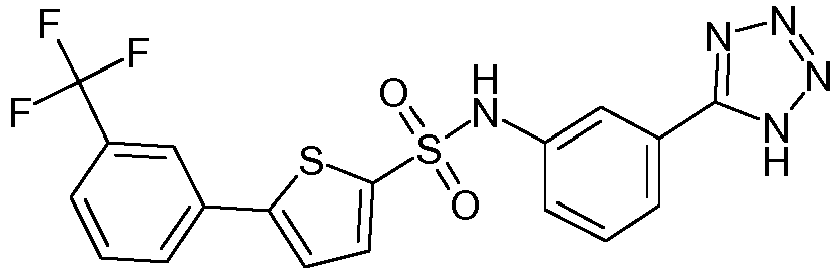
- The product was prepared according to
General Procedure 3, described in Example 22, using 5-bromo-N-[3-(1H-tetrazol-5-yl)phenyl]thiophene-2-sulfonamide (Intermediate 17) (19 mg, 0.055 mmol) and 3-trifluoromethylphenylboronic acid (11 mg, 0.06 mmol). The title compound was obtained in 48% yield (10.8 mg). MS (ESI+) calcd mass for C18H12F3N5O2S2 451.038451, found 451.038591. -

- The product was prepared according to
General Procedure 3, described in Example 22, using 5-bromo-N-[3-(1H-tetrazol-5-yl)phenyl]thiophene-2-sulfonamide (Intermediate 17) (19 mg, 0.055 mmol) and o-tolylboronic acid (8 mg, 0.06 mmol). The title compound was obtained in 41% yield (8.1 mg). MS (ESI+) calcd mass for C18H15N5O2S2 397.066716, found 397.066896. -

- The product was prepared according to
General Procedure 3, described in Example 22, using 5-bromo-N-[3-(1H-tetrazol-5-yl)phenyl]thiophene-2-sulfonamide (Intermediate 17) (19 mg, 0.055 mmol) and 2,4-difluorophenylboronic acid (9 mg, 0.06 mmol). The title compound was obtained in 33% yield (6.9 mg). MS (ESI+) calcd mass for C17H11F2N5O2S2 419.032222, found 419.032372. -

- The product was prepared according to
General Procedure 3, described in Example 22, using 5-bromo-N-[3-(1H-tetrazol-5-yl)phenyl]thiophene-2-sulfonamide (Intermediate 17) (19 mg, 0.055 mmol) and 3-chloro-4-fluorophenyl-boronic acid (10 mg, 0.06 mmol). The title compound was obtained in 31% yield (6.7 mg). MS (ESI+) calcd mass for C17H11ClFN5O2S2 435.002672, found 435.002662. -
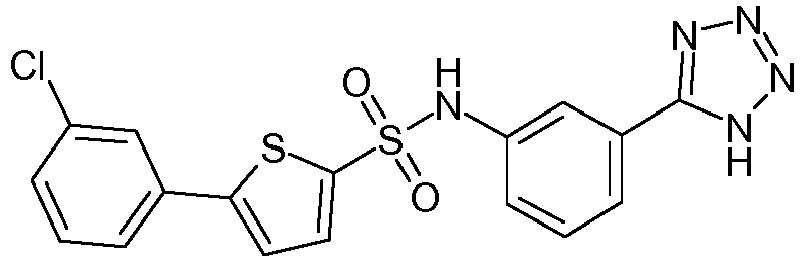
- The product was prepared according to
General Procedure 3, described in Example 22, using 5-bromo-N-[3-(1H-tetrazol-5-yl)phenyl]thiophene-2-sulfonamide (Intermediate 17) (19 mg, 0.055 mmol) and 3-chlorophenylboronic acid (9 mg, 0.06 mmol). The title compound was obtained in 26% yield (5.4 mg). MS (ESI+) calcd mass for C17H12ClN5O2S2 417.012094, found 417.012844. -

- The product was prepared according to
General Procedure 3, described in Example 22, using 5-bromo-N-[3-(1H-tetrazol-5-yl)phenyl]thiophene-2-sulfonamide (Intermediate 17) (19 mg, 0.055 mmol) and pyridine-4-boronic acid (7 mg, 0.06 mmol). The title compound was obtained in 16% yield (3.1 mg). MS (ESI+) calcd mass for C16H12N6O2S2 384.046315, found 384.047755. -

- A mixture of ethyl 3-{[(5-bromo-3-methyl-1-benzothiophen-2-yl)sulfonyl]amino}benzoate (Intermediate 18) (23 mg, 0.05 mmol), morpholine (9 mg, 0.10 mmol), PdOAc2 (0.6 mg, 0.0025 mmol), 2-(di-butylphosphino)biphenyl (1 mg, 0.0035 mmol) and Cs2CO3 (66 mg, 0.25 mmol) in dioxane (200 µL) was heated at 110 °C for 20 h giving the intermediate ethyl 3-{[(3-methyl-5-morpholin-4-yl-1-benzothiophen-2-yl)sulfonyl]amino}benzoate. The intermediate ester was hydrolyzed using LiOH in aqueous THF (1 mL, 1:1 water/THF) giving the title compound. MS (ESI+) calcd mass for C20H20N2O5S2 432.081363, found 432.081153.
-

- A mixture of 2-pyrrol-1-yl-ethanol (17 mg, 0.15 mmol) and NaH (5 mg, 60% dispersion in mineral oil, 0.13 mmol) in THF (200 µL) was stirred at 0 °C for 15 min. A solution of methyl 3-{[(5-chloro-3-methyl-1-benzothien-2-yl)sulfonyl]amino}benzoate (Example 74) (20 mg, 0.05 mmol) in THF (100 µL) was added, and the reaction mixture was stirred at 0 °C for another 6 h. The reaction was quenched by addition of cold MeOH and 4:1 water/HOAc (50 µL) before purified by preparative HPLC. The title compound was obtained in 53% yield (12.5 mg). MS (ESI+) m/z 475 [M+H]+.
-

- A reaction mixture containing 3-{[(5-chloro-3-methyl-1-benzothien-2-yl)sulfonyl]-amino}benzoic acid (21 mg, 0.055 mmol) (Intermediate 19), 1,1'-carbonyldiimidazole (17 mg, 0.106 mmol) and pyridine (9 µL, 0.113 mmol) in MeCN (0.75 mL) was stirred at 60 °C for 30 min, and then a second portion of pyridine (5 µL, 0.062 mmol) was added. After additional 30 min of stirring at 60 °C, EtOH (6 µL, 0.100 mmol) was added. The reaction mixture was stirred at 50 °C over night, and then diluted with DMSO/MeCN/water. TFA (50 µL) was added and the crude product was purified by reversed phase chromatography (ACE C8, 5µm, 21x50mm, flow 25 ml/min, gradient: 0.1% TFA in water/MeCN over 6 minutes). The title compound was obtained in 54% yield (12.2 mg). 1H NMR (500 MHz, CDCl3) δ ppm 1.34 (t, J=7.08 Hz, 3 H) 2.45 (s, 3 H) 4.33 (q, J=7.08 Hz, 2 H) 6.92 (s, 1 H) 7.36 (dd, J=8.04, 7.66 Hz, 1 H) 7.42 (ddd, J=8.04, 2.32, 1.17 Hz, 1 H) 7.44 (dd, J=8.70, 1.95 Hz, 1 H) 7.71 (d, J=8.70 Hz, 1 H) 7.71 (d, J=1.95 Hz, 1 H) 7.71 - 7.72 (m, 1 H) 7.84 (ddd, J=7.66, 1.48, 1.17 Hz, 1 H). MS (ESI+) m/z 410 [M+H]+.
-

- The product was prepared from 3-{[(5-chloro-3-methyl-1-benzothien-2-yl)sulfonyl]amino}benzoic acid (21 mg, 0.055 mmol) (Intermediate 19) and isopropyl alcohol (6.0 mg, 0.100 mmol) according to the General Procedure 7, described in Example 107, using a slightly modified reaction time (2 days). The title compound was obtained in 57% yield (13.3 mg). 1H NMR (500 MHz, CDCl3) δ ppm 1.30 (d, J=6.32 Hz, 6 H) 2.45 (s, 3 H) 5.18 (spt, J=6.32 Hz, 1 H) 6.89 (s, 1 H) 7.35 (dd, J=8.06, 7.65 Hz, 1 H) 7.41 (ddd, J=8.06, 2.35, 1.18 Hz, 1 H) 7.44 (dd, J=8.73, 1.94 Hz, 1 H) 7.68 (dd, J=2.35, 1.50 Hz, 1 H) 7.71 (dd, J=8.73, 0.61 Hz, 1 H) 7.71 (dd, J=1.94, 0.61 Hz, 1 H) 7.83 (ddd, J=7.65, 1.50, 1.18 Hz, 1 H). MS (ESI+) m/z 424 [M+H]+.
-

- The product was prepared from 3-{[(5-chloro-3-methyl-1-benzothien-2-yl)sulfonyl]amino}benzoic acid (21 mg, 0.055 mmol) (Intermediate 19) and 2-methoxyethanol (7.6 mg, 0.100 mmol) according to the General Procedure 7, described in Example 107. The title compound was obtained in 70% yield (16.9 mg). 1H NMR (500 MHz, CDCl3) δ ppm 2.47 (s, 3 H) 3.40 (s, 3 H) 3.67 - 3.70 (m, 2 H) 4.42 - 4.45 (m, 2 H) 6.92 (s, 1 H) 7.37 (dd, J=8.02, 7.74 Hz, 1 H) 7.45 (dd, J=8.73, 1.96 Hz, 1 H) 7.45 (ddd, J=8.02, 2.34, 1.17 Hz, 1 H) 7.72 (dd, J=8.73, 0.60 Hz, 1 H) 7.72 (dd, J=1.96, 0.60 Hz, 1 H) 7.74 (dd, J=2.34, 1.59 Hz, 1 H) 7.87 (ddd, J=7.74, 1.59, 1.17 Hz, 1 H). MS (ESI+) m/z 440 [M+H]+.
-

- The product was prepared from 3-{[(5-chloro-3-methyl-1-benzothien-2-yl)sulfonyl]amino}benzoic acid (21 mg, 0.055 mmol) (Intermediate 19) and 1-butanol (7.4 mg, 0.100 mmol) according to the General Procedure 7, described in Example 107. The title compound was obtained in 77% yield (18.5 mg). 1H NMR (500 MHz, CDCl3) δ ppm 0.95 (t, J=7.39 Hz, 3 H) 1.37 - 1.46 (m, 2 H) 1.65 - 1.72 (m, 2 H) 2.44 (s, 3 H) 4.27 (t, J=6.65 Hz, 2 H) 6.88 (s, 1 H) 7.36 (dd, J=8.06, 7.67 Hz, 1 H) 7.42 (ddd, J=8.06, 2.32, 1.22 Hz, 1 H) 7.45 (dd, J=8.67, 1.95 Hz, 1 H) 7.71 (dd, J=8.67, 0.52 Hz, 1 H) 7.70 - 7.71 (m, 1 H) 7.71 (dd, J=1.95, 0.52 Hz, 1 H) 7.84 (ddd, J=7.67, 1.50, 1.21 Hz, 1 H). MS (ESI+) m/z 438 [M+H]+.
-

- The product was prepared from 3-{[(5-chloro-3-methyl-1-benzothien-2-yl)sulfonyl]amino}benzoic acid (21 mg, 0.055 mmol) (Intermediate 19) and benzyl alcohol (10.8 mg, 0.100 mmol) according to the General Procedure 7, described in Example 107, using a slightly modified reaction time (2 days). The title compound was obtained in 68% yield (17.6 mg). 1H NMR (500 MHz, CDCl3) δ ppm 2.44 (s, 3 H) 5.31 (s, 2 H) 6.96 (s, 1 H) 7.33 - 7.40 (m, 5 H) 7.36 (dd, J=8.05, 7.70 Hz, 1 H) 7.43 (ddd, J=8.05, 2.36, 1.20 Hz, 1 H) 7.43 (dd, J=8.63, 2.06 Hz, 1 H) 7.68 (dd, J=8.63, 0.58 Hz, 1 H) 7.69 (dd, J=2.06, 0.58 Hz, 1 H) 7.74 (dd, J=2.36, 1.58 Hz, 1 H) 7.86 (ddd, J=7.70, 1.58, 1.20 Hz, 1 H). MS (ESI+) m/z 472 [M+H]+.
-

- The product was prepared from 3-{[(5-chloro-3-methyl-1-benzothien-2-yl)sulfonyl]amino}benzoic acid (21 mg, 0.055 mmol) (Intermediate 19) and 1-propanol (6.0 mg, 0.100 mmol) according to the General Procedure 7, described in Example 107. The title compound was obtained in 75% yield (17.6 mg). 1H NMR (500 MHz, CDCl3) δ ppm 0.97 (t, J=7.45 Hz, 3 H) 1.68 - 1.77 (m, 2 H) 2.44 (s, 3 H) 4.23 (t, J=6.65 Hz, 2 H) 6.90 (s, 1 H) 7.36 (dd, J=8.05, 7.70 Hz, 1 H) 7.42 (ddd, J=8.05, 2.34, 1.22 Hz, 1 H) 7.44 (dd, J=8.73, 1.95 Hz, 1 H) 7.71 (dd, J=8.73, 0.60 Hz, 1 H) 7.71 (dd, J=1.95, 0.60 Hz, 1 H) 7.71 (dd, J=2.34, 1.53 Hz, 1 H) 7.84 (ddd, J=7.70, 1.53, 1.22 Hz, 1 H). MS (ESI+) m/z 424 [M+H]+.
-
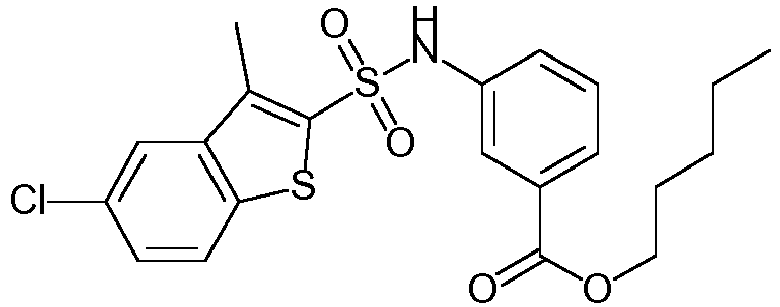
- The product was prepared from 3-{[(5-chloro-3-methyl-1-benzothien-2-yl)sulfonyl]amino}benzoic acid (21 mg, 0.055 mmol) (Intermediate 19) and 1-pentanol (8.8 mg, 0.100 mmol) according to the General Procedure 7, described in Example 107. The title compound was obtained in 76% yield (18.8 mg). 1H NMR (500 MHz, CDCl3) δ ppm 0.89 - 0.95 (m, 3 H) 1.32 - 1.42 (m, 4 H) 1.67 - 1.75 (m, 2 H) 2.45 (s, 3 H) 4.26 (t, J=6.77 Hz, 2 H) 6.87 (s, 1 H) 7.36 (dd, J=8.10, 7.63 Hz, 1 H) 7.42 (ddd, J=8.10, 2.36, 1.25 Hz, 1 H) 7.44 (dd, J=8.70, 1.95 Hz, 1 H) 7.69 - 7.73 (m, 3 H) 7.84 (ddd, J=7.63, 1.50, 1.25 Hz, 1 H). MS (ESI+) m/z 452 [M+H]+.
-

- The product was prepared from 3-{[(5-chloro-3-methyl-1-benzothien-2-yl)sulfonyl]amino}benzoic acid (21 mg, 0.055 mmol) (Intermediate 19) and 1-hexanol (10.2 mg, 0.100 mmol) according to the General Procedure 7, described in Example 107. The title compound was obtained in 71% yield (18.3 mg). 1H NMR (500 MHz, CDCl3) δ ppm 0.87 - 0.93 (m, 3 H) 1.27 - 1.36 (m, 4 H) 1.35 - 1.43 (m, 2 H) 1.65 - 1.74 (m, 2 H) 2.45 (s, 3 H) 4.26 (t, J=6.71 Hz, 2 H) 6.85 (s, 1 H) 7.36 (dd, J=8.08, 7.68 Hz, 1 H) 7.42 (ddd, J=8.08, 2.35, 1.28 Hz, 1 H) 7.44 (dd, J=8.69, 1.95 Hz, 1 H) 7.71 (dd, J=8.69, 0.55 Hz, 1 H) 7.71 - 7.72 (m, 1 H) 7.71 (dd, J=1.95, 0.55 Hz, 1 H) 7.84 (ddd, J=7.68, 1.50, 1.28 Hz, 1 H). MS (ESI+) m/z 466 [M+H]+.
-

- The product was prepared from 3-{[(5-chloro-3-methyl-1-benzothien-2-yl)sulfonyl]amino}benzoic acid (21 mg, 0.055 mmol) (Intermediate 19) and phenol (9.4 mg, 0.100 mmol) according to the General Procedure 7, described in Example 107. The title compound was obtained in 74% yield (18.7 mg). 1H NMR (500 MHz, CDCl3) δ ppm 2.50 (s, 3 H) 7.06 (s, 1 H) 7.10 - 7.15 (m, 2 H) 7.25-7.29 (m, 1 H) 7.39 - 7.44 (m, 2 H) 7.44 (dd, J=8.10, 7.70 Hz, 1 H) 7.44 (dd, J=8.65, 2.02 Hz, 1 H) 7.51 (ddd, J=8.10, 2.34, 1.15 Hz, 1 H) 7.72 (dd, J=8.65, 0.57 Hz, 1 H) 7.73 (dd, J=2.02, 0.57 Hz, 1 H) 7.86 (dd, J=2.34, 1.58 Hz, 1 H) 7.99 (ddd, J=7.70, 1.58, 1.15 Hz, 1 H). MS (ESI+) m/z 458 [M+H]+.
-

- The product was prepared from 3-{[(5-chloro-3-methyl-1-benzothien-2-yl)sulfonyl]amino}benzoic acid (21 mg, 0.055 mmol) (Intermediate 19) and 3-hydroxytetrahydrofuran (8.8 mg, 0.100 mmol) according to the General Procedure 7, described in Example 107. The title compound was obtained in 63% yield (15.6 mg). 1H NMR (500 MHz, CDCl3) δ ppm 2.07 (ddddd, J=13.81, 6.79, 4.51, 1.93, 1.05 Hz, 1 H) 2.25 (dddd, J=13.81, 8.43, 8.43, 6.32 Hz, 1 H) 2.47 (s, 3 H) 3.86 - 3.96 (m, 3 H) 3.97 (dd, J=10.65, 4.64 Hz, 1 H) 5.46 -5.50 (m, 1 H) 7.00 (s, 1 H) 7.37 (dd, J=8.05, 7.69 Hz, 1 H) 7.44 (ddd, J=8.05, 2.35, 1.17 Hz, 1 H) 7.44 (dd, J=8.72, 1.95 Hz, 1 H) 7.70 (dd, J=2.35, 1.57 Hz, 1 H) 7.72 (dd, J=8.72, 0.57 Hz, 1 H) 7.72 (dd, J=1.95, 0.57 Hz, 1 H) 7.82 (ddd, J=7.69, 1.57, 1.17 Hz, 1 H). MS (ESI+) m/z 452 [M+H]+.
-

- The product was prepared from 3-{[(5-chloro-3-methyl-1-benzothien-2-yl)sulfonyl]amino}benzoic acid (21 mg, 0.055 mmol) (Intermediate 19) and 3-hydroxymethyltetrahydrofuran (10.2 mg, 0.100 mmol) according to the General Procedure 7, described in Example 107. The title compound was obtained in 64% yield (16.5 mg). 1H NMR (500 MHz, CDCl3) δ ppm 1.67 (dddd, J=12.56, 7.90, 7.00, 5.96 Hz, 1 H) 2.06 (dddd, J=12.56, 8.61, 7.70, 5.54 Hz, 1 H) 2.45 (s, 3 H) 2.61 - 2.70 (m, 1 H) 3.62 (dd, J=8.86, 5.45 Hz, 1 H) 3.77 (ddd, J=8.61, 7.70, 7.00 Hz, 1 H) 3.86 (dd, J=8.86, 7.06 Hz, 1 H) 3.88 (ddd, J=8.61, 7.90, 5.54 Hz, 1 H) 4.19 (dd, J=10.89, 7.81 Hz, 1 H) 4.28 (dd, J=10.89, 6.49 Hz, 1 H) 7.02 (s, 1 H) 7.37 (dd, J=8.00, 7.66 Hz, 1 H) 7.43 (ddd, J=8.06, 2.32, 1.22 Hz, 1 H) 7.44 (dd, J=8.67, 1.95 Hz, 1 H) 7.72 (dd, J=8.67, 0.53 Hz, 1 H) 7.71 (dd, J=1.95, 0.53 Hz, 1 H) 7.71 - 7.72 (m, 1 H) 7.82 (ddd, J=7.66, 1.55, 1.22 Hz, 1 H). MS (ESI+) m/z 466 [M+H]+.
-

- The product was prepared from 3-{[(5-chloro-3-methyl-1-benzothien-2-yl)sulfonyl]amino}benzoic acid (21 mg, 0.055 mmol) (Intermediate 19) and 3-dimethylamino-1-propanol (10.3 mg, 0.100 mmol) according to the General Procedure 7, described in Example 107. The title compound was obtained in 99% yield (25.5 mg). 1H NMR (500 MHz, CDCl3) δ ppm 2.19 - 2.27 (m, 2 H) 2.53 (s, 3 H) 2.86 (s, 6 H) 3.19 - 3.25 (m, 2 H) 4.30 - 4.36 (m, 2 H) 7.35 (dd, J=8.12, 7.78 Hz, 1 H) 7.42 (dd, J=8.67, 2.05 Hz, 1 H) 7.56 (ddd, J=8.12, 2.34, 1.05 Hz, 1 H) 7.70 (dd, J=8.67, 0.57 Hz, 1 H) 7.71 (dd, J=2.05, 0.57 Hz, 1 H) 7.75 (ddd, J=7.78, 1.60, 1.05 Hz, 1 H) 7.89 (dd, J=2.34, 1.60 Hz, 1 H) 8.38 (br. s., 1 H). MS (ESI+) m/z 467 [M+H]+.
-

- A reaction mixture containing [5-(3-{[(5-isopropyl-3-methyl-1-benzothien-2-yl)sulfonyl]-amino}phenyl)-2H-tetrazol-2-yl]acetic acid (5.7 mg, 0.012 mmol) (Example 12), 1,1'-carbonyldiimidazole (4.0 mg, 0.025 mmol) and pyridine (5.0 µL, 0.062 mmol) in MeCN (0.60 mL) was stirred at room temperature for 25 min. MeOH (50 µL, 1.23 mmol) was added. The reaction mixture was stirred at room temperature over night, and then diluted with DMSO/MeOH/water. TFA was added and the crude product was purified by reversed phase chromatography (ACE C8, 5µm, 21x50mm, flow 25 ml/min, 0.1% TFA in water/MeCN over 6 minutes). The title compound was obtained in 72% yield (4.2 mg). 1H NMR (500 MHz, CDCl3) δ ppm 1.28 (d, J=6.92 Hz, 6 H) 2.53 (s, 3 H) 3.02 (spt, J=6.92 Hz, 1 H) 3.82 (s, 3 H) 5.44 (s, 2 H) 6.92 (s, 1 H) 7.35 (ddd, J=8.11, 2.16, 1.28 Hz, 1 H) 7.35 - 7.38 (m, 1 H) 7.39 (dd, J=8.11, 7.50 Hz, 1 H) 7.53 - 7.55 (m, 1 H) 7.70 (d, J=8.42 Hz, 1 H) 7.90 (dd, J=2.16, 1.50 Hz, 1 H) 7.93 (ddd, J=7.50, 1.50, 1.28 Hz, 1 H). MS (ESI+) m/z 486 [M+H]+.
-

- The product was prepared from 3-{[(5-bromo-3-methyl-1-benzothien-2-yl)sulfonyl]-amino}benzoic acid (20.4 mg, 0.048 mmol) (Example 41) and MeOH (50 µL, 1.23 mmol) according to the General Procedure 8, described in Example 119, using different amounts of pyridine (7.5 µL, 0.092 mmol) and a slightly modified reaction volume (0.80 mL). The title compound was obtained in 47% yield (9.9 mg). 1H NMR (500 MHz, CDCl3) δ ppm 2.44 (s, 3 H) 3.87 (s, 3 H) 6.94 (s, 1 H) 7.36 (dd, J=8.10, 7.66 Hz, 1 H) 7.41 (ddd, J=8.10, 2.35, 1.26 Hz, 1 H) 7.57 (dd, J=8.63, 1.86 Hz, 1 H) 7.66 (dd, J=8.63, 0.54 Hz, 1 H) 7.73 (dd, J=2.35, 1.51 Hz, 1 H) 7.84 (ddd, J=7.66, 1.51, 1.26 Hz, 1 H) 7.87 (dd, J=1.86, 0.54 Hz, 1 H). MS (ESI+) m/z 440 [M+H]+.
-

- The product was prepared from 3-{[(7-methoxy-3-methyl-1-benzothien-2-yl)sulfonyl]amino}benzoic acid (6.8 mg, 0.018 mmol) (Example 42) and MeOH (50 µL, 1.23 mmol) according to the General Procedure 8, described in Example 119. The title compound was obtained in 71% yield (5.0 mg). 1H NMR (500 MHz, CDCl3:DMSO-d 6 6:1) δ ppm 2.23 (s, 3 H) 3.56 (s, 3 H) 3.68 (s, 3 H) 6.60 (dd, J=7.54, 1.10 Hz, 1 H) 6.98 (dd, J=8.13, 7.73 Hz, 1 H) 7.05 (dd, J=8.17, 1.10 Hz, 1 H) 7.09 (dd, J=8.17, 7.54 Hz, 1 H) 7.14 (ddd, J=8.13, 2.32, 1.09 Hz, 1 H) 7.38 (ddd, J=7.73, 1.63, 1.09 Hz, 1 H) 7.57 (dd, J=2.32, 1.63 Hz, 1 H) 10.18 (s, 1 H). MS (ESI+) m/z 392 [M+H]+.
-

- The product was prepared from 3-{[(7-chloro-3-methyl-1-benzothien-2-yl)sulfonyl]amino}benzoic acid (9.2 mg, 0.024 mmol) (Example 44) and MeOH (50 µL, 1.23 mmol) according to the General Procedure 8, described in Example 119, using a different amount of 1,1'-carbonyldiimidazole (10.0 mg, 0.0621 mmol). The title compound was obtained in 74% yield (7.0 mg). 1H NMR (500 MHz, CDCl3) δ ppm 2.46 (s, 3 H) 3.87 (s, 3 H) 6.79 (s, 1 H) 7.37 (dd, J=8.06, 7.70 Hz, 1 H) 7.41 (dd, J=8.06, 7.69 Hz, 1 H) 7.43 (ddd, J=8.06, 2.32, 1.21 Hz, 1 H) 7.48 (dd, J=7.69, 0.98 Hz, 1 H) 7.65 (dd, J=8.06, 0.98 Hz, 1 H) 7.74 (dd, J=2.32, 1.51 Hz, 1 H) 7.84 (ddd, J=7.70, 1.51, 1.21 Hz, 1 H). MS (ESI+) m/z 396 [M+H]+.
-

- A solution of 5-chloro-3-methyl-benzothiophene-2-sulfonyl chloride (17 mg, 0.060 mmol) and 3-aminosalicylic acid (14 mg, 0.090 mmol) in 1200 µL of water/dioxane (1:6) was shaken at 35 °C for 5 days. The product was purified by reversed phase chromatography (ACE C8, 5µm, 21x50mm, flow 25 ml/min, gradient: 0.1% TFA in water/MeCN over 6 minutes). The title compound was obtained in 72% yield (17.2 mg). 1H NMR (500 MHz, DMSO-d 6) δ ppm 2.48 (s, 3 H) 6.85 (t, J=7.92 Hz, 1 H) 7.46 (dd, J=7.69, 1.64 Hz, 1 H) 7.55 (dd, J=8.66, 2.05 Hz, 1 H) 7.63 (dd, J=7.92, 1.64 Hz, 1 H) 8.00 (dd, J=2.05, 0.47 Hz, 1 H) 8.04 (dd, J=8.66, 0.47 Hz, 1 H) 10.17 (br. s., 1 H). MS (ESI+) m/z 398 [M+H]+.
-
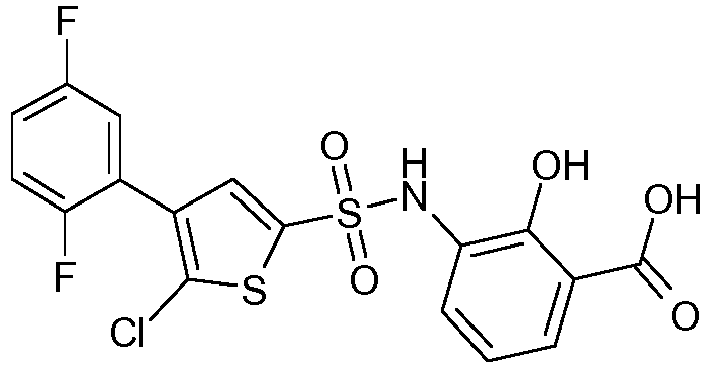
- A mixture of 3-{[(4-bromo-5-chlorothiophen-2-yl)sulfonyl]amino}-2-hydroxybenzoic acid (Intermediate 22) (20.6 mg, 0.050 mmol), 2,5-difluorophenylboronic acid (8.7 mg, 0.055 mmol), DIPEA (35 µL, 0.200 mmol) and Pd(dppf)Cl2·CH2Cl2 (2 mg, 0.003 mmol) in aqueous dioxane (1 mL, 9:1 dioxane/water) was heated at 80 °C under nitrogen atmosphere over night. The reaction mixture was acidified by addition of TFA (50 µL). After being allowed to settle overnight the reaction mixture was filtered, diluted with MeOH and purified by reversed phase chromatography (ACE C8, 5µm, 21x50mm, flow 25 ml/min, gradient: 0.1% TFA in water/MeCN over 6 minutes) to give 9.7 mg of the title compound (44%). 1H NMR (500 MHz, MeOH-d 4) δ ppm 6.90 (t, J=7.94 Hz, 1 H) 7.14 (dddd, J=8.67, 5.60, 2.93, 0.46 Hz, 1 H) 7.16 - 7.21 (m, 1 H) 7.20 - 7.25 (tdd, J=8.96, 4.60, 0.46 Hz, 1 H) 7.34 (d, J=1.59 Hz, 1 H) 7.65 (dd, J=7.94, 1.65 Hz, 1 H) 7.74 (dd, J=7.94, 1.65 Hz, 1 H); MS (ESI+) m/z 446 [M+H]+.
-

- The product was prepared from 3-{[(4-bromo-5-chlorothiophen-2-yl)sulfonyl]amino}-2-hydroxybenzoic acid (Intermediate 22) (20.6 mg, 0.050 mmol) and 2,3-dihydrobenzofuran-5-boronic acid (9 mg, 0.055 mmol) according to the General Procedure 12, described in Example 135. The title compound was obtained in 46% yield (10.6 mg). 1H NMR (500 MHz, MeOH-d 4) δ ppm 3.23 (t, J=8.70 Hz, 2 H) 4.58 (t, J=8.70 Hz, 2 H) 6.76 (d, J=8.24 Hz, 1 H) 6.90 (t, J=7.95 Hz, 1 H) 7.14 - 7.17 (ddt, J=8.24, 1.97, 0.71 Hz, 1 H) 7.25 (dt, J=1.97, 1.30 Hz, 1 H) 7.31 (s, 1 H) 7.66 (dd, J=7.95, 1.65 Hz, 1 H) 7.74 (dd, J=7.95, 1.65 Hz, 1 H). MS (ESI+) m/z 452 [M+H]+.
-

- The product was prepared from 3-{[(4-bromo-5-chlorothiophen-2-yl)sulfonyl]amino}-2-hydroxybenzoic acid (Intermediate 22) (20.6 mg, 0.050 mmol) and 2-(4,4,5,5-tetramethyl-1,3,2-dioxaborolan-2-yl)phenol (11 µl, 0.055 mmol) according to the General Procedure 12, described in Example 135. The title compound was obtained in 24% yield (5.3 mg). 1H NMR (500 MHz, MeOH-d 4) δ ppm 6.85 (ddd, J=7.60, 7.32, 1.15 Hz, 1 H) 6.87 (ddd, J=8.21, 1.15, 0.45 Hz, 1 H) 6.88 (t, J=7.95 Hz, 1 H) 7.15 (ddd, J=7.60, 1.71, 0.45 Hz, 1 H) 7.20 (ddd, J=8.21, 7.32, 1.71 Hz, 1 H) 7.39 (s, 1 H) 7.65 (dd, J=7.95, 1.65 Hz, 1 H) 7.71 (dd, J=7.95, 1.65 Hz, 1 H). MS (ESI+) m/z 426 [M+H]+.
-

- A solution of 5-chloro-3-methyl-benzo[b]thiophene-2-sulfonyl chloride (22 mg, 0.075 mmol) and 5-aminosalicylic acid (17 mg, 0.112 mmol) in aqueous dioxane (800 µL, 4:1 dioxane/water) was shaken at 35 °C for 5 days. The product was purified by reversed phase chromatography (ACE C8, 5µm, 21x50mm, flow 25 ml/min, gradient: 0.1% TFA in water/MeCN over 6 minutes). The title compound was obtained in 79% yield (23.6 mg). 1H NMR (500 MHz, DMSO-d 6) δ ppm 2.41 - 2.43 (m, 3 H) 6.87 (d, J=8.79 Hz, 1 H) 7.20 - 7.25 (m, 1 H) 7.53 (dd, J=2.93, 1.46 Hz, 1 H) 7.56 (dd, J=8.79, 1.95 Hz, 1 H) 8.00 (d, J=1.95 Hz, 1 H) 8.06 (d, J=8.79 Hz, 1 H) 10.45 (s, 1 H). MS (ESI+) m/z 398 [M+H]+.
-

- The title compound is prepared according to the procedure described for Example 33. MS (ESI+) calcd mass for C17H14ClNO5S2 411.000192, found 411.000372.
-

- The product was prepared according to General Procedure 1, described in Example 1, with 5-benzenesulfonyl-thiophene-2-sulfonyl chloride (17.7 mg, 0.055 mmol) and 5-(3-aminophenyl)tetrazole (8.0 mg, 0.050 mmol). The title compound was obtained in 40% yield (8.9 mg). MS (ESI+) calcd mass for C17H13N5O4S3 447.012966, found 447.013676.
- 6-phosphofructo-2-kinase/fructose-2,6-bisphosphatase (PFK-2/BPase-2) is a bi-functional enzyme that catalyses the formation and degradation of fructose-2,6-bisphosphate (F-2,6-P2) (see e.g. Pilkis et al., (1995) Annu. Rev. Biochem. 64, 799-835; and Okar et al., (2001) Trends Biochem. Sci. 26, 30-5; for reviews). The relative kinase (formation) and phosphatase (degradation) activities of the bi-functional enzyme control the intracellular levels of this regulator (F-2,6-P2), which acts as an allosteric activator of glycolysis. Both the relative activities as well as the kinase to phosphatase ratios differ between the isoforms of the bi-functional enzymes, referred to as PFKFB1, PFKFB2, PFKFB3 and PFKFB4. Intracellular F-2,6-P2 levels are consequently controlled by variable tissue expression of these isoforms, including splice variants or post-translational modifications (see e.g. Rider et al. (2007) Biochem J. 381, 561-579).
- The PFKFB3 (placenta form) and PFKFB4 were produced and purified to homogeneity from E. coli at Biovitrum and at Sprint Bioscience. All other reagents were purchased from commercial sources. Two independent methods have been used for determination of the kinase activity of PFKFB3 (Method A and Method B). Method B has been used for determination of the kinase activity of PFKFB4.
- Method A: The kinase activity of the bi-functional enzyme is readily quantified based on the production of F-2,6-P2 as described by Van Schaftingen et al. (1982) Eur. J. Biochem. 129, 191-5. This sensitive assay is based on the potent activation of pyrophosphate dependent phosphofructokinase-1 (PPi-PFK) from potato tubers by F-2,6-P2. The use of a series of coupled enzymes leads to a consumption of NADH (nicotinamide adenine dinucleotide) that can be followed spectrophotometrically (an updated protocol is available in Van Schaftingen, (1984) Methods of Enzymatic Analysis (Bergmeyer, H. U., ed.), 3rd edn., vol. 6, pp. 335-341, Verlag Chemie, Weinheim). A protocol for measurements in 96-well microtiter plate format is also available (Bruni et al., (1989) Anal. Biochem. 178, 324-6). These assay protocols have been adopted for the measurement of the kinase activity of PFKFB3 with some modifications as described in the protocol below.
- The assay was run in 96-well microtiter plates (Costar 3365 round bottom polypropylene) by consecutive additions of 30 µl each of a test compound solution (diluted from a DMSO stock solution), a PFKFB3 solution and a substrate (fructose-6-phosphate (F6P) and adenosine-5'-triphosphate (ATP)) containing solution. Controls in the absence of inhibitor (uninhibited activity) and 50 µM of an in-house inhibitor (completely inhibited kinase activity) were included in column 12 of the plate. The final concentrations of all reagents in a total assay volume of 90 µl per well were:
- 50 mM Tris-acetate at pH 8.0
- 0.1 mM EDTA (ethylene diamine tetraacetic acid)
- 10 mM MgCl2
- 5 mM Na2HPO4 (buffered by the Tris-acetate to a final pH of 8.0)
- 5 nM PFKFB3
- 4 µM ATP
- 100 µM F6P (acid treated and then neutralized to remove any contaminating F-2,6-P2; see Van Schaftingen, 1984)
- 1 mM dithiothreitol (DTT)
- 0.005% Tween-20
- A test compound at various concentrations (which also added 0.83% DMSO to the final solution)
- The enzymatic reaction was allowed to proceed for 10 minutes at room temperature while on a plate shaker at medium speed (750 RPM). The reaction was then terminated by the addition of 90 µl of a 0.4 M NaOH solution to all wells. The plate was then placed on the plateshaker at the same speed for two minutes to allow sufficient mixing. All samples were then diluted by a factor of 10 by transferring 20 µl from each well to the corresponding well of a new plate with 180 µl distilled water predispensed to all wells.
- The next step in the protocol was quantification of the levels of F-2,6-P2 in each well of the microtiter plate. This was done by transferring 20 µl of the content in each well to the corresponding position in a new plate (Nunc 269620 transparent 96-well plate). The control samples representing uninhibited and completely inhibited (two each) reactions were placed in column 12 of the plate. To ensure that all measured values were within the linear range of the response (measured to be between 0-1 nM of F-2,6-P2 as also described by Van Schaftingen) the same volume of a 2.5 nM and a 5.0 nM standard sample were also added to column 12 (as all samples were diluted five-fold in the assay procedure this corresponds to 0.5 and 1.0 nM samples). The procedure then involved consecutive additions of three solutions with the following premixed components:
- Assay-mix (20 µl): Tris-acetate at pH 8.0, NADH and Mg(OAc)2
- PPi/F6P-mix (40 µl): Pyrophosphate and F6P
- Enzyme-mix (20 µl): Tris-acetate at pH 8.0, aldolase, triose phosphate isomerase, glycerol-3-phosphate dehydrogenase, pyrophosphate-dependent phosphofructokinase from potato tubers and bovine serum albumin (BSA)
- The final concentrations of all reagents in a total assay volume of 100 µl per well were:
- 50 mM Tris-acetate at pH 8.0
- 0.15 mM NADH
- 2 mM Mg(OAc)2
- 1 mM F6P (acid treated and then neutralized to remove any contaminating F-2,6-P2; see Van Schaftingen, 1984 in Methods of Enzymatic Analysis (Bergmeyer, H. U., ed.), 3rd edn., vol. 6, pp. 335-341, Verlag Chemie, Weinheim)
- 0.5 mM pyrophosphate
- 0.5 U/ml aldolase
- 5 U/ml triose phosphate isomerase
- 1.7 U/ml glycerol-3-phosphate dehydrogenase
- 0.01 U/ml pyrophosphate-dependent phosphofructokinase from potato tubers
- 0.2 mg/ml BSA
- Test samples containing variable F-2,6-P2 concentrations were diluted in NaOH (including also additional diluted components from the PFKFB3 reaction)
- The coupled enzymatic reaction was allowed to proceed for 30 minutes at room temperature while on a plate shaker at medium speed (750 RPM). The reaction was then terminated by the addition of 20 µl of a 0.5M EDTA solution to all wells. The plate was then read in a Victor2 plate reader from Perkin-Elmer Life Sciences using the standard absorbance filter at 355 nm. The measured absorbance is proportional to the concentration of NADH, which in turn is proportional to the levels of F-2,6-P2 within the linear range. This was defined by the 0.5 and 1.0 nM controls together with the completely inhibited control (corresponding to 0 nM F-2,6-P2) on each plate. As described above controls were included on each plate to define the values for uninhibited and fully inhibited reactions and these values were used to calculate the % inhibition of the enzymatic reaction at any given compound concentration. The inhibitory potency or IC50 values of test compounds on the kinase activity of PFKFB3 were calculated using a four-parameter model (model 205) in XLfit (IDBS ActivityBase).
- Method B: The kinase activity of the bi-functional enzyme is readily quantified based on the production of ADP and F-2,6-P2 from ATP and F6P. The ADP is detected with a kit, ADP-Glo™ Kinase Assay(a-e), from Promega. The assay is a luminescent ADP detection assay that measures kinase activity by quantifying the amount of ADP produced during the kinase reaction. The assay is performed in two steps; first, after the kinase reaction, an equal volume of ADP-Glo™ Reagent is added to terminate the kinase reaction and deplete the remaining ATP. Second, the Kinase Detection Reagent is added to simultaneously convert ADP to ATP and allow the newly synthesized ATP to be measured using a luciferase/ luciferine reaction. The light generated is measured using a luminescence counter (1450 MicroBeta TriLux).
- The assay was performed in white 384-well microtiter plates (OptiPlate, 6007299, PerkinElmer) by consecutive additions of 0.1 µL of a test compound solution (serial diluted in DMSO from compound DMSO stock solution and dispensed by acoustic dispensing from UV-star 384-well plate 7360153, VWR), 5 µL of enzyme solution and 5 µL of a substrate (fructose-6-phosphate (F6P) and adenosine-5'-triphosphate (ATP)) containing solution. Controls in the absence of inhibitor (uninhibited activity, only DMSO), 100 nM of an in-house inhibitor (QC, 50% inhibited kinase activity) and 49.5 µM of an in-house inhibitor (completely inhibited kinase activity) were included in column 23, 24 of the plate. Four reference dose response curves, one of them being the QC compound, were included in row O1-2, P1-2, and serial diluted as the test compounds. The final concentrations of all reagents in a total assay volume of 10.1 µL per well were:
- 50 mM Tris-HCl at pH 8.0
- 10 mM MgCl2
- 5 mM Na2HPO4 at pH 8.0
- 81.48 nM PFKFB3 or 145nM PFKFB4
- 8 µM ATP
- 100 µM F6P (acid treated and then neutralized to remove any contaminating F-2,6-P2; see Van Schaftingen, 1984)
- 0.005% Tween-20
- 1 mM dithiothreitol (DTT)
- A test compound at various concentrations or controls (final DMSO concentration 0.99%)
- Enzyme, compounds and controls were pre-incubated at room temperature for 15 min before the addition of substrate solution. The enzymatic reaction was allowed to proceed for 20 min (PFKFB3) or 40 min (PFKFB4) at room temperature. The reaction was terminated by the addition of 10 µL of ADP-Glo™ Reagent to all wells and the plate was incubated for 40 min at room temperature. After addition of 20 µL Kinase Detection Reagent to all wells the plate was incubated for 30 min at room temperature, followed by measurement in 1450 MicroBeta TriLux. All plates were centrifuged after each addition (room temperature, short spin, 500 RPM, Megafuge 1.0 Heraeus Instruments).
- As described above controls were included on each plate to define the values for uninhibited and fully inhibited reactions and these values were used to calculate the % inhibition of the enzymatic reaction at any given compound concentration. The inhibitory potency or IC50 values of test compounds on the kinase activity of PFKFB3 or PFKFB4 were calculated using a four-parameter model (model 205) in XLfit (IDBS ActivityBase XE Runner).
- Examples included herein have IC50 values in the range of 10 nM to 15 µM as measured using the above described assays Method A and/or Method B (see Table I and Table II for exemplary data).
TABLE I. PFKFB3: IC50 values for representative compounds as measured by Method A and/or B. Example Number IC50 (µM) Assay Example Number IC50 (µM) Assay 2 3.91 A 49 5.07 A 5 0.03 A 58 0.54 A 11 0.85 A 59 0.56 A 12 1.02 A 60 1.30 B 15 0.23 A 61 2.24 B 23 0.62 B 78 6.69 A 25 0.31 A 79 6.31 A 33 0.13 B 99 1.42 B 38 0.18 A 137 5.18 B 39 0.28 B 138 9.03 B 48 0.36 A TABLE II. PFKFB4: IC50 values for representative compounds as measured by Method B Example Number IC50 (µM) Example Number IC50 (µM) 5 0.06 42 0.42 21 0.42 43 0.17 24 0.66 44 0.20 26 0.75 101 0.60 27 0.48 102 0.66 38 0.13 134 0.18 40 0.14 - The relative kinase (formation) and phosphatase (degradation) activities of the bi-functional enzymes PFKFB3 and PFKFB4 control the intracellular levels of the regulator F-2,6-P2, which acts as an allosteric activator of glycolysis. The levels of F-2,6-P2 have been determined in three different cancer cell lines (MCF-7, PANC-1 and NUGC-3) using the van Shaftingen assay. The assay protocols described under "Methods for measurement of enzymatic activity of PFKFB3 and PFKFB4, Method A" have been adapted for the measurement of the inhibitory effect of compounds on the kinase activity of the various isoforms of the bi-functional enzyme (endogenously expressed) in the different cell lines. The modifications are described in the protocol below. All reagents were purchased from commercial sources or prepared inhouse.
- Cells: MCF-7(ATCC-HBT22). Lot.no: 58469417.
Growth medium: - Eagle's Minimum Essential Medium (EMEM), Sigma-Aldrich #M5650, 500 ml 10% FBS, Invitrogen, 10106-169
- 5
mL 200 mM L-glutamine, Invitrogen 25030024 - 5 mL 100 mM Sodium Pyruvate, Invitrogen 11360039
- 0.5 mL 10 mg/ml Bovine Insulin, Sigma-Aldrich 10516
- Cells were seeded at a concentration of 450 000 cells/mL in 100 µL growth medium (45 000 cells/well)
- Cells: PANC-1(ATCC-CRL-1469). Lot.no: 58564651.
Growth medium: Dulbecco's Modified Eagle's Medium, DMEM, ATCC-30-2002
10% FBS, Invitrogen, 10106-169
Cells were seeded at a concentration of 250 000 cells/mL in 100 µL growth medium (25 000 cells/well) - Cells: NUGC-3(JCRB0822). Lot no: 04272009.
Growth medium: RPMI1640, Sigma-Aldrich, R8758
10% FBS, Invitrogen, 10106-169
Cells were seeded at a concentration of 350 000 cells/mL in 100 µL growth medium (35 000 cells/well) - Starvation medium: DMEM/F12 without phenol red and glucose free, SVA, 991373
0.25% FBS, Invitrogen, 10106-169
Induction medium: DMEM/F12 without phenol red and glucose free, SVA, 991373
0.25% FBS, Invitrogen, 10106-169 (same as starvation medium) - Cells were seeded in 96-well Corning Costar tissue culture plates (CLS3595, Sigma-Aldrich) using the concentrations specified above for the three different cell lines A-C and incubated over night at 37 °C and 5% CO2. Row A was left empty. Next day the growth medium was discarded and replaced with 100 µL starvation medium. The plates were incubated for 18 h at 37 °C and 5% CO2. After 18 h of starvation the cells were induced with 100 µL compound or control solutions. Compounds were either tested in two concentrations (50 µM and 10 µM) or in dose response curves starting from 50 µM and the final DMSO concentration in assay plates was 0.5%. Also a dose response curve of a reference inhibitor was included in row H on each plate. All compounds were tested in duplicate plates. Compounds (in 96 well CLS 3365, Sigma-Aldrich) were serial diluted in DMSO from 10 mM compound DMSO stock solutions with Janus (automated liquid handling workstation from PerkinElmer). 5 µL were transferred to a Greiner deep well plate (736-0155, VWR) with 495 µL starvation medium. The final start concentration of compounds in the dilution plate was 100 µM, 1% DMSO. For compounds tested as single points, 10 mM compound solutions were diluted five fold in DMSO to 2 mM, followed by the transfer of 5 µL to separate dilution plates with 495 µL starvation medium. The final concentration of compounds in these dilution plates were 100 or 20 µM, respectively, and final concentration of DMSO was 1%. The plates were incubated at 37 °C and 5% CO2 for 1 h, followed by the addition of 10 µL 20 mM D-glucose in starvation medium. Controls, with and without 1 mM glucose, were included in row B. The final assay volume was 210 µL per well. After 2 h of incubation at 37 °C and 5% CO2, supernatants were discarded and the cells were lysed by the addition of 25 µL 250 mM NaOH. The plates were incubated at 37 °C and 5% CO2 for 5 min followed by an addition of 75 µL MilliQ dH2O. The supernatants were further diluted with 210 µL MilliQ dH2O to a final concentration of 20 mM NaOH. 200 µL were transferred to NUNC 96-well plates (7322661, VWR) and the plates were sealed and stored at -20 °C until analysis.
- The amount of F-2,6-P2 was quantified based on the coupled enzymatic reaction described by Van Schaftingen. If necessary the samples were further diluted in 20 mM NaOH before quantification. Plates stored at -20 °C were thawed and the F-2,6-P2 quantification was initiated by transferring 40 µL from each well of the NUNC plate to the corresponding position in a transparent 96-well SpectraPlate-MB (6005649, PerkinElmer). In order to ensure that all F-2,6-P2 measured values were within the linear range of response (between 0-1 nM final concentration of F-2,6-P2 as described by Van Schaftingen), the same sample volume (40 µL) of an in-house produced F-2,6-P2 standard was included on each plate in row A.
- The procedure described below involved consecutive additions of three solutions with the following premixed components:
- Assay-mix (40 µL): Tris-acetate at pH 8.0, NADH and Mg(OAc)2
- Substrate-mix (80 µL): Pyrophosphate and F6P
- Enzyme-mix (40 µL): Tris-acetate at pH 8.0, aldolase, triose phosphate isomerase, glycerol-3-phosphate dehydrogenase, pyrophosphate-dependent phosphofructokinase from potato tubers and bovine serum albumin (BSA)
- The final concentrations of all reagents in a total assay volume of 200 µL per well were:
- 50 mM Tris-acetate at pH 8.0
- 0.15 mM NADH
- 2 mM Mg(OAc)2
- 1 mM F6P (acid treated and then neutralized to remove any contaminating F-2,6-P2; see Van Schaftingen, 1984 in Methods of Enzymatic Analysis (Bergmeyer, H. U., ed.), 3rd edn., vol. 6, pp. 335-341, Verlag Chemie, Weinheim)
- 0.5 mM pyrophosphate
- 0.45 U/mL aldolase
- 5 U/mL triose phosphate isomerase
- 1.7 U/mL glycero 1-3-phosphate dehydrogenase
- 0.01 U/mL pyrophosphate-dependent phosphofructokinase from potato tubers 0.2 mg/mL BSA
- Test samples containing variable concentrations of F-2,6-P2 diluted in NaOH
- The coupled enzymatic reaction was allowed to proceed for 45 minutes at room temperature and the absorbance at 340 nm was continuously measured every 30 seconds (SpectraMax plate reader, Molecular Devices). The measured absorbance is proportional to the concentration of NADH, which in turn is proportional to the levels of F-2,6-P2 within the linear range. This was defined by the 0 to 1.0 nM F-2,6-P2 controls in row A of the SpectraPlate. The IC50 values for test compounds were calculated using a four-parameter model (model 205) in XLfit (Excel).
- Examples included herein have IC50 values in the range 100 nM to 15 µM (see Table III for exemplary data) or >50% inhibition at 12.5 µM as measured using the above described assay. Examples 106, 107, 109, 111, 113, 115 and 117 are representative examples showing >50% inhibition at 12.5 µM in PANC-1 cells.
TABLE III. IC50 values for representative compounds in different cell lines based on quantification of F-2,6-P2 Example Number IC50 (µM) Cell line Example Number IC50 (µM) Cell line 4 7.5 PANC-1 108 3.1 PANC-1 5 2.3 PANC-1 112 4.3 PANC-1 24 11.0 PANC-1 116 1.3 PANC-1 27 13.8 PANC-1 118 2.8 PANC-1 38 10.1 PANC-1 119 7.0 PANC-1 74 4.0 NUGC-3 120 3.5 PANC-1 74 3.7 PANC-1 121 9.0 PANC-1 88 5.4 PANC-1 122 8.7 PANC-1 92 0.5 PANC-1 140 1.2* MCF-7 * The cells were seeded in the starvation medium containing 25 mM glucose. The cells were seeded at a concentration of 25 000 cells/well. - To assess the antiproliferative response elicited by the compounds of the present invention in different tumour cell lines, total cellular protein in samples was quantified using the Sulphorhodamine B kit, TOX6, (Sigma-Aldrich).
- Cells from selected tumour cell lines were cultured at 37°C, 5% CO2, normoxia, in DMEM/F12 medium + 10 % FBS. Cells were plated at a density of 6-12 000 cells/well, depending on cell-line specific size and growth characteristics, and allowed to attach overnight. Culture media supernatants were then removed and replaced with either fresh medium or with compounds of the present invention diluted in cell culture medium to indicated concentrations, and to a maximal DMSO concentration of 0.1%. All treatments were in quadruplicate. After indicated incubation times, samples were washed with PBS and the total cellular protein in each sample was quantitated after precipitation with TCA according to the manufacturer's instructions. Sulphorhodamine dye was added to the wells containing precipitated and air-dried cellular protein (80 µL/well). After 20 min incubation at room temperature and on a rotary shaker, the dye was discarded and the samples were gently rinsed with 1% HOAc until clear. After air drying, bound dye was solubilized in 200 µL 10 mM Tris base, and the absorbance of dye was measured at a wavelength of 565 nm. To quantify growth, samples were collected also at t=0 h, and the resulting absorbance was set to 100%.
- An example demonstrating a growth-inhibitory effect on the gastric tumor cell line NUGC3 is illustrated in
Figure 1 . In brief, the Example 74 was added at the indicated concentrations at 0 h and again at 48 h. After a total of 120 h, the measured effect on cancer cell proliferation was quantified as described above.
provided that the compound is not:
Claims (16)
- A compound of formula (I)
 A is S;R1 is selected from H; halogen; and C1-C6 alkyl optionally substituted with at least one halogen; orR1 and R2 form, together with the carbon atoms to which they are attached, a benzene ring optionally substituted with at least one R6; or a 5- or 6-membered heteroaromatic or heterocyclic ring, optionally substituted with at least one R6;R2 and R3 are independently selected from H; halogen; C1-C6 alkyl optionally substituted with at least one halogen; phenyl optionally substituted with at least one R6; 5- or 6-membered heteroaryl optionally substituted with at least one R6; and 5- or 6-membered arylsulfonyl or heteroarylsulfonyl, optionally substituted with at least one R6; provided that at least one of R2 and R3 is selected from said phenyl, heteroaryl, arylsulfonyl and heteroarylsulfonyl; orR2 and R3 form, together with the carbon atoms to which they are attached, a benzene ring optionally substituted with at least one R6; or a 5- or 6-membered heteroaromatic or heterocyclic ring, optionally substituted with at least one R6;L isor a pharmaceutically acceptable salt, hydrate, solvate, or N-oxide thereof;
 R4 is selected from H, hydroxy and C1-C6 alkyl;R5 is selected from H, C1-C6 alkyl; andR" is selected from C0-C1 alkyl-COOR12; orR5 is selected from COOR12 and tetrazol-5-yl, said tetrazol-5-yl optionally being substituted by R9; andR" is selected from H, C1-C6 alkyl, and nitro;R7 is selected from H, C1-C6 alkyl, and nitro; andR8 is selected from H, hydroxy, and C1-C6 alkyl;provided that R5 and R" are selected from C0-C1 alkyl-COOR12 only when at least one of R2 or R3 is optionally substituted phenyl or optionally substituted heteroaryl; or when R2 and R3 together with the carbon atoms to which they are attached form a benzene ring optionally substituted by at least one R6;R6 is selected from C1-C6 alkyl, cyano, halogen, hydroxy, C1-C6 alkoxy, C1-C6 alkylthio, tetrahydropyrrolyl, R10R11N, carbamoyl, and C1-C6 alkylcarbonylamino, or is an ethyleneoxy biradical forming, together with the atoms to which it is attached, a five-membered oxygen containing cycle; wherein any alkyl is optionally substituted with at least one halogen;R9 is selected from C0-C1 alkyl-COOR12;R10 and R11 are independently selected from H and C1-C6 alkyl or form, together with the nitrogen to which they are attached, a 5- or 6-membered cyclic amino optionally containing one other cyclic heteroatom;R12 is selected from H, C1-C6 alkyl; heteroaryl-C0-C2 alkyl; (C1-C3 alkoxy)pC1-C3 alkyl; aryl-C0-C2 alkyl; heterocyclyl-C0-C2 alkyl; and C1-C6 dialkylamino-C1-C6 alkyl, wherein any cyclic moiety is optionally substituted with C1-C6 alkyl; andp is 1 or 2;
provided that the compound is not:2-(3-(benzo[b]thiophene-2-sulfonamido)phenyl)acetic acid;methyl 2-(3-(benzo[b]thiophene-2-sulfonamido)phenyl)acetate;ethyl 3-(5-(4,5-dimethyl-1H-pyrazol-3-yl)thiophene-2-sulfonamido)benzoate;ethyl 3-(5-(5-methyl-1H-pyrazol-3-yl)thiophene-2-sulfonamido)benzoate;ethyl 3-(5-(5-(trifluoromethyl)isoxazol-3-yl)thiophene-2-sulfonamido)benzoate;ethyl 3-(5-(3-(trifluoromethyl)isoxazol-5-yl)thiophene-2-sulfonamido)benzoate;ethyl 3-(5-(3-methylisoxazol-5-yl)thiophene-2-sulfonamido)benzoate;ethyl 3-(4-(4-(tert-butyl)thiazol-2-yl)thiophene-2-sulfonamido)benzoate; ormethyl 3-(4-(4-(tert-butyl)thiazol-2-yl)thiophene-2-sulfonamido)benzoate. - The compound of claim 1, wherein
R1 is selected from H; halogen; and C1-C6 alkyl optionally substituted with at least one halogen; and
R2 and R3 form, together with the carbon atoms to which they are attached, a benzene ring, optionally substituted with at least one R6; or a 5- or 6-membered heteroaromatic or heterocyclic ring, optionally substituted with at least one R6; or
R1 and R2 form, together with the carbon atoms to which they are attached, a benzene ring optionally substituted with at least one R6; or a 5- or 6-membered heteroaromatic or heterocyclic ring, optionally substituted with at least one R6; and
R3 is selected from H; halogen; C1-C6 alkyl optionally substituted with at least one halogen; or a pharmaceutically acceptable salt, hydrate, solvate, or N-oxide thereof. - The compound of claim 2, wherein
R1 is selected from H; halogen; and C1-C6 alkyl optionally substituted with at least one halogen; and
R2 and R3 form, together with the carbon atoms to which they are attached, a benzene ring, optionally substituted with at least one R6;
or a pharmaceutically acceptable salt, hydrate, solvate, or N-oxide thereof. - The compound of claim 1, wherein
R1 is selected from H; halogen; and C1-C6 alkyl optionally substituted with at least one halogen; and
R2 and R3 are independently selected from H; halogen; C1-C6 alkyl optionally substituted with at least one halogen; phenyl optionally substituted with at least one R6; 5- or 6-membered heteroaryl optionally substituted with at least one R6; and 5- or 6-membered arylsulfonyl or heteroarylsulfonyl, optionally substituted with at least one R6; provided that at least one of R2 and R3 is selected from said phenyl, heteroaryl, arylsulfonyl and heteroarylsulfonyl;
or a pharmaceutically acceptable salt, hydrate, solvate, or N-oxide thereof. - The compound of claim 4, wherein,
R2 is a radical selected from H; halogen; and C1-C6 alkyl optionally substituted with at least one halogen; and
R3 is a radical selected from phenyl optionally substituted with at least one R6; 5- or 6-membered heteroaryl optionally substituted with at least one R6; and 5- or 6-membered arylsulfonyl or heteroarylsulfonyl, optionally substituted with at least one R6;
or a pharmaceutically acceptable salt, hydrate, solvate, or N-oxide thereof. - The compound of claim 5, wherein
R2 is a radical selected from H; halogen; and C1-C6 alkyl optionally substituted with at least one halogen; and
R3 is a radical selected from phenyl or a 5- or 6-membered heteroaryl having 1-3 ring heteroatoms independently selected from N, O and S, optionally substituted with at least one R6;
or a pharmaceutically acceptable salt, hydrate, solvate, or N-oxide thereof. - The compound of claim 5 or claim 6, wherein R2 is H;
or a pharmaceutically acceptable salt, hydrate, solvate, or N-oxide thereof. - The compound of any one of the claims 1 to 7, wherein
R4 is selected from H and C1-C6 alkyl;
R5 is tetrazol-5-yl, said tetrazol-5-yl optionally being substituted by R9;
R" is selected from H and C1-C6 alkyl;
R7 is selected from H and C1-C6 alkyl; and
R8 is selected from H and C1-C6 alkyl;
or a pharmaceutically acceptable salt, hydrate, solvate, or N-oxide thereof. - The compound of any one of the claims 1 to 7, wherein
R4 is selected from H, hydroxy and C1-C6 alkyl;
R5 is selected from H and C1-C6 alkyl; and R" is C0-C1 alkyl-COOR12; or
R5 is COOR12; and R" is selected from H, C1-C6 alkyl, and nitro;
R7 is selected from H, C1-C6 alkyl, and nitro; and
R8 is selected from H, hydroxy, and C1-C6 alkyl;
or a pharmaceutically acceptable salt, hydrate, solvate, or N-oxide thereof. - A compound according to claim 1, selected from:5-(1,3-oxazol-5-yl)-N-[3-(1H-tetrazol-5-yl)phenyl]thiophene-2-sulfonamide;5-isopropyl-3-methyl-N-[3-(1H-tetrazol-5-yl)phenyl]benzothiophene-2-sulfonamide;3-{[(5-isopropyl-3-methyl-1-benzothien-2-yl)sulfonyl]amino}benzoic acid;3-{[(5-isopropyl-3-methyl-1-benzothien-2-yl)sulfonyl]amino}-5-nitrobenzoic acid;[5-(3-{[(5-isopropyl-3-methyl-1-benzothien-2-yl)sulfonyl]amino}phenyl)-2H-tetrazol-2-yl]acetic acid;(3-{[(5-isopropyl-3-methyl-1-benzothien-2-yl)sulfonyl]amino}phenyl)acetic acid;5-[2-(methylthio)pyrimidin-4-yl]-N-[3-(1H-tetrazol-5-yl)phenyl]thiophene-2-sulfonamide;5-(5-fluoro-2-methoxyphenyl)-N-[3-(1H-tetrazol-5-yl)phenyl]thiophene-2-sulfonamide;5-(3,5-difluorophenyl)-N-[3-(1H-tetrazol-5-yl)phenyl]thiophene-2-sulfonamide;5-(2-methoxyphenyl)-N-[3-(1H-tetrazol-5-yl)phenyl]thiophene-2-sulfonamide;5-(2-methyl-1,3-thiazol-4-yl)-N-[3-(1H-tetrazol-5-yl)phenyl]thiophene-2-sulfonamide;5-(2-chlorophenyl)-N-[3-(1H-tetrazol-5-yl)phenyl]thiophene-2-sulfonamide;5-(4-methylphenyl)-N-[3-(1H-tetrazol-5-yl)phenyl]thiophene-2-sulfonamide;5-(2,4-dimethoxyphenyl)-N-[3-(1H-tetrazol-5-yl)phenyl]thiophene-2-sulfonamide;5-(4-chlorophenyl)-N-[3-(1H-tetrazol-5-yl)phenyl]thiophene-2-sulfonamide;5-(4-fluoro-2-methoxyphenyl)-N-[3-(1H-tetrazol-5-yl)phenyl]thiophene-2-sulfonamide;5-chloro-3-methyl-N-[3-(1H-tetrazol-5-yl)phenyl]-1-benzothiophene-2-sulfonamide;3,5-dimethyl-N-[3-(1H-tetrazol-5-yl)phenyl]-1-benzothiophene-2-sulfonamide;5-bromo-3-methyl-N-[3-(1H-tetrazol-5-yl)phenyl]-1-benzothiophene-2-sulfonamide;7-methoxy-3-methyl-N-[3-(1H-tetrazol-5-yl)phenyl]-1-benzothiophene-2-sulfonamide;7-chloro-3-methyl-N-[3-(1H-tetrazol-5-yl)phenyl]-1-benzothiophene-2-sulfonamide;5-methoxy-3-methyl-N-[3-(1H-tetrazol-5-yl)phenyl]-1-benzothiophene-2-sulfonamide;3-{[(5-chloro-3-methyl-1-benzothien-2-yl)sulfonyl]amino}benzoic acid;3-methyl-N-[3-(1H-tetrazol-5-yl)phenyl]-1-benzothiophene-2-sulfonamide;5-methyl-N-[3-(1H-tetrazol-5-yl)phenyl]-1-benzothiophene-2-sulfonamide;3-{[(5-bromo-3-methyl-1-benzothien-2-yl)sulfonyl]amino}benzoic acid;3-{[(7-methoxy-3-methyl-1-benzothien-2-yl)sulfonyl]amino}benzoic acid;5-fluoro-3-methyl-N-[3-(1H-tetrazol-5-yl)phenyl]-1-benzothiophene-2-sulfonamide;3-{[(7-chloro-3-methyl-1-benzothien-2-yl)sulfonyl]amino}benzoic acid;3-methyl-5-pyrrolidin-1-yl-N-[3-(1H-tetrazol-5-yl)phenyl]-1-benzothiophene-2-sulfonamide;3-{[(3-methyl-5-pyrrolidin-1-yl-1-benzothien-2-yl)sulfonyl]amino}benzoic acid;3-{[(5-amino-3-methyl-1-benzothien-2-yl)sulfonyl]amino}benzoic acid;5-amino-3-methyl-N-[3-(1H-tetrazol-5-yl)phenyl]-1-benzothiophene-2-sulfonamide;3-({[5-(acetylamino)-3-methyl-1-benzothien-2-yl]sulfonyl}amino)benzoic acid;3-[5-[[3-(1H-tetrazol-5-yl)phenyl]sulfamoyl]-2-thienyl]benzamide;5-(5-chloro-1,2,4-thiadiazol-3-yl)-N-[3-(1H-tetrazol-5-yl)phenyl]thiophene-2-sulfonamide;5-phenyl-N-[3-(1H-tetrazol-5-yl)phenyl]thiophene-2-sulfonamide;3-[[5-(2-methylsulfanylpyrimidin-4-yl)-2-thienyl]sulfonylamino]benzoic acid;3-[[5-(2-methyl-1,3-thiazol-4-yl)-2-thienyl]sulfonylamino]benzoic acid;N-[3-(1H-tetrazol-5-yl)phenyl]-5-[5-(trifluoromethyl)isoxazol-3-yl]thiophene-2-sulfonamide;5-isoxazol-3-yl-N-[3-(1H-tetrazol-5-yl)phenyl]thiophene-2-sulfonamide;methyl 3-{[(5-chloro-3-methyl-1-benzothien-2-yl)sulfonyl]amino}benzoate3-{[(3-methyl-1-benzothiophen-2-yl)sulfonyl]amino}benzoic acid;3-{[(5-fluoro-3-methyl-1-benzothiophen-2-yl)sulfonyl]amino}benzoic acid;3-{[(5-methoxy-3-methyl-1-benzothiophen-2-yl)sulfonyl]amino}benzoic acid;3-{[(5-pyridin-2-yl-2-thienyl)sulfonyl]amino}benzoic acid;3-{[(5-isoxazol-3-yl-2-thienyl)sulfonyl]amino}benzoic acid;N-[3-(1H-tetrazol-5-yl)phenyl]-1-benzothiophene-2-sulfonamide;3-[(1-benzothien-2-ylsulfonyl)amino]benzoic acid;5-isoxazol-5-yl-N-[3-(1H-tetrazol-5-yl)phenyl]thiophene-2-sulfonamide;methyl 3-({[5-(2-methyl-1,3-thiazol-4-yl)-2-thienyl]sulfonyl}amino)benzoate 3-{[(5-methyl-1-benzothiophen-2-yl)sulfonyl]amino}benzoic acid;methyl 3-({[3-methyl-5-(1-methylethyl)-1-benzothiophen-2-yl]sulfonyl}amino)benzoate 5-(3-methoxyphenyl)-N-[3-(1H-tetrazol-5-yl)phenyl]thiophene-2-sulfonamide;5-(3,4-dichlorophenyl)-N-[3-(1H-tetrazol-5-yl)phenyl]thiophene-2-sulfonamide;N-[3-(1H-tetrazol-5-yl)phenyl]-5-[3-(trifluoromethyl)phenyl]thiophene-2-sulfonamide;5-(2-methylphenyl)-N-[3-(1H-tetrazol-5-yl)phenyl]thiophene-2-sulfonamide5-(2,4-difluorophenyl)-N-[3-(1H-tetrazol-5-yl)phenyl]thiophene-2-sulfonamide;5-(3-chloro-4-fluorophenyl)-N-[3-(1H-tetrazol-5-yl)phenyl]thiophene-2-sulfonamide;5-(3-chlorophenyl)-N-[3-(1H-tetrazol-5-yl)phenyl]thiophene-2-sulfonamide;5-pyridin-4-yl-N-[3-(1H-tetrazol-5-yl)phenyl]thiophene-2-sulfonamide;3-{[(3-methyl-5-morpholin-4-yl-1-benzothiophen-2-yl)sulfonyl]amino}benzoic acid;2-(1H-pyrrol-1-yl)ethyl 3-{[(5-chloro-3-methyl-1-benzothien-2-yl)sulfonyl]amino}benzoate;ethyl 3-{[(5-chloro-3-methyl-1-benzothien-2-yl)sulfonyl]amino}benzoate;isopropyl 3-{[(5-chloro-3-methyl-1-benzothien-2-yl)sulfonyl]amino}benzoate;2-methoxyethyl 3-{[(5-chloro-3-methyl-1-benzothiophen-2-yl)sulfonyl]amino}benzoate;butyl 3-{[(5-chloro-3-methyl-1-benzothiophen-2-yl)sulfonyl]amino}benzoate;benzyl 3-{[(5-chloro-3-methyl-1-benzothiophen-2-yl)sulfonyl]amino}benzoate;propyl 3-{[(5-chloro-3-methyl-1-benzothien-2-yl)sulfonyl]amino}benzoate;pentyl 3-{[(5-chloro-3-methyl-1-benzothiophen-2-yl)sulfonyl]amino}benzoate;hexyl 3-{[(5-chloro-3-methyl-1-benzothiophen-2-yl)sulfonyl]amino}benzoate;phenyl 3-{[(5-chloro-3-methyl-1-benzothiophen-2-yl)sulfonyl]amino}benzoate;tetrahydrofuran-3-yl 3-{[(5-chloro-3-methyl-1-benzothiophen-2-yl)sulfonyl]amino}benzoate;tetrahydrofuran-3-ylmethyl 3-{[(5-chloro-3-methyl-1-benzothiophen-2-yl)sulfonyl]amino}-benzoate;3-(dimethylamino)propyl 3-{[(5-chloro-3-methyl-1-benzothiophen-2-yl)sulfonyl]amino}-benzoate;methyl {5-[3-({[3-methyl-5-(1-methylethyl)-1-benzothiophen-2-yl]sulfonyl}amino)phenyl]-2H-tetrazol-2-yl} acetate;methyl 3-{[(5-bromo-3-methyl-1-benzothiophen-2-yl)sulfonyl]amino}benzoate;methyl 3-{[(7-methoxy-3-methyl-1-benzothiophen-2-yl)sulfonyl]amino}benzoate;methyl 3-{[(7-chloro-3-methyl-1-benzothiophen-2-yl)sulfonyl]amino}benzoate;3-{[(5-chloro-3-methyl-1-benzothiophen-2-yl)sulfonyl]amino}-2-hydroxybenzoic acid;3-({[5-chloro-4-(2,5-difluorophenyl)thiophen-2-yl]sulfonyl}amino)-2-hydroxybenzoic acid;3-({[5-chloro-4-(2,3-dihydro-1-benzofuran-5-yl)thiophen-2-yl]sulfonyl}amino)-2-hydroxybenzoic acid;3-({[5-chloro-4-(2-hydroxyphenyl)thiophen-2-yl]sulfonyl}amino)-2-hydroxybenzoic acid;5-{[(5-chloro-3-methyl-1-benzothiophen-2-yl)sulfonyl]amino}-2-hydroxybenzoicacid;methyl 5-{[(5-chloro-3-methyl-1-benzothiophen-2-yl)sulfonyl]amino}-2-hydroxybenzoate; and5-(phenylsulfonyl)-N-[3-(1H-tetrazol-5-yl)phenyl]thiophene-2-sulfonamide;or a pharmaceutically acceptable salt, hydrate, solvate, or N-oxide thereof.
- The compound according to any one of the claims 1-10 or a pharmaceutically acceptable salt, hydrate, solvate, or N-oxide thereof, for use in therapy.
- A pharmaceutical composition comprising a compound according to any one of the claims 1-10 or a pharmaceutically acceptable salt, hydrate, solvate, or N-oxide thereof and at least one pharmaceutically acceptable excipient.
- The compound according to any one of the claims 1-10 or a pharmaceutically acceptable salt, hydrate, solvate, or N-oxide thereof, for use in the treatment of a disorder selected from cancer, inflammation and an inflammatory disorder.
- A compound of formula (I)
 A is S;R1 is selected from H; halogen; and C1-C6 alkyl optionally substituted with at least one halogen; orR1 and R2 form, together with the carbon atoms to which they are attached, a benzene ring optionally substituted with at least one R6; or a 5- or 6-membered heteroaromatic or heterocyclic ring, optionally substituted with at least one R6;R2 and R3 are independently selected from H; halogen; C1-C6 alkyl optionally substituted with at least one halogen; phenyl optionally substituted with at least one R6; 5- or 6-membered heteroaryl optionally substituted with at least one R6; and 5- or 6-membered arylsulfonyl or heteroarylsulfonyl, optionally substituted with at least one R6; provided that at least one of R2 and R3 is selected from said phenyl, heteroaryl, arylsulfonyl and heteroarylsulfonyl; orR2 and R3 form, together with the carbon atoms to which they are attached, a benzene ring optionally substituted with at least one R6; or a 5- or 6-membered heteroaromatic or heterocyclic ring, optionally substituted with at least one R6; orL isor a pharmaceutically acceptable salt, hydrate, solvate, or N-oxide thereof;
 R4 is selected from H, hydroxy and C1-C6 alkyl;R5 is selected from H, C1-C6 alkyl; andR" is selected from C0-C1 alkyl-COOR12; orR5 is selected from COOR12 and tetrazol-5-yl, said tetrazol-5-yl optionally being substituted by R9; andR" is selected from H, C1-C6 alkyl, and nitro;R7 is selected from H, C1-C6 alkyl, and nitro; andR8 is selected from H, hydroxy, and C1-C6 alkyl; orprovided that R5 and R" are selected from C0-C1 alkyl-COOR12 only when at least one of R2 or R3 is optionally substituted phenyl or optionally substituted heteroaryl; or when R2 and R3 together with the carbon atoms to which they are attached form a benzene ring optionally substituted by at least one R6;R6 is selected from C1-C6 alkyl, cyano, halogen, hydroxy, C1-C6 alkoxy, C1-C6 alkylthio, tetrahydropyrrolyl, R10R11N, carbamoyl, and C1-C6 alkylcarbonylamino, or is an ethyleneoxy biradical forming, together with the atoms to which it is attached, a five-membered oxygen containing cycle; wherein any alkyl is optionally substituted with at least one halogen;R9 is selected from C0-C1 alkyl-COOR12;R10 and R11 are independently selected from H and C1-C6 alkyl or form, together with the nitrogen to which they are attached, a 5- or 6-membered cyclic amino optionally containing one other cyclic heteroatom;R12 is selected from H, C1-C6 alkyl; heteroaryl-C0-C2 alkyl; (C1-C3 alkoxy)pC1-C3 alkyl; aryl-C0-C2 alkyl; heterocyclyl-C0-C2 alkyl; and C1-C6 dialkylamino-C1-C6 alkyl, wherein any cyclic moiety is optionally substituted with C1-C6 alkyl; andp is 1 or 2;
for use in therapy;
provided that the compound is notethyl 3-(5-(4,5-dimethyl-1H-pyrazol-3-yl)thiophene-2-sulfonamido)benzoate; orethyl 3-(5-(5-methyl-1H-pyrazol-3-yl)thiophene-2-sulfonamido)benzoate. - The compound or pharmaceutically acceptable salt, hydrate, solvate, or N-oxide thereof for use according to claim 14, in a method for the treatment of a disorder selected from cancer, inflammation and an inflammatory disorder.
- The compound or pharmaceutically acceptable salt, hydrate, solvate, or N-oxide thereof for use according to claim 13 or claim 15, wherein the disorder is cancer.
Priority Applications (1)
| Application Number | Priority Date | Filing Date | Title |
|---|---|---|---|
| EP11761329.9A EP2616450B1 (en) | 2010-09-17 | 2011-09-19 | Sulfonamide compounds |
Applications Claiming Priority (4)
| Application Number | Priority Date | Filing Date | Title |
|---|---|---|---|
| US38395210P | 2010-09-17 | 2010-09-17 | |
| EP10177376 | 2010-09-17 | ||
| PCT/EP2011/066250 WO2012035171A2 (en) | 2010-09-17 | 2011-09-19 | New compounds |
| EP11761329.9A EP2616450B1 (en) | 2010-09-17 | 2011-09-19 | Sulfonamide compounds |
Publications (2)
| Publication Number | Publication Date |
|---|---|
| EP2616450A2 EP2616450A2 (en) | 2013-07-24 |
| EP2616450B1 true EP2616450B1 (en) | 2018-05-02 |
Family
ID=43618194
Family Applications (1)
| Application Number | Title | Priority Date | Filing Date |
|---|---|---|---|
| EP11761329.9A Active EP2616450B1 (en) | 2010-09-17 | 2011-09-19 | Sulfonamide compounds |
Country Status (3)
| Country | Link |
|---|---|
| US (1) | US9233946B2 (en) |
| EP (1) | EP2616450B1 (en) |
| WO (1) | WO2012035171A2 (en) |
Families Citing this family (4)
| Publication number | Priority date | Publication date | Assignee | Title |
|---|---|---|---|---|
| MX360455B (en) * | 2013-05-14 | 2018-11-01 | Active Biotech Ab | N-(heteroaryl)-sulfonamide derivatives useful as s100-inhibitors. |
| US10330266B2 (en) | 2015-01-23 | 2019-06-25 | Signify Holding B.V. | LED with thermo-responsive black-body line dimming |
| CN106902112B (en) * | 2017-03-07 | 2019-06-04 | 中国医学科学院医药生物技术研究所 | Application of IMB-A6 as androgen receptor antagonist |
| AU2019362747A1 (en) * | 2018-10-15 | 2021-06-03 | Gero Pte. Ltd. | PFKFB3 inhibitors and their uses |
Family Cites Families (15)
| Publication number | Priority date | Publication date | Assignee | Title |
|---|---|---|---|---|
| DE278091C (en) | ||||
| GB458417A (en) | 1934-06-20 | 1936-12-18 | Ig Farbenindustrie Ag | Manufacture of monoazo-dyestuffs |
| US7491718B2 (en) | 2002-10-08 | 2009-02-17 | Abbott Laboratories | Sulfonamides having antiangiogenic and anticancer activity |
| BRPI0417687A (en) | 2003-12-19 | 2007-04-03 | Pfizer | benzenesulfonylamino-pyridin-2-yl derivatives and related compounds as 11-beta-hydroxysteroid dehydrogenase type 1 (11-beta-hsd-1) inhibitors for the treatment of diabetes and obesity |
| SE0402735D0 (en) * | 2004-11-09 | 2004-11-09 | Astrazeneca Ab | Novel compounds |
| US20090156611A1 (en) | 2005-11-11 | 2009-06-18 | Licentia Ltd. | Mammalian hedgehog signaling modulators |
| WO2007076055A2 (en) | 2005-12-22 | 2007-07-05 | Entremed, Inc. | Compositions and methods comprising proteinase activated receptor antagonists |
| MX2009006542A (en) * | 2006-12-19 | 2009-06-30 | Methylgene Inc | Inhibitors of histone deacetylase and prodrugs thereof. |
| GB0705400D0 (en) * | 2007-03-21 | 2007-05-02 | Univ Aberdeen | Therapeutic compounds andm their use |
| EP2167058B1 (en) | 2007-06-18 | 2015-08-12 | University Of Louisville Research Foundation, Inc. | Family of pfkfb3 inhibitors with anti-neoplastic activities |
| WO2010085968A1 (en) | 2008-12-30 | 2010-08-05 | European Molecular Biology Laboratory (Embl) | Toluidine sulfonamides and their use as hif-inhibitors |
| WO2010075869A1 (en) | 2008-12-30 | 2010-07-08 | European Molecular Biology Laboratory (Embl) | Toluidine sulfonamides and their use |
| US8283332B2 (en) | 2009-04-17 | 2012-10-09 | University Of Louisville Research Foundation, Inc. | PFKFB4 inhibitors and methods of using the same |
| WO2010126002A1 (en) | 2009-04-28 | 2010-11-04 | 塩野義製薬株式会社 | Pharmaceutical product containing heterocyclic sulfonamide compound |
| US9403769B2 (en) | 2010-02-22 | 2016-08-02 | Advanced Cancer Therapeutics, Llc | Small molecule inhibitors of PFKFB3 and glycolytic flux and their methods of use as anti-cancer therapeutics |
-
2011
- 2011-09-19 US US13/823,810 patent/US9233946B2/en not_active Expired - Fee Related
- 2011-09-19 WO PCT/EP2011/066250 patent/WO2012035171A2/en not_active Ceased
- 2011-09-19 EP EP11761329.9A patent/EP2616450B1/en active Active
Non-Patent Citations (1)
| Title |
|---|
| None * |
Also Published As
| Publication number | Publication date |
|---|---|
| WO2012035171A2 (en) | 2012-03-22 |
| US9233946B2 (en) | 2016-01-12 |
| US20130172339A1 (en) | 2013-07-04 |
| WO2012035171A3 (en) | 2012-06-21 |
| EP2616450A2 (en) | 2013-07-24 |
Similar Documents
| Publication | Publication Date | Title |
|---|---|---|
| EP0986382B1 (en) | Raf kinase inhibitors | |
| US6187799B1 (en) | Inhibition of raf kinase activity using aryl ureas | |
| Kasımoğulları et al. | Synthesis, characterization and antiglaucoma activity of some novel pyrazole derivatives of 5-amino-1, 3, 4-thiadiazole-2-sulfonamide | |
| JP2021508722A (en) | Aromatic vinyl or aromatic ethyl-based derivatives, methods for producing them, intermediates, drug compositions and uses | |
| EP1682538A1 (en) | Biaryl linked hydroxamates: preparation and pharmaceutical applications | |
| CN102725287A (en) | 1,3,4-oxadiazole-2-carboxamide compound | |
| WO2011161201A1 (en) | Bisarylsulfonamides useful as kinase inhibitors in the treatment of inflammation and cancer | |
| EP2794009B1 (en) | Bisarylsulfonamides useful in the treatment of inflammation and cancer | |
| US9233946B2 (en) | Sulfonamide compounds | |
| JP2010539206A (en) | New tetrahydro-fused pyridine | |
| CN106008394A (en) | Mercaptobenzothiazole amide compound, preparation method thereof, application of mercaptobenzothiazole amide compound serving as medicament | |
| Reddy et al. | Synthesis and biological evaluation of 1, 2, 3-triazole incorporated pyridin-4-yl)-1H-1, 2, 4-triazol-3-yl) pyrimidine derivatives as anticancer agents | |
| KR100995790B1 (en) | Novel 4-amino-thieno [3,2-C] pyridine-7-carboxylic acid amides | |
| HK1186175A (en) | Sulfonamide compounds | |
| HK1186175B (en) | Sulfonamide compounds | |
| CN111247137A (en) | Pyrimidine compound, preparation method and medical application thereof | |
| HK1203430B (en) | Bisarylsulfonamides useful in the treatment of inflammation and cancer | |
| WO2021082181A1 (en) | Set8 lysine methyltransferase inhibitor, preparation method therefor, and use thereof | |
| HK40019956A (en) | Pyrimidine compound, preparation method therefor and medical use thereof | |
| NZ626950B2 (en) | Bisarylsulfonamides useful in the treatment of inflammation and cancer | |
| CN101914095A (en) | 2-Chloropyridine derivatives and their preparation and application in the preparation of anti-liver cancer drugs | |
| CN101237867A (en) | Novel 4-amino-thieno[3,2-c]pyridine-7-carboxylic acid amides |
Legal Events
| Date | Code | Title | Description |
|---|---|---|---|
| PUAI | Public reference made under article 153(3) epc to a published international application that has entered the european phase |
Free format text: ORIGINAL CODE: 0009012 |
|
| 17P | Request for examination filed |
Effective date: 20130412 |
|
| AK | Designated contracting states |
Kind code of ref document: A2 Designated state(s): AL AT BE BG CH CY CZ DE DK EE ES FI FR GB GR HR HU IE IS IT LI LT LU LV MC MK MT NL NO PL PT RO RS SE SI SK SM TR |
|
| AX | Request for extension of the european patent |
Extension state: BA ME |
|
| REG | Reference to a national code |
Ref country code: HK Ref legal event code: DE Ref document number: 1186175 Country of ref document: HK |
|
| 17Q | First examination report despatched |
Effective date: 20161012 |
|
| STAA | Information on the status of an ep patent application or granted ep patent |
Free format text: STATUS: EXAMINATION IS IN PROGRESS |
|
| GRAP | Despatch of communication of intention to grant a patent |
Free format text: ORIGINAL CODE: EPIDOSNIGR1 |
|
| STAA | Information on the status of an ep patent application or granted ep patent |
Free format text: STATUS: GRANT OF PATENT IS INTENDED |
|
| INTG | Intention to grant announced |
Effective date: 20171121 |
|
| GRAS | Grant fee paid |
Free format text: ORIGINAL CODE: EPIDOSNIGR3 |
|
| GRAA | (expected) grant |
Free format text: ORIGINAL CODE: 0009210 |
|
| STAA | Information on the status of an ep patent application or granted ep patent |
Free format text: STATUS: THE PATENT HAS BEEN GRANTED |
|
| AK | Designated contracting states |
Kind code of ref document: B1 Designated state(s): AL AT BE BG CH CY CZ DE DK EE ES FI FR GB GR HR HU IE IS IT LI LT LU LV MC MK MT NL NO PL PT RO RS SE SI SK SM TR |
|
| AX | Request for extension of the european patent |
Extension state: BA ME |
|
| REG | Reference to a national code |
Ref country code: GB Ref legal event code: FG4D |
|
| REG | Reference to a national code |
Ref country code: CH Ref legal event code: EP Ref country code: AT Ref legal event code: REF Ref document number: 995093 Country of ref document: AT Kind code of ref document: T Effective date: 20180515 |
|
| REG | Reference to a national code |
Ref country code: DE Ref legal event code: R096 Ref document number: 602011048056 Country of ref document: DE |
|
| REG | Reference to a national code |
Ref country code: IE Ref legal event code: FG4D |
|
| REG | Reference to a national code |
Ref country code: SE Ref legal event code: TRGR |
|
| REG | Reference to a national code |
Ref country code: NL Ref legal event code: MP Effective date: 20180502 |
|
| REG | Reference to a national code |
Ref country code: FR Ref legal event code: PLFP Year of fee payment: 8 |
|
| REG | Reference to a national code |
Ref country code: LT Ref legal event code: MG4D |
|
| PG25 | Lapsed in a contracting state [announced via postgrant information from national office to epo] |
Ref country code: ES Free format text: LAPSE BECAUSE OF FAILURE TO SUBMIT A TRANSLATION OF THE DESCRIPTION OR TO PAY THE FEE WITHIN THE PRESCRIBED TIME-LIMIT Effective date: 20180502 Ref country code: LT Free format text: LAPSE BECAUSE OF FAILURE TO SUBMIT A TRANSLATION OF THE DESCRIPTION OR TO PAY THE FEE WITHIN THE PRESCRIBED TIME-LIMIT Effective date: 20180502 Ref country code: BG Free format text: LAPSE BECAUSE OF FAILURE TO SUBMIT A TRANSLATION OF THE DESCRIPTION OR TO PAY THE FEE WITHIN THE PRESCRIBED TIME-LIMIT Effective date: 20180802 Ref country code: NO Free format text: LAPSE BECAUSE OF FAILURE TO SUBMIT A TRANSLATION OF THE DESCRIPTION OR TO PAY THE FEE WITHIN THE PRESCRIBED TIME-LIMIT Effective date: 20180802 Ref country code: FI Free format text: LAPSE BECAUSE OF FAILURE TO SUBMIT A TRANSLATION OF THE DESCRIPTION OR TO PAY THE FEE WITHIN THE PRESCRIBED TIME-LIMIT Effective date: 20180502 |
|
| PG25 | Lapsed in a contracting state [announced via postgrant information from national office to epo] |
Ref country code: LV Free format text: LAPSE BECAUSE OF FAILURE TO SUBMIT A TRANSLATION OF THE DESCRIPTION OR TO PAY THE FEE WITHIN THE PRESCRIBED TIME-LIMIT Effective date: 20180502 Ref country code: NL Free format text: LAPSE BECAUSE OF FAILURE TO SUBMIT A TRANSLATION OF THE DESCRIPTION OR TO PAY THE FEE WITHIN THE PRESCRIBED TIME-LIMIT Effective date: 20180502 Ref country code: RS Free format text: LAPSE BECAUSE OF FAILURE TO SUBMIT A TRANSLATION OF THE DESCRIPTION OR TO PAY THE FEE WITHIN THE PRESCRIBED TIME-LIMIT Effective date: 20180502 Ref country code: HR Free format text: LAPSE BECAUSE OF FAILURE TO SUBMIT A TRANSLATION OF THE DESCRIPTION OR TO PAY THE FEE WITHIN THE PRESCRIBED TIME-LIMIT Effective date: 20180502 Ref country code: GR Free format text: LAPSE BECAUSE OF FAILURE TO SUBMIT A TRANSLATION OF THE DESCRIPTION OR TO PAY THE FEE WITHIN THE PRESCRIBED TIME-LIMIT Effective date: 20180803 |
|
| REG | Reference to a national code |
Ref country code: AT Ref legal event code: MK05 Ref document number: 995093 Country of ref document: AT Kind code of ref document: T Effective date: 20180502 |
|
| PG25 | Lapsed in a contracting state [announced via postgrant information from national office to epo] |
Ref country code: SK Free format text: LAPSE BECAUSE OF FAILURE TO SUBMIT A TRANSLATION OF THE DESCRIPTION OR TO PAY THE FEE WITHIN THE PRESCRIBED TIME-LIMIT Effective date: 20180502 Ref country code: DK Free format text: LAPSE BECAUSE OF FAILURE TO SUBMIT A TRANSLATION OF THE DESCRIPTION OR TO PAY THE FEE WITHIN THE PRESCRIBED TIME-LIMIT Effective date: 20180502 Ref country code: EE Free format text: LAPSE BECAUSE OF FAILURE TO SUBMIT A TRANSLATION OF THE DESCRIPTION OR TO PAY THE FEE WITHIN THE PRESCRIBED TIME-LIMIT Effective date: 20180502 Ref country code: PL Free format text: LAPSE BECAUSE OF FAILURE TO SUBMIT A TRANSLATION OF THE DESCRIPTION OR TO PAY THE FEE WITHIN THE PRESCRIBED TIME-LIMIT Effective date: 20180502 Ref country code: AT Free format text: LAPSE BECAUSE OF FAILURE TO SUBMIT A TRANSLATION OF THE DESCRIPTION OR TO PAY THE FEE WITHIN THE PRESCRIBED TIME-LIMIT Effective date: 20180502 Ref country code: RO Free format text: LAPSE BECAUSE OF FAILURE TO SUBMIT A TRANSLATION OF THE DESCRIPTION OR TO PAY THE FEE WITHIN THE PRESCRIBED TIME-LIMIT Effective date: 20180502 Ref country code: CZ Free format text: LAPSE BECAUSE OF FAILURE TO SUBMIT A TRANSLATION OF THE DESCRIPTION OR TO PAY THE FEE WITHIN THE PRESCRIBED TIME-LIMIT Effective date: 20180502 |
|
| REG | Reference to a national code |
Ref country code: DE Ref legal event code: R097 Ref document number: 602011048056 Country of ref document: DE |
|
| PG25 | Lapsed in a contracting state [announced via postgrant information from national office to epo] |
Ref country code: IT Free format text: LAPSE BECAUSE OF FAILURE TO SUBMIT A TRANSLATION OF THE DESCRIPTION OR TO PAY THE FEE WITHIN THE PRESCRIBED TIME-LIMIT Effective date: 20180502 Ref country code: SM Free format text: LAPSE BECAUSE OF FAILURE TO SUBMIT A TRANSLATION OF THE DESCRIPTION OR TO PAY THE FEE WITHIN THE PRESCRIBED TIME-LIMIT Effective date: 20180502 |
|
| PLBE | No opposition filed within time limit |
Free format text: ORIGINAL CODE: 0009261 |
|
| STAA | Information on the status of an ep patent application or granted ep patent |
Free format text: STATUS: NO OPPOSITION FILED WITHIN TIME LIMIT |
|
| 26N | No opposition filed |
Effective date: 20190205 |
|
| PG25 | Lapsed in a contracting state [announced via postgrant information from national office to epo] |
Ref country code: MC Free format text: LAPSE BECAUSE OF FAILURE TO SUBMIT A TRANSLATION OF THE DESCRIPTION OR TO PAY THE FEE WITHIN THE PRESCRIBED TIME-LIMIT Effective date: 20180502 |
|
| REG | Reference to a national code |
Ref country code: CH Ref legal event code: PL |
|
| PG25 | Lapsed in a contracting state [announced via postgrant information from national office to epo] |
Ref country code: SI Free format text: LAPSE BECAUSE OF FAILURE TO SUBMIT A TRANSLATION OF THE DESCRIPTION OR TO PAY THE FEE WITHIN THE PRESCRIBED TIME-LIMIT Effective date: 20180502 |
|
| REG | Reference to a national code |
Ref country code: BE Ref legal event code: MM Effective date: 20180930 |
|
| REG | Reference to a national code |
Ref country code: IE Ref legal event code: MM4A |
|
| PG25 | Lapsed in a contracting state [announced via postgrant information from national office to epo] |
Ref country code: LU Free format text: LAPSE BECAUSE OF NON-PAYMENT OF DUE FEES Effective date: 20180919 |
|
| PG25 | Lapsed in a contracting state [announced via postgrant information from national office to epo] |
Ref country code: IE Free format text: LAPSE BECAUSE OF NON-PAYMENT OF DUE FEES Effective date: 20180919 |
|
| PG25 | Lapsed in a contracting state [announced via postgrant information from national office to epo] |
Ref country code: LI Free format text: LAPSE BECAUSE OF NON-PAYMENT OF DUE FEES Effective date: 20180930 Ref country code: CH Free format text: LAPSE BECAUSE OF NON-PAYMENT OF DUE FEES Effective date: 20180930 Ref country code: BE Free format text: LAPSE BECAUSE OF NON-PAYMENT OF DUE FEES Effective date: 20180930 |
|
| PG25 | Lapsed in a contracting state [announced via postgrant information from national office to epo] |
Ref country code: AL Free format text: LAPSE BECAUSE OF FAILURE TO SUBMIT A TRANSLATION OF THE DESCRIPTION OR TO PAY THE FEE WITHIN THE PRESCRIBED TIME-LIMIT Effective date: 20180502 |
|
| PG25 | Lapsed in a contracting state [announced via postgrant information from national office to epo] |
Ref country code: MT Free format text: LAPSE BECAUSE OF NON-PAYMENT OF DUE FEES Effective date: 20180919 |
|
| PG25 | Lapsed in a contracting state [announced via postgrant information from national office to epo] |
Ref country code: TR Free format text: LAPSE BECAUSE OF FAILURE TO SUBMIT A TRANSLATION OF THE DESCRIPTION OR TO PAY THE FEE WITHIN THE PRESCRIBED TIME-LIMIT Effective date: 20180502 |
|
| PG25 | Lapsed in a contracting state [announced via postgrant information from national office to epo] |
Ref country code: HU Free format text: LAPSE BECAUSE OF FAILURE TO SUBMIT A TRANSLATION OF THE DESCRIPTION OR TO PAY THE FEE WITHIN THE PRESCRIBED TIME-LIMIT; INVALID AB INITIO Effective date: 20110919 Ref country code: PT Free format text: LAPSE BECAUSE OF FAILURE TO SUBMIT A TRANSLATION OF THE DESCRIPTION OR TO PAY THE FEE WITHIN THE PRESCRIBED TIME-LIMIT Effective date: 20180502 |
|
| PG25 | Lapsed in a contracting state [announced via postgrant information from national office to epo] |
Ref country code: MK Free format text: LAPSE BECAUSE OF NON-PAYMENT OF DUE FEES Effective date: 20180502 Ref country code: CY Free format text: LAPSE BECAUSE OF FAILURE TO SUBMIT A TRANSLATION OF THE DESCRIPTION OR TO PAY THE FEE WITHIN THE PRESCRIBED TIME-LIMIT Effective date: 20180502 |
|
| PG25 | Lapsed in a contracting state [announced via postgrant information from national office to epo] |
Ref country code: IS Free format text: LAPSE BECAUSE OF FAILURE TO SUBMIT A TRANSLATION OF THE DESCRIPTION OR TO PAY THE FEE WITHIN THE PRESCRIBED TIME-LIMIT Effective date: 20180902 |
|
| PGFP | Annual fee paid to national office [announced via postgrant information from national office to epo] |
Ref country code: SE Payment date: 20220916 Year of fee payment: 12 Ref country code: GB Payment date: 20220919 Year of fee payment: 12 Ref country code: DE Payment date: 20220921 Year of fee payment: 12 |
|
| PGFP | Annual fee paid to national office [announced via postgrant information from national office to epo] |
Ref country code: FR Payment date: 20220915 Year of fee payment: 12 |
|
| REG | Reference to a national code |
Ref country code: DE Ref legal event code: R119 Ref document number: 602011048056 Country of ref document: DE |
|
| REG | Reference to a national code |
Ref country code: SE Ref legal event code: EUG |
|
| GBPC | Gb: european patent ceased through non-payment of renewal fee |
Effective date: 20230919 |
|
| PG25 | Lapsed in a contracting state [announced via postgrant information from national office to epo] |
Ref country code: GB Free format text: LAPSE BECAUSE OF NON-PAYMENT OF DUE FEES Effective date: 20230919 |
|
| PG25 | Lapsed in a contracting state [announced via postgrant information from national office to epo] |
Ref country code: GB Free format text: LAPSE BECAUSE OF NON-PAYMENT OF DUE FEES Effective date: 20230919 Ref country code: FR Free format text: LAPSE BECAUSE OF NON-PAYMENT OF DUE FEES Effective date: 20230930 Ref country code: DE Free format text: LAPSE BECAUSE OF NON-PAYMENT OF DUE FEES Effective date: 20240403 |
|
| PG25 | Lapsed in a contracting state [announced via postgrant information from national office to epo] |
Ref country code: SE Free format text: LAPSE BECAUSE OF NON-PAYMENT OF DUE FEES Effective date: 20230920 |