EP2615264A1 - Power plant facility, ship provided with same, and method for operating power plant facility - Google Patents
Power plant facility, ship provided with same, and method for operating power plant facility Download PDFInfo
- Publication number
- EP2615264A1 EP2615264A1 EP11823485.5A EP11823485A EP2615264A1 EP 2615264 A1 EP2615264 A1 EP 2615264A1 EP 11823485 A EP11823485 A EP 11823485A EP 2615264 A1 EP2615264 A1 EP 2615264A1
- Authority
- EP
- European Patent Office
- Prior art keywords
- steam
- bled
- exhaust gas
- gas bypass
- supercharger
- Prior art date
- Legal status (The legal status is an assumption and is not a legal conclusion. Google has not performed a legal analysis and makes no representation as to the accuracy of the status listed.)
- Granted
Links
Images

Classifications
-
- F—MECHANICAL ENGINEERING; LIGHTING; HEATING; WEAPONS; BLASTING
- F02—COMBUSTION ENGINES; HOT-GAS OR COMBUSTION-PRODUCT ENGINE PLANTS
- F02G—HOT GAS OR COMBUSTION-PRODUCT POSITIVE-DISPLACEMENT ENGINE PLANTS; USE OF WASTE HEAT OF COMBUSTION ENGINES; NOT OTHERWISE PROVIDED FOR
- F02G5/00—Profiting from waste heat of combustion engines, not otherwise provided for
- F02G5/02—Profiting from waste heat of exhaust gases
- F02G5/04—Profiting from waste heat of exhaust gases in combination with other waste heat from combustion engines
-
- F—MECHANICAL ENGINEERING; LIGHTING; HEATING; WEAPONS; BLASTING
- F01—MACHINES OR ENGINES IN GENERAL; ENGINE PLANTS IN GENERAL; STEAM ENGINES
- F01K—STEAM ENGINE PLANTS; STEAM ACCUMULATORS; ENGINE PLANTS NOT OTHERWISE PROVIDED FOR; ENGINES USING SPECIAL WORKING FLUIDS OR CYCLES
- F01K23/00—Plants characterised by more than one engine delivering power external to the plant, the engines being driven by different fluids
- F01K23/02—Plants characterised by more than one engine delivering power external to the plant, the engines being driven by different fluids the engine cycles being thermally coupled
- F01K23/06—Plants characterised by more than one engine delivering power external to the plant, the engines being driven by different fluids the engine cycles being thermally coupled combustion heat from one cycle heating the fluid in another cycle
- F01K23/10—Plants characterised by more than one engine delivering power external to the plant, the engines being driven by different fluids the engine cycles being thermally coupled combustion heat from one cycle heating the fluid in another cycle with exhaust fluid of one cycle heating the fluid in another cycle
-
- B—PERFORMING OPERATIONS; TRANSPORTING
- B63—SHIPS OR OTHER WATERBORNE VESSELS; RELATED EQUIPMENT
- B63H—MARINE PROPULSION OR STEERING
- B63H21/00—Use of propulsion power plant or units on vessels
- B63H21/12—Use of propulsion power plant or units on vessels the vessels being motor-driven
- B63H21/14—Use of propulsion power plant or units on vessels the vessels being motor-driven relating to internal-combustion engines
-
- B—PERFORMING OPERATIONS; TRANSPORTING
- B63—SHIPS OR OTHER WATERBORNE VESSELS; RELATED EQUIPMENT
- B63J—AUXILIARIES ON VESSELS
- B63J3/00—Driving of auxiliaries
- B63J3/02—Driving of auxiliaries from propulsion power plant
-
- F—MECHANICAL ENGINEERING; LIGHTING; HEATING; WEAPONS; BLASTING
- F01—MACHINES OR ENGINES IN GENERAL; ENGINE PLANTS IN GENERAL; STEAM ENGINES
- F01K—STEAM ENGINE PLANTS; STEAM ACCUMULATORS; ENGINE PLANTS NOT OTHERWISE PROVIDED FOR; ENGINES USING SPECIAL WORKING FLUIDS OR CYCLES
- F01K23/00—Plants characterised by more than one engine delivering power external to the plant, the engines being driven by different fluids
- F01K23/02—Plants characterised by more than one engine delivering power external to the plant, the engines being driven by different fluids the engine cycles being thermally coupled
- F01K23/06—Plants characterised by more than one engine delivering power external to the plant, the engines being driven by different fluids the engine cycles being thermally coupled combustion heat from one cycle heating the fluid in another cycle
- F01K23/065—Plants characterised by more than one engine delivering power external to the plant, the engines being driven by different fluids the engine cycles being thermally coupled combustion heat from one cycle heating the fluid in another cycle the combustion taking place in an internal combustion piston engine, e.g. a diesel engine
-
- F—MECHANICAL ENGINEERING; LIGHTING; HEATING; WEAPONS; BLASTING
- F02—COMBUSTION ENGINES; HOT-GAS OR COMBUSTION-PRODUCT ENGINE PLANTS
- F02G—HOT GAS OR COMBUSTION-PRODUCT POSITIVE-DISPLACEMENT ENGINE PLANTS; USE OF WASTE HEAT OF COMBUSTION ENGINES; NOT OTHERWISE PROVIDED FOR
- F02G5/00—Profiting from waste heat of combustion engines, not otherwise provided for
- F02G5/02—Profiting from waste heat of exhaust gases
-
- B—PERFORMING OPERATIONS; TRANSPORTING
- B63—SHIPS OR OTHER WATERBORNE VESSELS; RELATED EQUIPMENT
- B63J—AUXILIARIES ON VESSELS
- B63J3/00—Driving of auxiliaries
- B63J2003/001—Driving of auxiliaries characterised by type of power supply, or power transmission, e.g. by using electric power or steam
- B63J2003/002—Driving of auxiliaries characterised by type of power supply, or power transmission, e.g. by using electric power or steam by using electric power
-
- Y—GENERAL TAGGING OF NEW TECHNOLOGICAL DEVELOPMENTS; GENERAL TAGGING OF CROSS-SECTIONAL TECHNOLOGIES SPANNING OVER SEVERAL SECTIONS OF THE IPC; TECHNICAL SUBJECTS COVERED BY FORMER USPC CROSS-REFERENCE ART COLLECTIONS [XRACs] AND DIGESTS
- Y02—TECHNOLOGIES OR APPLICATIONS FOR MITIGATION OR ADAPTATION AGAINST CLIMATE CHANGE
- Y02T—CLIMATE CHANGE MITIGATION TECHNOLOGIES RELATED TO TRANSPORTATION
- Y02T10/00—Road transport of goods or passengers
- Y02T10/10—Internal combustion engine [ICE] based vehicles
- Y02T10/12—Improving ICE efficiencies
-
- Y—GENERAL TAGGING OF NEW TECHNOLOGICAL DEVELOPMENTS; GENERAL TAGGING OF CROSS-SECTIONAL TECHNOLOGIES SPANNING OVER SEVERAL SECTIONS OF THE IPC; TECHNICAL SUBJECTS COVERED BY FORMER USPC CROSS-REFERENCE ART COLLECTIONS [XRACs] AND DIGESTS
- Y02—TECHNOLOGIES OR APPLICATIONS FOR MITIGATION OR ADAPTATION AGAINST CLIMATE CHANGE
- Y02T—CLIMATE CHANGE MITIGATION TECHNOLOGIES RELATED TO TRANSPORTATION
- Y02T70/00—Maritime or waterways transport
- Y02T70/50—Measures to reduce greenhouse gas emissions related to the propulsion system
Definitions
- the present invention relates to power plant equipment, ships including such power plant equipment, and methods for operating power plant equipment.
- exhaust gas economizers which produce steam using exhaust gas from diesel engines.
- PTL 1 there is a known system using a bled-gas bypass pipe that bleeds a portion of effective exhaust gas having high energy before passage through a supercharger for a diesel engine and that mixes it with exhaust gas that has passed through the supercharger upstream of an exhaust gas economizer.
- the system disclosed in this literature is configured as exhaust-gas heating equipment for the exhaust gas economizer and controls a control valve in the bled-gas bypass pipe so that the pressure of the steam at the outlet of a steam separator for the exhaust gas economizer reaches a predetermined pressure.
- the system in PTL 1 is configured as exhaust-gas heating equipment and is intended to control the pressure of the steam at the outlet of the steam separator to a predetermined pressure.
- the required amount of superheated steam fluctuates depending on the power demand of a system to which the resulting power is supplied. That is, controlling the steam pressure to a predetermined level, as in PTL 1, cannot meet the fluctuating system power demand.
- control is possible such that, when electricity is generated, the exhaust gas bypass valve is fully opened to increase the amount and temperature of the steam produced by the exhaust gas economizer, and when no electricity is generated, the bled-gas bypass valve is fully closed because the amount and temperature of the steam need not be increased.
- the amount of electricity generated by the steam turbine exceeds the system power demand while the bled-gas bypass valve is fully open, the pressure of the steam produced by the exhaust gas economizer rises, thus producing excess steam.
- the excess steam needs to be dumped (wasted) into the condenser by opening a steam dump valve so that the steam bypasses the steam turbine.
- the present invention provides power plant equipment that is highly responsive to fluctuations in system power demand and that is capable of optimizing the fuel economy of diesel engines, a ship including such power plant equipment, and a method for operating such power plant equipment.
- Power plant equipment includes a diesel engine; a supercharger that compresses combustion air to be supplied to the diesel engine as the supercharger is driven by exhaust gas from the diesel engine; a bled-gas bypass path through which a portion of the exhaust gas from the diesel engine bypasses the supercharger; a bled-gas bypass valve that is disposed in the bled-gas bypass path and that adjusts the amount of bypassing exhaust gas; a steam-producing apparatus that produces steam by recovering exhaust heat from the exhaust gas that has passed through the supercharger or through the supercharger and the bled-gas bypass path; a steam turbine that is driven by the steam produced by the steam-producing apparatus; a generator that generates electricity using a driving force produced by the steam turbine and that supplies the resulting electrical power to a system; and a controller that adjusts the degree of opening
- the pressure of the superheated steam supplied from the steam-producing apparatus to the steam turbine is a floating pressure depending on the amount of steam consumed by the steam turbine.
- the amount of steam consumed by the steam turbine in turn depends on the amount of electricity generated by the generator driven by the steam turbine, i.e., the system power demand.
- the pressure of the superheated steam supplied from the steam-producing apparatus to the steam turbine depends on the system power demand. Accordingly, the present invention adjusts the degree of opening of the bled-gas bypass valve depending on the pressure of the superheated steam to adjust the amount of exhaust gas bypassing the supercharger through the bled-gas bypass path depending on the system power demand.
- the steam-producing apparatus to produce an amount of superheated steam that depends on the system power demand, which avoids production of excess superheated steam.
- unnecessary bled-gas bypassing can be eliminated, thereby optimizing the fuel economy of the diesel engine.
- the basis of adjustment of the degree of opening of the bled-gas bypass valve used in the present invention is the pressure of the superheated steam, i.e., the pressure of the steam immediately before being supplied to the steam turbine, rather than the pressure of the saturated steam from the steam-producing apparatus, the responsiveness to the system power demand can be improved.
- the controller may be configured to adjust the degree of opening of the bled-gas bypass valve toward a closed position when the pressure of the superheated steam tends to increase from a first predetermined level and to adjust the degree of opening of the bled-gas bypass valve toward an open position when the pressure of the superheated steam tends to decrease from a second predetermined level.
- the steam turbine consumes a smaller amount of steam, and accordingly the steam-producing apparatus tends to produce excess superheated steam.
- the degree of opening of the bled-gas bypass valve is adjusted toward the closed position to decrease the excess superheated steam.
- the steam turbine consumes a larger amount of steam, and accordingly the steam-producing apparatus tends to produce insufficient superheated steam.
- the degree of opening of the bled-gas bypass valve is adjusted toward the open position to increase the superheated steam.
- the controller may be configured to open a steam dump valve to allow the superheated steam to bypass the steam turbine into a condenser when the bled-gas bypass valve is fully closed and the pressure of the superheated steam exceeds a third predetermined level.
- the increased excess steam may result in an excessive rise in the pressure of the superheated steam even if the bled-gas bypass valve is fully closed.
- the steam dump valve is opened to allow the superheated steam to bypass the steam turbine into the condenser. This avoids an excessive rise in steam pressure, thus protecting various devices.
- the diesel engine may be a main diesel engine that drives a propeller for propelling a ship, and the generator may be configured to supply the electrical power to an onboard system.
- the main diesel engine When a ship sails at constant speed in the ocean, the main diesel engine is maintained at a substantially constant output.
- the power consumed by the onboard system fluctuates depending on the onboard demand.
- the present invention adjusts the degree of opening of the bled-gas bypass valve depending on the pressure of the superheated steam, an appropriate amount of steam produced can be maintained irrespective of fluctuations in the power demand of the onboard system when the main diesel engine is maintained at a substantially constant output, thus optimizing the fuel economy of the main diesel engine.
- a second aspect of the present invention is a ship including the power plant equipment described above.
- a method for operating power plant equipment is a method for operating power plant equipment provided with a diesel engine; a supercharger that compresses combustion air to be supplied to the diesel engine as the supercharger is driven by exhaust gas from the diesel engine; a bled-gas bypass path through which a portion of the exhaust gas from the diesel engine bypasses the supercharger; a bled-gas bypass valve that is disposed in the bled-gas bypass path and that adjusts the amount of bypassing exhaust gas; a steam-producing apparatus that produces steam by recovering exhaust heat from the exhaust gas that has passed through the supercharger or through the supercharger and the bled-gas bypass path; a steam turbine that is driven by the steam produced by the steam-producing apparatus; and a generator that generates electricity using a driving force produced by the steam turbine and that supplies the resulting electrical power to a system.
- the method includes adjusting the degree of opening of the bled-gas bypass valve depending on the pressure of the superheated steam supplied from the steam-producing apparatus
- the pressure of the superheated steam supplied from the steam-producing apparatus to the steam turbine is a floating pressure depending on the amount of steam consumed by the steam turbine.
- the amount of steam consumed by the steam turbine in turn depends on the amount of electricity generated by the generator driven by the steam turbine, i.e., the system power demand.
- the pressure of the superheated steam supplied from the steam-producing apparatus to the steam turbine depends on the system power demand. Accordingly, the present invention adjusts the degree of opening of the bled-gas bypass valve depending on the pressure of the superheated steam to adjust the amount of exhaust gas bypassing the supercharger through the bled-gas bypass path depending on the system power demand.
- the steam-producing apparatus to produce an amount of superheated steam that depends on the system power demand, which avoids production of excess superheated steam.
- unnecessary bled-gas bypassing can be eliminated, thereby optimizing the fuel economy of the diesel engine.
- the basis of adjustment of the degree of opening of the bled-gas bypass valve used in the present invention is the pressure of the superheated steam, i.e., the pressure of the steam immediately before being supplied to the steam turbine, rather than the pressure of the saturated steam from the steam-producing apparatus, the responsiveness to the system power demand can be improved.
- the degree of opening of the bled-gas bypass valve is adjusted depending on the pressure of the superheated steam, unnecessary bled-gas bypassing can be eliminated, thereby optimizing the fuel economy of the diesel engine.
- the basis of adjustment of the degree of opening of the bled-gas bypass valve is the pressure of the superheated steam, the responsiveness to the system power demand can be improved.
- power plant equipment installed in a ship includes a main diesel engine (diesel engine) 1, an exhaust gas economizer (steam-producing apparatus) 3 that produces steam using hot exhaust gas discharged by the main diesel engine 1, a steam turbine 5 that is driven by the steam produced by the exhaust gas economizer 3, and a generator 7 that is driven by the steam turbine 5.
- main diesel engine diesel engine
- exhaust gas economizer steam-producing apparatus
- the main diesel engine 1 drives a propeller 11 for propelling the ship.
- the compressed air supplied to the main diesel engine 1 comes from a supercharger 2 that is driven by the exhaust gas from the main diesel engine 1.
- the supercharger 2 includes a turbine 14 and a compressor 15 that are coaxially aligned.
- the turbine 14 is rotationally driven by the exhaust gas discharged from the main diesel engine 1.
- the compressor 15, which is coaxially aligned therewith is rotated to compress air.
- the downstream side of the turbine 14 is connected to the exhaust gas economizer 3, described later, via an exhaust gas pipe 12.
- a bled-gas bypass pipe (bled-gas bypass line) 8 is provided, through which a portion of the exhaust gas from the main diesel engine 1 is bled off and bypasses the supercharger 2.
- the bled-gas bypass pipe 8 has the upstream end thereof connected to the upstream side of the turbine 14 of the supercharger 2 and the downstream end thereof connected to the exhaust gas pipe 12 downstream of the turbine 14 of the supercharger 2.
- the bled-gas bypass pipe 8 has a bled-gas bypass valve 9.
- the degree of opening of the bled-gas bypass valve 9 is controlled by a controller 10. Specifically, the degree of opening of the bled-gas bypass valve 9 is controlled depending on the output of a pressure sensor 16 that detects the pressure of superheated steam supplied from the exhaust gas economizer 3 to the steam turbine 5.
- the exhaust gas economizer 3 has a superheater 17 and an evaporator 18 in the flue thereof.
- the superheater 17 and the evaporator 18 are heat transfer pipes installed in parallel in the exhaust gas economizer 3 in the above order from bottom to top (from the downstream side to the upstream side of the flow of exhaust gas). Hot exhaust gas flows through the flue of the exhaust gas economizer 3 and is released into the air through a funnel (not shown) connected to the downstream side thereof.
- the superheater 17 is supplied with saturated steam from the top of a steam separator 20.
- the evaporator 18 is supplied with water from the bottom of the steam separator 20.
- the steam separator 20 contains water and steam, which are separated vertically.
- the steam separator 20 is supplied with water from a condenser 22 through a condensate pump 23.
- the water is directed from the steam separator 20 into the evaporator 18 by a boiler water circulation pump 25.
- Wet steam containing moisture from the evaporator 18 is directed into the steam separator 20, which separates it into water and steam.
- the separated saturated steam is directed into the superheater 17, which produces superheated steam.
- the superheated steam produced by the superheater 17 is directed into the steam turbine 5 through a superheated-steam supply pipe 26.
- the superheated-steam supply pipe 26 has the pressure sensor 16, described above.
- the pressure sensor 16, which detects the superheated steam pressure may be installed at any position where it can detect the pressure of the superheated steam produced by the exhaust gas economizer 3.
- a steam stop valve 27 configured as an on/off valve is disposed upstream of the steam turbine 5.
- the steam stop valve 27 is fully open when the steam turbine 5 is operating and is fully closed when the steam turbine 5 is not operating.
- the steam turbine 5 is rotationally driven by the superheated steam directed through the steam stop valve 27, and the resulting rotational output power is transmitted to the generator 7.
- the steam that has done work in the steam turbine 5 is directed into the condenser 22, which condenses the steam into a liquid.
- the liquid condensate is directed into the steam separator 20 by the condensate pump 23.
- a steam dump path 29 is provided between the condenser 22 and the outlet of the superheater 17 of the exhaust gas economizer 3 so as to bypass the steam turbine 5.
- the steam dump path 29 has a steam dump valve 30 that is controlled so as to be fully open when the superheated steam pressure acquired by the pressure sensor 16 is at or above a predetermined level and to be fully closed when the superheated steam pressure is below the predetermined level.
- the generator 7 generates electricity as it is driven by the rotational output power transmitted from the steam turbine 5.
- the electrical output power of the generator 7 is fed through an output power cable 32 and a breaker 33 to an onboard power system 34.
- the main diesel engine 1 starts operating, the compressed air compressed by the supercharger 2 is supplied to the main diesel engine 1, which burns it together with fuel (not shown) in the cylinders thereof.
- the exhaust gas produced by combustion in the main diesel engine 1 is directed through the exhaust gas pipe 12 via the turbine 14 of the supercharger 2 into the exhaust gas economizer 3.
- the exhaust gas passes through the exhaust gas economizer 3, the exhaust gas exchanges heat with the superheater 17 and the evaporator 18.
- the water in the evaporator 18 exchanges heat with the exhaust gas to turn into wet steam.
- This wet steam is directed into the steam separator 20, which separates water before the steam is directed into the superheater 17 of the exhaust gas economizer 3.
- the steam in the superheater 17 exchanges heat with the exhaust gas to turn into superheated steam.
- the superheated steam is directed into a superheated-steam supply pipe 26.
- the superheated steam directed into the superheated-steam supply pipe 26 is supplied through the steam stop valve 27 to the steam turbine 5.
- the steam turbine 5 is rotationally driven by the steam directed thereto, and the resulting rotational output power is transmitted to the generator 7.
- the generator 7 generates electricity using the rotational output power produced by the steam turbine 5, and the resulting electrical output power is supplied through the output power cable 32 and the breaker 33 to the onboard power system 34.
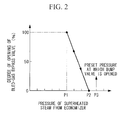
- the operation of the bled-gas bypass valve 9 will be described with reference to Fig. 2 .
- the main diesel engine 1 has not reached a predetermined load, and accordingly the exhaust gas discharged from the main diesel engine 1 has not reached the pressure at which the steam turbine 5 generates electricity; therefore, the bled-gas bypass valve 9 remains fully closed.
- the bled-gas bypass valve 9 is fully opened when the main diesel engine 1 reaches the predetermined load.
- the bled-gas bypass valve 9 is opened, a portion of the exhaust gas having high energy before passage through the supercharger 2 is bled off, passes through the bled-gas bypass pipe 8, and is mixed with the exhaust gas that has passed through the supercharger 2 upstream of the exhaust gas economizer 3.
- the controller 10 controls the degree of opening of the bled-gas bypass valve 9 when the pressure, acquired by the pressure sensor 16, of the superheated steam from the exhaust gas economizer 3 lies between a first predetermined level P1 and a second predetermined level P2.
- the pressure is sufficient without the assistance of bled-gas bypassing; therefore, the bled-gas bypass valve 9 is fully closed.
- the superheated steam pressure is a floating pressure determined by the balance of the amount of steam produced by the exhaust gas economizer 3 and the amount of steam consumed by the steam turbine 5. Accordingly, the controller 10 adjusts the degree of opening of the exhaust gas bypass valve 9 depending on the superheated steam pressure in the following manner.
- the steam turbine 5 consumes a smaller amount of steam, and the exhaust gas economizer 3 tends to produce excess superheated steam. That is, when the power demand of the onboard system 34 decreases relatively, it is preferable to decrease the amount of steam produced by the exhaust gas economizer 3 by decreasing the degree of opening of the bled-gas bypass valve 9.
- the degree of opening of the bledgas bypass valve 9 is gradually decreased toward the closed position.
- the steam turbine 5 consumes a larger amount of steam, and the exhaust gas economizer 3 tends to produce insufficient superheated steam. That is, when the power demand of the onboard system 34 increases relatively, it is preferable to increase the amount of steam produced by the exhaust gas economizer 3 by increasing the degree of opening of the bled-gas bypass valve 9. Accordingly, when the superheated steam pressure tends to decrease, the degree of opening of the bled-gas bypass valve 9 is gradually increased toward the open position.
- the power plant equipment, the ship including the power plant equipment, and the method for operating the power plant equipment of this embodiment provide the following advantages.
- the degree of opening of the bled-gas bypass valve 9 is adjusted depending on the pressure of the superheated steam from the exhaust gas economizer 3 to adjust the amount of exhaust gas bypassing the supercharger 2 through the bled-gas bypass pipe 8 depending on the power demand of the onboard system 34.
- This allows the exhaust gas economizer 3 to produce an amount of superheated steam that depends on the power demand of the onboard system 34, which avoids production of excess superheated steam.
- unnecessary bled-gas bypassing can be eliminated, thereby optimizing the fuel economy of the main diesel engine 1.
- the basis of adjustment of the degree of opening of the bled-gas bypass valve 9 is the pressure of the superheated steam after passage through the superheater 17, i.e., the pressure of the steam immediately before being supplied to the steam turbine 5, rather than the pressure of the saturated steam at the outlet of the steam separator 20, the responsiveness to the power demand of the onboard system 34 can be improved.
- this embodiment illustrates the installation of the power plant equipment in a ship
- the present invention is not limited thereto but may be applied to power plant equipment installed on land.
- ⁇ Reference Signs List 1 main diesel engine (diesel engine) 2 supercharger 3 exhaust gas economizer (steam-producing apparatus) 5 steam turbine 7 generator 8 bled-gas bypass pipe (bled-gas bypass line) 9 bled-gas bypass valve 10 controller 16 pressure sensor 30 steam dump valve 34 onboard system
Landscapes
- Engineering & Computer Science (AREA)
- Chemical & Material Sciences (AREA)
- Combustion & Propulsion (AREA)
- Mechanical Engineering (AREA)
- General Engineering & Computer Science (AREA)
- Ocean & Marine Engineering (AREA)
- Engine Equipment That Uses Special Cycles (AREA)
- Supercharger (AREA)
- Control Of Turbines (AREA)
Abstract
Description
- The present invention relates to power plant equipment, ships including such power plant equipment, and methods for operating power plant equipment.
- Among known exhaust heat recovery systems for diesel engines are exhaust gas economizers, which produce steam using exhaust gas from diesel engines.
In addition, as disclosed in PTL 1 below, there is a known system using a bled-gas bypass pipe that bleeds a portion of effective exhaust gas having high energy before passage through a supercharger for a diesel engine and that mixes it with exhaust gas that has passed through the supercharger upstream of an exhaust gas economizer. The system disclosed in this literature is configured as exhaust-gas heating equipment for the exhaust gas economizer and controls a control valve in the bled-gas bypass pipe so that the pressure of the steam at the outlet of a steam separator for the exhaust gas economizer reaches a predetermined pressure. - Also considered is a system that generates electricity by driving a steam turbine using superheated steam produced by an exhaust gas economizer to further improve the effectiveness of exhaust heat recovery.
- {PTL 1}
Japanese Unexamined Patent Application, Publication No.SHO-61-232319 Figs. 1 and 3) - However, it is understood from PTL 1, but not explicitly stated, that the system disclosed therein, which produces saturated steam using the exhaust gas economizer, is intended to use the steam as utility steam for peripheral equipment or as a heat source for heating heavy oil, which is a fuel for diesel engines. Thus, it lacks the knowledge of how to control the bled-gas bypass valve when producing superheated steam using the exhaust gas economizer to generate electricity using the steam turbine.
- In addition, the system in PTL 1 is configured as exhaust-gas heating equipment and is intended to control the pressure of the steam at the outlet of the steam separator to a predetermined pressure.
However, in a system that generates electricity by driving a steam turbine using superheated steam produced by an exhaust gas economizer, the required amount of superheated steam fluctuates depending on the power demand of a system to which the resulting power is supplied. That is, controlling the steam pressure to a predetermined level, as in PTL 1, cannot meet the fluctuating system power demand. - For example, control is possible such that, when electricity is generated, the exhaust gas bypass valve is fully opened to increase the amount and temperature of the steam produced by the exhaust gas economizer, and when no electricity is generated, the bled-gas bypass valve is fully closed because the amount and temperature of the steam need not be increased. However, if the amount of electricity generated by the steam turbine exceeds the system power demand while the bled-gas bypass valve is fully open, the pressure of the steam produced by the exhaust gas economizer rises, thus producing excess steam. In this case, in order to avoid an excessive rise in pressure, the excess steam needs to be dumped (wasted) into the condenser by opening a steam dump valve so that the steam bypasses the steam turbine. This means that the steam produced by exhaust heat recovery in the exhaust gas economizer is wasted, which goes against effective energy utilization. In addition, excessively bleeding the exhaust gas upstream of the supercharger decreases the work of the supercharger and, consequently, decreases the amount of compressed air from the supercharger, thus decreasing the fuel economy of diesel engines.
- In view of the foregoing, the present invention provides power plant equipment that is highly responsive to fluctuations in system power demand and that is capable of optimizing the fuel economy of diesel engines, a ship including such power plant equipment, and a method for operating such power plant equipment.
- To solve the foregoing problem, power plant equipment, a ship including the power plant equipment, and a method for operating power plant equipment of the present invention employ the following solutions.
Power plant equipment according to a first aspect of the present invention includes a diesel engine; a supercharger that compresses combustion air to be supplied to the diesel engine as the supercharger is driven by exhaust gas from the diesel engine; a bled-gas bypass path through which a portion of the exhaust gas from the diesel engine bypasses the supercharger; a bled-gas bypass valve that is disposed in the bled-gas bypass path and that adjusts the amount of bypassing exhaust gas; a steam-producing apparatus that produces steam by recovering exhaust heat from the exhaust gas that has passed through the supercharger or through the supercharger and the bled-gas bypass path; a steam turbine that is driven by the steam produced by the steam-producing apparatus; a generator that generates electricity using a driving force produced by the steam turbine and that supplies the resulting electrical power to a system; and a controller that adjusts the degree of opening of the bled-gas bypass valve depending on the pressure of the superheated steam supplied from the steam-producing apparatus to the steam turbine. - The pressure of the superheated steam supplied from the steam-producing apparatus to the steam turbine is a floating pressure depending on the amount of steam consumed by the steam turbine. The amount of steam consumed by the steam turbine in turn depends on the amount of electricity generated by the generator driven by the steam turbine, i.e., the system power demand. Thus, the pressure of the superheated steam supplied from the steam-producing apparatus to the steam turbine depends on the system power demand. Accordingly, the present invention adjusts the degree of opening of the bled-gas bypass valve depending on the pressure of the superheated steam to adjust the amount of exhaust gas bypassing the supercharger through the bled-gas bypass path depending on the system power demand. This allows the steam-producing apparatus to produce an amount of superheated steam that depends on the system power demand, which avoids production of excess superheated steam. Thus, unnecessary bled-gas bypassing can be eliminated, thereby optimizing the fuel economy of the diesel engine.
In addition, because the basis of adjustment of the degree of opening of the bled-gas bypass valve used in the present invention is the pressure of the superheated steam, i.e., the pressure of the steam immediately before being supplied to the steam turbine, rather than the pressure of the saturated steam from the steam-producing apparatus, the responsiveness to the system power demand can be improved. - In the power plant equipment according to the first aspect of the present invention, the controller may be configured to adjust the degree of opening of the bled-gas bypass valve toward a closed position when the pressure of the superheated steam tends to increase from a first predetermined level and to adjust the degree of opening of the bled-gas bypass valve toward an open position when the pressure of the superheated steam tends to decrease from a second predetermined level.
- When the system power demand is relatively small, the steam turbine consumes a smaller amount of steam, and accordingly the steam-producing apparatus tends to produce excess superheated steam. In this case, because the pressure of the superheated steam tends to increase, the degree of opening of the bled-gas bypass valve is adjusted toward the closed position to decrease the excess superheated steam.
Conversely, when the system power demand is relatively large, the steam turbine consumes a larger amount of steam, and accordingly the steam-producing apparatus tends to produce insufficient superheated steam. In this case, because the pressure of the superheated steam tends to decrease, the degree of opening of the bled-gas bypass valve is adjusted toward the open position to increase the superheated steam. - In the power plant equipment according to the first aspect of the present invention, the controller may be configured to open a steam dump valve to allow the superheated steam to bypass the steam turbine into a condenser when the bled-gas bypass valve is fully closed and the pressure of the superheated steam exceeds a third predetermined level.
- If the system power demand is extremely small, the increased excess steam may result in an excessive rise in the pressure of the superheated steam even if the bled-gas bypass valve is fully closed. In this case, the steam dump valve is opened to allow the superheated steam to bypass the steam turbine into the condenser. This avoids an excessive rise in steam pressure, thus protecting various devices.
- In the power plant equipment according to the first aspect of the present invention, the diesel engine may be a main diesel engine that drives a propeller for propelling a ship, and the generator may be configured to supply the electrical power to an onboard system.
- When a ship sails at constant speed in the ocean, the main diesel engine is maintained at a substantially constant output. The power consumed by the onboard system, however, fluctuates depending on the onboard demand. Because the present invention adjusts the degree of opening of the bled-gas bypass valve depending on the pressure of the superheated steam, an appropriate amount of steam produced can be maintained irrespective of fluctuations in the power demand of the onboard system when the main diesel engine is maintained at a substantially constant output, thus optimizing the fuel economy of the main diesel engine.
- A second aspect of the present invention is a ship including the power plant equipment described above.
- With the power plant equipment described above, a ship with high fuel economy can be provided.
- A method for operating power plant equipment according to a third aspect of the present invention is a method for operating power plant equipment provided with a diesel engine; a supercharger that compresses combustion air to be supplied to the diesel engine as the supercharger is driven by exhaust gas from the diesel engine; a bled-gas bypass path through which a portion of the exhaust gas from the diesel engine bypasses the supercharger; a bled-gas bypass valve that is disposed in the bled-gas bypass path and that adjusts the amount of bypassing exhaust gas; a steam-producing apparatus that produces steam by recovering exhaust heat from the exhaust gas that has passed through the supercharger or through the supercharger and the bled-gas bypass path; a steam turbine that is driven by the steam produced by the steam-producing apparatus; and a generator that generates electricity using a driving force produced by the steam turbine and that supplies the resulting electrical power to a system. The method includes adjusting the degree of opening of the bled-gas bypass valve depending on the pressure of the superheated steam supplied from the steam-producing apparatus to the steam turbine.
- The pressure of the superheated steam supplied from the steam-producing apparatus to the steam turbine is a floating pressure depending on the amount of steam consumed by the steam turbine. The amount of steam consumed by the steam turbine in turn depends on the amount of electricity generated by the generator driven by the steam turbine, i.e., the system power demand. Thus, the pressure of the superheated steam supplied from the steam-producing apparatus to the steam turbine depends on the system power demand. Accordingly, the present invention adjusts the degree of opening of the bled-gas bypass valve depending on the pressure of the superheated steam to adjust the amount of exhaust gas bypassing the supercharger through the bled-gas bypass path depending on the system power demand. This allows the steam-producing apparatus to produce an amount of superheated steam that depends on the system power demand, which avoids production of excess superheated steam. Thus, unnecessary bled-gas bypassing can be eliminated, thereby optimizing the fuel economy of the diesel engine.
In addition, because the basis of adjustment of the degree of opening of the bled-gas bypass valve used in the present invention is the pressure of the superheated steam, i.e., the pressure of the steam immediately before being supplied to the steam turbine, rather than the pressure of the saturated steam from the steam-producing apparatus, the responsiveness to the system power demand can be improved. - Because the degree of opening of the bled-gas bypass valve is adjusted depending on the pressure of the superheated steam, unnecessary bled-gas bypassing can be eliminated, thereby optimizing the fuel economy of the diesel engine.
In addition, because the basis of adjustment of the degree of opening of the bled-gas bypass valve is the pressure of the superheated steam, the responsiveness to the system power demand can be improved. -
- {
Fig. 1 }
Fig. 1 is a schematic view showing power plant equipment of the present invention. - {
Fig. 2 }
Fig. 2 is a graph showing the operation of a bled-gas bypass valve inFig. 1 . - An embodiment of power plant equipment, a ship including the power plant equipment, and a method for operating the power plant equipment of the present invention will be described below with reference to the drawings.
As shown inFig. 1 , power plant equipment installed in a ship includes a main diesel engine (diesel engine) 1, an exhaust gas economizer (steam-producing apparatus) 3 that produces steam using hot exhaust gas discharged by the main diesel engine 1, a steam turbine 5 that is driven by the steam produced by theexhaust gas economizer 3, and agenerator 7 that is driven by the steam turbine 5. - The main diesel engine 1 drives a
propeller 11 for propelling the ship. The compressed air supplied to the main diesel engine 1 comes from asupercharger 2 that is driven by the exhaust gas from the main diesel engine 1.
Thesupercharger 2 includes aturbine 14 and acompressor 15 that are coaxially aligned. Theturbine 14 is rotationally driven by the exhaust gas discharged from the main diesel engine 1. As theturbine 14 is driven, thecompressor 15, which is coaxially aligned therewith, is rotated to compress air.
The downstream side of theturbine 14 is connected to theexhaust gas economizer 3, described later, via anexhaust gas pipe 12. - A bled-gas bypass pipe (bled-gas bypass line) 8 is provided, through which a portion of the exhaust gas from the main diesel engine 1 is bled off and bypasses the
supercharger 2. The bled-gas bypass pipe 8 has the upstream end thereof connected to the upstream side of theturbine 14 of thesupercharger 2 and the downstream end thereof connected to theexhaust gas pipe 12 downstream of theturbine 14 of thesupercharger 2. The bled-gas bypass pipe 8 has a bled-gas bypass valve 9. The degree of opening of the bled-gas bypass valve 9 is controlled by acontroller 10. Specifically, the degree of opening of the bled-gas bypass valve 9 is controlled depending on the output of apressure sensor 16 that detects the pressure of superheated steam supplied from theexhaust gas economizer 3 to the steam turbine 5. - The
exhaust gas economizer 3 has asuperheater 17 and anevaporator 18 in the flue thereof. Thesuperheater 17 and theevaporator 18 are heat transfer pipes installed in parallel in theexhaust gas economizer 3 in the above order from bottom to top (from the downstream side to the upstream side of the flow of exhaust gas). Hot exhaust gas flows through the flue of theexhaust gas economizer 3 and is released into the air through a funnel (not shown) connected to the downstream side thereof. Thesuperheater 17 is supplied with saturated steam from the top of asteam separator 20. Theevaporator 18 is supplied with water from the bottom of thesteam separator 20.
Thesteam separator 20 contains water and steam, which are separated vertically. Thesteam separator 20 is supplied with water from acondenser 22 through acondensate pump 23. The water is directed from thesteam separator 20 into theevaporator 18 by a boilerwater circulation pump 25. Wet steam containing moisture from theevaporator 18 is directed into thesteam separator 20, which separates it into water and steam. The separated saturated steam is directed into thesuperheater 17, which produces superheated steam. The superheated steam produced by thesuperheater 17 is directed into the steam turbine 5 through a superheated-steam supply pipe 26. The superheated-steam supply pipe 26 has thepressure sensor 16, described above. Thepressure sensor 16, which detects the superheated steam pressure, may be installed at any position where it can detect the pressure of the superheated steam produced by theexhaust gas economizer 3. - A
steam stop valve 27 configured as an on/off valve is disposed upstream of the steam turbine 5. Thesteam stop valve 27 is fully open when the steam turbine 5 is operating and is fully closed when the steam turbine 5 is not operating.
The steam turbine 5 is rotationally driven by the superheated steam directed through thesteam stop valve 27, and the resulting rotational output power is transmitted to thegenerator 7.
The steam that has done work in the steam turbine 5 is directed into thecondenser 22, which condenses the steam into a liquid. The liquid condensate is directed into thesteam separator 20 by thecondensate pump 23.
Asteam dump path 29 is provided between thecondenser 22 and the outlet of thesuperheater 17 of theexhaust gas economizer 3 so as to bypass the steam turbine 5. Thesteam dump path 29 has asteam dump valve 30 that is controlled so as to be fully open when the superheated steam pressure acquired by thepressure sensor 16 is at or above a predetermined level and to be fully closed when the superheated steam pressure is below the predetermined level. - The
generator 7 generates electricity as it is driven by the rotational output power transmitted from the steam turbine 5. The electrical output power of thegenerator 7 is fed through anoutput power cable 32 and abreaker 33 to anonboard power system 34. - Next, a method for operating the power plant equipment described above will be described.
When the main diesel engine 1 starts operating, the compressed air compressed by thesupercharger 2 is supplied to the main diesel engine 1, which burns it together with fuel (not shown) in the cylinders thereof. The exhaust gas produced by combustion in the main diesel engine 1 is directed through theexhaust gas pipe 12 via theturbine 14 of thesupercharger 2 into theexhaust gas economizer 3. As the exhaust gas passes through theexhaust gas economizer 3, the exhaust gas exchanges heat with thesuperheater 17 and theevaporator 18. The water in theevaporator 18 exchanges heat with the exhaust gas to turn into wet steam. This wet steam is directed into thesteam separator 20, which separates water before the steam is directed into thesuperheater 17 of theexhaust gas economizer 3. The steam in thesuperheater 17 exchanges heat with the exhaust gas to turn into superheated steam.
The superheated steam is directed into a superheated-steam supply pipe 26. The superheated steam directed into the superheated-steam supply pipe 26 is supplied through thesteam stop valve 27 to the steam turbine 5. The steam turbine 5 is rotationally driven by the steam directed thereto, and the resulting rotational output power is transmitted to thegenerator 7. Thegenerator 7 generates electricity using the rotational output power produced by the steam turbine 5, and the resulting electrical output power is supplied through theoutput power cable 32 and thebreaker 33 to theonboard power system 34. - Next, the operation of the bled-gas bypass valve 9 will be described with reference to
Fig. 2 .
Upon starting operation, the main diesel engine 1 has not reached a predetermined load, and accordingly the exhaust gas discharged from the main diesel engine 1 has not reached the pressure at which the steam turbine 5 generates electricity; therefore, the bled-gas bypass valve 9 remains fully closed. The bled-gas bypass valve 9 is fully opened when the main diesel engine 1 reaches the predetermined load.
When the bled-gas bypass valve 9 is opened, a portion of the exhaust gas having high energy before passage through thesupercharger 2 is bled off, passes through the bled-gas bypass pipe 8, and is mixed with the exhaust gas that has passed through thesupercharger 2 upstream of theexhaust gas economizer 3. This allows the amount and temperature of the steam produced by theexhaust gas economizer 3 to be increased.
As shown inFig. 2 , thecontroller 10 controls the degree of opening of the bled-gas bypass valve 9 when the pressure, acquired by thepressure sensor 16, of the superheated steam from theexhaust gas economizer 3 lies between a first predetermined level P1 and a second predetermined level P2.
When the superheated steam pressure rises beyond the second predetermined level P2, the pressure is sufficient without the assistance of bled-gas bypassing; therefore, the bled-gas bypass valve 9 is fully closed.
When the superheated steam pressure further rises beyond the second predetermined level P2 to a third predetermined level P3, a preset pressure at which the dump valve is opened is reached, which causes thesteam dump valve 30 to be fully opened. This allows a portion of the superheated steam from theexhaust gas economizer 3 to flow into thecondenser 22, thereby avoiding an excessive rise in superheated steam pressure. - In the power plant equipment of this embodiment, the superheated steam pressure is a floating pressure determined by the balance of the amount of steam produced by the
exhaust gas economizer 3 and the amount of steam consumed by the steam turbine 5. Accordingly, thecontroller 10 adjusts the degree of opening of the exhaust gas bypass valve 9 depending on the superheated steam pressure in the following manner.
When the power demand of theonboard system 34 decreases relatively, the steam turbine 5 consumes a smaller amount of steam, and theexhaust gas economizer 3 tends to produce excess superheated steam. That is, when the power demand of theonboard system 34 decreases relatively, it is preferable to decrease the amount of steam produced by theexhaust gas economizer 3 by decreasing the degree of opening of the bled-gas bypass valve 9. Accordingly, when the superheated steam pressure tends to increase, the degree of opening of the bledgas bypass valve 9 is gradually decreased toward the closed position.
Conversely, when the power demand of theonboard system 34 increases relatively, the steam turbine 5 consumes a larger amount of steam, and theexhaust gas economizer 3 tends to produce insufficient superheated steam. That is, when the power demand of theonboard system 34 increases relatively, it is preferable to increase the amount of steam produced by theexhaust gas economizer 3 by increasing the degree of opening of the bled-gas bypass valve 9. Accordingly, when the superheated steam pressure tends to decrease, the degree of opening of the bled-gas bypass valve 9 is gradually increased toward the open position. - As above, the power plant equipment, the ship including the power plant equipment, and the method for operating the power plant equipment of this embodiment provide the following advantages.
The degree of opening of the bled-gas bypass valve 9 is adjusted depending on the pressure of the superheated steam from theexhaust gas economizer 3 to adjust the amount of exhaust gas bypassing thesupercharger 2 through the bled-gas bypass pipe 8 depending on the power demand of theonboard system 34. This allows theexhaust gas economizer 3 to produce an amount of superheated steam that depends on the power demand of theonboard system 34, which avoids production of excess superheated steam. Thus, unnecessary bled-gas bypassing can be eliminated, thereby optimizing the fuel economy of the main diesel engine 1. - In addition, because the basis of adjustment of the degree of opening of the bled-gas bypass valve 9 is the pressure of the superheated steam after passage through the
superheater 17, i.e., the pressure of the steam immediately before being supplied to the steam turbine 5, rather than the pressure of the saturated steam at the outlet of thesteam separator 20, the responsiveness to the power demand of theonboard system 34 can be improved. - Whereas this embodiment illustrates the installation of the power plant equipment in a ship, the present invention is not limited thereto but may be applied to power plant equipment installed on land.
-
{Reference Signs List} 1 main diesel engine (diesel engine) 2 supercharger 3 exhaust gas economizer (steam-producing apparatus) 5 steam turbine 7 generator 8 bled-gas bypass pipe (bled-gas bypass line) 9 bled- gas bypass valve 10 controller 16 pressure sensor 30 steam dump valve 34 onboard system
Claims (6)
- Power plant equipment comprising:a diesel engine;a supercharger that compresses combustion air to be supplied to the diesel engine as the supercharger is driven by exhaust gas from the diesel engine;a bled-gas bypass path through which a portion of the exhaust gas from the diesel engine bypasses the supercharger;a bled-gas bypass valve that is disposed in the bled-gas bypass path and that adjusts the amount of bypassing exhaust gas;a steam-producing apparatus that produces steam by recovering exhaust heat from the exhaust gas that has passed through the supercharger or through the supercharger and the bled-gas bypass path;a steam turbine that is driven by the steam produced by the steam-producing apparatus;a generator that generates electricity using a driving force produced by the steam turbine and that supplies the resulting electrical power to a system; anda controller that adjusts the degree of opening of the bled-gas bypass valve depending on the pressure of the superheated steam supplied from the steam-producing apparatus to the steam turbine.
- The power plant equipment according to Claim 1, wherein the controller adjusts the degree of opening of the bled-gas bypass valve toward a closed position when the pressure of the superheated steam tends to increase from a first predetermined level and adjusts the degree of opening of the bled-gas bypass valve toward an open position when the pressure of the superheated steam tends to decrease from a second predetermined level.
- The power plant equipment according to Claim 1 or 2, wherein the controller opens a steam dump valve to allow the superheated steam to bypass the steam turbine into a condenser when the bled-gas bypass valve is fully closed and the pressure of the superheated steam exceeds a third predetermined level.
- The power plant equipment according to one of Claims 1 to 3, wherein
the diesel engine is a main diesel engine that drives a propeller for propelling a ship; and
the generator supplies the electrical power to an onboard system. - A ship comprising the power plant equipment according to Claim 4.
- A method for operating power plant equipment provided with
a diesel engine;
a supercharger that compresses combustion air to be supplied to the diesel engine as the supercharger is driven by exhaust gas from the diesel engine;
a bled-gas bypass path through which a portion of the exhaust gas from the diesel engine bypasses the supercharger;
a bled-gas bypass valve that is disposed in the bled-gas bypass path and that adjusts the amount of bypassing exhaust gas;
a steam-producing apparatus that produces steam by recovering exhaust heat from the exhaust gas that has passed through the supercharger or through the supercharger and the bled-gas bypass path;
a steam turbine that is driven by the steam produced by the steam-producing apparatus; and
a generator that generates electricity using a driving force produced by the steam turbine and that supplies the resulting electrical power to a system,
the method comprising:adjusting the degree of opening of the bled-gas bypass valve depending on the pressure of the superheated steam supplied from the steam-producing apparatus to the steam turbine.
Applications Claiming Priority (2)
| Application Number | Priority Date | Filing Date | Title |
|---|---|---|---|
| JP2010199364A JP5374465B2 (en) | 2010-09-06 | 2010-09-06 | Power plant equipment, ship equipped with the same, and operation method of power plant equipment |
| PCT/JP2011/070000 WO2012033010A1 (en) | 2010-09-06 | 2011-09-02 | Power plant facility, ship provided with same, and method for operating power plant facility |
Publications (3)
| Publication Number | Publication Date |
|---|---|
| EP2615264A1 true EP2615264A1 (en) | 2013-07-17 |
| EP2615264A4 EP2615264A4 (en) | 2015-07-01 |
| EP2615264B1 EP2615264B1 (en) | 2016-07-27 |
Family
ID=45810611
Family Applications (1)
| Application Number | Title | Priority Date | Filing Date |
|---|---|---|---|
| EP11823485.5A Active EP2615264B1 (en) | 2010-09-06 | 2011-09-02 | Power plant equipment, ship including the same, and method for operating power plant equipment |
Country Status (6)
| Country | Link |
|---|---|
| EP (1) | EP2615264B1 (en) |
| JP (1) | JP5374465B2 (en) |
| KR (1) | KR101422990B1 (en) |
| CN (1) | CN103109047B (en) |
| DK (1) | DK2615264T3 (en) |
| WO (1) | WO2012033010A1 (en) |
Cited By (7)
| Publication number | Priority date | Publication date | Assignee | Title |
|---|---|---|---|---|
| US20120279218A1 (en) * | 2009-10-16 | 2012-11-08 | Michiyasu Ishida | Miller cycle engine |
| EP3093456A1 (en) * | 2015-04-09 | 2016-11-16 | Kabushiki Kaisha Kobe Seiko Sho (Kobe Steel, Ltd.) | Heat energy recovery system |
| EP3650519A1 (en) * | 2016-10-18 | 2020-05-13 | Mawetal LLC | Environment-friendly marine fuel |
| CN111946431A (en) * | 2020-08-05 | 2020-11-17 | 武汉理工大学 | Ship cogeneration optimization control system and control method using waste heat of diesel generator |
| US11015134B2 (en) | 2016-10-18 | 2021-05-25 | Mawetal Llc | Polished turbine fuel |
| US11198826B2 (en) | 2016-10-18 | 2021-12-14 | Mawetal Llc | Fuel compositions from light tight oils and high sulfur fuel oils |
| WO2025104190A1 (en) * | 2023-11-14 | 2025-05-22 | Egon Streit | Circuit process system and method for operating a circuit process system |
Families Citing this family (17)
| Publication number | Priority date | Publication date | Assignee | Title |
|---|---|---|---|---|
| BR112015008597A2 (en) * | 2012-10-17 | 2017-12-19 | Norgren Ltd C A | waste heat recovery system for a motor, bypass valve, and methods of forming a bypass valve, and of regulating a flow of a fluid in a waste heat recovery system. |
| JP6122300B2 (en) * | 2013-01-18 | 2017-04-26 | 川崎重工業株式会社 | Engine system and ship |
| JP6060029B2 (en) * | 2013-04-22 | 2017-01-11 | 株式会社神戸製鋼所 | Rotating machine drive system |
| JP6060040B2 (en) * | 2013-06-07 | 2017-01-11 | 株式会社神戸製鋼所 | Waste heat recovery device and operation control method of waste heat recovery device |
| KR101480236B1 (en) | 2013-07-05 | 2015-01-12 | 이종준 | A seaside power plant system |
| CN103925025B (en) * | 2014-04-18 | 2015-12-09 | 哈尔滨工程大学 | A kind of boat diesel engine waste gas afterheat recovery unit |
| CN104806333A (en) * | 2015-04-30 | 2015-07-29 | 天津大学 | Ship engine waste heat power generation comprehensive utilization method |
| KR102190949B1 (en) * | 2015-12-24 | 2020-12-15 | 한국조선해양 주식회사 | Ship |
| KR102190937B1 (en) * | 2015-12-24 | 2020-12-15 | 한국조선해양 주식회사 | Ship |
| KR102200361B1 (en) * | 2015-12-24 | 2021-01-08 | 한국조선해양 주식회사 | Ship |
| JP2017178189A (en) * | 2016-03-31 | 2017-10-05 | 株式会社大晃産業 | Ship heat source supply system |
| JP6723791B2 (en) * | 2016-03-31 | 2020-07-15 | 三菱重工マリンマシナリ株式会社 | Exhaust heat recovery device, internal combustion engine system and ship, and control method for exhaust heat recovery device |
| CN105827018B (en) * | 2016-05-06 | 2018-08-21 | 上海恩艾思电气有限公司 | A kind of marine high-pressure power station control system |
| CN108194192B (en) * | 2017-12-28 | 2020-02-21 | 上海中船三井造船柴油机有限公司 | Exhaust gas boiler energy control method based on diesel engine exhaust gas bypass device |
| JP7644500B2 (en) | 2019-04-29 | 2025-03-12 | カーボンクエスト, インコーポレイテッド | Building Emissions Treatment and/or Sequestration Systems and Methods - Patent application |
| US12367498B2 (en) | 2021-10-11 | 2025-07-22 | Carbonquest, Inc. | Carbon management systems and method for management of carbon use and/or production in buildings |
| CN116818265A (en) * | 2023-04-27 | 2023-09-29 | 中国船舶重工集团公司第七0三研究所无锡分部 | Steam electric propulsion test system |
Family Cites Families (13)
| Publication number | Priority date | Publication date | Assignee | Title |
|---|---|---|---|---|
| JPS5689503U (en) * | 1979-12-11 | 1981-07-17 | ||
| JPS5749005A (en) * | 1980-09-08 | 1982-03-20 | Mitsubishi Heavy Ind Ltd | Marine electric power generation set |
| JPS60212621A (en) * | 1984-04-09 | 1985-10-24 | Ishikawajima Harima Heavy Ind Co Ltd | Internal combustion engine supercharging device |
| JPS61232319A (en) * | 1985-04-05 | 1986-10-16 | Hitachi Zosen Corp | Automatic control device for exhaust gas heating equipment for exhaust gas economizer |
| JPS61179304U (en) * | 1985-04-30 | 1986-11-08 | ||
| JPH0329523Y2 (en) * | 1985-12-11 | 1991-06-24 | ||
| JPS6382020U (en) * | 1986-11-18 | 1988-05-30 | ||
| JPH05312049A (en) * | 1992-05-12 | 1993-11-22 | Mitsubishi Motors Corp | Control method of supercharging by turbosupercharger |
| JP2005054750A (en) * | 2003-08-07 | 2005-03-03 | Mitsubishi Automob Eng Co Ltd | Turbocharged engine |
| DE102006043835A1 (en) * | 2006-09-19 | 2008-03-27 | Bayerische Motoren Werke Ag | The heat exchanger assembly |
| CN101187329A (en) * | 2006-11-17 | 2008-05-28 | 林耀章 | Device for generating new energy by utilizing waste heat energy conversion of internal combustion engine |
| DE102007050259B4 (en) * | 2007-10-22 | 2011-06-09 | Ford Global Technologies, LLC, Dearborn | Charged internal combustion engine with integrated exhaust manifold and liquid cooling |
| JP5173776B2 (en) * | 2008-12-15 | 2013-04-03 | 三菱重工業株式会社 | Exhaust energy recovery device |
-
2010
- 2010-09-06 JP JP2010199364A patent/JP5374465B2/en not_active Expired - Fee Related
-
2011
- 2011-09-02 KR KR1020127033256A patent/KR101422990B1/en not_active Expired - Fee Related
- 2011-09-02 DK DK11823485.5T patent/DK2615264T3/en active
- 2011-09-02 CN CN201180031441.2A patent/CN103109047B/en not_active Expired - Fee Related
- 2011-09-02 WO PCT/JP2011/070000 patent/WO2012033010A1/en not_active Ceased
- 2011-09-02 EP EP11823485.5A patent/EP2615264B1/en active Active
Cited By (34)
| Publication number | Priority date | Publication date | Assignee | Title |
|---|---|---|---|---|
| US20120279218A1 (en) * | 2009-10-16 | 2012-11-08 | Michiyasu Ishida | Miller cycle engine |
| EP3093456A1 (en) * | 2015-04-09 | 2016-11-16 | Kabushiki Kaisha Kobe Seiko Sho (Kobe Steel, Ltd.) | Heat energy recovery system |
| US10047638B2 (en) | 2015-04-09 | 2018-08-14 | Kobe Steel, Ltd. | Heat energy recovery system |
| US11377604B2 (en) | 2016-10-18 | 2022-07-05 | Mawetal Llc | Fuel compositions from light tight oils and high sulfur fuel oils |
| US11441086B2 (en) | 2016-10-18 | 2022-09-13 | Mawetal Llc | Environment-friendly marine fuel |
| US12281268B2 (en) | 2016-10-18 | 2025-04-22 | Mawetal Llc | Fuel compositions from light tight oils and high sulfur fuel oils |
| US10920160B2 (en) | 2016-10-18 | 2021-02-16 | Mawetal Llc | Environment-friendly marine fuel |
| US11015134B2 (en) | 2016-10-18 | 2021-05-25 | Mawetal Llc | Polished turbine fuel |
| US11015133B2 (en) | 2016-10-18 | 2021-05-25 | Mawetal Llc | Polished turbine fuel |
| US11104856B2 (en) | 2016-10-18 | 2021-08-31 | Mawetal Llc | Polished turbine fuel |
| US11198826B2 (en) | 2016-10-18 | 2021-12-14 | Mawetal Llc | Fuel compositions from light tight oils and high sulfur fuel oils |
| US11208601B2 (en) | 2016-10-18 | 2021-12-28 | Mawetal Llc | Fuel compositions from light tight oils and high sulfur fuel oils |
| US11214744B2 (en) | 2016-10-18 | 2022-01-04 | Mawetal, Inc. | Fuel compositions from light tight oils and high sulfur fuel oils |
| US11220638B2 (en) | 2016-10-18 | 2022-01-11 | Mawetal Llc | Fuel compositions from light tight oils and high sulfur fuel oils |
| US11220639B2 (en) | 2016-10-18 | 2022-01-11 | Mawetal Llc | Fuel compositions from light tight oils and high sulfur fuel oils |
| US11370981B2 (en) | 2016-10-18 | 2022-06-28 | Mawetal Llc | Fuel compositions from light tight oils and high sulfur fuel oils |
| EP3650519A1 (en) * | 2016-10-18 | 2020-05-13 | Mawetal LLC | Environment-friendly marine fuel |
| EP3529339A4 (en) * | 2016-10-18 | 2020-07-29 | Mawetal LLC | ENVIRONMENTALLY FRIENDLY SHIP FUEL |
| US11427772B2 (en) | 2016-10-18 | 2022-08-30 | Mawetal Llc | Fuel compositions from light tight oils and high sulfur fuel oils |
| US11597887B2 (en) | 2016-10-18 | 2023-03-07 | Mawetal Llc | Environment-friendly marine fuel |
| US11597886B2 (en) | 2016-10-18 | 2023-03-07 | Mawetal Llc | Environment-friendly marine fuel |
| US11434439B2 (en) | 2016-10-18 | 2022-09-06 | Mawetal Llc | Environment-friendly marine fuel |
| US11613711B2 (en) | 2016-10-18 | 2023-03-28 | Mawetal Llc | Environment-friendly marine fuel |
| US11613712B2 (en) | 2016-10-18 | 2023-03-28 | Mawetal Llc | Environment-friendly marine fuel |
| US11649408B2 (en) | 2016-10-18 | 2023-05-16 | Mawetal Llc | Fuel compositions from light tight oils and high sulfur fuel oils |
| US11649407B2 (en) | 2016-10-18 | 2023-05-16 | Mawetal Llc | Fuel compositions from light tight oils and high sulfur fuel oils |
| US11692147B2 (en) | 2016-10-18 | 2023-07-04 | Mawetal, LLC | Environment-friendly marine fuel |
| US11692149B1 (en) | 2016-10-18 | 2023-07-04 | Mawetal, LLC | Environment-friendly marine fuel |
| US11920095B2 (en) | 2016-10-18 | 2024-03-05 | Mawetal Llc | Fuel compositions from light tight oils and high sulfur fuel oils |
| US12049595B2 (en) | 2016-10-18 | 2024-07-30 | Mawetal Llc | Fuel compositions from light tight oils and high sulfur fuel oils |
| US12275903B2 (en) | 2016-10-18 | 2025-04-15 | Mawetal Llc | Fuel compositions from light tight oils and high sulfur fuel oils |
| US12275904B2 (en) | 2016-10-18 | 2025-04-15 | Mawetal Llc | Fuel compositions from light tight oils and high sulfur fuel oils |
| CN111946431A (en) * | 2020-08-05 | 2020-11-17 | 武汉理工大学 | Ship cogeneration optimization control system and control method using waste heat of diesel generator |
| WO2025104190A1 (en) * | 2023-11-14 | 2025-05-22 | Egon Streit | Circuit process system and method for operating a circuit process system |
Also Published As
| Publication number | Publication date |
|---|---|
| EP2615264B1 (en) | 2016-07-27 |
| WO2012033010A1 (en) | 2012-03-15 |
| JP5374465B2 (en) | 2013-12-25 |
| CN103109047B (en) | 2015-03-11 |
| DK2615264T3 (en) | 2016-08-29 |
| CN103109047A (en) | 2013-05-15 |
| KR101422990B1 (en) | 2014-07-23 |
| KR20130029781A (en) | 2013-03-25 |
| EP2615264A4 (en) | 2015-07-01 |
| JP2012057501A (en) | 2012-03-22 |
Similar Documents
| Publication | Publication Date | Title |
|---|---|---|
| EP2615264B1 (en) | Power plant equipment, ship including the same, and method for operating power plant equipment | |
| US20130118168A1 (en) | Power-generation plant equipment and operating method for the same | |
| KR20090049087A (en) | Vessel with method of operation of the vessel, and propulsion system to recover waste heat | |
| EP2636876A1 (en) | Apparatus for recovering engine exhaust gas energy | |
| KR101232393B1 (en) | Control method and device for turbine generator | |
| JP5138643B2 (en) | Turbine generator, turbine generator control method, control device, and ship equipped with the turbine generator | |
| JP2011027053A5 (en) | ||
| JP5563052B2 (en) | Waste heat recovery system and waste heat recovery method | |
| JP2013029111A (en) | Power generation method, turbine power generator, method of controlling turbine power generator, control device, and ship including the turbine power generator | |
| JP6290652B2 (en) | Power generation system and method for controlling power generation system | |
| CN108779688B (en) | Power generation system and control method for power generation system | |
| CN108779687B (en) | Waste heat recovery device, internal combustion engine system, ship, and control method of waste heat recovery device | |
| CN110905616A (en) | Backpressure adjusting system and method for steam extraction backpressure type water supply pump steam turbine | |
| JP5675932B2 (en) | Power generation method, turbine generator, turbine generator control method, control apparatus, and ship equipped with the turbine generator | |
| JPH04191405A (en) | Water supply control device for repowering system | |
| JPH07318006A (en) | White smoke preventing device for steam generating equipment |
Legal Events
| Date | Code | Title | Description |
|---|---|---|---|
| PUAI | Public reference made under article 153(3) epc to a published international application that has entered the european phase |
Free format text: ORIGINAL CODE: 0009012 |
|
| 17P | Request for examination filed |
Effective date: 20121221 |
|
| AK | Designated contracting states |
Kind code of ref document: A1 Designated state(s): AL AT BE BG CH CY CZ DE DK EE ES FI FR GB GR HR HU IE IS IT LI LT LU LV MC MK MT NL NO PL PT RO RS SE SI SK SM TR |
|
| DAX | Request for extension of the european patent (deleted) | ||
| RA4 | Supplementary search report drawn up and despatched (corrected) |
Effective date: 20150529 |
|
| RIC1 | Information provided on ipc code assigned before grant |
Ipc: B63J 3/02 20060101ALI20150522BHEP Ipc: F02G 5/02 20060101ALI20150522BHEP Ipc: F01K 23/10 20060101AFI20150522BHEP Ipc: B63H 21/14 20060101ALI20150522BHEP |
|
| GRAP | Despatch of communication of intention to grant a patent |
Free format text: ORIGINAL CODE: EPIDOSNIGR1 |
|
| GRAJ | Information related to disapproval of communication of intention to grant by the applicant or resumption of examination proceedings by the epo deleted |
Free format text: ORIGINAL CODE: EPIDOSDIGR1 |
|
| GRAP | Despatch of communication of intention to grant a patent |
Free format text: ORIGINAL CODE: EPIDOSNIGR1 |
|
| INTG | Intention to grant announced |
Effective date: 20160210 |
|
| INTC | Intention to grant announced (deleted) | ||
| INTG | Intention to grant announced |
Effective date: 20160308 |
|
| GRAS | Grant fee paid |
Free format text: ORIGINAL CODE: EPIDOSNIGR3 |
|
| GRAA | (expected) grant |
Free format text: ORIGINAL CODE: 0009210 |
|
| AK | Designated contracting states |
Kind code of ref document: B1 Designated state(s): AL AT BE BG CH CY CZ DE DK EE ES FI FR GB GR HR HU IE IS IT LI LT LU LV MC MK MT NL NO PL PT RO RS SE SI SK SM TR |
|
| REG | Reference to a national code |
Ref country code: GB Ref legal event code: FG4D |
|
| REG | Reference to a national code |
Ref country code: CH Ref legal event code: EP |
|
| REG | Reference to a national code |
Ref country code: AT Ref legal event code: REF Ref document number: 815986 Country of ref document: AT Kind code of ref document: T Effective date: 20160815 |
|
| REG | Reference to a national code |
Ref country code: IE Ref legal event code: FG4D |
|
| REG | Reference to a national code |
Ref country code: DK Ref legal event code: T3 Effective date: 20160823 |
|
| REG | Reference to a national code |
Ref country code: DE Ref legal event code: R096 Ref document number: 602011028656 Country of ref document: DE |
|
| REG | Reference to a national code |
Ref country code: LT Ref legal event code: MG4D |
|
| REG | Reference to a national code |
Ref country code: NL Ref legal event code: MP Effective date: 20160727 |
|
| REG | Reference to a national code |
Ref country code: AT Ref legal event code: MK05 Ref document number: 815986 Country of ref document: AT Kind code of ref document: T Effective date: 20160727 |
|
| PG25 | Lapsed in a contracting state [announced via postgrant information from national office to epo] |
Ref country code: HR Free format text: LAPSE BECAUSE OF FAILURE TO SUBMIT A TRANSLATION OF THE DESCRIPTION OR TO PAY THE FEE WITHIN THE PRESCRIBED TIME-LIMIT Effective date: 20160727 Ref country code: NL Free format text: LAPSE BECAUSE OF FAILURE TO SUBMIT A TRANSLATION OF THE DESCRIPTION OR TO PAY THE FEE WITHIN THE PRESCRIBED TIME-LIMIT Effective date: 20160727 Ref country code: RS Free format text: LAPSE BECAUSE OF FAILURE TO SUBMIT A TRANSLATION OF THE DESCRIPTION OR TO PAY THE FEE WITHIN THE PRESCRIBED TIME-LIMIT Effective date: 20160727 Ref country code: IS Free format text: LAPSE BECAUSE OF FAILURE TO SUBMIT A TRANSLATION OF THE DESCRIPTION OR TO PAY THE FEE WITHIN THE PRESCRIBED TIME-LIMIT Effective date: 20161127 Ref country code: IT Free format text: LAPSE BECAUSE OF FAILURE TO SUBMIT A TRANSLATION OF THE DESCRIPTION OR TO PAY THE FEE WITHIN THE PRESCRIBED TIME-LIMIT Effective date: 20160727 Ref country code: LT Free format text: LAPSE BECAUSE OF FAILURE TO SUBMIT A TRANSLATION OF THE DESCRIPTION OR TO PAY THE FEE WITHIN THE PRESCRIBED TIME-LIMIT Effective date: 20160727 Ref country code: FI Free format text: LAPSE BECAUSE OF FAILURE TO SUBMIT A TRANSLATION OF THE DESCRIPTION OR TO PAY THE FEE WITHIN THE PRESCRIBED TIME-LIMIT Effective date: 20160727 Ref country code: NO Free format text: LAPSE BECAUSE OF FAILURE TO SUBMIT A TRANSLATION OF THE DESCRIPTION OR TO PAY THE FEE WITHIN THE PRESCRIBED TIME-LIMIT Effective date: 20161027 |
|
| PG25 | Lapsed in a contracting state [announced via postgrant information from national office to epo] |
Ref country code: GR Free format text: LAPSE BECAUSE OF FAILURE TO SUBMIT A TRANSLATION OF THE DESCRIPTION OR TO PAY THE FEE WITHIN THE PRESCRIBED TIME-LIMIT Effective date: 20161028 Ref country code: PL Free format text: LAPSE BECAUSE OF FAILURE TO SUBMIT A TRANSLATION OF THE DESCRIPTION OR TO PAY THE FEE WITHIN THE PRESCRIBED TIME-LIMIT Effective date: 20160727 Ref country code: ES Free format text: LAPSE BECAUSE OF FAILURE TO SUBMIT A TRANSLATION OF THE DESCRIPTION OR TO PAY THE FEE WITHIN THE PRESCRIBED TIME-LIMIT Effective date: 20160727 Ref country code: PT Free format text: LAPSE BECAUSE OF FAILURE TO SUBMIT A TRANSLATION OF THE DESCRIPTION OR TO PAY THE FEE WITHIN THE PRESCRIBED TIME-LIMIT Effective date: 20161128 Ref country code: SE Free format text: LAPSE BECAUSE OF FAILURE TO SUBMIT A TRANSLATION OF THE DESCRIPTION OR TO PAY THE FEE WITHIN THE PRESCRIBED TIME-LIMIT Effective date: 20160727 Ref country code: LV Free format text: LAPSE BECAUSE OF FAILURE TO SUBMIT A TRANSLATION OF THE DESCRIPTION OR TO PAY THE FEE WITHIN THE PRESCRIBED TIME-LIMIT Effective date: 20160727 Ref country code: AT Free format text: LAPSE BECAUSE OF FAILURE TO SUBMIT A TRANSLATION OF THE DESCRIPTION OR TO PAY THE FEE WITHIN THE PRESCRIBED TIME-LIMIT Effective date: 20160727 Ref country code: BE Free format text: LAPSE BECAUSE OF NON-PAYMENT OF DUE FEES Effective date: 20160727 |
|
| PG25 | Lapsed in a contracting state [announced via postgrant information from national office to epo] |
Ref country code: RO Free format text: LAPSE BECAUSE OF FAILURE TO SUBMIT A TRANSLATION OF THE DESCRIPTION OR TO PAY THE FEE WITHIN THE PRESCRIBED TIME-LIMIT Effective date: 20160727 Ref country code: EE Free format text: LAPSE BECAUSE OF FAILURE TO SUBMIT A TRANSLATION OF THE DESCRIPTION OR TO PAY THE FEE WITHIN THE PRESCRIBED TIME-LIMIT Effective date: 20160727 Ref country code: MC Free format text: LAPSE BECAUSE OF FAILURE TO SUBMIT A TRANSLATION OF THE DESCRIPTION OR TO PAY THE FEE WITHIN THE PRESCRIBED TIME-LIMIT Effective date: 20160727 |
|
| REG | Reference to a national code |
Ref country code: DE Ref legal event code: R097 Ref document number: 602011028656 Country of ref document: DE |
|
| PG25 | Lapsed in a contracting state [announced via postgrant information from national office to epo] |
Ref country code: SK Free format text: LAPSE BECAUSE OF FAILURE TO SUBMIT A TRANSLATION OF THE DESCRIPTION OR TO PAY THE FEE WITHIN THE PRESCRIBED TIME-LIMIT Effective date: 20160727 Ref country code: SM Free format text: LAPSE BECAUSE OF FAILURE TO SUBMIT A TRANSLATION OF THE DESCRIPTION OR TO PAY THE FEE WITHIN THE PRESCRIBED TIME-LIMIT Effective date: 20160727 Ref country code: BG Free format text: LAPSE BECAUSE OF FAILURE TO SUBMIT A TRANSLATION OF THE DESCRIPTION OR TO PAY THE FEE WITHIN THE PRESCRIBED TIME-LIMIT Effective date: 20161027 Ref country code: CZ Free format text: LAPSE BECAUSE OF FAILURE TO SUBMIT A TRANSLATION OF THE DESCRIPTION OR TO PAY THE FEE WITHIN THE PRESCRIBED TIME-LIMIT Effective date: 20160727 |
|
| PLBE | No opposition filed within time limit |
Free format text: ORIGINAL CODE: 0009261 |
|
| STAA | Information on the status of an ep patent application or granted ep patent |
Free format text: STATUS: NO OPPOSITION FILED WITHIN TIME LIMIT |
|
| REG | Reference to a national code |
Ref country code: IE Ref legal event code: MM4A |
|
| REG | Reference to a national code |
Ref country code: FR Ref legal event code: ST Effective date: 20170531 |
|
| 26N | No opposition filed |
Effective date: 20170502 |
|
| PG25 | Lapsed in a contracting state [announced via postgrant information from national office to epo] |
Ref country code: FR Free format text: LAPSE BECAUSE OF NON-PAYMENT OF DUE FEES Effective date: 20160930 Ref country code: IE Free format text: LAPSE BECAUSE OF NON-PAYMENT OF DUE FEES Effective date: 20160902 |
|
| PG25 | Lapsed in a contracting state [announced via postgrant information from national office to epo] |
Ref country code: LU Free format text: LAPSE BECAUSE OF NON-PAYMENT OF DUE FEES Effective date: 20160902 Ref country code: SI Free format text: LAPSE BECAUSE OF FAILURE TO SUBMIT A TRANSLATION OF THE DESCRIPTION OR TO PAY THE FEE WITHIN THE PRESCRIBED TIME-LIMIT Effective date: 20160727 |
|
| PG25 | Lapsed in a contracting state [announced via postgrant information from national office to epo] |
Ref country code: CY Free format text: LAPSE BECAUSE OF FAILURE TO SUBMIT A TRANSLATION OF THE DESCRIPTION OR TO PAY THE FEE WITHIN THE PRESCRIBED TIME-LIMIT Effective date: 20160727 Ref country code: HU Free format text: LAPSE BECAUSE OF FAILURE TO SUBMIT A TRANSLATION OF THE DESCRIPTION OR TO PAY THE FEE WITHIN THE PRESCRIBED TIME-LIMIT; INVALID AB INITIO Effective date: 20110902 |
|
| PG25 | Lapsed in a contracting state [announced via postgrant information from national office to epo] |
Ref country code: MT Free format text: LAPSE BECAUSE OF NON-PAYMENT OF DUE FEES Effective date: 20160930 Ref country code: TR Free format text: LAPSE BECAUSE OF FAILURE TO SUBMIT A TRANSLATION OF THE DESCRIPTION OR TO PAY THE FEE WITHIN THE PRESCRIBED TIME-LIMIT Effective date: 20160727 Ref country code: MK Free format text: LAPSE BECAUSE OF FAILURE TO SUBMIT A TRANSLATION OF THE DESCRIPTION OR TO PAY THE FEE WITHIN THE PRESCRIBED TIME-LIMIT Effective date: 20160727 |
|
| PG25 | Lapsed in a contracting state [announced via postgrant information from national office to epo] |
Ref country code: AL Free format text: LAPSE BECAUSE OF FAILURE TO SUBMIT A TRANSLATION OF THE DESCRIPTION OR TO PAY THE FEE WITHIN THE PRESCRIBED TIME-LIMIT Effective date: 20160727 |
|
| PGFP | Annual fee paid to national office [announced via postgrant information from national office to epo] |
Ref country code: GB Payment date: 20230727 Year of fee payment: 13 |
|
| PGFP | Annual fee paid to national office [announced via postgrant information from national office to epo] |
Ref country code: DK Payment date: 20230914 Year of fee payment: 13 Ref country code: DE Payment date: 20230802 Year of fee payment: 13 |
|
| PGFP | Annual fee paid to national office [announced via postgrant information from national office to epo] |
Ref country code: CH Payment date: 20231001 Year of fee payment: 13 |
|
| REG | Reference to a national code |
Ref country code: DE Ref legal event code: R119 Ref document number: 602011028656 Country of ref document: DE |
|
| REG | Reference to a national code |
Ref country code: DK Ref legal event code: EBP Effective date: 20240930 |
|
| REG | Reference to a national code |
Ref country code: CH Ref legal event code: PL |
|
| GBPC | Gb: european patent ceased through non-payment of renewal fee |
Effective date: 20240902 |
|
| PG25 | Lapsed in a contracting state [announced via postgrant information from national office to epo] |
Ref country code: DE Free format text: LAPSE BECAUSE OF NON-PAYMENT OF DUE FEES Effective date: 20250401 |
|
| PG25 | Lapsed in a contracting state [announced via postgrant information from national office to epo] |
Ref country code: GB Free format text: LAPSE BECAUSE OF NON-PAYMENT OF DUE FEES Effective date: 20240902 |
|
| PG25 | Lapsed in a contracting state [announced via postgrant information from national office to epo] |
Ref country code: CH Free format text: LAPSE BECAUSE OF NON-PAYMENT OF DUE FEES Effective date: 20240930 |
|
| PG25 | Lapsed in a contracting state [announced via postgrant information from national office to epo] |
Ref country code: DK Free format text: LAPSE BECAUSE OF NON-PAYMENT OF DUE FEES Effective date: 20240930 |