EP2613380A2 - Enhanced-stability rechargeable battery - Google Patents
Enhanced-stability rechargeable battery Download PDFInfo
- Publication number
- EP2613380A2 EP2613380A2 EP11838163.1A EP11838163A EP2613380A2 EP 2613380 A2 EP2613380 A2 EP 2613380A2 EP 11838163 A EP11838163 A EP 11838163A EP 2613380 A2 EP2613380 A2 EP 2613380A2
- Authority
- EP
- European Patent Office
- Prior art keywords
- battery
- bulletproof material
- battery pack
- bulletproof
- fiber
- Prior art date
- Legal status (The legal status is an assumption and is not a legal conclusion. Google has not performed a legal analysis and makes no representation as to the accuracy of the status listed.)
- Granted
Links
Images


Classifications
-
- C—CHEMISTRY; METALLURGY
- C08—ORGANIC MACROMOLECULAR COMPOUNDS; THEIR PREPARATION OR CHEMICAL WORKING-UP; COMPOSITIONS BASED THEREON
- C08G—MACROMOLECULAR COMPOUNDS OBTAINED OTHERWISE THAN BY REACTIONS ONLY INVOLVING UNSATURATED CARBON-TO-CARBON BONDS
- C08G73/00—Macromolecular compounds obtained by reactions forming a linkage containing nitrogen with or without oxygen or carbon in the main chain of the macromolecule, not provided for in groups C08G12/00 - C08G71/00
- C08G73/06—Polycondensates having nitrogen-containing heterocyclic rings in the main chain of the macromolecule
- C08G73/22—Polybenzoxazoles
-
- C—CHEMISTRY; METALLURGY
- C08—ORGANIC MACROMOLECULAR COMPOUNDS; THEIR PREPARATION OR CHEMICAL WORKING-UP; COMPOSITIONS BASED THEREON
- C08L—COMPOSITIONS OF MACROMOLECULAR COMPOUNDS
- C08L77/00—Compositions of polyamides obtained by reactions forming a carboxylic amide link in the main chain; Compositions of derivatives of such polymers
- C08L77/10—Polyamides derived from aromatically bound amino and carboxyl groups of amino-carboxylic acids or of polyamines and polycarboxylic acids
-
- C—CHEMISTRY; METALLURGY
- C08—ORGANIC MACROMOLECULAR COMPOUNDS; THEIR PREPARATION OR CHEMICAL WORKING-UP; COMPOSITIONS BASED THEREON
- C08L—COMPOSITIONS OF MACROMOLECULAR COMPOUNDS
- C08L79/00—Compositions of macromolecular compounds obtained by reactions forming in the main chain of the macromolecule a linkage containing nitrogen with or without oxygen or carbon only, not provided for in groups C08L61/00 - C08L77/00
- C08L79/04—Polycondensates having nitrogen-containing heterocyclic rings in the main chain; Polyhydrazides; Polyamide acids or similar polyimide precursors
-
- H—ELECTRICITY
- H01—ELECTRIC ELEMENTS
- H01M—PROCESSES OR MEANS, e.g. BATTERIES, FOR THE DIRECT CONVERSION OF CHEMICAL ENERGY INTO ELECTRICAL ENERGY
- H01M50/00—Constructional details or processes of manufacture of the non-active parts of electrochemical cells other than fuel cells, e.g. hybrid cells
- H01M50/10—Primary casings; Jackets or wrappings
- H01M50/116—Primary casings; Jackets or wrappings characterised by the material
- H01M50/117—Inorganic material
-
- H—ELECTRICITY
- H01—ELECTRIC ELEMENTS
- H01M—PROCESSES OR MEANS, e.g. BATTERIES, FOR THE DIRECT CONVERSION OF CHEMICAL ENERGY INTO ELECTRICAL ENERGY
- H01M50/00—Constructional details or processes of manufacture of the non-active parts of electrochemical cells other than fuel cells, e.g. hybrid cells
- H01M50/10—Primary casings; Jackets or wrappings
- H01M50/116—Primary casings; Jackets or wrappings characterised by the material
- H01M50/121—Organic material
-
- H—ELECTRICITY
- H01—ELECTRIC ELEMENTS
- H01M—PROCESSES OR MEANS, e.g. BATTERIES, FOR THE DIRECT CONVERSION OF CHEMICAL ENERGY INTO ELECTRICAL ENERGY
- H01M50/00—Constructional details or processes of manufacture of the non-active parts of electrochemical cells other than fuel cells, e.g. hybrid cells
- H01M50/10—Primary casings; Jackets or wrappings
- H01M50/116—Primary casings; Jackets or wrappings characterised by the material
- H01M50/124—Primary casings; Jackets or wrappings characterised by the material having a layered structure
-
- H—ELECTRICITY
- H01—ELECTRIC ELEMENTS
- H01M—PROCESSES OR MEANS, e.g. BATTERIES, FOR THE DIRECT CONVERSION OF CHEMICAL ENERGY INTO ELECTRICAL ENERGY
- H01M50/00—Constructional details or processes of manufacture of the non-active parts of electrochemical cells other than fuel cells, e.g. hybrid cells
- H01M50/10—Primary casings; Jackets or wrappings
- H01M50/131—Primary casings; Jackets or wrappings characterised by physical properties, e.g. gas permeability, size or heat resistance
-
- H—ELECTRICITY
- H01—ELECTRIC ELEMENTS
- H01M—PROCESSES OR MEANS, e.g. BATTERIES, FOR THE DIRECT CONVERSION OF CHEMICAL ENERGY INTO ELECTRICAL ENERGY
- H01M50/00—Constructional details or processes of manufacture of the non-active parts of electrochemical cells other than fuel cells, e.g. hybrid cells
- H01M50/10—Primary casings; Jackets or wrappings
- H01M50/14—Primary casings; Jackets or wrappings for protecting against damage caused by external factors
-
- H—ELECTRICITY
- H01—ELECTRIC ELEMENTS
- H01M—PROCESSES OR MEANS, e.g. BATTERIES, FOR THE DIRECT CONVERSION OF CHEMICAL ENERGY INTO ELECTRICAL ENERGY
- H01M50/00—Constructional details or processes of manufacture of the non-active parts of electrochemical cells other than fuel cells, e.g. hybrid cells
- H01M50/20—Mountings; Secondary casings or frames; Racks, modules or packs; Suspension devices; Shock absorbers; Transport or carrying devices; Holders
- H01M50/204—Racks, modules or packs for multiple batteries or multiple cells
- H01M50/207—Racks, modules or packs for multiple batteries or multiple cells characterised by their shape
- H01M50/211—Racks, modules or packs for multiple batteries or multiple cells characterised by their shape adapted for pouch cells
-
- H—ELECTRICITY
- H01—ELECTRIC ELEMENTS
- H01M—PROCESSES OR MEANS, e.g. BATTERIES, FOR THE DIRECT CONVERSION OF CHEMICAL ENERGY INTO ELECTRICAL ENERGY
- H01M50/00—Constructional details or processes of manufacture of the non-active parts of electrochemical cells other than fuel cells, e.g. hybrid cells
- H01M50/20—Mountings; Secondary casings or frames; Racks, modules or packs; Suspension devices; Shock absorbers; Transport or carrying devices; Holders
- H01M50/218—Mountings; Secondary casings or frames; Racks, modules or packs; Suspension devices; Shock absorbers; Transport or carrying devices; Holders characterised by the material
- H01M50/22—Mountings; Secondary casings or frames; Racks, modules or packs; Suspension devices; Shock absorbers; Transport or carrying devices; Holders characterised by the material of the casings or racks
- H01M50/222—Inorganic material
-
- H—ELECTRICITY
- H01—ELECTRIC ELEMENTS
- H01M—PROCESSES OR MEANS, e.g. BATTERIES, FOR THE DIRECT CONVERSION OF CHEMICAL ENERGY INTO ELECTRICAL ENERGY
- H01M50/00—Constructional details or processes of manufacture of the non-active parts of electrochemical cells other than fuel cells, e.g. hybrid cells
- H01M50/20—Mountings; Secondary casings or frames; Racks, modules or packs; Suspension devices; Shock absorbers; Transport or carrying devices; Holders
- H01M50/218—Mountings; Secondary casings or frames; Racks, modules or packs; Suspension devices; Shock absorbers; Transport or carrying devices; Holders characterised by the material
- H01M50/22—Mountings; Secondary casings or frames; Racks, modules or packs; Suspension devices; Shock absorbers; Transport or carrying devices; Holders characterised by the material of the casings or racks
- H01M50/227—Organic material
-
- H—ELECTRICITY
- H01—ELECTRIC ELEMENTS
- H01M—PROCESSES OR MEANS, e.g. BATTERIES, FOR THE DIRECT CONVERSION OF CHEMICAL ENERGY INTO ELECTRICAL ENERGY
- H01M50/00—Constructional details or processes of manufacture of the non-active parts of electrochemical cells other than fuel cells, e.g. hybrid cells
- H01M50/20—Mountings; Secondary casings or frames; Racks, modules or packs; Suspension devices; Shock absorbers; Transport or carrying devices; Holders
- H01M50/218—Mountings; Secondary casings or frames; Racks, modules or packs; Suspension devices; Shock absorbers; Transport or carrying devices; Holders characterised by the material
- H01M50/22—Mountings; Secondary casings or frames; Racks, modules or packs; Suspension devices; Shock absorbers; Transport or carrying devices; Holders characterised by the material of the casings or racks
- H01M50/231—Mountings; Secondary casings or frames; Racks, modules or packs; Suspension devices; Shock absorbers; Transport or carrying devices; Holders characterised by the material of the casings or racks having a layered structure
-
- H—ELECTRICITY
- H01—ELECTRIC ELEMENTS
- H01M—PROCESSES OR MEANS, e.g. BATTERIES, FOR THE DIRECT CONVERSION OF CHEMICAL ENERGY INTO ELECTRICAL ENERGY
- H01M50/00—Constructional details or processes of manufacture of the non-active parts of electrochemical cells other than fuel cells, e.g. hybrid cells
- H01M50/20—Mountings; Secondary casings or frames; Racks, modules or packs; Suspension devices; Shock absorbers; Transport or carrying devices; Holders
- H01M50/233—Mountings; Secondary casings or frames; Racks, modules or packs; Suspension devices; Shock absorbers; Transport or carrying devices; Holders characterised by physical properties of casings or racks, e.g. dimensions
- H01M50/24—Mountings; Secondary casings or frames; Racks, modules or packs; Suspension devices; Shock absorbers; Transport or carrying devices; Holders characterised by physical properties of casings or racks, e.g. dimensions adapted for protecting batteries from their environment, e.g. from corrosion
-
- H—ELECTRICITY
- H01—ELECTRIC ELEMENTS
- H01M—PROCESSES OR MEANS, e.g. BATTERIES, FOR THE DIRECT CONVERSION OF CHEMICAL ENERGY INTO ELECTRICAL ENERGY
- H01M50/00—Constructional details or processes of manufacture of the non-active parts of electrochemical cells other than fuel cells, e.g. hybrid cells
- H01M50/20—Mountings; Secondary casings or frames; Racks, modules or packs; Suspension devices; Shock absorbers; Transport or carrying devices; Holders
- H01M50/233—Mountings; Secondary casings or frames; Racks, modules or packs; Suspension devices; Shock absorbers; Transport or carrying devices; Holders characterised by physical properties of casings or racks, e.g. dimensions
- H01M50/242—Mountings; Secondary casings or frames; Racks, modules or packs; Suspension devices; Shock absorbers; Transport or carrying devices; Holders characterised by physical properties of casings or racks, e.g. dimensions adapted for protecting batteries against vibrations, collision impact or swelling
-
- H—ELECTRICITY
- H01—ELECTRIC ELEMENTS
- H01M—PROCESSES OR MEANS, e.g. BATTERIES, FOR THE DIRECT CONVERSION OF CHEMICAL ENERGY INTO ELECTRICAL ENERGY
- H01M50/00—Constructional details or processes of manufacture of the non-active parts of electrochemical cells other than fuel cells, e.g. hybrid cells
- H01M50/50—Current conducting connections for cells or batteries
- H01M50/571—Methods or arrangements for affording protection against corrosion; Selection of materials therefor
-
- H—ELECTRICITY
- H01—ELECTRIC ELEMENTS
- H01M—PROCESSES OR MEANS, e.g. BATTERIES, FOR THE DIRECT CONVERSION OF CHEMICAL ENERGY INTO ELECTRICAL ENERGY
- H01M50/00—Constructional details or processes of manufacture of the non-active parts of electrochemical cells other than fuel cells, e.g. hybrid cells
- H01M50/50—Current conducting connections for cells or batteries
- H01M50/572—Means for preventing undesired use or discharge
- H01M50/574—Devices or arrangements for the interruption of current
- H01M50/578—Devices or arrangements for the interruption of current in response to pressure
-
- H—ELECTRICITY
- H01—ELECTRIC ELEMENTS
- H01M—PROCESSES OR MEANS, e.g. BATTERIES, FOR THE DIRECT CONVERSION OF CHEMICAL ENERGY INTO ELECTRICAL ENERGY
- H01M50/00—Constructional details or processes of manufacture of the non-active parts of electrochemical cells other than fuel cells, e.g. hybrid cells
- H01M50/50—Current conducting connections for cells or batteries
- H01M50/572—Means for preventing undesired use or discharge
- H01M50/574—Devices or arrangements for the interruption of current
- H01M50/579—Devices or arrangements for the interruption of current in response to shock
-
- H—ELECTRICITY
- H01—ELECTRIC ELEMENTS
- H01M—PROCESSES OR MEANS, e.g. BATTERIES, FOR THE DIRECT CONVERSION OF CHEMICAL ENERGY INTO ELECTRICAL ENERGY
- H01M50/00—Constructional details or processes of manufacture of the non-active parts of electrochemical cells other than fuel cells, e.g. hybrid cells
- H01M50/50—Current conducting connections for cells or batteries
- H01M50/572—Means for preventing undesired use or discharge
- H01M50/574—Devices or arrangements for the interruption of current
- H01M50/581—Devices or arrangements for the interruption of current in response to temperature
-
- H—ELECTRICITY
- H01—ELECTRIC ELEMENTS
- H01M—PROCESSES OR MEANS, e.g. BATTERIES, FOR THE DIRECT CONVERSION OF CHEMICAL ENERGY INTO ELECTRICAL ENERGY
- H01M2220/00—Batteries for particular applications
- H01M2220/20—Batteries in motive systems, e.g. vehicle, ship, plane
-
- Y—GENERAL TAGGING OF NEW TECHNOLOGICAL DEVELOPMENTS; GENERAL TAGGING OF CROSS-SECTIONAL TECHNOLOGIES SPANNING OVER SEVERAL SECTIONS OF THE IPC; TECHNICAL SUBJECTS COVERED BY FORMER USPC CROSS-REFERENCE ART COLLECTIONS [XRACs] AND DIGESTS
- Y02—TECHNOLOGIES OR APPLICATIONS FOR MITIGATION OR ADAPTATION AGAINST CLIMATE CHANGE
- Y02E—REDUCTION OF GREENHOUSE GAS [GHG] EMISSIONS, RELATED TO ENERGY GENERATION, TRANSMISSION OR DISTRIBUTION
- Y02E60/00—Enabling technologies; Technologies with a potential or indirect contribution to GHG emissions mitigation
- Y02E60/10—Energy storage using batteries
Definitions
- the present invention disclosed herein relates to a secondary battery, a battery module, and a battery pack, which have improved safety.
- Secondary batteries which are rechargeable, are widely used as an energy source of wireless mobile devices.
- secondary batteries are regarded with much interest as a power source for electric vehicles (EVs) and hybrid electric vehicles (HEVs), which are expected to reduce air pollution caused by typical gasoline and diesel vehicles using fossil fuels.
- EVs electric vehicles
- HEVs hybrid electric vehicles
- One to four battery cells are used in a small mobile device, whereas a medium-to-large battery module including a number of battery cells electrically connected to one another is used in a medium-to-large device such as an automobile requiring high power and high capacity.
- a medium-to-large battery module including a number of battery cells electrically connected to one another is used in a medium-to-large device such as an automobile requiring high power and high capacity.
- prismatic-type batteries and pouch-type batteries which have high integration and small weight-to-capacity ratio, are widely used as battery cells in medium-to-large battery modules.
- pouch-type batteries including an exterior part such as an aluminum laminate sheet are light weight, economically manufactured, and easily transformed, they attract a lot of attention.
- Medium-to-large battery modules include a number of battery cells electrically connected to one another in series to provide power and capacity needed by a certain apparatus or device, and have a stable structure against external force.
- Battery cells constituting a medium-to-large battery module are rechargeable secondary batteries.
- lithium secondary batteries have high energy density, high voltage, long service life, and low self discharge rate.
- втори ⁇ ество used in a medium-to-large battery pack as a power source of electric vehicles and hybrid vehicles, include a number of highly integrated high energy battery cells, and contain organic electrolyte having a low ignition point, it is important to ensure their safety.
- the present invention provides a secondary battery, a battery module, and a battery pack, which include a bulletproof material to improve their safety.
- Embodiments of the present invention provide secondary batteries including at least one bulletproof material.
- any bulletproof material in the art may be used provided that the bulletproof material has a tensile strength ranging from about 1.0 GPa to about 6.0 GPa, and a pyrolysis temperature of about 150°C or higher.
- the bulletproof material may include aramid fiber, glass fiber, ultra-high-molecular-weight polyethylene fiber (UHMWPE fiber), and polybenzoxazole fiber (PBO fiber), but are not limited thereto.
- the bulletproof material may be disposed on any region of the secondary battery such as an outer surface of an electrode assembly, an inner surface of a battery exterior part, and an outermost surface of the battery exterior part.
- battery modules include: a plurality of secondary batteries connected in series or in parallel to each other; and at least one of the bulletproof materials.
- the bulletproof material may be formed of the above-described material.
- the battery modules may be provided in the following forms: i) the bulletproof material is not provided to the secondary batteries included in the battery module, but is provided at the level of the battery module; ii) the bulletproof material is provided to the secondary batteries included in the battery module, but is not provided at the level of the battery module; and iii) the bulletproof material is provided to the secondary batteries included in the battery module, and is also provided at the level of the battery module.
- the bulletproof material at the level of the battery module may be disposed on at least one of an inside of the battery module, an inner surface of a battery module exterior part, and an outermost surface of the battery module exterior part.
- battery packs include: a plurality of battery modules, and at least one of the bulletproof materials to improve safety.
- the battery packs may be provided in the following forms: i) the bulletproof material is not provided to the battery modules included in the battery pack, but is provided at the level of the battery pack; ii) the bulletproof material is provided to the battery modules included in the battery pack, but is not provided at the level of the battery pack; and iii) the bulletproof material is provided to the battery modules included in the battery pack, and is also provided at the level of the battery pack.
- the bulletproof material at the level of the battery pack may be disposed on at least one of an inside of the battery pack, an inner surface of a battery pack exterior part, and an outermost surface of the battery pack exterior part.
- the battery packs may be used as a power source for power tools; electric vehicles (EVs) including a hybrid electric vehicle (HEV) and a plug-in hybrid electric vehicle (PHEV); electric two-wheeled vehicles including an E-bike and an E-scooter; electric golf carts; electric trucks; and electric commercial vehicles.
- EVs electric vehicles
- HEV hybrid electric vehicle
- PHEV plug-in hybrid electric vehicle
- electric two-wheeled vehicles including an E-bike and an E-scooter
- electric golf carts electric trucks
- electric commercial vehicles electric commercial vehicles.
- the battery pack when being disposed in the engine room of the electric vehicle, may be adjacent to a duct through which refrigerant flows, and the battery pack or the duct may be provided with the bulletproof material.
- the bulletproof material may be disposed between the battery pack and the duct, or the duct may be disposed between the battery pack and the bulletproof material, but is not limited thereto.
- a secondary battery, a battery module, and a battery pack include a bulletproof material. Even when a conductive needle-shaped member penetrates the secondary battery, the battery module, or the battery pack, heating, burning, discharge of evaporated electrolyte and electrical contact between the needle-shaped member and an electrode can be prevented, thereby improving safety of the secondary battery, the battery module, and the battery pack.
- FIG. 1 is a schematic view illustrating a state in which a conductive needle-shaped member penetrates a secondary battery, according to an embodiment of the present invention
- FIG. 2 is a schematic view illustrating a state in which a conductive needle-shaped member penetrates a battery module, according to an embodiment of the present invention
- FIG. 3 is a schematic view illustrating a state in which a conductive needle-shaped member penetrates a battery pack, according to an embodiment of the present invention.
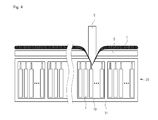
- FIG. 4 is a schematic view illustrating a state in which a conductive needle-shaped member penetrates a battery pack adjacent to a duct, according to an embodiment of the present invention.
- a secondary battery according to the present invention includes at least one bulletproof material.
- the bulletproof material may have a tensile strength ranging from about 1.0 GPa to about 6.0 GPa, and be thermally decomposed at a temperature of about 150°C or higher.
- the bulletproof material protects a secondary battery from an external shock. Even when a conductive needle-shaped member damages a secondary battery, the bulletproof material protects an electrode assembly disposed in the secondary battery.
- a bulletproof material 4 which also penetrates the secondary battery 1, wraps the needle-shaped member 5.
- the bulletproof material 4 contacts an electrode assembly 2 to prevent heating, burning, and short-circuiting.
- the bulletproof material 4 penetrating together with the needle-shaped member 5 prevents spark and excessive discharge of electrolyte evaporated by temperature increase due to a local short circuit, thereby decreasing the possibility of burning.
- the bulletproof material when such a bulletproof material has a tensile strength less than about 1.0 GPa, the bulletproof material may be ruptured by a conductive needle-shaped member, and an electrode assembly may contact the needle-shaped member, thereby causing heating, burning, and short-circuiting.
- the bulletproof material has a tensile strength greater than about 6.0 GPa, flexibility of the bulletproof material is degraded, and thus, the bulletproof material may not wrap the needle-shaped member. Accordingly, the needle-shaped member may contact the electrode assembly.
- the battery When the bulletproof material is thermally decomposed at a temperature lower than about 150°C, the battery may operate abnormally, or the bulletproof material may be thermally decomposed by quick temperature increase due to an external shock, and thus, may not protect the battery. Furthermore, the bulletproof material may cause an incident reaction of the battery.
- a bulletproof material may have a tensile strength ranging from about 2.0 GPa to about 6.0 GPa, preferably from about 3.0 GPa to about 6.0 GPa, and have a pyrolysis temperature of about 200°C or higher, preferably, about 350°C or higher.
- a bulletproof material provided to a secondary battery according to the present invention is superior to a polymer resin in tensile strength, heat resistance, and insulating performance, damage such as heating, burning, and short-circuiting due to a conductive needle-shaped member can be prevented.
- any bulletproof material in the art may be used provided that the bulletproof material has a tensile strength ranging from about 1.0 GPa to about 6.0 GPa, and a pyrolysis temperature of about 150°C or higher.
- Examples of the bulletproof material may include aramid fiber, glass fiber, ultra-high-molecular-weight polyethylene fiber (UHMWPE fiber), and polybenzoxazole fiber (PBO fiber), but are not limited thereto.
- examples of the aramid fiber may include Kevlar, Twaron, Heracron, and Technora; examples of the UHMWPE fiber may include Dyneema and Spectra; and examples of the PBO fiber may include Zylon.
- the secondary battery 1 includes the bulletproof material 4 at the inside and/or the outside of a battery exterior part 3, but the position of the bulletproof material 4 is not limited thereto.
- the bulletproof material 4 may be disposed on at least one of an outer surface of the electrode assembly 2, an inner surface of the battery exterior part 3, and the outermost surface of the battery exterior part 3.
- the battery exterior part 3 can be protected from an external shock. Also, in this case, even when the needle-shaped member 5 penetrates the secondary battery 1, the electrode assembly 2 can be insulated from the needle-shaped member 5.
- the bulletproof material 4 may wrap at least one portion of four surfaces of the electrode assembly 2, or the bulletproof material 4 may be disposed on at least one portion of the greatest surface of the electrode assembly 2.
- the bulletproof material 4 When the bulletproof material 4 is disposed at the outside of the battery exterior part 3, the bulletproof material 4 may wrap at least one portion of the battery exterior part 3. For example, the bulletproof material 4 may be disposed on a great surface of the battery exterior part 3, as illustrated in FIG. 1 , thereby efficiently protecting the secondary battery 1.
- the bulletproof material 4 may be provided in plurality in the secondary battery 1, and the number thereof may vary with the weight and the volume of the bulletproof materials 4 according to a purpose and a capacity of the secondary battery 1.
- the secondary battery 1 may be provided in plurality.
- the secondary batteries 1 may be connected in series or in parallel to constitute a battery module 10 and the bulletproof materials 4 may be provided to the battery module 10 to improve safety of the battery module 10.
- the battery module 10 may be provided in the following forms: i) the bulletproof material 4 is not provided to the secondary batteries 1 included in the battery module 10, but is provided at the level of the battery module 10; ii) the bulletproof material 4 is provided to the secondary batteries 1 included in the battery module 10, but is not provided at the level of the battery module 10; and iii) the bulletproof material 4 is provided to the secondary batteries 1 included in the battery module 10, and is also provided at the level of the battery module 10.
- the bulletproof material 4 may be disposed on at least one of the inside of the battery module 10, an inner surface of a battery module exterior part 11, and the outermost surface of the battery module exterior part 11, but is not limited thereto.
- FIG. 2 is a perspective view illustrating a battery module 10 including bulletproof materials 4 according to an embodiment of the present invention.
- the current embodiment is just an exemplary embodiment of the present invention, and does not limit the present invention.
- the number of secondary batteries 1 and the number of the bulletproof materials 4 in the battery module 10 may vary with a purpose and a capacity of the battery module 10.
- the battery module 10 may be provided in plurality to constitute a battery pack 20.
- at least one of the bulletproof materials 4 may be provided to the battery pack 20 to thereby improve safety of the battery pack 20.
- the battery pack 20 may be provided in the following forms: i) the bulletproof material 4 is not provided to the battery modules 10 included in the battery pack 20, but is provided at the level of the battery pack 20; ii) the bulletproof material 4 is provided to the battery modules 10 included in the battery pack 20, but is not provided at the level of the battery pack 20; and iii) the bulletproof material 4 is provided to the battery modules 10 included in the battery pack 20, and is also provided at the level of the battery pack 20.
- the bulletproof material 4 When the bulletproof material 4 is provided at the level of the battery pack 20, the bulletproof material 4 may be disposed on at least one of the inside of the battery pack 20, an inner surface of a battery pack exterior part 21, and the outermost surface of the battery pack exterior part 21, but is not limited thereto.
- FIG. 3 is a perspective view illustrating a battery pack 20 including bulletproof materials 4 according to an embodiment of the present invention.
- the current embodiment is just an exemplary embodiment of the present invention, and does not limit the present invention.
- the number of battery modules 10, the number of secondary batteries 1 and the number of the bulletproof materials 4 in the battery pack 20 may vary with a purpose and a capacity of the battery pack 20.
- a battery pack including one or more bulletproof materials according to the present invention may be used as a power source for power tools; electric vehicles (EVs) including a hybrid electric vehicle (HEV) and a plug-in hybrid electric vehicle (PHEV); electric two-wheeled vehicles including an E-bike and an E-scooter; electric golf carts; electric trucks; and electric commercial vehicles.
- EVs electric vehicles
- HEV hybrid electric vehicle
- PHEV plug-in hybrid electric vehicle
- electric two-wheeled vehicles including an E-bike and an E-scooter
- electric golf carts electric trucks
- electric commercial vehicles electric commercial vehicles
- the engine room of an electric vehicle is provided with a duct through which refrigerant flows to remove heat generated during driving of the electric vehicle, and the battery pack may be adjacent to the duct to remove heat generated from the battery pack.
- the position of the bulletproof materials included in the battery pack may depend on the position of the duct.
- Such a duct may be disposed at the upper or lower side of a medium-to-large battery pack, but is not limited thereto.
- the duct may be designed to be disposed at the upper side of a medium-to-large battery pack according to the structure of a vehicle. Further, the duct may be designed to prevent the medium-to-large battery pack from being accidentally installed upside down on the vehicle.
- the bulletproof materials may be disposed on an outer surface of an exterior part of the battery pack, or between the battery pack and the duct.
- a bulletproof material 4 may be disposed on the top surface of a duct 6 over a battery pack 20.
- the bulletproof material 4 in the case where the bulletproof material 4 is disposed on the top surface of the duct 6 disposed over the battery pack 20, even when a conductive needle-shaped member 5 damages the engine room of a vehicle, the bulletproof material 4 primarily and physically protects the duct 6 as well as the battery pack 20 from the needle-shaped member 5.
- the bulletproof material 4 improves safety of the battery pack 20, and is configured as described above.
- a battery pack may be disposed in the engine room of an electric vehicle as described above, the position of a bulletproof material on a battery pack according to the present invention may vary with its purpose, and additional bulletproof materials may be disposed in various positions.
- a bulletproof material (trade name: Heracron HT640, manufactured by KOLON Industry) is used according to the current embodiment.
- Heracron HT640 has a tensile strength of about 2.0 GPa, and a pyrolysis temperature of about 550°C.
- the bulletproof material has a thickness of about 20 mm and an area that is the same as that of an outermost large surface of a pouch in a secondary battery.
- the bulletproof material is adhered to the outermost large surface of the pouch with an adhesive.
- Heracron HT640 is prepared as a bulletproof material according to the current example, which has a thickness of about 50 mm and an area that is the same as that of an outermost large surface of an exterior part of a battery module including eight secondary batteries.
- the bulletproof material is adhered to the outermost large surface of the exterior part with an adhesive.
- Heracron HT640 is prepared as a bulletproof material according to the current example, which has a thickness of about 100 mm and an area that is the same as that of an outermost large surface of an exterior part of a battery pack including forty eight secondary batteries.
- the bulletproof material is adhered to the outermost large surface of the exterior part with an adhesive.
- the secondary batteries, the battery modules, and the battery packs according to the examples and the comparative examples were fully charged with a voltage of about 4.2 V, then, their center and side surfaces were penetrated with a nail having a diameter ranging from about 2.5 mm to about 20 mm, and then, it was examined whether they were burned or not.
- the nail penetrated the secondary batteries, the battery modules, and the battery packs at a speed of about 12 m/min to evaluate their safety.
Landscapes
- Chemical & Material Sciences (AREA)
- Chemical Kinetics & Catalysis (AREA)
- Electrochemistry (AREA)
- General Chemical & Material Sciences (AREA)
- Health & Medical Sciences (AREA)
- Medicinal Chemistry (AREA)
- Polymers & Plastics (AREA)
- Organic Chemistry (AREA)
- Inorganic Chemistry (AREA)
- Battery Mounting, Suspending (AREA)
- Secondary Cells (AREA)
- Sealing Battery Cases Or Jackets (AREA)
Abstract
Description
- The present invention disclosed herein relates to a secondary battery, a battery module, and a battery pack, which have improved safety.
- Secondary batteries, which are rechargeable, are widely used as an energy source of wireless mobile devices. In addition, secondary batteries are regarded with much interest as a power source for electric vehicles (EVs) and hybrid electric vehicles (HEVs), which are expected to reduce air pollution caused by typical gasoline and diesel vehicles using fossil fuels.
- One to four battery cells are used in a small mobile device, whereas a medium-to-large battery module including a number of battery cells electrically connected to one another is used in a medium-to-large device such as an automobile requiring high power and high capacity. To optimally reduce the size and weight of medium-to-large battery modules, prismatic-type batteries and pouch-type batteries, which have high integration and small weight-to-capacity ratio, are widely used as battery cells in medium-to-large battery modules.
- Particularly, since pouch-type batteries including an exterior part such as an aluminum laminate sheet are light weight, economically manufactured, and easily transformed, they attract a lot of attention.
- Medium-to-large battery modules include a number of battery cells electrically connected to one another in series to provide power and capacity needed by a certain apparatus or device, and have a stable structure against external force.
- Battery cells constituting a medium-to-large battery module are rechargeable secondary batteries. Of these, lithium secondary batteries have high energy density, high voltage, long service life, and low self discharge rate.
- One of main efforts for developing secondary batteries is to improve safety. Particularly, since secondary batteries, used in a medium-to-large battery pack as a power source of electric vehicles and hybrid vehicles, include a number of highly integrated high energy battery cells, and contain organic electrolyte having a low ignition point, it is important to ensure their safety.
- The present invention provides a secondary battery, a battery module, and a battery pack, which include a bulletproof material to improve their safety.
- Embodiments of the present invention provide secondary batteries including at least one bulletproof material.
- In some embodiments, any bulletproof material in the art may be used provided that the bulletproof material has a tensile strength ranging from about 1.0 GPa to about 6.0 GPa, and a pyrolysis temperature of about 150°C or higher. Examples of the bulletproof material may include aramid fiber, glass fiber, ultra-high-molecular-weight polyethylene fiber (UHMWPE fiber), and polybenzoxazole fiber (PBO fiber), but are not limited thereto.
- In other embodiments, the bulletproof material may be disposed on any region of the secondary battery such as an outer surface of an electrode assembly, an inner surface of a battery exterior part, and an outermost surface of the battery exterior part.
- In other embodiments of the present invention, battery modules include: a plurality of secondary batteries connected in series or in parallel to each other; and at least one of the bulletproof materials.
- In some embodiments, the bulletproof material may be formed of the above-described material.
- In other embodiments, the battery modules may be provided in the following forms: i) the bulletproof material is not provided to the secondary batteries included in the battery module, but is provided at the level of the battery module; ii) the bulletproof material is provided to the secondary batteries included in the battery module, but is not provided at the level of the battery module; and iii) the bulletproof material is provided to the secondary batteries included in the battery module, and is also provided at the level of the battery module.
- In even other embodiments, the bulletproof material at the level of the battery module may be disposed on at least one of an inside of the battery module, an inner surface of a battery module exterior part, and an outermost surface of the battery module exterior part.
- In still other embodiments of the present invention, battery packs include: a plurality of battery modules, and at least one of the bulletproof materials to improve safety.
- In some embodiments, the battery packs may be provided in the following forms: i) the bulletproof material is not provided to the battery modules included in the battery pack, but is provided at the level of the battery pack; ii) the bulletproof material is provided to the battery modules included in the battery pack, but is not provided at the level of the battery pack; and iii) the bulletproof material is provided to the battery modules included in the battery pack, and is also provided at the level of the battery pack.
- In other embodiments, the bulletproof material at the level of the battery pack may be disposed on at least one of an inside of the battery pack, an inner surface of a battery pack exterior part, and an outermost surface of the battery pack exterior part.
- In even other embodiments, the battery packs may be used as a power source for power tools; electric vehicles (EVs) including a hybrid electric vehicle (HEV) and a plug-in hybrid electric vehicle (PHEV); electric two-wheeled vehicles including an E-bike and an E-scooter; electric golf carts; electric trucks; and electric commercial vehicles.
- In yet other embodiments, when being disposed in the engine room of the electric vehicle, the battery pack may be adjacent to a duct through which refrigerant flows, and the battery pack or the duct may be provided with the bulletproof material.
- In further embodiments, the bulletproof material may be disposed between the battery pack and the duct, or the duct may be disposed between the battery pack and the bulletproof material, but is not limited thereto.
- According to the present invention, a secondary battery, a battery module, and a battery pack include a bulletproof material. Even when a conductive needle-shaped member penetrates the secondary battery, the battery module, or the battery pack, heating, burning, discharge of evaporated electrolyte and electrical contact between the needle-shaped member and an electrode can be prevented, thereby improving safety of the secondary battery, the battery module, and the battery pack.
-
FIG. 1 is a schematic view illustrating a state in which a conductive needle-shaped member penetrates a secondary battery, according to an embodiment of the present invention; -
FIG. 2 is a schematic view illustrating a state in which a conductive needle-shaped member penetrates a battery module, according to an embodiment of the present invention; -
FIG. 3 is a schematic view illustrating a state in which a conductive needle-shaped member penetrates a battery pack, according to an embodiment of the present invention; and -
FIG. 4 is a schematic view illustrating a state in which a conductive needle-shaped member penetrates a battery pack adjacent to a duct, according to an embodiment of the present invention. - [Description of the Symbol]
- 1: secondary battery
- 2: electrode assembly
- 3: battery exterior part
- 4: bulletproof material
- 5: conductive needle-shaped member
- 6: duct
- 10: battery module
- 11: battery module exterior part
- 20: battery pack
- 21: battery pack exterior part
- A secondary battery according to the present invention includes at least one bulletproof material.
- For example, the bulletproof material may have a tensile strength ranging from about 1.0 GPa to about 6.0 GPa, and be thermally decomposed at a temperature of about 150°C or higher.
- The bulletproof material protects a secondary battery from an external shock. Even when a conductive needle-shaped member damages a secondary battery, the bulletproof material protects an electrode assembly disposed in the secondary battery.
- Referring to
FIG. 1 , even when a conductive needle-shaped member 5 penetrates asecondary battery 1, abulletproof material 4, which also penetrates thesecondary battery 1, wraps the needle-shaped member 5. Thus, thebulletproof material 4 contacts anelectrode assembly 2 to prevent heating, burning, and short-circuiting. In addition, thebulletproof material 4 penetrating together with the needle-shaped member 5 prevents spark and excessive discharge of electrolyte evaporated by temperature increase due to a local short circuit, thereby decreasing the possibility of burning. - However, when such a bulletproof material has a tensile strength less than about 1.0 GPa, the bulletproof material may be ruptured by a conductive needle-shaped member, and an electrode assembly may contact the needle-shaped member, thereby causing heating, burning, and short-circuiting. In addition, when the bulletproof material has a tensile strength greater than about 6.0 GPa, flexibility of the bulletproof material is degraded, and thus, the bulletproof material may not wrap the needle-shaped member. Accordingly, the needle-shaped member may contact the electrode assembly.
- When the bulletproof material is thermally decomposed at a temperature lower than about 150°C, the battery may operate abnormally, or the bulletproof material may be thermally decomposed by quick temperature increase due to an external shock, and thus, may not protect the battery. Furthermore, the bulletproof material may cause an incident reaction of the battery.
- To address these limitations, a bulletproof material may have a tensile strength ranging from about 2.0 GPa to about 6.0 GPa, preferably from about 3.0 GPa to about 6.0 GPa, and have a pyrolysis temperature of about 200°C or higher, preferably, about 350°C or higher.
- Since a bulletproof material provided to a secondary battery according to the present invention is superior to a polymer resin in tensile strength, heat resistance, and insulating performance, damage such as heating, burning, and short-circuiting due to a conductive needle-shaped member can be prevented.
- Any bulletproof material in the art may be used provided that the bulletproof material has a tensile strength ranging from about 1.0 GPa to about 6.0 GPa, and a pyrolysis temperature of about 150°C or higher.
- Examples of the bulletproof material may include aramid fiber, glass fiber, ultra-high-molecular-weight polyethylene fiber (UHMWPE fiber), and polybenzoxazole fiber (PBO fiber), but are not limited thereto. In more detail, examples of the aramid fiber may include Kevlar, Twaron, Heracron, and Technora; examples of the UHMWPE fiber may include Dyneema and Spectra; and examples of the PBO fiber may include Zylon.
- Referring again to
FIG. 1 , thesecondary battery 1 includes thebulletproof material 4 at the inside and/or the outside of abattery exterior part 3, but the position of thebulletproof material 4 is not limited thereto. For example, thebulletproof material 4 may be disposed on at least one of an outer surface of theelectrode assembly 2, an inner surface of thebattery exterior part 3, and the outermost surface of thebattery exterior part 3. - When the
bulletproof material 4 is disposed on the outermost surface of thebattery exterior part 3, thebattery exterior part 3 can be protected from an external shock. Also, in this case, even when the needle-shapedmember 5 penetrates thesecondary battery 1, theelectrode assembly 2 can be insulated from the needle-shapedmember 5. - In more detail, the
bulletproof material 4 may wrap at least one portion of four surfaces of theelectrode assembly 2, or thebulletproof material 4 may be disposed on at least one portion of the greatest surface of theelectrode assembly 2. - When the
bulletproof material 4 is disposed at the outside of thebattery exterior part 3, thebulletproof material 4 may wrap at least one portion of thebattery exterior part 3. For example, thebulletproof material 4 may be disposed on a great surface of thebattery exterior part 3, as illustrated inFIG. 1 , thereby efficiently protecting thesecondary battery 1. - The
bulletproof material 4 may be provided in plurality in thesecondary battery 1, and the number thereof may vary with the weight and the volume of thebulletproof materials 4 according to a purpose and a capacity of thesecondary battery 1. - Furthermore, the
secondary battery 1 may be provided in plurality. In the case, thesecondary batteries 1 may be connected in series or in parallel to constitute abattery module 10 and thebulletproof materials 4 may be provided to thebattery module 10 to improve safety of thebattery module 10. - The
battery module 10 may be provided in the following forms: i) thebulletproof material 4 is not provided to thesecondary batteries 1 included in thebattery module 10, but is provided at the level of thebattery module 10; ii) thebulletproof material 4 is provided to thesecondary batteries 1 included in thebattery module 10, but is not provided at the level of thebattery module 10; and iii) thebulletproof material 4 is provided to thesecondary batteries 1 included in thebattery module 10, and is also provided at the level of thebattery module 10. - When the
bulletproof material 4 is provided at the level of thebattery module 10, thebulletproof material 4 may be disposed on at least one of the inside of thebattery module 10, an inner surface of a battery moduleexterior part 11, and the outermost surface of the battery moduleexterior part 11, but is not limited thereto. -
FIG. 2 is a perspective view illustrating abattery module 10 includingbulletproof materials 4 according to an embodiment of the present invention. The current embodiment is just an exemplary embodiment of the present invention, and does not limit the present invention. According to the current embodiment, the number ofsecondary batteries 1 and the number of thebulletproof materials 4 in thebattery module 10 may vary with a purpose and a capacity of thebattery module 10. - Furthermore, the
battery module 10 may be provided in plurality to constitute abattery pack 20. In the case, at least one of thebulletproof materials 4 may be provided to thebattery pack 20 to thereby improve safety of thebattery pack 20. - The
battery pack 20 may be provided in the following forms: i) thebulletproof material 4 is not provided to thebattery modules 10 included in thebattery pack 20, but is provided at the level of thebattery pack 20; ii) thebulletproof material 4 is provided to thebattery modules 10 included in thebattery pack 20, but is not provided at the level of thebattery pack 20; and iii) thebulletproof material 4 is provided to thebattery modules 10 included in thebattery pack 20, and is also provided at the level of thebattery pack 20. - When the
bulletproof material 4 is provided at the level of thebattery pack 20, thebulletproof material 4 may be disposed on at least one of the inside of thebattery pack 20, an inner surface of a battery packexterior part 21, and the outermost surface of the battery packexterior part 21, but is not limited thereto. -
FIG. 3 is a perspective view illustrating abattery pack 20 includingbulletproof materials 4 according to an embodiment of the present invention. The current embodiment is just an exemplary embodiment of the present invention, and does not limit the present invention. According to the current embodiment, the number ofbattery modules 10, the number ofsecondary batteries 1 and the number of thebulletproof materials 4 in thebattery pack 20 may vary with a purpose and a capacity of thebattery pack 20. - A battery pack including one or more bulletproof materials according to the present invention may be used as a power source for power tools; electric vehicles (EVs) including a hybrid electric vehicle (HEV) and a plug-in hybrid electric vehicle (PHEV); electric two-wheeled vehicles including an E-bike and an E-scooter; electric golf carts; electric trucks; and electric commercial vehicles.
- The engine room of an electric vehicle is provided with a duct through which refrigerant flows to remove heat generated during driving of the electric vehicle, and the battery pack may be adjacent to the duct to remove heat generated from the battery pack.
- In this case, the position of the bulletproof materials included in the battery pack may depend on the position of the duct.
- Such a duct may be disposed at the upper or lower side of a medium-to-large battery pack, but is not limited thereto. For example, the duct may be designed to be disposed at the upper side of a medium-to-large battery pack according to the structure of a vehicle. Further, the duct may be designed to prevent the medium-to-large battery pack from being accidentally installed upside down on the vehicle.
- When the duct is disposed at the upper side of the battery pack, the bulletproof materials may be disposed on an outer surface of an exterior part of the battery pack, or between the battery pack and the duct. Alternatively, referring to
FIG. 4 , abulletproof material 4 may be disposed on the top surface of a duct 6 over abattery pack 20. - Particularly, as illustrated in
FIG. 4 , in the case where thebulletproof material 4 is disposed on the top surface of the duct 6 disposed over thebattery pack 20, even when a conductive needle-shapedmember 5 damages the engine room of a vehicle, thebulletproof material 4 primarily and physically protects the duct 6 as well as thebattery pack 20 from the needle-shapedmember 5. - The
bulletproof material 4 improves safety of thebattery pack 20, and is configured as described above. - Although a battery pack may be disposed in the engine room of an electric vehicle as described above, the position of a bulletproof material on a battery pack according to the present invention may vary with its purpose, and additional bulletproof materials may be disposed in various positions.
- Hereinafter, a secondary battery according to the following examples will now be described in more detail, but the present invention is not limited thereto.
- [Example 1]
- A bulletproof material (trade name: Heracron HT640, manufactured by KOLON Industry) is used according to the current embodiment. Heracron HT640 has a tensile strength of about 2.0 GPa, and a pyrolysis temperature of about 550°C.
- The bulletproof material has a thickness of about 20 mm and an area that is the same as that of an outermost large surface of a pouch in a secondary battery. The bulletproof material is adhered to the outermost large surface of the pouch with an adhesive.
- [Example 2]
- Heracron HT640 is prepared as a bulletproof material according to the current example, which has a thickness of about 50 mm and an area that is the same as that of an outermost large surface of an exterior part of a battery module including eight secondary batteries. The bulletproof material is adhered to the outermost large surface of the exterior part with an adhesive.
- [Example 3]
- Heracron HT640 is prepared as a bulletproof material according to the current example, which has a thickness of about 100 mm and an area that is the same as that of an outermost large surface of an exterior part of a battery pack including forty eight secondary batteries. The bulletproof material is adhered to the outermost large surface of the exterior part with an adhesive.
- [Comparative Example 1]
- A secondary battery without the bulletproof material according to the Example 1.
- [Comparative Example 2]
- A battery module without the bulletproof material according to the Example 2.
- [Comparative Example 3]
- A battery pack without the bulletproof material according to the Example 3.
- Experimental Example: Safety Evaluation of Secondary Battery, Battery Module, and Battery Pack
- The secondary batteries, the battery modules, and the battery packs according to the examples and the comparative examples were fully charged with a voltage of about 4.2 V, then, their center and side surfaces were penetrated with a nail having a diameter ranging from about 2.5 mm to about 20 mm, and then, it was examined whether they were burned or not. The nail penetrated the secondary batteries, the battery modules, and the battery packs at a speed of about 12 m/min to evaluate their safety.
[Table 1] Safety Evaluation Conditions Maximum Temperature Short-circuiting Burning Ex. 1 (with penetrated surface) Battery Fully Charged with 4.2 V (5.3 Ah) Nail of 2.5 mm, 12 m/min 50°C Delayed None Comparative Ex. 1 (with penetrated surface) Battery Fully Charged with 4.2 V (5.3 Ah) Nail of 2.5 mm, 12 m/min 500°C or higher Short-circuiting Burning Ex. 2 (with penetrated surface) Module 8 Cells Fully Charged with 4.2 V (5.3 Ah) Nail of 2.5 mm, 12 m/min 190°C Delayed None Comparative Ex. 2 (with penetrated surface) Module 8 Cells Fully Charged with 4.2 V (5.3 Ah) Nail of 2.5 mm, 12 m/min 500°C or higher Short-circuiting Burning Ex. 3 (with penetrated side surface) Pack 48 Cells Fully Charged with 4.2 V (20 Ah) Nail of 20 mm, 12 m/min 80°C Delayed None Comparative Ex. 3 (with penetrated side surface) Pack 48 Cells Fully Charged with 4.2 V (20 Ah) Nail of 20 mm, 12 m/min 500°C or higher Short-circuiting Burning
Claims (14)
- A secondary battery comprising at least one bulletproof material.
- The secondary battery of claim 1, wherein the bulletproof material is a high strength and high heat-resistant bulletproof material having a tensile strength ranging from about 1.0 GPa to about 6.0 GPa, and a pyrolysis temperature of about 150°C or higher.
- The secondary battery of claim 1, wherein the bulletproof material comprises at least one selected from the group consisting of aramid fiber, glass fiber, ultra-high-molecular-weight polyethylene fiber (UHMWPE fiber), and polybenzoxazole fiber (PBO fiber).
- The secondary battery of claim 1, wherein the bulletproof material is disposed on at least one of an outer surface of an electrode assembly, an inner surface of a battery exterior part, and an outermost surface of the battery exterior part.
- A battery module comprising the secondary battery of any one of claims 1 to 4.
- A battery module comprising:a plurality of secondary batteries connected in series or in parallel to each other, andat least one bulletproof material disposed on at least one of an inside of the battery module, an inner surface of a battery module exterior part, and an outermost surface of the battery module exterior part.
- The battery module of claim 6, wherein the bulletproof material is a high strength and high heat-resistant bulletproof material having a tensile strength ranging from about 1.0 GPa to about 6.0 GPa, and a pyrolysis temperature of about 150°C or higher.
- The battery module of claim 6, wherein the bulletproof material comprises at least one selected from the group consisting of aramid fiber, glass fiber, ultra-high-molecular-weight polyethylene fiber (UHMWPE fiber), and polybenzoxazole fiber (PBO fiber).
- The battery module of claim 6, wherein the secondary battery comprises at least one of the bulletproof materials.
- A battery pack comprising:a plurality of battery modules, andat least one bulletproof material disposed on at least one of an inside of the battery pack, an inner surface of a battery pack exterior part, and an outermost surface of the battery pack exterior part.
- The battery pack of claim 10, wherein the battery module comprises at least one of the bulletproof materials.
- The battery pack of claim 10 or 11, wherein the battery pack is used as a power source for at least one selected from the group consisting of a power tool; an electric vehicle selected from the group consisting of an electric vehicle (EV), a hybrid electric vehicle (HEV), and a plug-in hybrid electric vehicle (PHEV); an E-bike; an E-scooter; an electric golf cart; an electric truck; and an electric commercial vehicle.
- The battery pack of claim 12, wherein the battery pack is adjacent to a duct through which refrigerant flows, and
the battery pack or the duct is provided with the bulletproof material. - The battery pack of claim 13, wherein the bulletproof material is disposed between the battery pack and the duct, or
the duct is disposed between the battery pack and the bulletproof material.
Applications Claiming Priority (4)
| Application Number | Priority Date | Filing Date | Title |
|---|---|---|---|
| KR20100109973 | 2010-11-05 | ||
| KR1020110034680A KR101274937B1 (en) | 2011-04-14 | 2011-04-14 | Battery pack |
| KR1020110060561A KR101264553B1 (en) | 2010-11-05 | 2011-06-22 | Secondary battery having improved safety |
| PCT/KR2011/007712 WO2012060558A2 (en) | 2010-11-05 | 2011-10-17 | Enhanced-stability rechargeable battery |
Publications (3)
| Publication Number | Publication Date |
|---|---|
| EP2613380A2 true EP2613380A2 (en) | 2013-07-10 |
| EP2613380A4 EP2613380A4 (en) | 2013-11-06 |
| EP2613380B1 EP2613380B1 (en) | 2015-03-18 |
Family
ID=48536641
Family Applications (1)
| Application Number | Title | Priority Date | Filing Date |
|---|---|---|---|
| EP11838163.1A Active EP2613380B1 (en) | 2010-11-05 | 2011-10-17 | Enhanced-stability rechargeable battery |
Country Status (5)
| Country | Link |
|---|---|
| US (1) | US9799859B2 (en) |
| EP (1) | EP2613380B1 (en) |
| JP (1) | JP6041443B2 (en) |
| CN (1) | CN103168377A (en) |
| WO (1) | WO2012060558A2 (en) |
Families Citing this family (40)
| Publication number | Priority date | Publication date | Assignee | Title |
|---|---|---|---|---|
| JP5993247B2 (en) * | 2012-08-24 | 2016-09-14 | 株式会社サンエー化研 | Battery case packaging |
| JP2014060012A (en) * | 2012-09-14 | 2014-04-03 | Nissan Motor Co Ltd | Laminated structure battery |
| DE102013202105A1 (en) * | 2013-02-08 | 2014-08-14 | Robert Bosch Gmbh | Accumulator i.e. lithium ion accumulator, for supplying electrical power to electrical driving device in e.g. electrical propelled motor car, has textile structure arranged between electrically conductive housing and galvanic cell |
| KR101702984B1 (en) * | 2013-04-19 | 2017-02-06 | 삼성에스디아이 주식회사 | Rechargeable battery |
| JP6107516B2 (en) * | 2013-07-30 | 2017-04-05 | 株式会社豊田自動織機 | Power storage device |
| PL3051611T3 (en) | 2013-11-26 | 2020-05-18 | Lg Chem, Ltd. | Battery cell comprising means for protecting short circuit |
| US12088244B2 (en) | 2014-01-15 | 2024-09-10 | Lat Enterprises, Inc. | System for supplying power to at least one power consuming device using rechargeable battery |
| US11996803B2 (en) | 2014-01-15 | 2024-05-28 | Lat Enterprises, Inc. | Foldable solar panel |
| US10727457B2 (en) | 2014-01-15 | 2020-07-28 | Lat Enterprises, Inc. | System for supplying power to a portable battery using at least one solar panel |
| US10531590B2 (en) | 2014-10-16 | 2020-01-07 | Lat Enterprises, Inc. | System for supplying power to at least one power distribution and data hub using a portable battery pack |
| US10944140B2 (en) | 2014-01-15 | 2021-03-09 | Lat Enterprises, Inc. | Wearable and replaceable pouch or skin for holding a portable battery pack |
| US11750149B2 (en) | 2014-01-15 | 2023-09-05 | Lat Enterprises, Inc. | Foldable solar panel |
| US11876354B2 (en) | 2014-01-15 | 2024-01-16 | Lat Enterprises, Inc. | Wearable and replaceable pouch or skin for holding a portable battery pack |
| US11025075B2 (en) | 2014-10-16 | 2021-06-01 | Lat Enterprises, Inc. | Portable power case with heat-resistant material |
| US11302987B2 (en) | 2014-10-16 | 2022-04-12 | Lat Enterprises | Material for dissipating heat from and/or reducing heat signature of electronic devices and clothing |
| US12368409B1 (en) | 2014-01-15 | 2025-07-22 | Lat Enterprises, Inc. | Foldable solar panel |
| US11462649B2 (en) | 2014-10-16 | 2022-10-04 | Lat Enterprises, Inc. | Portable power case |
| US10476054B2 (en) | 2014-10-16 | 2019-11-12 | Lat Enterprises, Inc. | Portable battery pack comprising a battery enclosed by a wearable and replaceable pouch or skin |
| US10991992B2 (en) | 2014-01-15 | 2021-04-27 | Lat Enterprises, Inc. | System for supplying power to a portable battery using at least one solar panel |
| US11304500B2 (en) | 2014-01-15 | 2022-04-19 | Lat Enterprises, Inc. | Wearable and replaceable pouch or skin for holding a portable battery pack |
| US12119785B2 (en) | 2014-01-15 | 2024-10-15 | Lat Enterprises, Inc. | Dual voltage solar panel |
| US10616534B2 (en) | 2014-10-16 | 2020-04-07 | Lat Enterprises, Inc. | Personal tactical system and network |
| US12407175B2 (en) | 2014-10-16 | 2025-09-02 | Lat Enterprises, Inc. | Wearable and lightweight portable power case |
| US11025076B2 (en) | 2014-10-16 | 2021-06-01 | Lat Enterprises, Inc. | Portable power case with lithium iron phosphate battery |
| US10217979B2 (en) * | 2015-02-09 | 2019-02-26 | The Boeing Company | Containment system and method for high energy density devices |
| US20180026242A1 (en) * | 2015-04-22 | 2018-01-25 | Lg Chem, Ltd. | Secondary battery pack and vehicle comprising the same |
| KR20170050188A (en) * | 2015-10-29 | 2017-05-11 | 현대자동차주식회사 | Film for preventing the internal short and battery having the same |
| US10347888B2 (en) * | 2016-09-07 | 2019-07-09 | Thunder Power New Energy Vehicle Development Company Limited | Battery system housing with underside armor |
| KR102172154B1 (en) | 2016-10-19 | 2020-10-30 | 주식회사 엘지화학 | Positive electrode for secondary battery and secondary battery comprising the same |
| JP2019008937A (en) * | 2017-06-22 | 2019-01-17 | 株式会社東芝 | Explosion-Proof Waterproof Case and Fire Prevention Sheet |
| CN107565078A (en) * | 2017-09-01 | 2018-01-09 | 王武生 | A kind of method for preventing lithium ion battery combustion explosion |
| DE102017215499A1 (en) * | 2017-09-04 | 2019-03-07 | Robert Bosch Gmbh | Battery cell with insulation layer |
| WO2019065078A1 (en) * | 2017-09-29 | 2019-04-04 | 三洋電機株式会社 | Power supply device |
| KR102326080B1 (en) | 2018-05-08 | 2021-11-11 | 주식회사 엘지에너지솔루션 | Case for lithium metal secondary battery, lithiium metal secondary batter comprising the same and manufacturing method thereof |
| JP7292310B2 (en) * | 2018-12-21 | 2023-06-16 | パナソニックエナジー株式会社 | pack batteries |
| KR20210090477A (en) * | 2020-01-10 | 2021-07-20 | 에스케이이노베이션 주식회사 | Battery module with improved stability |
| EP4094083A4 (en) * | 2020-01-23 | 2024-07-10 | Bren-Tronics, Inc. | Ballistic resistant case for rechargeable batteries |
| KR102869313B1 (en) * | 2020-08-20 | 2025-10-13 | 주식회사 엘지에너지솔루션 | Battery module including heat insulating member |
| JP7772582B2 (en) | 2021-12-23 | 2025-11-18 | イビデン株式会社 | Battery protective sheet and battery module |
| DE102022001196A1 (en) | 2022-04-07 | 2023-10-12 | Mercedes-Benz Group AG | Single cell for an electrical energy storage device |
Family Cites Families (32)
| Publication number | Priority date | Publication date | Assignee | Title |
|---|---|---|---|---|
| SE510853C2 (en) * | 1991-07-01 | 1999-06-28 | Volvo Technology Transfer Ab | Bipolar battery |
| KR100255413B1 (en) | 1995-03-15 | 2000-05-01 | 프리트 | Ballistic grill for special purpose vehicles |
| JPH0918041A (en) * | 1995-07-01 | 1997-01-17 | Shinji Kaneko | Block type generator for roads or sidewalks using solar cells |
| JPH10159854A (en) | 1996-11-25 | 1998-06-16 | Ntn Corp | Composite sliding bearing |
| JPH10172611A (en) * | 1996-12-11 | 1998-06-26 | Toray Ind Inc | Battery |
| US6245461B1 (en) * | 1999-05-24 | 2001-06-12 | Daimlerchrysler | Battery package having cubical form |
| KR100878277B1 (en) | 2002-10-25 | 2009-01-13 | 삼성전자주식회사 | Liquid crystal display device manufacturing system and liquid crystal display device manufacturing method |
| JP4462964B2 (en) | 2003-03-10 | 2010-05-12 | 第一三共株式会社 | Antibodies targeting cancer-specific antigens |
| MY144341A (en) | 2003-03-27 | 2011-08-29 | Suntory Holdings Ltd | Lipid-improving agent and composition containing lipid-improving agent |
| JP2005116374A (en) * | 2003-10-08 | 2005-04-28 | Tdk Corp | Battery pack |
| JP2005123127A (en) * | 2003-10-20 | 2005-05-12 | Tdk Corp | Battery pack |
| JP2005129260A (en) * | 2003-10-21 | 2005-05-19 | Tdk Corp | Battery pack |
| KR100561297B1 (en) * | 2004-09-09 | 2006-03-15 | 삼성에스디아이 주식회사 | Lithium secondary battery |
| US7968221B2 (en) * | 2005-12-19 | 2011-06-28 | Panasonic Corporation | Lithium ion secondary battery |
| US8100271B2 (en) * | 2006-02-02 | 2012-01-24 | C & C Power | Tiered battery cabinet |
| KR100874387B1 (en) * | 2006-06-13 | 2008-12-18 | 주식회사 엘지화학 | Overlapping secondary cells provide more than one operating voltage |
| US20080160397A1 (en) * | 2006-08-25 | 2008-07-03 | Innovatier, Inc | Battery powered device having a protective frame |
| JP5173182B2 (en) * | 2006-11-13 | 2013-03-27 | トヨタ自動車株式会社 | Power storage unit |
| KR100942985B1 (en) * | 2007-03-21 | 2010-02-17 | 주식회사 엘지화학 | Medium and large battery pack case with improved distribution uniformity of refrigerant flow rate |
| JP5078418B2 (en) * | 2007-04-20 | 2012-11-21 | 旭化成ケミカルズ株式会社 | Battery case |
| KR100978142B1 (en) | 2007-09-04 | 2010-08-25 | 한국과학기술원 | Battery case and manufacturing method |
| WO2009048952A1 (en) | 2007-10-08 | 2009-04-16 | The Regents Of The University Of Michigan | Liquid-gap electrostatic hydraulic micro actuators |
| WO2009062248A1 (en) | 2007-11-16 | 2009-05-22 | Aqua Diagnostic Pty Ltd | Photo electrodes |
| JP4766057B2 (en) * | 2008-01-23 | 2011-09-07 | ソニー株式会社 | Nonaqueous electrolyte battery and method for producing nonaqueous electrolyte battery |
| JP5276915B2 (en) | 2008-07-07 | 2013-08-28 | 株式会社日立製作所 | Power supply device using secondary battery |
| JP2010080370A (en) * | 2008-09-29 | 2010-04-08 | Toyoda Gosei Co Ltd | Battery pack device |
| DE102008051184A1 (en) * | 2008-10-14 | 2010-04-15 | Dynacc Gmbh | Body-worn protective device |
| JP5428277B2 (en) * | 2008-10-14 | 2014-02-26 | コニカミノルタ株式会社 | Non-aqueous electrolyte secondary battery |
| KR20100080370A (en) | 2008-12-31 | 2010-07-08 | 주식회사 코리아나화장품 | Cosmetic composition comprising phaseolus radiatus stem cell cultured products as active ingredient |
| KR101145734B1 (en) * | 2009-03-03 | 2012-05-16 | 주식회사 엘지화학 | Laminate Sheet for Battery Case and Lithium Secondary Battery Using the Same |
| US20120107674A1 (en) * | 2009-06-30 | 2012-05-03 | Hajime Nishino | Secondary battery having anti-scattering mechanism |
| JP2012084447A (en) | 2010-10-13 | 2012-04-26 | Mitsubishi Fuso Truck & Bus Corp | Vehicular battery container |
-
2011
- 2011-10-17 JP JP2013536498A patent/JP6041443B2/en active Active
- 2011-10-17 CN CN201180050301XA patent/CN103168377A/en active Pending
- 2011-10-17 EP EP11838163.1A patent/EP2613380B1/en active Active
- 2011-10-17 WO PCT/KR2011/007712 patent/WO2012060558A2/en not_active Ceased
-
2012
- 2012-01-04 US US13/343,018 patent/US9799859B2/en active Active
Also Published As
| Publication number | Publication date |
|---|---|
| WO2012060558A3 (en) | 2012-06-28 |
| EP2613380A4 (en) | 2013-11-06 |
| US9799859B2 (en) | 2017-10-24 |
| WO2012060558A2 (en) | 2012-05-10 |
| EP2613380B1 (en) | 2015-03-18 |
| US20120114990A1 (en) | 2012-05-10 |
| JP2013545235A (en) | 2013-12-19 |
| CN103168377A (en) | 2013-06-19 |
| JP6041443B2 (en) | 2016-12-07 |
Similar Documents
| Publication | Publication Date | Title |
|---|---|---|
| EP2613380B1 (en) | Enhanced-stability rechargeable battery | |
| KR102461577B1 (en) | Secondary Battery Module | |
| US11133554B2 (en) | Battery pack and vehicle | |
| US20230155243A1 (en) | Battery module and battery pack including the same | |
| US20100255359A1 (en) | Battery pack and battery-equipped device | |
| AU2020295214A1 (en) | Battery module including base plate having gas discharge passage, and battery pack and energy storage system including the same | |
| US11658364B2 (en) | Battery module with improved safety, battery pack including the battery module and vehicle including the battery pack | |
| US10205153B2 (en) | Battery cell assembly of enhanced safety and battery module comprising the same | |
| KR101264553B1 (en) | Secondary battery having improved safety | |
| US20130136964A1 (en) | Electrochemical cell having a safety device | |
| KR20190044872A (en) | Battery Module Having Heat Shielding Function | |
| KR20180081235A (en) | Battery Cell of Improved Cooling Efficiency | |
| KR101487152B1 (en) | Unit Module Assembly and Battery Module Comprising The Same | |
| KR101539584B1 (en) | Battery Module with Improved Safety | |
| KR101495948B1 (en) | Pouched type secondary battery | |
| KR101274937B1 (en) | Battery pack | |
| KR102903027B1 (en) | Battery module with improved safety, battery pack comprising the battery module and vehicle comprising the same | |
| US20220093987A1 (en) | Apparatus for insulating battery of electric vehicle | |
| KR101459405B1 (en) | Battery Pack Having Improved Safety | |
| KR101488056B1 (en) | Battery module improved safety | |
| CN217214772U (en) | Frame type battery module for hydrogen fuel cell automobile | |
| KR101236579B1 (en) | Pouch-type secondary battery | |
| KR20230031677A (en) | Electrode assembly with improved safety, lithium secondary battery including the same, battery module and battery pack including lithium secondary battery | |
| KR102401848B1 (en) | Electrode Assembly and Secondary Battery having the Same | |
| KR101678940B1 (en) | Battery cell with improved safety and method of manufacturing the same |
Legal Events
| Date | Code | Title | Description |
|---|---|---|---|
| PUAI | Public reference made under article 153(3) epc to a published international application that has entered the european phase |
Free format text: ORIGINAL CODE: 0009012 |
|
| 17P | Request for examination filed |
Effective date: 20130405 |
|
| AK | Designated contracting states |
Kind code of ref document: A2 Designated state(s): AL AT BE BG CH CY CZ DE DK EE ES FI FR GB GR HR HU IE IS IT LI LT LU LV MC MK MT NL NO PL PT RO RS SE SI SK SM TR |
|
| A4 | Supplementary search report drawn up and despatched |
Effective date: 20131009 |
|
| RIC1 | Information provided on ipc code assigned before grant |
Ipc: H01M 2/10 20060101ALI20131002BHEP Ipc: H01M 2/02 20060101ALI20131002BHEP Ipc: H01M 2/34 20060101ALI20131002BHEP Ipc: H01M 2/32 20060101AFI20131002BHEP |
|
| DAX | Request for extension of the european patent (deleted) | ||
| 17Q | First examination report despatched |
Effective date: 20140820 |
|
| REG | Reference to a national code |
Ref country code: DE Ref legal event code: R079 Ref document number: 602011014926 Country of ref document: DE Free format text: PREVIOUS MAIN CLASS: H01M0002320000 Ipc: H01M0002100000 |
|
| GRAP | Despatch of communication of intention to grant a patent |
Free format text: ORIGINAL CODE: EPIDOSNIGR1 |
|
| RIC1 | Information provided on ipc code assigned before grant |
Ipc: H01M 2/10 20060101AFI20141215BHEP |
|
| INTG | Intention to grant announced |
Effective date: 20150112 |
|
| GRAS | Grant fee paid |
Free format text: ORIGINAL CODE: EPIDOSNIGR3 |
|
| GRAA | (expected) grant |
Free format text: ORIGINAL CODE: 0009210 |
|
| AK | Designated contracting states |
Kind code of ref document: B1 Designated state(s): AL AT BE BG CH CY CZ DE DK EE ES FI FR GB GR HR HU IE IS IT LI LT LU LV MC MK MT NL NO PL PT RO RS SE SI SK SM TR |
|
| RAP1 | Party data changed (applicant data changed or rights of an application transferred) |
Owner name: LG CHEM, LTD. |
|
| REG | Reference to a national code |
Ref country code: GB Ref legal event code: FG4D |
|
| REG | Reference to a national code |
Ref country code: CH Ref legal event code: EP |
|
| REG | Reference to a national code |
Ref country code: IE Ref legal event code: FG4D |
|
| REG | Reference to a national code |
Ref country code: AT Ref legal event code: REF Ref document number: 717069 Country of ref document: AT Kind code of ref document: T Effective date: 20150415 |
|
| REG | Reference to a national code |
Ref country code: DE Ref legal event code: R096 Ref document number: 602011014926 Country of ref document: DE Effective date: 20150430 |
|
| REG | Reference to a national code |
Ref country code: NL Ref legal event code: VDEP Effective date: 20150318 |
|
| REG | Reference to a national code |
Ref country code: NL Ref legal event code: VDEP Effective date: 20150318 |
|
| PG25 | Lapsed in a contracting state [announced via postgrant information from national office to epo] |
Ref country code: SE Free format text: LAPSE BECAUSE OF FAILURE TO SUBMIT A TRANSLATION OF THE DESCRIPTION OR TO PAY THE FEE WITHIN THE PRESCRIBED TIME-LIMIT Effective date: 20150318 Ref country code: HR Free format text: LAPSE BECAUSE OF FAILURE TO SUBMIT A TRANSLATION OF THE DESCRIPTION OR TO PAY THE FEE WITHIN THE PRESCRIBED TIME-LIMIT Effective date: 20150318 Ref country code: LT Free format text: LAPSE BECAUSE OF FAILURE TO SUBMIT A TRANSLATION OF THE DESCRIPTION OR TO PAY THE FEE WITHIN THE PRESCRIBED TIME-LIMIT Effective date: 20150318 Ref country code: NO Free format text: LAPSE BECAUSE OF FAILURE TO SUBMIT A TRANSLATION OF THE DESCRIPTION OR TO PAY THE FEE WITHIN THE PRESCRIBED TIME-LIMIT Effective date: 20150618 Ref country code: FI Free format text: LAPSE BECAUSE OF FAILURE TO SUBMIT A TRANSLATION OF THE DESCRIPTION OR TO PAY THE FEE WITHIN THE PRESCRIBED TIME-LIMIT Effective date: 20150318 |
|
| REG | Reference to a national code |
Ref country code: AT Ref legal event code: MK05 Ref document number: 717069 Country of ref document: AT Kind code of ref document: T Effective date: 20150318 |
|
| REG | Reference to a national code |
Ref country code: LT Ref legal event code: MG4D |
|
| PG25 | Lapsed in a contracting state [announced via postgrant information from national office to epo] |
Ref country code: RS Free format text: LAPSE BECAUSE OF FAILURE TO SUBMIT A TRANSLATION OF THE DESCRIPTION OR TO PAY THE FEE WITHIN THE PRESCRIBED TIME-LIMIT Effective date: 20150318 Ref country code: GR Free format text: LAPSE BECAUSE OF FAILURE TO SUBMIT A TRANSLATION OF THE DESCRIPTION OR TO PAY THE FEE WITHIN THE PRESCRIBED TIME-LIMIT Effective date: 20150619 Ref country code: LV Free format text: LAPSE BECAUSE OF FAILURE TO SUBMIT A TRANSLATION OF THE DESCRIPTION OR TO PAY THE FEE WITHIN THE PRESCRIBED TIME-LIMIT Effective date: 20150318 |
|
| REG | Reference to a national code |
Ref country code: FR Ref legal event code: PLFP Year of fee payment: 5 |
|
| PG25 | Lapsed in a contracting state [announced via postgrant information from national office to epo] |
Ref country code: NL Free format text: LAPSE BECAUSE OF FAILURE TO SUBMIT A TRANSLATION OF THE DESCRIPTION OR TO PAY THE FEE WITHIN THE PRESCRIBED TIME-LIMIT Effective date: 20150318 |
|
| PG25 | Lapsed in a contracting state [announced via postgrant information from national office to epo] |
Ref country code: CZ Free format text: LAPSE BECAUSE OF FAILURE TO SUBMIT A TRANSLATION OF THE DESCRIPTION OR TO PAY THE FEE WITHIN THE PRESCRIBED TIME-LIMIT Effective date: 20150318 Ref country code: SK Free format text: LAPSE BECAUSE OF FAILURE TO SUBMIT A TRANSLATION OF THE DESCRIPTION OR TO PAY THE FEE WITHIN THE PRESCRIBED TIME-LIMIT Effective date: 20150318 Ref country code: EE Free format text: LAPSE BECAUSE OF FAILURE TO SUBMIT A TRANSLATION OF THE DESCRIPTION OR TO PAY THE FEE WITHIN THE PRESCRIBED TIME-LIMIT Effective date: 20150318 Ref country code: ES Free format text: LAPSE BECAUSE OF FAILURE TO SUBMIT A TRANSLATION OF THE DESCRIPTION OR TO PAY THE FEE WITHIN THE PRESCRIBED TIME-LIMIT Effective date: 20150318 Ref country code: RO Free format text: LAPSE BECAUSE OF FAILURE TO SUBMIT A TRANSLATION OF THE DESCRIPTION OR TO PAY THE FEE WITHIN THE PRESCRIBED TIME-LIMIT Effective date: 20150318 Ref country code: PT Free format text: LAPSE BECAUSE OF FAILURE TO SUBMIT A TRANSLATION OF THE DESCRIPTION OR TO PAY THE FEE WITHIN THE PRESCRIBED TIME-LIMIT Effective date: 20150720 |
|
| PG25 | Lapsed in a contracting state [announced via postgrant information from national office to epo] |
Ref country code: AT Free format text: LAPSE BECAUSE OF FAILURE TO SUBMIT A TRANSLATION OF THE DESCRIPTION OR TO PAY THE FEE WITHIN THE PRESCRIBED TIME-LIMIT Effective date: 20150318 Ref country code: PL Free format text: LAPSE BECAUSE OF FAILURE TO SUBMIT A TRANSLATION OF THE DESCRIPTION OR TO PAY THE FEE WITHIN THE PRESCRIBED TIME-LIMIT Effective date: 20150318 Ref country code: IS Free format text: LAPSE BECAUSE OF FAILURE TO SUBMIT A TRANSLATION OF THE DESCRIPTION OR TO PAY THE FEE WITHIN THE PRESCRIBED TIME-LIMIT Effective date: 20150718 |
|
| REG | Reference to a national code |
Ref country code: DE Ref legal event code: R097 Ref document number: 602011014926 Country of ref document: DE |
|
| PG25 | Lapsed in a contracting state [announced via postgrant information from national office to epo] |
Ref country code: IT Free format text: LAPSE BECAUSE OF FAILURE TO SUBMIT A TRANSLATION OF THE DESCRIPTION OR TO PAY THE FEE WITHIN THE PRESCRIBED TIME-LIMIT Effective date: 20150318 |
|
| PLBE | No opposition filed within time limit |
Free format text: ORIGINAL CODE: 0009261 |
|
| STAA | Information on the status of an ep patent application or granted ep patent |
Free format text: STATUS: NO OPPOSITION FILED WITHIN TIME LIMIT |
|
| PG25 | Lapsed in a contracting state [announced via postgrant information from national office to epo] |
Ref country code: DK Free format text: LAPSE BECAUSE OF FAILURE TO SUBMIT A TRANSLATION OF THE DESCRIPTION OR TO PAY THE FEE WITHIN THE PRESCRIBED TIME-LIMIT Effective date: 20150318 |
|
| 26N | No opposition filed |
Effective date: 20151221 |
|
| PG25 | Lapsed in a contracting state [announced via postgrant information from national office to epo] |
Ref country code: SI Free format text: LAPSE BECAUSE OF FAILURE TO SUBMIT A TRANSLATION OF THE DESCRIPTION OR TO PAY THE FEE WITHIN THE PRESCRIBED TIME-LIMIT Effective date: 20150318 |
|
| PG25 | Lapsed in a contracting state [announced via postgrant information from national office to epo] |
Ref country code: LU Free format text: LAPSE BECAUSE OF FAILURE TO SUBMIT A TRANSLATION OF THE DESCRIPTION OR TO PAY THE FEE WITHIN THE PRESCRIBED TIME-LIMIT Effective date: 20151017 |
|
| REG | Reference to a national code |
Ref country code: CH Ref legal event code: PL |
|
| PG25 | Lapsed in a contracting state [announced via postgrant information from national office to epo] |
Ref country code: MC Free format text: LAPSE BECAUSE OF FAILURE TO SUBMIT A TRANSLATION OF THE DESCRIPTION OR TO PAY THE FEE WITHIN THE PRESCRIBED TIME-LIMIT Effective date: 20150318 |
|
| REG | Reference to a national code |
Ref country code: IE Ref legal event code: MM4A |
|
| PG25 | Lapsed in a contracting state [announced via postgrant information from national office to epo] |
Ref country code: CH Free format text: LAPSE BECAUSE OF NON-PAYMENT OF DUE FEES Effective date: 20151031 Ref country code: LI Free format text: LAPSE BECAUSE OF NON-PAYMENT OF DUE FEES Effective date: 20151031 |
|
| PG25 | Lapsed in a contracting state [announced via postgrant information from national office to epo] |
Ref country code: BE Free format text: LAPSE BECAUSE OF FAILURE TO SUBMIT A TRANSLATION OF THE DESCRIPTION OR TO PAY THE FEE WITHIN THE PRESCRIBED TIME-LIMIT Effective date: 20150318 |
|
| REG | Reference to a national code |
Ref country code: FR Ref legal event code: PLFP Year of fee payment: 6 |
|
| PG25 | Lapsed in a contracting state [announced via postgrant information from national office to epo] |
Ref country code: IE Free format text: LAPSE BECAUSE OF NON-PAYMENT OF DUE FEES Effective date: 20151017 |
|
| PG25 | Lapsed in a contracting state [announced via postgrant information from national office to epo] |
Ref country code: HU Free format text: LAPSE BECAUSE OF FAILURE TO SUBMIT A TRANSLATION OF THE DESCRIPTION OR TO PAY THE FEE WITHIN THE PRESCRIBED TIME-LIMIT; INVALID AB INITIO Effective date: 20111017 Ref country code: BG Free format text: LAPSE BECAUSE OF FAILURE TO SUBMIT A TRANSLATION OF THE DESCRIPTION OR TO PAY THE FEE WITHIN THE PRESCRIBED TIME-LIMIT Effective date: 20150318 Ref country code: SM Free format text: LAPSE BECAUSE OF FAILURE TO SUBMIT A TRANSLATION OF THE DESCRIPTION OR TO PAY THE FEE WITHIN THE PRESCRIBED TIME-LIMIT Effective date: 20150318 |
|
| PG25 | Lapsed in a contracting state [announced via postgrant information from national office to epo] |
Ref country code: CY Free format text: LAPSE BECAUSE OF FAILURE TO SUBMIT A TRANSLATION OF THE DESCRIPTION OR TO PAY THE FEE WITHIN THE PRESCRIBED TIME-LIMIT Effective date: 20150318 |
|
| PG25 | Lapsed in a contracting state [announced via postgrant information from national office to epo] |
Ref country code: MT Free format text: LAPSE BECAUSE OF FAILURE TO SUBMIT A TRANSLATION OF THE DESCRIPTION OR TO PAY THE FEE WITHIN THE PRESCRIBED TIME-LIMIT Effective date: 20150318 |
|
| REG | Reference to a national code |
Ref country code: FR Ref legal event code: PLFP Year of fee payment: 7 |
|
| PG25 | Lapsed in a contracting state [announced via postgrant information from national office to epo] |
Ref country code: TR Free format text: LAPSE BECAUSE OF FAILURE TO SUBMIT A TRANSLATION OF THE DESCRIPTION OR TO PAY THE FEE WITHIN THE PRESCRIBED TIME-LIMIT Effective date: 20150318 Ref country code: MK Free format text: LAPSE BECAUSE OF FAILURE TO SUBMIT A TRANSLATION OF THE DESCRIPTION OR TO PAY THE FEE WITHIN THE PRESCRIBED TIME-LIMIT Effective date: 20150318 |
|
| REG | Reference to a national code |
Ref country code: FR Ref legal event code: PLFP Year of fee payment: 8 |
|
| PG25 | Lapsed in a contracting state [announced via postgrant information from national office to epo] |
Ref country code: AL Free format text: LAPSE BECAUSE OF FAILURE TO SUBMIT A TRANSLATION OF THE DESCRIPTION OR TO PAY THE FEE WITHIN THE PRESCRIBED TIME-LIMIT Effective date: 20150318 |
|
| REG | Reference to a national code |
Ref country code: DE Ref legal event code: R079 Ref document number: 602011014926 Country of ref document: DE Free format text: PREVIOUS MAIN CLASS: H01M0002100000 Ipc: H01M0050200000 |
|
| P01 | Opt-out of the competence of the unified patent court (upc) registered |
Effective date: 20230512 |
|
| REG | Reference to a national code |
Ref country code: GB Ref legal event code: 732E Free format text: REGISTERED BETWEEN 20230824 AND 20230831 |
|
| REG | Reference to a national code |
Ref country code: DE Ref legal event code: R081 Ref document number: 602011014926 Country of ref document: DE Owner name: LG ENERGY SOLUTION, LTD., KR Free format text: FORMER OWNER: LG CHEM. LTD., SEOUL, KR |
|
| PGFP | Annual fee paid to national office [announced via postgrant information from national office to epo] |
Ref country code: GB Payment date: 20250922 Year of fee payment: 15 |
|
| PGFP | Annual fee paid to national office [announced via postgrant information from national office to epo] |
Ref country code: FR Payment date: 20250925 Year of fee payment: 15 |
|
| PGFP | Annual fee paid to national office [announced via postgrant information from national office to epo] |
Ref country code: DE Payment date: 20250922 Year of fee payment: 15 |