EP2613016A2 - System and method for operating a gas turbine - Google Patents
System and method for operating a gas turbine Download PDFInfo
- Publication number
- EP2613016A2 EP2613016A2 EP13150050.6A EP13150050A EP2613016A2 EP 2613016 A2 EP2613016 A2 EP 2613016A2 EP 13150050 A EP13150050 A EP 13150050A EP 2613016 A2 EP2613016 A2 EP 2613016A2
- Authority
- EP
- European Patent Office
- Prior art keywords
- gas turbine
- parameter
- combustion product
- value
- sensor
- Prior art date
- Legal status (The legal status is an assumption and is not a legal conclusion. Google has not performed a legal analysis and makes no representation as to the accuracy of the status listed.)
- Withdrawn
Links
- 238000000034 method Methods 0.000 title claims abstract description 32
- 238000002485 combustion reaction Methods 0.000 claims abstract description 100
- 239000002826 coolant Substances 0.000 claims abstract description 40
- 238000001816 cooling Methods 0.000 claims abstract description 40
- 239000007789 gas Substances 0.000 claims description 105
- IJGRMHOSHXDMSA-UHFFFAOYSA-N Atomic nitrogen Chemical compound N#N IJGRMHOSHXDMSA-UHFFFAOYSA-N 0.000 claims description 16
- CURLTUGMZLYLDI-UHFFFAOYSA-N Carbon dioxide Chemical compound O=C=O CURLTUGMZLYLDI-UHFFFAOYSA-N 0.000 claims description 14
- QVGXLLKOCUKJST-UHFFFAOYSA-N atomic oxygen Chemical compound [O] QVGXLLKOCUKJST-UHFFFAOYSA-N 0.000 claims description 14
- 239000001301 oxygen Substances 0.000 claims description 14
- 229910052760 oxygen Inorganic materials 0.000 claims description 14
- XLYOFNOQVPJJNP-UHFFFAOYSA-N water Substances O XLYOFNOQVPJJNP-UHFFFAOYSA-N 0.000 claims description 10
- 229910001868 water Inorganic materials 0.000 claims description 10
- 238000013461 design Methods 0.000 claims description 9
- 229910052757 nitrogen Inorganic materials 0.000 claims description 8
- 239000001569 carbon dioxide Substances 0.000 claims description 7
- 229910002092 carbon dioxide Inorganic materials 0.000 claims description 7
- UGFAIRIUMAVXCW-UHFFFAOYSA-N Carbon monoxide Chemical compound [O+]#[C-] UGFAIRIUMAVXCW-UHFFFAOYSA-N 0.000 claims description 5
- 229910002091 carbon monoxide Inorganic materials 0.000 claims description 5
- 239000000047 product Substances 0.000 description 36
- 239000012530 fluid Substances 0.000 description 22
- 230000007704 transition Effects 0.000 description 10
- XKRFYHLGVUSROY-UHFFFAOYSA-N Argon Chemical compound [Ar] XKRFYHLGVUSROY-UHFFFAOYSA-N 0.000 description 8
- 239000000446 fuel Substances 0.000 description 8
- 238000011144 upstream manufacturing Methods 0.000 description 8
- 239000000203 mixture Substances 0.000 description 6
- 238000004891 communication Methods 0.000 description 5
- 238000004458 analytical method Methods 0.000 description 4
- 229910052786 argon Inorganic materials 0.000 description 4
- 238000004364 calculation method Methods 0.000 description 3
- RAHZWNYVWXNFOC-UHFFFAOYSA-N Sulphur dioxide Chemical compound O=S=O RAHZWNYVWXNFOC-UHFFFAOYSA-N 0.000 description 2
- 238000012986 modification Methods 0.000 description 2
- 230000004048 modification Effects 0.000 description 2
- 238000012545 processing Methods 0.000 description 2
- 230000008646 thermal stress Effects 0.000 description 2
- 238000010200 validation analysis Methods 0.000 description 2
- 230000003213 activating effect Effects 0.000 description 1
- 239000006227 byproduct Substances 0.000 description 1
- UBAZGMLMVVQSCD-UHFFFAOYSA-N carbon dioxide;molecular oxygen Chemical compound O=O.O=C=O UBAZGMLMVVQSCD-UHFFFAOYSA-N 0.000 description 1
- 150000001875 compounds Chemical class 0.000 description 1
- 230000008878 coupling Effects 0.000 description 1
- 238000010168 coupling process Methods 0.000 description 1
- 238000005859 coupling reaction Methods 0.000 description 1
- 238000012941 design validation Methods 0.000 description 1
- 238000010586 diagram Methods 0.000 description 1
- 230000003292 diminished effect Effects 0.000 description 1
- 230000000694 effects Effects 0.000 description 1
- 230000005611 electricity Effects 0.000 description 1
- 238000005516 engineering process Methods 0.000 description 1
- 238000005259 measurement Methods 0.000 description 1
- 238000013021 overheating Methods 0.000 description 1
- 230000037361 pathway Effects 0.000 description 1
- 230000008569 process Effects 0.000 description 1
- 230000035882 stress Effects 0.000 description 1
- 238000012360 testing method Methods 0.000 description 1
Images


Classifications
-
- F—MECHANICAL ENGINEERING; LIGHTING; HEATING; WEAPONS; BLASTING
- F02—COMBUSTION ENGINES; HOT-GAS OR COMBUSTION-PRODUCT ENGINE PLANTS
- F02C—GAS-TURBINE PLANTS; AIR INTAKES FOR JET-PROPULSION PLANTS; CONTROLLING FUEL SUPPLY IN AIR-BREATHING JET-PROPULSION PLANTS
- F02C9/00—Controlling gas-turbine plants; Controlling fuel supply in air- breathing jet-propulsion plants
- F02C9/16—Control of working fluid flow
-
- F—MECHANICAL ENGINEERING; LIGHTING; HEATING; WEAPONS; BLASTING
- F02—COMBUSTION ENGINES; HOT-GAS OR COMBUSTION-PRODUCT ENGINE PLANTS
- F02C—GAS-TURBINE PLANTS; AIR INTAKES FOR JET-PROPULSION PLANTS; CONTROLLING FUEL SUPPLY IN AIR-BREATHING JET-PROPULSION PLANTS
- F02C7/00—Features, components parts, details or accessories, not provided for in, or of interest apart form groups F02C1/00 - F02C6/00; Air intakes for jet-propulsion plants
- F02C7/12—Cooling of plants
- F02C7/16—Cooling of plants characterised by cooling medium
- F02C7/18—Cooling of plants characterised by cooling medium the medium being gaseous, e.g. air
-
- F—MECHANICAL ENGINEERING; LIGHTING; HEATING; WEAPONS; BLASTING
- F05—INDEXING SCHEMES RELATING TO ENGINES OR PUMPS IN VARIOUS SUBCLASSES OF CLASSES F01-F04
- F05D—INDEXING SCHEME FOR ASPECTS RELATING TO NON-POSITIVE-DISPLACEMENT MACHINES OR ENGINES, GAS-TURBINES OR JET-PROPULSION PLANTS
- F05D2270/00—Control
- F05D2270/30—Control parameters, e.g. input parameters
- F05D2270/306—Mass flow
- F05D2270/3062—Mass flow of the auxiliary fluid for heating or cooling purposes
-
- F—MECHANICAL ENGINEERING; LIGHTING; HEATING; WEAPONS; BLASTING
- F05—INDEXING SCHEMES RELATING TO ENGINES OR PUMPS IN VARIOUS SUBCLASSES OF CLASSES F01-F04
- F05D—INDEXING SCHEME FOR ASPECTS RELATING TO NON-POSITIVE-DISPLACEMENT MACHINES OR ENGINES, GAS-TURBINES OR JET-PROPULSION PLANTS
- F05D2270/00—Control
- F05D2270/70—Type of control algorithm
- F05D2270/708—Type of control algorithm with comparison tables
Definitions
- the present subject matter relates generally to a gas turbine, and more particularly to a system and method for determining cooling flow parameters of a cooling medium supplied through a gas turbine.
- Modem gas turbines generally operate at elevated temperatures for extended periods. These elevated temperatures may significantly limit the life of individual components within the gas turbine, thus potentially resulting in costly scheduled and unscheduled outages for the operators. Consequently, thermal and mechanical stresses within the gas turbine, specifically within a hot gas path region of the gas turbine, are critical considerations for gas turbine designers.
- a compressor provides a steady source of a compressed working fluid, such as air, that may be channeled to a combustor of the gas turbine, wherein the compressed working fluid may be utilized for cooling various mechanical components within the combustor.
- the compressed working fluid may be mixed with a fuel and the mixture ignited in the combustor, thus providing a hot gas that expands rapidly through the combustor and into a turbine section of the gas turbine.
- the hot gas flows across a series of stationary vanes and rotating blades connected to a rotor shaft, wherein kinetic energy is transferred from the hot gas to one or more stages of the rotating blades, thus turning the rotor shaft and producing work.
- the turbine section is exposed to extreme operating temperatures.
- Existing methods for reducing the temperatures within the turbine section include flowing a cooling medium, such as a portion of the compressed working fluid, through multiple cooling passages located throughout the turbine section. In this manner, the cooling medium generally mixes with the hot gas as the mixture flows from the turbine section to an exhaust outlet of the gas turbine.
- a cooling medium such as a portion of the compressed working fluid
- the flow rate of the cooling medium is generally an estimate based on design calculations and gas turbine models.
- various gas turbine operating parameters such as pressures and temperatures are measured and compared to the design calculations and models. If the measurements fall within certain limits, the estimated flow rate of the cooling medium is assumed correct. However, it has been observed that the actual cooling medium flow rate of many gas turbines is much higher than assumed, thus resulting in diminished gas turbine efficiency.
- the present invention resides in a method for determining cooling flow parameters of a cooling medium supplied through a gas turbine.
- the method may generally include receiving a signal associated with a first value of a combustion product parameter at a location within a combustion zone of the gas turbine, receiving a signal associated with a second value of a combustion product parameter at a location downstream of the combustion zone, comparing the first and second values of the combustion product parameter and determining a cooling flow parameter of the cooling medium based on the comparison of the first and second values.
- the present invention resides in a system for determining cooling flow parameters of a cooling medium supplied through a gas turbine.
- the system may generally include a first sensor disposed at or adjacent to a combustion zone of the gas turbine, wherein the first sensor may be configured to detect a first value of a combustion product parameter of the gas turbine.
- the system may further include a second sensor disposed downstream of the combustion zone, wherein the second sensor may be configured to detect a second value of the combustion product parameter.
- the system may also include a controller communicatively coupled to the first and second sensors, wherein the controller may be configured to compare the first and second values of the combustion product parameter and determine a cooling flow parameter of the cooling medium supplied through the gas turbine based on the comparison of the first and second values.
- Various embodiments of the present invention include a method for determining one or more cooling flow parameters of a cooling medium, such as a flow rate of a cooling medium supplied through a turbine section of a gas turbine.
- a fuel and air mixture is ignited in a combustion zone of a gas turbine combustor, thus producing a hot gas containing varying concentrations of oxygen, nitrogen, carbon monoxide, carbon dioxide, argon, sulfur dioxide and/or other byproducts of the combustion process.
- a gas turbine controller receives a first signal associated with a first value of a combustion product parameter, such as a concentration of oxygen, from a sensor disposed within a combustion zone of the combustor.
- the controller receives a second signal associated with a second value of the combustion product parameter from a second sensor disposed downstream from the combustion zone.
- the controller compares the first and second values of the combustor product parameters and determines a cooling flow parameter of the cooling medium, such as the cooling flow rate, based on variations in the first value of the combustion product parameter and the second value of the combustion product parameter.
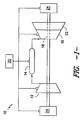
- Fig. 1 is a schematic view of a gas turbine 10, and Fig. 2 is an enlarged cross section of a gas turbine 10 according to one embodiment of the present invention.
- the gas turbine 10 may include a compressor 12, a combustor 14 in fluid communication with the compressor 12, a turbine section 16 downstream and in fluid communication with the combustor 14 and/or the compressor 12, a turbine shaft 18 and a controller 20.
- the turbine section generally terminates at an exhaust duct 22.
- the gas turbine may include one or more generators 24 coupled to the turbine section 16 and/or the compressor 12.
- the gas turbine 10 may include a plurality of combustors 14 in fluid communication with the turbine section 16.
- the gas turbine may include at least one combustor 14 positioned along the turbine section 16 as may be found in a reheat gas turbine.
- each combustor(s) 14 may include an end cover 30, a combustor casing 32 and one or more fuel nozzles 34 extending downstream from the end cover 30.
- a combustion liner 36 may extend downstream from the end cover 30 and may connect to a generally annular transition piece 38 that extends downstream from the combustion liner 36.
- the combustion liner 36 may generally surround the one or more fuel nozzles 34.
- the transition piece 38 includes a downstream end 40 that generally terminates adjacent to an upstream end of the turbine section 16.
- the combustion liner 36 and the transition piece 38 generally provide a flow path 50 for hot gases to flow from the combustor(s) 14 to the turbine section 16.
- a combustion zone 60 disposed within the combustion liner 36 and the transition piece 38 may generally extend from a point downstream of the one or more fuel nozzles 34, through the flow path 50 and terminate at the upstream end of the turbine section 16.
- the turbine section 16 generally includes alternating stages of stationary vanes 62 and rotating blades 64 generally concentric with the turbine shaft 18 and beginning with a first stage of the stationary vanes 62.
- Each stationary vane 62 of the alternating stationary vane stages may include a leading edge 66 disposed generally at an upstream point of the stationary vane 62.
- the rotating blades 64 may be coupled to one or more disks 68 and the disks 68 may be coupled to the turbine shaft 18 shown in Fig. 1 .
- the turbine section 16 may include a plurality of passages providing fluid communication between the compressor and the turbine for providing a cooling flow to the turbine section 16.
- the alternating stages of the stationary vanes 62 and the rotating disks 64 define a hot gas path 70 through the turbine section for the hot gases flowing from the combustor(s) 14.
- the upstream end of the turbine section 16 may be defined as a point downstream from the leading edge 66 of the one or more stationary vanes 62 of the first stage of stationary vanes 62.
- the upstream end of the turbine section 16 may be defined as a point downstream from the downstream end of the transition piece 38.
- the controller 20 may generally be any turbine control system known in the art that permits a gas turbine 10 to be controlled and/or operated as described herein.
- the controller 20 may comprise a General Electric SPEEDTRONIC Gas Turbine Control System, such as is described in Rowen, W. I., "SPEEDTRONIC Mark V Gas Turbine Control System", GE-3658D, published by GE Industrial & Power Systems of Schenectady, N.Y .
- the controller 20 may comprise any computer system having a processor(s) that executes programs, such as computer readable instructions stored in the controller's memory, to control the operation of the gas turbine 10 using sensor inputs and instructions from human operators.
- the commands generated by the controller 20 may manipulate actuators and/or other mechanical or electromechanical devices coupled to the gas turbine and configured to regulate fluid flow through the gas turbine 10, so as to satisfy performance objectives while complying with operational boundaries of the gas turbine 10.
- a working fluid such as air flows through the compressor 12 to provide a compressed working fluid to the combustor(s) 14.
- the greatest portion of the compressed working fluid hereinafter referred to as the "primary flow” is directed to the combustor(s) 14 for cooling various components, such as the combustion liner 36 and the transition piece 38, and for mixing with a fuel to produce a combustible mixture.
- the remaining portion of the compressed working fluid hereinafter referred to as the "secondary flow” may be channeled to various sections of the gas turbine 10.
- the secondary flow may be extracted from the gas turbine 10 to support auxiliary processes and/or channeled to the turbine to provide a cooling flow.
- the combustible mixture is ignited within the combustion zone 60, thereby creating a rapidly expanding hot gas.
- the hot gas may generally include various concentrations of combustion products including but not limited to oxygen, carbon monoxide, carbon dioxide, nitrogen, water and/or argon.
- the hot gas flows through the combustion zone 60 along the flow path 50, exits the combustor at the downstream end 40 of the transition piece 38 and flows into the hot gas path 70.
- the portion of the secondary flow channeled to the turbine for cooling may enter the hot gas path 70 through the plurality of passages, mix with the hot gas flowing through the turbine section 16 and exit the turbine section 16 through the exhaust duct 24 disposed downstream from the turbine section 16.
- the hot gas flows through the hot gas path 70, it imparts Kinetic energy from the hot gas to the rotating blades 64, thus causing the turbine shaft 18 to rotate and produce mechanical work.
- the mechanical work produced may drive the compressor 12 or other external loads, such as the one or more generators 24, as shown in Fig. 1 , to produce electricity.
- the gas turbine 10 may include a system 80 for determining a cooling flow parameter of a cooling medium supplied through the gas turbine 10.
- the term "parameter” refers to an item(s) that may be used to define the operating conditions of the gas turbine 10, such as temperatures, pressures, fluid flow rate, gas concentrations, and/or water content.
- the cooling flow parameter may include but is not limited to secondary and/or cooling flow rate, gas concentration, temperature, pressure, water content and/or any other fluid parameter of the cooling flow.
- Some parameters may be measured using sensors and thus, may be directly known. Other parameters may be estimated using design calculations and/or a gas turbine 10 model. The measured and/or estimated parameters may generally be used to represent a given gas turbine 10 operating state.
- the system 80 may generally include at least a first sensor 82 and a second sensor 84 communicatively coupled to the controller 20 and configured for measuring a combustion product parameter of the gas turbine 10. Each sensor may be configured to transmit signals associated with the sensed combustion product parameter to the controller via the coupling.
- combustion product parameter refers to one or more of the elements and/or compounds present within the combustor 14, the combustion zone 60, the hot gas path 70 and/or the exhaust duct 22 of the gas turbine 10 as a result of the combustion process.
- "combustion product parameter” may correspond to the concentration of oxygen, carbon dioxide, argon, carbon monoxide, nitrogen, water and/or the like.
- the first and second sensors 82 & 84 respectfully, may include but are not limited to at least one of an oxygen sensor, a carbon dioxide sensor, a carbon monoxide sensor, a nitrogen sensor, an argon sensor or a water sensor.
- the first sensor 82 may be disposed at or adjacent to the combustion zone 60 and configured to detect a first value of the combustion product parameter.
- the combustion zone may generally extend from a point downstream of the one or more fuel nozzles 34, through the flow path 50 and terminate at the upstream end of the turbine section 16. In alternate embodiments, the combustion zone may extend to the leading edge 66 of the stationary vanes 62 of the first stage of stationary vanes 62.
- the first sensor 82 may be disposed at a point downstream from the one or more fuel nozzles 34 within the combustion liner 36, within the transition piece 38, at the downstream end 40 of the transition piece 38 and/or along the leading edge 66 of one or more of the stationary vanes 62 of the first stationary vane stage.
- the first sensor 82 may extend generally radially inward from the combustion liner 36 and/or the transition piece 38 and into the combustion zone 60.
- the system 80 may further include a plurality of the first sensors 82 disposed at various locations throughout the combustion zone as described above.
- the second sensor 84 may be disposed generally downstream of the combustion zone 60 and configured to detect a second value of the combustion product parameter provided by the first sensor 82.
- the second sensor 84 may be disposed within the exhaust duct 22, adjacent to the a last stage of the rotating blades 64, to a surface of one or more of the stationary vanes 62, adjacent to one or more of the stationary vanes 62 and/or at any point within the hot gas path 74 of the turbine section 16.
- the system may further include a plurality of the second sensors 84 disposed downstream of the combustion zone 60 at one or more of the positions described above.
- at least one of the plurality of second sensors 84 may be disposed adjacent to each rotating blade stage 64, at each stationary vane 62 stage and/or within the exhaust duct 22.
- the controller 20 may be configured to compare the first and second values of the combustion product parameter provided by the first and second sensors, 82 and 84 respectfully, to determine one or more cooling flow parameters of the cooling medium supplied through the gas turbine 10.
- the one or more parameters of the cooling medium may include the flow rate of the cooling medium through the turbine section 16.
- the controller 20 may be configured to determine one or more of the cooling flow parameters of the cooling medium by calculating difference values between the first and second combustion product parameter values.
- the controller may be configured to generate an output signal for controlling the cooling flow parameter of the cooling medium, such as the flow rate of the cooling medium through the gas turbine 10.
- the various embodiments shown and described with respect to Figs. 1 and 2 may also provide, as shown in Fig. 3 , a method 100 for determining a cooling flow parameter of a cooling medium supplied through the gas turbine 10.
- the method 100 may generally include receiving a signal associated with a first value of one or more of the combustion product parameters at a location within the combustion zone 102, receiving a signal associated with a second value of one or more of the combustion product parameters from a location downstream from the combustion zone 104, comparing the first and second values of the combustion product parameter 106 and determining a cooling flow parameter of the cooling medium based on the comparison of the first and second values 108.
- the disclosed method may allow various cooling flow parameters of the cooling medium, such as cooling medium flow rate, to be measured rather than estimated, thus allowing for validation of design assumptions and improved gas turbine efficiency.
- a signal is received that is associated with a first value of one or more of the combustion product parameters at a location within the combustion zone 60.
- the first sensors 82 may be disposed within the combustion zone 60 and configured to detect a first value of a combustion product parameter, such as oxygen concentration. The first sensor may then communicate the sensed first value to the controller for subsequent processing and/or analysis.
- the method may further include receiving a plurality of the signals associated with the first value of the combustion product parameter from a plurality of the first sensors 82 disposed within the combustion zone 60.
- the controller 20 may generate an averaged first value, calculate a median/mean first value, and/or provide any statistical or analytical analysis based on the plurality of signals in order to generate the first value.
- the combustion product parameter associated with the first value may include at least one of oxygen concentration, carbon dioxide concentration, nitrogen concentration or water concentration.
- a signal is received that is associated with a second value of the one or more combustion product parameters at a location downstream from the combustion zone 60.
- one or more of the second sensors 84 may be disposed within the exhaust duct 24, adjacent to the last stage of rotating blades 64, to a surface of one or more of the stationary vanes 62, adjacent to one or more of the stationary vanes 62 and/or at any point within the hot gas path 74 of the turbine section 16.
- the second sensor 84 may be configured to detect a second value of the combustion product parameter detected by the first sensor 82.
- the second sensor 84 may then communicate the sensed second value to the controller 20 for subsequent processing and/or analysis.
- the method may further include receiving a plurality of the signals associated with the second value of the combustion product parameter from a plurality of the second sensors 84 mounted downstream from the combustion zone 60. Wherein the plurality of signals is received by the controller 20, the controller 20 may generate an averaged second value, calculate a median/mean second value, and/or provide any statistical or analytical analysis based on the plurality of signals in order to generate the second value.
- the combustion product parameter associated with the second value may include at least one of oxygen concentration, carbon dioxide concentration, nitrogen concentration or water concentration.
- the first and second combustion product parameter values from steps 102 and 104 may be compared by calculating difference values between the first and second values of the combustion product parameters.
- This step may also be carried out by the controller 20.
- the controller 20 may receive the signals associated with the first value and the second value of a combustion product parameter, such as oxygen concentration, from the first and second sensors, 82 and 84 respectfully.
- the controller 20 may then calculate the difference values, for example, by adding or subtracting a first value of X percent oxygen concentration to/from a second value of X+1 percent oxygen concentration, thus reflecting an increase in oxygen concentration of the hot gas as it passed through the turbine section 16.
- the controller 20 may then compare the calculated difference values to measured, predicted or known oxygen concentration levels of the cooling medium prior to mixing with the hot gas in the turbine section 16 in order to determine one or more of the cooling flow parameters, such as a measured flow rate of the cooling medium.
- the method may further include modifying the cooling flow parameter based on the comparison of the first and second values of the combustion product parameters and/or comparing the measured flow rate to a design baseline cooling medium flow rate, calculating a flow rate parameter difference value and adjusting one or more gas turbine operating parameters accordingly.
- the controller 20 may generate an output signal based on the comparison of the first and second values, the flow rate parameter difference values and/or the resulting value of the cooling flow parameter.
- the controller 20 may be communicatively coupled to one or more fluid flow control devices, such as an actuator and/or a flow regulator in fluid communication with the combustor 14, the turbine section 16 and/or with any part of the gas turbine which may affect the cooling flow parameter. In this manner, the one or more fluid control devices may receive the output signal from the controller 20, thereby activating and/or manipulating the fluid control device(s) to modify the cooling flow parameter.
- the technical effect of the present matter is improved performance and/or operation of a gas turbine.
- gas turbine designs may be validated and the performance and/or operation of a gas turbine may be enhanced.
- the gas turbine may be manipulated to regulate the cooling medium flow rate, thus reducing the risk of overheating various components within the gas turbine typically exposed to extreme thermal stress.
- validation of the cooling medium flow rate on operational gas turbines may allow engineers and/or designers to anticipate potential issues with hardware life due to thermal stresses within the gas turbine.
Landscapes
- Engineering & Computer Science (AREA)
- Chemical & Material Sciences (AREA)
- Combustion & Propulsion (AREA)
- Mechanical Engineering (AREA)
- General Engineering & Computer Science (AREA)
- Physics & Mathematics (AREA)
- Fluid Mechanics (AREA)
- Turbine Rotor Nozzle Sealing (AREA)
- Engine Equipment That Uses Special Cycles (AREA)
Abstract
Description
- The present subject matter relates generally to a gas turbine, and more particularly to a system and method for determining cooling flow parameters of a cooling medium supplied through a gas turbine.
- Modem gas turbines generally operate at elevated temperatures for extended periods. These elevated temperatures may significantly limit the life of individual components within the gas turbine, thus potentially resulting in costly scheduled and unscheduled outages for the operators. Consequently, thermal and mechanical stresses within the gas turbine, specifically within a hot gas path region of the gas turbine, are critical considerations for gas turbine designers.
- During gas turbine operation, a compressor provides a steady source of a compressed working fluid, such as air, that may be channeled to a combustor of the gas turbine, wherein the compressed working fluid may be utilized for cooling various mechanical components within the combustor. In addition, the compressed working fluid may be mixed with a fuel and the mixture ignited in the combustor, thus providing a hot gas that expands rapidly through the combustor and into a turbine section of the gas turbine. The hot gas flows across a series of stationary vanes and rotating blades connected to a rotor shaft, wherein kinetic energy is transferred from the hot gas to one or more stages of the rotating blades, thus turning the rotor shaft and producing work. As a result, the turbine section is exposed to extreme operating temperatures. Existing methods for reducing the temperatures within the turbine section include flowing a cooling medium, such as a portion of the compressed working fluid, through multiple cooling passages located throughout the turbine section. In this manner, the cooling medium generally mixes with the hot gas as the mixture flows from the turbine section to an exhaust outlet of the gas turbine.
- In current gas turbine designs, the flow rate of the cooling medium is generally an estimate based on design calculations and gas turbine models. During design validation testing, various gas turbine operating parameters such as pressures and temperatures are measured and compared to the design calculations and models. If the measurements fall within certain limits, the estimated flow rate of the cooling medium is assumed correct. However, it has been observed that the actual cooling medium flow rate of many gas turbines is much higher than assumed, thus resulting in diminished gas turbine efficiency.
- Accordingly, a method and a system that determines parameters of a cooling medium, such as the actual flow rate of a cooling medium through the turbine section of a gas turbine, would be welcomed in the technology.
- Aspects and advantages of the invention will be set forth in part in the following description, or may be obvious from the description, or may be learned through practice of the invention.
- In one aspect, the present invention resides in a method for determining cooling flow parameters of a cooling medium supplied through a gas turbine. The method may generally include receiving a signal associated with a first value of a combustion product parameter at a location within a combustion zone of the gas turbine, receiving a signal associated with a second value of a combustion product parameter at a location downstream of the combustion zone, comparing the first and second values of the combustion product parameter and determining a cooling flow parameter of the cooling medium based on the comparison of the first and second values.
- In a further aspect, the present invention resides in a system for determining cooling flow parameters of a cooling medium supplied through a gas turbine. The system may generally include a first sensor disposed at or adjacent to a combustion zone of the gas turbine, wherein the first sensor may be configured to detect a first value of a combustion product parameter of the gas turbine. The system may further include a second sensor disposed downstream of the combustion zone, wherein the second sensor may be configured to detect a second value of the combustion product parameter. The system may also include a controller communicatively coupled to the first and second sensors, wherein the controller may be configured to compare the first and second values of the combustion product parameter and determine a cooling flow parameter of the cooling medium supplied through the gas turbine based on the comparison of the first and second values.
- These and other features, aspects and advantages of the present invention will become better understood with reference to the following description and appended claims. The accompanying drawings, which are incorporated in and constitute a part of this specification, illustrate embodiments of the invention and, together with the description, serve to explain the principles of the invention.
- Embodiments of the present invention will now be described, by way of example only, with reference to the accompanying drawings, in which:
-
FIG. 1 illustrates a schematic depiction of a gas turbine according to one embodiment of the present invention; -
FIG. 2 is an enlarged cross section of a gas turbine according to at least one embodiment of the present subject matter; and -
FIG. 3 is a block diagram of a method according to the present subject matter. - Reference will now be made in detail to present embodiments of the invention, one or more examples of which are illustrated in the accompanying drawings. The detailed description uses numerical and letter designations to refer to features in the drawings. Like or similar designations in the drawings and description have been used to refer to like or similar parts of the invention. As used herein, the terms "first", "second", and "third" may be used interchangeably to distinguish one component from another and are not intended to signify location or importance of the individual components. In addition, the terms "upstream" and "downstream" refer to the relative location of components in a fluid pathway. For example, component A is upstream from component B if a fluid flows from component A to component B. Conversely, component B is downstream from component A if component B receives a fluid flow from component A.
- Each example is provided by way of explanation of the invention, not limitation of the invention. In fact, it will be apparent to those skilled in the art that modifications and variations can be made in the present invention without departing from the scope or spirit thereof. For instance, features illustrated or described as part of one embodiment may be used on another embodiment to yield a still further embodiment. Thus, it is intended that the present invention cover such modifications and variations as come within the scope of the appended claims and their equivalents.
- Various embodiments of the present invention include a method for determining one or more cooling flow parameters of a cooling medium, such as a flow rate of a cooling medium supplied through a turbine section of a gas turbine. Generally, a fuel and air mixture is ignited in a combustion zone of a gas turbine combustor, thus producing a hot gas containing varying concentrations of oxygen, nitrogen, carbon monoxide, carbon dioxide, argon, sulfur dioxide and/or other byproducts of the combustion process. A gas turbine controller receives a first signal associated with a first value of a combustion product parameter, such as a concentration of oxygen, from a sensor disposed within a combustion zone of the combustor. The controller receives a second signal associated with a second value of the combustion product parameter from a second sensor disposed downstream from the combustion zone. The controller compares the first and second values of the combustor product parameters and determines a cooling flow parameter of the cooling medium, such as the cooling flow rate, based on variations in the first value of the combustion product parameter and the second value of the combustion product parameter.
- Although exemplary embodiments of the present invention will be described generally in the context of an industrial gas turbine, for purposes of illustration, one of ordinary skill in the art will readily appreciate that embodiments of the present invention may be applied to any gas turbine and are not limited to industrial gas turbines unless specifically recited in the claims.
-
Fig. 1 is a schematic view of agas turbine 10, andFig. 2 is an enlarged cross section of agas turbine 10 according to one embodiment of the present invention. As shown inFig. 1 , thegas turbine 10 may include acompressor 12, acombustor 14 in fluid communication with thecompressor 12, aturbine section 16 downstream and in fluid communication with thecombustor 14 and/or thecompressor 12, aturbine shaft 18 and acontroller 20. The turbine section generally terminates at anexhaust duct 22. In addition, the gas turbine may include one ormore generators 24 coupled to theturbine section 16 and/or thecompressor 12. Although asingle combustor 14 is shown, thegas turbine 10 may include a plurality ofcombustors 14 in fluid communication with theturbine section 16. For example, the gas turbine may include at least onecombustor 14 positioned along theturbine section 16 as may be found in a reheat gas turbine. As shown inFig. 2 , each combustor(s) 14 may include anend cover 30, acombustor casing 32 and one ormore fuel nozzles 34 extending downstream from theend cover 30. Acombustion liner 36 may extend downstream from theend cover 30 and may connect to a generallyannular transition piece 38 that extends downstream from thecombustion liner 36. Thecombustion liner 36 may generally surround the one ormore fuel nozzles 34. Thetransition piece 38 includes adownstream end 40 that generally terminates adjacent to an upstream end of theturbine section 16. Thecombustion liner 36 and thetransition piece 38 generally provide aflow path 50 for hot gases to flow from the combustor(s) 14 to theturbine section 16. - A combustion zone 60 disposed within the
combustion liner 36 and thetransition piece 38 may generally extend from a point downstream of the one ormore fuel nozzles 34, through theflow path 50 and terminate at the upstream end of theturbine section 16. Theturbine section 16 generally includes alternating stages ofstationary vanes 62 and rotatingblades 64 generally concentric with theturbine shaft 18 and beginning with a first stage of thestationary vanes 62. Eachstationary vane 62 of the alternating stationary vane stages may include a leadingedge 66 disposed generally at an upstream point of thestationary vane 62. The rotatingblades 64 may be coupled to one ormore disks 68 and thedisks 68 may be coupled to theturbine shaft 18 shown inFig. 1 . Theturbine section 16 may include a plurality of passages providing fluid communication between the compressor and the turbine for providing a cooling flow to theturbine section 16. Generally, the alternating stages of thestationary vanes 62 and therotating disks 64 define a hot gas path 70 through the turbine section for the hot gases flowing from the combustor(s) 14. As shown inFig. 2 , in particular embodiments, the upstream end of theturbine section 16 may be defined as a point downstream from the leadingedge 66 of the one or morestationary vanes 62 of the first stage ofstationary vanes 62. In alternate embodiments, the upstream end of theturbine section 16 may be defined as a point downstream from the downstream end of thetransition piece 38. - The
controller 20 may generally be any turbine control system known in the art that permits agas turbine 10 to be controlled and/or operated as described herein. For example, thecontroller 20 may comprise a General Electric SPEEDTRONIC Gas Turbine Control System, such as is described in Rowen, W. I., "SPEEDTRONIC Mark V Gas Turbine Control System", GE-3658D, published by GE Industrial & Power Systems of Schenectady, N.Y. Generally, thecontroller 20 may comprise any computer system having a processor(s) that executes programs, such as computer readable instructions stored in the controller's memory, to control the operation of thegas turbine 10 using sensor inputs and instructions from human operators. The commands generated by thecontroller 20 may manipulate actuators and/or other mechanical or electromechanical devices coupled to the gas turbine and configured to regulate fluid flow through thegas turbine 10, so as to satisfy performance objectives while complying with operational boundaries of thegas turbine 10. - In operation, a working fluid, such as air, flows through the
compressor 12 to provide a compressed working fluid to the combustor(s) 14. The greatest portion of the compressed working fluid, hereinafter referred to as the "primary flow", is directed to the combustor(s) 14 for cooling various components, such as thecombustion liner 36 and thetransition piece 38, and for mixing with a fuel to produce a combustible mixture. The remaining portion of the compressed working fluid, hereinafter referred to as the "secondary flow" may be channeled to various sections of thegas turbine 10. For example, the secondary flow may be extracted from thegas turbine 10 to support auxiliary processes and/or channeled to the turbine to provide a cooling flow. The combustible mixture is ignited within the combustion zone 60, thereby creating a rapidly expanding hot gas. The hot gas may generally include various concentrations of combustion products including but not limited to oxygen, carbon monoxide, carbon dioxide, nitrogen, water and/or argon. The hot gas flows through the combustion zone 60 along theflow path 50, exits the combustor at thedownstream end 40 of thetransition piece 38 and flows into the hot gas path 70. The portion of the secondary flow channeled to the turbine for cooling may enter the hot gas path 70 through the plurality of passages, mix with the hot gas flowing through theturbine section 16 and exit theturbine section 16 through theexhaust duct 24 disposed downstream from theturbine section 16. As the hot gas flows through the hot gas path 70, it imparts Kinetic energy from the hot gas to therotating blades 64, thus causing theturbine shaft 18 to rotate and produce mechanical work. The mechanical work produced may drive thecompressor 12 or other external loads, such as the one ormore generators 24, as shown inFig. 1 , to produce electricity. - In one or more embodiments, as shown in
Fig. 2 , thegas turbine 10 may include a system 80 for determining a cooling flow parameter of a cooling medium supplied through thegas turbine 10. It should be appreciated that, as used herein, the term "parameter" refers to an item(s) that may be used to define the operating conditions of thegas turbine 10, such as temperatures, pressures, fluid flow rate, gas concentrations, and/or water content. In particular, the cooling flow parameter may include but is not limited to secondary and/or cooling flow rate, gas concentration, temperature, pressure, water content and/or any other fluid parameter of the cooling flow. Some parameters may be measured using sensors and thus, may be directly known. Other parameters may be estimated using design calculations and/or agas turbine 10 model. The measured and/or estimated parameters may generally be used to represent a givengas turbine 10 operating state. - As shown in
Fig. 2 , the system 80 may generally include at least afirst sensor 82 and asecond sensor 84 communicatively coupled to thecontroller 20 and configured for measuring a combustion product parameter of thegas turbine 10. Each sensor may be configured to transmit signals associated with the sensed combustion product parameter to the controller via the coupling. As used herein, the term "combustion product parameter" refers to one or more of the elements and/or compounds present within thecombustor 14, the combustion zone 60, the hot gas path 70 and/or theexhaust duct 22 of thegas turbine 10 as a result of the combustion process. For example, in particular embodiments, "combustion product parameter" may correspond to the concentration of oxygen, carbon dioxide, argon, carbon monoxide, nitrogen, water and/or the like. As such, the first andsecond sensors 82 & 84 respectfully, may include but are not limited to at least one of an oxygen sensor, a carbon dioxide sensor, a carbon monoxide sensor, a nitrogen sensor, an argon sensor or a water sensor. - In various embodiments, the
first sensor 82 may be disposed at or adjacent to the combustion zone 60 and configured to detect a first value of the combustion product parameter. As disclosed above, the combustion zone may generally extend from a point downstream of the one ormore fuel nozzles 34, through theflow path 50 and terminate at the upstream end of theturbine section 16. In alternate embodiments, the combustion zone may extend to the leadingedge 66 of thestationary vanes 62 of the first stage ofstationary vanes 62. In particular embodiments, thefirst sensor 82 may be disposed at a point downstream from the one ormore fuel nozzles 34 within thecombustion liner 36, within thetransition piece 38, at thedownstream end 40 of thetransition piece 38 and/or along the leadingedge 66 of one or more of thestationary vanes 62 of the first stationary vane stage. In further embodiments, thefirst sensor 82 may extend generally radially inward from thecombustion liner 36 and/or thetransition piece 38 and into the combustion zone 60. In particular embodiments, the system 80 may further include a plurality of thefirst sensors 82 disposed at various locations throughout the combustion zone as described above. - The
second sensor 84 may be disposed generally downstream of the combustion zone 60 and configured to detect a second value of the combustion product parameter provided by thefirst sensor 82. In particular embodiments, thesecond sensor 84 may be disposed within theexhaust duct 22, adjacent to the a last stage of therotating blades 64, to a surface of one or more of thestationary vanes 62, adjacent to one or more of thestationary vanes 62 and/or at any point within the hot gas path 74 of theturbine section 16. In alternate embodiments, the system may further include a plurality of thesecond sensors 84 disposed downstream of the combustion zone 60 at one or more of the positions described above. For example, at least one of the plurality ofsecond sensors 84 may be disposed adjacent to eachrotating blade stage 64, at eachstationary vane 62 stage and/or within theexhaust duct 22. - The
controller 20 may be configured to compare the first and second values of the combustion product parameter provided by the first and second sensors, 82 and 84 respectfully, to determine one or more cooling flow parameters of the cooling medium supplied through thegas turbine 10. In certain embodiments, the one or more parameters of the cooling medium may include the flow rate of the cooling medium through theturbine section 16. In particular embodiments, thecontroller 20 may be configured to determine one or more of the cooling flow parameters of the cooling medium by calculating difference values between the first and second combustion product parameter values. In addition or in the alternative, the controller may be configured to generate an output signal for controlling the cooling flow parameter of the cooling medium, such as the flow rate of the cooling medium through thegas turbine 10. - The various embodiments shown and described with respect to
Figs. 1 and2 may also provide, as shown inFig. 3 , amethod 100 for determining a cooling flow parameter of a cooling medium supplied through thegas turbine 10. As shown inFig. 3 , themethod 100 may generally include receiving a signal associated with a first value of one or more of the combustion product parameters at a location within thecombustion zone 102, receiving a signal associated with a second value of one or more of the combustion product parameters from a location downstream from thecombustion zone 104, comparing the first and second values of thecombustion product parameter 106 and determining a cooling flow parameter of the cooling medium based on the comparison of the first andsecond values 108. Thus, the disclosed method may allow various cooling flow parameters of the cooling medium, such as cooling medium flow rate, to be measured rather than estimated, thus allowing for validation of design assumptions and improved gas turbine efficiency. - As shown in
Fig. 3 , in 102, a signal is received that is associated with a first value of one or more of the combustion product parameters at a location within the combustion zone 60. For example, as disclosed above, one or more of thefirst sensors 82 may be disposed within the combustion zone 60 and configured to detect a first value of a combustion product parameter, such as oxygen concentration. The first sensor may then communicate the sensed first value to the controller for subsequent processing and/or analysis. In certain embodiments, the method may further include receiving a plurality of the signals associated with the first value of the combustion product parameter from a plurality of thefirst sensors 82 disposed within the combustion zone 60. Wherein the plurality of the signals is received by thecontroller 20, thecontroller 20 may generate an averaged first value, calculate a median/mean first value, and/or provide any statistical or analytical analysis based on the plurality of signals in order to generate the first value. In particular embodiments the combustion product parameter associated with the first value may include at least one of oxygen concentration, carbon dioxide concentration, nitrogen concentration or water concentration. - As shown in
Fig. 3 , in 104, a signal is received that is associated with a second value of the one or more combustion product parameters at a location downstream from the combustion zone 60. For example, as disclosed above, one or more of thesecond sensors 84 may be disposed within theexhaust duct 24, adjacent to the last stage ofrotating blades 64, to a surface of one or more of thestationary vanes 62, adjacent to one or more of thestationary vanes 62 and/or at any point within the hot gas path 74 of theturbine section 16. Thesecond sensor 84 may be configured to detect a second value of the combustion product parameter detected by thefirst sensor 82. Thesecond sensor 84 may then communicate the sensed second value to thecontroller 20 for subsequent processing and/or analysis. In certain embodiments, the method may further include receiving a plurality of the signals associated with the second value of the combustion product parameter from a plurality of thesecond sensors 84 mounted downstream from the combustion zone 60. Wherein the plurality of signals is received by thecontroller 20, thecontroller 20 may generate an averaged second value, calculate a median/mean second value, and/or provide any statistical or analytical analysis based on the plurality of signals in order to generate the second value. In particular embodiments the combustion product parameter associated with the second value may include at least one of oxygen concentration, carbon dioxide concentration, nitrogen concentration or water concentration. - As shown in
Fig. 3 , in 106, the first and second combustion product parameter values fromsteps controller 20. For example, in particular embodiments, thecontroller 20 may receive the signals associated with the first value and the second value of a combustion product parameter, such as oxygen concentration, from the first and second sensors, 82 and 84 respectfully. Thecontroller 20 may then calculate the difference values, for example, by adding or subtracting a first value of X percent oxygen concentration to/from a second value of X+1 percent oxygen concentration, thus reflecting an increase in oxygen concentration of the hot gas as it passed through theturbine section 16. Thecontroller 20 may then compare the calculated difference values to measured, predicted or known oxygen concentration levels of the cooling medium prior to mixing with the hot gas in theturbine section 16 in order to determine one or more of the cooling flow parameters, such as a measured flow rate of the cooling medium. - The method may further include modifying the cooling flow parameter based on the comparison of the first and second values of the combustion product parameters and/or comparing the measured flow rate to a design baseline cooling medium flow rate, calculating a flow rate parameter difference value and adjusting one or more gas turbine operating parameters accordingly. For example, the
controller 20 may generate an output signal based on the comparison of the first and second values, the flow rate parameter difference values and/or the resulting value of the cooling flow parameter. In particular embodiments, thecontroller 20 may be communicatively coupled to one or more fluid flow control devices, such as an actuator and/or a flow regulator in fluid communication with thecombustor 14, theturbine section 16 and/or with any part of the gas turbine which may affect the cooling flow parameter. In this manner, the one or more fluid control devices may receive the output signal from thecontroller 20, thereby activating and/or manipulating the fluid control device(s) to modify the cooling flow parameter. - The technical effect of the present matter is improved performance and/or operation of a gas turbine. In particular, by determining a parameter of the cooling medium, such as flow rate, based on comparisons of measured combustion product parameters, gas turbine designs may be validated and the performance and/or operation of a gas turbine may be enhanced. For example, when the cooling medium flow rate exceeds or falls short of design estimates, the gas turbine may be manipulated to regulate the cooling medium flow rate, thus reducing the risk of overheating various components within the gas turbine typically exposed to extreme thermal stress. In addition, validation of the cooling medium flow rate on operational gas turbines may allow engineers and/or designers to anticipate potential issues with hardware life due to thermal stresses within the gas turbine.
- This written description uses examples to disclose the invention, including the best mode, and also to enable any person skilled in the art to practice the invention, including making and using any devices or systems and performing any incorporated methods. The patentable scope of the invention is defined by the claims, and may include other examples that occur to those skilled in the art. Such other examples are intended to be within the scope of the claims if they include structural elements that do not differ from the literal language of the claims, or if they include equivalent structural elements with insubstantial differences from the literal language of the claims.
Claims (17)
- A method (100) for determining a cooling flow parameter of a cooling medium supplied through a gas turbine (10), the method comprising:receiving (102) a signal associated with a first value of a combustion product parameter at a location within a combustion zone (60) of the gas turbine (10);receiving (104) a signal associated with a second value of the combustion product parameter at a location downstream of the combustion zone (60);comparing (106) the first and second values of the combustion product parameter; anddetermining (108) a cooling flow parameter based on the comparison of the first and second values.
- The method of claim 1, wherein comparing (106) the first and second values of the combustion product parameter comprises calculating difference values between the first and second values of the combustion product parameter.
- The method of claim 1 or 2, further comprising modifying the cooling flow parameter based on the comparison of the first and second values of the combustion product parameters.
- The method of any of claims 1 to 3, wherein determining (108) the cooling flow parameter based on the comparison of the first and second values comprises determining a measured flow rate of the cooling medium through a turbine section (16) of the gas turbine (10).
- The method of claim 4, further comprising comparing the measured flow rate to a design baseline flow rate, calculating a flow rate difference value and adjusting the cooling flow parameter.
- The method of any of claims 1 to 5, wherein the combustion product parameter includes at least one of oxygen concentration, carbon dioxide concentration, nitrogen concentration or water concentration.
- The method of any of claims 1 to 6, wherein the cooling flow parameter includes at least one of a flow rate, a temperature or water content.
- The method of any preceding claim, wherein receiving the signal associated with a first value of a combustion product parameter at the location within a combustion zone (60) of the gas turbine (10) comprises receiving the signal from a first sensor (82) mounted within the gas turbine (10) at or adjacent to the combustion zone.
- The method of an of claims 1 to 7, wherein receiving the signal associated with a first value of the combustion product parameter at the location within a combustion zone (60) of the gas turbine (10) comprises receiving a plurality of signals from a plurality of sensors (82, 84) mounted within the combustion zone (60) of the gas turbine.
- The method of claim 9, further comprising generating an averaged first value from the plurality of signals.
- The method of any preceding claim, wherein receiving the signal associated with the second value of the combustion product parameter at the location downstream of the combustion zone comprises receiving a signal from a second sensor (84) mounted within a turbine (16) of the gas turbine (10) or at a location downstream of the turbine (16).
- The method of any of claims 1 to 10, wherein receiving the signal associated with the second value of a combustion product parameter at a location downstream of the combustion zone (60) comprises receiving a plurality of signals from a plurality of sensors (82, 84) mounted within a turbine of the gas turbine (10) or at a location downstream of the turbine (16).
- The method of claim 12, further comprising generating an averaged second value from the plurality of signals.
- A system for determining a cooling flow parameter of a cooling medium supplied through a gas turbine (10), the system comprising:a first sensor (82) disposed at or adjacent to a combustion zone (60) of the gas turbine (10), the first sensor (82) configured to detect a first value of a combustion product parameter of the gas turbine (10);a second sensor (84) disposed downstream of the combustion zone (60), the second sensor (84) configured to detect a second value of the combustion product parameter; anda controller (20) communicatively coupled to the first and second sensors (82, 84), the controller (20) being configured to compare the first and second values of the combustion product parameter and determine the cooling flow parameter of the cooling medium supplied through the gas turbine (10) based on the comparison of the first and second values.
- The system of claim 14, wherein the first and second sensors (80, 82) includes at least one of an oxygen sensor, a carbon dioxide sensor, a carbon monoxide sensor, a nitrogen sensor or a water sensor.
- The system of claim 14 or 15, wherein the controller (20) is configured to calculate difference values between the first and second values of the combustion product parameters and determine one or more of the cooling flow parameters based on the difference values.
- The system of claim 16, wherein the controller (20) is further configured to generate an output signal for manipulating a flow rate of the cooling medium through a turbine (16) of the gas turbine (10) based on the difference values.
Applications Claiming Priority (1)
| Application Number | Priority Date | Filing Date | Title |
|---|---|---|---|
| US13/345,278 US9322333B2 (en) | 2012-01-06 | 2012-01-06 | System and method for determining a cooling flow parameter downstream from a gas turbine combustor |
Publications (2)
| Publication Number | Publication Date |
|---|---|
| EP2613016A2 true EP2613016A2 (en) | 2013-07-10 |
| EP2613016A3 EP2613016A3 (en) | 2017-08-23 |
Family
ID=47681620
Family Applications (1)
| Application Number | Title | Priority Date | Filing Date |
|---|---|---|---|
| EP13150050.6A Withdrawn EP2613016A3 (en) | 2012-01-06 | 2013-01-02 | System and method for operating a gas turbine |
Country Status (5)
| Country | Link |
|---|---|
| US (1) | US9322333B2 (en) |
| EP (1) | EP2613016A3 (en) |
| JP (1) | JP6144908B2 (en) |
| CN (1) | CN103195578B (en) |
| RU (1) | RU2614241C2 (en) |
Cited By (1)
| Publication number | Priority date | Publication date | Assignee | Title |
|---|---|---|---|---|
| US9132824B2 (en) | 2012-01-11 | 2015-09-15 | Développement Effenco Inc. | Fuel saving system that facilitates vehicle re-starts with the engine off |
Families Citing this family (2)
| Publication number | Priority date | Publication date | Assignee | Title |
|---|---|---|---|---|
| US20140358303A1 (en) * | 2013-06-03 | 2014-12-04 | Tescom Corporation | Method and Apparatus for Stabilizing Pressure in an Intelligent Regulator Assembly |
| JP6786233B2 (en) * | 2016-03-22 | 2020-11-18 | 三菱パワー株式会社 | Gas turbine characterization device and gas turbine characterization method |
Family Cites Families (23)
| Publication number | Priority date | Publication date | Assignee | Title |
|---|---|---|---|---|
| SU1760800A1 (en) * | 1990-05-04 | 1994-01-30 | Научно-производственное объединение "Сатурн" им.А.М.Люльки | Method of control of gas-turbine engine |
| JPH06323165A (en) * | 1993-05-17 | 1994-11-22 | Hitachi Ltd | Gas turbine control device and control method |
| JP2000104564A (en) * | 1998-09-30 | 2000-04-11 | Kawasaki Steel Corp | Gas turbine combustion air supply method |
| US6813875B2 (en) * | 2000-01-07 | 2004-11-09 | Honda Giken Kogyo Kabushiki Kaisha | Control system for gas-turbine engine |
| JP3624806B2 (en) * | 2000-07-26 | 2005-03-02 | トヨタ自動車株式会社 | Inspiratory oxygen concentration sensor calibration device |
| US6715916B2 (en) * | 2001-02-08 | 2004-04-06 | General Electric Company | System and method for determining gas turbine firing and combustion reference temperatures having correction for water content in fuel |
| US6487863B1 (en) * | 2001-03-30 | 2002-12-03 | Siemens Westinghouse Power Corporation | Method and apparatus for cooling high temperature components in a gas turbine |
| US6523346B1 (en) * | 2001-11-02 | 2003-02-25 | Alstom (Switzerland) Ltd | Process for controlling the cooling air mass flow of a gas turbine set |
| JP3978086B2 (en) * | 2002-05-31 | 2007-09-19 | 三菱重工業株式会社 | Aircraft gas turbine system, gas turbine system, and operation method thereof |
| JP4100316B2 (en) * | 2003-09-30 | 2008-06-11 | 株式会社日立製作所 | Gas turbine equipment |
| JP4390524B2 (en) * | 2003-10-27 | 2009-12-24 | カワサキプラントシステムズ株式会社 | Organic waste treatment method and treatment system |
| ITAQ20050007A1 (en) * | 2005-05-19 | 2006-11-20 | Roberto Carapellucci | METHOD OF ENHANCEMENT WITH STEAM INJECTION FOR COMBINED CYCLE SYSTEMS |
| US7742904B2 (en) | 2005-09-27 | 2010-06-22 | General Electric Company | Method and system for gas turbine engine simulation using adaptive Kalman filter |
| US20090056342A1 (en) * | 2007-09-04 | 2009-03-05 | General Electric Company | Methods and Systems for Gas Turbine Part-Load Operating Conditions |
| WO2009109446A1 (en) * | 2008-03-05 | 2009-09-11 | Alstom Technology Ltd | Method for regulating a gas turbine in a power plant and power plant to carry out the method |
| EP2107305A1 (en) * | 2008-04-01 | 2009-10-07 | Siemens Aktiengesellschaft | Gas turbine system and method |
| US8240153B2 (en) * | 2008-05-14 | 2012-08-14 | General Electric Company | Method and system for controlling a set point for extracting air from a compressor to provide turbine cooling air in a gas turbine |
| RU2389891C1 (en) * | 2008-12-19 | 2010-05-20 | Федеральное государственное унитарное предприятие "Московское машиностроительное производственное предприятие "САЛЮТ" (ФГУП "ММПП "САЛЮТ") | Control method of air leakages and flow for turbine cooling in double-flow gas turbine engine |
| US8707709B2 (en) * | 2009-03-31 | 2014-04-29 | General Electric Company | Systems and methods for controlling compressor extraction cooling |
| US8631647B2 (en) * | 2010-01-21 | 2014-01-21 | Westport Power Inc. | System and method for regenerating an engine exhaust after-treatment device |
| EP2588732B1 (en) * | 2010-07-02 | 2019-01-02 | Exxonmobil Upstream Research Company | Low emission triple-cycle power generation systems and methods |
| US8783013B2 (en) * | 2010-10-21 | 2014-07-22 | Siemens Energy, Inc. | Feedforward selective catalytic reduction system for turbine engines |
| US9366194B2 (en) * | 2013-09-05 | 2016-06-14 | General Electric Company | Method and system for controlling gas turbine performance with a variable backflow margin |
-
2012
- 2012-01-06 US US13/345,278 patent/US9322333B2/en not_active Expired - Fee Related
- 2012-12-25 JP JP2012280445A patent/JP6144908B2/en not_active Expired - Fee Related
- 2012-12-27 RU RU2012158348A patent/RU2614241C2/en not_active IP Right Cessation
-
2013
- 2013-01-02 EP EP13150050.6A patent/EP2613016A3/en not_active Withdrawn
- 2013-01-04 CN CN201310002113.0A patent/CN103195578B/en not_active Expired - Fee Related
Non-Patent Citations (1)
| Title |
|---|
| None |
Cited By (1)
| Publication number | Priority date | Publication date | Assignee | Title |
|---|---|---|---|---|
| US9132824B2 (en) | 2012-01-11 | 2015-09-15 | Développement Effenco Inc. | Fuel saving system that facilitates vehicle re-starts with the engine off |
Also Published As
| Publication number | Publication date |
|---|---|
| RU2012158348A (en) | 2014-07-10 |
| RU2614241C2 (en) | 2017-03-24 |
| CN103195578B (en) | 2016-04-13 |
| JP6144908B2 (en) | 2017-06-07 |
| EP2613016A3 (en) | 2017-08-23 |
| CN103195578A (en) | 2013-07-10 |
| JP2013142389A (en) | 2013-07-22 |
| US9322333B2 (en) | 2016-04-26 |
| US20130174564A1 (en) | 2013-07-11 |
Similar Documents
| Publication | Publication Date | Title |
|---|---|---|
| EP2224114B1 (en) | System for engine turn down by controlling compressor extraction air flows | |
| CN101166935B (en) | Adjustment method and adjustment equipment for gas turbine combustor working curve | |
| EP2570877A1 (en) | System and method for simulating gas turbine operation | |
| US10458342B2 (en) | System and method for controlling operation of a gas turbine based power plant | |
| EP2738371A2 (en) | A system and method for operating a gas turbine in a turndown mode | |
| EP2423489A2 (en) | Methods for controlling fuel splits to a gas turbine combustor | |
| US20170002748A1 (en) | Gas-turbine control device, gas turbine, and gas-turbine control method | |
| KR101878625B1 (en) | State determining device, operation control device, gas turbine, and state determining method | |
| US10072573B2 (en) | Power plant including an ejector and steam generating system via turbine extraction | |
| EP2339148A2 (en) | Method and system for controlling a fuel flow to a turbomachine | |
| CN106968803A (en) | The combined probability for discharging parameter to power output in gas turbine regulation is controlled | |
| US9322333B2 (en) | System and method for determining a cooling flow parameter downstream from a gas turbine combustor | |
| CN106884724A (en) | To the probability control model in the gas turbine regulation of power output discharge parameter | |
| EP3447379A1 (en) | Method for operating a gas turbine plant and gas turbine plant | |
| US9964035B2 (en) | Power plant including exhaust gas coolant injection system and steam generating system via turbine extraction | |
| JP2014132173A (en) | Gas turbine and method of controlling gas turbine at part-load condition | |
| CN106988893A (en) | The probability for discharging parameter to power output in gas turbine regulation is controlled | |
| JP2004028098A (en) | System for controlling and regulating flame temperature of single shaft gas turbine | |
| JP2016125497A (en) | System and method for generating variable ramp speeds for turbomachines | |
| CN106884727A (en) | To the probability control of power output discharge parameter in gas turbine regulation | |
| CN103046971B (en) | For the system used in the operation of control power generation system | |
| CN106164445B (en) | Variable limit power control for gas turbines | |
| EP2657460A2 (en) | Gas turbine inlet system and method | |
| JP5675527B2 (en) | Gas turbine control device and gas turbine control method | |
| US20230086029A1 (en) | System and method for non-model based control utilizing turbine exit mach number surrogate |
Legal Events
| Date | Code | Title | Description |
|---|---|---|---|
| PUAI | Public reference made under article 153(3) epc to a published international application that has entered the european phase |
Free format text: ORIGINAL CODE: 0009012 |
|
| AK | Designated contracting states |
Kind code of ref document: A2 Designated state(s): AL AT BE BG CH CY CZ DE DK EE ES FI FR GB GR HR HU IE IS IT LI LT LU LV MC MK MT NL NO PL PT RO RS SE SI SK SM TR |
|
| AX | Request for extension of the european patent |
Extension state: BA ME |
|
| PUAL | Search report despatched |
Free format text: ORIGINAL CODE: 0009013 |
|
| AK | Designated contracting states |
Kind code of ref document: A3 Designated state(s): AL AT BE BG CH CY CZ DE DK EE ES FI FR GB GR HR HU IE IS IT LI LT LU LV MC MK MT NL NO PL PT RO RS SE SI SK SM TR |
|
| AX | Request for extension of the european patent |
Extension state: BA ME |
|
| RIC1 | Information provided on ipc code assigned before grant |
Ipc: F02C 7/12 20060101ALI20170717BHEP Ipc: F01D 17/02 20060101AFI20170717BHEP |
|
| STAA | Information on the status of an ep patent application or granted ep patent |
Free format text: STATUS: THE APPLICATION IS DEEMED TO BE WITHDRAWN |
|
| 18D | Application deemed to be withdrawn |
Effective date: 20180224 |