EP2610293A1 - Thermoplastic resin composition - Google Patents
Thermoplastic resin composition Download PDFInfo
- Publication number
- EP2610293A1 EP2610293A1 EP12199529.4A EP12199529A EP2610293A1 EP 2610293 A1 EP2610293 A1 EP 2610293A1 EP 12199529 A EP12199529 A EP 12199529A EP 2610293 A1 EP2610293 A1 EP 2610293A1
- Authority
- EP
- European Patent Office
- Prior art keywords
- thermoplastic resin
- pigment
- resin composition
- weight
- parts
- Prior art date
- Legal status (The legal status is an assumption and is not a legal conclusion. Google has not performed a legal analysis and makes no representation as to the accuracy of the status listed.)
- Granted
Links
- 229920005992 thermoplastic resin Polymers 0.000 title claims abstract description 73
- 239000011342 resin composition Substances 0.000 title claims abstract description 46
- 239000000049 pigment Substances 0.000 claims abstract description 107
- 239000002245 particle Substances 0.000 claims description 30
- 125000000391 vinyl group Chemical group [H]C([*])=C([H])[H] 0.000 claims description 30
- 229920001971 elastomer Polymers 0.000 claims description 22
- 239000010954 inorganic particle Substances 0.000 claims description 17
- 239000005060 rubber Substances 0.000 claims description 17
- 239000010445 mica Substances 0.000 claims description 14
- 229910052618 mica group Inorganic materials 0.000 claims description 14
- 229920005668 polycarbonate resin Polymers 0.000 claims description 13
- 239000004431 polycarbonate resin Substances 0.000 claims description 13
- 229920006026 co-polymeric resin Polymers 0.000 claims description 9
- 239000011521 glass Substances 0.000 claims description 9
- 229920001225 polyester resin Polymers 0.000 claims description 8
- 239000004645 polyester resin Substances 0.000 claims description 8
- 229920001890 Novodur Polymers 0.000 claims description 7
- 239000001023 inorganic pigment Substances 0.000 claims description 4
- 239000012860 organic pigment Substances 0.000 claims description 4
- 229920005672 polyolefin resin Polymers 0.000 claims description 4
- 239000004925 Acrylic resin Substances 0.000 claims description 3
- OKTJSMMVPCPJKN-UHFFFAOYSA-N Carbon Chemical compound [C] OKTJSMMVPCPJKN-UHFFFAOYSA-N 0.000 claims description 3
- 239000010439 graphite Substances 0.000 claims description 3
- 229910002804 graphite Inorganic materials 0.000 claims description 3
- 239000000178 monomer Substances 0.000 description 33
- 229920005989 resin Polymers 0.000 description 27
- 239000011347 resin Substances 0.000 description 27
- -1 halogen formate Chemical class 0.000 description 26
- 229920002554 vinyl polymer Polymers 0.000 description 25
- NIXOWILDQLNWCW-UHFFFAOYSA-M Acrylate Chemical compound [O-]C(=O)C=C NIXOWILDQLNWCW-UHFFFAOYSA-M 0.000 description 21
- 229920001577 copolymer Polymers 0.000 description 16
- GWEVSGVZZGPLCZ-UHFFFAOYSA-N Titan oxide Chemical compound O=[Ti]=O GWEVSGVZZGPLCZ-UHFFFAOYSA-N 0.000 description 12
- 239000000203 mixture Substances 0.000 description 12
- 229910052751 metal Inorganic materials 0.000 description 11
- 239000002184 metal Substances 0.000 description 11
- IISBACLAFKSPIT-UHFFFAOYSA-N bisphenol A Chemical compound C=1C=C(O)C=CC=1C(C)(C)C1=CC=C(O)C=C1 IISBACLAFKSPIT-UHFFFAOYSA-N 0.000 description 10
- 238000001746 injection moulding Methods 0.000 description 10
- 229920001707 polybutylene terephthalate Polymers 0.000 description 9
- UQSXHKLRYXJYBZ-UHFFFAOYSA-N Iron oxide Chemical compound [Fe]=O UQSXHKLRYXJYBZ-UHFFFAOYSA-N 0.000 description 8
- PPBRXRYQALVLMV-UHFFFAOYSA-N Styrene Chemical compound C=CC1=CC=CC=C1 PPBRXRYQALVLMV-UHFFFAOYSA-N 0.000 description 8
- 229910044991 metal oxide Inorganic materials 0.000 description 8
- 150000004706 metal oxides Chemical class 0.000 description 8
- 238000000034 method Methods 0.000 description 8
- 239000003963 antioxidant agent Substances 0.000 description 7
- 239000003795 chemical substances by application Substances 0.000 description 7
- 229920002857 polybutadiene Polymers 0.000 description 7
- 239000000758 substrate Substances 0.000 description 7
- VYPSYNLAJGMNEJ-UHFFFAOYSA-N Silicium dioxide Chemical compound O=[Si]=O VYPSYNLAJGMNEJ-UHFFFAOYSA-N 0.000 description 6
- 239000000654 additive Substances 0.000 description 6
- PNEYBMLMFCGWSK-UHFFFAOYSA-N aluminium oxide Inorganic materials [O-2].[O-2].[O-2].[Al+3].[Al+3] PNEYBMLMFCGWSK-UHFFFAOYSA-N 0.000 description 6
- 150000003440 styrenes Chemical class 0.000 description 6
- NIXOWILDQLNWCW-UHFFFAOYSA-N 2-Propenoic acid Natural products OC(=O)C=C NIXOWILDQLNWCW-UHFFFAOYSA-N 0.000 description 5
- BVKZGUZCCUSVTD-UHFFFAOYSA-L Carbonate Chemical compound [O-]C([O-])=O BVKZGUZCCUSVTD-UHFFFAOYSA-L 0.000 description 5
- KKEYFWRCBNTPAC-UHFFFAOYSA-N Terephthalic acid Chemical compound OC(=O)C1=CC=C(C(O)=O)C=C1 KKEYFWRCBNTPAC-UHFFFAOYSA-N 0.000 description 5
- 230000000996 additive effect Effects 0.000 description 5
- 125000000217 alkyl group Chemical group 0.000 description 5
- 239000003086 colorant Substances 0.000 description 5
- 230000000052 comparative effect Effects 0.000 description 5
- 125000002496 methyl group Chemical group [H]C([H])([H])* 0.000 description 5
- 239000004408 titanium dioxide Substances 0.000 description 5
- 125000000008 (C1-C10) alkyl group Chemical group 0.000 description 4
- LYCAIKOWRPUZTN-UHFFFAOYSA-N Ethylene glycol Chemical compound OCCO LYCAIKOWRPUZTN-UHFFFAOYSA-N 0.000 description 4
- 239000005062 Polybutadiene Substances 0.000 description 4
- 229920000122 acrylonitrile butadiene styrene Polymers 0.000 description 4
- 239000004676 acrylonitrile butadiene styrene Substances 0.000 description 4
- 230000000694 effects Effects 0.000 description 4
- 125000000623 heterocyclic group Chemical group 0.000 description 4
- 238000002347 injection Methods 0.000 description 4
- 239000007924 injection Substances 0.000 description 4
- 238000004519 manufacturing process Methods 0.000 description 4
- NLHHRLWOUZZQLW-UHFFFAOYSA-N Acrylonitrile Chemical compound C=CC#N NLHHRLWOUZZQLW-UHFFFAOYSA-N 0.000 description 3
- 229920000800 acrylic rubber Polymers 0.000 description 3
- XECAHXYUAAWDEL-UHFFFAOYSA-N acrylonitrile butadiene styrene Chemical compound C=CC=C.C=CC#N.C=CC1=CC=CC=C1 XECAHXYUAAWDEL-UHFFFAOYSA-N 0.000 description 3
- 125000003118 aryl group Chemical group 0.000 description 3
- 238000012662 bulk polymerization Methods 0.000 description 3
- MTAZNLWOLGHBHU-UHFFFAOYSA-N butadiene-styrene rubber Chemical compound C=CC=C.C=CC1=CC=CC=C1 MTAZNLWOLGHBHU-UHFFFAOYSA-N 0.000 description 3
- 239000007822 coupling agent Substances 0.000 description 3
- 150000002148 esters Chemical class 0.000 description 3
- 150000002825 nitriles Chemical class 0.000 description 3
- 239000008188 pellet Substances 0.000 description 3
- 229920003023 plastic Polymers 0.000 description 3
- 239000004033 plastic Substances 0.000 description 3
- 229920003229 poly(methyl methacrylate) Polymers 0.000 description 3
- 229920000058 polyacrylate Polymers 0.000 description 3
- 229920000515 polycarbonate Polymers 0.000 description 3
- 239000004417 polycarbonate Substances 0.000 description 3
- 229920000139 polyethylene terephthalate Polymers 0.000 description 3
- 239000005020 polyethylene terephthalate Substances 0.000 description 3
- 229920000642 polymer Polymers 0.000 description 3
- 239000004926 polymethyl methacrylate Substances 0.000 description 3
- 239000000377 silicon dioxide Substances 0.000 description 3
- VTPNYMSKBPZSTF-UHFFFAOYSA-N 1-ethenyl-2-ethylbenzene Chemical compound CCC1=CC=CC=C1C=C VTPNYMSKBPZSTF-UHFFFAOYSA-N 0.000 description 2
- XHUZSRRCICJJCN-UHFFFAOYSA-N 1-ethenyl-3-ethylbenzene Chemical compound CCC1=CC=CC(C=C)=C1 XHUZSRRCICJJCN-UHFFFAOYSA-N 0.000 description 2
- WHFHDVDXYKOSKI-UHFFFAOYSA-N 1-ethenyl-4-ethylbenzene Chemical compound CCC1=CC=C(C=C)C=C1 WHFHDVDXYKOSKI-UHFFFAOYSA-N 0.000 description 2
- SDDLEVPIDBLVHC-UHFFFAOYSA-N Bisphenol Z Chemical compound C1=CC(O)=CC=C1C1(C=2C=CC(O)=CC=2)CCCCC1 SDDLEVPIDBLVHC-UHFFFAOYSA-N 0.000 description 2
- 229910052684 Cerium Inorganic materials 0.000 description 2
- 229920002943 EPDM rubber Polymers 0.000 description 2
- QIGBRXMKCJKVMJ-UHFFFAOYSA-N Hydroquinone Chemical compound OC1=CC=C(O)C=C1 QIGBRXMKCJKVMJ-UHFFFAOYSA-N 0.000 description 2
- 239000002202 Polyethylene glycol Substances 0.000 description 2
- 239000004743 Polypropylene Substances 0.000 description 2
- KYPYTERUKNKOLP-UHFFFAOYSA-N Tetrachlorobisphenol A Chemical compound C=1C(Cl)=C(O)C(Cl)=CC=1C(C)(C)C1=CC(Cl)=C(O)C(Cl)=C1 KYPYTERUKNKOLP-UHFFFAOYSA-N 0.000 description 2
- XLOMVQKBTHCTTD-UHFFFAOYSA-N Zinc monoxide Chemical compound [Zn]=O XLOMVQKBTHCTTD-UHFFFAOYSA-N 0.000 description 2
- 239000006096 absorbing agent Substances 0.000 description 2
- XYLMUPLGERFSHI-UHFFFAOYSA-N alpha-Methylstyrene Chemical compound CC(=C)C1=CC=CC=C1 XYLMUPLGERFSHI-UHFFFAOYSA-N 0.000 description 2
- 229910052782 aluminium Inorganic materials 0.000 description 2
- WNROFYMDJYEPJX-UHFFFAOYSA-K aluminium hydroxide Chemical compound [OH-].[OH-].[OH-].[Al+3] WNROFYMDJYEPJX-UHFFFAOYSA-K 0.000 description 2
- 230000003078 antioxidant effect Effects 0.000 description 2
- 239000002216 antistatic agent Substances 0.000 description 2
- 150000001491 aromatic compounds Chemical class 0.000 description 2
- PXKLMJQFEQBVLD-UHFFFAOYSA-N bisphenol F Chemical compound C1=CC(O)=CC=C1CC1=CC=C(O)C=C1 PXKLMJQFEQBVLD-UHFFFAOYSA-N 0.000 description 2
- 229940106691 bisphenol a Drugs 0.000 description 2
- 239000002981 blocking agent Substances 0.000 description 2
- WERYXYBDKMZEQL-UHFFFAOYSA-N butane-1,4-diol Chemical compound OCCCCO WERYXYBDKMZEQL-UHFFFAOYSA-N 0.000 description 2
- 125000000484 butyl group Chemical group [H]C([*])([H])C([H])([H])C([H])([H])C([H])([H])[H] 0.000 description 2
- 239000006229 carbon black Substances 0.000 description 2
- UNJPQTDTZAKTFK-UHFFFAOYSA-K cerium(iii) hydroxide Chemical compound [OH-].[OH-].[OH-].[Ce+3] UNJPQTDTZAKTFK-UHFFFAOYSA-K 0.000 description 2
- 238000006243 chemical reaction Methods 0.000 description 2
- 150000001875 compounds Chemical class 0.000 description 2
- 238000000354 decomposition reaction Methods 0.000 description 2
- WOZVHXUHUFLZGK-UHFFFAOYSA-N dimethyl terephthalate Chemical compound COC(=O)C1=CC=C(C(=O)OC)C=C1 WOZVHXUHUFLZGK-UHFFFAOYSA-N 0.000 description 2
- 238000002845 discoloration Methods 0.000 description 2
- 238000007720 emulsion polymerization reaction Methods 0.000 description 2
- 125000001495 ethyl group Chemical group [H]C([H])([H])C([H])([H])* 0.000 description 2
- 239000003365 glass fiber Substances 0.000 description 2
- 230000003301 hydrolyzing effect Effects 0.000 description 2
- XLYOFNOQVPJJNP-UHFFFAOYSA-M hydroxide Chemical compound [OH-] XLYOFNOQVPJJNP-UHFFFAOYSA-M 0.000 description 2
- WGCNASOHLSPBMP-UHFFFAOYSA-N hydroxyacetaldehyde Natural products OCC=O WGCNASOHLSPBMP-UHFFFAOYSA-N 0.000 description 2
- 238000002156 mixing Methods 0.000 description 2
- 238000012986 modification Methods 0.000 description 2
- 230000004048 modification Effects 0.000 description 2
- 238000000465 moulding Methods 0.000 description 2
- 239000002667 nucleating agent Substances 0.000 description 2
- UTOPWMOLSKOLTQ-UHFFFAOYSA-N octacosanoic acid Chemical compound CCCCCCCCCCCCCCCCCCCCCCCCCCCC(O)=O UTOPWMOLSKOLTQ-UHFFFAOYSA-N 0.000 description 2
- 239000003973 paint Substances 0.000 description 2
- 238000007591 painting process Methods 0.000 description 2
- 239000011049 pearl Substances 0.000 description 2
- 229920000728 polyester Polymers 0.000 description 2
- 229920001223 polyethylene glycol Polymers 0.000 description 2
- 229920001155 polypropylene Polymers 0.000 description 2
- 229920001451 polypropylene glycol Polymers 0.000 description 2
- 229920002215 polytrimethylene terephthalate Polymers 0.000 description 2
- 239000000843 powder Substances 0.000 description 2
- GHMLBKRAJCXXBS-UHFFFAOYSA-N resorcinol Chemical compound OC1=CC=CC(O)=C1 GHMLBKRAJCXXBS-UHFFFAOYSA-N 0.000 description 2
- 150000003839 salts Chemical class 0.000 description 2
- 229910052710 silicon Inorganic materials 0.000 description 2
- 239000003381 stabilizer Substances 0.000 description 2
- ARCGXLSVLAOJQL-UHFFFAOYSA-N trimellitic acid Chemical compound OC(=O)C1=CC=C(C(O)=O)C(C(O)=O)=C1 ARCGXLSVLAOJQL-UHFFFAOYSA-N 0.000 description 2
- 239000001993 wax Substances 0.000 description 2
- XBQRPFBBTWXIFI-UHFFFAOYSA-N 2-chloro-4-[2-(3-chloro-4-hydroxyphenyl)propan-2-yl]phenol Chemical compound C=1C=C(O)C(Cl)=CC=1C(C)(C)C1=CC=C(O)C(Cl)=C1 XBQRPFBBTWXIFI-UHFFFAOYSA-N 0.000 description 1
- ISPYQTSUDJAMAB-UHFFFAOYSA-N 2-chlorophenol Chemical compound OC1=CC=CC=C1Cl ISPYQTSUDJAMAB-UHFFFAOYSA-N 0.000 description 1
- TVONJMOVBKMLOM-UHFFFAOYSA-N 2-methylidenebutanenitrile Chemical compound CCC(=C)C#N TVONJMOVBKMLOM-UHFFFAOYSA-N 0.000 description 1
- VEORPZCZECFIRK-UHFFFAOYSA-N 3,3',5,5'-tetrabromobisphenol A Chemical compound C=1C(Br)=C(O)C(Br)=CC=1C(C)(C)C1=CC(Br)=C(O)C(Br)=C1 VEORPZCZECFIRK-UHFFFAOYSA-N 0.000 description 1
- MMINFSMURORWKH-UHFFFAOYSA-N 3,6-dioxabicyclo[6.2.2]dodeca-1(10),8,11-triene-2,7-dione Chemical compound O=C1OCCOC(=O)C2=CC=C1C=C2 MMINFSMURORWKH-UHFFFAOYSA-N 0.000 description 1
- RXNYJUSEXLAVNQ-UHFFFAOYSA-N 4,4'-Dihydroxybenzophenone Chemical compound C1=CC(O)=CC=C1C(=O)C1=CC=C(O)C=C1 RXNYJUSEXLAVNQ-UHFFFAOYSA-N 0.000 description 1
- NZGQHKSLKRFZFL-UHFFFAOYSA-N 4-(4-hydroxyphenoxy)phenol Chemical compound C1=CC(O)=CC=C1OC1=CC=C(O)C=C1 NZGQHKSLKRFZFL-UHFFFAOYSA-N 0.000 description 1
- RQCACQIALULDSK-UHFFFAOYSA-N 4-(4-hydroxyphenyl)sulfinylphenol Chemical compound C1=CC(O)=CC=C1S(=O)C1=CC=C(O)C=C1 RQCACQIALULDSK-UHFFFAOYSA-N 0.000 description 1
- ODJUOZPKKHIEOZ-UHFFFAOYSA-N 4-[2-(4-hydroxy-3,5-dimethylphenyl)propan-2-yl]-2,6-dimethylphenol Chemical compound CC1=C(O)C(C)=CC(C(C)(C)C=2C=C(C)C(O)=C(C)C=2)=C1 ODJUOZPKKHIEOZ-UHFFFAOYSA-N 0.000 description 1
- NIRYBKWMEWFDPM-UHFFFAOYSA-N 4-[3-(4-hydroxyphenyl)-3-methylbutyl]phenol Chemical compound C=1C=C(O)C=CC=1C(C)(C)CCC1=CC=C(O)C=C1 NIRYBKWMEWFDPM-UHFFFAOYSA-N 0.000 description 1
- ACYXOHNDKRVKLH-UHFFFAOYSA-N 5-phenylpenta-2,4-dienenitrile prop-2-enoic acid Chemical compound OC(=O)C=C.N#CC=CC=CC1=CC=CC=C1 ACYXOHNDKRVKLH-UHFFFAOYSA-N 0.000 description 1
- 229920006827 ABS/PMMA Polymers 0.000 description 1
- 239000004953 Aliphatic polyamide Substances 0.000 description 1
- GAWIXWVDTYZWAW-UHFFFAOYSA-N C[CH]O Chemical group C[CH]O GAWIXWVDTYZWAW-UHFFFAOYSA-N 0.000 description 1
- RYGMFSIKBFXOCR-UHFFFAOYSA-N Copper Chemical compound [Cu] RYGMFSIKBFXOCR-UHFFFAOYSA-N 0.000 description 1
- 229920008651 Crystalline Polyethylene terephthalate Polymers 0.000 description 1
- KMTRUDSVKNLOMY-UHFFFAOYSA-N Ethylene carbonate Chemical compound O=C1OCCO1 KMTRUDSVKNLOMY-UHFFFAOYSA-N 0.000 description 1
- YCKRFDGAMUMZLT-UHFFFAOYSA-N Fluorine atom Chemical compound [F] YCKRFDGAMUMZLT-UHFFFAOYSA-N 0.000 description 1
- CERQOIWHTDAKMF-UHFFFAOYSA-M Methacrylate Chemical compound CC(=C)C([O-])=O CERQOIWHTDAKMF-UHFFFAOYSA-M 0.000 description 1
- CERQOIWHTDAKMF-UHFFFAOYSA-N Methacrylic acid Chemical class CC(=C)C(O)=O CERQOIWHTDAKMF-UHFFFAOYSA-N 0.000 description 1
- GYCMBHHDWRMZGG-UHFFFAOYSA-N Methylacrylonitrile Chemical compound CC(=C)C#N GYCMBHHDWRMZGG-UHFFFAOYSA-N 0.000 description 1
- ISWSIDIOOBJBQZ-UHFFFAOYSA-N Phenol Chemical compound OC1=CC=CC=C1 ISWSIDIOOBJBQZ-UHFFFAOYSA-N 0.000 description 1
- YGYAWVDWMABLBF-UHFFFAOYSA-N Phosgene Chemical compound ClC(Cl)=O YGYAWVDWMABLBF-UHFFFAOYSA-N 0.000 description 1
- 239000004698 Polyethylene Substances 0.000 description 1
- 239000004793 Polystyrene Substances 0.000 description 1
- NRCMAYZCPIVABH-UHFFFAOYSA-N Quinacridone Chemical compound N1C2=CC=CC=C2C(=O)C2=C1C=C1C(=O)C3=CC=CC=C3NC1=C2 NRCMAYZCPIVABH-UHFFFAOYSA-N 0.000 description 1
- 239000006087 Silane Coupling Agent Substances 0.000 description 1
- 235000021355 Stearic acid Nutrition 0.000 description 1
- 239000000853 adhesive Substances 0.000 description 1
- 230000001070 adhesive effect Effects 0.000 description 1
- 229920003231 aliphatic polyamide Polymers 0.000 description 1
- 229920003232 aliphatic polyester Polymers 0.000 description 1
- XAGFODPZIPBFFR-UHFFFAOYSA-N aluminium Chemical compound [Al] XAGFODPZIPBFFR-UHFFFAOYSA-N 0.000 description 1
- 150000001412 amines Chemical class 0.000 description 1
- PYKYMHQGRFAEBM-UHFFFAOYSA-N anthraquinone Natural products CCC(=O)c1c(O)c2C(=O)C3C(C=CC=C3O)C(=O)c2cc1CC(=O)OC PYKYMHQGRFAEBM-UHFFFAOYSA-N 0.000 description 1
- 150000004056 anthraquinones Chemical class 0.000 description 1
- 239000003242 anti bacterial agent Substances 0.000 description 1
- 230000008901 benefit Effects 0.000 description 1
- VCCBEIPGXKNHFW-UHFFFAOYSA-N biphenyl-4,4'-diol Chemical group C1=CC(O)=CC=C1C1=CC=C(O)C=C1 VCCBEIPGXKNHFW-UHFFFAOYSA-N 0.000 description 1
- 238000000071 blow moulding Methods 0.000 description 1
- 150000001732 carboxylic acid derivatives Chemical class 0.000 description 1
- ZMIGMASIKSOYAM-UHFFFAOYSA-N cerium Chemical compound [Ce][Ce][Ce][Ce][Ce][Ce][Ce][Ce][Ce][Ce][Ce][Ce][Ce][Ce][Ce][Ce][Ce][Ce][Ce][Ce][Ce][Ce][Ce][Ce][Ce][Ce][Ce][Ce][Ce][Ce][Ce][Ce][Ce][Ce][Ce][Ce][Ce][Ce] ZMIGMASIKSOYAM-UHFFFAOYSA-N 0.000 description 1
- 230000008859 change Effects 0.000 description 1
- 239000004927 clay Substances 0.000 description 1
- 239000011248 coating agent Substances 0.000 description 1
- 238000000576 coating method Methods 0.000 description 1
- 239000010941 cobalt Substances 0.000 description 1
- 229910017052 cobalt Inorganic materials 0.000 description 1
- GUTLYIVDDKVIGB-UHFFFAOYSA-N cobalt atom Chemical compound [Co] GUTLYIVDDKVIGB-UHFFFAOYSA-N 0.000 description 1
- 239000000084 colloidal system Substances 0.000 description 1
- 238000004040 coloring Methods 0.000 description 1
- 239000002131 composite material Substances 0.000 description 1
- 238000000748 compression moulding Methods 0.000 description 1
- 150000004696 coordination complex Chemical class 0.000 description 1
- 238000007334 copolymerization reaction Methods 0.000 description 1
- 229920006038 crystalline resin Polymers 0.000 description 1
- 230000001186 cumulative effect Effects 0.000 description 1
- 230000003247 decreasing effect Effects 0.000 description 1
- 230000007547 defect Effects 0.000 description 1
- ROORDVPLFPIABK-UHFFFAOYSA-N diphenyl carbonate Chemical compound C=1C=CC=CC=1OC(=O)OC1=CC=CC=C1 ROORDVPLFPIABK-UHFFFAOYSA-N 0.000 description 1
- 238000009826 distribution Methods 0.000 description 1
- 239000000975 dye Substances 0.000 description 1
- 238000010556 emulsion polymerization method Methods 0.000 description 1
- HQQADJVZYDDRJT-UHFFFAOYSA-N ethene;prop-1-ene Chemical group C=C.CC=C HQQADJVZYDDRJT-UHFFFAOYSA-N 0.000 description 1
- 238000001125 extrusion Methods 0.000 description 1
- 239000000945 filler Substances 0.000 description 1
- 239000003063 flame retardant Substances 0.000 description 1
- 229910052731 fluorine Inorganic materials 0.000 description 1
- 239000011737 fluorine Substances 0.000 description 1
- 238000010528 free radical solution polymerization reaction Methods 0.000 description 1
- 125000003055 glycidyl group Chemical group C(C1CO1)* 0.000 description 1
- 229910052736 halogen Inorganic materials 0.000 description 1
- 239000012760 heat stabilizer Substances 0.000 description 1
- 229920005669 high impact polystyrene Polymers 0.000 description 1
- 239000004797 high-impact polystyrene Substances 0.000 description 1
- 230000007062 hydrolysis Effects 0.000 description 1
- 238000006460 hydrolysis reaction Methods 0.000 description 1
- 230000002209 hydrophobic effect Effects 0.000 description 1
- 238000001027 hydrothermal synthesis Methods 0.000 description 1
- 229910010272 inorganic material Inorganic materials 0.000 description 1
- 239000011147 inorganic material Substances 0.000 description 1
- 239000001034 iron oxide pigment Substances 0.000 description 1
- 229920003049 isoprene rubber Polymers 0.000 description 1
- 239000004611 light stabiliser Substances 0.000 description 1
- 239000000314 lubricant Substances 0.000 description 1
- FPYJFEHAWHCUMM-UHFFFAOYSA-N maleic anhydride Chemical compound O=C1OC(=O)C=C1 FPYJFEHAWHCUMM-UHFFFAOYSA-N 0.000 description 1
- WPBNNNQJVZRUHP-UHFFFAOYSA-L manganese(2+);methyl n-[[2-(methoxycarbonylcarbamothioylamino)phenyl]carbamothioyl]carbamate;n-[2-(sulfidocarbothioylamino)ethyl]carbamodithioate Chemical compound [Mn+2].[S-]C(=S)NCCNC([S-])=S.COC(=O)NC(=S)NC1=CC=CC=C1NC(=S)NC(=O)OC WPBNNNQJVZRUHP-UHFFFAOYSA-L 0.000 description 1
- 239000000463 material Substances 0.000 description 1
- 238000005259 measurement Methods 0.000 description 1
- 150000002736 metal compounds Chemical class 0.000 description 1
- 229910000000 metal hydroxide Inorganic materials 0.000 description 1
- 150000004692 metal hydroxides Chemical class 0.000 description 1
- QIQXTHQIDYTFRH-UHFFFAOYSA-N octadecanoic acid Chemical compound CCCCCCCCCCCCCCCCCC(O)=O QIQXTHQIDYTFRH-UHFFFAOYSA-N 0.000 description 1
- OQCDKBAXFALNLD-UHFFFAOYSA-N octadecanoic acid Natural products CCCCCCCC(C)CCCCCCCCC(O)=O OQCDKBAXFALNLD-UHFFFAOYSA-N 0.000 description 1
- 230000003287 optical effect Effects 0.000 description 1
- TWNQGVIAIRXVLR-UHFFFAOYSA-N oxo(oxoalumanyloxy)alumane Chemical compound O=[Al]O[Al]=O TWNQGVIAIRXVLR-UHFFFAOYSA-N 0.000 description 1
- GGROONUBGIWGGS-UHFFFAOYSA-N oxygen(2-);zirconium(4+);hydrate Chemical compound O.[O-2].[O-2].[Zr+4] GGROONUBGIWGGS-UHFFFAOYSA-N 0.000 description 1
- 125000002080 perylenyl group Chemical group C1(=CC=C2C=CC=C3C4=CC=CC5=CC=CC(C1=C23)=C45)* 0.000 description 1
- CSHWQDPOILHKBI-UHFFFAOYSA-N peryrene Natural products C1=CC(C2=CC=CC=3C2=C2C=CC=3)=C3C2=CC=CC3=C1 CSHWQDPOILHKBI-UHFFFAOYSA-N 0.000 description 1
- ACVYVLVWPXVTIT-UHFFFAOYSA-N phosphinic acid Chemical compound O[PH2]=O ACVYVLVWPXVTIT-UHFFFAOYSA-N 0.000 description 1
- OJMIONKXNSYLSR-UHFFFAOYSA-N phosphorous acid Chemical compound OP(O)O OJMIONKXNSYLSR-UHFFFAOYSA-N 0.000 description 1
- 239000011941 photocatalyst Substances 0.000 description 1
- IEQIEDJGQAUEQZ-UHFFFAOYSA-N phthalocyanine Chemical compound N1C(N=C2C3=CC=CC=C3C(N=C3C4=CC=CC=C4C(=N4)N3)=N2)=C(C=CC=C2)C2=C1N=C1C2=CC=CC=C2C4=N1 IEQIEDJGQAUEQZ-UHFFFAOYSA-N 0.000 description 1
- 230000000704 physical effect Effects 0.000 description 1
- 239000004014 plasticizer Substances 0.000 description 1
- 229920000573 polyethylene Polymers 0.000 description 1
- 229920013716 polyethylene resin Polymers 0.000 description 1
- 239000003505 polymerization initiator Substances 0.000 description 1
- 238000006116 polymerization reaction Methods 0.000 description 1
- 230000000379 polymerizing effect Effects 0.000 description 1
- 229920001296 polysiloxane Polymers 0.000 description 1
- 229920002223 polystyrene Polymers 0.000 description 1
- 230000008569 process Effects 0.000 description 1
- 125000001436 propyl group Chemical group [H]C([*])([H])C([H])([H])C([H])([H])[H] 0.000 description 1
- 230000005855 radiation Effects 0.000 description 1
- 229910052761 rare earth metal Inorganic materials 0.000 description 1
- 235000012239 silicon dioxide Nutrition 0.000 description 1
- 229920002545 silicone oil Polymers 0.000 description 1
- 229910001220 stainless steel Inorganic materials 0.000 description 1
- 239000010935 stainless steel Substances 0.000 description 1
- 239000008117 stearic acid Substances 0.000 description 1
- 239000011145 styrene acrylonitrile resin Substances 0.000 description 1
- 239000004094 surface-active agent Substances 0.000 description 1
- 238000010558 suspension polymerization method Methods 0.000 description 1
- 238000010557 suspension polymerization reaction Methods 0.000 description 1
- 239000000454 talc Substances 0.000 description 1
- 229910052623 talc Inorganic materials 0.000 description 1
- 150000003568 thioethers Chemical class 0.000 description 1
- OGIDPMRJRNCKJF-UHFFFAOYSA-N titanium oxide Inorganic materials [Ti]=O OGIDPMRJRNCKJF-UHFFFAOYSA-N 0.000 description 1
- SRPWOOOHEPICQU-UHFFFAOYSA-N trimellitic anhydride Chemical compound OC(=O)C1=CC=C2C(=O)OC(=O)C2=C1 SRPWOOOHEPICQU-UHFFFAOYSA-N 0.000 description 1
- 239000011787 zinc oxide Substances 0.000 description 1
- 229910052726 zirconium Inorganic materials 0.000 description 1
- 150000003755 zirconium compounds Chemical class 0.000 description 1
Images
Classifications
-
- C—CHEMISTRY; METALLURGY
- C08—ORGANIC MACROMOLECULAR COMPOUNDS; THEIR PREPARATION OR CHEMICAL WORKING-UP; COMPOSITIONS BASED THEREON
- C08L—COMPOSITIONS OF MACROMOLECULAR COMPOUNDS
- C08L33/00—Compositions of homopolymers or copolymers of compounds having one or more unsaturated aliphatic radicals, each having only one carbon-to-carbon double bond, and only one being terminated by only one carboxyl radical, or of salts, anhydrides, esters, amides, imides or nitriles thereof; Compositions of derivatives of such polymers
- C08L33/04—Homopolymers or copolymers of esters
- C08L33/06—Homopolymers or copolymers of esters of esters containing only carbon, hydrogen and oxygen, which oxygen atoms are present only as part of the carboxyl radical
- C08L33/10—Homopolymers or copolymers of methacrylic acid esters
-
- C—CHEMISTRY; METALLURGY
- C08—ORGANIC MACROMOLECULAR COMPOUNDS; THEIR PREPARATION OR CHEMICAL WORKING-UP; COMPOSITIONS BASED THEREON
- C08K—Use of inorganic or non-macromolecular organic substances as compounding ingredients
- C08K7/00—Use of ingredients characterised by shape
-
- C—CHEMISTRY; METALLURGY
- C08—ORGANIC MACROMOLECULAR COMPOUNDS; THEIR PREPARATION OR CHEMICAL WORKING-UP; COMPOSITIONS BASED THEREON
- C08L—COMPOSITIONS OF MACROMOLECULAR COMPOUNDS
- C08L101/00—Compositions of unspecified macromolecular compounds
-
- C—CHEMISTRY; METALLURGY
- C08—ORGANIC MACROMOLECULAR COMPOUNDS; THEIR PREPARATION OR CHEMICAL WORKING-UP; COMPOSITIONS BASED THEREON
- C08J—WORKING-UP; GENERAL PROCESSES OF COMPOUNDING; AFTER-TREATMENT NOT COVERED BY SUBCLASSES C08B, C08C, C08F, C08G or C08H
- C08J3/00—Processes of treating or compounding macromolecular substances
- C08J3/20—Compounding polymers with additives, e.g. colouring
-
- C—CHEMISTRY; METALLURGY
- C08—ORGANIC MACROMOLECULAR COMPOUNDS; THEIR PREPARATION OR CHEMICAL WORKING-UP; COMPOSITIONS BASED THEREON
- C08L—COMPOSITIONS OF MACROMOLECULAR COMPOUNDS
- C08L69/00—Compositions of polycarbonates; Compositions of derivatives of polycarbonates
-
- C—CHEMISTRY; METALLURGY
- C09—DYES; PAINTS; POLISHES; NATURAL RESINS; ADHESIVES; COMPOSITIONS NOT OTHERWISE PROVIDED FOR; APPLICATIONS OF MATERIALS NOT OTHERWISE PROVIDED FOR
- C09C—TREATMENT OF INORGANIC MATERIALS, OTHER THAN FIBROUS FILLERS, TO ENHANCE THEIR PIGMENTING OR FILLING PROPERTIES ; PREPARATION OF CARBON BLACK ; PREPARATION OF INORGANIC MATERIALS WHICH ARE NO SINGLE CHEMICAL COMPOUNDS AND WHICH ARE MAINLY USED AS PIGMENTS OR FILLERS
- C09C3/00—Treatment in general of inorganic materials, other than fibrous fillers, to enhance their pigmenting or filling properties
Definitions
- thermoplastic resin composition is disclosed.
- Pearlescent pigments are known.
- An example includes a substrate such as mica coated with a metal oxide having a high refractive index such as titanium dioxide or the like on the surface thereof.
- the method disclosed in the patent specification may not provide a pigment having a satisfactory brightness when the substrate is plate-shaped alumina produced by a hydrothermal method.
- adherence of metal oxide particle to the plate-shaped alumina can be significantly deteriorated, and the metal oxide can coagulate to form a large coagulated particle.
- the particle size of metal oxide coated on the substrate is large, and it can be difficult to provide a silky pearlescent gloss having uniform brightness without particle texture, so that the decorative effect required in various fields may not be satisfactory.
- thermoplastic resin composition that can have a pearlescent gloss effect changing color according to an angle between a light source and the naked eye and which can form few or no flow mark(s) and/or weld line(s) during injection molding.
- thermoplastic resin composition that includes a thermoplastic resin; a pearlescent pigment; and a pigment that is different from the pearlescent pigment, wherein the pearlescent pigment and pigment have da and db satisfying da ⁇ 15 and db ⁇ 15 measured in accordance with an L*a*b* colorimetric system, respectively.
- the thermoplastic resin composition may include the pearlescent pigment in an amount of 0.1 to 2 parts by weight, for example 0.1 to 1 part by weight, based on 100 parts by weight of thermoplastic resin.
- the thermoplastic resin composition may include the pigment that is different from the pearlescent pigment in an amount of 0.1 to 2 parts by weight, for example 0.1 to 1 part by weight, based on 100 parts by weight of thermoplastic resin.
- the pigment that is different from the pearlescent pigment may be an organic pigment, an inorganic pigment, or a combination thereof.
- the pearlescent pigment may have an average particle diameter of 0.1 to 50 ⁇ m.
- the thermoplastic resin may be a polycarbonate resin, a rubber modified vinyl-based copolymer resin, a polyester resin, a polyalkyl(meth)acrylate resin, a styrenic resin, a polyolefin resin, or a combination thereof.
- the thermoplastic resin composition may further comprise an inorganic particle.
- the inorganic particle may include without limitation glass particles, mica, graphite, pearl particles, and the like, and combinations thereof.
- the thermoplastic resin composition may include the inorganic particle in an amount of 0.1 to 3 parts by weight based on 100 parts by weight of the thermoplastic resin.
- the invention also provides a molded product made using the thermoplastic resin composition.
- the molded product can have a pearlescent appearance changing colors depending on the angles between a light source and the naked eye and can have minimal or no flow mark(s) and/or weld line(s) generated during injection molding processes.
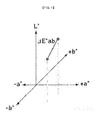
- FIG. 1 is a graph showing a color difference on an L*a*b* colorimetric system.
- (meth)acrylate may refer to “acrylate” and “methacrylate”.
- (meth)acrylic acid alkyl ester may refer to both “acrylic acid alkyl ester” and “methacrylic acid alkyl ester”.
- the term “diameter” refers to the length of a line connecting two points in a closed curved, passing through the center of a particle, and the “closed curve” is a curved line where a point moves in one direction and returns to the departure point.
- the term “long diameter” indicates the longest diameter of the particle, and the term “average particle diameter” indicates the diameter of 50% on cumulative particle size distribution curve.
- the term “thickness” means the length of the longest axis perpendicular to the plane containing the major axis and the minor axis.
- the average particle diameter in this specification was determined by taking a sample of a molded article, scanning a cross section of the sample by a scanning electron microscope (SEM), measuring the diameters of over 50 particles which exist on the image.
- SEM scanning electron microscope
- a composition that can provide a pearlescent gloss appearance and a molded product thereof is provided.
- Flop index can be used as a performance index of the molded product.
- Flop index is used as an index of metal-like texture of a surface and may be generally obtained by measuring luminance (L) of reflective light at 15°, 45° and 110°.
- the flop index may be defined in the following Equation 1.
- FI 2.69 * L 15 ⁇ ° - L 110 ⁇ ° 1.11 / L ⁇ 45 ⁇ ° 0.86
- FI refers to a flop index
- L 15° refers to a reflective luminance (L) at 15°
- L 45° refers to a reflective luminance (L) at 45°
- L 110° refers to a reflective luminance (L) at 110°.
- the flop index of a surface having no metal texture is indicated as 0, the flop index of metal ranges from 15 to 17, the flop index of a metal texture coating used for an automobile body paint is 11; and the flop index of the metal texture sensed by eyes (that is, which can be detected or is visible to the naked eye) is greater than or equal to 6.5.
- dL is a deviation of lightness and darkness
- da is a deviation of red and green values
- db is a deviation of yellow and blue values
- the color difference is the value obtained by square root of adding all the squares of each dL, da and db.
- FIG. 1 is a graph showing a color difference represented by Equation 2 in an L*a*b* colorimetric system, and the detailed description thereof is omitted because it is the same as above.
- dL, da, and db in this specification are measured by using a spectrophotometer (manufacturer: Konica Minolta Co. model name: CM-3500d).
- thermoplastic resin composition that includes a thermoplastic resin; a pearlescent pigment; and a pigment that is different than the pearlescent pigment, wherein the pearlescent pigment and pigment have da and db satisfying da ⁇ 15 and db ⁇ 15 in an L*a*b* colorimetric system, respectively.
- the flow mark or the weld line can be significant and thus a complicated injection molding process may be required. This in turn can limit molding only simple-shaped injection molded products.
- the flow mark and/or the weld line which may be generated by an injection molding process may be invisible to the naked eye.
- the pearlescent molded product may be produced by an injection molding process, for example, using a pearlescent pigment and pigment that is different from the pearlescent pigment having a similar color, without requiring a subsequent painting process.
- the thermoplastic resin composition may include the pearlescent pigment in an amount of 0.1 to 2 parts by weight, for example 0.1 to 1 part by weight, based on 100 parts by weight of thermoplastic resin.
- the thermoplastic resin composition may include the pearlescent pigment in an amount of 0.1, 0.2, 0.3, 0.4, 0.5, 0.6, 0.7, 0.8, 0.9, 1, or 2 parts by weight.
- the amount of the pearlescent pigment can be in a range from any of the foregoing amounts to any other of the foregoing amounts.
- the obtained pearlescent molded product may have an improved appearance.
- the pearlescent pigment when used in an amount outside of the above range, the pearlescent texture can be insufficient and/or physical properties such as impact strength, thermal stability or the like can be deteriorated.
- the pigment that is different from the pearlescent pigment may be an organic pigment, an inorganic pigment, or a combination thereof, which is described hereinafter.
- the thermoplastic resin composition may include the pigment that is different from the pearlescent pigment in an amount of 0.1 to 2 parts by weight, for example 0.1 to 1 part by weight, based on 100 parts by weight of thermoplastic resin.
- the thermoplastic resin composition can include the pigment in an amount of 0.1, 0.2, 0.3, 0.4, 0.5, 0.6, 0.7, 0.8, 0.9, 1, or 2 parts by weight.
- the amount of the pigment may be in a range from any of the foregoing amounts to any other of the foregoing amounts.
- the obtained pearlescent molded product may have an improved appearance, and the amount of the pigment may be adjusted according to the amount of the pearlescent pigment.
- thermoplastic resin composition generates few or no flow marks and/or weld lines during injection molding, so as to provide a molded product that can have an excellent pearlescent gloss.
- thermoplastic resin composition of the invention may be used in the production of a molded product that can have an excellent appearance, such as but not limited to exterior plastic products for electronic parts, automobile parts and the like without requiring an additional painting process.
- thermoplastic resin composition is described in detail.
- the thermoplastic resin may be any thermoplastic resin.
- the thermoplastic resin may include without limitation polycarbonate resins, rubber modified vinyl-based copolymer resins, polyester resins, polyalkyl(meth)acrylate resins, styrenic resins, polyolefin resins, and the like, and combinations thereof.
- the thermoplastic resin may provide basic properties such as impact resistance, heat resistance, flexural properties, tensile properties, and the like.
- the polycarbonate resin may be prepared by reacting one or more diphenols with a compound of a phosgene, halogen formate, carbonate ester, or a combination thereof.
- diphenols examples include without limitation hydroquinone, resorcinol, 4,4'-dihydroxydiphenyl, 2,2-bis(4-hydroxyphenyl)propane (referred to as "bisphenol-A"), 2,4-bis(4-hydroxyphenyl)-2-methylbutane, bis(4-hydroxyphenyl)methane, 1,1-bis(4-hydroxyphenyl)cyclohexane, 2,2-bis(3-chloro-4-hydroxyphenyl)propane, 2,2-bis(3,5-dimethyl-4-hydroxyphenyl)propane, 2,2-bis(3,5-dichloro-4-hydroxyphenyl)propane, 2,2-bis(3,5-dibromo-4-hydroxyphenyl)propane, bis(4-hydroxyphenyl)sulfoxide, bis(4-hydroxyphenyl)ketone, bis(4-hydroxyphenyl)ether, and the like, and combinations thereof.
- bisphenol-A 2,2-bis(4-hydroxyphenyl
- 2,2-bis(4-hydroxyphenyl)propane 2,2-bis(3,5-dichloro-4-hydroxyphenyl)propane or 1,1-bis(4-hydroxyphenyl)cyclohexane may be used, for example 2,2-bis(4-hydroxyphenyl)propane may be used.
- the polycarbonate resin may have a weight average molecular weight of 10,000 to 200,000 g/mol, for example 15,000 to 80,000 g/mol, but the present invention is not limited to the use of polycarbonate with a molecular weight falling within the above ranges.
- the polycarbonate resin may be a copolymer or a mixture of copolymers obtained using two or more diphenols that differ from each other.
- the polycarbonate resins may also include without limitation linear polycarbonate resins, branched polycarbonate resins, polyester carbonate copolymer resins, and the like, and combinations thereof.
- the linear polycarbonate resin may include a bisphenol-A-based polycarbonate resin.
- the branched polycarbonate resin may be produced by reacting a multi-functional aromatic compound such as trimellitic anhydride, trimellitic acid, and the like with one or more diphenols and a carbonate.
- the multi-functional aromatic compound may be included in an amount of 0.05 to 2 mol% based on the total weight of the branched polycarbonate resin.
- the polyester carbonate copolymer resin may be produced by reacting difunctional carboxylic acid with one or more diphenols and a carbonate.
- the carbonate may include a diaryl carbonate such as diphenyl carbonate, ethylene carbonate, and the like.
- the rubber modified vinyl-based copolymer resin may include 5 to 95 wt% of a vinyl-based copolymer and 5 to 95 wt% of a rubbery polymer.
- the rubber modified vinyl-based copolymer resin may include a vinyl-based copolymer in an amount of 5, 6, 7, 8, 9, 10, 11, 12, 13, 14, 15, 16, 17, 18, 19, 20, 21, 22, 23, 24, 25, 26, 27, 28, 29, 30, 31, 32, 33, 34, 35, 36, 37, 38, 39, 40, 41, 42, 43, 44, 45, 46, 47, 48, 49, 50, 51, 52, 53, 54, 55, 56, 57, 58, 59, 60, 61, 62, 63, 64, 65, 66, 67, 68, 69, 70, 71, 72, 73, 74, 75, 76, 77, 78, 79, 80, 81, 82, 83, 84, 85, 86, 87, 88, 89, 90, 91, 92, 93, 94, or 95 wt%.
- the amount of vinyl-based copolymer can be in a range from any of the foregoing
- the rubber modified vinyl-based copolymer resin may include a rubbery polymer in an amount of 5, 6, 7, 8, 9, 10, 11, 12, 13, 14, 15, 16, 17, 18, 19, 20, 21, 22, 23, 24, 25, 26, 27, 28, 29, 30, 31, 32, 33, 34, 35, 36, 37, 38, 39, 40, 41, 42, 43, 44, 45, 46, 47, 48, 49, 50, 51, 52, 53, 54, 55, 56, 57, 58, 59, 60, 61, 62, 63, 64, 65, 66, 67, 68, 69, 70, 71, 72, 73, 74, 75, 76, 77, 78, 79, 80, 81, 82, 83, 84, 85, 86, 87, 88, 89, 90, 91, 92, 93, 94, or 95 wt%.
- the amount of rubbery polymer can be in a range from any of the foregoing amounts to any other of the amount of the amount of the amount of the amount to any other of
- Examples of the rubbery polymer may include without limitation butadiene rubbers, acrylic rubbers, ethylene/propylene rubbers, styrene/butadiene rubbers, acrylonitrile/butadiene rubbers, isoprene rubbers, ethylene-propylene-diene terpolymer (EPDM) rubbers, polyorganosiloxane/polyalkyl(meth)acrylate rubber composites, and the like, and combinations thereof.
- EPDM ethylene-propylene-diene terpolymer
- the vinyl-based copolymer may be a copolymer of 50 to 95 wt% of a first vinyl-based monomer including an aromatic vinyl monomer, an acrylic-based monomer, a heterocyclic monomer, or a combination thereof; and 5 to 50 wt% of a second vinyl-based monomer including an unsaturated nitrile monomer, an acrylic-based monomer, a heterocyclic monomer, or a combination thereof.
- the vinyl-based copolymer may include the first vinyl-based monomer in an amount of 50, 51, 52, 53, 54, 55, 56, 57, 58, 59, 60, 61, 62, 63, 64, 65, 66, 67, 68, 69, 70, 71, 72, 73, 74, 75, 76, 77, 78, 79, 80, 81, 82, 83, 84, 85, 86, 87, 88, 89, 90, 91, 92, 93, 94, or 95 wt%.
- the amount of the first vinyl-based monomer can be in a range from any of the foregoing amounts to any other of the foregoing amounts.
- the vinyl-based copolymer may include the second vinyl-based monomer in an amount of 5, 6, 7, 8, 9, 10, 11, 12, 13, 14, 15, 16, 17, 18, 19, 20, 21, 22, 23, 24, 25, 26, 27, 28, 29, 30, 31, 32, 33, 34, 35, 36, 37, 38, 39, 40, 41, 42, 43, 44, 45, 46, 47, 48, 49, or 50 wt%.
- the amount of the second vinyl-based monomer can be in a range from any of the foregoing amounts to any other of the foregoing amounts.
- Examples of the aromatic vinyl monomer may include without limitation styrene, C1 to C10 alkyl-substituted styrenes, halogen-substituted styrenes, and the like, and combinations thereof.
- Examples of the alkyl-substituted styrene may include without limitation o-ethyl styrene, m-ethyl styrene, p-ethyl styrene, ⁇ -methyl styrene, and the like, and combinations thereof.
- acrylic-based monomer may include without limitation (meth)acrylic acid alkyl esters, (meth)acrylic acid esters, and the like, and combinations thereof.
- the alkyl may be a C1 to C10 alkyl.
- the (meth)acrylic acid alkyl ester may include without limitation methyl(meth)acrylate, ethyl(meth)acrylate, propyl(meth)acrylate, butyl(meth)acrylate, and the like, and combinations thereof. In exemplary embodiments, methyl(meth)acrylate may be used.
- heterocyclic monomer may include without limitation maleic anhydride, C1 to C10 alkyl or phenyl N-substituted maleimides, and the like, and combinations thereof.
- Examples of the unsaturated nitrile monomer may include without limitation acrylonitrile, methacrylonitrile, ethacrylonitrile, and the like, and combinations thereof.
- a rubber particle When the rubber modified vinyl-based copolymer is prepared, a rubber particle may have a particle diameter of 0.05 to 4 ⁇ m to improve the impact resistance and surface appearance of a molded product. When the particle diameter of the rubber particle ranges from 0.05 to 4 ⁇ m, excellent impact strength may be secured.
- the rubber modified vinyl-based copolymer may be used singularly or as a mixture of two or more.
- the rubber modified vinyl-based copolymer may include styrene, acrylonitrile, and optionally methyl(meth)acrylate graft-copolymerized on a butadiene rubber, an acrylic rubber, or a styrene/butadiene rubber.
- the rubber modified vinyl-based copolymer may include methyl(meth)acrylate graft-copolymerized on a butadiene rubber, an acrylic rubber, or a styrene/butadiene rubber.
- the rubber modified vinyl-based copolymer may include an acrylonitrile-butadiene-styrene copolymer resin.
- Emulsion polymerization or bulk polymerization includes adding the aforementioned aromatic vinyl monomer to a rubbery polymer and using a polymerization initiator.
- the polyester resin is an aromatic polyester resin, and it may be a condensation-polymerized resin obtained from terephthalic acid or terephthalic acid alkyl ester, and a C2 to C10 glycol.
- the alkyl may be a C1 to C10 alkyl.
- aromatic polyester resin may include without limitation polyethylene terephthalate resins, polytrimethylene terephthalate resins, polybutylene terephthalate resins, polyhexamethylene terephthalate resins, polycyclohexane dimethylene terephthalate resins, polyester resins modified into a non-crystalline resin by mixing the resins with another monomer, and the like, and combinations thereof.
- the aromatic polyester resin can include a polyethylene terephthalate resin, a polytrimethylene terephthalate resin, a polybutylene terephthalate resin, a non-crystalline polyethylene terephthalate resin or a combination thereof, for example a polybutylene terephthalate resin and/or a polyethylene terephthalate resin may be used.
- the polybutylene terephthalate resin is a condensation-polymerized polymer obtained through a direct ester reaction or an ester exchange reaction of 1,4-butanediol, and terephthalic acid or dimethyl terephthalate monomer.
- the polybutylene terephthalate resin may be modified by copolymerization with polytetramethylene glycol (PTMG), polyethylene glycol (PEG), and/or polypropylene glycol (PPG), and/or by blending with a low molecular-weight aliphatic polyester and/or aliphatic polyamide.
- PTMG polytetramethylene glycol
- PEG polyethylene glycol
- PPG polypropylene glycol
- the polybutylene terephthalate resin may have an intrinsic viscosity [ ⁇ ] of 0.35 to 1.5 dl/g, for example 0.5 to 1.3 dl/g in o-chloro phenol at 25°C.
- the polybutylene terephthalate resin may have excellent mechanical strength and flowability.
- the polyalkyl(meth)acrylate resin may be obtained by polymerizing a monomer including an alkyl(meth)acrylate through a known polymerization method, such as a suspension polymerization method, a bulk polymerization method, an emulsion polymerization method and the like.
- the alkyl(meth)acrylate may have a C1 to C10 alkyl group.
- Examples of the alkyl(meth)acrylate may include without limitation methyl(meth)acrylate, ethyl(meth)acrylate, butyl(meth)acrylate, glycidyl(meth)acrylate, hydroxyethyl(meth)acrylate, and the like, and combinations thereof.
- the polyalkyl(meth)acrylate may have a weight average molecular weight of 10,000 to 200,000 g/mol, for example 15,000 to 150,000 g/mol.
- weight average molecular weight 10,000 to 200,000 g/mol, for example 15,000 to 150,000 g/mol.
- the styrenic resin may include a polymer including 20 to 100 wt% of an aromatic vinyl monomer; and 0 to 80 wt% of a vinyl-based monomer.
- the vinyl-based monomer may include without limitation unsaturated nitrile monomers, acrylic-based monomers, heterocyclic monomers, and the like, and combinations thereof.
- the styrenic resin may include the aromatic vinyl monomer in an amount of 20, 21, 22, 23, 24, 25, 26, 27, 28, 29, 30, 31, 32, 33, 34, 35, 36, 37, 38, 39, 40, 41, 42, 43, 44, 45, 46, 47, 48, 49, 50, 51, 52, 53, 54, 55, 56, 57, 58, 59, 60, 61, 62, 63, 64, 65, 66, 67, 68, 69, 70, 71, 72, 73, 74, 75, 76, 77, 78, 79, 80, 81, 82, 83, 84, 85, 86, 87, 88, 89, 90, 91, 92, 93, 94, 95, 96, 97, 98, 99, or 100 wt%.
- the amount of the aromatic vinyl monomer can be in a range from any of the foregoing amounts to any other of the foregoing amounts.
- the styrenic resin may include a vinyl-based monomer in an amount of 0 (the vinyl-based monomer is not present), 0 (the vinyl-based monomer is present), 1, 2, 3, 4, 5, 6, 7, 8, 9, 10, 11, 12, 13, 14, 15, 16, 17, 18, 19, 20, 21, 22, 23, 24, 25, 26, 27, 28, 29, 30, 31, 32, 33, 34, 35, 36, 37, 38, 39, 40, 41, 42, 43, 44, 45, 46, 47, 48, 50, 51, 52, 53, 54, 55, 56, 57, 58, 59, 60, 61, 62, 63, 64, 65, 66, 67, 68, 69, 70, 71, 72, 73, 74, 75, 76, 77, 78, 79, or 80 wt%.
- the amount of the vinyl-based monomer can be in a range from any of the foregoing amounts to any other of the foregoing amounts.
- Examples of the aromatic vinyl monomer may include without limitation styrene, C1 to C10 alkyl-substituted styrenes, halogen-substituted styrenes, and the like, and combinations thereof.
- Examples of the alkyl-substituted styrene may include without limitation o-ethyl styrene, m-ethyl styrene, p-ethyl styrene, ⁇ -methyl styrene, and the like, and combinations thereof.
- the styrenic resin may include, for example, a rubber modified polystyrene (HIPS) resin.
- polystyrene resins examples include without limitation polyethylene (PE) resins, polypropylene (PP) resins, copolymers thereof, and the like, and combinations thereof.
- the thermoplastic resin may be used in a form of mixture of at least two kinds thereof.
- examples thereof may include without limitation a mixture of polycarbonate, an acrylonitrile-butadiene-styrene (ABS) resin; a mixture of polycarbonate, an acrylate-styrene-acrylonitrile (ASA) resin; and the like.
- the pearlescent pigment comprises a substrate which may be a thin flake.
- the pearlescent pigment include without limitation plate-shaped titanium dioxide, synthetic and/or natural mica, glass flake, metal flake, plate-shaped silica, plate-shaped alumina, plate-shaped iron oxide, and the like, and combinations thereof.
- Pearlescent pigments suitable for use in the invention are known and are commercially available.
- the pearlescent pigment may provide a unique appearance to a molded article such as excellent decorativeness and plentiful change together with the various colors on the surface of molded product by reflecting the incident light.
- compositions of the invention including the pearlescent pigment may be used in a wide variety of fields such as automobiles, motorcycles, OA devices, telephones, mobile phones, various printed matters, writing implements, and the like.
- the composition including the pearlescent pigment can be useful in the production of exterior plastic products for products exposed to outdoor elements and requiring high weather resistance, such as automobiles and motorcycles.
- exterior plastic products for products exposed to outdoor elements and requiring high weather resistance, such as automobiles and motorcycles.
- UV radiation ultraviolet
- decomposition or discoloration can be accelerated due to the photo catalyst activity of titanium dioxide and/or iron oxide included in the pigment.
- One embodiment of the present invention may include a pearlescent pigment in which polysiloxane and a rare earth element metal compound are adhered to mica flake coated with metal oxide, such as disclosed in Japanese Patent Laid-Open Publication No. 1985-92359 , the entire disclosure of which is incorporated by reference, in order to prevent the decomposition or the discoloration of a pigment.
- One embodiment of the present invention may include a pearlescent pigment in which (i) a zirconium oxide hydrate produced by hydrolyzing a zirconium compound in the presence of hypophosphorous acid, and (ii) an oxide hydrate produced by hydrolyzing a water-soluble compound of at least one metal selected from the group consisting of cobalt, manganese, and cerium are adhered to the surface of mica flake coated with metal oxide, such as disclosed in Japanese Patent Laid-Open Publication No. 1989-292067 , the entire disclosure of which is incorporated by reference.
- One embodiment of the present invention may include a pearlescent pigment in which a micro plate-shaped substrate coated with metal oxide is coated with a covering layer such as disclosed in Japanese Patent Laid-Open Publication No. 1995-18199 , the entire disclosure of which is incorporated by reference.
- the covering layer can include silicon dioxide, a metal hydroxide, and/or an organic coupling agent.
- One embodiment of the present invention may include a pearlescent pigment in which mica flake coated with a titanium dioxide or an iron oxide is coated with a cerium hydroxide and an aluminum oxide, such as disclosed in Japanese Patent Laid-Open Publication No. 1995-268241 , the entire disclosure of which is incorporated by reference.
- One embodiment of the present invention may include a pearlescent pigment in which mica flake coated with a titanium dioxide or an iron oxide is coated with an aluminum hydroxide (or cerium hydroxide and aluminum hydroxide) and treated with a silane coupling agent, such as disclosed in. Japanese Patent Laid-Open Publication No. 2000-505833 , the entire disclosure of which is incorporated by reference.
- the present invention may include a pearlescent pigment in which a plate-shaped substrate is coated with a layer of hydroxide of Al or Si, a layer of hydroxide of at least one element selected from the group consisting of Al, Si, Ce, and Zr, and a layer of an organic hydrophobic coupling agent, such as disclosed in Japanese Patent Laid-Open Publication No. 2002-194247 , the entire disclosure of which is incorporated by reference.
- the present invention may include an additional pigment that is not the same as the pearlescent pigment described above.
- the pigment may be an organic pigment, an inorganic pigment, or a combination thereof. Pigments suitable for use in the invention are known and are commercially available.
- the pigment may be any pigment known in the art to be useful in a general paint. Examples thereof may include without limitation phthalocyanine pigments, quinacridone pigments, perylene pigments, anthraquinone pigments, DPP pigments, metal complex pigments, transparent iron oxide pigments, carbon black, titanium oxide, zinc oxide, and the like, and combinations thereof. Additional examples of the pigment may include without limitation metal powder pigments such as aluminum powder, copper powder, stainless steel powder, and the like, and combinations thereof.
- the pigment may include a special metal pigment such as but not limited to metal colloid, and the like, and combinations thereof.
- the pigment according to one embodiment may include mica pigment which is a widely known material, such as but not limited to, transparent pearl mica, colored mica, and the like, and combinations thereof.
- the pigment may include an optical interference pigment also as known in the art, such as but not limited to interference mica, interference alumina, interference silica (interference glass), and the like, and combinations thereof.
- thermoplastic resin composition in the thermoplastic resin composition according to one embodiment, other fillers, an antistatic agent, a stabilizer, an antioxidant, an ultraviolet (UV) absorber and the like and combinations thereof may be mixed together with the pigment, if required.
- an antistatic agent e.g., sodium metabisulfite, sodium metabisulfite, sodium metabisulfite, sodium metabisulfite, sodium metabisulfite, sodium metabisulfite, sodium metabisulfite, sodium metabisulfite, sodium metabisulfite, sodium metabisulfite, sodium metabisulfite, sodium metabisulfite, sodium metabisulfite, sodium metabisulfite, sodium metabisulfite, sodium metabisulfite, sodium metabisulfite, sodium metabisulfite, sodium metabisulfite, sodium metabisulfite, sodium metabisulfite, sodium metabisulfite, sodium metabisulfite, sodium metabisulfite, sodium metabisulfite, sodium metabisulfite
- thermoplastic resin composition may further comprise an inorganic particle that is different from the pearlescent pigment and the other pigment described above.
- Inorganic particles suitable for use in the invention are known and are commercially available.
- the inorganic particle may be a different kind of sparkling particle having a flat surface reflecting light.
- the flat surface can have a degree of flatness such that the sparkling particles can be identified or seen with the naked eye, for example, the surface of a glass plate.
- the inorganic particle may include without limitation glass particles, mica, graphite, pearl particles, and the like, and combinations thereof.
- the inorganic particle can be a glass particle.
- the glass particle can have a plate-shaped structure so that it differs structurally from a glass fiber having a cylindrical shape.
- a cylindrical glass fiber does not provide a metal-like texture because it does not reflect light.
- the cross-sectional configuration of the glass particle is not limited and can have, for example, can have a circular, oval, amorphous, or other cross-section.
- the inorganic particle may have an average particle diameter of 10 to 200 ⁇ m, a thickness of 0.5 to 10 ⁇ m, and a cross-sectional area of 80 to 32,000 ⁇ m 2 .
- the molded product can have an excellent metal-like texture with few or no flow mark(s) and/or weld line(s).
- the thermoplastic resin composition may include the inorganic particle in an amount of 0.1 to 3.0 parts by weight, for example, 0.1 to 1.2 parts by weight, based on 100 parts by weight of the thermoplastic resin.
- the thermoplastic resin composition can include the inorganic particle in an amount of 0.1, 0.2, 0.3, 0.4, 0.5, 0.6, 0.7, 0.8, 0.9, 1, 2, or 3 parts by weight.
- the amount of the inorganic particle can be in a range from any of the foregoing amounts to any other of the foregoing amounts.
- thermoplastic resin composition includes the inorganic particle in an amount within the above range
- a molded product formed of the composition may have excellent impact strength and excellent metal-like texture with few or no flow mark(s) and/or weld line(s).
- the thermoplastic resin composition may further include one or more additive(s).
- additive may include without limitation antibacterial agents, heat stabilizers, antioxidants, release agents, light stabilizers, surfactants, coupling agents, plasticizers, admixtures, colorants, stabilizers, lubricants, anti-static agents, coloring aids, flame retardants, weather-resistance agents, ultraviolet (UV) absorbers, ultraviolet (UV) blocking agents, nucleating agents, adhesion aids, adhesives, and the like, and combinations thereof.
- antioxidants examples include without limitation phenol type antioxidants, phosphite type antioxidants, thioether type antioxidants, amine type antioxidants, and the like, and combinations thereof.
- release agent may include without limitation fluorine-containing polymers, silicone oils, stearic acid metal salts, montanic acid metal salts, montanic ester waxes, polyethylene waxes, and the like, and combinations thereof.
- weather-resistance agent may include without limitation benzophenone-type weather-resistance agents, benzotriazole-type weather-resistance agents, amine-type weather-resistance agents, and the like, and combinations thereof.
- Examples of the colorant may include without limitation dyes, pigments, and the like, and combinations thereof.
- UV ray blocking agent examples include without limitation titanium dioxide (TiO 2 ), carbon black, and the like, and combinations thereof.
- nucleating agent examples include without limitation talc, clay, and the like, and combinations thereof.
- the additive may be included in a predetermined amount as long as it does not deteriorate the properties of the thermoplastic resin composition.
- the thermoplastic resin composition may include the additive(s) in an amount of less than or equal to 40 parts by weight, for example 0.1 to 30 parts by weight, based on 100 parts by weight of the thermoplastic resin.
- thermoplastic resin composition may be prepared using any well-known method of preparing a thermoplastic resin composition.
- each component according to one embodiment of the present invention can be simultaneously mixed optionally with one or more optional additives.
- the mixture can be melt-extruded and prepared into pellets.
- thermoplastic resin composition can be used to manufacture a molded product using various conventional processes such as injection molding, blow molding, extrusion molding, compression molding, and the like.
- the composition of the invention may be used to manufacture a molded product such as but not limited to plastic exterior products for electronic parts, automobile parts, and the like having few or no flow mark(s) and/or weld line(s) and having the appearance of a metal-like texture.
- Thermoplastic resin compositions are prepared using the types and amounts of components as shown in the following Table 1: (Table 1) Examples Comparative Examples 1 2 3 4 5 6 7 8 1 2 3 4 5 6 (A) Thermoplastic resin (parts by weight) 100 100 100 100 100 100 100 100 100 100 100 100 100 100 (B) Pearlescent pigment (B-1) (parts by weight) 0.3 0.1 0.5 1.0 - - - - 0.3 1.0 - - - - (B-2) (parts by weight) - - - - 0.3 1.0 - - - - 0.3 1.0 - - (B-3) (parts by weight) - - - - - - - 0.3 1.0 - - - - 0.3 1.0 (C) Pigment (C-1) (parts by weight) 0.5 0.3 0.3 0.5 - - - - - - - - - - 0.5 0.5 (C-2) (parts by weight)
- thermoplastic resin composition according to Examples 1 to 8 and Comparative Examples 1 to 6 is prepared using the types and amounts of components shown in Table 1 and then extruded in a general twin-screw extruder at a temperature range of 180 to 240°C to provide extruded pellets.
- the pellets obtained from Examples 1 to 8 and Comparative Examples 1 to 6 are dried at 80°C for 4 hours, and a ASTM dumbbell-like specimen is injection molded using an injection molding machine having a 6 Oz injection capacity by setting a cylinder temperature of 210 to 230°C, a mold temperature of 60°C, a molding cycle time at 30 seconds to provide a specimen.
- the flop index is measured by using a spectrophotometer (manufacturer: BYK, model name: BYK Mac).
- the flip-flop effect which is inherent texture of pearlescent pigment, is evaluated by coordinating three angles of 15°, 45° and 110°, and the results are shown in Table 2.
- thermoplastic resin compositions according to Examples 1 to 8 have excellent pearlescent texture and decreased flow mark and the weld line.
Landscapes
- Chemical & Material Sciences (AREA)
- Organic Chemistry (AREA)
- Health & Medical Sciences (AREA)
- Chemical Kinetics & Catalysis (AREA)
- Medicinal Chemistry (AREA)
- Polymers & Plastics (AREA)
- Compositions Of Macromolecular Compounds (AREA)
Abstract
Description
- A thermoplastic resin composition is disclosed.
- Pearlescent pigments are known. An example includes a substrate such as mica coated with a metal oxide having a high refractive index such as titanium dioxide or the like on the surface thereof.
- Recently, a pearlescent pigment using plate-shaped alumina as a substrate to improve surface smoothness, heat resistance, and transparency which are defects of mica, has been disclosed (Japanese Patent Laid-Open Publication No.
1997-255891 - However, the method disclosed in the patent specification may not provide a pigment having a satisfactory brightness when the substrate is plate-shaped alumina produced by a hydrothermal method. In this case, adherence of metal oxide particle to the plate-shaped alumina can be significantly deteriorated, and the metal oxide can coagulate to form a large coagulated particle.
- In addition, even if the metal oxide particle adheres to the plate-shaped alumina, the particle size of metal oxide coated on the substrate is large, and it can be difficult to provide a silky pearlescent gloss having uniform brightness without particle texture, so that the decorative effect required in various fields may not be satisfactory.
- In addition to the above method which attempts to improve the inherent properties of the pearlescent pigment, there have also been efforts to prevent flow marks or weld lines when injection molding a thermoplastic resin composition including a pearlescent pigment. Such efforts, however, have met with limited success.
- It is the object of the present invention to provide a thermoplastic resin composition that can have a pearlescent gloss effect changing color according to an angle between a light source and the naked eye and which can form few or no flow mark(s) and/or weld line(s) during injection molding.
- This object has been achieved by the provision of a thermoplastic resin composition that includes a thermoplastic resin; a pearlescent pigment; and a pigment that is different from the pearlescent pigment, wherein the pearlescent pigment and pigment have da and db satisfying da < 15 and db < 15 measured in accordance with an L*a*b* colorimetric system, respectively.
- The thermoplastic resin composition may include the pearlescent pigment in an amount of 0.1 to 2 parts by weight, for example 0.1 to 1 part by weight, based on 100 parts by weight of thermoplastic resin.
- The thermoplastic resin composition may include the pigment that is different from the pearlescent pigment in an amount of 0.1 to 2 parts by weight, for example 0.1 to 1 part by weight, based on 100 parts by weight of thermoplastic resin.
- The pigment that is different from the pearlescent pigment may be an organic pigment, an inorganic pigment, or a combination thereof.
- The pearlescent pigment may have an average particle diameter of 0.1 to 50 µm.
- The thermoplastic resin may be a polycarbonate resin, a rubber modified vinyl-based copolymer resin, a polyester resin, a polyalkyl(meth)acrylate resin, a styrenic resin, a polyolefin resin, or a combination thereof.
- The thermoplastic resin composition may further comprise an inorganic particle. Examples of the inorganic particle may include without limitation glass particles, mica, graphite, pearl particles, and the like, and combinations thereof.
- The thermoplastic resin composition may include the inorganic particle in an amount of 0.1 to 3 parts by weight based on 100 parts by weight of the thermoplastic resin.
- The invention also provides a molded product made using the thermoplastic resin composition. The molded product can have a pearlescent appearance changing colors depending on the angles between a light source and the naked eye and can have minimal or no flow mark(s) and/or weld line(s) generated during injection molding processes.
-
FIG. 1 is a graph showing a color difference on an L*a*b* colorimetric system. - The present invention will be described more fully hereinafter in the following detailed description of the invention, in which some but not all embodiments of the invention are described. Indeed, this invention may be embodied in many different forms and should not be construed as limited to the embodiments set forth herein; rather, these embodiments are provided so that this disclosure will satisfy applicable legal requirements.
- When a specific definition is not otherwise provided, the term "(meth)acrylate" may refer to "acrylate" and "methacrylate". "(meth)acrylic acid alkyl ester" may refer to both "acrylic acid alkyl ester" and "methacrylic acid alkyl ester".
- When a specific definition is not otherwise provided, the term "diameter" refers to the length of a line connecting two points in a closed curved, passing through the center of a particle, and the "closed curve" is a curved line where a point moves in one direction and returns to the departure point. Also as used herein, the term "long diameter" (major axis) indicates the longest diameter of the particle, and the term "average particle diameter" indicates the diameter of 50% on cumulative particle size distribution curve. As used herein, the term "thickness" means the length of the longest axis perpendicular to the plane containing the major axis and the minor axis.
- The average particle diameter in this specification was determined by taking a sample of a molded article, scanning a cross section of the sample by a scanning electron microscope (SEM), measuring the diameters of over 50 particles which exist on the image.
- In one embodiment of the present invention, a composition that can provide a pearlescent gloss appearance and a molded product thereof is provided. Flop index can be used as a performance index of the molded product.
- Flop index is used as an index of metal-like texture of a surface and may be generally obtained by measuring luminance (L) of reflective light at 15°, 45° and 110°. The flop index may be defined in the following Equation 1.

- In Equation 1, FI refers to a flop index; L 15° refers to a reflective luminance (L) at 15°; L 45° refers to a reflective luminance (L) at 45°; and L 110° refers to a reflective luminance (L) at 110°. The flop index of a surface having no metal texture is indicated as 0, the flop index of metal ranges from 15 to 17, the flop index of a metal texture coating used for an automobile body paint is 11; and the flop index of the metal texture sensed by eyes (that is, which can be detected or is visible to the naked eye) is greater than or equal to 6.5.
- The L*a*b* colorimetric system referenced in this specification is a standard of measurement known in the art used to indicate color difference (dE or ΔE*ab) and means the color difference between two colors stimuli defined by dL, da, and db which are differences of color coordinate L*a*b*, which are represented by positive symbol of dE*ab as shown in the following Equation 2:

- Generally, dL is a deviation of lightness and darkness; da is a deviation of red and green values, db is a deviation of yellow and blue values, and the color difference is the value obtained by square root of adding all the squares of each dL, da and db.
-
FIG. 1 is a graph showing a color difference represented by Equation 2 in an L*a*b* colorimetric system, and the detailed description thereof is omitted because it is the same as above. - The dL, da, and db in this specification are measured by using a spectrophotometer (manufacturer: Konica Minolta Co. model name: CM-3500d).
- According to one embodiment of the present invention, provided is a thermoplastic resin composition that includes a thermoplastic resin; a pearlescent pigment; and a pigment that is different than the pearlescent pigment, wherein the pearlescent pigment and pigment have da and db satisfying da < 15 and db < 15 in an L*a*b* colorimetric system, respectively.
- When adding a plate-shaped inorganic material, the flow mark or the weld line can be significant and thus a complicated injection molding process may be required. This in turn can limit molding only simple-shaped injection molded products.
- In contrast, when the pearlescent pigment and the pigment that is different from the pearlescent pigment have da and db satisfying da < 15 and db < 15 in the L*a*b* colorimetric system, respectively, the flow mark and/or the weld line which may be generated by an injection molding process may be invisible to the naked eye. Also the pearlescent molded product may be produced by an injection molding process, for example, using a pearlescent pigment and pigment that is different from the pearlescent pigment having a similar color, without requiring a subsequent painting process.
- The thermoplastic resin composition may include the pearlescent pigment in an amount of 0.1 to 2 parts by weight, for example 0.1 to 1 part by weight, based on 100 parts by weight of thermoplastic resin. In some embodiments, the thermoplastic resin composition may include the pearlescent pigment in an amount of 0.1, 0.2, 0.3, 0.4, 0.5, 0.6, 0.7, 0.8, 0.9, 1, or 2 parts by weight. Further, according to some embodiments of the present invention, the amount of the pearlescent pigment can be in a range from any of the foregoing amounts to any other of the foregoing amounts.
- When the thermoplastic resin includes the pearlescent pigment in an amount within the above range, the obtained pearlescent molded product may have an improved appearance. However, when the pearlescent pigment is used in an amount outside of the above range, the pearlescent texture can be insufficient and/or physical properties such as impact strength, thermal stability or the like can be deteriorated.
- The pigment that is different from the pearlescent pigment may be an organic pigment, an inorganic pigment, or a combination thereof, which is described hereinafter.
- The thermoplastic resin composition may include the pigment that is different from the pearlescent pigment in an amount of 0.1 to 2 parts by weight, for example 0.1 to 1 part by weight, based on 100 parts by weight of thermoplastic resin. In some embodiments, the thermoplastic resin composition can include the pigment in an amount of 0.1, 0.2, 0.3, 0.4, 0.5, 0.6, 0.7, 0.8, 0.9, 1, or 2 parts by weight. Further, according to some embodiments of the present invention, the amount of the pigment may be in a range from any of the foregoing amounts to any other of the foregoing amounts.
- When the thermoplastic resin composition includes the pigment in an amount within the above range, the obtained pearlescent molded product may have an improved appearance, and the amount of the pigment may be adjusted according to the amount of the pearlescent pigment.
- The thermoplastic resin composition generates few or no flow marks and/or weld lines during injection molding, so as to provide a molded product that can have an excellent pearlescent gloss.
- Accordingly, the thermoplastic resin composition of the invention may be used in the production of a molded product that can have an excellent appearance, such as but not limited to exterior plastic products for electronic parts, automobile parts and the like without requiring an additional painting process.
- Hereinafter each component included in the thermoplastic resin composition is described in detail.
- The thermoplastic resin may be any thermoplastic resin. Examples of the thermoplastic resin may include without limitation polycarbonate resins, rubber modified vinyl-based copolymer resins, polyester resins, polyalkyl(meth)acrylate resins, styrenic resins, polyolefin resins, and the like, and combinations thereof. The thermoplastic resin may provide basic properties such as impact resistance, heat resistance, flexural properties, tensile properties, and the like.
- The polycarbonate resin may be prepared by reacting one or more diphenols with a compound of a phosgene, halogen formate, carbonate ester, or a combination thereof.
- Examples of the diphenols include without limitation hydroquinone, resorcinol, 4,4'-dihydroxydiphenyl, 2,2-bis(4-hydroxyphenyl)propane (referred to as "bisphenol-A"), 2,4-bis(4-hydroxyphenyl)-2-methylbutane, bis(4-hydroxyphenyl)methane, 1,1-bis(4-hydroxyphenyl)cyclohexane, 2,2-bis(3-chloro-4-hydroxyphenyl)propane, 2,2-bis(3,5-dimethyl-4-hydroxyphenyl)propane, 2,2-bis(3,5-dichloro-4-hydroxyphenyl)propane, 2,2-bis(3,5-dibromo-4-hydroxyphenyl)propane, bis(4-hydroxyphenyl)sulfoxide, bis(4-hydroxyphenyl)ketone, bis(4-hydroxyphenyl)ether, and the like, and combinations thereof. In exemplary embodiments, 2,2-bis(4-hydroxyphenyl)propane, 2,2-bis(3,5-dichloro-4-hydroxyphenyl)propane or 1,1-bis(4-hydroxyphenyl)cyclohexane may be used, for example 2,2-bis(4-hydroxyphenyl)propane may be used.
- The polycarbonate resin may have a weight average molecular weight of 10,000 to 200,000 g/mol, for example 15,000 to 80,000 g/mol, but the present invention is not limited to the use of polycarbonate with a molecular weight falling within the above ranges.
- The polycarbonate resin may be a copolymer or a mixture of copolymers obtained using two or more diphenols that differ from each other. The polycarbonate resins may also include without limitation linear polycarbonate resins, branched polycarbonate resins, polyester carbonate copolymer resins, and the like, and combinations thereof.
- The linear polycarbonate resin may include a bisphenol-A-based polycarbonate resin. The branched polycarbonate resin may be produced by reacting a multi-functional aromatic compound such as trimellitic anhydride, trimellitic acid, and the like with one or more diphenols and a carbonate. The multi-functional aromatic compound may be included in an amount of 0.05 to 2 mol% based on the total weight of the branched polycarbonate resin. The polyester carbonate copolymer resin may be produced by reacting difunctional carboxylic acid with one or more diphenols and a carbonate. The carbonate may include a diaryl carbonate such as diphenyl carbonate, ethylene carbonate, and the like.
- The rubber modified vinyl-based copolymer resin may include 5 to 95 wt% of a vinyl-based copolymer and 5 to 95 wt% of a rubbery polymer.
- In some embodiments, the rubber modified vinyl-based copolymer resin may include a vinyl-based copolymer in an amount of 5, 6, 7, 8, 9, 10, 11, 12, 13, 14, 15, 16, 17, 18, 19, 20, 21, 22, 23, 24, 25, 26, 27, 28, 29, 30, 31, 32, 33, 34, 35, 36, 37, 38, 39, 40, 41, 42, 43, 44, 45, 46, 47, 48, 49, 50, 51, 52, 53, 54, 55, 56, 57, 58, 59, 60, 61, 62, 63, 64, 65, 66, 67, 68, 69, 70, 71, 72, 73, 74, 75, 76, 77, 78, 79, 80, 81, 82, 83, 84, 85, 86, 87, 88, 89, 90, 91, 92, 93, 94, or 95 wt%. Further, according to some embodiments of the present invention, the amount of vinyl-based copolymer can be in a range from any of the foregoing amounts to any other of the foregoing amounts.
- In some embodiments, the rubber modified vinyl-based copolymer resin may include a rubbery polymer in an amount of 5, 6, 7, 8, 9, 10, 11, 12, 13, 14, 15, 16, 17, 18, 19, 20, 21, 22, 23, 24, 25, 26, 27, 28, 29, 30, 31, 32, 33, 34, 35, 36, 37, 38, 39, 40, 41, 42, 43, 44, 45, 46, 47, 48, 49, 50, 51, 52, 53, 54, 55, 56, 57, 58, 59, 60, 61, 62, 63, 64, 65, 66, 67, 68, 69, 70, 71, 72, 73, 74, 75, 76, 77, 78, 79, 80, 81, 82, 83, 84, 85, 86, 87, 88, 89, 90, 91, 92, 93, 94, or 95 wt%. Further, according to some embodiments of the present invention, the amount of rubbery polymer can be in a range from any of the foregoing amounts to any other of the foregoing amounts.
- Examples of the rubbery polymer may include without limitation butadiene rubbers, acrylic rubbers, ethylene/propylene rubbers, styrene/butadiene rubbers, acrylonitrile/butadiene rubbers, isoprene rubbers, ethylene-propylene-diene terpolymer (EPDM) rubbers, polyorganosiloxane/polyalkyl(meth)acrylate rubber composites, and the like, and combinations thereof.
- The vinyl-based copolymer may be a copolymer of 50 to 95 wt% of a first vinyl-based monomer including an aromatic vinyl monomer, an acrylic-based monomer, a heterocyclic monomer, or a combination thereof; and 5 to 50 wt% of a second vinyl-based monomer including an unsaturated nitrile monomer, an acrylic-based monomer, a heterocyclic monomer, or a combination thereof.
- In some embodiments, the vinyl-based copolymer may include the first vinyl-based monomer in an amount of 50, 51, 52, 53, 54, 55, 56, 57, 58, 59, 60, 61, 62, 63, 64, 65, 66, 67, 68, 69, 70, 71, 72, 73, 74, 75, 76, 77, 78, 79, 80, 81, 82, 83, 84, 85, 86, 87, 88, 89, 90, 91, 92, 93, 94, or 95 wt%. Further, according to some embodiments of the present invention, the amount of the first vinyl-based monomer can be in a range from any of the foregoing amounts to any other of the foregoing amounts.
- In some embodiments, the vinyl-based copolymer may include the second vinyl-based monomer in an amount of 5, 6, 7, 8, 9, 10, 11, 12, 13, 14, 15, 16, 17, 18, 19, 20, 21, 22, 23, 24, 25, 26, 27, 28, 29, 30, 31, 32, 33, 34, 35, 36, 37, 38, 39, 40, 41, 42, 43, 44, 45, 46, 47, 48, 49, or 50 wt%. Further, according to some embodiments of the present invention, the amount of the second vinyl-based monomer can be in a range from any of the foregoing amounts to any other of the foregoing amounts.
- Examples of the aromatic vinyl monomer may include without limitation styrene, C1 to C10 alkyl-substituted styrenes, halogen-substituted styrenes, and the like, and combinations thereof. Examples of the alkyl-substituted styrene may include without limitation o-ethyl styrene, m-ethyl styrene, p-ethyl styrene, α-methyl styrene, and the like, and combinations thereof.
- Examples of the acrylic-based monomer may include without limitation (meth)acrylic acid alkyl esters, (meth)acrylic acid esters, and the like, and combinations thereof. As used herein, the alkyl may be a C1 to C10 alkyl. Examples of the (meth)acrylic acid alkyl ester may include without limitation methyl(meth)acrylate, ethyl(meth)acrylate, propyl(meth)acrylate, butyl(meth)acrylate, and the like, and combinations thereof. In exemplary embodiments, methyl(meth)acrylate may be used.
- Examples of the heterocyclic monomer may include without limitation maleic anhydride, C1 to C10 alkyl or phenyl N-substituted maleimides, and the like, and combinations thereof.
- Examples of the unsaturated nitrile monomer may include without limitation acrylonitrile, methacrylonitrile, ethacrylonitrile, and the like, and combinations thereof.
- When the rubber modified vinyl-based copolymer is prepared, a rubber particle may have a particle diameter of 0.05 to 4 µm to improve the impact resistance and surface appearance of a molded product. When the particle diameter of the rubber particle ranges from 0.05 to 4 µm, excellent impact strength may be secured.
- The rubber modified vinyl-based copolymer may be used singularly or as a mixture of two or more.
- The rubber modified vinyl-based copolymer may include styrene, acrylonitrile, and optionally methyl(meth)acrylate graft-copolymerized on a butadiene rubber, an acrylic rubber, or a styrene/butadiene rubber.
- The rubber modified vinyl-based copolymer may include methyl(meth)acrylate graft-copolymerized on a butadiene rubber, an acrylic rubber, or a styrene/butadiene rubber.
- The rubber modified vinyl-based copolymer may include an acrylonitrile-butadiene-styrene copolymer resin.
- The method of preparing the rubber modified vinyl-based copolymer is widely known to those skilled in the art, and any method among emulsion polymerization, suspension polymerization, solution polymerization and bulk polymerization may be used. Emulsion polymerization or bulk polymerization includes adding the aforementioned aromatic vinyl monomer to a rubbery polymer and using a polymerization initiator.
- The polyester resin is an aromatic polyester resin, and it may be a condensation-polymerized resin obtained from terephthalic acid or terephthalic acid alkyl ester, and a C2 to C10 glycol. As used herein, the alkyl may be a C1 to C10 alkyl.
- Examples of the aromatic polyester resin may include without limitation polyethylene terephthalate resins, polytrimethylene terephthalate resins, polybutylene terephthalate resins, polyhexamethylene terephthalate resins, polycyclohexane dimethylene terephthalate resins, polyester resins modified into a non-crystalline resin by mixing the resins with another monomer, and the like, and combinations thereof. In exemplary embodiments, the aromatic polyester resin can include a polyethylene terephthalate resin, a polytrimethylene terephthalate resin, a polybutylene terephthalate resin, a non-crystalline polyethylene terephthalate resin or a combination thereof, for example a polybutylene terephthalate resin and/or a polyethylene terephthalate resin may be used.
- The polybutylene terephthalate resin is a condensation-polymerized polymer obtained through a direct ester reaction or an ester exchange reaction of 1,4-butanediol, and terephthalic acid or dimethyl terephthalate monomer.
- To increase the impact strength of the polybutylene terephthalate resin, the polybutylene terephthalate resin may be modified by copolymerization with polytetramethylene glycol (PTMG), polyethylene glycol (PEG), and/or polypropylene glycol (PPG), and/or by blending with a low molecular-weight aliphatic polyester and/or aliphatic polyamide.
- The polybutylene terephthalate resin may have an intrinsic viscosity [η] of 0.35 to 1.5 dl/g, for example 0.5 to 1.3 dl/g in o-chloro phenol at 25°C. When the polybutylene terephthalate resin has an intrinsic viscosity [η] within the above range, the polybutylene terephthalate resin may have excellent mechanical strength and flowability.
- The polyalkyl(meth)acrylate resin may be obtained by polymerizing a monomer including an alkyl(meth)acrylate through a known polymerization method, such as a suspension polymerization method, a bulk polymerization method, an emulsion polymerization method and the like.
- The alkyl(meth)acrylate may have a C1 to C10 alkyl group. Examples of the alkyl(meth)acrylate may include without limitation methyl(meth)acrylate, ethyl(meth)acrylate, butyl(meth)acrylate, glycidyl(meth)acrylate, hydroxyethyl(meth)acrylate, and the like, and combinations thereof.
- The polyalkyl(meth)acrylate may have a weight average molecular weight of 10,000 to 200,000 g/mol, for example 15,000 to 150,000 g/mol. When the polyalkyl(meth)acrylate has a weight average molecular weight within the above range, hydrolysis resistance, scratch resistance, flowability, and the like may be improved.
- The styrenic resin may include a polymer including 20 to 100 wt% of an aromatic vinyl monomer; and 0 to 80 wt% of a vinyl-based monomer. Examples of the vinyl-based monomer may include without limitation unsaturated nitrile monomers, acrylic-based monomers, heterocyclic monomers, and the like, and combinations thereof.
- In some embodiments, the styrenic resin may include the aromatic vinyl monomer in an amount of 20, 21, 22, 23, 24, 25, 26, 27, 28, 29, 30, 31, 32, 33, 34, 35, 36, 37, 38, 39, 40, 41, 42, 43, 44, 45, 46, 47, 48, 49, 50, 51, 52, 53, 54, 55, 56, 57, 58, 59, 60, 61, 62, 63, 64, 65, 66, 67, 68, 69, 70, 71, 72, 73, 74, 75, 76, 77, 78, 79, 80, 81, 82, 83, 84, 85, 86, 87, 88, 89, 90, 91, 92, 93, 94, 95, 96, 97, 98, 99, or 100 wt%. Further, according to some embodiments of the present invention, the amount of the aromatic vinyl monomer can be in a range from any of the foregoing amounts to any other of the foregoing amounts.
- In some embodiments, the styrenic resin may include a vinyl-based monomer in an amount of 0 (the vinyl-based monomer is not present), 0 (the vinyl-based monomer is present), 1, 2, 3, 4, 5, 6, 7, 8, 9, 10, 11, 12, 13, 14, 15, 16, 17, 18, 19, 20, 21, 22, 23, 24, 25, 26, 27, 28, 29, 30, 31, 32, 33, 34, 35, 36, 37, 38, 39, 40, 41, 42, 43, 44, 45, 46, 47, 48, 50, 51, 52, 53, 54, 55, 56, 57, 58, 59, 60, 61, 62, 63, 64, 65, 66, 67, 68, 69, 70, 71, 72, 73, 74, 75, 76, 77, 78, 79, or 80 wt%. Further, according to some embodiments of the present invention, the amount of the vinyl-based monomer can be in a range from any of the foregoing amounts to any other of the foregoing amounts.
- Examples of the aromatic vinyl monomer may include without limitation styrene, C1 to C10 alkyl-substituted styrenes, halogen-substituted styrenes, and the like, and combinations thereof. Examples of the alkyl-substituted styrene may include without limitation o-ethyl styrene, m-ethyl styrene, p-ethyl styrene, α-methyl styrene, and the like, and combinations thereof. The styrenic resin may include, for example, a rubber modified polystyrene (HIPS) resin.
- Examples of the polyolefin resin may include without limitation polyethylene (PE) resins, polypropylene (PP) resins, copolymers thereof, and the like, and combinations thereof.
- The thermoplastic resin may be used in a form of mixture of at least two kinds thereof. Examples thereof may include without limitation a mixture of polycarbonate, an acrylonitrile-butadiene-styrene (ABS) resin; a mixture of polycarbonate, an acrylate-styrene-acrylonitrile (ASA) resin; and the like.
- The pearlescent pigment according to one embodiment comprises a substrate which may be a thin flake. Examples of the pearlescent pigment include without limitation plate-shaped titanium dioxide, synthetic and/or natural mica, glass flake, metal flake, plate-shaped silica, plate-shaped alumina, plate-shaped iron oxide, and the like, and combinations thereof. Pearlescent pigments suitable for use in the invention are known and are commercially available.
- The pearlescent pigment may provide a unique appearance to a molded article such as excellent decorativeness and plentiful change together with the various colors on the surface of molded product by reflecting the incident light.
- To improve the decorativeness, the compositions of the invention including the pearlescent pigment may be used in a wide variety of fields such as automobiles, motorcycles, OA devices, telephones, mobile phones, various printed matters, writing implements, and the like.
- Among them, the composition including the pearlescent pigment can be useful in the production of exterior plastic products for products exposed to outdoor elements and requiring high weather resistance, such as automobiles and motorcycles. For example, when such products are exposed to ultraviolet (UV) radiation, decomposition or discoloration can be accelerated due to the photo catalyst activity of titanium dioxide and/or iron oxide included in the pigment.
- One embodiment of the present invention may include a pearlescent pigment in which polysiloxane and a rare earth element metal compound are adhered to mica flake coated with metal oxide, such as disclosed in Japanese Patent Laid-Open Publication No.
1985-92359 - One embodiment of the present invention may include a pearlescent pigment in which (i) a zirconium oxide hydrate produced by hydrolyzing a zirconium compound in the presence of hypophosphorous acid, and (ii) an oxide hydrate produced by hydrolyzing a water-soluble compound of at least one metal selected from the group consisting of cobalt, manganese, and cerium are adhered to the surface of mica flake coated with metal oxide, such as disclosed in Japanese Patent Laid-Open Publication No.
1989-292067 - One embodiment of the present invention may include a pearlescent pigment in which a micro plate-shaped substrate coated with metal oxide is coated with a covering layer such as disclosed in Japanese Patent Laid-Open Publication No.
1995-18199 - One embodiment of the present invention may include a pearlescent pigment in which mica flake coated with a titanium dioxide or an iron oxide is coated with a cerium hydroxide and an aluminum oxide, such as disclosed in Japanese Patent Laid-Open Publication No.
1995-268241 - One embodiment of the present invention may include a pearlescent pigment in which mica flake coated with a titanium dioxide or an iron oxide is coated with an aluminum hydroxide (or cerium hydroxide and aluminum hydroxide) and treated with a silane coupling agent, such as disclosed in. Japanese Patent Laid-Open Publication No.
2000-505833 - According to one embodiment, the present invention may include a pearlescent pigment in which a plate-shaped substrate is coated with a layer of hydroxide of Al or Si, a layer of hydroxide of at least one element selected from the group consisting of Al, Si, Ce, and Zr, and a layer of an organic hydrophobic coupling agent, such as disclosed in Japanese Patent Laid-Open Publication No.
2002-194247 - The various foregoing pearlescent pigments, and combinations thereof, may be used, but the present invention is not limited to the aforementioned examples of pearlescent pigment.
- The present invention according to one embodiment may include an additional pigment that is not the same as the pearlescent pigment described above. The pigment may be an organic pigment, an inorganic pigment, or a combination thereof. Pigments suitable for use in the invention are known and are commercially available.
- The pigment may be any pigment known in the art to be useful in a general paint. Examples thereof may include without limitation phthalocyanine pigments, quinacridone pigments, perylene pigments, anthraquinone pigments, DPP pigments, metal complex pigments, transparent iron oxide pigments, carbon black, titanium oxide, zinc oxide, and the like, and combinations thereof. Additional examples of the pigment may include without limitation metal powder pigments such as aluminum powder, copper powder, stainless steel powder, and the like, and combinations thereof.
- In addition, the pigment may include a special metal pigment such as but not limited to metal colloid, and the like, and combinations thereof.
- The pigment according to one embodiment may include mica pigment which is a widely known material, such as but not limited to, transparent pearl mica, colored mica, and the like, and combinations thereof. In addition, the pigment may include an optical interference pigment also as known in the art, such as but not limited to interference mica, interference alumina, interference silica (interference glass), and the like, and combinations thereof.
- In the thermoplastic resin composition according to one embodiment, other fillers, an antistatic agent, a stabilizer, an antioxidant, an ultraviolet (UV) absorber and the like and combinations thereof may be mixed together with the pigment, if required.
- The thermoplastic resin composition may further comprise an inorganic particle that is different from the pearlescent pigment and the other pigment described above. Inorganic particles suitable for use in the invention are known and are commercially available.
- The inorganic particle may be a different kind of sparkling particle having a flat surface reflecting light. As used herein, the flat surface can have a degree of flatness such that the sparkling particles can be identified or seen with the naked eye, for example, the surface of a glass plate.
- Examples of the inorganic particle may include without limitation glass particles, mica, graphite, pearl particles, and the like, and combinations thereof. In exemplary embodiments, the inorganic particle can be a glass particle.
- The glass particle can have a plate-shaped structure so that it differs structurally from a glass fiber having a cylindrical shape. A cylindrical glass fiber does not provide a metal-like texture because it does not reflect light.
- The cross-sectional configuration of the glass particle is not limited and can have, for example, can have a circular, oval, amorphous, or other cross-section.
- The inorganic particle may have an average particle diameter of 10 to 200 µm, a thickness of 0.5 to 10 µm, and a cross-sectional area of 80 to 32,000 µm2. When the inorganic particle has an average particle diameter, thickness, and cross-sectional area within the above ranges, the molded product can have an excellent metal-like texture with few or no flow mark(s) and/or weld line(s)..
- The thermoplastic resin composition may include the inorganic particle in an amount of 0.1 to 3.0 parts by weight, for example, 0.1 to 1.2 parts by weight, based on 100 parts by weight of the thermoplastic resin. In some embodiments, the thermoplastic resin composition can include the inorganic particle in an amount of 0.1, 0.2, 0.3, 0.4, 0.5, 0.6, 0.7, 0.8, 0.9, 1, 2, or 3 parts by weight. Further, according to some embodiments of the present invention, the amount of the inorganic particle can be in a range from any of the foregoing amounts to any other of the foregoing amounts.
- When the thermoplastic resin composition includes the inorganic particle in an amount within the above range, a molded product formed of the composition may have excellent impact strength and excellent metal-like texture with few or no flow mark(s) and/or weld line(s).
- The thermoplastic resin composition may further include one or more additive(s). Examples of the additive may include without limitation antibacterial agents, heat stabilizers, antioxidants, release agents, light stabilizers, surfactants, coupling agents, plasticizers, admixtures, colorants, stabilizers, lubricants, anti-static agents, coloring aids, flame retardants, weather-resistance agents, ultraviolet (UV) absorbers, ultraviolet (UV) blocking agents, nucleating agents, adhesion aids, adhesives, and the like, and combinations thereof.
- Examples of the antioxidant may include without limitation phenol type antioxidants, phosphite type antioxidants, thioether type antioxidants, amine type antioxidants, and the like, and combinations thereof.
- Examples of the release agent may include without limitation fluorine-containing polymers, silicone oils, stearic acid metal salts, montanic acid metal salts, montanic ester waxes, polyethylene waxes, and the like, and combinations thereof.
- Examples of the weather-resistance agent may include without limitation benzophenone-type weather-resistance agents, benzotriazole-type weather-resistance agents, amine-type weather-resistance agents, and the like, and combinations thereof.
- Examples of the colorant may include without limitation dyes, pigments, and the like, and combinations thereof.
- Examples of the ultraviolet (UV) ray blocking agent may include without limitation titanium dioxide (TiO2), carbon black, and the like, and combinations thereof.
- Examples of the nucleating agent may include without limitation talc, clay, and the like, and combinations thereof.
- The additive may be included in a predetermined amount as long as it does not deteriorate the properties of the thermoplastic resin composition. It exemplary embodiments, the thermoplastic resin composition may include the additive(s) in an amount of less than or equal to 40 parts by weight, for example 0.1 to 30 parts by weight, based on 100 parts by weight of the thermoplastic resin.
- The thermoplastic resin composition may be prepared using any well-known method of preparing a thermoplastic resin composition. For example, each component according to one embodiment of the present invention can be simultaneously mixed optionally with one or more optional additives. The mixture can be melt-extruded and prepared into pellets.
- According to another embodiment of the present invention, a molded product fabricated using the thermoplastic resin composition is provided. The thermoplastic resin composition can be used to manufacture a molded product using various conventional processes such as injection molding, blow molding, extrusion molding, compression molding, and the like. For example, the composition of the invention may be used to manufacture a molded product such as but not limited to plastic exterior products for electronic parts, automobile parts, and the like having few or no flow mark(s) and/or weld line(s) and having the appearance of a metal-like texture.
- The following examples illustrate this invention in more detail. However, it is understood that this invention is not limited by these examples.
- Thermoplastic resin compositions are prepared using the types and amounts of components as shown in the following Table 1:
(Table 1) Examples Comparative Examples 1 2 3 4 5 6 7 8 1 2 3 4 5 6 (A) Thermoplastic resin (parts by weight) 100 100 100 100 100 100 100 100 100 100 100 100 100 100 (B) Pearlescent pigment (B-1) (parts by weight) 0.3 0.1 0.5 1.0 - - - - 0.3 1.0 - - - - (B-2) (parts by weight) - - - - 0.3 1.0 - - - - 0.3 1.0 - - (B-3) (parts by weight) - - - - - - 0.3 1.0 - - - - 0.3 1.0 (C) Pigment (C-1) (parts by weight) 0.5 0.3 0.3 0.5 - - - - - - - - 0.5 0.5 (C-2) (parts by weight) - - - - 0.5 0.5 - - 0.5 0.5 - - - - (C-3) (parts by weight) - - - - - - 0.5 0.5 - - 0.5 0.5 - - Color difference (CCM) da 3.0 4.2 3.0 4.2 1.9 1.9 2.5 2.5 12.8 -12.8 -25.2 -25.2 38.1 38.1 db 10.1 9.4 10.1 9.4 5.2 5.2 7.7 7.7 28.1 -28.1 21.9 21.9 6.2 6.2 - Each component shown in Table 1 is as follows.
- (A) Thermoplastic resin (Cheil Industries Inc.)
An ABS/PMMA (acrylonitrile-butadiene-styrene/polymethylmethacrylate) blend resin including 30 wt% of styrene-acrylonitrile (SAN) resin, 45 wt% of polymethylmethacrylate (PMMA) resin and 25 wt% of grafted acrylonitrile-butadiene-styrene (g-ABS) resin is used. - (B) Pearlescent pigment (CQV Co.)
- (B-1): M-741S (a*: 13.03, b*: 8.75 in L*a*b* colorimetric system)
- (B-2): M-761 S (a*: 8.32, b*: -22.88 in L*a*b* colorimetric system)
- (B-3): M-791 S (a*: -12.41, b*: -9.35 in L*a*b* colorimetric system)
- (C) Pigment (Eastwell Co.)
- (C-1): Red S-A2G pigment having a color similar to B-1
- (C-2): Violet S-IRS pigment having a color similar to B-2
- (C-3): Green S-6G pigment having a color similar to B-3
- Each thermoplastic resin composition according to Examples 1 to 8 and Comparative Examples 1 to 6 is prepared using the types and amounts of components shown in Table 1 and then extruded in a general twin-screw extruder at a temperature range of 180 to 240°C to provide extruded pellets.
- The pellets obtained from Examples 1 to 8 and Comparative Examples 1 to 6 are dried at 80°C for 4 hours, and a ASTM dumbbell-like specimen is injection molded using an injection molding machine having a 6 Oz injection capacity by setting a cylinder temperature of 210 to 230°C, a mold temperature of 60°C, a molding cycle time at 30 seconds to provide a specimen.
- The obtained specimen is measured for appearance properties, and the results are shown in the following Table 2.
(Table 2) Examples Comparative Examples 1 2 3 4 5 6 7 8 1 2 3 4 5 6 Appearance Pearlesce nt texture (Flop index) 19 18 22 25 22 27 16 22 26 29 27 31 24 28 Flow mark Ⓞ Ⓞ Ⓞ ○ Ⓞ ○ Ⓞ ○ Δ × Δ × Δ × Weld line ○ ○ ○ ○ ○ ○ ○ ○ × × × × × × - The references for evaluating the appearance properties in Table 2 are as follows.
- The flop index is measured by using a spectrophotometer (manufacturer: BYK, model name: BYK Mac). The flip-flop effect, which is inherent texture of pearlescent pigment, is evaluated by coordinating three angles of 15°, 45° and 110°, and the results are shown in Table 2.
- Since mold having two gates are used in the injection molding, a weld line might be produced. The appearance of the injection molded product is observed by the naked eye and evaluated according to the following basis, and the results are shown in Table 2.
- Ⓞ: no discoloring in weld line or flow mark
- ○: no flow mark, but little discoloring in weld line
- Δ: discoloring in weld line and flow mark
- ×: seriously discoloring in weld line and flow mark
- Referring to Table 2, it is confirmed that the thermoplastic resin compositions according to Examples 1 to 8 have excellent pearlescent texture and decreased flow mark and the weld line.
- Many modifications and other embodiments of the invention will come to mind to one skilled in the art to which this invention pertains having the benefit of the teachings presented in the foregoing descriptions. Therefore, it is to be understood that the invention is not to be limited to the specific embodiments disclosed and that modifications and other embodiments are intended to be included within the scope of the appended claims. Although specific terms are employed herein, they are used in a generic and descriptive sense only and not for purposes of limitation, the scope of the invention being defined in the claims.
Claims (10)
- A thermoplastic resin composition comprising:a thermoplastic resin;a pearlescent pigment; anda pigment that is not the same as the pearlescent pigment,wherein the pearlescent pigment and pigment have da and db satisfying da < 15 and db < 15 in an L*a*b* colorimetric system, respectively.
- The thermoplastic resin composition of claim 1, including the pearlescent pigment in an amount of 0.1 to 2 parts by weight based on 100 parts by weight of thermoplastic resin.
- The thermoplastic resin composition of claim 1 or 2, including the pigment in an amount of 0.1 to 2 parts by weight based on 100 parts by weight of thermoplastic resin.
- The thermoplastic resin composition of claim 2, including the pearlescent pigment in an amount of 0.1 to 1 part by weight based on 100 parts by weight of thermoplastic resin.
- The thermoplastic resin composition of claim 3, including the pigment in an amount of 0.1 to 1 part by weight based on 100 parts by weight of thermoplastic resin.
- The thermoplastic resin composition of any of claims 1 to 5, wherein the pigment is an organic pigment, an inorganic pigment, or a combination thereof.
- The thermoplastic resin composition of any of claims 1 to 6, wherein the pearlescent pigment has an average particle diameter of 0.1 to 50µm.
- The thermoplastic resin composition of any of claims 1 to 7, wherein the thermoplastic resin is a polycarbonate resin, a rubber modified vinyl-based copolymer resin, a polyester resin, a polyalkyl(meth)acrylate resin, a styrenic resin, a polyolefin resin, or a combination thereof.
- The thermoplastic resin composition of any of claims 1 to 8, wherein the thermoplastic resin composition further comprises an inorganic particle comprising a glass particle, mica, graphite, a pearl particle, or a combination thereof.
- The thermoplastic resin composition of claim 9, including the inorganic particle in an amount of 0.1 to 3 parts by weight based on 100 parts by weight of the thermoplastic resin.
Applications Claiming Priority (1)
| Application Number | Priority Date | Filing Date | Title |
|---|---|---|---|
| KR1020110147863A KR101474802B1 (en) | 2011-12-30 | 2011-12-30 | Thermoplastic resin composition |
Publications (2)
| Publication Number | Publication Date |
|---|---|
| EP2610293A1 true EP2610293A1 (en) | 2013-07-03 |
| EP2610293B1 EP2610293B1 (en) | 2014-12-03 |
Family
ID=47563110
Family Applications (1)
| Application Number | Title | Priority Date | Filing Date |
|---|---|---|---|
| EP12199529.4A Not-in-force EP2610293B1 (en) | 2011-12-30 | 2012-12-27 | Thermoplastic resin composition |
Country Status (5)
| Country | Link |
|---|---|
| US (1) | US9657167B2 (en) |
| EP (1) | EP2610293B1 (en) |
| KR (1) | KR101474802B1 (en) |
| CN (1) | CN103183951B (en) |
| TW (1) | TW201326284A (en) |
Cited By (3)
| Publication number | Priority date | Publication date | Assignee | Title |
|---|---|---|---|---|
| EP2868691A1 (en) * | 2013-10-30 | 2015-05-06 | Samsung SDI Co., Ltd. | Thermoplastic resin composition having improved weather resistance |
| CN110072930A (en) * | 2016-12-15 | 2019-07-30 | 伊梅斯切公司 | Polymer composition |
| DE102014227006B4 (en) | 2014-03-14 | 2023-08-17 | Hyundai Motor Company | Polycarbonate resin composition and vehicle interior material |
Families Citing this family (13)
| Publication number | Priority date | Publication date | Assignee | Title |
|---|---|---|---|---|
| KR101391225B1 (en) * | 2013-09-05 | 2014-05-07 | 동우 화인켐 주식회사 | Photo-sensitive resin composition for forming non-diplay part light-shielding pattern |
| KR101981816B1 (en) * | 2013-10-30 | 2019-05-23 | 롯데첨단소재(주) | Thermoplastic resin composition having improved weather resistance |
| KR20150076534A (en) | 2013-12-27 | 2015-07-07 | 제일모직주식회사 | Thermoplastic resin composition |
| US10124530B2 (en) | 2015-09-22 | 2018-11-13 | Xerox Corporation | Color shift pigments for three-dimensional printing |
| WO2018024023A1 (en) * | 2016-08-03 | 2018-02-08 | Guangdong Oppo Mobile Telecommunications Corp., Ltd. | Metallic shell, method for manufacturing the same and mobile terminal having the same |
| ES2608931B1 (en) * | 2017-01-19 | 2018-01-23 | System-Pool, S.A. | PROCEDURE FOR OBTAINING A PHOTOCATALYTIC POLYMER |
| KR101952016B1 (en) * | 2017-05-30 | 2019-02-25 | 롯데첨단소재(주) | Thermoplastic resin composition |
| CN110698753A (en) * | 2019-10-28 | 2020-01-17 | 深圳免喷材料科技有限公司 | Spraying-free sarin resin material |
| CN111138854B (en) * | 2019-12-30 | 2022-12-06 | 上海普利特复合材料股份有限公司 | Ultrahigh heat-resistant composite material prepared from recycled nylon and preparation method thereof |
| US20230265282A1 (en) * | 2020-06-02 | 2023-08-24 | Teijin Limited | Polycarbonate resin composition and molded article having dot-like appearance |
| JP2023008217A (en) * | 2021-07-05 | 2023-01-19 | 東洋紡株式会社 | Film for sticking metal plate |
| CN114031920B (en) * | 2021-11-29 | 2024-03-15 | 上海金发科技发展有限公司 | Spraying-free halogen-free flame-retardant PC/ABS alloy and preparation method and application thereof |
| CN116444960B (en) * | 2023-03-23 | 2023-11-24 | 东莞市万塑成塑料有限公司 | Composite PETG material |
Citations (8)
| Publication number | Priority date | Publication date | Assignee | Title |
|---|---|---|---|---|
| JPS6092359A (en) | 1983-09-24 | 1985-05-23 | メルク・パテント・ゲゼルシヤフト・ミツト・ベシユレンクテル・ハフツング | Weather-resistant pearly gloss pigment |
| JPH01292067A (en) | 1988-05-19 | 1989-11-24 | Merck Japan Kk | Weather-resistant pigment of iridescent luster and production thereof |
| JPH0718199A (en) | 1993-06-24 | 1995-01-20 | Merck Patent Gmbh | Pearlescent pigment for water-base surface coating system |
| JPH07268241A (en) | 1993-10-21 | 1995-10-17 | Mearl Corp:The | Improvement of weatherability of nacreous pigment |
| JPH09255891A (en) | 1996-03-21 | 1997-09-30 | Ykk Corp | Alumina titanium-based pigment and method for producing the same |
| JP2000505833A (en) | 1996-02-07 | 2000-05-16 | エンゲルハード コーポレイション | Improved pearlescent pigment for outdoor use |
| JP2002194247A (en) | 2000-11-06 | 2002-07-10 | Merck Patent Gmbh | Post-coating of pearlescent pigment by hydrophobic coupling agent |
| US20070276083A1 (en) * | 2005-11-16 | 2007-11-29 | Sumitomo Chemical Company, Limited | Luster material-containing resin composition |
Family Cites Families (21)
| Publication number | Priority date | Publication date | Assignee | Title |
|---|---|---|---|---|
| US4086100A (en) * | 1975-05-22 | 1978-04-25 | Merck Patent Gesellschaft Mit Beschrankter Haftung | Rutile-containing lustrous pigments |
| JPH0781094B2 (en) | 1985-04-19 | 1995-08-30 | 東洋アルミニウム株式会社 | Metallic pigment for kneading synthetic resin |
| JPS61252224A (en) | 1985-05-01 | 1986-11-10 | Hitachi Ltd | Heat-resistant resin composition |
| JPH09183918A (en) | 1995-12-28 | 1997-07-15 | Hexa Chem:Kk | Pearlescent pigment |
| JPH10100187A (en) * | 1996-09-30 | 1998-04-21 | Toyoda Gosei Co Ltd | Resin molding |
| JP3134072B2 (en) * | 1997-05-13 | 2001-02-13 | 三洋化成工業株式会社 | Dispersant for pearlescent pigments |
| JP2002192575A (en) | 2000-12-27 | 2002-07-10 | Ube Cycon Ltd | Method for manufacturing metallic resin molded object, mold for injection molding, and metallic resin molded object |
| DE10106198A1 (en) | 2001-02-10 | 2002-08-14 | Merck Patent Gmbh | Plastic part containing luster pigments and packing |
| KR100970059B1 (en) * | 2002-08-07 | 2010-07-16 | 테크노 폴리머 가부시키가이샤 | Low heat storage thermoplastic resin composition and molded article |
| DE10337188A1 (en) | 2003-08-13 | 2005-03-10 | Merck Patent Gmbh | Pigment preparation for plastics |
| JP2006083269A (en) * | 2004-09-15 | 2006-03-30 | Fukuvi Chem Ind Co Ltd | Resin composition having metallic-tone and decorative material |
| KR100638183B1 (en) | 2005-03-29 | 2006-10-26 | 삼성토탈 주식회사 | Polyolefin resin composition excellent in metallic luster and molded article manufactured using the same |
| KR100789244B1 (en) | 2005-05-11 | 2008-01-02 | 주식회사 엘지화학 | Polymer resin composition and its manufacturing method |
| KR100824438B1 (en) | 2006-08-14 | 2008-04-23 | 씨큐브 주식회사 | Flaky Low Gloss Cosmetic Pigment |
| KR100788042B1 (en) | 2006-10-18 | 2007-12-24 | 금호타이어 주식회사 | Rubber composition containing pearl pigment |
| WO2009115249A1 (en) * | 2008-03-17 | 2009-09-24 | Dsm Ip Assets B.V. | Chain comprising links |
| KR101101789B1 (en) | 2009-07-20 | 2012-01-05 | 강명호 | Synthetic resin composition for metal-textured molded articles, injection molding method and molded article using the same |
| KR20110057415A (en) | 2009-11-24 | 2011-06-01 | 삼성전자주식회사 | Unpainted thermoplastic resin composition |
| KR101267267B1 (en) * | 2009-12-30 | 2013-05-27 | 제일모직주식회사 | Flame-Retardant Thermoplastic Resin Composition with Great Color Tone |
| KR20110079466A (en) | 2009-12-31 | 2011-07-07 | 제일모직주식회사 | Thermoplastic resin composition and molded article using same |
| TWI450930B (en) | 2011-12-30 | 2014-09-01 | Chi Mei Corp | Carbonate-based polymer composition and products made from said carbonate-based polymer composition |
-
2011
- 2011-12-30 KR KR1020110147863A patent/KR101474802B1/en not_active Expired - Fee Related
-
2012
- 2012-12-26 TW TW101150231A patent/TW201326284A/en unknown
- 2012-12-27 EP EP12199529.4A patent/EP2610293B1/en not_active Not-in-force
- 2012-12-27 US US13/728,123 patent/US9657167B2/en not_active Expired - Fee Related
- 2012-12-31 CN CN201210591141.6A patent/CN103183951B/en not_active Expired - Fee Related
Patent Citations (8)
| Publication number | Priority date | Publication date | Assignee | Title |
|---|---|---|---|---|
| JPS6092359A (en) | 1983-09-24 | 1985-05-23 | メルク・パテント・ゲゼルシヤフト・ミツト・ベシユレンクテル・ハフツング | Weather-resistant pearly gloss pigment |
| JPH01292067A (en) | 1988-05-19 | 1989-11-24 | Merck Japan Kk | Weather-resistant pigment of iridescent luster and production thereof |
| JPH0718199A (en) | 1993-06-24 | 1995-01-20 | Merck Patent Gmbh | Pearlescent pigment for water-base surface coating system |
| JPH07268241A (en) | 1993-10-21 | 1995-10-17 | Mearl Corp:The | Improvement of weatherability of nacreous pigment |
| JP2000505833A (en) | 1996-02-07 | 2000-05-16 | エンゲルハード コーポレイション | Improved pearlescent pigment for outdoor use |
| JPH09255891A (en) | 1996-03-21 | 1997-09-30 | Ykk Corp | Alumina titanium-based pigment and method for producing the same |
| JP2002194247A (en) | 2000-11-06 | 2002-07-10 | Merck Patent Gmbh | Post-coating of pearlescent pigment by hydrophobic coupling agent |
| US20070276083A1 (en) * | 2005-11-16 | 2007-11-29 | Sumitomo Chemical Company, Limited | Luster material-containing resin composition |
Cited By (5)
| Publication number | Priority date | Publication date | Assignee | Title |
|---|---|---|---|---|
| EP2868691A1 (en) * | 2013-10-30 | 2015-05-06 | Samsung SDI Co., Ltd. | Thermoplastic resin composition having improved weather resistance |
| US9732211B2 (en) | 2013-10-30 | 2017-08-15 | Lotte Advanced Materials Co., Ltd. | Thermoplastic resin composition having improved weather resistance |
| US9951216B2 (en) | 2013-10-30 | 2018-04-24 | Lotte Advanced Materials Co., Ltd. | Thermoplastic resin composition having improved weather resistance |
| DE102014227006B4 (en) | 2014-03-14 | 2023-08-17 | Hyundai Motor Company | Polycarbonate resin composition and vehicle interior material |
| CN110072930A (en) * | 2016-12-15 | 2019-07-30 | 伊梅斯切公司 | Polymer composition |
Also Published As
| Publication number | Publication date |
|---|---|
| CN103183951A (en) | 2013-07-03 |
| TW201326284A (en) | 2013-07-01 |
| CN103183951B (en) | 2016-08-03 |
| US9657167B2 (en) | 2017-05-23 |
| KR20130078748A (en) | 2013-07-10 |
| EP2610293B1 (en) | 2014-12-03 |
| US20130172468A1 (en) | 2013-07-04 |
| KR101474802B1 (en) | 2014-12-22 |
Similar Documents
| Publication | Publication Date | Title |
|---|---|---|
| EP2610293B1 (en) | Thermoplastic resin composition | |
| KR101474799B1 (en) | Thermoplastic resin composition and molded product using the same | |
| US8946337B2 (en) | Thermoplastic resin composition and molded product using the same | |
| KR20130078747A (en) | Thermoplastic resin composition | |
| EP2706096B1 (en) | Resin composition and article using the same | |
| EP2706083B1 (en) | Article and manufacturing method of article | |
| US9637630B2 (en) | Resin composition and moulded article using same | |
| EP2604647A1 (en) | Thermoplastic resin composition | |
| US20140221547A1 (en) | Thermoplastic Resin Composition and Article Using the Same | |
| US10822492B2 (en) | Thermoplastic resin composition and molded product containing same | |
| KR101583223B1 (en) | Thermoplastic resin composition and molded product using the same | |
| WO2013183567A1 (en) | Thermoplastic resin composition and molded article of same | |
| KR20130074366A (en) | Thermoplastic resin composition and molded product using the same | |
| KR20130073538A (en) | Thermoplastic resin composition and molded product using the same |
Legal Events
| Date | Code | Title | Description |
|---|---|---|---|
| PUAI | Public reference made under article 153(3) epc to a published international application that has entered the european phase |
Free format text: ORIGINAL CODE: 0009012 |
|
| 17P | Request for examination filed |
Effective date: 20121227 |
|
| AK | Designated contracting states |
Kind code of ref document: A1 Designated state(s): AL AT BE BG CH CY CZ DE DK EE ES FI FR GB GR HR HU IE IS IT LI LT LU LV MC MK MT NL NO PL PT RO RS SE SI SK SM TR |
|
| AX | Request for extension of the european patent |
Extension state: BA ME |
|
| GRAP | Despatch of communication of intention to grant a patent |
Free format text: ORIGINAL CODE: EPIDOSNIGR1 |
|
| RIC1 | Information provided on ipc code assigned before grant |
Ipc: C08K 7/00 20060101AFI20140625BHEP |
|
| INTG | Intention to grant announced |
Effective date: 20140711 |
|
| GRAS | Grant fee paid |
Free format text: ORIGINAL CODE: EPIDOSNIGR3 |
|
| GRAA | (expected) grant |
Free format text: ORIGINAL CODE: 0009210 |
|
| AK | Designated contracting states |
Kind code of ref document: B1 Designated state(s): AL AT BE BG CH CY CZ DE DK EE ES FI FR GB GR HR HU IE IS IT LI LT LU LV MC MK MT NL NO PL PT RO RS SE SI SK SM TR |
|
| REG | Reference to a national code |
Ref country code: GB Ref legal event code: FG4D |
|
| REG | Reference to a national code |
Ref country code: AT Ref legal event code: REF Ref document number: 699354 Country of ref document: AT Kind code of ref document: T Effective date: 20141215 Ref country code: CH Ref legal event code: EP |
|
| REG | Reference to a national code |
Ref country code: IE Ref legal event code: FG4D |
|
| REG | Reference to a national code |
Ref country code: DE Ref legal event code: R096 Ref document number: 602012004105 Country of ref document: DE Effective date: 20150115 |
|
| REG | Reference to a national code |
Ref country code: NL Ref legal event code: T3 |
|
| REG | Reference to a national code |
Ref country code: AT Ref legal event code: MK05 Ref document number: 699354 Country of ref document: AT Kind code of ref document: T Effective date: 20141203 |
|
| PG25 | Lapsed in a contracting state [announced via postgrant information from national office to epo] |
Ref country code: LT Free format text: LAPSE BECAUSE OF FAILURE TO SUBMIT A TRANSLATION OF THE DESCRIPTION OR TO PAY THE FEE WITHIN THE PRESCRIBED TIME-LIMIT Effective date: 20141203 Ref country code: ES Free format text: LAPSE BECAUSE OF FAILURE TO SUBMIT A TRANSLATION OF THE DESCRIPTION OR TO PAY THE FEE WITHIN THE PRESCRIBED TIME-LIMIT Effective date: 20141203 Ref country code: NO Free format text: LAPSE BECAUSE OF FAILURE TO SUBMIT A TRANSLATION OF THE DESCRIPTION OR TO PAY THE FEE WITHIN THE PRESCRIBED TIME-LIMIT Effective date: 20150303 Ref country code: FI Free format text: LAPSE BECAUSE OF FAILURE TO SUBMIT A TRANSLATION OF THE DESCRIPTION OR TO PAY THE FEE WITHIN THE PRESCRIBED TIME-LIMIT Effective date: 20141203 |
|
| REG | Reference to a national code |
Ref country code: LT Ref legal event code: MG4D |
|
| PG25 | Lapsed in a contracting state [announced via postgrant information from national office to epo] |
Ref country code: CY Free format text: LAPSE BECAUSE OF FAILURE TO SUBMIT A TRANSLATION OF THE DESCRIPTION OR TO PAY THE FEE WITHIN THE PRESCRIBED TIME-LIMIT Effective date: 20141203 Ref country code: HR Free format text: LAPSE BECAUSE OF FAILURE TO SUBMIT A TRANSLATION OF THE DESCRIPTION OR TO PAY THE FEE WITHIN THE PRESCRIBED TIME-LIMIT Effective date: 20141203 Ref country code: GR Free format text: LAPSE BECAUSE OF FAILURE TO SUBMIT A TRANSLATION OF THE DESCRIPTION OR TO PAY THE FEE WITHIN THE PRESCRIBED TIME-LIMIT Effective date: 20150304 Ref country code: LV Free format text: LAPSE BECAUSE OF FAILURE TO SUBMIT A TRANSLATION OF THE DESCRIPTION OR TO PAY THE FEE WITHIN THE PRESCRIBED TIME-LIMIT Effective date: 20141203 Ref country code: SE Free format text: LAPSE BECAUSE OF FAILURE TO SUBMIT A TRANSLATION OF THE DESCRIPTION OR TO PAY THE FEE WITHIN THE PRESCRIBED TIME-LIMIT Effective date: 20141203 Ref country code: AT Free format text: LAPSE BECAUSE OF FAILURE TO SUBMIT A TRANSLATION OF THE DESCRIPTION OR TO PAY THE FEE WITHIN THE PRESCRIBED TIME-LIMIT Effective date: 20141203 Ref country code: RS Free format text: LAPSE BECAUSE OF FAILURE TO SUBMIT A TRANSLATION OF THE DESCRIPTION OR TO PAY THE FEE WITHIN THE PRESCRIBED TIME-LIMIT Effective date: 20141203 |
|
| PG25 | Lapsed in a contracting state [announced via postgrant information from national office to epo] |
Ref country code: BE Free format text: LAPSE BECAUSE OF NON-PAYMENT OF DUE FEES Effective date: 20141231 |
|
| PG25 | Lapsed in a contracting state [announced via postgrant information from national office to epo] |
Ref country code: EE Free format text: LAPSE BECAUSE OF FAILURE TO SUBMIT A TRANSLATION OF THE DESCRIPTION OR TO PAY THE FEE WITHIN THE PRESCRIBED TIME-LIMIT Effective date: 20141203 Ref country code: SK Free format text: LAPSE BECAUSE OF FAILURE TO SUBMIT A TRANSLATION OF THE DESCRIPTION OR TO PAY THE FEE WITHIN THE PRESCRIBED TIME-LIMIT Effective date: 20141203 Ref country code: RO Free format text: LAPSE BECAUSE OF FAILURE TO SUBMIT A TRANSLATION OF THE DESCRIPTION OR TO PAY THE FEE WITHIN THE PRESCRIBED TIME-LIMIT Effective date: 20141203 Ref country code: CZ Free format text: LAPSE BECAUSE OF FAILURE TO SUBMIT A TRANSLATION OF THE DESCRIPTION OR TO PAY THE FEE WITHIN THE PRESCRIBED TIME-LIMIT Effective date: 20141203 Ref country code: PT Free format text: LAPSE BECAUSE OF FAILURE TO SUBMIT A TRANSLATION OF THE DESCRIPTION OR TO PAY THE FEE WITHIN THE PRESCRIBED TIME-LIMIT Effective date: 20150403 |
|
| PG25 | Lapsed in a contracting state [announced via postgrant information from national office to epo] |
Ref country code: IS Free format text: LAPSE BECAUSE OF FAILURE TO SUBMIT A TRANSLATION OF THE DESCRIPTION OR TO PAY THE FEE WITHIN THE PRESCRIBED TIME-LIMIT Effective date: 20150403 Ref country code: PL Free format text: LAPSE BECAUSE OF FAILURE TO SUBMIT A TRANSLATION OF THE DESCRIPTION OR TO PAY THE FEE WITHIN THE PRESCRIBED TIME-LIMIT Effective date: 20141203 |
|
| REG | Reference to a national code |
Ref country code: DE Ref legal event code: R097 Ref document number: 602012004105 Country of ref document: DE |
|
| REG | Reference to a national code |
Ref country code: IE Ref legal event code: MM4A |
|
| PG25 | Lapsed in a contracting state [announced via postgrant information from national office to epo] |
Ref country code: MC Free format text: LAPSE BECAUSE OF FAILURE TO SUBMIT A TRANSLATION OF THE DESCRIPTION OR TO PAY THE FEE WITHIN THE PRESCRIBED TIME-LIMIT Effective date: 20141203 |
|
| PLBE | No opposition filed within time limit |
Free format text: ORIGINAL CODE: 0009261 |
|
| STAA | Information on the status of an ep patent application or granted ep patent |
Free format text: STATUS: NO OPPOSITION FILED WITHIN TIME LIMIT |
|
| PG25 | Lapsed in a contracting state [announced via postgrant information from national office to epo] |
Ref country code: DK Free format text: LAPSE BECAUSE OF FAILURE TO SUBMIT A TRANSLATION OF THE DESCRIPTION OR TO PAY THE FEE WITHIN THE PRESCRIBED TIME-LIMIT Effective date: 20141203 Ref country code: IE Free format text: LAPSE BECAUSE OF NON-PAYMENT OF DUE FEES Effective date: 20141227 |
|
| 26N | No opposition filed |
Effective date: 20150904 |
|
| REG | Reference to a national code |
Ref country code: FR Ref legal event code: ST Effective date: 20151019 |
|
| PG25 | Lapsed in a contracting state [announced via postgrant information from national office to epo] |
Ref country code: IT Free format text: LAPSE BECAUSE OF FAILURE TO SUBMIT A TRANSLATION OF THE DESCRIPTION OR TO PAY THE FEE WITHIN THE PRESCRIBED TIME-LIMIT Effective date: 20141203 |
|
| PG25 | Lapsed in a contracting state [announced via postgrant information from national office to epo] |
Ref country code: SI Free format text: LAPSE BECAUSE OF FAILURE TO SUBMIT A TRANSLATION OF THE DESCRIPTION OR TO PAY THE FEE WITHIN THE PRESCRIBED TIME-LIMIT Effective date: 20141203 Ref country code: FR Free format text: LAPSE BECAUSE OF NON-PAYMENT OF DUE FEES Effective date: 20150203 |
|
| PG25 | Lapsed in a contracting state [announced via postgrant information from national office to epo] |
Ref country code: BE Free format text: LAPSE BECAUSE OF FAILURE TO SUBMIT A TRANSLATION OF THE DESCRIPTION OR TO PAY THE FEE WITHIN THE PRESCRIBED TIME-LIMIT Effective date: 20141203 |
|
| PG25 | Lapsed in a contracting state [announced via postgrant information from national office to epo] |
Ref country code: BG Free format text: LAPSE BECAUSE OF FAILURE TO SUBMIT A TRANSLATION OF THE DESCRIPTION OR TO PAY THE FEE WITHIN THE PRESCRIBED TIME-LIMIT Effective date: 20141203 |
|
| PG25 | Lapsed in a contracting state [announced via postgrant information from national office to epo] |
Ref country code: MT Free format text: LAPSE BECAUSE OF FAILURE TO SUBMIT A TRANSLATION OF THE DESCRIPTION OR TO PAY THE FEE WITHIN THE PRESCRIBED TIME-LIMIT Effective date: 20141203 Ref country code: TR Free format text: LAPSE BECAUSE OF FAILURE TO SUBMIT A TRANSLATION OF THE DESCRIPTION OR TO PAY THE FEE WITHIN THE PRESCRIBED TIME-LIMIT Effective date: 20141203 Ref country code: HU Free format text: LAPSE BECAUSE OF FAILURE TO SUBMIT A TRANSLATION OF THE DESCRIPTION OR TO PAY THE FEE WITHIN THE PRESCRIBED TIME-LIMIT; INVALID AB INITIO Effective date: 20121227 Ref country code: LU Free format text: LAPSE BECAUSE OF NON-PAYMENT OF DUE FEES Effective date: 20141227 |
|
| REG | Reference to a national code |
Ref country code: CH Ref legal event code: PL |
|
| PG25 | Lapsed in a contracting state [announced via postgrant information from national office to epo] |
Ref country code: CH Free format text: LAPSE BECAUSE OF NON-PAYMENT OF DUE FEES Effective date: 20151231 Ref country code: LI Free format text: LAPSE BECAUSE OF NON-PAYMENT OF DUE FEES Effective date: 20151231 |
|
| REG | Reference to a national code |
Ref country code: NL Ref legal event code: PD Owner name: LOTTE ADVANCED MATERIALS CO., LTD.; KR Free format text: DETAILS ASSIGNMENT: CHANGE OF OWNER(S), MERGE; FORMER OWNER NAME: SAMSUNG SDI CO., LTD. Effective date: 20170221 |
|
| REG | Reference to a national code |
Ref country code: DE Ref legal event code: R081 Ref document number: 602012004105 Country of ref document: DE Owner name: LOTTE ADVANCED MATERIALS CO., LTD., YEOSU-SI, KR Free format text: FORMER OWNER: CHEIL INDUSTRIES INC., GUMI-SI, GYEONGSANGBUK-DO, KR Ref country code: DE Ref legal event code: R082 Ref document number: 602012004105 Country of ref document: DE Representative=s name: BARDEHLE PAGENBERG PARTNERSCHAFT MBB PATENTANW, DE |
|
| REG | Reference to a national code |
Ref country code: DE Ref legal event code: R081 Ref document number: 602012004105 Country of ref document: DE Owner name: LOTTE ADVANCED MATERIALS CO., LTD., YEOSU-SI, KR Free format text: FORMER OWNER: SAMSUNG SDI CO., LTD., YONGIN-SI, KYONGGI-DO, KR Ref country code: DE Ref legal event code: R082 Ref document number: 602012004105 Country of ref document: DE Representative=s name: BARDEHLE PAGENBERG PARTNERSCHAFT MBB PATENTANW, DE |
|
| PG25 | Lapsed in a contracting state [announced via postgrant information from national office to epo] |
Ref country code: SM Free format text: LAPSE BECAUSE OF FAILURE TO SUBMIT A TRANSLATION OF THE DESCRIPTION OR TO PAY THE FEE WITHIN THE PRESCRIBED TIME-LIMIT Effective date: 20141203 |
|
| GBPC | Gb: european patent ceased through non-payment of renewal fee |
Effective date: 20161227 |
|
| PG25 | Lapsed in a contracting state [announced via postgrant information from national office to epo] |
Ref country code: GB Free format text: LAPSE BECAUSE OF NON-PAYMENT OF DUE FEES Effective date: 20161227 |
|
| PG25 | Lapsed in a contracting state [announced via postgrant information from national office to epo] |
Ref country code: MK Free format text: LAPSE BECAUSE OF FAILURE TO SUBMIT A TRANSLATION OF THE DESCRIPTION OR TO PAY THE FEE WITHIN THE PRESCRIBED TIME-LIMIT Effective date: 20141203 |
|
| PG25 | Lapsed in a contracting state [announced via postgrant information from national office to epo] |
Ref country code: AL Free format text: LAPSE BECAUSE OF FAILURE TO SUBMIT A TRANSLATION OF THE DESCRIPTION OR TO PAY THE FEE WITHIN THE PRESCRIBED TIME-LIMIT Effective date: 20141203 |
|
| PGFP | Annual fee paid to national office [announced via postgrant information from national office to epo] |
Ref country code: NL Payment date: 20221114 Year of fee payment: 11 Ref country code: DE Payment date: 20221108 Year of fee payment: 11 |
|
| P01 | Opt-out of the competence of the unified patent court (upc) registered |
Effective date: 20230528 |
|
| REG | Reference to a national code |
Ref country code: DE Ref legal event code: R119 Ref document number: 602012004105 Country of ref document: DE |
|
| REG | Reference to a national code |
Ref country code: NL Ref legal event code: MM Effective date: 20240101 |
|
| PG25 | Lapsed in a contracting state [announced via postgrant information from national office to epo] |
Ref country code: NL Free format text: LAPSE BECAUSE OF NON-PAYMENT OF DUE FEES Effective date: 20240101 |
|
| PG25 | Lapsed in a contracting state [announced via postgrant information from national office to epo] |
Ref country code: NL Free format text: LAPSE BECAUSE OF NON-PAYMENT OF DUE FEES Effective date: 20240101 |
|
| PG25 | Lapsed in a contracting state [announced via postgrant information from national office to epo] |
Ref country code: DE Free format text: LAPSE BECAUSE OF NON-PAYMENT OF DUE FEES Effective date: 20240702 |
|
| PG25 | Lapsed in a contracting state [announced via postgrant information from national office to epo] |
Ref country code: DE Free format text: LAPSE BECAUSE OF NON-PAYMENT OF DUE FEES Effective date: 20240702 |