EP2608062A1 - Method of automatic management of images in a collection of images and corresponding device - Google Patents
Method of automatic management of images in a collection of images and corresponding device Download PDFInfo
- Publication number
- EP2608062A1 EP2608062A1 EP11306771.4A EP11306771A EP2608062A1 EP 2608062 A1 EP2608062 A1 EP 2608062A1 EP 11306771 A EP11306771 A EP 11306771A EP 2608062 A1 EP2608062 A1 EP 2608062A1
- Authority
- EP
- European Patent Office
- Prior art keywords
- image
- images
- user
- fingerprint
- classification
- Prior art date
- Legal status (The legal status is an assumption and is not a legal conclusion. Google has not performed a legal analysis and makes no representation as to the accuracy of the status listed.)
- Withdrawn
Links
Images




Classifications
-
- G—PHYSICS
- G06—COMPUTING OR CALCULATING; COUNTING
- G06F—ELECTRIC DIGITAL DATA PROCESSING
- G06F16/00—Information retrieval; Database structures therefor; File system structures therefor
- G06F16/40—Information retrieval; Database structures therefor; File system structures therefor of multimedia data, e.g. slideshows comprising image and additional audio data
- G06F16/48—Retrieval characterised by using metadata, e.g. metadata not derived from the content or metadata generated manually
-
- G—PHYSICS
- G06—COMPUTING OR CALCULATING; COUNTING
- G06F—ELECTRIC DIGITAL DATA PROCESSING
- G06F16/00—Information retrieval; Database structures therefor; File system structures therefor
- G06F16/50—Information retrieval; Database structures therefor; File system structures therefor of still image data
- G06F16/51—Indexing; Data structures therefor; Storage structures
-
- G—PHYSICS
- G06—COMPUTING OR CALCULATING; COUNTING
- G06F—ELECTRIC DIGITAL DATA PROCESSING
- G06F16/00—Information retrieval; Database structures therefor; File system structures therefor
- G06F16/50—Information retrieval; Database structures therefor; File system structures therefor of still image data
- G06F16/56—Information retrieval; Database structures therefor; File system structures therefor of still image data having vectorial format
-
- G—PHYSICS
- G06—COMPUTING OR CALCULATING; COUNTING
- G06F—ELECTRIC DIGITAL DATA PROCESSING
- G06F16/00—Information retrieval; Database structures therefor; File system structures therefor
- G06F16/50—Information retrieval; Database structures therefor; File system structures therefor of still image data
- G06F16/58—Retrieval characterised by using metadata, e.g. metadata not derived from the content or metadata generated manually
- G06F16/5866—Retrieval characterised by using metadata, e.g. metadata not derived from the content or metadata generated manually using information manually generated, e.g. tags, keywords, comments, manually generated location and time information
-
- G—PHYSICS
- G06—COMPUTING OR CALCULATING; COUNTING
- G06F—ELECTRIC DIGITAL DATA PROCESSING
- G06F17/00—Digital computing or data processing equipment or methods, specially adapted for specific functions
- G06F17/40—Data acquisition and logging
-
- G—PHYSICS
- G06—COMPUTING OR CALCULATING; COUNTING
- G06F—ELECTRIC DIGITAL DATA PROCESSING
- G06F18/00—Pattern recognition
- G06F18/20—Analysing
- G06F18/24—Classification techniques
- G06F18/241—Classification techniques relating to the classification model, e.g. parametric or non-parametric approaches
- G06F18/2413—Classification techniques relating to the classification model, e.g. parametric or non-parametric approaches based on distances to training or reference patterns
-
- G—PHYSICS
- G06—COMPUTING OR CALCULATING; COUNTING
- G06F—ELECTRIC DIGITAL DATA PROCESSING
- G06F21/00—Security arrangements for protecting computers, components thereof, programs or data against unauthorised activity
- G06F21/60—Protecting data
-
- G—PHYSICS
- G06—COMPUTING OR CALCULATING; COUNTING
- G06V—IMAGE OR VIDEO RECOGNITION OR UNDERSTANDING
- G06V10/00—Arrangements for image or video recognition or understanding
- G06V10/10—Image acquisition
Definitions
- the present invention relates to the field of management of image data in data storage.
- the present invention relates to a method and device for automatic detection of duplicate images in data storage and corresponding device while taking into account user perception of what he considers to be duplicate images, which method and device are particularly efficient with regard to the personalized, automatic management of large amounts of image data.
- a duplicate detection tool can be useful, to assist the user with the cleanup or management tasks of the user's image library.
- Prior-art detection of image duplicates allows to detect duplicates according to criteria such as checksum data, creation data, file name, file size, and image format. Duplicates are detected that comply with any of the selected criteria and upon each detection user intervention is needed to determine if the user wishes to delete or not the detected duplicates from the image library. The reason why the final decision about what actions to carry out on the duplicate images is left to the end user is that the perception of what constitutes a duplicate image is a subjective matter.
- a duplicate image can be: an exact (bit-by-bit) copy of an image, a copy of an image visually identical but that has been encoded with a different compression algorithm, a copy of an image visually identical but that has undergone geometrical or colorimetric transformations, etc.
- the European patent application no. EP11306284.8 filed Oct 4, 2011 proposes a method to detect image duplicates that uses a set of tags to identify the different copies of an image with a label representative of the kind of duplicate, i.e., duplicate or near-duplicate.
- the tag also indicates how the copy of the image differs from the original one.
- the information supplied by these tags is used by the end user to make a decision about what duplicate images to remove from the photo library. The reason why the final decision about what actions to carry out on the duplicate images is left to the end user is that the perception of what constitutes a duplicate image is a subjective matter.
- the system described in the mentioned European patent application is conceived to identify the broadest range of transformations that an image can undergo in the framework of a residential photo library.
- the checksum technique is used to detect the bit-by-bit exact duplicate images and the fingerprint technique is used to detect the near-duplicate images.
- the fingerprint technique is tuned in order to detect the most severe transformations that can be applied to an image in a personal photo library because the technique has to be conceived for the worst case conditions. It is worth mentioning that the computation time of the fingerprint of an image increases with the complexity of the transformation to be detected and it is much higher (up to 500 times) than the computation time of the checksum of an image.
- the invention proposes a method of automatic management of images in a collection of images, the method comprising a step of user classification of transformed images based on a same reference image, the user classification comprising a classification of the transformed images into different image classes according to a perception of the user of different levels of resemblance of the transformed images to the reference image, each of the transformed images having a different associated fingerprint distance related to the reference image; a step of determination, from the user classification, of at least one fingerprint distance threshold from the reference image, as a function of the user classification, each of the at least one fingerprint distance threshold limiting a zone of fingerprint distance inside which are the transformed images according to the user classification; and a step of classification by the method of the images in the collection of images according to the determined at least one fingerprint distance threshold.
- the method further comprises a step of classification of a set of user-provided images according to the at least one fingerprint distance threshold determined in the determination step; and a step of adjustment of the at least one fingerprint distance threshold according to a second user classification of at least one image of the set of user-provided images.
- the at least one fingerprint distance threshold comprises at least a first and at least a second fingerprint distance threshold, the first fingerprint distance threshold limiting a first zone of fingerprint distance inside which are transformed images which the user classified in identical and slightly modified image classes, the second fingerprint distance threshold delimiting a second zone outside the first zone and inside which are transformed images which the user classified in a largely modified image class and outside which are transformed images which the user classified in a different image class.
- the method further comprises a step of determination of a fingerprint distance determination method to use for determination in which of the zone of fingerprint distance an image falls, as a function of a position of the first and second thresholds relative to a position of a third threshold of fingerprint distance that determines a zone inside which a first fingerprint determination method is to be used, and outside which a second fingerprint determination method can be used.
- the first fingerprint determination method is according to a local approach
- the second fingerprint method is according to a global approach.
- the fingerprint distance determination is determined according to Euclidian distance between fingerprints.
- the invention also concerns an image management device, comprising means for providing a set of transformed images to a user, the transformed images being based on a same reference image, for classification by the user of the transformed images into different image classes according to a perception of the user of different levels of resemblance of the transformed images to the reference image, each of the transformed images having a different associated fingerprint distance related to the reference image; means for determination, from the classification by the user, of at least one fingerprint distance threshold from the reference image, as a function of the classification by the user, each of the at least one fingerprint distance threshold limiting a zone of fingerprint distance inside which are the transformed images according to the classification by the user; and means for classification of the images in the collection of images according to the determined at least one fingerprint distance threshold.
- the device further comprises means for classification of a set of user-provided images according to the at least one fingerprint distance threshold determined by the determination means; and means for adjustment of the at least one fingerprint distance threshold according to a second user classification of at least one image of the set of user-provided images.
- test step 100 it is determined if a checksum calculated over a first ("a") image is the same as a checksum calculated over a second (“b") image.
- Checksum calculation is done through known methods, such as SHA (Secure Hash Algorithm) or MD5 (Message Digest 5). If the calculated checksum is the same, the two images are considered as being identical and a decisional step 101 is done, in which it is determined if the location where the second ("b") image is stored is a location for storage of backup. If so, metadata is added in step 103 to the identical second ("b") image that indicates that the second image is a backup copy of the first image.
- SHA Secure Hash Algorithm
- MD5 Message Digest 5
- test step 104 is executed, in which it is determined if a normalized distance d between fingerprints of the first "a" image fp(a) and of the second "b" image fp(b) is below a first threshold th2 d(fp(a),fp(b)) ⁇ th2; th2 is a threshold that is chosen such that if d(fp(a),fp(b)) ⁇ th2, the second image "b" can be considered as being a modified copy of the first image "a".
- d(fp(a),fp(b)) is not inferior to th2
- the first and the second images are considered as being different and the method continues with step 113.
- d(fp(a),fp(b)) is inferior to th2
- the previously calculated normalized fingerprint distance is compared with a next threshold th1.
- the second image "b" is characterized in a step 106 as being a largely modified copy of the first image "a” and corresponding metadata is associated to the second image for example according to table 1, first row (LMC, ⁇ path>/a). If on the contrary d(fp(a),fp(b)) is inferior to th1, a test step 107 is executed, in which it is verified if the first image ("a") has the same resolution as the second image "b". Image resolution can be compared based on file metadata that is present in file systems, such as EXIF (Exchangeable Image File Format).
- EXIF Exchangeable Image File Format
- a step 108 is executed in which metadata is associated to the second image that indicates that the second image is a different resolution copy of the first image; e.g. a tag 'DRC' is added to metadata associated to image b together with the storage path of image a: (DRC, ⁇ path>/a).
- a next test step 109 is executed, in which the encoding methods of the two images are compared. This comparison is done according to known methods as for example by comparing file extensions (e.g. *.jpg, *.tiff).
- a step 110 is executed in which corresponding metadata is associated to the second image, e.g. a tag 'DEC' is added to image b together with the storage path of image a: (DEC, ⁇ path>/a).
- step 111 is executed in which metadata (SMC, ⁇ path/a>) is associated to the second image.
- Montalvo further describes the use of a lookup table for looking up actions that are associated to a tag type.
- Table 2 hereunder illustrates an example lookup table for looking up actions that are associated to a tag type.
- the tag types used are those defined in table 1.
- a tag type 'IDC' Identity Copy
- the associated action executed by the method of the invention is to replace the second image ("b") by a link to the first image ("a").
- a second image has a metadata tag BC or LMC
- no action is associated since it is wished to keep the second image.
- the second image has a tag 'DRC'
- the associated action is to delete the second image only when the second image has a lower resolution than the first image.
- the associated action is to delete the second image only if the first image is of the ⁇ png' encoding type.
- the associated action is to ask the user to decide what to do.
- Multiple metadata tags can be associated to a single image. For example, a same image can have both DRC and DEC tags, meaning that the image is a different resolution copy but also a different encoding copy.
- an associated action is to only delete the image if both action conditions apply, i.e.
- Montalvo uses a normalized distance d between fingerprints of two images, for example between an image to add to the image collection (e.g. image 'b') and an image in the image collection (e.g. image 'a').
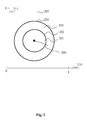
- Figure 2 illustrates the notion of normalized fingerprint distance (NFD) between two images and the relation between NFD and discussed thresholds.
- NFD normalized fingerprint distance
- th1 and th2 Two fixed thresholds (th1 and th2) are used representing certain values of normalized distances between fingerprint vectors of the second ('b') image and the first ('a') image.
- Image fingerprinting is a technique that allows to extract from an image discriminating features. Image fingerprints of two different images can then be compared to detect differences between those images based on a comparison of the discriminating features by calculating an image fingerprint distance between two image fingerprints, for example according to the above mentioned normalized distance. Image fingerprinting techniques can be categorized according to two main approaches: a global description approach and a local description approach. The global description approach considers an image as a whole and extracts global image characterizing features such as a color/luminance histogram or image texture.
- the local approach by contrast considers an image as a multitude of spatially localized characterizing features.
- the global approach is faster in terms of calculation speed than the local approach.
- a fingerprint distance determination based on fingerprints calculated with the global approach is not very suitable for detection of image transformations caused by strong distortions such as cropping, occlusion and image editing and geometrical distortions such as rotation and scaling.
- An exception is the RASH (RAdon Soft Hash) global approach algorithm.
- RASH provides a good tradeoff between calculation speed and detectability of the previous mentioned distortions. It is not very well suited for detection of transformations caused by strong cropping and strong editing but is able to detect geometrical transformations, such as small rotations and scaling, and compression.
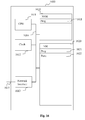
- an eight-parameter homographic model of the spatial distortion can be constructed from which any shifting, rotation, scaling transformations can be determined with a high level of accuracy.
- (x',y') represent the pixel coordinates of a given interest point in the transformed image (e.g. second 'b' image), and (x,y) represent the pixel coordinates of the corresponding interest point in the reference image with which the transformed image is compared (e.g. a first 'a' image).
- the parameters h11 and h00 provide the estimated scaling factor,i.e. the factor by which the transformed image is scaled from the compared image (See Fig. 14c).
- the parameters h01, h10, h20 and h21 provide the information to compute the estimated rotation of the transformed image with regard to the reference image (See Fig. 14a).
- the parameters h02 and h12 provide the estimated shifting of the transformed image with regard to the reference image (See Fig. 14b).
- the average error on the model of distortion between the transformed image and the image that is used as a reference image can determine if the image has been slightly or highly modified.
- the average error is a function of the estimated h ij parameters for all the matching interest points between the candidate and the reference images (i, j ⁇ ⁇ 0, 1, 2 ⁇
- (i j) ⁇ 2) . Note that this average error is actually the distance between the fingerprints of the two images where the fingerprints are represented by the set of h ij parameters.
- n can have a value of hundred or even thousand.
- the center of fig.2 (200) represents the image fingerprint of image 'a', i.e. fp(a).
- Axes 210 and 211 represent respectively an X-axis of a fingerprint distance and a Y-axis of a fingerprint distance from the reference point fp(a).
- the zone 201 in the first circle around fp(a) corresponds to the fingerprints of the 'b' images whose distance to the fingerprint of the 'a' image is lower than the first threshold th1 (202), and represents 'b' images that have been slightly modified with regard to the 'a' image.
- Zone 203 in the second circle around fp(a) corresponds to fingerprints of 'b' images whose distance to the fingerprint of the 'a' image is higher than the first threshold th1 (202) but lower than the second threshold th2 (204), and represents 'b' images that have been largely modified with regard to the 'a' image.
- the zone 205 outside of the second circle corresponds to fingerprints of 'b' images whose distance d to the fingerprint of the 'a' image is higher than the second threshold th2 (204), and represents 'b' images that can be considered to be different with regard to the 'a' image.
- Montalvo thus describes the use of fingerprint distance between two images and defines two fixed thresholds of the normalized distances between the fingerprints of two images. But the fact that the thresholds are fixed does not recognize that the boundaries defined by the threshold are subjective and may be set differently according to the user. Then, if one allows for the thresholds to be set by the user, one needs to define a way to determine the value of these thresholds according to the user's perception. Those are the subjects of the present application.
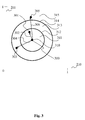
- FIG. 3 illustrates the reference system used by the following illustrations.
- Point 300 represents the fingerprint of a reference image R.
- Points 301, 303 and 305 represent fingerprints of images A , B and C respectively, measured relatively to that of the reference image R. Their respective fingerprint distance from the reference image R is illustrated by arrows 302, 304 and 306 respectively.
- 310 - 315 represent the different 'zones'. 310 represent the possible values of fingerprint distance to a reference image 300 for all images that are perceived by the user as being identical (no noticeable difference).
- Zone 311 represents the possible values of fingerprint distance to a reference image 300 for all images that are perceived by the user as being slightly modified.
- Zone 312 represents the possible values of fingerprint distance to a reference image 300 that are perceived by the user as being largely modified. Outside this zone (315) are all possible values of fingerprint distance to a reference image 300 that are perceived by the user as being different.
- 312 represents a first threshold (th1).
- 314 represents a second threshold (th2).
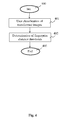
- Figure 4 illustrates a flow chart of the method of the invention.
- a first initialization step 400 variables are initialized for the functioning of the method.
- the step comprises for example copying of data from non-volatile memory to volatile memory and initialization of memory.
- a user classification to transformed images is done, the transformations being based on a same reference image ( R ).
- the transformations applied to the reference image are: resolution changes, cropping and encoding changes, rotations, and colorimetric modifications.
- the user classification comprises a classification of the transformed images in different image sets, i.e.
- Each of the transformed images has a different associated fingerprint distance related to the reference image.
- a second step (402) determines from the user classification at which distance from the reference image to set a first and a second fingerprint distance thresholds.
- the first fingerprint distance threshold (th1, 312) limits a first zone (310-311) of fingerprint distance inside which are found all transformed images which the user has classified in the identical and slightly modified image sets.
- the second fingerprint distance threshold (th2, 314) delimits a second zone (313) outside the first zone and inside which are found all transformed images which the user has classified in the largely modified image set and outside which (315) are transformed images which the user has classified in the different image set.
- the parameters h ij are known.
- the fingerprint distance thresholds placed by the user's classification correspond thus each to a value of the h ij parameters; for example, when a user classifies images rotated up to 15° as being slightly modified, but above 15° he classifies the image as being largely modified, and above 45° as being different, the thresholds th1 and th2 can be set and correspond to a set (h10, h01, h20, h21) of parameters corresponding to a transformed image with 15° degrees of rotation for th1, and to that of a transformed image with 90° degrees of rotation for th2.
- the h ij parameter values corresponding to the thresholds represent fingerprint distances. This determination of the thresholds according to the user's classification is done in step 402.
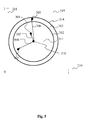
- Figures 5 , 6 and 7 illustrate two thresholds set at different fingerprint distances according to perception of different users, respectively users X, Y and Z.
- this user perceives images A (301) and B (303) as being in the zone of slightly modified images (311), whereas Image C (305) is in the zone of largely modified images (313).
- image A (301) is in the zone of slightly modified images (311)
- image B (303) in the zone of largely modified images (313)
- image C (305) in the zone of different images (315).
- fig. 7 and user Z this user perceives image A (301) in the zone of largely modified images (313) whereas images B (303) and C (305) are being situated in the zone of different images (315).
- the first (th1) and second (th2) thresholds are set according to the user perception, it is thus possible to determine according to the user perception if an image is in the set of identical images, in the set of slightly modified images, in the set of largely modified images or in the set of different images, and to associate metadata accordingly as described by Montalvo.
- the parameters h ij are determined for the image (for example the previously mentioned 'b' image) when compared to another image (for example the previously mentioned 'a' image). This determination is done using prior-art methods (distortion estimation).
- the h ij parameters it is determined in which zone the parameters are situated, the zones being delimited by thresholds th1 and th2, each representing different maximum values for the h ij parameters.
- a fingerprint determination method that obtain results with different precision.
- the choice between either one method is predetermined by a constraint intrinsic to each method, to which we also will refer as a third threshold of fingerprint distance.
- a rather precise method based on the points-of-interest technique e.g.
- SIFT Scale Invariant Feature Transform
- SURF Speeded Up Robust Feature
- Adapting the preciseness of the fingerprint determination method can give an advantage in computing time for the determination of the fingerprint as has been previously mentioned.
- the position of the intrinsic constraint depends on the chosen methods.
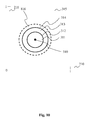
- Figures 8-10 illustrate which of two fingerprint determination methods to use between a precise and a less precise fingerprint determination method, and its dependence of the choice from the previously discussed positioning of the first and second thresholds.
- circle 816 defines a limit or a third threshold between use of the precise method and the less precise method.
- the third threshold the (816) is INSIDE the zones defined by the first threshold th1 (312) AND the second threshold th2 (314).
- the third threshold the (816) is OUTSIDE the zone defined by the first threshold th1 (312) BUT INSIDE the zone defined by the second threshold th2 (314).
- the precise image fingerprint distance determination method is to be used for determination if an image is in the first zone of slightly modified images, but to distinguish if an image is in the zone of largely modified images or in the zone of different images, a less precise image fingerprint distance determination method is sufficient.
- the third threshold the (816) is OUTSIDE the zones defined by the first threshold th1 (312) AND the second threshold th2 (314).
- the third threshold defining the limit between using the precise or the less precise fingerprint distance determination method (inside: precise: outside: less precise).
- the precise fingerprint distance determination method is to be used.
- the method of the invention can be further improved by adding a verification or fine-tuning step.
- this additional step instead of determining the thresholds th1 and th2 based on the presentation of a set of images to the user, using the method of the invention; the user inputs a set of images, for example from his own collection of images, and the de-duplication system classifies the images within the different zones (identical, slightly modified, largely modified, different) according to the thresholds th1 and th2 that were determined with the method of the invention.
- the user can contradict the classification made, when he is of the opinion that some images are wrongly classified by the de-duplication system.
- the thresholds th1 and th2 are thus adjusted with the help of the user, who submits a number of images from his personal collection to the method of the invention: a reference image and transformed images, ranging from slightly modified and largely modified to different images.
- a reference image and transformed images ranging from slightly modified and largely modified to different images.
- the verification step results in moving of the first threshold from outside the zone delimited by the third threshold ( fig.8 ) to inside the zone delimited by the third threshold ( fig.9 ). Where according to figure 8 the use of less precise fingerprint method was sufficient, it is no longer sufficient when the th1 threshold is moved within the zone delimited by the third threshold according to figure 9 .
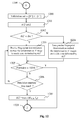
- a first step 1100 variables needed for the execution of the algorithm are initialized.
- the set of images on which figure 11 operates is set to ⁇ S' ⁇ .
- the first threshold th1' is set to th1 (max d(f s ,f 0 )).
- a decisional step 1103 it is verified if th1' is inferior to the third threshold thc. If so, the precise fingerprint determination method is to be used for determination if images are inside the zone delimited by the first threshold th1' (1104). If not so, the less precise fingerprint determination is sufficient to do the same (1105).
- a decisional step 1106 it is determined if, using the chosen method, (precise or less precise) the image falls indeed in the zone of slightly modified images. If this is the case, the applied method for fingerprint determination is sufficient and th1' is set correctly and does not need to be adjusted and the algorithm is continued with step 1200 of figure 12 where the positioning of th2' is verified based on the user presented images and where it is verified if the chosen fingerprint determination method is the right one to be able to discriminate between largely modified images and different images. If however the image does not fall into the zone of slightly modified images, it is determined in a step 1107 which method was used to determine in which zone the image falls.
- step 1104 the algorithm returns to step 1104 and uses the precise method to see if this gives a better result. If the precise method was already used, this means that th1' is not set correctly and must be adjusted to a new value that is equal to max d(f FS'P , f 0 ). Then the algorithm continues with step 1200 of figure 12 .
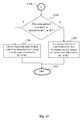
- a first step 1200 the set of images on which figure 11 operates is set to whole of ⁇ S' ⁇ and ⁇ L' ⁇ . Then, in a step 1201, the second threshold th2' is set to th2 (max d(f L ,f 0 )). In a decisional step 1202, it is verified if th2' is inferior to the third threshold thc. If so, the precise fingerprint determination method is to be used for determination if images are inside the zone delimited by the second threshold th2' (1203). If not so, the less precise fingerprint determination is sufficient to do the same (1204).
- a decisional step 1205 it is determined if, using the chosen method, (precise or less precise) the image falls indeed in the zone of largely modified images. If this is the case, the applied method for fingerprint determination is sufficient and th2' is set correctly and does not need to be adjusted and the algorithm is continued with step 1300 of figure 13 . If however the image does not fall into the zone of largely modified images, it is determined in a step 1206 which method was used to determine in which zone the image falls. If the precise method was not used, the algorithm returns to step 1203 and uses the precise method to see if this gives a better result. If the precise method was already used, this means that th2' is not set correctly and must be adjusted to a new value that is equal to max d(f FL'P , f 0 ). Then the algorithm continues with step 1300 of figure 12 .
- the final selection of the fingerprint method (precise or less precise) is decided according to the adjusted thresholds.
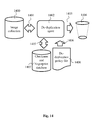
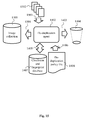
- the method of the invention can be implemented as part of an automatic de-duplication agent.
- the de-duplication agent can then be used as a stand-alone tool to clean up a user's photo album for example.
- the checksums and/or fingerprints of all the images in the photo database are computed and stored in a checksum/fingerprint database 1407, then the de-duplication agent 1402 identifies the duplicate images and the unique images in the image collection 1400 (connected to de-duplication agent 1402 via connection 1401) using the information contained in the de-duplication policy file 1408 and the checksum/fingerprint database 1407 and using the tagging algorithm described by Montalvo. Finally, the duplicate images are removed from the image collection 1400 (illustrated by connection 1403 to wastebasket 1404) while the unique images are kept, and the checksum/fingerprint database 1407 is updated by means of a connection 1405.
- Figure 15 illustrates an autonomous mode of a de-duplication agent 1402 implementing the invention, where the image collection 1400 is managed so that the image collection 1400 never has duplicates (according to the user perception).
- the de-duplication agent 1402 decides whether the candidate image is added to the image collection 1400 or if it is discarded (wastebasket 1404).
- the checksum/fingerprint database 1407 is updated accordingly.
- the method of the invention is part of a de-duplication agent implemented in a Digital Assets Management (DAM) framework, where the de-duplication agent implementing the invention is used to keep the image collection in the DAM framework free of duplicate images by applying the policy and user perception as defined by the user.
- DAM Digital Assets Management
- FIG. 16 shows an example of a device implementing the invention.
- the device 1600 comprises the following components, interconnected by a digital data- and address bus 1614:
- register used in the description of memories 1610 and 1620 designates in each of the mentioned memories, a low-capacity memory zone capable of storing some binary data, as well as a high-capacity memory zone, capable of storing an executable program, or a whole data set.
- Processing unit 1611 can be implemented as a microprocessor, a custom chip, a dedicated (micro-) controller, and so on.
- Non-volatile memory NVM 1610 can be implemented in any form of non-volatile memory, such as a hard disk, non-volatile random-access memory, EPROM (Erasable Programmable ROM), and so on.
- the Non-volatile memory NVM 1610 comprises notably a register 1611 that holds a program representing an executable program comprising the method according to the invention. When powered up, the processing unit 1611 loads the instructions comprised in NVM register 1611, copies them to VM register 1621, and executes them.
- the VM memory 1620 comprises notably:
- a device such as device 1600 is an example of a device that is suited for implementing the method of the invention.
- the device 1600 comprises means for providing a set of transformed images to a user (for example: not shown presentation means, and/or an image database providing a precalculated set of transformed images and/or a calculation means such as CPU 1611 calculating transformed images), the transformed images being based on a same reference image, for classification by the user of the transformed images into different image classes according to a perception of the user of different levels of resemblance of the transformed images to the reference image, each of the transformed images having a different associated fingerprint distance related to the reference image, means for determination (for example CPU 1611), from the classification by the user, of at least one fingerprint distance threshold from the reference image, as a function of the classification by the user, each of the at least one fingerprint distance threshold limiting a zone of fingerprint distance inside which are the transformed images according to the classification by the user; means for classification of the images in the collection of images according to the determined at least one fingerprint distance threshold.
- a user for example: not shown presentation means, and/or an image database providing a precalculated set of transformed images and
- the device further comprises means for removal (for example CPU 1611) from the images in the collection of images that are classified by the means for classification as being different.
- means for removal for example CPU 1611
- the device further comprises means for classification (for example CPU 1611) of a set of user-provided images according to the at least one fingerprint distance threshold determined by the determination means, and means for adjustment of the at least one fingerprint distance threshold according to a second user classification of at least one image of the set of user-provided images.
- means for classification for example CPU 1611
- means for adjustment of the at least one fingerprint distance threshold according to a second user classification of at least one image of the set of user-provided images.
- the invention is implemented as a pure hardware implementation, for example in the form of a dedicated component (for example in an ASIC, FPGA or VLSI, respectively meaning Application Specific Integrated Circuit, Field-Programmable Gate Array and Very Large Scale Integration), or in the form of multiple electronic components integrated in a device or in the form of a mix of hardware and software components, for example as a dedicated electronic card in a computer.
- a dedicated component for example in an ASIC, FPGA or VLSI, respectively meaning Application Specific Integrated Circuit, Field-Programmable Gate Array and Very Large Scale Integration
- a mix of hardware and software components for example as a dedicated electronic card in a computer.
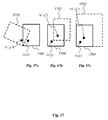
- Figure 17 illustrates some different geometrical distortions of an image.
- Figure 17a represents an image rotation: image 1700 is rotated to form transformed image 1701.
- Figure 17b represents a shift distortion: image 1700 is shifted to form a transformed image 1702.
- Figure 17c represents a scale distortion: image 1703 is scaled to form a transformed image 1703.
- a point (x,y) in the original image has coordinates (x',y'), after transformation.
- the repositioning of the (x,y) coordinates of a point of the image can thus be characterized by specific values for corresponding h ij parameters (for example specific values for h10, h10, h20 and h21) for the rotated image.
- multiple types of image distortions can be combined in a transformed image (for example, scaling AND rotation).
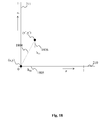
- a useful class of vector norms is the p-norm defined by:
- the method of the invention can advantageously be used in the method of automatic management of a collection of images through association of metadata tags as described by Montalvo, the method of the invention allowing to set the thresholds that can be subsequently exploited by Montalvo to determine which metadata tags to associate to which image of the image collection and associating actions as a function of a type of metadata tag, as described previously with reference to Figure 1 .
Landscapes
- Engineering & Computer Science (AREA)
- Theoretical Computer Science (AREA)
- Physics & Mathematics (AREA)
- General Physics & Mathematics (AREA)
- General Engineering & Computer Science (AREA)
- Data Mining & Analysis (AREA)
- Databases & Information Systems (AREA)
- Software Systems (AREA)
- Library & Information Science (AREA)
- Multimedia (AREA)
- Computer Hardware Design (AREA)
- Computer Vision & Pattern Recognition (AREA)
- Mathematical Physics (AREA)
- Evolutionary Biology (AREA)
- Bioinformatics & Computational Biology (AREA)
- Bioinformatics & Cheminformatics (AREA)
- Artificial Intelligence (AREA)
- Life Sciences & Earth Sciences (AREA)
- Evolutionary Computation (AREA)
- Health & Medical Sciences (AREA)
- Bioethics (AREA)
- General Health & Medical Sciences (AREA)
- Computer Security & Cryptography (AREA)
- Collating Specific Patterns (AREA)
- Processing Or Creating Images (AREA)
- Information Retrieval, Db Structures And Fs Structures Therefor (AREA)
Priority Applications (6)
| Application Number | Priority Date | Filing Date | Title |
|---|---|---|---|
| EP11306771.4A EP2608062A1 (en) | 2011-12-23 | 2011-12-23 | Method of automatic management of images in a collection of images and corresponding device |
| US13/717,764 US9141884B2 (en) | 2011-12-23 | 2012-12-18 | Method of automatic management of images in a collection of images and corresponding device |
| EP12198107.0A EP2608078B1 (en) | 2011-12-23 | 2012-12-19 | Method of automatic management of images in a collection of images and corresponding device |
| KR1020120151230A KR20130073852A (ko) | 2011-12-23 | 2012-12-21 | 이미지들의 컬렉션 내의 이미지들의 자동 관리의 방법 및 대응하는 장치 |
| JP2012279863A JP2013134781A (ja) | 2011-12-23 | 2012-12-21 | 画像コレクション中の画像の自動管理方法及びそれに対応する装置 |
| CN2012105993276A CN103309913A (zh) | 2011-12-23 | 2012-12-24 | 自动管理图像集合中的图像的方法和相应设备 |
Applications Claiming Priority (1)
| Application Number | Priority Date | Filing Date | Title |
|---|---|---|---|
| EP11306771.4A EP2608062A1 (en) | 2011-12-23 | 2011-12-23 | Method of automatic management of images in a collection of images and corresponding device |
Publications (1)
| Publication Number | Publication Date |
|---|---|
| EP2608062A1 true EP2608062A1 (en) | 2013-06-26 |
Family
ID=47355971
Family Applications (2)
| Application Number | Title | Priority Date | Filing Date |
|---|---|---|---|
| EP11306771.4A Withdrawn EP2608062A1 (en) | 2011-12-23 | 2011-12-23 | Method of automatic management of images in a collection of images and corresponding device |
| EP12198107.0A Active EP2608078B1 (en) | 2011-12-23 | 2012-12-19 | Method of automatic management of images in a collection of images and corresponding device |
Family Applications After (1)
| Application Number | Title | Priority Date | Filing Date |
|---|---|---|---|
| EP12198107.0A Active EP2608078B1 (en) | 2011-12-23 | 2012-12-19 | Method of automatic management of images in a collection of images and corresponding device |
Country Status (5)
| Country | Link |
|---|---|
| US (1) | US9141884B2 (enExample) |
| EP (2) | EP2608062A1 (enExample) |
| JP (1) | JP2013134781A (enExample) |
| KR (1) | KR20130073852A (enExample) |
| CN (1) | CN103309913A (enExample) |
Families Citing this family (14)
| Publication number | Priority date | Publication date | Assignee | Title |
|---|---|---|---|---|
| US9582843B2 (en) * | 2012-08-20 | 2017-02-28 | Tautachrome, Inc. | Authentication and validation of smartphone imagery |
| US20180365261A1 (en) * | 2013-04-01 | 2018-12-20 | International Business Machines Corporation | Fingerprinting data for more aggressive de-duplication |
| US20190007380A1 (en) * | 2013-04-01 | 2019-01-03 | International Business Machines Corporation | De-duplication of data streams |
| US9805099B2 (en) * | 2014-10-30 | 2017-10-31 | The Johns Hopkins University | Apparatus and method for efficient identification of code similarity |
| US9569692B2 (en) * | 2014-10-31 | 2017-02-14 | The Nielsen Company (Us), Llc | Context-based image recognition for consumer market research |
| CN106601243B (zh) * | 2015-10-20 | 2020-11-06 | 阿里巴巴集团控股有限公司 | 一种视频文件识别方法及装置 |
| US9824299B2 (en) * | 2016-01-04 | 2017-11-21 | Bank Of America Corporation | Automatic image duplication identification |
| US9626596B1 (en) | 2016-01-04 | 2017-04-18 | Bank Of America Corporation | Image variation engine |
| US10318813B1 (en) * | 2016-03-11 | 2019-06-11 | Gracenote, Inc. | Digital video fingerprinting using motion segmentation |
| US20180101540A1 (en) * | 2016-10-10 | 2018-04-12 | Facebook, Inc. | Diversifying Media Search Results on Online Social Networks |
| CN108121816B (zh) * | 2017-12-28 | 2020-09-08 | Oppo广东移动通信有限公司 | 图片分类方法、装置、存储介质及电子设备 |
| JP7258482B2 (ja) * | 2018-07-05 | 2023-04-17 | キヤノン株式会社 | 電子機器 |
| US12217494B2 (en) | 2020-04-10 | 2025-02-04 | Gracenote, Inc. | Keyframe extractor |
| KR20230043318A (ko) | 2021-09-24 | 2023-03-31 | 삼성전자주식회사 | 영상 내 객체를 분류하는 객체 분류 방법 및 장치 |
Citations (4)
| Publication number | Priority date | Publication date | Assignee | Title |
|---|---|---|---|---|
| EP0990997A1 (en) * | 1998-09-29 | 2000-04-05 | Eastman Kodak Company | A method for controlling and managing redundancy in an image database by elimination of automatically detected exact duplicate and near duplicate images |
| EP1434165A1 (en) * | 2002-11-25 | 2004-06-30 | Eastman Kodak Company | Method and system for detecting a geometrically transformed copy of an image |
| US20060101060A1 (en) * | 2004-11-08 | 2006-05-11 | Kai Li | Similarity search system with compact data structures |
| US20100166321A1 (en) * | 2008-12-29 | 2010-07-01 | Yahoo! Inc. | Method and system for determining near duplicate images |
Family Cites Families (15)
| Publication number | Priority date | Publication date | Assignee | Title |
|---|---|---|---|---|
| US6345274B1 (en) * | 1998-06-29 | 2002-02-05 | Eastman Kodak Company | Method and computer program product for subjective image content similarity-based retrieval |
| US6512850B2 (en) * | 1998-12-09 | 2003-01-28 | International Business Machines Corporation | Method of and apparatus for identifying subsets of interrelated image objects from a set of image objects |
| JP4674257B2 (ja) * | 1999-01-27 | 2011-04-20 | 株式会社リコー | 画像分類装置およびその装置としてコンピュータを機能させるためのプログラムを記録したコンピュータ読み取り可能な記録媒体 |
| KR100750424B1 (ko) * | 2004-03-03 | 2007-08-21 | 닛본 덴끼 가부시끼가이샤 | 화상 유사도 산출 시스템, 화상 검색 시스템, 화상 유사도산출 방법 및 화상 유사도 산출용 프로그램 |
| JP4717565B2 (ja) * | 2005-09-12 | 2011-07-06 | キヤノン株式会社 | 画像処理装置及びその制御方法、プログラム |
| US8103050B2 (en) | 2006-01-16 | 2012-01-24 | Thomson Licensing | Method for computing a fingerprint of a video sequence |
| JP2007221536A (ja) * | 2006-02-17 | 2007-08-30 | Nikon Corp | 撮像装置、画像処理プログラムおよび画像送信プログラム |
| US7860317B2 (en) | 2006-04-04 | 2010-12-28 | Microsoft Corporation | Generating search results based on duplicate image detection |
| US7672976B2 (en) | 2006-05-03 | 2010-03-02 | Ut-Battelle, Llc | Method for the reduction of image content redundancy in large image databases |
| US8285052B1 (en) * | 2009-12-15 | 2012-10-09 | Hrl Laboratories, Llc | Image ordering system optimized via user feedback |
| US8111912B2 (en) | 2008-02-15 | 2012-02-07 | Yahoo! Inc. | Cost-effective image metadata creation using near-duplicate image detection |
| JP2010067014A (ja) * | 2008-09-11 | 2010-03-25 | Ricoh Co Ltd | 画像分類装置及び画像分類方法 |
| KR101030130B1 (ko) | 2009-07-31 | 2011-04-20 | 주식회사 다음커뮤니케이션 | 중복 콘텐츠 검출 장치 및 검출 방법 |
| CN101937506B (zh) * | 2010-05-06 | 2012-10-17 | 复旦大学 | 近拷贝视频检测方法 |
| EP2579258A1 (en) | 2011-10-04 | 2013-04-10 | Thomson Licensing | Method of automatic management of a collection of images and corresponding device |
-
2011
- 2011-12-23 EP EP11306771.4A patent/EP2608062A1/en not_active Withdrawn
-
2012
- 2012-12-18 US US13/717,764 patent/US9141884B2/en active Active
- 2012-12-19 EP EP12198107.0A patent/EP2608078B1/en active Active
- 2012-12-21 KR KR1020120151230A patent/KR20130073852A/ko not_active Withdrawn
- 2012-12-21 JP JP2012279863A patent/JP2013134781A/ja not_active Ceased
- 2012-12-24 CN CN2012105993276A patent/CN103309913A/zh active Pending
Patent Citations (4)
| Publication number | Priority date | Publication date | Assignee | Title |
|---|---|---|---|---|
| EP0990997A1 (en) * | 1998-09-29 | 2000-04-05 | Eastman Kodak Company | A method for controlling and managing redundancy in an image database by elimination of automatically detected exact duplicate and near duplicate images |
| EP1434165A1 (en) * | 2002-11-25 | 2004-06-30 | Eastman Kodak Company | Method and system for detecting a geometrically transformed copy of an image |
| US20060101060A1 (en) * | 2004-11-08 | 2006-05-11 | Kai Li | Similarity search system with compact data structures |
| US20100166321A1 (en) * | 2008-12-29 | 2010-07-01 | Yahoo! Inc. | Method and system for determining near duplicate images |
Non-Patent Citations (2)
| Title |
|---|
| JAIMES A ET AL: "DUPLICATE DETECTION IN CONSUMER PHOTOGRAPHY AND NEWS VIDEO", 1 December 2002, PROCEEDINGS ACM MULTIMEDIA 2002. 10TH. INTERNATIONAL CONFERENCE ON MULTIMEDIA. JUAN-LES-PINS, FRANCE, DEC. 1 - 6, 2002; [ACM INTERNATIONAL MULTIMEDIA CONFERENCE], NEW YORK, NY : ACM, US, PAGE(S) 423/424, ISBN: 978-1-58113-620-3, XP001175040 * |
| JINGLONG ZUO ET AL: "Retrieval oriented robust image hashing", 15 May 2009, INDUSTRIAL MECHATRONICS AND AUTOMATION, 2009. ICIMA 2009. INTERNATIONAL CONFERENCE ON, IEEE, PISCATAWAY, NJ, USA, PAGE(S) 379 - 381, ISBN: 978-1-4244-3817-4, XP031484235 * |
Also Published As
| Publication number | Publication date |
|---|---|
| CN103309913A (zh) | 2013-09-18 |
| US9141884B2 (en) | 2015-09-22 |
| JP2013134781A (ja) | 2013-07-08 |
| EP2608078B1 (en) | 2020-03-04 |
| US20130163888A1 (en) | 2013-06-27 |
| KR20130073852A (ko) | 2013-07-03 |
| EP2608078A1 (en) | 2013-06-26 |
Similar Documents
| Publication | Publication Date | Title |
|---|---|---|
| EP2608078B1 (en) | Method of automatic management of images in a collection of images and corresponding device | |
| EP2579258A1 (en) | Method of automatic management of a collection of images and corresponding device | |
| US12175641B2 (en) | Restoring degraded digital images through a deep learning framework | |
| US9135278B2 (en) | Method and system to detect and select best photographs | |
| US7869658B2 (en) | Representative image selection based on hierarchical clustering | |
| US9928439B2 (en) | Facilitating text identification and editing in images | |
| US8363909B2 (en) | Image processing apparatus, image processing method, and computer program product | |
| GB2587833A (en) | Image modification styles learned from a limited set of modified images | |
| CN101308504A (zh) | 图像处理设备和图像检索方法 | |
| US9767533B2 (en) | Image resolution enhancement based on data from related images | |
| JP7124957B2 (ja) | 画像処理システム、推定装置、処理方法及びプログラム | |
| US10296539B2 (en) | Image extraction system, image extraction method, image extraction program, and recording medium storing program | |
| EP3462378B1 (en) | System and method of training a classifier for determining the category of a document | |
| CN115239955A (zh) | 不对等像素的图像匹配方法、装置、计算机设备及存储介质 | |
| CN112364868A (zh) | 一种电子文件的旋转校正方法和装置 | |
| WO2012127639A1 (ja) | 画像処理装置及び画像処理方法 | |
| Begeja et al. | Vidcat: an image and video analysis service for personal media management | |
| US12417631B1 (en) | Techniques for adaptive frame-based clip matching | |
| US7376287B2 (en) | Method for intelligent auto-orientation of digital images | |
| US20250104460A1 (en) | High accuracy document source detection | |
| CN110009646A (zh) | 一种电子相册的生成方法、装置、电子设备及存储介质 | |
| CN120655975A (zh) | 一种适用于多视角图像的去重方法、装置、终端设备和存储介质 | |
| WO2021152550A1 (en) | Systems and methods for processing images | |
| Li | Contour based three-dimensional biological image reconstruction and partial retrieval |
Legal Events
| Date | Code | Title | Description |
|---|---|---|---|
| AK | Designated contracting states |
Kind code of ref document: A1 Designated state(s): AL AT BE BG CH CY CZ DE DK EE ES FI FR GB GR HR HU IE IS IT LI LT LU LV MC MK MT NL NO PL PT RO RS SE SI SK SM TR |
|
| AX | Request for extension of the european patent |
Extension state: BA ME |
|
| PUAI | Public reference made under article 153(3) epc to a published international application that has entered the european phase |
Free format text: ORIGINAL CODE: 0009012 |
|
| STAA | Information on the status of an ep patent application or granted ep patent |
Free format text: STATUS: THE APPLICATION IS DEEMED TO BE WITHDRAWN |
|
| 18D | Application deemed to be withdrawn |
Effective date: 20140103 |