EP2607355A1 - Synthesis of triazolopyrimidine compounds - Google Patents
Synthesis of triazolopyrimidine compounds Download PDFInfo
- Publication number
- EP2607355A1 EP2607355A1 EP11195508.4A EP11195508A EP2607355A1 EP 2607355 A1 EP2607355 A1 EP 2607355A1 EP 11195508 A EP11195508 A EP 11195508A EP 2607355 A1 EP2607355 A1 EP 2607355A1
- Authority
- EP
- European Patent Office
- Prior art keywords
- compound
- formula
- salt
- iii
- converting
- Prior art date
- Legal status (The legal status is an assumption and is not a legal conclusion. Google has not performed a legal analysis and makes no representation as to the accuracy of the status listed.)
- Ceased
Links
- 230000015572 biosynthetic process Effects 0.000 title abstract description 29
- 238000003786 synthesis reaction Methods 0.000 title abstract description 28
- YWBFPKPWMSWWEA-UHFFFAOYSA-O triazolopyrimidine Chemical class BrC1=CC=CC(C=2N=C3N=CN[N+]3=C(NCC=3C=CN=CC=3)C=2)=C1 YWBFPKPWMSWWEA-UHFFFAOYSA-O 0.000 title abstract description 5
- OEKWJQXRCDYSHL-FNOIDJSQSA-N ticagrelor Chemical compound C1([C@@H]2C[C@H]2NC=2N=C(N=C3N([C@H]4[C@@H]([C@H](O)[C@@H](OCCO)C4)O)N=NC3=2)SCCC)=CC=C(F)C(F)=C1 OEKWJQXRCDYSHL-FNOIDJSQSA-N 0.000 claims abstract description 58
- 229960002528 ticagrelor Drugs 0.000 claims abstract description 56
- 238000002360 preparation method Methods 0.000 claims abstract description 33
- 150000001875 compounds Chemical class 0.000 claims description 135
- 150000003839 salts Chemical class 0.000 claims description 64
- 125000000999 tert-butyl group Chemical group [H]C([H])([H])C(*)(C([H])([H])[H])C([H])([H])[H] 0.000 claims description 42
- 125000003088 (fluoren-9-ylmethoxy)carbonyl group Chemical group 0.000 claims description 22
- 238000000034 method Methods 0.000 claims description 22
- 230000008569 process Effects 0.000 claims description 20
- VZCYOOQTPOCHFL-OWOJBTEDSA-N Fumaric acid Chemical class OC(=O)\C=C\C(O)=O VZCYOOQTPOCHFL-OWOJBTEDSA-N 0.000 claims description 18
- -1 and R2 is Bn Chemical group 0.000 claims description 17
- 125000001981 tert-butyldimethylsilyl group Chemical group [H]C([H])([H])[Si]([H])(C([H])([H])[H])[*]C(C([H])([H])[H])(C([H])([H])[H])C([H])([H])[H] 0.000 claims description 12
- 239000001257 hydrogen Substances 0.000 claims description 8
- 229910052739 hydrogen Inorganic materials 0.000 claims description 8
- 238000005580 one pot reaction Methods 0.000 claims description 8
- 229910052801 chlorine Inorganic materials 0.000 claims description 6
- 239000008194 pharmaceutical composition Substances 0.000 claims description 5
- 230000009935 nitrosation Effects 0.000 claims description 4
- 238000007034 nitrosation reaction Methods 0.000 claims description 4
- 239000000546 pharmaceutical excipient Substances 0.000 claims description 4
- 230000008878 coupling Effects 0.000 claims description 3
- 238000010168 coupling process Methods 0.000 claims description 3
- 238000005859 coupling reaction Methods 0.000 claims description 3
- 239000003937 drug carrier Substances 0.000 claims description 3
- LMBFAGIMSUYTBN-MPZNNTNKSA-N teixobactin Chemical compound C([C@H](C(=O)N[C@@H]([C@@H](C)CC)C(=O)N[C@@H](CO)C(=O)N[C@H](CCC(N)=O)C(=O)N[C@H]([C@@H](C)CC)C(=O)N[C@@H]([C@@H](C)CC)C(=O)N[C@@H](CO)C(=O)N[C@H]1C(N[C@@H](C)C(=O)N[C@@H](C[C@@H]2NC(=N)NC2)C(=O)N[C@H](C(=O)O[C@H]1C)[C@@H](C)CC)=O)NC)C1=CC=CC=C1 LMBFAGIMSUYTBN-MPZNNTNKSA-N 0.000 claims description 3
- 238000002156 mixing Methods 0.000 claims description 2
- GQNZGCARKRHPOH-RQIKCTSVSA-N miocamycin Chemical compound C1[C@](OC(C)=O)(C)[C@@H](OC(=O)CC)[C@H](C)O[C@H]1O[C@H]1[C@H](N(C)C)[C@@H](O)[C@H](O[C@@H]2[C@H]([C@H](OC(=O)CC)CC(=O)O[C@H](C)C/C=C/C=C/[C@H](OC(C)=O)[C@H](C)C[C@@H]2CC=O)OC)O[C@@H]1C GQNZGCARKRHPOH-RQIKCTSVSA-N 0.000 claims 5
- 125000004435 hydrogen atom Chemical group [H]* 0.000 claims 2
- 150000002688 maleic acid derivatives Chemical class 0.000 claims 2
- 150000003891 oxalate salts Chemical class 0.000 claims 2
- 239000000543 intermediate Substances 0.000 abstract description 31
- XEKOWRVHYACXOJ-UHFFFAOYSA-N Ethyl acetate Chemical compound CCOC(C)=O XEKOWRVHYACXOJ-UHFFFAOYSA-N 0.000 description 51
- HEDRZPFGACZZDS-MICDWDOJSA-N Trichloro(2H)methane Chemical compound [2H]C(Cl)(Cl)Cl HEDRZPFGACZZDS-MICDWDOJSA-N 0.000 description 46
- VLKZOEOYAKHREP-UHFFFAOYSA-N n-Hexane Chemical compound CCCCCC VLKZOEOYAKHREP-UHFFFAOYSA-N 0.000 description 38
- 239000011541 reaction mixture Substances 0.000 description 37
- QTBSBXVTEAMEQO-UHFFFAOYSA-N Acetic acid Chemical compound CC(O)=O QTBSBXVTEAMEQO-UHFFFAOYSA-N 0.000 description 32
- ZMANZCXQSJIPKH-UHFFFAOYSA-N Triethylamine Chemical compound CCN(CC)CC ZMANZCXQSJIPKH-UHFFFAOYSA-N 0.000 description 26
- XLYOFNOQVPJJNP-UHFFFAOYSA-N water Substances O XLYOFNOQVPJJNP-UHFFFAOYSA-N 0.000 description 25
- 238000003756 stirring Methods 0.000 description 22
- 235000019439 ethyl acetate Nutrition 0.000 description 21
- CSNNHWWHGAXBCP-UHFFFAOYSA-L Magnesium sulfate Chemical compound [Mg+2].[O-][S+2]([O-])([O-])[O-] CSNNHWWHGAXBCP-UHFFFAOYSA-L 0.000 description 20
- 125000001584 benzyloxycarbonyl group Chemical group C(=O)(OCC1=CC=CC=C1)* 0.000 description 20
- 238000006243 chemical reaction Methods 0.000 description 20
- 239000000243 solution Substances 0.000 description 19
- OKKJLVBELUTLKV-UHFFFAOYSA-N Methanol Chemical compound OC OKKJLVBELUTLKV-UHFFFAOYSA-N 0.000 description 18
- 239000000203 mixture Substances 0.000 description 18
- UTQNKKSJPHTPBS-UHFFFAOYSA-N 2,2,2-trichloroethanone Chemical group ClC(Cl)(Cl)[C]=O UTQNKKSJPHTPBS-UHFFFAOYSA-N 0.000 description 17
- ZMXDDKWLCZADIW-UHFFFAOYSA-N N,N-Dimethylformamide Chemical compound CN(C)C=O ZMXDDKWLCZADIW-UHFFFAOYSA-N 0.000 description 17
- 125000002485 formyl group Chemical group [H]C(*)=O 0.000 description 17
- DQRKNKYKLOMDMS-JRTVQGFMSA-N (1s,2s,3r,5s)-3-amino-5-(2-hydroxyethoxy)cyclopentane-1,2-diol Chemical compound N[C@@H]1C[C@H](OCCO)[C@@H](O)[C@H]1O DQRKNKYKLOMDMS-JRTVQGFMSA-N 0.000 description 16
- 238000001644 13C nuclear magnetic resonance spectroscopy Methods 0.000 description 16
- VCVOSERVUCJNPR-UHFFFAOYSA-N cyclopentane-1,2-diol Chemical compound OC1CCCC1O VCVOSERVUCJNPR-UHFFFAOYSA-N 0.000 description 16
- 125000004184 methoxymethyl group Chemical group [H]C([H])([H])OC([H])([H])* 0.000 description 16
- 125000002777 acetyl group Chemical group [H]C([H])([H])C(*)=O 0.000 description 13
- 125000003236 benzoyl group Chemical group [H]C1=C([H])C([H])=C(C([H])=C1[H])C(*)=O 0.000 description 13
- 125000001797 benzyl group Chemical group [H]C1=C([H])C([H])=C(C([H])=C1[H])C([H])([H])* 0.000 description 13
- HEMHJVSKTPXQMS-UHFFFAOYSA-M Sodium hydroxide Chemical compound [OH-].[Na+] HEMHJVSKTPXQMS-UHFFFAOYSA-M 0.000 description 12
- LPXPTNMVRIOKMN-UHFFFAOYSA-M sodium nitrite Chemical compound [Na+].[O-]N=O LPXPTNMVRIOKMN-UHFFFAOYSA-M 0.000 description 12
- QVUBIQNXHRPJKK-IMTBSYHQSA-N (1r,2s)-2-(3,4-difluorophenyl)cyclopropan-1-amine Chemical compound N[C@@H]1C[C@H]1C1=CC=C(F)C(F)=C1 QVUBIQNXHRPJKK-IMTBSYHQSA-N 0.000 description 11
- WSNDAYQNZRJGMJ-UHFFFAOYSA-N 2,2,2-trifluoroethanone Chemical compound FC(F)(F)[C]=O WSNDAYQNZRJGMJ-UHFFFAOYSA-N 0.000 description 11
- GFPBEMCTFHDYJY-YKDSUIRESA-N (1s,2s,3r,5s)-3-[(6-chloro-5-nitro-2-propylsulfanylpyrimidin-4-yl)amino]-5-(2-hydroxyethoxy)cyclopentane-1,2-diol Chemical compound CCCSC1=NC(Cl)=C([N+]([O-])=O)C(N[C@H]2[C@@H]([C@H](O)[C@@H](OCCO)C2)O)=N1 GFPBEMCTFHDYJY-YKDSUIRESA-N 0.000 description 10
- WYURNTSHIVDZCO-UHFFFAOYSA-N Tetrahydrofuran Chemical compound C1CCOC1 WYURNTSHIVDZCO-UHFFFAOYSA-N 0.000 description 10
- 229910052943 magnesium sulfate Inorganic materials 0.000 description 10
- 239000012074 organic phase Substances 0.000 description 10
- VZCYOOQTPOCHFL-UHFFFAOYSA-N trans-butenedioic acid Natural products OC(=O)C=CC(O)=O VZCYOOQTPOCHFL-UHFFFAOYSA-N 0.000 description 10
- FWGBZSJJCDADJP-YKDSUIRESA-N (1s,2s,3r,5s)-3-[(5-amino-6-chloro-2-propylsulfanylpyrimidin-4-yl)amino]-5-(2-hydroxyethoxy)cyclopentane-1,2-diol Chemical compound CCCSC1=NC(Cl)=C(N)C(N[C@H]2[C@@H]([C@H](O)[C@@H](OCCO)C2)O)=N1 FWGBZSJJCDADJP-YKDSUIRESA-N 0.000 description 9
- WEVYAHXRMPXWCK-UHFFFAOYSA-N Acetonitrile Chemical compound CC#N WEVYAHXRMPXWCK-UHFFFAOYSA-N 0.000 description 9
- KDLHZDBZIXYQEI-UHFFFAOYSA-N Palladium Chemical compound [Pd] KDLHZDBZIXYQEI-UHFFFAOYSA-N 0.000 description 9
- 239000002585 base Substances 0.000 description 9
- 238000010511 deprotection reaction Methods 0.000 description 9
- ILMRJRBKQSSXGY-UHFFFAOYSA-N tert-butyl(dimethyl)silicon Chemical compound C[Si](C)C(C)(C)C ILMRJRBKQSSXGY-UHFFFAOYSA-N 0.000 description 9
- 239000000843 powder Substances 0.000 description 8
- OPHFHASJVWECNO-YKDSUIRESA-N (1s,2s,3r,5s)-3-(7-chloro-5-propylsulfanyltriazolo[4,5-d]pyrimidin-3-yl)-5-(2-hydroxyethoxy)cyclopentane-1,2-diol Chemical compound C12=NC(SCCC)=NC(Cl)=C2N=NN1[C@@H]1C[C@H](OCCO)[C@@H](O)[C@H]1O OPHFHASJVWECNO-YKDSUIRESA-N 0.000 description 7
- DDEDQHVHVPJFAC-UHFFFAOYSA-N 4,6-dichloro-5-nitro-2-propylsulfanylpyrimidine Chemical compound CCCSC1=NC(Cl)=C([N+]([O-])=O)C(Cl)=N1 DDEDQHVHVPJFAC-UHFFFAOYSA-N 0.000 description 7
- KFZMGEQAYNKOFK-UHFFFAOYSA-N Isopropanol Chemical compound CC(C)O KFZMGEQAYNKOFK-UHFFFAOYSA-N 0.000 description 7
- 238000005481 NMR spectroscopy Methods 0.000 description 7
- VYPSYNLAJGMNEJ-UHFFFAOYSA-N Silicium dioxide Chemical compound O=[Si]=O VYPSYNLAJGMNEJ-UHFFFAOYSA-N 0.000 description 7
- UYWQUFXKFGHYNT-UHFFFAOYSA-N phenylmethyl ester of formic acid Natural products O=COCC1=CC=CC=C1 UYWQUFXKFGHYNT-UHFFFAOYSA-N 0.000 description 7
- 239000002904 solvent Substances 0.000 description 7
- BZLVMXJERCGZMT-UHFFFAOYSA-N Methyl tert-butyl ether Chemical compound COC(C)(C)C BZLVMXJERCGZMT-UHFFFAOYSA-N 0.000 description 6
- SECXISVLQFMRJM-UHFFFAOYSA-N N-Methylpyrrolidone Chemical compound CN1CCCC1=O SECXISVLQFMRJM-UHFFFAOYSA-N 0.000 description 6
- 239000002202 Polyethylene glycol Substances 0.000 description 6
- 230000008901 benefit Effects 0.000 description 6
- 239000000460 chlorine Substances 0.000 description 6
- 239000001530 fumaric acid Substances 0.000 description 6
- 239000012299 nitrogen atmosphere Substances 0.000 description 6
- 239000012071 phase Substances 0.000 description 6
- 229920001223 polyethylene glycol Polymers 0.000 description 6
- 239000007787 solid Substances 0.000 description 6
- 125000005931 tert-butyloxycarbonyl group Chemical group [H]C([H])([H])C(OC(*)=O)(C([H])([H])[H])C([H])([H])[H] 0.000 description 6
- 125000004044 trifluoroacetyl group Chemical group FC(C(=O)*)(F)F 0.000 description 6
- 125000002221 trityl group Chemical group [H]C1=C([H])C([H])=C([H])C([H])=C1C([*])(C1=C(C(=C(C(=C1[H])[H])[H])[H])[H])C1=C([H])C([H])=C([H])C([H])=C1[H] 0.000 description 6
- 238000005160 1H NMR spectroscopy Methods 0.000 description 5
- CJJLJBFJNXMANZ-UHFFFAOYSA-N 4,6-dichloro-2-propylsulfanylpyrimidin-5-amine Chemical compound CCCSC1=NC(Cl)=C(N)C(Cl)=N1 CJJLJBFJNXMANZ-UHFFFAOYSA-N 0.000 description 5
- UFHFLCQGNIYNRP-UHFFFAOYSA-N Hydrogen Chemical compound [H][H] UFHFLCQGNIYNRP-UHFFFAOYSA-N 0.000 description 5
- 239000003054 catalyst Substances 0.000 description 5
- 238000004587 chromatography analysis Methods 0.000 description 5
- 239000003814 drug Substances 0.000 description 5
- 238000004128 high performance liquid chromatography Methods 0.000 description 5
- 239000000047 product Substances 0.000 description 5
- CDBYLPFSWZWCQE-UHFFFAOYSA-L sodium carbonate Substances [Na+].[Na+].[O-]C([O-])=O CDBYLPFSWZWCQE-UHFFFAOYSA-L 0.000 description 5
- 235000010288 sodium nitrite Nutrition 0.000 description 5
- LFAHFUQMLKQUNM-WZYRSQIMSA-N (3ar,4s,6r,6as)-n-benzyl-2,2-dimethyl-4-(2-phenylmethoxyethoxy)-4,5,6,6a-tetrahydro-3ah-cyclopenta[d][1,3]dioxol-6-amine Chemical compound O([C@H]1C[C@H]([C@@H]2OC(O[C@@H]21)(C)C)NCC=1C=CC=CC=1)CCOCC1=CC=CC=C1 LFAHFUQMLKQUNM-WZYRSQIMSA-N 0.000 description 4
- GAWIXWVDTYZWAW-UHFFFAOYSA-N C[CH]O Chemical group C[CH]O GAWIXWVDTYZWAW-UHFFFAOYSA-N 0.000 description 4
- IAZDPXIOMUYVGZ-WFGJKAKNSA-N Dimethyl sulfoxide Chemical compound [2H]C([2H])([2H])S(=O)C([2H])([2H])[2H] IAZDPXIOMUYVGZ-WFGJKAKNSA-N 0.000 description 4
- IAZDPXIOMUYVGZ-UHFFFAOYSA-N Dimethylsulphoxide Chemical compound CS(C)=O IAZDPXIOMUYVGZ-UHFFFAOYSA-N 0.000 description 4
- MUBZPKHOEPUJKR-UHFFFAOYSA-N Oxalic acid Chemical compound OC(=O)C(O)=O MUBZPKHOEPUJKR-UHFFFAOYSA-N 0.000 description 4
- UIIMBOGNXHQVGW-UHFFFAOYSA-M Sodium bicarbonate Chemical compound [Na+].OC([O-])=O UIIMBOGNXHQVGW-UHFFFAOYSA-M 0.000 description 4
- GSEJCLTVZPLZKY-UHFFFAOYSA-N Triethanolamine Chemical compound OCCN(CCO)CCO GSEJCLTVZPLZKY-UHFFFAOYSA-N 0.000 description 4
- DTQVDTLACAAQTR-UHFFFAOYSA-N Trifluoroacetic acid Chemical compound OC(=O)C(F)(F)F DTQVDTLACAAQTR-UHFFFAOYSA-N 0.000 description 4
- 239000002253 acid Substances 0.000 description 4
- 238000001704 evaporation Methods 0.000 description 4
- 230000008020 evaporation Effects 0.000 description 4
- 238000002955 isolation Methods 0.000 description 4
- VZCYOOQTPOCHFL-UPHRSURJSA-N maleic acid Chemical compound OC(=O)\C=C/C(O)=O VZCYOOQTPOCHFL-UPHRSURJSA-N 0.000 description 4
- 238000000746 purification Methods 0.000 description 4
- 230000009467 reduction Effects 0.000 description 4
- 239000000741 silica gel Substances 0.000 description 4
- 229910002027 silica gel Inorganic materials 0.000 description 4
- 239000000725 suspension Substances 0.000 description 4
- YLQBMQCUIZJEEH-UHFFFAOYSA-N tetrahydrofuran Natural products C=1C=COC=1 YLQBMQCUIZJEEH-UHFFFAOYSA-N 0.000 description 4
- JOXIMZWYDAKGHI-UHFFFAOYSA-N toluene-4-sulfonic acid Chemical compound CC1=CC=C(S(O)(=O)=O)C=C1 JOXIMZWYDAKGHI-UHFFFAOYSA-N 0.000 description 4
- WJKHJLXJJJATHN-UHFFFAOYSA-N triflic anhydride Chemical compound FC(F)(F)S(=O)(=O)OS(=O)(=O)C(F)(F)F WJKHJLXJJJATHN-UHFFFAOYSA-N 0.000 description 4
- ZWFNWOVHCASWFM-ALMGMPQLSA-N (3ar,4s,6r,6as)-2,2-dimethyl-4-(2-phenylmethoxyethoxy)-n-trityl-4,5,6,6a-tetrahydro-3ah-cyclopenta[d][1,3]dioxol-6-amine Chemical compound O([C@H]1C[C@H]([C@@H]2OC(O[C@@H]21)(C)C)NC(C=1C=CC=CC=1)(C=1C=CC=CC=1)C=1C=CC=CC=1)CCOCC1=CC=CC=C1 ZWFNWOVHCASWFM-ALMGMPQLSA-N 0.000 description 3
- GPXQMVPLPIALKX-UHFFFAOYSA-N 2-[(2-methylpropan-2-yl)oxy]ethyl 4-methylbenzenesulfonate Chemical compound CC1=CC=C(S(=O)(=O)OCCOC(C)(C)C)C=C1 GPXQMVPLPIALKX-UHFFFAOYSA-N 0.000 description 3
- HFNFGZWMDNDYNJ-UHFFFAOYSA-N 2-phenylmethoxyethyl 4-methylbenzenesulfonate Chemical compound C1=CC(C)=CC=C1S(=O)(=O)OCCOCC1=CC=CC=C1 HFNFGZWMDNDYNJ-UHFFFAOYSA-N 0.000 description 3
- CSCPPACGZOOCGX-UHFFFAOYSA-N Acetone Chemical compound CC(C)=O CSCPPACGZOOCGX-UHFFFAOYSA-N 0.000 description 3
- YMWUJEATGCHHMB-UHFFFAOYSA-N Dichloromethane Chemical compound ClCCl YMWUJEATGCHHMB-UHFFFAOYSA-N 0.000 description 3
- AFVFQIVMOAPDHO-UHFFFAOYSA-N Methanesulfonic acid Chemical compound CS(O)(=O)=O AFVFQIVMOAPDHO-UHFFFAOYSA-N 0.000 description 3
- JGFZNNIVVJXRND-UHFFFAOYSA-N N,N-Diisopropylethylamine (DIPEA) Chemical compound CCN(C(C)C)C(C)C JGFZNNIVVJXRND-UHFFFAOYSA-N 0.000 description 3
- IMNFDUFMRHMDMM-UHFFFAOYSA-N N-Heptane Chemical compound CCCCCCC IMNFDUFMRHMDMM-UHFFFAOYSA-N 0.000 description 3
- YXFVVABEGXRONW-UHFFFAOYSA-N Toluene Chemical compound CC1=CC=CC=C1 YXFVVABEGXRONW-UHFFFAOYSA-N 0.000 description 3
- 125000003277 amino group Chemical group 0.000 description 3
- 230000009286 beneficial effect Effects 0.000 description 3
- 239000011230 binding agent Substances 0.000 description 3
- 239000003153 chemical reaction reagent Substances 0.000 description 3
- 239000012043 crude product Substances 0.000 description 3
- 125000001511 cyclopentyl group Chemical group [H]C1([H])C([H])([H])C([H])([H])C([H])(*)C1([H])[H] 0.000 description 3
- 230000000694 effects Effects 0.000 description 3
- 238000001914 filtration Methods 0.000 description 3
- 150000002431 hydrogen Chemical group 0.000 description 3
- 238000005984 hydrogenation reaction Methods 0.000 description 3
- 239000012535 impurity Substances 0.000 description 3
- 235000019341 magnesium sulphate Nutrition 0.000 description 3
- 239000002245 particle Substances 0.000 description 3
- BASFCYQUMIYNBI-UHFFFAOYSA-N platinum Chemical compound [Pt] BASFCYQUMIYNBI-UHFFFAOYSA-N 0.000 description 3
- 208000010110 spontaneous platelet aggregation Diseases 0.000 description 3
- 239000000126 substance Substances 0.000 description 3
- 125000001424 substituent group Chemical group 0.000 description 3
- TWVMYPKNRBOEGM-CBBWQLFWSA-N tert-butyl n-[(3ar,4s,6r,6as)-2,2-dimethyl-4-[2-[(2-methylpropan-2-yl)oxy]ethoxy]-4,5,6,6a-tetrahydro-3ah-cyclopenta[d][1,3]dioxol-6-yl]carbamate Chemical compound O1C(C)(C)O[C@@H]2[C@@H](OCCOC(C)(C)C)C[C@@H](NC(=O)OC(C)(C)C)[C@@H]21 TWVMYPKNRBOEGM-CBBWQLFWSA-N 0.000 description 3
- MMXRMHOWHFLYNX-IVAOSVALSA-N (1s,2s,3r,5s)-3-(benzylamino)-5-(2-phenylmethoxyethoxy)cyclopentane-1,2-diol Chemical compound O([C@H]1C[C@H]([C@@H]([C@@H]1O)O)NCC=1C=CC=CC=1)CCOCC1=CC=CC=C1 MMXRMHOWHFLYNX-IVAOSVALSA-N 0.000 description 2
- MFOZPRFUMKOCGK-OKDNLZPVSA-N (1s,2s,3s,5r)-3-(2-phenylmethoxyethoxy)-5-(tritylamino)cyclopentane-1,2-diol Chemical compound O([C@H]1C[C@H]([C@@H]([C@@H]1O)O)NC(C=1C=CC=CC=1)(C=1C=CC=CC=1)C=1C=CC=CC=1)CCOCC1=CC=CC=C1 MFOZPRFUMKOCGK-OKDNLZPVSA-N 0.000 description 2
- CMIBUZBMZCBCAT-HZPDHXFCSA-N (2r,3r)-2,3-bis[(4-methylbenzoyl)oxy]butanedioic acid Chemical compound C1=CC(C)=CC=C1C(=O)O[C@@H](C(O)=O)[C@H](C(O)=O)OC(=O)C1=CC=C(C)C=C1 CMIBUZBMZCBCAT-HZPDHXFCSA-N 0.000 description 2
- YONLFQNRGZXBBF-ZIAGYGMSSA-N (2r,3r)-2,3-dibenzoyloxybutanedioic acid Chemical compound O([C@@H](C(=O)O)[C@@H](OC(=O)C=1C=CC=CC=1)C(O)=O)C(=O)C1=CC=CC=C1 YONLFQNRGZXBBF-ZIAGYGMSSA-N 0.000 description 2
- AATPZOSMABBHKY-IBHPWDLASA-N (3ar,4s,6r,6as)-2,2-dimethyl-4-[2-[(2-methylpropan-2-yl)oxy]ethoxy]-n-trityl-4,5,6,6a-tetrahydro-3ah-cyclopenta[d][1,3]dioxol-6-amine Chemical compound N([C@@H]1C[C@@H]([C@H]2OC(C)(C)O[C@H]21)OCCOC(C)(C)C)C(C=1C=CC=CC=1)(C=1C=CC=CC=1)C1=CC=CC=C1 AATPZOSMABBHKY-IBHPWDLASA-N 0.000 description 2
- ARTPJSWYZYHOAX-WSOYEBOPSA-N (3ar,4s,6r,6as)-2,2-dimethyl-6-(tritylamino)-4,5,6,6a-tetrahydro-3ah-cyclopenta[d][1,3]dioxol-4-ol Chemical compound N([C@@H]1C[C@H](O)[C@H]2OC(O[C@H]21)(C)C)C(C=1C=CC=CC=1)(C=1C=CC=CC=1)C1=CC=CC=C1 ARTPJSWYZYHOAX-WSOYEBOPSA-N 0.000 description 2
- VVMMFABIROZGIY-ZOBORPQBSA-N (3ar,4s,6r,6as)-6-(benzylamino)-2,2-dimethyl-4,5,6,6a-tetrahydro-3ah-cyclopenta[d][1,3]dioxol-4-ol Chemical compound N([C@@H]1C[C@H](O)[C@H]2OC(O[C@H]21)(C)C)CC1=CC=CC=C1 VVMMFABIROZGIY-ZOBORPQBSA-N 0.000 description 2
- 238000004293 19F NMR spectroscopy Methods 0.000 description 2
- ZWEHNKRNPOVVGH-UHFFFAOYSA-N 2-Butanone Chemical compound CCC(C)=O ZWEHNKRNPOVVGH-UHFFFAOYSA-N 0.000 description 2
- UQOKRDJILZMZKU-UHFFFAOYSA-N 2-nitropyrimidine Chemical compound [O-][N+](=O)C1=NC=CC=N1 UQOKRDJILZMZKU-UHFFFAOYSA-N 0.000 description 2
- QISOBCMNUJQOJU-UHFFFAOYSA-N 4-bromo-1h-pyrazole-5-carboxylic acid Chemical compound OC(=O)C=1NN=CC=1Br QISOBCMNUJQOJU-UHFFFAOYSA-N 0.000 description 2
- QGZKDVFQNNGYKY-UHFFFAOYSA-N Ammonia Chemical compound N QGZKDVFQNNGYKY-UHFFFAOYSA-N 0.000 description 2
- FEWJPZIEWOKRBE-JCYAYHJZSA-N Dextrotartaric acid Chemical compound OC(=O)[C@H](O)[C@@H](O)C(O)=O FEWJPZIEWOKRBE-JCYAYHJZSA-N 0.000 description 2
- MZRVEZGGRBJDDB-UHFFFAOYSA-N N-Butyllithium Chemical compound [Li]CCCC MZRVEZGGRBJDDB-UHFFFAOYSA-N 0.000 description 2
- 229920002472 Starch Polymers 0.000 description 2
- 230000002378 acidificating effect Effects 0.000 description 2
- 150000001298 alcohols Chemical class 0.000 description 2
- PYMYPHUHKUWMLA-LMVFSUKVSA-N aldehydo-D-ribose Chemical compound OC[C@@H](O)[C@@H](O)[C@@H](O)C=O PYMYPHUHKUWMLA-LMVFSUKVSA-N 0.000 description 2
- 239000003146 anticoagulant agent Substances 0.000 description 2
- 239000007864 aqueous solution Substances 0.000 description 2
- 238000006254 arylation reaction Methods 0.000 description 2
- DIKBFYAXUHHXCS-UHFFFAOYSA-N bromoform Chemical compound BrC(Br)Br DIKBFYAXUHHXCS-UHFFFAOYSA-N 0.000 description 2
- 239000002775 capsule Substances 0.000 description 2
- 238000001816 cooling Methods 0.000 description 2
- 208000037265 diseases, disorders, signs and symptoms Diseases 0.000 description 2
- 238000004090 dissolution Methods 0.000 description 2
- 229940079593 drug Drugs 0.000 description 2
- 239000000706 filtrate Substances 0.000 description 2
- 125000002887 hydroxy group Chemical group [H]O* 0.000 description 2
- OWFXIOWLTKNBAP-UHFFFAOYSA-N isoamyl nitrite Chemical compound CC(C)CCON=O OWFXIOWLTKNBAP-UHFFFAOYSA-N 0.000 description 2
- 239000000314 lubricant Substances 0.000 description 2
- HQKMJHAJHXVSDF-UHFFFAOYSA-L magnesium stearate Chemical compound [Mg+2].CCCCCCCCCCCCCCCCCC([O-])=O.CCCCCCCCCCCCCCCCCC([O-])=O HQKMJHAJHXVSDF-UHFFFAOYSA-L 0.000 description 2
- IWYDHOAUDWTVEP-UHFFFAOYSA-M mandelate Chemical compound [O-]C(=O)C(O)C1=CC=CC=C1 IWYDHOAUDWTVEP-UHFFFAOYSA-M 0.000 description 2
- PPYPHCLFWPCGAU-UHFFFAOYSA-N methyl 2-(trifluoromethylsulfonyloxy)acetate Chemical compound COC(=O)COS(=O)(=O)C(F)(F)F PPYPHCLFWPCGAU-UHFFFAOYSA-N 0.000 description 2
- 125000000449 nitro group Chemical group [O-][N+](*)=O 0.000 description 2
- 231100000252 nontoxic Toxicity 0.000 description 2
- 230000003000 nontoxic effect Effects 0.000 description 2
- 238000007339 nucleophilic aromatic substitution reaction Methods 0.000 description 2
- 150000007524 organic acids Chemical class 0.000 description 2
- BWHMMNNQKKPAPP-UHFFFAOYSA-L potassium carbonate Substances [K+].[K+].[O-]C([O-])=O BWHMMNNQKKPAPP-UHFFFAOYSA-L 0.000 description 2
- 239000002244 precipitate Substances 0.000 description 2
- 125000002924 primary amino group Chemical group [H]N([H])* 0.000 description 2
- 125000006239 protecting group Chemical group 0.000 description 2
- 230000035484 reaction time Effects 0.000 description 2
- 238000010992 reflux Methods 0.000 description 2
- 238000000926 separation method Methods 0.000 description 2
- 229910000030 sodium bicarbonate Inorganic materials 0.000 description 2
- 229910000029 sodium carbonate Inorganic materials 0.000 description 2
- 239000008107 starch Substances 0.000 description 2
- 235000019698 starch Nutrition 0.000 description 2
- 239000007858 starting material Substances 0.000 description 2
- 239000006188 syrup Substances 0.000 description 2
- 235000020357 syrup Nutrition 0.000 description 2
- 239000003826 tablet Substances 0.000 description 2
- IDTFQZUJQAATQG-YDZRNGNQSA-N tert-butyl n-[(3ar,4s,6r,6as)-2,2-dimethyl-4-(2-phenylmethoxyethoxy)-4,5,6,6a-tetrahydro-3ah-cyclopenta[d][1,3]dioxol-6-yl]carbamate Chemical compound O([C@H]1C[C@H]([C@@H]2OC(C)(C)O[C@@H]21)NC(=O)OC(C)(C)C)CCOCC1=CC=CC=C1 IDTFQZUJQAATQG-YDZRNGNQSA-N 0.000 description 2
- KYERKABTFXCUKM-XFWSIPNHSA-N tert-butyl n-[(3ar,4s,6r,6as)-4-hydroxy-2,2-dimethyl-4,5,6,6a-tetrahydro-3ah-cyclopenta[d][1,3]dioxol-6-yl]carbamate Chemical compound O1C(C)(C)O[C@H]2[C@H](NC(=O)OC(C)(C)C)C[C@H](O)[C@H]21 KYERKABTFXCUKM-XFWSIPNHSA-N 0.000 description 2
- 230000002537 thrombolytic effect Effects 0.000 description 2
- 238000011282 treatment Methods 0.000 description 2
- BHHALTWMWGQILF-NOOOWODRSA-N (3ar,4s,6r,6as)-2,2-dimethyl-4-[2-[(2-methylpropan-2-yl)oxy]ethoxy]-4,5,6,6a-tetrahydro-3ah-cyclopenta[d][1,3]dioxol-6-amine Chemical compound O1C(C)(C)O[C@@H]2[C@@H](OCCOC(C)(C)C)C[C@@H](N)[C@@H]21 BHHALTWMWGQILF-NOOOWODRSA-N 0.000 description 1
- AEZMYZSDQHVNHL-DYXHRGEOSA-N (3ar,4s,6r,6as)-n-benzyl-2,2-dimethyl-4-(2-phenylmethoxyethoxy)-4,5,6,6a-tetrahydro-3ah-cyclopenta[d][1,3]dioxol-6-amine;(e)-but-2-enedioic acid Chemical compound OC(=O)\C=C\C(O)=O.O([C@H]1C[C@H]([C@@H]2OC(O[C@@H]21)(C)C)NCC=1C=CC=CC=1)CCOCC1=CC=CC=C1 AEZMYZSDQHVNHL-DYXHRGEOSA-N 0.000 description 1
- NPTRTGHYWAVNEP-UHFFFAOYSA-N 2-(trifluoromethylsulfonyloxy)acetic acid Chemical compound OC(=O)COS(=O)(=O)C(F)(F)F NPTRTGHYWAVNEP-UHFFFAOYSA-N 0.000 description 1
- GIIGHSIIKVOWKZ-UHFFFAOYSA-N 2h-triazolo[4,5-d]pyrimidine Chemical compound N1=CN=CC2=NNN=C21 GIIGHSIIKVOWKZ-UHFFFAOYSA-N 0.000 description 1
- 208000004476 Acute Coronary Syndrome Diseases 0.000 description 1
- GUBGYTABKSRVRQ-XLOQQCSPSA-N Alpha-Lactose Chemical class O[C@@H]1[C@@H](O)[C@@H](O)[C@@H](CO)O[C@H]1O[C@@H]1[C@@H](CO)O[C@H](O)[C@H](O)[C@H]1O GUBGYTABKSRVRQ-XLOQQCSPSA-N 0.000 description 1
- 206010003178 Arterial thrombosis Diseases 0.000 description 1
- BVKZGUZCCUSVTD-UHFFFAOYSA-M Bicarbonate Chemical class OC([O-])=O BVKZGUZCCUSVTD-UHFFFAOYSA-M 0.000 description 1
- OPSGKFDUGIMQRN-NPKQBVGDSA-N CC(C)(C)OCCOC(C1)[C@H]2OC(C)(C)O[C@H]2[C@@H]1NCc1ccccc1 Chemical compound CC(C)(C)OCCOC(C1)[C@H]2OC(C)(C)O[C@H]2[C@@H]1NCc1ccccc1 OPSGKFDUGIMQRN-NPKQBVGDSA-N 0.000 description 1
- QWOJMRHUQHTCJG-UHFFFAOYSA-N CC([CH2-])=O Chemical group CC([CH2-])=O QWOJMRHUQHTCJG-UHFFFAOYSA-N 0.000 description 1
- TWUQEYRTGHLALM-QYNIQEEDSA-N CC1(C)O[C@@H]([C@@H](CC2)N)[C@@H]2O1 Chemical compound CC1(C)O[C@@H]([C@@H](CC2)N)[C@@H]2O1 TWUQEYRTGHLALM-QYNIQEEDSA-N 0.000 description 1
- OTMWAYAKUKCPCV-MCIONIFRSA-N CC1(C)O[C@@H]([C@@H](CC2)NCc3ccccc3)[C@@H]2O1 Chemical compound CC1(C)O[C@@H]([C@@H](CC2)NCc3ccccc3)[C@@H]2O1 OTMWAYAKUKCPCV-MCIONIFRSA-N 0.000 description 1
- 0 CC1(C)O[C@]([C@](C[C@]2N*)OCCO*)[C@@]2O1 Chemical compound CC1(C)O[C@]([C@](C[C@]2N*)OCCO*)[C@@]2O1 0.000 description 1
- ZAMOUSCENKQFHK-UHFFFAOYSA-N Chlorine atom Chemical compound [Cl] ZAMOUSCENKQFHK-UHFFFAOYSA-N 0.000 description 1
- HTJDQJBWANPRPF-UHFFFAOYSA-N Cyclopropylamine Chemical compound NC1CC1 HTJDQJBWANPRPF-UHFFFAOYSA-N 0.000 description 1
- FBPFZTCFMRRESA-FSIIMWSLSA-N D-Glucitol Chemical class OC[C@H](O)[C@H](O)[C@@H](O)[C@H](O)CO FBPFZTCFMRRESA-FSIIMWSLSA-N 0.000 description 1
- FBPFZTCFMRRESA-KVTDHHQDSA-N D-Mannitol Chemical class OC[C@@H](O)[C@@H](O)[C@H](O)[C@H](O)CO FBPFZTCFMRRESA-KVTDHHQDSA-N 0.000 description 1
- FBPFZTCFMRRESA-JGWLITMVSA-N D-glucitol Chemical class OC[C@H](O)[C@@H](O)[C@H](O)[C@H](O)CO FBPFZTCFMRRESA-JGWLITMVSA-N 0.000 description 1
- ZAFNJMIOTHYJRJ-UHFFFAOYSA-N Diisopropyl ether Chemical compound CC(C)OC(C)C ZAFNJMIOTHYJRJ-UHFFFAOYSA-N 0.000 description 1
- AVXURJPOCDRRFD-UHFFFAOYSA-N Hydroxylamine Chemical compound ON AVXURJPOCDRRFD-UHFFFAOYSA-N 0.000 description 1
- DGAQECJNVWCQMB-PUAWFVPOSA-M Ilexoside XXIX Chemical compound C[C@@H]1CC[C@@]2(CC[C@@]3(C(=CC[C@H]4[C@]3(CC[C@@H]5[C@@]4(CC[C@@H](C5(C)C)OS(=O)(=O)[O-])C)C)[C@@H]2[C@]1(C)O)C)C(=O)O[C@H]6[C@@H]([C@H]([C@@H]([C@H](O6)CO)O)O)O.[Na+] DGAQECJNVWCQMB-PUAWFVPOSA-M 0.000 description 1
- XEEYBQQBJWHFJM-UHFFFAOYSA-N Iron Chemical compound [Fe] XEEYBQQBJWHFJM-UHFFFAOYSA-N 0.000 description 1
- JVTAAEKCZFNVCJ-UHFFFAOYSA-M Lactate Chemical compound CC(O)C([O-])=O JVTAAEKCZFNVCJ-UHFFFAOYSA-M 0.000 description 1
- GUBGYTABKSRVRQ-QKKXKWKRSA-N Lactose Natural products OC[C@H]1O[C@@H](O[C@H]2[C@H](O)[C@@H](O)C(O)O[C@@H]2CO)[C@H](O)[C@@H](O)[C@H]1O GUBGYTABKSRVRQ-QKKXKWKRSA-N 0.000 description 1
- 229930195725 Mannitol Chemical class 0.000 description 1
- LRHPLDYGYMQRHN-UHFFFAOYSA-N N-Butanol Chemical class CCCCO LRHPLDYGYMQRHN-UHFFFAOYSA-N 0.000 description 1
- AMQJEAYHLZJPGS-UHFFFAOYSA-N N-Pentanol Chemical class CCCCCO AMQJEAYHLZJPGS-UHFFFAOYSA-N 0.000 description 1
- 229920002565 Polyethylene Glycol 400 Polymers 0.000 description 1
- 208000006011 Stroke Diseases 0.000 description 1
- 229930006000 Sucrose Chemical class 0.000 description 1
- CZMRCDWAGMRECN-UGDNZRGBSA-N Sucrose Chemical class O[C@H]1[C@H](O)[C@@H](CO)O[C@@]1(CO)O[C@@H]1[C@H](O)[C@@H](O)[C@H](O)[C@@H](CO)O1 CZMRCDWAGMRECN-UGDNZRGBSA-N 0.000 description 1
- 208000007536 Thrombosis Diseases 0.000 description 1
- 238000005903 acid hydrolysis reaction Methods 0.000 description 1
- 239000003513 alkali Substances 0.000 description 1
- 229910021529 ammonia Inorganic materials 0.000 description 1
- 238000004458 analytical method Methods 0.000 description 1
- 239000012296 anti-solvent Substances 0.000 description 1
- 239000000010 aprotic solvent Substances 0.000 description 1
- 238000010936 aqueous wash Methods 0.000 description 1
- PYMYPHUHKUWMLA-UHFFFAOYSA-N arabinose Natural products OCC(O)C(O)C(O)C=O PYMYPHUHKUWMLA-UHFFFAOYSA-N 0.000 description 1
- SRBFZHDQGSBBOR-UHFFFAOYSA-N beta-D-Pyranose-Lyxose Natural products OC1COC(O)C(O)C1O SRBFZHDQGSBBOR-UHFFFAOYSA-N 0.000 description 1
- 229940086777 brilinta Drugs 0.000 description 1
- 239000006227 byproduct Substances 0.000 description 1
- CJZGTCYPCWQAJB-UHFFFAOYSA-L calcium stearate Chemical compound [Ca+2].CCCCCCCCCCCCCCCCCC([O-])=O.CCCCCCCCCCCCCCCCCC([O-])=O CJZGTCYPCWQAJB-UHFFFAOYSA-L 0.000 description 1
- 235000013539 calcium stearate Nutrition 0.000 description 1
- 239000008116 calcium stearate Substances 0.000 description 1
- 150000004649 carbonic acid derivatives Chemical class 0.000 description 1
- 239000000969 carrier Substances 0.000 description 1
- 239000001913 cellulose Chemical class 0.000 description 1
- 229920002678 cellulose Chemical class 0.000 description 1
- 235000010980 cellulose Nutrition 0.000 description 1
- 125000001309 chloro group Chemical class Cl* 0.000 description 1
- 229940125890 compound Ia Drugs 0.000 description 1
- 238000010276 construction Methods 0.000 description 1
- 208000029078 coronary artery disease Diseases 0.000 description 1
- 235000013681 dietary sucrose Nutrition 0.000 description 1
- 238000007865 diluting Methods 0.000 description 1
- 239000003085 diluting agent Substances 0.000 description 1
- 238000010790 dilution Methods 0.000 description 1
- 239000012895 dilution Substances 0.000 description 1
- 150000002009 diols Chemical group 0.000 description 1
- 201000010099 disease Diseases 0.000 description 1
- 239000007884 disintegrant Substances 0.000 description 1
- 208000035475 disorder Diseases 0.000 description 1
- 239000002552 dosage form Substances 0.000 description 1
- 230000002708 enhancing effect Effects 0.000 description 1
- 238000006345 epimerization reaction Methods 0.000 description 1
- NLFBCYMMUAKCPC-KQQUZDAGSA-N ethyl (e)-3-[3-amino-2-cyano-1-[(e)-3-ethoxy-3-oxoprop-1-enyl]sulfanyl-3-oxoprop-1-enyl]sulfanylprop-2-enoate Chemical compound CCOC(=O)\C=C\SC(=C(C#N)C(N)=O)S\C=C\C(=O)OCC NLFBCYMMUAKCPC-KQQUZDAGSA-N 0.000 description 1
- 238000000605 extraction Methods 0.000 description 1
- 239000012458 free base Substances 0.000 description 1
- 150000004676 glycans Chemical class 0.000 description 1
- 239000008187 granular material Substances 0.000 description 1
- 229910052736 halogen Inorganic materials 0.000 description 1
- 150000002367 halogens Chemical class 0.000 description 1
- 229910001385 heavy metal Inorganic materials 0.000 description 1
- DMEGYFMYUHOHGS-UHFFFAOYSA-N heptamethylene Natural products C1CCCCCC1 DMEGYFMYUHOHGS-UHFFFAOYSA-N 0.000 description 1
- 208000015181 infectious disease Diseases 0.000 description 1
- 230000010354 integration Effects 0.000 description 1
- 239000008101 lactose Substances 0.000 description 1
- 239000007788 liquid Substances 0.000 description 1
- 235000019359 magnesium stearate Nutrition 0.000 description 1
- 239000000594 mannitol Chemical class 0.000 description 1
- 235000010355 mannitol Nutrition 0.000 description 1
- 238000004519 manufacturing process Methods 0.000 description 1
- 230000004048 modification Effects 0.000 description 1
- 238000012986 modification Methods 0.000 description 1
- 230000002107 myocardial effect Effects 0.000 description 1
- 208000010125 myocardial infarction Diseases 0.000 description 1
- 125000004430 oxygen atom Chemical group O* 0.000 description 1
- 229910052763 palladium Inorganic materials 0.000 description 1
- 239000012188 paraffin wax Substances 0.000 description 1
- 238000007911 parenteral administration Methods 0.000 description 1
- JLFNLZLINWHATN-UHFFFAOYSA-N pentaethylene glycol Chemical compound OCCOCCOCCOCCOCCO JLFNLZLINWHATN-UHFFFAOYSA-N 0.000 description 1
- RGSFGYAAUTVSQA-UHFFFAOYSA-N pentamethylene Natural products C1CCCC1 RGSFGYAAUTVSQA-UHFFFAOYSA-N 0.000 description 1
- 239000006187 pill Substances 0.000 description 1
- 229910052697 platinum Inorganic materials 0.000 description 1
- ICTAZHZJEOVXOW-UHFFFAOYSA-N platinum vanadium Chemical compound [V].[Pt].[Pt].[Pt] ICTAZHZJEOVXOW-UHFFFAOYSA-N 0.000 description 1
- 239000003880 polar aprotic solvent Substances 0.000 description 1
- 229920005862 polyol Polymers 0.000 description 1
- 150000003077 polyols Chemical class 0.000 description 1
- 229920001282 polysaccharide Polymers 0.000 description 1
- 239000005017 polysaccharide Substances 0.000 description 1
- 239000001267 polyvinylpyrrolidone Substances 0.000 description 1
- 229920000036 polyvinylpyrrolidone Polymers 0.000 description 1
- 235000013855 polyvinylpyrrolidone Nutrition 0.000 description 1
- 235000011181 potassium carbonates Nutrition 0.000 description 1
- 238000001556 precipitation Methods 0.000 description 1
- 230000002265 prevention Effects 0.000 description 1
- 238000011321 prophylaxis Methods 0.000 description 1
- 239000002516 radical scavenger Substances 0.000 description 1
- 239000000376 reactant Substances 0.000 description 1
- 230000009257 reactivity Effects 0.000 description 1
- 239000002464 receptor antagonist Substances 0.000 description 1
- 229940044551 receptor antagonist Drugs 0.000 description 1
- 239000012260 resinous material Substances 0.000 description 1
- 238000007363 ring formation reaction Methods 0.000 description 1
- 238000004904 shortening Methods 0.000 description 1
- 229910052708 sodium Inorganic materials 0.000 description 1
- 235000017557 sodium bicarbonate Nutrition 0.000 description 1
- 235000011182 sodium carbonates Nutrition 0.000 description 1
- 239000000600 sorbitol Chemical class 0.000 description 1
- 235000010356 sorbitol Nutrition 0.000 description 1
- 238000007920 subcutaneous administration Methods 0.000 description 1
- 238000006467 substitution reaction Methods 0.000 description 1
- 229960004793 sucrose Drugs 0.000 description 1
- 235000000346 sugar Nutrition 0.000 description 1
- 150000005846 sugar alcohols Chemical class 0.000 description 1
- 150000008163 sugars Chemical class 0.000 description 1
- BDHFUVZGWQCTTF-UHFFFAOYSA-M sulfonate Chemical compound [O-]S(=O)=O BDHFUVZGWQCTTF-UHFFFAOYSA-M 0.000 description 1
- 239000000829 suppository Substances 0.000 description 1
- 150000003512 tertiary amines Chemical class 0.000 description 1
- 125000005490 tosylate group Chemical group 0.000 description 1
- 238000006257 total synthesis reaction Methods 0.000 description 1
- 231100000167 toxic agent Toxicity 0.000 description 1
- 125000001425 triazolyl group Chemical group 0.000 description 1
- 238000001665 trituration Methods 0.000 description 1
- 239000001993 wax Substances 0.000 description 1
Classifications
-
- C—CHEMISTRY; METALLURGY
- C07—ORGANIC CHEMISTRY
- C07D—HETEROCYCLIC COMPOUNDS
- C07D487/00—Heterocyclic compounds containing nitrogen atoms as the only ring hetero atoms in the condensed system, not provided for by groups C07D451/00 - C07D477/00
- C07D487/02—Heterocyclic compounds containing nitrogen atoms as the only ring hetero atoms in the condensed system, not provided for by groups C07D451/00 - C07D477/00 in which the condensed system contains two hetero rings
- C07D487/04—Ortho-condensed systems
-
- C—CHEMISTRY; METALLURGY
- C07—ORGANIC CHEMISTRY
- C07D—HETEROCYCLIC COMPOUNDS
- C07D239/00—Heterocyclic compounds containing 1,3-diazine or hydrogenated 1,3-diazine rings
- C07D239/02—Heterocyclic compounds containing 1,3-diazine or hydrogenated 1,3-diazine rings not condensed with other rings
- C07D239/24—Heterocyclic compounds containing 1,3-diazine or hydrogenated 1,3-diazine rings not condensed with other rings having three or more double bonds between ring members or between ring members and non-ring members
- C07D239/28—Heterocyclic compounds containing 1,3-diazine or hydrogenated 1,3-diazine rings not condensed with other rings having three or more double bonds between ring members or between ring members and non-ring members with hetero atoms or with carbon atoms having three bonds to hetero atoms with at the most one bond to halogen, directly attached to ring carbon atoms
- C07D239/46—Two or more oxygen, sulphur or nitrogen atoms
-
- C—CHEMISTRY; METALLURGY
- C07—ORGANIC CHEMISTRY
- C07D—HETEROCYCLIC COMPOUNDS
- C07D317/00—Heterocyclic compounds containing five-membered rings having two oxygen atoms as the only ring hetero atoms
- C07D317/08—Heterocyclic compounds containing five-membered rings having two oxygen atoms as the only ring hetero atoms having the hetero atoms in positions 1 and 3
- C07D317/44—Heterocyclic compounds containing five-membered rings having two oxygen atoms as the only ring hetero atoms having the hetero atoms in positions 1 and 3 ortho- or peri-condensed with carbocyclic rings or ring systems
Definitions
- the present invention relates to the field of organic synthesis, in particular to the synthesis of specific triazolopyrimidine compounds and intermediates thereof as well as related derivatives.
- An important triazolopyrimidine compound is ticagrelor (TCG; Brilinta ® ; 3-[7-[[(1 R ,2 S )- 2-(3,4-difluorophenyl)cyclopropyl]amino]-5-(propylthio)-3 H -1,2,3-triazolo[4,5-d]pyrimidin-3-yl]-5-(2-hydroxyethoxy)-(1 S ,2 S ,3 R ,5 S )-1,2-cyclopentanediol) having the following structural formula.
- Ticagrelor shows pharmaceutical activity by functioning as a P2Y12 receptor antagonist and thus is indicated for the treatment or prevention of thrombotic events, for example stroke, heart attack, acute coronary syndrome or myocardial infection with ST elevation, other coronary artery diseases and arterial thrombosis as well as other disorders related to platelet aggregation ( WO 00/34283 ).
- ATAM was prepared using ammonia, and side chain was introduced ( MATAM ) using n -butyllithium and methyl 2-(((trifluoromethyl)sulfonyl)oxy)acetate, which was previously prepared by reaction between methyl glycolate and triflic anhydride.
- BRTAME is formed using i AmONO and CHBr 3 , followed by the nucleophilic aromatic substitution of Br with CPA in the presence of i Pr 2 NEt to form CPATAME. This is then reduced to CPATAMA using DIBAL-H. Deprotection of diol group in the presence of trifluoroacetic acid in the final step leads to TCG.
- This synthetic path is very long (9 steps, not including reagents preparation) and uses toxic compounds like CHBr 3 , triflic anhydride, and methyl 2-(((trifluoromethyl)sulfonyl)oxy)acetate.
- the introduction of the methoxycarbonylmethyl group (reaction from ATAM to MATAM ) is very difficult due to poor chemoselectivity, as the amino group also reacts with 2-(((trifluoromethyl)sulfonyl)oxy)acetate.
- TCG ticagrelor
- WO 01/92263 An improved synthesis of ticagrelor ( TCG ) is described in WO 01/92263 (see Scheme 2).
- the hydroxyethyl side chain is introduced at the beginning of the synthesis by a three step reaction path from AMAL to AMALA, which is then reacted with CLINA (prepared from CLIDA ) in presence of triethylamine (Et 3 N) to form AMALCINAA.
- CLINA prepared from CLIDA
- Et 3 N triethylamine
- the triazole ring of CLTAM is formed with NaNO 2 in acetic acid, and then Cl is exchanged with CPA to form CPATAMA.
- TCG is prepared via deprotection using HCl.
- This further improved process to TCG has 8 reaction steps.
- the Cbz protecting group and heavy metals as catalysts like Pd, Pt and/or V.
- the object of the present invention was to provide an industrially applicable and economically improved process for obtaining ticagrelor.
- the present invention provides a process for the preparation of a compound of formula XI (Ticagrelor) or pharmaceutically acceptable salt thereof comprising the steps of:
- the process defined above allows for preparation or synthesis of ticagrelor with an industrially applicable and economically improved process. Preferred embodiments will be described below.
- the present invention further provides novel compounds that are highly useful as key intermediates in the preparation or synthesis of ticagrelor.
- the present invention provides novel and useful process alternatives (i), (ii) and (iii) to prepare a compound of formula VI or a salt thereof, which process alternatives (i), (ii) and (iii) respectively comprises the steps of:
- the compound of formula III or a salt thereof may preferably be prepared by comprising the steps of:
- This further aspect of the invention allows a very short process for introduction of hydroxyethyl side chain to amino carbasugar (2-3 steps), while at the same time using cheap, non-toxic and basic reagents.
- hydroxyethyl side chain based on such concept allows to make beneficial use thereof in other synthesis routes to finally obtain obtaining triazolopyrimidine compounds and specifically ticagrelor, as it facilitates introduction (and optionally "pulling through” in subsequent synthetic steps) of a structural moiety "convertible to hydroxyethyl" at any time of the total synthesis desired.
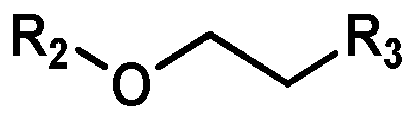
- R 2 is benzyl (Bn), tert-butyl ( t -Bu), tert -butyldimethylsilyl (TBDMS), methoxymethyl (MOM), acetyl (Ac) or benzoyl (Bz) and R 3 is TsO, MsO, Br or Cl, is used to introduce "hydroxyethyl convertible" groups into, or to modify, intermediate compounds at desired steps of the synthesis of ticagrelor.
- intermediate VI is a significant feature of the present invention, as it has been found that it allows for a shorter synthesis.
- This crucial point of using this intermediate distinguishes over intermediate AMALA used in the prior art synthesis in the fact that AMALA bears an acetonide protecting group, while the hydroxyl groups of the cyclopentane ring of the intermediate VI are not protected.
- a deprotection step otherwise required in the last step of the preparation of ticagrelor is thus omitted.
- the omission of said deprotection step which is conducted in an acidic medium (aq. HCl), does not only result in shortening the synthesis for one reaction step, but also prevents formation of side products, which can be formed if the conventionally used prescribed reaction time and conditions are not followed precisely, for example products of undesired epimerizations.
- the process of the current invention allows the possibility of providing solid crystalline intermediates, which is of significant advantage for enhancing purity of the product of interest.
- a tedious step of additional purification which is needed if the final intermediate is not solid (as is the case with known syntheses), can be omitted.
- Ticagrelor has 6 stereogenic centers (64 possible isomers), therefore the control of the stereoisomeric impurities during the synthesis is of great significance. If the intermediate entering the final step of the reaction can preferably be isolated in a solid form, the stereoisomeric impurities introduced with the starting material, or formed during the previous steps, can be substantially removed, which offers the possibility of obtaining ticagrelor of improved purity.
- a further significant advantage of the present invention resides in the possibility that several steps can, if desired, be performed through one-pot conversions, without the need of isolation or separation of intermediate compounds, which one-pot system therefore constitutes a preferred embodiment of the present invention.
- the compound of formula VI or a salt thereof is prepared by comprising the steps of
- the compound of formula VI or a salt thereof can be obtained by first carrying out a deprotection reaction of the cyclopentane hydroxyl group and subsequently converting the compound of formula IV to a compound of formula VI, by comprising the steps of:
- the compound of formula VI or a salt thereof can be obtained by first carrying out a deprotection reaction of the amino group and subsequently converting the compound of formula V to a comopund of formula VI, by comprising the steps of:
- a compound of formula VI can be prepared for example by acid hydrolysis from AMALA (Scheme 8), which can be prepared as described in WO 01/92263 .
- the substituent R 1 as mentioned above can be any suitable amino protecting group known to a skilled person, for example such a group can be selected from the group consisting of benzyl (Bn), tert -butoxycarbonyl (Boc), benzyloxycarbonyl (Cbz), trifluoroacetyl (TFA), trityl (Tr), trichloroacetyl (TCA), formyl (CHO), acetyl (Ac), benzoyl (Bz), tert- butyl ( t -Bu) and fluorenylmethoxycarbonyl (Fmoc).
- the substituent R 2 as mentioned above can be any suitable hydroxyl protecting group known to a skilled person, for example such a group can be selected from the group consisting of benzyl (Bn), tert -butyl ( t -Bu), tert -butyldimethylsilyl (TBDMS), methoxymethyl (MOM), acetyl (Ac) and benzoyl (Bz).
- the substituent R 3 according to the present invention can be any suitable leaving group known to a skilled person, for example sulfonate such as tosylate (TsO) or mesylate (MsO), or halogen such as Br and Cl.
- sulfonate such as tosylate (TsO) or mesylate (MsO)
- halogen such as Br and Cl.
- a suitable salt of intermediates III, IV, V and VI is a salt of organic acid, for example an organic achiral acid such as acetic, trifluoroacetic, oxalic, maleic, fumaric or p -toluenesulphonic acid, or an organic chiral acid such as L-tartaric acid, dibenzoyl-L-tartaric acid or di- p -toluoyl-L-tartaric acid.
- Preferred salts of intermediates III, IV, V and VI are fumarate, maleate and oxalate. Preparation of a solid salt offers an opportunity for purification of intermediates in order to prepare the compound of formula VI ( OLA ) and consequently ticagrelor of high purity.
- a further advantage of this preferred possibility of using respective salts resides in that the salts of the intermediately obtained compound of formula VI ( OLA ) are amendable to being used in further subsequent reaction steps according to preferred embodiments and also in an optional one-pot process without intermittent isolation procedures, thereby additionally benefiting from the possibility of further ease and efficiency of final isolation/purification.
- the particularly preferred embodiment of the present invention is a process for preparing a compound of formula XI (ticagrelor, TCG ), which is presented in scheme 9.
- the free base aminoalcohol OLA is viscous syrup that has poor solubility in aprotic solvents such as acetone, acetonitrile, tetrahydrofuran, ethyl acetate, dichloromethane and toluene, but is very soluble in lower alcohols and water. It is also relatively well soluble in very polar aprotic solvents such as dimethyl sulfoxide (DMSO), N,N -dimethylformamide (DMF) and N-methylpyrrolidin-2-one (NMP), or in a solvent such as polyethyleneglycol (PEG).
- aprotic solvents such as acetone, acetonitrile, tetrahydrofuran, ethyl acetate, dichloromethane and toluene
- aprotic solvents such as acetone, acetonitrile, tetrahydrofuran, ethyl acetate, dichloromethane and tol
- polyethyleneglycol to solubilize OLA, CLINA and triethylamine was found suitable as a solvent system for the initial N -arylation reaction.
- alcohols such as 2-propanol, butanols or pentanols can be used.
- Polyethyleneglycol is a non-toxic, inexpensive and non-volatile solvent that can be easily removed by an aqueous wash. This solvent also allows for the use of bases other than triethylamine, such as sodium or potassium carbonates or bicarbonates. Generally, 1 to 1.5 equivalents of base is used. If a salt of OLA is chosen, then 2 to 2.5 equivalents of base is used.
- the reaction can also be efficiently performed in the absence of any added solvent by using triethanolamine as a base.
- Triethanolamine is a tertiary amine that is miscible with both other reactants, OLA and CLINA.
- the formation of OLACINA requires temperatures of 60 to 100°C to achieve a satisfactory reaction time. All these bases, triethylamine, triethanolamine and alkali (bi)carbonates, with their pertaining reaction modifications, are suitable for the one-pot integration of the subsequent nitrosation of the formed OLACINA. In this respect, it is not necessary to isolate OLACINA, because yields are improved when applying the one-pot protocols for the synthesis of CLTOL and its impurity profile is not substantially affected.
- the nitrosation is performed by diluting the reaction mixture with acetic acid and slowly adding sodium nitrite while cooling to about 20°C.
- the product CLTOL is isolated by dilution with water and extraction. If required, it can be purified by either precipitation from its solutions using an antisolvent such as n-heptane, or recrystallized from solvents such as for example methyl tert-butyl ether or similar.
- the reaction of CLTOL with the cyclopropylamine CPA is rapid already at ambient temperature (25°C) and gives ticagrelor in a nearly quantitative yield.
- Solvent used for this reaction step is for example tetrahydrofuran to which triethylamine as a scavenger for the formed HCl can be added.
- CPA base salts of CPA can also be directly used in this reaction step.
- CPA mandelate in acetonitrile, with sodium carbonate as a base gives ticagrelor in a 93% yield.
- the total yield of ticagrelor starting from OLA is about 80%.
- the N-arylation of OLA can also be performed with the nitropyrimidine CLIN to give crystalline intermediate OLACIN in a 70% yield (Scheme 10). While the selectivity for the monosubstitution of a single chlorine in the nucleophilic aromatic substitution on CLIN is slightly reduced, the advantage of using the nitropyrimidine CLIN is in its high reactivity allowing the reaction to take place in matter of minutes even at 0 °C. With reduction of the nitro group, the common intermediate OLACINA is obtained in a pure form without resorting to chromatography. The reduction of the nitro group can be performed by the hydrogenation of OLACIN in acetic acid.
- CLTOL is obtained in a 71% overall yield from OLACIN by what is essentially a one-pot process.
- Ticagrelor is then prepared from CLTOL and CPA using the same method as in the original synthetic variant (48% total yield from OLA ).
- the intermediate VIII is not isolated.
- separation or isolation of the intermediate compound of formulae VIII can be carried out to obtain such compound as useful intermediate compound, this can be beneficially dispensed with if desired.
- This preferred embodiment is not only economically beneficial by the feature that one-pot synthesis is made possible; it is especially advantageous due to the generally amorphous nature of the intermediate compounds, which would make the purification difficult using non-chromatographic means, while the use of chromatographic means would again render the whole process less economically acceptable.
- the ticagrelor compound prepared according to the invention may be used or administered on its own, preferably it is administered as a pharmaceutical composition comprising ticagrelor and a pharmaceutically acceptable excipient and/or carrier. Further, the ticagrelor compound prepared according to the invention may be combined with other drugs, especially drugs having activity against platelet aggregation or thrombolytic events.
- a pharmaceutical composition comprising the compound of formula XI (ticagrelor, TCG) or a salt thereof is prepared by comprising the steps of preparing the compound of formula VIII or a salt thereof as described above, and mixing the compound of formula XI or a salt thereof with a pharmaceutically acceptable carrier and/or excipient.
- the administration form can be suitably chosen, e.g. a form suitable for oral, parenteral, rectal administration and/or administration by inhalation, and the dosage form may be solid, liquid, or powdery.
- the pharmaceutical composition comprising ticagrelor compound prepared according to the invention may suitably be in the form of tablets, pills, capsules, syrups, powders or granules for oral administration; or as sterile parenteral or subcutaneous solutions, suspensions for parenteral administration; or as suppositories for rectal administration.
- Suitable excipients and/or carriers include, without being limited to, diluents, binders, disintegrants, lubricants, etc.
- the compound or a finely divided form thereof, or particles comprising the compound are mixed with a carrier or binder substance, e.g. a mono-, di- or polysaccharide such as sugars and starch, a sugar alcohol or another polyol.
- lactose, saccharose, sorbitol, mannitol, starch, cellulose derivatives, a binder such as polyvinylpyrrolidone, and a lubricant such as magnesium stearate, calcium stearate, polyethylene glycol, waxes, paraffin, and the like are mixed, and then compressed into tablets.
- the compound or a finely divided form thereof or particles containing the same may be coated by another substance.
- the powder mixture or particles containing the compound may also be dispensed into capsules.
- the pharmaceutical composition comprising ticagrelor prepared according to the invention in a desired dose is generally suitable to treat a disease or condition of a patient in need thereof, specifically to display a desired activity against platelet aggregation, or in the treatment or prophylaxis of thrombolytic events.
- R 1 is benzyl (Bn), tert -butoxycarbonyl (Boc), benzyloxycarbonyl (Cbz), trifluoroacetyl (TFA), trityl (Tr), trichloroacetyl (TCA), formyl (CHO), acetyl (Ac), benzoyl (Bz), tert -butyl (t-Bu) or fluorenylmethoxycarbonyl (Fmoc), and R 2 is benzyl (Bn), tert -butyl ( t -Bu), tert- butyldimethylsilyl (TBDMS), methoxymethyl (MOM), acetyl (Ac) or benzoyl (B
- a suitable salt of intermediates III, IV and V is a salt of organic acid, for example an organic achiral acid such as acetic, trifluoroacetic, oxalic, maleic, fumaric or p -toluenesulphonic acid, or an organic chiral acid such as L-tartaric acid, dibenzoyl-L-tartaric acid or di-p-toluoyl-L-tartaric acid.
- Preferred salts of intermediates III, IV and V are fumarate, maleate and oxalate.
- reaction mixture was quenched with water (10 mL). To the mixture was extracted 3 x 10 mL of n-hexane. The combined organic phases were dried over MgSO 4 , filtered and evaporated to the dryness.
- Obtained IIIa was isolated from the reaction mixture by salt formation with fumaric acid.
- the solution of reaction mixture of IIIa (contained about 80 % of IIIa) in 2-butanone was warmed to 50 °C. 1 eq of fumaric acid (calculated to amount of IIIa) was added and reaction mixture was stirred at 50°C until fumaric acid dissolution.
- the reaction mixture was allowed to cool at room temperature followed by addition of n-hexane. After overnight stirring at room temperature, the precipitate white salt of IIIa was sucked off, washed with n-hexane and dried under reduce pressure at 40°C.
- IIIa fumarate salt was suspended in EtOAc and 5% aqueous solution of NaHCO 3 was added to the suspension. The mixture was stirred vigorously at room temperature for an hour. The two clear phases were separated and organic phase was washed with water, dried over MgSO 4 and evaporated to the dryness to provide pure IIIa.
- 1 H NMR (CDCl 3 ) ⁇ 1.30 (s, 3H), 1.40 (s, 3H), 1.90 (d, 1 H), 2.15 (m, 1 H), 3.17 (m, 1H), 3.60 (m, 2H), 3.68 (m, 2H), 3.80-3.90 (m, 3H), 4.51 (s, 2H), 4.63 (m, 2H), 7.23-7.36 (m, 10H) ppm.
- IIIb was isolated from the reaction mixture by salt formation with fumaric acid.
- the solution of reaction mixture of IIIb (contained about 60 % of IIa) in 2-butanone was warmed to 50 °C. 1 eq of fumaric acid (calculated to amount of IIIb) was added and reaction mixture was stirred at 50 °C until fumaric acid dissolution.
- the reaction mixture was allowed to cooled at room temperature followed by addition of n-hexane. After overnight stirring at room temperature, the precipitate white salt of IIIb was sucked off, washed with n-hexane and dried under reduce pressure at 40 °C.
- reaction mixture was quenched with water (30 mL). To the mixture was extracted 3 x 30 mL of n-hexane. The combined organic phases were dried over MgSO 4 , filtered and evaporated to the dryness. The pure IIIc was isolated from reaction mixture by chromatography on silica gel column (mobile phase: n-hexane/EtOAc).
- reaction mixture was quenched with water (70 mL). To the mixture was extracted 3 x 100 mL of n-hexane. The combined organic phases were dried over MgSO 4 , filtered and evaporated to the dryness. The pure IIId was isolated from reaction mixture by chromatography on silica gel column (mobile phase: n-hexane/EtOAc).
- Example 14 Preparation of (1 S ,2 S ,3 R ,5 S )-3-(7-chloro-5-(propylthio)-3H-[1,2,3]triazolo[4,5-d]pyrimidin-3-yl)-5-(2-hydroxyethoxy)cyclopentane-1,2-diol ( CLTOL )
Landscapes
- Chemical & Material Sciences (AREA)
- Organic Chemistry (AREA)
- Pharmaceuticals Containing Other Organic And Inorganic Compounds (AREA)
Abstract
The present invention relates to the field of organic synthesis and describes the synthesis of specific intermediates suitable for the preparation of triazolopyrimidine compounds such as ticagrelor.
Description
- The present invention relates to the field of organic synthesis, in particular to the synthesis of specific triazolopyrimidine compounds and intermediates thereof as well as related derivatives.
- An important triazolopyrimidine compound is ticagrelor (TCG; Brilinta®; 3-[7-[[(1R,2S)- 2-(3,4-difluorophenyl)cyclopropyl]amino]-5-(propylthio)-3H-1,2,3-triazolo[4,5-d]pyrimidin-3-yl]-5-(2-hydroxyethoxy)-(1S,2S,3R,5S)-1,2-cyclopentanediol) having the following structural formula.

- Ticagrelor shows pharmaceutical activity by functioning as a P2Y12 receptor antagonist and thus is indicated for the treatment or prevention of thrombotic events, for example stroke, heart attack, acute coronary syndrome or myocardial infection with ST elevation, other coronary artery diseases and arterial thrombosis as well as other disorders related to platelet aggregation (
WO 00/34283 - The synthesis of ticagrelor (TCG) is demanding. There are five to six known synthetic variants, which are described in the basic patent application
WO 00/34283 WO 01/92263 WO 10/030224 WO 11/017108 WO 00/34283 
- This nine step synthesis of ticagrelor (TCG) as described in
WO 00/34283 - This synthetic path is very long (9 steps, not including reagents preparation) and uses toxic compounds like CHBr3, triflic anhydride, and methyl 2-(((trifluoromethyl)sulfonyl)oxy)acetate. The introduction of the methoxycarbonylmethyl group (reaction from ATAM to MATAM) is very difficult due to poor chemoselectivity, as the amino group also reacts with 2-(((trifluoromethyl)sulfonyl)oxy)acetate.
- An improved synthesis of ticagrelor (TCG) is described in
WO 01/92263 - This improved process still has substantial length (7-8 steps). In AMALA synthesis the benzyloxycarbonyl protection (Cbz) is used, which is then removed in the third step using hydrogenation with Pd/C as a catalyst. Hydrogenation with Pt/C as a catalyst is also used in the reduction of CLIDA to CLINA.

- Another improved synthetic path is described in
WO 10/030224 WO 01/92263 - This further improved process to TCG has 8 reaction steps. Like in
WO 01/92263 
- AstraZeneca published a synthetic path (Scheme 4) to ticagrelor (TCG) in Bioorg. Med. Chem. Lett. 2007, 17, 6013-6018. Intermediates in this process are similar to those described in
WO 01/92263 
- Another synthetic variant (Scheme 5) to ticagrelor (TCG) is described in
WO 11/017108 WO 01/92263 - Still another synthetic variant (Scheme 6) to obtain ticagrelor with deuterated hydroxyethyl group (TCGD) is also described in
WO 11/017108 

- The object of the present invention was to provide an industrially applicable and economically improved process for obtaining ticagrelor.
- The present invention provides a process for the preparation of a compound of formula XI (Ticagrelor) or pharmaceutically acceptable salt thereof

- (i) contacting a compound of formula VI or a salt thereof


- (ii) optionally, if a compound of formula VIII' is obtained, reducing the compound of formula VIII' to a compound of formula VIII,
- (iii) converting a compound of formula VIII by nitrosation to a compound of formula IX

- (iv) coupling the compound of formula IX with a compound of formula X

- The process defined above allows for preparation or synthesis of ticagrelor with an industrially applicable and economically improved process. Preferred embodiments will be described below. The present invention further provides novel compounds that are highly useful as key intermediates in the preparation or synthesis of ticagrelor.
- According to a further aspect, the present invention provides novel and useful process alternatives (i), (ii) and (iii) to prepare a compound of formula VI or a salt thereof,

- (i) either:
- (0-1) providing a compound of formula III or a salt thereof

- (0-2) directly converting a compound of formula III to a compound of formula VI, and
- (0-3) optionally converting a compound of formula VI to a salt thereof; or:
- (0-1') providing a compound of formula I II or a salt thereof

- (0-2') converting a compound of formula III to a compound of formula IV

- (0-3') converting a compound of formula IV to a compound of formula VI,
- (0-4') optionally converting a compound of formula VI to a salt thereof; (iii) or:
- (0-1") providing a compound of formula III or a salt thereof

- (0-2") converting a compound of formula III to a compound of formula V

- (0-1) providing a compound of formula III or a salt thereof
- (0-3") converting a compound of formula V to a compound of formula VI,
- (0-4") optionally converting a compound of formula VI to a salt thereof.
- For the above alternative embodiments (i), (ii) and (iii), the compound of formula III or a salt thereof may preferably be prepared by comprising the steps of:
- providing a compound of formula I


- This further aspect of the invention allows a very short process for introduction of hydroxyethyl side chain to amino carbasugar (2-3 steps), while at the same time using cheap, non-toxic and basic reagents.
- Moreover, introduction of hydroxyethyl side chain based on such concept allows to make beneficial use thereof in other synthesis routes to finally obtain obtaining triazolopyrimidine compounds and specifically ticagrelor, as it facilitates introduction (and optionally "pulling through" in subsequent synthetic steps) of a structural moiety "convertible to hydroxyethyl" at any time of the total synthesis desired.
- Therefore, another aspect of the present invention resides in that the compound


- Aspects, advantageous features and preferred embodiments of the present invention will be described in further detail below, noting however that such aspects, advantages features as well as embodiments and examples are presented for illustrative purposes only and shall not limit the invention in any way.
- Use of intermediate VI as a starting reagent in the synthetic preparation of ticagrelor is a significant feature of the present invention, as it has been found that it allows for a shorter synthesis. This crucial point of using this intermediate distinguishes over intermediate AMALA used in the prior art synthesis in the fact that AMALA bears an acetonide protecting group, while the hydroxyl groups of the cyclopentane ring of the intermediate VI are not protected. As a consequence, a deprotection step otherwise required in the last step of the preparation of ticagrelor is thus omitted. The omission of said deprotection step, which is conducted in an acidic medium (aq. HCl), does not only result in shortening the synthesis for one reaction step, but also prevents formation of side products, which can be formed if the conventionally used prescribed reaction time and conditions are not followed precisely, for example products of undesired epimerizations.
- Further, contrary to the prior art syntheses, the process of the current invention allows the possibility of providing solid crystalline intermediates, which is of significant advantage for enhancing purity of the product of interest. With this preferred embodiment a tedious step of additional purification, which is needed if the final intermediate is not solid (as is the case with known syntheses), can be omitted.
- The above advantages are particularly important for preparation of compounds such as ticagrelor. Ticagrelor has 6 stereogenic centers (64 possible isomers), therefore the control of the stereoisomeric impurities during the synthesis is of great significance. If the intermediate entering the final step of the reaction can preferably be isolated in a solid form, the stereoisomeric impurities introduced with the starting material, or formed during the previous steps, can be substantially removed, which offers the possibility of obtaining ticagrelor of improved purity.
- A further significant advantage of the present invention resides in the possibility that several steps can, if desired, be performed through one-pot conversions, without the need of isolation or separation of intermediate compounds, which one-pot system therefore constitutes a preferred embodiment of the present invention.
- Accordingly, the possibility of reducing the number of required reaction steps and of simplifying reactions respectively strongly contributes to provide an improved industrially applicable and economically beneficial process for obtaining triazolopyrimidine compounds and specifically ticagrelor.
- According to a preferred embodiment, the compound of formula VI or a salt thereof is prepared by comprising the steps of
- (0-1) providing a compound of formula III or a salt thereof

- (0-2) directly converting a compound of formula III to a compound of formula VI, and
- (0-3) optionally converting a compound of formula VI to a salt thereof.
- Alternatively, the compound of formula VI or a salt thereof can be obtained by first carrying out a deprotection reaction of the cyclopentane hydroxyl group and subsequently converting the compound of formula IV to a compound of formula VI, by comprising the steps of:
- (0-1') providing a compound of formula III or a salt thereof

- (0-2') converting a compound of formula III to a compound of formula IV

- (0-3') converting a compound of formula IV to a compound of formula VI,
- (0-4') optionally converting a compound of formula VI to a salt thereof.
- Alternatively, the compound of formula VI or a salt thereof can be obtained by first carrying out a deprotection reaction of the amino group and subsequently converting the compound of formula V to a comopund of formula VI, by comprising the steps of:
- (0-1") providing a compound of formula III or a salt thereof

- (0-2") converting a compound of formula III to a compound of formula V

- (0-3") converting a compound of formula V to a compound of formula VI,
- (0-4") optionally converting a compound of formula VI to a salt thereof.
- A summary of the afore-mentioned ways to prepare the compound of formula VI is shown in the following scheme 7 below.

- Alternatively, a compound of formula VI can be prepared for example by acid hydrolysis from AMALA (Scheme 8), which can be prepared as described in
WO 01/92263 
- In another embodiment of the present invention presented in scheme 7, the compound of formula III or a salt thereof is prepared by comprising the steps of
- (i) providing a compound of formula I
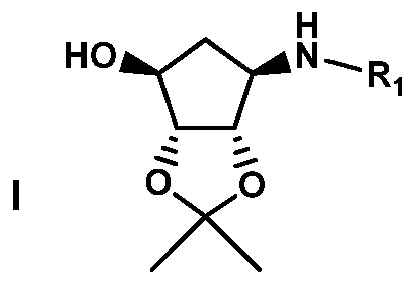
- (ii) reacting the compound of formula I with a compound of formula II

- (iii) optionally converting the compound of formula III to a salt thereof.
- Such a preferred preparation of compound III is advantageous, when the protection of amino group is introduced during the cyclopentane ring construction. Thus, according to J. Chem. Soc. Perkin Trans. 1, 1994, 613, the compound Ia (R1=Bn) is a direct product of the synthesis from D-ribose and no subsequent protection is needed.
- The substituent R1 as mentioned above can be any suitable amino protecting group known to a skilled person, for example such a group can be selected from the group consisting of benzyl (Bn), tert-butoxycarbonyl (Boc), benzyloxycarbonyl (Cbz), trifluoroacetyl (TFA), trityl (Tr), trichloroacetyl (TCA), formyl (CHO), acetyl (Ac), benzoyl (Bz), tert-butyl (t-Bu) and fluorenylmethoxycarbonyl (Fmoc).
- The substituent R2 as mentioned above can be any suitable hydroxyl protecting group known to a skilled person, for example such a group can be selected from the group consisting of benzyl (Bn), tert-butyl (t-Bu), tert-butyldimethylsilyl (TBDMS), methoxymethyl (MOM), acetyl (Ac) and benzoyl (Bz).
- The substituent R3 according to the present invention can be any suitable leaving group known to a skilled person, for example sulfonate such as tosylate (TsO) or mesylate (MsO), or halogen such as Br and Cl.
- A suitable salt of intermediates III, IV, V and VI is a salt of organic acid, for example an organic achiral acid such as acetic, trifluoroacetic, oxalic, maleic, fumaric or p-toluenesulphonic acid, or an organic chiral acid such as L-tartaric acid, dibenzoyl-L-tartaric acid or di-p-toluoyl-L-tartaric acid. Preferred salts of intermediates III, IV, V and VI are fumarate, maleate and oxalate. Preparation of a solid salt offers an opportunity for purification of intermediates in order to prepare the compound of formula VI (OLA) and consequently ticagrelor of high purity. A further advantage of this preferred possibility of using respective salts resides in that the salts of the intermediately obtained compound of formula VI (OLA) are amendable to being used in further subsequent reaction steps according to preferred embodiments and also in an optional one-pot process without intermittent isolation procedures, thereby additionally benefiting from the possibility of further ease and efficiency of final isolation/purification.
- As mentioned above, the particularly preferred embodiment of the present invention is a process for preparing a compound of formula XI (ticagrelor, TCG), which is presented in scheme 9.

- The free base aminoalcohol OLA is viscous syrup that has poor solubility in aprotic solvents such as acetone, acetonitrile, tetrahydrofuran, ethyl acetate, dichloromethane and toluene, but is very soluble in lower alcohols and water. It is also relatively well soluble in very polar aprotic solvents such as dimethyl sulfoxide (DMSO), N,N-dimethylformamide (DMF) and N-methylpyrrolidin-2-one (NMP), or in a solvent such as polyethyleneglycol (PEG). In particular, a certain amount of polyethyleneglycol to solubilize OLA, CLINA and triethylamine was found suitable as a solvent system for the initial N-arylation reaction. Alternatively, alcohols such as 2-propanol, butanols or pentanols can be used. Polyethyleneglycol is a non-toxic, inexpensive and non-volatile solvent that can be easily removed by an aqueous wash. This solvent also allows for the use of bases other than triethylamine, such as sodium or potassium carbonates or bicarbonates. Generally, 1 to 1.5 equivalents of base is used. If a salt of OLA is chosen, then 2 to 2.5 equivalents of base is used. The reaction can also be efficiently performed in the absence of any added solvent by using triethanolamine as a base. Triethanolamine is a tertiary amine that is miscible with both other reactants, OLA and CLINA. The formation of OLACINA requires temperatures of 60 to 100°C to achieve a satisfactory reaction time. All these bases, triethylamine, triethanolamine and alkali (bi)carbonates, with their pertaining reaction modifications, are suitable for the one-pot integration of the subsequent nitrosation of the formed OLACINA. In this respect, it is not necessary to isolate OLACINA, because yields are improved when applying the one-pot protocols for the synthesis of CLTOL and its impurity profile is not substantially affected. The nitrosation is performed by diluting the reaction mixture with acetic acid and slowly adding sodium nitrite while cooling to about 20°C. The product CLTOL is isolated by dilution with water and extraction. If required, it can be purified by either precipitation from its solutions using an antisolvent such as n-heptane, or recrystallized from solvents such as for example methyl tert-butyl ether or similar. The reaction of CLTOL with the cyclopropylamine CPA is rapid already at ambient temperature (25°C) and gives ticagrelor in a nearly quantitative yield. Solvent used for this reaction step is for example tetrahydrofuran to which triethylamine as a scavenger for the formed HCl can be added. Instead of CPA base, salts of CPA can also be directly used in this reaction step. For example, CPA mandelate in acetonitrile, with sodium carbonate as a base, gives ticagrelor in a 93% yield. Overall, the total yield of ticagrelor starting from OLA is about 80%.
- Alternatively, the N-arylation of OLA can also be performed with the nitropyrimidine CLIN to give crystalline intermediate OLACIN in a 70% yield (Scheme 10). While the selectivity for the monosubstitution of a single chlorine in the nucleophilic aromatic substitution on CLIN is slightly reduced, the advantage of using the nitropyrimidine CLIN is in its high reactivity allowing the reaction to take place in matter of minutes even at 0 °C. With reduction of the nitro group, the common intermediate OLACINA is obtained in a pure form without resorting to chromatography. The reduction of the nitro group can be performed by the hydrogenation of OLACIN in acetic acid. The so obtained solution of OLACINA in acetic acid is easily nitrosated by the use of sodium nitrite to give the pyrimidinotriazole intermediate CLTOL. In this manner, CLTOL is obtained in a 71% overall yield from OLACIN by what is essentially a one-pot process. Ticagrelor is then prepared from CLTOL and CPA using the same method as in the original synthetic variant (48% total yield from OLA).

- As set forth above, it is possible and corresponds to a particularly preferred embodiment of the present invention that the intermediate VIII is not isolated. Thus, while of course separation or isolation of the intermediate compound of formulae VIII can be carried out to obtain such compound as useful intermediate compound, this can be beneficially dispensed with if desired. This preferred embodiment is not only economically beneficial by the feature that one-pot synthesis is made possible; it is especially advantageous due to the generally amorphous nature of the intermediate compounds, which would make the purification difficult using non-chromatographic means, while the use of chromatographic means would again render the whole process less economically acceptable.
- The ticagrelor compound prepared according to the invention may be used or administered on its own, preferably it is administered as a pharmaceutical composition comprising ticagrelor and a pharmaceutically acceptable excipient and/or carrier. Further, the ticagrelor compound prepared according to the invention may be combined with other drugs, especially drugs having activity against platelet aggregation or thrombolytic events.
- In a further aspect of the present invention, a pharmaceutical composition comprising the compound of formula XI (ticagrelor, TCG) or a salt thereof is prepared by comprising the steps of preparing the compound of formula VIII or a salt thereof as described above, and mixing the compound of formula XI or a salt thereof with a pharmaceutically acceptable carrier and/or excipient. The administration form can be suitably chosen, e.g. a form suitable for oral, parenteral, rectal administration and/or administration by inhalation, and the dosage form may be solid, liquid, or powdery. Therefore, the pharmaceutical composition comprising ticagrelor compound prepared according to the invention may suitably be in the form of tablets, pills, capsules, syrups, powders or granules for oral administration; or as sterile parenteral or subcutaneous solutions, suspensions for parenteral administration; or as suppositories for rectal administration.
- Suitable excipients and/or carriers include, without being limited to, diluents, binders, disintegrants, lubricants, etc. For example, the compound or a finely divided form thereof, or particles comprising the compound, are mixed with a carrier or binder substance, e.g. a mono-, di- or polysaccharide such as sugars and starch, a sugar alcohol or another polyol. For example, lactose, saccharose, sorbitol, mannitol, starch, cellulose derivatives, a binder such as polyvinylpyrrolidone, and a lubricant such as magnesium stearate, calcium stearate, polyethylene glycol, waxes, paraffin, and the like are mixed, and then compressed into tablets. The compound or a finely divided form thereof or particles containing the same may be coated by another substance. The powder mixture or particles containing the compound may also be dispensed into capsules.
- The pharmaceutical composition comprising ticagrelor prepared according to the invention in a desired dose is generally suitable to treat a disease or condition of a patient in need thereof, specifically to display a desired activity against platelet aggregation, or in the treatment or prophylaxis of thrombolytic events.
- Further aspects of the present invention reside in the provision of valuable intermediate compounds III to V and salts thereof, and intermediate compounds VIII, VIII' and IX, all useful in the synthesis of a compound of formula XI (ticagrelor, TCG):


- A suitable salt of intermediates III, IV and V is a salt of organic acid, for example an organic achiral acid such as acetic, trifluoroacetic, oxalic, maleic, fumaric or p-toluenesulphonic acid, or an organic chiral acid such as L-tartaric acid, dibenzoyl-L-tartaric acid or di-p-toluoyl-L-tartaric acid. Preferred salts of intermediates III, IV and V are fumarate, maleate and oxalate.


- Particular examples of such useful intermediate compounds are listed by their respective formulas below:
Formula Chemical name 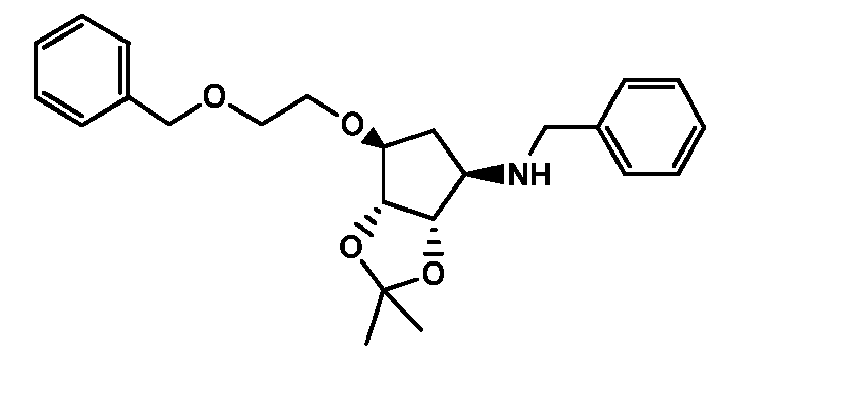
(3aS,4R,6S,6aR)-N-Benzyl-6-(2-(benzyloxy)ethoxy)-2,2-dimethyltetrahydro-3aH-cyclopenta[d][1,3]dioxol-4-amine 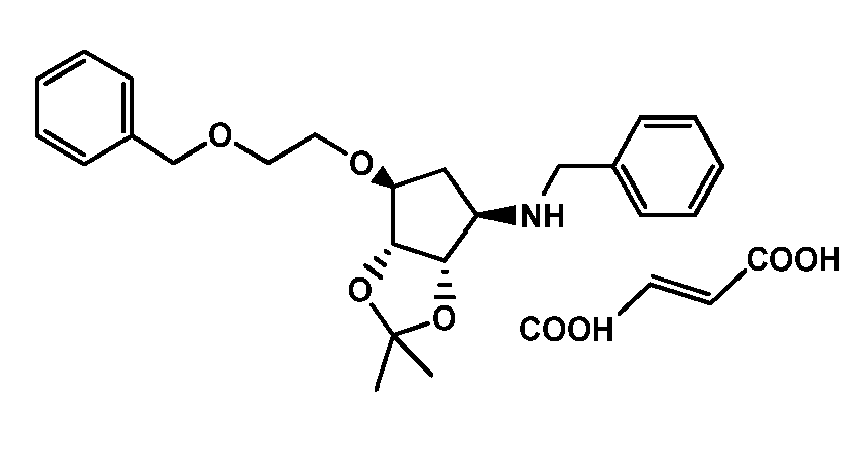
(3aS,4R,6S,6aR)-N-Benzyl-6-(2-(benzyloxy)ethoxy)-2,2-dimethyltetrahydro-3aH-cyclopenta[d][1,3]dioxol-4-amine fumarate 
(3aS,4R,6S,6aR)-N-Benzyl-6-(2-tert-butoxy)ethoxy)-2,2-dimethyltetrahydro-3aH-cyclopenta[d][1,3]dioxol-4-amine 
3aS,4R,6S,6aR)-N-Benzyl-6-(2-tert-butoxy)ethoxy)-2,2-dimethyltetrahydro-3aH-cyclopenta[d][1,3]dioxol-4-amine fumarate 
tert-Butyl ((3aS,4R,6S,6aR)-6-(2-(benzyloxy)ethoxy)-2,2-dimethyltetrahydro-3aH-cyclopenta[d][1,3]dioxol-4-yl)carbamate 
tert-Butyl ((3aS,4R,6S,6aR)-6-(2-(tert-butoxy)ethoxy)-2,2-dimethyltetrahydro-3aH-cyclopenta[d][1,3]dioxol-4-yl)carbamate 
(3aS,4R,6S,6aR)-6-(2-(benzyloxy)ethoxy)-2,2-dimethyl-N-trityltetrahydro-3aH-cyclopenta[d][1,3]dioxol-4-amine 
(3aS,4R,6S,6aR)-6-(2-(tert-butoxy)ethoxy)-2,2-dimethyl-N-trityltetrahydro-3aH-cyclopenta[d][1,3]dioxol-4-amine 
(1S,2S,3R,5S)-3-(Benzylamino)-5-(2-(benzyloxy)ethoxy)cyclopentane-1,2-diol 
(3aS,4R,6S,6aR)-6-(2-(tert-butoxy)ethoxy)-2,2-dimethyltetrahydro-3aH-cyclopenta[d][1,3]dioxol-4-amine 
(1S,2S,3S,5R)-3-(2-(benzyloxy)ethoxy)-5-(tritylamino)cyclopentane-1,2-diol 
(1S,2S,3R,5S)-3-((5-amino-6-chloro-2-(propylthio)pyrimidin-4-yl)- amino)-5-(2-hydroxyethoxy)cyclopentane-1,2-diol 
(1S,2S,3R,5S)-3-((6-chloro-5-nitro-2-(propylthio)pyrimidin-4-yl)amino)-5-(2-hydroxyethoxy)cyclopentane-1,2-diol 
(1S,2S,3R,5S)-3-(7-chloro-5-(propylthio)-3H-[1,2,3]triazolo[4,5-d]pyrimidin-3-yl)-5-(2-hydroxyethoxy)cyclopentane-1,2-diol - In the following the present invention will be described in further detail by illustrative, nonlimiting examples.
-

- A solution of (3aR,4S,6R,6aS)-6-(benzylamino)-2,2-dimethyltetrahydro-3aH-cyclopenta-[d][1,3]-dioxol-4-ol (1.0 g, 3.8 mmol) in dry DMF (10 mL) under nitrogen atmosphere was cooled at 0 °C followed by addition of NaH (60 %, 182 mg, 4.6 mmol). After stirring for 30 min at 0 °C, 2-(benzyloxy)ethyl 4-methylbenzenesulfonate (1.2 g, 3.8 mmol) was added and the reaction mixture was allowed to warm at room temperature. After stirring for 4 hours, the reaction mixture was quenched with water (10 mL). To the mixture was extracted 3 x 10 mL of n-hexane. The combined organic phases were dried over MgSO4, filtered and evaporated to the dryness.
-

- Obtained IIIa was isolated from the reaction mixture by salt formation with fumaric acid. The solution of reaction mixture of IIIa (contained about 80 % of IIIa) in 2-butanone was warmed to 50 °C. 1 eq of fumaric acid (calculated to amount of IIIa) was added and reaction mixture was stirred at 50°C until fumaric acid dissolution. The reaction mixture was allowed to cool at room temperature followed by addition of n-hexane. After overnight stirring at room temperature, the precipitate white salt of IIIa was sucked off, washed with n-hexane and dried under reduce pressure at 40°C.
-

1H NMR (CDCl3) δ = 1.30 (s, 3H), 1.40 (s, 3H), 1.90 (d, 1 H), 2.15 (m, 1 H), 3.17 (m, 1H), 3.60 (m, 2H), 3.68 (m, 2H), 3.80-3.90 (m, 3H), 4.51 (s, 2H), 4.63 (m, 2H), 7.23-7.36 (m, 10H) ppm. 13C NMR (CDCl3) δ = 24.0, 26.4, 33.9, 51.6, 63.0, 68.5, 69.2, 73.1, 83.9, 84.6, 84.8 110.4, 126.7, 127.5, 127.53, 128.0, 128.2, 128.3, 138.1, 140.3 ppm. -

- A solution of (3aR,4S,6R,6aS)-6-(benzylamino)-2,2-dimethyltetrahydro-3aH-cyclopenta-[d][1,3]-dioxol-4-ol (10 g, 38 mmol) in dry DMF (100 mL) under nitrogen atmosphere was cooled at 0 °C followed by addition of NaH (60 %, 1.8 g, 46 mmol). After stirring for 30 min at 0 °C, 2-(tert-butoxy)ethyl 4-methylbenzenesulfonate (10.3 g, 38 mmol) was added and the reaction mixture was allowed to warm at room temperature. After stirring for 4 hours, the reaction mixture was quenched with water (100 mL). The mixture was extracted 3 x 10 mL of n-hexane. The combined organic phases were dried over MgSO4, filtered and evaporated to the dryness.
-

- Obtained IIIb was isolated from the reaction mixture by salt formation with fumaric acid. The solution of reaction mixture of IIIb (contained about 60 % of IIa) in 2-butanone was warmed to 50 °C. 1 eq of fumaric acid (calculated to amount of IIIb) was added and reaction mixture was stirred at 50 °C until fumaric acid dissolution. The reaction mixture was allowed to cooled at room temperature followed by addition of n-hexane. After overnight stirring at room temperature, the precipitate white salt of IIIb was sucked off, washed with n-hexane and dried under reduce pressure at 40 °C.
-

1H NMR (CDCl3) δ = 1.14 (s, 9H), 1.30 (s, 3H), 1.40 (s, 3H), 1.88 (d, 1H), 2.10 (m, 1H), 3.14 (m, 1 H), 3.45 (m, 2H), 3.59 (m, 2H), 3.80-3.90 (m, 3H), 4.62 (m, 2H), 7.22-7.35 (m, 5H) ppm. 13C NMR (CDCl3) δ = 24.0, 26.4, 27.4, 33.8, 51.7, 60.1, 63.1, 69.1, 72.9, 83.9, 84.6, 84.8 110.2, 126.7, 128.1, 128.2, 140.3 ppm. -

- A solution of tert-butyl ((3aS,4R,6S,6aR)-6-hydroxy-2,2-dimethyltetrahydro-3aH-cyclopenta[d]-[1,3]dioxol-4-yl)carbamate (3.0 g, 10.8 mmol) in dry DMF (30 mL) under nitrogen atmosphere was cooled at 0 °C followed by addition of NaH (60 %, 530 mg, 13.0 mmol). After stirring for 30 min at 0 °C, 2-(benzyloxy)ethyl 4-methylbenzenesulfonate (3.3 g, 10.8 mmol) was added and the reaction mixture was allowed to warm at room temperature. After stirring for 4 hours, the reaction mixture was quenched with water (30 mL). To the mixture was extracted 3 x 30 mL of n-hexane. The combined organic phases were dried over MgSO4, filtered and evaporated to the dryness. The pure IIIc was isolated from reaction mixture by chromatography on silica gel column (mobile phase: n-hexane/EtOAc).
1H NMR (CDCl3) δ = 1.30 (s, 3H), 1.40 (s, 12H), 1.82 (d, 1H), 2.14 (m, 1H), 3.53-3.67 (m, 4H), 3.87 (d, 1H), 4.11 (m, 1H), 4.49-4.58 (m, 3H), 4.65 (m, 1H), 5.73 (d, 1H), 7.27-7.36 (m, 5H) ppm.
13C NMR (CDCl3) δ = 23.8, 26.2, 28.4, 32.3, 56.4, 68.0, 68.8, 73.2, 79.0, 83.5, 84.9, 86.0, 110.1, 127.7, 128.4, 138.0, 155.2 ppm. -

- A solution of tert-butyl ((3aS,4R,6S,6aR)-6-hydroxy-2,2-dimethyltetrahydro-3aH-cyclopenta-[d][1 ,3]dioxol-4-yl)carbamate (7.0 g, 25.6 mmol) in dry DMF (70 mL) under nitrogen atmosphere was cooled at 0 °C followed by addition of NaH (60 %, 1.3 g, 30.7 mmol). After stirring for 30 min at 0 °C, 2-(tert-butoxy)ethyl 4-methylbenzenesulfonate (7.0 g, 25.6 mmol) was added and the reaction mixture was allowed to warm at room temperature. After stirring for 4 hours, the reaction mixture was quenched with water (70 mL). To the mixture was extracted 3 x 100 mL of n-hexane. The combined organic phases were dried over MgSO4, filtered and evaporated to the dryness. The pure IIId was isolated from reaction mixture by chromatography on silica gel column (mobile phase: n-hexane/EtOAc).
1H NMR (CDCl3) δ = 1.21 (s, 9H), 1.26 (s, 3H), 1.40 (s, 3H), 1.43 (s, 9H), 1.78 (d, 1H), 2.15 (m, 1H), 3.47-3.57 (m, 3H), 3.65 (m, 1H), 3.83 (m, 1H), 4.10 (m, 1H), 4.50 (m, 2H), 4.60 (m, 1H), 5.50 (d, 1H) ppm.
13C NMR (CDCl3) δ = 23.8, 26.2, 27.5, 32.7, 56.5, 60.9, 69.2, 73.0, 83.3, 85.1, 86.0, 110.0, 128.0, 129.7, 155.2 ppm. -

- A solution of (10 g, 24.0 mmol) (3aR,4S,6R,6aS)-2,2-dimethyl-6-(tritylamino)tetrahydro-3aH-cyclopenta[d][1,3]dioxol-4-ol in dry DMF (100 mL) under nitrogen atmosphere was cooled at 0 °C followed by addition of NaH (60 %, 1.2 g, 29.0 mmol). After stirring for 30 min at 0 °C, 2-(benzyloxy)ethyl 4-methylbenzenesulfonate (7.4 g, 24.0 mmol) was added and the reaction mixture was allowed to warm at room temperature. After stirring for 4 hours, the reaction mixture was quenched with water (100 mL). To the mixture was extracted 3 x 100 mL of EtOAc. The combined organic phases were dried over MgSO4, filtered and evaporated to the dryness. The pure IIIe was isolated from reaction mixture by chromatography on silica gel column (mobile phase: n-hexane/EtOAc).
1H NMR (CDCl3) δ = 0.57 (d, 1 H), 1.20 (s, 3H), 1.30 (s, 3H), 1.45 (m, 1H), 2.50 (s, 1H), 3.15 (s, 1 H), 3.41 (m, 4H), 3.57 (m, 1 H), 4.55 (s, 2H), 7.19 (m, 3H), 7.26-7.39 (m, 7H), 7.56 (d, 6H) ppm. 13C NMR (CDCl3) δ = 23.8, 26.2, 27.3, 32.5, 59.3, 61.0, 68.8, 71.5, 72.8, 83.7, 85.2, 87.6, 109.4, 126.1, 127.2, 127.8, 128.3, 128.6, 128.7, 146.9 ppm. -

- A solution of (3aR,4S,6R,6aS)-2,2-dimethyl-6-(tritylamino)tetrahydro-3aH-cyclopenta[d]-[1,3]dioxol-4-ol (10.0 g, 24.0 mmol) in dry DMF (100 mL) under nitrogen atmosphere was cooled at 0 °C followed by addition of NaH (60 %, 1.2 g, 29.0 mmol). After stirring for 30 min at 0 °C, 2-(tert-butoxy)ethyl 4-methylbenzenesulfonate (6.5 g, 24.0 mmol) was added and the reaction mixture was allowed to warm at room temperature. After stirring for 4 hours, the reaction mixture was quenched with water (100 mL). To the mixture was extracted 3 x 100 mL of EtOAc. The combined organic phases were dried over MgSO4, filtered and evaporated to the dryness. The pure IIIf was isolated from reaction mixture by chromatography on silica gel column (mobile phase: n-hexane/EtOAc).
1 H NMR (CDCl3) δ = 0.57 (d, 1 H), 1.20 (s, 9H), 1.30 (s, 3H), 1.35 (s, 3H), 1.45 (m, 1 H), 2.50 (s, 1 H), 3.15 (s, 1 H), 3.41 (m, 4H), 3.57 (m, 1 H), 4.55 (s, 2H), 7.19 (m, 3H), 7.26-7.39 (m, 7H), 7.56 (d, 6H) ppm.
13C NMR (CDCl3) δ = 23.8, 26.2, 27.3, 32.5, 59.3, 61.0, 68.8, 71.5, 72.8, 83.7, 85.2, 87.6, 109.4, 126.1, 127.2, 127.8, 128.3, 128.6, 128.7, 146.9 ppm. -
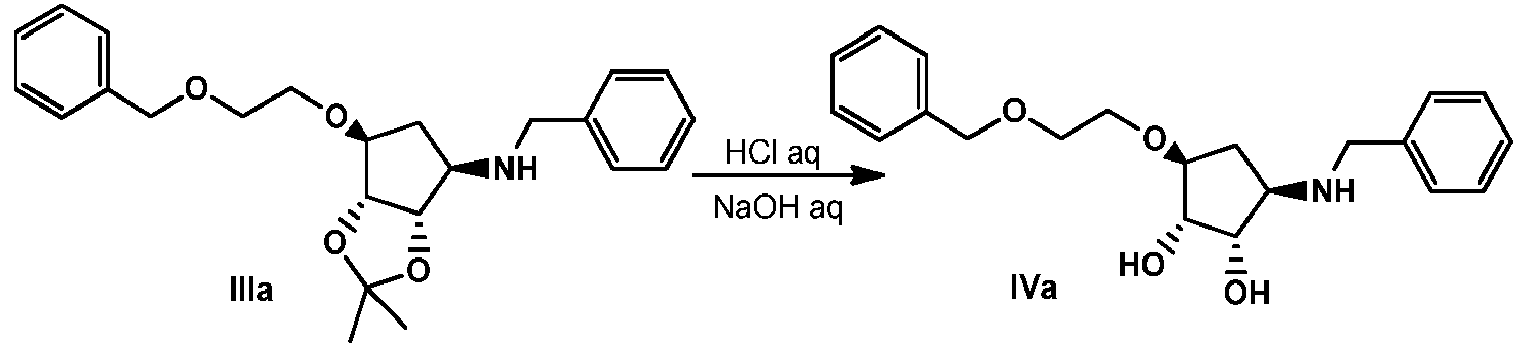
1 H NMR (CDCl3) δ = 1.34 (m, 1 H), 2.44 (m, 1 H), 3.02 (m, 1 H), 3.60-3.87 (m, 8H), 4.0 (m, 1 H), 4.56 (s, 2H), 7.27-7.37 (m, 10H) ppm.
13C NMR (CDCl3) δ = 34.6, 52.3, 61.3, 69.3, 69.8, 73.3, 75.5, 76.2, 83.8, 127.1, 127.8, 128.2, 128.5, 128.6, 137.9, 140.0 ppm. -

- The solution of IVa (1.1 g, 2.8 mmol) in MeOH (15 mL) was hydrogenated at 10 bar of hydrogen for 16 hours in the presence of Pd/C (10 %, 0.2 g). The reaction mixture was passed through the pad of celite and evaporated to the dryness to provide VI.
1 H NMR (DMSO-d6) δ = 1.07 (m, 1 H), 2.19 (m, 1 H), 2.90 (m, 1 H), 3.36-3.60 (m, 6H), 3.74 (m, 1 H) ppm.
13C NMR (DMSO-d6) δ = 36.4, 55.0, 60.4, 70.7, 75.1, 78.7, 83.4 ppm. -

- The solution of IIIb (6.0 g, 16.5 mmol) in MeOH (50 mL) was hydrogenated at 5 bar of hydrogen for 16 hours at 50 °C in the presence of Pd/C (10 %, 0.6 g). The reaction mixture was passed through the pad of celite and evaporated to the dryness to provide Va.
1 H NMR (CDCl3) δ = 1.13 (s, 9H), 1.23 (s, 3H), 1.36 (s, 3H), 1.74 (d, 1 H), 2.06 (m, 1 H), 3.25 (d, 1 H), 3.43 (m, 2H), 3.55 (m, 2H), 3.81 (d, 1 H), 4.38 (d, 1 H), 4.61 (d, 1 H) ppm. 13C NMR (CDCl3) δ = 23.8, 26.2, 27.4, 35.2, 57.8, 60.8, 68.8, 72.8, 84.0, 85.1, 88.5, 109.8 ppm. -

- IIIe (1.0 g, 1.8 mmol) was treated with konc. HCl (0.5 mL) in THF (5 mL) at room temperature for 7 hours followed by addition of 8M NaOH (pH = 8). The reaction mixture was extracted with 20 mL of EtOAc. Organic phase was washed with water, dried over MgSO4 and evaporated to the dryness to provide IVb.
- 1 H NMR (CDCl3) δ = 0.85 (m, 1 H), 1.62 (m, 1h), 2.8 (s, 1 H), 2.94 (m, 1 H), 3.47 (m, 1 H), 3.56 (m, 4H), 3.77 (s, 1 H9, 3.90 (m, 1 H), 4.53 (s, 1 H), 7.20 (m, 3H) 7.28 (m, 11 H), 7.56 (d, 6H) ppm. 13C NMR (CDCl3) δ = 36.2, 57.5, 60.4, 69.0, 70.0, 73.2, 75.2, 78.6, 83.4, 126.4, 127.7, 127.73, 127.9, 128.4, 128.8, 146.7 ppm.
-

1 H NMR (D2O) δ = 1.52 (m, 1 H), 2.58 (m, 1 H), 3.33 (m, 1 H), 3.55-3.62 (m, 4 H), 3.79 (m, 1 H), 3.99 (m, 1H), 4.09 (m, 1 H) ppm.
13C NMR (D2O) δ = 31.5, 53.9, 60.6, 70.5, 73.9, 74.2, 81.9 ppm. -

1 H NMR (D2O) δ = 1.35 (m, 1 H), 2.51 (m, 1 H), 3.22 (m, 1 H), 3.60-3.65 (m, 4 H), 3.79 (m, 1 H), 3.85 (m, 1 H), 3.99 (m, 1 H) ppm.
13C NMR (D2O) δ = 33.5, 53.9, 60.6, 70.5, 74.5, 76.1, 82.5 ppm. -

- A mixture of (1S,2S,3R,5S)-3-amino-5-(2-hydroxyethoxy)cyclopentane-1,2-diol (OLA; 1.06 g, 6 mmol), 4,6-dichloro-2-(propylthio)pyrimidin-5-amine (CLINA; 1.43 g, 6 mmol), triethylamine (1.09 g, 7.8 mmol) and polyethyleneglycol PEG400 (2 mL) was stirred for 48 h at 75 °C. The reaction mixture was diluted with ethyl acetate (50 mL), washed with water (25 mL) and evaporated under reduced pressure to give a resinous material which solidified upon trituration in n-hexane (25 mL). After filtration there was obtained OLACINA as a grey powder (2.0 g, 88% yield): 13C NMR (DMSO-d 6, 125 MHz) δ 13.3, 22.8, 32.2, 34.7, 54.8, 60.4, 69.8, 72.4, 75.2, 82.4, 119.9, 137.5, 152.5, 155.1.
-

- To a stirring solution of (1S,2S,3R,5S)-3-((5-amino-6-chloro-2-(propylthio)pyrimidin-4-yl)amino)-5-(2-hydroxyethoxy)cyclopentane-1,2-diol (OLACINA; 1.14 g, 3 mmol) in acetic acid (5 mL) was added sodium nitrite (0.23 g, 3.3 mmol) while maintaining the reaction temperature at 20-30 °C. The reaction mixture was stirred for 30 minutes. It was then diluted with ethyl acetate (50 mL), washed with water (2 x 35 mL) and evaporated under reduced pressure. The crude product was triturated in hexane (20 mL) and filtered to give CLTOL as an off-white powder (1.00 g, 86% yield): 98 area% by HPLC; mp 98-107 °C; 13C NMR (CDCl3, 125 MHz) δ 13.4, 22.0, 33.5, 33.7, 61.75, 61.77, 71.1, 74.9, 75.4, 82.0, 131.8, 150.7, 152.9, 171.8.
-

- To a stirring solution of (1S,2S,3R,5S)-3-((5-amino-6-chloro-2-(propylthio)pyrimidin-4-yl)amino)-5-(2-hydroxyethoxy)cyclopentane-1,2-diol (OLACINA; 0.38 g, 1 mmol) in ethyl acetate (7 mL) was added isopentyl nitrite (0.16 mL, 1.2 mmol). The reaction mixture was stirred for 1 h at 65 °C and then evaporated under reduced pressure to give a reddish powder which was recrystallized from a mixture of methyl tert-butyl ether / n-hexane to give CLTOL as a crystalline product (0.31 g, 80% yield): 99 area% by HPLC.
-

- A mixture of (1S,2S,3R,5S)-3-amino-5-(2-hydroxyethoxy)cyclopentane-1,2-diol (OLA; 0.89 g, 5 mmol), 4,6-dichloro-2-(propylthio)pyrimidin-5-amine (CLINA; 1.19 g, 5 mmol) and triethanolamine (1.49 g, 10 mmol) was stirred neat for 24 h at 90 °C. After cooling to ambient temperature, the viscous reaction mixture was dissolved by the addition of acetic acid (3 mL). While maintaining the reaction temperature at 15-20 °C there was added sodium nitrite (0.38 g, 5.5 mmol) and the reaction mixture left stirring for 12 h. The reaction mixture was diluted with ethyl acetate (35 mL), washed with water (2 x 25 mL) and evaporated under reduced pressure. The crude product was triturated in hexane (20 mL) and filtered to give CLTOL as an off-white powder (1.61 g, 83% yield): 13C NMR (CDCl3, 125 MHz) δ 13.4, 22.0, 33.5, 33.7, 61.75, 61.77, 71.1, 74.9, 75.4, 82.0, 131.8, 150.7, 152.9, 171.8.
-

- To a stirring solution of 4,6-dichloro-5-nitro-2-(propylthio)pyrimidine (CLIN; 0.80 g, 3 mmol) in tetrahydrofuran (30 mL) at 0 °C was slowly added a solution of (1S,2S,3R,5S)-3-amino-5-(2-hydroxyethoxy)cyclopentane-1,2-diol (OLA; 0.53 g, 3 mmol) in N-methylpyrrolidin-2-one (5 mL). After 10 min there was added triethylamine (0.42 mL, 3 mmol) and the mixture left stirring for 3 h at 0 °C and then 16 h at 20 °C. The reaction mixture was dilluted with ethyl acetate (60 mL), washed with water (2 × 60 mL) and evaporated under reduced pressure. The obtained crude product was triturated under diisopropyl ether (10 mL) and filtered to give OLACIN as a yellow powder (0.86 g, 70% yield): 98 area% by HPLC; mp 94-98 °C; 13C NMR (CDCl3, 125 MHz) δ 13.2, 22.3, 32.7, 33.6, 55.7, 60.3, 70.7, 74.0, 74.6, 82.5, 124.5, 151.6, 153.9, 171.9.
-

- The solution of (1S,2S,3R,5S)-3-((6-chloro-5-nitro-2-(propylthio)pyrimidin-4-yl)amino)-5-(2-hydroxyethoxy)cyclopentane-1,2-diol (OLACIN; 0.74 g, 1.8 mmol) in acetic acid (15 mL) was hydrogenated for 5 h in the presence of platinum on carbon (5%; 0.11 g, 1.5 mol%) at 10 bar hydrogen pressure. The catalyst was filtered trough celite and washed with ethyl acetate (5 mL). The analysis of the filtrate confirmed complete conversion of the starting material and 95 area% HPLC purity of the intermediate (1S,2S,3R,5S)-3-((5-amino-6-chloro-2-(propylthio)pyrimidin-4-yl)amino)-5-(2-hydroxyethoxy)cyclopentane-1,2-diol (OLACINA). To the filtrate was then added sodium nitrite (0.14 g, 2 mmol) while stirring in a bath at 15-20 °C. After 1 h, the reaction mixture was diluted with ethyl acetate (50 mL), washed with water (2 x 50 mL) and evaporated under reduced pressure. The solid residue was triturated in n-hexane (10 mL) and filtered to give CLTOL as a grey powder (0.50 g, 71% yield): 96 area% by HPLC; mp 91-95 °C.
-

- To a stirring solution of (1S,2S,3R,5S)-3-(7-(((1R,2S)-2-(3,4-difluorophenyl)cyclopropyl)amino)-5-(propylthio)-3H-[1,2,3]triazolo[4,5-d]pyrimidin-3-yl)-5-(2-hydroxyethoxy)cyclopentane-1,2-diol (CLTOL; 1.56 g, 4 mmol) in tetrahydrofuran (20 mL) at 20 °C was added a mixture of (1R,2S)-2-(3,4-difluorophenyl)cyclopropanamine (CPA; 0.68 g, 4 mmol) and triethylamine (0.70 mL, 5 mmol). After 2 h, the mixture was diluted with methyl tert-butyl ether (30 mL) and washed with 1% aqueous acetic acid (100 mL), water (75 mL) and evaporated under reduced pressure. The residue was triturated under n-hexane (20 mL) and filtered to give ticagrelor (2.00 g, 96% yield): 19F NMR (CDCl3, 470.5 MHz) δ-142.4 (m, 1F), -139.0 (m, 1F); MS (ESI) m/z: 523 [MH]+.
-

to yield a compound of formula III, and
optionally converting the compound of formula III to a salt thereof.
Claims (13)
- A process for the preparation of a compound of formula XI or a salt thereof
 (i) contacting a compound of formula VI or a salt thereof

 (ii) optionally, if a compound of formula VIII' is obtained, reducing the compound of formula VIII' to a compound of formula VIII,(iii) converting a compound of formula VIII by nitrosation to a compound of formula IX
 (iv) coupling the compound of formula IX with a compound of formula X
- The process according to claim 1, wherein step (i), optional step (ii) and step (iii) are carried out in one pot.
- The process according to claim 1, wherein the compound of formula VI or a salt thereof is prepared by comprising the steps of
either(0-1) providing a compound of formula III or a salt thereof (0-2) directly converting a compound of formula III to a compound of formula VI, and(0-3) optionally converting a compound of formula IV to a salt thereof; or(0-1') providing a compound of formula I or a salt thereof
 (0-2') converting a compound of formula III to a compound of formula IV
 (0-3') converting a compound of formula IV to a compound of formula VI,(0-4') optionally converting a compound of formula IV to a salt thereof; or(0-1") providing a compound of formula III or a salt thereof
 (0-2") converting a compound of formula III to a compound of formula V
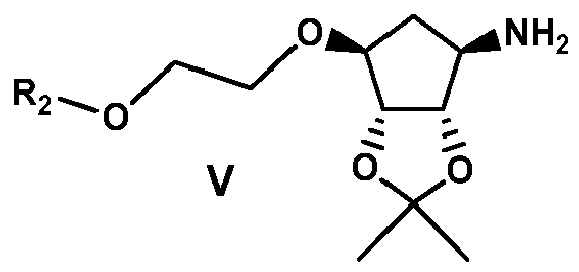 (0-3") converting a compound of formula V to a compound of formula VI,(0-4") optionally converting a compound of formula IV to a salt thereof.
 - The process according to claim 3, wherein the compound of formula III or a salt thereof is prepared by comprising the steps of:(i) providing a compound of formula I
 (ii) reacting the compound of formula I with a compound of formula II
 (iii) optionally converting the compound of formula III to a salt thereof.
 - A process for the preparation of a pharmaceutical composition comprising a compound of formula XI or a pharmaceutically acceptable salt thereof
 (i) preparing a compound of formula XI or a salt thereof according to anyone of claims 1 to 4, optionally converting the salt into a pharmaceutically acceptable salt, and(ii) mixing the compound of formula VIII or a pharmaceutically acceptable salt thereof with a pharmaceutically acceptable carrier and/or excipient.
 - A compound of the following formula III or a salt thereof

- A compound selected from the fumarate salt, maleate salt or oxalate salt of the compound
of formula IIIa or IIIb
- A compound of the following formula IV or a salt thereof

- A compound of the following formula III or a salt thereof

- A compound selected from the fumarate salt, maleate salt or oxalate salt of the compound of formula Va

- A compound of the following formula VIII or VIII'

- A compound of the following formula IX

- Use of a compound as defined in any one of claims 6 to 12 in the preparation of ticagrelor.
Priority Applications (7)
| Application Number | Priority Date | Filing Date | Title |
|---|---|---|---|
| EP11195508.4A EP2607355A1 (en) | 2011-12-23 | 2011-12-23 | Synthesis of triazolopyrimidine compounds |
| CN201280069533.4A CN104114542B (en) | 2011-12-23 | 2012-12-20 | The synthesis of triazolopyrimidine compound |
| PCT/EP2012/076458 WO2013092900A1 (en) | 2011-12-23 | 2012-12-20 | Synthesis of triazolopyrimidine compounds |
| US14/366,764 US9278972B2 (en) | 2011-12-23 | 2012-12-20 | Synthesis of triazolopyrimidine compounds |
| EP12812638.0A EP2794575B1 (en) | 2011-12-23 | 2012-12-20 | Synthesis of triazolopyrimidine compounds |
| IN1491KON2014 IN2014KN01491A (en) | 2011-12-23 | 2012-12-20 | |
| CA2859580A CA2859580A1 (en) | 2011-12-23 | 2012-12-20 | Synthesis of triazolopyrimidine compounds |
Applications Claiming Priority (1)
| Application Number | Priority Date | Filing Date | Title |
|---|---|---|---|
| EP11195508.4A EP2607355A1 (en) | 2011-12-23 | 2011-12-23 | Synthesis of triazolopyrimidine compounds |
Publications (1)
| Publication Number | Publication Date |
|---|---|
| EP2607355A1 true EP2607355A1 (en) | 2013-06-26 |
Family
ID=45445889
Family Applications (1)
| Application Number | Title | Priority Date | Filing Date |
|---|---|---|---|
| EP11195508.4A Ceased EP2607355A1 (en) | 2011-12-23 | 2011-12-23 | Synthesis of triazolopyrimidine compounds |
Country Status (1)
| Country | Link |
|---|---|
| EP (1) | EP2607355A1 (en) |
Cited By (5)
| Publication number | Priority date | Publication date | Assignee | Title |
|---|---|---|---|---|
| CN103923055A (en) * | 2014-04-02 | 2014-07-16 | 黄河三角洲京博化工研究院有限公司 | preparation method of (1S,2R,3S,4R)-2,3-O-isopropylidene-4-aminocyclopentyl-1,2,3-triol |
| CN104610237A (en) * | 2013-11-05 | 2015-05-13 | 正大天晴药业集团股份有限公司 | Preparation method and intermediate of ticagrelor |
| CN105669681A (en) * | 2016-04-11 | 2016-06-15 | 成都华宇制药有限公司 | Synthesis method for ticagrelor |
| CZ307217B6 (en) * | 2013-03-14 | 2018-04-04 | Zentiva, K.S. | An improved manufacturing process and new intermediates for synthesis of ticagrelor |
| CN110684019A (en) * | 2019-10-29 | 2020-01-14 | 株洲千金药业股份有限公司 | Preparation method of ticagrelor intermediate oxide impurity |
Citations (3)
| Publication number | Priority date | Publication date | Assignee | Title |
|---|---|---|---|---|
| WO2000034283A1 (en) * | 1998-12-04 | 2000-06-15 | Astrazeneca Ab | Novel triazolo(4,5-d)pyrimidine compounds |
| WO2010030224A1 (en) * | 2008-09-09 | 2010-03-18 | Astrazeneca Ab | A process for preparing [1s- [1-alpha, 2-alpha, 3-beta (1s*, 2r*) 5-beta] ] -3- [7- [2- (3, 4-dif luorophenyl) -cyclopropylamino] - 5- (propylthio) -3h-1, 2, 3-triazolo [4, 5-d] pyrimidin-3-yl] -5- (2- hydroxyethoxy) cyclopentane-1, 2-diol and to its intermediates |
| WO2011017108A2 (en) * | 2009-07-27 | 2011-02-10 | Auspex Pharmaceuticals, Inc. | Cyclopropyl modulators of p2y12 receptor |
-
2011
- 2011-12-23 EP EP11195508.4A patent/EP2607355A1/en not_active Ceased
Patent Citations (3)
| Publication number | Priority date | Publication date | Assignee | Title |
|---|---|---|---|---|
| WO2000034283A1 (en) * | 1998-12-04 | 2000-06-15 | Astrazeneca Ab | Novel triazolo(4,5-d)pyrimidine compounds |
| WO2010030224A1 (en) * | 2008-09-09 | 2010-03-18 | Astrazeneca Ab | A process for preparing [1s- [1-alpha, 2-alpha, 3-beta (1s*, 2r*) 5-beta] ] -3- [7- [2- (3, 4-dif luorophenyl) -cyclopropylamino] - 5- (propylthio) -3h-1, 2, 3-triazolo [4, 5-d] pyrimidin-3-yl] -5- (2- hydroxyethoxy) cyclopentane-1, 2-diol and to its intermediates |
| WO2011017108A2 (en) * | 2009-07-27 | 2011-02-10 | Auspex Pharmaceuticals, Inc. | Cyclopropyl modulators of p2y12 receptor |
Non-Patent Citations (2)
| Title |
|---|
| HONG YE ET AL: "Carba-nucleosides as Potent Antagonists of the Adenosine 5'-Diphosphate (ADP) Purinergic Receptor (P2Y12) on Human Platelets", CHEMMEDCHEM, vol. 3, no. 5, 19 May 2008 (2008-05-19), pages 732 - 736, XP055011415, ISSN: 1860-7179, DOI: 10.1002/cmdc.200700310 * |
| SPRINGTHORPE ET AL: "From ATP to AZD6140: The discovery of an orally active reversible P2Y12 receptor antagonist for the prevention of thrombosis", BIOORGANIC & MEDICINAL CHEMISTRY LETTERS, PERGAMON, ELSEVIER SCIENCE, GB, vol. 17, no. 21, 1 November 2007 (2007-11-01), pages 6013 - 6018, XP022267216, ISSN: 0960-894X, DOI: 10.1016/J.BMCL.2007.07.057 * |
Cited By (8)
| Publication number | Priority date | Publication date | Assignee | Title |
|---|---|---|---|---|
| CZ307217B6 (en) * | 2013-03-14 | 2018-04-04 | Zentiva, K.S. | An improved manufacturing process and new intermediates for synthesis of ticagrelor |
| CN104610237A (en) * | 2013-11-05 | 2015-05-13 | 正大天晴药业集团股份有限公司 | Preparation method and intermediate of ticagrelor |
| CN104610237B (en) * | 2013-11-05 | 2018-03-30 | 正大天晴药业集团股份有限公司 | A kind of Preparation Method And Their Intermediate of ticagrelor |
| CN103923055A (en) * | 2014-04-02 | 2014-07-16 | 黄河三角洲京博化工研究院有限公司 | preparation method of (1S,2R,3S,4R)-2,3-O-isopropylidene-4-aminocyclopentyl-1,2,3-triol |
| CN103923055B (en) * | 2014-04-02 | 2015-11-18 | 黄河三角洲京博化工研究院有限公司 | The method of (1S, 2R, 3S, 4R) is prepared by one-2,3-O-isopropylidene-4-Aminocyclopentane-1,2,3-triols |
| CN105669681A (en) * | 2016-04-11 | 2016-06-15 | 成都华宇制药有限公司 | Synthesis method for ticagrelor |
| CN110684019A (en) * | 2019-10-29 | 2020-01-14 | 株洲千金药业股份有限公司 | Preparation method of ticagrelor intermediate oxide impurity |
| CN110684019B (en) * | 2019-10-29 | 2020-08-18 | 株洲千金药业股份有限公司 | Preparation method of ticagrelor intermediate oxide impurity |
Similar Documents
| Publication | Publication Date | Title |
|---|---|---|
| EP2794575B1 (en) | Synthesis of triazolopyrimidine compounds | |
| US9221829B2 (en) | Synthesis of triazolopyrimidine compounds | |
| US20250197404A1 (en) | Synthesis of a bruton's tyrosine kinase inhibitor | |
| US9522915B2 (en) | Method for preparing an important intermediate of linagliptin | |
| US9527855B2 (en) | Process for preparing chiral dipeptidyl peptidase-IV inhibitors | |
| US8563755B2 (en) | Process for preparing [1S-[1-α, 2-α, 3-β(1S*,2R*) 5-β]]-3-[7-[2-(3,4-difluorophenyl)-cyclopropylamino]-5-(propylthio)-3H-1,2,3-triazolo [4,5-d] pyrimidin-3-yl]-5-(2-hydroxyethoxy) cyclopentane-1,2-diol and to its intermediates | |
| ES2665546T3 (en) | Synthesis of Triazolopyrimidine Compounds | |
| CN107200741B (en) | Preparation method of anaplastic lymphoma kinase inhibitor | |
| SK11982003A3 (en) | Process for the preparation of 4,6-diaminopyrimido [5,4-d] pyrimidines and intermediates | |
| CN110452158A (en) | Synthetic method of optically active fushenone and its intermediates | |
| US20090088571A1 (en) | Synthesis of 6,7-Dihydro-5H-imidazo[1,2-a]imidazole-3-sulfonic acid amides | |
| EP2570405A1 (en) | Synthesis of Triazolopyrimidine Compounds | |
| US20240400516A1 (en) | Processes for the preparation of 1,2,3,5,6,7-hexahydro-s-indacene derivataives | |
| EP4259626B1 (en) | Process for the preparation 4-(3,5-difluorophenyl)-n-[3-(6-methylpyrimidin-4-yl)-3- azabicyclo[3.2.1]octan-8-yl]-6,7-dihydro-5h-[1,2,4]triazolo[1,5-a]pyrimidin-2-amine | |
| CN111560021A (en) | Degaotinib intermediate and preparation method thereof | |
| EP2586773A1 (en) | Synthesis of Triazolopyrimidine Compounds |
Legal Events
| Date | Code | Title | Description |
|---|---|---|---|
| AK | Designated contracting states |
Kind code of ref document: A1 Designated state(s): AL AT BE BG CH CY CZ DE DK EE ES FI FR GB GR HR HU IE IS IT LI LT LU LV MC MK MT NL NO PL PT RO RS SE SI SK SM TR |
|
| AX | Request for extension of the european patent |
Extension state: BA ME |
|
| PUAI | Public reference made under article 153(3) epc to a published international application that has entered the european phase |
Free format text: ORIGINAL CODE: 0009012 |
|
| STAA | Information on the status of an ep patent application or granted ep patent |
Free format text: STATUS: THE APPLICATION HAS BEEN REFUSED |
|
| 18R | Application refused |
Effective date: 20130812 |