EP2602274A1 - Epoxy resin composition having monocyclic aliphatic hydrocarbon ring - Google Patents
Epoxy resin composition having monocyclic aliphatic hydrocarbon ring Download PDFInfo
- Publication number
- EP2602274A1 EP2602274A1 EP11814523.4A EP11814523A EP2602274A1 EP 2602274 A1 EP2602274 A1 EP 2602274A1 EP 11814523 A EP11814523 A EP 11814523A EP 2602274 A1 EP2602274 A1 EP 2602274A1
- Authority
- EP
- European Patent Office
- Prior art keywords
- group
- curable composition
- formula
- compound
- individually
- Prior art date
- Legal status (The legal status is an assumption and is not a legal conclusion. Google has not performed a legal analysis and makes no representation as to the accuracy of the status listed.)
- Withdrawn
Links
- 239000000203 mixture Substances 0.000 title claims abstract description 89
- 125000002950 monocyclic group Chemical group 0.000 title claims abstract description 13
- 125000001931 aliphatic group Chemical group 0.000 title claims abstract description 9
- 229920000647 polyepoxide Polymers 0.000 title description 13
- 239000003822 epoxy resin Substances 0.000 title description 11
- 150000001875 compounds Chemical class 0.000 claims abstract description 101
- 239000004593 Epoxy Substances 0.000 claims abstract description 64
- 239000002253 acid Substances 0.000 claims abstract description 49
- 125000003700 epoxy group Chemical group 0.000 claims abstract description 16
- 125000004435 hydrogen atom Chemical group [H]* 0.000 claims abstract description 15
- 125000000008 (C1-C10) alkyl group Chemical group 0.000 claims abstract description 6
- -1 sulfonium salt compound Chemical class 0.000 claims description 112
- 125000000113 cyclohexyl group Chemical group [H]C1([H])C([H])([H])C([H])([H])C([H])(*)C([H])([H])C1([H])[H] 0.000 claims description 7
- 150000003839 salts Chemical class 0.000 claims description 4
- 125000002091 cationic group Chemical group 0.000 abstract description 12
- XEKOWRVHYACXOJ-UHFFFAOYSA-N Ethyl acetate Chemical compound CCOC(C)=O XEKOWRVHYACXOJ-UHFFFAOYSA-N 0.000 description 51
- VLKZOEOYAKHREP-UHFFFAOYSA-N n-Hexane Chemical compound CCCCCC VLKZOEOYAKHREP-UHFFFAOYSA-N 0.000 description 48
- 238000006243 chemical reaction Methods 0.000 description 30
- 239000011541 reaction mixture Substances 0.000 description 28
- 239000002904 solvent Substances 0.000 description 23
- YXFVVABEGXRONW-UHFFFAOYSA-N Toluene Chemical compound CC1=CC=CC=C1 YXFVVABEGXRONW-UHFFFAOYSA-N 0.000 description 21
- 238000000576 coating method Methods 0.000 description 21
- 238000001723 curing Methods 0.000 description 21
- 239000011248 coating agent Substances 0.000 description 19
- 239000007788 liquid Substances 0.000 description 19
- 239000010408 film Substances 0.000 description 17
- 239000004094 surface-active agent Substances 0.000 description 13
- 239000007864 aqueous solution Substances 0.000 description 12
- 239000000975 dye Substances 0.000 description 12
- 239000000463 material Substances 0.000 description 11
- XHFLOLLMZOTPSM-UHFFFAOYSA-M sodium;hydrogen carbonate;hydrate Chemical compound [OH-].[Na+].OC(O)=O XHFLOLLMZOTPSM-UHFFFAOYSA-M 0.000 description 11
- 239000000758 substrate Substances 0.000 description 11
- QGHDLJAZIIFENW-UHFFFAOYSA-N 4-[1,1,1,3,3,3-hexafluoro-2-(4-hydroxy-3-prop-2-enylphenyl)propan-2-yl]-2-prop-2-enylphenol Chemical group C1=C(CC=C)C(O)=CC=C1C(C(F)(F)F)(C(F)(F)F)C1=CC=C(O)C(CC=C)=C1 QGHDLJAZIIFENW-UHFFFAOYSA-N 0.000 description 10
- HEDRZPFGACZZDS-UHFFFAOYSA-N Chloroform Chemical compound ClC(Cl)Cl HEDRZPFGACZZDS-UHFFFAOYSA-N 0.000 description 10
- 239000000047 product Substances 0.000 description 10
- 230000003287 optical effect Effects 0.000 description 9
- 239000012074 organic phase Substances 0.000 description 9
- 239000007787 solid Substances 0.000 description 9
- XLYOFNOQVPJJNP-UHFFFAOYSA-N water Substances O XLYOFNOQVPJJNP-UHFFFAOYSA-N 0.000 description 9
- 230000015572 biosynthetic process Effects 0.000 description 8
- 239000012043 crude product Substances 0.000 description 8
- LZCLXQDLBQLTDK-UHFFFAOYSA-N ethyl 2-hydroxypropanoate Chemical compound CCOC(=O)C(C)O LZCLXQDLBQLTDK-UHFFFAOYSA-N 0.000 description 8
- 238000010898 silica gel chromatography Methods 0.000 description 8
- 238000003786 synthesis reaction Methods 0.000 description 8
- 229910019142 PO4 Inorganic materials 0.000 description 7
- MWPLVEDNUUSJAV-UHFFFAOYSA-N anthracene Chemical compound C1=CC=CC2=CC3=CC=CC=C3C=C21 MWPLVEDNUUSJAV-UHFFFAOYSA-N 0.000 description 7
- 239000003795 chemical substances by application Substances 0.000 description 7
- 238000000034 method Methods 0.000 description 7
- 239000010452 phosphate Substances 0.000 description 7
- ARXJGSRGQADJSQ-UHFFFAOYSA-N 1-methoxypropan-2-ol Chemical compound COCC(C)O ARXJGSRGQADJSQ-UHFFFAOYSA-N 0.000 description 6
- OKKJLVBELUTLKV-UHFFFAOYSA-N Methanol Chemical compound OC OKKJLVBELUTLKV-UHFFFAOYSA-N 0.000 description 6
- ZMXDDKWLCZADIW-UHFFFAOYSA-N N,N-Dimethylformamide Chemical compound CN(C)C=O ZMXDDKWLCZADIW-UHFFFAOYSA-N 0.000 description 6
- 238000010438 heat treatment Methods 0.000 description 6
- DNIAPMSPPWPWGF-UHFFFAOYSA-N monopropylene glycol Natural products CC(O)CO DNIAPMSPPWPWGF-UHFFFAOYSA-N 0.000 description 6
- 125000003566 oxetanyl group Chemical group 0.000 description 6
- KJIFKLIQANRMOU-UHFFFAOYSA-N oxidanium;4-methylbenzenesulfonate Chemical compound O.CC1=CC=C(S(O)(=O)=O)C=C1 KJIFKLIQANRMOU-UHFFFAOYSA-N 0.000 description 6
- NBIIXXVUZAFLBC-UHFFFAOYSA-K phosphate Chemical compound [O-]P([O-])([O-])=O NBIIXXVUZAFLBC-UHFFFAOYSA-K 0.000 description 6
- 238000000016 photochemical curing Methods 0.000 description 6
- 229960000834 vinyl ether Drugs 0.000 description 6
- OUPZKGBUJRBPGC-UHFFFAOYSA-N 1,3,5-tris(oxiran-2-ylmethyl)-1,3,5-triazinane-2,4,6-trione Chemical compound O=C1N(CC2OC2)C(=O)N(CC2OC2)C(=O)N1CC1CO1 OUPZKGBUJRBPGC-UHFFFAOYSA-N 0.000 description 5
- RWSOTUBLDIXVET-UHFFFAOYSA-N Dihydrogen sulfide Chemical class S RWSOTUBLDIXVET-UHFFFAOYSA-N 0.000 description 5
- LFQSCWFLJHTTHZ-UHFFFAOYSA-N Ethanol Chemical compound CCO LFQSCWFLJHTTHZ-UHFFFAOYSA-N 0.000 description 5
- 239000000654 additive Substances 0.000 description 5
- 239000003960 organic solvent Substances 0.000 description 5
- 150000001338 aliphatic hydrocarbons Chemical group 0.000 description 4
- 125000003178 carboxy group Chemical group [H]OC(*)=O 0.000 description 4
- 239000003054 catalyst Substances 0.000 description 4
- JHIVVAPYMSGYDF-UHFFFAOYSA-N cyclohexanone Chemical compound O=C1CCCCC1 JHIVVAPYMSGYDF-UHFFFAOYSA-N 0.000 description 4
- 238000002156 mixing Methods 0.000 description 4
- BWHMMNNQKKPAPP-UHFFFAOYSA-L potassium carbonate Chemical compound [K+].[K+].[O-]C([O-])=O BWHMMNNQKKPAPP-UHFFFAOYSA-L 0.000 description 4
- AKHNMLFCWUSKQB-UHFFFAOYSA-L sodium thiosulfate Chemical compound [Na+].[Na+].[O-]S([O-])(=O)=S AKHNMLFCWUSKQB-UHFFFAOYSA-L 0.000 description 4
- 235000019345 sodium thiosulphate Nutrition 0.000 description 4
- 239000000126 substance Substances 0.000 description 4
- WGTYBPLFGIVFAS-UHFFFAOYSA-M tetramethylammonium hydroxide Chemical compound [OH-].C[N+](C)(C)C WGTYBPLFGIVFAS-UHFFFAOYSA-M 0.000 description 4
- JOXIMZWYDAKGHI-UHFFFAOYSA-N toluene-4-sulfonic acid Chemical compound CC1=CC=C(S(O)(=O)=O)C=C1 JOXIMZWYDAKGHI-UHFFFAOYSA-N 0.000 description 4
- 238000009281 ultraviolet germicidal irradiation Methods 0.000 description 4
- 125000000391 vinyl group Chemical group [H]C([*])=C([H])[H] 0.000 description 4
- KMOUUZVZFBCRAM-OLQVQODUSA-N (3as,7ar)-3a,4,7,7a-tetrahydro-2-benzofuran-1,3-dione Chemical compound C1C=CC[C@@H]2C(=O)OC(=O)[C@@H]21 KMOUUZVZFBCRAM-OLQVQODUSA-N 0.000 description 3
- ZWEHNKRNPOVVGH-UHFFFAOYSA-N 2-Butanone Chemical compound CCC(C)=O ZWEHNKRNPOVVGH-UHFFFAOYSA-N 0.000 description 3
- CSCPPACGZOOCGX-UHFFFAOYSA-N Acetone Chemical compound CC(C)=O CSCPPACGZOOCGX-UHFFFAOYSA-N 0.000 description 3
- WEVYAHXRMPXWCK-UHFFFAOYSA-N Acetonitrile Chemical compound CC#N WEVYAHXRMPXWCK-UHFFFAOYSA-N 0.000 description 3
- KWYUFKZDYYNOTN-UHFFFAOYSA-M Potassium hydroxide Chemical compound [OH-].[K+] KWYUFKZDYYNOTN-UHFFFAOYSA-M 0.000 description 3
- HEMHJVSKTPXQMS-UHFFFAOYSA-M Sodium hydroxide Chemical compound [OH-].[Na+] HEMHJVSKTPXQMS-UHFFFAOYSA-M 0.000 description 3
- XSQUKJJJFZCRTK-UHFFFAOYSA-N Urea Chemical compound NC(N)=O XSQUKJJJFZCRTK-UHFFFAOYSA-N 0.000 description 3
- 230000000996 additive effect Effects 0.000 description 3
- 125000002723 alicyclic group Chemical group 0.000 description 3
- 125000002947 alkylene group Chemical group 0.000 description 3
- 150000008064 anhydrides Chemical class 0.000 description 3
- 239000012776 electronic material Substances 0.000 description 3
- 229940116333 ethyl lactate Drugs 0.000 description 3
- LYCAIKOWRPUZTN-UHFFFAOYSA-N ethylene glycol Natural products OCCO LYCAIKOWRPUZTN-UHFFFAOYSA-N 0.000 description 3
- XMBWDFGMSWQBCA-UHFFFAOYSA-N hydrogen iodide Chemical class I XMBWDFGMSWQBCA-UHFFFAOYSA-N 0.000 description 3
- RAXXELZNTBOGNW-UHFFFAOYSA-N imidazole Natural products C1=CNC=N1 RAXXELZNTBOGNW-UHFFFAOYSA-N 0.000 description 3
- QSHDDOUJBYECFT-UHFFFAOYSA-N mercury Chemical compound [Hg] QSHDDOUJBYECFT-UHFFFAOYSA-N 0.000 description 3
- 229910052753 mercury Inorganic materials 0.000 description 3
- 150000002978 peroxides Chemical class 0.000 description 3
- 150000004714 phosphonium salts Chemical class 0.000 description 3
- 239000004033 plastic Substances 0.000 description 3
- 229920003023 plastic Polymers 0.000 description 3
- RUOJZAUFBMNUDX-UHFFFAOYSA-N propylene carbonate Chemical compound CC1COC(=O)O1 RUOJZAUFBMNUDX-UHFFFAOYSA-N 0.000 description 3
- LLHKCFNBLRBOGN-UHFFFAOYSA-N propylene glycol methyl ether acetate Chemical compound COCC(C)OC(C)=O LLHKCFNBLRBOGN-UHFFFAOYSA-N 0.000 description 3
- 230000009257 reactivity Effects 0.000 description 3
- 238000010992 reflux Methods 0.000 description 3
- 239000000243 solution Substances 0.000 description 3
- 241000894007 species Species 0.000 description 3
- 125000001424 substituent group Chemical group 0.000 description 3
- 125000004400 (C1-C12) alkyl group Chemical group 0.000 description 2
- YXIWHUQXZSMYRE-UHFFFAOYSA-N 1,3-benzothiazole-2-thiol Chemical compound C1=CC=C2SC(S)=NC2=C1 YXIWHUQXZSMYRE-UHFFFAOYSA-N 0.000 description 2
- RWNUSVWFHDHRCJ-UHFFFAOYSA-N 1-butoxypropan-2-ol Chemical compound CCCCOCC(C)O RWNUSVWFHDHRCJ-UHFFFAOYSA-N 0.000 description 2
- FUWDFGKRNIDKAE-UHFFFAOYSA-N 1-butoxypropan-2-yl acetate Chemical compound CCCCOCC(C)OC(C)=O FUWDFGKRNIDKAE-UHFFFAOYSA-N 0.000 description 2
- VYMRCJJQCHGDIW-UHFFFAOYSA-N 1-ethenoxybutan-2-ol Chemical compound CCC(O)COC=C VYMRCJJQCHGDIW-UHFFFAOYSA-N 0.000 description 2
- JOLQKTGDSGKSKJ-UHFFFAOYSA-N 1-ethoxypropan-2-ol Chemical compound CCOCC(C)O JOLQKTGDSGKSKJ-UHFFFAOYSA-N 0.000 description 2
- LIPRQQHINVWJCH-UHFFFAOYSA-N 1-ethoxypropan-2-yl acetate Chemical compound CCOCC(C)OC(C)=O LIPRQQHINVWJCH-UHFFFAOYSA-N 0.000 description 2
- FENFUOGYJVOCRY-UHFFFAOYSA-N 1-propoxypropan-2-ol Chemical compound CCCOCC(C)O FENFUOGYJVOCRY-UHFFFAOYSA-N 0.000 description 2
- DMFAHCVITRDZQB-UHFFFAOYSA-N 1-propoxypropan-2-yl acetate Chemical compound CCCOCC(C)OC(C)=O DMFAHCVITRDZQB-UHFFFAOYSA-N 0.000 description 2
- WULAHPYSGCVQHM-UHFFFAOYSA-N 2-(2-ethenoxyethoxy)ethanol Chemical compound OCCOCCOC=C WULAHPYSGCVQHM-UHFFFAOYSA-N 0.000 description 2
- HZAXFHJVJLSVMW-UHFFFAOYSA-N 2-Aminoethan-1-ol Chemical compound NCCO HZAXFHJVJLSVMW-UHFFFAOYSA-N 0.000 description 2
- VUIWJRYTWUGOOF-UHFFFAOYSA-N 2-ethenoxyethanol Chemical compound OCCOC=C VUIWJRYTWUGOOF-UHFFFAOYSA-N 0.000 description 2
- XLLIQLLCWZCATF-UHFFFAOYSA-N 2-methoxyethyl acetate Chemical compound COCCOC(C)=O XLLIQLLCWZCATF-UHFFFAOYSA-N 0.000 description 2
- BIDWUUDRRVHZLQ-UHFFFAOYSA-N 3-ethyl-3-(2-ethylhexoxymethyl)oxetane Chemical compound CCCCC(CC)COCC1(CC)COC1 BIDWUUDRRVHZLQ-UHFFFAOYSA-N 0.000 description 2
- NIXOWILDQLNWCW-UHFFFAOYSA-M Acrylate Chemical compound [O-]C(=O)C=C NIXOWILDQLNWCW-UHFFFAOYSA-M 0.000 description 2
- 0 CC1C=CC=C2C(S(C)C*)=*CC(*)C12 Chemical compound CC1C=CC=C2C(S(C)C*)=*CC(*)C12 0.000 description 2
- KFZMGEQAYNKOFK-UHFFFAOYSA-N Isopropanol Chemical compound CC(C)O KFZMGEQAYNKOFK-UHFFFAOYSA-N 0.000 description 2
- KFSLWBXXFJQRDL-UHFFFAOYSA-N Peracetic acid Chemical compound CC(=O)OO KFSLWBXXFJQRDL-UHFFFAOYSA-N 0.000 description 2
- SMWDFEZZVXVKRB-UHFFFAOYSA-N Quinoline Chemical compound N1=CC=CC2=CC=CC=C21 SMWDFEZZVXVKRB-UHFFFAOYSA-N 0.000 description 2
- CDBYLPFSWZWCQE-UHFFFAOYSA-L Sodium Carbonate Chemical compound [Na+].[Na+].[O-]C([O-])=O CDBYLPFSWZWCQE-UHFFFAOYSA-L 0.000 description 2
- WYURNTSHIVDZCO-UHFFFAOYSA-N Tetrahydrofuran Chemical compound C1CCOC1 WYURNTSHIVDZCO-UHFFFAOYSA-N 0.000 description 2
- QYKIQEUNHZKYBP-UHFFFAOYSA-N Vinyl ether Chemical compound C=COC=C QYKIQEUNHZKYBP-UHFFFAOYSA-N 0.000 description 2
- 239000004480 active ingredient Substances 0.000 description 2
- 150000001298 alcohols Chemical class 0.000 description 2
- 125000000217 alkyl group Chemical group 0.000 description 2
- 150000001412 amines Chemical class 0.000 description 2
- 150000001450 anions Chemical class 0.000 description 2
- 230000003667 anti-reflective effect Effects 0.000 description 2
- 230000001413 cellular effect Effects 0.000 description 2
- IJOOHPMOJXWVHK-UHFFFAOYSA-N chlorotrimethylsilane Chemical compound C[Si](C)(C)Cl IJOOHPMOJXWVHK-UHFFFAOYSA-N 0.000 description 2
- 125000001995 cyclobutyl group Chemical group [H]C1([H])C([H])([H])C([H])(*)C1([H])[H] 0.000 description 2
- ILUAAIDVFMVTAU-UHFFFAOYSA-N cyclohex-4-ene-1,2-dicarboxylic acid Chemical compound OC(=O)C1CC=CCC1C(O)=O ILUAAIDVFMVTAU-UHFFFAOYSA-N 0.000 description 2
- 125000001511 cyclopentyl group Chemical group [H]C1([H])C([H])([H])C([H])([H])C([H])(*)C1([H])[H] 0.000 description 2
- SWXVUIWOUIDPGS-UHFFFAOYSA-N diacetone alcohol Chemical compound CC(=O)CC(C)(C)O SWXVUIWOUIDPGS-UHFFFAOYSA-N 0.000 description 2
- 230000000694 effects Effects 0.000 description 2
- 230000002708 enhancing effect Effects 0.000 description 2
- 229940052303 ethers for general anesthesia Drugs 0.000 description 2
- 239000000706 filtrate Substances 0.000 description 2
- 239000011521 glass Substances 0.000 description 2
- 125000003055 glycidyl group Chemical group C(C1CO1)* 0.000 description 2
- FFUAGWLWBBFQJT-UHFFFAOYSA-N hexamethyldisilazane Chemical compound C[Si](C)(C)N[Si](C)(C)C FFUAGWLWBBFQJT-UHFFFAOYSA-N 0.000 description 2
- 238000009413 insulation Methods 0.000 description 2
- 239000011229 interlayer Substances 0.000 description 2
- 230000001678 irradiating effect Effects 0.000 description 2
- 239000004973 liquid crystal related substance Substances 0.000 description 2
- 238000004519 manufacturing process Methods 0.000 description 2
- 229910052751 metal Inorganic materials 0.000 description 2
- 239000002184 metal Substances 0.000 description 2
- 125000002496 methyl group Chemical group [H]C([H])([H])* 0.000 description 2
- AHHWIHXENZJRFG-UHFFFAOYSA-N oxetane Chemical compound C1COC1 AHHWIHXENZJRFG-UHFFFAOYSA-N 0.000 description 2
- 125000001997 phenyl group Chemical group [H]C1=C([H])C([H])=C(*)C([H])=C1[H] 0.000 description 2
- UEZVMMHDMIWARA-UHFFFAOYSA-M phosphonate Chemical compound [O-]P(=O)=O UEZVMMHDMIWARA-UHFFFAOYSA-M 0.000 description 2
- 229910000027 potassium carbonate Inorganic materials 0.000 description 2
- 238000002360 preparation method Methods 0.000 description 2
- 238000007639 printing Methods 0.000 description 2
- WYVAMUWZEOHJOQ-UHFFFAOYSA-N propionic anhydride Chemical compound CCC(=O)OC(=O)CC WYVAMUWZEOHJOQ-UHFFFAOYSA-N 0.000 description 2
- WGYKZJWCGVVSQN-UHFFFAOYSA-N propylamine Chemical compound CCCN WGYKZJWCGVVSQN-UHFFFAOYSA-N 0.000 description 2
- 229920005989 resin Polymers 0.000 description 2
- 239000011347 resin Substances 0.000 description 2
- 239000011342 resin composition Substances 0.000 description 2
- 150000003342 selenium Chemical class 0.000 description 2
- 229920001187 thermosetting polymer Polymers 0.000 description 2
- 239000010409 thin film Substances 0.000 description 2
- WLOQLWBIJZDHET-UHFFFAOYSA-N triphenylsulfonium Chemical class C1=CC=CC=C1[S+](C=1C=CC=CC=1)C1=CC=CC=C1 WLOQLWBIJZDHET-UHFFFAOYSA-N 0.000 description 2
- 239000012953 triphenylsulfonium Substances 0.000 description 2
- WYTZZXDRDKSJID-UHFFFAOYSA-N (3-aminopropyl)triethoxysilane Chemical compound CCO[Si](OCC)(OCC)CCCN WYTZZXDRDKSJID-UHFFFAOYSA-N 0.000 description 1
- QGKMIGUHVLGJBR-UHFFFAOYSA-M (4z)-1-(3-methylbutyl)-4-[[1-(3-methylbutyl)quinolin-1-ium-4-yl]methylidene]quinoline;iodide Chemical compound [I-].C12=CC=CC=C2N(CCC(C)C)C=CC1=CC1=CC=[N+](CCC(C)C)C2=CC=CC=C12 QGKMIGUHVLGJBR-UHFFFAOYSA-M 0.000 description 1
- XWLORADBIQIJHZ-UHFFFAOYSA-N (diphenyl-$l^{3}-selanyl)benzene Chemical compound C1=CC=CC=C1[Se](C=1C=CC=CC=1)C1=CC=CC=C1 XWLORADBIQIJHZ-UHFFFAOYSA-N 0.000 description 1
- XBKVBPZGRMBIEB-UHFFFAOYSA-N (diphenyl-lambda3-iodanyl) 4-methylbenzenesulfonate Chemical compound Cc1ccc(cc1)S(=O)(=O)O[I](c1ccccc1)c1ccccc1 XBKVBPZGRMBIEB-UHFFFAOYSA-N 0.000 description 1
- QYGBYAQGBVHMDD-XQRVVYSFSA-N (z)-2-cyano-3-thiophen-2-ylprop-2-enoic acid Chemical compound OC(=O)C(\C#N)=C/C1=CC=CS1 QYGBYAQGBVHMDD-XQRVVYSFSA-N 0.000 description 1
- KMOUUZVZFBCRAM-UHFFFAOYSA-N 1,2,3,6-tetrahydrophthalic anhydride Chemical compound C1C=CCC2C(=O)OC(=O)C21 KMOUUZVZFBCRAM-UHFFFAOYSA-N 0.000 description 1
- JYEUMXHLPRZUAT-UHFFFAOYSA-N 1,2,3-triazine Chemical compound C1=CN=NN=C1 JYEUMXHLPRZUAT-UHFFFAOYSA-N 0.000 description 1
- UDATXMIGEVPXTR-UHFFFAOYSA-N 1,2,4-triazolidine-3,5-dione Chemical compound O=C1NNC(=O)N1 UDATXMIGEVPXTR-UHFFFAOYSA-N 0.000 description 1
- CYIGRWUIQAVBFG-UHFFFAOYSA-N 1,2-bis(2-ethenoxyethoxy)ethane Chemical compound C=COCCOCCOCCOC=C CYIGRWUIQAVBFG-UHFFFAOYSA-N 0.000 description 1
- MPJMYHYBTVRLKA-UHFFFAOYSA-N 1,2-dipropoxyanthracene-9,10-dione Chemical compound C1=CC=C2C(=O)C3=C(OCCC)C(OCCC)=CC=C3C(=O)C2=C1 MPJMYHYBTVRLKA-UHFFFAOYSA-N 0.000 description 1
- MASDFXZJIDNRTR-UHFFFAOYSA-N 1,3-bis(trimethylsilyl)urea Chemical compound C[Si](C)(C)NC(=O)N[Si](C)(C)C MASDFXZJIDNRTR-UHFFFAOYSA-N 0.000 description 1
- YHMYGUUIMTVXNW-UHFFFAOYSA-N 1,3-dihydrobenzimidazole-2-thione Chemical compound C1=CC=C2NC(S)=NC2=C1 YHMYGUUIMTVXNW-UHFFFAOYSA-N 0.000 description 1
- OXFSTTJBVAAALW-UHFFFAOYSA-N 1,3-dihydroimidazole-2-thione Chemical compound SC1=NC=CN1 OXFSTTJBVAAALW-UHFFFAOYSA-N 0.000 description 1
- 229940057054 1,3-dimethylurea Drugs 0.000 description 1
- BGPJLYIFDLICMR-UHFFFAOYSA-N 1,4,2,3-dioxadithiolan-5-one Chemical group O=C1OSSO1 BGPJLYIFDLICMR-UHFFFAOYSA-N 0.000 description 1
- FNBHVKBYRFDOJK-UHFFFAOYSA-N 1-butoxypropan-2-yl propanoate Chemical compound CCCCOCC(C)OC(=O)CC FNBHVKBYRFDOJK-UHFFFAOYSA-N 0.000 description 1
- RRQYJINTUHWNHW-UHFFFAOYSA-N 1-ethoxy-2-(2-ethoxyethoxy)ethane Chemical compound CCOCCOCCOCC RRQYJINTUHWNHW-UHFFFAOYSA-N 0.000 description 1
- ODDDCGGSPAPBOS-UHFFFAOYSA-N 1-ethoxypropan-2-yl propanoate Chemical compound CCOCC(C)OC(=O)CC ODDDCGGSPAPBOS-UHFFFAOYSA-N 0.000 description 1
- 125000006433 1-ethyl cyclopropyl group Chemical group [H]C([H])([H])C([H])([H])C1(*)C([H])([H])C1([H])[H] 0.000 description 1
- DOVZUKKPYKRVIK-UHFFFAOYSA-N 1-methoxypropan-2-yl propanoate Chemical compound CCC(=O)OC(C)COC DOVZUKKPYKRVIK-UHFFFAOYSA-N 0.000 description 1
- 125000006432 1-methyl cyclopropyl group Chemical group [H]C([H])([H])C1(*)C([H])([H])C1([H])[H] 0.000 description 1
- FODCFYIWOJIZQL-UHFFFAOYSA-N 1-methylsulfanyl-3,5-bis(trifluoromethyl)benzene Chemical compound CSC1=CC(C(F)(F)F)=CC(C(F)(F)F)=C1 FODCFYIWOJIZQL-UHFFFAOYSA-N 0.000 description 1
- 125000006439 1-n-propyl cyclopropyl group Chemical group [H]C([H])([H])C([H])([H])C([H])([H])C1(*)C([H])([H])C1([H])[H] 0.000 description 1
- RVNBCIQRFGXLRD-UHFFFAOYSA-N 1-propoxypropan-2-yl propanoate Chemical compound CCCOCC(C)OC(=O)CC RVNBCIQRFGXLRD-UHFFFAOYSA-N 0.000 description 1
- WJFKNYWRSNBZNX-UHFFFAOYSA-N 10H-phenothiazine Chemical compound C1=CC=C2NC3=CC=CC=C3SC2=C1 WJFKNYWRSNBZNX-UHFFFAOYSA-N 0.000 description 1
- HYZJCKYKOHLVJF-UHFFFAOYSA-N 1H-benzimidazole Chemical compound C1=CC=C2NC=NC2=C1 HYZJCKYKOHLVJF-UHFFFAOYSA-N 0.000 description 1
- BAXOFTOLAUCFNW-UHFFFAOYSA-N 1H-indazole Chemical compound C1=CC=C2C=NNC2=C1 BAXOFTOLAUCFNW-UHFFFAOYSA-N 0.000 description 1
- SBASXUCJHJRPEV-UHFFFAOYSA-N 2-(2-methoxyethoxy)ethanol Chemical compound COCCOCCO SBASXUCJHJRPEV-UHFFFAOYSA-N 0.000 description 1
- KUBDPQJOLOUJRM-UHFFFAOYSA-N 2-(chloromethyl)oxirane;4-[2-(4-hydroxyphenyl)propan-2-yl]phenol Chemical compound ClCC1CO1.C=1C=C(O)C=CC=1C(C)(C)C1=CC=C(O)C=C1 KUBDPQJOLOUJRM-UHFFFAOYSA-N 0.000 description 1
- XNWFRZJHXBZDAG-UHFFFAOYSA-N 2-METHOXYETHANOL Chemical compound COCCO XNWFRZJHXBZDAG-UHFFFAOYSA-N 0.000 description 1
- RVGLEPQPVDUSOJ-UHFFFAOYSA-N 2-Methyl-3-hydroxypropanoate Chemical compound COC(=O)CCO RVGLEPQPVDUSOJ-UHFFFAOYSA-N 0.000 description 1
- ASAQRGCLIPUSEK-UHFFFAOYSA-N 2-[4-amino-n-(2-hydroxyethyl)-3-nitroanilino]ethanol;hydrochloride Chemical compound Cl.NC1=CC=C(N(CCO)CCO)C=C1[N+]([O-])=O ASAQRGCLIPUSEK-UHFFFAOYSA-N 0.000 description 1
- ZNQVEEAIQZEUHB-UHFFFAOYSA-N 2-ethoxyethanol Chemical compound CCOCCO ZNQVEEAIQZEUHB-UHFFFAOYSA-N 0.000 description 1
- SVONRAPFKPVNKG-UHFFFAOYSA-N 2-ethoxyethyl acetate Chemical compound CCOCCOC(C)=O SVONRAPFKPVNKG-UHFFFAOYSA-N 0.000 description 1
- FLFWJIBUZQARMD-UHFFFAOYSA-N 2-mercapto-1,3-benzoxazole Chemical compound C1=CC=C2OC(S)=NC2=C1 FLFWJIBUZQARMD-UHFFFAOYSA-N 0.000 description 1
- ICPWFHKNYYRBSZ-UHFFFAOYSA-M 2-methoxypropanoate Chemical compound COC(C)C([O-])=O ICPWFHKNYYRBSZ-UHFFFAOYSA-M 0.000 description 1
- 125000003903 2-propenyl group Chemical group [H]C([*])([H])C([H])=C([H])[H] 0.000 description 1
- OXYZDRAJMHGSMW-UHFFFAOYSA-N 3-chloropropyl(trimethoxy)silane Chemical compound CO[Si](OC)(OC)CCCCl OXYZDRAJMHGSMW-UHFFFAOYSA-N 0.000 description 1
- JUXZNIDKDPLYBY-UHFFFAOYSA-N 3-ethyl-3-(phenoxymethyl)oxetane Chemical compound C=1C=CC=CC=1OCC1(CC)COC1 JUXZNIDKDPLYBY-UHFFFAOYSA-N 0.000 description 1
- XDLMVUHYZWKMMD-UHFFFAOYSA-N 3-trimethoxysilylpropyl 2-methylprop-2-enoate Chemical compound CO[Si](OC)(OC)CCCOC(=O)C(C)=C XDLMVUHYZWKMMD-UHFFFAOYSA-N 0.000 description 1
- ACQVEWFMUBXEMR-UHFFFAOYSA-N 4-bromo-2-fluoro-6-nitrophenol Chemical compound OC1=C(F)C=C(Br)C=C1[N+]([O-])=O ACQVEWFMUBXEMR-UHFFFAOYSA-N 0.000 description 1
- 125000004172 4-methoxyphenyl group Chemical group [H]C1=C([H])C(OC([H])([H])[H])=C([H])C([H])=C1* 0.000 description 1
- XPEKVUUBSDFMDR-UHFFFAOYSA-N 4-methyl-3a,4,7,7a-tetrahydro-2-benzofuran-1,3-dione Chemical compound CC1C=CCC2C(=O)OC(=O)C12 XPEKVUUBSDFMDR-UHFFFAOYSA-N 0.000 description 1
- ZBSKZKPSSKTLNE-UHFFFAOYSA-N 4-methylpent-3-enoxysilane Chemical compound CC(=CCCO[SiH3])C ZBSKZKPSSKTLNE-UHFFFAOYSA-N 0.000 description 1
- CDSULTPOCMWJCM-UHFFFAOYSA-N 4h-chromene-2,3-dione Chemical compound C1=CC=C2OC(=O)C(=O)CC2=C1 CDSULTPOCMWJCM-UHFFFAOYSA-N 0.000 description 1
- OEMSKMUAMXLNKL-UHFFFAOYSA-N 5-methyl-3a,4,7,7a-tetrahydro-2-benzofuran-1,3-dione Chemical compound C1C(C)=CCC2C(=O)OC(=O)C12 OEMSKMUAMXLNKL-UHFFFAOYSA-N 0.000 description 1
- LPEKGGXMPWTOCB-UHFFFAOYSA-N 8beta-(2,3-epoxy-2-methylbutyryloxy)-14-acetoxytithifolin Natural products COC(=O)C(C)O LPEKGGXMPWTOCB-UHFFFAOYSA-N 0.000 description 1
- PQJUJGAVDBINPI-UHFFFAOYSA-N 9H-thioxanthene Chemical compound C1=CC=C2CC3=CC=CC=C3SC2=C1 PQJUJGAVDBINPI-UHFFFAOYSA-N 0.000 description 1
- GJCOSYZMQJWQCA-UHFFFAOYSA-N 9H-xanthene Chemical compound C1=CC=C2CC3=CC=CC=C3OC2=C1 GJCOSYZMQJWQCA-UHFFFAOYSA-N 0.000 description 1
- 241000269586 Ambystoma 'unisexual hybrid' Species 0.000 description 1
- DJHGAFSJWGLOIV-UHFFFAOYSA-K Arsenate3- Chemical compound [O-][As]([O-])([O-])=O DJHGAFSJWGLOIV-UHFFFAOYSA-K 0.000 description 1
- 229910017048 AsF6 Inorganic materials 0.000 description 1
- DKPFZGUDAPQIHT-UHFFFAOYSA-N Butyl acetate Natural products CCCCOC(C)=O DKPFZGUDAPQIHT-UHFFFAOYSA-N 0.000 description 1
- MRABAEUHTLLEML-UHFFFAOYSA-N Butyl lactate Chemical compound CCCCOC(=O)C(C)O MRABAEUHTLLEML-UHFFFAOYSA-N 0.000 description 1
- 239000005046 Chlorosilane Substances 0.000 description 1
- 206010011416 Croup infectious Diseases 0.000 description 1
- 238000000018 DNA microarray Methods 0.000 description 1
- YZCKVEUIGOORGS-OUBTZVSYSA-N Deuterium Chemical compound [2H] YZCKVEUIGOORGS-OUBTZVSYSA-N 0.000 description 1
- YXHKONLOYHBTNS-UHFFFAOYSA-N Diazomethane Chemical compound C=[N+]=[N-] YXHKONLOYHBTNS-UHFFFAOYSA-N 0.000 description 1
- LCGLNKUTAGEVQW-UHFFFAOYSA-N Dimethyl ether Chemical compound COC LCGLNKUTAGEVQW-UHFFFAOYSA-N 0.000 description 1
- PIICEJLVQHRZGT-UHFFFAOYSA-N Ethylenediamine Chemical compound NCCN PIICEJLVQHRZGT-UHFFFAOYSA-N 0.000 description 1
- 229910016861 F9SO3 Inorganic materials 0.000 description 1
- CWYNVVGOOAEACU-UHFFFAOYSA-N Fe2+ Chemical compound [Fe+2] CWYNVVGOOAEACU-UHFFFAOYSA-N 0.000 description 1
- XYVQFUJDGOBPQI-UHFFFAOYSA-N Methyl-2-hydoxyisobutyric acid Chemical compound COC(=O)C(C)(C)O XYVQFUJDGOBPQI-UHFFFAOYSA-N 0.000 description 1
- MGJKQDOBUOMPEZ-UHFFFAOYSA-N N,N'-dimethylurea Chemical compound CNC(=O)NC MGJKQDOBUOMPEZ-UHFFFAOYSA-N 0.000 description 1
- YKFRUJSEPGHZFJ-UHFFFAOYSA-N N-trimethylsilylimidazole Chemical compound C[Si](C)(C)N1C=CN=C1 YKFRUJSEPGHZFJ-UHFFFAOYSA-N 0.000 description 1
- CTQNGGLPUBDAKN-UHFFFAOYSA-N O-Xylene Chemical compound CC1=CC=CC=C1C CTQNGGLPUBDAKN-UHFFFAOYSA-N 0.000 description 1
- ISWSIDIOOBJBQZ-UHFFFAOYSA-N Phenol Chemical compound OC1=CC=CC=C1 ISWSIDIOOBJBQZ-UHFFFAOYSA-N 0.000 description 1
- OAICVXFJPJFONN-UHFFFAOYSA-N Phosphorus Chemical compound [P] OAICVXFJPJFONN-UHFFFAOYSA-N 0.000 description 1
- XBDQKXXYIPTUBI-UHFFFAOYSA-M Propionate Chemical compound CCC([O-])=O XBDQKXXYIPTUBI-UHFFFAOYSA-M 0.000 description 1
- KXKVLQRXCPHEJC-UHFFFAOYSA-N acetic acid trimethyl ester Natural products COC(C)=O KXKVLQRXCPHEJC-UHFFFAOYSA-N 0.000 description 1
- 150000008065 acid anhydrides Chemical class 0.000 description 1
- 150000008044 alkali metal hydroxides Chemical class 0.000 description 1
- 125000004171 alkoxy aryl group Chemical group 0.000 description 1
- 125000005036 alkoxyphenyl group Chemical group 0.000 description 1
- 125000005907 alkyl ester group Chemical group 0.000 description 1
- 125000005037 alkyl phenyl group Chemical group 0.000 description 1
- BHELZAPQIKSEDF-UHFFFAOYSA-N allyl bromide Chemical compound BrCC=C BHELZAPQIKSEDF-UHFFFAOYSA-N 0.000 description 1
- 239000004411 aluminium Substances 0.000 description 1
- 229910052782 aluminium Inorganic materials 0.000 description 1
- XAGFODPZIPBFFR-UHFFFAOYSA-N aluminium Chemical compound [Al] XAGFODPZIPBFFR-UHFFFAOYSA-N 0.000 description 1
- UMGDCJDMYOKAJW-UHFFFAOYSA-N aminothiocarboxamide Natural products NC(N)=S UMGDCJDMYOKAJW-UHFFFAOYSA-N 0.000 description 1
- 239000000908 ammonium hydroxide Substances 0.000 description 1
- 229910052787 antimony Inorganic materials 0.000 description 1
- WATWJIUSRGPENY-UHFFFAOYSA-N antimony atom Chemical compound [Sb] WATWJIUSRGPENY-UHFFFAOYSA-N 0.000 description 1
- 239000003963 antioxidant agent Substances 0.000 description 1
- 230000003078 antioxidant effect Effects 0.000 description 1
- 239000002216 antistatic agent Substances 0.000 description 1
- 150000004945 aromatic hydrocarbons Chemical class 0.000 description 1
- 229940000489 arsenate Drugs 0.000 description 1
- 125000003118 aryl group Chemical group 0.000 description 1
- 238000007611 bar coating method Methods 0.000 description 1
- 239000002585 base Substances 0.000 description 1
- QRUDEWIWKLJBPS-UHFFFAOYSA-N benzotriazole Chemical compound C1=CC=C2N[N][N]C2=C1 QRUDEWIWKLJBPS-UHFFFAOYSA-N 0.000 description 1
- 239000012964 benzotriazole Substances 0.000 description 1
- QXJDOYKGRZVODP-UHFFFAOYSA-M bis(4-chlorophenyl)iodanium;chloride Chemical compound [Cl-].C1=CC(Cl)=CC=C1[I+]C1=CC=C(Cl)C=C1 QXJDOYKGRZVODP-UHFFFAOYSA-M 0.000 description 1
- DNFSNYQTQMVTOK-UHFFFAOYSA-N bis(4-tert-butylphenyl)iodanium Chemical compound C1=CC(C(C)(C)C)=CC=C1[I+]C1=CC=C(C(C)(C)C)C=C1 DNFSNYQTQMVTOK-UHFFFAOYSA-N 0.000 description 1
- UEJFJTOGXLEPIV-UHFFFAOYSA-M bis(4-tert-butylphenyl)iodanium;4-methylbenzenesulfonate Chemical compound CC1=CC=C(S([O-])(=O)=O)C=C1.C1=CC(C(C)(C)C)=CC=C1[I+]C1=CC=C(C(C)(C)C)C=C1 UEJFJTOGXLEPIV-UHFFFAOYSA-M 0.000 description 1
- JHPUIEDIXRYPTP-UHFFFAOYSA-M bis(4-tert-butylphenyl)iodanium;chloride Chemical compound [Cl-].C1=CC(C(C)(C)C)=CC=C1[I+]C1=CC=C(C(C)(C)C)C=C1 JHPUIEDIXRYPTP-UHFFFAOYSA-M 0.000 description 1
- JPAKGNVYASTTEN-UHFFFAOYSA-M bis(4-tert-butylphenyl)iodanium;methanesulfonate Chemical compound CS([O-])(=O)=O.C1=CC(C(C)(C)C)=CC=C1[I+]C1=CC=C(C(C)(C)C)C=C1 JPAKGNVYASTTEN-UHFFFAOYSA-M 0.000 description 1
- VGZKCAUAQHHGDK-UHFFFAOYSA-M bis(4-tert-butylphenyl)iodanium;trifluoromethanesulfonate Chemical compound [O-]S(=O)(=O)C(F)(F)F.C1=CC(C(C)(C)C)=CC=C1[I+]C1=CC=C(C(C)(C)C)C=C1 VGZKCAUAQHHGDK-UHFFFAOYSA-M 0.000 description 1
- PXKLMJQFEQBVLD-UHFFFAOYSA-N bisphenol F Chemical compound C1=CC(O)=CC=C1CC1=CC=C(O)C=C1 PXKLMJQFEQBVLD-UHFFFAOYSA-N 0.000 description 1
- 239000004566 building material Substances 0.000 description 1
- 239000001191 butyl (2R)-2-hydroxypropanoate Substances 0.000 description 1
- URBZEXMYYYABCQ-UHFFFAOYSA-N butyl 2-butoxyacetate Chemical compound CCCCOCC(=O)OCCCC URBZEXMYYYABCQ-UHFFFAOYSA-N 0.000 description 1
- IKRARXXOLDCMCX-UHFFFAOYSA-N butyl 2-butoxypropanoate Chemical compound CCCCOC(C)C(=O)OCCCC IKRARXXOLDCMCX-UHFFFAOYSA-N 0.000 description 1
- VUEYQLJAKGLDNR-UHFFFAOYSA-N butyl 2-ethoxyacetate Chemical compound CCCCOC(=O)COCC VUEYQLJAKGLDNR-UHFFFAOYSA-N 0.000 description 1
- FYRUCHOYGVFKLZ-UHFFFAOYSA-N butyl 2-ethoxypropanoate Chemical compound CCCCOC(=O)C(C)OCC FYRUCHOYGVFKLZ-UHFFFAOYSA-N 0.000 description 1
- VFGRALUHHHDIQI-UHFFFAOYSA-N butyl 2-hydroxyacetate Chemical compound CCCCOC(=O)CO VFGRALUHHHDIQI-UHFFFAOYSA-N 0.000 description 1
- IWPATTDMSUYMJV-UHFFFAOYSA-N butyl 2-methoxyacetate Chemical compound CCCCOC(=O)COC IWPATTDMSUYMJV-UHFFFAOYSA-N 0.000 description 1
- JDJWQETUMXXWPD-UHFFFAOYSA-N butyl 2-methoxypropanoate Chemical compound CCCCOC(=O)C(C)OC JDJWQETUMXXWPD-UHFFFAOYSA-N 0.000 description 1
- WVBJXEYRMVIDFD-UHFFFAOYSA-N butyl 2-propoxyacetate Chemical compound CCCCOC(=O)COCCC WVBJXEYRMVIDFD-UHFFFAOYSA-N 0.000 description 1
- BMOACRKLCOIODC-UHFFFAOYSA-N butyl 3-butoxypropanoate Chemical compound CCCCOCCC(=O)OCCCC BMOACRKLCOIODC-UHFFFAOYSA-N 0.000 description 1
- MVWVAXBILFBQIZ-UHFFFAOYSA-N butyl 3-ethoxypropanoate Chemical compound CCCCOC(=O)CCOCC MVWVAXBILFBQIZ-UHFFFAOYSA-N 0.000 description 1
- MENWVOUYOZQBDM-UHFFFAOYSA-N butyl 3-hydroxypropanoate Chemical compound CCCCOC(=O)CCO MENWVOUYOZQBDM-UHFFFAOYSA-N 0.000 description 1
- RRIRSNXZGJWTQM-UHFFFAOYSA-N butyl 3-methoxypropanoate Chemical compound CCCCOC(=O)CCOC RRIRSNXZGJWTQM-UHFFFAOYSA-N 0.000 description 1
- NPCIWFUNUUCNOM-UHFFFAOYSA-N butyl 3-propoxypropanoate Chemical compound CCCCOC(=O)CCOCCC NPCIWFUNUUCNOM-UHFFFAOYSA-N 0.000 description 1
- UIZLQMLDSWKZGC-UHFFFAOYSA-N cadmium helium Chemical compound [He].[Cd] UIZLQMLDSWKZGC-UHFFFAOYSA-N 0.000 description 1
- 239000004202 carbamide Substances 0.000 description 1
- 125000005587 carbonate group Chemical group 0.000 description 1
- 150000001733 carboxylic acid esters Chemical class 0.000 description 1
- 238000005266 casting Methods 0.000 description 1
- 238000010538 cationic polymerization reaction Methods 0.000 description 1
- ITKVLPYNJQOCPW-UHFFFAOYSA-N chloro-(chloromethyl)-dimethylsilane Chemical compound C[Si](C)(Cl)CCl ITKVLPYNJQOCPW-UHFFFAOYSA-N 0.000 description 1
- XSDCTSITJJJDPY-UHFFFAOYSA-N chloro-ethenyl-dimethylsilane Chemical compound C[Si](C)(Cl)C=C XSDCTSITJJJDPY-UHFFFAOYSA-N 0.000 description 1
- OJZNZOXALZKPEA-UHFFFAOYSA-N chloro-methyl-diphenylsilane Chemical compound C=1C=CC=CC=1[Si](Cl)(C)C1=CC=CC=C1 OJZNZOXALZKPEA-UHFFFAOYSA-N 0.000 description 1
- KOPOQZFJUQMUML-UHFFFAOYSA-N chlorosilane Chemical class Cl[SiH3] KOPOQZFJUQMUML-UHFFFAOYSA-N 0.000 description 1
- OEYIOHPDSNJKLS-UHFFFAOYSA-N choline Chemical compound C[N+](C)(C)CCO OEYIOHPDSNJKLS-UHFFFAOYSA-N 0.000 description 1
- 229960001231 choline Drugs 0.000 description 1
- 239000003086 colorant Substances 0.000 description 1
- 230000000052 comparative effect Effects 0.000 description 1
- 239000002131 composite material Substances 0.000 description 1
- 238000005260 corrosion Methods 0.000 description 1
- 230000007797 corrosion Effects 0.000 description 1
- 201000010549 croup Diseases 0.000 description 1
- 238000007766 curtain coating Methods 0.000 description 1
- 150000004292 cyclic ethers Chemical group 0.000 description 1
- 150000001925 cycloalkenes Chemical class 0.000 description 1
- QYQADNCHXSEGJT-UHFFFAOYSA-N cyclohexane-1,1-dicarboxylate;hydron Chemical compound OC(=O)C1(C(O)=O)CCCCC1 QYQADNCHXSEGJT-UHFFFAOYSA-N 0.000 description 1
- 125000000640 cyclooctyl group Chemical group [H]C1([H])C([H])([H])C([H])([H])C([H])([H])C([H])(*)C([H])([H])C([H])([H])C1([H])[H] 0.000 description 1
- 125000001559 cyclopropyl group Chemical group [H]C1([H])C([H])([H])C1([H])* 0.000 description 1
- 229910052805 deuterium Inorganic materials 0.000 description 1
- MTHSVFCYNBDYFN-UHFFFAOYSA-N diethylene glycol Chemical class OCCOCCO MTHSVFCYNBDYFN-UHFFFAOYSA-N 0.000 description 1
- 229940019778 diethylene glycol diethyl ether Drugs 0.000 description 1
- XXJWXESWEXIICW-UHFFFAOYSA-N diethylene glycol monoethyl ether Chemical compound CCOCCOCCO XXJWXESWEXIICW-UHFFFAOYSA-N 0.000 description 1
- 229940075557 diethylene glycol monoethyl ether Drugs 0.000 description 1
- SBZXBUIDTXKZTM-UHFFFAOYSA-N diglyme Chemical compound COCCOCCOC SBZXBUIDTXKZTM-UHFFFAOYSA-N 0.000 description 1
- AHUXYBVKTIBBJW-UHFFFAOYSA-N dimethoxy(diphenyl)silane Chemical compound C=1C=CC=CC=1[Si](OC)(OC)C1=CC=CC=C1 AHUXYBVKTIBBJW-UHFFFAOYSA-N 0.000 description 1
- PKTOVQRKCNPVKY-UHFFFAOYSA-N dimethoxy(methyl)silicon Chemical compound CO[Si](C)OC PKTOVQRKCNPVKY-UHFFFAOYSA-N 0.000 description 1
- YYLGKUPAFFKGRQ-UHFFFAOYSA-N dimethyldiethoxysilane Chemical compound CCO[Si](C)(C)OCC YYLGKUPAFFKGRQ-UHFFFAOYSA-N 0.000 description 1
- OWZDULOODZHVCQ-UHFFFAOYSA-N diphenyl-(4-phenylsulfanylphenyl)sulfanium Chemical compound C=1C=C([S+](C=2C=CC=CC=2)C=2C=CC=CC=2)C=CC=1SC1=CC=CC=C1 OWZDULOODZHVCQ-UHFFFAOYSA-N 0.000 description 1
- OZLBDYMWFAHSOQ-UHFFFAOYSA-N diphenyliodanium Chemical compound C=1C=CC=CC=1[I+]C1=CC=CC=C1 OZLBDYMWFAHSOQ-UHFFFAOYSA-N 0.000 description 1
- LGPSGXJFQQZYMS-UHFFFAOYSA-M diphenyliodanium;bromide Chemical compound [Br-].C=1C=CC=CC=1[I+]C1=CC=CC=C1 LGPSGXJFQQZYMS-UHFFFAOYSA-M 0.000 description 1
- RSJLWBUYLGJOBD-UHFFFAOYSA-M diphenyliodanium;chloride Chemical compound [Cl-].C=1C=CC=CC=1[I+]C1=CC=CC=C1 RSJLWBUYLGJOBD-UHFFFAOYSA-M 0.000 description 1
- VFLZSOJENDKXJE-UHFFFAOYSA-M diphenyliodanium;methanesulfonate Chemical compound CS([O-])(=O)=O.C=1C=CC=CC=1[I+]C1=CC=CC=C1 VFLZSOJENDKXJE-UHFFFAOYSA-M 0.000 description 1
- SBQIJPBUMNWUKN-UHFFFAOYSA-M diphenyliodanium;trifluoromethanesulfonate Chemical compound [O-]S(=O)(=O)C(F)(F)F.C=1C=CC=CC=1[I+]C1=CC=CC=C1 SBQIJPBUMNWUKN-UHFFFAOYSA-M 0.000 description 1
- GKOHZDHADJSUHJ-UHFFFAOYSA-N diphenylmethanone;thioxanthen-9-one Chemical compound C=1C=CC=CC=1C(=O)C1=CC=CC=C1.C1=CC=C2C(=O)C3=CC=CC=C3SC2=C1 GKOHZDHADJSUHJ-UHFFFAOYSA-N 0.000 description 1
- 238000007598 dipping method Methods 0.000 description 1
- 238000004090 dissolution Methods 0.000 description 1
- ODQWQRRAPPTVAG-GZTJUZNOSA-N doxepin Chemical compound C1OC2=CC=CC=C2C(=C/CCN(C)C)/C2=CC=CC=C21 ODQWQRRAPPTVAG-GZTJUZNOSA-N 0.000 description 1
- 238000005516 engineering process Methods 0.000 description 1
- 150000002148 esters Chemical class 0.000 description 1
- 150000002170 ethers Chemical class 0.000 description 1
- PGCRIGJZTHCWGU-UHFFFAOYSA-N ethyl 2-[2-(4-iodo-1,3,5-trimethylcyclohexa-2,4-dien-1-yl)phenoxy]propanoate Chemical compound CCOC(=O)C(C)OC1=CC=CC=C1C2(CC(=C(C(=C2)C)I)C)C PGCRIGJZTHCWGU-UHFFFAOYSA-N 0.000 description 1
- SVBSJWKYFYUHTF-UHFFFAOYSA-N ethyl 2-butoxyacetate Chemical compound CCCCOCC(=O)OCC SVBSJWKYFYUHTF-UHFFFAOYSA-N 0.000 description 1
- HMONIZCCNGYDDJ-UHFFFAOYSA-N ethyl 2-butoxypropanoate Chemical compound CCCCOC(C)C(=O)OCC HMONIZCCNGYDDJ-UHFFFAOYSA-N 0.000 description 1
- CKSRFHWWBKRUKA-UHFFFAOYSA-N ethyl 2-ethoxyacetate Chemical compound CCOCC(=O)OCC CKSRFHWWBKRUKA-UHFFFAOYSA-N 0.000 description 1
- GFUIDHWFLMPAGY-UHFFFAOYSA-N ethyl 2-hydroxy-2-methylpropanoate Chemical compound CCOC(=O)C(C)(C)O GFUIDHWFLMPAGY-UHFFFAOYSA-N 0.000 description 1
- ZANNOFHADGWOLI-UHFFFAOYSA-N ethyl 2-hydroxyacetate Chemical compound CCOC(=O)CO ZANNOFHADGWOLI-UHFFFAOYSA-N 0.000 description 1
- JLEKJZUYWFJPMB-UHFFFAOYSA-N ethyl 2-methoxyacetate Chemical compound CCOC(=O)COC JLEKJZUYWFJPMB-UHFFFAOYSA-N 0.000 description 1
- WHRLOJCOIKOQGL-UHFFFAOYSA-N ethyl 2-methoxypropanoate Chemical compound CCOC(=O)C(C)OC WHRLOJCOIKOQGL-UHFFFAOYSA-N 0.000 description 1
- ZXONMBCEAFIRDT-UHFFFAOYSA-N ethyl 2-propoxyacetate Chemical compound CCCOCC(=O)OCC ZXONMBCEAFIRDT-UHFFFAOYSA-N 0.000 description 1
- GIRSHSVIZQASRJ-UHFFFAOYSA-N ethyl 3-butoxypropanoate Chemical compound CCCCOCCC(=O)OCC GIRSHSVIZQASRJ-UHFFFAOYSA-N 0.000 description 1
- BHXIWUJLHYHGSJ-UHFFFAOYSA-N ethyl 3-ethoxypropanoate Chemical compound CCOCCC(=O)OCC BHXIWUJLHYHGSJ-UHFFFAOYSA-N 0.000 description 1
- UKDLORMZNPQILV-UHFFFAOYSA-N ethyl 3-hydroxypropanoate Chemical compound CCOC(=O)CCO UKDLORMZNPQILV-UHFFFAOYSA-N 0.000 description 1
- IJUHLFUALMUWOM-UHFFFAOYSA-N ethyl 3-methoxypropanoate Chemical compound CCOC(=O)CCOC IJUHLFUALMUWOM-UHFFFAOYSA-N 0.000 description 1
- LLACVNYOVGHAKH-UHFFFAOYSA-N ethyl 3-propoxypropanoate Chemical compound CCCOCCC(=O)OCC LLACVNYOVGHAKH-UHFFFAOYSA-N 0.000 description 1
- 125000001495 ethyl group Chemical group [H]C([H])([H])C([H])([H])* 0.000 description 1
- 230000001747 exhibiting effect Effects 0.000 description 1
- 239000000945 filler Substances 0.000 description 1
- 238000011049 filling Methods 0.000 description 1
- 230000005251 gamma ray Effects 0.000 description 1
- 238000007756 gravure coating Methods 0.000 description 1
- 229910052736 halogen Inorganic materials 0.000 description 1
- 150000002367 halogens Chemical class 0.000 description 1
- LNEPOXFFQSENCJ-UHFFFAOYSA-N haloperidol Chemical compound C1CC(O)(C=2C=CC(Cl)=CC=2)CCN1CCCC(=O)C1=CC=C(F)C=C1 LNEPOXFFQSENCJ-UHFFFAOYSA-N 0.000 description 1
- 239000012760 heat stabilizer Substances 0.000 description 1
- 150000002391 heterocyclic compounds Chemical class 0.000 description 1
- FUZZWVXGSFPDMH-UHFFFAOYSA-M hexanoate Chemical compound CCCCCC([O-])=O FUZZWVXGSFPDMH-UHFFFAOYSA-M 0.000 description 1
- 229910052739 hydrogen Inorganic materials 0.000 description 1
- 239000001257 hydrogen Substances 0.000 description 1
- WGCNASOHLSPBMP-UHFFFAOYSA-N hydroxyacetaldehyde Natural products OCC=O WGCNASOHLSPBMP-UHFFFAOYSA-N 0.000 description 1
- 230000000977 initiatory effect Effects 0.000 description 1
- XEEYBQQBJWHFJM-UHFFFAOYSA-N iron Substances [Fe] XEEYBQQBJWHFJM-UHFFFAOYSA-N 0.000 description 1
- 229910052742 iron Inorganic materials 0.000 description 1
- 125000000959 isobutyl group Chemical group [H]C([H])([H])C([H])(C([H])([H])[H])C([H])([H])* 0.000 description 1
- 125000001449 isopropyl group Chemical group [H]C([H])([H])C([H])(*)C([H])([H])[H] 0.000 description 1
- 150000002576 ketones Chemical class 0.000 description 1
- 239000010410 layer Substances 0.000 description 1
- QDLAGTHXVHQKRE-UHFFFAOYSA-N lichenxanthone Natural products COC1=CC(O)=C2C(=O)C3=C(C)C=C(OC)C=C3OC2=C1 QDLAGTHXVHQKRE-UHFFFAOYSA-N 0.000 description 1
- 239000004611 light stabiliser Substances 0.000 description 1
- 239000000314 lubricant Substances 0.000 description 1
- DZVCFNFOPIZQKX-LTHRDKTGSA-M merocyanine Chemical compound [Na+].O=C1N(CCCC)C(=O)N(CCCC)C(=O)C1=C\C=C\C=C/1N(CCCS([O-])(=O)=O)C2=CC=CC=C2O\1 DZVCFNFOPIZQKX-LTHRDKTGSA-M 0.000 description 1
- POPACFLNWGUDSR-UHFFFAOYSA-N methoxy(trimethyl)silane Chemical compound CO[Si](C)(C)C POPACFLNWGUDSR-UHFFFAOYSA-N 0.000 description 1
- BKFQHFFZHGUTEZ-UHFFFAOYSA-N methyl 2-butoxyacetate Chemical compound CCCCOCC(=O)OC BKFQHFFZHGUTEZ-UHFFFAOYSA-N 0.000 description 1
- QBVBLLGAMALJGB-UHFFFAOYSA-N methyl 2-butoxypropanoate Chemical compound CCCCOC(C)C(=O)OC QBVBLLGAMALJGB-UHFFFAOYSA-N 0.000 description 1
- PPFNAOBWGRMDLL-UHFFFAOYSA-N methyl 2-ethoxyacetate Chemical compound CCOCC(=O)OC PPFNAOBWGRMDLL-UHFFFAOYSA-N 0.000 description 1
- YVWPDYFVVMNWDT-UHFFFAOYSA-N methyl 2-ethoxypropanoate Chemical compound CCOC(C)C(=O)OC YVWPDYFVVMNWDT-UHFFFAOYSA-N 0.000 description 1
- YSGBMDFJWFIEDF-UHFFFAOYSA-N methyl 2-hydroxy-3-methylbutanoate Chemical compound COC(=O)C(O)C(C)C YSGBMDFJWFIEDF-UHFFFAOYSA-N 0.000 description 1
- GSJFXBNYJCXDGI-UHFFFAOYSA-N methyl 2-hydroxyacetate Chemical compound COC(=O)CO GSJFXBNYJCXDGI-UHFFFAOYSA-N 0.000 description 1
- AVVSSORVCLNBOS-UHFFFAOYSA-N methyl 2-propoxyacetate Chemical compound CCCOCC(=O)OC AVVSSORVCLNBOS-UHFFFAOYSA-N 0.000 description 1
- VBCSBEIIIFLVQV-UHFFFAOYSA-N methyl 3-butoxypropanoate Chemical compound CCCCOCCC(=O)OC VBCSBEIIIFLVQV-UHFFFAOYSA-N 0.000 description 1
- HSDFKDZBJMDHFF-UHFFFAOYSA-N methyl 3-ethoxypropanoate Chemical compound CCOCCC(=O)OC HSDFKDZBJMDHFF-UHFFFAOYSA-N 0.000 description 1
- BDJSOPWXYLFTNW-UHFFFAOYSA-N methyl 3-methoxypropanoate Chemical compound COCCC(=O)OC BDJSOPWXYLFTNW-UHFFFAOYSA-N 0.000 description 1
- DMHHINXESLPPMV-UHFFFAOYSA-N methyl 3-propoxypropanoate Chemical compound CCCOCCC(=O)OC DMHHINXESLPPMV-UHFFFAOYSA-N 0.000 description 1
- 229940057867 methyl lactate Drugs 0.000 description 1
- 239000012778 molding material Substances 0.000 description 1
- 239000000178 monomer Substances 0.000 description 1
- YKYONYBAUNKHLG-UHFFFAOYSA-N n-Propyl acetate Natural products CCCOC(C)=O YKYONYBAUNKHLG-UHFFFAOYSA-N 0.000 description 1
- 125000004108 n-butyl group Chemical group [H]C([H])([H])C([H])([H])C([H])([H])C([H])([H])* 0.000 description 1
- 125000001280 n-hexyl group Chemical group C(CCCCC)* 0.000 description 1
- KAHVZNKZQFSBFW-UHFFFAOYSA-N n-methyl-n-trimethylsilylmethanamine Chemical compound CN(C)[Si](C)(C)C KAHVZNKZQFSBFW-UHFFFAOYSA-N 0.000 description 1
- 125000000740 n-pentyl group Chemical group [H]C([H])([H])C([H])([H])C([H])([H])C([H])([H])C([H])([H])* 0.000 description 1
- 125000004123 n-propyl group Chemical group [H]C([H])([H])C([H])([H])C([H])([H])* 0.000 description 1
- 229920003986 novolac Polymers 0.000 description 1
- 239000013307 optical fiber Substances 0.000 description 1
- 239000012788 optical film Substances 0.000 description 1
- 125000004430 oxygen atom Chemical group O* 0.000 description 1
- 125000002080 perylenyl group Chemical group C1(=CC=C2C=CC=C3C4=CC=CC5=CC=CC(C1=C23)=C45)* 0.000 description 1
- CSHWQDPOILHKBI-UHFFFAOYSA-N peryrene Natural products C1=CC(C2=CC=CC=3C2=C2C=CC=3)=C3C2=CC=CC3=C1 CSHWQDPOILHKBI-UHFFFAOYSA-N 0.000 description 1
- 229950000688 phenothiazine Drugs 0.000 description 1
- 229910052698 phosphorus Inorganic materials 0.000 description 1
- 239000011574 phosphorus Substances 0.000 description 1
- 229920002120 photoresistant polymer Polymers 0.000 description 1
- 239000000049 pigment Substances 0.000 description 1
- 239000004014 plasticizer Substances 0.000 description 1
- 239000003505 polymerization initiator Substances 0.000 description 1
- 229920001296 polysiloxane Polymers 0.000 description 1
- 238000004321 preservation Methods 0.000 description 1
- LVDAGIFABMFXSJ-UHFFFAOYSA-N propyl 2-butoxyacetate Chemical compound CCCCOCC(=O)OCCC LVDAGIFABMFXSJ-UHFFFAOYSA-N 0.000 description 1
- GYOCIFXDRJJHPF-UHFFFAOYSA-N propyl 2-butoxypropanoate Chemical compound CCCCOC(C)C(=O)OCCC GYOCIFXDRJJHPF-UHFFFAOYSA-N 0.000 description 1
- ADOFEJQZDCWAIL-UHFFFAOYSA-N propyl 2-ethoxyacetate Chemical compound CCCOC(=O)COCC ADOFEJQZDCWAIL-UHFFFAOYSA-N 0.000 description 1
- GXKPKHWZTLSCIB-UHFFFAOYSA-N propyl 2-ethoxypropanoate Chemical compound CCCOC(=O)C(C)OCC GXKPKHWZTLSCIB-UHFFFAOYSA-N 0.000 description 1
- ILVGAIQLOCKNQA-UHFFFAOYSA-N propyl 2-hydroxypropanoate Chemical compound CCCOC(=O)C(C)O ILVGAIQLOCKNQA-UHFFFAOYSA-N 0.000 description 1
- FIABMSNMLZUWQH-UHFFFAOYSA-N propyl 2-methoxyacetate Chemical compound CCCOC(=O)COC FIABMSNMLZUWQH-UHFFFAOYSA-N 0.000 description 1
- CYIRLFJPTCUCJB-UHFFFAOYSA-N propyl 2-methoxypropanoate Chemical compound CCCOC(=O)C(C)OC CYIRLFJPTCUCJB-UHFFFAOYSA-N 0.000 description 1
- BMVTVMIDGMNRRR-UHFFFAOYSA-N propyl 2-propoxyacetate Chemical compound CCCOCC(=O)OCCC BMVTVMIDGMNRRR-UHFFFAOYSA-N 0.000 description 1
- HJIYVZIALQOKQI-UHFFFAOYSA-N propyl 3-butoxypropanoate Chemical compound CCCCOCCC(=O)OCCC HJIYVZIALQOKQI-UHFFFAOYSA-N 0.000 description 1
- IYVPXMGWHZBPIR-UHFFFAOYSA-N propyl 3-ethoxypropanoate Chemical compound CCCOC(=O)CCOCC IYVPXMGWHZBPIR-UHFFFAOYSA-N 0.000 description 1
- KNCDNPMGXGIVOM-UHFFFAOYSA-N propyl 3-hydroxypropanoate Chemical compound CCCOC(=O)CCO KNCDNPMGXGIVOM-UHFFFAOYSA-N 0.000 description 1
- JCMFJIHDWDKYIL-UHFFFAOYSA-N propyl 3-methoxypropanoate Chemical compound CCCOC(=O)CCOC JCMFJIHDWDKYIL-UHFFFAOYSA-N 0.000 description 1
- YTUFRRBSSNRYID-UHFFFAOYSA-N propyl 3-propoxypropanoate Chemical compound CCCOCCC(=O)OCCC YTUFRRBSSNRYID-UHFFFAOYSA-N 0.000 description 1
- 229940090181 propyl acetate Drugs 0.000 description 1
- HBCQSNAFLVXVAY-UHFFFAOYSA-N pyrimidine-2-thiol Chemical compound SC1=NC=CC=N1 HBCQSNAFLVXVAY-UHFFFAOYSA-N 0.000 description 1
- 125000001453 quaternary ammonium group Chemical group 0.000 description 1
- 230000005855 radiation Effects 0.000 description 1
- 238000010526 radical polymerization reaction Methods 0.000 description 1
- 150000003254 radicals Chemical class 0.000 description 1
- 239000011369 resultant mixture Substances 0.000 description 1
- PYWVYCXTNDRMGF-UHFFFAOYSA-N rhodamine B Chemical compound [Cl-].C=12C=CC(=[N+](CC)CC)C=C2OC2=CC(N(CC)CC)=CC=C2C=1C1=CC=CC=C1C(O)=O PYWVYCXTNDRMGF-UHFFFAOYSA-N 0.000 description 1
- 238000007650 screen-printing Methods 0.000 description 1
- 239000000565 sealant Substances 0.000 description 1
- 125000002914 sec-butyl group Chemical group [H]C([H])([H])C([H])([H])C([H])(*)C([H])([H])[H] 0.000 description 1
- 239000004065 semiconductor Substances 0.000 description 1
- 230000035945 sensitivity Effects 0.000 description 1
- 230000001235 sensitizing effect Effects 0.000 description 1
- 150000004756 silanes Chemical class 0.000 description 1
- 229910000029 sodium carbonate Inorganic materials 0.000 description 1
- 238000004528 spin coating Methods 0.000 description 1
- 238000005507 spraying Methods 0.000 description 1
- 239000003381 stabilizer Substances 0.000 description 1
- 238000003860 storage Methods 0.000 description 1
- 125000000999 tert-butyl group Chemical group [H]C([H])([H])C(*)(C([H])([H])[H])C([H])([H])[H] 0.000 description 1
- 229940073455 tetraethylammonium hydroxide Drugs 0.000 description 1
- LRGJRHZIDJQFCL-UHFFFAOYSA-M tetraethylazanium;hydroxide Chemical compound [OH-].CC[N+](CC)(CC)CC LRGJRHZIDJQFCL-UHFFFAOYSA-M 0.000 description 1
- YLQBMQCUIZJEEH-UHFFFAOYSA-N tetrahydrofuran Natural products C=1C=COC=1 YLQBMQCUIZJEEH-UHFFFAOYSA-N 0.000 description 1
- 239000002562 thickening agent Substances 0.000 description 1
- OKYDCMQQLGECPI-UHFFFAOYSA-N thiopyrylium Chemical class C1=CC=[S+]C=C1 OKYDCMQQLGECPI-UHFFFAOYSA-N 0.000 description 1
- ZEMGGZBWXRYJHK-UHFFFAOYSA-N thiouracil Chemical compound O=C1C=CNC(=S)N1 ZEMGGZBWXRYJHK-UHFFFAOYSA-N 0.000 description 1
- 229950000329 thiouracil Drugs 0.000 description 1
- YRHRIQCWCFGUEQ-UHFFFAOYSA-N thioxanthen-9-one Chemical compound C1=CC=C2C(=O)C3=CC=CC=C3SC2=C1 YRHRIQCWCFGUEQ-UHFFFAOYSA-N 0.000 description 1
- RLGKSXCGHMXELQ-ZRDIBKRKSA-N trans-2-styrylquinoline Chemical compound C=1C=C2C=CC=CC2=NC=1\C=C\C1=CC=CC=C1 RLGKSXCGHMXELQ-ZRDIBKRKSA-N 0.000 description 1
- GQIUQDDJKHLHTB-UHFFFAOYSA-N trichloro(ethenyl)silane Chemical compound Cl[Si](Cl)(Cl)C=C GQIUQDDJKHLHTB-UHFFFAOYSA-N 0.000 description 1
- JCVQKRGIASEUKR-UHFFFAOYSA-N triethoxy(phenyl)silane Chemical compound CCO[Si](OCC)(OCC)C1=CC=CC=C1 JCVQKRGIASEUKR-UHFFFAOYSA-N 0.000 description 1
- GAMLUOSQYHLFCT-UHFFFAOYSA-N triethoxy-[3-[(3-ethyloxetan-3-yl)methoxy]propyl]silane Chemical compound CCO[Si](OCC)(OCC)CCCOCC1(CC)COC1 GAMLUOSQYHLFCT-UHFFFAOYSA-N 0.000 description 1
- PUFJKMYZVNKQCV-UHFFFAOYSA-N trimethoxy(3-piperidin-1-ylpropyl)silane Chemical compound CO[Si](OC)(OC)CCCN1CCCCC1 PUFJKMYZVNKQCV-UHFFFAOYSA-N 0.000 description 1
- BPSIOYPQMFLKFR-UHFFFAOYSA-N trimethoxy-[3-(oxiran-2-ylmethoxy)propyl]silane Chemical compound CO[Si](OC)(OC)CCCOCC1CO1 BPSIOYPQMFLKFR-UHFFFAOYSA-N 0.000 description 1
- 239000005051 trimethylchlorosilane Substances 0.000 description 1
- CMSYDJVRTHCWFP-UHFFFAOYSA-N triphenylphosphane;hydrobromide Chemical compound Br.C1=CC=CC=C1P(C=1C=CC=CC=1)C1=CC=CC=C1 CMSYDJVRTHCWFP-UHFFFAOYSA-N 0.000 description 1
- AVCVDUDESCZFHJ-UHFFFAOYSA-N triphenylphosphane;hydrochloride Chemical compound [Cl-].C1=CC=CC=C1[PH+](C=1C=CC=CC=1)C1=CC=CC=C1 AVCVDUDESCZFHJ-UHFFFAOYSA-N 0.000 description 1
- VMJFYMAHEGJHFH-UHFFFAOYSA-M triphenylsulfanium;bromide Chemical compound [Br-].C1=CC=CC=C1[S+](C=1C=CC=CC=1)C1=CC=CC=C1 VMJFYMAHEGJHFH-UHFFFAOYSA-M 0.000 description 1
- ZFEAYIKULRXTAR-UHFFFAOYSA-M triphenylsulfanium;chloride Chemical compound [Cl-].C1=CC=CC=C1[S+](C=1C=CC=CC=1)C1=CC=CC=C1 ZFEAYIKULRXTAR-UHFFFAOYSA-M 0.000 description 1
- FAYMLNNRGCYLSR-UHFFFAOYSA-M triphenylsulfonium triflate Chemical compound [O-]S(=O)(=O)C(F)(F)F.C1=CC=CC=C1[S+](C=1C=CC=CC=1)C1=CC=CC=C1 FAYMLNNRGCYLSR-UHFFFAOYSA-M 0.000 description 1
- UYUUAUOYLFIRJG-UHFFFAOYSA-N tris(4-methoxyphenyl)phosphane Chemical compound C1=CC(OC)=CC=C1P(C=1C=CC(OC)=CC=1)C1=CC=C(OC)C=C1 UYUUAUOYLFIRJG-UHFFFAOYSA-N 0.000 description 1
- WUKMCKCDYKBLBG-UHFFFAOYSA-N tris(4-methoxyphenyl)sulfanium Chemical compound C1=CC(OC)=CC=C1[S+](C=1C=CC(OC)=CC=1)C1=CC=C(OC)C=C1 WUKMCKCDYKBLBG-UHFFFAOYSA-N 0.000 description 1
- NQPDZGIKBAWPEJ-UHFFFAOYSA-N valeric acid Chemical compound CCCCC(O)=O NQPDZGIKBAWPEJ-UHFFFAOYSA-N 0.000 description 1
- 229920002554 vinyl polymer Polymers 0.000 description 1
- 239000005050 vinyl trichlorosilane Substances 0.000 description 1
- 239000008096 xylene Substances 0.000 description 1
Classifications
-
- G—PHYSICS
- G03—PHOTOGRAPHY; CINEMATOGRAPHY; ANALOGOUS TECHNIQUES USING WAVES OTHER THAN OPTICAL WAVES; ELECTROGRAPHY; HOLOGRAPHY
- G03F—PHOTOMECHANICAL PRODUCTION OF TEXTURED OR PATTERNED SURFACES, e.g. FOR PRINTING, FOR PROCESSING OF SEMICONDUCTOR DEVICES; MATERIALS THEREFOR; ORIGINALS THEREFOR; APPARATUS SPECIALLY ADAPTED THEREFOR
- G03F7/00—Photomechanical, e.g. photolithographic, production of textured or patterned surfaces, e.g. printing surfaces; Materials therefor, e.g. comprising photoresists; Apparatus specially adapted therefor
- G03F7/004—Photosensitive materials
-
- G—PHYSICS
- G03—PHOTOGRAPHY; CINEMATOGRAPHY; ANALOGOUS TECHNIQUES USING WAVES OTHER THAN OPTICAL WAVES; ELECTROGRAPHY; HOLOGRAPHY
- G03F—PHOTOMECHANICAL PRODUCTION OF TEXTURED OR PATTERNED SURFACES, e.g. FOR PRINTING, FOR PROCESSING OF SEMICONDUCTOR DEVICES; MATERIALS THEREFOR; ORIGINALS THEREFOR; APPARATUS SPECIALLY ADAPTED THEREFOR
- G03F7/00—Photomechanical, e.g. photolithographic, production of textured or patterned surfaces, e.g. printing surfaces; Materials therefor, e.g. comprising photoresists; Apparatus specially adapted therefor
- G03F7/004—Photosensitive materials
- G03F7/038—Macromolecular compounds which are rendered insoluble or differentially wettable
-
- C—CHEMISTRY; METALLURGY
- C07—ORGANIC CHEMISTRY
- C07D—HETEROCYCLIC COMPOUNDS
- C07D301/00—Preparation of oxiranes
- C07D301/02—Synthesis of the oxirane ring
- C07D301/03—Synthesis of the oxirane ring by oxidation of unsaturated compounds, or of mixtures of unsaturated and saturated compounds
- C07D301/14—Synthesis of the oxirane ring by oxidation of unsaturated compounds, or of mixtures of unsaturated and saturated compounds with organic peracids, or salts, anhydrides or esters thereof
-
- C—CHEMISTRY; METALLURGY
- C08—ORGANIC MACROMOLECULAR COMPOUNDS; THEIR PREPARATION OR CHEMICAL WORKING-UP; COMPOSITIONS BASED THEREON
- C08G—MACROMOLECULAR COMPOUNDS OBTAINED OTHERWISE THAN BY REACTIONS ONLY INVOLVING UNSATURATED CARBON-TO-CARBON BONDS
- C08G59/00—Polycondensates containing more than one epoxy group per molecule; Macromolecules obtained by polymerising compounds containing more than one epoxy group per molecule using curing agents or catalysts which react with the epoxy groups
- C08G59/18—Macromolecules obtained by polymerising compounds containing more than one epoxy group per molecule using curing agents or catalysts which react with the epoxy groups ; e.g. general methods of curing
- C08G59/20—Macromolecules obtained by polymerising compounds containing more than one epoxy group per molecule using curing agents or catalysts which react with the epoxy groups ; e.g. general methods of curing characterised by the epoxy compounds used
- C08G59/22—Di-epoxy compounds
- C08G59/24—Di-epoxy compounds carbocyclic
-
- C—CHEMISTRY; METALLURGY
- C08—ORGANIC MACROMOLECULAR COMPOUNDS; THEIR PREPARATION OR CHEMICAL WORKING-UP; COMPOSITIONS BASED THEREON
- C08G—MACROMOLECULAR COMPOUNDS OBTAINED OTHERWISE THAN BY REACTIONS ONLY INVOLVING UNSATURATED CARBON-TO-CARBON BONDS
- C08G59/00—Polycondensates containing more than one epoxy group per molecule; Macromolecules obtained by polymerising compounds containing more than one epoxy group per molecule using curing agents or catalysts which react with the epoxy groups
- C08G59/18—Macromolecules obtained by polymerising compounds containing more than one epoxy group per molecule using curing agents or catalysts which react with the epoxy groups ; e.g. general methods of curing
- C08G59/20—Macromolecules obtained by polymerising compounds containing more than one epoxy group per molecule using curing agents or catalysts which react with the epoxy groups ; e.g. general methods of curing characterised by the epoxy compounds used
- C08G59/32—Epoxy compounds containing three or more epoxy groups
- C08G59/3218—Carbocyclic compounds
-
- C—CHEMISTRY; METALLURGY
- C08—ORGANIC MACROMOLECULAR COMPOUNDS; THEIR PREPARATION OR CHEMICAL WORKING-UP; COMPOSITIONS BASED THEREON
- C08G—MACROMOLECULAR COMPOUNDS OBTAINED OTHERWISE THAN BY REACTIONS ONLY INVOLVING UNSATURATED CARBON-TO-CARBON BONDS
- C08G59/00—Polycondensates containing more than one epoxy group per molecule; Macromolecules obtained by polymerising compounds containing more than one epoxy group per molecule using curing agents or catalysts which react with the epoxy groups
- C08G59/18—Macromolecules obtained by polymerising compounds containing more than one epoxy group per molecule using curing agents or catalysts which react with the epoxy groups ; e.g. general methods of curing
- C08G59/68—Macromolecules obtained by polymerising compounds containing more than one epoxy group per molecule using curing agents or catalysts which react with the epoxy groups ; e.g. general methods of curing characterised by the catalysts used
-
- G—PHYSICS
- G03—PHOTOGRAPHY; CINEMATOGRAPHY; ANALOGOUS TECHNIQUES USING WAVES OTHER THAN OPTICAL WAVES; ELECTROGRAPHY; HOLOGRAPHY
- G03F—PHOTOMECHANICAL PRODUCTION OF TEXTURED OR PATTERNED SURFACES, e.g. FOR PRINTING, FOR PROCESSING OF SEMICONDUCTOR DEVICES; MATERIALS THEREFOR; ORIGINALS THEREFOR; APPARATUS SPECIALLY ADAPTED THEREFOR
- G03F7/00—Photomechanical, e.g. photolithographic, production of textured or patterned surfaces, e.g. printing surfaces; Materials therefor, e.g. comprising photoresists; Apparatus specially adapted therefor
- G03F7/004—Photosensitive materials
- G03F7/0047—Photosensitive materials characterised by additives for obtaining a metallic or ceramic pattern, e.g. by firing
-
- G—PHYSICS
- G03—PHOTOGRAPHY; CINEMATOGRAPHY; ANALOGOUS TECHNIQUES USING WAVES OTHER THAN OPTICAL WAVES; ELECTROGRAPHY; HOLOGRAPHY
- G03F—PHOTOMECHANICAL PRODUCTION OF TEXTURED OR PATTERNED SURFACES, e.g. FOR PRINTING, FOR PROCESSING OF SEMICONDUCTOR DEVICES; MATERIALS THEREFOR; ORIGINALS THEREFOR; APPARATUS SPECIALLY ADAPTED THEREFOR
- G03F7/00—Photomechanical, e.g. photolithographic, production of textured or patterned surfaces, e.g. printing surfaces; Materials therefor, e.g. comprising photoresists; Apparatus specially adapted therefor
- G03F7/004—Photosensitive materials
- G03F7/027—Non-macromolecular photopolymerisable compounds having carbon-to-carbon double bonds, e.g. ethylenic compounds
- G03F7/028—Non-macromolecular photopolymerisable compounds having carbon-to-carbon double bonds, e.g. ethylenic compounds with photosensitivity-increasing substances, e.g. photoinitiators
- G03F7/029—Inorganic compounds; Onium compounds; Organic compounds having hetero atoms other than oxygen, nitrogen or sulfur
-
- G—PHYSICS
- G03—PHOTOGRAPHY; CINEMATOGRAPHY; ANALOGOUS TECHNIQUES USING WAVES OTHER THAN OPTICAL WAVES; ELECTROGRAPHY; HOLOGRAPHY
- G03F—PHOTOMECHANICAL PRODUCTION OF TEXTURED OR PATTERNED SURFACES, e.g. FOR PRINTING, FOR PROCESSING OF SEMICONDUCTOR DEVICES; MATERIALS THEREFOR; ORIGINALS THEREFOR; APPARATUS SPECIALLY ADAPTED THEREFOR
- G03F7/00—Photomechanical, e.g. photolithographic, production of textured or patterned surfaces, e.g. printing surfaces; Materials therefor, e.g. comprising photoresists; Apparatus specially adapted therefor
- G03F7/004—Photosensitive materials
- G03F7/038—Macromolecular compounds which are rendered insoluble or differentially wettable
- G03F7/0381—Macromolecular compounds which are rendered insoluble or differentially wettable using a combination of a phenolic resin and a polyoxyethylene resin
Definitions
- the present invention relates to a photocurable or thermosetting epoxy resin composition. More in detail, the present invention relates to a photocurable or thermosetting resin composition (a resin composition for electronic materials and optical materials) useful for obtaining a cured product having excellent characteristics such as high adhesion to a substrate, high transparency (transparency for a visible light ray), hard coating properties, and high heat resistance, and a cured product (cured composite) thereof.
- a photocurable or thermosetting resin composition a resin composition for electronic materials and optical materials
- a cured product having excellent characteristics such as high adhesion to a substrate, high transparency (transparency for a visible light ray), hard coating properties, and high heat resistance
- epoxy resins are used widely in the electronic material fields as an epoxy resin composition in combination with a curing agent.
- the electronic material fields for example, in the applications such as a high refractive-index layer in an antireflective film (an antireflective film for a liquid crystal display and the like), an optical thin film (such as a reflecting plate), a sealant for electronic parts, a printed wiring substrate, and an interlayer insulation film material (an interlayer insulation film material for a built-up printed substrate, and the like), performances such as high adhesion to a base material, hard coating property, high heat resistance, and high transparency for visible light are required for a molding material.
- Epoxy resin compositions containing an epoxy resin with a photoacid generator and a thermal acid generator use no solvent, and can cure the epoxy resin alone, so that in recent years, many studies have been performed over the epoxy resin compositions, Particularly, cationic photocuring with an ultraviolet ray is extremely excellent in terms of requiring no large oven for curing and injecting a small amount of energy.
- alicyclic epoxy compounds having an epoxy group only in the alicyclic structure has high reactivity for cationic curing using light, so that such an alicyclic epoxy compound is widely used for cationic curing, the structure thereof is rigid, so that a cured product thereof tends to become rigid and brittle.
- Glycidyl ether-type or glycidyl ester-type epoxy compounds that are conventional general-purpose epoxy compounds, represented by bisphenol-type epoxy compounds have low reactivity relative to an acid generator and consequently, the reaction therebetween takes much time, so that such epoxy compounds have been generally considered as not suitable for cationic curing.
- a resin containing a carboxy group produced using an epoxy alkyl ester of a cyclohexane dicarboxylic acid having an epoxy group as a crosslinkable compound has been disclosed (see Patent Document 1).
- the inventors of the present invention have found that by lengthening a side chain between a carboxy group and an epoxy group in a substituent with which a monocyclic aliphatic hydrocarbon ring such as a cyclohexane ring is substituted, cationic curability can be imparted to an epoxy compound, and have completed the present invention. That is, the present invention provides a curable composition having a low viscosity and high cationic curability. A cured product obtained from the curable composition has high toughness.
- the present invention provides, according to a first aspect, a curable composition containing an epoxy compound of Formula (I):
- A is a monocyclic aliphatic hydrocarbon group optionally containing an epoxy group
- R 1 , R 2 , R 3 and R 4 are independently a hydrogen atom or a C 1-10 alkyl group
- n1 and n2 are independently an integer of 2 to 6
- n3 and n4 are individually an integer of 2
- n5 and n6 arc individually an integer of 1
- an acid generator according to a second aspect, the curable composition according to the first aspect, in which A in Formula (1) is a cyclohexyl group containing an epoxy group
- the curable composition according to the first aspect in which n1 and n2 in Formula (1) are individually 2, and R 1 , R 2 , R 3 and R 4 are individually a hydrogen atom
- the curable composition according to the first aspect in which n1 and
- an epoxy resin produced by photocuring or thermally curing a compound in which an epoxy ring is bonded, through an alkylene group, to an oxygen atom on a carboxy group with which a monocyclic aliphatic hydrocarbon ring such as a cyclohexane ring is substituted the longer the alkylene group is, the larger the degree of freedom of the epoxy ring is and the higher the reactivity of the epoxy resin is, so that all epoxy groups are involved in the reaction and the cationic curability of the epoxy resin becomes high. Because the curable composition of the present invention can be quickly cured, it is possible to reduce an additive amount of the acid generator and to use a weak acid-based acid generator.
- an acid active species derived from the acid generator may remain, so that it is important for preventing a metal corrosion to reduce the amount of the acid generator to be used. Furthermore, because the curable composition of the present invention can be quickly cured, curing of a thick film is possible.
- the curable composition of the present invention containing an epoxy compound having a carboxylic acid ester with which a monocyclic aliphatic hydrocarbon ring such as a cyclohexane ring is substituted, and an acid generator is subjected to photocuring it is expected that a cured product or a cured coating film capable of compatibilizing excellent mechanical characteristics with excellent optical characteristics can be formed.
- a liquid epoxy compound is photocured or thermally cured using a photoacid generator or a thermal acid generator. Accordingly, by using a photoacid generator or a thermal acid generator, a curing agent (for example, an amine or an acid anhydride) for an epoxy compound that is usually used is not used or even when such a curing agent is used, the content thereof is extremely low, so that the curable composition of the present invention has advantageous preservation stability.
- a photoacid generator or a thermal acid generator a curing agent (for example, an amine or an acid anhydride) for an epoxy compound that is usually used is not used or even when such a curing agent is used, the content thereof is extremely low, so that the curable composition of the present invention has advantageous preservation stability.
- the curable composition of the present invention is cured by photocuring by UV irradiation, so that the curable composition can be applied to the production of a material (machinery material) that is not resistant to heat. Furthermore, the epoxy compound used in the present invention has a low viscosity, so that the curable composition of the present invention has advantageous filling properties.
- the cured product formed from the curable composition of the present invention has characteristics such as low viscosity and fast curing and can be applied to coating or adhering electronic parts, optical parts, or precise machine parts.
- the present invention is a curable composition containing an epoxy compound of Formula (1) and an acid generator.
- the curable composition of the present invention may contain besides the epoxy compound of Formula. (1) and the acid generator, if necessary, a solvent, another epoxy compound, a curing agent, a surfactant, and an adhesion accelerator.
- the radio of the solid component in the curable composition of the present invention is 1 to 100% by mass, 5 to 100% by mass, 50 to 100% by mass, or 80 to 100% by mass.
- the solid component is a component remaining after removing a solvent from all components of the curable composition.
- a liquid epoxy compound to which an acid generator is mixed is used, so that a solvent is not necessary basically, it is possible to add a solvent if necessary.
- the curable composition when the acid generator is solid, by dissolving the acid generator in a solvent such as propylene carbonate and mixing the resultant solution with the liquid epoxy compound, the curable composition can be produced. Even when the acid generator is dissolved in the liquid epoxy compound, for adjusting the viscosity of the obtained curable composition, a general solvent may be added.
- the ratio of the epoxy compound of Formula (1) in the curable composition of the present invention is 8 to 99.9% by mass, preferably 40 to 99% by mass, further preferably 70 to 99% by mass, based on the mass of the solid component contained in the curable composition.
- the ratio of the acid generator in the curable composition of the present invention is 0.1 to 20% by mass or 0.1 to 10% by mass, based on the mass of the solid component contained in the curable composition.
- the curable composition of the present invention may contain the acid generator in a ratio of 0.1 to 20% by mass, or 0.1 to 10% by mass, based on the mass of the epoxy compound of Formula (1).
- A is a monocyclic aliphatic hydrocarbon group optionally containing an epoxy group.
- the monocyclic aliphatic hydrocarbon group optionally containing an epoxy group include a cyclic substituent such as a cyclobutyl group, a cyclopentyl group, a cyclohexyl group, a cyclooctyl group, an epoxycyclobutyl group, an epoxycyclopentyl group, an epoxycyclohexyl group, and an epoxycyclooctyl group.
- the monocyclic aliphatic hydrocarbon group preferably contains an epoxy group and, for example, an epoxycyclohexyl group is preferably used.
- the monocyclic aliphatic hydrocarbon group may contain besides the epoxy group, an alkyl group such as a methyl group as a substituent.
- R 1 , R 2 , R 3 and R 4 arc independently a hydrogen atom or a C 1-10 alkyl group; n1 and n2 are independently an integer of 2 to 6; n3 and n4 are individually an integer of 2; and n5 and n6 are individually an integer of 1.
- Examples of the C 1-10 alkyl group include a methyl group, an ethyl group, an n-propyl croup, an isopropyl group, a cyclopropyl group, an n-butyl group, an isobutyl group, a sec-butyl group, a tert-butyl group, a cyclobutyl group, a 1-methyl-cyclopropyl group, a 2-methyl-cyclopropyl group, an n-pentyl group, a 1-methyl-n-butyl group, a 2-methyl-n-butyl group, a 3-methyl-n-butyl group, a 1,1-dimethyl-n-propyl group, a 1,2-dimethyl-n-propyl group, a 2,2-dimethyl-n-propyl group, a 1-ethyl-n-propyl group, a cyclopentyl group, a 1-methyl-cyclobutyl group,
- an epoxy compound having a. 3,4-epoxybutyl group in which in Formula (1), n1 and n2 are individually 2 (integer) and R 1 , R 2 , R 3 and R 4 are individually a hydrogen atom can be used and this epoxy compound is a compound of Formula (1-1) below.
- an epoxy compound having a 4,5-epoxypentyl group in which in Formula (1), n1 and n2 are individually 3 (integer) and R 1 , R 2 , R 3 and R 4 are individually a hydrogen atom can be used and this epoxy compound is a compound of Formula (1-2) below.
- an epoxy compound having a 5,6-epoxyhexyl group in which in Formula (1), n1 and n2 are individually 4 (integer) and R 1 , R 2 , R 3 and R 4 are individually a hydrogen atom can be used and this epoxy compound is a compound of Formula (1-3) below.
- the epoxy compound of Formula (1) is exemplified as follows.
- the epoxy compound of Formula (1) can be produced, for example, by reacting a cycloalkcnc dicarboxylic anhydride and a C 4-8 alkenol and then reacting the obtained compound having an unsaturated bond (intermediate) and a peroxide.
- a cycloalkene dicarboxylic anhydride examples include 4-cyclohexene-1,2-dicarboxylic anhydride, 4-methyl-4-cyclohexene-1,2-dicarboxylic anhydride, 3-methyl-4-cyclohexene-1,2-dicarboxylic anhydride, and a mixture thereof.
- alkenol examples include 3-butene-1-ole, 4-pentene-1-ole, 5-hexene-1-ole, 3-hexene-1-ole, and 3-methyl-3-butene-1-ole. These alkenols are shown, for example, as follows.
- the compound having an unsaturated bond (intermediate) is shown below.
- ⁇ is a monocyclic aliphatic hydrocarbon group optionally containing an unsaturated bond
- R 1 , R 2 , R 3 and R 4 are independently a hydrogen atom or a C 1-10 alkyl group
- n1 and n2 are independently an integer of 2 to 6
- n3 and n4 are individually an integer of 2
- n5 and n6 are individually an integer of 1].
- the epoxy compound of Formula (1) used in the present invention can be obtained, when Formula (1-2) is exemplified, by the method below.
- the intermediate bis(4-pentenyl)-4-cyclohexene-1,2-dicarboxylic acid ester can also be obtained by reacting 4-cyclohexene-1,2-dicarboxylic acid and 4-pentene-1-ole by using a catalyst such as p-toluenesulfonic acid.
- the epoxy compound of Formula (1) can be used in combination with another epoxy compound.
- the epoxy compound of Formula (1) and another epoxy compound can be used in a molar ratio of the epoxy group ranging from 1:0.1 to 1:0.5.
- Examples of the epoxy compound other than the epoxy compound of Formula (1) include compounds exemplified below.
- Solid epoxy compound tris-(2,3-epoxypropyl)-isocyanurate (of Formula (2-1), trade name: TEPIC, manufactured by Nissan Chemical Industries, Lid.)
- Liquid epoxy compound (of Formula (2-2), trade name: Epikote 828, manufactured by Japan Epoxy Resin Co., Ltd.)
- Liquid epoxy compound (of Formula (2-3), trade name: YX8000, manufactured by Japan Epoxy Resin Co., Ltd.)
- Liquid epoxy compound (of Formula (2-4), trade name: DME100 manufactured by New Japan Chemical Co., Ltd.)
- Liquid epoxy compound (of Formula (2-5), trade name: CE-2021P, manufactured by Daicel Corporation)
- liquid epoxy compounds tris-(3,4-epoxybutyl)-isocyanurate (of Formula (2-6)), tris-(4,5-epoxypentyl)-isocyanurate (of Formula (2-7)), and tris-(5,6-epoxyhexyl)-isocyanurate (of Formula (2-8)) below can be used.
- Liquid epoxy compound (of Formula (2-9), manufactured by Nissan Chemical Industries, Ltd., trade name: TEPIC-PAS B22) prepared by adding 0.8 mol of propionic anhydride to 1 mol of tris-(2,3-epoxypropyl)-isocyanurate to modify tris-(2,3-epoxypropyl)-isocyanurate.
- the compound of Formula (2-9) contains a compound of Formula (2-9-1), a compound of Formula (2-9-2), a compound of Formula (2-9-3), and a compound of Formula (2-9-4) in a molar ratio of (2-9-1) : (2-9-2) : (2-9-3) : (2-9-4) - about 35% : 45% : 17% : 3%.
- Liquid epoxy compound (of Formula (2-10), manufactured by Nissan Chemical Industries, Ltd., trade name: TEPIC-PAS B26) prepared by adding 0.4 mot of propionic anhydride to 1 mol of tris-(2,3-epoxypropyl)-isocyanurate to modify tris-(2,3-epoxypropyl)-isocyanurate.
- the compound of Formula (2-10) contains a compound of Formula (2-10-1), a compound of Formula (2-10-2), and a compound of Fomula (2-10-3) in a molar ratio of (2-10-1) : (2-10-2) : (2-10-3) - about 60% : 32% : 8%.
- the cationic curable monomer besides the epoxy compound, a vinyl ether compound, an oxetane compound, a carbonate compound, a dithiocarbonate compound, and the like can be used.
- the compound containing a vinyl group (such as a vinyl ether compound) is not particularly limited so long as the compound containing a vinyl group is a compound having a vinyl group and examples thereof include 2-hydroxyethyl vinyl ether (HEVE), diethylene glycol monovinyl ether (DEGV), 2-hydroxybutyl vinyl ether (HBVE), and triethylene glycol divinyl ether.
- HEVE 2-hydroxyethyl vinyl ether
- DEGV diethylene glycol monovinyl ether
- HBVE 2-hydroxybutyl vinyl ether
- triethylene glycol divinyl ether examples thereof include 2-hydroxyethyl vinyl ether (HEVE), diethylene glycol monovinyl ether (DEGV), 2-hydroxybutyl vinyl ether (HBVE), and triethylene glycol divinyl ether.
- a vinyl compound having a substituent such as an alkyl group and an allyl group at an ⁇ and/or ⁇ position can also be used.
- a vinyl ether compound containing a cyclic ether group such as an epoxy group and/or an oxetane group can be used and examples of such a vinyl ether compound include oxynorbornene divinyl ether and 3,3-dimethanoloxetane divinyl ether.
- a hybrid compound having a vinyl group and a (meth)acryl group can be used and examples of the hybrid compound include 2-(2-vinyloxyethoxy)ethyl (meth)acrylate (VEEA, VEEM). These compounds may be used individually or in combination of two or more of them.
- the compound containing an oxetanyl group is not particularly limited so long as the compound containing an oxetanyl group is a compound having an oxetanyl group and examples thereof include 3-ethyl-3-(phenoxymethyl)oxetane (POX), di[1-ethyl(3-oxetanyl)] methyl ether (DOX), 3-ethyl-3-(2-ethylhexyloxymethyl)oxetane (EHOX), 3-ethyl-3- ⁇ [3-(triethoxysilyl)propoxy]methyl ⁇ oxetane (TESOX), oxetanyl silsesquioxane (OX-SQ), and phenol novolac oxetane (PNOX-1009).
- POX 3-ethyl-3-(phenoxymethyl)oxetane
- DOX di[1-ethyl(3-oxetanyl)]
- a. hybrid compound (1-ethyl-3-oxetanylmethyl (meth)acrylate) having an oxetanyl group and a (meth)acryl group can be used.
- These oxetane-based compounds may be used individually or in combination of two or more of them.
- the carbonate compound and the dithiocarbonate compound arc not particularly limited so long as they are a compound having in the molecule thereof, a carbonate group or a dithiocarbonate group.
- photoacid generators and thermal acid generators can be used as the acid generator used in the present invention.
- the photoacid generator or the thermal acid generators are not particularly limited so long as they generate an acid directly or indirectly by light irradiation or heating.
- the photoacid generator examples include a triazine-based compound, an acetophenone derivative compound, a disulfon-based compound, a diazomethane-based compound, a sulfonic acid derivative compound, an onium salt such as an iodonium salt, a sulfonium salt, a phosphonium salt, and a selenium salt, a metallocene complex, and an iron arene complex.
- iodonium salt examples include diphenyliodonium chloride, diphenyliodonium trifluoromethane sulfonate, diphenyliodonium mesylate, diphenyliodonium tosylate, diphenyliodonium bromide, diphenyliodonium tetrafluoroborate, diphenyliodonium hexafluoro antimonate, diphenyliodonium hexafluoro arsenate, bis(p-tert-butylphenyl)iodonium hexafluoro phosphate, bis(p-tert-butylphenyl)iodonium mesylate, bis(p-tert-butylphenyl)iodonium tosylate, bis(p-tert-butylphenyl)iodonium trifluoromethane sulfonate, bis(p-tert-butylphenyl
- examples of the iodonium salt include a bis(alkylphenyl)iodonium salt such as bis(4-tert-butylphenyl)iodonium hexafluoro phosphate, an alkoxycarbonylalkoxy-trialkylaryl-iodonium salt (for example, 4-[(1-ethoxycarbonyl-ethoxy)phenyl]-(2,4,6-trimethylphenyl)-iodonium hexafluoro phosphate), and a bis(alkoxyaryl)iodonium salt (for examples, a bis(alkoxyphenyl)iodonium salt such as (4-methoxyphenyl)phenyliodemium hexafluoro antimonate).
- a bis(alkylphenyl)iodonium salt such as bis(4-tert-butylphenyl)iodonium hexafluoro phosphate
- the sulfonium salt examples include a triphenylsulfonium salt such as triphenylsulfonium chloride, triphenylsulfonium bromide, tri(p-methoxyphenyl)sulfonium tetrafluoroborate, tri(p-methoxyphenyl)sulfonium hexafluoro phosphonate, tri(p-ethoxyphenyl)sulfonium tetrafluoroborate, triphenylsulfonium triflate, triphenylsulfonium hexafluoro antimonate, and triphenylsulfonium hexafluoro phosphate, (4-phenylthiophenyl)diphenylsulfonium hexafluoro antimonate, (4-phenylthiophenyl)diphenylsulfonium hexafluoro phosphate, bis[4-(diphenylsul
- Examples of the phosphonium salt include triphenylphosphonium chloride, triphenylphosphonium bromide, tri(p-methoxyphenyl)phosphonium tetrafluoroborate, tri(p-methoxyphenyl)phosphonium hexafluoro phosphonate, tri(p-ethoxyphenyl)phosphonium tetrafluoroborate, 4-chlorobenzenediazonium hexafluoro phosphate, and benzyltriphenylphosphonium hexafluoro antimonate.
- metallocene complex examples include a selenium salt such as triphenylselenium hexafluoro phosphate, and ( ⁇ 5 or ⁇ 6-isopropylbenzene)( ⁇ 5-cyclopentadienyl) iron(II) hexafluoro phosphate.
- selenium salt such as triphenylselenium hexafluoro phosphate
- ⁇ 5 or ⁇ 6-isopropylbenzene)( ⁇ 5-cyclopentadienyl) iron(II) hexafluoro phosphate examples of the metallocene complex.
- the compounds below can also be used as the photoacid generator.
- sulfonium salt compounds and iodonium salt compounds are preferred.
- the anion species thereof include CF 3 SO 3 - , C 4 F 9 SO 3 - , C 8 F 17 SO 3 - , camphorsulfonic acid anion, tosylic acid anion, BF 4 - , PF 6 - , AsF 6 - , and SbF 6 - .
- an anion species such as phosphorus hexafluoride and antimony hexafluoride exhibiting strong acidity is preferred.
- photoacid generator for example, compounds of Formula (B-1), Formula (B-2), Formula (B-3), Formula (B-8), Formula (B-9), and Formula (B-10) arc preferred and particularly, compounds of Formula (B-1) and Formula (B-2) are preferred.
- photoacid generators may be used individually or in combination of two or more of them.
- thermal acid generator examples include sulfonium salts and phosphonium salts, and sulfonium salts are preferably used.
- thermal acid generator the compounds below can also be exemplified.
- Rs are independently a C 1-12 alkyl group or a C 6-20 aryl group, particularly a C 1-12 alkyl group is preferable.
- These thermal acid generators may be used individually or in combination of two or more of them.
- the curable composition of the present invention may contain a solvent.
- the solvent include: alcohols such as methanol and ethanol; ethers such as tetrahydrofuran; glycol ethers such as ethylene glycol monomethyl ether and ethylene glycol monoethyl ether; ethylene glycol alkyl ether acetates such as methylcellosolve acetate and ethylcellosolve acetate; diethylene glycols such as diethylene glycol monomethyl ether, diethylene glycol monoethyl ether, diethylene glycol dimethyl ether, diethylene glycol diethyl ether, and diethylene glycol ethyl methyl ether; propylene glycol monoalkyl ethers such as propylene glycol methyl ether, propylene glycol ethyl ether, propylene glycol propyl ether, and propylene glycol butyl ether; propylene glycol alkyl ether acetates such as propylene glyco
- the curable composition of the present invention may contain, if necessary, a general-purpose additive.
- a general-purpose additive examples include a pigment, a colorant, a thickener, a sensitizer, an antifoamer, a leveling agent, a coating property improving agent, a lubricant, a stabilizer (such as antioxidant, heat stabilizer, and light stabilizer), a plasticizer, a surfactant, a dissolution accelerator, a filler, an antistatic agent, and a curing agent.
- a general-purpose additive examples include a pigment, a colorant, a thickener, a sensitizer, an antifoamer, a leveling agent, a coating property improving agent, a lubricant, a stabilizer (such as antioxidant, heat stabilizer, and light stabilizer), a plasticizer, a surfactant, a dissolution accelerator, a filler, an antistatic agent, and a curing agent.
- a surfactant for the purpose of enhancing coating property, a surfactant may be added.
- the surfactant is not particularly limited and examples thereof include a. fluorinated surfactant, a silicone-based surfactant, and a nanioic surfactant. These surfactants may be used individually or in combination of two or more of them. Among these surfactants, in terms of having high coating property improving effect, a fluorinated surfactant is preferred. Specific examples of the fluorinated surfactant include trade name: EFTOP [registered trade mark] EF301, EF303, EF352 (manufactured by Mitsubishi Materials Electronic Chemicals Co., Ltd.
- the ratio of the surfactant in the curable composition of the present invention is 0.0008 to 4.5% by mass, preferably 0.0008 to 2.7% by mass, more preferably 0.0008 to 1.8% by mass, based on the mass of the solid component contained in the curable composition.
- an adhesion accelerator for the purpose of enhancing the adhesion of the curable composition to a substrate after development, an adhesion accelerator may be added.
- the adhesion accelerator include: chlorosilanes such as trimethylchlorosilane, dimethylvinylchlorosilane, methyldiphenylchlorosilane, and chloromethyldimethylchlorosilane; alkoxysilanes such as trimethylmethoxysilane, dimethyldiethoxysilane, methyldimethoxysilane, dimethylvinylethoxysilane, diphenyldimethoxysilane, and phenyltriethoxysilane; silazancs such as hexamethyldisilazane, N,N'-bis(trimethylsilyl)urea, dimethyltrimethylsilylamine, and trimethylsilylimidazole; silanes such as vinyltrichlorosilane, ⁇ -chloroprop
- adhesion accelerators may be used individually or in combination of two or more of them.
- the ratio of the adhesion accelerator in the cirable composition of the present invention is usually 18% by mass or less, preferably 0.0008 to 9% by mass, more preferably 0.04 to 9% by mass, based on the mass of the solid component contained in the curable composition.
- the curable composition of the present invention may contain a sensitizer.
- the sensitizer include anthracene, phenothiazine, perylene, thioxanthone, and benzophenone-thioxanthone.
- the sensitizing dyestuff include a thiopyrylium salt-based dyestuff, a merocyanine-based dyestuff, a quinoline-based dyestuff, a styrylquinoline-based dyestuff, a ketocoumarin-based dyestuff, a thioxanthene-based dyestuff, a xanthene-based dyestuff, an oxonol-based dyestuff, a cyanine-based dyestuff, a rhodamine-based dyestuff, and a pytylium salt-based dyestuff.
- anthracene-based sensitizer and by using the anthracene-based sensitizer in combination with a cationic curing catalyst (radiation-sensitive cationic polymerization initiator), the curable composition not only enhances the sensitivity thereof dramatically, but also has a radical polymerization initiating function. Accordingly, in a hybrid curing system like in the present invention using a cationic curing system in combination with a radical curing system, the catalyst species can be simply selected. As a specific anthracene compound, dibutoxyanthracene, dipropoxyanthraquinone, and the like are effective.
- the ratio of the sensitizer in the curable composition of the present invention is 0.01 to 20% by mass, preferably 0.01 to 10% by mass, based on the mass of the solid component contained in the curable composition.
- the curable composition containing the epoxy compound of Formula (1) and the photoacid generator is applied onto a substrate and by irradiating the curable composition with light, the curable composition can be cured. Before or after the light irradiation, the curable composition can be heated.
- the curable composition containing the epoxy compound of Formula (1) and the thermal acid generator is applied onto a substrate and by heating the curable composition, the curable composition can be cured.
- the curable composition containing the epoxy compound of Formula (1) and the thermal acid generator and the photoacid generator is applied onto a substrate and by heating the curable composition and then, by irradiating the curable composition with light, the curable composition can be cured.
- Examples of the method for applying the curable composition of the present invention onto a substrate include a flow coating method, a spin coating method, a spray coating method, a screen printing method, a casting method, a bar coating method, a curtain coating method, a roll coating method, a gravure coating method, a dipping method, and a slit method.
- the thickness of the coating film formed from the curable composition of the present invention can be selected from a range of 0.01 ⁇ m to around 10 mm according to the application of the cured product.
- the thickness of the coating film may be 0.05 to around 10 ⁇ m (particularly 0.1 to 5 ⁇ m); when the coating film is applied to a printed wiring substrate, the thickness may be 10 ⁇ m to around 5 mm (particularly 100 ⁇ m to 1 mm); and when the coating film is applied to an optical thin film, the thickness may be 0.1 to around 100 ⁇ m (particularly 0.3 to 50 ⁇ m).
- Examples of the light used for light irradiation or exposure to light when the photoacid generator is used include a gamma ray, an X ray, an ultraviolet ray, and a visible light ray and usually, a visible light ray or an ultraviolet ray, particularly, an ultraviolet ray is frequently used.
- the wavelength of the light is around, for example 150 to 800 nm, preferably 150 to 600 nm, further preferably 200 to 400 nm, particularly preferably 300 to 400 nm.
- the dose of the irradiated light is varied depending on the thickness of the coating film, the dose may be around, for example 2 to 20,000 mJ/cm 2 , preferably 5 to 5,000 mJ/cm 2 .
- the light source can be selected according to the type of the light ray used for exposure to light and examples of the light source when the ultraviolet ray is used include a low pressure mercury lamp, a high pressure mercury lamp, a ultrahigh pressure mercury lamp, a deuterium lamp, a halogen lamp, and laser light (such as helium-cadmium laser and excimer laser).
- a low pressure mercury lamp a high pressure mercury lamp
- a ultrahigh pressure mercury lamp a deuterium lamp
- a halogen lamp halogen lamp
- laser light such as helium-cadmium laser and excimer laser
- the heating of the coating film performed if necessary after heating when the thermal acid generator is used or after light irradiation when the photoacid generator is used, is performed, for example, at around 60 to 250°C, preferably at around 100 to 200°C.
- the heating time can be selected from a range of 3 seconds or more (for example, 3 seconds to around 5 hours) and is, for example, 5 seconds to 2 hours, preferably 20 seconds to around 30 minutes, usually 1 minute to around 3 hours (for example, 5 minutes to 2.5 hours).
- a coating film formed on abase material may be subjected to pattern exposure.
- the pattern exposure may be performed either by scanning of laser light or by light irradiation through a photomask.
- developing (or dissolving) a non-irradiated region (unexposed portion) generated by such pattern exposure with a developer By developing (or dissolving) a non-irradiated region (unexposed portion) generated by such pattern exposure with a developer, a pattern or an image can be formed.
- an alkaline aqueous solution or an organic solvent can be used as the developer.
- the alkaline aqueous solution include: an aqueous solution of an alkali metal hydroxide such as potassium hydroxide, sodium hydroxide, potassium carbonate, and sodium carbonate; an aqueous solution of quaternary ammonium hydroxide such as tetramethylammonium hydroxide, tetraethylammonium hydroxide, and choline; and an amine aqueous solution such as ethanolamine, propylamine, and ethylenediamine.
- an alkali metal hydroxide such as potassium hydroxide, sodium hydroxide, potassium carbonate, and sodium carbonate
- an aqueous solution of quaternary ammonium hydroxide such as tetramethylammonium hydroxide, tetraethylammonium hydroxide, and choline
- an amine aqueous solution such as ethanolamine, propylamine, and ethylened
- the alkaline developer is generally an aqueous solution of 10% by mass or less, preferably an aqueous solution of 0.1 to 3.0% by mass. Furthermore, to the alkaline developer, alcohols or a surfactant may be added to be used and the blending amount of these additives is individually preferably 0.05 to 10 parts by mass, relative to 100 parts by mass of the alkaline developer. Among them, a 0.1 to 2.38% by mass tetramethylammonium hydroxide aqueous solution can be used.
- organic solvent for the developer a general organic solvent can be used.
- the organic solvent include acetone, acetonitrile, toluene, dimethylformamide, methanol, ethanol, isopropanol, propylene glycol methyl ether, propylene glycol ethyl ether, propylene glycol propyl ether, propylene glycol butyl ether, propylene glycol methyl ether acetate, propylene glycol ethyl ether acetate, propylene glycol propyl ether acetate, propylene glycol butyl ether acetate, ethyl lactate, and cyclohexanone.
- These organic solvents may be used individually or in combination of two or more of them.
- propylene glycol methyl ether, propylene glycol methyl ether acetate, and ethyl lactate can be preferably used.
- reaction mixture Into a reaction vessel, 17 g of bis(3-butenyl)-4-cyclohexene-1,2-dicarboxylic acid ester and 300 mL of chloroform were charged and the resultant reaction mixture was cooled down to 0 to 10°C. To the reaction mixture, 51 g of methachloroperbenzoic acid was added and the temperature of the resultant reaction mixture was elevated to room temperature, followed by effecting the reaction for 18 hours. After the completion of the reaction, the reaction mixture was quenched with a sodium thiosulfate aqueous solution and to the resultant reaction mixture, sodium bicarbonate water was added, followed by extracting the resultant reaction mixture.
- the organic phase was washed with sodium bicarbonate water, was washed with water, and was dried and from the organic phase, the solvent was distilled off to obtain a crude product.
- the obtained compound was bis(3,4-epoxybutyl)-4,5-epoxycyclohexane-1,2-dicarboxylic acid ester corresponding to Formula (1-1).
- the epoxy compound was named (i-1).
- reaction mixture 19 g of bis(4-pentenyl)-4-cyclohexene-1,2-dicarboxylic acid ester and 300 mL of chloroform were charged and the resultant reaction mixture was cooled down to 0 to 10°C.
- 50 g of methachloroperbenzoic acid was added and the temperature of the resultant reaction mixture was elevated to room temperature, followed by effecting the reaction for 19 hours.
- the reaction mixture was quenched with a sodium thiosulfate aqueous solution and to the resultant reaction mixture, sodium bicarbonate water was added, followed by extracting the resultant reaction mixture.
- the organic phase was washed with sodium bicarbonate water, was washed with water, and was dried and from the organic phase, the solvent was distilled off to obtain a crude product.
- the obtained compound was bis(4,5-epoxypentyl)-4,5-epoxycyclohexane-1,2-dicarboxylic acid ester corresponding to Formula (1-2).
- the epoxy compound was named (i-2).
- reaction mixture was washed with sodium bicarbonate water, was washed with water, was concentrated, and was purified by silica gel chromatography (using as a developing solvent, hexane/ethyl acetate in a volume ratio of hexane/ethyl acetate - 90/10) to obtain 22 g of bis(5-hexenyl)-4-cyclohexene-1,2-dicarboxylic acid ester as a light yellow liquid.
- reaction mixture Into a reaction vessel, 21 g of bis(5-hexenyl)-4-cyclohexene-1,2-dicarboxylic acid ester and 300 mL of chloroform were charged and the resultant reaction mixture was cooled down to 0 to 10°C. To the reaction mixture, 53 g of methachloroperbenzoic acid was added and the temperature of the resultant reaction mixture was elevated to room temperature, followed by effecting the reaction for 15 hours. After the completion of the reaction, the reaction mixture was quenched with a sodium thiosulfate aqueous solution and to the resultant reaction mixture, sodium bicarbonate water was added, followed by extracting the resultant reaction mixture.
- the organic phase was washed with sodium bicarbonate water, was washed with water, and was dried and from the organic phase, the solvent was distilled off to obtain a crude product.
- the obtained compound was bis(5,6-epoxyhexyl)-4,5-epoxycyclohexane-1,2-dicarboxylic acid ester corresponding to Formula (1-3).
- the epoxy compound was named (i-3).
- reaction vessel 15 g of cis-4-cyclohexene-1,2-dicarboxylic acid, 37 g of potassium carbonate, 255 mL of dimethylformamide, and 32 g of allyl bromide were charged and the reaction was effected at room temperature for 15 hours. After the completion of the reaction, the reaction mixture was filtered and to the filtrate, toluene and water were added, fol lowed by extracting the filtrate.
- 21 g of bis(2-propenyl)-4-cyclohexene-1,2-dicarboxylic acid ester and 300 mL of chloroform were charged and the resultant reaction mixture was cooled down to 0 to 10°C.
- reaction mixture 87 g of methachloroperbenzoic acid was added and the temperature of the resultant reaction mixture was elevated to room temperature, followed by effecting the reaction for 5 days. After the completion of the reaction, the reaction mixture was quenched with a sodium thiosulfate aqueous solution and to the resultant reaction mixture, sodium bicarbonate water was added, followed by extracting the resultant reaction mixture. The organic phase was washed with sodium bicarbonate water, was washed with water, and was dried and from the organic phase, the solvent was distilled off to obtain a crude product.
- the obtained compound was bis(2,3-epoxypropyl)-4,5-epoxycyclohexane-1,2-dicarboxylic acid ester.
- the epoxy compound was named (i-4).
- a propylene carbonate solution of a sulfonium salt (Formula (B-2), active ingredient 50%, trade name: CP1-101A, manufactured by San-Apro Ltd.) was prepared.
- This photoacid generator was named (ii-1).
- the UV irradiation was performed until 600 seconds.
- a rheometer manufactured hy Reologica Instruments Ab. (trade name: VAR-50 type)
- the lamp an Hg-Xe lamp was used.
- the wavelength of the irradiated UV was 365 nm and the irradiation dose was 20 mW/cm 2 .
- the material of the irradiation window a hard glass of 3 mm thickness was used and the film thickness of the coating film formed from the curable composition was 50 ⁇ m. The photocuring rate of the curable composition was measured.
- the present invention provides a curable composition having a low viscosity and high cationic curability.
- a cured product formed from the curable composition has characteristics such as high toughness, a low viscosity, and fast curing and can be used for the coating or adhering of electronic parts, optical parts, or precision machine parts.
- the curable composition of the present invention can he used for the adhering of, for example: an optical element such as a lens of a cellular phone or a camera, a light-emitting diode (LED), and a semiconductor laser (LD); parts such as a liquid crystal panel, a biochip, and a lens or a prism of a camera; magnetic parts of a hard disc of a personal computer or the like; a pickup (a part capturing optical information reflected from a disc) of a CD or DVD player; a cone and a coil of a speaker; a magnet of a motor; a circuit substrate; electronic parts; and parts inside an engine of an automobile and the like.
- an optical element such as a lens of a cellular phone or a camera, a light-emitting diode (LED), and a semiconductor laser (LD); parts such as a liquid crystal panel, a biochip, and a lens or a prism of a camera; magnetic parts of a hard disc of a personal computer or
- the curable composition of the present invention is applicable to, for example, a body of an automobile or a motorcycle, a lens or a mirror of a head light, a plastic lens of glasses, a cellular phone, a game machine, an optical film, and an ID card as an application to a hard coating material for surface protection of an automobile body, a lamp or electric appliances, a building material, a plastic, and the like.
- examples of the application of the curable composition of the present invention include application to cards such as a credit card and a membership certificate, application to a printing ink for a switch and a key board of electric appliances and O ⁇ equipment, and application to an ink for an inkjet printer for CD, DVD, and the like as an application to an ink material for printing on a metal such as aluminium and a plastic.
- examples of the application of the curable composition of the present invention include also application to a technology for producing a complicated three-dimensional object in combination with a three-dimensional CAD by curing a resin, application to a photo fabrication such as modeling of industrial products, and applications to coating of an optical fiber, adhering, optical waveguide, and thick film resist (for MEMS).
Landscapes
- Chemical & Material Sciences (AREA)
- Physics & Mathematics (AREA)
- Organic Chemistry (AREA)
- General Physics & Mathematics (AREA)
- Medicinal Chemistry (AREA)
- Chemical Kinetics & Catalysis (AREA)
- Health & Medical Sciences (AREA)
- Polymers & Plastics (AREA)
- Spectroscopy & Molecular Physics (AREA)
- Inorganic Chemistry (AREA)
- Engineering & Computer Science (AREA)
- Ceramic Engineering (AREA)
- Epoxy Resins (AREA)
- Epoxy Compounds (AREA)
Abstract

Description
- The present invention relates to a photocurable or thermosetting epoxy resin composition. More in detail, the present invention relates to a photocurable or thermosetting resin composition (a resin composition for electronic materials and optical materials) useful for obtaining a cured product having excellent characteristics such as high adhesion to a substrate, high transparency (transparency for a visible light ray), hard coating properties, and high heat resistance, and a cured product (cured composite) thereof.
- Conventionally, epoxy resins are used widely in the electronic material fields as an epoxy resin composition in combination with a curing agent. Among the electronic material fields, for example, in the applications such as a high refractive-index layer in an antireflective film (an antireflective film for a liquid crystal display and the like), an optical thin film (such as a reflecting plate), a sealant for electronic parts, a printed wiring substrate, and an interlayer insulation film material (an interlayer insulation film material for a built-up printed substrate, and the like), performances such as high adhesion to a base material, hard coating property, high heat resistance, and high transparency for visible light are required for a molding material.
Epoxy resin compositions containing an epoxy resin with a photoacid generator and a thermal acid generator use no solvent, and can cure the epoxy resin alone, so that in recent years, many studies have been performed over the epoxy resin compositions, Particularly, cationic photocuring with an ultraviolet ray is extremely excellent in terms of requiring no large oven for curing and injecting a small amount of energy. - Although alicyclic epoxy compounds having an epoxy group only in the alicyclic structure has high reactivity for cationic curing using light, so that such an alicyclic epoxy compound is widely used for cationic curing, the structure thereof is rigid, so that a cured product thereof tends to become rigid and brittle.
Glycidyl ether-type or glycidyl ester-type epoxy compounds that are conventional general-purpose epoxy compounds, represented by bisphenol-type epoxy compounds, have low reactivity relative to an acid generator and consequently, the reaction therebetween takes much time, so that such epoxy compounds have been generally considered as not suitable for cationic curing.
A resin containing a carboxy group produced using an epoxy alkyl ester of a cyclohexane dicarboxylic acid having an epoxy group as a crosslinkable compound has been disclosed (see Patent Document 1). -
- Patent Document 1:
US Patent No. 3565922 specification - As a result of assiduous research, the inventors of the present invention have found that by lengthening a side chain between a carboxy group and an epoxy group in a substituent with which a monocyclic aliphatic hydrocarbon ring such as a cyclohexane ring is substituted, cationic curability can be imparted to an epoxy compound, and have completed the present invention. That is, the present invention provides a curable composition having a low viscosity and high cationic curability. A cured product obtained from the curable composition has high toughness.
- The present invention provides, according to a first aspect, a curable composition containing an epoxy compound of Formula (I):

according to a second aspect, the curable composition according to the first aspect, in which A in Formula (1) is a cyclohexyl group containing an epoxy group,
according to a third aspect, the curable composition according to the first aspect, in which n1 and n2 in Formula (1) are individually 2, and R1, R2, R3 and R4 are individually a hydrogen atom,
according to a fourth aspect, the curable composition according to the first aspect, in which n1 and n2 in Formula (1) are individually 3, and R1, R2, R3 and R4 are individually a hydrogen atom,
according to a fifth aspect, the curable composition according to the first aspect, in which n1 and n2 in Formula (1) are individually 4, and R1, R2, R3 and R4 arc individually a hydrogen atom,
according to a sixth aspect, the curable composition according to any one of the first aspect to the fifth aspect, in which the acid generator is a photoacid generator or a thermal acid generator,
according to a seventh aspect, the curable composition according to any one of the first aspect to the sixth aspect, in which the acid generator is an onium salt,
according to an eighth aspect, the curable composition according to any one of the first aspect to the sixth aspect, in which the acid generator is a sulfonium salt compound or an iodonium salt compound, and
according to a ninth aspect, the curable composition according to any one of the first aspect to the eighth aspect, in which the curable composition contains the acid generator in a ratio of 0.1 to 20% by mass, biased on the mass of the epoxy compound. - In an epoxy resin produced by photocuring or thermally curing a compound in which an epoxy ring is bonded, through an alkylene group, to an oxygen atom on a carboxy group with which a monocyclic aliphatic hydrocarbon ring such as a cyclohexane ring is substituted, the longer the alkylene group is, the larger the degree of freedom of the epoxy ring is and the higher the reactivity of the epoxy resin is, so that all epoxy groups are involved in the reaction and the cationic curability of the epoxy resin becomes high. Because the curable composition of the present invention can be quickly cured, it is possible to reduce an additive amount of the acid generator and to use a weak acid-based acid generator. After irradiation of an UV ray, an acid active species derived from the acid generator may remain, so that it is important for preventing a metal corrosion to reduce the amount of the acid generator to be used. Furthermore, because the curable composition of the present invention can be quickly cured, curing of a thick film is possible.
When the curable composition of the present invention containing an epoxy compound having a carboxylic acid ester with which a monocyclic aliphatic hydrocarbon ring such as a cyclohexane ring is substituted, and an acid generator is subjected to photocuring, it is expected that a cured product or a cured coating film capable of compatibilizing excellent mechanical characteristics with excellent optical characteristics can be formed. Particularly, by lengthening the alkylene group between the carboxy group substituted to a monocyclic aliphatic hydrocarbon ring and the epoxy group, it is expected that toughness of the cured product becomes high.
In the present invention, a liquid epoxy compound is photocured or thermally cured using a photoacid generator or a thermal acid generator. Accordingly, by using a photoacid generator or a thermal acid generator, a curing agent (for example, an amine or an acid anhydride) for an epoxy compound that is usually used is not used or even when such a curing agent is used, the content thereof is extremely low, so that the curable composition of the present invention has advantageous preservation stability.
The curable composition of the present invention is cured by photocuring by UV irradiation, so that the curable composition can be applied to the production of a material (machinery material) that is not resistant to heat.
Furthermore, the epoxy compound used in the present invention has a low viscosity, so that the curable composition of the present invention has advantageous filling properties.
The cured product formed from the curable composition of the present invention has characteristics such as low viscosity and fast curing and can be applied to coating or adhering electronic parts, optical parts, or precise machine parts. - The present invention is a curable composition containing an epoxy compound of Formula (1) and an acid generator.
The curable composition of the present invention may contain besides the epoxy compound of Formula. (1) and the acid generator, if necessary, a solvent, another epoxy compound, a curing agent, a surfactant, and an adhesion accelerator.
The radio of the solid component in the curable composition of the present invention is 1 to 100% by mass, 5 to 100% by mass, 50 to 100% by mass, or 80 to 100% by mass.
Here, the solid component is a component remaining after removing a solvent from all components of the curable composition. In the present invention, although a liquid epoxy compound to which an acid generator is mixed is used, so that a solvent is not necessary basically, it is possible to add a solvent if necessary. For example, when the acid generator is solid, by dissolving the acid generator in a solvent such as propylene carbonate and mixing the resultant solution with the liquid epoxy compound, the curable composition can be produced. Even when the acid generator is dissolved in the liquid epoxy compound, for adjusting the viscosity of the obtained curable composition, a general solvent may be added. - The ratio of the epoxy compound of Formula (1) in the curable composition of the present invention is 8 to 99.9% by mass, preferably 40 to 99% by mass, further preferably 70 to 99% by mass, based on the mass of the solid component contained in the curable composition.
The ratio of the acid generator in the curable composition of the present invention is 0.1 to 20% by mass or 0.1 to 10% by mass, based on the mass of the solid component contained in the curable composition. The curable composition of the present invention may contain the acid generator in a ratio of 0.1 to 20% by mass, or 0.1 to 10% by mass, based on the mass of the epoxy compound of Formula (1). - In Formula (1), A is a monocyclic aliphatic hydrocarbon group optionally containing an epoxy group. Examples of the monocyclic aliphatic hydrocarbon group optionally containing an epoxy group include a cyclic substituent such as a cyclobutyl group, a cyclopentyl group, a cyclohexyl group, a cyclooctyl group, an epoxycyclobutyl group, an epoxycyclopentyl group, an epoxycyclohexyl group, and an epoxycyclooctyl group.
The monocyclic aliphatic hydrocarbon group preferably contains an epoxy group and, for example, an epoxycyclohexyl group is preferably used. The monocyclic aliphatic hydrocarbon group may contain besides the epoxy group, an alkyl group such as a methyl group as a substituent. - In Formula. (1), R1, R2, R3 and R4 arc independently a hydrogen atom or a C1-10 alkyl group; n1 and n2 are independently an integer of 2 to 6; n3 and n4 are individually an integer of 2; and n5 and n6 are individually an integer of 1.
Examples of the C1-10 alkyl group include a methyl group, an ethyl group, an n-propyl croup, an isopropyl group, a cyclopropyl group, an n-butyl group, an isobutyl group, a sec-butyl group, a tert-butyl group, a cyclobutyl group, a 1-methyl-cyclopropyl group, a 2-methyl-cyclopropyl group, an n-pentyl group, a 1-methyl-n-butyl group, a 2-methyl-n-butyl group, a 3-methyl-n-butyl group, a 1,1-dimethyl-n-propyl group, a 1,2-dimethyl-n-propyl group, a 2,2-dimethyl-n-propyl group, a 1-ethyl-n-propyl group, a cyclopentyl group, a 1-methyl-cyclobutyl group, a 2-methyl-cyclobutyl group, a 3-methyl-cyclobutyl group, a 1,2-dimethyl-cyclopropyl group, a 2,3-dimethyl-cyclopropyl group, a 1-ethyl-cyclopropyl group, a 2-ethyl-cyclopropyl group, an n-hexyl group, a 1-methyl-n-pentyl group, a 2-methyl-n-pentyl group, a 3-methyl-n-pentyl group, a 4-methyl-n-pentyl group, a 1,1-dimethyl-n-butyl group, a 1,2-dimethyl-n-butyl group, a 1,3-dimethyl-n-butyl group, a 2,2-dimethyl-n-butyl group, a 2,3-dimethyl-n-butyl group, a 3,3-dimethyl-n-butyl group, a 1-ethyl-n-butyl group, a 2-ethyl-n-butyl group, a 1,1,2-trimethyl-n-propyl group, a 1,2,2-trimethyl-n-propyl group, a 1-ethyl-methyl-n-propyl group, a 1-ethyl-2-methyl-n-propyl group, a cyclohexyl group, a 1-methyl-cyclopentyl group, a 2-methyl-cyclopentyl group, a 3-methyl-cyclopentyl group, a 1-ethyl-cyclobutyl group, a 2-ethyl-cyclobutyl group, a 3-ethyl-cyclobutyl group, a 1,2-dimethyl-cyclobutyl group, a 1,3-dimethyl-cyclobutyl group, a 2,2-dimethyl-cyclobutyl group, a 2,3-dimethyl-cyclobutyl group, a 2,4-dimethyl-cyclobutyl group, a 3,3-dimethyl-cyclobutyl group, a 1-n-propyl-cyclopropyl group, a 2-n-propyl-cyclopropyl group, a 1-isopropyl-cyclopropyl group, a 2-isopropyl-cyclopropyl group, a 1,2,2-trimethyl-cyclopropyl group, a 1,2,3-trimethyl-cyclopropyl group, a 2,2,3-trimethyl-cyclopropyl group, a 1-ethyl-2-methyl-cyclopropyl group, a 2-ethyl-1-methyl-cyclopropyl group, a 2-ethyl-2-methyl-cyclopropyl group, and a 2-ethyl-3-methyl-cyclopropyl group. - In the present invention, an epoxy compound having a. 3,4-epoxybutyl group in which in Formula (1), n1 and n2 are individually 2 (integer) and R1, R2, R3 and R4 are individually a hydrogen atom, can be used and this epoxy compound is a compound of Formula (1-1) below.
In addition, in the present invention, an epoxy compound having a 4,5-epoxypentyl group in which in Formula (1), n1 and n2 are individually 3 (integer) and R1, R2, R3 and R4 are individually a hydrogen atom, can be used and this epoxy compound is a compound of Formula (1-2) below.
Furthermore, in the present invention, an epoxy compound having a 5,6-epoxyhexyl group in which in Formula (1), n1 and n2 are individually 4 (integer) and R1, R2, R3 and R4 are individually a hydrogen atom, can be used and this epoxy compound is a compound of Formula (1-3) below.
The epoxy compound of Formula (1) is exemplified as follows.


- The epoxy compound of Formula (1) can be produced, for example, by reacting a cycloalkcnc dicarboxylic anhydride and a C4-8 alkenol and then reacting the obtained compound having an unsaturated bond (intermediate) and a peroxide.
Examples of the cycloalkene dicarboxylic anhydride include 4-cyclohexene-1,2-dicarboxylic anhydride, 4-methyl-4-cyclohexene-1,2-dicarboxylic anhydride, 3-methyl-4-cyclohexene-1,2-dicarboxylic anhydride, and a mixture thereof.
Examples of the alkenol include 3-butene-1-ole, 4-pentene-1-ole, 5-hexene-1-ole, 3-hexene-1-ole, and 3-methyl-3-butene-1-ole. These alkenols are shown, for example, as follows.

- The compound having an unsaturated bond (intermediate) is shown below.

- That is, the epoxy compound of Formula (1) used in the present invention can be obtained, when Formula (1-2) is exemplified, by the method below.

- In the above reaction, 4-cyclahexene-1,2-dicarboxylic anhydride and 4-pentene-1-ole are reacted to synthesire bis(4-pentenyl)-4-cyclohexene-1,2-dicarboxylic acid ester. This reaction can be effected in a solvent such as toluene by using a catalyst such as p-toluenesulfonic acid at room temperature to 110°C for 0 to 20 hours. Then, this triene compound is oxidized with a peroxide to obtain an epoxy compound. Examples of the peroxide include methachloroperbenzoic acid, peracetic acid, and hydrogen peroxide-tungstic acid. This reaction can be effected in a solvent such as chloroform at 0 to 60°C for 1 to 20 hour(s). The intermediate bis(4-pentenyl)-4-cyclohexene-1,2-dicarboxylic acid ester can also be obtained by reacting 4-cyclohexene-1,2-dicarboxylic acid and 4-pentene-1-ole by using a catalyst such as p-toluenesulfonic acid.
- In the present invention, the epoxy compound of Formula (1) can be used in combination with another epoxy compound. The epoxy compound of Formula (1) and another epoxy compound can be used in a molar ratio of the epoxy group ranging from 1:0.1 to 1:0.5.
Examples of the epoxy compound other than the epoxy compound of Formula (1) include compounds exemplified below. - Solid epoxy compound: tris-(2,3-epoxypropyl)-isocyanurate (of Formula (2-1), trade name: TEPIC, manufactured by Nissan Chemical Industries, Lid.)

- Liquid epoxy compound: (of Formula (2-2), trade name: Epikote 828, manufactured by Japan Epoxy Resin Co., Ltd.)
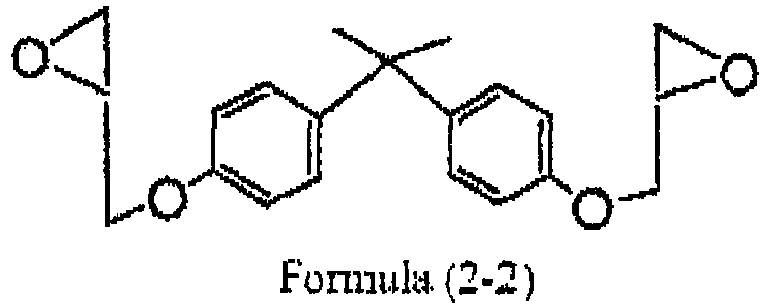
- Liquid epoxy compound: (of Formula (2-3), trade name: YX8000, manufactured by Japan Epoxy Resin Co., Ltd.)

- Liquid epoxy compound: (of Formula (2-4), trade name: DME100 manufactured by New Japan Chemical Co., Ltd.)

- Liquid epoxy compound: (of Formula (2-5), trade name: CE-2021P, manufactured by Daicel Corporation)
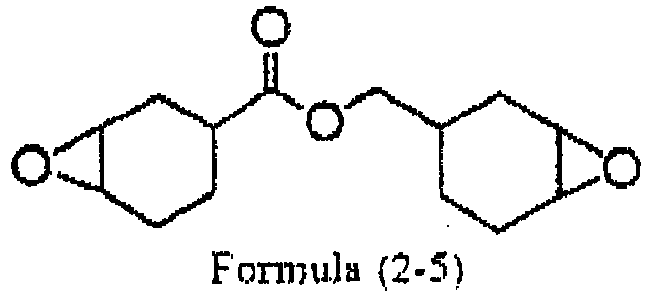
- In the present invention, as liquid epoxy compounds, tris-(3,4-epoxybutyl)-isocyanurate (of Formula (2-6)), tris-(4,5-epoxypentyl)-isocyanurate (of Formula (2-7)), and tris-(5,6-epoxyhexyl)-isocyanurate (of Formula (2-8)) below can be used.

- Liquid epoxy compound: (of Formula (2-9), manufactured by Nissan Chemical Industries, Ltd., trade name: TEPIC-PAS B22) prepared by adding 0.8 mol of propionic anhydride to 1 mol of tris-(2,3-epoxypropyl)-isocyanurate to modify tris-(2,3-epoxypropyl)-isocyanurate. The compound of Formula (2-9) contains a compound of Formula (2-9-1), a compound of Formula (2-9-2), a compound of Formula (2-9-3), and a compound of Formula (2-9-4) in a molar ratio of (2-9-1) : (2-9-2) : (2-9-3) : (2-9-4) - about 35% : 45% : 17% : 3%.

- Liquid epoxy compound: (of Formula (2-10), manufactured by Nissan Chemical Industries, Ltd., trade name: TEPIC-PAS B26) prepared by adding 0.4 mot of propionic anhydride to 1 mol of tris-(2,3-epoxypropyl)-isocyanurate to modify tris-(2,3-epoxypropyl)-isocyanurate. The compound of Formula (2-10) contains a compound of Formula (2-10-1), a compound of Formula (2-10-2), and a compound of Fomula (2-10-3) in a molar ratio of (2-10-1) : (2-10-2) : (2-10-3) - about 60% : 32% : 8%.

- In the present invention, as the cationic curable monomer, besides the epoxy compound, a vinyl ether compound, an oxetane compound, a carbonate compound, a dithiocarbonate compound, and the like can be used.
- The compound containing a vinyl group (such as a vinyl ether compound) is not particularly limited so long as the compound containing a vinyl group is a compound having a vinyl group and examples thereof include 2-hydroxyethyl vinyl ether (HEVE), diethylene glycol monovinyl ether (DEGV), 2-hydroxybutyl vinyl ether (HBVE), and triethylene glycol divinyl ether. In addition, a vinyl compound having a substituent such as an alkyl group and an allyl group at an α and/or β position can also be used. Furthermore, a vinyl ether compound containing a cyclic ether group such as an epoxy group and/or an oxetane group can be used and examples of such a vinyl ether compound include oxynorbornene divinyl ether and 3,3-dimethanoloxetane divinyl ether. In addition, a hybrid compound having a vinyl group and a (meth)acryl group can be used and examples of the hybrid compound include 2-(2-vinyloxyethoxy)ethyl (meth)acrylate (VEEA, VEEM). These compounds may be used individually or in combination of two or more of them.
- The compound containing an oxetanyl group (oxetane compound) is not particularly limited so long as the compound containing an oxetanyl group is a compound having an oxetanyl group and examples thereof include 3-ethyl-3-(phenoxymethyl)oxetane (POX), di[1-ethyl(3-oxetanyl)] methyl ether (DOX), 3-ethyl-3-(2-ethylhexyloxymethyl)oxetane (EHOX), 3-ethyl-3-{[3-(triethoxysilyl)propoxy]methyl}oxetane (TESOX), oxetanyl silsesquioxane (OX-SQ), and phenol novolac oxetane (PNOX-1009). In addition, a. hybrid compound (1-ethyl-3-oxetanylmethyl (meth)acrylate) having an oxetanyl group and a (meth)acryl group can be used. These oxetane-based compounds may be used individually or in combination of two or more of them.
- The carbonate compound and the dithiocarbonate compound arc not particularly limited so long as they are a compound having in the molecule thereof, a carbonate group or a dithiocarbonate group.
- As the acid generator used in the present invention, photoacid generators and thermal acid generators can be used.
The photoacid generator or the thermal acid generators are not particularly limited so long as they generate an acid directly or indirectly by light irradiation or heating. - Specific examples of the photoacid generator include a triazine-based compound, an acetophenone derivative compound, a disulfon-based compound, a diazomethane-based compound, a sulfonic acid derivative compound, an onium salt such as an iodonium salt, a sulfonium salt, a phosphonium salt, and a selenium salt, a metallocene complex, and an iron arene complex.
- Examples of the iodonium salt include diphenyliodonium chloride, diphenyliodonium trifluoromethane sulfonate, diphenyliodonium mesylate, diphenyliodonium tosylate, diphenyliodonium bromide, diphenyliodonium tetrafluoroborate, diphenyliodonium hexafluoro antimonate, diphenyliodonium hexafluoro arsenate, bis(p-tert-butylphenyl)iodonium hexafluoro phosphate, bis(p-tert-butylphenyl)iodonium mesylate, bis(p-tert-butylphenyl)iodonium tosylate, bis(p-tert-butylphenyl)iodonium trifluoromethane sulfonate, bis(p-tert-butylphenyl)iodonium tetrafluoroborate, bis(p-tert-butylphenyl)iodonium chloride, bis(p-chlorophenyl)iodonium chloride, and bis(p-chlorophenyl)iodonium tetrafluoroborate. Furthermore, examples of the iodonium salt include a bis(alkylphenyl)iodonium salt such as bis(4-tert-butylphenyl)iodonium hexafluoro phosphate, an alkoxycarbonylalkoxy-trialkylaryl-iodonium salt (for example, 4-[(1-ethoxycarbonyl-ethoxy)phenyl]-(2,4,6-trimethylphenyl)-iodonium hexafluoro phosphate), and a bis(alkoxyaryl)iodonium salt (for examples, a bis(alkoxyphenyl)iodonium salt such as (4-methoxyphenyl)phenyliodemium hexafluoro antimonate).
- Examples of the sulfonium salt include a triphenylsulfonium salt such as triphenylsulfonium chloride, triphenylsulfonium bromide, tri(p-methoxyphenyl)sulfonium tetrafluoroborate, tri(p-methoxyphenyl)sulfonium hexafluoro phosphonate, tri(p-ethoxyphenyl)sulfonium tetrafluoroborate, triphenylsulfonium triflate, triphenylsulfonium hexafluoro antimonate, and triphenylsulfonium hexafluoro phosphate, (4-phenylthiophenyl)diphenylsulfonium hexafluoro antimonate, (4-phenylthiophenyl)diphenylsulfonium hexafluoro phosphate, bis[4-(diphenylsulfonio)phenyl]sulfide-bis-hexafluoro antimonate, bis[4-(diphenylsulfonio)phenyl]sulfide-bis-hexafluoro phosphate, and (4-methoxyphenyl)diphenylsulfonium hexafluoro antimonate.
- Examples of the phosphonium salt include triphenylphosphonium chloride, triphenylphosphonium bromide, tri(p-methoxyphenyl)phosphonium tetrafluoroborate, tri(p-methoxyphenyl)phosphonium hexafluoro phosphonate, tri(p-ethoxyphenyl)phosphonium tetrafluoroborate, 4-chlorobenzenediazonium hexafluoro phosphate, and benzyltriphenylphosphonium hexafluoro antimonate.
- Examples of the metallocene complex include a selenium salt such as triphenylselenium hexafluoro phosphate, and (η5 or η6-isopropylbenzene)(η5-cyclopentadienyl) iron(II) hexafluoro phosphate.
In addition, as the photoacid generator, the compounds below can also be used. -


-


-

-


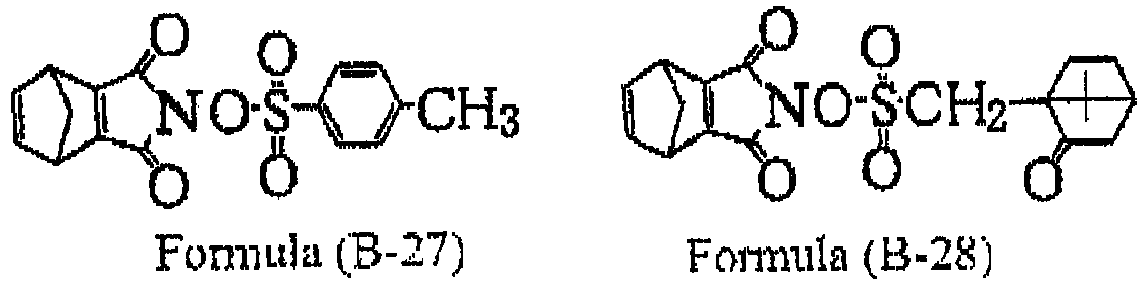

-


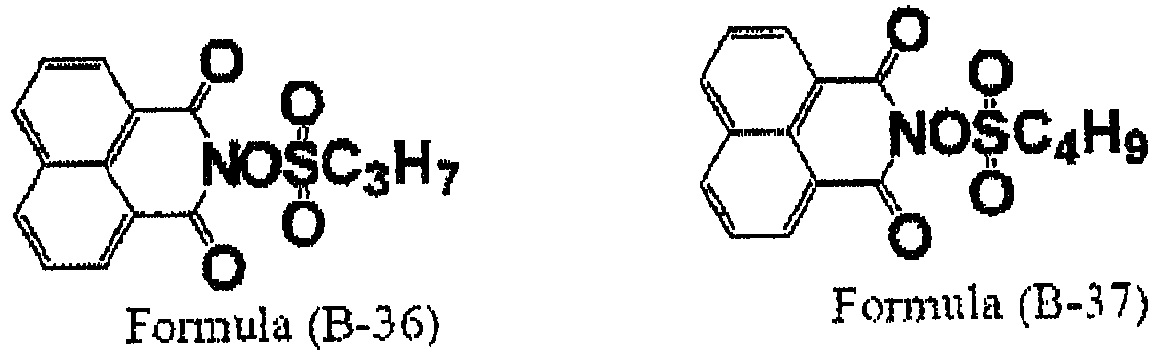

-


-

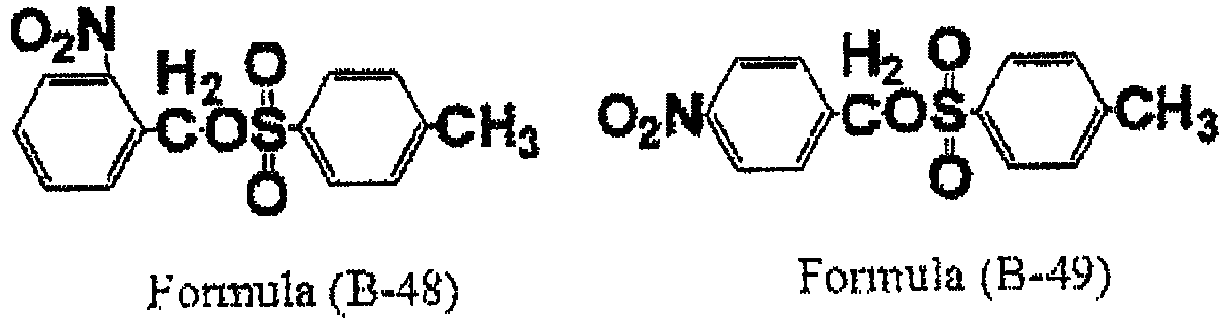


-


-


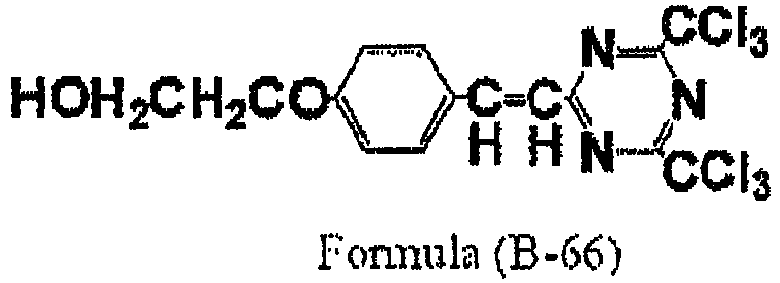

- As the photoacid generator, sulfonium salt compounds and iodonium salt compounds are preferred. Examples of the anion species thereof include CF3SO3 -, C4F9SO3 -, C8F17SO3 -, camphorsulfonic acid anion, tosylic acid anion, BF4 -, PF6 -, AsF6 -, and SbF6 -. Particularly, an anion species such as phosphorus hexafluoride and antimony hexafluoride exhibiting strong acidity is preferred.
As the photoacid generator, for example, compounds of Formula (B-1), Formula (B-2), Formula (B-3), Formula (B-8), Formula (B-9), and Formula (B-10) arc preferred and particularly, compounds of Formula (B-1) and Formula (B-2) are preferred. These photoacid generators may be used individually or in combination of two or more of them. - Examples of the thermal acid generator include sulfonium salts and phosphonium salts, and sulfonium salts are preferably used.
In addition, as the thermal acid generator, the compounds below can also be exemplified.
- In Formula (C-1), Rs are independently a C1-12 alkyl group or a C6-20 aryl group, particularly a C1-12 alkyl group is preferable. These thermal acid generators may be used individually or in combination of two or more of them.
- The curable composition of the present invention may contain a solvent. Examples of the solvent include: alcohols such as methanol and ethanol; ethers such as tetrahydrofuran; glycol ethers such as ethylene glycol monomethyl ether and ethylene glycol monoethyl ether; ethylene glycol alkyl ether acetates such as methylcellosolve acetate and ethylcellosolve acetate; diethylene glycols such as diethylene glycol monomethyl ether, diethylene glycol monoethyl ether, diethylene glycol dimethyl ether, diethylene glycol diethyl ether, and diethylene glycol ethyl methyl ether; propylene glycol monoalkyl ethers such as propylene glycol methyl ether, propylene glycol ethyl ether, propylene glycol propyl ether, and propylene glycol butyl ether; propylene glycol alkyl ether acetates such as propylene glycol methyl ether acetate, propylene glycol ethyl ether acetate, propylene glycol propyl ether acetate, and propylene glycol butyl ether acetate; propylene glycol alkyl ether acetates such as propylene glycol methyl ether propionate, propylene glycol ethyl ether propionate, propylene glycol propyl ether propionate, and propylene glycol butyl ether propionate; aromatic hydrocarbons such as toluene and xylene; ketones such as methyl ethyl ketone, cyclohexanone, and 4-hydroxy-4-methyl-2-pentanone; and esters such as methyl acetate, ethyl acetate, propyl acetate, butyl acetate, ethyl 2-hydroxypropionate, methyl 2-hydroxy-2-methylpropionate, ethyl 2-hydroxy-2-methylpropionate, methyl hydroxyacetate, ethyl hydroxyacetate, butyl hydroxyacetate, methyl lactate, ethyl lactate, propyl lactate, butyl lactate, methyl 3-hydroxypropionate, ethyl 3-hydroxypropionate, propyl 3-hydroxypropionate, butyl 3-hydroxypropionate, methyl 2-hydroxy-3-methylbutanate, methyl methoxyacetate, ethyl methoxyacetate, propyl methoxyacetate, butyl methoxyacetate, methyl ethoxyacetate, ethyl ethoxyacetate, propyl ethoxyacetate, butyl ethoxyacetate, methyl propoxyacetate, ethyl propoxyacetate, propyl propoxyacetate, butyl propoxyacetate, methyl butoxyacetate, ethyl butoxyacetate, propyl butoxyacetate, butyl butoxyacetate, methyl 2-methoxypropionate, ethyl 2-methoxypropionate, propyl 2-methoxypropionate, butyl 2-methoxypropionate, methyl 2-ethoxypropionate, ethyl 2-ethoxypropionate, propyl 2-ethoxypropionate, butyl 2-ethoxypropionate, methyl 2-butoxypropionate, ethyl 2-butoxypropionate, propyl 2-butoxypropionate, butyl 2-butoxypropionate, methyl 3-methoxypropionate, ethyl 3-methoxypropionate, propyl 3-methoxypropionate, butyl 3-methoxypropionate, methyl 3-ethoxypropionate, ethyl 3-ethoxypropionate, propyl 3-ethoxypropionate, butyl 3-ethoxypropionate, methyl 3-propoxypropionate, ethyl 3-propoxypropionate, propyl 3-propoxypropionate, butyl 3-propoxypropionate, methyl 3-butoxypropionate, ethyl 3-butoxypropionate, propyl 3-butoxypropionate, and butyl 3-butoxypropionate.
- The curable composition of the present invention may contain, if necessary, a general-purpose additive. Examples of such an additive include a pigment, a colorant, a thickener, a sensitizer, an antifoamer, a leveling agent, a coating property improving agent, a lubricant, a stabilizer (such as antioxidant, heat stabilizer, and light stabilizer), a plasticizer, a surfactant, a dissolution accelerator, a filler, an antistatic agent, and a curing agent. These additives may be used individually or in combination of two or more of them.
- In the curable composition of the present invention, for the purpose of enhancing coating property, a surfactant may be added. The surfactant is not particularly limited and examples thereof include a. fluorinated surfactant, a silicone-based surfactant, and a nanioic surfactant. These surfactants may be used individually or in combination of two or more of them.
Among these surfactants, in terms of having high coating property improving effect, a fluorinated surfactant is preferred. Specific examples of the fluorinated surfactant include trade name: EFTOP [registered trade mark] EF301, EF303, EF352 (manufactured by Mitsubishi Materials Electronic Chemicals Co., Ltd. (Tohkem Products Co., Ltd.)); trade name: MEGAFAC [registered trade mark] F171, F173, R-30, R-08, R-90, BL-20, F-482 (manufactured by DIC Corporation (Dainihon Ink & Chemicals Inc.)); trade name: Fluorad FC430, FC431 (manufactured by Sumitomo 3M Limited); and trade name: Asahi Guard [registered trade mark] AG710, Surfron [registered trade mark] S-382, SC101, SC102, SC103, SC104, SC105, SC106 (manufactured by Asahi Glass Co., Ltd.), to which the specific examples are not limited.
The ratio of the surfactant in the curable composition of the present invention is 0.0008 to 4.5% by mass, preferably 0.0008 to 2.7% by mass, more preferably 0.0008 to 1.8% by mass, based on the mass of the solid component contained in the curable composition. - In the curable composition of the present invention, for the purpose of enhancing the adhesion of the curable composition to a substrate after development, an adhesion accelerator may be added. Examples of the adhesion accelerator include: chlorosilanes such as trimethylchlorosilane, dimethylvinylchlorosilane, methyldiphenylchlorosilane, and chloromethyldimethylchlorosilane; alkoxysilanes such as trimethylmethoxysilane, dimethyldiethoxysilane, methyldimethoxysilane, dimethylvinylethoxysilane, diphenyldimethoxysilane, and phenyltriethoxysilane; silazancs such as hexamethyldisilazane, N,N'-bis(trimethylsilyl)urea, dimethyltrimethylsilylamine, and trimethylsilylimidazole; silanes such as vinyltrichlorosilane, γ-chloropropyltrimethoxysilane, γ-aminopropyltriethoxysilane, γ-methacryloxypropyltrimethoxysilane, γ-glycidoxypropyltrimethoxysilane, γ-(N-piperidinyl)propyltrimethoxysilane; a heterocyclic compound such as benzotriazole, benzimidazole, indazole, imidazole, 2-mercaptobenzimidazole, 2-mercaptobenzothiazole, 2-mercaptobenzoxazole, urazole, thiouracil, mercaptoimidazole, and mercaptopyrimidine; and a urea or thiourea compound such as 1,1-dimethylurca and 1,3-dimethylurea. These adhesion accelerators may be used individually or in combination of two or more of them.
The ratio of the adhesion accelerator in the cirable composition of the present invention is usually 18% by mass or less, preferably 0.0008 to 9% by mass, more preferably 0.04 to 9% by mass, based on the mass of the solid component contained in the curable composition. - The curable composition of the present invention may contain a sensitizer. Examples of the sensitizer include anthracene, phenothiazine, perylene, thioxanthone, and benzophenone-thioxanthone. Examples of the sensitizing dyestuff include a thiopyrylium salt-based dyestuff, a merocyanine-based dyestuff, a quinoline-based dyestuff, a styrylquinoline-based dyestuff, a ketocoumarin-based dyestuff, a thioxanthene-based dyestuff, a xanthene-based dyestuff, an oxonol-based dyestuff, a cyanine-based dyestuff, a rhodamine-based dyestuff, and a pytylium salt-based dyestuff. Particularly preferred is an anthracene-based sensitizer and by using the anthracene-based sensitizer in combination with a cationic curing catalyst (radiation-sensitive cationic polymerization initiator), the curable composition not only enhances the sensitivity thereof dramatically, but also has a radical polymerization initiating function. Accordingly, in a hybrid curing system like in the present invention using a cationic curing system in combination with a radical curing system, the catalyst species can be simply selected. As a specific anthracene compound, dibutoxyanthracene, dipropoxyanthraquinone, and the like are effective.
The ratio of the sensitizer in the curable composition of the present invention is 0.01 to 20% by mass, preferably 0.01 to 10% by mass, based on the mass of the solid component contained in the curable composition. - In the present invention, the curable composition containing the epoxy compound of Formula (1) and the photoacid generator is applied onto a substrate and by irradiating the curable composition with light, the curable composition can be cured. Before or after the light irradiation, the curable composition can be heated.
In the present invention, the curable composition containing the epoxy compound of Formula (1) and the thermal acid generator is applied onto a substrate and by heating the curable composition, the curable composition can be cured.
Furthermore, in the present invention, the curable composition containing the epoxy compound of Formula (1) and the thermal acid generator and the photoacid generator is applied onto a substrate and by heating the curable composition and then, by irradiating the curable composition with light, the curable composition can be cured. - Examples of the method for applying the curable composition of the present invention onto a substrate include a flow coating method, a spin coating method, a spray coating method, a screen printing method, a casting method, a bar coating method, a curtain coating method, a roll coating method, a gravure coating method, a dipping method, and a slit method.
- The thickness of the coating film formed from the curable composition of the present invention can be selected from a range of 0.01 µm to around 10 mm according to the application of the cured product. For example, when the coating film is applied to a photoresist, the thickness of the coating film may be 0.05 to around 10 µm (particularly 0.1 to 5 µm); when the coating film is applied to a printed wiring substrate, the thickness may be 10 µm to around 5 mm (particularly 100 µm to 1 mm); and when the coating film is applied to an optical thin film, the thickness may be 0.1 to around 100 µm (particularly 0.3 to 50 µm).
- Examples of the light used for light irradiation or exposure to light when the photoacid generator is used include a gamma ray, an X ray, an ultraviolet ray, and a visible light ray and usually, a visible light ray or an ultraviolet ray, particularly, an ultraviolet ray is frequently used.
The wavelength of the light is around, for example 150 to 800 nm, preferably 150 to 600 nm, further preferably 200 to 400 nm, particularly preferably 300 to 400 nm. Although the dose of the irradiated light is varied depending on the thickness of the coating film, the dose may be around, for example 2 to 20,000 mJ/cm2, preferably 5 to 5,000 mJ/cm2.
The light source can be selected according to the type of the light ray used for exposure to light and examples of the light source when the ultraviolet ray is used include a low pressure mercury lamp, a high pressure mercury lamp, a ultrahigh pressure mercury lamp, a deuterium lamp, a halogen lamp, and laser light (such as helium-cadmium laser and excimer laser). By such light irradiation, the curing reaction of the curable composition of the present invention containing the epoxy compound of Formula (1) and the photoacid generator is progressed. - The heating of the coating film performed if necessary after heating when the thermal acid generator is used or after light irradiation when the photoacid generator is used, is performed, for example, at around 60 to 250°C, preferably at around 100 to 200°C. The heating time can be selected from a range of 3 seconds or more (for example, 3 seconds to around 5 hours) and is, for example, 5 seconds to 2 hours, preferably 20 seconds to around 30 minutes, usually 1 minute to around 3 hours (for example, 5 minutes to 2.5 hours).
- Furthermore, when a pattern or an image is formed (for example, a printed wiring substrate is produced), a coating film formed on abase material may be subjected to pattern exposure. The pattern exposure may be performed either by scanning of laser light or by light irradiation through a photomask. By developing (or dissolving) a non-irradiated region (unexposed portion) generated by such pattern exposure with a developer, a pattern or an image can be formed.
- As the developer, an alkaline aqueous solution or an organic solvent can be used.
Examples of the alkaline aqueous solution include: an aqueous solution of an alkali metal hydroxide such as potassium hydroxide, sodium hydroxide, potassium carbonate, and sodium carbonate; an aqueous solution of quaternary ammonium hydroxide such as tetramethylammonium hydroxide, tetraethylammonium hydroxide, and choline; and an amine aqueous solution such as ethanolamine, propylamine, and ethylenediamine. - The alkaline developer is generally an aqueous solution of 10% by mass or less, preferably an aqueous solution of 0.1 to 3.0% by mass. Furthermore, to the alkaline developer, alcohols or a surfactant may be added to be used and the blending amount of these additives is individually preferably 0.05 to 10 parts by mass, relative to 100 parts by mass of the alkaline developer. Among them, a 0.1 to 2.38% by mass tetramethylammonium hydroxide aqueous solution can be used.
- As the organic solvent for the developer, a general organic solvent can be used. Examples of the organic solvent include acetone, acetonitrile, toluene, dimethylformamide, methanol, ethanol, isopropanol, propylene glycol methyl ether, propylene glycol ethyl ether, propylene glycol propyl ether, propylene glycol butyl ether, propylene glycol methyl ether acetate, propylene glycol ethyl ether acetate, propylene glycol propyl ether acetate, propylene glycol butyl ether acetate, ethyl lactate, and cyclohexanone. These organic solvents may be used individually or in combination of two or more of them. Particularly, propylene glycol methyl ether, propylene glycol methyl ether acetate, and ethyl lactate can be preferably used.
- The epoxy compounds below were prepared.
- Into a reaction vessel equipped with a Dean-Stark apparatus and a cooler, 10 g of cis-4-cyclohexene-1,2-dicarboxylic anhydride, 0.6 g of p-toluenesulfonic acid monohydrate, 100 mL of toluene, and 10 g of 3-butene-1-ole were charged and the reaction was effected at a reflux temperature for 5 hours. After the completion of the reaction, the reaction mixture was washed with sodium bicarbonate water, was washed with water, was concentrated, and was purified by silica gel chromatography (using as a developing solvent, hexane/ethyl acetate in a volume ratio of hexane/ethyl acetate = 80/20) to obtain 18 g of bis(3-butenyl)-4-cyclohexene-1,2-dicarboxylic acid ester as a colorless liquid.
Into a reaction vessel, 17 g of bis(3-butenyl)-4-cyclohexene-1,2-dicarboxylic acid ester and 300 mL of chloroform were charged and the resultant reaction mixture was cooled down to 0 to 10°C. To the reaction mixture, 51 g of methachloroperbenzoic acid was added and the temperature of the resultant reaction mixture was elevated to room temperature, followed by effecting the reaction for 18 hours. After the completion of the reaction, the reaction mixture was quenched with a sodium thiosulfate aqueous solution and to the resultant reaction mixture, sodium bicarbonate water was added, followed by extracting the resultant reaction mixture. The organic phase was washed with sodium bicarbonate water, was washed with water, and was dried and from the organic phase, the solvent was distilled off to obtain a crude product. The crude product was purified by silica gel chromatography (using as a developing solvent, hexane/ethyl acetate in a volume ratio of hexane/ethyl acetate = 40/60 to 10/90) to obtain 16 g of a light yellow liquid.
The obtained compound was bis(3,4-epoxybutyl)-4,5-epoxycyclohexane-1,2-dicarboxylic acid ester corresponding to Formula (1-1). The epoxy compound was named (i-1). - Into a reaction vessel equipped with a Dean-Stark apparatus and a cooler, 10 g of cis-4-cyclohexene-1,2-dicarboxylic anhydride, 0.6 g of p-toluenesulfonic acid monohydrate, 100 mL of toluene, and 12 g of 4-pentene-1-ole were charged and the reaction was effected at a reflux temperature for 6 hours. After the completion of the reaction, the reaction mixture was washed with sodium bicarbonate water, was washed with water, was concentrated, and was purified by silica gel chromatography (using as a developing solvent, hexane/ethyl acetate in a volume ratio of hexane/ethyl acetate = 80/20) to obtain 19 g of bis(4-pentenyl)-4-cyclohexene-1,2-dicarboxylic acid ester as a colorless liquid.
Into a reaction vessel, 19 g of bis(4-pentenyl)-4-cyclohexene-1,2-dicarboxylic acid ester and 300 mL of chloroform were charged and the resultant reaction mixture was cooled down to 0 to 10°C. To the reaction mixture, 50 g of methachloroperbenzoic acid was added and the temperature of the resultant reaction mixture was elevated to room temperature, followed by effecting the reaction for 19 hours. After the completion of the reaction, the reaction mixture was quenched with a sodium thiosulfate aqueous solution and to the resultant reaction mixture, sodium bicarbonate water was added, followed by extracting the resultant reaction mixture. The organic phase was washed with sodium bicarbonate water, was washed with water, and was dried and from the organic phase, the solvent was distilled off to obtain a crude product. The crude product was purified by silica gel chromatography (using as a developing solvent, hexane/ethyl acetate in a volume ratio of hexane/ethyl acetate = 40/60 to 10/90) to obtain 21 g of a colorless liquid.
The obtained compound was bis(4,5-epoxypentyl)-4,5-epoxycyclohexane-1,2-dicarboxylic acid ester corresponding to Formula (1-2). The epoxy compound was named (i-2). - Into a reaction vessel equipped with a Dean-Stark apparatus and a cooler, 10 g of cis-4-cyclohexene-1,2-dicarboxylic anhydride, 0.6 g of p-toluenesulfonic acid monohydrate, 100 mL of toluene, and 15 g of 5-hexene-1-ole were charged and the reaction was effected at a reflux temperature for 3 hours. After the completion of the reaction, the reaction mixture was washed with sodium bicarbonate water, was washed with water, was concentrated, and was purified by silica gel chromatography (using as a developing solvent, hexane/ethyl acetate in a volume ratio of hexane/ethyl acetate - 90/10) to obtain 22 g of bis(5-hexenyl)-4-cyclohexene-1,2-dicarboxylic acid ester as a light yellow liquid.
Into a reaction vessel, 21 g of bis(5-hexenyl)-4-cyclohexene-1,2-dicarboxylic acid ester and 300 mL of chloroform were charged and the resultant reaction mixture was cooled down to 0 to 10°C. To the reaction mixture, 53 g of methachloroperbenzoic acid was added and the temperature of the resultant reaction mixture was elevated to room temperature, followed by effecting the reaction for 15 hours. After the completion of the reaction, the reaction mixture was quenched with a sodium thiosulfate aqueous solution and to the resultant reaction mixture, sodium bicarbonate water was added, followed by extracting the resultant reaction mixture. The organic phase was washed with sodium bicarbonate water, was washed with water, and was dried and from the organic phase, the solvent was distilled off to obtain a crude product. The crude product was purified by silica gel chromatography (using as a developing solvent, hexane/ethyl acetate in a volume ratio of hexane/ethyl acetate = 40/60 to 10/90) to obtain 23 g of a light yellow liquid.
The obtained compound was bis(5,6-epoxyhexyl)-4,5-epoxycyclohexane-1,2-dicarboxylic acid ester corresponding to Formula (1-3). The epoxy compound was named (i-3). - Into a reaction vessel, 15 g of cis-4-cyclohexene-1,2-dicarboxylic acid, 37 g of potassium carbonate, 255 mL of dimethylformamide, and 32 g of allyl bromide were charged and the reaction was effected at room temperature for 15 hours. After the completion of the reaction, the reaction mixture was filtered and to the filtrate, toluene and water were added, fol lowed by extracting the filtrate. The organic phase was washed with water, was concentrated, and was purified by silica gel chromatography (using as a developing solvent, hexane/ethyl acetate in a volume ratio of hexane/ethyl acetate = 90/10) to obtain 21 g of bis(2-propenyl)-4-cyclohexene-1,2-dicarboxylic acid ester as a light yellow liquid.
Into a reaction vessel, 21 g of bis(2-propenyl)-4-cyclohexene-1,2-dicarboxylic acid ester and 300 mL of chloroform were charged and the resultant reaction mixture was cooled down to 0 to 10°C. To the reaction mixture, 87 g of methachloroperbenzoic acid was added and the temperature of the resultant reaction mixture was elevated to room temperature, followed by effecting the reaction for 5 days. After the completion of the reaction, the reaction mixture was quenched with a sodium thiosulfate aqueous solution and to the resultant reaction mixture, sodium bicarbonate water was added, followed by extracting the resultant reaction mixture. The organic phase was washed with sodium bicarbonate water, was washed with water, and was dried and from the organic phase, the solvent was distilled off to obtain a crude product. The crude product was purified by silica gel chromatography (using as a developing solvent, hexane/ethyl acetate in a volume ratio of hexane/ethyl acetate = 50/50 to 10/90) to obtain 20 g of a colorless liquid.
The obtained compound was bis(2,3-epoxypropyl)-4,5-epoxycyclohexane-1,2-dicarboxylic acid ester. The epoxy compound was named (i-4). - A propylene carbonate solution of a sulfonium salt (Formula (B-2), active ingredient 50%, trade name: CP1-101A, manufactured by San-Apro Ltd.) was prepared. This photoacid generator was named (ii-1).
- An epoxy compound and an acid generator were blended and mixed at 40°C and the resultant mixture was degassed to prepare a curable composition. In Table 1, all of the blending amounts arc expressed in a unit of part by mass and the blending amount of the epoxy compound and the acid generator is expressed in a unit of part by mass of an active ingredient. The photoacid generator (ii-1) of propylene carbonate solution was used as it was.
The prepared curable composition was irradiated with UV (ultraviolet ray) from a position distant by 9.5 cm from the curable composition and the photocuring behavior of the curable composition was observed by a rheometer (viscometer) to define the time (second) until the storage modulus has reached 1 × 10⁴ Pa as the curing time (second). The UV irradiation was performed until 600 seconds.
As the rheometer, a rheometer (manufactured hy Reologica Instruments Ab. (trade name: VAR-50 type)) was used and as the lamp, an Hg-Xe lamp was used. In the UV irradiation, the wavelength of the irradiated UV was 365 nm and the irradiation dose was 20 mW/cm2. In the UV irradiation, as the material of the irradiation window, a hard glass of 3 mm thickness was used and the film thickness of the coating film formed from the curable composition was 50 µm. The photocuring rate of the curable composition was measured. -
Table 1 Component Example 1 Example 2 Example 3 Comparative Example 1 (i-1) 100 (i-2) 100 (i-3) 100 (i-4) 100 (ii-1) 2 2 2 2 Curing time (second) 380 65 55 560 - The present invention provides a curable composition having a low viscosity and high cationic curability. A cured product formed from the curable composition has characteristics such as high toughness, a low viscosity, and fast curing and can be used for the coating or adhering of electronic parts, optical parts, or precision machine parts. The curable composition of the present invention can he used for the adhering of, for example: an optical element such as a lens of a cellular phone or a camera, a light-emitting diode (LED), and a semiconductor laser (LD); parts such as a liquid crystal panel, a biochip, and a lens or a prism of a camera; magnetic parts of a hard disc of a personal computer or the like; a pickup (a part capturing optical information reflected from a disc) of a CD or DVD player; a cone and a coil of a speaker; a magnet of a motor; a circuit substrate; electronic parts; and parts inside an engine of an automobile and the like.
The curable composition of the present invention is applicable to, for example, a body of an automobile or a motorcycle, a lens or a mirror of a head light, a plastic lens of glasses, a cellular phone, a game machine, an optical film, and an ID card as an application to a hard coating material for surface protection of an automobile body, a lamp or electric appliances, a building material, a plastic, and the like.
Furthermore, examples of the application of the curable composition of the present invention include application to cards such as a credit card and a membership certificate, application to a printing ink for a switch and a key board of electric appliances and OΛ equipment, and application to an ink for an inkjet printer for CD, DVD, and the like as an application to an ink material for printing on a metal such as aluminium and a plastic. - Then, examples of the application of the curable composition of the present invention include also application to a technology for producing a complicated three-dimensional object in combination with a three-dimensional CAD by curing a resin, application to a photo fabrication such as modeling of industrial products, and applications to coating of an optical fiber, adhering, optical waveguide, and thick film resist (for MEMS).
Claims (9)
- A curable composition comprising:an epoxy compound of Formula (1):

an acid generator. - The curable composition according to claim 1, wherein A in Formula (1) is a cyclohexyl group containing an epoxy group.
- The curable composition according to claim 1, wherein n1 and n2 in Formula (1) are individually 2, and R1, R2, R3 and R4 arc individually a hydrogen atom.
- The curable composition according to claim 1, wherein n1 and n2 in Formula (1) are individually 3, and R1, R2, R3 and R4 are individually a hydrogen atom.
- The curable composition according to claim 1, wherein n1 and n2 in Formula (1) arc individually 4, and R1, R2, R3 and R4 arc individually a hydrogen atom.
- The curable composition according to any one of claims 1 to 5, wherein the acid generator is a photoacid generator or a thermal acid generator.
- The curable composition according to any one of claims 1 to 6, wherein the acid generator is an onium salt.
- The curable composition according to any one of claims 1 to 6, wherein the acid generator is a sulfonium salt compound or an iodonium salt compound.
- The curable composition according to any one of claims 1 to 8, wherein the curable composition contains the acid generator in a ratio of 0.1 to 20% by mass, based on the mass of the epoxy compound.
Applications Claiming Priority (2)
| Application Number | Priority Date | Filing Date | Title |
|---|---|---|---|
| JP2010176346 | 2010-08-05 | ||
| PCT/JP2011/067114 WO2012017896A1 (en) | 2010-08-05 | 2011-07-27 | Epoxy resin composition having monocyclic aliphatic hydrocarbon ring |
Publications (2)
| Publication Number | Publication Date |
|---|---|
| EP2602274A1 true EP2602274A1 (en) | 2013-06-12 |
| EP2602274A4 EP2602274A4 (en) | 2017-05-03 |
Family
ID=45559397
Family Applications (1)
| Application Number | Title | Priority Date | Filing Date |
|---|---|---|---|
| EP11814523.4A Withdrawn EP2602274A4 (en) | 2010-08-05 | 2011-07-27 | Epoxy resin composition having monocyclic aliphatic hydrocarbon ring |
Country Status (7)
| Country | Link |
|---|---|
| US (1) | US8765835B2 (en) |
| EP (1) | EP2602274A4 (en) |
| JP (1) | JP5843073B2 (en) |
| KR (1) | KR101852531B1 (en) |
| CN (1) | CN103068876B (en) |
| TW (1) | TWI519592B (en) |
| WO (1) | WO2012017896A1 (en) |
Families Citing this family (8)
| Publication number | Priority date | Publication date | Assignee | Title |
|---|---|---|---|---|
| JP5704256B2 (en) * | 2011-12-26 | 2015-04-22 | 東亞合成株式会社 | Insulating film composition and insulating film |
| CN102981362A (en) * | 2012-11-14 | 2013-03-20 | 南昌大学 | Method using 4 and 5-cyclohexene oxide-1 and 2-dioctyl phthalate glycidyl ester as prepolymer to prepare three-dimensional lithography fast forming photosensitive resin and application |
| CN103965046B (en) * | 2013-01-30 | 2016-02-24 | 中国科学院宁波材料技术与工程研究所 | Methylene-succinic acid base three double bond compound and its preparation method and application |
| KR20160102981A (en) * | 2013-12-23 | 2016-08-31 | 블루 큐브 아이피 엘엘씨 | Epoxy resin composition |
| US9944800B2 (en) | 2014-10-24 | 2018-04-17 | Empire Technology Development Llc | UV curable hydrophilic coatings |
| CN112831026A (en) * | 2020-12-31 | 2021-05-25 | 深圳飞扬兴业科技有限公司 | Synthetic method of aliphatic epoxy resin |
| WO2022210246A1 (en) * | 2021-03-29 | 2022-10-06 | 東レ株式会社 | Epoxy resin composition, cured epoxy resin product, and coated fiber-reinforced resin molded article obtained using same |
| CN117285699A (en) * | 2023-09-21 | 2023-12-26 | 深圳市贝特瑞新能源技术研究院有限公司 | Solid electrolyte prepolymer, solid electrolyte and electrochemical device |
Family Cites Families (4)
| Publication number | Priority date | Publication date | Assignee | Title |
|---|---|---|---|---|
| US3565922A (en) * | 1966-09-02 | 1971-02-23 | United Aircraft Corp | Trifunctional epoxy crosslinking agents |
| US4405766A (en) * | 1982-07-30 | 1983-09-20 | The Dow Chemical Company | Phosphonium bicarbonate catalysts for promoting reaction of epoxides with carboxylic acids or anhydrides |
| JP2009046565A (en) * | 2007-08-18 | 2009-03-05 | Konica Minolta Medical & Graphic Inc | Curable composition |
| EP2641926A4 (en) * | 2010-11-15 | 2017-01-04 | Nissan Chemical Industries, Ltd. | Polyfunctional epoxy compound |
-
2011
- 2011-07-27 EP EP11814523.4A patent/EP2602274A4/en not_active Withdrawn
- 2011-07-27 US US13/814,090 patent/US8765835B2/en not_active Expired - Fee Related
- 2011-07-27 JP JP2012527695A patent/JP5843073B2/en not_active Expired - Fee Related
- 2011-07-27 WO PCT/JP2011/067114 patent/WO2012017896A1/en not_active Ceased
- 2011-07-27 KR KR1020137005541A patent/KR101852531B1/en not_active Expired - Fee Related
- 2011-07-27 CN CN201180038549.4A patent/CN103068876B/en not_active Expired - Fee Related
- 2011-08-03 TW TW100127551A patent/TWI519592B/en not_active IP Right Cessation
Non-Patent Citations (2)
| Title |
|---|
| No further relevant documents disclosed * |
| See also references of WO2012017896A1 * |
Also Published As
| Publication number | Publication date |
|---|---|
| KR20140005858A (en) | 2014-01-15 |
| TW201213432A (en) | 2012-04-01 |
| JP5843073B2 (en) | 2016-01-13 |
| US20130177849A1 (en) | 2013-07-11 |
| JPWO2012017896A1 (en) | 2013-10-03 |
| EP2602274A4 (en) | 2017-05-03 |
| CN103068876A (en) | 2013-04-24 |
| US8765835B2 (en) | 2014-07-01 |
| TWI519592B (en) | 2016-02-01 |
| KR101852531B1 (en) | 2018-04-27 |
| WO2012017896A1 (en) | 2012-02-09 |
| CN103068876B (en) | 2015-03-25 |
Similar Documents
| Publication | Publication Date | Title |
|---|---|---|
| US8765835B2 (en) | Epdxy resin composition having monocyclic aliphatic hydrocarbon ring | |
| JP5867749B2 (en) | Multifunctional epoxy compound | |
| US8778597B2 (en) | Long-chain alkylene-containing curable epoxy resin composition | |
| US8426111B2 (en) | Resist underlayer coating forming composition for forming photo-crosslinking cured resist underlayer coating | |
| JP5356828B2 (en) | Photobase generator and photocurable resin composition | |
| KR101886060B1 (en) | Polyfunctional epoxy compound | |
| US12077636B2 (en) | Highly soluble tris-(2,3-epoxypropyl)-isocyanurate and method for producing same | |
| CN112947000A (en) | Composition for forming silicon-containing EUV resist underlayer film containing sulfonic acid/salt | |
| JP2023103095A (en) | Silica sol containing long-chain alkylene group-containing epoxy compound |
Legal Events
| Date | Code | Title | Description |
|---|---|---|---|
| PUAI | Public reference made under article 153(3) epc to a published international application that has entered the european phase |
Free format text: ORIGINAL CODE: 0009012 |
|
| 17P | Request for examination filed |
Effective date: 20130305 |
|
| AK | Designated contracting states |
Kind code of ref document: A1 Designated state(s): AL AT BE BG CH CY CZ DE DK EE ES FI FR GB GR HR HU IE IS IT LI LT LU LV MC MK MT NL NO PL PT RO RS SE SI SK SM TR |
|
| DAX | Request for extension of the european patent (deleted) | ||
| RA4 | Supplementary search report drawn up and despatched (corrected) |
Effective date: 20170405 |
|
| RIC1 | Information provided on ipc code assigned before grant |
Ipc: C08G 59/24 20060101AFI20170330BHEP Ipc: G03F 7/038 20060101ALI20170330BHEP Ipc: C07D 301/14 20060101ALI20170330BHEP Ipc: C08G 59/68 20060101ALI20170330BHEP Ipc: C07D 303/44 20060101ALI20170330BHEP Ipc: G03F 7/004 20060101ALI20170330BHEP |
|
| GRAP | Despatch of communication of intention to grant a patent |
Free format text: ORIGINAL CODE: EPIDOSNIGR1 |
|
| RIC1 | Information provided on ipc code assigned before grant |
Ipc: C08G 59/68 20060101ALI20180201BHEP Ipc: C07D 303/44 20060101ALI20180201BHEP Ipc: C07D 301/14 20060101ALI20180201BHEP Ipc: C08G 59/32 20060101AFI20180201BHEP Ipc: G03F 7/004 20060101ALI20180201BHEP Ipc: G03F 7/038 20060101ALI20180201BHEP Ipc: C08G 59/24 20060101ALI20180201BHEP |
|
| INTG | Intention to grant announced |
Effective date: 20180307 |
|
| STAA | Information on the status of an ep patent application or granted ep patent |
Free format text: STATUS: THE APPLICATION IS DEEMED TO BE WITHDRAWN |
|
| 18D | Application deemed to be withdrawn |
Effective date: 20180718 |