EP2600128B1 - Remote temperature measurement method for magnetic nano-particle based on paramagnetic property - Google Patents
Remote temperature measurement method for magnetic nano-particle based on paramagnetic property Download PDFInfo
- Publication number
- EP2600128B1 EP2600128B1 EP11860133.5A EP11860133A EP2600128B1 EP 2600128 B1 EP2600128 B1 EP 2600128B1 EP 11860133 A EP11860133 A EP 11860133A EP 2600128 B1 EP2600128 B1 EP 2600128B1
- Authority
- EP
- European Patent Office
- Prior art keywords
- magnetic
- temperature
- excited
- magnetic fields
- measurement
- Prior art date
- Legal status (The legal status is an assumption and is not a legal conclusion. Google has not performed a legal analysis and makes no representation as to the accuracy of the status listed.)
- Not-in-force
Links
- 238000000034 method Methods 0.000 title claims description 37
- 238000009529 body temperature measurement Methods 0.000 title claims description 28
- 239000002122 magnetic nanoparticle Substances 0.000 title claims description 11
- 230000005298 paramagnetic effect Effects 0.000 title description 5
- 230000005291 magnetic effect Effects 0.000 claims description 96
- 230000005415 magnetization Effects 0.000 claims description 11
- 239000011159 matrix material Substances 0.000 claims description 7
- 230000005408 paramagnetism Effects 0.000 claims description 2
- 230000001131 transforming effect Effects 0.000 claims 1
- 238000005259 measurement Methods 0.000 description 34
- 238000012360 testing method Methods 0.000 description 16
- 238000004422 calculation algorithm Methods 0.000 description 10
- 238000002474 experimental method Methods 0.000 description 8
- 238000004088 simulation Methods 0.000 description 7
- 239000000463 material Substances 0.000 description 6
- 230000008569 process Effects 0.000 description 6
- 206010020843 Hyperthermia Diseases 0.000 description 5
- 230000036031 hyperthermia Effects 0.000 description 5
- 238000001727 in vivo Methods 0.000 description 5
- 239000002245 particle Substances 0.000 description 5
- 230000005284 excitation Effects 0.000 description 4
- 229910052739 hydrogen Inorganic materials 0.000 description 4
- 239000001257 hydrogen Substances 0.000 description 4
- 238000011275 oncology therapy Methods 0.000 description 4
- 230000001629 suppression Effects 0.000 description 4
- 201000001379 familial temporal lobe epilepsy 3 Diseases 0.000 description 3
- 239000013598 vector Substances 0.000 description 3
- 208000017785 Autosomal dominant epilepsy with auditory features Diseases 0.000 description 2
- UFHFLCQGNIYNRP-UHFFFAOYSA-N Hydrogen Chemical compound [H][H] UFHFLCQGNIYNRP-UHFFFAOYSA-N 0.000 description 2
- 101100232347 Mus musculus Il11ra1 gene Proteins 0.000 description 2
- 206010028980 Neoplasm Diseases 0.000 description 2
- 238000004458 analytical method Methods 0.000 description 2
- 201000011510 cancer Diseases 0.000 description 2
- 238000013461 design Methods 0.000 description 2
- 238000001514 detection method Methods 0.000 description 2
- 201000001354 familial temporal lobe epilepsy 1 Diseases 0.000 description 2
- 201000001366 familial temporal lobe epilepsy 2 Diseases 0.000 description 2
- 150000002431 hydrogen Chemical class 0.000 description 2
- XEEYBQQBJWHFJM-UHFFFAOYSA-N iron Substances [Fe] XEEYBQQBJWHFJM-UHFFFAOYSA-N 0.000 description 2
- 229910052742 iron Inorganic materials 0.000 description 2
- 230000001575 pathological effect Effects 0.000 description 2
- GPAAEXYTRXIWHR-UHFFFAOYSA-N (1-methylpiperidin-1-ium-1-yl)methanesulfonate Chemical compound [O-]S(=O)(=O)C[N+]1(C)CCCCC1 GPAAEXYTRXIWHR-UHFFFAOYSA-N 0.000 description 1
- 241000238366 Cephalopoda Species 0.000 description 1
- 230000005343 Curie-Weiss law Effects 0.000 description 1
- 241000282414 Homo sapiens Species 0.000 description 1
- 238000012307 MRI technique Methods 0.000 description 1
- 238000005481 NMR spectroscopy Methods 0.000 description 1
- 238000005054 agglomeration Methods 0.000 description 1
- 230000002776 aggregation Effects 0.000 description 1
- 230000004888 barrier function Effects 0.000 description 1
- 210000000988 bone and bone Anatomy 0.000 description 1
- 238000004364 calculation method Methods 0.000 description 1
- 238000010276 construction Methods 0.000 description 1
- 230000010259 detection of temperature stimulus Effects 0.000 description 1
- 238000011161 development Methods 0.000 description 1
- 239000000539 dimer Substances 0.000 description 1
- 230000000694 effects Effects 0.000 description 1
- 201000001380 familial temporal lobe epilepsy 4 Diseases 0.000 description 1
- 238000010438 heat treatment Methods 0.000 description 1
- 238000009217 hyperthermia therapy Methods 0.000 description 1
- 230000028993 immune response Effects 0.000 description 1
- 238000000338 in vitro Methods 0.000 description 1
- 210000004185 liver Anatomy 0.000 description 1
- 210000004072 lung Anatomy 0.000 description 1
- 239000000696 magnetic material Substances 0.000 description 1
- 230000005389 magnetism Effects 0.000 description 1
- 238000005404 magnetometry Methods 0.000 description 1
- 238000000691 measurement method Methods 0.000 description 1
- 230000017074 necrotic cell death Effects 0.000 description 1
- 238000005457 optimization Methods 0.000 description 1
- 230000001737 promoting effect Effects 0.000 description 1
- 230000004044 response Effects 0.000 description 1
- 239000007787 solid Substances 0.000 description 1
- 230000003068 static effect Effects 0.000 description 1
- 238000010998 test method Methods 0.000 description 1
- 239000013638 trimer Substances 0.000 description 1
- 210000001835 viscera Anatomy 0.000 description 1
Images





Classifications
-
- G—PHYSICS
- G01—MEASURING; TESTING
- G01K—MEASURING TEMPERATURE; MEASURING QUANTITY OF HEAT; THERMALLY-SENSITIVE ELEMENTS NOT OTHERWISE PROVIDED FOR
- G01K7/00—Measuring temperature based on the use of electric or magnetic elements directly sensitive to heat ; Power supply therefor, e.g. using thermoelectric elements
- G01K7/36—Measuring temperature based on the use of electric or magnetic elements directly sensitive to heat ; Power supply therefor, e.g. using thermoelectric elements using magnetic elements, e.g. magnets, coils
-
- A—HUMAN NECESSITIES
- A61—MEDICAL OR VETERINARY SCIENCE; HYGIENE
- A61B—DIAGNOSIS; SURGERY; IDENTIFICATION
- A61B5/00—Measuring for diagnostic purposes; Identification of persons
- A61B5/01—Measuring temperature of body parts ; Diagnostic temperature sensing, e.g. for malignant or inflamed tissue
-
- A—HUMAN NECESSITIES
- A61—MEDICAL OR VETERINARY SCIENCE; HYGIENE
- A61B—DIAGNOSIS; SURGERY; IDENTIFICATION
- A61B5/00—Measuring for diagnostic purposes; Identification of persons
- A61B5/05—Detecting, measuring or recording for diagnosis by means of electric currents or magnetic fields; Measuring using microwaves or radio waves
-
- G—PHYSICS
- G01—MEASURING; TESTING
- G01R—MEASURING ELECTRIC VARIABLES; MEASURING MAGNETIC VARIABLES
- G01R33/00—Arrangements or instruments for measuring magnetic variables
- G01R33/12—Measuring magnetic properties of articles or specimens of solids or fluids
- G01R33/1276—Measuring magnetic properties of articles or specimens of solids or fluids of magnetic particles, e.g. imaging of magnetic nanoparticles
-
- A—HUMAN NECESSITIES
- A61—MEDICAL OR VETERINARY SCIENCE; HYGIENE
- A61B—DIAGNOSIS; SURGERY; IDENTIFICATION
- A61B5/00—Measuring for diagnostic purposes; Identification of persons
- A61B5/05—Detecting, measuring or recording for diagnosis by means of electric currents or magnetic fields; Measuring using microwaves or radio waves
- A61B5/0515—Magnetic particle imaging
-
- G—PHYSICS
- G01—MEASURING; TESTING
- G01K—MEASURING TEMPERATURE; MEASURING QUANTITY OF HEAT; THERMALLY-SENSITIVE ELEMENTS NOT OTHERWISE PROVIDED FOR
- G01K2211/00—Thermometers based on nanotechnology
Definitions
- the invention relates to a nano measurement field, and more particularly to a temperature measurement method based on magnetic susceptibility of nano superparamagnetic materials.
- the magnetic resonance temperature measurement technique brings twilight for temperature field measurement of human beings, and it is difficult to apply the magnetic resonance temperature measurement to vivo (for example, hyperthermia cancer therapy) temperature measurement.
- too weak magnetic property of molecular directly or indirectly leads to technical difficulty of measurement.
- Temperature characteristic parameters of hydrogen molecular in vivo cannot be pre-obtained, and during test, measurement of temperature difference is implemented by measuring the same point for two times before and after heating, and at the same time, a test point is required to be highly static, which results in a main source of error.
- US4136683A discloses using a high frequency alternating excited magnetic field to heat nano magnetic cells and measuring the temperature of the cells. In order to measure one temperature value of the cells, the method of US4136683A measures a single magnetic susceptibility value by calculating the ratio of the magnetization intensity of the cells to the intensity of the alternating excited magnetic field.
- the invention provides a temperature measurement method based on the magnetic susceptibility of nano superparamagnetic materials, multiple (normally more than two) times of excited magnetic fields are applied on the area of a magnetic nano sample, equations between different excited magnetic fields and corresponding magnetic susceptibility are constructed according to the Langevin's paramagnetic theorem, and information of temperature and sample concentration are obtained via the equations.
- the nano magnetic temperature measurement method employs nano superparamagnetic materials in hyperthermia cancer therapy as temperature sensors, and has advantages in many aspects.
- Magnetic susceptibility measurement is not relaxation response but instant measurement, and therefore features good real-time performance.
- Constants of magnetic nanoparticles relating to temperature, such as size, saturation magnetic moment and so on are precisely and repeatedly measured outside the object, and magnetic parameters are predetermined.
- magnetic moments of the magnetic nanoparticles are three orders of magnitude higher than nuclear magnetic signals of hydrogen molecules.
- a nano magnetic measurement system can implement high speed and a high signal-noise ratio.
- Average error of the temperature measurement technique after 9 times' repetition is less than 0.56 K.
- Temperature measurement error less than 1 K can meet requirement in the hyperthermia cancer therapy for temperature measurement precision.
- Application prospect of the invention is to implement a temperature measurement technique that can be applied deeply in an object comprising the vivo, and is below the Curie temperature of iron-magnetic materials.
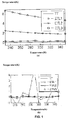
- FIG. 1 illustrates relationship between variation of excited magnetic fields (maximum value) and temperature measurement errors of a linear prediction model and a polynomial prediction model
- FIG. 1(a) illustrates the linear prediction model
- FIG. 1(b) illustrates the polynomial prediction model
- FIG. 2 illustrates affect of variation of saturation magnetic susceptibility on a linear prediction model and a polynomial prediction model
- FIG. 2(a) illustrates affect on the linear prediction model
- FIG. 2(b) illustrates affect on the polynomial prediction model
- FIG. 3 illustrates temperature measurement results of a simulation magnetization curve based on -200 dB noise
- FIG. 4 illustrates results after employing a first-degree polynomial prediction algorithm
- FIG. 5 illustrates results after employing a quadratic polynomial prediction algorithm
- FIG. 6 illustrates results after employing a third-degree polynomial prediction algorithm
- FIG. 7 illustrates multiple measurement results after employing a first-degree polynomial prediction algorithm based on simulation data of -110 dB noise
- FIG. 8 illustrates actual test results at different temperature ranges
- FIG. 8(a) is a curve between a preset (theoretical) temperature value TT and a measured temperature value ETN during one measurement
- FIG. 8(b) illustrates temperature error during the measurement
- FIG. 9 illustrates temperature test results after repeating 9 times of experiments of a sample
- FIG. 9(a) is a curve between an average temperature value and actual temperature after 9 times of measurement
- FIG. 9(b) illustrates difference between the average value and a preset theoretical value
- FIG. 10 illustrates test results and actual results of a concentration parameter N at different temperature
- FIG. 10(a) are test results of the concentration parameter N at different temperature
- FIG. 10(b) illustrates difference between the test results and the actual results at different temperatures.
- a magnetic susceptibility reciprocal - temperature curve Under moderate intensity, a magnetic susceptibility reciprocal - temperature curve varies, and the curve does not pass an absolute temperature zero point 0 K predicted by the Curie's law, or a fixed Curie point ⁇ described in the Curie-Weiss law.
- intercept shift exists on the magnetic susceptibility reciprocal - temperature curve, and the shift is related to intensity of the excited magnetic field. This phenomenon is defined as magnetic modulation property of the magnetic susceptibility reciprocal - temperature curve.
- the magnetic modulation property of the magnetic susceptibility reciprocal - temperature curve indicates that under moderate intensity, the magnetic nanoparticles no longer follow the Curie's paramagnetic law.
- Equations 1 and 2 are combined as a first-degree polynomial approximation model
- equations 1 and 3 are combined as a second-degree polynomial approximation model
- equations 1 and 4 are combined as a third-degree polynomial approximation model
- the first-stage, the second-stage, or the third-stage polynomial approximation model is solved to obtain a and b
- the above method uses the first to the fourth row vector of the matrix A * to construct the approximation model, and is a sample only, but the invention cannot be understood as only selecting the first four row vectors.
- simulation data containing noise are used to execute experimental test.
- Defaut samples (unless otherwise specified) during the measurement are EMG1400 (FerroTec, USA), magnetic moment of particles is set to 2.49 ⁇ 10 -17 .
- a noise model uses an awgn function in MATLAB to directly apply noise with a preset signal-noise ratio on the magnetic moment during magnetization process.
- a signal-noise ratio of the magnetization curve is set to 100 dB to 200 dB according to different test targets. The magnetization curve is uniformly divided into 200 points from zero to the maximum value.
- FIGS. 1 to 9 study and analyze a linear approximation model and a polynomial approximation model, and further analyze a first-degree polynomial model method.
- FIGS. 1 and 2 compare and analyze the linear model and the polynomial model.
- FIG. 1 illustrates comparison results between variation of excited magnetic fields and the linear model and the polynomial model under a signal-noise ratio of 130 dB, temperature is 230 K-350 K, every 15 K is one point.
- TT is a theoretical value under ideal condition.
- FIG. 1(a) illustrates affect of variation of the excited magnetic field (maximum value) on temperature measurement error of the linear prediction model, where the maximum excited magnetic fields of ETL1, ETL2, and ETL3 are respectively 1000 Gs, 600 Gs, and 200 Gs.
- FIG. 1(b) illustrates affect of variation of the excited magnetic field (maximum value) on temperature measurement error of the polynomial prediction model, where the maximum excited magnetic fields of ETN1, ETN2, and ETN3 are respectively 1000 Gs, 600 Gs, and 200 Gs.
- FIG. 2 illustrates affect of variation of saturation magnetic susceptibility on the linear prediction model and the polynomial prediction model under a simulated signal-noise ratio of 90 dB.
- TT is a theoretical value under ideal condition.
- FIG. 2(a) illustrates affect of variation of the saturation magnetic susceptibility on the linear prediction model.
- Saturation magnetic moments of the ETL1, ETL2, ETL3, ETL3, and ETL4 follow a sequence with a geometric proportional factor of 2.
- Saturation magnetic moment of an initial value ETL1 is 2.49 ⁇ 10 -17 .
- FIG. 2(b) illustrates affect of variation of the saturation magnetic susceptibility on the polynomial prediction model.
- Saturation magnetic moments ETN1, ETN2, ETN3, and ETN4 are respectively the same as those of ETL1, ETN2, ETN3, and ETN4.
- FIGS. 3 to 7 illustrate comparison results of Taylor's expansions with different degrees in the polynomial model.
- FIG. 4 illustrates comparison results of the first-degree, second-degree and third-degree Taylor's expansions under a signal-noise ratio of 200 dB.
- ET3, ET2, ET1, and TT are respectively the third-degree, second-degree, first-degree polynomial, and a theoretical value.
- FIGS. 4 to 6 illustrate results of the first-degree, second-degree, third-degree Taylor's expansion under different signal-noise ratios.
- ET1, ET2, ET3, ET4, and TT are respectively -130 dB, -120 dB, -110 dB, and -100 dB noise prediction result, and a theoretical value.
- ET1, ET2, ET3, ET4, and TT are respectively -180dB, -170dB, -160dB, -150 dB noise prediction results, and a theoretical value.
- ET1, ET2, ET3, ET4, and TT are respectively -230 dB, -220 dB, -210 dB, and -200 dB noise prediction result, and a theoretical value.
- FIG. 7 illustrates measurement data using the first-degree Taylor's expansion under a 100 dB signal-noise ratio.
- Simulation data indicate as the signal-noise ratio is small enough, the above-mentioned temperature prediction model can facilitate any precision.
- error between temperature prediction under comparatively small magnetic excitation and that under a high signal-noise ratio can be less than 0.01 K.
- FIG. 3 temperature measurement is performed under a signal-noise ratio of 200 dB, measured data and theoretical data of the first-degree polynomial model ET1 and the second-degree equation model ET2 are perfectly matched with each other. Data indicate error of ET1 can even be 0.001 K, and ET2 can be 0.1 K. It can be predicted that under higher signal-noise ratios, the third-degree equation polynomial model ET3 can reach any preset precision. This indicates temperature measurement method based on superparamagnetism for a magnetic nanoparticle is feasible in theory.
- the polynomial approximation model exhibits comparatively small system error, this is because it nonlinearly corrects the magnetization process based on the linear approximation model.
- a magnetic test system is to face thermal noise or external interruption under small magnetic excitation, and thus it is difficult to ensure precision of low-field test. During the test process, it is normally expected to effectively reduce interruption of noise by increasing excited magnetic field. Under comparatively large excited magnetic field, if only a linear model is used, obvious system error is to occur, as shown in FIG. 1 . Increase of a saturation magnetic moment leads to occurrence of system error, as shown in FIG. 2 .
- Degree of the polynomial model during test is 1 to 3. It can be seen from prediction algorithms of the first-degree, the second-degree, and the third-degree models in FIGS. 4-6 that, under the same precision, as the degree of the algorithm is increased by 1, a signal-noise ratio of a temperature prediction result thereof correspondingly is reduced by 40 dB to 50 dB. This indicates noise suppression capability is the best. With increase of the degree of the algorithm, noise suppression capability gradually weakens. Therefore, noise suppression capability of the third-degree algorithm or above is very poor, and cannot be used in temperature prediction.
- magnetic nano solid particle EMG1400 (FerroTec, USA) samples are used.
- a measurement instrument is a SQUID VSM (Quantum Design, USA) magnetometer. Based on multiple times of measurement and analysis, system parameters are adjusted to the optimum state and thus a final experiment scheme is determined. Excited magnetic field during the experiment is set to -200 Gs-+200 Gs, and every 5 Gs is one point.
- Temperature range of FIG. 8 is 260 K-340 K, and every 15 K is one temperature point.
- experiment data above room temperature are given in FIG. 9 .
- Temperature range in FIG. 9 is 310 K - 350 K, and every 10 K is one temperature point.
- FIG. 8(a) provides a preset (theoretical) temperature value TT and a measured temperature value ETN of single measurement
- FIG. 8(b) provides temperature error of the single measurement
- FIG. 9(a) provides average temperature value after nine times of repeated measurement
- FIG. 9(b) provides difference between the average value and the theoretical preset value.
- Experiment data indicate the maximum error after 9 times of repeated measurement is 0.56 K.
- temperature measurement using the above-mentioned method has a root mean square of 0.34 K-0.55 K after 9 times of measurement.
- the first-order polynomial approximation model can be used for remote measurement of concentration. Measurement error of concentration under different temperature is less than 3%, as shown in FIG. 10 .
- Advantages of the first-order polynomial approximation model method are that small magnetic excitation is used, and thus measurement of particle concentration can be implemented without superconductive magnetic field.
Landscapes
- Health & Medical Sciences (AREA)
- Life Sciences & Earth Sciences (AREA)
- Physics & Mathematics (AREA)
- Engineering & Computer Science (AREA)
- Surgery (AREA)
- Public Health (AREA)
- Biomedical Technology (AREA)
- Heart & Thoracic Surgery (AREA)
- Medical Informatics (AREA)
- Molecular Biology (AREA)
- Biophysics (AREA)
- Animal Behavior & Ethology (AREA)
- General Health & Medical Sciences (AREA)
- Pathology (AREA)
- Veterinary Medicine (AREA)
- General Physics & Mathematics (AREA)
- Chemical & Material Sciences (AREA)
- Nanotechnology (AREA)
- Condensed Matter Physics & Semiconductors (AREA)
- Nuclear Medicine, Radiotherapy & Molecular Imaging (AREA)
- Radiology & Medical Imaging (AREA)
- Investigating Or Analyzing Materials By The Use Of Magnetic Means (AREA)
- Measurement And Recording Of Electrical Phenomena And Electrical Characteristics Of The Living Body (AREA)
Description
- The invention relates to a nano measurement field, and more particularly to a temperature measurement method based on magnetic susceptibility of nano superparamagnetic materials.
- Temperature information deeply inside objects, especially deeply in vivo, is limited by physical principle of time and space and information transportation, and this makes it impossible to facilitate non-contact temperature measurement within 1000°C. Temperature is direct evidence that indicates immune response and life activities. Hyperthermia cancer therapy expects to control temperature at cancerization parts at 45°C - 47°C during hyperthermia process. Normally 45°C - 47°C is a critical temperature point that ensures safety of normal cells and causes cancer cells necrosis gradually. Remote detection of temperature field information of cancer cells between lungs and livers is critical for breakthrough of the hyperthermia therapy. However, internal organs, bones, vessels, or skin are a natural barrier for detecting the temperature information. In other fields, temperature distribution at outlets of aero engines directly affect lifetime of turbines, fast measurement methods can greatly improve performance of engines without changing temperature distribution field of turbines. Therefore, a more popularly used method for measuring temperature at deep sites of objects becomes a key technique for promoting development of biomedical and industrial fields.
- Technically, it is comparatively difficult to apply the existing temperature measurement technique to temperature measurement of deep sites of objects. The magnetic resonance temperature measurement technique brings twilight for temperature field measurement of human beings, and it is difficult to apply the magnetic resonance temperature measurement to vivo (for example, hyperthermia cancer therapy) temperature measurement. However, too weak magnetic property of molecular directly or indirectly leads to technical difficulty of measurement. Temperature characteristic parameters of hydrogen molecular in vivo cannot be pre-obtained, and during test, measurement of temperature difference is implemented by measuring the same point for two times before and after heating, and at the same time, a test point is required to be highly static, which results in a main source of error. Researchers notice that magnetic moments of magnetic nanoparticles (tri-iron tetroxide) are three orders of magnitude higher than nuclear magnetic signals of hydrogen molecules. Thus, the nano magnetic measurement system is expected to achieve high speed and high signal-noise ratio.
US4136683A discloses using a high frequency alternating excited magnetic field to heat nano magnetic cells and measuring the temperature of the cells. In order to measure one temperature value of the cells, the method ofUS4136683A measures a single magnetic susceptibility value by calculating the ratio of the magnetization intensity of the cells to the intensity of the alternating excited magnetic field. In addition, J. B. Weaver from America in "Magnetic nanoparticle temperature estimation," MEDICAL PHYSICS, vol. 36, no. 5, 22 April 2009, pages 1822-1829 made useful exploration of the nano magnetism by applying an alternating excited magnetic field on nano superparamagnetic materials, and measured the temperature of the sample by calculating the ratio between the triple harmonic generation and the quintuple harmonic generation using the Langevin function after AC magnetization on the nano superparamagnetic materials for experiment. The precision obtained was greater than 1 degree in a range of 20°C to 50°C. Temperature-related constants of the magnetic nanoparticles, such as size, saturation magnetic moment and so on can be precisely and repeatedly pre-measured in vitro and magnetic parameters can be predetermined. In addition, "A padé approximant to the inverse Langevin function," RHEOLOGICA ACTA, vol. 30, no. 3, 1 May 1991, pages 270-273 discloses the Taylor expansion of the inverse Langevin function. However, error is prone to occur by following the method disclosed inUS4136683A and the method used by J. B. Weaver both of which measure one temperature value of a sample by measuring a single magnetic susceptibility value. Specifically, uncertainty of concentration distribution and space distribution of magnetic nanoparticles in vivo causes very large error of temperature measurement in vivo. Uncertainty of pixel distribution in vivo makes temperature measurement of nuclear magnetic resonance can only measure temperature difference. - It is an objective of the invention to provide a method for remote temperature measurement of a magnetic nanoparticle based on paramagnetism that is capable of precisely and quickly implementing remote temperature measurement of objects, as defined in
independent claim 1. Further embodiments of the invention are claimed in depedent claims 2-8. - Advantages of the invention are summarized below:
- The invention provides a temperature measurement method based on the magnetic susceptibility of nano superparamagnetic materials, multiple (normally more than two) times of excited magnetic fields are applied on the area of a magnetic nano sample, equations between different excited magnetic fields and corresponding magnetic susceptibility are constructed according to the Langevin's paramagnetic theorem, and information of temperature and sample concentration are obtained via the equations.
- The invention makes it possible for implementing precise and quick temperature detection of objects, and especially applicable for detection of thermal motion at biomolecular level. Different from hydrogen molecular sensors used in the MRI technique, the nano magnetic temperature measurement method employs nano superparamagnetic materials in hyperthermia cancer therapy as temperature sensors, and has advantages in many aspects. Magnetic susceptibility measurement is not relaxation response but instant measurement, and therefore features good real-time performance. Constants of magnetic nanoparticles relating to temperature, such as size, saturation magnetic moment and so on are precisely and repeatedly measured outside the object, and magnetic parameters are predetermined. Meanwhile, magnetic moments of the magnetic nanoparticles (tri-iron tetroxide) are three orders of magnitude higher than nuclear magnetic signals of hydrogen molecules. Therefore, a nano magnetic measurement system can implement high speed and a high signal-noise ratio. Average error of the temperature measurement technique after 9 times' repetition is less than 0.56 K. Temperature measurement error less than 1 K can meet requirement in the hyperthermia cancer therapy for temperature measurement precision. Application prospect of the invention is to implement a temperature measurement technique that can be applied deeply in an object comprising the vivo, and is below the Curie temperature of iron-magnetic materials.
-
FIG. 1 illustrates relationship between variation of excited magnetic fields (maximum value) and temperature measurement errors of a linear prediction model and a polynomial prediction model,FIG. 1(a) illustrates the linear prediction model, andFIG. 1(b) illustrates the polynomial prediction model; -
FIG. 2 illustrates affect of variation of saturation magnetic susceptibility on a linear prediction model and a polynomial prediction model,FIG. 2(a) illustrates affect on the linear prediction model, andFIG. 2(b) illustrates affect on the polynomial prediction model; -
FIG. 3 illustrates temperature measurement results of a simulation magnetization curve based on -200 dB noise; -
FIG. 4 illustrates results after employing a first-degree polynomial prediction algorithm; -
FIG. 5 illustrates results after employing a quadratic polynomial prediction algorithm; -
FIG. 6 illustrates results after employing a third-degree polynomial prediction algorithm; -
FIG. 7 illustrates multiple measurement results after employing a first-degree polynomial prediction algorithm based on simulation data of -110 dB noise; -
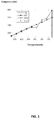
FIG. 8 illustrates actual test results at different temperature ranges,FIG. 8(a) is a curve between a preset (theoretical) temperature value TT and a measured temperature value ETN during one measurement, andFIG. 8(b) illustrates temperature error during the measurement; -
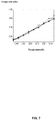
FIG. 9 illustrates temperature test results after repeating 9 times of experiments of a sample,FIG. 9(a) is a curve between an average temperature value and actual temperature after 9 times of measurement, andFIG. 9(b) illustrates difference between the average value and a preset theoretical value; -
FIG. 10 illustrates test results and actual results of a concentration parameter N at different temperature,FIG. 10(a) are test results of the concentration parameter N at different temperature, andFIG. 10(b) illustrates difference between the test results and the actual results at different temperatures. - Superparamagnetic materials follow the Langevin's function:

wherein / is magnetization, N is the number of particles per unit volume, M is atomic magnetic moment, is the Langevin's function, in this function
- The magnetic susceptibility χ follows equation:

- A reciprocal of the Langevin's function is

- 1) Linear approximation model of the Langevin's paramagnetic theorem:
- Assuming J = 1,

- By replacing


- By setting different excited magnetic fields Hi (i =1,2...n), the equation is formulated as:

- Under moderate intensity, a magnetic susceptibility reciprocal - temperature curve varies, and the curve does not pass an absolute temperature zero point 0 K predicted by the Curie's law, or a fixed Curie point θ described in the Curie-Weiss law. Within a certain temperature range, intercept shift exists on the magnetic susceptibility reciprocal - temperature curve, and the shift is related to intensity of the excited magnetic field. This phenomenon is defined as magnetic modulation property of the magnetic susceptibility reciprocal - temperature curve. The magnetic modulation property of the magnetic susceptibility reciprocal - temperature curve indicates that under moderate intensity, the magnetic nanoparticles no longer follow the Curie's paramagnetic law.
- Assuming


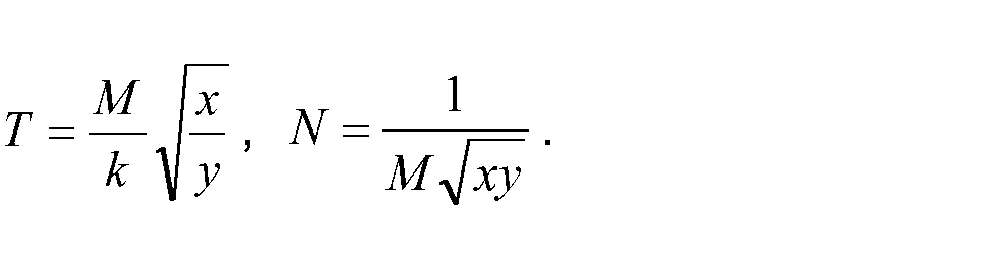
point 
linear equation 
slope 
- 2) Polynomial approximation model of the Langevin's paramagnetic theorem:
- assuming J ≥ 2

- By setting different excited magnetic fields Hi (i = 1,2...n), the equation is formulated as:

- Assuming


- The binary high overdetermined equation is rewritten as:

- If assuming

- Further, if


- In practice, a and b can be obtained by combining


-
Equations equations equations 
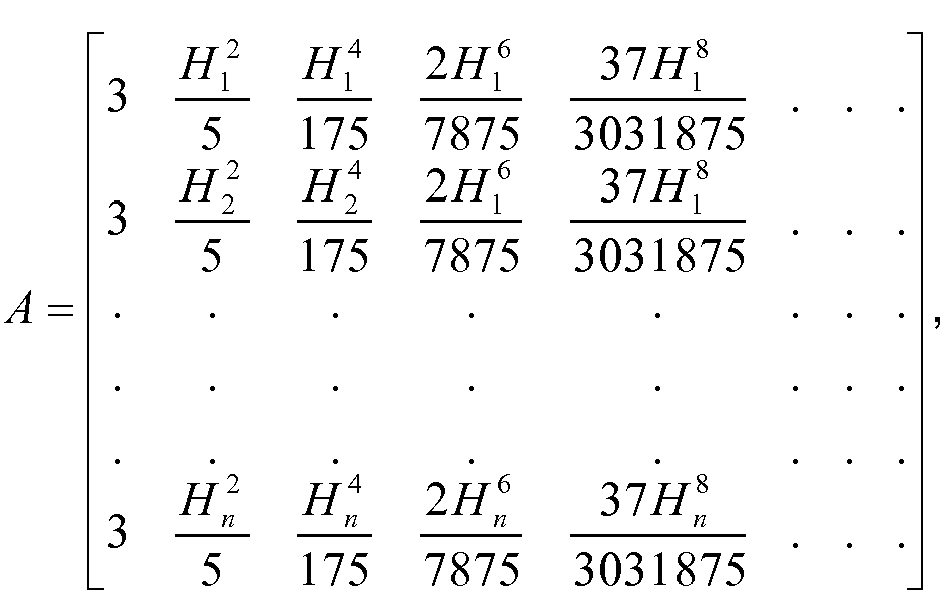
- The above method uses the first to the fourth row vector of the matrix A* to construct the approximation model, and is a sample only, but the invention cannot be understood as only selecting the first four row vectors. A general construction mode of the approximation model is given as follows:
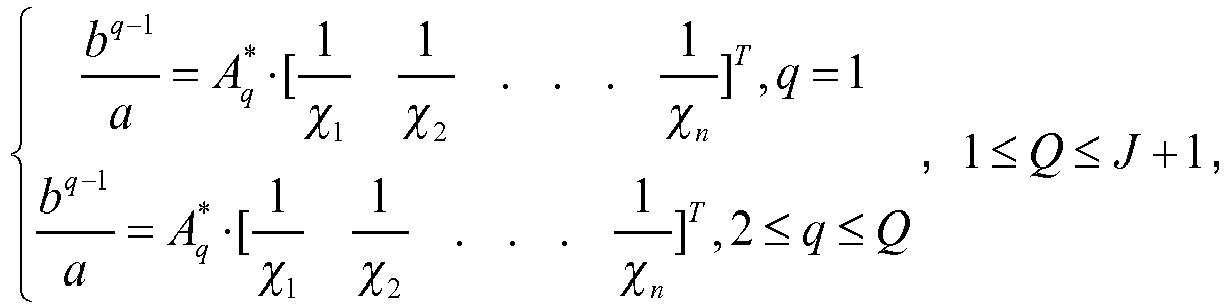
- Expansion terms of the above polynomial model have no limitation, the invention uses three-term, four-term, five-term, six-term, and ten-term for operation, and calculation results indicate they can all implement the objective of the invention. However, the more the terms are, the easier pathological property of the equation may occur, therefore polynomials having three to six terms are suggested.
- To study effectiveness and optimization design of the temperature measurement method, simulation data containing noise are used to execute experimental test. Defaut samples (unless otherwise specified) during the measurement are EMG1400 (FerroTec, USA), magnetic moment of particles is set to 2.49 × 10⁻¹⁷. A noise model uses an awgn function in MATLAB to directly apply noise with a preset signal-noise ratio on the magnetic moment during magnetization process. A signal-noise ratio of the magnetization curve is set to 100 dB to 200 dB according to different test targets. The magnetization curve is uniformly divided into 200 points from zero to the maximum value. Taken into account that more polynomial expansions are to increase the number of conditions of a matrix A in a binary overdetermined equation, and thus leading to pathological property of solution. This will cause solution of the equation to be very sensitive to noise. Therefore in polynominal expansion of the Langevin's equation, expansions of the first six terms are used.
-
FIGS. 1 to 9 study and analyze a linear approximation model and a polynomial approximation model, and further analyze a first-degree polynomial model method.FIGS. 1 and2 compare and analyze the linear model and the polynomial model.FIG. 1 illustrates comparison results between variation of excited magnetic fields and the linear model and the polynomial model under a signal-noise ratio of 130 dB, temperature is 230 K-350 K, every 15 K is one point. TT is a theoretical value under ideal condition.FIG. 1(a) illustrates affect of variation of the excited magnetic field (maximum value) on temperature measurement error of the linear prediction model, where the maximum excited magnetic fields of ETL1, ETL2, and ETL3 are respectively 1000 Gs, 600 Gs, and 200 Gs.FIG. 1(b) illustrates affect of variation of the excited magnetic field (maximum value) on temperature measurement error of the polynomial prediction model, where the maximum excited magnetic fields of ETN1, ETN2, and ETN3 are respectively 1000 Gs, 600 Gs, and 200 Gs.FIG. 2 illustrates affect of variation of saturation magnetic susceptibility on the linear prediction model and the polynomial prediction model under a simulated signal-noise ratio of 90 dB. TT is a theoretical value under ideal condition.FIG. 2(a) illustrates affect of variation of the saturation magnetic susceptibility on the linear prediction model. Saturation magnetic moments of the ETL1, ETL2, ETL3, ETL3, and ETL4 follow a sequence with a geometric proportional factor of 2. Saturation magnetic moment of an initial value ETL1 is 2.49 × 10-17.FIG. 2(b) illustrates affect of variation of the saturation magnetic susceptibility on the polynomial prediction model. Saturation magnetic moments ETN1, ETN2, ETN3, and ETN4 are respectively the same as those of ETL1, ETN2, ETN3, and ETN4. -
FIGS. 3 to 7 illustrate comparison results of Taylor's expansions with different degrees in the polynomial model.FIG. 4 illustrates comparison results of the first-degree, second-degree and third-degree Taylor's expansions under a signal-noise ratio of 200 dB. ET3, ET2, ET1, and TT are respectively the third-degree, second-degree, first-degree polynomial, and a theoretical value.FIGS. 4 to 6 illustrate results of the first-degree, second-degree, third-degree Taylor's expansion under different signal-noise ratios. InFIG. 4 , ET1, ET2, ET3, ET4, and TT are respectively -130 dB, -120 dB, -110 dB, and -100 dB noise prediction result, and a theoretical value. InFIG. 5 , ET1, ET2, ET3, ET4, and TT are respectively -180dB, -170dB, -160dB, -150 dB noise prediction results, and a theoretical value. InFIG. 6 , ET1, ET2, ET3, ET4, and TT are respectively -230 dB, -220 dB, -210 dB, and -200 dB noise prediction result, and a theoretical value.FIG. 7 illustrates measurement data using the first-degree Taylor's expansion under a 100 dB signal-noise ratio. - Simulation data indicate as the signal-noise ratio is small enough, the above-mentioned temperature prediction model can facilitate any precision. For example, in
FIG. 1 , error between temperature prediction under comparatively small magnetic excitation and that under a high signal-noise ratio can be less than 0.01 K. InFIG. 3 , temperature measurement is performed under a signal-noise ratio of 200 dB, measured data and theoretical data of the first-degree polynomial model ET1 and the second-degree equation model ET2 are perfectly matched with each other. Data indicate error of ET1 can even be 0.001 K, and ET2 can be 0.1 K. It can be predicted that under higher signal-noise ratios, the third-degree equation polynomial model ET3 can reach any preset precision. This indicates temperature measurement method based on superparamagnetism for a magnetic nanoparticle is feasible in theory. - The polynomial approximation model exhibits comparatively small system error, this is because it nonlinearly corrects the magnetization process based on the linear approximation model. A magnetic test system is to face thermal noise or external interruption under small magnetic excitation, and thus it is difficult to ensure precision of low-field test. During the test process, it is normally expected to effectively reduce interruption of noise by increasing excited magnetic field. Under comparatively large excited magnetic field, if only a linear model is used, obvious system error is to occur, as shown in
FIG. 1 . Increase of a saturation magnetic moment leads to occurrence of system error, as shown inFIG. 2 . In the linear model, it is found that nonlinearity of the saturation magnetic moment (or the excited magnetic field) leads to obvious zero shift and variation of a slope, which are system errors. A method to correct the system error is to use polynomial approximation. Comparatively, the polynomial model well processes nonlinearity of the magnetization process, and generates no obvious error under comparatively large magnetic excitation (or saturation magnetic moment). By using the polynomial method, a saturation magnetic moment M can be obtained via multiple times of measurement under known temperature condition. Practical tests indicate saturation magnetic moment after multiple times of measurement is comparatively stable. - As noise cannot be neglected, different degrees in the polynomial approximation model directly affect suppression of noise. Degree of the polynomial model during test is 1 to 3. It can be seen from prediction algorithms of the first-degree, the second-degree, and the third-degree models in
FIGS. 4-6 that, under the same precision, as the degree of the algorithm is increased by 1, a signal-noise ratio of a temperature prediction result thereof correspondingly is reduced by 40 dB to 50 dB. This indicates noise suppression capability is the best. With increase of the degree of the algorithm, noise suppression capability gradually weakens. Therefore, noise suppression capability of the third-degree algorithm or above is very poor, and cannot be used in temperature prediction. In this context, only the first-degree algorithm is considered, and a repeated experiment of the first-degree polynomial approximation algorithm containing noise is shown inFIG. 7 . In addition, in terms of random interference during measurement, higher precision can be obtained by multiple times of repeated measurement. - To prove applicability of the above-mentioned model in practical precision measurement, magnetic nano solid particle EMG1400 (FerroTec, USA) samples are used. A measurement instrument is a SQUID VSM (Quantum Design, USA) magnetometer. Based on multiple times of measurement and analysis, system parameters are adjusted to the optimum state and thus a final experiment scheme is determined. Excited magnetic field during the experiment is set to -200 Gs-+200 Gs, and every 5 Gs is one point. Temperature range of
FIG. 8 is 260 K-340 K, and every 15 K is one temperature point. Taken temperature stability of the MPMS device at low temperature section into account, experiment data above room temperature are given inFIG. 9 . Temperature range inFIG. 9 is 310 K - 350 K, and every 10 K is one temperature point. - Problems with the practical data are that undetermined factors exist in the saturation magnetic moment M in equations


- actual experiment data using the above-mentioned test method indicate that, although error during single temperature measurement is comparatively large, after multiple times of measurement, the measurement error can be less than 1 K.
FIG. 8(a) provides a preset (theoretical) temperature value TT and a measured temperature value ETN of single measurement, andFIG. 8(b) provides temperature error of the single measurement.FIG. 9(a) provides average temperature value after nine times of repeated measurement, andFIG. 9(b) provides difference between the average value and the theoretical preset value. Experiment data indicate the maximum error after 9 times of repeated measurement is 0.56 K. The variance of single measurement is 1.66-1.03,a root mean square of average temperature of nine times of repeated measurement is the result inFIG. 9(b) divided by
FIG. 10 . Advantages of the first-order polynomial approximation model method are that small magnetic excitation is used, and thus measurement of particle concentration can be implemented without superconductive magnetic field.
Claims (8)
- A method for remote temperature measurement of a magnetic nanoparticle based on paramagnetism, comprising:a)positioning a magnetic nano sample at a to-be-measured object; andb)obtaining a temperature T of said to-be-measured object;characterized in that
step b) comprises:1) setting a plurality of excited magnetic fields Hi , wherein i = 1, 2...n, n is the number of said plurality of excited magnetic fields, each of said plurality of excited magnetic fields Hi is constant, and each of said plurality of excited magnetic fields Hi is different from the rest of said plurality of excited magnetic fields;2)applying one of said plurality of excited magnetic fields on an area of said magnetic nano sample, collecting magnetization of said magnetic nano sample under said one of said plurality of excited magnetic fields, and calculating magnetic susceptibility under said one of said plurality of excited magnetic fields according to said magnetization;3)repeating step b) 2) for all of said plurality of excited magnetic fields and collecting a plurality of magnetic susceptibilities χi , respectively, corresponding to said plurality of excited magnetic fields Hi ;4) constructing equations between said plurality of magnetic susceptibilities χi and said plurality of excited magnetic fields Hi of said magnetic nano sample


 5)solving said equations whereby obtaining said temperature T.
 - The method of claim 1, characterized in that J=1.
- The method of claim 2, characterized in that step (b) 5) comprises:using a linear equation


 curve fitting:
- The method of claim 3, characterized in that step (b) 5) further comprises calculating said concentration of said sample:

- The method of claim 1, characterized in that J ≥ 2.
- The method of claim 5, characterized in that 2 ≤ J ≤ 5
- The method of claim 5 or 6, characterized in that step (b) 5) comprises:(1) transforming said equations between said plurality of magnetic susceptibilities χ i and said plurality of excited magnetic fields Hi into a matrix equation

 (2) solving equations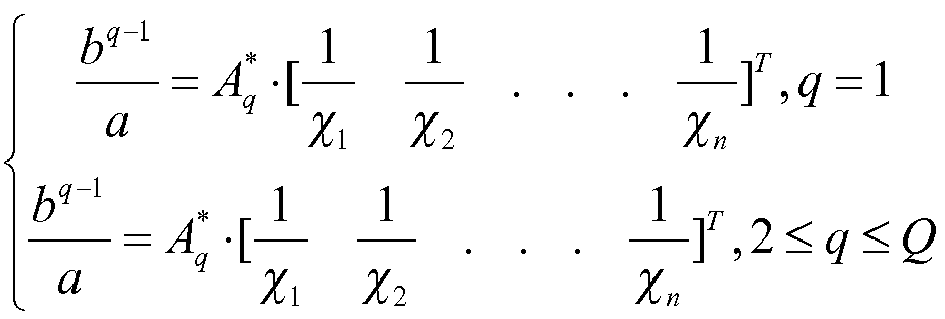
 (3) calculating said temperature of said to-be-measured object:
- The method of claim 7, characterized in that step (b) 5) further comprises calculating said concentration of said sample:

Applications Claiming Priority (2)
| Application Number | Priority Date | Filing Date | Title |
|---|---|---|---|
| CN2011100559394A CN102156006B (en) | 2011-03-08 | 2011-03-08 | Remote temperature measuring method of magnetic nano-particles based on paramagnetic property |
| PCT/CN2011/072207 WO2012119329A1 (en) | 2011-03-08 | 2011-03-28 | Remote temperature measurement method for magnetic nano-particle based on paramagnetic property |
Publications (3)
| Publication Number | Publication Date |
|---|---|
| EP2600128A1 EP2600128A1 (en) | 2013-06-05 |
| EP2600128A4 EP2600128A4 (en) | 2015-01-14 |
| EP2600128B1 true EP2600128B1 (en) | 2016-05-04 |
Family
ID=44437588
Family Applications (1)
| Application Number | Title | Priority Date | Filing Date |
|---|---|---|---|
| EP11860133.5A Not-in-force EP2600128B1 (en) | 2011-03-08 | 2011-03-28 | Remote temperature measurement method for magnetic nano-particle based on paramagnetic property |
Country Status (5)
| Country | Link |
|---|---|
| US (1) | US8498837B2 (en) |
| EP (1) | EP2600128B1 (en) |
| JP (1) | JP5596848B2 (en) |
| CN (1) | CN102156006B (en) |
| WO (1) | WO2012119329A1 (en) |
Families Citing this family (28)
| Publication number | Priority date | Publication date | Assignee | Title |
|---|---|---|---|---|
| CN103156581B (en) | 2013-03-01 | 2014-10-29 | 华中科技大学 | In vivo temperature measuring method and system based on alternating magnetization intensity of magnetic nanoparticles |
| CN104644138B (en) * | 2013-12-04 | 2017-01-11 | 华中科技大学 | Magnetic nanometer temperature measurement method under triangular wave exciting magnetic field |
| CN103892809B (en) * | 2014-04-01 | 2016-02-24 | 华中科技大学 | A kind of magnetic nano temperature formation method and system |
| US10359678B2 (en) | 2014-04-07 | 2019-07-23 | The Regents Of The University Of California | Highly tunable magnetic liquid crystals |
| CN104132736B (en) * | 2014-07-31 | 2017-02-15 | 华中科技大学 | Measuring method for non-intrusion type rapid temperature changes in direct-current excitation magnetic field |
| CN104316213B (en) * | 2014-10-24 | 2017-06-20 | 华中科技大学 | A kind of thermometry based on magnetic nanometer ac magnetic susceptibility |
| CN104473642B (en) * | 2014-11-27 | 2016-08-31 | 华中科技大学 | A kind of formation method based on magnetic nanometer ac magnetic susceptibility imaginary part |
| RU2586392C1 (en) * | 2015-03-30 | 2016-06-10 | Федеральное государственное бюджетное образовательное учреждение высшего профессионального образования "Санкт-Петербургский государственный технологический институт (технический университет)" | Magnetic method of measuring thermodynamic temperature in power units |
| CN104865170B (en) * | 2015-04-24 | 2017-09-29 | 华中科技大学 | Triangular wave excitation field magnetic nano particle diameter distribution measurement system and method |
| CN104764546B (en) * | 2015-04-27 | 2017-07-11 | 武汉科技大学 | Tire based on magnetic nanometer thermal image between road surface with contacting stress test device |
| CN104856655B (en) * | 2015-05-04 | 2018-02-02 | 华中科技大学 | A kind of thermometry based on double frequency magnetic field magnetic nanometer magnetic intensity |
| CN105433912B (en) * | 2015-11-09 | 2019-01-22 | 华中科技大学 | A magnetic nanometer real-time non-invasive temperature measurement method |
| CN105388434B (en) * | 2015-12-16 | 2018-11-27 | 东南大学 | A kind of method and device thereof based on image analysis measurement magnetic Nano material magnetic moment parameter |
| CN105953939B (en) * | 2016-06-07 | 2019-06-11 | 郑州轻工业学院 | A kind of magnetic nanometer temperature measurement method and system under the excitation of mixed frequency magnetic field |
| CN106073725B (en) * | 2016-06-24 | 2019-07-12 | 郑州轻工业学院 | A kind of magnetic nano temperature measurement method based on ac magnetization intensity odd harmonic |
| CN106556466B (en) * | 2016-11-22 | 2018-11-02 | 华中科技大学 | A kind of quick temperature measurement method based on magnetic nanometer magnetic intensity-temperature curve |
| GB2575857B (en) * | 2018-07-26 | 2021-07-07 | Equinor Energy As | Method of calculating temperature of a geological structure |
| CN108663391B (en) * | 2018-08-10 | 2019-12-20 | 华中科技大学 | Paramagnetic displacement-based magnetic nanoparticle concentration and temperature measurement method |
| CN109060163A (en) * | 2018-09-04 | 2018-12-21 | 华中科技大学 | A kind of magnetic nanometer inductance thermometric method and device for electromagnetic heating apparatus |
| CN110420026B (en) * | 2019-07-15 | 2020-05-19 | 中国科学院自动化研究所 | Magnetic particle imaging three-dimensional reconstruction method, system and device based on FFL |
| CN110687152B (en) * | 2019-09-24 | 2021-02-05 | 华中科技大学 | Magnetic method and device for monitoring activity and temperature of moving objects |
| CN114729567B (en) * | 2019-11-14 | 2026-02-06 | 贝克休斯油田作业有限责任公司 | Variation H coil calibration method of triaxial magnetometer |
| CN112539853B (en) * | 2020-11-04 | 2022-03-29 | 华中科技大学 | A method for measuring the temperature of magnetic nanoparticles based on electron paramagnetic resonance |
| KR102923734B1 (en) | 2020-12-04 | 2026-02-04 | 삼성전자주식회사 | Long-wave infrared detecting element, array structure of long-wave infrared detecting elements, long-wave infrared temperature detecting device, and thermal imaging display device |
| CN113820031B (en) * | 2020-12-11 | 2024-07-19 | 中冶长天国际工程有限责任公司 | An online temperature measurement method for direct reduction of iron ore |
| CN114622050B (en) * | 2020-12-14 | 2023-04-28 | 中冶长天国际工程有限责任公司 | Method for accurately measuring and adjusting material temperature in air quantity control rotary kiln |
| JP7556414B2 (en) * | 2021-02-10 | 2024-09-26 | 日本電信電話株式会社 | Temperature Measuring Device |
| CN117169792B (en) * | 2023-08-30 | 2024-05-14 | 华中科技大学 | Transmission type high-resolution imaging method based on magnetic nanoparticle magnetization response |
Family Cites Families (17)
| Publication number | Priority date | Publication date | Assignee | Title |
|---|---|---|---|---|
| US4136683A (en) * | 1976-03-25 | 1979-01-30 | Gordon Robert T | Intracellular temperature measurement |
| FR2532751A1 (en) * | 1982-09-07 | 1984-03-09 | Thomson Csf | Method and device for the remote measurement of the temperature at a point on living tissue, and a hyperthermal apparatus incorporating such a device |
| JPH01132105A (en) * | 1987-11-18 | 1989-05-24 | Hitachi Ltd | Superconducting magnetic particulate and usage thereof |
| US5722317A (en) * | 1996-04-15 | 1998-03-03 | The Board Of Trustees Of The University Of Illinois | Local magnetic temperature measurement for aseptic processing |
| JP3333875B2 (en) | 1999-07-16 | 2002-10-15 | 東北大学長 | Temperature measuring element and temperature measuring method using the same |
| JP4693084B2 (en) * | 2001-08-08 | 2011-06-01 | 財団法人電力中央研究所 | Nondestructive method for estimating the temperature reached by a high-temperature member |
| JP2005222969A (en) * | 2004-02-03 | 2005-08-18 | Bridgestone Corp | Temperature sensing magnetic substance powder and manufacturing method thereof |
| CN1710441A (en) * | 2005-04-30 | 2005-12-21 | 山东大学 | Apparatus and method for measuring electromagnetic characteristic variation of material |
| US7794142B2 (en) * | 2006-05-09 | 2010-09-14 | Tsi Technologies Llc | Magnetic element temperature sensors |
| US8954131B2 (en) | 2007-06-19 | 2015-02-10 | The Trustees Of Dartmouth College | Magnetic particle imaging (MPI) system and method for use of iron-based nanoparticles in imaging and diagnosis |
| US20090074670A1 (en) | 2007-09-07 | 2009-03-19 | Yousef Haik | Hyperthermia Therapeutic Agent Delivery System |
| CN101918803B (en) * | 2008-01-10 | 2013-01-09 | 国立大学法人秋田大学 | Temperature measuring method and temperature control method using temperature sensitive magnetic body |
| KR101012763B1 (en) * | 2008-06-11 | 2011-02-08 | 한국표준과학연구원 | Ultra High Sensitivity Permeability Detection Device Using Atomic Magnetometer and Its Use Method |
| CN100588368C (en) | 2008-09-12 | 2010-02-10 | 新奥博为技术有限公司 | A MRI temperature measurement method based on three-dimensional steady-state free precession |
| GB0906644D0 (en) * | 2009-04-17 | 2009-06-03 | Imec Inter Uni Micro Electr | Magnetic resonance imaging of single domain nano-particles |
| DE102008049605A1 (en) | 2008-09-30 | 2009-12-10 | Siemens Aktiengesellschaft | Non-invasively determined temperature information representing method for use during carcinogenic tumor treatment of patient, involves determining error value of temperature level and representing error value together with temperature level |
| CN101601607A (en) * | 2009-05-22 | 2009-12-16 | 东南大学 | A method for simultaneous magnetic induction heating, imaging and temperature measurement of tumor cells |
-
2011
- 2011-03-08 CN CN2011100559394A patent/CN102156006B/en not_active Expired - Fee Related
- 2011-03-28 US US13/505,742 patent/US8498837B2/en not_active Expired - Fee Related
- 2011-03-28 JP JP2013502991A patent/JP5596848B2/en not_active Expired - Fee Related
- 2011-03-28 EP EP11860133.5A patent/EP2600128B1/en not_active Not-in-force
- 2011-03-28 WO PCT/CN2011/072207 patent/WO2012119329A1/en not_active Ceased
Also Published As
| Publication number | Publication date |
|---|---|
| CN102156006A (en) | 2011-08-17 |
| US20120239341A1 (en) | 2012-09-20 |
| JP2013517515A (en) | 2013-05-16 |
| CN102156006B (en) | 2012-06-13 |
| EP2600128A4 (en) | 2015-01-14 |
| WO2012119329A1 (en) | 2012-09-13 |
| JP5596848B2 (en) | 2014-09-24 |
| EP2600128A1 (en) | 2013-06-05 |
| US8498837B2 (en) | 2013-07-30 |
Similar Documents
| Publication | Publication Date | Title |
|---|---|---|
| US8498837B2 (en) | Paramagnetism-based remote temperature measurement method for magnetic nanoparticle | |
| Coulon et al. | Realization of a magnet using an antiferromagnetic phase of single-chain magnets | |
| De Oliveira et al. | Magnetocaloric effect around a magnetic phase transition | |
| Rauwerdink et al. | Nanoparticle temperature estimation in combined ac and dc magnetic fields | |
| US9534963B2 (en) | Magnetic nano temperature measurement method using triangle wave excitation magnetic field | |
| Lichty et al. | Low-temperature localized motion of hydrogen and electronic structure transition in hexagonal-close-packed scandium | |
| Laramore et al. | Anomalous ultrasonic attenuation above the magnetic critical point | |
| CN108663391A (en) | A kind of magnetic nanometer Pressure, Concentration, Temperature method based on paramagnetic shift | |
| Zou et al. | Temperature estimation of lithium-ion battery based on an improved magnetic nanoparticle thermometer | |
| Nair et al. | Probing a ferromagnetic critical regime using nonlinear susceptibility | |
| CN105433912A (en) | Magnetic-nano real-time non-invasive temperature measurement method | |
| Nakai et al. | Ubiquitous V-shape density of states in a mixed state of clean limit type II superconductors | |
| Bumagina et al. | Magnetostriction in ionic rare earth paramagnets | |
| Stock et al. | Coupled short-range ferroelectric and magnetic order in PbFe 1/2 Nb 1/2 O 3 | |
| US10180362B2 (en) | System, method and computer-accessible medium for determining specific absorption rate obtained based on magnetic resonance imaging and temperature property measurements | |
| Wolter et al. | High-field magnetization study of the S= 1 2 antiferromagnetic Heisenberg chain [PM Cu (NO 3) 2 (H 2 O) 2] n with a field-induced gap | |
| Wielinga et al. | The spontaneous magnetization of the BCC Heisenberg ferromagnet Cu (NH4) 2Br4. 2H2O | |
| Lagendijk et al. | Caloric and magnetic properties of two compounds having predominantly magnetic dipole-dipole interactions: DyCl3· 6H2O and ErCl3· 6H2O | |
| Cowan et al. | Nuclear Magnetic Resonance of Ni 61 in Nickel Metal | |
| Kopinga et al. | Magnetic interactions in Co Br 2· 6 H 2 O | |
| Su et al. | A Ferromagnetic Resonance Temperature Measurement Method Based on Sweep Frequency Technique | |
| Khadhraoui et al. | Modelling the Magnetocaloric Effect Arising from Critical Behavior of Tb2Rh3Ge Rare-Earth | |
| Barmpatza et al. | Cobalt Catalyst Hysteresis Loop Simulations: The Impact of Nanoparticle Number and Nearest Neighbor Distance | |
| Ye et al. | Design of high-accuracy alternating magnetic field generator in magnetic nanoparticle nanothermometer | |
| Cywinski | μSR and neutron scattering studies of spin dynamics |
Legal Events
| Date | Code | Title | Description |
|---|---|---|---|
| PUAI | Public reference made under article 153(3) epc to a published international application that has entered the european phase |
Free format text: ORIGINAL CODE: 0009012 |
|
| 17P | Request for examination filed |
Effective date: 20121101 |
|
| AK | Designated contracting states |
Kind code of ref document: A1 Designated state(s): AL AT BE BG CH CY CZ DE DK EE ES FI FR GB GR HR HU IE IS IT LI LT LU LV MC MK MT NL NO PL PT RO RS SE SI SK SM TR |
|
| DAX | Request for extension of the european patent (deleted) | ||
| RIC1 | Information provided on ipc code assigned before grant |
Ipc: G01K 7/38 20060101AFI20141203BHEP Ipc: A61B 5/01 20060101ALI20141203BHEP Ipc: A61N 2/08 20060101ALI20141203BHEP |
|
| A4 | Supplementary search report drawn up and despatched |
Effective date: 20141212 |
|
| 17Q | First examination report despatched |
Effective date: 20150312 |
|
| GRAP | Despatch of communication of intention to grant a patent |
Free format text: ORIGINAL CODE: EPIDOSNIGR1 |
|
| INTG | Intention to grant announced |
Effective date: 20151118 |
|
| GRAS | Grant fee paid |
Free format text: ORIGINAL CODE: EPIDOSNIGR3 |
|
| GRAA | (expected) grant |
Free format text: ORIGINAL CODE: 0009210 |
|
| AK | Designated contracting states |
Kind code of ref document: B1 Designated state(s): AL AT BE BG CH CY CZ DE DK EE ES FI FR GB GR HR HU IE IS IT LI LT LU LV MC MK MT NL NO PL PT RO RS SE SI SK SM TR |
|
| REG | Reference to a national code |
Ref country code: GB Ref legal event code: FG4D |
|
| REG | Reference to a national code |
Ref country code: CH Ref legal event code: EP |
|
| REG | Reference to a national code |
Ref country code: AT Ref legal event code: REF Ref document number: 797332 Country of ref document: AT Kind code of ref document: T Effective date: 20160515 |
|
| REG | Reference to a national code |
Ref country code: IE Ref legal event code: FG4D |
|
| REG | Reference to a national code |
Ref country code: DE Ref legal event code: R096 Ref document number: 602011026280 Country of ref document: DE |
|
| REG | Reference to a national code |
Ref country code: CH Ref legal event code: NV Representative=s name: LANGPATENT ANWALTSKANZLEI, CH |
|
| REG | Reference to a national code |
Ref country code: NL Ref legal event code: MP Effective date: 20160504 |
|
| REG | Reference to a national code |
Ref country code: LT Ref legal event code: MG4D |
|
| PG25 | Lapsed in a contracting state [announced via postgrant information from national office to epo] |
Ref country code: NO Free format text: LAPSE BECAUSE OF FAILURE TO SUBMIT A TRANSLATION OF THE DESCRIPTION OR TO PAY THE FEE WITHIN THE PRESCRIBED TIME-LIMIT Effective date: 20160804 Ref country code: LT Free format text: LAPSE BECAUSE OF FAILURE TO SUBMIT A TRANSLATION OF THE DESCRIPTION OR TO PAY THE FEE WITHIN THE PRESCRIBED TIME-LIMIT Effective date: 20160504 Ref country code: FI Free format text: LAPSE BECAUSE OF FAILURE TO SUBMIT A TRANSLATION OF THE DESCRIPTION OR TO PAY THE FEE WITHIN THE PRESCRIBED TIME-LIMIT Effective date: 20160504 Ref country code: NL Free format text: LAPSE BECAUSE OF FAILURE TO SUBMIT A TRANSLATION OF THE DESCRIPTION OR TO PAY THE FEE WITHIN THE PRESCRIBED TIME-LIMIT Effective date: 20160504 |
|
| PG25 | Lapsed in a contracting state [announced via postgrant information from national office to epo] |
Ref country code: GR Free format text: LAPSE BECAUSE OF FAILURE TO SUBMIT A TRANSLATION OF THE DESCRIPTION OR TO PAY THE FEE WITHIN THE PRESCRIBED TIME-LIMIT Effective date: 20160805 Ref country code: LV Free format text: LAPSE BECAUSE OF FAILURE TO SUBMIT A TRANSLATION OF THE DESCRIPTION OR TO PAY THE FEE WITHIN THE PRESCRIBED TIME-LIMIT Effective date: 20160504 Ref country code: RS Free format text: LAPSE BECAUSE OF FAILURE TO SUBMIT A TRANSLATION OF THE DESCRIPTION OR TO PAY THE FEE WITHIN THE PRESCRIBED TIME-LIMIT Effective date: 20160504 Ref country code: HR Free format text: LAPSE BECAUSE OF FAILURE TO SUBMIT A TRANSLATION OF THE DESCRIPTION OR TO PAY THE FEE WITHIN THE PRESCRIBED TIME-LIMIT Effective date: 20160504 Ref country code: PT Free format text: LAPSE BECAUSE OF FAILURE TO SUBMIT A TRANSLATION OF THE DESCRIPTION OR TO PAY THE FEE WITHIN THE PRESCRIBED TIME-LIMIT Effective date: 20160905 Ref country code: SE Free format text: LAPSE BECAUSE OF FAILURE TO SUBMIT A TRANSLATION OF THE DESCRIPTION OR TO PAY THE FEE WITHIN THE PRESCRIBED TIME-LIMIT Effective date: 20160504 Ref country code: ES Free format text: LAPSE BECAUSE OF FAILURE TO SUBMIT A TRANSLATION OF THE DESCRIPTION OR TO PAY THE FEE WITHIN THE PRESCRIBED TIME-LIMIT Effective date: 20160504 |
|
| PG25 | Lapsed in a contracting state [announced via postgrant information from national office to epo] |
Ref country code: IT Free format text: LAPSE BECAUSE OF FAILURE TO SUBMIT A TRANSLATION OF THE DESCRIPTION OR TO PAY THE FEE WITHIN THE PRESCRIBED TIME-LIMIT Effective date: 20160504 |
|
| PG25 | Lapsed in a contracting state [announced via postgrant information from national office to epo] |
Ref country code: EE Free format text: LAPSE BECAUSE OF FAILURE TO SUBMIT A TRANSLATION OF THE DESCRIPTION OR TO PAY THE FEE WITHIN THE PRESCRIBED TIME-LIMIT Effective date: 20160504 Ref country code: SK Free format text: LAPSE BECAUSE OF FAILURE TO SUBMIT A TRANSLATION OF THE DESCRIPTION OR TO PAY THE FEE WITHIN THE PRESCRIBED TIME-LIMIT Effective date: 20160504 Ref country code: DK Free format text: LAPSE BECAUSE OF FAILURE TO SUBMIT A TRANSLATION OF THE DESCRIPTION OR TO PAY THE FEE WITHIN THE PRESCRIBED TIME-LIMIT Effective date: 20160504 Ref country code: RO Free format text: LAPSE BECAUSE OF FAILURE TO SUBMIT A TRANSLATION OF THE DESCRIPTION OR TO PAY THE FEE WITHIN THE PRESCRIBED TIME-LIMIT Effective date: 20160504 Ref country code: CZ Free format text: LAPSE BECAUSE OF FAILURE TO SUBMIT A TRANSLATION OF THE DESCRIPTION OR TO PAY THE FEE WITHIN THE PRESCRIBED TIME-LIMIT Effective date: 20160504 |
|
| REG | Reference to a national code |
Ref country code: DE Ref legal event code: R097 Ref document number: 602011026280 Country of ref document: DE |
|
| PG25 | Lapsed in a contracting state [announced via postgrant information from national office to epo] |
Ref country code: PL Free format text: LAPSE BECAUSE OF FAILURE TO SUBMIT A TRANSLATION OF THE DESCRIPTION OR TO PAY THE FEE WITHIN THE PRESCRIBED TIME-LIMIT Effective date: 20160504 Ref country code: BE Free format text: LAPSE BECAUSE OF FAILURE TO SUBMIT A TRANSLATION OF THE DESCRIPTION OR TO PAY THE FEE WITHIN THE PRESCRIBED TIME-LIMIT Effective date: 20160504 Ref country code: SM Free format text: LAPSE BECAUSE OF FAILURE TO SUBMIT A TRANSLATION OF THE DESCRIPTION OR TO PAY THE FEE WITHIN THE PRESCRIBED TIME-LIMIT Effective date: 20160504 |
|
| PLBE | No opposition filed within time limit |
Free format text: ORIGINAL CODE: 0009261 |
|
| REG | Reference to a national code |
Ref country code: FR Ref legal event code: PLFP Year of fee payment: 7 |
|
| STAA | Information on the status of an ep patent application or granted ep patent |
Free format text: STATUS: NO OPPOSITION FILED WITHIN TIME LIMIT |
|
| 26N | No opposition filed |
Effective date: 20170207 |
|
| PGFP | Annual fee paid to national office [announced via postgrant information from national office to epo] |
Ref country code: FR Payment date: 20170310 Year of fee payment: 7 |
|
| PG25 | Lapsed in a contracting state [announced via postgrant information from national office to epo] |
Ref country code: SI Free format text: LAPSE BECAUSE OF FAILURE TO SUBMIT A TRANSLATION OF THE DESCRIPTION OR TO PAY THE FEE WITHIN THE PRESCRIBED TIME-LIMIT Effective date: 20160504 |
|
| PGFP | Annual fee paid to national office [announced via postgrant information from national office to epo] |
Ref country code: AT Payment date: 20170322 Year of fee payment: 7 Ref country code: GB Payment date: 20170307 Year of fee payment: 7 |
|
| PGFP | Annual fee paid to national office [announced via postgrant information from national office to epo] |
Ref country code: CH Payment date: 20170630 Year of fee payment: 7 Ref country code: DE Payment date: 20170524 Year of fee payment: 7 |
|
| PG25 | Lapsed in a contracting state [announced via postgrant information from national office to epo] |
Ref country code: MC Free format text: LAPSE BECAUSE OF FAILURE TO SUBMIT A TRANSLATION OF THE DESCRIPTION OR TO PAY THE FEE WITHIN THE PRESCRIBED TIME-LIMIT Effective date: 20160504 |
|
| REG | Reference to a national code |
Ref country code: IE Ref legal event code: MM4A |
|
| PG25 | Lapsed in a contracting state [announced via postgrant information from national office to epo] |
Ref country code: LU Free format text: LAPSE BECAUSE OF NON-PAYMENT OF DUE FEES Effective date: 20170328 |
|
| PG25 | Lapsed in a contracting state [announced via postgrant information from national office to epo] |
Ref country code: IE Free format text: LAPSE BECAUSE OF NON-PAYMENT OF DUE FEES Effective date: 20170328 |
|
| PG25 | Lapsed in a contracting state [announced via postgrant information from national office to epo] |
Ref country code: MT Free format text: LAPSE BECAUSE OF NON-PAYMENT OF DUE FEES Effective date: 20170328 |
|
| REG | Reference to a national code |
Ref country code: DE Ref legal event code: R119 Ref document number: 602011026280 Country of ref document: DE |
|
| PG25 | Lapsed in a contracting state [announced via postgrant information from national office to epo] |
Ref country code: AL Free format text: LAPSE BECAUSE OF FAILURE TO SUBMIT A TRANSLATION OF THE DESCRIPTION OR TO PAY THE FEE WITHIN THE PRESCRIBED TIME-LIMIT Effective date: 20160504 |
|
| REG | Reference to a national code |
Ref country code: CH Ref legal event code: PL |
|
| REG | Reference to a national code |
Ref country code: AT Ref legal event code: MM01 Ref document number: 797332 Country of ref document: AT Kind code of ref document: T Effective date: 20180328 |
|
| GBPC | Gb: european patent ceased through non-payment of renewal fee |
Effective date: 20180328 |
|
| PG25 | Lapsed in a contracting state [announced via postgrant information from national office to epo] |
Ref country code: DE Free format text: LAPSE BECAUSE OF NON-PAYMENT OF DUE FEES Effective date: 20181002 Ref country code: AT Free format text: LAPSE BECAUSE OF NON-PAYMENT OF DUE FEES Effective date: 20180328 |
|
| PG25 | Lapsed in a contracting state [announced via postgrant information from national office to epo] |
Ref country code: GB Free format text: LAPSE BECAUSE OF NON-PAYMENT OF DUE FEES Effective date: 20180328 Ref country code: LI Free format text: LAPSE BECAUSE OF NON-PAYMENT OF DUE FEES Effective date: 20180331 Ref country code: CH Free format text: LAPSE BECAUSE OF NON-PAYMENT OF DUE FEES Effective date: 20180331 |
|
| PG25 | Lapsed in a contracting state [announced via postgrant information from national office to epo] |
Ref country code: FR Free format text: LAPSE BECAUSE OF NON-PAYMENT OF DUE FEES Effective date: 20180331 |
|
| PG25 | Lapsed in a contracting state [announced via postgrant information from national office to epo] |
Ref country code: HU Free format text: LAPSE BECAUSE OF FAILURE TO SUBMIT A TRANSLATION OF THE DESCRIPTION OR TO PAY THE FEE WITHIN THE PRESCRIBED TIME-LIMIT; INVALID AB INITIO Effective date: 20110328 |
|
| PG25 | Lapsed in a contracting state [announced via postgrant information from national office to epo] |
Ref country code: BG Free format text: LAPSE BECAUSE OF FAILURE TO SUBMIT A TRANSLATION OF THE DESCRIPTION OR TO PAY THE FEE WITHIN THE PRESCRIBED TIME-LIMIT Effective date: 20160504 |
|
| PG25 | Lapsed in a contracting state [announced via postgrant information from national office to epo] |
Ref country code: CY Free format text: LAPSE BECAUSE OF NON-PAYMENT OF DUE FEES Effective date: 20160504 |
|
| PG25 | Lapsed in a contracting state [announced via postgrant information from national office to epo] |
Ref country code: MK Free format text: LAPSE BECAUSE OF FAILURE TO SUBMIT A TRANSLATION OF THE DESCRIPTION OR TO PAY THE FEE WITHIN THE PRESCRIBED TIME-LIMIT Effective date: 20160504 |
|
| PG25 | Lapsed in a contracting state [announced via postgrant information from national office to epo] |
Ref country code: TR Free format text: LAPSE BECAUSE OF FAILURE TO SUBMIT A TRANSLATION OF THE DESCRIPTION OR TO PAY THE FEE WITHIN THE PRESCRIBED TIME-LIMIT Effective date: 20160504 |
|
| REG | Reference to a national code |
Ref country code: AT Ref legal event code: UEP Ref document number: 797332 Country of ref document: AT Kind code of ref document: T Effective date: 20160504 |
|
| PG25 | Lapsed in a contracting state [announced via postgrant information from national office to epo] |
Ref country code: IS Free format text: LAPSE BECAUSE OF FAILURE TO SUBMIT A TRANSLATION OF THE DESCRIPTION OR TO PAY THE FEE WITHIN THE PRESCRIBED TIME-LIMIT Effective date: 20160904 |