EP2598511B1 - Novel stable and highly tunable metathesis catalysts - Google Patents
Novel stable and highly tunable metathesis catalysts Download PDFInfo
- Publication number
- EP2598511B1 EP2598511B1 EP10740164.8A EP10740164A EP2598511B1 EP 2598511 B1 EP2598511 B1 EP 2598511B1 EP 10740164 A EP10740164 A EP 10740164A EP 2598511 B1 EP2598511 B1 EP 2598511B1
- Authority
- EP
- European Patent Office
- Prior art keywords
- alkyl
- nmr
- group
- mhz
- formula
- Prior art date
- Legal status (The legal status is an assumption and is not a legal conclusion. Google has not performed a legal analysis and makes no representation as to the accuracy of the status listed.)
- Active
Links
- 0 *S(c(ccc([N+]([O-])=O)c1)c1[N+]([O-])=O)(=O)=O Chemical compound *S(c(ccc([N+]([O-])=O)c1)c1[N+]([O-])=O)(=O)=O 0.000 description 7
- DVHRWZMPFYOREG-UHFFFAOYSA-N CS(c1c(C(F)(F)F)cccc1)(=O)=O Chemical compound CS(c1c(C(F)(F)F)cccc1)(=O)=O DVHRWZMPFYOREG-UHFFFAOYSA-N 0.000 description 2
- RAZLVHIZNFRQJK-UHFFFAOYSA-N [O-][N+](c(cc1)cc([N+]([O-])=O)c1S(I)(=O)=O)=O Chemical compound [O-][N+](c(cc1)cc([N+]([O-])=O)c1S(I)(=O)=O)=O RAZLVHIZNFRQJK-UHFFFAOYSA-N 0.000 description 2
- ZRZGSMPXVUUQFJ-GQCTYLIASA-N CC(C)C1Oc(c(/C=C/C)ccc2)c2N(C(c(c(F)c(c(F)c2F)F)c2F)=O)C1=O Chemical compound CC(C)C1Oc(c(/C=C/C)ccc2)c2N(C(c(c(F)c(c(F)c2F)F)c2F)=O)C1=O ZRZGSMPXVUUQFJ-GQCTYLIASA-N 0.000 description 1
- VHEPADRAYRQXLU-UHFFFAOYSA-N CC1Oc(c(Br)ccc2)c2NC1=O Chemical compound CC1Oc(c(Br)ccc2)c2NC1=O VHEPADRAYRQXLU-UHFFFAOYSA-N 0.000 description 1
- IKKGCBVGIUMPQE-UHFFFAOYSA-N CC1Oc(c(C)ccc2)c2N(C(c(cc2)ccc2[N+]([O-])=O)=O)C1=O Chemical compound CC1Oc(c(C)ccc2)c2N(C(c(cc2)ccc2[N+]([O-])=O)=O)C1=O IKKGCBVGIUMPQE-UHFFFAOYSA-N 0.000 description 1
- TXLSKXPIWMBKFP-HWKANZROSA-N CC1Oc2c(/C=C/C)cccc2NC1=O Chemical compound CC1Oc2c(/C=C/C)cccc2NC1=O TXLSKXPIWMBKFP-HWKANZROSA-N 0.000 description 1
- WGFMUICRHSXNBY-UHFFFAOYSA-N CCC(C)c1cccc(N2C(c(c(OC)c3)ccc3OC)=O)c1OC(CC)C2=O Chemical compound CCC(C)c1cccc(N2C(c(c(OC)c3)ccc3OC)=O)c1OC(CC)C2=O WGFMUICRHSXNBY-UHFFFAOYSA-N 0.000 description 1
- DFQKUDINUFMQMZ-UHFFFAOYSA-N CS(c(ccc([N+]([O-])=O)c1)c1[N+]([O-])=O)(=O)=O Chemical compound CS(c(ccc([N+]([O-])=O)c1)c1[N+]([O-])=O)(=O)=O DFQKUDINUFMQMZ-UHFFFAOYSA-N 0.000 description 1
- JSWDSUSIZLJDNQ-UHFFFAOYSA-N CS(c1cc(C(F)(F)F)cc(C(F)(F)F)c1)(=O)=O Chemical compound CS(c1cc(C(F)(F)F)cc(C(F)(F)F)c1)(=O)=O JSWDSUSIZLJDNQ-UHFFFAOYSA-N 0.000 description 1
- LOBRHADLNRMHOO-UHFFFAOYSA-N Nc(cccc1Br)c1O Chemical compound Nc(cccc1Br)c1O LOBRHADLNRMHOO-UHFFFAOYSA-N 0.000 description 1
- DBOSDRNOVAWGMK-UHFFFAOYSA-N [O-][N+](c(cc1)ccc1S(=O)=O)=O Chemical compound [O-][N+](c(cc1)ccc1S(=O)=O)=O DBOSDRNOVAWGMK-UHFFFAOYSA-N 0.000 description 1
- PWDHDLBXWLJXPT-UHFFFAOYSA-N [O-][N+](c(cc1)ccc1S(I)(=O)=O)=O Chemical compound [O-][N+](c(cc1)ccc1S(I)(=O)=O)=O PWDHDLBXWLJXPT-UHFFFAOYSA-N 0.000 description 1
Images


Classifications
-
- C—CHEMISTRY; METALLURGY
- C07—ORGANIC CHEMISTRY
- C07F—ACYCLIC, CARBOCYCLIC OR HETEROCYCLIC COMPOUNDS CONTAINING ELEMENTS OTHER THAN CARBON, HYDROGEN, HALOGEN, OXYGEN, NITROGEN, SULFUR, SELENIUM OR TELLURIUM
- C07F15/00—Compounds containing elements of Groups 8, 9, 10 or 18 of the Periodic Table
- C07F15/0006—Compounds containing elements of Groups 8, 9, 10 or 18 of the Periodic Table compounds of the platinum group
- C07F15/0046—Ruthenium compounds
-
- B—PERFORMING OPERATIONS; TRANSPORTING
- B01—PHYSICAL OR CHEMICAL PROCESSES OR APPARATUS IN GENERAL
- B01J—CHEMICAL OR PHYSICAL PROCESSES, e.g. CATALYSIS OR COLLOID CHEMISTRY; THEIR RELEVANT APPARATUS
- B01J31/00—Catalysts comprising hydrides, coordination complexes or organic compounds
- B01J31/02—Catalysts comprising hydrides, coordination complexes or organic compounds containing organic compounds or metal hydrides
- B01J31/12—Catalysts comprising hydrides, coordination complexes or organic compounds containing organic compounds or metal hydrides containing organo-metallic compounds or metal hydrides
-
- B—PERFORMING OPERATIONS; TRANSPORTING
- B01—PHYSICAL OR CHEMICAL PROCESSES OR APPARATUS IN GENERAL
- B01J—CHEMICAL OR PHYSICAL PROCESSES, e.g. CATALYSIS OR COLLOID CHEMISTRY; THEIR RELEVANT APPARATUS
- B01J31/00—Catalysts comprising hydrides, coordination complexes or organic compounds
- B01J31/16—Catalysts comprising hydrides, coordination complexes or organic compounds containing coordination complexes
- B01J31/22—Organic complexes
- B01J31/2204—Organic complexes the ligands containing oxygen or sulfur as complexing atoms
- B01J31/2208—Oxygen, e.g. acetylacetonates
-
- B—PERFORMING OPERATIONS; TRANSPORTING
- B01—PHYSICAL OR CHEMICAL PROCESSES OR APPARATUS IN GENERAL
- B01J—CHEMICAL OR PHYSICAL PROCESSES, e.g. CATALYSIS OR COLLOID CHEMISTRY; THEIR RELEVANT APPARATUS
- B01J31/00—Catalysts comprising hydrides, coordination complexes or organic compounds
- B01J31/16—Catalysts comprising hydrides, coordination complexes or organic compounds containing coordination complexes
- B01J31/22—Organic complexes
- B01J31/2265—Carbenes or carbynes, i.e.(image)
- B01J31/2269—Heterocyclic carbenes
- B01J31/2273—Heterocyclic carbenes with only nitrogen as heteroatomic ring members, e.g. 1,3-diarylimidazoline-2-ylidenes
-
- B—PERFORMING OPERATIONS; TRANSPORTING
- B01—PHYSICAL OR CHEMICAL PROCESSES OR APPARATUS IN GENERAL
- B01J—CHEMICAL OR PHYSICAL PROCESSES, e.g. CATALYSIS OR COLLOID CHEMISTRY; THEIR RELEVANT APPARATUS
- B01J31/00—Catalysts comprising hydrides, coordination complexes or organic compounds
- B01J31/16—Catalysts comprising hydrides, coordination complexes or organic compounds containing coordination complexes
- B01J31/22—Organic complexes
- B01J31/2265—Carbenes or carbynes, i.e.(image)
- B01J31/2278—Complexes comprising two carbene ligands differing from each other, e.g. Grubbs second generation catalysts
-
- C—CHEMISTRY; METALLURGY
- C07—ORGANIC CHEMISTRY
- C07C—ACYCLIC OR CARBOCYCLIC COMPOUNDS
- C07C67/00—Preparation of carboxylic acid esters
- C07C67/30—Preparation of carboxylic acid esters by modifying the acid moiety of the ester, such modification not being an introduction of an ester group
- C07C67/333—Preparation of carboxylic acid esters by modifying the acid moiety of the ester, such modification not being an introduction of an ester group by isomerisation; by change of size of the carbon skeleton
-
- C—CHEMISTRY; METALLURGY
- C07—ORGANIC CHEMISTRY
- C07D—HETEROCYCLIC COMPOUNDS
- C07D207/00—Heterocyclic compounds containing five-membered rings not condensed with other rings, with one nitrogen atom as the only ring hetero atom
- C07D207/02—Heterocyclic compounds containing five-membered rings not condensed with other rings, with one nitrogen atom as the only ring hetero atom with only hydrogen or carbon atoms directly attached to the ring nitrogen atom
- C07D207/18—Heterocyclic compounds containing five-membered rings not condensed with other rings, with one nitrogen atom as the only ring hetero atom with only hydrogen or carbon atoms directly attached to the ring nitrogen atom having one double bond between ring members or between a ring member and a non-ring member
- C07D207/20—Heterocyclic compounds containing five-membered rings not condensed with other rings, with one nitrogen atom as the only ring hetero atom with only hydrogen or carbon atoms directly attached to the ring nitrogen atom having one double bond between ring members or between a ring member and a non-ring member with only hydrogen atoms, hydrocarbon or substituted hydrocarbon radicals, directly attached to ring carbon atoms
-
- B—PERFORMING OPERATIONS; TRANSPORTING
- B01—PHYSICAL OR CHEMICAL PROCESSES OR APPARATUS IN GENERAL
- B01J—CHEMICAL OR PHYSICAL PROCESSES, e.g. CATALYSIS OR COLLOID CHEMISTRY; THEIR RELEVANT APPARATUS
- B01J2231/00—Catalytic reactions performed with catalysts classified in B01J31/00
- B01J2231/50—Redistribution or isomerisation reactions of C-C, C=C or C-C triple bonds
- B01J2231/54—Metathesis reactions, e.g. olefin metathesis
-
- B—PERFORMING OPERATIONS; TRANSPORTING
- B01—PHYSICAL OR CHEMICAL PROCESSES OR APPARATUS IN GENERAL
- B01J—CHEMICAL OR PHYSICAL PROCESSES, e.g. CATALYSIS OR COLLOID CHEMISTRY; THEIR RELEVANT APPARATUS
- B01J2531/00—Additional information regarding catalytic systems classified in B01J31/00
- B01J2531/80—Complexes comprising metals of Group VIII as the central metal
- B01J2531/82—Metals of the platinum group
- B01J2531/821—Ruthenium
Definitions
- the present invention concerns novel ruthenium compounds and the use thereof as catalyst in olefin metathesis reactions.
- the present invention also concerns a method for the preparation of said ruthenium compounds.
- Ruthenium compounds or complexes, as well as their use as catalysts are well known in prior art. Methods for their preparation are vastly studied and can be found in a great number of scientific publications.
- Grubbs III the compounds called Grubbs III, Schrock catalyst, Piers-Grubbs II are well known as highly active catalysts for olefins metathesis and are respectively described in the following scientific publications: Angew. Chem. Int. Ed. 2002, 41, 4035-4038 ; J. Am. Chem. Soc. 1990, 112, 3875-3886 ; Angew. Chem. Int. Ed., 2004, 43, 6161-6165 .
- the ruthenium complex of the formula A known as Hoveyda-Grubbs catalyst, is disclosed in WO 02/14376 A2 and in the original paper: J. AM. CHEM. SOC., 2000, 122, 8168-8179 .
- the Hoveyda-Grubbs catalyst is considered in prior art as an active, air stable and recoverable metathesis catalyst.
- several structural modifications have been achieved through the styrenylether benzylidene ligand.
- WO 2004/035596 Angew. Chem. Int. Ed. 2002, 41, 4038-4040 and J. Am. Chem. Soc. 2004, 126, 9318-9325 disclose a catalyst of formula B (also referred to as Grela catalyst):
- WO 2007/003135 discloses a catalyst of formula C (also referred to as Zannan catalyst):
- the present invention improves the situation.
- the invention proposes ruthenium compounds having a novel backbone structure.
- ruthenium compounds comprising an oxazinone or oxazine function in their backbone show a significant activity increase compared to prior art catalysts such as those of formula A, B, C, D, E, F, G, H, I or J.
- the oxazinone or oxazine function is set as new coordinating alkoxy ligand into the benzylidene fragment of the prior art catalysts.
- the applicant identified three different activation sites within the new chelating benzylidene ligand. These activation sites allow efficient and specific control of the catalytic activity of the ruthenium complexes in olefin metathesis transformation.
- the improvement of the catalytic activity does not occur at the detriment of the complex stability.
- the complex of the invention remains remarkably stable towards moisture, air and solvents.
- halogens for g and g' may be fluorine, chlorine, bromine or iodine, preferably Cl or Br.
- general formula 1 When z is carbonyl, general formula 1 can be represented by following formula 1 a ; and when z is methylene general formula 1 can be represented by following formula 1 b .
- R2 is a methyl-, ethyl- or isopropyl-group.
- a - is selected from the group consisting of F - , Cl - , Br - , I - , tetrafluoroborate BF 4 - , hexafluorophosphate PF 6 - and bis(trifluoromethylsulfonyl)amide NTf 2 - .
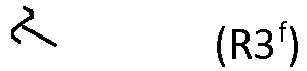
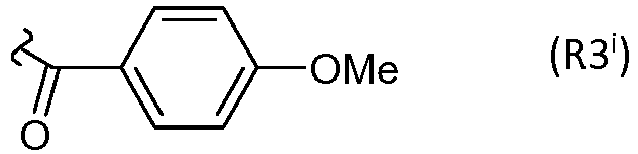
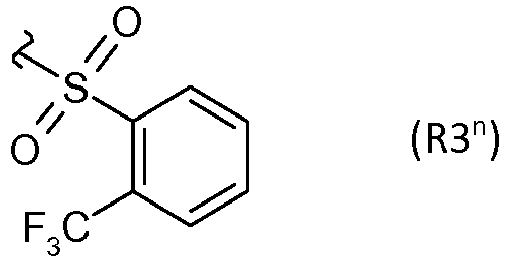
- R3 is a side chain of following formula R3 c , R3 d , R3 e , R3 f , R3 g , R3 h , R3 i , R3 j , R3 k , R3 l , R3 m , R3 n , R3° or R3 p :
- R10 and R11 are each, independently of one another, C 1-30 -alkyl optionally substituted by an alkoxy radical OR15, C 2-30 -alkenyl optionally substituted by an alkoxy radical OR15, aryl optionally substituted by an alkoxy radical OR15, aminoalkyl or aminocycloalkyl.
- L is a ligand of following formula L1 a , L1 b , L1 c , L1 d , L1 e , L1 f or L1 g :
- An additional aspect of the present invention is the use of the compound described above as a catalyst for a chemical reaction. More particularly, said chemical reaction is a metathesis reaction such as ring-closing metathesis (RCM), cross-metathesis (CM) and ring-opening metathesis polymerization (ROMP).
- RCM ring-closing metathesis
- CM cross-metathesis
- REP ring-opening metathesis polymerization
- An additional aspect of the present invention is a method for preparing the new compounds of general formula 1 disclosed hereinabove.
- the method of the present invention comprises a step of reacting a compound of the below general formula (2) with a ruthenium complex of the below general formula (3): wherein
- R2 is a methyl-, ethyl- or isopropyl-group.
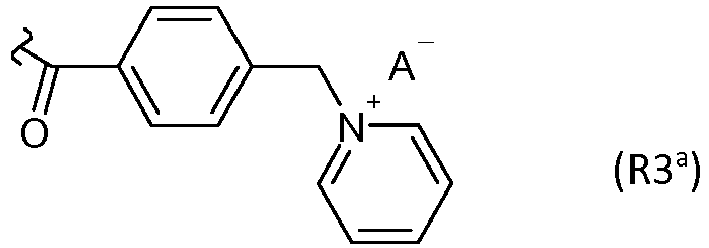
- z is methylene
- R3 is a side chain of following formula R3 a or R3 b :
- a - is selected from the group consisting of F - , Cl - , Br - , I - , tetrafluoroborate BF 4 - , hexafluorophosphate PF 6 - and bis(trifluoromethylsulfonyl)amide NTf 2 - .
- R3 is a side chain of following formula R3 c , R3 d , R3 e , R3 f , R3 g , R3 h , R3 i , R3 j , R3 k , R3 l , R3 m , R3 n , R3° or R3 p :
- R10 and R11 are each, independently of one another, C 1-30 -alkyl optionally substituted by an alkoxy radical OR15, C 2-30 -alkenyl optionally substituted by an alkoxy radical OR15, aryl optionally substituted by an alkoxy radical OR15, aminoalkyl or aminocycloalkyl.
- L is a ligand of following formula L1 a , L1 b , L1 c , L1 d , L1 e , L1 f or L1 g :
- the ligand (L) is covalently bounded via the carbon atom marked with two dots (carbene radical) to the ruthenium (Ru) metal atom of the general formula 1 backbone.
- C 1-30 -alkyl refers (also when this is a constituent of other radicals) to branched and unbranched alkyl groups having from 1 to 30 carbon atoms.
- C 1-20 -alkyl refers to branched and unbranched alkyl groups having from 1 to 20 carbon atoms.
- C 1-12 -alkyl refers to branched and unbranched alkyl groups having from 1 to 12 carbon atoms
- C 1-6 -alkyl refers to branched and unbranched alkyl groups having from 1 to 6 carbon atoms
- C 1-4 -alkyl refers to branched and unbranched alkyl groups having from 1 to 4 carbon atoms. Preference is given to alkyl groups having from 1 to 6 carbon atoms, particularly preferably from 1 to 4 carbon atoms.
- Examples which may be mentioned are: methyl, ethyl, n-propyl, isopropyl, n-butyl, isobutyl, sec-butyl, tert-butyl, n-pentyl, isopentyl, neopentyl and hexyl.
- the abbreviations Me, Et, n-Pr, i-Pr, n-Bu, i-Bu, t-Bu, etc. may also be used for the abovementioned groups.
- the definitions encompass all conceivable isomeric forms of the respective radicals.
- propyl encompasses n-propyl and isopropyl
- butyl encompasses isobutyl, sec-butyl and tert-butyl, etc.
- C 1-12 -ammonium-alkyl refers to an alkyl chain having from 1 to 12 carbon atoms and comprising an ammonium function.
- C 1-12 -pyridinium-alkyl refers to an alkyl chain having from 1 to 12 carbon atoms and comprising a pyridinium function.
- C 1-12 -aldehyde-alkyl refers to an alkyl chain having from 1 to 12 carbon atoms and comprising an aldehyde function.
- C 1-12 -nitro-alkyl refers to an alkyl chain having from 1 to 12 carbon atoms and comprising a nitro function.
- C 1-12 -nitrile-alkyl refers to an alkyl chain having from 1 to 12 carbon atoms and comprising a nitrile function.
- C 2-30 -alkenyl refers (also when it is a constituent of other radicals) to branched and unbranched alkenyl groups having from 2 to 30 carbon atoms, as long as they have at least one double bond.
- C 2-12 -alkenyl refers to alkenyl groups having from 2 to 12 carbon atoms
- C 2-6 -alkenyl refers to branched and unbranched alkenyl groups having from 2 to 6 carbon atoms
- C 2-4 -alkenyl refers to branched and unbranched alkenyl groups having from 2 to 4 carbon atoms.
- alkenyl groups having from 2 to 6 carbon atoms, particularly preferably from 2 to 4 carbon atoms.
- Examples which may be mentioned are: ethenyl and vinyl, propenyl, butenyl, pentenyl and hexenyl.
- propenyl, butenyl, pentenyl and hexenyl the definitions encompass all conceivable isomeric forms of the respective radicals.
- propenyl encompasses 1-propenyl and 2-propenyl
- butenyl encompasses 1-, 2- and 3-butenyl, 1-methyl-1-propenyl, 1-methyl-2-propenyl, etc.
- C 1-12 -alkoxy refers (also when it is a constituent of other radicals) to branched and unbranched alkoxy groups having from 1 to 12 carbon atoms; correspondingly, the term “C 1-6 -alkoxy” refers to branched and unbranched alkoxy groups having from 1 to 6 carbon atoms and the term “C 1-4 -alkoxy” refers to branched and unbranched alkoxy groups having from 1 to 4 carbon atoms. Preference is given to alkoxy groups having from 1 to 6 carbon atoms, particularly preferably from 1 to 4 carbon atoms. Examples which may be mentioned are: methoxy, ethoxy, propoxy, butoxy and pentoxy.
- MeO, EtO, PrO, etc. may also be used for the abovementioned groups. Unless indicated otherwise, in the case of propoxy, butoxy and pentoxy, the definitions encompass all conceivable isomeric forms of the respective radicals. Thus, for example, propoxy encompasses n-propoxy and isopropoxy, butoxy encompasses isobutoxy, sec-butoxy and tert-butoxy, etc.
- C 5-12 -Cycloalkyl refers (even when it is a constituent of other radicals) to cyclic alkyl groups having 5 to 12 carbon atoms. Examples which may be mentioned are: cyclopentyl and cyclohexyl. Unless indicated otherwise, the cyclic alkyl groups can be substituted by one or more radicals selected from the group consisting of methyl, ethyl, isopropyl, tert-butyl, hydroxy, fluorine, chlorine, bromine and iodine. Further, the cyclic alkyl groups can be substituted by one or more functions such as an amino function; they will then be referred to as aminocycloalkyl.
- aryl refers (also when it is a constituent of other radicals) to aromatic ring systems having 6, 10 or more carbon atoms (up to approximately 20 carbon atoms). Examples which may be mentioned are: phenyl and naphthyl; the preferred aryl radical is phenyl. Unless indicated otherwise, the aromatics can be substituted by one or more radicals selected from the group consisting of methyl, ethyl, isopropyl, tert-butyl, hydroxy, fluorine, bromine and iodine. Further the aromatics can comprise one or more functional group; they will then be referred to as "heteroaryl".
- C 7-18 -aralkyl refers (also when it is a constituent of other radicals) to branched and unbranched alkyl groups which have from 1 to 8 carbon atoms and are substituted by an aromatic ring system having 6 or 10 carbon atoms; correspondingly, the term “C 7-11 -aralkyl” refers to branched and unbranched alkyl groups which have from 1 to 4 carbon atoms and are substituted by an aromatic ring system having 6 carbon atoms. Examples which may be mentioned are: benzyl, 1- and 2-phenylethyl.
- the aromatics can be substituted by one or more radicals selected from the group consisting of methyl, ethyl, isopropyl, tert-butyl, hydroxy, fluorine, bromine and iodine.
- indenylidene system refers to a divalent radical derived from the cyclopentan ring of an indene wherein said indene consists of a benzene ring fused to a cyclopentadiene ring.
- the sign stands for a cutoff in a covalent bond for the purpose of simplicity in representing side chains of compounds of the present invention. For instance, some examples of the present invention refer to a several optional side chains R3.
- a covalent bond cut by the above sign is actually linked to the Nitrogen (N) atom of the oxazine or oxazinone function.
- R2 can be chosen to R2 is selected from the group consisting of H, C 1-12 -alkyl, C 5-12 -cycloalkyl, C 7-18 -aralkyl or aryl. More preferentially, R2 is a methyl-, ethyl- or isopropyl-group.
- PROCEDURE & NMR DATA 1.5g (7.9mmol) of 2-bromo-6-aminophenol, 1.08mL (0,9eq, 7.11mmol) of 1,8-diazabicyclo[5.4.0]undec-7-ene and 3.5mL of DL-Ethyl 2-bromobutyrate (3eq, 23.7mmol)) in 30mL of 1-Methyl-2-pyrrolidinone were mixed. 1.447g of P1 were obtained, yield 71%.
- PROCEDURE & NMR DATA 1.51g (8mmol) of 2-bromo-6-aminophenol, 1.1mL (0,9eq, 7,2mmol) of 1,8-diazabicyclo[5.4.0]undec-7-ene and 2.1mL (2eq, 1.6mmol) of Methyl 2-bromopropionate in 1-Methyl-2-pyrrolidinone (25ml) were mixed. 1.55g of P10 were obtained, yield 80%.
- PROCEDURE & NMR DATA 1.52g (8mmol) of 2-bromo-6-aminophenol, 1.1mL (7.2mmol, 0.9 eq) of 1,8-diazabicyclo[5.4.0]undec-7-ene and 3.35g (2eq, 16mmol) of ethyl 2-bromo-3-methylbutyrate in 1-methyl-2-pyrrolidinone (20mL) were mixed. 1.1g of P16 were obtained, yield 50%.
- PROCEDURE & NMR DATA 198.5mg (5%, 0.17mmol) of tetrakis(triphenylphosphine)Palladium (0) in toluene (7.5mL) was added in solution of toluene (7.5mL) of oxazinone P1 . 1.84g (1.5eq, 5.55mmol) of Propenyl-tributyltin were added. 786mg of P2 was obtained, 98% yield.
- PROCEDURE & NMR DATA to 370mg (5%, 0.32mmol) of tetrakis(triphenylphosphine)-Palladium (0) in toluene (10mL) was added 1.55g (6.4mmol) of oxazinone P10 in solution of toluene (40mL). The mixture was degassed during 15min and 3.18g (1.5eq, 9.6mmol) of propenyl-tributyltin were added. 1.27g of P11 were obtained, yield 98%.
- PROCEDURE & NMR DATA to 235mg (5%, 0.2mmol) of tetrakis(triphenylphosphine)Palladium (0) in toluene (6mL) was added 1,1g (4mmol) of oxazinone P16 in solution of toluene (24mL). The mixture was degassed during 15min and 2.02g (1.5eq, 6mmol) of propenyl-tributyltin were added. 907mg of P17 were obtained, yield 98%.
- halogen compound (1.2eq) was added to a mixture of NaH (4eq) and considered oxazinone in THF (1mL for 0.1mmol of oxazinone) at 0°C. The mixture was stirred at room temperature for 2-3h. THF was removed under reduce pressure and EtOAc was added. The organic layer was washed with a saturated solution of NaHCO 3 and then with brine, dried over MgSO 4 and evaporated to dryness. Products were purified on silica gel.
- R3 can be selected from the group consisting of H, C 1-12 -alkyl, C 5-12 -cycloalkyl, C 7-18 -aralkyl, aryl, C 1-12 -halogeno-alkyl, C 1-12 -ammonium-alkyl, C 1-12 -pyridinum-alkyl, C 1-12 -aldehyde-alkyl, C 1-12 -nitro-alkyl, nitrile or a radical selected from the group consisting of ketones COR4, esters CO 2 R4, oxalates COCO 2 R4, sulfones SO 2 R4 or amides CONHR4, wherein R4 is selected from the group consisting of H, C 1-12 -alkyl, C 5-12 -Cycloalkyl, C 7-18 -aralkyl, aryl, C 1-12 -halogeno-alkyl, C 1-12 -ammonium-alkyl, C 1-12 -Pyridin
- R3 is a side chain of the formula R3 a or R3 b as described above.
- z is chosen to be a methylene as shown in above formula 1 b .
- general procedure I-D that shows a amide reduction.
- R3 is a side chain of the formula R3 c , R3 d , R3 e , R3 f , R3 g , R3 h , R3 i , R3 j , R3 k , R3 l , R3 m , R3 n , R3° or R3 p as described above.
- z is chosen to be either a methylene as shown in above formula 1 b or a carbonyl as shown in above formula 1 a .
- PROCEDURE & NMR DATA 85 ⁇ L (2.5eq, 0.65mmol) of isobutyl chloroformate was added to a mixture of 42mg (4eq, 1.04mmol) of NaH and oxazinone P2 (56mg, 0.26mmol) in THF (5mL). 42mg of P3 were obtained, yield 51%.
- PROCEDURE & NMR DATA 142 ⁇ L (2.5eq, 1.23mmol) of benzoyl chloride was added to a mixture of 78mg of NaH (4eq, 1.96mmol) and 100mg (0.49mmol) of oxazinone P2 in THF (9.5mL). 58mg of P4 were obtained, yield 77%.
- PROCEDURE & NMR DATA 265 ⁇ L of pentafluorobenzoyl chloride (2eq, 1.84mmol) was added to a mixture of 148mg of NaH (4eq, 3.68mmol) and 200mg (0,92mmol) of oxazinone P2 in THF (22mL). 240mg of P5 were obtained, yield 63%.
- PROCEDURE & NMR DATA 287 ⁇ L (10eq, 4.6mmol) of Methyl iodide was added to a mixture of 74mg (4eq, 1.84mmol) of NaH and 100mg (0.46mmol) of oxazinone P2 in THF (10mL). 75mg of 6 were obtained, yield 71%.
- PROCEDURE & NMR DATA 107mg (2.5eq, 0.58mmol) of 4-Nitrobenzoyl chloride was added to a mixture of 37mg (4eq, 0.92mmol) of NaH and 50mg (0.23mmol) of oxazinone P2 in THF (10mL). 81mg of P7 were obtained, yield 96%.
- PROCEDURE & NMR DATA 137mg (2.5eq, 0.8mmol) of p-Anisoyl chloride was added to a mixture of 49mg (4eq, 1.28mmol) of NaH and 73mg (0.32mmol) of oxazinone P2 in THF (14mL). 73mg of P8 were obtained, yield 62%.
- PROCEDURE & NMR DATA 162mg (2.5eq, 0.8mmol) of 2,4-Dimethoxybenzoyl chloride was added to a mixture of 49mg (4eq, 1.28mmol) of NaH and 73mg (0.32mmol) of oxazinone P2 in THF (14mL). 109mg of P9 were obtained, yield 84%.
- PROCEDURE & NMR DATA 160mg (2.5eq, 0.85mmol) of 4-Nitrobenzoyl chloride was added to a mixture of 53mg (4eq, 1.36mmol) of NaH and 73mg (0,34mmol) of oxazinone P10 in THF (14mL). 108mg of P12 were obtained, yield 86%.
- PROCEDURE & NMR DATA 117 ⁇ L (2.5eq, 0.85mmol) of p-Anisoyl chloride was added to a mixture of 53mg (4eq, 1.36mmol) of NaH and 73mg (0.34mmol) of oxazinone P10 in THF (14mL). 85mg of P13 were obtained, yield 69%.
- PROCEDURE & NMR DATA 173mg (2.5eq, 0.85mmol) of 2,4-Dimethoxybenzoyl chloride was added to a mixture of 53mg (4eq, 1.36mmol) of NaH and 73mg (0.34mmol) of oxazinone P10 in THF (14mL). 102mg of P14 were obtained, yield 76%.
- PROCEDURE & NMR DATA 124 ⁇ L (2.5eq, 0.85mmol) of pentafluorobenzoyl chloride was added to a mixture of 53mg (4eq, 1.36mmol) of NaH and 73mg (0.34mmol) of oxazinone P10 in THF (14mL). 134mg of P15 were obtained, yield 90%.
- PROCEDURE & NMR DATA 151mg (2.5eq, 0.8mmol) of 4-Nitrobenzoyl chloride was added to a mixture of 48mg (4eq, 1.28mmol) of NaH and 74mg (0.32mmol) of oxazinone P17 in THF (14mL). 100mg of P18 were obtained, yield 83%.
- PROCEDURE & NMR DATA 138mg (2.5eq, 0.8mmol) of p-Anisoyl chloride was added to a mixture of 48Mg (4eq, 1.28mmol) of NaH and 74mg (0.32mmol) of oxazinone P17 in THF (14mL). 82mg of P19 were obtained, yield 65%.
- PROCEDURE & NMR DATA 163mg (2.5eq, 0.8mmol) of 2,4-Dimethoxybenzoyl chloride was added to a mixture of 48mg (4eq, 1.28mmol) of NaH and 74mg (0.32mmol) of oxazinone P17 in THF (14mL). 106mg of P20 were obtained, yield 80%.
- PROCEDURE & NMR DATA 187mg (2.5eq, 0.8mmol) of pentafluorobenzoyl chloride was added to a mixture of 48mg (4eq, 1.28mmol) of NaH and 74mg (0.32mmol) of oxazinone P17 in THF (14mL). 133mg of P21 were obtained, yield 96%.
- catalysts compounds of the present invention can be obtained where z is methylene.
- z is methylene.
- different preparation of those compounds depend on selected R2 and R3 side chains (see below procedure I-E).
- PROCEDURE & NMR DATA 1.2g (5.5mmol) of oxazinone P1 was added in solution in THF (90mL) to a suspension of 418mg (2eq, 11mmol) of LAH in THF (50mL) at 0°C. The result suspension was stirred at room temperature for 1h. H 2 O and a solution af NaOH 1N was slowly added. The precipitate was filtered off on celite and washed with warm THF. No further purification is done for these products. 1.1g of P22 were obtained, yield 99%.
- halogen compound (1.2eq) was added to a mixture of NaH (4eq) and considered oxazinone in THF (10mL for 0.5mmol of oxazinone) at 0°C. The mixture was stirred at room temperature for 2-3h. THF was removed under reduce pressure and EtOAc was added. The organic layer was washed with a saturated solution of NaHCO3 and then with brine, dried over MgSO4 and evaporated to dryness. Products were purified on silica gel.
- R3 can be selected from the group consisting of H, C 1-12 -alkyl, C 5-12 -cycloalkyl, C 7-18 -aralkyl, aryl, C 1-12 -halogeno-alkyl, C 1-12 -ammonium-alkyl, C 1-12 -pyridinum-alkyl, C 1-12 -aldehyde-alkyl, C 1-12 -nitro-alkyl, nitrile or a radical selected from the group consisting of ketones COR4, esters CO 2 R4, oxalates COCO 2 R4, sulfones SO 2 R4 or amides CONHR4, wherein R4 is selected from the group consisting of H, C 1-12 -alkyl, C 5-12 -Cycloalkyl, C 7-18 -aralkyl, aryl, C 1-12 -halogeno-alkyl, C 1-12 -ammonium-alkyl, C 1-12 -pyridinum
- R3 is a side chain of the formula R3 a or R3 b as described above. This results in the catalysts according to the invention P30 and P31 respectively. It must be noted here that P30 and P31 do not follow general procedure I-E. Synthesis details are given below at corresponding products P30 and P31.
- R3 is a side chain of the formula R3 c , R3 d , R3 e , R3 f , R3 g , R3 h , R3 i , R3 j , R3 k , R3 l , R3 m , R3 n , R3° or R3 p as described above.
- z is chosen to be either a methylene as shown in above formula 1 b or a carbonyl as shown in above formula 1 a .
- PROCEDURE & NMR DATA 392 ⁇ L (2.5eq, 3mmol) of isobutyl chloroformate was added to a mixture of 192mg (4eq, 4.8mmol) of NaH and 261mg (1.2mmol) of oxazine P22 in THF (24mL). 380mg of P23 were obtained, yield 99%.
- PROCEDURE & NMR DATA 348 ⁇ L (2.5eq, 3mmol) of benzoyl chloride was added to a mixture of 192mg (4eq, 4.8mmol) of NaH and 260mg (1.2mmol) of oxazine P22 in THF (25mL). 300mg of P24 were obtained, yield 78%.
- PROCEDURE & NMR DATA 141 ⁇ L (2eq, 0.98mmol) of pentafluorobenzoyl chloride was added to a mixture of 78mg (4eq, 1.96mmol) of NaH and 100mg (0.49mmol) of oxazine P22 in THF (11mL). 118mg of P25 were obtained, yield 61%.
- PROCEDURE & NMR DATA 287 ⁇ L (10eq, 4.6mmol) of methyl iodide was added to a mixture of 74mg (4eq, 1.84mmol) of NaH and 100mg (0.46mmol) of oxazine P22 in THF (10mL). 75mg of P26 were obtained, yield 71%.
- PROCEDURE & NMR DATA 199mg (2.5eq, 1.08mmol) of 4-Nitrobenzoyl chloride was added to a mixture of 66mg (4eq, 1.72mmol) of NaH and 87mg (0.43mmol) of oxazine P22 in THF (18mL). 150mg of P27 were obtained, yield 99%.
- PROCEDURE & NMR DATA 133mg (2.5eq, 0.77mmol) of p-Anisoyl chloride was added to a mixture of 48mg (4eq, 1.24mmol) of NaH and 63mg (0.31mmol) of oxazine P22 in THF (12mL). 103mg of P28 were obtained, yield 98%.
- PROCEDURE & NMR DATA 96mg (1.5eq, 0.41mmol) of 4-(bromomethyl)benzoyl chloride was added to a mixture of 33 ⁇ L (1.5eq, 0.41mmol) of pyridine and oxazine P22 in DCM (15mL). 53mg of P29 were obtained, yield 48%.
- PROCEDURE & NMR DATA 53mg (0.13mmol) of oxazine P22 were added to 300 ⁇ L of pyridine in tolune (15mL). The mixture warm up to reflux for the night. Volatiles were removed then 17mg (1.5eq) of potassium hexafluorophosphate and water (10mL) were added. 30 mg of P30 were obtained, yield 42%.
- PROCEDURE & NMR DATA 123mg (2.5eq, 0.67mmol) of isonicotinoyl chloride was added to a mixture of 42mg (4eq, 1.08mmol) of NaH and 56mg (0.27mmol) of oxazine P22 in DMF (15mL). 66mg were purified.
- L is a ligand of the formula L1, L2, L3 or L4 as described above and particular preference is given when R10 and R11 are each, independently of one another, C 1-30 -alkyl optionally substituted by an alkoxy radical OR15, C 2-30 -alkenyl optionally substituted by an alkoxy radical OR15, aryl optionally substituted by an alkoxy radical OR15, aminoalkyl or aminocycloalkyl.
- L is a ligand that respond to one of formulae L1 a , L1 b , L1 c , L1 d , L1 e , L1 f or L1 g as described above.
- PROCEDURE & NMR DATA 50mg (0.23mmol) of P2 were added to 218mg (1eq, 0.23mmol) of Umicore-M2 and 25mg (1.1eq, 0.25mmol) of copper chloride in dry DCM (4.6mL). 20mg of P32 were obtained, yield 13%.
- PROCEDURE & NMR DATA 50mg (0.23mmol) of P2 were added to 238mg (1eq, 0.23mmol) of SIPr-indenylidene and 25mg (1.1eq, 0.25mmol) of copper chloride in dry DCM (6mL). 84mg of P33 were obtained, yield 49%.
- PROCEDURE & NMR DATA 154mg (0.48mmol) of P3 were added to 500mg (1eq, 0.48mmol) of SIPr-indenylidene and 52mg (1.1eq, 0.53mmol) of copper chloride in dry DCM (9mL). 262mg of P34 were obtained, yield 64%.
- PROCEDURE & NMR DATA 58mg (0.18mmol) of P4 were added to 187mg (1eq, 0.18mmol) of SIPr-indenylidene and 20mg (1.1eq, 0.20mmol) of copper chloride in dry DCM (5.4mL). 74mg of P35 were obtained, yield 48%.
- PROCEDURE & NMR DATA 50mg (0.12mmol) of P5 were added to 126mg (1eq, 0.12mmol) of SIPr-indenylidene and 13mg (1.1eq, 0.13mmol) of copper chloride in dry DCM (5.4mL). 68mg of P36 were obtained, yield 60%.
- PROCEDURE & NMR DATA 75mg (0.33mmol) of P6 were added to 335mg (1eq, 0.33mmol) of SIPr-indenylidene and 36mg (1.1eq, 0.36mmol) of copper chloride in dry DCM (14mL). 132mg of P37 were obtained, yield 52%.
- PROCEDURE & NMR DATA 29mg (0.08mmol) of P7 were added to 100mg (1.2eq, 0.097mmol) of SIPr-indenylidene and 11mg (1.3eq, 0.11mmol) of copper chloride in dry DCM (10mL). 37mg of P38 were obtained, yield 52%.
- PROCEDURE & NMR DATA 28mg (0.08mmol) of P8 were added to 100mg (1.2eq, 0.097mmol) of SIPr-indenylidene and 11mg (1.3eq, 0.11mmol) of copper chloride in dry DCM (10mL). 61mg of P39 were obtained, yield 86%.
- PROCEDURE & NMR DATA 31mg (0.08mmol) of P9 were added to 100mg (1.2eq, 0.097mmol) of SIPr-indenylidene and 11mg (1.3eq, 0.11mmol) of copper chloride in dry DCM (10mL). 59mg of P40 were obtained, yield 80%.
- PROCEDURE & NMR DATA 50mg (0.25mmol) of P11 were added to 237mg (1eq, 0.25mmol) of Umicore-M2 and 27mg (1.1eq, 0.27mmol) of copper chloride in dry DCM (4.6mL). 9mg of P41 were obtained, yield 6%.
- PROCEDURE & NMR DATA 50mg (0.25mmol) of P11 were added to 258mg (1eq, 0.25mmol) of SIPr-indenylidene and 27mg (1.1eq, 0.27mmol) of copper chloride in dry DCM (5.4mL). 50mg of P42 were obtained, yield 27%.
- PROCEDURE & NMR DATA 47mg (0.14mmol) of P12 were added to 137mg (1eq, 0.14mmol) of SIPr-indenylidene and 15mg (1.1eq, 0.15mmol) of copper chloride in dry DCM (10mL). 89mg of P43 were obtained, yield 76%.
- PROCEDURE & NMR DATA 29mg (0.087mmol) of P13 were added to 102mg (1.2eq, 0.097mmol) of SIPr-indenylidene and 11mg (1.3eq, 0.11mmol) of copper chloride in dry DCM (10mL). 77mg of P44 were obtained, yield 90%.
- PROCEDURE & NMR DATA 32mg (0.087mmol) of P14 were added to 102mg (1.2eq, 0.097mmol) of SIPr-indenylidene and 11mg (1.3eq, 0.11mmol) of copper chloride in dry DCM (10mL). 79mg of P45 were obtained, yield 95%.
- PROCEDURE & NMR DATA 52mg (0.13mmol) of P15 were added to 118mg (1eq, 0.13mmol) of Umicore-M2 and 17mg (1.1eq, 0.17mmol) of copper chloride in dry DCM (10mL). 69mg of P46 were obtained, yield 62%.
- PROCEDURE & NMR DATA 50mg (0.13mmol) of P15 were added to 137mg (1eq, 0.13mmol) of SIPr-indenylidene and 14mg (1.1eq, 0.14mmol) of copper chloride in dry DCM (10mL). 99mg of P47 were obtained, yield 92%.
- PROCEDURE & NMR DATA 19mg (0.05mmol) of P18 were added to 61mg (1.2eq, 0.059mmol) of SIPr-indenylidene and 11mg (1.3eq, 0.11mmol) of copper chloride in dry DCM (10mL). 39mg of P48 were obtained, yield 85%.
- PROCEDURE & NMR DATA 30mg (0.08mmol) of P19 were added to 100mg (1.2eq, 0.097mmol) of SIPr-indenylidene and 11mg (1.3eq, 0.11mmol) of copper chloride in dry DCM (10 mL). 70mg of P49 were obtained, yield 98%.
- PROCEDURE & NMR DATA 30mg (0.08mmol) of P20 were added to 100mg (1.2eq, 0.097mmol) of SIPr-indenylidene and 11mg (1.3eq, 0.11mmol) of copper chloride in dry DCM (10mL). 73mg of P50 were obtained, yield 98%.
- PROCEDURE & NMR DATA 32mg (0.076mmol) of P21 were added to 95mg (1.2eq, 0.092mmol) of SIPr-indenylidene and 11mg (1.3eq, 0.11mmol) of copper chloride in dry DCM (10mL). 42mg of P51 were obtained, yield 59%.
- PROCEDURE & NMR DATA 50mg (0.17mmol) of P23 were added to 170mg (1eq, 0.17mmol) of SIPr-indenylidene and 18mg (1.1eq, 0.18mmol) of copper chloride in dry DCM (5.2mL). 59mg of P52 were obtained, yield 43%.
- PROCEDURE & NMR DATA 50mg (0.16mmol) of P24 were added to 170mg (1eq, 0.16mmol) of SIPr-indenylidene and 18mg (1.1eq, 0.18mmol) of copper chloride in dry DCM (5.2mL). 30mg of P53 were obtained, yield 22%.
- PROCEDURE & NMR DATA 118mg (0.297mmol) of P25 were added to 307mg (1eq, 0.297mmol) of SIPr-indenylidene and 32mg (1.1eq, 0.32mmol) of copper chloride in dry DCM (13.4mL). 125mg of P54 were obtained, yield 45%.
- PROCEDURE & NMR DATA 39mg (0.18mmol) of P26 were added to 186mg (1eq, 0.18mmol) of SIPr-indenylidene and 20mg (1.1eq, 0.20mmol) of copper chloride in dry DCM (5.5mL). 34mg of P55 were obtained, yield 25%.
- PROCEDURE & NMR DATA 27mg (0.077mmol) of P27 were added to 100mg (1.2eq, 0.097mmol) of SIPr-indenylidene and 11mg (1.3eq, 0.11mmol) of copper chloride in dry DCM (10mL). 65mg of P56 were obtained, yield 92%.
- PROCEDURE & NMR DATA 27mg (0.077mmol) of P28 were added to 100mg (1.2eq, 0.097mmol) of SIPr-indenylidene and 11mg (1.3eq, 0.11mmol) of copper chloride in dry DCM (10mL). 62mg of P57 were obtained, yield 89%.
- PROCEDURE & NMR DATA 14mg (0.025mmol) of P30 were added to 35mg (1.2eq, 0.34mmol) of SIPr-indenylidene and 3.5mg (1.3eq, 0.035mmol) of copper chloride in dry DCM (4mL). 13mg of P58 were obtained, yield 48%.
- PROCEDURE & NMR DATA 23mg (0.05mmol) of P31 were added to 68mg (1.2eq, 0.066mmol) of SIPr-indenylidene and 6.5mg (1.3eq, 0.065mmol) of copper chloride in dry DCM (7mL). 8mg of P59 were obtained, yield 15%.
- a NMR tube equipped with a septum was filled with diethylallylmethallyl malonate P60 (25.4 mg, 0.1 mmol) and CD 2 Cl 2 (0.90 mL) under argon.
- the sample was equilibrated at 30°C in the NMR probe.
- the sample was locked and shimmed before the catalyst addition (0,1 mL, 1 ⁇ mol, 0.01 M solution of catalyst).
- the reaction progress was monitored in NMR by the periodical acquisition of data over 1h and integrating the characteristic signals for allylic proton resonances
- FIG. 1 is a graph showing the conversion rate over time of a product P60 into a product P61 a by a metathesis reaction and in the presence of catalysts P32 and P41 according to the present invention.
- the conversion rate of P60 to P61 reflects high catalytic activity of the compounds of the present invention.
- FIG. 2 is a graph showing the conversion rate over time of the product P60 into the product P61 by a metathesis reaction and in the presence of catalysts P33, P34, P35, P36 P37, P38, P39 and P40 according to the present invention.
- the conversion rate of P60 to P61 reflects high catalytic activity of the compounds of the present invention.
- FIG. 3 is a graph showing the conversion rate over time of the product P60 into the product P61 by a metathesis reaction and in the presence of catalysts P42, P43, P44, P45 and P47 according to the present invention.
- the conversion rate of P60 to P61 reflects high catalytic activity of the compounds of the present invention.
- FIG. 4 is a graph showing the conversion rate over time of the product P60 into the product P61 by a metathesis reaction and in the presence of catalysts P48, P49, P50 and P51 according to the present invention.
- the conversion rate of P60 to P61 reflects high catalytic activity of the compounds of the present invention.
- FIG. 5 is a graph showing the conversion rate over time of the product P60 into the product P61 by a metathesis reaction and in the presence of catalysts P52, P53, P54, P55, P56 and P57 according to the present invention.
- the conversion rate of P60 to P61 reflects high catalytic activity of most compounds of the present invention. It is noted that compounds P52 and P55 show lower activity than P53, P54, P56, P57.
- figure 5 clearly reflects how the compounds of the present invention can be designed for performance control. This is mainly due to the side chains (R1, R2, R3, a, b and c). Indeed the compounds of figure 5 show an identical ligand L and greatly differ in their side chain R3. By simply alternating said side chain R3, a significant catalytic activity difference is observed between each compound of figure 5 .
- FIG. 6 is a graph showing the conversion rate over time of the product P60 into the product P61 by metathesis reaction and in the presence of catalysts P58 and P59 according to the present invention.
- the conversion rate of P60 to P61 reflects high catalytic activity of the compounds of the present invention.
- the catalytic activity is controlled by designing side chain R1.
- FIG. 7 is a graph showing the conversion rate over time of a product P62 into a product P63 by metathesis reaction and in the presence of four different prior art catalysts ( Grubbs III; Schrock catalyst; Piers-Grubbs II ; and compound of formula G ) in comparison with catalyst P34 according to the present invention.
- FIG. 8 is a graph showing the conversion rate over time of a product P64 into a product P65 by metathesis reaction and in the presence of three different prior art catalysts ( Blechert; Umicore M71 SIPr of formula D; Grela of formula B - J. AM. CHEM. SOC. 2006, 128, 13652-13653 ; Zannan of formula C; and compound of formula I ) in comparison with catalysts P33 and P34 according to the present invention.
- catalysts of the present invention can be designed to either show a higher catalytic activity than prior art catalysts, or can be designed to show similar activity than prior art catalysts.
- the compounds of the present invention according to general formula 1 show high catalytic activity. This activity can be enhanced or allayed when alternating the side chains of general formula 1.
- Metathesis catalysts according to the present invention were added to a solution of anthracene (1eq) in CD 2 Cl 2 (500 ⁇ L) in NMR tube. Tubes were sealed with paraffin. Anthracene was used as internal standard. Degradation of catalysts was monitored in NMR by the periodical acquisition of data over 14 days. Comparison between characteristic signals for carbene proton resonances and anthracene were performed and are reproduced in figures 9 to 12 .
- Figure 9 shows stability of catalysts P33, P34, P35 and P37 according to the present invention.
- Figure 10 shows stability over time of catalysts P42, P43, P44, P45 and P47 according to the present invention
- Figure 11 shows the stability of P48, P49, P50, and P51 according to the present invention
- Figure 12 shows the stability of catalysts P52, P53, P54 and P55 according to the present invention.
- the applicant identified a new backbone (or core) for metathesis catalysts.
- the compounds of the present invention show high catalytic activity and stability. Furthermore, three different activation sites within the new chelating benzylidene ligand were identified. These activation sites allow efficient and specific control of the catalytic activity of the ruthenium complexes in olefin metathesis transformation. Particularly, R2 and R3 show efficient control of the catalysts activity as can be seen in the non-limitative examples of the present specification.
Landscapes
- Chemical & Material Sciences (AREA)
- Organic Chemistry (AREA)
- Engineering & Computer Science (AREA)
- Materials Engineering (AREA)
- Chemical Kinetics & Catalysis (AREA)
- Inorganic Chemistry (AREA)
- Organic Low-Molecular-Weight Compounds And Preparation Thereof (AREA)
- Catalysts (AREA)
- Low-Molecular Organic Synthesis Reactions Using Catalysts (AREA)
Description
- The present invention concerns novel ruthenium compounds and the use thereof as catalyst in olefin metathesis reactions. The present invention also concerns a method for the preparation of said ruthenium compounds.
- Ruthenium compounds or complexes, as well as their use as catalysts are well known in prior art. Methods for their preparation are vastly studied and can be found in a great number of scientific publications.
- For instance, the compounds called Grubbs III, Schrock catalyst, Piers-Grubbs II are well known as highly active catalysts for olefins metathesis and are respectively described in the following scientific publications: Angew. Chem. Int. Ed. 2002, 41, 4035-4038; J. Am. Chem. Soc. 1990, 112, 3875-3886; Angew. Chem. Int. Ed., 2004, 43, 6161-6165.
- The ruthenium complex of the formula A, known as Hoveyda-Grubbs catalyst, is disclosed in
WO 02/14376 A2 
- The Hoveyda-Grubbs catalyst is considered in prior art as an active, air stable and recoverable metathesis catalyst. In order to enhance and improve the activity towards olefin metathesis transformations, several structural modifications have been achieved through the styrenylether benzylidene ligand.
- These structural modifications have led to other well-known catalysts, showing a higher catalytic activity than the classic Hoveyda-Grubbs catalyst of formula A.
- For instance,
WO 2004/035596 , Angew. Chem. Int. Ed. 2002, 41, 4038-4040 and J. Am. Chem. Soc. 2004, 126, 9318-9325 disclose a catalyst of formula B (also referred to as Grela catalyst):
-
WO 2007/003135 discloses a catalyst of formula C (also referred to as Zannan catalyst):
-
- Angew. Chem. Int. Ed. 2002, 41, 794-796 discloses a catalyst of formula E:

- Angew. Chem. Int. Ed. 2002, 41, 2403-2405 discloses a catalyst of formula F (also referred to as Blechert catalyst),

- J. Am. Chem. Soc. 2006, 128, 13652-13653 discloses a catalyst of formula G:

-
US 2010/0113795 A1 discloses a catalyst of formula H:
- Adv. Synth. Catal. 2007, 349, 193-203 discloses a catalyst of formula I:

J. Organomet. Chem. 2010, 695, 1265-1270 discloses a catalyst of formula J:
WO 2008/046106 discloses ruthenium carbene complexes for olefin metathesis. The improvement in the activity of B, C, D compared to A is attributed to the electronic effects of the substituents on the styrenylether benzylidene ligand (respectively NO2, SO2NMe2 and NHCaCF3). - The improvement in the activity of E and F compared to A is attributed to the steric effects of the ortho-substituents on the styrenylether benzylidene ligand (respectively a naphtol and a phenyl).
- The improvement in the activity of G and H compared to A is attributed to the additional coordinating functions on the styrenylether benzylidene ligand (respectively an ester and a ketone). An additional electronic effect can be involved, as showed in G with a NO2 substituent.
- The improvement in the activity of I and J compared to A is attributed to the conformational constraints of the chelating ether into the styrenylether benzylidene ligand (respectively a chroman and chromenyl ring).
- One between other problems of prior art catalysts is that catalytic activity goes along with complex instability. In fact, generally the more a catalyst is active the less said catalyst is stable.
- The present invention improves the situation.
- For this purpose, the invention proposes ruthenium compounds having a novel backbone structure.
- In fact, the applicant surprisingly found that ruthenium compounds comprising an oxazinone or oxazine function in their backbone show a significant activity increase compared to prior art catalysts such as those of formula A, B, C, D, E, F, G, H, I or J.
- The oxazinone or oxazine function is set as new coordinating alkoxy ligand into the benzylidene fragment of the prior art catalysts.
- Moreover, in the present invention the applicant identified three different activation sites within the new chelating benzylidene ligand. These activation sites allow efficient and specific control of the catalytic activity of the ruthenium complexes in olefin metathesis transformation.
- Further, the improvement of the catalytic activity does not occur at the detriment of the complex stability. Indeed, the complex of the invention remains remarkably stable towards moisture, air and solvents.
- To this end, the invention proposes compound of the general formula 1,

- X and X' arehalogen, preferably selected from the group consisting of Cl and Br;
- L is aligand of the formula L1, L2, L3 or L4:


wherein R12 and R13 are each, independently of one another, H, C1-6-alkyl optionally substituted by an alkoxy radical OR15, or aryl optionally substituted by an alkoxy radical OR15, or form a 3- or 4-membered alkylene bridge, and
wherein R15 is selected from the group consisting of C1-20-alkyl, aryl and C7-18-aralkyl, and
wherein g and g' are each halogen- z is a methylene or a carbonyl group;
- a, b and c are each, H
- R1 is H;
- R2 is selected from the group consisting of H, C1-12-alkyl, C5-12-cycloalkyl, C7-18-aralkyl or aryl; and
- R3 is selected from the group consisting of H, C1-12-alkyl, C5-12-Cycloalkyl, C7-18-aralkyl, aryl, C1-12-halogeno-alkyl, C1-12-ammonium-alkyl, C1-12-pyridinum-alkyl, C1-12-aldehyde-alkyl, C1-12-nitroalkyl, nitrile or a radical selected from the group consisting of ketones COR4, esters CO2R4, oxalates COCO2R4, sulfones SO2R4 or amides CONHR4, wherein R4 is selected from the group consisting of H, C1-12-alkyl, C5-12-cycloalkl, C7-18-aralkyl, aryl, C1-12-halogeno-alkyl, C1-12-ammonium-alkyl, C1-12-pyridinum-alkyl, C1-12-aldehyde-alkyl, C1-12-nitro-alkyle and nitrile,
- or R3 is a side chain of the formula R3c, R3d, R3e, R3f, R3g, R3h, R3i, R3j, R3k, R3l, R3m, R3n, R3° or R3p:





- The halogens for g and g' may be fluorine, chlorine, bromine or iodine, preferably Cl or Br.
- When z is carbonyl, general formula 1 can be represented by following formula 1a; and when z is methylene general formula 1 can be represented by following formula 1b.

- In a particular preferred embodiment R2 is a methyl-, ethyl- or isopropyl-group.
- Particular preference is given to the compounds of general formula 1 in which z is methylene, and R3 is a side chain of following formula R3a or R3b:


- in this preferred embodiment, A- is selected from the group consisting of F-, Cl-, Br-, I-, tetrafluoroborate BF4 -, hexafluorophosphate PF6 - and bis(trifluoromethylsulfonyl)amide NTf2 -.
- In another preferred embodiment, R3 is a side chain of following formula R3c, R3d, R3e, R3f, R3g, R3h, R3i, R3j, R3k, R3l, R3m, R3n, R3° or R3p:






- Preference is given to the compounds of general formula 1 wherein R10 and R11 are each, independently of one another, C1-30-alkyl optionally substituted by an alkoxy radical OR15, C2-30-alkenyl optionally substituted by an alkoxy radical OR15, aryl optionally substituted by an alkoxy radical OR15, aminoalkyl or aminocycloalkyl.
- Particular preference is given to the compounds of general formula 1 in which L is a ligand of following formula L1a, L1b, L1c, L1d, L1e, L1f or L1g:


- An additional aspect of the present invention is the use of the compound described above as a catalyst for a chemical reaction. More particularly, said chemical reaction is a metathesis reaction such as ring-closing metathesis (RCM), cross-metathesis (CM) and ring-opening metathesis polymerization (ROMP).
- An additional aspect of the present invention is a method for preparing the new compounds of general formula 1 disclosed hereinabove. The method of the present invention comprises a step of reacting a compound of the below general formula (2) with a ruthenium complex of the below general formula (3):
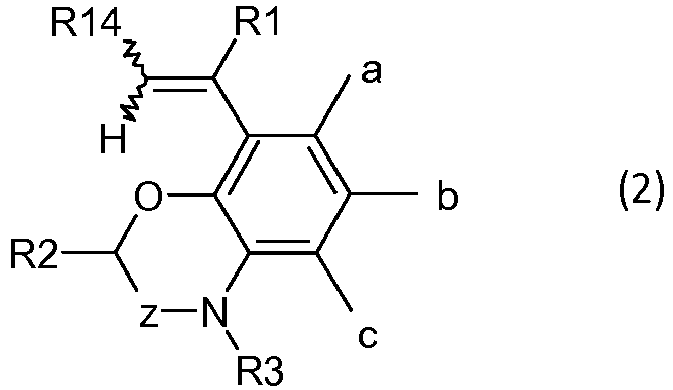
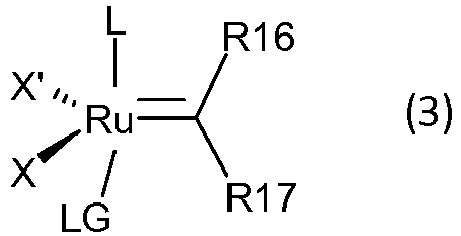
- X, L, z, a, b, c, R1, R2 and R3 are as defined above;
and wherein, - LG is a leaving group, preferentially LG is a phosphine P(R8)3 wherein R8 is selected from the group consisting of C1-6-alkyl; C5-12-Cycloalkyl preferentially cyclohexyl; aryl; more preferentially LG is a pyridine wherein pyridine is unsubstituted or substituted by a charged or uncharged side chain comprising up to 20 carbon atoms,
- R14 is selected from the group consisting of H; C1-12-alkyl, preferentially a methyl group; C5-12-Cycloalkyl,
- R16 and R17 are each independently of one another H, C1-6-alkyl, optionally substituted by one or more halogens or by aryl, optionally substituted by one or more halogens or by C1-6-alkyl; or R16 and R17 form together a 5- to 12-membered aliphatic and/or aromatic ring system, optionally substituted by one or more halogens, C1-6-alkyl or by aryl; and preferentially R16 and R17 form an indenylidene system.
- Particular preference is given to the method in which R2 is a methyl-, ethyl- or isopropyl-group.
- In a preferred embodiment of the method, z is methylene, and R3 is a side chain of following formula R3a or R3b:


- in this embodiment, A- is selected from the group consisting of F-, Cl-, Br-, I-, tetrafluoroborate BF4 -, hexafluorophosphate PF6 - and bis(trifluoromethylsulfonyl)amide NTf2 -.
- Another preferred embodiment of the method, R3 is a side chain of following formula R3c, R3d, R3e, R3f, R3g, R3h, R3i, R3j, R3k, R3l, R3m, R3n, R3° or R3p:


- Particular preference is given to the method in which R10 and R11 are each, independently of one another, C1-30-alkyl optionally substituted by an alkoxy radical OR15, C2-30-alkenyl optionally substituted by an alkoxy radical OR15, aryl optionally substituted by an alkoxy radical OR15, aminoalkyl or aminocycloalkyl.
- Another particular preference is given to the method in which L is a ligand of following formula L1a, L1b, L1c, L1d, L1e, L1f or L1g:


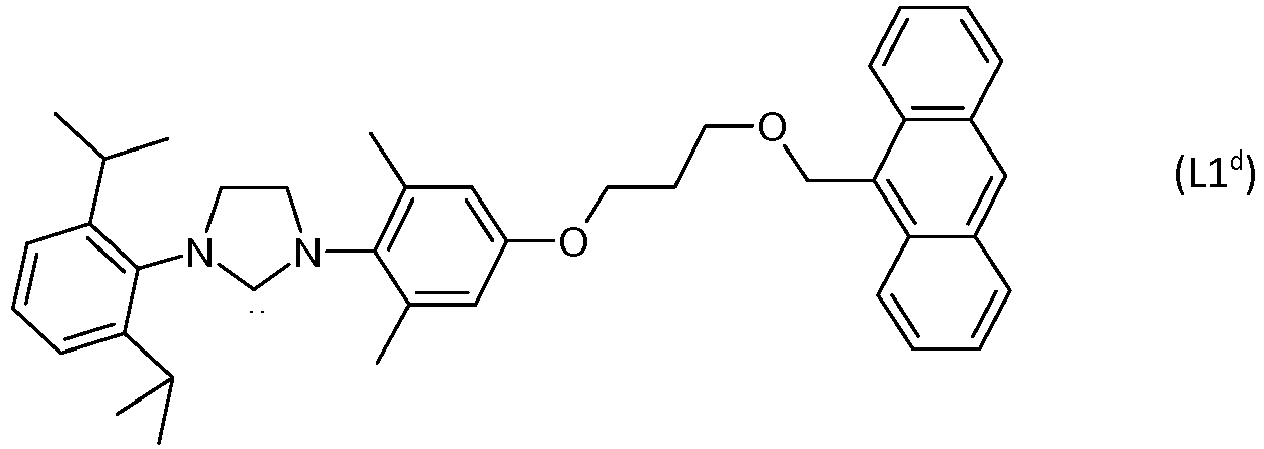


- Other characteristics and advantages of the invention will become apparent upon examination of the upcoming description, examples and the accompanying drawings in which:
-
FIG. 1 is a graph showing the conversion rate over time of a product P60 into a product P61 a by metathesis reaction and in the presence of catalysts P32 and P41 according to the present invention, -
FIG. 2 is a graph showing the conversion rate over time of the product P60 into the product P61 a by metathesis reaction and in the presence of catalysts P33, P34, P35, P36 P37, P38, P39 and P40 according to the present invention, -
FIG. 3 is a graph showing the conversion rate over time of the product P60 into the product P61 a by metathesis reaction and in the presence of catalysts P42, P43, P44, P45 and P47 according to the present invention, -
FIG. 4 is a graph showing the conversion rate over time of the product P60 into the product P61 a by metathesis reaction and in the presence of catalysts P48, P49, P50 and P51 according to the present invention, -
FIG. 5 is a graph showing the conversion rate over time of the product P60 into the product P61 by a metathesis reaction and in the presence of catalysts P52, P53, P54, P55, P56 and P57 according to the present invention, -
FIG. 6 is a graph showing the conversion rate over time of the product P60 into the product P61 by metathesis reaction and in the presence of catalysts P58 and P59 according to the present invention, -
FIG. 7 is a graph showing the conversion rate over time of a product P62 into a product P63 by metathesis reaction and in the presence of four different prior art catalysts (Grubbs III, Schrock catalyst, Piers-Grubbs II and compound of formula G) in comparison with catalyst P34 according to the present invention, -
FIG. 8 is a graph showing the conversion rate over time of a product P64 into a product P65 by metathesis reaction and in the presence of three different prior art catalysts (Blechert, Umicore M71 SIPr of formula D, Grela of formula B, Zannan of formula C and compound of formula I) in comparison with catalysts P33 and P34 according to the present invention, -
FIG. 9 is a stability graph showing the degradation rate over time of catalysts P33, P34, P35 and P37 according to the present invention, -
FIG. 10 is a stability graph showing the degradation rate over time of catalysts P42, P43, P44, P45 and P47 according to the present invention, -
FIG. 11 is a stability graph showing the degradation rate over time of catalysts P48, P49, P50, and P51 according to the present invention, and -
FIG. 12 is a stability graph showing the degradation rate over time of catalysts P52, P53, P54 and P55 according to the present invention. - The following description, examples and drawings contain elements of definite nature. They may therefore not only serve to explain and clarify the present invention, but also may serve to contribute to its definition, where appropriate.
- As will be better understood while inspecting the catalyst examples according to the present invention, the ligand (L) is covalently bounded via the carbon atom marked with two dots (carbene radical) to the ruthenium (Ru) metal atom of the general formula 1 backbone.
- The term "C1-30-alkyl" refers (also when this is a constituent of other radicals) to branched and unbranched alkyl groups having from 1 to 30 carbon atoms. Correspondingly, the term "C1-20-alkyl" refers to branched and unbranched alkyl groups having from 1 to 20 carbon atoms. The term "C1-12-alkyl" refers to branched and unbranched alkyl groups having from 1 to 12 carbon atoms, the term "C1-6-alkyl" refers to branched and unbranched alkyl groups having from 1 to 6 carbon atoms and the term "C1-4-alkyl" refers to branched and unbranched alkyl groups having from 1 to 4 carbon atoms. Preference is given to alkyl groups having from 1 to 6 carbon atoms, particularly preferably from 1 to 4 carbon atoms. Examples which may be mentioned are: methyl, ethyl, n-propyl, isopropyl, n-butyl, isobutyl, sec-butyl, tert-butyl, n-pentyl, isopentyl, neopentyl and hexyl. The abbreviations Me, Et, n-Pr, i-Pr, n-Bu, i-Bu, t-Bu, etc., may also be used for the abovementioned groups. Unless indicated otherwise, in the case of propyl, butyl, pentyl and hexyl, the definitions encompass all conceivable isomeric forms of the respective radicals. Thus, for example, propyl encompasses n-propyl and isopropyl, butyl encompasses isobutyl, sec-butyl and tert-butyl, etc.
- The term "C1-12-ammonium-alkyl" refers to an alkyl chain having from 1 to 12 carbon atoms and comprising an ammonium function. The term "C1-12-pyridinium-alkyl" refers to an alkyl chain having from 1 to 12 carbon atoms and comprising a pyridinium function. The term "C1-12-aldehyde-alkyl" refers to an alkyl chain having from 1 to 12 carbon atoms and comprising an aldehyde function. The term "C1-12-nitro-alkyl" refers to an alkyl chain having from 1 to 12 carbon atoms and comprising a nitro function. The term "C1-12-nitrile-alkyl" refers to an alkyl chain having from 1 to 12 carbon atoms and comprising a nitrile function.
- The term "C2-30-alkenyl" refers (also when it is a constituent of other radicals) to branched and unbranched alkenyl groups having from 2 to 30 carbon atoms, as long as they have at least one double bond. Correspondingly, the term "C2-12-alkenyl" refers to alkenyl groups having from 2 to 12 carbon atoms and the term "C2-6-alkenyl" refers to branched and unbranched alkenyl groups having from 2 to 6 carbon atoms, the term "C2-4-alkenyl" refers to branched and unbranched alkenyl groups having from 2 to 4 carbon atoms. Preference is given to alkenyl groups having from 2 to 6 carbon atoms, particularly preferably from 2 to 4 carbon atoms. Examples which may be mentioned are: ethenyl and vinyl, propenyl, butenyl, pentenyl and hexenyl. Unless indicated otherwise, in the case of propenyl, butenyl, pentenyl and hexenyl, the definitions encompass all conceivable isomeric forms of the respective radicals. Thus, for example, propenyl encompasses 1-propenyl and 2-propenyl, butenyl encompasses 1-, 2- and 3-butenyl, 1-methyl-1-propenyl, 1-methyl-2-propenyl, etc.
- The term "C1-12-alkoxy" refers (also when it is a constituent of other radicals) to branched and unbranched alkoxy groups having from 1 to 12 carbon atoms; correspondingly, the term "C1-6-alkoxy" refers to branched and unbranched alkoxy groups having from 1 to 6 carbon atoms and the term "C1-4-alkoxy" refers to branched and unbranched alkoxy groups having from 1 to 4 carbon atoms. Preference is given to alkoxy groups having from 1 to 6 carbon atoms, particularly preferably from 1 to 4 carbon atoms. Examples which may be mentioned are: methoxy, ethoxy, propoxy, butoxy and pentoxy. The abbreviations MeO, EtO, PrO, etc., may also be used for the abovementioned groups. Unless indicated otherwise, in the case of propoxy, butoxy and pentoxy, the definitions encompass all conceivable isomeric forms of the respective radicals. Thus, for example, propoxy encompasses n-propoxy and isopropoxy, butoxy encompasses isobutoxy, sec-butoxy and tert-butoxy, etc.
- The term "C5-12-Cycloalkyl" refers (even when it is a constituent of other radicals) to cyclic alkyl groups having 5 to 12 carbon atoms. Examples which may be mentioned are: cyclopentyl and cyclohexyl. Unless indicated otherwise, the cyclic alkyl groups can be substituted by one or more radicals selected from the group consisting of methyl, ethyl, isopropyl, tert-butyl, hydroxy, fluorine, chlorine, bromine and iodine. Further, the cyclic alkyl groups can be substituted by one or more functions such as an amino function; they will then be referred to as aminocycloalkyl.
- The term "aryl" refers (also when it is a constituent of other radicals) to aromatic ring systems having 6, 10 or more carbon atoms (up to approximately 20 carbon atoms). Examples which may be mentioned are: phenyl and naphthyl; the preferred aryl radical is phenyl. Unless indicated otherwise, the aromatics can be substituted by one or more radicals selected from the group consisting of methyl, ethyl, isopropyl, tert-butyl, hydroxy, fluorine, bromine and iodine. Further the aromatics can comprise one or more functional group; they will then be referred to as "heteroaryl".
- The term "C7-18-aralkyl" refers (also when it is a constituent of other radicals) to branched and unbranched alkyl groups which have from 1 to 8 carbon atoms and are substituted by an aromatic ring system having 6 or 10 carbon atoms; correspondingly, the term "C7-11-aralkyl" refers to branched and unbranched alkyl groups which have from 1 to 4 carbon atoms and are substituted by an aromatic ring system having 6 carbon atoms. Examples which may be mentioned are: benzyl, 1- and 2-phenylethyl. Unless indicated otherwise, the aromatics can be substituted by one or more radicals selected from the group consisting of methyl, ethyl, isopropyl, tert-butyl, hydroxy, fluorine, bromine and iodine.
- The term "indenylidene system" refers to a divalent radical derived from the cyclopentan ring of an indene wherein said indene consists of a benzene ring fused to a cyclopentadiene ring.
- The sign:stands for a cutoff in a covalent bond for the purpose of simplicity in representing side chains of compounds of the present invention. For instance, some examples of the present invention refer to a several optional side chains R3. A covalent bond cut by the above sign is actually linked to the Nitrogen (N) atom of the oxazine or oxazinone function.

- The signs:and
 stand for a E or Z configuration of a double bond (E/Z). Accordingly, atoms or atom-groups covalently linked to a double bond via this sign can be in CIS or TRANS position. It has to be understood that for the purpose of the present invention, compounds represented with the above sign can either comprise Z isomeres, E isomeres or a E/Z-mixture of said isomers.
- The following preparation method encompasses examples of the present invention. A man skilled in the art will know how to prepare other embodiments falling within the scope of the present invention by inspection of the following operations. Particularly, different catalysts according to the invention can be obtained by modification of the side chains R2 and/or R3 as defined within the present specification.
-

- A mixture of 2-bromo-6-aminophenol, 0,9eq of 1,8-diazabicyclo[5.4.0]undec-7-ene (DBU) and corresponding bromoester (1eq) in 1-Methyl-2-pyrrolidinone (4mL for 1mmol of aminophenol) was warmed in micro-wave at 180°C during 3min. EtOAc (20mL for 1mmol of aminophenol was added. Organic layer was washed with Brine (3X), dried and concentrated. Products were purified on silica gel.
- Depending on the side chain R2, compounds P1, P10 and P16 were obtained (see below). More generally R2 can be chosen to R2 is selected from the group consisting of H, C1-12-alkyl, C5-12-cycloalkyl, C7-18-aralkyl or aryl. More preferentially, R2 is a methyl-, ethyl- or isopropyl-group.

- PROCEDURE & NMR DATA: 1.5g (7.9mmol) of 2-bromo-6-aminophenol, 1.08mL (0,9eq, 7.11mmol) of 1,8-diazabicyclo[5.4.0]undec-7-ene and 3.5mL of DL-Ethyl 2-bromobutyrate (3eq, 23.7mmol)) in 30mL of 1-Methyl-2-pyrrolidinone were mixed. 1.447g of P1 were obtained, yield 71%.
1H NMR (400 MHz, CDCl3) δ 7.84 (s, 1H), 7.14 (dd, J = 8.1, 1.4 Hz, 1H), 6.76 (dd, J = 8.1, 7.9 Hz, 1H), 6.65 (dd, J = 7.9, 1.4 Hz, 1H), 4.54 (dd, J = 9.1, 4.2 Hz, 1H), 2.00 - 1.71 (m, 2H), 1.08 (t, J = 7.4 Hz, 3H). 13C NMR (101 MHz, CDCl3) δ 167.20, 139.69, 127.75, 127.27, 123.17, 114.43, 111.37, 79.04, 23.95, 9.61.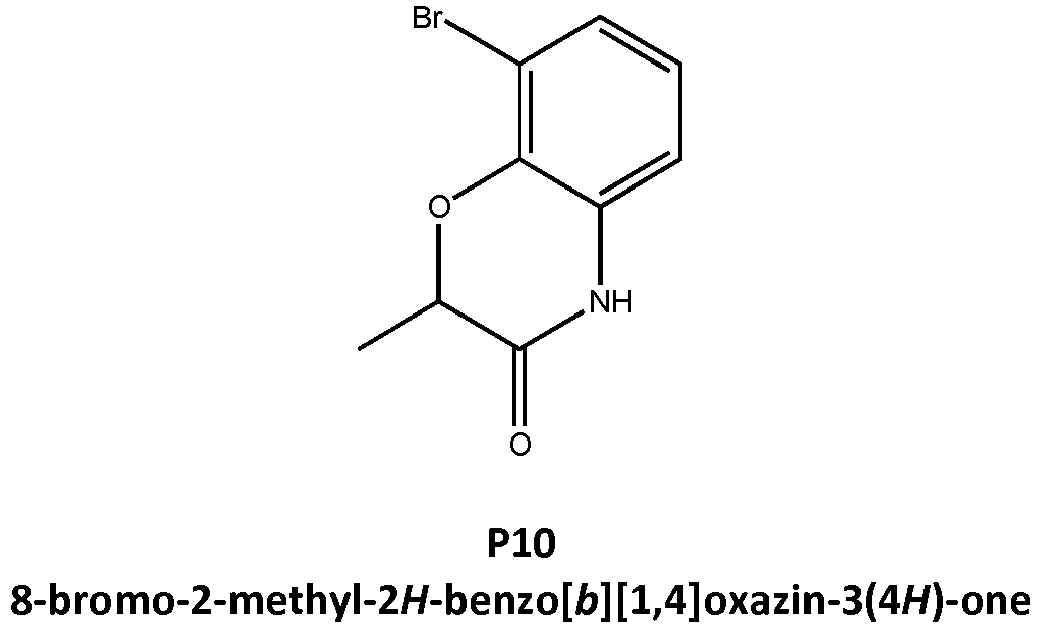
- PROCEDURE & NMR DATA : 1.51g (8mmol) of 2-bromo-6-aminophenol, 1.1mL (0,9eq, 7,2mmol) of 1,8-diazabicyclo[5.4.0]undec-7-ene and 2.1mL (2eq, 1.6mmol) of Methyl 2-bromopropionate in 1-Methyl-2-pyrrolidinone (25ml) were mixed. 1.55g of P10 were obtained, yield 80%.
1H NMR (400 MHz, CDCl3) δ 8.09 (s broad, 1H), 7.23 (dd, J = 8.1, 1.5 Hz, 1H), 6.86 (dd, J = 8.1, 7.9 Hz, 1H), 6.76 (dd, J = 7.9, 1.5 Hz, 1H), 4.78 (q, J = 6.9 Hz, 1H), 1.64 (d, J = 6.9 Hz, 3H). 13C NMR (101 MHz, CDCl3) δ 168.4, 140.4, 127.8, 127.4, 123.3, 114.9, 111.1, 73.9, 16.3.
- PROCEDURE & NMR DATA: 1.52g (8mmol) of 2-bromo-6-aminophenol, 1.1mL (7.2mmol, 0.9 eq) of 1,8-diazabicyclo[5.4.0]undec-7-ene and 3.35g (2eq, 16mmol) of ethyl 2-bromo-3-methylbutyrate in 1-methyl-2-pyrrolidinone (20mL) were mixed. 1.1g of P16 were obtained, yield 50%.
1H NMR (400 MHz, CDCl3) δ 8.78 (s, 1H), 7.12 (dd, J = 8.0, 1.5 Hz, 1H), 6.74 (dd, J = 8.0, 7.9 Hz, 1H), 6.67 (dd, J = 7.9, 1.5 Hz, 1H), 4.39 (d, J = 6.2 Hz, 1H), 2.19 (qq, J = 6.9, 6.7 Hz, 1H), 1.07 (d, J = 6.9 Hz, 3H), 1.00 (d, J = 6.7 Hz, 3H). 13C NMR (101 MHz, CDCl3) δ 166.90, 140.59, 127.78, 126.96, 122.95, 114.59, 110.84, 82.49, 29.98, 18.62, 17.58. - It should be noted that the general procedure begins with z being a carbonyle group (cf. P1, P10 and P16). An amide reduction can be carried out in order to reduce the carbonyle group to a methylene group (see below procedure I-D).
-

- To a stirred solution of tetrakis(triphenylphosphine)Palladium (0) (5%) in toluene (1mL for 10mg of tetrakis) was added in solution of toluene (4mL for 1mmol of oxazinone) latter oxazinone. The mixture was degassed during 15min and Propenyl-tributyltin (1.5eq) was added and stirred at 110°C for 12h under nitrogen atmosphere. After filtration and washed on celite the product was purified on silica gel.
- Depending on the side chain R2, compounds P2 (R2 is ethyl), P11 (R2 is methyl) and P17 (R2 is isopropyl) were obtained (see below).

- PROCEDURE & NMR DATA : 198.5mg (5%, 0.17mmol) of tetrakis(triphenylphosphine)Palladium (0) in toluene (7.5mL) was added in solution of toluene (7.5mL) of oxazinone P1. 1.84g (1.5eq, 5.55mmol) of Propenyl-tributyltin were added. 786mg of P2 was obtained, 98% yield.
1H NMR (400 MHz, CDCl3) δ 7.65 (s, 1H), 7.04 (dd, J = 7.9, 1.3 Hz, 1H), 6.83 (dd, J = 7.9, 7.7 Hz, 1H), 6.59 (dq, J = 15.9, 1.7 Hz, 1H), 6.53 (dd, J = 7.7, 1.3 Hz, 1H), 6.26 (dq, J = 15.9, 6.7 Hz, 1H), 4.45 (dd, J = 8.7, 4.3 Hz, 1H), 1.97 - 1.71 (m, 5H), 1.11 - 0.99 (m, 3H), 0.85 (t, J = 7.3 Hz, 3H). 13C NMR (101 MHz, CDCl3) δ 168.67, 168.65, 140.26, 139.51, 128.31, 127.91, 127.21, 126.71, 126.55, 126.33, 124.29, 123.63, 122.12, 121.53, 114.37, 114.04, 78.22, 78.21, 23.85, 23.79, 18.97, 17.31, 14.80, 13.60, 9.82, 9.69.
- PROCEDURE & NMR DATA: to 370mg (5%, 0.32mmol) of tetrakis(triphenylphosphine)-Palladium (0) in toluene (10mL) was added 1.55g (6.4mmol) of oxazinone P10 in solution of toluene (40mL). The mixture was degassed during 15min and 3.18g (1.5eq, 9.6mmol) of propenyl-tributyltin were added. 1.27g of P11 were obtained, yield 98%.
1H NMR (400 MHz, CDCl3) δ 7.84 (d, J = 10.4 Hz, 1H), 7.07 - 6.91 (m, 1H), 6.90 - 6.79 (m, 1H), 6.66 - 6.40 (m, 2H), 6.32 - 5.74 (m, 1H), 4.60 (q, J = 6.8 Hz, 1H), 1.90 - 1.73 (m, 3H), 1.59 - 1.51 (m, 3H). 13C NMR (101 MHz, CDCl3) δ 168.7, 168.6, 140.7, 139.9, 128.4, 127.9, 127.2, 126.7, 126.5, 124.9, 124.3, 123.6, 122.2, 121.7, 121.1, 114.3, 113.9, 73.4, 73.3, 18.9, 16.3, 16.2, 14.8.
- PROCEDURE & NMR DATA : to 235mg (5%, 0.2mmol) of tetrakis(triphenylphosphine)Palladium (0) in toluene (6mL) was added 1,1g (4mmol) of oxazinone P16 in solution of toluene (24mL). The mixture was degassed during 15min and 2.02g (1.5eq, 6mmol) of propenyl-tributyltin were added. 907mg of P17 were obtained, yield 98%.
1H NMR (400 MHz, CDCl3) δ 9.32 (d, J = 13.9 Hz, 1H), 6.96 (ddd, J = 40.9, 7.9, 1.3 Hz, 1H), 6.80 (dt, J = 13.9, 7.9 Hz, 1H), 6.68 - 6.60 (m, 1H), 6.60 - 6.41 (m, 1H), 6.32 - 5.76 (m, 1H), 4.31 (dd, J = 6.0, 1.5 Hz, 1H), 2.23 (qq, J = 6.9, 6.9 Hz, 1H), 1.80 (ddd, J = 29.2, 6.9, 1.8 Hz, 3H), 1.05 (dd, J = 9.0, 6.9 Hz, 3H), 0.97 (dd, J = 6.9, 6.9 Hz, 3H). 13C NMR (101 MHz, CDCl3) δ 167.70, 140.75, 139.99, 128.23, 127.89, 126.84, 126.34, 126.29, 126.06, 124.95, 124.30, 123.67, 121.92, 121.31, 121.20, 114.23, 113.90, 81.81, 81.79, 29.72, 29.63, 26.91. -

- Appropriate halogen compound (1.2eq) was added to a mixture of NaH (4eq) and considered oxazinone in THF (1mL for 0.1mmol of oxazinone) at 0°C. The mixture was stirred at room temperature for 2-3h. THF was removed under reduce pressure and EtOAc was added. The organic layer was washed with a saturated solution of NaHCO3 and then with brine, dried over MgSO4 and evaporated to dryness. Products were purified on silica gel.
- Depending on the side chain R2 and/or the side chain R3, compounds P3 to P9, P12 to P15 and P18 to P21 were obtained (see below).
- According to the invention, R3 can be selected from the group consisting of H, C1-12-alkyl, C5-12-cycloalkyl, C7-18-aralkyl, aryl, C1-12-halogeno-alkyl, C1-12-ammonium-alkyl, C1-12-pyridinum-alkyl, C1-12-aldehyde-alkyl, C1-12-nitro-alkyl, nitrile or a radical selected from the group consisting of ketones COR4, esters CO2R4, oxalates COCO2R4, sulfones SO2R4 or amides CONHR4, wherein R4 is selected from the group consisting of H, C1-12-alkyl, C5-12-Cycloalkyl, C7-18-aralkyl, aryl, C1-12-halogeno-alkyl, C1-12-ammonium-alkyl, C1-12-Pyridinum-alkyl, C1-12-aldehyde-alkyl, C1-12-nitro-alkyle and nitrile. In particularly preferred embodiments R3 is a side chain of the formula R3a or R3b as described above. However, in these embodiments z is chosen to be a methylene as shown in above formula 1b. For z to become a methylene, one can refer to general procedure I-D that shows a amide reduction.
- In other particularly preferred embodiments R3 is a side chain of the formula R3c, R3d, R3e, R3f, R3g, R3h, R3i, R3j, R3k, R3l, R3m, R3n, R3° or R3p as described above. In these embodiments z is chosen to be either a methylene as shown in above formula 1b or a carbonyl as shown in above formula 1a.

- PROCEDURE & NMR DATA : 85µL (2.5eq, 0.65mmol) of isobutyl chloroformate was added to a mixture of 42mg (4eq, 1.04mmol) of NaH and oxazinone P2 (56mg, 0.26mmol) in THF (5mL). 42mg of P3 were obtained, yield 51%.
1H NMR (400 MHz, CDCl3) δ 7.14 (dd, J = 7.5, 1.6 Hz, 1H), 6.96 -6.84 (m, 2H), 6.63 - 6.56 (m, 1H), 6.25 (dq, J = 15.9, 6.6 Hz, 1H), 4.32 (dd, J = 8.8, 4.4 Hz, 1H), 4.10 (d, J = 6.6 Hz, 2H), 2.07 - 1.74 (m, 6H), 1.04 (t, J = 7.4 Hz, 3H), 0.93 (d, J = 6.7 Hz, 6H). 13C NMR (101 MHz, CDCl3) δ 166.45, 166.40, 152.04, 142.32, 141.55, 128.69, 128.33, 128.00, 127.45, 126.63, 126.43, 126.38, 123.99, 123.40, 122.51, 122.28, 121.73, 117.47, 117.12, 79.23, 79.22, 74.62, 74.60, 73.94, 69.80, 27.67, 23.14, 23.12, 18.99, 18.94, 18.92, 14.75, 9.72, 9.60. (major signals are double due to two isomers Z/E for the double bond)
- PROCEDURE & NMR DATA : 142µL (2.5eq, 1.23mmol) of benzoyl chloride was added to a mixture of 78mg of NaH (4eq, 1.96mmol) and 100mg (0.49mmol) of oxazinone P2 in THF (9.5mL). 58mg of P4 were obtained, yield 77%.
1H NMR (400 MHz, CDCl3) δ 7.86 - 7.77 (m, 2H), 7.57 - 7.49 (m, 1H), 7.43 - 7.32 (m, 2H), 7.15 - 6.99 (m, 1H), 6.90 - 6.71 (m, 2H), 6.69 - 6.46 (m, 1H), 6.34 - 5.83 (m, 1H), 4.48 - 4.42 (m, 1H), 2.05 - 1.74 (m, 5H), 1.09 (t, J = 7.4 Hz, 3H).
- PROCEDURE & NMR DATA : 265µL of pentafluorobenzoyl chloride (2eq, 1.84mmol) was added to a mixture of 148mg of NaH (4eq, 3.68mmol) and 200mg (0,92mmol) of oxazinone P2 in THF (22mL). 240mg of P5 were obtained, yield 63%.
1H NMR (400 MHz, CDCl3) δ 7.52 (ddd, J = 22.9, 8.2, 1.3 Hz, 1H), 7.22 (ddd, J = 43.6, 7.8, 1.2 Hz, 1H), 7.07 - 6.96 (m, 1H), 6.53 (ddd, J = 13.8, 13.1, 1.6 Hz, 1H), 6.34 - 5.82 (m, 1H), 4.31 (ddd, J = 8.7, 4.5, 3.3 Hz, 1H), 1.94 - 1.73 (m, 2H), 1.03 (dt, J = 9.3, 7.4 Hz, 1H). 13C NMR (101 MHz, CDCl3) δ 170.37, 170.27, 143.98, 143.21, 129.14, 128.79, 128.49, 128.07, 127.94, 125.49, 125.31, 124.15, 123.69, 123.08, 122.66, 122.13, 120.22, 119.92, 79.54, 79.49, 23.12, 18.94, 14.76, 9.55, 9.45. (major signals are double due to two isomers Z/E for the double bond). 19F NMR (376 MHz, CDCl3) δ -142.42 (d, J = 21.6 Hz, 2F), -150.02 (d, J = 9.9 Hz), -160.44 (dd, J = 21,6, 9,9 Hz, 2F).
- PROCEDURE & NMR DATA : 287µL (10eq, 4.6mmol) of Methyl iodide was added to a mixture of 74mg (4eq, 1.84mmol) of NaH and 100mg (0.46mmol) of oxazinone P2 in THF (10mL). 75mg of 6 were obtained, yield 71%.
1H NMR (400 MHz, CDCl3) δ 7.08 - 6.83 (m, 2H), 6.74 (m, 1H), 6.65 - 6.41 (m, 1H), 6.29 - 5.74 (m, 1H), 4.40 (dd, J = 9.1, 4.2 Hz, 1H), 3.26 (dd, J = 5.8, 0.2 Hz, 3H), 1.92 - 1.66 (m, 5H), 1.00 (dt, J = 8.7, 7.4 Hz, 3H).
- PROCEDURE & NMR DATA : 107mg (2.5eq, 0.58mmol) of 4-Nitrobenzoyl chloride was added to a mixture of 37mg (4eq, 0.92mmol) of NaH and 50mg (0.23mmol) of oxazinone P2 in THF (10mL). 81mg of P7 were obtained, yield 96%.
1H NMR (400 MHz, CDCL3 ) δ 8.30 (dd, J = 9.0, 3.7 Hz, 2H), 7.95 (dd, J = 9.0, 3.5 Hz, 2H), 7.26 (dd, J = 7.7, 1.5 Hz, 1H), 7.17 (dd, J = 7.7, 1.3 Hz, 1H), 7.07 (dd, J = 8.2, 1.5 Hz, 1H), 7.03-6.91 (m, 2H), 6.71 (qd, J = 16.2, 1.8 Hz, 1H), 6.56 (qd, J = 11.5, 1.8 Hz, 1H), 6.38 (qd, J = 15.8, 6.6 Hz, 1H), 5.96 (qd, J = 11.5, 7.1 Hz, 1H), 4.48 (ddd, J = 8.5, 4.5, 3.7 Hz, 1H), 1.95 (dd, J = 6.6, 1.8 Hz, 3H), 2.10-1.89 (m, 2H), 1.87 (dd, J = 7.1, 1.9 Hz, 3H), 1.14 (td, J = 9.2, 7.4 Hz, 3H). 13C NMR (101 MHz, CDCL3 ) δ 170.0, 170.0, 168.0, 150.4, 142.2, 141.3, 139.3, 139.2, 130.6, 130.3, 130.2, 129.1, 128.9, 128.4, 127.9, 127.0, 126.9, 126.6, 124.0, 123.8, 123.5, 123.2, 123.1, 122.7, 122.2, 118.9, 116.5, 78.9, 78.8, 23.0, 22.9, 18.9, 14.8, 9.6, 9.5. (major signals are double due to two isomers Z/E for the double bond).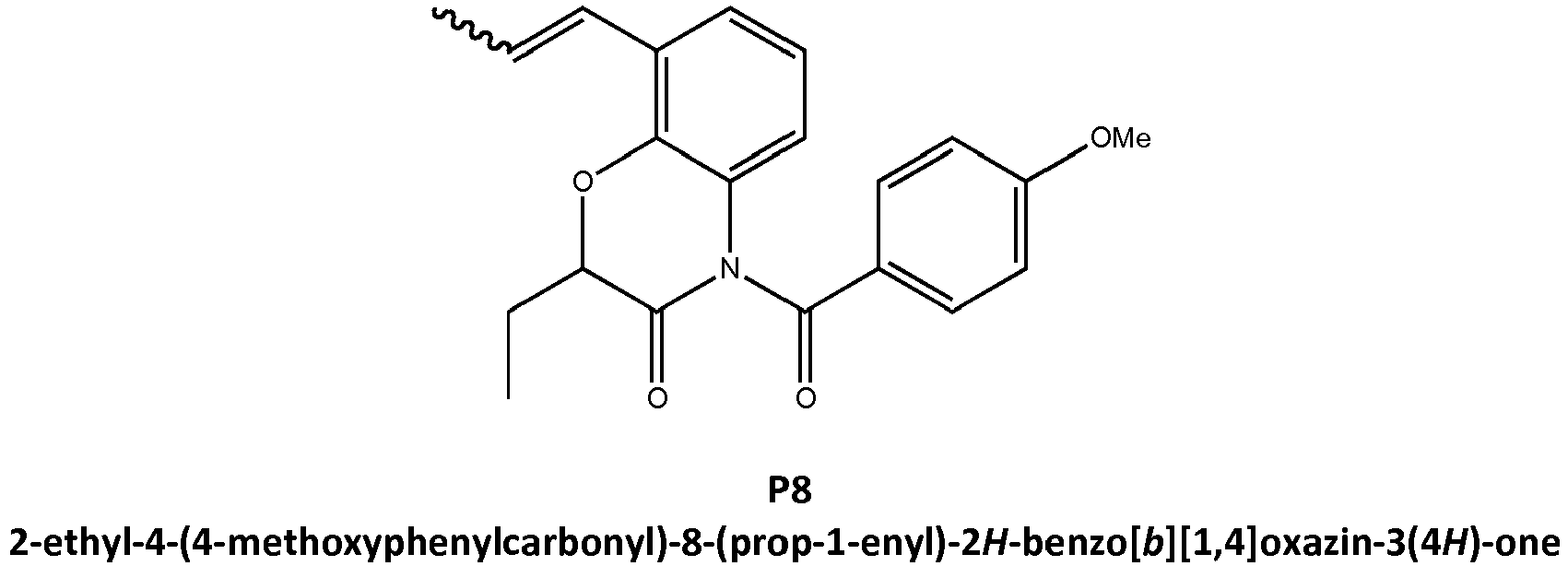
- PROCEDURE & NMR DATA : 137mg (2.5eq, 0.8mmol) of p-Anisoyl chloride was added to a mixture of 49mg (4eq, 1.28mmol) of NaH and 73mg (0.32mmol) of oxazinone P2 in THF (14mL). 73mg of P8 were obtained, yield 62%.
1H NMR (400 MHz, CDCl3) δ 7.85 - 7.76 (m, 2H), 7.13 - 6.98 (m, 1H), 6.91 - 6.75 (m, 3H), 6.69 - 6.46 (m, 2H), 6.38 - 5.81 (m, 1H), 4.47 (ddd, J = 8.9, 4.4, 2.9 Hz, 1H), 3.79 (d, J = 2.7 Hz, 3H), 2.03 - 1.74 (m, 5H), 1.08 (dt, J = 14.9, 7.4 Hz, 3H). 13C NMR (101 MHz, CDCL3 ) δ 170.5, 166.5, 164.9, 141.0, 140.2, 133.1, 128.7, 128.4, 128.0, 127.4, 127.4, 125.8, 125.0, 124.9, 124.1, 123.4, 122.4, 122.0, 121.9, 115.4, 115.0, 114.5, 78.7, 78.6, 55.6, 23.2, 23.1, 18.9, 14.8, 9.7, 9.6. (major signals are double due to two isomers Z/E for the double bond).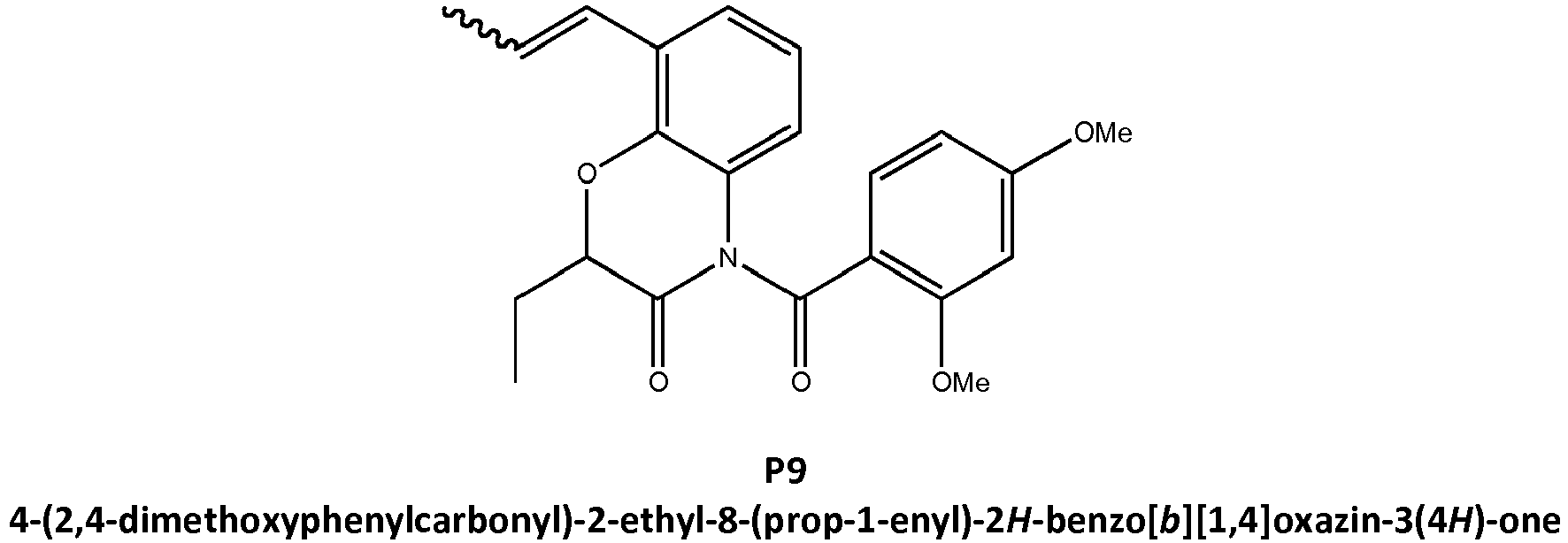
- PROCEDURE & NMR DATA: 162mg (2.5eq, 0.8mmol) of 2,4-Dimethoxybenzoyl chloride was added to a mixture of 49mg (4eq, 1.28mmol) of NaH and 73mg (0.32mmol) of oxazinone P2 in THF (14mL). 109mg of P9 were obtained, yield 84%.
1H NMR (400 MHz, CDCl3) δ 7.76 (dd, J = 8.8, 1.2 Hz, 1H), 7.14 -6.97 (m, 1H), 6.97 - 6.75 (m, 2H), 6.69 - 6.42 (m, 2H), 6.34 - 5.78 (m, 2H), 4.40 - 4.32 (m, 1H), 3.78 (d, J = 2.3 Hz, 3H), 3.63 (d, J = 4.4 Hz, 3H), 1.98 - 1.75 (m, 5H), 1.05 (dt, J = 9.5, 7.4 Hz, 3H). 13C NMR (101 MHz, CDCl3) δ 168.2, 166.7, 165.5, 160.5, 160.4, 142.1, 134.7, 134.7, 128.3, 127.9, 127.1, 125.8, 124.3, 123.7, 122.1, 121.9, 121.5, 116.6, 116.3, 105.8, 98.5, 78.9, 55.6, 26.9, 23.0, 18.9, 14.8, 9.9, 9.8. (major signals are double due to two isomers Z/E for the double bond).
- PROCEDURE & NMR DATA : 160mg (2.5eq, 0.85mmol) of 4-Nitrobenzoyl chloride was added to a mixture of 53mg (4eq, 1.36mmol) of NaH and 73mg (0,34mmol) of oxazinone P10 in THF (14mL). 108mg of P12 were obtained, yield 86%.
1H NMR (400 MHz, CDCl3) δ 8.30 - 8.19 (m, 2H), 7.92 - 7.82 (m, 2H), 7.24 - 7.06 (m, 1H), 7.03 - 6.83 (m, 2H), 6.53 (dddd, J = 11.5, 3.2, 2.6, 1.6 Hz, 1H), 6.36 - 5.81 (m, 1H), 4.58 (qd, J = 6.7, 1.3 Hz, 1H), 1.91 - 1.76 (m, 3H), 1.56 (dd, J = 8.2, 6.7 Hz, 3H). 13C NMR (101 MHz, CDCl3) δ 170.03, 168.35, 150.47, 142.79, 142.00, 139.34, 139.25, 130.30, 130.25, 129.18, 128.90, 127.73, 127.03, 126.80, 124.05, 123.85, 123.21, 123.14, 122.82, 122.30, 117.12, 116.78, 74.05, 26.91, 18.96, 15.52, 14.82.
- PROCEDURE & NMR DATA : 117µL (2.5eq, 0.85mmol) of p-Anisoyl chloride was added to a mixture of 53mg (4eq, 1.36mmol) of NaH and 73mg (0.34mmol) of oxazinone P10 in THF (14mL). 85mg of P13 were obtained, yield 69%.
1H NMR (400 MHz, CDCl3) δ 7.86 - 7.73 (m, 2H), 7.05 (ddd, J = 42.8, 7.8, 1.2 Hz, 1H), 6.94 - 6.73 (m, 3H), 6.70 - 6.42 (m, 2H), 6.35 - 5.77 (m, 1H), 4.64 (td, J = 6.8, 0.7 Hz, 1H), 3.79 (d, J = 2.8 Hz, 3H), 1.83 (ddd, J = 31.6, 6.9, 1.8 Hz, 3H), 1.58 (t, J = 6.8 Hz, 3H). 13C NMR (101 MHz, CDCl3) δ 170.13, 170.02, 166.87, 166.85, 164.94, 141.60, 140.83, 133.08, 133.06, 132.84, 128.78, 128.41, 127.87, 127.79, 127.59, 127.32, 125.86, 124.96, 124.87, 124.14, 123.50, 122.55, 122.01, 115.57, 115.26, 114.46, 114.13, 73.82, 55.64, 26.91, 18.95, 15.76, 14.84.
- PROCEDURE & NMR DATA : 173mg (2.5eq, 0.85mmol) of 2,4-Dimethoxybenzoyl chloride was added to a mixture of 53mg (4eq, 1.36mmol) of NaH and 73mg (0.34mmol) of oxazinone P10 in THF (14mL). 102mg of P14 were obtained, yield 76%.
1H NMR (400 MHz, CDCl3) δ 7.76 (dd, J = 8.8, 1.6 Hz, 1H), 7.16 - 6.71 (m, 3H), 6.68 - 6.39 (m, 2H), 6.34 - 5.74 (m, 2H), 4.52 (q, J = 6.8 Hz, 1H), 3.77 (d, J = 2.3 Hz, 3H), 3.63 (d, J = 4.5 Hz, 3H), 1.82 (ddd, J = 32.0, 6.9, 1.8 Hz, 1H), 1.53 (dd, J = 8.0, 6.8 Hz, 1H). 13C NMR (101 MHz, CDCl3) δ 168.20, 168.14, 167.17, 167.16, 165.53, 165.51, 160.41, 160.35, 142.66, 134.73, 134.68, 128.38, 127.82, 127.46, 127.42, 127.23, 126.94, 125.83, 124.29, 123.73, 122.17, 121.91, 121.65, 116.74, 116.37, 116.19, 116.07, 105.87, 105.85, 98.45, 73.92, 55.63, 55.60, 49.43, 30.67, 29.57, 26.90, 18.93, 17.65, 15.68, 15.64, 14.79.
- PROCEDURE & NMR DATA : 124µL (2.5eq, 0.85mmol) of pentafluorobenzoyl chloride was added to a mixture of 53mg (4eq, 1.36mmol) of NaH and 73mg (0.34mmol) of oxazinone P10 in THF (14mL). 134mg of P15 were obtained, yield 90%.
1H NMR (400 MHz, CDCl3) δ 7.52 (ddd, J = 23.4, 8.3, 1.4 Hz, 1H), 7.22 (ddd, J = 44.7, 7.8, 1.2 Hz, 1H), 7.10 - 6.95 (m, 1H), 6.64 - 6.40 (m, 1H), 6.35 - 5.79 (m, 1H), 4.47 (qd, J = 6.8, 1.7 Hz, 1H), 1.82 (ddd, J = 32.4, 6.9, 1.8 Hz, 3H), 1.52 (dd, J = 8.5, 6.8 Hz, 3H). 19F NMR (376 MHz, CDCl3) δ - 142.42 (d, J = 17.8 Hz, 2F), -149.92 (dd, J = 34.2, 20.7 Hz, 1F), -160.38 (td, J = 20.7, 6.1 Hz, 2F). 13C NMR (101 MHz, CDCl3 ) δ 170.8, 170.7, 144.4, 143.7, 129.1, 128.7, 128.3, 128.0, 127.7, 125.5, 125.3, 124.1, 123.7, 123.1, 122.7, 122.2, 120.3, 120.0, 74.8, 74.7, 18.9, 15.5, 14.7, 14.1.
- PROCEDURE & NMR DATA : 151mg (2.5eq, 0.8mmol) of 4-Nitrobenzoyl chloride was added to a mixture of 48mg (4eq, 1.28mmol) of NaH and 74mg (0.32mmol) of oxazinone P17 in THF (14mL). 100mg of P18 were obtained, yield 83%.
1H NMR (400 MHz, CDCl3) δ 8.29 - 8.20 (m, 2H), 7.95 - 7.85 (m, 2H), 7.25 - 7.06 (m, 1H), 7.03 - 6.82 (m, 2H), 6.71 - 6.42 (m, 1H), 6.39 - 5.71 (m, 1H), 4.33 - 4.14 (m, 1H), 2.30 - 2.17 (m, 1H), 1.84 (ddd, J = 31.2, 6.9, 1.8 Hz, 3H), 1.10 - 0.98 (m, 6H). 13C NMR (101 MHz, CDCl3) δ 170.31, 167.45, 167.41, 150.46, 141.39, 139.53, 130.25, 130.19, 129.08, 128.91, 128.30, 127.76, 126.99, 126.51, 124.05, 123.79, 123.24, 123.09, 122.63, 122.07, 116.73, 116.36, 82.46, 82.43, 28.55, 28.50, 26.91, 19.01, 18.79, 18.72, 17.64, 17.53, 14.82.
- PROCEDURE & NMR DATA : 138mg (2.5eq, 0.8mmol) of p-Anisoyl chloride was added to a mixture of 48Mg (4eq, 1.28mmol) of NaH and 74mg (0.32mmol) of oxazinone P17 in THF (14mL). 82mg of P19 were obtained, yield 65%.
1H NMR (400 MHz, CDCl3) δ 7.80 (dd, J = 9.0, 6.9 Hz, 2H), 7.04 (ddd, J = 41.4, 7.8, 1.2 Hz, 1H), 6.90 - 6.83 (m, 2H), 6.78 (dt, J = 10.7, 7.9 Hz, 1H), 6.70 - 6.47 (m, 2H), 6.36 - 5.81 (m, 1H), 4.28 (dd, J = 6.8, 3.3 Hz, 1H), 3.79 (d, J = 2.8 Hz, 3H), 2.32 - 2.20 (m, 1H), 1.84 (ddd, J = 30.2, 6.9, 1.8 Hz, 3H), 1.12 - 0.99 (m, 6H). 13C NMR (101 MHz, CDCl3) δ 171.15, 170.35, 165.82, 164.92, 141.23, 140.41, 133.05, 133.02, 128.63, 128.38, 127.76, 127.47, 127.24, 125.83, 125.14, 125.03, 124.09, 123.54, 122.31, 121.97, 121.72, 115.25, 114.94, 114.45, 82.29, 82.27, 60.39, 55.63, 28.79, 28.70, 21.04, 19.01, 18.81, 18.74, 17.83, 17.73, 14.83, 14.19.
- PROCEDURE & NMR DATA : 163mg (2.5eq, 0.8mmol) of 2,4-Dimethoxybenzoyl chloride was added to a mixture of 48mg (4eq, 1.28mmol) of NaH and 74mg (0.32mmol) of oxazinone P17 in THF (14mL). 106mg of P20 were obtained, yield 80%.
1H NMR (400 MHz, CDCl3) δ 7.75 (dd, J = 8.8, 1.0 Hz, 1H), 7.04 (ddd, J = 43.6, 7.5, 1.6 Hz, 1H), 6.93 - 6.72 (m, 2H), 6.69 - 6.45 (m, 2H), 6.34 - 5.78 (m, 2H), 4.17 (dd, J = 7.0, 4.6 Hz, 1H), 3.77 (d, J = 2.3 Hz, 3H), 3.62 (d, J = 4.7 Hz, 3H), 2.26 - 2.12 (m, 1H), 1.82 (ddd, J = 31.4, 6.9, 1.8 Hz, 3H), 1.09 - 0.95 (m, 6H). 13C NMR (101 MHz, CDCl3) δ 171.15, 168.45, 165.80, 165.74, 165.53, 165.49, 160.51, 160.43, 142.27, 134.72, 134.66, 128.29, 127.84, 127.38, 127.19, 126.98, 126.89, 125.80, 124.24, 123.76, 121.94, 121.88, 121.37, 116.47, 116.35, 116.20, 116.07, 105.79, 105.77, 98.42, 82.46, 60.39, 55.60, 28.48, 28.43, 21.04, 18.99, 18.85, 18.78, 17.88, 17.78, 14.77, 14.19.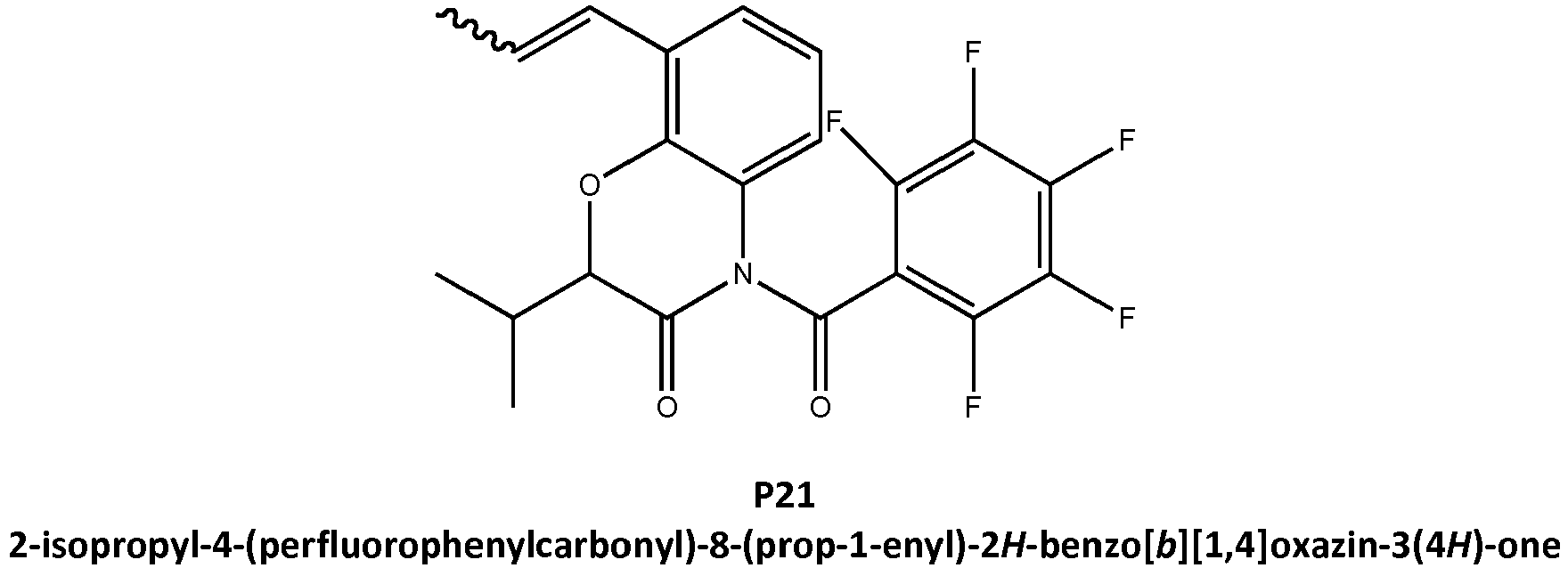
- PROCEDURE & NMR DATA : 187mg (2.5eq, 0.8mmol) of pentafluorobenzoyl chloride was added to a mixture of 48mg (4eq, 1.28mmol) of NaH and 74mg (0.32mmol) of oxazinone P17 in THF (14mL). 133mg of P21 were obtained, yield 96%.
1H NMR (400 MHz, CDCl3) δ 7.49 (ddd, J = 22.9, 8.2, 1.4 Hz, 1H), 7.22 (ddd, J = 44.9, 7.8, 1.2 Hz, 1H), 7.05 - 6.94 (m, 1H), 6.54 (ddq, J = 55.1, 11.6, 1.7 Hz, 1H), 6.35 - 5.81 (m, 1H), 4.14 (dd, J = 6.3, 4.2 Hz, 1H), 2.20 - 2.09 (m, 1H), 1.83 (ddd, J = 31.3, 6.9, 1.8 Hz, 3H), 1.01 (dd, J = 8.6, 6.9 Hz, 3H), 0.95 (dd, J = 7.5, 6.8 Hz, 3H). 19F NMR (376 MHz, CDCl3) δ -142.33 - -142.68 (m, 2F), -150.12 (t, J = 20.4 Hz, 1F), -160.22 - -160.69 (m, 2F). 13C NMR (101 MHz, CDCl3) δ 169.56, 169.51, 144.02, 143.22, 129.14, 128.80, 128.07, 127.86, 125.31, 125.14, 124.14, 123.69, 123.15, 122.55, 122.00, 120.13, 119.81, 83.13, 83.07, 29.69, 28.66, 26.91, 18.97, 18.75, 18.68, 17.33, 17.22, 14.79. -
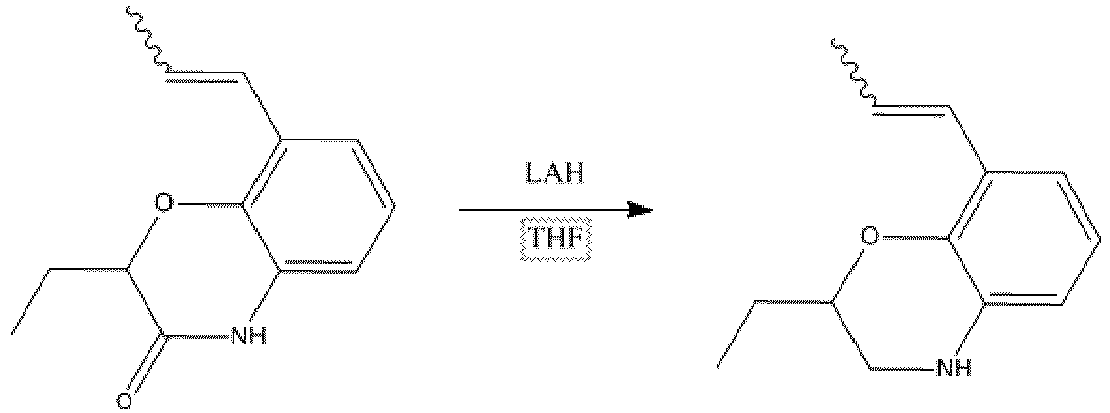
- Appropriate oxazinone was added in solution in THF (Tetrahydrofuran) (16.4 mL for 1 mmol) to a suspension of 418mg (2eq, 11mmol) of LAH (Lithium Aluminium Hydride) in THF (5mL for 1.1mmol) at 0°C. The result suspension was stirred at room temperature for 1h. H2O and a solution af NaOH 1N was slowly added. The precipitate was filtered off on celite and washed with warm THF. No further purification is done for these products. Product P22 was obtained (NMR DATA are shown below)
- In this way, catalysts compounds of the present invention can be obtained where z is methylene. Of course, different preparation of those compounds depend on selected R2 and R3 side chains (see below procedure I-E).

- PROCEDURE & NMR DATA : 1.2g (5.5mmol) of oxazinone P1 was added in solution in THF (90mL) to a suspension of 418mg (2eq, 11mmol) of LAH in THF (50mL) at 0°C. The result suspension was stirred at room temperature for 1h. H2O and a solution af NaOH 1N was slowly added. The precipitate was filtered off on celite and washed with warm THF. No further purification is done for these products. 1.1g of P22 were obtained, yield 99%.
1H NMR (400 MHz, CDCl3) δ 6.75 - 6.34 (m, 4H), 6.23 - 5.68 (m, 1H), 3.98 - 3.91 (m, 1H), 3.65 (d, J = 10.1 Hz, 1H), 3.34 - 3.01 (m, 2H), 2.04 -1.86 (m, 2H), 1.84 - 1.74 (m, 3H), 1.05 - 0.96 (m, 3H). 13C NMR (101 MHz, CDCl3) δ 141.48, 140.80, 133.27, 133.12, 126.63, 126.39, 126.15, 125.85, 125.42, 124.84, 120.55, 119.88, 119.86, 116.11, 113.94, 113.64, 107.96, 75.37, 75.35, 67.70, 45.13, 45.11, 29.13, 27.92, 27.17, 25.97, 25.93, 23.92, 18.98, 15.46, 14.89, 14.82, 13.65, 9.85, 9.78. -

- Appropriate halogen compound (1.2eq) was added to a mixture of NaH (4eq) and considered oxazinone in THF (10mL for 0.5mmol of oxazinone) at 0°C. The mixture was stirred at room temperature for 2-3h. THF was removed under reduce pressure and EtOAc was added. The organic layer was washed with a saturated solution of NaHCO3 and then with brine, dried over MgSO4 and evaporated to dryness. Products were purified on silica gel.
- Depending on the side chain R2 and/or the side chain R3, compounds P23 to P31 were obtained (see below).
- According to the invention, R3 can be selected from the group consisting of H, C1-12-alkyl, C5-12-cycloalkyl, C7-18-aralkyl, aryl, C1-12-halogeno-alkyl, C1-12-ammonium-alkyl, C1-12-pyridinum-alkyl, C1-12-aldehyde-alkyl, C1-12-nitro-alkyl, nitrile or a radical selected from the group consisting of ketones COR4, esters CO2R4, oxalates COCO2R4, sulfones SO2R4 or amides CONHR4, wherein R4 is selected from the group consisting of H, C1-12-alkyl, C5-12-Cycloalkyl, C7-18-aralkyl, aryl, C1-12-halogeno-alkyl, C1-12-ammonium-alkyl, C1-12-pyridinum-alkyl, C1-12-aldehyde-alkyl, C1-12-nitro-alkyle and nitrile.
- In particularly preferred embodiments R3 is a side chain of the formula R3a or R3b as described above. This results in the catalysts according to the invention P30 and P31 respectively. It must be noted here that P30 and P31 do not follow general procedure I-E. Synthesis details are given below at corresponding products P30 and P31.
- In other particularly preferred embodiments R3 is a side chain of the formula R3c, R3d, R3e, R3f, R3g, R3h, R3i, R3j, R3k, R3l, R3m, R3n, R3° or R3p as described above. In these embodiments z is chosen to be either a methylene as shown in above formula 1b or a carbonyl as shown in above formula 1a.

- PROCEDURE & NMR DATA: 392µL (2.5eq, 3mmol) of isobutyl chloroformate was added to a mixture of 192mg (4eq, 4.8mmol) of NaH and 261mg (1.2mmol) of oxazine P22 in THF (24mL). 380mg of P23 were obtained, yield 99%.
1H NMR (400 MHz, CDCl3) δ 7.67 - 7.49 (m, 1H), 7.01 (ddd, J = 47.8, 7.7, 1.5 Hz, 1H), 6.83 - 6.69 (m, 1H), 6.52 (ddd, J = 13.7, 13.0, 1.6 Hz, 1H), 6.24 - 5.69 (m, 1H), 4.19 - 3.97 (m, 2H), 3.97 - 3.86 (m, 2H), 3.29 - 3.16 (m, 1H), 2.00 - 1.88 (m, 1H), 1.80 (ddd, J = 20.6, 6.9, 1.8 Hz, 3H), 1.02 (dt, J = 11.4, 7.5 Hz, 3H), 0.90 (ddd, J = 6.7, 3.5, 0.6 Hz, 6H). 13C NMR (101 MHz, CDCl3) δ 143.83, 143.07, 126.89, 126.64,126.59, 125.92, 125.56,125.52, 125.50, 125.25, 124.79, 121.74, 119.49, 118.86, 76.15, 72.39, 45.76, 30.32, 29.70, 27.93, 26.91, 25.66, 25.61, 22.70, 19.20, 19.18, 18.96, 14.77, 9.58, 9.51.
- PROCEDURE & NMR DATA : 348µL (2.5eq, 3mmol) of benzoyl chloride was added to a mixture of 192mg (4eq, 4.8mmol) of NaH and 260mg (1.2mmol) of oxazine P22 in THF (25mL). 300mg of P24 were obtained, yield 78%.
1H NMR (400 MHz, CDCl3) δ 7.46 - 7.38 (m, 2H), 7.38 - 7.31 (m, 1H), 7.31 - 7.22 (m, 2H), 6.98 (ddd, J = 42.5, 7.5, 1.2 Hz, 1H), 6.70 - 6.39 (m, 3H), 6.29 - 5.72 (m, 1H), 4.28 - 4.12 (m, 2H), 3.38 (ddd, J = 12.8, 7.7, 6.1 Hz, 1H), 1.81 (ddd, J = 23.1, 6.9, 1.8 Hz, 3H), 1.76 - 1.53 (m, 2H), 1.01 (dt, J = 14.9, 7.5 Hz, 3H). 13C NMR (101 MHz, CDCl3) δ 143.31, 135.35, 135.32,130.61, 130.59, 128.64, 128.60, 128.36, 128.31, 127.27, 127.08, 126.82, 126.27, 126.16, 125.03, 124.47, 123.02, 122.92, 122.56, 119.06, 118.46, 25.99, 18.99, 14.83, 9.59, 9.50.
- PROCEDURE & NMR DATA : 141µL (2eq, 0.98mmol) of pentafluorobenzoyl chloride was added to a mixture of 78mg (4eq, 1.96mmol) of NaH and 100mg (0.49mmol) of oxazine P22 in THF (11mL). 118mg of P25 were obtained, yield 61%.
1H NMR (400 MHz, CDCl3) δ 7.05 (ddd, J = 45.1, 7.7, 1.2 Hz, 1H), 6.64 - 6.37 (m, 2H), 6.28 (ddd, J = 18.8, 8.0, 1.1 Hz, 1H), 6.22 - 5.72 (m, 1H), 4.59 (ddd, J = 13.1, 3.1, 1.4 Hz, 1H), 4.28 - 4.04 (m, 1H), 3.38 - 3.17 (m, 1H), 1.87 - 1.64 (m, 5H), 1.06 (dt, J = 12.3, 7.5 Hz, 3H). 13C NMR (101 MHz, CDCl3) δ 156.94, 145.29, 144.49, 128.11, 127.96, 127.81, 127.61, 127.48, 127.27, 127.22, 126.73, 124.80, 124.57, 124.39, 124.21, 123.96, 123.79, 122.08, 121.90, 120.34, 120.17, 119.98, 119.37, 119.18, 118.58, 75.86, 48.65, 44.13, 26.90, 26.12, 26.08, 25.36, 18.94, 14.78, 9.44, 9.35. 19F NMR (376 MHz, CDCl3) δ -139.59 - -140.69 (m, 2F), -150.30 - -151.23 (m, 1F), -158.61 - -160.29 (m, 2F).
- PROCEDURE & NMR DATA : 287µL (10eq, 4.6mmol) of methyl iodide was added to a mixture of 74mg (4eq, 1.84mmol) of NaH and 100mg (0.46mmol) of oxazine P22 in THF (10mL). 75mg of P26 were obtained, yield 71%.
1H NMR (400 MHz, CDCl3) δ 6.77 - 6.64 (m, 2H), 6.63 - 6.49 (m, 1H), 6.48 - 6.42 (m, 1H), 6.20 - 5.65 (m, 1H), 4.03 (tdd, J = 7.9, 5.6, 2.5 Hz, 1H), 3.12 (ddd, J = 11.3, 3.1, 2.5 Hz, 1H), 2.95 - 2.87 (m, 1H), 2.82 - 2.75 (m, 3H), 1.79 (ddd, J = 14.4, 6.9, 1.8 Hz, 3H), 1.75 - 1.50 (m, 2H), 1.02 - 0.95 (m, 1H)
- PROCEDURE & NMR DATA : 199mg (2.5eq, 1.08mmol) of 4-Nitrobenzoyl chloride was added to a mixture of 66mg (4eq, 1.72mmol) of NaH and 87mg (0.43mmol) of oxazine P22 in THF (18mL). 150mg of P27 were obtained, yield 99%.
1H NMR (400 MHz, CDCl3) δ 8.20 - 8.04 (m, 2H), 7.65 - 7.48 (m, 2H), 7.02 (dd, J = 43.8, 8.9 Hz, 1H), 6.69 - 6.38 (m, 2H), 6.27 - 5.72 (m, 1H), 4.52 - 4.40 (m, 1H), 4.05 (q, J = 7.2 Hz, 2H), 3.30 (ddd, J = 13.1, 8.3, 6.7 Hz, 1H), 1.81 (ddd, J = 27.4, 6.9, 1.8 Hz, 3H), 1.40 (dd, J = 11.6, 6.3 Hz, 2H), 1.18 (t, J = 7.1 Hz, 3H). 13C NMR (101 MHz, CDCl3) δ 171.12, 148.74, 144.29, 143.52, 141.38, 129.64, 127.81, 127.70, 127.21, 127.13, 126.52, 124.73, 124.18, 123.65, 123.60, 123.39, 122.85, 122.71, 119.30, 118.72, 60.37, 21.03, 18.95, 18.67, 14.82, 14.18.
- PROCEDURE & NMR DATA : 133mg (2.5eq, 0.77mmol) of p-Anisoyl chloride was added to a mixture of 48mg (4eq, 1.24mmol) of NaH and 63mg (0.31mmol) of oxazine P22 in THF (12mL). 103mg of P28 were obtained, yield 98%.
1H NMR (400 MHz, CDCl3) δ 7.46 - 7.35 (m, 2H), 7.08 - 6.89 (m, 1H), 6.84 - 6.72 (m, 2H), 6.62 (d, J = 15.8 Hz, 1H), 6.57 - 6.41 (m, 2H), 6.27 - 5.71 (m, 1H), 4.22 (dd, J = 23.3, 8.8 Hz, 2H), 3.76 (d, J = 3.8 Hz, 3H), 3.37 (dt, J = 12.8, 7.6 Hz, 1H), 1.82 (ddd, J = 21.5, 6.9, 1.8 Hz, 3H), 1.75 - 1.56 (m, 2H), 1.01 (dt, J = 14.7, 7.5 Hz, 3H). 13C NMR (101 MHz, CDCl3) δ 168.61, 161.53, 143.93, 130.90, 130.87, 127.21, 127.03, 126.14, 126.00, 125.07, 124.50, 123.00, 122.90, 122.30, 119.07, 118.46, 113.56, 113.51, 77.48, 77.33, 77.01, 76.69, 55.34, 53.42, 26.91, 25.93, 18.99, 14.85, 9.60, 9.51.
- PROCEDURE & NMR DATA : 96mg (1.5eq, 0.41mmol) of 4-(bromomethyl)benzoyl chloride was added to a mixture of 33µL (1.5eq, 0.41mmol) of pyridine and oxazine P22 in DCM (15mL). 53mg of P29 were obtained, yield 48%.
1H NMR (400 MHz, CDCl3) δ 7.47 (q, J = 8.30 Hz, 2H), 7.36 (t, J = 8.36 Hz, 2H), 7.12 (d, J = 9.03 Hz, 1H), 7.01 (d, J = 8.68 Hz, 1H), 6.69 (dd, J = 15.94, 1.66 Hz, 1H), 6.60 (dd, J = 13.96, 6.13 Hz, 1H), 6.53 (dd, J = 11.61, 1.63 Hz, 1H), 6.26 (qd, J = 15.86, 6.63 Hz, 1H), 5.85 (qd, J = 11.61, 7.08 Hz, 1H), 4.47 (s, 2H), 4.37-4.20 (m, 2H), 3.44 (ddd, J = 12.82, 7.71, 5.45 Hz, 1H), 1.91 (dd, J = 6.66, 1.73 Hz, 3H), 1.85 (dd, J = 7.10, 1.85 Hz, 3H), 1.84-1.62 (m, 2H), 1.08 (td, J = 14.75, 7.47 Hz, 1H). 13C NMR (101 MHz, CDCl3) δ 168.1, 144.0, 143.2, 140.2, 140.2, 139.8, 135.2, 135.2, 129.1, 129.1, 129.0, 129.0, 128.9, 128.4, 128.4, 127.25.8, 18.9, 14.8, 9.5, 9.5.
- PROCEDURE & NMR DATA : 53mg (0.13mmol) of oxazine P22 were added to 300µL of pyridine in tolune (15mL). The mixture warm up to reflux for the night. Volatiles were removed then 17mg (1.5eq) of potassium hexafluorophosphate and water (10mL) were added. 30 mg of P30 were obtained, yield 42%.
1H NMR (400 MHz, CDCl3) δ 8.90 (d, J = 5.54 Hz, 2H), 8.52 (t, J = 7.77 Hz, 1H), 8.05 (t, J = 7.02 Hz, 2H), 7.51 (t, J = 7.86 Hz, 2H), 7.44 (t, J = 7.85 Hz, 2H), 7.09 (d, J = 7.90 Hz, 1H), 6.97 (d, J = 7.96 Hz, 1H), 6.61 (dd, J = 15.88, 1.46 Hz, 1H), 6.58-6.48 (m, 1H), 6.44 (dd, J = 11.57, 1.43 Hz, 1H), 6.21 (qd, J = 15.75, 6.51 Hz, 1H), 5.84-5.73 (m, 3H), 4.32-4.02 (m, 2H), 3.43 (ddd, J = 12.93, 7.72, 2.55 Hz, 1H), 1.85 (dd, J = 6.62, 1.48 Hz, 3H), 1.78 (dd, J = 7.09, 1.73 Hz, 3H), 1.75-1.55 (m, 2H), 1.02 (td, J = 14.48, 7.44 Hz, 3H). 19F NMR (376 MHz, CD2Cl2) δ -73.3 (d, 6F, J = 711Hz) 31P NMR (162 MHz, CDCl3) δ -144.5 (sept, 1P, J = 711Hz); 13C NMR (101 MHz, CDCl3) δ 168.0, 145.8, 144.1, 143.8, 143.1, 136.5, 134.5, 129.1, 128.7, 128.6, 128.3, 126.8, 126.7, 126.7, 126.4, 126.0, 124.3, 123.8, 122.7, 122.3, 122.2, 118.6, 118.0, 63.7, 77.6, 46.4, 18.1, 13.9, 8.7, 8.6.
- PROCEDURE & NMR DATA : 123mg (2.5eq, 0.67mmol) of isonicotinoyl chloride was added to a mixture of 42mg (4eq, 1.08mmol) of NaH and 56mg (0.27mmol) of oxazine P22 in DMF (15mL). 66mg were purified.
- This product was added to 500µL of lodomethane in toluene (15mL). This mixture warm up to reflux for the night then cooled to room temperature then volatiles were removed under reduce pressure. Water (15mL) and 59mg of potassium hexafluorophosphate (1.5eq) were added to crude and stirred for 1h. 62mg of 31 were obtained, yield 62%.
1H NMR (400 MHz, CDCl3) δ 8.78-8.36 (m, 2H), 8.03-7.62 (m, 2H), 7.10 (d, J = 7.35 Hz, 1H), 7.02 (d, J = 7.25 Hz, 1H), 6.86-6.61 (m, 1H), 6.56 (dd, J = 15.78, 1.51 Hz, 1H), 6.42 (dd, J = 11.48, 1.48 Hz, 1H), 6.17 (dd, J = 15.71, 6.75 Hz, 1H), 6.26-6.03 (m, 1H), 5.89-5.72 (m, 2H), 4.30 (s, 3H), 4.57-3.91 (m, 2H), 3.37-3.13 (m, 1H), 1.83 (dd, J = 6.59, 1.52 Hz, 3H), 1.78 (dd, J = 7.09, 1.77 Hz, 3H), 1.75-1.37 (m, 2H), 1.16-0.96 (m, 3H). 19F NMR (376 MHz, CDCl3) δ -72.3 (d, 6F, J = 711Hz). 31P NMR (162 MHz, CDCl3) δ -144.9 (sept, 1P, J = 711Hz). 13C NMR (101 MHz, CDCl3) δ 150.7,146.2, 144.5, 143.7, 127.5, 127.5, 126.1, 124.4, 123.7, 123.6, 119.0, 75.6, 51.0, 48.7, 18.9, 18.4, 14.8, 9.1. -

- To a solution of SIPr (N,N'-bis(2,6-diisopropylphenyl)imidazol-2-ylidene) (or SIMes (1,3-dimésityl-4,5-dihydroimidazol-2-ylidène)) containing Ru-indenylidene complex (1.2eq) and copper chloride (1.1eq) in dry DCM (Dichloromethane) (1mL for 0.07mmol of oxazinone), oxazinone in DCM solution (1mL for 0.035mmol of oxazinone) was added. The resulting mixture was stirred at 35°C for 5h. Volatiles were removed under reduce pressure, acetone was added to the residue and the solution is filtered on a plug of Celite. The filtrate was concentrated and purified by chromatography on silica gel.
- Depending on R2 and R3 products P32 to P52 are obtained (attention is drawn to the fact that products P52 to P57 were obtained after amide reduction - see below). See below for specific procedure and NMR data for Catalysts according to the invention P32 to P59.
- L is a ligand of the formula L1, L2, L3 or L4 as described above and particular preference is given when R10 and R11 are each, independently of one another, C1-30-alkyl optionally substituted by an alkoxy radical OR15, C2-30-alkenyl optionally substituted by an alkoxy radical OR15, aryl optionally substituted by an alkoxy radical OR15, aminoalkyl or aminocycloalkyl.
- In a particular preferred embodiment L is a ligand that respond to one of formulae L1a, L1b, L1c, L1d, L1e, L1f or L1g as described above.
- As mentioned above, it must be noted that from products P23 to P28 are respectively obtained the catalysts of the present invention P52 to P57 (where z is methylene). The general procedure when z is methylene is similar to the one shown in I-F where z is carbonyle. For simplicity the reaction mechanism is not shown herein.

- PROCEDURE & NMR DATA: 50mg (0.23mmol) of P2 were added to 218mg (1eq, 0.23mmol) of Umicore-M2 and 25mg (1.1eq, 0.25mmol) of copper chloride in dry DCM (4.6mL). 20mg of P32 were obtained, yield 13%.
1H NMR (400 MHz, CD2Cl2) δ 16.51 (s, 1H), 7.43 (s, 1H), 7.00 (d, J = 5.1 Hz, 4H), 6.92 (d, J = 7.7 Hz, 1H), 6.85 (dd, J = 7.7, 7.6 Hz, 1H), 6.59 (d, J = 7.6 Hz, 1H), 4.95 - 4.88 (m, 1H), 4.11 (s, 4H), 2.36 (s, 6H), 2.33 (d, J = 5.5 Hz, 12H), 1.93 - 1.69 (m, 2H), 0.84 - 0.64 (m, 3H).

- PROCEDURE & NMR DATA: 50mg (0.23mmol) of P2 were added to 238mg (1eq, 0.23mmol) of SIPr-indenylidene and 25mg (1.1eq, 0.25mmol) of copper chloride in dry DCM (6mL). 84mg of P33 were obtained, yield 49%.
1H NMR (400 MHz, CD2Cl2) δ 16.29 (s, 1H), 7.63 (s, 1H), 7.50 - 7.42 (m, 2H), 7.33 - 7.26 (m, 4H), 6.84 (dd, J = 7.7, 1.3 Hz, 1H), 6.78 (t, J = 7.7 Hz, 1H), 6.47 (dd, J = 7.7, 1.3 Hz, 1H), 5.00 (dd, J = 5.1, 2.8 Hz, 1H), 4.18 - 4.08 (m, 4H), 3.54 - 3.39 (m, 4H), 1.91 - 1.77 (m, 2H), 1.22 - 1.07 (m, 24H), 0.81 (t, J = 7.3 Hz, 3H).
- PROCEDURE & NMR DATA: 154mg (0.48mmol) of P3 were added to 500mg (1eq, 0.48mmol) of SIPr-indenylidene and 52mg (1.1eq, 0.53mmol) of copper chloride in dry DCM (9mL). 262mg of P34 were obtained, yield 64%.
1H NMR (400 MHz, CD2Cl2) δ 16.29 (s, 1H), 7.46 (t, J = 7.7 Hz, 2H), 7.40 (dd, J = 8.2, 1.2 Hz, 1H), 7.30 (td, J = 7.7, 1.4 Hz, 4H), 6.89 (dd, J = 7.7, 8.2 Hz, 1H), 6.60 (dd, J = 7.7, 1.2 Hz, 1H), 4.95 (dd, J = 5.4, 2.6 Hz, 1H), 4.22 - 4.06 (m, 4H), 4.03 (dd, J = 6.5, 1.9 Hz, 2H), 3.54 - 3.37 (m, 4H), 1.92 (dt, J = 13.5, 6.7 Hz, 1H), 1.88 - 1.66 (m, 2H), 1.23 - 1.09 (m, 24H), 0.86 (d, J = 6.7 Hz, 6H), 0.83 (t, J = 7.3 Hz, 3H).
- PROCEDURE & NMR DATA: 58mg (0.18mmol) of P4 were added to 187mg (1eq, 0.18mmol) of SIPr-indenylidene and 20mg (1.1eq, 0.20mmol) of copper chloride in dry DCM (5.4mL). 74mg of P35 were obtained, yield 48%.
1H NMR (400 MHz, CD2Cl2) δ 16.33 (s, 1H), 7.72 (dd, J = 8.4, 1.3 Hz, 2H), 7.58 - 7.51 (m, 1H), 7.47 (t, J = 7.7 Hz, 2H), 7.41 - 7.34 (m, 2H), 7.31 (td, J = 7.7, 1.5 Hz, 4H), 7.13 (dd, J = 8.1, 1.2 Hz, 1H), 6.82 (t, J = 7.9 Hz, 1H), 6.59 (dd, J = 7.7, 1.3 Hz, 1H), 5.11 (dd, J = 5.3, 2.7 Hz, 1H), 4.22 - 4.07 (m, 4H), 3.57 - 3.39 (m, 4H), 1.89 - 1.67 (m, 2H), 1.27 - 1.11 (m, 24H), 0.84 (t, J = 6.8 Hz, 3H).
- PROCEDURE & NMR DATA: 50mg (0.12mmol) of P5 were added to 126mg (1eq, 0.12mmol) of SIPr-indenylidene and 13mg (1.1eq, 0.13mmol) of copper chloride in dry DCM (5.4mL). 68mg of P36 were obtained, yield 60%.
1H NMR (400 MHz, CD2Cl2) δ 16.33 (s, 1H), 7.93 (dd, J = 8.3, 1.3 Hz, 1H), 7.46 (t, J = 7.7 Hz, 2H), 7.30 (td, J = 7.7, 1.4 Hz, 4H), 7.05 - 6.94 (m, 1H), 6.74 (dd, J = 7.7, 1.3 Hz, 1H), 5.01 (dd, J = 5.0, 3.2 Hz, 1H), 4.26 - 4.06 (m, 4H), 3.55 - 3.36 (m, 4H), 1.87 - 1.68 (m, 2H), 1.22 - 1.07 (m, 24H), 0.73 (t, J = 7.3 Hz, 3H). 19F NMR (376 MHz, CD2Cl2) δ -142.62 (2F), -150.67, -161.20 (2F).
- PROCEDURE & NMR DATA: 75mg (0.33mmol) of P6 were added to 335mg (1eq, 0.33mmol) of SIPr-indenylidene and 36mg (1.1eq, 0.36mmol) of copper chloride in dry DCM (14mL). 132mg of P37 were obtained, yield 52%.
1H NMR (400 MHz, CD2Cl2) δ 16.30 (s, 1H), 7.46 (t, J = 7.7 Hz, 2H), 7.34 - 7.25 (m, 4H), 7.02 (dd, J = 8.0, 1.1 Hz, 1H), 6.89 (dd, J = 8.0, 7.7 Hz, 1H), 6.50 (dd, J = 7.7, 1.1 Hz, 1H), 4.96 (dd, J = 5.0, 2.7 Hz, 1H), 4.24 - 4.03 (m, 4H), 3.56 - 3.35 (m, 4H), 3.16 (s, 3H), 1.93 - 1.58 (m, 2H), 1.22 - 1.06 (m, 24H), 0.80 (t, J = 7.3 Hz, 3H).
- PROCEDURE & NMR DATA: 29mg (0.08mmol) of P7 were added to 100mg (1.2eq, 0.097mmol) of SIPr-indenylidene and 11mg (1.3eq, 0.11mmol) of copper chloride in dry DCM (10mL). 37mg of P38 were obtained, yield 52%.
1H NMR (400 MHz, CD2Cl2) δ 16.34 (s, 1H), 8.22 - 8.14 (m, 2H), 7.83 - 7.76 (m, 2H), 7.49 - 7.40 (m, 3H), 7.31 (td, J = 7.7, 1.5 Hz, 4H), 6.90 (t, J = 7.9 Hz, 1H), 6.67 (dd, J = 7.7, 1.3 Hz, 1H), 5.10 (dd, J = 5.4, 2.8 Hz, 1H), 4.30 - 3.98 (m, 4H), 3.61 - 3.27 (m, 4H), 1.88 - 1.67 (m, 2H), 1.22 - 1.10 (m, 24H), 0.81 (t, J = 7.3 Hz, 3H).
- PROCEDURE & NMR DATA: 28mg (0.08mmol) of P8 were added to 100mg (1.2eq, 0.097mmol) of SIPr-indenylidene and 11mg (1.3eq, 0.11mmol) of copper chloride in dry DCM (10mL). 61mg of P39 were obtained, yield 86%.
1H NMR (400 MHz, Acetone) δ 16.32 (s, 1H), 7.87 - 7.75 (m, 2H), 7.50 - 7.40 (m, 2H), 7.35 - 7.25 (m, 3H), 6.98 - 6.89 (m, 4H), 6.84 (t, J = 7.9 Hz, 1H), 6.52 (dd, J = 7.6, 1.2 Hz, 1H), 5.11 (dd, J = 5.0, 3.0 Hz, 1H), 4.31 - 4.15 (m, 4H), 3.77 (s, 3H), 3.62 - 3.43 (m, 4H), 1.83 - 1.73 (m, 2H), 1.18 - 1.05 (m, 24H), 0.80 (t, J = 7.3 Hz, 3H).
- PROCEDURE & NMR DATA: 31mg (0.08mmol) of P9 were added to 100mg (1.2eq, 0.097mmol) of SIPr-indenylidene and 11mg (1.3eq, 0.11mmol) of copper chloride in dry DCM (10mL). 59mg of P40 were obtained, yield 80%.
1H NMR (400 MHz, Acetone) δ 16.34 (s, 1H), 7.71 (d, J = 8.8 Hz, 1H), 7.45 (t, J = 7.7 Hz, 2H), 7.31 (td, J = 7.7, 1.5 Hz, 4H), 7.13 (dd, J = 8.1, 1.2 Hz, 1H), 6.81 (t, J = 7.9 Hz, 1H), 6.56 - 6.47 (m, 2H), 6.35 (d, J = 2.3 Hz, 1H), 4.86 (t, J = 4.3 Hz, 1H), 4.28 - 4.19 (m, 4H), 3.74 (s, 3H), 3.60 - 3.50 (m, 4H), 3.49 (s, 3H), 1.80 - 1.71 (m, 2H), 1.18 - 1.07 (m, 24H), 0.78 (t, J = 7.3 Hz, 3H).
- PROCEDURE & NMR DATA: 50mg (0.25mmol) of P11 were added to 237mg (1eq, 0.25mmol) of Umicore-M2 and 27mg (1.1eq, 0.27mmol) of copper chloride in dry DCM (4.6mL). 9mg of P41 were obtained, yield 6%.
1H NMR (400 MHz, CD2Cl2) δ 16.46 (s, 1H), 7.93 (s, 1H), 7.00 (s, 4H), 6.82 (d, J = 7.2 Hz, 1H), 6.76 (dd, J = 7.3, 7.2 Hz, 1H), 6.53 (d, J = 7.3 Hz, 1H), 4.89 (q, J = 6.5 Hz, 1H), 4.10 (s, J = 9.0 Hz, 4H), 2.35 (d, J = 2.9 Hz, 12H), 2.32 (s, 6H), 1.12 (d, J = 6.5 Hz, 3H).
- PROCEDURE & NMR DATA: 50mg (0.25mmol) of P11 were added to 258mg (1eq, 0.25mmol) of SIPr-indenylidene and 27mg (1.1eq, 0.27mmol) of copper chloride in dry DCM (5.4mL). 50mg of P42 were obtained, yield 27%.
1H NMR (400 MHz, CD2Cl2) δ 16.29 (s, 1H), 8.14 (s, 1H), 7.46 (t, J = 7.7 Hz, 2H), 7.30 (td, J = 7.7, 1.5 Hz, 4H), 6.63 - 6.50 (m, 2H), 6.35 (dd, J = 7.4, 1.3 Hz, 1H), 4.81 (q, J = 6.6 Hz, 1H), 4.19 - 4.05 (m, 4H), 3.55 - 3.37 (m, 4H), 1.27 (d, J = 6.6 Hz, 3H), 1.21 - 1.09 (m, 24H).
- PROCEDURE & NMR DATA: 47mg (0.14mmol) of P12 were added to 137mg (1eq, 0.14mmol) of SIPr-indenylidene and 15mg (1.1eq, 0.15mmol) of copper chloride in dry DCM (10mL). 89mg of P43 were obtained, yield 76%.
1H NMR (400 MHz, Acetone) δ 16.28 (s, 1H), 8.25 - 8.18 (m, 2H), 8.12 - 8.05 (m, 2H), 7.45 (t, J = 7.7 Hz, 2H), 7.37 (dd, J = 8.1, 1.1 Hz, 1H), 7.31 (td, J = 7.7, 1.5 Hz, 4H), 6.99 - 6.90 (m, 1H), 6.62 (dd, J = 7.7, 1.1 Hz, 1H), 5.20 (q, J = 6.5 Hz, 1H), 4.28 - 4.16 (m, 4H), 3.62 - 3.43 (m, 4H), 1.24 (d, J = 6.5 Hz, 3H), 1.19 - 1.05 (m, 24H).

- PROCEDURE & NMR DATA: 29mg (0.087mmol) of P13 were added to 102mg (1.2eq, 0.097mmol) of SIPr-indenylidene and 11mg (1.3eq, 0.11mmol) of copper chloride in dry DCM (10mL). 77mg of P44 were obtained, yield 90%.
1H NMR (400 MHz, Acetone) δ 16.27 (s, 1H), 7.88 - 7.75 (m, 2H), 7.45 (t, J = 7.7 Hz, 2H), 7.31 (td, J = 7.7, 1.5 Hz, 4H), 6.97 - 6.89 (m, 3H), 6.89 - 6.82 (m, 1H), 6.54 (dd, J = 7.6, 1.2 Hz, 1H), 5.16 (q, J = 6.5 Hz, 1H), 4.27 - 4.16 (m, 4H), 3.77 (s, 3H), 3.63 - 3.43 (m, 4H), 1.29 (d, J = 6.5 Hz, 3H), 1.18 - 1.04 (m, 24H).
- PROCEDURE & NMR DATA: 32mg (0.087mmol) of P14 were added to 102mg (1.2eq, 0.097mmol) of SIPr-indenylidene and 11mg (1.3eq, 0.11mmol) of copper chloride in dry DCM (10mL). 79mg of P45 were obtained, yield 95%.
1H NMR (400 MHz, Acetone) δ 16.29 (s, 1H), 7.75 - 7.66 (m, 1H), 7.45 (t, J = 7.7 Hz, 1H), 7.33 (dd, J = 7.6, 1.3 Hz, 2H), 7.29 (dt, J = 7.6, 1.3 Hz, 4H), 6.84 (t, J = 7.9 Hz, 1H), 6.57 - 6.49 (m, 2H), 6.35 (d, J = 2.3 Hz, 1H), 4.94 (q, J = 6.5 Hz, 1H), 4.28 - 4.15 (m, 4H), 3.74 (s, 3H), 3.54 (s, 3H), 3.62 - 3.42 (m, 4H), 1.33 - 1.26 (m, 3H), 1.18 - 1.04 (m, 24H).
- PROCEDURE & NMR DATA: 52mg (0.13mmol) of P15 were added to 118mg (1eq, 0.13mmol) of Umicore-M2 and 17mg (1.1eq, 0.17mmol) of copper chloride in dry DCM (10mL). 69mg of P46 were obtained, yield 62%.
1H NMR (400 MHz, Acetone) δ 16.45 (s, 1H), 7.92 (dd, J = 8.3, 1.0 Hz, 1H), 7.06 - 6.99 (m, 1H), 6.95 (d, J = 9.3 Hz, 4H), 6.80 (dd, J = 7.6, 1.0 Hz, 1H), 5.05 (q, J = 6.5 Hz, 1H), 4.16 (s, 4H), 2.31 (d, J = 10.6 Hz, 12H), 2.26 (s, 6H), 1.07 (d, J = 6.5 Hz, 3H). 19F NMR (376 MHz, Acetone) δ 33.47 (2F), 25.58, 14.45 (2F).

- PROCEDURE & NMR DATA: 50mg (0.13mmol) of P15 were added to 137mg (1eq, 0.13mmol) of SIPr-indenylidene and 14mg (1.1eq, 0.14mmol) of copper chloride in dry DCM (10mL). 99mg of P47 were obtained, yield 92%.
1H NMR (400 MHz, Acetone) δ 16.27 (s, 1H), 7.87 (dd, J = 8.3, 1.2 Hz, 1H), 7.44 (t, J = 7.7 Hz, 2H), 7.32 (dd, J = 7.7, 1.5 Hz, 2H), 7.27 (dd, J = 7.7, 1.5 Hz, 2H), 7.06 - 6.98 (m, 1H), 6.71 (dd, J = 7.7, 1.2 Hz, 1H), 5.07 (q, J = 6.5 Hz, 1H), 4.33 - 4.14 (m, 4H), 3.64 - 3.39 (m, 4H), 1.26 (d, J = 6.5 Hz, 3H), 1.18 - 1.04 (m, 24H). 19F NMR (376 MHz, Acetone) δ 33.56 (2F), 25.62, 14.37 (2F).
- PROCEDURE & NMR DATA: 19mg (0.05mmol) of P18 were added to 61mg (1.2eq, 0.059mmol) of SIPr-indenylidene and 11mg (1.3eq, 0.11mmol) of copper chloride in dry DCM (10mL). 39mg of P48 were obtained, yield 85%.
1H NMR (400 MHz, Acetone) δ 16.32 (s, 1H), 8.30 - 8.20 (m, 2H), 8.09 - 8.01 (m, 2H), 7.46 (t, J = 7.7 Hz, 2H), 7.41 (dd, J = 8.2, 1.2 Hz, 1H), 7.34 - 7.28 (m, 4H), 6.94 - 6.85 (m, 1H), 6.60 (dd, J = 7.7, 1.2 Hz, 1H), 5.01 (d, J = 2.6 Hz, 1H), 4.30 - 4.23 (m, 4H), 3.58 - 3.43 (m, 4H), 2.10 - 2.03 (m, 1H), 1.18 - 1.05 (m, 24H), 0.84 (d, J = 7.2 Hz, 3H), 0.80 (d, J = 6.8 Hz, 3H).
- PROCEDURE & NMR DATA : 30mg (0.08mmol) of P19 were added to 100mg (1.2eq, 0.097mmol) of SIPr-indenylidene and 11mg (1.3eq, 0.11mmol) of copper chloride in dry DCM (10 mL). 70mg of P49 were obtained, yield 98%.
1H NMR (400 MHz, Acetone) δ 16.32 (s, 1H), 7.83 - 7.78 (m, 2H), 7.46 (t, J = 7.7 Hz, 2H), 7.33 - 7.27 (m, 4H), 6.96 - 6.91 (m, 3H), 6.83 (t, J = 7.9 Hz, 1H), 6.51 (dd, J = 7.7, 1.3 Hz, 1H), 4.99 (d, J = 2.5 Hz, 1H), 4.29 - 4.19 (m, 4H), 3.78 (s, 3H), 3.58 - 3.45 (m, 4H), 2.10 - 2.04 (m, 1H), 1.18 - 1.05 (m, 24H), 0.91 (d, J = 7.1 Hz, 3H), 0.85 (d, J = 6.8 Hz, 3H).
- PROCEDURE & NMR DATA: 30mg (0.08mmol) of P20 were added to 100mg (1.2eq, 0.097mmol) of SIPr-indenylidene and 11mg (1.3eq, 0.11mmol) of copper chloride in dry DCM (10mL). 73mg of P50 were obtained, yield 98%.
1H NMR (400 MHz, Acetone) δ 16.34 (s, 1H), 7.76 - 7.68 (m, 1H), 7.45 (t, J = 7.7 Hz, 2H), 7.34 - 7.28 (m, 4H), 7.00 (dd, J = 8.1, 1.2 Hz, 1H), 6.79 (t, J = 7.9 Hz, 2H), 6.55 - 6.51 (m, 1H), 6.49 (dd, J = 7.7, 1.2 Hz, 1H), 6.35 (d, J = 2.3 Hz, 1H), 4.81 (d, J = 2.5 Hz, 1H), 4.30 - 4.20 (m, 4H), 3.74 (s, 3H), 3.57 - 3.48 (m, 4H), 3.46 (s, 3H), 2.09 - 2.04 (m, 1H), 1.18 - 1.06 (m, 24H), 0.90 (d, J = 7.1 Hz, 3H), 0.83 (d, J = 6.8 Hz, 3H).
- PROCEDURE & NMR DATA: 32mg (0.076mmol) of P21 were added to 95mg (1.2eq, 0.092mmol) of SIPr-indenylidene and 11mg (1.3eq, 0.11mmol) of copper chloride in dry DCM (10mL). 42mg of P51 were obtained, yield 59%.
1H NMR (400 MHz, Acetone) δ 16.31 (s, 1H), 7.99 (dd, J = 8.3, 1.3 Hz, 1H), 7.46 (t, J = 7.7 Hz, 2H), 7.31 (ddd, J = 13.2, 7.7, 1.4 Hz, 4H), 7.07 - 6.99 (m, 1H), 6.71 (dd, J = 7.7, 1.3 Hz, 1H), 4.95 (d, J = 2.7 Hz, 1H), 4.29 - 4.16 (m, 4H), 3.58 - 3.39 (m, 4H), 2.12 - 2.02 (m, 1H), 1.18 - 1.04 (m, 24H), 0.81 (d, J = 7.1 Hz, 3H), 0.74 (d, J = 6.9 Hz, 3H). 19F NMR (376 MHz, Acetone) δ -144.00 (2F), - 152.28, -163.04 (2F).
- PROCEDURE & NMR DATA: 50mg (0.17mmol) of P23 were added to 170mg (1eq, 0.17mmol) of SIPr-indenylidene and 18mg (1.1eq, 0.18mmol) of copper chloride in dry DCM (5.2mL). 59mg of P52 were obtained, yield 43%.
1H NMR (400 MHz, CD2Cl2) δ 16.22 (s, 1H), 8.04 - 7.93 (m, 1H), 7.45 (t, J = 7.7 Hz, 2H), 7.29 (d, J = 7.7 Hz, 4H), 6.82 - 6.73 (m, 1H), 6.53 (dd, J = 7.6, 1.3 Hz, 1H), 4.23 (dd, J = 13.9, 2.2 Hz, 1H), 4.13 - 4.06 (m, 5H), 3.92 - 3.79 (m, 2H), 3.54 - 3.41 (m, 4H), 3.22 (dd, J = 13.9, 8.5 Hz, 1H), 1.92 - 1.75 (m, 2H), 1.17 (d, J = 7.0 Hz, 24H), 0.84 (dd, J = 6.7, 1.4 Hz, 6H), 0.75 (t, J = 7.6 Hz, 3H).
- PROCEDURE & NMR DATA: 50mg (0.16mmol) of P24 were added to 170mg (1eq, 0.16mmol) of SIPr-indenylidene and 18mg (1.1eq, 0.18mmol) of copper chloride in dry DCM (5.2mL). 30mg of P53 were obtained, yield 22%.
1H NMR (400 MHz, CD2Cl2) δ 16.24 (s, 1H), 7.45 (t, J = 7.7 Hz, 2H), 7.40- 7.32 (m, 4H), 7.31 - 7.25 (m, 6H), 6.61 - 6.50 (m, 2H), 4.37 - 4.26 (m, 1H), 4.17 - 4.05 (m, 4H), 4.01- 3.92 (m, 1H), 3.58 - 3.53 (m, 1H), 3.53 - 3.42 (m, 4H), 1.88 - 1.76 (m, 2H), 1.25 - 1.06 (m, 24H), 0.64 (t, J = 7.6 Hz, 3H).
- PROCEDURE & NMR DATA: 118mg (0.297mmol) of P25 were added to 307mg (1eq, 0.297mmol) of SIPr-indenylidene and 32mg (1.1eq, 0.32mmol) of copper chloride in dry DCM (13.4mL). 125mg of P54 were obtained, yield 45%.
1H NMR (400 MHz, CD2Cl2) δ 16.22 (d, J = 6.6 Hz, 1H), 7.45 (t, J = 7.7 Hz, 2H), 7.29 (d, J = 7.7 Hz, 4H), 7.22 - 6.82 (m, 1H), 6.72 - 6.59 (m, 1H), 6.57 - 6.44 (m, 1H), 4.33 - 4.21 (m, 1H), 4.16 - 4.04 (m, 4H), 3.70 - 3.59 (m, 1H), 3.57 - 3.41 (m, 4H), 3.41- 3.29 (m, 1H), 1.96 - 1.71 (m, 2H), 1.27 - 1.02 (m, 24H), 0.60 (t, J = 7.6 Hz, 3H). 19F NMR (376 MHz, Acetone) δ -142.94 (2F), -154.00, - 161.93,(2F).
- PROCEDURE & NMR DATA: 39mg (0.18mmol) of P26 were added to 186mg (1eq, 0.18mmol) of SIPr-indenylidene and 20mg (1.1eq, 0.20mmol) of copper chloride in dry DCM (5.5mL). 34mg of P55 were obtained, yield 25%.
1H NMR (400 MHz, CD2Cl2) δ 16.22 (s, 1H), 7.44 (t, J = 7.7 Hz, 2H), 7.28 (dt, J = 7.7, 1.5 Hz, 4H), 6.71 (dd, J = 8.0, 1.7 Hz, 1H), 6.68 (d, J = 7.2 Hz, 1H), 6.14 (dd, J = 7.2, 1.7 Hz, 1H), 4.32 - 4.17 (m, 1H), 4.13 - 4.05 (m, 4H), 3.56 - 3.41 (m, 4H), 3.16 (dd, J = 12.1, 2.3 Hz, 1H), 3.01 (dd, J = 12.1, 9.2 Hz, 1H), 2.74 (s, 3H), 1.80 - 1.68 (m, 2H), 1.20 - 1.06 (m, 24H), 0.70 (t, J = 7.6 Hz, 4H).
- PROCEDURE & NMR DATA: 27mg (0.077mmol) of P27 were added to 100mg (1.2eq, 0.097mmol) of SIPr-indenylidene and 11mg (1.3eq, 0.11mmol) of copper chloride in dry DCM (10mL). 65mg of P56 were obtained, yield 92%.
1H NMR (400 MHz, Acetone) δ 16.32 (s, 1H), 8.35 - 8.29 (m, 2H), 7.87 - 7.78 (m, 3H), 7.56 (t, J = 7.7 Hz, 2H), 7.46 - 7.39 (m, 4H), 6.82 (t, J = 7.7 Hz, 1H), 6.66 (dd, J = 7.6, 1.1 Hz, 1H), 4.68 - 4.55 (m, 1H), 4.37 - 4.26 (m, 4H), 4.15 (d, J = 13.1 Hz, 1H), 3.73 - 3.62 (m, 4H), 3.59 (dd, J = 13.1, 8.6 Hz, 1H), 1.87 - 1.64 (m, 2H), 1.32 - 1.15 (m, 27H).
- PROCEDURE & NMR DATA: 27mg (0.077mmol) of P28 were added to 100mg (1.2eq, 0.097mmol) of SIPr-indenylidene and 11mg (1.3eq, 0.11mmol) of copper chloride in dry DCM (10mL). 62mg of P57 were obtained, yield 89%.
1H NMR (400 MHz, Acetone) δ 16.21 (s, J = 9.5 Hz, 1H), 7.42 (t, J = 7.7 Hz, 2H), 7.38 - 7.32 (m, 3H), 7.31 - 7.24 (m, 4H), 6.86 - 6.79 (m, 2H), 6.60 (t, J = 7.9 Hz, 1H), 6.46 (dd, J = 7.6, 1.3 Hz, 1H), 4.34 - 4.23 (m, 1H), 4.22 - 4.12 (m, 4H), 3.94 (dd, J = 13.7, 2.5 Hz, 1H), 3.75 - 3.68 (m, 4H), 3.62 - 3.48 (m, 4H), 1.73 - 1.50 (m, 2H), 1.19 - 1.03 (m, 24H), 0.60 (t, J = 7.6 Hz, 3H).
- PROCEDURE & NMR DATA: 14mg (0.025mmol) of P30 were added to 35mg (1.2eq, 0.34mmol) of SIPr-indenylidene and 3.5mg (1.3eq, 0.035mmol) of copper chloride in dry DCM (4mL). 13mg of P58 were obtained, yield 48%.
1H NMR (400 MHz, CD2CI2) δ 16.33 (s,1H), 8.69 (d, J = 5.62 Hz,2H), 8.47 (t, J = 7.81 Hz,1H), 8.01 (dd, J = 7.59, 6.74 Hz,2H), 7.74-7.16 (m,13H), 6.64 (s,2H), 4.44-4.33 (m,1H), 4.22-4.15 (m,4H), 4.02 (d, J = 13.01 Hz,1H), 3.70-3.60 (m,1H), 3.55 (dt, J = 13.48, 6.37 Hz,4H), 1.97-1.77 (m,1H), 1.55-1.45 (m,1H), 1.28-1.14 (m,24H), 0.72 (t, J = 7.50 Hz,3H). 19F NMR (376 MHz, CD2Cl2) δ -72.6 (d, 6F, J = 711Hz). 31P NMR (162 MHz, CD2CI2) δ -144.5 (sept, 1P, J = 711Hz)
- PROCEDURE & NMR DATA: 23mg (0.05mmol) of P31 were added to 68mg (1.2eq, 0.066mmol) of SIPr-indenylidene and 6.5mg (1.3eq, 0.065mmol) of copper chloride in dry DCM (7mL). 8mg of P59 were obtained, yield 15%.
1H NMR (400 MHz CD2CI2) δ 16.34 (s,1H), 8.52 (s,2H), 7.89 (d, J = 5.50 Hz,2H), 7.85-7.56 (m,2H), 7.53 (t, J = 7.73, 7.73 Hz,2H), 7.48-7.39 (m,1H), 7.39-7.31 (m,4H), 6.73 (d, J = 6.76 Hz,1H), 4.65-4.40 (m,1H), 4.34 (s,3H), 4.19 (qd, J = 8.53, 4.26, 4.26, 4.26 Hz,4H), 3.75-3.59 (m,1H), 3.52 (tt, J = 13.34, 13.34, 6.72, 6.72 Hz,4H), 3.45-3.29 (m,1H), 1.45-1.27 (m,2H), 1.29-1.10 (m,24H), 0.91 (t, J = 7.31, 7.31 Hz,3H). 19F NMR (376 MHz, CD2Cl2) δ -73.0 (d, 6F, J = 712Hz). 31P NMR (162 MHz, CD2CI2) δ -114.8 (sept, 1P, J = 711Hz). - Chosen synthesized catalysts according to the invention were tested on performance and stability.
- Kinetic studies were performed on diethyl 2-allyl-2-(2-methylallyl)propanedioate P60 in NMR tube.
- A NMR tube equipped with a septum was filled with diethylallylmethallyl malonate P60 (25.4 mg, 0.1 mmol) and CD2Cl2 (0.90 mL) under argon. The sample was equilibrated at 30°C in the NMR probe. The sample was locked and shimmed before the catalyst addition (0,1 mL, 1 µmol, 0.01 M solution of catalyst). The reaction progress was monitored in NMR by the periodical acquisition of data over 1h and integrating the characteristic signals for allylic proton resonances

-
FIG. 1 is a graph showing the conversion rate over time of a product P60 into a product P61 a by a metathesis reaction and in the presence of catalysts P32 and P41 according to the present invention. The conversion rate of P60 to P61 reflects high catalytic activity of the compounds of the present invention. -
FIG. 2 is a graph showing the conversion rate over time of the product P60 into the product P61 by a metathesis reaction and in the presence of catalysts P33, P34, P35, P36 P37, P38, P39 and P40 according to the present invention. The conversion rate of P60 to P61 reflects high catalytic activity of the compounds of the present invention. -
FIG. 3 is a graph showing the conversion rate over time of the product P60 into the product P61 by a metathesis reaction and in the presence of catalysts P42, P43, P44, P45 and P47 according to the present invention. The conversion rate of P60 to P61 reflects high catalytic activity of the compounds of the present invention. -
FIG. 4 is a graph showing the conversion rate over time of the product P60 into the product P61 by a metathesis reaction and in the presence of catalysts P48, P49, P50 and P51 according to the present invention. The conversion rate of P60 to P61 reflects high catalytic activity of the compounds of the present invention. -
FIG. 5 is a graph showing the conversion rate over time of the product P60 into the product P61 by a metathesis reaction and in the presence of catalysts P52, P53, P54, P55, P56 and P57 according to the present invention. The conversion rate of P60 to P61 reflects high catalytic activity of most compounds of the present invention. It is noted that compounds P52 and P55 show lower activity than P53, P54, P56, P57. These Compounds can be used in appropriate chemical reactions that need to be performed in the presence of moderate catalyst. - Further,
figure 5 clearly reflects how the compounds of the present invention can be designed for performance control. This is mainly due to the side chains (R1, R2, R3, a, b and c). Indeed the compounds offigure 5 show an identical ligand L and greatly differ in their side chain R3. By simply alternating said side chain R3, a significant catalytic activity difference is observed between each compound offigure 5 . -
FIG. 6 is a graph showing the conversion rate over time of the product P60 into the product P61 by metathesis reaction and in the presence of catalysts P58 and P59 according to the present invention. The conversion rate of P60 to P61 reflects high catalytic activity of the compounds of the present invention. Here again it can be observed how the catalytic activity is controlled by designing side chain R1. - Furthermore, comparative tests between compounds of general formula 1 and prior art catalysts were performed. Prior art catalysts that were used for the tests are defined by following formulae:


-
FIG. 7 is a graph showing the conversion rate over time of a product P62 into a product P63 by metathesis reaction and in the presence of four different prior art catalysts (Grubbs III; Schrock catalyst; Piers-Grubbs II; and compound of formula G) in comparison with catalyst P34 according to the present invention.
- In
figure 7 , it is clearly shown that the compound P34 shows higher catalytic activity than the catalysts of the prior art. However, it should be reminded that when desired the catalytic activity can be reduced in selecting appropriate side chains. -
FIG. 8 is a graph showing the conversion rate over time of a product P64 into a product P65 by metathesis reaction and in the presence of three different prior art catalysts (Blechert; Umicore M71 SIPr of formula D; Grela of formula B - J. AM. CHEM. SOC. 2006, 128, 13652-13653 ; Zannan of formula C; and compound of formula I) in comparison with catalysts P33 and P34 according to the present invention.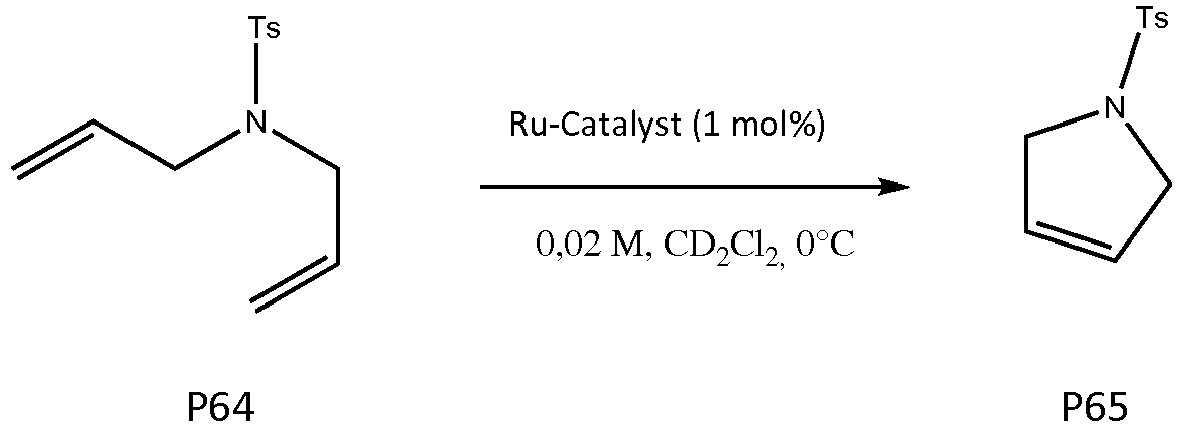
- As can be seen on
figure 8 , catalysts of the present invention can be designed to either show a higher catalytic activity than prior art catalysts, or can be designed to show similar activity than prior art catalysts. - In general it can be noted that the compounds of the present invention according to general formula 1 show high catalytic activity. This activity can be enhanced or allayed when alternating the side chains of general formula 1.
- Further to the above kinetic studies, stability studies were performed.
- Metathesis catalysts according to the present invention were added to a solution of anthracene (1eq) in CD2Cl2 (500µL) in NMR tube. Tubes were sealed with paraffin. Anthracene was used as internal standard. Degradation of catalysts was monitored in NMR by the periodical acquisition of data over 14 days. Comparison between characteristic signals for carbene proton resonances and anthracene were performed and are reproduced in
figures 9 to 12 .Figure 9 shows stability of catalysts P33, P34, P35 and P37 according to the present invention.Figure 10 shows stability over time of catalysts P42, P43, P44, P45 and P47 according to the present invention;Figure 11 shows the stability of P48, P49, P50, and P51 according to the present invention; andFigure 12 shows the stability of catalysts P52, P53, P54 and P55 according to the present invention. - In general it is noted that the compounds of the present invention show great stability.
- In the present invention the applicant identified a new backbone (or core) for metathesis catalysts. The compounds of the present invention show high catalytic activity and stability. Furthermore, three different activation sites within the new chelating benzylidene ligand were identified. These activation sites allow efficient and specific control of the catalytic activity of the ruthenium complexes in olefin metathesis transformation. Particularly, R2 and R3 show efficient control of the catalysts activity as can be seen in the non-limitative examples of the present specification.

Claims (10)
- A compound of the general formula 1,
 X and X' are halogen, preferably selected from the group consisting of Cl and Br;L is an uncharged ligand of the formula L1, L2, L3 or L4:


 wherein R10 and R11 are each, independently of one another a substituted or an unsubstituted side chain comprising 1 to 30 carbon atoms and optionally comprising one or more functional groups, andwherein R12 and R13 are each, independently of one another, H, C1-6-alkyl optionally substituted by a alkoxy radical OR15, or aryl optionally substituted by a alkoxy radical OR15, or form a 3- or 4-membered alkylene bridge, andwherein R15 is selected from the group consisting of C1-20-alkyl, aryl and C7-18-aralkyl, andwherein g and g' are each halogenz is a methylene or a carbonyl group;a, b and c are each H;R1 is H;R2 is selected from the group consisting of H, C1-12-alkyl, C5-12-cycloalkyl, C7-18-aralkyl or aryl; andR3 is selected from the group consisting of H, C1-12-alkyl, C5-12-cycloalkyl, C7-18-aralkyl, aryl, C1-12-halogeno-alkyl, C1-12-ammonium-alkyl, C1-12-pyridinum-alkyl, C1-12-aldehyde-alkyl, C1-12-nitro-alkyl, nitrile or a radical selected from the group consisting of ketones COR4, esters CO2R4, oxalates COCO2R4, sulfones SO2R4 or amides CONHR4, wherein R4 is selected from the group consisting of H, C1-12-alkyl, C5-12-cycloalkyl, C7-18-aralkyl, aryl, C1-12-halogeno-alkyl, C1-12-ammonium-alkyl, C1-12-pyridinum-alkyl, C1-12-aldehyde-alkyl, C1-12-nitro-alkyle and nitrile,or R3 is a side chain of the formula R3c, R3d, R3e, R3f, R3g, R3h, R3i, R3j, R3k, R3l, R3m, R3n, R3o or R3p: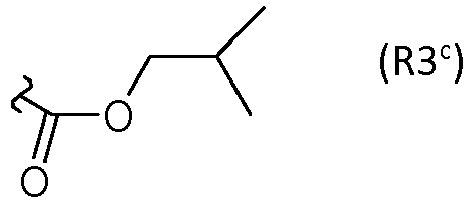


- The compound of general formula 1 according to claim 1,
wherein, z is methylene, and
R3 is a side chain of the formula R3a or R3b:

- The compound of general formula 1 according to one of claims 1 and 2,
wherein,
R3 is a side chain of the formula R3c, R3d, R3e, R3f, R3g, R3h, R3i, R3j, R3k, R3l, R3m, R3n, R3o or R3p:


- The compound of general formula 1 according to one of Claims 1-3,
wherein R10 and R11 are each, independently of one another, C1-30-alkyl optionally substituted by a alkoxy radical OR15, C2-30-alkenyl optionally substituted by a alkoxy radical OR15, aryl optionally substituted by a alkoxy radical OR15, aminoalkyl or aminocycloalkyl. - Use of the compound according to one of claims 1 to 4 as a catalyst for a chemical reaction.
- Method for preparing a compound of the general formula 1 according to claim 1
comprising a step of reacting a compound of the general formula (2)
 X, X', L, z, a, b, c, R1, R2 and R3 are as defined in claim 1;and wherein,LG is a leaving group selected in the group consisting of a phosphine P(R8)3 wherein R8 is selected from the group consisting of C1-6-alkyl; C5-12-cycloalkyl; aryl; and a pyridine wherein pyridine is unsubstituted or substituted by a charged or uncharged side chain comprising up to 20 carbon atoms,R14 is selected from the group consisting of H; C1-12-alkyl,; C5-12-cycloalkyl,R16 and R17 are each independently of one another H, C1-6-alkyl, optionally substituted by one or more halogens or by aryl, optionally substituted by one or more halogens or by C1-6-alkyl; or R16 and R17 form together a 5- to 12-membered aliphatic and/or aromatic ring system, optionally substituted by one or more halogens, C1-6-alkyl or by aryl.
 - The method according to claim 6,
wherein,
z is methylene, and
R3 is a side chain of the formula R3a or R3b:

- The method according to one of claims 6 and 7,
wherein,
R3 is a side chain of the formula R3c, R3d, R3e, R3f, R3g, R3h, R3i, R3j, R3k, R3l, R3m, R3n, R3o or R3p:


- The use according to claim 5, wherein the chemical reaction is selected from the group consisting of a metathesis reaction such as ring-closing metathesis (RCM), cross-metathesis (CM) and ring-opening metathesis polymerization (ROMP).
- The method according to claim 6, wherein R16 and R17 form an indenylidene system.
Applications Claiming Priority (1)
| Application Number | Priority Date | Filing Date | Title |
|---|---|---|---|
| PCT/EP2010/004668 WO2012013208A1 (en) | 2010-07-30 | 2010-07-30 | Novel stable and highly tunable metathesis catalysts |
Publications (2)
| Publication Number | Publication Date |
|---|---|
| EP2598511A1 EP2598511A1 (en) | 2013-06-05 |
| EP2598511B1 true EP2598511B1 (en) | 2018-07-04 |
Family
ID=42797431
Family Applications (1)
| Application Number | Title | Priority Date | Filing Date |
|---|---|---|---|
| EP10740164.8A Active EP2598511B1 (en) | 2010-07-30 | 2010-07-30 | Novel stable and highly tunable metathesis catalysts |
Country Status (7)
| Country | Link |
|---|---|
| US (1) | US8835628B2 (en) |
| EP (1) | EP2598511B1 (en) |
| JP (1) | JP2013532667A (en) |
| CN (1) | CN103221417A (en) |
| BR (1) | BR112013002329A2 (en) |
| CA (1) | CA2806754C (en) |
| WO (1) | WO2012013208A1 (en) |
Families Citing this family (4)
| Publication number | Priority date | Publication date | Assignee | Title |
|---|---|---|---|---|
| CN104169322B (en) * | 2012-03-16 | 2016-08-31 | 日本瑞翁株式会社 | The manufacture method of Romp polymer hydride and resin combination |
| FR3063290A1 (en) | 2017-02-24 | 2018-08-31 | Stratoz | PROCESS FOR SYNTHESIZING PHEROMONES |
| JP7248677B2 (en) * | 2017-12-08 | 2023-03-29 | アランセオ・ドイチュランド・ゲーエムベーハー | Process for producing nitrile rubber using ruthenium complex catalyst |
| US11311868B2 (en) * | 2018-07-23 | 2022-04-26 | Arlanxeo Deutschland Gmbh | Use of catalysts for the metathesis of nitrile rubber |
Family Cites Families (6)
| Publication number | Priority date | Publication date | Assignee | Title |
|---|---|---|---|---|
| AU2001284773B2 (en) | 2000-08-10 | 2004-08-05 | Trustees Of Boston College | Recyclable metathesis catalysts |
| PL199412B1 (en) | 2002-10-15 | 2008-09-30 | Boehringer Ingelheim Int | Ruthenium new complexes as (pre) catalytic agents of permutation reaction, new derivatives of 2-alkoxy-5-nitrostyrene as intermediate compounds and method of their receiving |
| KR101269568B1 (en) | 2005-07-04 | 2013-06-04 | 자난 사이텍 컴퍼니 리미티드 | Ruthenium complex ligand, ruthenium complex, carried ruthenium complex catalyst and the preparing methods and the use thereof |
| DE102006043704A1 (en) | 2006-09-18 | 2008-03-27 | Umicore Ag & Co. Kg | New metathesis catalysts |
| CN102123979A (en) | 2006-10-13 | 2011-07-13 | 埃莱文斯可更新科学公司 | Process for the synthesis of terminal olefins from internal olefins by olefin metathesis |
| FR2909382B1 (en) | 2006-11-30 | 2009-01-23 | Enscr | RUTHENIUM CATALYTIC COMPLEXES AND THE USE OF SUCH COMPLEXES FOR OLEFIN METATHESIS |
-
2010
- 2010-07-30 CA CA2806754A patent/CA2806754C/en active Active
- 2010-07-30 US US13/813,397 patent/US8835628B2/en active Active
- 2010-07-30 WO PCT/EP2010/004668 patent/WO2012013208A1/en not_active Ceased
- 2010-07-30 BR BR112013002329A patent/BR112013002329A2/en not_active Application Discontinuation
- 2010-07-30 CN CN2010800689442A patent/CN103221417A/en active Pending
- 2010-07-30 EP EP10740164.8A patent/EP2598511B1/en active Active
- 2010-07-30 JP JP2013520974A patent/JP2013532667A/en active Pending
Non-Patent Citations (1)
| Title |
|---|
| None * |
Also Published As
| Publication number | Publication date |
|---|---|
| WO2012013208A1 (en) | 2012-02-02 |
| EP2598511A1 (en) | 2013-06-05 |
| WO2012013208A8 (en) | 2012-03-22 |
| BR112013002329A2 (en) | 2016-05-24 |
| US8835628B2 (en) | 2014-09-16 |
| CA2806754A1 (en) | 2012-02-02 |
| CN103221417A (en) | 2013-07-24 |
| JP2013532667A (en) | 2013-08-19 |
| CA2806754C (en) | 2020-04-07 |
| US20130197218A1 (en) | 2013-08-01 |
Similar Documents
| Publication | Publication Date | Title |
|---|---|---|
| Uno et al. | Vinyl MIDA boronate: a readily accessible and highly versatile building block for small molecule synthesis | |
| Balinge et al. | A polymer-supported salen-palladium complex as a heterogeneous catalyst for the Mizoroki-Heck cross-coupling reaction | |
| Nüske et al. | A New Highly Efficient Three‐Component Domino Heck–Diels–Alder Reaction with Bicyclopropylidene: Rapid Access to Spiro [2.5] oct‐4‐ene Derivatives | |
| WO2008024023A1 (en) | Catalyst for obtaining acrylic acid ethers according to a metathesis reaction of dialkylmaleates (variants)and a catalytic composition based thereon | |
| JP2018123164A (en) | Ruthenium-based metathesis catalysts, precursors for their preparation and their use | |
| Murakami et al. | Syntheses and Interconversion of [Bis (silyl) alkene] palladium (0) and Bis (silyl) palladium (II) Complexes: A Mechanistic Model for Palladium-Catalyzed Bis-Silylation | |
| JP2015516868A (en) | Ruthenium-based metathesis catalysts and precursors for their production | |
| EP2598511A1 (en) | Novel stable and highly tunable metathesis catalysts | |
| Nakanishi et al. | Transition metal-catalyzed pentannulation of propargyl acetates via styrylcarbene intermediates | |
| Boger et al. | Total synthesis of (+)-and (-)-CPI-CDPI2:(+)-(3bR, 4aS)-and (-)-(3bS, 4aR)-deoxy-CC-1065 | |
| Nguyen et al. | Synthesis and 1H NMR spectroscopic properties of substituted (η4-tetraarylcyclobutadiene)(η5-cyclopentadienyl) cobalt metallocenes | |
| Strasser et al. | On the chloride lability in electron-rich second-generation ruthenium benzylidene complexes | |
| Zhao et al. | Synthesis of optically-active planar chiral derivatives of ferrocene. Crystal structures of alkyne insertion products | |
| Ziegler et al. | The chemospecific, homogeneous, ambient temperature Ullmann coupling of o-haloarylimines | |
| Price et al. | Total synthesis of furanether B | |
| CN111171068A (en) | A kind of preparation method of silicon spiro compound | |
| Melnes et al. | Cyclotrimerization of unsymmetrically bromo-substituted diynes: toward the synthesis of potential selective inhibitors of tyrosine kinase 2 | |
| Bildstein et al. | In situ synthesis of the first C7 cumulene (Fc) 2C C C C C C C (Fc) 2 via deprotonation of its conjugate acid [(Fc) 2C7H (Fc) 2]+ BF4−(Fc= ferrocenyl) | |
| Zhao et al. | Morita–Baylis–Hillman reactions of isatins with allenoates | |
| Pradal et al. | Gold-Catalyzed Cycloisomerization of Functionalized 1, 5-Enynes-An Entry to Polycyclic Framework | |
| Aratani et al. | Asymmetric Bis (alkoxycarbonylation) Reaction of Cyclic Olefins Catalyzed by Palladium in the Presence of Copper (I) Triflate | |
| Ohta et al. | Synthesis and reaction of [. eta. 3-1-methyl-1-(trimethylsilyl) allyl](. mu.-dichloro) dipalladium (II). Molecular structure of anti-[. eta. 3-1-methyl-1-(trimethylsilyl) allyl] chloro (triphenylphosphine) palladium (II) | |
| Minuti et al. | Synthesis of enantiopure angularly condensed [2.2] paracyclophanes containing five-membered rings | |
| Ohnemueller et al. | A versatile access to enantiomerically pure 5-substituted 4-hydroxycyclohex-2-enones: an advanced hemisecalonic acid a model | |
| Risse et al. | Contributions to the Chemistry of the Cyclopentadienyl Complex [Cp∧ RuCl2] 2 (“Cp‐roof”= η5‐1‐Methoxy‐2, 4‐tert‐butyl‐3‐neopentylcyclopentadienyl) |
Legal Events
| Date | Code | Title | Description |
|---|---|---|---|
| PUAI | Public reference made under article 153(3) epc to a published international application that has entered the european phase |
Free format text: ORIGINAL CODE: 0009012 |
|
| 17P | Request for examination filed |
Effective date: 20130225 |
|
| AK | Designated contracting states |
Kind code of ref document: A1 Designated state(s): AL AT BE BG CH CY CZ DE DK EE ES FI FR GB GR HR HU IE IS IT LI LT LU LV MC MK MT NL NO PL PT RO SE SI SK SM TR |
|
| DAX | Request for extension of the european patent (deleted) | ||
| 17Q | First examination report despatched |
Effective date: 20140702 |
|
| RAP1 | Party data changed (applicant data changed or rights of an application transferred) |
Owner name: CENTRE NATIONAL DE LA RECHERCHE SCIENTIFIQUE (C.N. Owner name: ECOLE NATIONALE SUPERIEURE DE CHIMIE DE RENNES |
|
| GRAP | Despatch of communication of intention to grant a patent |
Free format text: ORIGINAL CODE: EPIDOSNIGR1 |
|
| INTG | Intention to grant announced |
Effective date: 20180117 |
|
| RAP1 | Party data changed (applicant data changed or rights of an application transferred) |
Owner name: ECOLE NATIONALE SUPERIEURE DE CHIMIE DE RENNES Owner name: CENTRE NATIONAL DE LA RECHERCHE SCIENTIFIQUE CNRS |
|
| GRAS | Grant fee paid |
Free format text: ORIGINAL CODE: EPIDOSNIGR3 |
|
| GRAA | (expected) grant |
Free format text: ORIGINAL CODE: 0009210 |
|
| 111L | Licence recorded |
Designated state(s): AL AT BE BG CH CY CZ DE DK EE ES FI FR GB GR HR HU IE IS IT LT LU LV MC MK MT NL NO PL PT RO SE SI SK SM TR Free format text: EXCLUSIVE LICENSE Name of requester: DEMETA, FR Effective date: 20180208 |
|
| AK | Designated contracting states |
Kind code of ref document: B1 Designated state(s): AL AT BE BG CH CY CZ DE DK EE ES FI FR GB GR HR HU IE IS IT LI LT LU LV MC MK MT NL NO PL PT RO SE SI SK SM TR |
|
| REG | Reference to a national code |
Ref country code: GB Ref legal event code: FG4D |
|
| REG | Reference to a national code |
Ref country code: CH Ref legal event code: EP Ref country code: CH Ref legal event code: PK Free format text: ERGAENZUNG LIZENZEINTRAG: AUSSCHLIESSLICHE LIZENZ |
|
| REG | Reference to a national code |
Ref country code: AT Ref legal event code: REF Ref document number: 1014396 Country of ref document: AT Kind code of ref document: T Effective date: 20180715 |
|
| REG | Reference to a national code |
Ref country code: IE Ref legal event code: FG4D |
|
| REG | Reference to a national code |
Ref country code: DE Ref legal event code: R096 Ref document number: 602010051645 Country of ref document: DE |
|
| REG | Reference to a national code |
Ref country code: FR Ref legal event code: PLFP Year of fee payment: 9 |
|
| REG | Reference to a national code |
Ref country code: NL Ref legal event code: MP Effective date: 20180704 |
|
| REG | Reference to a national code |
Ref country code: LT Ref legal event code: MG4D |
|
| REG | Reference to a national code |
Ref country code: AT Ref legal event code: MK05 Ref document number: 1014396 Country of ref document: AT Kind code of ref document: T Effective date: 20180704 |
|
| PG25 | Lapsed in a contracting state [announced via postgrant information from national office to epo] |
Ref country code: NL Free format text: LAPSE BECAUSE OF FAILURE TO SUBMIT A TRANSLATION OF THE DESCRIPTION OR TO PAY THE FEE WITHIN THE PRESCRIBED TIME-LIMIT Effective date: 20180704 |
|
| PG25 | Lapsed in a contracting state [announced via postgrant information from national office to epo] |
Ref country code: CZ Free format text: LAPSE BECAUSE OF FAILURE TO SUBMIT A TRANSLATION OF THE DESCRIPTION OR TO PAY THE FEE WITHIN THE PRESCRIBED TIME-LIMIT Effective date: 20180704 Ref country code: FI Free format text: LAPSE BECAUSE OF FAILURE TO SUBMIT A TRANSLATION OF THE DESCRIPTION OR TO PAY THE FEE WITHIN THE PRESCRIBED TIME-LIMIT Effective date: 20180704 Ref country code: NO Free format text: LAPSE BECAUSE OF FAILURE TO SUBMIT A TRANSLATION OF THE DESCRIPTION OR TO PAY THE FEE WITHIN THE PRESCRIBED TIME-LIMIT Effective date: 20181004 Ref country code: GR Free format text: LAPSE BECAUSE OF FAILURE TO SUBMIT A TRANSLATION OF THE DESCRIPTION OR TO PAY THE FEE WITHIN THE PRESCRIBED TIME-LIMIT Effective date: 20181005 Ref country code: AT Free format text: LAPSE BECAUSE OF FAILURE TO SUBMIT A TRANSLATION OF THE DESCRIPTION OR TO PAY THE FEE WITHIN THE PRESCRIBED TIME-LIMIT Effective date: 20180704 Ref country code: BG Free format text: LAPSE BECAUSE OF FAILURE TO SUBMIT A TRANSLATION OF THE DESCRIPTION OR TO PAY THE FEE WITHIN THE PRESCRIBED TIME-LIMIT Effective date: 20181004 Ref country code: PL Free format text: LAPSE BECAUSE OF FAILURE TO SUBMIT A TRANSLATION OF THE DESCRIPTION OR TO PAY THE FEE WITHIN THE PRESCRIBED TIME-LIMIT Effective date: 20180704 Ref country code: IS Free format text: LAPSE BECAUSE OF FAILURE TO SUBMIT A TRANSLATION OF THE DESCRIPTION OR TO PAY THE FEE WITHIN THE PRESCRIBED TIME-LIMIT Effective date: 20181104 Ref country code: SE Free format text: LAPSE BECAUSE OF FAILURE TO SUBMIT A TRANSLATION OF THE DESCRIPTION OR TO PAY THE FEE WITHIN THE PRESCRIBED TIME-LIMIT Effective date: 20180704 Ref country code: LT Free format text: LAPSE BECAUSE OF FAILURE TO SUBMIT A TRANSLATION OF THE DESCRIPTION OR TO PAY THE FEE WITHIN THE PRESCRIBED TIME-LIMIT Effective date: 20180704 |
|
| PG25 | Lapsed in a contracting state [announced via postgrant information from national office to epo] |
Ref country code: LV Free format text: LAPSE BECAUSE OF FAILURE TO SUBMIT A TRANSLATION OF THE DESCRIPTION OR TO PAY THE FEE WITHIN THE PRESCRIBED TIME-LIMIT Effective date: 20180704 Ref country code: AL Free format text: LAPSE BECAUSE OF FAILURE TO SUBMIT A TRANSLATION OF THE DESCRIPTION OR TO PAY THE FEE WITHIN THE PRESCRIBED TIME-LIMIT Effective date: 20180704 Ref country code: HR Free format text: LAPSE BECAUSE OF FAILURE TO SUBMIT A TRANSLATION OF THE DESCRIPTION OR TO PAY THE FEE WITHIN THE PRESCRIBED TIME-LIMIT Effective date: 20180704 Ref country code: ES Free format text: LAPSE BECAUSE OF FAILURE TO SUBMIT A TRANSLATION OF THE DESCRIPTION OR TO PAY THE FEE WITHIN THE PRESCRIBED TIME-LIMIT Effective date: 20180704 |
|
| PG25 | Lapsed in a contracting state [announced via postgrant information from national office to epo] |
Ref country code: LU Free format text: LAPSE BECAUSE OF NON-PAYMENT OF DUE FEES Effective date: 20180730 |
|
| REG | Reference to a national code |
Ref country code: DE Ref legal event code: R097 Ref document number: 602010051645 Country of ref document: DE |
|
| PG25 | Lapsed in a contracting state [announced via postgrant information from national office to epo] |
Ref country code: MC Free format text: LAPSE BECAUSE OF FAILURE TO SUBMIT A TRANSLATION OF THE DESCRIPTION OR TO PAY THE FEE WITHIN THE PRESCRIBED TIME-LIMIT Effective date: 20180704 Ref country code: RO Free format text: LAPSE BECAUSE OF FAILURE TO SUBMIT A TRANSLATION OF THE DESCRIPTION OR TO PAY THE FEE WITHIN THE PRESCRIBED TIME-LIMIT Effective date: 20180704 Ref country code: EE Free format text: LAPSE BECAUSE OF FAILURE TO SUBMIT A TRANSLATION OF THE DESCRIPTION OR TO PAY THE FEE WITHIN THE PRESCRIBED TIME-LIMIT Effective date: 20180704 |
|
| REG | Reference to a national code |
Ref country code: IE Ref legal event code: MM4A |
|
| PLBE | No opposition filed within time limit |
Free format text: ORIGINAL CODE: 0009261 |
|
| STAA | Information on the status of an ep patent application or granted ep patent |
Free format text: STATUS: NO OPPOSITION FILED WITHIN TIME LIMIT |
|
| PG25 | Lapsed in a contracting state [announced via postgrant information from national office to epo] |
Ref country code: SM Free format text: LAPSE BECAUSE OF FAILURE TO SUBMIT A TRANSLATION OF THE DESCRIPTION OR TO PAY THE FEE WITHIN THE PRESCRIBED TIME-LIMIT Effective date: 20180704 Ref country code: DK Free format text: LAPSE BECAUSE OF FAILURE TO SUBMIT A TRANSLATION OF THE DESCRIPTION OR TO PAY THE FEE WITHIN THE PRESCRIBED TIME-LIMIT Effective date: 20180704 Ref country code: SK Free format text: LAPSE BECAUSE OF FAILURE TO SUBMIT A TRANSLATION OF THE DESCRIPTION OR TO PAY THE FEE WITHIN THE PRESCRIBED TIME-LIMIT Effective date: 20180704 |
|
| 26N | No opposition filed |
Effective date: 20190405 |
|
| PG25 | Lapsed in a contracting state [announced via postgrant information from national office to epo] |
Ref country code: IE Free format text: LAPSE BECAUSE OF NON-PAYMENT OF DUE FEES Effective date: 20180730 |
|
| PG25 | Lapsed in a contracting state [announced via postgrant information from national office to epo] |
Ref country code: SI Free format text: LAPSE BECAUSE OF FAILURE TO SUBMIT A TRANSLATION OF THE DESCRIPTION OR TO PAY THE FEE WITHIN THE PRESCRIBED TIME-LIMIT Effective date: 20180704 |
|
| PG25 | Lapsed in a contracting state [announced via postgrant information from national office to epo] |
Ref country code: MT Free format text: LAPSE BECAUSE OF NON-PAYMENT OF DUE FEES Effective date: 20180730 |
|
| PG25 | Lapsed in a contracting state [announced via postgrant information from national office to epo] |
Ref country code: TR Free format text: LAPSE BECAUSE OF FAILURE TO SUBMIT A TRANSLATION OF THE DESCRIPTION OR TO PAY THE FEE WITHIN THE PRESCRIBED TIME-LIMIT Effective date: 20180704 |
|
| PG25 | Lapsed in a contracting state [announced via postgrant information from national office to epo] |
Ref country code: PT Free format text: LAPSE BECAUSE OF FAILURE TO SUBMIT A TRANSLATION OF THE DESCRIPTION OR TO PAY THE FEE WITHIN THE PRESCRIBED TIME-LIMIT Effective date: 20180704 Ref country code: HU Free format text: LAPSE BECAUSE OF FAILURE TO SUBMIT A TRANSLATION OF THE DESCRIPTION OR TO PAY THE FEE WITHIN THE PRESCRIBED TIME-LIMIT; INVALID AB INITIO Effective date: 20100730 |
|
| PG25 | Lapsed in a contracting state [announced via postgrant information from national office to epo] |
Ref country code: MK Free format text: LAPSE BECAUSE OF NON-PAYMENT OF DUE FEES Effective date: 20180704 Ref country code: CY Free format text: LAPSE BECAUSE OF FAILURE TO SUBMIT A TRANSLATION OF THE DESCRIPTION OR TO PAY THE FEE WITHIN THE PRESCRIBED TIME-LIMIT Effective date: 20180704 |
|
| P01 | Opt-out of the competence of the unified patent court (upc) registered |
Effective date: 20230527 |
|
| PGFP | Annual fee paid to national office [announced via postgrant information from national office to epo] |
Ref country code: DE Payment date: 20240712 Year of fee payment: 15 |
|
| PGFP | Annual fee paid to national office [announced via postgrant information from national office to epo] |
Ref country code: GB Payment date: 20240729 Year of fee payment: 15 |
|
| PGFP | Annual fee paid to national office [announced via postgrant information from national office to epo] |
Ref country code: BE Payment date: 20240726 Year of fee payment: 15 |
|
| PGFP | Annual fee paid to national office [announced via postgrant information from national office to epo] |
Ref country code: FR Payment date: 20240725 Year of fee payment: 15 |
|
| PGFP | Annual fee paid to national office [announced via postgrant information from national office to epo] |
Ref country code: CH Payment date: 20240805 Year of fee payment: 15 |
|
| PGFP | Annual fee paid to national office [announced via postgrant information from national office to epo] |
Ref country code: IT Payment date: 20240708 Year of fee payment: 15 |
|
| REG | Reference to a national code |
Ref country code: DE Ref legal event code: R119 Ref document number: 602010051645 Country of ref document: DE |
|
| REG | Reference to a national code |
Ref country code: CH Ref legal event code: H13 Free format text: ST27 STATUS EVENT CODE: U-0-0-H10-H13 (AS PROVIDED BY THE NATIONAL OFFICE) Effective date: 20260224 |
|
| GBPC | Gb: european patent ceased through non-payment of renewal fee |
Effective date: 20250730 |
|
| REG | Reference to a national code |
Ref country code: BE Ref legal event code: MM Effective date: 20250731 |
|
| PG25 | Lapsed in a contracting state [announced via postgrant information from national office to epo] |
Ref country code: GB Free format text: LAPSE BECAUSE OF NON-PAYMENT OF DUE FEES Effective date: 20250730 |
|
| PG25 | Lapsed in a contracting state [announced via postgrant information from national office to epo] |
Ref country code: DE Free format text: LAPSE BECAUSE OF NON-PAYMENT OF DUE FEES Effective date: 20260203 |
|
| PG25 | Lapsed in a contracting state [announced via postgrant information from national office to epo] |
Ref country code: BE Free format text: LAPSE BECAUSE OF NON-PAYMENT OF DUE FEES Effective date: 20250731 |
|
| PG25 | Lapsed in a contracting state [announced via postgrant information from national office to epo] |
Ref country code: FR Free format text: LAPSE BECAUSE OF NON-PAYMENT OF DUE FEES Effective date: 20250731 |
|
| PG25 | Lapsed in a contracting state [announced via postgrant information from national office to epo] |
Ref country code: CH Free format text: LAPSE BECAUSE OF NON-PAYMENT OF DUE FEES Effective date: 20250731 |