EP2597797A1 - Interference cancellation method with multiple data layer MIMO transmission - Google Patents
Interference cancellation method with multiple data layer MIMO transmission Download PDFInfo
- Publication number
- EP2597797A1 EP2597797A1 EP11306565.0A EP11306565A EP2597797A1 EP 2597797 A1 EP2597797 A1 EP 2597797A1 EP 11306565 A EP11306565 A EP 11306565A EP 2597797 A1 EP2597797 A1 EP 2597797A1
- Authority
- EP
- European Patent Office
- Prior art keywords
- feedback
- data
- signal
- decoded
- function
- Prior art date
- Legal status (The legal status is an assumption and is not a legal conclusion. Google has not performed a legal analysis and makes no representation as to the accuracy of the status listed.)
- Granted
Links
Images


Classifications
-
- H—ELECTRICITY
- H04—ELECTRIC COMMUNICATION TECHNIQUE
- H04B—TRANSMISSION
- H04B1/00—Details of transmission systems, not covered by a single one of groups H04B3/00 - H04B13/00; Details of transmission systems not characterised by the medium used for transmission
- H04B1/69—Spread spectrum techniques
- H04B1/707—Spread spectrum techniques using direct sequence modulation
- H04B1/7097—Interference-related aspects
- H04B1/7103—Interference-related aspects the interference being multiple access interference
- H04B1/7105—Joint detection techniques, e.g. linear detectors
-
- H—ELECTRICITY
- H04—ELECTRIC COMMUNICATION TECHNIQUE
- H04L—TRANSMISSION OF DIGITAL INFORMATION, e.g. TELEGRAPHIC COMMUNICATION
- H04L25/00—Baseband systems
- H04L25/02—Details ; arrangements for supplying electrical power along data transmission lines
- H04L25/03—Shaping networks in transmitter or receiver, e.g. adaptive shaping networks
- H04L25/03006—Arrangements for removing intersymbol interference
-
- H—ELECTRICITY
- H04—ELECTRIC COMMUNICATION TECHNIQUE
- H04J—MULTIPLEX COMMUNICATION
- H04J11/00—Orthogonal multiplex systems, e.g. using WALSH codes
- H04J11/0023—Interference mitigation or co-ordination
- H04J11/0026—Interference mitigation or co-ordination of multi-user interference
- H04J11/0036—Interference mitigation or co-ordination of multi-user interference at the receiver
-
- H—ELECTRICITY
- H04—ELECTRIC COMMUNICATION TECHNIQUE
- H04L—TRANSMISSION OF DIGITAL INFORMATION, e.g. TELEGRAPHIC COMMUNICATION
- H04L1/00—Arrangements for detecting or preventing errors in the information received
- H04L1/004—Arrangements for detecting or preventing errors in the information received by using forward error control
- H04L1/0045—Arrangements at the receiver end
- H04L1/0047—Decoding adapted to other signal detection operation
- H04L1/005—Iterative decoding, including iteration between signal detection and decoding operation
-
- H—ELECTRICITY
- H04—ELECTRIC COMMUNICATION TECHNIQUE
- H04L—TRANSMISSION OF DIGITAL INFORMATION, e.g. TELEGRAPHIC COMMUNICATION
- H04L1/00—Arrangements for detecting or preventing errors in the information received
- H04L1/004—Arrangements for detecting or preventing errors in the information received by using forward error control
- H04L1/0056—Systems characterized by the type of code used
- H04L1/0061—Error detection codes
-
- H—ELECTRICITY
- H04—ELECTRIC COMMUNICATION TECHNIQUE
- H04L—TRANSMISSION OF DIGITAL INFORMATION, e.g. TELEGRAPHIC COMMUNICATION
- H04L25/00—Baseband systems
- H04L25/02—Details ; arrangements for supplying electrical power along data transmission lines
- H04L25/03—Shaping networks in transmitter or receiver, e.g. adaptive shaping networks
- H04L25/03006—Arrangements for removing intersymbol interference
- H04L25/03178—Arrangements involving sequence estimation techniques
- H04L25/03248—Arrangements for operating in conjunction with other apparatus
- H04L25/03286—Arrangements for operating in conjunction with other apparatus with channel-decoding circuitry
-
- H—ELECTRICITY
- H04—ELECTRIC COMMUNICATION TECHNIQUE
- H04L—TRANSMISSION OF DIGITAL INFORMATION, e.g. TELEGRAPHIC COMMUNICATION
- H04L25/00—Baseband systems
- H04L25/02—Details ; arrangements for supplying electrical power along data transmission lines
- H04L25/03—Shaping networks in transmitter or receiver, e.g. adaptive shaping networks
- H04L25/03006—Arrangements for removing intersymbol interference
- H04L2025/0335—Arrangements for removing intersymbol interference characterised by the type of transmission
- H04L2025/03426—Arrangements for removing intersymbol interference characterised by the type of transmission transmission using multiple-input and multiple-output channels
Definitions
- the invention relates to data transmission techniques. More specifically, the invention relates to wireless data transmission techniques in a multiple input multiple output (MIMO) environments.
- MIMO multiple input multiple output
- Such an environment is characterized by the fact that signal transmission (which comprises the data) is realized by equipment which comprises at least two transmission antennas and signal reception is treated by equipment which comprises at least two reception antennas.
- MIMO signal remains an important challenge for mobile manufacturer. Indeed, it is necessary providing techniques which take advantage of the hardware possibility and are not over consuming available resources while reducing the complexity of calculation.
- the maximum a posteriori (MAP) algorithm provides the optimum performance for MIMO detection.
- the MAP algorithm has high complexity, which makes it unacceptable in practical cases.
- some simplified versions e.g. max-log MAP (MLM)
- MIMO multi-input multi-output
- the MAP algorithm becomes the maximum likelihood (ML) algorithm.
- the ML is a powerful detection algorithm for multi-input multi-output (MIMO) transmission, e.g. SM transmission mode.
- MIMO multi-input multi-output
- SM multi-input multi-output
- it also has a high complexity especially for higher level modulation schemes such as 64-QAM, and multiple data layers, e.g. two code words transmitted simultaneously through SM transmission mode. This high complexity makes the ML detection unfeasible in practical communication systems.
- conditional maximum likelihood (ML) algorithm may be considered as the detection algorithm at the receiver.
- symbols in one layer are decoded by assuming that symbols in other layers are estimated.
- the number of distances to be calculated will be O (M L-1 ) instead of O(M L ), where M denotes the constellation size and L corresponds to the number of symbols to be detected in one group.
- M denotes the constellation size
- L corresponds to the number of symbols to be detected in one group.
- the SIC detection improves system performances remarkably, especially the MLM-SIC method.
- the SIC method always needs to decide which layer should be decoded first and which one should be followed.
- the performance of SIC is seriously impacted by this order.
- a special module sorting all layers is indispensable, resulting in more calculation efforts. Based on some criteria, the calculation efforts can be remarkable.
- the invention does not comprise theses drawbacks of prior art techniques. More specifically, the invention relates to a method for cancelling interferences of a received MIMO RF signal.
- said method comprises:
- step of computing said at least one decoded data in function of said at least one predetermined criterion comprises:
- the number of iteration is function of said criterion and in function of said at least two CRC values.
- said initial step of obtaining at least one decoded data comprises, for M symbols of a current layer of said signal, at least M iterations of the following steps:
- the invention also relates to an apparatus for cancelling interferences of a received MIMO RF signal.
- said apparatus comprises:
- An embodiment of the invention also relates to a computer program product downloadable from a communications network and/or stored in a computer-readable carrier and/or executable by a microprocessor.
- a program comprises program code instructions for the implementation of the steps of the disclosed method.
- conditional ML conditional ML
- turbo principle lead to the obtaining of an iterative conditional ML (CONDML) detector for realizing MIMO detection.
- CONDML-IC conditional ML based interference cancellation
- CONDML conditional ML
- IC interference cancellation
- this new equalizer acts as a conventional conditional ML equalizer; when feedback is available, CONDML with feedback is utilized to perform equalization. Then, in the point of view of the overall process, the obtained log-likelihood rations (LLR) are passed to decoders.
- LLR log-likelihood rations
- the method herein disclosed for cancelling interferences of a received MIMO RF signal comprise:
- hard decisions (which are bits coming from the decoder) are used in a single complementary iteration (In this case the predetermined number of iterations is 1) to obtain a correct decoded value.
- some probabilities (which are also called soft decision) are used for the iterations in order to obtain a correct decoded value (the number of iteration is predetermined but is not limited to one).
- the method comprises:
- the main principle of the invention is to use feedback which is obtained from decoder for realizing equalization, this feedback being used in an iterative manner.
- a conventional MIMO detection and channel decoding has to be processed, in order to give sufficient information for realizing the interference cancellation.
- the conventional CONDML is always used for the first iteration (MIMO detection and channel decoding).
- the conventional CONDML comprises a Symbol Estimation module (10), a Slicer module (20), a Distance Calculation module (30) and a log-likelihood ration (LLR) Calculation module (40).
- the MIMO signal comprises a plurality of layer and for a given layer I , the conventional CONDML can be depicted as:
- step 1c) and step 2) the distance and LLR calculations are complex.
- the main principle of the invention is based on the fact that the information obtained from the decoder is used for feedback to the novel equalizer of the invention.
- this feedback instead of using this feedback in a blind mode, it can be interesting to decide whether this feedback is useful for the decoder or not.
- the inventors have found that it can be advantageous to define feedback criteria.
- the CRC is often available and used for different purposes.
- a CRC is a specifically designed code to detect whether a code block is decoded correctly or not.
- a CRC code is produced and attached to the information sequence. Then, the information bits and the CRC code are encoded together; a code block (CB) is obtained and transmitted.
- the code block is decoded. Based on the decoded information bits and decoded CRC bits, the receiver decides whether the code block is correctly decoded.
- LLRs are obtained and fed to channel decoders.
- a final CRC After channel decoding, for each data layer, a final CRC can be obtained.
- the feedback the final CRC
- different criteria are proposed for different types of feedback:
- each of the two criteria presented above corresponding to one specific algorithm.
- one criterion corresponds to one special algorithm.
- only one criterion is considered.
- other criteria can be considered and a specific algorithm can be employed in conjunction with several criteria
- the proposed CONDML-IC is performed to improve system performances. This means that, in this embodiment it has been chosen that performances are not improved if the feedback criterion is not met.
- This soft information based feedback leads to the construction of a set of feedback symbols from the feedback data; in this case the feedback symbols are "soft" symbols (i.e. probabilistic symbols) and leads to the use of these soft symbols in conditional ML based on soft information, for obtaining at least one data representative of a "soft" decoded signal, called soft decoded data (in following iterations).
- conditional ML based on soft information can be depicted as:
- steps 1) and 2) can be replaced by a zero forcing (ZF) method which does not need the loop over M complex symbols, resulting in a simpler method.
- ZF zero forcing
- This hard-decision based feedback leads to the construction of a set of feedback symbols from the feedback data; in this case the feedback symbols are "hard decision" symbols (i.e. real decoded bits) and leads to the use of these hard decision symbols in conditional ML based on hard decision information.
- This method means that the codeword which is more reliable (to correct the other codeword which is not correctly decoded) is chosen.
- the second iteration based on hard decision can be depicted as:
- first method (5.2.3.1) can be also implemented based on the CRC feedback used in the second method (5.2.3.2).
- the same hardware modules of conventional CONDML can be used for CONDML-IC without adding any hardware module to equalizer part.
- the hardware modules are shown for CONDML, including Symbol Estimation, Slicer, Distance Calculation and LLR calculation modules. After decoding, some feedback may be available for the CONDML-IC. With the feedback, the Symbol Estimation and Slicer modules are not utilized anymore, but only the Distance Calculation and LLR calculation modules are needed to perform CONDML-IC. Therefore, for the equalizer part, no additional modules are needed for the proposed method.
- Figure 3 describes an apparatus for implementing the method for cancelling interference according to previously presented embodiments.
- This apparatus can be depicted as a signal processing unit of a MIMO receiver.
- This apparatus comprises an equalizer (EQU) which implements the conditional ML and the conditional ML IC as previously described.
- This apparatus comprises two turbo-decoders (TDC), one per layer, which allows decoding LLR results obtained by LLR arrangement modules.
- the turbo-decoders (TDC) output the decoded bits and the CRC.
- the CRC are compared and a feedback decision is taken in view of this comparison and the decoded bits and/or the probabilities of the decoded bits (FB?). If a feedback is decided, the decoded bits are fed to the feedback construction module (which comprises rate match module, scramble module and modulation module). This feedback construction module realises the construction of the so called feedback symbols (which could be soft symbols when the soft criterion is used or hard decision symbol when the hard decision criterion is used). Thus, the feedback symbol is then fed to the equalizer.
- the feedback construction module which comprises rate match module, scramble module and modulation module.
- a maximum number of iterations can be fixed (i.e. with a predetermined threshold) and when this maximum number of iterations is reached, the iterative process is stopped. However, the iterative process can be stopped even when the maximum number of iteration is not reached when, for example, for both layers CRCs are conform.
Landscapes
- Engineering & Computer Science (AREA)
- Computer Networks & Wireless Communication (AREA)
- Signal Processing (AREA)
- Power Engineering (AREA)
- Radio Transmission System (AREA)
Abstract
- a step of receiving a signal y;
- an initial step of obtaining, from said received signal y, at least one data representative of said decoded signal, called decoded data;
- computing said at least one decoded data in function of at least one predetermined criterion, delivering feedback data and a feedback decision;
and, in function of said feedback decision, at least one iteration of the following steps:
- constructing a set of feedback symbols from said feedback data;
- a step of obtaining, from said set of feedback symbols, at least one data representative of a feedback decoded signal, called feedback decoded data;
- computing said at least one feedback decoded data in function of said at least one predetermined criterion, delivering feedback data;
Description
- The invention relates to data transmission techniques. More specifically, the invention relates to wireless data transmission techniques in a multiple input multiple output (MIMO) environments. Such an environment is characterized by the fact that signal transmission (which comprises the data) is realized by equipment which comprises at least two transmission antennas and signal reception is treated by equipment which comprises at least two reception antennas.
- Multiple antenna technologies have become commonplace in wireless communications systems in order to provide spatial diversity and improve performance and/or provide spatial multiplexing (SM) and increase the transmitted data rate.
- However, detection of MIMO signal remains an important challenge for mobile manufacturer. Indeed, it is necessary providing techniques which take advantage of the hardware possibility and are not over consuming available resources while reducing the complexity of calculation.
- The maximum a posteriori (MAP) algorithm provides the optimum performance for MIMO detection. However, the MAP algorithm has high complexity, which makes it unacceptable in practical cases. Even though some simplified versions are proposed, e.g. max-log MAP (MLM), they still suffer from high complexity problem. When the a priori information is not available or the transmitted symbols are uniformly distributed, the MAP algorithm becomes the maximum likelihood (ML) algorithm. The ML is a powerful detection algorithm for multi-input multi-output (MIMO) transmission, e.g. SM transmission mode. However, it also has a high complexity especially for higher level modulation schemes such as 64-QAM, and multiple data layers, e.g. two code words transmitted simultaneously through SM transmission mode. This high complexity makes the ML detection unfeasible in practical communication systems.
- In order to have a lower complexity, the conditional maximum likelihood (ML) algorithm may be considered as the detection algorithm at the receiver. In such a receiver, symbols in one layer are decoded by assuming that symbols in other layers are estimated. With this algorithm, for decoding one group of symbols, the number of distances to be calculated will be O(ML-1) instead of O(ML), where M denotes the constellation size and L corresponds to the number of symbols to be detected in one group. For example, for MIMO (2x2) transmission using SM with two code words, only 2M distances are calculated instead of M 2 distance calculations.
- With MIMO transmission, multiple code words are transmitted in parallel through multiple layers from multiple antennas and, consequently, a superposition of these layers arrives at receiver antennas. For the purpose of detecting the transmitted symbols, interference cancellation (IC) methods are being investigated. One of the popular approaches is the successive interference cancellation (SIC). With the SIC, symbols in different layers are detected step-by-step and the estimated interference is successively removed from the received superimposed signals. Furthermore, the SIC allows to simplify the hardware design, since equalization and decoding of different layers can utilize the same equalizer and decoder one after another. This SIC principle has been integrated with different equalization algorithms resulting in different SIC methods. Most popular ones are minimum mean square error (MMSE) equalizer based SIC (MMSE-SIC) and zero forcing (ZF) equalizer based SIC (ZF-SIC). The SIC is even investigated for MLM detector and it is named MLM-SIC.
- The SIC detection improves system performances remarkably, especially the MLM-SIC method. However, the SIC method always needs to decide which layer should be decoded first and which one should be followed. The performance of SIC is seriously impacted by this order. In order to obtain an appropriate order, a special module sorting all layers is indispensable, resulting in more calculation efforts. Based on some criteria, the calculation efforts can be remarkable.
- In recent years, with the appearance of "turbo principle", iterative receivers are becoming more and more popular and promising because of their attractive performances. Different mechanisms have already been proposed and studied. The IC process can also benefit from the "turbo principle". For example, based on MLM-SIC, the Iterative MLM-SIC is proposed. The Iterative MLM-SIC utilizes "soft" information from channel decoder instead of hard decision used by MLM-SIC. With this Iterative MLM-SIC, system performances are improved. However, the order of decoding is still needed. The Iterative MMSE-IC has also been proposed and investigated. It can provide ML like performance; however, the equalizer coefficients have to be updated at each iteration, resulting in a very high complexity. Even though some simplified versions have been proposed, they come with performance degradation.
- Thus there is a need for proposing less complex and more efficient decoding process. 3. MAIN FEATURES OF THE INVENTION
- The invention does not comprise theses drawbacks of prior art techniques. More specifically, the invention relates to a method for cancelling interferences of a received MIMO RF signal.
- According to the invention said method comprises:
- a step of receiving a signal y;
- an initial step of obtaining, from said received signal y, at least one data representative of said decoded signal, called decoded data;
- computing said at least one decoded data in function of at least one predetermined criterion, delivering feedback data and a feedback decision;
- constructing a set of feedback symbols from said feedback data;
- a step of obtaining, from said set of feedback symbols, at least one data representative of a feedback decoded signal, called feedback decoded data;
- computing said at least one feedback decoded data in function of said at least one predetermined criterion, delivering feedback data;
- According to a specific embodiment, step of computing said at least one decoded data in function of said at least one predetermined criterion comprises:
- a step of obtaining at least two cyclic redundancy checks from said decoded data;
- a step of obtaining a criterion to applied to said at least two cyclic redundancy checks,
- a step of comparing said at least two cyclic redundancy checks; and
- a step deciding whether feedback data are delivered for further processing in function of said step of comparing and said criterion, delivering a feedback decision.
- According to a specific embodiment said at least one predetermined criterion belongs to the groups comprising:
- hard decision criterion in which a decision of feedback is took when the values of said at least two CRCs are different;
- soft decision criterion in which a decision of feedback is took when at least one of the two CRC is wrong.
- According to a specific embodiment the number of iteration is function of said criterion and in function of said at least two CRC values.
- According to a specific embodiment said initial step of obtaining at least one decoded data comprises, for M symbols of a current layer of said signal, at least M iterations of the following steps:
- a step of estimating a given symbol of said layer of said signal;
- a step of mapping a complex value to the closest point in a constellation of said estimated symbol, delivering an hard estimate;
- a step calculating of a distance associated to said hard estimate of in function of said received symbol, said constellation;
- a step calculating log-likelihood rations (LLR) in function of said calculated distances;
- a step of decoding said log-likelihood rations (LLR), delivering said decoded data.
- The invention also relates to an apparatus for cancelling interferences of a received MIMO RF signal.
- According this embodiment, said apparatus comprises:
- means of receiving a signal y;
- means of obtaining, from said received signal y, at least one data representative of said decoded signal, called decoded data;
- means of computing said at least one decoded data in function of at least one predetermined criterion, delivering feedback data and a feedback decision;
- means of constructing a set of feedback symbols from said feedback data;
- means of obtaining, from said set of feedback symbols, at least one data representative of a feedback decoded signal, called feedback decoded data;
- means of computing said at least one feedback decoded data in function of said at least one predetermined criterion, delivering feedback data;
- An embodiment of the invention also relates to a computer program product downloadable from a communications network and/or stored in a computer-readable carrier and/or executable by a microprocessor. According to an embodiment of the invention, such a program comprises program code instructions for the implementation of the steps of the disclosed method.
- The proposed method is described in the following by way of examples in connection with the accompanying figures without limiting the scope of the protection as defined by the claim. The figures show:
-
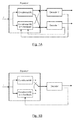
figure 1a represents the general structure of an equalizer of the invention with two decoders; -
figure 1b represents the general structure of an equalizer of the invention with a single decoder; -
figure 2 is a more detailed description of an embodiment of the equalizer of the invention; -
figure 3 discloses a receiver structure with interference cancellation. - Thanks to the development of hardware capacity, more complex structure is possible in today's wireless communication systems. For multiple data layers in MIMO transmission, one can use multiple decoders. With multiple decoders, some novel IC schemes become possible, which are faster and have similar performance as SIC. In the sequel, the linear form resulting from the two dimensional conditional ML detection is used. A CONDML-IC receiver is proposed, which benefits from multiple decoders and the turbo principle.
- An alternative approach is also proposed where a single turbo decoder is used with faster clock rate which may provide an interesting trade-off between area optimization and power consumption.
- Thus, the inventors proposed a combination of two techniques. The two combined techniques (i.e. conditional ML and turbo principle) lead to the obtaining of an iterative conditional ML (CONDML) detector for realizing MIMO detection. More specifically, a conditional ML based interference cancellation (CONDML-IC) scheme is proposed in LTE systems. However, the proposed method can be adapted for other wireless transmission system like Wimax.
- In other words, it is proposed an iterative conditional ML (CONDML) detector by using feedback from channel decoders to implement interference cancellation (IC) on different layers of the received MIMO signal. The receiver structure is globally described in
figure 1a and figure 1b . In these figures, the received signal y is fed into a new equalizer which is based on CONDML algorithm. This new equalizer comprises two various inputs. Either a standard input (i.e. the signal y ) or the feedback data which are obtained from one or more decoder. - When there is no feedback from decoder, this new equalizer acts as a conventional conditional ML equalizer; when feedback is available, CONDML with feedback is utilized to perform equalization. Then, in the point of view of the overall process, the obtained log-likelihood rations (LLR) are passed to decoders. In decoding part, one can consider:
- either multiple channel decoders to perform decoding for different data layers in parallel (see
figure 1a where two channel decoders are used). - or a single channel decoder in which the data layers are decoded successively (see
figure 1b ). - If certain criteria are met, some feedback is provided to the equalizer module and the novel CONDML equalizer is utilized to perform interference cancellation by using the feedback. In the sequel, for the sake of simplicity, one will mainly focus on multiple channel decoder case (as represented in
figure 1a ) but the same process can be performed using single channel decoder (as represented infigure 1b ). - More specifically, the method herein disclosed for cancelling interferences of a received MIMO RF signal, comprise:
- a step of receiving a signal y;
- an initial step of obtaining, from the received signal y, at least one data representative of the decoded signal, called decoded data. This initial step is implemented for example in a conventional MIMO detection and channel decoding chain (see 5.2.1 where CONDML is implemented for obtaining LLRs and turbo decoding is performed on LRRs).
- computing the decoded data in function of at least one predetermined criterion, delivering feedback data and a feedback decision;
- constructing a set of feedback symbols from the feedback data; these feedback symbols are either obtained from hard decision feedback data or soft decision feedback data; the construction is made in a feedback construction module.
- obtaining, from the set of feedback symbols (soft or hard), at least one data representative of a feedback decoded signal, called feedback decoded data; this step of obtaining is performed using the new CONDML-IC.
- computing the at least one feedback decoded data in function of the at least one predetermined criterion, delivering feedback data.
- In a first embodiment, hard decisions (which are bits coming from the decoder) are used in a single complementary iteration (In this case the predetermined number of iterations is 1) to obtain a correct decoded value.
- In a second embodiment, some probabilities (which are also called soft decision) are used for the iterations in order to obtain a correct decoded value (the number of iteration is predetermined but is not limited to one).
- In other words, the method comprises:
- a. Receive the multicarrier signals which are fed into conditional ML detector (y).
- b. Implement CONDML to obtain LLRs on each coded bits.
- c. After LLR arrangement module, perform turbo decoder based on LLRs.
- d. Decide whether feedback based on chosen criterion. If feedback, perform step e; if do not feedback, go to step h.
- e. After feedback construction module, LLRs are fed to CONDML detector. Based on the feedback, perform the CONDML-IC and obtain a new batch of LLRs.
- f. After LLR arrangement module, perform turbo decoder based on LLRs.
- g. If the feedback in step d is hard decision, perform step h; if the feedback in step d is soft, perform the whole steps from d to g until the maximum iterations are obtained.
- h. Based on the obtained LLRs on systematic bits, perform final hard decision.
- The disclosed method provides the following advantages:
- A separate single function can be used for both initial conditional ML and further iterative steps with either soft feedback or hard decision feedback.
- With soft information based feedback, performances are improved and approach best achievable performance.
- With hard decision and cyclic redundancy check (CRC) based feedback, the improved performance depends on the possibility to have one CRC OK and one CRC KO. One can have higher possibility to have different CRC values when different modulation and coding scheme (MCSs) are used for each layer.
- Both soft and hard decision based feedback improve the performances. The improvement depends on the occurrence of different CRC from two code words. When the possibility of different CRCs increases, the improvement will increase almost linearly, resulting in considerable performance improvement.
- The decoder architecture can be realized by either two channel decoders or one channel decoders. In particular, instead of two channel decoders one can use one channel decoder to decode the layers successively. In this manner in order to have similar latency at the first iteration one can increase the clock rate of the channel decoder by two. This will have additional advantage in the second iteration also and will lead to more rapid processing for the iterations.
- As already exposed, the main principle of the invention is to use feedback which is obtained from decoder for realizing equalization, this feedback being used in an iterative manner. However, before the feedback can be used, a conventional MIMO detection and channel decoding has to be processed, in order to give sufficient information for realizing the interference cancellation.
- In this proposed embodiment of the invention, the conventional CONDML is always used for the first iteration (MIMO detection and channel decoding). As shown in
figure 2 , the conventional CONDML comprises a Symbol Estimation module (10), a Slicer module (20), a Distance Calculation module (30) and a log-likelihood ration (LLR) Calculation module (40). - The MIMO signal comprises a plurality of layer and for a given layer I , the conventional CONDML can be depicted as:
- 1) Perform a loop over the M complex symbols s(b 0,..., b t-1 ) of the constellation, where t stands for the number of bits in one complex symbol, this loop comprises :
- a) Compute the estimate of symbol transmitted on the l th layer

- b) Perform slicing (mapping a complex value to the closest point in a constellation of transmitted symbols) based on z l (s) to get the hard estimate (one point in the constellation)

- c) For this current symbol, compute the distance


- a) Compute the estimate of symbol transmitted on the l th layer
- 2) For each bit b i of the t bits carried by symbol S l, compute the LLR as:
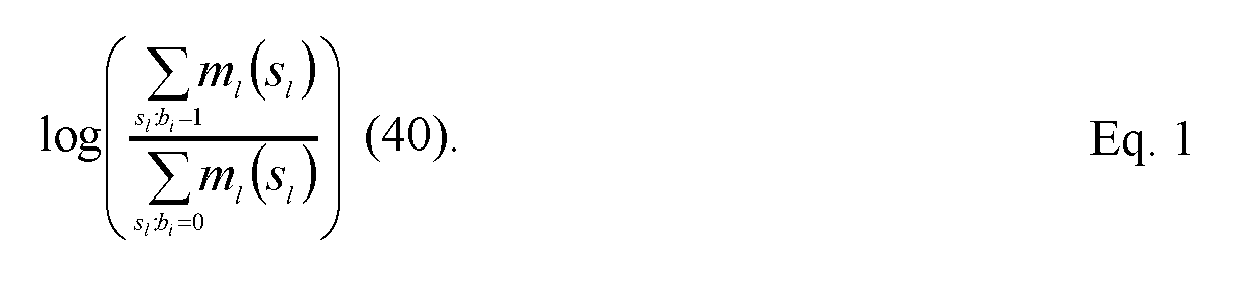
- In step 1c) and step 2), the distance and LLR calculations are complex. Some simplified methods can be considered. For example, the max-log solution may be utilized to simplify the LLR calculation, as given by:

where the notation arg max indicates that the maximum search is restricted, among the M s1:bi=1/0 distances


- As previously explained, the main principle of the invention is based on the fact that the information obtained from the decoder is used for feedback to the novel equalizer of the invention. However, instead of using this feedback in a blind mode, it can be interesting to decide whether this feedback is useful for the decoder or not. Thus, for estimating the interest of the feedback information, the inventors have found that it can be advantageous to define feedback criteria.
- In this section, it is proposed a technique for managing these criteria in a specific case applied to CRC.
- In recent wireless communication systems, the CRC is often available and used for different purposes.
- In LTE for example, a CRC is a specifically designed code to detect whether a code block is decoded correctly or not. At transmitter side, based on the information bits and some special algorithm, a CRC code is produced and attached to the information sequence. Then, the information bits and the CRC code are encoded together; a code block (CB) is obtained and transmitted. At receiver side, the code block is decoded. Based on the decoded information bits and decoded CRC bits, the receiver decides whether the code block is correctly decoded.
- As previously presented, after the conventional CONDML, LLRs are obtained and fed to channel decoders.
- After channel decoding, for each data layer, a final CRC can be obtained. In order to decide whether the feedback (the final CRC) is useful or not and how it can be provided, different criteria are proposed for different types of feedback:
- 1) Case when the CRC feedback are different: when different data layers have different CRC values (one is OK and the other one is KO), the data layers with CRC OK will be fed back to CONDML equalizer for interference cancellation over other data layers.
Figure 2 illustrates an example with two data layers. After decoders, two CRCs are obtained for two code words. The two CRCs are checked by a XOR module:
In present disclosure, this feedback criterion is special for "hard" feedback, which means that the hard decisions of coded bits are fed back to the equalizer (bit equal to 0 or 1). - 2) Case where there is a single wrong feedback: when one or more CRC values are KO, all data layers are fed back to the equalizer and the interference cancellation process will be performed over all data layers. This criterion is proposed for "soft" feedback (probabilities of presence of a bit instead of a binary information), which means that the extrinsic information of coded bits, instead of hard decisions (0 or 1), is fed back. By considering the example in
figure 2 , one can express this criterion as
- Based on different feedback criteria presented above, two different types of CONDML-IC are proposed in the present disclosure, each of the two criteria presented above corresponding to one specific algorithm. In this embodiment, one criterion corresponds to one special algorithm. Thus, for an algorithm, only one criterion is considered. However, in other embodiments, other criteria can be considered and a specific algorithm can be employed in conjunction with several criteria
- If the corresponding feedback criterion is met for a certain algorithm, the proposed CONDML-IC is performed to improve system performances. This means that, in this embodiment it has been chosen that performances are not improved if the feedback criterion is not met.
- This soft information based feedback leads to the construction of a set of feedback symbols from the feedback data; in this case the feedback symbols are "soft" symbols (i.e. probabilistic symbols) and leads to the use of these soft symbols in conditional ML based on soft information, for obtaining at least one data representative of a "soft" decoded signal, called soft decoded data (in following iterations).
- More specifically, considering the current wireless communication systems, the inventors have had the idea using the soft information on all coded bits from channel decoders. Then, all soft information passes the same modules as the coded bits did at transmitter side (i.e. rate match module, scramble module and modulation module which are well known from the one skilled in the art), making the feedback match the actually transmitted bits.
- All these modules (i.e. rate match module, scramble module and modulation module) are modelled as one single "Feedback Construction" module, as shown in
figure 3 . Based on the obtained LLR from the equalizer module (EQU), the probability on each bit P(b¡) can be derived and the soft symbol S1-l (b0, ..., b t-1) is calculated in Modulation module as:
where x k represents the complex constellation point and bi ∈ x k . Then, the inventors have had the idea to use this soft symbol
- Thus, the conditional ML based on soft information can be depicted as:
- 1) perform a loop over the M complex symbols

- a) perform slicing based on


- b) compute the distance

- a) perform slicing based on
- 2) for each bit bi of the t bits carried by sl , compute the LLR as Eq. 1 in LLR calculation module (40). Similarly, some simplified LLR calculation methods can be adopted in this step, as shown in Eq. 2 or Eq. 3 serving as an example.
- With this soft information based feedback, it is not necessary to calculate z l (s) (10) which is related to the size of constellation M, while a simple distance calculation is done in step 1b). It is also worth noting that the soft information

- Also, the steps 1) and 2) can be replaced by a zero forcing (ZF) method which does not need the loop over M complex symbols, resulting in a simpler method.
- This hard-decision based feedback leads to the construction of a set of feedback symbols from the feedback data; in this case the feedback symbols are "hard decision" symbols (i.e. real decoded bits) and leads to the use of these hard decision symbols in conditional ML based on hard decision information.
- More specifically, with hard-decision feedback, when the values of CRC for two code words are different (i.e, one OK and the other one KO), the codeword which has the CRC OK is feedback and conditional ML is implemented based on this hard decision feedback.
- This method means that the codeword which is more reliable (to correct the other codeword which is not correctly decoded) is chosen.
- With the Feedback Construction module (previously described), the second iteration based on hard decision can be depicted as:
- 1) Check the values of CRC for both code words (50)
- a) If two CRC values are the same, no feedback. The decoding is done.
- b) If two CRC values are different, feedback the hard decisions of codeword having the CRC value OK.
- 2) Denote the fed back hard decision as


- 3) Use


- a) Compute the distance

- a) Compute the distance
- 4) For each bit bi of the t bits carried by sl , compute the LLR with Eq. 1 or some simplified versions, which can be the max-log algorithm shown in Eq. 2 (40) or more simplified case given in Eq. 3.
- With this hard decision and CRC based feedback, the calculation of zl (s) and slicing whose complexity changes according to the size of constellation M are not needed, since it is only done a simple distance calculation in step 3). Similarly, the steps 3) and 4) can be replaced by a ZF method, which simplifies the proposed equalizer.
- Note that the first method (5.2.3.1) can be also implemented based on the CRC feedback used in the second method (5.2.3.2).
- In the proposed CONDML-IC, the same hardware modules of conventional CONDML can be used for CONDML-IC without adding any hardware module to equalizer part. In
figure 2 , the hardware modules are shown for CONDML, including Symbol Estimation, Slicer, Distance Calculation and LLR calculation modules. After decoding, some feedback may be available for the CONDML-IC. With the feedback, the Symbol Estimation and Slicer modules are not utilized anymore, but only the Distance Calculation and LLR calculation modules are needed to perform CONDML-IC. Therefore, for the equalizer part, no additional modules are needed for the proposed method. -
Figure 3 describes an apparatus for implementing the method for cancelling interference according to previously presented embodiments. This apparatus can be depicted as a signal processing unit of a MIMO receiver. - This apparatus comprises an equalizer (EQU) which implements the conditional ML and the conditional ML IC as previously described. This apparatus comprises two turbo-decoders (TDC), one per layer, which allows decoding LLR results obtained by LLR arrangement modules. The turbo-decoders (TDC) output the decoded bits and the CRC.
- For the two layers in process, the CRC are compared and a feedback decision is taken in view of this comparison and the decoded bits and/or the probabilities of the decoded bits (FB?). If a feedback is decided, the decoded bits are fed to the feedback construction module (which comprises rate match module, scramble module and modulation module). This feedback construction module realises the construction of the so called feedback symbols (which could be soft symbols when the soft criterion is used or hard decision symbol when the hard decision criterion is used). Thus, the feedback symbol is then fed to the equalizer.
- When hard decision is used, there is only a new iteration, as previously explained.
- When soft decision is used, a maximum number of iterations can be fixed (i.e. with a predetermined threshold) and when this maximum number of iterations is reached, the iterative process is stopped. However, the iterative process can be stopped even when the maximum number of iteration is not reached when, for example, for both layers CRCs are conform.
Claims (7)
- Method for cancelling interferences of a received MIMO RF signal, characterized in that said method comprises:- a step of receiving a signal y;- an initial step of obtaining, from said received signal y, at least one data representative of said decoded signal, called decoded data;- computing said at least one decoded data in function of at least one predetermined criterion, delivering feedback data and a feedback decision;and, in function of said feedback decision, at least one iteration of the following steps:- constructing a set of feedback symbols from said feedback data;- a step of obtaining, from said set of feedback symbols, at least one data representative of a feedback decoded signal, called feedback decoded data;- computing said at least one feedback decoded data in function of said at least one predetermined criterion, delivering feedback data;
- Method according to claim 1, characterized in that said step of computing said at least one decoded data in function of said at least one predetermined criterion comprises:- a step of obtaining at least two cyclic redundancy checks from said decoded data;- a step of obtaining a criterion to applied to said at least two cyclic redundancy checks,- a step of comparing said at least two cyclic redundancy checks; and- a step deciding whether feedback data are delivered for further processing in function of said step of comparing and said criterion, delivering a feedback decision.
- Method according to claim 2, characterized in that said at least one predetermined criterion belong to the groups comprising:- hard decision criterion in which a decision of feedback is took when the values of said at least two cyclic redundancy checks are different;- a soft decision criterion in which a decision of feedback is took when at least one of the two cyclic redundancy checks is wrong.
- Method according to claim 2, characterized in that the number of iteration is function of said criterion and in function of said at least two cyclic redundancy checks .
- Method according to claim 1, characterized in that said initial step of obtaining at least one decoded data comprises, for M symbols of a current layer of said signal, at least M iterations of the following steps:- a step of estimating a given symbol of said layer of said signal;- a step of mapping a complex value to the closest point in a constellation of said estimated symbol, delivering an hard estimate;- a step calculating of a distance associated to said hard estimate of in function of said received symbol, said constellation;and, once the M distances have been calculated,- a step calculating log-likelihood rations (LLR) in function of said calculated distances;- a step of decoding said log-likelihood rations (LLR), delivering said decoded data.
- Apparatus for cancelling interferences of a received MIMO RF signal, characterized in that said apparatus comprises:- means of receiving a signal y;- means of obtaining, from said received signal y, at least one data representative of said decoded signal, called decoded data;- means of computing said at least one decoded data in function of at least one predetermined criterion, delivering feedback data and a feedback decision;- means of constructing a set of feedback symbols from said feedback data;- means of obtaining, from said set of feedback symbols, at least one data representative of a feedback decoded signal, called feedback decoded data;- means of computing said at least one feedback decoded data in function of said at least one predetermined criterion, delivering feedback data;
- Computer program product downloadable from a communications network and/or stored on a computer readable medium and/or executed by a microprocessor, characterized in that it includes instructions of program code for implementing the interference cancelling method by at least one of claims 1 to 5 when run on a computer.
Priority Applications (2)
| Application Number | Priority Date | Filing Date | Title |
|---|---|---|---|
| EP11306565.0A EP2597797B1 (en) | 2011-11-25 | 2011-11-25 | Interference cancellation method with multiple data layer MIMO transmission |
| US13/685,234 US8929491B2 (en) | 2011-11-25 | 2012-11-26 | Interference cancellation method with multiple data layer MIMO transmission |
Applications Claiming Priority (1)
| Application Number | Priority Date | Filing Date | Title |
|---|---|---|---|
| EP11306565.0A EP2597797B1 (en) | 2011-11-25 | 2011-11-25 | Interference cancellation method with multiple data layer MIMO transmission |
Publications (2)
| Publication Number | Publication Date |
|---|---|
| EP2597797A1 true EP2597797A1 (en) | 2013-05-29 |
| EP2597797B1 EP2597797B1 (en) | 2017-07-26 |
Family
ID=45315673
Family Applications (1)
| Application Number | Title | Priority Date | Filing Date |
|---|---|---|---|
| EP11306565.0A Not-in-force EP2597797B1 (en) | 2011-11-25 | 2011-11-25 | Interference cancellation method with multiple data layer MIMO transmission |
Country Status (2)
| Country | Link |
|---|---|
| US (1) | US8929491B2 (en) |
| EP (1) | EP2597797B1 (en) |
Families Citing this family (4)
| Publication number | Priority date | Publication date | Assignee | Title |
|---|---|---|---|---|
| US9172413B2 (en) * | 2013-02-08 | 2015-10-27 | Mediatek Inc. | Method and apparatus for performing wireless communications with aid of successive data processing in multiple iterations |
| US9197267B2 (en) | 2013-04-09 | 2015-11-24 | Qualcomm Incorporated | Methods and apparatus for joint demodulation with max-log MAP (MLM) |
| WO2015101384A1 (en) * | 2013-12-30 | 2015-07-09 | Telecom Italia S.P.A. | Improved receiver for wireless communications networks |
| WO2021001032A1 (en) * | 2019-07-03 | 2021-01-07 | Nokia Technologies Oy | Transmission system with channel estimation based on a neural network |
Family Cites Families (3)
| Publication number | Priority date | Publication date | Assignee | Title |
|---|---|---|---|---|
| US20030125040A1 (en) * | 2001-11-06 | 2003-07-03 | Walton Jay R. | Multiple-access multiple-input multiple-output (MIMO) communication system |
| US7895503B2 (en) * | 2006-01-11 | 2011-02-22 | Qualcomm Incorporated | Sphere detection and rate selection for a MIMO transmission |
| US8989320B2 (en) | 2009-09-02 | 2015-03-24 | Qualcomm Incorporated | Hardware simplification of sic-MIMO decoding by use of a single hardware element with channel and noise adaptation for interference cancelled streams |
-
2011
- 2011-11-25 EP EP11306565.0A patent/EP2597797B1/en not_active Not-in-force
-
2012
- 2012-11-26 US US13/685,234 patent/US8929491B2/en active Active
Non-Patent Citations (3)
| Title |
|---|
| JIANKANG ZHANG ET AL: "Channel Code Aided Decision-Directed Channel Estimation for MIMO OFDM/SDMA Systems Based on the Expectation-Conditional Maximization Either Algorithm", GLOBECOM 2010, 2010 IEEE GLOBAL TELECOMMUNICATIONS CONFERENCE, IEEE, PISCATAWAY, NJ, USA, 6 December 2010 (2010-12-06), pages 1 - 5, XP031845783, ISBN: 978-1-4244-5636-9 * |
| JIANKANG ZHANG ET AL: "Joint Decision-Directed Channel and Noise-Variance Estimation for MIMO OFDM/SDMA Systems Based on Expectation-Conditional Maximization", IEEE TRANSACTIONS ON VEHICULAR TECHNOLOGY, IEEE SERVICE CENTER, PISCATAWAY, NJ, US, vol. 60, no. 5, 1 June 2011 (2011-06-01), pages 2139 - 2151, XP011355648, ISSN: 0018-9545, DOI: 10.1109/TVT.2011.2148184 * |
| YANG LIU ET AL: "Simplified EM channel estimation in LTE systems", ACOUSTICS, SPEECH AND SIGNAL PROCESSING (ICASSP), 2011 IEEE INTERNATIONAL CONFERENCE ON, IEEE, 22 May 2011 (2011-05-22), pages 3480 - 3483, XP032000563, ISBN: 978-1-4577-0538-0, DOI: 10.1109/ICASSP.2011.5946227 * |
Also Published As
| Publication number | Publication date |
|---|---|
| US20130163704A1 (en) | 2013-06-27 |
| EP2597797B1 (en) | 2017-07-26 |
| US8929491B2 (en) | 2015-01-06 |
Similar Documents
| Publication | Publication Date | Title |
|---|---|---|
| US6757337B2 (en) | Coding-assisted MIMO joint detection and decoding | |
| Li et al. | Multiple feedback successive interference cancellation detection for multiuser MIMO systems | |
| US7986752B2 (en) | Parallel soft spherical MIMO receiver and decoding method | |
| RU2414062C2 (en) | Low-complexity detection and decoding for receiver in communication system | |
| EP1971063B1 (en) | Method and apparatus for multiple antenna communications, and related systems and computer program | |
| US8630379B1 (en) | Methods and apparatus for multiple input multiple output (MIMO) successive interference cancellation (SIC) | |
| US8218671B2 (en) | Receiving apparatus, receiving method and communication system | |
| KR101041945B1 (en) | Signal detecting apparatus and method in multi-antenna system | |
| JP2009527174A (en) | Apparatus, method and computer program for providing MIMO receiver | |
| US8488721B2 (en) | Adaptive QRD-M algorithm based signal detecting method by using constellation set grouping in spatial multiplexing multiple-input multiple-output system | |
| CN102742201A (en) | Method for transmitting a digital signal for a semi-orthogonal frame system having half-duplex relay, and corresponding program product and relay device | |
| US8255766B2 (en) | Receiving apparatus and method for interference cancellation in a wireless communication system | |
| US8929491B2 (en) | Interference cancellation method with multiple data layer MIMO transmission | |
| US20060171483A1 (en) | Decoder for a multiplexed transmission system | |
| US20090310725A1 (en) | Space Domain Filter Detecting Method In A Multi-Antenna Wireless Communication System | |
| Ivanov et al. | Iterative nonlinear detection and decoding in multi-user massive MIMO | |
| EP1635500A1 (en) | A receiver for use in MIMO system | |
| KR20120119935A (en) | Method and apparatus of detecting signal based on minimum mean square error in multiple input multiple output system | |
| RU2523190C1 (en) | Method for iterative detection and decoding of signal in communication systems with mimo channel | |
| EP1609265B1 (en) | Signal processing apparatus and method | |
| Mao et al. | Markov chain Monte Carlo MIMO detection methods for high signal-to-noise ratio regimes | |
| US11923927B2 (en) | M-MIMO receiver | |
| JP5585191B2 (en) | Communication apparatus and communication method | |
| US9225468B1 (en) | Systems and methods for detecting data in a received multiple-input-multiple-output (MIMO) signal | |
| Wang et al. | Joint turbo receiver for LDPC-coded MIMO systems based on semi-definite relaxation |
Legal Events
| Date | Code | Title | Description |
|---|---|---|---|
| PUAI | Public reference made under article 153(3) epc to a published international application that has entered the european phase |
Free format text: ORIGINAL CODE: 0009012 |
|
| 17P | Request for examination filed |
Effective date: 20121030 |
|
| AK | Designated contracting states |
Kind code of ref document: A1 Designated state(s): AL AT BE BG CH CY CZ DE DK EE ES FI FR GB GR HR HU IE IS IT LI LT LU LV MC MK MT NL NO PL PT RO RS SE SI SK SM TR |
|
| AX | Request for extension of the european patent |
Extension state: BA ME |
|
| 17Q | First examination report despatched |
Effective date: 20140530 |
|
| RAP1 | Party data changed (applicant data changed or rights of an application transferred) |
Owner name: SEQUANS COMMUNICATIONS |
|
| GRAP | Despatch of communication of intention to grant a patent |
Free format text: ORIGINAL CODE: EPIDOSNIGR1 |
|
| INTG | Intention to grant announced |
Effective date: 20170425 |
|
| GRAS | Grant fee paid |
Free format text: ORIGINAL CODE: EPIDOSNIGR3 |
|
| GRAA | (expected) grant |
Free format text: ORIGINAL CODE: 0009210 |
|
| AK | Designated contracting states |
Kind code of ref document: B1 Designated state(s): AL AT BE BG CH CY CZ DE DK EE ES FI FR GB GR HR HU IE IS IT LI LT LU LV MC MK MT NL NO PL PT RO RS SE SI SK SM TR |
|
| REG | Reference to a national code |
Ref country code: GB Ref legal event code: FG4D |
|
| REG | Reference to a national code |
Ref country code: CH Ref legal event code: EP |
|
| REG | Reference to a national code |
Ref country code: AT Ref legal event code: REF Ref document number: 913188 Country of ref document: AT Kind code of ref document: T Effective date: 20170815 |
|
| REG | Reference to a national code |
Ref country code: IE Ref legal event code: FG4D |
|
| REG | Reference to a national code |
Ref country code: DE Ref legal event code: R096 Ref document number: 602011039902 Country of ref document: DE |
|
| REG | Reference to a national code |
Ref country code: NL Ref legal event code: MP Effective date: 20170726 |
|
| REG | Reference to a national code |
Ref country code: LT Ref legal event code: MG4D |
|
| REG | Reference to a national code |
Ref country code: AT Ref legal event code: MK05 Ref document number: 913188 Country of ref document: AT Kind code of ref document: T Effective date: 20170726 |
|
| PG25 | Lapsed in a contracting state [announced via postgrant information from national office to epo] |
Ref country code: FI Free format text: LAPSE BECAUSE OF FAILURE TO SUBMIT A TRANSLATION OF THE DESCRIPTION OR TO PAY THE FEE WITHIN THE PRESCRIBED TIME-LIMIT Effective date: 20170726 Ref country code: SE Free format text: LAPSE BECAUSE OF FAILURE TO SUBMIT A TRANSLATION OF THE DESCRIPTION OR TO PAY THE FEE WITHIN THE PRESCRIBED TIME-LIMIT Effective date: 20170726 Ref country code: AT Free format text: LAPSE BECAUSE OF FAILURE TO SUBMIT A TRANSLATION OF THE DESCRIPTION OR TO PAY THE FEE WITHIN THE PRESCRIBED TIME-LIMIT Effective date: 20170726 Ref country code: HR Free format text: LAPSE BECAUSE OF FAILURE TO SUBMIT A TRANSLATION OF THE DESCRIPTION OR TO PAY THE FEE WITHIN THE PRESCRIBED TIME-LIMIT Effective date: 20170726 Ref country code: NO Free format text: LAPSE BECAUSE OF FAILURE TO SUBMIT A TRANSLATION OF THE DESCRIPTION OR TO PAY THE FEE WITHIN THE PRESCRIBED TIME-LIMIT Effective date: 20171026 Ref country code: NL Free format text: LAPSE BECAUSE OF FAILURE TO SUBMIT A TRANSLATION OF THE DESCRIPTION OR TO PAY THE FEE WITHIN THE PRESCRIBED TIME-LIMIT Effective date: 20170726 Ref country code: LT Free format text: LAPSE BECAUSE OF FAILURE TO SUBMIT A TRANSLATION OF THE DESCRIPTION OR TO PAY THE FEE WITHIN THE PRESCRIBED TIME-LIMIT Effective date: 20170726 |
|
| PG25 | Lapsed in a contracting state [announced via postgrant information from national office to epo] |
Ref country code: GR Free format text: LAPSE BECAUSE OF FAILURE TO SUBMIT A TRANSLATION OF THE DESCRIPTION OR TO PAY THE FEE WITHIN THE PRESCRIBED TIME-LIMIT Effective date: 20171027 Ref country code: IS Free format text: LAPSE BECAUSE OF FAILURE TO SUBMIT A TRANSLATION OF THE DESCRIPTION OR TO PAY THE FEE WITHIN THE PRESCRIBED TIME-LIMIT Effective date: 20171126 Ref country code: PL Free format text: LAPSE BECAUSE OF FAILURE TO SUBMIT A TRANSLATION OF THE DESCRIPTION OR TO PAY THE FEE WITHIN THE PRESCRIBED TIME-LIMIT Effective date: 20170726 Ref country code: ES Free format text: LAPSE BECAUSE OF FAILURE TO SUBMIT A TRANSLATION OF THE DESCRIPTION OR TO PAY THE FEE WITHIN THE PRESCRIBED TIME-LIMIT Effective date: 20170726 Ref country code: BG Free format text: LAPSE BECAUSE OF FAILURE TO SUBMIT A TRANSLATION OF THE DESCRIPTION OR TO PAY THE FEE WITHIN THE PRESCRIBED TIME-LIMIT Effective date: 20171026 Ref country code: RS Free format text: LAPSE BECAUSE OF FAILURE TO SUBMIT A TRANSLATION OF THE DESCRIPTION OR TO PAY THE FEE WITHIN THE PRESCRIBED TIME-LIMIT Effective date: 20170726 Ref country code: LV Free format text: LAPSE BECAUSE OF FAILURE TO SUBMIT A TRANSLATION OF THE DESCRIPTION OR TO PAY THE FEE WITHIN THE PRESCRIBED TIME-LIMIT Effective date: 20170726 |
|
| PG25 | Lapsed in a contracting state [announced via postgrant information from national office to epo] |
Ref country code: DK Free format text: LAPSE BECAUSE OF FAILURE TO SUBMIT A TRANSLATION OF THE DESCRIPTION OR TO PAY THE FEE WITHIN THE PRESCRIBED TIME-LIMIT Effective date: 20170726 Ref country code: RO Free format text: LAPSE BECAUSE OF FAILURE TO SUBMIT A TRANSLATION OF THE DESCRIPTION OR TO PAY THE FEE WITHIN THE PRESCRIBED TIME-LIMIT Effective date: 20170726 Ref country code: CZ Free format text: LAPSE BECAUSE OF FAILURE TO SUBMIT A TRANSLATION OF THE DESCRIPTION OR TO PAY THE FEE WITHIN THE PRESCRIBED TIME-LIMIT Effective date: 20170726 |
|
| REG | Reference to a national code |
Ref country code: DE Ref legal event code: R097 Ref document number: 602011039902 Country of ref document: DE |
|
| PG25 | Lapsed in a contracting state [announced via postgrant information from national office to epo] |
Ref country code: IT Free format text: LAPSE BECAUSE OF FAILURE TO SUBMIT A TRANSLATION OF THE DESCRIPTION OR TO PAY THE FEE WITHIN THE PRESCRIBED TIME-LIMIT Effective date: 20170726 Ref country code: SM Free format text: LAPSE BECAUSE OF FAILURE TO SUBMIT A TRANSLATION OF THE DESCRIPTION OR TO PAY THE FEE WITHIN THE PRESCRIBED TIME-LIMIT Effective date: 20170726 Ref country code: SK Free format text: LAPSE BECAUSE OF FAILURE TO SUBMIT A TRANSLATION OF THE DESCRIPTION OR TO PAY THE FEE WITHIN THE PRESCRIBED TIME-LIMIT Effective date: 20170726 Ref country code: EE Free format text: LAPSE BECAUSE OF FAILURE TO SUBMIT A TRANSLATION OF THE DESCRIPTION OR TO PAY THE FEE WITHIN THE PRESCRIBED TIME-LIMIT Effective date: 20170726 |
|
| PLBE | No opposition filed within time limit |
Free format text: ORIGINAL CODE: 0009261 |
|
| STAA | Information on the status of an ep patent application or granted ep patent |
Free format text: STATUS: NO OPPOSITION FILED WITHIN TIME LIMIT |
|
| REG | Reference to a national code |
Ref country code: DE Ref legal event code: R119 Ref document number: 602011039902 Country of ref document: DE |
|
| PG25 | Lapsed in a contracting state [announced via postgrant information from national office to epo] |
Ref country code: MC Free format text: LAPSE BECAUSE OF FAILURE TO SUBMIT A TRANSLATION OF THE DESCRIPTION OR TO PAY THE FEE WITHIN THE PRESCRIBED TIME-LIMIT Effective date: 20170726 |
|
| 26N | No opposition filed |
Effective date: 20180430 |
|
| GBPC | Gb: european patent ceased through non-payment of renewal fee |
Effective date: 20171125 |
|
| PG25 | Lapsed in a contracting state [announced via postgrant information from national office to epo] |
Ref country code: CH Free format text: LAPSE BECAUSE OF NON-PAYMENT OF DUE FEES Effective date: 20171130 Ref country code: LI Free format text: LAPSE BECAUSE OF NON-PAYMENT OF DUE FEES Effective date: 20171130 |
|
| PG25 | Lapsed in a contracting state [announced via postgrant information from national office to epo] |
Ref country code: SI Free format text: LAPSE BECAUSE OF FAILURE TO SUBMIT A TRANSLATION OF THE DESCRIPTION OR TO PAY THE FEE WITHIN THE PRESCRIBED TIME-LIMIT Effective date: 20170726 Ref country code: LU Free format text: LAPSE BECAUSE OF NON-PAYMENT OF DUE FEES Effective date: 20171125 |
|
| REG | Reference to a national code |
Ref country code: FR Ref legal event code: ST Effective date: 20180731 Ref country code: BE Ref legal event code: MM Effective date: 20171130 |
|
| REG | Reference to a national code |
Ref country code: IE Ref legal event code: MM4A |
|
| PG25 | Lapsed in a contracting state [announced via postgrant information from national office to epo] |
Ref country code: MT Free format text: LAPSE BECAUSE OF NON-PAYMENT OF DUE FEES Effective date: 20171125 |
|
| PG25 | Lapsed in a contracting state [announced via postgrant information from national office to epo] |
Ref country code: DE Free format text: LAPSE BECAUSE OF NON-PAYMENT OF DUE FEES Effective date: 20180602 Ref country code: IE Free format text: LAPSE BECAUSE OF NON-PAYMENT OF DUE FEES Effective date: 20171125 Ref country code: FR Free format text: LAPSE BECAUSE OF NON-PAYMENT OF DUE FEES Effective date: 20171130 |
|
| PG25 | Lapsed in a contracting state [announced via postgrant information from national office to epo] |
Ref country code: GB Free format text: LAPSE BECAUSE OF NON-PAYMENT OF DUE FEES Effective date: 20171125 Ref country code: BE Free format text: LAPSE BECAUSE OF NON-PAYMENT OF DUE FEES Effective date: 20171130 |
|
| PG25 | Lapsed in a contracting state [announced via postgrant information from national office to epo] |
Ref country code: HU Free format text: LAPSE BECAUSE OF FAILURE TO SUBMIT A TRANSLATION OF THE DESCRIPTION OR TO PAY THE FEE WITHIN THE PRESCRIBED TIME-LIMIT; INVALID AB INITIO Effective date: 20111125 |
|
| PG25 | Lapsed in a contracting state [announced via postgrant information from national office to epo] |
Ref country code: CY Free format text: LAPSE BECAUSE OF NON-PAYMENT OF DUE FEES Effective date: 20170726 |
|
| PG25 | Lapsed in a contracting state [announced via postgrant information from national office to epo] |
Ref country code: MK Free format text: LAPSE BECAUSE OF FAILURE TO SUBMIT A TRANSLATION OF THE DESCRIPTION OR TO PAY THE FEE WITHIN THE PRESCRIBED TIME-LIMIT Effective date: 20170726 |
|
| PG25 | Lapsed in a contracting state [announced via postgrant information from national office to epo] |
Ref country code: TR Free format text: LAPSE BECAUSE OF FAILURE TO SUBMIT A TRANSLATION OF THE DESCRIPTION OR TO PAY THE FEE WITHIN THE PRESCRIBED TIME-LIMIT Effective date: 20170726 |
|
| PG25 | Lapsed in a contracting state [announced via postgrant information from national office to epo] |
Ref country code: PT Free format text: LAPSE BECAUSE OF FAILURE TO SUBMIT A TRANSLATION OF THE DESCRIPTION OR TO PAY THE FEE WITHIN THE PRESCRIBED TIME-LIMIT Effective date: 20170726 |
|
| PG25 | Lapsed in a contracting state [announced via postgrant information from national office to epo] |
Ref country code: AL Free format text: LAPSE BECAUSE OF FAILURE TO SUBMIT A TRANSLATION OF THE DESCRIPTION OR TO PAY THE FEE WITHIN THE PRESCRIBED TIME-LIMIT Effective date: 20170726 |