EP2595078A1 - Method and apparatus for managing DRM information in a network - Google Patents
Method and apparatus for managing DRM information in a network Download PDFInfo
- Publication number
- EP2595078A1 EP2595078A1 EP11306525.4A EP11306525A EP2595078A1 EP 2595078 A1 EP2595078 A1 EP 2595078A1 EP 11306525 A EP11306525 A EP 11306525A EP 2595078 A1 EP2595078 A1 EP 2595078A1
- Authority
- EP
- European Patent Office
- Prior art keywords
- license
- requesting entity
- network
- file
- detecting
- Prior art date
- Legal status (The legal status is an assumption and is not a legal conclusion. Google has not performed a legal analysis and makes no representation as to the accuracy of the status listed.)
- Withdrawn
Links
Images



Classifications
-
- G—PHYSICS
- G06—COMPUTING OR CALCULATING; COUNTING
- G06F—ELECTRIC DIGITAL DATA PROCESSING
- G06F21/00—Security arrangements for protecting computers, components thereof, programs or data against unauthorised activity
- G06F21/10—Protecting distributed programs or content, e.g. vending or licensing of copyrighted material ; Digital rights management [DRM]
Definitions
- the present invention pertains to the field of digital rights management (DRM), and in particular to facilitating the coexistence of multiple DRM technologies in a networked environment.
- DRM digital rights management
- DRM Digital Rights Management
- DRM License Acquisition needs to be performed multiple times (once per DRM) for any downloaded (or streamed) content file, and the result can be cached in the downloaded file (or recorded file if recording while streaming is authorized).
- a content file whether made available for downloading or streaming, will hereinafter be referred to as a "program".
- the License Acquisition is always done on an "as needed" basis, while at the same time users are allowed to exchange and copy files freely.
- users will end up having multiple copies of the file with incomplete license information and users will not understand what to do with these multiple copies and will end up deleting files with validly acquired licenses, thereby causing a lot of burden and frustration to the user.
- a method for managing DRM information in a network comprising at a node in the network: detecting a first requesting entity requiring a first license associated with a target program under a first target DRM scheme; and, in response to said detecting, obtaining and storing the first license and a second license, the second license being associated with the target program under a second target DRM scheme, and providing the first license and the second license to the first requesting entity.
- licenses for a given program of interest are acquired proactively for a plurality of DRM schemes, as soon as the need for a single license is detected.
- the detection of the requesting entity can happen as a result of an explicit request for a specific license, which is received or intercepted at the node according to the invention.
- the detection can also be the result of an implicit request, such as an attempt to download, stream, copy, or move a program, which attempt is detected or intercepted by the node according to the invention, whereby this node is capable of associating the requesting entity with a particular type of license, for instance by means of a DRM scheme table kept for that purpose, or by directly interrogating the requesting entity.
- the method according to the present invention further comprises at said node: detecting a second requesting entity requiring the second license; and in response to the second request, retrieving the stored first license and the stored second license and providing the retrieved first license and the retrieved second license to the second requesting entity.
- the first requesting entity and/or said second requesting entity comprises content playing software running at the node
- the detecting of said respective first and/or second requesting entity requiring a license comprises detecting an API call from the content playing software
- This embodiment pertains inter alia to situations where the means to carry out the method according to the invention and a media player (requesting entity) are combined in a single device.
- the node responsible for proactive license acquisition may be a media player.
- the media player software may request an appropriate license for its own use upon the first attempt to play a program.
- This request - which remains internal to the device - triggers the further steps of the present invention if it is indeed the first request, so as to populate a cache of licenses for the same program under various DRM schemes. If the internal request is not the first request, a prior request, e.g. from a different requester, will have triggered the preparation of the license cache, and a stored license will be available.
- the first requesting entity and/or the second requesting entity comprises a device attached to the network, and detecting of the respective first and/or second requesting entity requiring a license comprises receiving a message from the device over the network.
- This embodiment pertains inter alia to situations where the means to carry out the method according to the invention and a media player (requesting entity) are separate devices, connected to each other via a network.
- the node responsible for proactive license acquisition may be a media gateway.
- the various media players attached to the media gateway may request a program, or an appropriate license for their own use upon the first attempt to play a program.
- Such requests are transmitted to the gateway over the (local) network, wherein the first such request for any given program triggers the further steps of the present invention, so as to populate a cache of licenses for the same program under various DRM schemes.
- the storing of the first license and the second license comprises creating or updating a file comprising metadata, the metadata including encrypted license keys associated with the first license and the second license.
- the file may be formatted according to the Protected Interoperable File Format (PIFF) defined by Microsoft Corporation or according to the Common File Format (CFF) defined by the DECE standard (publicly available at http://www.uvvu.com/docs/public/Tech_Spec_Package-public.zip).
- PIFF Protected Interoperable File Format
- CFF Common File Format
- the providing the first license and the second license comprises providing the file comprising the metadata.
- a collection of licenses may be provided in a single file, to ensure that later recipients of the same file have maximal chances of finding a license which is appropriate for their DRM scheme. It is a further advantage of this embodiment that the transmission of license information may be separated from the transmission of program data.
- the file further comprises program content.
- the detecting of the respective first and/or second requesting entity requiring a license comprises detecting that the respective first and/or second requesting entity attempts to download, stream, copy, or move a program file.
- the requesting entities can be media players that are not specifically configured to interact with the node. It surrices that the node is placed in a topologically appropriate point in the network (e.g. as a residential gateway in the home network) to allow it to intercept communications pertaining to the normal operation of the media players. The node/gateway may then be configured to detect the need for a particular license on the basis of the intercepted communications.
- a topologically appropriate point in the network e.g. as a residential gateway in the home network
- a computer program configured to cause a processor to perform a method as described above.
- an apparatus for managing DRM information in a network comprising: a first network interface for communicating with a subscriber-side network; a second network interface for communicating with a provider-side network; a file storage interface for storing and retrieving files stored at a file storage; and a processing unit; wherein the processing unit is configured to: receive a first signal from a first requesting entity via the first network interface, the first requesting entity requiring a first license associated with a target program under a first target DRM scheme; acquire, in response to said receiving, the first license and a second license from respective license servers via the second network interface, the second license being associated with said target program under a second target DRM scheme; store said first license and said second license in the file storage attached to the file storage interface; and provide the first license and the second license to the first requesting entity via the first network interface.
- said processing unit is further configured to: receive a second signal from a second requesting entity via said first network interface, said second requesting entity requiring the second license; retrieve the second license from the file storage attached to the file storage interface; and provide the first license and the second license to the second requesting entity via the second network interface.
- the apparatus according to the present invention further comprises a storage device operatively connected to said file storage interface.
- a media gateway comprising the apparatus described above.
- the media gateway may combine the features of the present invention with media file storage and/or replay functionality.
- a residential gateway comprising the apparatus described above.
- the residential gateway may combine the features of the present invention with subscriber line termination (modem) functions, switching, and/or routing.
- modem subscriber line termination
- an access node comprising the apparatus described above.
- the access node may combine the features of the present invention with subscriber line termination (modem) functions and/or centralized storage.
- modem subscriber line termination
- the present invention is based on the insight of the inventor that it is advantageous to allow consumer devices at home to transparently manage license information from content files on behalf of the user or on behalf of each other.
- Figure 1 illustrates an exemplary network in which methods and apparatus according to the present invention may be used.
- Three consumer electronics devices are shown: a portable media player 131, a laptop computer 132, and a television set 133.
- the skilled person will understand that the principles of the invention apply to any number of devices, and to any type of device, provided that the device is capable of performing certain actions with respect to DRM-protected content.
- a first device or "a second device”
- FIG. 1 further illustrates a gateway device 100, connected to a provider-side network 150, such as the Internet, and to subscriber-side network 130, such as a home network.
- a provider-side network 150 such as the Internet
- subscriber-side network 130 such as a home network.
- the gateway device 100 is part of the home network, and as such it may be integrated with a modem and provide additional home gateway functions such as firewalling, web caching, switching and routing, etc.
- the gateway device 100 may also be part of a media center in the home network.
- a single gateway device 100 would typically serve the needs of a single household, which includes multiple DRM domains registered with this household.
- the gateway device 100 may alternatively be integrated in an access node such as a DSLAM.
- the subscriber-side network 130 includes the access link (e.g., an xDSL, EFM, or xPON link).
- the gateway device 100 is illustrated as a device comprising a processing unit 110 and a storage 120, although other physical implementations are of course possible.
- the storage 120 is adapted to store licenses for content files and may also serve as storage for the content files themselves; in particular, the storage 120 is capable of storing and retrieving a number of different licenses, issued by different license servers for use with different DRM schemes, pertaining to the same content file.
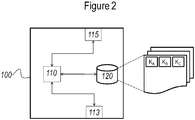
- FIG 2 provides a more detailed schematic view of the gateway device 100 of Figure 1 .
- the device 100 comprises a first interface 113, configured to communicate with the subscriber-side network 130, preferably a home network.
- the device 100 further comprises a second interface 115, configured to communicate with the provider-side network 150, preferably the Internet, or an access network providing access to the Internet.
- the term "interface” is meant to include the hardware and software that is necessary to exchange messages with other devices on the network, according to appropriate protocols as are well known to persons skilled in the art.
- the subscriber-side network may be a local area network, consisting for example of one or more segments according to standards including IEEE 802.3 Ethernet, IEEE 802.11 Wireless LAN, IEEE 802.15 Wireless PAN, MoCA, HPNA, Power Line Communication, etc.
- the provider-side network may consist, without limitation, of one or more segments according to standards including IEEE 802.3 Ethernet, IEEE 802.16 Wireless MAN, Digital Subscriber Line standards (including ADSL, VDSL, HDSL, and SHDSL), Passive Optical Network standards (including EPON and GPON), and mobile standards (including GSM, CDMA, EDGE, UMTS, and LTE).
- standards including IEEE 802.3 Ethernet, IEEE 802.16 Wireless MAN, Digital Subscriber Line standards (including ADSL, VDSL, HDSL, and SHDSL), Passive Optical Network standards (including EPON and GPON), and mobile standards (including GSM, CDMA, EDGE, UMTS, and LTE).
- a processing unit 110 is provided to receive license request signals from devices 131, 132, 133 in the subscriber-side network 130.
- request signal is meant any message explicitly requesting a particular license for a particular program under a particular DRM scheme, but also any other message from which it may be deduced that the requesting entity requires or will require a particular license for a particular program under a particular DRM scheme, such as an attempt to download, stream, copy, or move a program.
- the devices 131, 132, 133 may be configured to direct their license requests directly to gateway device 100; alternatively, the devices may be configured to attempt to contact a license server via the service provider network 150, in which case the gateway device 100 may intercept the license request messages and act upon them as necessary.
- Processing unit 110 is illustrated as being directly connected to a file storage 120 which is internal to the gateway device 100.
- the storage interface of the processing unit 110 is an internal interface in the illustrated case.
- file storage 120 may be implemented as an external hard disk drive, a network attached storage (NAS), a storage area network (SAN), or an Internet-based storage service (also referred to as storage in the cloud); in addition, the file storage 120 may be centralized or distributed over several nodes.
- NAS network attached storage
- SAN storage area network
- Internet-based storage service also referred to as storage in the cloud
- the file storage 120 may be centralized or distributed over several nodes.
- an entity acting as a "DRM proxy" is deployed for each user or household (group of users in a single dwelling).
- This entity substantially comprises a DRM client for each DRM scheme under which any of the registered devices of the user or household is configured to operate.
- the DRM proxy can run in a consumer device at home, in a media gateway, in a cable or DSL modem, or in a network node such as e.g. the ISAM, or be implemented in the cloud or at a service provider on behalf of the user. Without loss of generality, the DRM proxy will hereinafter be assumed to run in a gateway device 100 as described above.
- the processing unit 110 analyzes a license request signal received from a first device 131, to determine to which content the request pertains, and which types of licenses are required (i.e., for what type of use and for which DRM scheme) for the devices 131-133 in the network 130. The processing unit 110 then verifies whether the requested licenses are present in the file storage 120.
- the gateway device 100 has means to find out which licenses are needed for a given requested program. These means may comprise a table listing all registered home devices and their associated DRM schemes, whereby registration may take place manually or automatically (e.g., through a Plug-and-Play protocol). Additionally or alternatively, these means may comprise a program broadcasting an identification request to all devices present in the network.
- the program file is preferably passed on in a format such as the aforementioned PIFF format or CFF format.
- PIFF format or CFF format formats are based on the ISO 14496-12 format, which is modular and made of "boxes" of data; they provide a convenient container for combining content files and metadata including (references to) licenses under a variety of DRM schemes.
- An intermediary element such as the gateway device 100 may be configured to read the boxes that contain metadata in the clear, and hence to identify the program, in particular if the metadata comprises a universally unique identification such as the Asset Logical Identification (ALID) field defined in the DECE specification.
- ALID Asset Logical Identification
- the gateway device 100 may also be configured to identify the format of the program (e.g. "high definition”, “standard definition”, or “portable definition”, as defined in the DECE specification).
- the gateway device 100 may be configured to verify, on the basis of these identifications and a list of registered devices within the household, which devices are capable of using the program in the format in which it is present, and which are the DRM schemes associated with these devices, i.e. which particular licenses are required for interchangeable use of the particular content between the devices that support the format in question. Once these particular licenses have been obtained, they can be inserted in the ISO-formatted program file in accordance with the chosen format (e.g. PIFF or CFF).
- the chosen format e.g. PIFF or CFF
- the request is a first request for the concerned program. Acting as a proxy, the gateway device 100 will contact the appropriate license servers via the second interface 115 and obtain the required licenses. A copy of these required licenses may be stored in the file storage 120. All obtained licenses are then immediately available for future requests.
- the originally requested license is provided to the requesting node via the first interface 113.
- the additional licenses are transmitted along with the requested license - e.g. in a combined metadata file, preferably formatted according to the PIFF or CFF format - such that future copies of the combined license file can be used as such by other media players in the same household.
- the required licenses are transmitted along with the targeted program file, most preferably in a file formatted according to the PIFF or CFF format.
- a license acquisition may be performed in the first device that downloads the file (i.e., any media player device may act as the DRM proxy for a given file), such that the downloaded file is immediately equipped with a license for the DRM scheme supported by this device before it is passed around to other media players within the same household.
- the gateway device 100 may be configured to obtain the cached license from the first device that performs a license acquisition in each DRM scheme. In order to achieve this, the gateway device 100 will communicate and interact with each household device to obtain the cached license whenever a new program file has been intercepted by the gateway device 100 and the corresponding license has been acquired by said respective first device for each DRM scheme that is being used in the household.
- the gateway device 100 may be configured to obtain in advance the list of devices and associated formats and DRM schemes from a central entity in the network such as the "Coordinator" defined in the DECE specification, or it will request such a list on a need-to-know basis.
- the gateway device 100 may comprise a DRM client for each DRM scheme that is being used in the household according to said list.
- the described DRM proxy may only need to implement a small part of each DRM client that needs to be supported, i.e., the part that implements the License Acquisition. At first download, the DRM proxy will perform a license acquisition for all supported DRMs.
- all downloaded files are stored in a media center, be it located in the home or in the network or in the cloud. Any device copying the file from the media center and performing a license acquisition will then also provide the resulting valid license back to the media center. In the end, the files in the media center will contain all required licenses and no further licensing is needed.
- only the metadata of the downloaded files are stored in a media center, be it located in the home or in the network or in the cloud. Any device that holds a copy of the file and performing a license acquisition will also provide the resulting valid license back to the media center.
- the metadata of the copied file is merged with metadata coming from the media center.
- the metadata in the media center will contain all required licenses and no further licensing is needed. This requires the media file to include a reference to the metadata storage for that file in the media center for convenience.
- Additional intelligence can also be added to the Operating System (OS) of media devices to handle metadata of any files being copied in or out in the proper manner such as to always use merged metadata license information. Whenever files are deleted, or overwritten, the OS should take care that metadata is either merged or backed up to prevent loss of valuable licenses.
- OS Operating System
- the DRM proxy or the media center could perform license acquisition on behalf of the new device in order to make files playable more rapidly for the consumer.
- Figure 3 provides a flow chart of a method according to an embodiment of the present invention.
- the method of Figure 3 is assumed to be carried out by a gateway device 100 as described above.
- the operation of the gateway device 100 may be summarized as aiming to facilitate the acquisition of program licenses, by pro-actively and automatically acquiring multiple licenses for a given program (under different DRM schemes) when a first license is being requested for this program.
- Particular features, options, and details described above in connection with the gateway device 100 according to the invention apply to the same extent to the methods described below, and will not be explicitly repeated.
- the steps carried out by the gateway device 100 in the method as presently described may also be carried out by a content playing device, in which case the gateway device 100 is virtually embedded in said content playing device.
- the operations of the gateway device 100 require network communication capabilities in order to communicate with license servers.
- this content playing device needs to have a network interface; this may be a "true” network interface, i.e. one that allows the exchange of messages via a general-purpose data network such as IEEE 802.3 Ethernet or IEEE 802.11 Wireless LAN, or a "tethering interface", i.e. one that allows the device to establish a point-to-point link with another device that, in turn, has a "true” network interface.
- the gateway device 100 detects that a first device 131 requires a license for a particular program under a particular DRM scheme. This detection may involve receiving a concrete request for a particular license, or it may involve intercepting an attempt by the first device 131 to download, stream, copy, or move a program file, as a result of which the gateway device 100 will infer that a license is required.
- the gateway device 100 honors the first device's requirement in the next steps by performing the necessary license acquisition 320, if necessary through interaction with a license server, wherein the acquired license is also stored locally (i.e., cached).
- the gateway device 100 performs license acquisition to obtain and store 330 licenses for the same program under one or more other DRM schemes.
- the gateway device 100 determines, on the basis of the target content (including the identity of the program, and the format in which it is being requested) which licenses are required to ensure maximum interoperability between the devices present in the household.
- the gateway device 100 is preferably configured with a list of DRM schemes of interest, and the respective license servers providing licenses for them. This list may be stored/programmed at one particular time, but it may additionally or alternatively be a dynamic list that gets updated through a registration and deregistration process whenever new content playing devices are added to or removed from the household's collection.
- the registration and deregistration process may be automated, preferably by using a "plug-and-play" auto-configuration mechanism.
- the gateway device 100 may be capable of being configured to refrain from automatically acquiring licenses for every program for certain registered content playing devices, as license acquisition may be costly.
- the additional licenses are provided to the first device 131 along with the originally required license.
- This has the advantage of distributing a comprehensive set of licenses that may be exchanged between devices 131-133 within the household even without further involvement of the gateway device 100.
- the licenses are preferably bundled with the program in an appropriate file, most preferably a file formatted according to the CFF or PIFF format.
- the gateway device 100 may now detect 350 that a second device 132 requires a license for the same particular program under a different DRM scheme.
- the detection in this step 350 may take place in similar ways as described above in connection with the detection of the first device in the first step 310.
- the gateway device 100 is now capable of providing 360 the requested license to the second device 132 directly from storage, without incurring the usual delay caused by interaction with a license server.
- the second license is preferably provided to the second device in the same manner as the provision of the first license in step 340.
- Figure 4 illustrates an exemplary interaction between a first device 131, a gateway device 100, a content server, and a DRM server, in carrying out steps 310-320 of the method illustrated in Figure 3 .
- the illustrated interaction is triggered by a request from the first device 131 to obtain a certain program from the content server ("content request"). Thanks to a judicial home network topology, this request passes through the gateway device 100, where it is preferably intercepted or detected 310. The actual response from the content server is intercepted ("content intercepted”), and held at the gateway device 100 while the license acquisition process is in course.
- Figure 4 separately illustrates a 1 st license request-response interaction 320 between the gateway device 100 and a DRM server, and an indeterminate number of additional license request-response interactions 330 between the gateway device 100 and respective DRM servers (for clarity purposes, the DRM servers are illustrated as a single instance, while in reality different licenses may be obtained from different servers).
- the program file and the acquired licenses are forwarded 340 to the first device 131, preferably as a bundled file, most preferably formatted according to the CFF or PIFF file format.
- Figure 5 provides a flow chart of another method for managing DRM information in a network, in particular by using the gateway device 100 as a DRM proxy or cache, in accordance with another deployment model.
- the gateway device 100 receives a request from a device 131-133 in the subscriber-side network 130.
- the gateway device 100 parses this request in a second step 420 to detect for which program a license is requested, and under which DRM scheme the license must be provided - the skilled person will appreciate that this step may be more or less complex depending on the format of the request message.
- the gateway device 100 verifies 430 whether an appropriate license is already available at the file storage 120. If so, a copy of the appropriate license is transmitted 460 to the requesting device. If not, the license may be obtained 440 from a license server, stored 450 in the file storage, and transmitted 460 to the requesting device.
- the requesting device 131 may thus obtain an appropriate license via the gateway device 100, regardless of whether the license was already available at the file storage 120, without noticing the difference.
- embodiments of the method according to the present invention may include an additional step 335 in which license purchasing confirmation is requested from the requesting device 131.
- This confirmation may be given autonomously by the device on the basis of a preconfigured policy, or it may involve interaction with a human user of the device.
- the gateway device 100 may be configured with a policy to autonomously decide in which cases a license may be acquired from a license server.
- program storage devices e.g., digital data storage media, which are machine or computer readable and encode machine-executable or computer-executable programs of instructions, wherein said instructions perform some or all of the steps of said above-described methods.
- the program storage devices may be, e.g., digital memories, magnetic storage media such as a magnetic disks and magnetic tapes, hard drives, or optically readable digital data storage media.
- the embodiments are also intended to cover computers programmed to perform said steps of the above-described methods.
Landscapes
- Engineering & Computer Science (AREA)
- Software Systems (AREA)
- Theoretical Computer Science (AREA)
- Multimedia (AREA)
- Technology Law (AREA)
- Computer Hardware Design (AREA)
- Computer Security & Cryptography (AREA)
- Physics & Mathematics (AREA)
- General Engineering & Computer Science (AREA)
- General Physics & Mathematics (AREA)
- Management, Administration, Business Operations System, And Electronic Commerce (AREA)
Abstract
Description
- The present invention pertains to the field of digital rights management (DRM), and in particular to facilitating the coexistence of multiple DRM technologies in a networked environment.
- In the Digital Rights Management (DRM) content protection technology domain, there exist ecosystems that allow inter-operation between multiple DRM systems (cfr. Digital Entertainment Content Ecosystem - DECE Consortium).
- In such a scheme, DRM License Acquisition needs to be performed multiple times (once per DRM) for any downloaded (or streamed) content file, and the result can be cached in the downloaded file (or recorded file if recording while streaming is authorized). A content file, whether made available for downloading or streaming, will hereinafter be referred to as a "program".
- However, the License Acquisition is always done on an "as needed" basis, while at the same time users are allowed to exchange and copy files freely. As a result users will end up having multiple copies of the file with incomplete license information and users will not understand what to do with these multiple copies and will end up deleting files with validly acquired licenses, thereby causing a lot of burden and frustration to the user.
- Today, users would either have to keep track of what they do with content files embedding licenses, or never keep multiple copies of content files but rather move them and update them. However, users usually do not understand these DRM issues and are likely to make a wrong manipulation thereby losing validly acquired licenses in files. There is no technical support yet to prevent this problem as these ecosystems are quite new and have not been widely deployed in the past.
- Accordingly, it is an object of embodiments of the present invention to facilitate and/or automate the acquisition and management of licenses for the benefit of various content reproduction devices in a network.
- According to an aspect of the invention, there is provided a method for managing DRM information in a network, said method comprising at a node in the network: detecting a first requesting entity requiring a first license associated with a target program under a first target DRM scheme; and, in response to said detecting, obtaining and storing the first license and a second license, the second license being associated with the target program under a second target DRM scheme, and providing the first license and the second license to the first requesting entity.
- It is an advantage of embodiments of the present invention that licenses for a given program of interest are acquired proactively for a plurality of DRM schemes, as soon as the need for a single license is detected.
- The detection of the requesting entity can happen as a result of an explicit request for a specific license, which is received or intercepted at the node according to the invention. The detection can also be the result of an implicit request, such as an attempt to download, stream, copy, or move a program, which attempt is detected or intercepted by the node according to the invention, whereby this node is capable of associating the requesting entity with a particular type of license, for instance by means of a DRM scheme table kept for that purpose, or by directly interrogating the requesting entity.
- It is a further advantage of the invention that complete sets of licenses are passed on from the node according to the invention to the requesting entity/entities. As a result, these sets can be passed around within the subscriber's local network (optionally within the constraints imposed by the respective licensors), such that subsequent devices that receive an instance of the set may find a license that is useful for them in the set. The providing of the first license and the second license may happen as part of a single metadata file. The licenses may be provided separately, or jointly with the associated program file.
- In an embodiment, the method according to the present invention further comprises at said node: detecting a second requesting entity requiring the second license; and in response to the second request, retrieving the stored first license and the stored second license and providing the retrieved first license and the retrieved second license to the second requesting entity.
- It is an advantage of this embodiment, that subsequent license requests (explicit or implicit) are responded to on the basis of cached licenses, thus avoiding license acquisition delays in subsequent license requests pertaining to the same program. When a program is downloaded, streamed, copied, or moved via the node according to the invention, the targeted copy of the program can be automatically augmented with the cached licenses.
- In an embodiment of the method according to the present invention, the first requesting entity and/or said second requesting entity comprises content playing software running at the node, and the detecting of said respective first and/or second requesting entity requiring a license comprises detecting an API call from the content playing software.
- This embodiment pertains inter alia to situations where the means to carry out the method according to the invention and a media player (requesting entity) are combined in a single device. It is an advantage of this embodiment that the node responsible for proactive license acquisition may be a media player. The media player software may request an appropriate license for its own use upon the first attempt to play a program. This request - which remains internal to the device - triggers the further steps of the present invention if it is indeed the first request, so as to populate a cache of licenses for the same program under various DRM schemes. If the internal request is not the first request, a prior request, e.g. from a different requester, will have triggered the preparation of the license cache, and a stored license will be available.
- In an embodiment of the method according to the present invention, the first requesting entity and/or the second requesting entity comprises a device attached to the network, and detecting of the respective first and/or second requesting entity requiring a license comprises receiving a message from the device over the network.
- This embodiment pertains inter alia to situations where the means to carry out the method according to the invention and a media player (requesting entity) are separate devices, connected to each other via a network. It is an advantage of this embodiment that the node responsible for proactive license acquisition may be a media gateway. The various media players attached to the media gateway may request a program, or an appropriate license for their own use upon the first attempt to play a program. Such requests are transmitted to the gateway over the (local) network, wherein the first such request for any given program triggers the further steps of the present invention, so as to populate a cache of licenses for the same program under various DRM schemes.
- In an embodiment of the method according to the present invention, the storing of the first license and the second license comprises creating or updating a file comprising metadata, the metadata including encrypted license keys associated with the first license and the second license.
- It is an advantage of this embodiment that the storage of license information may be separated from the storage of the program data. It is a further advantage of this embodiment that information about different licenses for a given program under various DRM schemes may be combined in a single file. The file may be formatted according to the Protected Interoperable File Format (PIFF) defined by Microsoft Corporation or according to the Common File Format (CFF) defined by the DECE standard (publicly available at http://www.uvvu.com/docs/public/Tech_Spec_Package-public.zip).
- In an embodiment of the method according to the present invention, the providing the first license and the second license comprises providing the file comprising the metadata.
- It is an advantage of this embodiment that a collection of licenses may be provided in a single file, to ensure that later recipients of the same file have maximal chances of finding a license which is appropriate for their DRM scheme. It is a further advantage of this embodiment that the transmission of license information may be separated from the transmission of program data.
- In a particular embodiment, the file further comprises program content.
- In an embodiment of the method according to the present invention, the detecting of the respective first and/or second requesting entity requiring a license comprises detecting that the respective first and/or second requesting entity attempts to download, stream, copy, or move a program file.
- It is an advantage of this embodiment that the requesting entities can be media players that are not specifically configured to interact with the node. It surrices that the node is placed in a topologically appropriate point in the network (e.g. as a residential gateway in the home network) to allow it to intercept communications pertaining to the normal operation of the media players. The node/gateway may then be configured to detect the need for a particular license on the basis of the intercepted communications.
- According to an aspect of the invention, there is provided a computer program configured to cause a processor to perform a method as described above.
- According to an aspect of the invention, there is provided an apparatus for managing DRM information in a network, the apparatus comprising: a first network interface for communicating with a subscriber-side network; a second network interface for communicating with a provider-side network; a file storage interface for storing and retrieving files stored at a file storage; and a processing unit; wherein the processing unit is configured to: receive a first signal from a first requesting entity via the first network interface, the first requesting entity requiring a first license associated with a target program under a first target DRM scheme; acquire, in response to said receiving, the first license and a second license from respective license servers via the second network interface, the second license being associated with said target program under a second target DRM scheme; store said first license and said second license in the file storage attached to the file storage interface; and provide the first license and the second license to the first requesting entity via the first network interface.
- In an embodiment of the apparatus according to the present invention, said processing unit is further configured to: receive a second signal from a second requesting entity via said first network interface, said second requesting entity requiring the second license; retrieve the second license from the file storage attached to the file storage interface; and provide the first license and the second license to the second requesting entity via the second network interface.
- In an embodiment, the apparatus according to the present invention further comprises a storage device operatively connected to said file storage interface.
- The advantages of the apparatus according the present invention are analogous to the advantages described above for the methods according to the present invention.
- According to an aspect of the invention, there is provided a media gateway comprising the apparatus described above.
- The media gateway may combine the features of the present invention with media file storage and/or replay functionality.
- According to an aspect of the invention, there is provided a residential gateway comprising the apparatus described above.
- The residential gateway may combine the features of the present invention with subscriber line termination (modem) functions, switching, and/or routing.
- According to an aspect of the invention, there is provided an access node comprising the apparatus described above.
- The access node may combine the features of the present invention with subscriber line termination (modem) functions and/or centralized storage.
- Some embodiments of apparatus and/or methods in accordance with embodiments of the present invention are now described, by way of example only, and with reference to the accompanying drawings, in which:
-
Figure 1 illustrates an exemplary network in which methods and apparatus according to the present invention may be used; -
Figure 2 provides a schematic view of an apparatus according to an embodiment of the present invention; -
Figure 3 provides a flow chart of a method according to an embodiment of the present invention; -
Figure 4 provides a message exchange diagram for a method according to an embodiment of the present invention; and -
Figure 5 provides a flow chart of another method for managing DRM information in a network. - The present invention is based on the insight of the inventor that it is advantageous to allow consumer devices at home to transparently manage license information from content files on behalf of the user or on behalf of each other.
-
Figure 1 illustrates an exemplary network in which methods and apparatus according to the present invention may be used. Three consumer electronics devices are shown: aportable media player 131, alaptop computer 132, and atelevision set 133. The skilled person will understand that the principles of the invention apply to any number of devices, and to any type of device, provided that the device is capable of performing certain actions with respect to DRM-protected content. When reference is made to particular illustrated devices as "a first device" or "a second device", this is done without loss of generality. -
Figure 1 further illustrates agateway device 100, connected to a provider-side network 150, such as the Internet, and to subscriber-side network 130, such as a home network. - In the illustrated case, the
gateway device 100 is part of the home network, and as such it may be integrated with a modem and provide additional home gateway functions such as firewalling, web caching, switching and routing, etc. Thegateway device 100 may also be part of a media center in the home network. Asingle gateway device 100 would typically serve the needs of a single household, which includes multiple DRM domains registered with this household. - The
gateway device 100 may alternatively be integrated in an access node such as a DSLAM. In that case, the subscriber-side network 130 includes the access link (e.g., an xDSL, EFM, or xPON link). - The
gateway device 100 is illustrated as a device comprising aprocessing unit 110 and astorage 120, although other physical implementations are of course possible. Thestorage 120 is adapted to store licenses for content files and may also serve as storage for the content files themselves; in particular, thestorage 120 is capable of storing and retrieving a number of different licenses, issued by different license servers for use with different DRM schemes, pertaining to the same content file. -
Figure 2 provides a more detailed schematic view of thegateway device 100 ofFigure 1 . Thedevice 100 comprises afirst interface 113, configured to communicate with the subscriber-side network 130, preferably a home network. Thedevice 100 further comprises asecond interface 115, configured to communicate with the provider-side network 150, preferably the Internet, or an access network providing access to the Internet. - The term "interface" is meant to include the hardware and software that is necessary to exchange messages with other devices on the network, according to appropriate protocols as are well known to persons skilled in the art. The subscriber-side network may be a local area network, consisting for example of one or more segments according to standards including IEEE 802.3 Ethernet, IEEE 802.11 Wireless LAN, IEEE 802.15 Wireless PAN, MoCA, HPNA, Power Line Communication, etc. The provider-side network may consist, without limitation, of one or more segments according to standards including IEEE 802.3 Ethernet, IEEE 802.16 Wireless MAN, Digital Subscriber Line standards (including ADSL, VDSL, HDSL, and SHDSL), Passive Optical Network standards (including EPON and GPON), and mobile standards (including GSM, CDMA, EDGE, UMTS, and LTE).
- A
processing unit 110 is provided to receive license request signals fromdevices side network 130. By "request signal" is meant any message explicitly requesting a particular license for a particular program under a particular DRM scheme, but also any other message from which it may be deduced that the requesting entity requires or will require a particular license for a particular program under a particular DRM scheme, such as an attempt to download, stream, copy, or move a program. - The
devices gateway device 100; alternatively, the devices may be configured to attempt to contact a license server via theservice provider network 150, in which case thegateway device 100 may intercept the license request messages and act upon them as necessary. -
Processing unit 110 is illustrated as being directly connected to afile storage 120 which is internal to thegateway device 100. This means that the storage interface of theprocessing unit 110 is an internal interface in the illustrated case. It is possible, without departing from the principles of the invention, to provide an exposed storage interface, in whichcase file storage 120 is not a part of thegateway device 100; thefile storage 120 may be implemented as an external hard disk drive, a network attached storage (NAS), a storage area network (SAN), or an Internet-based storage service (also referred to as storage in the cloud); in addition, thefile storage 120 may be centralized or distributed over several nodes. - In a deployment model according to the principles of the present invention, an entity acting as a "DRM proxy" is deployed for each user or household (group of users in a single dwelling). This entity substantially comprises a DRM client for each DRM scheme under which any of the registered devices of the user or household is configured to operate.
- The DRM proxy can run in a consumer device at home, in a media gateway, in a cable or DSL modem, or in a network node such as e.g. the ISAM, or be implemented in the cloud or at a service provider on behalf of the user. Without loss of generality, the DRM proxy will hereinafter be assumed to run in a
gateway device 100 as described above. - The
processing unit 110 analyzes a license request signal received from afirst device 131, to determine to which content the request pertains, and which types of licenses are required (i.e., for what type of use and for which DRM scheme) for the devices 131-133 in thenetwork 130. Theprocessing unit 110 then verifies whether the requested licenses are present in thefile storage 120. - The
gateway device 100 has means to find out which licenses are needed for a given requested program. These means may comprise a table listing all registered home devices and their associated DRM schemes, whereby registration may take place manually or automatically (e.g., through a Plug-and-Play protocol). Additionally or alternatively, these means may comprise a program broadcasting an identification request to all devices present in the network. - If the license provisioning is triggered by an attempt to download, stream, copy, or move a program file, the program file is preferably passed on in a format such as the aforementioned PIFF format or CFF format. These formats are based on the ISO 14496-12 format, which is modular and made of "boxes" of data; they provide a convenient container for combining content files and metadata including (references to) licenses under a variety of DRM schemes. An intermediary element such as the
gateway device 100 may be configured to read the boxes that contain metadata in the clear, and hence to identify the program, in particular if the metadata comprises a universally unique identification such as the Asset Logical Identification (ALID) field defined in the DECE specification. Thegateway device 100 may also be configured to identify the format of the program (e.g. "high definition", "standard definition", or "portable definition", as defined in the DECE specification). Thegateway device 100 may be configured to verify, on the basis of these identifications and a list of registered devices within the household, which devices are capable of using the program in the format in which it is present, and which are the DRM schemes associated with these devices, i.e. which particular licenses are required for interchangeable use of the particular content between the devices that support the format in question. Once these particular licenses have been obtained, they can be inserted in the ISO-formatted program file in accordance with the chosen format (e.g. PIFF or CFF). - If the required licenses are not present in the
file storage 120, the request is a first request for the concerned program. Acting as a proxy, thegateway device 100 will contact the appropriate license servers via thesecond interface 115 and obtain the required licenses. A copy of these required licenses may be stored in thefile storage 120. All obtained licenses are then immediately available for future requests. - The originally requested license is provided to the requesting node via the
first interface 113. The additional licenses are transmitted along with the requested license - e.g. in a combined metadata file, preferably formatted according to the PIFF or CFF format - such that future copies of the combined license file can be used as such by other media players in the same household. Preferably, the required licenses are transmitted along with the targeted program file, most preferably in a file formatted according to the PIFF or CFF format. - Alternatively, a license acquisition may be performed in the first device that downloads the file (i.e., any media player device may act as the DRM proxy for a given file), such that the downloaded file is immediately equipped with a license for the DRM scheme supported by this device before it is passed around to other media players within the same household. In this case, the
gateway device 100 may be configured to obtain the cached license from the first device that performs a license acquisition in each DRM scheme. In order to achieve this, thegateway device 100 will communicate and interact with each household device to obtain the cached license whenever a new program file has been intercepted by thegateway device 100 and the corresponding license has been acquired by said respective first device for each DRM scheme that is being used in the household. - The
gateway device 100 may be configured to obtain in advance the list of devices and associated formats and DRM schemes from a central entity in the network such as the "Coordinator" defined in the DECE specification, or it will request such a list on a need-to-know basis. Thegateway device 100 may comprise a DRM client for each DRM scheme that is being used in the household according to said list. - The described DRM proxy may only need to implement a small part of each DRM client that needs to be supported, i.e., the part that implements the License Acquisition. At first download, the DRM proxy will perform a license acquisition for all supported DRMs.
- Hence, two objectives are attained by embodiments of this method:
- 1. The downloaded file is immediately playable by any device the user may have registered in the system.
- 2. Any copy of the file made after download will contain all licenses required in the household.
- In a variant, all downloaded files are stored in a media center, be it located in the home or in the network or in the cloud. Any device copying the file from the media center and performing a license acquisition will then also provide the resulting valid license back to the media center. In the end, the files in the media center will contain all required licenses and no further licensing is needed.
- In another variant, only the metadata of the downloaded files (this includes the cached licenses) are stored in a media center, be it located in the home or in the network or in the cloud. Any device that holds a copy of the file and performing a license acquisition will also provide the resulting valid license back to the media center. Whenever a file is copied, the metadata of the copied file is merged with metadata coming from the media center. In the end, the metadata in the media center will contain all required licenses and no further licensing is needed. This requires the media file to include a reference to the metadata storage for that file in the media center for convenience.
- Additional intelligence can also be added to the Operating System (OS) of media devices to handle metadata of any files being copied in or out in the proper manner such as to always use merged metadata license information. Whenever files are deleted, or overwritten, the OS should take care that metadata is either merged or backed up to prevent loss of valuable licenses.
- When the consumer acquires a new device that supports a DRM for which no license has been acquired yet, the DRM proxy or the media center could perform license acquisition on behalf of the new device in order to make files playable more rapidly for the consumer.
-
Figure 3 provides a flow chart of a method according to an embodiment of the present invention. - The method of
Figure 3 is assumed to be carried out by agateway device 100 as described above. The operation of thegateway device 100 may be summarized as aiming to facilitate the acquisition of program licenses, by pro-actively and automatically acquiring multiple licenses for a given program (under different DRM schemes) when a first license is being requested for this program. Particular features, options, and details described above in connection with thegateway device 100 according to the invention, apply to the same extent to the methods described below, and will not be explicitly repeated. - It should be noted that the steps carried out by the
gateway device 100 in the method as presently described, may also be carried out by a content playing device, in which case thegateway device 100 is virtually embedded in said content playing device. It must be noted that the operations of thegateway device 100 require network communication capabilities in order to communicate with license servers. Hence, in the case of agateway device 100 virtually embedded in a content playing device, this content playing device needs to have a network interface; this may be a "true" network interface, i.e. one that allows the exchange of messages via a general-purpose data network such as IEEE 802.3 Ethernet or IEEE 802.11 Wireless LAN, or a "tethering interface", i.e. one that allows the device to establish a point-to-point link with another device that, in turn, has a "true" network interface. - In a
first step 310 of the illustrated method, thegateway device 100 detects that afirst device 131 requires a license for a particular program under a particular DRM scheme. This detection may involve receiving a concrete request for a particular license, or it may involve intercepting an attempt by thefirst device 131 to download, stream, copy, or move a program file, as a result of which thegateway device 100 will infer that a license is required. - The
gateway device 100 honors the first device's requirement in the next steps by performing thenecessary license acquisition 320, if necessary through interaction with a license server, wherein the acquired license is also stored locally (i.e., cached). - However, in an additional step, which is preferably carried out at least partially in parallel with the
aforementioned step 320, thegateway device 100 performs license acquisition to obtain and store 330 licenses for the same program under one or more other DRM schemes. - For this purpose, as illustrated in
step 315, thegateway device 100 determines, on the basis of the target content (including the identity of the program, and the format in which it is being requested) which licenses are required to ensure maximum interoperability between the devices present in the household. - The
gateway device 100 is preferably configured with a list of DRM schemes of interest, and the respective license servers providing licenses for them. This list may be stored/programmed at one particular time, but it may additionally or alternatively be a dynamic list that gets updated through a registration and deregistration process whenever new content playing devices are added to or removed from the household's collection. The registration and deregistration process may be automated, preferably by using a "plug-and-play" auto-configuration mechanism. Note that thegateway device 100 may be capable of being configured to refrain from automatically acquiring licenses for every program for certain registered content playing devices, as license acquisition may be costly. - In a
subsequent step 340, the additional licenses are provided to thefirst device 131 along with the originally required license. This has the advantage of distributing a comprehensive set of licenses that may be exchanged between devices 131-133 within the household even without further involvement of thegateway device 100. The licenses are preferably bundled with the program in an appropriate file, most preferably a file formatted according to the CFF or PIFF format. - The
gateway device 100 may now detect 350 that asecond device 132 requires a license for the same particular program under a different DRM scheme. The detection in thisstep 350 may take place in similar ways as described above in connection with the detection of the first device in thefirst step 310. Assuming that the DRM scheme required by thesecond device 132 is among those for which an additional license was acquired during the first part of the described method, in particular instep 330, thegateway device 100 is now capable of providing 360 the requested license to thesecond device 132 directly from storage, without incurring the usual delay caused by interaction with a license server. The second license is preferably provided to the second device in the same manner as the provision of the first license instep 340. -
Figure 4 illustrates an exemplary interaction between afirst device 131, agateway device 100, a content server, and a DRM server, in carrying out steps 310-320 of the method illustrated inFigure 3 . The illustrated interaction is triggered by a request from thefirst device 131 to obtain a certain program from the content server ("content request"). Thanks to a judicial home network topology, this request passes through thegateway device 100, where it is preferably intercepted or detected 310. The actual response from the content server is intercepted ("content intercepted"), and held at thegateway device 100 while the license acquisition process is in course. Without loss of generality,Figure 4 separately illustrates a 1st license request-response interaction 320 between thegateway device 100 and a DRM server, and an indeterminate number of additional license request-response interactions 330 between thegateway device 100 and respective DRM servers (for clarity purposes, the DRM servers are illustrated as a single instance, while in reality different licenses may be obtained from different servers). At the conclusion of the license acquisition process, the program file and the acquired licenses are forwarded 340 to thefirst device 131, preferably as a bundled file, most preferably formatted according to the CFF or PIFF file format. -
Figure 5 provides a flow chart of another method for managing DRM information in a network, in particular by using thegateway device 100 as a DRM proxy or cache, in accordance with another deployment model. - In a first step 410, the
gateway device 100 receives a request from a device 131-133 in the subscriber-side network 130. Thegateway device 100 parses this request in asecond step 420 to detect for which program a license is requested, and under which DRM scheme the license must be provided - the skilled person will appreciate that this step may be more or less complex depending on the format of the request message. Thegateway device 100 verifies 430 whether an appropriate license is already available at thefile storage 120. If so, a copy of the appropriate license is transmitted 460 to the requesting device. If not, the license may be obtained 440 from a license server, stored 450 in the file storage, and transmitted 460 to the requesting device. The requestingdevice 131 may thus obtain an appropriate license via thegateway device 100, regardless of whether the license was already available at thefile storage 120, without noticing the difference. - As obtaining a
fresh license 440 from the license server may involve a commercial transaction, embodiments of the method according to the present invention may include an additional step 335 in which license purchasing confirmation is requested from the requestingdevice 131. This confirmation may be given autonomously by the device on the basis of a preconfigured policy, or it may involve interaction with a human user of the device. Alternatively, thegateway device 100 may be configured with a policy to autonomously decide in which cases a license may be acquired from a license server. - For clarity reasons, the description of individual methods and apparatus according to the present invention has focused on particular features. It will be clear to a person skilled in the art, that features described in conjunction with a particular method or apparatus retain their applicability and advantages when used in conjunction with other methods or apparatus, and such cross-combinations are hereby expressly included.
- A person of skill in the art would readily recognize that steps of various above-described methods can be performed by programmed computers. Herein, some embodiments are also intended to cover program storage devices, e.g., digital data storage media, which are machine or computer readable and encode machine-executable or computer-executable programs of instructions, wherein said instructions perform some or all of the steps of said above-described methods. The program storage devices may be, e.g., digital memories, magnetic storage media such as a magnetic disks and magnetic tapes, hard drives, or optically readable digital data storage media. The embodiments are also intended to cover computers programmed to perform said steps of the above-described methods.
Claims (15)
- A method for managing DRM information in a network, said method comprising at a node in said network:- detecting a first requesting entity requiring a first license associated with a target program under a first target DRM scheme; and- in response to said detecting, obtaining and storing said first license and a second license, said second license being associated with said target program under a second target DRM scheme, and providing said first license and said second license to said first requesting entity.
- The method according to claim 1, further comprising at said node:- detecting a second requesting entity requiring said second license; and- in response to said second detecting, retrieving said stored first license and said stored second license and providing said retrieved first license and said retrieved second license to said second requesting entity.
- The method according to claim 2, wherein said first requesting entity and/or said second requesting entity comprises content playing software running at said node, and wherein said detecting of said respective first and/or second requesting entity requiring a license comprises detecting an API call from said content playing software.
- The method according to claim 2 or 3, wherein said first requesting entity and/or said second requesting entity comprises a device attached to said network, and wherein detecting of said respective first and/or second requesting entity requiring a license comprises receiving a message from said device over said network.
- The method according to any of the preceding claims, wherein said storing of said first license and said second license comprises creating or updating a file comprising metadata, said metadata including encrypted license keys associated with said first license and said second license.
- The method according to claim 5, wherein said providing said first license and said second license comprises providing said file comprising said metadata.
- The method according to claim 6, wherein said file further comprises program content.
- The method according to any of the preceding claims, wherein said detecting of said respective first and/or second requesting entity requiring a license comprises detecting that said respective first and/or second requesting entity attempts to download, stream, copy, or move a program file.
- A computer program configured to cause a processor to carry out the method according to any of the preceding claims.
- An apparatus for managing DRM information in a network, said apparatus comprising:- a first network interface for communicating with a subscriber-side network;- a second network interface for communicating with a provider-side network;- a file storage interface for storing and retrieving files stored at a file storage; and- a processing unit;wherein said processing unit is configured to:- receive a first signal from a first requesting entity via said first network interface, said first requesting entity requiring a first license associated with a target program under a first target DRM scheme;- acquire, in response to said receiving, said first license and a second license from respective license servers via said second network interface, said second license being associated with said target program under a second target DRM scheme;- store said first license and said second license in said file storage attached to said file storage interface; and- provide said first license and said second license to said first requesting entity via said first network interface.
- The apparatus according to claim 10, wherein said processing unit is further configured to:- receive a second signal from a second requesting entity via said first network interface, said second requesting entity requiring said second license;- retrieve said second license from said file storage attached to said file storage interface, and- provide said first license and said second license to said second requesting entity via said second network interface.
- The apparatus according to claim 10 or 11, further comprising a storage device operatively connected to said file storage interface.
- A media gateway comprising the apparatus of any of claims 10-12.
- A residential gateway comprising the apparatus of any of claims 10-12.
- An access node comprising the apparatus of any of claims 10-12.
Priority Applications (1)
| Application Number | Priority Date | Filing Date | Title |
|---|---|---|---|
| EP11306525.4A EP2595078A1 (en) | 2011-11-21 | 2011-11-21 | Method and apparatus for managing DRM information in a network |
Applications Claiming Priority (1)
| Application Number | Priority Date | Filing Date | Title |
|---|---|---|---|
| EP11306525.4A EP2595078A1 (en) | 2011-11-21 | 2011-11-21 | Method and apparatus for managing DRM information in a network |
Publications (1)
| Publication Number | Publication Date |
|---|---|
| EP2595078A1 true EP2595078A1 (en) | 2013-05-22 |
Family
ID=45623056
Family Applications (1)
| Application Number | Title | Priority Date | Filing Date |
|---|---|---|---|
| EP11306525.4A Withdrawn EP2595078A1 (en) | 2011-11-21 | 2011-11-21 | Method and apparatus for managing DRM information in a network |
Country Status (1)
| Country | Link |
|---|---|
| EP (1) | EP2595078A1 (en) |
Cited By (3)
| Publication number | Priority date | Publication date | Assignee | Title |
|---|---|---|---|---|
| US9460273B2 (en) | 2014-10-29 | 2016-10-04 | International Business Machines Corporation | Automatic generation of license terms for service application marketplaces |
| WO2017112204A1 (en) * | 2015-12-23 | 2017-06-29 | Mcafee, Inc. | Secure license enforcement for expandable peripherals on iot (sleepi) devices |
| US20200396105A1 (en) * | 2017-11-24 | 2020-12-17 | Sagemcom Broadband Sas | Method for the remote management of a device connected to a residential gateway |
Citations (3)
| Publication number | Priority date | Publication date | Assignee | Title |
|---|---|---|---|---|
| WO1997030575A2 (en) * | 1996-02-26 | 1997-08-28 | Network Engineering Technologies | Automated system for management of licensed software |
| US20050010531A1 (en) * | 2003-07-09 | 2005-01-13 | Kushalnagar Nandakishore R. | System and method for distributing digital rights management digital content in a controlled network ensuring digital rights |
| US20060265337A1 (en) * | 1996-02-26 | 2006-11-23 | Graphon Corporation | Automated system for management of licensed digital assets |
-
2011
- 2011-11-21 EP EP11306525.4A patent/EP2595078A1/en not_active Withdrawn
Patent Citations (3)
| Publication number | Priority date | Publication date | Assignee | Title |
|---|---|---|---|---|
| WO1997030575A2 (en) * | 1996-02-26 | 1997-08-28 | Network Engineering Technologies | Automated system for management of licensed software |
| US20060265337A1 (en) * | 1996-02-26 | 2006-11-23 | Graphon Corporation | Automated system for management of licensed digital assets |
| US20050010531A1 (en) * | 2003-07-09 | 2005-01-13 | Kushalnagar Nandakishore R. | System and method for distributing digital rights management digital content in a controlled network ensuring digital rights |
Cited By (6)
| Publication number | Priority date | Publication date | Assignee | Title |
|---|---|---|---|---|
| US9460273B2 (en) | 2014-10-29 | 2016-10-04 | International Business Machines Corporation | Automatic generation of license terms for service application marketplaces |
| US10216486B2 (en) | 2014-10-29 | 2019-02-26 | International Business Machines Corporation | Automatic generation of license terms for service application marketplaces |
| WO2017112204A1 (en) * | 2015-12-23 | 2017-06-29 | Mcafee, Inc. | Secure license enforcement for expandable peripherals on iot (sleepi) devices |
| US10482217B2 (en) | 2015-12-23 | 2019-11-19 | Mcafee, Llc | Secure license enforcement for expandable peripherals on IoT (sleepi) devices |
| US20200396105A1 (en) * | 2017-11-24 | 2020-12-17 | Sagemcom Broadband Sas | Method for the remote management of a device connected to a residential gateway |
| US11804986B2 (en) * | 2017-11-24 | 2023-10-31 | Sagemcom Broadband Sas | Method for the remote management of a device connected to a residential gateway |
Similar Documents
| Publication | Publication Date | Title |
|---|---|---|
| CN113364735B (en) | Data cross-link access control method, system, equipment and terminal under multi-link scene | |
| EP1859351B1 (en) | Network-distributed data routing | |
| RU2449351C2 (en) | Rule-based caching for packet-based data transfer | |
| US9047235B1 (en) | Content management for packet-communicating devices | |
| US7895445B1 (en) | Token-based remote data access | |
| RU2463717C2 (en) | Remote data accessing methods for portable devices | |
| US8271625B2 (en) | Method and apparatus for synchronizing contents of home network devices | |
| US20130347044A1 (en) | Method and apparatus for the seamless playback of content | |
| US20130041931A1 (en) | Remote access service for cloud-enabled network devices | |
| KR101366220B1 (en) | Distributed storage | |
| US9400875B1 (en) | Content routing with rights management | |
| JP5207197B2 (en) | Token management method and apparatus for digital copyright management | |
| BRPI0715778A2 (en) | aspects of peer-to-peer digital content distribution | |
| WO2011140946A1 (en) | Data acquisition method and apparatus and network storage method and device | |
| JP2004038787A (en) | Information sharing method, information sharing device, and information sharing program | |
| WO2005024548A2 (en) | System and method for managing digital rights and content assets | |
| CN103069776A (en) | Extend content delivery network (CDN) to mobile or wired networks | |
| US20080205647A1 (en) | Information Subscribing System for Portable Terminal Device Having Autonomous Network Access | |
| EP2033412A2 (en) | Method and apparatus for managing multimedia content | |
| WO2015103762A1 (en) | Method and terminal device for sending and receiving user data | |
| EP4391463A1 (en) | Data processing system, data processing method and related apparatus | |
| CN101083537A (en) | Method, apparatus and system for realizing device management | |
| US20140149548A1 (en) | Method for content delivery in a content distribution network | |
| EP2595078A1 (en) | Method and apparatus for managing DRM information in a network | |
| CN107844597B (en) | Game application management method, electronic device and computer readable medium |
Legal Events
| Date | Code | Title | Description |
|---|---|---|---|
| PUAI | Public reference made under article 153(3) epc to a published international application that has entered the european phase |
Free format text: ORIGINAL CODE: 0009012 |
|
| AK | Designated contracting states |
Kind code of ref document: A1 Designated state(s): AL AT BE BG CH CY CZ DE DK EE ES FI FR GB GR HR HU IE IS IT LI LT LU LV MC MK MT NL NO PL PT RO RS SE SI SK SM TR |
|
| AX | Request for extension of the european patent |
Extension state: BA ME |
|
| 111Z | Information provided on other rights and legal means of execution |
Free format text: AL AT BE BG CH CY CZ DE DK EE ES FI FR GB GR HR HU IE IS IT LI LT LU LV MC MK MT NL NO PL PT RO RS SE SI SK SM TR Effective date: 20130410 |
|
| 17P | Request for examination filed |
Effective date: 20131122 |
|
| RBV | Designated contracting states (corrected) |
Designated state(s): AL AT BE BG CH CY CZ DE DK EE ES FI FR GB GR HR HU IE IS IT LI LT LU LV MC MK MT NL NO PL PT RO RS SE SI SK SM TR |
|
| RAP1 | Party data changed (applicant data changed or rights of an application transferred) |
Owner name: ALCATEL LUCENT |
|
| D11X | Information provided on other rights and legal means of execution (deleted) | ||
| STAA | Information on the status of an ep patent application or granted ep patent |
Free format text: STATUS: EXAMINATION IS IN PROGRESS |
|
| 17Q | First examination report despatched |
Effective date: 20161102 |
|
| STAA | Information on the status of an ep patent application or granted ep patent |
Free format text: STATUS: THE APPLICATION IS DEEMED TO BE WITHDRAWN |
|
| 18D | Application deemed to be withdrawn |
Effective date: 20170314 |