EP2594251A2 - Haarbehandlungsmittel mit kationischem Pflegestoff und Silikon(en) - Google Patents
Haarbehandlungsmittel mit kationischem Pflegestoff und Silikon(en) Download PDFInfo
- Publication number
- EP2594251A2 EP2594251A2 EP12180501.4A EP12180501A EP2594251A2 EP 2594251 A2 EP2594251 A2 EP 2594251A2 EP 12180501 A EP12180501 A EP 12180501A EP 2594251 A2 EP2594251 A2 EP 2594251A2
- Authority
- EP
- European Patent Office
- Prior art keywords
- weight
- bis
- hair
- hair treatment
- und
- Prior art date
- Legal status (The legal status is an assumption and is not a legal conclusion. Google has not performed a legal analysis and makes no representation as to the accuracy of the status listed.)
- Ceased
Links
- 210000004209 hair Anatomy 0.000 title claims abstract description 124
- 238000011282 treatment Methods 0.000 title claims abstract description 77
- 239000003795 chemical substances by application Substances 0.000 title description 59
- 125000002091 cationic group Chemical group 0.000 title description 5
- 229910052710 silicon Inorganic materials 0.000 title 1
- 239000010703 silicon Substances 0.000 title 1
- 229920001296 polysiloxane Polymers 0.000 claims abstract description 54
- 150000001450 anions Chemical class 0.000 claims abstract description 8
- 239000000203 mixture Substances 0.000 claims description 104
- 150000001875 compounds Chemical class 0.000 claims description 58
- 229920000435 poly(dimethylsiloxane) Polymers 0.000 claims description 31
- 235000013870 dimethyl polysiloxane Nutrition 0.000 claims description 20
- 238000000034 method Methods 0.000 claims description 11
- CXQXSVUQTKDNFP-UHFFFAOYSA-N octamethyltrisiloxane Chemical class C[Si](C)(C)O[Si](C)(C)O[Si](C)(C)C CXQXSVUQTKDNFP-UHFFFAOYSA-N 0.000 claims description 10
- 229910003849 O-Si Inorganic materials 0.000 claims description 4
- 229910003872 O—Si Inorganic materials 0.000 claims description 4
- 150000003242 quaternary ammonium salts Chemical class 0.000 abstract 2
- -1 acyl radicals Chemical class 0.000 description 119
- KDCGOANMDULRCW-UHFFFAOYSA-N 7H-purine Chemical compound N1=CNC2=NC=NC2=C1 KDCGOANMDULRCW-UHFFFAOYSA-N 0.000 description 43
- RYYVLZVUVIJVGH-UHFFFAOYSA-N caffeine Chemical compound CN1C(=O)N(C)C(=O)C2=C1N=CN2C RYYVLZVUVIJVGH-UHFFFAOYSA-N 0.000 description 43
- 125000004432 carbon atom Chemical group C* 0.000 description 39
- 239000000126 substance Substances 0.000 description 34
- 125000000217 alkyl group Chemical group 0.000 description 33
- 150000003254 radicals Chemical class 0.000 description 26
- DHMQDGOQFOQNFH-UHFFFAOYSA-N Glycine Chemical compound NCC(O)=O DHMQDGOQFOQNFH-UHFFFAOYSA-N 0.000 description 22
- 150000002148 esters Chemical class 0.000 description 20
- 125000002496 methyl group Chemical group [H]C([H])([H])* 0.000 description 17
- 239000000047 product Substances 0.000 description 16
- 229940088594 vitamin Drugs 0.000 description 16
- 229930003231 vitamin Natural products 0.000 description 16
- 235000013343 vitamin Nutrition 0.000 description 16
- 239000011782 vitamin Substances 0.000 description 16
- YBJHBAHKTGYVGT-ZKWXMUAHSA-N (+)-Biotin Chemical compound N1C(=O)N[C@@H]2[C@H](CCCCC(=O)O)SC[C@@H]21 YBJHBAHKTGYVGT-ZKWXMUAHSA-N 0.000 description 15
- LPHGQDQBBGAPDZ-UHFFFAOYSA-N Isocaffeine Natural products CN1C(=O)N(C)C(=O)C2=C1N(C)C=N2 LPHGQDQBBGAPDZ-UHFFFAOYSA-N 0.000 description 15
- FPIPGXGPPPQFEQ-OVSJKPMPSA-N all-trans-retinol Chemical compound OC\C=C(/C)\C=C\C=C(/C)\C=C\C1=C(C)CCCC1(C)C FPIPGXGPPPQFEQ-OVSJKPMPSA-N 0.000 description 15
- VJEONQKOZGKCAK-UHFFFAOYSA-N caffeine Natural products CN1C(=O)N(C)C(=O)C2=C1C=CN2C VJEONQKOZGKCAK-UHFFFAOYSA-N 0.000 description 15
- 229960001948 caffeine Drugs 0.000 description 15
- 239000004094 surface-active agent Substances 0.000 description 15
- PHIQHXFUZVPYII-ZCFIWIBFSA-N (R)-carnitine Chemical compound C[N+](C)(C)C[C@H](O)CC([O-])=O PHIQHXFUZVPYII-ZCFIWIBFSA-N 0.000 description 14
- 150000003212 purines Chemical class 0.000 description 14
- 239000002253 acid Substances 0.000 description 13
- CVSVTCORWBXHQV-UHFFFAOYSA-N creatine Chemical compound NC(=[NH2+])N(C)CC([O-])=O CVSVTCORWBXHQV-UHFFFAOYSA-N 0.000 description 13
- 150000003722 vitamin derivatives Chemical class 0.000 description 13
- CIWBSHSKHKDKBQ-JLAZNSOCSA-N Ascorbic acid Chemical compound OC[C@H](O)[C@H]1OC(=O)C(O)=C1O CIWBSHSKHKDKBQ-JLAZNSOCSA-N 0.000 description 12
- RFSUNEUAIZKAJO-ARQDHWQXSA-N Fructose Chemical compound OC[C@H]1O[C@](O)(CO)[C@@H](O)[C@@H]1O RFSUNEUAIZKAJO-ARQDHWQXSA-N 0.000 description 12
- DFPAKSUCGFBDDF-UHFFFAOYSA-N Nicotinamide Chemical compound NC(=O)C1=CC=CN=C1 DFPAKSUCGFBDDF-UHFFFAOYSA-N 0.000 description 12
- CZMRCDWAGMRECN-UGDNZRGBSA-N Sucrose Chemical compound O[C@H]1[C@H](O)[C@@H](CO)O[C@@]1(CO)O[C@@H]1[C@H](O)[C@@H](O)[C@H](O)[C@@H](CO)O1 CZMRCDWAGMRECN-UGDNZRGBSA-N 0.000 description 12
- 229930006000 Sucrose Natural products 0.000 description 12
- 229940024606 amino acid Drugs 0.000 description 12
- 235000001014 amino acid Nutrition 0.000 description 12
- 150000001413 amino acids Chemical class 0.000 description 12
- 229960004793 sucrose Drugs 0.000 description 12
- OSCJHTSDLYVCQC-UHFFFAOYSA-N 2-ethylhexyl 4-[[4-[4-(tert-butylcarbamoyl)anilino]-6-[4-(2-ethylhexoxycarbonyl)anilino]-1,3,5-triazin-2-yl]amino]benzoate Chemical compound C1=CC(C(=O)OCC(CC)CCCC)=CC=C1NC1=NC(NC=2C=CC(=CC=2)C(=O)NC(C)(C)C)=NC(NC=2C=CC(=CC=2)C(=O)OCC(CC)CCCC)=N1 OSCJHTSDLYVCQC-UHFFFAOYSA-N 0.000 description 11
- 229930091371 Fructose Natural products 0.000 description 11
- 239000005715 Fructose Substances 0.000 description 11
- ZFMITUMMTDLWHR-UHFFFAOYSA-N Minoxidil Chemical compound NC1=[N+]([O-])C(N)=CC(N2CCCCC2)=N1 ZFMITUMMTDLWHR-UHFFFAOYSA-N 0.000 description 11
- 150000007513 acids Chemical class 0.000 description 11
- WQZGKKKJIJFFOK-VFUOTHLCSA-N beta-D-glucose Chemical compound OC[C@H]1O[C@@H](O)[C@H](O)[C@@H](O)[C@@H]1O WQZGKKKJIJFFOK-VFUOTHLCSA-N 0.000 description 11
- 229960001031 glucose Drugs 0.000 description 11
- 229960003632 minoxidil Drugs 0.000 description 11
- 125000002914 sec-butyl group Chemical group [H]C([H])([H])C([H])([H])C([H])(*)C([H])([H])[H] 0.000 description 11
- 235000000346 sugar Nutrition 0.000 description 11
- RTZKZFJDLAIYFH-UHFFFAOYSA-N Diethyl ether Chemical compound CCOCC RTZKZFJDLAIYFH-UHFFFAOYSA-N 0.000 description 10
- AUNGANRZJHBGPY-SCRDCRAPSA-N Riboflavin Chemical compound OC[C@@H](O)[C@@H](O)[C@@H](O)CN1C=2C=C(C)C(C)=CC=2N=C2C1=NC(=O)NC2=O AUNGANRZJHBGPY-SCRDCRAPSA-N 0.000 description 10
- KZSNJWFQEVHDMF-UHFFFAOYSA-N Valine Natural products CC(C)C(N)C(O)=O KZSNJWFQEVHDMF-UHFFFAOYSA-N 0.000 description 10
- 229910052739 hydrogen Inorganic materials 0.000 description 10
- FPIPGXGPPPQFEQ-UHFFFAOYSA-N 13-cis retinol Natural products OCC=C(C)C=CC=C(C)C=CC1=C(C)CCCC1(C)C FPIPGXGPPPQFEQ-UHFFFAOYSA-N 0.000 description 9
- 239000003945 anionic surfactant Substances 0.000 description 9
- SRBFZHDQGSBBOR-UHFFFAOYSA-N beta-D-Pyranose-Lyxose Natural products OC1COC(O)C(O)C1O SRBFZHDQGSBBOR-UHFFFAOYSA-N 0.000 description 9
- 235000014113 dietary fatty acids Nutrition 0.000 description 9
- 230000000694 effects Effects 0.000 description 9
- 229930195729 fatty acid Natural products 0.000 description 9
- 239000000194 fatty acid Substances 0.000 description 9
- 125000001449 isopropyl group Chemical group [H]C([H])([H])C([H])(*)C([H])([H])[H] 0.000 description 9
- 238000002360 preparation method Methods 0.000 description 9
- JZRWCGZRTZMZEH-UHFFFAOYSA-N thiamine Chemical compound CC1=C(CCO)SC=[N+]1CC1=CN=C(C)N=C1N JZRWCGZRTZMZEH-UHFFFAOYSA-N 0.000 description 9
- 239000011720 vitamin B Substances 0.000 description 9
- 239000004471 Glycine Substances 0.000 description 8
- 239000002280 amphoteric surfactant Substances 0.000 description 8
- 150000001735 carboxylic acids Chemical class 0.000 description 8
- 235000017471 coenzyme Q10 Nutrition 0.000 description 8
- 239000002537 cosmetic Substances 0.000 description 8
- 125000001495 ethyl group Chemical group [H]C([H])([H])C([H])([H])* 0.000 description 8
- 150000004665 fatty acids Chemical class 0.000 description 8
- 239000001257 hydrogen Substances 0.000 description 8
- 235000020957 pantothenol Nutrition 0.000 description 8
- 150000003839 salts Chemical class 0.000 description 8
- 239000011734 sodium Substances 0.000 description 8
- 239000005720 sucrose Substances 0.000 description 8
- XOAAWQZATWQOTB-UHFFFAOYSA-N taurine Chemical compound NCCS(O)(=O)=O XOAAWQZATWQOTB-UHFFFAOYSA-N 0.000 description 8
- 235000019156 vitamin B Nutrition 0.000 description 8
- GHOKWGTUZJEAQD-ZETCQYMHSA-N (D)-(+)-Pantothenic acid Chemical compound OCC(C)(C)[C@@H](O)C(=O)NCCC(O)=O GHOKWGTUZJEAQD-ZETCQYMHSA-N 0.000 description 7
- QGZKDVFQNNGYKY-UHFFFAOYSA-O Ammonium Chemical compound [NH4+] QGZKDVFQNNGYKY-UHFFFAOYSA-O 0.000 description 7
- SNPLKNRPJHDVJA-ZETCQYMHSA-N D-panthenol Chemical compound OCC(C)(C)[C@@H](O)C(=O)NCCCO SNPLKNRPJHDVJA-ZETCQYMHSA-N 0.000 description 7
- WQZGKKKJIJFFOK-GASJEMHNSA-N Glucose Natural products OC[C@H]1OC(O)[C@H](O)[C@@H](O)[C@@H]1O WQZGKKKJIJFFOK-GASJEMHNSA-N 0.000 description 7
- QNAYBMKLOCPYGJ-REOHCLBHSA-N L-alanine Chemical compound C[C@H](N)C(O)=O QNAYBMKLOCPYGJ-REOHCLBHSA-N 0.000 description 7
- KZSNJWFQEVHDMF-BYPYZUCNSA-N L-valine Chemical compound CC(C)[C@H](N)C(O)=O KZSNJWFQEVHDMF-BYPYZUCNSA-N 0.000 description 7
- ULUAUXLGCMPNKK-UHFFFAOYSA-N Sulfobutanedioic acid Chemical compound OC(=O)CC(C(O)=O)S(O)(=O)=O ULUAUXLGCMPNKK-UHFFFAOYSA-N 0.000 description 7
- 229930003270 Vitamin B Natural products 0.000 description 7
- 125000002252 acyl group Chemical group 0.000 description 7
- 235000004279 alanine Nutrition 0.000 description 7
- 229940008099 dimethicone Drugs 0.000 description 7
- 239000004205 dimethyl polysiloxane Substances 0.000 description 7
- WQXNXVUDBPYKBA-YFKPBYRVSA-N ectoine Chemical compound CC1=[NH+][C@H](C([O-])=O)CCN1 WQXNXVUDBPYKBA-YFKPBYRVSA-N 0.000 description 7
- 239000000839 emulsion Substances 0.000 description 7
- 125000004435 hydrogen atom Chemical group [H]* 0.000 description 7
- 229920006395 saturated elastomer Polymers 0.000 description 7
- 239000002453 shampoo Substances 0.000 description 7
- 239000004474 valine Substances 0.000 description 7
- GVJHHUAWPYXKBD-UHFFFAOYSA-N (±)-α-Tocopherol Chemical compound OC1=C(C)C(C)=C2OC(CCCC(C)CCCC(C)CCCC(C)C)(C)CCC2=C1C GVJHHUAWPYXKBD-UHFFFAOYSA-N 0.000 description 6
- OKTJSMMVPCPJKN-UHFFFAOYSA-N Carbon Chemical compound [C] OKTJSMMVPCPJKN-UHFFFAOYSA-N 0.000 description 6
- ACTIUHUUMQJHFO-UHFFFAOYSA-N Coenzym Q10 Natural products COC1=C(OC)C(=O)C(CC=C(C)CCC=C(C)CCC=C(C)CCC=C(C)CCC=C(C)CCC=C(C)CCC=C(C)CCC=C(C)CCC=C(C)CCC=C(C)C)=C(C)C1=O ACTIUHUUMQJHFO-UHFFFAOYSA-N 0.000 description 6
- 241000282414 Homo sapiens Species 0.000 description 6
- UFHFLCQGNIYNRP-UHFFFAOYSA-N Hydrogen Chemical compound [H][H] UFHFLCQGNIYNRP-UHFFFAOYSA-N 0.000 description 6
- PVNIIMVLHYAWGP-UHFFFAOYSA-N Niacin Chemical compound OC(=O)C1=CC=CN=C1 PVNIIMVLHYAWGP-UHFFFAOYSA-N 0.000 description 6
- DNIAPMSPPWPWGF-UHFFFAOYSA-N Propylene glycol Chemical compound CC(O)CO DNIAPMSPPWPWGF-UHFFFAOYSA-N 0.000 description 6
- REFJWTPEDVJJIY-UHFFFAOYSA-N Quercetin Chemical compound C=1C(O)=CC(O)=C(C(C=2O)=O)C=1OC=2C1=CC=C(O)C(O)=C1 REFJWTPEDVJJIY-UHFFFAOYSA-N 0.000 description 6
- 239000004904 UV filter Substances 0.000 description 6
- 239000004480 active ingredient Substances 0.000 description 6
- 229910052784 alkaline earth metal Inorganic materials 0.000 description 6
- PYMYPHUHKUWMLA-UHFFFAOYSA-N arabinose Natural products OCC(O)C(O)C(O)C=O PYMYPHUHKUWMLA-UHFFFAOYSA-N 0.000 description 6
- 125000003178 carboxy group Chemical group [H]OC(*)=O 0.000 description 6
- 150000001768 cations Chemical class 0.000 description 6
- KRKNYBCHXYNGOX-UHFFFAOYSA-N citric acid Chemical compound OC(=O)CC(O)(C(O)=O)CC(O)=O KRKNYBCHXYNGOX-UHFFFAOYSA-N 0.000 description 6
- 229960003624 creatine Drugs 0.000 description 6
- 239000006046 creatine Substances 0.000 description 6
- DBEPLOCGEIEOCV-WSBQPABSSA-N finasteride Chemical compound N([C@@H]1CC2)C(=O)C=C[C@]1(C)[C@@H]1[C@@H]2[C@@H]2CC[C@H](C(=O)NC(C)(C)C)[C@@]2(C)CC1 DBEPLOCGEIEOCV-WSBQPABSSA-N 0.000 description 6
- 239000012530 fluid Substances 0.000 description 6
- BTCSSZJGUNDROE-UHFFFAOYSA-N gamma-aminobutyric acid Chemical compound NCCCC(O)=O BTCSSZJGUNDROE-UHFFFAOYSA-N 0.000 description 6
- 239000008103 glucose Substances 0.000 description 6
- 239000004615 ingredient Substances 0.000 description 6
- 125000004108 n-butyl group Chemical group [H]C([H])([H])C([H])([H])C([H])([H])C([H])([H])* 0.000 description 6
- 239000011570 nicotinamide Substances 0.000 description 6
- 235000005152 nicotinamide Nutrition 0.000 description 6
- 229940083251 peripheral vasodilators purine derivative Drugs 0.000 description 6
- GVJHHUAWPYXKBD-IEOSBIPESA-N α-tocopherol Chemical compound OC1=C(C)C(C)=C2O[C@@](CCC[C@H](C)CCC[C@H](C)CCCC(C)C)(C)CCC2=C1C GVJHHUAWPYXKBD-IEOSBIPESA-N 0.000 description 6
- RGZSQWQPBWRIAQ-CABCVRRESA-N (-)-alpha-Bisabolol Chemical compound CC(C)=CCC[C@](C)(O)[C@H]1CCC(C)=CC1 RGZSQWQPBWRIAQ-CABCVRRESA-N 0.000 description 5
- 244000060011 Cocos nucifera Species 0.000 description 5
- 235000013162 Cocos nucifera Nutrition 0.000 description 5
- SRBFZHDQGSBBOR-IOVATXLUSA-N D-xylopyranose Chemical compound O[C@@H]1COC(O)[C@H](O)[C@H]1O SRBFZHDQGSBBOR-IOVATXLUSA-N 0.000 description 5
- LYCAIKOWRPUZTN-UHFFFAOYSA-N Ethylene glycol Chemical compound OCCO LYCAIKOWRPUZTN-UHFFFAOYSA-N 0.000 description 5
- 229910019142 PO4 Inorganic materials 0.000 description 5
- FPIPGXGPPPQFEQ-BOOMUCAASA-N Vitamin A Natural products OC/C=C(/C)\C=C\C=C(\C)/C=C/C1=C(C)CCCC1(C)C FPIPGXGPPPQFEQ-BOOMUCAASA-N 0.000 description 5
- XWCYDHJOKKGVHC-UHFFFAOYSA-N Vitamin A2 Chemical compound OCC=C(C)C=CC=C(C)C=CC1=C(C)C=CCC1(C)C XWCYDHJOKKGVHC-UHFFFAOYSA-N 0.000 description 5
- 229930003756 Vitamin B7 Natural products 0.000 description 5
- 125000003545 alkoxy group Chemical group 0.000 description 5
- 229960002685 biotin Drugs 0.000 description 5
- 235000020958 biotin Nutrition 0.000 description 5
- 239000011616 biotin Substances 0.000 description 5
- 150000001720 carbohydrates Chemical class 0.000 description 5
- ACTIUHUUMQJHFO-UPTCCGCDSA-N coenzyme Q10 Chemical compound COC1=C(OC)C(=O)C(C\C=C(/C)CC\C=C(/C)CC\C=C(/C)CC\C=C(/C)CC\C=C(/C)CC\C=C(/C)CC\C=C(/C)CC\C=C(/C)CC\C=C(/C)CCC=C(C)C)=C(C)C1=O ACTIUHUUMQJHFO-UPTCCGCDSA-N 0.000 description 5
- 125000004122 cyclic group Chemical group 0.000 description 5
- 229930003935 flavonoid Natural products 0.000 description 5
- 150000002215 flavonoids Chemical class 0.000 description 5
- 235000017173 flavonoids Nutrition 0.000 description 5
- 125000001972 isopentyl group Chemical group [H]C([H])([H])C([H])(C([H])([H])[H])C([H])([H])C([H])([H])* 0.000 description 5
- 229940101267 panthenol Drugs 0.000 description 5
- 239000011619 pantothenol Substances 0.000 description 5
- 235000021317 phosphate Nutrition 0.000 description 5
- 125000001424 substituent group Chemical group 0.000 description 5
- 125000000999 tert-butyl group Chemical group [H]C([H])([H])C(*)(C([H])([H])[H])C([H])([H])[H] 0.000 description 5
- 235000019155 vitamin A Nutrition 0.000 description 5
- 239000011719 vitamin A Substances 0.000 description 5
- 235000011912 vitamin B7 Nutrition 0.000 description 5
- 239000011735 vitamin B7 Substances 0.000 description 5
- 229940045997 vitamin a Drugs 0.000 description 5
- LRFVTYWOQMYALW-UHFFFAOYSA-N 9H-xanthine Chemical compound O=C1NC(=O)NC2=C1NC=N2 LRFVTYWOQMYALW-UHFFFAOYSA-N 0.000 description 4
- QTBSBXVTEAMEQO-UHFFFAOYSA-M Acetate Chemical compound CC([O-])=O QTBSBXVTEAMEQO-UHFFFAOYSA-M 0.000 description 4
- 239000004475 Arginine Substances 0.000 description 4
- ZZZCUOFIHGPKAK-UHFFFAOYSA-N D-erythro-ascorbic acid Natural products OCC1OC(=O)C(O)=C1O ZZZCUOFIHGPKAK-UHFFFAOYSA-N 0.000 description 4
- SRBFZHDQGSBBOR-SOOFDHNKSA-N D-ribopyranose Chemical compound O[C@@H]1COC(O)[C@H](O)[C@@H]1O SRBFZHDQGSBBOR-SOOFDHNKSA-N 0.000 description 4
- 241000196324 Embryophyta Species 0.000 description 4
- FDGQSTZJBFJUBT-UHFFFAOYSA-N Hypoxanthine Natural products O=C1NC=NC2=C1NC=N2 FDGQSTZJBFJUBT-UHFFFAOYSA-N 0.000 description 4
- DGAQECJNVWCQMB-PUAWFVPOSA-M Ilexoside XXIX Chemical compound C[C@@H]1CC[C@@]2(CC[C@@]3(C(=CC[C@H]4[C@]3(CC[C@@H]5[C@@]4(CC[C@@H](C5(C)C)OS(=O)(=O)[O-])C)C)[C@@H]2[C@]1(C)O)C)C(=O)O[C@H]6[C@@H]([C@H]([C@@H]([C@H](O6)CO)O)O)O.[Na+] DGAQECJNVWCQMB-PUAWFVPOSA-M 0.000 description 4
- AHLPHDHHMVZTML-BYPYZUCNSA-N L-Ornithine Chemical compound NCCC[C@H](N)C(O)=O AHLPHDHHMVZTML-BYPYZUCNSA-N 0.000 description 4
- ODKSFYDXXFIFQN-BYPYZUCNSA-P L-argininium(2+) Chemical compound NC(=[NH2+])NCCC[C@H]([NH3+])C(O)=O ODKSFYDXXFIFQN-BYPYZUCNSA-P 0.000 description 4
- RHGKLRLOHDJJDR-BYPYZUCNSA-N L-citrulline Chemical compound NC(=O)NCCC[C@H]([NH3+])C([O-])=O RHGKLRLOHDJJDR-BYPYZUCNSA-N 0.000 description 4
- ROHFNLRQFUQHCH-YFKPBYRVSA-N L-leucine Chemical compound CC(C)C[C@H](N)C(O)=O ROHFNLRQFUQHCH-YFKPBYRVSA-N 0.000 description 4
- KDXKERNSBIXSRK-YFKPBYRVSA-N L-lysine Chemical compound NCCCC[C@H](N)C(O)=O KDXKERNSBIXSRK-YFKPBYRVSA-N 0.000 description 4
- AYFVYJQAPQTCCC-GBXIJSLDSA-N L-threonine Chemical compound C[C@@H](O)[C@H](N)C(O)=O AYFVYJQAPQTCCC-GBXIJSLDSA-N 0.000 description 4
- ROHFNLRQFUQHCH-UHFFFAOYSA-N Leucine Natural products CC(C)CC(N)C(O)=O ROHFNLRQFUQHCH-UHFFFAOYSA-N 0.000 description 4
- KDXKERNSBIXSRK-UHFFFAOYSA-N Lysine Natural products NCCCCC(N)C(O)=O KDXKERNSBIXSRK-UHFFFAOYSA-N 0.000 description 4
- 239000004472 Lysine Substances 0.000 description 4
- DATAGRPVKZEWHA-YFKPBYRVSA-N N(5)-ethyl-L-glutamine Chemical compound CCNC(=O)CC[C@H]([NH3+])C([O-])=O DATAGRPVKZEWHA-YFKPBYRVSA-N 0.000 description 4
- RADKZDMFGJYCBB-UHFFFAOYSA-N Pyridoxal Chemical compound CC1=NC=C(CO)C(C=O)=C1O RADKZDMFGJYCBB-UHFFFAOYSA-N 0.000 description 4
- MUMGGOZAMZWBJJ-DYKIIFRCSA-N Testostosterone Chemical compound O=C1CC[C@]2(C)[C@H]3CC[C@](C)([C@H](CC4)O)[C@@H]4[C@@H]3CCC2=C1 MUMGGOZAMZWBJJ-DYKIIFRCSA-N 0.000 description 4
- AYFVYJQAPQTCCC-UHFFFAOYSA-N Threonine Natural products CC(O)C(N)C(O)=O AYFVYJQAPQTCCC-UHFFFAOYSA-N 0.000 description 4
- 239000004473 Threonine Substances 0.000 description 4
- 229930003268 Vitamin C Natural products 0.000 description 4
- PYMYPHUHKUWMLA-LMVFSUKVSA-N aldehydo-D-ribose Chemical compound OC[C@@H](O)[C@@H](O)[C@@H](O)C=O PYMYPHUHKUWMLA-LMVFSUKVSA-N 0.000 description 4
- RGZSQWQPBWRIAQ-LSDHHAIUSA-N alpha-Bisabolol Natural products CC(C)=CCC[C@@](C)(O)[C@@H]1CCC(C)=CC1 RGZSQWQPBWRIAQ-LSDHHAIUSA-N 0.000 description 4
- YZXBAPSDXZZRGB-DOFZRALJSA-N arachidonic acid Chemical compound CCCCC\C=C/C\C=C/C\C=C/C\C=C/CCCC(O)=O YZXBAPSDXZZRGB-DOFZRALJSA-N 0.000 description 4
- ODKSFYDXXFIFQN-UHFFFAOYSA-N arginine Natural products OC(=O)C(N)CCCNC(N)=N ODKSFYDXXFIFQN-UHFFFAOYSA-N 0.000 description 4
- 125000003118 aryl group Chemical group 0.000 description 4
- UCMIRNVEIXFBKS-UHFFFAOYSA-N beta-alanine Chemical compound NCCC(O)=O UCMIRNVEIXFBKS-UHFFFAOYSA-N 0.000 description 4
- 229940036350 bisabolol Drugs 0.000 description 4
- 235000013681 dietary sucrose Nutrition 0.000 description 4
- 239000000835 fiber Substances 0.000 description 4
- 238000009472 formulation Methods 0.000 description 4
- 229960003692 gamma aminobutyric acid Drugs 0.000 description 4
- UYTPUPDQBNUYGX-UHFFFAOYSA-N guanine Chemical compound O=C1NC(N)=NC2=C1N=CN2 UYTPUPDQBNUYGX-UHFFFAOYSA-N 0.000 description 4
- MWDZOUNAPSSOEL-UHFFFAOYSA-N kaempferol Natural products OC1=C(C(=O)c2cc(O)cc(O)c2O1)c3ccc(O)cc3 MWDZOUNAPSSOEL-UHFFFAOYSA-N 0.000 description 4
- 229960003966 nicotinamide Drugs 0.000 description 4
- 239000002736 nonionic surfactant Substances 0.000 description 4
- 229920001542 oligosaccharide Polymers 0.000 description 4
- 150000002482 oligosaccharides Chemical class 0.000 description 4
- 239000002245 particle Substances 0.000 description 4
- 125000002924 primary amino group Chemical group [H]N([H])* 0.000 description 4
- 229940117382 propecia Drugs 0.000 description 4
- NPCOQXAVBJJZBQ-UHFFFAOYSA-N reduced coenzyme Q9 Natural products COC1=C(O)C(C)=C(CC=C(C)CCC=C(C)CCC=C(C)CCC=C(C)CCC=C(C)CCC=C(C)CCC=C(C)CCC=C(C)CCC=C(C)C)C(O)=C1OC NPCOQXAVBJJZBQ-UHFFFAOYSA-N 0.000 description 4
- 235000020944 retinol Nutrition 0.000 description 4
- 235000019192 riboflavin Nutrition 0.000 description 4
- 239000002151 riboflavin Substances 0.000 description 4
- 229910052708 sodium Inorganic materials 0.000 description 4
- 229960003080 taurine Drugs 0.000 description 4
- YAPQBXQYLJRXSA-UHFFFAOYSA-N theobromine Chemical compound CN1C(=O)NC(=O)C2=C1N=CN2C YAPQBXQYLJRXSA-UHFFFAOYSA-N 0.000 description 4
- 229930003799 tocopherol Natural products 0.000 description 4
- 239000011732 tocopherol Substances 0.000 description 4
- 235000015961 tonic Nutrition 0.000 description 4
- 230000001256 tonic effect Effects 0.000 description 4
- 235000019154 vitamin C Nutrition 0.000 description 4
- 239000011718 vitamin C Substances 0.000 description 4
- WTVHAMTYZJGJLJ-UHFFFAOYSA-N (+)-(4S,8R)-8-epi-beta-bisabolol Natural products CC(C)=CCCC(C)C1(O)CCC(C)=CC1 WTVHAMTYZJGJLJ-UHFFFAOYSA-N 0.000 description 3
- QLAJNZSPVITUCQ-UHFFFAOYSA-N 1,3,2-dioxathietane 2,2-dioxide Chemical compound O=S1(=O)OCO1 QLAJNZSPVITUCQ-UHFFFAOYSA-N 0.000 description 3
- 125000003903 2-propenyl group Chemical group [H]C([*])([H])C([H])=C([H])[H] 0.000 description 3
- QNAYBMKLOCPYGJ-UHFFFAOYSA-N Alanine Chemical compound CC([NH3+])C([O-])=O QNAYBMKLOCPYGJ-UHFFFAOYSA-N 0.000 description 3
- 201000004384 Alopecia Diseases 0.000 description 3
- KWIUHFFTVRNATP-UHFFFAOYSA-N Betaine Natural products C[N+](C)(C)CC([O-])=O KWIUHFFTVRNATP-UHFFFAOYSA-N 0.000 description 3
- CPELXLSAUQHCOX-UHFFFAOYSA-M Bromide Chemical compound [Br-] CPELXLSAUQHCOX-UHFFFAOYSA-M 0.000 description 3
- VEXZGXHMUGYJMC-UHFFFAOYSA-M Chloride anion Chemical compound [Cl-] VEXZGXHMUGYJMC-UHFFFAOYSA-M 0.000 description 3
- AUNGANRZJHBGPY-UHFFFAOYSA-N D-Lyxoflavin Natural products OCC(O)C(O)C(O)CN1C=2C=C(C)C(C)=CC=2N=C2C1=NC(=O)NC2=O AUNGANRZJHBGPY-UHFFFAOYSA-N 0.000 description 3
- WQZGKKKJIJFFOK-QTVWNMPRSA-N D-mannopyranose Chemical compound OC[C@H]1OC(O)[C@@H](O)[C@@H](O)[C@@H]1O WQZGKKKJIJFFOK-QTVWNMPRSA-N 0.000 description 3
- FEWJPZIEWOKRBE-JCYAYHJZSA-N Dextrotartaric acid Chemical compound OC(=O)[C@H](O)[C@@H](O)C(O)=O FEWJPZIEWOKRBE-JCYAYHJZSA-N 0.000 description 3
- PEDCQBHIVMGVHV-UHFFFAOYSA-N Glycerine Chemical compound OCC(O)CO PEDCQBHIVMGVHV-UHFFFAOYSA-N 0.000 description 3
- HNDVDQJCIGZPNO-YFKPBYRVSA-N L-histidine Chemical compound OC(=O)[C@@H](N)CC1=CN=CN1 HNDVDQJCIGZPNO-YFKPBYRVSA-N 0.000 description 3
- KWIUHFFTVRNATP-UHFFFAOYSA-O N,N,N-trimethylglycinium Chemical compound C[N+](C)(C)CC(O)=O KWIUHFFTVRNATP-UHFFFAOYSA-O 0.000 description 3
- NINIDFKCEFEMDL-UHFFFAOYSA-N Sulfur Chemical compound [S] NINIDFKCEFEMDL-UHFFFAOYSA-N 0.000 description 3
- WQZGKKKJIJFFOK-PHYPRBDBSA-N alpha-D-galactose Chemical compound OC[C@H]1O[C@H](O)[C@H](O)[C@@H](O)[C@H]1O WQZGKKKJIJFFOK-PHYPRBDBSA-N 0.000 description 3
- 150000001412 amines Chemical class 0.000 description 3
- 125000003277 amino group Chemical group 0.000 description 3
- PYMYPHUHKUWMLA-WDCZJNDASA-N arabinose Chemical compound OC[C@@H](O)[C@@H](O)[C@H](O)C=O PYMYPHUHKUWMLA-WDCZJNDASA-N 0.000 description 3
- 239000002585 base Substances 0.000 description 3
- 229960003237 betaine Drugs 0.000 description 3
- HHGZABIIYIWLGA-UHFFFAOYSA-N bisabolol Natural products CC1CCC(C(C)(O)CCC=C(C)C)CC1 HHGZABIIYIWLGA-UHFFFAOYSA-N 0.000 description 3
- 125000004799 bromophenyl group Chemical group 0.000 description 3
- 125000000484 butyl group Chemical group [H]C([*])([H])C([H])([H])C([H])([H])C([H])([H])[H] 0.000 description 3
- 235000014633 carbohydrates Nutrition 0.000 description 3
- 229910052799 carbon Inorganic materials 0.000 description 3
- 125000000068 chlorophenyl group Chemical group 0.000 description 3
- 238000004140 cleaning Methods 0.000 description 3
- 229940080421 coco glucoside Drugs 0.000 description 3
- 229940110767 coenzyme Q10 Drugs 0.000 description 3
- 230000003766 combability Effects 0.000 description 3
- 125000001995 cyclobutyl group Chemical group [H]C1([H])C([H])([H])C([H])(*)C1([H])[H] 0.000 description 3
- 125000000113 cyclohexyl group Chemical group [H]C1([H])C([H])([H])C([H])([H])C([H])(*)C([H])([H])C1([H])[H] 0.000 description 3
- 125000001511 cyclopentyl group Chemical group [H]C1([H])C([H])([H])C([H])([H])C([H])(*)C1([H])[H] 0.000 description 3
- 150000002009 diols Chemical class 0.000 description 3
- 239000000975 dye Substances 0.000 description 3
- 238000004043 dyeing Methods 0.000 description 3
- 239000003995 emulsifying agent Substances 0.000 description 3
- 150000002191 fatty alcohols Chemical class 0.000 description 3
- HVQAJTFOCKOKIN-UHFFFAOYSA-N flavonol Natural products O1C2=CC=CC=C2C(=O)C(O)=C1C1=CC=CC=C1 HVQAJTFOCKOKIN-UHFFFAOYSA-N 0.000 description 3
- 150000002216 flavonol derivatives Chemical class 0.000 description 3
- 235000011957 flavonols Nutrition 0.000 description 3
- OVBPIULPVIDEAO-LBPRGKRZSA-N folic acid Chemical compound C=1N=C2NC(N)=NC(=O)C2=NC=1CNC1=CC=C(C(=O)N[C@@H](CCC(O)=O)C(O)=O)C=C1 OVBPIULPVIDEAO-LBPRGKRZSA-N 0.000 description 3
- 229930182830 galactose Natural products 0.000 description 3
- 239000000499 gel Substances 0.000 description 3
- 239000000118 hair dye Substances 0.000 description 3
- 125000004051 hexyl group Chemical group [H]C([H])([H])C([H])([H])C([H])([H])C([H])([H])C([H])([H])C([H])([H])* 0.000 description 3
- 229960002885 histidine Drugs 0.000 description 3
- HNDVDQJCIGZPNO-UHFFFAOYSA-N histidine Natural products OC(=O)C(N)CC1=CN=CN1 HNDVDQJCIGZPNO-UHFFFAOYSA-N 0.000 description 3
- 150000002431 hydrogen Chemical class 0.000 description 3
- WGCNASOHLSPBMP-UHFFFAOYSA-N hydroxyacetaldehyde Natural products OCC=O WGCNASOHLSPBMP-UHFFFAOYSA-N 0.000 description 3
- RAXXELZNTBOGNW-UHFFFAOYSA-N imidazole Natural products C1=CNC=N1 RAXXELZNTBOGNW-UHFFFAOYSA-N 0.000 description 3
- 239000002563 ionic surfactant Substances 0.000 description 3
- 125000000959 isobutyl group Chemical group [H]C([H])([H])C([H])(C([H])([H])[H])C([H])([H])* 0.000 description 3
- 125000004491 isohexyl group Chemical group C(CCC(C)C)* 0.000 description 3
- 239000011777 magnesium Substances 0.000 description 3
- 150000002772 monosaccharides Chemical class 0.000 description 3
- IPCSVZSSVZVIGE-UHFFFAOYSA-N n-hexadecanoic acid Natural products CCCCCCCCCCCCCCCC(O)=O IPCSVZSSVZVIGE-UHFFFAOYSA-N 0.000 description 3
- 125000000740 n-pentyl group Chemical group [H]C([H])([H])C([H])([H])C([H])([H])C([H])([H])C([H])([H])* 0.000 description 3
- 125000004123 n-propyl group Chemical group [H]C([H])([H])C([H])([H])C([H])([H])* 0.000 description 3
- 125000004957 naphthylene group Chemical group 0.000 description 3
- 150000002894 organic compounds Chemical class 0.000 description 3
- 239000011713 pantothenic acid Substances 0.000 description 3
- 125000001997 phenyl group Chemical group [H]C1=C([H])C([H])=C(*)C([H])=C1[H] 0.000 description 3
- 125000000843 phenylene group Chemical group C1(=C(C=CC=C1)*)* 0.000 description 3
- 239000010452 phosphate Substances 0.000 description 3
- 239000002243 precursor Substances 0.000 description 3
- 125000001436 propyl group Chemical group [H]C([*])([H])C([H])([H])C([H])([H])[H] 0.000 description 3
- 235000013772 propylene glycol Nutrition 0.000 description 3
- NHZMQXZHNVQTQA-UHFFFAOYSA-N pyridoxamine Chemical compound CC1=NC=C(CO)C(CN)=C1O NHZMQXZHNVQTQA-UHFFFAOYSA-N 0.000 description 3
- LXNHXLLTXMVWPM-UHFFFAOYSA-N pyridoxine Chemical compound CC1=NC=C(CO)C(CO)=C1O LXNHXLLTXMVWPM-UHFFFAOYSA-N 0.000 description 3
- 229960003471 retinol Drugs 0.000 description 3
- 239000011607 retinol Substances 0.000 description 3
- 229960002477 riboflavin Drugs 0.000 description 3
- KDYFGRWQOYBRFD-UHFFFAOYSA-N succinic acid Chemical compound OC(=O)CCC(O)=O KDYFGRWQOYBRFD-UHFFFAOYSA-N 0.000 description 3
- 150000008163 sugars Chemical class 0.000 description 3
- 229910052717 sulfur Inorganic materials 0.000 description 3
- 239000011593 sulfur Substances 0.000 description 3
- ZFXYFBGIUFBOJW-UHFFFAOYSA-N theophylline Chemical compound O=C1N(C)C(=O)N(C)C2=C1NC=N2 ZFXYFBGIUFBOJW-UHFFFAOYSA-N 0.000 description 3
- 235000019157 thiamine Nutrition 0.000 description 3
- 239000011721 thiamine Substances 0.000 description 3
- WYWHKKSPHMUBEB-UHFFFAOYSA-N tioguanine Chemical compound N1C(N)=NC(=S)C2=C1N=CN2 WYWHKKSPHMUBEB-UHFFFAOYSA-N 0.000 description 3
- 229940035936 ubiquinone Drugs 0.000 description 3
- 125000000391 vinyl group Chemical group [H]C([*])=C([H])[H] 0.000 description 3
- 229920002554 vinyl polymer Polymers 0.000 description 3
- XLYOFNOQVPJJNP-UHFFFAOYSA-N water Substances O XLYOFNOQVPJJNP-UHFFFAOYSA-N 0.000 description 3
- WQZGKKKJIJFFOK-SVZMEOIVSA-N (+)-Galactose Chemical compound OC[C@H]1OC(O)[C@H](O)[C@@H](O)[C@H]1O WQZGKKKJIJFFOK-SVZMEOIVSA-N 0.000 description 2
- MTCFGRXMJLQNBG-REOHCLBHSA-N (2S)-2-Amino-3-hydroxypropansäure Chemical compound OC[C@H](N)C(O)=O MTCFGRXMJLQNBG-REOHCLBHSA-N 0.000 description 2
- MJGBOFOZSAEULI-RUCXOUQFSA-N (2s)-5-oxopyrrolidine-2-carboxylic acid Chemical compound OC(=O)[C@@H]1CCC(=O)N1.OC(=O)[C@@H]1CCC(=O)N1 MJGBOFOZSAEULI-RUCXOUQFSA-N 0.000 description 2
- RBCOYOYDYNXAFA-UHFFFAOYSA-L (5-hydroxy-4,6-dimethylpyridin-3-yl)methyl phosphate Chemical compound CC1=NC=C(COP([O-])([O-])=O)C(C)=C1O RBCOYOYDYNXAFA-UHFFFAOYSA-L 0.000 description 2
- RZALONVQKUWRRY-FYZOBXCZSA-N 2,3-dihydroxybutanedioic acid;(3r)-3-hydroxy-4-(trimethylazaniumyl)butanoate Chemical compound OC(=O)C(O)C(O)C(O)=O.C[N+](C)(C)C[C@H](O)CC([O-])=O RZALONVQKUWRRY-FYZOBXCZSA-N 0.000 description 2
- DEVLFMFUNRCKGE-FYZOBXCZSA-N 2-hydroxypropane-1,2,3-tricarboxylic acid;(3r)-3-hydroxy-4-(trimethylazaniumyl)butanoate Chemical compound C[N+](C)(C)C[C@H](O)CC([O-])=O.OC(=O)CC(O)(C(O)=O)CC(O)=O DEVLFMFUNRCKGE-FYZOBXCZSA-N 0.000 description 2
- KIIBBJKLKFTNQO-WHFBIAKZSA-N 5-hydroxyectoine Chemical compound CC1=N[C@H](C(O)=O)[C@@H](O)CN1 KIIBBJKLKFTNQO-WHFBIAKZSA-N 0.000 description 2
- 229930024421 Adenine Natural products 0.000 description 2
- GFFGJBXGBJISGV-UHFFFAOYSA-N Adenine Chemical compound NC1=NC=NC2=C1N=CN2 GFFGJBXGBJISGV-UHFFFAOYSA-N 0.000 description 2
- DHMQDGOQFOQNFH-UHFFFAOYSA-M Aminoacetate Chemical compound NCC([O-])=O DHMQDGOQFOQNFH-UHFFFAOYSA-M 0.000 description 2
- DCXYFEDJOCDNAF-UHFFFAOYSA-N Asparagine Natural products OC(=O)C(N)CC(N)=O DCXYFEDJOCDNAF-UHFFFAOYSA-N 0.000 description 2
- 241000894006 Bacteria Species 0.000 description 2
- JMGZEFIQIZZSBH-UHFFFAOYSA-N Bioquercetin Natural products CC1OC(OCC(O)C2OC(OC3=C(Oc4cc(O)cc(O)c4C3=O)c5ccc(O)c(O)c5)C(O)C2O)C(O)C(O)C1O JMGZEFIQIZZSBH-UHFFFAOYSA-N 0.000 description 2
- 239000004215 Carbon black (E152) Substances 0.000 description 2
- GHOKWGTUZJEAQD-UHFFFAOYSA-N Chick antidermatitis factor Natural products OCC(C)(C)C(O)C(=O)NCCC(O)=O GHOKWGTUZJEAQD-UHFFFAOYSA-N 0.000 description 2
- WQZGKKKJIJFFOK-CBPJZXOFSA-N D-Gulose Chemical compound OC[C@H]1OC(O)[C@H](O)[C@H](O)[C@H]1O WQZGKKKJIJFFOK-CBPJZXOFSA-N 0.000 description 2
- WQZGKKKJIJFFOK-WHZQZERISA-N D-aldose Chemical compound OC[C@H]1OC(O)[C@@H](O)[C@@H](O)[C@H]1O WQZGKKKJIJFFOK-WHZQZERISA-N 0.000 description 2
- WQZGKKKJIJFFOK-IVMDWMLBSA-N D-allopyranose Chemical compound OC[C@H]1OC(O)[C@H](O)[C@H](O)[C@@H]1O WQZGKKKJIJFFOK-IVMDWMLBSA-N 0.000 description 2
- SHZGCJCMOBCMKK-UHFFFAOYSA-N D-mannomethylose Natural products CC1OC(O)C(O)C(O)C1O SHZGCJCMOBCMKK-UHFFFAOYSA-N 0.000 description 2
- QXNVGIXVLWOKEQ-UHFFFAOYSA-N Disodium Chemical compound [Na][Na] QXNVGIXVLWOKEQ-UHFFFAOYSA-N 0.000 description 2
- WQXNXVUDBPYKBA-UHFFFAOYSA-N Ectoine Natural products CC1=NCCC(C(O)=O)N1 WQXNXVUDBPYKBA-UHFFFAOYSA-N 0.000 description 2
- IAYPIBMASNFSPL-UHFFFAOYSA-N Ethylene oxide Chemical compound C1CO1 IAYPIBMASNFSPL-UHFFFAOYSA-N 0.000 description 2
- ZHNUHDYFZUAESO-UHFFFAOYSA-N Formamide Chemical compound NC=O ZHNUHDYFZUAESO-UHFFFAOYSA-N 0.000 description 2
- WHUUTDBJXJRKMK-UHFFFAOYSA-N Glutamic acid Natural products OC(=O)C(N)CCC(O)=O WHUUTDBJXJRKMK-UHFFFAOYSA-N 0.000 description 2
- ZRALSGWEFCBTJO-UHFFFAOYSA-N Guanidine Chemical compound NC(N)=N ZRALSGWEFCBTJO-UHFFFAOYSA-N 0.000 description 2
- PMMYEEVYMWASQN-DMTCNVIQSA-N Hydroxyproline Chemical compound O[C@H]1CN[C@H](C(O)=O)C1 PMMYEEVYMWASQN-DMTCNVIQSA-N 0.000 description 2
- XUJNEKJLAYXESH-REOHCLBHSA-N L-Cysteine Chemical compound SC[C@H](N)C(O)=O XUJNEKJLAYXESH-REOHCLBHSA-N 0.000 description 2
- WTDRDQBEARUVNC-LURJTMIESA-N L-DOPA Chemical compound OC(=O)[C@@H](N)CC1=CC=C(O)C(O)=C1 WTDRDQBEARUVNC-LURJTMIESA-N 0.000 description 2
- WTDRDQBEARUVNC-UHFFFAOYSA-N L-Dopa Natural products OC(=O)C(N)CC1=CC=C(O)C(O)=C1 WTDRDQBEARUVNC-UHFFFAOYSA-N 0.000 description 2
- FFFHZYDWPBMWHY-UHFFFAOYSA-N L-Homocysteine Natural products OC(=O)C(N)CCS FFFHZYDWPBMWHY-UHFFFAOYSA-N 0.000 description 2
- ONIBWKKTOPOVIA-BYPYZUCNSA-N L-Proline Chemical compound OC(=O)[C@@H]1CCCN1 ONIBWKKTOPOVIA-BYPYZUCNSA-N 0.000 description 2
- WQZGKKKJIJFFOK-VSOAQEOCSA-N L-altropyranose Chemical compound OC[C@@H]1OC(O)[C@H](O)[C@@H](O)[C@H]1O WQZGKKKJIJFFOK-VSOAQEOCSA-N 0.000 description 2
- DCXYFEDJOCDNAF-REOHCLBHSA-N L-asparagine Chemical compound OC(=O)[C@@H](N)CC(N)=O DCXYFEDJOCDNAF-REOHCLBHSA-N 0.000 description 2
- CKLJMWTZIZZHCS-REOHCLBHSA-N L-aspartic acid Chemical compound OC(=O)[C@@H](N)CC(O)=O CKLJMWTZIZZHCS-REOHCLBHSA-N 0.000 description 2
- LEVWYRKDKASIDU-IMJSIDKUSA-N L-cystine Chemical compound [O-]C(=O)[C@@H]([NH3+])CSSC[C@H]([NH3+])C([O-])=O LEVWYRKDKASIDU-IMJSIDKUSA-N 0.000 description 2
- 239000004158 L-cystine Substances 0.000 description 2
- 235000019393 L-cystine Nutrition 0.000 description 2
- DATAGRPVKZEWHA-UHFFFAOYSA-N L-gamma-glutamyl-n-ethylamine Natural products CCNC(=O)CCC(N)C(O)=O DATAGRPVKZEWHA-UHFFFAOYSA-N 0.000 description 2
- WHUUTDBJXJRKMK-VKHMYHEASA-N L-glutamic acid Chemical compound OC(=O)[C@@H](N)CCC(O)=O WHUUTDBJXJRKMK-VKHMYHEASA-N 0.000 description 2
- ZDXPYRJPNDTMRX-VKHMYHEASA-N L-glutamine Chemical compound OC(=O)[C@@H](N)CCC(N)=O ZDXPYRJPNDTMRX-VKHMYHEASA-N 0.000 description 2
- FFFHZYDWPBMWHY-VKHMYHEASA-N L-homocysteine Chemical compound OC(=O)[C@@H](N)CCS FFFHZYDWPBMWHY-VKHMYHEASA-N 0.000 description 2
- AGPKZVBTJJNPAG-WHFBIAKZSA-N L-isoleucine Chemical compound CC[C@H](C)[C@H](N)C(O)=O AGPKZVBTJJNPAG-WHFBIAKZSA-N 0.000 description 2
- FFEARJCKVFRZRR-BYPYZUCNSA-N L-methionine Chemical compound CSCC[C@H](N)C(O)=O FFEARJCKVFRZRR-BYPYZUCNSA-N 0.000 description 2
- COLNVLDHVKWLRT-QMMMGPOBSA-N L-phenylalanine Chemical compound OC(=O)[C@@H](N)CC1=CC=CC=C1 COLNVLDHVKWLRT-QMMMGPOBSA-N 0.000 description 2
- QIVBCDIJIAJPQS-VIFPVBQESA-N L-tryptophane Chemical compound C1=CC=C2C(C[C@H](N)C(O)=O)=CNC2=C1 QIVBCDIJIAJPQS-VIFPVBQESA-N 0.000 description 2
- OUYCCCASQSFEME-QMMMGPOBSA-N L-tyrosine Chemical compound OC(=O)[C@@H](N)CC1=CC=C(O)C=C1 OUYCCCASQSFEME-QMMMGPOBSA-N 0.000 description 2
- 241001465754 Metazoa Species 0.000 description 2
- JDHILDINMRGULE-LURJTMIESA-N N(pros)-methyl-L-histidine Chemical compound CN1C=NC=C1C[C@H](N)C(O)=O JDHILDINMRGULE-LURJTMIESA-N 0.000 description 2
- OVBPIULPVIDEAO-UHFFFAOYSA-N N-Pteroyl-L-glutaminsaeure Natural products C=1N=C2NC(N)=NC(=O)C2=NC=1CNC1=CC=C(C(=O)NC(CCC(O)=O)C(O)=O)C=C1 OVBPIULPVIDEAO-UHFFFAOYSA-N 0.000 description 2
- RDHQFKQIGNGIED-MRVPVSSYSA-N O-acetyl-L-carnitine Chemical compound CC(=O)O[C@H](CC([O-])=O)C[N+](C)(C)C RDHQFKQIGNGIED-MRVPVSSYSA-N 0.000 description 2
- FUJLYHJROOYKRA-QGZVFWFLSA-N O-lauroyl-L-carnitine Chemical compound CCCCCCCCCCCC(=O)O[C@H](CC([O-])=O)C[N+](C)(C)C FUJLYHJROOYKRA-QGZVFWFLSA-N 0.000 description 2
- AHLPHDHHMVZTML-UHFFFAOYSA-N Orn-delta-NH2 Natural products NCCCC(N)C(O)=O AHLPHDHHMVZTML-UHFFFAOYSA-N 0.000 description 2
- 235000021314 Palmitic acid Nutrition 0.000 description 2
- ZLMJMSJWJFRBEC-UHFFFAOYSA-N Potassium Chemical compound [K] ZLMJMSJWJFRBEC-UHFFFAOYSA-N 0.000 description 2
- ONIBWKKTOPOVIA-UHFFFAOYSA-N Proline Natural products OC(=O)C1CCCN1 ONIBWKKTOPOVIA-UHFFFAOYSA-N 0.000 description 2
- GOOHAUXETOMSMM-UHFFFAOYSA-N Propylene oxide Chemical compound CC1CO1 GOOHAUXETOMSMM-UHFFFAOYSA-N 0.000 description 2
- ZVOLCUVKHLEPEV-UHFFFAOYSA-N Quercetagetin Natural products C1=C(O)C(O)=CC=C1C1=C(O)C(=O)C2=C(O)C(O)=C(O)C=C2O1 ZVOLCUVKHLEPEV-UHFFFAOYSA-N 0.000 description 2
- HWTZYBCRDDUBJY-UHFFFAOYSA-N Rhynchosin Natural products C1=C(O)C(O)=CC=C1C1=C(O)C(=O)C2=CC(O)=C(O)C=C2O1 HWTZYBCRDDUBJY-UHFFFAOYSA-N 0.000 description 2
- XUHLIQGRKRUKPH-UHFFFAOYSA-N S-allyl-L-cysteine sulfoxide Natural products OC(=O)C(N)CS(=O)CC=C XUHLIQGRKRUKPH-UHFFFAOYSA-N 0.000 description 2
- YDBYJHTYSHBBAU-YFKPBYRVSA-O S-methyl-L-methionine Chemical compound C[S+](C)CC[C@H]([NH3+])C([O-])=O YDBYJHTYSHBBAU-YFKPBYRVSA-O 0.000 description 2
- MTCFGRXMJLQNBG-UHFFFAOYSA-N Serine Natural products OCC(N)C(O)=O MTCFGRXMJLQNBG-UHFFFAOYSA-N 0.000 description 2
- 229910002808 Si–O–Si Inorganic materials 0.000 description 2
- QAOWNCQODCNURD-UHFFFAOYSA-N Sulfuric acid Chemical compound OS(O)(=O)=O QAOWNCQODCNURD-UHFFFAOYSA-N 0.000 description 2
- FEWJPZIEWOKRBE-UHFFFAOYSA-N Tartaric acid Natural products [H+].[H+].[O-]C(=O)C(O)C(O)C([O-])=O FEWJPZIEWOKRBE-UHFFFAOYSA-N 0.000 description 2
- QIVBCDIJIAJPQS-UHFFFAOYSA-N Tryptophan Natural products C1=CC=C2C(CC(N)C(O)=O)=CNC2=C1 QIVBCDIJIAJPQS-UHFFFAOYSA-N 0.000 description 2
- XSQUKJJJFZCRTK-UHFFFAOYSA-N Urea Chemical compound NC(N)=O XSQUKJJJFZCRTK-UHFFFAOYSA-N 0.000 description 2
- 229930003427 Vitamin E Natural products 0.000 description 2
- 229920004482 WACKER® Polymers 0.000 description 2
- HNSUOMBUJRUZHJ-REVJHSINSA-N [(2r)-3-carboxy-2-hydroxypropyl]-trimethylazanium;(z)-4-hydroxy-4-oxobut-2-enoate Chemical compound OC(=O)\C=C/C(O)=O.C[N+](C)(C)C[C@H](O)CC([O-])=O HNSUOMBUJRUZHJ-REVJHSINSA-N 0.000 description 2
- CIUQDSCDWFSTQR-UHFFFAOYSA-N [C]1=CC=CC=C1 Chemical compound [C]1=CC=CC=C1 CIUQDSCDWFSTQR-UHFFFAOYSA-N 0.000 description 2
- 238000010521 absorption reaction Methods 0.000 description 2
- 239000013543 active substance Substances 0.000 description 2
- 125000001931 aliphatic group Chemical group 0.000 description 2
- 239000003513 alkali Substances 0.000 description 2
- 229910052783 alkali metal Inorganic materials 0.000 description 2
- 125000005210 alkyl ammonium group Chemical group 0.000 description 2
- 150000008051 alkyl sulfates Chemical class 0.000 description 2
- 239000011717 all-trans-retinol Substances 0.000 description 2
- XUHLIQGRKRUKPH-DYEAUMGKSA-N alliin Chemical compound OC(=O)[C@@H](N)C[S@@](=O)CC=C XUHLIQGRKRUKPH-DYEAUMGKSA-N 0.000 description 2
- 229940087168 alpha tocopherol Drugs 0.000 description 2
- HMFHBZSHGGEWLO-UHFFFAOYSA-N alpha-D-Furanose-Ribose Natural products OCC1OC(O)C(O)C1O HMFHBZSHGGEWLO-UHFFFAOYSA-N 0.000 description 2
- SRBFZHDQGSBBOR-STGXQOJASA-N alpha-D-lyxopyranose Chemical compound O[C@@H]1CO[C@H](O)[C@@H](O)[C@H]1O SRBFZHDQGSBBOR-STGXQOJASA-N 0.000 description 2
- 125000000129 anionic group Chemical group 0.000 description 2
- 235000010208 anthocyanin Nutrition 0.000 description 2
- 229930002877 anthocyanin Natural products 0.000 description 2
- 239000004410 anthocyanin Substances 0.000 description 2
- 150000004636 anthocyanins Chemical class 0.000 description 2
- 238000000149 argon plasma sintering Methods 0.000 description 2
- 125000003710 aryl alkyl group Chemical group 0.000 description 2
- 150000005840 aryl radicals Chemical class 0.000 description 2
- 229960001230 asparagine Drugs 0.000 description 2
- 235000009582 asparagine Nutrition 0.000 description 2
- 235000003704 aspartic acid Nutrition 0.000 description 2
- 229940000635 beta-alanine Drugs 0.000 description 2
- OQFSQFPPLPISGP-UHFFFAOYSA-N beta-carboxyaspartic acid Natural products OC(=O)C(N)C(C(O)=O)C(O)=O OQFSQFPPLPISGP-UHFFFAOYSA-N 0.000 description 2
- TUPZEYHYWIEDIH-WAIFQNFQSA-N beta-carotene Natural products CC(=C/C=C/C=C(C)/C=C/C=C(C)/C=C/C1=C(C)CCCC1(C)C)C=CC=C(/C)C=CC2=CCCCC2(C)C TUPZEYHYWIEDIH-WAIFQNFQSA-N 0.000 description 2
- WERYXYBDKMZEQL-UHFFFAOYSA-N butane-1,4-diol Chemical compound OCCCCO WERYXYBDKMZEQL-UHFFFAOYSA-N 0.000 description 2
- CXQWRCVTCMQVQX-UHFFFAOYSA-N cis-dihydroquercetin Natural products O1C2=CC(O)=CC(O)=C2C(=O)C(O)C1C1=CC=C(O)C(O)=C1 CXQWRCVTCMQVQX-UHFFFAOYSA-N 0.000 description 2
- 229960002173 citrulline Drugs 0.000 description 2
- MRUAUOIMASANKQ-UHFFFAOYSA-N cocamidopropyl betaine Chemical compound CCCCCCCCCCCC(=O)NCCC[N+](C)(C)CC([O-])=O MRUAUOIMASANKQ-UHFFFAOYSA-N 0.000 description 2
- 239000013065 commercial product Substances 0.000 description 2
- 230000003750 conditioning effect Effects 0.000 description 2
- VEVZSMAEJFVWIL-UHFFFAOYSA-O cyanidin cation Chemical compound [O+]=1C2=CC(O)=CC(O)=C2C=C(O)C=1C1=CC=C(O)C(O)=C1 VEVZSMAEJFVWIL-UHFFFAOYSA-O 0.000 description 2
- XUJNEKJLAYXESH-UHFFFAOYSA-N cysteine Natural products SCC(N)C(O)=O XUJNEKJLAYXESH-UHFFFAOYSA-N 0.000 description 2
- 235000018417 cysteine Nutrition 0.000 description 2
- 229960003067 cystine Drugs 0.000 description 2
- ZQSIJRDFPHDXIC-UHFFFAOYSA-N daidzein Chemical compound C1=CC(O)=CC=C1C1=COC2=CC(O)=CC=C2C1=O ZQSIJRDFPHDXIC-UHFFFAOYSA-N 0.000 description 2
- 229950006137 dexfosfoserine Drugs 0.000 description 2
- 150000005690 diesters Chemical class 0.000 description 2
- 150000002016 disaccharides Chemical class 0.000 description 2
- PMMYEEVYMWASQN-UHFFFAOYSA-N dl-hydroxyproline Natural products OC1C[NH2+]C(C([O-])=O)C1 PMMYEEVYMWASQN-UHFFFAOYSA-N 0.000 description 2
- POULHZVOKOAJMA-UHFFFAOYSA-N dodecanoic acid Chemical compound CCCCCCCCCCCC(O)=O POULHZVOKOAJMA-UHFFFAOYSA-N 0.000 description 2
- 125000003438 dodecyl group Chemical group [H]C([H])([H])C([H])([H])C([H])([H])C([H])([H])C([H])([H])C([H])([H])C([H])([H])C([H])([H])C([H])([H])C([H])([H])C([H])([H])C([H])([H])* 0.000 description 2
- IVTMALDHFAHOGL-UHFFFAOYSA-N eriodictyol 7-O-rutinoside Natural products OC1C(O)C(O)C(C)OC1OCC1C(O)C(O)C(O)C(OC=2C=C3C(C(C(O)=C(O3)C=3C=C(O)C(O)=CC=3)=O)=C(O)C=2)O1 IVTMALDHFAHOGL-UHFFFAOYSA-N 0.000 description 2
- 125000001301 ethoxy group Chemical group [H]C([H])([H])C([H])([H])O* 0.000 description 2
- 229960004039 finasteride Drugs 0.000 description 2
- 229930003949 flavanone Natural products 0.000 description 2
- 150000002208 flavanones Chemical class 0.000 description 2
- 235000011981 flavanones Nutrition 0.000 description 2
- 229930003944 flavone Natural products 0.000 description 2
- 150000002213 flavones Chemical class 0.000 description 2
- 235000011949 flavones Nutrition 0.000 description 2
- WIGCFUFOHFEKBI-UHFFFAOYSA-N gamma-tocopherol Natural products CC(C)CCCC(C)CCCC(C)CCCC1CCC2C(C)C(O)C(C)C(C)C2O1 WIGCFUFOHFEKBI-UHFFFAOYSA-N 0.000 description 2
- 239000011521 glass Substances 0.000 description 2
- 229930182478 glucoside Natural products 0.000 description 2
- 150000008131 glucosides Chemical class 0.000 description 2
- 235000013922 glutamic acid Nutrition 0.000 description 2
- 239000004220 glutamic acid Substances 0.000 description 2
- ZDXPYRJPNDTMRX-UHFFFAOYSA-N glutamine Natural products OC(=O)C(N)CCC(N)=O ZDXPYRJPNDTMRX-UHFFFAOYSA-N 0.000 description 2
- 229930182470 glycoside Natural products 0.000 description 2
- 210000003780 hair follicle Anatomy 0.000 description 2
- 208000024963 hair loss Diseases 0.000 description 2
- 230000003676 hair loss Effects 0.000 description 2
- 229930195733 hydrocarbon Natural products 0.000 description 2
- XMBWDFGMSWQBCA-UHFFFAOYSA-N hydrogen iodide Chemical compound I XMBWDFGMSWQBCA-UHFFFAOYSA-N 0.000 description 2
- 125000002887 hydroxy group Chemical group [H]O* 0.000 description 2
- 125000004029 hydroxymethyl group Chemical group [H]OC([H])([H])* 0.000 description 2
- 125000002951 idosyl group Chemical class C1([C@@H](O)[C@H](O)[C@@H](O)[C@H](O1)CO)* 0.000 description 2
- 229930013032 isoflavonoid Natural products 0.000 description 2
- 150000003817 isoflavonoid derivatives Chemical class 0.000 description 2
- 235000012891 isoflavonoids Nutrition 0.000 description 2
- 229960000310 isoleucine Drugs 0.000 description 2
- AGPKZVBTJJNPAG-UHFFFAOYSA-N isoleucine Natural products CCC(C)C(N)C(O)=O AGPKZVBTJJNPAG-UHFFFAOYSA-N 0.000 description 2
- IYRMWMYZSQPJKC-UHFFFAOYSA-N kaempferol Chemical compound C1=CC(O)=CC=C1C1=C(O)C(=O)C2=C(O)C=C(O)C=C2O1 IYRMWMYZSQPJKC-UHFFFAOYSA-N 0.000 description 2
- 239000006210 lotion Substances 0.000 description 2
- KZMACGJDUUWFCH-UHFFFAOYSA-O malvidin Chemical compound COC1=C(O)C(OC)=CC(C=2C(=CC=3C(O)=CC(O)=CC=3[O+]=2)O)=C1 KZMACGJDUUWFCH-UHFFFAOYSA-O 0.000 description 2
- 230000004060 metabolic process Effects 0.000 description 2
- 229930182817 methionine Natural products 0.000 description 2
- 229960004452 methionine Drugs 0.000 description 2
- 229960005173 methiosulfonium chloride Drugs 0.000 description 2
- WCYWZMWISLQXQU-UHFFFAOYSA-N methyl Chemical compound [CH3] WCYWZMWISLQXQU-UHFFFAOYSA-N 0.000 description 2
- UXOUKMQIEVGVLY-UHFFFAOYSA-N morin Natural products OC1=CC(O)=CC(C2=C(C(=O)C3=C(O)C=C(O)C=C3O2)O)=C1 UXOUKMQIEVGVLY-UHFFFAOYSA-N 0.000 description 2
- WQEPLUUGTLDZJY-UHFFFAOYSA-N n-Pentadecanoic acid Natural products CCCCCCCCCCCCCCC(O)=O WQEPLUUGTLDZJY-UHFFFAOYSA-N 0.000 description 2
- 229930014626 natural product Natural products 0.000 description 2
- 125000001971 neopentyl group Chemical group [H]C([*])([H])C(C([H])([H])[H])(C([H])([H])[H])C([H])([H])[H] 0.000 description 2
- 235000001968 nicotinic acid Nutrition 0.000 description 2
- 229960003512 nicotinic acid Drugs 0.000 description 2
- 239000011664 nicotinic acid Substances 0.000 description 2
- 229960003104 ornithine Drugs 0.000 description 2
- SERHXTVXHNVDKA-UHFFFAOYSA-N pantolactone Chemical compound CC1(C)COC(=O)C1O SERHXTVXHNVDKA-UHFFFAOYSA-N 0.000 description 2
- 229940115458 pantolactone Drugs 0.000 description 2
- SIEVQTNTRMBCHO-UHFFFAOYSA-N pantolactone Natural products CC1(C)OC(=O)CC1O SIEVQTNTRMBCHO-UHFFFAOYSA-N 0.000 description 2
- 229940055726 pantothenic acid Drugs 0.000 description 2
- 235000019161 pantothenic acid Nutrition 0.000 description 2
- 125000001147 pentyl group Chemical group C(CCCC)* 0.000 description 2
- COLNVLDHVKWLRT-UHFFFAOYSA-N phenylalanine Natural products OC(=O)C(N)CC1=CC=CC=C1 COLNVLDHVKWLRT-UHFFFAOYSA-N 0.000 description 2
- 229960005190 phenylalanine Drugs 0.000 description 2
- NBIIXXVUZAFLBC-UHFFFAOYSA-K phosphate Chemical compound [O-]P([O-])([O-])=O NBIIXXVUZAFLBC-UHFFFAOYSA-K 0.000 description 2
- BZQFBWGGLXLEPQ-REOHCLBHSA-N phosphoserine Chemical compound OC(=O)[C@@H](N)COP(O)(O)=O BZQFBWGGLXLEPQ-REOHCLBHSA-N 0.000 description 2
- FKUYMLZIRPABFK-IQSNHBBHSA-N plastoquinone-9 Chemical compound CC(C)=CCC\C(C)=C\CC\C(C)=C\CC\C(C)=C\CC\C(C)=C\CC\C(C)=C\CC\C(C)=C\CC\C(C)=C\CC\C(C)=C\CC1=CC(=O)C(C)=C(C)C1=O FKUYMLZIRPABFK-IQSNHBBHSA-N 0.000 description 2
- 229920000151 polyglycol Polymers 0.000 description 2
- 239000010695 polyglycol Substances 0.000 description 2
- 229920001282 polysaccharide Polymers 0.000 description 2
- 239000005017 polysaccharide Substances 0.000 description 2
- 229910052700 potassium Inorganic materials 0.000 description 2
- 239000011591 potassium Substances 0.000 description 2
- 229960003581 pyridoxal Drugs 0.000 description 2
- 239000011674 pyridoxal Substances 0.000 description 2
- 235000008164 pyridoxal Nutrition 0.000 description 2
- 239000011699 pyridoxamine Substances 0.000 description 2
- 235000008151 pyridoxamine Nutrition 0.000 description 2
- 150000003856 quaternary ammonium compounds Chemical class 0.000 description 2
- 235000005875 quercetin Nutrition 0.000 description 2
- 229960001285 quercetin Drugs 0.000 description 2
- FDRQPMVGJOQVTL-UHFFFAOYSA-N quercetin rutinoside Natural products OC1C(O)C(O)C(CO)OC1OCC1C(O)C(O)C(O)C(OC=2C(C3=C(O)C=C(O)C=C3OC=2C=2C=C(O)C(O)=CC=2)=O)O1 FDRQPMVGJOQVTL-UHFFFAOYSA-N 0.000 description 2
- 230000002829 reductive effect Effects 0.000 description 2
- 235000005493 rutin Nutrition 0.000 description 2
- ALABRVAAKCSLSC-UHFFFAOYSA-N rutin Natural products CC1OC(OCC2OC(O)C(O)C(O)C2O)C(O)C(O)C1OC3=C(Oc4cc(O)cc(O)c4C3=O)c5ccc(O)c(O)c5 ALABRVAAKCSLSC-UHFFFAOYSA-N 0.000 description 2
- IKGXIBQEEMLURG-BKUODXTLSA-N rutin Chemical compound O[C@H]1[C@H](O)[C@@H](O)[C@H](C)O[C@@H]1OC[C@H]1[C@H](O)[C@@H](O)[C@H](O)[C@@H](OC=2C(C3=C(O)C=C(O)C=C3OC=2C=2C=C(O)C(O)=CC=2)=O)O1 IKGXIBQEEMLURG-BKUODXTLSA-N 0.000 description 2
- 229960004555 rutoside Drugs 0.000 description 2
- 229930195734 saturated hydrocarbon Natural products 0.000 description 2
- LXMSZDCAJNLERA-ZHYRCANASA-N spironolactone Chemical compound C([C@@H]1[C@]2(C)CC[C@@H]3[C@@]4(C)CCC(=O)C=C4C[C@H]([C@@H]13)SC(=O)C)C[C@@]21CCC(=O)O1 LXMSZDCAJNLERA-ZHYRCANASA-N 0.000 description 2
- 229960002256 spironolactone Drugs 0.000 description 2
- 125000004079 stearyl group Chemical group [H]C([*])([H])C([H])([H])C([H])([H])C([H])([H])C([H])([H])C([H])([H])C([H])([H])C([H])([H])C([H])([H])C([H])([H])C([H])([H])C([H])([H])C([H])([H])C([H])([H])C([H])([H])C([H])([H])C([H])([H])C([H])([H])[H] 0.000 description 2
- 235000002906 tartaric acid Nutrition 0.000 description 2
- 239000011975 tartaric acid Substances 0.000 description 2
- 238000010998 test method Methods 0.000 description 2
- 229960000278 theophylline Drugs 0.000 description 2
- 229960003495 thiamine Drugs 0.000 description 2
- 229960000984 tocofersolan Drugs 0.000 description 2
- 229960001295 tocopherol Drugs 0.000 description 2
- 235000010384 tocopherol Nutrition 0.000 description 2
- 125000002640 tocopherol group Chemical class 0.000 description 2
- 235000019149 tocopherols Nutrition 0.000 description 2
- 229960000716 tonics Drugs 0.000 description 2
- 150000003628 tricarboxylic acids Chemical class 0.000 description 2
- 229960004799 tryptophan Drugs 0.000 description 2
- OUYCCCASQSFEME-UHFFFAOYSA-N tyrosine Natural products OC(=O)C(N)CC1=CC=C(O)C=C1 OUYCCCASQSFEME-UHFFFAOYSA-N 0.000 description 2
- 150000003669 ubiquinones Chemical class 0.000 description 2
- 229930195735 unsaturated hydrocarbon Natural products 0.000 description 2
- 235000019165 vitamin E Nutrition 0.000 description 2
- 239000011709 vitamin E Substances 0.000 description 2
- 229940046009 vitamin E Drugs 0.000 description 2
- 229940011671 vitamin b6 Drugs 0.000 description 2
- 235000004835 α-tocopherol Nutrition 0.000 description 2
- 239000002076 α-tocopherol Substances 0.000 description 2
- OENHQHLEOONYIE-JLTXGRSLSA-N β-Carotene Chemical compound CC=1CCCC(C)(C)C=1\C=C\C(\C)=C\C=C\C(\C)=C\C=C\C=C(/C)\C=C\C=C(/C)\C=C\C1=C(C)CCCC1(C)C OENHQHLEOONYIE-JLTXGRSLSA-N 0.000 description 2
- HDTRYLNUVZCQOY-UHFFFAOYSA-N α-D-glucopyranosyl-α-D-glucopyranoside Natural products OC1C(O)C(O)C(CO)OC1OC1C(O)C(O)C(O)C(CO)O1 HDTRYLNUVZCQOY-UHFFFAOYSA-N 0.000 description 1
- XMOCLSLCDHWDHP-SWLSCSKDSA-N (+)-Epigallocatechin Natural products C1([C@H]2OC3=CC(O)=CC(O)=C3C[C@@H]2O)=CC(O)=C(O)C(O)=C1 XMOCLSLCDHWDHP-SWLSCSKDSA-N 0.000 description 1
- PFTAWBLQPZVEMU-DZGCQCFKSA-N (+)-catechin Chemical compound C1([C@H]2OC3=CC(O)=CC(O)=C3C[C@@H]2O)=CC=C(O)C(O)=C1 PFTAWBLQPZVEMU-DZGCQCFKSA-N 0.000 description 1
- PFTAWBLQPZVEMU-ZFWWWQNUSA-N (+)-epicatechin Natural products C1([C@@H]2OC3=CC(O)=CC(O)=C3C[C@@H]2O)=CC=C(O)C(O)=C1 PFTAWBLQPZVEMU-ZFWWWQNUSA-N 0.000 description 1
- DNIAPMSPPWPWGF-VKHMYHEASA-N (+)-propylene glycol Chemical compound C[C@H](O)CO DNIAPMSPPWPWGF-VKHMYHEASA-N 0.000 description 1
- WMBWREPUVVBILR-WIYYLYMNSA-N (-)-Epigallocatechin-3-o-gallate Chemical compound O([C@@H]1CC2=C(O)C=C(C=C2O[C@@H]1C=1C=C(O)C(O)=C(O)C=1)O)C(=O)C1=CC(O)=C(O)C(O)=C1 WMBWREPUVVBILR-WIYYLYMNSA-N 0.000 description 1
- PFTAWBLQPZVEMU-UKRRQHHQSA-N (-)-epicatechin Chemical compound C1([C@H]2OC3=CC(O)=CC(O)=C3C[C@H]2O)=CC=C(O)C(O)=C1 PFTAWBLQPZVEMU-UKRRQHHQSA-N 0.000 description 1
- 239000001500 (2R)-6-methyl-2-[(1R)-4-methyl-1-cyclohex-3-enyl]hept-5-en-2-ol Substances 0.000 description 1
- XMAYWYJOQHXEEK-OZXSUGGESA-N (2R,4S)-ketoconazole Chemical compound C1CN(C(=O)C)CCN1C(C=C1)=CC=C1OC[C@@H]1O[C@@](CN2C=NC=C2)(C=2C(=CC(Cl)=CC=2)Cl)OC1 XMAYWYJOQHXEEK-OZXSUGGESA-N 0.000 description 1
- 239000001100 (2S)-5,7-dihydroxy-2-(3-hydroxy-4-methoxyphenyl)chroman-4-one Substances 0.000 description 1
- RSDQBPGKMDFRHH-MJVIGCOGSA-N (3s,3as,5ar,9bs)-3,5a,9-trimethyl-3a,4,5,7,8,9b-hexahydro-3h-benzo[g][1]benzofuran-2,6-dione Chemical compound O=C([C@]1(C)CC2)CCC(C)=C1[C@@H]1[C@@H]2[C@H](C)C(=O)O1 RSDQBPGKMDFRHH-MJVIGCOGSA-N 0.000 description 1
- OYHQOLUKZRVURQ-NTGFUMLPSA-N (9Z,12Z)-9,10,12,13-tetratritiooctadeca-9,12-dienoic acid Chemical compound C(CCCCCCC\C(=C(/C\C(=C(/CCCCC)\[3H])\[3H])\[3H])\[3H])(=O)O OYHQOLUKZRVURQ-NTGFUMLPSA-N 0.000 description 1
- 125000004169 (C1-C6) alkyl group Chemical group 0.000 description 1
- 125000003161 (C1-C6) alkylene group Chemical group 0.000 description 1
- 125000004209 (C1-C8) alkyl group Chemical group 0.000 description 1
- DNIAPMSPPWPWGF-GSVOUGTGSA-N (R)-(-)-Propylene glycol Chemical compound C[C@@H](O)CO DNIAPMSPPWPWGF-GSVOUGTGSA-N 0.000 description 1
- FTVWIRXFELQLPI-CYBMUJFWSA-N (R)-naringenin Chemical compound C1=CC(O)=CC=C1[C@@H]1OC2=CC(O)=CC(O)=C2C(=O)C1 FTVWIRXFELQLPI-CYBMUJFWSA-N 0.000 description 1
- BIDDLDNGQCUOJQ-KAMYIIQDSA-N (z)-2,3-diphenylprop-2-enoic acid Chemical class C=1C=CC=CC=1/C(C(=O)O)=C/C1=CC=CC=C1 BIDDLDNGQCUOJQ-KAMYIIQDSA-N 0.000 description 1
- 150000000180 1,2-diols Chemical class 0.000 description 1
- 229940015975 1,2-hexanediol Drugs 0.000 description 1
- 150000000185 1,3-diols Chemical class 0.000 description 1
- YPFDHNVEDLHUCE-UHFFFAOYSA-N 1,3-propanediol Substances OCCCO YPFDHNVEDLHUCE-UHFFFAOYSA-N 0.000 description 1
- JOLQKTGDSGKSKJ-UHFFFAOYSA-N 1-ethoxypropan-2-ol Chemical compound CCOCC(C)O JOLQKTGDSGKSKJ-UHFFFAOYSA-N 0.000 description 1
- OWEGMIWEEQEYGQ-UHFFFAOYSA-N 100676-05-9 Natural products OC1C(O)C(O)C(CO)OC1OCC1C(O)C(O)C(O)C(OC2C(OC(O)C(O)C2O)CO)O1 OWEGMIWEEQEYGQ-UHFFFAOYSA-N 0.000 description 1
- WTTORNNXKFYEPW-UHFFFAOYSA-N 2-[(n'-methylcarbamimidoyl)amino]acetic acid Chemical compound CNC(=N)NCC(O)=O WTTORNNXKFYEPW-UHFFFAOYSA-N 0.000 description 1
- PUAQLLVFLMYYJJ-UHFFFAOYSA-N 2-aminopropiophenone Chemical compound CC(N)C(=O)C1=CC=CC=C1 PUAQLLVFLMYYJJ-UHFFFAOYSA-N 0.000 description 1
- LBLYYCQCTBFVLH-UHFFFAOYSA-M 2-methylbenzenesulfonate Chemical compound CC1=CC=CC=C1S([O-])(=O)=O LBLYYCQCTBFVLH-UHFFFAOYSA-M 0.000 description 1
- ALYNCZNDIQEVRV-UHFFFAOYSA-N 4-aminobenzoic acid Chemical class NC1=CC=C(C(O)=O)C=C1 ALYNCZNDIQEVRV-UHFFFAOYSA-N 0.000 description 1
- ODHCTXKNWHHXJC-VKHMYHEASA-N 5-oxo-L-proline Chemical compound OC(=O)[C@@H]1CCC(=O)N1 ODHCTXKNWHHXJC-VKHMYHEASA-N 0.000 description 1
- PFLDJQYJUVGXQA-UHFFFAOYSA-N 6h-purine;7h-purine Chemical compound C1N=CN=C2N=CN=C12.C1=NC=C2NC=NC2=N1 PFLDJQYJUVGXQA-UHFFFAOYSA-N 0.000 description 1
- BVKZGUZCCUSVTD-UHFFFAOYSA-M Bicarbonate Chemical class OC([O-])=O BVKZGUZCCUSVTD-UHFFFAOYSA-M 0.000 description 1
- 229930189957 Bisabolol oxide Natural products 0.000 description 1
- 241000195940 Bryophyta Species 0.000 description 1
- 125000004648 C2-C8 alkenyl group Chemical group 0.000 description 1
- OYPRJOBELJOOCE-UHFFFAOYSA-N Calcium Chemical compound [Ca] OYPRJOBELJOOCE-UHFFFAOYSA-N 0.000 description 1
- KRKNYBCHXYNGOX-UHFFFAOYSA-K Citrate Chemical compound [O-]C(=O)CC(O)(CC([O-])=O)C([O-])=O KRKNYBCHXYNGOX-UHFFFAOYSA-K 0.000 description 1
- 229920002261 Corn starch Polymers 0.000 description 1
- GUBGYTABKSRVRQ-CUHNMECISA-N D-Cellobiose Chemical compound O[C@@H]1[C@@H](O)[C@H](O)[C@@H](CO)O[C@H]1O[C@@H]1[C@@H](CO)OC(O)[C@H](O)[C@H]1O GUBGYTABKSRVRQ-CUHNMECISA-N 0.000 description 1
- RFSUNEUAIZKAJO-VRPWFDPXSA-N D-Fructose Natural products OC[C@H]1OC(O)(CO)[C@@H](O)[C@@H]1O RFSUNEUAIZKAJO-VRPWFDPXSA-N 0.000 description 1
- 239000011703 D-panthenol Substances 0.000 description 1
- GCPYCNBGGPHOBD-UHFFFAOYSA-N Delphinidin Natural products OC1=Cc2c(O)cc(O)cc2OC1=C3C=C(O)C(=O)C(=C3)O GCPYCNBGGPHOBD-UHFFFAOYSA-N 0.000 description 1
- UBSCDKPKWHYZNX-UHFFFAOYSA-N Demethoxycapillarisin Natural products C1=CC(O)=CC=C1OC1=CC(=O)C2=C(O)C=C(O)C=C2O1 UBSCDKPKWHYZNX-UHFFFAOYSA-N 0.000 description 1
- 229920004511 Dow Corning® 200 Fluid Polymers 0.000 description 1
- 238000006641 Fischer synthesis reaction Methods 0.000 description 1
- CITFYDYEWQIEPX-UHFFFAOYSA-N Flavanol Natural products O1C2=CC(OCC=C(C)C)=CC(O)=C2C(=O)C(O)C1C1=CC=C(O)C=C1 CITFYDYEWQIEPX-UHFFFAOYSA-N 0.000 description 1
- PNNNRSAQSRJVSB-SLPGGIOYSA-N Fucose Natural products C[C@H](O)[C@@H](O)[C@H](O)[C@H](O)C=O PNNNRSAQSRJVSB-SLPGGIOYSA-N 0.000 description 1
- WMBWREPUVVBILR-UHFFFAOYSA-N GCG Natural products C=1C(O)=C(O)C(O)=CC=1C1OC2=CC(O)=CC(O)=C2CC1OC(=O)C1=CC(O)=C(O)C(O)=C1 WMBWREPUVVBILR-UHFFFAOYSA-N 0.000 description 1
- UGQMRVRMYYASKQ-UHFFFAOYSA-N Hypoxanthine nucleoside Natural products OC1C(O)C(CO)OC1N1C(NC=NC2=O)=C2N=C1 UGQMRVRMYYASKQ-UHFFFAOYSA-N 0.000 description 1
- AYRXSINWFIIFAE-SCLMCMATSA-N Isomaltose Natural products OC[C@H]1O[C@H](OC[C@@H](O)[C@@H](O)[C@H](O)[C@@H](O)C=O)[C@@H](O)[C@@H](O)[C@@H]1O AYRXSINWFIIFAE-SCLMCMATSA-N 0.000 description 1
- GQODBWLKUWYOFX-UHFFFAOYSA-N Isorhamnetin Natural products C1=C(O)C(C)=CC(C2=C(C(=O)C3=C(O)C=C(O)C=C3O2)O)=C1 GQODBWLKUWYOFX-UHFFFAOYSA-N 0.000 description 1
- IPMYMEWFZKHGAX-UHFFFAOYSA-N Isotheaflavin Natural products OC1CC2=C(O)C=C(O)C=C2OC1C(C1=C2)=CC(O)=C(O)C1=C(O)C(=O)C=C2C1C(O)CC2=C(O)C=C(O)C=C2O1 IPMYMEWFZKHGAX-UHFFFAOYSA-N 0.000 description 1
- 102000011782 Keratins Human genes 0.000 description 1
- 108010076876 Keratins Proteins 0.000 description 1
- LKDRXBCSQODPBY-AMVSKUEXSA-N L-(-)-Sorbose Chemical compound OCC1(O)OC[C@H](O)[C@@H](O)[C@@H]1O LKDRXBCSQODPBY-AMVSKUEXSA-N 0.000 description 1
- XMOCLSLCDHWDHP-UHFFFAOYSA-N L-Epigallocatechin Natural products OC1CC2=C(O)C=C(O)C=C2OC1C1=CC(O)=C(O)C(O)=C1 XMOCLSLCDHWDHP-UHFFFAOYSA-N 0.000 description 1
- 239000002211 L-ascorbic acid Substances 0.000 description 1
- 235000000069 L-ascorbic acid Nutrition 0.000 description 1
- SHZGCJCMOBCMKK-DHVFOXMCSA-N L-fucopyranose Chemical compound C[C@@H]1OC(O)[C@@H](O)[C@H](O)[C@@H]1O SHZGCJCMOBCMKK-DHVFOXMCSA-N 0.000 description 1
- PNNNRSAQSRJVSB-UHFFFAOYSA-N L-rhamnose Natural products CC(O)C(O)C(O)C(O)C=O PNNNRSAQSRJVSB-UHFFFAOYSA-N 0.000 description 1
- GUBGYTABKSRVRQ-QKKXKWKRSA-N Lactose Natural products OC[C@H]1O[C@@H](O[C@H]2[C@H](O)[C@@H](O)C(O)O[C@@H]2CO)[C@H](O)[C@@H](O)[C@H]1O GUBGYTABKSRVRQ-QKKXKWKRSA-N 0.000 description 1
- 239000005639 Lauric acid Substances 0.000 description 1
- WLLGXSLBOPFWQV-UHFFFAOYSA-N MGK 264 Chemical compound C1=CC2CC1C1C2C(=O)N(CC(CC)CCCC)C1=O WLLGXSLBOPFWQV-UHFFFAOYSA-N 0.000 description 1
- FYYHWMGAXLPEAU-UHFFFAOYSA-N Magnesium Chemical compound [Mg] FYYHWMGAXLPEAU-UHFFFAOYSA-N 0.000 description 1
- GUBGYTABKSRVRQ-PICCSMPSSA-N Maltose Natural products O[C@@H]1[C@@H](O)[C@H](O)[C@@H](CO)O[C@@H]1O[C@@H]1[C@@H](CO)OC(O)[C@H](O)[C@H]1O GUBGYTABKSRVRQ-PICCSMPSSA-N 0.000 description 1
- MZSGWZGPESCJAN-MOBFUUNNSA-N Melitric acid A Natural products O([C@@H](C(=O)O)Cc1cc(O)c(O)cc1)C(=O)/C=C/c1cc(O)c(O/C(/C(=O)O)=C/c2cc(O)c(O)cc2)cc1 MZSGWZGPESCJAN-MOBFUUNNSA-N 0.000 description 1
- 239000004165 Methyl ester of fatty acids Substances 0.000 description 1
- YXOLAZRVSSWPPT-UHFFFAOYSA-N Morin Chemical compound OC1=CC(O)=CC=C1C1=C(O)C(=O)C2=C(O)C=C(O)C=C2O1 YXOLAZRVSSWPPT-UHFFFAOYSA-N 0.000 description 1
- IKMDFBPHZNJCSN-UHFFFAOYSA-N Myricetin Chemical compound C=1C(O)=CC(O)=C(C(C=2O)=O)C=1OC=2C1=CC(O)=C(O)C(O)=C1 IKMDFBPHZNJCSN-UHFFFAOYSA-N 0.000 description 1
- CHJJGSNFBQVOTG-UHFFFAOYSA-N N-methyl-guanidine Natural products CNC(N)=N CHJJGSNFBQVOTG-UHFFFAOYSA-N 0.000 description 1
- FSYKKLYZXJSNPZ-UHFFFAOYSA-N N-methylaminoacetic acid Natural products C[NH2+]CC([O-])=O FSYKKLYZXJSNPZ-UHFFFAOYSA-N 0.000 description 1
- AYRXSINWFIIFAE-UHFFFAOYSA-N O6-alpha-D-Galactopyranosyl-D-galactose Natural products OCC1OC(OCC(O)C(O)C(O)C(O)C=O)C(O)C(O)C1O AYRXSINWFIIFAE-UHFFFAOYSA-N 0.000 description 1
- 229910004727 OSO3H Inorganic materials 0.000 description 1
- ALQSHHUCVQOPAS-UHFFFAOYSA-N Pentane-1,5-diol Chemical compound OCCCCCO ALQSHHUCVQOPAS-UHFFFAOYSA-N 0.000 description 1
- NBIIXXVUZAFLBC-UHFFFAOYSA-N Phosphoric acid Chemical compound OP(O)(O)=O NBIIXXVUZAFLBC-UHFFFAOYSA-N 0.000 description 1
- FKUYMLZIRPABFK-UHFFFAOYSA-N Plastoquinone 9 Natural products CC(C)=CCCC(C)=CCCC(C)=CCCC(C)=CCCC(C)=CCCC(C)=CCCC(C)=CCCC(C)=CCCC(C)=CCC1=CC(=O)C(C)=C(C)C1=O FKUYMLZIRPABFK-UHFFFAOYSA-N 0.000 description 1
- NCYCYZXNIZJOKI-OVSJKPMPSA-N Retinaldehyde Chemical compound O=C\C=C(/C)\C=C\C=C(/C)\C=C\C1=C(C)CCCC1(C)C NCYCYZXNIZJOKI-OVSJKPMPSA-N 0.000 description 1
- 108010077895 Sarcosine Proteins 0.000 description 1
- 229920002472 Starch Polymers 0.000 description 1
- 235000021355 Stearic acid Nutrition 0.000 description 1
- QAOWNCQODCNURD-UHFFFAOYSA-L Sulfate Chemical compound [O-]S([O-])(=O)=O QAOWNCQODCNURD-UHFFFAOYSA-L 0.000 description 1
- RSDQBPGKMDFRHH-UHFFFAOYSA-N Taurin Natural products C1CC2(C)C(=O)CCC(C)=C2C2C1C(C)C(=O)O2 RSDQBPGKMDFRHH-UHFFFAOYSA-N 0.000 description 1
- UXRMWRBWCAGDQB-UHFFFAOYSA-N Theaflavin Natural products C1=CC(C2C(CC3=C(O)C=C(O)C=C3O2)O)=C(O)C(=O)C2=C1C(C1OC3=CC(O)=CC(O)=C3CC1O)=CC(O)=C2O UXRMWRBWCAGDQB-UHFFFAOYSA-N 0.000 description 1
- HDTRYLNUVZCQOY-WSWWMNSNSA-N Trehalose Natural products O[C@@H]1[C@@H](O)[C@@H](O)[C@@H](CO)O[C@@H]1O[C@@H]1[C@H](O)[C@@H](O)[C@@H](O)[C@@H](CO)O1 HDTRYLNUVZCQOY-WSWWMNSNSA-N 0.000 description 1
- LEHOTFFKMJEONL-UHFFFAOYSA-N Uric Acid Chemical compound N1C(=O)NC(=O)C2=C1NC(=O)N2 LEHOTFFKMJEONL-UHFFFAOYSA-N 0.000 description 1
- TVWHNULVHGKJHS-UHFFFAOYSA-N Uric acid Natural products N1C(=O)NC(=O)C2NC(=O)NC21 TVWHNULVHGKJHS-UHFFFAOYSA-N 0.000 description 1
- 241000251539 Vertebrata <Metazoa> Species 0.000 description 1
- HGHAGJPXZLUPQV-FYZOBXCZSA-N [(2r)-3-carboxy-2-hydroxypropyl]-trimethylazanium;hydroxide Chemical compound [OH-].C[N+](C)(C)C[C@H](O)CC(O)=O HGHAGJPXZLUPQV-FYZOBXCZSA-N 0.000 description 1
- 150000008065 acid anhydrides Chemical class 0.000 description 1
- ODHCTXKNWHHXJC-UHFFFAOYSA-N acide pyroglutamique Natural products OC(=O)C1CCC(=O)N1 ODHCTXKNWHHXJC-UHFFFAOYSA-N 0.000 description 1
- 230000003213 activating effect Effects 0.000 description 1
- 239000000654 additive Substances 0.000 description 1
- 229960000643 adenine Drugs 0.000 description 1
- 150000001298 alcohols Chemical class 0.000 description 1
- 150000001342 alkaline earth metals Chemical class 0.000 description 1
- OENHQHLEOONYIE-UKMVMLAPSA-N all-trans beta-carotene Natural products CC=1CCCC(C)(C)C=1/C=C/C(/C)=C/C=C/C(/C)=C/C=C/C=C(C)C=CC=C(C)C=CC1=C(C)CCCC1(C)C OENHQHLEOONYIE-UKMVMLAPSA-N 0.000 description 1
- SHGAZHPCJJPHSC-YCNIQYBTSA-N all-trans-retinoic acid Chemical compound OC(=O)\C=C(/C)\C=C\C=C(/C)\C=C\C1=C(C)CCCC1(C)C SHGAZHPCJJPHSC-YCNIQYBTSA-N 0.000 description 1
- 235000019169 all-trans-retinol Nutrition 0.000 description 1
- HDTRYLNUVZCQOY-LIZSDCNHSA-N alpha,alpha-trehalose Chemical compound O[C@@H]1[C@@H](O)[C@H](O)[C@@H](CO)O[C@@H]1O[C@@H]1[C@H](O)[C@@H](O)[C@H](O)[C@@H](CO)O1 HDTRYLNUVZCQOY-LIZSDCNHSA-N 0.000 description 1
- DTOSIQBPPRVQHS-PDBXOOCHSA-N alpha-linolenic acid Chemical compound CC\C=C/C\C=C/C\C=C/CCCCCCCC(O)=O DTOSIQBPPRVQHS-PDBXOOCHSA-N 0.000 description 1
- 235000020661 alpha-linolenic acid Nutrition 0.000 description 1
- 125000003368 amide group Chemical group 0.000 description 1
- 150000001408 amides Chemical class 0.000 description 1
- 150000001409 amidines Chemical class 0.000 description 1
- KTYVHLCLTPLSGC-UHFFFAOYSA-N amino propanoate Chemical compound CCC(=O)ON KTYVHLCLTPLSGC-UHFFFAOYSA-N 0.000 description 1
- DFNYGALUNNFWKJ-UHFFFAOYSA-N aminoacetonitrile Chemical compound NCC#N DFNYGALUNNFWKJ-UHFFFAOYSA-N 0.000 description 1
- 125000004202 aminomethyl group Chemical group [H]N([H])C([H])([H])* 0.000 description 1
- 150000003863 ammonium salts Chemical class 0.000 description 1
- 239000003936 androgen receptor antagonist Substances 0.000 description 1
- 229930014669 anthocyanidin Natural products 0.000 description 1
- 235000008758 anthocyanidins Nutrition 0.000 description 1
- RWZYAGGXGHYGMB-UHFFFAOYSA-N anthranilic acid Chemical class NC1=CC=CC=C1C(O)=O RWZYAGGXGHYGMB-UHFFFAOYSA-N 0.000 description 1
- XADJWCRESPGUTB-UHFFFAOYSA-N apigenin Natural products C1=CC(O)=CC=C1C1=CC(=O)C2=CC(O)=C(O)C=C2O1 XADJWCRESPGUTB-UHFFFAOYSA-N 0.000 description 1
- KZNIFHPLKGYRTM-UHFFFAOYSA-N apigenin Chemical compound C1=CC(O)=CC=C1C1=CC(=O)C2=C(O)C=C(O)C=C2O1 KZNIFHPLKGYRTM-UHFFFAOYSA-N 0.000 description 1
- 235000008714 apigenin Nutrition 0.000 description 1
- 229940117893 apigenin Drugs 0.000 description 1
- 235000021342 arachidonic acid Nutrition 0.000 description 1
- 229940114079 arachidonic acid Drugs 0.000 description 1
- 229960005070 ascorbic acid Drugs 0.000 description 1
- 150000001556 benzimidazoles Chemical class 0.000 description 1
- 239000012965 benzophenone Substances 0.000 description 1
- 150000008366 benzophenones Chemical class 0.000 description 1
- 235000013734 beta-carotene Nutrition 0.000 description 1
- 239000011648 beta-carotene Substances 0.000 description 1
- 229960002747 betacarotene Drugs 0.000 description 1
- 230000015572 biosynthetic process Effects 0.000 description 1
- 238000011138 biotechnological process Methods 0.000 description 1
- 238000004061 bleaching Methods 0.000 description 1
- 239000007844 bleaching agent Substances 0.000 description 1
- 229910052791 calcium Inorganic materials 0.000 description 1
- 239000011575 calcium Substances 0.000 description 1
- 239000004221 calcium diglutamate Substances 0.000 description 1
- 239000004202 carbamide Substances 0.000 description 1
- 229940077731 carbohydrate nutrients Drugs 0.000 description 1
- 150000004649 carbonic acid derivatives Chemical class 0.000 description 1
- XEVRDFDBXJMZFG-UHFFFAOYSA-N carbonyl dihydrazine Chemical compound NNC(=O)NN XEVRDFDBXJMZFG-UHFFFAOYSA-N 0.000 description 1
- 150000007942 carboxylates Chemical class 0.000 description 1
- 150000001732 carboxylic acid derivatives Chemical class 0.000 description 1
- 238000006555 catalytic reaction Methods 0.000 description 1
- ADRVNXBAWSRFAJ-UHFFFAOYSA-N catechin Natural products OC1Cc2cc(O)cc(O)c2OC1c3ccc(O)c(O)c3 ADRVNXBAWSRFAJ-UHFFFAOYSA-N 0.000 description 1
- 235000005487 catechin Nutrition 0.000 description 1
- SFZULDYEOVSIKM-UHFFFAOYSA-N chembl321317 Chemical compound C1=CC(C(=N)NO)=CC=C1C1=CC=C(C=2C=CC(=CC=2)C(=N)NO)O1 SFZULDYEOVSIKM-UHFFFAOYSA-N 0.000 description 1
- 238000006243 chemical reaction Methods 0.000 description 1
- 229950001002 cianidanol Drugs 0.000 description 1
- 150000001851 cinnamic acid derivatives Chemical class 0.000 description 1
- FDJOLVPMNUYSCM-UVKKECPRSA-L cobalt(3+);[(2r,3s,4r,5s)-5-(5,6-dimethylbenzimidazol-1-yl)-4-hydroxy-2-(hydroxymethyl)oxolan-3-yl] [(2r)-1-[3-[(2r,3r,4z,7s,9z,12s,13s,14z,17s,18s,19r)-2,13,18-tris(2-amino-2-oxoethyl)-7,12,17-tris(3-amino-3-oxopropyl)-3,5,8,8,13,15,18,19-octamethyl-2,7, Chemical compound [Co+3].N#[C-].C1([C@H](CC(N)=O)[C@@]2(C)CCC(=O)NC[C@@H](C)OP([O-])(=O)O[C@H]3[C@H]([C@H](O[C@@H]3CO)N3C4=CC(C)=C(C)C=C4N=C3)O)[N-]\C2=C(C)/C([C@H](C\2(C)C)CCC(N)=O)=N/C/2=C\C([C@H]([C@@]/2(CC(N)=O)C)CCC(N)=O)=N\C\2=C(C)/C2=N[C@]1(C)[C@@](C)(CC(N)=O)[C@@H]2CCC(N)=O FDJOLVPMNUYSCM-UVKKECPRSA-L 0.000 description 1
- 229940073507 cocamidopropyl betaine Drugs 0.000 description 1
- 235000019864 coconut oil Nutrition 0.000 description 1
- 239000003240 coconut oil Substances 0.000 description 1
- 239000008120 corn starch Substances 0.000 description 1
- 235000007336 cyanidin Nutrition 0.000 description 1
- 235000007240 daidzein Nutrition 0.000 description 1
- 125000003074 decanoyl group Chemical group [H]C([H])([H])C([H])([H])C([H])([H])C([H])([H])C([H])([H])C([H])([H])C([H])([H])C([H])([H])C([H])([H])C(*)=O 0.000 description 1
- 235000007242 delphinidin Nutrition 0.000 description 1
- FFNDMZIBVDSQFI-UHFFFAOYSA-N delphinidin chloride Chemical compound [Cl-].[O+]=1C2=CC(O)=CC(O)=C2C=C(O)C=1C1=CC(O)=C(O)C(O)=C1 FFNDMZIBVDSQFI-UHFFFAOYSA-N 0.000 description 1
- 150000004985 diamines Chemical class 0.000 description 1
- 238000004455 differential thermal analysis Methods 0.000 description 1
- SWSQBOPZIKWTGO-UHFFFAOYSA-N dimethylaminoamidine Natural products CN(C)C(N)=N SWSQBOPZIKWTGO-UHFFFAOYSA-N 0.000 description 1
- 229940047642 disodium cocoamphodiacetate Drugs 0.000 description 1
- ZITKDVFRMRXIJQ-UHFFFAOYSA-N dodecane-1,2-diol Chemical compound CCCCCCCCCCC(O)CO ZITKDVFRMRXIJQ-UHFFFAOYSA-N 0.000 description 1
- 239000003792 electrolyte Substances 0.000 description 1
- 230000037149 energy metabolism Effects 0.000 description 1
- 239000003623 enhancer Substances 0.000 description 1
- 238000003912 environmental pollution Methods 0.000 description 1
- XMOCLSLCDHWDHP-IUODEOHRSA-N epi-Gallocatechin Chemical compound C1([C@H]2OC3=CC(O)=CC(O)=C3C[C@H]2O)=CC(O)=C(O)C(O)=C1 XMOCLSLCDHWDHP-IUODEOHRSA-N 0.000 description 1
- LPTRNLNOHUVQMS-UHFFFAOYSA-N epicatechin Natural products Cc1cc(O)cc2OC(C(O)Cc12)c1ccc(O)c(O)c1 LPTRNLNOHUVQMS-UHFFFAOYSA-N 0.000 description 1
- 235000012734 epicatechin Nutrition 0.000 description 1
- DZYNKLUGCOSVKS-UHFFFAOYSA-N epigallocatechin Natural products OC1Cc2cc(O)cc(O)c2OC1c3cc(O)c(O)c(O)c3 DZYNKLUGCOSVKS-UHFFFAOYSA-N 0.000 description 1
- 229940030275 epigallocatechin gallate Drugs 0.000 description 1
- TUJPOVKMHCLXEL-UHFFFAOYSA-N eriodictyol Natural products C1C(=O)C2=CC(O)=CC(O)=C2OC1C1=CC=C(O)C(O)=C1 TUJPOVKMHCLXEL-UHFFFAOYSA-N 0.000 description 1
- 235000011797 eriodictyol Nutrition 0.000 description 1
- SBHXYTNGIZCORC-ZDUSSCGKSA-N eriodictyol Chemical compound C1([C@@H]2CC(=O)C3=C(O)C=C(C=C3O2)O)=CC=C(O)C(O)=C1 SBHXYTNGIZCORC-ZDUSSCGKSA-N 0.000 description 1
- SBHXYTNGIZCORC-UHFFFAOYSA-N eriodyctiol Natural products O1C2=CC(O)=CC(O)=C2C(=O)CC1C1=CC=C(O)C(O)=C1 SBHXYTNGIZCORC-UHFFFAOYSA-N 0.000 description 1
- 235000004626 essential fatty acids Nutrition 0.000 description 1
- 150000002169 ethanolamines Chemical class 0.000 description 1
- 125000001033 ether group Chemical group 0.000 description 1
- 150000002170 ethers Chemical class 0.000 description 1
- 235000019387 fatty acid methyl ester Nutrition 0.000 description 1
- 238000000855 fermentation Methods 0.000 description 1
- 230000004151 fermentation Effects 0.000 description 1
- 239000000834 fixative Substances 0.000 description 1
- 150000002206 flavan-3-ols Chemical class 0.000 description 1
- 235000011987 flavanols Nutrition 0.000 description 1
- NWKFECICNXDNOQ-UHFFFAOYSA-N flavylium Chemical compound C1=CC=CC=C1C1=CC=C(C=CC=C2)C2=[O+]1 NWKFECICNXDNOQ-UHFFFAOYSA-N 0.000 description 1
- 235000019152 folic acid Nutrition 0.000 description 1
- 239000011724 folic acid Substances 0.000 description 1
- 229960000304 folic acid Drugs 0.000 description 1
- 229940045109 genistein Drugs 0.000 description 1
- 235000006539 genistein Nutrition 0.000 description 1
- TZBJGXHYKVUXJN-UHFFFAOYSA-N genistein Natural products C1=CC(O)=CC=C1C1=COC2=CC(O)=CC(O)=C2C1=O TZBJGXHYKVUXJN-UHFFFAOYSA-N 0.000 description 1
- ZCOLJUOHXJRHDI-CMWLGVBASA-N genistein 7-O-beta-D-glucoside Chemical compound O[C@@H]1[C@@H](O)[C@H](O)[C@@H](CO)O[C@H]1OC1=CC(O)=C2C(=O)C(C=3C=CC(O)=CC=3)=COC2=C1 ZCOLJUOHXJRHDI-CMWLGVBASA-N 0.000 description 1
- DLRVVLDZNNYCBX-CQUJWQHSSA-N gentiobiose Chemical compound O[C@@H]1[C@@H](O)[C@H](O)[C@@H](CO)O[C@H]1OC[C@@H]1[C@@H](O)[C@H](O)[C@@H](O)C(O)O1 DLRVVLDZNNYCBX-CQUJWQHSSA-N 0.000 description 1
- 150000002303 glucose derivatives Chemical class 0.000 description 1
- 230000003760 hair shine Effects 0.000 description 1
- 239000008266 hair spray Substances 0.000 description 1
- 230000003699 hair surface Effects 0.000 description 1
- 150000004820 halides Chemical class 0.000 description 1
- AIONOLUJZLIMTK-AWEZNQCLSA-N hesperetin Chemical compound C1=C(O)C(OC)=CC=C1[C@H]1OC2=CC(O)=CC(O)=C2C(=O)C1 AIONOLUJZLIMTK-AWEZNQCLSA-N 0.000 description 1
- AIONOLUJZLIMTK-UHFFFAOYSA-N hesperetin Natural products C1=C(O)C(OC)=CC=C1C1OC2=CC(O)=CC(O)=C2C(=O)C1 AIONOLUJZLIMTK-UHFFFAOYSA-N 0.000 description 1
- 235000010209 hesperetin Nutrition 0.000 description 1
- 229960001587 hesperetin Drugs 0.000 description 1
- 125000000623 heterocyclic group Chemical group 0.000 description 1
- IPCSVZSSVZVIGE-UHFFFAOYSA-M hexadecanoate Chemical compound CCCCCCCCCCCCCCCC([O-])=O IPCSVZSSVZVIGE-UHFFFAOYSA-M 0.000 description 1
- UQEAIHBTYFGYIE-UHFFFAOYSA-N hexamethyldisiloxane Chemical compound C[Si](C)(C)O[Si](C)(C)C UQEAIHBTYFGYIE-UHFFFAOYSA-N 0.000 description 1
- FHKSXSQHXQEMOK-UHFFFAOYSA-N hexane-1,2-diol Chemical compound CCCCC(O)CO FHKSXSQHXQEMOK-UHFFFAOYSA-N 0.000 description 1
- XXMIOPMDWAUFGU-UHFFFAOYSA-N hexane-1,6-diol Chemical compound OCCCCCCO XXMIOPMDWAUFGU-UHFFFAOYSA-N 0.000 description 1
- FTODBIPDTXRIGS-UHFFFAOYSA-N homoeriodictyol Natural products C1=C(O)C(OC)=CC(C2OC3=CC(O)=CC(O)=C3C(=O)C2)=C1 FTODBIPDTXRIGS-UHFFFAOYSA-N 0.000 description 1
- 230000003054 hormonal effect Effects 0.000 description 1
- 150000007857 hydrazones Chemical class 0.000 description 1
- 150000002430 hydrocarbons Chemical class 0.000 description 1
- 125000004356 hydroxy functional group Chemical group O* 0.000 description 1
- 125000002768 hydroxyalkyl group Chemical group 0.000 description 1
- 125000001841 imino group Chemical group [H]N=* 0.000 description 1
- DLRVVLDZNNYCBX-RTPHMHGBSA-N isomaltose Chemical compound O[C@@H]1[C@@H](O)[C@H](O)[C@@H](CO)O[C@@H]1OC[C@@H]1[C@@H](O)[C@H](O)[C@@H](O)C(O)O1 DLRVVLDZNNYCBX-RTPHMHGBSA-N 0.000 description 1
- IZQSVPBOUDKVDZ-UHFFFAOYSA-N isorhamnetin Chemical compound C1=C(O)C(OC)=CC(C2=C(C(=O)C3=C(O)C=C(O)C=C3O2)O)=C1 IZQSVPBOUDKVDZ-UHFFFAOYSA-N 0.000 description 1
- 235000008800 isorhamnetin Nutrition 0.000 description 1
- 235000008777 kaempferol Nutrition 0.000 description 1
- 229960004125 ketoconazole Drugs 0.000 description 1
- 210000003734 kidney Anatomy 0.000 description 1
- 150000003951 lactams Chemical class 0.000 description 1
- 150000002596 lactones Chemical class 0.000 description 1
- 239000008101 lactose Substances 0.000 description 1
- 125000000400 lauroyl group Chemical group O=C([*])C([H])([H])C([H])([H])C([H])([H])C([H])([H])C([H])([H])C([H])([H])C([H])([H])C([H])([H])C([H])([H])C([H])([H])C([H])([H])[H] 0.000 description 1
- 125000005647 linker group Chemical group 0.000 description 1
- KQQKGWQCNNTQJW-UHFFFAOYSA-N linolenic acid Natural products CC=CCCC=CCC=CCCCCCCCC(O)=O KQQKGWQCNNTQJW-UHFFFAOYSA-N 0.000 description 1
- 229960004488 linolenic acid Drugs 0.000 description 1
- 239000007788 liquid Substances 0.000 description 1
- 210000004185 liver Anatomy 0.000 description 1
- LRDGATPGVJTWLJ-UHFFFAOYSA-N luteolin Natural products OC1=CC(O)=CC(C=2OC3=CC(O)=CC(O)=C3C(=O)C=2)=C1 LRDGATPGVJTWLJ-UHFFFAOYSA-N 0.000 description 1
- 235000009498 luteolin Nutrition 0.000 description 1
- IQPNAANSBPBGFQ-UHFFFAOYSA-N luteolin Chemical compound C=1C(O)=CC(O)=C(C(C=2)=O)C=1OC=2C1=CC=C(O)C(O)=C1 IQPNAANSBPBGFQ-UHFFFAOYSA-N 0.000 description 1
- 229910052749 magnesium Inorganic materials 0.000 description 1
- 235000009584 malvidin Nutrition 0.000 description 1
- 238000004519 manufacturing process Methods 0.000 description 1
- 238000005259 measurement Methods 0.000 description 1
- GLVAUDGFNGKCSF-UHFFFAOYSA-N mercaptopurine Chemical compound S=C1NC=NC2=C1NC=N2 GLVAUDGFNGKCSF-UHFFFAOYSA-N 0.000 description 1
- 230000000813 microbial effect Effects 0.000 description 1
- 235000007708 morin Nutrition 0.000 description 1
- 235000011929 mousse Nutrition 0.000 description 1
- 210000003205 muscle Anatomy 0.000 description 1
- PCOBUQBNVYZTBU-UHFFFAOYSA-N myricetin Natural products OC1=C(O)C(O)=CC(C=2OC3=CC(O)=C(O)C(O)=C3C(=O)C=2)=C1 PCOBUQBNVYZTBU-UHFFFAOYSA-N 0.000 description 1
- 235000007743 myricetin Nutrition 0.000 description 1
- 229940116852 myricetin Drugs 0.000 description 1
- 125000001419 myristoyl group Chemical group O=C([*])C([H])([H])C([H])([H])C([H])([H])C([H])([H])C([H])([H])C([H])([H])C([H])([H])C([H])([H])C([H])([H])C([H])([H])C([H])([H])C([H])([H])C([H])([H])[H] 0.000 description 1
- WGEYAGZBLYNDFV-UHFFFAOYSA-N naringenin Natural products C1(=O)C2=C(O)C=C(O)C=C2OC(C1)C1=CC=C(CC1)O WGEYAGZBLYNDFV-UHFFFAOYSA-N 0.000 description 1
- 235000007625 naringenin Nutrition 0.000 description 1
- 229940117954 naringenin Drugs 0.000 description 1
- 150000002825 nitriles Chemical class 0.000 description 1
- 125000004433 nitrogen atom Chemical group N* 0.000 description 1
- QIQXTHQIDYTFRH-UHFFFAOYSA-N octadecanoic acid Chemical compound CCCCCCCCCCCCCCCCCC(O)=O QIQXTHQIDYTFRH-UHFFFAOYSA-N 0.000 description 1
- OQCDKBAXFALNLD-UHFFFAOYSA-N octadecanoic acid Natural products CCCCCCCC(C)CCCCCCCCC(O)=O OQCDKBAXFALNLD-UHFFFAOYSA-N 0.000 description 1
- 125000002801 octanoyl group Chemical group C(CCCCCCC)(=O)* 0.000 description 1
- 150000007524 organic acids Chemical class 0.000 description 1
- 230000001590 oxidative effect Effects 0.000 description 1
- 125000004043 oxo group Chemical group O=* 0.000 description 1
- 125000004430 oxygen atom Chemical group O* 0.000 description 1
- 238000004806 packaging method and process Methods 0.000 description 1
- 125000001312 palmitoyl group Chemical group O=C([*])C([H])([H])C([H])([H])C([H])([H])C([H])([H])C([H])([H])C([H])([H])C([H])([H])C([H])([H])C([H])([H])C([H])([H])C([H])([H])C([H])([H])C([H])([H])C([H])([H])C([H])([H])[H] 0.000 description 1
- 210000000496 pancreas Anatomy 0.000 description 1
- HKUHOPQRJKPJCJ-UHFFFAOYSA-N pelargonidin Natural products OC1=Cc2c(O)cc(O)cc2OC1c1ccc(O)cc1 HKUHOPQRJKPJCJ-UHFFFAOYSA-N 0.000 description 1
- 235000006251 pelargonidin Nutrition 0.000 description 1
- YPVZJXMTXCOTJN-UHFFFAOYSA-N pelargonidin chloride Chemical compound [Cl-].C1=CC(O)=CC=C1C(C(=C1)O)=[O+]C2=C1C(O)=CC(O)=C2 YPVZJXMTXCOTJN-UHFFFAOYSA-N 0.000 description 1
- 230000035515 penetration Effects 0.000 description 1
- WCVRQHFDJLLWFE-UHFFFAOYSA-N pentane-1,2-diol Chemical compound CCCC(O)CO WCVRQHFDJLLWFE-UHFFFAOYSA-N 0.000 description 1
- 229930015721 peonidin Natural products 0.000 description 1
- 235000006404 peonidin Nutrition 0.000 description 1
- OGBSHLKSHNAPEW-UHFFFAOYSA-N peonidin chloride Chemical compound [Cl-].C1=C(O)C(OC)=CC(C=2C(=CC=3C(O)=CC(O)=CC=3[O+]=2)O)=C1 OGBSHLKSHNAPEW-UHFFFAOYSA-N 0.000 description 1
- 229930015717 petunidin Natural products 0.000 description 1
- 235000006384 petunidin Nutrition 0.000 description 1
- QULMBDNPZCFSPR-UHFFFAOYSA-N petunidin chloride Chemical compound [Cl-].OC1=C(O)C(OC)=CC(C=2C(=CC=3C(O)=CC(O)=CC=3[O+]=2)O)=C1 QULMBDNPZCFSPR-UHFFFAOYSA-N 0.000 description 1
- 235000009048 phenolic acids Nutrition 0.000 description 1
- 150000007965 phenolic acids Chemical class 0.000 description 1
- 229940057874 phenyl trimethicone Drugs 0.000 description 1
- WVDDGKGOMKODPV-ZQBYOMGUSA-N phenyl(114C)methanol Chemical compound O[14CH2]C1=CC=CC=C1 WVDDGKGOMKODPV-ZQBYOMGUSA-N 0.000 description 1
- 125000002467 phosphate group Chemical group [H]OP(=O)(O[H])O[*] 0.000 description 1
- 150000003013 phosphoric acid derivatives Chemical class 0.000 description 1
- 150000003014 phosphoric acid esters Chemical class 0.000 description 1
- 230000000704 physical effect Effects 0.000 description 1
- 125000004193 piperazinyl group Chemical group 0.000 description 1
- 238000006116 polymerization reaction Methods 0.000 description 1
- 150000008442 polyphenolic compounds Chemical class 0.000 description 1
- 235000013824 polyphenols Nutrition 0.000 description 1
- 229920000166 polytrimethylene carbonate Polymers 0.000 description 1
- 235000019353 potassium silicate Nutrition 0.000 description 1
- 239000011677 pyridoxine Substances 0.000 description 1
- 235000008160 pyridoxine Nutrition 0.000 description 1
- ZUFQODAHGAHPFQ-UHFFFAOYSA-N pyridoxine hydrochloride Chemical compound Cl.CC1=NC=C(CO)C(CO)=C1O ZUFQODAHGAHPFQ-UHFFFAOYSA-N 0.000 description 1
- 150000004053 quinones Chemical class 0.000 description 1
- 239000002994 raw material Substances 0.000 description 1
- 230000008929 regeneration Effects 0.000 description 1
- 238000011069 regeneration method Methods 0.000 description 1
- 235000020945 retinal Nutrition 0.000 description 1
- 239000011604 retinal Substances 0.000 description 1
- 229930002330 retinoic acid Natural products 0.000 description 1
- 150000003902 salicylic acid esters Chemical class 0.000 description 1
- 229940043230 sarcosine Drugs 0.000 description 1
- 238000007493 shaping process Methods 0.000 description 1
- 229920002545 silicone oil Polymers 0.000 description 1
- 229920002379 silicone rubber Polymers 0.000 description 1
- 210000002027 skeletal muscle Anatomy 0.000 description 1
- 210000003491 skin Anatomy 0.000 description 1
- 239000000344 soap Substances 0.000 description 1
- 159000000000 sodium salts Chemical class 0.000 description 1
- NTHWMYGWWRZVTN-UHFFFAOYSA-N sodium silicate Chemical compound [Na+].[Na+].[O-][Si]([O-])=O NTHWMYGWWRZVTN-UHFFFAOYSA-N 0.000 description 1
- QKHBMQWPOUUMQZ-BDQAORGHSA-M sodium;hydron;(2s)-2-(octadecanoylamino)pentanedioate Chemical compound [Na+].CCCCCCCCCCCCCCCCCC(=O)N[C@H](C(O)=O)CCC([O-])=O QKHBMQWPOUUMQZ-BDQAORGHSA-M 0.000 description 1
- 239000003381 stabilizer Substances 0.000 description 1
- 230000000087 stabilizing effect Effects 0.000 description 1
- 235000019698 starch Nutrition 0.000 description 1
- 239000008107 starch Substances 0.000 description 1
- 239000008117 stearic acid Substances 0.000 description 1
- 125000003107 substituted aryl group Chemical group 0.000 description 1
- 238000006467 substitution reaction Methods 0.000 description 1
- KDYFGRWQOYBRFD-UHFFFAOYSA-L succinate(2-) Chemical compound [O-]C(=O)CCC([O-])=O KDYFGRWQOYBRFD-UHFFFAOYSA-L 0.000 description 1
- 239000001384 succinic acid Substances 0.000 description 1
- BDHFUVZGWQCTTF-UHFFFAOYSA-M sulfonate Chemical compound [O-]S(=O)=O BDHFUVZGWQCTTF-UHFFFAOYSA-M 0.000 description 1
- 150000003871 sulfonates Chemical class 0.000 description 1
- 230000000153 supplemental effect Effects 0.000 description 1
- 230000008961 swelling Effects 0.000 description 1
- 229940095064 tartrate Drugs 0.000 description 1
- 229960003604 testosterone Drugs 0.000 description 1
- TUNFSRHWOTWDNC-HKGQFRNVSA-N tetradecanoic acid Chemical compound CCCCCCCCCCCCC[14C](O)=O TUNFSRHWOTWDNC-HKGQFRNVSA-N 0.000 description 1
- 235000014620 theaflavin Nutrition 0.000 description 1
- IPMYMEWFZKHGAX-ZKSIBHASSA-N theaflavin Chemical compound C1=C2C([C@H]3OC4=CC(O)=CC(O)=C4C[C@H]3O)=CC(O)=C(O)C2=C(O)C(=O)C=C1[C@@H]1[C@H](O)CC2=C(O)C=C(O)C=C2O1 IPMYMEWFZKHGAX-ZKSIBHASSA-N 0.000 description 1
- 229940026509 theaflavin Drugs 0.000 description 1
- 235000008118 thearubigins Nutrition 0.000 description 1
- 229960004559 theobromine Drugs 0.000 description 1
- 125000000464 thioxo group Chemical group S=* 0.000 description 1
- 229960003087 tioguanine Drugs 0.000 description 1
- 238000004448 titration Methods 0.000 description 1
- 229940061629 trideceth-9 Drugs 0.000 description 1
- 150000004072 triols Chemical class 0.000 description 1
- UMQCZSNKDUWJRI-UHFFFAOYSA-M tris(2-hydroxyethyl)-octadecylazanium;chloride Chemical compound [Cl-].CCCCCCCCCCCCCCCCCC[N+](CCO)(CCO)CCO UMQCZSNKDUWJRI-UHFFFAOYSA-M 0.000 description 1
- 229940040064 ubiquinol Drugs 0.000 description 1
- QNTNKSLOFHEFPK-UPTCCGCDSA-N ubiquinol-10 Chemical compound COC1=C(O)C(C)=C(C\C=C(/C)CC\C=C(/C)CC\C=C(/C)CC\C=C(/C)CC\C=C(/C)CC\C=C(/C)CC\C=C(/C)CC\C=C(/C)CC\C=C(/C)CCC=C(C)C)C(O)=C1OC QNTNKSLOFHEFPK-UPTCCGCDSA-N 0.000 description 1
- 125000001655 ubiquinone group Chemical group 0.000 description 1
- SOECUQMRSRVZQQ-UHFFFAOYSA-N ubiquinone-1 Chemical compound COC1=C(OC)C(=O)C(CC=C(C)C)=C(C)C1=O SOECUQMRSRVZQQ-UHFFFAOYSA-N 0.000 description 1
- 150000003672 ureas Chemical class 0.000 description 1
- 229940116269 uric acid Drugs 0.000 description 1
- 229940005605 valeric acid Drugs 0.000 description 1
- NCYCYZXNIZJOKI-UHFFFAOYSA-N vitamin A aldehyde Natural products O=CC=C(C)C=CC=C(C)C=CC1=C(C)CCCC1(C)C NCYCYZXNIZJOKI-UHFFFAOYSA-N 0.000 description 1
- 239000011691 vitamin B1 Substances 0.000 description 1
- 239000011716 vitamin B2 Substances 0.000 description 1
- 239000011708 vitamin B3 Substances 0.000 description 1
- 239000011675 vitamin B5 Substances 0.000 description 1
- 239000011726 vitamin B6 Substances 0.000 description 1
- 235000019159 vitamin B9 Nutrition 0.000 description 1
- 239000011727 vitamin B9 Substances 0.000 description 1
- 229940046001 vitamin b complex Drugs 0.000 description 1
- 239000003643 water by type Substances 0.000 description 1
- 239000001993 wax Substances 0.000 description 1
- 229940075420 xanthine Drugs 0.000 description 1
- 239000004711 α-olefin Substances 0.000 description 1
Classifications
-
- A—HUMAN NECESSITIES
- A61—MEDICAL OR VETERINARY SCIENCE; HYGIENE
- A61K—PREPARATIONS FOR MEDICAL, DENTAL OR TOILETRY PURPOSES
- A61K8/00—Cosmetics or similar toiletry preparations
- A61K8/18—Cosmetics or similar toiletry preparations characterised by the composition
- A61K8/30—Cosmetics or similar toiletry preparations characterised by the composition containing organic compounds
- A61K8/40—Cosmetics or similar toiletry preparations characterised by the composition containing organic compounds containing nitrogen
- A61K8/45—Derivatives containing from 2 to 10 oxyalkylene groups
-
- A—HUMAN NECESSITIES
- A61—MEDICAL OR VETERINARY SCIENCE; HYGIENE
- A61K—PREPARATIONS FOR MEDICAL, DENTAL OR TOILETRY PURPOSES
- A61K8/00—Cosmetics or similar toiletry preparations
- A61K8/18—Cosmetics or similar toiletry preparations characterised by the composition
- A61K8/72—Cosmetics or similar toiletry preparations characterised by the composition containing organic macromolecular compounds
- A61K8/84—Cosmetics or similar toiletry preparations characterised by the composition containing organic macromolecular compounds obtained by reactions otherwise than those involving only carbon-carbon unsaturated bonds
- A61K8/89—Polysiloxanes
- A61K8/891—Polysiloxanes saturated, e.g. dimethicone, phenyl trimethicone, C24-C28 methicone or stearyl dimethicone
-
- A—HUMAN NECESSITIES
- A61—MEDICAL OR VETERINARY SCIENCE; HYGIENE
- A61K—PREPARATIONS FOR MEDICAL, DENTAL OR TOILETRY PURPOSES
- A61K8/00—Cosmetics or similar toiletry preparations
- A61K8/18—Cosmetics or similar toiletry preparations characterised by the composition
- A61K8/72—Cosmetics or similar toiletry preparations characterised by the composition containing organic macromolecular compounds
- A61K8/84—Cosmetics or similar toiletry preparations characterised by the composition containing organic macromolecular compounds obtained by reactions otherwise than those involving only carbon-carbon unsaturated bonds
- A61K8/89—Polysiloxanes
- A61K8/896—Polysiloxanes containing atoms other than silicon, carbon, oxygen and hydrogen, e.g. dimethicone copolyol phosphate
- A61K8/898—Polysiloxanes containing atoms other than silicon, carbon, oxygen and hydrogen, e.g. dimethicone copolyol phosphate containing nitrogen, e.g. amodimethicone, trimethyl silyl amodimethicone or dimethicone propyl PG-betaine
-
- A—HUMAN NECESSITIES
- A61—MEDICAL OR VETERINARY SCIENCE; HYGIENE
- A61Q—SPECIFIC USE OF COSMETICS OR SIMILAR TOILETRY PREPARATIONS
- A61Q5/00—Preparations for care of the hair
- A61Q5/12—Preparations containing hair conditioners
Definitions
- the invention relates to hair treatment compositions containing cationic care substance (s) and certain silicone (s) and the methods for cleaning and / or care of hair using these agents.
- human hair is today treated in a variety of ways with hair cosmetic preparations. These include, for example, the cleansing of hair with shampoos, the care and regeneration with rinses and cures and the bleaching, dyeing and shaping of the hair with dyes, tinting agents, waving agents and styling preparations. In this case, means for changing or nuancing the color of the head hair play a prominent role.
- active ingredients both for separate aftertreatment agents and for combination preparations generally have a preferential effect on the hair surface.
- active ingredients are known which give the hair shine, hold, fullness, better wet or dry combabilities or prevent splitting.
- the internal structural cohesion of the hair fibers which can be greatly influenced, in particular, by oxidative and reductive processes such as dyeing and perming.
- cationic care substances Because of the affinity to the keratin fiber, cationic care substances have a special significance. Numerous substances from various groups are known and widely used in cosmetic products.
- Diesterquats ie quaternary ammonium compounds having two acyl radicals in the molecule, are described, for example, in US Pat EP 918 743 disclosed.
- the WO 2004/093834 A1 discloses special diester quats based on diols instead of ethanolamines and having long chain acyl groups which may be attached to the diol moieties via PEG and PPG moieties, respectively.
- Hair treatment compositions for the purposes of the present invention are, for example, hair dyes, bleaching agents, hair shampoos, hair conditioners, conditioning shampoos, hair sprays, hair rinses, hair treatments, hair wraps, hair tonics, perming solutions, hair dye shampoos, hair dyes, hair fixatives, hair dressings, hair styling preparations, hair lotions , Mousse, hair gels, hair waxes or combinations thereof.
- Preferred agents according to the invention are shampoos, conditioners or hair tonics.
- the agents according to the invention contain from 0.1 to 20% by weight of at least one silicone.
- the silicones are preferably derived from the groups of dimethicones and / or the cyclomethicones and / or the amodimethicones and / or the dimethiconols and / or the trisiloxanes.
- Hair treatment agents which are preferred according to the invention are characterized in that they contain 0.15 to 15% by weight, preferably 0.2 to 10% by weight, more preferably 0.25 to 7.5% by weight, even more preferably 0.5 to 5 wt .-% and in particular 0.75 to 2.5 wt .-% silicone (s) from the groups of dimethicones and / or the Cylomethicone and / or the Amodimethicone and / or Dimethiconole included.
- Dimethicones may be both linear and branched as well as cyclic or cyclic and branched.
- Linear dimethicones can be represented by the following structural formula (Si1): (SiR 1 3 ) - O - (SiR 2 2 -O-) x - (SiR 1 3 ) (Si 1 )
- Branched dimethicones can be represented by the structural formula (Si1.1):
- the radicals R 1 and R 2 are each independently hydrogen, a methyl radical, a C 2 to C 30 linear, saturated or unsaturated hydrocarbon radical, a phenyl radical and / or an aryl radical.
- the groups represented by R 1 and R 2 include alkyl groups such as methyl, ethyl, propyl, isopropyl, butyl, isobutyl, pentyl, isopentyl, neopentyl, amyl, isoamyl, hexyl, isohexyl and the like; Alkenyl radicals such as vinyl, halovinyl, alkylvinyl, allyl, haloallyl, alkylallyl; Cycloalkyl radicals such as cyclobutyl, cyclopentyl, cyclohexyl and the like; Phenyl radicals, benzyl radicals, halohydrocarbon radicals such as 3-chloropropyl, 4-
- R 1 examples include methylene, ethylene, propylene, hexamethylene, decamethylene, -CH 2 CH (CH 3 ) CH 2 -, phenylene, naphthylene, -CH 2 CH 2 SCH 2 CH 2 -, -CH 2 CH 2 OCH 2 - , -OCH 2 CH 2 -, -OCH 2 CH 2 CH 2 -, -CH 2 CH (CH 3 ) C (O) OCH 2 -, - (CH 2 ) 3 CC (O) OCH 2 CH 2 -, C 6 H 4 C 6 H 4 -, -C 6 H 4 CH 2 C 6 H 4 -; and - (CH 2 ) 3 C (O) SCH 2 CH 2 -.
- R 1 and R 2 are methyl, phenyl and C 2 to C 22 alkyl radicals. Of the C2 to C22 alkyl radicals, lauryl, stearyl and behenyl radicals are particularly preferred.
- the numbers x, y and z are integers and each run independently from 0 to 50,000.
- the molecular weights of dimethicones are between 1000 D and 10,000,000 D.
- the Viscosities are between 100 and 10,000,000 cPs measured at 25 ° C using a glass capillary viscometer according to the Dow Corning Corporate Test Method CTM 0004 of 20 July 1970. Preferred viscosities are between 1,000 and 5,000,000 cPs, most preferred viscosities are between 10,000 and 3,000,000 cPs.
- the most preferred range is between 50,000 and 2,000,000 cps. Most preferred are viscosities around the range of about 60,000 cps.
- the word "about” defines a deviation from the stated value following the word “about” which is customary in the art for technically manufactured products. As an example, reference is made to the product "Dow Corning 200 with 60000 cSt". Of course, the teaching of the invention also includes that the dimethicones may already be present as an emulsion.
- the droplet size of the emulsified particles is according to the invention 0.01 micron to 10,000 microns, preferably 0.01 to 100 microns, most preferably 0.01 to 20 microns and most preferably 0.01 to 10 microns.
- the particle size is determined by the method of light scattering.
- Particularly preferred hair treatment compositions according to the invention are characterized in that they contain 0.15 to 15% by weight, preferably 0.2 to 10% by weight, more preferably 0.25 to 7.5% by weight, even more preferably 0, 5 to 5% by weight and in particular 0.75 to 2.5% by weight of at least one silicone of the formula (Si-I) (CH 3 ) 3 Si [O-Si (CH 3 ) 2 ] x -O-Si (CH 3 ) 3 (Si-1), in which x is a number from 0 to 100, preferably from 0 to 50, more preferably from 0 to 20 and in particular 0 to 10.
- Non-limiting examples of the groups represented by R in formula (Si-2) include alkyl groups such as methyl, ethyl, propyl, isopropyl, isopropyl, butyl, isobutyl, amyl, isoamyl, hexyl, isohexyl and the like; Alkenyl radicals such as vinyl, halovinyl, alkylvinyl, allyl, haloallyl, alkylallyl; Cycloalkyl radicals such as cyclobutyl, cyclopentyl, cyclohexyl and the like; Phenyl radicals, benzyl radicals, halohydrocarbon radicals such as 3-chloropropyl, 4-bromobutyl, 3,3,3-trifluoropropyl, chlorocyclohexyl, bromophenyl, chlorophenyl and the like, and sulfur containing radicals such as mercaptoethyl, mer
- R 1 examples include methylene, ethylene, propylene, hexamethylene, decamethylene, - CH 2 CH (CH 3 ) CH 2 -, phenylene, naphthylene, -CH 2 CH 2 SCH 2 CH 2 -, -CH 2 CH 2 OCH 2 - , -OCH 2 CH 2 -, - OCH 2 CH 2 CH 2 -, -CH 2 CH (CH 3 ) C (O) OCH 2 -, - (CH 2 ) 3 CC (O) OCH 2 CH 2 - C 6 H 4 C 6 H 4 -, -C 6 H 4 CH 2 C 6 H 4 -; and - (CH 2 ) 3 C (O) SCH 2 CH 2 -.
- Z is according to formula (Si-2) an organic, amino-functional radical containing at least one functional amino group.
- a possible formula for said Z is NH (CH 2 ) z NH 2 , where z is an integer greater than or equal to 1.
- Another possible formula for said Z is -NH (CH 2 ) z (CH 2 ) zz NH, wherein both z and zz independently of one another are an integer greater than or equal to 1, this structure comprising diamino ring structures, such as piperazinyl.
- Said Z is most preferably an -NHCH 2 CH 2 NH 2 radical.
- Z is -N (CH 2 ) z (CH 2 ) zz NX 2 or -NX 2 , wherein each X of X 2 is independently selected from the group consisting of hydrogen and alkyl groups of 1 to 12 carbon atoms, and zz is 0.
- Q according to formula (Si-2) is most preferably a polar amino-functional radical of formula - CH 2 CH 2 CH 2 NH 2 CH 2 CH 2 NH 2 .
- ⁇ assumes values in the range of 0 to 2
- b takes values in the range of 2 to 3
- a + b is less than or equal to 3
- c is a number in the range of 1 to 3.
- the molar ratio of the R a Q b SiO (4-ab) / 2 units to the R c SiO (4-c) / 2 units in formula (Si-2) is in the range of about 1: 2 to 1: 65, preferably from about 1: 5 to about 1: 65, and most preferably from about 1: 15 to about 1: 20.
- the various variable substituents in the above formula may be different for the various silicone components present in the silicone blend.
- Cationic silicone oils such as the commercially available Dow Corning 929 emulsion (containing a hydroxylamino-modified silicone referred to as amodimethicone), DC 2-2078 (manufacturer Dow Corning, INCI name: Aminopropyl Phenyl Trimethicone), DC 5 are suitable according to the invention -7113 (manufacturer Dow Corning, INCI name: Silicone Quaternium 16), SM-2059 (manufacturer: General Electric), SLM-55067 (manufacturer: Wacker) and Abil ® quat 3270 and 3272 (manufacturer: Th Goldschmidt; diquaternary. Polydimethylsiloxanes, quaternium-80).
- Particularly preferred hair treatment compositions according to the invention are characterized in that they contain 0.15 to 15% by weight, preferably 0.2 to 10% by weight, more preferably 0.25 to 7.5% by weight, even more preferably 0, 5 to 5% by weight and in particular 0.75 to 2.5% by weight of at least one amino-functional silicone of the formula (Si-IIa) in which m and n are numbers whose sum (m + n) is between 1 and 2000, preferably between 50 and 150, where n preferably values of 0 to 1999 and in particular of 49 to 149 and m preferably values of 1 to 2000 , in particular from 1 to 10 assumes.
- Si-IIa amino-functional silicone of the formula (Si-IIa) in which m and n are numbers whose sum (m + n) is between 1 and 2000, preferably between 50 and 150, where n preferably values of 0 to 1999 and in particular of 49 to 149 and m preferably values of 1 to 2000 , in particular from 1 to 10 assumes.
- Further particularly preferred hair treatment agents are characterized in that they contain 0.15 to 15% by weight, preferably 0.2 to 10% by weight, more preferably 0.25 to 7.5% by weight, even more preferably 0, 5 to 5% by weight and in particular 0.75 to 2.5% by weight of at least one amino-functional silicone of the formula (Si-IIb) in which R is -OH, -O-CH 3 or a -CH 3 group and m, n1 and n2 are numbers whose sum (m + n1 + n2) is between 1 and 2,000, preferably between 50 and 150 , where the sum (n1 + n2) preferably assumes values from 0 to 1999 and in particular from 49 to 149 and m preferably values from 1 to 2000, in particular from 1 to 10.
- silicones are referred to as trimethylsilylamodimethicones according to the INCI declaration and are available, for example, under the name Q2-7224 (manufacturer: Dow Corning, a stabilized trimethylsilylamodimethicone).
- silicones are according to the INCI declaration as Amodimethicone, or as functionalized Amodimethicone, such as bis (C13-15 alkoxy) PG Amodimethicone (for example, as a commercial product: DC 8500 from Dow Corning available), trideceth-9 PG-amodimethicones (for example as the commercial product Silcare Silicone SEA available from Clariant).
- amino-functional silicones preference is given to cosmetic or dermatological preparations according to the invention which contain an amino-functional silicone whose amine number is above 0.25 meq / g, preferably above 0.3 meq / g and in particular above 0.4 meq / g is.
- the amine number stands for the milliequivalents amine per gram of amino-functional silicone. It can be determined by titration and also expressed in mg KOH / g.
- Hair treatment agents preferred according to the invention are characterized in that, based on their weight, they contain 0.01 to 10% by weight, preferably 0.1 to 8% by weight, particularly preferably 0.25 to 7.5% by weight and in particular 0, 5 to 5 wt.% Amino-functional silicone (s) included.
- the compositions of the invention may also contain at least one polyammonium-polysiloxane compound.
- the polyammonium-polysiloxane compounds may be obtained for example under the trade name Baysilone® ® GE Bayer Silicones.
- the products named Baysilone TP 3911, SME 253 and SFE 839 are preferred. Very particular preference is given to the use of Baysilone TP 3911 as the active component of the compositions according to the invention.
- the polyammonium-polysiloxane compounds are preferably present in the compositions according to the invention in an amount of from 0.01 to 10% by weight, preferably from 0.01 to 7.5, particularly preferably from 0.01 to 5.0% by weight, with very particular preference from 0.05 to 2.5 wt.% Each used in relation to the total composition.
- cyclic dimethicones designated as cyclomethicones according to INCI are also preferably used according to the invention.
- hair treatment compositions according to the invention which contain at least one silicone of the formula (Si-4) in which x is a number from 3 to 200, preferably from 3 to 10, more preferably from 3 to 7 and in particular 3, 4, 5 or 6 stands.
- the silicones described above have a backbone composed of -Si-O-Si units.
- these Si-O-Si units may also be interrupted by carbon chains.
- Appropriate molecules are accessible by chain extension reactions and are preferably used in the form of silicone-in-water emulsions.
- Agents which are likewise preferred according to the invention are characterized in that they contain at least one silicone of the formula (Si-5) R 3 Si [O-SiR 2 ] x - (CH 2 ) n - [O-SiR 2 ] y -O-SiR 3 (Si-5), in which R is identical or different radicals from the group -H, -phenyl, -benzyl, -CH 2 -CH (CH 3 ) Ph, the C 1 - 20 -alkyl radicals, preferably -CH 3 , - CH 2 CH 3 , -CH 2 CH 2 CH 3 , -CH (CH 3 ) 2 , -CH 2 CH 2 CH 2 H 3 , -CH 2 CH (CH 3 ) 2 , -CH (CH 3 ) CH 2 CH 3 , - C (CH 3 ) 3 , x or y is a number from 0 to 200, preferably from 0 to 10, more preferably from 0 to 7 and in
- silicones in addition to the dimethicones, dimethiconols, amodimethicones and / or cyclomethicones, water-soluble silicones can be present in the compositions according to the invention.
- Corresponding hydrophilic silicones are selected, for example, from the compounds of the formulas (Si-6) and / or (Si-7).
- Particularly preferred water-soluble silicone-based surfactants are selected from the group of dimethicone copolyols which are preferably alkoxylated, in particular polyethoxylated or polypropoxylated.
- dimethicone copolyols according to the invention are, for example, the products sold commercially under the trade name SILWET (Union Carbide Corporation) and DOW CORNING (Dow). Dimethicone copolyols particularly preferred according to the invention are Dow Corning 190 and Dow Corning 193 (Dow).
- the dimethicone copolyols are preferably present in the compositions according to the invention in amounts of from 0.01 to 10% by weight, preferably from 0.01 to 8% by weight, particularly preferably from 0.1 to 7.5% by weight and in particular from 0.1 to 5% by weight .% Dimethiconecopolyol based on the composition.
- Dimethiconole (Si8) understood. Dimethiconols form a further group of silicones which are particularly suitable according to the invention are preferred.
- the dimethiconols according to the invention can be both linear and branched as well as cyclic or cyclic and branched.
- Linear dimethiconols can be represented by the following structural formula (Si8-I): (SiOHR 1 2 ) - O - (SiR 2 2 -O-) x - (SiOHR 1 2 ) (Si 8 - I)
- Branched dimethiconols can be represented by the structural formula (Si8 - II):
- the radicals R 1 and R 2 are each independently hydrogen, a methyl radical, a C 2 to C 30 linear, saturated or unsaturated hydrocarbon radical, a phenyl radical and / or an aryl radical.
- the groups represented by R 1 and R 2 include alkyl groups such as methyl, ethyl, propyl, isopropyl, butyl, isobutyl, pentyl, isopentyl, neopentyl, amyl, isoamyl, hexyl, isohexyl and the like; Alkenyl radicals such as vinyl, halovinyl, alkylvinyl, allyl, haloallyl, alkylallyl; Cycloalkyl radicals such as cyclobutyl, cyclopentyl, cyclohexyl and the like; Phenyl radicals, benzyl radicals, halohydrocarbon radicals such as 3-chloropropyl, 4-
- R 1 examples include methylene, ethylene, propylene, hexamethylene, decamethylene, -CH 2 CH (CH 3 ) CH 2 -, phenylene, naphthylene, -CH 2 CH 2 SCH 2 CH 2 -, -CH 2 CH 2 OCH 2 - , -OCH 2 CH 2 -, -OCH 2 CH 2 CH 2 -, -CH 2 CH (CH 3 ) C (O) OCH 2 -, - (CH 2 ) 3 CC (O) OCH 2 CH 2 -, C 6 H 4 C 6 H 4 -, -C 6 H 4 CH 2 C 6 H 4 -; and - (CH 2 ) 3 C (O) SCH 2 CH 2 -.
- R 1 and R 2 are methyl, phenyl and C 2 to C 22 alkyl radicals. Of the C2 to C22 alkyl radicals, lauryl, stearyl and behenyl radicals are particularly preferred.
- the numbers x, y and z are integers and each run independently from 0 to 50,000.
- the molecular weights of the dimethiconols are between 1000 D and 10,000,000 D.
- the viscosities are between 100 and 10,000,000 cPs measured at 25 ° C. with the aid of a glass capillary viscometer according to the Dow Corning Corporate Test Method CTM 0004 of 20 July 1970.
- Preferred viscosities are between 1,000 and 5,000,000 cPs, most preferred viscosities are between 10,000 and 3,000,000 cps. The most preferred range is between 50,000 and 2,000,000 cps.
- the droplet size of the emulsified particles is according to the invention 0.01 ⁇ m to 10000 ⁇ m, preferably 0.01 to 100 microns, more preferably 0.01 to 20 microns and most preferably 0.01 to 10 microns.
- the particle size is determined by the method of light scattering.
- Examples of such products include the following commercial products: Dow Coming 1-1254 Fluid, Dow Corning 2-9023 Fluid, Dow Corning 2-9026 Fluid, X-21-5619 (Shin-Etsu Chemical Co.), Abil OSW 5 (U.S. Degussa Care Specialties), ACC DL-9430 Emulsion (Taylor Chemical Company), Dow Corning 1401 Fluid, Dow Corning 1403 Fluid, Dow Corning 1501 Fluid, Dow Corning 1784 HVF Emulsion, Dow Corning 9546 Silicone Elastomer Blend (all of the aforementioned Dow Corning Corporation ), Silsoft 148, Silsoft E-50, Silsoft E-623 (all aforementioned Crompton Corporation), SM555, SM2725, SM2765, SM2785 (all aforementioned GE Silicones), Wacker-Belsil CM 1000, Wacker-Belsil CM 3092, Wacker -Belsil CM 5040, Wacker-Belsil DM 3096, Wacker-Belsil DM 3112 VP
- the dimethiconols (Si8) are preferably present in the compositions according to the invention in amounts of from 0.01 to 10% by weight, preferably from 0.01 to 8% by weight, particularly preferably from 0.1 to 7.5% by weight and in particular 0.1 to 5% by weight of dimethiconol based on the composition. If a mixture of at least two silicones is used, this mixture is in the inventive compositions in amounts of 0.01 to 10 wt.%, Preferably 0.01 to 8 wt.%, Particularly preferably 0.1 to 7.5 wt .% And in particular 0.1 to 5 wt.% Of silicone mixture based on the composition.
- the agents according to the invention contain from 0.1 to 30% by weight of at least one compound of the general formula (I).
- the compounds of formula (I) are employed within narrower ranges of amounts, so that preferred hair treatment compositions of the invention are characterized by having from 0.25 to 25% by weight, preferably 0.5 to 20% by weight preferably 1 to 15 wt .-%, still more preferably 1.5 to 10 wt .-% and in particular 2 to 5 wt .-% of at least one compound of the general formula (I).
- n and n independently represent integers between 5 and 40, the sum of n + m being ⁇ 38.
- Particularly preferred compounds of the formula (I) have as indices n and m the 926 pairings mentioned in the priority document on pages 13 to 25.
- the equation n + 4 ⁇ m ⁇ n -4, i. the acyl radicals vary in length by a maximum of 4 C-atoms from each other.
- the equation n + 2 ⁇ m ⁇ n -2, i. the acyl radicals vary in length by a maximum of 2 C atoms from each other.
- the values for n and m mentioned in the priority document on pages 25 and 26 apply:
- R and R ' are independently selected from -H or -CH 3 .
- R R ', so that either PEG or PPG diester quats are used.
- indices a and b are preferably independently of one another 1, 2, 3, 4 or 5.
- the equation a + 2 ⁇ b ⁇ a -2 applies more preferably.
- Hair treatment compositions which are preferred according to the invention are therefore characterized in that they contain 0.5 to 20% by weight, preferably 0.75 to 15% by weight, more preferably 1 to 10% by weight, even more preferably 1.5 to 7, 5% by weight and in particular 2 to 4.5% by weight of at least one compound of the general formula (Ib) contain.
- compositions according to the invention can be further increased and in particular the stability of the compositions can be further improved if the compositions contain certain acylated diamines in addition to the compound (s) of the formula (I).
- Preferred hair treatment compositions according to the invention are therefore characterized in that they additionally contain from 0.1 to 10% by weight of at least one compound of the formula (II) where x stands for 18, 19, 20, 21, 22, 23 or 24.
- L-carnitine (IUPAC name (R) - (3-carboxy-2-hydroxypropyl) -N, N, N-trimethylammonium hydroxide) is a naturally occurring, vitamin-like substance. It plays an essential role in the energy metabolism of human, animal and plant cells. L-carnitine can be obtained in various ways on an industrial scale. For example, a, the body's own biosynthesis imitating, biotechnological process: In large fermentation tanks while the precursor of L-carnitine (y-butyrobetaine) using Gram-negative bacteria (rhizobia) in L-carnitine implemented.
- L-carnitine can form addition compounds and double salts.
- L-carnitine derivatives which are preferred according to the invention are selected in particular from acetyl-L-carnitine, L-carnitine fumarate, L-carnitine citrate, lauroyl-L-carnitine and particularly preferably L-carnitine tartrate.
- the L-carnitine compounds mentioned are available, for example, from Lonza GmbH (Wuppertal, Germany).
- Preferred hair treatment compositions according to the invention are characterized in that they contain from -0.001 to 10% by weight, preferably 0.005 to 7.5% by weight, particularly preferably 0.01 to 5% by weight and in particular 0.05% by weight contain up to 2.5 wt .-% L-carnitine or L-carnitine derivatives, with preferred L-carnitine derivatives are selected from acetyl-L-carnitine, L-carnitine fumarate, L-carnitine citrate, lauroyl-L-carnitine and in particular L-carnitine tartrate.
- preferred hair treatment compositions contain - based on their weight - 0.01 to 15 wt .-%, preferably 0.025 to 12.5 wt .-%, particularly preferably 0.05 to 10 wt .-%, more preferably 0.1 to 7 , 5 wt .-% and in particular 0.5 to 5 wt .-% taurine (2-aminoethanesulfonic acid).
- hair-treatment compositions according to the invention are preferred which, based on their weight, are 0.1 to 5% by weight, preferably 0.2 to 4% by weight, more preferably 0.25 to 3.5% by weight, more preferably Contain 0.5 to 3 wt .-% and in particular 0.5 to 2.5 wt .-% vitamins and / or pro-vitamins and / or vitamin precursors, preferably the groups A, B, C, E, F and H.
- vitamin B 5 2,4,4-dihydroxy-N- (3-hydroxypropyl) -3,3-dimethylbutyramide, provitamin B 5 ) and / or pantothenic acid (vitamin B 3 , vitamin B 5 ) and / or niacin , Niacinamide or nicotinamide (vitamin B 3 ) and / or L-ascorbic acid (vitamin C) and / or thiamine (vitamin B 1 ) and / or riboflavin (vitamin B 2 , vitamin G) and / or biotin (vitamin B 7 , Vitamin H) and / or folic acid (vitamin B 9 , vitamin B c or vitamin M) and / or vitamin B 6 and / or vitamin B 12 .
- the agents according to the invention may also contain plastoquinones.
- preferred agents according to the invention are characterized in that they are 0.0002 to 4 wt .-%, preferably 0.0005 to 3 wt .-%, particularly preferably 0.001 to 2 wt .-%, more preferably 0.0015 to 1 and in particular 0.002 to 0.5 wt .-% of at least one plastoquinone of the formula (Ubi-b) in which n stands for values of 1 to 20, preferably of 2 to 15 and in particular 5, 6, 7, 8, 9, 10, whereby particularly preferred means Plastochinon PQ-9.
- the agents according to the invention may contain ectoin.
- Ectoine ((4S) -2-methyl-1,4,5,6-tetrahydropyrimidine-4-carboxylic acid) is a natural product belonging to the group of compatible solutes. The highly water-binding low molecular weight organic compound occurs in halophilic bacteria and allows these extremophilic organisms to survive under stress conditions.
- Hair treatment compositions which are preferred according to the invention are characterized in that they contain, based on their weight, from 0.001 to 10% by weight, preferably from 0.01 to 5% by weight, particularly preferably from 0.05 to 2.5% by weight and in particular from 0 , 1 to 1% by weight of (S) -2-methyl-1,4,5,6-tetrahydro-4-pyrimidinecarboxylic acid (ectoine) and the physiologically tolerated salts of this compound and / or (S, S) -5- Hydroxy-2-methyl-1,4,5,6-tetrahydro-4-pyrimidinecarboxylic acid (hydroxyectoine) and the physiologically acceptable salts of this compound.
- S -2-methyl-1,4,5,6-tetrahydro-4-pyrimidinecarboxylic acid
- hydroxyectoine hydroxyectoine
- compositions according to the invention may contain purine and / or purine derivatives as a care substance.
- purine and / or purine derivatives with ubiquinones and / or plastoquinones as a care substance means that the hairs treated with appropriate agents show, inter alia, higher measured values in differential thermal analysis and improved wet and dry combabilities.
- Purine (7H-imidazo [4,5-d] pyrimidine) does not occur freely in nature, but forms the main body of purines.
- Purines are a group of important compounds naturally involved in human, animal, plant and microbial metabolic processes which are different from the parent by substitution with OH, NH 2 , SH at the 2-, 6-, and 8-positions and / or with CH 3 in 1-, 3-, 7-position derived.
- Purine can be prepared, for example, from aminoacetonitrile and formamide.
- Purines and purine derivatives are often isolated from natural products, but are also synthetically accessible in many ways.
- Preferred agents according to the invention contain purine and / or purine derivatives in narrower quantitative ranges.
- preferred cosmetic agents are characterized characterized in that they contain, based on their weight, from 0.001 to 2.5% by weight, preferably from 0.0025 to 1% by weight, more preferably from 0.005 to 0.5% by weight and in particular from 0.01 to 0, 1 wt .-% purine (s) and / or purine derivative (s) included.
- agents according to the invention are preferred in which the weight ratio of purine (derivative (s)) and biochinone (s) 10: 1 to 1: 100, preferably 5: 1 to 1:50, particularly preferably 2: 1 to 1:20 and especially 1: 1 to 1:10.
- caffeine is a particularly preferred purine derivative
- coenzyme Q10 is a particularly preferred biochinone.
- Particularly preferred agents according to the invention are therefore characterized in that they contain, based on their weight, from 0.001 to 2.5% by weight, preferably from 0.0025 to 1% by weight, particularly preferably from 0.005 to 0.5% by weight and in particular from 0.01 to 0.1% by weight of caffeine and from 0.0002 to 4% by weight, preferably from 0.0005 to 3% by weight, especially preferably 0.001 to 2 wt .-%, more preferably 0.0015 to 1 and in particular 0.002 to 0.5 wt .-% coenzyme Q10 included.
- the compositions of the invention may also contain flavonoids.
- the flavonoids are a group of water-soluble plant dyes and play an important role in the metabolism of many plants. They belong together with the phenolic acids to the polyphenols. There are well over 6500 different flavonoids known, which can be divided into flavonols, flavones, flavanones, isoflavonoids and anthocyanins.
- flavonoids from all six groups can be used, with certain representatives from the individual groups are preferred as a care substance because of their particularly intense action.
- Preferred flavonols are quercetin, rutin, kaempferol, myricetin, isorhamnetin, preferred flavanols are catechin, gallocatechin, epicatechin, epigallocatechin gallate, theaflavin, thearubigin, preferred flavones are luteolin, apigenin, morin, preferred flavanones are hesperetin, naringenin, eriodictyol, preferred isoflavonoids are genistein , Daidzein, and preferred anthocyanidins (anthocyanins) are cyanidin, delphinidin, malvidin, pelargonidin, peonidin, petunidin.
- particularly preferred hair treatment compositions are characterized in that they - based on their weight - 0.001 to 2.5 wt .-%, preferably 0.0025 to 1 wt .-%, particularly preferably 0.005 to 0.5 wt .-% and in particular 0.01 to 0.1% by weight of flavonoids, in particular flavonols, more preferably 3,3 ', 4', 5,7-pentahydroxyflavone (quercetin) and / or 3,3 ', 4', 5,7-pentahydroxyflavone -3-O-rutinoside (rutin), included.
- flavonoids in particular flavonols, more preferably 3,3 ', 4', 5,7-pentahydroxyflavone (quercetin) and / or 3,3 ', 4', 5,7-pentahydroxyflavone -3-O-rutinoside (rutin), included.
- hair treatment compositions according to the invention which additionally contain 0.001 to 5 wt .-%, preferably 0.01 to 4 wt .-%, particularly preferably 0.02 to 2.5 wt .-% and in particular 0.1 to 1.5 wt % Bisabolol and / or oxides of bisabolol, preferably (-) - alpha-bisabolol.
- Creatine is also suitable as a care substance according to the invention.
- Creatine (3-methylguanidinoacetic acid) is an organic acid found in vertebrates and the like. a. contributes to supplying the muscles with energy. Creatine is synthesized in the kidney, liver and pancreas. It is formally derived from the amino acids glycine and arginine and is 95% present in skeletal muscle.
- Particularly preferred hair treatment compositions according to the invention contain - based on their weight - 0.01 to 15 wt .-%, preferably 0.025 to 12.5 wt .-%, particularly preferably 0.05 to 10 wt .-%, more preferably 0.1 to 7.5 wt .-% and in particular 0.5 to 5 wt .-% N-methylguanidino-acetic acid (creatine).
- spironolactone in the form of hair tonic and in combination with minoxidil can be used for external application.
- Spironolactone acts as an androgen receptor blocker, ie. the binding of DHT to the hair follicles is prevented.
- hair treatment compositions according to the invention are preferred which additionally contain, based on their weight, from 0.001 to 5% by weight of hair root stabilizing substances, in particular minoxidil and / or finasteride and / or ketoconazole.
- the agents according to the invention may contain further care substances. Their presence is not absolutely necessary for achieving the effects according to the invention, but further effects, such as a pleasant touch or a pleasant application feel, can result from the use of these care substances.
- the agents according to the invention may with particular preference contain one or more amino acids.
- Amino acids which can be used particularly preferably according to the invention are selected from the group glycine, alanine, valine, leucine, isoleucine, phenylalanine, tyrosine, tryptophan, proline, aspartic acid, glutamic acid, asparagine, glutamine, serine, threonine, cysteine, methionine, lysine, arginine, histidine, ⁇ Alanine, 4-aminobutyric acid (GABA), betaine, L-cystine (L-Cyss), L-carnitine, L-citrulline, L-theanine, 3 ', 4'-dihydroxy-L-phenylalanine (L-dopa), 5'-hydroxy-L-tryptophan, L-homocysteine, S-methyl-L-methionine, S-allyl-L-L-
- Preferred agents according to the invention contain one or more amino acids in narrower quantitative ranges.
- preferred hair treatment compositions according to the invention are characterized in that they contain as care substance - based on their weight - 0.01 to 5 wt .-%, preferably 0.02 to 2.5 wt .-%, particularly preferably 0.05 to 1.5 Wt .-%, more preferably 0.075 to 1 wt .-% and in particular 0.1 to 0.25 wt .-% amino acid (s), preferably from the group of glycine and / or alanine and / or valine and / or lysine and / or leucine and / or threonine.
- the agents according to the invention may contain at least one carbohydrate from the group of monosaccharides, disaccharides and / or oligosaccharides.
- preferred hair treatment agent characterized in that it as a care substance - based on their weight - 0.01 to 5 wt .-%, preferably 0.05 to 4.5 wt .-%, particularly preferably 0.1 to 4 wt .-% , more preferably 0.5 to 3.5 wt .-% and in particular 0.75 to 2.5 wt .-% carbohydrate (s) selected from monosaccharides, disaccharides and / or oligosaccharides, preferred carbohydrates are selected from Monosachhariden , in particular D-ribose and / or D-xylose and / or L-arabinose and / or D-glucose and / or D-mannose and / or D-galactose and / or D-fructose
- Fucose and / or L-rhamnose disaccharides in particular sucrose and / or maltose and / or lactose and / or trehalose and / or cellobiose and / or gentiobiose and / or isomaltose.
- preferred agents according to the invention contain (a) amino acid (s).
- Amino acids which can be used particularly preferably according to the invention are selected from the group glycine, alanine, valine, leucine, isoleucine, phenylalanine, tyrosine, tryptophan, proline, aspartic acid, glutamic acid, asparagine, glutamine, serine, threonine, cysteine, methionine, lysine, arginine, histidine, ⁇ Alanine, 4-aminobutyric acid (GABA), betaine, L-cystine (L-Cyss), L-carnitine, L-citrulline, L-theanine, 3 ', 4'-dihydroxy-L-phenylalanine (L-dopa), 5'-hydroxy-L-tryptophan, L-homocysteine, S-methyl-L-methionine, S-allyl-L-cysteine
- Preferred agents according to the invention contain one or more amino acids in narrower quantitative ranges.
- preferred cosmetic agents are characterized in that they additionally contain from 0.05 to 5% by weight, preferably from 0.1 to 2.5% by weight, more preferably from 0.15 to 1% by weight and in particular from 0 , 2 to 0.5 wt .-% amino acid (s), preferably (one) amino acid (s) from the group glycine and / or alanine and / or valine and / or lysine and / or leucine and / or threonine.
- a particularly preferred group of ingredients are the surfactants.
- the content of surfactants from the individual groups may vary, with anionic surfactant (s) being particularly preferred in cleansing formulations (especially in shampoos).
- Preferred anionic surfactants are acyl glutamates, acyl isethionates, acyl sarcosinates and acyl taurates, each having a linear or branched acyl radical having 6 to 22 carbon atoms and 0, 1, 2 or 3 double bonds, which in particularly preferred embodiments of an octanoyl, decanoyl, lauroyl, Myristoyl, palmitoyl and stearoyl radical, esters of tartaric acid, citric acid or succinic acid or the salts of these acids with alkylated glucose, in particular the products with the INCI name Disodium Coco-Glucoside Citrate, Sodium Coco-Glucoside Tartrate and Disodium Coco- Glucoside sulfosuccinates, Alkylpolyglycolethersulfate and ether carboxylic acids having 8 to 18 carbon atoms in the alkyl group and up to 12 ethoxy groups in the molecule, sulfosucc
- hair-treatment compositions according to the invention which contain 2.5 to 35% by weight, preferably 5 to 30% by weight, more preferably 7.5 to 27.5% by weight, based on their weight. %, even more preferably 10 to 25 wt .-% and in particular 12.5 to 22.5 wt .-% anionic (s) surfactant (s) included.
- compositions according to the invention contain fatty alcohol sulfates and / or fatty alcohol ether sulfates. Accordingly, hair treatment compositions according to the invention which are characterized in that they contain as anionic surfactant - based on their weight - 0.1 to 20 wt .-%, preferably 0.25 to 17.5 wt .-% and in particular 2 to 15 wt.
- -% fatty alcohol sulfates of the formula H 3 C- (CH 2 ) n -OSO 3 - M + in which n is from 5 to 21, preferably from 7 to 19, more preferably from 9 to 17 and especially from 11 to 13, and M is a cation from the group Na + , K + NH 4 + , 1 ⁇ 2 Mg 2+ , 1 ⁇ 2 Zn 2+ , preferably Na + , are preferred embodiments of the present invention.
- compositions according to the invention are characterized in that they contain as anionic surfactant, based on their weight, from 0.1 to 20% by weight, preferably from 0.25 to 17.5% by weight and in particular from 2 to 15% by weight.
- compositions according to the invention may contain, in addition to the anionic surfactants, further surfactants.
- the agents according to the invention contain amphoteric surfactant (s).
- Ampholytic surfactants and emulsifiers are understood as meaning those surface-active compounds which, apart from a C 8 -C 24 -alkyl or -acyl group, contain at least one free amino group and at least one -COOH or -SO 3 H group and are capable of forming internal salts .
- suitable ampholytic surfactants are N-alkylglycines, N-alkylaminopropionic acids, N-alkylaminobutyric acids, N-alkyliminodipropionic acids, N-hydroxyethyl-N-alkylamidopropylglycines, N-alkyltaurines, N-alkylsarcosines, 2-alkylaminopropionic acids and alkylaminoacetic acids each having about 8 to 24 C Atoms in the alkyl group.
- Particularly preferred ampholytic surfactants are N-cocoalkyla
- Particularly preferred hair treatment compositions according to the invention are characterized in that they contain amphoteric surfactant (s) from the groups of N-alkylglycines, N-alkylpropionic acids, N-alkylaminobutyric acids, N-alkyliminodipropionic acids, N-hydroxyethyl-N-alkylamidopropylglycines, N-alkyltaurines, N-alkylsarcosines, 2-alkylaminopropionic acids each having about 8 to 24 carbon atoms in the alkyl group, alkylaminoacetic acids each having about 8 to 24 carbon atoms in the alkyl group, N-cocoalkylaminopropionate, cocoacylaminoethylaminopropionate, C 12 -C 18 -acylsarcosine, N- Alkyl-N, N-dimethylammonium glycinates, for example cocoalkyldimethylammonium g
- Particularly preferred hair treatment compositions contain as amphoteric surfactants betaines of the formula (Bet-I) in which R is a straight-chain or branched, saturated or mono- or polyunsaturated alkyl or alkenyl radical having 8 to 24 carbon atoms.
- betaines of the formula (Bet-I) in which R is a straight-chain or branched, saturated or mono- or polyunsaturated alkyl or alkenyl radical having 8 to 24 carbon atoms.
- surfactants are referred to according to the INCI nomenclature as Amidopropylbetaine, wherein the representatives derived from coconut fatty acids are preferred and as Cocoamidopropylbetaine be designated.
- surfactants of the formula (Bet-I) which are a mixture of the following representatives: H 3 C- (CH 2 ) 7 -C (O) -NH- (CH 2 ) 3 N + (CH 3 ) 2 CH 2 COO - H 3 C- (CH 2 ) 9 -C (O) -NH- (CH 2 ) 3 N + (CH 3 ) 2 CH 2 COO - H 3 C- (CH 2 ) 11 -C (O) -NH- (CH 2 ) 3 N + (CH 3 ) 2 CH 2 COO - H 3 C- (CH 2 ) 13 -C (O) -NH- (CH 2 ) 3 N + (CH 3 ) 2 CH 2 COO - H 3 C- (CH 2 ) 3 N + (CH 3 )
- agents according to the invention are preferred which, based on their weight, are from 0.25 to 8% by weight, more preferably from 0.5 to 7% by weight, more preferably from 0.75 to 6.5% by weight and in particular 1 to 5.5 wt .-% of surfactant (s) of the formula (Bet-I) included.
- the hair-treatment compositions of the invention may be used with particular preference as amphoteric surfactants betaines of the formula (Bet-II) in which R is a straight-chain or branched, saturated or mono- or polyunsaturated alkyl or alkenyl radical having 8 to 24 carbon atoms.
- surfactants are referred to according to the INCI nomenclature as amphoacetates, wherein the representatives derived from coconut fatty acids are preferred and are referred to as cocoamphoactetates.
- surfactants of this type also always contain betaines of the formula (Bet-IIa) in which R is a straight-chain or branched, saturated or mono- or polyunsaturated alkyl or alkenyl radical having 8 to 24 carbon atoms and M is a cation.
- surfactants are referred to according to the INCI nomenclature as Amphodiacetate, wherein the representatives derived from coconut fatty acids are preferred and are referred to as Cocoamphodiactetate.
- surfactants of the formula (Bet-II) which are a mixture of the following representatives: H 3 C- (CH 2 ) 7 -C (O) -NH- (CH 2 ) 2 NH + (CH 2 CH 2 OH) CH 2 CH 2 COO - H 3 C- (CH 2 ) 9 -C (O) -NH- (CH 2 ) 2 NH + (CH 2 CH 2 OH) CH 2 CH 2 COO - H 3 C- (CH 2 ) 11 -C (O) -NH- (CH 2 ) 2 NH + (CH 2 CH 2 OH) CH 2 CH 2 COO - H 3 C- (CH 2 ) 13 -C (O) -NH- (CH 2 ) 2 NH + (CH 2 CH 2 OH) CH 2 CH 2 COO - H 3 C- (CH 2 ) 15 -C (O) -NH- (CH 2 ) 2 NH + (CH 2 CH 2 OH) CH 2 CH 2 COO - H 3 C- (CH
- agents according to the invention are preferred which, based on their weight, are from 0.25 to 8% by weight, more preferably from 0.5 to 7% by weight, more preferably from 0.75 to 6.5% by weight and in particular 1 to 5.5 wt .-% of surfactant (s) of the formula (Bet-II) included.
- Hair treatment agents which are particularly preferred according to the invention are characterized in that they contain 1 to 30% by weight, preferably 1.5 to 25% by weight, more preferably 2 to 20% by weight, even more preferably 2.5 to 15% by weight. % and in particular 3 to 10 wt .-% amphoteric surfactant (s) included.
- compositions of the invention may also contain nonionic surfactants.
- sugar building block Z it is possible to use any desired mono- or oligosaccharides.
- sugars with 5 or 6 carbon atoms and the corresponding oligosaccharides are used.
- Such sugars are, for example, glucose, fructose, galactose, arabinose, ribose, xylose, lyxose, allose, altrose, mannose, gulose, idose, talose and sucrose.
- Preferred sugar building blocks are glucose, fructose, galactose, arabinose and sucrose.
- preferred hair treatment compositions according to the invention are characterized in that they - based on their weight - 0.1 to 20 wt .-%, preferably 1 to 10 wt .-% and in particular 2 to 8 wt .-% Alkylpolyglycosid (e) of the formula H 3 C- (CH 2 ) n -O- (Z) x in which n is from 5 to 21, preferably from 7 to 19, particularly preferably from 9 to 17 and in particular from 11 to 13, and k is from 1.1 to 1.8, preferably from 1.2 to 1 , 5, and Z represents a sugar unit from the group glucose, fructose, galactose, arabinose, ribose, xylose, lyxose, allose, altrose, mannose, gulose, idose, talose and sucrose.
- Glucose is a particularly preferred sugar building block (Z), so that preferred hair treatment compositions according to the invention are characterized in that they are based on their weight - 0.1 to 15 wt .-%, preferably 1 to 10 wt .-% and in particular 2 to 8 Wt .-% Alkylpolyglucosid (e) of the formula in which n represents values of from 5 to 21, preferably from 7 to 19, more preferably from 9 to 17 and in particular from 11 to 13 and m for values from 1.1 to 1.8, preferably from 1.2 to 1 , 5 stand.
- alkylpolyglycosides which can be used according to the invention contain on average from 1.1 to 5 sugar units. Alkyl polyglycosides having x values of 1.1 to 2.0 are preferred. Very particular preference is given to alkyl glycosides in which x is 1.1 to 1.8.
- Very particularly preferred alkyl polyglucosides are those whose alkyl radical is a lauryl radical.
- particularly preferred hair treatment compositions according to the invention are characterized in that they are based on their weight - 0.1 to 15 wt .-%, preferably 1 to 10 wt .-% and in particular 2 to 8 wt .-% Alkylpolyglucosid (e) of the formula in which n is 11 m for values of 1.1 to 1.8, preferably 1.2 to 1.5.
- preferred hair treatment agents according to the invention are characterized in that they contain 5 to 30% by weight, preferably 6 to 25% by weight, more preferably 7 to 20% by weight, even more preferably 8 to 15% by weight and in particular 10 to 12.5 wt .-% amphoteric (s) and / or nonionic surfactant (s) included.
- hair treatment compositions which are preferred according to the invention are therefore characterized in that they are transparent or translucent.
- NTU Nephelometric Turbidity Unit
- an agent according to the invention may also contain UV filters (I).
- the UV filters to be used according to the invention are not subject to any general restrictions with regard to their structure and their physical properties.
- UV filters which can be used in the cosmetics sector and whose absorption maximum lies in the UVA (315-400 nm), in the UVB (280-315 nm) or in the UVC ( ⁇ 280 nm) range are suitable. UV filters with an absorption maximum in the UVB range, in particular in the range from about 280 to about 300 nm, are particularly preferred.
- the UV filters used according to the invention can be selected, for example, from substituted benzophenones, p-aminobenzoic acid esters, diphenylacrylic acid esters, cinnamic acid esters, salicylic acid esters, benzimidazoles and o-aminobenzoic acid esters.
- the UV filters (I) are usually contained in the agents according to the invention in amounts of 0.1-5% by weight, based on the total agent. Levels of 0.4-2.5 wt .-% are preferred.
- compositions of the invention may further contain a 2-pyrrolidinone-5-carboxylic acid and its derivatives (J).
- a 2-pyrrolidinone-5-carboxylic acid and its derivatives J
- the sodium, potassium, calcium, magnesium or Ammonium salts in which the ammonium ion in addition to hydrogen carries one to three C 1 - to C 4 alkyl groups.
- the sodium salt is most preferred.
- the amounts used in the compositions according to the invention are preferably from 0.05 to 10% by weight, based on the total composition, particularly preferably from 0.1 to 5, and in particular from 0.1 to 3,% by weight.
- compositions according to the invention contain penetration aids and / or swelling agents (M).
- M penetration aids and / or swelling agents
- M include, for example, urea and urea derivatives, guanidine and its derivatives, arginine and its derivatives, water glass, imidazole and its derivatives, histidine and its derivatives, benzyl alcohol, glycerol, glycol and glycol ethers, propylene glycol and propylene glycol ethers, for example propylene glycol monoethyl ether, carbonates, bicarbonates, Diols and triols, and especially 1,2-diols and 1,3-diols such as 1,2-propanediol, 1,2-pentanediol, 1,2-hexanediol, 1,2-dodecanediol, 1,3-propanediol, 1 , 6-hexanediol, 1,5-pentanediol, 1,
- short-chain carboxylic acids may additionally support the active substance complex (A).
- Short-chain carboxylic acids and their derivatives in the context of the invention are understood to mean carboxylic acids which may be saturated or unsaturated and / or straight-chain or branched or cyclic and / or aromatic and / or heterocyclic and have a molecular weight of less than 750.
- preference may be given to saturated or unsaturated straight-chain or branched carboxylic acids having a chain length of from 1 to 16 C atoms in the chain, very particular preference being given to those having a chain length of from 1 to 12 C atoms in the chain.
- the short-chain carboxylic acids according to the invention may have one, two, three or more carboxy groups.
- Preferred within the meaning of the invention are carboxylic acids having a plurality of carboxy groups, in particular di- and tricarboxylic acids.
- the carboxy groups may be wholly or partly present as esters, acid anhydride, lactone, amide, imidic acid, lactam, lactim, dicarboximide, carbohydrazide, hydrazone, hydroxam, hydroxime, amidine, amidoxime, nitrile, phosphonic or phosphate ester.
- the carboxylic acids used according to the invention may of course be substituted along the carbon chain or the ring skeleton.
- the substituents of the carboxylic acids used according to the invention include, for example, C 1 -C 8 -alkyl, C 2 -C 8 -alkenyl, aryl, aralkyl and aralkenyl, hydroxymethyl, C 2 -C 8 -hydroxyalkyl, C 2 -C 8 -hydroxyalkenyl , Aminomethyl, C 2 -C 8 -aminoalkyl, cyano, formyl, oxo, thioxo, hydroxy, mercapto, amino, carboxy or imino groups.
- Preferred substituents are C 1 -C 8 alkyl, hydroxymethyl, hydroxy, amino and carboxy groups. Particularly preferred are substituents in position.
- substituents are hydroxy, alkoxy and amino groups, where the amino function may optionally be further substituted by alkyl, aryl, aralkyl and / or alkenyl radicals.
- preferred carboxylic acid derivatives are the phosphonic and phosphate esters.
- Another object of the present invention is a method for the treatment of keratinic fibers, in particular human hair, in which a hair treatment agent according to the invention is applied to keratinic fibers and there either to the next Hair wash leave (so-called “leave-on” product) or rinsed after a contact time of 30 to 900 seconds (so-called “rinse-off” product) is.
- Another object of the present invention is therefore a method for hair treatment, in which a hair treatment composition according to the invention is applied to the hair and rinsed again after a contact time of 5 seconds to 15 minutes.
- Another object of the present invention is therefore a method for hair treatment in which a hair treatment composition according to the invention is applied to the hair and left there until the next hair wash.
Landscapes
- Health & Medical Sciences (AREA)
- Life Sciences & Earth Sciences (AREA)
- Animal Behavior & Ethology (AREA)
- General Health & Medical Sciences (AREA)
- Public Health (AREA)
- Veterinary Medicine (AREA)
- Birds (AREA)
- Epidemiology (AREA)
- Dermatology (AREA)
- Cosmetics (AREA)
- Compositions Of Macromolecular Compounds (AREA)
Abstract
Description
- Die Erfindung betrifft Haarbehandlungsmittel, welche kationische(n) Pflegestoff(e) und bestimmte Silikon(e) enthalten sowie die Verfahren zur Reinigung und/oder Pflege von Haar unter Einsatz dieser Mittel.
- Die kosmetische Behandlung von Haut und Haaren ist ein wichtiger Bestandteil der menschlichen Körperpflege. So wird menschliches Haar heute in vielfältiger Weise mit haarkosmetischen Zubereitungen behandelt. Dazu gehören etwa die Reinigung der Haare mit Shampoos, die Pflege und Regeneration mit Spülungen und Kuren sowie das Bleichen, Färben und Verformen der Haare mit Färbemitteln, Tönungsmitteln, Wellmitteln und Stylingpräparaten. Dabei spielen Mittel zur Veränderung oder Nuancierung der Farbe des Kopfhaares eine herausragende Rolle.
- Nicht zuletzt durch die starke Beanspruchung der Haare, beispielsweise durch das Färben oder Dauerwellen als auch durch die Reinigung der Haare mit Shampoos und durch Umweltbelastungen, nimmt die Bedeutung von Pflegeprodukten mit möglichst langanhaltender Wirkung zu. Derartige Pflegemittel beeinflussen die natürliche Struktur und die Eigenschaften der Haare. So können anschließend an solche Behandlungen beispielsweise die Naß- und Trockenkämmbarkeit des Haares, der Halt und die Fülle des Haares optimiert sein oder die Haare vor erhöhtem Spliß geschützt sein. Weiterhin wurden in jüngster Zeit sogenannte Kombinationspräparate entwickelt, um den Aufwand der üblichen mehrstufigen Verfahren, insbesondere bei der direkten Anwendung durch Verbraucher, zu verringern. Diese Präparate enthalten neben den üblichen Komponenten, beispielsweise zur Reinigung der Haare, zusätzlich Wirkstoffe, die früher den Haarnachbehandlungsmitteln vorbehalten waren. Der Konsument spart somit einen Anwendungsschritt; gleichzeitig wird der Verpackungsaufwand verringert, da ein Produkt weniger gebraucht wird.
- Die zur Verfügung stehenden Wirkstoffe sowohl für separate Nachbehandlungsmittel als auch für Kombinationspräparate wirken im allgemeinen bevorzugt an der Haaroberfläche. So sind Wirkstoffe bekannt, welche dem Haar Glanz, Halt, Fülle, bessere Naß- oder Trockenkämmbarkeiten verleihen oder dem Spliß vorbeugen. Genauso bedeutend wie das äußere Erscheinungsbild der Haare ist jedoch der innere strukturelle Zusammenhalt der Haarfasern, der insbesondere bei oxidativen und reduktiven Prozessen wie Färbung und Dauerwellen stark beeinflußt werden kann.
- Die bekannten Wirkstoffe können jedoch nicht alle Bedürfnisse in ausreichendem Maße abdecken. Es besteht daher weiterhin ein Bedarf nach Wirkstoffen bzw. Wirkstoffkombinationen für kosmetische Mittel mit guten pflegenden Eigenschaften und guter biologischer Abbaubarkeit. Insbesondere in farbstoff- und/oder elektrolythaltigen Formulierungen besteht Bedarf an zusätzlichen pflegenden Wirkstoffen, die sich problemlos in bekannte Formulierungen einarbeiten lassen.
- Wegen der Affinität zur Keratinfaser haben kationische Pflegestoffe eine besondere Bedeutung. Zahlreiche Stoffe aus den verschiedensten Gruppen sind bekannt und werden breit in kosmetischen Mitteln eingesetzt.
- So offenbart die
EP 951 898 B1 - Diesterquats, d.h. quaternäre Ammoniumverbindungen mit zwei Acylresten im Molekül, werden beispielsweise in der
EP 918 743 - Die
WO 2004/093834 A1 offenbart spezielle Diesterquats, die auf Diolen anstelle von Ethanolaminen basieren und langkettige Acylreste aufweisen, welche ggf. über PEG- bzw. PPG-Gruppierungen an die Diolgruppierungen gebunden sein können. - Es bestand daher die Aufgabe, Haarbehandlungsmittel bereitzustellen, die verbesserte Pflegeeffekte, insbesondere verbesserte Kämmbarkeiten, Weichheit und Glanz des Haares, mit einer Viskositätsstabilität über weite Temperaturbereiche verbinden.
- Es wurde nun gefunden, daß die Kombination von kationischen Pflegestoffen und bestimmten Silikon(en) die genannten Vorteile realisieren kann.
- Gegenstand der vorliegenden Erfindung ist in einer ersten Ausführungsform ein Haarbehandlungsmittel, enthaltend - bezogen auf sein Gewicht -
- a) 0,1 bis 20 Gew.-% mindestens eines Silikons
- b) 0,1 bis 30 Gew.-% mindestens einer Verbindung der allgemeinen Formel (I)

- n und m
- unabhängig voneinander für ganze Zahlen zwischen 5 und 40 stehen, mit der Maßgabe, daß n + m ≥ 38 ist;
- a und b
- unabhängig voneinander für ganze Zahlen zwischen 1 und 10 stehen;
- R und R'
- unabhängig voneinander ausgewählt sind aus -H und -CH3;
- X-
- ein physiologisch verträgliches Anion ist.
- Haarbehandlungsmittel im Sinne der vorliegenden Erfindung sind beispielsweise Haarfärbemittel, Blondiermittel, Haarshampoos, Haarkonditionierer, konditionierende Shampoos, Haarsprays, Haarspülungen, Haarkuren, Haarpackungen, Haar-Tonics, Dauerwell-Fixierlösungen, Haarfärbeshampoos, Haarfärbemittel, Haarfestiger, Haarlegemittel, Haarstyling-Zubereitungen, Fönwell-Lotionen, Schaumfestiger, Haargele, Haarwachse oder deren Kombinationen. Bevorzugte erfindungsgemäße Mittel sind Shampoos, Konditioniermittel oder Haar-Tonics.
- Als ersten wesentlichen Inhaltsstoff enthalten die erfindungsgemäßen Mittel 0,1 bis 20 Gew.-% mindestens eines Silikons. Die Silikone stammen vorzugsweise aus den Gruppen der Dimethicone und/oder der Cylomethicone und/oder der Amodimethicone und/oder der Dimethiconole und/oder der Trisiloxane.
- Erfindungsgemäß bevorzugte Haarbehandlungsmittel sind dadurch gekennzeichnet, daß sie 0,15 bis 15 Gew.-%, vorzugsweise 0,2 bis 10 Gew.-%, weiter bevorzugt 0,25 bis 7,5 Gew.-%, noch weiter bevorzugt 0,5 bis 5 Gew.-% und insbesondere 0,75 bis 2,5 Gew.-% Silikon(e) aus den Gruppen der Dimethicone und/oder der Cylomethicone und/oder der Amodimethicone und/oder der Dimethiconole enthalten.
- Dimethicone können sowohl linear als auch verzweigt als auch cyclisch oder cyclisch und verzweigt sein. Lineare Dimethicone können durch die folgende Strukturformel (Si1) dargestellt werden:
(SiR1 3) - O - (SiR2 2 - O-)x - (SiR1 3) (Si1)
- Verzweigte Dimethicone können durch die Strukturformel (Si1.1) dargestellt werden:

- Die Reste R1 und R2 stehen unabhängig voneinander jeweils für Wasserstoff, einen Methylrest, einen C2 bis C30 linearen, gesättigten oder ungesättigten Kohlenwasserstoffrest, einen Phenylrest und/oder eine Arylrest. Nicht einschränkende Beispiele der durch R1 und R2 repräsentierten Reste schließen Alkylreste, wie Methyl, Ethyl, Propyl, Isopropyl, Butyl, Isobutyl, Pentyl, Isopentyl, Neopentyl, Amyl, Isoamyl, Hexyl, Isohexyl und ähnliche; Alkenylreste, wie Vinyl, Halogenvinyl, Alkylvinyl, Allyl, Halogenallyl, Alkylallyl; Cycloalkylreste, wie Cyclobutyl, Cyclopentyl, Cyclohexyl und ähnliche; Phenylreste, Benzylreste, Halogenkohlenwasserstoffreste, wie 3- Chlorpropyl, 4-Brombutyl, 3,3,3-Trifluorpropyl, Chlorcyclohexyl, Bromphenyl, Chlorphenyl und ähnliche sowie schwefelhaltige Reste, wie Mercaptoethyl, Mercaptopropyl, Mercaptohexyl, Mercaptophenyl und ähnliche ein; vorzugsweise ist R1 und R2 ein Alkylrest, der 1 bis etwa 6 Kohlenstoffatomen enthält, und am bevorzugtesten ist R1 und R2 Methyl. Beispiele von R1 schließen Methylen, Ethylen, Propylen, Hexamethylen, Decamethylen, -CH2CH(CH3)CH2-, Phenylen, Naphthylen, -CH2CH2SCH2CH 2-, -CH2CH2OCH2-, -OCH2CH2-, -OCH2 CH2CH2-, -CH2CH(CH3)C(O)OCH2-, -(CH2)3 CC(O)OCH2CH2-, -C6H4C6H4-, -C6H 4CH2C6H4-; und -(CH 2)3C(O)SCH2CH2- ein. Bevorzugt als R1 und R2 sind Methyl, Phenyl und C2 bis C22 - Alkylreste. Bei den C2 bis C22 Alkylresten sind ganz besonders Lauryl-, Stearyl-, und Behenylreste bevorzugt. Die Zahlen x, y und z sind ganze Zahlen und laufen jeweils unabhängig voneinander von 0 bis 50.000. Die Molgewichte der Dimethicone liegen zwischen 1000 D und 10000000 D. Die Viskositäten liegen zwischen 100 und 10000000 cPs gemessen bei 25 °C mit Hilfe eines Glaskapillarviskosimeters nach der Dow Corning Corporate Testmethode CTM 0004 vom 20. Juli 1970. Bevorzugte Viskositäten liegen zwischen 1000 und 5000000 cPs, ganz besonders bevorzugte Viskositäten liegen zwischen 10000 und 3000000 cPs. Der bevorzugteste Bereich liegt zwischen 50000 und 2000000 cPs. Höchst bevorzugt sind Viskositäten um den Bereich von etwa 60.000 cPs herum. Das Wort "etwa" definiert dabei eine dem Fachmann bei technisch hergestellten Produkten übliche Abweichung von dem genannten Wert im Anschluß an das Wort "etwa". Beispielhaft sei hier auf das Produkt "Dow Corning 200 mit 60000cSt" verwiesen. Selbstverständlich umfasst die erfindungsgemäße Lehre auch, dass die Dimethicone bereits als Emulsion vorliegen können.
- Wenn die Dimethicone als Emulsion verwendet werden, dann beträgt die Tröpfchengröße der emulgierten Teilchen erfindungsgemäß 0,01µm bis 10000 µm, bevorzugt 0,01 bis 100 µm, ganz besonders bevorzugt 0,01 bis 20 µm und am bevorzugtesten 0,01 bis 10 µm. Die Teilchengröße wird dabei nach der Methode der Lichtstreuung bestimmt.
- Besonders bevorzugte erfindungsgemäße Haarbehandlungsmittel sind dadurch gekennzeichnet, daß sie 0,15 bis 15 Gew.-%, vorzugsweise 0,2 bis 10 Gew.-%, weiter bevorzugt 0,25 bis 7,5 Gew.-%, noch weiter bevorzugt 0,5 bis 5 Gew.-% und insbesondere 0,75 bis 2,5 Gew.-% mindestens eines Silikons der Formel (Si-I)
(CH3)3Si-[O-Si(CH3)2]x-O-Si(CH3)3 (Si-1),
enthalten, in der x für eine Zahl von 0 bis 100, vorzugsweise von 0 bis 50, weiter bevorzugt von 0 bis 20 und insbesondere 0 bis 10, steht. - Besonders bevorzugte erfindungsgemäße Mittel enthalten ein oder mehrere aminofunktionelle Silikone. Solche Silikone können z.B. durch die Formel (Si-2)
M(RaQbSiO(4-a-b)/2)x(RcSiO(4-c)/2)yM (Si-2)
beschrieben werden, wobei in der obigen Formel - R
- ein Kohlenwasserstoff oder ein Kohlenwasserstoffrest mit 1 bis etwa 6 Kohlenstoffatomen ist,
- Q
- ein polarer Rest der allgemeinen Formel -R1HZ ist, worin
R1 eine zweiwertige, verbindende Gruppe ist, die an Wasserstoff und den Rest Z gebunden ist, zusammengesetzt aus Kohlenstoff- und Wasserstoffatomen, Kohlenstoff-, Wasserstoff- und Sauerstoffatomen oder Kohlenstoff-, Wasserstoff- und Stickstoffatomen, und
Z ein organischer, aminofunktioneller Rest ist, der mindestens eine aminofunktionelle Gruppe enthält; - a
- Werte im Bereich von etwa 0 bis etwa 2 annimmt,
- b
- Werte im Bereich von etwa 1 bis etwa 3 annimmt,
- a + b
- kleiner als oder gleich 3 ist, und
- c
- eine Zahl im Bereich von etwa 1 bis etwa 3 ist, und
- x
- eine Zahl im Bereich von 1 bis etwa 2.000, vorzugsweise von etwa 3 bis etwa 50 und am bevorzugtesten von etwa 3 bis etwa 25 ist, und
- y
- eine Zahl im Bereich von etwa 20 bis etwa 10.000, vorzugsweise von etwa 125 bis etwa 10.000 und am bevorzugtesten von etwa 150 bis etwa 1.000 ist, und
- M
- eine geeignete Silikon-Endgruppe ist, wie sie im Stande der Technik bekannt ist, vorzugsweise Trimethylsiloxy.
- Nicht einschränkende Beispiele der in Formel (Si-2) durch R repräsentierten Reste schließen Alkylreste, wie Methyl, Ethyl, Propyl, Isopropyl, Isopropyl, Butyl, Isobutyl, Amyl, Isoamyl, Hexyl, Isohexyl und ähnliche; Alkenylreste, wie Vinyl, Halogenvinyl, Alkylvinyl, Allyl, Halogenallyl, Alkylallyl; Cycloalkylreste, wie Cyclobutyl, Cyclopentyl, Cyclohexyl und ähnliche; Phenylreste, Benzylreste, Halogenkohlenwasserstoffreste, wie 3- Chlorpropyl, 4-Brombutyl, 3,3,3-Trifluorpropyl, Chlorcyclohexyl, Bromphenyl, Chlorphenyl und ähnliche sowie schwefelhaltige Reste, wie Mercaptoethyl, Mercaptopropyl, Mercaptohexyl, Mercaptophenyl und ähnliche ein; vorzugsweise ist R ein Alkylrest, der 1 bis etwa 6 Kohlenstoffatomen enthält, und am bevorzugtesten ist R Methyl. Beispiele von R1 schließen Methylen, Ethylen, Propylen, Hexamethylen, Decamethylen, - CH2CH(CH3)CH2-, Phenylen, Naphthylen, -CH2CH2SCH2CH 2-, -CH2CH2OCH2-, -OCH2CH2-, - OCH2 CH2CH2-, -CH2CH(CH3)C(O)OCH2-, -(CH2)3 CC(O)OCH2CH2-, -C6H4C6H4-, -C6H4CH2C6H4-; und -(CH 2)3C(O)SCH2CH2- ein.
- Z ist gemäß Formel (Si-2) ein organischer, aminofunktioneller Rest, enthaltend mindestens eine funktionelle Aminogruppe. Eine mögliche Formel für besagtes Z ist NH(CH2)zNH2, worin z eine ganze Zahl von größer gleich 1 ist. Eine andere mögliche Formel für besagtes Z ist -NH(CH2)z(CH 2)zzNH, worin sowohl z als auch zz unabhängig voneinander eine ganze Zahl von größer gleich 1 sind, wobei diese Struktur Diamino-Ringstrukturen umfasst, wie Piperazinyl. Besagtes Z ist am bevorzugtesten ein -NHCH2CH 2NH2-Rest. Eine andere mögliche Formel für besagtes Z ist - N(CH2)z(CH2)zzNX2 oder -NX2, worin jedes X von X2 unabhängig ausgewählt ist aus der Gruppe bestehend aus Wasserstoff und Alkylgruppen mit 1 bis 12 Kohlenstoffatomen, und zz 0 ist.
- Q gemäß Formel (Si-2) ist am bevorzugtesten ein polarer aminofunktioneller Rest der Formel - CH2CH2CH2NHCH2CH2NH2.
- In der Formel (Si-2) nimmt a Werte im Bereich von 0 bis 2 an, b nimmt Werte im Bereich von 2 bis 3 an, a + b ist kleiner als oder gleich 3, und c ist eine Zahl im Bereich von 1 bis 3. Das molare Verhältnis der RaQb SiO(4-a-b)/2-Einheiten zu den RcSiO (4-c)/2-Einheiten in Formel (Si-2) liegt im Bereich von etwa 1 : 2 bis 1 : 65, vorzugsweise von etwa 1 : 5 bis etwa 1 : 65 und am bevorzugtesten von etwa 1 : 15 bis etwa 1 : 20. Werden ein oder mehrere Silikone der obigen Formel (Si-2) eingesetzt, dann können die verschiedenen variablen Substituenten in der obigen Formel bei den verschiedenen Silikonkomponenten, die in der Silikonmischung vorhanden sind, verschieden sein.
- Bevorzugte erfindungsgemäße Haarbehandlungsmittel enthalten ein aminofunktionelles Silikon der Formel (Si-3)
R'aG3-a-Si(OSiG2)n-(OSiGbR'2-b)m-O-SiG3-a-R'a (Si-3),
worin bedeutet: - G
- ist -H, eine Phenylgruppe, -OH, -O-CH3, -CH3, -O-CH2CH3, -CH2CH3, -O-CH2CH2CH3, -CH2CH2CH3, -O-CH(CH3)2, -CH(CH3)2, -O-CH2CH2CH2CH3, -CH2CH2CH2CH3, -O-CH2CH(CH3)2, -CH2CH(CH3)2, -O-CH(CH3)CH2CH3, -CH(CH3)CH2CH3, -O-C(CH3)3, -C(CH3)3 ;
- a
- steht für eine Zahl zwischen 0 und 3, insbesondere 0;
- b
- steht für eine Zahl zwischen 0 und 1, insbesondere 1,
- m und n
- sind Zahlen, deren Summe (m + n) zwischen 1 und 2000, vorzugsweise zwischen 50 und 150 beträgt, wobei n vorzugsweise Werte von 0 bis 1999 und insbesondere von 49 bis 149 und m vorzugsweise Werte von 1 bis 2000, insbesondere von 1 bis 10 annimmt,
- R'
- ist ein monovalenter Rest ausgewählt aus
-Q-N(R")-CH2-CH2-N(R")2
-Q-N(R")2
-Q-N+(R")3A-
-Q-N+H(R")2 A-
-Q-N+H2(R")A-
-Q-N(R")-CH2-CH2-N+R"H2A- ,
wobei jedes Q für eine chemische Bindung, -CH2-, -CH2-CH2-, -CH2CH2CH2-, -C(CH3)2-, -CH2CH2CH2CH2-, -CH2C(CH3)2-, -CH(CH3)CH2CH2- steht,
R" für gleiche oder verschiedene Reste aus der Gruppe -H, -Phenyl, -Benzyl, -CH2-CH(CH3)Ph, der C1-20-Alkylreste, vorzugsweise -CH3, -CH2CH3, -CH2CH2CH3, -CH(CH3)2, -CH2CH2CH2CH3, -CH2CH(CH3)2, -CH(CH3)CH2CH3, -C(CH3)3, steht und A ein Anion repräsentiert, welches vorzugsweise ausgewählt ist aus Chlorid, Bromid, Iodid oder Methosulfat. - Erfindungsgemäß geeignet sind kationische Silikonöle wie beispielsweise die im Handel erhältliche Dow Corning 929 Emulsion (enthaltend ein hydroxylamino-modifiziertes Silikon, das als Amodimethicone bezeichnet wird), DC 2-2078 (Hersteller Dow Corning, INCI-Bezeichnung: Aminopropyl Phenyl Trimethicone), DC 5-7113 (Hersteller Dow Corning, INCI-Bezeichnung: Silicone Quaternium 16), SM-2059 (Hersteller: General Electric), SLM-55067 (Hersteller: Wacker) sowie Abil®-Quat 3270 und 3272 (Hersteller: Th. Goldschmidt; diquaternäre Polydimethylsiloxane, Quaternium-80).
- Besonders bevorzugte erfindungsgemäße Haarbehandlungsmittel sind dadurch gekennzeichnet, daß sie 0,15 bis 15 Gew.-%, vorzugsweise 0,2 bis 10 Gew.-%, weiter bevorzugt 0,25 bis 7,5 Gew.-%, noch weiter bevorzugt 0,5 bis 5 Gew.-% und insbesondere 0,75 bis 2,5 Gew.-% mindestens eines aminofunktionellen Silikons der Formel (Si-IIa)

- Weitere besonders bevorzugte Haarbehandlungsmittel sind dadurch gekennzeichnet, daß sie 0,15 bis 15 Gew.-%, vorzugsweise 0,2 bis 10 Gew.-%, weiter bevorzugt 0,25 bis 7,5 Gew.-%, noch weiter bevorzugt 0,5 bis 5 Gew.-% und insbesondere 0,75 bis 2,5 Gew.-% mindestens eines aminofunktionellen Silikons der Formel (Si-IIb)

- Diese Silikone werden nach der INCI-Deklaration als Trimethylsilylamodimethicone bezeichnet und sind beispielsweise unter der Bezeichnung Q2-7224 (Hersteller: Dow Corning; ein stabilisiertes Trimethylsilylamodimethicon) erhältlich.
- Besonders bevorzugt sind auch erfindungsgemäße Mittel, die mindestens ein aminofunktionelles Silikon der Formel (Si-3b)

- R
- für -OH, eine (gegebenenfalls ethoxylierte und/oder propoxylierte) (C1 bis C20)-Alkoxygruppe oder eine -CH3-Gruppe steht,
- R'
- für -OH, eine (C1 bis C20)-Alkoxygruppe oder eine -CH3-Gruppe und
- m, n1 und n2
- Zahlen sind, deren Summe (m + n1 + n2) zwischen 1 und 2000, vorzugsweise zwischen 50 und 150 beträgt, wobei die Summe (n1 + n2) vorzugsweise Werte von 0 bis 1999 und insbesondere von 49 bis 149 und m vorzugsweise Werte von 1 bis 2000, insbesondere von 1 bis 10 annimmt.
- Diese Silikone werden nach der INCI-Deklaration als Amodimethicone, bzw. als funktionalisierte Amodimethicone, wie beispielsweise Bis(C13-15 Alkoxy) PG Amodimethicone (beispielsweise als Handelsprodukt: DC 8500 der Firma Dow Corning erhältlich), Trideceth-9 PG-Amodimethicone (beispielsweise als Handelsprodukt Silcare Silicone SEA der Firma Clariant erhältlich) bezeichnet. Unabhängig davon, welche aminofunktionellen Silikone eingesetzt werden, sind erfindungsgemäße kosmetische oder dermatologische Zubereitungen bevorzugt, die ein aminofunktionelles Silikon enthalten dessen Aminzahl oberhalb von 0,25 meq/g, vorzugsweise oberhalb von 0,3 meq/g und insbesondere oberhalb von 0,4 meq/g liegt. Die Aminzahl steht dabei für die Milli-Äquivalente Amin pro Gramm des aminofunktionellen Silikons. Sie kann durch Titration ermittelt und auch in der Einheit mg KOH/g angegeben werden.
- Erfindungsgemäß bevorzugte Haarbehandlungsmittel sind dadurch gekennzeichnet, dass sie, bezogen auf ihr Gewicht, 0,01 bis 10 Gew.%, vorzugsweise 0,1 bis 8 Gew.%, besonders bevorzugt 0,25 bis 7,5 Gew.% und insbesondere 0,5 bis 5 Gew.% aminofunktionelle(s) Silikon(e) enthalten. Als Silikon können die erfindungsgemäßen Zusammensetzungen auch mindestens eine Polyammonium-Polysiloxan Verbindung enthalten. Die Polyammonium-Polysiloxan Verbindungen können beispielsweise unter der Handelsbezeichnung Baysilone® von GE Bayer Silicones bezogen werden. Die Produkte mit den Bezeichnungen Baysilone TP 3911, SME 253 und SFE 839 sind dabei bevorzugt. Ganz besonders bevorzugt ist die Verwendung von Baysilone TP 3911 als Wirkkomponente der erfindungsgemäßen Zusammensetzungen.
- Die Polyammonium-Polysiloxan Verbindungen werden in dem erfindungsgemäßen Zusammensetzungen vorzugsweise in einer Menge von 0,01 bis 10 Gew.% , vorzugsweise 0,01 bis 7,5, besonders bevorzugt 0,01 bis 5,0 Gew.%, ganz besonders bevorzugt von 0,05 bis 2,5 Gew.% jeweils in Bezug auf die Gesamtzusammensetzung verwendet.
- Auch die nach INCI als Cyclomethicone bezeichneten cyclischen Dimethicone sind erfindungsgemäß mit Vorzug einsetzbar. Hier sind erfindungsgemäße Haarbehandlungsmittel bevorzugt, die mindestens ein Silikon der Formel (Si-4)

- Die vorstehend beschriebenen Silikone weisen ein Rückgrat auf, welches aus -Si-O-Si-Einheiten aufgebaut ist. Selbstverständlich können diese Si-O-Si-Einheiten auch durch Kohlenstoffketten unterbrochen sein. Entsprechende Moleküle sind durch Kettenverlängerungsreaktionen zugänglich und kommen vorzugsweise in Form von Silikon-in-Wasser-Emulsionen zum Einsatz.
- Erfindungsgemäß ebenfalls bevorzugte Mittel sind dadurch gekennzeichnet, dass sie mindestens ein Silikon der Formel (Si-5)
R3Si-[O-SiR2]x-(CH2)n-[O-SiR2]y-O-SiR3 (Si-5),
enthalten, in der R für gleiche oder verschiedene Reste aus der Gruppe -H, - Phenyl, -Benzyl, -CH2-CH(CH3)Ph, der C1-20-Alkylreste, vorzugsweise -CH3, - CH2CH3, -CH2CH2CH3, -CH(CH3)2, -CH2CH2CH2H3, -CH2CH(CH3)2, -CH(CH3)CH2CH3, -C(CH3)3, steht, x bzw. y für eine Zahl von 0 bis 200, vorzugsweise von 0 bis 10, weiter bevorzugt von 0 bis 7 und insbesondere 0, 1, 2, 3, 4, 5 oder 6, stehen, und n für eine Zahl von 0 bis 10, bevorzugt von 1 bis 8 und insbesondere für 2, 3, 4, 5, 6 steht. - Als weitere Silikone neben den Dimethiconen, Dimethiconolen, Amodimethiconen und/oder Cyclomethiconen können wasserlösliche Silikone in den erfindungsgemäßen Zusammensetzungen enthalten sein.
- Entsprechende hydrophile Silikone werden beispielsweise aus den Verbindungen der Formeln (Si-6) und/oder (Si-7) ausgewählt. Insbesondere bevorzugte wasserlösliche Tenside auf Silikonbasis sind ausgewählt aus der Gruppe der Dimethiconcopolyole die bevorzugt alkoxyliert, insbesondere polyethoxyliert oder polypropoxyliert sind.
- Unter Dimethiconcopolyolen werden erfindungsgemäß bevorzugt Polyoxyalkylen-modifizierte Dimethylpolysiloxane der allgemeinen Formeln (Si-6) oder (Si-7) verstanden:


- der Rest R steht für ein Wasserstoffatom, eine Alkylgruppe mit 1 bis 12 C-Atomen, eine Alkoxygruppe mit 1 bis 12 C-Atomen oder eine Hydroxylgruppe,
- die Reste R' und R" bedeuten Alkylgruppen mit 1 bis 12 C-Atomen,
- x steht für eine ganze Zahl von 1 bis 100, bevorzugt von 20 bis 30,
- y steht für eine ganze Zahl von 1 bis 20, bevorzugt von 2 bis 10 und
- a und b stehen für ganze Zahlen von 0 bis 50, bevorzugt von 10 bis 30.
- Besonders bevorzugte Dimethiconcopolyole im Sinne der Erfindung sind beispielsweise die kommerziell unter dem Handelsnamen SILWET (Union Carbide Corporation) und DOW CORNING (Dow) vertriebenen Produkte. Erfindungsgemäß besonders bevorzugte Dimethiconcopolyole sind Dow Corning 190 und Dow Corning 193 (Dow).
- Die Dimethiconcopolyole sind in den erfindungsgemäßen Zusammensetzungen vorzugsweise in Mengen von 0,01 bis 10 Gew.%, vorzugsweise 0,01 bis 8 Gew.%, besonders bevorzugt 0,1 bis 7,5 Gew.% und insbesondere 0,1 bis 5 Gew.% an Dimethiconcopolyol bezogen auf die Zusammensetzung.
- Schließlich werden unter den Silikonverbindungen die Dimethiconole (Si8) verstanden. Dimethiconole bilden eine weitere Gruppe der Silikone, welche erfindungsgemäß besonders bevorzugt sind. Die erfindungsgemäßen Dimethiconole können sowohl linear als auch verzweigt als auch cyclisch oder cyclisch und verzweigt sein. Lineare Dimethiconole können durch die folgende Strukturformel (Si8 - I) dargestellt werden:
(SiOHR1 2) - O - (SiR2 2 -O-)x - (SiOHR1 2) (Si8 - I)
- Verzweigte Dimethiconole können durch die Strukturformel (Si8 - II) dargestellt werden:

- Die Reste R1 und R2 stehen unabhängig voneinander jeweils für Wasserstoff, einen Methylrest, einen C2 bis C30 linearen, gesättigten oder ungesättigten Kohlenwasserstoffrest, einen Phenylrest und/oder eine Arylrest. Nicht einschränkende Beispiele der durch R1 und R2 repräsentierten Reste schließen Alkylreste, wie Methyl, Ethyl, Propyl, Isopropyl, Butyl, Isobutyl, Pentyl, Isopentyl, Neopentyl, Amyl, Isoamyl, Hexyl, Isohexyl und ähnliche; Alkenylreste, wie Vinyl, Halogenvinyl, Alkylvinyl, Allyl, Halogenallyl, Alkylallyl; Cycloalkylreste, wie Cyclobutyl, Cyclopentyl, Cyclohexyl und ähnliche; Phenylreste, Benzylreste, Halogenkohlenwasserstoffreste, wie 3- Chlorpropyl, 4-Brombutyl, 3,3,3-Trifluorpropyl, Chlorcyclohexyl, Bromphenyl, Chlorphenyl und ähnliche sowie schwefelhaltige Reste, wie Mercaptoethyl, Mercaptopropyl, Mercaptohexyl, Mercaptophenyl und ähnliche ein; vorzugsweise ist R1 und R2 ein Alkylrest, der 1 bis etwa 6 Kohlenstoffatomen enthält, und am bevorzugtesten ist R1 und R2 Methyl. Beispiele von R1 schließen Methylen, Ethylen, Propylen, Hexamethylen, Decamethylen, -CH2CH(CH3)CH2-, Phenylen, Naphthylen, -CH2CH2SCH2CH 2-, -CH2CH2OCH2-, -OCH2CH2-, -OCH2 CH2CH2-, -CH2CH(CH3)C(O)OCH2-, -(CH2)3 CC(O)OCH2CH2-, -C6H 4C6H4-, -C6H 4CH2C6H4-; und -(CH 2)3C(O)SCH2CH2- ein. Bevorzugt als R1 und R2 sind Methyl, Phenyl und C2 bis C22 - Alkylreste. Bei den C2 bis C22 Alkylresten sind ganz besonders Lauryl-, Stearyl-, und Behenylreste bevorzugt. Die Zahlen x, y und z sind ganze Zahlen und laufen jeweils unabhängig voneinander von 0 bis 50.000. Die Molgewichte der Dimethiconole liegen zwischen 1000 D und 10000000 D. Die Viskositäten liegen zwischen 100 und 10000000 cPs gemessen bei 25 °C mit Hilfe eines Glaskapillarviskosimeters nach der Dow Corning Corporate Testmethode CTM 0004 vom 20. Juli 1970. Bevorzugte Viskositäten liegen zwischen 1000 und 5000000 cPs, ganz besonders bevorzugte Viskositäten liegen zwischen 10000 und 3000000 cPs. Der bevorzugteste Bereich liegt zwischen 50000 und 2000000 cPs.
- Wenn die erfindungsgemäßen Dimethiconole als Emulsion verwendet werden, dann beträgt die Tröpfchengröße der emulgierten Teilchen erfindungsgemäß 0,01 µm bis 10000 µm, bevorzugt 0,01 bis 100 µm, ganz besonders bevorzugt 0,01 bis 20 µm und am bevorzugtesten 0,01 bis 10 µm. Die Teilchengröße wird dabei nach der Methode der Lichtstreuung bestimmt.
- Als Beispiele für derartige Produkte werden die folgenden Handelsprodukte genannt: Dow Corning 1-1254 Fluid, Dow Corning 2-9023 Fluid, Dow Corning 2-9026 Fluid, X-21-5619 (Shin-Etsu Chemical Co.), Abil OSW 5 (Degussa Care Specialties), ACC DL-9430 Emulsion (Taylor Chemical Company), Dow Corning 1401 Fluid, Dow Corning 1403 Fluid, Dow Corning 1501 Fluid, Dow Corning 1784 HVF Emulsion, Dow Corning 9546 Silicone Elastomer Blend (alle zuvor genannten Dow Corning Corporation), Silsoft 148, Silsoft E-50, Silsoft E-623 (alle zuvor genannten Crompton Corporation), SM555, SM2725, SM2765, SM2785 (alle zuvor genannten GE Silicones), Wacker-Belsil CM 1000, Wacker-Belsil CM 3092, Wacker-Belsil CM 5040, Wacker-Belsil DM 3096, Wacker-Belsil DM 3112 VP, Wacker-Belsil DM 8005 VP, Wacker-Belsil DM 60081 VP (alle zuvor genannten Wacker-Chemie GmbH).
- Die Dimethiconole (Si8) sind in den erfindungsgemäßen Zusammensetzungen vorzugsweise in Mengen von 0,01 bis 10 Gew.%, vorzugsweise 0,01 bis 8 Gew.%, besonders bevorzugt 0,1 bis 7,5 Gew.% und insbesondere 0,1 bis 5 Gew.% an Dimethiconol bezogen auf die Zusammensetzung. Wenn eine Mischung aus mindestens zwei Silikonen verwendet wird, so ist diese Mischung in den erfindungsgemäßen Zusammensetzungen in Mengen von 0,01 bis 10 Gew.%, vorzugsweise 0,01 bis 8 Gew.%, besonders bevorzugt 0,1 bis 7,5 Gew.% und insbesondere 0,1 bis 5 Gew.% an Silikonmischung bezogen auf die Zusammensetzung enthalten.
- Als zweiten wesentlichen Inhaltsstoff enthalten die erfindungsgemäßen Mittel 0,1 bis 30 Gew.-% mindestens einer Verbindung der allgemeinen Formel (I). In bevorzugten erfindungsgemäßen Mitteln werden die Verbindungen der Formel (I) innerhalb engerer Mengenbereiche eingesetzt, so daß bevorzugte erfindungsgemäße Haarbehandlungsmittel dadurch gekennzeichnet sind, daß sie 0,25 bis 25 Gew.-%, vorzugsweise 0,5 bis 20 Gew.-%, weiter bevorzugt 1 bis 15 Gew.-%, noch weiter bevorzugt 1,5 bis 10 Gew.-% und insbesondere 2 bis 5 Gew.-% mindestens einer Verbindung der allgemeinen Formel (I) enthalten.
- In Formel (I) stehen m und n unabhängig voneinander für ganze Zahlen zwischen 5 und 40, wobei die Summe von n + m ≥ 38 ist. Besonders bevorzugte Verbindungen der Formel (I) weisen als Indices n und m die im Prioritätsdokument auf den Seiten 13 bis 25 genannten 926 Paarungen auf.
- 1Bevorzugt gilt die Gleichung n + 4 ≥ m ≥ n -4, d.h. die Acylreste variieren in ihrer Länge um maximal 4 C-Atome voneinander. Ganz besonders bevorzugt gilt die Gleichung n + 2 ≥ m ≥ n -2, d.h. die Acylreste variieren in ihrer Länge um maximal 2 C-Atome voneinander. In solchen besonders bevorzugten Verbindungen der Formel (I) gelten die im Prioritätsdokument auf den Seiten 25 und 26 genannten Werte für n und m.:
- Ganz besonders bevorzugt gilt in Formel (I) n = m, so daß die äußerst bevorzugten Vertreter der Formel (I) die folgenden Verbindungen sind: n = m = 19, n = m = 20, n = m = 21, n = m = 22, n = m = 23, n = m = 24, n = m = 25, n = m = 26, n = m = 27, n = m = 28, n = m = 29, n = m = 30, n = m = 31, n = m = 32, n = m = 33, n = m = 34, n = m = 35, n = m = 36, n = m = 37, n = m = 38, n = m = 39, n = m = 40.
- Insbesondere bevorzugt sind die Verbindungen der Formel (I), in denen n = m = 20 gilt.
- Die Reste R und R' sind unabhängig voneinander ausgewählt aus -H oder -CH3. In bevorzugten Verbindungen der Formel (I) gilt R = R', so daß vzw entweder PEG- oder PPG-Diesterquats eingesetzt werden. Ganz besonders bevorzugt gilt R = R' = -CH3.
- Als physiologisch verträgliche Anion X- kommen Halogenide wie Chlorid, Bromid oder Iodid in Frage, aber auch Toluolsulfonat, Methosulfat usw.. Ein besonders bevorzugtes Anion ist Methosulfat, so daß bevorzugte erfindungsgemäße Haarbehandlungsmittel 0,25 bis 25 Gew.-%, vorzugsweise 0,5 bis 20 Gew.-%, weiter bevorzugt 1 bis 15 Gew.-%, noch weiter bevorzugt 1,5 bis 10 Gew.-% und insbesondere 2 bis 5 Gew.-% mindestens einer Verbindung der allgemeinen Formel (la)
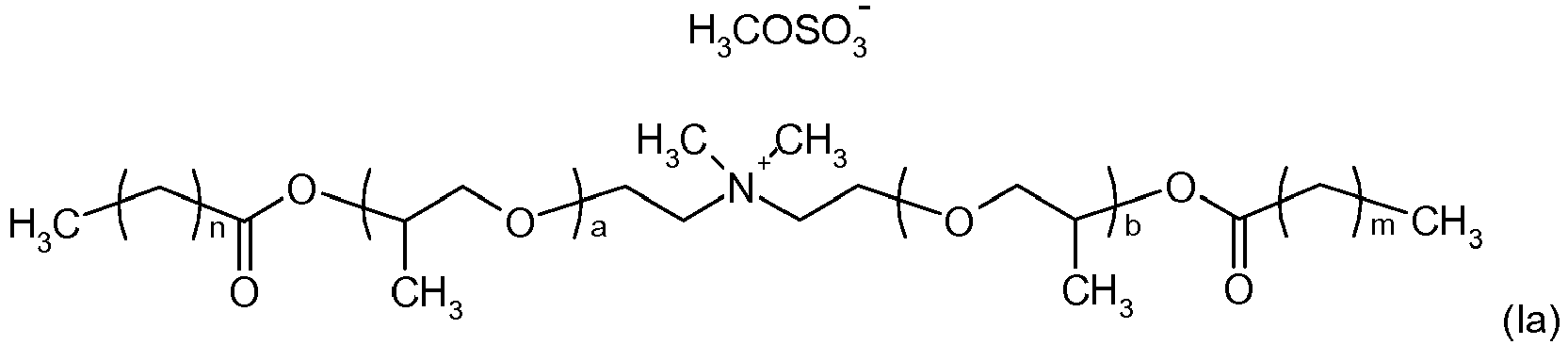
- n und m
- unabhängig voneinander für ganze Zahlen zwischen 5 und 40 stehen, mit der Maßgabe, daß n + m ≥ 38 ist;
- a und b
- unabhängig voneinander für 1, 2, 3, 4 oder 5 stehen.
- Auch für die Formel (la) gilt das weiter oben für die Indices n und m Gesagte. Eine insbesondere bevorzugte Verbindung der Formel (la) läßt sich demnach durch die Formel (Ia-1) beschreiben:

- Vorzugsweise stehen die Indices a und b unabhängig voneinander für 1, 2, 3, 4 oder 5. Weiter bevorzugt gilt hierbei die Gleichung a + 2 ≥ b ≥ a -2. In solchen besonders bevorzugten Verbindungen der Formel (I) gilt: a = 1 und b = 1, a = 1 und b = 2, a = 1 und b = 3, a = 2 und b = 1, a = 2 und b = 2, a = 2 und b = 3, a = 2 und b = 4, a = 3 und b = 1, a = 3 und b = 2, a = 3 und b = 3, a = 3 und b = 4, a = 3 und b = 5, a = 4 und b = 2, a = 4 und b = 3, a = 4 und b = 4, a = 4 und b = 5, a = 5 und b = 3, a = 5 und b = 4, a = 5 und b = 5.
- Ganz besonders bevorzugt gilt a = b, so daß die fünf Verbindungen mit a = b = 1 bzw. a = b = 2 bzw. a = b = 3 bzw. a = b = 4 bzw. a = b = 5 besonders bevorzugt sind.
- Bezogen auf die besonders bevorzugte Formel (la-1) sind die folgenden Verbindungen ganz besonders bevorzugt:


- Insbesondere bevorzugt sind Verbindungen der Formel (la-1-3) (nachfolgend als (Ib) bezeichnet), da diese in der erfindungsgemäßen Kombination besonders ausgeprägte Effekte liefern. Erfindungsgemäß bevorzugte Haarbehandlungsmittel sind daher dadurch gekennzeichnet, daß sie 0,5 bis 20 Gew.-%, vorzugsweise 0,75 bis 15 Gew.-%, weiter bevorzugt 1 bis 10 Gew.-%, noch weiter bevorzugt 1,5 bis 7,5 Gew.-% und insbesondere 2 bis 4,5 Gew.-% mindestens einer Verbindung der allgemeinen Formel (Ib)

- Es hat sich gezeigt, daß die Pflegeeffekte der erfindungsgemäßen Mittel weiter gesteigert und insbesondere die Stabilität der Mittel weiter verbessert werden kann, wenn die Mittel zusätzlich zu der bzw. den Verbindung(en) der Formel (I) bestimmte acylierte Diamine enthalten. Erfindungsgemäße bevorzugte Haarbehandlungsmittel sind daher dadurch gekennzeichnet, daß sie zusätzlich 0,1 bis 10 Gew.-% mindestens einer Verbindung der Formel (II) enthalten

- Verbindungen der Formel (II) mit n = 20 sind dabei besonders bevorzugt, so daß äußerst bevorzugte erfindungsgemäße Haarbehandlungsmittel
- a) 0,5 bis 20 Gew.-%, vorzugsweise 0,75 bis 15 Gew.-%, weiter bevorzugt 1 bis 10 Gew.-%, noch weiter bevorzugt 1,5 bis 7,5 Gew.-% und insbesondere 2 bis 4,5 Gew.-% mindestens einer Verbindung der allgemeinen Formel (Ib)

- b) 0,1 bis 10 Gew.-% vorzugsweise 0,15 bis 5 Gew.-%, weiter bevorzugt 0,2 bis 2,5 Gew.-%, noch weiter bevorzugt 0,25 bis 1,5 Gew.-% und insbesondere 0,3 bis 1 Gew.-% mindestens einer Verbindung der Formel (IIa)

- Besonders bevorzugte erfindungsgemäße Haarbehandlungsmittel enthalten
- 2 bis 5 Gew.-% mindestens einer Verbindung der allgemeinen Formel (Ib)
- 0,1 bis 1 Gew.-% mindestens einer Verbindung der Formel (IIa)
- 0,75 bis 2,5 Gew.-% Dimethicone.
- Ebenfalls besonders bevorzugte erfindungsgemäße Haarbehandlungsmittel enthalten
- 2 bis 5 Gew.-% mindestens einer Verbindung der allgemeinen Formel (Ib)
- 0,1 bis 1 Gew.-% mindestens einer Verbindung der Formel (IIa)
- 0,75 bis 2,5 Gew.-% mindestens eines Silikons der Formel (Si-I).
- Ebenfalls besonders bevorzugte erfindungsgemäße Haarbehandlungsmittel enthalten
- 2 bis 5 Gew.-% mindestens einer Verbindung der allgemeinen Formel (Ib)
- 0,1 bis 1 Gew.-% mindestens einer Verbindung der Formel (IIa)
- 0,75 bis 2,5 Gew.-% Cylomethicone.
- Ebenfalls besonders bevorzugte erfindungsgemäße Haarbehandlungsmittel enthalten
- 2 bis 5 Gew.-% mindestens einer Verbindung der allgemeinen Formel (Ib)
- 0,1 bis 1 Gew.-% mindestens einer Verbindung der Formel (IIa)
- 0,75 bis 2,5 Gew.-% Dimethiconole.
- Ebenfalls besonders bevorzugte erfindungsgemäße Haarbehandlungsmittel enthalten
- 2 bis 5 Gew.-% mindestens einer Verbindung der allgemeinen Formel (Ib)
- 0,1 bis 1 Gew.-% mindestens einer Verbindung der Formel (IIa)
- 0,75 bis 2,5 Gew.-% Amodimethicone.
- Ebenfalls besonders bevorzugte erfindungsgemäße Haarbehandlungsmittel enthalten
- 2 bis 5 Gew.-% mindestens einer Verbindung der allgemeinen Formel (Ib)
- 0,1 bis 1 Gew.-% mindestens einer Verbindung der Formel (IIa)
- 0,75 bis 2,5 Gew.-% mindestens eines aminofunktionellen Silikons der Formel (Si-IIa).
- Ebenfalls besonders bevorzugte erfindungsgemäße Haarbehandlungsmittel enthalten
- 2 bis 5 Gew.-% mindestens einer Verbindung der allgemeinen Formel (Ib)
- 0,1 bis 1 Gew.-% mindestens einer Verbindung der Formel (IIa)
- 0,75 bis 2,5 Gew.-% mindestens eines aminofunktionellen Silikons der Formel (Si-IIb).
- Die Pflegeffekte der erfindungsgemäßen Mittel lassen sich noch weiter verstärken, indem bestimmte Pflegestoffe eingesetzt werden. Vorzugsweise werden diese aus bestimmten Gruppen an sich bekannter Pflegestoffe ausgewählt, da diese Pflegestoffe formulierungstechnisch und vom Pflegeffekt hervorragend mit der erfindungsgemäß eingesetzten Kombination harmonieren. Erfindungsgemäß bevorzugte Haarbehandlungsmittel sind dadurch gekennzeichnet, daß sie zusätzlich Pflegestoff(e) - bezogen auf ihr Gewicht - in Mengen von 0,001 bis 10 Gew.-%, vorzugsweise 0,005 bis 7,5 Gew.-%, besonders bevorzugt 0,01 bis 5 Gew.-% und insbesondere 0,05 bis 2,5 Gew.-% enthalten, wobei bevorzugte Pflegstoff(e) ausgewählt sind aus der Gruppe
- i. L-Carnitin und/oder seiner Salze;
- ii. Taurin und/oder seiner Salze;
- iii. Niacinamid;
- iv. Ubichinon
- v. Ectoin;
- L-Carnitin (IUPAC-Name(R)-(3-Carboxy-2-hydroxypropyl)- N,N,N-trimethylammoniumhydroxid), ist eine natürlich vorkommende, vitaminähnliche Substanz. Es spielt eine essentielle Rolle im Energiestoffwechsel menschlicher, tierischer und pflanzlicher Zellen. L-Carnitin kann über verschiedene Wege im industriellen Maßstab gewonnen werden. Beispielsweise über einen, die körpereigene Biosynthese imitierenden, biotechnologischen Prozess: In großen Fermentationsbehältern wird dabei die Vorstufe von L-Carnitin (y-Butyrobetain) mit Hilfe von gramnegativen Bakterien (Rhizobien) in L-Carnitin umgesetzt.
- Als Betain kann L-Carnitin Additionsverbindungen und Doppelsalze bilden. Erfindungsgemäß bevorzugte L-Carnitinderivate sind insbesondere ausgewählt aus Acetyl-L-Carnitin, L-Carnitin-Fumarat, L-Carnitin-Citrat, Lauroyl-L-Carnitin und besonderes bevorzugt L-Carnitin-Tartrat. Die genannten L-Carnitin-Verbindungen sind beispielsweise von der Firma Lonza GmbH (Wuppertal, Deutschland) erhältlich.
- Erfindungsgemäße bevorzugte Haarbehandlungsmittel sind dadurch gekennzeichnet, daß sie - bezogen auf ihr Gewicht -0,001 bis 10 Gew.-%, vorzugsweise 0,005 bis 7,5 Gew.-%, besonders bevorzugt 0,01 bis 5 Gew.-% und insbesondere 0,05 bis 2,5 Gew.-% L-Carnitin oder L-Carnitinderivate enthalten, wobei bevorzugte L-Carnitinderivate ausgewählt sind aus Acetyl-L-Carnitin, L-Carnitin-Fumarat, L-Carnitin-Citrat, Lauroyl- L-Carnitin und insbesondere L-Carnitin-Tartrat.
- Ein weiterer, bevorzugter einsetzbarer Pflegestoff, der aktivierende Eigenschaften besitzt, ist das Taurin. Erfindungsgemäß bevorzugte Haarbehandlungsmittel enthalten - bezogen auf ihr Gewicht - 0,01 bis 15 Gew.-%, vorzugsweise 0,025 bis 12,5 Gew.-%, besonders bevorzugt 0,05 bis 10 Gew.-%, weiter bevorzugt 0,1 bis 7,5 Gew.-% und insbesondere 0,5 bis 5 Gew.-% Taurin (2-Aminoethansulfonsäure).
- Eine weitere bevorzugte Gruppe von Pflegestoffen in den erfindungsgemäßen Mitteln sind Vitamine, Provitamine oder Vitaminvorstufen. Diese werden nachfolgend beschrieben:
- Zur Gruppe der als Vitamin A bezeichneten Substanzen gehören das Retinol (Vitamin A1) sowie das 3,4-Didehydroretinol (Vitamin A2). Das β-Carotin ist das Provitamin des Retinols. Als Vitamin A-Komponente kommen erfindungsgemäß beispielsweise Vitamin A-Säure und deren Ester, Vitamin A-Aldehyd und Vitamin A-Alkohol sowie dessen Ester wie das Palmitat und das Acetat in Betracht. Die erfindungsgemäßen Mittel enthalten die Vitamin A-Komponente bevorzugt in Mengen von 0,05-1 Gew.-%, bezogen auf die gesamte Zubereitung.
- Zur Vitamin B-Gruppe oder zu dem Vitamin B-Komplex gehören u. a.
- Vitamin B1 (Thiamin)
- Vitamin B2 (Riboflavin)
- Vitamin B3. Unter dieser Bezeichnung werden häufig die Verbindungen Nicotinsäure und Nicotinsäureamid (Niacinamid) geführt. Erfindungsgemäß bevorzugt ist das Nicotinsäureamid, das in den erfindungsgemäß verwendeten Mitteln bevorzugt in Mengen von 0,05 bis 1 Gew.-%, bezogen auf das gesamte Mittel, enthalten ist.
- Vitamin B5 (Pantothensäure, Panthenol und Pantolacton). Im Rahmen dieser Gruppe wird bevorzugt das Panthenol und/oder Pantolacton eingesetzt (siehe weiter unten). Erfindungsgemäß einsetzbare Derivate des Panthenols sind insbesondere die Ester und Ether des Panthenols sowie kationisch derivatisierte Panthenole. Die genannten Verbindungen des Vitamin B5-Typs sind in den erfindungsgemäßen Mitteln bevorzugt in Mengen von 0,05 - 10 Gew.-%, bezogen auf das gesamte Mittel, enthalten. Mengen von 0,1 - 5 Gew.-% sind besonders bevorzugt.
- Vitamin B6 (Pyridoxin sowie Pyridoxamin und Pyridoxal).
- Vitamin C (Ascorbinsäure). Vitamin C wird in den erfindungsgemäßen Mitteln bevorzugt in Mengen von 0,1 bis 3 Gew.-%, bezogen auf das gesamte Mittel eingesetzt. Die Verwendung in Form des Palmitinsäureesters, der Glucoside oder Phosphate kann bevorzugt sein. Die Verwendung in Kombination mit Tocopherolen kann ebenfalls bevorzugt sein.
- Vitamin E (Tocopherole, insbesondere α-Tocopherol). Tocopherol und seine Derivate, worunter insbesondere die Ester wie das Acetat, das Nicotinat, das Phosphat und das Succinat fallen, sind in den erfindungsgemäßen Mitteln bevorzugt in Mengen von 0,05-1 Gew.-%, bezogen auf das gesamte Mittel, enthalten.
- Vitamin F. Unter dem Begriff "Vitamin F" werden üblicherweise essentielle Fettsäuren, insbesondere Linolsäure, Linolensäure und Arachidonsäure, verstanden.
- Vitamin H. Als Vitamin H wird die Verbindung (3aS,4S, 6aR)-2-Oxohexahydrothienol[3,4-d]-imidazol-4-valeriansäure bezeichnet, für die sich aber inzwischen der Trivialname Biotin durchgesetzt hat. Biotin ist in den erfindungsgemäßen Mitteln bevorzugt in Mengen von 0,0001 bis 1,0 Gew.-%, insbesondere in Mengen von 0,001 bis 0,01 Gew.-% enthalten.
- Zusammenfassend sind erfindungsgemäße Haarbehandlungsmittel bevorzugt, die - bezogen auf ihr Gewicht - 0,1 bis 5 Gew.-%, vorzugsweise 0,2 bis 4 Gew.-%, besonders bevorzugt 0,25 bis 3,5 Gew.-%, weiter bevorzugt 0,5 bis 3 Gew.-% und insbesondere 0,5 bis 2,5 Gew.-% Vitamine und/oder Pro-Vitamine und/oder Vitaminvorstufen enthalten, die vorzugsweise den Gruppen A, B, C, E, F und H zugeordnet werden, wobei bevorzugte Mittel -2,4-Dihydroxy-N-(3-hydroxypropyl)-3,3-dimethyl-butyramid, Provitamin B5) und/oder Pantothensäure (Vitamin B3, Vitamin B5) und/oder Niacin, Niacinamid bzw. Nicotinamid (Vitamin B3) und/oder L-Ascorbinsäure (Vitamin C) und/oder Thiamin (Vitamin B1) und/oder Riboflavin (Vitamin B2, Vitamin G) und/oder Biotin (Vitamin B7, Vitamin H) und/oder Folsäure (Vitamin B9, Vitamin Bc oder Vitamin M) und/oder Vitamin B6 und/oder Vitamin B12 enthalten.
- Es hat sich gezeigt, daß bestimmte Chinone eine besondere Eignung als Pflegestoff besitzen. Als weiteren Pflegestoff können die erfindungsgemäßen Mittel daher 0,0001 bis 5 Gew.-% mindestens eines Biochinons der Formel (Ubi)

- X, Y, Z
- stehen unabhängig voneinander für -O- oder -NH- oder NR4- oder eine chemische Bindung
- R1, R2, R3
- stehen unabhängig voneinander für ein Wasserstoffatom oder eine gegebenenfalls substituierte Arylgruppe oder eine gegebenenfalls substituierte (C1-C6)-Alkylgruppe oder eine Hydroxyalkylgruppe oder eine Polyhydroxyalkylgruppe oder eine gegebenenfalls substituierte (C1-C6)-Alkylengruppe, oder einen (C1-C6)-Acylrest, wobei bevorzugte Reste unabhängig voneinander ausgewählt sind aus -H, - CH3, _CH2CH3, -(CH2)2CH2, -CH(CH3)2, -(CH2)3CH3, -CH(CH3)CH2CH3, - CH2CH(CH3)2, -C(CH3)3
- R4
- steht für -CH3, -CH2CH3, -(CH2)2CH2, -CH(CH3)2, - (CH2)3CH3, -CH(CH3)CH2CH3, -CH2CH(CH3)2, -C(CH3)3
- n
- steht für Werte von 1 bis 20, vorzugsweise von 2 bis 15 und insbesondere für 5, 6, 7, 8, 9, 10.
- Besonders bevorzugte erfindungsgemäße Haarbehandlungsmittel sind dadurch gekennzeichnet, daß sie als Pflegestoff - bezogen auf ihr Gewicht - 0,0001 bis 1 Gew.-%, bevorzugt 0,001 bis 0,5 Gew.-% und besonders bevorzugt 0,005 bis 0,1 Gew.-% mindestens eines Ubichinons und/oder mindestens eines Ubichinols und/oder mindestens eines Derivates dieser Substanzen enthalten, wobei bevorzugte Mittel ein Ubichinon der Formel (Ubi) enthalten

- Alternativ zu den besonders bevorzugten Ubichinonen oder zusätzlich zu ihnen können die erfindungsgemäßen Mittel auch Plastochinone enthalten. Hier sind bevorzugte erfindungsgemäße Mittel dadurch gekennzeichnet, daß sie 0,0002 bis 4 Gew.-%, vorzugsweise 0,0005 bis 3 Gew.-%, besonders bevorzugt 0,001 bis 2 Gew.-%, weiter bevorzugt 0,0015 bis 1 und insbesondere 0,002 bis 0,5 Gew.-% mindestens eines Plastochinons der Formel (Ubi-b) enthalten

- Als weiteren Pflege-Enhacer können die erfindungsgemäßen Mittel Ectoin enthalten. Ectoin ((4S)-2-Methyl-1,4,5,6-Tetrahydropyrimidin-4-Carbonsäure) ist ein zur Gruppe der kompatiblen Solute gehörender Naturstoff. Die stark wasserbindende niedermolekulare organische Verbindung tritt in halophilen Bakterien auf und ermöglicht diesen extremophilen Organismen unter Stressbedingungen zu überleben. Erfindungsgemäß bevorzugte Haarbehandlungsmittel sind dadurch gekennzeichnet, daß sie - bezogen auf ihr Gewicht - 0,001 bis 10 Gew.-%, vorzugsweise 0,01 bis 5 Gew.-%, besonders bevorzugt 0,05 bis 2,5 Gew.-% und insbesondere 0,1 bis 1 Gew.-% (S)-2-Methyl-1,4,5,6-tetrahydro-4-pyrimidincarbonsäure (Ectoin) sowie die physiologisch verträglichen Salze dieser Verbindung und/oder (S,S)-5-Hydroxy-2-methyl-1,4,5,6-tetrahydro-4-pyrimidincarbonsäure (Hydroxyectoin) sowie die physiologisch verträglichen Salze dieser Verbindung, enthalten.
- Zur Verbesserung der Elastizität und Festigung der inneren Struktur der mit erfindungsgemäßen Mitteln behandelter Haare können die erfindungsgemäßen Mittel Purin und/oder Purinderivate als Pflegestoff enthalten. Insbesondere die Kombination von Purin und/oder Purinderivaten mit Ubichinonen und/oder Plastochinonen als Pflegestoff führt dazu, daß die mit entsprechenden Mitteln behandelten Haare unter anderem höhere Meßwerte bei der Differenzthermoanalyse und verbesserte Naß- und Trockenkämmbarkeiten zeigen.
- Purin (7H-Imidazo[4,5-d]pyrimidin) kommt frei in der Natur nicht vor, bildet jedoch den Grundkörper der Purine. Purine ihrerseits sind eine Gruppe wichtiger, in der Natur weit verbreiteter und an menschlichen, tierischen, pflanzlichen und mikrobiellen Stoffwechselvorgängen beteiligter Verbindungen, die sich vom Grundkörper durch Substitution mit OH, NH2, SH in 2-, 6- und 8-Stellung und/oder mit CH3 in 1-, 3-, 7-Stellung ableiten. Purin kann beispielsweise aus Aminoacetonitril und Formamid hergestellt werden. Purine und Purinderivate werden oft aus Naturstoffen isoliert, sind aber auch auf vielen Wegen synthetisch zugänglich.
- Bevorzugte erfindungsgemäße Mittel enthalten Purin und/oder Purinderivate in engeren Mengenbereichen. Hier sind erfindungsgemäß bevorzugte kosmetische Mittel dadurch gekennzeichnet, daß sie - bezogen auf ihr Gewicht - 0,001 bis 2,5 Gew.-%, vorzugsweise 0,0025 bis 1 Gew.-%, besonders bevorzugt 0,005 bis 0,5 Gew.-% und insbesondere 0,01 bis 0,1 Gew.-% Purin(e) und/oder Purinderivat(e) enthalten.
- Unter Purin, den Purinen und den Purinderivaten sind erfindungsgemäß einige Vertreter besonders bevorzugt. Erfindungsgemäß bevorzugte Haarbehandlungsmittel sind dadurch gekennzeichnet, daß sie als Pflegestoff - bezogen auf ihr Gewicht - 0,001 bis 2,5 Gew.-%, vorzugsweise 0,0025 bis 1 Gew.-%, besonders bevorzugt 0,005 bis 0,5 Gew.-% und insbesondere 0,01 bis 0,1 Gew.-% Purin(e) und/oder Purinderivat(e) enthält, wobei bevorzugte Mittel Purin und/oder Purinderivat(e) der Formel (Pur-I) enthalten

- Purin (R1 = R2 = R3 = R4 = R5 = R6 = H)
- Adenin (R1 = NH2, R2 = R3 = R4 = R5 = R6 = H)
- Guanin (R1 = OH, R2 = NH2, R3 = R4 = R5 = R6 = H)
- Harnsäure (R1 = R2 = R3 = OH, R4 = R5 = R6 = H)
- Hypoxanthin (R1 = OH, R2 = R3 = R4 = R5 = R6 = H)
- 6-Purinthiol (R1 = SH, R2 = R3 = R4 = R5 = R6 = H)
- 6-Thioguanin (R1 = SH, R2 = NH2, R3 = R4 = R5 = R6 = H)
- Xanthin (R1 = R2 = OH, R3 = R4 = R5 = R6 = H)
- Coffein (R1 = R2 = OH, R3 = H, R4 = R5 = R6 = CH3)
- Theobromin (R1 = R2 = OH, R3 = R4 = H, R5 = R6 = CH3)
- Theophyllin (R1 = R2 = OH, R3 = H, R4 = CH3, R5 = CH3, R6 = H).
- Es ist weiterhin vorteilhaft, Purin bzw. Purinderivate und Biochinone in einem bestimmten Verhältnis zueinander einzusetzen. Hier sind erfindungsgemäße Mittel bevorzugt, bei denen das Gewichtsverhältnis von Purin(derivat(en)) und Biochinon(en) 10:1 bis 1:100, vorzugsweise 5:1 bis 1:50, besonders bevorzugt 2:1 bis 1:20 und insbesondere 1:1 bis 1:10 beträgt.
- Wie bereits erwähnt, ist Coffein ein besonders bevorzugtes Purinderivat, und das Coenzym Q10 ist ein besonders bevorzugtes Biochinon. Besonders bevorzugte erfindungsgemäße Mittel sind daher dadurch gekennzeichnet, daß sie - bezogen auf ihr Gewicht - 0,001 bis 2,5 Gew.-%, vorzugsweise 0,0025 bis 1 Gew.-%, besonders bevorzugt 0,005 bis 0,5 Gew.-% und insbesondere 0,01 bis 0,1 Gew.-% Coffein und 0,0002 bis 4 Gew.-%, vorzugsweise 0,0005 bis 3 Gew.-%, besonders bevorzugt 0,001 bis 2 Gew.-%, weiter bevorzugt 0,0015 bis 1 und insbesondere 0,002 bis 0,5 Gew.-% Coenzym Q10 enthalten.
- Als Pflegestoff können die erfindungsgemäßen Mittel auch Flavonoide enthalten. Die Flavonoide sind eine Gruppe von wasserlöslichen Pflanzenfarbstoffen und spielen eine wichtige Rolle im Stoffwechsel vieler Pflanzen. Sie gehören zusammen mit den Phenolsäuren zu den Polyphenolen. Es sind weit über 6500 unterschiedliche Flavonoide bekannt, die sich in Flavonole, Flavone, Flavanone, Isoflavonoide und Anthocyane einteilen lassen.
- Erfindungsgemäß können Flavonoide aus allen sechs Gruppen eingesetzt werden, wobei bestimmte Vertreter aus den einzelnen Gruppen als Pflegestoff wegen ihrer besonders intensiven Wirkung bevorzugt sind. Bevorzugte Flavonole sind Quercetin, Rutin, Kaempferol, Myricetin, Isorhamnetin, bevorzugte Flavanole sind Catechin, Gallocatechin, Epicatechin, Epigallocatechingallat , Theaflavin, Thearubigin, bevorzugte Flavone sind Luteolin, Apigenin, Morin, bevorzugte Flavanone sind Hesperetin, Naringenin, Eriodictyol, bevorzugte Isoflavonoide sind Genistein, Daidzein, und bevorzugte Anthocyanidine (Anthocyane) sind Cyanidin, Delphinidin, Malvidin, Pelargonidin, Peonidin, Petunidin.
- Erfindungsgemäß besonders bevorzugte Haarbehandlungsmittel sind dadurch gekennzeichnet, daß sie - bezogen auf ihr Gewicht - 0,001 bis 2,5 Gew.-%, vorzugsweise 0,0025 bis 1 Gew.-%, besonders bevorzugt 0,005 bis 0,5 Gew.-% und insbesondere 0,01 bis 0,1 Gew.-% Flavonoide, insbesondere Flavonole, besonders bevorzugt 3,3',4',5,7-Pentahydroxyflavon (Quercetin) und/oder 3,3',4',5,7-Pentahydroxyflavon-3-O-rutinosid (Rutin), enthalten.
- Bevorzugt ist auch der Einsatz von Bisabolol und/oder Bisabololoxiden als Pflegestoff in den erfindungsgemäßen Mitteln. Hier sind erfindungsgemäße Haarbehandlungsmittel bevorzugt, die zusätzlich 0,001 bis 5 Gew.-%, vorzugsweise 0,01 bis 4 Gew.-%, besonders bevorzugt 0,02 bis 2,5 Gew.-% und insbesondere 0,1 bis 1,5 Gew.-% Bisabolol und/oder Oxide von Bisabolol, vorzugsweise (-)-alpha-Bisabolol enthalten.
- Auch Creatin eignet sich erfindungsgemäß als Pflegestoff. Creatin (3-Methylguanidinoessigsäure) ist eine organische Säure, die in Wirbeltieren u. a. zur Versorgung der Muskeln mit Energie beiträgt. Kreatin wird in der Niere, der Leber und in der Bauchspeicheldrüse synthetisiert. Sie leitet sich formal von den Aminosäuren Glycin und Arginin ab und ist zu 95 % im Skelettmuskel vorhanden. Besonders bevorzugte erfindungsgemäße Haarbehandlungsmittel enthalten - bezogen auf ihr Gewicht - 0,01 bis 15 Gew.-%, vorzugsweise 0,025 bis 12,5 Gew.-%, besonders bevorzugt 0,05 bis 10 Gew.-%, weiter bevorzugt 0,1 bis 7,5 Gew.-% und insbesondere 0,5 bis 5 Gew.-% N-Methylguanidino-essigsäure (Creatin).
- Die erfindungsgemäßen Mittel können zusätzlich zu den vorstehend genannten Inhaltsstoffen und optionalen weiteren Inhaltsstoffen weitere Stoffe enthalten, die Haarausfall verhindern, lindern oder heilen. Insbesondere ist ein Gehalt an haarwurzelstabilisierenden Wirkstoffen vorteilhaft. Diese Stoffe werden nachstehend beschrieben:
- Propecia (Finasterid) ist das zur Zeit einzige Präparat, das weltweit zugelassen ist und für das in zahlreichen Studien eine Wirksamkeit und Verträglichkeit nachgewiesen wurde. Propecia bewirkt, daß sich weniger DHT aus Testosteron bilden kann.
- Minoxidil ist mit oder ohne ergänzende Zusatzstoffe das wohl älteste nachweislich wirkende Haarwuchsmittel. Zur Behandlung von Haarausfall darf es nur zur äußeren Anwendung verwendet werden. Es gibt Haarwasser, die 2%-5% Minoxidil enthalten, außerdem Gels mit bis zu 15% Minoxidil. Die Wirksamkeit nimmt mit der Dosierung zu, in Haarwassern ist Minoxidil jedoch nur bis zu 5% Anteil löslich. In vielen Ländern sind Haarwasser mit bis zu 2% Minoxidilgehalt verschreibungsfrei erhältlich.
- Zur Bekämpfung der hormonellen Einflüße auf die Haarfollikel kann zur äußeren Anwendung Spironolactone in Form von Haarwasser und in Kombination mit Minoxidil angewandt werden. Spironolactone wirkt als Androgen-Rezeptor-Blocker, dh. die Bindung von DHT an die Haarfollikel wird verhindert.
- Zusammenfassend sind erfindungsgemäße Haarbehandlungsmittel bevorzugt, die zusätzlich - bezogen auf sein Gewicht - 0,001 bis 5 Gew.-% Haarwurzel-stabilisierende Stoffe, insbesondere Minoxidil und/oder Finasterid und/oder Ketoconazol enthalten.
- Zusätzlich zu den Pflegestoffen können di erfindungsgemäßen Mittel weitere Pflegestoffe enthalten. Deren Anwesenheit ist für die Erzielung der erfindungsgemäßen Effekte nicht zwingend erforderlich, doch können weitergehende Effekte, wie ein angenehmer Griff oder eine angenehme Applikationshaptik aus dem Einsatz dieser Pflegestoffe resultieren.
- Als weiteren Inhaltsstoff können die erfindungsgemäßen Mittel mit besonderem Vorzug eine oder mehrere Aminosäuren enthalten. Erfindungsgemäß besonders bevorzugt einsetzbare Aminosäuren stammen aus der Gruppe Glycin, Alanin, Valin, Leucin, Isoleucin, Phenylalanin, Tyrosin, Tryptophan, Prolin, Asparaginsäure, Glutaminsäure, Asparagin, Glutamin, Serin, Threonin, Cystein, Methionin, Lysin, Arginin, Histidin, β-Alanin, 4-Aminobuttersäure (GABA), Betain, L-Cystin (L-Cyss), L-Carnitin, L-Citrullin, L-Theanin, 3 ',4 '-Dihydroxy-L-phenylalanin (L-Dopa), 5 '-Hydroxy-L-tryptophan, L-Homocystein, S-Methyl-L-methionin, S-Allyl-L-cystein-sulfoxid (L-Allün), L-trans-4-Hydroxyprolin, L-5-Oxoprolin (L-Pyroglutaminsäure), L-Phosphoserin, Kreatin, 3-Methyl-L-histidin, L-Ornithin, wobei sowohl die einzelnen Aminosäuren als auch Mischungen eingesetzt werden können.
- Bevorzugte erfindungsgemäße Mittel enthalten eine oder mehrere Aminosäuren in engeren Mengenbereichen. Hier sind erfindungsgemäß bevorzugte Haarbehandlungsmittel dadurch gekennzeichnet, daß sie als Pflegestoff - bezogen auf ihr Gewicht - 0,01 bis 5 Gew.-%, vorzugsweise 0,02 bis 2,5 Gew.-%, besonders bevorzugt 0,05 bis 1,5 Gew.-%, weiter bevorzugt 0,075 bis 1 Gew.-% und insbesondere 0,1 bis 0,25 Gew.-% Aminosäure(n), vorzugsweise aus der Gruppe Glycin und/oder Alanain und/oder Valin und/oder Lysin und/oder Leucin und/oder Threonin enthalten.
- Als weiteren Bestandteil können die erfindungsgemäßen Mittel mindestens ein Kohlenhydrat aus der Gruppe der Monosaccharide, Disaccharide und/oder Oligosaccharide enthalten. Hier sind erfindungsgemäß bevorzugte Haarbehandlungsmittel dadurch gekennzeichnet, daß sie als Pflegestoff - bezogen auf ihr Gewicht - 0,01 bis 5 Gew.-%, vorzugsweise 0,05 bis 4,5 Gew.-%, besonders bevorzugt 0,1 bis 4 Gew.-%, weiter bevorzugt 0,5 bis 3,5 Gew.-% und insbesondere 0,75 bis 2,5 Gew.-% Kohlenhydrat(e), ausgewählt aus Monosacchariden, Disacchariden und/oder Oligosacchariden enthalten, wobei bevorzugte Kohlenhydrate ausgewählt sind aus Monosachhariden, insbesondere D-Ribose und/oder D-Xylose und/oder L-Arabinose und/oder D-Glucose und/oder D-Mannose und/oder D-Galactose und/oder D-Fructose und/oder Sorbose und/oder L-Fucose und/oder L-Rhamnose Disacchariden, insbesondere Saccharose und/oder Maltose und/oder Lactose und/oder Trehalose und/oder Cellobiose und/oder Gentiobiose und/oder Isomaltose.
- Besonders bevorzugte erfindungsgemäße Mittel enthalten bezogen auf ihr Gewicht
- 0,005 bis 0,015 Gew.-% Coffein und 0,75 bis 1,5 Gew.-% Glucosemonohydrat,
- 0,005 bis 0,015 Gew.-% Coffein und 0,75 bis 1,5 Gew.-% Saccharose,
- 0,005 bis 0,015 Gew.-% Coffein und 0,75 bis 1,5 Gew.-% Fructose.
- Wie bereits erwähnt, enthalten bevorzugte erfindungsgemäße Mittel (eine) Aminosäure(n). Erfindungsgemäß besonders bevorzugt einsetzbare Aminosäuren stammen aus der Gruppe Glycin, Alanin, Valin, Leucin, Isoleucin, Phenylalanin, Tyrosin, Tryptophan, Prolin, Asparaginsäure, Glutaminsäure, Asparagin, Glutamin, Serin, Threonin, Cystein, Methionin, Lysin, Arginin, Histidin, β-Alanin, 4-Aminobuttersäure (GABA), Betain, L-Cystin (L-Cyss), L-Carnitin, L-Citrullin, L-Theanin, 3 ',4 '-Dihydroxy-L-phenylalanin (L-Dopa), 5 '-Hydroxy-L-tryptophan, L-Homocystein, S-Methyl-L-methionin, S-Allyl-L-cystein-sulfoxid (L-Allün), L-trans-4-Hydroxyprolin, L-5-Oxoprolin (L-Pyroglutaminsäure), L-Phosphoserin, Kreatin, 3-Methyl-L-histidin, L-Ornithin, wobei sowohl die einzelnen Aminosäuren als auch Mischungen eingesetzt werden können.
- Bevorzugte erfindungsgemäße Mittel enthalten eine oder mehrere Aminosäuren in engeren Mengenbereichen. Hier sind erfindungsgemäß bevorzugte kosmetische Mittel dadurch gekennzeichnet, daß sie zusätzlich - 0,05 bis 5 Gew.-%, vorzugsweise 0,1 bis 2,5 Gew.-%, besonders bevorzugt 0,15 bis 1 Gew.-% und insbesondere 0,2 bis 0,5 Gew.-% Aminosäure(n), vorzugsweise (eine) Aminosäure(n) aus der Gruppe Glycin und/oder Alanain und/oder Valin und/oder Lysin und/oder Leucin und/oder Threonin enthalten.
- Besonders bevorzugte erfindungsgemäße Mittel enthalten bezogen auf ihr Gewicht
- 0,005 bis 0,015 Gew.-% Coffein und 0,75 bis 1,5 Gew.-% Glucosemonohydrat und 0,1 bis 0,25 Gew.-% Glycin,
- 0,005 bis 0,015 Gew.-% Coffein und 0,75 bis 1,5 Gew.-% Saccharose und 0,1 bis 0,25 Gew.-% Glycin,
- 0,005 bis 0,015 Gew.-% Coffein und 0,75 bis 1,5 Gew.-% Fructose und 0,1 bis 0,25 Gew.-% Glycin,
- 0,005 bis 0,015 Gew.-% Coffein und 0,75 bis 1,5 Gew.-% Glucosemonohydrat und 0,1 bis 0,25 Gew.-% Alanin,
- 0,005 bis 0,015 Gew.-% Coffein und 0,75 bis 1,5 Gew.-% Saccharose und 0,1 bis 0,25 Gew.-% Alanin,
- 0,005 bis 0,015 Gew.-% Coffein und 0,75 bis 1,5 Gew.-% Fructose und 0,1 bis 0,25 Gew.-% Alanin,
- 0,005 bis 0,015 Gew.-% Coffein und 0,75 bis 1,5 Gew.-% Glucosemonohydrat und 0,1 bis 0,25 Gew.-% Valin,
- 0,005 bis 0,015 Gew.-% Coffein und 0,75 bis 1,5 Gew.-% Saccharose und 0,1 bis 0,25 Gew.-% Valin,
- 0,005 bis 0,015 Gew.-% Coffein und 0,75 bis 1,5 Gew.-% Fructose und 0,1 bis 0,25 Gew.-% Valin.
- Eine besonders bevorzugte Gruppe von Inhaltsstoffen stellen die Tenside dar.
- Je nach Anwendungszweck kann dabei der Gehalt an Tensiden aus den einzelnen Gruppen variieren, wobei anionische(s) Tensid(e) in reinigenden Formulierungen (insbesondere in Shampoos) besonders bevorzugt sind.
- Als anionische Tenside und Emulgatoren eignen sich für die erfindungsgemäßen Zusammensetzungen alle für die Verwendung am menschlichen Körper geeigneten anionischen oberflächenaktiven Stoffe. Diese sind gekennzeichnet durch eine wasserlöslich machende, anionische Gruppe wie z. B. eine Carboxylat-, Sulfat-, Sulfonat- oder Phosphat-Gruppe und eine lipophile Alkylgruppe mit etwa 8 bis 30 C-Atomen. Zusätzlich können im Molekül Glycol- oder Polyglycolether-Gruppen, Ester-, Ether- und Amidgruppen sowie Hydroxylgruppen enthalten sein. Beispiele für geeignete anionische Tenside und Emulgatoren sind, jeweils in Form der Natrium-, Kalium- und Ammonium- sowie der Mono-, Di- und Trialkanolammoniumsalze mit 2 bis 4 C-Atomen in der Alkanolgruppe,
- lineare und verzweigte Fettsäuren mit 8 bis 30 C-Atomen (Seifen),
- Ethercarbonsäuren der Formel R-O-(CH2-CH2O)x-CH2-COOH, in der R eine lineare Alkylgruppe mit 8 bis 30 C-Atomen und x = 0 oder 1 bis 16 ist,
- Acylsarcoside mit 8 bis 24 C-Atomen in der Acylgruppe,
- Acyltauride mit 8 bis 24 C-Atomen in der Acylgruppe,
- Acylisethionate mit 8 bis 24 C-Atomen in der Acylgruppe,
- lineare Alkansulfonate mit 8 bis 24 C-Atomen,
- lineare Alpha-Olefinsulfonate mit 8 bis 24 C-Atomen,
- Alpha-Sulfofettsäuremethylester von Fettsäuren mit 8 bis 30 C-Atomen,
- Acylglutamate der Formel (I),

- Acylglutamate, die sich von Fettsäuren mit 6 bis 22, vorzugsweise 12 bis 18 Kohlenstoffatomen ableiten, wie beispielsweise C12/14- bzw. C12/18-Kokosfettsäure, Laurinsäure, Myristinsäure, Palmitinsäure und/oder Stearinsäure, insbesondere Natrium-N-cocoyl- und Natrium-N-stearoyl-L-glutamat,
- Ester einer hydroxysubstituierten Di- oder Tricarbonsäure der allgemeinen Formel (II),

- Ester der Sulfobernsteinsäure oder der Sulfosuccinate der allgemeinen Formel (III),

- Sulfobernsteinsäuremono- und -dialkylester mit 8 bis 24 C-Atomen in der Alkylgruppe und Sulfobernsteinsäuremonoalkylpolyoxyethylester mit 8 bis 24 C-Atomen in der Alkylgruppe und 1 bis 6 Oxyethylgruppen,
- Alkylsulfate und Alkylpolyglycolethersulfate der Formel R-(O-CH2-CH2)x-OSO3H, in der R eine bevorzugt lineare Alkylgruppe mit 8 bis 30 C-Atomen und x = 0 oder 1 - 12 ist,
- gemischte oberflächenaktive Hydroxysulfonate gemäß
DE-A-37 25 030 , - Ester der Weinsäure und Zitronensäure mit Alkoholen, die Anlagerungsprodukte von etwa 2-15 Molekülen Ethylenoxid und/oder Propylenoxid an C8-22-Fettalkohole darstellen,
- Alkyl- und/oder Alkenyletherphosphate,
- sulfatierte Fettsäurealkylenglycolester,
- Monoglyceridsulfate und Monoglyceridethersulfate.
- Bevorzugte anionische Tenside sind Acylglutamate, Acylisethionate, Acylsarcosinate und Acyltaurate, jeweils mit einem linearen oder verzweigten Acylrest mit 6 bis 22 Kohlenstoffatomen und 0, 1, 2 oder 3 Doppelbindungen, der in besonders bevorzugten Ausführungsformen aus einem Octanoyl-, Decanoyl-, Lauroyl-, Myristoyl-, Palmitoyl- und Stearoylrest ausgewählt ist, Ester der Weinsäure, Zitronensäure oder Bernsteinsäure bzw. der Salze dieser Säuren mit alkylierter Glucose, insbesondere die Produkte mit der INCI-Bezeichnung Disodium Coco-Glucoside Citrate, Sodium Coco-Glucoside Tartrate und Disodium Coco-Glucoside Sulfosuccinate, Alkylpolyglycolethersulfate und Ethercarbonsäuren mit 8 bis 18 C-Atomen in der Alkylgruppe und bis zu 12 Ethoxygruppen im Molekül, Sulfobernsteinsäuremono- und -dialkylester mit 8 bis 18 C-Atomen in der Alkylgruppe und Sulfobernsteinsäuremonoalkylpolyoxyethylester mit 8 bis 18 C-Atomen in der Alkylgruppe und 1 bis 6 Ethoxygruppen.
- Unabhängig von der Art der eingesetzten Aniontenside sind erfindungsgemäße Haarbehandlungsmittel bevorzugt, die - bezogen auf ihr Gewicht - 2,5 bis 35 Gew.-%, vorzugsweise 5 bis 30 Gew.-%, weiter bevorzugt 7,5 bis 27,5 Gew.-%, noch weiter bevorzugt 10 bis 25 Gew.-% und insbesondere 12,5 bis 22,5 Gew.-% anionische(s) Tensid(e) enthalten.
- Ganz besonders bevorzugte erfindungsgemäße Mittel enthalten Fettalkoholsulfate und/oder Fettalkoholethersulfate. Demnach sind erfindungsgemäße Haarbehandlungsmittel, die dadurch gekennzeichnet sind, daß sie als anionisches Tensid - bezogen auf ihr Gewicht - 0,1 bis 20 Gew.-%, vorzugsweise 0,25 bis 17,5 Gew.-% und insbesondere 2 bis 15 Gew.-% Fettalkoholsulfate der Formel
H3C-(CH2)n-OSO3 - M+
enthalten, in der n für Werte von 5 bis 21, vorzugsweise von 7 bis 19, besonders bevorzugt von 9 bis 17 und insbesondere von 11 bis 13 steht, und M für ein Kation aus der Gruppe Na+, K+ NH4 +, ½ Mg2+, ½ Zn2+, vorzugsweise für Na+, steht, bevorzugte Ausführungsformen der vorliegenden Erfindung. - Weiter bevorzugte erfindungsgemäße Haarbehandlungsmittel sind dadurch gekennzeichnet, daß sie als anionisches Tensid - bezogen auf ihr Gewicht - 0,1 bis 20 Gew.-%, vorzugsweise 0,25 bis 17,5 Gew.-% und insbesondere 2 bis 15 Gew.-% Fettalkoholethersulfate der Formel
H3C-(CH2)n-(OCH2CH2)k-OSO3 - M+
enthalten, in der n für Werte von 5 bis 21, vorzugsweise von 7 bis 19, besonders bevorzugt von 9 bis 17 und insbesondere von 11 bis 13 und k für Werte von 1, 2, 3, 4, 5, 6, 7, 8, 9 oder 10, vorzugsweise für 1, 2 oder 3 und insbesondere für 2 stehen, und M für ein Kation aus der Gruppe Na+, K+ NH4 +, ½ Mg2+, ½ Zn2+, vorzugsweise für Na+, steht. - Die erfindungsgemäßen Mittel können zusätzlich zu den anionischen Tensiden weitere Tenside enthalten.
- Mit besonderem Vorzug enthalten die erfindungsgemäßen Mittel amphotere(s) Tensid(e). Unter ampholytischen Tensiden und Emulgatoren werden solche oberflächenaktiven Verbindungen verstanden, die außer einer C8- C24- Alkyl- oder -Acylgruppe mindestens eine freie Aminogruppe und mindestens eine -COOH- oder -SO3H-Gruppe enthalten und zur Ausbildung innerer Salze befähigt sind. Beispiele für geeignete ampholytische Tenside sind N-Alkylglycine, N-Alkylaminopropionsäuren, N-Alkylaminobuttersäuren, N-Alkyliminodipropionsäuren, N-Hydroxyethyl-N-alkylamidopropylglycine, N-Alkyltaurine, N-Alkylsarcosine, 2-Alkylaminopropionsäuren und Alkylaminoessigsäuren mit jeweils etwa 8 bis 24 C-Atomen in der Alkylgruppe. Besonders bevorzugte ampholytische Tenside sind das N-Kokosalkylaminopropionat, das Kokosacylaminoethylaminopropionat und das 612 - C18 - Acylsarcosin.
- Besonders bevorzugte erfindungsgemäße Haarbehandlungsmittel sind dadurch gekennzeichnet, daß sie amphotere(s) Tensid(e) aus den Gruppen der N-Alkylglycine, N-Alkylpropionsäuren, N-Alkylaminobuttersäuren, N-Alkyliminodipropionsäuren, N-Hydroxyethyl-N-alkylamidopropylglycine, N-Alkyltaurine, N-Alkylsarcosine, 2-Alkylaminopropionsäuren mit jeweils etwa 8 bis 24 C-Atomen in der Alkylgruppe, Alkylaminoessigsäuren mit jeweils etwa 8 bis 24 C-Atomen in der Alkylgruppe, N-Kokosalkylaminopropionat, Kokosacylaminoethylaminopropionat, C12 - C18 - Acylsarcosin, N-Alkyl-N,N-dimethylammonium-glycinate, beispielsweise Kokosalkyl-dimethylammoniumglycinat, N-Acyl-aminopropyl-N,N-dimethylammoniumglycinate, beispielsweise Kokosacylaminopropyldimethylammoniumglycinat, 2-Alkyl-3-carboxymethyl-3-hydroxyethyl-imidazoline mit jeweils 8 bis 18 C-Atomen in der Alkyl- oder Acylgruppe, Kokosacylaminoethylhydroxyethylcarboxymethylglycinat, der unter der INCI-Bezeichnung Cocamidopropyl Betain bekannten Verbindungen, der unter der INCI-Bezeichnung Disodium Cocoamphodiacetate bekannten Verbindungen enthalten, wobei bevorzugte Mittel das bzw. die amphotere(n) Tensid(e) in Mengen von 0,5 bis 9 Gew.-%, vorzugsweise von 0,75 bis 8 Gew.-% und insbesondere von 1 bis 7,5 Gew.-%, jeweils bezogen auf das gesamte Mittel, enthalten.
- Besonders bevorzugte Haarbehandlungsmittel enthalten als amphotere Tenside Betaine der Formel (Bet-I)

- Diese Tenside werden nach der INCI-Nomenklatur als Amidopropylbetaine bezeichnet, wobei die Vertreter, die sich von Kokosfettsäuren ableiten, bevorzugt sind und als Cocoamidopropylbetaine bezeichnet werden. Besonders bevorzugt werden erfindungsgemäß Tenside der Formel (Bet-I) eingesetzt, die ein Gemisch der folgenden Vertreter sind:
H3C-(CH2)7-C(O)-NH-(CH2)3N+(CH3)2CH2COO-
H3C-(CH2)9-C(O)-NH-(CH2)3N+(CH3)2CH2COO-
H3C-(CH2)11-C(O)-NH-(CH2)3N+(CH3)2CH2COO-
H3C-(CH2)13-C(O)-NH-(CH2)3N+(CH3)2CH2COO-
H3C-(CH2)15-C(O)-NH-(CH2)3N+(CH3)2CH2COO-
H3C-(CH2)7-CH=CH-(CH2)7-C(O)-NH-(CH2)3N+(CH3)2CH2COO-
- Besonders bevorzugt werden Tenside der Formel (Bet-I) innerhalb engerer Mengenbereiche eingesetzt. Hier sind erfindungsgemäße Mittel bevorzugt, die - bezogen auf ihr Gewicht - 0,25 bis 8 Gew.-%, weiter bevorzugt 0,5 bis 7 Gew.-%, weiter bevorzugt 0,75 bis 6,5 Gew.-% und insbesondere 1 bis 5,5 Gew.-% Tensid(e) der Formel (Bet-I) enthalten.
- Zusätzlich zu dem bzw. den Amphotensiden der Formel (Bet-I) oder an deren Stelle können die erfindungsgemäßen Haarbehandlungsmittel mit besonderem Vorzug als amphotere Tenside Betaine der Formel (Bet-II)

- Diese Tenside werden nach der INCI-Nomenklatur als Amphoacetate bezeichnet, wobei die Vertreter, die sich von Kokosfettsäuren ableiten bevorzugt sind und als Cocoamphoactetate bezeichnet werden.
- Aus herstellungstechnischen Gründen enthalten Tenside dieses Typs immer auch Betaine der Formel (Bet-IIa)

- Diese Tenside werden nach der INCI-Nomenklatur als Amphodiacetate bezeichnet, wobei die Vertreter, die sich von Kokosfettsäuren ableiten, bevorzugt sind und als Cocoamphodiactetate bezeichnet werden.
- Besonders bevorzugt werden erfindungsgemäß Tenside der Formel (Bet-II) eingesetzt, die ein Gemisch der folgenden Vertreter sind:
H3C-(CH2)7-C(O)-NH-(CH2)2NH+(CH2CH2OH)CH2CH2COO-
H3C-(CH2)9-C(O)-NH-(CH2)2NH+(CH2CH2OH)CH2CH2COO-
H3C-(CH2)11-C(O)-NH-(CH2)2NH+(CH2CH2OH)CH2CH2COO-
H3C-(CH2)13-C(O)-NH-(CH2)2NH+(CH2CH2OH)CH2CH2COO-
H3C-(CH2)15-C(O)-NH-(CH2)2NH+(CH2CH2OH)CH2CH2COO-
H3C-(CH2)7-CH=CH-(CH2)7-C(O)-NH-(CH2)2NH+(CH2CH2OH)CH2CH2COO-
- Besonders bevorzugt werden Tenside der Formel (Bet-II) innerhalb engerer Mengenbereiche eingesetzt. Hier sind erfindungsgemäße Mittel bevorzugt, die - bezogen auf ihr Gewicht - 0,25 bis 8 Gew.-%, weiter bevorzugt 0,5 bis 7 Gew.-%, weiter bevorzugt 0,75 bis 6,5 Gew.-% und insbesondere 1 bis 5,5 Gew.-% Tensid(e) der Formel (Bet-II) enthalten.
- Zusammenfassend sind erfindungsgemäße Haarbehandlungsmittel bevorzugt, bei denen der Rest R in den Formeln (Bet-I) und (Bet-II) ausgewählt ist aus
- H3C-(CH2)7-
- H3C-(CH2)9-
- H3C-(CH2)11-
- H3C-(CH2)13-
- H3C-(CH2)15-
- H3C-(CH2)7-CH=CH-(CH2)7-
- Erfindungsgemäß besonders bevorzugte Haarbehandlungsmittel sind dadurch gekennzeichnet, daß sie 1 bis 30 Gew.-%, vorzugsweise 1,5 bis 25 Gew.-%, weiter bevorzugt 2 bis 20 Gew.-%, noch weiter bevorzugt 2,5 bis 15 Gew.-% und insbesondere 3 bis 10 Gew.-% amphotere(s) Tensid(e) enthalten.
- Zusätzlich zu den amphoteren Tensiden oder an ihrer Stelle können die erfindungsgemäßen Mittel auch nichtionische Tenside enthalten.
- Besonders bevorzugte nichtionische Tenside sind Alkylpolyglycoside. Alkylpolyglycoside (APG) sind nichtionische Tenside, die vollständig aus nachwachsenden Rohstoffen (Zuckerbausteine, vorwiegend Glucose z.B. aus Maisstärke und Fettalkohol z.B. aus Kokosöl) hergestellt werden. Alkylpolyglycoside sind durch sauer katalysierte Reaktion (Fischer-Reaktion) von Zuckern, insbesondere Glucose (oder Stärke) oder von Butylglycosiden mit Fettalkoholen zugänglich. Dabei entstehen komplexe Gemische aus Alkylmonoglucosid (Alkyl-α-D- und -β-D-glucopyranosid sowie geringe Anteile -glucofuranosid), Alkyldiglucosiden (-isomaltoside, -maltoside etc.) und Alkyloligoglucosiden (-maltotrioside, -tetraoside etc.). Der durchschnittliche Polymerisationsgrad kommerzieller Produkte, deren Alkyl-Reste im Bereich C8-C16 liegen, beträgt 1,2-1,5. Erfindungsgemäß bevorzugt werden Alkylpolyglycoside entsprechend der allgemeinen Formel RO-(Z)x eingesetzt, wobei R für Alkyl, Z für Zucker sowie x für die Anzahl der Zuckereinheiten steht. Besonders bevorzugt sind solche Alkylpolyglycoside, bei denen R
- im wesentlichen aus C8- und C10-Alkylgruppen,
- im wesentlichen aus C12- und C14-Alkylgruppen,
- im wesentlichen aus C8- bis C16-Alkylgruppen oder
- im wesentlichen aus C12- bis C16-Alkylgruppen oder
- im wesentlichen aus C16 bis C18-Alkylgruppen
- Als Zuckerbaustein Z können beliebige Mono- oder Oligosaccharide eingesetzt werden. Üblicherweise werden Zucker mit 5 bzw. 6 Kohlenstoffatomen sowie die entsprechenden Oligosaccharide eingesetzt. Solche Zucker sind beispielsweise Glucose, Fructose, Galactose, Arabinose, Ribose, Xylose, Lyxose, Allose, Altrose, Mannose, Gulose, Idose, Talose und Sucrose. Bevorzugte Zuckerbausteine sind Glucose, Fructose, Galactose, Arabinose und Sucrose. Demnach sind bevorzugte erfindungsgemäße Haarbehandlungsmittel dadurch gekennzeichnet, daß sie- bezogen auf ihr Gewicht - 0,1 bis 20 Gew.-%, vorzugsweise 1 bis 10 Gew.-% und insbesondere 2 bis 8 Gew.-% Alkylpolyglycosid(e) der Formel
H3C-(CH2)n-O-(Z)x
enthalten, in der n für Werte von 5 bis 21, vorzugsweise von 7 bis 19, besonders bevorzugt von 9 bis 17 und insbesondere von 11 bis 13 und k für Werte von 1,1 bis 1,8, vorzugsweise von 1,2 bis 1,5 stehen, und Z für einen Zuckerbaustein aus der Gruppe Glucose, Fructose, Galactose, Arabinose, Ribose, Xylose, Lyxose, Allose, Altrose, Mannose, Gulose, Idose, Talose und Sucrose steht. - Glucose ist ein besonders bevorzugter Zuckerbaustein (Z), so daß bevorzugte erfindungsgemäße Haarbehandlungsmittel dadurch gekennzeichnet sind, daß sie- bezogen auf ihr Gewicht - 0,1 bis 15 Gew.-%, vorzugsweise 1 bis 10 Gew.-% und insbesondere 2 bis 8 Gew.-% Alkylpolyglucosid(e) der Formel

- Die erfindungsgemäß verwendbaren Alkylpolyglycoside enthalten im Schnitt 1,1 bis 5 Zuckereinheiten. Alkylpolyglycoside mit x-Werten von 1,1 bis 2,0 sind bevorzugt. Ganz besonders bevorzugt sind Alkylglycoside, bei denen x 1,1 bis 1,8 beträgt.
- Ganz besonders bevorzugte Alkylpolyglucoside sind solche, deren Alkylrest ein Laurylrest ist. Bei Substanzgemischen aus nativen Quellen sind solche Quellen bevorzugt, die einen hohen Anteil an C12-Fettsäuren haben, insbesondere Cocosfettsäuren. Demnach sind besonders bevorzugte erfindungsgemäße Haarbehandlungsmittel dadurch gekennzeichnet, daß sie- bezogen auf ihr Gewicht - 0,1 bis 15 Gew.-%, vorzugsweise 1 bis 10 Gew.-% und insbesondere 2 bis 8 Gew.-% Alkylpolyglucosid(e) der Formel

- Zusammenfassend sind bevorzugte erfindungsgemäße Haarbehandlungsmittel sind dadurch gekennzeichnet, daß sie 5 bis 30 Gew.-%, vorzugsweise 6 bis 25 Gew.-%, weiter bevorzugt 7 bis 20 Gew.-%, noch weiter bevorzugt 8 bis 15 Gew.-% und insbesondere 10 bis 12,5 Gew.-% amphotere(s) und/oder nichtionische Tensid(e) enthalten.
- Aus ästhetischen Gründen werden "klare" Produkte von Verbrauchern oft bevorzugt. Erfindungsgemäß bevorzugte Haarbehandlungsmittel sind daher dadurch gekennzeichnet, daß sie transparent bzw. transluzent sind.
- Unter transparent oder transluzent wird im Rahmen der vorliegenden Erfindung eine Zusammensetzung verstanden, die einen NTU-Wert von unter 100 aufweist. Der NTU-Wert (Nephelometric Turbidity Unit, Nephelometrischer Trübungswert; NTU) ist eine in der Wasseraufbereitung verwendete Einheit für Trübungsmessungen in Flüssigkeiten. Sie ist die Einheit einer mit einem kalibriertem Nephelometer gemessenen Trübung einer Flüssigkeit. Weiterhin kann in einer bevorzugten Ausführungsform der Erfindung ein erfindungsgemäßes Mittel auch UV - Filter (I) enthalten. Die erfindungsgemäß zu verwendenden UV-Filter unterliegen hinsichtlich ihrer Struktur und ihrer physikalischen Eigenschaften keinen generellen Einschränkungen. Vielmehr eignen sich alle im Kosmetikbereich einsetzbaren UV-Filter, deren Absorptionsmaximum im UVA(315-400 nm)-, im UVB(280-315nm)- oder im UVC(<280 nm)-Bereich liegt. UV-Filter mit einem Absorptionsmaximum im UVB-Bereich, insbesondere im Bereich von etwa 280 bis etwa 300 nm, sind besonders bevorzugt.
- Die erfindungsgemäß verwendeten UV-Filter können beispielsweise ausgewählt werden aus substituierten Benzophenonen, p-Aminobenzoesäureestern, Diphenylacrylsäureestern, Zimtsäureestern, Salicylsäureestern, Benzimidazolen und o-Aminobenzoesäureestern.
- Die UV-Filter (I) sind in den erfindungsgemäßen Mitteln üblicherweise in Mengen 0,1-5 Gew.-%, bezogen auf das gesamte Mittel, enthalten. Mengen von 0,4-2,5 Gew.-% sind bevorzugt.
- Die erfindungsgemäßen Mittel können weiterhin eine 2-Pyrrolidinon-5-carbonsäure und deren Derivate (J) enthalten. Bevorzugt sind die Natrium-, Kalium-, Calcium-, Magnesium- oder Ammoniumsalze, bei denen das Ammoniumion neben Wasserstoff eine bis drei C1- bis C4-Alkylgruppen trägt. Das Natriumsalz ist ganz besonders bevorzugt. Die eingesetzten Mengen in den erfindungsgemäßen Mitteln betragen vorzugsweise 0,05 bis 10 Gew.%, bezogen auf das gesamte Mittel, besonders bevorzugt 0,1 bis 5, und insbesondere 0,1 bis 3 Gew.%.
- Zusätzlich kann es sich als vorteilhaft erweisen, wenn in den erfindungsgemäßen Mitteln Penetrationshilfsstoffe und/ oder Quellmittel (M) enthalten sind. Hierzu sind beispielsweise zu zählen Harnstoff und Harnstoffderivate, Guanidin und dessen Derivate, Arginin und dessen Derivate, Wasserglas, Imidazol und dessen Derivate, Histidin und dessen Derivate, Benzylalkohol, Glycerin, Glykol und Glykolether, Propylenglykol und Propylenglykolether, beispielsweise Propylenglykolmonoethylether, Carbonate, Hydrogencarbonate, Diole und Triole, und insbesondere 1,2-Diole und 1,3-Diole wie beispielsweise 1,2-Propandiol, 1,2-Pentandiol, 1,2-Hexandiol, 1,2-Dodecandiol, 1,3-Propandiol, 1,6-Hexandiol, 1,5-Pentandiol, 1,4-Butandiol. Vorteilhaft im Sinne der Erfindung können zusätzlich kurzkettige Carbonsäuren (N) den Wirkstoffkomplex (A) unterstützen. Unter kurzkettigen Carbonsäuren und deren Derivaten im Sinne der Erfindung werden Carbonsäuren verstanden, welche gesättigt oder ungesättigt und/oder geradkettig oder verzweigt oder cyclisch und/oder aromatisch und/oder heterocyclisch sein können und ein Molekulargewicht kleiner 750 aufweisen. Bevorzugt im Sinne der Erfindung können gesättigte oder ungesättigte geradkettige oder verzweigte Carbonsäuren mit einer Kettenlänge von 1 bis zu 16 C-Atomen in der Kette sein, ganz besonders bevorzugt sind solche mit einer Kettenlänge von 1 bis zu 12 C - Atomen in der Kette.
- Die kurzkettigen Carbonsäuren im Sinne der Erfindung können ein, zwei, drei oder mehr Carboxygruppen aufweisen. Bevorzugt im Sinne der Erfindung sind Carbonsäuren mit mehreren Carboxygruppen, insbesondere Di- und Tricarbonsäuren. Die Carboxygruppen können ganz oder teilweise als Ester, Säureanhydrid, Lacton, Amid, Imidsäure, Lactam, Lactim, Dicarboximid, Carbohydrazid, Hydrazon, Hydroxam, Hydroxim, Amidin, Amidoxim, Nitril, Phosphon- oder Phosphatester vorliegen. Die erfindungsgemäß verwendeten Carbonsäuren können selbstverständlich entlang der Kohlenstoffkette oder des Ringgerüstes substituiert sein. Zu den Substituenten der erfindungsgemäß verwendeten Carbonsäuren sind beispielsweise zu zählen C1-C8-Alkyl-, C2-C8-Alkenyl-, Aryl-, Aralkyl- und Aralkenyl-, Hydroxymethyl-, C2-C8-Hydroxyalkyl-,C2-C8-Hydroxyalkenyl-, Aminomethyl-, C2-C8-Aminoalkyl-, Cyano-, Formyl-, Oxo-, Thioxo-, Hydroxy-, Mercapto-, Amino-, Carboxy- oder Iminogruppen. Bevorzugte Substituenten sind C1-C8-Alkyl-, Hydroxymethyl-, Hydroxy-, Amino- und Carboxygruppen. Besonders bevorzugt sind Substituenten in - Stellung. Ganz besonders bevorzugte Substituenten sind Hydroxy-, Alkoxy- und Aminogruppen, wobei die Aminofunktion gegebenenfalls durch Alkyl-, Aryl-, Aralkyl- und/oder Alkenylreste weiter substituiert sein kann. Weiterhin sind ebenfalls bevorzugte Carbonsäurederivate die Phosphon- und Phosphatester.
- Ein weiterer Gegenstand der vorliegenden Erfindung ist ein Verfahren zur Behandlung von keratinischen Fasern, insbesondere menschlichen Haaren, bei dem ein erfindungsgemäßes Haarbehandlungsmittel auf keratinische Fasern aufgebracht und dort entweder bis zur nächsten Haarwäsche belassen (sogenanntes "leave-on"-Produkt) oder nach einer Einwirkzeit von 30 bis 900 Sekunden ausgespült (sogenanntes "rinse-off"-Produkt) wird.
- Ein weiterer Gegenstand der vorliegenden Erfindung ist daher ein Verfahren zur Haarbehandlung, bei dem ein erfindungsgemäßes Haarbehandlungsmittel auf das Haar aufgebracht und nach einer Einwirkzeit von 5 Sekunden bis 15 Minuten wieder ausgespült wird.
- Ein weiterer Gegenstand der vorliegenden Erfindung ist daher ein Verfahren zur Haarbehandlung, bei dem ein erfindungsgemäßes Haarbehandlungsmittel auf das Haar aufgebracht und dort bis zur nächsten Haarwäsche belassen wird.
- Bezüglich bevorzugter Ausführungsformen für die erfindungsgemäßen Verfahren gilt mutatis mutandis das zu den erfindungsgemäßen Mitteln Gesagte.
Claims (11)
- Haarbehandlungsmittel, enthaltend - bezogen auf sein Gewicht -a) 0,1 bis 20 Gew.-% mindestens eines Silikons,b) 0,1 bis 30 Gew.-% mindestens einer Verbindung der allgemeinen Formel (I)
 n und m unabhängig voneinander für ganze Zahlen zwischen 5 und 40 stehen, mit der Maßgabe, daß n + m ≥ 38 ist;a und b unabhängig voneinander für ganze Zahlen zwischen 1 und 10 stehen;R und R' unabhängig voneinander ausgewählt sind aus -H und -CH3;X- ein physiologisch verträgliches Anion ist.
 - Haarbehandlungsmittel nach Anspruch 1, dadurch gekennzeichnet, daß es 0,25 bis 25 Gew.-%, vorzugsweise 0,5 bis 20 Gew.-%, weiter bevorzugt 1 bis 15 Gew.-%, noch weiter bevorzugt 1,5 bis 10 Gew.-% und insbesondere 2 bis 5 Gew.-% mindestens einer Verbindung der allgemeinen Formel (I) enthält.
- Haarbehandlungsmittel nach einem der Ansprüche 1 oder 2, dadurch gekennzeichnet, daß es 0,25 bis 25 Gew.-%, vorzugsweise 0,5 bis 20 Gew.-%, weiter bevorzugt 1 bis 15 Gew.-%, noch weiter bevorzugt 1,5 bis 10 Gew.-% und insbesondere 2 bis 5 Gew.-% mindestens einer Verbindung der allgemeinen Formel (la)
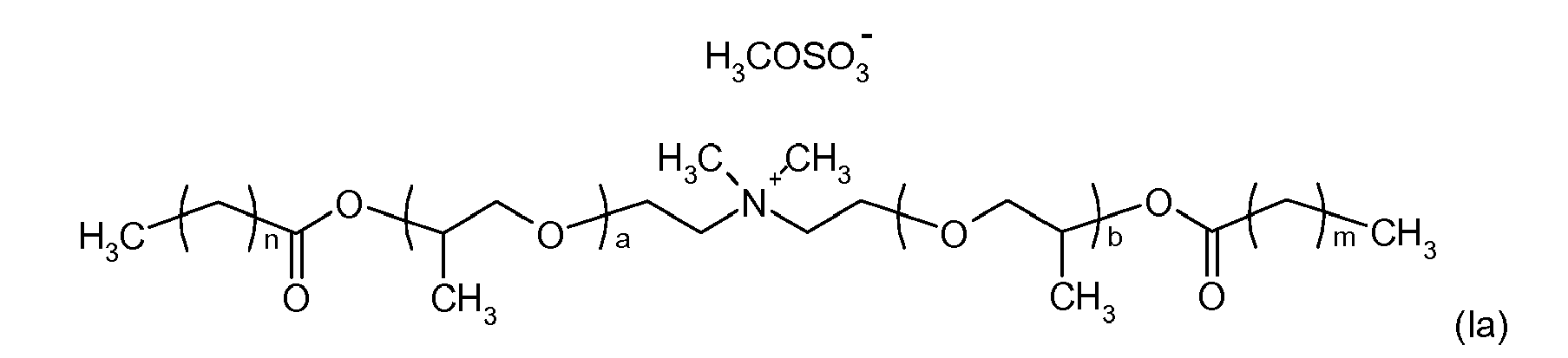 n und m unabhängig voneinander für ganze Zahlen zwischen 5 und 40 stehen, mit der Maßgabe, daß n + m ≥ 38 ist;a und b unabhängig voneinander für 1, 2, 3, 4 oder 5 stehen.
 - Haarbehandlungsmittel nach einem der Ansprüche 1 bis 3, dadurch gekennzeichnet, daß es 0,5 bis 20 Gew.-%, vorzugsweise 0,75 bis 15 Gew.-%, weiter bevorzugt 1 bis 10 Gew.-%, noch weiter bevorzugt 1,5 bis 7,5 Gew.-% und insbesondere 2 bis 4,5 Gew.-% mindestens einer Verbindung der allgemeinen Formel (lb)

- Haarbehandlungsmittel nach einem der Ansprüche 1 bis 4, dadurch gekennzeichnet, daß es 0,15 bis 15 Gew.-%, vorzugsweise 0,2 bis 10 Gew.-%, weiter bevorzugt 0,25 bis 7,5 Gew.-%, noch weiter bevorzugt 0,5 bis 5 Gew.-% und insbesondere 0,75 bis 2,5 Gew.-% Silikon(e) aus den Gruppen der Dimethicone und/oder der Cylomethicone und/oder der Amodimethicone und/oder der Dimethiconole enthält.
- Haarbehandlungsmittel nach einem der Ansprüche 1 bis 5, dadurch gekennzeichnet, daß es 0,15 bis 15 Gew.-%, vorzugsweise 0,2 bis 10 Gew.-%, weiter bevorzugt 0,25 bis 7,5 Gew.-%, noch weiter bevorzugt 0,5 bis 5 Gew.-% und insbesondere 0,75 bis 2,5 Gew.-% mindestens eines Silikons der Formel (Si-I)
(CH3)3Si-[O-Si(CH3)2]x-O-Si(CH3)3 (Si-I),
enthält, in der x für eine Zahl von 0 bis 100, vorzugsweise von 0 bis 50, weiter bevorzugt von 0 bis 20 und insbesondere 0 bis 10, steht. - Haarbehandlungsmittel nach einem der Ansprüche 1 bis 6, dadurch gekennzeichnet, daß es 0,15 bis 15 Gew.-%, vorzugsweise 0,2 bis 10 Gew.-%, weiter bevorzugt 0,25 bis 7,5 Gew.-%, noch weiter bevorzugt 0,5 bis 5 Gew.-% und insbesondere 0,75 bis 2,5 Gew.-% mindestens eines aminofunktionellen Silikons der Formel (Si-IIa)

- Haarbehandlungsmittel nach einem der Ansprüche 1 bis 7, dadurch gekennzeichnet, daß es 0,15 bis 15 Gew.-%, vorzugsweise 0,2 bis 10 Gew.-%, weiter bevorzugt 0,25 bis 7,5 Gew.-%, noch weiter bevorzugt 0,5 bis 5 Gew.-% und insbesondere 0,75 bis 2,5 Gew.-% mindestens eines aminofunktionellen Silikons der Formel (Si-IIb)

wobei die Summe (n1 + n2) vorzugsweise Werte von 0 bis 1999 und insbesondere von 49 bis 149 und m vorzugsweise Werte von 1 bis 2000, insbesondere von 1 bis 10 annimmt. - Haarbehandlungsmittel nach einem der Ansprüche 1 bis 8, enthaltenda) 0,5 bis 20 Gew.-%, vorzugsweise 0,75 bis 15 Gew.-%, weiter bevorzugt 1 bis 10 Gew.-%, noch weiter bevorzugt 1,5 bis 7,5 Gew.-% und insbesondere 2 bis 4,5 Gew.-% mindestens einer Verbindung der allgemeinen Formel (Ib)
 b) 0,1 bis 10 Gew.-% vorzugsweise 0,15 bis 5 Gew.-%, weiter bevorzugt 0,2 bis 2,5 Gew.-%, noch weiter bevorzugt 0,25 bis 1,5 Gew.-% und insbesondere 0,3 bis 1 Gew.-% mindestens einer Verbindung der Formel (IIa)
- Verfahren zur Haarbehandlung, dadurch gekennzeichnet, daß ein Haarbehandlungsmittel nach einem der Ansprüche 1 bis 9 auf das Haar aufgebracht und nach einer Einwirkzeit von 5 Sekunden bis 15 Minuten wieder ausgespült wird.
- Verfahren zur Haarbehandlung, dadurch gekennzeichnet, daß ein Haarbehandlungsmittel nach einem der Ansprüche 1 bis 9 auf das Haar aufgebracht und dort bis zur nächsten Haarwäsche belassen wird.
Applications Claiming Priority (1)
| Application Number | Priority Date | Filing Date | Title |
|---|---|---|---|
| DE102011083312A DE102011083312A1 (de) | 2011-09-23 | 2011-09-23 | Haarbehandlungsmittel mit kationischem Pflegestoff und Silikon(en) |
Publications (2)
| Publication Number | Publication Date |
|---|---|
| EP2594251A2 true EP2594251A2 (de) | 2013-05-22 |
| EP2594251A3 EP2594251A3 (de) | 2016-05-18 |
Family
ID=46704468
Family Applications (1)
| Application Number | Title | Priority Date | Filing Date |
|---|---|---|---|
| EP12180501.4A Ceased EP2594251A3 (de) | 2011-09-23 | 2012-08-15 | Haarbehandlungsmittel mit kationischem Pflegestoff und Silikon(en) |
Country Status (2)
| Country | Link |
|---|---|
| EP (1) | EP2594251A3 (de) |
| DE (1) | DE102011083312A1 (de) |
Citations (4)
| Publication number | Priority date | Publication date | Assignee | Title |
|---|---|---|---|---|
| DE3725030A1 (de) | 1987-07-29 | 1989-02-09 | Henkel Kgaa | Oberflaechenaktive hydroxysulfonate |
| EP0918743A1 (de) | 1996-06-12 | 1999-06-02 | Akzo Nobel N.V. | Verfahren zur herstellung von esterquats |
| EP0951898B1 (de) | 1998-02-10 | 2003-12-10 | Johnson & Johnson Consumer Companies, Inc. | Haarpflegemittel |
| WO2004093834A1 (en) | 2003-04-17 | 2004-11-04 | Croda, Inc. | Personal care product containing diester quat |
Family Cites Families (3)
| Publication number | Priority date | Publication date | Assignee | Title |
|---|---|---|---|---|
| US5136093A (en) | 1991-02-06 | 1992-08-04 | Smith Ronald J | Quaternized panthenol compounds and their use |
| JP5110590B2 (ja) * | 2008-07-17 | 2012-12-26 | クラシエホームプロダクツ株式会社 | ヘアリンス組成物 |
| DE102008062771A1 (de) * | 2008-12-18 | 2010-07-01 | Henkel Ag & Co. Kgaa | Kosmetische Mittel mit Edelholzextrakten |
-
2011
- 2011-09-23 DE DE102011083312A patent/DE102011083312A1/de not_active Withdrawn
-
2012
- 2012-08-15 EP EP12180501.4A patent/EP2594251A3/de not_active Ceased
Patent Citations (4)
| Publication number | Priority date | Publication date | Assignee | Title |
|---|---|---|---|---|
| DE3725030A1 (de) | 1987-07-29 | 1989-02-09 | Henkel Kgaa | Oberflaechenaktive hydroxysulfonate |
| EP0918743A1 (de) | 1996-06-12 | 1999-06-02 | Akzo Nobel N.V. | Verfahren zur herstellung von esterquats |
| EP0951898B1 (de) | 1998-02-10 | 2003-12-10 | Johnson & Johnson Consumer Companies, Inc. | Haarpflegemittel |
| WO2004093834A1 (en) | 2003-04-17 | 2004-11-04 | Croda, Inc. | Personal care product containing diester quat |
Also Published As
| Publication number | Publication date |
|---|---|
| DE102011083312A1 (de) | 2013-03-28 |
| EP2594251A3 (de) | 2016-05-18 |
Similar Documents
| Publication | Publication Date | Title |
|---|---|---|
| EP2734176B1 (de) | Leistungsgesteigerte wirkstoffkombination und haarbehandlungsmittel gegen schuppen ii | |
| EP2632422A1 (de) | Wirkstoffkombination und haarbehandlungsmittel gegen schuppen iii | |
| EP2782644A2 (de) | Haarkonditionierende mittel | |
| DE102009048299A1 (de) | Haarbehandlungsmittel mit Tensid(en) und Proteolipid(en) | |
| EP2632421A1 (de) | Wirkstoffkombination und haarbehandlungsmittel gegen schuppen i | |
| EP2632417A1 (de) | Wirkstoffkombination und haarbehandlungsmittel gegen schuppen ii | |
| DE102011087343A1 (de) | Haarbehandlungsmittel mit 4-morpholinomethyl-substituierten Silikon(en) | |
| EP2632416A1 (de) | Wirkstoffkombination und haarbehandlungsmittel gegen schuppen iv | |
| DE102010063788A1 (de) | Haarbehandlungsmittel mit Tensid(en)und kationischen Keratinhydrolysat(en) | |
| EP2734177A2 (de) | Leistungsgesteigerte wirkstoffkombination und haarbehandlungsmittel gegen schuppen i | |
| EP2648691A2 (de) | Wirkstoffkombination und haarbehandlungsmittel | |
| EP2594249A2 (de) | Haarbehandlungsmittel mit kationischem Pflegestoff und Kationtensid(en) | |
| EP2734181A2 (de) | Tensidisches haarbehandlungsmittel mit poly-l-lysin ii | |
| EP2594253A2 (de) | Haarbehandlungsmittel mit kationischem Pflegestoff und kosmetischen Ölen | |
| EP2734182B1 (de) | Tensidisches haarbehandlungsmittel mit poly-l-lysin i | |
| WO2012055584A2 (de) | Haarbehandlungsmittel mit 3-methyl-1,3-butandiol und alkylpolyglycosid(en) | |
| EP2594251A2 (de) | Haarbehandlungsmittel mit kationischem Pflegestoff und Silikon(en) | |
| EP2594252A2 (de) | Haarbehandlungsmittel mit kationischem Pflegestoff und Tensid(en) | |
| DE102011086661A1 (de) | Haarbehandlungsmittel mit kationischem Pflegestoff und UV - Filter | |
| DE102010043067A1 (de) | Haarbehandlungsmittel mit-3-Methyl-1,3-Butandiol und Amphotensid(en) | |
| DE102011086537A1 (de) | Pflegende Haarbehandlungsmittel | |
| WO2009083284A1 (de) | Stabilisierung von haarreinigungsmitteln |
Legal Events
| Date | Code | Title | Description |
|---|---|---|---|
| PUAI | Public reference made under article 153(3) epc to a published international application that has entered the european phase |
Free format text: ORIGINAL CODE: 0009012 |
|
| 17P | Request for examination filed |
Effective date: 20120815 |
|
| AK | Designated contracting states |
Kind code of ref document: A2 Designated state(s): AL AT BE BG CH CY CZ DE DK EE ES FI FR GB GR HR HU IE IS IT LI LT LU LV MC MK MT NL NO PL PT RO RS SE SI SK SM TR |
|
| AX | Request for extension of the european patent |
Extension state: BA ME |
|
| PUAL | Search report despatched |
Free format text: ORIGINAL CODE: 0009013 |
|
| AK | Designated contracting states |
Kind code of ref document: A3 Designated state(s): AL AT BE BG CH CY CZ DE DK EE ES FI FR GB GR HR HU IE IS IT LI LT LU LV MC MK MT NL NO PL PT RO RS SE SI SK SM TR |
|
| AX | Request for extension of the european patent |
Extension state: BA ME |
|
| RIC1 | Information provided on ipc code assigned before grant |
Ipc: A61K 8/89 20060101ALI20160414BHEP Ipc: A61K 8/898 20060101ALI20160414BHEP Ipc: A61Q 5/00 20060101ALI20160414BHEP Ipc: A61Q 5/12 20060101ALI20160414BHEP Ipc: A61K 8/45 20060101ALI20160414BHEP Ipc: A61K 8/41 20060101AFI20160414BHEP Ipc: A61K 8/891 20060101ALI20160414BHEP |
|
| 17Q | First examination report despatched |
Effective date: 20160609 |
|
| STAA | Information on the status of an ep patent application or granted ep patent |
Free format text: STATUS: THE APPLICATION HAS BEEN REFUSED |
|
| 18R | Application refused |
Effective date: 20161007 |