EP2592801A1 - Wireless communication receiver with phase noise estimation and phase noise compensation performed after channel estimation and related wireless communication receiving method - Google Patents
Wireless communication receiver with phase noise estimation and phase noise compensation performed after channel estimation and related wireless communication receiving method Download PDFInfo
- Publication number
- EP2592801A1 EP2592801A1 EP11009112.1A EP11009112A EP2592801A1 EP 2592801 A1 EP2592801 A1 EP 2592801A1 EP 11009112 A EP11009112 A EP 11009112A EP 2592801 A1 EP2592801 A1 EP 2592801A1
- Authority
- EP
- European Patent Office
- Prior art keywords
- processed output
- compensation
- state information
- wireless communication
- phase error
- Prior art date
- Legal status (The legal status is an assumption and is not a legal conclusion. Google has not performed a legal analysis and makes no representation as to the accuracy of the status listed.)
- Granted
Links
Images

Classifications
-
- H—ELECTRICITY
- H04—ELECTRIC COMMUNICATION TECHNIQUE
- H04L—TRANSMISSION OF DIGITAL INFORMATION, e.g. TELEGRAPHIC COMMUNICATION
- H04L25/00—Baseband systems
- H04L25/02—Details ; arrangements for supplying electrical power along data transmission lines
- H04L25/0202—Channel estimation
-
- H—ELECTRICITY
- H04—ELECTRIC COMMUNICATION TECHNIQUE
- H04L—TRANSMISSION OF DIGITAL INFORMATION, e.g. TELEGRAPHIC COMMUNICATION
- H04L27/00—Modulated-carrier systems
- H04L27/26—Systems using multi-frequency codes
- H04L27/2601—Multicarrier modulation systems
- H04L27/2647—Arrangements specific to the receiver only
- H04L27/2655—Synchronisation arrangements
- H04L27/2689—Link with other circuits, i.e. special connections between synchronisation arrangements and other circuits for achieving synchronisation
- H04L27/2695—Link with other circuits, i.e. special connections between synchronisation arrangements and other circuits for achieving synchronisation with channel estimation, e.g. determination of delay spread, derivative or peak tracking
-
- H—ELECTRICITY
- H04—ELECTRIC COMMUNICATION TECHNIQUE
- H04L—TRANSMISSION OF DIGITAL INFORMATION, e.g. TELEGRAPHIC COMMUNICATION
- H04L27/00—Modulated-carrier systems
- H04L27/0014—Carrier regulation
- H04L2027/0024—Carrier regulation at the receiver end
- H04L2027/0026—Correction of carrier offset
-
- H—ELECTRICITY
- H04—ELECTRIC COMMUNICATION TECHNIQUE
- H04L—TRANSMISSION OF DIGITAL INFORMATION, e.g. TELEGRAPHIC COMMUNICATION
- H04L27/00—Modulated-carrier systems
- H04L27/26—Systems using multi-frequency codes
- H04L27/2601—Multicarrier modulation systems
- H04L27/2647—Arrangements specific to the receiver only
- H04L27/2655—Synchronisation arrangements
- H04L27/2657—Carrier synchronisation
Definitions
- the present invention relates to a wireless communication receiver with phase noise estimation and phase noise compensation performed after channel estimation and related wireless communication receiving method according to the pre-characterizing clauses of claims 1 and 8.
- An orthogonal frequency division multiplexing (OFDM) technique distributes the data over a large number of sub-carriers that are spaced apart at defined frequencies. This spacing provides the orthogonality of the OFDM approach, and prevents the demodulators from seeing frequencies other than their own.
- the benefits of OFDM include high spectral efficiency, resiliency to radio-frequency (RF) interference, and lower multipath distortion.
- RF radio-frequency
- phase noise of the practical oscillators will be imparted to the signals during the up-conversion at the transmitter and the down-conversion at the receiver.
- the resulting phase noise spectrum of such a frequency-shifting oscillator is a function of the properties of a free-running oscillator together with those of the components of the phase-locked loop (PLL).
- phase noise introduced from the local oscillator threatens orthogonality of sub-carriers used in an OFDM system.
- Two effects of phase noise added to the signal by a receiver local oscillator are distinguished as a low-frequency phase noise (typically termed common phase error) and a high-frequency phase noise (typically termed inter-carrier interference).
- the common phase error arises predominantly from the low-frequency components of the phase noise spectrum, and causes a rotation of the signal constellation.
- inter-carrier interference it corresponds to the summation of the information of the other sub-carriers each multiplied by some complex number which comes from an average of phase noise with a spectral shift, and appears as additive Gaussian noise to the receiver.
- phase noise introduced by the practical oscillator is unavoidable.
- the receiver has suitable ability to tackle the effects of phase noise, this can allow the system and RF engineer to relax the specification of the local oscillator used in the receiver.
- the present invention aims at providing a wireless communication receiver with phase noise estimation and phase noise compensation performed after channel estimation and related wireless communication receiving method to solve the above-mentioned problems.
- the claimed exemplary wireless communication receiver includes a first signal processing block, a phase noise compensation apparatus, and a second signal processing block.
- the first signal processing block is arranged for generating a first processed output by processing a reception signal, wherein the first signal processing block includes a channel estimation unit arranged for performing channel estimation.
- the phase noise compensation apparatus is arranged for receiving the first processed output and generating a second processed output by performing phase noise compensation according to the received first processed output.
- the second signal processing block is arranged for receiving the second processed output and processing the received second processed output.
- the claimed wireless communication receiving method includes the following steps: performing a first signal processing operation for processing a reception signal to generate a first processed output, wherein the first signal processing operation includes channel estimation; generating a second processed output by performing phase noise compensation according to the first processed output; and performing a second signal processing operation upon the second processed output.
- FIG. 1 is a block diagram illustrating a generalized wireless communication receiver according to an exemplary embodiment of the present invention.
- the wireless communication receiver 100 may be used in a DVB-T system, a DVB-T2 system, a multi-standard (including DVB-T and DVB-T2) system, an ISDB-T system, or any OFDM-based system.
- the wireless communication receiver 100 includes, but is not limited to, a first signal processing block 102, a phase noise compensation apparatus 104, and a second signal processing block 106.
- the first signal processing block 102 is arranged for generating a first processed output S1 by processing a reception signal (e.g., a received RF signal) SR.
- a reception signal e.g., a received RF signal
- the phase noise compensation apparatus 104 is coupled between the first signal processing block 102 and the second signal processing block 106, and is arranged for receiving the first processed output S1 and generating a second processed output S2 by performing phase noise compensation according to the received first processed output S1.
- the second signal processing block 106 is arranged for receiving the second processed output S2 and processing the received second processed output S2.
- the second signal processing block 106 may perform error correction upon the second processed output S2.
- the first signal processing block 102 includes a channel estimation unit 108 arranged for performing channel estimation, and the phase noise compensation apparatus 104 is placed between the preceding first signal processing block 102 and the following second signal processing block 106.
- the phase noise estimation and phase noise compensation is performed after the channel estimation is accomplished.
- the phase noise compensation may refer to the channel estimation result to remove the effects caused by the phase noise more precisely and efficiently when performed upon the first processed output S1. Further details of the phase noise compensation apparatus 104 are described hereinafter.
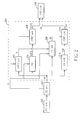
- FIG. 2 is a first exemplary implementation of a phase noise compensation apparatus according to the present invention.
- the exemplary phase noise compensation apparatus 200 may be employed to realize the phase noise compensation apparatus 104 shown in FIG. 1 .
- the phase noise compensation apparatus 200 includes, but is not limited to, a common phase error estimation (CPEE) unit, an equalizer (EQ) 204, a common phase error compensation (CPEC) unit 206, a noise estimation (NE) unit 208, a channel state information (CSI) unit 210, and a channel state information compensation (CSIC) unit 212.
- CPEE common phase error estimation
- EQ equalizer
- CPEC common phase error compensation
- NE noise estimation
- CSI channel state information
- CSIC channel state information compensation
- FFT Fast Fourier transform
- CE channel estimation
- the phase noise compensation apparatus 200 may be regarded as directly connected between the CE unit 224 of the first signal processing block 102 and the FEC unit 226 of the second signal processing block 106.
- the phase noise compensation apparatus 200 may be just coupled between the CE unit 224 and the FEC unit 226, and there are other devices connected between the CE unit 224 and the FEC unit 226, such as a frequency domain interleaver (not shown).
- the CE unit 224 generates a channel estimation result H according to an FFT output of the FFT unit 222.
- the CPEE unit 202 is arranged for estimating a common phase error (e.g., ⁇ ) of the first processed output S1 according to the first processed output S1 and the channel estimation result (e.g., an estimated channel gain) H.
- the CPEE unit 202 may use the continual pilots (CPs) of OFDM symbols included in the first processed output S1 and the corresponding estimated channel gain to estimate the common phase error.
- CPs continual pilots
- r i represents data at a sub-carrier i
- h i represents the estimated channel gain at the sub-carrier i.
- the common phase error ⁇ may be estimated using the following algorithm.
- the ideal value of the CP is either +1 or -1.
- a decision directed (DD) scheme is employed for comparing the real part of r ⁇ i with 0. In this way, the common phase error would be correctly accumulated by updating the summation value SUM with r ⁇ i . Based on the summation value SUM, the common phase error ⁇ can be easily obtained using the atan2 function.
- the common phase error is for illustrative purposes only.
- a more complicated algorithm may be employed for estimating the common phase error.
- the data at a subcarrier that is modulated using a low quadrature amplitude modulation (QAM) may be used for common phase error estimation.
- QAM quadrature amplitude modulation
- the equalizer 204 is arranged for generating an equalized signal S_EQ by equalizing the first processed output S1, such as an FFT output, according to the channel estimation result H.
- the CSI unit 210 is arranged for generating channel state information CSI according to the first processed output S1, where the channel state information CSI is indicative of the channel properties of a communication link between the transmitter and the receiver, and therefore describes the reliability of the received data. Because the constellation of EQ data is corrupted and rotated by the common phase error which may be introduced due to phase noise of the oscillator and/or the residual carrier frequency offset, performance of the receiver is poor and the channel state information is also poor.
- the CPEC unit 206 is arranged for performing a common phase error compensation upon the equalized signal S_EQ according to the common phase error ⁇ estimated by the common phase error estimation unit 202.
- the CPEC unit 206 de-rotates the constellation of EQ data by multiplying the equalized signal S_EQ with e -j ⁇ , and accordingly generates compensated equalized signal S_EQ'.
- the FEC unit 226 is arranged to perform error correction upon the EQ data according to the channel state information CSI.
- the FEC unit 226 is designed to have LDPC decoding capability, and perform LDPC decoding upon the EQ data by referring to absolute reliability data given by the channel state information.
- the equalized signal S_EQ is adjusted/compensated by the CPEC unit 206, the original channel state information corresponding to the equalized signal S_EQ should be adjusted to have correct absolute reliability data fed into the FEC unit 226.
- the second processed output S2 generated from the phase compensation apparatus 200 includes the compensated equalized signal S_EQ' and adjusted channel state information CSI'.
- the NE unit 208 and the CSIC unit 21 2 are used.
- the NE unit 208 is arranged for generating a compensation parameter W corresponding to the common phase error ⁇
- the CSIC unit 212 is arranged for adjusting the channel state information CSI according to the compensation parameter W and accordingly outputting the adjusted channel state information CSI'.
- the compensation parameter W is a weighting value
- the CSIC unit 212 generates adjusted channel state information CSI' by multiplying the channel state information CSI with the weighting value W.
- the NE unit 208 may be configured to generate it according to the common phase error ⁇ , the first processed output S1, and the channel estimation result H.
- the compensation parameter e.g., a weighting value
- W the compensation parameter (e.g., a weighting value) W.
- One is a math derivation method, and the other is a noise re-estimation method. The details of these methods are described as follows.
- the received signal may be modeled using following equation.
- Y l , k e j ⁇ ⁇ ⁇ H l , k ⁇ X l , k + N l , k
- Y l,k is the received signal
- e j ⁇ is the common phase error
- H l,k is the channel
- X l,k is data or pilot
- N l,k is noise
- l is an index value corresponding to the I th symbol
- k is an index value corresponding to the k th sub-carrier.
- the compensation parameter (e.g., a weighting value) W may be calculated using following equations.
- the compensation parameter (e.g., a weighting value) W may be calculated using following equations.
- the FEC unit 226 performs error correction upon the EQ data according to the channel state information.
- the FEC unit 226 is designed to have Viterbi decoding capability, and perform Viterbi decoding upon the EQ data by referring to relative reliability data instead of absolute reliability data.
- the equalized signal S_EQ is adjusted/compensated by the same common phase compensation (e.g., e -j ⁇ )
- the relative reliability data given by the channel state information CSI corresponding to the equalized signal S_EQ is not affected by the common phase compensation applied to the equalized signal S_EQ. Therefore, when the FEC unit 226 is designed to perform Viterbi decoding upon the EQ data by referring to relative reliability data, the aforementioned operation of adjusting/compensating the channel state information CSI may be omitted.
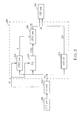
- FIG. 3 is a second exemplary implementation of a phase noise compensation apparatus according to the present invention.
- the exemplary phase noise compensation apparatus 300 may be employed to realize the phase noise compensation apparatus 104 shown in FIG. 1 .
- the major difference between the phase noise compensation apparatuses 200 and 300 is that the CSI unit 210 of the phase noise compensation apparatus 300 outputs the channel state information CSI to the following FEC unit 326 directly.
- the second processed output S2 generated from the phase noise compensation apparatus 300 includes the compensated equalized signal S_EQ' and the unadjusted/uncompensated channel state information CSI.
- the phase noise compensation apparatus 200/300 is coupled between the CE unit 224 and FEC unit 226 (e.g., directly connected or indirectly connected between the CE unit 224 and FEC unit 226).
- the phase noise compensation apparatus 200/300 is coupled between the CE unit 224 and FEC unit 226 (e.g., directly connected or indirectly connected between the CE unit 224 and FEC unit 226).
- this is for illustrative purposes only, and is not meant to be a limitation of the present invention.
- a wireless communication receiver falls within the scope of the present invention as long as the circuit configuration of the phase noise compensation apparatus 200/300 is employed by the wireless communication receiver.
- the first processed output S1 may not be required to be outputted from the first signal processing block 102 immediately after the channel estimation is accomplished, and/or the second processed output S2 outputted from the phase noise compensation apparatus may not be immediately used by the forward error correction.
- the present invention proposes a phase noise compensation apparatus, which includes a common phase error estimation unit arranged for estimating a common phase error of an input signal (e.g., the aforementioned first processed output S1 or any input which can be processed by the phase noise compensation apparatus for common phase error estimation), an equalizer arranged for generating an equalized signal by equalizing the input signal, and a common phase error compensation unit arranged for performing a common phase error compensation upon the equalized signal according to the common phase error estimated by the common phase error estimation unit.
- a common phase error estimation unit arranged for estimating a common phase error of an input signal (e.g., the aforementioned first processed output S1 or any input which can be processed by the phase noise compensation apparatus for common phase error estimation)
- an equalizer arranged for generating an equalized signal by equalizing the input signal
- a common phase error compensation unit arranged for performing a common phase error compensation upon the equalized signal according to the common phase error estimated by the common phase error estimation unit.
- the proposed phase noise compensation apparatus may further include a noise estimation unit arranged for generating a compensation parameter corresponding to the common phase error, a channel state information unit arranged for generating channel state information according to the input signal, and a channel state information compensation unit arranged for adjusting the channel state information according to the compensation parameter.
- the exemplary phase noise compensation apparatus 200/300 is configured to perform compensation upon EQ data and/or channel state information.
- the exemplary phase noise compensation apparatus of the present invention performs both of the phase noise estimation and the phase noise compensation in the frequency domain.
- the exemplary phase noise compensation apparatus of the present invention neither estimates the phase noise and performs the phase noise compensation within each of a plurality of time periods in the time domain, nor iteratively estimates the phase noise in the frequency domain and performs the corresponding phase noise compensation in the time domain.
- the phase noise can be easily estimated, and the phase noise compensation can be easily realized.
- the exemplary phase noise compensation apparatus of the present invention knows the channel estimation result beforehand, and may refer to the channel estimation result to remove the effects caused by the phase noise more precisely and efficiently.
- the present invention provides an exemplary wireless communication receiver, including a first signal processing block, a phase noise compensation apparatus, and a second signal processing block.
- the first signal processing block is arranged for generating a first processed output by processing a reception signal, wherein the first signal processing block includes a channel estimation unit arranged for performing channel estimation.
- the phase noise compensation apparatus is arranged for receiving the first processed output and generating a second processed output by performing phase noise compensation according to the received first processed output.
- the second signal processing block is arranged for receiving the second processed output and processing the received second processed output.
- the phase noise compensation apparatus includes a common phase error estimation unit, an equalizer, and a common phase error compensation unit.
- the common phase error estimation unit is arranged for estimating a common phase error of the first processed output according to the first processed output and a channel estimation result generated from the channel estimation unit.
- the equalizer is arranged for generating an equalized signal by equalizing the first processed output according to the channel estimation result.
- the common phase error compensation unit is arranged for performing a common phase error compensation upon the equalized signal according to the common phase error estimated by the common phase error estimation unit.
- the phase noise compensation apparatus may further include a noise estimation unit, a channel state information unit, and a channel state information compensation unit.
- the noise estimation unit is arranged for generating a compensation parameter corresponding to the common phase error.
- the channel state information unit is arranged for generating channel state information according to the first processed output.
- the channel state information compensation unit is arranged for adjusting the channel state information according to the compensation parameter.
- the noise estimation unit is arranged for generating the compensation parameter according to the common phase error, the first processed output, and the channel estimation result.
- the compensation parameter is a weighting value
- the channel state information compensation unit is arranged for generating adjusted channel state information by multiplying the channel state information with the weighting value.
- the second signal processing block includes a forward error correction unit, and the phase noise compensation apparatus is coupled between the channel estimation unit and the forward error correction unit.
- an exemplary wireless communication receiving method employed by the above-mentioned exemplary wireless communication receiver is also provided by the present invention.
- the exemplary phase noise compensation apparatus may be applied to other applications, where a common phase error estimation unit is arranged for estimating a common phase error of an input signal, an equalizer is arranged for generating an equalized signal by equalizing the input signal, and a common phase error compensation unit is arranged for performing a common phase error compensation upon the equalized signal according to the common phase error estimated by the common phase error estimation unit.
- the exemplary phase noise compensation apparatus may further includes a noise estimation unit arranged for generating a compensation parameter corresponding to the common phase error, a channel state information unit arranged for generating channel state information according to the input signal, and a channel state information compensation unit arranged for adjusting the channel state information according to the compensation parameter.
Landscapes
- Engineering & Computer Science (AREA)
- Computer Networks & Wireless Communication (AREA)
- Signal Processing (AREA)
- Power Engineering (AREA)
- Noise Elimination (AREA)
- Cable Transmission Systems, Equalization Of Radio And Reduction Of Echo (AREA)
Abstract
Description
- The present invention relates to a wireless communication receiver with phase noise estimation and phase noise compensation performed after channel estimation and related wireless communication receiving method according to the pre-characterizing clauses of
claims - An orthogonal frequency division multiplexing (OFDM) technique distributes the data over a large number of sub-carriers that are spaced apart at defined frequencies. This spacing provides the orthogonality of the OFDM approach, and prevents the demodulators from seeing frequencies other than their own. The benefits of OFDM include high spectral efficiency, resiliency to radio-frequency (RF) interference, and lower multipath distortion. To transmit the signal up to the RF at the transmitter and to shift the received RF signal down to the intermediate-frequency (IF)/baseband at the receiver, practical oscillators are used. However, the practical oscillator generally does not behave in an ideal manner, and thus suffers from phase noise which is a random perturbation of the phase of a steady sinusoidal waveform. Besides, the phase noise of the practical oscillators will be imparted to the signals during the up-conversion at the transmitter and the down-conversion at the receiver. The resulting phase noise spectrum of such a frequency-shifting oscillator is a function of the properties of a free-running oscillator together with those of the components of the phase-locked loop (PLL).
- The undesired phase noise introduced from the local oscillator threatens orthogonality of sub-carriers used in an OFDM system. Two effects of phase noise added to the signal by a receiver local oscillator are distinguished as a low-frequency phase noise (typically termed common phase error) and a high-frequency phase noise (typically termed inter-carrier interference). Specifically, the common phase error arises predominantly from the low-frequency components of the phase noise spectrum, and causes a rotation of the signal constellation. Regarding the inter-carrier interference, it corresponds to the summation of the information of the other sub-carriers each multiplied by some complex number which comes from an average of phase noise with a spectral shift, and appears as additive Gaussian noise to the receiver.
- As mentioned above, the phase noise introduced by the practical oscillator is unavoidable. However, if the receiver has suitable ability to tackle the effects of phase noise, this can allow the system and RF engineer to relax the specification of the local oscillator used in the receiver.
- This in mind, the present invention aims at providing a wireless communication receiver with phase noise estimation and phase noise compensation performed after channel estimation and related wireless communication receiving method to solve the above-mentioned problems.
- This is achieved by a wireless communication receiver and related wireless communication receiving method according to
claims - As will be seen more clearly from the detailed description following below, the claimed exemplary wireless communication receiver includes a first signal processing block, a phase noise compensation apparatus, and a second signal processing block. The first signal processing block is arranged for generating a first processed output by processing a reception signal, wherein the first signal processing block includes a channel estimation unit arranged for performing channel estimation. The phase noise compensation apparatus is arranged for receiving the first processed output and generating a second processed output by performing phase noise compensation according to the received first processed output. The second signal processing block is arranged for receiving the second processed output and processing the received second processed output.
- In addition, the claimed wireless communication receiving method includes the following steps: performing a first signal processing operation for processing a reception signal to generate a first processed output, wherein the first signal processing operation includes channel estimation; generating a second processed output by performing phase noise compensation according to the first processed output; and performing a second signal processing operation upon the second processed output.
- In the following, the invention is further illustrated by way of example, taking reference to the accompanying drawings. Thereof
-
FIG. 1 is a block diagram illustrating a generalizedwireless communication receiver 100 according to an exemplary embodiment of the present invention, -
FIG. 2 is a first exemplary implementation of a phase noise compensation apparatus according to the present invention, and -
FIG. 3 is a second exemplary implementation of a phase noise compensation apparatus according to the present invention. - Certain terms are used throughout the description and following claims to refer to particular components. As one skilled in the art will appreciate, manufacturers may refer to a component by different names. This document does not intend to distinguish between components that differ in name but not function. In the following description and in the claims, the terms "include" and "comprise" are used in an open-ended fashion, and thus should be interpreted to mean "include, but not limited to ...". Also, the term "couple" is intended to mean either an indirect or direct electrical connection. Accordingly, if one device is electrically connected to another device, that connection may be through a direct electrical connection, or through an indirect electrical connection via other devices and connections.
- Please refer to
FIG. 1 , which is a block diagram illustrating a generalized wireless communication receiver according to an exemplary embodiment of the present invention. Thewireless communication receiver 100 may be used in a DVB-T system, a DVB-T2 system, a multi-standard (including DVB-T and DVB-T2) system, an ISDB-T system, or any OFDM-based system. In this exemplary embodiment, thewireless communication receiver 100 includes, but is not limited to, a firstsignal processing block 102, a phasenoise compensation apparatus 104, and a secondsignal processing block 106. The firstsignal processing block 102 is arranged for generating a first processed output S1 by processing a reception signal (e.g., a received RF signal) SR. The phasenoise compensation apparatus 104 is coupled between the firstsignal processing block 102 and the secondsignal processing block 106, and is arranged for receiving the first processed output S1 and generating a second processed output S2 by performing phase noise compensation according to the received first processed output S1. The secondsignal processing block 106 is arranged for receiving the second processed output S2 and processing the received second processed output S2. For example, the secondsignal processing block 106 may perform error correction upon the second processed output S2. As shown inFIG. 1 , the firstsignal processing block 102 includes achannel estimation unit 108 arranged for performing channel estimation, and the phasenoise compensation apparatus 104 is placed between the preceding firstsignal processing block 102 and the following secondsignal processing block 106. Therefore, regarding a transmitted OFDM symbol, the phase noise estimation and phase noise compensation is performed after the channel estimation is accomplished. As the channel estimation result is known beforehand, the phase noise compensation may refer to the channel estimation result to remove the effects caused by the phase noise more precisely and efficiently when performed upon the first processed output S1. Further details of the phasenoise compensation apparatus 104 are described hereinafter. - Please refer to
FIG. 2 , which is a first exemplary implementation of a phase noise compensation apparatus according to the present invention. The exemplary phasenoise compensation apparatus 200 may be employed to realize the phasenoise compensation apparatus 104 shown inFIG. 1 . As shown in the figure, the phasenoise compensation apparatus 200 includes, but is not limited to, a common phase error estimation (CPEE) unit, an equalizer (EQ) 204, a common phase error compensation (CPEC)unit 206, a noise estimation (NE)unit 208, a channel state information (CSI)unit 210, and a channel state information compensation (CSIC)unit 212. It should be noted that the Fast Fourier transform (FFT)unit 222 and the channel estimation (CE)unit 224 belong to the firstsignal processing block 102 shown inFIG. 1 , and the forward error correction (FEC)unit 226 belongs to the secondsignal processing block 106 shown inFIG. 1 . Therefore, the phasenoise compensation apparatus 200 may be regarded as directly connected between theCE unit 224 of the firstsignal processing block 102 and theFEC unit 226 of the secondsignal processing block 106. However, the phasenoise compensation apparatus 200 may be just coupled between theCE unit 224 and theFEC unit 226, and there are other devices connected between theCE unit 224 and theFEC unit 226, such as a frequency domain interleaver (not shown). - The
CE unit 224 generates a channel estimation result H according to an FFT output of theFFT unit 222. TheCPEE unit 202 is arranged for estimating a common phase error (e.g., θ) of the first processed output S1 according to the first processed output S1 and the channel estimation result (e.g., an estimated channel gain) H. By way of example, but not limitation, theCPEE unit 202 may use the continual pilots (CPs) of OFDM symbols included in the first processed output S1 and the corresponding estimated channel gain to estimate the common phase error. Suppose that ri represents data at a sub-carrier i, and hi represents the estimated channel gain at the sub-carrier i. The common phase error θ may be estimated using the following algorithm.

- As the CP is modulated using Binary Phase Shift Keying (BPSK), the ideal value of the CP is either +1 or -1. To eliminate the effect caused by the data, a decision directed (DD) scheme is employed for comparing the real part of


- It should be noted that using continual pilots to estimate the common phase error is for illustrative purposes only. In an alternative design, a more complicated algorithm may be employed for estimating the common phase error. For example, the data at a subcarrier that is modulated using a low quadrature amplitude modulation (QAM) may be used for common phase error estimation.
- The
equalizer 204 is arranged for generating an equalized signal S_EQ by equalizing the first processed output S1, such as an FFT output, according to the channel estimation result H. TheCSI unit 210 is arranged for generating channel state information CSI according to the first processed output S1, where the channel state information CSI is indicative of the channel properties of a communication link between the transmitter and the receiver, and therefore describes the reliability of the received data. Because the constellation of EQ data is corrupted and rotated by the common phase error which may be introduced due to phase noise of the oscillator and/or the residual carrier frequency offset, performance of the receiver is poor and the channel state information is also poor. Thus, theCPEC unit 206 is arranged for performing a common phase error compensation upon the equalized signal S_EQ according to the common phase error θ estimated by the common phaseerror estimation unit 202. For example, the CPECunit 206 de-rotates the constellation of EQ data by multiplying the equalized signal S_EQ with e-jθ , and accordingly generates compensated equalized signal S_EQ'. - It should be noted that the
FEC unit 226 is arranged to perform error correction upon the EQ data according to the channel state information CSI. For example, in a case where the wireless communication system employs the low-density parity-check (LDPC) coding to ensure the data correctness, theFEC unit 226 is designed to have LDPC decoding capability, and perform LDPC decoding upon the EQ data by referring to absolute reliability data given by the channel state information. As the equalized signal S_EQ is adjusted/compensated by theCPEC unit 206, the original channel state information corresponding to the equalized signal S_EQ should be adjusted to have correct absolute reliability data fed into theFEC unit 226. In other words, the second processed output S2 generated from thephase compensation apparatus 200 includes the compensated equalized signal S_EQ' and adjusted channel state information CSI'. - Regarding the compensation applied to the channel state information CSI generated from the
CSI unit 210, theNE unit 208 and the CSIC unit 21 2 are used. TheNE unit 208 is arranged for generating a compensation parameter W corresponding to the common phase error θ, and theCSIC unit 212 is arranged for adjusting the channel state information CSI according to the compensation parameter W and accordingly outputting the adjusted channel state information CSI'. In one exemplary design, the compensation parameter W is a weighting value, and theCSIC unit 212 generates adjusted channel state information CSI' by multiplying the channel state information CSI with the weighting value W. Regarding the compensation parameter (e.g., a weighting value) W, theNE unit 208 may be configured to generate it according to the common phase error θ, the first processed output S1, and the channel estimation result H. By way of example, but not limitation, there are two methods that may be used to calculate the compensation parameter (e.g., a weighting value) W. One is a math derivation method, and the other is a noise re-estimation method. The details of these methods are described as follows. - The received signal may be modeled using following equation.

- In above equation (1), Yl,k is the received signal, ejθ is the common phase error, Hl,k is the channel, Xl,k is data or pilot, Nl,k is noise, l is an index value corresponding to the Ith symbol, and k is an index value corresponding to the kth sub-carrier. The relationship between adjusted channel state information CSIl,k,after and the original channel state information CSIl,k,before may be expressed as follows.

- When the math derivation method is employed by the
NE unit 208, the compensation parameter (e.g., a weighting value) W may be calculated using following equations.

- When the noise re-estimation method is employed by the
NE unit 208, the compensation parameter (e.g., a weighting value) W may be calculated using following equations.


- As mentioned above, the
FEC unit 226 performs error correction upon the EQ data according to the channel state information. Consider another case where the wireless communication system employs the Viterbi coding to ensure the data correctness. Thus, theFEC unit 226 is designed to have Viterbi decoding capability, and perform Viterbi decoding upon the EQ data by referring to relative reliability data instead of absolute reliability data. As the equalized signal S_EQ is adjusted/compensated by the same common phase compensation (e.g., e-jθ ), the relative reliability data given by the channel state information CSI corresponding to the equalized signal S_EQ is not affected by the common phase compensation applied to the equalized signal S_EQ. Therefore, when theFEC unit 226 is designed to perform Viterbi decoding upon the EQ data by referring to relative reliability data, the aforementioned operation of adjusting/compensating the channel state information CSI may be omitted. - Please refer to
FIG. 3 , which is a second exemplary implementation of a phase noise compensation apparatus according to the present invention. The exemplary phasenoise compensation apparatus 300 may be employed to realize the phasenoise compensation apparatus 104 shown inFIG. 1 . The major difference between the phasenoise compensation apparatuses CSI unit 210 of the phasenoise compensation apparatus 300 outputs the channel state information CSI to the followingFEC unit 326 directly. To put it another way, the second processed output S2 generated from the phasenoise compensation apparatus 300 includes the compensated equalized signal S_EQ' and the unadjusted/uncompensated channel state information CSI. As a person skilled in the art can readily understand operation of the phasenoise compensation apparatus 300 after reading above paragraphs, further description is omitted here for brevity. - In above-mentioned embodiments, the phase
noise compensation apparatus 200/300 is coupled between theCE unit 224 and FEC unit 226 (e.g., directly connected or indirectly connected between theCE unit 224 and FEC unit 226). However, this is for illustrative purposes only, and is not meant to be a limitation of the present invention. For example, a wireless communication receiver falls within the scope of the present invention as long as the circuit configuration of the phasenoise compensation apparatus 200/300 is employed by the wireless communication receiver. For example, the first processed output S1 may not be required to be outputted from the firstsignal processing block 102 immediately after the channel estimation is accomplished, and/or the second processed output S2 outputted from the phase noise compensation apparatus may not be immediately used by the forward error correction. - To put it simply, in accordance with the exemplary embodiments shown in
FIG. 2 andFIG. 3 , the present invention proposes a phase noise compensation apparatus, which includes a common phase error estimation unit arranged for estimating a common phase error of an input signal (e.g., the aforementioned first processed output S1 or any input which can be processed by the phase noise compensation apparatus for common phase error estimation), an equalizer arranged for generating an equalized signal by equalizing the input signal, and a common phase error compensation unit arranged for performing a common phase error compensation upon the equalized signal according to the common phase error estimated by the common phase error estimation unit. Thus, any wireless communication receiver that estimates the common phase error according to an input of the equalizer and applies the common phase error compensation to an output of the equalizer falls within the scope of the present invention. Moreover, based on the actual error correction scheme employed by the wireless communication system, the proposed phase noise compensation apparatus may further include a noise estimation unit arranged for generating a compensation parameter corresponding to the common phase error, a channel state information unit arranged for generating channel state information according to the input signal, and a channel state information compensation unit arranged for adjusting the channel state information according to the compensation parameter. - As can be seen from
FIG. 2 andFIG. 3 , the exemplary phasenoise compensation apparatus 200/300 is configured to perform compensation upon EQ data and/or channel state information. In other words, the exemplary phase noise compensation apparatus of the present invention performs both of the phase noise estimation and the phase noise compensation in the frequency domain. In other words, the exemplary phase noise compensation apparatus of the present invention neither estimates the phase noise and performs the phase noise compensation within each of a plurality of time periods in the time domain, nor iteratively estimates the phase noise in the frequency domain and performs the corresponding phase noise compensation in the time domain. Thus, the phase noise can be easily estimated, and the phase noise compensation can be easily realized. Besides, as the phase noise estimation and phase noise compensation is performed after the channel estimation is accomplished, the exemplary phase noise compensation apparatus of the present invention knows the channel estimation result beforehand, and may refer to the channel estimation result to remove the effects caused by the phase noise more precisely and efficiently. - Briefly summarized, the present invention provides an exemplary wireless communication receiver, including a first signal processing block, a phase noise compensation apparatus, and a second signal processing block. The first signal processing block is arranged for generating a first processed output by processing a reception signal, wherein the first signal processing block includes a channel estimation unit arranged for performing channel estimation. The phase noise compensation apparatus is arranged for receiving the first processed output and generating a second processed output by performing phase noise compensation according to the received first processed output. The second signal processing block is arranged for receiving the second processed output and processing the received second processed output.
- By way of example, the phase noise compensation apparatus includes a common phase error estimation unit, an equalizer, and a common phase error compensation unit. The common phase error estimation unit is arranged for estimating a common phase error of the first processed output according to the first processed output and a channel estimation result generated from the channel estimation unit. The equalizer is arranged for generating an equalized signal by equalizing the first processed output according to the channel estimation result. The common phase error compensation unit is arranged for performing a common phase error compensation upon the equalized signal according to the common phase error estimated by the common phase error estimation unit.
- By way of example, the phase noise compensation apparatus may further include a noise estimation unit, a channel state information unit, and a channel state information compensation unit. The noise estimation unit is arranged for generating a compensation parameter corresponding to the common phase error. The channel state information unit is arranged for generating channel state information according to the first processed output. The channel state information compensation unit is arranged for adjusting the channel state information according to the compensation parameter.
- In one exemplary design, the noise estimation unit is arranged for generating the compensation parameter according to the common phase error, the first processed output, and the channel estimation result. In another exemplary design, the compensation parameter is a weighting value, and the channel state information compensation unit is arranged for generating adjusted channel state information by multiplying the channel state information with the weighting value. In yet another exemplary design, the second signal processing block includes a forward error correction unit, and the phase noise compensation apparatus is coupled between the channel estimation unit and the forward error correction unit.
- Besides, an exemplary wireless communication receiving method employed by the above-mentioned exemplary wireless communication receiver is also provided by the present invention.
- Moreover, in addition to the wireless communication receiver, the exemplary phase noise compensation apparatus provided by the present invention may be applied to other applications, where a common phase error estimation unit is arranged for estimating a common phase error of an input signal, an equalizer is arranged for generating an equalized signal by equalizing the input signal, and a common phase error compensation unit is arranged for performing a common phase error compensation upon the equalized signal according to the common phase error estimated by the common phase error estimation unit. Besides, the exemplary phase noise compensation apparatus may further includes a noise estimation unit arranged for generating a compensation parameter corresponding to the common phase error, a channel state information unit arranged for generating channel state information according to the input signal, and a channel state information compensation unit arranged for adjusting the channel state information according to the compensation parameter.
- All combinations and sub-combinations of the above-described features also belong to the invention.
Claims (14)
- A wireless communication receiver (100), characterized by:a first signal processing block (102), arranged for generating a first processed output by processing a reception signal, wherein the first signal processing block (102) includes a channel estimation unit (108, 224) arranged for performing channel estimation;a phase noise compensation apparatus (104, 200, 300), arranged for receiving the first processed output and generating a second processed output by performing phase noise compensation according to the received first processed output; anda second signal processing block (106), arranged for receiving the second processed output and processing the received second processed output.
- The wireless communication receiver (100) of claim 1, characterized in that the second signal processing block (106) includes a forward error correction unit (226, 326), and the phase noise compensation apparatus (104, 200, 300) is coupled between the channel estimation unit (108, 224) and the forward error correction unit (226, 326).
- The wireless communication receiver (100) of claim 2, characterized in that the phase noise compensation apparatus (200, 300) comprises:a common phase error estimation unit (202), arranged for estimating a common phase error of the first processed output according to the first processed output and a channel estimation result generated from the channel estimation unit (224);an equalizer (204), arranged for generating an equalized signal by equalizing the first processed output according to the channel estimation result; anda common phase error compensation unit (206), arranged for performing a common phase error compensation upon the equalized signal according to the common phase error estimated by the common phase error estimation unit (202).
- The wireless communication receiver (100) of claim 3, characterized in that the phase noise compensation apparatus (200) further comprises:a noise estimation unit (208), arranged for generating a compensation parameter corresponding to the common phase error;a channel state information unit (210), arranged for generating channel state information according to the first processed output; anda channel state information compensation unit (212), arranged for adjusting the channel state information according to the compensation parameter.
- The wireless communication receiver (100) of claim 1, characterized in that the phase noise compensation apparatus (200, 300) comprises:a common phase error estimation unit (202), arranged for estimating a common phase error of the first processed output;an equalizer (204), arranged for generating an equalized signal by equalizing the first processed output; anda common phase error compensation unit (206), arranged for performing a common phase error compensation upon the equalized signal according to the common phase error estimated by the common phase error estimation unit (202).
- The wireless communication receiver (100) of claim 5, characterized in that the phase noise compensation apparatus (200) further comprises:a noise estimation unit (208), arranged for generating a compensation parameter corresponding to the common phase error;a channel state information unit (210), arranged for generating channel state information according to the first processed output; anda channel state information compensation unit (212), arranged for adjusting the channel state information according to the compensation parameter.
- The wireless communication receiver (100) of claim 4 or 6, characterized in that the compensation parameter is a weighting value, and the channel state information compensation unit (212) is arranged for generating adjusted channel state information by multiplying the channel state information with the weighting value.
- A wireless communication receiving method, characterized by:performing a first signal processing operation for processing a reception signal to generate a first processed output, wherein the first signal processing operation includes channel estimation;generating a second processed output by performing phase noise compensation according to the first processed output; andperforming a second signal processing operation upon the second processed output.
- The wireless communication receiving method of claim 8, characterized in that the second signal processing operation includes forward error correction, a channel estimation result generated from the channel estimation is directly used by the phase noise compensation, and the second processed output is directly used by the forward error correction.
- The wireless communication receiving method of claim 9, characterized in that the phase noise compensation comprises:estimating a common phase error according to the first processed output and the channel estimation result;generating an equalized signal by equalizing the first processed output according to the channel estimation result; andperforming a common phase error compensation upon the equalized signal according to the estimated common phase error.
- The wireless communication receiving method of claim 10, characterized in that the phase noise compensation further comprises:generating a compensation parameter corresponding to the common phase error;generating channel state information according to the first processed output; andadjusting the channel state information according to the compensation parameter.
- The wireless communication receiving method of claim 8, characterized in that the phase noise compensation comprises:estimating a common phase error of the first processed output;generating an equalized signal by equalizing the first processed output; andperforming a common phase error compensation upon the equalized signal according to the estimated common phase error.
- The wireless communication receiving method of claim 12, characterized in that the phase noise compensation further comprises:generating a compensation parameter corresponding to the common phase error;generating channel state information according to the first processed output; andadjusting the channel state information according to the compensation parameter.
- The wireless communication receiving method of claim 11 or 13, characterized in that the compensation parameter is a weighting value, and the step of adjusting the channel state information comprises:generating adjusted channel state information by multiplying the channel state information with the weighting value.
Applications Claiming Priority (1)
| Application Number | Priority Date | Filing Date | Title |
|---|---|---|---|
| US13/293,084 US9036747B2 (en) | 2011-11-09 | 2011-11-09 | Wireless communication receiver with phase noise estimation and phase noise compensation performed after channel estimation, and related wireless communication receiving method and phase noise compensation apparatus |
Publications (2)
| Publication Number | Publication Date |
|---|---|
| EP2592801A1 true EP2592801A1 (en) | 2013-05-15 |
| EP2592801B1 EP2592801B1 (en) | 2014-10-01 |
Family
ID=45033672
Family Applications (1)
| Application Number | Title | Priority Date | Filing Date |
|---|---|---|---|
| EP20110009112 Active EP2592801B1 (en) | 2011-11-09 | 2011-11-17 | Wireless communication receiver with phase noise estimation and phase noise compensation performed after channel estimation and related wireless communication receiving method |
Country Status (4)
| Country | Link |
|---|---|
| US (1) | US9036747B2 (en) |
| EP (1) | EP2592801B1 (en) |
| CN (1) | CN103107968B (en) |
| TW (1) | TWI461006B (en) |
Cited By (1)
| Publication number | Priority date | Publication date | Assignee | Title |
|---|---|---|---|---|
| CN110519194A (en) * | 2019-07-31 | 2019-11-29 | 北京遥测技术研究所 | Based on the phase noise inhibition method of Comb Pilot in OFDM data chain |
Families Citing this family (9)
| Publication number | Priority date | Publication date | Assignee | Title |
|---|---|---|---|---|
| WO2012170801A2 (en) * | 2011-06-08 | 2012-12-13 | Broadcom Corporation | Systems and methods for integrating cellular and location detection functionality using a single crystal oscillator |
| TWI577158B (en) | 2015-11-05 | 2017-04-01 | 財團法人工業技術研究院 | Apparatus and method of channel estimation |
| EP3400458B1 (en) * | 2016-01-04 | 2021-10-13 | Symeo GmbH | Method and system for the reduction of disturbance through phase noise in a radar system |
| US10097254B2 (en) * | 2016-04-18 | 2018-10-09 | Qualcomm Incorporated | Channel state information estimation and channel information reporting |
| CN109075950B (en) * | 2016-05-09 | 2022-02-22 | 苹果公司 | Phase compensated reference signal for 5G systems |
| RU2626246C1 (en) | 2016-08-10 | 2017-07-25 | Общество с ограниченной ответственностью "Радио Гигабит" | Method of compensating for phase noise influence on data transmission in radio channel |
| US10256929B2 (en) * | 2017-01-04 | 2019-04-09 | Samsung Electronics Co., Ltd | Method and apparatus for decision directed common phase error estimation based on soft information |
| US10090980B2 (en) * | 2017-01-08 | 2018-10-02 | At&T Intellectual Property I, L.P. | Transmission of demodulation reference signals for a 5G wireless communication network or other next generation network |
| US12439353B2 (en) * | 2022-02-08 | 2025-10-07 | Charter Communications Operating, Llc | Phase noise compensation in a wireless system |
Citations (4)
| Publication number | Priority date | Publication date | Assignee | Title |
|---|---|---|---|---|
| US20040021795A1 (en) * | 2002-08-01 | 2004-02-05 | Kim Joon Tae | Channel equalizer and digital TV receiver using the same |
| US20060251198A1 (en) * | 2005-05-09 | 2006-11-09 | Xiaoqiang Ma | Systems, methods, and apparatus for phase noise mitigation |
| EP1814276A1 (en) * | 2006-01-26 | 2007-08-01 | Siemens S.p.A. | Method for phase noise compensation in ofdm receiver, and corresponding device and receiver thereof |
| US20080008258A1 (en) * | 2006-07-05 | 2008-01-10 | Yasuhiko Tanabe | Wireless receiving apparatus and method |
Family Cites Families (13)
| Publication number | Priority date | Publication date | Assignee | Title |
|---|---|---|---|---|
| US6603811B1 (en) * | 1998-05-29 | 2003-08-05 | 3Com Corporation | Low complexity frequency domain equalizer having fast re-lock |
| WO2000065756A1 (en) * | 1999-04-22 | 2000-11-02 | Nippon Telegraph And Telephone Corporation | Ofdm packet communication receiver |
| FR2832886B1 (en) | 2001-11-29 | 2005-03-25 | Dibcom | METHOD AND DEVICE FOR DEMODULATION WITH COMPENSATION OF PHASE NOISE |
| US7433298B1 (en) * | 2002-08-19 | 2008-10-07 | Marvell International Ltd. | Compensation for residual frequency offset, phase noise and I/Q imbalance in OFDM modulated communications |
| JP3748449B2 (en) * | 2003-03-31 | 2006-02-22 | 株式会社東芝 | OFDM receiver |
| KR20040110340A (en) * | 2003-06-18 | 2004-12-31 | 삼성전자주식회사 | TDS-OFDM receiver for extracting channel status information to correct error and method for error-correcting of TDS-OFDM receiver |
| FR2857802B1 (en) * | 2003-07-18 | 2007-02-09 | Telediffusion De France Tdf | METHOD AND DEVICE FOR ESTIMATING A PROPAGATION CHANNEL OF A MULTI-CARRIER SIGNAL |
| KR100752641B1 (en) * | 2005-01-25 | 2007-08-29 | 삼성전자주식회사 | ODF signal receiver and method for estimating common phase using data subcarrier |
| US7773690B2 (en) * | 2005-07-20 | 2010-08-10 | Broadcom Corporation | Angle estimation for space-time block code (STBC) modulated signal |
| US7733993B2 (en) | 2005-10-14 | 2010-06-08 | Nokia Corporation | Phase noise canceling OFDM receiver |
| US8457252B2 (en) * | 2007-04-04 | 2013-06-04 | Thomson Licensing | Method and apparatus for digital signal reception |
| US7843806B2 (en) * | 2008-05-07 | 2010-11-30 | Wipro Techno Centre (Singapore) Pte Ltd. | Apparatus and methods for estimating and compensating sampling clock offset |
| JP2010220105A (en) * | 2009-03-18 | 2010-09-30 | Toshiba Corp | Wireless receiving apparatus and wireless receiving method |
-
2011
- 2011-11-09 US US13/293,084 patent/US9036747B2/en active Active
- 2011-11-17 EP EP20110009112 patent/EP2592801B1/en active Active
-
2012
- 2012-06-06 TW TW101120238A patent/TWI461006B/en not_active IP Right Cessation
- 2012-10-24 CN CN201210408683.5A patent/CN103107968B/en active Active
Patent Citations (4)
| Publication number | Priority date | Publication date | Assignee | Title |
|---|---|---|---|---|
| US20040021795A1 (en) * | 2002-08-01 | 2004-02-05 | Kim Joon Tae | Channel equalizer and digital TV receiver using the same |
| US20060251198A1 (en) * | 2005-05-09 | 2006-11-09 | Xiaoqiang Ma | Systems, methods, and apparatus for phase noise mitigation |
| EP1814276A1 (en) * | 2006-01-26 | 2007-08-01 | Siemens S.p.A. | Method for phase noise compensation in ofdm receiver, and corresponding device and receiver thereof |
| US20080008258A1 (en) * | 2006-07-05 | 2008-01-10 | Yasuhiko Tanabe | Wireless receiving apparatus and method |
Non-Patent Citations (1)
| Title |
|---|
| STEFFEN BITTNER ET AL: "Iterative Phase Noise Mitigation in MIMO-OFDM Systems with Pilot Aided Channel Estimation", VEHICULAR TECHNOLOGY CONFERENCE, 2007. VTC-2007 FALL. 2007 IEEE 66TH, IEEE, PI, 1 September 2007 (2007-09-01), pages 1087 - 1091, XP031147573, ISBN: 978-1-4244-0263-2 * |
Cited By (2)
| Publication number | Priority date | Publication date | Assignee | Title |
|---|---|---|---|---|
| CN110519194A (en) * | 2019-07-31 | 2019-11-29 | 北京遥测技术研究所 | Based on the phase noise inhibition method of Comb Pilot in OFDM data chain |
| CN110519194B (en) * | 2019-07-31 | 2022-04-12 | 北京遥测技术研究所 | Phase noise suppression method based on comb-shaped pilot frequency in OFDM data chain |
Also Published As
| Publication number | Publication date |
|---|---|
| EP2592801B1 (en) | 2014-10-01 |
| US20130114661A1 (en) | 2013-05-09 |
| US9036747B2 (en) | 2015-05-19 |
| CN103107968A (en) | 2013-05-15 |
| TWI461006B (en) | 2014-11-11 |
| TW201320629A (en) | 2013-05-16 |
| CN103107968B (en) | 2016-03-30 |
Similar Documents
| Publication | Publication Date | Title |
|---|---|---|
| EP2592801B1 (en) | Wireless communication receiver with phase noise estimation and phase noise compensation performed after channel estimation and related wireless communication receiving method | |
| US8781008B2 (en) | Highly-spectrally-efficient transmission using orthogonal frequency division multiplexing | |
| US10389561B2 (en) | Transmitter time-domain estimation and compensation of IQ imbalance | |
| US8681885B2 (en) | OFDM receiver and method for compensating for I/Q imbalance | |
| US10212014B2 (en) | Communication with I-Q decoupled OFDM modulation | |
| EP1744513B1 (en) | Doppler frequency calculating apparatus and method | |
| US20090067514A1 (en) | Method of non-uniform doppler compensation for wideband orthogonal frequency division multiplexed signals | |
| CN102090035B (en) | Methods and an apparatus for estimating a residual frequency error in a communications system | |
| US9306789B2 (en) | Estimation of CFO based on relative values of frequency bins corresponding to used subcarriers of received preamble symbols for OFDM systems | |
| US8958491B2 (en) | Receiving device of OFDM communication system and method for alleviating phase noise thereof | |
| US20190245569A1 (en) | Method for compensation of phase noise effect on data transmission in radio channel | |
| US7792219B2 (en) | Apparatus and method for correcting common phase error in a multi-carrier communication system | |
| EP1636957B1 (en) | Receiver for multi-carrier communication system | |
| CN100531176C (en) | Equalization circuit for enhancing channel estimation and compensating for residual frequency offset in receiver | |
| US9306788B2 (en) | SFO estimation technique for MIMO-OFDM frequency synchronization | |
| CN101483632A (en) | Phase noise correcting method using out-of-band pilot in OFDM system | |
| US9106326B2 (en) | Method for determining the imperfections of a transmit pathway and of a receive pathway of an apparatus, and associated radio apparatus | |
| JP6743327B2 (en) | Wireless communication system, wireless transmitter, and wireless receiver | |
| Dusza et al. | Error vector magnitude measurement accuracy and impact on spectrum flatness behavior for OFDM-based WiMAX and LTE systems | |
| JP5653837B2 (en) | OFDM signal receiver | |
| Arslan | Channel frequency response estimation under the effect of RF impairements in OFDM based wireless systems | |
| WO2006085502A1 (en) | Diversity reception method and reception apparatus in wired communication | |
| JP2017050682A (en) | Radio receiving apparatus and received data restoring apparatus | |
| JP5068230B2 (en) | OFDM digital signal equalization apparatus, equalization method, and relay apparatus | |
| JP2002164865A (en) | Ofdm communication device |
Legal Events
| Date | Code | Title | Description |
|---|---|---|---|
| PUAI | Public reference made under article 153(3) epc to a published international application that has entered the european phase |
Free format text: ORIGINAL CODE: 0009012 |
|
| AK | Designated contracting states |
Kind code of ref document: A1 Designated state(s): AL AT BE BG CH CY CZ DE DK EE ES FI FR GB GR HR HU IE IS IT LI LT LU LV MC MK MT NL NO PL PT RO RS SE SI SK SM TR |
|
| AX | Request for extension of the european patent |
Extension state: BA ME |
|
| 17P | Request for examination filed |
Effective date: 20131115 |
|
| RBV | Designated contracting states (corrected) |
Designated state(s): AL AT BE BG CH CY CZ DE DK EE ES FI FR GB GR HR HU IE IS IT LI LT LU LV MC MK MT NL NO PL PT RO RS SE SI SK SM TR |
|
| GRAP | Despatch of communication of intention to grant a patent |
Free format text: ORIGINAL CODE: EPIDOSNIGR1 |
|
| INTG | Intention to grant announced |
Effective date: 20140417 |
|
| GRAS | Grant fee paid |
Free format text: ORIGINAL CODE: EPIDOSNIGR3 |
|
| GRAA | (expected) grant |
Free format text: ORIGINAL CODE: 0009210 |
|
| AK | Designated contracting states |
Kind code of ref document: B1 Designated state(s): AL AT BE BG CH CY CZ DE DK EE ES FI FR GB GR HR HU IE IS IT LI LT LU LV MC MK MT NL NO PL PT RO RS SE SI SK SM TR |
|
| REG | Reference to a national code |
Ref country code: GB Ref legal event code: FG4D |
|
| REG | Reference to a national code |
Ref country code: AT Ref legal event code: REF Ref document number: 689985 Country of ref document: AT Kind code of ref document: T Effective date: 20141015 Ref country code: CH Ref legal event code: EP |
|
| REG | Reference to a national code |
Ref country code: IE Ref legal event code: FG4D |
|
| REG | Reference to a national code |
Ref country code: DE Ref legal event code: R096 Ref document number: 602011010198 Country of ref document: DE Effective date: 20141113 |
|
| REG | Reference to a national code |
Ref country code: NL Ref legal event code: VDEP Effective date: 20141001 |
|
| REG | Reference to a national code |
Ref country code: AT Ref legal event code: MK05 Ref document number: 689985 Country of ref document: AT Kind code of ref document: T Effective date: 20141001 |
|
| REG | Reference to a national code |
Ref country code: LT Ref legal event code: MG4D |
|
| PG25 | Lapsed in a contracting state [announced via postgrant information from national office to epo] |
Ref country code: NL Free format text: LAPSE BECAUSE OF FAILURE TO SUBMIT A TRANSLATION OF THE DESCRIPTION OR TO PAY THE FEE WITHIN THE PRESCRIBED TIME-LIMIT Effective date: 20141001 |
|
| PG25 | Lapsed in a contracting state [announced via postgrant information from national office to epo] |
Ref country code: ES Free format text: LAPSE BECAUSE OF FAILURE TO SUBMIT A TRANSLATION OF THE DESCRIPTION OR TO PAY THE FEE WITHIN THE PRESCRIBED TIME-LIMIT Effective date: 20141001 Ref country code: LT Free format text: LAPSE BECAUSE OF FAILURE TO SUBMIT A TRANSLATION OF THE DESCRIPTION OR TO PAY THE FEE WITHIN THE PRESCRIBED TIME-LIMIT Effective date: 20141001 Ref country code: FI Free format text: LAPSE BECAUSE OF FAILURE TO SUBMIT A TRANSLATION OF THE DESCRIPTION OR TO PAY THE FEE WITHIN THE PRESCRIBED TIME-LIMIT Effective date: 20141001 Ref country code: PT Free format text: LAPSE BECAUSE OF FAILURE TO SUBMIT A TRANSLATION OF THE DESCRIPTION OR TO PAY THE FEE WITHIN THE PRESCRIBED TIME-LIMIT Effective date: 20150202 Ref country code: CZ Free format text: LAPSE BECAUSE OF FAILURE TO SUBMIT A TRANSLATION OF THE DESCRIPTION OR TO PAY THE FEE WITHIN THE PRESCRIBED TIME-LIMIT Effective date: 20141001 Ref country code: IS Free format text: LAPSE BECAUSE OF FAILURE TO SUBMIT A TRANSLATION OF THE DESCRIPTION OR TO PAY THE FEE WITHIN THE PRESCRIBED TIME-LIMIT Effective date: 20150201 Ref country code: NO Free format text: LAPSE BECAUSE OF FAILURE TO SUBMIT A TRANSLATION OF THE DESCRIPTION OR TO PAY THE FEE WITHIN THE PRESCRIBED TIME-LIMIT Effective date: 20150101 |
|
| PG25 | Lapsed in a contracting state [announced via postgrant information from national office to epo] |
Ref country code: PL Free format text: LAPSE BECAUSE OF FAILURE TO SUBMIT A TRANSLATION OF THE DESCRIPTION OR TO PAY THE FEE WITHIN THE PRESCRIBED TIME-LIMIT Effective date: 20141001 Ref country code: SE Free format text: LAPSE BECAUSE OF FAILURE TO SUBMIT A TRANSLATION OF THE DESCRIPTION OR TO PAY THE FEE WITHIN THE PRESCRIBED TIME-LIMIT Effective date: 20141001 Ref country code: GR Free format text: LAPSE BECAUSE OF FAILURE TO SUBMIT A TRANSLATION OF THE DESCRIPTION OR TO PAY THE FEE WITHIN THE PRESCRIBED TIME-LIMIT Effective date: 20150102 Ref country code: HR Free format text: LAPSE BECAUSE OF FAILURE TO SUBMIT A TRANSLATION OF THE DESCRIPTION OR TO PAY THE FEE WITHIN THE PRESCRIBED TIME-LIMIT Effective date: 20141001 Ref country code: LV Free format text: LAPSE BECAUSE OF FAILURE TO SUBMIT A TRANSLATION OF THE DESCRIPTION OR TO PAY THE FEE WITHIN THE PRESCRIBED TIME-LIMIT Effective date: 20141001 Ref country code: AT Free format text: LAPSE BECAUSE OF FAILURE TO SUBMIT A TRANSLATION OF THE DESCRIPTION OR TO PAY THE FEE WITHIN THE PRESCRIBED TIME-LIMIT Effective date: 20141001 Ref country code: RS Free format text: LAPSE BECAUSE OF FAILURE TO SUBMIT A TRANSLATION OF THE DESCRIPTION OR TO PAY THE FEE WITHIN THE PRESCRIBED TIME-LIMIT Effective date: 20141001 Ref country code: CY Free format text: LAPSE BECAUSE OF FAILURE TO SUBMIT A TRANSLATION OF THE DESCRIPTION OR TO PAY THE FEE WITHIN THE PRESCRIBED TIME-LIMIT Effective date: 20141001 |
|
| PG25 | Lapsed in a contracting state [announced via postgrant information from national office to epo] |
Ref country code: BE Free format text: LAPSE BECAUSE OF NON-PAYMENT OF DUE FEES Effective date: 20141130 Ref country code: MC Free format text: LAPSE BECAUSE OF FAILURE TO SUBMIT A TRANSLATION OF THE DESCRIPTION OR TO PAY THE FEE WITHIN THE PRESCRIBED TIME-LIMIT Effective date: 20141001 |
|
| REG | Reference to a national code |
Ref country code: CH Ref legal event code: PL |
|
| REG | Reference to a national code |
Ref country code: DE Ref legal event code: R097 Ref document number: 602011010198 Country of ref document: DE |
|
| PG25 | Lapsed in a contracting state [announced via postgrant information from national office to epo] |
Ref country code: LI Free format text: LAPSE BECAUSE OF NON-PAYMENT OF DUE FEES Effective date: 20141130 Ref country code: CH Free format text: LAPSE BECAUSE OF NON-PAYMENT OF DUE FEES Effective date: 20141130 Ref country code: RO Free format text: LAPSE BECAUSE OF FAILURE TO SUBMIT A TRANSLATION OF THE DESCRIPTION OR TO PAY THE FEE WITHIN THE PRESCRIBED TIME-LIMIT Effective date: 20141001 Ref country code: DK Free format text: LAPSE BECAUSE OF FAILURE TO SUBMIT A TRANSLATION OF THE DESCRIPTION OR TO PAY THE FEE WITHIN THE PRESCRIBED TIME-LIMIT Effective date: 20141001 Ref country code: EE Free format text: LAPSE BECAUSE OF FAILURE TO SUBMIT A TRANSLATION OF THE DESCRIPTION OR TO PAY THE FEE WITHIN THE PRESCRIBED TIME-LIMIT Effective date: 20141001 Ref country code: SK Free format text: LAPSE BECAUSE OF FAILURE TO SUBMIT A TRANSLATION OF THE DESCRIPTION OR TO PAY THE FEE WITHIN THE PRESCRIBED TIME-LIMIT Effective date: 20141001 |
|
| PLBE | No opposition filed within time limit |
Free format text: ORIGINAL CODE: 0009261 |
|
| STAA | Information on the status of an ep patent application or granted ep patent |
Free format text: STATUS: NO OPPOSITION FILED WITHIN TIME LIMIT |
|
| REG | Reference to a national code |
Ref country code: IE Ref legal event code: MM4A |
|
| PG25 | Lapsed in a contracting state [announced via postgrant information from national office to epo] |
Ref country code: IT Free format text: LAPSE BECAUSE OF FAILURE TO SUBMIT A TRANSLATION OF THE DESCRIPTION OR TO PAY THE FEE WITHIN THE PRESCRIBED TIME-LIMIT Effective date: 20141001 |
|
| 26N | No opposition filed |
Effective date: 20150702 |
|
| PG25 | Lapsed in a contracting state [announced via postgrant information from national office to epo] |
Ref country code: IE Free format text: LAPSE BECAUSE OF NON-PAYMENT OF DUE FEES Effective date: 20141117 |
|
| REG | Reference to a national code |
Ref country code: FR Ref legal event code: PLFP Year of fee payment: 5 |
|
| PG25 | Lapsed in a contracting state [announced via postgrant information from national office to epo] |
Ref country code: SI Free format text: LAPSE BECAUSE OF FAILURE TO SUBMIT A TRANSLATION OF THE DESCRIPTION OR TO PAY THE FEE WITHIN THE PRESCRIBED TIME-LIMIT Effective date: 20141001 |
|
| PG25 | Lapsed in a contracting state [announced via postgrant information from national office to epo] |
Ref country code: SM Free format text: LAPSE BECAUSE OF FAILURE TO SUBMIT A TRANSLATION OF THE DESCRIPTION OR TO PAY THE FEE WITHIN THE PRESCRIBED TIME-LIMIT Effective date: 20141001 |
|
| PG25 | Lapsed in a contracting state [announced via postgrant information from national office to epo] |
Ref country code: BG Free format text: LAPSE BECAUSE OF FAILURE TO SUBMIT A TRANSLATION OF THE DESCRIPTION OR TO PAY THE FEE WITHIN THE PRESCRIBED TIME-LIMIT Effective date: 20141001 |
|
| PG25 | Lapsed in a contracting state [announced via postgrant information from national office to epo] |
Ref country code: LU Free format text: LAPSE BECAUSE OF NON-PAYMENT OF DUE FEES Effective date: 20141117 Ref country code: TR Free format text: LAPSE BECAUSE OF FAILURE TO SUBMIT A TRANSLATION OF THE DESCRIPTION OR TO PAY THE FEE WITHIN THE PRESCRIBED TIME-LIMIT Effective date: 20141001 Ref country code: MT Free format text: LAPSE BECAUSE OF FAILURE TO SUBMIT A TRANSLATION OF THE DESCRIPTION OR TO PAY THE FEE WITHIN THE PRESCRIBED TIME-LIMIT Effective date: 20141001 Ref country code: HU Free format text: LAPSE BECAUSE OF FAILURE TO SUBMIT A TRANSLATION OF THE DESCRIPTION OR TO PAY THE FEE WITHIN THE PRESCRIBED TIME-LIMIT; INVALID AB INITIO Effective date: 20111117 |
|
| REG | Reference to a national code |
Ref country code: FR Ref legal event code: PLFP Year of fee payment: 6 |
|
| REG | Reference to a national code |
Ref country code: FR Ref legal event code: PLFP Year of fee payment: 7 |
|
| PG25 | Lapsed in a contracting state [announced via postgrant information from national office to epo] |
Ref country code: MK Free format text: LAPSE BECAUSE OF FAILURE TO SUBMIT A TRANSLATION OF THE DESCRIPTION OR TO PAY THE FEE WITHIN THE PRESCRIBED TIME-LIMIT Effective date: 20141001 |
|
| PG25 | Lapsed in a contracting state [announced via postgrant information from national office to epo] |
Ref country code: AL Free format text: LAPSE BECAUSE OF FAILURE TO SUBMIT A TRANSLATION OF THE DESCRIPTION OR TO PAY THE FEE WITHIN THE PRESCRIBED TIME-LIMIT Effective date: 20141001 |
|
| P01 | Opt-out of the competence of the unified patent court (upc) registered |
Effective date: 20230607 |
|
| PGFP | Annual fee paid to national office [announced via postgrant information from national office to epo] |
Ref country code: GB Payment date: 20250925 Year of fee payment: 15 |
|
| PGFP | Annual fee paid to national office [announced via postgrant information from national office to epo] |
Ref country code: FR Payment date: 20250908 Year of fee payment: 15 |
|
| PGFP | Annual fee paid to national office [announced via postgrant information from national office to epo] |
Ref country code: DE Payment date: 20250923 Year of fee payment: 15 |