EP2588450B1 - Napht-2-ylacetic acid derivatives to treat aids - Google Patents
Napht-2-ylacetic acid derivatives to treat aids Download PDFInfo
- Publication number
- EP2588450B1 EP2588450B1 EP11738878.5A EP11738878A EP2588450B1 EP 2588450 B1 EP2588450 B1 EP 2588450B1 EP 11738878 A EP11738878 A EP 11738878A EP 2588450 B1 EP2588450 B1 EP 2588450B1
- Authority
- EP
- European Patent Office
- Prior art keywords
- alkyl
- tert
- butoxy
- carbocycle
- mmol
- Prior art date
- Legal status (The legal status is an assumption and is not a legal conclusion. Google has not performed a legal analysis and makes no representation as to the accuracy of the status listed.)
- Active
Links
- ZLJNYQIBRVDLHU-MHZLTWQESA-N CC(C)(C)O[C@H](C(O)=O)c1c(C)cc(cc(C)c(F)c2)c2c1-c(cc1)c2nccc3c2c1OCC3 Chemical compound CC(C)(C)O[C@H](C(O)=O)c1c(C)cc(cc(C)c(F)c2)c2c1-c(cc1)c2nccc3c2c1OCC3 ZLJNYQIBRVDLHU-MHZLTWQESA-N 0.000 description 3
- OOXWKEPLKTUZBA-UHFFFAOYSA-N CC(C)(C)OC(C(O)=O)c1c(-c(cc2)ccc2Cl)c2cc(C=C(C)C)ccc2cc1C Chemical compound CC(C)(C)OC(C(O)=O)c1c(-c(cc2)ccc2Cl)c2cc(C=C(C)C)ccc2cc1C OOXWKEPLKTUZBA-UHFFFAOYSA-N 0.000 description 2
- LTALWUZINGTKRU-UHFFFAOYSA-N CC(C)(C)OC(C(O)=O)c1c(C)cc(ccc(Cl)c2)c2c1-c(cc1)c2nccc3c2c1OCC3 Chemical compound CC(C)(C)OC(C(O)=O)c1c(C)cc(ccc(Cl)c2)c2c1-c(cc1)c2nccc3c2c1OCC3 LTALWUZINGTKRU-UHFFFAOYSA-N 0.000 description 2
- YARGGJWMYUPBCK-MHZLTWQESA-N CC(C)(C)O[C@H](C(O)=O)c(c(C)c1)c(-c(cc2)c3nccc4c3c2OCC4)c2c1c(C#N)cc(F)c2 Chemical compound CC(C)(C)O[C@H](C(O)=O)c(c(C)c1)c(-c(cc2)c3nccc4c3c2OCC4)c2c1c(C#N)cc(F)c2 YARGGJWMYUPBCK-MHZLTWQESA-N 0.000 description 2
- VZQZRMRBXPDMJD-UHFFFAOYSA-N CC(C)(C)OC(C(O)=O)c(c(C)c1)c(-c(cc2)ccc2Cl)c(cc2)c1c(Cc(cc1)ccc1OC)c2OC Chemical compound CC(C)(C)OC(C(O)=O)c(c(C)c1)c(-c(cc2)ccc2Cl)c(cc2)c1c(Cc(cc1)ccc1OC)c2OC VZQZRMRBXPDMJD-UHFFFAOYSA-N 0.000 description 1
- MWZWIGOYRRWNTJ-UHFFFAOYSA-N CC(C)(C)OC(C(O)=O)c(c(C)c1)c(-c(cc2)ccc2Cl)c(cc2)c1cc2-c(cc1)ccc1Cl Chemical compound CC(C)(C)OC(C(O)=O)c(c(C)c1)c(-c(cc2)ccc2Cl)c(cc2)c1cc2-c(cc1)ccc1Cl MWZWIGOYRRWNTJ-UHFFFAOYSA-N 0.000 description 1
- SSEQKSXFEJYUKK-UHFFFAOYSA-N CC(C)(C)OC(C(O)=O)c(c(C)c1)c(-c(cc2)ccc2Cl)c(cc2)c1cc2Cl Chemical compound CC(C)(C)OC(C(O)=O)c(c(C)c1)c(-c(cc2)ccc2Cl)c(cc2)c1cc2Cl SSEQKSXFEJYUKK-UHFFFAOYSA-N 0.000 description 1
- SYIASABOLYYIMU-UHFFFAOYSA-N CC(C)(C)OC(C(O)=O)c(c(C)cc1c2cccc1Cl)c2-c(cc1)c2nccc3c2c1OCC3 Chemical compound CC(C)(C)OC(C(O)=O)c(c(C)cc1c2cccc1Cl)c2-c(cc1)c2nccc3c2c1OCC3 SYIASABOLYYIMU-UHFFFAOYSA-N 0.000 description 1
- QDRSAWZSWZVKPD-UHFFFAOYSA-N CC(C)(C)OC(C(O)=O)c1c(-c(cc2)ccc2Cl)c(cc(C=C)cc2)c2cc1C Chemical compound CC(C)(C)OC(C(O)=O)c1c(-c(cc2)ccc2Cl)c(cc(C=C)cc2)c2cc1C QDRSAWZSWZVKPD-UHFFFAOYSA-N 0.000 description 1
- HZJZDRGPKNFWJN-UHFFFAOYSA-N CC(C)(C)OC(C(O)=O)c1c(-c(cc2)ccc2Cl)c(cc(CCC2(CCCC2)O)cc2)c2cc1C Chemical compound CC(C)(C)OC(C(O)=O)c1c(-c(cc2)ccc2Cl)c(cc(CCC2(CCCC2)O)cc2)c2cc1C HZJZDRGPKNFWJN-UHFFFAOYSA-N 0.000 description 1
- YMPXPVULSZGZIP-UHFFFAOYSA-N CC(C)(C)OC(C(O)=O)c1c(-c(cc2)ccc2Cl)c(cc(CCC2CC2)cc2)c2cc1C Chemical compound CC(C)(C)OC(C(O)=O)c1c(-c(cc2)ccc2Cl)c(cc(CCC2CC2)cc2)c2cc1C YMPXPVULSZGZIP-UHFFFAOYSA-N 0.000 description 1
- BIYLFIDFHHNZPU-UHFFFAOYSA-N CC(C)(C)OC(C(O)=O)c1c(-c(cc2)ccc2Cl)c(cccc2)c2c(Br)c1C Chemical compound CC(C)(C)OC(C(O)=O)c1c(-c(cc2)ccc2Cl)c(cccc2)c2c(Br)c1C BIYLFIDFHHNZPU-UHFFFAOYSA-N 0.000 description 1
- BBVHQDMDURULCM-UHFFFAOYSA-N CC(C)(C)OC(C(O)=O)c1c(-c2ccc(C)cc2)c(cccc2)c2c(C#CCN(C)C)c1C Chemical compound CC(C)(C)OC(C(O)=O)c1c(-c2ccc(C)cc2)c(cccc2)c2c(C#CCN(C)C)c1C BBVHQDMDURULCM-UHFFFAOYSA-N 0.000 description 1
- LLVLYDWEKGDXTJ-UHFFFAOYSA-N CC(C)(C)OC(C(O)=O)c1c(C)c(-c2ccccc2)c(cccc2)c2c1-c(cc1)ccc1Cl Chemical compound CC(C)(C)OC(C(O)=O)c1c(C)c(-c2ccccc2)c(cccc2)c2c1-c(cc1)ccc1Cl LLVLYDWEKGDXTJ-UHFFFAOYSA-N 0.000 description 1
- ALEWVEGBUUPWOS-UHFFFAOYSA-N CC(C)(C)OC(C(O)=O)c1c(C)c(-c2cncnc2)c(cccc2)c2c1-c(cc1)ccc1Cl Chemical compound CC(C)(C)OC(C(O)=O)c1c(C)c(-c2cncnc2)c(cccc2)c2c1-c(cc1)ccc1Cl ALEWVEGBUUPWOS-UHFFFAOYSA-N 0.000 description 1
- DEJDTDLBMULZFW-UHFFFAOYSA-N CC(C)(C)OC(C(O)=O)c1c(C)c(C)c(cccc2)c2c1-c(cc1)ccc1Cl Chemical compound CC(C)(C)OC(C(O)=O)c1c(C)c(C)c(cccc2)c2c1-c(cc1)ccc1Cl DEJDTDLBMULZFW-UHFFFAOYSA-N 0.000 description 1
- LDOMCJGOOOTQEF-UHFFFAOYSA-N CC(C)(C)OC(C(O)=O)c1c(C)c(C=C)c(cccc2)c2c1-c(cc1)ccc1Cl Chemical compound CC(C)(C)OC(C(O)=O)c1c(C)c(C=C)c(cccc2)c2c1-c(cc1)ccc1Cl LDOMCJGOOOTQEF-UHFFFAOYSA-N 0.000 description 1
- AHWJMEFKQNBFQU-UHFFFAOYSA-N CC(C)(C)OC(C(O)=O)c1c(C)c(CCCN(C)C)c(cccc2)c2c1-c1ccc(C)cc1 Chemical compound CC(C)(C)OC(C(O)=O)c1c(C)c(CCCN(C)C)c(cccc2)c2c1-c1ccc(C)cc1 AHWJMEFKQNBFQU-UHFFFAOYSA-N 0.000 description 1
- MCHYQICAMWBAGU-UHFFFAOYSA-N CC(C)(C)OC(C(O)=O)c1c(C)cc(cc(cc2)OC)c2c1-c(cc1)ccc1Cl Chemical compound CC(C)(C)OC(C(O)=O)c1c(C)cc(cc(cc2)OC)c2c1-c(cc1)ccc1Cl MCHYQICAMWBAGU-UHFFFAOYSA-N 0.000 description 1
- YLSMNUSOXFMOHQ-UHFFFAOYSA-N CC(C)(C)OC(C(O)=O)c1c(C)cc(ccc(C)c2)c2c1-c(cc1)ccc1Cl Chemical compound CC(C)(C)OC(C(O)=O)c1c(C)cc(ccc(C)c2)c2c1-c(cc1)ccc1Cl YLSMNUSOXFMOHQ-UHFFFAOYSA-N 0.000 description 1
- OGMJZRRMBHFHEO-VWLOTQADSA-N CC(C)(C)O[C@H](C(O)=O)c(c(C)c1)c(-c(cc2)ccc2Cl)c(cc2)c1cc2-c1cnc[n]1C Chemical compound CC(C)(C)O[C@H](C(O)=O)c(c(C)c1)c(-c(cc2)ccc2Cl)c(cc2)c1cc2-c1cnc[n]1C OGMJZRRMBHFHEO-VWLOTQADSA-N 0.000 description 1
- RYKOTOMOWTXBDB-DEOSSOPVSA-N CC(C)(C)O[C@H](C(O)=O)c(c(C)cc1c2cccc1)c2-c1c2ncccc2c(C(F)(F)F)cc1 Chemical compound CC(C)(C)O[C@H](C(O)=O)c(c(C)cc1c2cccc1)c2-c1c2ncccc2c(C(F)(F)F)cc1 RYKOTOMOWTXBDB-DEOSSOPVSA-N 0.000 description 1
- QGIDQTJZGLAVQI-DEOSSOPVSA-N CC(C)(C)O[C@H](C(O)=O)c(c(C)cc1ccccc11)c1-c1c2ncccc2cc(F)c1 Chemical compound CC(C)(C)O[C@H](C(O)=O)c(c(C)cc1ccccc11)c1-c1c2ncccc2cc(F)c1 QGIDQTJZGLAVQI-DEOSSOPVSA-N 0.000 description 1
- CWHHCSCUBNJISH-DEOSSOPVSA-N CC(C)(C)O[C@H](C(O)=O)c(c(CN1CCOCC1)cc(C=C)c1C)c1-c(cc1)ccc1Cl Chemical compound CC(C)(C)O[C@H](C(O)=O)c(c(CN1CCOCC1)cc(C=C)c1C)c1-c(cc1)ccc1Cl CWHHCSCUBNJISH-DEOSSOPVSA-N 0.000 description 1
- JVMRDHOQWQBMPQ-LJAQVGFWSA-N CC(C)(C)O[C@H](C(O)=O)c1c(-c(cc2)c3nccc4c3c2OCC4)c2cc(F)c(C3CC3)cc2cc1C Chemical compound CC(C)(C)O[C@H](C(O)=O)c1c(-c(cc2)c3nccc4c3c2OCC4)c2cc(F)c(C3CC3)cc2cc1C JVMRDHOQWQBMPQ-LJAQVGFWSA-N 0.000 description 1
- IHGHCUYUGLMGML-PMERELPUSA-N CC(C)(C)O[C@H](C(O)=O)c1c(-c(cc2)c3nccc4c3c2OCC4)c2cc(F)cc(-c3cncnc3)c2cc1C Chemical compound CC(C)(C)O[C@H](C(O)=O)c1c(-c(cc2)c3nccc4c3c2OCC4)c2cc(F)cc(-c3cncnc3)c2cc1C IHGHCUYUGLMGML-PMERELPUSA-N 0.000 description 1
- URBBRKUBHUDGNT-SANMLTNESA-N CC(C)(C)O[C@H](C(O)=O)c1c(-c(cc2)c3nccc4c3c2OCC4)c2cc(F)cc(C(N)=O)c2cc1C Chemical compound CC(C)(C)O[C@H](C(O)=O)c1c(-c(cc2)c3nccc4c3c2OCC4)c2cc(F)cc(C(N)=O)c2cc1C URBBRKUBHUDGNT-SANMLTNESA-N 0.000 description 1
- QQZKNYRJSUEEGK-QFIPXVFZSA-N CC(C)(C)O[C@H](C(O)=O)c1c(-c(cc2)ccc2Cl)c(cccc2)c2cc1C=C Chemical compound CC(C)(C)O[C@H](C(O)=O)c1c(-c(cc2)ccc2Cl)c(cccc2)c2cc1C=C QQZKNYRJSUEEGK-QFIPXVFZSA-N 0.000 description 1
- XLVZKCWRBWWSGB-SANMLTNESA-N CC(C)(C)O[C@H](C(O)=O)c1c(-c(cc2)ccc2Cl)c(cccc2)c2cc1COc1cnccc1 Chemical compound CC(C)(C)O[C@H](C(O)=O)c1c(-c(cc2)ccc2Cl)c(cccc2)c2cc1COc1cnccc1 XLVZKCWRBWWSGB-SANMLTNESA-N 0.000 description 1
- XVNCIUBUJLQZTG-VWLOTQADSA-N CC(C)(C)O[C@H](C(O)=O)c1c(-c(cc2)ccc2Cl)c(cccc2)c2cc1COc1cncnc1 Chemical compound CC(C)(C)O[C@H](C(O)=O)c1c(-c(cc2)ccc2Cl)c(cccc2)c2cc1COc1cncnc1 XVNCIUBUJLQZTG-VWLOTQADSA-N 0.000 description 1
- RYJVPOOCKCVIMG-QFIPXVFZSA-N CC(C)(C)O[C@H](C(O)=O)c1c(-c(cc2)ccc2Cl)c2ccccc2cc1COC Chemical compound CC(C)(C)O[C@H](C(O)=O)c1c(-c(cc2)ccc2Cl)c2ccccc2cc1COC RYJVPOOCKCVIMG-QFIPXVFZSA-N 0.000 description 1
- CYPGGQHLZGZPBT-SANMLTNESA-N CC(C)(C)O[C@H](C(O)=O)c1c(C)cc(cc(C(F)F)c(F)c2)c2c1-c(cc1)c2nccc3c2c1OCC3 Chemical compound CC(C)(C)O[C@H](C(O)=O)c1c(C)cc(cc(C(F)F)c(F)c2)c2c1-c(cc1)c2nccc3c2c1OCC3 CYPGGQHLZGZPBT-SANMLTNESA-N 0.000 description 1
- RRGIYTVTHZEKTH-MHZLTWQESA-N CC(C)(C)O[C@H](C(O)=O)c1c(C)cc(cc(C(NC)=O)c(F)c2)c2c1-c(cc1)c2nccc3c2c1OCC3 Chemical compound CC(C)(C)O[C@H](C(O)=O)c1c(C)cc(cc(C(NC)=O)c(F)c2)c2c1-c(cc1)c2nccc3c2c1OCC3 RRGIYTVTHZEKTH-MHZLTWQESA-N 0.000 description 1
- LGANVNYDGJRWFS-SANMLTNESA-N CC(C)(C)O[C@H](C(O)=O)c1c(C)cc(cc(cc2)-c3c(C)ncnc3)c2c1-c(cc1)ccc1Cl Chemical compound CC(C)(C)O[C@H](C(O)=O)c1c(C)cc(cc(cc2)-c3c(C)ncnc3)c2c1-c(cc1)ccc1Cl LGANVNYDGJRWFS-SANMLTNESA-N 0.000 description 1
- LXFWXSMHDHZVDQ-VWLOTQADSA-N CC(C)(C)O[C@H](C(O)=O)c1c(C)cc(cc(cc2)-c3c[n](C)cn3)c2c1-c(cc1)ccc1Cl Chemical compound CC(C)(C)O[C@H](C(O)=O)c1c(C)cc(cc(cc2)-c3c[n](C)cn3)c2c1-c(cc1)ccc1Cl LXFWXSMHDHZVDQ-VWLOTQADSA-N 0.000 description 1
- MDYKJCCNHMFHHP-SANMLTNESA-N CC(C)(C)O[C@H](C(O)=O)c1c(C)cc(cc(cc2)-c3ccccn3)c2c1-c(cc1)ccc1Cl Chemical compound CC(C)(C)O[C@H](C(O)=O)c1c(C)cc(cc(cc2)-c3ccccn3)c2c1-c(cc1)ccc1Cl MDYKJCCNHMFHHP-SANMLTNESA-N 0.000 description 1
- WAJJVUJCQRDEIT-SANMLTNESA-N CC(C)(C)O[C@H](C(O)=O)c1c(C)cc(cc(cc2)-c3ncc[n]4c3ncc4)c2c1-c(cc1)ccc1Cl Chemical compound CC(C)(C)O[C@H](C(O)=O)c1c(C)cc(cc(cc2)-c3ncc[n]4c3ncc4)c2c1-c(cc1)ccc1Cl WAJJVUJCQRDEIT-SANMLTNESA-N 0.000 description 1
- LNJWNQSJBIHSQI-DEOSSOPVSA-N CC(C)(C)O[C@H](C(O)=O)c1c(C)cc(cc(cc2)-c3ncccn3)c2c1-c(cc1)ccc1Cl Chemical compound CC(C)(C)O[C@H](C(O)=O)c1c(C)cc(cc(cc2)-c3ncccn3)c2c1-c(cc1)ccc1Cl LNJWNQSJBIHSQI-DEOSSOPVSA-N 0.000 description 1
- MSGBYMLYQDUTSO-VWLOTQADSA-N CC(C)(C)O[C@H](C(O)=O)c1c(C)cc(cc(cc2)-c3nccnc3)c2c1-c(cc1)ccc1Cl Chemical compound CC(C)(C)O[C@H](C(O)=O)c1c(C)cc(cc(cc2)-c3nccnc3)c2c1-c(cc1)ccc1Cl MSGBYMLYQDUTSO-VWLOTQADSA-N 0.000 description 1
- CFWYTMBLSCTVKN-DEOSSOPVSA-N CC(C)(C)O[C@H](C(O)=O)c1c(C)cc(cccc2)c2c1-c1cc(cccc2)c2nc1 Chemical compound CC(C)(C)O[C@H](C(O)=O)c1c(C)cc(cccc2)c2c1-c1cc(cccc2)c2nc1 CFWYTMBLSCTVKN-DEOSSOPVSA-N 0.000 description 1
- YIIAFBUTDBNXKE-QFIPXVFZSA-N CC(C)(C)O[C@H](C(O)=O)c1c(C)cc(cccc2)c2c1C1=CC(C)(C)CCC1=O Chemical compound CC(C)(C)O[C@H](C(O)=O)c1c(C)cc(cccc2)c2c1C1=CC(C)(C)CCC1=O YIIAFBUTDBNXKE-QFIPXVFZSA-N 0.000 description 1
- RBCSSNMQEJJAIP-QFIPXVFZSA-N CC(C)(C)O[C@H](C(O)=O)c1c(C)cc(cccc2)c2c1C1=CCC2(CC2)CC1 Chemical compound CC(C)(C)O[C@H](C(O)=O)c1c(C)cc(cccc2)c2c1C1=CCC2(CC2)CC1 RBCSSNMQEJJAIP-QFIPXVFZSA-N 0.000 description 1
- CNHHELNABFXYAK-SANMLTNESA-N CC(C)(C)O[C@H](C(O)=O)c1c(C)cc2c(Cl)cc(F)cc2c1-c(cc1)c2nccc3c2c1OCC3 Chemical compound CC(C)(C)O[C@H](C(O)=O)c1c(C)cc2c(Cl)cc(F)cc2c1-c(cc1)c2nccc3c2c1OCC3 CNHHELNABFXYAK-SANMLTNESA-N 0.000 description 1
- NAILZSUTYGIKEM-PMERELPUSA-N CC(C)(C)O[C@H](C(O)=O)c1c(C)cc2c(F)c(-c3cncnc3)c(F)cc2c1-c(cc1)c2nccc3c2c1OCC3 Chemical compound CC(C)(C)O[C@H](C(O)=O)c1c(C)cc2c(F)c(-c3cncnc3)c(F)cc2c1-c(cc1)c2nccc3c2c1OCC3 NAILZSUTYGIKEM-PMERELPUSA-N 0.000 description 1
- PFHQPPHRUZBZQM-FQEVSTJZSA-N CC(C)(C)O[C@H](C(O)=O)c1c(C2=CCCC2)c2ccccc2cc1C Chemical compound CC(C)(C)O[C@H](C(O)=O)c1c(C2=CCCC2)c2ccccc2cc1C PFHQPPHRUZBZQM-FQEVSTJZSA-N 0.000 description 1
- QMSITLCSSSYBNQ-MHZLTWQESA-N CC(C)O[C@H](C(O)=O)c1c(C)cc(cc(C)c(F)c2)c2c1-c(cc1)c2nccc3c2c1OCC3 Chemical compound CC(C)O[C@H](C(O)=O)c1c(C)cc(cc(C)c(F)c2)c2c1-c(cc1)c2nccc3c2c1OCC3 QMSITLCSSSYBNQ-MHZLTWQESA-N 0.000 description 1
- YTAJJKZAHAYBQT-UHFFFAOYSA-N CC(CC(O)=O)Cc1cc(Br)ccc1 Chemical compound CC(CC(O)=O)Cc1cc(Br)ccc1 YTAJJKZAHAYBQT-UHFFFAOYSA-N 0.000 description 1
- JMFLOZPMTACVPX-CEISFSOZSA-N CC(CC1)CC=C1c1c(cccc2)c2cc(C)c1[C@@H](C(O)=O)OC(C)(C)C Chemical compound CC(CC1)CC=C1c1c(cccc2)c2cc(C)c1[C@@H](C(O)=O)OC(C)(C)C JMFLOZPMTACVPX-CEISFSOZSA-N 0.000 description 1
- CTQPVQLWTSPXTE-UHFFFAOYSA-N CC(Cc1cc(Br)ccc11)CC1=O Chemical compound CC(Cc1cc(Br)ccc11)CC1=O CTQPVQLWTSPXTE-UHFFFAOYSA-N 0.000 description 1
- 0 CCC(CC=C(C=*C)c1c(C)c(-*2cccc3c2cccc3OCC)c(cc([C@@](C(O)OC)OC(C)(C)C)c(C)c2)c2c1)=C Chemical compound CCC(CC=C(C=*C)c1c(C)c(-*2cccc3c2cccc3OCC)c(cc([C@@](C(O)OC)OC(C)(C)C)c(C)c2)c2c1)=C 0.000 description 1
- FLWRZWBYNQHCDU-UHFFFAOYSA-N CCOC(C(c1c(C)c(Br)c(cccc2)c2c1-c(cc1)ccc1Cl)OC(C)(C)C)=O Chemical compound CCOC(C(c1c(C)c(Br)c(cccc2)c2c1-c(cc1)ccc1Cl)OC(C)(C)C)=O FLWRZWBYNQHCDU-UHFFFAOYSA-N 0.000 description 1
- JZGIILXYGIDFOU-UHFFFAOYSA-N CC[O](C)C(C(c1c(C)c(Br)c(cccc2)c2c1-c(cc1)ccc1Cl)OC(C)(C)C)=O Chemical compound CC[O](C)C(C(c1c(C)c(Br)c(cccc2)c2c1-c(cc1)ccc1Cl)OC(C)(C)C)=O JZGIILXYGIDFOU-UHFFFAOYSA-N 0.000 description 1
- KPWAMCANAVVSBU-NDEPHWFRSA-N CCc(c(F)cc(c1cc(C)c2[C@@H](C(O)=O)OC(C)(C)C)c2-c(cc2)c3nccc4c3c2OCC4)c1F Chemical compound CCc(c(F)cc(c1cc(C)c2[C@@H](C(O)=O)OC(C)(C)C)c2-c(cc2)c3nccc4c3c2OCC4)c1F KPWAMCANAVVSBU-NDEPHWFRSA-N 0.000 description 1
- IBLVBCZIDGOMLJ-UHFFFAOYSA-N CCc(cc1)cc2c1cc(C)c(C(C(O)=O)OC(C)(C)C)c2-c(cc1)ccc1Cl Chemical compound CCc(cc1)cc2c1cc(C)c(C(C(O)=O)OC(C)(C)C)c2-c(cc1)ccc1Cl IBLVBCZIDGOMLJ-UHFFFAOYSA-N 0.000 description 1
- BUUXBDOETSKRSE-QFIPXVFZSA-N CCc1cc(cccc2)c2c(-c(cc2)ccc2Cl)c1[C@@H](C(O)=O)OC(C)(C)C Chemical compound CCc1cc(cccc2)c2c(-c(cc2)ccc2Cl)c1[C@@H](C(O)=O)OC(C)(C)C BUUXBDOETSKRSE-QFIPXVFZSA-N 0.000 description 1
- UFOCYEKDKWGIIA-UHFFFAOYSA-N Cc(cc(CC(O)O)cc1)c1F Chemical compound Cc(cc(CC(O)O)cc1)c1F UFOCYEKDKWGIIA-UHFFFAOYSA-N 0.000 description 1
Classifications
-
- A—HUMAN NECESSITIES
- A61—MEDICAL OR VETERINARY SCIENCE; HYGIENE
- A61P—SPECIFIC THERAPEUTIC ACTIVITY OF CHEMICAL COMPOUNDS OR MEDICINAL PREPARATIONS
- A61P31/00—Antiinfectives, i.e. antibiotics, antiseptics, chemotherapeutics
- A61P31/12—Antivirals
- A61P31/14—Antivirals for RNA viruses
- A61P31/18—Antivirals for RNA viruses for HIV
-
- C—CHEMISTRY; METALLURGY
- C07—ORGANIC CHEMISTRY
- C07C—ACYCLIC OR CARBOCYCLIC COMPOUNDS
- C07C57/00—Unsaturated compounds having carboxyl groups bound to acyclic carbon atoms
- C07C57/52—Unsaturated compounds having carboxyl groups bound to acyclic carbon atoms containing halogen
- C07C57/58—Unsaturated compounds having carboxyl groups bound to acyclic carbon atoms containing halogen containing six-membered aromatic rings
-
- C—CHEMISTRY; METALLURGY
- C07—ORGANIC CHEMISTRY
- C07C—ACYCLIC OR CARBOCYCLIC COMPOUNDS
- C07C59/00—Compounds having carboxyl groups bound to acyclic carbon atoms and containing any of the groups OH, O—metal, —CHO, keto, ether, groups, groups, or groups
- C07C59/40—Unsaturated compounds
- C07C59/58—Unsaturated compounds containing ether groups, groups, groups, or groups
- C07C59/64—Unsaturated compounds containing ether groups, groups, groups, or groups containing six-membered aromatic rings
-
- A—HUMAN NECESSITIES
- A61—MEDICAL OR VETERINARY SCIENCE; HYGIENE
- A61K—PREPARATIONS FOR MEDICAL, DENTAL OR TOILETRY PURPOSES
- A61K31/00—Medicinal preparations containing organic active ingredients
- A61K31/33—Heterocyclic compounds
- A61K31/395—Heterocyclic compounds having nitrogen as a ring hetero atom, e.g. guanethidine or rifamycins
- A61K31/435—Heterocyclic compounds having nitrogen as a ring hetero atom, e.g. guanethidine or rifamycins having six-membered rings with one nitrogen as the only ring hetero atom
- A61K31/47—Quinolines; Isoquinolines
-
- C—CHEMISTRY; METALLURGY
- C07—ORGANIC CHEMISTRY
- C07C—ACYCLIC OR CARBOCYCLIC COMPOUNDS
- C07C229/00—Compounds containing amino and carboxyl groups bound to the same carbon skeleton
- C07C229/02—Compounds containing amino and carboxyl groups bound to the same carbon skeleton having amino and carboxyl groups bound to acyclic carbon atoms of the same carbon skeleton
- C07C229/34—Compounds containing amino and carboxyl groups bound to the same carbon skeleton having amino and carboxyl groups bound to acyclic carbon atoms of the same carbon skeleton the carbon skeleton containing six-membered aromatic rings
-
- C—CHEMISTRY; METALLURGY
- C07—ORGANIC CHEMISTRY
- C07C—ACYCLIC OR CARBOCYCLIC COMPOUNDS
- C07C233/00—Carboxylic acid amides
- C07C233/01—Carboxylic acid amides having carbon atoms of carboxamide groups bound to hydrogen atoms or to acyclic carbon atoms
- C07C233/45—Carboxylic acid amides having carbon atoms of carboxamide groups bound to hydrogen atoms or to acyclic carbon atoms having the nitrogen atom of at least one of the carboxamide groups bound to a carbon atom of a hydrocarbon radical substituted by carboxyl groups
- C07C233/46—Carboxylic acid amides having carbon atoms of carboxamide groups bound to hydrogen atoms or to acyclic carbon atoms having the nitrogen atom of at least one of the carboxamide groups bound to a carbon atom of a hydrocarbon radical substituted by carboxyl groups with the substituted hydrocarbon radical bound to the nitrogen atom of the carboxamide group by an acyclic carbon atom
- C07C233/47—Carboxylic acid amides having carbon atoms of carboxamide groups bound to hydrogen atoms or to acyclic carbon atoms having the nitrogen atom of at least one of the carboxamide groups bound to a carbon atom of a hydrocarbon radical substituted by carboxyl groups with the substituted hydrocarbon radical bound to the nitrogen atom of the carboxamide group by an acyclic carbon atom having the carbon atom of the carboxamide group bound to a hydrogen atom or to a carbon atom of an acyclic saturated carbon skeleton
-
- C—CHEMISTRY; METALLURGY
- C07—ORGANIC CHEMISTRY
- C07C—ACYCLIC OR CARBOCYCLIC COMPOUNDS
- C07C255/00—Carboxylic acid nitriles
- C07C255/49—Carboxylic acid nitriles having cyano groups bound to carbon atoms of six-membered aromatic rings of a carbon skeleton
- C07C255/57—Carboxylic acid nitriles having cyano groups bound to carbon atoms of six-membered aromatic rings of a carbon skeleton containing cyano groups and carboxyl groups, other than cyano groups, bound to the carbon skeleton
-
- C—CHEMISTRY; METALLURGY
- C07—ORGANIC CHEMISTRY
- C07C—ACYCLIC OR CARBOCYCLIC COMPOUNDS
- C07C271/00—Derivatives of carbamic acids, i.e. compounds containing any of the groups, the nitrogen atom not being part of nitro or nitroso groups
- C07C271/06—Esters of carbamic acids
- C07C271/08—Esters of carbamic acids having oxygen atoms of carbamate groups bound to acyclic carbon atoms
- C07C271/10—Esters of carbamic acids having oxygen atoms of carbamate groups bound to acyclic carbon atoms with the nitrogen atoms of the carbamate groups bound to hydrogen atoms or to acyclic carbon atoms
- C07C271/22—Esters of carbamic acids having oxygen atoms of carbamate groups bound to acyclic carbon atoms with the nitrogen atoms of the carbamate groups bound to hydrogen atoms or to acyclic carbon atoms to carbon atoms of hydrocarbon radicals substituted by carboxyl groups
-
- C—CHEMISTRY; METALLURGY
- C07—ORGANIC CHEMISTRY
- C07C—ACYCLIC OR CARBOCYCLIC COMPOUNDS
- C07C311/00—Amides of sulfonic acids, i.e. compounds having singly-bound oxygen atoms of sulfo groups replaced by nitrogen atoms, not being part of nitro or nitroso groups
- C07C311/15—Sulfonamides having sulfur atoms of sulfonamide groups bound to carbon atoms of six-membered aromatic rings
- C07C311/16—Sulfonamides having sulfur atoms of sulfonamide groups bound to carbon atoms of six-membered aromatic rings having the nitrogen atom of at least one of the sulfonamide groups bound to hydrogen atoms or to an acyclic carbon atom
-
- C—CHEMISTRY; METALLURGY
- C07—ORGANIC CHEMISTRY
- C07D—HETEROCYCLIC COMPOUNDS
- C07D205/00—Heterocyclic compounds containing four-membered rings with one nitrogen atom as the only ring hetero atom
- C07D205/02—Heterocyclic compounds containing four-membered rings with one nitrogen atom as the only ring hetero atom not condensed with other rings
- C07D205/04—Heterocyclic compounds containing four-membered rings with one nitrogen atom as the only ring hetero atom not condensed with other rings having no double bonds between ring members or between ring members and non-ring members
-
- C—CHEMISTRY; METALLURGY
- C07—ORGANIC CHEMISTRY
- C07D—HETEROCYCLIC COMPOUNDS
- C07D211/00—Heterocyclic compounds containing hydrogenated pyridine rings, not condensed with other rings
- C07D211/04—Heterocyclic compounds containing hydrogenated pyridine rings, not condensed with other rings with only hydrogen or carbon atoms directly attached to the ring nitrogen atom
- C07D211/06—Heterocyclic compounds containing hydrogenated pyridine rings, not condensed with other rings with only hydrogen or carbon atoms directly attached to the ring nitrogen atom having no double bonds between ring members or between ring members and non-ring members
- C07D211/36—Heterocyclic compounds containing hydrogenated pyridine rings, not condensed with other rings with only hydrogen or carbon atoms directly attached to the ring nitrogen atom having no double bonds between ring members or between ring members and non-ring members with hetero atoms or with carbon atoms having three bonds to hetero atoms with at the most one bond to halogen, e.g. ester or nitrile radicals, directly attached to ring carbon atoms
- C07D211/40—Oxygen atoms
- C07D211/44—Oxygen atoms attached in position 4
- C07D211/48—Oxygen atoms attached in position 4 having an acyclic carbon atom attached in position 4
-
- C—CHEMISTRY; METALLURGY
- C07—ORGANIC CHEMISTRY
- C07D—HETEROCYCLIC COMPOUNDS
- C07D213/00—Heterocyclic compounds containing six-membered rings, not condensed with other rings, with one nitrogen atom as the only ring hetero atom and three or more double bonds between ring members or between ring members and non-ring members
- C07D213/02—Heterocyclic compounds containing six-membered rings, not condensed with other rings, with one nitrogen atom as the only ring hetero atom and three or more double bonds between ring members or between ring members and non-ring members having three double bonds between ring members or between ring members and non-ring members
- C07D213/04—Heterocyclic compounds containing six-membered rings, not condensed with other rings, with one nitrogen atom as the only ring hetero atom and three or more double bonds between ring members or between ring members and non-ring members having three double bonds between ring members or between ring members and non-ring members having no bond between the ring nitrogen atom and a non-ring member or having only hydrogen or carbon atoms directly attached to the ring nitrogen atom
- C07D213/60—Heterocyclic compounds containing six-membered rings, not condensed with other rings, with one nitrogen atom as the only ring hetero atom and three or more double bonds between ring members or between ring members and non-ring members having three double bonds between ring members or between ring members and non-ring members having no bond between the ring nitrogen atom and a non-ring member or having only hydrogen or carbon atoms directly attached to the ring nitrogen atom with hetero atoms or with carbon atoms having three bonds to hetero atoms with at the most one bond to halogen, e.g. ester or nitrile radicals, directly attached to ring carbon atoms
- C07D213/62—Oxygen or sulfur atoms
- C07D213/63—One oxygen atom
- C07D213/64—One oxygen atom attached in position 2 or 6
-
- C—CHEMISTRY; METALLURGY
- C07—ORGANIC CHEMISTRY
- C07D—HETEROCYCLIC COMPOUNDS
- C07D213/00—Heterocyclic compounds containing six-membered rings, not condensed with other rings, with one nitrogen atom as the only ring hetero atom and three or more double bonds between ring members or between ring members and non-ring members
- C07D213/02—Heterocyclic compounds containing six-membered rings, not condensed with other rings, with one nitrogen atom as the only ring hetero atom and three or more double bonds between ring members or between ring members and non-ring members having three double bonds between ring members or between ring members and non-ring members
- C07D213/04—Heterocyclic compounds containing six-membered rings, not condensed with other rings, with one nitrogen atom as the only ring hetero atom and three or more double bonds between ring members or between ring members and non-ring members having three double bonds between ring members or between ring members and non-ring members having no bond between the ring nitrogen atom and a non-ring member or having only hydrogen or carbon atoms directly attached to the ring nitrogen atom
- C07D213/60—Heterocyclic compounds containing six-membered rings, not condensed with other rings, with one nitrogen atom as the only ring hetero atom and three or more double bonds between ring members or between ring members and non-ring members having three double bonds between ring members or between ring members and non-ring members having no bond between the ring nitrogen atom and a non-ring member or having only hydrogen or carbon atoms directly attached to the ring nitrogen atom with hetero atoms or with carbon atoms having three bonds to hetero atoms with at the most one bond to halogen, e.g. ester or nitrile radicals, directly attached to ring carbon atoms
- C07D213/62—Oxygen or sulfur atoms
- C07D213/63—One oxygen atom
- C07D213/65—One oxygen atom attached in position 3 or 5
-
- C—CHEMISTRY; METALLURGY
- C07—ORGANIC CHEMISTRY
- C07D—HETEROCYCLIC COMPOUNDS
- C07D213/00—Heterocyclic compounds containing six-membered rings, not condensed with other rings, with one nitrogen atom as the only ring hetero atom and three or more double bonds between ring members or between ring members and non-ring members
- C07D213/02—Heterocyclic compounds containing six-membered rings, not condensed with other rings, with one nitrogen atom as the only ring hetero atom and three or more double bonds between ring members or between ring members and non-ring members having three double bonds between ring members or between ring members and non-ring members
- C07D213/04—Heterocyclic compounds containing six-membered rings, not condensed with other rings, with one nitrogen atom as the only ring hetero atom and three or more double bonds between ring members or between ring members and non-ring members having three double bonds between ring members or between ring members and non-ring members having no bond between the ring nitrogen atom and a non-ring member or having only hydrogen or carbon atoms directly attached to the ring nitrogen atom
- C07D213/60—Heterocyclic compounds containing six-membered rings, not condensed with other rings, with one nitrogen atom as the only ring hetero atom and three or more double bonds between ring members or between ring members and non-ring members having three double bonds between ring members or between ring members and non-ring members having no bond between the ring nitrogen atom and a non-ring member or having only hydrogen or carbon atoms directly attached to the ring nitrogen atom with hetero atoms or with carbon atoms having three bonds to hetero atoms with at the most one bond to halogen, e.g. ester or nitrile radicals, directly attached to ring carbon atoms
- C07D213/72—Nitrogen atoms
- C07D213/73—Unsubstituted amino or imino radicals
-
- C—CHEMISTRY; METALLURGY
- C07—ORGANIC CHEMISTRY
- C07D—HETEROCYCLIC COMPOUNDS
- C07D215/00—Heterocyclic compounds containing quinoline or hydrogenated quinoline ring systems
- C07D215/02—Heterocyclic compounds containing quinoline or hydrogenated quinoline ring systems having no bond between the ring nitrogen atom and a non-ring member or having only hydrogen atoms or carbon atoms directly attached to the ring nitrogen atom
- C07D215/04—Heterocyclic compounds containing quinoline or hydrogenated quinoline ring systems having no bond between the ring nitrogen atom and a non-ring member or having only hydrogen atoms or carbon atoms directly attached to the ring nitrogen atom with only hydrogen atoms or radicals containing only hydrogen and carbon atoms, directly attached to the ring carbon atoms
-
- C—CHEMISTRY; METALLURGY
- C07—ORGANIC CHEMISTRY
- C07D—HETEROCYCLIC COMPOUNDS
- C07D215/00—Heterocyclic compounds containing quinoline or hydrogenated quinoline ring systems
- C07D215/02—Heterocyclic compounds containing quinoline or hydrogenated quinoline ring systems having no bond between the ring nitrogen atom and a non-ring member or having only hydrogen atoms or carbon atoms directly attached to the ring nitrogen atom
- C07D215/12—Heterocyclic compounds containing quinoline or hydrogenated quinoline ring systems having no bond between the ring nitrogen atom and a non-ring member or having only hydrogen atoms or carbon atoms directly attached to the ring nitrogen atom with substituted hydrocarbon radicals attached to ring carbon atoms
- C07D215/14—Radicals substituted by oxygen atoms
-
- C—CHEMISTRY; METALLURGY
- C07—ORGANIC CHEMISTRY
- C07D—HETEROCYCLIC COMPOUNDS
- C07D231/00—Heterocyclic compounds containing 1,2-diazole or hydrogenated 1,2-diazole rings
- C07D231/02—Heterocyclic compounds containing 1,2-diazole or hydrogenated 1,2-diazole rings not condensed with other rings
- C07D231/10—Heterocyclic compounds containing 1,2-diazole or hydrogenated 1,2-diazole rings not condensed with other rings having two or three double bonds between ring members or between ring members and non-ring members
- C07D231/12—Heterocyclic compounds containing 1,2-diazole or hydrogenated 1,2-diazole rings not condensed with other rings having two or three double bonds between ring members or between ring members and non-ring members with only hydrogen atoms, hydrocarbon or substituted hydrocarbon radicals, directly attached to ring carbon atoms
-
- C—CHEMISTRY; METALLURGY
- C07—ORGANIC CHEMISTRY
- C07D—HETEROCYCLIC COMPOUNDS
- C07D233/00—Heterocyclic compounds containing 1,3-diazole or hydrogenated 1,3-diazole rings, not condensed with other rings
- C07D233/54—Heterocyclic compounds containing 1,3-diazole or hydrogenated 1,3-diazole rings, not condensed with other rings having two double bonds between ring members or between ring members and non-ring members
- C07D233/56—Heterocyclic compounds containing 1,3-diazole or hydrogenated 1,3-diazole rings, not condensed with other rings having two double bonds between ring members or between ring members and non-ring members with only hydrogen atoms or radicals containing only hydrogen and carbon atoms, attached to ring carbon atoms
- C07D233/58—Heterocyclic compounds containing 1,3-diazole or hydrogenated 1,3-diazole rings, not condensed with other rings having two double bonds between ring members or between ring members and non-ring members with only hydrogen atoms or radicals containing only hydrogen and carbon atoms, attached to ring carbon atoms with only hydrogen atoms or radicals containing only hydrogen and carbon atoms, attached to ring nitrogen atoms
-
- C—CHEMISTRY; METALLURGY
- C07—ORGANIC CHEMISTRY
- C07D—HETEROCYCLIC COMPOUNDS
- C07D239/00—Heterocyclic compounds containing 1,3-diazine or hydrogenated 1,3-diazine rings
- C07D239/02—Heterocyclic compounds containing 1,3-diazine or hydrogenated 1,3-diazine rings not condensed with other rings
- C07D239/24—Heterocyclic compounds containing 1,3-diazine or hydrogenated 1,3-diazine rings not condensed with other rings having three or more double bonds between ring members or between ring members and non-ring members
- C07D239/26—Heterocyclic compounds containing 1,3-diazine or hydrogenated 1,3-diazine rings not condensed with other rings having three or more double bonds between ring members or between ring members and non-ring members with only hydrogen atoms, hydrocarbon or substituted hydrocarbon radicals, directly attached to ring carbon atoms
-
- C—CHEMISTRY; METALLURGY
- C07—ORGANIC CHEMISTRY
- C07D—HETEROCYCLIC COMPOUNDS
- C07D239/00—Heterocyclic compounds containing 1,3-diazine or hydrogenated 1,3-diazine rings
- C07D239/02—Heterocyclic compounds containing 1,3-diazine or hydrogenated 1,3-diazine rings not condensed with other rings
- C07D239/24—Heterocyclic compounds containing 1,3-diazine or hydrogenated 1,3-diazine rings not condensed with other rings having three or more double bonds between ring members or between ring members and non-ring members
- C07D239/28—Heterocyclic compounds containing 1,3-diazine or hydrogenated 1,3-diazine rings not condensed with other rings having three or more double bonds between ring members or between ring members and non-ring members with hetero atoms or with carbon atoms having three bonds to hetero atoms with at the most one bond to halogen, directly attached to ring carbon atoms
- C07D239/32—One oxygen, sulfur or nitrogen atom
- C07D239/34—One oxygen atom
-
- C—CHEMISTRY; METALLURGY
- C07—ORGANIC CHEMISTRY
- C07D—HETEROCYCLIC COMPOUNDS
- C07D239/00—Heterocyclic compounds containing 1,3-diazine or hydrogenated 1,3-diazine rings
- C07D239/02—Heterocyclic compounds containing 1,3-diazine or hydrogenated 1,3-diazine rings not condensed with other rings
- C07D239/24—Heterocyclic compounds containing 1,3-diazine or hydrogenated 1,3-diazine rings not condensed with other rings having three or more double bonds between ring members or between ring members and non-ring members
- C07D239/28—Heterocyclic compounds containing 1,3-diazine or hydrogenated 1,3-diazine rings not condensed with other rings having three or more double bonds between ring members or between ring members and non-ring members with hetero atoms or with carbon atoms having three bonds to hetero atoms with at the most one bond to halogen, directly attached to ring carbon atoms
- C07D239/32—One oxygen, sulfur or nitrogen atom
- C07D239/34—One oxygen atom
- C07D239/36—One oxygen atom as doubly bound oxygen atom or as unsubstituted hydroxy radical
-
- C—CHEMISTRY; METALLURGY
- C07—ORGANIC CHEMISTRY
- C07D—HETEROCYCLIC COMPOUNDS
- C07D239/00—Heterocyclic compounds containing 1,3-diazine or hydrogenated 1,3-diazine rings
- C07D239/02—Heterocyclic compounds containing 1,3-diazine or hydrogenated 1,3-diazine rings not condensed with other rings
- C07D239/24—Heterocyclic compounds containing 1,3-diazine or hydrogenated 1,3-diazine rings not condensed with other rings having three or more double bonds between ring members or between ring members and non-ring members
- C07D239/28—Heterocyclic compounds containing 1,3-diazine or hydrogenated 1,3-diazine rings not condensed with other rings having three or more double bonds between ring members or between ring members and non-ring members with hetero atoms or with carbon atoms having three bonds to hetero atoms with at the most one bond to halogen, directly attached to ring carbon atoms
- C07D239/32—One oxygen, sulfur or nitrogen atom
- C07D239/42—One nitrogen atom
-
- C—CHEMISTRY; METALLURGY
- C07—ORGANIC CHEMISTRY
- C07D—HETEROCYCLIC COMPOUNDS
- C07D241/00—Heterocyclic compounds containing 1,4-diazine or hydrogenated 1,4-diazine rings
- C07D241/02—Heterocyclic compounds containing 1,4-diazine or hydrogenated 1,4-diazine rings not condensed with other rings
- C07D241/10—Heterocyclic compounds containing 1,4-diazine or hydrogenated 1,4-diazine rings not condensed with other rings having three double bonds between ring members or between ring members and non-ring members
- C07D241/12—Heterocyclic compounds containing 1,4-diazine or hydrogenated 1,4-diazine rings not condensed with other rings having three double bonds between ring members or between ring members and non-ring members with only hydrogen atoms, hydrocarbon or substituted hydrocarbon radicals, directly attached to ring carbon atoms
-
- C—CHEMISTRY; METALLURGY
- C07—ORGANIC CHEMISTRY
- C07D—HETEROCYCLIC COMPOUNDS
- C07D295/00—Heterocyclic compounds containing polymethylene-imine rings with at least five ring members, 3-azabicyclo [3.2.2] nonane, piperazine, morpholine or thiomorpholine rings, having only hydrogen atoms directly attached to the ring carbon atoms
- C07D295/04—Heterocyclic compounds containing polymethylene-imine rings with at least five ring members, 3-azabicyclo [3.2.2] nonane, piperazine, morpholine or thiomorpholine rings, having only hydrogen atoms directly attached to the ring carbon atoms with substituted hydrocarbon radicals attached to ring nitrogen atoms
- C07D295/06—Heterocyclic compounds containing polymethylene-imine rings with at least five ring members, 3-azabicyclo [3.2.2] nonane, piperazine, morpholine or thiomorpholine rings, having only hydrogen atoms directly attached to the ring carbon atoms with substituted hydrocarbon radicals attached to ring nitrogen atoms substituted by halogen atoms or nitro radicals
- C07D295/073—Heterocyclic compounds containing polymethylene-imine rings with at least five ring members, 3-azabicyclo [3.2.2] nonane, piperazine, morpholine or thiomorpholine rings, having only hydrogen atoms directly attached to the ring carbon atoms with substituted hydrocarbon radicals attached to ring nitrogen atoms substituted by halogen atoms or nitro radicals with the ring nitrogen atoms and the substituents separated by carbocyclic rings or by carbon chains interrupted by carbocyclic rings
-
- C—CHEMISTRY; METALLURGY
- C07—ORGANIC CHEMISTRY
- C07D—HETEROCYCLIC COMPOUNDS
- C07D295/00—Heterocyclic compounds containing polymethylene-imine rings with at least five ring members, 3-azabicyclo [3.2.2] nonane, piperazine, morpholine or thiomorpholine rings, having only hydrogen atoms directly attached to the ring carbon atoms
- C07D295/04—Heterocyclic compounds containing polymethylene-imine rings with at least five ring members, 3-azabicyclo [3.2.2] nonane, piperazine, morpholine or thiomorpholine rings, having only hydrogen atoms directly attached to the ring carbon atoms with substituted hydrocarbon radicals attached to ring nitrogen atoms
- C07D295/14—Heterocyclic compounds containing polymethylene-imine rings with at least five ring members, 3-azabicyclo [3.2.2] nonane, piperazine, morpholine or thiomorpholine rings, having only hydrogen atoms directly attached to the ring carbon atoms with substituted hydrocarbon radicals attached to ring nitrogen atoms substituted by carbon atoms having three bonds to hetero atoms with at the most one bond to halogen, e.g. ester or nitrile radicals
- C07D295/155—Heterocyclic compounds containing polymethylene-imine rings with at least five ring members, 3-azabicyclo [3.2.2] nonane, piperazine, morpholine or thiomorpholine rings, having only hydrogen atoms directly attached to the ring carbon atoms with substituted hydrocarbon radicals attached to ring nitrogen atoms substituted by carbon atoms having three bonds to hetero atoms with at the most one bond to halogen, e.g. ester or nitrile radicals with the ring nitrogen atoms and the carbon atoms with three bonds to hetero atoms separated by carbocyclic rings or by carbon chains interrupted by carbocyclic rings
-
- C—CHEMISTRY; METALLURGY
- C07—ORGANIC CHEMISTRY
- C07D—HETEROCYCLIC COMPOUNDS
- C07D309/00—Heterocyclic compounds containing six-membered rings having one oxygen atom as the only ring hetero atom, not condensed with other rings
- C07D309/02—Heterocyclic compounds containing six-membered rings having one oxygen atom as the only ring hetero atom, not condensed with other rings having no double bonds between ring members or between ring members and non-ring members
- C07D309/08—Heterocyclic compounds containing six-membered rings having one oxygen atom as the only ring hetero atom, not condensed with other rings having no double bonds between ring members or between ring members and non-ring members with hetero atoms or with carbon atoms having three bonds to hetero atoms with at the most one bond to halogen, e.g. ester or nitrile radicals, directly attached to ring carbon atoms
- C07D309/10—Oxygen atoms
-
- C—CHEMISTRY; METALLURGY
- C07—ORGANIC CHEMISTRY
- C07D—HETEROCYCLIC COMPOUNDS
- C07D311/00—Heterocyclic compounds containing six-membered rings having one oxygen atom as the only hetero atom, condensed with other rings
- C07D311/02—Heterocyclic compounds containing six-membered rings having one oxygen atom as the only hetero atom, condensed with other rings ortho- or peri-condensed with carbocyclic rings or ring systems
- C07D311/04—Benzo[b]pyrans, not hydrogenated in the carbocyclic ring
- C07D311/06—Benzo[b]pyrans, not hydrogenated in the carbocyclic ring with oxygen or sulfur atoms directly attached in position 2
- C07D311/20—Benzo[b]pyrans, not hydrogenated in the carbocyclic ring with oxygen or sulfur atoms directly attached in position 2 hydrogenated in the hetero ring
-
- C—CHEMISTRY; METALLURGY
- C07—ORGANIC CHEMISTRY
- C07D—HETEROCYCLIC COMPOUNDS
- C07D311/00—Heterocyclic compounds containing six-membered rings having one oxygen atom as the only hetero atom, condensed with other rings
- C07D311/02—Heterocyclic compounds containing six-membered rings having one oxygen atom as the only hetero atom, condensed with other rings ortho- or peri-condensed with carbocyclic rings or ring systems
- C07D311/04—Benzo[b]pyrans, not hydrogenated in the carbocyclic ring
- C07D311/58—Benzo[b]pyrans, not hydrogenated in the carbocyclic ring other than with oxygen or sulphur atoms in position 2 or 4
-
- C—CHEMISTRY; METALLURGY
- C07—ORGANIC CHEMISTRY
- C07D—HETEROCYCLIC COMPOUNDS
- C07D487/00—Heterocyclic compounds containing nitrogen atoms as the only ring hetero atoms in the condensed system, not provided for by groups C07D451/00 - C07D477/00
- C07D487/02—Heterocyclic compounds containing nitrogen atoms as the only ring hetero atoms in the condensed system, not provided for by groups C07D451/00 - C07D477/00 in which the condensed system contains two hetero rings
- C07D487/04—Ortho-condensed systems
-
- C—CHEMISTRY; METALLURGY
- C07—ORGANIC CHEMISTRY
- C07D—HETEROCYCLIC COMPOUNDS
- C07D491/00—Heterocyclic compounds containing in the condensed ring system both one or more rings having oxygen atoms as the only ring hetero atoms and one or more rings having nitrogen atoms as the only ring hetero atoms, not provided for by groups C07D451/00 - C07D459/00, C07D463/00, C07D477/00 or C07D489/00
- C07D491/02—Heterocyclic compounds containing in the condensed ring system both one or more rings having oxygen atoms as the only ring hetero atoms and one or more rings having nitrogen atoms as the only ring hetero atoms, not provided for by groups C07D451/00 - C07D459/00, C07D463/00, C07D477/00 or C07D489/00 in which the condensed system contains two hetero rings
- C07D491/04—Ortho-condensed systems
-
- C—CHEMISTRY; METALLURGY
- C07—ORGANIC CHEMISTRY
- C07D—HETEROCYCLIC COMPOUNDS
- C07D491/00—Heterocyclic compounds containing in the condensed ring system both one or more rings having oxygen atoms as the only ring hetero atoms and one or more rings having nitrogen atoms as the only ring hetero atoms, not provided for by groups C07D451/00 - C07D459/00, C07D463/00, C07D477/00 or C07D489/00
- C07D491/02—Heterocyclic compounds containing in the condensed ring system both one or more rings having oxygen atoms as the only ring hetero atoms and one or more rings having nitrogen atoms as the only ring hetero atoms, not provided for by groups C07D451/00 - C07D459/00, C07D463/00, C07D477/00 or C07D489/00 in which the condensed system contains two hetero rings
- C07D491/06—Peri-condensed systems
-
- C—CHEMISTRY; METALLURGY
- C07—ORGANIC CHEMISTRY
- C07D—HETEROCYCLIC COMPOUNDS
- C07D493/00—Heterocyclic compounds containing oxygen atoms as the only ring hetero atoms in the condensed system
- C07D493/02—Heterocyclic compounds containing oxygen atoms as the only ring hetero atoms in the condensed system in which the condensed system contains two hetero rings
- C07D493/04—Ortho-condensed systems
Definitions
- HIV infection and related diseases are a major public health problem worldwide.
- Human immunodeficiency virus type 1 (HIV-1) encodes three enzymes which are required for viral replication: reverse transcriptase, protease, and integrase.
- drugs targeting reverse transcriptase and protease are in wide use and have shown effectiveness, particularly when employed in combination, toxicity and development of resistant strains have limited their usefulness ( Palella, et al N. Engl. J. Med. (1998) 338:853-860 ; Richman, D. D. Nature (2001) 410:995-1001 ). Accordingly, there is a need for new agents that inhibit the replication of HIV.
- WO 2009/062285 A1 describes quinoline compounds as inhibitors of HIV replication.
- the invention relates to a compound selected from the group consisting of: and or a pharmaceutically acceptable salt thereof.
- the invention also provides a pharmaceutical composition comprising a compound of the invention or a pharmaceutically acceptable salt thereof, in combination with a pharmaceutically acceptable carrier.
- the invention also provides a compound of the invention or a pharmaceutically acceptable salt thereof for use in medical therapy.
- the invention also provides a compound of the invention or a pharmaceutically acceptable salt thereof, for use in the prophylactic or therapeutic treatment of the proliferation of the HIV virus or AIDS or for use in the therapeutic treatment of delaying the onset of AIDS or ARC symptoms.
- a compound of formula I means: wherein:
- Alkyl is hydrocarbon containing normal, secondary or tertiary atoms.
- an alkyl group can have 1 to 20 carbon atoms ( i.e., (C 1 -C 20 )alkyl), 1 to 10 carbon atoms ( i.e., (C 1 -C 10 )alkyl), 1 to 8 carbon atoms ( i.e., (C 1 -C 8 )alkyl)or 1 to 6 carbon atoms ( i.e., (C 1 -C 6 alkyl).
- alkyl groups include, but are not limited to, methyl (Me, -CH 3 ), ethyl (Et, -CH 2 CH 3 ), 1-propyl ( n -Pr, n -propyl, -CH 2 CH 2 CH 3 ), 2-propyl (i-Pr, i-propyl, -CH(CH 3 ) 2 ), 1-butyl ( n -Bu, n -butyl, -CH 2 CH 2 CH 2 CH 3 ), 2-methyl-1-propyl (i-Bu, i-butyl, -CH 2 CH(CH 3 ) 2 ), 2-butyl ( s -Bu, s -butyl, -CH(CH 3 )CH 2 CH 3 ), 2-methyl-2-propyl (t-Bu, t-butyl, -C(CH 3 ) 3 ), 1-pentyl ( n -pentyl, -CH 2 CH 2 CH 2 CH 3 ), 1-p
- Alkyl also refers to a saturated, branched or straight chain hydrocarbon radical having two monovalent radical centers derived by the removal of two hydrogen atoms from the same or two different carbon atoms of a parent alkane.
- an alkyl group can have 1 to 10 carbon atoms(i.e., (C 1 -C 10 )alkyl), or 1 to 6 carbon atoms(i.e., (C 1 -C 6 )alkyl) or 1-3 carbon atoms( i.e. , (C 1 -C 3 )alkyl).
- Typical alkyl radicals include, but are not limited to, methylene(-CH 2 -), 1,1-ethyl (-CH(CH 3 )-), 1,2-ethyl (-CH 2 CH 2 -), 1,1-propyl (-CH(CH 2 CH 3 )-), 1,2-propyl (-CH 2 CH(CH 3 )-), 1,3-propyl (-CH 2 CH 2 CH 2 -), 1,4-butyl (-CH 2 CH 2 CH 2 CH 2 -), and the like.
- Alkenyl is a straight or branched hydrocarbon containing normal, secondary or tertiary carbon atoms with at least one site of unsaturation, i.e. a carbon-carbon, sp 2 double bond.
- an alkenyl group can have 2 to 20 carbon atoms ( i.e., C 2 -C 20 alkenyl), 2 to 8 carbon atoms ( i.e., C 2 -C 8 alkenyl), or 2 to 6 carbon atoms ( i.e., C 2 -C 6 alkenyl).
- Alkynyl is a straight or branched hydrocarbon containing normal, secondary or tertiary carbon atoms with at least one site of unsaturation, i.e. a carbon-carbon, sp triple bond.
- an alkynyl group can have 2 to 20 carbon atoms ( i.e., C 2 -C 20 alkynyl), 2 to 8 carbon atoms ( i.e., C 2 -C 8 alkyne,), or 2 to 6 carbon atoms ( i.e., C 2 -C 6 alkynyl).
- halo or halogen as used herein refers to fluoro, chloro, bromo and iodo.
- haloalkyl refers to an alkyl as defined herein, wherein one or more hydrogen atoms are each replaced by a halo substituent.
- a (C 1 -C 6 )haloalkyl is a (C 1 -C 6 )alkyl wherein one or more of the hydrogen atoms have been replaced by a halo substituent.
- Such a range includes one halo substituent on the alkyl group to complete halogenation of the alkyl group.
- aryl refers to a single aromatic ring or a bicyclic or multicyclic ring.
- an aryl group can have 6 to 20 carbon atoms, 6 to 14 carbon atoms, or 6 to 12 carbon atoms.
- Aryl includes a phenyl radical or an ortho-fused bicyclic or multicyclic radical having about 9 to 14 atoms in which at least one ring is aromatic (e.g. an aryl fused to one or more aryl or carbocycle).
- Such bicyclic or multicyclic rings may be optionally substituted with one or more (e.g. 1, 2 or 3) oxo groups on any carbocycle portion of the bicyclic or multicyclic ring.
- aryl groups include, but are not limited to, phenyl, indenyl, naphthyl, 1, 2, 3, 4-tetrahydronaphthyl, anthracenyl, and the like.
- Arylalkyl refers to an alkyl radical as defined herein in which one of the hydrogen atoms bonded to a carbon atom is replaced with an aryl radical as described herein ( i.e., an aryl-alkyl- moiety).
- the alkyl group of the "arylalkyl” is typically 1 to 6 carbon atoms (i.e. aryl(C 1 -C 6 )alkyl).
- Arylalkyl groups include, but are not limited to, benzyl, 2-phenylethan-1-yl, 1-phenylpropan-1-yl, naphthylmethyl, 2-naphthylethan-1-yl and the like.
- heteroaryl refers to a single aromatic ring or a multiple condensed ring.
- the term includes single aromatic rings of from about 1 to 6 carbon atoms and about 1-4 heteroatoms selected from the group consisting of oxygen, nitrogen and sulfur in the rings.
- the sulfur and nitrogen atoms may also be present in an oxidized form provided the ring is aromatic.
- Such rings include but are not limited to pyridyl, pyrimidinyl, oxazolyl or furyl.
- the term also includes multiple condensed ring systems (e.g. ring systems comprising 2 or 3 rings) wherein a heteroaryl group, as defined above, can be fused with one or more heteroaryls (e.g.
- aryls e.g. indazolyl
- Such multiple condensed rings may be optionally substituted with one or more (e.g. 1, 2 or 3) oxo groups on the carbocycle portions of the condensed ring. It is to be understood that the point of attachment of a heteroaryl multiple condensed ring, as defined above, can be at any position of the ring including a heteroaryl, aryl or a carbocycle portion of the ring.
- heteroaryls include but are not limited to pyridyl, pyrrolyl, pyrazinyl, pyrimidinyl, pyridazinyl, pyrazolyl, thienyl, indolyl, imidazolyl, oxazolyl, thiazolyl, furyl, oxadiazolyl, thiadiazolyl, quinolyl, isoquinolyl, benzothiazolyl, benzoxazolyl, indazolyl, quinoxalyl, quinazolyl, 5,6,7,8-tetrahydroisoquinolinyl benzofuranyl, benzimidazolyl and thianaphthenyl.
- heterocyclyl refers to a single saturated or partially unsaturated ring or a multiple condensed ring system.
- the term includes single saturated or partially unsaturated ring (e.g. 3, 4, 5, 6 or 7-membered ring) from about 1 to 6 carbon atoms and from about 1 to 3 heteroatoms selected from the group consisting of oxygen, nitrogen and sulfur in the ring.
- the ring may be substituted with one or more (e.g. 1, 2 or 3) oxo groups and the sulfur and nitrogen atoms may also be present in their oxidized forms.
- Such rings include but are not limited to azetidinyl, tetrahydrofuranyl or piperidinyl.
- the term also includes multiple condensed ring systems (e.g. ring systems comprising 2 or 3 rings) wherein a heterocycle group (as defined above) can be connected to two adjacent atoms (fused heterocycle) with one or more heterocycles (e.g. decahydronapthyridinyl), heteroaryls (e.g. 1,2,3,4-tetrahydronaphthyridinyl), carbocycles (e.g. decahydroquinolyl) or aryls.
- the point of attachment of a heterocycle multiple condensed ring as defined above, can be at any position of the ring including a heterocycle, heteroaryl, aryl or a carbocycle portion of the ring.
- heterocycles include, but are not limited to aziridinyl, azetidinyl, pyrrolidinyl, piperidinyl, homopiperidinyl, morpholinyl, thiomorpholinyl, piperazinyl, tetrahydrofuranyl, dihydrooxazolyl, tetrahydropyranyl, tetrahydrothiopyranyl, 1,2,3,4- tetrahydroquinolyl, benzoxazinyl, dihydrooxazolyl, chromanyl, 1,2-dihydropyridinyl, 2,3-dihydrobenzofuranyl, 1,3-benzodioxolyl and 1,4-benzodioxanyl.
- bridged-heterocycle refers to a 4, 5, 6, 7 or 8-membered heterocycle as defined herein connected at two non-adjacent atoms of the 4, 5, 6, 7 or 8-membered heterocycle with one or more (e.g. 1 or 2) 3, 4, 5 or 6-membered heterocycles or a (C 3 -C 7 )carbocycles as defined herein.
- Such bridged-heterocycles include bicyclic and tricyclic ring systems (e.g. 2-azabicyclo[2.2.1]heptane and 4-azatricyclo[4.3.1.1 3,8 ] undecane).
- spiro-heterocycle refers to a 3, 4, 5, 6, 7 or 8-membered heterocycle as defined herein connected to one or more (e.g. 1 or 2) single atoms of the 3, 4, 5, 6, 7 or 8-membered heterocycle with one or more (e.g. 1 or 2) 3, 4, 5, 6-membered heterocycles or a (C 3 -C 7 )carbocycles as defined herein.
- spiro-heterocycles include bicyclic and tricyclic ring systems (e.g. 1,4-dioxaspiro[4.5]dec-7-enyl).
- macroheterocycle refers to a saturated or partially unsaturated 8, 9, 10, 11 or 12-membered ring comprising about 5 to 11 carbon atoms and about 1 to 3 heteroatoms selected from the group consisting of oxygen, nitrogen and sulfur in the ring which may be optionally fused at two adjacent atoms of the macroheterocycle to one or more (e.g. 1, 2 or 3) aryls, carbocycles, heteroaryls or heterocycles.
- the macroheterocycle may be substituted with one or more (e.g. 1, 2 or 3) oxo groups and the sulfur and nitrogen atoms may also be present in their oxidized forms.
- Heteroarylalkyl refers to an alkyl radical as defined herein in which one of the hydrogen atoms bonded to a carbon atom is replaced with a heteroaryl radical as described herein (i.e., a heteroaryl-alkyl- moiety).
- the alkyl group of the "heteroarylalkyl” is typically 1 to 6 carbon atoms ( i.e. heteroaryl(C 1 -C 6 )alkyl).
- Heteroarylalkyl groups include, but are not limited to heteroaryl-CH 2 -, heteroaryl-CH(CH 3 )-, heteroaryl-CH 2 CH 2 -, 2-(heteroaryl)ethan-1-yl, and the like, wherein the "heteroaryl" portion includes any of the heteroaryl groups described above.
- the heteroaryl group can be attached to the alkyl portion of the heteroarylalkyl by means of a carbon-carbon bond or a carbon-heteroatom bond, with the proviso that the resulting group is chemically stable.
- heteroarylalkyls include by way of example and not limitation 5-membered sulfur, oxygen, and/or nitrogen containing heteroaryls such as thiazolylmethyl, 2-thiazolylethan-1-yl, imidazolylmethyl, oxazolylmethyl, thiadiazolylmethyl, etc., 6-membered sulfur, oxygen, and/or nitrogen containing heteroaryls such pyridinylmethyl, pyridizylmethyl, pyrimidylmethyl, pyrazinylmethyl, etc.
- heteroarylalkyls include by way of example and not limitation 5-membered sulfur, oxygen, and/or nitrogen containing heteroaryls such as thiazolylmethyl, 2-thiazolylethan-1-yl, imidazolylmethyl, oxazolylmethyl, thiadiazolylmethyl, etc., 6-membered sulfur, oxygen, and/or nitrogen containing heteroaryls such pyridinylmethyl, pyridizylmethyl, pyrimid
- Heterocyclylalkyl refers to an alkyl radical as defined herein in which one of the hydrogen atoms bonded to a carbon atom is replaced with a heterocyclyl radical as described herein (i.e., a heterocyclyl-alkyl- moiety).
- the alkyl group of the "heterocyclylalkyl” is typically 1 to 6 carbon atoms (i.e. heterocyclyl(C 1 -C 6 )alkyl).
- Typical heterocyclylalkyl groups include, but are not limited to heterocyclyl-CH 2 -, heterocyclyl-CH(CH 3 )-, heterocyclyl-CH 2 CH 2 -, 2-(heterocyclyl)ethan-1-yl, and the like, wherein the "heterocyclyl" portion includes any of the heterocyclyl groups described above.
- the heterocyclyl group can be attached to the alkyl portion of the heterocyclyl alkyl by means of a carbon-carbon bond or a carbon-heteroatom bond, with the proviso that the resulting group is chemically stable.
- heterocyclylalkyls include by way of example and not limitation 5-membered sulfur, oxygen, and/or nitrogen containing heterocycles such tetrahydrofuranylmethyl and pyrroldinylmethyl, etc., and 6-membered sulfur, oxygen, and/or nitrogen containing heterocycles such as piperidinylmethyl, piperazinylmethyl, morpholinylmethyl, etc.
- carbocycle refers to a saturated (i.e., cycloalkyl) or partially unsaturated (e.g., cycloalkenyl, cycloalkadienyl, etc.) ring having 3 to 7 carbon atoms as a monocycle or a multicyclic ring system.
- the carbocycle is a monocycle comprising 3-6 ring carbons (i.e. (C 1 -C 6 )carbocycle).
- Carbocycle includes multicyclic carbocycles have 7 to 12 carbon atoms as a bicycle, and up to about 20 carbon atoms as a polycycle provided that the largest single ring of a multicyclic carbocycle is 7 carbon atoms.
- the term "spiro-bicyclic carbocycle” refers to a carbocycle bicyclic ring system wherein the rings of the bicyclic ring system are connected to a single carbon atom (e.g. spiropentane, spiro[4,5]decane, spiro[4.5]decane, etc).
- fused-bicyclic carbocycle refers to a carbocycle bicyclic ring system wherein the rings of the bicyclic ring system are connected to two adjacent carbon atoms such as a bicyclo [4,5], [5,5], [5,6] or [6,6] system, or 9 or 10 ring atoms arranged as a bicyclo [5,6] or [6,6] system (e.g. decahydronaphthalene, norsabinane, norcarane).
- bridged-bicyclic carbocycle refers to a carbocycle bicyclic ring system wherein the rings of the bicyclic ring system are connected to two non-adjacent carbon atoms (e.g.
- the "carbocycle” or “carbocyclyl” may be optionally substituted with one or more (e.g. 1, 2 or 3) oxo groups.
- monocyclic carbocycles include cyclopropyl, cyclobutyl, cyclopentyl, 1-cyclopent-1-enyl, 1-cyclopent-2-enyl, 1-cyclopent-3-enyl, cyclohexyl, 1-cyclohex-1-enyl, 1-cyclohex-2-enyl and 1-cyclohex-3-enyl.
- halocarbocycle refers to a carbocycle as defined herein, wherein one or more hydrogen atoms are each replaced by a halo substituent.
- (C 3 -C 7 )halocarbocycle is a (C 3 -C 7 )carbocycle wherein one or more of the hydrogen atoms have been replaced by a halo substituent.
- Such a range includes one halo substituent on the carbocycle group to complete halogenation of the carbocycle group.
- macrocarbocycle refers to a saturated or partially unsaturated 8, 9, 10, 11 or 12-membered ring comprising 8 to 12 carbon atoms which may be optionally fused at two adjacent atoms of the macrocarbocycle to one or more (e.g. 1, 2 or 3) aryls, carbocycles, heteroaryls or heterocycles.
- the macrocarbocycle may be substituted with one or more (e.g. 1, 2 or 3) oxo groups.
- Carbocyclylalkyl refers to an alkyl radical as defined herein in which one of the hydrogen atoms bonded to a carbon atom is replaced with a carbocyclyl radical as described herein ( i.e., a carbocyclyl-alkyl- moiety).
- the alkyl group of the "carbocyclylalkyl” is typically 1 to 6 carbon atoms (i.e. carbocyclyl(C 1 -C 6 )alkyl).
- Typical carbocyclyl alkyl groups include, but are not limited to carbocyclyl-CH 2 -, carbocyclyl-CH(CH 3 )-, carbocyclyl-CH 2 CH 2 -, 2-(carbocyclyl)ethan-1-yl, and the like, wherein the "carbocyclyl" portion includes any of the carbocyclyl groups described above.
- variable (C 1 -C 6 )alkyl when a variable is substituted, for example as described by the phrase "(C 1 -C 6 )alkyl, either alone or as part of a group, is optionally substituted ", the phrase means that the variable (C 1 -C 6 )alkyl can be substituted when it is alone and that it can also be substituted when the variable "(C 1 -C 6 )alkyl" is part of a larger group such as for example an ary1(C 1 -C 6 )alkyl or a -(C 1 -C 6 )alkyl-SO 2 -(C 1 -C 6 )alkyl-(C 3 -C 7 )carbocycle group.
- the modifier "about” used in connection with a quantity is inclusive of the stated value and has the meaning dictated by the context (e.g., includes the degree of error associated with measurement of the particular quantity).
- the word “about” may also be represented symbolically by “ ⁇ ” in the context of a chemical measurement (e.g. ⁇ 50 mg or pH ⁇ 7).
- chiral refers to molecules which have the property of non-superimposability of the mirror image partner, while the term “achiral” refers to molecules which are superimposable on their mirror image partner.
- stereoisomers refers to compounds which have identical chemical constitution, but differ with regard to the arrangement of the atoms or groups in space.
- Diastereomer refers to a stereoisomer with two or more centers or axes of chirality and whose molecules are not mirror images of one another. Diastereomers typically have different physical properties, e.g., melting points, boiling points, spectral properties, and reactivities. Mixtures of diastereomers may separate under high resolution analytical procedures such as electrophoresis and chromatography.
- Enantiomers refer to two stereoisomers of a compound which are non-superimposable mirror images of one another.
- Certain compounds of formula I can exist as atropisomers. For example, it has been discovered that atropisomers exist for certain substituents at the R 4 position of formula I as marked by an asterisk in the formula below.
- the invention includes all atropisomers of compounds of the invention including mixtures of atropisomers and well as mixtures that are enriched in an atropisomer as well as single atropisomers, which mixtures or compounds possess the useful properties described herein.
- the compounds of formula I are at least 60% a single atropisomer for the R 4 substituent at the asterisk position. In another embodiment, the compounds of formula I are at least 70% a single atropisomer for the R 4 substituent at the asterisk position. In another embodiment, the compounds of formula I are at least 80% a single atropisomer for the R 4 substituent at the asterisk position. In another embodiment, the compounds of formula I are at least 90% a single atropisomer for the R 4 substituent at the asterisk position. In another embodiment, the compounds of formula I are at least 95% a single atropisomer for the R 4 substituent at the asterisk position.
- stereochemistry for the R 4 substituent at the carbon marked with an asterisk as shown above for Formula I is the (R) stereochemistry.
- stereochemistry for the R 4 substituent at the carbon marked with an asterisk as shown above for Formula I is the (S) stereochemistry.
- treatment or “treating,” to the extent it relates to a disease or condition includes preventing the disease or condition from occurring, inhibiting the disease or condition, eliminating the disease or condition, and/or relieving one or more symptoms of the disease or condition.
- d and 1 or (+) and (-) are employed to designate the sign of rotation of plane-polarized light by the compound, with (-) or 1 meaning that the compound is levorotatory.
- a compound prefixed with (+) or d is dextrorotatory.
- these stereoisomers are identical except that they are mirror images of one another.
- a specific stereoisomer may also be referred to as an enantiomer, and a mixture of such isomers is often called an enantiomeric mixture.
- a 50:50 mixture of enantiomers is referred to as a racemic mixture or a racemate, which may occur where there has been no stereoselection or stereospecificity in a chemical reaction or process.
- racemic mixture and racemate refer to an equimolar mixture of two enantiomeric species, devoid of optical activity.
- protecting groups include prodrug moieties and chemical protecting groups.
- Protecting group refers to a moiety of a compound that masks or alters the properties of a functional group or the properties of the compound as a whole.
- Chemical protecting groups and strategies for protection/deprotection are well known in the art. See e.g., Protective Groups in Organic Chemistry, Theodora W. Greene, John Wiley & Sons, Inc., New York, 1991 .
- Protecting groups are often utilized to mask the reactivity of certain functional groups, to assist in the efficiency of desired chemical reactions, e.g., making and breaking chemical bonds in an ordered and planned fashion.
- Protection of functional groups of a compound alters other physical properties besides the reactivity of the protected functional group, such as the polarity, lipophilicity (hydrophobicity), and other properties which can be measured by common analytical tools.
- Chemically protected intermediates may themselves be biologically active or inactive.
- Protected compounds may also exhibit altered, and in some cases, optimized properties in vitro and in vivo, such as passage through cellular membranes and resistance to enzymatic degradation or sequestration. In this role, protected compounds with intended therapeutic effects may be referred to as prodrugs.
- Another function of a protecting group is to convert the parental drug into a prodrug, whereby the parental drug is released upon conversion of the prodrug in vivo. Because active prodrugs may be absorbed more effectively than the parental drug, prodrugs may possess greater potency in vivo than the parental drug.
- Protecting groups are removed either in vitro, in the instance of chemical intermediates, or in vivo, in the case of prodrugs. With chemical intermediates, it is not particularly important that the resulting products after deprotection, e.g., alcohols, be physiologically acceptable, although in general it is more desirable if the products are pharmacologically innocuous.
- Protecting groups are available, commonly known and used, and are optionally used to prevent side reactions with the protected group during synthetic procedures, i.e. routes or methods to prepare the compounds of the invention. For the most part the decision as to which groups to protect, when to do so, and the nature of the chemical protecting group "PG" will be dependent upon the chemistry of the reaction to be protected against (e.g., acidic, basic, oxidative, reductive or other conditions) and the intended direction of the synthesis. PGs do not need to be, and generally are not, the same if the compound is substituted with multiple PG. In general, PG will be used to protect functional groups such as carboxyl, hydroxyl, thio, or amino groups and to thus prevent side reactions or to otherwise facilitate the synthetic efficiency. The order of deprotection to yield free deprotected groups is dependent upon the intended direction of the synthesis and the reaction conditions to be encountered, and may occur in any order as determined by the artisan.
- protecting groups for -OH groups include “ether- or ester-forming groups”.
- Ether- or ester-forming groups are capable of functioning as chemical protecting groups in the synthetic schemes set forth herein.
- some hydroxyl and thio protecting groups are neither ether- nor ester-forming groups, as will be understood by those skilled in the art, and are included with amides, discussed below.
- the compounds of the invention may have chiral centers, e.g., chiral carbon or phosphorus atoms.
- the compounds of the invention thus include racemic mixtures of all stereoisomers, including enantiomers, diastereomers, and atropisomers.
- the compounds of the invention include enriched or resolved optical isomers at any or all asymmetric, chiral atoms.
- the chiral centers apparent from the depictions are provided as the chiral isomers or racemic mixtures.
- racemic mixtures can be separated into their individual, substantially optically pure isomers through well-known techniques such as, for example, the separation of diastereomeric salts formed with optically active adjuncts, e.g., acids or bases followed by conversion back to the optically active substances.
- optically active adjuncts e.g., acids or bases followed by conversion back to the optically active substances.
- the desired optical isomer is synthesized by means of stereospecific reactions, beginning with the appropriate stereoisomer of the desired starting material.
- the compounds of the invention can also exist as tautomeric isomers in certain cases. Although only one delocalized resonance structure may be depicted, all such forms are contemplated within the scope of the invention.
- ene-amine tautomers can exist for purine, pyrimidine, imidazole, guanidine, amidine, and tetrazole systems and all their possible tautomeric forms are within the scope of the invention.
- Examples of pharmaceutically acceptable salts of the compounds of the invention include salts derived from an appropriate base, such as an alkali metal (for example, sodium), an alkaline earth metal (for example, magnesium), ammonium and NX 4 + (wherein X is C 1 -C 4 alkyl).
- an appropriate base such as an alkali metal (for example, sodium), an alkaline earth metal (for example, magnesium), ammonium and NX 4 + (wherein X is C 1 -C 4 alkyl).
- Pharmaceutically acceptable salts of a hydrogen atom or an amino group include for example salts of organic carboxylic acids such as acetic, benzoic, lactic, fumaric, tartaric, maleic, malonic, malic, isethionic, lactobionic and succinic acids; organic sulfonic acids, such as methanesulfonic, ethanesulfonic, benzenesulfonic and p-toluenesulfonic acids; and inorganic acids, such as hydrochloric, hydrobromic, sulfuric, phosphoric and sulfamic acids.
- organic carboxylic acids such as acetic, benzoic, lactic, fumaric, tartaric, maleic, malonic, malic, isethionic, lactobionic and succinic acids
- organic sulfonic acids such as methanesulfonic, ethanesulfonic, benzenesulfonic and p-toluenesulfonic acids
- Pharmaceutically acceptable salts of a compound of a hydroxy group include the anion of said compound in combination with a suitable cation such as Na + and NX 4 + (wherein X is independently selected from H or a C 1 -C 4 alkyl group).
- salts of active ingredients of the compounds of the invention will typically be pharmaceutically acceptable, i.e. they will be salts derived from a physiologically acceptable acid or base.
- salts of acids or bases which are not pharmaceutically acceptable may also find use, for example, in the preparation or purification of a compound of the invention.
- Metal salts typically are prepared by reacting the metal hydroxide with a compound of this invention.
- metal salts which are prepared in this way are salts containing Li + , Na + , and K + .
- a less soluble metal salt can be precipitated from the solution of a more soluble salt by addition of the suitable metal compound.
- compositions herein comprise compounds of the invention in their un-ionized, as well as zwitterionic form, and combinations with stoichiometric amounts of water as in hydrates.
- any of the natural or unnatural amino acids are suitable, especially the naturally-occurring amino acids found as protein components, although the amino acid typically is one bearing a side chain with a basic or acidic group, e.g., lysine, arginine or glutamic acid, or a neutral group such as glycine, serine, threonine, alanine, isoleucine, or leucine.
- a basic or acidic group e.g., lysine, arginine or glutamic acid
- a neutral group such as glycine, serine, threonine, alanine, isoleucine, or leucine.
- this invention also includes any compound claimed that may be enriched at any or all atoms above naturally occurring isotopic ratios with one or more isotopes such as, but not limited to, deuterium ( 2 H or D).
- a -CH 3 group may be substituted with -CD 3 .
- Scheme 1 illustrates a process that was used to prepare a compound of formula I and which can be used to prepare other compounds of formula I.
- Schemes 2-6 illustrate processes that can be used to prepare compounds of formula I.
- An aromatic or heteroaromatic halide or triflate (1A) can be crossed-coupled to a suitably protected alkyne (1B) such as ethynyl(trimethyl)silane using a palladium catalyst and copper halide salt such as, for example, copper(I) iodide, N,N-diisopropylethylamine, tetrakis(triphenylphosphine)palladium(0) and dimethylformamide or copper(I) iodide, diethylamine, and bis(triphenylphosphine) palladium( II ) dichloride.
- a suitably protected alkyne (1B) such as ethynyl(trimethyl)silane
- copper halide salt such as, for example, copper(I) iodide, N,N-diisopropylethylamine, tetrakis(triphenylphosphine)palladium(0) and dimethyl
- Deprotection of cross-coupled alkyne (1C) yields the corresponding terminal alkyne (1D) such as, for example, deprotection of a trimethylsilyl-protected alkyne with a fluoride source such as, for example, tetrabutylammonium fluoride.
- Metalation of a terminal alkyl (1D) such as, for example, deprotonation with n-butyllithium, yields the corresponding metal acetylide such as, for example lithium acetylide, that undergoes nucleophilic addition to an appropriate electrophile (1E) to give the corresponding hydroxy alkyne addition product 1F.
- a suitably substituted phenyl electrophile such as phenyl-2-propanone can be purchased or prepared by those skilled in the art through, for example, Friedel-Crafts alkylation of benzene with chloroacetone.
- the hydroxyl alkyne 1F can undergo 6-endo-dig electrophilic cyclization under suitable reaction conditions such as, for example iodine and sodium bicarbonate to give the corresponding substituted naphthalene such as, for example the iodonaphthalene 1G.
- the substituted naphthalene 1G can undergo a cross-coupling reaction such as, for example Stille cross-coupling using a tin reagent such as tributyl(vinyl)tin and a palladium catalyst such as bis(triphenylphosphine) palladium(II) dichloride to give the corresponding cross-coupled naphthalene such as, for example, vinylnaphthalene 1H.
- the vinylnaphthalene 1H can be dihydroxylated by methods known to those skilled in the art such as, for example Sharpless asymmetric dihydroxylation using, for example, commercially available ADmix- ⁇ .
- the resulting diol 1I can be protected at the primary hydroxyl by suitable protecting groups such as, for example, pivalate ester using pivaloyl chloride and pyridine to provide 1J.
- the secondary hydroxyl can be converted to the corresponding ether 1K such as tert-butyl ether using methods known to those skilled in the art such as, for example, tert-butyl acetate and perchloric acid.
- the protected primary hydroxyl can be deprotected by methods known to those skilled in the art such as, for example the deprotection of a pivalate protecting group under basic conditions, such as, for example sodium hydroxide, to give the corresponding primary hydroxyl compound 1L.
- the primary hydroxyl can be oxidized to the corresponding carboxylic acid 1M by methods known to those skilled in the art such as, for example, periodic acid and chromium trioxide.
- Metalation of a suitably functionalized and protected terminal alkyne such as, for example, deprotonation with n-butyllithium, can yield the corresponding metal acetylide such as, for example lithium acetylide, that undergoes nucleophilic addition to an appropriate electrophile, such as, for example 1E, to give the corresponding hydroxy alkyne addition product 2A.
- the hydroxyl alkyne 2A can undergo 6-endo-dig electrophilic cyclization under suitable reaction conditions such as, for example iodine and sodium bicarbonate to give the corresponding substituted naphthalene such as, for example iodonaphthalene 2B.
- the substituted naphthalene 2B can undergo a cross-coupling reaction such as, for example Stille cross-coupling using a tin reagent such as, for example, tributyl(vinyl)tin and a palladium catalyst such as, for example, bis(triphenylphosphine)palladium(II) dichloride to give the corresponding cross-coupled naphthalene such as, for example, vinylnaphthalene 2C.
- the alkenylnaphthalene 2C can be dihydroxylated using methods known to those skilled in the art such as, for example Sharpless asymmetric dihydroxylation using, for example, commercially available ADmix- ⁇ .
- the resulting diol 2D can be protected at the primary hydroxyl by an orthogonal protecting groups, such as, for example, pivalate ester using pivaloyl chloride and pyridine.
- the secondary hydroxyl of 2E can be converted to the corresponding ether 2F, such as a tert-butyl ether using methods known to those skilled in the art for example, using tert-butyl acetate and perchloric acid.
- the naphthol protecting group can be differentially deprotected by methods known to those skilled in the art and converted to a leaving group (e.g. triflate) known to undergo cross-coupling reactions.
- the corresponding activated naphthalene 2G can undergo cross-coupling reactions such as but not limited to Suzuki reactions with boronic acids or esters, Stille reactions with trialkylstannane reagents, and Buchwald-Hartwig reactions with amines thus providing carbon linked and nitrogen linked R 4 groups of 2H.
- the protected primary hydroxyl can be deprotected by methods known to those skilled in the art such as, for example the deprotection of a pivalate protecting group under basic conditions, such as, for example sodium hydroxide, to give the corresponding primary hydroxyl.
- the primary hydroxyl can be oxidized to the corresponding carboxylic acid analog 21 by methods known to those skilled in the art such as, for example, periodic acid and chromium trioxide.
- the substituted hydroxyl naphthalene 2J can undergo halogenation using an appropriate halogen source and catalyst such as, for example N-chlorosuccinimide and zirconium(IV) chloride to provide 2K.
- the hydroxyl naphthalene 2K can be converted to a leaving group such as, for example trifluoromethanesulfonate ester by treatment with trifluoromethanesulfonic anhydride and base such as, for example, 2,6-lutidine to provide 2L.
- Naphthalene 2L can undergo a selective cross-coupling reaction such as, for example Stille cross-coupling using a tin reagent such as tributyl(vinyl)tin and a palladium catalyst such as bis(triphenylphosphine) palladium(II) dichloride to give the corresponding cross-coupled naphthalene such as vinylnaphthalene 2M.
- a tin reagent such as tributyl(vinyl)tin
- a palladium catalyst such as bis(triphenylphosphine) palladium(II) dichloride
- the alkenylnaphthalene can be dihydroxylated to provide 2N by methods known to those skilled in the art such as, Sharpless asymmetric dihydroxylation using, for example, commercially available AD mix- ⁇ .
- the resulting diol 2N can be protected at the primary hydroxyl by suitable protecting groups such as pivalate ester using pivaloyl chloride and pyridine to provide 2P.
- the secondary hydroxyl can be converted to the corresponding ether such as tert-butyl ether using methods known to those skilled in the art such as, tert-butyl acetate and perchloric acid to provide 2Q.
- the halogenated naphthalene 2Q can undergo cross-coupling reaction such as Suzuki cross-coupling using a boronic acid and a palladium catalyst such as palladium(II) acetate with SPhos to give the corresponding cross-coupled naphthalene 2R.
- the protected primary hydroxyl can be deprotected by methods known to those skilled in the art such as the deprotection of a pivalate protecting group under basic conditions for example, using sodium hydroxide, to give the corresponding primary hydroxyl compound 2R.
- the primary hydroxyl can be oxidized to the corresponding carboxylic acid 2S by methods known to those skilled in the art such as, for example, periodic acid and chromium trioxide.
- Electrophilic aromatic substitution with a suitably functionalized and protected naphthol such as, for example 4A ", with an electrophile such as, for example, ethyl glyoxylate under appropriate conditions such as, for example, titanium tetrachloride, can provide 4B".
- the secondary alcohol can be protected with a protecting group and the naphthol converted to a leaving group (e.g. triflate) known to undergo cross-coupling reactions to provide 4C".
- the alcohol protecting group can be removed and the resulting alcohol oxidized to the ketone using an oxidant such as Dess-Martin Periodinane, for example, to provide 4E".
- the ketone can be reduced stereoselectively using an asymmetric reduction method such as, for example Corey-Bakshi-Shibata Reduction to provide 4F".
- the secondary hydroxyl can be converted to the corresponding ether such as tert-butyl ether using methods known to those skilled in the art such as, tert-butyl acetate and perchloric acid to provide 4G".
- the functionalized naphthalene 4G" can undergo can undergo cross-coupling reactions such as but not limited to Suzuki reactions with boronic acids or esters, Stille reactions with trialkylstannane reagents, and Buchwald-Hartwig reactions with amines thus providing carbon linked and nitrogen linked products using a palladium catalyst such as palladium(II) acetate with SPhos to give the corresponding cross-coupled naphthalene 4H".
- the protected ester can be deprotected by methods known to those skilled in the art such as, for example the deprotection of a ethyl ester protecting group under basic conditions, such as, for example sodium hydroxide, to give the corresponding carboxylic acid 4I".
- the functionalized naphthalenes e.g. 4E", 4G", or 4H
- a halogen or pseudohalogen e.g. triflate
- cross-coupling reactions such as but not limited to Suzuki reactions with boronic acids or esters, Stille reactions with trialkyltin reagents, Sonogashira reactions with alkynes, and Buchwald-Hartwig reactions with amines and carried forward in a similar manner to provide 41".
- the functionalized naphthalene 4C" can undergo can undergo cross-coupling reactions such as but not limited to Suzuki reactions with boronic acids or esters, Stille reactions with trialkyltin reagents, Sonogashira reactions with alkynes, and Buchwald-Hartwig reactions with amines thus providing carbon linked and nitrogen linked products using a palladium catalyst such as palladium tetrakis to give the corresponding cross-coupled naphthalene 5A".
- the alcohol protecting group can be removed and the resulting alcohol oxidized to the ketone using an oxidant such as Dess-Martin Periodinane, for example, to provide 5B".
- the ketone can be reduced stereoselectively using an asymmetric reduction method such as, for example Corey-Bakshi-Shibata Reduction to provide 5C".
- the secondary hydroxyl can be converted to the corresponding ether such as tert-butyl ether using methods known to those skilled in the art such as, tert-butyl acetate and perchloric acid to provide 5D".
- the protected ester can be deprotected by methods known to those skilled in the art such as, for example the deprotection of a ethyl ester protecting group under basic conditions, such as, for example sodium hydroxide, to give the corresponding carboxylic acid 5 E" .
- the functionalized naphthalenes e.g. 5A" or 5D
- a halogen or pseudohalogen e.g. triflate
- cross-coupling reactions such as but not limited to Suzuki reactions with boronic acids or esters, Stille reactions with trialkyltin reagents, Sonogashira reactions with alkynes, and Buchwald-Hartwig reactions with amines and carried forward in a similar manner to provide 5E".
- 6A can undergo The Homer-Wadsworth-Emmons with stabilized phosphonate carbanions such as, for example (diethoxyphosphoryl)acetic acid ethyl ester and sodium hydride to provide 6B".
- the olefin can be reduced by hydrogenation with palladium on carbon, for example, to provide 6C".
- the protected ester can be deprotected by methods known to those skilled in the art such as, for example the deprotection of a ethyl ester protecting group under basic conditions, such as, for example lithium hydroxide, to give the corresponding carboxylic acid that can be converted to the corresponding acid chloride using oxalyl chloride to give 6D".
- tetralone 6E tetralone
- Condensation of 6E" with, for example, ethyl glyoxylate under acid catalysis provides 6F" which can be brominated under radical conditions such as, for example, N-bromosuccinimide and AIBN, and converted to 6H" using an alkoxide such as that derived from reaction of 4-methoxybenzyl alcohol and LHMDS, for example.
- the naphthol 6H" can be converted to a leaving group (e.g. triflate) known to undergo cross-coupling reactions by methods known to those skilled in the art.
- Compound 61" can undergo cross-coupling reactions such as but not limited to Suzuki reactions with boronic acids or esters, Stille reactions with trialkyltin reagents, Sonogashira reactions with alkynes, and Buchwald-Hartwig reactions with amines thus providing carbon linked and nitrogen linked products using a palladium catalyst such as palladium tetrakis to give the corresponding cross-coupled naphthalene 6J".
- the alcohol protecting group can be removed by methods known to those skilled in the art and the resulting hydroxyl can be converted to the corresponding ether such as tert-butyl ether using methods known to those skilled in the art such as, tert-butyl acetate and perchloric acid to provide 6K".
- the protected ester can be deprotected by methods known to those skilled in the art such as, for example the deprotection of a ethyl ester protecting group under basic conditions, such as, for example sodium hydroxide, to give the corresponding carboxylic acid 6L".
- prodrug refers to any compound that when administered to a biological system generates a compound of the invention that inhibits the replication of HIV ("the active inhibitory compound").
- the compound may be formed from the prodrug as a result of: (i) spontaneous chemical reaction(s), (ii) enzyme catalyzed chemical reaction(s), (iii) photolysis, and/or (iv) metabolic chemical reaction(s).
- Prodrug moiety refers to a labile functional group which separates from the active inhibitory compound during metabolism, systemically, inside a cell, by hydrolysis, enzymatic cleavage, or by some other process ( Bundgaard, Hans, “Design and Application of Prodrugs” in A Textbook of Drug Design and Development (1991), P. Krogsgaard-Larsen and H. Bundgaard, Eds. Harwood Academic Publishers, pp. 113-191 ).
- Enzymes which are capable of an enzymatic activation mechanism with the prodrug compounds of the invention include, but are not limited to, amidases, esterases, microbial enzymes, phospholipases, cholinesterases, and phosphases.
- Prodrug moieties can serve to enhance solubility, absorption and lipophilicity to optimize drug delivery, bioavailability and efficacy.
- a prodrug moiety may include an active metabolite or drug itself.
- the acyloxyalkyl ester was first used as a prodrug strategy for carboxylic acids and then applied to phosphates and phosphonates by Farquhar et al. (1983) J. Pharm. Sci. 72: 324 ; also US Patent Nos.
- acyloxyalkyl ester was used to deliver phosphonic acids across cell membranes and to enhance oral bioavailability.
- a close variant of the acyloxyalkyl ester, the alkoxycarbonyloxyalkyl ester (carbonate), may also enhance oral bioavailability as a prodrug moiety in the compounds of the combinations of the invention.
- Aryl esters of phosphorus groups are reported to enhance oral bioavailability ( De Lombaert et al. (1994) J. Med. Chem. 37: 498 ). Phenyl esters containing a carboxylic ester ortho to a phosphate have also been described ( Khamnei and Torrence, (1996) J. Med. Chem. 39:4109-4115 ). Benzyl esters are reported to generate parent phosphonic acids. In some cases, substituents at the ortho- or para- position may accelerate the hydrolysis.
- Benzyl analogs with an acylated phenol or an alkylated phenol may generate the phenolic compound through the action of enzymes, e.g., esterases, oxidases, etc., which in turn undergoes cleavage at the benzylic C-O bond to generate phosphoric acid and a quinone methide intermediate.
- enzymes e.g., esterases, oxidases, etc.
- this class ofprodrugs are described by Mitchell et al. (1992) J. Chem. Soc. Perkin Trashs. II 2345 ; Glazier WO 91/19721 .
- Still other benzylic prodrugs have been described containing a carboxylic ester-containing group attached to the benzylic methylene (Glazier WO 91/19721 ).
- Thio-containing prodrugs are reported to be useful for the intracellular delivery of phosphonate drugs.
- These proesters contain an ethylthio group in which the thiol group is either esterified with an acyl group or combined with another thiol group to form a disulfide. Deesterification or reduction of the disulfide generates the free thio intermediate which subsequently breaks down to the phosphoric acid and episulfide ( Puech et al. (1993) Antiviral Res., 22: 155-174 ; Benzaria et al. (1996) J. Med. Chem. 39: 4958 ).
- the compounds of this invention are formulated with conventional carriers and excipients, which will be selected in accord with ordinary practice.
- Tablets will contain excipients, glidants, fillers, binders and the like.
- Aqueous formulations are prepared in sterile form, and when intended for delivery by other than oral administration generally will be isotonic. All formulations will optionally contain excipients such as those set forth in the Handbook of Pharmaceutical Excipients (1986 ). Excipients include ascorbic acid and other antioxidants, chelating agents such as EDTA, carbohydrates such as dextrin, hydroxyalkylcellulose, hydroxyalkylmethylcellulose, stearic acid and the like.
- the pH of the formulations ranges from about 3 to about 11, but is ordinarily about 7 to 10.
- the formulations both for veterinary and for human use, of the invention comprise at least one active ingredient, as above defined, together with one or more acceptable carriers and optionally other therapeutic ingredients.
- the carrier(s) must be "acceptable” in the sense of being compatible with the other ingredients of the formulation and physiologically innocuous to the recipient thereof.
- the formulations include those suitable for the foregoing administration routes.
- the formulations may conveniently be presented in unit dosage form and may be prepared by any of the methods well known in the art of pharmacy. Techniques and formulations generally are found in Remington's Pharmaceutical Sciences (Mack Publishing Co., Easton, PA ). Such methods include the step of bringing into association the active ingredient with the carrier which constitutes one or more accessory ingredients.
- the formulations are prepared by uniformly and intimately bringing into association the active ingredient with liquid carriers or finely divided solid carriers or both, and then, if necessary, shaping the product.
- Formulations of the present invention suitable for oral administration may be presented as discrete units such as capsules, cachets or tablets each containing a predetermined amount of the active ingredient; as a powder or granules; as a solution or a suspension in an aqueous or non-aqueous liquid; or as an oil-in-water liquid emulsion or a water-in-oil liquid emulsion.
- the active ingredient may also be administered as a bolus, electuary or paste.
- a tablet is made by compression or molding, optionally with one or more accessory ingredients.
- Compressed tablets may be prepared by compressing in a suitable machine the active ingredient in a free-ffowing form such as a powder or granules, optionally mixed with a binder, lubricant, inert diluent, preservative, surface active or dispersing agent.
- Molded tablets may be made by molding in a suitable machine a mixture of the powdered active ingredient moistened with an inert liquid diluent.
- the tablets may optionally be coated or scored and optionally are formulated so as to provide slow or controlled release of the active ingredient therefrom.
- the formulations are preferably applied as a topical ointment or cream containing the active ingredient(s) in an amount of, for example, 0.075 to 20% w/w (including active ingredient(s) in a range between 0.1% and 20% in increments of 0.1% w/w such as 0.6% w/w, 0.7% w/w, etc.), preferably 0.2 to 15% w/w and most preferably 0.5 to 10% w/w.
- the active ingredients may be employed with either a paraffinic or a water-miscible ointment base.
- the active ingredients may be formulated in a cream with an oil-in-water cream base.
- the aqueous phase of the cream base may include, for example, at least 30% w/w of a polyhydric alcohol, i.e. an alcohol having two or more hydroxyl groups such as propylene glycol, butane 1,3-diol, mannitol, sorbitol, glycerol and polyethylene glycol (including PEG 400) and mixtures thereof.
- the topical formulations may desirably include a compound which enhances absorption or penetration of the active ingredient through the skin or other affected areas. Examples of such dermal penetration enhancers include dimethyl sulfoxide and related analogs.
- the oily phase of the emulsions of this invention may be constituted from known ingredients in a known manner. While the phase may comprise merely an emulsifier (otherwise known as an emulgent), it desirably comprises a mixture of at least one emulsifier with a fat or an oil or with both a fat and an oil. Preferably, a hydrophilic emulsifier is included together with a lipophilic emulsifier which acts as a stabilizer. It is also preferred to include both an oil and a fat.
- the emulsifier(s) with or without stabilizer(s) make up the so-called emulsifying wax
- the wax together with the oil and fat make up the so-called emulsifying ointment base which forms the oily dispersed phase of the cream formulations.
- Emulgents and emulsion stabilizers suitable for use in the formulation of the invention include Tween ® 60, Span ® 80, cetostearyl alcohol, benzyl alcohol, myristyl alcohol, glyceryl mono-stearate and sodium lauryl sulfate.
- the choice of suitable oils or fats for the formulation is based on achieving the desired cosmetic properties.
- the cream should preferably be a non-greasy, non-staining and washable product with suitable consistency to avoid leakage from tubes or other containers.
- Straight or branched chain, mono- or dibasic alkyl esters such as di-isoadipate, isocetyl stearate, propylene glycol diester of coconut fatty acids, isopropyl myristate, decyl oleate, isopropyl palmitate, butyl stearate, 2-ethylhexyl palmitate or a blend of branched chain esters known as Crodamol CAP may be used, the last three being preferred esters. These may be used alone or in combination depending on the properties required. Alternatively, high melting point lipids such as white soft paraffin and/or liquid paraffin or other mineral oils are used.
- compositions according to the present invention comprise one or more compounds of the invention together with one or more pharmaceutically acceptable carriers or excipients and optionally other therapeutic agents.
- Pharmaceutical formulations containing the active ingredient may be in any form suitable for the intended method of administration.
- tablets, troches, lozenges, aqueous or oil suspensions, dispersible powders or granules, emulsions, hard or soft capsules, syrups or elixirs may be prepared.
- Compositions intended for oral use may be prepared according to any method known to the art for the manufacture of pharmaceutical compositions and such compositions may contain one or more agents including sweetening agents, flavoring agents, coloring agents and preserving agents, in order to provide a palatable preparation.
- Tablets containing the active ingredient in admixture with non-toxic pharmaceutically acceptable excipient which are suitable for manufacture of tablets are acceptable.
- excipients may be, for example, inert diluents, such as calcium or sodium carbonate, lactose, lactose monohydrate, croscarmellose sodium, povidone, calcium or sodium phosphate; granulating and disintegrating agents, such as maize starch, or alginic acid; binding agents, such as cellulose, microcrystalline cellulose, starch, gelatin or acacia; and lubricating agents, such as magnesium stearate, stearic acid or talc.
- inert diluents such as calcium or sodium carbonate, lactose, lactose monohydrate, croscarmellose sodium, povidone, calcium or sodium phosphate
- granulating and disintegrating agents such as maize starch, or alginic acid
- binding agents such as cellulose, microcrystalline cellulose, starch,
- Tablets may be uncoated or may be coated by known techniques including microencapsulation to delay disintegration and adsorption in the gastrointestinal tract and thereby provide a sustained action over a longer period.
- a time delay material such as glyceryl monostearate or glyceryl distearate alone or with a wax may be employed.
- Formulations for oral use may be also presented as hard gelatin capsules where the active ingredient is mixed with an inert solid diluent, for example calcium phosphate or kaolin, or as soft gelatin capsules wherein the active ingredient is mixed with water or an oil medium, such as peanut oil, liquid paraffin or olive oil.
- an inert solid diluent for example calcium phosphate or kaolin
- an oil medium such as peanut oil, liquid paraffin or olive oil.
- Aqueous suspensions of the invention contain the active materials in admixture with excipients suitable for the manufacture of aqueous suspensions.
- excipients include a suspending agent, such as sodium carboxymethylcellulose, methylcellulose, hydroxypropyl methylcelluose, sodium alginate, polyvinylpyrrolidone, gum tragacanth and gum acacia, and dispersing or wetting agents such as a naturally occurring phosphatide (e.g., lecithin), a condensation product of an alkyl oxide with a fatty acid ( e.g., polyoxyethylene stearate), a condensation product of ethylene oxide with a long chain aliphatic alcohol (e.g., heptadecaethyleneoxycetanol), a condensation product of ethylene oxide with a partial ester derived from a fatty acid and a hexitol anhydride (e.g., polyoxyethylene sorbitan monooleate).
- the aqueous suspension may also contain one or more preservatives such as ethyl or n-propyl p-hydroxy-benzoate, one or more coloring agents, one or more flavoring agents and one or more sweetening agents, such as sucrose or saccharin.
- Oil suspensions may be formulated by suspending the active ingredient in a vegetable oil, such as arachis oil, olive oil, sesame oil or coconut oil, or in a mineral oil such as liquid paraffin.
- the oral suspensions may contain a thickening agent, such as beeswax, hard paraffin or cetyl alcohol.
- Sweetening agents, such as those set forth above, and flavoring agents may be added to provide a palatable oral preparation.
- These compositions may be preserved by the addition of an antioxidant such as ascorbic acid.
- Dispersible powders and granules of the invention suitable for preparation of an aqueous suspension by the addition of water provide the active ingredient in admixture with a dispersing or wetting agent, a suspending agent, and one or more preservatives.
- a dispersing or wetting agent e.g., sodium tartrate
- suspending agent e.g., sodium EDTA
- preservatives e.g., sodium bicarbonate, sodium bicarbonate, sodium bicarbonate, sodium bicarbonate
- the pharmaceutical compositions of the invention may also be in the form of oil-in-water emulsions.
- the oily phase may be a vegetable oil, such as olive oil or arachis oil, a mineral oil, such as liquid paraffin, or a mixture of these.
- Suitable emulsifying agents include naturally-occurring gums, such as gum acacia and gum tragacanth, naturally occurring phosphatides, such as soybean lecithin, esters or partial esters derived from fatty acids and hexitol anhydrides, such as sorbitan monooleate, and condensation products of these partial esters with ethylene oxide, such as polyoxyethylene sorbitan monooleate.
- the emulsion may also contain sweetening and flavoring agents.
- Syrups and elixirs may be formulated with sweetening agents, such as glycerol, sorbitol or sucrose. Such formulations may also contain a demulcent, a preservative, a flavoring or a coloring agent.
- sweetening agents such as glycerol, sorbitol or sucrose.
- Such formulations may also contain a demulcent, a preservative, a flavoring or a coloring agent.
- compositions of the invention may be in the form of a sterile injectable preparation, such as a sterile injectable aqueous or oleaginous suspension.
- a sterile injectable preparation such as a sterile injectable aqueous or oleaginous suspension.
- This suspension may be formulated according to the known art using those suitable dispersing or wetting agents and suspending agents which have been mentioned above.
- the sterile injectable preparation may also be a sterile injectable solution or suspension in a non-toxic parenterally acceptable diluent or solvent, such as a solution in 1,3-butane-diol or prepared as a lyophilized powder.
- the acceptable vehicles and solvents that may be employed are water, Ringer's solution and isotonic sodium chloride solution.
- sterile fixed oils may conventionally be employed as a solvent or suspending medium.
- any bland fixed oil may be employed including synthetic mono- or diglycerides.
- fatty acids such as oleic
- a time-release formulation intended for oral administration to humans may contain approximately 1 to 1000 mg of active material compounded with an appropriate and convenient amount of carrier material which may vary from about 5 to about 95% of the total compositions (weight:weight).
- the pharmaceutical composition can be prepared to provide easily measurable amounts for administration.
- an aqueous solution intended for intravenous infusion may contain from about 3 to 500 ⁇ g of the active ingredient per milliliter of solution in order that infusion of a suitable volume at a rate of about 30 mL/hr can occur.
- Formulations suitable for administration to the eye include eye drops wherein the active ingredient is dissolved or suspended in a suitable carrier, especially an aqueous solvent for the active ingredient.
- the active ingredient is preferably present in such formulations in a concentration of 0.5 to 20%, advantageously 0.5 to 10% particularly about 1.5% w/w.
- Formulations suitable for topical administration in the mouth include lozenges comprising the active ingredient in a flavored basis, usually sucrose and acacia or tragacanth; pastilles comprising the active ingredient in an inert basis such as gelatin and glycerin, or sucrose and acacia; and mouthwashes comprising the active ingredient in a suitable liquid carrier.
- Formulations for rectal administration may be presented as a suppository with a suitable base comprising for example cocoa butter or a salicylate.
- Formulations suitable for intrapulmonary or nasal administration have a particle size for example in the range of 0.1 to 500 microns (including particle sizes in a range between 0.1 and 500 microns in increments microns such as 0.5, 1, 30 microns, 35 microns, etc.), which is administered by rapid inhalation through the nasal passage or by inhalation through the mouth so as to reach the alveolar sacs.
- Suitable formulations include aqueous or oily solutions of the active ingredient.
- Formulations suitable for aerosol or dry powder administration may be prepared according to conventional methods and may be delivered with other therapeutic agents.
- Formulations suitable for vaginal administration may be presented as pessaries, tampons, creams, gels, pastes, foams or spray formulations containing in addition to the active ingredient such carriers as are known in the art to be appropriate.
- Formulations suitable for parenteral administration include aqueous and non-aqueous sterile injection solutions which may contain anti-oxidants, buffers, bacteriostats and solutes which render the formulation isotonic with the blood of the intended recipient; and aqueous and non-aqueous sterile suspensions which may include suspending agents and thickening agents.
- the formulations are presented in unit-dose or multi-dose containers, for example sealed ampoules and vials, and may be stored in a freeze-dried (lyophilized) condition requiring only the addition of the sterile liquid carrier, for example water for injection, immediately prior to use.
- sterile liquid carrier for example water for injection
- Extemporaneous injection solutions and suspensions are prepared from sterile powders, granules and tablets of the kind previously described.
- Preferred unit dosage formulations are those containing a daily dose or unit daily sub-dose, as herein above recited, or an appropriate fraction thereof, of the active ingredient.
- formulations of this invention may include other agents conventional in the art having regard to the type of formulation in question, for example those suitable for oral administration may include flavoring agents.
- the invention further provides veterinary compositions comprising at least one active ingredient as above defined together with a veterinary carrier.
- Veterinary carriers are materials useful for the purpose of administering the composition and may be solid, liquid or gaseous materials which are otherwise inert or acceptable in the veterinary art and are compatible with the active ingredient. These veterinary compositions may be administered orally, parenterally or by any other desired route.
- Compounds of the invention can also be formulated to provide controlled release of the active ingredient to allow less frequent dosing or to improve the pharmacokinetic or toxicity profile of the active ingredient. Accordingly, the invention also provides compositions comprising one or more compounds of the invention formulated for sustained or controlled release.
- Effective dose of active ingredient depends at least on the nature of the condition being treated, toxicity, whether the compound is being used prophylactically (lower doses), the method of delivery, and the pharmaceutical formulation, and will be determined by the clinician using conventional dose escalation studies.
- One or more compounds of the invention are administered by any route appropriate to the condition to be treated. Suitable routes include oral, rectal, nasal, topical (including buccal and sublingual), vaginal and parenteral (including subcutaneous, intramuscular, intravenous, intradermal, intrathecal and epidural), and the like. It will be appreciated that the preferred route may vary with for example the condition of the recipient.
- An advantage of the compounds of this invention is that they are orally bioavailable and can be dosed orally.
- the antiviral properties of a compound of the invention may be determined using Test A described below.
- Test A Antiviral Assays in MT4 Cells
- 189X test concentration of 3-fold serially diluted compound in DMSO was added to 40 ⁇ L of cell growth medium (RPMI 1640, 10%FBS, 1% penicillin/Streptomycin, 1% L-Glutamine, 1% HEPES) in each well of 384-well assay plates (10 concentrations) in quadruplicate.
- cell growth medium RPMI 1640, 10%FBS, 1% penicillin/Streptomycin, 1% L-Glutamine, 1% HEPES
- 1 mL aliquots of 2x10e6 MT-4 cells are pre-infected for 1 and 3 hrs respectively, @ 37 °C with 25 ⁇ L (MT4) or of either cell growth medium (mock-infected) or a fresh 1:250 dilution of an HIV-IIIb concentrated ABI stock (0.004 m.o.i. for MT4 cells).
- Infected and uninfected cells are diluted in cell growth medium and 35 uL of 2000 (for MT4) cells is added to each well of the assay plates.
- Assay plates were then incubated in a 37 °C incubator. After 5 days of incubation, 25 ⁇ l of 2X concentrated CellTiter-GloTMReagent (catalog # G7573, Promega Biosciences, Inc., Madison, WI) was added to each well of the assay plate. Cell lysis was carried out by incubating at room temperature for 2-3 min and then chemiluminescence was read using the Envision reader (PerkinElmer).
- the compounds demonstrate an EC50 of ⁇ 50 ⁇ M. In certain embodiments, the compounds demonstrate an EC50 of ⁇ 30 ⁇ M. In certain embodiments, the compounds demonstrate an EC50 of ⁇ 10 ⁇ M. In certain embodiments, the compounds demonstrate an EC50 of ⁇ 1 ⁇ M.
- a stock solution of periodic acid/chromium trioxide was prepared according to WO 99/52850 by dissolving periodic acid (11.4 g, 50.0 mmol) and chromium trioxide (23 mg, 1.2 mol %) in wet acetonitrile (0.75% H 2 O) to a volume of 114 mL.
- This stock solution (0.80 mL) was added to a solution of (S)-2-tert-butoxy-2-(1-(4-chlorophenyl)-3-methylnaphthalen-2-yl)ethanol (3J) (51.7 mg, 0.14 mmol) in wet acetonitrile (2.0 mL), 0.75% H 2 O) at 0 °C.
- reaction mixture was stirred for 30 minutes at 0 °C and quenched with 1.5 M K 2 HPO 4 solution.
- Ethyl acetate was added and organic layer separated and washed with 1:1 brine/H 2 O (2x), then saturated NaHSO 3 /brine.
- the organic layer was dried (MgSO 4 ), filtered and concentrated and purified by reverse phase HPLC (Gemini, 50 to 95% ACN/H 2 O + 0.1% TFA) and the product lyophilized to give 3K as a white powder (27.8 mg).
- the reaction mixture was diluted with ethyl acetate and washed with brine, dried (MgSO 4 ) filtered, concentrated and used in next step without further purification.
- the residue from above was dissolved in wet acetonitrile (0.75% H 2 O), and H 5 IO 6 /CrO 3 stock solution (0.439 M, 0.266 mL) was added at 0 °C.
- the reaction mixture was stirred for 30 minutes and additional H 5 IO 6 /CrO 3 stock solution (0.439 M, 0.266 mL) was added. After stirring for 30 minutes, the reaction mixture was quenched with saturated NaHCO 3 solution and diluted with ethyl acetate.
- the reaction mixture was than cooled to room temperature, diluted with ethyl acetate, washed with 5% lithium chloride solution (3x), brine and dried (MgSO 4 ), filtered and then concentrated and purified by flash column chromatography (silica gel, 0 to 10% ethyl acetate/hexanes) to give 4D contaminated by organotin.
- the residue was dissolved in dichloromethane and stirred with 10% KF solution overnight.
- the resulting white mixture was filtered through a pad of Celite and extracted with dichloromethane (2x).
- the organic layer was concentrated and purified by flash column chromatography (silica gel, 0 to 10% ethyl acetate/hexanes) to give 4D as a pale yellow oil (10.1 g).
- the vial was evacuated and backfilled with argon (3x).
- Anhydrous THF (0.53 mL) and H 2 O (53 ⁇ L) were added and mixture stirred at room temperature for 2 h and then heated at 50 °C for 2 h.
- the reaction was charged with PdCl 2 (CH 3 CN) 2 (10 mg) and SPhos (20 mg) and heated overnight at 100 °C.
- (2S)-2-tert-butoxy-2-(1-(5-fluoroquinolin-8-yl)-3-methylnaphthalen-2-yl)acetic acid ( 10 ) (2S)-2-tert-Butoxy-2-(1-(5-fluoroquinolin-8-yl)-3-methylnaphthalen-2-yl)acetic acid ( 10 ) was prepared following the procedure to make (S)-2-tert-butoxy-2-(1-cyclohexenyl-3-methylnaphthalen-2-yl)acetic acid of Example 6 except 5-fluoroquinolin-8-ylboronic acid was used instead of cyclohexenylboronic acid.
- (2S)-2-tert-butoxy-2-(3-methyl-1-(4-methylcyclohex-1-enyl)naphthalen-2-yl)acetic acid ( 13 ): (2S)-2-tert-Butoxy-2-(3-methyl-1-(4-methylcyclohex-1-enyl)naphthalen-2-yl)acetic acid was prepared following the procedure to make (S)-2-tert-butoxy-2-(1-cyclohexenyl-3-methylnaphthalen-2-yl)acetic acid of Example 6, except that 4-methylcyclohex-1-enylboronic acid was used instead of cyclohexenylboronic acid.
- the reaction was heated to 110 °C for 1 hour in a microwave reactor.
- the crude reaction was absorbed onto silica and purified by flash column chromatography (silica gel, ethyl acetate/hexanes) to give a clear white oil (36 mg).
- reaction was then heated to 45 °C for 2 hours, and subsequently 5 equivalents of lithium hydroxide was added, and the reaction stirred at room temperature over 2 days. The reaction was then heated to 50 °C overnight.
- the crude reaction was purified by reverse phase HPLC (Gemini, 20-100% ACN/H 2 O + 0.1% TFA). Product was lyophilizedto give a white powder (8.6 mg).
- Dimethoxyethane (3.0 mL, distilled from Na/benzophenone) was added and mixture was heated in microwave at 120 °C for 1.5 hour. The reaction mixture was diluted with ethyl acetate and washed with brine. The aqueous layer was back-extracted and combined organic layer dried (MgSO 4 ), filtered, concentrated and purified by reverse phase HPLC (Gemini, 5 to 100% acetonitrile/H 2 O + 0.1% TFA) to give a yellow powder (16.8 mg).
- reaction mixture was diluted with ethyl acetate and washed with brine, dried (MgSO 4 ), filtered, concentrated and purified by flash column chromatography (silica gel, ethyl acetate/hexanes) to the desired product containing some impurities that was used in the next step without further purification.
- reaction mixture was stirred for 90 minutes at room temperature and additional H 5 IO 6 /CrO 3 stock solution (0.439 M, 0.1 mL) was added. After stirring for 90 minutes, the reaction mixture was quenched with saturated NaHCO 3 solution and extracted with ethyl acetate (2x). The organic layer was washed with H 2 O, saturated NaHSO 3 solution, dried (MgSO 4 ), filtered, concentrated and purified by reverse phase HPLC (Gemini, 5 to 100% acetonitrile/H 2 O + 0.1% TFA) to give a yellow powder (1.2 mg).
- N-methylmorpholine N-oxide 500 mg, 4.27 mmol was added and the reaction mixture was stirred at room temperature for another 2 h. The reaction mixture was then filtered and the organics washed with sat. NaHCO 3 , extracted by DCM, dried over MgSO 4 The organic layer was then filtered, concentrated down and purified by flash column chromatography (silica gel, ethyl acetate/hexanes) to provide 110 mg (64%) of the desired product.
- reaction mixture was allowed to warm to room temperature and stirred at room temperature for 2 hours. This mixture was added to another mixture, which was made by adding n-BuLi (1.6 M in hexanes, 300 ⁇ L) to a suspension of methyltriphenylphosphonium bromide (200 mg, 0.56 mmol) in THF (2 mL) and stirred at -78 °C for 15 min. Then the reaction mixture was allowed to warm to room temperature and stirred at room temperature for 1 h. The reaction mixture was diluted with EtOAc, washed with sat. NH 4 Cl, and extracted with EtOAc.
- tert -butoxy-[1-(2,4-dichloro-phenyl)-3-methyl-naphthalen-2-yl]-acetic acid (33) was prepared in a similar manner as compound 3K in Example 1, except starting from 1-(2,4-dichlorophenyl)-3-methylnaphthalen-2-yl trifluoromethanesulfonate instead of 3E .
- Ethyl2-(5-bromo-3-methyl-1-(trifluoromethylsulfonyloxy)naphthalen-2-yl)-2-(4-methoxybenzyloxy)acetate (35) was prepared similarly to ethyl 2-(6-methoxy-3-methyl-1-(trifluoromethylsulfonyloxy)naphthalen-2-yl)-2-(4-methoxybenzyloxy)acetate of Example 32, using 1-(2-bromophenyl)propan-2-one as the starting material instead of 1-(3-methoxyphenyl)propan-2-one.
- Example 34 Ethyl 2-(5-bromo-1-(4-chlorophenyl)-3-methylnaphthalen-2-yl)-2-oxoacetate (36A) and Ethyl 2-(1,5-bis(4-chlorophenyl)-3-methylnaphthalen-2-yl)-2-oxoacetate (36B):
- the reaction was heated to 100 °C overnight. After cooling to room temperature the reaction was charged with PdCl 2 (PPh 3 ) 2 (14 mg, 0.02 mmol), copper iodide (8 mg, 0.04 mmol), N,N-dimethylprop-2-yn-1-amine (0.065 mL, 0.61 mmol) and triethylamine (1 mL). The reaction was heated to 100 °C overnight. To the reaction was then added N,N-dimethylprop-2-yn-1-amine (0.065 mL, 0.61 mmol) andheatedto 100 °C overnight.
- 2-tert-butoxy-2-(1-(4-chlorophenyl)-6-fluoro-3-methylnaphthalen-2-yl)acetic acid (42) 2-tert-Butoxy-2-(1-(4-chlorophenyl)-6-fluoro-3-methylnaphthalen-2-yl)acetic acid (42) was prepared similarly to 2-(5-bromo-1-(4-chlorophenyl)-3-methylnaphthalen-2-yl)-2-tert-butoxyacetic acid of Example 35, using 6-fluoro-3-methyl-3,4-dihydronaphthalen-1(2H)-one instead of 5-bromo-3-methyl-3,4-dihydronaphthalen-1(2H)-one.
- the mixture was heated to 120 °C for 20 minutes in a microwave reactor.
- the crude reaction was absorbed onto silica and purified by flash column chromatography (silica gel, ethyl acetate/hexanes) to produce a yellow oil (66 mg).
- Step 1 Preparation of 6-methoxy-3-methyl-3,4-dihydronaphthalen-1-yl trifluoromethanesulfonate: To a solution of 6-methoxy-3-methyl-3,4-dihydronaphthalen-1(2H)-one (10.06 g, 53 mmol; prepared similarly to 6-bromo-3-methyl-3,4-dihydronaphthalen-1(2H)-one (50) of Example 48 beginning with 1-(3-methoxyphenyl)propan-2-one), cooled to 0 °C was added 2,6-di- tert -butyl-4-methylpyridine (19.6 g, 95.4 mmol) followed by trifluoromethanesulfonic anhydride (13.3 mL, 79.4 mmol).
- Step 2 Preparation of 4-(4-chlorophenyl)-7-methoxy-2-methyl-1,2-dihydronaphthalene: 6-methoxy-3-methyl-3,4-dihydronaphthalen-1-yl trifluoromethanesulfonate (9.88 g, 30.7 mmol), 4-chlorophenylboronic acid (6.23 g, 39.9 mmol) and K 2 CO 3 (12.7 g, 91.9 mmol) were combined in a mixture of toluene/ethanol/water (80 mL/40 mL/40 mL) at room temperature in a heavy walled pressure flask.
- Step 3 Preparation of 3-bromo-4-(4-chlorophenyl)-7-methoxy-2-methyl-1,2-dihydronaphthalene: A solution of 4-(4-chlorophenyl)-7-methoxy-2-methyl-1,2-dihydronaphthalene (5 g, 17.6 mmol) in DCM (120 mL) was cooled in an ice-water bath prior to addition of solid pyridinium perbromide (6.2 g, 19.3 mmol) in one portion. The dark blue solution was allowed to stir for 30 min and was quenched by addition of saturated Na 2 S 2 O 3 (200 mL). The reaction was further diluted with water and DCM before separation and extraction of the aqueous layer with DCM.
- Step 4 Preparation of 2-bromo-1-(4-chlorophenyl)-6-methoxy-3-methylnaphthalene: A solution of 3-bromo-4-(4-chlorophenyl)-7-methoxy-2-methyl-1,2-dihydronaphthalene (5.5 g, 15.1 mmol) in toluene (100 mL) was vacuum flushed with Ar. DDQ (5.2 g, 22.7 mmol) was added and the mixture heated to reflux for 1.5 h. The heterogeneous red-brown mixture was cooled to room temperature and the toluene removed in vacuo. The resulting residue was taken up in DCM (300 mL) and filtered to remove precipitated DDHQ.
- DCM 300 mL
- Step 5 Preparation of 6-bromo-5-(4-chlorophenyl)-7-methylnaphthalen-2-ol: A vessel was charged with boron tribromide (1 M in DCM, 0.7 mL, 0.7 mmol) and cooled to -78 °C. 2-bromo-1-(4-chlorophenyl)-6-methoxy-3-methylnaphthalene (0.1 g, 0.28 mmol) was added as a solution in DCM (0.5 mL). The reaction was allowed to slowly warm to room temperature over 3.5 h.
- Step 6 Preparation of (6-bromo-5-(4-chlorophenyl)-7-methylnaphthalen-2-yloxy)triisopropylsilane (52): 6-Bromo-5-(4-chlorophenyl)-7-methylnaphthalen-2-ol (4.5 g, 12.9 mmol) was taken up in DCM (65 mL). Added to this solution were TIPSCl (4.1 mL, 19.4 mmol), DBU (3.5 mL, 23.2 mmol), and DMAP (0.16 g, 1.3 mmol). After stirring at room temperature overnight, the DCM was removed in vacuo and the residue taken up in hexane (200 mL).
- Step 1 Preparation of ethyl 2-(1-(4-chlorophenyl)-3-methyl-6-(triisopropyl-silyloxy)naphthalen-2-yl)-2-oxoacetate: To a solution of (6-bromo-5-(4-chlorophenyl)-7-methylnaphthalen-2-yloxy)triisopropylsilane (2.5 g, 4.9 mmol) in THF (50 mL) cooled to - 78 °C was added n -BuLi (1.6 M in hexanes, 4.6 mL, 7.4 mmol) dropwise.
- Step 2 Preparation of ethyl 2-(1-(4-chlorophenyl)-3-methyl-6-(trifluoromethylsulfonyloxy)naphthalen-2-yl)-2-oxoacetate: To a solution of ethyl 2-(1-(4-chlorophenyl)-3-methyl-6-(triisopropylsilyloxy)naphthalen-2-yl)-2-oxoacetate (5.11 g, 9.7 mmol) in THF (25 mL) cooled to 0 °C was added TBAF (1 M in THF, 10.7 mL, 10.7 mmol).
- Step 3 Preparation of (S)-ethyl 2-(1-(4-chlorophenyl)-3-methyl-6-(trifluoromethylsulfonyloxy)naphthalen-2-yl)-2-hydroxyacetate: To a solution of ethyl 2-(1-(4-chlorophenyl)-3-methyl-6-(trifluoromethylsulfonyloxy)naphthalen-2-yl)-2-oxoacetate (1 g, 2 mmol) and (R)-(+)-2-methyl-CBS-oxazaborolidine (0.11 g, 0.4 mmol) in toluene (7 mL) cooled to -20 °C was added a solution of freshly distilled catecholborane (0.29 mL, 2.6 mmol) in toluene (3 mL).
- Step 4 Preparation of (S)-ethyl 2-tert-butoxy-2-(1-(4-chlorophenyl)-3-methyl-6-(trifluoromethylsulfonyloxy)naphthalen-2-yl)acetate: Perchloric acid (70%, 0.28 mL, 3.2 mmol) was added to a solution of (S)-ethyl 2-(1-(4-chlorophenyl)-3-methyl-6-(trifluoromethylsulfonyloxy) naphthalen-2-yl)-2-hydroxyacetate (0.82 g, 1.6 mmol) in tert- butyl acetate (5 mL) at room temperature.
- Step 5 Preparation of (S)-ethyl 2-tert-butoxy-2-(1-(4-chlorophenyl)-3-methyl-6-(pyridin-4-yl)naphthalen-2-yl)acetate: A solution of (S)-ethyl 2-tert-butoxy-2-(1-(4-chlorophenyl)-3-methyl-6-(trifluoromethylsulfonyloxy)naphthalen-2-yl)acetate (0.060 g, 0.11 mmol), pyridin-4-ylboronic acid (0.020 g, 0.16 mmol), and Pd(PPh 3 ) 4 (0.012 g, 0.011 mmol) in DME (1 mL) was treated with 2 M K 2 CO 3 (0.16 mL, 0.32 mmol) and sparged with Ar for 10 min.
- Step 6 Preparation of (S)-2-tert-butoxy-2-(1-(4-chlorophenyl)-3-methyl-6-(pyridin-4-yl)naphthalen-2-yl)acetic acid (53): A solution (S)-ethyl 2-tert-butoxy-2-(1-(4-chlorophenyl)-3-methyl-6-(pyridin-4-yl)naphthalen-2-yl)acetate (0.043 g, 0.088 mmol) in THF/MeOH/H 2 O (1 mL each) was treated with LiOH•H 2 O (0.025 g, 0.59 mmol) and heated to 50 °C overnight.
- Step 3 of Example 51 was replaced by treatment with NaBH 4 in EtOH at room temperature to afford racemic material.
- the title compound was isolated (0.075 g) as a white amorphous powder.
- Step 1 Preparation of (S)-ethyl 2-tert-butoxy-2-(1-(4-chlorophenyl)-3-methyl-6-(4,4,5,5-tetramethyl-1,3,2-dioxaborolan-2-yl)naphthalen-2-yl)acetate: A solution of (S)-ethyl 2-tert-butoxy-2-(1-(4-chlorophenyl)-3-methyl-6-(trifluoromethylsulfonyloxy) naphthalen-2-yl)acetate (0.56 g, 1 mmol) in DME (6.5 mL) was treated with bis(pinacolato)diboron (0.51 g, 2 mmol), potassium acetate (0.20 g, 2 mmol) and PdCl 2 (dppf) (0.073 g, 0.1 mmol) and sparged with Ar for 10 min.
- Step 2 Preparation of (S)-ethyl 2-tert-butoxy-2-(1-(4-chlorophenyl)-3-methyl-6-(pyrimidin-2-yl)naphthalen-2-yl)acetate: (S)-Ethyl 2-tert-butoxy-2-(1-(4-chlorophenyl)-3-methyl-6-(4,4,5,5-tetramethyl-1,3,2-dioxaborolan-2-yl)naphthalen-2-yl)acetate (0.072 g, 0.13 mmol), 2-bromopyrimidine (0.032 g, 0.20 mmol), PdCl 2 (dppf) (0.005 g, 0.007 mmol) were taken up in 3/1 PhMe/EtOH (1 mL).
- Step 3 Preparation of (S)-2-tert-butoxy-2-(1-(4-chlorophenyl)-3-methyl-6-(pyrimidin-2-yl)naphthalen-2-yl)acetic acid (59): (S)-2-tert-butoxy-2-(1-(4-chlorophenyl)-3-methyl-6-(pyrimidin-2-yl)naphthalen-2-yl)acetic acid (59) was prepared using a method similar to step 6 of Example 51 to afford 0.021 g of 59 as an off-white amorphous powder.
- Step 1 Preparation of (S)-ethyl 2-tert-butoxy-2-(1-(4-chlorophenyl)-3-methyl-6-(pyridin-2-yl)naphthalen-2-yl)acetate: A solution of (S)-ethyl 2-tert-butoxy-2-(1-(4-chlorophenyl)-3-methyl-6-(trifluoromethylsulfonyloxy) naphthalen-2-yl)acetate (0.070 g, 0.13 mmol) in NMP (1 mL) was treated with LiCl (0.008 g, 0.19 mmol), Pd(PPh 3 ) 4 (0.014 g, 0.013 mmol) and 2-(tributylstannyl)pyridine (85%, 0.071 mL, 0.19 mmol).
- Step 2 Preparation of (S)-2-tert-butoxy-2-(1-(4-chlorophenyl)-3-methyl-6-(pyridin-2-yl)naphthalen-2-yl)acetic acid ( 63 ): (S)-2-tert-Butoxy-2-(1-(4-chlorophenyl)-3-methyl-6-(pyridin-2-yl)naphthalen-2-yl)acetic acid (63) was prepared using a method similar to step 6 of Example 51 to afford 0.0041 g of 63 as an off-white amorphous powder.
- Step 1 Preparation of ethyl 2-(6-bromo-3-methyl-1-(perfluorobutyl-sulfonyloxy)naphthalen-2-yl)-2-hydroxyacetate: A solution of ethyl 2-(6-bromo-1-hydroxy-3-methylnaphthalen-2-yl)-2-(4-methoxybenzyloxy)acetate (0.78 g, 1.7 mmol; prepared similarly to (1-hydroxy-5-methoxy-3-methyl-naphthalen-2-yl)-(4-methoxybenzyloxy)acetic acid ethyl ester of Example 32 beginning with 1-(3-bromophenyl)propan-2-one) in DCM (17 mL) was cooled to -78 °C and treated with DIPEA (0.44 mL, 2.6 mmol) and perfluorobutanesulfonic anhydride (0.68 mL, 2.2 mmol).
- Step 2 Preparation of ethyl 2-(6-bromo-3-methyl-1-(perfluorobutyl-sulfonyloxy)naphthalen-2-yl)-2-oxoacetate: A solution of ethyl 2-(6-bromo-3-methyl-1-(perfluorobutylsulfonyloxy)naphthalen-2-yl)-2-hydroxyacetate (0.52 g, 0.84 mmol) in DCM (8.5 mL) was treated with Dess-Martin periodinane (0.43 g, 1.01 mmol) at room temperature.
- Step 3 Preparation of ethyl 2-(1,6-bis(4-chlorophenyl)-3-methylnaphthalen-2-yl)-2-oxoacetate: A solution of ethyl 2-(6-bromo-3-methyl-1-(perfluorobutylsulfonyl-oxy)naphthalen-2-yl)-2-oxoacetate (0.379 g, 0.612 mmol), 4-chlorophenylboronic acid (0.105 g, 0.67 mmol), potassium carbonate (0.254 g, 1.84 mmol), and Pd(dppf)Cl 2 (0.022 g, 0.031 mmol) was prepared in PhMe (3 mL), EtOH (1.5 mL) and water (1.5 mL).
- Step 4 Preparation of ethyl 2-(1,6-bis(4-chlorophenyl)-3-methylnaphthalen-2-yl)-2-hydroxyacetate: A solution of ethyl 2-(1,6-bis(4-chlorophenyl)-3-methylnaphthalen-2-yl)-2-oxoacetate (0.145 g, 0.31 mmol) in EtOH (2 mL) and DCM (1 mL) at 0 °C was treated with NaBH 4 (0.018 g, 0.048 mmol) in one portion. The reaction was allowed to warm to room temperature over 30 min and treated with saturated NaHCO 3 (3 mL). The mixture was stirred vigorously for 30 min and then diluted with EtOAc and water.
- Steps 5 and 6 Preparation of 2-(1,6-bis(4-chlorophenyl)-3-methylnaphthalen-2-yl)-2-tert-butoxyacetic acid ( 66 ): Step 5 was performed similarly to step 4 of Example 51. Step 6 was performed similarly to Step 6 of Example 51 with heating at 60 °C overnight to produce 0.053 g of the title compound as an amorphous white powder.
- Steps 1-4 Preparation of methyl 2-(6-chloro-1-hydroxy-3-methylnaphthalen-2-yl)-2-(4-methoxybenzyloxy)acetate: p -methoxybenzyl alcohol (5.9 mL, 47.2 mmol) was diluted with THF (180 mL) and cooled to -78 °C under an Ar atmosphere. KHMDS (0.5 M PhMe solution, 71 mL, 35.4 mmol) was added dropwise over 20 min and the solution allowed to age for 20 min at this temperature to produce an opaque white suspension.
- KHMDS 0.5 M PhMe solution, 71 mL, 35.4 mmol
- Step 5 Preparation of methyl 2-(6-chloro-3-methyl-1-(trifluoromethylsulfonyloxy)naphthalen-2-yl)-2-(4-methoxybenzyloxy)acetate: A solution of methyl 2-(6-chloro-1-hydroxy-3-methylnaphthalen-2-yl)-2-(4-methoxybenzyloxy)acetate (0.649 g, 1.62 mmol) in DCM (16 mL) under Ar was cooled to -78 °C and treated with 2,6-lutidine (0.56 mL, 4.9 mmol) and trifluoromethanesulfonic anhydride (1.15 mL, 2.4 mmol).
- Step 6 Preparation of methyl 2-(6-chloro-1-(4-chlorophenyl)-3-methylnaphthalen-2-yl)-2-(4-methoxybenzyloxy)acetate: Methyl2-(6-chloro-3-methyl-1-(trifluoromethylsulfonyloxy)naphthalen-2-yl)-2-(4-methoxybenzyloxy)acetate (0.106 g, 0.2 mmol), 4-chlorophenylboronic acid (0.038 g, 0.24 mmol), and Pd(PPh 3 ) 4 (0.23 g, 0.02 mmol) were combined in DME (1 mL) and treated with 2 M K 2 CO 3 solution (1.2 mL, 0.6 mmol).
- the resulting mixture was sparged with Ar for 10 minutes and then heated in a microwave reactor at 100 °C for 20 min.
- the resulting mixture was loaded directly onto silica gel and purified with Yamazen column chromatography (3-25% EtOAc/Hex) to produce 0.051 g of the title compound as an amorphous foam.
- Step 7 Preparation of methyl 2-(6-chloro-1-(4-chlorophenyl)-3-methylnaphthalen-2-yl)-2-hydroxyacetate: A solution of methyl 2-(6-chloro-1-(4-chlorophenyl)-3-methylnaphthalen-2-yl)-2-(4-methoxybenzyloxy)acetate in DCM (1 mL) was treated with trifluoroacetic acid (0.052 mL, 0.67 mmol) at room temperature. After 45 min, the reaction was diluted with DCM and treated with saturated NaHCO 3 . After separation the organic layer was absorbed directly onto silica gel in vacuo.
- Steps 8 and 9 Preparation of 2-tert-butoxy-2-(6-chloro-1-(4-chlorophenyl)-3-methylnaphthalen-2-yl)acetic acid ( 67 ): Step 8 was performed similarly to Step 4 of Example 51. Step 9 was performed similarly to Step 6 of Example 51 with appropriate adjustments for scale to produce 0.006 g of a racemic mixture of the title compound as an amorphous white powder.
- Example 66 (S)-2-tert-Butoxy-2-((R)-6-chloro-1-(2,3-dihydropyrano[4,3,2-de]quinolin-7-yl)-3-methylnaphthalen-2-yl)acetic acid (68A) and (S)-2-tert-Butoxy-2-((R)-1-(2,3-dihydropyrano[4,3,2-de]quinolin-7-yl)-3,6-dimethylnaphthalen-2-yl)acetic acid ( 68B )
- Step 1 Preparation of ( ⁇ )-(S)-methyl 2-((R)-6-chloro-1-(2,3-dihydropyrano[4,3,2-de]quinolin-7-yl)-3-methylnaphthalen-2-yl)-2-(4-methoxybenzyloxy)acetate.
- Step 2 ( ⁇ )-(S)-methyl 2-((R)-6-chloro-1-(2,3-dihydropyrano[4,3,2-de]quinolin-7-yl)-3-methylnaphthalen-2-yl)-2-hydroxyacetate was prepared similarly to Step 7 of Example 65 to produce 0.238 g as an amorphous foam.
- the syn racemate was treated in the same fashion to produce 0.106 g of an amorphous foam.
- Step 3 (S)-methyl 2-tert-butoxy-2-((R)-6-chloro-1-(2,3-dihydropyrano[4,3,2-de]quinolin-7-yl)-3-methylnaphthalen-2-yl)acetate was prepared similarly to Step 4 of Example 51 with appropriate adjustments for scale to produce 0.154 g of the anti enantiomers as a colorless film, which were separated by preparatory HPLC on a Chiracel OJ-H column (4.6 X 250 mm, 15 mL/min) with 100 % MeOH elution to produce 0.063 g of (R)-methyl 2-tert-butoxy-2-((S)-6-chloro-1-(2,3-dihydropyrano[4,3,2-de]quinolin-7-yl)-3-methylnaphthalen-2-yl)acetate and 0.057 g of (S)-methyl 2-tert-butoxy-2-((R)-6-chloro-1-(2,3-dihydr
- Step 4 (S)-2-tert-butoxy-2-((R)-6-chloro-1-(2,3-dihydropyrano[4,3,2-de]quinolin-7-yl)-3-methylnaphthalen-2-yl)acetic acid ( 68A ) was prepared in a similar fashion to step 6 of Example 51 with appropriate adjustments for scale to produce 0.043 g of a pale yellow amorphous powder.
- Step 1 Preparation of ethyl 2-(7-bromo-3-methyl-1-(trifluoromethylsulfonyloxy)naphthalen-2-yl)-2-(4-methoxybenzyloxy)acetate: To a solution of ethyl 2-(7-bromo-1-hydroxy-3-methylnaphthalen-2-yl)-2-(4-methoxybenzyloxy)acetate (4.0 g, 8.7 mmol) in CH 2 Cl 2 (40 mL) at -78 °C was added triethylamine (1.46 mL, 10.5 mmol) and trifluoromethanesulfonic anhydride (1.0 M solution in CH 2 Cl 2 , 9.6 mL, 9.6 mmol).
- Step 2 Preparation of ethyl 2-(7-bromo-3-methyl-1-(trifluoromethyl-sulfonyloxy)naphthalen-2-yl)-2-hydroxyacetate: To a solution of ethyl 2-(7-bromo-3-methyl-1-(trifluoromethylsulfonyloxy)naphthalen-2-yl)-2-(4-methoxybenzyl-oxy)acetate (8.7 mmol from previous step) in CH 2 Cl 2 (40 mL) was added trifluoroacetic acid (TFA) (4 mL). After 1.5 h, water was added (40 mL). The layers were separated. The organic layer was washed with a saturated solution of NaHCO 3 .
- TFA trifluoroacetic acid
- Step 3 Preparation of ethyl 2-(7-bromo-3-methyl-1-(trifluoromethylsulfonyloxy)naphthalen-2-yl)-2-oxoacetate: To a solution of ethyl 2-(7-bromo-3-methyl-1-(trifluoromethylsulfonyloxy)naphthalen-2-yl)-2-hydroxyacetate ( ⁇ 8.7 mmol) in CH 2 Cl 2 (40 mL) was added Dess-Martin periodinane (4.07 g, 9.6 mmol). After 1.5 h, a saturated solution of Na 2 S 2 O 4 (20 mL) and water (20 mL) was added. The mixture was stirred vigorously for 30 min.
- Step 4 Preparation of ethyl 2-(7-bromo-1-(4-chlorophenyl)-3-methylnaphthalen-2-yl)-2-oxoacetate: To a solution of ethyl 2-(7-bromo-3-methyl-1-(trifluoromethylsulfonyloxy)naphthalen-2-yl)-2-oxoacetate (235 mg, 0.50 mmol) in PhCH 3 (1.2 mL), EtOH (0.6 mL), H 2 O (0.6 mL) was added 4-chlorophenylboronic acid (86 mg, 0.55 mmol), K 2 CO 3 (207 mg, 1.5 mmol), and PdCl 2 dppf (11 mg, 0.015 mmol).
- Step 5 Preparation of ethyl 2-(7-bromo-1-(4-chlorophenyl)-3-methylnaphthalen-2-yl)-2-hydroxyacetate: To a solution of ethyl 2-(7-bromo-1-(4-chlorophenyl)-3-methylnaphthalen-2-yl)-2-oxoacetate (1.6 g, 2.78 mmol) in EtOH (10 mL) was added sodium borohydride (NaBH 4 ) (157 mg, 4.17 mmol). After 20 min, a saturated solution of NH 4 Cl was added and EtOAc. The layers were separated, and the organic layer was dried, filtered, and concentrated in vacuo. The crude material was taken on without further purification.
- NaBH 4 sodium borohydride
- Step 6 Preparation of ethyl 2-(7-bromo-1-(4-chlorophenyl)-3-methylnaphthalen-2-yl)-2-tert-butoxyacetate: To a solution of ethyl 2-(7-bromo-1-(4-chlorophenyl)-3-methylnaphthalen-2-yl)-2-hydroxyacetate ( ⁇ 2.78 mmol) in t -BuOAc (14 mL) was added perchloric acid (HClO 4 ) (334 ⁇ L, 5.56 mmol). After 3 h, water was added. The layers were separated, and the organic layer was dried, filtered, and concentrated in vacuo.
- Step 7 Preparation of ethyl 2-tert-butoxy-2-(1-(4-chlorophenyl)-7-(3-hydroxy-3-methylbut-1-ynyl)-3-methylnaphthalen-2-yl)acetate: To a solution of ethyl 2-(7-bromo-1-(4-chlorophenyl)-3-methylnaphthalen-2-yl)-2-tert-butoxyacetate (30 mg, 0.061 mmol) in THF (1 mL) was added 2-methylbut-3-yn-2-ol (15 mg, 0.18 mmol), CuI (1 mg, 0.006 mmol), Pd(PPh 3 ) 4 (3 mg, 0.003 mmol), and Et 3 N (50 ⁇ L, 0.36 mmol).
- Step 8 Preparation of 2-tert-butoxy-2-(1-(4-chlorophenyl)-7-(3-hydroxy-3-methylbut-1-ynyl)-3-methylnaphthalen-2-yl)acetic acid ( 69 ): To a solution of ethyl 2-tert-butoxy-2-(1-(4-chlorophenyl)-7-(3-hydroxy-3-methylbut-1-ynyl)-3-methylnaphthalen-2-yl)acetate (22 mg, 0.045 mmol) in 2:2:1 THF/MeOH/H 2 O (1 mL total) was added a NaOH solution (4 M, 0.2 mL). The reaction mixture was stirred at 60 °C for 2 h.
- the reaction mixture was stirred at 0 °C for 1 hour and quenched with sodium thiosulfate solution and saturated sodium bicarbonate solution and stirred for 30 minutes.
- the mixture was diluted with ethyl ether and washed with saturated sodium bicarbonate solution (3x), brine and dried (MgSO 4 ), filtered, concentrated to give a yellow oil with a white precipitate.
- the mixture was suspended in diethyl ether, washed with brine, dried (MgSO 4 ), filtered, concentrated and purified by flash column chromatography (silica gel, 0 to 10% ethyl acetate/hexanes) to give an off-white solid (4.60 g).
- reaction mixture was stirred for 1 hour and quenched with sodium carbonate solution, diluted with ethyl acetate and stirred vigorously for 20 minutes at -20 °C, then at room temperature for 45 minutes.
- the aqueous layer was removed and the organic layer was washed with sodium carbonate solution (4x), saturated ammonium chloride solution, dried (MgSO 4 ), filtered, concentrated and purified by flash column chromatography (silica gel, 0 to 20% ethyl acetate/hexanes) to give an off-white solid (4.44 g).
- the reaction mixture was stirred for 2.5 hours and quenched with solid sodium bicarbonate and stirred for 45 minutes. Water and solid sodium bicarbonate were carefully added and stirred for another 15 minutes.
- the mixture was diluted with ethyl acetate, washed with saturated bicarbonate solution (2x), brine, dried (MgSO 4 ), filtered, concentrated and purified by flash column chromatography (silica gel, 0 to 20% ethyl acetate/hexanes) to give an pale orange oil (4.26 g).
- reaction mixture was diluted with ethyl acetate and washed with brine.
- the aqueous layer was back-extracted with ethyl acetate and the combined organic layer was dried (MgSO 4 ), filtered, concentrated and purified by reverse phase HPLC (Gemini, 5 to 100% ACN/H 2 O + 0.1% TFA). Product lyophilized to give a yellow powder (6.7 mg).
- Dimethoxyethane (1.0 mL, distilled from Na/benzophenone) was added and mixture sparged with nitrogen for 10 minutes and then heated in microwave at 120 °C for 1.5 hour.
- the reaction mixture was diluted with ethyl acetate and washed with water, brine, dried (MgSO 4 ), filtered, concentrated and purified by flash column chromatography (silica gel, 0 to 20% ethyl acetate/hexanes) to give a colorless oil (60 mg).
- Dimethoxyethane (1.5 mL, distilled from Na/benzophenone) was added and mixture sparged with nitrogen for 10 minutes and then heated in microwave at 120 °C for 1.5 hour. The reaction mixture was diluted with ethyl acetate and washed with brine.
- reaction mixture was acidified with acetic acid, concentrated, dissolved in DMF and purified by reverse phase HPLC (Gemini, 5 to 100% ACN/H 2 O + 0.1 % TFA). Product lyophilized to give a yellow powder (2.6 mg).
- Dimethoxyethane (1.0 mL, distilled from Na/benzophenone) was added and mixture sparged with nitrogen for 10 minutes and then heated in microwave at 120 °C for 1.5 hour. The reaction mixture was diluted with ethyl acetate and washed with brine.
- reaction mixture was resuspended in methanol and concentrated to ⁇ 1 mL.
- DMF 0.1%
- Acetic acid was added, further diluted with DMF and purified by reverse phase HPLC (Gemini, 5 to 100% ACN/H 2 O + 0.1% TFA). Product lyophilized to give a yellow powder (9.8 mg).
- Dimethoxyethane (1.0 mL, distilled from Na/benzophenone) was added and mixture sparged with nitrogen for 10 minutes and then heated in microwave at 120 °C for 1.5 hour. The reaction mixture was diluted with ethyl acetate and washed with brine.
- reaction mixture was acidified with acetic acid, concentrated, dissolved in DMF and purified by reverse phase HPLC (Gemini, 5 to 100% ACN/H 2 O + 0.1 % TFA). Product lyophilized to give a yellow powder (1.3 mg).
- Dimethoxyethane (1.5 mL, distilled from Na/benzophenone) was added and mixture sparged with nitrogen for 15 minutes and then heated in microwave at 120 °C for 1.5 hour. The reaction mixture was diluted with ethyl acetate and washed with brine.
- reaction mixture was concentrated, acidified with acetic acid, diluted in DMF and purified by reverse phase HPLC (Gemini, 5 to 100% ACN/H 2 O + 0.1 % TFA). Product lyophilized to give a yellow powder (2.2 mg).
- Example 104 (S)-2-tert-Butoxy-2-((R)-6-cyano-1-(2,3-dihydropyrano[4,3,2-de]quinolin-7-yl)-7-fluoro-3-methylnaphthalen-2-yl)acetic acid ( 106A ) and (S)-2-tert-Butoxy-2-((R)-6-carbamoyl-1-(2,3-dihydropyrano[4,3,2-de]quinolin-7-yl)-7-fluoro-3-methylnaphthalen-2-yl)acetic acid ( 106B )
- Dimethoxyethane (1.5 mL, distilled from Na/benzophenone) was added and mixture sparged with nitrogen for 15 minutes and then heated in microwave at 120 °C for 1.5 hour. The reaction mixture was diluted with ethyl acetate and washed with brine.
- reaction mixture was concentrated, acidified with acetic acid, diluted in DMF and purified by reverse phase HPLC (Gemini, 5 to 100% ACN/H 2 O + 0.1 % TFA). Product lyophilized to give a yellow powder (26.9 mg).
- Dimethoxyethane (0.5 mL, distilled from Na/benzophenone) was added and mixture sparged with nitrogen for 10 minutes and then heated in microwave at 120 °C for 1.5 hour. The reaction mixture was diluted with ethyl acetate and washed with brine.
- Example 111 (S)-2-tert-Butoxy-2-((R)-5-cyano-1-(2,3-dihydropyrano[4,3,2-de]quinolin-7-yl)-7-fluoro-3-methylnaphthalen-2-yl)acetic acid ( 113A ) and (S)-2-tert-Butoxy-2-((R)-5-carbamoyl-1-(2,3-dihydropyrano[4,3,2-de]quinolin-7-yl)-7-fluoro-3-methylnaphthalen-2-yl)acetic acid ( 113B )
- reaction mixture was diluted with ethyl acetate and washed with brine.
- the aqueous layer was back-extracted with ethyl acetate and the combined organic layer was dried (MgSO 4 ), filtered, concentrated and purified by reverse phase HPLC (Gemini, 5 to 100% ACN/H 2 O + 0.1% TFA). Product lyophilized to give a yellow powder (1.2 mg).
- reaction mixture was diluted with ethyl acetate and washed with brine.
- the aqueous layer was back-extracted with ethyl acetate and the combined organic layer was dried (MgSO 4 ), filtered, concentrated and purified by reverse phase HPLC (Gemini, 5 to 100% ACN/H 2 O + 0.1 % TFA). Product lyophilized to give a yellow powder (4.7 mg).
- reaction mixture was diluted with ethyl acetate and washed with brine.
- the aqueous layer was back-extracted with ethyl acetate and the combined organic layer was dried (MgSO 4 ), filtered, concentrated and purified by reverse phase HPLC (Gemini, 5 to 100% ACN/H 2 O + 0.1% TFA). Product lyophilized to give a yellow powder (4.7 mg).
- reaction mixture was diluted with ethyl acetate and washed with brine.
- the aqueous layer was back-extracted with ethyl acetate and the combined organic layer was dried (MgSO 4 ), filtered, concentrated and purified by reverse phase HPLC (Gemini, 5 to 100% ACN/H 2 O + 0.1% TFA). Product lyophilized to give a yellow powder (4.7 mg).
Landscapes
- Chemical & Material Sciences (AREA)
- Organic Chemistry (AREA)
- Health & Medical Sciences (AREA)
- Life Sciences & Earth Sciences (AREA)
- Pharmacology & Pharmacy (AREA)
- Medicinal Chemistry (AREA)
- Veterinary Medicine (AREA)
- Virology (AREA)
- Public Health (AREA)
- General Health & Medical Sciences (AREA)
- Animal Behavior & Ethology (AREA)
- Chemical Kinetics & Catalysis (AREA)
- General Chemical & Material Sciences (AREA)
- Nuclear Medicine, Radiotherapy & Molecular Imaging (AREA)
- AIDS & HIV (AREA)
- Tropical Medicine & Parasitology (AREA)
- Oncology (AREA)
- Communicable Diseases (AREA)
- Molecular Biology (AREA)
- Epidemiology (AREA)
- Pharmaceuticals Containing Other Organic And Inorganic Compounds (AREA)
- Organic Low-Molecular-Weight Compounds And Preparation Thereof (AREA)
- Acyclic And Carbocyclic Compounds In Medicinal Compositions (AREA)
- Pyridine Compounds (AREA)
- Quinoline Compounds (AREA)
- Nitrogen Condensed Heterocyclic Rings (AREA)
- Image Processing (AREA)
- Measuring And Recording Apparatus For Diagnosis (AREA)
Description
- Human immunodeficiency virus (HIV) infection and related diseases are a major public health problem worldwide. Human immunodeficiency virus type 1 (HIV-1) encodes three enzymes which are required for viral replication: reverse transcriptase, protease, and integrase. Although drugs targeting reverse transcriptase and protease are in wide use and have shown effectiveness, particularly when employed in combination, toxicity and development of resistant strains have limited their usefulness (Palella, et al N. Engl. J. Med. (1998) 338:853-860; Richman, D. D. Nature (2001) 410:995-1001). Accordingly, there is a need for new agents that inhibit the replication of HIV. There is also a need for agents that are directed against alternate sites in the viral life cycle including agents that target the interaction of Lens Epithelial Derived Growth Factor (LEDGF/p75) and HIV-1 integrase.
WO 2009/062285 A1 describes quinoline compounds as inhibitors of HIV replication. - The invention relates to a compound selected from the group consisting of:

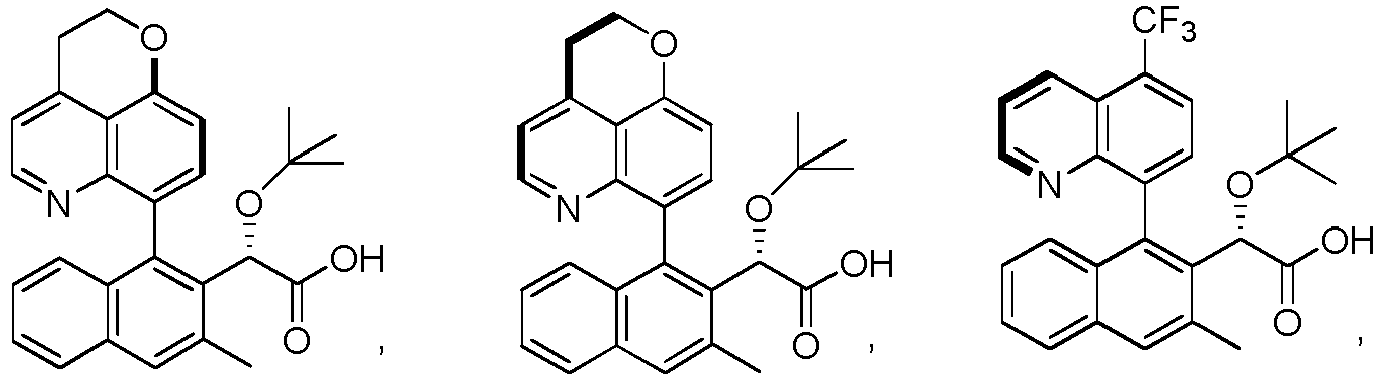


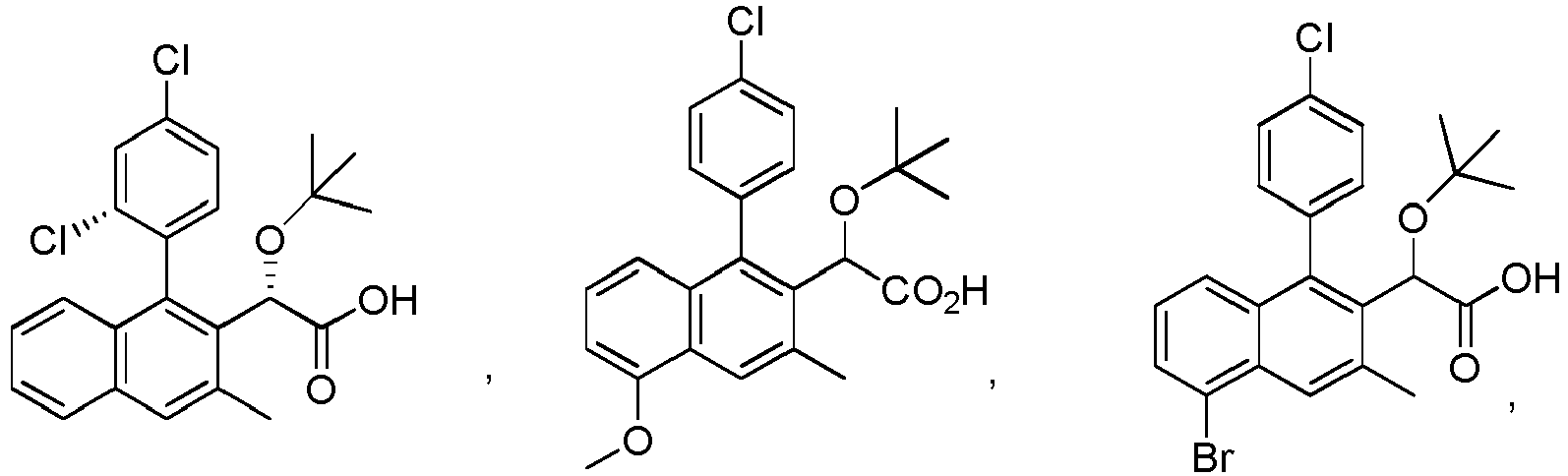











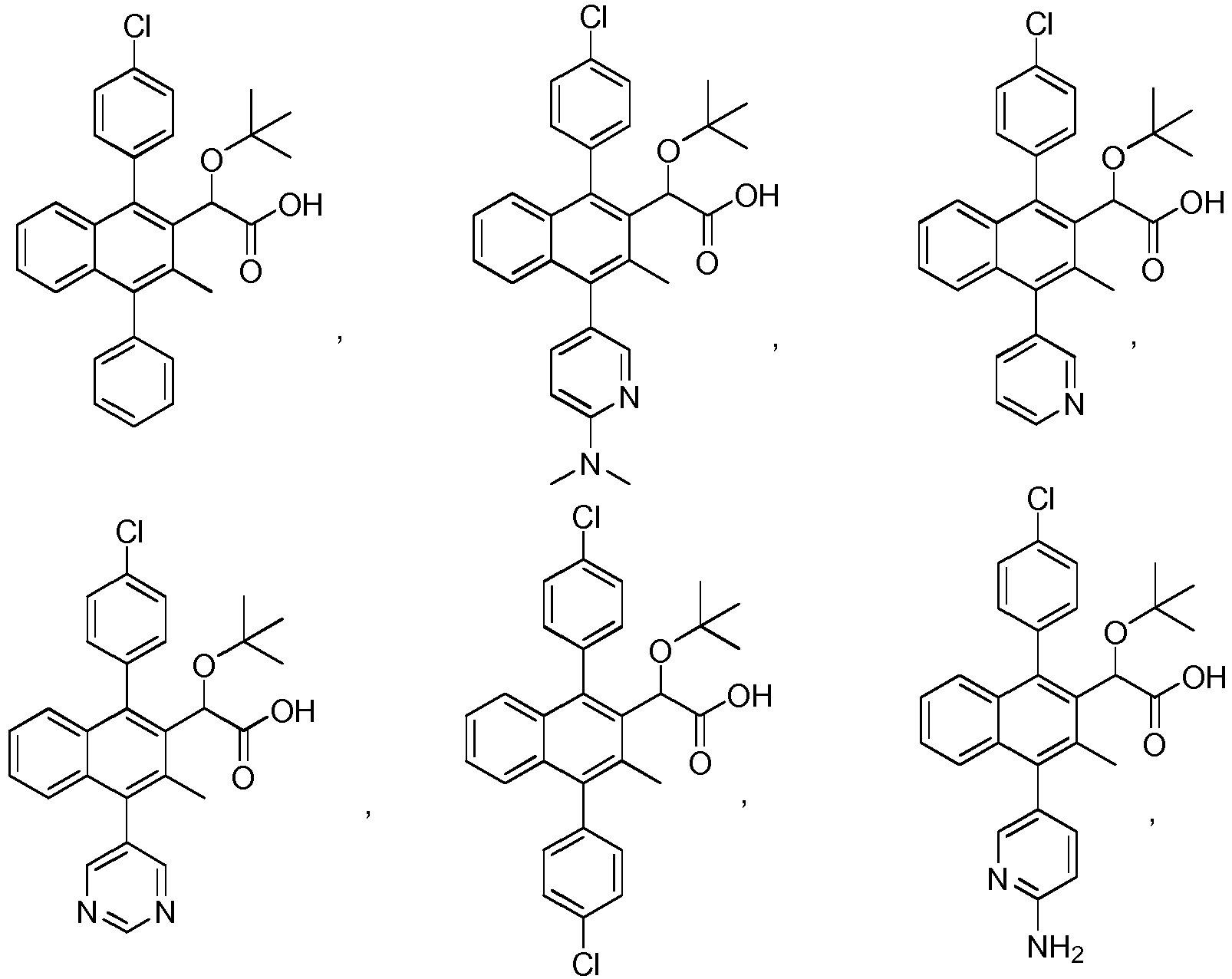


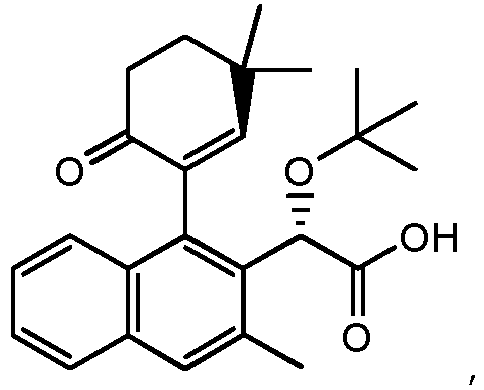


- The invention also provides a pharmaceutical composition comprising a compound of the invention or a pharmaceutically acceptable salt thereof, in combination with a pharmaceutically acceptable carrier. The invention also provides a compound of the invention or a pharmaceutically acceptable salt thereof for use in medical therapy. The invention also provides a compound of the invention or a pharmaceutically acceptable salt thereof, for use in the prophylactic or therapeutic treatment of the proliferation of the HIV virus or AIDS or for use in the therapeutic treatment of delaying the onset of AIDS or ARC symptoms.
- Unless stated otherwise, the following terms and phrases as used herein are intended to have the following meanings:
- When trade names are used herein, applicants intend to independently include the tradename product and the active pharmaceutical ingredient(s) of the tradename product.
- In addition to compounds of the invention, this disclosure also relates to other compounds of formula I. As used herein, "a compound of formula I" means:

- R1 is R1a or R1b;
- R2 is R2a or R2b;
- R3 is R3a or R3b;
- R3' is R3a' or R3b';
- R4 is R4a or R4b;
- R5 is R5a or R5b;
- R6 is R6a or R6b;
- R7 is R7a or R7b;
- R8 is R8a or R8b;
- R1a is selected from:
- a) H, halo, (C1-C6)alkyl and (C1-C6)haloalkyl;
- b) (C2-C6)alkenyl, (C2-C6)alkynyl, (C3-C7)cycloalkyl, nitro, cyano, aryl, heterocycle and heteroaryl;
- c) -C(=O)-R11, -C(=O)-O-R11, -O-R11, -S-R11, -S(O)-R11, -SO2-R11, -(C1-C6)alkyl-R11, -(C1-C6)alkyl-C(=O)-R11, -(C1-C6)alkyl-C(=O)-O-R11, -(C1-C6)alkyl-O-R11, -(C1-C6)alkyl-S-R11, -(C1-C6)alkyl-S(O)-R11 and -(C1-C6)alkyl-SO2-R11, wherein each R11 is independently selected from H, (C1-C6)alkyl, (C2-C6)alkenyl, (C2-C6)alkynyl, (C1-C6)haloalkyl, (C3-C7)cycloalkyl, aryl, heterocycle and heteroaryl; and
- d) -N(R9)R10, -C(=O)-N(R9)R10, -O-C(=O)-N(R9)R10, -SO2-N(R9)R10, -(C1-C6)alkyl-N(R9)R10, -(C1-C6)alkyl-C(=O)-N(R9)R10, -(C1-C6)alkyl-O-C(=O)-N(R9)R10 and -(C1-C6)alkyl-SO2-N(R9)R10, wherein each R9 is independently selected from H, (C1-C6)alkyl and (C3-C7)cycloalkyl and wherein each R10 is independently selected from R11, - (C1-C6)alkyl-R11, -SO2-R11, -C(=O)-R11, -C(=O)OR11 and -C(=O)N(R9)R11, wherein each R11 is independently selected from H, (C1-C6)alkyl, (C2-C6)alkenyl, (C2-C6)alkynyl, (C1-C6)haloalkyl, (C3-C7)cycloalkyl, aryl, heterocycle and heteroaryl; and
- wherein any aryl, heterocycle and heteroaryl of R1a is optionally substituted with one or more (e.g. 1, 2 or 3) Z10 groups;
- R1b is selected from:
- a) -(C1-C6)alkyl-O-(C1-C6)alkyl-(C3-C7)carbocycle, -(C1-C6)alkyl-S-(C1-C6)alkyl-(C3-C7) carbocycle, -(C1-C6)alkyl-S(O)-(C1-C6)alkyl-(C3-C7)carbocycle, -(C1-C6)alkyl-SO2-(C1-C6)alkyl-(C3-C7)carbocycle, -(C1-C6)alkyl-SO2-(C1-C6)alkyl-Z13, -C(O)-(C1-C6)alkyl-Z13, -O-(C1-C6)alkyl-Z13, -S-(C1-C6)alkyl-Z13, -S(O)-(C1-C6)alkyl-Z13, -SO2-(C1-C6)alkyl-Z13, -(C1-C6)alkyl-Z14, -(C1-C6)alkyl-C(O)-(C1-C6)alkyl-Z13, -(C1-C6)alkyl-C(O)-O(C1-C6)alkyl-Z13, -(C1-C6)alkyl-O-(C1-C6)alkyl-Z13, -(C1-C6)alkyl-S-(C1-C6)alkyl-Z13, -(C2-C6)alkenyl-(C1-C6)haloalkyl, -(C2-C6)alkynyl-(C1-C6)haloalkyl, -(C3-C7)halocarbocycle, -NRaSO2NRcRd, -NRaSO2O(C3-C7)carbocycle, -NRaSO2Oaryl, -(C2-C6)alkenyl-(C3-C7)carbocycle, -(C2-C6)alkenyl-aryl, -(C2-C6)alkenyl-heteroaryl, -(C2-C6)alkenyl-heterocycle, -(C2-C6)alkynyl-(C3-C7)carbocycle, -(C2-C6)alkynyl-aryl, -(C2-C6)alkynyl-heteroaryl -(C2-C6)alkynyl-heterocycle, -(C3-C7)carbocycle-Z1 and -halo(C1-C6)alkyl-Z3, wherein any (C1-C6)alkyl, (C1-C6)haloalkyl, (C3-C7)carbocycle, (C3-C7)halocarbocycle, (C2-C6)alkenyl, (C2-C6)alkynyl, aryl, heterocycle and heteroaryl, either alone or as part of a group, is optionally substituted with one or more (e.g. 1, 2, 3, 4 or 5) Z1 groups;
- b) spiro-bicyclic carbocycle, fused-bicyclic carbocycle and bridged-bicyclic carbocycle, wherein any spiro-bicyclic carbocycle, fused-bicyclic carbocycle and bridged-bicyclic carbocycle is optionally substituted with one or more (e.g. 1, 2, 3, 4 or 5) Z1 groups, wherein two Z1 groups together with the atom or atoms to which they are attached optionally form a (C3-C7)carbocycle or heterocycle wherein the (C3-C7)carbocycle or heterocycle is optionally substituted with one or more (e.g. 1, 2, 3, 4 or 5) Z1 groups;
- c) (C1-C6)alkyl, wherein (C1-C6)alkyl is substituted with one or more (e.g. 1, 2, 3, 4 or 5) Z2 groups and optionally substituted with one or more (e.g. 1, 2, 3, 4 or 5) Z1 groups;
- d) -X(C1-C6)alkyl, -X(C1-C6)haloalkyl, -X(C2-C6)alkenyl, -X(C2-C6)alkynyl and -X(C3-C7)carbocycle, wherein any -X(C1-C6)alkyl and-X(C1-C6)haloalkyl, is substituted with one or more (e.g. 1, 2, 3, 4 or 5) Z3 groups and optionally substituted with one or more (e.g. 1, 2, 3, 4 or 5) Z1 groups, and wherein any -X(C2-C6)alkenyl, -X(C2-C6)alkynyl and -X(C3-C7)carbocycle, is substituted with one or more (e.g. 1, 2, 3, 4 or 5) Z4 groups and optionally substituted with one or more (e.g. 1, 2, 3, 4 or 5) Z1 groups;
- e) aryl, heteroaryl, heterocycle, -Xaryl, -Xheteroaryl and -Xheterocycle, wherein any aryl, heteroaryl and heterocycle, either alone or as part of a group, is substituted with one or more (e.g. 1, 2, 3, 4 or 5) Z5 groups and optionally substituted with one or more (e.g. 1, 2, 3, 4 or 5) Z1 groups;
- f) (C1-C6)haloalkyl, (C3-C7)carbocycle, (C2-C6)alkenyl, and (C2-C6)alkynyl, wherein (C1-C6)haloalkyl, (C3-C7)carbocycle, (C2-C6)alkenyl and (C2-C6)alkynyl are each substituted with one or more (e.g. 1, 2, 3, 4 or 5) Z6 groups and optionally substituted with one or more (e.g. 1, 2, 3, 4 or 5) Z1 groups; and
- g) -NReRf, -C(O)NReRf, -OC(O)NReRf, -SO2NReRf, -(C1-C6)alkyl-NReRf, -(C1-C6)alkylC(O)-NReRf, -(C1-C6)alkyl-O-C(O)-NReRf and -(C1-C6)alkyl-SO2NReRf, wherein any (C1-C6)alkyl, as part of a group is optionally substituted with one or more (e.g. 1, 2, 3, 4 or 5) Z1 groups;
- R2a is selected from:
- a) H, (C1-C6)alkyl and -O(C1-C6)alkyl;
- b) (C2-C6)alkenyl, (C2-C6)alkynyl, (C1-C6)haloalkyl, (C3-C7)cycloalkyl, aryl, heterocycle, heteroaryl, halo, nitro and cyano;
- c) -C(=O)-R11, -C(=O)-O-R11, -S-R11, -S(O)-R11, -SO2-R11, -(C1-C6)alkyl-R11, -(C1-C6)alkyl-C(=O)-R11, -(C1-C6)alkyl-C(=O)-O-R11, -(C1-C6)alkyl-O-R11, -(C1-C6)alkyl-S-R11, -(C1-C6)alkyl-S(O)-R11 and -(C1-C6)alkyl-SO2-R11, wherein each R11 is independently selected from H, (C1-C6)alkyl, (C2-C6)alkenyl, (C2-C6)alkynyl, (C1-C6)haloalkyl, (C3-C7)cycloalkyl, aryl, heterocycle and heteroaryl, wherein aryl, heterocycle and heteroaryl are each optionally substituted with one or more (e.g. 1, 2 or 3) Z11 groups;
- d) -OH, -O(C2-C6)alkenyl, -O(C2-C6)alkynyl, -O(C1-C6)haloalkyl, -O(C3-C7)cycloalkyl, -Oaryl, -Oheterocycle and -Oheteroaryl; and
- e) -N(R9)R10, -C(=O)-N(R9)R10, -O-C(=O)-N(R9)R10, -SO2-N(R9)R10, -(C1-C6)alkyl-N(R9)R10, -(C1-C6)alkyl-C(=O)-N(R9)R10, -(C1-C6)alkyl-O-C(=O)-N(R9)R10, and -(C1-C6)alkyl-SO2-N(R9)R10, wherein each R9 is independently selected from H, (C1-C6)alkyl and (C3-C7)cycloalkyl, and each R10 is independently selected from R11, -(C1-C6)alkyl-R11, -SO2-R11, -C(=O)-R11, -C(=O)OR11 and -C(=O)N(R9)R11, wherein each R11 is independently selected from H, (C1-C6)alkyl, (C2-C6)alkenyl, (C2-C6)alkynyl, (C1-C6)haloalkyl, (C3-C7)cycloalkyl, aryl, heterocycle and heteroaryl;
- R2b is selected from:
- a) -(C1-C6)alkyl-O-(C1-C6)alkyl-(C3-C7)carbocycle, -(C1-C6)alkyl-S-(C1-C6)alkyl-(C3-C7)carbocycle, -(C1-C6)alkyl-S(O)-(C1-C6)alkyl-(C3-C7)carbocycle, -(C1-C6)alkyl-SO2-(C1-C6)alkyl-(C3-C7)carbocycle,-(C2-C6)alkenyl-(C1-C6)haloalkyl, -(C2-C6)alkynyl-(C1-C6)haloalkyl, -(C1-C6)alkyl-SO2-(C1-C6)alkyl-Z13, -C(O)-(C1-C6)alkyl-Z13, -O-(C1-C6)alkyl-Z13, -S-(C1-C6)alkyl-Z13, -S(O)-(C1-C6)alkyl-Z13, -SO2-(C1-C6)alkyl-Z13, -(C1-C6)alkyl-Z14, -(C1-C6)alkyl-C(O)-(C1-C6)alkyl-Z13, -(C1-C6)alkyl-C(O)-O(C1-C6)alkyl-Z13, -(C1-C6)alkyl-O-(C1-C6)alkyl-Z13, -(C1-C6)alkyl-S-(C1-C6)alkyl-Z13, -(C3-C7)halocarbocycle,-NRaSO2NRcRd, -NRaSO2O(C3-C7)carbocycle, -NRaSO2Oaryl, -(C2-C6)alkenyl-(C3-C7)carbocycle, -(C2-C6)alkenyl-aryl, -(C2-C6)alkenyl-heteroaryl, -(C2-C6)alkenyl-heterocycle, -(C2-C6)alkynyl-(C3-C7)carbocycle, -(C2-C6)alkynyl-aryl, -(C2-C6)alkynyl-heteroaryl, -(C2-C6)alkynyl-heterocycle, -(C3-C7)carbocycle-Z1 and - halo(C1-C6)alkyl-Z3, wherein any (C1-C6)alkyl, -(C1-C6)haloalkyl, (C3-C7)carbocycle, (C3-C7)halocarbocycle, (C2-C6)alkenyl, (C2-C6)alkynyl, aryl, heterocycle and heteroaryl, either alone or as part of a group, is optionally substituted with one or more (e.g. 1, 2, 3, 4 or 5) Z1 groups;
- b) spiro-bicyclic carbocycle, fused-bicyclic carbocycle and bridged-bicyclic carbocycle, wherein any spiro-bicyclic carbocycle, fused-bicyclic carbocycle and bridged-bicyclic carbocycle is optionally substituted with one or more (e.g. 1, 2, 3, 4 or 5) Z1 groups, wherein two Z1 groups together with the atom or atoms to which they are attached optionally form a (C3-C7)carbocycle or heterocycle, wherein the (C3-C7)carbocycle or heterocycle is optionally substituted with one or more (e.g. 1, 2, 3, 4 or 5) Z1 groups;
- c) (C1-C6)alkyl, wherein (C1-C6)alkyl is substituted with one or more (e.g. 1, 2, 3, 4 or 5) Z2 groups and optionally substituted with one or more (e.g. 1, 2, 3, 4 or 5) Z1 groups;
- d) -X(C1-C6)alkyl, X(C1-C6)haloalkyl, X(C2-C6)alkenyl, -X(C2-C6)alkynyl and -X(C3-C7)carbocycle, wherein any -X(C1-C6)alkyl and -X(C1-C6)haloalkyl, is substituted with one or more (e.g. 1, 2, 3, 4 or 5) Z3 groups and optionally substituted with one or more (e.g. 1, 2, 3, 4 or 5) Z1 groups, and wherein any -X(C2-C6)alkenyl, -X(C2-C6)alkynyl and -X(C3-C7)carbocycle is substituted with one or more (e.g. 1, 2, 3, 4 or 5) Z4 groups and optionally substituted with one or more (e.g. 1, 2, 3, 4 or 5) Z1 groups;
- e) aryl, heteroaryl, heterocycle, -Xaryl, -Xheteroaryl and -Xheterocycle, wherein any aryl, heteroaryl and heterocycle, either alone or as part of a group, is substituted with one or more (e.g. 1, 2, 3, 4 or 5) Z5 groups and optionally substituted with one or more (e.g. 1, 2, 3, 4 or 5) Z1 groups;
- f) (C1-C6)haloalkyl, (C3-C7)carbocycle, (C2-C6)alkenyl, and (C2-C6)alkynyl, wherein (C1-C6)haloalkyl, (C3-C7)carbocycle, (C2-C6)alkenyl and (C2-C6)alkynyl are each substituted with one or more (e.g. 1, 2, 3, 4 or 5) Z6 groups and optionally substituted with one or more (e.g. 1, 2, 3, 4 or 5) Z1 groups; and
- g) -NReRf, -C(O)NReRf, -OC(O)NReRf, -SO2NReRf, -(C1-C6)alkyl-NReRf, -(C1-C6)alkylC(O)-NReRf, -(C1-C6)alkyl-O-C(O)-NReRf and -(C1-C6)alkyl-SO2NReRf, wherein any (C1-C6)alkyl, as part of a group is optionally substituted with one or more (e.g. 1, 2, 3, 4 or 5) Z1 groups;
- R3a is (C1-C6)alkyl, (C1-C6)haloalkyl, (C2-C6)alkenyl, (C2-C6)alkynyl, -(C1-C6)alkyl-(C3-C7)cycloalkyl, -(C1-C6)alkyl-aryl, -(C1-C6)alkyl-heterocycle, -(C1-C6)alkyl-heteroaryl, -O(C1-C6)alkyl, -O(C1-C6)haloalkyl, -O(C2-C6)alkenyl, -O(C2-C6)alkynyl, -O(C3-C7)cycloalkyl, -Oaryl, -O(C1-C6)alkyl-(C3-C7)cycloalkyl, -O(C1-C6)alkyl-aryl, -O(C1-C6)alkyl-heterocycle or -O(C1-C6)alkyl-heteroaryl, wherein any (C1-C6)alkyl, (C1-C6)haloalkyl, (C2-C6)alkenyl or (C2-C6)alkynyl of R3a either alone or as part of a group, is optionally substituted with one or more (e.g. 1, 2 or 3) groups selected from -O(C1-C6)alkyl, halo, oxo and -CN, and wherein any (C3-C7)cycloalkyl, aryl, heterocycle or heteroaryl of R3a either alone or as part of a group, is optionally substituted with one or more (e.g. 1, 2 or 3) groups selected from (C1-C6)alkyl, -O(C1-C6)alkyl, halo, oxo and -CN; and R3a' is H;
- R3b is -(C7-C14)alkyl, -(C3-C7)carbocycle, aryl, heteroaryl, heterocycle, -(C1-C6)alkylOH, -(C1-C6)alkyl-O-(C1-C6)alkyl-Z12, -(C1-C6)alkyl-O-(C2-C6)alkenyl-Z12, - (C1-C6)alkyl-O-(C2-C6)alkynyl-Z12, -(C1-C6)alkyl-S-(C1-C6)alkyl-Z12, -(C1-C6)alkyl-S-(C2-C6)alkenyl-Z12, -(C1-C6)alkyl-S-(C2-C6)alkynyl-Z12, -(C1-C6)alkyl-S(O)-(C1-C6)alkyl-Z12,-(C1-C6)alkyl-S(O)-(C2-C6)alkenyl-Z12, -(C1-C6)alkyl-S(O)-(C2-C6)alkynyl-Z12, -(C1-C6)alkyl-SO2-(C1-C6)alkyl-Z12, -(C1-C6)alkyl-SO2-(C2-C6)alkenyl-Z12, -(C1-C6)alkyl-SO2-(C2-C6)alkynyl-Z12, -(C1-C6)alkyl-NRaRb, -(C1-C6)alkylOC(O)-NRcRd, -(C1-C6)alkyl-NRa-C(O)-ORb, -(C1-C6)alkyl-NRa-C(O)-NRaRb, -(C1-C6)alkyl-SO2(C1-C6)alkyl, -(C1-C6)alkyl-SO2NRcRd, -(C1-C6)alkyl-NRaSO2NRcRd, -(C1-C6)alkyl-NRaSO2O(C3-C7)carbocycle, -(C1-C6)alkyl-NRaSO2Oaryl, -(C1-C6)alkyl-NRa-SO2-(C1-C6)alkyl, -(C1-C6)alkyl-NRa-SO2-halo(C1-C6)alkyl, -(C1-C6)alkyl-NRa-SO2-(C2-C6)alkenyl, -(C1-C6)alkyl-NRa-SO2-(C2-C6)alkynyl, -(C1-C6)alkyl-NRa-SO2-(C3-C7)carbocycle, -(C1-C6)alkyl-NRa-SO2-halo(C3-C7)carbocycle, -(C1-C6)alkyl-NRa-SO2-aryl, -(C1-C6)alkyl-NRa-SO2-heteroaryl, -(C1-C6)alkyl-NRa-SO2-heterocycle, -O(C7-C14)alkyl, - O(C1-C6)alkyl-NRaRb, -O(C1-C6)alkylOC(O)-NRcRd, -O(C1-C6)alkyl-NRa-C(O)-ORb, -O(C1-C6)alkyl-NRa-C(O)-NRaRb, -O(C1-C6)alkyl-NRa-SO2-(C1-C6)alkyl, -O(C1-C6)alkyl-NRa-SO2-halo(C1-C6)alkyl, -O(C1-C6)alkyl-NRa-SO2-(C2-C6)alkenyl, -O(C1-C6)alkyl-NRa-SO2-(C2-C6)alkynyl, -O(C1-C6)alkyl-NRa-SO2-(C3-C7)carbocycle, -O(C1-C6)alkyl-NRa-SO2-halo(C3-C7)carbocycle, -O(C1-C6)alkyl-NRa-SO2-aryl, -O(C1-C6)alkyl-NRa-SO2-heteroaryl, -O(C1-C6)alkyl-NRa-SO2-heterocycle, -O(C1-C6)alkyl-NRa-SO2-NRaRb, -O(C1-C6)alkyl-NRa-SO2-(C3-C7)carbocycle, -O(C1-C6)alkyl-NRa-SO2-halo(C3-C7)carbocycle, -O(C1-C6)alkyl-NRa-SO2-aryl, -O(C1-C6)alkyl-NRaSO2NRcRd, -O(C1-C6)alkyl-NRaSO2O(C3-C7)carbocycle, -O(C1-C6)alkyl-NRaSO2Oaryl, -Oheteroaryl, -Oheterocycle, -Sheteroaryl, -Sheterocycle, -S(O)heteroaryl,-S(O)heterocycle, -SO2heteroaryl or -SO2heterocycle, wherein any (C1-C6)alkyl, -(C7-C14)alkyl, aryl, (C3-C7)carbocycle, heteroaryl or heterocycle of R3b, either alone or as part of a group, is optionally substituted with one or more (e.g. 1, 2, 3, 4 or 5) Z1 groups, and R3b' is H, (C1-C6)alkyl or -O(C1-C6)alkyl; or R3b and R3b' together with the carbon to which they are attached form a heterocycle or (C3-C7)carbocycle which heterocycle or (C3-C7)carbocycle of R3b and R3b' together with the carbon to which they are attached is optionally substituted with one or more (e.g. 1, 2, 3, 4 or 5) Z1 groups;
- R4a is selected from aryl, heterocycle and heteroaryl, wherein any aryl, heterocycle and heteroaryl of R4a is optionally substituted with one or more (e.g. 1, 2, 3, 4 or 5) groups each independently selected from halo, (C1-C6)alkyl, (C2-C6)alkenyl, (C1-C6)haloalkyl, (C3-C7)cycloalkyl, -OH, -O(C1-C6)alkyl, -SH, -S(C1-C6)alkyl, -NH2, -NH(C1-C6)alkyl and -N((C1-C6)alkyl)2, wherein (C1-C6)alkyl is optionally substituted with hydroxy, -O(C1-C6)alkyl, cyano or oxo;
- R4b is selected from;
- a) (C1-C6)alkyl, (C2-C6)alkenyl and (C2-C6)alkynyl, wherein (C1-C6)alkyl, (C2-C6)alkenyl and (C2-C6)alkynyl are each optionally substituted with one or more (e.g. 1, 2, 3, 4 or 5) Z1 groups;
- b) (C3-C14)carbocycle, wherein (C3-C14)carbocycle is optionally substituted with one or more (e.g. 1, 2, 3, 4 or 5) Z1 groups, wherein two Z1 groups together with the atom or atoms to which they are attached optionally form a (C3-C7)carbocycle or heterocycle;
- c) spiro-heterocycle and bridged-heterocycle, wherein spiro-heterocycle and bridged-heterocycle are optionally substituted with one or more (e.g. 1, 2, 3, 4 or 5) Z1 groups, or wherein two Z1 groups together with the atom or atoms to which they are attached optionally form a (C3-C7)carbocycle or heterocycle; and
- d) aryl, heteroaryl, spiro-heterocycle, fused-heterocycle and bridged-heterocycle, wherein aryl, heteroaryl, spiro-heterocycle, fused-heterocycle and bridged-heterocycle heterocycle are each independently substituted with one or more (e.g. 1, 2, 3, 4 or 5) Z7 groups and optionally substituted with one or more (e.g. 1, 2, 3, 4 or 5) Z1 groups; or
- R4 and R3 together with the atoms to which they are attached form a macroheterocycle or a macrocarbocycle wherein any macroheterocycle or macrocarbocycle of R4 and R3 together with the atoms to which they are attached may be optionally substituted with one or more (e.g. 1, 2, 3, 4 or 5) Z1 groups; and R3' is H, (C1-C6)alkyl or -O(C1-C6)alkyl;
- R5a is selected from:
- a) halo, nitro and cyano;
- b) R11, -C(=O)-R11, -C(=O)-O-R11, -O-R11, -S-R11, -S(O)-R11, -SO2-R11, -(C1-C6)alkyl-R11, -(C1-C6)alkyl-C(=O)-R11, -(C1-C6)alkyl-C(=O)-O-R11, -(C1-C6)alkyl-O-R11, - (C1-C6)alkyl-S-R11, -(C1-C6)alkyl-S(O)-R11 and -(C1-C6)alkyl-SO2-R11, wherein each R11 is independently selected from H, (C1-C6)alkyl, (C2-C6)alkenyl, (C2-C6)alkynyl, (C1-C6)haloalkyl, (C3-C7)cycloalkyl, aryl, heterocycle and heteroaryl, wherein aryl, heterocycle and heteroaryl are each optionally substituted with one or more (e.g. 1, 2 or 3) Z11 groups; and
- c) -N(R9)R10, -C(=O)-N(R9)R10, -O-C(=O)-N(R9)R10, -SO2-N(R9)R10, -(C1-C6)alkyl-N(R9)R10, -(C1-C6)alkyl-C(=O)-N(R9)R10, -(C1-C6)alkyl-O-C(=O)-N(R9)R10, and -(C1-C6)alkyl-SO2-N(R9)R10, wherein each R9 is independently selected from H, (C1-C6)alkyl and (C3-C7)cycloalkyl, and each R10 is independently selected from R11, -(C1-C6)alkyl-R11, -SO2-R11, -C(=O)-R11, -C(=O)OR11 and -C(=O)N(R9)R11, wherein each R11 is independently selected from H, (C1-C6)alkyl, (C2-C6)alkenyl, (C2-C6)alkynyl, (C1-C6)haloalkyl, (C3-C7)cycloalkyl, aryl, heterocycle and heteroaryl;
- R5b is selected from:
- a) -(C1-C6)alkyl-O-(C1-C6)alkyl-(C3-C7)carbocycle, -(C1-C6)alkyl-S-(C1-C6)alkyl-(C3-C7)carbocycle, -(C1-C6)alkylS(O)-(C1-C6)alkyl-(C3-C6)carbocycle, -(C1-C6)alkylSO2(C1-C6)alkyl-(C3-C7)carbocycle, -(C2-C6)alkenyl-(C1-C6)haloalkyl, -(C2-C6)alkynyl-(C1-C6)haloalkyl, -(C3-C7)halocarbocycle, -NRaSO2NRcRd, -NRaSO2O(C3-C7)carbocycle, -NRaSO2Oaryl, -(C2-C6)alkenyl-(C3-C7)carbocycle, -(C2-C6)alkenyl-aryl, -(C2-C6)alkenyl-heteroaryl, -(C2-C6)alkenyl-heterocycle, -(C2-C6)alkynyl-(C3-C7)carbocycle, -(C2-C6)alkynyl-aryl, -(C2-C6)alkynyl-heteroaryl, -(C2-C6)alkynyl-heterocycle, -(C3-C7)carbocycle-Z1 and -halo(C1-C6)alkyl-Z3,wherein any (C1-C6)alkyl, (C1-C6)haloalkyl, (C3-C7)carbocycle, (C3-C7)halocarbocycle, (C2-C6)alkenyl, (C2-C6)alkynyl, aryl, heterocycle and heteroaryl, either alone or as part of a group, is optionally substituted with one or more(e.g. 1, 2, 3, 4 or 5) Z1 groups;
- b) spiro-bicyclic carbocycle, fused-bicyclic carbocycle andbridged-bicyclic carbocycle, wherein any spiro-bicyclic carbocycle, fused-bicyclic carbocycle or bridged-bicyclic carbocycle is optionally substituted with one or more (e.g. 1, 2, 3, 4 or 5) Z1 groups, wherein two Z1 groups together with the atom or atoms to which they are attached optionally form a (C3-C7)carbocycle or heterocycle wherein the (C3-C7)carbocycle or heterocycle is optionally substituted with one or more (e.g. 1, 2, 3, 4 or 5) Z1 groups;
- c) (C1-C6)alkyl, wherein (C1-C6)alkyl is substituted with one or more (e.g. 1, 2, 3, 4 or 5) Z2 groups and optionally substituted with one or more (e.g. 1, 2, 3, 4 or 5) Z1 groups;
- d) -X(C1-C6)alkyl,-X(C1-C6)haloalkyl, -X(C2-C6)alkenyl, -X(C2-C6)alkynyl and -X(C3-C7)carbocycle, wherein any -X(C1-C6)alkyl and-X(C1-C6)haloalkyl, is substituted with one or more Z3 groups and optionally substituted with one or more Z1 groups, and wherein any -X(C2-C6)alkenyl, -X(C2-C6)alkynyl and -X(C3-C7)carbocycle is substituted with one or more (e.g. 1, 2, 3, 4 or 5) Z4 groups and optionally substituted with one or more (e.g. 1, 2, 3, 4 or 5) Z1 groups;
- e) aryl, heteroaryl, heterocycle, -Xaryl, -Xheteroaryl and -Xheterocycle, wherein any aryl, heteroaryl and heterocycle, either alone or as part of a group, is substituted with one or more (e.g. 1, 2, 3, 4 or 5) Z5 groups and optionally substituted with one or more (e.g. 1, 2, 3, 4 or 5) Z1 groups;
- f) (C1-C6)haloalkyl, (C3-C7)carbocycle, (C2-C6)alkenyl, and (C2-C6)alkynyl, where (C1-C6)haloalkyl, (C3-C7)carbocycle, (C2-C6)alkenyl and (C2-C6)alkynyl are each independently substituted with one or more (e.g. 1, 2, 3, 4 or 5) Z6 groups and optionally substituted with one or more (e.g. 1, 2, 3, 4 or 5) Z1 groups; and
- g) -NReRf, -C(O)NReRf, -OC(O)NReRf, -SO2NReRf, -(C1-C6)alkyl-NReRf, -(C1-C6)alkylC(O)-NReRf, -(C1-C6)alkyl-O-C(O)-NReRf and -(C1-C6)alkyl-SO2NReRf, wherein any (C1-C6)alkyl, as part of a group, is optionally substituted with one or more (e.g. 1, 2, 3, 4 or 5) Z1 groups;
- R6a is selected from:
- a) H, halo, (C1-C6)alkyl and (C1-C6)haloalkyl
- b) (C2-C6)alkenyl, (C2-C6)alkynyl, (C3-C7)cycloalkyl, nitro, cyano, aryl, heterocycle and heteroaryl;
- c) -C(=O)-R11, -C(=O)-O-R11, -O-R11, -S-R11, -S(O)-R11, -SO2-R11, -(C1-C6)alkyl-R11, -(C1-C6)alkyl-C(=O)-R11, -(C1-C6)alkyl-C(=O)-O-R11, -(C1-C6)alkyl-OR11, -(C1-C6)alkyl-S-R11, -(C1-C6)alkyl-S(O)-R11 and -(C1-C6)alkyl-SO2-R11, wherein each R11 is independently selected from H, (C1-C6)alkyl, (C2-C6)alkenyl, (C2-C6)alkynyl, (C1-C6)haloalkyl, (C3-C7)cycloalkyl, aryl, heterocycle and heteroaryl; and
- d) -N(R9)R10, -C(=O)-N(R9)R10, -O-C(=O)-N(R9)R10, -SO2-N(R9)R10, -(C1-C6)alkyl-N(R9)R10, -(C1-C6)alkyl-C(=O)-N(R9)R10, -(C1-C6)alkyl-O-C(=O)-N(R9)R10 and -(C1-C6)alkyl-SO2-N(R9)R10, wherein each R9 is independently selected from H, (C1-C6)alkyl and (C3-C7)cycloalkyl, and each R10 is independently selected from R11, -(C1-C6)alkyl-R11, -SO2-R11, -C(=O)-R11, -C(=O)OR11 and -C(=O)N(R9)R11, wherein each R11 is independently selected from H, (C1-C6)alkyl, (C2-C6)alkenyl, (C2-C6)alkynyl, (C1-C6)haloalkyl, (C3-C7)cycloalkyl, aryl, heterocycle and heteroaryl;
- and wherein any aryl, heterocycle and heteroaryl of R6a is optionally substituted with one or more (e.g. 1, 2 or 3) Z10 groups;
- R6b is selected from:
- a) -(C1-C6)alkyl-O-(C1-C6)alkyl-(C3-C7)carbocycle, -(C1-C6)alkyl-S-(C1-C6)alkyl-(C3-C7)carbocycle, -(C1-C6)alkyl-S(O)-(C1-C6)alkyl-(C3-C7)carbocycle, -(C1-C6)alkyl-SO2-(C1-C6)alkyl-(C3-C7)carbocycle,-(C2-C6)alkenyl-(C1-C6)haloalkyl, -(C2-C6)alkynyl-(C1-C6)haloalkyl, -halo(C3-C7)carbocycle,-NRaSO2NRcRd, -NRaSO2O(C3-C7)carbocycle, -NRaSO2Oaryl, -(C2-C6)alkenyl-(C3-C7)carbocycle, -(C2-C6)alkenyl-aryl, -(C2-C6)alkenyl-heteroaryl, -(C2-C6)alkenyl-heterocycle, -(C2-C6)alkynyl-(C3-C7)carbocycle, -(C2-C6)alkynyl-aryl, -(C2-C6)alkynyl-heteroaryl, -(C2-C6)alkynyl-heterocycle, -(C2-C8)alkynyl-ORa, -(C2-C6)alkyl-(C3-C7)carbocycle-ORa, -(C3-C7)carbocycle-Z1 and -halo(C1-C6)alkyl-Z3, wherein any (C1-C6)alkyl, (C1-C6)haloalkyl, (C3-C7)carbocycle, (C2-C6)alkenyl, (C2-C6)alkynyl, aryl, heterocycle and heteroaryl, either alone or as part of a group, is optionally substituted with one or more (e.g. 1, 2, 3, 4 or 5) Z1 groups;
- b) spiro-bicyclic carbocycle, fused-bicyclic carbocycle and bridged-bicyclic carbocycle, wherein any spiro-bicyclic carbocycle, fused-bicyclic carbocycle and bridged-bicyclic carbocycle is optionally substituted with one or more (e.g. 1, 2, 3, 4 or 5) Z1 groups, wherein two Z1 groups together with the atom or atoms to which they are attached optionally form a (C3-C7)cycloalkyl or heterocycle, wherein the (C3-C7)cycloalkyl or heterocycle is optionally substituted with one or more (e.g. 1, 2, 3, 4 or 5) Z1 groups;
- c) (C1-C6)alkyl, wherein (C1-C6)alkyl is substituted with one or more (e.g. 1,2, 3,4 or 5) Z2 groups and optionally substituted with one or more (e.g. 1, 2, 3, 4 or 5) Z1 groups;
- d) -X(C1-C6)alkyl, -X(C1-C6)haloalkyl, -X(C2-C6)alkenyl, -X(C2-C6)alkynyl and -X(C3-C7)carbocycle, wherein any -X(C1-C6)alkyl and-X(C1-C6)haloalkyl, is substituted with one or more (e.g. 1, 2, 3, 4 or 5) Z3 groups and optionally substituted with one or more (e.g. 1, 2, 3, 4 or 5) Z1 groups, and wherein any -X(C2-C6)alkenyl, -X(C2-C6)alkynyl and -X(C3-C7)carbocycle, are each independently substituted with one or more (e.g. 1, 2, 3, 4 or 5) Z4 groups and optionally substituted with one or more (e.g. 1,2, 3, 4 or 5) Z1 groups;
- e) aryl, heteroaryl, heterocycle, -Xaryl, -Xheteroaryl and -Xheterocycle, wherein any aryl, heteroaryl and heterocycle, either alone or as part of a group, is substituted with one or more (e.g. 1, 2, 3, 4 or 5) Z5 groups and optionally substituted with one or more (e.g. 1, 2, 3, 4 or 5) Z1 groups;
- f) (C1-C6)haloalkyl, (C3-C7)carbocycle, (C2-C6)alkenyl, and (C2-C6)alkynyl, wherein (C1-C6)haloalkyl, (C3-C7)carbocycle, (C2-C6)alkenyl and (C2-C6)alkynyl are each independently substituted with one or more (e.g. 1, 2, 3, 4 or 5) Z6 groups and optionally substituted with one or more (e.g. 1, 2, 3, 4 or 5) Z1 groups; and
- g) -NReRf, -C(O)NReRf, -OC(O)NReRf, -SO2NReRf, -(C1-C6)alkyl-NReRf, -(C1-C6)alkylC(O)-NReRf, -(C1-C6)alkyl-O-C(O)-NReRf and -(C1-C6)alkyl-SO2NReRf, wherein any (C1-C6)alkyl, as part of a group, is optionally substituted with one or more (e.g. 1, 2, 3, 4 or 5) Z1 groups;
- R7a is selected from:
- a) H, halo, (C1-C6)alkyl and (C1-C6)haloalkyl;
- b) (C2-C6)alkenyl, (C2-C6)alkynyl, (C3-C7)cycloalkyl, nitro, cyano, aryl, heterocycle and heteroaryl;
- c) -C(=O)-R11, -C(=O)-O-R11, -O-R11, -S-R11, -S(O)-R11, -SO2-R11, -(C1-C6)alkyl-R11, -(C1-C6)alkyl-C(=O)-R11, -(C1-C6)alkyl-C(=O)-O-R11, -(C1-C6)alkyl-O-R11, -(C1-C6)alkyl-S-R11, -(C1-C6)alkyl-S(O)-R11 and -(C1-C6)alkyl-SO2-R11, wherein each R11 is independently selected from H, (C1-C6)alkyl, (C2-C6)alkenyl, (C2-C6)alkynyl, (C1-C6)haloalkyl, (C3-C7)cycloalkyl, aryl, heterocycle and heteroaryl; and
- d) -N(R9)R10, -C(=O)-N(R9)R10, -O-C(=O)-N(R9)R10, -SO2-N(R9)R10, -(C1-C6)alkyl-N(R9)R10, -(C1-C6)alkyl-C(=O)-N(R9)R10, -(C1-C6)alkyl-O-C(=O)-N(R9)R10 and -(C1-C6)alkyl-SO2-N(R9)R10, wherein each R9 is independently selected from H, (C1-C6)alkyl and (C3-C7)cycloalkyl, and each R10 is independently selected from R11, -(C1-C6)alkyl-R11, -SO2-R11, -C(=O)-R11, -C(=O)OR11 and -C(=O)N(R9)R11, wherein each R11 is independently selected from H, (C1-C6)alkyl, (C2-C6)alkenyl, (C2-C6)alkynyl, (C1-C6)haloalkyl, (C3-C7)cycloalkyl, aryl, heterocycle and heteroaryl; and
- wherein any aryl, heterocycle and heteroaryl of R7a is optionally substituted with one or more (e.g. 1, 2 or 3) Z10 groups;
- R7b is selected from:
- a) -(C1-C6)alkyl-SO2-(C1-C6)alkyl-Z13, -C(O)-(C1-C6)alkyl-Z13, -O-(C1-C6)alkyl-Z13, -S-(C1-C6)alkyl-Z13, -S(O)-(C1-C6)alkyl-Z13, -SO2-(C1-C6)alkyl-Z13, -(C1-C6)alkyl-Z14, -(C1-C6)alkyl-C(O)-(C1-C6)alkyl-Z13, -(C1-C6)alkyl-C(O)-O(C1-C6)alkyl-Z13, -(C1-C6)alkyl-O-(C1-C6)alkyl-Z13, -(C1-C6)alkyl-S-(C1-C6)alkyl-Z13, -(C1-C6)alkyl-O-(C1-C6)alkyl-(C3-C7)carbocycle, -(C1-C6)alkyl-S-(C1-C6)alkyl-(C3-C7)carbocycle, -(C1-C6)alkyl-S(O)-(C1-C6)alkyl-(C3-C7)carbocycle, -(C1-C6)alkyl-SO2-(C1-C6)alkyl-(C3-C7)carbocycle,-(C2-C6)alkenyl-(C1-C6)haloalkyl, -(C2-C6)alkynyl-(C1-C6)haloalkyl, -(C3-C7)halocarbocycle, -NRaSO2NRcRd, -NRaSO2O(C3-C7)carbocycle, -NRaSO2Oaryl, -(C2-C6)alkenyl-(C3-C7)carbocycle, -(C2-C6)alkenyl-aryl, -(C2-C6)alkenyl-heteroaryl, -(C2-C6)alkenyl-heterocycle, -(C2-C6)alkynyl-(C3-C7)carbocycle, -(C2-C6)alkynyl-aryl, -(C2-C6)alkynyl-heteroaryl, -(C2-C6)alkynyl-heterocycle, -(C3-C7)carbocycle-Z1 and -halo(C1-C6)alkyl-Z3, wherein any (C1-C6)alkyl, (C1-C6)haloalkyl, (C3-C7)carbocycle, (C3-C7)halocarbocycle, (C2-C6)alkenyl, (C2-C6)alkynyl, aryl, heterocycle and heteroaryl, either alone or as part of a group, is optionally substituted with one or more(e.g. 1, 2, 3, 4 or 5) Z1 groups;
- b) spiro-bicyclic carbocycle, fused-bicyclic carbocycle and bridged-bicyclic carbocycle, wherein any spiro-bicyclic carbocycle, fused-bicyclic carbocycle and bridged-bicyclic carbocycle is optionally substituted with one or more (e.g. 1, 2, 3, 4 or 5) Z1 groups, wherein two Z1 groups together with the atom or atoms to which they are attached optionally form a (C3-C7)carbocycle or heterocycle wherein the (C3-C7)carbocycle or heterocycle is optionally substituted with one or more (e.g. 1, 2, 3, 4 or 5) Z1 groups;
- c) (C1-C6)alkyl, wherein (C1-C6)alkyl is substituted with one or more (e.g. 1, 2, 3, 4 or 5) Z2 groups and optionally substituted with one or more (e.g. 1, 2, 3, 4 or 5) Z1 groups;
- d) -X(C1-C6)alkyl, X(C1-C6)haloalkyl, X(C2-C6)alkenyl, -X(C2-C6)alkynyl and -X(C3-C7)carbocycle, wherein any -X(C1-C6)alkyl and-X(C1-C6)haloalkyl, is substituted with one or more (e.g. 1, 2, 3, 4 or 5) Z3 groups and optionally substituted with one or more (e.g. 1, 2, 3, 4 or 5) Z1 groups, and wherein any -X(C2-C6)alkenyl, -X(C2-C6)alkynyl and -X(C3-C7)carbocycle is substituted with one or more (e.g. 1, 2, 3, 4 or 5) Z4 groups and optionally substituted with one or more (e.g. 1, 2, 3, 4 or 5) Z1 groups;
- e) aryl, heteroaryl, heterocycle, -Xaryl, -Xheteroaryl and -Xheterocycle, wherein any aryl, heteroaryl and heterocycle, either alone or as part of a group, is substituted with one or more (e.g. 1, 2, 3, 4 or 5) Z5 groups and optionally substituted with one or more (e.g. 1, 2, 3, 4 or 5) Z1 groups;
- f) (C1-C6)haloalkyl, (C3-C7)carbocycle, (C2-C6)alkenyl and (C2-C6)alkynyl, wherein (C1-C6)haloalkyl, (C3-C7)carbocycle, (C2-C6)alkenyl and (C2-C6)alkynyl are each substituted with one or more Z6 groups and optionally substituted with one or more (e.g. 1, 2, 3, 4 or 5) Z1 groups; and
- g) -NReRf, -C(O)NReRf, -OC(O)NReRf, -SO2NReRf, -(C1-C6)alkyl-NReRf, -(C1-C6)alkylC(O)-NReRf, -(C1-C6)alkyl-O-C(O)-NReRf and -(C1-C6)alkyl-SO2NReRf, wherein any (C1-C6)alkyl, as part of a group, is optionally substituted with one or more (e.g. 1, 2, 3, 4 or 5) Z1 groups;
- R8a is selected from:
- a) halo, nitro and cyano;
- b) R11, -C(=O)-R11, -C(=O)-O-R11, -O-R11, -S-R11, -S(O)-R11, -SO2-R11, -(C1-C6)alkyl-R11, -(C1-C6)alkyl-C(=O)-R11, -(C1-C6)alkyl-C(=O)-O-R11, -(C1-C6)alkyl-O-R11, - (C1-C6)alkyl-S-R11, -(C1-C6)alkyl-S(O)-R11 and -(C1-C6)alkyl-SO2-R11, wherein each R11 is independently selected from H, (C1-C6)alkyl, (C2-C6)alkenyl, (C2-C6)alkynyl, (C1-C6)haloalkyl, (C3-C7)cycloalkyl, aryl, heterocycle and heteroaryl, wherein aryl, heterocycle and heteroaryl are each optionally substituted with one or more (e.g. 1, 2 or 3) Z11 groups;
- c) -N(R9)R10, -C(=O)-N(R9)R10, -O-C(=O)-N(R9)R10, -SO2-N(R9)R10, -(C1-C6)alkyl-N(R9)R10, -(C1-C6)alkyl-C(=O)-N(R9)R10, -(C1-C6)alkyl-O-C(=O)-N(R9)R10 and-(C1-C6)alkyl-SO2-N(R9)R10, wherein each R9 is independently selected from H, (C1-C6)alkyl and (C3-C7)cycloalkyl, and each R10 is independently selected from R11, -(C1-C6)alkyl-R11, -SO2-R11, -C(=O)-R11, -C(=O)OR11 and -C(=O)N(R9)R11, wherein each R11 is independently selected from H, (C1-C6)alkyl, (C2-C6)alkenyl, (C2-C6)alkynyl, (C1-C6)haloalkyl, (C3-C7)cycloalkyl, aryl, heterocycle and heteroaryl;
- R8b is selected from:
- a) -(C1-C6)alkyl-SO2-(C1-C6)alkyl-Z13, -C(O)-(C1-C6)alkyl-Z13, -O-(C1-C6)alkyl-Z13, -S-(C1-C6)alkyl-Z13, -S(O)-(C1-C6)alkyl-Z13, -SO2-(C1-C6)alkyl-Z13, -(C1-C6)alkyl-Z14, -(C1-C6)alkyl-C(O)-(C1-C6)alkyl-Z13, -(C1-C6)alkyl-C(O)-O(C1-C6)alkyl-Z13, -(C1-C6)alkyl-O-(C1-C6)alkyl-Z13, -(C1-C6)alkyl-S-(C1-C6)alkyl-Z13, -(C1-C6)alkyl-O-(C1-C6)alkyl-(C3-C7)carbocycle, -(C1-C6)alkyl-S-(C1-C6)alkyl-(C3-C7)carbocycle, -(C1-C6)alkyl-S(O)-(C1-C6)alkyl-(C3-C7)carbocycle, -(C1-C6)alkyl-SO2-(C1-C6)alkyl-(C3-C7)carbocycle,-(C2-C6)alkenyl-(C1-C6)haloalkyl, -(C2-C6)alkynyl-(C1-C6)haloalkyl, -halo(C3-C7)carbocycle,-NRaSO2NRcRd, - NRaSO2O(C3-C7)carbocycle, -NRaSO2Oaryl, -(C2-C6)alkenyl-(C3-C7)carbocycle, -(C2-C6)alkenyl-aryl, -(C2-C6)alkenyl-heteroaryl, -(C2-C6)alkenyl-heterocycle, -(C2-C6)alkynyl-(C3-C7)carbocycle, -(C2-C6)alkynyl-aryl, -(C2-C6)alkynyl-heteroaryl, -(C2-C6)alkynyl-heterocycle, -(C3-C7)carbocycle-Z1 and -halo(C1-C6)alkyl-Z3, wherein any (C1-C6)alkyl, (C1-C6)haloalkyl, (C3-C7)carbocycle, (C2-C6)alkenyl, (C2-C6)alkynyl, aryl, heterocycle and heteroaryl, either alone or as part of a group, is optionally substituted with one or more (e.g. 1, 2, 3, 4 or 5) Z1 groups:
- b) spiro-bicyclic carbocycle, fused-bicyclic carbocycle and bridged-bicyclic carbocycle, wherein any spiro-bicyclic carbocycle, fused-bicyclic carbocycle and bridged-bicyclic carbocycle is optionally substituted with one or more (e.g. 1, 2, 3, 4 or 5) Z1 groups, wherein two Z1 groups together with the atom or atoms to which they are attached optionally form a (C3-C7)carbocycle or heterocycle wherein the (C3-C7)carbocycle or heterocycle is optionally substituted with one or more (e.g. 1, 2, 3, 4 or 5) Z1 groups;
- c) (C1-C6)alkyl, wherein (C1-C6)alkyl is substituted with one or more (e.g. 1, 2, 3, 4 or 5) Z2 groups and optionally substituted with one or more (e.g. 1, 2, 3, 4 or 5) Z1 groups;
- d) -X(C1-C6)alkyl, -X(C1-C6)haloalkyl, -X(C2-C6)alkenyl, -X(C2-C6)alkynyl and -X(C3-C7)carbocycle, wherein any -X(C1-C6)alkyl and-X(C1-C6)haloalkyl, is substituted with one or more (e.g. 1, 2, 3, 4 or 5) Z3 groups and optionally substituted with one or more (e.g. 1, 2, 3, 4 or 5) Z1 groups, and wherein any -X(C2-C6)alkenyl, -X(C2-C6)alkynyl and -X(C3-C7)carbocycle is substituted with one or more (e.g. 1, 2, 3, 4 or 5) Z4 groups and optionally substituted with one or more (e.g. 1, 2, 3, 4 or 5) Z1 groups;
- e) aryl, heteroaryl, heterocycle, -Xaryl, -Xheteroaryl and -Xheterocycle, wherein any aryl, heteroaryl and heterocycle, either alone or as part of a group, is substituted with one or more (e.g. 1, 2, 3, 4 or 5) Z5 groups and optionally substituted with one or more (e.g. 1, 2, 3, 4 or 5) Z1 groups;
- f) (C1-C6)haloalkyl, (C3-C7)carbocycle, (C2-C6)alkenyl and (C2-C6)alkynyl, wherein (C1-C6)haloalkyl, (C3-C7)carbocycle, (C2-C6)alkenyl and (C2-C6)alkynyl are each independently substituted with one or more (e.g. 1, 2, 3, 4 or 5) Z6 groups and optionally substituted with one or more (e.g. 1, 2, 3, 4 or 5) Z1 groups; and
- g) -NReRf, -C(O)NReRf, -OC(O)NReRf, -SO2NReRf, -(C1-C6)alkyl-NReRf, -(C1-C6)alkylC(O)-NReRf, -(C1-C6)alkyl-O-C(O)-NReRf and -(C1-C6)alkyl-SO2NReRf, wherein any (C1-C6)alkyl, , as part of a group, is optionally substituted with one or more (e.g. 1, 2, 3, 4 or 5) Z1 groups;
- or any of R5a and R6a, R6a and R7a, R7a and R8a , R1 and R8 or R1 and R2 together with the atoms to which they are attached form a 5 or 6-membered carbocycle or a 4, 5, 6 or 7-membered heterocycle, wherein the 5 or 6-membered carbocycle or a 4, 5, 6 or 7-membered heterocycle is optionally substituted with one or more (e.g. 1, 2 or 3) substituents each independently selected from halo, (C1-C6)alkyl, (C2-C6)alkenyl, (C1-C6)haloalkyl, (C3-C7)cycloalkyl, -OH, -O(C1-C6)alkyl, -SH, -S(C1-C6)alkyl, -NH2, -NH(C1-C6)alkyl and -N((C1-C6)alkyl)2;
- or any of R5 and R6, R6 and R7 or R7 and R8, together with the atoms to which they are attached form a 5 or 6-membered carbocycle or a 4, 5, 6 or 7-membered heterocycle, wherein the 5 or 6-membered carbocycle or a 4, 5, 6 or 7-membered heterocycle are each independently substituted with one or more (e.g. 1, 2 or 3) Z7 or Z8 groups, wherein when two Z7 groups are on same atom the two Z7 groups together with the atom to which they are attached optionally form a (C3-C7)carbocycle or 4, 5 or 6-membered heterocycle;
- or R1 and R8 or R1 and R2 together with the atoms to which they are attached form a 5 or 6-membered carbocycle or a 4, 5, 6 or 7-membered heterocycle, wherein the 5 or 6-membered carbocycle or a 4, 5, 6 or 7-membered heterocycle are each independently substituted with one or more (e.g. 1, 2 or 3) Z7 or Z8 groups; wherein when two Z7 groups are on same atom the two Z7 groups together with the atom to which they are attached optionally form a (C3-C7)carbocycle or 4, 5 or 6-membered heterocycle;
- X is independently selected from O, -C(O)-, -C(O)O-, -S-, -S(O)-, -SO2-, -(C1-C6)alkylO-, -(C1-C6)alkylC(O)-, -(C1-C6)alkylC(0)0-, -(C1-C6)alkylS-, -(C1-C6)alkylS(O)-and -(C1-C6)alkylSO2-;
- each Z1 is independently selected from halo, -NO2, -OH, =NORa, -SH, -CN, (C1-C6)alkyl, (C2-C6)alkenyl, (C2-C6)alkynyl, (C1-C6)haloalkyl, (C3-C7)carbocycle, (C3-C7)halocarbocycle, aryl, heteroaryl, heterocycle, -O(C1-C6)alkyl, -O(C2-C6)alkenyl, -O(C2-C6)alkynyl, -O(C1-C6)haloalkyl, -O(C3-C7)carbocycle, -O(C3-C7)halocarbocycle, -Oaryl,-Oheteroaryl, -Oheterocycle, -S(C1-C6)alkyl, -S(C2-C6)alkenyl, -S(C2-C6)alkynyl, -S(C1-C6)haloalkyl, -S(C3-C7)carbocycle, -S(C3-C7)halocarbocycle, -Saryl, -Sheteroaryl,-Sheterocycle, -S(O)(C1-C6)alkyl, -S(O)(C2-C6)alkenyl, -S(O)(C2-C6)alkynyl, -S(O)(C1-C6)haloalkyl, -S(O) (C3-C7)carbocycle, -S(O)(C3-C7)halocarbocycle, -SO2(C1-C6)alkyl, -S(O)aryl, -S(O)carbocycle, -S(O)heteroaryl, -S(O)heterocycle, -SO2(C2-C6)alkenyl, -SO2(C2-C6)alkynyl, -SO2(C1-C6)haloalkyl, -SO2(C3-C7)carbocycle, -SO2(C3-C7)halocarbocycle, -SO2aryl, -SO2heteroaryl, -SO2heterocycle, -SO2NRcRd, -NRcRd, -NRaC(O)Ra, -NRaC(O)ORa, -NRaC(O)NRcRd -NRaSO2Rb, -NRaSO2NRcRd,-NRaSO2O(C3-C7)carbocycle, -NRaSO2Oaryl, -OS(O)2Ra, -C(O)Ra, -C(O)ORb,-C(O)NRcRd, and -OC(O)NRcRd, wherein any (C1-C6)alkyl, (C1-C6)haloalkyl, (C2-C6)alkenyl, (C2-C6)alkynyl, (C3-C7)carbocycle, (C3-C7)halocarbocycle, aryl, heteroaryl or heterocycle of Z1, either alone or as part of a group, is optionally substituted with one or more (e.g. 1, 2, 3, 4 or 5) halogen, -OH, -ORb, -CN, -NRaC(O)2Rb, -heteroaryl,-heterocycle, -Oheteroaryl, -Oheterocycle, -NHheteroaryl, -NHheterocycle, or -S(O)2NRcRd;
- each Z2 is independently selected from -NO2, -CN, spiro-heterocycle, bridge-heterocycle, spiro-bicyclic carbocycle, bridged-bicyclic carbocycle, NRaSO2(C3-C7)carbocycle, -NRaSO2aryl, -NRaSO2heteroaryl, -NRaSO2NRcRa, -NRaSO2O(C3-C7)carbocycle and -NRaSO2Oaryl;
- each Z3 is independently selected from -NO2, -CN, -OH, oxo, =NORa, thioxo, aryl, heterocycle, heteroaryl, (C3-C7)halocarbocycle, -O(C1-C6)alkyl, -O(C3-C7)carbocycle,-Ohalo(C3-C7)carbocycle, -Oaryl, -Oheterocycle, -Oheteroaryl, -S(C1-C6)alkyl, -S(C3-C7)carbocycle, -S(C3-C7)halocarbocycle, -Saryl, -Sheterocycle, -Sheteroaryl, -S(O)(C1-C6)alkyl, -S(O)(C3-C7)carbocycle, -S(O) (C3-C7)halocarbocycle,-S(O)aryl, -S(O)heterocycle, -S(O)heteroaryl, -SO2(C1-C6)alkyl, -SO2(C3-C7)carbocycle,-SO2(C3-C7)halocarbocycle, SO2aryl, -SO2heterocycle, -SO2heteroaryl, -NRaRb, -NRaC(O)Rb, -C(O)NRcRd, -SO2NRcRd, -NRaSO2NRcRd, -NRaSO2O(C3-C7)carbocycle and -NRaSO2Oaryl;
- each Z4 is independently selected from halogen, (C1-C6)alkyl, (C3-C7)carbocycle, halo(C1-C6)alkyl, -NO2, -CN, -OH, oxo, =NORa, thioxo, aryl, heterocycle, heteroaryl, (C3-C7)halocarbocycle, -O(C1-C6)alkyl, -O(C3-C7)carbocycle, -O(C3-C7)halocarbocycle,-Oaryl, -Oheterocycle, -Oheteroaryl, -S(C1-C6)alkyl, -S(C3-C7)carbocycle, -S(C3-C7)halocarbocycle, -Saryl, -Sheterocycle, -Sheteroaryl, -S(O)(C1-C6)alkyl, -S(O)(C3-C7)carbocycle, -S(O)(C3-C7)halocarbocycle, -S(O)aryl, -S(O)heterocycle, -S(O)heteroaryl, -SO2(C1-C6)alkyl, -SO2(C3-C7)carbocycle, -SO2(C3-C7)halocarbocycle, SO2aryl,-SO2heterocycle, -SO2heteroaryl, -NRaRb, -NRaC(O)Ra, -C(O)NRcRd, -SO2NRcRd, -NRaSO2NRcRd, -NRaSO2O(C3-C7)carbocycle and-NRaSO2Oaryl;
- each Z5 is independently selected from -NO2, -CN, -NRaSO2NRcRd,--NRaSO2O(C3-C7)carbocycle, -NRaSO2Oaryl, -NRaSO2(C1-C6)alkyl, -NRaSO2(C2-C6)alkenyl, -NRaSO2(C2-C6)alkynyl, -NRaSO2(C3-C7)carbocycle, -NRaSO2(C3-C7)halocarbocycle, -NRaSO2aryl, -NRaSO2heteroaryl, -NRaSO2heteroaryl, -NRaSO2heterocycle, -NRaC(O)alkyl, -NRaC(O)alkenyl, -NRaC(O)alkynyl, -NRaC(O) (C3-C7)carbocycle, -NRaC(O)(C3-C7)halocarbo cycle, -NRaC(O)aryl, -NRaC(O)heteroaryl, -NRaC(O)heterocycle, NRaC(O)NRcRd and NRaC(O)ORb;
- each Z6 is independently selected from -NO2, -CN, -NRaRa, -NRaC(O)Rb, -NRaC(O)ORb, -C(O)NRcRd, (C3-C7)halocarbocycle, aryl, heteroaryl, heterocycle, -Oaryl,-Oheteroaryl, -Oheterocycle, -O(C3-C7)halocarbocycle, -O(C1-C6)alkyl, -O(C3-C7)carbocycle, -Ohalo(C1-C6)alkyl, -Saryl, -Sheteroaryl, -Sheterocycle, -S(C3-C7)halocarbocycle, -S(C1-C6)alkyl, -S(C3-C7)carbocycle, -S(C1-C6)haloalkyl, -S(O)aryl,-S(O)heteroaryl, -S(O)heterocycle, -S(O)(C3-C7)halocarbocycle, -S(O)(C1-C6)alkyl, -S(O)(C3-C7)carbocycle, -S(O)halo(C1-C6)alkyl, -SO2aryl, -SO2heteroaryl, -SO2heterocycle, -SO2(C1-C6)alkyl, -SO2halo(C1-C6)alkyl, -SO2(C3-C7)carbocycle, -SO2(C3-C7)halocarbocycle, -SO2NRcRd, -NRaSO2(C3-C7)halocarbocycle, -NRaSO2aryl,-NRaSO2heteroaryl, -NRaSO2heteroaryl, -NRaSO2NRcRd, -NRaSO2O(C3-C7)carbocycle and -NRaSO2Oaryl;
- each Z7 is independently selected from -NO2, =NORa, -CN, -(C1-C6)alkyl-Z12, -(C2-C6)alkenyl-Z12, -(C2-C6)alkenylOH, -(C2-C6)alkynyl-Z12, -(C2-C6)alkynyl-OH, -(C1-C6)haloalkyl-Z12, -(C1-C6)haloalkylOH, -(C3-C7)carbocycle-Z12, -(C3-C7)carbocycleOH, (C3-C7)halocarbocycle, -(C1-C6)alkylNRcRd, -(C1-C6)alkylNRaC(O)Ra, -(C1-C6)alkylNRaSO2Ra, aryl, heteroaryl, heterocycle, -O(C1-C6)alkyl-Z12, -O(C2-C6)alkenyl, -O(C2-C6)alkynyl, -O(C1-C6)haloalkyl, -O(C3-C7)carbocycle, -O(C3-C7)halocarbocycle, -Oaryl, -O(C1-C6)alkylNRcRd, -O(C1-C6)alkylNRaC(O)Ra, -O(C1-C6)alkylNRaSO2Ra,-Oheteroaryl, -Oheterocycle, -S(C1-C6)alkyl-Z12, -S(C2-C6)alkenyl, -S(C2-C6)alkynyl, -S(C1-C6)haloalkyl, -S(C3-C7)carbocycle, -S(C3-C7)halocarbocycle, -S(C1-C6)alkylNRcRd, -S(C1-C6)alkylNRaC(O)Ra, -S(C1-C6)alkylNRaSO2Ra, -Saryl, -Sheteroaryl, -Sheterocycle, -S(O)(C1-C6)alkyl, -S(O)(C2-C6)alkenyl, -S(O)(C2-C6)alkynyl, -S(O)(C1-C6)haloalkyl,-S(O)(C3-C7)carbocycle, -S(O)(C3-C7)halocarbocycle, -SO2(C1-C6)alkyl, -S(O)(C1-C6)alkylNRcRd, -S(O)(C1-C6)alkylNRaC(O)Ra, -S(O)(C1-C6)alkylNRaSO2Ra, -S(O)aryl,-S(O)heteroaryl, -S(O)heterocycle, -SO2(C1-C6)afkyl, -SO2(C2-C6)alkenyl, -SO2(C2-C6)alkynyl, -SO2(C1-C6)haloalkyl, -SO2(C3-C7)carbocycle, -SO2(C3-C7)halocarbocycle, -SO2aryl, -SO2heteroaryl, -SO2heterocycle, -SO2(C1-C6)alkylNRcRd, -SO2(C1-C6)alkylNRaC(O)Ra, -SO2(C1-C6)alkylNRaSO2Ra, -SO2NRcRd, -NRaC(O)ORb, -NRaC(O)NRcRd -NRaSO2Rb, -NRaSO2NRcRd, -NRaSO2O(C3-C7)carbocycle, -NRaSO2Oaryl, -OS(O)2Ra, -C(O)NRcRd, and -OC(O)NRcRd, wherein any (C1-C6)alkyl, (C1-C6)haloalkyl, (C2-C6)alkenyl, (C2-C6)alkynyl, (C3-C7)carbocycle, (C3-C7)halocarbocycle, aryl, heteroaryl and heterocycle of Z7 , either alone or as part of a group, is optionally substituted with one or more (e.g. 1, 2, 3, 4 or 5) halogen, -OH, -ORb, -CN, -NRaC(O)2Rb, heteroaryl, heterocycle, -Oheteroaryl, -Oheterocycle, -NHheteroaryl, - NHheterocycle or -S(O)2NRcRd;
- each Z8 is independently selected from -NO2 and -CN;
- each Z9 is independently selected from -(C1-C6)alkyl and -O(C1-C6)alkyl;
- each Z10 is independently selected from:
- i) halo, oxo, thioxo, (C2-C6)alkenyl, (C1-C6)haloalkyl, (C3-C7)cycloalkyl, (C3-C7)cycloalkyl-(C1-C6)alkyl-, -OH, -O(C1-C6)alkyl, -O(C1-C6)haloalkyl, -SH, -S(C1-C6)alkyl, -SO(C1-C6)alkyl, -SO2(C1-C6)alkyl, -NH2, -NH(C1-C6)alkyl and -N((C1-C6)alkyl)2;
- ii) (C1-C6)alkyl optionally substituted with -OH, -O-(C1-C6)haloalkyl or -O-(C1-C6)alkyl; and
- iii) aryl, heterocycle and heteroaryl, which aryl, heterocycle and heteroaryl is optionally substituted with halo, (C1-C6)alkyl or COOH;
- each Z11 is independently selected from Z10, -C(=O)-NH2, -C(=O)-NH(C1-C4)alkyl, -C(=O)-N((C1-C4)alkyl)2, -C(=O)-aryl, -C(=O)-heterocycle and-C(=O)-heteroaryl;
- each Z12 is independently selected from -NO2, =NORa, thioxo, aryl, heterocycle, heteroaryl, (C3-C7)halocarbocycle, (C3-C7)carbocycle, -O(C3-C7)carbocycle, -Ohalo(C3-C7)carbocycle, -Oaryl, -Oheterocycle, -Oheteroaryl, -S(C1-C6)alkyl, -S(C3-C7)carbocycle, -Shalo(C3-C7)carbocycle, -Saryl, -Sheterocycle, -Sheteroaryl, -S(O)(C1-C6)alkyl, -S(O)(C3-C7)carbocycle, -S(O)halo(C3-C7)carbocycle, -S(O)aryl, -S(O)heterocycle,-S(O)heteroaryl, -SO2(C1-C6)alkyl, -SO2(C3-C7)carbocycle, -SO2(C3-C7)halocarbocycle, SO2aryl, -SO2heterocycle, -SO2heteroaryl, -NRaRa, -NRaC(O)Rb, -C(O)NRcRd,-SO2NRcRd, -NRaSO2NRcRd, -NRaSO2O(C3-C7)carbocycle and -NRaSO2Oaryl;
- each Z13 is independently selected from -NO2, -OH, =NORa, -SH, -CN, -(C3-C7)halocarbocycle, -O(C1-C6)alkyl, -O(C2-C6)alkenyl, -O(C2-C6)alkynyl, -O(C1-C6)haloalkyl, -O(C3-C7)carbocycle, -O(C3-C7)halocarbocycle, -Oaryl, -Oheteroaryl, -Oheterocycle, -S(C1-C6)alkyl, -S(C2-C6)alkenyl, -S(C2-C6)alkynyl, -S(C1-C6)haloalkyl,-S(C3-C7)carbocycle, -S(C3-C7)halocarbocycle, -Saryl, -Sheteroaryl, -Sheterocycle, -S(O)(C1-C6)alkyl, -S(O)(C2-C6)alkenyl, -S(O)(C2-C6)alkynyl, -S(O)(C1-C6)haloalkyl, -S(O)(C3-C7)carbocycle, -S(O)(C3-C7)halocarbocycle, -S(O)aryl, -S(O)heteroaryl, -S(O)heterocycle, -SO2(C1-C6)alkyl, -SO2(C2-C6)alkenyl, -SO2(C2-C6)alkynyl, -S2(C1-C6)haloalkyl, -SO2(C3-C7)carbocycle, -SO2(C3-C7)halocarbocycle, -SO2aryl, -SO2heteroaryl, -SO2heterocycle, -SO2NRcRd, -NRcRd, -NRaC(O)Ra, -NRaC(O)ORb, -NRaC(O)NRcRd -NRaSO2Rb, -NRaSO2NRcRd, -NRaSO2O(C3-C7)carbocycle, -NRaSO2Oaryl, -OS(O)2Ra, -C(O)Ra, -C(O)ORb, -C(O)NRcRd, and -OC(O)NRcRd, wherein any (C1-C6)alkyl, (C2-C6)alkenyl, (C2-C6)alkynyl, (C1-C6)haloalkyl, (C3-C7)carbocycle, (C3-C7)halocarbocycle, aryl, heteroaryl or heterocycle of Z13, either alone or as part of a group, is optionally substituted with one or more (e.g. 1, 2, 3, 4 or 5) halogen, -OH, -ORb, -CN, -NRaC(O)2Rb, -heteroaryl, -heterocycle, -Oheteroaryl, -Oheterocycle, -NHheteroaryl, -NHheterocycle, or -S(O)2NRcRd;
- each Z14 is independently selected from -NO2, =NORa, -CN, (C3-C7)halocarbocycle, -O(C3-C7)halocarbocycle, -S(C3-C7)halocarbocycle, -S(O)(C3-C7)halocarbocycle, -SO2(C3-C7)halocarbocycle, -NRaSO2NRcRd, -NRaS2O(C3-OC7)halocarbocycle, -NRaSO2Oaryl and -OS(O)2Ra, wherein any (C3-C7)halocarbocycle of Z14, either alone or as part of a group, is optionally substituted with one or more (e.g. 1, 2, 3, 4 or 5) halogen, -OH, -ORb, -CN, -NRaC(O)2Rb, -heteroaryl, -heterocycle, -Oheteroaryl, -Oheterocycle, -NHheteroaryl, -NHheterocycle, or -S(O)2NRcRd;
- each Ra is independently H, (C1-C6)alkyl, (C2-C6)alkenyl, (C2-C6)alkynyl, (C3-C7)carbocycle, heterocycle, aryl, aryl(C1-C6)alkyl-, heteroaryl or heteroaryl(C1-C6)alkyl-, wherein any (C1-C6)alkyl, (C2-C6)alkenyl, (C2-C6)alkynyl, (C3-C7)carbocycle, heterocycle, aryl, or heteroaryl of Ra, either alone or as part of a group, is optionally substituted by halogen, OH and cyano;
- each Rb is independently (C1-C6)alkyl, (C2-C6)alkenyl, (C2-C6)alkynyl, (C3-C7)carbocycle, heterocycle, aryl, aryl(C1-C6)alkyl-, heteroaryl or heteroaryl(C1-C6)alkyl-, wherein any (C1-C6)alkyl, -(C2-C6)alkenyl, -(C2-C6)alkynyl, (C3-C7)carbocycle, heterocycle, aryl, or heteroaryl of Rb, either alone or as part of a group, is optionally substituted by halogen, OH and cyano;
- Rc and Rd are each independently selected from H, (C1-C6)alkyl, (C2-C6)alkenyl, (C2-C6)alkynyl, (C3-C7)carbocycle, aryl, aryl(C1-C6)alkyl-, heterocycle, heteroaryl and heteroaryl(C1-C6)alkyl-, wherein any (C1-C6)alkyl, -(C2-C6)alkenyl, -(C2-C6)alkynyl, (C3-C7)carbocycle, heterocycle, aryl and heteroaryl of Rc or Rd, either alone or as part of a group, is optionally substituted by halogen, OH and cyano; or Rc and Rd together with the nitrogen to which they are attached form a heterocycle, wherein any heterocycle of Rc and Rd together with the nitrogen to which they are attached is optionally substituted by halogen, OH or cyano;
- each Re is independently selected from -ORa, (C1-C6)alkyl and (C3-C7)carbocycle, wherein (C1-C6)alkyl and (C3-C7)carbocycle are substituted by one or more (e.g. 1, 2, 3, 4 or 5) Z6and optionally substituted with one or more (e.g. 1, 2, 3, 4 or 5) Z1, (C2-C6)haloalkyl, (C2-C6)alkenyl and (C2-C6)alkynyl, wherein any (C2-C6)haloalkyl, (C2-C6)alkenyl and (C2-C6)alkynyl is optionally substituted with one or more (e.g. 1, 2, 3, 4 or 5) Z1, and aryl, heterocycle and heteroaryl, wherein any aryl, heterocycle and heteroaryl are substituted by one or more Z5;
- each Rf is independently selected from -Rg, -ORa, -(C1-C6)alkyl-Z6, -SO2Rg, -C(O)Rg, C(O)ORg, and -C(O)NReRg; and
- each Rg is independently selected from H, -ORa, (C1-C6)alkyl, (C3-C7)carbocycle, (C1-C6)haloalkyl, (C2-C6)alkenyl, (C2-C6)alkynyl, aryl, heterocycle and heteroaryl, wherein any (C1-C6)alkyl, (C3-C7)carbocycle, (C1-C6)haloalkyl, (C2-C6)alkenyl, (C2-C6)alkynyl, aryl, heterocycle or heteroaryl of Rg is optionally substituted with one or more Z1 groups
- "Alkyl" is hydrocarbon containing normal, secondary or tertiary atoms. For example, an alkyl group can have 1 to 20 carbon atoms (i.e., (C1-C20)alkyl), 1 to 10 carbon atoms (i.e., (C1-C10)alkyl), 1 to 8 carbon atoms (i.e., (C1-C8)alkyl)or 1 to 6 carbon atoms (i.e., (C1-C6 alkyl). Examples of suitable alkyl groups include, but are not limited to, methyl (Me, -CH3), ethyl (Et, -CH2CH3), 1-propyl (n-Pr, n-propyl, -CH2CH2CH3), 2-propyl (i-Pr, i-propyl, -CH(CH3)2), 1-butyl (n-Bu, n-butyl, -CH2CH2CH2CH3), 2-methyl-1-propyl (i-Bu, i-butyl, -CH2CH(CH3)2), 2-butyl (s-Bu, s-butyl, -CH(CH3)CH2CH3), 2-methyl-2-propyl (t-Bu, t-butyl, -C(CH3)3), 1-pentyl (n-pentyl, -CH2CH2CH2CH2CH3), 2-pentyl (-CH(CH3)CH2CH2CH3), 3-pentyl (-CH(CH2CH3)2), 2-methyl-2-butyl (-C(CH3)2CH2CH3), 3-methyl-2-butyl (-CH(CH3)CH(CH3)2), 3-methyl-1-butyl (-CH2CH2CH(CH3)2), 2-methyl-1-butyl (-CH2CH(CH3)CH2CH3), 1-hexyl (-CH2CH2CH2CH2CH2CH3), 2-hexyl (-CH(CH3)CH2CH2CH2CH3), 3-hexyl (-CH(CH2CH3)(CH2CH2CH3)), 2-methyl-2-pentyl (-C(CH3)2CH2CH2CH3), 3-methyl-2-pentyl (-CH(CH3)CH(CH3)CH2CH3), 4-methyl-2-pentyl (-CH(CH3)CH2CH(CH3)2), 3-methyl-3-pentyl (-C(CH3)(CH2CH3)2), 2-methyl-3-pentyl (-CH(CH2CH3)CH(CH3)2), 2,3-dimethyl-2-butyl (-C(CH3)2CH(CH3)2), 3,3-dimethyl-2-butyl (-CH(CH3)C(CH3)3, and octyl (-(CH2)7CH3). "Alkyl" also refers to a saturated, branched or straight chain hydrocarbon radical having two monovalent radical centers derived by the removal of two hydrogen atoms from the same or two different carbon atoms of a parent alkane. For example, an alkyl group can have 1 to 10 carbon atoms(i.e., (C1-C10)alkyl), or 1 to 6 carbon atoms(i.e., (C1-C6)alkyl) or 1-3 carbon atoms(i.e., (C1-C3)alkyl). Typical alkyl radicals include, but are not limited to, methylene(-CH2-), 1,1-ethyl (-CH(CH3)-), 1,2-ethyl (-CH2CH2-), 1,1-propyl (-CH(CH2CH3)-), 1,2-propyl (-CH2CH(CH3)-), 1,3-propyl (-CH2CH2CH2-), 1,4-butyl (-CH2CH2CH2CH2-), and the like.
- "Alkenyl" is a straight or branched hydrocarbon containing normal, secondary or tertiary carbon atoms with at least one site of unsaturation, i.e. a carbon-carbon, sp2 double bond. For example, an alkenyl group can have 2 to 20 carbon atoms (i.e., C2-C20 alkenyl), 2 to 8 carbon atoms (i.e., C2-C8 alkenyl), or 2 to 6 carbon atoms (i.e., C2-C6 alkenyl). Examples of suitable alkenyl groups include, but are not limited to, ethylene or vinyl (-CH=CH2), allyl (-CH2CH=CH2), cyclopentenyl (-C5H7), and 5-hexenyl (-CH2CH2CH2CH2CH=CH2).
- "Alkynyl" is a straight or branched hydrocarbon containing normal, secondary or tertiary carbon atoms with at least one site of unsaturation, i.e. a carbon-carbon, sp triple bond. For example, an alkynyl group can have 2 to 20 carbon atoms (i.e., C2-C20 alkynyl), 2 to 8 carbon atoms (i.e., C2-C8 alkyne,), or 2 to 6 carbon atoms (i.e., C2-C6 alkynyl). Examples of suitable alkynyl groups include, but are not limited to, acetylenic (-C=CH), propargyl (-CH2C≡CH), and the like.
- The term "halo" or "halogen" as used herein refers to fluoro, chloro, bromo and iodo.
- The term "haloalkyl" as used herein refers to an alkyl as defined herein, wherein one or more hydrogen atoms are each replaced by a halo substituent. For example, a (C1-C6)haloalkyl is a (C1-C6)alkyl wherein one or more of the hydrogen atoms have been replaced by a halo substituent. Such a range includes one halo substituent on the alkyl group to complete halogenation of the alkyl group.
- The term "aryl" as used herein refers to a single aromatic ring or a bicyclic or multicyclic ring. For example, an aryl group can have 6 to 20 carbon atoms, 6 to 14 carbon atoms, or 6 to 12 carbon atoms. Aryl includes a phenyl radical or an ortho-fused bicyclic or multicyclic radical having about 9 to 14 atoms in which at least one ring is aromatic (e.g. an aryl fused to one or more aryl or carbocycle). Such bicyclic or multicyclic rings may be optionally substituted with one or more (e.g. 1, 2 or 3) oxo groups on any carbocycle portion of the bicyclic or multicyclic ring. It is to be understood that the point of attachment of a bicyclic or multicyclic radical, as defined above, can be at any position of the ring including an aryl or a carbocycle portion of the ring. Typical aryl groups include, but are not limited to, phenyl, indenyl, naphthyl, 1, 2, 3, 4-tetrahydronaphthyl, anthracenyl, and the like.
- "Arylalkyl" refers to an alkyl radical as defined herein in which one of the hydrogen atoms bonded to a carbon atom is replaced with an aryl radical as described herein (i.e., an aryl-alkyl- moiety). The alkyl group of the "arylalkyl" is typically 1 to 6 carbon atoms (i.e. aryl(C1-C6)alkyl). Arylalkyl groups include, but are not limited to, benzyl, 2-phenylethan-1-yl, 1-phenylpropan-1-yl, naphthylmethyl, 2-naphthylethan-1-yl and the like.
- The term "heteroaryl" as used herein refers to a single aromatic ring or a multiple condensed ring. The term includes single aromatic rings of from about 1 to 6 carbon atoms and about 1-4 heteroatoms selected from the group consisting of oxygen, nitrogen and sulfur in the rings. The sulfur and nitrogen atoms may also be present in an oxidized form provided the ring is aromatic. Such rings include but are not limited to pyridyl, pyrimidinyl, oxazolyl or furyl. The term also includes multiple condensed ring systems (e.g. ring systems comprising 2 or 3 rings) wherein a heteroaryl group, as defined above, can be fused with one or more heteroaryls (e.g. naphthyridinyl), carbocycles (e.g. 5,6,7,8-tetrahydroquinolyl) or aryls (e.g. indazolyl) to form a multiple condensed ring. Such multiple condensed rings may be optionally substituted with one or more (e.g. 1, 2 or 3) oxo groups on the carbocycle portions of the condensed ring. It is to be understood that the point of attachment of a heteroaryl multiple condensed ring, as defined above, can be at any position of the ring including a heteroaryl, aryl or a carbocycle portion of the ring. Exemplary heteroaryls include but are not limited to pyridyl, pyrrolyl, pyrazinyl, pyrimidinyl, pyridazinyl, pyrazolyl, thienyl, indolyl, imidazolyl, oxazolyl, thiazolyl, furyl, oxadiazolyl, thiadiazolyl, quinolyl, isoquinolyl, benzothiazolyl, benzoxazolyl, indazolyl, quinoxalyl, quinazolyl, 5,6,7,8-tetrahydroisoquinolinyl benzofuranyl, benzimidazolyl and thianaphthenyl.
- The term "heterocyclyl" or "heterocycle" as used herein refers to a single saturated or partially unsaturated ring or a multiple condensed ring system. The term includes single saturated or partially unsaturated ring (e.g. 3, 4, 5, 6 or 7-membered ring) from about 1 to 6 carbon atoms and from about 1 to 3 heteroatoms selected from the group consisting of oxygen, nitrogen and sulfur in the ring. The ring may be substituted with one or more (e.g. 1, 2 or 3) oxo groups and the sulfur and nitrogen atoms may also be present in their oxidized forms. Such rings include but are not limited to azetidinyl, tetrahydrofuranyl or piperidinyl. The term also includes multiple condensed ring systems (e.g. ring systems comprising 2 or 3 rings) wherein a heterocycle group (as defined above) can be connected to two adjacent atoms (fused heterocycle) with one or more heterocycles (e.g. decahydronapthyridinyl), heteroaryls (e.g. 1,2,3,4-tetrahydronaphthyridinyl), carbocycles (e.g. decahydroquinolyl) or aryls. It is to be understood that the point of attachment of a heterocycle multiple condensed ring, as defined above, can be at any position of the ring including a heterocycle, heteroaryl, aryl or a carbocycle portion of the ring. Exemplary heterocycles include, but are not limited to aziridinyl, azetidinyl, pyrrolidinyl, piperidinyl, homopiperidinyl, morpholinyl, thiomorpholinyl, piperazinyl, tetrahydrofuranyl, dihydrooxazolyl, tetrahydropyranyl, tetrahydrothiopyranyl, 1,2,3,4- tetrahydroquinolyl, benzoxazinyl, dihydrooxazolyl, chromanyl, 1,2-dihydropyridinyl, 2,3-dihydrobenzofuranyl, 1,3-benzodioxolyl and 1,4-benzodioxanyl.
- The term "bridged-heterocycle" as used herein refers to a 4, 5, 6, 7 or 8-membered heterocycle as defined herein connected at two non-adjacent atoms of the 4, 5, 6, 7 or 8-membered heterocycle with one or more (e.g. 1 or 2) 3, 4, 5 or 6-membered heterocycles or a (C3-C7)carbocycles as defined herein. Such bridged-heterocycles include bicyclic and tricyclic ring systems (e.g. 2-azabicyclo[2.2.1]heptane and 4-azatricyclo[4.3.1.13,8] undecane).
- The term "spiro-heterocycle" as used herein refers to a 3, 4, 5, 6, 7 or 8-membered heterocycle as defined herein connected to one or more (e.g. 1 or 2) single atoms of the 3, 4, 5, 6, 7 or 8-membered heterocycle with one or more (e.g. 1 or 2) 3, 4, 5, 6-membered heterocycles or a (C3-C7)carbocycles as defined herein. Such spiro-heterocycles include bicyclic and tricyclic ring systems (e.g. 1,4-dioxaspiro[4.5]dec-7-enyl).
- The term "macroheterocycle" as used herein refers to a saturated or partially unsaturated 8, 9, 10, 11 or 12-membered ring comprising about 5 to 11 carbon atoms and about 1 to 3 heteroatoms selected from the group consisting of oxygen, nitrogen and sulfur in the ring which may be optionally fused at two adjacent atoms of the macroheterocycle to one or more (e.g. 1, 2 or 3) aryls, carbocycles, heteroaryls or heterocycles. The macroheterocycle may be substituted with one or more (e.g. 1, 2 or 3) oxo groups and the sulfur and nitrogen atoms may also be present in their oxidized forms.
- "Heteroarylalkyl" refers to an alkyl radical as defined herein in which one of the hydrogen atoms bonded to a carbon atom is replaced with a heteroaryl radical as described herein (i.e., a heteroaryl-alkyl- moiety). The alkyl group of the "heteroarylalkyl" is typically 1 to 6 carbon atoms (i.e. heteroaryl(C1-C6)alkyl). Heteroarylalkyl groups include, but are not limited to heteroaryl-CH2-, heteroaryl-CH(CH3)-, heteroaryl-CH2CH2-, 2-(heteroaryl)ethan-1-yl, and the like, wherein the "heteroaryl" portion includes any of the heteroaryl groups described above. One skilled in the art will also understand that the heteroaryl group can be attached to the alkyl portion of the heteroarylalkyl by means of a carbon-carbon bond or a carbon-heteroatom bond, with the proviso that the resulting group is chemically stable. Examples of heteroarylalkyls include by way of example and not limitation 5-membered sulfur, oxygen, and/or nitrogen containing heteroaryls such as thiazolylmethyl, 2-thiazolylethan-1-yl, imidazolylmethyl, oxazolylmethyl, thiadiazolylmethyl, etc., 6-membered sulfur, oxygen, and/or nitrogen containing heteroaryls such pyridinylmethyl, pyridizylmethyl, pyrimidylmethyl, pyrazinylmethyl, etc.
- "Heterocyclylalkyl" refers to an alkyl radical as defined herein in which one of the hydrogen atoms bonded to a carbon atom is replaced with a heterocyclyl radical as described herein (i.e., a heterocyclyl-alkyl- moiety). The alkyl group of the "heterocyclylalkyl" is typically 1 to 6 carbon atoms (i.e. heterocyclyl(C1-C6)alkyl). Typical heterocyclylalkyl groups include, but are not limited to heterocyclyl-CH2-, heterocyclyl-CH(CH3)-, heterocyclyl-CH2CH2-, 2-(heterocyclyl)ethan-1-yl, and the like, wherein the "heterocyclyl" portion includes any of the heterocyclyl groups described above. One skilled in the art will also understand that the heterocyclyl group can be attached to the alkyl portion of the heterocyclyl alkyl by means of a carbon-carbon bond or a carbon-heteroatom bond, with the proviso that the resulting group is chemically stable. Examples of heterocyclylalkyls include by way of example and not limitation 5-membered sulfur, oxygen, and/or nitrogen containing heterocycles such tetrahydrofuranylmethyl and pyrroldinylmethyl, etc., and 6-membered sulfur, oxygen, and/or nitrogen containing heterocycles such as piperidinylmethyl, piperazinylmethyl, morpholinylmethyl, etc.
- The term "carbocycle" or "carbocyclyl" refers to a saturated (i.e., cycloalkyl) or partially unsaturated (e.g., cycloalkenyl, cycloalkadienyl, etc.) ring having 3 to 7 carbon atoms as a monocycle or a multicyclic ring system. In one embodiment the carbocycle is a monocycle comprising 3-6 ring carbons (i.e. (C1-C6)carbocycle). Carbocycle includes multicyclic carbocycles have 7 to 12 carbon atoms as a bicycle, and up to about 20 carbon atoms as a polycycle provided that the largest single ring of a multicyclic carbocycle is 7 carbon atoms. The term "spiro-bicyclic carbocycle" refers to a carbocycle bicyclic ring system wherein the rings of the bicyclic ring system are connected to a single carbon atom (e.g. spiropentane, spiro[4,5]decane, spiro[4.5]decane, etc). The term "fused-bicyclic carbocycle" refers to a carbocycle bicyclic ring system wherein the rings of the bicyclic ring system are connected to two adjacent carbon atoms such as a bicyclo [4,5], [5,5], [5,6] or [6,6] system, or 9 or 10 ring atoms arranged as a bicyclo [5,6] or [6,6] system (e.g. decahydronaphthalene, norsabinane, norcarane). The term "bridged-bicyclic carbocycle" refers to a carbocycle bicyclic ring system wherein the rings of the bicyclic ring system are connected to two non-adjacent carbon atoms (e.g. norbomane, bicyclo[2.2.2]octane, etc). The "carbocycle" or "carbocyclyl" may be optionally substituted with one or more (e.g. 1, 2 or 3) oxo groups. Non-limiting examples of monocyclic carbocycles include cyclopropyl, cyclobutyl, cyclopentyl, 1-cyclopent-1-enyl, 1-cyclopent-2-enyl, 1-cyclopent-3-enyl, cyclohexyl, 1-cyclohex-1-enyl, 1-cyclohex-2-enyl and 1-cyclohex-3-enyl.
- The term "halocarbocycle" as used herein refers to a carbocycle as defined herein, wherein one or more hydrogen atoms are each replaced by a halo substituent. For example, (C3-C7)halocarbocycle is a (C3-C7)carbocycle wherein one or more of the hydrogen atoms have been replaced by a halo substituent. Such a range includes one halo substituent on the carbocycle group to complete halogenation of the carbocycle group.
- The term "macrocarbocycle" as used herein refers to a saturated or partially unsaturated 8, 9, 10, 11 or 12-membered ring comprising 8 to 12 carbon atoms which may be optionally fused at two adjacent atoms of the macrocarbocycle to one or more (e.g. 1, 2 or 3) aryls, carbocycles, heteroaryls or heterocycles. The macrocarbocycle may be substituted with one or more (e.g. 1, 2 or 3) oxo groups.
- "Carbocyclylalkyl" refers to an alkyl radical as defined herein in which one of the hydrogen atoms bonded to a carbon atom is replaced with a carbocyclyl radical as described herein (i.e., a carbocyclyl-alkyl- moiety). The alkyl group of the "carbocyclylalkyl" is typically 1 to 6 carbon atoms (i.e. carbocyclyl(C1-C6)alkyl). Typical carbocyclyl alkyl groups include, but are not limited to carbocyclyl-CH2-, carbocyclyl-CH(CH3)-, carbocyclyl-CH2CH2-, 2-(carbocyclyl)ethan-1-yl, and the like, wherein the "carbocyclyl" portion includes any of the carbocyclyl groups described above.
- It is to be understood that when a variable is substituted, for example as described by the phrase "(C1-C6)alkyl, either alone or as part of a group, is optionally substituted ", the phrase means that the variable (C1-C6)alkyl can be substituted when it is alone and that it can also be substituted when the variable "(C1-C6)alkyl" is part of a larger group such as for example an ary1(C1-C6)alkyl or a -(C1-C6)alkyl-SO2-(C1-C6)alkyl-(C3-C7)carbocycle group. Similarly, when stated, other variables (e.g. (C1-C6)alkenyl, (C1-C6)alkynyl, aryl, heteroaryl, heterocycle, etc...) can also be substituted "either alone or as part of a group."
- It is to be understood that certain variables of formula I that connect two chemical groups may be oriented in either direction. Thus, for the X group of formula I (e.g. O, -C(O)-, -C(O)O-, -S-, -S(O)-, -SO2-, -(C1-C6)alkylO-, -(C1-C6)alkylC(O)-, -(C1-C6)alkylC(O)O-, -(C1-C6)alkylS-, -(C1-C6)afkylS(O)- and -(C1-C6)alkylSO2-) certain values of X that are not symmetric can be oriented in either direction. For example, the -C(O)O-, can be oriented as either -C(O)O- or -OC(O)-, relative to the groups it connects.
- One skilled in the art will recognize that substituents and other moieties of the compounds of formula I should be selected in order to provide a compound which is sufficiently stable to provide a pharmaceutically useful compound which can be formulated into an acceptably stable pharmaceutical composition. Compounds of formula I which have such stability are contemplated herein.
- The modifier "about" used in connection with a quantity is inclusive of the stated value and has the meaning dictated by the context (e.g., includes the degree of error associated with measurement of the particular quantity). The word "about" may also be represented symbolically by "∼" in the context of a chemical measurement (e.g. ∼ 50 mg or pH ∼ 7).
- The term "chiral" refers to molecules which have the property of non-superimposability of the mirror image partner, while the term "achiral" refers to molecules which are superimposable on their mirror image partner.
- The term "stereoisomers" refers to compounds which have identical chemical constitution, but differ with regard to the arrangement of the atoms or groups in space.
- "Diastereomer" refers to a stereoisomer with two or more centers or axes of chirality and whose molecules are not mirror images of one another. Diastereomers typically have different physical properties, e.g., melting points, boiling points, spectral properties, and reactivities. Mixtures of diastereomers may separate under high resolution analytical procedures such as electrophoresis and chromatography.
- "Enantiomers" refer to two stereoisomers of a compound which are non-superimposable mirror images of one another.
- Certain compounds of formula I can exist as atropisomers. For example, it has been discovered that atropisomers exist for certain substituents at the R4 position of formula I as marked by an asterisk in the formula below.
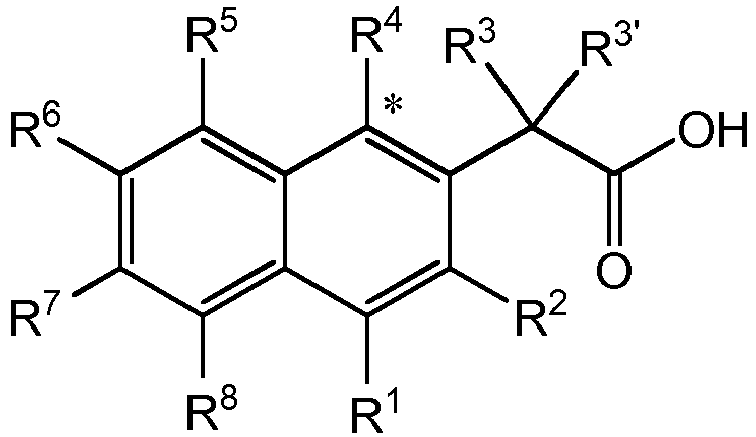
- The chirality that results from the atropisomers at the asterisk position is a feature of certain compounds of the invention. Accordingly, the invention includes all atropisomers of compounds of the invention including mixtures of atropisomers and well as mixtures that are enriched in an atropisomer as well as single atropisomers, which mixtures or compounds possess the useful properties described herein.
- In one embodiment, the compounds of formula I are at least 60% a single atropisomer for the R4 substituent at the asterisk position. In another embodiment, the compounds of formula I are at least 70% a single atropisomer for the R4 substituent at the asterisk position. In another embodiment, the compounds of formula I are at least 80% a single atropisomer for the R4 substituent at the asterisk position. In another embodiment, the compounds of formula I are at least 90% a single atropisomer for the R4 substituent at the asterisk position. In another embodiment, the compounds of formula I are at least 95% a single atropisomer for the R4 substituent at the asterisk position. In one embodiment the stereochemistry for the R4 substituent at the carbon marked with an asterisk as shown above for Formula I is the (R) stereochemistry. In another embodiment the stereochemistry for the R4 substituent at the carbon marked with an asterisk as shown above for Formula I is the (S) stereochemistry.
- The term "treatment" or "treating," to the extent it relates to a disease or condition includes preventing the disease or condition from occurring, inhibiting the disease or condition, eliminating the disease or condition, and/or relieving one or more symptoms of the disease or condition.
- Stereochemical definitions and conventions used herein generally follow S. P. Parker, Ed., McGraw-Hill Dictionary of Chemical Terms (1984) McGraw-Hill Book Company, New York; and Eliel, E. and Wilen, S., Stereochemistry of Organic Compounds (1994) John Wiley & Sons, Inc., New York. Many organic compounds exist in optically active forms, i.e., they have the ability to rotate the plane of plane-polarized light. In describing an optically active compound, the prefixes (D and L) or (R and S) are used to denote the absolute configuration of the molecule about its chiral center(s). The prefixes d and 1 or (+) and (-) are employed to designate the sign of rotation of plane-polarized light by the compound, with (-) or 1 meaning that the compound is levorotatory. A compound prefixed with (+) or d is dextrorotatory. For a given chemical structure, these stereoisomers are identical except that they are mirror images of one another. A specific stereoisomer may also be referred to as an enantiomer, and a mixture of such isomers is often called an enantiomeric mixture. A 50:50 mixture of enantiomers is referred to as a racemic mixture or a racemate, which may occur where there has been no stereoselection or stereospecificity in a chemical reaction or process. The terms "racemic mixture" and "racemate" refer to an equimolar mixture of two enantiomeric species, devoid of optical activity.
- In the context of the present invention, protecting groups include prodrug moieties and chemical protecting groups.
- "Protecting group" refers to a moiety of a compound that masks or alters the properties of a functional group or the properties of the compound as a whole. Chemical protecting groups and strategies for protection/deprotection are well known in the art. See e.g., Protective Groups in Organic Chemistry, Theodora W. Greene, John Wiley & Sons, Inc., New York, 1991. Protecting groups are often utilized to mask the reactivity of certain functional groups, to assist in the efficiency of desired chemical reactions, e.g., making and breaking chemical bonds in an ordered and planned fashion. Protection of functional groups of a compound alters other physical properties besides the reactivity of the protected functional group, such as the polarity, lipophilicity (hydrophobicity), and other properties which can be measured by common analytical tools. Chemically protected intermediates may themselves be biologically active or inactive.
- Protected compounds may also exhibit altered, and in some cases, optimized properties in vitro and in vivo, such as passage through cellular membranes and resistance to enzymatic degradation or sequestration. In this role, protected compounds with intended therapeutic effects may be referred to as prodrugs. Another function of a protecting group is to convert the parental drug into a prodrug, whereby the parental drug is released upon conversion of the prodrug in vivo. Because active prodrugs may be absorbed more effectively than the parental drug, prodrugs may possess greater potency in vivo than the parental drug. Protecting groups are removed either in vitro, in the instance of chemical intermediates, or in vivo, in the case of prodrugs. With chemical intermediates, it is not particularly important that the resulting products after deprotection, e.g., alcohols, be physiologically acceptable, although in general it is more desirable if the products are pharmacologically innocuous.
- Protecting groups are available, commonly known and used, and are optionally used to prevent side reactions with the protected group during synthetic procedures, i.e. routes or methods to prepare the compounds of the invention. For the most part the decision as to which groups to protect, when to do so, and the nature of the chemical protecting group "PG" will be dependent upon the chemistry of the reaction to be protected against (e.g., acidic, basic, oxidative, reductive or other conditions) and the intended direction of the synthesis. PGs do not need to be, and generally are not, the same if the compound is substituted with multiple PG. In general, PG will be used to protect functional groups such as carboxyl, hydroxyl, thio, or amino groups and to thus prevent side reactions or to otherwise facilitate the synthetic efficiency. The order of deprotection to yield free deprotected groups is dependent upon the intended direction of the synthesis and the reaction conditions to be encountered, and may occur in any order as determined by the artisan.
- Various functional groups of the compounds of the invention may be protected. For example, protecting groups for -OH groups (whether hydroxyl, carboxylic acid, phosphonic acid, or other functions) include "ether- or ester-forming groups". Ether- or ester-forming groups are capable of functioning as chemical protecting groups in the synthetic schemes set forth herein. However, some hydroxyl and thio protecting groups are neither ether- nor ester-forming groups, as will be understood by those skilled in the art, and are included with amides, discussed below.
- A very large number of hydroxyl protecting groups and amide-forming groups and corresponding chemical cleavage reactions are described in Protective Groups in Organic Synthesis, Theodora W. Greene (John Wiley & Sons, Inc., New York, 1991, ISBN 0-471-62301-6) ("Greene"). See also Kocienski, Philip J.; Protecting Groups (Georg Thieme Verlag Stuttgart, New York, 1994). In particular Chapter 1, Protecting Groups: An Overview, pages 1-20, Chapter 2, Hydroxyl Protecting Groups, pages 21-94, Chapter 3, Diol Protecting Groups, pages 95-117, Chapter 4, Carboxyl Protecting Groups, pages 118-154, Chapter 5, Carbonyl Protecting Groups, pages 155-184. For protecting groups for carboxylic acid, phosphonic acid, phosphonate, sulfonic acid and other protecting groups for acids see Greene as set forth below.
- The compounds of the invention may have chiral centers, e.g., chiral carbon or phosphorus atoms. The compounds of the invention thus include racemic mixtures of all stereoisomers, including enantiomers, diastereomers, and atropisomers. In addition, the compounds of the invention include enriched or resolved optical isomers at any or all asymmetric, chiral atoms. In other words, the chiral centers apparent from the depictions are provided as the chiral isomers or racemic mixtures. Both racemic and diastereomeric mixtures, as well as the individual optical isomers isolated or synthesized, substantially free of their enantiomeric or diastereomeric partners, are all within the scope of the invention. The racemic mixtures can be separated into their individual, substantially optically pure isomers through well-known techniques such as, for example, the separation of diastereomeric salts formed with optically active adjuncts, e.g., acids or bases followed by conversion back to the optically active substances. In most instances, the desired optical isomer is synthesized by means of stereospecific reactions, beginning with the appropriate stereoisomer of the desired starting material.
- The compounds of the invention can also exist as tautomeric isomers in certain cases. Although only one delocalized resonance structure may be depicted, all such forms are contemplated within the scope of the invention. For example, ene-amine tautomers can exist for purine, pyrimidine, imidazole, guanidine, amidine, and tetrazole systems and all their possible tautomeric forms are within the scope of the invention.
- Examples of pharmaceutically acceptable salts of the compounds of the invention include salts derived from an appropriate base, such as an alkali metal (for example, sodium), an alkaline earth metal (for example, magnesium), ammonium and NX4 + (wherein X is C1-C4 alkyl). Pharmaceutically acceptable salts of a hydrogen atom or an amino group include for example salts of organic carboxylic acids such as acetic, benzoic, lactic, fumaric, tartaric, maleic, malonic, malic, isethionic, lactobionic and succinic acids; organic sulfonic acids, such as methanesulfonic, ethanesulfonic, benzenesulfonic and p-toluenesulfonic acids; and inorganic acids, such as hydrochloric, hydrobromic, sulfuric, phosphoric and sulfamic acids. Pharmaceutically acceptable salts of a compound of a hydroxy group include the anion of said compound in combination with a suitable cation such as Na+ and NX4 + (wherein X is independently selected from H or a C1-C4 alkyl group).
- For therapeutic use, salts of active ingredients of the compounds of the invention will typically be pharmaceutically acceptable, i.e. they will be salts derived from a physiologically acceptable acid or base. However, salts of acids or bases which are not pharmaceutically acceptable may also find use, for example, in the preparation or purification of a compound of the invention.
- Metal salts typically are prepared by reacting the metal hydroxide with a compound of this invention. Examples of metal salts which are prepared in this way are salts containing Li+, Na+, and K+. A less soluble metal salt can be precipitated from the solution of a more soluble salt by addition of the suitable metal compound.
- In addition, salts may be formed from acid addition of certain organic and inorganic acids, e.g., HCl, HBr, H2SO4 H3PO4 or organic sulfonic acids, to basic centers, typically amines, or to acidic groups. Finally, it is to be understood that the compositions herein comprise compounds of the invention in their un-ionized, as well as zwitterionic form, and combinations with stoichiometric amounts of water as in hydrates.
- Also included within the scope of this invention are the salts of the parental compounds with one or more amino acids. Any of the natural or unnatural amino acids are suitable, especially the naturally-occurring amino acids found as protein components, although the amino acid typically is one bearing a side chain with a basic or acidic group, e.g., lysine, arginine or glutamic acid, or a neutral group such as glycine, serine, threonine, alanine, isoleucine, or leucine.
- It is understood by one skilled in the art that this invention also includes any compound claimed that may be enriched at any or all atoms above naturally occurring isotopic ratios with one or more isotopes such as, but not limited to, deuterium (2H or D). As a non-limiting example, a -CH3 group may be substituted with -CD3.
- Scheme 1 illustrates a process that was used to prepare a compound of formula I and which can be used to prepare other compounds of formula I. Schemes 2-6 illustrate processes that can be used to prepare compounds of formula I.

- An aromatic or heteroaromatic halide or triflate (1A) can be crossed-coupled to a suitably protected alkyne (1B) such as ethynyl(trimethyl)silane using a palladium catalyst and copper halide salt such as, for example, copper(I) iodide, N,N-diisopropylethylamine, tetrakis(triphenylphosphine)palladium(0) and dimethylformamide or copper(I) iodide, diethylamine, and bis(triphenylphosphine) palladium(II) dichloride. Deprotection of cross-coupled alkyne (1C) yields the corresponding terminal alkyne (1D) such as, for example, deprotection of a trimethylsilyl-protected alkyne with a fluoride source such as, for example, tetrabutylammonium fluoride. Metalation of a terminal alkyl (1D) such as, for example, deprotonation with n-butyllithium, yields the corresponding metal acetylide such as, for example lithium acetylide, that undergoes nucleophilic addition to an appropriate electrophile (1E) to give the corresponding hydroxy alkyne addition product 1F. A suitably substituted phenyl electrophile such as phenyl-2-propanone can be purchased or prepared by those skilled in the art through, for example, Friedel-Crafts alkylation of benzene with chloroacetone.
- The hydroxyl alkyne 1F can undergo 6-endo-dig electrophilic cyclization under suitable reaction conditions such as, for example iodine and sodium bicarbonate to give the corresponding substituted naphthalene such as, for example the iodonaphthalene 1G. The substituted naphthalene 1G, can undergo a cross-coupling reaction such as, for example Stille cross-coupling using a tin reagent such as tributyl(vinyl)tin and a palladium catalyst such as bis(triphenylphosphine) palladium(II) dichloride to give the corresponding cross-coupled naphthalene such as, for example, vinylnaphthalene 1H. The vinylnaphthalene 1H can be dihydroxylated by methods known to those skilled in the art such as, for example Sharpless asymmetric dihydroxylation using, for example, commercially available ADmix-α.
- The resulting diol 1I can be protected at the primary hydroxyl by suitable protecting groups such as, for example, pivalate ester using pivaloyl chloride and pyridine to provide 1J. The secondary hydroxyl can be converted to the corresponding ether 1K such as tert-butyl ether using methods known to those skilled in the art such as, for example, tert-butyl acetate and perchloric acid. The protected primary hydroxyl can be deprotected by methods known to those skilled in the art such as, for example the deprotection of a pivalate protecting group under basic conditions, such as, for example sodium hydroxide, to give the corresponding primary hydroxyl compound 1L. The primary hydroxyl can be oxidized to the corresponding carboxylic acid 1M by methods known to those skilled in the art such as, for example, periodic acid and chromium trioxide.

- Metalation of a suitably functionalized and protected terminal alkyne such as, for example, deprotonation with n-butyllithium, can yield the corresponding metal acetylide such as, for example lithium acetylide, that undergoes nucleophilic addition to an appropriate electrophile, such as, for example 1E, to give the corresponding hydroxy alkyne addition product 2A. The hydroxyl alkyne 2A can undergo 6-endo-dig electrophilic cyclization under suitable reaction conditions such as, for example iodine and sodium bicarbonate to give the corresponding substituted naphthalene such as, for example iodonaphthalene 2B. The substituted naphthalene 2B, can undergo a cross-coupling reaction such as, for example Stille cross-coupling using a tin reagent such as, for example, tributyl(vinyl)tin and a palladium catalyst such as, for example, bis(triphenylphosphine)palladium(II) dichloride to give the corresponding cross-coupled naphthalene such as, for example, vinylnaphthalene 2C. The alkenylnaphthalene 2C can be dihydroxylated using methods known to those skilled in the art such as, for example Sharpless asymmetric dihydroxylation using, for example, commercially available ADmix-α.
- The resulting diol 2D can be protected at the primary hydroxyl by an orthogonal protecting groups, such as, for example, pivalate ester using pivaloyl chloride and pyridine. The secondary hydroxyl of 2E can be converted to the corresponding ether 2F, such as a tert-butyl ether using methods known to those skilled in the art for example, using tert-butyl acetate and perchloric acid. The naphthol protecting group can be differentially deprotected by methods known to those skilled in the art and converted to a leaving group (e.g. triflate) known to undergo cross-coupling reactions. The corresponding activated naphthalene 2G can undergo cross-coupling reactions such as but not limited to Suzuki reactions with boronic acids or esters, Stille reactions with trialkylstannane reagents, and Buchwald-Hartwig reactions with amines thus providing carbon linked and nitrogen linked R4 groups of 2H. The protected primary hydroxyl can be deprotected by methods known to those skilled in the art such as, for example the deprotection of a pivalate protecting group under basic conditions, such as, for example sodium hydroxide, to give the corresponding primary hydroxyl. The primary hydroxyl can be oxidized to the corresponding carboxylic acid analog 21 by methods known to those skilled in the art such as, for example, periodic acid and chromium trioxide.

- The substituted hydroxyl naphthalene 2J can undergo halogenation using an appropriate halogen source and catalyst such as, for example N-chlorosuccinimide and zirconium(IV) chloride to provide 2K. The hydroxyl naphthalene 2K can be converted to a leaving group such as, for example trifluoromethanesulfonate ester by treatment with trifluoromethanesulfonic anhydride and base such as, for example, 2,6-lutidine to provide 2L. Naphthalene 2L can undergo a selective cross-coupling reaction such as, for example Stille cross-coupling using a tin reagent such as tributyl(vinyl)tin and a palladium catalyst such as bis(triphenylphosphine) palladium(II) dichloride to give the corresponding cross-coupled naphthalene such as vinylnaphthalene 2M. The alkenylnaphthalene can be dihydroxylated to provide 2N by methods known to those skilled in the art such as, Sharpless asymmetric dihydroxylation using, for example, commercially available AD mix-α.
- The resulting diol 2N can be protected at the primary hydroxyl by suitable protecting groups such as pivalate ester using pivaloyl chloride and pyridine to provide 2P. The secondary hydroxyl can be converted to the corresponding ether such as tert-butyl ether using methods known to those skilled in the art such as, tert-butyl acetate and perchloric acid to provide 2Q. The halogenated naphthalene 2Q can undergo cross-coupling reaction such as Suzuki cross-coupling using a boronic acid and a palladium catalyst such as palladium(II) acetate with SPhos to give the corresponding cross-coupled naphthalene 2R. The protected primary hydroxyl can be deprotected by methods known to those skilled in the art such as the deprotection of a pivalate protecting group under basic conditions for example, using sodium hydroxide, to give the corresponding primary hydroxyl compound 2R. The primary hydroxyl can be oxidized to the corresponding carboxylic acid 2S by methods known to those skilled in the art such as, for example, periodic acid and chromium trioxide.
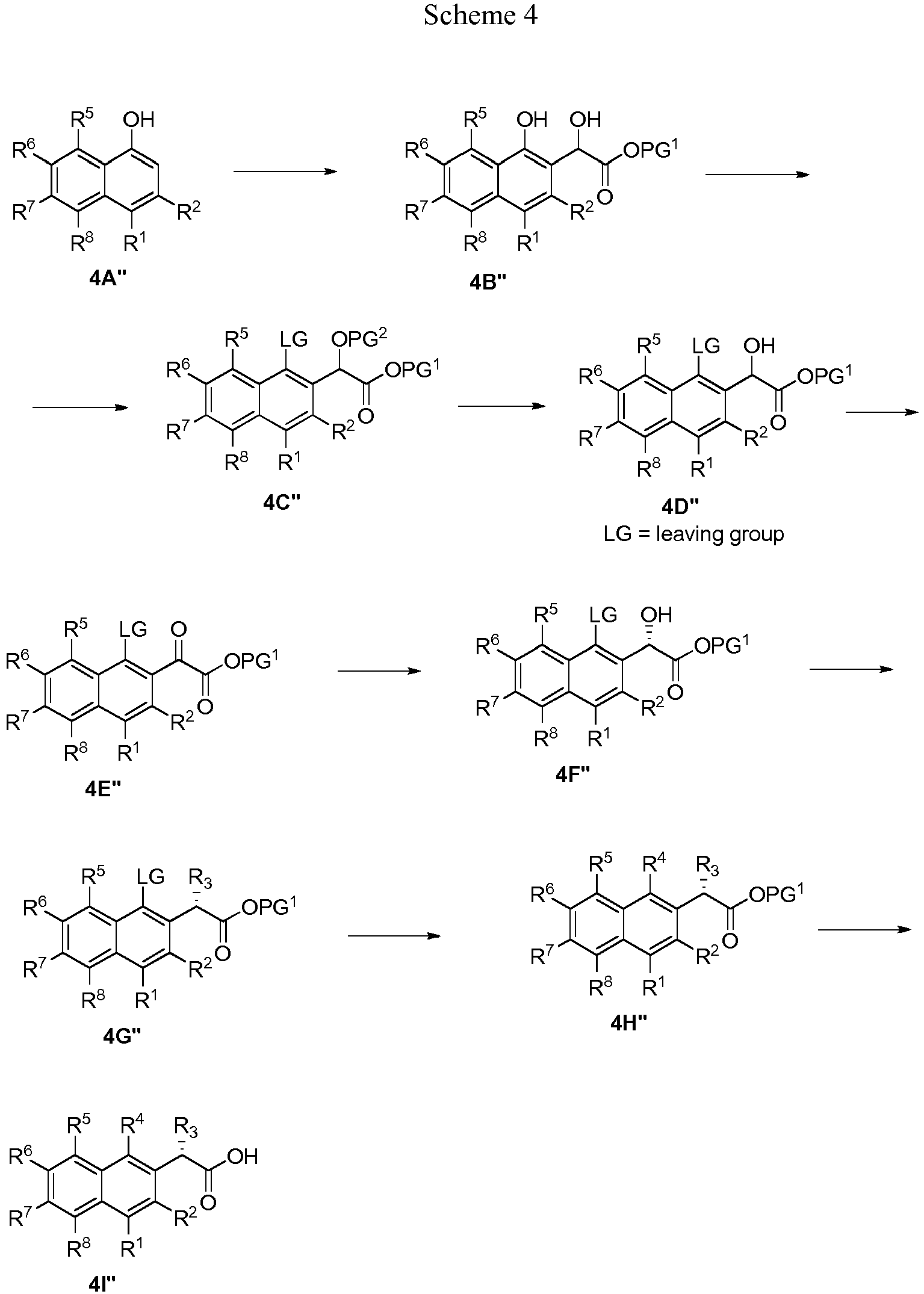
- Electrophilic aromatic substitution with a suitably functionalized and protected naphthol such as, for example 4A", with an electrophile such as, for example, ethyl glyoxylate under appropriate conditions such as, for example, titanium tetrachloride, can provide 4B". The secondary alcohol can be protected with a protecting group and the naphthol converted to a leaving group (e.g. triflate) known to undergo cross-coupling reactions to provide 4C". The alcohol protecting group can be removed and the resulting alcohol oxidized to the ketone using an oxidant such as Dess-Martin Periodinane, for example, to provide 4E". The ketone can be reduced stereoselectively using an asymmetric reduction method such as, for example Corey-Bakshi-Shibata Reduction to provide 4F".
- The secondary hydroxyl can be converted to the corresponding ether such as tert-butyl ether using methods known to those skilled in the art such as, tert-butyl acetate and perchloric acid to provide 4G". The functionalized naphthalene 4G" can undergo can undergo cross-coupling reactions such as but not limited to Suzuki reactions with boronic acids or esters, Stille reactions with trialkylstannane reagents, and Buchwald-Hartwig reactions with amines thus providing carbon linked and nitrogen linked products using a palladium catalyst such as palladium(II) acetate with SPhos to give the corresponding cross-coupled naphthalene 4H". The protected ester can be deprotected by methods known to those skilled in the art such as, for example the deprotection of a ethyl ester protecting group under basic conditions, such as, for example sodium hydroxide, to give the corresponding carboxylic acid 4I".
- It is known to those skilled in the art that the functionalized naphthalenes (e.g. 4E", 4G", or 4H") that contain a halogen or pseudohalogen (e.g. triflate), can undergo cross-coupling reactions such as but not limited to Suzuki reactions with boronic acids or esters, Stille reactions with trialkyltin reagents, Sonogashira reactions with alkynes, and Buchwald-Hartwig reactions with amines and carried forward in a similar manner to provide 41".

- The functionalized naphthalene 4C" can undergo can undergo cross-coupling reactions such as but not limited to Suzuki reactions with boronic acids or esters, Stille reactions with trialkyltin reagents, Sonogashira reactions with alkynes, and Buchwald-Hartwig reactions with amines thus providing carbon linked and nitrogen linked products using a palladium catalyst such as palladium tetrakis to give the corresponding cross-coupled naphthalene 5A". The alcohol protecting group can be removed and the resulting alcohol oxidized to the ketone using an oxidant such as Dess-Martin Periodinane, for example, to provide 5B". The ketone can be reduced stereoselectively using an asymmetric reduction method such as, for example Corey-Bakshi-Shibata Reduction to provide 5C". The secondary hydroxyl can be converted to the corresponding ether such as tert-butyl ether using methods known to those skilled in the art such as, tert-butyl acetate and perchloric acid to provide 5D". The protected ester can be deprotected by methods known to those skilled in the art such as, for example the deprotection of a ethyl ester protecting group under basic conditions, such as, for example sodium hydroxide, to give the corresponding carboxylic acid 5E".
- It is known to those skilled in the art that the functionalized naphthalenes (e.g. 5A" or 5D") that contain a halogen or pseudohalogen (e.g. triflate), can undergo cross-coupling reactions such as but not limited to Suzuki reactions with boronic acids or esters, Stille reactions with trialkyltin reagents, Sonogashira reactions with alkynes, and Buchwald-Hartwig reactions with amines and carried forward in a similar manner to provide 5E".

- It is known to those skilled in the art that 6A" can undergo The Homer-Wadsworth-Emmons with stabilized phosphonate carbanions such as, for example (diethoxyphosphoryl)acetic acid ethyl ester and sodium hydride to provide 6B". The olefin can be reduced by hydrogenation with palladium on carbon, for example, to provide 6C". The protected ester can be deprotected by methods known to those skilled in the art such as, for example the deprotection of a ethyl ester protecting group under basic conditions, such as, for example lithium hydroxide, to give the corresponding carboxylic acid that can be converted to the corresponding acid chloride using oxalyl chloride to give 6D". Friedel Crafts reaction catalyzed by a Lewis acid such as, for example, aluminum trichloride provides tetralone 6E".
Condensation of 6E" with, for example, ethyl glyoxylate under acid catalysis provides 6F" which can be brominated under radical conditions such as, for example, N-bromosuccinimide and AIBN, and converted to 6H" using an alkoxide such as that derived from reaction of 4-methoxybenzyl alcohol and LHMDS, for example. - The naphthol 6H" can be converted to a leaving group (e.g. triflate) known to undergo cross-coupling reactions by methods known to those skilled in the art. Compound 61" can undergo cross-coupling reactions such as but not limited to Suzuki reactions with boronic acids or esters, Stille reactions with trialkyltin reagents, Sonogashira reactions with alkynes, and Buchwald-Hartwig reactions with amines thus providing carbon linked and nitrogen linked products using a palladium catalyst such as palladium tetrakis to give the corresponding cross-coupled naphthalene 6J".
- The alcohol protecting group can be removed by methods known to those skilled in the art and the resulting hydroxyl can be converted to the corresponding ether such as tert-butyl ether using methods known to those skilled in the art such as, tert-butyl acetate and perchloric acid to provide 6K". The protected ester can be deprotected by methods known to those skilled in the art such as, for example the deprotection of a ethyl ester protecting group under basic conditions, such as, for example sodium hydroxide, to give the corresponding carboxylic acid 6L".
- The term "prodrug" as used herein refers to any compound that when administered to a biological system generates a compound of the invention that inhibits the replication of HIV ("the active inhibitory compound"). The compound may be formed from the prodrug as a result of: (i) spontaneous chemical reaction(s), (ii) enzyme catalyzed chemical reaction(s), (iii) photolysis, and/or (iv) metabolic chemical reaction(s).
- "Prodrug moiety" refers to a labile functional group which separates from the active inhibitory compound during metabolism, systemically, inside a cell, by hydrolysis, enzymatic cleavage, or by some other process (Bundgaard, Hans, "Design and Application of Prodrugs" in A Textbook of Drug Design and Development (1991), P. Krogsgaard-Larsen and H. Bundgaard, Eds. Harwood Academic Publishers, pp. 113-191). Enzymes which are capable of an enzymatic activation mechanism with the prodrug compounds of the invention include, but are not limited to, amidases, esterases, microbial enzymes, phospholipases, cholinesterases, and phosphases. Prodrug moieties can serve to enhance solubility, absorption and lipophilicity to optimize drug delivery, bioavailability and efficacy. A prodrug moiety may include an active metabolite or drug itself.
- Exemplary prodrug moieties include the hydrolytically sensitive or labile acyloxymethyl esters -CH2OC(=O)R99 and acyloxymethyl carbonates -CH2OC(=O)OR99 where R99 is C1-C6 alkyl, C1-C6 substituted alkyl, C6-C20 aryl or C6-C20 substituted aryl. The acyloxyalkyl ester was first used as a prodrug strategy for carboxylic acids and then applied to phosphates and phosphonates by Farquhar et al. (1983) J. Pharm. Sci. 72: 324; also
US Patent Nos. 4816570 ,4968788 ,5663159 and5792756 . Subsequently, the acyloxyalkyl ester was used to deliver phosphonic acids across cell membranes and to enhance oral bioavailability. A close variant of the acyloxyalkyl ester, the alkoxycarbonyloxyalkyl ester (carbonate), may also enhance oral bioavailability as a prodrug moiety in the compounds of the combinations of the invention. An exemplary acyloxymethyl ester is pivaloyloxymethoxy, (POM) -CH2OC(=O)C(CH3)3. An exemplary acyloxymethyl carbonate prodrug moiety is pivaloyloxymethylcarbonate (POC) -CH2OC(=O)OC(CH3)3. - Aryl esters of phosphorus groups, especially phenyl esters, are reported to enhance oral bioavailability (De Lombaert et al. (1994) J. Med. Chem. 37: 498). Phenyl esters containing a carboxylic ester ortho to a phosphate have also been described (Khamnei and Torrence, (1996) J. Med. Chem. 39:4109-4115). Benzyl esters are reported to generate parent phosphonic acids. In some cases, substituents at the ortho- or para- position may accelerate the hydrolysis. Benzyl analogs with an acylated phenol or an alkylated phenol may generate the phenolic compound through the action of enzymes, e.g., esterases, oxidases, etc., which in turn undergoes cleavage at the benzylic C-O bond to generate phosphoric acid and a quinone methide intermediate. Examples of this class ofprodrugs are described by Mitchell et al. (1992) J. Chem. Soc. Perkin Trashs. II 2345;
Glazier WO 91/19721 WO 91/19721 - The compounds of this invention are formulated with conventional carriers and excipients, which will be selected in accord with ordinary practice. Tablets will contain excipients, glidants, fillers, binders and the like. Aqueous formulations are prepared in sterile form, and when intended for delivery by other than oral administration generally will be isotonic. All formulations will optionally contain excipients such as those set forth in the Handbook of Pharmaceutical Excipients (1986). Excipients include ascorbic acid and other antioxidants, chelating agents such as EDTA, carbohydrates such as dextrin, hydroxyalkylcellulose, hydroxyalkylmethylcellulose, stearic acid and the like. The pH of the formulations ranges from about 3 to about 11, but is ordinarily about 7 to 10.
- While it is possible for the active ingredients to be administered alone it may be preferable to present them as pharmaceutical formulations. The formulations, both for veterinary and for human use, of the invention comprise at least one active ingredient, as above defined, together with one or more acceptable carriers and optionally other therapeutic ingredients. The carrier(s) must be "acceptable" in the sense of being compatible with the other ingredients of the formulation and physiologically innocuous to the recipient thereof.
- The formulations include those suitable for the foregoing administration routes. The formulations may conveniently be presented in unit dosage form and may be prepared by any of the methods well known in the art of pharmacy. Techniques and formulations generally are found in Remington's Pharmaceutical Sciences (Mack Publishing Co., Easton, PA). Such methods include the step of bringing into association the active ingredient with the carrier which constitutes one or more accessory ingredients. In general the formulations are prepared by uniformly and intimately bringing into association the active ingredient with liquid carriers or finely divided solid carriers or both, and then, if necessary, shaping the product.
- Formulations of the present invention suitable for oral administration may be presented as discrete units such as capsules, cachets or tablets each containing a predetermined amount of the active ingredient; as a powder or granules; as a solution or a suspension in an aqueous or non-aqueous liquid; or as an oil-in-water liquid emulsion or a water-in-oil liquid emulsion. The active ingredient may also be administered as a bolus, electuary or paste.
- A tablet is made by compression or molding, optionally with one or more accessory ingredients. Compressed tablets may be prepared by compressing in a suitable machine the active ingredient in a free-ffowing form such as a powder or granules, optionally mixed with a binder, lubricant, inert diluent, preservative, surface active or dispersing agent. Molded tablets may be made by molding in a suitable machine a mixture of the powdered active ingredient moistened with an inert liquid diluent. The tablets may optionally be coated or scored and optionally are formulated so as to provide slow or controlled release of the active ingredient therefrom.
- For administration to the eye or other external tissues e.g., mouth and skin, the formulations are preferably applied as a topical ointment or cream containing the active ingredient(s) in an amount of, for example, 0.075 to 20% w/w (including active ingredient(s) in a range between 0.1% and 20% in increments of 0.1% w/w such as 0.6% w/w, 0.7% w/w, etc.), preferably 0.2 to 15% w/w and most preferably 0.5 to 10% w/w. When formulated in an ointment, the active ingredients may be employed with either a paraffinic or a water-miscible ointment base. Alternatively, the active ingredients may be formulated in a cream with an oil-in-water cream base.
- If desired, the aqueous phase of the cream base may include, for example, at least 30% w/w of a polyhydric alcohol, i.e. an alcohol having two or more hydroxyl groups such as propylene glycol, butane 1,3-diol, mannitol, sorbitol, glycerol and polyethylene glycol (including PEG 400) and mixtures thereof. The topical formulations may desirably include a compound which enhances absorption or penetration of the active ingredient through the skin or other affected areas. Examples of such dermal penetration enhancers include dimethyl sulfoxide and related analogs.
- The oily phase of the emulsions of this invention may be constituted from known ingredients in a known manner. While the phase may comprise merely an emulsifier (otherwise known as an emulgent), it desirably comprises a mixture of at least one emulsifier with a fat or an oil or with both a fat and an oil. Preferably, a hydrophilic emulsifier is included together with a lipophilic emulsifier which acts as a stabilizer. It is also preferred to include both an oil and a fat. Together, the emulsifier(s) with or without stabilizer(s) make up the so-called emulsifying wax, and the wax together with the oil and fat make up the so-called emulsifying ointment base which forms the oily dispersed phase of the cream formulations.
- Emulgents and emulsion stabilizers suitable for use in the formulation of the invention include Tween® 60, Span® 80, cetostearyl alcohol, benzyl alcohol, myristyl alcohol, glyceryl mono-stearate and sodium lauryl sulfate.
- The choice of suitable oils or fats for the formulation is based on achieving the desired cosmetic properties. The cream should preferably be a non-greasy, non-staining and washable product with suitable consistency to avoid leakage from tubes or other containers. Straight or branched chain, mono- or dibasic alkyl esters such as di-isoadipate, isocetyl stearate, propylene glycol diester of coconut fatty acids, isopropyl myristate, decyl oleate, isopropyl palmitate, butyl stearate, 2-ethylhexyl palmitate or a blend of branched chain esters known as Crodamol CAP may be used, the last three being preferred esters. These may be used alone or in combination depending on the properties required. Alternatively, high melting point lipids such as white soft paraffin and/or liquid paraffin or other mineral oils are used.
- Pharmaceutical formulations according to the present invention comprise one or more compounds of the invention together with one or more pharmaceutically acceptable carriers or excipients and optionally other therapeutic agents. Pharmaceutical formulations containing the active ingredient may be in any form suitable for the intended method of administration. When used for oral use for example, tablets, troches, lozenges, aqueous or oil suspensions, dispersible powders or granules, emulsions, hard or soft capsules, syrups or elixirs may be prepared. Compositions intended for oral use may be prepared according to any method known to the art for the manufacture of pharmaceutical compositions and such compositions may contain one or more agents including sweetening agents, flavoring agents, coloring agents and preserving agents, in order to provide a palatable preparation. Tablets containing the active ingredient in admixture with non-toxic pharmaceutically acceptable excipient which are suitable for manufacture of tablets are acceptable. These excipients may be, for example, inert diluents, such as calcium or sodium carbonate, lactose, lactose monohydrate, croscarmellose sodium, povidone, calcium or sodium phosphate; granulating and disintegrating agents, such as maize starch, or alginic acid; binding agents, such as cellulose, microcrystalline cellulose, starch, gelatin or acacia; and lubricating agents, such as magnesium stearate, stearic acid or talc. Tablets may be uncoated or may be coated by known techniques including microencapsulation to delay disintegration and adsorption in the gastrointestinal tract and thereby provide a sustained action over a longer period. For example, a time delay material such as glyceryl monostearate or glyceryl distearate alone or with a wax may be employed.
- Formulations for oral use may be also presented as hard gelatin capsules where the active ingredient is mixed with an inert solid diluent, for example calcium phosphate or kaolin, or as soft gelatin capsules wherein the active ingredient is mixed with water or an oil medium, such as peanut oil, liquid paraffin or olive oil.
- Aqueous suspensions of the invention contain the active materials in admixture with excipients suitable for the manufacture of aqueous suspensions. Such excipients include a suspending agent, such as sodium carboxymethylcellulose, methylcellulose, hydroxypropyl methylcelluose, sodium alginate, polyvinylpyrrolidone, gum tragacanth and gum acacia, and dispersing or wetting agents such as a naturally occurring phosphatide (e.g., lecithin), a condensation product of an alkyl oxide with a fatty acid (e.g., polyoxyethylene stearate), a condensation product of ethylene oxide with a long chain aliphatic alcohol (e.g., heptadecaethyleneoxycetanol), a condensation product of ethylene oxide with a partial ester derived from a fatty acid and a hexitol anhydride (e.g., polyoxyethylene sorbitan monooleate). The aqueous suspension may also contain one or more preservatives such as ethyl or n-propyl p-hydroxy-benzoate, one or more coloring agents, one or more flavoring agents and one or more sweetening agents, such as sucrose or saccharin.
- Oil suspensions may be formulated by suspending the active ingredient in a vegetable oil, such as arachis oil, olive oil, sesame oil or coconut oil, or in a mineral oil such as liquid paraffin. The oral suspensions may contain a thickening agent, such as beeswax, hard paraffin or cetyl alcohol. Sweetening agents, such as those set forth above, and flavoring agents may be added to provide a palatable oral preparation. These compositions may be preserved by the addition of an antioxidant such as ascorbic acid.
- Dispersible powders and granules of the invention suitable for preparation of an aqueous suspension by the addition of water provide the active ingredient in admixture with a dispersing or wetting agent, a suspending agent, and one or more preservatives. Suitable dispersing or wetting agents and suspending agents are exemplified by those disclosed above. Additional excipients, for example sweetening, flavoring and coloring agents, may also be present.
- The pharmaceutical compositions of the invention may also be in the form of oil-in-water emulsions. The oily phase may be a vegetable oil, such as olive oil or arachis oil, a mineral oil, such as liquid paraffin, or a mixture of these. Suitable emulsifying agents include naturally-occurring gums, such as gum acacia and gum tragacanth, naturally occurring phosphatides, such as soybean lecithin, esters or partial esters derived from fatty acids and hexitol anhydrides, such as sorbitan monooleate, and condensation products of these partial esters with ethylene oxide, such as polyoxyethylene sorbitan monooleate. The emulsion may also contain sweetening and flavoring agents. Syrups and elixirs may be formulated with sweetening agents, such as glycerol, sorbitol or sucrose. Such formulations may also contain a demulcent, a preservative, a flavoring or a coloring agent.
- The pharmaceutical compositions of the invention may be in the form of a sterile injectable preparation, such as a sterile injectable aqueous or oleaginous suspension. This suspension may be formulated according to the known art using those suitable dispersing or wetting agents and suspending agents which have been mentioned above. The sterile injectable preparation may also be a sterile injectable solution or suspension in a non-toxic parenterally acceptable diluent or solvent, such as a solution in 1,3-butane-diol or prepared as a lyophilized powder. Among the acceptable vehicles and solvents that may be employed are water, Ringer's solution and isotonic sodium chloride solution. In addition, sterile fixed oils may conventionally be employed as a solvent or suspending medium. For this purpose any bland fixed oil may be employed including synthetic mono- or diglycerides. In addition, fatty acids such as oleic acid may likewise be used in the preparation of injectables.
- The amount of active ingredient that may be combined with the carrier material to produce a single dosage form will vary depending upon the host treated and the particular mode of administration. For example, a time-release formulation intended for oral administration to humans may contain approximately 1 to 1000 mg of active material compounded with an appropriate and convenient amount of carrier material which may vary from about 5 to about 95% of the total compositions (weight:weight). The pharmaceutical composition can be prepared to provide easily measurable amounts for administration. For example, an aqueous solution intended for intravenous infusion may contain from about 3 to 500 µg of the active ingredient per milliliter of solution in order that infusion of a suitable volume at a rate of about 30 mL/hr can occur.
- Formulations suitable for administration to the eye include eye drops wherein the active ingredient is dissolved or suspended in a suitable carrier, especially an aqueous solvent for the active ingredient. The active ingredient is preferably present in such formulations in a concentration of 0.5 to 20%, advantageously 0.5 to 10% particularly about 1.5% w/w.
- Formulations suitable for topical administration in the mouth include lozenges comprising the active ingredient in a flavored basis, usually sucrose and acacia or tragacanth; pastilles comprising the active ingredient in an inert basis such as gelatin and glycerin, or sucrose and acacia; and mouthwashes comprising the active ingredient in a suitable liquid carrier.
- Formulations for rectal administration may be presented as a suppository with a suitable base comprising for example cocoa butter or a salicylate.
- Formulations suitable for intrapulmonary or nasal administration have a particle size for example in the range of 0.1 to 500 microns (including particle sizes in a range between 0.1 and 500 microns in increments microns such as 0.5, 1, 30 microns, 35 microns, etc.), which is administered by rapid inhalation through the nasal passage or by inhalation through the mouth so as to reach the alveolar sacs. Suitable formulations include aqueous or oily solutions of the active ingredient. Formulations suitable for aerosol or dry powder administration may be prepared according to conventional methods and may be delivered with other therapeutic agents.
- Formulations suitable for vaginal administration may be presented as pessaries, tampons, creams, gels, pastes, foams or spray formulations containing in addition to the active ingredient such carriers as are known in the art to be appropriate.
- Formulations suitable for parenteral administration include aqueous and non-aqueous sterile injection solutions which may contain anti-oxidants, buffers, bacteriostats and solutes which render the formulation isotonic with the blood of the intended recipient; and aqueous and non-aqueous sterile suspensions which may include suspending agents and thickening agents.
- The formulations are presented in unit-dose or multi-dose containers, for example sealed ampoules and vials, and may be stored in a freeze-dried (lyophilized) condition requiring only the addition of the sterile liquid carrier, for example water for injection, immediately prior to use. Extemporaneous injection solutions and suspensions are prepared from sterile powders, granules and tablets of the kind previously described. Preferred unit dosage formulations are those containing a daily dose or unit daily sub-dose, as herein above recited, or an appropriate fraction thereof, of the active ingredient.
- It should be understood that in addition to the ingredients particularly mentioned above the formulations of this invention may include other agents conventional in the art having regard to the type of formulation in question, for example those suitable for oral administration may include flavoring agents.
- The invention further provides veterinary compositions comprising at least one active ingredient as above defined together with a veterinary carrier.
- Veterinary carriers are materials useful for the purpose of administering the composition and may be solid, liquid or gaseous materials which are otherwise inert or acceptable in the veterinary art and are compatible with the active ingredient. These veterinary compositions may be administered orally, parenterally or by any other desired route.
- Compounds of the invention can also be formulated to provide controlled release of the active ingredient to allow less frequent dosing or to improve the pharmacokinetic or toxicity profile of the active ingredient. Accordingly, the invention also provides compositions comprising one or more compounds of the invention formulated for sustained or controlled release.
- Effective dose of active ingredient depends at least on the nature of the condition being treated, toxicity, whether the compound is being used prophylactically (lower doses), the method of delivery, and the pharmaceutical formulation, and will be determined by the clinician using conventional dose escalation studies.
- One or more compounds of the invention (herein referred to as the active ingredients) are administered by any route appropriate to the condition to be treated. Suitable routes include oral, rectal, nasal, topical (including buccal and sublingual), vaginal and parenteral (including subcutaneous, intramuscular, intravenous, intradermal, intrathecal and epidural), and the like. It will be appreciated that the preferred route may vary with for example the condition of the recipient. An advantage of the compounds of this invention is that they are orally bioavailable and can be dosed orally.
- The antiviral properties of a compound of the invention may be determined using Test A described below.
- For the antiviral assay utilizing MT-4 cells, 0.4 µL of 189X test concentration of 3-fold serially diluted compound in DMSO was added to 40 µL of cell growth medium (RPMI 1640, 10%FBS, 1% penicillin/Streptomycin, 1% L-Glutamine, 1% HEPES) in each well of 384-well assay plates (10 concentrations) in quadruplicate.
- 1 mL aliquots of 2x10e6 MT-4 cells are pre-infected for 1 and 3 hrs respectively, @ 37 °C with 25 µL (MT4) or of either cell growth medium (mock-infected) or a fresh 1:250 dilution of an HIV-IIIb concentrated ABI stock (0.004 m.o.i. for MT4 cells). Infected and uninfected cells are diluted in cell growth medium and 35 uL of 2000 (for MT4) cells is added to each well of the assay plates.
- Assay plates were then incubated in a 37 °C incubator. After 5 days of incubation, 25 µl of 2X concentrated CellTiter-Glo™Reagent (catalog # G7573, Promega Biosciences, Inc., Madison, WI) was added to each well of the assay plate. Cell lysis was carried out by incubating at room temperature for 2-3 min and then chemiluminescence was read using the Envision reader (PerkinElmer).
- Compounds of the present invention demonstrate antiviral activity in this assay (Test A) as depicted in the table below. Any compounds in the following table which are not within the scope of the claims are provided for reference only.
Compound Number EC50 (µM) 3K 0.056 4K 0.301 4L 22 5K 4.6 6D 0.014 7D 1.7 7E 20 8 0.025 9 1.3 10 36 11 8.9 12 0.11 13 0.010 14 0.011 15 0.015 16 7.0 17 7.7 19 5.4 20 0.093 22 0.54 23 0.024 24 29 25 26 26 0.84 27 3.5 28 0.40 29A 0.13 29B 0.50 30 0.044 31 0.11 32 0.086 33 0.12 34 0.35 37 1.2 38 3.4 39 0.70 40 0.21 41 0.40 42 0.11 43 0.022 44 0.12 45 1.8 46 1.4 47 0.11 48 0.21 49 0.65 53 0.12 54 0.055 55 0.054 56 0.21 57 0.082 58 0.042 59 0.16 60 0.032 61 0.264 62 0.136 63 0.099 64 0.052 65 0.19 66 0.29 67 0.29 68A 0.014 68B 0.005 69 0.38 70 8.8 71 35 72 2.0 73 0.13 74 1.2 75 0.98 76 0.93 77 8.9 78 0.30 79 0.089 80 0.051 81 0.15 82 0.058 83 0.078 84 0.014 85 0.018 86 0.98 87 0.072 88 0.024 89 0.28 90 31 91 0.25 92 7.1 93 0.086 94 12 95 0.38 96 0.088 97 0.30 98 0.010 99 0.107 100 0.023 101 0.041 102 0.037 103 0.026 104 0.036 105 0.043 106A 0.086 106B 0.091 107 0.092 108 0.028 109 29 110 0.067 111 1.1 112 0.009 113A 0.91 113B 0.46 114 1.9 115 0.037 116 0.016 117 0.011 118 0.036 119 0.011 120 0.032 121 0.014 122 0.036 123 0.024 124 0.15 126 0.833 127 0.087 128 5.3 129 0.17 131 0.062 132 0.118 133 0.123 134 0.15 135 0.045 136 0.34 137 0.13 138 0.040 139 0.010 140 1.6 143 0.056 144 1.3 145 0.050 146 10 147 1.1 149 0.20 150A 29.150 150B 0.26 151 0.85 152 5.8 153 11 154 29 155 29 156 7.3 157 10 158 35 159 1.3 160 36 161 4.7 162 1.4 163 16 164 25 165 53 166 16 167 29 168 45 169 18 170 29 171 36 172 50 173 3.2 174 3.2 175 20 176 12 177 37 178 34 179 18.7 180 29 181 0.005 183 0.351 185 0.024 186A 1.694 186B 0.024 - In certain embodiments, the compounds demonstrate an EC50 of < 50 µM. In certain embodiments, the compounds demonstrate an EC50 of < 30 µM. In certain embodiments, the compounds demonstrate an EC50 of < 10 µM. In certain embodiments, the compounds demonstrate an EC50 of < 1 µM.
- The specific pharmacological responses observed may vary according to and depending on the particular active compound selected or whether there are present pharmaceutical carriers, as well as the type of formulation and mode of administration employed, and such expected variations or differences in the results are contemplated in accordance with practice of the present invention.
- The invention will now be illustrated by the following non-limiting Examples. The Examples provided herein describe the synthesis of compounds of the invention as well as intermediates used to prepare compounds of the invention. Any compounds in the following Examples which are not within the scope of the claims are provided for reference only.
-

- A stock solution of periodic acid/chromium trioxide was prepared according to
WO 99/52850 - Preparation of 1-phenylpropan-2-one (3B): A stock solution of periodic acid/chromium trioxide was prepared according to
WO 99/52850 - Preparation of 4-(4-chlorophenyl)-2-methyl-l-phenylbut-3-yn-2-ol (3D): To a solution of 1-chloro-4-ethynylbenzene (3C) (1.75 mL, 12.81 mmol) in THF (40 mL) at 0 °C was added n-butyllithium (2.5 M in hexanes, 5.13 mL, 12.81 mmol) and stirred for 1 h. A solution of 1-phenylpropan-2-one (3B) (1.38 g, 10.25 mmol) in THF (5 mL) was added and the reaction mixture was warmed to room temperature overnight. The reaction mixture was quenched with saturated NH4Cl solution and extracted with diethyl ether (2x). The combined organic layer was dried (MgSO4), filtered, concentrated and purified by flash column chromatography (silica gel, 0 to 10% ethyl acetate/hexanes) to give 3D as a yellow oil (2.29 g). 1H-NMR: 300 MHz, (CDCl3) δ 7.35-7.20 (m, 9H), 3.0 (AB quart, J = 13.2, 9.9 Hz, 2H), 1.59 (s, 3 H).
- Preparation of 1-(4-chlorophenyl)-2-iodo-3-methylnaphthalene (3E): To a solution of 4-(4-chlorophenyl)-2-methyl-1-phenylbut-3-yn-2-ol (3D) (1.77 g, 6.53 mmol) in acetonitrile (50 mL) was added sodium bicarbonate (1.097 g, 13.06 mmol), followed by iodine (4.974 g, 19.60 mmol). The reaction mixture was stirred for 1.5 h, then diluted with diethyl ether. The organic layer was washed with 1 M sodium thiosulfate solution (50 mL). The aqueous layer was back-extracted with diethyl ether and the combined organic layer was dried (MgSO4) filtered, concentrated, adsorbed onto silica gel and purified by flash column chromatography (silica gel, hexanes) to give 3E as an off-white solid (1.8733 g). 1H-NMR: 300 MHz, (CDCl3) δ 7.74 (d, J = 6.6 Hz, 1H), 7.73 (s, 1H), 7.48-7.40 (m, 3H), 7.24-7.20 (m, 2H), 7.13 (d, J = 8.1 Hz, 2H), 2.64 (s, 3 H).
- Preparation of 1-(4-chlorophenyl)-3-methyl-2-vinylnaphthalene (3F): A solution of 1-(4-chlorophenyl)-2-iodo-3-methylnaphthalene (3E) (1.50 g, 3.98 mmol), tributyl(vinyl)tin (1.28 mL, 4.37 mmol) and PdCl2(PPh3)2 (0.279 g, 0.398 mmol) in DMF (20 mL) was stirred at 90 °C under argon overnight. The reaction mixture was cooled, diluted with ethyl acetate and washed with 5% LiCl solution (2x), brine and dried (MgSO4). The mixture was filtered, concentrated and purified by flash column chromatography (silica gel, hexanes) to give 3F as a white solid (0.9894 g). 1H-NMR: 300 MHz, (CDCl3) δ 7.74 (d, J = 7.8 Hz, 1H), 7.66 (s, 1H), 7.40-7.13 (m, 5H), 7.15 (d, J = 8.1Hz, 2H), 6.50 (dd, J = 18, 11.7 Hz, 1H), 5.27 (d, J = 11.7 Hz, 1H), 5.03 (d, J = 18 Hz, 1H), 2.50 (s, 3 H).
- Preparation of (S)-1-(1-(4-chlorophenyl)-3-methylnaphthalen-2-yl)ethane-1,2-diol (3G): A biphasic mixture of AD-mix-α (4.928 g) in tert-butanol (17.5 mL)/H2O (17.5 mL) was cooled to 0 °C and 1-(4-chlorophenyl)-3-methyl-2-vinyl-naphthalene (3F) (0.980 g, 3.52 mmol) was added. The reaction mixture was stirred for 6 h at 0 °C, then stored at -20 °C overnight. The reaction was resumed for 10 h at 0 °C, then stored at -20 °C overnight. The reaction was resumed for 8 h at 0 °C until complete. Sodium sulfite (5.3 g) was added at 0 °C, then warmed to room temperature and stirred for 30 min to give a white mixture. The mixture was diluted with dichloromethane and H2O. The mixture was extracted with dichloromethane (3x) and the combined organic layer was dried (MgSO4), filtered, concentrated and purified by flash column chromatography (silica gel, 0 to 100% ethyl acetate/hexanes) to give 3G as a white solid (0.9813 g). 1H-NMR: 300 MHz, (CDCl3) δ 7.72 (d, J = 8.1 Hz, 1H), 7.65 (s, 1H), 7.50-7.303 (m, 3H), 7.26-7.07 (m, 4H), 4.92 (dd, J = 9.9, 3.6 Hz, 1H), 3.94 (dd, J= 10.2, 10.2 Hz, 1H), 3.57 (dd, J = 11.1, 3.6 Hz, 1H), 2.69 (s, 3 H).
- Preparation of (S)-2-(1-(4-chlorophenyl)-3-methylnaphthalen-2-yl)-2-hydroxyethyl pivalate (3H): To a solution of (S)-1-(1-(4-chlorophenyl)-3-methylnaphthalen-2-yl)ethane-1,2-diol (3G) (0.981 g, 3.14 mmol) in pyridine (5.0 mL)/ DCM (15.0 mL) was added pivaloyl chloride (0.463 mL, 3.77 mmol). The reaction mixture was stirred for 5 h at room temperature and diluted with ethyl acetate. The organic layer was washed with 1 N HCl, saturated sodium bicarbonate solution, dried (MgSO4), filtered, concentrated and purified by flash column chromatography (silica gel, 0 to 30% ethyl acetate/hexanes) to give 3H as a white solid (1.296 g). 1H-NMR: 300 MHz, (CDCl3): δ: 7.72 (d, J = 8.1 Hz, 1H), 7.67 (s, 1H), 7.46-7.37 (m, 3H), 7.26-7.10 (m, 4H), 4.99 (dd, J = 8.7, 3.0 Hz, 1H), 4.45(dd, J = 11.7, 9.7 Hz, 1H), 4.13 (dd, J= 11.7, 3.3 Hz, 1H), 2.72 (s, 3H), 1.11 (s, 9H).
- Preparation of (S)-2-tert-butoxy-2-(1-(4-chlorophenyl)-3-methylnaphthalen-2-yl)ethanol (3J): A solution of (S)-2-(1-(4-chlorophenyl)-3-methylnaphthalen-2-yl)-2-hydroxyethyl pivalate (3H) (0.4582 g, 1.15 mmol) and perchloric acid, (70%, 0.138 mL, 2.3 mmol) in tert-butyl acetate (10 mL) was stirred at room temperature for 3 h. The reaction mixture was quenched with solid sodium bicarbonate (0.5 g) for 1 h. Saturated sodium bicarbonate solution was added and extracted with ethyl acetate (3x). The combined organic layer was dried (MgSO4), filtered and concentrated to give (S)-2-tert-butoxy-2-(1-(4-chlorophenyl)-3-methylnaphthalen-2-yl)ethyl pivalate (3I) that was used in next step without further purification. (S)-2-tert-butoxy-2-(1-(4-chlorophenyl)-3-methylnaphthalen-2-yl)ethyl pivalate (3I) from above reaction was dissolved in MeOH (1 mL) and THF (7 mL). Sodium hydroxide (2 M, 0.75 mL, 1.5 mmol) was added and the reaction mixture was stirred at room temperature overnight. Additional sodium hydroxide (2 M, 0.75 mL, 1.5 mmol) was added and reaction mixture was stirred for an additional 24 hours. The reaction mixture was then diluted with ethyl acetate and washed with brine. The aqueous layer was back-extracted with ethyl acetate and combined organic layer was dried (MgSO4), filtered, concentrated and purified by flash column chromatography (silica gel, 0 to 10% ethyl acetate/hexanes) to give 3J as a white solid (0.1889 g). 1H-NMR: 300 MHz, (CDCl3) δ 7.72 (d, J = 8.1 Hz, 1H), 7.63 (s, 1H), 7.46-7.05 (m, 7H), 4.60 (dd, J = 10.5, 4.5 Hz, 1H), 3.77 (dd, J = 11.4, 4.2 Hz, 1H), 3.46 (dd, J = 11.4, 4.2 Hz, 1H), 2.71 (s, 3H), 1.00 (s, 9H).
-

- (S)-2-tert-butoxy-2-((R)-3-methyl-1-(quinolin-8-yl)naphthalen-2-yl)ethyl pivalate (4I) (22 mg, 0.0468 mmol) was dissolved in THF (1.0 mL) and MeOH (0.1 mL) and 2.0 M NaOH (94 µL) was added. The reaction mixture was stirred for 24 h and 2.0 M NaOH (94 µL) was added. After stirring for 60 h at room temperature, the reaction was heated at 55 °C for 1h with little change in conversion. The reaction mixture was diluted with ethyl acetate and washed with brine, dried (MgSO4) filtered, concentrated and used in next step without further purification. The residue from above was dissolved in wet acetonitrile (0.75% H2O), and H5IO6/CrO3 stock solution (0.439 M, 0.266 mL) was added at 0 °C. The reaction mixture was stirred for 30 minutes and additional H5IO6/CrO3 stock solution (0.439 M, 0.266 mL) was added. After stirring for 30 minutes, the reaction mixture was quenched with saturated NaHCO3 solution and diluted with ethyl acetate. The organic layer was washed with H2O/brine, dried (MgSO4), filtered, concentrated and purified by reverse phase HPLC (Gemini, 5 to 100% acetonitrile/H2O + 0.1% TFA) to give 4K as a film (12.1 mg, 50%). 1H-NMR: 400 MHz, (CD3OD) δ 9.35 (dd, J = 8.4, 1.6 Hz, 1 H), 8.86 (dd, J = 5.6, 1.2 Hz, 1 H), 8.51 (dd, J = 8.4, 1.2 Hz, 1 H), 8.13-8.07 (m, 2H), 8.01 (s, 1H), 7.95 (d, J = 8.0 Hz, 1 H), 7.52-7.45 (m, 1H), 7.28-7.24 (m, 1H), 6.83 (d, J = 8.4 Hz, 1 H), 5.23 (s, 1H), 2.80 (s, 3H), 0.84 (s, 9H). 19F-NMR: 376 MHz, (CD3OD) δ: -77.87. LCMS-ESI+ (m/z): [M+H]+ calcd for C26H26NO3: 400.5; Found: 400.1.
- Compound 4L (1.8 mg, 32%) was prepared following the procedure used to prepare compound 4K except that compound 4J was used instead of compound 4I. 1H-NMR: 400 MHz, (CD3OD) δ 9.23 (dd, J = 8.4, 1.6 Hz, 1 H), 8.75 (dd, J = 5.2, 1.6 Hz, 1 H), 8.48 (dd, J = 8.8, 1.6 Hz, 1 H), 8.31 (dd, J = 7.2, 1.2 Hz, 1 H), 8.13 (dd, J = 7.6, 7.2 Hz, 1 H), 7.99 (dd, J = 8.4, 5.2 Hz, 1 H), 7.96 (s, 1H), 7.94 (d, J = 8.4 Hz, 1 H), 7.5-7.45 (m, 1H), 7.25-7.21 (m, 1H), 6.83 (d, J = 8.8 Hz, 1 H), 5.16 (s, 1H), 2.75 (s, 3H), 0.83 (s, 9H). LCMS-ESI+ (m/z): [M+H]+ calcd for C26H26NO3: 400.5; Found: 400.1.
- Preparation of 1-chloro-3-methylnaphthalen-2-ol (4B): To a solution of N-chlorosuccinimide (8.02 g, 60.05 mmol) in dichloromethane (475 mL) at -78 °C was added zirconium(IV)chloride (2.80 g, 12.01 mmol), followed by 3-methyl-naphthalen-2-ol (4A) (9.5 g, 60.05 mmol) under Ar. The reaction mixture was stirred at -78 °C for 5 minutes, the cooling bath was removed and the reaction was stirred at room temperature for 5 h. The reaction was quenched with saturated sodium bicarbonate solution and stirred for 5 minutes. The mixture was diluted with H2O, extracted with dichloromethane (3x) and the combined organic layer was dried (MgSO4), filtered, concentrated and purified by flash column chromatography (silica gel, 0 to 10% ethyl acetate/hexanes) to give 4B as a white solid (9.05 g, 78%).
- Preparation of 1-chloro-3-methylnaphthalen-2-yl trifluoromethanesulfonate (4C): To a solution of 1-chloro-3-methylnaphthalen-2-ol (4B) (9.05 g, 46.98 mmol) in dichloromethane (235 mL) at -78 °C was added trifluoromethanesulfonic anhydride (11.9 mL, 70.47 mmol), followed by 2,6-lutidine (8.2 mL, 70.47 mmol). The reaction mixture was stirred for 3 h to give a yellow solution, which was diluted with dichloromethane and washed with H2O/brine. The organic layer was dried (MgSO4), filtered, concentrated and purified by flash column chromatography (silica gel, 0 to 10% ethyl acetate/hexanes) to give 4C as a white solid (14.75 g, 97%).
- Preparation of 1-chloro-3-methyl-2-vinylnaphthalene (4D): To a solution of 1-chloro-3-methylnaphthalen-2-yl trifluoromethanesulfonate (4C) (14.75 g, 45.43 mmol), tributyl(vinyl)tin (14.59 mL, 49.97 mmol) and lithium chloride (5.78 g, 136.29 mmol) was added bis(triphenylphosphine)palladium(II) dichloride under Ar. The reaction mixture was heated at 50 °C for 20 h, then heated at 90 °C for 8 h. The reaction mixture was than cooled to room temperature, diluted with ethyl acetate, washed with 5% lithium chloride solution (3x), brine and dried (MgSO4), filtered and then concentrated and purified by flash column chromatography (silica gel, 0 to 10% ethyl acetate/hexanes) to give 4D contaminated by organotin. The residue was dissolved in dichloromethane and stirred with 10% KF solution overnight. The resulting white mixture was filtered through a pad of Celite and extracted with dichloromethane (2x). The organic layer was concentrated and purified by flash column chromatography (silica gel, 0 to 10% ethyl acetate/hexanes) to give 4D as a pale yellow oil (10.1 g).
- Preparation of (S)-1-(1-chloro-3-methylnaphthalen-2-yl)ethane-1,2-diol (4E): A biphasic mixture of AD-mix-α (6.907 g) in tert-butanol (24.5 mL)/H2O (24.5 mL) was cooled to 0 °C and 1-chloro-3-methyl-2-vinylnaphthalene (4D) (1.00 g, 4.93 mmol) was added. The reaction mixture was stirred for 8 h at 0 °C. Sodium sulfite (7.4 g) was added at 0 °C and the reaction was stirred for 40 minutes to give a white mixture. The mixture was diluted with dichloromethane and H2O. The mixture was extracted with dichloromethane (3x) and the combined organic layer was dried (MgSO4) filtered, concentrated and purified by flash column chromatography (silica gel, 0 to 100% ethyl acetate/hexanes) to give 4E as a white solid (0.920 g).
- Preparation of (S)-2-(1-chloro-3-methylnaphthalen-2-yl)-2-hydroxyethyl pivalate (4F): To a solution of (S)-1-(1-chloro-3-methylnaphthalen-2-yl)ethane-1,2-diol (4E) (0.920 g, 3.89 mmol) in pyridine (5.0 mL)/dichloromethane (15.0 mL) was added pivaloyl chloride (0.574 mL, 4.67 mmol). The reaction mixture was stirred for 18 h at room temperature. The reaction was incomplete and additional pivaloyl chloride (0.574 mL, 4.67 mmol) was added. After stirring for 1 h, the reaction mixture was quenched with 1 N HCl and diluted with ethyl acetate. The organic layer was washed with 1 N HCl, saturated sodium bicarbonate solution, dried (MgSO4), filtered, concentrated and purified by flash column chromatography (silica gel, 0 to 30% ethyl acetate/hexanes) to give 4F as a colorless oil (1.139 g). LCMS-ESI+ (m/z): [M-O]+ calcd for C18H21ClO2: 304.80; Found: 303.0,305.0.
- Preparation of (S)-2-tert-butoxy-2-(1-chloro-3-methylnaphthalen-2-yl)ethyl pivalate (4G): A solution of (S)-2-(1-chloro-3-methylnaphthalen-2-yl)-2-hydroxyethyl pivalate (4F) (1.13 g, 3.52 mmol) and perchloric acid, (70%, 0.605 mL, 7.04 mmol) in tert-butyl acetate (35 mL) was stirred at room temperature for 1.5 h. The reaction mixture was quenched with solid sodium bicarbonate (1.5 g) for 1 h. Saturated sodium bicarbonate solution was added and the reaction was extracted with ethyl acetate (3x). The combined organic layer was dried (MgSO4), filtered, concentrated and purified by flash column chromatography (silica gel, 0 to 20% ethyl acetate/hexanes) to give 4G as a colorless oil (1.1889 g, 90%).
- Preparation of (S)-2-tert-butoxy-2-((R)-3-methyl-1-(quinolin-8-yl)naphthalen-2-yl)ethyl pivalate (4I) and (S)-2-tert-butoxy-2-((S)-3-methyl-1-(quinolin-8-yl)naphthalen-2-yl)ethyl pivalate (4J): To a microwave vial was added (S)-2-tert-butoxy-2-(1-chloro-3-methylnaphthalen-2-yl)ethyl pivalate (4G) (0.100 g, 0.265 mmol), 8-quinoline boronic acid (4H) (0.069 g, 0.398 mmol), palladium(II) acetate (0.003 g, 0.013 mmol), SPhos (0.011 g, 0.0265 mmol) and potassium phosphate (0.169 g, 0.795 mmol). The vial was evacuated and backfilled with argon (3x). Anhydrous THF (0.53 mL) and H2O (53 µL) were added and mixture stirred at room temperature for 2 h and then heated at 50 °C for 2 h. The reaction was charged with PdCl2(CH3CN)2 (10 mg) and SPhos (20 mg) and heated overnight at 100 °C. The reaction mixture was diluted with ethyl acetate, washed with brine, dried (MgSO4) filtered, concentrated and purified by flash column chromatography (silica gel, 0 to 20% ethyl acetate/hexanes) to give the separated atropisomers; atropisomer 4I (22.0 mg) LCMS-ESI+ (m/z): [M+H]+ calcd for C31H36NO3: 470.62; Found: 470.1; and atropisomer 4J (5.2 mg) LCMS-ESI+ (m/z): [M+H]+ calcd for C31H36NO3: 470.62; Found: 470.1.
-

- (S)-2-tert-Butoxy-2-((S)-1-(2,3-dihydropyrano [4,3,2-de]quinolin-7-yl)-3-methylnaphthalen-2-yl)acetic acid (5K) was prepared in a similar manner as compound 3K of Example 1 except that compound 5J was used instead of compound 3J. 1H-NMR: 300 MHz, (CD3OD) δ 8.54(d, 1 H), 8.08(d, 1 H), 7.86(m, 2 H), 7.57(m, 1 H), 7.40 (m, 2 H), 7.20 (m, 1 H), 6.88 (m, 1 H), 5.21 (s, 1H), 4.64(dd, 2 H), 3.58 (dd, 2 H), 2.66 (s, 3 H), 0.84 (s, 9H). LCMS-ESI+ (m/z): [M+H]+ calcd for C28H28NO4: 442.2; Found: 442.1.
- Preparation of 1-bromo-3-methylnaphthalen-2-ol (5B): 3-Methylnaphthalen-2-ol (4A) (2.09 g, 13.2 mmol) was taken in acetic acid (50 mL) and bromine (2.11 g) was added to it. The mixture was stirred at room temperature for 20 minutes, concentrated and purified by flash chromatography (silica gel, ethyl acetate/hexanes) to give the desired product (2.7 g, 80%). 1H-NMR: 300 MHz, (CDCl3) δ 7.98 (d, 1 H), 7.60 (d, 1 H), 7.58 (s, 1 H), 7.53 (dd, 1 H), 7.38 (dd, 1 H), 6.05 (s, 1 H), 2.48 (s, 3 H).
- Preparation of 1-(2,3-dihydropyrano[4,3,2-de]quinolin-7-yl)-3-methylnaphthalen-2-ol (5D): 1-Bromo-3-methylnaphthalen-2-ol (5B) (340 mg, 1.43 mmol), 2,3-dihydropyrano[4,3,2-de]quinolin-7-ylboronic acid TFA salt (5C) (566 mg, 1.72 mmol), Pd(PPh3)4 (166 mg, 0.14 mmol) and K2CO3 (991 mg, 7.15 mmol) were added to a degassed solution of DMA (6 mL) and water (2 mL) and heated to 110 ° C in a microwave for 1 h. The reaction mixture was cooled, diluted with ethyl acetate and washed with saturated sodium bicarbonate solution, brine and dried (MgSO4), filtered, concentrated and purified by flash column chromatography (silica gel, ethyl acetate/hexanes) to give 5D (136 mg, 29%). LCMS-ESI+ (m/z): [M+H]+ calcd for C22H18NO2: 328.38; Found: 328.2.
- Preparation of 1-(2,3-dihydropyrano[4,3,2-de]quinolin-7-yl)-3-methylnaphthalen-2-yl trifluoromethanesulfonate (5E): 1-(2,3-Dihydropyrano[4,3,2-de]quinolin-7-yl)-3-methylnaphthalen-2-ol (5D) (136 mg, 0.415 mmol) was taken in 2 mL DCM at -78 °C and 2,6-lutidine (72 µL, 0.622 mmol) was added to it, followed by trifluoromethanesulfonic anhydride (210 µL, 1.24 mmol) and the reaction was stirred at -78 °C for 1 h. The reaction was quenched by adding saturated NaCl solution. The reaction was extracted with DCM, washed with brine, and concentrated. The crude product was purified by flash chromatography (silica gel, ethyl acetate/hexanes) to provide the desired product 5E (79 mg, 41%). LCMS-ESI+ (m/z): [M+H]+ calcd for C23H17F3NO4S: 460.45; Found: 460.0.
- Preparation of 7-(3-methyl-2-vinylnaphthalen-1-yl)-2,3-dihydropyrano[4,3,2-de]quinoline (5F): A solution of 1-(2,3-dihydropyrano[4,3,2-de]quinolin-7-yl)-3-methylnaphthalen-2-yltrifluoromethanesulfonate (5E) (89 mg, 0.194 mmol), tributyl(vinyl)tin (0.23 mL, 0/776 mmol), Pd(PPh3)4 (34 mg, 0.029 mmol) and LiCl (16 mg, 0.39 mmol) in dioxane (3 mL) was stirred at 110 °C under Ar for 5 hours. The reaction mixture was cooled, diluted with ethyl acetate and washed with saturated NaHCO3 solution (2x), brine and dried (MgSO4), filtered, concentrated and purified by flash column chromatography (silica gel, hexanes) to give 5F as a white solid (74 mg, 91%). LCMS-ESI+ (m/z): [M+H]+ calcd for C24H20NO: 338.42; Found: 338.2.
- Preparation of (1S)-1-(1-(2,3-dihydropyrano[4,3,2-de]quinolin-7-yl)-3-methylnaphthalen-2-yl)ethane-1,2-diol (5G): Compound 5G was prepared in a similar manner as compound 3G of Example 1, except that compound 5F was used instead of compound 3F: LCMS-ESI+ (m/z): [M+H]+ calcd for C24H22NO3: 372.44; Found: 372.3.
- Preparation of (S)-2-((S)-1-(2,3-dihydropyrano[4,3,2-de]quinolin-7-yl)-3-methylnaphthalen-2-yl)-2-hydroxyethyl pivalate (5H): Compound 5H was prepared in a similar manner as compound 3H of Example 1 except that compound 5G was used instead of compound 3G. The two atropisomers (compounds 5H and 6A) were separated at this stage and carried forward separately. LCMS-ESI+ (m/z): [M+H]+ calcd for C29H30NO4: 456.6; Found: 456.1.
- Preparation of (S)-2-tert-butoxy-2-((S)-1-(2,3-dihydropyrano [4,3,2-de]quinolin-7-yl)-3-methylnaphthalen-2-yl)ethyl pivalate (5I): Compound 5I was prepared in a similar manner as compound 3I of Example 1 except that compound 5H was used instead of compound 3H. LCMS-ESI+ (m/z): [M+H]+calcd for C33H38NO4: 512.7; Found: 512.1.
- Preparation of (S)-2-tert-butoxy-2-((S)-1-(2,3-dihydropyrano[4,3,2-de]quinolin-7-yl)-3-methylnaphthalen-2-yl)ethanol (5J): Compound 5J was prepared in a similar manner as compound 3J of Example 1 except that compound 51 was used instead of compound 3I. LCMS-ESI+ (m/z): [M+H]+ calcd for C28H30NO3: 428.5; Found: 428.0.
-

- (2S)-2-tert-Butoxy-2-((R)-1-(2,3-dihydropyrano[4,3,2-de]quinolin-7-yl)-3-methylnaphthalen-2-yl)acetic acid (6D) was prepared in an analogous manner as used for the preparation of compound 5K of Example 3. 1H-NMR: 300 MHz, (CD3OD) δ 8.58(d, 1 H), 7.83(m, 2 H), 7.66(m, 2 H), 7.38(m, 2 H), 7.17 (m, 1 H), 6.80 (m, 1 H), 5.18 (s, 1H), 4.61(m, 2 H), 3.56 (dd, 2 H), 2.63 (s, 3 H), 0.84 (s, 9H).
LCMS-ESI+ (m/z): [M+H]+ calcd for C28H28NO4: 442.5; Found: 442.1. -

- (S)-2-tert-butoxy-2-((R)-3-methyl-1-(5-(trifluoromethyl)quinolin-8-yl)naphthalen-2-yl)acetic acid (7D) was prepared in a similar manner as compound 4K of Example 2. 1H-NMR: 400 MHz, (CD3OD) δ: 9.02 (d, J = 8.8 Hz, 1 H), 8.83 (dd, J = 4.8, 1.2 Hz, 1 H), 8.26 (d, J = 7.6 Hz, 1 H), 7.99-7.88 (m, 3 H), 7.77 (d, J = 7.6 Hz, 1 H), 7.45 (dd, J = 8.0, 7.2 Hz, 1 H), 7.20 (dd, J = 8.0, 7.2 Hz, 1 H), 6.83 (d, J = 8.4 Hz, 1 H), 5.29 (s, 1H), 2.78 (s, 3H), 0.75 (s, 9H); 19F-NMR: 376 MHz, (CD3OD) δ: -60.81; LCMS-ESI+ (m/z): [M+H]+ calcd for C27H25F3NO3: 468.5; Found: 468.0.
- (S)-2-tert-butoxy-2-((S)-3-methyl-1-(5-(trifluoromethyl)quinolin-8-yl)naphthalen-2-yl)acetic acid (7E) was prepared in a similar manner as compound 4L of Example 2. 1H-NMR: 400 MHz, (CD3OD) δ: 8.82 (d, J = 8.4 Hz, 1 H), 7.72 (d, J = 5.2, 1 H), 8.26 (d, J = 7.6 Hz, 1 H), 8.12 (d, J = 7.6 Hz, 1 H), 7.89-7.73 (m, 3 H), 7.40 (dd, J = 7.6, 7.2 Hz, 1 H), 7.14 (dd, J = 7.6, 7.2 Hz, 1 H), 6.76 (d, J = 8.4 Hz, 1 H), 5.06 (s, 1H), 2.70 (s, 3H), 0.75 (s, 9H); 19F-NMR: 376 MHz, (CD3OD) δ: -60.87; LCMS-ESI+ (m/z): [M+H]+ calcd for C27H25F3NO3: 468.5; Found: 468.0.
-

- Preparation of (S)-2-tert-butoxy-2-(1-chloro-3-methylnaphthalen-2-yl) ethanol: (S)-2-tert-Butoxy-2-(1-chloro-3-methylnaphthalen-2-yl)ethyl pivalate (4G, 1.72 g, 4.56 mmol) was dissolved in MeOH (10 mL) and THF (10 mL). Sodium hydroxide (2 M, 9.13 mL) was added and the reaction mixture was stirred at room temperature overnight. The reaction mixture was diluted with ethyl acetate and washed with brine. The aqueous layer was back-extracted with ethyl acetate and the combined organics were dried (MgSO4), concentrated in vacuo and purified by flash column chromatography (silica gel, 0 to 10% ethyl acetate/hexanes) to give a colorless liquid (1.12 g, 84%). 1H-NMR: 300 MHz, (CD3OD) δ: 8.23 (d, 1H), 7.78 (d, 1H), 7.60 (s, 1H), 7.52 (dd, 2H), 5.69 (m, 1H), 3.83 (dd, 1H), 3.61 (m, 1H), 2.71 (s, 3H), 1.18 (s, 9H).
- Preparation of (S)-2-tert-butoxy-2-(1-chloro-3-methylnaphthalen-2-yl)acetic acid: The periodic acid/chromium trioxide stock solution (26 mL) was added to a solution of (S)-2-tert-butoxy-2-(1-chloro-3-methylnaphthalen-2-yl) ethanol (1.12 g, 3.83 mmol) in wet acetonitrile (50 mL) (0.75% H2O) at 0 °C. The reaction mixture was stirred for 2 hours at 0 °C and quenched with 1.5 M K2HPO4 solution. Ethyl acetate was added and organic layer separated and washed with 1:1 brine/H2O (2x), then saturated NaHSO3 /brine. The organic layer was dried (MgSO4), and concentrated and purified by flash column chromatography (silica gel, 0 to 100% ethyl acetate/hexanes) to give a white solid (0.9 g, 78%). 1H-NMR: 300 MHz, (CDCl3) δ: 8.24 (d, 1H), 7.73 (d, 1H), 7.56 (m, 3H), 6.22 (br, 1H), 2.57 (s, 3H), 1.23 (s, 9H). LCMS-ESI- (m/z): [M-H]- calcd for C17H18ClO3: 305.78; Found: 304.9, 306.9.
- Preparation of (S)-ethyl 2-tert-butoxy-2-(1-chloro-3-methylnaphthalen-2-yl)acetate: Ethyl iodide (0.35 mL, 1.5 eq.) was added to a mixture of (S)-2-tert-butoxy-2-(1-chloro-3-methylnaphthalen-2-yl)acetic acid (900 mg, 2.93 mmol, 1 eq.) and Cs2CO3 (1.91 g, 2 eq.) in DMF (920 mL) at room temperature. The reaction mixture was stirred for 1 hour at room temperature. Ethyl acetate was added and organic layer separated and washed with brine (2x). The organic layer was dried (MgSO4) and concentrated and purified by flash column chromatography (silica gel, 0 to 100% ethyl acetate/hexanes) to give a colorless oil (0.911 g, 93%). 1H-NMR: 300 MHz, (CDCl3) δ: 8.23 (d, 1H), 7.62 (d, 1H), 7.63 (s, 1H), 7.46 (m, 3H), 6.10 (s, 1H), 4.06 (dd, 2H), 2.42 (s, 3H), 1.18 (s, 9H), 1.08 (t, 3H).
- Preparation of (S)-2-tert-butoxy-2-(1-cyclohexenyl-3-methylnaphthalen-2-yl)acetic acid (8): A Smith process vial was charged with (S)-ethyl 2-tert-butoxy-2-(1-chloro-3-methylnaphthalen-2-yl)acetate (15 mg, 0.045 mmol, 1 eq.), cyclohexenylboronic acid (9 mg, 1.5 eq.), Sphos precatalyst (5 mg, 15%) and potassium phosphate (29 mg, 3 eq.), THF (0.2 mL) and water (0.2 mL) was added and mixture sparged with nitrogen for 10 minutes and then heated in microwave at 110 °C for 1 hour. The reaction mixture was diluted with ethyl acetate and washed with brine, dried (MgSO4), filtered, concentrated and purified by flash column chromatography (silica gel, 0 to 20% ethyl acetate/hexanes) to give (S)-ethyl 2-tert-butoxy-2-(1-cyclohexenyl-3-methylnaphthalen-2-yl)acetate (8 mg). Analytical HPLC (Gemini, 2-98% ACN/H2O + 0.05% TFA, 10 minutes run): tR (min) = 7.06.
- A solution of above intermediate (S)-ethyl 2-tert-butoxy-2-(1-cyclohexenyl-3-methylnaphthalen-2-yl)acetate (8 mg, 0.021 mmol, 1 eq.) in ethanol (1.5 mL) and 1 N sodium hydroxide (0.42 mL, 20 eq.) was heated at 60 °C overnight. The reaction mixture was diluted with ethyl acetate and washed with brine. The aqueous layer was back-extracted with ethyl acetate and the combined organic layer was dried (MgSO4), filtered, concentrated and purified by reverse phase HPLC (Gemini, 5 to 100% ACN/H2O + 0.1% TFA). Product lyophilized to give 8 as a white powder (4.4 mg). Analytical HPLC (Gemini, 2-98% ACN/H2O + 0.05% TFA, 10 minutes run): tR (min) = 6.10. 1H-NMR: 400 MHz, (CD3OD) δ: 7.83 (m, 1H), 7.70 (m, 1H), 7.54 (m, 1H), 7.40 (m, 2H), 5.82, 5.62 (s,s, 1H), 2.58 (m, 3H), 2.62-2.16 (m, 4H), 1.92-1.80 (m, 4H), 1.03 (m, 9H). LCMS-ESI- (m/z): [M-H]- calcd for C23H27O3: 351.46; Found: 351.1.
-

- Preparation of (S)-2-tert-butoxy-2-(1-((R)-6-fluoroquinolin-8-yl)-3-methylnaphthalen-2-yl)acetic acid (9): (S)-2-tert-butoxy-2-(1-((R)-6-fluoroquinolin-8-yl)-3-methylnaphthalen-2-yl)acetic acid (9) was prepared following the procedure to make (S)-2-tert-butoxy-2-(1-cyclohexenyl-3-methylnaphthalen-2-yl)acetic acid of Example 6 except that 6-fluoroquinolin-8-ylboronic acid was used instead of cyclohexenylboronic acid. Atropisomers were separated by flash column chromatography. 1H-NMR: 400 MHz, (CD3OD) δ: 8.81 (d, J = 8.2 Hz, 1H), 8.62 (dd, J = 4.7 Hz,1H), 8.02 (m, 1H), 7.96 (m, 1H), 7.82 (m, 2H), 7.76 (m, 1H), 7.42 (dd, J = 7.5 Hz, 1H), 7.20 (dd, J = 7.8 Hz,1H), 6.84 (d, J = 8.6 Hz, 1H), 5.18 (s, 1H), 2.72 (s, 3H), 0.82 (s, 9H). 19F-NMR: 377 MHz, (CD3OD) δ:-77.9, -113.1. LCMS-ESI+ (m/z): [M+H]+ calcd for C26H25FNO3: 418.48; found: 418.11.
-

- Preparation of (2S)-2-tert-butoxy-2-(1-(5-fluoroquinolin-8-yl)-3-methylnaphthalen-2-yl)acetic acid (10): (2S)-2-tert-Butoxy-2-(1-(5-fluoroquinolin-8-yl)-3-methylnaphthalen-2-yl)acetic acid (10) was prepared following the procedure to make (S)-2-tert-butoxy-2-(1-cyclohexenyl-3-methylnaphthalen-2-yl)acetic acid of Example 6 except 5-fluoroquinolin-8-ylboronic acid was used instead of cyclohexenylboronic acid. 1H-NMR: 400 MHz, (CD3OD) δ: 8.81 (d, J = 8.2 Hz, 1H), 8.70 (dd, J = 3.3 Hz, J = 4.7 Hz,1H), 8.09 (t, J = 6.2 Hz, 1H), 7.92 (m, 2H), 7.78 (m, 1H), 7.63 (t, J = 9.0 Hz, 1H), 7.42 (t, J = 7.0 Hz, 1H), 7.18 (t, J = 7.8 Hz,1H), 6.84 (d, J = 7.6 Hz, 1H), 5.18 (s, 1H), 2.68 (s, 3H), 0.80 (s, 9H). 19F-NMR: 377 MHz, (CD3OD) δ: -77.9, -123.2. LCMS-ESI+ (m/z): [M+H]+calcd for C26H25FNO3: 418.47; found: 418.1.
-

- Preparation of (S)-2-tert-butoxy-2-(1-(3,3-dimethyl-6-oxocyclohex-1-enyl)-3-methylnaphthalen-2-yl)acetic acid (11): (S)-2-tert-Butoxy-2-(1-(3,3-dimethyl-6-oxocyclohex-1-enyl)-3-methylnaphthalen-2-yl)acetic acid (11) was prepared following the procedure to make (S)-2-tert-butoxy-2-(1-cyclohexenyl-3-methylnaphthalen-2-yl)acetic acid of Example 6 except that 4,4-dimethyl-2-(4,4,5,5-tetramethyl-1,3,2-dioxaborolan-2-yl)cyclohex-2-enone was used instead of cyclohexenylboronic acid. Atropisomers were separated by flash column chromatography. 1H-NMR: 400 MHz, (CD3OD) δ: 7.72 (d, J = 8.2 Hz, 1H), 7.59 (s ,1H), 7.39 (m, 2H), 7.37 (m, 1H), 7.02 (s, 1H), 5.42 (s ,1H), 2.82 (m, 1H), 2.67 (m, 1H), 2.58 (s, 3H), 2.18(m, 2H), 1.38(s, 6H), 1.08 (s, 9H). LCMS-ESI+ (m/z): [M-H]- calcd for C25H29O4: 393.50; found: 393.0.
-

- Preparation of (S)-2-tert-butoxy-2-(1-cyclopentenyl-3-methylnaphthalen-2-yl)acetic acid (12): (S)-2-tert-Butoxy-2-(1-cyclopentenyl-3-methylnaphthalen-2-yl)acetic acid (12) was prepared following the procedure to make (S)-2-tert-butoxy-2-(1-cyclohexenyl-3-methylnaphthalen-2-yl)acetic acid of Example 6, except that cyclopentenylboronic acid was used instead of cyclohexenylboronic acid. 1H-NMR: 400 MHz, (CD3OD) δ: 7.78 (m, 1H), 7.53 (s,1H), 7.40 (m, 2H), 6.10-5.54 (m, 3H), 2.90 (m ,1H), 2.65 (m, 5H), 2.57 (s, 3H), 1.18 (s, 9H). LCMS-ESI- (m/z): [M-H]- calcd for C22H25O3: 337.44; found: 337.1.
-
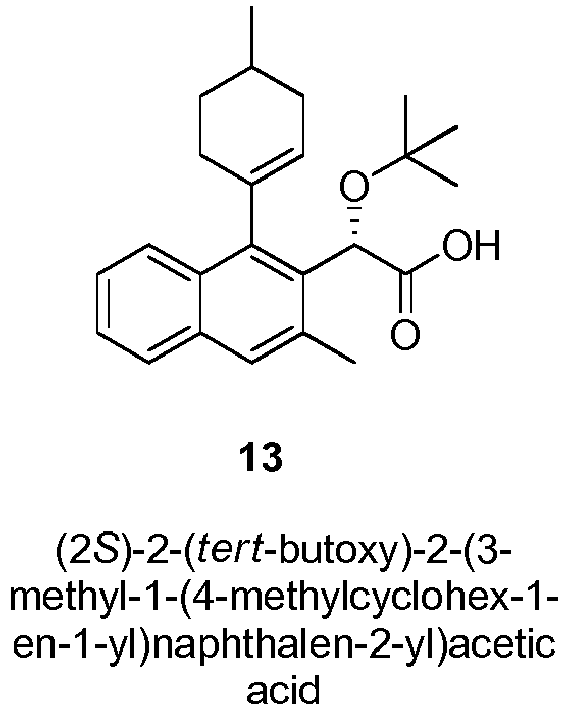
- Preparation of (2S)-2-tert-butoxy-2-(3-methyl-1-(4-methylcyclohex-1-enyl)naphthalen-2-yl)acetic acid (13): (2S)-2-tert-Butoxy-2-(3-methyl-1-(4-methylcyclohex-1-enyl)naphthalen-2-yl)acetic acid was prepared following the procedure to make (S)-2-tert-butoxy-2-(1-cyclohexenyl-3-methylnaphthalen-2-yl)acetic acid of Example 6, except that 4-methylcyclohex-1-enylboronic acid was used instead of cyclohexenylboronic acid. 1H-NMR: 400 MHz, (CD3OD) δ: 7.92-7.78 (m, 1H), 7.70 (m ,1H), 7.52 (s, 1H), 7.39(m, 2H), 6.10-5.58 (m, 2H), 2.56 (s ,3H), 2.65-1.84 (m, 6H), 1.50 (m, 1H), 1.22 (s, 9H), 1.14 (t, 3H). LCMS-ESI- (m/z): [M-H]- calcd for C24H29O3: 365.49; found: 365.1.
-

- Preparation of (S)-ethyl 2-tert-butoxy-2-(1-(4,4-dimethylcyclohex-1-enyl)-3-methylnaphthalen-2-yl)acetate: To a solution of (S)-ethyl 2-tert-butoxy-2-(1-chloro-3-methylnaphthalen-2-yl)acetate (74 mg, 0.22 mmol) and 2-(4,4-dimethylcyclohex-1-enyl)-4,4,5,5-tetramethyl-1,3,2-dioxaborolane (78 mg, 0.33 mmol) in tetrahydrofuran (2 mL) was added potassium phosphate (153 mg, 0.66 mmol) and (2-dicyclohexyl-phosphino-2',6'-dimethoxy-1,1'-biphenyl)[2-(2-aminoethylphenyl)]palladium(II) chloride methyl-t-butyl ether adduct, (SPhos) palladium(II) phenethylamine chloride (15 mg, 0.022 mmol) and the reaction was degassed 10 minutes with argon. The reaction was heated to 110 °C for 1 hour in a microwave reactor. The crude reaction was absorbed onto silica and purified by flash column chromatography (silica gel, ethyl acetate/hexanes) to give a clear white oil (36 mg). 1H-NMR: 400 MHz, (CDCl3) δ: 7.83-7.78 (m, 1H), 7.70 (d, J = 7.6 Hz, 1H), 7.53 (s, 1H), 7.43-7.36 (m, 2H), 5.66-5.61 (m, 2H), 4.20-4.03 (m, 2H), 2.66-2.60 (m, 2H), 2.26-2.03 (m, 4H), 1.87-1.59 (m, 5H), 1.24-1.20 (m, 9H), 1.19-1.11 (m, 6H).
- Preparation of (S)-2-tert-butoxy-2-(1-(4,4-dimethylcyclohex-1-enyl)-3-methylnaphthalen-2-yl)acetic acid (14): To a solution of (S)-ethyl2-tert-butoxy-2-(1-(4,4-dimethylcyclohex-1-enyl)-3-methylnaphthalen-2-yl)acetate (36 mg, 0.087 mmol) in tetrahydrofuran:ethanol:water (2:2:1, 5 mL) was added lithium hydroxide (21 mg, 0.88 mmol) and the reaction was heated to 35 °C overnight. The reaction was then heated to 45 °C for 2 hours, and subsequently 5 equivalents of lithium hydroxide was added, and the reaction stirred at room temperature over 2 days. The reaction was then heated to 50 °C overnight. The crude reaction was purified by reverse phase HPLC (Gemini, 20-100% ACN/H2O + 0.1% TFA). Product was lyophilizedto give a white powder (8.6 mg). 1H-NMR: 400 MHz, (CD3OD) δ: 7.82 (d, J = 8.0 Hz, 1H), 7.71 (d, J = 7.6 Hz, 1H), 7.54 (s, 1H), 7.39 (m, 2H), 5.66 (m, 2H), 2.66 (m, 1H), 2.58 (s, 3H), 2.13 (m, 3H), 1.64 (m, 2H), 1.23 (s, 9H), 1.16 (s, 3H), 1.14 (s, 3H). LCMS-ESI- (m/z): [M-H]- calcd for C25H31O3: 379.24; found: 379.27.
-

- Preparation of (S)-2-tert-butoxy-2-(3-methyl-1-(spiro[2.5]oct-5-en-6-yl)naphthalen-2-yl)acetic acid (15): (S)-2-tert-butoxy-2-(3-methyl-1-(spiro[2.5]oct-5-en-6-yl)naphthalen-2-yl)acetic acid was prepared following the procedure for (S)-2-tert-butoxy-2-(1-(4,4-dimethylcyclohex-1-enyl)-3-methylnaphthalen-2-yl)acetic acid of Example 12 except using 4,4,5,5-tetramethyl-2-(spiro[2.5]oct-5-en-6-yl)-1,3,2-dioxaborolane instead of 2-(4,4-dimethylcyclohex-1-enyl)-4,4,5,5-tetramethyl-1,3,2-dioxaborolane and that in the final step the reaction was heated to 50 °C overnight followed by an addition of 10 equivalents of lithium hydroxide and heating to 60 °C for four hours and then at 45 °C overnight. 1H-NMR: 400 MHz, (CD3OD) δ: 7.90 (d, J = 7.6 Hz, 1H), 7.71 (br d, J = 7.2 Hz, 1H), 7.53 (d, J = 8.0 Hz, 1H), 7.40 (m, 2H), 5.88 (s, 1H), 5.70 (s, 1H), 2.73 (m, 1H), 2.78 (s, 3H), 2.31 (m, 2H), 2.09 (m, 1H), 1.73 (m, 1H), 1.59 (m, 1H), 1.24 (s, 9H), 0.49 (m, 4H). LCMS-ESI- (m/z): [M-H]- calcd for C25H29O3: 377.22; found: 377.34.
-

- Preparation of (S)-2-tert-butoxy-2-(3-methyl-1-(quinolin-3-yl)naphthalen-2-yl)acetic acid (16): (S)-2-tert-Butoxy-2-(3-methyl-1-(quinolin-3-yl)naphthalen-2-yl)acetic acid (16) was prepared following the procedure to make (S)-2-tert-butoxy-2-(1-cyclohexenyl-3-methylnaphthalen-2-yl)acetic acid of Example 6, using quinolin-3-ylboronic acid instead of cyclohexenylboronic acid. The compound is an atropisomer mixture. 1H-NMR: 400 MHz, (CD3OD) δ: 9.20-8.50 (m, 2H), 8.18 (m ,1H), 8.08 (m, 1H), 7.95(m, 1H), 7.80 (m, 3H), 7.40 (t.1H), 7.25(t, 1H), 7.06 (m, 1H), 5.19(s, 1H), 2.62 (d, 3H), 0.95, 0.86 (s, 9H). LCMS-ESI+ (m/z): [M+H]+ calcd for C26H26NO3: 400.48; found: 400.2.
-

- Preparation of (S)-2-(tert-butoxy)-2-((S)-1-(7-fluoro-2-methylquinolin-8-yl)-3-methylnaphthalen-2-yl)acetic acid (17): (S)-2-(tert-butoxy)-2-((S)-1-(7-fluoro-2-methylquinolin-8-yl)-3-methylnaphthalen-2-yl)acetic acid (17) was prepared following the procedure used to prepare compound 4K except that 7-fluoro-2-methylquinolin-8-ylboronic acid was used instead of compound 4H. 1H NMR (400 MHz, CD3OD) δ 9.09 (d, J = 8.5 Hz, 1H), 8.51 (dd, J = 9.1, 5.6 Hz, 1H), 8.01 (s, 1H), 7.95 (d, J = 8.1 Hz, 1H), 7.92-7.76 (m, 2H), 7.58-7.43 (m, 1H), 7.30 (ddd, J = 8.2, 6.9, 1.2 Hz, 1H), 6.97 (d, J = 8.6 Hz, 1H), 5.17 (s, 1H), 2.80 (s, 3H), 2.79 (s, 3H), 0.87 (s, 9H). LCMS-ESI+ (m/z): [M+H]+ calcd for C27H27FNO3: 432.5; found: 432.1.
-

- Preparation of (S)-ethyl 2-tert-butoxy-2-((R)-1-(2,3-dihydropyrano[4,3,2-de]quinolin-7-yl)-3-methylnaphthalen-2-yl)acetate (18): A Smith process vial was charged with (S)-ethyl 2-tert-butoxy-2-(1-chloro-3-methylnaphthalen-2-yl)acetate (compound of Example 6) (116 mg, 0.348 mmol), 2,3-dihydropyrano[4,3,2-de]quinolin-7-ylboronic acid, HCl salt (96 mg, 0.383 mmol), Sphos precatalyst (35 mg, 0.0522 mmol), cesium fluoride (233 mg, 1.54 mmol) and flushed with nitrogen. Dimethoxyethane (3.0 mL, distilled from Na/benzophenone) was added and mixture was heated in microwave at 120 °C for 1.5 hour. The reaction mixture was diluted with ethyl acetate and washed with brine. The aqueous layer was back-extracted and combined organic layer dried (MgSO4), filtered, concentrated and purified by reverse phase HPLC (Gemini, 5 to 100% acetonitrile/H2O + 0.1% TFA) to give a yellow powder (16.8 mg). 1H-NMR: 400 MHz, (CD3Cl) δ: 8.93 (d, J = 4.4 Hz, 1H), 8.06 (d, J = 8.0 Hz, 1H), 7.82 (s, 1H), 7.81 (d, J = 8.8 Hz, 1H), 7.45-7.35 (m, 3H), 7.13 (dd, J = 7.2, 7.2 Hz, 1H), 6.73 (d, J = 8.8 Hz, 1H), 5.16 (s, 1H), 4.68-4.65 (m, 2H), 3.98-3.86 (m, 2H), 3.52 (q, J = 5.6 Hz, 2H), 2.69 (s, 3H), 1.34 (t, J = 7.2 Hz, 3H), 0.86 (s, 9H).
LCMS-ESI+ (m/z): [M+H]+ calcd for C30H32NO4: 470.5; found: 470.1. -
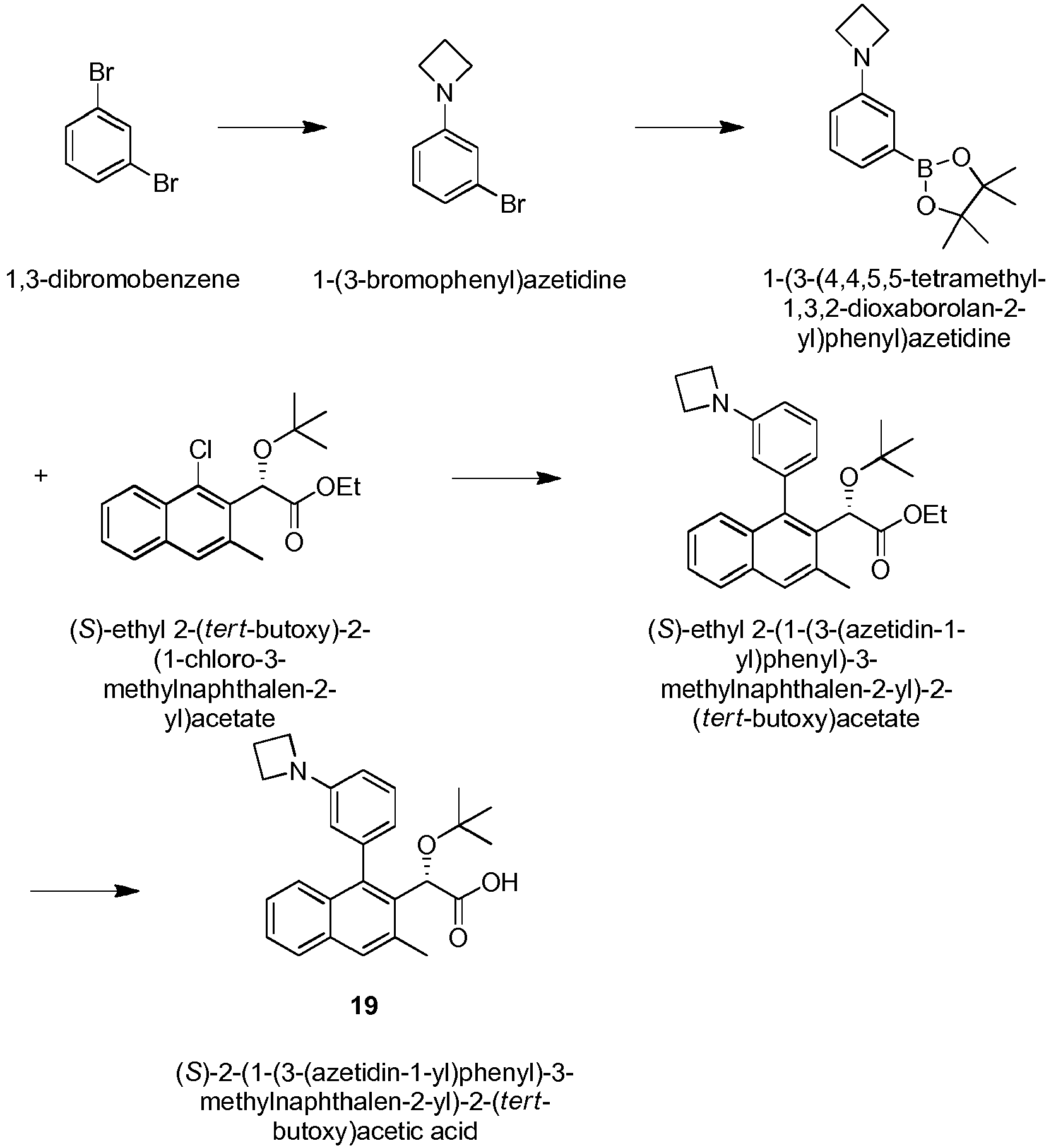
- Preparation of 1-(3-bromophenyl)azetidine: A mixture of 1,3-bromobenzene (1.0 g, 4.24 mmol), azetidine (0.19 mL, 2.83 mmol), Pd2(dba)3 (0.129 g, 0.142 mmol), Xantphos (0.164 g, 0.283 mmol), and sodium tert-butoxide (0.816 g, 8.49 mmol) in dioxane (20 mL) was sparged with nitrogen for 15 minutes. The reaction mixture was heated at 100 °C for 3 hours and then cooled to room temperature. The resulting mixture was diluted with water and ethyl acetate and washed with water (2x), brine, dried (MgSO4), filtered, concentrated and purified by flash column chromatography (silica gel, 0 to 20% ethyl acetate/hexanes) to give a yellow oil (0.4474 g). LCMS-ESI+ (m/z): [M+H]+ calcd for C9H11BrN: 213.1; found: 212.0, 214.0.
- Preparation of 1-(3-(4,4,5,5-tetramethyl-1,3,2-dioxaborolan-2-yl)phenyl)azetidine: A mixture of 1-(3-bromophenyl)azetidine (0.4474 g, 2.11 mmol), bis-pinacolatodiboron (0.803 g, 3.16 mmol), Pd(dppf)Cl2 (0.172 g, 0.211 mmol), and potassium acetate (0.621 g, 6.33 mmol) in dioxane (21 mL) was sparged with nitrogen for 30 minutes. The reaction mixture was heated at 90 °C for 1.5 hours. The reaction was cooled to room temperature, diluted with ethyl acetate and washed with brine, dried (MgSO4), filtered, concentrated and purified by flash column chromatography (silica gel, 0 to 20% ethyl acetate/hexanes) to give a yellow wax (0.6474 g). LCMS-ESI+ (m/z): [M+H]+ calcd for C15H23BNO2: 260.2; found: 260.1.
- Preparation of (S)-ethyl 2-(1-(3-(azetidin-1-yl)phenyl)-3-methylnaphthalen-2-yl)-2-tert-butoxyacetate: A Smith process vial was charged with (S)-ethyl 2-tert-butoxy-2-(1-chloro-3-methylnaphthalen-2-yl)acetate (60.5 mg, 0.181 mmol), 1-(3-(4,4,5,5-tetramethyl-1,3,2-dioxaborolan-2-yl)phenyl)azetidine (93.7 mg, 0.361 mmol), chloro(2-dicyclohexylphosphino-2',6'-dimethoxy-1,1'-biphenyl)[2-(2-aminoethylphenyl)]Pd(II)methyl-t-butyl ether adduct (12.2 mg, 0.0181 mmol) and potassium phosphate (153 mg, 0.543 mmol), THF (2 mL) and water (1 mL) was added and mixture sparged with nitrogen for 10 minutes and then heated in microwave at 110 °C for 1 hour. The reaction mixture was diluted with ethyl acetate and washed with brine, dried (MgSO4), filtered, concentrated and purified by flash column chromatography (silica gel, ethyl acetate/hexanes) to the desired product containing some impurities that was used in the next step without further purification.
- Preparation of (S)-2-(1-(3-(azetidin-1-yl)phenyl)-3-methylnaphthalen-2-yl)-2-tert-butoxyacetic acid (19): The above residue containing (S)-ethyl 2-(1-(3-(azetidin-1-yl)phenyl)-3-methylnaphthalen-2-yl)-2-tert-butoxyacetate in THF (1.0 mL), MeOH (0.1 mL) and 5 M NaOH (0.1 mL) was heated at 45 °C for 18 hours. The reaction mixture was concentrated, diluted with ethyl acetate and water and washed with saturated ammonium chloride solution. The aqueous layer was back-extracted with ethyl acetate and the combined organic layer was dried (MgSO4), filtered, concentrated and purified by reverse phase HPLC (Gemini, 5 to 100% ACN/H2O + 0.1% TFA). The product was lyophilized to give a white powder (4.6 mg) which was resubjected to reverse phase HPLC (Gemini, 5 to 100% ACN/H2O + 0.1% TFA). Product containing fractions were stirred with saturated sodium bicarbonate solution for 30 minutes. The mixture was extracted with ethyl acetate (3x), dried (MgSO4), filtered, concentrated and lyophilized from acetonitrile/water to give an atropisomer mixture as a white powder (1.9 mg). 1H NMR (400 MHz, CD3OD) δ 7.81-7.67 (m, 1H), 7.62 (s, 0.6H), 7.60 (s, 0.4H), 7.4-7.18 (m, 4H), 6.78 (s, 0.5H), 6.70 (d, J = 7.7 Hz, 0.5H), 6.64-6.57 (m, 1H), 5.32 (s, 0.6H), 5.30 (s, 0.4H), 3.90-3.83 (m, 3H), 2.60 (s, 3H), 2.40-2.35 (m, 2H), 0.99 (s, 4H), 0.97 (s, 5H). LCMS-ESI+ (m/z): [M+H]+calcd for C26H30NO3: 404.5; found: 404.1.
-

- Preparation of (2S)-2-tert-butoxy-2-(1-((7R)-2,3,3a,4,5,6-hexahydropyrano[4,3,2-de]quinolin-7-yl)-3-methylnaphthalen-2-yl)acetic acid (20): (S)-2-tert-Butoxy-2-(1-((R)-2,3-dihydropyrano[4,3,2-de]quinolin-7-yl)-3-methylnaphthalen-2-yl)acetic acid (130 mg) was dissolved in 20 mL EtOH and 1 drop of HOAc was added to the solution. 10% Pt/C (30 mg) was added the reaction was stirred at room temperature under one atmosphere of hydrogen (balloon) overnight. The reaction mixture was filtered, diluted with ethyl acetate and washed with brine, dried (MgSO4), filtered, concentrated and purified by flash column chromatography (silica gel, 0 to 20% MeOH/DCM) to give (2S)-2-tert-butoxy-2-(1-((7R)-2,3,3a,4,5,6-hexahydropyrano[4,3,2-de]quinolin-7-yl)-3-methylnaphthalen-2-yl)acetic acid (130 mg). 8 mg of the material was purified by reverse phase HPLC (Gemini, 5 to 100% ACN/H2O + 0.1% TFA). Product lyophilized to give a white powder (5.5 mg). 1H-NMR: 400 MHz, (CD3OD) δ: 7.78 (d, J = 8.2 Hz, 1H), 7.63 (s, 1H), 7.40 (m ,2H), 7.27 (m, 1H), 6.70 (d, J = 8.21 Hz, 1H), 6.22 (d, J = 8.21 Hz, 1H), 5.26 (s, 1H), 4.41 (m, 1H), 4.22 (m,1H), 3.18 (m, 2H), 2.83 (m, 1H), 2.59 (s, 3H), 2.12(m, 1H), 1.98 (m, 1H), 1.70(m, 1H), 1.32(m, 1H), 1.05 (s, 9H). LCMS-ESI+ (m/z): [M+H]+ calcd for C28H32NO4: 446.55; found: 446.1.
-

- Preparation of (2S)-methyl 2-tert-butoxy-2-(1-((7R)-2,3,3a,4,5,6-hexahydropyrano[4,3,2-de]quinolin-7-yl)-3-methylnaphthalen-2-yl)acetate (21): At 0 °C, NaH (60%, 5 mg) was added to (2S)-2-tert-butoxy-2-(1-((7R)-2,3,3a,4,5,6-hexahydropyrano[4,3,2-de]quinolin-7-yl)-3-methylnaphthalen-2-yl)acetic acid (26 mg, 0.06 mmol, 1 eq.) in 1.5 mL DMF at 0 °C. After stirring for 30 minutes, MeI (50 µL, excess) was added to the solution. The reaction was stirred at 0 °C for 1 h. The reaction mixture was concentrated in vacuo and purified by reverse phase HPLC (Gemini, 5 to 100% ACN/H2O + 0.1 % TFA). The product was lyophilized to give (2S)-methyl 2-tert-butoxy-2-(1-((7R)-2,3,3a,4,5,6-hexahydropyrano[4,3,2-de]quinolin-7-yl)-3-methylnaphthalen-2-yl)acetate as white powder (11 mg). 1H-NMR: 400 MHz, (CD3OD) δ: 7.78 (d, J = 8.2 Hz ,1H), 7.63 (s, 1H), 7.42 (m ,1H), 7.32 (m, 2H), 6.70 (m, 1H), 6.34 (d, 1H), 5.26 (s, 1H), 4.41 (m, 1H), 4.22 (m,1H), 3.72 (s, 3H), 3.22 (m, 2H), 2.91 (m, 1H), 2.59 (s, 3H), 2.18(m, 1H), 2.08 (m, 1H), 1.72(m, 1H), 1.39(m, 1H), 1.05 (s, 9H). LCMS-ESI+ (m/z): [M+H]+ calcd for C29H34NO4: 460.58; found: 460.1.
-

- Preparation of (R)-7-(2-((S)-1-tert-butoxy-2-ethoxy-2-oxoethyl)-3-methylnaphthalen-1-yl)-6-methyl-2,3-dihydropyrano[4,3,2-de]quinolin-6-ium iodide: A mixture of MeI (0.8 mL, large excess) and (S)-ethyl 2-tert-butoxy-2-(1-((R)-2,3-dihydropyrano[4,3,2-de]quinolin-7-yl)-3-methylnaphthalen-2-yl)acetate (37 mg). The reaction was heated at 50 °C for 2 days. The reaction mixture was diluted with ethyl acetate and washed with brine, dried over MgSO4, filtered, concentrated and purified by flash column chromatography (silica gel, 0 to 20% MeOH/DCM) to give the desired material as a green oil (50 mg). LCMS-ESI+ (m/z): [M]+ calcd for C34H34NO4: 484.61; found: 484.3.
- Preparation of (2S)-ethyl 2-tert-butoxy-2-(3-methyl-1-((7R)-6-methyl-2,3,3a,4,5,6-hexahydropyrano[4,3,2-de]quinolin-7-yl)naphthalen-2-yl)acetate: (R)-7-(2-((S)-1-tert-butoxy-2-ethoxy-2-oxoethyl)-3-methylnaphthalen-1-yl)-6-methyl-2,3-dihydropyrano[4,3,2-de]quinolin-6-ium iodide (50 mg) was dissolved in 20 mL EtOH and 1 drop of HOAc was added to the solution. 10% Pt/C (30 mg) was added and the resulting reaction mixture was stirred under hydrogen (1 atm, balloon) at room temperature overnight. The reaction mixture was filtered and diluted with ethyl acetate and washed with brine, dried (MgSO4), filtered, concentrated and purified by flash column chromatography (silica gel, 0 to 20% MeOH/DCM) to give (2S)-ethyl 2-tert-butoxy-2-(3-methyl-1-((7R)-6-methyl-2,3,3a,4,5,6-hexahydropyrano[4,3,2-de]quinolin-7-yl)naphthalen-2-yl)acetate as a grey solid (15 mg). LCMS-ESI+ (m/z): [M+H]+calcd for C31H38NO4: 488.63; found: 488.2.
- Preparation of (2S)-2-tert-butoxy-2-(3-methyl-1-((7R)-6-methyl-2,3,3a,4,5,6-hexahydropyrano[4,3,2-de]quinolin-7-yl)naphthalen-2-yl)acetic acid (22): To a solution of (2 S)-ethyl 2-tert-butoxy-2-(3-methyl-1-((7R)-6-methyl-2,3,3a,4,5,6-hexahydro-pyrano[4,3,2-de]quinolin-7-yl)naphthalen-2-yl)acetate (12 mg, 0.021 mmol) in ethanol (1 mL) was added 2 N sodium hydroxide (1 mL) and the resulting reaction mixture was heated at 80 °C overnight. The reaction mixture was then concentrated and purified by reverse phase HPLC (Gemini, 5 to 100% ACN/H2O + 0.1% TFA). The product was lyophilized to give (2S)-2-tert-butoxy-2-(3-methyl-1-((7R)-6-methyl-2,3,3a,4,5,6-hexahydropyrano[4,3,2-de]quinolin-7-yl)naphthalen-2-yl)acetic acid (22) as a white powder (2.6 mg). 1H-NMR: 400 MHz, (CD3OD) δ: 7.82 (d, J = 8.2 Hz, 1H), 7.67 (s, 1H), 7.43 (m, 2H), 7.38 (m, 1H), 6.92 (m, 1H), 6.71 (m, 1H), 5.06 (s, 1H), 4.41 (m, 1H), 4.28 (m,1H), 3.52 (m, 1H), 3.04 (m, 2H), 2.67, 2.62 (s, s, 3H), 2.29 (s, 3H), 2.28 (m, 1H), 2.08 (m, 1H), 1.72 (m, 1H), 1.59(m, 1H), 0.95 (s, 9H). LCMS-ESI+ (m/z): [M+H]+calcd for C29H34NO4: 460.58; Found: 461.3.
-
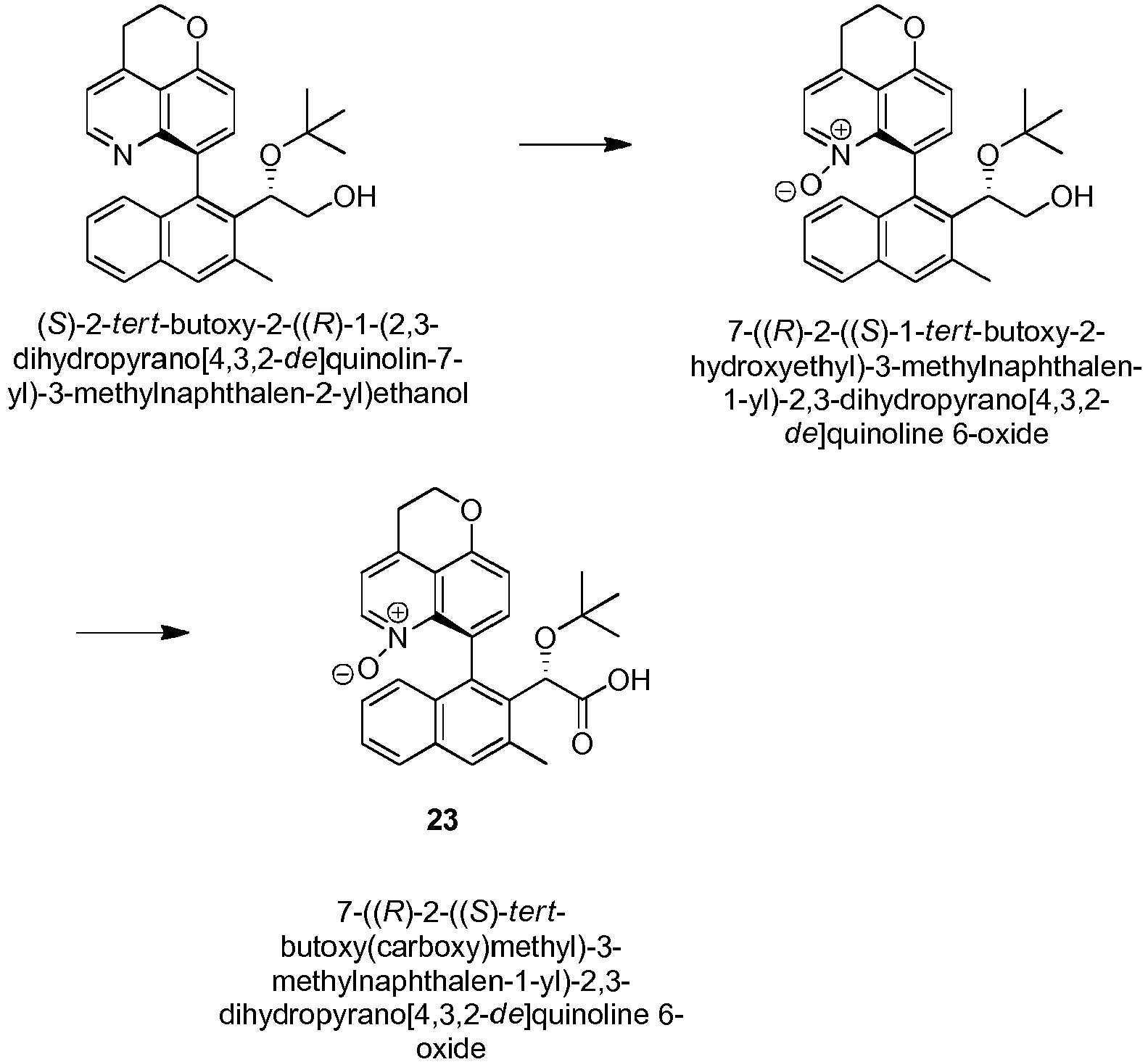
- Preparation of 7-((R)-2-((S)-1-tert-butoxy-2-hydroxyethyl)-3-methylnaphthalen-1-yl)-2,3-dihydropyrano[4,3,2-de]quinoline 6-oxide: To a solution of (S)-2-tert-butoxy-2-((R)-1-(2,3-dihydropyrano[4,3,2-de]quinolin-7-yl)-3-methylnaphthalen-2-yl)ethanol (6C, 31 mg, 0. 727 mmol) in dichloromethane (1.3 mL) was added 3-chloroperoxybenzoic acid (77%, 36 mg, 0.161 mmol) and reaction mixture was stirred for 7 hours. Additional 3-chloroperoxybenzoic acid (26 mg, 0.116 mmol) was added and reaction mixture was stirred overnight and quenched with saturated sodium thiosulfate solution. The resulting mixture was extracted with ethyl acetate, washed with saturated sodium bicarbonate solution, brine, dried (MgSO4), filtered, concentrated and purified by reverse phase HPLC (Gemini, 5 to 100% ACN/H2O + 0.1% TFA). The product was lyophilized to give a yellow powder (4.7 mg).
LCMS-ESI+ (m/z): [M]+ calcd for C28H30NO4: 443.5; found: 443.9. - Preparation of 7-((R)-2-((S)-tert-butoxy(carboxy)methyl)-3-methylnaphthalen-1-yl)-2,3-dihydropyrano[4,3,2-de]quinoline 6-oxide (23): To a solution of 7-((R)-2-((S)-1-tert-butoxy-2-hydroxyethyl)-3-methylnaphthalen-1-yl)-2,3-dihydropyrano[4,3,2-de]quinoline 6-oxide (4.7 mg, 0.0106 mol) in wet acetonitrile (0.75% H2O, 1 mL) was added H5IO6/CrO3 stock solution (0.439 M, 0.1 mL, 0.423 mmol) was added at 0 °C. The reaction mixture was stirred for 90 minutes at room temperature and additional H5IO6/CrO3 stock solution (0.439 M, 0.1 mL) was added. After stirring for 90 minutes, the reaction mixture was quenched with saturated NaHCO3 solution and extracted with ethyl acetate (2x). The organic layer was washed with H2O, saturated NaHSO3 solution, dried (MgSO4), filtered, concentrated and purified by reverse phase HPLC (Gemini, 5 to 100% acetonitrile/H2O + 0.1% TFA) to give a yellow powder (1.2 mg).
1H NMR (400 MHz, CD3OD) δ 8.51 (d, J = 6.3 Hz, 1H), 7.79 (d, J = 8.2 Hz, 1H), 7.69 (s, 1H), 7.57 (d, J = 8.0 Hz, 1H), 7.44 (d, J = 6.1 Hz, 1H), 7.43-7.37 (m, 1H), 7.34 (d, J = 8.3 Hz, 1H), 7.25-7.13 (m, 1H), 6.87 (d, J = 7.8 Hz, 1H), 5.06 (s, 1H), 4.67-4.55 (m, 2H), 3.52-3.46 (m, 2H), 2.61 (s, 3H), 0.97 (s, 9H). LCMS-ESI+ (m/z): [M+H]+ calcd for C28H28NO5: 458.5; found: 458.1. -

- Preparation of (S)-ethyl 2-(3-(bromomethyl)-1-(4-chlorophenyl)naphthalen-2-yl)-2-tert-butoxyacetate: To a solution of (S)-ethyl 2-tert-butoxy-2-(1-(4-chlorophenyl)-3-methylnaphthalen-2-yl)acetate (3K, 43 mg, 0.0105 mmol) in CCl4 (2 mL) was added NBS (24 mg, 0.13 mmol) and AIBN (cat. amount). The reaction mixture was refluxed for 5 h. After cooling to room temperature, the reaction mixture was diluted by DCM, washed with sat. NaHCO3, extracted with DCM and the organic layers were combined and dried over MgSO4 filtered, concentrated and purified by flash column chromatography (silica gel, ethyl acetate/hexanes) to provide 12 mg of the desired product. 1H-MNR 400 MHz (CDCl3) δ: 8.01 (s, 1H), 7.77 (d, J = 4Hz, 1H), 7.43-7.15 (m, 7H), 5.11 (d, J = 5.2 Hz, 1H), 5.06 (s, 1H), 5.00 (d, J = 5,2 Hz, 1H), 4.07-4.02 (m, 2H), 1.20-1.15 (m, 3H), 0.96 (s, 9H).
- Preparation of (S)-ethyl 2-tert-butoxy-2-(1-(4-chlorophenyl)-3-((dimethyl-amino)methyl)naphthalen-2-yl)acetate: To a solution of (S)-ethyl 2-(3-(bromomethyl)-1-(4-chlorophenyl)naphthalen-2-yl)-2-tert-butoxyacetate (12 mg, 0.0245 mmol) in THF (1 mL) was added dimethylamine (2 M in THF, 0.12 µL). The reaction mixture was stirred at room temperature for 1 h. Removal of the solvent in vacuo followed by purification of the residue by flash chromatography (silica gel, ethyl acetate/hexanes) provided 8 mg of the desired product. LCMS-ESI+ (m/z): [M+H]+ calcd for C27H33ClNO3: 454.2; Found: 454.2, 456.1.
- Preparation of (S)-2-tert-butoxy-2-(1-(4-chlorophenyl)-3-((dimethyl-amino)methyl)naphthalen-2-yl)acetic acid (24): To a solution of (S)-ethyl 2-tert-butoxy-2-(1-(4-chlorophenyl)-3-((dimethylamino)methyl)naphthalen-2-yl)acetate in THF (0.5 mL) and MeOH (0.5 mL), was added NaOH solution (2N, 100 µL). The reaction mixture was stirred at room temperature for 1 day. The reaction mixture was neutralized by HOAc and concentrated down. The residue was dissolved in MeOH and purified by reverse phase HPLC (Gemini, 5 to 100% ACN/H2O + 0.1% TFA) to provide the desired product (3.7 mg). 1H-NMR: 400 MHz, (CD3OD) δ: 8.12 (s, 1H), 8.00 (d, J = 4.2 Hz, 1H), 7.65-7.52 (m, 5H), 7.32-7.30 (m, 2H), 5.36 (s, 1H), 4.93 (d, J = 6.8 Hz, 1H), 4.47 (d, J = 7 Hz, 1H), 3.12 (s, 3H), 2.89 (s, 3H), 1.12 (s, 9H).
LCMS-ESI+(m/z): [M+H]+ calcd for C25H29ClNO3: 426.2; Found: 426.1, 428.1. -

- Preparation of (S)-2-tert-butoxy-2-(1-(4-chlorophenyl)-3-((pyridin-3-yloxy)methyl)naphthalen-2-yl)acetic acid (25): (S)-2-tert-Butoxy-2-(1-(4-chlorophenyl)-3-((pyridin-3-yloxy)methyl)naphthalen-2-yl)acetic acid (25) was prepared by the similar method of Example 22, except that K2CO3 and pyridin-3-ol were used instead of dimethylamine in step 2. 1H-NMR: 400 MHz, (CD3OD) δ: 8.39 (d, J = 2.8 Hz, 1H), 8.31 (s, 1H), 8.05 (s, 1H), 7.96-7.86 (m, 3H), 7.64-7.49 (m, 5H), 7.34-7.31 (m, 2H), 6.44(d, J = 7.4 Hz, 1H), 6.12 (d, J = 7.6 Hz, 1H), 5.24 (s, 1H), 0.92 (s, 9H). LCMS-ESI+ (m/z): [M+H]+ calcd for C28H27ClNO4: 476.2; Found: 476.0, 478.0.
-

- Preparation of (S)-2-tert-butoxy-2-(1-(4-chlorophenyl)-3-((pyrimidin-5-yloxy)methyl)naphthalen-2-yl)acetic acid (26): (S)-2-tert-Butoxy-2-(1-(4-chlorophenyl)-3-((pyrimidin-5-yloxy)methyl)naphthalen-2-yl)acetic acid (26) was prepared by the similar method of Example 22, except that K2CO3 and pyrimidin-5-ol were used instead of dimethylamine in step 2. 1H-NMR: 400 MHz, (CD3OD) δ: 8.75 (s, 1H), 8.60 (s, 1H), 8.08 (s, 1H), 7.88 (d, J = 3.8 Hz, 1H), 7.60(s, 2H), 7.58-7.26 (m, 4H), 5.72-5.70 (m, 2H), 5.21 (s, 1H), 1.02 (s, 9H). LCMS-ESI+ (m/z): [M+H]+ calcd for C27H26ClN2O4: 477.2; Found: 477.1,478.1.
-

- Preparation of (S)-2-tert-butoxy-2-(1-(4-chlorophenyl)-3-(morpholinomethyl)naphthalen-2-yl)acetic acid (27): (S)-2-tert-Butoxy-2-(1-(4-chlorophenyl)-3-(morpholinomethyl)naphthalen-2-yl)acetic acid (27) was prepared by the similar method of Example 22, except that morpholine was used instead of dimethylamine in step 2. 1H-NMR: 400 MHz, (CD3OD) δ: 8.14 (s, 1H), 7.99 (d, J = 4 Hz, 1H), 7.64-7.60 (m, 3H), 7.53-7.49 (m, 2H), 7.29-7.27 (m, 2H), 5.38 (s, 1H), 4.81-4.78 (m, 2H), 4.11-4.08 (m, 2H), 3.81-3.78 (m, 2H), 3.55-3.41 (m, 4H), 1.16 (s, 9H).
LCMS-ESI+ (m/z): [M+H]+ calcd for C27H31ClNO4: 468.2; Found: 468.0, 470.1. -

- Preparation of (S)-2-tert-butoxy-2-(1-(4-chlorophenyl)-3-(methoxymethyl)naphthalen-2-yl)acetic acid (28): (S)-2-tert-Butoxy-2-(1-(4-chlorophenyl)-3-(methoxymethyl)naphthalen-2-yl)acetic acid (28) was prepared by the similar method of Example 22, except that sodium methoxide and methanol were used instead of dimethylamine and THF and the reaction was heated at 50 °C for 3 h. 1H-NMR: 400 MHz, (CD3OD) δ: 7.91 (s, 1H), 7.77 (d, J = 4.2 Hz, 1H), 7.50-7.13 (m, 7H), 5.06 (s, 1H), 4.84 (d, J = 6.6 Hz, 2H), 4.71 (d, J = 6.4 Hz, 2H), 3.32 (s, 3H), 0.90(s, 9H). LCMS-ESI+ (m/z): [M-H]+ calcd for C24H24ClO4: 411.1; Found: 411.0, 413.0.
-

- Preparation of (S)-ethyl 2-tert-butoxy-2-(1-(4-chlorophenyl)-3-formylnaphthalen-2-yl)acetate: To a solution of (S)-ethyl 2-(3-(bromomethyl)-1-(4-hlorophenyl)naphthalen-2-yl)-2-tert-butoxyacetate from Example 22 (200 mg, 0.408 mmol) in acetonitrile (4 mL) was added N-methylmorpholine N-oxide (478 mg, 4.08 mmol) and 4Å molecular sieves (200 mg). The reaction mixture was stirred at room temperature for 2 h. Additional N-methylmorpholine N-oxide (500 mg, 4.27 mmol) was added and the reaction mixture was stirred at room temperature for another 2 h. The reaction mixture was then filtered and the organics washed with sat. NaHCO3, extracted by DCM, dried over MgSO4 The organic layer was then filtered, concentrated down and purified by flash column chromatography (silica gel, ethyl acetate/hexanes) to provide 110 mg (64%) of the desired product. 1H-MNR 400 MHz (CDCl3) δ: 10.82 (s, 1H), 8.55 (s, 1H), 8.01 (d, J = 4 Hz, 1H), 7.55-7.23 (m, 7H), 5.19 (s, 1H), 4.17-4.13 (m, 2H), 1.22 (t, J = 7 Hz, 3H), 1.04 (s, 9H).
- Preparation of (S)-ethyl 2-tert-butoxy-2-(1-(4-chlorophenyl)-3-vinylnaphthalen-2-yl)acetate: To a suspension of methyltriphenylphosphonium bromide (60 mg, 0.168 mmol) in THF (1 mL) at -78 °C was added dropwise n-BuLi (1.6 M in hexanes, 90 µL), followed after 30 min by a solution of (S)-ethyl 2-tert-butoxy-2-(1-(4-chlorophenyl)-3-formylnaphthalen-2-yl)acetate (12 mg, 0.028 mmol) in THF (1 mL). The reaction mixture was allowed to warm to room temperature and stirred at room temperature for 2 hours. This mixture was added to another mixture, which was made by adding n-BuLi (1.6 M in hexanes, 300 µL) to a suspension of methyltriphenylphosphonium bromide (200 mg, 0.56 mmol) in THF (2 mL) and stirred at -78 °C for 15 min. Then the reaction mixture was allowed to warm to room temperature and stirred at room temperature for 1 h. The reaction mixture was diluted with EtOAc, washed with sat. NH4Cl, and extracted with EtOAc. The organic layers were combined, dried over MgSO4, filtered, concentrated in vacuo and purified by flash column chromatography (silica gel, ethyl acetate/hexanes) to provide 7.4 mg of the desired product. 1H-MNR 400 MHz (CDCl3) δ: 7.95 (s, 1H), 7.78 (d, J = 4.2 Hz, 1H), 7.57-7.50 (m, 1H), 7.43-7.17 (m, 6H), 5.62 (dd, J = 8.1, 2 Hz, 1H), 5.25 (dd, J = 5.3, 1.8 Hz, 1H),5.07 (s, 1H), 4.06-4.02 (m, 2H), 1.10 (t, J = 7 Hz, 3H), 0.93 (s, 9H).
- Preparation of (S)-2-tert-butoxy-2-(1-(4-chlorophenyl)-3-vinylnaphthalen-2-yl)acetic acid (29A): To a solution (S)-ethyl 2-tert-butoxy-2-(1-(4-chlorophenyl)-3-vinylnaphthalen-2-yl)acetate (7.4 mg, 0.0175 mmol) in THF/MeOH (1/1, 1 mL), was added NaOH (2 N, 280 µL). The reaction mixture was stirred at room temperature overnight. Then the temperature was raised to 40 °C and the reaction mixture was stirred for 4 h. The reaction was then cooled down and neutralized by adding HOAc. The reaction mixture was concentrated in vacuo and the residue was purified by reverse phase HPLC (Gemini, 5 to 100% ACN/H2O + 0.1% TFA) to provide 5.3 mg of the desired product. 1H-NMR: 400 MHz, (CD3OD) δ: 8.07 (s, 1H), 7.89 (d, J = 4.0 Hz, 1H), 7.60-7.54 (m, 4H), 7.48-7.44 (m, 1H), 7.35-7.31 (m, 2H), 7.25-7.22 (m, 1H), 5.76-5.71 (m, 1H), 5.29-5.26 (m, 1H), 5.21 (s, 1H), 0.98 (s, 9H). LCMS-ESI- (m/z): [M-H]- calcd for C24H23ClO3: 393.1; Found: 393.0.
- Preparation of (S)-2-tert-butoxy-2-(1-(4-chlorophenyl)-3-ethylnaphthalen-2-yl)acetic acid (29B): To a solution of (S)-2-tert-butoxy-2-(1-(4-chlorophenyl)-3-vinylnaphthalen-2-yl)acetic acid (4 mg, 0.010 mmol) in EtOH (1.5 mL) was added Rh/Al2O3 (cat. amount) and the resulting mixture stirred under hydrogen (1 atm, balloon) at room temperature for 2 h. The reaction mixture was filtered over Celite, concentrated in vacuo and the residue was purified by reverse phase HPLC (Gemini, 5 to 100% ACN/H2O + 0.1% TFA) to provide 0.8 mg of the desired product.
1H-NMR: 400 MHz, (CD3OD) δ: 7.81 (d, J = 4.2 Hz, 1H), 7.77 (s, 1H), 7.58-7.53 (m, 3H), 7.44-7.41 (m, 1H), 7.33-7.20 (m, 3H), 5.20 (s, 1H), 3.14-3.08 (m, 1H), 2.93-2.87 (m, 1H), 1.34 (t, J = 7.4 Hz, 3H), 0.98 (s, 9H). LCMS-ESI- (m/z): [M-H]- calcd for C24H24ClO3: 395.1; Found: 395.0. -

- Preparation of (S)-ethyl 2-tert-butoxy-2-(1-(4-chlorophenyl)-3-(hydroxymethyl)naphthalen-2-yl)acetate: To a solution of (S)-ethyl2-tert-butoxy-2-(1-(4-chlorophenyl)-3-formylnaphthalen-2-yl)acetate (12 mg, 0.0283 mmol) in DCM/EtOH (1/1, 1 mL) at 0 °C, was added NaBH4 (2 mg, 0.053 mmol) and the reaction mixture stirred at 0 °C for 2 h. The reaction was quenched by adding sat. NH4Cl. The resulting mixture was extracted with DCM, dried over MgSO4, filtered, concentrated in vacuo and purified by flash column chromatography (silica gel, ethyl acetate/hexanes) to provide 8 mg of the desired product. 1H-MNR 400 MHz (CDCl3) δ: 7.85 (s, 1H), 7.78 (d, J = 4.0 Hz, 1H), 7.46-7.38 (m, 4H), 7.30-7.26 (m, 1H), 7.20-7.15 (m, 2H), 5.13 (s, 1H), 5.02 (d, J = 6.2 Hz, 1H), 4.54 (d, J = 6 Hz, 1H), 4.12-4.02 (m, 2H), 3.82 (bs, 1H), 1.14 (t, J = 7Hz, 3H), 1.01 (s, 9H).
- Preparation of (S)-2-tert-butoxy-2-(1-(4-chlorophenyl)-3-(hydroxymethyl) naphthalen-2-yl)acetic acid (30): This compound was made using a method similar to that used for (S)-2-tert-butoxy-2-(1-(4-chlorophenyl)-3-(dimethylaminomethyl) naphthalen-2-yl)acetic acid in Example 22. The compound was purified by reverse phase HPLC (Gemini, 5 to 100% ACN/H2O). 1H-NMR: 400 MHz, (CD3OD) δ: 7.98 (s, 1H), 7.78 (d, J = 4.2 Hz, 1H), 7.52-7.44 (m, 3H), 7.39-7.35 (m, 1H), 7.26-7.13 (m, 3H), 5.09 (s, 1H), 5.05 (d, J = 7.4 Hz, 1H), 4.73 (d, J = 7.2 Hz, 1H), 0.92 (s, 9H). LCMS-ESI- (m/z): [M-H]- calcd for C23H22ClO4: 397.1; Found: 396.9, 399.0.
-

- Preparation of (S)-2-((R)-3-(bromomethyl)-1-(2,3-dihydropyrano[4,3,2-de] quinolin-7-yl)naphthalen-2-yl)-2-tert-butoxyethyl pivalate: The compound was made similarly to the method for making (S)-ethyl 2-(3-(bromomethyl)-1-(4-chlorophenyl)naphthalen-2-yl)-2-tert-butoxyacetate of Example 22. LCMS-ESI+ (m/z): [M+H]+ calcd for C33H3BrNO4: 590.2; Found: 590.0, 592.0.
- Preparation of (S)-2-tert-butoxy-2-((R)-1-(2,3-dihydropyrano[4,3,2-de]quinolin-7-yl)-3-(fluoromethyl)naphthalen-2-yl)ethyl pivalate: To a solution of (S)-2-(3-(bromomethyl)-l-(2,3-dihydropyrano[4,3,2-de]quinolin-7-yl)naphthalen-2-yl)-2-tert-butoxyethyl pivalate (15 mg, 0.0255 mmol) in acetonitrile (1 mL), was added AgF (8 mg, 0.063 mmol). The reaction mixture was stirred at room temperature for 1 day. The reaction mixture was then washed by sat. NaHCO3, extracted with EtOAc, dried over MgSO4, filtered, concentrated in vacuo and purified by flash column chromatography (silica gel, 0 to 30% ethyl acetate/hexanes) to provide 13 mg of the desired product. LCMS-ESI+ (m/z): [M+H]+ calcd for C33H37FNO4: 530.3; Found: 530.1.
- Preparation of (S)-2-tert-butoxy-2-((R)-1-(2,3-dihydropyrano[4,3,2-de]quinolin-7-yl)-3-(fluoromethyl)naphthalen-2-yl)ethanol: To a solution of (S)-2-tert-butoxy-2-(1-(2,3-dihydropyrano[4,3,2-de]quinolin-7-yl)-3-(fluoromethyl) naphthalen-2-yl)ethyl pivalate (13 mg, 0.024 mol) in THF (1 mL) and MeOH (0.5 mL), was added NaOH (2 N, 240 µL). The reaction mixture was reacted at room temperature for 1 day. The reaction mixture was washed with sat. NaHCO3 and extracted with EtOAc. The organic layers were combined, dried over MgSO4, concentrated and purified by flash column chromatography (silica gel, ethyl acetate/hexanes) to provide 5 mg of the desired product. LCMS-ESI+ (m/z): [M+H]+ calcd for C28H29FNO3: 446.2; Found: 446.0.
- Preparation of (S)-2-tert-butoxy-2-((R)-1-(2,3-dihydropyrano[4,3,2-de]quinolin-7-yl)-3-(fluoromethyl)naphthalen-2-yl)acetic acid (31): To a solution of (2S)-2-tert-butoxy-2-(1-(2,3-dihydropyrano[4,3,2-de]quinolin-7-yl)-3-(fluoromethyl)naphthalen-2-yl)ethanol (5 mg, 0.0112 mmol) in wet acetonitrile (0.75%wt H2O) was added H5IO6/CrO3 (0.439 M stock solution in wet acetonitrile, 400 µL) at 0 °C. The reaction mixture was stirred at 0 °C for 30 min. The reaction mixture was filtered and purified by reverse phase HPLC (Gemini, 5 to 100% ACN/H2O + 0.1% TFA) to provide 0.8 mg of the desired product. 1H-NMR: 400 MHz, (CD3OD) δ: 8.51 (d, J = 2.4 Hz, 1H), 8.15 (s, 1H), 7.92 (d, J = 4.0 Hz, 1H), 7.69 (d, J = 4.2 Hz, 1H), 7.54 (d, J = 2.6 Hz, 1H), 7.43 (t, J = 7.6 Hz, 1H), 7.31 (d, J = 4 Hz, 1H), 7.24-7.21 (m, 1H), 6.88 (d, J = 4.4 Hz, 1H), 6.01-5.74 (m, 2H), 5.06 (s, 1H), 4.59 (t, J = 6.2Hz, 2H), 3.49 (t, J = 6Hz, 2H), 0.81 (s, 9H). 19F-NMR 400 MHz (CD3OD) δ: -77.51 (s, 1F). LCMS-ESI+ (m/z): [M+H]+ calcd for C28H27FNO4: 460.2; Found: 460.1.
-

- Preparation of (S)-2-tert-butoxy-2-((R)-1-(2,3-dihydropyrano[4,3,2-de]quinolin-7-yl)-3-formylnaphthalen-2-yl)ethyl pivalate: The compound was made similarly to (S)-ethyl 2-tert-butoxy-2-(1-(4-chlorophenyl)-3-formylnaphthalen-2-yl)acetate of Example 27. LCMS-ESI+ (m/z): [M+H]+ calcd for C33H36NO5: 526.2; Found: 526.1.
- Preparation of (S)-2-tert-butoxy-2-((R)-3-(difluoromethyl)-1-(2,3-dihydropyrano [4,3,2-de]quinolin-7-yl)naphthalen-2-yl)ethyl pivalate: To a solution of (S)-2-tert-butoxy-2-(1-(2,3-dihydropyrano[4,3,2-de]quinolin-7-yl)-3-formylnaphthalen-2-yl)ethyl pivalate (18 mg, 0.0343 mmol) in DCM (1.5 mL) was added Deoxofluor (20 µL, 0.105 mmol). The reaction mixture was stirred at room temperature overnight. More Deoxofluor (300 µL, 1.6 mmol) was added and the reaction mixture was stirred at room temperature over weekend. The reaction mixture was washed by sat. NaHCO3 and extracted with DCM. The organic layers were combined, concentrated in vacuo and purified by flash column chromatography (silica gel, 0 to 30% ethyl acetate/hexanes) to produce 20 mg of the desired product. LCMS-ESI+ (m/z): [M+H]+ calcd for C33H36F2NO4: 548.2; Found: 548.1.
- Preparation of (S)-2-tert-butoxy-2-((R)-3-(difluoromethyl)-1-(2,3-dihydropyrano[4,3,2-de]quinolin-7-yl)naphthalen-2-yl)ethanol: The compound was made by the similar method to make (2S)-2-tert-butoxy-2-(1-(2,3-dihydropyrano[4,3,2-de]quinolin-7-yl)-3-(fluoromethyl)naphthalen-2-yl)ethanol of Example 29. LCMS-ESI+ (m/z): [M+H]+ calcd for C28H28F2NO3: 464.2; Found: 464.1.
Preparation of (S)-2-tert-butoxy-2-((R)-3-(difluoromethyl)-1-(2,3-dihydropyrano[4,3,2-de]quinolin-7-yl)naphthalen-2-yl)acetic acid (32): The compound was made by the similar method to make (2S)-2-tert-butoxy-2-(1-(2,3-dihydropyrano[4,3,2-de]quinolin-7-yl)-3-(fluoromethyl)naphthalen-2-yl)acetic acid of Example 29. 1H-NMR: 400 MHz, (CD3OD) δ: 8.66 (d, J = 2.8 Hz, 1H), 8.56 (s, 1H), 8.15 (d, J = 4.2 Hz, 1H), 8.00-7.81 (m, 3H), 7.69-7.54 (m, 2H), 7.45 (t, J = 7.8 Hz, 1H), 7.04 (d, J = 4.2 Hz, 1H), 5.10 (s, 1H), 4.75 (t, J = 6Hz, 2H), 3.68 (t, J = 6.2 Hz, 2H), 1.07 (s, 9H). 19F-NMR 400 MHz (CD3OD) δ: -77.77 (s, 2F). LCMS-ESI+ (m/z): [M+H]+ calcd for C28H26F2NO4: 478.1; Found: 478.1. -

- Preparation of 1-(2,4-dichlorophenyl)-3-methylnaphthalen-2-ol: A mixture of 2,4-dichlorophenylboronic acid (1.0 g), tetrakis(triphenylphosphine)palladium(0) (300 mg), 1-bromo-3-methyl-naphthalen-2-ol (5B, 625 mg) in K2CO3 (2 M, 5.3 mL) and DME (26 mL) was degassed with argon and sealed in a Schlenk tube. The reaction was heated to 80 °C for 75 minutes, then cooled to room temperature. The reaction was diluted with EtOAc and filtered through a pad of silica gel. The silica was washed with EtOAc and the combined organics were concentrated. The crude residue was purified by flash column chromatography (0-18% EtOAc in hexanes) to yield 784 mg of desired product.
- Preparation of 1-(2,4-dichlorophenyl)-3-methylnaphthalen-2-yl trifluoromethanesulfonate: 1-(2,4-dichlorophenyl)-3-methylnaphthalen-2-yl trifluoromethanesulfonate was prepared in a similar manner as compound 4C in Example 2, except starting from 1-(2,4-dichlorophenyl)-3-methylnaphthalen-2-ol instead of 4B. 1H-NMR: 400 MHz, (CDCl3) δ: 7.85-7.90 (m, 2H), 7.62 (d, 1H), 7.55 (app dt, 1H), 7.41-7.48 (m, 2H), 7.32-7.49 (m, 2H), 2.64 (s, 3H).
- Preparation of tert-butoxy-[1-(2,4-dichloro-phenyl)-3-methyl-naphthalen-2-yl]-acetic acid (33): tert-butoxy-[1-(2,4-dichloro-phenyl)-3-methyl-naphthalen-2-yl]-acetic acid (33) was prepared in a similar manner as compound 3K in Example 1, except starting from 1-(2,4-dichlorophenyl)-3-methylnaphthalen-2-yl trifluoromethanesulfonate instead of 3E.1H-NMR: 400 MHz, (CD3CN) δ: 7.84 (d, 1H), 7.78 (s, 1H), 7.69 (d, 1H), 7.63 (d, 1H), 7.47-7.54 (m, 2H), 7.37 (app dt, 1H), 7.16 (d, 1H), 5.17 (s, 1H), 2.60 (s, 3H), 1.06 (s, 9H).
-


- Preparation of 4-(2-methoxyphenyl)-3-methyl-but-2-enoic acid ethyl ester: In a 3-neck round bottom flask, fitted with an internal thermometer and addition funnel, a mixture of sodium hydride (60% in mineral oil, 4.14 g) in THF (200 mL), under argon, was cooled to 10 °C. (Diethoxyphosphoryl)acetic acid ethyl ester (21 mL) was added dropwise (heat and gas evolution), keeping the internal temperature below room temperature. After addition, the reaction mixture was stirred at room temperature for 10 minutes, and then cooled to 0 °C. A solution of 2-methoxyphenyl acetone (5 g) in THF (25 mL) was added dropwise over 5 minutes. The reaction was allowed to warm to room temperature overnight. With active cooling, the reaction was quenched with H2O (200 mL), then AcOH (to pH ∼6) and extracted with EtOAc. The combined organics were washed with NaHCO3, water, and brine, dried over Na2SO4, and concentrated. The crude residue was purified by flash column chromatography to give the desired compound (5.73 g).1H-NMR: 400 MHz, (CDCl3) δ: 7.24 (app dt, 1H), 7.10 (dd, 1H), 6.92 (d, 1H), 6.88 (d, 1H), 5.58 (s, 1H), 4.13 (q, 2H), 3.82 (s, 3H), 3.46 (s, 2H), 1.26 (t, 3H).
- Preparation of 4-(2-methoxyphenyl)-3-methyl-butyric acid ethyl ester: Palladium on carbon (10%, wet Degussa, 300 mg) was degassed. Ethanol (60 mL), degassed with argon, was added followed by 4-(2-methoxy-phenyl)-3-methyl-but-2-enoic acid ethyl ester (5.7 g, 24 mmol). Hydrogen was bubbled through the ethanol, and the reaction was stirred under 1 atm of H2 (balloon)overnight. The balloon was removed, and the reaction was flushed with argon and the reaction was filtered through Celite. The Celite was washed with ethyl acetate and the filtrates dried over magnesium sulfate and concentrated. The crude residue was used without further purification. LCMS-ESI+ (m/z): [M]+ calcd for C14H20O3: 236.14; Found: 236.96.
- Preparation of 4-(2-methoxyphenyl)-3-methyl-butyric acid: A solution of 4-(2-methoxyphenyl)-3-methyl-butyric acid ethyl ester (24 mmol, crude from previous reaction) in THF (50 mL), EtOH (50 mL) and LiOH (1 M, 50 mL) was stirred at room temperature overnight. The reaction was acidified with 1 M HCl, and extracted with EtOAc. The combined extracts were washed with brine and dried over sodium sulfate. Concentration gave the desired product, which was used without further purification. LCMS-ESI+ (m/z): [M]+ calcd for C12H16O3: 208.11; Found: 208.86
- Preparation of 4-(2-methoxyphenyl)-3-methyl-butyryl chloride: To a solution of 4-(2-methoxyphenyl)-3-methylbutyric acid (24 mmol, crude from previous reaction) in dichloromethane (36 mL) was added oxalyl chloride (2 M in DCM, 36 mL). The reaction was stirred for 1 h at room temperature. All volatiles were removed in vacuo and the crude residue used without further purification.
- Preparation of 5-methoxy-3-methyl-3,4-dihydro-2H-naphthalen-1-one: A mixture of AlCl3 (6.4 g) and CH2Cl2 (100 mL) was cooled to 0 °C. To the mixture was added 4-(2-methoxyphenyl)-3-methylbutyryl chloride (24 mmol, crude from previous reaction). The reaction was allowed to warm slowly to room temperature and then quenched by slowly pouring over ice. The mixture was extracted with dichloromethane (3x) and the combined organics were washed with 1 M HCl, water, dried over sodium sulfate, and concentrated. Purification by flash column chromatography yielded the desired product (1.65 g, 36% yield from 4-(2-methoxy-phenyl)-3-methyl-but-2-enoic acid ethyl ester). LCMS-ESI+ (m/z): [M+H]+ calcd for C12H15O2: 191.11; Found: 191.19.
- Preparation of (5-methoxy-3-methyl-1-oxo-3,4-dihydro-1H-naphthalen-2-ylidene)-acetic acid ethyl ester: In a heavy walled sealed tube, 5-methoxy-3-methyl-3,4-dihydro-2H-naphthalen-1-one (1.3 g, 6.8 mmol), ethyl glyoxylate (3 mL, 50% solution in toluene), benzenesulfonic acid (100 mg), magnesium sulfate (5 g), and toluene (30 mL) were heated to 120 °C for 13 hours. The reaction was cooled to room temp, filtered, diluted with water, and extracted with ethyl acetate. The extracts were washed with brine, dried with sodium sulfate, and concentrated. The crude residue was purified by flash column chromatography to yield the desired product (960 mg, 51% yield). LCMS-ESI+ (m/z): [M+H]+calcd for C16H19O4: 275.13; Found: 275.26.
- Preparation of (4-bromo-5-methoxy-3-methyl-1-oxo-3,4-dihydro-1H-naphthalen-2-ylidene)-acetic acid ethyl ester: A mixture of(5-methoxy-3-methyl-1-oxo-3,4-dihydro-1H-naphthalen-2-ylidene)-acetic acid ethyl ester (480 mg), NBS (420 mg), and AIBN (30 mg) in CCl4 (18 mL) was refluxed for 3 hours. The reaction mixture was then cooled to room temperature, quenched with saturated sodium bicarbonate solution and extracted with dichloromethane (2x). The combined organics were washed with water, dried (Na2SO4), concentrated, and purified by flash column chromatography to give a light brown solid (420 mg) LCMS-ESI+ (m/z): [M+H]+ calcd for C16H18BrO4: 353.03; Found: 352.91.
- Preparation of (1-hydroxy-5-methoxy-3-methyl-naphthalen-2-yl)-(4-methoxy-benzyloxy)-acetic acid ethyl ester: To a solution of 4-methoxybenzyl alcohol (0.27 mL, 4 equiv) in THF (11 mL) at 0 °C was added KHMDS (0.5 M in toluene, 3.4 mL, 3 equiv) and the resulting mixture was allowed to stir for 10 min at 0 °C. A solution of (4-bromo-5-methoxy-3-methyl-1-oxo-3,4-dihydro-1H-naphthalen-2-ylidene)-acetic acid ethyl ester (200 mg) in THF (1 mL) was added slowly. After stirring for 3 min at 0 °C, the reaction was quenched with citric acid (1 M) and extracted with EtOAc. The organic extracts were washed with brine, dried over Na2SO4 and concentrated. The crude residue was purified by flash column chromatography (5-20% EtOAc/hexanes) to give 157 mg of pale orange oil (68% yield). LCMS-ESI+ (m/z): [M+H]+ calcd for C24H27O6: 411.18; Found: 411.21.
- Preparation of (4-methoxybenzyloxy)-(5-methoxy-3-methyl-1-trifluoromethanesulfonyloxy-naphthalen-2-yl)-acetic acid ethyl ester: A solution of (1-hydroxy-5-methoxy-3-methyl-naphthalen-2-yl)-(4-methoxy-benzyloxy)-acetic acid ethyl ester (157 mg, 0.38 mmol) in dichloromethane (3.8 mL) was cooled to -78 °C under Ar. To the solution was added 2,6-lutidine (0.1 mL) and triflic anhydride (0.1 mL) and stirred at -78 °C for 2.5 hours. Saturated sodium bicarbonate (3 mL) was added and the reaction mixture was warmed to room temperature and diluted with dichloromethane. The dichloromethane was separated, the aqueous layer extracted with CH2Cl2, and the combined organics dried over sodium sulfate and concentrated. The crude residue was purified by flash column chromatography to give the desired product (128 mg, 62% yield). LCMS-ESI+ (m/z): [M+Na]+ calcd for C25H25F3NaO8S: 565.11; Found: 565.23.
- Preparation of [1-(4-chlorophenyl)-5-methoxy-3-methylnaphthalen-2-yl]-(4-methoxybenzyloxy)acetic acid ethyl ester: A solution of (4-methoxy-benzyloxy)-(5-methoxy-3-methyl-1-trifluoromethanesulfonyloxy-naphthalen-2-yl)-acetic acid ethyl ester (128 mg, 0.236 mmol), 4-chlorophenylboronic acid (74 mg, 2 equiv), EtOH (0.5 mL), K2CO3 (2 M, 0.5 mL), and toluene (1.3 mL) were degassed with argon at room temperature in a Schlenk tube. Pd(dppf)Cl2 was then added (17 mg) and the tube sealed. The reaction was heated to 60 °C for 14 hours. Analysis of the reaction mixture by LCMS showed 40% conversion, with visual analysis showing significant amount of palladium black. The crude mixture was filtered via syringe through a micro filter into a new sealable tube charged with Pd(PPh3)4. The tube was sealed and heated to 100 °C for 16 hours. The reaction was cooled to room temperature, diluted with EtOAc and filtered through Celite. The filtrate was concentrated, and the crude residue purified by flash column chromatography to give the desired product (60 mg, 50% yield). LCMS-ESI+ (m/z): [M+Na]+ calcd for C30H29ClNaO5: 527.99; Found: 527.44.
- Preparation of [1-(4-chloro-phenyl)-5-methoxy-3-methyl-naphthalen-2-yl]-hydroxy-acetic acid ethyl ester: To a solution of [1-(4-chloro-phenyl)-5-methoxy-3-methyl-naphthalen-2-yl]-(4-methoxy-benzyloxy)-acetic acid ethyl ester (58 mg, 0.115 mmol) in dichloromethane (3 mL) was added trifluoroacetic acid (58 µL). The reaction mixture was stirred for 2 h at room temperature and then quenched carefully with sat. NaHCO3. The aqueous layer was extracted with dichloromethane twice, and then the combined organic layers were washed with water, dried (Na2SO4), concentrated and purified by flash column chromatography to give desired (23 mg).
- Preparation of tert-butoxy-[1-(4-chloro-phenyl)-5-methoxy-3-methyl-naphthalen-2-yl]-acetic acid ethyl ester: A solution of [1-(4-chloro-phenyl)-5-methoxy-3-methyl-naphthalen-2-yl]-hydroxy-acetic acid ethyl ester (23 mg) and perchloric acid, 70% (3 µL) in tert-butyl acetate (1 mL) was stirred at room temperature for 2 h. After 2 h, the reaction had apparently stalled, so 3 µL additional perchloric acid was added. After 2 additional hours, no further conversion was observed (LCMS analysis). Saturated sodium bicarbonate solution was added and the mixture was extracted with ethyl acetate (3x). The combined organic layer was dried (Na2SO4), and concentrated. The crude mixture was purified by flash column chromatography to give tert-butoxy-[1-(4-chloro-phenyl)-5-methoxy-3-methyl-naphthalen-2-yl]-acetic acid ethyl ester (9 mg) plus 7 mg of recovered starting material. The recovered starting material was re-subjected to similar reaction conditions to yield an additional 3 mg of desired.
1H-NMR: 400 MHz, (CDCl3) δ: 8.10 (s, 1H), 7.39-7.48 (m, 3H), 7.25 (s, 1H), 7.17 (app t, 1H), 6.78 (app t, 2H), 5.09 (s, 1H), 4.06-4.20 (m, 2H), 3.99 (s, 3H), 2.61 (s, 3H), 1.185 (t, 3H), 0.98 (s, 9H). - Preparation of tert-butoxy-[1-(4-chlorophenyl)-5-methoxy-3-methyl-naphthalen-2-yl]-acetic acid (34): To a solution of tert-butoxy-[1-(4-chloro-phenyl)-5-methoxy-3-methyl-naphthalen-2-yl]-acetic acid ethyl ester (12 mg) in THF (0.3 mL) and EtOH (0.1 mL) was added 0.1 mL of 1 M LiOH. The reaction was stirred for 30 min at room temperature, then 0.3 mL each of THF, EtOH, and 1 M NaOH were added. The reaction was heated to 70 °C for 2.5 hours, and then cooled to room temperature. Formic acid was added until pH ∼ 5. The reaction mixture was directly purified by HPLC (Gemini, 50-100% MeCN/H2O, with 0.1% TFA). The product was lyophilized to give a white powder (8 mg).
1H-NMR: 400 MHz, (CD3CN) δ: 8.09 (s, 1H), 7.49-7.58 (m, 3H), 7.32 (br d, 1H), 7.26 (app t, 1H), 6.91 (d, 1H), 6.81 (d, 1H), 5.19 (s, 1H), 3.99 (s, 3H), 2.57 (s, 3H), 0.99 (s, 9H). LCMS-ESI+ (m/z): [M-OtBu]+calcd for C20H16ClO3: 339.79; Found: 339.07. -

- Preparation of ethyl 2-(5-bromo-3-methyl-1-(trifluoromethylsulfonyl-oxy)naphthalen-2-yl)-2-(4-methoxybenzyloxy)acetate (35): Ethyl2-(5-bromo-3-methyl-1-(trifluoromethylsulfonyloxy)naphthalen-2-yl)-2-(4-methoxybenzyl oxy)acetate (35) was prepared similarly to ethyl 2-(6-methoxy-3-methyl-1-(trifluoromethylsulfonyloxy)naphthalen-2-yl)-2-(4-methoxybenzyloxy)acetate of Example 32, using 1-(2-bromophenyl)propan-2-one as the starting material instead of 1-(3-methoxyphenyl)propan-2-one. 1H-NMR: 400 MHz, (CDCl3) δ: 8.11 (s, 1H), 8.01 (d, J = 8.8 Hz, 1H), 7.85 (d, J = 7.6 Hz, 1H), 7.40 (t, J = 7.6 Hz, 1H), 7.23 (d, J = 8.4 Hz, 2H), 6.81 (d, J = 7.6 Hz, 2H), 5.61 (s, 1H), 4.62 (q, J = 11.2 Hz, 2H), 4.26-4.15 (m, 2H), 3.75 (s, 3H), 2.62 (s, 3H), 1.18 (t, J = 6.8 Hz, 3H).
-

- Preparation of ethyl 2-(5-bromo-3-methyl-1-(trifluoromethylsulfonyloxy) naphthalen-2-yl)-2-oxoacetate: Prepared similarly to ethyl 2-(7-bromo-3-methyl-1-(trifluoromethylsulfonyloxy)naphthalen-2-yl)-2-oxoacetate of Example 67, using ethyl 2-(5-bromo-3-methyl-1-(trifluoromethylsulfonyloxy)naphthalen-2-yl)-2-(4-methoxybenzyloxy)acetate instead of ethyl 2-(7-bromo-3-methyl-1-(trifluoromethylsulfonyloxy)naphthalen-2-yl)-2-(4-methoxybenzyloxy)acetate. 1H-NMR: 400 MHz, (CDCl3) δ: 8.20 (s, 1H), 8.08 (d, J = 8.4 Hz, 1H), 7.95 (dd, J = 7.4, 0.8 Hz, 1H), 7.48 (t, J = 8.4 Hz, 1H), 4.42 (q, J = 7.2 Hz, 2H), 2.54 (s, 3H), 1.40 t, J = 7.6 Hz, 3H).
- Preparation of ethyl 2-(5-bromo-1-(4-chlorophenyl)-3-methylnaphthalen-2-yl)-2-oxoacetate (36A) and ethyl 2-(1,5-bis(4-chlorophenyl)-3-methylnaphthalen-2-yl)-2-oxoacetate (36B): To a solution of ethyl 2-(5-bromo-3-methyl-1-(trifluoromethylsulfonyloxy)naphthalen-2-yl)-2-oxoacetate (1.2 g, 2.56 mmol) and 4-chlorophenylboronic acid (440 mg,. 2.81 mmol) in toluene was added 2 M potassium carbonate (2.8 mL, 5.63 mmol) and PdCl2(dppf) (187 mg, 0.256 mmol) and the reaction was degassed with argon 10 minutes. The reaction was stirred at room temperature for 4 hours. The reaction was filtered, diluted with water, extracted with ethyl acetate and concentrated. The crude reaction was purified by flash column chromatography (silica gel, ethyl acetate/hexanes) followed by reverse phase HPLC (Gemini, 40-100% ACN/H2O + 0.1% TFA). Product was lyophilizedto give 670 mg of ethyl 2-(5-bromo-1-(4-chlorophenyl)-3-methylnaphthalen-2-yl)-2-oxoacetate (36A) as a yellow oil, 1H-NMR: 400 MHz, (CDCl3) δ: 8.20 (s, 1H), 8.13 (d, J = 8.8 Hz, 1H), 7.85 (d, J = 6.8 Hz, 1H), 7.68 (t, J = 7.2 Hz, 1H), 7.51 (d, J = 8.8 Hz, 2H), 7.39 (d, J = 8.4 Hz, 2H), 3.95 (q, J = 6.8 Hz, 2H), 2.41 (s, 3H), 1.14 (t, J = 7.2 Hz, 5H); and 109 mg of ethyl 2-(1,5-bis(4-chlorophenyl)-3-methylnaphthalen-2-yl)-2-oxoacetate (36B) as a white solid. 1H-NMR: 400 MHz, (CDCl3) δ: 7.72 (s, 1H), 7.59-7.56 (m, 1H), 7.50 (t, J = 8.0 Hz, 2H), 7.46-7.44 (m, 5H), 7.43 (d, J = 2.4 Hz, 1H), 7.28 (d, J = 8.0 Hz, 2H), 3.94 (q, J = 7.2 Hz, 2H), 2.42 (s, 3H), 1.14 (t, J = 7.2 Hz, 3H).
-

- Preparation of ethyl 2-(5-bromo-1-(4-chlorophenyl)-3-methylnaphthalen-2-yl)-2-tert-butoxyacetate: Prepared similarly to ethyl 2-(7-bromo-1-(4-chlorophenyl)-3-methylnaphthalen-2-yl)-2-tert-butoxyacetate of Example 67 using ethyl 2-(5-bromo-1-(4-chlorophenyl)-3-methylnaphthalen-2-yl)-2-oxoacetate instead of ethyl 2-(7-bromo-1-(4-chlorophenyl)-3-methylnaphthalen-2-yl)-2-oxoacetate. Product was carried on crude to next reaction.
- Preparation of 2-(5-bromo-1-(4-chlorophenyl)-3-methylnaphthalen-2-yl)-2-tert-butoxyacetic acid (37): To a solution of ethyl 2-(5-bromo-l-(4-chlorophenyl)-3-methylnaphthalen-2-yl)-2-tert-butoxyacetate (30 mg, 0.061 mmol) in tetrahydrofuran:ethanol:water (2:2:1, 3 mL) was added lithium hydroxide (7 mg, 0.31 mmol) and the reaction was heated to 50 °C overnight. Crude reaction purified by reverse phase HPLC (Gemini, 40-100% ACN/H2O + 0.1%TFA). Product lyophilized to give a white powder (5.9 mg). 1H-NMR: 400 MHz, (CD3OD) δ: 8.07 (s, 1H), 7.77 (d, J = 6.0 Hz, 1H), 7.58 (s, 2H), 7.55 (as, 1H), 7.32 (d, J = 8.8 Hz, 1H), 7.26 (d, J = 8.8 Hz, 1H), 7.18 (m, 1H), 5.17 (s, 1H), 2.67 (s, 3H), 0.99 (s, 9H). LCMS-ESI- (m/z): [M-H]-calcd for C23H21BrClO3: 460.8; found; 460.2.
-

- Preparation of 2-(1,5-bis(4-chlorophenyl)-3-methylnaphthalen-2-yl)-2-tert-butoxyacetic acid (38): 2-(1,5-Bis(4-chlorophenyl)-3-methylnaphthalen-2-yl)-2-tert-butoxyacetic acid (38) was prepared similarly to 2-(5-bromo-1-(4-chlorophenyl)-3-methylnaphthalen-2-yl)-2-tert-butoxyacetic acid of Example 35 using ethyl 2-(1,5-bis(4-chlorophenyl)-3-methylnaphthalen-2-yl)-2-oxoacetate instead of ethyl 2-(5-bromo-1-(4-chlorophenyl)-3-methylnaphthalen-2-yl)-2-oxoacetate. 1H-NMR: 400 MHz, (CD3OD) δ: 7.59 (m, 4H), 7.53 (d, J = 8.4 Hz, 2H), 7.45 (d, J = 8.4 Hz, 2H), 7.35 (m, 3H), 7.28 (m, 1H), 5.18 (s, 1H), 2.51 (s, 3H), 0.99 (s, 9H). LCMS-ESI- (m/z): [M-H]-calcd for C29H26Cl2O3: 491.13; found: 491.42.
-

- Preparation of ethyl 2-tert-butoxy-2-(1-(4-chlorophenyl)-5-(3-(dimethylamino)prop-1-ynyl)-3-methylnaphthalen-2-yl)acetate: To a solution of ethyl 2-(5-bromo-1-(4-chlorophenyl)-3-methylnaphthalen-2-yl)-2-tert-butoxyacetate (100 mg, 0.20 mmol) andN,N-dimethylprop-2-yn-1-amine (0.065 mL, 0.61 mmol) in anhydrous tetrahydrofuran was added copper iodide (8 mg, 0.04 mmol) and PdCl2(PPh3)2 (14 mg, 0.02 mmol). The reaction was heated to 100 °C overnight. After cooling to room temperature the reaction was charged with PdCl2(PPh3)2 (14 mg, 0.02 mmol), copper iodide (8 mg, 0.04 mmol), N,N-dimethylprop-2-yn-1-amine (0.065 mL, 0.61 mmol) and triethylamine (1 mL). The reaction was heated to 100 °C overnight. To the reaction was then added N,N-dimethylprop-2-yn-1-amine (0.065 mL, 0.61 mmol) andheatedto 100 °C overnight. The crude reaction mixture was absorbed onto silica gel and purified by flash column chromatography (silica gel, ethyl acetate/hexanes, methanol/ethyl acetate) to give a yellow oil (6.5 mg).
LCMS-ESI+ (m/z): [M+H]+ calcd for C30H35ClNO3: 492.22; found: 492.15. - Preparation of 2-tert-butoxy-2-(1-(4-chlorophenyl)-5-(3-(dimethylamino)prop-1-ynyl)-3-methylnaphthalen-2-yl)acetic acid (39): To a solution of ethyl 2-tert-butoxy-2-(1-(4-chlorophenyl)-5-(3-(dimethylamino)prop-1-ynyl)-3-methylnaphthalen-2-yl)acetate (6.5 mg, 0.013 mmol) in tetrahydrofuran:ethanol:water (2:2:1, 4 mL) was added lithium hydroxide (2 mg, 0.066 mmol) and the reaction was heated to 50 °C overnight. The reaction was purified by reverse phase HPLC (Gemini, 40-60% ACN/H2O + 0.1% TFA). The product was lyophilized to give a white powder (1.2 mg).1H-NMR: 400 MHz, (CD3OD) δ: 8.14 (s, 1H), 7.74 (d, J = 6.4 Hz, 1H), 7.58 (s, 2H), 7.56 (as, 1H), 7.33 (m, 3H), 5.18 (s, 1H), 4.42 (s, 2H), 3.04 (s, 6H), 2.67 (s, 3H), 0.99 (s, 9H). LCMS-ESI+ (m/z): [M+H]+calcd for C28H31ClNO3: 464.19; found: 464.51.
-

- Preparation of ethyl 2-tert-butoxy-2-(1-(4-chlorophenyl)-3,5-dimethylnaphthalen-2-yl)acetate: To a solution of ethyl 2-(5-bromo-1-(4-chlorophenyl)-3-methylnaphthalen-2-yl)-2-tert-butoxyacetate (100 mg, 0.204 mmol) and 2,4,6-trimethyl-1,3,5,2,4,6-trioxatriborinane (0.086 mL, 0.61 mmol) in toluene:ethanol (2:1, 3 mL) and water (1 mL) was added potassium carbonate (282 mg, 2.04 mmol) and PdCl2(dppf) (15 mg, 0.02 mmol) and the reaction was degassed with argon for 10 minutes. The reaction was heated to 100 °C for 20 minutes in a microwave reactor. The crude reaction was purified by flash column chromatography (silica gel, ethyl acetate/hexanes) to give a yellow oil (32 mg) 1H-NMR: 400 MHz, (CD3OD) δ: 8.08-7.87 (m, 2H), 7.87 (s, 1H), 7.65-7.35 (m, 1H), 7.26 (m, 2H), 7.15 (d, J = 7.2 Hz, 1H), 7.09 (d, J = 8.0 Hz, 1H). 5.10 (s, 1H), 4.14 (m, 2H), 2.69 (s, 3H), 2.65 (s, 3H), 1.20 (t, J = 6.8 Hz, 3H), 0.99 (s, 9H).
- Preparation of 2-tert-butoxy-2-(1-(4-chlorophenyl)-3,5-dimethylnaphthalen-2-yl)acetic acid (40): To a solution of ethyl 2-tert-butoxy-2-(l-(4-chlorophenyl)-3,5-dimethylnaphthalen-2-yl)acetate (32 mg, 0.075 mmol) in tetrahydrofuran: ethanol:water (2:2:1, 3 mL) was added lithium hydroxide (9 mg, 0.377 mmol) and the reaction was heated to 50 °C overnight. The reaction was purified by reverse phase HPLC (Gemini, 40-100% ACN/H2O + 0.1 % TFA). The product was lyophilized to give a white powder (16.8 mg). 1H-NMR: 400 MHz, (CD3OD) δ: 7.86 (s, 1H), 7.54 (m, 3H), 7.29 (m, 2H), 7.16 (t, J = 8.8 Hz, 1H), 7.08 (d, J = 8.8 Hz, 1H), 5.17 (s, 1H), 2.69 (s, 3H), 2.65 (s, 3H), 0.98 (s, 9H). LCMS-ESI- (m/z): [M-H]- calcd for C24H24ClO3: 395.15; found: 394.97.
-

- Preparation of 2-tert-butoxy-2-(1-(4-chlorophenyl)-3-methyl-5-(pyrimidin-5-yl)naphthalen-2-yl)acetic acid (41): 2-tert-Butoxy-2-(1-(4-chlorophenyl)-3-methyl-5-(pyrimidin-5-yl)naphthalen-2-yl)acetic acid (41) was prepared similarly to 2-tert-butoxy-2-(1-(4-chlorophenyl)-3,5-dimethylnaphthalen-2-yl)acetic acid of Example 38 using pyrimidin-5-ylboronic acid in place of 2,4,6-trimethyl-1,3,5,2,4,6-trioxatriborinane. 1H-NMR: 400 MHz, (CD3OD) δ: 9.27 (s, 1H), 8.95 (s, 2H), 7.60 (s, 2H), 7.58 (s, 1H), 7.54 (s, 1H), 7.43 (m, 3H), 7.36 (d, J = 8.4 Hz, 1H), 5.20 (s, 1H), 2.55 (s, 3H), 1.00 (s, 9H). LCMS-ESI+ (m/z): [M+H]+ calcd for C27H26ClN2O3: 461.16; found: 461.45.
-

- Preparation of 2-tert-butoxy-2-(1-(4-chlorophenyl)-6-fluoro-3-methylnaphthalen-2-yl)acetic acid (42): 2-tert-Butoxy-2-(1-(4-chlorophenyl)-6-fluoro-3-methylnaphthalen-2-yl)acetic acid (42) was prepared similarly to 2-(5-bromo-1-(4-chlorophenyl)-3-methylnaphthalen-2-yl)-2-tert-butoxyacetic acid of Example 35, using 6-fluoro-3-methyl-3,4-dihydronaphthalen-1(2H)-one instead of 5-bromo-3-methyl-3,4-dihydronaphthalen-1(2H)-one. 1H-NMR: 400 MHz, (CD3OD) δ: 7.67 (s, 1H), 7.57 (s, 2H), 7.55 (as, 1H), 7.45 (dd, J = 9.8, 2.8 Hz, 1H), 7.32 (d, J = 8.4 Hz, 1H), 7.27 (dd, J = 9.4, 5.2 Hz, 1H), 7.11 (td, J = 9.0, 2.4 Hz, 1H) 5.16 (s, 1H), 2.60 (s, 3H), 0.98 (s, 9H). 19F-NMR: 377 MHz, (CD3OD) δ: -118.01 (s). LCMS-ESI- (m/z): [M-H]- calcd for C23H21ClFO3: 399.12; found: 399.19.
-

- Preparation of 2-tert-butoxy-2-((R)-1-(2,3-dihydropyrano[4,3,2-de]quinolin-7-yl)-6-fluoro-3-methylnaphthalen-2-yl)acetic acid (43): 2-tert-Butoxy-2-((R)-1-(2,3-dihydropyrano[4,3,2-de]quinolin-7-yl)-6-fluoro-3-methylnaphthalen-2-yl)acetic acid (43) was prepared similarly to 2-tert-butoxy-2-(1-(4-chlorophenyl)-6-fluoro-3-methylnaphthalen-2-yl)acetic acid of Example 40 using 1-(3-fluorophenyl)propan-2-one instead of 1-(2-bromophenyl)propan-2-one and 2,3-dihydropyrano[4,3,2-de]quinolin-7-ylboronic acid instead of 4-chlorophenylboronic acid. 1H-NMR: 400 MHz, (CD3OD) δ: 8.67 (d, J = 5.6 Hz, 1H), 7.93 (s, 1H), 7.79 (d, J = 8.0 Hz, 1H), 7.75 (d, J = 5.2 Hz, 1H), 7.59 (dd, J = 9.6, 2.8 Hz, 1H), 7.42 (d, J = 8.4 Hz, 1H), 7.07 (td, J = 9.2, 2.8 Hz, 1H), 6.98 (m, 1H), 5.21 (s, 1H), 4.71 (m, 2H), 3.64 (t, J = 6.0 Hz, 2H), 2.77 (s, 3H), 0.93 (s, 9H). 19F-NMR: 377 MHz, (CD3OD) δ: -116.92 (s). LCMS-ESI+ (m/z): [M+H]+ calcd for C28H27FNO4: 460.18; found: 460.15.
-

- Preparation of 2-tert-butoxy-2-(1-(2,3-dihydropyrano[4,3,2-de]quinolin-7-yl)-5-fluoro-3-methylnaphthalen-2-yl)acetic acid (44): 2-tert-Butoxy-2-(1-(2,3-dihydropyrano[4,3,2-de]quinolin-7-yl)-5-fluoro-3-methylnaphthalen-2-yl)acetic acid (44) was prepared similarly to 2-tert-butoxy-2-((R)-1-(2,3-dihydropyrano [4,3,2-de]quinolin-7-yl)-6-fluoro-3-methylnaphthalen-2-yl)acetic acid (43) using 1-(2-fluorophenyl)propan-2-one instead of 1-(3-fluorophenyl)propan-2-one. 1H-NMR: 400 MHz, (CD3OD) δ: 8.68 (d, J = 5.6 Hz, 1H), 8.56 (d, J = 5.2 Hz, 1H), 8.10 (s, 1H), 7.78 (d, J = 5.6 Hz, 1H), 7.43 m, 1H), 7.19 (m, 2H), 6.73 (M, 1H), 5.23 (s, 1H), 4.67 (m, 2H), 3.57 (t, J = 5.6 Hz, 2H), 2.75 (s, 3H), 0.85 (s, 9H). 19F-NMR: 377 MHz, (CD3OD) δ: -125.97 (t, J = 7.54 Hz). LCMS-ESI- (m/z): [M-H]- calcd for C28H27FNO4: 458.18; found: 457.76.
-


- Preparation of 2-tert-butoxy-2-(5-chloro-1-(4-chlorophenyl)-3-methylnaphthalen-2-yl)acetic acid (45): 2-tert-Butoxy-2-(5-chloro-1-(4-chlorophenyl)-3-methylnaphthalen-2-yl)acetic acid (45) was prepared similarly to 2-tert-butoxy-2-(1-(4-chlorophenyl)-6-fluoro-3-methylnaphthalen-2-yl)acetic acid of Example 40 using 1-(2-chlorophenyl)propan-2-one instead of 1-(3-fluorophenyl)propan-2-one. 1H-NMR: 400 MHz, (CDCl3) δ: 8.14 (s, 1H), 7.64 (m, 1H), 7.54 (m, 2H), 7.50 (d, J = 7.6 Hz, 1H), 7.23 (m, 3H), 5.27 (s, 1H), 2.64 (s, 3H), 1.03 (s, 9H). LCMS-ESI- (m/z): [M-H]- calcd for C23H21Cl2O3: 415.09; found; 415.09.
-

- Preparation of 2-tert-butoxy-2-(1-(4-chlorophenyl)-5-fluoro-3-methylnaphthalen-2-yl)acetic acid (46): 2-tert-Butoxy-2-(1-(4-chlorophenyl)-5-fluoro-3-methylnaphthalen-2-yl)acetic acid (46) was prepared similarly to 2-tert-butoxy-2-(1-(4-chlorophenyl)-6-fluoro-3-methylnaphthalen-2-yl)acetic acid of Example 40 using 1-(2-fluorophenyl)propan-2-one instead of 1-(3-fluorophenyl)propan-2-one.1H-NMR: 400 MHz, (CD3OD) δ: 7.94 (s, 1H), 7.59 (s, 2H), 7.57 (m, 1H), 7.35 (d, J = 8.8 Hz, lh), 7.27 (m, lh), 7.16 (m, 1H), 7.07 (d, J = 8.8 Hz, 1H), 5.21 (s, 1H), 2.66 (s, 3H), 1.01 (s, 9H). 19F-NMR: 377 MHz, (CD3OD) δ: - 126.85 (dd, J = 10.2, 5.3 Hz). LCMS-ESI- (m/z): [M-H]- calcd for C23H21ClFO3: 399.12; found: 399.14.
-

- Preparation of 2-tert-butoxy-2-((R)-5-chloro-1-(2,3-dihydropyrano[4,3,2-de]quinolin-7-yl)-3-methylnaphthalen-2-yl)acetic acid (47): 2-tert-Butoxy-2-((R)-5-chloro-1-(2,3-dihydropyrano[4,3,2-de]quinolin-7-yl)-3-methylnaphthalen-2-yl)acetic acid (47) was prepared similarly to 2-tert-butoxy-2-((R)-1-(2,3-dihydropyrano[4,3,2-de]quinolin-7-yl)-6-fluoro-3-methylnaphthalen-2-yl)acetic acid of Example 41 using 1-(2-chlorophenyl)propan-2-one instead of 1-(3-fluorophenyl)propan-2-one. 1H-NMR: 400 MHz, (CD3OD) δ: 8.65 (d, J = 5.2 Hz, 1H), 8.33 (s, 1H), 7.76 (d, J = 8.4 Hz, 1H), 7.69 (d, J = 5.2 Hz, 1H), 7.60 (d, J = 7.6 Hz, 1H), 7.39 (d, J = 8.0 Hz, 1H), 7.19 (t, J = 8.4 Hz, 1H), 6.91 (d, J = 8.4 Hz, 1H), 5.24 (s, 1H), 4.70 (m, 2H), 3.61 (t, J = 6.0 Hz, 2H), 2.82 (s, 3H), 0.93 (s, 9H). LCMS-ESI- (m/z): [M-H]- calcd for C28H25ClNO4: 474.16; found: 474.08.
-
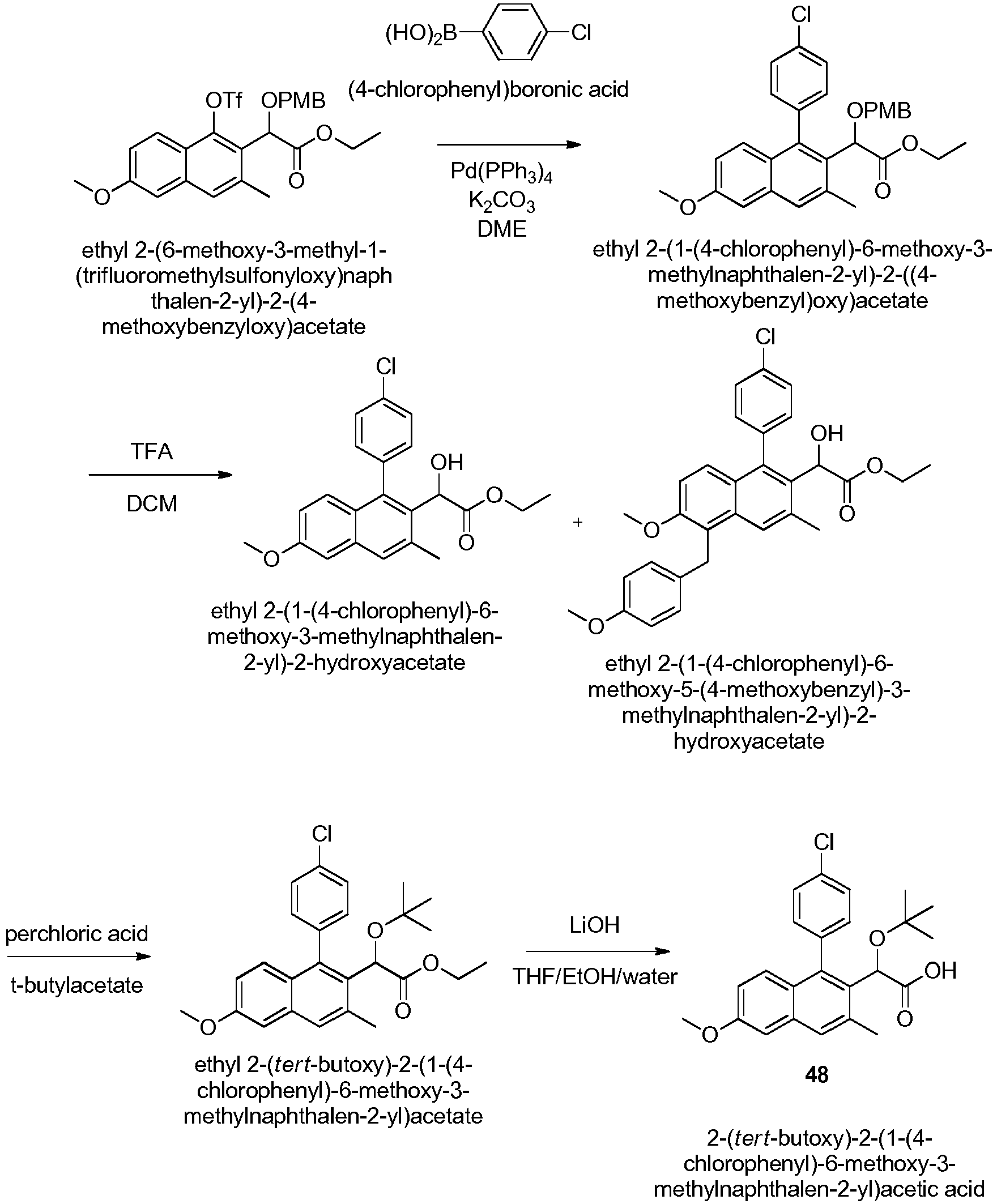
- Preparation of ethyl 2-(6-methoxy-3-methyl-1-(trifluoromethylsulfonyl-oxy)naphthalen-2-yl)-2-(4-methoxybenzyloxy)acetate: Ethyl2-(6-methoxy-3-methyl-1-(trifluoromethylsulfonyloxy)naphthalen-2-yl)-2-(4-methoxybenzyloxy) acetate was prepared similarly as the preparation of ethyl 2-(5-methoxy-3-methyl-1-(trifluoromethylsulfonyloxy)naphthalen-2-yl)-2-(4-methoxybenzyloxy)acetate of Example 32 using 6-methoxy-3-methyl-3,4-dihydronaphthalen-1(2H)-one instead of 5-methoxy-3-methyl-3,4-dihydronaphthalen-1(2H)-one. 1H-NMR: 400 MHz, (CDCl3) δ: 7.93 (d, J = 9.2 Hz, 1H), 7.56 (s, 1H), 7.25-7.21 (m, 3H), 7.07 (d, J = 2.4 1H), 6.82 (d, J = 8.8 Hz, 2H), 5.57 (s, 1H), 4.62-4.55 (m, 2H), 4.27-4.13 (m, 2H), 3.93 (s, 3H), 3.77 (s, 3H), 2.53 (s, 3H), 1.18 (t, J = 6.8 Hz, 3H).
- Preparation of ethyl 2-(1-(4-chlorophenyl)-6-methoxy-3-methylnaphthalen-2-yl)-2-(4-methoxybenzyloxy)acetate: To a solution of ethyl 2-(6-methoxy-3-methyl-1-(trifluoromethylsulfonyloxy)naphthalen-2-yl)-2-(4-methoxybenzyl-oxy)acetate (100 mg, 0.184 mmol) and 4-chlorophenylboronic acid (58 mg, 0.37 mmol) in 1,2-dimethoxyethane (2 mL) was added 2 M potassium carbonate (0.368 mL, 0.74 mmol) and Pd(PPh3)4 (21 mg, 0.018 mmol) and the reaction was degassed for 15 minutes with argon. The mixture was heated to 120 °C for 20 minutes in a microwave reactor. The crude reaction was absorbed onto silica and purified by flash column chromatography (silica gel, ethyl acetate/hexanes) to produce a yellow oil (66 mg). 1H-NMR: 400 MHz, (CDCl3) δ: 7.58 (s, 1H), 7.39 (dd, J = 8.2, 1.6 Hz, 1H), 7.31-7.26 (m, 2H), 7.13-7.07 (m, 4H), 7.01 (dd, J = 8.2, 2.4 Hz, 1H), 6.94 (dd, J = 9.2, 2.8 Hz, 1H), 6.78 (d, J = 8.4 Hz, 1H), 6.77 (m, 1H), 4.50 (s, 1H), 4.42 (ABd, J = 11.2 Hz, 1H), 4.34 (ABd, J = 11.2 Hz, 1H), 4.20-4.15 (m, 2H), 3.91 (s, 3H), 3.81 (s, 3H), 2.60 (s, 3H), 1.21 (t, J = 7.2 Hz, 3H).
- Preparation of ethyl 2-(1-(4-chlorophenyl)-6-methoxy-3-methylnaphthalen-2-yl)-2-hydroxyacetate and ethyl 2-(1-(4-chlorophenyl)-6-methoxy-5-(4-methoxybenzyl)-3-methylnaphthalen-2-yl)-2-hydroxyacetate: To a solution of ethyl 2-(1-(4-chlorophenyl)-6-methoxy-3-methylnaphthalen-2-yl)-2-(4-methoxybenzyloxy)acetate (185 mg, 0.37 mmol) in dichloromethane at 0 °C was added trifluoroacetic acid (0.185 mL, 2.4 mmol) and the reaction was allowed to warm to room temperature over 2 hours. The reaction was quenched with saturated sodium bicarbonate with active cooling, extracted with dichloromethane and concentrated. The crude reaction was purified by flash column chromatography (silica gel, ethyl acetate/hexanes) and then further purified by reverse phase HPLC (Gemini, 20-100% ACN/H2O +0.1% TFA) to give the two products: ethyl 2-(1-(4-chlorophenyl)-6-methoxy-3-methylnaphthalen-2-yl)-2-hydroxyacetate: 27 mg clear oil. LCMS-ESI+ (m/z): [M+H- H2O]+ calcd for C22H19ClO3: 367.09; found: 367.05: and ethyl 2-(1-(4-chlorophenyl)-6-methoxy-5-(4-methoxybenzyl)-3-methylnaphthalen-2-yl)-2-hydroxyacetate: 105 mg as a brown oil. LCMS-ESI+ (m/z): [M+H-H2O]+ calcd for C30H27ClO4: 487.15; found: 486.90.
- Preparation of ethyl 2-tert-butoxy-2-(1-(4-chlorophenyl)-6-methoxy-3-methylnaphthalen-2-yl)acetate: To a solution of ethyl 2-(1-(4-chlorophenyl)-6-methoxy-3-methylnaphthalen-2-yl)-2-hydroxyacetate (27 mg, 0.07 mmol) in tert-butylacetate (1.0 mL) was added 70% perchloric acid (0.012 mL, 0.14 mmol) and the reaction was stirred at room temperature for 1.5 hours. The reaction was quenched with solid sodium bicarbonate, water (2 mL) added and stirred 1 hour. The product was extracted with ethyl acetate, concentrated and purified by flash column chromatography (silica gel, ethyl acetate/hexanes) to give a colorless oil (16.2 mg). 1H-NMR: 400 MHz, (CDCl3) δ: 7.48 (s, 1H), 7.41-7.36 (m, 3H), 7.19 (d, J = 6.4 Hz, 1H), 7.06 (d, J = 9.2 Hz, 1H), 6.99 (br s, 1H), 6.86 (d, J = 9.2 Hz, 1H), 5.00 (s, 1H), 4.12-4.02 (m, 2H), 3.82 (s, 3H), 2.52 (s, 3H), 1.13 (t, J = 7.2 Hz, 3H), 0.91 (s, 9H).
- Preparation of 2-tert-butoxy-2-(1-(4-chlorophenyl)-6-methoxy-3-methylnaphthalen-2-yl)acetic acid (48): To a solution of ethyl 2-tert-butoxy-2-(1-(4-chlorophenyl)-6-methoxy-3-methylnaphthalen-2-yl)acetate (16.2 mg, 0.037 mmol) in tetrahydrofuran:ethanol:water (2:2:1, 2.5 mL) was added lithium hydroxide (4 mg, 0.183 mmol) and the reaction was heated at 50 °C overnight. The reaction was purified by reverse phase HPLC (Gemini, 20-90% ACN/H20 + 0.1%TFA) to give a white powder (12 mg). 1H-NMR: 400 MHz, (CD3OD) δ: 7.60 (s, 1H), 7.55 (m, 3H), 7.30 (m, 1H), 7.17 (d, J = 2.8 Hz, 1H), 7.13 (d, J = 9.6 Hz, 1H), 6.94 (dd, J = 9.2, 2.8 Hz, 1H), 5.15 (s, 1H), 3.90 (s, 3H), 2.58 (s, 3H), 0.98 (s, 9H). LCMS-ESI- (m/z): [M-H]- calcd for C24H24ClO4: 411.14; found: 411.14.
-

- Preparation of 2-tert-butoxy-2-(1-(4-chlorophenyl)-6-methoxy-5-(4-methoxybenzyl)-3-methylnaphthalen-2-yl)acetic acid (49): 2-tert-Butoxy-2-(1-(4-chlorophenyl)-6-methoxy-5-(4-methoxybenzyl)-3-methylnaphthalen-2-yl)acetic acid (49) was prepared following the procedure for 2-tert-butoxy-2-(1-(4-chlorophenyl)-6-methoxy-3-methylnaphthalen-2-yl)acetic acid of Example 46 using ethyl 2-(1-(4-chlorophenyl)-6-methoxy-5-(4-methoxybenzyl)-3-methylnaphthalen-2-yl)-2-hydroxyacetate in place of ethyl 2-(1-(4-chlorophenyl)-6-methoxy-3-methylnaphthalen-2-yl)-2-hydroxyacetate. 1H-NMR: 400 MHz, (CD3OD) δ: 7.75 (s, 1H), 7.54 (m, 3H), 7.32 (d, J = 6.8 Hz, 1H), 7.22 (m, 2H), 7.07 (d, J = 8.4 Hz, 2H), 6.76 (d, J = 8.4 Hz, 2H), 5.12 (s, 1H), 4.38 (s, 2H), 3.90 (s, 3H), 3.72 (s, 3H), 2.52 (s, 3H), 0.97 (s, 9H).
LCMS-ESI- (m/z): [M-H]- calcd for C32H32ClO5: 531.20; found: 531.01. -

- Preparation of 6-bromo-3-methyl-3,4-dihydronaphthalen-1(2H)-one (50): A flask was charged with trifluoromethane sulfonic acid (450 g, 3 mol) and cooled to 0 °C with an ice-water bath. 4-(3-bromophenyl)-3-methylbutanoic acid, prepared in a similar manner as described in Example 32 (15.5 g, 60 mmol), was added as a solution in DCM (30 mL) slowly to produce a clear dark brown solution. After 15 min, the reaction was diluted with 500 mL of CHCl3 and poured slowly onto approximately 1 L of crushed ice. The resulting slurry was allowed to stir until the solution warms to room temperature and became biphasic. Following separation of layers, the aqueous layer was extracted with CHCl3. The combined organics were washed with brine and dried over anhydrous MgSO4 prior to concentration in vacuo. Purification via Isco column chromatography (50% DCM/hex isocratic) provided a quantitative yield of the named compound as a pale yellow amorphous solid. LCMS-ESI+ (m/z): [M]+ calcd for C11H11BrO: 239.11; found: 239.20.
-

- Preparation of 7-bromo-3-methyl-3,4-dihydronaphthalen-1(2H)-one (51): A solution of 4-(4-bromophenyl)-3-methylbutanoic acid, prepared in a similar manner as described in Example 32 (6.43 g, 25.0 mmol), in H2SO4 (25 mL) was stirred at 75 °C for 3 h. The mixture was slowly poured onto ice. The resulting slurry was extracted with EtOAc (2 x 100 mL). The combined organic layers were washed with brine, dried, filtered, and concentrated in vacuo. The crude material was purified by column chromatography (EtOAc/hexanes) to give 5.74 g (96%) of the title compound. 1H-NMR: 400 MHz, (CDCl3) δ: 8.10 (d, J = 2 Hz, 1H), 7.54 (dd, J = 8, 2 Hz, 1H), 7.11 (d, J = 8 Hz, 1H), 2.91 (d, J = 16 Hz), 2.71 (d, J = 13 Hz), 2.58 (m, 1H), 2.28 (m, 2H), 1.12 (d, J = 6 Hz, 3H).
-

- Step 1: Preparation of 6-methoxy-3-methyl-3,4-dihydronaphthalen-1-yl trifluoromethanesulfonate: To a solution of 6-methoxy-3-methyl-3,4-dihydronaphthalen-1(2H)-one (10.06 g, 53 mmol; prepared similarly to 6-bromo-3-methyl-3,4-dihydronaphthalen-1(2H)-one (50) of Example 48 beginning with 1-(3-methoxyphenyl)propan-2-one), cooled to 0 °C was added 2,6-di-tert-butyl-4-methylpyridine (19.6 g, 95.4 mmol) followed by trifluoromethanesulfonic anhydride (13.3 mL, 79.4 mmol). The resulting solution was allowed to warm slowly to room temperature over 1.5 h and then quenched by addition of 1 M HCl (100 mL). Following separation, the aqueous layer was extracted with DCM (3 X 100 mL) and the combined organics washed with brine. Following concentration in vacuo, the residue was taken up in hexanes. The resulting precipitated solids were removed via filtration and the mother liquor was dried over anhydrous MgSO4 and then concentrated in vacuo. The resulting residue was purified by Yamazen column chromatography (3% to 35% EtOAc/Hex) to produce 9.88 g (57%) of the title compound as a colorless syrup. 1H-NMR: 400 MHz, (CDCl3) δ: 7.28 (s, 1H); 6.75 (m, 2H); 5.74 (d, J = 4 Hz, 1H); 3.82 (s, 3H); 2.77 (m, 1H) 2.89 (dd, J = 15.2, 10 Hz; 1H); 2.61 (dd, J = 15.2, 10 Hz; 1H); 1.14 (d, J =7.2 Hz, 3H).
- Step 2: Preparation of 4-(4-chlorophenyl)-7-methoxy-2-methyl-1,2-dihydronaphthalene: 6-methoxy-3-methyl-3,4-dihydronaphthalen-1-yl trifluoromethanesulfonate (9.88 g, 30.7 mmol), 4-chlorophenylboronic acid (6.23 g, 39.9 mmol) and K2CO3 (12.7 g, 91.9 mmol) were combined in a mixture of toluene/ethanol/water (80 mL/40 mL/40 mL) at room temperature in a heavy walled pressure flask. Following sparging of the mixture with Ar for 30 minutes, PdCl2(dppf) (1.12 g, 1.53 mmol) was added in one portion and the flask was sealed and heated to 50 °C for 2.5 h. After returning to room temperature, the layers were separated and the aqueous layer was extracted with EtOAc and Hex (2 X 50 mL each). The combined organics were washed with brine, filtered through a pad of Celite, and dried over anhydrous MgSO4. The resulting solution was absorbed on silica gel in vacuo and purified via Yamazen column chromatography (0-15% EtOAc/Hex) to provide 7.7 g (88%) of the title compound as an amorphous white solid. 1H-NMR: 400 MHz, (CDCl3) δ: 7.32 (d, J = 8 Hz, 2H); 7.26 (d, J = 8Hz, 2H); 6.87 (d, J = 8.4 Hz, 1H); 6.57 (d, J = 2.8 Hz, 1H); 6.62 (dd, J = 8.4, 2.8 Hz, 1H); 5.74 (d, J = 2.8 Hz, 1H); 3.79 (s, 3H); 2.81 (ABq, J = 20.8, 12.4 Hz, 1H); 2.60 (m, 1H); 2.59 (ABq, J = 8.4, 2.8 Hz, 1H); 1.14 (d, J = 6.4 Hz, 3H).
- Step 3: Preparation of 3-bromo-4-(4-chlorophenyl)-7-methoxy-2-methyl-1,2-dihydronaphthalene: A solution of 4-(4-chlorophenyl)-7-methoxy-2-methyl-1,2-dihydronaphthalene (5 g, 17.6 mmol) in DCM (120 mL) was cooled in an ice-water bath prior to addition of solid pyridinium perbromide (6.2 g, 19.3 mmol) in one portion. The dark blue solution was allowed to stir for 30 min and was quenched by addition of saturated Na2S2O3 (200 mL). The reaction was further diluted with water and DCM before separation and extraction of the aqueous layer with DCM. The combined pink organics were washed with brine and dried over anhydrous MgSO4. Following filtration and concentration in vacuo, the resulting residue was purified by Yamazen column chromatography (0-10% EtOAc/Hex) to afford 5.5 g (86%) of the title compound as an orange colored gel. LCMS-ESI+ (m/z): [M+H]+calcd for C18H17BrClO: 364.68; found: 364.89.
- Step 4: Preparation of 2-bromo-1-(4-chlorophenyl)-6-methoxy-3-methylnaphthalene: A solution of 3-bromo-4-(4-chlorophenyl)-7-methoxy-2-methyl-1,2-dihydronaphthalene (5.5 g, 15.1 mmol) in toluene (100 mL) was vacuum flushed with Ar. DDQ (5.2 g, 22.7 mmol) was added and the mixture heated to reflux for 1.5 h. The heterogeneous red-brown mixture was cooled to room temperature and the toluene removed in vacuo. The resulting residue was taken up in DCM (300 mL) and filtered to remove precipitated DDHQ. The resulting mother liquor was absorbed on silica gel and purified by Yamazen column chromatography (15% DCM/Hex) to afford 5.21 g (95%) of the title compound as an amorphous yellow solid. 1H-NMR: 400 MHz, (CDCl3) δ: 7.66 (s, 1H); 7.49 (br d, J = 2 Hz, 2H); 7.24-7.18 (m, 3H); 7.07 (d, J = 2 Hz, 1H); 6.97 (dd, J = 9.2, 2 Hz, 1H); 3.91 (s, 3H); 2.60 (s, 3H).
- Step 5: Preparation of 6-bromo-5-(4-chlorophenyl)-7-methylnaphthalen-2-ol: A vessel was charged with boron tribromide (1 M in DCM, 0.7 mL, 0.7 mmol) and cooled to -78 °C. 2-bromo-1-(4-chlorophenyl)-6-methoxy-3-methylnaphthalene (0.1 g, 0.28 mmol) was added as a solution in DCM (0.5 mL). The reaction was allowed to slowly warm to room temperature over 3.5 h. This procedure was repeated twice on a scale of 1 g and 4.1 g of 2-bromo-1-(4-chlorophenyl)-6-methoxy-3-methylnaphthalene with appropriate adjustments in the scale of other reagents. The three lots were combined, cooled to 0 °C and the volume of the reaction was slowly doubled with MeOH. After warming to room temperature, the mixture was concentrated in vacuo and the residue was taken up in EtOAc (150 mL), treated with saturated NaHCO3 (150 mL) and then small portions of solid NaHCO3 until the solution was pH ∼ 7. The layers were separated and the aqueous layer was extracted with EtOAc. The combined organics were washed with brine, dried over anhydrous MgSO4 and concentrated in vacuo. The resulting residue was purified by Yamazen column chromatography (5-25% EtOAc/Hex) to afford 4.54 g (91%) of the title compound as a colorless syrup. LCMS-ESI+ (m/z): [M+H]+ calcd for C17H13BrClO: 348.64; found: 348.79.
- Step 6: Preparation of (6-bromo-5-(4-chlorophenyl)-7-methylnaphthalen-2-yloxy)triisopropylsilane (52): 6-Bromo-5-(4-chlorophenyl)-7-methylnaphthalen-2-ol (4.5 g, 12.9 mmol) was taken up in DCM (65 mL). Added to this solution were TIPSCl (4.1 mL, 19.4 mmol), DBU (3.5 mL, 23.2 mmol), and DMAP (0.16 g, 1.3 mmol). After stirring at room temperature overnight, the DCM was removed in vacuo and the residue taken up in hexane (200 mL). This solution was washed with 1 M HCl (100 mL) and the layers separated. Following extraction of the aqueous layer with hexanes, the combined organics were washed with brine, dried over anhydrous MgSO4 and concentrated in vacuo. The resulting residue was purified by Yamazen column chromatography (2-5% DCM/Hex) to afford 5.12 g (79%) of the title compound as a colorless syrup. 1H-NMR: 400 MHz, (CDCl3) δ: 7.61 (s, 1H); 7.49 (br d, J = 8.4 Hz, 2H); 7.23 (br d, J = 8.4 Hz, 2H); 7.17 (d, J = 8.8 Hz, 1H), 7.16 (d, J = 2.4 Hz, 1H); 6.95 (dd, J = 8.8, 2.4 Hz; 1H); 2.60 (s, 3H); 1.30 (hep, J = 7.2 Hz, 3H); 1.12 (d, J = 7.2 Hz, 18H).
-

- Step 1: Preparation of ethyl 2-(1-(4-chlorophenyl)-3-methyl-6-(triisopropyl-silyloxy)naphthalen-2-yl)-2-oxoacetate: To a solution of (6-bromo-5-(4-chlorophenyl)-7-methylnaphthalen-2-yloxy)triisopropylsilane (2.5 g, 4.9 mmol) in THF (50 mL) cooled to - 78 °C was added n-BuLi (1.6 M in hexanes, 4.6 mL, 7.4 mmol) dropwise. The resulting solution was allowed to stir at -78 °C for 30 min before addition of diethyl oxalate (1.7 mL, 12.4 mmol). After 45 min at -78 °C, the cold bath was removed and the reaction allowed to warm to room temperature over 1 h. 5% citric acid (50 mL) solution was added and the layers separated. Following extraction with EtOAc, the combined organics were washed with brine, dried over anhydrous MgSO4 and concentrated in vacuo. The resulting residue was purified by Yamazen column chromatography (0-10% EtOAc/Hex) to afford 2.10 g (81 %) of the title compound as a colorless syrup. LCMS-ESI+ (m/z): [M+H]+ calcd for C30H38ClO4Si: 526.16; found: 526.89.
- Step 2: Preparation of ethyl 2-(1-(4-chlorophenyl)-3-methyl-6-(trifluoromethylsulfonyloxy)naphthalen-2-yl)-2-oxoacetate: To a solution of ethyl 2-(1-(4-chlorophenyl)-3-methyl-6-(triisopropylsilyloxy)naphthalen-2-yl)-2-oxoacetate (5.11 g, 9.7 mmol) in THF (25 mL) cooled to 0 °C was added TBAF (1 M in THF, 10.7 mL, 10.7 mmol). After 15 min, a solution of N-Phenyl-bis(trifluoromethane-sulfonimide) (5.2 g, 14.6 mmol) in THF (20 mL) was added to produce a clear yellow solution. Solid potassium carbonate (2.7 g, 19.4 mmol) was added and the cold bath removed. After 4 h at room temperature, the reaction was diluted with EtOAc and 1 M NaOH (100 mL each) and shaken vigorously for 5 min. The layers were separated and the aqueous extracted with EtOAc. The combined organics were washed with brine, dried over anhydrous MgSO4 and concentrated in vacuo. The resulting residue was purified by Yamazen column chromatography (0-20% EtOAc/Hex) to produce 3.12 g (64%) as an amorphous pale yellow solid. 1H-NMR: 400 MHz, (CDCl3) δ: 7.80 (s, 1H); 7.76 (d, J = 2.4 Hz, 1H); 7.67 (d, J = 9.6 Hz, 1H); 7.48 (br d, J = 8.4 Hz, 2H); 7.30 (dd, J = 9.6, 2.4 Hz, 1H); 7.25 (br d, J = 8.4 Hz, 2H); 3.95 (q, J = 7.2 Hz, 2H); 2.53 (s, 3H); 1.15 (t, J = 7.2 Hz, 3H).
- Step 3: Preparation of (S)-ethyl 2-(1-(4-chlorophenyl)-3-methyl-6-(trifluoromethylsulfonyloxy)naphthalen-2-yl)-2-hydroxyacetate: To a solution of ethyl 2-(1-(4-chlorophenyl)-3-methyl-6-(trifluoromethylsulfonyloxy)naphthalen-2-yl)-2-oxoacetate (1 g, 2 mmol) and (R)-(+)-2-methyl-CBS-oxazaborolidine (0.11 g, 0.4 mmol) in toluene (7 mL) cooled to -20 °C was added a solution of freshly distilled catecholborane (0.29 mL, 2.6 mmol) in toluene (3 mL). After 3 h, saturated Na2CO3 (10 mL) was added, the mixture allowed to warm to room temperature and the layers separated. Following extraction with EtOAc, the combined organic layers were washed with additional saturated Na2CO3 (15 mL portions) until the washing was no longer colored and then once with saturated NH4Cl (15 mL). After drying over anhydrous MgSO4, the solution was absorbed onto silica gel in vacuo and purified by Yamazen column chromatography (10-65% EtOAc/Hex) to afford 0.61 g (61%, 98% ee) of the title compound as a colorless amorphous solid. 1H-NMR: 400 MHz, (CDCl3) δ: 7.72 (s, 1H); 7.69 (d, J = 2.4 Hz, 1H); 7.50 (m, 2H); 7.37 (d, J = 9.2 Hz, 1H); 7.30 (m, 2H); 7.19 (dd, J = 9.2, 2.4 Hz, 1H); 5.21 (d, J = 2 Hz, 1H); 4.21 (m, 2H); 3.25 (d, J = 2 Hz, 1H); 2.53 (s, 3H); 1.22 (t, J = 7.2 Hz, 3H).
- Step 4: Preparation of (S)-ethyl 2-tert-butoxy-2-(1-(4-chlorophenyl)-3-methyl-6-(trifluoromethylsulfonyloxy)naphthalen-2-yl)acetate: Perchloric acid (70%, 0.28 mL, 3.2 mmol) was added to a solution of (S)-ethyl 2-(1-(4-chlorophenyl)-3-methyl-6-(trifluoromethylsulfonyloxy) naphthalen-2-yl)-2-hydroxyacetate (0.82 g, 1.6 mmol) in tert-butyl acetate (5 mL) at room temperature. After 3 h, solid NaHCO3 was added and the slurry stirred vigorously for 30 min. Saturated NaHCO3 was added slowly until the mixture was pH ∼ 8. Following extraction of the organic layer with EtOAc, the combined organics were washed with brine, dried over anhydrous MgSO4 and concentrated in vacuo. The resulting residue was purified by Yamazen column chromatography (0-35% EtOAc/Hex) to produce 0.52 g (57%) of the title compound as an amorphous solid. 1H-NMR: 400 MHz, (CDCl3) δ: 7.69 (s, 1H); 7.66 (d, J = 2.4 Hz, 1H); 7.51 (m, 2H); 7.44 (m, 1H); 7.34 (d, J = 9.4 Hz, 1H); 7.27 (m, 1H); 7.15 (dd, J = 9.4, 2.4 Hz, 1H); 5.12 (s, 1H); 4.17 (m, 2H); 2.63 (s, 3H); 1.23 (t, J = 7.2 Hz, 3H); 1.01 (s, 9H).
- Step 5: Preparation of (S)-ethyl 2-tert-butoxy-2-(1-(4-chlorophenyl)-3-methyl-6-(pyridin-4-yl)naphthalen-2-yl)acetate: A solution of (S)-ethyl 2-tert-butoxy-2-(1-(4-chlorophenyl)-3-methyl-6-(trifluoromethylsulfonyloxy)naphthalen-2-yl)acetate (0.060 g, 0.11 mmol), pyridin-4-ylboronic acid (0.020 g, 0.16 mmol), and Pd(PPh3)4 (0.012 g, 0.011 mmol) in DME (1 mL) was treated with 2 M K2CO3 (0.16 mL, 0.32 mmol) and sparged with Ar for 10 min. Following microwave heating at 110 °C for 20 min, the reaction mixture was absorbed onto silica gel in vacuo and purified by Yamazen column chromatography (15-100% EtOAc/Hex) to afford 0.043 g (82%) as a colorless glass. LCMS-ESI+ (m/z): [M+H]+ calcd for C30H31ClNO3: 488.20; found: 488.70.
- Step 6: Preparation of (S)-2-tert-butoxy-2-(1-(4-chlorophenyl)-3-methyl-6-(pyridin-4-yl)naphthalen-2-yl)acetic acid (53): A solution (S)-ethyl 2-tert-butoxy-2-(1-(4-chlorophenyl)-3-methyl-6-(pyridin-4-yl)naphthalen-2-yl)acetate (0.043 g, 0.088 mmol) in THF/MeOH/H2O (1 mL each) was treated with LiOH•H2O (0.025 g, 0.59 mmol) and heated to 50 °C overnight. The resulting solution was diluted with DMF and purified by preparatory reverse phase HPLC (Gemini column, 15 to 100% MeCN/H2O, 0.1% TFA). Lyophilization of appropriate fractions afforded 0.021 g of 53 as an off-white amorphous powder. 1H-NMR: 400 MHz, (CD3CN) δ: 8.77 (br s, 2H); 8.37 (br s, 1H); 8.17 (br s, 2H); 7.91 (s, 1H); 7.76 (dd, J = 8.8, 2.4 Hz, 1H); 7.62-7.54 (m, 3H); 7.46 (d, J = 8.8 Hz, 1H); 7.38 (br d, J = 8.8 Hz, 1H); 5.25 (s, 1H); 2.61 (s, 3H); 0.99 (s, 9H). LCMS-ESI- (m/z): [2M-H]- calcd for C56H51Cl2N2O6: 917.31; found: 917.51.
-

- Preparation of (S)-2-tert-butoxy-2-(1-(4-chlorophenyl)-3-methyl-6-(pyridin-3-yl)naphthalen-2-yl)acetic acid (54): (S)-2-tert-butoxy-2-(1-(4-chlorophenyl)-3-methyl-6-(pyridin-3-yl)naphthalen-2-yl)acetic acid (54) was prepared in a similar fashion to compound 53 of Example 51 with the substitution of pyridin-3-ylboronic acid for pyridin-4-ylboronic acid in step 5. The title compound (0.024 g) was isolated as an amorphous white powder. LCMS-ESI- (m/z): [2M-H]- calcd for C56H51Cl2N2O6: 917.31; found: 917.39. 1H-NMR: 400 MHz, (CD3CN) δ: 9.08 (s, 1H); 8.74 (d, J = 5.2 Hz, 1H); 8.61 (d, J = 8 Hz, 1H); 8.19 (s, 1H); 7.93-7.88 (m, 1H); 7.84 (s, 1H); 7.66-7.53 (m, 4H); 7.44-7.35 (m, 2H); 5.24 (s, 1H); 2.59 (s, 3H); 0.99 (s, 9H).
-

- Preparation of (S)-2-tert-butoxy-2-(1-(4-chlorophenyl)-3-methyl-6-(pyrimidin-5-yl)naphthalen-2-yl)acetic acid (55): (S)-2-tert-butoxy-2-(1-(4-chlorophenyl)-3-methyl-6-(pyrimidin-5-yl)naphthalen-2-yl)acetic acid (55) was prepared in a similar fashion to compound 53 of Example 51 with the substitution of pyrimidin-5-ylboronic acid for pyridin-4-ylboronic acid in step 5. The title compound (0.004 g) was isolated as an amorphous white powder. LCMS-ESI- (m/z): [2M-H]- calcd for C54H49Cl2N4O6: 919.30; found: 919.76. 1H-NMR: 400 MHz, (CD3CN) δ: 9.16 (s, 1H); 9.12 (br s, 2H); 8.19 (br s, 1H); 7.85 (br s, 1H); 7.67 (dd. J = 9.2 H, 1.6 Hz, 1H); 7.61-7.54 (m, 3H); 7.43 (d, J = 9.2 Hz, 1H); 7.41-7.37 (m, 1H); 5.24 (s, 1H); 2.60 (s, 3H); 0.99 (s, 9H).
-

- Preparation of (S)-2-tert-butoxy-2-(1-(4-chlorophenyl)-3-methyl-6-(1H-pyrazol-5-yl)naphthalen-2-yl)acetic acid (56): (S)-2-tert-butoxy-2-(1-(4-chlorophenyl)-3-methyl-6-(1H-pyrazol-5-yl)naphthalen-2-yl)acetic acid (56) was prepared in a similar fashion to compound 53 of Example 51 with the substitution of 1H-pyrazol-5-ylboronic acid for pyridin-4-ylboronic acid in step 5. The title compound (0.004 g) was isolated as an amorphous white powder. LCMS-ESI- (m/z): [2M-H]- calcd for C52H49Cl2N4O6: 895.30; found: 895.45. 1H-NMR: 400 MHz, (CD3CN) δ: 8.23 (br s, 1H); 7.93 (d, J = 9.6 Hz, 1H); 7.79 (s, 1H); 7.68 (s, 1H); 7.61-7.53 (m, 3H); 7.40-7.35 (m, 1H); 7.30 (d, J= 9.6 Hz, 1H); 6.78 (s, 1H); 5.22 (s, 1H); 2.57 (s, 3H); 0.99 (s, 9H).
-

- Preparation of (S)-2-tert-butoxy-2-(1-(4-chlorophenyl)-3-methyl-6-(1H-pyrazol-4-yl)naphthalen-2-yl)acetic acid (57): (S)-2-tert-butoxy-2-(1-(4-chlorophenyl)-3-methyl-6-(1H-pyrazol-4-yl)naphthalen-2-yl)acetic acid (57) was prepared in a similar fashion to compound 53 of Example 51 with the substitution of 4-(4,4,5,5-tetramethyl-1,3,2-dioxaborolan-2-yl)-1H-pyrazole for pyridin-4-ylboronic acid in step 5. The title compound (0.004 g) was isolated as an amorphous white powder. LCMS-ESI+ (m/z): [M+H]+calcd for C26H26ClN2O3: 449.95; found: 449.57. 1H-NMR: 400 MHz, (CD3CN) δ: 8.03 (br s, 2H); 8.00 (br s, 1H); 7.71 (s, 1H); 7.59-7.52 (m, 4H); 7.38-7.34 (m, 1H); 7.26 (d, J = 9.6 Hz, 1H); 5.20 (1H); 2.56 (3H); 0.98 (s, 9H).
-

- Preparation of 2-tert-butoxy-2-(1-(4-chlorophenyl)-3,6-dimethylnaphthalen-2-yl)acetic acid (58): 2-tert-Butoxy-2-(1-(4-chlorophenyl)-3,6-dimethylnaphthalen-2-yl)acetic acid (58) was prepared with a route similar to that described for compound 53 of Example 51 beginning with 3,6-dimethyl-3,4-dihydronaphthalen-1(2H)-one (prepared from 1-(3-methylphenyl)propan-2-one) and omitting steps 5 and 6 of Example 50, and steps 2 and 5 of Example 51. Step 3 of Example 51 was replaced by treatment with NaBH4 in EtOH at room temperature to afford racemic material. The title compound was isolated (0.075 g) as a white amorphous powder. LCMS-ESI- (m/z): [M-H]- calcd for C24H24ClO3: 395.14; found: 394.96. 1H-NMR: 400 MHz, (CDCl3) δ: 7.69-7.61 (m, 1H); 7.58 (s, 1H); 7.54 (s, 1H); 7.53-7.46 (m, 2H); 7.30-7.23 (m, 1H); 7.21 (d, J = 8.4 Hz, 1H); 7.14 (d, J = 8.4 Hz, 1H); 5.27 (s, 2H); 2.56 (s, 3H); 2.48 (s, 3H); 1.01 (s, 9H).
-

- Step 1. Preparation of (S)-ethyl 2-tert-butoxy-2-(1-(4-chlorophenyl)-3-methyl-6-(4,4,5,5-tetramethyl-1,3,2-dioxaborolan-2-yl)naphthalen-2-yl)acetate: A solution of (S)-ethyl 2-tert-butoxy-2-(1-(4-chlorophenyl)-3-methyl-6-(trifluoromethylsulfonyloxy) naphthalen-2-yl)acetate (0.56 g, 1 mmol) in DME (6.5 mL) was treated with bis(pinacolato)diboron (0.51 g, 2 mmol), potassium acetate (0.20 g, 2 mmol) and PdCl2(dppf) (0.073 g, 0.1 mmol) and sparged with Ar for 10 min. After heating at 100 °C in a sealed vessel for 3 h, the mixture was allowed to cool to room temperature and absorbed onto silica gel in vacuo. Purification by Yamazen column chromatography (2-35% EtOAc/Hex) produced 0.46 g (85%) of the title compound as a colorless oil that was contaminated with a small amount of pinacol. The material was used in subsequent reactions without further purification. 1H-NMR: 400 MHz, (CDCl3) δ: 8.28 (s, 1H); 7.69 (s, 1H); 7.63 (br d, J = 8.4 Hz, 1H); 7.51-7.42 (m, 3H); 7.29-7.26 (m, 1H); 7.22 (d, J = 8.4 Hz, 1H); 5.13 (s, 1H); 4.15 (m, 2H); 2.61 (s, 3H); 1.38 (s, 12H); 1.21 (t, J = 7.2 Hz, 3H); 0.99 (s, 9H).
- Step 2: Preparation of (S)-ethyl 2-tert-butoxy-2-(1-(4-chlorophenyl)-3-methyl-6-(pyrimidin-2-yl)naphthalen-2-yl)acetate: (S)-Ethyl 2-tert-butoxy-2-(1-(4-chlorophenyl)-3-methyl-6-(4,4,5,5-tetramethyl-1,3,2-dioxaborolan-2-yl)naphthalen-2-yl)acetate (0.072 g, 0.13 mmol), 2-bromopyrimidine (0.032 g, 0.20 mmol), PdCl2(dppf) (0.005 g, 0.007 mmol) were taken up in 3/1 PhMe/EtOH (1 mL). The resulting solution was treated with 2 M K2CO3 (0.35 mL, 0.70 mmol), sealed and sparged with Ar for 10 min. After 2.5 h of heating at 50 °C and cooling to room temperature, the crude reaction mixture was purified by Yamazen column chromatography (20-100% EtOAc/Hex) to produce 0.042 g (64%) of a colorless film. LCMS-ESI+ (m/z): [M]+ calcd for C29H29ClN2O3: 489.01; found: 489.51.
- Step 3: Preparation of (S)-2-tert-butoxy-2-(1-(4-chlorophenyl)-3-methyl-6-(pyrimidin-2-yl)naphthalen-2-yl)acetic acid (59): (S)-2-tert-butoxy-2-(1-(4-chlorophenyl)-3-methyl-6-(pyrimidin-2-yl)naphthalen-2-yl)acetic acid (59) was prepared using a method similar to step 6 of Example 51 to afford 0.021 g of 59 as an off-white amorphous powder. LCMS-ESI+ (m/z): [M+H]+ calcd for C27H26ClN2O3: 461.96; found: 461.34. 1H-NMR: 400 MHz, (CD3CN) δ: 8.92 (s, 1H); 8.87 (d, J = 4.4 Hz, 2H); 8.36 (dd, J = 9.2, 1.6 Hz, 1H); 7.94 (s, 1H); 7.61-7.55 (m, 3H); 7.43-7.36 (m, 2H); 7.34 (t, J = 4.4 Hz, 1H); 5.24 (s, 1H); 2.59 (s, 3H); 1.0 (s, 9H).
-

- Preparation of (S)-2-tert-butoxy-2-(1-(4-chlorophenyl)-3-methyl-6-(pyrazin-2-yl)naphthalen-2-yl)acetic acid (60): (S)-2-tert-butoxy-2-(1-(4-chlorophenyl)-3-methyl-6-(pyrazin-2-yl)naphthalen-2-yl)acetic acid was prepared in a similar fashion to compound 59 with the substitution of 2-chloropyrazine for 2-bromopyrimidine in step 2. The title compound (0.026 g) was isolated as an amorphous pale yellow powder. LCMS-ESI+ (m/z): [M+H]+ calcd for C27H26CIN2O3: 461.96; found: 461.30. 1H-NMR: 400 MHz, (CD3CN) δ: 9.23 (s, 1H); 8.67 (s, 1H); 8.56 (s, 2H); 8.05 (d, J = 8.8 Hz, 1H); 7.89 (s, 1H); 7.61-7.54 (m, 3H); 7.42 (d, J = 8.8 Hz, 1H); 7.39 (br d, J = 8.8 Hz, 1H); 5.23 (s, 1H); 2.60 (s, 3H); 1.00 (s, 9H).
-

- Preparation of (S)-2-tert-butoxy-2-(1-(4-chlorophenyl)-6-(imidazo[1,2-a]pyrazin-8-yl)-3-methylnaphthalen-2-yl)acetic acid (61): (S)-2-tert-butoxy-2-(1-(4-chlorophenyl)-6-(imidazo[1,2-a]pyrazin-8-yl)-3-methylnaphthalen-2-yl)acetic acid (61) was prepared in a similar fashion to compound 59 with the substitution of 8-chloroimidazo[1,2-a]pyrazine hydrobromide (See
Guzi, T.J, Paruch, K., et. al. US 20070105864 , p. 121) for 2-bromopyrimidine in step 2. The title compound (0.017 g) was isolated as an amorphous pale yellow powder. LCMS-ESI+ (m/z): [M+H]+ calcd for C29H27ClN3O3: 500.7; found: 500.0. 1H-NMR: 400 MHz, (CD3CN) δ: 9.00 (d, J = 1.2 Hz, 1H); 8.39 (d, J = 4.4 Hz, 1H); 8.20 (dd, J = 8.8, 1.2 Hz, 1H); 8.11 (d, J = 4.4 Hz, 1H); 8.06 (d, J = 1.2 Hz, 1H); 7.99 (s, 1 H); 7.62-7.56 (m, 3H); 7.38 (d, J = 8.8 Hz, 1H); 7.36 (br d, J = 8.8 Hz, 1H); 5.25 (s, 1H); 2.58 (s, 3H); 0.99 (s, 9H). -

- Preparation of (S)-2-tert-butoxy-2-(1-(4-chlorophenyl)-3-methyl-6-(4-methylpyrimidin-5-yl)naphthalen-2-yl)acetic acid (62): (S)-2-tert-Butoxy-2-(1-(4-chlorophenyl)-3-methyl-6-(4-methylpyrimidin-5-yl)naphthalen-2-yl)acetic acid (62) was prepared in a similar fashion to compound 59 with the substitution of 5-bromo-4-methylpyrimidine for 2-bromopyrimidine in step 2. The title compound (0.015 g) was isolated as an amorphous white powder. LCMS-ESI+ (m/z): [M+H]+ calcd for C28H28ClN2O3: 475.99; found: 475.69. 1H-NMR: 400 MHz, (CD3CN) δ: 9.13 (br s, 1H); 8.77 (br s, 1H); 7.87 (s, 1H); 7.81 (s, 1H); 7.60-7.54 (m, 3H); 7.42-7.37 (m, 3H); 5.25 (s, 1H); 2.59 (s, 3H); 2.50 (s, 3H); 1.00 (s, 9H).
-

- Step 1. Preparation of (S)-ethyl 2-tert-butoxy-2-(1-(4-chlorophenyl)-3-methyl-6-(pyridin-2-yl)naphthalen-2-yl)acetate: A solution of (S)-ethyl 2-tert-butoxy-2-(1-(4-chlorophenyl)-3-methyl-6-(trifluoromethylsulfonyloxy) naphthalen-2-yl)acetate (0.070 g, 0.13 mmol) in NMP (1 mL) was treated with LiCl (0.008 g, 0.19 mmol), Pd(PPh3)4 (0.014 g, 0.013 mmol) and 2-(tributylstannyl)pyridine (85%, 0.071 mL, 0.19 mmol). After sparging the mixture with Ar for 10 min and microwave heating at 100 °C for 10 min, the reaction mixture was allowed to cool to room temperature and loaded directly onto silica for purification by Yamazen column chromatography (20-100% EtOAc/Hex) to produce 0.015 g (25%) as a colorless film. LCMS-ESI+ (m/z): [M+H]+ calcd for C30H31ClNO3 488.20; found: 488.90.
- Step 2. Preparation of (S)-2-tert-butoxy-2-(1-(4-chlorophenyl)-3-methyl-6-(pyridin-2-yl)naphthalen-2-yl)acetic acid (63): (S)-2-tert-Butoxy-2-(1-(4-chlorophenyl)-3-methyl-6-(pyridin-2-yl)naphthalen-2-yl)acetic acid (63) was prepared using a method similar to step 6 of Example 51 to afford 0.0041 g of 63 as an off-white amorphous powder. LCMS-ESI+ (m/z): [M+H]+calcd for C28H27ClNO3: 460.97; found: 460.70. 1H-NMR: 400 MHz, (CD3CN) δ: 8.75 (d, J = 4.4 Hz, 1H); 8.49 (br s, 1H); 8.07-7.96 (m, 3H); 7.87 (s, 3H); 7.60-7.53 (m, 3H); 7.46 (t, J = 5.6 Hz, 1H); 7.40 (d, J = 8.8 Hz, 1H); 7.39 (br s, 1H); 5.23 (s, 1H); 2.59 (s, 3H); 0.99 (s, 9H).
-

- Preparation of (S)-2-tert-butoxy-2-(1-(4-chlorophenyl)-3-methyl-6-(1-methyl-1H-imidazol-4-yl)naphthalen-2-yl)acetic acid (64): (S)-2-tert-butoxy-2-(1-(4-chlorophenyl)-3-methyl-6-(1-methyl-1H-imidazol-4-yl)naphthalen-2-yl)acetic acid (64) was prepared in a similar fashion to compound 63 with the substitution of 1-methyl-4-(tributylstannyl)-1H-imidazole for 2-(tributylstannyl)pyridine in step 1. The title compound (0.026 g) was isolated as an amorphous white powder. LCMS-ESI+ (m/z): [M+H]+ calcd for C27H28ClN2O3: 463.98; found: 463.86. 1H-NMR: 400 MHz, (CD3CN) δ: 6.46 (br s, 1H); 8.24 (br s, 1H); 7.73 (br s, 1H); 7.65 (s, 1H); 7.62-7.51 (m, 4H); 7.36-7.25 (m, 2H); 5.21 (s, 1H): 3.85 (s, 3H); 2.56 (s, 3H); 0.97 (s, 9H).
-

- Preparation of (S)-2-tert-butoxy-2-(1-(4-chlorophenyl)-3-methyl-6-(1-methyl-1H-imidazol-5-yl)naphthalen-2-yl)acetic acid (65): (S)-2-tert-Butoxy-2-(1-(4-chlorophenyl)-3-methyl-6-(1-methyl-1H-imidazol-5-yl)naphthalen-2-yl)acetic acid (65) was prepared in a similar fashion to compound 63 with the substitution of 1-methyl-5-(tributylstannyl)-1H-imidazole for 2-(tributylstannyl)pyridine in step 1. The title compound (0.026 g) was isolated as an amorphous white powder. LCMS-ESI+ (m/z): [M+H]+ calcd for C27H28ClN2O3: 463.98; found: 463.81. 1H-NMR: 400 MHz, (CD3CN) δ: 8.54 (s, 1H); 7.99 (s, 1H); 7.84 (s, 1H): 7.62-7.50 (m, 3H); 7.45-7.32 (m, 3H), 5.24 (s, 1H); 3.80 (s, 3H); 2.60 (s, 3H); 0.99 (s, 9H).
-

- Step 1. Preparation of ethyl 2-(6-bromo-3-methyl-1-(perfluorobutyl-sulfonyloxy)naphthalen-2-yl)-2-hydroxyacetate: A solution of ethyl 2-(6-bromo-1-hydroxy-3-methylnaphthalen-2-yl)-2-(4-methoxybenzyloxy)acetate (0.78 g, 1.7 mmol; prepared similarly to (1-hydroxy-5-methoxy-3-methyl-naphthalen-2-yl)-(4-methoxybenzyloxy)acetic acid ethyl ester of Example 32 beginning with 1-(3-bromophenyl)propan-2-one) in DCM (17 mL) was cooled to -78 °C and treated with DIPEA (0.44 mL, 2.6 mmol) and perfluorobutanesulfonic anhydride (0.68 mL, 2.2 mmol). The resulting slurry was allowed to slowly warm to room temperature overnight. Saturated NaHCO3 was added and the mixture extracted with EtOAc. The combined organics were washed with brine, dried over anhydrous MgSO4 and concentrated in vacuo. The residue was purified via Yamazen column chromatography (0-15% EtOAc/Hex) to afford 0.52 g (95%) of the title compound as a yellow solid that was used without further purification. 1H-NMR: 400 MHz, (CDCl3) δ: 7.97 (d, J = 6.4 Hz, 1H); 7.94 (d, J = 9.2 Hz, 1H); 7.66 (dd, J = 9.2, 6.4 Hz, 1H); 7.59 (s, 1H); 5.78 (br s, 1H); 4.31 (m, 1H); 4.22 (m, 1H); 3.39 (br s, 1H): 2.50 (s, 3H); 1.20 (t, J = 7.2 Hz, 3H).
- Step 2. Preparation of ethyl 2-(6-bromo-3-methyl-1-(perfluorobutyl-sulfonyloxy)naphthalen-2-yl)-2-oxoacetate: A solution of ethyl 2-(6-bromo-3-methyl-1-(perfluorobutylsulfonyloxy)naphthalen-2-yl)-2-hydroxyacetate (0.52 g, 0.84 mmol) in DCM (8.5 mL) was treated with Dess-Martin periodinane (0.43 g, 1.01 mmol) at room temperature. After 1.5 h, a 1/1 mixture of saturated NaHCO3 and saturated Na2S2O3 (10 mL) was added and the slurry allowed to stir at room temperature for 10 min. The reaction was further diluted with water and DCM and the aqueous layer extracted with DCM. The combined organics were washed with water, brine, and dried over anhydrous MgSO4 After concentration in vacuo, the residue was purified using Yamazen column chromatography (0-15% EtOAc/Hex) to produce 0.38 g (73%) of the title compound as an amorphous solid. 1H-NMR: 400 MHz, (CDCl3) δ: 8.04 (s, 1H); 7.97 (d, J = 9.2 Hz, 1H); 7.72 (d, J = 9.2 Hz, 1H); 7.68 (s, 1H); 4.41 (q, J = 7.2 Hz, 2H); 2.50 (s, 3H); 1.39 (t, J = 7.2 Hz, 3H).
- Step 3. Preparation of ethyl 2-(1,6-bis(4-chlorophenyl)-3-methylnaphthalen-2-yl)-2-oxoacetate: A solution of ethyl 2-(6-bromo-3-methyl-1-(perfluorobutylsulfonyl-oxy)naphthalen-2-yl)-2-oxoacetate (0.379 g, 0.612 mmol), 4-chlorophenylboronic acid (0.105 g, 0.67 mmol), potassium carbonate (0.254 g, 1.84 mmol), and Pd(dppf)Cl2 (0.022 g, 0.031 mmol) was prepared in PhMe (3 mL), EtOH (1.5 mL) and water (1.5 mL). The dark brown solution was sparged with argon for 10 min, then allowed to stir at room temperature for 2.5 h. Following purification, the product was determined to be a mixture of mono and bis substitution. The mixture was resubmitted to reaction conditions and was heated to 50 °C for 2 h. After cooling to room temperature, the reaction was diluted with EtOAc, and washed with water. The organic layer was absorbed onto silica gel in vacuo and purified by Yamazen column chromatography (0-20% EtOAc/Hex) to afford 0.145 g (53%) of the title compound as an amorphous solid. 1H-NMR: 400 MHz, (CDCl3) δ: 7.98 (s, 1H); 7.78 (s, 1H); 7.64-7.56 (m, 4H); 7.48-7.41 (m, 4H); 7.30-7.22 (m, 2H); 3.91 (q, J = 7.2 Hz, 2H); 2.51 (s, 3H); 1.12 (t, J = 7.2 Hz, 3H).
- Step 4. Preparation of ethyl 2-(1,6-bis(4-chlorophenyl)-3-methylnaphthalen-2-yl)-2-hydroxyacetate: A solution of ethyl 2-(1,6-bis(4-chlorophenyl)-3-methylnaphthalen-2-yl)-2-oxoacetate (0.145 g, 0.31 mmol) in EtOH (2 mL) and DCM (1 mL) at 0 °C was treated with NaBH4 (0.018 g, 0.048 mmol) in one portion. The reaction was allowed to warm to room temperature over 30 min and treated with saturated NaHCO3 (3 mL). The mixture was stirred vigorously for 30 min and then diluted with EtOAc and water. Following extraction with EtOAc, the organics were washed with brine, dried over anhydrous Na2SO4 and concentrated to produce 0.121 g (84%) of the title compound as a white foam that was used in subsequent steps without further purification. 1H-NMR: 400 MHz, (CDCl3) δ: 7.94 (s, 1H); 7.73 (s, 1H); 7.60 (d, J = 8.4 Hz, 2H); 7.56-7.42 (m, 6H); 7.38-7.30 (m, 2H); 5.23 (s, 1H); 4.20 (m, 2H); 2.52 (s, 3H); 1.21 (t, J = 7.2 Hz, 3H).
- Steps 5 and 6. Preparation of 2-(1,6-bis(4-chlorophenyl)-3-methylnaphthalen-2-yl)-2-tert-butoxyacetic acid (66): Step 5 was performed similarly to step 4 of Example 51. Step 6 was performed similarly to Step 6 of Example 51 with heating at 60 °C overnight to produce 0.053 g of the title compound as an amorphous white powder. LCMS-ESI- (m/z): [2M-2H+Na]-calcdforC58H50Cl4NaO6: 1007.82; found: 1007.05. 1H-NMR: 400 MHz, (CDCl3) δ: 7.93 (br s, 1H); 7.23 (s, 1H); 7.60 (br d, J = 8.8 Hz, 2H); 7.58-7.49 (m, 3H); 7.43 (br d, J = 8.8 Hz, 2H); 7.39 (br d, J = 8.8 Hz, 1H); 7.32 (br s, 1H); 5.30 (s, 1H); 2.60 (s, 3H); 1.03 (s, 9H).
-

- Steps 1-4. Preparation of methyl 2-(6-chloro-1-hydroxy-3-methylnaphthalen-2-yl)-2-(4-methoxybenzyloxy)acetate: p-methoxybenzyl alcohol (5.9 mL, 47.2 mmol) was diluted with THF (180 mL) and cooled to -78 °C under an Ar atmosphere. KHMDS (0.5 M PhMe solution, 71 mL, 35.4 mmol) was added dropwise over 20 min and the solution allowed to age for 20 min at this temperature to produce an opaque white suspension. A solution of (E)-ethyl 2-((3R,4R)-4-bromo-6-chloro-3-methyl-1-oxo-3,4-dihydronaphthalen-2(1H)-ylidene)acetate (4.22 g, 11.8 mmol; prepared similarly to (4-bromo-5-methoxy-3-methyl-1-oxo-3,4-dihydro-1H-naphthalen-2-ylidene)acetic acid ethyl ester of Example 32 beginning with 1-(3-chlorophenyl)propan-2-one) was prepared in THF (50 mL) and added to the reaction at a rate that maintained an internal temperature less than -65 °C. After 5 min, propionic acid (10 mL, 134 mmol) was added and the reaction warmed to room temperature over 1.5 h prior to dilution with water (150 mL). Extraction of the aqueous layer with ethyl acetate was followed by washing of the combined organics with saturated NaHCO3, water and brine. Following drying over anhydrous MgSO4 and concentration in vacuo, the resulting residue was eluted on Yamazen column chromatography to produce an inseparable mixture of products (5.56 g) that included ethyl 2-(6-chloro-1-hydroxy-3-methylnaphthalen-2-yl)-2-(4-methoxybenzyloxy)acetate, 4-methoxybenzyl 2-(6-chloro-1-hydroxy-3-methylnaphthalen-2-yl)-2-(4-methoxybenzyloxy)acetate, ethyl 2-((3R,4R)-4-bromo-6-chloro-3-methyl-1-oxo-1,2,3,4-tetrahydronaphthalen-2-yl)-2-(4-methoxybenzyloxy)acetate, and 4-methoxybenzyl 2-((3R,4R)-4-bromo-6-chloro-3-methyl-1-oxo-1,2,3,4-tetrahydronaphthalen-2-yl)-2-(4-methoxybenzyloxy)acetate. This material was taken up in chloroform (60 mL) and treated with DBU (5.1 mL, 33.9 mmol) at room temperature. After 1 h, 5% citric acid solution was added and the aqueous phase extracted with DCM. The combined organics were washed with brine, dried over anhydrous MgSO4 and concentrated in vacuo. Following elution by Yamazen column chromatography, 1.68 g of material was recovered that was primarily a mixture of ethyl 2-(6-chloro-1-hydroxy-3-methylnaphthalen-2-yl)-2-(4-methoxybenzyloxy)acetate and 4-methoxybenzyl 2-(6-chloro-1-hydroxy-3-methylnaphthalen-2-yl)-2-(4-methoxybenzyloxy)acetate. This material was taken up in THF/MeOH/H2O (10/5/5 mL respectively) and treated with LiOH monohydrate (0.86 g, 20.5 mmol). The mixture was heated to 50 °C for 1.5 h and then allowed to cool before acidifying with 2 M HCl solution. The aqueous phase was extracted with EtOAc. The combined organics were washed with brine, dried over anhydrous Na2SO4 and concentrated in vacuo to afford 2-(6-chloro-1-hydroxy-3-methylnaphthalen-2-yl)-2-(4-methoxybenzyloxy)acetic acid (0.658 g) as a white foam that was used in the next step without further purification. 2-(6-chloro-1-hydroxy-3-methylnaphthalen-2-yl)-2-(4-methoxybenzyloxy)acetic acid (0.658 g, 1.7 mmol) was diluted in DCM and MeOH (20 mL each) and treated with TMSCHN2 (2 M in hexanes) until the reaction remained a bright yellow color. After 45 min, glacial acetic acid was added dropwise until the reaction faded to a pale yellow color, indicating any remaining TMSCHN2 had been destroyed. The reaction was absorbed onto silica gel in vacuo and was purified by Yamazen column chromatography to produce 0.649 g (14% over four steps) of the title compound as an amorphous white solid that was used without further purification. 1H-NMR: 400 MHz, (CDCl3) δ: 8.54 (s, 1H); 8.18 (d, J = 8.8 Hz, 1H); 7.63 (d, J = 1.6 Hz, 1H); 7.33 (dd, J = 8.8, 1.6 Hz, 1H); 7.27 (d, J = 8.8 Hz, 2H); 7.09 (s, 1H); 6.90 (s, J = 8.8 Hz, 2H); 5.38 (s, 1H); 4.65 (AB d, J = 11.2 Hz, 1H); 4.59 (AB d, J = 11.2 Hz, 1H); 3.83 (s, 3H); 3.73 (s, 3H); 2.39 (s, 3H).
- Step 5. Preparation of methyl 2-(6-chloro-3-methyl-1-(trifluoromethylsulfonyloxy)naphthalen-2-yl)-2-(4-methoxybenzyloxy)acetate: A solution of methyl 2-(6-chloro-1-hydroxy-3-methylnaphthalen-2-yl)-2-(4-methoxybenzyloxy)acetate (0.649 g, 1.62 mmol) in DCM (16 mL) under Ar was cooled to -78 °C and treated with 2,6-lutidine (0.56 mL, 4.9 mmol) and trifluoromethanesulfonic anhydride (1.15 mL, 2.4 mmol). After 4 h, saturated NaHCO3 solution was added at -78 °C and the reaction warmed to room temperature with stirring. Following dilution with water and DCM, the aqueous layer was extracted with DCM and the combined organics were washed with brine, dried over anhydrous MgSO4 and concentrated in vacuo. The residue was purified using Yamazen column chromatography (5-25% EtOAc/hex) to produce 0.765 g of the title compound as an amorphous solid. 1H-NMR: 400 MHz, (CDCl3) δ: 7.97 (d, J = 9.2 Hz, 1H); 7.78 (d, J = 1.6 Hz, 1H); 7.60 (s, 1H); 7.53 (dd, J = 9.2, 1.6 Hz, 1H); 7.24 (d, J = 8.8 Hz, 2H); 6.82 (d, J = 8.8 Hz, 2H); 5.62 (s, 1H); 4.66 (ABd, J = 11.2 Hz, 1H); 4.59 (ABd, J = 11.2 Hz, 1H); 3.78 (s, 3H); 3.75 (s, 3H); 2.55 (s, 3H).
- Step 6. Preparation of methyl 2-(6-chloro-1-(4-chlorophenyl)-3-methylnaphthalen-2-yl)-2-(4-methoxybenzyloxy)acetate: Methyl2-(6-chloro-3-methyl-1-(trifluoromethylsulfonyloxy)naphthalen-2-yl)-2-(4-methoxybenzyloxy)acetate (0.106 g, 0.2 mmol), 4-chlorophenylboronic acid (0.038 g, 0.24 mmol), and Pd(PPh3)4 (0.23 g, 0.02 mmol) were combined in DME (1 mL) and treated with 2 M K2CO3 solution (1.2 mL, 0.6 mmol). The resulting mixture was sparged with Ar for 10 minutes and then heated in a microwave reactor at 100 °C for 20 min. The resulting mixture was loaded directly onto silica gel and purified with Yamazen column chromatography (3-25% EtOAc/Hex) to produce 0.051 g of the title compound as an amorphous foam. 1H-NMR: 400 MHz, (CDCl3) δ: 7.67 (d, J = 2.4 Hz, 1H); 7.60 (s, 1H); 7.42 (dd, J = 8, 2.4 Hz, 1H); 7.32 (dd, J = 8.2, 2.4 Hz, 1H); 7.28 (dd (obscured), J = 8.2, 2.4 Hz, 1H); 7.22 (dd, J = 8.8, 2 Hz, 1H); 7.15 (d, J = 8.8 Hz, 1H); 7.08 (br d, J = 8.4 Hz, 2H); 6.99 (dd, J = 8, 2 Hz, 1H); 6.79 (br d, J = 8.4 Hz, 2H); 5.05 (s, 1H); 4.46 (ABd, J = 11.6 Hz, 1H); 4.35 (ABd, J = 11.6 Hz, 1H); 3.82 (s, 3H); 3.72 (s, 3H); 2.57 (s, 3H).
- Step 7. Preparation of methyl 2-(6-chloro-1-(4-chlorophenyl)-3-methylnaphthalen-2-yl)-2-hydroxyacetate: A solution of methyl 2-(6-chloro-1-(4-chlorophenyl)-3-methylnaphthalen-2-yl)-2-(4-methoxybenzyloxy)acetate in DCM (1 mL) was treated with trifluoroacetic acid (0.052 mL, 0.67 mmol) at room temperature. After 45 min, the reaction was diluted with DCM and treated with saturated NaHCO3. After separation the organic layer was absorbed directly onto silica gel in vacuo. Purification via Yamazen column chromatography yielded 0.039 g of a colorless film. 1H-NMR: 400 MHz, (CDCl3) δ: 7.76 (d, J = 1.6 Hz, 1H); 7.60 (s, 1H); 7.52-7.45 (m, 2H); 7.34-7.27 (m, 2H); 7.25 (dd (obscured) J = 8.8, 2 Hz, 1H); 7.20 (d, J = 8.8 Hz, 1H); 5.23 (s, 1H); 3.74 (s, 3H), 2.49 (s, 3H).
- Steps 8 and 9. Preparation of 2-tert-butoxy-2-(6-chloro-1-(4-chlorophenyl)-3-methylnaphthalen-2-yl)acetic acid (67): Step 8 was performed similarly to Step 4 of Example 51. Step 9 was performed similarly to Step 6 of Example 51 with appropriate adjustments for scale to produce 0.006 g of a racemic mixture of the title compound as an amorphous white powder. LCMS-ESI- (m/z): [M-H]- calcd for C23H21Cl2O3: 415.09; found: 415.56. 1H-NMR: 400 MHz, (CD3CN) δ: 7.85 (d, J = 2 Hz, 1H); 7.70 (s, 1H); 7.59-7.50 (m, 3H); 7.36-7.23 (m, 3H); 5.20 (s, 1H); 2.56 (s, 3H); 0.97 (s, 9H).
-


- Step 1: Preparation of (±)-(S)-methyl 2-((R)-6-chloro-1-(2,3-dihydropyrano[4,3,2-de]quinolin-7-yl)-3-methylnaphthalen-2-yl)-2-(4-methoxybenzyloxy)acetate. Methyl 2-(6-chloro-3-methyl-1-(trifluoromethyl-sulfonyloxy)naphthalen-2-yl)-2-(4-methoxybenzyloxy)acetate (1.24 g, 2.32 mmol), 2,3-dihydropyrano[4,3,2-de]quinolin-7-ylboronic acid hydrochloride (0.70 g, 2.79 mmol) and Pd(PPh3)4 (0.27 g, 0.232 mmol) were combined in DME (6.2 mL) and treated with 2 M K2CO3 (4.6 mL, 9.3 mmol). After sparging for 10 min with Ar, the reaction was heated in a microwave reactor at 100 °C for 20 min. The reaction mixture was then absorbed directly onto silica gel and purified by Yamazen column chromatography (20-59% EtOAc/Hex) to provide two diastereomer pairs as white amorphous solids. Anti racemate: 0.348 g; 1H-NMR: 400 MHz, (CDCl3) δ: 8.70 (d, J = 4.4 Hz, 1H); 7.75 (d, J = 2 Hz, 1H); 7.63 (s, 1H); 7.35 (d, J = 8 Hz, 1H); 7.15 (d, J = 8.8 Hz, 2H); 7.09 (d, J = 4.4 Hz, 1H); 7.06 (dd, J = 8, 2 Hz, 1H); 6.99 (d, J = 8 Hz, 1H); 6.95 (d, J = 8.8 Hz, 1H); 6.81 (d, J = 8.8 Hz, 2H); 4.97 (s, 1H); 4.57 (t, J = 5.6 Hz, 2H); 4.53 (AX d, J = 11.2 Hz, 1H); 4.24 (AX d, J = 11.2 Hz, 1H); 3.81 (s, 3H); 3.58 (s, 3H); 3.33 (t, J = 5.6 Hz, 2H); 2.59 (s, 3H).
Syn racemate: 0.166 g; 1H-NMR: 400 MHz, (CDCl3) δ: 8.64 (d, J = 4 Hz, 1H); 7.74 (d, J = 2 Hz, 1H); 7.62 (s, 1H); 7.57 (d, J = 8 Hz, 1H); 7.08 (br d, J = 4 Hz, 1H); 7.04 (dd, J = 8, 2 Hz, 1H); 7.03 (d, J = 9 Hz, 1H); 6.87 (d, J = 9 Hz, 1H); 6.77 (d, J = 8.4 Hz, 2H); 6.57 (d, J = 8.4 Hz, 2H); 5.04 (s, 1H); 4.52 (m, 2H); 4.23 (AM d, J = 12.4 Hz, 1H); 3.99 (AM d, J = 12.4 Hz, 1H); 3.71 (s, 3H); 3.67 (s, 3H); 3.31 (m, 2H); 2.56 (s, 3H). - Step 2. (±)-(S)-methyl 2-((R)-6-chloro-1-(2,3-dihydropyrano[4,3,2-de]quinolin-7-yl)-3-methylnaphthalen-2-yl)-2-hydroxyacetate was prepared similarly to Step 7 of Example 65 to produce 0.238 g as an amorphous foam. LCMS-ESI+ (m/z): [M+H]+ calcd for C25H21ClNO4: 434.89; found: 434.53. The syn racemate was treated in the same fashion to produce 0.106 g of an amorphous foam. LCMS-ESI+ (m/z): [M+H]+calcd for C25H21ClNO4: 434.89; found: 434.57.
- Step 3. (S)-methyl 2-tert-butoxy-2-((R)-6-chloro-1-(2,3-dihydropyrano[4,3,2-de]quinolin-7-yl)-3-methylnaphthalen-2-yl)acetate was prepared similarly to Step 4 of Example 51 with appropriate adjustments for scale to produce 0.154 g of the anti enantiomers as a colorless film, which were separated by preparatory HPLC on a Chiracel OJ-H column (4.6 X 250 mm, 15 mL/min) with 100 % MeOH elution to produce 0.063 g of (R)-methyl 2-tert-butoxy-2-((S)-6-chloro-1-(2,3-dihydropyrano[4,3,2-de]quinolin-7-yl)-3-methylnaphthalen-2-yl)acetate and 0.057 g of (S)-methyl 2-tert-butoxy-2-((R)-6-chloro-1-(2,3-dihydropyrano[4,3,2-de]quinolin-7-yl)-3-methylnaphthalen-2-yl)acetate as colorless films. LCMS-ESI+ (m/z): [M+H]+ calcd for C29H29ClNO4: 490.99; found: 490.59. The syn enantiomers were treated in a similar fashion to produce 0.047 g of a colorless film as a racemic mixture. LCMS-ESI+ (m/z): [M+H]+ calcd for C29H29ClNO4: 490.99; found: 490.62.
- Step 4. (S)-2-tert-butoxy-2-((R)-6-chloro-1-(2,3-dihydropyrano[4,3,2-de]quinolin-7-yl)-3-methylnaphthalen-2-yl)acetic acid (68A) was prepared in a similar fashion to step 6 of Example 51 with appropriate adjustments for scale to produce 0.043 g of a pale yellow amorphous powder. LCMS-ESI- (m/z): [M-H]- calcd for C28H25ClNO4: 474.96; found: 474.37. 1H-NMR: 400 MHz, (CD3CN) δ: 8.58 (d, J = 5.2 Hz, 1H); 7.93 (d, J = 2 Hz, 1H); 7.75 (d, J = 8.8 Hz, 1H); 7.60 (d, J = 5.2 Hz, 1H); 7.34 (d, J = 8 Hz, 1H); 7.20 (dd, J = 8, 2 Hz, 1H); 6.88 (d, J = 8.8 Hz, 1H); 5.16 (s, 1H); 4.64 (m, 2H); 3.52 (t, J = 5.6 Hz, 2H); 2.68 (s, 3H); 0.92 (s, 9H).
- Step 5 and 6. Preparation of (S)-2-tert-butoxy-2-((R)-1-(2,3-dihydropyrano[4,3,2-de]quinolin-7-yl)-3,6-dimethylnaphthalen-2-yl)acetic acid (68B): A solution of (S)-methyl 2-tert-butoxy-2-((R)-6-chloro-1-(2,3-dihydropyrano[4,3,2-de]quinolin-7-yl)-3-methylnaphthalen-2-yl)acetate (0.020 g, 0.041 mmol) in toluene (0.5 mL) and EtOH (0.25 mL) was treated with trimethylboroxine (0.021 mL, 0.123 mmol), S-Phos precatalyst (0.001 g, 0.002 mmol) and K2CO3 (2 M, 0.105 mL, 0.21 mmol). The mixture was sparged with Ar for 10 min and then heated in a microwave reactor at 100 °C for 30 min. The reaction mixture was loaded directly onto silica gel and eluted with Yamazen column chromatography. The collected material was taken up in THF/MeOH/H2O (1 mL each) and treated with LiOH•H2O (0.030 g, 0.72 mmol) at 50 °C overnight. Following purification by preparatory HPLC to produce 0.007 g of (S)-2-tert-butoxy-2-((R)-1-(2,3-dihydropyrano[4,3,2-de]quinolin-7-yl)-3,6-dimethylnaphthalen-2-yl)acetic acid (68B). LCMS-ESI+ (m/z): [M+H]+ calcd for C29H30NO4: 456.55; found: 456.15. 1H-NMR: 400 MHz, (CD3CN) δ: 8.56 (d, J = 4.8 Hz, 1H); 7.79 (s, 1H); 7.72 (br d, J = 8, 1H); 7.65 (s, 1H); 7.53 (br s, 1H); 7.30 (d, J = 8 Hz, 1H); 7.08 (d, J = 8 Hz, 1H); 6.76 (d, J = 8 Hz, 1H); 5.15 (br s, 1H); 4.62 (m, 2H); 3.49 (t, J = 6 Hz, 2H); 2.65 (s, 3H); 2.44 (s, 3H); 0.92 (s, 9H).
-

- Step 1. Preparation of ethyl 2-(7-bromo-3-methyl-1-(trifluoromethylsulfonyloxy)naphthalen-2-yl)-2-(4-methoxybenzyloxy)acetate: To a solution of ethyl 2-(7-bromo-1-hydroxy-3-methylnaphthalen-2-yl)-2-(4-methoxybenzyloxy)acetate (4.0 g, 8.7 mmol) in CH2Cl2 (40 mL) at -78 °C was added triethylamine (1.46 mL, 10.5 mmol) and trifluoromethanesulfonic anhydride (1.0 M solution in CH2Cl2, 9.6 mL, 9.6 mmol). After 15 min, a saturated solution of NH4Cl was added. The mixture was warmed to room temperature. The layers were separated, dried, filtered, and concentrated in vacuo. The crude product was taken on without further purification. 1H-NMR: 400 MHz, (CDCl3) δ: 8.30 (s, 1H), 7.77 (m, 3H), 7.35 (d, J = 9 Hz, 2H), 6.94 (d, J = 9 Hz, 2H), 5.73 (s, 1H), 4.73 (m, 2H), 4.36 (m, 2H), 3.89 (s, 3H), 2.67 (s, 3H), 1.32 (t, J = 7Hz, 3H).
- Step 2. Preparation of ethyl 2-(7-bromo-3-methyl-1-(trifluoromethyl-sulfonyloxy)naphthalen-2-yl)-2-hydroxyacetate: To a solution of ethyl 2-(7-bromo-3-methyl-1-(trifluoromethylsulfonyloxy)naphthalen-2-yl)-2-(4-methoxybenzyl-oxy)acetate (8.7 mmol from previous step) in CH2Cl2 (40 mL) was added trifluoroacetic acid (TFA) (4 mL). After 1.5 h, water was added (40 mL). The layers were separated. The organic layer was washed with a saturated solution of NaHCO3. The organic layer was dried, filtered, and concentrated in vacuo. The crude product was taken on without further purification. 1H-NMR: 400 MHz, (CDCl3) δ: 8.21 (s, 1H), 7.65 (m, 3H), 5.79 (s, 1H), 4.27 (m, 2H), 2.48 (s, 3H), 1.20 (t, J = 7 Hz, 3H).
19F-NMR: 377 MHz, (CDCl3) δ: -73.0. - Step 3. Preparation of ethyl 2-(7-bromo-3-methyl-1-(trifluoromethylsulfonyloxy)naphthalen-2-yl)-2-oxoacetate: To a solution of ethyl 2-(7-bromo-3-methyl-1-(trifluoromethylsulfonyloxy)naphthalen-2-yl)-2-hydroxyacetate (∼8.7 mmol) in CH2Cl2 (40 mL) was added Dess-Martin periodinane (4.07 g, 9.6 mmol). After 1.5 h, a saturated solution of Na2S2O4 (20 mL) and water (20 mL) was added. The mixture was stirred vigorously for 30 min. The layers were separated, and the organic layer was dried, filtered, and concentrated in vacuo. The crude material was purified by column chromatography (EtOAc/hexanes) to give 3.22 g (79%) of the titled compound. 1H-NMR: 400 MHz, (CDCl3) δ: 8.22 (s, 1H), 7.70 (m, 3H), 4.41 (q, J = 7 Hz, 2H), 2.47 (s, 3H), 1.39 (t, J = 7 Hz, 3H). 19F-NMR: 377 MHz, (CDCl3) δ: -73.2.
- Step 4. Preparation of ethyl 2-(7-bromo-1-(4-chlorophenyl)-3-methylnaphthalen-2-yl)-2-oxoacetate: To a solution of ethyl 2-(7-bromo-3-methyl-1-(trifluoromethylsulfonyloxy)naphthalen-2-yl)-2-oxoacetate (235 mg, 0.50 mmol) in PhCH3 (1.2 mL), EtOH (0.6 mL), H2O (0.6 mL) was added 4-chlorophenylboronic acid (86 mg, 0.55 mmol), K2CO3 (207 mg, 1.5 mmol), and PdCl2dppf (11 mg, 0.015 mmol). The reaction mixture was stirred at room temperature for 2 h and was then diluted with H2O and EtOAc. The layers were separated, and the organic layer was dried, filtered, and concentrated in vacuo. The crude material was purified by column chromatography (EtOAc/hexanes) to give 129 mg (60%) of the titled compound and 37 mg of the bis-coupled product (ethyl 2-(1,7-bis(4-chlorophenyl)-3-methylnaphthalen-2-yl)-2-oxoacetate). 1H-NMR: 400 MHz, (CDCl3) δ: 7.60-7.72 (m, 4H), 7.45 (m, 2H), 7.23 (m, 2H), 3.93 (q, J = 7 Hz, 2H), 2.48 (s, 3H), 1.13 (t, J = 7 Hz, 3H).
- Step 5. Preparation of ethyl 2-(7-bromo-1-(4-chlorophenyl)-3-methylnaphthalen-2-yl)-2-hydroxyacetate: To a solution of ethyl 2-(7-bromo-1-(4-chlorophenyl)-3-methylnaphthalen-2-yl)-2-oxoacetate (1.6 g, 2.78 mmol) in EtOH (10 mL) was added sodium borohydride (NaBH4) (157 mg, 4.17 mmol). After 20 min, a saturated solution of NH4Cl was added and EtOAc. The layers were separated, and the organic layer was dried, filtered, and concentrated in vacuo. The crude material was taken on without further purification. 1H-NMR: 400 MHz, (CDCl3) δ: 7.64(m, 2H), 7.45 (m, 3H), 7.39 (s, 1H), 7.28 (m, 2H), 5.18 (s, 1H), 4.17 (m, 2H), 2.48 (s, 3H), 1.20 (t, J = 7 Hz, 3H).
- Step 6. Preparation of ethyl 2-(7-bromo-1-(4-chlorophenyl)-3-methylnaphthalen-2-yl)-2-tert-butoxyacetate: To a solution of ethyl 2-(7-bromo-1-(4-chlorophenyl)-3-methylnaphthalen-2-yl)-2-hydroxyacetate (∼2.78 mmol) in t-BuOAc (14 mL) was added perchloric acid (HClO4) (334 µL, 5.56 mmol). After 3 h, water was added. The layers were separated, and the organic layer was dried, filtered, and concentrated in vacuo. The crude material was purified by column chromatography (EtOAc/hexanes) to give 877 mg of the titled compound. 1H-NMR: 400 MHz, (CDCl3) δ: 7.62 (m, 2H), 7.51 (m, 4H), 7.27 (m, 2H), 5.09 (s, 1H), 4.15 (m, 2H), 2.59 (s, 3H), 1.19 (t, J = 7 Hz, 3H), 1.00 (s, 9H).
- Step 7. Preparation of ethyl 2-tert-butoxy-2-(1-(4-chlorophenyl)-7-(3-hydroxy-3-methylbut-1-ynyl)-3-methylnaphthalen-2-yl)acetate: To a solution of ethyl 2-(7-bromo-1-(4-chlorophenyl)-3-methylnaphthalen-2-yl)-2-tert-butoxyacetate (30 mg, 0.061 mmol) in THF (1 mL) was added 2-methylbut-3-yn-2-ol (15 mg, 0.18 mmol), CuI (1 mg, 0.006 mmol), Pd(PPh3)4 (3 mg, 0.003 mmol), and Et3N (50 µL, 0.36 mmol). The reaction mixture was stirred at 65 °C for 1 h. A saturated solution of NH4Cl was added. The layers were separated, and the organic layer was dried, filtered, and concentrated in vacuo. The crude material was purified by column chromatography (EtOAc/hexanes) to give 22 mg of the titled compound. 1H-NMR: 400 MHz, (CD3OD) δ: 7.73 (d, J = 9 Hz, 1H), 7.67 (s, 1H), 7.57 (m, 2H), 7.48 (m, 1H), 7.40 (d, J = 9 Hz, 1H), 7.29 (d, J = 9 Hz, 1H), 7.24 (s, 1H), 5.15 (s, 1H), 4.16 (m, 2H), 2.57 (s, 3H), 1.51 (s, 6H), 1.20 (t, J = 7 Hz, 3H), 0.99 (s, 9H).
- Step 8. Preparation of 2-tert-butoxy-2-(1-(4-chlorophenyl)-7-(3-hydroxy-3-methylbut-1-ynyl)-3-methylnaphthalen-2-yl)acetic acid (69): To a solution of ethyl 2-tert-butoxy-2-(1-(4-chlorophenyl)-7-(3-hydroxy-3-methylbut-1-ynyl)-3-methylnaphthalen-2-yl)acetate (22 mg, 0.045 mmol) in 2:2:1 THF/MeOH/H2O (1 mL total) was added a NaOH solution (4 M, 0.2 mL). The reaction mixture was stirred at 60 °C for 2 h. The mixture was partially concentrated and diluted with MeCN and H2O and purified by reverse phase HPLC (MeCN/H2O) to give 12 mg of the titled compound. 1H-NMR: 400 MHz, (CD3OD) δ: 7.73 (d, J = 9 Hz, 1H), 7.67 (s, 1H), 7.57 (m, 3H), 7.38 (d, J = 9 Hz, 1H), 7.30 (d, J = 9 Hz, 1H), 7.26 (s, 1H), 5.16 (s, 1H), 2.60 (s, 3H), 1.51 (s, 6H), 0.98 (s, 9H). HPLC (Kinetex 2.6u, 50 x 4.6 mm, 2-100% MeCN/H2O + 0.05% HOAc, 5 min run): tR (min) = 3.40.
-

- Preparation of 2-(1,7-bis(4-chlorophenyl)-3-methylnaphthalen-2-yl)-2-tert-butoxyacetic acid (70): 2-(1,7-Bis(4-chlorophenyl)-3-methylnaphthalen-2-yl)-2-tert-butoxyacetic acid (70) was prepared by the method of Example 67. Steps 5,6 and 8 from ethyl 2-(1,7-bis(4-chlorophenyl)-3-methylnaphthalen-2-yl)-2-oxoacetate, which was a byproduct in Step 4. 1H-NMR: 400 MHz, (CD3OD) δ: 7.88 (d, J = 8 Hz, 2H), 7.72 (m, 2H), 7.58 (m, 3H), 7.44 (m, 3H), 7.38 (d, J = 8 Hz, 2H), 5.19 (s, 1H), 2.62 (s, 3H), 0.98 (s, 9H). HPLC (Kinetex 2.6u, 50 x 4.6 mm, 2-100% MeCN/H2O + 0.05% HOAc, 5 min run): tR (min) = 3.83.
-

- Preparation of 2-(7-bromo-1-(4-chlorophenyl)-3-methylnaphthalen-2-yl)-2-tert-butoxyacetic acid (71): 2-(7-Bromo-1-(4-chlorophenyl)-3-methylnaphthalen-2-yl)-2-tert-butoxyacetic acid (71) was prepared by the method of Example 67 skipping step 7 from ethyl 2-(7-bromo-1-(4-chlorophenyl)-3-methylnaphthalen-2-yl)-2-tert-butoxyacetate.1H-NMR: 400 MHz, (CD3OD) δ: 7.71 (m, 2H), 7.58 (m, 3H), 7.52 (dd, J = 9, 2 Hz, 1H), 7.33 (m, 2H), 5.15 (s, 1H), 2.59 (s, 3H), 0.97 (s, 9H). HPLC (Kinetex 2.6u, 50 x 4.6 mm, 2-100% MeCN/H2O + 0.05% HOAc, 5 min run): tR (min) = 3.67.
-

- Preparation of 2-tert-butoxy-2-(1-(4-chlorophenyl)-7-(3,3-dimethylbut-1-ynyl)-3-methylnaphthalen-2-yl)acetic acid (72): 2-tert-Butoxy-2-(1-(4-chlorophenyl)-7-(3,3-dimethylbut-1-ynyl)-3-methylnaphthalen-2-yl)acetic acid (72) was prepared by the method of Example 67 from ethyl 2-(7-bromo-1-(4-chlorophenyl)-3-methylnaphthalen-2-yl)-2-tert-butoxyacetate using t-butylacetylene. 1H-NMR: 400 MHz, (CD3OD) δ: 7.70 (d, J = 8 Hz, 1H), 7.65 (s, 1H), 7.57 (m, 3H), 7.33 (m, 2H), 7.19 (s, 1H), 5.16 (s, 1H), 2.59 (s, 3H), 1.27 (s, 9H), 0.97 (s, 9H). HPLC (Kinetex 2.6u, 50 x 4.6 mm, 2-100% MeCN/H2O + 0.05% HOAc, 5 min run): tR (min) = 3.78.
-

- Preparation of 2-tert-butoxy-2-(1-(4-chlorophenyl)-7-((1-hydroxycyclopentyl)ethynyl)-3-methylnaphthalen-2-yl)acetic acid (73): 2-tert-Butoxy-2-(1-(4-chlorophenyl)-7-((1-hydroxycyclopentyl)ethynyl)-3-methylnaphthalen-2-yl)acetic acid (73) was prepared by the method of Example 67 from ethyl 2-(7-bromo-1-(4-chlorophenyl)-3-methylnaphthalen-2-yl)-2-tert-butoxyacetate using 1-ethynylcyclopentanol. 1H-NMR: 400 MHz, (CD3OD) δ: 7.73 (d, J = 9 Hz, 1H), 7.67 (s, 1H), 7.56 (m, 3H), 7.39 (d, J = 8 Hz, 1H), 7.30 (d, J = 8 Hz, 1H), 7.26 (s, 1H), 5.17 (s, 1H), 2.60 (s, 3H), 1.93 (m, 4H), 1.78 (m, 4H), 0.98 (s, 9H). HPLC (Kinetex 2.6u, 50 x 4.6 mm, 2-100% MeCN/H2O + 0.05% HOAc, 5 min run): tR (min) = 3.56.
-

- 2-tert-Butoxy-2-(1-(4-chlorophenyl)-7-(cyclopentylethynyl)-3-methylnaphthalen-2-yl)acetic acid (74): 2-tert-Butoxy-2-(1-(4-chlorophenyl)-7-(cyclopentylethynyl)-3-methylnaphthalen-2-yl)acetic acid (74) was prepared by the method of Example 67 from ethyl 2-(7-bromo-1-(4-chlorophenyl)-3-methylnaphthalen-2-yl)-2-tert-butoxyacetate using ethynylcyclopentane.
1H-NMR: 400 MHz, (CD3OD) δ: 7.56-7.71 (m, 6H), 7.32 (m, 1H), 7.19 (s, 1H), 5.16 (s, 1H), 2.79 (m, 1H), 2.59 (s, 3H), 1.57-1.75 (m, 8H), 0.97 (s, 9H). HPLC (Kinetex 2.6u, 50 x 4.6 mm, 2-100% MeCN/H2O + 0.05% HOAc, 5 min run): tR (min) = 4.10. -

- Preparation of 2-tert-butoxy-2-(1-(4-chlorophenyl)-7-(cyclopropylethynyl)-3-methylnaphthalen-2-yl)acetic acid (75): 2-tert-Butoxy-2-(1-(4-chlorophenyl)-7-(cyclopropylethynyl)-3-methylnaphthalen-2-yl)acetic acid (75) was prepared by the method of Example 67 from ethyl 2-(7-bromo-1-(4-chlorophenyl)-3-methylnaphthalen-2-yl)-2-tert-butoxyacetate using ethynylcyclopropane. 1H-NMR: 400 MHz, (CD3OD) δ: 7.69 (m, 2H), 7.57 (m, 3H), 7.32 (m, 2H), 7.18 (s, 1H), 5.16 (s, 1H), 2.59 (s, 3H), 1.42 (br m, 1H), 0.97 (s, 9H), 0.83 (br m, 2H), 0.68 (br m, 2H). HPLC (Kinetex 2.6u, 50 x 4.6 mm, 2-100% MeCN/H2O + 0.05% HOAc, 5 min run): tR (min) = 3.78.
-

- Preparation of 2-tert-butoxy-2-(1-(4-chlorophenyl)-3-methyl-7-vinylnaphthalen-2-yl)acetic acid (76): 2-tert-Butoxy-2-(1-(4-chlorophenyl)-3-methyl-7-vinylnaphthalen-2-yl)acetic acid (76) was prepared by the method of Example 67 from ethyl 2-(7-bromo-1-(4-chlorophenyl)-3-methylnaphthalen-2-yl)-2-tert-butoxyacetate using tributyl(vinyl)tin and without triethylamine. 1H-NMR: 400 MHz, (CD3OD) δ: 7.74 (d, J = 9 Hz, 1H), 7.65 (m, 2H), 7.55 (m, 3H), 7.32 (d, J = 9 Hz, 1H), 7.13 (s, 1H), 6.65 (dd, J = 18, 11 Hz, 1H), 5.71 (d, J = 18 Hz, 1H), 5.19 (d, J = 11 Hz, 1H), 5.17 (s, 1H), 2.59 (s, 3H), 0.98 (s, 9H). HPLC (Kinetex 2.6u, 50 x 4.6 mm, 2-100% MeCN/H2O + 0.05% HOAc, 5 min run): tR (min) = 3.99.
-

- Preparation of 2-tert-butoxy-2-(1-(4-chlorophenyl)-3-methyl-7-(2-methylprop-1-enyl)naphthalen-2-yl)acetic acid (77): 2-tert-Butoxy-2-(1-(4-chlorophenyl)-3-methyl-7-(2-methylprop-1-enyl)naphthalen-2-yl)acetic acid (77) was prepared by the method of Example 67 from ethyl 2-(7-bromo-1-(4-chlorophenyl)-3-methylnaphthalen-2-yl)-2-tert-butoxyacetate using 4,4,5,5-tetramethyl-2-(2-methylprop-1-enyl)-1,3,2-dioxaborolane and K2CO3 instead of triethylamine, and toluene, ethanol, water as a solvent mixture. 1H-NMR: 400 MHz, (CD3OD) δ: 7.69 (d, J = 8 Hz, 1H), 7.61 (s, 1H), 7.54 (m, 3H), 7.27 (m, 2H), 7.02 (s, 1H), 6.23 (s, 1H), 5.18 (s, 1H), 2.57 (s, 3H), 1.83 (s, 3H), 1.68 (s, 3H), 0.97 (s, 9H). HPLC (Kinetex 2.6u, 50 x 4.6 mm, 2-100% MeCN/H2O + 0.05% HOAc, 5 min run): tR (min) = 3.98.
-

- Preparation of 2-tert-butoxy-2-(1-(4-chlorophenyl)-3,7-dimethylnaphthalen-2-yl)acetic acid (78): 2-tert-Butoxy-2-(1-(4-chlorophenyl)-3,7-dimethylnaphthalen-2-yl)acetic acid (78) was prepared by the method of Example 67 from ethyl 2-(7-bromo-1-(4-chlorophenyl)-3-methylnaphthalen-2-yl)-2-tert-butoxyacetate using trimethylboroxine and K2CO3 instead of triethylamine, and toluene, ethanol, water as a solvent mixture. 1H-NMR: 400 MHz, (CD3OD) δ: 7.65 (d, J = 8 Hz, 1H), 7.61 (s, 1H), 7.53 (m, 3H), 7.27 (m, 2H), 6.98 (s, 1H), 5.15 (s, 1H), 2.56 (s, 3H), 2.30 (s, 3H), 0.96 (s, 9H). HPLC (Kinetex 2.6u, 50 x 4.6 mm, 2-100% MeCN/H2O + 0.05% HOAc, 5 min run): tR (min) = 4.06.
-

- Preparation of 2-tert-butoxy-2-(1-(4-chlorophenyl)-7-((4-hydroxy-1-methylpiperidin-4-yl)ethynyl)-3-methylnaphthalen-2-yl)acetic acid (79): 2-tert-Butoxy-2-(1-(4-chlorophenyl)-7-((4-hydroxy-1-methylpiperidin-4-yl)ethynyl)-3-methylnaphthalen-2-yl)acetic acid (79) was prepared by the method of Example 68 from ethyl 2-(7-promo-1-(4-chlorophenyl)-3-methylnaphthalen-2-yl)-2-tert-butoxyacetate using 4-ethynyl-1-methylpiperidin-4-ol. 1H-NMR: 400 MHz, (CD3OD) δ: 7.77 (d, J = 9 Hz, 1H), 7.70 (br s, 1H), 7.58 (m, 3H), 7.41 (d, J = 8 Hz, 1H), 7.30 (m, 2H), 5.16 (s, 1H), 3.35 (m, 4H), 2.89 (s, 3H), 2.60 (s, 3H), 2.15 (m, 4H), 0.98 (s, 9H). LCMS-ESI+ (m/z): [M+H]+ calcd for C31H35ClNO4: 520.2; found: 520.1.
-

- Preparation of 2-tert-butoxy-2-(1-(4-chlorophenyl)-7-((4-hydroxytetrahydro-2H-pyran-4-yl)ethynyl)-3-methylnaphthalen-2-yl)acetic acid (80): 2-tert-Butoxy-2-(1-(4-chlorophenyl)-7-((4-hydroxytetrahydro-2H-pyran-4-yl)ethynyl)-3-methylnaphthalen-2-yl)acetic acid (80) was prepared by the method of Example 67 from ethyl 2-(7-promo-1-(4-chlorophenyl)-3-methylnaphthalen-2-yl)-2-tert-butoxyacetate using 4-ethynyltetrahydro-2H-pyran-4-ol. 1H-NMR: 400 MHz, (CD3OD) δ: 7.76 (d, J = 8 Hz, 7.68 (s, 1H), 7.57 (m, 3H), 7.42 (d, J = 9 Hz, 1H), 7.30 (m, 2H), 5.16 (s, 1H), 3.85 (br m, 2H), 3.65 (br m, 2H), 2.60 (s, 3H), 1.92 (br m, 2H), 1.77 (br m, 2H), 0.98 (s, 9H). HPLC (Kinetex 2.6u, 50 x 4.6 mm, 2-100% MeCN/H2O + 0.05% HOAc, 3.5 min run): tR (min) = 2.41.
-

- Preparation of 2-tert-butoxy-2-(1-(4-chlorophenyl)-3-methyl-7-((1-methyl-1H-imidazol-5-yl)ethynyl)naphthalen-2-yl)acetic acid (81): 2-tert-Butoxy-2-(1-(4-chlorophenyl)-3-methyl-7-((1-methyl-1H-imidazol-5-yl)ethynyl)naphthalen-2-yl)acetic acid (81) was prepared by the method of Example 67 from ethyl 2-(7-bromo-1-(4-chlorophenyl)-3-methylnaphthalen-2-yl)-2-tert-butoxyacetate using 5-ethynyl-1-methyl-1H-imidazole. 1H-NMR: 400 MHz, (CD3OD) δ: 8.80 (br s, 1H), 7.87 (d, J = 8 Hz, 1H), 7.76 (s, 1H), 7.58 (m, 5H), 7.48 (s, 1H), 7.33 (d, J = 8 Hz, 1H), 5.18 (s, 1H), 3.92 (s, 3H), 2.63 (s, 3H), 0.98 (s, 9H). LCMS-ESI+ (m/z): [M+H]+ calcd for C29H28ClN2O3: 487.2; found: 487.2.
-

- Preparation of 2-tert-butoxy-2-(1-(4-chlorophenyl)-7-(3-ethyl-3-hydroxypent-1-ynyl)-3-methylnaphthalen-2-yl)acetic acid (82): 2-tert-Butoxy-2-(1-(4-chlorophenyl)-7-(3-ethyl-3-hydroxypent-1-ynyl)-3-methylnaphthalen-2-yl)acetic acid (82) was prepared by the method of Example 67 from ethyl 2-(7-bromo-1-(4-chlorophenyl)-3-methylnaphthalen-2-yl)-2-tert-butoxyacetate using 3-ethylpent-1-yn-3-ol. 1H-NMR: 400 MHz, (CD3OD) δ: 7.74 (d, J = 8 Hz, 1H), 7.67 (s, 1H), 7.58 (m, 3H), 7.40 (d, J = 8 Hz, 1H), 7.30 (m, 2H), 5.17 (s, 1H), 2.59 (s, 3H), 1.69 (m, 4H), 1.01 (m, 6H), 0.98 (s, 9H). HPLC (Kinetex 2.6u, 50 x 4.6 mm, 2-100% MeCN/H2O + 0.05% HOAc, 3.5 min run): tR (min) = 2.64.
-

- Preparation of 2-tert-butoxy-2-(1-(4-chlorophenyl)-7-((1-hydroxycyclohexyl)ethynyl)-3-methylnaphthalen-2-yl)acetic acid (83): 2-tert-Butoxy-2-(1-(4-chlorophenyl)-7-((1-hydroxycyclohexyl)ethynyl)-3-methylnaphthalen-2-yl)acetic acid (83) was prepared by the method of Example 67 from ethyl 2-(7-bromo-1-(4-chlorophenyl)-3-methylnaphthalen-2-yl)-2-tert-butoxyacetate using 1-ethynylcyclohexanol. 1H-NMR: 400 MHz, (CD3OD) δ: 7.75 (d, J = 8 Hz, 1H), 7.68 (s, 1H), 7.58 (m, 3H), 7.40 (d, J = 8 Hz, 1H), 7.31 (d, J = 8 Hz, 1H), 7.28 (s, 1H), 5.17 (s, 1H), 2.60 (s, 3H),1.91 (m, 2H), 1.57-1.71 (m, 8H), 0.98 (s, 9H). HPLC (Kinetex 2.6u, 50 x 4.6 mm, 2-100% MeCN/H2O + 0.05% HOAc, 3.5 min run): tR (min) = 2.66.
-

- Preparation of 2-(7-((1-aminocyclohexyl)ethynyl)-1-(4-chlorophenyl)-3-methylnaphthalen-2-yl)-2-tert-butoxyacetic acid (84): 2-(7-((1-Aminocyclohexyl)ethynyl)-1-(4-chlorophenyl)-3-methylnaphthalen-2-yl)-2-tert-butoxyacetic acid (84) was prepared by the method of Example 67 from ethyl 2-(7-bromo-1-(4-chlorophenyl)-3-methylnaphthalen-2-yl)-2-tert-butoxyacetate using 1-ethynylcyclohexanamine. 1H-NMR: 400 MHz, (CD3OD) δ: 7.82 (d, J = 8 Hz, 1H), 7.72 (s, 1H), 7.56 (m, 3H), 7.47 (d, J = 8 Hz, 1H), 7.37 (s, 1H), 7.31 (d, J = 8 Hz, 1H), 5.20 (s, 1H), 2.60 (s, 3H), 2.11 (m, 2H), 1.63-1.85 (m, 8H), 0.99 (s, 9H).
LCMS-ESI+ (m/z): [M-NH2]+ calcd for C31H32ClO3: 487.2; found: 487.2. -

- Preparation of 2-(7-(3-amino-3-methylbut-1-ynyl)-1-(4-chlorophenyl)-3-methylnaphthalen-2-yl)-2-tert-butoxyacetic acid (85): 2-(7-(3-Amino-3-methylbut-1-ynyl)-1-(4-chlorophenyl)-3-methylnaphthalen-2-yl)-2-tert-butoxyacetic acid (85) was prepared by the method of Example 67 from ethyl 2-(7-bromo-1-(4-chlorophenyl)-3-methylnaphthalen-2-yl)-2-tert-butoxyacetate using 2-methylbut-3-yn-2-amine. 1H-NMR: 400 MHz, (CD3OD) δ: 7.81 (d, J = 8 Hz, 1H), 7.72 (s, 1H), 7.57 (m, 3H), 7.45 (d, J = 8 Hz, 1H), 7.35 (s, 1H), 7.30 (d, J = 8 Hz, 1H), 5.16 (s, 1H), 2.62 (s, 3H), 1.68 (s, 6H), 0.98 (s, 9H). LCMS-ESI+ (m/z): [M-NH2]+calcd for C28H28ClO3: 447.2; found: 446.9.
-

- Preparation of (S)-2-((R)-7-(3-amino-3-methylbut-1-ynyl)-1-(2,3-dihydropyrano[4,3,2-de]quinolin-7-yl)-3-methylnaphthalen-2-yl)-2-tert-butoxyacetic acid (86): (S)-2-((R)-7-(3-Amino-3-methylbut-1-ynyl)-1-(2,3-dihydropyrano[4,3,2-de]quinolin-7-yl)-3-methylnaphthalen-2-yl)-2-tert-butoxyacetic acid (86) (racemic with relative stereochemistry) was prepared by the method of Example 67 from ethyl 2-(7-bromo-3-methyl-1-(trifluoromethylsulfonyloxy)naphthalen-2-yl)-2-oxoacetate using 2,3-dihydropyrano[4,3,2-de]quinolin-7-ylboronic acid. The remainder of the sequence follows the method of Example 67 using 2-methylbut-3-yn-2-amine was Step 7. 1H-NMR: 400 MHz, (CD3OD) δ: 8.72 (d, J = 6 Hz, 1H), 8.00 (s, 1H), 7.96 (d, J = 8 Hz, 1H), 7.83 (m, 2H), 7.52 (dd, J = 8, 2 Hz, 1H), 7.46 (d, J = 8 Hz, 1H), 7.07 (s, 1H), 5.21 (s, 1H), 4.73 (m, 2H), 3.68 (t, J = 6 Hz, 2H), 2.78 (s, 3H), 1.61 (s, 6H), 0.92 (s, 9H). LCMS-ESI+ (m/z): [M+H]+calcd for C33H35N2O4: 523.3; found: 523.1.
-

- Preparation of 2-(7-(3-amino-3-methylbut-1-ynyl)-1-(chroman-6-yl)-3-methylnaphthalen-2-yl)-2-tert-butoxyacetic acid (87): 2-(7-(3-Amino-3-methylbut-1-ynyl)-1-(chroman-6-yl)-3-methylnaphthalen-2-yl)-2-tert-butoxyacetic acid (87) was prepared by the method of Example 67 from ethyl 2-(7-bromo-3-methyl-1-(trifluoromethylsulfonyloxy)naphthalen-2-yl)-2-oxoacetate using chroman-6-ylboronic acid. The remainder of the sequence follows the method of Example 67 using 2-methylbut-3-yn-2-amine in Step 7. 1H-NMR: 400 MHz, (CD3OD) δ: 7.77 (d, J = 8 Hz, 1H), 7.66 (s, 1H), 7.48 (s, 1H), 7.45 (m, 1H), 7.23 (m, 1H), 6.90 (m, 2H), 5.31 (s, 1H), 4.28 (t, J = 5 Hz, 1H), 2.87 (m, 2H), 2.58 (s, 3H), 2.08 (m, 2H), 1.68 (s, 6H), 0.99 (s, 9H). LCMS-ESI+ (m/z): [M-NH2]+ calcd for C31H33O4: 469.2; found: 469.2.
-

- Preparation of 2-tert-butoxy-2-(1-(4-chlorophenyl)-7-(3-hydroxy-3-phenylbut-1-ynyl)-3-methylnaphthalen-2-yl)acetic acid (88): 2-tert-Butoxy-2-(1-(4-chlorophenyl)-7-(3-hydroxy-3-phenylbut-1-ynyl)-3-methylnaphthalen-2-yl)acetic acid (88) was prepared by the method of Example 67 from ethyl 2-(7-bromo-1-(4-chlorophenyl)-3-methylnaphthalen-2-yl)-2-tert-butoxyacetate using 2-phenylbut-3-yn-2-ol. 1H-NMR: 400 MHz, (CD3OD) δ: 7.76 (d, J = 8 Hz, 1H), 7.69 (s, 1H), 7.64 (d, J = 8 Hz, 2H), 7.57 (m, 3H), 7.46 (d, J = 8 Hz, 1H), 7.33 (m, 5H), 5.18 (s, 1H), 2.61 (s, 3H), 1.75 (s, 3H), 0.98 (s, 9H). LCMS-ESI+ (m/z): [M-OH]+ calcd for C33H30ClO3: 509.1; found: 508.8.
-

- Preparation of 2-tert-butoxy-2-(1-(4-chlorophenyl)-7-(3-hydroxy-3-methylbutyl)-3-methylnaphthalen-2-yl)acetic acid (89): To a solution of 2-tert-butoxy-2-(1-(4-chlorophenyl)-7-(3-hydroxy-3-methylbut-1-ynyl)-3-methylnaphthalen-2-yl)acetic acid (8 mg, 0.017 mmol) in EtOH (1 mL) was added rhodium on alumina (2 mg). The reaction was flushed with hydrogen gas and then stirred under and hydrogen atmosphere for 1 h. The reaction was filtered and concentrated in vacuo to give 7 mg of the titled compound. 1H-NMR: 400 MHz, (CD3OD) δ: 7.68 (d, J = 8 Hz, 1H), 7.63 (m, 1H), 7.61 (s, 1H), 7.53 (m, 2H), 7.30 (m, 2H), 7.05 (s, 1H), 5.12 (s, 1H), 2.65 (m, 2H), 2.59 (s, 3H), 1.66 (m, 2H), 1.19 (s, 6H), 0.96 (s, 9H). HPLC (Kinetex 2.6u, 50 x 4.6 mm, 2-100% MeCN/H2O+ 0.05% HOAc, 4.0 min run): tR (min) = 3.52.
-

- Preparation of 2-tert-butoxy-2-(1-(4-chlorophenyl)-7-(2-cyclopentylethyl)-3-methylnaphthalen-2-yl)acetic acid (90): 2-tert-Butoxy-2-(1-(4-chlorophenyl)-7-(2-cyclopentylethyl)-3-methylnaphthalen-2-yl)acetic acid (90) was prepared using the procedure of Example 87 from 2-tert-butoxy-2-(1-(4-chlorophenyl)-7-(cyclopentylethynyl)-3-methylnaphthalen-2-yl)acetic acid. 1H-NMR: 400 MHz, (CD3OD) δ: 7.69 (d, J = 9 Hz, 1H), 7.63 (s, 1H), 7.56 (m, 3H), 7.29 (m, 2H), 6.99 (s, 1H), 5.18 (s, 1H), 2.60 (m, 2H), 2.58 (s, 3H), 1.71 (m, 3H), 1.52 (m, 6H), 1.07 (m, 2H), 0.98 (s, 9H). HPLC (Kinetex 2.6u, 50 x 4.6 mm, 2-100% MeCN/H2O + 0.05% HOAc, 5.0 min run): tR (min) = 4.54.
-

- Preparation of 2-tert-butoxy-2-(1-(4-chlorophenyl)-7-(2-(1-hydroxycyclopentyl)ethyl)-3-methylnaphthalen-2-yl)acetic acid (91): 2-tert-Butoxy-2-(1-(4-chlorophenyl)-7-(2-(1-hydroxycyclopentyl)ethyl)-3-methylnaphthalen-2-yl)acetic acid (91) was prepared using the procedure of Example 87 from 2-tert-butoxy-2-(1-(4-chlorophenyl)-7-((1-hydroxycyclopentyl)ethynyl)-3-methylnaphthalen-2-yl)acetic acid. 1H-NMR: 400 MHz, (CD3OD) δ: 7.78 (d, J = 8 Hz, 1H), 7.67 (d, J = 8 Hz, 1H), 7.58 (s, 1H), 7.51 (m, 2H), 7.29 (m, 2H), 7.07 (s, 1H), 5.05 (s, 1H), 2.70 (m, 2H), 2.62 (s, 3H), 1.75 (m, 4H), 1.61 (m, 6H), 0.94 (s, 9H). HPLC (Kinetex 2.6u, 50 x 4.6 mm, 2-100% MeCN/H2O + 0.05% HOAc, 4.0 min run): tR (min) = 3.69.
-

- Preparation of 2-tert-butoxy-2-(1-(4-chlorophenyl)-7-(2-cyclopropylethyl)-3-methylnaphthalen-2-yl)acetic acid (92): 2-tert-Butoxy-2-(1-(4-chlorophenyl)-7-(2-cyclopropylethyl)-3-methylnaphthalen-2-yl)acetic acid (92) was prepared using the procedure of Example 87 from 2-tert-butoxy-2-(1-(4-chlorophenyl)-7-(cyclopropylethynyl)-3-methylnaphthalen-2-yl)acetic acid. 1H-NMR: 400 MHz, (CD3OD) δ: 7.73 (d, J = 9 Hz, 1H), 7.67 (s, 1H), 7.60 (m, 3H), 7.35 (m, 2H), 7.06 (s, 1H), 5.21 (s, 1H), 2.72 (t, J = 7 Hz, 2H), 2.62 (s, 3H), 1.48 (m, 2H), 0.94 (s, 9H), 0.65 (m, 1H), 0.37 (m, 2H), 0.01 (m, 2H). HPLC (Kinetex 2.6u, 50 x 4.6 mm, 2-100% MeCN/H2O + 0.05% HOAc, 5.0 min run): tR (min) = 4.02.
-

- Preparation of 2-tert-butoxy-2-(1-(4-chlorophenyl)-7-ethyl-3-methylnaphthalen-2-yl)acetic acid (93): 2-tert-Butoxy-2-(1-(4-chlorophenyl)-7-ethyl-3-methylnaphthalen-2-yl)acetic acid (93) was prepared using the procedure of Example 87 from 2-tert-butoxy-2-(1-(4-chlorophenyl)-3-methyl-7-vinylnaphthalen-2-yl)acetic acid. 1H-NMR: 400 MHz, (CD3OD) δ: 7.74 (d, J = 8 Hz, 1H), 7.67 (d, J = 8 Hz, 1H), 7.59 (s, 1H), 7.53 (m, 2H), 7.29 (m, 2H), 7.04 (s, 1H), 5.07 (s, 1H), 2.60 (m, 5H), 1.15 (t, J = 7 Hz, 3H), 0.94 (s, 9H). HPLC (Kinetex 2.6u, 50 x 4.6 mm, 2-100% MeCN/H2O + 0.05% HOAc, 4.0 min run): tR (min) = 3.81.
-

- Preparation of 2-tert-butoxy-2-(1-(4-chlorophenyl)-7-isobutyl-3-methylnaphthalen-2-yl)acetic acid (94): 2-tert-Butoxy-2-(1-(4-chlorophenyl)-7-isobutyl-3-methylnaphthalen-2-yl)acetic acid (94) was prepared using the procedure of Example 87 from 2-tert-butoxy-2-(1-(4-chlorophenyl)-3-methyl-7-(2-methylprop-1-enyl)naphthalen-2-yl)acetic acid. 1H-NMR: 400 MHz, (CD3OD) δ: 7.66 (m, 3H), 7.55 (m, 2H), 7.28 (m, 2H), 6.97 (s, 1H), 5.13 (s, 1H), 2.59 (s, 3H), 2.44 (d, J = 7 Hz, 2H), 0.96 (s, 9H), 0.83 (m, 6H). HPLC (Kinetex 2.6u, 50 x 4.6 mm, 2-100% MeCN/H2O + 0.05% HOAc, 4.0 min run): tR (min) = 3.03.
-

- Preparation of 2-tert-butoxy-2-(1-(4-chlorophenyl)-7-(3-(dimethylamino)-3-methylbut-1-ynyl)-3-methylnaphthalen-2-yl)acetic acid (95): To a solution of 2-(7-(3-amino-3-methylbut-1-ynyl)-1-(4-chlorophenyl)-3-methylnaphthalen-2-yl)-2-tert-butoxyacetic acid (12 mg, 0.026 mmol) in MeOH (1 mL) was added acetic acid (100 µL), formaldehyde (50 µL, 37% in water), and sodium triacetoxyborohydride (10 mg). After 30 min, the reaction mixture was filtered and purified by reverse phase HPLC (MeCN/H2O w/ 0.1% TFA) to give 4 mg of the titled compound.
1H-NMR: 400 MHz, (CD3OD) δ: 7.85 (d, J = 8 Hz, 1H), 7.74 (s, 1H), 7.57 (m, 3H), 7.51 (d, J = 8 Hz, 1H), 7.40 (s, 1H), 7.31 (d, J= 8 Hz, 1H), 5.16 (s, 1H), 2.97 (s, 6H), 2.62 (s, 3H), 1.75 (s, 6H), 0.98 (s, 9H). LCMS-ESI+ (m/z): [M+H]+calcd for C30H35ClNO3: 492.2; found: 492.0. -

- Preparation of 2-(7-(3-acetamido-3-methylbut-1-ynyl)-1-(4-chlorophenyl)-3-methylnaphthalen-2-yl)-2-tert-butoxyacetic acid (96): To a solution of 2-(7-(3-amino-3-methylbut-1-ynyl)-1-(4-chlorophenyl)-3-methylnaphthalen-2-yl)-2-tert-butoxyacetic acid (12 mg, 0.026 mmol) in CH2Cl2 (1 mL) was added triethylamine (50 µL) and acetic anhydride (10 µL) and trace DMAP. After 30 min, the reaction mixture was filtered and purified by reverse phase HPLC (MeCN/H2O w/ 0.1 % TFA) to give 10 mg of the titled compound. 1H-NMR: 400 MHz, (CD3OD) δ: 7.73 (d, J = 9 Hz, 1H), 7.67 (s, 1H), 7.58 (m, 3H), 7.40 (d, J = 9 Hz, 1H), 7.32 (d, J = 9 Hz, 1H), 7.27 (s, 1H), 5.16 (s, 1H), 2.60 (s, 3H), 1.90 (s, 3H), 1.61 (s, 6H), 0.98 (s, 9H). LCMS-ESI+ (m/z): [M+H]+ calcd for C30H33ClNO4: 506.2; found: 506.0.
-

- Preparation of 2-tert-butoxy-2-(1-(4-chlorophenyl)-7-(3-(methoxycarbonylamino)-3-methylbut-1-ynyl)-3-methylnaphthalen-2-yl)acetic acid (97): 2-tert-Butoxy-2-(1-(4-chlorophenyl)-7-(3-(methoxycarbonylamino)-3-methylbut-1-ynyl)-3-methylnaphthalen-2-yl)acetic acid (97) was prepared by the method of Example 94 from 2-(7-(3-amino-3-methylbut-1-ynyl)-1-(4-chlorophenyl)-3-methylnaphthalen-2-yl)-2-tert-butoxyacetic acid using methyl chloroformate. 1H-NMR: 400 MHz, (CD3OD) δ: 7.72 (d, J = 8 Hz, 1H), 7.67 (s, 1H), 7.57 (m, 3H), 7.40 (d, J = 8 Hz, 1H), 7.31 (d, J = 9 Hz, 1H), 7.26 (s, 1H), 5.16 (s, 1H), 3.60 (s, 3H), 2.60 (s, 3H), 1.58 (s, 6H), 0.98 (s, 9H). LCMS-ESI+ (m/z): [M+H]+ calcd for C30H33ClNO5: 522.2; found: 522.1.
-

- Preparation of (S)-2-(7-(3-amino-3-methylbut-1-ynyl)-1-(4-chlorophenyl)-3-methylnaphthalen-2-yl)-2-tert-butoxyacetic acid (98): (S)-2-(7-(3-Amino-3-methylbut-1-ynyl)-1-(4-chlorophenyl)-3-methylnaphthalen-2-yl)-2-tert-butoxyacetic acid (98) was prepared by the method of Example 67 using the reduction method of Example 51, step 3, for (S)-ethyl 2-(1-(4-chlorophenyl)-3-methyl-6-(trifluoromethylsulfonyloxy) naphthalen-2-yl)-2-hydroxyacetate instead of step 5, NaBH4 step, from ethyl 2-(7-bromo-1-(4-chlorophenyl)-3-methylnaphthalen-2-yl)-2-oxoacetate. The remainder of the sequence follows the method of Example 67 using 2-methylbut-3-yn-2-amine in Step 7. 1H-NMR: 400 MHz, (CD3OD) δ: 7.81 (d, J = 8 Hz, 1H), 7.72 (s, 1H), 7.57 (m, 3H), 7.45 (d, J = 8 Hz, 1H), 7.35 (s, 1H), 7.30 (d, J = 8 Hz, 1H), 5.16 (s, 1H), 2.62 (s, 3H), 1.68 (s, 6H), 0.98 (s, 9H). LCMS-ESI+ (m/z): [M-NH2]+ calcd for C28H28ClO3: 447.2; found: 446.9.
-

- Preparation of (S)-2-tert-butoxy-2-(1-(4-chlorophenyl)-7-(3-hydroxy-3-methylbut-1-ynyl)-3-methylnaphthalen-2-yl)acetic acid (99): (S)-2-tert-Butoxy-2-(1-(4-chlorophenyl)-7-(3-hydroxy-3-methylbut-1-ynyl)-3-methylnaphthalen-2-yl)acetic acid (99) was prepared by the method of Example 67 using the reduction method of Example 51 step 3 for (S)-ethyl 2-(1-(4-chlorophenyl)-3-methyl-6-(trifluoromethylsulfonyloxy) naphthalen-2-yl)-2-hydroxyacetate instead of step 5, NaBH4 step, from ethyl 2-(7-bromo-1-(4-chlorophenyl)-3-methylnaphthalen-2-yl)-2-oxoacetate. The remainder of the sequence follows the method of Example 67 using 2-methylbut-3-yn-2-ol in Step 7. 1H-NMR: 400 MHz, (CD3OD) δ: 7.73 (d, J = 9 Hz, 1H), 7.67 (s, 1H), 7.57 (m, 3H), 7.38 (d, J = 9 Hz, 1H), 7.30 (d, J = 9 Hz, 1H), 7.26 (s, 1H), 5.16 (s, 1H), 2.60 (s, 3H), 1.51 (s, 6H), 0.98 (s, 9H). HPLC (Kinetex 2.6u, 50 x 4.6 mm, 2-100% MeCN/H2O + 0.05% HOAc, 5 min run): tR (min) = 3.40.
-

- Preparation of (S)-2-(7-((1-aminocyclohexyl)ethynyl)-1-(4-chlorophenyl)-3-methylnaphthalen-2-yl)-2-tert-butoxyacetic acid (100): (S)-2-(7-((1-Aminocyclohexyl)ethynyl)-1-(4-chlorophenyl)-3-methylnaphthalen-2-yl)-2-tert-butoxyacetic acid (100) was prepared by the method of Example 67 using the reduction method of Example 51 step 3 for (S)-ethyl2-(1-(4-chlorophenyl)-3-methyl-6-(trifluoromethylsulfonyloxy) naphthalen-2-yl)-2-hydroxyacetate instead of step 5, NaBH4 step, from ethyl 2-(7-bromo-1-(4-chlorophenyl)-3-methylnaphthalen-2-yl)-2-oxoacetate. The remainder of the sequence follows the method of Example 67 using 1-ethynylcyclohexanamine in Step 7. 1H-NMR: 400 MHz, (CD3OD) δ: 7.82 (d, J = 8 Hz, 1H), 7.72 (s, 1H), 7.56 (m, 3H), 7.47 (d, J = 8 Hz, 1H), 7.37 (s, 1H), 7.31 (d, J = 8 Hz, 1H), 5.20 (s, 1H), 2.60 (s, 3H), 2.11 (m, 2H), 1.63-1.85 (m, 8H), 0.99 (s, 9H). LCMS-ESI+ (m/z): [M-NH2]+ calcd for C31H32ClO3: 487.2; found: 487.2.
-


- Preparation of 1-(3-chloro-4-fluorophenyl)propan-2-one: To a solution of 2-(3-chloro-4-fluorophenyl)acetic acid (18.46 g, 97.89 mmol) in acetic anhydride (463 mL) was added N-methylimidazole (3.9 mL) and the reaction mixture was stirred overnight at room temperature. The reaction mixture was partitioned between ethyl acetate and saturated sodium bicarbonate solution and organic layer was concentrated and purified by flash column chromatography (silica gel, ethyl acetate/hexanes) to give a colorless oil (14.5 g, 79%). 1H NMR (400 MHz, CDCl3) δ 7.23 (dd, J = 6.9, 2.1 Hz, 1H), 7.14 - 7.00 (m, 2H), 3.66 (s, 2H), 2.19 (s, 3H).
- Preparation of ethyl 4-(3-chloro-4-fluorophenyl)-3-methylbut-2-enoate: To a solution of triethylphosphonoacetate (25.3 mL, 126.2 mmol) in anhydrous tetrahydrofuran (250 mL) at 0 °C was added 60% sodium hydride (5.15 g, 126.2 mmol) and the resulting mixture stirred for 30 minutes. 1-(3-chloro-4-fluorophenyl)propan-2-one (15.7 g, 84.13 mmol) in tetrahydrofuran (10 mL) added and the reaction mixture was stirred for 2 hours and quenched with saturated sodium bicarbonate solution. The mixture was extracted with ethyl acetate and organic layer was concentrated and purified by flash column chromatography (silica gel, ethyl acetate/hexanes) to give mixture of E/Z isomers (17.2 g, 80%). E isomer: 1H NMR (400 MHz, CDCl3): δ 7.19 (dd, J = 7.0, 2.1 Hz, 1H), 7.12 - 6.97 (m, 2H), 5.64 (d, J = 1.2 Hz, 1 H), 4.13 (dq, J = 14.4, 7.2 Hz, 3H), 3.36 (s, 2H), 2.03 (s, 3H), 1.26 (dd, J = 15.9, 7.2 Hz, 3H); Z isomer: 1H NMR (400 MHz, CDCl3): δ 7.28 (dd, J = 7.1, 2.1 Hz, 1H), 7.15 - 6.98 (m, 2H), 5.79 (s, 1H), 4.17 (dq, J = 14.3, 7.1 Hz, 2H), 3.37 (s, 2H), 1.79 (s, 3H), 1.29 (dd, J = 15.1, 7.2 Hz, 3H).
- Preparation of 6-chloro-7-fluoro-3-methylnaphthalen-1-ol: A solution of ethyl 4-(3-chloro-4-fluorophenyl)-3-methylbut-2-enoate (9.7 g, 37.8 mmol) in concentrated sulfuric acid (40 mL) was stirred at 50 °C overnight. The reaction mixture was poured onto ice and diluted with water and extracted with ethyl acetate. The organic layer was concentrated and purified by flash column chromatography (silica gel, ethyl acetate/hexanes) to give a pale yellow solid (1.57 g). 1H-NMR: 400 MHz, (CDCl3) δ: 7.83 (d, J = 10.4 Hz, 1H), 7.75 (d, J = 7.2 Hz, 1H), 7.11 (s, 1H), 6.67 (s, 1H), 2.42 (s, 3H).
- Preparation of ethyl 2-(6-chloro-7-fluoro-1-hydroxy-3-methylnaphthalen-2-yl)-2-hydroxyacetate: To a mixture of 6-chloro-7-fluoro-3-methylnaphthalen-1-ol (2.24 g, 13.78 mmol) in anhydrous dichloromethane (100 mL) at -40 °C was added a 1 M titanium(IV) chloride solution in dichloromethane (13.78 mL, 13.78 mmol) and stirred for 45 min. Ethyl glyoxylate (1.69 g, 16.54 mmol) dissolved in dichloromethane (5 mL) was added over 15 minutes and stirred for 1 hour at -40 °C. The reaction was quenched by the addition of Rochelle's salt solution and stirred at room temperature for 2.5 hours. The resulting mixture was washed with water and aqueous layer back-extracted with dichloromethane (2x). The combined organic layer was dried (MgSO4) filtered, concentrated and purified by flash column chromatography (silica gel, 5 to 30% ethyl acetate/hexanes) to give an off-white solid (2.53 g). 1H-NMR: 400 MHz, (CDCl3) δ : 8.48 (s, 1H), 7.89 (d, J = 10.5 Hz, 1H), 7.70 (d, J = 7.2 Hz, 1H), 7.11 (s, 1H), 5.67 (s, 1H), 4.30 (dq, J = 10.8, 7.1 Hz, 1H), 4.15 (dq, J = 10.8, 7.1 Hz, 1H), 3.61 (s, 1H), 2.52 (s, 3H), 1.20 (t, J = 7.1 Hz, 3H). LCMS-ESI+ (m/z): [M+H]+ calcd for C15H13ClFO4: 311.7; Found: 311.0.
- Preparation of ethyl 2-(6-chloro-7-fluoro-3-methyl-1-(trifluoromethylsulfonyloxy)naphthalen-2-yl)-2-hydroxyacetate: To a solution of ethyl 2-(6-chloro-7-fluoro-1-hydroxy-3-methylnaphthalen-2-yl)-2-hydroxyacetate (4.13 g, 13.22 mmol) in anhydrous dichloromethane (120 mL) at 0 °C was added imidazole (1.215 g, 17.85 mmol), followed by chlorotriethylsilane (2.55 mL, 15.2 mmol). The cloudy reaction mixture was stirred for 1.5 hours, quenched with water and diluted with dichloromethane. The mixture was washed with 1 N HCl solution/brine and organic layer dried (MgSO4), filtered, concentrated to give an orange oil that used in next step without further purification.
- The above residue was dissolved in anhydrous dichloromethane (130 mL) containing triethylamine (2.21 mL, 15.86 mmol) and cooled in a dry ice/acetone bath. Trifluoromethanesulfonic anhydride (2.45 mL, 14.54 mmol) was added dropwise over 20 minutes and stirred for 1 hour. The reaction was quenched with brine and stirred for 15 minutes at room temperature. The mixture was diluted with dichloromethane, washed with 1 N HCl solution, saturated sodium bicarbonate solution/brine and dried (MgSO4), filtered, concentrated to give an orange oil that used in next step without further purification.
- The above residue was dissolved in tetrahydrofuran (100 mL) and 48% hydrofluoric acid (16.77 mL, 462.7 mmol) was added. The reaction mixture was stirred overnight at room temperature and quenched with solid sodium bicarbonate and stirred for 30 minutes. Water and saturated sodium bicarbonate were added and the mixture was extracted with ethyl acetate (2x). The combined organic layer was dried (MgSO4), filtered, concentrated and purified by flash column chromatography (silica gel, 5 to 30% ethyl acetate/hexanes) to give an off-white solid (4.89 g). 1H-NMR: 400 MHz, (CDCl3) δ : 7.87 (d, J = 7.1 Hz, 1H), 7.76 (d, J = 10.1 Hz, 1H), 7.59 (s, 1H), 5.76 (d, J = 2.0 Hz, 1H), 4.36 - 4.18 (m, 2H), 3.42 (d, J = 2.4 Hz, 1H), 2.48 (s, 3H), 1.20 (t, J = 7.1 Hz, 3H).
- Preparation of ethyl 2-(6-chloro-7-fluoro-3-methyl-1-(trifluoromethyl-sulfonyloxy)naphthalen-2-yl)-2-oxoacetate: To a solution of ethyl 2-(6-chloro-7-fluoro-3-methyl-1-(trifluoromethylsulfonyloxy)naphthalen-2-yl)-2-hydroxyacetate (4.89 g, 10.99 mmol) in anhydrous dichloromethane (100 mL) at 0 °C was added Dess-Martin periodinane (5.59 g, 13.18 mmol) portion-wise over 5 minutes. The reaction mixture was stirred at 0 °C for 1 hour and quenched with sodium thiosulfate solution and saturated sodium bicarbonate solution and stirred for 30 minutes. The mixture was diluted with ethyl ether and washed with saturated sodium bicarbonate solution (3x), brine and dried (MgSO4), filtered, concentrated to give a yellow oil with a white precipitate. The mixture was suspended in diethyl ether, washed with brine, dried (MgSO4), filtered, concentrated and purified by flash column chromatography (silica gel, 0 to 10% ethyl acetate/hexanes) to give an off-white solid (4.60 g). 1H NMR (400 MHz, CDCl3) δ: 7.93 (d, J = 7.0 Hz, 1H), 7.78 (d, J = 9.6 Hz, 1H), 7.67 (s, 1H), 4.41 (q, J = 7.1 Hz, 2H), 2.47 (s, 3H), 1.40 (t, J = 7.1 Hz, 3H).
- Preparation of (S)-ethyl 2-(6-chloro-7-fluoro-3-methyl-1-(trifluoromethyl-sulfonyloxy)naphthalen-2-yl)-2-hydroxyacetate: To a solution of ethyl 2-(6-chloro-7-fluoro-3-methyl-1-(trifluoromethylsulfonyloxy)naphthalen-2-yl)-2-oxoacetate (4.60 g, 10.79 mmol) and (R)-2-methyl-CBS-oxazaborolidine (0.598 g, 2.16 mmol) in anhydrous toluene at -40 °C was added a solution of catecholborane (1.55 mL, 14.67 mmol) in toluene (10 mL) over 40 minutes. The reaction mixture was stirred for 1 hour and quenched with sodium carbonate solution, diluted with ethyl acetate and stirred vigorously for 20 minutes at -20 °C, then at room temperature for 45 minutes. The aqueous layer was removed and the organic layer was washed with sodium carbonate solution (4x), saturated ammonium chloride solution, dried (MgSO4), filtered, concentrated and purified by flash column chromatography (silica gel, 0 to 20% ethyl acetate/hexanes) to give an off-white solid (4.44 g). 1H NMR (400 MHz, CDCl3) δ: 7.87 (d, J = 7.1 Hz, 1H), 7.76 (d, J = 10.0 Hz, 1H), 7.59 (s, 1H), 5.76 (d, J = 1.7 Hz, 1H), 4.38 - 4.17 (m, 2H), 3.43 (d, J = 2.3 Hz, 1H), 2.48 (s, 3H), 1.20 (t, J = 7.1 Hz, 3H). The enantiomeric excess was determined by chiral column analysis (ChiralpakAD-H, heptane:ethanol (80:20)) to be 95%.
- Preparation of (S)-ethyl 2-tert-butoxy-2-(6-chloro-7-fluoro-3-methyl-1-(trifluoromethylsulfonyloxy)naphthalen-2-yl)acetate: To a solution of (S)-ethyl 2-(6-chloro-7-fluoro-3-methyl-1-(trifluoromethylsulfonyloxy)naphthalen-2-yl)-2-hydroxyacetate (4.44 g, 9.99 mmol) in tert-butylacetate (100 mL) was added 70% perchloric acid (1.20 mL, 19.98 mmol). The reaction mixture was stirred for 2.5 hours and quenched with solid sodium bicarbonate and stirred for 45 minutes. Water and solid sodium bicarbonate were carefully added and stirred for another 15 minutes. The mixture was diluted with ethyl acetate, washed with saturated bicarbonate solution (2x), brine, dried (MgSO4), filtered, concentrated and purified by flash column chromatography (silica gel, 0 to 20% ethyl acetate/hexanes) to give an pale orange oil (4.26 g). 1H NMR (400 MHz, CDCl3) δ: 7.86 (d, J = 7.2 Hz, 4H), 7.74 (d, J = 10.2 Hz, 4H), 7.58 (s, 4H), 7.26 (s, 3H), 5.69 (s, 4H), 4.26 - 4.08 (m, 9H), 2.53 (s, 12H), 1.20 (s, 34H), 1.17 (t, J = 7.1 Hz, 13H).
- Preparation of (S)-ethyl 2-tert-butoxy-2-((R)-6-chloro-1-(2,3-dihydropyrano[4,3,2-de]quinolin-7-yl)-7-fluoro-3-methylnaphthalen-2-yl)acetate: A Smith process vial was charged with (S)-ethyl 2-tert-butoxy-2-(6-chloro-7-fluoro-3-methyl-1-(trifluoromethylsulfonyloxy)naphthalen-2-yl)acetate (110 mg, 0.199 mmol), 2,3-dihydropyrano[4,3,2-de]quinolin-7-ylboronic acid, HCl salt (55 mg, 0.220 mmol), PdCl2(dppf) (16 mg, 0.02 mmol), cesium fluoride (133 mg, 0.876 mmol) and flushed with nitrogen. Dimethoxyethane (1.0 mL, distilled from Na/benzophenone) was added and mixture sparged with nitrogen for 10 minutes and then heated in microwave at 110 °C for 1 hour. The reaction mixture was diluted with ethyl acetate and washed with brine, dried (MgSO4), filtered, concentrated and purified by flash column chromatography (silica gel, 0 to 20% ethyl acetate/hexanes) to give (S)-ethyl 2-tert-butoxy-2-((R)-6-chloro-1-(2,3-dihydropyrano[4,3,2-de]quinolin-7-yl)-7-fluoro-3-methylnaphthalen-2-yl)acetate (9.7 mg). 1H NMR (400 MHz, CD3OD): δ 8.49 (d, J = 4.4 Hz, 1H), 7.97 (d, J = 7.5 Hz, 1H), 7.74 (s, 1H), 7.46 (d, J = 7.9 Hz, 1H), 7.27 (d, J = 4.4 Hz, 1H), 7.14 (d, J = 7.9 Hz, 1H), 6.66 (d, J = 11.5 Hz, 1H), 5.13 (s, 1H), 4.56 (dd, J = 9.9, 5.9 Hz, 2H), 3.96 (dd, J = 10.8, 7.1 Hz, 1H), 3.76 (dd, J = 10.7, 7.1 Hz, 1H), 3.38 (t, J = 5.8 Hz, 2H), 2.74 (s, 3H), 0.98 - 0.85 (m, 12H). LCMS-ESI+ (m/z): [M+H]+ calcd for C30H30ClFNO4: 523.0; Found: 522.1, 524.1.
- The other atropisomer, (S)-ethyl 2-tert-butoxy-2-((S)-6-chloro-1-(2,3-dihydropyrano[4,3,2-de]quinolin-7-yl)-7-fluoro-3-methylnaphthalen-2-yl)acetate, was also isolated (16.4 mg). 1H NMR (400 MHz, CD3OD): δ 8.47 (d, J = 4.4 Hz, 1H), 7.94 (d, J = 7.6 Hz, 1H), 7.77 (d, J = 8.0 Hz, 1H), 7.70 (s, 1H), 7.25 (d, J = 4.4 Hz, 1H), 7.18 (d, J = 8.0 Hz, 1H), 6.56 (d, J = 11.4 Hz, 1H), 5.15 (s, 2H), 4.52 (t, J = 5.4 Hz, 2H), 4.22 - 4.04 (m, 2H), 3.37 (t, J = 5.8 Hz, 2H), 2.61 (s, 3H), 1.20 (t, J = 5.9 Hz, 3H), 0.70 (s, 9H). LCMS-ESI+ (m/z): [M+H]+ calcd for C30H30ClFNO4: 523.0; Found: 522.1, 524.1.
- Preparation of (S)-2-tert-butoxy-2-((R)-6-chloro-1-(2,3-dihydropyrano[4,3,2-de]quinolin-7-yl)-7-fluoro-3-methylnaphthalen-2-yl)acetic acid (101): A solution of (S)-ethyl 2-tert-butoxy-2-((R)-6-chloro-1-(2,3-dihydropyrano[4,3,2-de]quinolin-7-yl)-7-fluoro-3-methylnaphthalen-2-yl)acetate (9.7 mg, 0.186 mmol) and 5 M sodium hydroxide (74 µL, 0.372 mmol) in tetrahydrofuran (1.0 mL) and methanol (0.2 mL) was heated at 50 °C overnight. The reaction mixture was diluted with ethyl acetate and washed with brine. The aqueous layer was back-extracted with ethyl acetate and the combined organic layer was dried (MgSO4), filtered, concentrated and purified by reverse phase HPLC (Gemini, 5 to 100% ACN/H2O + 0.1% TFA). Product lyophilized to give a yellow powder (6.7 mg). 1H-NMR: 400 MHz, (CD3OD): δ 8.69 (d, J = 5.2 Hz, 1H), 8.12 (d, J = 7.6 Hz, 1H), 7.96 (s, 1H), 7.81 (d, J = 7.6 Hz, 1H), 7.80 (d, J = 5.6 Hz, 1H), 7.45 (d, J = 8.0 Hz, 1H), 6.73 (d, J = 11.2 Hz, 1H), 5.21 (s, 1H), 4.75-4.70 (m, 2H), 3.66 (t, J = 6 Hz, 2H), 2.76 (s, 3H) 0.92 (s, 9H). 19F-NMR: 377 MHz, (CD3OD) δ: -77.7 (s, 3F), -119.2 (dd, J = 10.6, 7.9 Hz, 1F). LCMS-ESI+ (m/z): [M+H]+ calcd for C28H26ClFNO4: 494.95; Found: 494.4, 496.1. The other atropisomer, (S)-2-tert-butoxy-2-((S)-6-chloro-1-(2,3-dihydropyrano[4,3,2-de]quinolin-7-yl)-7-fluoro-3-methylnaphthalen-2-yl)acetic acid, was prepared in a similar manner. 1H NMR (400 MHz, CD3OD): δ 8.59 (d, J = 5.3 Hz, 1H), 8.10 (d, J = 8.5 Hz, 1H), 8.07 (d, J = 8.5 Hz, 1H), 7.88 (s, 1H), 7.63 (d, J = 5.2 Hz, 1H), 7.43 (d, J = 8.1 Hz, 1H), 6.68 (d, J = 11.2 Hz, 1H), 5.20 (s, 1H), 4.68 (t, J = 6.0 Hz, 2H), 3.58 (t, J = 5.9 Hz, 2H), 2.71 (s, 3H), 0.85 (s, 9H). 19F-NMR: 377 MHz, (CD3OD) δ: -77.7 (s, 3F), -120.0 (br s, 1F).
LCMS-ESI+ (m/z): [M+H]+ calcd for C28H26ClFNO4: 494.95; Found: 494.4, 496.1. -

- Preparation of (S)-ethyl 2-tert-butoxy-2-(7-fluoro-3-methyl-6-(prop-1-en-2-yl)-1-(trifluoromethylsulfonyloxy)naphthalen-2-yl)acetate: A Smith process vial was charged with (S)-ethyl 2-tert-butoxy-2-(6-chloro-7-fluoro-3-methyl-1-(trifluoromethylsulfonyloxy)naphthalen-2-yl)acetate (184.2 mg, 0.368 mmol), potassium isopropenyltrifluoroborate (60 mg, 0.405 mmol), BrettPhos Palladacycle (41 mg, 0.0552 mmol), cesium fluoride (623 mg, 0.405 mmol) and flushed with nitrogen. Dimethoxyethane (1.0 mL, distilled from Na/benzophenone) was added and mixture sparged with nitrogen for 10 minutes and then heated in microwave at 120 °C for 1.5 hour. The reaction mixture was diluted with ethyl acetate and washed with water, brine, dried (MgSO4), filtered, concentrated and purified by flash column chromatography (silica gel, 0 to 20% ethyl acetate/hexanes) to give a colorless oil (60 mg). 1H NMR (400 MHz, CDCl3) δ 7.85 (d, J = 7.1 Hz, 13H), 7.71 (d, J = 7.5 Hz, 1H), 5.70 (s, 1H), 5.35 (s, 1H), 5.32 (s, 1H), 4.18 (dt, J = 19.3, 11.4 Hz, 2H), 2.53 (s, 3H), 2.21 (s, 3H), 1.24 - 1.12 (m, 12H).
- Preparation of (S)-ethyl 2-tert-butoxy-2-((R)-1-(2,3-dihydropyrano[4,3,2-de]quinolin-7-yl)-7-fluoro-3-methyl-6-(prop-1-en-2-yl)naphthalen-2-yl)acetate: A Smith process vial was charged with (S)-ethyl 2-tert-butoxy-2-(7-fluoro-3-methyl-6-(prop-1-en-2-yl)-1-(trifiuoromethylsulfonyloxy)naphthalen-2-yl)acetate (92.3 mg, 0.182 mmol), 2,3-dihydropyrano[4,3,2-de]quinolin-7-ylboronic acid, HCl salt (50 mg, 0.200 mmol), Sphos Palladacycle (18.4 mg, 0.0273 mmol), cesium fluoride (122 mg, 0.801 mmol) and flushed with nitrogen. Dimethoxyethane (1.5 mL, distilled from Na/benzophenone) was added and mixture sparged with nitrogen for 10 minutes and then heated in microwave at 120 °C for 1.5 hour. The reaction mixture was diluted with ethyl acetate and washed with brine. Aqueous layer back-extracted and combined organic layer dried (MgSO4), filtered, concentrated and purified by flash column chromatography (silica gel, 0 to 20% ethyl acetate/hexanes) to give impure (S)-ethyl 2-tert-butoxy-2-((R)-1-(2,3-dihydropyrano[4,3,2-de]quinolin-7-yl)-7-fluoro-3-methyl-6-(prop-1-en-2-yl)naphthalen-2-yl)acetate (10 mg). Repurified by reverse phase HPLC (Gemini, 5 to 100% ACN/H2O + 0.1% TFA) and lyophilized to give an impure yellow powder (4.3 mg). LCMS-ESI+ (m/z): [M+H]+ calcd for C33H35FNO4: 528.6; Found: 528.1, 529.1.
- The other atropisomer, (S)-ethyl 2-tert-butoxy-2-((S)-1-(2,3-dihydropyrano[4,3,2-de]quinolin-7-yl)-7-fluoro-3-methyl-6-(prop-1-en-2-yl)naphthalen-2-yl)acetate, was also isolated (4.3 mg). LCMS-ESI+ (m/z): [M+H]+ calcd for C33H33FNO4: 528.6; Found: 528.1, 529.1
- Preparation of (S)-ethyl 2-tert-butoxy-2-((R)-1-(2,3-dihydropyrano[4,3,2-de]quinolin-7-yl)-7-fluoro-6-isopropyl-3-methylnaphthalen-2-yl)acetate: A mixture of (S)-ethyl 2-tert-butoxy-2-((R)-1-(2,3-dihydropyrano[4,3,2-de]quinolin-7-yl)-7-fluoro-3-methyl-6-(prop-1-en-2-yl)naphthalen-2-yl)acetate (4.3 mg, 0.007 mmol) and 10% Palladium/carbon (5.0 mg) in ethanol (1.5 mL) was stirred under a hydrogen atmosphere (1 atm) for 2 hours. The reaction mixture was filtered through a pad of Celite and concentrated to give a film that was used in the next step without further purification (4.2 mg). LCMS-ESI+ (m/z): [M+H]+ calcd for C33H37FNO4: 530.6; Found: 530.2.
- Preparation of (S)-2-tert-butoxy-2-((R)-1-(2,3-dihydropyrano[4,3,2-de]quinolin-7-yl)-7-fluoro-6-isopropyl-3-methylnaphthalen-2-yl)acetic acid (102): A solution of (S)-ethyl 2-tert-butoxy-2-((R)-1-(2,3-dihydropyrano[4,3,2-de]quinolin-7-yl)-7-fluoro-6-isopropyl-3-methylnaphthalen-2-yl)acetate (4.2 mg, 0.007 mmol) and 5 M sodium hydroxide (31 µL, 0.16 mmol) in tetrahydrofuran (1.0 mL) and methanol (0.1 mL) was heated at 50 °C overnight. The reaction mixture was acidified with acetic acid, concentrated, dissolved in DMF and purified by reverse phase HPLC (Gemini, 5 to 100% ACN/H2O + 0.1 % TFA). Product lyophilized to give a yellow powder (2.6 mg). 1H-NMR: 400 MHz, (CD3OD) δ: 8.67 (d, J = 5.6 Hz, 1H), 7.94 (s, 1H), 7.84 (d, J = 7.6 Hz, 1H), 7.80 (d, J = 6.0 Hz, 1H), 7.78 (d, J = 6.0 Hz, 1H), 7.43 (d, J = 8.0 Hz, 1H), 6.47 (d, J = 12.4 Hz, 1H), 5.21 (s, 1H), 4.75-4.70 (m, 2H), 3.66 (t, J = 6 Hz, 2H), 3.3-2.2 (m, 1H), 2.75 (s, 3H), 1.33 (d, J = 8.4 Hz, 3H), 1.31 (d, J = 8.8 Hz, 3H), 0.92 (s, 9H). 19F-NMR: 377 MHz, (CD3OD) δ: -77.6 (s, 3F), -121.4 (dd, J = 10.6, 7.9 Hz, 1F). LCMS-ESI+ (m/z): [M+H]+ calcd for C31H33FNO4: 502.69; Found: 502.1(M+H+).
-

- Preparation of (S)-ethyl 2-tert-butoxy-2-(7-fluoro-3-methyl-1-(trifluoromethylsulfonyloxy)-6-vinylnaphthalen-2-yl)acetate: A Smith process vial was charged with (S)-ethyl 2-tert-butoxy-2-(6-chloro-7-fluoro-3-methyl-1-(trifluoromethylsulfonyloxy)naphthalen-2-yl)acetate (213.6 mg, 0.426 mmol), tributyl(vinyl)tin (0.137 mL, 0.469 mmol), BrettPhos Palladacycle (47 mg, 0.0639 mmol) and flushed with nitrogen. DMF (2.0 mL) and sodium carbonate (5.0 mg, 0.0639 mmol) were added and heated in microwave at 120 °C for 1.5 hour. The reaction mixture was diluted with ethyl acetate and washed with 5% lithium chloride solution (2x), brine, dried (MgSO4), filtered, concentrated and purified by flash column chromatography (silica gel, 0 to 10% ethyl acetate/hexanes) to give a colorless oil (149.5 mg). 1H NMR (400 MHz, CDCl3) δ 7.64 (d, J = 5.1 Hz, 1H), 7.62 (d, 1H), 6.95 (dd, J = 17.7, 11.3 Hz, 1H), 6.00 (d, J = 17.7 Hz, 1H), 5.52 (d, J = 11.3 Hz, 1H), 4.33 - 4.03 (m, 2H), 2.53 (s, 3H), 1.20 (s, 9H), 1.17 (t, J = 7.1 Hz, 3H).
- Preparation of (S)-ethyl 2-tert-butoxy-2-(7-fluoro-6-formyl-3-methyl-1-(trifluoromethylsulfonyloxy)naphthalen-2-yl)acetate: A 3-neck round-bottom flask was charged with (S)-ethyl 2-tert-butoxy-2-(7-fluoro-3-methyl-1-(trifluoromethylsulfonyloxy)-6-vinylnaphthalen-2-yl)acetate (95 mg, 0.193 mmol), methanol (1 mL) and dichloromethane (1 mL) and cooled to -78 °C. Ozone was bubbled into the reaction mixture until blue color persisted (2 minutes). The reaction was sparged with oxygen until blue color faded and quenched with methyl sulfide (0.06 mL, 0.828 mmol). The mixture was stirred at room temperature for 1h, concentrated and purified by flash column chromatography (silica gel, 0 to 10% ethyl acetate/hexanes) to give a colorless oil (74 mg). 1H NMR (400 MHz, CDCl3) δ 10.45 (s, 1H), 8.37 (d, J= 6.8 Hz, 1H), 7.80 (s, 1H), 7.75 (d, J = 11.7 Hz, 1H), 5.72 (s, 1H), 4.39 - 4.00 (m, 2H), 2.56 (s, 3H), 1.20 (s, 9H), 1.17 (t, J = 7.1 Hz, 3H).
- Preparation of (S)-ethyl 2-tert-butoxy-2-(6-(difluoromethyl)-7-fluoro-3-methyl-1-(trifluoromethylsulfonyloxy)naphthalen-2-yl)acetate: To a solution of S)-ethyl 2-tert-butoxy-2-(7-fluoro-6-formyl-3-methyl-1-(trifluoromethyl-sulfonyloxy)naphthalen-2-yl)acetate (37.3 mg, 0.075 mmol) in dichloromethane (0.5 mL) at 0 °C was added Deoxo-Fluor (28 µL, 0.151 mmol). The reaction mixture was stirred for 2.5 hours at 0 °C, then loaded directly onto a silica gel column and purified by flash column chromatography (silica gel, 0 to 10% ethyl acetate/hexanes) to give a colorless oil (32.7 mg). 1H NMR (400 MHz, CDCl3) δ 8.06 (d, J = 6.8 Hz, 1H), 7.75 (s, 1H), 7.73 (d, J = 10.7 Hz, 1H), 6.99 (t, J = 54.8 Hz, 1H), 5.72 (s, 1H), 4.36 - 3.93 (m, 2H), 2.56 (s, 3H), 1.20 (s, 9H), 1.17 (t, J = 7.1 Hz, 3H).
- Preparation of (S)-ethyl 2-tert-butoxy-2-((R)-6-(difluoromethyl)-1-(2,3-dihydropyrano[4,3,2-de]quinolin-7-yl)-7-fluoro-3-methylnaphthalen-2-yl)acetate: A Smith process vial was charged with (S)-ethyl 2-tert-butoxy-2-(6-(difluoromethyl)-7-fluoro-3-methyl-1-(trifluoromethylsulfonyloxy)naphthalen-2-yl)acetate (53.6 mg, 0.104 mmol), 2,3-dihydropyrano[4,3,2-de]quinolin-7-ylboronic acid, HCl salt (31.3 mg, 0.125 mmol), Sphos Palladacycle (10.5 mg, 0.0156 mmol), cesium fluoride (69.5 mg, 0.458 mmol) and flushed with nitrogen. Dimethoxyethane (1.0 mL, distilled from Na/benzophenone) was added and mixture sparged with nitrogen for 10 minutes and then heated in microwave at 120 °C for 1.5 hour. The reaction mixture was diluted with ethyl acetate and washed with brine. Aqueous layer back-extracted and combined organic layer dried (MgSO4), filtered, concentrated and purified by flash column chromatography (silica gel, 0 to 20% ethyl acetate/hexanes) to give (S)-ethyl 2-tert-butoxy-2-((R)-6-(difiuoromethyl)-1-(2,3-dihydropyrano[4,3,2-de]quinolin-7-yl)-7-fluoro-3-methylnaphthalen-2-yl)acetate (10 mg). LCMS-ESI+ (m/z): [M+H]+ calcd for C31H31F3NO4: 538.6; found: 538.1.
- The other atropisomer, (S)-ethyl 2-tert-butoxy-2-((S)-6-(difluoromethyl)-1-(2,3-dihydropyrano[4,3,2-de]quinolin-7-yl)-7-fluoro-3-methylnaphthalen-2-yl)acetate, was also isolated (12.0 mg). LCMS-ESI+ (m/z): [M+H]+ calcd for C31H31F3NO4: 538.6; found: 538.1.
- Preparation of (S)-2-tert-butoxy-2-((R)-6-(difluoromethyl)-1-(2,3-dihydropyrano[4,3,2-de]quinolin-7-yl)-7-fluoro-3-methylnaphthalen-2-yl)acetic acid (103): A solution of (S)-ethyl 2-tert-butoxy-2-((R)-6-(difluoromethyl)-1-(2,3-dihydropyrano[4,3,2-de]quinolin-7-yl)-7-fluoro-3-methylnaphthalen-2-yl)acetate (10.0 mg, 0.0186 mmol) and 5 M sodium hydroxide (74 µL, 0.372 mmol) in tetrahydrofuran (1.0 mL) and methanol (0.1 mL) was heated at 50 °C overnight. The reaction mixture was resuspended in methanol and concentrated to ∼1 mL. DMF (0.3 mL) was added and concentrated to ∼0.3 mL. Acetic acid was added, further diluted with DMF and purified by reverse phase HPLC (Gemini, 5 to 100% ACN/H2O + 0.1% TFA). Product lyophilized to give a yellow powder (9.8 mg).
1H NMR (400 MHz, CD3OD) δ 8.70 (d, J = 5.7 Hz, 1H), 8.24 (d, J = 7.2 Hz, 1H), 8.10 (s, 1H), 7.82 (t, J = 7.1 Hz, 2H), 7.46 (d, J = 8.1 Hz, 1H), 7.04 (t, J = 54.5 Hz, 1H), 6.71 (d, J = 12.2 Hz, 1H), 5.24 (s, 1H), 4.81 - 4.64 (m, 2H), 3.67 (t, J = 6.0 Hz, 2H), 2.79 (s, 3H), 0.93 (s, 9H). 19F NMR (377 MHz, CD3OD) δ -77.77 (s), -114.82- -118.07 (m), -123.29 (m). LCMS-ESI+ (m/z): [M+H]+ calcd for C29H27F3NO4: 510.5; found: 510.1. -
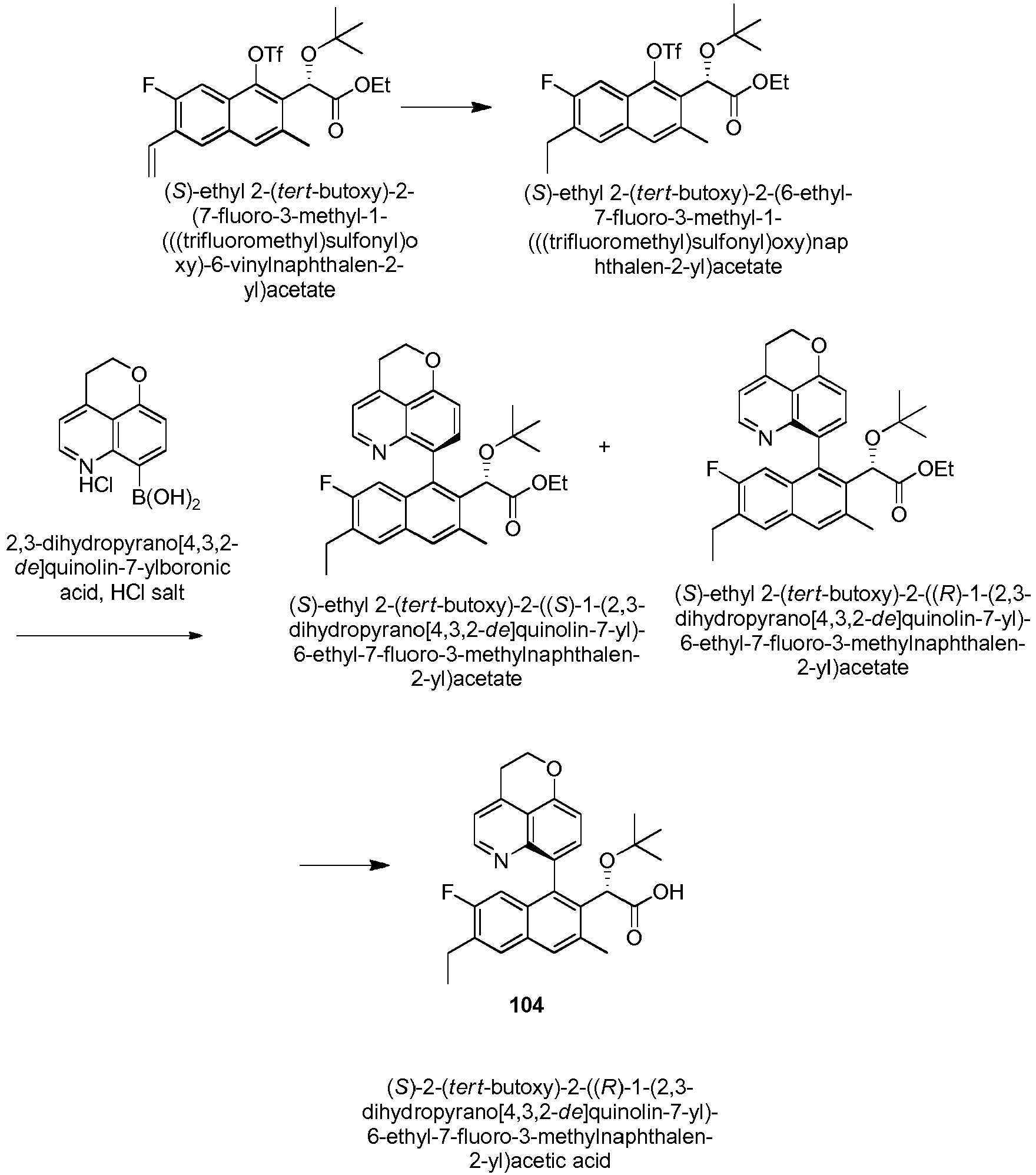
- Preparation of (S)-ethyl 2-tert-butoxy-2-(6-ethyl-7-fluoro-3-methyl-1-(trifluoromethylsulfonyloxy)naphthalen-2-yl)acetate: A mixture of (S)-ethyl 2-tert-butoxy-2-(7-fluoro-3-methyl-1-(trifluoromethylsulfonyloxy)-6-vinylnaphthalen-2-yl)acetate (23 mg, 0.050 mmol) and 10% Palladium on carbon (5 mg) in ethanol (2.0 mL) was stirred under a hydrogen atmosphere for 4 hours, then filtered through a pad of Celite. Filtrate was concentrated to give a thin film (23 mg) that was used in the next step without further purification.
- Preparation of (S)-ethyl 2-tert-butoxy-2-((R)-1-(2,3-dihydropyrano[4,3,2-de]quinolin-7-yl)-6-ethyl-7-fluoro-3-methylnaphthalen-2-yl)acetate: A Smith process vial was charged with (S)-ethyl 2-tert-butoxy-2-(6-ethyl-7-fluoro-3-methyl-1-(trifluoromethylsulfonyloxy)naphthalen-2-yl)acetate (23.4 mg, 0.0473 mmol), 2,3-dihydropyrano[4,3,2-de]quinolin-7-ylboronic acid, HCl salt (14.3 mg, 0.568 mmol), Sphos Palladacycle (4.8 mg, 0.0071 mmol), cesium fluoride (31.6 mg, 0.208 mmol) and flushed with nitrogen. Dimethoxyethane (1.0 mL, distilled from Na/benzophenone) was added and mixture sparged with nitrogen for 10 minutes and then heated in microwave at 120 °C for 1.5 hour. The reaction mixture was diluted with ethyl acetate and washed with brine. Aqueous layer back-extracted and combined organic layer dried (MgSO4), filtered, concentrated and purified by flash column chromatography (silica gel, 0 to 20% ethyl acetate/hexanes) to give (S)-ethyl 2-tert-butoxy-2-((R)-1-(2,3-dihydropyrano[4,3,2-de]quinolin-7-yl)-6-ethyl-7-fluoro-3-methylnaphthalen-2-yl)acetate (1.7 mg). LCMS-ESI+ (m/z): [M+H]+ calcd for C32H35FNO4: 516.6; found: 516.1. The other atropisomer, (S)-ethyl 2-tert-butoxy-2-((S)-1-(2,3-dihydropyrano[4,3,2-de]quinolin-7-yl)-6-ethyl-7-fluoro-3-methylnaphthalen-2-yl)acetate, was also isolated (2.6 mg). LCMS-ESI+ (m/z): [M+H]+ calcd for C32H35FNO4: 516.6; found: 516.1.
- Preparation of (S)-2-tert-butoxy-2-((R)-1-(2,3-dihydropyrano[4,3,2-de]quinolin-7-yl)-6-ethyl-7-fluoro-3-methylnaphthalen-2-yl)acetic acid (104): A solution of (S)-ethyl 2-tert-butoxy-2-((R)-1-(2,3-dihydropyrano[4,3,2-de]quinolin-7-yl)-6-ethyl-7-fluoro-3-methylnaphthalen-2-yl)acetate (1.7 mg, 0.005 mmol) and 5 M sodium hydroxide (21 µL, 0.101 mmol) in tetrahydrofuran (1.0 mL) and methanol (0.1 mL) was heated at 50 °C overnight. The reaction mixture was acidified with acetic acid, concentrated, dissolved in DMF and purified by reverse phase HPLC (Gemini, 5 to 100% ACN/H2O + 0.1 % TFA). Product lyophilized to give a yellow powder (1.3 mg).
1H NMR (400 MHz, CD3OD) δ 8.68 (d, J = 5.6 Hz, 1H), 7.93 (s, 1H), 7.87 - 7.77 (m, J = 7.0 Hz, 3H), 7.46 (d, J = 8.1 Hz, 1H), 6.49 (d, J = 12.1 Hz, 1H), 5.21 (s, 1H), 4.73 (d, J = 6.3 Hz, 2H), 3.67 (t, J = 6.0 Hz, 2H), 2.83 - 2.72 (m, 6H), 1.28 (t, J = 7.5 Hz, 4H), 0.92 (s, 9H). 19F NMR (377 MHz, CD3OD) δ -77.86 (s), -121.37 (d, J = 7.9 Hz). LCMS-ESI+ (m/z): [M+H]+ calcd for C30H31FNO4: 488.6; found: 488.1. -

- Preparation of (S)-ethyl 2-tert-butoxy-2-(6-cyclopropyl-7-fluoro-3-methyl-1-(trifluoromethylsulfonyloxy)naphthalen-2-yl)acetate: A Smith process vial was charged with (S)-ethyl 2-tert-butoxy-2-(6-chloro-7-fluoro-3-methyl-1-(trifluoromethylsulfonyloxy)naphthalen-2-yl)acetate (122.5 mg, 0.245 mmol), cyclopropylboronic acid (23 mg, 0.269 mmol), BrettPhos Palladacycle (27 mg, 0.0368 mmol), cesium fluoride (164 mg, 1.08 mmol) and flushed with nitrogen. Dimethoxyethane (1.5 mL, distilled from Na/benzophenone) was added and mixture sparged with nitrogen for 15 minutes and then heated in microwave at 120 °C for 1.5 hour. The reaction mixture was diluted with ethyl acetate and washed with brine. Aqueous layer back-extracted with ethyl acetate and the combined organic layer was dried (MgSO4), filtered, concentrated and purified by flash column chromatography (silica gel, 0 to 10% ethyl acetate/hexanes) to give an impure colorless oil (83.1 mg).
Analytical HPLC (Gemini, 2-98% ACN/H2O + 0.05% TFA): tR (min) = 5.53. - Preparation of (S)-ethyl 2-tert-butoxy-2-((R)-6-cyclopropyl-1-(2,3-dihydropyrano[4,3,2-de]quinolin-7-yl)-7-fluoro-3-methylnaphthalen-2-yl)acetate: A Smith process vial was charged with (S)-ethyl 2-tert-butoxy-2-(6-cyclopropyl-7-fluoro-3-methyl-1-(trifluoromethylsulfonyloxy)naphthalen-2-yl)acetate (83.1 mg, 0.164 mmol), 2,3-dihydropyrano[4,3,2-de]quinolin-7-ylboronic acid, HCl salt (45.4 mg, 0.180 mmol), Sphos Palladacycle (16.5 mg, 0.0246 mmol), cesium fluoride (110 mg, 0.722 mmol) and flushed with nitrogen. Dimethoxyethane (1.5 mL, distilled from Na/benzophenone) was added and mixture sparged with nitrogen for 15 minutes and then heated in microwave at 120 °C for 1.5 hour. The reaction mixture was diluted with ethyl acetate and washed with brine. Aqueous layer back-extracted and combined organic layer dried (MgSO4), filtered, concentrated and purified by flash column chromatography (silica gel, 0 to 30% ethyl acetate/hexanes) to give (S)-ethyl 2-tert-butoxy-2-((R)-6-cyclopropyl-1-(2,3-dihydropyrano[4,3,2-de]quinolin-7-yl)-7-fluoro-3-methylnaphthalen-2-yl)acetate (2.2 mg). LCMS-ESI+ (m/z): [M+H]+ calcd for C33H35FNO4: 528.6; Found: 528.1, 529.1. The other atropisomer, (S)-ethyl 2-tert-butoxy-2-((S)-6-cyclopropyl-1-(2,3-dihydropyrano[4,3,2-de]quinolin-7-yl)-7-fluoro-3-methylnaphthalen-2-yl)acetate, was also isolated (2.8 mg). LCMS-ESI+ (m/z): [M+H]+ calcd for C33H34FNO4: 528.6; Found: 528.1, 529.1
- Preparation of (S)-2-tert-butoxy-2-((R)-6-cyclopropyl-1-(2,3-dihydropyrano[4,3,2-de]quinolin-7-yl)-7-fluoro-3-methylnaphthalen-2-yl)acetic acid (105): A solution of (S)-ethyl 2-tert-butoxy-2-((R)-6-cyclopropyl-1-(2,3-dihydropyrano[4,3,2-de]quinolin-7-yl)-7-fluoro-3-methylnaphthalen-2-yl)acetate (2.2 mg, 0.0042 mmol) and 5 M sodium hydroxide (171 µL, 0.083 mmol) in tetrahydrofuran (0.5 mL) and methanol (0.1 mL) was heated at 45 °C overnight. The reaction mixture was concentrated, acidified with acetic acid, diluted in DMF and purified by reverse phase HPLC (Gemini, 5 to 100% ACN/H2O + 0.1 % TFA). Product lyophilized to give a yellow powder (2.2 mg). 1H-NMR: 400 MHz, (CD3OD) δ: 8.67 (d, J = 5.6 Hz, 1H), 7.89 (s, 1H), 7.82-7.78 (m, 2H), 7.54 (d, J = 7.6 Hz, 1H), 7.44 (d, J = 8.0 Hz, 1H), 6.47 (d, J = 12.4 Hz, 1H), 5.20 (s, 1H), 4.76-4.49 (m, 2H), 3.66 (t, J = 6 Hz, 2H), 2.73 (s, 3H), 2.15-2.10 (m, 1H), 1.04 (d, J = 8.4 Hz, 2H), 0.92 (s, 9H), 0.86-.83 (m, 2H). 19F-NMR: 377 MHz, (CD3OD) δ: -77.7 (s, 3F), -121.8 (dd, 1F).LCMS-ESI+ (m/z): [M+H]+ calcd for C31H31FNO4: 500.6; Found: 500.1.
-

- Preparation of (S)-ethyl 2-tert-butoxy-2-(6-cyano-7-fluoro-3-methyl-1-(trifluoromethylsulfonyloxy)naphthalen-2-yl)acetate: A Smith process vial was charged with (S)-ethyl 2-tert-butoxy-2-(6-chloro-7-fluoro-3-methyl-1-(trifluoromethylsulfonyloxy)naphthalen-2-yl)acetate (180 mg, 0.359 mmol), zinc(II) cyanide (25 mg, 0.215 mmol), BrettPhos Palladacycle (26 mg, 0.0359 mmol), sodium bicarbonate (3 mg, 0.0359 mmol). DMF (1.5 mL) was added and mixture was heated in microwave at 110 °C for 1.0 hour. The reaction mixture was diluted with ethyl acetate and washed with 5% lithium chloride solution (2x), brine, dried (MgSO4), filtered, concentrated and purified by flash column chromatography (silica gel, 0 to 10% ethyl acetate/hexanes) to give a colorless oil (129 mg).
Analytical HPLC (Gemini, 2-98% ACN/H2O + 0.05% TFA): tR (min) = 5.01. - Preparation of (S)-ethyl 2-tert-butoxy-2-((R)-6-cyano-1-(2,3-dihydropyrano[4,3,2-de]quinolin-7-yl)-7-fluoro-3-methylnaphthalen-2-yl)acetate: A Smith process vial was charged with (S)-ethyl 2-tert-butoxy-2-(6-cyano-7-fluoro-3-methyl-1-(trifluoromethylsulfonyloxy)naphthalen-2-yl)acetate (129 mg, 0.262 mmol), 2,3-dihydropyrano[4,3,2-de]quinolin-7-ylboronic acid, HCl salt (72.6 mg, 0.289 mmol), Sphos Palladacycle (26 mg, 0.0393 mmol), cesium fluoride (175 mg, 1.15 mmol) and flushed with nitrogen. Dimethoxyethane (1.5 mL, distilled from Na/benzophenone) was added and mixture sparged with nitrogen for 15 minutes and then heated in microwave at 120 °C for 1.5 hour. The reaction mixture was diluted with ethyl acetate and washed with brine. Aqueous layer back-extracted and combined organic layer dried (MgSO4), filtered, concentrated and purified by flash column chromatography (silica gel, 0 to 30% ethyl acetate/hexanes) to give impure (S)-ethyl 2-tert-butoxy-2-((R)-6-cyano-1-(2,3-dihydropyrano[4,3,2-de]quinolin-7-yl)-7-fluoro-3-methylnaphthalen-2-yl)acetate (36.6 mg). LCMS-ESI+ (m/z): [M+H]+ calcd for C31H30FN2O4: 513.6; Found: 513.1. The other atropisomer, (S)-ethyl 2-tert-butoxy-2-((S)-6-cyano-1-(2,3-dihydropyrano[4,3,2-de]quinolin-7-yl)-7-fluoro-3-methylnaphthalen-2-yl)acetate, was also isolated (36.8 mg). LCMS-ESI+ (m/z): [M+H]+ calcd for C31H30FN2O4: 513.6; Found: 513.1.
- Preparation of (S)-2-tert-butoxy-2-((R)-6-cyano-1-(2,3-dihydropyrano[4,3,2-de]quinolin-7-yl)-7-fluoro-3-methylnaphthalen-2-yl)acetic acid (106A): A solution of (S)-ethyl 2-tert-butoxy-2-((R)-6-cyano-1-(2,3-dihydropyrano[4,3,2-de]quinolin-7-yl)-7-ffuoro-3-methylnaphthalen-2-yl)acetate (36.8 mg, 0.0718 mmol) and 5 M sodium hydroxide (290 µL, 1.44 mmol) in tetrahydrofuran (1.5 mL) and methanol (0.3 mL) was heated at 35 °C overnight. The reaction mixture was concentrated, acidified with acetic acid, diluted in DMF and purified by reverse phase HPLC (Gemini, 5 to 100% ACN/H2O + 0.1 % TFA). Product lyophilized to give a yellow powder (26.9 mg). 1H-NMR: 400 MHz, (CD3OD) δ: 8.70 (d, J = 5.6 Hz, 1H), 8.53 (d, J = 6.8 Hz, 1H), 8.11 (s, 1H), 7.82-7.75 (m, 2H), 7.44 (d, J = 8.0 Hz, 1H), 6.83 (d, J = 11.2 Hz, 1H), 5.24 (s, 1H), 4.76-4.68 (m, 2H), 3.66 (t, J = 6 Hz, 2H), 2.79 (s, 3H), 0.92 (s, 9H). 19F-NMR: 377 MHz, (CD3OD) δ: -77.8 (s, 3F), -115.5 (br s, 1F).
LCMS-ESI+ (m/z): [M+H]+ calcd for C29H26FN2O4: 485.5; Found: 485.1. A side-product, (S)-2-tert-butoxy-2-((R)-6-carbamoyl-1-(2,3-dihydropyrano[4,3,2-de]quinolin-7-yl)-7-fluoro-3-methylnaphthalen-2-yl)acetic acid (106B), was also isolated (2.8 mg). 1H-NMR: 400 MHz, (CD3OD) δ: 8.70 (d, J = 5.6 Hz, 1H), 8.44 (d, J = 7.2 Hz, 1H), 8.09 (s, 1H), 7.82-7.80 (m, 2H), 7.44 (d, J = 8.0 Hz, 1H), 6.68 (d, J = 13.2 Hz, 1H), 5.24 (s, 1H), 4.76-4.70 (m, 2H), 3.66 (t, J = 6.0 Hz, 2H), 2.78 (s, 3H), 0.93 (s, 9H). 19F-NMR: 377 MHz, (CD3OD) δ: -77.7 (s, 3F), -118.4 (br s, 1F). LCMS-ESI+ (m/z): [M+H]+ calcd for C29H28FN2O5: 503.5; Found: 503.1. -

- Preparation of (S)-ethyl 2-tert-butoxy-2-(7-fluoro-3-methyl-6-(methylcarbamoyl)-1-(trifluoromethylsulfonyloxy)naphthalen-2-yl)acetate: A Smith process vial was charged with (S)-ethyl 2-tert-butoxy-2-(6-chloro-7-fluoro-3-methyl-1-(trifluoromethylsulfonyloxy)naphthalen-2-yl)acetate (131.8 mg, 0.263 mmol), 2 M methylamine in THF (0.66 mL, 1.32 mmol), molybdenum hexacarbonyl (0.069g, 0.263 mmol), BrettPhos Palladacycle (29 mg, 0.0395 mmol), and triethylamine (0.128 mL, 0.921 mmol). Toluene (1.5 mL) was added and mixture was heated in microwave at 140 °C for 1.5 hour. The reaction mixture was diluted with ethyl acetate, washed brine, dried (MgSO4), filtered, concentrated and purified by flash column chromatography (silica gel, 0 to 50% ethyl acetate/hexanes) to give an off-white solid (19.2 mg). LCMS-ESI+ (m/z): [M+H]+ calcd for C22H26F4NO7S: 524.5; Found: 524.0.
- Preparation of (S)-ethyl 2-tert-butoxy-2-((R)-1-(2,3-dihydropyrano[4,3,2-de]quinolin-7-yl)-7-fluoro-3-methyl-6-(methylcarbamoyl)naphthalen-2-yl)acetate: A Smith process vial was charged with (S)-ethyl 2-tert-butoxy-2-(7-fluoro-3-methyl-6-(methylcarbamoyl)-1-(trifluoromethylsulfonyloxy)naphthalen-2-yl)acetate (19.2 mg, 0.0367 mmol), 2,3-dihydropyrano[4,3,2-de]quinolin-7-ylboronic acid, HCl salt (11.1 mg, 0.044 mmol), Sphos Palladacycle (3.7 mg, 0.0055 mmol), cesium fluoride (25 mg, 0.161 mmol) and flushed with nitrogen. Dimethoxyethane (0.5 mL, distilled from Na/benzophenone) was added and mixture sparged with nitrogen for 10 minutes and then heated in microwave at 120 °C for 1.5 hour. The reaction mixture was diluted with ethyl acetate and washed with brine. Aqueous layer back-extracted and combined organic layer dried (MgSO4), filtered, concentrated and purified by flash column chromatography (silica gel, 30 to 80% ethyl acetate/hexanes) to give (S)-ethyl 2-tert-butoxy-2-((R)-1-(2,3-dihydropyrano[4,3,2-de]quinolin-7-yl)-7-fluoro-3-methyl-6-(methylcarbamoyl)naphthalen-2-yl)acetate (6.6 mg). LCMS-ESI+ (m/z): [M+H]+ calcd for C32H34FN2O5: 545.6; Found: 545.1.
- The other atropisomer, (S)-ethyl 2-tert-butoxy-2-((S)-1-(2,3-dihydropyrano[4,3,2-de]quinolin-7-yl)-7-fluoro-3-methyl-6-(methylcarbamoyl)naphthalen-2-yl)acetate, was also isolated (7.5 mg). LCMS-ESI+ (m/z): [M+H]+ calcd for C32H34FN2O5: 545.6; Found: 545.1.
- Preparation of (S)-2-tert-butoxy-2-((R)-1-(2,3-dihydropyrano[4,3,2-de]quinolin-7-yl)-7-fluoro-3-methyl-6-(methylcarbamoyl)naphthalen-2-yl)acetic acid (107): A solution of (S)-ethyl 2-tert-butoxy-2-((R)-1-(2,3-dihydropyrano[4,3,2-de]quinolin-7-yl)-7-fluoro-3-methyl-6-(methylcarbamoyl)naphthalen-2-yl)acetate (6.6 mg, 0.012 mmol) and 5 M lithium hydroxide (48 µL, 0.242 mmol) in tetrahydrofuran (1.0 mL) and methanol (0.3 mL) was heated at 55 °C for 3 hours, then overnight at 48 °C. Additional 5 M lithium hydroxide solution (60 µL) was added and the reaction mixture stirred for 2 hours at 60 °C. The reaction mixture was acidified with acetic acid, concentrated, diluted in DMF and purified by reverse phase HPLC (Gemini, 5 to 100% ACN/H2O + 0.1% TFA). Product lyophilized to give a yellow powder (5.0 mg). 1H-NMR: 400 MHz, (CD3OD) δ: 8.70 (d, J = 5.6 Hz, 1H), 8.35 (d, J = 7.2 Hz, 1H), 8.07 (s, 1H), 7.82-7.80 (m, 2H), 7.44 (d, J = 8.4 Hz, 1H), 6.66 (d, J = 12.8 Hz, 1H), 5.24 (s, 1H), 4.76-4.70 (m, 2H), 3.66 (t, J = 6 Hz, 2H), 2.94 (s, 3H), 2.78 (s, 3H), 0.92 (s, 9H).
19F-NMR: 377 MHz, (CD3OD) δ: -77.6 (s, 3F), -115.5 (dd, J = 12.4, 7.16 Hz, 1F). LCMS-ESI+ (m/z): [M+H]+ calcd for C30H30FN2O5: 517.6; Found: 517.1. -

- Preparation of (S)-2-tert-butoxy-2-((R)-1-(2,3-dihydropyrano[4,3,2-de]quinolin-7-yl)-6,7-difluoro-3-methylnaphthalen-2-yl)acetic acid (108): (S)-2-tert-Butoxy-2-((R)-1-(2,3-dihydropyrano[4,3,2-de]quinolin-7-yl)-6,7-difluoro-3-methylnaphthalen-2-yl)acetic acid (108) was prepared in a similar manner as (S)-2-tert-butoxy-2-((R)-6-chloro-1-(2,3-dihydropyrano[4,3,2-de]quinolin-7-yl)-7-fluoro-3-methylnaphthalen-2-yl)acetic acid of Example 99 except starting with 1-(3,4-difluorophenyl)propan-2-one instead of 1-(3-chloro-4-fluorophenyl)propan-2-one.
1H-NMR: 400 MHz, (CD3OD) δ: 8.69 (d, J = 5.6 Hz, 1H), 7.96 (s, 1H), 7.83-7.78 (m, 3H), 7.45 (d, J = 8.4 Hz, 1H), 6.77 (d, J = 8.0 Hz, 1H), 6.74 (d, J = 8.0 Hz, 1H), 5.20 (s, 1H), 4.75-4.70 (m, 2H), 3.66 (t, J = 5.6 Hz, 2H), 2.76 (s, 3H) 0.92 (s, 9H).
19F-NMR: 377 MHz, (CD3OD) δ: -77.9 (s, 3F), -138.8--138.9 (m, 1F), -139.8--139.9 (m, 1F). LCMS-ESI+ (m/z): [M+H]+ calcd for C28H26F2NO4: 478.5; Found: 478.1. The other atropisomer, (S)-2-tert-butoxy-2-((S)-1-(2,3-dihydropyrano[4,3,2-de]quinolin-7-yl)-6,7-difluoro-3-methylnaphthalen-2-yl)acetic acid, was prepared in a similar manner. 1H NMR (400 MHz, CD3OD) δ 8.60 (d, J = 5.4 Hz, 1H), 8.12 (d, J = 8.2 Hz, 1H), 7.89 (s, 1H), 7.77 (dd, J = 11.1, 8.2 Hz, 1H), 7.66 (d, J = 5.4 Hz, 1H), 7.45 (d, J = 8.2 Hz, 1H), 6.71 (dd, J = 12.3, 7.9 Hz, 1H), 5.19 (s, 1H), 4.69 (t, J= 6.0 Hz, 2H), 3.60 (t, J = 6.0 Hz, 2H), 2.71 (s, 3H), 0.86 (s, 9H). 19F NMR (377 MHz, CD3OD) δ -78.04 (s), -139.49 (s), -140.31 (s).
LCMS-ESI+ (m/z): [M+H]+ calcd for C28H26F2NO4: 478.5; Found: 478.1. -

- Preparation of (R)-2-tert-butoxy-2-((R)-1-(2,3-dihydropyrano[4,3,2-de]quinolin-7-yl)-6,7-difluoro-3-methylnaphthalen-2-yl)acetic acid (109): (R)-2-tert-butoxy-2-((R)-1-(2,3-dihydropyrano[4,3,2-de]quinolin-7-yl)-6,7-difluoro-3-methylnaphthalen-2-yl)acetic acid (109) was prepared in a similar manner as (S)-2-tert-butoxy-2-((R)-1-(2,3-dihydropyrano[4,3,2-de]quinolin-7-yl)-6,7-difluoro-3-methylnaphthalen-2-yl)acetic acid of Example 106 except using (S)-2-methyl-CBS-oxazaborolidine instead of (R)-2-methyl-CBS-oxazaborolidine. 1H NMR (400 MHz, CD3OD) δ 8.59 (d, J = 5.3 Hz, 1H), 8.10 (d, J = 8.2 Hz, 1H), 7.88 (s, 1H), 7.76 (dd, J = 11.1, 8.2 Hz, 1H), 7.63 (d, J = 5.3 Hz, 1H), 7.44 (d, J = 8.1 Hz, 1H), 6.71 (dd, J = 12.4, 7.9 Hz, 1H), 5.19 (s, 1H), 4.68 (t, J = 6.0 Hz, 2H), 3.59 (t, J = 6.0 Hz, 2H), 2.70 (s, 3H), 0.85 (s, 8H). 19F NMR (377 MHz, CD3OD) δ -77.84 (s), -139.69 (s), -140.48 (s). LCMS-ESI+ (m/z): [M+H]+ calcd for C28H26F2NO4: 478.5; Found: 478.1.
The other atropisomer, (R)-2-tert-butoxy-2-((S)-1-(2,3-dihydropyrano[4,3,2-de]quinolin-7-yl)-6,7-difluoro-3-methylnaphthalen-2-yl)acetic acid, was prepared in a similar manner. 1H NMR (400 MHz, CD3OD) δ 8.70 (d, J = 5.7 Hz, 1H), 7.96 (s, 1H), 7.86 - 7.76 (m, 3H), 7.45 (d, J = 8.1 Hz, 1H), 6.76 (dd, J = 12.2, 7.9 Hz, 1H), 5.20 (s, 1H), 4.74 (dt, J = 12.4, 6.3 Hz, 2H), 3.66 (t, J = 5.9 Hz, 2H), 2.76 (s, 3H), 0.92 (s, 9H). 19F NMR (377 MHz, CD3OD) δ -77.78 (s, 3F), -138.70- -139.02 (m, 1F), -139.80- -139.99 (m, 1F). LCMS-ESI+ (m/z): [M+H]+ calcd for C28H26F2NO4: 478.5; Found: 478.1. -

- Preparation of (S)-2-tert-butoxy-2-((R)-1-(2,3-dihydropyrano[4,3,2-de]quinolin-7-yl)-5,7-difluoro-3-methylnaphthalen-2-yl)acetic acid (110): (S)-2-tert-Butoxy-2-((R)-1-(2,3-dihydropyrano[4,3,2-de]quinolin-7-yl)-5,7-difluoro-3-methylnaphthalen-2-yl)acetic acid (110) was prepared in a similar manner as (S)-2-tert-butoxy-2-((R)-6-chloro-1-(2,3-dihydropyrano[4,3,2-de]quinolin-7-yl)-7-fluoro-3-methylnaphthalen-2-yl)acetic acid of Example 99 except starting with 1-(2,4-difluorophenyl)propan-2-one instead of 1-(3-chloro-4-fluorophenyl)propan-2-one.
1H-NMR: 400 MHz, (CD3OD) δ: 8.70 (d, J = 6.0 Hz, 1H), 8.16 (s, 1H), 7.82 (d, J = 8.0 Hz, 1H), 7.80 (d, J = 6.0 Hz, 1H),7.45 (d, J = 8.4 Hz, 1H), 7.17 (ddd, J = 8.0, 8.0, 2.4 Hz, 1H), 6.43 (d, J = 10.0 Hz, 1H), 5.23 (s, 1H), 4.71-4.70 (m, 2H), 3.66 (t, J = 6.0 Hz, 2H), 2.76 (s, 3H) 0.93 (s, 9H). 19F-NMR: 377 MHz, (CD3OD) δ: -77.9 (s, 3F), -112.86 (d, J = 7.9 Hz, 1F), -120.76 (dd, J = 9.0, 9.0 Hz, 1F). LCMS-ESI+ (m/z): [M+H]+ calcd for C28H26F2NO4: 478.5; Found: 478.1. -

- Preparation of (2S)-2-tert-butoxy-2-(5-chloro-1-(2,3-dihydropyrano[4,3,2-de]quinolin-7-yl)-7-fluoro-3-methylnaphthalen-2-yl)acetic acid (111): (2S)-2-tert-Butoxy-2-(5-chloro-1-(2,3-dihydropyrano[4,3,2-de]quinolin-7-yl)-7-fluoro-3-methylnaphthalen-2-yl)acetic acid (111) was prepared following the procedure to make (S)-2-tert-butoxy-2-((R)-6-chloro-1-(2,3-dihydropyrano[4,3,2-de]quinolin-7-yl)-7-fluoro-3-methylnaphthalen-2-yl)acetic acid of Example 99, except 2-(2-chloro-4-fluorophenyl)acetic acid was used instead of2-(3-chloro-4-fluorophenyl)acetic acid. 1H-NMR: 400 MHz, (CDCl3) δ: 8.59 (s, 1H), 8.30 (s ,1H), 8.11 (d, J= 8.21 Hz, 1H), 7.46(d, J = 5.47 Hz, 1H), 7.19 (m, 2H), 6.35 (m. 1H), 5.38(s, 1H), 4.64 (m, 2H), 3.57 (m, 2H), 2.78(s, 3H), 1.16, 0.98 (s, 9H). LCMS-ESI+ (m/z): [M+H]+ calcd for C28H26ClFNO4: 494.95; found: 494.11.
-

- Preparation of (S)-2-tert-butoxy-2-((R)-1-(2,3-dihydropyrano[4,3,2-de]quinolin-7-yl)-7-fluoro-3,6-dimethylnaphthalen-2-yl)acetic acid (112): (S)-2-tert-butoxy-2-((R)-1-(2,3-dihydropyrano[4,3,2-de]quinolin-7-yl)-7-fluoro-3,6-dimethylnaphthalen-2-yl)acetic acid (112) was prepared following the procedure to make (S)-2-tert-butoxy-2-((R)-6-chloro-1-(2,3-dihydropyrano [4,3,2-de]quinolin-7-yl)-7-fluoro-3-methylnaphthalen-2-yl)acetic acid of Example 99, except 2-(4-fluoro-3-methylphenyl)acetic acid was used instead of2-(3-chloro-4-fluorophenyl)acetic acid. 1H-NMR: 400 MHz, (CD3OD) δ: 8.66 (d, J = 5.76 Hz, 1H), 7.90 (s ,1H), 7.80 (d, J= 6.65 Hz,3H), 7.42(d, J = 7.82 Hz, 1H), 6.46 (d, J = 11.73 Hz, 1H), 5.21 (s, 1H), 4.71 (m. 2H), 3.63(t, J = 6.26 Hz, 2H), 2.75 (s, 3H), 2.39 (s, 3H), 0.92 (s, 9H). LCMS-ESI+ (m/z): [M+H]+ calcd for C29H29FNO4: 474.54; found: 474.14.
-

- Preparation of (S)-2-tert-butoxy-2-((R)-5-cyano-1-(2,3-dihydropyrano[4,3,2-de]quinolin-7-yl)-7-fluoro-3-methylnaphthalen-2-yl)acetic acid (113A): (S)-2-tert-butoxy-2-((R)-5-cyano-1-(2,3-dihydropyrano[4,3,2-de]quinolin-7-yl)-7-fluoro-3-methylnaphthalen-2-yl)acetic acid (113A) was prepared following the procedure to make (S)-2-tert-butoxy-2-((R)-6-cyano-1-(2,3-dihydropyrano[4,3,2-de]quinolin-7-yl)-7-fluoro-3-methylnaphthalen-2-yl)acetic acid of Example 104, except (S)-ethyl 2-tert-butoxy-2-(5-chloro-7-fluoro-3-methyl-1-(trifluoromethylsulfonyloxy)naphthalen-2-yl)acetate was used instead of (S)-ethyl 2-tert-butoxy-2-(6-chloro-7-fluoro-3-methyl-1-(trifluoromethylsulfonyloxy)naphthalen-2-yl)acetate. 1H-NMR: 400 MHz, (CD3OD) δ: 8.64 (d, J = 5.48 Hz, 1H), 8.22 (s ,1H), 7.92 (t, J= 7.75 Hz, 1H), 7.76 (d, J = 7.82 Hz, 1H), 7.68 (t, J = 10.56Hz, 1H), 7.38 (d, J =7.72 Hz, 1H), 6.98 (m, 1H), 5.21 (s, 1H), 4.71 (m. 2H), 3.60(t, J = 5.86 Hz, 2H), 2.82 (s, 3H), 0.92 (s, 9H).
19F-NMR: 377 MHz, (CD3OD) δ: -77.8 (s, 3F), -115.5 (br s, 1F). LCMS-ESI+ (m/z):
[M+H]+ calcd for C29H26FN2O4: 485.52; found: 485.09. - Preparation of (S)-2-tert-butoxy-2-((R)-5-carbamoyl-1-(2,3-dihydropyrano[4,3,2-de]quinolin-7-yl)-7-fluoro-3-methylnaphthalen-2-yl)acetic acid (113B): Following the procedure to make (S)-2-tert-butoxy-2-((R)-6-carbamoyl-1-(2,3-dihydropyrano[4,3,2-de]quinolin-7-yl)-7-fluoro-3-methylnaphthalen-2-yl)acetic acid of Example 104, except (S)-ethyl 2-tert-butoxy-2-(5-chloro-7-fluoro-3-methyl-1-(trifluoromethylsulfonyloxy)naphthalen-2-yl)acetate was used instead of (S)-ethyl 2-tert-butoxy-2-(6-chloro-7-fluoro-3-methyl-1-(trifluoromethylsulfonyloxy)naphthalen-2-yl)acetate. 1H-NMR: 400 MHz, (CD3OD) δ: 8.64 (d, J = 5.48 Hz, 1H), 8.32 (s ,1H), 7.78 (d, J= 7.82, 1 H), 7.72 (d, J= 5.87 Hz,1H), 7.50 (t, J = 8.21 Hz, 1H),7.40 (d, J = 8.22 Hz, 1H), 6.68(m, 1H), 5.21 (s, 1H), 4.75 (m. 2H), 3.60 (t, J = 5.87 Hz, 2H), 2.82 (s, 3H), 0.92 (s, 9H).
LCMS-ESI+ (m/z): [M+H]+ calcd for C29H28FN2O5: 503.53; found: 503.12. -

- Preparation of (S)-ethyl 2-tert-butoxy-2-((R)-1-(2,3-dihydropyrano[4,3,2-de]quinolin-7-yl)-7-fluoro-3-methyl-5-(pyrimidin-5-yl)naphthalen-2-yl)acetate: A Smith process vial was charged with (S)-ethyl 2-tert-butoxy-2-((R)-5-chloro-1-(2,3-dihydropyrano[4,3,2-de]quinolin-7-yl)-7-fluoro-3-methylnaphthalen-2-yl)acetate (12 mg, 0.023 mmol, 1 eq.), pyrimidin-5-ylboronic acid (5 mg, 1.5 eq.), Sphos Palladacycle (3 mg, 0.1 eq.), cesium fluoride (12 mg, 3 eq.) and flushed with nitrogen. Dimethoxyethane (0.5 mL, distilled from Na/benzophenone) was added and mixture sparged with nitrogen for 10 minutes and then heated in microwave at 120 °C for 1 hour. The reaction mixture was diluted with ethyl acetate and washed with brine, dried (MgSO4), filtered, concentrated and purified by flash column chromatography (silica gel, 0 to 20% ethyl acetate/hexanes) to give (S)-ethyl 2-tert-butoxy-2-((R)-1-(2,3-dihydropyrano[4,3,2-de]quinolin-7-yl)-7-fluoro-3-methyl-5-(pyrimidin-5-yl)naphthalen-2-yl)acetate (4 mg). LCMS-ESI+ (m/z): [M+H]+ calcd for C34H33FN3O4: 566.63; Found: 566.3.
- Preparation of (S)-2-tert-butoxy-2-((R)-1-(2,3-dihydropyrano[4,3,2-de]quinolin-7-yl)-7-fluoro-3-methyl-5-(pyrimidin-5-yl)naphthalen-2-yl)acetic acid (114): A solution of (S)-ethyl 2-tert-butoxy-2-((R)-1-(2,3-dihydropyrano[4,3,2-de]quinolin-7-yl)-7-fluoro-3-methyl-5-(pyrimidin-5-yl)naphthalen-2-yl)acetate (4 mg) and 2 M sodium hydroxide (0.5 mL) in tetrahydrofuran (0.5 mL) and ethanol (0.5 mL) was heated at 50 °C for 3 hours. The reaction mixture was diluted with ethyl acetate and washed with brine. The aqueous layer was back-extracted with ethyl acetate and the combined organic layer was dried (MgSO4), filtered, concentrated and purified by reverse phase HPLC (Gemini, 5 to 100% ACN/H2O + 0.1% TFA). Product lyophilized to give a yellow powder (1.2 mg). 1H-NMR: 400 MHz, (CD3OD): δ 9.23 (d, J = 5.09 Hz, 1H), 8.82 (s, 1H), 7.96 (s, 1H), 8.60 (m, 1H), 7.80 (m, 1H), 7.52 (d, J = 5.08 Hz, 1H), 7.32 (m, 2H), 7.19 (s, 1 H), 6.82 (m, 1 H), 5.02 (m, 1H), 4.76 (m, 2H), 3.50 (t, J = 6 Hz, 2H), 2.37 (s, 3H) 0.92 (s, 9H).
19F-NMR: 377 MHz, (CD3OD) δ: -77.7 (s, 6F), -115.9 (m, 1F). LCMS-ESI+ (m/z):
[M+H]+ calcd for C32H39FN3O4: 538.58 ; Found: 538.03. -
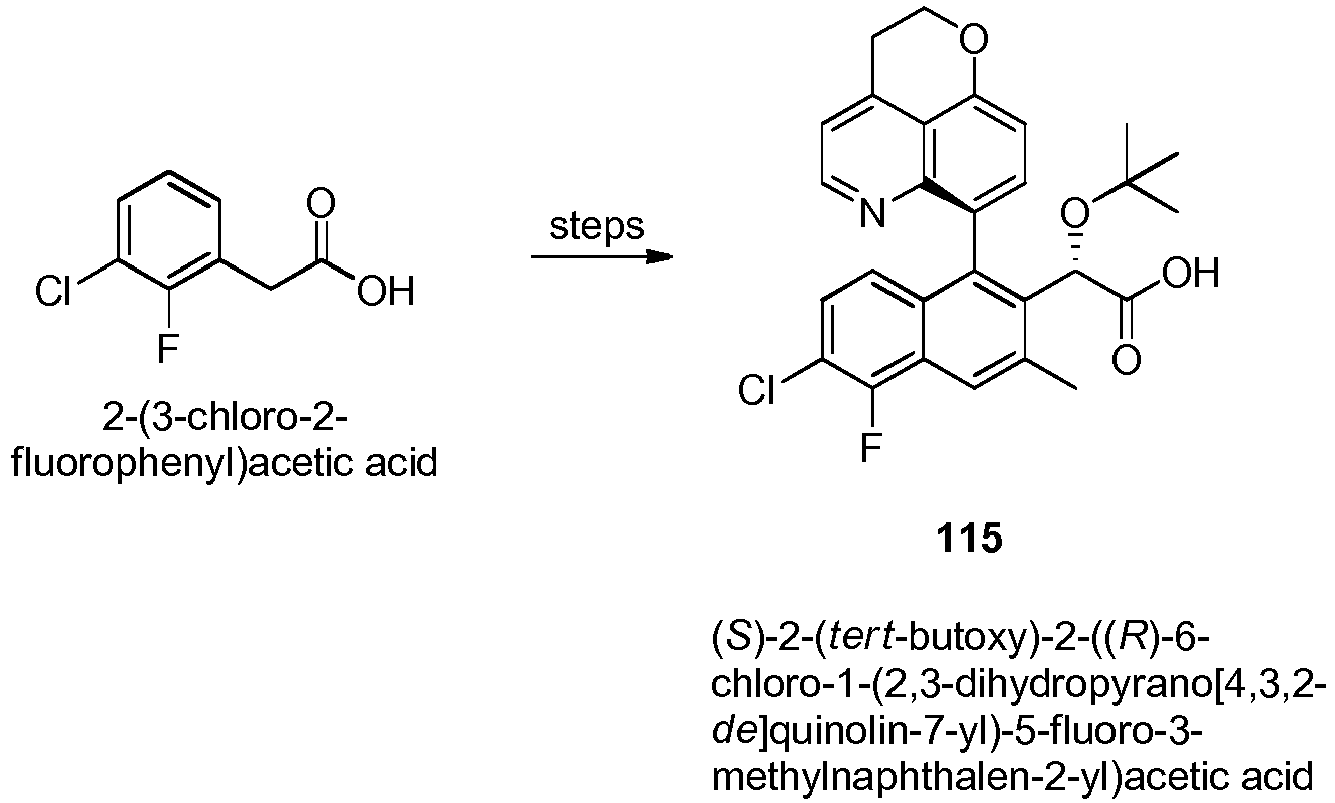
- Preparation of (S)-2-tert-butoxy-2-((R)-6-chloro-1-(2,3-dihydropyrano[4,3,2-de]quinolin-7-yl)-5-fluoro-3-methylnaphthalen-2-yl)acetic acid (115): (S)-2-tert-Butoxy-2-((R)-6-chloro-1-(2,3-dihydropyrano[4,3,2-de]quinolin-7-yl)-5-fluoro-3-methylnaphthalen-2-yl)acetic acid (115) was prepared following the procedure to make (S)-2-tert-butoxy-2-((R)-6-chloro-1-(2,3-dihydropyrano[4,3,2-de]quinolin-7-yl)-7-fluoro-3-methylnaphthalen-2-yl)acetic acid of Example 99 , except 2-(3-chloro-2-fluorophenyl)acetic acid was used instead of2-(3-chloro-4-fluorophenyl)acetic acid. 1H-NMR: 400 MHz, (CD3OD) δ: 8.69 (d, J = 5.87 Hz, 1H), 8.18 (s ,1H), 7.80 (m ,2H), 7.42(d, J = 7.72 Hz, 1H), 7.26(t, J = 7.43 Hz, 1H), 6.78 (d, J = 9.38 Hz, 1H), 5.22(s, 1H), 4.64 (m, 2H), 3.62 (t, J = 5.86 Hz, 2H), 2.80(s, 3H), 0.98 (s, 9H). 19F-NMR: 377 MHz, (CD3OD) δ: -77.7 (s, 3F), -127.87 (d, 1F). LCMS-ESI+ (m/z): [M+H]+ calcd for C28H26ClFNO4: 494.95; found: 494.07.
-

- Preparation of 1-(2-chloro-3-methylphenyl)propan-2-one: A Smith process vial was charged with 1-bromo-2-chloro-3-methylbenzene (528 mg, 2.57 mmol, 1 eq.), tributylmethoxytin (1.11 mL, 1.5 eq.), 4-methylpent-4-en-2-one (0.42 mL, 1.5 eq.), PdCl2 (23 mg, 5%) and tri(o-tolyl)phosphine (79 mg, 10%), toluene (1 mL) was added and mixture sparged with nitrogen for 10 minutes and then heated in oil bath at 100 °C for 5 hours. The reaction mixture was diluted with ethyl acetate and washed with brine, dried (MgSO4), filtered, concentrated and purified by flash column chromatography (silica gel, 0 to 20% ethyl acetate/hexanes) to 1-(2-chloro-3-methylphenyl)propan-2-one (375 mg, 80% yield). 1H-NMR: 400 MHz, (CDCl3) δ : 7.19-7.02 (m, 3H), 3.82(s, 2H), 2.38(s, 3H), 2.18 (s, 3H).
- Preparation of (S)-2-tert-butoxy-2-((R)-5-chloro-1-(2,3-dihydropyrano[4,3,2-de]quinolin-7-yl)-3,6-dimethylnaphthalen-2-yl)acetic acid (116): (S)-2-tert-butoxy-2-((R)-5-chloro-1-(2,3-dihydropyrano[4,3,2-de]quinolin-7-yl)-3,6-dimethylnaphthalen-2-yl)acetic acid (116) was prepared following the procedure to make (S)-2-tert-butoxy-2-((R)-6-chloro-1-(2,3-dihydropyrano[4,3,2-de]quinolin-7-yl)-7-fluoro-3-methylnaphthalen-2-yl)acetic acid, used 1-bromo-2-chloro-3-methylbenzene instead of 2-(3-chloro-4-fluorophenyl)acetic acid. 1H-NMR: 400 MHz, (CD3OD) δ : 8.59 (d, J = 5.08 Hz, 1H), 8.26 (s ,1H), 7.68 (m ,2H), 7.34 (d, J = 8.21 Hz, 1H), 7.08(d, J = 8.60 Hz, 1H), 6.72 (d, J = 8.50 Hz, 1H), 5.16(s, 1H), 4.62 (m, 2H), 3.56 (t, J = 6.26 Hz, 2H), 2.72(s, 3H), 2.42(s, 3H), 0.92 (s, 9H). LCMS-ESI+ (m/z): [M+H]+ calcd for C29H29ClNO4: 490.99; found: 490.33.
-

- Preparation (S)-ethyl 2-tert-butoxy-2-((R)-1-(2,3-dihydropyrano[4,3,2-de]quinolin-7-yl)-3,5,6-trimethylnaphthalen-2-yl)acetate: A Smith process vial was charged with (S)-ethyl 2-tert-butoxy-2-((R)-5-chloro-1-(2,3-dihydropyrano[4,3,2-de]quinolin-7-yl)-3,6-dimethylnaphthalen-2-yl)acetate (16 mg, 0.031 mmol, 1 eq.), methylboronic acid (4 mg, 2 eq.), Sphos Palladacycle (2 mg, 0.1 eq.), cesium fluoride (19 mg, 4 eq.) and flushed with nitrogen. Dimethoxyethane (0.5 mL, distilled from Na/benzophenone) was added and mixture sparged with nitrogen for 10 minutes and then heated in microwave at 120 °C for 1 hour. The reaction mixture was diluted with ethyl acetate and washed with brine, dried (MgSO4), filtered, concentrated and purified by flash column chromatography (silica gel, 0 to 20% ethyl acetate/hexanes) to give (S)-ethyl 2-tert-butoxy-2-((R)-1-(2,3-dihydropyrano[4,3,2-de]quinolin-7-yl)-3,5,6-trimethylnaphthalen-2-yl)acetate (7 mg). LCMS-ESI+ (m/z): [M+H]+ calcd for C32H36NO4: 498.62; Found: 498.1.
- Preparation of (S)-2-tert-butoxy-2-((R)-1-(2,3-dihydropyrano[4,3,2-de]quinolin-7-yl)-3,5,6-trimethylnaphthalen-2-yl)acetic acid (117): A solution of (S)-ethyl 2-tert-butoxy-2-((R)-1-(2,3-dihydropyrano[4,3,2-de]quinolin-7-yl)-3,5,6-trimethylnaphthalen-2-yl)acetate (7 mg) and 2 M sodium hydroxide (0.5 mL) in tetrahydrofuran (0.5 mL) and ethanol (0.5 mL) was heated at 50 °C for 3 hours. The reaction mixture was diluted with ethyl acetate and washed with brine. The aqueous layer was back-extracted with ethyl acetate and the combined organic layer was dried (MgSO4), filtered, concentrated and purified by reverse phase HPLC (Gemini, 5 to 100% ACN/H2O + 0.1 % TFA). Product lyophilized to give a yellow powder (4.7 mg). 1H-NMR: 400 MHz, (CD3OD): δ 8.64 (d, J = 5.86 Hz, 1H), 8.15 (s, 1H), 7.76 (t, J = 8.90 Hz, 2H), 7.43 (d, J = 8.99 Hz, 1H), 7.07 (d, J = 8.99 Hz, 1H), 6.65 (d, J = 8.60 Hz, 1H), 5.21 (s, 1H), 4.70 (m, 2H), 3.64 (t, J = 7.77 Hz, 2H), 2.79 (s, 3H), 2.67 (s, 3H), 2.43 (s, 3H), 0.92 (s, 9H). LCMS-ESI+ (m/z): [M+H]+ calcd for C30H32NO4: 470.57; Found: 470.39.
-

- Preparation of (S)-2-tert-butoxy-2-((R)-5-cyano-1-(2,3-dihydropyrano[4,3,2-de]quinolin-7-yl)-3,6-dimethylnaphthalen-2-yl)acetic acid (118): (S)-2-tert-butoxy-2-((R)-5-cyano-1-(2,3-dihydropyrano[4,3,2-de]quinolin-7-yl)-3,6-dimethylnaphthalen-2-yl)acetic acid (118) was prepared following the procedure to make (S)-2-tert-butoxy-2-((R)-1-(2,3-dihydropyrano[4,3,2-de]quinolin-7-yl)-3,5,6-trimethylnaphthalen-2-yl)acetic acid of Example 115, except used Zn(CN)2 was used instead of methylboronic acid, and DMF was used instead of DME. Analytical HPLC (Gemini, 2-98% ACN/H2O + 0.05% TFA, 7 minutes run): tR (min) = 4.00.
1H-NMR: 400 MHz, (CD3OD) δ : 8.59 (d, J = 5.48 Hz, 1H), 8.09 (s ,1H), 7.64 (d, J = 8.21 Hz, 1H), 7.62 (d, J = 4.08 Hz, 1H), 7.36 (d, J = 8.21 Hz, 1H), 7.19 (d, J = 8.61 Hz, 1H), 7.12 (d, J = 8.98 Hz, 1H), 5.16 (s, 1H), 4.62 (m, 2H), 3.56 (t, J = 5.86 Hz, 2H), 2.72(s, 3H), 2.62(s, 3H), 0.92 (s, 9H). LCMS-ESI+ (m/z): [M+H]+ calcd for C30H29N4O4: 481.55; found: 481.32. -

- Preparation (S)-ethyl 2-tert-butoxy-2-((R)-1-(2,3-dihydropyrano[4,3,2-de]quinolin-7-yl)-5-fluoro-3,6-dimethylnaphthalen-2-yl)acetate: A Smith process vial was charged with (S)-ethyl 2-tert-butoxy-2-((R)-6-chloro-1-(2,3-dihydropyrano[4,3,2-de]quinolin-7-yl)-5-fluoro-3-methylnaphthalen-2-yl)acetate (10 mg, 0.019 mmol, 1 eq.), methylboronic acid (2 mg, 1.5 eq.), Sphos Palladacycle (1.3 mg, 0.1 eq.), cesium fluoride (14 mg, 4 eq.) and flushed with nitrogen. Dimethoxyethane (0.5 mL, distilled from Na/benzophenone) was added and mixture sparged with nitrogen for 10 minutes and then heated in microwave at 120 °C for 1 hour. The reaction mixture was diluted with ethyl acetate and washed with brine, dried (MgSO4), filtered, concentrated and purified by flash column chromatography (silica gel, 0 to 20% ethyl acetate/hexanes) to give (S)-ethyl 2-tert-butoxy-2-((R)-1-(2,3-dihydropyrano[4,3,2-de]quinolin-7-yl)-5-fluoro-3,6-dimethylnaphthalen-2-yl)acetate (6 mg). LCMS-ESI+ (m/z): [M+H]+ calcd for C31H33FNO4: 502.59; Found: 502.1.
- Preparation of (S)-2-tert-butoxy-2-((R)-1-(2,3-dihydropyrano[4,3,2-de]quinolin-7-yl)-5-fluoro-3,6-dimethylnaphthalen-2-yl)acetic acid (119): A solution of (S)-ethyl 2-tert-butoxy-2-((R)-1-(2,3-dihydropyrano[4,3,2-de]quinolin-7-yl)-5-fluoro-3,6-dimethylnaphthalen-2-yl)acetate (6 mg) and 2 M sodium hydroxide (0.5 mL) in tetrahydrofuran (0.5 mL) and ethanol (0.5 mL) was heated at 50 °C for overnight. The reaction mixture was diluted with ethyl acetate and washed with brine. The aqueous layer was back-extracted with ethyl acetate and the combined organic layer was dried (MgSO4), filtered, concentrated and purified by reverse phase HPLC (Gemini, 5 to 100% ACN/H2O + 0.1% TFA). Product lyophilized to give a yellow powder (4.7 mg). 1H-NMR: 400 MHz, (CD3OD): δ 8.67 (d, J = 5.47 Hz, 1H), 8.12(s, 1H), 7.78 (t, J = 5.87 Hz, 2H), 7.43 (d, J = 8.82 Hz, 1H), 7.11 (t, J = 8.21 Hz, 1H), 6.63 (d, J = 8.60 Hz, 1H), 5.22 (s, 1H), 4.70 (m, 2H), 3.64 (t, J = 5.86 Hz, 2H), 2.79 (s, 3H), 2.38 (d, J = 1.47 Hz, 3H), 0.92 (s, 9H). 19F-NMR: 377 MHz, (CD3OD) δ: -77.7 (s, 3F), -131.6 (d, 1F). LCMS-ESI+ (m/z): [M+H]+ calcd for C29H29FNO4: 474.54; Found: 474.33.
-

- Preparation of (S)-2-tert-butoxy-2-((R)-1-(2,3-dihydropyrano[4,3,2-de]quinolin-7-yl)-6-ethyl-5-fluoro-3-methylnaphthalen-2-yl)acetic acid (120): (S)-2-tert-Butoxy-2-((R)-1-(2,3-dihydropyrano[4,3,2-de]quinolin-7-yl)-6-ethyl-5-fluoro-3-methylnaphthalen-2-yl)acetic acid (120) was prepared following the procedure to make (S)-2-tert-butoxy-2-((R)-1-(2,3-dihydropyrano[4,3,2-de]quinolin-7-yl)-5-fluoro-3,6-dimethylnaphthalen-2-yl)acetic acid of Example 117, except that ethylboronic acid was used instead of methylboronic acid. Analytical HPLC (Gemini, 2-98% ACN/H2O + 0.05% TFA, 7 minutes run): tR (min) = 4.00.
1H-NMR: 400 MHz, (CD3OD): δ 8.67 (d, J = 5.47 Hz, 1H), 8.14 (s, 1H), 7.81 (t, J = 8.21 Hz, 2H), 7.46 (d, J = 8.21 Hz, 1H), 7.16 (t, J = 8.23 Hz, 1H), 6.67 (d, J = 9.0 Hz, 1H), 5.22 (s, 1H), 4.71 (m, 2H), 3.66 (t, J = 5.86 Hz, 2H), 2.79 (m, s, 5H), 1.23 (t, J = 7.82 Hz, 3H), 0.93 (s, 9H). 19F-NMR: 377 MHz, (CD3OD) δ: -77.7 (s, 3F), -133.06 (d, 1F). LCMS-ESI+
(m/z): [M+H]+ calcd for C30H31FNO4: 488.56 (M+H+); Found: 488.37. -

- Preparation (S)-ethyl 2-tert-butoxy-2-((R)-1-(2,3-dihydropyrano[4,3,2-de]quinolin-7-yl)-5-fluoro-3-methyl-6-vinylnaphthalen-2-yl)acetate: A Smith process vial was charged with (S)-ethyl 2-tert-butoxy-2-((R)-6-chloro-1-(2,3-dihydropyrano[4,3,2-de]quinolin-7-yl)-5-fluoro-3-methylnaphthalen-2-yl)acetate (99 mg, 0.19 mmol, 1 eq.), potassium vinyltrifluoroborate (28 mg, 1.1 eq.), Sphos Palladacycle (13 mg, 0.1 eq.), cesium fluoride (114 mg, 4 eq.) and flushed with nitrogen. Dimethoxyethane (2 mL, distilled from Na/benzophenone) was added and mixture sparged with nitrogen for 10 minutes and then heated in microwave at 110 °C for 1 hour. The reaction mixture was diluted with ethyl acetate and washed with brine, dried (MgSO4), filtered, concentrated and purified by flash column chromatography (silica gel, 0 to 20% ethyl acetate/hexanes) to give (S)-ethyl 2-tert-butoxy-2-((R)-1-(2,3-dihydropyrano[4,3,2-de]quinolin-7-yl)-5-fluoro-3-methyl-6-vinylnaphthalen-2-yl)acetate (69 mg, 71% yield). LCMS-ESI+ (m/z): [M+H]+ calcd for C32H33FNO4: 514.60; Found: 514.1.
- Preparation (S)-ethyl 2-tert-butoxy-2-((R)-1-(2,3-dihydropyrano[4,3,2-de]quinolin-7-yl)-5-fluoro-6-formyl-3-methylnaphthalen-2-yl)acetate: (S)-ethyl 2-tert-butoxy-2-((R)-1-(2,3-dihydropyrano[4,3,2-de]quinolin-7-yl)-5-fluoro-3-methyl-6-vinylnaphthalen-2-yl)acetate (32 mg, 0.062 mmol, 1 eq.) was dissolved in 2 mL THF. This solution was added to the mixture of NaIO4 (40 mg, 3 eq.) and K2OsO4•2H2O (2.3 mg, 0.1 eq.) in 1 mL water at room temperature. The reaction was complete after stirring at room temperature for 30 minutes. The reaction mixture was filtered, the filtrate was diluted with ethyl acetate and washed with brine, dried (MgSO4), filtered, concentrated and purified by flash column chromatography (silica gel, 0 to 20% ethyl acetate/hexanes) to give (S)-ethyl 2-tert-butoxy-2-((R)-1-(2,3-dihydropyrano[4,3,2-de]quinolin-7-yl)-5-fluoro-6-formyl-3-methylnaphthalen-2-yl)acetate as a light yellow oil (26 mg, 81 % yield). LCMS-ESI+ (m/z): [M+H]+ calcd for C31H31FNO5: 516.57; Found: 516.1.
- Preparation (S)-ethyl 2-tert-butoxy-2-((R)-6-(difluoromethyl)-1-(2,3-dihydropyrano[4,3,2-de]quinolin-7-yl)-5-fluoro-3-methylnaphthalen-2-yl)acetate: (S)-ethyl 2-tert-butoxy-2-((R)-1-(2,3-dihydropyrano[4,3,2-de]quinolin-7-yl)-5-fluoro-6-formyl-3-methylnaphthalen-2-yl)acetate (8 mg) was dissolved in 0.5 mL DCM. Deoxofluor (50 µL, excess) was added to the solution. The reaction was stirred at room temperature for 1 hour. The reaction mixture was diluted with ethyl acetate and washed with brine, dried (MgSO4), filtered, concentrated and purified by flash column chromatography (silica gel, 0 to 20% ethyl acetate/hexanes) to give (S)-ethyl 2-tert-butoxy-2-((R)-6-(difluoromethyl)-1-(2,3-dihydropyrano[4,3,2-de]quinolin-7-yl)-5-fluoro-3-methylnaphthalen-2-yl)acetate as a light yellow oil (6 mg, 76% yield). LCMS-ESI+ (m/z): [M+H]+ calcd for C31H31F3NO5: 538.57; Found: 538.34.
- Preparation of (S)-2-tert-butoxy-2-((R)-6-(difluoromethyl)-1-(2,3-dihydropyrano[4,3,2-de]quinolin-7-yl)-5-fluoro-3-methylnaphthalen-2-yl)acetic acid (121): A solution of (S)-ethyl 2-tert-butoxy-2-((R)-6-(difluoromethyl)-1-(2,3-dihydropyrano[4,3,2-de]quinolin-7-yl)-5-fluoro-3-methylnaphthalen-2-yl)acetate (6 mg) in tetrahydrofuran (0.5 mL) and ethanol (0.5 mL) and 2 M sodium hydroxide (0.5 mL) was heated at 50 °C for 2 hours. The reaction mixture was diluted with ethyl acetate and washed with brine. The aqueous layer was back-extracted with ethyl acetate and the combined organic layer was dried (MgSO4), filtered, concentrated and purified by reverse phase HPLC (Gemini, 5 to 100% ACN/H2O + 0.1% TFA). Product lyophilized to give a yellow powder (4.7 mg). 1H-NMR: 400 MHz, (CD3OD): δ 8.69 (d, J = 5.48 Hz, 1H), 8.26 (s, 1H), 7.84 (d, J = 8.22 Hz, 1H), 7.80 (d, J = 5.87 Hz, 1H), 7.43 (m, 2H), 7.34, 7.21, 7.07 (t, J = 54.74 Hz, 1H), 6.90 (d, J = 9.38 Hz), 5.25 (s, 1H), 4.73 (m, 2H), 3.64 (t, J = 5.86 Hz, 2H), 2.83 (s, 3H), 0.93 (s, 9H). 19F-NMR: 377 MHz, (CD3OD) δ: -77.7 (s, 3F), -113.97 to -116.29 (m, 2F), -131.6 (s, 1F). LCMS-ESI+ (m/z): [M+H]+ calcd for C29H27F3NO4: 510.52; Found: 510.36.
-

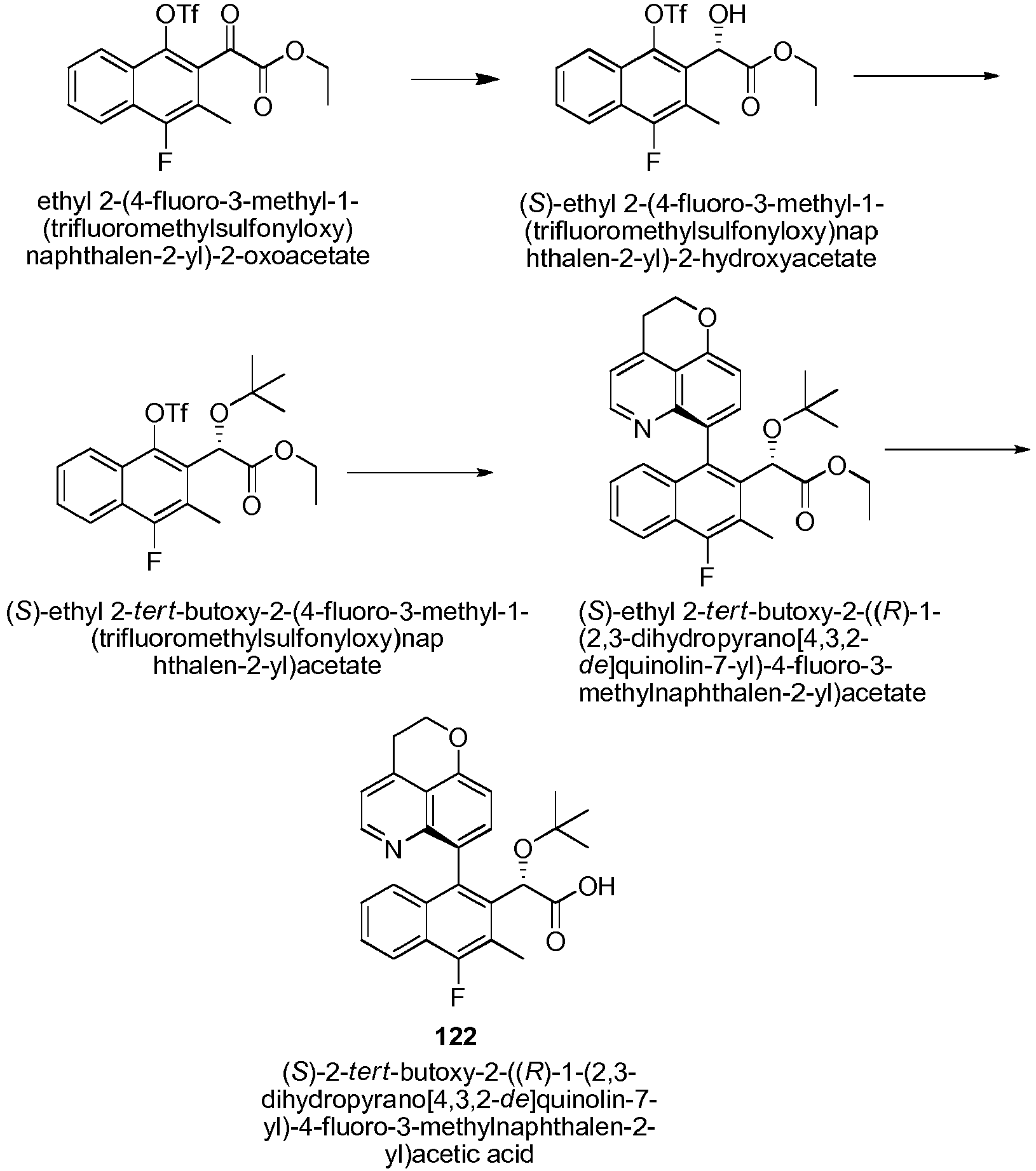
- Preparation of ethyl 4-(4-bromophenyl)-3-methylbut-2-enoate: At 0 °C, a suspension of 60% w/w NaH/mineral oil (7.13 g, 0.176 mol) in THF (250 mL) was treated dropwise with a solution of triethylphosphonoacetate (39.5 g, 0.176 mol) in THF (72 mL) over a 30 min period. The reaction was stirred for another 30 min, and a solution of 1-(4-bromophenyl)propan-2-one (25.0 g, 0.117 mol) in THF (108 mL) was added dropwise over 1 h (reaction was kept at 0 °C during addition. The reaction was allowed to warm to 23 °C as it was stirred overnight. The next day, saturated NH4Cl (250 mL) was added. After 2 h, the reaction was diluted with H2O (250 mL) and hexane (100 mL). The organic phase was collected. The aqueous layer was extracted with EtOAc (2 x 150 mL). Combined organic phases were dried (MgSO4), filtered, and concentrated, giving crude 4-(4-bromophenyl)-3-methylbut-2-enoate as a mixture of E and Z geometric isomers. The residue was carried onward without further purification. (∼30 grams; yield was not determined). The 1H NMR reported below was from a crude mixture containing both the E and Z isomer.
1H NMR (400 MHz, CDCl3) δ 7.43 (d, J = 8.6 Hz, 1.6H), 7.39 (d, J = 8.6 Hz, 0.4H), 7.12 (d, J = 8.2 Hz, 0.4H), 7.04 (d, J = 8.2 Hz, 1.6H), 4.42-4.21 (m, 2H), 3.96 (s, 0.4H), 3.38 (s, 1.6H), 2.10 (s, 2.4H), 1.77 (s, 0.6H), 1.37-1.23 (m, 3H). - Preparation of 7-bromo-3-methylnaphthalen-1-ol: A flask containing the crude ethyl 4-(4-bromophenyl)-3-methylbut-2-enoate from above (∼ 30 grams) was treated with concentrated H2SO4 (120 mL) and warmed to 50 °C for 2.5 h. The reaction was poured onto ∼500 mL of crushed ice. Once the ice had thawed, the brown suspension was extracted with two portions of EtOAc (500 mL and 100 mL, respectively). The two extracts were combined, washed with saturated NaHCO3, dried (MgSO4), filtered, and concentrated to ∼ 55 mL. The residue was treated with DCM and wet-loaded onto a silica gel column and purified by flash chromatography (ethyl acetate/hexanes) giving the desired product (16.6 g, 60% yield over 2 steps from 1-(4-bromophenyl)propan-2-one. 1H NMR (400 MHz, CDCl3) δ 8.29 (d, J = 1.9 Hz, 1H), 7.57 (d, J = 8.6 Hz, 1H), 7.50 (dd, J = 8.6, 2.0 Hz, 1H), 7.17 (s, 1H), 6.67 (s, 1H), 2.42 (s, 3H).
- Preparation of 3-methylnaphthalen-1-ol: A slurry of 7-bromo-3-methylnaphthalen-1-ol (100 mg, 0.421 mmol), 10% w/w Pd/C (45 mg, 42.1 µmol Pd), and absolute EtOH (2.0 mL) was purged under vacuum and backfilled with H2 from a balloon several times. The suspension was stirred under a balloon of H2 at 23 °C overnight. The reaction was filtered over Celite, the cake was washed with EtOAc. The filtrate was concentrated and dissolved in DCM. The solution was wet-loaded onto a 12 g "gold" ISCO silica gel column and purified by flash chromatography (ethyl acetate/hexanes) giving the desired product (yield was not found). 1H NMR (400 MHz, CDCl3) δ 8.10 (d, J = 7.8 Hz, 1H), 7.72 (d, J = 7.8 Hz, 1H), 7.47-7.39 (m, 2H), 7.22 (s, 1H), 6.67 (s, 1H), 2.45 (s, 3H).
- Preparation of ethyl 2-hydroxy-2-(1-hydroxy-3-methylnaphthalen-2-yl)acetate: A flask containing DCM (5.0 mL) was charged with TiCl4 (1.0 M in DCM, 3.16 mL, 3.16 mmol). After cooling to -40 °C (dry ice/CH3CN bath), a solution of 3-methylnaphthalen-1-ol (500 mg, 3.16 mmol) in DCM (5.0 mL) was added dropwise over a 5 min period. The reaction turned deep violet. After 30 min, a solution of ethyl glyoxylate (323 mg, 3.16 mmol, distilled freshly from P2O5 under N2 from the 50% w/w toluene solution of ethyl glyoxylate) in DCM (2.0 mL) was added quickly. The reaction was warmed to 0 °C. After 1 h, glacial AcOH (1.0 mL) was added. 5 min later, CH3CN (5.0 mL) was introduced, followed by H2O (10 mL). The reaction transitioned from violet to yellow-orange. The reaction was warmed to 23 °C and stirred for 30 min. The reaction was diluted with H2O (15 mL) and extracted with DCM (3 x 20 mL). The combined extracts were washed with saturated NaHCO3 (20 mL) (this decolorized the organic phase from orange to yellow), dried (Na2SO4), filtered, concentrated, treated with DCM (10 mL), and concentrated again. The residue was dissolved in DCM and loaded onto a 24 g "gold" ISCO silica gel column and purified by flash chromatography (ethyl acetate/hexanes) giving the desired product (622 mg, 76% yield). 1H NMR (400 MHz, CDCl3) δ 8.41 (s, 1H), 8.20 (d, J = 8.2 Hz, 1H), 7.67 (d, J = 8.8 Hz, 1H), 7.46 (dd, J = 8.8, 8.0 Hz, 1H), 7.40 (dd, J = 8.2, 8.0 Hz, 1H), 7.20 (s, 1H), 5.68 (s, 1H), 4.31-4.08 (m, 2H), 3.94 (s, broad, 1H), 2.52 (s, 3H), 1.18 (t, J = 7.0 Hz, 3H).
- Preparation of ethyl 2-tert-butoxy-2-(1-hydroxy-3-methylnaphthalen-2-yl)acetate: A solution of ethyl 2-hydroxy-2-(1-hydroxy-3-methylnaphthalen-2-yl)acetate (622 mg, 2.39 mmol) in tert-butyl acetate (12 mL) was treated with 70% HClO4 (20 µL) at 23 °C). After 3 h, the reaction was added slowly over 5 min to saturated NaHCO3 (25 mL). The resulting system was extracted with DCM (3 x 15 mL). The combined organic layers were dried (Na2SO4), filtered, and concentrated. Hexane (10 mL) was added, and the mixture was concentrated again. The residue was dissolved in benzene. The solution was wet-loaded onto a 24 g "gold" ISCO silica gel column and purified by flash chromatography (hexane → ethyl acetate) giving the desired product (286 mg, 38% yield). 1H NMR (400 MHz, CDCl3) δ 9.00 (s, 1H), 8.26 (d, J = 8.2 Hz, 1H), 7.65 (d, J = 8.8 Hz, 1H), 7.44 (dd, J = 8.2, 8.0 Hz, 1H), 7/39 (dd, J = 8.8, 8.0 Hz, 1H), 7.17 (s, 1H), 5.52 (s, 1H), 4.25-4.06 (m, 2H), 2.59 (s, 3H), 1.33 (s, 9H), 1.20 (t, J = 7.0 Hz, 3H).
- Preparation of ethyl 2-tert-butoxy-2-(4-fluoro-1-hydroxy-3-methylnaphthalen-2-yl)acetate: A solution of ethyl 2-tert-butoxy-2-(1-hydroxy-3-methylnaphthalen-2-yl)acetate (1.50 g, 4.74 mmol) in CH3CN (37.5 mL) was cooled to 0 °C. Selectfluor (1.70 g, 4.74 mmol) was added, and the reaction was allowed to warm to 23 °C. After 2 h, the reaction was added slowly to a mixture of saturated Na2HPO4 (70 mL) and H2O (30 mL) at 23 °C. More H2O (40 mL) was added, and the system was extracted with DCM (3x 40 mL). The combined organic phases were treated with hexane (20 mL). The phase that separated was removed. The remaining organic phase was dried (Na2SO4), filtered, and concentrated. The filtrate was concentrated and dissolved in benzene. The solution was wet-loaded onto a 24 g "gold" ISCO silica gel column and purified by flash chromatography (ethyl acetate/hexanes) giving the desired product (1.26 g, 79%). 1H NMR (400 MHz, CDCl3) δ 8.83 (s, 1H), 8.23 (d, J = 8.2 Hz, 1H), 7.93 (d, J = 8.4 Hz, 1H), 7.51 (dd, J = 6.9, 6.9 Hz, 1H), 7.45 (dd, J = 6.9, 6.9 Hz, 1H), 5.46 (s, 1H), 4.23-4.14 (m, 2H), 2.49 (d, J HF = 3.2 Hz, 3H), 1.31 (s, 9H), 1.20 (t, J = 7.1 Hz, 3H). 19F NMR (377 MHz, CDCl3) δ -137.3 (app. s).
- Preparation of ethyl 2-tert-butoxy-2-(4-fluoro-3-methyl-1-(trifluoromethylsulfonyloxy)naphthalen-2-yl)acetate: A flask was charged with Cs2CO3 (2.45 g, 7.53 mmol) and N-phenyltriflimide (2.69 g, 7.53 mmol). A solution of ethyl 2-tert-butoxy-2-(4-fluoro-1-hydroxy-3-methylnaphthalen-2-yl)acetate (1.26 g, 3.76 mmol) in THF (38 mL) was added at 23 °C. After 30 min, the reaction was added slowly to a pre-stirred mixture of 2 M NaHSO4 (30 mL) and saturated Na2HPO4 (100 mL) at 23 °C. The system was extracted with a mixture of ethyl acetate/hexane (10:1)(3x 50 mL). Combined organic layers were dried (Na2SO4), filtered, and concentrated. The residue was concentrated once more from hexane. The residue was dissolved in benzene. The solution was wet-loaded onto a 40 g "gold" ISCO silica gel column and purified by flash chromatography (hexane → ethyl acetate/hexanes 1:4) giving the desired product (1.75 g, >99%). 1H NMR (400 MHz, CDCl3) δ 8.11-8.02 (m, 2H), 7.66-7.60 (m, 2H), 5.72 (s, 1H), 4.27-4.10 (m, 2H), 2.44 (d, J HF = 3.2 Hz, 3H), 1.21 (s, 9H), 1.18 (t, J = 7.0 Hz, 3H). 19F NMR (377 MHz, CDCl3) δ -123.1 (app. s, 1F), -73.4 (s, 3F)
- Preparation of ethyl 2-(4-fluoro-3-methyl-1-(trifluoromethylsulfonyl-oxy)naphthalen-2-yl)-2-hydroxyacetate: A solution of ethyl 2-tert-butoxy-2-(4-fluoro-3-methyl-1-(trifluoromethylsulfonyloxy)naphthalen-2-yl)acetate (1.75 g, 3.76 mmol) in DCM (30 mL) was treated dropwise with TFA (3.0 mL) over 3 min at 23 °C. After 16 h, the reaction was diluted with H2O (60 mL) and the system was extracted with DCM (3x 20 mL). Combined organic layers were dried (Na2SO4), filtered, and concentrated giving the crude desired product (∼ 1.54 g obtained), which was used in the next reaction. 1H NMR (400 MHz, CDCl3) δ 8.11-8.06 (m, 1H), 7.67-7.64 (m, 1H), 7.61-7.52 (m, 2H), 7.41 (d, J = 7.8 Hz, 1H), 5.79 (s, 1H), 4.34-4.22 (m, 2H), 2.40 (d, J HF = 3.2 Hz, 3H), 1.22 (t, J = 7.4 Hz, 3H). 19F NMR (377 MHz, CDCl3) δ -122.6 (app. s, 1F), -73.3 (s, 3F).
Preparation of ethyl 2-(4-fluoro-3-methyl-1-(trifluoromethylsulfonyl-oxy)naphthalen-2-yl)-2-oxoacetate: A solution of ethyl 2-(4-fluoro-3-methyl-1-(trifluoromethylsulfonyloxy)naphthalen-2-yl)-2-hydroxyacetate (∼ 1.54 g, 3.76 mmol) in DCM (60 mL) was treated with Dess-Martin periodinane (1.91 g, 4.51 mmol) at 23 °C. After 4 h, the orange reaction was slowly added to 10% Na2S2O3 (28 mL) at 23 °C. After 5 min of stirring, the reaction was diluted with H2O (40 mL) and extracted with DCM (3 x 20 mL). Combined organic layers were dried (Na2SO4), filtered, and concentrated. The residue was dissolved in benzene. The solution was wet-loaded onto a 40 g "gold" ISCO silica gel column and purified by flash chromatography (hexane → ethyl acetate/hexanes 1:4) giving the desired product (1.08 g, 70% yield over 2 steps from ethyl 2-tert-butoxy-2-(4-fluoro-3-methyl-1-(trifluoromethylsulfonyloxy)naphthalen-2-yl)acetate). 1H NMR (400 MHz, CDCl3) δ 8.16-8.08 (m, 2H), 7.76-7.68 (m, 2H), 4.41 (q, J = 7.1 Hz, 2H), 2.39 (d, J HF = 3.2 Hz, 3H), 1.40 (t, J = 7.1 Hz, 3H). 19F NMR (377 MHz, CDCl3) δ -122.3 (app. s, 1F), -73.3 (s, 3F). - Preparation of (S)-ethyl 2-(4-fluoro-3-methyl-1-(trifluoromethylsulfonyloxy)naphthalen-2-yl)-2-hydroxyacetate: A solution of ethyl 2-(4-fluoro-3-methyl-1-(trifluoromethylsulfonyloxy)naphthalen-2-yl)-2-oxoacetate (1.08 g, 2.64 mmol) in PhMe (20 mL) was cooled to - 40 °C (dry ice/CH3CN bath). (R)-CBS catalyst (146 mg, 0.528 mmol) was introduced. Distilled catecholborane (423 µL) was added dropwise over a 5 min period. After 30 min, the reaction was warmed to - 20 °C and treated with EtOAc (20 mL). Then 15% Na2CO3 (10 mL) was added. The reaction was warmed to 23 °C and stirred vigorously. The organic phase was collected after 30 min. It was washed (vigorous stirring) with 10 mL portions of 15% Na2CO3 for 30 min each until the layer was colorless. (Early washes tended to be dark greenish-brown). After six such washings, the organic phase was treated with saturated NH4Cl (20 mL) for 30 min. The organic phase was dried (MgSO4), filtered, and concentrated. The residue was treated with hexanes and concentrated again. The material was dissolved in benzene. The solution was wet-loaded onto a 40 g "gold" ISCO silica gel column and purified by flash chromatography (hexane → ethyl acetate) giving the desired product (1.02 g, 94% yield). 1H NMR (400 MHz, CDCl3) δ 8.11-8.06 (m, 2H), 7.67-7.64 (m, 2H), 5.79 (s, 1H), 4.33-4.22 (m, 2H), 2.40 (d, J HF = 3.2 Hz, 3H), 1.22 (t, J = 7.4 Hz, 3H). 19F NMR (377 MHz, CDCl3) δ -122.6 (app. s, 1F), -73.1 (s, 3F).
- Preparation of (S)-ethyl 2-tert-butoxy-2-(4-fluoro-3-methyl-1-(trifluoromethylsulfonyloxy)naphthalen-2-yl)acetate: A solution of (S)-ethyl 2-(4-fluoro-3-methyl-1-(trifluoromethylsulfonyloxy)naphthalen-2-yl)-2-hydroxyacetate (1.02 g, 2.49 mmol) in tert-butyl acetate (20 mL) was treated with 70% HClO4 (20 µL) at 23 °C). After 5 h, the reaction was added slowly over 5 min to saturated NaHCO3 (40 mL). The resulting system was extracted with DCM (3 x 30 mL). The combined organic layers were dried (Na2SO4), filtered, and concentrated. The residue was dissolved in benzene. The solution was wet-loaded onto a 40 g "gold" ISCO silica gel column and purified by flash chromatography (hexane → ethyl acetate/hexane 1:4) giving the desired product (942 mg, 81% yield). 1H NMR (400 MHz, CDCl3) δ 8.11-8.02 (m, 2H), 7.65-7.60 (m, 2H), 5.72 (s, 1H), 4.25-4.13 (m, 2H), 2.45 (d, J HF = 3.2 Hz, 3H), 1.21 (s, 9H), 1.18 (t, J = 7.0 Hz, 3H). 19F NMR (377 MHz, CDCl3) δ -123.1 (ap s, 1F), -73.3 (s, 3F).
- Preparation of (2S)-ethyl 2-tert-butoxy-2-((R)-1-(2,3-dihydropyrano[4,3,2-de]quinolin-7-yl)-4-fluoro-3-methylnaphthalen-2-yl)acetate: The following reaction was run in triplicate: A sealable tube was charged with 2,3-dihydropyrano[4,3,2-de]quinolin-7-ylboronic acid monohydrochloride (160 mg, 0.636 mmol), S-Phos palladacycle (71.3 mg, 0.106 mmol), and CsF (354 mg, 2.33 mmol). The tubes were placed under vacuum, then backfilled with argon. A solution of (S)-ethyl 2-tert-butoxy-2-(4-fluoro-3-methyl-1-(trifluoromethylsulfonyloxy)naphthalen-2-yl)acetate (247 mg, 0.530 mmol) in 1,2-dimethoxyethane (distilled from Na°/benzophenone, 1.25 mL) was added. The system was stirred for 1 min to dislodge any clumps of solid, then wrapped in foil. The reaction was heated with vigorous stirring to 120 °C for 1.5 h. The three reactions were cooled to 23 °C and combined by adding to a mixture of brine (30 mL) and H2O (30 mL). The system was extracted with EtOAc (3 x 30 mL). Combined organic layers were dried (Na2SO4), filtered, and concentrated. Hexane was added, and the system was concentrated again. The residue was dissolved in DCM/PhH 1:1. The solution was wet-loaded onto a 24 g "gold" ISCO silica gel column and purified by flash chromatography (hexane → ethyl acetate) giving the desired product (2S)-ethyl 2-tert-butoxy-2-((R)-1-(2,3-dihydropyrano[4,3,2-de]quinolin-7-yl)-4-fluoro-3-methylnaphthalen-2-yl)acetate (163 mg, 21% yield). 1H NMR (400 MHz, CDCl3) δ 8.16 (d, J = 8.6 Hz, 1H), 7.61-7.18 (m, 6H), 6.92 (d, broad, J = 8 Hz, 1H), 5.25 (s, broad, 1H), 4.75-4.60 (m, 2H), 4.30-4.00 (m, 2H), 3.55-3.40 (m, 2H), 2.68 (d, J HF = 3.2 Hz, 3H), 1.20-1.00 (m, 3H), 0.90 (s, 9H). 19F NMR (377 MHz, CDCl3) δ -122 (s, broad) LCMS-ESI+ (m/z): calcd for C30H30FNO4: 488.2 (M+H+); Found: 488.3 (M+H+). The other diastereomer was also obtained; (2S)-ethyl 2-tert-butoxy-2-((S)-1-(2,3-dihydropyrano[4,3,2-de]quinolin-7-yl)-4-fluoro-3-methylnaphthalen-2-yl)acetate (208 mg, 27% yield):
1H NMR (400 MHz, CDCl3) δ 8.13 (d, J = 8.6 Hz, 1H), 7.50-7.16 (m, 6H), 6.88 (d, J = 8.2 Hz, 1H), 5.15 (s, 1H), 4.72-4.60 (m, 2H), 4.30-4.00 (m, 2H), 3.49-3.38 (m, 2H), 2.61 (d,
J HF = 3.2 Hz, 3H), 1.27-1.19 (m, 3H), 0.83 (s, 9H). 19F NMR (377 MHz, CDCl3) δ -124 (app. s, broad). LCMS-ESI+ (m/z): [M+H]+ calcd for C30H31FNO4: 488.2; Found: 488.3. - Preparation of (2S)-2-tert-butoxy-2-((R)-1-(2,3-dihydropyrano[4,3,2-de]quinolin-7-yl)-4-fluoro-3-methylnaphthalen-2-yl)acetic acid (122): A solution of (2S)-ethyl 2-tert-butoxy-2-((R)-1-(2,3-dihydropyrano[4,3,2-de]quinolin-7-yl)-4-fluoro-3-methylnaphthalen-2-yl)acetate (163 mg, 0.334 mmol) in THF (6.0 mL) and EtOH (absolute, 2.0 mL) was treated with LiOH monohydrate (400 mg, 9.48 mmol) in H2O (2.0 mL). The mixture was stirred vigorously at 100 °C for 2 h. More LiOH monohydrate (600 mg, 14.2 mmol) and H2O (500 µL) were added, and heating was continued for another 4 h. The reaction was cooled to 23 °C and filtered through a 0.45 micron filter pad. The filtrate was purified on a C18 Gemini column (Eluent: H2O/CH3CN 95:5 → 0:100 spiked with 0.1% v/v TFA), giving (2S)-2-tert-butoxy-2-((R)-1-(2,3-dihydropyrano[4,3,2-de]quinolin-7-yl)-4-fluoro-3-methylnaphthalen-2-yl)acetic acid as the mono-trifluoroacetic acid salt (124 mg, 64%). 1H NMR (400 MHz, CD3OD) δ 8.68 (d, J = 5.8 Hz, 1H), 8.20 (d, J = 8.2 Hz, 1H), 7.87 (d, J = 7.8 Hz, 1H), 7.81 (d, J = 5.4 Hz, 1H), 7.60 (dd, J = 7.9, 7.4 Hz, 1H), 7.48 (d, J = 8.2 Hz, 1H), 7.36 (dd, J = 7.9, 7.4 Hz, 1H), 6.98 (d, J = 8.6 Hz, 1H), 5.19 (s, 1H), 4.77-4.70 (m, 2H), 3.67 (dd, J = 7.2, 5.9 Hz, 2H), 2.67 (d, J HF = 3.2 Hz, 3H), 0.97 (s, 9H). 19F NMR (377 MHz, CD3OD) δ -77.7 (s). LCMS-ESI+ (m/z): [M+H]+ calcd for C28H27FNO4: 460.2; Found: 460.2. The other diastereomer, (2S)-2-tert-butoxy-2-((S)-1-(2,3-dihydropyrano[4,3,2-de]quinolin-7-yl)-4-fluoro-3-methylnaphthalen-2-yl)acetic acid, was prepared in a similar manner from (2S)-ethyl 2-tert-butoxy-2-((S)-1-(2,3-dihydropyrano[4,3,2-de]quinolin-7-yl)-4-fluoro-3-methylnaphthalen-2-yl)acetate: 1H NMR (400 MHz, CD3OD) δ 8.56 (d, J = 5.1 Hz, 1H), 8.05 (d, J = 8.2 Hz, 1H), 7.94 (dd, J = 9.0, 5.9 Hz, 1H), 7.88 (s, 1H), 7.54 (d, J = 5.6 Hz, 1H), 7.38 (d, J = 7.8 Hz, 1H), 7.25 (ddd, J = 8.7, 8.6, 2.4 Hz, 1H), 6.49 (dd, J = 10.3, 2.4 Hz, 1H), 5.22 (s, 1H), 4.67 (dd, J = 5.8, 5.8 Hz, 2H), 3.55 (dd, J = 5.8, 5.8 Hz, 2H), 2.70 (s, 3H), 0.83 (s, 9H). 19F NMR (377 MHz, CD3OD) δ -105.6 (s, 1F), -77.6 (s, 3F).
LCMS-ESI+ (m/z): [M+H]+ calcd for C28H27FNO4: 460.2; Found: 460.5. -

- Preparation of ethyl 2-tert-butoxy-2-(7-fluoro-3-methyl-1-(trifluoromethyl-sulfonyloxy)naphthalen-2-yl)acetate: Prepared in a similar manner as 2-tert-butoxy-2-(7-chloro-3-methyl-1-(trifluoromethylsulfonyloxy)naphthalen-2-yl)acetate of Example 146 except using 1-(4-fluorophenyl)propan-2-one. 1H NMR (400 MHz, CDCl3) δ 7.79 (dd, JHH = 9.0 Hz, JHF= 5.4 Hz, 1H), 7.66 (s, 1H), 7.65 (dd, JHF = 9.0 Hz, JHH= 2.3 Hz, 1H), 7.38 (ddd, , JHH = 9.0 Hz, , JHF = 8.0 Hz, , JHH = 2.3 Hz, 1H), 5.72 (s, 1H), 4.25-4.10 (m, 2H), 2.54 (s, 3H), 1.20 (s, 9H), 1.18 (t, J = 7.0 Hz, 3H). 19F NMR (377 MHz, CDCl3) δ -112.0 (ddd,, JHF = 9.0, 8.0, 5.4 Hz ,1F), -73.4 (s, 3F).
- Preparation of (±)-(S)-ethyl 2-tert-butoxy-2-((R)1-(2,3-dihydropyrano [4,3,2-de]quinolin-7-yl)-7-fluoro-3-methylnaphthalen-2-yl)acetate: Prepared in a manner similar to (S)-ethyl 2-tert-butoxy-2-((R)-6-chloro-1-(2,3-dihydropyrano[4,3,2-de]quinolin-7-yl)-7-fluoro-3-methylnaphthalen-2-yl)acetate of Example 99 expect using ethyl 2-tert-butoxy-2-(7-fluoro-3-methyl-1-(trifluoromethylsulfonyloxy)naphthalen-2-yl)acetate as starting material and S-Phos-palladacycle as the catalyst, giving the product as a racemate. LCMS-ESI+ (m/z): calcd for C30H30FNO4: 488.2 (M+H+); Found: 488.2 (M+H+). The other diastereomer (±)-(2S)-ethyl 2-tert-butoxy-2-((S)1-(2,3-dihydropyrano [4,3,2-de]quinolin-7-yl)-7-fluoro-3-methylnaphthalen-2-yl)acetate was also isolated via silica gel chromatography. LCMS-ESI+ (m/z): [M+H]+ calcd for C30H31FNO4: 488.2; Found: 488.2.
- Preparation of (±)-(S)-2-tert-butoxy-2-((R)-1-(2,3-dihydropyrano[4,3,2-de]quinolin-7-yl)-7-fluoro-3-methylnaphthalen-2-yl)acetic acid (123): Prepared in a similar manner as (S)-2-tert-butoxy-2-((R)-6-chloro-1-(2,3-dihydropyrano[4,3,2-de]quinolin-7-yl)-7-fluoro-3-methylnaphthalen-2-yl)acetic acid of Example 99, except using (±)-(S)-ethyl 2-tert-butoxy-2-((R)-1-(2,3-dihydropyrano[4,3,2-de]quinolin-7-yl)-7-fluoro-3-methylnaphthalen-2-yl)acetate as the starting material, giving the racemate of the desired product as the mono-trifluoroacetic acid salt. 1H NMR (400 MHz, CD3OD) δ 8.68 (d, J = 5.5 Hz, 1H), 8.02-7.97 (m, 2H), 7.81-7.75 (m, 2H), 7.43 (d, J = 8.2 Hz, 1H), 7.32 (ddd, J = 5.4, 5.4, 2.4 Hz, 1H), 6.54 (dd, J = 10.0, 2.3 Hz, 1H), 5.24 (s, 1H), 4.78-4.67 (m, 2H), 3.67-3.62 (m, 2H), 2.77 (s, 3H), 0.93 (s, 9H). 19F NMR (377 MHz, CD3OD) δ -105.6 (s, 1F), -77.6 (s, 3F). LCMS-ESI+ (m/z): [M+H]+ calcd for C28H27FNO4: 460.2; Found: 460.4.
- The other racemate, (±)-(S)-2-tert-butoxy-2-((S)-1-(2,3-dihydropyrano [4,3,2-de]quinolin-7-yl)-7-fluoro-3-methylnaphthalen-2-yl)acetic acid , was prepared in a similar manner. 1H NMR (400 MHz, CD3OD) δ 8.61 (d, J = 5.8 Hz, 1H), 8.18 (d, J = 8.2 Hz, 1H), 7.71 (d, J = 5.5 Hz, 1H), 7.58 (dd, J = 7.0, 6.8 Hz, 1H), 7.51 (d, J = 8.2 Hz, 1H), 7.34 (dd, J = 7.0, 6.8 Hz, 1H), 6.96 (d, J = 8.6 Hz, 1H), 5.20 (s, 1H), 4.72 (dd, J = 6.2, 6.2 Hz, 2H), 3.64 (dd, J = 6.2, 6.2 Hz, 2H), 2.64 (d, J HF = 3.2 Hz, 3H), 0.86 (s, 9H). 19F NMR (377 MHz, CD3OD) δ -77.8 (s).
LCMS-ESI+ (m/z): [M+H]+ calcd for C28H27FNO4: 460.2; Found: 460.4. -

- Preparation of (±)-(2S)-ethyl 2-tert-butoxy-2-((R)-(7-chloro-1-(2,3-dihydropyrano[4,3,2-de]quinolin-7-yl)-3-methylnaphthalen-2-yl)acetate: Prepared in a manner similar to (S)-ethyl 2-tert-butoxy-2-((R)-6-chloro-1-(2,3-dihydropyrano[4,3,2-de]quinolin-7-yl)-7-fluoro-3-methylnaphthalen-2-yl)acetate of Example 99 except using ethyl 2-tert-butoxy-2-(7-chloro-3-methyl-1-(trifluoro-methylsulfonyloxy)naphthalen-2-yl)acetate as the starting material. LCMS-ESI+ (m/z): [M+H]+ calcd for C30H31ClNO4: 504.2; Found: 504.2. The other racemate (±)-(2S)-ethyl 2-tert-butoxy-2-((S)(7-chloro-1-(2,3-dihydropyrano[4,3,2-de]quinolin-7-yl)-3-methylnaphthalen-2-yl)acetate was also isolated via silica gel chromatography. LCMS-ESI+ (m/z): [M+H]+ calcd for C3oH31ClNO4: 504.2; Found: 504.2.
- Preparation of (±)-(S)-2-tert-butoxy-2-((R)-7-chloro-1-(2,3-dihydropyrano[4,3,2-de]quinolin-7-yl)-3-methylnaphthalen-2-yl)acetic acid (124): (±)-(S)-2-tert-butoxy-2-((R)-7-chloro-1-(2,3-dihydropyrano[4,3,2-de]quinolin-7-yl)-3-methylnaphthalen-2-yl)acetic acid (124) was prepared in a similar manner as (S)-2-tert-butoxy-2-((R)-6-chloro-1-(2,3-dihydropyrano[4,3,2-de]quinolin-7-yl)-7-fluoro-3-methylnaphthalen-2-yl)acetic acid of Example 99, except using (±)-(S)-ethyl 2-tert-butoxy-2-((R)-7-chloro-1-(2,3-dihydropyrano[4,3,2-de]quinolin-7-yl)-3-methylnaphthalen-2-yl)acetate as the starting material, giving the racemate of the desired product as the mono-trifluoroacetic acid salt. 1H NMR (400 MHz, CD3OD) δ 8.69 (d, J = 5.5 Hz, 1H), 7.99-7.93 (m, 2H), 7.81-7.75 (m, 2H), 7.48-7.43 (m, 2H), 6.90 (d, J = 2.0 Hz, 1H), 5.22 (s, 1H), 4.77-4.67 (m, 2H), 3.67-3.62 (m, 2H), 2.77 (s, 3H), 0.93 (s, 9H). 19F NMR (377 MHz, CD3OD) δ -77.6 (s). LCMS-ESI+ (m/z): calcd for C28H26ClNO4: 476.2 (M+H+); Found: 476.1 (M+H+). The other racemate, (±)-(S)-2-tert-butoxy-2-((S)-7-chloro-1-(2,3-dihydropyrano[4,3,2-de]quinolin-7-yl)-3-methylnaphthalen-2-yl)acetic acid, was prepared in a similar manner. 1H NMR (400 MHz, CD3OD) δ 8.55 (d, J = 5.1 Hz, 1H), 8.00 (d, J = 6.8 Hz, 1H), 7.88-7.84 (m, 2H), 7.48 (d, broad, J = 4 Hz, 1H), 7.40 (dd, J = 8.6, 1.8 Hz, 1H), 7.34 (d, J = 8.2 Hz, 1H), 6.85 (d, J = 1.8 Hz, 1H), 5.20 (s, 1H), 4.68-4.62 (m, 2H), 3.54-3.47 (m, 2H), 2.69 (s, 3H), 0.80 (s, 9H). LCMS-ESI+ (m/z): [M+H]+ calcd for C28H27ClNO4: 476.2; Found: 476.4.
-

- Preparation of 3-methyl-4-phenylbutanoic acid: 3-Methyl-4-phenylbutanoic acid was prepared in a similar manner as 4-(2-methoxy-phenyl)-3-methyl-butyric acid of Example 32 except using 1-phenylpropan-2-one. 1H NMR (400 MHz, CDCl3) δ 7.31-7.14 (m, 5H), 2.65 (dd, J = 13.3, 6.7 Hz, 1H), 2.53 (dd, J = 13.3, 7.4 Hz, 1H), 2.38 (dd, 14.9, 5.5 Hz, 1H), 2.28 (app. sext. J = 6.7 Hz, 1H), 2.17 (dd, 14.5, 7.8 Hz, 1H), 0.98 (d, J = 6.6 Hz, 3H).
- Preparation of 3-methyl-3,4-dihydronaphthalen-1(2H)-one: 3-Methyl-3,4-dihydronaphthalen-1(2H)-one was prepared in a similar manner as 6-bromo-3-methyl-3,4-dihydronaphthalen-1(2H)-one of Example 48, except using 3-methyl-4-phenylbutanoic acid. 1H NMR (400 MHz, CDCl3) δ 8.02 (d, J = 7.9 Hz, 1H), 7.47 (dd, J = 7.4, 7.4 Hz, 1H), 7.31 (dd, J = 7.4, 7.4 Hz, 1H), 7.24 (d, J = 7.4 Hz, 1H), 3.01-2.95 (m, 1H), 2.76-2.66 (m, 2H), 2.37-2.27 (m, 2H), 1.15 (d, J = 7.2 Hz, 3H).
- Preparation of ethyl 2-(4-methoxybenzyloxy)-2-(1-hydroxy-3-methylnaphthalen-2-yl)acetate: Ethyl 2-(4-methoxybenzyloxy)-2-(1-hydroxy-3-methylnaphthalen-2-yl)acetate was prepared in a similar manner as (1-hydroxy-5-methoxy-3-methyl-naphthalen-2-yl)-(4-methoxy-benzyloxy)-acetic acid ethyl ester of Example 32, except using 3-methyl-3,4-dihydronaphthalen-1(2H)-one. 1H NMR (400 MHz, CDCl3) δ 8.51 (s, 1H), 8.24 (d, J = 8.2 Hz, 1H), 7.65 (d, J = 7.8 Hz, 1H), 7.48-7.36 (m, 2H), 7.27 (d, 8.5 Hz, 2H), 7.18 (s, 1H), 6.89 (d, J = 8.4 Hz, 2H), 5.30 (s, 1H), 4.67-4.55 (m, 2H), 4.27-4.08 (m, 2H), 3.82 (s, 3H), 2.40 (s, 3H), 1.19 (t, J = 7.0 Hz, 3H).
- Preparation of ethyl 2-(4-methoxybenzyloxy)-2-(4-bromo-1-hydroxy-3-methylnaphthalen-2-yl)acetate: A solution of ethyl 2-(4-methoxybenzyloxy)-2-(1-hydroxy-3-methylnaphthalen-2-yl)acetate (102 mg, 0.268 mmol) in CHCl3 (5.0 mL) was treated with solid NaHCO3 (46 mg, 0.281 mmol). Br2 (45 mg) in CHCl3 (1.0 mL) was added dropwise over 5 min at 23 °C. After 15 min, 10% Na2S2O3 (10 mL) was added. The reaction was extracted two times with CHCl3. Combined organic phases were dried (Na2SO4), filtered, and concentrated. The residue was dissolved in DCM. The solution was wet-loaded onto a 12 g "gold" ISCO silica gel column and purified by flash chromatography (ethyl acetate/hexanes) giving the desired product (83 mg, 67%). 1H NMR (400 MHz, CDCl3) δ 8.69 (s, 1H), 8.29 (d, J = 8.2 Hz, 1H), 8.22 (d, J = 8.6 Hz, 1H), 7.59 (dd, J = 7.4, 7.4 Hz, 1H), 7.47 (dd, J = 7.8, 7.8 Hz, 1H), 7.26 (d, J = 8.2 Hz, 2H), 6.91 (d, J = 8.6 Hz, 2H), 5.47 (s, 1H), 4.67-4.56 (m, 2H), 4.26-4.08 (m, 2H), 3.81 (s, 3H), 2.60 (s, 3H), 1.20 (t, J = 7.1 Hz, 3H).
- Preparation of ethyl 2-(4-bromo-1-(4-chlorophenyl)-3-methylnaphthalen-2-yl)-2-tert-butoxyacetate (125): Ethyl 2-(4-bromo-1-(4-chlorophenyl)-3-methylnaphthalen-2-yl)-2-tert-butoxyacetate (125) was prepared in a similar manner as ethyl 2-(7-bromo-1-(4-chlorophenyl)-3-methylnaphthalen-2-yl)-2-tert-butoxyacetate of Example 67 except using ethyl 2-(4-methoxybenzyloxy)-2-(4-bromo-1-hydroxy-3-methylnaphthalen-2-yl)acetate. 1H NMR (400 MHz, CDCl3) δ 8.39 (d, J = 8.6 Hz, 1H), 7.57-7.42 (m, 4H), 7.36-7.24 (m, 3H), 5.16 (s, 1H), 4.24-4.09 (m, 2H), 2.75 (s, 3H), 1.23 (t, J = 7.1 Hz, 3H), 1.00 (s, 9H).
-

- Preparation of 2-(4-bromo-1-(4-chlorophenyl)-3-methylnaphthalen-2-yl)-2-tert-butoxyacetic acid (126): A solution of ethyl 2-(4-bromo-1-(4-chlorophenyl)-3-methylnaphthalen-2-yl)-2-tert-butoxyacetate (30 mg, 71.4 µmol), LiOH monohydrate (15 mg, 0.357 mmol), H2O (500 µL), EtOH (absolute, 500 µL), and THF (500 µL) was placed in a sealed tube and heated to 100 °C. Once the reaction was complete, it was cooled to 23 °C, filtered through a 0.45 micron filter, and directly purified by reverse phase HPLC (Gemini, 5 to 100% ACN/H2O + 0.1% TFA). The product-containing fractions were combined and lyophilized, giving the title compound (parent form)(11.5 mg, 40%). 1H NMR (400 MHz, CD3OD) δ 8.38 (d, J = 8.6 Hz, 1H), 7.63-7.47 (m, 4H), 7.38-7.20 (m, 3H), 5.30 (s, 1H), 2.69 (s, 3H), 1.00 (s, 9H). LCMS-ESI- (m/z): [M-CO2-H]- calcd for C22H21BrClO: 415.2; Found: 415.0.
-
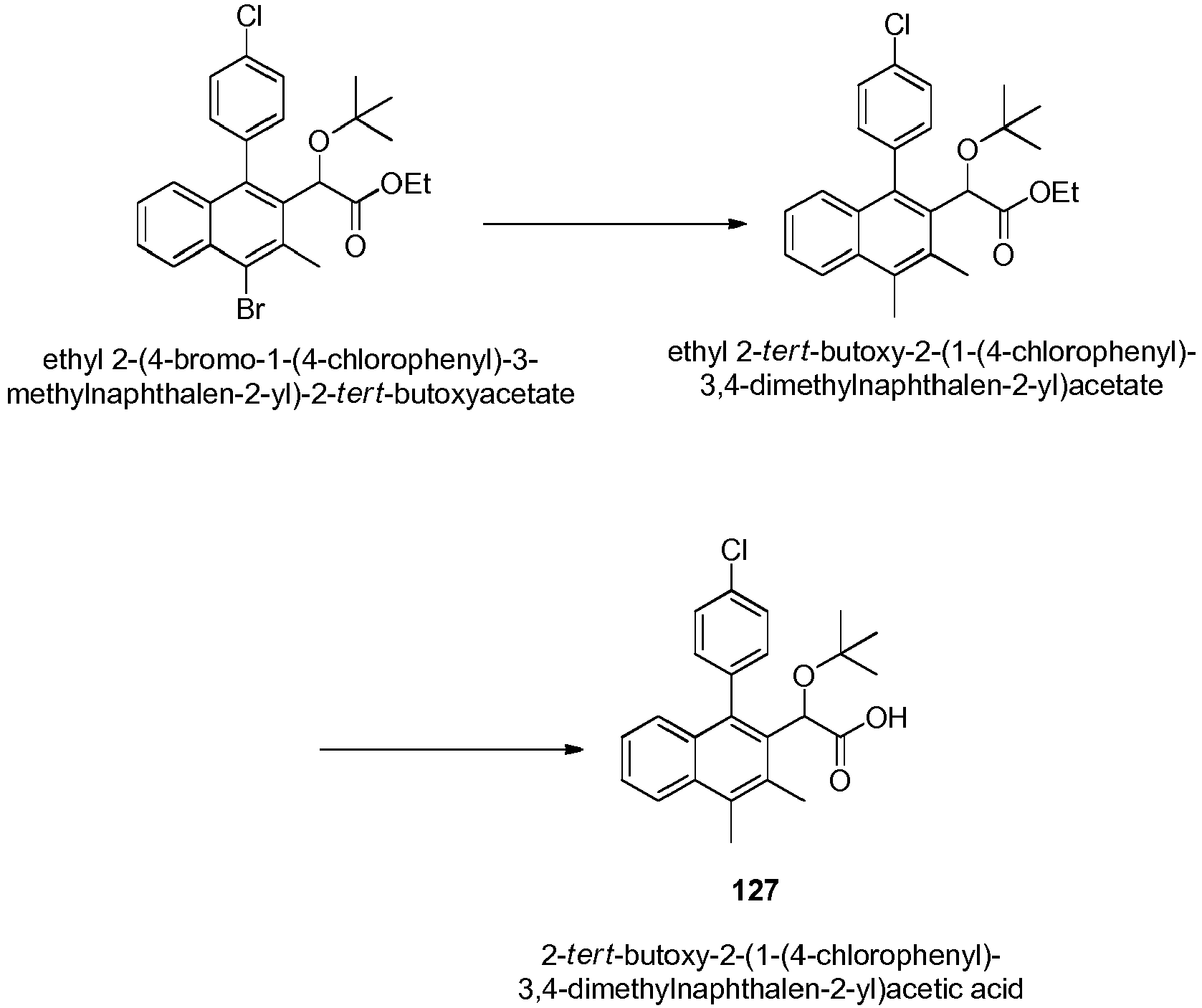
- Preparation of ethyl 2-tert-butoxy-2-(1-(4-chlorophenyl)-3,4-dimethylnaphthalen-2-yl)acetate: A suspension of ethyl 2-(4-bromo-1-(4-chlorophenyl)-3-methylnaphthalen-2-yl)-2-tert-butoxyacetate (25 mg, 51 µmol), trimethylboroxine (21 µL, 0.153 mmol), PdCl2(dppf) (3.7 mg, 5.1 µmol), K2CO3 (70 mg, 0.510 mmol), PhMe (500 µL), EtOH (absolute, 250 µL), and H2O (250 µL) was stirred in a sealed vessel at 100 °C for 3 h. The reaction was cooled to 23 °C, diluted with H2O and extracted with EtOAc (3x). Combined organic phases were dried (Na2SO4), filtered, and concentrated, giving crude product. (Yield was not found). 1H NMR (400 MHz, CD3OD) δ 8.08 (d, J = 8.2 Hz, 1H), 7.48-7.44 (m, 3H), 7.29-7.26 (m, 4H), 5.15 (s, 1H), 4.20-4.12 (m, 2H), 2.65 (s, 3H), 2.55 (s, 3H), 1.21 (t, J = 7 Hz, 3H), 1.00 (s, 9H).
- Preparation of 2-tert-butoxy-2-(1-(4-chlorophenyl)-3,4-dimethylnaphthalen-2-yl)acetic acid (127): A solution of the crude ethyl 2-tert-butoxy-2-(1-(4-chlorophenyl)-3,4-dimethylnaphthalen-2-yl)acetate in THF (500 µL), EtOH (Absolute, 250 µL), and H2O (250 µL) was treated with LiOH monohydrate (61 mg, 1.45 mmol) and heated to 100 °C in a sealed vessel for 4 h. The reaction was cooled to 23 °C, filtered through a 0.45 micron filter, and directly purified by reverse phase HPLC (Gemini, 5 to 100% ACN/H2O + 0.1% TFA). The product-containing fractions were combined and lyophilized, giving the title compound (parent form)(8.0 mg, 40% over 2 steps). 1H NMR (400 MHz, DMSO-d 6) δ 12.73 (s, broad, 1H), 8.15 (d, J = 8.2 Hz, 1H), 7.72-7.62 (m, 2H), 7.57-7.47 (m, 2H), 7.39-7.32 (m, 2H), 7.19 (d, J = 8.2 Hz, 1H), 5.07 (s, 1H), 2.63 (s, 3H), 2.51 (s, 3H), 0.93 (s, 9H).
LCMS-ESI- (m/z): [M-H]- calcd for C48H48Cl2NaO6: 813.3; Found: 813.2. -

- Preparation of 2-tert-butoxy-2-(1-(4-chlorophenyl)-3-methyl-4-vinylnaphthalen-2-yl)acetic acid (128): 2-tert-butoxy-2-(1-(4-chlorophenyl)-3-methyl-4-vinylnaphthalen-2-yl)acetic acid (128) was prepared in a similar manner as 2-(4-bromo-1-(4-chlorophenyl)-3-methylnaphthalen-2-yl)-2-tert-butoxyacetic acid of Example 125, except using potassium vinyltrifluoroborate in the Suzuki coupling reaction, giving the title compound (parent form). 1H NMR (400 MHz, DMSO-d 6) δ 12.78 (s, broad, 1H), 8.13 (d, J = 8.2 Hz, 1H), 7.73-7.65 (m, 2H), 7.54-7.48 (m, 2H), 7.41-7.36 (m, 2H), 7.20 (d, J = 8.2 Hz, 1H), 7.11 (dd, J = 18.0, 11.7 Hz, 1H), 5.87 (d, J = 11. 4 Hz, 1H), 5.41 (d, J = 18.0 Hz, 1H), 5.09 (s, 1H), 2.50 (s, 3H), 0.94 (s, 9H). LCMS-ESI- (m/z): [2M-2H+Na]- calcd for C50H48Cl2NaO6: 839.3; Found: 839.2.
-

- Preparation of 2-tert-butoxy-2-(1-(4-chlorophenyl)-4-ethyl-3-methylnaphthalen-2-yl)acetic acid (129): A suspension of 2-tert-butoxy-2-(1-(4-chlorophenyl)-3-methyl-4-vinylnaphthalen-2-yl)acetic acid (5.0 mg, 12 µmol), 5% w/w Rh/Al2O3 (10 mg), and EtOH (absolute, 2.0 mL) was evacuated and purged several times (vaccuum/H2 balloon). The suspension was rapidly stirred under a balloon of H2 for 6 h. H2O (500 µL) was added and the reaction was filtered through a 0.45 micron filter. The filtrate was directly purified by reverse phase HPLC (Gemini, 5 to 100% ACN/H2O + 0.1% TFA). The product-containing fractions were combined and lyophilized, giving the title compound (parent form) 1H NMR (400 MHz, DMSO-d 6) δ 12.71 (s, broad, 1H), 8.13 (d, J = 8.2 Hz, 1H), 7.70-7.62 (m, 2H), 7.60-7.47 (m, 2H), 7.34-7.33 (m, 2H), 7.20 (d, J = 8.2 Hz, 1H), 5.06 (s, 1H), 3.40-3.20 (m, 2H), 1.25 (t, J = 7.4 Hz, 3H), 0.93 (s, 9H). LCMS-ESI- (m/z): [2M-2H+Na]- calcd for C50H52Cl2NaO6: 841.3; Found: 841.3.
-

- Preparation of ethyl 2-tert-butoxy-2-(1-(4-chlorophenyl)-4-formyl-3-methylnaphthalen-2-yl)acetate (130): A solution of ethyl 2-(4-bromo-1-(4-chlorophenyl)-3-methylnaphthalen-2-yl)-2-tert-butoxyacetate (75 mg, 0.153 mmol), K2CO3 (317 mg, 2.29 mmol), PdCl2(dppf) (11.2 mg, 15.3 µmol), and potassium vinyltrifluoroborate (103 mg, 0.766 mmol) in H2O (500 µL), EtOH (absolute, 500 µL), and PhMe (1.0 mL) was heated to 100 °C for 4 h in a sealed vessel. The reaction was cooled to 23 °C, diluted with H2O (30 mL), and extracted with EtOAc (3x). Combined organic phases were dried (Na2SO4), filtered, concentrated, and evaporated from MeOH in vacuo (2x). The residue was treated with MeOH (3.0 mL), and DCM (3.0 mL), and cooled to -78 °C. The solution was sparged with ozone in O2 for 5 min. After 10 min past the end of the sparge, the reaction was treated with DMS (100 µL) and warmed to 0 °C. 10% Na2S2O3 (2.0 mL) was added, and the reaction was stirred at 23 °C for several minutes. The reaction was diluted with H2O and DCM, then filtered over Celite. The filtrate was extracted with DCM (2x). Organic phases were combined, dried (Na2SO4), filtered, and concentrated. DCM was added, and the solution was wet-loaded onto a 12 g "gold" ISCO silica gel column and purified by flash chromatography (ethyl acetate/hexanes 3:97 isocratic) giving the desired product (34 mg, 51% yield). 1H NMR (400 MHz, DMSO-d 6) δ 11.01 (s, 1H), 8.73 (d, J = 8.2 Hz, 1H), 7.56-7.22 (m, 7H), 5.16 (s, 1H), 4.24-4.12 (m, 2H), 2.81 (s, 3H), 1.23 (t, J = 7.0 Hz, 3H), 1.00 (s, 9H).
-

- Preparation of 2-tert-butoxy-2-(1-(4-chlorophenyl)-4-(3-(dimethylamino)prop-1-ynyl)-3-methylnaphthalen-2-yl)acetic acid (131): A solution of ethyl 2-(4-bromo-1-(4-chlorophenyl)-3-methylnaphthalen-2-yl)-2-tert-butoxyacetate (40 mg, 81.7 µmol), N,N-dimethylpropargylamine (26 µL, 0.245 mmol), PdCl2(PPh3)2 (5.7 mg, 16.3 µmol), CuI (3.1 mg, 16.3 µmol) and THF (1.00 mL) was heated to 70 °C for 18 h in a sealed vessel. Conversion was incomplete, so the vessel was charged with more PdCl2(PPh3)2 (5.7 mg, 16.3 µmol) and CuI (3.1 mg, 16.3 µmol) and heated to 100 °C for an additional 26 h. The reaction was cooled to 23 °C. THF (1.0 mL), EtOH (absolute, 500 µL), and H2O (500 µL) were added followed by LiOH monohydrate (100 mg, 2.37 mmol). The reaction was heated to 100 °C for 4 h. After cooling to 23 °C, the crude reaction was filtered through a 0.45 micron filter, and directly purified by reverse phase HPLC (Gemini, 5 to 100% ACN/H2O + 0.1% TFA). The product-containing fractions were combined and lyophilized, giving the title compound (mono trifluoroacetic acid salt)(6.8 mg, 15%). 1H NMR (400 MHz, DMSO-d 6) δ 12.92 (s, broad, 1H), 10.26 (s, broad, 1H), 8.30 (d, J = 8.6 Hz, 1H), 7.71-7.62 (m, 3H), 7.47-7.43 (m, 2H), 7.34 (d, J = 8.2 Hz, 1H), 7.22 (d, J = 8.6 Hz, 1H), 5.03 (s, 1H), 4.56 (s, 2H), 2.96 (s, 6H), 2.72 (s, 3H), 0.90 (s, 9H). 19F NMR (377 MHz, DMSO-d 6) δ -74.1 (s) LCMS-ESI+ (m/z): [M+H]+ calcd for C28H31ClNO3: 464.2; Found: 464.0.
-

- Preparation of 2-tert-butoxy-2-(1-(4-chlorophenyl)-4-(3-(dimethylamino)propyl)-3-methylnaphthalen-2-yl)acetic acid (132): 2-tert-butoxy-2-(1-(4-chlorophenyl)-4-(3-(dimethylamino)propyl)-3-methylnaphthalen-2-yl)acetic acid (132) was prepared in a manner similar to 2-tert-butoxy-2-(1-(4-chlorophenyl)-4-ethyl-3-methylnaphthalen-2-yl)acetic acid of Example 127, except using 2-tert-butoxy-2-(1-(4-chlorophenyl)-4-(3-(dimethylamino)prop-1-ynyl)-3-methylnaphthalen-2-yl)acetic acid. LCMS-ESI+ (m/z): [M+H]+ calcd for C28H35ClNO3: 468.2; Found: 468.2.
-

- Preparation of 2-tert-butoxy-2-(1-(4-chlorophenyl)-4-((dimethylamino)methyl)-3-methylnaphthalen-2-yl)acetic acid (133): A suspension of ethyl 2-tert-butoxy-2-(1-(4-chlorophenyl)-4-formyl-3-methylnaphthalen-2-yl)acetate (6.0 mg, 13.9 µmol), EtOH (absolute, 500 µL), NaBH(OAc)3 (8.8 mg, 41.7 µmol), and glacial AcOH (4 µL, 70 µmol) was treated with a solution of N,N-dimethylamine in MeOH (2 M, 35 µL, 69.5 µmol). DCM (50 µL) was added to improve solubility. The reaction was sealed and heated to 70 °C. Conversion was limited, so more N,N-dimethylamine in MeOH (2 M, 170 µL, 0.337 mmol), glacial AcOH (20 µL, 0.35 mmol), NaBH(OAc)3 (50 mg, 0.236 mmol), and DMF (500 µL) were added. Heating was continued. Once conversion was achieved, LiOH monohydrate (200 mg, 4.7 mmol) and H2O (1.0 mL) were added. The reaction was sealed and heated to 100 °C overnight. Afterward, the reaction was filtered through a 0.45 micron filter, and directly purified by reverse phase HPLC (Gemini, 5 to 100% ACN/H2O + 0.1 % TFA). The product-containing fractions were combined and lyophilized, giving the title compound (mono trifluoroacetic acid salt)(1.0 mg, 13%). LCMS-ESI+ (m/z): [M+H]+ calcd for C26H31ClNO3: 440.2; Found: 440.0.
-

- Preparation of 2-tert-butoxy-2-(1-(4-chlorophenyl)-3-methyl-4-(morpholinomethyl)naphthalen-2-yl)acetic acid (134): 2-tert-Butoxy-2-(1-(4-chlorophenyl)-3-methyl-4-(morpholinomethyl)naphthalen-2-yl)acetic acid (134) was prepared in a manner similar to 2-tert-butoxy-2-(1-(4-chlorophenyl)-4-((dimethylamino)methyl)-3-methylnaphthalen-2-yl) acetic acid of Example 131, except using morpholine in the reductive amination step. LCMS-ESI+ (m/z): [M+H]+ calcd for C28H33ClNO4: 482.2; Found: 482.0.
-

- Preparation of 2-tert-butoxy-2-(1-(4-chlorophenyl)-4-(hydroxymethyl)-3-methylnaphthalen-2-yl)acetic acid (135): A solution of ethyl 2-tert-butoxy-2-(1-(4-chlorophenyl)-4-formyl-3-methylnaphthalen-2-yl)acetate (6.0 mg, 14 µmol), NaBH4 (1.5 mg, 40 µmol), THF (250 µL), and EtOH (absolute, 500 µL) was stirred at 23 °C for 1 h. H2O (500 µL) and LiOH monohydrate (50 mg, 1.18 mmol) were added. The reaction was sealed and heated to 100 °C. After 2 h, the reaction cooled to 23 °C, filtered through a 0.45 micron filter, and directly purified by reverse phase HPLC (Gemini, 5 to 100% ACN/H2O + 0.1% TFA). The product-containing fractions were combined and lyophilized, giving the title compound (parent form)(2.6 mg, 43%). 1H NMR (400 MHz, DMSO-d 6) δ 12.76 (s, 1H), 8.27 (d, J = 8.6 Hz, 1H), 7.72-7.65 (m, 2H), 7.58-7.48 (m, 2H), 7.39-7.33 (m, 2H), 7.18 (d, J = 8.6 Hz, 1H), 5.07 (s, 1H), 5.01 (d, broad, J = 2.7 Hz, 2H), 2.62 (s, 3H), 0.94 (s, 9H).
LCMS-ESI- (m/z): [M-H]- calcd for C24H24ClO4: 411.1; Found: 410.9. -

- Preparation of 2-tert-butoxy-2-(1-(4-chlorophenyl)-3-methyl-4-phenylnaphthalen-2-yl)acetic acid (136): 2-tert-Butoxy-2-(1-(4-chlorophenyl)-3-methyl-4-phenylnaphthalen-2-yl)acetic acid (136) was prepared in a manner similar to 2-tert-butoxy-2-(1-(4-chlorophenyl)-3,4-dimethylnaphthalen-2-yl)acetic acid of Example 125 , except using benzeneboronic acid in the Suzuki reaction, giving the title compound (parent form). 1H-NMR: (400 MHz, MeOH- d4 ): δ 7.67-7.55 (m, 5H); 7.50-7.48 (m, 1H); 7.41-7.39 (m, 1H); 7.33-7.23 (m, 6H); 5.31 (s, 1H); 2.28 (s, 3H); 1.02 (s, 9H). LCMS-ESI- (m/z): [M-H]- calcd for C29H26ClO3: 457.2; Found: 457.2.
-

- Preparation of 2-tert-butoxy-2-(1-(4-chlorophenyl)-4-(6-(dimethylamino)pyridin-3-yl)-3-methylnaphthalen-2-yl)acetic acid (137): 2-tert-Butoxy-2-(1-(4-chlorophenyl)-4-(6-(dimethylamino)pyridin-3-yl)-3-methylnaphthalen-2-yl)acetic acid (137) was prepared in a manner similar to 2-tert-butoxy-2-(1-(4-chlorophenyl)-3,4-dimethylnaphthalen-2-yl)acetic acid of Example 125, except using 2-(N,N-dimethylamino)-pyridin-5-yl-boronic acid in the Suzuki reaction, giving the title compound. 1H-NMR: (400 MHz, DMSO- d6 ): δ 8.02-8.00 (m, 1H); 7.78 (m, broad, 1H); 7.72-7.69 (m, 1H); 7.67-7.65 (m, 1H); 7.52-7.49 (m, 1H); 7.45-7.36 (m, 4H); 7.23 (d, J=8.0 Hz, 2H); 5.11 (s, 1H); 2.29 (d, J=1.2 Hz, 3H); 0.93 (d, J=1.2 Hz, 9H). LCMS-ESI+ (m/z): [M+H]+ calcd for C30H32ClN2O3: 503.2; Found: 503.3.
-

- Preparation of 2-tert-butoxy-2-(1-(4-chlorophenyl)-3-methyl-4-(pyridin-3-yl)naphthalen-2-yl)acetic acid (138): 2-tert-butoxy-2-(1-(4-chlorophenyl)-3-methyl-4-(pyridin-3-yl)naphthalen-2-yl)acetic acid (138) was prepared in a manner similar to 2-tert-butoxy-2-(1-(4-chlorophenyl)-3,4-dimethylnaphthalen-2-yl)acetic acid of Example 125, except using pyridin-3-yl-boronic acid in the Suzuki reaction, giving the title compound (mono trifluoroacetic acid salt). 1H-NMR: (400 MHz, DMSO- d6 ): δ 12.8 (s, broad, 1H), 8.80 (d, J = 5.1 Hz, 1H), 8.62 (d, J = 12.9 Hz, 1H), 7.97-7.92 (m, 1H), 7.76-7.69 (m, 3H), 7.60-7.54 (m, 1H), 7.47-7.40 (m, 3H), 7.28 (d, J = 9.2 Hz, 1H), 7.18 (d, J = 9.4 Hz, 1H), 5.15 (s, 1H), 2.25 (s, 3H), 0.96 (s, 9H). 19F-NMR: (377 MHz, DMSO- d6 ): δ -74.7 (s) LCMS-ESI+ (m/z): [M+H]+ calcd for C28H27ClNO3: 460.2; Found: 460.2.
-

- Preparation of 2-tert-butoxy-2-(1-(4-chlorophenyl)-3-methyl-4-(pyrimidin-5-yl)naphthalen-2-yl)acetic acid (139): 2-tert-Butoxy-2-(1-(4-chlorophenyl)-3-methyl-4-(pyrimidin-5-yl)naphthalen-2-yl)acetic acid (139) was prepared in a manner similar to 2-tert-butoxy-2-(1-(4-chlorophenyl)-3,4-dimethylnaphthalen-2-yl)acetic acid of Example 125, except using pyrimidin-5-yl-boronic acid in the Suzuki reaction, giving the title compound (mono trifluoroacetic acid salt).1H-NMR: (400 MHz, DMSO- d6 ): δ 12.87 (s, broad, 1H), 9.39 (s, 1H), 8.89 -8.86 (m, 2H), 7.76-7.68 (m, 2H), 7.58-7.55 (s, 1H), 7.49-7.44 (m, 3H), 7.28 (d, J = 8.2 Hz, 1H), 7.20 (d, J = 8.2 Hz, 1H), 5.15 (s, 1H), 2.27 (s, 3H), 0.97 (s, 9H). 19F-NMR: (377 MHz, DMSO- d6 ): δ -73.9 (s) LCMS-ESI+ (m/z): [M+H]+ calcd for C27H26ClN2O3: 461.2; Found: 461.2.
-

- Preparation of 2-(1,4-bis(4-chlorophenyl)-3-methylnaphthalen-2-yl)-2-tert-butoxyacetic acid (140): 2-(1,4-bis(4-chlorophenyl)-3-methylnaphthalen-2-yl)-2-tert-butoxyacetic acid (140) was prepared in a manner similar to 2-tert-butoxy-2-(1-(4-chlorophenyl)-3,4-dimethylnaphthalen-2-yl)acetic acid of Example 125, except using 4-chlorobenzene boronic acid in the Suzuki reaction, giving the title compound (mono trifluoroacetic acid salt). 1H-NMR: (400 MHz, DMSO- d6 ): δ 12.82 (s, 1H), 7.75-7.63 (m, 4H), 7.55 (dd, J = 8.2, 2.4 Hz, 1H), 7.46-7.31 (m, 5H), 7.26-7.21 (m, 2H), 5.14 (s, 1H), 2.24 (s, 3H), 0.96 (s, 9H). LCMS-ESI- (m/z): [2M-2H+Na]- calcd for C58H50Cl4NaO6: 1007.2; Found: 1007.1.
-

- Preparation of 1-hydroxy-3-methyl-2-naphthonitrile: Phenyl-2-propanone (24.93 g, 0.178 mol) was combined with ethylcyanoacetate (19.8 mL, 0.180 mol), acetic acid (8.0 mL, 0.14 mol), ammonium acetate (2.82 g, 0.0370 mol) and 80 mL of benzene in a round bottom flask equipped with a Dean-Stark trap and condenser cooled by a chiller. The reaction was heated to 160 °C for 4 h. The mixture was removed from heat and the trap drained so that the mixture could be concentrated by distilling off excess (∼ 50 mL) benzene. The solution contained crude (E)-ethyl 2-cyano-3-methyl-4-phenylbut-2-enoate. The concentrated mixture was removed from heat and heat adjusted to 240 °C. Acetamide (50.9483 g, 0.862 mol) was added, and a Claisen head attached to distill any ethanol resulting while the mixture was heated at 240 °C for 60-90 minutes. The mixture was cooled to ∼ 100 °C, and poured into room temperature water to quench the reaction. A clumpy orange solid was formed, removed by filtration and triturated with ice cold absolute EtOH. The solid was filtered off and the process repeated 4 times to harvest additional material. The resulting product was a pale yellow fine powder (13.20 g, 36% yield). 1H-NMR: (300 MHz, DMSO- d6 ): δ 11.28 (s, 1H); 8.24 (d, J = 8.4 Hz, 1H); 7.80 (d, J = 8.0 Hz, 1H); 7.62-7.58 (m, 1H); 7.52-7.48 (m, 1H); 7.34 (s, 1H); 2.47 (s, 3H).
- Preparation of 4-bromo-1-hydro xy-3-methyl-2-naphthonitrile: 1-hydroxy-3-methyl-2-naphthonitrile (1.065 g, 5.8 mmol) was dissolved CHCl3 (24 mL) and combined with sodium bicarbonate (952 mg, 11.3 mmol) and bromine (330 µL, 6.43 mmol) and allowed to stir at room temperature overnight. The reaction was quenched by adding 10 mL of 10% sodium thiosulfate and the mixture stirred until decolorization was maximal. The solids were removed by filtration as crude product (1.47 g, 97% yield.) 1H-NMR: (300 MHz, DMSO- d6 ): δ 8.334 (d, J = 8.0 Hz, 1H); 8.166 (d, J = 8.4 Hz, 1H); 7.81-7.77 (m, 1H); 7.65-7.61 (m, 1H); 2.65 (s, 3H).
- Preparation of 4-bromo-2-cyanonaphthalen-1-yl perfluorobutanesulfonate: A dichloromethane solution (20 mL) of 4-bromo-1-hydroxy-3-methyl-2-naphthonitrile (518 mg, 1.97 mmol) was treated with triethylamine (800 µL, 5.37 mmol) at -78 °C. To this cooled solution was added nonafluorobutanesulfonic anhydride (1.10 g, 1.97 mmol) dropwise as a DCM emulsion. After 15 min reaction was allowed warm to room temp. Reaction was quenched with saturated sodium bicarbonate and allowed to stir at 23 °C overnight. The mixture diluted with DCM, washed with brine and chromatographed on silica gel using EtOAc and hexanes to give desired product (330 mg, 31 % yield) as well as recovered starting material (245 mg, 47% yield). 1H-NMR: (400 MHz, DMSO- d6 ): δ 8.42 (d, J = 8.4 Hz, 1H); 8.11 (d, J = 8.8 Hz, 1H); 8.05-8.01 (m, 1H); 7.99-7.95 (m, 1H); 2.81 (s, 3H).
- Preparation of 4-bromo-1-(4-chlorophenyl)-3-methyl-2-naphthonitrile: To a 50-50 (v/v) EtOH-toluene solution (4 mL) of 4-bromo-2-cyanonaphthalen-1-yl perfluorobutanesulfonate (3.99g, 7.33 mmol) in a 2-5 mL microwave vial was added 4-chlorophenylboronic acid (1.65 g, 10.55 mmol) and dichloro[1,1'-bis(diphenylphosphino)ferrocene]palladium(II) dichloromethane adduct (165 mg, 0.171 mmol) and 6 mL of 2 M K2CO3. The vial was sealed, and heated thermally at 60 °C for 30 minutes. The mixture was concentrated in vacuo, redissolved in EtOAc and washed with saturated NH4Cl and brine then dried with sodium sulfate and concentrated. The residue was chromatographed on silica gel using EtOAc and hexanes to give a mixture of products. This mixture was then purified by hot filtration using neat hexanes (50 mL) to give rise to desired pure product (731 mg, 28 % yield). A second crop (600 mg) was obtained by repeating the hot filtration that was contaminated with starting material. 1H-NMR: (400 MHz, MeOH- d4 ): δ 8.361 (d, J=8.4Hz, 1H); 7.89-7.85 (m, 1H); 7.69-7.62 (m, 3H); 7.56-7.49 (m, 3H); 2.81 (s, 3H).
- Preparation of 4-bromo-1-(4-chlorophenyl)-3-methyl-2-naphthaldehyde: DIBAL-H (11.2 ml, 1.0 M in DCM) was added to a -40 °C DCM solution of 4-bromo-1-(4-chlorophenyl)-3-methyl-2-naphthonitrile (2.01 g, 5.63 mmol) slowly. The mixture was allowed to stir and gradually rise to 23 °C over 3-4 hours. The mixture was then cooled back to 0 °C and quenched with the addition of EtOAc (15 mL, 18.9 mmol) and stirred with vigor for 20-30 minutes. This mixture was poured into 30 mL of saturated NH4Cl, and stirred 10-15 minutes. After being filtered though a short pad of Celite followed by extraction with DCM, the extracts were dried with sodium sulfate and concentrated in vacuo. Chromatography on silica gel using EtOAc in hexanes gave rise to desired aldehyde (1.56 g, 77% yield). 1H-NMR: (400 MHz, DMSO- d6 ): δ 9.81 (s, 1H); 8.36 (d, J=8.8Hz, 1H); 7.83-7.79 (m, 1H); 7.64-7.62 (m, 1H); 7.60-7.56 (m, 2H); 7.44-7.39 (m, 3H); 2.775 (s, 3H).
- Preparation 1-(4-bromo-1-(4-chlorophenyl)-3-methylnaphthalen-2-yl)prop-2-en-1-ol (141): To a 0 °C THF (15 mL) solution of 4-bromo-1-(4-chlorophenyl)-3-methyl-2-naphthaldehyde (500 mg, 1.39 mmol) was added vinyl magnesium bromide (1.40 mL, 1 M in THF, 1.4 mmol) and the mixture allowed to stir and warm to 23 °C for 4 hours. Reaction was quenched by the addition of 10 mL of saturated aqueous NH4Cl and extracted with ethyl acetate. Extracts were dried with sodium sulfate, concentrated in vacuo and chromatographed on silica gel using EtOAc in hexanes to give desired product (401.8 mg, 75% yield). 1H-NMR: (400 MHz,CDCl3): δ 8.40 (d, J=8.8 Hz, 1H); 7.57-7.53 (m, 1H); 7.50-7.44 (m, 2H); 7.36-7.32 (m, 1H); 7.25-7.15 (m, 4H); 6.18-6.10 (m, 1H); 5.42-5.40 (m, 1H); 5.19-5.03 (m, 2H); 2.79 (s, 3H).
-

- Preparation of (1-(4-bromo-1-(4-chlorophenyl)-3-methylnaphthalen-2-yl)allyloxy)(tert-butyl)dimethylsilane: To a stirring 23 °C DCM solution (32 mL) of 1-(4-bromo-1-(4-chlorophenyl)-3-methylnaphthalen-2-yl)prop-2-en-1-ol (1.47 g, 3.79 mmol) and triethylamine (2.3 mL, 16.5 mmol) was added TBDMS-OTf (2.0 mL, 11.65 mmol) and the reaction was stirred and monitored by TLC. After 45 minutes, an additional 2 mL of TBDMSOTf was added and the mixture allowed to stir overnight. The dark mixture was then quenched 10% NaHCO3 and the color dissipated. The mixture was washed with brine, dried with sodium sulfate and concentrated in vacuo. Column chromatography using silica gel with EtOAc in hexanes gave desired silylated product (1.60 g, 84% yield). 1H-NMR: (400 MHz,CDCl3): δ 8.39 (d, J = 8.4 Hz, 1H); 7.55-745 (m, 3H); 7.34-7.30 m, 1H); 7.26-7.24 (m, 1H); 7.24-7.18 (d, J = 8.0 Hz, 1H); 7.16-7.14 (m, 1H); 6.09-6.01 (m, 1H); 5.32-5.30 (m, 1H); 5.13-5.03 (m, 2H); 2.77 (s, 3H); 0.87 (s, 6H); 0.83 (s, 9H).
- Preparation of 2-(4-bromo-1-(4-chlorophenyl)-3-methylnaphthalen-2-yl)-2-(tert-butyldimethylsilyloxy)acetaldehyde: A -78 °C 50-50 (v/v) (MeOH/DCM) solution of (1-(4-bromo-1-(4-chlorophenyl)-3-methylnaphthalen-2-yl)allyloxy)(tert-butyl)dimethylsilane (1.6 g, 3.19 mmol) was ozonolyzed for 5-10 minutes. The mixture was quenched with the addition of 1 mL of DMS to and then allowed to warm to 23 °C. After being diluted with DCM, the mixture was washed with 10% aqueous Na2S2O3 (5 x 20 mL), dried with sodium sulfate and concentrated in vacuo. Silica gel chromatography using EtOAc in Hexanes gave rise to desired aldehyde (1.27 g, 79% yield). 1H-NMR: 400 MHz, (CDCl3): δ: 9.94 (s, 1H); 8.41-8.36 (d, J = 8.0 Hz, 1H); 7.60-7.55 (m, 1H); 7.53-7.45 (m, 2H); 7.39-7.32 (m, 2H); 7.29-7.24 (m, 2H); 5.16 (s, 1H); 2.63 (s, 3H); 0.86 (m, 15H).
- Preparation of 2-(4-bromo-1-(4-chlorophenyl)-3-methylnaphthalen-2-yl)-2-(tert-butyldimethylsilyloxy)acetic acid: A DCM solution (8.0 mL) of 2-(4-bromo-1-(4-chlorophenyl)-3-methylnaphthalen-2-yl)-2-(tert-butyldimethylsilyl-oxy)acetaldehyde (0.65 g, 1.29 mmol) was combined with 2-methyl-2-butene (1.5 mL, 14.1 mmol), sodium dihydrogen phosphate (8.0 mL, 1.0 M) and sodium chlorite (1.37 g, 14.46 mmol) and stirred vigorously overnight. The mixture was diluted 200% with DCM, the acidity adjusted to pH ≤ 5 with 2 M NaHSO4 and extracted with DCM (3 x 20 mL). The extracts were combined dried and concentrated under vacuo. The crude mixture was observed to contain the desired carboxylic acid (0.741 g) according to 1H NMR analysis and was used without purification. 1H-NMR: (400 MHz, CD3OD): δ 8.35 (d, J = 8.4 Hz, 1H); 7.58-7.51 (m, 3H); 7.46-7.44 (m, 1H); 7.39-7.33 (m, 1H); 7.31-7.22 (m, 2H); 5.33 (s, 1H); 2.72 (s, 3H); 0.825 (s, 9H); -0.03 (s, 3H); -0.26 (s, 3H).
- Preparation of methyl 2-(4-bromo-1-(4-chlorophenyl)-3-methylnaphthalen-2-yl)-2-(tert-butyldimethylsilyloxy)acetate: Crude 2-(4-bromo-1-(4-chlorophenyl)-3-methylnaphthalen-2-yl)-2-(tert-butyldimethylsilyloxy)acetic acid 0.740 g, 1.4 mmol)was dissolved in 20 mL DCM-MeOH (50-50, v/v) and combined with TMS-diazomethane solution (7.0 mL, 2.0 M in hexanes) and allowed to stir 6 hrs at 23 °C. The reaction was cooled on ice and quenched by the slow addition of TFA (500 µL) which simultaneously removed the yellow color from the reaction mixture. Mixture was diluted with DCM and washed with brine, then dried and concentrated in vacuo. Purification by silica gel chromatography with EtOAc in hexanes provided purified material (537.8 mg, 78% yield) from the 2-(4-bromo-1-(4-chlorophenyl)-3-methylnaphthalen-2-yl)-2-(tert-butyldimethylsilyloxy)acetaldehyde. 1H-NMR: (400 MHz, MeOH- d4 ): δ 8.39 (d, J=8.0 Hz, 1H); 7.58-7.54 (m, 1H); 7.50-7.47 (m, 2H); 7.37-7.33 (m, 2H); 7.27-7.21 (m, 2H); 5.31 (s, 1H); 3.69 (s, 3H); 2.67 (s, 3H); 0.83 (s, 9H); -0.04 (s, 3H); -0.27 (s, 3H).
- Preparation of methyl 2-(4-bromo-1-(4-chlorophenyl)-3-methylnaphthalen-2-yl)-2-hydroxyacetate: Methyl 2-(4-bromo-1-(4-chlorophenyl)-3-methylnaphthalen-2-yl)-2-(tert-butyldimethylsilyloxy)acetate (537.8 mg, 1.01 mmol) was dissolved in 4.0 mL TFA and heated to 60 °C. The reaction was monitored by HPLC and turned dark quickly after addition of TFA. The reaction was completed after 1 h by HPLC, was removed from heat and diluted with toluene (20 mL) and concentrated in vacuo. This dilution/concentration was repeated twice more and the color was observed to diminished on each cycle. Purification via column chromatography using silica gel with EtOAc and heptane gave rise to desired product (297.9 mg, 0.71 mmol). 1H-NMR: (400 MHz, CDCl3): δ 10.34 (s, broad, 1H); 8.40 (d, J=8.0 Hz, 1H); 7.60-7.56 (m, 1H); 7.52-7.46 (m, 2H); 7.38-7.35 (m, 1H); 7.32-7.28 (m, 2H); 5.26 (s, 1H); 3.74 (s, 3H); 2.62 (s, 3H).
- Preparation of methyl 2-(4-bromo-1-(4-chlorophenyl)-3-methylnaphthalen-2-yl)-2-tert-butoxyacetate (142): Methyl 2-(4-bromo-1-(4-chlorophenyl)-3-methylnaphthalen-2-yl)-2-hydroxyacetate (298 mg, 0.71 mmol) was dissolved in t-BuOAc (18.0 mL, 134 mmol) and 7 drops of perchloric acid were added. The reaction was monitored by HPLC and TLC for progress. After 4.5 hours, the mixture was added to icy saturated NaHCO3 and stirred for 10-15 minutes. This mixture was extracted with EtOAc, extracts dried with sodium sulfate and concentrated in vacuo. Purification on silica gel using EtOAc in hexanes gave desired product as well as some starting material. 1H-NMR: (400 MHz, CDCl3): δ 8.39 (d, J=8.8 Hz, 1H); 7.57-7.48 (m, 3H); 7.45-7.42 (m, 1H); 7.35-7.31 (m, 1H); 7.28-7.18 (m, 2H); 5.20 (s, 1H); 3.70 (s, 3H); 2.72 (s, 3H); 0.99 (s, 9H).
-

- Preparation of 2-(4-(6-aminopyridin-3-yl)-1-(4-chlorophenyl)-3-methylnaphthalen-2-yl)-2-tert-butoxyacetic acid (143): 2-(4-(6-Aminopyridin-3-yl)-1-(4-chlorophenyl)-3-methylnaphthalen-2-yl)-2-tert-butoxyacetic acid (143) was prepared in a manner similar to 2-tert-butoxy-2-(1-(4-chlorophenyl)-3,4-dimethylnaphthalen-2-yl)acetic acid of Example 125 , except using methyl 2-(4-bromo-1-(4-chlorophenyl)-3-methylnaphthalen-2-yl)-2-tert-butoxyacetate as the starting material and 2-aminopyridin-5-yl-boronic acid pinacolate ester in the Suzuki reaction, giving the title compound (mono trifluoroacetic acid salt). 1H-NMR: (400 MHz, DMSO- d6 ): δ 8.06-7.86 (m, 4H), 7.76-7.68 (m, 2H), 7.56-7.37 (m, 5H), 7.26 (d, J = 8.6 Hz, 1H), 7.17-7.13 (m, 1H), 5.13 (s, 1H), 2.33 (s, 3H), 0.96 (s, 9H). 19F-NMR: (377 MHz, DMSO- d6 ): δ -74.2 (s). LCMS-ESI+ (m/z): [M+H]+ calcd for C28H28ClN2O3: 475.2; Found: 475.2.
-

- Preparation of 2-tert-butoxy-2-(1-(4-chlorophenyl)-3-methyl-4-(6-oxo-1,6-dihydropyridin-3-yl)naphthalen-2-yl)acetic acid (144): 2-tert-Butoxy-2-(1-(4-chlorophenyl)-3-methyl-4-(6-oxo-1,6-dihydropyridin-3-yl)naphthalen-2-yl)acetic acid (144) was prepared in a manner similar to 2-tert-butoxy-2-(1-(4-chlorophenyl)-3,4-dimethylnaphthalen-2-yl)acetic acid of Example 125 , except using methyl 2-(4-bromo-1-(4-chlorophenyl)-3-methylnaphthalen-2-yl)-2-tert-butoxyacetate as the starting material and 2-(1H)pyridone-5-yl-boronic acid pinacolate ester in the Suzuki reaction, giving the title compound (parent form). 1H-NMR: (400 MHz, DMSO- d6 ): δ 12.8 (s, broad, 1H), 11.8 (app. s, broad, 1H), 7.67-7.30 (m, 10H), 7.23 (d, J = 8.2 Hz, 1H), 5.11 (s, 1H), 2.36 (s, 3H), 0.95 (s, 9H). LCMS-ESI+ (m/z): [M+H]+ calcd for C28H27ClNO4: 476.2; Found: 476.2.
-

- Preparation of 2-(4-(2-aminopyrimidin-5-yl)-1-(4-chlorophenyl)-3-methylnaphthalen-2-yl)-2-tert-butoxyacetic acid (145): 2-(4-(2-Aminopyrimidin-5-yl)-1-(4-chlorophenyl)-3-methylnaphthalen-2-yl)-2-tert-butoxyacetic acid (145) was prepared in a manner similar to 2-tert-butoxy-2-(1-(4-chlorophenyl)-3,4-dimethylnaphthalen-2-yl)acetic acid of Example 125 , except using methyl 2-(4-bromo-1-(4-chlorophenyl)-3-methylnaphthalen-2-yl)-2-tert-butoxyacetate as the starting material and 2-aminopyrimidine-5-yl-boronic acidpinacolate ester in the Suzuki reaction, giving the title compound (mono trifluoroacetic acid salt form).
1H-NMR: (400 MHz, DMSO- d6 ): δ 12.8 (s, broad, 1H), 8.26-8.24 (m, 2H), 7.75-7.67 (m, 2H), 7.55 (dd, J = 7.8, 2.0 Hz, 1H), 7.53-7.41 (m, 4H), 7.24 (d, J = 8.2 Hz, 1H), 7.16 (s, broad, 2H), 5.13 (s, 1H), 2.34 (s, 3H), 0.95 (s, 9H). 19F-NMR: (400 MHz, DMSO- d6 ): δ 74.9 (s). LCMS-ESI+ (m/z): [M+H]+ calcd for C27H27ClN3O3: 476.2; Found: 476.2. -

- Preparation of 2-tert-butoxy-2-(1-(4-chlorophenyl)-3-methyl-4-(2-oxo-1,2-dihydropyrimidin-5-yl)naphthalen-2-yl)acetic acid (146): A suspension methyl 2-(4-bromo-1-(4-chlorophenyl)-3-methylnaphthalen-2-yl)-2-tert-butoxyacetate (10.5 mg, 22.1 µmol), [1H]pyrimidin-2-one-5-yl-boronic acid (25 mg, 0.11 mmol), PdCl2(dppf) (3.2 mg, 4.4 µmol), K2CO3 (46 mg, 0.33 mmol), PhMe (500 µL), EtOH (absolute, 250 µL), and H2O (250 µL) was heated to 100 °C for 30 min, but conversion was poor. The reaction was treated with glacial AcOH (60 µL, 1.05 mmol) and KF (40 mg, 0.688 mmol). More PdCl2(dppf) (3.2 mg, 4.4 µmol) and [1H]pyrimidin-2-one-5-yl-boronic acid (7 mg, 30 µmol) were added and the reaction was heated to 100 °C. After 2 h, the reaction was added to H2O (15 mL) and glacial AcOH (0.2 mL). The system was extracted with EtOAc (3x 10 mL). Combined organic phases were dried (Na2SO4), filtered, and concentrated. The crude material was treated with THF (750 µL), EtOH (absolute, 750 µL), H2O (500 µL), and LiOH monohydrate (50 mg 1.2 mmol). The suspension was heated to 100 °C for 30 min. The reaction was cooled to 23 °C, filtered through a 0.45 micron filter, and directly purified by reverse phase HPLC (Gemini, 5 to 100% ACN/H2O + 0.1% TFA). The product-containing fractions were combined and lyophilized, giving the title compound (parent form)(3.8 mg, 36% over 2 steps). 1H-NMR: (400 MHz, DMSO- d6 ): δ 12.8 (s, broad, 1H), 8.29 (app. s, broad, 1H), 7.75-7.68 (m, 2H), 7.58-7.44 (m, 4H), 7.43-7.38 (m, 2H), 7.25 (d, J = 8.2 Hz, 1H), 5.12 (s, 1H), 2.38 (s, 3H), 0.96 (s, 9H). LCMS-ESI+ (m/z): [M+H]+ calcd for C27H26ClN2O4: 477.2; Found: 477.2.
-

- Preparation of 2-tert-butoxy-2-(1-(4-chlorophenyl)-4-cyano-3-methylnaphthalen-2-yl)acetic acid (147): A suspension of methyl 2-(4-bromo-1-(4-chlorophenyl)-3-methylnaphthalen-2-yl)-2-tert-butoxyacetate (10.5 mg, 22.1 µmol), CuCN (9.8 mg, 0.11 mmol), and NMP (500 µL) was heated to 200 °C in a microwave. The reaction was cooled to 23 °C, treated with EtOH (2.5 mL), filtered through a 0.45 micron filter, and directly purified by reverse phase HPLC (Gemini, 5 to 100% ACN/H2O + 0.1% TFA). The product-containing fractions were combined and treated with LiOH monohydrate until the pH was distinctly basic. The mixture was concentrated with warming to remove most of the water and all of the CH3CN. The solution was treated with EtOH (absolute, 500 µL) and THF (1.0 mL). The suspension was stirred at 23 °C for 1 h. It was filtered through a 0.45 micron filter, and directly purified by reverse phase HPLC (Gemini, 5 to 100% ACN/H2O + 0.1% TFA). The product-containing fractions were combined and lyophilized, giving the title compound (parent form)(5.2 mg, 55% over 2 steps).
1H-NMR: (400 MHz, DMSO- d6 ): δ 13.12 (s, 1H), 8.16 (d, J = 8.2 Hz, 1H), 7.82 (dd, J = 7.8, 7.7 Hz, 1H), 7.77-7.70 (m, 2H), 7.60 (dd, J = 8.0, 80 Hz, 1H), 7.48 (d, J = 8.2 Hz, 1H), 7.43 (d, J = 8.2 Hz, 1H), 7.33 (d, J = 8.2 Hz, 1H), 5.07 (s, lh), 2.83 (s, 3H), 0.95 (s, 9H). LCMS-ESI- (m/z): [M-H]- calcd for C48H43Cl2N2O4: 813.3; Found: 813.3. -

- Preparation of ethyl 2-(7-chloro-1-hydroxy-3-methylnaphthalen-2-yl)-2-hydroxyacetate: Prepared in a manner similar to ethyl 2-(6-chloro-7-fluoro-1-hydroxy-3-methylnaphthalen-2-yl)-2-hydroxyacetate of Example 99 except using 1-(4-chlorophenyl)propan-2-one. 1H-NMR: (400 MHz, CDCl3): δ 8.42 (s, broad, 1H), 8.18 (d, J = 2.0 Hz, 1H), 7.59 (d, J = 8.6 Hz, 1H), 7.38 (dd, J = 8.6, 2.0 Hz, 1H), 7.18 (s, 1H), 5.68 (s, 1H), 4.33-4.10 (m, 2H), 2.53 (s, 3H), 1.20 (t, J = 7.0 Hz, 3H).
- Preparation of ethyl 2-tert-butoxy-2-(7-chloro-1-hydroxy-3-methyl-naphthalen-2-yl)acetate: Prepared in a similar manner to ethyl 2-tert-butoxy-2-(1-hydroxy-3-methylnaphthalen-2-yl)acetate of Example 120, except using ethyl 2-(7-chloro-1-hydroxy-3-methylnaphthalen-2-yl)-2-hydroxyacetate. 1H-NMR: (400 MHz, CDCl3): δ 9.01 (s, 1H), 8.22 (d, J = 2.0 Hz, 1H), 7.56 (d, J = 8.6 Hz, 1H), 7.35 (dd, J = 8.6, 2.0 Hz, 1H), 7.13 (s, 1H), 5.49 (s, 1H), 4.22-4.08 (m, 2H), 2.56 (s, 3H), 1.31 (s, 9H), 1.19 (t, J = 7.0 Hz, 3H).
- Preparation of ethyl 2-tert-butoxy-2-(7-chloro-3-methyl-1-(trifluoromethylsulfonyloxy)naphthalen-2-yl)acetate: Ethyl 2-tert-butoxy-2-(7-chloro-3-methyl-1-(trifluoromethylsulfonyloxy)naphthalen-2-yl)acetate was prepared in a similar manner to ethyl 2-(7-bromo-3-methyl-1-(trifluoromethylsulfonyloxy)-naphthalen-2-yl)-2-(4-methoxybenzyloxy)acetate of Example 67 , except using ethyl 2-tert-butoxy-2-(7-chloro-1-hydroxy-3-methylnaphthalen-2-yl)acetate. 1H-NMR: (400 MHz, CDCl3): δ 8.00 (d, J = 2.0 Hz, 1H), 7.73 (d, J = 8.6 Hz, 1H), 7.65 (s, 1H), 7.49 (dd, J = 8.6, 2.0 Hz, 1H), 5.72 (s, 1H), 4.26-4.08 (m, 2H), 2.54 (s, 3H), 1.20 (s, 9H), 1.17 (t, J = 7.0 Hz, 3H). 19F-NMR: (377 MHz, CDCl3): δ -73.2 (s)
- Preparation of ethyl 2-(7-chloro-1-(4-chlorophenyl)-3-methylnaphthalen-2-yl)-2-oxoacetate: Ethyl 2-(7-chloro-1-(4-chlorophenyl)-3-methylnaphthalen-2-yl)-2-oxoacetate was prepared in a similar manner to 2-(6-chloro-7-fluoro-3-methyl-1-(trifluoromethylsulfonyloxy)naphthalen-2-yl)-2-oxoacetate of Example 99 , except using ethyl 2-tert-butoxy-2-(7-chloro-3-methyl-1-(trifluoromethylsulfonyloxy) naphthalen-2-yl)acetate. 1H-NMR: (400 MHz, CDCl3): δ 8.05 (d, J = 2.0 Hz, 1H), 7.79 (d, J = 8.6 Hz, 1H), 7.74 (s, 1H), 7.58 (dd, J = 8.6, 2.0 Hz, 1H), 4.41 (q, J = 7.0 Hz, 2H), 2.48 (s, 3H), 1.40 (t, J = 7.0 Hz, 3H). 19F-NMR: (377 MHz, CDCl3): δ -73.2 (s)
- Preparation of ethyl 2-(7-chloro-1-(4-chlorophenyl)-3-methylnaphthalen-2-yl)-2-oxoacetate (148): Ethyl 2-(7-chloro-1-(4-chlorophenyl)-3-methylnaphthalen-2-yl)-2-oxoacetate (148) was prepared in a manner similar to ethyl 2-(7-bromo-1-(4-chlorophenyl)-3-methylnaphthalen-2-yl)-2-oxoacetate of Example 67, except using ethyl 2-(7-chloro-1-(4-chlorophenyl)-3-methylnaphthalen-2-yl)-2-oxoacetate. 1H-NMR: (400 MHz, CDCl3): δ 7.78 (d, J = 8.6 Hz, 1H), 7.73 (s, 1H), 7.50-7.22 (m, 6H), 4.12 (q, J = 7.0 Hz, 2H), 2.49 (s, 3H), 1.13 (t, J = 7.0 Hz, 3H).
-

- Preparation of ethyl 2-(7-chloro-1-(4-chlorophenyl)-3-methylnaphthalen-2-yl)-2-hydroxyacetate: A solution of ethyl 2-(7-chloro-1-(4-chlorophenyl)-3-methyl-naphthalen-2-yl)-2-oxoacetate (26 mg, 67 µmol) in EtOH (absolute, 1.0 mL) and DCM (1.0 mL) was treated with NaBH4 (5.1 mg, 0.134 mmol) at 23 °C. After 1 h, saturated NH4Cl (1.0 mL) was added. The reaction was stirred overnight, then diluted with H2O (10 mL). The mixture was extracted with DCM (3x), and the combined organics dried (Na2SO4), filtered, and concentrated, giving the title compound (28 mg, > 99% yield). 1H-NMR: (400 MHz, CDCl3): δ 7.72 (d, J = 8.6 Hz, 1H), 7.65 (s, 1H), 7.51-7.22 (m, 6H), 5.19 (s, 1H), 4.35-4.17 (m, 2H), 2.49 (s, 3H), 1.20 (t, J = 7.0 Hz, 3H).
- Preparation of ethyl 2-tert-butoxy-2-(7-chloro-1-(4-chlorophenyl)-3-methylnaphthalen-2-yl)acetate: Ethyl 2-tert-butoxy-2-(7-chloro-1-(4-chlorophenyl)-3-methylnaphthalen-2-yl)acetate was prepared in a manner similar to (S)-ethyl 2-tert-butoxy-2-(1-(4-chlorophenyl)-3-methyl-6-(trifluoromethylsulfonyl-oxy)naphthalen-2-yl)acetate of Example 51, except using racemic ethyl 2-(7-chloro-1-(4-chlorophenyl)-3-methylnaphthalen-2-yl)-2-hydroxyacetate. Material was carried on crude without further characterization.
- Preparation of 2-tert-butoxy-2-(7-chloro-1-(4-chlorophenyl)-3-methylnaphthalen-2-yl)acetic acid (149): 2-tert-Butoxy-2-(7-chloro-1-(4-chlorophenyl)-3-methylnaphthalen-2-yl)acetic acid (149) was prepared in a similar manner to 2-(4-bromo-1-(4-chlorophenyl)-3-methylnaphthalen-2-yl)-2-tert-butoxyacetic acid of Example 124 , except using ethyl 2-tert-butoxy-2-(7-chloro-1-(4-chlorophenyl)-3-methylnaphthalen-2-yl)acetate, giving the title compound (parent form) 1H-NMR: (400 MHz, DMSO- d6 ): δ 12.86 (s, broad, 1H), 7.94 (d, J = 8.0 Hz, 1H), 7.83 (s, 1H), 7.73-7.67 (m, 2H), 7.56-7.49 (m, 2H), 7.40 (d, J =8.2 Hz, 1H), 7.11 (d, J = 1.6 Hz, 1H), 5.00 (s, 1H), 2.57 (s, 3H), 0.93 (s, 9H). LCMS-ESI- (m/z): [M-H]- calcd for C23H21Cl2O3: 415.1; Found: 415.3.
-
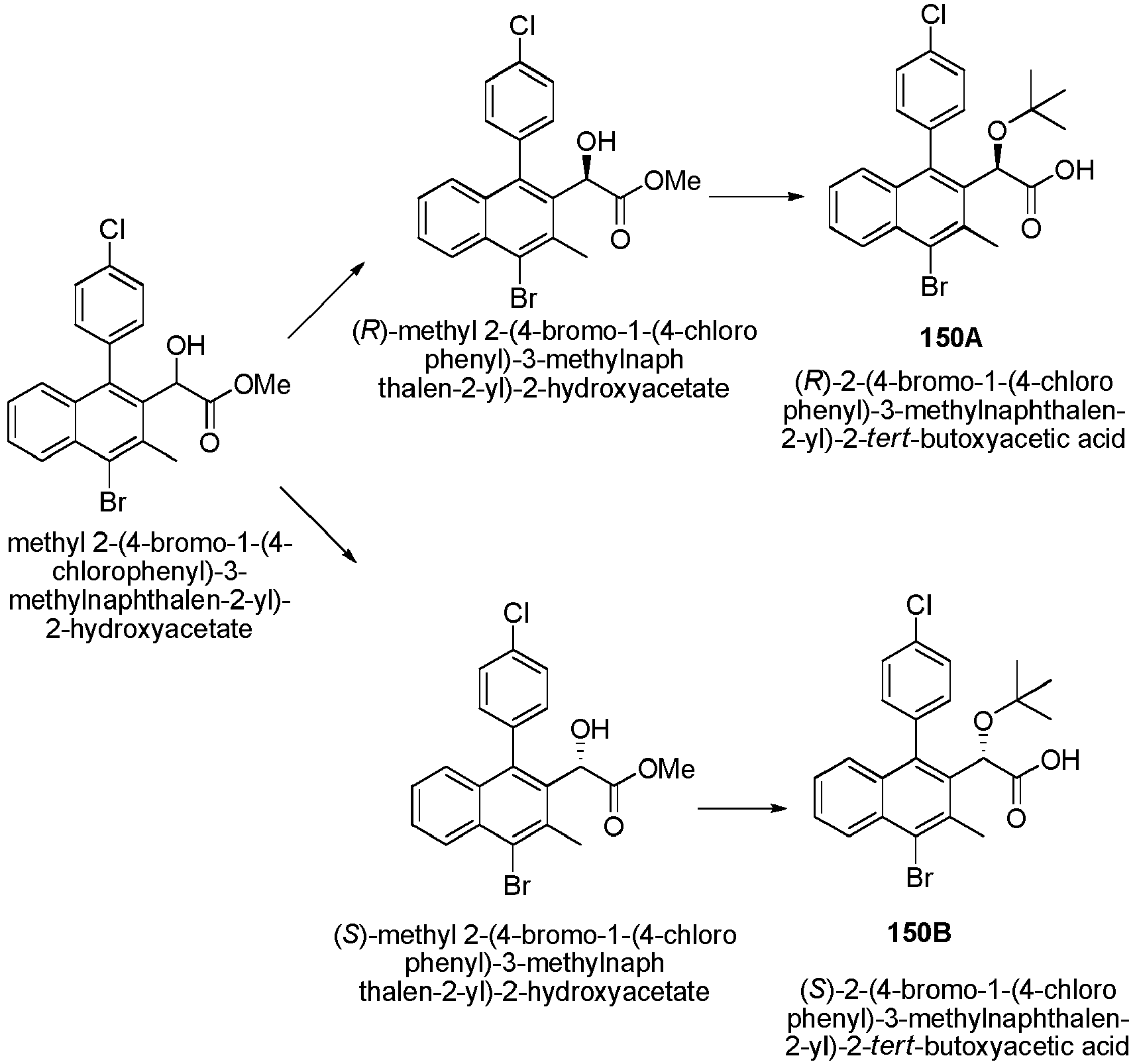
- Chiral chromatographic separation of the two enantiomers of methyl 2-(4-bromo-1-(4-chlorophenyl)-3-methylnaphthalen-2-yl)-2-hydroxyacetate: A solution of the racemate (36 mg) in MeOH/EtOH 1:1 v/v (1.8 mL total) was separated preparatively into its two enantiomers on an OJ-H packed chiral column, (R)-methyl 2-(4-bromo-1-(4-chlorophenyl)-3-methylnaphthalen-2-yl)-2-hydroxyacetate (6.1 mg).
1H-NMR: (400 MHz, CDCl3): δ 10.34 (s, broad, 1H); 8.40 (d, J=8.0 Hz, 1H); 7.60-7.56 (m, 1H); 7.52-7.46 (m, 2H); 7.38-7.35 (m, 1H); 7.32-7.28 (m, 2H); 5.26 (s, 1H); 3.74 (s, 3H); 2.62 (s, 3H). (S)-methyl 2-(4-bromo-1-(4-chlorophenyl)-3-methylnaphthalen-2-yl)-2-hydroxyacetate (4.8 mg) - Preparation of (R)-2-(4-bromo-1-(4-chlorophenyl)-3-methylnaphthalen-2-yl)-2-tert-butoxyacetic acid (150A): (R)-2-(4-Bromo-1-(4-chlorophenyl)-3-methylnaphthalen-2-yl)-2-tert-butoxyacetic acid (150A) was prepared in a similar manner to 2-(4-bromo-1-(4-chlorophenyl)-3-methylnaphthalen-2-yl)-2-tert-butoxyacetic acid of Example 124, except using (R)-methyl 2-(4-bromo-1-(4-chlorophenyl)-3-methylnaphthalen-2-yl)-2-hydroxyacetate, giving the title compound (parent form). 1H NMR (400 MHz, CD3OD) δ 8.38 (d, J = 8.6 Hz, 1H), 7.63-7.47 (m, 4H), 7.38-7.20 (m, 3H), 5.30 (s, 1H), 2.69 (s, 3H), 1.00 (s, 9H). LCMS-ESI- (m/z): [M-CO2-H]- calcd for C22H21BrClO: 415.2; Found: 415.0.
Preparation of (S)-2-(4-bromo-1-(4-chlorophenyl)-3-methylnaphthalen-2-yl)-2-tert-butoxyacetic acid (150B): (S)-2-(4-Bromo-1-(4-chlorophenyl)-3-methylnaphthalen-2-yl)-2-tert-butoxyacetic acid (150B) was prepared in a similar manner to 2-(4-bromo-1-(4-chlorophenyl)-3-methylnaphthalen-2-yl)-2-tert-butoxyacetic acid of Example 124, except using (S)-methyl 2-(4-bromo-1-(4-chlorophenyl)-3-methylnaphthalen-2-yl)-2-hydroxyacetate, giving the title compound (parent form). 1H NMR (400 MHz, CD3OD) δ 8.38 (d, J = 8.6 Hz, 1H), 7.63-7.47 (m, 4H), 7.38-7.20 (m, 3H), 5.30 (s, 1H), 2.69 (s, 3H), 1.00 (s, 9H). LCMS-ESI- (m/z): [M-CO2-H]- calcd for C22H21BrClO: 415.2; Found: 415.0. - Compounds 151-180 were prepared by similar methods as described in the above Examples.
Compound Number Compound Mass Measured mass 151 
490 490.33 152 
493.96 494.07 153 
537.59 538.03 154 
484.53 485.1 155 
502.54 503.1 156 
473.54 474.14 157 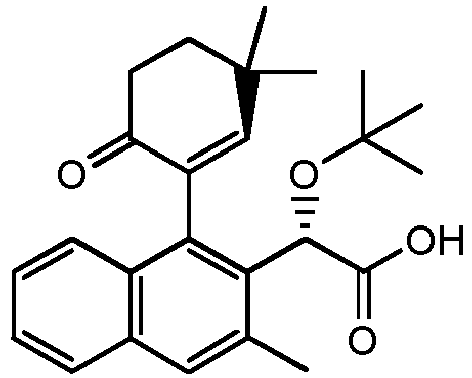
394.51 393.0 9(M - H) 158 
417.48 418.1 159 
417.48 418.1 160 
417.48 418.1 161 
441.53 442.1 162 
459.52 460.16 163 
475.97 473.91/475.48 164 
509.5 506.1 165 
488.6 489.1 166 
516.57 517.1 167 
501.6 502.1 168 
502.54 503.1 169 
484.53 485.1 170 
499.58 500.2 171 
494.96 494.4/496.1 172 
477.51 478.1 173 
477.51 478.1 174 
477.51 478.1 175 
467.49 468.1 176 
522.64 523.1 177 
475.97 474.37 178 
459.52 460.5 179 
459.52 460.4 180 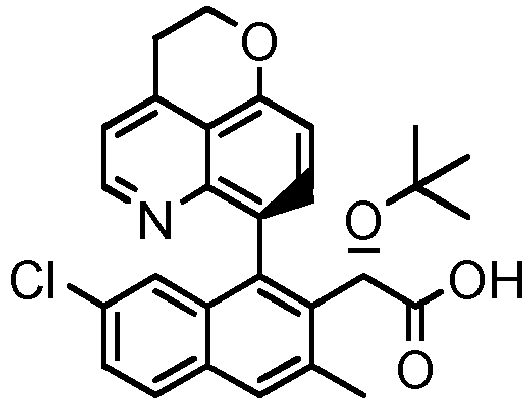
475.97 476.4 -

- Preparation of (S)-ethyl 2-tert-butoxy-2-(6-formyl-3-methyl-1-(trifluoromethyl-sulfonyloxy)naphthalen-2-yl)acetate: A solution of (S)-ethyl 2-tert-butoxy-2-(3-methyl-1-(trifluoromethylsulfonyloxy)-6-vinylnaphthalen-2-yl)acetate (0.60 g, 1.3 mmol, prepared similarly to (S)-ethyl 2-tert-butoxy-2-(7-fluoro-3-methyl-1-(trifluoromethylsulfonyloxy)-6-vinylnaphthalen-2-yl)acetate from Example 101) in THF (7 mL) at rt was treated with a previously prepared mixture of K2OsO4•2H2O (0.023 g, 0.063 mmol) and NaIO4 (0.81 g, 3.8 mmol) in water (5 mL). The resulting suspension becomes thick and opaque. After vigorous stirring for 20 min, the suspension is filtered through a pad of Celite, and the filtrate is washed with batches of EtOAc until white in color. The collected mother liquor is further diluted with water and EtOAc. Following separation, the aqueous layer is extracted with EtOAc until colorless. The combined organics are washed with brine, dried over anhydrous MgSO4 and concentrated in vacuo. The residue is purified by Yamazen column chromatography (15-35%EtOAc/hex) to afford 0.348 g (60%) of the desired material as a pale yellow amorphous solid. 1H-NMR: 400 MHz, (CDCl3) δ: 10.19 (s, 1H); 8.31 (br s, 1H); 8.16 (d, J = 8.8 Hz, 1H); 8.05 (dd, J = 8.8, 1.6 Hz, 1H); 7.85 (s, 1H); 5.76 (s, 1H); 4.28-4.10 (m, 2H); 2.61 (s, 3H); 1.22 (s, 9H); 1.18 (t, J = 7.2 Hz, 3H).
- Preparation of (S)-2-tert-butoxy-2-((R)-6-(difluoromethyl)-1-(2,3-dihydropyrano[4,3,2-de]quinolin-7-yl)-3-methylnaphthalen-2-yl)acetic acid (181): (S)-ethyl 2-tert-butoxy-2-(6-formyl-3-methyl-1-(trifluoromethylsulfonyl-oxy)naphthalen-2-yl)acetate was treated to a sequence of synthetic steps with appropriate adjustments for scale similar to the conversion of (S)-ethyl 2-tert-butoxy-2-(7-fluoro-6-formyl-3-methyl-1-(trifluoromethylsulfonyloxy)naphthalen-2-yl)acetate to (S)-2-tert-butoxy-2-((R)-6-(difluoromethyl)-1-(2,3-dihydropyrano [4,3,2-de]quinolin-7-yl)-7-fluoro-3-methylnaphthalen-2-yl)acetic acid in Example 101 to produce 0.039 g of the title compound (TFA salt) as an amorphous pale yellow powder. LCMS-ESI+ (m/z): [M+H]+ calcd for C29H28F2NO4: 492.2; found: 492.1. 1H-NMR: 400 MHz, (CD3OD) δ: 8.67 (d, J = 4.4 Hz, 1H); 8.13 (s, 1H); 8.08 (s, 1H); 7.85-7.99 (m, 2H); 7.46 (d, J = 8.8 Hz, 1H); 7.40 (d, J = 8.8 Hz, 1H); 7.07 (d, 8.8 Hz, 1H); 6.90 (t, JHF = 56 Hz, 1H); 5.26 (s, 1H); 4.77-4.69 (m, 2H); 3.67 (t, J = 6 Hz, 2H); 2.80 (s, 3H); 0.93 (s, 9H).
-

- Preparation of ethyl 2-(4-bromo-1-hydroxy-3-methylnaphthalen-2-yl)-2-tert-butoxyacetate: A solution of ethyl 2-tert-butoxy-2-(1-hydroxy-3-methylnaphthalen-2-yl)acetate (1.24 g, 3.92 mmol) in CHCl3 (20 mL) was treated with solid NaHCO3 (843 mg, 9.80 mmol). Then a solution of Br2 (750 mg, 4.70 mmol) in CHCl3 (5.0 mL) was added dropwise over 2 min at 23 °C. After 30 min, the reaction was treated with 10% Na2S2O3 solution (10 mL). After maximum decolorization was achieved, the reaction was diluted with H2O (10 mL) and extracted with DCM (3 x 10 mL). Combined organic phases were dried (Na2SO4), filtered, and concentrated. The residue was treated with DCM and wet-loaded onto a silica gel column and purified by flash chromatography (ethyl acetate/hexanes) giving the desired product (1.50 g, 97% yield). 1H NMR (400 MHz, CDCl3) δ 9.18 (s, 1H), 8.28 (d, J = 8.6 Hz, 1H), 8.20 (d, J = 8.6 Hz, 1H), 7.56 (dd, J = 8.6, 8.6 Hz, 1H), 7.45 (dd, J = 8.6, 8.6 Hz, 1H), 5.60 (s, 1H), 4.24-4.06 (m, 2H), 2.77 (s, 3H), 1.31 (s, 9H), 1.20 (t, J = 7.0 Hz, 3H).
- Preparation of ethyl 2-(4-bromo-3-methyl-1-(trifluoromethylsulfonyloxy) naphthalen-2-yl)-2-tert-butoxyacetate: A flask was charged with N-phenyl-trifluoromethanesulfonimide (2.70 g, 7.57 mmol), Cs2CO3 (2.47 g, 7.57 mmol), and THF (20 mL). A solution of ethyl 2-(4-bromo-1-hydroxy-3-methylnaphthalen-2-yl)-2-tert-butoxyacetate (1.50 g, 3.78 mmol) in THF (25 mL) was added with stirring at 23 °C. After 30 min, the reaction was added over 5 min to a premixed solution of 2 M NaHSO4 (30 mL) and saturated aq. Na2HPO4 (100 mL) at 23 °C. The system was extracted with EtOAc/hexane (10:1, 3 x 50 mL). Combined organic phases were dried (Na2SO4), filtered, concentrated, dissolved in hexane, and concentrated again. The residue was treated with benzene and wet-loaded onto a silica gel column and purified by flash chromatography (hexanes → ethyl acetate/hexanes 1:4) giving the desired product (1.37 g, 69% yield). 1H NMR (400 MHz, CDCl3) δ 8.41 (d, J = 8.8 Hz, 1H), 8.06 (d, J = 8.8 Hz, 1H), 7.70 (dd, J = 8.8, 8.8 Hz, 1H), 7.64 (dd, J = 8.8, 8.8 Hz, 1H), 5.77 (s, 1H), 4.28-.4.02 (m, 2H), 2.66 (s, 3H), 1.21 (s, 9H), 1.20 (t, J = 7.0 Hz, 3H). 19F NMR (377 MHz, CDCl3) δ -73.2 (s).
- Preparation ethyl 2-(4-bromo-3-methyl-1-(trifluoromethylsulfonyloxy) naphthalen-2-yl)-2-hydroxyacetate: A solution of ethyl 2-(4-bromo-3-methyl-1-(trifluoromethylsulfonyloxy)naphthalen-2-yl)-2-tert-butoxyacetate (1.37 g, 2.60 mmol) in DCM (30 mL) was treated with TFA (3.0 mL) at 23 °C. After 2 h, the reaction was diluted with H2O (30 mL). The organic phase was collected and the aqueous layer was extracted with DCM (2 x 20 mL). Combined organic layers were dried (Na2SO4), filtered, and concentrated giving the desired product as a crude residue (1.22 g), which was immediately used in the next reaction without further purification. 1H NMR (400 MHz, CDCl3) δ 8.41 (d, J = 8.2 Hz, 1H), 8.09 (d, J = 8.2 Hz, 1H), 7.71 (dd, J = 8.2, 8.2 Hz, 1H), 7.66 (dd, J = 8.2, 8.2 Hz, 1H), 5.84 (s, 1H), 4.34-4.20 (m, 2H), 2.63 (s, 3H), 1.22 (t, J = 7.0 Hz, 3H). 19F NMR (377 MHz, CDCl3) δ -73.0 (s).
- Preparation of ethyl 2-(4-bromo-3-methyl-1-(trifluoromethyl-sulfonyloxy) naphthalen-2-yl)-2-oxoacetate: A solution of ethyl 2-(4-bromo-3-methyl-1-(trifluoromethylsulfonyloxy)naphthalen-2-yl)-2-hydroxyacetate (crude, 1.22 g, ∼2.60 mmol) in DCM (60 mL) was treated with Dess-Martin periodinane (1.32 g, 3.12 mmol) at 23 °C. After 30 min, 10% Na2S2O3 (30 mL) was added at 23 °C. The system was diluted with H2O (20 mL) and extracted with DCM (3 x 30 mL). Combined organic layers were dried (Na2SO4), filtered, and concentrated. The residue was treated with benzene, filtered, and wet-loaded onto a silica gel column and purified by flash chromatography (ethyl acetate/hexanes) giving the desired product (1.18 g, 98% yield over 2 steps from ethyl 2-(4-bromo-3-methyl-1-(trifluoromethylsulfonyloxy)naphthalen-2-yl)-2-tert-butoxyacetate). 1H NMR (400 MHz, CDCl3) δ 8.43 (d, J = 8.6 Hz, 1H), 8.13 (d, J = 8.2 Hz, 1H), 7.77 (dd, J = 8.6, 8.2 Hz, 1H), 7.71 (dd, J = 8.6, 8.6 Hz, 1H), 4.42 (q, J = 7.0 Hz, 2H), 2.57 (s, 3H), 1.39 (t, J = 7.0 Hz, 3H). 19F NMR (377 MHz, CDCl3) δ -73.3 (s).
- Preparation of (S)-ethyl 2-(4-bromo-3-methyl-1-(trifluoromethylsulfonyl-oxy)naphthalen-2-yl)-2-hydroxyacetate: A solution of ethyl 2-(4-bromo-3-methyl-1-(trifluoromethylsulfonyloxy)naphthalen-2-yl)-2-oxoacetate (1.18 g, 2.52 mmol) in PhMe (20 mL) was cooled to -40 °C (dry ice/CH3CN). (R)-CBS catalyst (140 mg, 0.504 mmol) was introduced, followed by distilled catecholborane (neat, 402 µL, 3.77 mmol) over a 5 min period. After 30 min, the reaction was warmed to ∼ -20 °C. EtOAc (20 mL) was added. Then 15% Na2CO3 (10 mL) was added. The reaction was stirred vigorously as it was warmed to 23 °C overnight. The next day, the organic phase was washed (with vigorous stirring) with more 15% Na2CO3 (10 mL portions for 30 min each) until the washes were colorless. After the fifth wash, the organic phase was washed once with saturated NH4Cl (10 mL) for 10 min, then dried (MgSO4) filtered, and concentrated. The residue was dissolved in hexane and re-concentrated. The residue was treated with benzene, filtered, and wet-loaded onto a silica gel column and purified by flash chromatography (ethyl acetate/hexanes) giving the desired product (886 mg, 75% yield). 1H NMR (400 MHz, CDCl3) δ 8.41 (d, J = 8.2 Hz, 1H), 8.09 (d, J = 8.6 Hz, 1H), 7.71 (dd, J = 8.6, 8.2 Hz, 1H), 7.66 (dd, J = 8.6, 8.6 Hz, 1H), 5.84 (d, J = 2.4 Hz, 1H), 4.34-4.20 (m, 2H), 3.41 (d, J = 2.4 Hz, 1H), 2.63 (s, 3H), 1.22 (t, J = 7.0 Hz, 3H). 19F NMR (377 MHz, CDCl3) δ -73.0 (s).
- Preparation of (S)-ethyl 2-(4-bromo-3-methyl-1 (trifluoromethylsulfonyloxy naphthalen-2-yl)-2-tert-butoxyacetate: A solution of (S)-ethyl 2-(4-bromo-3-methyl-1-(trifluoromethylsulfonyloxy)naphthalen-2-yl)-2-hydroxyacetate (880 mg, 1.87 mmol) in tert-butyl acetate (20 mL) was treated with 70% HClO4 (40 µL) at 23 °C. After 5 h, the reaction was added slowly over 5 min to saturated NaHCO3 (50 mL) at 23 °C. The system was stirred for 10 min, then extracted with DCM (3 x 20 mL). Combined organic layers were dried (Na2SO4), filtered, and concentrated. The residue was treated with hexane and concentrated once more. The residue was treated with benzene, filtered, and wet-loaded onto a silica gel column and purified by flash chromatography (ethyl acetate/hexanes) giving the desired product (816 mg, 83% yield). 1H NMR (400 MHz, CDCl3) δ 8.40 (d, J = 7.8 Hz, 1H), 8.06 (d, J=7.8 Hz, 1H), 7.70-7.58 (m, 2H), 5.77 (s, 1H), 4.27-4.09 (m, 2H), 2.66 (s, 3H), 1.21 (s, 9H), 1.20 (t, J = 7.0 Hz, 3H). 19F NMR (377 MHz, CDCl3) δ -73.2 (s).
- Preparation of (S)-ethyl 2-tert-butoxy-2-(4-carbamoyl-3-methyl-1-(trifluoromethylsulfonyloxy)naphthalen-2-yl)acetate (182): A solution of (S)-ethyl 2-(4-bromo-3-methyl-1 (trifluoromethylsulfonyloxy)naphthalen-2-yl)-2-tert-butoxyacetate (200 mg, 0.380 mmol) in dry THF (7.6 mL) was cooled to -78 °C. tert-butyllithium (1.7 M in pentane, 446 µL, 0.759 mmol) was added dropwise under N2 over 3 min. 10 min later, trimethylsilylisocyanate (62.0 µL, 0.456 mmol) was quickly added. The reaction was warmed to 23 °C. After 1 h, the system was treated with glacial AcOH (87.0 µL, 1.52 mmol) followed by EtOH (absolute, 1.9 mL). The reaction was stirred for 30 min then diluted with saturated NaHCO3 (20 mL) and H2O (10 mL). The system was extracted with DCM (3 x 15 mL). Combined organic phases were dried (Na2SO4), filtered, and concentrated. The residue was treated with benzene and wet-loaded onto a silica gel column and purified by flash chromatography (ethyl acetate/hexanes) giving the desired product (75 mg, 40% yield.) 1H NMR (400 MHz, CDCl3) δ 8.10-8.05 (m, 1H), 7.96-7.86 (m, 1H), 7.64-7.58 (m, 2H), 6.19 (s, broad, 1H), 6.06 (s, broad, 1H), 5.75 (s, 1H), 4.30-4.07 (m, 2H), 2.53 (s, 3H), 1.21 (s, 9H), 1.20 (t, J = 7.0 Hz, 3H). 19F NMR (377 MHz, CDCl3) δ -73.2 (s).
-

- Preparation of (S)-ethyl 2-tert-butoxy-2-((R)-4-carbamoyl-1-(2,3-dihydropyrano [4,3,2-de]quinolin-7-yl)-3-methylnaphthalen-2-yl)acetate: A vessel was charged with 2,3-dihydropyrano[4,3,2-de]quinolin-7-ylboronic acid, monohydrochloride (49 mg, 0.193 mmol), S-Phos-palladacycle (22 mg, 32.2 µmol), and CsF (108 mg, 0.708 mmol). The vessel was evacuated under vacuum and backfilled with argon. A solution of (S)-ethyl 2-tert-butoxy-2-(4-carbamoyl-3-methyl-1-(trifluoromethylsulfonyloxy)naphthalen-2-yl)acetate (182, 79 mg, 0.161 mmol) in 1,2-DME (distilled from Na0/benzophenone, 1.4 mL) was added. The vessel was sealed and heated with vigorous stirring to 120 °C for 3 h. The reaction was cooled to 23 °C and diluted with brine (8 mL) and H2O (8 mL). The system was extracted with DCM (3 x 15 mL). Combined organic layers were dried (Na2SO4), filtered, and concentrated. The residue was dissolved in DCM and concentrated once more. The residue was treated with benzene and wet-loaded onto a silica gel column and purified by flash chromatography (ethyl acetate/hexanes) giving (2S)-ethyl 2-tert-butoxy-2-((R)-4-carbamoyl-1-(2,3-dihydropyrano [4,3,2-de] quinolin-7-yl)-3-methylnaphthalen-2-yl)acetate (3.4 mg) in semipure form. LCMS-ESI+ (m/z): [M+H]+ calcd for C31H33N2O5: 513.2; Found: 513.1. The other diastereomer, (2S)-ethyl 2-tert-butoxy-2-((S)-4-carbamoyl-1-(2,3-dihydropyrano[4,3,2-de]quinolin-7-yl)-3-methylnaphthalen-2-yl)acetate, was also obtained from the flash column in semipure form (1.3 mg, yield not found). LCMS-ESI+ (m/z): [M+H]+ calcd for C31H33N2O5: 513.2; Found: 513.1.
- Preparation of (S)-2-tert-butoxy-2-((R)-4-carbamoyl-1-(2,3-dihydropyrano[4,3,2-de]quinolin-7-yl)-3-methylnaphthalen-2-yl)acetic acid (183): A solution of (2S)-ethyl 2-tert-butoxy-2-((R)-4-carbamoyl-1-(2,3-dihydro pyrano[4,3,2-de]quinolin-7-yl)-3-methylnaphthalen-2-yl)acetate (3.4 mg, semipure) in THF (1.0 mL) and EtOH (absolute, 500 µL) was added to LiOH•H2O (100 mg) predissolved in H2O (500 µL). The mixture was stirred vigorously at 60 °C for 4 days. The reaction was cooled to 23 °C, diluted with EtOH (absolute, 1.0 mL), and filtered (0.45 micron filter). The filtrate was purified on a C18 Gemini column (eluent: H2O/CH3CN 95:5 → 0:100 spiked with 0.1 % v/vTFA), giving (S)-2-tert-butoxy-2-((R)-4-carbamoyl-1-(2,3-dihydropyrano[4,3,2-de]quinolin-7-yl)-3-methylnaphthalen-2-yl)acetic acid as the mono-trifluoroacetic acid salt (1.5 mg, yield not found). 1H NMR (400 MHz, CD3OD) δ 8.72-8.69 (m, 1H), 8.06-7.26 (m, 6H), 6.98 (d, J = 8.6 Hz, 1H), 5.25 (s, 1H), 3.66-3.32 (m, 2H), 3.30-3.16 (m, 2H), 2.78 (s, 3H), 0.94 (s, 9H). 19F NMR (377 MHz, CDCl3) δ -77.5 (s). LCMS-ESI+ (m/z): [M+H]+ calcd for C29H29N2O5: 485.2; Found: 485.1. The other diastereomer, (2S)-2-tert-butoxy-2-((S)-4-carbamoyl-1-(2,3-dihydropyrano[4,3,2-de]quinolin-7-yl)-3-methylnaphthalen-2-yl)acetic acid, was prepared in a similar manner from (2S)-ethyl 2-tert-butoxy-2-((S)-4-carbamoyl-1-(2,3-dihydropyrano[4,3,2-de]quinolin-7-yl)-3-methylnaphthalen-2-yl)acetate: 1H NMR (400 MHz, CD3OD) δ 8.66-7.19 (m, 7H), 6.96 (d, J = 8.6 Hz, 1H), 5.25 (s, 1H), 3.67-3.32 (m, 2H), 3.30-3.14 (m, 2H), 2.72 (s, 3H), 0.77 (s, 9H). 19F NMR (377 MHz, CD3OD) δ - 77.6 (s). LCMS-ESI+ (m/z): [M+H]+ calcd for C29H29N2O5: 485.2; Found: 485.1.
-

- Preparation of ethyl 2-tert-butoxy-2-(3-methyl-1-(trifluoromethylsulfonyloxy) naphthalen-2-yl)acetate: Ethyl 2-tert-butoxy-2-(3-methyl-1-(trifluoromethylsulfonyloxy) naphthalen-2-yl)acetate was prepared in a similar fashion to ethyl 2-tert-butoxy-2-(4-fluoro-3-methyl-1-(trifluoromethylsulfonyloxy)naphthalen-2-yl)acetate in Example 120 with appropriate adjustments to scale to afford an amorphous white solid that was contaminated with a small amount of PhNH(Tf). LCMS-ESI+ (m/z): [M-C4H9+H]+ calcd for C16H16F3O6S: 392.4; found: 392.6.
- Preparation of ethyl 2-hydroxy-2-(3-methyl-1-(trifluoromethylsulfonyl-oxy)naphthalen-2-yl)acetate: A solution of ethyl 2-tert-butoxy-2-(3-methyl-1-(trifluoromethylsulfonyloxy)naphthalen-2-yl)acetate (6.0 grams, ∼13 mmol, semipure) in DCM (60 mL) was treated with TFA (6.0 mL) at 23 °C. The reaction was diluted with H2O (60 mL) and the organic phase collected. The aqueous layer was extracted with DCM (2 x 30 mL). The combined organic layers were dried (Na2SO4), filtered, and concentrated. The residue (5.5 grams) was used in the next reaction without further purification. 1H NMR (400 MHz, CDCl3): δ 8.08-8.06 (m, 1H), 7.81-7.78 (m, 1H), 7.69 (s, 1H), 7.62-7.55 (m, 2H), 5.81 (app. s, 1H), 4.35-4.21 (m, 2H), 3.26 (app. s, broad, 1H), 2.50 (s, 3H), 1.21 (t, J = 7.0 Hz, 3H).
- Preparation of ethyl 2-(3-methyl-1-(trifluoromethylsulfonyloxy)naphthalen-2-yl)-2-oxoacetate: A solution of ethyl 2-hydroxy-2-(3-methyl-1-(trifluoromethylsulfonyloxy) naphthalen-2-yl)acetate (5.5 g, crude) in DCM (160 mL) was treated with Dess-Martin periodinane (7.18 g, 16.9 mmol) at 23 °C. After 1 h, the reaction was added slowly over 5 min to 10% Na2S2O3 (100 mL). After 30 min, the reaction was extracted with DCM (3 x 50 mL). The combined organic layers were dried (Na2SO4), filtered, and concentrated. The residue was treated with benzene, filtered, and wet-loaded onto a silica gel column and purified by flash chromatography (ethyl acetate/hexanes) giving the desired product in semipure form (3.9 g). 1H NMR (400 MHz, CDCl3): δ 8.11-8.08 (m, 1H), 7.86-7.83 (m, 1H), 7.76 (s, 1H), 7.66-7.60 (m, 2H), 4.41 (q, J = 7.4 Hz, 2H), 2.50 (s, 3H), 1.40 (t, J = 7.4 Hz, 3H). 19F NMR (377 MHz, CDCl3) δ -73.3 (s).
- Preparation of (S)-ethyl 2-hydroxy-2-(3-methyl-1-(trifluoromethylsulfonyloxy) naphthalen-2-yl)acetate: Ethyl 2-(3-methyl-1-(trifluoromethylsulfonyloxy)naphthalen-2-yl)-2-oxoacetate (1.31 g, 3.3 mmol) was dissolved in toluene (20 mL) and cooled to -40 °C. After stirring for 20 minutes, (R)-(+)-2-Methyl-CBS-oxazaborolidine (219 mg, 7.5 mmol) and catechol borane (750 µL, 7.04 mmol) were added and the mixture stirred at -40 °C. After 2 hrs at -40 °C the reaction was quenched by the addition of 15% Na2CO3 (12 mL) and the mixture was allowed to warm to room temperature. The mixture was washed with 15% Na2CO3 (8 x 12 mL) and saturated NH4Cl (24 mL), organic layer was dried with sodium sulfate and concentrated in vacuo. Chromatography using silica gel using EtOAc in hexanes produced the desired (S)-ethyl 2-hydroxy-2-(3-methyl-1-(trifluoromethylsulfonyloxy)naphthalen-2-yl)acetate (976 mg, 1.8 mmol) in 74 % yield. 1H-NMR: 400 MHz, (CDCl3): δ 8.08-8.06 (m, 1H); 7.81-7.79 (m, 1H); 7.69 (s, 1H); 7.60-7.57 (m, 2H); 5.81-5.80 (m, 1H); 4.35-4.19 (m, 2H); 3.42 (d, J = 2.4 Hz, 1H); 2.50 (s, 3H); 1.21 (t, J = 7.0 Hz, 3H).
- Preparation of (S)-ethyl 2-tert-butoxy-2-(3-methyl-1-(trifluoromethylsulfonyloxy) naphthalen-2-yl)acetate: To a stirring solution of (560 mg, 1.42 mmol) in t-BuOAc (32.0 mL, 381 mmol) was added 4 drops (catalytic) of 70% HClO4 and the mixture allowed to stir at room temperature for 2 hours. The mixture was quenched by pouring it into an ice-cold solution of saturated NaHCO3. Extraction with EtOAc (3 x 20 mL), drying with sodium sulfate and column chromatography on silica gel using EtOAc in hexanes produced the desired product (S)-ethyl 2-tert-butoxy-2-(3-methyl-1-(trifluoromethylsulfonyloxy)naphthalen-2-yl)acetate (455 mg, 71%). 1H-NMR: 400 MHz, (CDCl3): δ 8.06-8.03 (m, 1H); 7.81-7.78 (m, 1H); 7.67 (s, 1H); 7.59-7.53 (m, 2H); 5.73 (s, 1H); 4.25-4.10 (m, 2H); 2.55 (s, 3H); 1.21 (s, 9H), 1.17 (t, J = 7.2 Hz, 3H).
- Preparation of (S)-ethyl 2-tert-butoxy-2-((R)-1-(2,3-dihydropyrano[4,3,2-de]quinolin-7-yl)-3-methylnaphthalen-2-yl)acetate (184): (S)-ethyl 2-tert-butoxy-2-(3-methyl-1-(trifluoromethylsulfonyloxy)naphthalen-2-yl)acetate (555 mg, 1.23 mmol) in freshly distilled DME (5.0 mL) was added to a 5-10 mL microwave vial charged with a mixture of 2,3-dihydropyrano[4,3,2-de]quinolin-7-ylboronic acid, HCl salt (368 mg, 1.46 mmol); S-Phos palladacycle (155 mg, 0.23 mmol), and CsF (743 mg, 4.89 mmol). This heterogeneous mixture was then microwaved at 125 °C for 60 minutes. The mixture was then diluted 400% with EtOAc, extracted with saturated NH4Cl, brine, and dried with sodium sulfate. Chromatography via ISCO using a 15 µm particle size silica gel column separated the desired atropisomer (S)-ethyl 2-tert-butoxy-2-((R)-1-(2,3-dihydropyrano[4,3,2-de]quinolin-7-yl)-3-methylnaphthalen-2-yl)acetate (184) (79.7 mg, 0.17 mmol, 14%) and the undesired atropisomer (S)-ethyl 2-tert-butoxy-2-((S)-1-(2,3-dihydropyrano[4,3,2-de]quinolin-7-yl)-3-methylnaphthalen-2-yl)acetate (109.9 mg, 0.234 mmol). 1H-NMR: 400 MHz, (CDCl3): δ 8.66 (d, J = 4.4 Hz, 1H); 7.77 (d, J = 8.0 Hz, 1H); 7.72 (s, 1H); 7.50 (d, J = 8.0 Hz, 1H); 7.36-7.33 (m, 1H); 7.13-7.01 (m, 4H); 5.09 (s, 1H); 4.58-4.52 (m, 2H); 4.03-3.78 (m, 2H); 3.38-3.23 (m, 2H); 2.79 (s, 3H); 0.97 (s, 9H); 0.96 (t, J = 7.6 Hz, 3H).

- Preparation of (S)-ethyl 2-((R)-1-(2,3-dihydropyrano[4,3,2-de]quinolin-7-yl)-3-methylnaphthalen-2-yl)-2-hydroxyacetate: To a DCM solution (10 mL) of (S)-ethyl 2-tert-butoxy-2-((R)-1-(2,3-dihydropyrano[4,3,2-de]quinolin-7-yl)-3-methylnaphthalen-2-yl)acetate (184) (49.0 mg, 0.104 mmol) was added TFA (650 µL, 0.0084 mmol) and stirred at rt overnight. The mixture was quenched by pouring into an ice-cold solution of saturated NaHCO3 and extracted with EtOAc to give crude (S)-ethyl 2-((R)-1-(2,3-dihydropyrano[4,3,2-de]quinolin-7-yl)-3-methylnaphthalen-2-yl)-2-hydroxyacetate (30.3 mg, 70%). 1H-NMR: 400 MHz, (CDCl3): δ 8.67 (d, J = 4.0 Hz, 1H); 7.79-7.76 (m, 2H); 7.48 (d, J = 7.6 Hz, 1H); 7.38 (t, J = 7.8 Hz, 1H); 7.16-7.10 (m, 3H); 6.97 (d, J = 8.4 Hz, 1H); 5.36 (s, 1H); 4.58-4.55 (m, 2H); 3.89-3.72 (m, 2H); 3.38-3.31 (m, 2H); 2.69 (s, 3H); 1.05 (t, J=7.0 Hz, 3H). LCMS-ESI+ (m/z): [M+H]+ calcd for C26H24NO4; 414.17; Found: 414.1.
- Preparation of (S)-ethyl 2-((R)-1-(2,3-dihydropyrano[4,3,2-de]quinolin-7-yl)-3-methylnaphthalen-2-yl)-2-(tert-pentyloxy)acetate: (S)-ethyl 2-((R)-1-(2,3-dihydropyrano[4,3,2-de]quinolin-7-yl)-3-methylnaphthalen-2-yl)-2-hydroxyacetate (57.6 mg, 0.139 mmol) was slurried in 2.0 mL of tert-pentyl acetate and 500 µL of DCM and treated with one drop of 70% perchloric acid. The mixture was allowed to stir 5 hours. The reaction was quenched by pouring into ice-cold saturated NaHCO3. This mixture was extracted with EtOAc (3x 20 mL), dried with sodium sulfate and concentrated in vacuo. Silica gel chromatography using EtOAc in hexanes produced the desired (S)-ethyl 2-((R)-1-(2,3-dihydropyrano[4,3,2-de]quinolin-7-yl)-3-methylnaphthalen-2-yl)-2-(tert-pentyloxy)acetate (58 mg). 1H-NMR: 400 MHz (CDCl3): δ 8.66 (s, 1H); 7.77-7.75 (m, 2H); 7.49 (d, J=8.0 Hz, 1H); 7.35 (t, J= 7.6 Hz, 1H), 7.13-7.07 (m, 3H); 7.02 (d, J = 8.4 Hz, 1H); 5.08 (s, 1H); 4.45 (t, J= 5.6 Hz, 2H); 4.02-3.76 (m, 2H); 3.39-3.29 (m, 2H); 2.79 (s, 3H); 1.28-1.24 (m, 2H); 0.97-0.84 (m, 9H); 0.70 (t, J = 7.0 Hz, 3H). LCMS-ESI+ (m/z): [M+H]+ calcd for C31H34NO4: 484.25; Found: 484.14.
- Preparation of (S)-2-((R)-1-(2,3-dihydropyrano[4,3,2-de]quinolin-7-yl)-3-methylnaphthalen-2-yl)-2-(tert-pentyloxy)acetic acid (185): (S)-ethyl 2-((R)-1-(2,3-dihydropyrano [4,3,2-dye] quinolin-7-yl)-3-methylnaphthalen-2-yl)-2-(tert-pentyloxy)acetate (58 mg, 0.12 mmol) was dissolved in THF (6.0 mL), MeOH (2mL) and water (2 mL). LiOH was added (209 mg, 4.98 mmol) and the mixture was microwaved at 100 °C for 45 minutes. The mixture was then diluted 400% with EtOAc, washed with water, brine, dried and concentrated in vacuo. The crude product was dissolved in MeOH and purified via preparatory HPLC and lyophilized to produce (S)-2-((R)-1-(2,3-dihydropyrano[4,3,2-de]quinolin-7-yl)-3-methylnaphthalen-2-yl)-2-(tert-pentyloxy)acetic acid (185) as the TFA salt (11.6 mg). 1H-NMR: 400 MHz, (CD3OD): δ 8.67 (d, J = 5.6 Hz, 1H); 7.97 (s, 1H), 7.94 (d, J = 8.0 Hz, 1H); 7.87 (d, J = 8.4 Hz, 1H); 7.81 (d, J = 5.6 Hz, 1H); 7.51-7.47 (m, 2H); 7.28-7.25 (m, 1H); 6.93 (d, J = 8.8 Hz, 1H); 5.19 (s, 1H); 4.76-4.67 (m, 2H); 3.67 (t, J=6.0 Hz, 2H); 2.78 (s, 3H); 1.29-1.12 (m, 2H); 0.93 (d, J = 8.4 Hz, 6H); 0.62 (t, J = 7.0 Hz, 3H). LCMS-ESI+ (m/z): [M+H]+ calcd for C29H30NO4: 456.55; Found: 456.11.
-

- Preparation of (S)-ethyl 2-tert-butoxy-2-((R)-1-(2,3-dihydropyrano[4,3,2-de]quinolin-7-yl)-6-(dimethylaminomethyl)-5-fluoro-3-methylnaphthalen-2-yl)acetate and (S)-ethyl 2-tert-butoxy-2-((R)-1-(2,3-dihydropyrano[4,3,2-de]quinolin-7-yl)-5-fluoro-6-(hydroxymethyl)-3-methylnaphthalen-2-yl)acetate and (S)-ethyl 2-tert-butoxy-2-((R)-1-(2,3-dihydropyrano[4,3,2-de]quinolin-7-yl)-5-fluoro-6-(hydroxymethyl)-3-methylnaphthalen-2-yl)acetate: (S)-ethyl 2-tert-butoxy-2-((R)-1-(2,3-dihydropyrano[4,3,2-de]quinolin-7-yl)-5-fluoro-6-formyl-3-methylnaphthalen-2-yl)acetate (18 mg, 0.035 mmol, 1 eq.) and dimethylamine HCl salt (9 mg, 3 eq.) were mixed in 1 mL MeCN at room temperature for 1 hour. The reaction was cooled to 0°C and NaHB(OAc)3 (22mg, 3 eq.) was added to the reaction. The reaction was stirred at 0 °C then warmed up to room temperature for 1 hour. The reaction mixture was diluted with ethyl acetate and washed with brine, dried (MgSO4) filtered, concentrated and purified by reverse phase HPLC (Gemini, 5 to 100% ACN/H2O + 0.1% TFA). Products were lyophilized to give yellow powders of (S)-ethyl 2-tert-butoxy-2-((R)-1-(2,3-dihydropyrano[4,3,2-de]quinolin-7-yl)-6-((dimethylamino)methyl)-5-fluoro-3-methylnaphthalen-2-yl)acetate (5 mg); LCMS-ESI+ (m/z): [M+H]+ calcd for C32H37FN2O4: 545.66; Found: 545.21; and (S)-ethyl 2-tert-butoxy-2-((R)-1-(2,3-dihydropyrano[4,3,2-de]quinolin-7-yl)-5-fluoro-6-(hydroxymethyl)-3-methylnaphthalen-2-yl)acetate (4 mg), LCMS-ESI+ (m/z): [M+H]+ calcd for C31H32FNO5: 518.59; Found: 518.12.
- Preparation of (S)-2-tert-butoxy-2-((R)-1-(2,3-dihydropyrano[4,3,2-de]quinolin-7-yl)-6-((dimethylamino)methyl)-5-fluoro-3-methylnaphthalen-2-yl)acetic acid (186A): A solution of (S)-ethyl 2-tert-butoxy-2-((R)-1-(2,3-dihydropyrano[4,3,2-de]quinolin-7-yl)-6-((dimethylamino)methyl)-5-fluoro-3-methylnaphthalen-2-yl)acetate (5 mg) in tetrahydrofuran (0.5 mL) and ethanol (0.5 mL) and 2 M sodium hydroxide (0.5 mL) was heated at 50 °C for 2 hours. The reaction mixture was diluted with ethyl acetate and washed with brine. The aqueous layer was back-extracted with ethyl acetate and the combined organic layer was dried (MgSO4) filtered, concentrated and purified by reverse phase HPLC (Gemini, 5 to 100% ACN/H2O + 0.1% TFA). Product lyophilized to give a yellow powder (3.4 mg). 1H-NMR: 400 MHz, (CD3OD): δ 8.55 (d, J = 5.08 Hz, 1H), 8.10 (s, 1H), 7.58 (d, J = 8.21 Hz, 1H), 7.53 (d, J = 4.69 Hz, 1H), 7.25 (d, J = 8.22 Hz, 1H), 7.18 (dd, J = 7.82 Hz, 1H), 6.78 (d, J = 8.60 Hz, 1H), 5.15 (s, 1H), 4.55 (m, 2H), 4.44 (m, 2H), 3.48 (t, J = 5.87 Hz, 2H), 2.81 (s, 6H), 2.72 (s, 3H), 0.82 (s, 9H). 19F-NMR: 377 MHz, (CD3OD) δ: -77.7 (s, 3F), -126.37 (s, 1F). LCMS-ESI+ (m/z): [M+H]+ calcd for C31H34FN2O4: 517.60; Found: 517.17.
- Preparation of (S)-2-tert-butoxy-2-((R)-1-(2,3-dihydropyrano[4,3,2-de]quinolin-7-yl)-5-fluoro-6-(hydroxymethyl)-3-methylnaphthalen-2-yl)acetic acid (186B): A solution of (S)-ethyl 2-tert-butoxy-2-((R)-1-(2,3-dihydropyrano[4,3,2-de]quinolin-7-yl)-5-fluoro-6-(hydroxymethyl)-3-methylnaphthalen-2-yl)acetate (4 mg) in tetrahydrofuran (0.5 mL) and ethanol (0.5 mL) and 2 M sodium hydroxide (0.5 mL) was heated at 50 °C for 2 hours. The reaction mixture was diluted with ethyl acetate and washed with brine. The aqueous layer was back-extracted with ethyl acetate and the combined organic layer was dried (MgSO4) filtered, concentrated and purified by reverse phase HPLC (Gemini, 5 to 100% ACN/H2O + 0.1% TFA). Product lyophilized to give a yellow powder (2.1 mg). 1H-NMR: 400 MHz, (CD3OD): δ 8.57 (d, J = 5.08 Hz, 1H), 8.07 (s, 1H), 7.71-7.66 (m, 2H), 7.34 (d, J = 8.22 Hz, 1H), 7.25 (dd, J = 7.82 Hz, 1H), 6.66 (d, J = 8.60 Hz, 1H), 5.14 (s, 1H), 4.62 (m, 2H), 3.54 (t, J = 5.87 Hz, 2H), 2.70 (s, 3H), 0.83 (s, 9H). 19F-NMR: 377 MHz, (CD3OD) δ: -77.7 (s, 3F), -132.63 (d, 1F). LCMS-ESI+ (m/z): [M+H]+ calcd for C29H29FNO5: 490.53; Found: 490.1.
-

- Preparation of (S)-2-tert-butoxy-2-(6-chloro-1-((R)-2,3-dihydropyrano [4,3,2-de]quinolin-7-yl)-5,7-difluoro-3-methylnaphthalen-2-yl)acetic acid: The title compound was prepared following a procedure similar to make (S)-2-tert-butoxy-2-((R)-5-chloro-1-(2,3-dihydropyrano[4,3,2-de]quinolin-7-yl)-3,6-dimethylnaphthalen-2-yl)acetic acid (116) of Example 114 except 1-bromo-3-chloro-2,4-difluoro-benzene was used instead of 1-bromo-2-chloro-3-methylbenzene. 1H-NMR: 400 MHz, (CD3OD): δ 8.72 (d, J = 5.48 Hz, 1H), 8.16 (s, 1H), 7.81 (m, 2H), 7.46 (d, J = 8.21 Hz, 1H), 6.65 (d, J = 10.56 Hz, 1H), 5.22 (s, 1H), 4.72 (m, 2H), 3.66 (dd, J = 5.87 Hz, 2H), 2.81 (s, 3H), 0.93 (s, 9H). 19F-NMR: 377 MHz, (CD3OD) δ: -77.8 (s, 3F), -118.07 (d, 1F), -123.12 (s, 1F). LCMS-ESI+ (m/z): [M+H]+ calcd for C28H25ClF2NO4: 512.94; Found: 512.1.
-

- Preparation of (S)-2-tert-butoxy-2-(1-((R)-2,3-dihydropyrano[4,3,2-de]quinolin-7-yl)-5,7-difluoro-3,6-dimethylnaphthalen-2-yl)acetic acid (188): Following a procedure similar to the preparation of (S)-2-tert-butoxy-2-((R)-1-(2,3-dihydropyrano[4,3,2-de]quinolin-7-yl)-5-fluoro-3,6-dimethylnaphthalen-2-yl)acetic acid (119) of Example 117, (S)-ethyl 2-tert-butoxy-2-(6-chloro-1-((R)-2,3-dihydro-pyrano[4,3,2-de]quinolin-7-yl)-5,7-difluoro-3-methylnaphthalen-2-yl)acetate (from Example 157) was used instead of (S)-ethyl 2-tert-butoxy-2-((R)-6-chloro-1-(2,3-dihydropyrano[4,3,2-de]quinolin-7-yl)-5-fluoro-3-methylnaphthalen-2-yl)acetate. 1H-NMR: 400 MHz, (CD3OD): δ 8.69 (d, J = 5.47 Hz, 1H), 8.10 (s, 1H), 7.81 (m, 2H), 7.44 (d, J = 8.21 Hz, 1H), 6.41 (d, J = 10.95 Hz, 1H), 5.21 (s, 1H), 4.72 (m, 2H), 3.66 (dd, J = 5.86 Hz, 2H), 2.78 (s, 3H), 2.32 (s, 3H), 0.93 (s, 9H). 19F-NMR: 377 MHz, (CD3OD) δ: -77.8 (s, 3F), -117.62 (s, 1F), -126.33 (s, 1F). LCMS-ESI+ (m/z): [M+H]+ calc'd for C29H28F2NO4: 492.53; Found: 492.06.
-

- Preparation of (S)-2-tert-butoxy-2-(1-((R)-2,3-dihydropyrano[4,3,2-de]quinolin-7-yl)-6-ethyl-5,7-difluoro-3-methylnaphthalen-2-yl)acetic acid (189): Following a procedure similar to the preparation of (S)-2-tert-butoxy-2-(1-((R)-2,3-dihydropyrano[4,3,2-de]quinolin-7-yl)-6-ethyl-5-fluoro-3-methylnaphthalen-2-yl)acetic acid (120) of Example 118, (S)-ethyl 2-tert-butoxy-2-(6-chloro-1-((R)-2,3-dihydropyrano[4,3,2-de]quinolin-7-yl)-5,7-difluoro-3-methylnaphthalen-2-yl)acetate (from Example 157) was used instead of (S)-ethyl 2-tert-butoxy-2-(6-chloro-1-((R)-2,3-dihydropyrano[4,3,2-de]quinolin-7-yl)-5-fluoro-3-methyl-naphthalen-2-yl)acetate. 1H-NMR: 400 MHz, (CD3OD): δ 8.59 (d, J = 5.47 Hz, 1H), 8.00 (s, 1H), 7.69 (m, 2H), 7.33 (d, J = 8.21 Hz, 1H), 6.32 (d, J = 11.34 Hz, 1H), 5.11 (s, 1H), 4.61 (m, 2H), 3.55 (dd, J = 5.48 Hz, 2H), 2.73 (m, 2H), 2.68 (s, 3H), 1.18 (dd, J = 7.42 Hz, 2H), 0.93 (s, 9H). 19F-NMR: 377 MHz, (CD3OD) δ: -77.6 (s, 3F), -119.81 (s, 1F), -128.26 (s, 1F). LCMS-ESI+ (m/z): [M+H]+ calc'd for C30H30F2NO4: 506.55; Found: 506.1.
-

- Preparation of (S)-2-tert-butoxy-2-(1-((R)-2,3-dihydropyrano[4,3,2-de]quinolin-7-yl)-5,7-difluoro-3-methyl-6-(pyrimidin-5-yl)naphthalen-2-yl)acetic acid (190): Following a procedure similar to the preparation of (S)-2-tert-butoxy-2-(1-((R)-2,3-dihydropyrano[4,3,2-de]quinolin-7-yl)-5,7-difluoro-3,6-dimethylnaphthalen-2-yl)acetic acid (188) of Example 158, pyrimidin-5-ylboronic acid was utilized instead of methylboronic acid to eventually afford the title compound. 1H-NMR: 400 MHz, (CD3OD): δ 9.22 (s, 1H), 8.99 (s, 1H), 8.74 (d, J = 5.87 Hz, 1H), 8.24 (s, 1H), 7.84 (d, J = 7.82 Hz 1H), 7.78 (d, J = 5.48 Hz 1H), 7.46 (d, J = 8.12 Hz, 1H), 6.69 (d, J = 11.34 Hz, 1H), 5.26 (s, 1H), 4.78 (m, 2H), 3.66 (dd, J = 5.86 Hz, 2H), 2.82 (m, 2H), 0.93 (s, 9H). 19F-NMR: 377 MHz, (CD3OD) δ: -77.6 (s, 6F), -118.79 (s, 1F), -125.06 (s, 1F). LCMS-ESI+ (m/z): [M+H]+ calcd for C32H28F2N3O4: 556.57; Found: 556.10.
-
(i) Tablet 1 mg/tablet Compound X= 100.0 Lactose 77.5 Povidone 15.0 Croscarmellose sodium 12.0 Microcrystalline cellulose 92.5 Magnesium stearate 3.0 300.0 (ii) Tablet 2 mg/tablet Compound X= 20.0 Microcrystalline cellulose 410.0 Starch 50.0 Sodium starch glycolate 15.0 Magnesium stearate 5.0 500.0 (iii) Capsule mg/capsule Compound X= 10.0 Colloidal silicon dioxide 1.5 Lactose 465.5 Pregelatinized starch 120.0 Magnesium stearate 3.0 600.0 (iv) Injection 1 (1 mg/ml) mg/ml Compound X= (free acid form) 1.0 Dibasic sodium phosphate 12.0 Monobasic sodium phosphate 0.7 Sodium chloride 4.5 1.0 N Sodium hydroxide solution (pH adjustment to 7.0-7.5) q.s. Water for injection q.s. ad 1 mL (v) Injection 2 (10 mg/ml) mg/ml Compound X= (free acid form) 10.0 Monobasic sodium phosphate 0.3 Dibasic sodium phosphate 1.1 Polyethylene glycol 400 200.0 01 N Sodium hydroxide solution (pH adjustment to 7.0-7.5) q.s. Water for injection q.s. ad 1 mL (vi) Aerosol mg/can Compound X= 20.0 Oleic acid 10.0 Trichloromonofluoromethane 5,000.0 Dichlorodifluoromethane 10,000.0 Dichlorotetrafluoroethane 5,000.0 - The above formulations may be obtained by conventional procedures well known in the pharmaceutical art.
Claims (4)
- A compound selected from the group consisting of:


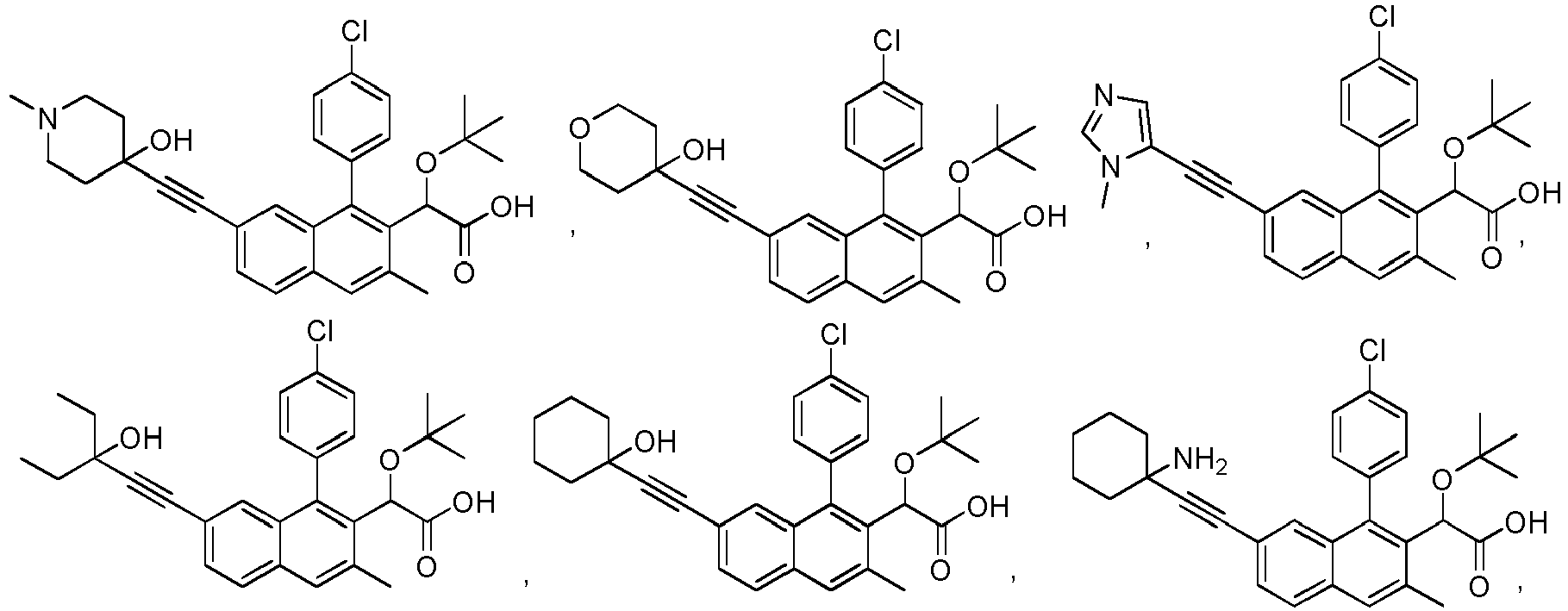


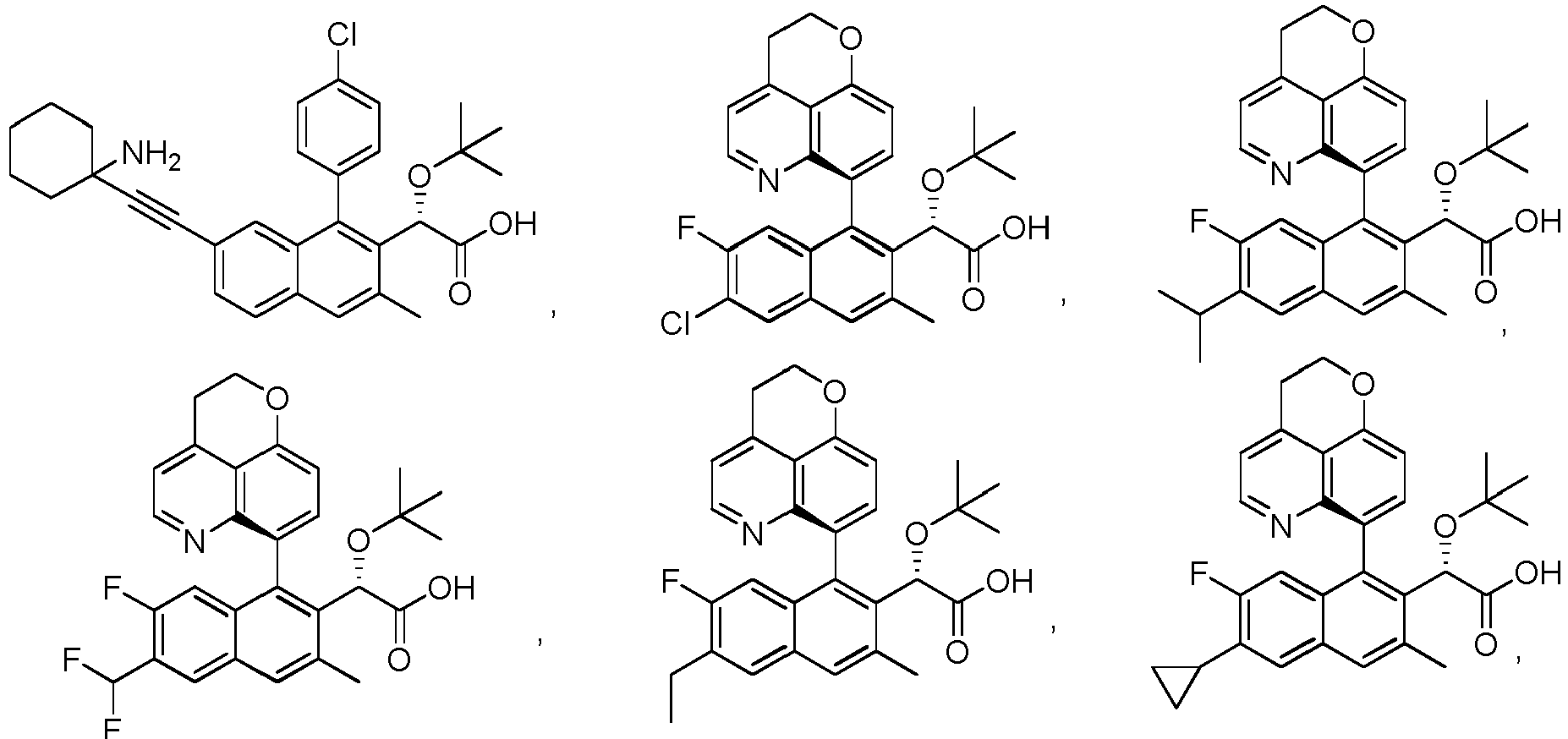


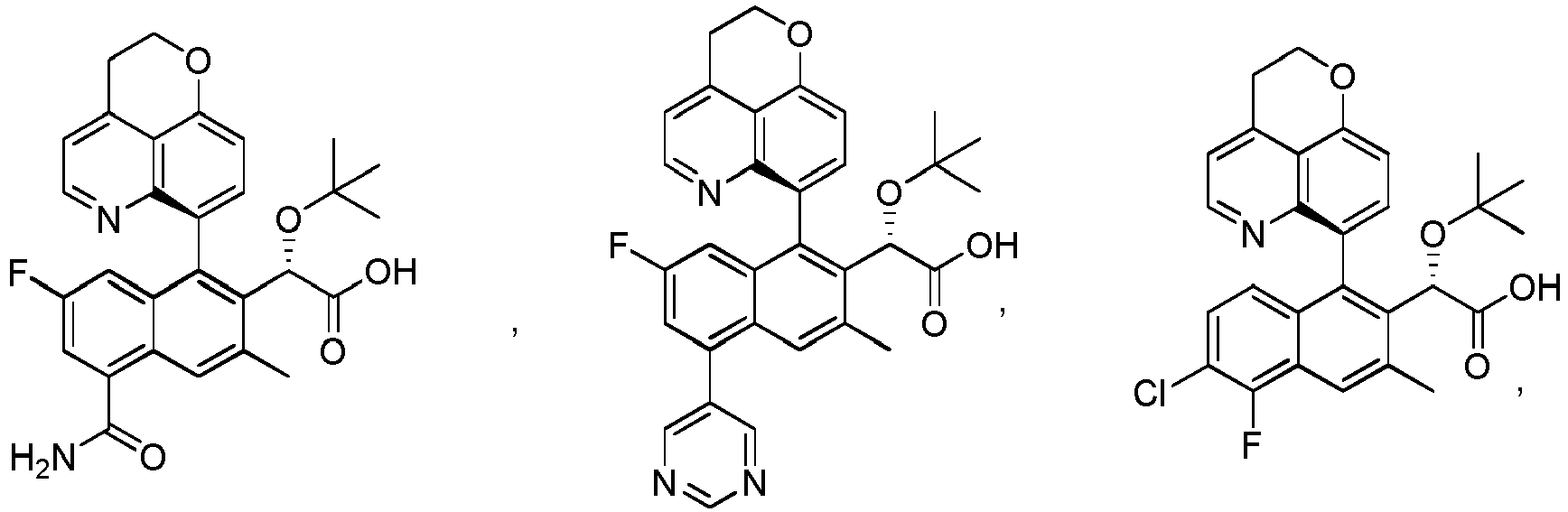


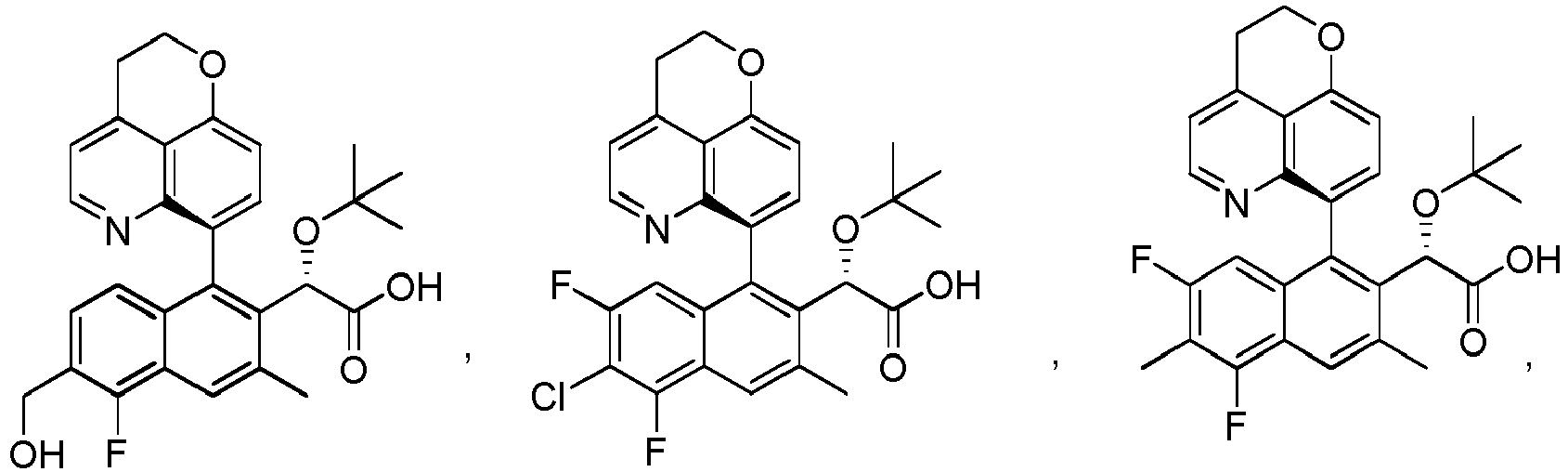


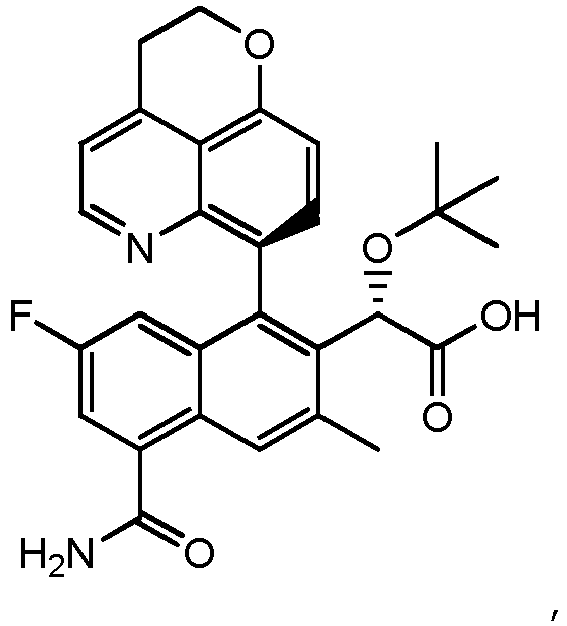


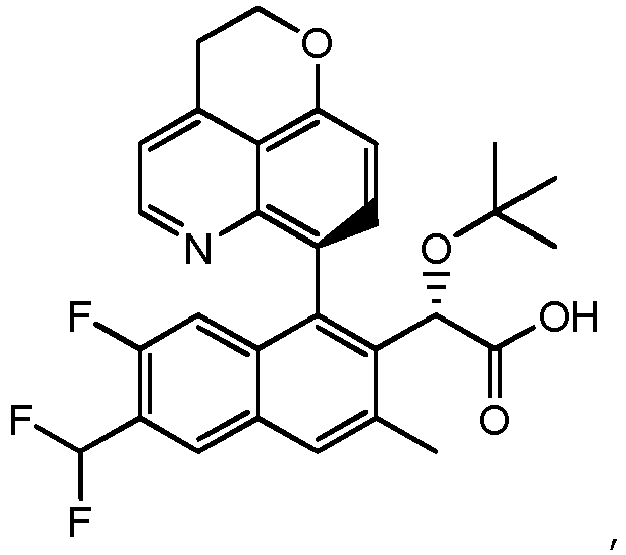


- A pharmaceutical composition comprising a compound as described in claim 1 or a pharmaceutically acceptable salt thereof, in combination with a pharmaceutically acceptable carrier.
- A compound as described in claim 1 or a pharmaceutically acceptable salt thereof for use in medical therapy.
- A compound as described in claim 1 or a pharmaceutically acceptable salt thereof, for use in the prophylactic or therapeutic treatment of the proliferation of the HIV virus or AIDS or for use in the therapeutic treatment of delaying the onset of AIDS or ARC symptoms.
Applications Claiming Priority (2)
| Application Number | Priority Date | Filing Date | Title |
|---|---|---|---|
| US36131410P | 2010-07-02 | 2010-07-02 | |
| PCT/US2011/042880 WO2012003497A1 (en) | 2010-07-02 | 2011-07-01 | Napht- 2 -ylacetic acid derivatives to treat aids |
Publications (2)
| Publication Number | Publication Date |
|---|---|
| EP2588450A1 EP2588450A1 (en) | 2013-05-08 |
| EP2588450B1 true EP2588450B1 (en) | 2017-05-24 |
Family
ID=44454746
Family Applications (1)
| Application Number | Title | Priority Date | Filing Date |
|---|---|---|---|
| EP11738878.5A Active EP2588450B1 (en) | 2010-07-02 | 2011-07-01 | Napht-2-ylacetic acid derivatives to treat aids |
Country Status (28)
| Country | Link |
|---|---|
| US (1) | US9102614B2 (en) |
| EP (1) | EP2588450B1 (en) |
| JP (2) | JP5984218B2 (en) |
| KR (1) | KR20130135826A (en) |
| CN (1) | CN103140474A (en) |
| AP (1) | AP2013006706A0 (en) |
| AR (1) | AR082079A1 (en) |
| AU (1) | AU2011274322B2 (en) |
| BR (1) | BR112013000043A2 (en) |
| CA (1) | CA2802308C (en) |
| CL (1) | CL2012003722A1 (en) |
| CO (1) | CO6660497A2 (en) |
| CR (1) | CR20130045A (en) |
| EA (1) | EA201291300A1 (en) |
| EC (1) | ECSP13012417A (en) |
| ES (1) | ES2634490T3 (en) |
| IL (1) | IL223558A0 (en) |
| MA (1) | MA34397B1 (en) |
| MX (1) | MX2012015097A (en) |
| NZ (1) | NZ604598A (en) |
| PE (1) | PE20130385A1 (en) |
| PH (1) | PH12013500011A1 (en) |
| PT (1) | PT2588450T (en) |
| SG (1) | SG186820A1 (en) |
| TW (1) | TWI453208B (en) |
| UY (1) | UY33480A (en) |
| WO (1) | WO2012003497A1 (en) |
| ZA (1) | ZA201209596B (en) |
Families Citing this family (163)
| Publication number | Priority date | Publication date | Assignee | Title |
|---|---|---|---|---|
| AU2009333559B2 (en) | 2008-12-09 | 2015-03-12 | Gilead Sciences, Inc. | Modulators of toll-like receptors |
| AP2013006706A0 (en) | 2010-07-02 | 2013-02-28 | Gilead Sciences Inc | Napht-2-ylacetic acid derivatives to treat AIDS |
| PH12013500015A1 (en) | 2010-07-02 | 2013-02-18 | Gilead Sciences Inc | 2 -quinolinyl- acetic acid derivatives as hiv antiviral compounds |
| EP2511273B8 (en) * | 2011-04-15 | 2019-06-26 | Hivih | Inhibitors of viral replication, their process of preparation and their therapeutical uses |
| UA111841C2 (en) | 2011-04-21 | 2016-06-24 | Гіліад Сайєнсіз, Інк. | BENZOTHIAZOL COMPOUNDS AND THEIR PHARMACEUTICAL APPLICATION |
| ES2553449T3 (en) | 2011-07-06 | 2015-12-09 | Gilead Sciences, Inc. | Compounds for HIV treatment |
| US8791108B2 (en) | 2011-08-18 | 2014-07-29 | Bristol-Myers Squibb Company | Inhibitors of human immunodeficiency virus replication |
| WO2013062028A1 (en) | 2011-10-25 | 2013-05-02 | 塩野義製薬株式会社 | Hiv replication inhibitor |
| WO2013091089A1 (en) * | 2011-12-22 | 2013-06-27 | UNIVERSITé LAVAL | Three-dimensional cavities of dendritic cell immunoreceptor (dcir), compounds binding thereto and therapeutic applications related to inhibition of human immunodeficiency virus type-1 (hiv-1) |
| US9376392B2 (en) | 2012-01-04 | 2016-06-28 | Gilead Sciences, Inc. | 2-(tert-butoxy)-2-(7-methylquinolin-6-yl) acetic acid derivatives for treating AIDS |
| WO2013103738A1 (en) * | 2012-01-04 | 2013-07-11 | Gilead Sciences, Inc. | Napthalene acetic acid derivatives against hiv infection |
| US8906889B2 (en) | 2012-02-15 | 2014-12-09 | Bristol-Myers Squibb Company | C-3 cycloalkenyl triterpenoids with HIV maturation inhibitory activity |
| US8629276B2 (en) | 2012-02-15 | 2014-01-14 | Bristol-Myers Squibb Company | Inhibitors of human immunodeficiency virus replication |
| US9034882B2 (en) | 2012-03-05 | 2015-05-19 | Bristol-Myers Squibb Company | Inhibitors of human immunodeficiency virus replication |
| US9006235B2 (en) | 2012-03-06 | 2015-04-14 | Bristol-Myers Squibb Company | Inhibitors of human immunodeficiency virus replication |
| US9096586B2 (en) | 2012-04-20 | 2015-08-04 | Gilead Sciences, Inc. | Therapeutic compounds |
| US8889854B2 (en) | 2012-05-07 | 2014-11-18 | Bristol-Myers Squibb Company | C-17 bicyclic amines of triterpenoids with HIV maturation inhibitory activity |
| US8906929B2 (en) | 2012-08-16 | 2014-12-09 | Bristol-Myers Squibb Company | Inhibitors of human immunodeficiency virus replication |
| EP2719685A1 (en) | 2012-10-11 | 2014-04-16 | Laboratoire Biodim | Inhibitors of viral replication, their process of preparation and their therapeutical uses |
| CA2893843C (en) | 2012-12-21 | 2018-09-04 | Gilead Sciences, Inc. | Polycyclic-carbamoylpyridone compounds and their pharmaceutical use |
| TW201443037A (en) | 2013-01-09 | 2014-11-16 | Gilead Sciences Inc | Therapeutic compounds |
| US9012441B2 (en) | 2013-01-09 | 2015-04-21 | Gilead Sciences, Inc. | Therapeutic compounds |
| CA2896244C (en) | 2013-01-09 | 2017-07-04 | Gilead Sciences, Inc. | 5-membered heteroaryls and their use as antiviral agents |
| TW201441197A (en) | 2013-01-31 | 2014-11-01 | Shionogi & Co | HIV replication inhibitor |
| TWI694071B (en) | 2013-03-01 | 2020-05-21 | 美商基利科學股份有限公司 | Therapeutic compounds for the treatment of retroviridae virus infections |
| US9580431B2 (en) | 2013-03-13 | 2017-02-28 | VIIV Healthcare UK (No.5) Limited | Inhibitors of human immunodeficiency virus replication |
| JP2016512507A (en) | 2013-03-13 | 2016-04-28 | ブリストル−マイヤーズ スクイブ カンパニーBristol−Myers Squibb Company | Inhibitors of human immunodeficiency virus replication |
| US9663536B2 (en) | 2013-03-13 | 2017-05-30 | VIIV Healthcare UK (No.5) Limited | Inhibitors of human immunodeficiency virus replication |
| EP2970274B1 (en) | 2013-03-14 | 2017-03-01 | VIIV Healthcare UK (No.5) Limited | Inhibitors of human immunodeficiency virus replication |
| JP6268656B2 (en) | 2013-03-14 | 2018-01-31 | ビーブ・ヘルスケア・ユーケイ・(ナンバー5)・リミテッドViiV Healthcare UK (No.5) Limited | Inhibitors of human immunodeficiency virus replication |
| EP2821104A1 (en) | 2013-07-05 | 2015-01-07 | Laboratoire Biodim | Inhibitors of viral replication, their process of preparation and their therapeutical uses |
| EP2821082A1 (en) | 2013-07-05 | 2015-01-07 | Laboratoire Biodim | Method of producing an inactivated lentivirus, especially HIV, vaccine, kit and method of use |
| DK3019503T3 (en) | 2013-07-12 | 2017-11-20 | Gilead Sciences Inc | POLYCYCLIC-CARBAMOYLPYRIDON COMPOUNDS AND ITS USES FOR TREATING HIV INFECTIONS |
| NO2865735T3 (en) | 2013-07-12 | 2018-07-21 | ||
| ES2654242T3 (en) | 2014-02-12 | 2018-02-12 | Viiv Healthcare (No.5) Limited | Benzotiazole macrocycles as inhibitors of human immunodeficiency virus replication |
| US9932353B2 (en) | 2014-02-18 | 2018-04-03 | Viiv Healthcare Uk (No. 5) Limited | Imidazopyrimidine macrocycles as inhibitors of human immunodeficiency virus replication |
| WO2015126743A1 (en) | 2014-02-18 | 2015-08-27 | Bristol-Myers Squibb Company | Pyrazolopyrimidine macrocycles as inhibitors of human immunodeficiency virus replication |
| US9409922B2 (en) | 2014-02-18 | 2016-08-09 | Bristol-Myers Squibb Company | Imidazopyridine macrocycles as inhibitors of human immunodeficiency virus replication |
| US9273067B2 (en) | 2014-02-19 | 2016-03-01 | Bristol-Myers Squibb Company | Pyrazolopyrimidine macrocycles as inhibitors of human immunodeficiency virus replication |
| EP3107913B1 (en) | 2014-02-19 | 2018-07-04 | VIIV Healthcare UK (No.5) Limited | Inhibitors of human immunodeficiency virus replication |
| US10202353B2 (en) | 2014-02-28 | 2019-02-12 | Gilead Sciences, Inc. | Therapeutic compounds |
| CN103804211B (en) * | 2014-03-12 | 2016-04-06 | 天津市炜杰科技有限公司 | The synthetic method of 4-(acetylamino)-2-hydroxyl-3-(2-carbonylethyl) methyl benzoate |
| WO2015174511A1 (en) * | 2014-05-16 | 2015-11-19 | 塩野義製薬株式会社 | Tricyclic heterocyclic derivative having hiv replication-inhibiting effect |
| TW201613936A (en) | 2014-06-20 | 2016-04-16 | Gilead Sciences Inc | Crystalline forms of(2R,5S,13aR)-8-hydroxy-7,9-dioxo-n-(2,4,6-trifluorobenzyl)-2,3,4,5,7,9,13,13a-octahydro-2,5-methanopyrido[1',2':4,5]pyrazino[2,1-b][1,3]oxazepine-10-carboxamide |
| NO2717902T3 (en) | 2014-06-20 | 2018-06-23 | ||
| TWI733652B (en) | 2014-07-11 | 2021-07-21 | 美商基利科學股份有限公司 | Modulators of toll-like receptors for the treatment of hiv |
| US20160067255A1 (en) | 2014-09-04 | 2016-03-10 | Gilead Sciences, Inc. | Methods of treating or preventing hiv in patients using a combination of tenofovir alafenamide and dolutegravir |
| JP2017526730A (en) | 2014-09-16 | 2017-09-14 | ギリアード サイエンシーズ, インコーポレイテッド | Solid form of Toll-like receptor modulator |
| TWI738321B (en) | 2014-12-23 | 2021-09-01 | 美商基利科學股份有限公司 | Polycyclic-carbamoylpyridone compounds and their pharmaceutical use |
| ES2735087T3 (en) | 2014-12-24 | 2019-12-16 | Gilead Sciences Inc | Fused pyrimidine compounds for HIV treatment |
| TW202237569A (en) | 2014-12-24 | 2022-10-01 | 美商基利科學股份有限公司 | Quinazoline compounds |
| EP3237397B1 (en) | 2014-12-24 | 2018-11-21 | Gilead Sciences, Inc. | Isoquinoline compounds for the treatment of hiv |
| IL296496B2 (en) | 2014-12-26 | 2024-10-01 | Univ Emory | N4-hydroxycytidine, history and related antiviral uses |
| DK3097102T3 (en) | 2015-03-04 | 2018-01-22 | Gilead Sciences Inc | TOLL-LIKE RECEPTOR MODULATING 4,6-DIAMINO-PYRIDO [3,2-D] PYRIMIDINE COMPOUNDS |
| TR201905009T4 (en) | 2015-04-02 | 2019-05-21 | Gilead Sciences Inc | Polycyclic-carbamoylpyridone compounds and their pharmaceutical uses. |
| EP3305789A4 (en) | 2015-05-29 | 2018-11-21 | Shionogi & Co., Ltd. | Nitrogen-containing tricyclic derivative having hiv replication inhibitory activity |
| JP2018525412A (en) | 2015-08-26 | 2018-09-06 | ギリアード サイエンシーズ, インコーポレイテッド | Deuterated toll-like receptor modulator |
| JP2018527366A (en) | 2015-09-15 | 2018-09-20 | ギリアード サイエンシーズ, インコーポレイテッド | Toll-like receptor modulators for treating HIV |
| JP2018529714A (en) | 2015-09-30 | 2018-10-11 | ギリアード サイエンシーズ, インコーポレイテッド | Compounds and combinations for the treatment of HIV |
| PL3390441T3 (en) | 2015-12-15 | 2022-01-10 | Gilead Sciences, Inc. | Human immunodeficiency virus neutralizing antibodies |
| TW202138365A (en) | 2016-08-19 | 2021-10-16 | 美商基利科學股份有限公司 | Therapeutic compounds |
| WO2018042332A1 (en) | 2016-08-31 | 2018-03-08 | Glaxosmithkline Intellectual Property (No.2) Limited | Combinations and uses and treatments thereof |
| WO2018042331A1 (en) | 2016-08-31 | 2018-03-08 | Glaxosmithkline Intellectual Property (No.2) Limited | Combinations and uses and treatments thereof |
| MA46093A (en) | 2016-09-02 | 2021-05-19 | Gilead Sciences Inc | TOLL-TYPE RECEIVER MODULATING COMPOUNDS |
| WO2018045150A1 (en) | 2016-09-02 | 2018-03-08 | Gilead Sciences, Inc. | 4,6-diamino-pyrido[3,2-d]pyrimidine derivaties as toll like receptor modulators |
| WO2018051250A1 (en) | 2016-09-14 | 2018-03-22 | Viiv Healthcare Company | Combination comprising tenofovir alafenamide, bictegravir and 3tc |
| US10800772B2 (en) | 2016-09-28 | 2020-10-13 | Gilead Sciences, Inc. | Therapeutic compounds |
| US10407438B2 (en) | 2016-10-27 | 2019-09-10 | Gilead Sciences, Inc. | Crystalline forms of darunavir |
| WO2018127801A1 (en) | 2017-01-03 | 2018-07-12 | VIIV Healthcare UK (No.5) Limited | Pyridin-3-yl acetic acid derivatives as inhibitors of human immunodeficiency virus replication |
| TW201835068A (en) | 2017-01-03 | 2018-10-01 | 英商Viiv醫療保健英國(No.5)有限公司 | Pyridin-3-yl acetic acid derivatives as inhibitors of human immunodeficiency virus replication |
| WO2018138050A1 (en) | 2017-01-26 | 2018-08-02 | Bayer Aktiengesellschaft | Condensed bicyclic heterocyclene derivatives as pest control agents |
| AR110768A1 (en) | 2017-01-31 | 2019-05-02 | Gilead Sciences Inc | CRYSTAL FORMS OF TENOFOVIR ALAFENAMIDA |
| AR110922A1 (en) | 2017-02-06 | 2019-05-15 | Gilead Sciences Inc | HIV INHIBITING COMPOUNDS |
| TWI728250B (en) | 2017-06-21 | 2021-05-21 | 美商基利科學股份有限公司 | Multispecific antibodies that target hiv gp120 and cd3 |
| CN110958883A (en) | 2017-06-30 | 2020-04-03 | Viiv保健公司 | Combinations and uses and therapies thereof |
| EP3661937B1 (en) | 2017-08-01 | 2021-07-28 | Gilead Sciences, Inc. | Crystalline forms of ethyl ((s)-((((2r,5r)-5-(6-amino-9h-purin-9-yl)-4-fluoro-2,5-dihydrofuran-2-yl)oxy)methyl)(phenoxy)phosphoryl)-l-alaninate (gs-9131) for treating viral infections |
| TWI687415B (en) | 2017-08-17 | 2020-03-11 | 美商基利科學股份有限公司 | Solid forms of an hiv capsid inhibitor |
| AR112412A1 (en) | 2017-08-17 | 2019-10-23 | Gilead Sciences Inc | CHOLINE SALT FORMS OF AN HIV CAPSID INHIBITOR |
| JP6934562B2 (en) | 2017-08-22 | 2021-09-15 | ギリアード サイエンシーズ, インコーポレイテッド | Therapeutic heterocyclic compounds |
| JOP20180092A1 (en) | 2017-10-13 | 2019-04-13 | Gilead Sciences Inc | Hiv protease inhibitors |
| US20190151307A1 (en) | 2017-10-24 | 2019-05-23 | Gilead Sciences, Inc. | Methods of treating patients co-infected with a virus and tuberculosis |
| KR102626210B1 (en) | 2017-12-07 | 2024-01-18 | 에모리 유니버시티 | N4-hydroxycytidine and derivatives and anti-viral uses related thereto |
| JP7098748B2 (en) | 2017-12-20 | 2022-07-11 | インスティチュート オブ オーガニック ケミストリー アンド バイオケミストリー エーエスシーアール,ヴイ.ヴイ.アイ. | 2'3'cyclic dinucleotide with phosphonate binding that activates the STING adapter protein |
| KR102492187B1 (en) | 2017-12-20 | 2023-01-27 | 인스티튜트 오브 오가닉 케미스트리 앤드 바이오케미스트리 에이에스 씨알 브이.브이.아이. | 3'3' cyclic dinucleotides with phosphonate linkages that activate STING adapter proteins |
| CN111615391B (en) | 2018-01-19 | 2023-05-30 | 吉利德科学公司 | Metabolites of bicavir |
| CN111836805B (en) | 2018-02-15 | 2023-07-14 | 吉利德科学公司 | Pyridine derivatives and their use in the treatment of HIV infection |
| TWI745652B (en) | 2018-02-16 | 2021-11-11 | 美商基利科學股份有限公司 | Methods and intermediates for preparing therapeutic compounds |
| TWI818007B (en) | 2018-04-06 | 2023-10-11 | 捷克科學院有機化學與生物化學研究所 | 2'3'-cyclic dinucleotides |
| TWI833744B (en) | 2018-04-06 | 2024-03-01 | 捷克科學院有機化學與生物化學研究所 | 3'3'-cyclic dinucleotides |
| TW202005654A (en) | 2018-04-06 | 2020-02-01 | 捷克科學院有機化學與生物化學研究所 | 2'2'-cyclic dinucleotides |
| US20190359645A1 (en) | 2018-05-03 | 2019-11-28 | Institute Of Organic Chemistry And Biochemistry Ascr, V.V.I. | 2'3'-cyclic dinucleotides comprising carbocyclic nucleotide |
| HUE071524T2 (en) | 2018-07-03 | 2025-09-28 | Gilead Sciences Inc | Antibodies that target hiv gp120 and methods of use |
| CA3104398A1 (en) | 2018-07-06 | 2020-01-09 | Gilead Sciences, Inc. | Therapeutic heterocyclic compounds |
| CN112384505B (en) | 2018-07-06 | 2025-05-27 | 吉利德科学公司 | Therapeutic heterocyclic compounds |
| US11944611B2 (en) | 2018-07-16 | 2024-04-02 | Gilead Sciences, Inc. | Capsid inhibitors for the treatment of HIV |
| TWI829205B (en) | 2018-07-30 | 2024-01-11 | 美商基利科學股份有限公司 | Anti-hiv compounds |
| KR20250161656A (en) | 2018-09-19 | 2025-11-17 | 길리애드 사이언시즈, 인코포레이티드 | Integrase inhibitors for the prevention of hiv |
| EP3860717A1 (en) | 2018-10-03 | 2021-08-11 | Gilead Sciences, Inc. | Imidozopyrimidine derivatives |
| PE20211655A1 (en) | 2018-10-31 | 2021-08-24 | Gilead Sciences Inc | 6-AZABENZIMIDAZOLE COMPOUNDS SUBSTITUTED AS HPK1 INHIBITORS |
| WO2020092528A1 (en) | 2018-10-31 | 2020-05-07 | Gilead Sciences, Inc. | Substituted 6-azabenzimidazole compounds having hpk1 inhibitory activity |
| WO2020176510A1 (en) | 2019-02-25 | 2020-09-03 | Gilead Sciences, Inc. | Protein kinase c agonists |
| WO2020176505A1 (en) | 2019-02-25 | 2020-09-03 | Gilead Sciences, Inc. | Protein kinase c agonists |
| CN113543851B (en) | 2019-03-07 | 2025-03-18 | 捷克共和国有机化学与生物化学研究所 | 2'3'-Cyclic dinucleotides and prodrugs thereof |
| WO2020178770A1 (en) | 2019-03-07 | 2020-09-10 | Institute Of Organic Chemistry And Biochemistry Ascr, V.V.I. | 3'3'-cyclic dinucleotides and prodrugs thereof |
| WO2020178768A1 (en) | 2019-03-07 | 2020-09-10 | Institute Of Organic Chemistry And Biochemistry Ascr, V.V.I. | 3'3'-cyclic dinucleotide analogue comprising a cyclopentanyl modified nucleotide as sting modulator |
| IL286328B1 (en) | 2019-03-22 | 2026-04-01 | Gilead Sciences Inc | Bridged tricyclic carbamoylpyridone compounds and their pharmaceutical use |
| TW202210480A (en) | 2019-04-17 | 2022-03-16 | 美商基利科學股份有限公司 | Solid forms of a toll-like receptor modulator |
| TW202212339A (en) | 2019-04-17 | 2022-04-01 | 美商基利科學股份有限公司 | Solid forms of a toll-like receptor modulator |
| TW202104210A (en) | 2019-04-17 | 2021-02-01 | 美商基利科學股份有限公司 | Hiv protease inhibitors |
| WO2020214647A1 (en) | 2019-04-17 | 2020-10-22 | Gilead Sciences, Inc. | Solid forms of an hiv protease inhibitor |
| TWI762925B (en) | 2019-05-21 | 2022-05-01 | 美商基利科學股份有限公司 | Methods of identifying hiv patients sensitive to therapy with gp120 v3 glycan-directed antibodies |
| KR20220011685A (en) | 2019-05-22 | 2022-01-28 | 길리애드 사이언시즈, 인코포레이티드 | Combination of a TLR7 modulating compound with an HIV vaccine |
| TWI826690B (en) | 2019-05-23 | 2023-12-21 | 美商基利科學股份有限公司 | Substituted eneoxindoles and uses thereof |
| RU2717101C1 (en) | 2019-06-03 | 2020-03-18 | Андрей Александрович Иващенко | Anellated 9-hydroxy-1,8-dioxo-1,3,4,8-tetrahydro-2h-pyrido[1,2-a]pyrazine-7-carboxamides - integrase inhibitors, methods for preparing and using thereof |
| US20220305115A1 (en) | 2019-06-18 | 2022-09-29 | Janssen Sciences Ireland Unlimited Company | Combination of hepatitis b virus (hbv) vaccines and pyridopyrimidine derivatives |
| AU2020301161B2 (en) | 2019-06-25 | 2023-10-26 | Gilead Sciences, Inc. | FLT3L-Fc fusion proteins and methods of use |
| AU2020315598B2 (en) | 2019-07-16 | 2024-12-12 | Gilead Sciences, Inc. | HIV vaccines and methods of making and using |
| WO2021011891A1 (en) | 2019-07-18 | 2021-01-21 | Gilead Sciences, Inc. | Long-acting formulations of tenofovir alafenamide |
| WO2021034804A1 (en) | 2019-08-19 | 2021-02-25 | Gilead Sciences, Inc. | Pharmaceutical formulations of tenofovir alafenamide |
| EP4643882A3 (en) | 2019-11-26 | 2026-01-14 | Gilead Sciences, Inc. | Capsid inhibitors for the prevention of hiv |
| WO2021104470A1 (en) * | 2019-11-29 | 2021-06-03 | 南京明德新药研发有限公司 | Anti-hbv 1,7-naphthyridine compound |
| EP4445902A3 (en) | 2019-12-24 | 2024-12-18 | Carna Biosciences, Inc. | Diacylglycerol kinase modulating compounds |
| CR20220418A (en) | 2020-02-24 | 2022-10-10 | Gilead Sciences Inc | Tetracyclic compounds for treating hiv infection |
| CA3169348A1 (en) | 2020-03-20 | 2021-09-23 | Gilead Sciences, Inc. | Prodrugs of 4'-c-substituted-2-halo-2'-deoxyadenosine nucleosides and methods of making and using the same |
| WO2021236944A1 (en) | 2020-05-21 | 2021-11-25 | Gilead Sciences, Inc. | Pharmaceutical compositions comprising bictegravir |
| JP7520162B2 (en) | 2020-06-25 | 2024-07-22 | ギリアード サイエンシーズ, インコーポレイテッド | Capsid inhibitors for the treatment of HIV - Patents.com |
| ES3054072T3 (en) | 2020-08-07 | 2026-01-29 | Gilead Sciences Inc | Prodrugs of phosphonamide nucleotide analogues and their pharmaceutical use |
| CA3192145A1 (en) | 2020-09-30 | 2022-04-07 | Gilead Sciences, Inc. | Bridged tricyclic carbamoylpyridone compounds and uses thereof |
| TW202406932A (en) | 2020-10-22 | 2024-02-16 | 美商基利科學股份有限公司 | Interleukin-2-fc fusion proteins and methods of use |
| JP7659628B2 (en) | 2020-11-11 | 2025-04-09 | ギリアード サイエンシーズ, インコーポレイテッド | Methods for identifying HIV patients susceptible to treatment with antibodies directed against the gp120 CD4 binding site - Patents.com |
| JP7591155B2 (en) | 2021-01-19 | 2024-11-27 | ギリアード サイエンシーズ, インコーポレイテッド | Substituted pyridotriazine compounds and uses thereof |
| TW202313094A (en) | 2021-05-18 | 2023-04-01 | 美商基利科學股份有限公司 | Methods of using flt3l-fc fusion proteins |
| EP4359415A1 (en) | 2021-06-23 | 2024-05-01 | Gilead Sciences, Inc. | Diacylglyercol kinase modulating compounds |
| WO2022271650A1 (en) | 2021-06-23 | 2022-12-29 | Gilead Sciences, Inc. | Diacylglyercol kinase modulating compounds |
| US11932634B2 (en) | 2021-06-23 | 2024-03-19 | Gilead Sciences, Inc. | Diacylglycerol kinase modulating compounds |
| WO2022271659A1 (en) | 2021-06-23 | 2022-12-29 | Gilead Sciences, Inc. | Diacylglyercol kinase modulating compounds |
| WO2023102523A1 (en) | 2021-12-03 | 2023-06-08 | Gilead Sciences, Inc. | Therapeutic compounds for hiv virus infection |
| PT4440702T (en) | 2021-12-03 | 2025-08-13 | Gilead Sciences Inc | Therapeutic compounds for hiv virus infection |
| JP7765637B2 (en) | 2021-12-03 | 2025-11-06 | ギリアード サイエンシーズ, インコーポレイテッド | Therapeutic compounds for HIV virus infections |
| TWI856796B (en) | 2022-04-06 | 2024-09-21 | 美商基利科學股份有限公司 | Bridged tricyclic carbamoylpyridone compounds and uses thereof |
| EP4547659A1 (en) | 2022-07-01 | 2025-05-07 | Gilead Sciences, Inc. | Therapeutic compounds useful for the prophylactic or therapeutic treatment of an hiv virus infection |
| KR20250036855A (en) | 2022-07-12 | 2025-03-14 | 길리애드 사이언시즈, 인코포레이티드 | HIV immunogenic polypeptides and vaccines, and uses thereof |
| JP2025526689A (en) * | 2022-08-10 | 2025-08-15 | ベットーレ リミテッド ライアビリティー カンパニー | Methods and processes for preparing MCT4 inhibitors |
| WO2024044477A1 (en) | 2022-08-26 | 2024-02-29 | Gilead Sciences, Inc. | Dosing and scheduling regimen for broadly neutralizing antibodies |
| EP4598934A1 (en) | 2022-10-04 | 2025-08-13 | Gilead Sciences, Inc. | 4'-thionucleoside analogues and their pharmaceutical use |
| AR132464A1 (en) | 2023-04-19 | 2025-07-02 | Gilead Sciences Inc | CAPSID INHIBITOR DOSAGE REGIMEN |
| AU2024283382A1 (en) | 2023-05-31 | 2025-11-13 | Gilead Sciences, Inc. | Anti-hiv compounds |
| EP4719608A1 (en) | 2023-05-31 | 2026-04-08 | Gilead Sciences, Inc. | Quinazolinyl-indazole derivatives as therapeutic compounds for hiv |
| AU2024281548A1 (en) | 2023-05-31 | 2025-11-13 | Gilead Sciences, Inc. | Solid forms of compounds useful in the treatment of hiv |
| KR20260046169A (en) | 2023-07-28 | 2026-04-06 | 길리애드 사이언시즈, 인코포레이티드 | Weekly renacapavir regimen for the treatment and prevention of HIV |
| WO2025042394A1 (en) | 2023-08-23 | 2025-02-27 | Gilead Sciences, Inc. | Dosing regimen of hiv capsid inhibitor |
| CN117326921B (en) * | 2023-09-27 | 2026-03-06 | 山东京博农化科技股份有限公司 | A method for preparing 1-(2,4,6-trichlorophenyl)-propyl-2-one |
| WO2025076542A1 (en) | 2023-10-05 | 2025-04-10 | Jones R Brad | Atovaquone as an ros inducer for use in the elimination of hiv-infected t-cells |
| TW202515549A (en) | 2023-10-11 | 2025-04-16 | 美商基利科學股份有限公司 | Bridged tricyclic carbamoylpyridone compounds and uses thereof |
| CN122055369A (en) | 2023-10-11 | 2026-05-15 | 吉利德科学公司 | Bridged tricyclic carbamoyl pyridone compounds and uses thereof |
| AU2024360779A1 (en) | 2023-10-11 | 2026-04-16 | Gilead Sciences, Inc. | Bridged tricyclic carbamoylpyridone compounds and uses thereof |
| US20250230163A1 (en) | 2023-12-22 | 2025-07-17 | Gilead Sciences, Inc. | Solid forms of hiv integrase inhibitors |
| US20250333424A1 (en) | 2024-03-01 | 2025-10-30 | Gilead Sciences, Inc. | Antiviral compounds |
| US20250296932A1 (en) | 2024-03-01 | 2025-09-25 | Gilead Sciences, Inc. | Pharmaceutical compositions comprising hiv integrase inhibitors |
| US20250289822A1 (en) | 2024-03-01 | 2025-09-18 | Gilead Sciences, Inc. | Solid forms of hiv integrase inhibitors |
| TW202602461A (en) | 2024-04-03 | 2026-01-16 | 美商基利科學股份有限公司 | Anti-hiv compounds |
| US20260007683A1 (en) | 2024-06-14 | 2026-01-08 | Gilead Sciences, Inc. | Pharmaceutical compositions comprising hiv integrase inhibitors |
| WO2026076265A1 (en) | 2024-10-03 | 2026-04-09 | Gilead Sciences, Inc. | Combination therapy comprising bridged tricyclic carbamoylpyridone compounds and p-glycoprotein inhibitors |
Citations (1)
| Publication number | Priority date | Publication date | Assignee | Title |
|---|---|---|---|---|
| EP2511273A1 (en) * | 2011-04-15 | 2012-10-17 | Laboratoire Biodim | Inhibitors of viral replication, their process of preparation and their therapeutical uses |
Family Cites Families (89)
| Publication number | Priority date | Publication date | Assignee | Title |
|---|---|---|---|---|
| US3895028A (en) | 1972-09-12 | 1975-07-15 | Tokyo Tanabe Co | Alpha-(2-phenylbenzothiazol-5-yl)propionic acid |
| JPS4994667A (en) | 1973-01-23 | 1974-09-09 | ||
| FR2453163A1 (en) | 1979-04-03 | 1980-10-31 | Rolland Sa A | BENZOTHIAZOLE DERIVATIVES, THEIR PREPARATION PROCESS AND THEIR THERAPEUTIC APPLICATIONS |
| US4816570A (en) | 1982-11-30 | 1989-03-28 | The Board Of Regents Of The University Of Texas System | Biologically reversible phosphate and phosphonate protective groups |
| GB8403739D0 (en) | 1984-02-13 | 1984-03-14 | Roussel Lab Ltd | Chemical compounds |
| US4968788A (en) | 1986-04-04 | 1990-11-06 | Board Of Regents, The University Of Texas System | Biologically reversible phosphate and phosphonate protective gruops |
| JPH03287558A (en) * | 1990-04-05 | 1991-12-18 | Teijin Ltd | Enzyme inhibitor |
| AU651835B2 (en) | 1990-06-13 | 1994-08-04 | Arnold Glazier | Phosphorous prodrugs |
| EP0481214B1 (en) | 1990-09-14 | 1998-06-24 | Institute Of Organic Chemistry And Biochemistry Of The Academy Of Sciences Of The Czech Republic | Prodrugs of phosphonates |
| US5733906A (en) | 1993-10-12 | 1998-03-31 | Eli Lilly And Company | Inhibitors of HIV Protease useful for the treatment of Aids |
| MX9308016A (en) | 1992-12-22 | 1994-08-31 | Lilly Co Eli | HUMAN IMMUNODEFICIENCY VIRUS PROTEASE INHIBITING COMPOUNDS, PROCEDURE FOR THEIR PREPARATION AND PHARMACEUTICAL FORMULATION CONTAINING THEM. |
| CA2159639A1 (en) | 1993-04-02 | 1994-10-13 | Vincent J. Miles | Method for selective inactivation of viral replication |
| US5434188A (en) | 1994-03-07 | 1995-07-18 | Warner-Lambert Company | 1-ether and 1-thioether-naphthalene-2-carboxamides as inhibitors of cell adhesion and as inhibitors of the activation of HIV |
| DE4428932A1 (en) | 1994-08-16 | 1996-02-22 | Hoechst Ag | Substituted quinoline derivatives, process for their preparation and their use |
| UA56992C2 (en) * | 1995-05-08 | 2003-06-16 | Фармація Енд Апджон Компані | a- pyrimidine-thioalkyl substituted and a- pyrimidine-oxo-alkyl substituted compounds |
| AU747500B2 (en) | 1998-04-09 | 2002-05-16 | Merck & Co., Inc. | Oxidation process using periodic acid |
| WO2000063152A1 (en) | 1999-02-22 | 2000-10-26 | The Government Of The United States Of America As Represented By The Secretary, Department Of Health And Human Services | Acetylated and related analogues of chicoric acid as hiv integrase inhibitors |
| US20020052323A1 (en) | 2000-08-30 | 2002-05-02 | Jinhai Wang | Quinoline-(C=O)-(multiple amino acids)-leaving group compounds for pharmaceutical compositions and reagents |
| EP1441228B1 (en) | 2000-11-21 | 2006-06-28 | Sunesis Pharmaceuticals, Inc. | An extended tethering approach for rapid identification of ligands |
| FR2819507B1 (en) | 2001-01-17 | 2007-09-28 | Inst Rech Developpement Ird | SUBSTITUTED QUINOLINES FOR THE TREATMENT OF PROTOZOAN AND RETROVIRUS CO-INFECTIONS |
| JP2004043416A (en) * | 2001-08-16 | 2004-02-12 | Japan Tobacco Inc | beta-KETOAMIDE COMPOUND AND PHARMACEUTICAL APPLICATION THEREOF |
| FR2839646B1 (en) | 2002-05-17 | 2008-04-11 | Bioalliance Pharma | USE OF QUINOLINE DERIVATIVES WITH ANTI-INTEGRASE EFFECT AND APPLICATIONS THEREOF |
| EP1545518A1 (en) | 2002-08-02 | 2005-06-29 | Tibotec Pharmaceuticals Ltd. | Broadspectrum 2-amino-benzothiazole sulfonamide hiv protease inhibitors |
| DE60322920D1 (en) | 2002-08-13 | 2008-09-25 | Shionogi & Co | HETEROCYCLIC COMPOUNDS WITH HIV INTEGRATE-INHIBITOR EFFECT |
| BR0313747A (en) * | 2002-08-23 | 2005-06-21 | Ribapharm Inc | Non-nucleoside Reverse Transcriptase Inhibitors |
| WO2004029246A2 (en) | 2002-09-26 | 2004-04-08 | K.U.Leuven Research And Development | Integrase cofactor |
| WO2004046115A1 (en) | 2002-11-20 | 2004-06-03 | Japan Tobacco Inc. | 4-oxoquinoline compounds and utilization thereof as hiv integrase inhibitors |
| UA80571C2 (en) | 2002-11-22 | 2007-10-10 | Lilly Co Eli | Quinolinyl-pyrrolopyrazoles |
| EP2258365B1 (en) | 2003-03-28 | 2013-05-29 | Novartis Vaccines and Diagnostics, Inc. | Use of organic compounds for immunopotentiation |
| EP1730135B1 (en) * | 2004-03-10 | 2010-09-22 | The United States of America, represented by the Secretary, Department of Health and Human Services | Qiunolin-4-ones as inhibitors of retroviral integrase for the treatment of hiv, aids and aids related complex (arc) |
| US20100234409A1 (en) | 2004-05-21 | 2010-09-16 | Lihu Yang | Amino cyclopentyl heterocyclic and carbocyclic modulators of chemokine receptor activity |
| US7087610B2 (en) | 2004-06-03 | 2006-08-08 | Bristol-Myers Squibb Company | Benzothiazole antiviral agents |
| CA2571309A1 (en) | 2004-06-22 | 2006-01-05 | Smithkline Beecham Corporation | Chemical compounds |
| TWI306401B (en) | 2004-08-13 | 2009-02-21 | Nat Health Research Institutes | Benzothiazolium compounds |
| US20060094755A1 (en) | 2004-10-28 | 2006-05-04 | Bioflexis, Llc | Novel quinoline-based metal chelators as antiviral agents |
| TWI370820B (en) | 2005-04-27 | 2012-08-21 | Takeda Pharmaceutical | Fused heterocyclic compounds |
| WO2006124780A2 (en) | 2005-05-12 | 2006-11-23 | Kalypsys, Inc. | Ih-benzo [d] imidazole compounds as inhibitors of b-raf kinase |
| US7473784B2 (en) | 2005-08-01 | 2009-01-06 | Bristol-Myers Squibb Company | Benzothiazole and azabenzothiazole compounds useful as kinase inhibitors |
| TW200803863A (en) | 2005-11-10 | 2008-01-16 | Schering Corp | Method for inhibiting protein kinases |
| US7939545B2 (en) | 2006-05-16 | 2011-05-10 | Boehringer Ingelheim International Gmbh | Inhibitors of human immunodeficiency virus replication |
| EP2032578A2 (en) | 2006-05-30 | 2009-03-11 | Pfizer Products Incorporated | Triazolopyridazine derivatives |
| JO2841B1 (en) | 2006-06-23 | 2014-09-15 | تيبوتيك فارماسيوتيكالز ليمتد | 2-( substituted-amino)- benzothiazole sulfonamide HIV protease INHIBITORS |
| US8435774B2 (en) | 2006-06-28 | 2013-05-07 | Qiagen Gmbh | Enhancing reactivation of thermostable reversibly inactivated enzymes |
| WO2008053478A2 (en) | 2006-10-30 | 2008-05-08 | Yissum Research Development Company Of The Hebrew University Of Jerusalem | Compositions and methods for inhibiting hiv-1 replication and integrase activity |
| MX2009005881A (en) | 2006-12-13 | 2009-06-12 | Hoffmann La Roche | Non-nucleoside reverse transcriptase inhibitors. |
| HRP20120328T2 (en) | 2007-11-15 | 2012-09-30 | Gilead Sciences | Inhibitors of human immunodeficiency virus replication |
| EP2574610A1 (en) | 2007-11-15 | 2013-04-03 | Gilead Sciences, Inc. | Inhibitors of human immonodeficiency virus replication |
| WO2009062285A1 (en) | 2007-11-16 | 2009-05-22 | Boehringer Ingelheim International Gmbh | Inhibitors of human immunodeficiency virus replication |
| CA2705338A1 (en) | 2007-11-16 | 2009-05-22 | Boehringer Ingelheim International Gmbh | Inhibitors of human immunodeficiency virus replication |
| GB0801940D0 (en) | 2008-02-01 | 2008-03-12 | Univ Leuven Kath | Inhibitors of lentiviral replication |
| EP2265270A1 (en) | 2008-02-04 | 2010-12-29 | OSI Pharmaceuticals, Inc. | 2-aminopyridine kinase inhibitors |
| US8697685B2 (en) | 2008-11-20 | 2014-04-15 | Glaxosmithkline Llc | Chemical compounds |
| EP2196453A1 (en) * | 2008-12-10 | 2010-06-16 | Cellvir | Novel substituted aryl derivatives, their process of preparation and their therapeutical uses as anti-HIV agents |
| GB0908394D0 (en) | 2009-05-15 | 2009-06-24 | Univ Leuven Kath | Novel viral replication inhibitors |
| US8338441B2 (en) | 2009-05-15 | 2012-12-25 | Gilead Sciences, Inc. | Inhibitors of human immunodeficiency virus replication |
| KR20120049852A (en) | 2009-06-30 | 2012-05-17 | 시가 테크놀로지스, 인크. | Treatment and prevention of dengue virus infections |
| GB0913636D0 (en) | 2009-08-05 | 2009-09-16 | Univ Leuven Kath | Novel viral replication inhibitors |
| US9095596B2 (en) | 2009-10-15 | 2015-08-04 | Southern Research Institute | Treatment of neurodegenerative diseases, causation of memory enhancement, and assay for screening compounds for such |
| KR101483834B1 (en) | 2009-12-23 | 2015-01-16 | 카트호리이케 유니버시타이트 로이펜 | Novel antiviral compounds |
| US20110223131A1 (en) | 2010-02-24 | 2011-09-15 | Gilead Sciences, Inc. | Antiviral compounds |
| CA2800176C (en) | 2010-05-24 | 2018-08-28 | University Of Rochester | Bicyclic heteroaryl kinase inhibitors and methods of use |
| AP2013006706A0 (en) | 2010-07-02 | 2013-02-28 | Gilead Sciences Inc | Napht-2-ylacetic acid derivatives to treat AIDS |
| PH12013500015A1 (en) | 2010-07-02 | 2013-02-18 | Gilead Sciences Inc | 2 -quinolinyl- acetic acid derivatives as hiv antiviral compounds |
| US8633200B2 (en) | 2010-09-08 | 2014-01-21 | Bristol-Myers Squibb Company | Inhibitors of human immunodeficiency virus replication |
| BR112013011737A2 (en) | 2010-11-15 | 2016-08-09 | Univ Leuven Kath | compound, use of a compound pharmaceutical composition, and method of treating or preventing an HIV infection |
| CN103429595B (en) | 2010-11-15 | 2015-10-21 | Viiv保健英国有限公司 | Inhibitors of HIV Replication |
| AR084457A1 (en) | 2010-12-22 | 2013-05-15 | Lundbeck & Co As H | BICYCLE DERIVATIVES [3,2,1] OCTILAMIDE |
| US9029391B2 (en) | 2011-01-24 | 2015-05-12 | Viiv Healthcare Uk Limited | Isoquinoline compounds and methods for treating HIV |
| JP2014511859A (en) | 2011-04-04 | 2014-05-19 | ギリアード サイエンシーズ, インコーポレイテッド | Process for the preparation of HIV integrase inhibitors |
| JP2014510139A (en) | 2011-04-04 | 2014-04-24 | ギリアード サイエンシーズ, インコーポレイテッド | HIV inhibitor in solid form |
| EP2508511A1 (en) | 2011-04-07 | 2012-10-10 | Laboratoire Biodim | Inhibitors of viral replication, their process of preparation and their therapeutical uses |
| UA111841C2 (en) | 2011-04-21 | 2016-06-24 | Гіліад Сайєнсіз, Інк. | BENZOTHIAZOL COMPOUNDS AND THEIR PHARMACEUTICAL APPLICATION |
| WO2013002357A1 (en) | 2011-06-30 | 2013-01-03 | 塩野義製薬株式会社 | Hiv replication inhibitor |
| US8791108B2 (en) | 2011-08-18 | 2014-07-29 | Bristol-Myers Squibb Company | Inhibitors of human immunodeficiency virus replication |
| US9012642B2 (en) | 2011-09-22 | 2015-04-21 | Viiv Healthcare Uk Limited | Pyrrolopyridinone compounds and methods for treating HIV |
| WO2013058448A1 (en) | 2011-10-20 | 2013-04-25 | 한국해양연구원 | Marine medaka genes responding to the exposure of endocrine-disrupting chemicals, and method for diagnosing an aquatic eco-system contamination using same |
| WO2013062028A1 (en) | 2011-10-25 | 2013-05-02 | 塩野義製薬株式会社 | Hiv replication inhibitor |
| US9376392B2 (en) | 2012-01-04 | 2016-06-28 | Gilead Sciences, Inc. | 2-(tert-butoxy)-2-(7-methylquinolin-6-yl) acetic acid derivatives for treating AIDS |
| WO2013103738A1 (en) | 2012-01-04 | 2013-07-11 | Gilead Sciences, Inc. | Napthalene acetic acid derivatives against hiv infection |
| JP2015508414A (en) | 2012-01-12 | 2015-03-19 | イエール ユニバーシティ | Compounds and methods for enhanced degradation of target proteins and other polypeptides by E3 ubiquitin ligase |
| US8629276B2 (en) | 2012-02-15 | 2014-01-14 | Bristol-Myers Squibb Company | Inhibitors of human immunodeficiency virus replication |
| US9034882B2 (en) | 2012-03-05 | 2015-05-19 | Bristol-Myers Squibb Company | Inhibitors of human immunodeficiency virus replication |
| US9006235B2 (en) | 2012-03-06 | 2015-04-14 | Bristol-Myers Squibb Company | Inhibitors of human immunodeficiency virus replication |
| WO2013157622A1 (en) | 2012-04-19 | 2013-10-24 | 塩野義製薬株式会社 | Hiv replication inhibitor |
| US9096586B2 (en) | 2012-04-20 | 2015-08-04 | Gilead Sciences, Inc. | Therapeutic compounds |
| ES2647437T3 (en) | 2012-07-12 | 2017-12-21 | Viiv Healthcare Uk Limited | Compounds and procedures for treating HIV |
| US8906929B2 (en) | 2012-08-16 | 2014-12-09 | Bristol-Myers Squibb Company | Inhibitors of human immunodeficiency virus replication |
| WO2014055618A1 (en) | 2012-10-03 | 2014-04-10 | Gilead Sciences, Inc. | Solid state forms of hiv inhibitor: hemi-succinate of (2s)-2-tert-butoxy-2-(4-(2,3-dihydropyrano[4,3,2-de]quinolin-7-yl)-2-methylquinolin-3-yl)acetic acid) |
| WO2014055603A1 (en) | 2012-10-03 | 2014-04-10 | Gilead Sciences, Inc. | Process for the preparation of an hiv integrase inhibitor |
-
2011
- 2011-07-01 AP AP2013006706A patent/AP2013006706A0/en unknown
- 2011-07-01 AU AU2011274322A patent/AU2011274322B2/en active Active
- 2011-07-01 MX MX2012015097A patent/MX2012015097A/en not_active Application Discontinuation
- 2011-07-01 TW TW100123357A patent/TWI453208B/en not_active IP Right Cessation
- 2011-07-01 NZ NZ604598A patent/NZ604598A/en unknown
- 2011-07-01 UY UY0001033480A patent/UY33480A/en not_active Application Discontinuation
- 2011-07-01 PH PH1/2013/500011A patent/PH12013500011A1/en unknown
- 2011-07-01 EP EP11738878.5A patent/EP2588450B1/en active Active
- 2011-07-01 PE PE2012002654A patent/PE20130385A1/en not_active Application Discontinuation
- 2011-07-01 CN CN201180038442XA patent/CN103140474A/en active Pending
- 2011-07-01 PT PT117388785T patent/PT2588450T/en unknown
- 2011-07-01 KR KR1020137002778A patent/KR20130135826A/en not_active Withdrawn
- 2011-07-01 ES ES11738878.5T patent/ES2634490T3/en active Active
- 2011-07-01 EA EA201291300A patent/EA201291300A1/en unknown
- 2011-07-01 US US13/806,067 patent/US9102614B2/en active Active
- 2011-07-01 JP JP2013518778A patent/JP5984218B2/en active Active
- 2011-07-01 CA CA2802308A patent/CA2802308C/en active Active
- 2011-07-01 SG SG2012095410A patent/SG186820A1/en unknown
- 2011-07-01 AR ARP110102376A patent/AR082079A1/en not_active Application Discontinuation
- 2011-07-01 BR BR112013000043A patent/BR112013000043A2/en not_active IP Right Cessation
- 2011-07-01 MA MA35607A patent/MA34397B1/en unknown
- 2011-07-01 WO PCT/US2011/042880 patent/WO2012003497A1/en not_active Ceased
-
2012
- 2012-12-11 IL IL223558A patent/IL223558A0/en unknown
- 2012-12-18 ZA ZA2012/09596A patent/ZA201209596B/en unknown
- 2012-12-28 CO CO12236161A patent/CO6660497A2/en active IP Right Grant
- 2012-12-28 CL CL2012003722A patent/CL2012003722A1/en unknown
-
2013
- 2013-01-30 CR CR20130045A patent/CR20130045A/en unknown
- 2013-02-04 EC ECSP13012417 patent/ECSP13012417A/en unknown
-
2015
- 2015-08-10 JP JP2015158510A patent/JP2015193671A/en not_active Withdrawn
Patent Citations (1)
| Publication number | Priority date | Publication date | Assignee | Title |
|---|---|---|---|---|
| EP2511273A1 (en) * | 2011-04-15 | 2012-10-17 | Laboratoire Biodim | Inhibitors of viral replication, their process of preparation and their therapeutical uses |
Also Published As
Similar Documents
| Publication | Publication Date | Title |
|---|---|---|
| US9102614B2 (en) | Naphth-2-ylacetic acid derivatives to treat AIDS | |
| EP2588455B1 (en) | 2-quinolinyl-acetic acid derivatives as hiv antiviral compounds | |
| US9096586B2 (en) | Therapeutic compounds | |
| US7645747B2 (en) | Therapeutic phosphonate compounds | |
| US20110224204A1 (en) | Di-substituted phenyl compounds | |
| WO2013103738A1 (en) | Napthalene acetic acid derivatives against hiv infection | |
| JP2023548052A (en) | JAK inhibitor with specific particle size distribution | |
| HK1184789A (en) | Napht- 2 -ylacetic acid derivatives to treat aids | |
| HK1184789B (en) | Napht- 2 -ylacetic acid derivatives to treat aids | |
| JP2022520631A (en) | 3,6-Disubstituted-2-pyridinealdoxime skeleton | |
| HK1184788A (en) | 2 -quinolinyl- acetic acid derivatives as hiv antiviral compounds | |
| HK1184788B (en) | 2 -quinolinyl- acetic acid derivatives as hiv antiviral compounds | |
| OA16293A (en) | Napht-2-Y lacetic acid derivatives to treat AIDS. |
Legal Events
| Date | Code | Title | Description |
|---|---|---|---|
| PUAI | Public reference made under article 153(3) epc to a published international application that has entered the european phase |
Free format text: ORIGINAL CODE: 0009012 |
|
| 17P | Request for examination filed |
Effective date: 20121212 |
|
| AK | Designated contracting states |
Kind code of ref document: A1 Designated state(s): AL AT BE BG CH CY CZ DE DK EE ES FI FR GB GR HR HU IE IS IT LI LT LU LV MC MK MT NL NO PL PT RO RS SE SI SK SM TR |
|
| AX | Request for extension of the european patent |
Extension state: BA ME |
|
| 17Q | First examination report despatched |
Effective date: 20131015 |
|
| REG | Reference to a national code |
Ref country code: HK Ref legal event code: DE Ref document number: 1184789 Country of ref document: HK |
|
| STAA | Information on the status of an ep patent application or granted ep patent |
Free format text: STATUS: EXAMINATION IS IN PROGRESS |
|
| GRAP | Despatch of communication of intention to grant a patent |
Free format text: ORIGINAL CODE: EPIDOSNIGR1 |
|
| STAA | Information on the status of an ep patent application or granted ep patent |
Free format text: STATUS: GRANT OF PATENT IS INTENDED |
|
| INTG | Intention to grant announced |
Effective date: 20170117 |
|
| GRAS | Grant fee paid |
Free format text: ORIGINAL CODE: EPIDOSNIGR3 |
|
| GRAA | (expected) grant |
Free format text: ORIGINAL CODE: 0009210 |
|
| STAA | Information on the status of an ep patent application or granted ep patent |
Free format text: STATUS: THE PATENT HAS BEEN GRANTED |
|
| AK | Designated contracting states |
Kind code of ref document: B1 Designated state(s): AL AT BE BG CH CY CZ DE DK EE ES FI FR GB GR HR HU IE IS IT LI LT LU LV MC MK MT NL NO PL PT RO RS SE SI SK SM TR |
|
| AX | Request for extension of the european patent |
Extension state: BA ME |
|
| REG | Reference to a national code |
Ref country code: GB Ref legal event code: FG4D |
|
| REG | Reference to a national code |
Ref country code: CH Ref legal event code: EP Ref country code: CH Ref legal event code: NV Representative=s name: E. BLUM AND CO. AG PATENT- UND MARKENANWAELTE , CH |
|
| REG | Reference to a national code |
Ref country code: IE Ref legal event code: FG4D |
|
| REG | Reference to a national code |
Ref country code: AT Ref legal event code: REF Ref document number: 895962 Country of ref document: AT Kind code of ref document: T Effective date: 20170615 |
|
| REG | Reference to a national code |
Ref country code: DE Ref legal event code: R096 Ref document number: 602011038199 Country of ref document: DE |
|
| REG | Reference to a national code |
Ref country code: FR Ref legal event code: PLFP Year of fee payment: 7 |
|
| REG | Reference to a national code |
Ref country code: PT Ref legal event code: SC4A Ref document number: 2588450 Country of ref document: PT Date of ref document: 20170803 Kind code of ref document: T Free format text: AVAILABILITY OF NATIONAL TRANSLATION Effective date: 20170727 |
|
| REG | Reference to a national code |
Ref country code: NL Ref legal event code: FP |
|
| REG | Reference to a national code |
Ref country code: ES Ref legal event code: FG2A Ref document number: 2634490 Country of ref document: ES Kind code of ref document: T3 Effective date: 20170928 |
|
| REG | Reference to a national code |
Ref country code: LT Ref legal event code: MG4D |
|
| PG25 | Lapsed in a contracting state [announced via postgrant information from national office to epo] |
Ref country code: HR Free format text: LAPSE BECAUSE OF FAILURE TO SUBMIT A TRANSLATION OF THE DESCRIPTION OR TO PAY THE FEE WITHIN THE PRESCRIBED TIME-LIMIT Effective date: 20170524 Ref country code: LT Free format text: LAPSE BECAUSE OF FAILURE TO SUBMIT A TRANSLATION OF THE DESCRIPTION OR TO PAY THE FEE WITHIN THE PRESCRIBED TIME-LIMIT Effective date: 20170524 Ref country code: NO Free format text: LAPSE BECAUSE OF FAILURE TO SUBMIT A TRANSLATION OF THE DESCRIPTION OR TO PAY THE FEE WITHIN THE PRESCRIBED TIME-LIMIT Effective date: 20170824 Ref country code: FI Free format text: LAPSE BECAUSE OF FAILURE TO SUBMIT A TRANSLATION OF THE DESCRIPTION OR TO PAY THE FEE WITHIN THE PRESCRIBED TIME-LIMIT Effective date: 20170524 Ref country code: GR Free format text: LAPSE BECAUSE OF FAILURE TO SUBMIT A TRANSLATION OF THE DESCRIPTION OR TO PAY THE FEE WITHIN THE PRESCRIBED TIME-LIMIT Effective date: 20170825 |
|
| PG25 | Lapsed in a contracting state [announced via postgrant information from national office to epo] |
Ref country code: SE Free format text: LAPSE BECAUSE OF FAILURE TO SUBMIT A TRANSLATION OF THE DESCRIPTION OR TO PAY THE FEE WITHIN THE PRESCRIBED TIME-LIMIT Effective date: 20170524 Ref country code: BG Free format text: LAPSE BECAUSE OF FAILURE TO SUBMIT A TRANSLATION OF THE DESCRIPTION OR TO PAY THE FEE WITHIN THE PRESCRIBED TIME-LIMIT Effective date: 20170824 Ref country code: IS Free format text: LAPSE BECAUSE OF FAILURE TO SUBMIT A TRANSLATION OF THE DESCRIPTION OR TO PAY THE FEE WITHIN THE PRESCRIBED TIME-LIMIT Effective date: 20170924 Ref country code: LV Free format text: LAPSE BECAUSE OF FAILURE TO SUBMIT A TRANSLATION OF THE DESCRIPTION OR TO PAY THE FEE WITHIN THE PRESCRIBED TIME-LIMIT Effective date: 20170524 Ref country code: RS Free format text: LAPSE BECAUSE OF FAILURE TO SUBMIT A TRANSLATION OF THE DESCRIPTION OR TO PAY THE FEE WITHIN THE PRESCRIBED TIME-LIMIT Effective date: 20170524 |
|
| PG25 | Lapsed in a contracting state [announced via postgrant information from national office to epo] |
Ref country code: EE Free format text: LAPSE BECAUSE OF FAILURE TO SUBMIT A TRANSLATION OF THE DESCRIPTION OR TO PAY THE FEE WITHIN THE PRESCRIBED TIME-LIMIT Effective date: 20170524 Ref country code: SK Free format text: LAPSE BECAUSE OF FAILURE TO SUBMIT A TRANSLATION OF THE DESCRIPTION OR TO PAY THE FEE WITHIN THE PRESCRIBED TIME-LIMIT Effective date: 20170524 Ref country code: DK Free format text: LAPSE BECAUSE OF FAILURE TO SUBMIT A TRANSLATION OF THE DESCRIPTION OR TO PAY THE FEE WITHIN THE PRESCRIBED TIME-LIMIT Effective date: 20170524 Ref country code: CZ Free format text: LAPSE BECAUSE OF FAILURE TO SUBMIT A TRANSLATION OF THE DESCRIPTION OR TO PAY THE FEE WITHIN THE PRESCRIBED TIME-LIMIT Effective date: 20170524 Ref country code: RO Free format text: LAPSE BECAUSE OF FAILURE TO SUBMIT A TRANSLATION OF THE DESCRIPTION OR TO PAY THE FEE WITHIN THE PRESCRIBED TIME-LIMIT Effective date: 20170524 |
|
| REG | Reference to a national code |
Ref country code: DE Ref legal event code: R097 Ref document number: 602011038199 Country of ref document: DE |
|
| PG25 | Lapsed in a contracting state [announced via postgrant information from national office to epo] |
Ref country code: PL Free format text: LAPSE BECAUSE OF FAILURE TO SUBMIT A TRANSLATION OF THE DESCRIPTION OR TO PAY THE FEE WITHIN THE PRESCRIBED TIME-LIMIT Effective date: 20170524 Ref country code: SM Free format text: LAPSE BECAUSE OF FAILURE TO SUBMIT A TRANSLATION OF THE DESCRIPTION OR TO PAY THE FEE WITHIN THE PRESCRIBED TIME-LIMIT Effective date: 20170524 |
|
| PLBE | No opposition filed within time limit |
Free format text: ORIGINAL CODE: 0009261 |
|
| STAA | Information on the status of an ep patent application or granted ep patent |
Free format text: STATUS: NO OPPOSITION FILED WITHIN TIME LIMIT |
|
| 26N | No opposition filed |
Effective date: 20180227 |
|
| REG | Reference to a national code |
Ref country code: HK Ref legal event code: GR Ref document number: 1184789 Country of ref document: HK |
|
| PG25 | Lapsed in a contracting state [announced via postgrant information from national office to epo] |
Ref country code: SI Free format text: LAPSE BECAUSE OF FAILURE TO SUBMIT A TRANSLATION OF THE DESCRIPTION OR TO PAY THE FEE WITHIN THE PRESCRIBED TIME-LIMIT Effective date: 20170524 |
|
| PG25 | Lapsed in a contracting state [announced via postgrant information from national office to epo] |
Ref country code: LU Free format text: LAPSE BECAUSE OF NON-PAYMENT OF DUE FEES Effective date: 20170701 |
|
| REG | Reference to a national code |
Ref country code: FR Ref legal event code: PLFP Year of fee payment: 8 |
|
| PG25 | Lapsed in a contracting state [announced via postgrant information from national office to epo] |
Ref country code: MT Free format text: LAPSE BECAUSE OF NON-PAYMENT OF DUE FEES Effective date: 20170701 |
|
| PG25 | Lapsed in a contracting state [announced via postgrant information from national office to epo] |
Ref country code: HU Free format text: LAPSE BECAUSE OF FAILURE TO SUBMIT A TRANSLATION OF THE DESCRIPTION OR TO PAY THE FEE WITHIN THE PRESCRIBED TIME-LIMIT; INVALID AB INITIO Effective date: 20110701 Ref country code: MC Free format text: LAPSE BECAUSE OF FAILURE TO SUBMIT A TRANSLATION OF THE DESCRIPTION OR TO PAY THE FEE WITHIN THE PRESCRIBED TIME-LIMIT Effective date: 20170524 |
|
| PG25 | Lapsed in a contracting state [announced via postgrant information from national office to epo] |
Ref country code: CY Free format text: LAPSE BECAUSE OF NON-PAYMENT OF DUE FEES Effective date: 20170524 |
|
| PG25 | Lapsed in a contracting state [announced via postgrant information from national office to epo] |
Ref country code: MK Free format text: LAPSE BECAUSE OF FAILURE TO SUBMIT A TRANSLATION OF THE DESCRIPTION OR TO PAY THE FEE WITHIN THE PRESCRIBED TIME-LIMIT Effective date: 20170524 |
|
| PG25 | Lapsed in a contracting state [announced via postgrant information from national office to epo] |
Ref country code: TR Free format text: LAPSE BECAUSE OF FAILURE TO SUBMIT A TRANSLATION OF THE DESCRIPTION OR TO PAY THE FEE WITHIN THE PRESCRIBED TIME-LIMIT Effective date: 20170524 |
|
| PG25 | Lapsed in a contracting state [announced via postgrant information from national office to epo] |
Ref country code: AL Free format text: LAPSE BECAUSE OF FAILURE TO SUBMIT A TRANSLATION OF THE DESCRIPTION OR TO PAY THE FEE WITHIN THE PRESCRIBED TIME-LIMIT Effective date: 20170524 |
|
| REG | Reference to a national code |
Ref country code: AT Ref legal event code: UEP Ref document number: 895962 Country of ref document: AT Kind code of ref document: T Effective date: 20170524 |
|
| PGFP | Annual fee paid to national office [announced via postgrant information from national office to epo] |
Ref country code: GB Payment date: 20250529 Year of fee payment: 15 |
|
| PGFP | Annual fee paid to national office [announced via postgrant information from national office to epo] |
Ref country code: NL Payment date: 20250613 Year of fee payment: 15 Ref country code: BE Payment date: 20250619 Year of fee payment: 15 |
|
| PGFP | Annual fee paid to national office [announced via postgrant information from national office to epo] |
Ref country code: PT Payment date: 20250624 Year of fee payment: 15 |
|
| PGFP | Annual fee paid to national office [announced via postgrant information from national office to epo] |
Ref country code: FR Payment date: 20250610 Year of fee payment: 15 |
|
| PGFP | Annual fee paid to national office [announced via postgrant information from national office to epo] |
Ref country code: IE Payment date: 20250610 Year of fee payment: 15 |
|
| PGFP | Annual fee paid to national office [announced via postgrant information from national office to epo] |
Ref country code: ES Payment date: 20250805 Year of fee payment: 15 |
|
| PGFP | Annual fee paid to national office [announced via postgrant information from national office to epo] |
Ref country code: DE Payment date: 20250604 Year of fee payment: 15 |
|
| PGFP | Annual fee paid to national office [announced via postgrant information from national office to epo] |
Ref country code: IT Payment date: 20250623 Year of fee payment: 15 |
|
| PGFP | Annual fee paid to national office [announced via postgrant information from national office to epo] |
Ref country code: AT Payment date: 20250625 Year of fee payment: 15 |
|
| PGFP | Annual fee paid to national office [announced via postgrant information from national office to epo] |
Ref country code: CH Payment date: 20250801 Year of fee payment: 15 |