EP2588090B2 - Pharmaceutical oral dosage forms comprising dabigatran etexilate and its pharmaceutically acceptable salts - Google Patents
Pharmaceutical oral dosage forms comprising dabigatran etexilate and its pharmaceutically acceptable salts Download PDFInfo
- Publication number
- EP2588090B2 EP2588090B2 EP11732405.3A EP11732405A EP2588090B2 EP 2588090 B2 EP2588090 B2 EP 2588090B2 EP 11732405 A EP11732405 A EP 11732405A EP 2588090 B2 EP2588090 B2 EP 2588090B2
- Authority
- EP
- European Patent Office
- Prior art keywords
- tartaric acid
- pellets
- coated
- core
- process according
- Prior art date
- Legal status (The legal status is an assumption and is not a legal conclusion. Google has not performed a legal analysis and makes no representation as to the accuracy of the status listed.)
- Active
Links
Images

Classifications
-
- A—HUMAN NECESSITIES
- A61—MEDICAL OR VETERINARY SCIENCE; HYGIENE
- A61K—PREPARATIONS FOR MEDICAL, DENTAL OR TOILETRY PURPOSES
- A61K9/00—Medicinal preparations characterised by special physical form
- A61K9/14—Particulate form, e.g. powders, Processes for size reducing of pure drugs or the resulting products, Pure drug nanoparticles
- A61K9/16—Agglomerates; Granulates; Microbeadlets ; Microspheres; Pellets; Solid products obtained by spray drying, spray freeze drying, spray congealing,(multiple) emulsion solvent evaporation or extraction
- A61K9/1682—Processes
-
- A—HUMAN NECESSITIES
- A61—MEDICAL OR VETERINARY SCIENCE; HYGIENE
- A61K—PREPARATIONS FOR MEDICAL, DENTAL OR TOILETRY PURPOSES
- A61K9/00—Medicinal preparations characterised by special physical form
- A61K9/48—Preparations in capsules, e.g. of gelatin, of chocolate
- A61K9/50—Microcapsules having a gas, liquid or semi-solid filling; Solid microparticles or pellets surrounded by a distinct coating layer, e.g. coated microspheres, coated drug crystals
- A61K9/5073—Microcapsules having a gas, liquid or semi-solid filling; Solid microparticles or pellets surrounded by a distinct coating layer, e.g. coated microspheres, coated drug crystals having two or more different coatings optionally including drug-containing subcoatings
- A61K9/5078—Microcapsules having a gas, liquid or semi-solid filling; Solid microparticles or pellets surrounded by a distinct coating layer, e.g. coated microspheres, coated drug crystals having two or more different coatings optionally including drug-containing subcoatings with drug-free core
-
- A—HUMAN NECESSITIES
- A61—MEDICAL OR VETERINARY SCIENCE; HYGIENE
- A61K—PREPARATIONS FOR MEDICAL, DENTAL OR TOILETRY PURPOSES
- A61K31/00—Medicinal preparations containing organic active ingredients
- A61K31/33—Heterocyclic compounds
- A61K31/395—Heterocyclic compounds having nitrogen as a ring hetero atom, e.g. guanethidine or rifamycins
- A61K31/435—Heterocyclic compounds having nitrogen as a ring hetero atom, e.g. guanethidine or rifamycins having six-membered rings with one nitrogen as the only ring hetero atom
- A61K31/44—Non condensed pyridines; Hydrogenated derivatives thereof
- A61K31/4427—Non condensed pyridines; Hydrogenated derivatives thereof containing further heterocyclic ring systems
- A61K31/4439—Non condensed pyridines; Hydrogenated derivatives thereof containing further heterocyclic ring systems containing a five-membered ring with nitrogen as a ring hetero atom, e.g. omeprazole
-
- A—HUMAN NECESSITIES
- A61—MEDICAL OR VETERINARY SCIENCE; HYGIENE
- A61K—PREPARATIONS FOR MEDICAL, DENTAL OR TOILETRY PURPOSES
- A61K9/00—Medicinal preparations characterised by special physical form
- A61K9/14—Particulate form, e.g. powders, Processes for size reducing of pure drugs or the resulting products, Pure drug nanoparticles
- A61K9/16—Agglomerates; Granulates; Microbeadlets ; Microspheres; Pellets; Solid products obtained by spray drying, spray freeze drying, spray congealing,(multiple) emulsion solvent evaporation or extraction
- A61K9/1605—Excipients; Inactive ingredients
- A61K9/1617—Organic compounds, e.g. phospholipids, fats
-
- A—HUMAN NECESSITIES
- A61—MEDICAL OR VETERINARY SCIENCE; HYGIENE
- A61K—PREPARATIONS FOR MEDICAL, DENTAL OR TOILETRY PURPOSES
- A61K9/00—Medicinal preparations characterised by special physical form
- A61K9/14—Particulate form, e.g. powders, Processes for size reducing of pure drugs or the resulting products, Pure drug nanoparticles
- A61K9/16—Agglomerates; Granulates; Microbeadlets ; Microspheres; Pellets; Solid products obtained by spray drying, spray freeze drying, spray congealing,(multiple) emulsion solvent evaporation or extraction
- A61K9/1605—Excipients; Inactive ingredients
- A61K9/1617—Organic compounds, e.g. phospholipids, fats
- A61K9/1623—Sugars or sugar alcohols, e.g. lactose; Derivatives thereof; Homeopathic globules
-
- A—HUMAN NECESSITIES
- A61—MEDICAL OR VETERINARY SCIENCE; HYGIENE
- A61K—PREPARATIONS FOR MEDICAL, DENTAL OR TOILETRY PURPOSES
- A61K9/00—Medicinal preparations characterised by special physical form
- A61K9/14—Particulate form, e.g. powders, Processes for size reducing of pure drugs or the resulting products, Pure drug nanoparticles
- A61K9/16—Agglomerates; Granulates; Microbeadlets ; Microspheres; Pellets; Solid products obtained by spray drying, spray freeze drying, spray congealing,(multiple) emulsion solvent evaporation or extraction
- A61K9/1605—Excipients; Inactive ingredients
- A61K9/1629—Organic macromolecular compounds
- A61K9/1652—Polysaccharides, e.g. alginate, cellulose derivatives; Cyclodextrin
-
- A—HUMAN NECESSITIES
- A61—MEDICAL OR VETERINARY SCIENCE; HYGIENE
- A61K—PREPARATIONS FOR MEDICAL, DENTAL OR TOILETRY PURPOSES
- A61K9/00—Medicinal preparations characterised by special physical form
- A61K9/14—Particulate form, e.g. powders, Processes for size reducing of pure drugs or the resulting products, Pure drug nanoparticles
- A61K9/16—Agglomerates; Granulates; Microbeadlets ; Microspheres; Pellets; Solid products obtained by spray drying, spray freeze drying, spray congealing,(multiple) emulsion solvent evaporation or extraction
- A61K9/167—Agglomerates; Granulates; Microbeadlets ; Microspheres; Pellets; Solid products obtained by spray drying, spray freeze drying, spray congealing,(multiple) emulsion solvent evaporation or extraction with an outer layer or coating comprising drug; with chemically bound drugs or non-active substances on their surface
Definitions
- the invention relates to processes for the preparation of pharmaceutical oral dosage forms of the active substance ethyl 3-[(2- ⁇ [4-(hexyloxycarbonylamino-imino-methyl)-phenylamino]-methyl ⁇ -1-methyl-1H-benzimidazole-5-carbonyl)-pyridin-2-yl-amino]-propionate (dabigatran etexilate) and the pharmacologically acceptable salts thereof, in particular dabigatran etexilate methanesulfonate.
- the active substance ethyl 3-[(2- ⁇ [4-(hexyloxycarbonylamino-imino-methyl)-phenylamino]-methyl ⁇ -1-methyl-1H-benzimidazole-5-carbonyl)-pyridin-2-yl-amino]-propionate (dabigatran etexilate) and the pharmacologically acceptable salts thereof, in particular dabigatran etexilate methan
- Dabigatran is marketed in the form of pellets in hard HPMC capsules under the trade name PRADEXA ® .
- the product contains 75 or 110 mg of dabigatran etexilate in the form of methanesulfonate salt, and the pellets further contain tartaric acid, acacia (gum arabic), hypromellose (HPMC, hydroxypropylmethylcellulose), dimeticone 350 (dimethylpolysiloxane), talc and hydroxypropylcellulose (HPC).
- Dabigatran etexilate having the chemical formula (I) is already known from WO 98/37075 , which discloses compounds with a thrombininhibiting effect and the effect of prolonging the thrombin time, under the name 1-methyl-2-[N-[4-(N-n-hexyloxycarbonylamidino)phenyl]-amino-methyl]-benzimidazole-5-yl-carboxylic acid-N-(2-pyridyl)-N-(2-ethoxycarbonylethyl)-amides.
- the compound of formula (I) is a double prodrug of the compound i.e. the compound of formula (I) is only converted into the active compound of formula (II) after entering the body.
- the main indication for the compound of chemical formula (I) is the post-operative prevention of deep-vein thrombosis. It is expected that it will also be used for the treatment of cardiovascular events in the future.
- the solubility of dabigatran, dabigatran etexilate and dabigatran etexilate methanesulfonate in particular, is strongly dependant on the pH value, with increased solubility at acidic pH. On the other hand, it is chemically instable in acidic environment and particularly susceptible to hydrolysis of the pro-drug forming moieties, as well as polymorphic form transformations.
- PRADEXA ® The production of PRADEXA ® and the powder layering method according to which it is prepared are described in detail in patent applications WO03/074056 , WO2009/118321 , WO2009/118322 , and WO2010/007016 .
- a preferred embodiment of WO03/074056 is a multiparticulate preparation, in particular so-called pellet formulations may be used.
- the roughly bead-shaped/spherical core region of the pellet consists of a pharmaceutically acceptable organic acid.
- the isolating layer which separates the acid core from the layer containing the active substance.
- the isolating layer is in turn surrounded by the equally spherically shaped layer of the active substance which may in turn be enclosed in an over-coating which increases the abrasion resistance and shelf life of the pellet.
- WO2009/118321 discloses a process for the preparation of approximately spherical/ball-shaped tartaric acid pellets suitable for the manufacture of drug formulations containing active ingredients, the pellets so obtained as such, and the use thereof as a starting material for the production of drug formulations containing active ingredients.
- the process is characterized in that in a first step the tartaric acid pellets are produced by powder layering, which are sprayed in a second step with an ethanolic isolation suspension which comprises hydroxypropylmethyl cellulose (HPMC).
- HPMC hydroxypropylmethyl cellulose
- the formulations described in the above patents and/or patent applications contain a tartaric acid crystal core, which increases the dissolution rate of dabigatran by modifying the pH of the microenvironment when the pellet is dissolved.
- dabigatran etexilate is unstable in the presence of tartaric acid; therefore, an isolating layer between the tartaric acid core and API (Active Pharmaceutical Ingredient) layer has to be applied.
- API Active Pharmaceutical Ingredient
- satellites are small particles adhering to the outside of the otherwise rounded pellets and detracting from the otherwise spherical geometry of the pellets. These lead to impaired storage stability and hence durability of the finished product. Furthermore, protection from humidity during manufacture and storage to prevent hydrolysis of the pro-drug forming moieties and polymorphic form transformations, is recommended. Also, HPMC capsule shells and expensive packaging materials are necessary to assure adequate stability of the final product.
- the technological process described in WO03/074056 , WO2009/118321 , WO2009/118322 , and WO2010/007016 is in all cases powder layering, which is a very complicated and long process, as the tartaric acid crystals of 0.4-0.6 mm size are portionwise and alternately - up to 300 times - sprayed with a solution of acacia and tartaric acid in water, and coated with fine tartaric acid dust with particle size of up to 100 micrometers, preferably below 50 micrometers. It is also complicated to control the particle size of the tartaric acid crystals used as cores as well as the particle size of the tartaric acid dust.
- the surface of the so called starter pellets i.e.
- tartaric acid crystals alternately coated with an aqueous solution of tartaric acid/ acacia (acting as »glue«) and a layer of fine tartaric acid dust) can be rough and have an increased surface area, and in some cases may also not be sufficiently firm for further processing.
- WO2005/023249 describes a pharmaceutical composition comprising: dabigatran etexilate or a pharmaceutically acceptable salt thereof; and a pharmaceutically acceptable lipophilic liquid, solid, or semi-solid carrier system.
- the core coated with an isolating layer is coated with a layer comprising the active substance.
- the core is preferably comprised of sucrose, microcrystalline cellulose, starch or tartaric acid and preferably is a sugar sphere, and the solid oral dosage form is in particular a pellet.
- the solid oral dosage form comprises less than 20 % by weight of tartaric acid, and that in step (a) a solution of tartaric acid in a mixture of ethanol and water not including a binder is coated on the spherical core.
- the d90 or d50 particle size mentioned herein refers to the size of at least 90 or 50 % by volume of the particles. It is measured by using light scattering methods and in particular using a Malvern Mastersizer.
- a preferred improved solid oral dosage form of dabigatran etexilate is produced by suspension/solution layering of tartaric acid onto spherical cores, such as neutral cores comprised of sucrose, microcrystalline cellulose and starch, or tartaric acid pellets, followed by an isolating layer and the layer comprising the active pharmaceutical ingredient.
- spherical cores such as neutral cores comprised of sucrose, microcrystalline cellulose and starch, or tartaric acid pellets
- an overcoat can be applied.
- dabigatran etexilate in particular dabigatran etexilate methanesulfonate pellets can also be prepared according to a much simplified and technologically less demanding process than powder layering of tartaric acid crystals with tartaric acid dust and with an aqueous solution of tartaric acid and acacia acting as glue.
- a commercially available neutral pellet comprised of sucrose, microcrystalline cellulose or starch, or a commercially available tartaric acid pellet may simply be coated with a solution of tartaric acid, the solution optionally also comprising talc.
- the dried coated pellets (i.e. starter pellets) obtained by such a process are round, smooth and of narrow size distribution. Their surface is smooth and the tartaric acid coating as well as the isolating layer applied to them are firm. No satellites protrude into the isolating layer and the layer comprising the active pharmaceutical ingredient thus leading to a stable and bioequivalent pharmaceutical product.
- the formulation according to the present invention preferably contains pellets presented in Figure 1 .
- the pellets comprise a neutral core comprised of sucrose, microcrystalline cellulose or starch, or a commercially available tartaric acid pellet; the tartaric acid layer, the isolating layer, the active pharmaceutical ingredient layer and, optionally, an overcoat.
- the neutral core comprised of sucrose, microcrystalline cellulose or starch, or a commercially available tartaric acid pellet will be referred to as the »core « in the following.
- the core comprising the tartaric acid layer will be referred to as the »starter pellet « in the following.
- the pellet comprising the core, the tartaric acid layer and the isolating layer will be referred to as the »isolated pellet « in the following.
- Spraying is preferably carried out at a defined spray rate and at constant temperature, preferably between 20°C and 80 °C.
- the spray rate is meant the amount of tartaric acid solution that is sprayed onto the rotating pellet bed per hour.
- the spray rate depends on the batch size in the process according to the invention. After spraying is accomplished the starter pellets are dried until a product temperature of about 30°C to 50°C.
- excipients can be added to the solution, such as for example antifoaming agents, or anti-sticking agents.
- the content of tartaric acid in the first layer is preferably not lower than 50 %, more preferably not lower than 80 % and most preferably not lower than 90 % w/w.
- the function of the tartaric acid lies in providing an acidic micro environment when the solid oral dosage form disintegrates to facilitate the dissolving of dabigatran etexilate, preferably dabigatran etexilate methanesulphonate.
- the content of tartaric acid in the formulation is usually less than 80 %, preferably less than 60 % and most preferably less than 45 %. Surprisingly it was also found that decreased tartaric acid contents in the final pellet may be applied, which can optionally also be lower than 20% (w/w) without impairing the stability and dissolution of the final pellet.
- Talc and silicon dioxide are examples for anticaking agents, preferably talc is used.
- dimethylpolysiloxane (dimeticone) or other antifoaming agents can be used to prevent foaming of the solution or suspension.
- titanium dioxide, iron oxides and other coloring agents can also be applied.
- the isolated pellets are preferably prepared by spraying an isolating suspension/solution onto the starter pellets obtained by the process described hereinabove.
- the selected polymer(s) are in particular dissolved or suspended in the solvent such as water or organic solvents, selected but not limited to the group of alcohols (ethyl alcohol, methyl alcohol, 2-propanol, dimethylformamide etc.), acetone and other pharmaceutically acceptable organic solvents.
- the solvent such as water or organic solvents, selected but not limited to the group of alcohols (ethyl alcohol, methyl alcohol, 2-propanol, dimethylformamide etc.), acetone and other pharmaceutically acceptable organic solvents.
- alcohols, water, and mixtures thereof are used.
- anticaking agents, antifoaming agents and coloring agents are added and the solution or suspension is sprayed onto the starter pellets.
- the isolated pellets have a uniform and spherical geometry and practically no defects in the isolation caused by satellites.
- the so-called satellites are small particles adhering to the outside of the otherwise rounded pellets and detracting from the otherwise spherical geometry of the pellets.
- the active substance suspension comprising dabigatran etexilate form I in a preferred embodiment for instance isopropyl alcohol (2-PrOH) is adjusted to a temperature range of 10°C - 30°C under a nitrogen atmosphere.
- Isopropanol is preferably used in anhydrous or almost anhydrous form (99.5 % w/w). If the suspension or solution of dabigatran etexilate methanesulfonate Form I is produced or even stored (aged) at too high a temperature, this may lead to a change in the polymorphic form of the active substance.
- the temperature of the manufacturing process is in the range from 0°C to 30°C, particularly preferably between 5°C and 30°C.
- hydroxypropylcellulose hydroxypropylmethylcellulose, or another cellulose derivative is preferably added and stirred until dissolved or suspended.
- hydroxypropyl cellulose is used.
- the active substance is added and stirring is continued for 15 - 90 minutes, after which optionally one or more anticaking agent, plasticizing agent, antifoaming agent and coloring agent is added.
- talc is added at a constant stirring rate. Stirring is continued after the addition of the last agent for about 15 to 90 minutes.
- the active substance suspension thus obtained is sprayed onto the isolated pellets as prepared hereinabove.
- the final pellets as well as the isolated and/or starter pellets may be prepared by the fluidized bed method comprising the following steps:
- a fluidized method is meant that the product to be coated has a fluid, preferably air, flowing through it.
- the material put in is set in motion and kept in motion by this fluid, the nature of the movement being controlled by different equipment-specific inserts.
- the moisture content is kept at a minimum.
- the loss on drying value of the final dosage form should not exceed 2 %, more preferably 1.5 % and most preferably the loss on drying should be less than 1 % (measured on Mettler moisture analyzer, 80°C, 20 min).
- the loss on drying also of the starter and isolated pellets should be minimal.
- the loss on drying value of the starter and isolated pellets should not exceed 2 %, more preferably 1.5 % and most preferably the loss on drying should be less than 1 % (measured on Mettler moisture analyzer, 80°C, 20 min).
- the final pellets are usually packed into commercially obtainable capsules such as gelatine or HPMC capsules, or sachets.
- capsules such as gelatine or HPMC capsules, or sachets.
- simple mixture of isolated pellets and dabigatran is filled into capsules or sachets.
- Preparation of B3 Acacia is dissolved in purified water, then dimeticone is added. Talc is suspended in part of purified water and added to the obtained solution. The resulting suspension is sprayed onto the starter pellets.
- Preparation of B4 Acacia is dissolved in purified water. Talc is suspended in part of purified water and added to the obtained solution. The resulting suspension is sprayed onto the starter pellets.
Landscapes
- Health & Medical Sciences (AREA)
- Bioinformatics & Cheminformatics (AREA)
- Engineering & Computer Science (AREA)
- Life Sciences & Earth Sciences (AREA)
- Public Health (AREA)
- Epidemiology (AREA)
- Animal Behavior & Ethology (AREA)
- General Health & Medical Sciences (AREA)
- Pharmacology & Pharmacy (AREA)
- Veterinary Medicine (AREA)
- Medicinal Chemistry (AREA)
- Chemical & Material Sciences (AREA)
- Biophysics (AREA)
- Molecular Biology (AREA)
- Medicinal Preparation (AREA)
- Pharmaceuticals Containing Other Organic And Inorganic Compounds (AREA)
Description
- The invention relates to processes for the preparation of pharmaceutical oral dosage forms of the active substance ethyl 3-[(2-{[4-(hexyloxycarbonylamino-imino-methyl)-phenylamino]-methyl}-1-methyl-1H-benzimidazole-5-carbonyl)-pyridin-2-yl-amino]-propionate (dabigatran etexilate) and the pharmacologically acceptable salts thereof, in particular dabigatran etexilate methanesulfonate.
- Dabigatran is marketed in the form of pellets in hard HPMC capsules under the trade name PRADEXA®. The product contains 75 or 110 mg of dabigatran etexilate in the form of methanesulfonate salt, and the pellets further contain tartaric acid, acacia (gum arabic), hypromellose (HPMC, hydroxypropylmethylcellulose), dimeticone 350 (dimethylpolysiloxane), talc and hydroxypropylcellulose (HPC).
- Dabigatran etexilate having the chemical formula (I)

WO 98/37075 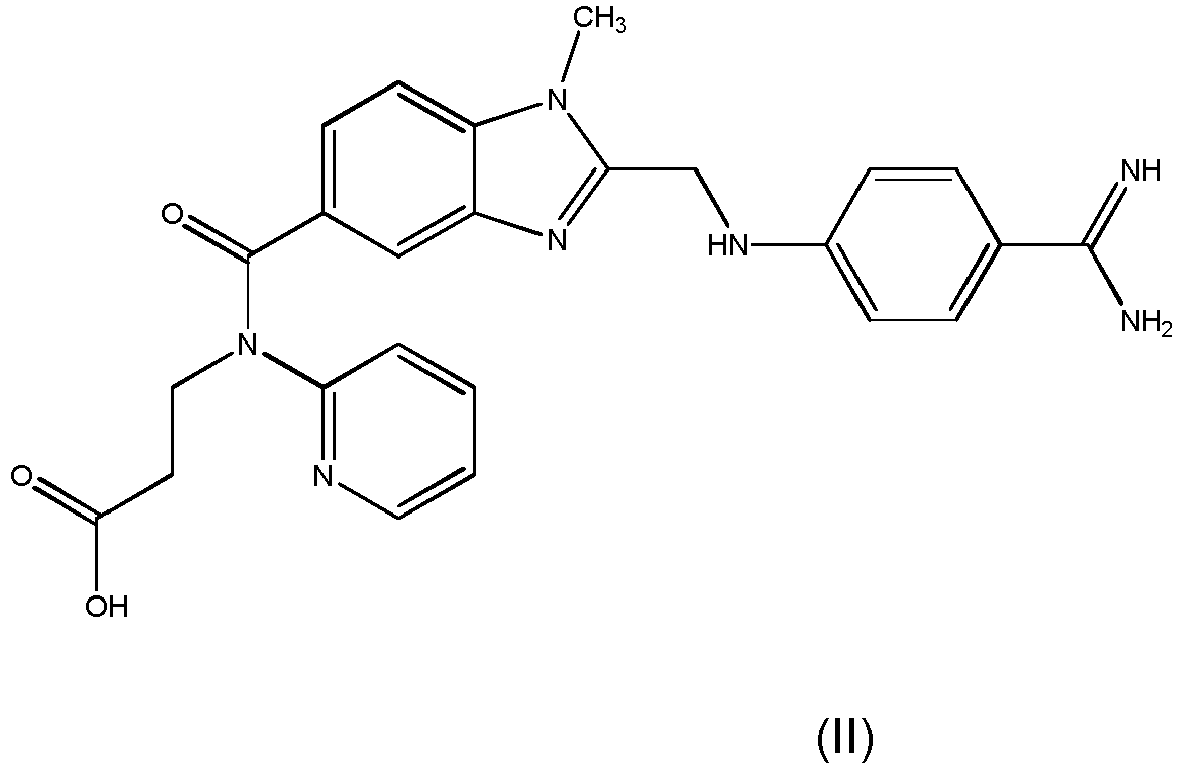
- The solubility of dabigatran, dabigatran etexilate and dabigatran etexilate methanesulfonate in particular, is strongly dependant on the pH value, with increased solubility at acidic pH. On the other hand, it is chemically instable in acidic environment and particularly susceptible to hydrolysis of the pro-drug forming moieties, as well as polymorphic form transformations.
- The production of PRADEXA® and the powder layering method according to which it is prepared are described in detail in patent applications
WO03/074056 WO2009/118321 ,WO2009/118322 , andWO2010/007016 . -
WO03/074056 WO03/074056 -
WO2009/118321 discloses a process for the preparation of approximately spherical/ball-shaped tartaric acid pellets suitable for the manufacture of drug formulations containing active ingredients, the pellets so obtained as such, and the use thereof as a starting material for the production of drug formulations containing active ingredients. The process is characterized in that in a first step the tartaric acid pellets are produced by powder layering, which are sprayed in a second step with an ethanolic isolation suspension which comprises hydroxypropylmethyl cellulose (HPMC). -
WO2009/118322 describes a process characterized by a series of partial steps. First, the core is produced from a pharmaceutically acceptable organic acid, preferably tartaric acid by powder layering. The cores are then converted into so-called isolated tartaric acid cores by spraying on an isolating suspension. A dabigatran etexilate suspension prepared subsequently is sprayed onto these coated cores in one or more process steps by means of a coating process. Dabigatran etexilate methanesulfonate, as polymorph I, is suspended together with talc and hydroxypropylcellulose in isopropanol (isopropyl alcohol, 2-propanol, 2-PrOH), the preparation of the suspension being carried out at a temperature not exceeding 30°C. Finally, the active substance pellets thus obtained are packed into suitable capsules. - In
WO2010/007016 the process disclosed inWO2009/118322 is further characterized by that polymorph I of dabigatran etexilate methanesulfonate being characterised by a melting point of Tmp. = 180 +- 3°C as determined by DSC at a heating rate: of 10°C/min) is suspended together with talc and hydroxypropylcellulose in isopropyl alcohol, the preparation of the suspension being carried out at a temperature not exceeding 30°C by the circulatory dispersal process. - The formulations described in the above patents and/or patent applications contain a tartaric acid crystal core, which increases the dissolution rate of dabigatran by modifying the pH of the microenvironment when the pellet is dissolved. On the other hand, dabigatran etexilate is unstable in the presence of tartaric acid; therefore, an isolating layer between the tartaric acid core and API (Active Pharmaceutical Ingredient) layer has to be applied. This is particularly tricky since the tartaric acid cores are produced by powder layering of tartaric acid dust onto tartaric acid crystals. The cores produced by such a process are only quasi-spherical and it is very difficult to avoid the formation of satellites which cause defects in the isolating layer. The so-called satellites are small particles adhering to the outside of the otherwise rounded pellets and detracting from the otherwise spherical geometry of the pellets. These lead to impaired storage stability and hence durability of the finished product. Furthermore, protection from humidity during manufacture and storage to prevent hydrolysis of the pro-drug forming moieties and polymorphic form transformations, is recommended. Also, HPMC capsule shells and expensive packaging materials are necessary to assure adequate stability of the final product.
- Further on, the technological process described in
WO03/074056 WO2009/118321 ,WO2009/118322 , andWO2010/007016 is in all cases powder layering, which is a very complicated and long process, as the tartaric acid crystals of 0.4-0.6 mm size are portionwise and alternately - up to 300 times - sprayed with a solution of acacia and tartaric acid in water, and coated with fine tartaric acid dust with particle size of up to 100 micrometers, preferably below 50 micrometers. It is also complicated to control the particle size of the tartaric acid crystals used as cores as well as the particle size of the tartaric acid dust. The surface of the so called starter pellets (i.e. tartaric acid crystals alternately coated with an aqueous solution of tartaric acid/ acacia (acting as »glue«) and a layer of fine tartaric acid dust) can be rough and have an increased surface area, and in some cases may also not be sufficiently firm for further processing. -
WO2005/018615 describes tablets comprising dabigatran etexilate and containing 5 wt. % to 50 wt. % of the active substance (based on the methanesulphonate), 5 wt. % to 50 wt. % of a pharmaceutically acceptable organic acid with a solubility in water of >1 g/250 mL at 20°C as well as other excipients and fillers. -
WO2005/023249 describes a pharmaceutical composition comprising: dabigatran etexilate or a pharmaceutically acceptable salt thereof; and a pharmaceutically acceptable lipophilic liquid, solid, or semi-solid carrier system. - Based on the above one can conclude that there is a need for improved solid dosage forms of dabigatran etexilate and its pharmaceutically acceptable salts, preferably dabigatran etexilate methanesulfonate, and/or improved and simplified technological processes for the production thereof.
- The present invention first of all relates to a process for the preparation of a solid oral dosage form comprising dabigatran etexilate or a salt thereof as active substance and comprising a spherical core, wherein
- (a) the spherical core is coated with a solution of tartaric acid without a binder and without powder layering of tartaric acid,
- (b) the coated core of step (a) is coated with an isolating layer, and
- (c) the core coated with an isolating layer of step (b) is coated with further layers wherein at least one of the further layers is a layer comprising the active substance.
- It is preferred that the core coated with an isolating layer is coated with a layer comprising the active substance.
- The core is preferably comprised of sucrose, microcrystalline cellulose, starch or tartaric acid and preferably is a sugar sphere, and the solid oral dosage form is in particular a pellet.
- It is also preferred that the solid oral dosage form comprises less than 20 % by weight of tartaric acid, and that in step (a) a solution of tartaric acid in a mixture of ethanol and water not including a binder is coated on the spherical core.
- Further, it is preferred in the present invention that the active substance, i.e. dabigatran etexilate or a salt thereof, such as the methanesulphonate, or a polymorph of these, such as the polymorph I of the methanesulphonate, has a d90 particle size of less than 150µm, more preferably less than 80µm and most preferably less than 40 µm.
- The d90 or d50 particle size mentioned herein refers to the size of at least 90 or 50 % by volume of the particles. It is measured by using light scattering methods and in particular using a Malvern Mastersizer.
- The present invention relates in a preferred embodiment to a process for the preparation of an improved solid oral dosage form of dabigatran etexilate, in particular dabigatran etexilate methanesulfonate. Dabigatran etexilate comprising pellets are prepared by suspension/solution layering of tartaric acid onto spherical neutral or tartaric acid cores without the use of the powder layering method, followed by an isolating layer and active pharmaceutical ingredient layer. Optionally, an overcoat can also be applied to increase the abrasion resistance and shelf life of the final pellets. A scheme of the preferred final dabigatran etexilate pellet structure according to the present invention is shown in
Figure 1 . - It has surprisingly been found out that dabigatran etexilate, in particular dabigatran etexilate methanesulfonate pellets can also be prepared according to a much simplified and technologically less demanding process than powder layering of tartaric acid crystals with tartaric acid dust and with an aqueous solution of tartaric acid and acacia acting as glue. A commercially available neutral pellet, comprised of sucrose, microcrystalline cellulose or starch, or a commercially available tartaric acid pellet may simply be coated with a solution of tartaric acid, the solution optionally also comprising talc. The dried coated pellets (i.e. starter pellets) obtained by such a process are round, smooth and of narrow size distribution. Their surface is smooth and the coating applied to them is firm. No satellites therefore protrude into the isolating layer and subsequently the layer comprising the active pharmaceutical ingredient thus leading to a stable and bioequivalent pharmaceutical product.
- According to the present invention a preferred improved solid oral dosage form of dabigatran etexilate, in particular dabigatran etexilate methanesulfonate, is produced by suspension/solution layering of tartaric acid onto spherical cores, such as neutral cores comprised of sucrose, microcrystalline cellulose and starch, or tartaric acid pellets, followed by an isolating layer and the layer comprising the active pharmaceutical ingredient. Optionally, an overcoat can be applied.
- It has surprisingly been found out that dabigatran etexilate, in particular dabigatran etexilate methanesulfonate pellets can also be prepared according to a much simplified and technologically less demanding process than powder layering of tartaric acid crystals with tartaric acid dust and with an aqueous solution of tartaric acid and acacia acting as glue. A commercially available neutral pellet, comprised of sucrose, microcrystalline cellulose or starch, or a commercially available tartaric acid pellet may simply be coated with a solution of tartaric acid, the solution optionally also comprising talc. The dried coated pellets (i.e. starter pellets) obtained by such a process are round, smooth and of narrow size distribution. Their surface is smooth and the tartaric acid coating as well as the isolating layer applied to them are firm. No satellites protrude into the isolating layer and the layer comprising the active pharmaceutical ingredient thus leading to a stable and bioequivalent pharmaceutical product.
- The formulation according to the present invention preferably contains pellets presented in
Figure 1 . The pellets comprise a neutral core comprised of sucrose, microcrystalline cellulose or starch, or a commercially available tartaric acid pellet; the tartaric acid layer, the isolating layer, the active pharmaceutical ingredient layer and, optionally, an overcoat. - The neutral core comprised of sucrose, microcrystalline cellulose or starch, or a commercially available tartaric acid pellet will be referred to as the »core« in the following.
- The core comprising the tartaric acid layer will be referred to as the »starter pellet« in the following.
- The pellet comprising the core, the tartaric acid layer and the isolating layer will be referred to as the »isolated pellet« in the following.
- The pellet comprising the core, the tartaric acid layer, the isolating layer as well as the active pharmaceutical ingredient layer, and optionally an overcoat, will be referred to as the »final pellet« in the following.
- The cores are preferably of round shape and of narrow size distribution. They are selected from but not limited to the group of sugar spheres of different size classes, MCC (microcrystalline cellulose) pellets, tartaric acid pellets etc. Preferably the cores are sugar spheres. Most preferably the cores are sugar spheres of the size 425 - 500 µm.
- The starter pellets are in particular prepared from the cores with particle size in the range from 0.2 to 0.8 mm, preferably 0.3 to 0.7 mm and most preferably 0.4 to 0.6 mm as determined by sieving, onto which a solution of tartaric acid is sprayed. The solution is preferably prepared according to the following method: tartaric acid is dissolved in the solvent at room or elevated temperature, preferably at a temperature between 20°C and 80°C. The tartaric acid solution prepared by the method described hereinbefore is then sprayed onto the cores kept moving by rotation. The equipment used is known to the person skilled in the art. In one of the preferred embodiments, a clear solution of tartaric acid without the presence of a binder is prepared in a mixture of ethanol and water.
- Spraying is preferably carried out at a defined spray rate and at constant temperature, preferably between 20°C and 80 °C. By the spray rate is meant the amount of tartaric acid solution that is sprayed onto the rotating pellet bed per hour. The spray rate depends on the batch size in the process according to the invention. After spraying is accomplished the starter pellets are dried until a product temperature of about 30°C to 50°C.
- The first layer (the tartaric acid layer) comprises tartaric acid and is produced by suspension or solution layering of the cores without powder layering with tartaric acid dust in order to minimize, most preferably avoid the formation of the satellites. Different solvents can be applied for the layering process, such as water or organic solvents, selected but not limited to the group of alcohols (ethyl alcohol, methyl alcohol, 2-propanol, dimethylformamide etc.), acetone and other pharmaceutically acceptable organic solvents. Preferably, alcohols, water and mixtures thereof are used. Most preferably a mixture of ethanol and water is used in the process.
- Optionally, other excipients can be added to the solution, such as for example antifoaming agents, or anti-sticking agents.
- The content of tartaric acid in the first layer is preferably not lower than 50 %, more preferably not lower than 80 % and most preferably not lower than 90 % w/w. The function of the tartaric acid lies in providing an acidic micro environment when the solid oral dosage form disintegrates to facilitate the dissolving of dabigatran etexilate, preferably dabigatran etexilate methanesulphonate.
- The content of tartaric acid in the formulation (capsule content) is usually less than 80 %, preferably less than 60 % and most preferably less than 45 %. Surprisingly it was also found that decreased tartaric acid contents in the final pellet may be applied, which can optionally also be lower than 20% (w/w) without impairing the stability and dissolution of the final pellet.
- The second layer is an isolating layer, which is preferably based on a water soluble pharmaceutically acceptable polymer, which can be selected but not limited to the group of cellulose esters (such as hydroxypropyl cellulose, hydroxypropyl methylcellulose, methylcellulose, carboxymethyl cellulose etc.), povidone, acacia, etc. and whose function is to separate the acid sensitive pharmaceutically active ingredient from the tartaric acid layer. Additionally, plasticizers, anticaking agents and coloring agents can be added to the isolating layer. Polyethylene glycols, triethylcitrate, tributylcitrate, triacetine, dibutylsebacate etc. can be used as plasticizers. Talc and silicon dioxide are examples for anticaking agents, preferably talc is used. Optionally dimethylpolysiloxane (dimeticone) or other antifoaming agents can be used to prevent foaming of the solution or suspension. Titanium dioxide, iron oxides and other coloring agents can also be applied.
- The isolated pellets are preferably prepared by spraying an isolating suspension/solution onto the starter pellets obtained by the process described hereinabove. To prepare the isolating suspension the selected polymer(s) are in particular dissolved or suspended in the solvent such as water or organic solvents, selected but not limited to the group of alcohols (ethyl alcohol, methyl alcohol, 2-propanol, dimethylformamide etc.), acetone and other pharmaceutically acceptable organic solvents. Preferably, alcohols, water, and mixtures thereof are used. To the solution or suspension of the polymer in the solvent optionally plasticizers, anticaking agents, antifoaming agents and coloring agents are added and the solution or suspension is sprayed onto the starter pellets.
- During this continuous process the cores are dried continuously with a supply of air at up to 70°C, preferably from 15°C - 70°C.
- The isolated pellets have a uniform and spherical geometry and practically no defects in the isolation caused by satellites. The so-called satellites are small particles adhering to the outside of the otherwise rounded pellets and detracting from the otherwise spherical geometry of the pellets.
- The final pellets comprising the pharmaceutically active ingredient are preferably prepared by spraying an active substance suspension onto the isolated pellets. The active substance suspension is prepared using dabigatran etexilate or a pharmaceutically acceptable salt thereof, preferably dabigatran etexilate methanesulfonate in the form of its polymorph I. The polymorph I is characterized inter alia by a melting point of Tmp. = 180 +- 3°C (as determined by DSC; evaluated using peak maximum; heating rate: 10° C/min) and may e.g. be prepared as disclosed in
WO 03/074056 WO 2005/028468 (particularly Example 1). - In order to prepare the active substance suspension comprising dabigatran etexilate form I in a preferred embodiment for instance isopropyl alcohol (2-PrOH) is adjusted to a temperature range of 10°C - 30°C under a nitrogen atmosphere. Isopropanol is preferably used in anhydrous or almost anhydrous form (99.5 % w/w). If the suspension or solution of dabigatran etexilate methanesulfonate Form I is produced or even stored (aged) at too high a temperature, this may lead to a change in the polymorphic form of the active substance. Particularly preferably the temperature of the manufacturing process is in the range from 0°C to 30°C, particularly preferably between 5°C and 30°C. If another polymorphic form of dabigatran etexilate methanesulfonate or if another salt of dabigatran etexilate is to be used, the solvents to be used are chosen from the group of water or organic solvents, selected but not limited to the group of alcohols (ethyl alcohol, methyl alcohol, 2-propanol, dimethylformamide etc.), acetone and other pharmaceutically acceptable organic solvents and the temperature adapted to that specific salt and/or its polymorphic form.
- To the conditioned solvent hydroxypropylcellulose, hydroxypropylmethylcellulose, or another cellulose derivative is preferably added and stirred until dissolved or suspended. Preferably hydroxypropyl cellulose is used. Then the active substance is added and stirring is continued for 15 - 90 minutes, after which optionally one or more anticaking agent, plasticizing agent, antifoaming agent and coloring agent is added. Preferably, talc is added at a constant stirring rate. Stirring is continued after the addition of the last agent for about 15 to 90 minutes. To prepare the final pellet the active substance suspension thus obtained is sprayed onto the isolated pellets as prepared hereinabove.
- The final pellets as well as the isolated and/or starter pellets may be prepared by the fluidized bed method comprising the following steps:
- i.) preheating of the cores or pellets,
- ii.) spraying phase solution or suspension to the cores or pellets, and
- iii.) drying of the pellets.
- By a fluidized method is meant that the product to be coated has a fluid, preferably air, flowing through it. The material put in is set in motion and kept in motion by this fluid, the nature of the movement being controlled by different equipment-specific inserts. Examples of suitable fluidized bed apparatus are GPCG (= Glatt Particle Coater Granulator), Precision Coater (Aeromatic), Kugelcoater (Hüttlin) or carried out using the Aircoater (Innojet) or Wurster Coater.
- Optionally, an overcoat can be applied to the final pellets to increase their abrasion resistance.
- It is very important for the stability of the final dosage form, in particular pellets, that the moisture content is kept at a minimum. Preferably, the loss on drying value of the final dosage form should not exceed 2 %, more preferably 1.5 % and most preferably the loss on drying should be less than 1 % (measured on Mettler moisture analyzer, 80°C, 20 min).
- Additionally, the loss on drying also of the starter and isolated pellets should be minimal. Preferably the loss on drying value of the starter and isolated pellets should not exceed 2 %, more preferably 1.5 % and most preferably the loss on drying should be less than 1 % (measured on Mettler moisture analyzer, 80°C, 20 min).
- The final pellets are usually packed into commercially obtainable capsules such as gelatine or HPMC capsules, or sachets. Alternatively, the simple mixture of isolated pellets and dabigatran is filled into capsules or sachets.
- The capsules may be packed into primary packaging having decreased permeability for water vapor such as high density polyethylene (HDPE) containers with closure, such as polypropylene (PP) closure and with or without a desiccant; aluminium foil blisters or polychlorotrifluoroethylene (Aclar®) blisters or any other suitable water vapor low-permeable packaging such as blisters made of multilayer polymeric foil where different polymeric materials are combined into a single foil.
- A stabilized pharmaceutical product comprising a package can be produced using a packaging method that utilizes an adsorbent material, such as a molecular sieve, that adsorbs or absorbs moisture in the inner local environment of an impermeable package, so as to prevent hydrolysis and subsequent oxidation products. The adsorbent material can be located in a variety of places. For example, the adsorbent material can be a part of blister foil or can be placed within a porous sachet that, in turn, is located within the sealed package. Naturally, numerous adsorbent materials have applications in a stable pharmaceutical product or a method of the present invention, including a molecular sieve, an activated clay, charcoal, an activated alumina, silica, a zeolite, a bauxite, or any mixture of these materials, to name only a few. An effective amount of the adsorbent material used in a stable pharmaceutical product or in a method of the present invention is that amount sufficient to reduce or eliminate the formation of degradation products. One of ordinary skill can readily determine this amount for a particular embodiment of the present invention using routine laboratory techniques. Moreover, a sealed package of a stable pharmaceutical product or a method of the present invention can be produced from a variety of materials, e.g. metal, glass, plastic, etc. Similarly, the shape of a sealed package can vary. Examples of such shapes include, but certainly are not limited to bottle, a bag, a drum box, and an irregularly shaped container. The sealing of a package of a stable pharmaceutical product or a method of the present invention can be accomplished in a variety of ways. More specifically, heat-sealing, gluing, welding, brazing, mechanical closures, mechanical clamps, or compression can hermetically seal a sealed package of a stable pharmaceutical product of the present invention.
- During the packaging and/or storing controlled conditions with low humidity can be used. Additionally inert gases such as nitrogen, argon or helium; or vacuum can be used during the manufacturing of the solid oral dosage forms, the manufacturing of starter, isolated and final pellets as well as during their packaging to assure inert atmosphere around the solid oral dosage form, such as pellet or capsule, in the sealed primary packaging. Inert atmosphere according to present invention means that the concentration of oxygen in the atmosphere around the solid dosage form packed in the primary packaging is less than 10 vol%, preferably less than 5 vol% and most preferably less than 2 vol%. The concentration of oxygen in the atmosphere surrounding the pellets, sachets or capsules can be determined by gas chromatography.
- The present invention is further illustrated by the following examples.
-
Material Quantity per capsule 1 Sugar spheres 425 - 500 µm 40.00 mg 2 Tartaric acid 60.00 mg 3 Ethanol q.s. 4 Purified Water q.s. -
Material Quantity per capsule 1 MCC pellets (Cellets ®) 40.00 mg 2 Tartaric acid 60.00 mg 3 Ethanol q.s. 4 Purified Water q.s. -
Material Quantity per capsule 1 Tartaric acid pellets (TAP® 400) 40.00 mg 2 Tartaric acid 60.00 mg 3 Ethanol q.s. 4 Purified Water q.s. -
Material Quantity per capsule 1 Sugar spheres 425 - 500 µm 40.00 mg 2 Tartaric acid 45.00 mg 3 Ethanol q.s. 4 Purified Water q.s. -
Material Quantity per capsule 1 MCC pellets (Cellets ®) 40.00 mg 2 Tartaric acid 45.00 mg 3 Ethanol q.s. 4 Purified Water q.s. -
Material Quantity per capsule 1 Tartaric acid pellets (TAP® 400) 40.00 mg 2 Tartaric acid 45.00 mg 3 Ethanol q.s. 4 Purified Water q.s. - Preparation of A8-13: Tartaric acid is dissolved in a suitable quantity of purified water and the same quantity of ethanol is added. The resulting solution is sprayed onto starter beads and the obtained pellets are dried until the desired LOD is achieved.
-
Material Quantity per capsule 1 Sugar spheres 425 - 500 µm 40.00 mg 2 Tartaric acid 60.00 mg 3 2-propanol q.s. 4 Purified Water q.s. -
Material Quantity per capsule 1 Sugar spheres 425-500 µm 40.00 mg 2 Tartaric acid 45.00 mg 3 2-propanol q.s. 4 Purified Water q.s. - Preparation of A14-15: Tartaric acid is dissolved in a suitable quantity of purified water. 2-propanol is added in an amount sufficient to reduce tackiness of the solution. The obtained solution is sprayed onto cores and the obtained starter pellets are dried until the desired LOD is achieved.
-
Material Quantity per capsule 1 Starter pellets A8 100.00 mg 2 HPMC 6cp 2.23 mg 3 Dimeticone 0.04 mg 4 Talc 2.23 mg 5 Ethanol q.s. -
Material Quantity per capsule 1 Starter pellets A10 100.00 mg 2 HPMC 6 cp 2.23 mg 3 Dimeticone 0.04 mg 4 Talc 2.23 mg 5 Ethanol q.s. - Preparation of B1-2: HPMC is added to ethanol and stirred. When dissolved, dimeticone is added. Talc is suspended in a part of ethanol with ultraturax and added to the HPMC solution. The obtained suspension is sprayed onto the starter pellets.
-
Material Quantity per capsule 1 Starter pellets A10 100.00 mg 2 Acacia 2.23 mg 3 Dimeticone 0.04 mg 4 Talc 2.23 mg 5 Purified water q.s. - Preparation of B3: Acacia is dissolved in purified water, then dimeticone is added. Talc is suspended in part of purified water and added to the obtained solution. The resulting suspension is sprayed onto the starter pellets.
-
Material Quantity per capsule 1 Starter pellets A9 100.00 mg 2 Acacia 2.23 mg 3 Talc 2.23 mg 4 Purified water q.s. - Preparation of B4: Acacia is dissolved in purified water. Talc is suspended in part of purified water and added to the obtained solution. The resulting suspension is sprayed onto the starter pellets.
-
Material Quantity per capsule 1 Isolated pellets B1 104.50 mg 2 Dabigatran etexilate mesilate 86.48 mg 3 Hydroxypropyl cellulose 17.30 mg 4 Talc 14.72 mg 5 2-propanol q.s. - Hydroxypropyl cellulose is added to part of 2-propanol and stirred. When dissolved, dabigatran etexilate methanesulphonateis dissolved. Talc is suspended in part of 2-propanol with ultraturax and the suspension is added to the HPC solution). The obtained suspension is sprayed onto isolated pellets B1 and the obtained pellets are dried until appropriate LOD is achieved.
-
Material Quantity per capsule 1 Isolated pellets B1 144.50 mg 2 Dabigatran etexilate mesilate 86.48 mg 3 Hydroxypropyl cellulose (Klucel EF) 17.30 mg 4 Talc 14.72 mg 5 2-propanol q.s. - Hydroxypropyl cellulose Klucel EF is added to part of 2-propanol and stirred. When dissolved, milled dabigatran etexilate methanesulphonate methanesulphonate having a d50 particle size of 6.7µm and a d90 particle size of 15.7µm is added. Talc is suspended in part of 2-propanol with ultraturax and the suspension is added to the Klucel solution. The obtained suspension is sprayed onto isolated pellets B1 and the obtained pellets are dried until appropriate LOD is obtained.
-
Material Quantity per capsule 1 API pellets C1 223 mg 2 HPMC 6 cp 6.00 mg 3 Talc 6.00 mg 4 Titanium dioxide 6.00 mg 5 Ethanol q.s. -
Material Quantity per capsule 1 API pellets C1 104.50 mg 2 Povidone K25 6.00 mg 3 Talc 6.00 mg 4 Titanium dioxide 6.00 mg 5 Ethanol q.s. - Preparation of D1-2: HPMC or povidone is added to part of ethanol and mixed. Talc and titanium dioxide are suspended in part of ethanol with ultraturax and mixed to HPMC or povidone solution. The obtained mixture is sprayed onto pellets, which are then dried until the required LOD is achieved.
Claims (10)
- Process for the preparation of a solid oral dosage form comprising dabigatran etexilate or a salt thereof as active substance and comprising a spherical core, wherein(a) the spherical core is coated with a solution of tartaric acid without a binder and without powder layering of tartaric acid,(b) the coated core of step (a) is coated with an isolating layer, and(c) the core coated with an isolating layer of step (b) is coated with further layers wherein at least one of the further layers is a layer comprising the active substance.
- Process according to claim 1, wherein the core coated with an isolating layer is coated with a layer comprising the active substance.
- Process according to any one of claims 1 or 2, wherein the core is comprised of sucrose, microcrystalline cellulose, starch or tartaric acid and preferably is a sugar sphere.
- Process according to any one of claims 1 to 3, wherein the solid oral dosage form is a pellet.
- Process according to any one of claims 1 to 4, wherein the solid oral dosage form comprises less than 20 % by weight of tartaric acid.
- Process according to any one of claims 1 to 5, wherein in step (a) a solution of tartaric acid in a mixture of ethanol and water not including a binder is coated on the spherical core.
- A process according to claim 1, wherein said process is for the preparation of final dabigatran pellets, characterized in that(a) a neutral core, chosen from the group of sucrose, microcrystalline cellulose, starch, or a tartaric acid core is coated with a solution of tartaric acid and without a binder and without powder layering with tartaric acid to prepare starter pellets,(b) the starter pellets as prepared in (a) are coated by spraying an isolating suspension comprising a water soluble pharmaceutically acceptable polymer and optionally plasticizers, anticaking agents, antifoaming and/or coloring agents to prepare isolated pellets, and(c) the isolated pellets as prepared in (b) are coated by spraying an active substance suspension onto the isolated pellets.
- A process according to claim 7 characterized in that the active substance suspension is prepared using dabigatran etexilate methanesulfonate in the form of its polymorph I.
- A process according to any of claims 7 or 8, characterized in that 2-propanol is used for the preparation of the active substance suspension.
- A process according to any of claims 7 to 9, characterized in that the active substance suspension comprises hydroxypropylcellulose.
Priority Applications (2)
| Application Number | Priority Date | Filing Date | Title |
|---|---|---|---|
| SI201131189A SI2588090T1 (en) | 2010-07-01 | 2011-07-01 | Pharmaceutical oral dosage forms comprising dabigatran etexilate and its pharmaceutically acceptable salts |
| PL11732405T PL2588090T3 (en) | 2010-07-01 | 2011-07-01 | Pharmaceutical oral dosage forms comprising dabigatran etexilate and its pharmaceutically acceptable salts |
Applications Claiming Priority (3)
| Application Number | Priority Date | Filing Date | Title |
|---|---|---|---|
| SI201000196 | 2010-07-01 | ||
| SI201000209 | 2010-07-12 | ||
| PCT/EP2011/061140 WO2012001156A2 (en) | 2010-07-01 | 2011-07-01 | Pharmaceutical oral dosage forms comprising dabigatran etexilate and its pharmaceutically acceptable salts |
Publications (3)
| Publication Number | Publication Date |
|---|---|
| EP2588090A2 EP2588090A2 (en) | 2013-05-08 |
| EP2588090B1 EP2588090B1 (en) | 2017-04-19 |
| EP2588090B2 true EP2588090B2 (en) | 2023-11-22 |
Family
ID=44628481
Family Applications (1)
| Application Number | Title | Priority Date | Filing Date |
|---|---|---|---|
| EP11732405.3A Active EP2588090B2 (en) | 2010-07-01 | 2011-07-01 | Pharmaceutical oral dosage forms comprising dabigatran etexilate and its pharmaceutically acceptable salts |
Country Status (8)
| Country | Link |
|---|---|
| US (1) | US20130177652A1 (en) |
| EP (1) | EP2588090B2 (en) |
| EA (1) | EA022969B1 (en) |
| ES (1) | ES2631980T3 (en) |
| PL (1) | PL2588090T3 (en) |
| PT (1) | PT2588090T (en) |
| SI (1) | SI2588090T1 (en) |
| WO (1) | WO2012001156A2 (en) |
Families Citing this family (22)
| Publication number | Priority date | Publication date | Assignee | Title |
|---|---|---|---|---|
| BR112014020474B1 (en) | 2012-02-21 | 2022-03-29 | Esteve Pharmaceuticals, S.A. | Dabigatran etexilate oral pharmaceutical compositions |
| EP2722033A1 (en) * | 2012-10-19 | 2014-04-23 | Sanovel Ilac Sanayi ve Ticaret A.S. | Pharmaceutical Compositions of Dabigatran Free Base |
| EP2740471B1 (en) | 2012-12-07 | 2015-05-27 | Hexal AG | Oral pharmaceutical composition comprising dabigatran etexilate |
| CN103127109B (en) * | 2013-02-05 | 2014-08-13 | 南京华威医药科技开发有限公司 | Pharmaceutical composition containing dabigatran etexilate or salt and hydrate thereof |
| EP2835370A1 (en) | 2013-08-08 | 2015-02-11 | Medichem, S.A. | New crystals of dabigatran etexilate mesylate |
| WO2015071841A1 (en) | 2013-11-12 | 2015-05-21 | Druggability Technologies Holdings Limited | Complexes of dabigatran and its derivatives, process for the preparation thereof and pharmaceutical compositions containing them |
| CN104994856A (en) * | 2014-01-30 | 2015-10-21 | 杭州领业医药科技有限公司 | Administered formulation of Dabigatran etexilate and salt thereof and preparation method thereof |
| WO2015195990A1 (en) * | 2014-06-20 | 2015-12-23 | Banner Life Sciences Llc | Liquid-filled immediate release soft gelatin capsules |
| WO2016016853A1 (en) * | 2014-07-31 | 2016-02-04 | Sun Pharmaceutical Industries Limited | Method of controlling carbamoyl impurity in pharmaceutical compositions of dabigatran |
| CN105640909B (en) * | 2014-11-14 | 2019-09-20 | 正大天晴药业集团股份有限公司 | A kind of medicinal composition containing dabigatran etexilate |
| TR201706848A2 (en) * | 2017-05-10 | 2018-11-21 | Sanovel Ilac Sanayi Ve Ticaret Anonim Sirketi | SOLID ORAL PHARMACEUTICAL COMPOSITIONS CONTAINING DABIGATRAN ETEXCLATE |
| WO2019004980A2 (en) | 2017-05-10 | 2019-01-03 | Sanovel Ilac Sanayi Ve Ticaret Anonim Sirketi | Solid oral pharmaceutical compositions of dabigatran etexilate |
| TR201722186A2 (en) | 2017-12-27 | 2019-07-22 | Sanovel Ilac Sanayi Ve Ticaret Anonim Sirketi | Pharmaceutical compositions of dabigatran |
| TR201722323A2 (en) | 2017-12-27 | 2019-07-22 | Sanovel Ilac Sanayi Ve Ticaret Anonim Sirketi | Oral pharmaceutical compositions of dabigatran |
| TR201722630A2 (en) | 2017-12-28 | 2019-07-22 | Sanovel Ilac Sanayi Ve Ticaret Anonim Sirketi | |
| WO2020032885A2 (en) * | 2018-05-04 | 2020-02-13 | Sanovel Ilac Sanayi Ve Ticaret Anonim Sirketi | Capsule-in-capsule compositions of dabigatran etexilate |
| EP3771465A1 (en) | 2019-08-01 | 2021-02-03 | Zaklady Farmaceutyczne Polpharma SA | Pharmaceutical composition comprising dabigatran etexilate |
| EP4061369A4 (en) | 2019-11-19 | 2024-04-10 | Sanovel Ilac Sanayi Ve Ticaret Anonim Sirketi | A pharmaceutical form comprising acidic substance |
| CN114191394A (en) * | 2020-09-02 | 2022-03-18 | 北京四环制药有限公司 | Dabigatran etexilate pharmaceutical composition, preparation method and application thereof |
| EP4465969A1 (en) | 2022-01-21 | 2024-11-27 | Adamed Pharma S.A. | A process for preparation of tartaric acid cores for dabigatran pellets and the pellets containing dabigatran |
| WO2024217830A1 (en) | 2023-03-30 | 2024-10-24 | Adamed Pharma S.A | A process for preparation of hard capsules filled with dabigatran pellets |
| CN116687877B (en) * | 2023-08-07 | 2023-11-10 | 山东国邦药业有限公司 | Taqniamycin tartrate dry suspension and preparation method thereof |
Family Cites Families (11)
| Publication number | Priority date | Publication date | Assignee | Title |
|---|---|---|---|---|
| PE121699A1 (en) | 1997-02-18 | 1999-12-08 | Boehringer Ingelheim Pharma | BICYCLE HETERO CYCLES DISSTITUTED AS INHIBITORS OF THROMBIN |
| US20030181488A1 (en) | 2002-03-07 | 2003-09-25 | Boehringer Ingelheim Pharma Gmbh & Co. Kg | Administration form for the oral application of 3-[(2-{[4-(hexyloxycarbonylamino-imino-methyl)-phenylamino]-methyl}-1-methyl-1H-benzimidazol-5-carbonyl)-pyridin-2-yl-amino]-propionic acid ethyl ester and the salts thereof |
| EP1485094B2 (en) | 2002-03-07 | 2020-03-25 | Boehringer Ingelheim International GmbH | Dosage form for oral administration of 3-[(2-{[4-(hexyloxycarbonylamino-imino-methyl)-phenylamino]-methyl}-1-methyl-1h-benzimidazol-5-carbonyl)-pyridin-2-yl-amino] propionic acid ethyl ester or its salts |
| DE10337697A1 (en) | 2003-08-16 | 2005-03-24 | Boehringer Ingelheim Pharma Gmbh & Co. Kg | Tablet containing 3 - [(2 - {[4- (hexyloxycarbonylamino-iminomethyl) -phenyl-amino] -methyl} -1-methyl-1H-benzimidazole-5-carbonyl) -pyridin-2-yl-amino] - propionic acid ethyl ester or its salts |
| DE10339862A1 (en) | 2003-08-29 | 2005-03-24 | Boehringer Ingelheim Pharma Gmbh & Co. Kg | New crystalline forms of ethyl 3-(N-(2-(4-(hexyloxycarbonylamidino)phenylaminomethyl)-1-methyl-1H-benzimidazole-5-carbonyl)-N-(2-pyridyl)amino)propionate methanesulfonate used for post-operative prophylaxis of deep vein thrombosis |
| DE10341043A1 (en) | 2003-09-03 | 2005-03-31 | Boehringer Ingelheim Pharma Gmbh & Co. Kg | New Oral Dosage Form for 3 - [(2 - {[4-hexyloxycarbonylamino-imino-methyl) -phenyl-amino] -methyl} -1-methyl-1H-benzimidazole-5-carbonyl) -pyridin-2-yl-amino] Propionic acid ethyl ester and its salts |
| US20090196935A1 (en) | 2008-02-01 | 2009-08-06 | Ahmed Salah U | Pharmaceutical Capsules Comprising Extended Release Dipyridamole Pellets |
| KR20100129281A (en) | 2008-03-28 | 2010-12-08 | 베링거 인겔하임 인터내셔날 게엠베하 | Method for preparing oral administration of dabigatran formulation |
| EP2271317B1 (en) | 2008-03-28 | 2017-04-19 | Boehringer Ingelheim International GmbH | Method for manufacturing acid pellets |
| US8277804B2 (en) * | 2008-05-21 | 2012-10-02 | Alderbio Holdings Llc | Antagonists of IL-6 to prevent or treat thrombosis |
| AU2009272796A1 (en) | 2008-07-14 | 2010-01-21 | Boehringer Ingelheim International Gmbh | Method for manufacturing medicinal compounds containing dabigatran |
-
2011
- 2011-07-01 ES ES11732405.3T patent/ES2631980T3/en active Active
- 2011-07-01 US US13/807,882 patent/US20130177652A1/en not_active Abandoned
- 2011-07-01 SI SI201131189A patent/SI2588090T1/en unknown
- 2011-07-01 PL PL11732405T patent/PL2588090T3/en unknown
- 2011-07-01 PT PT117324053T patent/PT2588090T/en unknown
- 2011-07-01 WO PCT/EP2011/061140 patent/WO2012001156A2/en not_active Ceased
- 2011-07-01 EP EP11732405.3A patent/EP2588090B2/en active Active
- 2011-07-01 EA EA201291421A patent/EA022969B1/en unknown
Also Published As
| Publication number | Publication date |
|---|---|
| WO2012001156A3 (en) | 2012-08-30 |
| PT2588090T (en) | 2017-06-26 |
| ES2631980T3 (en) | 2017-09-07 |
| EA022969B1 (en) | 2016-03-31 |
| WO2012001156A2 (en) | 2012-01-05 |
| PL2588090T3 (en) | 2017-12-29 |
| EP2588090B1 (en) | 2017-04-19 |
| SI2588090T1 (en) | 2017-06-30 |
| US20130177652A1 (en) | 2013-07-11 |
| EA201291421A1 (en) | 2013-05-30 |
| EP2588090A2 (en) | 2013-05-08 |
Similar Documents
| Publication | Publication Date | Title |
|---|---|---|
| EP2588090B1 (en) | Pharmaceutical oral dosage forms comprising dabigatran etexilate and its pharmaceutically acceptable salts | |
| JP6473532B2 (en) | Stable solid formulation of GC-C receptor agonist polypeptide suitable for oral administration | |
| US20050214371A1 (en) | Stable pharmaceutical composition comprising an acid labile drug | |
| EP1187599B1 (en) | Stable benzimidazole formulation | |
| HK55497A (en) | Use of specific core material and layers to obtain pharmaceutical formulations stable to discolouration of acid labile compounds | |
| KR20040099298A (en) | Form of presentation for 3-[(2-{[4-(hexyloxycarbonylamino-imino-methyl)-phenylamino]-methyl}-1-methyl-1H-benzimidazol-5-carbonyl)-pyridin-2-yl-amino] propionic acid ethyl ester to be administered orally | |
| AU2012331182B2 (en) | Pharmaceutical composition of omeprazole | |
| IE79672B1 (en) | Process for preparing drug substances in beadlet form | |
| WO2012001705A2 (en) | Pharmaceutical compositions of (r)-lansoprazole | |
| EP2303866B1 (en) | Crystalline forms of rabeprazole sodium | |
| EP2654729B1 (en) | Homogenous pharmaceutical oral dosage forms comprising lercanidipine and enalapril or their pharmaceutically acceptable salts together with an organic acid | |
| IL227253A (en) | Solid molecular dispersion of fesoterodine | |
| US20110150942A1 (en) | Gastro-resistant pharmaceutical oral compositions comprising duloxetine or its pharmaceutically acceptable derivatives | |
| WO2022254354A1 (en) | Novel pharmaceutical compositions comprising dabigatran etexilate or salt thereof | |
| CN104274444B (en) | Oral double pellet pharmaceutical compositions of dabigatran etcxilate or its salt | |
| EP2133072A1 (en) | Gastro-resistant pharmaceutical oral compositions comprising duloxetine or its pharmaceutically acceptable derivatives | |
| TW201922228A (en) | Orally medicinal composition and structure thereof | |
| IL139894A (en) | Stable benzimidazole composition and a method for producing it | |
| KR20080043904A (en) | Film coating formulation containing amlodipine and salts thereof |
Legal Events
| Date | Code | Title | Description |
|---|---|---|---|
| PUAI | Public reference made under article 153(3) epc to a published international application that has entered the european phase |
Free format text: ORIGINAL CODE: 0009012 |
|
| 17P | Request for examination filed |
Effective date: 20121218 |
|
| AK | Designated contracting states |
Kind code of ref document: A2 Designated state(s): AL AT BE BG CH CY CZ DE DK EE ES FI FR GB GR HR HU IE IS IT LI LT LU LV MC MK MT NL NO PL PT RO RS SE SI SK SM TR |
|
| AX | Request for extension of the european patent |
Extension state: BA ME |
|
| 17Q | First examination report despatched |
Effective date: 20140205 |
|
| 17Q | First examination report despatched |
Effective date: 20140224 |
|
| TPAC | Observations filed by third parties |
Free format text: ORIGINAL CODE: EPIDOSNTIPA |
|
| GRAP | Despatch of communication of intention to grant a patent |
Free format text: ORIGINAL CODE: EPIDOSNIGR1 |
|
| STAA | Information on the status of an ep patent application or granted ep patent |
Free format text: STATUS: GRANT OF PATENT IS INTENDED |
|
| INTG | Intention to grant announced |
Effective date: 20161213 |
|
| GRAS | Grant fee paid |
Free format text: ORIGINAL CODE: EPIDOSNIGR3 |
|
| GRAA | (expected) grant |
Free format text: ORIGINAL CODE: 0009210 |
|
| STAA | Information on the status of an ep patent application or granted ep patent |
Free format text: STATUS: THE PATENT HAS BEEN GRANTED |
|
| AK | Designated contracting states |
Kind code of ref document: B1 Designated state(s): AL AT BE BG CH CY CZ DE DK EE ES FI FR GB GR HR HU IE IS IT LI LT LU LV MC MK MT NL NO PL PT RO RS SE SI SK SM TR |
|
| AX | Request for extension of the european patent |
Extension state: BA ME |
|
| REG | Reference to a national code |
Ref country code: GB Ref legal event code: FG4D |
|
| RIN1 | Information on inventor provided before grant (corrected) |
Inventor name: KROSELJ, VESNA Inventor name: JURSA KSELA, SONJA |
|
| REG | Reference to a national code |
Ref country code: CH Ref legal event code: EP |
|
| REG | Reference to a national code |
Ref country code: AT Ref legal event code: REF Ref document number: 885268 Country of ref document: AT Kind code of ref document: T Effective date: 20170515 |
|
| REG | Reference to a national code |
Ref country code: IE Ref legal event code: FG4D |
|
| REG | Reference to a national code |
Ref country code: DE Ref legal event code: R096 Ref document number: 602011037113 Country of ref document: DE |
|
| REG | Reference to a national code |
Ref country code: PT Ref legal event code: SC4A Ref document number: 2588090 Country of ref document: PT Date of ref document: 20170626 Kind code of ref document: T Free format text: AVAILABILITY OF NATIONAL TRANSLATION Effective date: 20170609 |
|
| REG | Reference to a national code |
Ref country code: FR Ref legal event code: PLFP Year of fee payment: 7 |
|
| REG | Reference to a national code |
Ref country code: NL Ref legal event code: FP |
|
| REG | Reference to a national code |
Ref country code: ES Ref legal event code: FG2A Ref document number: 2631980 Country of ref document: ES Kind code of ref document: T3 Effective date: 20170907 |
|
| REG | Reference to a national code |
Ref country code: LT Ref legal event code: MG4D |
|
| REG | Reference to a national code |
Ref country code: AT Ref legal event code: MK05 Ref document number: 885268 Country of ref document: AT Kind code of ref document: T Effective date: 20170419 |
|
| PG25 | Lapsed in a contracting state [announced via postgrant information from national office to epo] |
Ref country code: AT Free format text: LAPSE BECAUSE OF FAILURE TO SUBMIT A TRANSLATION OF THE DESCRIPTION OR TO PAY THE FEE WITHIN THE PRESCRIBED TIME-LIMIT Effective date: 20170419 Ref country code: HR Free format text: LAPSE BECAUSE OF FAILURE TO SUBMIT A TRANSLATION OF THE DESCRIPTION OR TO PAY THE FEE WITHIN THE PRESCRIBED TIME-LIMIT Effective date: 20170419 Ref country code: NO Free format text: LAPSE BECAUSE OF FAILURE TO SUBMIT A TRANSLATION OF THE DESCRIPTION OR TO PAY THE FEE WITHIN THE PRESCRIBED TIME-LIMIT Effective date: 20170719 Ref country code: GR Free format text: LAPSE BECAUSE OF FAILURE TO SUBMIT A TRANSLATION OF THE DESCRIPTION OR TO PAY THE FEE WITHIN THE PRESCRIBED TIME-LIMIT Effective date: 20170720 Ref country code: FI Free format text: LAPSE BECAUSE OF FAILURE TO SUBMIT A TRANSLATION OF THE DESCRIPTION OR TO PAY THE FEE WITHIN THE PRESCRIBED TIME-LIMIT Effective date: 20170419 Ref country code: LT Free format text: LAPSE BECAUSE OF FAILURE TO SUBMIT A TRANSLATION OF THE DESCRIPTION OR TO PAY THE FEE WITHIN THE PRESCRIBED TIME-LIMIT Effective date: 20170419 |
|
| PG25 | Lapsed in a contracting state [announced via postgrant information from national office to epo] |
Ref country code: BG Free format text: LAPSE BECAUSE OF FAILURE TO SUBMIT A TRANSLATION OF THE DESCRIPTION OR TO PAY THE FEE WITHIN THE PRESCRIBED TIME-LIMIT Effective date: 20170719 Ref country code: IS Free format text: LAPSE BECAUSE OF FAILURE TO SUBMIT A TRANSLATION OF THE DESCRIPTION OR TO PAY THE FEE WITHIN THE PRESCRIBED TIME-LIMIT Effective date: 20170819 Ref country code: LV Free format text: LAPSE BECAUSE OF FAILURE TO SUBMIT A TRANSLATION OF THE DESCRIPTION OR TO PAY THE FEE WITHIN THE PRESCRIBED TIME-LIMIT Effective date: 20170419 Ref country code: RS Free format text: LAPSE BECAUSE OF FAILURE TO SUBMIT A TRANSLATION OF THE DESCRIPTION OR TO PAY THE FEE WITHIN THE PRESCRIBED TIME-LIMIT Effective date: 20170419 Ref country code: SE Free format text: LAPSE BECAUSE OF FAILURE TO SUBMIT A TRANSLATION OF THE DESCRIPTION OR TO PAY THE FEE WITHIN THE PRESCRIBED TIME-LIMIT Effective date: 20170419 |
|
| REG | Reference to a national code |
Ref country code: DE Ref legal event code: R026 Ref document number: 602011037113 Country of ref document: DE |
|
| PLBI | Opposition filed |
Free format text: ORIGINAL CODE: 0009260 |
|
| PLBI | Opposition filed |
Free format text: ORIGINAL CODE: 0009260 |
|
| PG25 | Lapsed in a contracting state [announced via postgrant information from national office to epo] |
Ref country code: RO Free format text: LAPSE BECAUSE OF FAILURE TO SUBMIT A TRANSLATION OF THE DESCRIPTION OR TO PAY THE FEE WITHIN THE PRESCRIBED TIME-LIMIT Effective date: 20170419 Ref country code: DK Free format text: LAPSE BECAUSE OF FAILURE TO SUBMIT A TRANSLATION OF THE DESCRIPTION OR TO PAY THE FEE WITHIN THE PRESCRIBED TIME-LIMIT Effective date: 20170419 Ref country code: EE Free format text: LAPSE BECAUSE OF FAILURE TO SUBMIT A TRANSLATION OF THE DESCRIPTION OR TO PAY THE FEE WITHIN THE PRESCRIBED TIME-LIMIT Effective date: 20170419 Ref country code: SK Free format text: LAPSE BECAUSE OF FAILURE TO SUBMIT A TRANSLATION OF THE DESCRIPTION OR TO PAY THE FEE WITHIN THE PRESCRIBED TIME-LIMIT Effective date: 20170419 |
|
| PLAX | Notice of opposition and request to file observation + time limit sent |
Free format text: ORIGINAL CODE: EPIDOSNOBS2 |
|
| 26 | Opposition filed |
Opponent name: GENERICS (UK) LTD Effective date: 20180116 |
|
| PLAB | Opposition data, opponent's data or that of the opponent's representative modified |
Free format text: ORIGINAL CODE: 0009299OPPO |
|
| 26 | Opposition filed |
Opponent name: LEDERER & KELLER PATENTANWAELTE PARTNERSCHAFT MBB Effective date: 20180119 Opponent name: EDER, MICHAEL Effective date: 20180119 |
|
| PG25 | Lapsed in a contracting state [announced via postgrant information from national office to epo] |
Ref country code: SM Free format text: LAPSE BECAUSE OF FAILURE TO SUBMIT A TRANSLATION OF THE DESCRIPTION OR TO PAY THE FEE WITHIN THE PRESCRIBED TIME-LIMIT Effective date: 20170419 |
|
| REG | Reference to a national code |
Ref country code: CH Ref legal event code: PL |
|
| R26 | Opposition filed (corrected) |
Opponent name: GEORG KALHAMMER/STEPHAN TEIPEL Effective date: 20180119 |
|
| REG | Reference to a national code |
Ref country code: IE Ref legal event code: MM4A |
|
| PG25 | Lapsed in a contracting state [announced via postgrant information from national office to epo] |
Ref country code: CH Free format text: LAPSE BECAUSE OF NON-PAYMENT OF DUE FEES Effective date: 20170731 Ref country code: LI Free format text: LAPSE BECAUSE OF NON-PAYMENT OF DUE FEES Effective date: 20170731 Ref country code: IE Free format text: LAPSE BECAUSE OF NON-PAYMENT OF DUE FEES Effective date: 20170701 |
|
| PLBB | Reply of patent proprietor to notice(s) of opposition received |
Free format text: ORIGINAL CODE: EPIDOSNOBS3 |
|
| REG | Reference to a national code |
Ref country code: FR Ref legal event code: PLFP Year of fee payment: 8 |
|
| PG25 | Lapsed in a contracting state [announced via postgrant information from national office to epo] |
Ref country code: LU Free format text: LAPSE BECAUSE OF NON-PAYMENT OF DUE FEES Effective date: 20170701 |
|
| PG25 | Lapsed in a contracting state [announced via postgrant information from national office to epo] |
Ref country code: MT Free format text: LAPSE BECAUSE OF NON-PAYMENT OF DUE FEES Effective date: 20170701 |
|
| PLAB | Opposition data, opponent's data or that of the opponent's representative modified |
Free format text: ORIGINAL CODE: 0009299OPPO |
|
| R26 | Opposition filed (corrected) |
Opponent name: GENERICS (UK) LTD Effective date: 20180116 |
|
| PG25 | Lapsed in a contracting state [announced via postgrant information from national office to epo] |
Ref country code: MC Free format text: LAPSE BECAUSE OF FAILURE TO SUBMIT A TRANSLATION OF THE DESCRIPTION OR TO PAY THE FEE WITHIN THE PRESCRIBED TIME-LIMIT Effective date: 20170419 Ref country code: HU Free format text: LAPSE BECAUSE OF FAILURE TO SUBMIT A TRANSLATION OF THE DESCRIPTION OR TO PAY THE FEE WITHIN THE PRESCRIBED TIME-LIMIT; INVALID AB INITIO Effective date: 20110701 |
|
| APAH | Appeal reference modified |
Free format text: ORIGINAL CODE: EPIDOSCREFNO |
|
| APBM | Appeal reference recorded |
Free format text: ORIGINAL CODE: EPIDOSNREFNO |
|
| APBP | Date of receipt of notice of appeal recorded |
Free format text: ORIGINAL CODE: EPIDOSNNOA2O |
|
| APBM | Appeal reference recorded |
Free format text: ORIGINAL CODE: EPIDOSNREFNO |
|
| APBP | Date of receipt of notice of appeal recorded |
Free format text: ORIGINAL CODE: EPIDOSNNOA2O |
|
| APBQ | Date of receipt of statement of grounds of appeal recorded |
Free format text: ORIGINAL CODE: EPIDOSNNOA3O |
|
| PG25 | Lapsed in a contracting state [announced via postgrant information from national office to epo] |
Ref country code: CY Free format text: LAPSE BECAUSE OF NON-PAYMENT OF DUE FEES Effective date: 20170419 |
|
| PG25 | Lapsed in a contracting state [announced via postgrant information from national office to epo] |
Ref country code: MK Free format text: LAPSE BECAUSE OF FAILURE TO SUBMIT A TRANSLATION OF THE DESCRIPTION OR TO PAY THE FEE WITHIN THE PRESCRIBED TIME-LIMIT Effective date: 20170419 |
|
| PG25 | Lapsed in a contracting state [announced via postgrant information from national office to epo] |
Ref country code: TR Free format text: LAPSE BECAUSE OF FAILURE TO SUBMIT A TRANSLATION OF THE DESCRIPTION OR TO PAY THE FEE WITHIN THE PRESCRIBED TIME-LIMIT Effective date: 20170419 |
|
| PG25 | Lapsed in a contracting state [announced via postgrant information from national office to epo] |
Ref country code: AL Free format text: LAPSE BECAUSE OF FAILURE TO SUBMIT A TRANSLATION OF THE DESCRIPTION OR TO PAY THE FEE WITHIN THE PRESCRIBED TIME-LIMIT Effective date: 20170419 |
|
| APBU | Appeal procedure closed |
Free format text: ORIGINAL CODE: EPIDOSNNOA9O |
|
| PLAY | Examination report in opposition despatched + time limit |
Free format text: ORIGINAL CODE: EPIDOSNORE2 |
|
| PLBC | Reply to examination report in opposition received |
Free format text: ORIGINAL CODE: EPIDOSNORE3 |
|
| PLAY | Examination report in opposition despatched + time limit |
Free format text: ORIGINAL CODE: EPIDOSNORE2 |
|
| PLBC | Reply to examination report in opposition received |
Free format text: ORIGINAL CODE: EPIDOSNORE3 |
|
| PLAT | Information related to reply to examination report in opposition deleted |
Free format text: ORIGINAL CODE: EPIDOSDORE3 |
|
| PLBC | Reply to examination report in opposition received |
Free format text: ORIGINAL CODE: EPIDOSNORE3 |
|
| PGFP | Annual fee paid to national office [announced via postgrant information from national office to epo] |
Ref country code: PT Payment date: 20230614 Year of fee payment: 13 Ref country code: NL Payment date: 20230620 Year of fee payment: 13 Ref country code: CZ Payment date: 20230613 Year of fee payment: 13 |
|
| PGFP | Annual fee paid to national office [announced via postgrant information from national office to epo] |
Ref country code: PL Payment date: 20230613 Year of fee payment: 13 |
|
| PUAH | Patent maintained in amended form |
Free format text: ORIGINAL CODE: 0009272 |
|
| STAA | Information on the status of an ep patent application or granted ep patent |
Free format text: STATUS: PATENT MAINTAINED AS AMENDED |
|
| PGFP | Annual fee paid to national office [announced via postgrant information from national office to epo] |
Ref country code: ES Payment date: 20230801 Year of fee payment: 13 |
|
| REG | Reference to a national code |
Ref country code: DE Ref legal event code: R082 Ref document number: 602011037113 Country of ref document: DE Representative=s name: HOEFER & PARTNER PATENTANWAELTE MBB, DE |
|
| 27A | Patent maintained in amended form |
Effective date: 20231122 |
|
| AK | Designated contracting states |
Kind code of ref document: B2 Designated state(s): AL AT BE BG CH CY CZ DE DK EE ES FI FR GB GR HR HU IE IS IT LI LT LU LV MC MK MT NL NO PL PT RO RS SE SI SK SM TR |
|
| REG | Reference to a national code |
Ref country code: DE Ref legal event code: R102 Ref document number: 602011037113 Country of ref document: DE |
|
| PG25 | Lapsed in a contracting state [announced via postgrant information from national office to epo] |
Ref country code: NL Free format text: LAPSE BECAUSE OF FAILURE TO SUBMIT A TRANSLATION OF THE DESCRIPTION OR TO PAY THE FEE WITHIN THE PRESCRIBED TIME-LIMIT Effective date: 20170419 |
|
| PG25 | Lapsed in a contracting state [announced via postgrant information from national office to epo] |
Ref country code: ES Free format text: LAPSE BECAUSE OF FAILURE TO SUBMIT A TRANSLATION OF THE DESCRIPTION OR TO PAY THE FEE WITHIN THE PRESCRIBED TIME-LIMIT Effective date: 20231122 |
|
| PG25 | Lapsed in a contracting state [announced via postgrant information from national office to epo] |
Ref country code: NL Free format text: LAPSE BECAUSE OF FAILURE TO SUBMIT A TRANSLATION OF THE DESCRIPTION OR TO PAY THE FEE WITHIN THE PRESCRIBED TIME-LIMIT Effective date: 20170419 Ref country code: ES Free format text: LAPSE BECAUSE OF FAILURE TO SUBMIT A TRANSLATION OF THE DESCRIPTION OR TO PAY THE FEE WITHIN THE PRESCRIBED TIME-LIMIT Effective date: 20231122 Ref country code: CZ Free format text: LAPSE BECAUSE OF FAILURE TO SUBMIT A TRANSLATION OF THE DESCRIPTION OR TO PAY THE FEE WITHIN THE PRESCRIBED TIME-LIMIT Effective date: 20170419 |
|
| PG25 | Lapsed in a contracting state [announced via postgrant information from national office to epo] |
Ref country code: PT Free format text: LAPSE BECAUSE OF FAILURE TO SUBMIT A TRANSLATION OF THE DESCRIPTION OR TO PAY THE FEE WITHIN THE PRESCRIBED TIME-LIMIT Effective date: 20240403 |
|
| PG25 | Lapsed in a contracting state [announced via postgrant information from national office to epo] |
Ref country code: PT Free format text: LAPSE BECAUSE OF FAILURE TO SUBMIT A TRANSLATION OF THE DESCRIPTION OR TO PAY THE FEE WITHIN THE PRESCRIBED TIME-LIMIT Effective date: 20240403 |
|
| PGFP | Annual fee paid to national office [announced via postgrant information from national office to epo] |
Ref country code: DE Payment date: 20250725 Year of fee payment: 15 |
|
| PGFP | Annual fee paid to national office [announced via postgrant information from national office to epo] |
Ref country code: GB Payment date: 20250721 Year of fee payment: 15 Ref country code: BE Payment date: 20250724 Year of fee payment: 15 |
|
| PGFP | Annual fee paid to national office [announced via postgrant information from national office to epo] |
Ref country code: IT Payment date: 20260622 Year of fee payment: 16 |
|
| PGFP | Annual fee paid to national office [announced via postgrant information from national office to epo] |
Ref country code: FR Payment date: 20260630 Year of fee payment: 16 |
|
| PGFP | Annual fee paid to national office [announced via postgrant information from national office to epo] |
Ref country code: SI Payment date: 20260616 Year of fee payment: 16 |