EP2587611A2 - Power generation system including predictive control apparatus to reduce influences of weather-varying factors - Google Patents
Power generation system including predictive control apparatus to reduce influences of weather-varying factors Download PDFInfo
- Publication number
- EP2587611A2 EP2587611A2 EP12187660.1A EP12187660A EP2587611A2 EP 2587611 A2 EP2587611 A2 EP 2587611A2 EP 12187660 A EP12187660 A EP 12187660A EP 2587611 A2 EP2587611 A2 EP 2587611A2
- Authority
- EP
- European Patent Office
- Prior art keywords
- power
- array
- control strategy
- generation system
- generators
- Prior art date
- Legal status (The legal status is an assumption and is not a legal conclusion. Google has not performed a legal analysis and makes no representation as to the accuracy of the status listed.)
- Granted
Links
Images



Classifications
-
- H—ELECTRICITY
- H02—GENERATION; CONVERSION OR DISTRIBUTION OF ELECTRIC POWER
- H02J—ELECTRIC POWER NETWORKS; CIRCUIT ARRANGEMENTS OR SYSTEMS FOR SUPPLYING OR DISTRIBUTING ELECTRIC POWER; SYSTEMS FOR STORING ELECTRIC ENERGY
- H02J3/00—Circuit arrangements for AC mains or AC distribution networks
- H02J3/38—Arrangements for feeding a single network from two or more generators or sources in parallel; Arrangements for feeding already energised networks from additional generators or sources in parallel
Definitions
- the present invention is generally related to power generation, as may involve a power generation system for generating electrical power, which varies in response to one or more weather-varying factors, such as solar irradiance, temperature, wind, and more particularly to predictive control apparatus and techniques to reduce influences of such weather-varying factors.
- a power generation system for generating electrical power which varies in response to one or more weather-varying factors, such as solar irradiance, temperature, wind, and more particularly to predictive control apparatus and techniques to reduce influences of such weather-varying factors.
- the weather-induced variability of the natural resource may cause challenges at various levels, such as at a component level (e.g., inverter), at a subsystem level, at a distribution level as well as on the larger power grid.
- a component level e.g., inverter
- a subsystem level e.g., at a distribution level as well as on the larger power grid.
- a power generation system for generating electrical power, which varies in response to at least one weather-varying factor.
- the system may include an array of power generators subject to the weather-varying factor.
- the array of power generators may be disposed over respective locations on a field.
- At least one inverter may be coupled to the array of power generators.
- a module may be configured to predict over a time horizon at least one power-generating condition for the array of power generators.
- a controller may be configured to anticipatorily adjust a control strategy regarding operation of the component and/or subsystem of the power generation system based on the predicted power-generating condition for the array of power generators over the time horizon.
- the control strategy may be a cooling control strategy for the inverter based on the predicted power-generating condition for the array of power generators over the time horizon.
- an apparatus which may include a module configured to predict over a time horizon at least one power-generating condition for an array of power generators.
- the apparatus may further include a controller configured to anticipatorily adjust a control strategy regarding operation of at least one component and/or subsystem of the power generation system based on the predicted power-generating condition for the array of power generators over the time horizon.
- a power generation system for generating electrical power, which varies in response to at least one weather-varying factor.
- the system may include an array of power generators subject to the weather-varying factor.
- a module may be configured to predict over a time horizon at least one power-generating condition for the array of power generators.
- a controller may be configured to anticipatorily adjust a control strategy regarding operation of the component and/or subsystem of the power generation system based on the predicted power-generating condition for the array of power generators over the time horizon.
- FIG.1 is a schematic representation of an example embodiment of a power generation system 10 for generating electrical power, which may vary in response to one or more weather-varying factors 11, such as solar irradiance, wind, temperature, etc.
- An array of power generators 12 may be subject to such weather-varying factors.
- power generators 12 may comprise an array of photovoltaic (PV) modules.
- PV photovoltaic
- Solar irradiance may for example vary based on varying cloud conditions, which can lead to changes in the power generating conditions of the array of photovoltaic modules.
- power generators 12 may comprise an array of wind turbines. Varying wind conditions can lead to changes in the power generating conditions of the array of wind turbines. Regardless of the specific modality, the array of power generators 12 may be disposed over respective locations (e.g., spaced-apart locations) on a field 14, such as a utility-scale solar farm, and/or a utility-scale wind park, as may involve a relatively large surface area (e.g., potentially hundreds of acres).
- a field 14 such as a utility-scale solar farm, and/or a utility-scale wind park
- one or more inverters 16 may be coupled to the array of power generators 12.
- photovoltaic arrays naturally produce direct current (DC) power output when exposed to solar irradiance.
- one or more inverters may be used for converting the DC output from the photovoltaic array to an AC signal appropriate for coupling to a power grid 15.
- wind turbine generators can generate AC power output.
- the frequency and phase of the wind turbine output may depend, respectively, on the speed of rotation and position of a rotor within the turbine generator.
- the AC power produced by the wind power system may be initially rectified to produce an intermediate DC power, which is then transformed to AC power via one or more inverters to match the line frequency and phase of power grid 15.
- a predictive module 18 may be configured in accordance with aspects of the present invention to predict over a time horizon, as for example may range from seconds to several hours, at least one power-generating condition for the array of power generators 12.
- predictive module 18 may be responsive to weather observations, as may be obtained from a sensor suite 20 and/or weather forecasts, as may be obtained from weather data services, in combination with model data of the power generators to predict the power-generating condition for the array of power generators 12.
- predictive module 18 may be responsive to historical weather data as may be stored in a database 22.
- a controller 24 may be configured to anticipatorily adjust a control strategy regarding operation of at least one subsystem and/or component of the power generation system based on the predicted power-generating condition for the array of power generators over the time horizon.
- the control strategy may be a cooling control strategy for inverter 16, as may be implemented by way of a cooling subsystem 17, based on the predicted power-generating condition for the array of power generators 12 over the time horizon.
- ⁇ T temperature fluctuations
- IGBT Insulated Gate Bipolar Transistor
- the predicted power-generating condition can be used for instance to effectively deal with relatively long delays that may be part of the physical response of a given component (e.g., thermal inertia in the case of inverter cooling).
- a given component e.g., thermal inertia in the case of inverter cooling.
- anticipatorily adjusting a control strategy for operating a given component before a change in the power-generating condition of the array of power generators takes effect e.g., cloud covering the array
- FIG. 2 shows a sequence of respective plots, which can be used to illustrate an example anticipatory adjusting of a cooling rate for inverter cooling and an example temperature response for the power device (e.g., IGBT), which results from such anticipatory adjusting of the inverter cooling rate.
- Plot 30 indicates a predicted change over a time horizon in the power-generating condition for the array of power generators. For example, at time t2, predictive module 18 ( FIG. 1 ) predicts a drop in the amount of power to be produced by the array of power generators.
- Plot 32 illustrates an anticipatory cooling rate adjustment, as may be commanded by controller 24 ( FIG. 1 ) starting at time t1 in anticipation of the predicted power drop at time t2.
- Plot 34 illustrates an example temperature response of an example power device in the inverter. Note the relatively small maximum ⁇ T in plot 34.
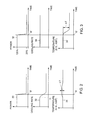
- temperature response 34' corresponds to a constant cooling rate, as indicated by plot 36 in FIG. 3 while temperature responses 34" and 34"' respectively correspond to proportional and overproportional cooling rate adjustments, as respectively indicated by plots 38a and 38b in FIG. 4 .
- the cooling strategy to affect the temperature of the power devices may include one or more of the following strategies: adjusting a switching frequency of the semiconductor power devices, adjusting the amount of power generated by the power generator, and/or adjusting the amount of power to be converted by the inverter.
- adjusting a switching frequency of the semiconductor power devices adjusting the amount of power generated by the power generator, and/or adjusting the amount of power to be converted by the inverter.
- higher switching frequency generally results in higher switching losses and thus results in incremental heating of the power device.
- lower switching frequencies generally results in lower switching losses and thus result in incremental cooling of the power semiconductor device.
- the generated power by the PV module will drop, and thus the temperature of the power semiconductor device in the inverter will drop.
- One example way to compensate for this power generating condition would be increase the switching frequency of the semiconductor switching device to incrementally heat the power switching device and thus reduce the magnitude of the temperature drop.
- the involved time constants are relatively short and this cooling technique may be used to adjust the temperature of the semiconductor switching device relatively quickly.
- FIGs. 5-7 illustrate plots corresponding to various example predictions over a time horizon regarding power-generating conditions for the array of power generators 12. It will be appreciated that in accordance with further aspects of the present invention, the control strategy to be used may be adapted based on the specific characteristics of the predicted power-generating condition for the array of power generators.
- plot 40 represents a prediction indicative of a relatively long duration (represented by line 42) of a shift (e.g., power drop) in the amount of power generated by the array of power generators.
- plot 44 shown in FIG. 6
- plot 44 illustrates a prediction indicative of a relatively short duration (represented by line 46) of a shift (e.g., transient shift) in the amount of power generated by the array of power generators.
- plot 48 represents a prediction indicative of a condition corresponding to intermittent fluctuations over a relatively long time interval (represented by line 50) of the power level generated by the array of power generators.
- the control strategy to be performed may be adapted based on the characteristics of the predicted power-generating condition for the array of power generators. For example, in the example case of a control strategy for inverter cooling, and presuming the predicted reduction of power is relatively long, as illustrated in FIG. 5 , then an anticipatory adjustment may be implemented to the inverter cooling rate, as discussed in the context of FIG. 2 . However, if the predicted reduction of power is relatively short, such as the transient drop illustrated in FIG. 6 , then one may decide not to adjust the cooling strategy since, in this example case, one may choose to rely on the thermal inertia of the system to smooth the ⁇ t fluctuation that may develop from the transient power drop.
- the ability to predict a power-generating condition for the array of power generators may be formulated as an optimal control problem where an appropriate control profile (e.g., cooling profile) may be optimized to ensure minimal or reduced variation of the variable being controlled, such as thermal variation for the power switch devices of inverter 16.
- an appropriate control profile e.g., cooling profile
- inverter 16 may include a maximum power point tracker 19 (MPPT), as shown in FIG. 1 .
- MPPT maximum power point tracker 19
- the MPPP tracking strategies may be anticipatorily adjusted based on the predicted power-generating condition for the array of power generators over the time horizon (e.g., upcoming cloud situation).
- an example current current/voltage (I/V) curve of the PV modules may develop two local maxima during a shading condition. See FIG. 8 .
- the MPPT could sub-optimally track a maximum local power, which is not a global maximum.
- a global voltage sweep could be performed to appropriately identify the global maximum.
- performing such a global voltage sweep tends to reduce inverter efficiency since the PV array/inverter circuitry is operated during the sweep in a non-optimal manner. Thus, it would be desirable to avoid performing unnecessary voltage sweeps.
- the predicted power-generating condition may be used to improve operation of the MPPT. For example, if the predicted power-generating condition is as illustrated in FIG. 5 , (e.g., lasting shading condition), then the tracking strategy may be to perform the global voltage sweep to identify the global maximum. Conversely, if the predicted power generating condition is as illustrated in FIG. 6 , (e.g., transient shading condition), or if the predicted power generating condition is as illustrated in FIG. 7 , (e.g., undefined irradiance condition) then in either case the control strategy may be not to perform the global voltage sweep.
- the foregoing description should be construed as an example MPPT tracking strategy that may benefit from aspects of the present invention and should not be construed in a limiting sense.
- Electrical storage devices 26 may comprise at least one of the following energy storage devices: rechargeable batteries, capacitor banks, inductors, and/or super-capacitors.
- One example factor that can influence the life-time expectancy of an electrical storage device, such as a rechargeable battery may be the number of cycles (e.g., from a loaded condition to a discharged condition and so on) the electrical storage device experiences over time.
- the predicted power-generating conditions for the array of power generators 12 may be processed to determine a cycling strategy for the electrical storage devices optimally configured to reduce the number of cycles experienced by the electrical storage device over time.
- the predicted power-generating condition for the array of power generators 12 is one of reduced power generation, then one may anticipatorily ensure that the majority of the electrical storage devices are appropriately charged prior to the occurrence of the reduced power generation. Conversely, if the predicted power-generating condition for the array of power generators 12 is one of increased power generation, then one may anticipatorily ensure that the majority of the electrical storage devices are appropriately discharged prior to the occurrence of the increased power generation.
- the voltage level in distribution systems may often be controlled by transformers with mechanical switches configured to change the effective number of turns of the transformer.
- This may involve a tap-changer, which is typically mounted on a lower current side.
- One example factor that can influence the life-time expectancy of the tap changer may be the number of tap-changing operations performed by the tap changer over time.
- the predicted power-generating conditions for the array of power generators 12 may be processed to determine a tap- changing strategy for the tap changer optimally configured to reduce the number of tap-changing operations experienced by the tap changer over time and thus increase the life expectancy of the tap-changer.
- main circuit breaker 28 may be set to an electrically-closed condition each time the power-generation system changes to an operational state from a standby condition and vice versa. That is, main circuit breaker 28 may be set to an electrically-open condition each time the power-generation system changes to the standby state from the operational condition.
- One example factor that can influence the life-time expectancy of the main circuit breaker may be the number of on-off switching operations performed by the main circuit breaker.
- the predicted power-generating conditions for the array of power generators 12 may be processed to determine an on-off switching strategy for the main circuit breaker optimally configured to reduce the number of on-off switching operations experienced by the main circuit breaker and thus increase the life expectancy of the main circuit breaker.
- aspects of the present invention may provide one or more of the following advantages: Increase inverter lifetime and reliability; increase inverter efficiency; improved MPPT tracking strategies in systems involving PV energy generation; increase lifetime of step changers in distribution grids for voltage controls; increase lifetime of circuit breakers and/or energy storage devices, as may be part of an energy management subsystem.
Landscapes
- Engineering & Computer Science (AREA)
- Power Engineering (AREA)
- Supply And Distribution Of Alternating Current (AREA)
Abstract
Description
- The present invention is generally related to power generation, as may involve a power generation system for generating electrical power, which varies in response to one or more weather-varying factors, such as solar irradiance, temperature, wind, and more particularly to predictive control apparatus and techniques to reduce influences of such weather-varying factors.
- Large-scale generation of electric power based on a freely-available, essentially inexhaustible natural resource, such as solar irradiance and/or wind, continues progressing as an attractive modality for clean and efficient generation of electric power.
- The weather-induced variability of the natural resource (e.g., due to cloud coverage variability in the case of solar irradiance, or wind variability in the case of wind power) may cause challenges at various levels, such as at a component level (e.g., inverter), at a subsystem level, at a distribution level as well as on the larger power grid.
- Presently, such power generation systems typically do not anticipatorily adapt control strategies in connection with operational control of one or more components of the power generation system.
- In view of the foregoing considerations, it would be desirable to provide apparatus to anticipatorily adjust a control strategy regarding operation of one or more components of the power generation system based on a predicted power generating condition for the array of power generators.
- Aspects of the present invention may be fulfilled by a power generation system for generating electrical power, which varies in response to at least one weather-varying factor. The system may include an array of power generators subject to the weather-varying factor. The array of power generators may be disposed over respective locations on a field. At least one inverter may be coupled to the array of power generators. A module may be configured to predict over a time horizon at least one power-generating condition for the array of power generators. A controller may be configured to anticipatorily adjust a control strategy regarding operation of the component and/or subsystem of the power generation system based on the predicted power-generating condition for the array of power generators over the time horizon. The control strategy may be a cooling control strategy for the inverter based on the predicted power-generating condition for the array of power generators over the time horizon.
- Further aspects of the present invention may be fulfilled by an apparatus, which may include a module configured to predict over a time horizon at least one power-generating condition for an array of power generators. The apparatus may further include a controller configured to anticipatorily adjust a control strategy regarding operation of at least one component and/or subsystem of the power generation system based on the predicted power-generating condition for the array of power generators over the time horizon.
- Yet further aspects of the present invention may be fulfilled by a power generation system for generating electrical power, which varies in response to at least one weather-varying factor. The system may include an array of power generators subject to the weather-varying factor. A module may be configured to predict over a time horizon at least one power-generating condition for the array of power generators. A controller may be configured to anticipatorily adjust a control strategy regarding operation of the component and/or subsystem of the power generation system based on the predicted power-generating condition for the array of power generators over the time horizon.
- These and other features, aspects, and advantages of the present invention will become better understood when the following detailed description is read with reference to the accompanying drawings in which like characters represent like parts throughout the drawings, wherein:
-
FIG.1 is a schematic representation of an example embodiment of a power generation system for generating electrical power, as may include an apparatus to anticipatorily adjust a control strategy regarding operation of one or more components of the power generation system based on a predicted power-generating condition for the array of power generators in accordance with aspects of the present invention. -
FIG. 2 shows respective plots, which can be used to illustrate an example anticipatory adjusting of a cooling rate for cooling an inverter in accordance with aspects of the present invention. -
FIGs. 3 and4 show respective plots, which can be used to compare example non-anticipatory adjusting of the cooling rate for the inverter relative to the example anticipatory adjusting shown inFIG. 2 . -
FIGs. 5-7 show respective plots illustrative of different predicted power-generating conditions in connection with an example array of power generators, which may lead to different control strategies. -
FIG. 8 shows an example current current/voltage (I/V) curve of a PV module, which curve is illustrative of two local maxima, as may develop during a shading condition. -
FIG.1 is a schematic representation of an example embodiment of apower generation system 10 for generating electrical power, which may vary in response to one or more weather-varying factors 11, such as solar irradiance, wind, temperature, etc. An array ofpower generators 12 may be subject to such weather-varying factors. - In the example case where
power generators 12 may comprise an array of photovoltaic (PV) modules. Solar irradiance may for example vary based on varying cloud conditions, which can lead to changes in the power generating conditions of the array of photovoltaic modules. - In the example case where
power generators 12 may comprise an array of wind turbines. Varying wind conditions can lead to changes in the power generating conditions of the array of wind turbines. Regardless of the specific modality, the array ofpower generators 12 may be disposed over respective locations (e.g., spaced-apart locations) on afield 14, such as a utility-scale solar farm, and/or a utility-scale wind park, as may involve a relatively large surface area (e.g., potentially hundreds of acres). - In one example embodiment, one or
more inverters 16 may be coupled to the array ofpower generators 12. For example, as will be appreciated by one skilled in the art, photovoltaic arrays naturally produce direct current (DC) power output when exposed to solar irradiance. Thus, in this example, one or more inverters may be used for converting the DC output from the photovoltaic array to an AC signal appropriate for coupling to apower grid 15. - As will be further appreciated by one skilled in the art, wind turbine generators can generate AC power output. However, the frequency and phase of the wind turbine output may depend, respectively, on the speed of rotation and position of a rotor within the turbine generator. Thus, the AC power produced by the wind power system may be initially rectified to produce an intermediate DC power, which is then transformed to AC power via one or more inverters to match the line frequency and phase of
power grid 15. - A
predictive module 18 may be configured in accordance with aspects of the present invention to predict over a time horizon, as for example may range from seconds to several hours, at least one power-generating condition for the array ofpower generators 12. In one example embodiment,predictive module 18 may be responsive to weather observations, as may be obtained from asensor suite 20 and/or weather forecasts, as may be obtained from weather data services, in combination with model data of the power generators to predict the power-generating condition for the array ofpower generators 12. In one example embodiment,predictive module 18 may be responsive to historical weather data as may be stored in adatabase 22. - A
controller 24 may be configured to anticipatorily adjust a control strategy regarding operation of at least one subsystem and/or component of the power generation system based on the predicted power-generating condition for the array of power generators over the time horizon. In one example embodiment, the control strategy may be a cooling control strategy for inverter 16, as may be implemented by way of acooling subsystem 17, based on the predicted power-generating condition for the array ofpower generators 12 over the time horizon. - For example, repetitive and relatively large temperature fluctuations (ΔT) that may develop at the respective junctions of semiconductor power devices (e.g., Insulated Gate Bipolar Transistor (IGBT) and other like devices) of the inverters can detrimentally affect the operational reliability of such devices. Accordingly, it would be desirable to formulate a cooling strategy, which may be based on the predicted power-generating condition for the array of
power generators 12 over the time horizon, and which avoids or at least reduces such ΔT fluctuations and thus increases the reliability and lifetime of these inverter devices. - The predicted power-generating condition can be used for instance to effectively deal with relatively long delays that may be part of the physical response of a given component (e.g., thermal inertia in the case of inverter cooling). As will be appreciated by one skilled in the art by anticipatorily adjusting a control strategy for operating a given component before a change in the power-generating condition of the array of power generators takes effect (e.g., cloud covering the array), one may be able to effectively deal with such time delays.
-
FIG. 2 shows a sequence of respective plots, which can be used to illustrate an example anticipatory adjusting of a cooling rate for inverter cooling and an example temperature response for the power device (e.g., IGBT), which results from such anticipatory adjusting of the inverter cooling rate.Plot 30 indicates a predicted change over a time horizon in the power-generating condition for the array of power generators. For example, at time t2, predictive module 18 (FIG. 1 ) predicts a drop in the amount of power to be produced by the array of power generators.Plot 32 illustrates an anticipatory cooling rate adjustment, as may be commanded by controller 24 (FIG. 1 ) starting at time t1 in anticipation of the predicted power drop at time t2.Plot 34 illustrates an example temperature response of an example power device in the inverter. Note the relatively small maximum ΔT inplot 34. - Compare the foregoing response (e.g., relatively small maximum Δt) relative to the
example temperature responses 34', 34", and 34"' respectively illustrated inFIGs. 3 and4 , which do not involve anticipatory adjustment. By way of example, temperature response 34' corresponds to a constant cooling rate, as indicated byplot 36 inFIG. 3 whiletemperature responses 34" and 34"' respectively correspond to proportional and overproportional cooling rate adjustments, as respectively indicated byplots FIG. 4 . - It will be appreciated that in lieu of or in combination with adjusting the inverter cooling rate by way of
cooling subsystem 15, the cooling strategy to affect the temperature of the power devices may include one or more of the following strategies: adjusting a switching frequency of the semiconductor power devices, adjusting the amount of power generated by the power generator, and/or adjusting the amount of power to be converted by the inverter. As will be appreciated by those skilled in the art, higher switching frequency generally results in higher switching losses and thus results in incremental heating of the power device. Conversely, lower switching frequencies generally results in lower switching losses and thus result in incremental cooling of the power semiconductor device. - In the example situation of clouds blocking solar irradiance over a PV module, the generated power by the PV module will drop, and thus the temperature of the power semiconductor device in the inverter will drop. One example way to compensate for this power generating condition would be increase the switching frequency of the semiconductor switching device to incrementally heat the power switching device and thus reduce the magnitude of the temperature drop. In this example case, the involved time constants are relatively short and this cooling technique may be used to adjust the temperature of the semiconductor switching device relatively quickly.
-
FIGs. 5-7 illustrate plots corresponding to various example predictions over a time horizon regarding power-generating conditions for the array ofpower generators 12. It will be appreciated that in accordance with further aspects of the present invention, the control strategy to be used may be adapted based on the specific characteristics of the predicted power-generating condition for the array of power generators. - In
FIG. 5 ,plot 40 represents a prediction indicative of a relatively long duration (represented by line 42) of a shift (e.g., power drop) in the amount of power generated by the array of power generators. Compareplot 40 shown inFIG. 5 to plot 44 shown inFIG. 6 , which illustrates a prediction indicative of a relatively short duration (represented by line 46) of a shift (e.g., transient shift) in the amount of power generated by the array of power generators. InFIG. 7 ,plot 48 represents a prediction indicative of a condition corresponding to intermittent fluctuations over a relatively long time interval (represented by line 50) of the power level generated by the array of power generators. - In accordance with aspects of the present invention, the control strategy to be performed may be adapted based on the characteristics of the predicted power-generating condition for the array of power generators. For example, in the example case of a control strategy for inverter cooling, and presuming the predicted reduction of power is relatively long, as illustrated in
FIG. 5 , then an anticipatory adjustment may be implemented to the inverter cooling rate, as discussed in the context ofFIG. 2 . However, if the predicted reduction of power is relatively short, such as the transient drop illustrated inFIG. 6 , then one may decide not to adjust the cooling strategy since, in this example case, one may choose to rely on the thermal inertia of the system to smooth the Δt fluctuation that may develop from the transient power drop. - In the example case illustrated in
FIG. 7 , such as a prediction of intermittent fluctuations of the power level generated by the array of power generators, one may choose to adjust the cooling strategy relative to an average level of the fluctuations. Accordingly, it will be appreciated that the ability to predict a power-generating condition for the array of power generators may be formulated as an optimal control problem where an appropriate control profile (e.g., cooling profile) may be optimized to ensure minimal or reduced variation of the variable being controlled, such as thermal variation for the power switch devices ofinverter 16. - It will be appreciated that the anticipatory control aspects of the present invention are not limited to inverter cooling strategies. For example, as will be appreciated by one skilled in the art, in the
event inverter 16 is coupled to an array of PV modules,inverter 16 may include a maximum power point tracker 19 (MPPT), as shown inFIG. 1 . In this example case, the MPPP tracking strategies may be anticipatorily adjusted based on the predicted power-generating condition for the array of power generators over the time horizon (e.g., upcoming cloud situation). - In the example case of an array of PV modules with bypass-diodes, an example current current/voltage (I/V) curve of the PV modules may develop two local maxima during a shading condition. See
FIG. 8 . Thus, during a shading condition there is a chance the MPPT could sub-optimally track a maximum local power, which is not a global maximum. To avoid such sub-optimal tracking, a global voltage sweep could be performed to appropriately identify the global maximum. However, as will be appreciated by one skilled in the art, performing such a global voltage sweep tends to reduce inverter efficiency since the PV array/inverter circuitry is operated during the sweep in a non-optimal manner. Thus, it would be desirable to avoid performing unnecessary voltage sweeps. - In accordance with further aspects of the present invention, the predicted power-generating condition may be used to improve operation of the MPPT. For example, if the predicted power-generating condition is as illustrated in
FIG. 5 , (e.g., lasting shading condition), then the tracking strategy may be to perform the global voltage sweep to identify the global maximum. Conversely, if the predicted power generating condition is as illustrated inFIG. 6 , (e.g., transient shading condition), or if the predicted power generating condition is as illustrated inFIG. 7 , (e.g., undefined irradiance condition) then in either case the control strategy may be not to perform the global voltage sweep. It will be appreciated that the foregoing description should be construed as an example MPPT tracking strategy that may benefit from aspects of the present invention and should not be construed in a limiting sense. - A further example of a subsystem of the power generation system that may benefit from anticipatory control in accordance with aspects of the present invention may include an
energy management subsystem 25, as may include one or moreelectrical storage devices 26, one ormore step changers 27 and/or amain circuit breaker 28. -
Electrical storage devices 26 may comprise at least one of the following energy storage devices: rechargeable batteries, capacitor banks, inductors, and/or super-capacitors. One example factor that can influence the life-time expectancy of an electrical storage device, such as a rechargeable battery, may be the number of cycles (e.g., from a loaded condition to a discharged condition and so on) the electrical storage device experiences over time. In one example application, the predicted power-generating conditions for the array ofpower generators 12 may be processed to determine a cycling strategy for the electrical storage devices optimally configured to reduce the number of cycles experienced by the electrical storage device over time. - In another example application, if the predicted power-generating condition for the array of
power generators 12 is one of reduced power generation, then one may anticipatorily ensure that the majority of the electrical storage devices are appropriately charged prior to the occurrence of the reduced power generation. Conversely, if the predicted power-generating condition for the array ofpower generators 12 is one of increased power generation, then one may anticipatorily ensure that the majority of the electrical storage devices are appropriately discharged prior to the occurrence of the increased power generation. - As will be appreciated by those skilled in the art, the voltage level in distribution systems, such for residential applications, may often be controlled by transformers with mechanical switches configured to change the effective number of turns of the transformer. This may involve a tap-changer, which is typically mounted on a lower current side. One example factor that can influence the life-time expectancy of the tap changer may be the number of tap-changing operations performed by the tap changer over time. In one example application, the predicted power-generating conditions for the array of
power generators 12 may be processed to determine a tap- changing strategy for the tap changer optimally configured to reduce the number of tap-changing operations experienced by the tap changer over time and thus increase the life expectancy of the tap-changer. - In another example application,
main circuit breaker 28 may be set to an electrically-closed condition each time the power-generation system changes to an operational state from a standby condition and vice versa. That is,main circuit breaker 28 may be set to an electrically-open condition each time the power-generation system changes to the standby state from the operational condition. One example factor that can influence the life-time expectancy of the main circuit breaker may be the number of on-off switching operations performed by the main circuit breaker. In one example application, the predicted power-generating conditions for the array ofpower generators 12 may be processed to determine an on-off switching strategy for the main circuit breaker optimally configured to reduce the number of on-off switching operations experienced by the main circuit breaker and thus increase the life expectancy of the main circuit breaker. - In operation, aspects of the present invention may provide one or more of the following advantages: Increase inverter lifetime and reliability; increase inverter efficiency; improved MPPT tracking strategies in systems involving PV energy generation; increase lifetime of step changers in distribution grids for voltage controls; increase lifetime of circuit breakers and/or energy storage devices, as may be part of an energy management subsystem. The foregoing should not be construed in a limiting sense being that such a description is just meant to illustrate some example advantages that may be achieved from aspects of the present invention.
- While only certain features of the invention have been illustrated and described herein, many modifications and changes will occur to those skilled in the art. It is, therefore, to be understood that the appended claims are intended to cover all such modifications and changes as fall within the scope of the invention as defined therein.
Claims (12)
- A power generation system (10) for generating electrical power, which varies in response to at least one weather-varying factor, the system comprising:an array of power generators (12) subject to said at least one weather-varying factor, the array of power generators (12) disposed over respective locations on a field (14);at least one inverter (16) coupled to the array of power generators (12);a module (18) configured to predict over a time horizon at least one power-generating condition for the array of power generators (12); anda controller (24) configured to anticipatorily adjust a control strategy regarding operation of at least one component and/or subsystem of the power generation system (10) based on the predicted power-generating condition for the array of power generators (12) over the time horizon, wherein the control strategy comprises a cooling control strategy for said at least one inverter (16) based on the predicted power-generating condition for the array of power generators (12) over the time horizon.
- The power generation system (10) of claim 1, wherein the array of power generators (12) is selected from the group consisting of an array of photovoltaic modules, an array of wind turbines and a combination of said arrays.
- The power generation system (10) of claim 2, wherein the predicted power-generating condition comprises a condition corresponding to a shift in an amount of power generated by the array of power generators (12).
- The power generation system (10) of claim 3, wherein the predicted power-generating condition further includes estimating a duration of time of the condition corresponding to the shift in the amount of power generated by the array of power generators (12).
- The power generation system (10) of claim 2, 3 or 4, wherein the predicted power-generating condition comprises a condition corresponding to intermittent fluctuations of a power level generated by the array of power generators (12).
- The power generation system (10) of claim 2, 3, 4 or 5, wherein the cooling control strategy for said at least one inverter (16) is selected from the group consisting of a control strategy regarding a cooling flow rate for said at least one inverter (16), a control strategy regarding a switching frequency for at least one power switch of said at least one inverter (16), a control strategy regarding an amount of power generated by at least one of the power generators (12), a control strategy regarding an amount of power to be converted by said at least one inverter (16) and a control strategy comprising a combination of at least two of the foregoing cooling control strategies.
- The power generation system (10) of any one of claims 2 to 6, wherein said at least one component comprises at least one electrical storage device (26), wherein the control strategy comprises a power flow control strategy into or from said at least one electrical storage device based at least in part on the predicted power-generating condition over the time horizon.
- The power generation system (10) of any one of claims 2 to 7, wherein said at least one component comprises at least one tap changer (27), wherein the control strategy comprises a tap-changing control strategy for said at least one tap changer based at least in part on the predicted power-generating condition over the time horizon.
- The power generation system (10) of any one of claims 2 to 8, wherein said at least one component comprises at least one circuit breaker (28), wherein the control strategy comprises a switching control strategy for said at least one at least one circuit breaker based at least in part on the predicted power-generating condition over the time horizon.
- The power generation system (10) of any preceding claim, wherein the array of power generators (12) comprises an array of photovoltaic generators, wherein said at least one component comprises at least one inverter (16) coupled to the array of photovoltaic generators, wherein said at least one inverter (16) comprises a maximum power point tracker (19), and wherein the control strategy comprises a tracking control strategy performed by the maximum power point tracker (19) based at least in part on the predicted power-generating condition.
- An apparatus for use in the power generation system of any preceding claim, apparatus comprising:a module (18) configured to predict over a time horizon at least one power-generating condition for the array of power generators (12); anda controller (24) configured to anticipatorily adjust a control strategy regarding operation of at least one component and/or subsystem of the power generation system (10) based on the predicted power-generating condition for the array of power generators (12) over the time horizon.
- The apparatus of claim 11, wherein said at least one component comprises at least one inverter coupled to the array of power generators (12), wherein the control strategy comprises a cooling control strategy for said at least one inverter based on the predicted power-generating condition for the array of power generators over the time horizon.
Applications Claiming Priority (1)
| Application Number | Priority Date | Filing Date | Title |
|---|---|---|---|
| US13/273,328 US8624411B2 (en) | 2011-10-14 | 2011-10-14 | Power generation system including predictive control apparatus to reduce influences of weather-varying factors |
Publications (3)
| Publication Number | Publication Date |
|---|---|
| EP2587611A2 true EP2587611A2 (en) | 2013-05-01 |
| EP2587611A3 EP2587611A3 (en) | 2014-04-30 |
| EP2587611B1 EP2587611B1 (en) | 2019-09-18 |
Family
ID=47046403
Family Applications (1)
| Application Number | Title | Priority Date | Filing Date |
|---|---|---|---|
| EP12187660.1A Not-in-force EP2587611B1 (en) | 2011-10-14 | 2012-10-08 | Power generation system including predictive control apparatus to reduce influences of weather-varying factors |
Country Status (2)
| Country | Link |
|---|---|
| US (1) | US8624411B2 (en) |
| EP (1) | EP2587611B1 (en) |
Cited By (2)
| Publication number | Priority date | Publication date | Assignee | Title |
|---|---|---|---|---|
| WO2016176064A1 (en) * | 2015-04-30 | 2016-11-03 | Solarcity Corporation | Charging profiles for a storage device in an energy generation system |
| US10359797B2 (en) | 2015-04-30 | 2019-07-23 | Solarcity Corporation | Weather tracking in a photovoltaic energy generation system |
Families Citing this family (15)
| Publication number | Priority date | Publication date | Assignee | Title |
|---|---|---|---|---|
| US20130325199A1 (en) * | 2011-12-27 | 2013-12-05 | Peter W. Coe | Satellite signal-based utility grid control |
| CN105164593A (en) * | 2013-02-05 | 2015-12-16 | 西门子股份公司 | Method and device for controlling energy-generating system which can be operated with renewable energy source |
| DE102013202600B4 (en) * | 2013-02-19 | 2015-04-16 | Siemens Aktiengesellschaft | Method for yield optimization of a partially shaded photovoltaic field |
| DE102014112458B4 (en) | 2014-08-29 | 2018-10-11 | Sma Solar Technology Ag | Method for controlling a cooling device for increasing the service life of waste heat-generating components and cooling device |
| US9625921B2 (en) | 2015-04-03 | 2017-04-18 | Ge Energy Power Conversion Technology Ltd | Life of a semiconductor by reducing temperature changes therein via switching frequency |
| US9859787B2 (en) | 2015-04-22 | 2018-01-02 | Ge Energy Power Conversion Technology Limited | Life of a semiconductor by reducing temperature changes therein via reactive power |
| US10476417B2 (en) | 2017-08-11 | 2019-11-12 | Rolls-Royce North American Technologies Inc. | Gas turbine generator torque DC to DC converter control system |
| US10483887B2 (en) * | 2017-08-11 | 2019-11-19 | Rolls-Royce North American Technologies, Inc. | Gas turbine generator temperature DC to DC converter control system |
| US10491145B2 (en) | 2017-08-11 | 2019-11-26 | Rolls-Royce North American Technologies Inc. | Gas turbine generator speed DC to DC converter control system |
| CN110580549B (en) * | 2019-09-02 | 2020-06-02 | 山东大学 | Regional short-term energy power prediction method and system considering weather |
| US11962267B2 (en) | 2020-05-18 | 2024-04-16 | RBI Solar, Inc. | Systems and methods for providing active shade mitigation for a solar module |
| CN113131532B (en) * | 2021-04-16 | 2021-10-08 | 南京邮电大学 | A new energy power station primary frequency modulation network control method |
| TWI811872B (en) * | 2021-11-30 | 2023-08-11 | 國立成功大學 | Control device and method of controlling power generation system |
| CN114825487B (en) * | 2022-06-30 | 2022-12-30 | 中国电力科学研究院有限公司 | Off-grid wind storage load power generation system and control debugging method |
| CN116301185A (en) * | 2023-03-22 | 2023-06-23 | 易事特集团股份有限公司 | Maximum Power Point Identification Method of Inverter Under Uneven Illumination |
Family Cites Families (17)
| Publication number | Priority date | Publication date | Assignee | Title |
|---|---|---|---|---|
| US7274975B2 (en) | 2005-06-06 | 2007-09-25 | Gridpoint, Inc. | Optimized energy management system |
| US7439714B2 (en) * | 2005-09-27 | 2008-10-21 | Gamesa Innovation & Technology, S.L. | Method for operation of a converter system |
| EP1945944B1 (en) * | 2005-11-01 | 2015-04-15 | Vestas Wind Systems A/S | A method for prolonging and/or controlling the life of one or more heat generating and/or passive components in a wind turbine, a wind turbine, and use thereof |
| US9020650B2 (en) * | 2007-02-13 | 2015-04-28 | General Electric Company | Utility grid, controller, and method for controlling the power generation in a utility grid |
| ES2571935T3 (en) * | 2007-06-01 | 2016-05-27 | Acciona Windpower Sa | Wind turbine control system and procedure |
| US20090179662A1 (en) | 2008-01-10 | 2009-07-16 | Moulton Thomas A | System for Monitoring Individual Photovoltaic Modules |
| US20100198420A1 (en) * | 2009-02-03 | 2010-08-05 | Optisolar, Inc. | Dynamic management of power production in a power system subject to weather-related factors |
| US8295989B2 (en) | 2009-02-03 | 2012-10-23 | ETM Electromatic, Inc. | Local power tracking for dynamic power management in weather-sensitive power systems |
| SE0950190A1 (en) * | 2009-03-25 | 2010-09-26 | Ge Wind Energy Norway As | Diversity cabinet |
| US8184460B2 (en) | 2009-05-28 | 2012-05-22 | General Electric Company | Solar inverter and control method |
| DE102009024212B4 (en) | 2009-06-08 | 2012-03-01 | Adensis Gmbh | Method and device for avoiding an impending reduction in the feed-in power of a photovoltaic system and use of a device for carrying out the method |
| US8504213B2 (en) * | 2009-06-26 | 2013-08-06 | General Electric Company | Regulation of generating plant |
| US7890217B2 (en) * | 2009-10-26 | 2011-02-15 | General Electric Company | Integrated real-time power and solar farm control system |
| ES2859732T3 (en) | 2009-10-30 | 2021-10-04 | Gen Electric | Hybrid wind-solar inverters |
| US7989983B2 (en) * | 2009-11-24 | 2011-08-02 | American Superconductor Corporation | Power conversion systems |
| WO2011124720A2 (en) | 2010-04-09 | 2011-10-13 | Siemens Concentrated Solar Power Ltd. | Clouds managing system for a solar field, method for operating the clouds management system and solar field with the clouds managing system |
| US8659186B2 (en) * | 2010-12-29 | 2014-02-25 | General Electric Company | Methods and systems for controlling a power conversion system |
-
2011
- 2011-10-14 US US13/273,328 patent/US8624411B2/en not_active Expired - Fee Related
-
2012
- 2012-10-08 EP EP12187660.1A patent/EP2587611B1/en not_active Not-in-force
Non-Patent Citations (1)
| Title |
|---|
| None |
Cited By (2)
| Publication number | Priority date | Publication date | Assignee | Title |
|---|---|---|---|---|
| WO2016176064A1 (en) * | 2015-04-30 | 2016-11-03 | Solarcity Corporation | Charging profiles for a storage device in an energy generation system |
| US10359797B2 (en) | 2015-04-30 | 2019-07-23 | Solarcity Corporation | Weather tracking in a photovoltaic energy generation system |
Also Published As
| Publication number | Publication date |
|---|---|
| EP2587611B1 (en) | 2019-09-18 |
| US20130093193A1 (en) | 2013-04-18 |
| EP2587611A3 (en) | 2014-04-30 |
| US8624411B2 (en) | 2014-01-07 |
Similar Documents
| Publication | Publication Date | Title |
|---|---|---|
| US8624411B2 (en) | Power generation system including predictive control apparatus to reduce influences of weather-varying factors | |
| US9190923B2 (en) | System and method for converter switching frequency control | |
| Sangwongwanich et al. | Benchmarking of constant power generation strategies for single-phase grid-connected photovoltaic systems | |
| Jiang et al. | A decentralized reliability-enhanced power sharing strategy for PV-based microgrids | |
| EP2341409B1 (en) | Maximum power point tracking apparatus for a renewable energy storage system and maximum power point tracking method | |
| CN102545251B (en) | Control the method and apparatus of delay voltage recovery (FIDVR) that fault causes | |
| CN113519113B (en) | Power converter and control method thereof | |
| US20210194421A1 (en) | Temperature control for energy storage system | |
| Kawaguchi et al. | Offshore-wind-farm configuration using diode rectifier with MERS in current link topology | |
| WO2015029138A1 (en) | Solar generator system | |
| CA2939178A1 (en) | Power source system | |
| Fathabadi | Novel high-efficient large-scale stand-alone solar/wind hybrid power source equipped with battery bank used as storage device | |
| Mosaad | Whale optimization algorithms-based PI controllers of STATCOM for renewable hybrid power system | |
| Peyghami et al. | Mission profile based power converter reliability analysis in a DC power electronic based power system | |
| Cunningham et al. | Impacts of wide band gap power electronics on photovoltaic system design | |
| Sheikh et al. | Minimization of fluctuations of output power and terminal voltage of wind generator by using STATCOM/SMES | |
| WO2015112107A1 (en) | Method and apparatus for extracting electrical energy from photovoltaic module | |
| KR101376550B1 (en) | High Capacity Wind-Power Generator, Method for Controlling High Capacity Wind-Power Generator | |
| Said et al. | Enhancement of voltage profile for unbalanced distribution system with wind energy and superconducting magnetic energy storage | |
| Saharia et al. | Simulated study on nonisolated DC-DC converters for MPP tracking for photovoltaic power systems | |
| JP2012182868A (en) | Photovoltaic power generator | |
| JP7424351B2 (en) | power conditioner | |
| US11979021B2 (en) | Electric power system and power conversion device connected to a DC bus | |
| Abhishek et al. | Comparative analysis of boost and quadratic boost converter for wind energy conversion system | |
| Zentani et al. | Control Technique of MPPT Utilizing for Boost Converter Applied to Small Renewable Energy System and a DC Microgrid for Remote Area |
Legal Events
| Date | Code | Title | Description |
|---|---|---|---|
| PUAI | Public reference made under article 153(3) epc to a published international application that has entered the european phase |
Free format text: ORIGINAL CODE: 0009012 |
|
| AK | Designated contracting states |
Kind code of ref document: A2 Designated state(s): AL AT BE BG CH CY CZ DE DK EE ES FI FR GB GR HR HU IE IS IT LI LT LU LV MC MK MT NL NO PL PT RO RS SE SI SK SM TR |
|
| AX | Request for extension of the european patent |
Extension state: BA ME |
|
| PUAL | Search report despatched |
Free format text: ORIGINAL CODE: 0009013 |
|
| AK | Designated contracting states |
Kind code of ref document: A3 Designated state(s): AL AT BE BG CH CY CZ DE DK EE ES FI FR GB GR HR HU IE IS IT LI LT LU LV MC MK MT NL NO PL PT RO RS SE SI SK SM TR |
|
| AX | Request for extension of the european patent |
Extension state: BA ME |
|
| RIC1 | Information provided on ipc code assigned before grant |
Ipc: H02J 3/38 20060101AFI20140325BHEP |
|
| 17P | Request for examination filed |
Effective date: 20141030 |
|
| RBV | Designated contracting states (corrected) |
Designated state(s): AL AT BE BG CH CY CZ DE DK EE ES FI FR GB GR HR HU IE IS IT LI LT LU LV MC MK MT NL NO PL PT RO RS SE SI SK SM TR |
|
| STAA | Information on the status of an ep patent application or granted ep patent |
Free format text: STATUS: EXAMINATION IS IN PROGRESS |
|
| 17Q | First examination report despatched |
Effective date: 20170123 |
|
| GRAP | Despatch of communication of intention to grant a patent |
Free format text: ORIGINAL CODE: EPIDOSNIGR1 |
|
| STAA | Information on the status of an ep patent application or granted ep patent |
Free format text: STATUS: GRANT OF PATENT IS INTENDED |
|
| INTG | Intention to grant announced |
Effective date: 20181213 |
|
| GRAS | Grant fee paid |
Free format text: ORIGINAL CODE: EPIDOSNIGR3 |
|
| GRAA | (expected) grant |
Free format text: ORIGINAL CODE: 0009210 |
|
| STAA | Information on the status of an ep patent application or granted ep patent |
Free format text: STATUS: THE PATENT HAS BEEN GRANTED |
|
| AK | Designated contracting states |
Kind code of ref document: B1 Designated state(s): AL AT BE BG CH CY CZ DE DK EE ES FI FR GB GR HR HU IE IS IT LI LT LU LV MC MK MT NL NO PL PT RO RS SE SI SK SM TR |
|
| REG | Reference to a national code |
Ref country code: GB Ref legal event code: FG4D |
|
| REG | Reference to a national code |
Ref country code: CH Ref legal event code: EP |
|
| REG | Reference to a national code |
Ref country code: DE Ref legal event code: R096 Ref document number: 602012064052 Country of ref document: DE |
|
| REG | Reference to a national code |
Ref country code: AT Ref legal event code: REF Ref document number: 1182441 Country of ref document: AT Kind code of ref document: T Effective date: 20191015 |
|
| REG | Reference to a national code |
Ref country code: IE Ref legal event code: FG4D |
|
| REG | Reference to a national code |
Ref country code: NL Ref legal event code: MP Effective date: 20190918 |
|
| PG25 | Lapsed in a contracting state [announced via postgrant information from national office to epo] |
Ref country code: FI Free format text: LAPSE BECAUSE OF FAILURE TO SUBMIT A TRANSLATION OF THE DESCRIPTION OR TO PAY THE FEE WITHIN THE PRESCRIBED TIME-LIMIT Effective date: 20190918 Ref country code: LT Free format text: LAPSE BECAUSE OF FAILURE TO SUBMIT A TRANSLATION OF THE DESCRIPTION OR TO PAY THE FEE WITHIN THE PRESCRIBED TIME-LIMIT Effective date: 20190918 Ref country code: BG Free format text: LAPSE BECAUSE OF FAILURE TO SUBMIT A TRANSLATION OF THE DESCRIPTION OR TO PAY THE FEE WITHIN THE PRESCRIBED TIME-LIMIT Effective date: 20191218 Ref country code: NO Free format text: LAPSE BECAUSE OF FAILURE TO SUBMIT A TRANSLATION OF THE DESCRIPTION OR TO PAY THE FEE WITHIN THE PRESCRIBED TIME-LIMIT Effective date: 20191218 Ref country code: HR Free format text: LAPSE BECAUSE OF FAILURE TO SUBMIT A TRANSLATION OF THE DESCRIPTION OR TO PAY THE FEE WITHIN THE PRESCRIBED TIME-LIMIT Effective date: 20190918 Ref country code: SE Free format text: LAPSE BECAUSE OF FAILURE TO SUBMIT A TRANSLATION OF THE DESCRIPTION OR TO PAY THE FEE WITHIN THE PRESCRIBED TIME-LIMIT Effective date: 20190918 |
|
| REG | Reference to a national code |
Ref country code: LT Ref legal event code: MG4D |
|
| PG25 | Lapsed in a contracting state [announced via postgrant information from national office to epo] |
Ref country code: RS Free format text: LAPSE BECAUSE OF FAILURE TO SUBMIT A TRANSLATION OF THE DESCRIPTION OR TO PAY THE FEE WITHIN THE PRESCRIBED TIME-LIMIT Effective date: 20190918 Ref country code: GR Free format text: LAPSE BECAUSE OF FAILURE TO SUBMIT A TRANSLATION OF THE DESCRIPTION OR TO PAY THE FEE WITHIN THE PRESCRIBED TIME-LIMIT Effective date: 20191219 Ref country code: LV Free format text: LAPSE BECAUSE OF FAILURE TO SUBMIT A TRANSLATION OF THE DESCRIPTION OR TO PAY THE FEE WITHIN THE PRESCRIBED TIME-LIMIT Effective date: 20190918 Ref country code: AL Free format text: LAPSE BECAUSE OF FAILURE TO SUBMIT A TRANSLATION OF THE DESCRIPTION OR TO PAY THE FEE WITHIN THE PRESCRIBED TIME-LIMIT Effective date: 20190918 |
|
| REG | Reference to a national code |
Ref country code: AT Ref legal event code: MK05 Ref document number: 1182441 Country of ref document: AT Kind code of ref document: T Effective date: 20190918 |
|
| PG25 | Lapsed in a contracting state [announced via postgrant information from national office to epo] |
Ref country code: EE Free format text: LAPSE BECAUSE OF FAILURE TO SUBMIT A TRANSLATION OF THE DESCRIPTION OR TO PAY THE FEE WITHIN THE PRESCRIBED TIME-LIMIT Effective date: 20190918 Ref country code: PL Free format text: LAPSE BECAUSE OF FAILURE TO SUBMIT A TRANSLATION OF THE DESCRIPTION OR TO PAY THE FEE WITHIN THE PRESCRIBED TIME-LIMIT Effective date: 20190918 Ref country code: AT Free format text: LAPSE BECAUSE OF FAILURE TO SUBMIT A TRANSLATION OF THE DESCRIPTION OR TO PAY THE FEE WITHIN THE PRESCRIBED TIME-LIMIT Effective date: 20190918 Ref country code: IT Free format text: LAPSE BECAUSE OF FAILURE TO SUBMIT A TRANSLATION OF THE DESCRIPTION OR TO PAY THE FEE WITHIN THE PRESCRIBED TIME-LIMIT Effective date: 20190918 Ref country code: PT Free format text: LAPSE BECAUSE OF FAILURE TO SUBMIT A TRANSLATION OF THE DESCRIPTION OR TO PAY THE FEE WITHIN THE PRESCRIBED TIME-LIMIT Effective date: 20200120 Ref country code: RO Free format text: LAPSE BECAUSE OF FAILURE TO SUBMIT A TRANSLATION OF THE DESCRIPTION OR TO PAY THE FEE WITHIN THE PRESCRIBED TIME-LIMIT Effective date: 20190918 Ref country code: NL Free format text: LAPSE BECAUSE OF FAILURE TO SUBMIT A TRANSLATION OF THE DESCRIPTION OR TO PAY THE FEE WITHIN THE PRESCRIBED TIME-LIMIT Effective date: 20190918 Ref country code: ES Free format text: LAPSE BECAUSE OF FAILURE TO SUBMIT A TRANSLATION OF THE DESCRIPTION OR TO PAY THE FEE WITHIN THE PRESCRIBED TIME-LIMIT Effective date: 20190918 |
|
| PG25 | Lapsed in a contracting state [announced via postgrant information from national office to epo] |
Ref country code: SK Free format text: LAPSE BECAUSE OF FAILURE TO SUBMIT A TRANSLATION OF THE DESCRIPTION OR TO PAY THE FEE WITHIN THE PRESCRIBED TIME-LIMIT Effective date: 20190918 Ref country code: CZ Free format text: LAPSE BECAUSE OF FAILURE TO SUBMIT A TRANSLATION OF THE DESCRIPTION OR TO PAY THE FEE WITHIN THE PRESCRIBED TIME-LIMIT Effective date: 20190918 Ref country code: IS Free format text: LAPSE BECAUSE OF FAILURE TO SUBMIT A TRANSLATION OF THE DESCRIPTION OR TO PAY THE FEE WITHIN THE PRESCRIBED TIME-LIMIT Effective date: 20200224 Ref country code: SM Free format text: LAPSE BECAUSE OF FAILURE TO SUBMIT A TRANSLATION OF THE DESCRIPTION OR TO PAY THE FEE WITHIN THE PRESCRIBED TIME-LIMIT Effective date: 20190918 |
|
| REG | Reference to a national code |
Ref country code: CH Ref legal event code: PL |
|
| REG | Reference to a national code |
Ref country code: DE Ref legal event code: R097 Ref document number: 602012064052 Country of ref document: DE |
|
| PGFP | Annual fee paid to national office [announced via postgrant information from national office to epo] |
Ref country code: FR Payment date: 20200309 Year of fee payment: 9 |
|
| PLBE | No opposition filed within time limit |
Free format text: ORIGINAL CODE: 0009261 |
|
| STAA | Information on the status of an ep patent application or granted ep patent |
Free format text: STATUS: NO OPPOSITION FILED WITHIN TIME LIMIT |
|
| PG2D | Information on lapse in contracting state deleted |
Ref country code: IS |
|
| PG25 | Lapsed in a contracting state [announced via postgrant information from national office to epo] |
Ref country code: DK Free format text: LAPSE BECAUSE OF FAILURE TO SUBMIT A TRANSLATION OF THE DESCRIPTION OR TO PAY THE FEE WITHIN THE PRESCRIBED TIME-LIMIT Effective date: 20190918 Ref country code: LI Free format text: LAPSE BECAUSE OF NON-PAYMENT OF DUE FEES Effective date: 20191031 Ref country code: CH Free format text: LAPSE BECAUSE OF NON-PAYMENT OF DUE FEES Effective date: 20191031 Ref country code: LU Free format text: LAPSE BECAUSE OF NON-PAYMENT OF DUE FEES Effective date: 20191008 Ref country code: IS Free format text: LAPSE BECAUSE OF FAILURE TO SUBMIT A TRANSLATION OF THE DESCRIPTION OR TO PAY THE FEE WITHIN THE PRESCRIBED TIME-LIMIT Effective date: 20200119 |
|
| REG | Reference to a national code |
Ref country code: BE Ref legal event code: MM Effective date: 20191031 |
|
| 26N | No opposition filed |
Effective date: 20200619 |
|
| PG25 | Lapsed in a contracting state [announced via postgrant information from national office to epo] |
Ref country code: SI Free format text: LAPSE BECAUSE OF FAILURE TO SUBMIT A TRANSLATION OF THE DESCRIPTION OR TO PAY THE FEE WITHIN THE PRESCRIBED TIME-LIMIT Effective date: 20190918 Ref country code: MC Free format text: LAPSE BECAUSE OF FAILURE TO SUBMIT A TRANSLATION OF THE DESCRIPTION OR TO PAY THE FEE WITHIN THE PRESCRIBED TIME-LIMIT Effective date: 20190918 Ref country code: BE Free format text: LAPSE BECAUSE OF NON-PAYMENT OF DUE FEES Effective date: 20191031 |
|
| PG25 | Lapsed in a contracting state [announced via postgrant information from national office to epo] |
Ref country code: IE Free format text: LAPSE BECAUSE OF NON-PAYMENT OF DUE FEES Effective date: 20191008 |
|
| PGFP | Annual fee paid to national office [announced via postgrant information from national office to epo] |
Ref country code: GB Payment date: 20200921 Year of fee payment: 9 |
|
| PGFP | Annual fee paid to national office [announced via postgrant information from national office to epo] |
Ref country code: DE Payment date: 20200917 Year of fee payment: 9 |
|
| PG25 | Lapsed in a contracting state [announced via postgrant information from national office to epo] |
Ref country code: CY Free format text: LAPSE BECAUSE OF FAILURE TO SUBMIT A TRANSLATION OF THE DESCRIPTION OR TO PAY THE FEE WITHIN THE PRESCRIBED TIME-LIMIT Effective date: 20190918 |
|
| PG25 | Lapsed in a contracting state [announced via postgrant information from national office to epo] |
Ref country code: HU Free format text: LAPSE BECAUSE OF FAILURE TO SUBMIT A TRANSLATION OF THE DESCRIPTION OR TO PAY THE FEE WITHIN THE PRESCRIBED TIME-LIMIT; INVALID AB INITIO Effective date: 20121008 Ref country code: MT Free format text: LAPSE BECAUSE OF FAILURE TO SUBMIT A TRANSLATION OF THE DESCRIPTION OR TO PAY THE FEE WITHIN THE PRESCRIBED TIME-LIMIT Effective date: 20190918 |
|
| REG | Reference to a national code |
Ref country code: DE Ref legal event code: R119 Ref document number: 602012064052 Country of ref document: DE |
|
| PG25 | Lapsed in a contracting state [announced via postgrant information from national office to epo] |
Ref country code: TR Free format text: LAPSE BECAUSE OF FAILURE TO SUBMIT A TRANSLATION OF THE DESCRIPTION OR TO PAY THE FEE WITHIN THE PRESCRIBED TIME-LIMIT Effective date: 20190918 |
|
| GBPC | Gb: european patent ceased through non-payment of renewal fee |
Effective date: 20211008 |
|
| PG25 | Lapsed in a contracting state [announced via postgrant information from national office to epo] |
Ref country code: MK Free format text: LAPSE BECAUSE OF FAILURE TO SUBMIT A TRANSLATION OF THE DESCRIPTION OR TO PAY THE FEE WITHIN THE PRESCRIBED TIME-LIMIT Effective date: 20190918 |
|
| PG25 | Lapsed in a contracting state [announced via postgrant information from national office to epo] |
Ref country code: GB Free format text: LAPSE BECAUSE OF NON-PAYMENT OF DUE FEES Effective date: 20211008 Ref country code: DE Free format text: LAPSE BECAUSE OF NON-PAYMENT OF DUE FEES Effective date: 20220503 |
|
| PG25 | Lapsed in a contracting state [announced via postgrant information from national office to epo] |
Ref country code: FR Free format text: LAPSE BECAUSE OF NON-PAYMENT OF DUE FEES Effective date: 20211031 |