EP2586867A1 - Transient expression lentiviral vectors, preparation and uses thereof - Google Patents
Transient expression lentiviral vectors, preparation and uses thereof Download PDFInfo
- Publication number
- EP2586867A1 EP2586867A1 EP11306385.3A EP11306385A EP2586867A1 EP 2586867 A1 EP2586867 A1 EP 2586867A1 EP 11306385 A EP11306385 A EP 11306385A EP 2586867 A1 EP2586867 A1 EP 2586867A1
- Authority
- EP
- European Patent Office
- Prior art keywords
- vector
- sequence
- retroviral
- genome
- cell
- Prior art date
- Legal status (The legal status is an assumption and is not a legal conclusion. Google has not performed a legal analysis and makes no representation as to the accuracy of the status listed.)
- Withdrawn
Links
- 239000013598 vector Substances 0.000 title claims abstract description 321
- 230000010474 transient expression Effects 0.000 title description 16
- 238000002360 preparation method Methods 0.000 title description 13
- 238000010839 reverse transcription Methods 0.000 claims abstract description 84
- 108700019146 Transgenes Proteins 0.000 claims abstract description 50
- 238000000338 in vitro Methods 0.000 claims abstract description 35
- 238000001727 in vivo Methods 0.000 claims abstract description 26
- 210000004027 cell Anatomy 0.000 claims description 185
- 230000001177 retroviral effect Effects 0.000 claims description 113
- 108090000623 proteins and genes Proteins 0.000 claims description 84
- 108020004414 DNA Proteins 0.000 claims description 75
- 150000007523 nucleic acids Chemical class 0.000 claims description 58
- 239000013612 plasmid Substances 0.000 claims description 55
- 102000004169 proteins and genes Human genes 0.000 claims description 54
- 241000713772 Human immunodeficiency virus 1 Species 0.000 claims description 47
- 210000000234 capsid Anatomy 0.000 claims description 46
- 238000000034 method Methods 0.000 claims description 41
- 108091028043 Nucleic acid sequence Proteins 0.000 claims description 40
- 108090000765 processed proteins & peptides Proteins 0.000 claims description 32
- 230000027455 binding Effects 0.000 claims description 28
- 102000039446 nucleic acids Human genes 0.000 claims description 28
- 108020004707 nucleic acids Proteins 0.000 claims description 28
- 102000004190 Enzymes Human genes 0.000 claims description 26
- 108090000790 Enzymes Proteins 0.000 claims description 26
- 239000000203 mixture Substances 0.000 claims description 21
- 230000035772 mutation Effects 0.000 claims description 15
- 239000002773 nucleotide Substances 0.000 claims description 13
- 125000003729 nucleotide group Chemical group 0.000 claims description 13
- 230000004069 differentiation Effects 0.000 claims description 12
- 108091032973 (ribonucleotides)n+m Proteins 0.000 claims description 11
- 238000012217 deletion Methods 0.000 claims description 11
- 230000037430 deletion Effects 0.000 claims description 11
- 230000001105 regulatory effect Effects 0.000 claims description 10
- 101710121417 Envelope glycoprotein Proteins 0.000 claims description 9
- 108091070501 miRNA Proteins 0.000 claims description 9
- 239000002679 microRNA Substances 0.000 claims description 9
- 239000013603 viral vector Substances 0.000 claims description 9
- 102000018120 Recombinases Human genes 0.000 claims description 8
- 108010091086 Recombinases Proteins 0.000 claims description 8
- 210000004507 artificial chromosome Anatomy 0.000 claims description 7
- 208000031886 HIV Infections Diseases 0.000 claims description 6
- 108091023040 Transcription factor Proteins 0.000 claims description 6
- 102000040945 Transcription factor Human genes 0.000 claims description 6
- 230000003197 catalytic effect Effects 0.000 claims description 6
- 239000008194 pharmaceutical composition Substances 0.000 claims description 6
- 239000000546 pharmaceutical excipient Substances 0.000 claims description 6
- 241000713756 Caprine arthritis encephalitis virus Species 0.000 claims description 5
- 241000713730 Equine infectious anemia virus Species 0.000 claims description 5
- 241000713340 Human immunodeficiency virus 2 Species 0.000 claims description 5
- 208000010094 Visna Diseases 0.000 claims description 5
- 101710163270 Nuclease Proteins 0.000 claims description 4
- 108010020764 Transposases Proteins 0.000 claims description 4
- 102000008579 Transposases Human genes 0.000 claims description 4
- 230000022131 cell cycle Effects 0.000 claims description 4
- 239000002243 precursor Substances 0.000 claims description 4
- 238000011084 recovery Methods 0.000 claims description 4
- 108020005345 3' Untranslated Regions Proteins 0.000 claims description 3
- 108020003589 5' Untranslated Regions Proteins 0.000 claims description 3
- 108091023037 Aptamer Proteins 0.000 claims description 3
- 206010010144 Completed suicide Diseases 0.000 claims description 3
- 102000004127 Cytokines Human genes 0.000 claims description 3
- 108090000695 Cytokines Proteins 0.000 claims description 3
- 230000001028 anti-proliverative effect Effects 0.000 claims description 3
- 239000003102 growth factor Substances 0.000 claims description 3
- 239000005556 hormone Substances 0.000 claims description 3
- 229940088597 hormone Drugs 0.000 claims description 3
- 239000002858 neurotransmitter agent Substances 0.000 claims description 3
- 230000001124 posttranscriptional effect Effects 0.000 claims description 3
- 108020003175 receptors Proteins 0.000 claims description 3
- 230000001228 trophic effect Effects 0.000 claims description 3
- 230000000638 stimulation Effects 0.000 claims description 2
- 238000006467 substitution reaction Methods 0.000 claims description 2
- 102100021696 Syncytin-1 Human genes 0.000 claims 2
- 230000014509 gene expression Effects 0.000 abstract description 80
- 230000001052 transient effect Effects 0.000 abstract description 13
- 229920002477 rna polymer Polymers 0.000 abstract description 6
- 238000011160 research Methods 0.000 abstract description 5
- 238000002560 therapeutic procedure Methods 0.000 abstract description 5
- 239000002245 particle Substances 0.000 description 86
- 102100034343 Integrase Human genes 0.000 description 62
- 230000002950 deficient Effects 0.000 description 39
- 108010092799 RNA-directed DNA polymerase Proteins 0.000 description 30
- 238000010361 transduction Methods 0.000 description 28
- 238000004519 manufacturing process Methods 0.000 description 27
- 230000026683 transduction Effects 0.000 description 27
- 230000000694 effects Effects 0.000 description 23
- 108010061833 Integrases Proteins 0.000 description 21
- 241000700605 Viruses Species 0.000 description 21
- 230000001404 mediated effect Effects 0.000 description 19
- 230000015572 biosynthetic process Effects 0.000 description 18
- 230000003612 virological effect Effects 0.000 description 18
- 108700004025 env Genes Proteins 0.000 description 17
- 102000004196 processed proteins & peptides Human genes 0.000 description 17
- 108090000288 Glycoproteins Proteins 0.000 description 16
- 102000003886 Glycoproteins Human genes 0.000 description 16
- 150000001413 amino acids Chemical class 0.000 description 16
- 230000001225 therapeutic effect Effects 0.000 description 16
- 108700004026 gag Genes Proteins 0.000 description 15
- 238000003786 synthesis reaction Methods 0.000 description 15
- 241001430294 unidentified retrovirus Species 0.000 description 15
- 102000053602 DNA Human genes 0.000 description 14
- 238000012546 transfer Methods 0.000 description 14
- 230000001419 dependent effect Effects 0.000 description 13
- 108700004029 pol Genes Proteins 0.000 description 13
- 238000012384 transportation and delivery Methods 0.000 description 13
- 101710203526 Integrase Proteins 0.000 description 12
- 230000032459 dedifferentiation Effects 0.000 description 12
- 230000010354 integration Effects 0.000 description 12
- 238000003146 transient transfection Methods 0.000 description 12
- 108010051219 Cre recombinase Proteins 0.000 description 11
- 241000713666 Lentivirus Species 0.000 description 11
- 108060001084 Luciferase Proteins 0.000 description 11
- 239000005089 Luciferase Substances 0.000 description 11
- 101710149136 Protein Vpr Proteins 0.000 description 11
- 239000012634 fragment Substances 0.000 description 11
- 230000004927 fusion Effects 0.000 description 11
- 230000006798 recombination Effects 0.000 description 11
- 238000005215 recombination Methods 0.000 description 11
- 102000040650 (ribonucleotides)n+m Human genes 0.000 description 9
- 108091026890 Coding region Proteins 0.000 description 9
- 230000001580 bacterial effect Effects 0.000 description 9
- 230000001939 inductive effect Effects 0.000 description 9
- -1 lipid compounds Chemical class 0.000 description 9
- 239000011159 matrix material Substances 0.000 description 9
- 230000007246 mechanism Effects 0.000 description 9
- 238000004806 packaging method and process Methods 0.000 description 9
- 239000000047 product Substances 0.000 description 9
- 238000002716 delivery method Methods 0.000 description 8
- 101150098622 gag gene Proteins 0.000 description 8
- 230000000977 initiatory effect Effects 0.000 description 8
- 108020004999 messenger RNA Proteins 0.000 description 8
- 238000002255 vaccination Methods 0.000 description 8
- 102100034349 Integrase Human genes 0.000 description 7
- 241000714177 Murine leukemia virus Species 0.000 description 7
- 108091005804 Peptidases Proteins 0.000 description 7
- 239000004365 Protease Substances 0.000 description 7
- 102100037486 Reverse transcriptase/ribonuclease H Human genes 0.000 description 7
- 230000010076 replication Effects 0.000 description 7
- 238000011282 treatment Methods 0.000 description 7
- 238000001262 western blot Methods 0.000 description 7
- 108010014303 DNA-directed DNA polymerase Proteins 0.000 description 6
- 102000016928 DNA-directed DNA polymerase Human genes 0.000 description 6
- PEDCQBHIVMGVHV-UHFFFAOYSA-N Glycerine Chemical compound OCC(O)CO PEDCQBHIVMGVHV-UHFFFAOYSA-N 0.000 description 6
- 230000004075 alteration Effects 0.000 description 6
- 108020001507 fusion proteins Proteins 0.000 description 6
- 102000037865 fusion proteins Human genes 0.000 description 6
- 239000000543 intermediate Substances 0.000 description 6
- 101150088264 pol gene Proteins 0.000 description 6
- 239000000243 solution Substances 0.000 description 6
- 238000013518 transcription Methods 0.000 description 6
- 230000035897 transcription Effects 0.000 description 6
- 101100455752 Caenorhabditis elegans lys-3 gene Proteins 0.000 description 5
- 108010053770 Deoxyribonucleases Proteins 0.000 description 5
- 102000016911 Deoxyribonucleases Human genes 0.000 description 5
- 241000282412 Homo Species 0.000 description 5
- COLNVLDHVKWLRT-QMMMGPOBSA-N L-phenylalanine Chemical compound OC(=O)[C@@H](N)CC1=CC=CC=C1 COLNVLDHVKWLRT-QMMMGPOBSA-N 0.000 description 5
- 241000699666 Mus <mouse, genus> Species 0.000 description 5
- 241000699670 Mus sp. Species 0.000 description 5
- 108090001074 Nucleocapsid Proteins Proteins 0.000 description 5
- 108010067390 Viral Proteins Proteins 0.000 description 5
- 238000003556 assay Methods 0.000 description 5
- 210000003483 chromatin Anatomy 0.000 description 5
- 229960003722 doxycycline Drugs 0.000 description 5
- XQTWDDCIUJNLTR-CVHRZJFOSA-N doxycycline monohydrate Chemical compound O.O=C1C2=C(O)C=CC=C2[C@H](C)[C@@H]2C1=C(O)[C@]1(O)C(=O)C(C(N)=O)=C(O)[C@@H](N(C)C)[C@@H]1[C@H]2O XQTWDDCIUJNLTR-CVHRZJFOSA-N 0.000 description 5
- 210000002257 embryonic structure Anatomy 0.000 description 5
- 230000006870 function Effects 0.000 description 5
- 239000003112 inhibitor Substances 0.000 description 5
- 230000008569 process Effects 0.000 description 5
- OZFAFGSSMRRTDW-UHFFFAOYSA-N (2,4-dichlorophenyl) benzenesulfonate Chemical compound ClC1=CC(Cl)=CC=C1OS(=O)(=O)C1=CC=CC=C1 OZFAFGSSMRRTDW-UHFFFAOYSA-N 0.000 description 4
- WHTVZRBIWZFKQO-AWEZNQCLSA-N (S)-chloroquine Chemical compound ClC1=CC=C2C(N[C@@H](C)CCCN(CC)CC)=CC=NC2=C1 WHTVZRBIWZFKQO-AWEZNQCLSA-N 0.000 description 4
- 241000271566 Aves Species 0.000 description 4
- 108010077544 Chromatin Proteins 0.000 description 4
- 239000012591 Dulbecco’s Phosphate Buffered Saline Substances 0.000 description 4
- 241000725303 Human immunodeficiency virus Species 0.000 description 4
- 241000124008 Mammalia Species 0.000 description 4
- 241001465754 Metazoa Species 0.000 description 4
- 241000713675 Spumavirus Species 0.000 description 4
- 239000006143 cell culture medium Substances 0.000 description 4
- 210000000170 cell membrane Anatomy 0.000 description 4
- 230000001413 cellular effect Effects 0.000 description 4
- 238000006243 chemical reaction Methods 0.000 description 4
- 229960003677 chloroquine Drugs 0.000 description 4
- WHTVZRBIWZFKQO-UHFFFAOYSA-N chloroquine Natural products ClC1=CC=C2C(NC(C)CCCN(CC)CC)=CC=NC2=C1 WHTVZRBIWZFKQO-UHFFFAOYSA-N 0.000 description 4
- 238000011109 contamination Methods 0.000 description 4
- 101150030339 env gene Proteins 0.000 description 4
- 238000010353 genetic engineering Methods 0.000 description 4
- 238000003780 insertion Methods 0.000 description 4
- 230000037431 insertion Effects 0.000 description 4
- 239000002609 medium Substances 0.000 description 4
- 230000008488 polyadenylation Effects 0.000 description 4
- 229920001184 polypeptide Polymers 0.000 description 4
- 210000000130 stem cell Anatomy 0.000 description 4
- 238000001890 transfection Methods 0.000 description 4
- 238000013519 translation Methods 0.000 description 4
- 241000283690 Bos taurus Species 0.000 description 3
- 230000006820 DNA synthesis Effects 0.000 description 3
- LFQSCWFLJHTTHZ-UHFFFAOYSA-N Ethanol Chemical compound CCO LFQSCWFLJHTTHZ-UHFFFAOYSA-N 0.000 description 3
- 108091092195 Intron Proteins 0.000 description 3
- 108010025815 Kanamycin Kinase Proteins 0.000 description 3
- 241000711408 Murine respirovirus Species 0.000 description 3
- DNIAPMSPPWPWGF-UHFFFAOYSA-N Propylene glycol Chemical compound CC(O)CO DNIAPMSPPWPWGF-UHFFFAOYSA-N 0.000 description 3
- 108020005067 RNA Splice Sites Proteins 0.000 description 3
- 108010008281 Recombinant Fusion Proteins Proteins 0.000 description 3
- 102000007056 Recombinant Fusion Proteins Human genes 0.000 description 3
- 241000282887 Suidae Species 0.000 description 3
- 230000024932 T cell mediated immunity Effects 0.000 description 3
- 108020000999 Viral RNA Proteins 0.000 description 3
- 239000000443 aerosol Substances 0.000 description 3
- 230000033228 biological regulation Effects 0.000 description 3
- 230000015556 catabolic process Effects 0.000 description 3
- 210000003855 cell nucleus Anatomy 0.000 description 3
- 238000003776 cleavage reaction Methods 0.000 description 3
- 230000000295 complement effect Effects 0.000 description 3
- 150000001875 compounds Chemical class 0.000 description 3
- 210000000805 cytoplasm Anatomy 0.000 description 3
- 230000006378 damage Effects 0.000 description 3
- 238000006731 degradation reaction Methods 0.000 description 3
- 230000002939 deleterious effect Effects 0.000 description 3
- 238000001514 detection method Methods 0.000 description 3
- 241001493065 dsRNA viruses Species 0.000 description 3
- 210000003811 finger Anatomy 0.000 description 3
- 230000001738 genotoxic effect Effects 0.000 description 3
- 239000001963 growth medium Substances 0.000 description 3
- 230000001976 improved effect Effects 0.000 description 3
- 210000004263 induced pluripotent stem cell Anatomy 0.000 description 3
- 238000002743 insertional mutagenesis Methods 0.000 description 3
- 230000004048 modification Effects 0.000 description 3
- 238000012986 modification Methods 0.000 description 3
- RXWNCPJZOCPEPQ-NVWDDTSBSA-N puromycin Chemical compound C1=CC(OC)=CC=C1C[C@H](N)C(=O)N[C@H]1[C@@H](O)[C@H](N2C3=NC=NC(=C3N=C2)N(C)C)O[C@@H]1CO RXWNCPJZOCPEPQ-NVWDDTSBSA-N 0.000 description 3
- 230000003362 replicative effect Effects 0.000 description 3
- 230000002441 reversible effect Effects 0.000 description 3
- 102220036548 rs140382474 Human genes 0.000 description 3
- 230000007017 scission Effects 0.000 description 3
- 210000003813 thumb Anatomy 0.000 description 3
- 231100000419 toxicity Toxicity 0.000 description 3
- 230000001988 toxicity Effects 0.000 description 3
- HBOMLICNUCNMMY-XLPZGREQSA-N zidovudine Chemical compound O=C1NC(=O)C(C)=CN1[C@@H]1O[C@H](CO)[C@@H](N=[N+]=[N-])C1 HBOMLICNUCNMMY-XLPZGREQSA-N 0.000 description 3
- KWVJHCQQUFDPLU-YEUCEMRASA-N 2,3-bis[[(z)-octadec-9-enoyl]oxy]propyl-trimethylazanium Chemical compound CCCCCCCC\C=C/CCCCCCCC(=O)OCC(C[N+](C)(C)C)OC(=O)CCCCCCC\C=C/CCCCCCCC KWVJHCQQUFDPLU-YEUCEMRASA-N 0.000 description 2
- 241000710929 Alphavirus Species 0.000 description 2
- 241000272525 Anas platyrhynchos Species 0.000 description 2
- 241000272814 Anser sp. Species 0.000 description 2
- 241000714266 Bovine leukemia virus Species 0.000 description 2
- 241000282472 Canis lupus familiaris Species 0.000 description 2
- 102000053642 Catalytic RNA Human genes 0.000 description 2
- 108090000994 Catalytic RNA Proteins 0.000 description 2
- 241000283086 Equidae Species 0.000 description 2
- 241000206602 Eukaryota Species 0.000 description 2
- 241000282326 Felis catus Species 0.000 description 2
- 101710177291 Gag polyprotein Proteins 0.000 description 2
- 241000287828 Gallus gallus Species 0.000 description 2
- 101900297506 Human immunodeficiency virus type 1 group M subtype B Reverse transcriptase/ribonuclease H Proteins 0.000 description 2
- 241000714192 Human spumaretrovirus Species 0.000 description 2
- 241000713333 Mouse mammary tumor virus Species 0.000 description 2
- 241001494479 Pecora Species 0.000 description 2
- 241000286209 Phasianidae Species 0.000 description 2
- 108091000080 Phosphotransferase Proteins 0.000 description 2
- 229920002873 Polyethylenimine Polymers 0.000 description 2
- ATUOYWHBWRKTHZ-UHFFFAOYSA-N Propane Chemical compound CCC ATUOYWHBWRKTHZ-UHFFFAOYSA-N 0.000 description 2
- 241000283984 Rodentia Species 0.000 description 2
- 108010052160 Site-specific recombinase Proteins 0.000 description 2
- 241000713820 Squirrel monkey retrovirus Species 0.000 description 2
- 102000003929 Transaminases Human genes 0.000 description 2
- 108090000340 Transaminases Proteins 0.000 description 2
- 108091093126 WHP Posttrascriptional Response Element Proteins 0.000 description 2
- MZVQCMJNVPIDEA-UHFFFAOYSA-N [CH2]CN(CC)CC Chemical group [CH2]CN(CC)CC MZVQCMJNVPIDEA-UHFFFAOYSA-N 0.000 description 2
- 230000009471 action Effects 0.000 description 2
- 238000004458 analytical method Methods 0.000 description 2
- 239000000427 antigen Substances 0.000 description 2
- 108091007433 antigens Proteins 0.000 description 2
- 102000036639 antigens Human genes 0.000 description 2
- 238000013459 approach Methods 0.000 description 2
- 230000008901 benefit Effects 0.000 description 2
- 229910000389 calcium phosphate Inorganic materials 0.000 description 2
- 239000001506 calcium phosphate Substances 0.000 description 2
- 235000011010 calcium phosphates Nutrition 0.000 description 2
- 230000030833 cell death Effects 0.000 description 2
- 210000000349 chromosome Anatomy 0.000 description 2
- 239000002299 complementary DNA Substances 0.000 description 2
- 210000004443 dendritic cell Anatomy 0.000 description 2
- 238000011161 development Methods 0.000 description 2
- 230000018109 developmental process Effects 0.000 description 2
- 239000006185 dispersion Substances 0.000 description 2
- 231100000673 dose–response relationship Toxicity 0.000 description 2
- 235000013601 eggs Nutrition 0.000 description 2
- 239000003623 enhancer Substances 0.000 description 2
- 230000002255 enzymatic effect Effects 0.000 description 2
- 230000001973 epigenetic effect Effects 0.000 description 2
- 239000000284 extract Substances 0.000 description 2
- PGBHMTALBVVCIT-VCIWKGPPSA-N framycetin Chemical compound N[C@@H]1[C@@H](O)[C@H](O)[C@H](CN)O[C@@H]1O[C@H]1[C@@H](O)[C@H](O[C@H]2[C@@H]([C@@H](N)C[C@@H](N)[C@@H]2O)O[C@@H]2[C@@H]([C@@H](O)[C@H](O)[C@@H](CN)O2)N)O[C@@H]1CO PGBHMTALBVVCIT-VCIWKGPPSA-N 0.000 description 2
- 231100000025 genetic toxicology Toxicity 0.000 description 2
- 238000003205 genotyping method Methods 0.000 description 2
- 230000009931 harmful effect Effects 0.000 description 2
- 230000028993 immune response Effects 0.000 description 2
- 208000015181 infectious disease Diseases 0.000 description 2
- NOESYZHRGYRDHS-UHFFFAOYSA-N insulin Chemical compound N1C(=O)C(NC(=O)C(CCC(N)=O)NC(=O)C(CCC(O)=O)NC(=O)C(C(C)C)NC(=O)C(NC(=O)CN)C(C)CC)CSSCC(C(NC(CO)C(=O)NC(CC(C)C)C(=O)NC(CC=2C=CC(O)=CC=2)C(=O)NC(CCC(N)=O)C(=O)NC(CC(C)C)C(=O)NC(CCC(O)=O)C(=O)NC(CC(N)=O)C(=O)NC(CC=2C=CC(O)=CC=2)C(=O)NC(CSSCC(NC(=O)C(C(C)C)NC(=O)C(CC(C)C)NC(=O)C(CC=2C=CC(O)=CC=2)NC(=O)C(CC(C)C)NC(=O)C(C)NC(=O)C(CCC(O)=O)NC(=O)C(C(C)C)NC(=O)C(CC(C)C)NC(=O)C(CC=2NC=NC=2)NC(=O)C(CO)NC(=O)CNC2=O)C(=O)NCC(=O)NC(CCC(O)=O)C(=O)NC(CCCNC(N)=N)C(=O)NCC(=O)NC(CC=3C=CC=CC=3)C(=O)NC(CC=3C=CC=CC=3)C(=O)NC(CC=3C=CC(O)=CC=3)C(=O)NC(C(C)O)C(=O)N3C(CCC3)C(=O)NC(CCCCN)C(=O)NC(C)C(O)=O)C(=O)NC(CC(N)=O)C(O)=O)=O)NC(=O)C(C(C)CC)NC(=O)C(CO)NC(=O)C(C(C)O)NC(=O)C1CSSCC2NC(=O)C(CC(C)C)NC(=O)C(NC(=O)C(CCC(N)=O)NC(=O)C(CC(N)=O)NC(=O)C(NC(=O)C(N)CC=1C=CC=CC=1)C(C)C)CC1=CN=CN1 NOESYZHRGYRDHS-UHFFFAOYSA-N 0.000 description 2
- 230000003993 interaction Effects 0.000 description 2
- 230000002452 interceptive effect Effects 0.000 description 2
- 230000003834 intracellular effect Effects 0.000 description 2
- NNPPMTNAJDCUHE-UHFFFAOYSA-N isobutane Chemical compound CC(C)C NNPPMTNAJDCUHE-UHFFFAOYSA-N 0.000 description 2
- 101150066555 lacZ gene Proteins 0.000 description 2
- 230000000670 limiting effect Effects 0.000 description 2
- 230000007774 longterm Effects 0.000 description 2
- 239000006166 lysate Substances 0.000 description 2
- 239000000463 material Substances 0.000 description 2
- 238000000520 microinjection Methods 0.000 description 2
- 108091027963 non-coding RNA Proteins 0.000 description 2
- 102000042567 non-coding RNA Human genes 0.000 description 2
- 230000012223 nuclear import Effects 0.000 description 2
- 210000004940 nucleus Anatomy 0.000 description 2
- 230000009437 off-target effect Effects 0.000 description 2
- 230000036961 partial effect Effects 0.000 description 2
- 230000001717 pathogenic effect Effects 0.000 description 2
- 230000002688 persistence Effects 0.000 description 2
- 102000020233 phosphotransferase Human genes 0.000 description 2
- 238000000053 physical method Methods 0.000 description 2
- 230000001566 pro-viral effect Effects 0.000 description 2
- 239000003380 propellant Substances 0.000 description 2
- 230000000069 prophylactic effect Effects 0.000 description 2
- 102000005962 receptors Human genes 0.000 description 2
- 230000000717 retained effect Effects 0.000 description 2
- 210000003705 ribosome Anatomy 0.000 description 2
- 108091092562 ribozyme Proteins 0.000 description 2
- 239000003381 stabilizer Substances 0.000 description 2
- 239000000126 substance Substances 0.000 description 2
- 230000008685 targeting Effects 0.000 description 2
- QORWJWZARLRLPR-UHFFFAOYSA-H tricalcium bis(phosphate) Chemical compound [Ca+2].[Ca+2].[Ca+2].[O-]P([O-])([O-])=O.[O-]P([O-])([O-])=O QORWJWZARLRLPR-UHFFFAOYSA-H 0.000 description 2
- 241000701161 unidentified adenovirus Species 0.000 description 2
- 241000701447 unidentified baculovirus Species 0.000 description 2
- XLYOFNOQVPJJNP-UHFFFAOYSA-N water Substances O XLYOFNOQVPJJNP-UHFFFAOYSA-N 0.000 description 2
- OPIFSICVWOWJMJ-AEOCFKNESA-N 5-bromo-4-chloro-3-indolyl beta-D-galactoside Chemical compound O[C@@H]1[C@@H](O)[C@@H](O)[C@@H](CO)O[C@H]1OC1=CNC2=CC=C(Br)C(Cl)=C12 OPIFSICVWOWJMJ-AEOCFKNESA-N 0.000 description 1
- 101150104383 ALOX5AP gene Proteins 0.000 description 1
- 241000894006 Bacteria Species 0.000 description 1
- 101100257359 Caenorhabditis elegans sox-2 gene Proteins 0.000 description 1
- 241000282465 Canis Species 0.000 description 1
- 239000004215 Carbon black (E152) Substances 0.000 description 1
- 241000700198 Cavia Species 0.000 description 1
- 208000031404 Chromosome Aberrations Diseases 0.000 description 1
- 108091062157 Cis-regulatory element Proteins 0.000 description 1
- 102000007644 Colony-Stimulating Factors Human genes 0.000 description 1
- 108010071942 Colony-Stimulating Factors Proteins 0.000 description 1
- 241000699800 Cricetinae Species 0.000 description 1
- 201000003883 Cystic fibrosis Diseases 0.000 description 1
- 150000008574 D-amino acids Chemical class 0.000 description 1
- 238000007399 DNA isolation Methods 0.000 description 1
- 241000450599 DNA viruses Species 0.000 description 1
- 230000004568 DNA-binding Effects 0.000 description 1
- 229920002307 Dextran Polymers 0.000 description 1
- 101710170658 Endogenous retrovirus group K member 10 Gag polyprotein Proteins 0.000 description 1
- 101710186314 Endogenous retrovirus group K member 21 Gag polyprotein Proteins 0.000 description 1
- 101710162093 Endogenous retrovirus group K member 24 Gag polyprotein Proteins 0.000 description 1
- 101710094596 Endogenous retrovirus group K member 8 Gag polyprotein Proteins 0.000 description 1
- 101710177443 Endogenous retrovirus group K member 9 Gag polyprotein Proteins 0.000 description 1
- 241000991587 Enterovirus C Species 0.000 description 1
- 208000000832 Equine Encephalomyelitis Diseases 0.000 description 1
- 108700024394 Exon Proteins 0.000 description 1
- 108091092566 Extrachromosomal DNA Proteins 0.000 description 1
- 241000282324 Felis Species 0.000 description 1
- 241000710831 Flavivirus Species 0.000 description 1
- 241000710198 Foot-and-mouth disease virus Species 0.000 description 1
- 241000233866 Fungi Species 0.000 description 1
- 108091092584 GDNA Proteins 0.000 description 1
- WQZGKKKJIJFFOK-GASJEMHNSA-N Glucose Natural products OC[C@H]1OC(O)[C@H](O)[C@@H](O)[C@@H]1O WQZGKKKJIJFFOK-GASJEMHNSA-N 0.000 description 1
- 208000037357 HIV infectious disease Diseases 0.000 description 1
- 102100021519 Hemoglobin subunit beta Human genes 0.000 description 1
- 108091005904 Hemoglobin subunit beta Proteins 0.000 description 1
- 102000003964 Histone deacetylase Human genes 0.000 description 1
- 108090000353 Histone deacetylase Proteins 0.000 description 1
- 241000598436 Human T-cell lymphotropic virus Species 0.000 description 1
- 241000713673 Human foamy virus Species 0.000 description 1
- 102000004877 Insulin Human genes 0.000 description 1
- 108090001061 Insulin Proteins 0.000 description 1
- 102100034347 Integrase Human genes 0.000 description 1
- 102100034353 Integrase Human genes 0.000 description 1
- 241000710912 Kunjin virus Species 0.000 description 1
- ONIBWKKTOPOVIA-BYPYZUCNSA-N L-Proline Chemical compound OC(=O)[C@@H]1CCCN1 ONIBWKKTOPOVIA-BYPYZUCNSA-N 0.000 description 1
- LRQKBLKVPFOOQJ-YFKPBYRVSA-N L-norleucine Chemical compound CCCC[C@H]([NH3+])C([O-])=O LRQKBLKVPFOOQJ-YFKPBYRVSA-N 0.000 description 1
- GUBGYTABKSRVRQ-QKKXKWKRSA-N Lactose Natural products OC[C@H]1O[C@@H](O[C@H]2[C@H](O)[C@@H](O)C(O)O[C@@H]2CO)[C@H](O)[C@@H](O)[C@H]1O GUBGYTABKSRVRQ-QKKXKWKRSA-N 0.000 description 1
- 239000004472 Lysine Substances 0.000 description 1
- 101710125418 Major capsid protein Proteins 0.000 description 1
- 201000005505 Measles Diseases 0.000 description 1
- 241000712079 Measles morbillivirus Species 0.000 description 1
- 108060004795 Methyltransferase Proteins 0.000 description 1
- 241001492353 Murine endogenous retrovirus Species 0.000 description 1
- 101100236114 Mus musculus Lrrfip1 gene Proteins 0.000 description 1
- 101100257363 Mus musculus Sox2 gene Proteins 0.000 description 1
- 241001045988 Neogene Species 0.000 description 1
- 206010028980 Neoplasm Diseases 0.000 description 1
- 102000011931 Nucleoproteins Human genes 0.000 description 1
- 108010061100 Nucleoproteins Proteins 0.000 description 1
- 108091034117 Oligonucleotide Proteins 0.000 description 1
- 102000015636 Oligopeptides Human genes 0.000 description 1
- 108010038807 Oligopeptides Proteins 0.000 description 1
- 238000012408 PCR amplification Methods 0.000 description 1
- 238000010222 PCR analysis Methods 0.000 description 1
- 241000711504 Paramyxoviridae Species 0.000 description 1
- 241000709664 Picornaviridae Species 0.000 description 1
- 239000002202 Polyethylene glycol Substances 0.000 description 1
- ONIBWKKTOPOVIA-UHFFFAOYSA-N Proline Natural products OC(=O)C1CCCN1 ONIBWKKTOPOVIA-UHFFFAOYSA-N 0.000 description 1
- 102000055027 Protein Methyltransferases Human genes 0.000 description 1
- 108700040121 Protein Methyltransferases Proteins 0.000 description 1
- 206010037742 Rabies Diseases 0.000 description 1
- 241000711798 Rabies lyssavirus Species 0.000 description 1
- 241000700159 Rattus Species 0.000 description 1
- 108020004511 Recombinant DNA Proteins 0.000 description 1
- 108700005075 Regulator Genes Proteins 0.000 description 1
- 108700008625 Reporter Genes Proteins 0.000 description 1
- 108091028664 Ribonucleotide Proteins 0.000 description 1
- 235000011449 Rosa Nutrition 0.000 description 1
- 241000714474 Rous sarcoma virus Species 0.000 description 1
- 240000004808 Saccharomyces cerevisiae Species 0.000 description 1
- 241000710961 Semliki Forest virus Species 0.000 description 1
- 241000700584 Simplexvirus Species 0.000 description 1
- FAPWRFPIFSIZLT-UHFFFAOYSA-M Sodium chloride Chemical compound [Na+].[Cl-] FAPWRFPIFSIZLT-UHFFFAOYSA-M 0.000 description 1
- 101710172711 Structural protein Proteins 0.000 description 1
- 241000282898 Sus scrofa Species 0.000 description 1
- 208000000389 T-cell leukemia Diseases 0.000 description 1
- 208000028530 T-cell lymphoblastic leukemia/lymphoma Diseases 0.000 description 1
- 108010073062 Transcription Activator-Like Effectors Proteins 0.000 description 1
- 108010003533 Viral Envelope Proteins Proteins 0.000 description 1
- 108700005077 Viral Genes Proteins 0.000 description 1
- 208000036142 Viral infection Diseases 0.000 description 1
- 108010017070 Zinc Finger Nucleases Proteins 0.000 description 1
- 230000004913 activation Effects 0.000 description 1
- 239000002671 adjuvant Substances 0.000 description 1
- 210000004504 adult stem cell Anatomy 0.000 description 1
- 238000000137 annealing Methods 0.000 description 1
- 230000000692 anti-sense effect Effects 0.000 description 1
- 210000000612 antigen-presenting cell Anatomy 0.000 description 1
- 239000012062 aqueous buffer Substances 0.000 description 1
- 239000007864 aqueous solution Substances 0.000 description 1
- 230000002238 attenuated effect Effects 0.000 description 1
- 230000009286 beneficial effect Effects 0.000 description 1
- WQZGKKKJIJFFOK-VFUOTHLCSA-N beta-D-glucose Chemical compound OC[C@H]1O[C@@H](O)[C@H](O)[C@@H](O)[C@@H]1O WQZGKKKJIJFFOK-VFUOTHLCSA-N 0.000 description 1
- 150000001576 beta-amino acids Chemical class 0.000 description 1
- 230000002457 bidirectional effect Effects 0.000 description 1
- 230000031018 biological processes and functions Effects 0.000 description 1
- 239000007975 buffered saline Substances 0.000 description 1
- 239000001273 butane Substances 0.000 description 1
- 201000011510 cancer Diseases 0.000 description 1
- 229920006317 cationic polymer Polymers 0.000 description 1
- 150000001768 cations Chemical class 0.000 description 1
- 230000034303 cell budding Effects 0.000 description 1
- 230000025084 cell cycle arrest Effects 0.000 description 1
- 230000005779 cell damage Effects 0.000 description 1
- 208000037887 cell injury Diseases 0.000 description 1
- 239000003795 chemical substances by application Substances 0.000 description 1
- 210000003763 chloroplast Anatomy 0.000 description 1
- 231100000005 chromosome aberration Toxicity 0.000 description 1
- 238000010276 construction Methods 0.000 description 1
- 238000007796 conventional method Methods 0.000 description 1
- 239000013078 crystal Substances 0.000 description 1
- 238000009109 curative therapy Methods 0.000 description 1
- 230000000120 cytopathologic effect Effects 0.000 description 1
- 230000001086 cytosolic effect Effects 0.000 description 1
- 231100000433 cytotoxic Toxicity 0.000 description 1
- 230000001472 cytotoxic effect Effects 0.000 description 1
- 239000000412 dendrimer Substances 0.000 description 1
- 229920000736 dendritic polymer Polymers 0.000 description 1
- 239000005547 deoxyribonucleotide Substances 0.000 description 1
- 125000002637 deoxyribonucleotide group Chemical group 0.000 description 1
- 238000013461 design Methods 0.000 description 1
- 239000008121 dextrose Substances 0.000 description 1
- 231100000676 disease causative agent Toxicity 0.000 description 1
- 239000002612 dispersion medium Substances 0.000 description 1
- 238000006073 displacement reaction Methods 0.000 description 1
- 239000003937 drug carrier Substances 0.000 description 1
- 238000004520 electroporation Methods 0.000 description 1
- 210000001671 embryonic stem cell Anatomy 0.000 description 1
- 210000001163 endosome Anatomy 0.000 description 1
- 238000005516 engineering process Methods 0.000 description 1
- 230000002708 enhancing effect Effects 0.000 description 1
- 108010078428 env Gene Products Proteins 0.000 description 1
- 230000001036 exonucleolytic effect Effects 0.000 description 1
- 239000013604 expression vector Substances 0.000 description 1
- 239000012530 fluid Substances 0.000 description 1
- 238000001943 fluorescence-activated cell sorting Methods 0.000 description 1
- 238000009472 formulation Methods 0.000 description 1
- 230000002538 fungal effect Effects 0.000 description 1
- 238000001476 gene delivery Methods 0.000 description 1
- 238000001415 gene therapy Methods 0.000 description 1
- 102000034356 gene-regulatory proteins Human genes 0.000 description 1
- 108091006104 gene-regulatory proteins Proteins 0.000 description 1
- 230000002068 genetic effect Effects 0.000 description 1
- 231100000024 genotoxic Toxicity 0.000 description 1
- 239000000833 heterodimer Substances 0.000 description 1
- 229940121372 histone deacetylase inhibitor Drugs 0.000 description 1
- 239000003276 histone deacetylase inhibitor Substances 0.000 description 1
- 208000033519 human immunodeficiency virus infectious disease Diseases 0.000 description 1
- 244000052637 human pathogen Species 0.000 description 1
- 238000009396 hybridization Methods 0.000 description 1
- 229930195733 hydrocarbon Natural products 0.000 description 1
- 150000002430 hydrocarbons Chemical class 0.000 description 1
- 230000008105 immune reaction Effects 0.000 description 1
- 230000001771 impaired effect Effects 0.000 description 1
- 238000011065 in-situ storage Methods 0.000 description 1
- 230000000415 inactivating effect Effects 0.000 description 1
- 230000002458 infectious effect Effects 0.000 description 1
- 206010022000 influenza Diseases 0.000 description 1
- 238000011221 initial treatment Methods 0.000 description 1
- 238000002347 injection Methods 0.000 description 1
- 239000007924 injection Substances 0.000 description 1
- 239000012212 insulator Substances 0.000 description 1
- 229940125396 insulin Drugs 0.000 description 1
- 238000010253 intravenous injection Methods 0.000 description 1
- 239000001282 iso-butane Substances 0.000 description 1
- 230000000366 juvenile effect Effects 0.000 description 1
- 239000008101 lactose Substances 0.000 description 1
- 239000003446 ligand Substances 0.000 description 1
- 150000002632 lipids Chemical class 0.000 description 1
- 239000002502 liposome Substances 0.000 description 1
- 239000007788 liquid Substances 0.000 description 1
- 210000001161 mammalian embryo Anatomy 0.000 description 1
- 230000035800 maturation Effects 0.000 description 1
- 102000006240 membrane receptors Human genes 0.000 description 1
- 108020004084 membrane receptors Proteins 0.000 description 1
- 108091079658 miR-142-1 stem-loop Proteins 0.000 description 1
- 108091071830 miR-142-2 stem-loop Proteins 0.000 description 1
- 244000005700 microbiome Species 0.000 description 1
- 210000003470 mitochondria Anatomy 0.000 description 1
- 239000003607 modifier Substances 0.000 description 1
- 238000010369 molecular cloning Methods 0.000 description 1
- 238000009126 molecular therapy Methods 0.000 description 1
- 238000010172 mouse model Methods 0.000 description 1
- 210000003205 muscle Anatomy 0.000 description 1
- 231100000219 mutagenic Toxicity 0.000 description 1
- 230000003505 mutagenic effect Effects 0.000 description 1
- IJDNQMDRQITEOD-UHFFFAOYSA-N n-butane Chemical compound CCCC IJDNQMDRQITEOD-UHFFFAOYSA-N 0.000 description 1
- OFBQJSOFQDEBGM-UHFFFAOYSA-N n-pentane Natural products CCCCC OFBQJSOFQDEBGM-UHFFFAOYSA-N 0.000 description 1
- 239000006199 nebulizer Substances 0.000 description 1
- 101150091879 neo gene Proteins 0.000 description 1
- 230000030147 nuclear export Effects 0.000 description 1
- 238000002515 oligonucleotide synthesis Methods 0.000 description 1
- 231100000590 oncogenic Toxicity 0.000 description 1
- 230000002246 oncogenic effect Effects 0.000 description 1
- 210000003463 organelle Anatomy 0.000 description 1
- 230000008520 organization Effects 0.000 description 1
- 230000020477 pH reduction Effects 0.000 description 1
- 230000003071 parasitic effect Effects 0.000 description 1
- 244000052769 pathogen Species 0.000 description 1
- 230000008506 pathogenesis Effects 0.000 description 1
- 230000007918 pathogenicity Effects 0.000 description 1
- 230000037361 pathway Effects 0.000 description 1
- 230000000737 periodic effect Effects 0.000 description 1
- COLNVLDHVKWLRT-UHFFFAOYSA-N phenylalanine Natural products OC(=O)C(N)CC1=CC=CC=C1 COLNVLDHVKWLRT-UHFFFAOYSA-N 0.000 description 1
- 125000002467 phosphate group Chemical group [H]OP(=O)(O[H])O[*] 0.000 description 1
- 108010089520 pol Gene Products Proteins 0.000 description 1
- 229920001223 polyethylene glycol Polymers 0.000 description 1
- 229920000642 polymer Polymers 0.000 description 1
- 102000040430 polynucleotide Human genes 0.000 description 1
- 108091033319 polynucleotide Proteins 0.000 description 1
- 239000002157 polynucleotide Substances 0.000 description 1
- 229920005862 polyol Polymers 0.000 description 1
- 150000003077 polyols Chemical class 0.000 description 1
- 239000013641 positive control Substances 0.000 description 1
- 239000000843 powder Substances 0.000 description 1
- 238000001556 precipitation Methods 0.000 description 1
- 230000002265 prevention Effects 0.000 description 1
- 230000003449 preventive effect Effects 0.000 description 1
- 230000000861 pro-apoptotic effect Effects 0.000 description 1
- 238000012545 processing Methods 0.000 description 1
- 230000002250 progressing effect Effects 0.000 description 1
- 239000001294 propane Substances 0.000 description 1
- 230000001681 protective effect Effects 0.000 description 1
- 230000008439 repair process Effects 0.000 description 1
- 230000000241 respiratory effect Effects 0.000 description 1
- 108700004030 rev Genes Proteins 0.000 description 1
- 238000003757 reverse transcription PCR Methods 0.000 description 1
- 239000002336 ribonucleotide Substances 0.000 description 1
- 125000002652 ribonucleotide group Chemical group 0.000 description 1
- 238000012163 sequencing technique Methods 0.000 description 1
- 230000035939 shock Effects 0.000 description 1
- 239000011780 sodium chloride Substances 0.000 description 1
- 239000002904 solvent Substances 0.000 description 1
- 241000894007 species Species 0.000 description 1
- 238000010186 staining Methods 0.000 description 1
- 238000003860 storage Methods 0.000 description 1
- 238000010254 subcutaneous injection Methods 0.000 description 1
- 239000007929 subcutaneous injection Substances 0.000 description 1
- 108020001568 subdomains Proteins 0.000 description 1
- 239000013589 supplement Substances 0.000 description 1
- 239000000725 suspension Substances 0.000 description 1
- 230000002459 sustained effect Effects 0.000 description 1
- RYYWUUFWQRZTIU-UHFFFAOYSA-K thiophosphate Chemical group [O-]P([O-])([O-])=S RYYWUUFWQRZTIU-UHFFFAOYSA-K 0.000 description 1
- 210000001519 tissue Anatomy 0.000 description 1
- 230000005030 transcription termination Effects 0.000 description 1
- 230000002103 transcriptional effect Effects 0.000 description 1
- 241001529453 unidentified herpesvirus Species 0.000 description 1
- 238000011144 upstream manufacturing Methods 0.000 description 1
- 235000015112 vegetable and seed oil Nutrition 0.000 description 1
- 239000008158 vegetable oil Substances 0.000 description 1
- 230000009385 viral infection Effects 0.000 description 1
- 230000007923 virulence factor Effects 0.000 description 1
- 239000000304 virulence factor Substances 0.000 description 1
- 229960002555 zidovudine Drugs 0.000 description 1
Images






Classifications
-
- C—CHEMISTRY; METALLURGY
- C12—BIOCHEMISTRY; BEER; SPIRITS; WINE; VINEGAR; MICROBIOLOGY; ENZYMOLOGY; MUTATION OR GENETIC ENGINEERING
- C12N—MICROORGANISMS OR ENZYMES; COMPOSITIONS THEREOF; PROPAGATING, PRESERVING, OR MAINTAINING MICROORGANISMS; MUTATION OR GENETIC ENGINEERING; CULTURE MEDIA
- C12N15/00—Mutation or genetic engineering; DNA or RNA concerning genetic engineering, vectors, e.g. plasmids, or their isolation, preparation or purification; Use of hosts therefor
- C12N15/09—Recombinant DNA-technology
- C12N15/63—Introduction of foreign genetic material using vectors; Vectors; Use of hosts therefor; Regulation of expression
- C12N15/79—Vectors or expression systems specially adapted for eukaryotic hosts
- C12N15/85—Vectors or expression systems specially adapted for eukaryotic hosts for animal cells
- C12N15/86—Viral vectors
-
- C—CHEMISTRY; METALLURGY
- C12—BIOCHEMISTRY; BEER; SPIRITS; WINE; VINEGAR; MICROBIOLOGY; ENZYMOLOGY; MUTATION OR GENETIC ENGINEERING
- C12N—MICROORGANISMS OR ENZYMES; COMPOSITIONS THEREOF; PROPAGATING, PRESERVING, OR MAINTAINING MICROORGANISMS; MUTATION OR GENETIC ENGINEERING; CULTURE MEDIA
- C12N2740/00—Reverse transcribing RNA viruses
- C12N2740/00011—Details
- C12N2740/10011—Retroviridae
- C12N2740/13011—Gammaretrovirus, e.g. murine leukeamia virus
- C12N2740/13041—Use of virus, viral particle or viral elements as a vector
- C12N2740/13043—Use of virus, viral particle or viral elements as a vector viral genome or elements thereof as genetic vector
-
- C—CHEMISTRY; METALLURGY
- C12—BIOCHEMISTRY; BEER; SPIRITS; WINE; VINEGAR; MICROBIOLOGY; ENZYMOLOGY; MUTATION OR GENETIC ENGINEERING
- C12N—MICROORGANISMS OR ENZYMES; COMPOSITIONS THEREOF; PROPAGATING, PRESERVING, OR MAINTAINING MICROORGANISMS; MUTATION OR GENETIC ENGINEERING; CULTURE MEDIA
- C12N2740/00—Reverse transcribing RNA viruses
- C12N2740/00011—Details
- C12N2740/10011—Retroviridae
- C12N2740/15011—Lentivirus, not HIV, e.g. FIV, SIV
- C12N2740/15041—Use of virus, viral particle or viral elements as a vector
- C12N2740/15043—Use of virus, viral particle or viral elements as a vector viral genome or elements thereof as genetic vector
-
- C—CHEMISTRY; METALLURGY
- C12—BIOCHEMISTRY; BEER; SPIRITS; WINE; VINEGAR; MICROBIOLOGY; ENZYMOLOGY; MUTATION OR GENETIC ENGINEERING
- C12N—MICROORGANISMS OR ENZYMES; COMPOSITIONS THEREOF; PROPAGATING, PRESERVING, OR MAINTAINING MICROORGANISMS; MUTATION OR GENETIC ENGINEERING; CULTURE MEDIA
- C12N2740/00—Reverse transcribing RNA viruses
- C12N2740/00011—Details
- C12N2740/10011—Retroviridae
- C12N2740/16011—Human Immunodeficiency Virus, HIV
- C12N2740/16041—Use of virus, viral particle or viral elements as a vector
- C12N2740/16043—Use of virus, viral particle or viral elements as a vector viral genome or elements thereof as genetic vector
-
- C—CHEMISTRY; METALLURGY
- C12—BIOCHEMISTRY; BEER; SPIRITS; WINE; VINEGAR; MICROBIOLOGY; ENZYMOLOGY; MUTATION OR GENETIC ENGINEERING
- C12N—MICROORGANISMS OR ENZYMES; COMPOSITIONS THEREOF; PROPAGATING, PRESERVING, OR MAINTAINING MICROORGANISMS; MUTATION OR GENETIC ENGINEERING; CULTURE MEDIA
- C12N2800/00—Nucleic acids vectors
- C12N2800/24—Vectors characterised by the absence of particular element, e.g. selectable marker, viral origin of replication
Definitions
- the present invention describes a recombinant lentiviral vector which cannot by itself achieve complete reverse transcription as well as its uses, in particular for transiently transferring in vitro, ex vivo or in vivo at least one ribonucleic acid sequence of interest in a cell.
- a transient transgene expression is of interest in the context of research, therapy and more generally in the field of biotechnology.
- mRNA Messenger RNA has several advantages over DNA for gene transfer and expression, including the lack of any requirement for nuclear localization or transcription and the nearly negligible possibility of genomic integration of the delivered sequence.
- mRNA as therapeutic faces the same challenge as any nucleic acid: delivery. It is therefore likely that substantial improvements will be required in the efficiency of mRNA delivery and translation into protein product to reach a level that is of more general therapeutic utility.
- the present invention now advantageously addresses these drawbacks and provides a new solution for the use of mRNA as a source of gene product usable in vitro, ex vivo or in vivo for both therapeutic or non-therapeutic (for example research and transgenesis) applications.
- the present invention more widely answers the long felt need for safe, efficient and transient gene transfer tools as further developed below.
- such a transient expression may be mandatory for instance for safety reasons, i.e. in order to avoid deleterious effects of a sustained expression of the recombinant protein in the subject exposed to this therapy or to prevent permanent integration of the recombinant nucleic acid into the host genome by preventing the generation of DNA intermediate forms of the recombinant nucleic acid.
- the transient expression may be required for example in order to avoid deleterious effects such as positional effects or genomic toxicity.
- the transient expression of a DNA modifying enzyme may be advantageous in the zygote or early in the development of the organism to specifically modify a target locus.
- avoiding DNA intermediate forms encoding the DNA modifying enzyme in the organism would advantageously prevent potential integration of the genome encoding the DNA modifying enzyme, consequently preventing constitutive expression of said DNA modifying enzyme in said organism.
- the non-viral delivery method may be a direct peptide delivery method or a direct nucleotide delivery method.
- the viral delivery method may imply the use of replicative RNA viruses, such as RNA (+) viruses and RNA (-) viruses; or transpackaging of fusion proteins in non-replicative retroviral vectors.
- Direct delivery of protein is chosen in specific contexts, such as for the delivery of a ligand of a cell membrane receptor in vitro or ex vivo. However, in most cases, if the action of the delivered factor is to be intracellular, the efficiency of direct delivery of protein in the culture media may be limiting and other methods should be considered. In addition, direct protein delivery does not allow for targeting a specific cell type, which is a particular issue for in vivo applications.
- nucleotide sequences can be directly delivered to cells by mean of current transfection protocols based on chemical or physical methods, for in vitro, ex vivo or in vivo uses.
- the cationic polymers e.g. diethylaminoethyl (DEAE) -dextran, poly(I-lysine), dendrimers, polyethylenimine (PEI)
- the lipid vectors e.g. liposomes or lipoplexes such as 1,2-dioleoyl-3-trimethylammonium-propane (DOTAP)
- DAE diethylaminoethyl
- PEI polyethylenimine
- lipid vectors e.g. liposomes or lipoplexes such as 1,2-dioleoyl-3-trimethylammonium-propane (DOTAP)
- DOTAP 1,2-dioleoyl-3-trimethylammonium-propane
- Physical methods can also be considered for the transient delivery of nucleic acids into a target cell, such as electroporation.
- the strength of the electric shock required is to be high enough to allow the material to reach the cell nucleus. Such a shock may however be responsible for cell damages.
- non-viral methods can be of interest under certain circumstances such as transient gene transfer into cell lines in vitro or for example in the muscle in vivo. Though, they are in most cases of limited efficiency, do not allow targeting a specific cell type and are not easily implemented for they require large amount of highly purified recombinant nucleic acid and some of the recombinant nucleic acid based compositions, complexed with lipid compounds for instance, are particularly unstable and cannot be stored. In addition, in the case of plasmid DNA, bacterial sequences are retained that can have deleterious effects.
- Viruses are nucleoprotein particles transferring their nucleic information into a target cell and hijacking it for their own replication. For years, they have been modified to be used for gene transfer purpose in vitro, ex vivo and in vivo. "Viral vectors”, also herein identified as “virus-derived vectors” or “vector particles”, are mostly deprived of virulence factors and non-replicative. They further allow the expression of a sequence of interest: the transgene. They often overcome the lack of efficiency of non-viral gene transfer methods, taking advantage of the strategies viruses have developed over their evolution.
- RNA viruses contain RNA molecules ((+), (-) or double-stranded)
- DNA viruses contain DNA molecules (single- or double-stranded)
- reverse transcribing viruses have their genome as RNA or DNA depending on the step of the replication cycle.
- RNA (+) viruses can be used for transient transfer of RNA because they are never present in the cell as a DNA molecule, i.e. they do not have DNA intermediates, thus precluding in theory any persistence of the viral information and subsequent mutagenic risk.
- Their genome is processed in the cell cytoplasm like a messenger RNA and is translated by cellular ribosomes for the production of viral proteins. One can thus modify them to carry only the information of interest.
- Viral vectors have been developed from several RNA (+) viruses including alphavirus (e.g. Sindbis, Semliki forest virus, Kunststoffuelian equine encephalitis), picornavirus (e.g. poliovirus), or flavivirus (e.g. Kunjin virus).
- alphavirus e.g. Sindbis, Semliki forest virus, Kunststoffuelian equine encephalitis
- picornavirus e.g. poliovirus
- flavivirus e.g. Kunjin virus
- alphaviruses are preferred because of their ability to transduce a large quantity of exogenous proteins into cells of a large range of species. However they exhibit cytopathic effects precluding their use for most therapeutic purposes.
- the RNA (-) viruses group comprises most of the main human pathogens, including flu, rabies and measles viruses.
- the RNA (-) genome is not infectious by its own but has to be associated with a RNA-dependent RNA-polymerase, which will generate the (+) strand.
- RNA vectors While several viruses of this family have been used to develop RNA vectors, including measles, the most used one is the Sendai virus (SeV), a paramyxoviridae.
- the Sendai virus is not genotoxic and can replicate in a large range of mammalian tissues. It is the causative agent of respiratory affections in mice, Guinea pigs, hamsters, rats and in rare cases in pigs, but is not pathogenic for humans.
- Sendai derived vectors are used in few therapeutic strategies, for instance in cystic fibrosis mouse models.
- RNA (+) and RNA (-) viruses are the major drawbacks of these vectors derived from RNA (+) and RNA (-) viruses.
- NTVLP non-transmissible virus like particles
- An approach to transiently bring a protein into a target cell consists in the trans-packaging of a protein of interest in vector particles derived from HIV-1. This trans-packaging can be achieved by a fusion with naturally encapsidated proteins.
- VPR viral Protein R
- VPR viral Protein R
- the fusion of a heterologous protein of interest to VPR allows one to encapsidate this protein.
- Such a strategy has for instance been tested for trans-complementation assays to study the functions of integrase and reverse transcriptase during the retroviral cycle. It can also be used to vectorise therapeutic proteins.
- VPR trans-packaging lies in the primary functions of VPR itself regarding cell cycle arrest and its pro-apoptotic and cytotoxic effects, all properties which originally drove the removal of VPR from the improved generation of HIV-1 vectors and which are retained in the fusion proteins.
- Another disadvantage is the relatively poor efficiency of trans-packaging, depending on the nature of the fusion protein.
- Integrase is another viral protein that has been recently used, with mitigated successes, for trans-packaging of heterologous proteins in HIV-derived particles, to visualize cell/particle interactions (fusion with reporter genes), to develop targeted integration vectors (fusions with specific DNA binding domain such as LexA or ZFN), and to vectorise protein of interest (fusion with p53).
- VPR integrase
- the efficiency of trans-packaging strategy is limited by important factors: the low number of proteins that can be delivered and the functionality of the fused protein. Indeed, although the number of encapsidated VPR protein is high in regard to the particle, the packaging efficiency of a fusion protein is expected to be lower, due to the limited size of the particle; this is also true for IN fusion proteins. This low delivery efficiency can, in particular cases, preclude the use of this method.
- a protein, which is fused to VPR or IN may lose its function. In consequence, fusion is to be designed with caution in a way not to alter the protein of interest.
- the present invention now offers a solution to the problems of the art and provides new tools and vectors for transiently expressing a transgene in vitro, ex vivo or in vivo with optimal safety.
- RNA vector derived from lentiviruses in particular vectors as defined in the claims. These vectors are unable to achieve reverse transcription of their genome typically through the alteration of the PBS present in the vector genome or through deletion of said PBS from said vector genome.
- the present invention describe lentiviral vectors comprising a mutation of the PBS, typically a deletion of the PBS, that indeed prevent the reverse transcription while preserving encapsidation of the lentiviral RNA genome, thus allowing for an efficient gene transfer of the recombinant lentiviral RNA vector genome.
- vectors preferably vectors containing a complete deletion of the PBS, allow transferring the vector RNA genome into a host target cell to transiently express a recombinant protein of interest for various purposes such as therapeutic applications or biotechnological applications.
- the invention is concerned particularly with a recombinant lentiviral (derived-) vector which cannot by its own achieve complete reverse transcription
- the vector comprises a recombinant ribonucleic vector genome comprising a 5' LTR retroviral sequence and a 3' LTR retroviral sequence flanking: a functional retroviral psi encapsidation sequence and at least one transgene.
- the recombinant retroviral vector genome is devoid of the gag, pol and/or env gene, for example of the gag and pol genes, of the gag and env genes or of the pol and env genes, even more preferably of the gag, pol and env genes.
- At least one of the gag, pol and env genes, as well as any fragments thereof, can intentionally be reintroduced in the vector genome as a "transgene", for example in the context of vaccination.
- the gag gene may be reintroduced.
- Such lentiviral vectors of the invention which cannot by their own achieve reverse transcription are also herein identified as reverse transcription deficient or reverse transcription defective vectors.
- recombinant lentiviral vector is a lentiviral vector, which cannot by its own achieve complete reverse transcription wherein the vector comprises a recombinant ribonucleic vector genome comprising a 5' LTR retroviral sequence and a 3' LTR retroviral sequence preferably flanking: a functional retroviral psi encapsidation sequence, and at least one transgene.
- the recombinant retroviral vector genome possibly further comprises a RNA nuclear export element such as a Rev responsive element (RRE) from HIV-1, a flap sequence (also herein identified as central polypurine tract - central termination sequence, cPPT-CTS), a splice donor site (SD), a splice acceptor site (SA), and/or a promoter.
- a RNA nuclear export element such as a Rev responsive element (RRE) from HIV-1
- a flap sequence also herein identified as central polypurine tract - central termination sequence, cPPT-CTS), a splice donor site (SD), a splice acceptor site (SA), and/or a promoter.
- Another object of the invention relates to a composition comprising a lentiviral vector according to the invention.
- a composition comprising a lentiviral vector according to the invention.
- a particular example of such a composition is a pharmaceutical composition (for example a vaccinal composition) comprising a lentiviral vector according to the invention and preferably a pharmaceutically acceptable excipient.
- the invention also relates to methods, vectors and compositions for the transient expression of at least one transgene in vitro, ex vivo or in vivo.
- the object of the invention is also any method for producing a lentiviral vector as defined above in a producer cell, consisting in particular in the expression of (i) appropriate transcomplementation cassettes, resulting in the production of lentiviral enveloped capsid, and (ii) of an appropriate vector cassette, resulting in the production of a lentiviral recombinant ribonucleic vector genome that will be encapsidated in the lentiviral enveloped capsid.
- a method according to the present invention is a method for preparing a lentiviral vector which cannot by its own achieve complete reverse transcription according to the invention, wherein said method comprises expressing within a cell:
- Another object of the invention is a lentiviral vector obtainable with a method as herein described.
- Another object of the invention is a nucleic acid sequence comprising a vector cassette encoding for a lentiviral recombinant ribonucleic vector genome comprising a 5' LTR retroviral sequence and a 3' LTR retroviral sequence flanking: a functional retroviral psi encapsidation sequence and at least one transgene, and wherein the recombinant ribonucleic vector genome (i) does not comprise a primer binding site (PBS) or (ii) comprises a PBS comprising a mutation or a misplaced PBS, thereby preventing the reverse transcription of said recombinant ribonucleic vector genome, and optionally:
- the nucleic acid sequence can be selected for example from a linear nucleic acid sequence, a plasmid, an artificial chromosome, a viral vector genome, and a transposon.
- a further object of the invention is a cell or cell line comprising a nucleic acid sequence as herein described, in particular a cell or cell line expressing, in a stable or controlled (for example inducible) manner, a lentiviral ribonucleic vector genome to be encapsidated, which lentiviral vector genome does not comprise a primer binding site (PBS) or comprises a PBS comprising a mutation or a misplaced PBS, thereby preventing the reverse transcription of said recombinant ribonucleic vector genome.
- PBS primer binding site
- compositions for example a pharmaceutical composition, comprising a vector, a nucleic acid sequence, and/or a cell or a cell line as herein described, and optionally a pharmaceutically acceptable excipient.
- kits comprising a vector, a nucleic acid sequence, a cell or a cell line, and/or a composition as herein described, and preferably written instructions for using the kit.
- a further object of the invention relates to uses of any product as herein described (vector, nucleic acid sequence, cell, cell line, composition and kit of the invention) for transiently expressing at least one transgene in vitro, ex vivo or in vivo.
- the practice of the present invention employs conventional techniques of chemistry, molecular biology, microbiology, recombinant DNA technology, chemical methods, pharmaceutical formulations and delivery and treatment of patients, which are within the capabilities of a person of ordinary skill in the art.
- Such techniques are also explained in the literature, for example, J. Sambrook, E. F. Fritsch, and T. Maniatis, 1989, Molecular Cloning: A Laboratory Manual, Second Edition, Books 1-3, Cold Spring Harbor Laboratory Press ; Ausubel, F. M. et al. (1995 and periodic supplements; Current Protocols in Molecular Biology, ch. 9, 13, and 16, John INiley & Sons, New York, N. Y .); B. Roe, J. Crabtree, and A.
- amino acid in the context of the present invention is used in its broadest sense and is meant to include naturally occurring L a-amino acids or residues.
- the general term 'amino acid' may further include D-amino acids, retro-inverso amino acids as well as chemically modified amino acids such as amino acid analogues, naturally occurring amino acids that are not usually incorporated into proteins such as norleucine, and chemically synthesised compounds having properties known in the art to be characteristic of an amino acid, such as ⁇ -amino acids.
- amino acid analogues such as phenylalanine or proline, which allow the same conformational restriction of the peptide compounds as do natural Phe or Pro, are included within the broad definition of amino acid.
- Such analogues and mimetics are referred to herein as 'functional equivalents' of the respective amino acid.
- peptide refers to a plurality of amino acids joined together in a linear or circular chain.
- oligopeptide is typically used to describe peptides having between 2 and about 50 or more amino acids. Peptides larger than about 50 amino acids are often referred to as polypeptides or proteins.
- the term 'peptide' is not limited to any particular number of amino acids, and is used interchangeably with the terms 'polypeptide' and 'protein'.
- nucleic acid refers to a deoxyribonucleotide (DNA), ribonucleotide (RNA) polymer, in linear or circular conformation, in either single- or double-stranded form and in any combination thereof (for example a hybrid DNA/RNA molecule).
- DNA deoxyribonucleotide
- RNA ribonucleotide
- such DNA or RNA polymers may include natural nucleotides, non-natural or synthetic nucleotides, and mixtures thereof.
- Non-natural nucleotides may include analogues of natural nucleotides, as well as nucleotides that are modified in the base, sugar and/or phosphate moieties (e.g.
- modified nucleic acids are PNAs and morpholino nucleic acids.
- an analogue of a particular nucleotide has the same base-pairing specificity, i.e. an analogue of G will base pair with C.
- these terms are not to be considered limiting with respect to the length of a polymer.
- a “gene”, as used herein, is the segment of nucleic acid (typically DNA) that is involved in producing a peptide or ribonucleic acid gene product. It includes regions preceding and following the coding region (leader and trailer) as well as intervening sequences (introns) between individual coding segments (exons). Conveniently, this term also includes the necessary control sequences for gene expression (e.g. enhancers, silencers, promoters, terminators etc.), which may be adjacent to or distant to the relevant coding sequence, as well as the coding and/or transcribed regions encoding the gene product.
- enhancers, silencers, promoters, terminators etc. which may be adjacent to or distant to the relevant coding sequence, as well as the coding and/or transcribed regions encoding the gene product.
- genomic sequence includes genes and fragments or partial gene sequences. It may refer to non-coding and/or coding gene sequences. Such genomic sequences may be within a gene, or it may be isolated or extracted from its corresponding gene, such as an isolated nucleic acid molecule, vector or plasmid. Genomic sequences include those present in chromosomes whether natural or artificial, and whether in the nucleus or other organelles (e.g., mitochondria and chloroplasts). The genomic sequences may be animal (e.g. mammals, such as humans), or may be viral, parasitic, bacterial or fungal (e.g. yeast).
- in vitro and in vivo each defines the other, more precisely “in vivo” is understood as “in the naturally occurring conditions", while “in vitro” is understood as “in artificial conditions”, said conditions being defined by the subject it refers to.
- the "naturally occurring conditions” for a cell is “within an organism”; the term “in vivo”, when referring to a cell will thus be understood as “within an organism”, while the term “in vitro” will be understood as "out of an organism", for instance in a Petri dish.
- the "naturally occurring conditions" for a retroviral integrase is "in the context of a retroviral particle” or “in the context of a retroviral vector particle” (i.e. respectively within said retroviral particle or a cell being infected by said retroviral particle or within said retroviral vector particle or a cell being transduced by said retroviral vector particle);
- the term "in vivo”, when referring to a retroviral integrase will then be understood as for example "in the context of a retroviral (vector) particle” or “in the context of a cell being infected (or transduced) by said retroviral (vector) particle”, while the expression “in vitro” will be understood as "out of a retroviral (vector) particle or a cell", for example "in a solution”.
- ex vivo refers to "in vitro", as previously defined, and usually implies that the subject is transiently taken out of its natural condition before being reintroduced in vivo, i.e. in its naturally occurring conditions.
- a typical example of use of the term “ ex vivo " is in the context of stem cells manipulation: stem cells are collected from an organism, treated " ex vivo ", for instance submitted to transduction by retroviral vectors, and then reinfused to the organism, i.e. "in vivo". More specifically in the context of the present invention, when referring to the use of retroviral vector, the term “ in vivo " will refer to the naturally occurring conditions of the target cells, i.e. within an organism, while “in vitro” and “ex vivo " will refer to artificial conditions of the target cells, i.e. out of an organism, for instance in a Petri dish.
- PBS refers to the "primer binding site” in a retroviral genome.
- the process of reverse transcription is initiated at a particular sequence of the RNA genome: the primer binding site (PBS).
- the first DNA strand (-) synthesis is initiated by the binding of a specific tRNA on the primer binding site, a sequence of 18 nucleotides, located in 3' from the 5' LTR.
- the PBS in HIV-1 is recognised by a tRNA Lys3
- the PBS in BIV is recognised by a tRNA Lys1,2.
- the U5 and R regions of the 5' LTR are synthesised by elongation of the tRNA thanks to the DNA polymerase activity of the reverse transcriptase while the corresponding RNA matrix fragments, with the exception of the PBS region, are degraded thanks to the RNAseH activity of the reverse transcriptase.
- transgene generally refers to any nucleic acid sequence of interest. This is typically a sequence encoding a peptide, for example an enzyme, a transcription factor, a growth factor, a trophic factor, an hormone, a cytokine, an antibody, a receptor, a differentiation factor, a colony stimulating factor, a suicide protein, a cell-cycle modifying protein, an anti-proliferative protein, a nuclease, a recombinase, a transposase, a neurotransmitter or a precursor thereof. It can be part of an RNA or of a DNA molecule.
- transgene refers to a DNA or a RNA sequence.
- the transgene includes a sequence encoding a product of interest.
- the transgene can include one or more transcription termination regions, typically a polyadenylation signal.
- the "transgene” may also typically refer to a non-coding sequence.
- the transgene can be for example selected from a catalytic nucleic acid (for example a ribozyme), an interfering nucleic acid, an antisense nucleic acid, an aptamer, a miRNA or a decoy RNA.
- a catalytic nucleic acid for example a ribozyme
- an interfering nucleic acid for example a ribozyme
- an antisense nucleic acid for example a ribozyme
- an aptamer for example a ribozyme
- miRNA miRNA
- decoy RNA decoy RNA
- transient expression vectors relate to retrovirus-derived vectors unable to achieve complete reverse transcription of their genome but able to deliver a RNA and optionally (i.e. when said RNA is a coding RNA) produce a recombinant peptide from the messenger RNA molecules delivered by the vector particles.
- lentiviral vectors are advantageously able to transiently transfer the transgene to host target cells or organisms.
- Lentiviral vectors in the context of the invention, are defined as engineered vector particles derived from retroviruses such as oncoretroviruses, lentiviruses or spumaviruses. They consist, as the viruses they are derived from, in (i) an envelope made of cell membrane including an envelope glycoprotein, for example derived from an enveloped virus, possibly from a retrovirus or from any other enveloped virus, for example originating from a rhabdovirus, or a cellular glycoprotein or a synthetic glycoprotein - in this case the retroviral vector is designated as "pseudotyped retroviral vector” ; and (ii) a capsid consisting in gag-derived proteins (gag-polyprotein, matrix, capsid, nucleocapsid) containing a nucleic acid genome, namely the "retroviral vector genome”, possibly retroviral enzymes derived from the pol gene: protease, integrase and reverse transcriptase, and possibly other retrovir
- Retroviral vectors of the invention are defined in that the ribonucleic acid vector genome they enclose has been engineered (i) to be deprived of transcomplementation sequences required for replication, namely gag, pol and env (although fragments thereof may remain, e.g. partial or complete sequence of the gag gene), and (ii) to contain an expression cassette allowing the expression of at least one transgene of interest when applied to target cell, said transgene possibly corresponding to gag, pol, env and/or fragments thereof, for instance in a vaccination purpose.
- Reverse transcription is a step of the viral cycle typical of the retroviruses by which their single stranded RNA genome is processed into a double stranded DNA molecule, namely the "provirus”.
- This reaction is mediated by the reverse transcriptase, a retroviral enzyme and involves two different catalytic activities: a DNA polymerase activity and an RNaseH activity, both of which require divalent cations, typically Mg2+.
- DNA polymerase activity requires deoxynucleotides.
- the present invention more particularly relates to lentiviral vectors wherein the recombinant ribonucleic vector genome (i) does not comprise a primer binding site (PBS) or (ii) comprises a PBS comprising a mutation or a misplaced PBS, thereby preventing the reverse transcription of said recombinant ribonucleic vector genome.
- PBS primer binding site
- ii comprises a PBS comprising a mutation or a misplaced PBS, thereby preventing the reverse transcription of said recombinant ribonucleic vector genome.
- a recombinant lentiviral vector which cannot by its own achieve complete reverse transcription is thus herein described.
- a lentiviral vector of the invention which cannot by itself achieve reverse transcription is also herein identified as reverse transcription deficient or reverse transcription defective vector.
- This vector comprises a recombinant ribonucleic vector genome, namely the "retroviral vector genome", comprising a 5' LTR retroviral sequence and a 3' LTR retroviral sequence flanking: a functional retroviral psi encapsidation sequence and at least one transgene, for example two, three or four transgenes.
- the vector of the invention is a lentiviral vector derived from a lentivirus selected for example from HIV-1, HIV-2, SIV, FIV, EIAV, BIV, VISNA, CAEV and any combination thereof.
- the PBS of a lentiviral vector genome is altered so that the reverse transcription process cannot be completed and does not lead to the generation of a full double stranded DNA molecule, namely the lentiviral provirus.
- Said alteration consist in mutations of the RNA vector genome in a way modifying its 3D structure or not, and preventing the correct binding of the reverse transcriptase, the correct binding of the tRNA, the initiation of the reverse transcription, the elongation of the primer, the strand jumps, and/or the termination of elongation.
- the alteration of the PBS in a lentiviral recombinant vector genome derived from HIV-1, HIV-2, SIV, FIV and EIAV affects the PBS sequence 5'-TGGCGCCCGAACAGGGAC-3' (DNA sequence SEQ ID NO:15) or corresponding 5'-UGGCGCCCGAACAGGGAC-3' (RNA sequence SEQ ID NO:17), complementary to tRNA Lys3.
- the alteration of the PBS in a lentiviral recombinant vector genome derived from CAEV, VISNA and BIV affects the PBS sequence 5'-TGGCGCCCAACGTGGGGC-3' (DNA sequence SEQ ID NO:16) or 5'-UGGCGCCCAACGUGGGGC-3' (RNA sequence SEQ ID NO:18), complementary to tRNA Lys1,2.
- the alteration of the PBS in a lentiviral recombinant vector genome is a deletion of 18 bp of sequence 5'-TGGCGCCCGAACAGGGAC-3' (DNA sequence SEQ ID NO:15) or 5'-UGGCGCCCGAACAGGGAC-3' (RNA sequence SEQ ID NO:17) for vector genomes derived from HIV-1, HIV-2, SIV, FIV and EIAV and a deletion of 18 bp of sequence 5'-TGGCGCCCAACGTGGGGC-3' (DNA sequence SEQ ID NO:16) or 5'-UGGCGCCCAACGUGGGGC-3' (RNA sequence SEQ ID NO:18) for vector genomes derived from CAEV, VISNA and BIV.
- Lentiviruses from which vectors of the invention are derived, have gag, pol and env genes flanked by two LTR (Long Terminal Repeat) sequences. Each of these genes encodes for numerous peptides, which are initially expressed in the form of a single precursor polypeptide.
- the gag gene encodes for the internal structure proteins (matrix, capsid and nucleocapsid).
- the pol gene encodes for lentiviral enzymes reverse transcriptase, integrase and protease.
- the env gene encodes for viral envelope glycoprotein.
- the lentivirus genome can contain cis-acting elements, for example elements responsible for exporting out of the nucleus the unspliced viral genomic RNA, which will further be packaged, such as the RRE (Rev Responsive Element) from HIV.
- the LTR 5' and 3' sequences serve to promote the transcription and also serve as a polyadenylation sequence of the viral RNAs. Sequences necessary for the initiation of reverse transcription of the genome (binding site of the tRNA primer) and for the encapsidation of viral RNA in particles (psi sequence) are adjacent to the LTR 5'. If the sequences necessary for encapsidation are absent from the viral genome, genomic RNA is not actively packaged.
- the genome of lentiviruses comprises genes encoding for accessory and/or regulatory proteins (distinct from gag, pol and env proteins) such as, but not limited to (depending on the nature of the virus): src, sag, Tax, vif, vpr, vpx, vpu, nef, TAT, REV, tmx, Tas or Bet (see Figure 1 ).
- the HIV-1 genome contains 7 accessory genes: vif, vpr, vpx, vpu, nef, TAT and REV.
- the lentiviral vector is derived typically from HIV-1, HIV-2, SIV, FIV, EIAV, BIV, VISNA, CAEV.
- the lentiviral vector may further be derived from a combination of any of the previously mentioned lentiviruses.
- Reverse transcription is a typical step of retroviral cycle (see Figure 2 ) and is normally shared by lentiviruses and lentiviral vectors (see Figure 3 ). This reaction is mostly cytoplasmic, although it can be initiated within the particle (before the uncoating step) and be completed after nuclear import within the preintegration complex (PIC).
- PIC preintegration complex
- RNA template with particular nucleic acid sequences and three-dimensional structures
- tRNA that serves as a primer for the initiation of the reverse transcription
- RT reverse transcriptase
- the reverse transcriptase polymerase activity is primer dependent and can transcribe both RNA (RNA-dependent polymerase activity, responsible for the (+) strand synthesis) and DNA (DNA-dependent polymerase activity, responsible for the (-) strand synthesis) templates in a 5'-3' direction.
- the RNAseH acts on the RNA strand of RNA/DNA duplexes and can catalyse both endo- and exonucleolytic cleavage of such an RNA strand.
- the RNaseH domain has two particular activities: (a) a polymerase dependent activity, involved in the degradation of the viral RNA simultaneously to the DNA synthesis, and (b) a polymerase independent activity, specifically responsible for the degradation of the polypurine tract (PPT).
- the lentiviral vector of the invention comprise a recombinant ribonucleic vector genome comprising a 5' LTR retroviral sequence and a 3' LTR retroviral sequence flanking: a functional retroviral psi encapsidation sequence and at least one transgene and wherein said recombinant ribonucleic vector genome does not comprise a primer binding site (PBS).
- the lentiviral vector of the invention comprises a PBS comprising a mutation or a misplaced PBS, thereby preventing the reverse transcription of said recombinant ribonucleic vector genome.
- the PBS can be mutated, displaced or deleted so that the reverse transcription process is altered and cannot be completed, i.e. cannot give rise to full length retroviral double-stranded DNA intermediate molecules in the target cell, and consequently cannot generate a proviral vector genome.
- This inability to give rise to a full length double stranded DNA molecule is the consequence of alteration(s) of the reverse transcription reaction occurring at the initiation step, the elongation, and/or the termination, the first jump and/or the second jump, and/or during the first strand synthesis and/or the second strand.
- This inability results from either (i) an absence of a primer binding site (PBS) in the lentiviral vector genome or (ii) a PBS comprising a mutation or a misplaced PBS, thereby preventing the reverse transcription of said recombinant ribonucleic vector genome.
- PBS primer binding site
- the recombinant vector genome herein described can further comprises at least one sequence favouring or enhancing the transgene expression, in particular a post-transcriptional regulatory sequence and/or a sequence modifying the stability of mRNAs, for example selected from an intron (natural or synthetic), WPRE, APP 5'UTR, TAU 3'UTR, at least one copy of a miRNA target sequence and any combinations thereof, preferably chosen from INPRE, APP 5'UTR, TAU 3'UTR, and at least one copy of a miRNA target sequence (for example miRNA target sequence of mir 142-3p), even more preferably from two to twelve copies of a miRNA target sequences, typically at least four copies.
- a sequence favouring or enhancing the transgene expression in particular a post-transcriptional regulatory sequence and/or a sequence modifying the stability of mRNAs, for example selected from an intron (natural or synthetic), WPRE, APP 5'UTR, TAU 3'UTR, at least one copy of a mi
- the recombinant vector genome herein described can further comprises other regulatory sequences or elements for example selected from an insulator (MAR, SAR, scs, scs', LCR, etc.), an IRES, a KOZAK or Shine-Dalgarno sequence, and a lentiviral central sequence (cPPT-CTS).
- MAR insulator
- SAR scs
- scs' LCR
- LCR etc.
- IRES a KOZAK or Shine-Dalgarno sequence
- cPPT-CTS lentiviral central sequence
- transgenes can be linked directly through a fusion construct preferentially including a 2A protease cleavage site, for example originating from the foot-and-mouth disease virus, or alternatively through an IRES sequence.
- Transgenes advantageously usable in the context of the present invention can be selected from a catalytic nucleic acid, an aptamer, a miRNA, a decoy RNA, a nucleic acid encoding a biologically active peptide, for example an enzyme, a transcription factor, a growth factor, a trophic factor, a hormone, a cytokine, an antibody, a receptor, a differentiation factor, a colony stimulation factor, a suicide protein, a cell-cycle modifying protein, an anti-proliferative protein, a nuclease, a recombinase, a transposase, and a neurotransmitter or a precursor thereof.
- a catalytic nucleic acid for example an enzyme, a transcription factor, a growth factor, a trophic factor, a hormone, a cytokine, an antibody, a receptor, a differentiation factor, a colony stimulation factor, a suicide protein, a cell-cycle
- the present invention further includes any composition comprising a vector as herein described, typically a pharmaceutical composition comprising such a vector together with a pharmaceutically acceptable excipient.
- Pharmaceutically acceptable excipient or carriers are well known in the art and include but are not limited to saline, buffered saline, dextrose, water, glycerol, sterile isotonic aqueous buffer, and combinations thereof.
- One example of such an acceptable carrier is a physiologically balanced culture medium containing one or more stabilizing agents such as stabilized, hydrolyzed proteins, lactose, etc.
- the carrier is preferably sterile.
- the formulation will be easily selected by the skilled person depending on the chosen mode of administration. Examples of administration methods are further described below.
- the lentiviral vectors of the present invention may be administered by injection, for example intravenous injection or subcutaneous injection.
- the pharmaceutical forms suitable for injectable use include sterile aqueous solutions or dispersions and sterile powders for the extemporaneous preparation of sterile injectable solutions or dispersions. In all cases, the form must be sterile and must be fluid to the extent that easy syringability exists. It must be stable under the conditions of manufacture and storage and must be preserved against the contaminating action of microorganisms, such as bacteria and fungi.
- the carrier can be a solvent or dispersion medium containing, for example, water, ethanol, polyol (e.g., glycerol, propylene glycol, and liquid polyethylene glycol), suitable mixtures thereof, and vegetable oils.
- the lentiviral vectors of the present invention may also be administered directly to the airways in the form of an aerosol.
- the agents of the present invention in solution or suspension may be packaged in a pressurized aerosol container together with suitable propellants, for example, hydrocarbon propellants like propane, butane, or isobutane with conventional adjuvants.
- suitable propellants for example, hydrocarbon propellants like propane, butane, or isobutane with conventional adjuvants.
- the materials of the present invention also may be administered in a non-pressurized form such as in a nebulizer or atomizer.
- Suitable subjects to be treated with a lentiviral vector of the present invention are those requiring the transient delivery of a particular RNA, said RNA being incorporated in the retroviral vector genome as a transgene.
- Such subjects include human and non-human animals, preferably mammals or avian species.
- Exemplary mammalian subjects include, without limitation, humans, non-human primates, dogs, cats, rodents, cattle, horses, sheep, and pigs.
- Exemplary avian subjects include, without limitation chicken, quail, turkey, duck or goose.
- the present invention further provides methods for preparing, in vitro or ex vivo, typically in vitro, a lentiviral vector of the invention, which cannot by its own achieve complete reverse transcription.
- An example of such a method typically comprises expressing within a cell:
- cassette or "expression cassette” in the context of the present invention is to be understood as a nucleic acid sequence possibly involved in the production of one or several RNAs and/or of one or several peptides or polypeptides.
- the cassette or expression cassette consists in possibly transcribed sequences, for instance but not limited to a gene or a combination of genes, which are possibly associated with functional transcription element(s), namely "promoter(s)", it possibly contains additional sequences such as leader and trailer sequences, introns and sequences involved in the regulation or modulation of transcription such as inhibitor, enhancer, stabilizer, internal ribosomal entry site (IRES).
- the cassette or expression cassette can typically be transferred into target cells for example as part of a plasmid, an artificial chromosome, a viral vector genome (for example a baculoviral or adenoviral vector genome), or of a transposon. This cassette is then possibly expressed in the target cells.
- the cassette or expression cassette is a DNA molecule or part of a DNA molecule, "expression” is understood as transcription, i.e. production of a polyadenylated messenger RNA and in case of a coding mRNA, its potential subsequent translation and production of a peptide.
- expression refers to the mRNA translation into a peptide.
- RNA for example a decoy RNA, miRNA, a ribozyme, etc.
- expression refers to delivery of the RNA into the target cell and its subsequent processing as a catalytic, decoy or interfering RNA.
- Transcomplementation proteins or “Transcomplementation peptides”, in the context of the invention, are defined as proteins or peptides that are intended to be part of a retroviral vector particle as a protein but not as nucleic information (coding sequence) and that are expressed in trans within a "producer cell”.
- Transcomplementation proteins or peptides for example typically include retroviral structural proteins (capsid, nucleocapsid, matrix) encoded by the gag gene, retroviral enzymes encoded by the pol gene (protease, reverse transcriptase, integrase), accessory or regulatory peptides (such as tat, rev and net ) and an envelope glycoprotein encoded by the env gene.
- the glycoprotein can be of retroviral origin or can be derived from a non-retroviral enveloped virus or from a cellular glycoprotein or can be a synthetic glycoprotein (such as a chimeric glycoprotein).
- Genes encoding the transcomplementation proteins or peptides, namely the "transcomplementation cassettes" (for example the "transcomplementation envelope cassette” or the “transcomplementation capsid cassette"), are to be present transiently or constitutively (i.e.
- transcomplementation plasmids used in the invention to bring the transcomplementation cassettes are also herein identified as "transcomplementation plasmids", for example the “transcomplementation envelope plasmid” or the “transcomplementation capsid plasmid”.
- Retroviral transcomplementation proteins are derived from a single retrovirus or from a combination of different retroviruses, either oncoretroviruses, lentiviruses, or spumaviruses. Expression of the transcomplementation cassettes in producer cells along with the retroviral vector genome cassette leads to the production of the retroviral vector particles.
- the "Retroviral genome”, in the context of the invention, refers to a nucleic acid sequence, which is possibly encapsidated into a retroviral particle, for example (i) when present as a ribonucleic molecule in a "retroviral particle", or (ii) when present as a ribonucleic molecule in a cell infected by a "retrovirus” and undergoing retroviral replication.
- the "Retroviral vector genome”, also herein identified as “vector genome” in the context of the invention refers to a nucleic acid sequence, which is possibly encapsidated into a retroviral vector particle, for example (i) when present in producer cells as a ribonucleic molecule, or when present in the "retroviral vector particle” or (ii) when present as a ribonucleic molecule in a cell transduced by a "retroviral vector”.
- the "retroviral vector genome” contains all the cis- and trans-active elements necessary for its proper production and encapsidation, including but not limited to the long terminal repeats (LTR) and the psi encapsidation signal. It also contains one or several cassette(s) encoding the gene of interest or transgene, said cassette possibly containing, as understood in the present invention, any element involved in the transcriptional or post-transcriptional regulation of the coding sequence.
- the recombinant retroviral vector genome is devoid of the gag, pol and/or env gene, even more preferably of the gag, pol and env genes.
- At least one of the gag, pol and env genes, as well as any fragments thereof, can intentionally be reintroduced as a "transgene" in the vector genome, for example in the context of vaccination.
- the gag gene may be reintroduced.
- the "vector cassette” in the context of the invention allows the expression of a “vector genome” that will be encapsidated in the vector particles in “producer cells”.
- the "vector cassette”, in the context of the invention is to be present transiently or constitutively (i.e.
- plasmid used in the invention to bring the vector cassette is also herein identified as “vector plasmid” or “transcomplementation vector plasmid”.
- Producer cells in the context of the invention are cells (transiently or constitutively) containing transcomplementation cassettes, which when expressed lead to the production of transcomplementation peptides. Expression of said transcomplementation peptides along with a retroviral vector genome in producer cells allows the production of retroviral vector particles, containing generally two copies of the retroviral vector genome RNA, said retroviral vector particles can be collected in the cell culture medium and further used for in vitro, ex vivo and/or in vivo purposes.
- Transcomplementation cassettes and vector cassette can be brought into the producer cells by any method known by skilled persons, including but not limited to, plasmid transfection, artificial chromosome transfection, viral vector transduction, for example using adenovirus-derived vectors, baculovirus-derived vectors, herpes simplex virus-derived vectors, or transposon.
- Transcomplementation cassettes and vector cassette are stably or transiently introduced in the producer cells and are constitutively transcriptionally active or their transcription is dependent on activation of the promoter, for example by a doxycycline-dependent regulation system.
- Another example of a method according to the invention comprises expressing within a cell:
- a method of the invention for preparing, in vitro or ex vivo, typically in vitro, a lentiviral vector of the invention consists in transient transfection of cells, for example HEK 293T cells, with at least two transcomplementation plasmids as defined previously and one retroviral vector plasmid expressing the ribonucleic retroviral vector genome to be encapsidated ( Nat Biotechnol. 1997 Sep;15(9):871-5. Multiply attenuated lentiviral vector achieves efficient gene delivery in vivo. Zufferey R, Nagy D, Mandel RJ, Naldini L, Trono D. Cell. 2000 Apr 14;101(2):173-85. HIV-1 genome nuclear import is mediated by a central DNA flap. Zennou V, Petit C, Guetard D, Nerhbass U, Montagnier L, Charneau P. ).
- a method of the invention for preparing, in vitro or ex vivo, typically in vitro, a lentiviral vector of the invention consists in stably expressing all or part of the required transcomplementation peptides in a producer cell and further transiently or stably expressing the ribonucleic lentiviral vector genome to be encapsidated, optionally with the other required transcomplementation proteins ( J Virol. 1998 Nov;72(11):8463-71.
- Another object of the invention is a nucleic acid sequence comprising a vector cassette encoding for a lentiviral recombinant ribonucleic vector genome comprising a 5' LTR retroviral sequence and a 3' LTR retroviral sequence flanking: a functional retroviral psi encapsidation sequence and at least one transgene, and wherein the recombinant ribonucleic vector genome (i) does not comprise a primer binding site (PBS) or (ii) comprises a PBS comprising a mutation or a misplaced PBS, thereby preventing the reverse transcription of said recombinant ribonucleic vector genome, and optionally:
- the nucleic acid sequence can be selected for example from a linear nucleic acid sequence, a plasmid, an artificial chromosome, a viral vector genome (such as a genome derived from a baculovirus, an adenovirus or an herpes virus), and a transposon.
- a further object of the invention is a cell or cell line comprising a nucleic acid sequence as herein described, in particular a cell or cell line expressing, in a stable or an inducible manner, a lentiviral ribonucleic vector genome to be encapsidated, which lentiviral vector genome does not comprise a primer binding site (PBS) or comprises a PBS comprising a mutation or a misplaced PBS, thereby preventing the reverse transcription of said recombinant ribonucleic vector genome.
- PBS primer binding site
- compositions for example a pharmaceutical composition, comprising a vector, a nucleic acid sequence, and/or a cell or a cell line as herein described, and optionally a pharmaceutically acceptable excipient.
- kits comprising a vector, a nucleic acid sequence, a cell or a cell line, and/or a composition as herein described, and preferably written instructions for using the kit.
- a product as herein described vector, nucleic acid sequence, cell, cell line, composition and kit of the invention
- transiently expressing at least one transgene in vitro, ex vivo or in vivo in particular of a vector according to the present invention or of a composition comprising such a vector.
- nucleic acids there are multiple applications for the transient transfer of nucleic acids, in particular in experimental (e.g. research) and therapeutic fields. Examples of such applications relate to the transfer of functional nucleic acids into target cells and to the transient expression of a protein of interest or transient delivery of a non-coding RNA.
- Such a protein of interest may be selected from any protein usable in the context of genetic engineering, of differentiation, of dedifferentiation, of therapy and of research.
- the vectors of the invention can be used to transiently express a genetic engineering tool, typically a DNA modifying enzyme.
- a "DNA modifying enzyme” is a natural or synthetic peptide, generally an enzyme, capable of (i) a particular affinity for a DNA molecule or chromatin, possibly a sequence dependent affinity, and (ii) introducing modification in said DNA or chromatin by for example generating a double stranded break in target DNA molecule, removing a sequence from the target DNA molecule, introducing a sequence into a target DNA molecule, modifying the epigenetic imprinting of the target DNA or chromatin, modifying the tridimensional structure and/or ligating ends of one or several DNA molecules.
- Such a DNA modifying enzyme can be for example a unidirectional site-specific recombinase, a bidirectional site-specific recombinase, a nuclease (for example Zinc-finger nuclease, meganuclase, TAL effectors), a transposase, a resolvase, a gyrase, a methyl transferase, as well as histone-deacetylase, histone-deacetylase inhibitor, etc.
- a nuclease for example Zinc-finger nuclease, meganuclase, TAL effectors
- transposase for example Zinc-finger nuclease, meganuclase, TAL effectors
- transposase for example Zinc-finger nuclease, meganuclase, TAL effectors
- transposase for example Zinc-finger nuclease, meganu
- the use of the vectors of the invention for transiently expressing a DNA modifying enzyme is particularly advantageous, as compared to other typical methods used in the art.
- the potential insertion of a recombinant vector genome encoding said DNA modifying enzyme is of potential harm to the cell or the organism.
- DNA modifying enzymes may for example display off-target activities, i.e. non-specific modification of the target DNA or chromatin, leading potentially to genotoxicity, chromosomal aberrations or cell death.
- the vectors of the invention allow to transiently express the DNA modifying enzyme, thereby preventing the risk of permanent integration of the genome encoding the DNA modifying enzyme, and consequently reducing the risk of off-target activities.
- the vectors of the invention can be used to transiently express a differentiation factor in a pluripotent or totipotent cell such as a primary stem cell (embryonic, foetal, juvenile or adult stem cells), an embryonic stem cell line (i.e. ES cells), a progenitor cell, an induced pluripotent stem cell (iPS).
- a differentiation factor can be selected for example from a transcription factor, an epigenetic regulatory factor, a cell cycle modifier, etc., either natural or synthetic.
- the use of the vectors of the invention for transiently expressing a differentiation factor is particularly advantageous, as compared to other typical methods used in the art.
- the potential insertion of a recombinant vector genome encoding said differentiation factor is of potential harm to the cell or the organism.
- random integration of the recombinant vector genome into the genome of the host cell may induce insertional mutagenesis.
- the vectors of the invention allow to transiently express the differentiation factor, thereby preventing the risk of long-term or constitutive expression of a differentiation factor reducing potential harmful effects of the differentiation factor, and thus allowing to tightly control the duration of the expression of the differentiation factor to the needed time.
- the vectors of the invention can be used to transiently express at least one dedifferentiation factor, typically between two and four dedifferentiation factors.
- a dedifferentiation factor typically between two and four dedifferentiation factors.
- iPS so-called "iPS" typically from animal, preferentially mammal, for example human, non-human primates, swine (porcine), bovine, caprine, canine, or feline.
- This dedifferentiation can be achieved by transient delivery of one or several factors such as for example oct-4, sox-2, kfl-4, myc and any combinations thereof, using the vectors of the invention.
- the use of the vectors of the invention for transiently expressing a dedifferentiation factor is particularly advantageous, as compared to other typical methods used in the art.
- the potential insertion of a recombinant vector genome encoding said dedifferentiation factor is of potential harm to the cell or the organism.
- random integration of the recombinant vector genome into the genome of the host cell may induce insertional mutagenesis.
- the vectors of the invention allow to transiently express the dedifferentiation factor, thereby preventing the risk of long-term or permanent expression of a dedifferentiation factor reducing potential harmful effects of the dedifferentiation factor, and thus allowing to tightly control the duration of the expression of the dedifferentiation factor to the needed time.
- dedifferentiation factors are often oncogenic and their permanent expression may thus induce the generation of cancer cells.
- Retroviral vectors of the invention are particularly suitable for use in the field of medicinal treatment where especially an immune response, including a cellular immune response, elicited by endogenously expressed antigen is beneficial or necessary; accordingly, the invention provides tools for the design of vaccination protocols for use in hosts in need of preventive or curative treatment against intracellular pathogenic organisms, including viruses, or more generally against a pathogenic state, including to perform gene therapy in vivo.
- the invention is appropriate to elicit a cellular immune response, which may be protective when administered to a host, especially when prevention or treatment of viral infection is desired, and possibly to prevent development of pathogenesis associated with the infection.
- retroviral vectors of the invention are intended to transduce antigen presenting cells, and especially dendritic cells. They are thus pseudotyped with a glycoprotein enabling the fusion of said retroviral vector particle of the invention with the target dendritic cells, preferably the VSV glycoprotein, as herein described.
- Prophylactic and/or therapeutic vaccination using the vector of the invention can be used to treat human as well as non-human animals, preferably mammals or avian species. Examples of mammalian subjects include, without limitation, humans, non-human primates, dogs, cats, rodents, cattle, horses, sheep, and pigs.
- retroviral vectors of the invention allows the transient expression of an antigen for inducing an immune reaction along with optimized conditions regarding safety since the uniquely RNA state of the retroviral vector genome prevents any persistence of the genetic information in the target cell.
- transient retroviral vectors can be advantageously used for vaccination of a subject against any retrovirus, for example for the vaccination of human subjects against HIV infection, without any risk of recombination of the vector genome with the wild type viral genome, thus precluding any risk of dissemination of the vector genome.
- Example 1 Production of a reverse transcription deficient retroviral vector derived from HIV-1 by transient transfection.
- HIV-1 derived vectors deficient for reverse transcription can be produced, for instance by transient transfection of 3 particular plasmids in producer cells (see Figure 6 ).
- These three plasmids are (i) the transcomplementation encapsidation plasmid, (ii) the transcomplementation envelope plasmid and (iii) the vector plasmid, which accordingly to the present description contains a modified Primer Binding Site preventing the binding of the tRNA Lys3 and the subsequent initiation of reverse transcription.
- said modification consists in a deletion of the 18 nucleotides of the PBS, ie nucleotides 5577 located 5594 on SEQ ID N0:1, thus generating the plasmid SEQ ID NO:2.
- the 3 plasmids are transfected by calcium phosphate precipitation method into 293T cells.
- the transfected cells then produce HIV-1 vector particles including a RNA molecule. These particles can be recovered from the cell culture medium and subsequently used for different purposes, in vitro or in vivo.
- plasmid SEQ ID NO:3, plasmid SEQ ID NO:4 and plasmid SEQ ID NO:2 can be used.
- the produced vector particles are then characterized in that (1) they are enveloped with VSV glycoprotein, (2) they contain a RNA molecule allowing the expression of GFP and deprived of recognition site for the tRNA Lys3.
- plasmid SEQ ID NO:3, plasmid SEQ ID NO:5 and plasmid SEQ ID NO:6 can be used.
- the produced vector particles are then characterized in that (1) they are enveloped with Mokola glycoprotein, (2) they contain a RNA molecule allowing the expression of Luciferase and deprived of recognition site for the tRNALys3.
- Example 2 Production of a reverse transcription deficient retroviral vectors derived from HIV-1 by using stable producer cell lines.
- HIV-1 derived vectors deficient for reverse transcription can be produced, for instance by using stable producer cell lines.
- Such cell lines are generated by introducing in a single cell the required transcomplementation elements: envelope and capsid, along with a HIV-1 vector genome, expression of which leading to the formation of ribonucleic vector genome that can be encapsidated but containing a modified PBS preventing the initiation of reverse transcription.
- These elements are stably introduced into a cell as one or more expression cassettes under the control of promoter (s) which are constitutively or inducible promoters.
- promoter constitutively or inducible promoters.
- the elements When the elements are expressed altogether in the cell (constitutively or when the inducible promoters are activated), they form vector particles, which are released by the cells in the surrounding culture medium, similarly as after the transient transfection method described in the previous example.
- These produced HIV-1 vector particles include a RNA molecule. These particles are collected from the cell culture medium and subsequently used for different purposes, in vitro or in vivo.
- the stable producing cell lines contain the following sequences SEQ ID NO:7, SEQ ID NO:8 and SEQ ID NO:9, and will allow the production of vector particles characterized in that (1) they are enveloped with Mokola glycoprotein, (2) they contain a RNA molecule allowing the expression of Neomycine phosphotransferase.
- This cell line is generated by transient transfection of 293T cells with 3 plasmids containing the above-mentioned sequences.
- Neo expression cassette brought by the vector plasmid the Puromycine resistance gene brought by the envelope transcomplementation plasmid and the Hygromycine resistance gene brought by the capsid transcomplementation plasmid.
- Selected cells are seeded at a very low density to generate homogenous clonal populations.
- Clonal population are then screened to verify cells that express efficiently all the required elements and allow the highest vector particle titre production.
- the stable producing cell lines contain the following sequences SEQ ID NO:10, SEQ ID NO:9 and SEQ ID N0:11.
- the produced vector particles are then characterized in that (1) they are enveloped with VSV glycoprotein, (2) they contain a RNA molecule allowing the expression of Neomycine phosphotransferase, and deprived of a functional PBS.
- the VSV gene is under control of a doxycycline inducible promoter activated by a transactivator RtTa2M2 in the presence of doxycycline.
- the VSV glycoprotein is then expressed when the cells are treated by sufficient dose of doxycycline.
- the treatment of cells by Hygromycine, G418 8 and Puromycine allows to select for cells respectively containing the inducible envelope transcomplementation cassette along with the constitutive capsid transcomplementation cassette, the vector cassette and the transactivator cassette.
- the selection of the most efficient clones is then performed in a doxycycline-containing medium.
- the stable cell line allowing the production of HIV-1 vector particles pseudotyped with VSV and expressing the Neo gene and deficient for reverse transcription, does not contain the VSV expressing cassette.
- Cells constitutively express the genome and the encapsidation elements, leading to incomplete and non-functional particles.
- the production of complete and functional reverse transcription deficient particles is induced when the VSV is expressed in the cells.
- the VSV expressing cassette is brought by transient transfection by calcium phosphate. 48 hours after the transfection, HIV-1 vector particles are released from the cells in the cell culture medium and are collected for further use, in vitro and/or in vivo.
- Example 3 GFP expression mediated by HIV-1 reverse transcription deficient vector particles in vitro.
- HIV-1 derived vector particles are produced by transient transfection of 293T cells with the envelope transcomplementation plasmid encoding VSV (SEQ ID NO:4), the capsid transcomplementation (SEQ ID NO:3) and the vector plasmid encoding the GFP (SEQ ID NO:2).
- the ratio capsid : vector : envelope was 2 : 2 : 1 or 2:4:1.
- Vector particles preparations are first assayed for encapsidation of RNA genome. RNA is extracted and submitted to in vitro reverse transcription using SuperScriptll (Invitrogen) and primers located in 5' and 3' of the GFP expression cassette. Results are presented Figure 7A .
- the vector particle preparations are used to treat 293T cells (750 ng p24 per 400,000 plated cells). Cells are harvested at different time point after transduction to evaluate the kinetic of transgene expression, analysed by Western blot using GFP specific antibody. Results are shown on Figure 7 B .
- cells are transduced with a single dose of vector (10uL for 80,000 cells) and GFP expression is measured by FACS 36 hours after transduction.
- the percentage of GFP positive cells is 7.5.
- HIV-1 derived vector particles deficient for the reverse transcription are produced by transient transfection of 293T cells with the envelope transcomplementation plasmid encoding VSV (SEQ ID NO:4), the capsid transcomplementation encoding for an integrase which has been mutated in the catalytic site (D64V substitution) and is thus impaired for catalysing the integration reaction (SEQ ID N0:12) and the vector plasmid encoding the GFP deleted for the primer binding site (SEQ ID NO:2).
- Example 4 Transient expression of a GFP mediated by HIV-1 reverse transcription deficient vector particles in vitro results from genuine transduction mechanism.
- Example 5 PhiC31 expression mediated by HIV-1 reverse transcription deficient vector particles in vitro.
- HIV-1 derived vector particles are produced by transient transfection of 293T cells with the envelope transcomplementation plasmid encoding VSV (SEQ ID NO:4), the capsid transcomplementation (SEQ ID NO:3) and the vector plasmid encoding the PhiC31 phage recombinase (SEQ ID N0:13).
- the vector particle preparations are used to treat 293T cells.
- Cells are harvested at different time point after transduction to evaluate the kinetic of transgene expression, analysed by Western blot using PhiC31 specific antibody. Results are shown on Figure 7C .
- Example 6 Luciferase expression mediated by HIV-1 reverse transcription deficient vector particles in vitro.
- HIV-1 derived vector particles are produced by transient transfection of 293T cells with the envelope transcomplementation plasmid encoding VSV (SEQ ID NO:4), the capsid transcomplementation (SEQ ID NO:3) and the vector plasmid encoding the Luciferase (SEQ ID NO:6).
- the vector particle preparations are used to treat 293T cells (0, 1, 3 or 5 ⁇ L per 35 000 cells). Cells are harvested 48 hours after transduction and proteins are extracted. Luciferase activity in the protein extracts is measured using Bright Glow Luciferase kit (Promega). Results are shown on Figure 9 .
- Example 7 Transient expression of a DNA modifying enzyme mediated by HIV-1 reverse transcription deficient vector particles in vitro.
- Cre expressing vectors are produced by transient transfection of 293T cells with the envelope transcomplementation plasmid encoding VSV (SEQ ID NO:4), the capsid transcomplementation (SEQ ID NO:3) and the vector plasmid encoding the Cre recombinase (SEQ ID NO: 14).
- the produced vectors are used to transduce CV-1 5B reporter cells.
- the CV-1 5B reporter cell line created by Kellendonk et al. harbours a stable integration of the pHSVtk/loxNeolox/NLS-lacZ reporter construct. Expression of the NLS-/acZgene is only detected in cells that have undergone Cre-mediated deletion of the loxP flanked neomycin phosphotransferase gene, as shown Figure 10A .
- CV-1 5B cells are transduced with increasing doses of reverse transcription deficient HIV-1 vectors (0 ⁇ L, 1 ⁇ L, 3 ⁇ L, 5 ⁇ L, 7 ⁇ L, 9 ⁇ L per 100,000 cells) and grown for 72 hours in 6 well-plates. Cells are then fixed and LacZ expression is revealed by X-Gal assay. Results are shown Figure 10 B.
- the reverse transcription deficient particles comprising the sequence coding for a DNA modifying enzyme, for instance the Cre recombinase, allow the expression of said DNA modifying enzyme.
- the Cre recombinase was expressed in a way that it can induce the recombination of the LacZ locus in CV-1 5B target cells and further induce LacZ expression.
- Example 8 Transient expression of a DNA modifying enzyme mediated by HIV-1 reverse transcription deficient vector particles in vitro results from genuine transduction mechanism.
- transgene expression observed after transduction with reverse transcription deficient vectors results from of genuine transduction mechanism (expression from the RNA vector genome brought by the vector particle) and does not result from contamination of the vector preparation by plasmid used during the production
- experience described in Example 7 is reproduced with or without initial treatment of the vector preparation with 1 ⁇ g/mL DNase and with or without including the VSV plasmid during the production.
- Example 9 Transient expression of a DNA modifying enzyme mediated by HIV-1 reverse transcription deficient vector particles for genetic engineering of an animal.
- Cre expressing vectors as described in Example 7 are also used in genetic engineering application.
- Cre ROSA 26 (R26R) mice are used. This mouse strain contains a construction similar to the one harboured by the CV1-5B cells and presented on Figure 11A .
- the LacZ expression requires a recombination induced by the Cre recombinase.
Landscapes
- Life Sciences & Earth Sciences (AREA)
- Health & Medical Sciences (AREA)
- Genetics & Genomics (AREA)
- Engineering & Computer Science (AREA)
- Zoology (AREA)
- Bioinformatics & Cheminformatics (AREA)
- Biomedical Technology (AREA)
- Organic Chemistry (AREA)
- Biotechnology (AREA)
- General Engineering & Computer Science (AREA)
- Chemical & Material Sciences (AREA)
- Wood Science & Technology (AREA)
- Microbiology (AREA)
- Physics & Mathematics (AREA)
- Plant Pathology (AREA)
- Virology (AREA)
- Molecular Biology (AREA)
- Biochemistry (AREA)
- General Health & Medical Sciences (AREA)
- Biophysics (AREA)
- Medicines That Contain Protein Lipid Enzymes And Other Medicines (AREA)
- Micro-Organisms Or Cultivation Processes Thereof (AREA)
- Pharmaceuticals Containing Other Organic And Inorganic Compounds (AREA)
Abstract
The present invention describes a recombinant lentiviral vector which cannot by itself achieve complete reverse transcription as well as its uses, in particular for transiently transferring in vitro, ex vivo or in vivo at least one ribonucleic acid sequence of interest in a cell. Such a transient transgene expression is of interest in the context of research, therapy and more generally in the field of biotechnology.
Description
- The present invention describes a recombinant lentiviral vector which cannot by itself achieve complete reverse transcription as well as its uses, in particular for transiently transferring in vitro, ex vivo or in vivo at least one ribonucleic acid sequence of interest in a cell. Such a transient transgene expression is of interest in the context of research, therapy and more generally in the field of biotechnology.
- As stated by R Scott McIvor (Molecular Therapy, 2011, May; 19(5):822-3, Therapeutic Delivery of mRNA: The Medium Is the Message), it seems as though every advance in gene transfer and expression needs to somehow provide a solution to the problem of genotoxicity. This rely on developing an alternative to gene transfer methods involving a DNA intermediate, which necessarily present a potential risk of insertional mutagenesis, no matter they are intended to be integrative or not.
- Messenger RNA (mRNA) has several advantages over DNA for gene transfer and expression, including the lack of any requirement for nuclear localization or transcription and the nearly negligible possibility of genomic integration of the delivered sequence.
- However, the development of mRNA as therapeutic faces the same challenge as any nucleic acid: delivery. It is therefore likely that substantial improvements will be required in the efficiency of mRNA delivery and translation into protein product to reach a level that is of more general therapeutic utility.
- The present invention now advantageously addresses these drawbacks and provides a new solution for the use of mRNA as a source of gene product usable in vitro, ex vivo or in vivo for both therapeutic or non-therapeutic (for example research and transgenesis) applications. The present invention more widely answers the long felt need for safe, efficient and transient gene transfer tools as further developed below.
- Transiently transferring a nucleic acid or a protein, also herein respectively identified as "recombinant nucleic acid" or "transgene" and "recombinant protein", into a target cell is a major issue in the biotechnological field, in particular in a therapeutic or experimental context.
- In the context of therapy, such a transient expression may be mandatory for instance for safety reasons, i.e. in order to avoid deleterious effects of a sustained expression of the recombinant protein in the subject exposed to this therapy or to prevent permanent integration of the recombinant nucleic acid into the host genome by preventing the generation of DNA intermediate forms of the recombinant nucleic acid.
- In the context of non-therapeutic uses, the transient expression may be required for example in order to avoid deleterious effects such as positional effects or genomic toxicity. For example, in the context of transgenesis, the transient expression of a DNA modifying enzyme may be advantageous in the zygote or early in the development of the organism to specifically modify a target locus. In this context, avoiding DNA intermediate forms encoding the DNA modifying enzyme in the organism would advantageously prevent potential integration of the genome encoding the DNA modifying enzyme, consequently preventing constitutive expression of said DNA modifying enzyme in said organism.
- One may further wish to limit in vitro, ex vivo or in vivo the expression of a recombinant peptide, for example when such expression is only transiently required at a particular moment of a biological process.
- Among the technical options currently available to allow the transient delivery of a nucleic acid or of a peptide, the skilled person may select either a non-viral or a viral delivery method. The non-viral delivery method may be a direct peptide delivery method or a direct nucleotide delivery method. The viral delivery method may imply the use of replicative RNA viruses, such as RNA (+) viruses and RNA (-) viruses; or transpackaging of fusion proteins in non-replicative retroviral vectors.
- Direct delivery of protein is chosen in specific contexts, such as for the delivery of a ligand of a cell membrane receptor in vitro or ex vivo. However, in most cases, if the action of the delivered factor is to be intracellular, the efficiency of direct delivery of protein in the culture media may be limiting and other methods should be considered. In addition, direct protein delivery does not allow for targeting a specific cell type, which is a particular issue for in vivo applications.
- According to another method used in the art, nucleotide sequences (DNA and/or RNA) can be directly delivered to cells by mean of current transfection protocols based on chemical or physical methods, for in vitro, ex vivo or in vivo uses.
- The cationic polymers (e.g. diethylaminoethyl (DEAE) -dextran, poly(I-lysine), dendrimers, polyethylenimine (PEI)) and the lipid vectors (e.g. liposomes or lipoplexes such as 1,2-dioleoyl-3-trimethylammonium-propane (DOTAP)) are examples of chemical compounds used to transfer nucleic acids.
- Physical methods can also be considered for the transient delivery of nucleic acids into a target cell, such as electroporation. For DNA transfer, the strength of the electric shock required is to be high enough to allow the material to reach the cell nucleus. Such a shock may however be responsible for cell damages.
- One can also consider delivering nucleic acid molecules by direct micro-injection into the target cells. This method is mainly applied for transgenesis purpose. It can also be used for gene transfer into poorly permissive cells. Micro-injection is limited to in vitro applications and it is a tedious method, highly time consuming (cell by cell) which has not been automated so far for most cells.
- These non-viral methods can be of interest under certain circumstances such as transient gene transfer into cell lines in vitro or for example in the muscle in vivo. Though, they are in most cases of limited efficiency, do not allow targeting a specific cell type and are not easily implemented for they require large amount of highly purified recombinant nucleic acid and some of the recombinant nucleic acid based compositions, complexed with lipid compounds for instance, are particularly unstable and cannot be stored. In addition, in the case of plasmid DNA, bacterial sequences are retained that can have deleterious effects.
- Viruses are nucleoprotein particles transferring their nucleic information into a target cell and hijacking it for their own replication. For years, they have been modified to be used for gene transfer purpose in vitro, ex vivo and in vivo. "Viral vectors", also herein identified as "virus-derived vectors" or "vector particles", are mostly deprived of virulence factors and non-replicative. They further allow the expression of a sequence of interest: the transgene. They often overcome the lack of efficiency of non-viral gene transfer methods, taking advantage of the strategies viruses have developed over their evolution.
- Viruses can be classified in several families, depending on the nature of their nucleic acid content and how it is processed during the viral cycle: RNA viruses contain RNA molecules ((+), (-) or double-stranded), DNA viruses contain DNA molecules (single- or double-stranded) and reverse transcribing viruses have their genome as RNA or DNA depending on the step of the replication cycle.
- Among RNA viruses, RNA (+) viruses can be used for transient transfer of RNA because they are never present in the cell as a DNA molecule, i.e. they do not have DNA intermediates, thus precluding in theory any persistence of the viral information and subsequent mutagenic risk. Their genome is processed in the cell cytoplasm like a messenger RNA and is translated by cellular ribosomes for the production of viral proteins. One can thus modify them to carry only the information of interest. Viral vectors have been developed from several RNA (+) viruses including alphavirus (e.g. Sindbis, Semliki forest virus, Venezuelian equine encephalitis), picornavirus (e.g. poliovirus), or flavivirus (e.g. Kunjin virus).
- Among those kinds of RNA (+) virus derived vectors, alphaviruses are preferred because of their ability to transduce a large quantity of exogenous proteins into cells of a large range of species. However they exhibit cytopathic effects precluding their use for most therapeutic purposes.
- The RNA (-) viruses group comprises most of the main human pathogens, including flu, rabies and measles viruses. The RNA (-) genome is not infectious by its own but has to be associated with a RNA-dependent RNA-polymerase, which will generate the (+) strand.
- While several viruses of this family have been used to develop RNA vectors, including measles, the most used one is the Sendai virus (SeV), a paramyxoviridae. The Sendai virus is not genotoxic and can replicate in a large range of mammalian tissues. It is the causative agent of respiratory affections in mice, Guinea pigs, hamsters, rats and in rare cases in pigs, but is not pathogenic for humans. Sendai derived vectors are used in few therapeutic strategies, for instance in cystic fibrosis mouse models.
- Nevertheless, one of the major drawbacks of these vectors derived from RNA (+) and RNA (-) viruses is the replication of the RNA genome and the formation of non-transmissible virus like particles (NTVLP) into the host cell, leading to toxicity and cell death in many cases.
- An approach to transiently bring a protein into a target cell consists in the trans-packaging of a protein of interest in vector particles derived from HIV-1. This trans-packaging can be achieved by a fusion with naturally encapsidated proteins.
- Among the viral proteins investigated as trans-packaging partner is VPR (Viral Protein R), which has various functions in the HIV-1 cycle and pathogenicity. The fusion of a heterologous protein of interest to VPR allows one to encapsidate this protein. Such a strategy has for instance been tested for trans-complementation assays to study the functions of integrase and reverse transcriptase during the retroviral cycle. It can also be used to vectorise therapeutic proteins.
- The main drawback of this VPR trans-packaging lies in the primary functions of VPR itself regarding cell cycle arrest and its pro-apoptotic and cytotoxic effects, all properties which originally drove the removal of VPR from the improved generation of HIV-1 vectors and which are retained in the fusion proteins. Another disadvantage is the relatively poor efficiency of trans-packaging, depending on the nature of the fusion protein.
- Integrase is another viral protein that has been recently used, with mitigated successes, for trans-packaging of heterologous proteins in HIV-derived particles, to visualize cell/particle interactions (fusion with reporter genes), to develop targeted integration vectors (fusions with specific DNA binding domain such as LexA or ZFN), and to vectorise protein of interest (fusion with p53).
- Based on fusion with either VPR or integrase (IN) or any other viral protein, the efficiency of trans-packaging strategy is limited by important factors: the low number of proteins that can be delivered and the functionality of the fused protein. Indeed, although the number of encapsidated VPR protein is high in regard to the particle, the packaging efficiency of a fusion protein is expected to be lower, due to the limited size of the particle; this is also true for IN fusion proteins. This low delivery efficiency can, in particular cases, preclude the use of this method. In addition, a protein, which is fused to VPR or IN may lose its function. In consequence, fusion is to be designed with caution in a way not to alter the protein of interest.
- The present invention now offers a solution to the problems of the art and provides new tools and vectors for transiently expressing a transgene in vitro, ex vivo or in vivo with optimal safety.
- Inventors now herein provide new types of RNA vector derived from lentiviruses, in particular vectors as defined in the claims. These vectors are unable to achieve reverse transcription of their genome typically through the alteration of the PBS present in the vector genome or through deletion of said PBS from said vector genome.
- The present invention describe lentiviral vectors comprising a mutation of the PBS, typically a deletion of the PBS, that indeed prevent the reverse transcription while preserving encapsidation of the lentiviral RNA genome, thus allowing for an efficient gene transfer of the recombinant lentiviral RNA vector genome.
- Inventors herein demonstrate that such vectors, preferably vectors containing a complete deletion of the PBS, allow transferring the vector RNA genome into a host target cell to transiently express a recombinant protein of interest for various purposes such as therapeutic applications or biotechnological applications.
- The invention is concerned particularly with a recombinant lentiviral (derived-) vector which cannot by its own achieve complete reverse transcription wherein the vector comprises a recombinant ribonucleic vector genome comprising a 5' LTR retroviral sequence and a 3' LTR retroviral sequence flanking: a functional retroviral psi encapsidation sequence and at least one transgene. Preferably, the recombinant retroviral vector genome is devoid of the gag, pol and/or env gene, for example of the gag and pol genes, of the gag and env genes or of the pol and env genes, even more preferably of the gag, pol and env genes. At least one of the gag, pol and env genes, as well as any fragments thereof, can intentionally be reintroduced in the vector genome as a "transgene", for example in the context of vaccination. Typically, the gag gene may be reintroduced.
- Such lentiviral vectors of the invention, which cannot by their own achieve reverse transcription are also herein identified as reverse transcription deficient or reverse transcription defective vectors.
- An example of recombinant lentiviral vector according to the invention is a lentiviral vector, which cannot by its own achieve complete reverse transcription wherein the vector comprises a recombinant ribonucleic vector genome comprising a 5' LTR retroviral sequence and a 3' LTR retroviral sequence preferably flanking: a functional retroviral psi encapsidation sequence, and at least one transgene. The recombinant retroviral vector genome possibly further comprises a RNA nuclear export element such as a Rev responsive element (RRE) from HIV-1, a flap sequence (also herein identified as central polypurine tract - central termination sequence, cPPT-CTS), a splice donor site (SD), a splice acceptor site (SA), and/or a promoter.
- Another object of the invention relates to a composition comprising a lentiviral vector according to the invention.
A particular example of such a composition is a pharmaceutical composition (for example a vaccinal composition) comprising a lentiviral vector according to the invention and preferably a pharmaceutically acceptable excipient. - The invention also relates to methods, vectors and compositions for the transient expression of at least one transgene in vitro, ex vivo or in vivo.
- The object of the invention is also any method for producing a lentiviral vector as defined above in a producer cell, consisting in particular in the expression of (i) appropriate transcomplementation cassettes, resulting in the production of lentiviral enveloped capsid, and (ii) of an appropriate vector cassette, resulting in the production of a lentiviral recombinant ribonucleic vector genome that will be encapsidated in the lentiviral enveloped capsid.
- A method according to the present invention is a method for preparing a lentiviral vector which cannot by its own achieve complete reverse transcription according to the invention, wherein said method comprises expressing within a cell:
- a. a vector cassette encoding for a lentiviral recombinant ribonucleic vector genome comprising a 5' LTR retroviral sequence and a 3' LTR retroviral sequence flanking: a functional retroviral psi encapsidation sequence and at least one transgene, and wherein the recombinant ribonucleic vector genome (i) does not comprise a primer binding site (PBS) or (ii) comprises a PBS comprising a mutation or a misplaced PBS, thereby preventing the reverse transcription of said recombinant ribonucleic vector genome, and
- b. a transcomplementation envelope cassette encoding for an envelope glycoprotein, and
- c. a transcomplementation capsid cassette encoding for sequences derived from a lentiviral genome comprising retroviral gag and pol sequences, said transcomplementation capsid sequences lacking any functional psi encapsidation signal, and said transcomplementation capsid sequences being optionally split into several cassettes, and
recovery of the lentiviral vectors produced. - Another object of the invention is a lentiviral vector obtainable with a method as herein described.
- Another object of the invention is a nucleic acid sequence comprising a vector cassette encoding for a lentiviral recombinant ribonucleic vector genome comprising a 5' LTR retroviral sequence and a 3' LTR retroviral sequence flanking: a functional retroviral psi encapsidation sequence and at least one transgene, and wherein the recombinant ribonucleic vector genome (i) does not comprise a primer binding site (PBS) or (ii) comprises a PBS comprising a mutation or a misplaced PBS, thereby preventing the reverse transcription of said recombinant ribonucleic vector genome, and optionally:
- a nucleic acid sequence comprising a transcomplementation envelope cassette encoding for an envelope glycoprotein, and/or
- a nucleic acid sequence comprising a transcomplementation capsid cassette encoding for sequences derived from a lentiviral genome comprising retroviral gag and pol sequences, said transcomplementation capsid sequences lacking any functional psi encapsidation signal, and said transcomplementation capsid sequences being optionally split into several cassettes
- The nucleic acid sequence can be selected for example from a linear nucleic acid sequence, a plasmid, an artificial chromosome, a viral vector genome, and a transposon.
- A further object of the invention is a cell or cell line comprising a nucleic acid sequence as herein described, in particular a cell or cell line expressing, in a stable or controlled (for example inducible) manner, a lentiviral ribonucleic vector genome to be encapsidated, which lentiviral vector genome does not comprise a primer binding site (PBS) or comprises a PBS comprising a mutation or a misplaced PBS, thereby preventing the reverse transcription of said recombinant ribonucleic vector genome.
- Another object of the invention is a composition, for example a pharmaceutical composition, comprising a vector, a nucleic acid sequence, and/or a cell or a cell line as herein described, and optionally a pharmaceutically acceptable excipient.
- Another object of the invention is a kit comprising a vector, a nucleic acid sequence, a cell or a cell line, and/or a composition as herein described, and preferably written instructions for using the kit.
- A further object of the invention relates to uses of any product as herein described (vector, nucleic acid sequence, cell, cell line, composition and kit of the invention) for transiently expressing at least one transgene in vitro, ex vivo or in vivo.
- Unless defined otherwise, all technical and scientific terms used herein have the same meaning as commonly understood by one of ordinary skill in the art (e.g. in cell biology, in molecular biology, nucleic acid chemistry and biochemistry). In order to assist with the understanding of the invention several terms are defined herein.
- Unless otherwise indicated, the practice of the present invention employs conventional techniques of chemistry, molecular biology, microbiology, recombinant DNA technology, chemical methods, pharmaceutical formulations and delivery and treatment of patients, which are within the capabilities of a person of ordinary skill in the art. Such techniques are also explained in the literature, for example, J. Sambrook, E. F. Fritsch, and T. Maniatis, 1989, Molecular Cloning: A Laboratory Manual, Second Edition, Books 1-3, Cold Spring Harbor Laboratory Press; Ausubel, F. M. et al. (1995 and periodic supplements; Current Protocols in Molecular Biology, ch. 9, 13, and 16, John INiley & Sons, New York, N. Y.); B. Roe, J. Crabtree, and A. Kahn, 1996, DNA Isolation and Sequencing: Essential Techniques, John INiley & Sons; J. M. Polak and James O'D. McGee, 1990, In Situ Hybridisation: Principles and Practice, Oxford University Press; M. J. Gait (Editor), 1984, Oligonucleotide Synthesis: A Practical Approach, IRL Press; and D. M. J. Lilley and J. E. Dahlberg, 1992, Methods of Enzymology: DNA Structure Part A: Synthesis and Physical Analysis of DNA Methods in Enzymology, Academic Press. Each of these general texts is herein incorporated by reference.
- The term "amino acid" in the context of the present invention is used in its broadest sense and is meant to include naturally occurring L a-amino acids or residues. The commonly used one and three letter abbreviations for naturally occurring amino acids are used herein: A=Ala; C=Cys; D=Asp; E=Glu; F=Phe; G=Gly; H=His; I=Ile; K=Lys; L=Leu; M=Met; N=Asn; P=Pro; Q=Gln; R=Arg; S=Ser; T=Thr; V=Val; IN=Trp; and Y=Tyr (Lehninger, A. L., (1975) Biochemistry, 2d ed., pp. 71-92, Worth Publishers, New York). The general term 'amino acid' may further include D-amino acids, retro-inverso amino acids as well as chemically modified amino acids such as amino acid analogues, naturally occurring amino acids that are not usually incorporated into proteins such as norleucine, and chemically synthesised compounds having properties known in the art to be characteristic of an amino acid, such as β-amino acids. For example, analogues or mimetics of phenylalanine or proline, which allow the same conformational restriction of the peptide compounds as do natural Phe or Pro, are included within the broad definition of amino acid. Such analogues and mimetics are referred to herein as 'functional equivalents' of the respective amino acid. Other examples of amino acids are listed by Roberts and Vellaccio, The Peptides: Analysis, Synthesis, Biology, Gross and Meiehofer, eds., Vol. 5 p. 341, Academic Press, Inc., N.Y. 1983, which is incorporated herein by reference.
- The term "peptide" as used herein refers to a plurality of amino acids joined together in a linear or circular chain. The term oligopeptide is typically used to describe peptides having between 2 and about 50 or more amino acids. Peptides larger than about 50 amino acids are often referred to as polypeptides or proteins. For purposes of the present invention, however, the term 'peptide' is not limited to any particular number of amino acids, and is used interchangeably with the terms 'polypeptide' and 'protein'.
- The terms "nucleic acid", "polynucleotide", and "oligonucleotide" are used interchangeably and refer to a deoxyribonucleotide (DNA), ribonucleotide (RNA) polymer, in linear or circular conformation, in either single- or double-stranded form and in any combination thereof (for example a hybrid DNA/RNA molecule). For the purposes of the present invention such DNA or RNA polymers may include natural nucleotides, non-natural or synthetic nucleotides, and mixtures thereof. Non-natural nucleotides may include analogues of natural nucleotides, as well as nucleotides that are modified in the base, sugar and/or phosphate moieties (e.g. phosphorothioate backbones). Examples of modified nucleic acids are PNAs and morpholino nucleic acids. Generally an analogue of a particular nucleotide has the same base-pairing specificity, i.e. an analogue of G will base pair with C. For the purposes of the invention, these terms are not to be considered limiting with respect to the length of a polymer.
- A "gene", as used herein, is the segment of nucleic acid (typically DNA) that is involved in producing a peptide or ribonucleic acid gene product. It includes regions preceding and following the coding region (leader and trailer) as well as intervening sequences (introns) between individual coding segments (exons). Conveniently, this term also includes the necessary control sequences for gene expression (e.g. enhancers, silencers, promoters, terminators etc.), which may be adjacent to or distant to the relevant coding sequence, as well as the coding and/or transcribed regions encoding the gene product.
- The phrase "genomic sequence" includes genes and fragments or partial gene sequences. It may refer to non-coding and/or coding gene sequences. Such genomic sequences may be within a gene, or it may be isolated or extracted from its corresponding gene, such as an isolated nucleic acid molecule, vector or plasmid. Genomic sequences include those present in chromosomes whether natural or artificial, and whether in the nucleus or other organelles (e.g., mitochondria and chloroplasts). The genomic sequences may be animal (e.g. mammals, such as humans), or may be viral, parasitic, bacterial or fungal (e.g. yeast).
- The expressions "in vitro" and "in vivo" each defines the other, more precisely "in vivo" is understood as "in the naturally occurring conditions", while "in vitro" is understood as "in artificial conditions", said conditions being defined by the subject it refers to. For instance, the "naturally occurring conditions" for a cell is "within an organism"; the term "in vivo", when referring to a cell will thus be understood as "within an organism", while the term "in vitro" will be understood as "out of an organism", for instance in a Petri dish. As another example, the "naturally occurring conditions" for a retroviral integrase is "in the context of a retroviral particle" or "in the context of a retroviral vector particle" (i.e. respectively within said retroviral particle or a cell being infected by said retroviral particle or within said retroviral vector particle or a cell being transduced by said retroviral vector particle); the term "in vivo", when referring to a retroviral integrase will then be understood as for example "in the context of a retroviral (vector) particle" or "in the context of a cell being infected (or transduced) by said retroviral (vector) particle", while the expression "in vitro" will be understood as "out of a retroviral (vector) particle or a cell", for example "in a solution".
- The expression " ex vivo" refers to "in vitro", as previously defined, and usually implies that the subject is transiently taken out of its natural condition before being reintroduced in vivo, i.e. in its naturally occurring conditions. A typical example of use of the term "ex vivo" is in the context of stem cells manipulation: stem cells are collected from an organism, treated "ex vivo", for instance submitted to transduction by retroviral vectors, and then reinfused to the organism, i.e. "in vivo".
More specifically in the context of the present invention, when referring to the use of retroviral vector, the term "in vivo" will refer to the naturally occurring conditions of the target cells, i.e. within an organism, while "in vitro" and "ex vivo" will refer to artificial conditions of the target cells, i.e. out of an organism, for instance in a Petri dish. - The term "PBS" refers to the "primer binding site" in a retroviral genome. The process of reverse transcription is initiated at a particular sequence of the RNA genome: the primer binding site (PBS). The first DNA strand (-) synthesis is initiated by the binding of a specific tRNA on the primer binding site, a sequence of 18 nucleotides, located in 3' from the 5' LTR. For example, the PBS in HIV-1 is recognised by a tRNA Lys3, as another example, the PBS in BIV is recognised by a tRNA Lys1,2. The U5 and R regions of the 5' LTR are synthesised by elongation of the tRNA thanks to the DNA polymerase activity of the reverse transcriptase while the corresponding RNA matrix fragments, with the exception of the PBS region, are degraded thanks to the RNAseH activity of the reverse transcriptase.
- As explained previously, there is a need in the art for improved tools and methods allowing the transient expression of a transgene in therapeutic as well as non-therapeutic uses. The present invention provides such improved tools and methods.
- In the sense of the invention, the term "transgene" generally refers to any nucleic acid sequence of interest. This is typically a sequence encoding a peptide, for example an enzyme, a transcription factor, a growth factor, a trophic factor, an hormone, a cytokine, an antibody, a receptor, a differentiation factor, a colony stimulating factor, a suicide protein, a cell-cycle modifying protein, an anti-proliferative protein, a nuclease, a recombinase, a transposase, a neurotransmitter or a precursor thereof. It can be part of an RNA or of a DNA molecule. Preferably, it is a sequence deriving from a cDNA, a gDNA, a RNA, a synthetic nucleic acid, or a combination thereof. The context will indicate whether the term "transgene" refers to a DNA or a RNA sequence. Typically, the transgene includes a sequence encoding a product of interest. Furthermore, the transgene can include one or more transcription termination regions, typically a polyadenylation signal.
The "transgene" may also typically refer to a non-coding sequence. The transgene can be for example selected from a catalytic nucleic acid (for example a ribozyme), an interfering nucleic acid, an antisense nucleic acid, an aptamer, a miRNA or a decoy RNA. - In the context of the present invention, transient expression vectors relate to retrovirus-derived vectors unable to achieve complete reverse transcription of their genome but able to deliver a RNA and optionally (i.e. when said RNA is a coding RNA) produce a recombinant peptide from the messenger RNA molecules delivered by the vector particles. These lentiviral vectors are advantageously able to transiently transfer the transgene to host target cells or organisms.
- "Lentiviral vectors", in the context of the invention, are defined as engineered vector particles derived from retroviruses such as oncoretroviruses, lentiviruses or spumaviruses. They consist, as the viruses they are derived from, in (i) an envelope made of cell membrane including an envelope glycoprotein, for example derived from an enveloped virus, possibly from a retrovirus or from any other enveloped virus, for example originating from a rhabdovirus, or a cellular glycoprotein or a synthetic glycoprotein - in this case the retroviral vector is designated as "pseudotyped retroviral vector" ; and (ii) a capsid consisting in gag-derived proteins (gag-polyprotein, matrix, capsid, nucleocapsid) containing a nucleic acid genome, namely the "retroviral vector genome", possibly retroviral enzymes derived from the pol gene: protease, integrase and reverse transcriptase, and possibly other retroviral proteins such as regulatory and accessory proteins (for instance tat, nef, rev, etc.). They possibly contain any other peptide of interest brought within the vector particle by means of fusion with one of the naturally encapsidated viral peptides. Retroviral vectors of the invention are defined in that the ribonucleic acid vector genome they enclose has been engineered (i) to be deprived of transcomplementation sequences required for replication, namely gag, pol and env (although fragments thereof may remain, e.g. partial or complete sequence of the gag gene), and (ii) to contain an expression cassette allowing the expression of at least one transgene of interest when applied to target cell, said transgene possibly corresponding to gag, pol, env and/or fragments thereof, for instance in a vaccination purpose.
- "Reverse transcription" is a step of the viral cycle typical of the retroviruses by which their single stranded RNA genome is processed into a double stranded DNA molecule, namely the "provirus". This reaction is mediated by the reverse transcriptase, a retroviral enzyme and involves two different catalytic activities: a DNA polymerase activity and an RNaseH activity, both of which require divalent cations, typically Mg2+. In addition, DNA polymerase activity requires deoxynucleotides.
- The present invention more particularly relates to lentiviral vectors wherein the recombinant ribonucleic vector genome (i) does not comprise a primer binding site (PBS) or (ii) comprises a PBS comprising a mutation or a misplaced PBS, thereby preventing the reverse transcription of said recombinant ribonucleic vector genome. These new vectors have been successfully tested by inventors in therapeutic and non-therapeutic fields as herein illustrated.
- A recombinant lentiviral vector, which cannot by its own achieve complete reverse transcription is thus herein described. Such a lentiviral vector of the invention which cannot by itself achieve reverse transcription is also herein identified as reverse transcription deficient or reverse transcription defective vector. This vector comprises a recombinant ribonucleic vector genome, namely the "retroviral vector genome", comprising a 5' LTR retroviral sequence and a 3' LTR retroviral sequence flanking: a functional retroviral psi encapsidation sequence and at least one transgene, for example two, three or four transgenes.
- The vector of the invention is a lentiviral vector derived from a lentivirus selected for example from HIV-1, HIV-2, SIV, FIV, EIAV, BIV, VISNA, CAEV and any combination thereof.
- In the present invention, the PBS of a lentiviral vector genome is altered so that the reverse transcription process cannot be completed and does not lead to the generation of a full double stranded DNA molecule, namely the lentiviral provirus.
- Said alteration consist in mutations of the RNA vector genome in a way modifying its 3D structure or not, and preventing the correct binding of the reverse transcriptase, the correct binding of the tRNA, the initiation of the reverse transcription, the elongation of the primer, the strand jumps, and/or the termination of elongation.
- In a preferred embodiment of the invention, the alteration of the PBS in a lentiviral recombinant vector genome derived from HIV-1, HIV-2, SIV, FIV and EIAV affects the PBS sequence 5'-TGGCGCCCGAACAGGGAC-3' (DNA sequence SEQ ID NO:15) or corresponding 5'-UGGCGCCCGAACAGGGAC-3' (RNA sequence SEQ ID NO:17), complementary to tRNA Lys3.
- In another preferred embodiment of the invention, the alteration of the PBS in a lentiviral recombinant vector genome derived from CAEV, VISNA and BIV affects the PBS sequence 5'-TGGCGCCCAACGTGGGGC-3' (DNA sequence SEQ ID NO:16) or 5'-UGGCGCCCAACGUGGGGC-3' (RNA sequence SEQ ID NO:18), complementary to tRNA Lys1,2.
- In yet another preferred embodiment, the alteration of the PBS in a lentiviral recombinant vector genome is a deletion of 18 bp of sequence 5'-TGGCGCCCGAACAGGGAC-3' (DNA sequence SEQ ID NO:15) or 5'-UGGCGCCCGAACAGGGAC-3' (RNA sequence SEQ ID NO:17) for vector genomes derived from HIV-1, HIV-2, SIV, FIV and EIAV and a deletion of 18 bp of sequence 5'-TGGCGCCCAACGTGGGGC-3' (DNA sequence SEQ ID NO:16) or 5'-UGGCGCCCAACGUGGGGC-3' (RNA sequence SEQ ID NO:18) for vector genomes derived from CAEV, VISNA and BIV.
- Lentiviruses, from which vectors of the invention are derived, have gag, pol and env genes flanked by two LTR (Long Terminal Repeat) sequences. Each of these genes encodes for numerous peptides, which are initially expressed in the form of a single precursor polypeptide. The gag gene encodes for the internal structure proteins (matrix, capsid and nucleocapsid). The pol gene encodes for lentiviral enzymes reverse transcriptase, integrase and protease. The env gene encodes for viral envelope glycoprotein. Furthermore, the lentivirus genome can contain cis-acting elements, for example elements responsible for exporting out of the nucleus the unspliced viral genomic RNA, which will further be packaged, such as the RRE (Rev Responsive Element) from HIV. The LTR 5' and 3' sequences serve to promote the transcription and also serve as a polyadenylation sequence of the viral RNAs. Sequences necessary for the initiation of reverse transcription of the genome (binding site of the tRNA primer) and for the encapsidation of viral RNA in particles (psi sequence) are adjacent to the LTR 5'. If the sequences necessary for encapsidation are absent from the viral genome, genomic RNA is not actively packaged. Furthermore, the genome of lentiviruses comprises genes encoding for accessory and/or regulatory proteins (distinct from gag, pol and env proteins) such as, but not limited to (depending on the nature of the virus): src, sag, Tax, vif, vpr, vpx, vpu, nef, TAT, REV, tmx, Tas or Bet (see
Figure 1 ). For example, the HIV-1 genome contains 7 accessory genes: vif, vpr, vpx, vpu, nef, TAT and REV. - The lentiviral vector is derived typically from HIV-1, HIV-2, SIV, FIV, EIAV, BIV, VISNA, CAEV. The lentiviral vector may further be derived from a combination of any of the previously mentioned lentiviruses.
- Reverse transcription is a typical step of retroviral cycle (see
Figure 2 ) and is normally shared by lentiviruses and lentiviral vectors (seeFigure 3 ). This reaction is mostly cytoplasmic, although it can be initiated within the particle (before the uncoating step) and be completed after nuclear import within the preintegration complex (PIC). It is a multistep process involving three key molecules: the RNA template (with particular nucleic acid sequences and three-dimensional structures), a specific tRNA that serves as a primer for the initiation of the reverse transcription, and the reverse transcriptase (RT) viral enzyme which functions as a RNA- and DNA-dependent DNA polymerase (Pol) and a RNA- and DNA-dependent ribonuclease H (RNAseH) (seeFigure 4 andFigure 5 ). The reverse transcriptase polymerase activity is primer dependent and can transcribe both RNA (RNA-dependent polymerase activity, responsible for the (+) strand synthesis) and DNA (DNA-dependent polymerase activity, responsible for the (-) strand synthesis) templates in a 5'-3' direction. The RNAseH acts on the RNA strand of RNA/DNA duplexes and can catalyse both endo- and exonucleolytic cleavage of such an RNA strand. The RNaseH domain has two particular activities: (a) a polymerase dependent activity, involved in the degradation of the viral RNA simultaneously to the DNA synthesis, and (b) a polymerase independent activity, specifically responsible for the degradation of the polypurine tract (PPT). - In a preferred embodiment, the lentiviral vector of the invention comprise a recombinant ribonucleic vector genome comprising a 5' LTR retroviral sequence and a 3' LTR retroviral sequence flanking: a functional retroviral psi encapsidation sequence and at least one transgene and wherein said recombinant ribonucleic vector genome does not comprise a primer binding site (PBS).
In yet another preferred embodiment, the lentiviral vector of the invention comprises a PBS comprising a mutation or a misplaced PBS, thereby preventing the reverse transcription of said recombinant ribonucleic vector genome. - In the present invention, the PBS can be mutated, displaced or deleted so that the reverse transcription process is altered and cannot be completed, i.e. cannot give rise to full length retroviral double-stranded DNA intermediate molecules in the target cell, and consequently cannot generate a proviral vector genome. This inability to give rise to a full length double stranded DNA molecule is the consequence of alteration(s) of the reverse transcription reaction occurring at the initiation step, the elongation, and/or the termination, the first jump and/or the second jump, and/or during the first strand synthesis and/or the second strand. This inability, in the context of the invention, results from either (i) an absence of a primer binding site (PBS) in the lentiviral vector genome or (ii) a PBS comprising a mutation or a misplaced PBS, thereby preventing the reverse transcription of said recombinant ribonucleic vector genome.
- In another embodiment, the recombinant vector genome herein described can further comprises at least one sequence favouring or enhancing the transgene expression, in particular a post-transcriptional regulatory sequence and/or a sequence modifying the stability of mRNAs, for example selected from an intron (natural or synthetic), WPRE, APP 5'UTR, TAU 3'UTR, at least one copy of a miRNA target sequence and any combinations thereof, preferably chosen from INPRE, APP 5'UTR, TAU 3'UTR, and at least one copy of a miRNA target sequence (for example miRNA target sequence of mir 142-3p), even more preferably from two to twelve copies of a miRNA target sequences, typically at least four copies.
- In another embodiment, the recombinant vector genome herein described can further comprises other regulatory sequences or elements for example selected from an insulator (MAR, SAR, scs, scs', LCR, etc.), an IRES, a KOZAK or Shine-Dalgarno sequence, and a lentiviral central sequence (cPPT-CTS).
- When the vector of the invention is to contain more than one transgene, said transgenes can be linked directly through a fusion construct preferentially including a 2A protease cleavage site, for example originating from the foot-and-mouth disease virus, or alternatively through an IRES sequence.
- Transgenes advantageously usable in the context of the present invention can be selected from a catalytic nucleic acid, an aptamer, a miRNA, a decoy RNA, a nucleic acid encoding a biologically active peptide, for example an enzyme, a transcription factor, a growth factor, a trophic factor, a hormone, a cytokine, an antibody, a receptor, a differentiation factor, a colony stimulation factor, a suicide protein, a cell-cycle modifying protein, an anti-proliferative protein, a nuclease, a recombinase, a transposase, and a neurotransmitter or a precursor thereof.
- The present invention further includes any composition comprising a vector as herein described, typically a pharmaceutical composition comprising such a vector together with a pharmaceutically acceptable excipient.
Pharmaceutically acceptable excipient or carriers are well known in the art and include but are not limited to saline, buffered saline, dextrose, water, glycerol, sterile isotonic aqueous buffer, and combinations thereof. One example of such an acceptable carrier is a physiologically balanced culture medium containing one or more stabilizing agents such as stabilized, hydrolyzed proteins, lactose, etc. The carrier is preferably sterile. The formulation will be easily selected by the skilled person depending on the chosen mode of administration. Examples of administration methods are further described below. - The lentiviral vectors of the present invention may be administered by injection, for example intravenous injection or subcutaneous injection. The pharmaceutical forms suitable for injectable use include sterile aqueous solutions or dispersions and sterile powders for the extemporaneous preparation of sterile injectable solutions or dispersions. In all cases, the form must be sterile and must be fluid to the extent that easy syringability exists. It must be stable under the conditions of manufacture and storage and must be preserved against the contaminating action of microorganisms, such as bacteria and fungi. The carrier can be a solvent or dispersion medium containing, for example, water, ethanol, polyol (e.g., glycerol, propylene glycol, and liquid polyethylene glycol), suitable mixtures thereof, and vegetable oils.
The lentiviral vectors of the present invention may also be administered directly to the airways in the form of an aerosol. For use as aerosols, the agents of the present invention in solution or suspension may be packaged in a pressurized aerosol container together with suitable propellants, for example, hydrocarbon propellants like propane, butane, or isobutane with conventional adjuvants. The materials of the present invention also may be administered in a non-pressurized form such as in a nebulizer or atomizer. - Suitable subjects to be treated with a lentiviral vector of the present invention are those requiring the transient delivery of a particular RNA, said RNA being incorporated in the retroviral vector genome as a transgene. Such subjects include human and non-human animals, preferably mammals or avian species. Exemplary mammalian subjects include, without limitation, humans, non-human primates, dogs, cats, rodents, cattle, horses, sheep, and pigs. Exemplary avian subjects include, without limitation chicken, quail, turkey, duck or goose.
- The present invention further provides methods for preparing, in vitro or ex vivo, typically in vitro, a lentiviral vector of the invention, which cannot by its own achieve complete reverse transcription.
- An example of such a method typically comprises expressing within a cell:
- a. a vector cassette encoding for a lentiviral recombinant ribonucleic vector genome comprising a 5' LTR retroviral sequence and a 3' LTR retroviral sequence flanking: a functional retroviral psi encapsidation sequence and at least one transgene, and wherein the recombinant ribonucleic vector genome does not comprise a primer binding site (PBS), and
- b. a transcomplementation envelope cassette encoding for an envelope glycoprotein, and
- c. a transcomplementation capsid cassette encoding for sequences derived from a lentiviral genome comprising retroviral gag and pol sequences, said transcomplementation capsid sequences lacking any functional psi encapsidation signal, and said transcomplementation capsid sequences being optionally split into several cassettes, and
recovery of the lentiviral vectors produced. - The term "cassette" or "expression cassette" in the context of the present invention is to be understood as a nucleic acid sequence possibly involved in the production of one or several RNAs and/or of one or several peptides or polypeptides. The cassette or expression cassette consists in possibly transcribed sequences, for instance but not limited to a gene or a combination of genes, which are possibly associated with functional transcription element(s), namely "promoter(s)", it possibly contains additional sequences such as leader and trailer sequences, introns and sequences involved in the regulation or modulation of transcription such as inhibitor, enhancer, stabilizer, internal ribosomal entry site (IRES). The cassette or expression cassette can typically be transferred into target cells for example as part of a plasmid, an artificial chromosome, a viral vector genome (for example a baculoviral or adenoviral vector genome), or of a transposon. This cassette is then possibly expressed in the target cells.
When the cassette or expression cassette is a DNA molecule or part of a DNA molecule, "expression" is understood as transcription, i.e. production of a polyadenylated messenger RNA and in case of a coding mRNA, its potential subsequent translation and production of a peptide.
When the cassette is a RNA molecule or part of a RNA molecule, "expression" refers to the mRNA translation into a peptide.
Alternatively, when the cassette contains a non-coding RNA (for example a decoy RNA, miRNA, a ribozyme, etc.), "expression" refers to delivery of the RNA into the target cell and its subsequent processing as a catalytic, decoy or interfering RNA. - "Transcomplementation proteins" or "Transcomplementation peptides", in the context of the invention, are defined as proteins or peptides that are intended to be part of a retroviral vector particle as a protein but not as nucleic information (coding sequence) and that are expressed in trans within a "producer cell". Transcomplementation proteins or peptides for example typically include retroviral structural proteins (capsid, nucleocapsid, matrix) encoded by the gag gene, retroviral enzymes encoded by the pol gene (protease, reverse transcriptase, integrase), accessory or regulatory peptides (such as tat, rev and net) and an envelope glycoprotein encoded by the env gene. The glycoprotein can be of retroviral origin or can be derived from a non-retroviral enveloped virus or from a cellular glycoprotein or can be a synthetic glycoprotein (such as a chimeric glycoprotein). Genes encoding the transcomplementation proteins or peptides, namely the "transcomplementation cassettes" (for example the "transcomplementation envelope cassette" or the "transcomplementation capsid cassette"), are to be present transiently or constitutively (i.e. a transformed cell containing an integrated transcomplementation cassette) and expressed in a constitutive or regulated (for example inducible) manner, in the "producer cells" to produce retroviral vectors typically using a plasmid, an artificial chromosome, a viral vector genome (for example a baculoviral or adenoviral vector genome), a transposon, or any combinations thereof. As an example, plasmids used in the invention to bring the transcomplementation cassettes are also herein identified as "transcomplementation plasmids", for example the "transcomplementation envelope plasmid" or the "transcomplementation capsid plasmid". Retroviral transcomplementation proteins are derived from a single retrovirus or from a combination of different retroviruses, either oncoretroviruses, lentiviruses, or spumaviruses. Expression of the transcomplementation cassettes in producer cells along with the retroviral vector genome cassette leads to the production of the retroviral vector particles.
- The "Retroviral genome", in the context of the invention, refers to a nucleic acid sequence, which is possibly encapsidated into a retroviral particle, for example (i) when present as a ribonucleic molecule in a "retroviral particle", or (ii) when present as a ribonucleic molecule in a cell infected by a "retrovirus" and undergoing retroviral replication.
The "Retroviral vector genome", also herein identified as "vector genome" in the context of the invention refers to a nucleic acid sequence, which is possibly encapsidated into a retroviral vector particle, for example (i) when present in producer cells as a ribonucleic molecule, or when present in the "retroviral vector particle" or (ii) when present as a ribonucleic molecule in a cell transduced by a "retroviral vector". In the context of the invention, the "retroviral vector genome" contains all the cis- and trans-active elements necessary for its proper production and encapsidation, including but not limited to the long terminal repeats (LTR) and the psi encapsidation signal. It also contains one or several cassette(s) encoding the gene of interest or transgene, said cassette possibly containing, as understood in the present invention, any element involved in the transcriptional or post-transcriptional regulation of the coding sequence.
Preferably, the recombinant retroviral vector genome is devoid of the gag, pol and/or env gene, even more preferably of the gag, pol and env genes. At least one of the gag, pol and env genes, as well as any fragments thereof, can intentionally be reintroduced as a "transgene" in the vector genome, for example in the context of vaccination. Typically, the gag gene may be reintroduced.
The "vector cassette" in the context of the invention allows the expression of a "vector genome" that will be encapsidated in the vector particles in "producer cells". The "vector cassette", in the context of the invention, is to be present transiently or constitutively (i.e. a transformed cell containing an integrated transcomplementation cassette) and expressed in a constitutive or regulated (for example inducible) manner, in the "producer cells" to produce retroviral vector genomes typically using a plasmid, an artificial chromosome, a viral vector genome (for example a baculoviral or adenoviral vector genome), a transposon, or any combinations thereof. As an example, plasmid used in the invention to bring the vector cassette is also herein identified as "vector plasmid" or "transcomplementation vector plasmid". - "Producer cells", in the context of the invention are cells (transiently or constitutively) containing transcomplementation cassettes, which when expressed lead to the production of transcomplementation peptides. Expression of said transcomplementation peptides along with a retroviral vector genome in producer cells allows the production of retroviral vector particles, containing generally two copies of the retroviral vector genome RNA, said retroviral vector particles can be collected in the cell culture medium and further used for in vitro, ex vivo and/or in vivo purposes. Transcomplementation cassettes and vector cassette can be brought into the producer cells by any method known by skilled persons, including but not limited to, plasmid transfection, artificial chromosome transfection, viral vector transduction, for example using adenovirus-derived vectors, baculovirus-derived vectors, herpes simplex virus-derived vectors, or transposon. Transcomplementation cassettes and vector cassette are stably or transiently introduced in the producer cells and are constitutively transcriptionally active or their transcription is dependent on activation of the promoter, for example by a doxycycline-dependent regulation system.
- Another example of a method according to the invention comprises expressing within a cell:
- a. a vector cassette encoding for a lentiviral recombinant ribonucleic vector genome comprising a 5' LTR retroviral sequence and a 3' LTR retroviral sequence flanking: a functional retroviral psi encapsidation sequence and at least one transgene, and wherein the recombinant ribonucleic vector genome comprises a PBS comprising a mutation or a misplaced PBS, thereby preventing the reverse transcription of said recombinant ribonucleic vector genome, and
- b. a transcomplementation envelope cassette encoding for an envelope glycoprotein, and
- c. a transcomplementation capsid cassette encoding for sequences derived from a lentiviral genome comprising retroviral gag and pol sequences, said transcomplementation capsid sequences lacking any functional psi encapsidation signal, and said transcomplementation capsid sequences being optionally split into several cassettes, and
recovery of the lentiviral vectors produced. - In a particular embodiment, a method of the invention for preparing, in vitro or ex vivo, typically in vitro, a lentiviral vector of the invention consists in transient transfection of cells, for example HEK 293T cells, with at least two transcomplementation plasmids as defined previously and one retroviral vector plasmid expressing the ribonucleic retroviral vector genome to be encapsidated (Nat Biotechnol. 1997 Sep;15(9):871-5. Multiply attenuated lentiviral vector achieves efficient gene delivery in vivo. Zufferey R, Nagy D, Mandel RJ, Naldini L, Trono D. Cell. 2000 ).
- In another particular embodiment, a method of the invention for preparing, in vitro or ex vivo, typically in vitro, a lentiviral vector of the invention consists in stably expressing all or part of the required transcomplementation peptides in a producer cell and further transiently or stably expressing the ribonucleic lentiviral vector genome to be encapsidated, optionally with the other required transcomplementation proteins (J Virol. 1998 Nov;72(11):8463-71. A third-generation lentivirus vector with a conditional packaging system. Dull T, Zufferey R, Kelly M, Mandel RJ, Nguyen M, Trono D, Naldini L.; Mol Ther. 2000 Aug;2(2):170-6. A stable system for the high-titer production of multiply attenuated lentiviral vectors. Klages N, Zufferey R, Trono D.).
- Another object of the invention is a nucleic acid sequence comprising a vector cassette encoding for a lentiviral recombinant ribonucleic vector genome comprising a 5' LTR retroviral sequence and a 3' LTR retroviral sequence flanking: a functional retroviral psi encapsidation sequence and at least one transgene, and wherein the recombinant ribonucleic vector genome (i) does not comprise a primer binding site (PBS) or (ii) comprises a PBS comprising a mutation or a misplaced PBS, thereby preventing the reverse transcription of said recombinant ribonucleic vector genome, and optionally:
- a nucleic acid sequence comprising a transcomplementation envelope cassette encoding for an envelope glycoprotein, and/or
- a nucleic acid sequence comprising a transcomplementation capsid cassette encoding for sequences derived from a lentiviral genome comprising retroviral gag and pol sequences, said transcomplementation capsid sequences lacking any functional psi encapsidation signal, and said transcomplementation capsid sequences being optionally split into several cassettes
- The nucleic acid sequence can be selected for example from a linear nucleic acid sequence, a plasmid, an artificial chromosome, a viral vector genome (such as a genome derived from a baculovirus, an adenovirus or an herpes virus), and a transposon.
- A further object of the invention is a cell or cell line comprising a nucleic acid sequence as herein described, in particular a cell or cell line expressing, in a stable or an inducible manner, a lentiviral ribonucleic vector genome to be encapsidated, which lentiviral vector genome does not comprise a primer binding site (PBS) or comprises a PBS comprising a mutation or a misplaced PBS, thereby preventing the reverse transcription of said recombinant ribonucleic vector genome.
- Another object of the invention is a composition, for example a pharmaceutical composition, comprising a vector, a nucleic acid sequence, and/or a cell or a cell line as herein described, and optionally a pharmaceutically acceptable excipient.
- Another object of the invention is a kit comprising a vector, a nucleic acid sequence, a cell or a cell line, and/or a composition as herein described, and preferably written instructions for using the kit.
- Also encompassed by the present invention are any possible uses of a product as herein described (vector, nucleic acid sequence, cell, cell line, composition and kit of the invention) for transiently expressing at least one transgene in vitro, ex vivo or in vivo, in particular of a vector according to the present invention or of a composition comprising such a vector.
- There are multiple applications for the transient transfer of nucleic acids, in particular in experimental (e.g. research) and therapeutic fields. Examples of such applications relate to the transfer of functional nucleic acids into target cells and to the transient expression of a protein of interest or transient delivery of a non-coding RNA.
- Such a protein of interest may be selected from any protein usable in the context of genetic engineering, of differentiation, of dedifferentiation, of therapy and of research.
- In a particular embodiment, the vectors of the invention can be used to transiently express a genetic engineering tool, typically a DNA modifying enzyme. A "DNA modifying enzyme" is a natural or synthetic peptide, generally an enzyme, capable of (i) a particular affinity for a DNA molecule or chromatin, possibly a sequence dependent affinity, and (ii) introducing modification in said DNA or chromatin by for example generating a double stranded break in target DNA molecule, removing a sequence from the target DNA molecule, introducing a sequence into a target DNA molecule, modifying the epigenetic imprinting of the target DNA or chromatin, modifying the tridimensional structure and/or ligating ends of one or several DNA molecules.
Such a DNA modifying enzyme can be for example a unidirectional site-specific recombinase, a bidirectional site-specific recombinase, a nuclease (for example Zinc-finger nuclease, meganuclase, TAL effectors), a transposase, a resolvase, a gyrase, a methyl transferase, as well as histone-deacetylase, histone-deacetylase inhibitor, etc. - The use of the vectors of the invention for transiently expressing a DNA modifying enzyme is particularly advantageous, as compared to other typical methods used in the art. For instance, the potential insertion of a recombinant vector genome encoding said DNA modifying enzyme is of potential harm to the cell or the organism. Indeed, DNA modifying enzymes may for example display off-target activities, i.e. non-specific modification of the target DNA or chromatin, leading potentially to genotoxicity, chromosomal aberrations or cell death. The vectors of the invention allow to transiently express the DNA modifying enzyme, thereby preventing the risk of permanent integration of the genome encoding the DNA modifying enzyme, and consequently reducing the risk of off-target activities.
- In another particular embodiment, the vectors of the invention can be used to transiently express a differentiation factor in a pluripotent or totipotent cell such as a primary stem cell (embryonic, foetal, juvenile or adult stem cells), an embryonic stem cell line (i.e. ES cells), a progenitor cell, an induced pluripotent stem cell (iPS). Such a differentiation factor can be selected for example from a transcription factor, an epigenetic regulatory factor, a cell cycle modifier, etc., either natural or synthetic.
The use of the vectors of the invention for transiently expressing a differentiation factor is particularly advantageous, as compared to other typical methods used in the art. For instance, the potential insertion of a recombinant vector genome encoding said differentiation factor is of potential harm to the cell or the organism. Indeed, random integration of the recombinant vector genome into the genome of the host cell may induce insertional mutagenesis. Moreover, the vectors of the invention allow to transiently express the differentiation factor, thereby preventing the risk of long-term or constitutive expression of a differentiation factor reducing potential harmful effects of the differentiation factor, and thus allowing to tightly control the duration of the expression of the differentiation factor to the needed time. - In another particular embodiment, the vectors of the invention can be used to transiently express at least one dedifferentiation factor, typically between two and four dedifferentiation factors. According to methods previously described (e.g.: patent application
W02009/061442 A1 ), one can induce the dedifferentiation of a differentiated cell into a stem cell-like cell and for example generate so-called "iPS" typically from animal, preferentially mammal, for example human, non-human primates, swine (porcine), bovine, caprine, canine, or feline.
This dedifferentiation can be achieved by transient delivery of one or several factors such as for example oct-4, sox-2, kfl-4, myc and any combinations thereof, using the vectors of the invention.
The use of the vectors of the invention for transiently expressing a dedifferentiation factor is particularly advantageous, as compared to other typical methods used in the art. For instance, the potential insertion of a recombinant vector genome encoding said dedifferentiation factor is of potential harm to the cell or the organism. Indeed, random integration of the recombinant vector genome into the genome of the host cell may induce insertional mutagenesis. Moreover, the vectors of the invention allow to transiently express the dedifferentiation factor, thereby preventing the risk of long-term or permanent expression of a dedifferentiation factor reducing potential harmful effects of the dedifferentiation factor, and thus allowing to tightly control the duration of the expression of the dedifferentiation factor to the needed time. Indeed, dedifferentiation factors are often oncogenic and their permanent expression may thus induce the generation of cancer cells. - Another field wherein the present invention can be used relates to vaccination. Retroviral vectors of the invention are particularly suitable for use in the field of medicinal treatment where especially an immune response, including a cellular immune response, elicited by endogenously expressed antigen is beneficial or necessary; accordingly, the invention provides tools for the design of vaccination protocols for use in hosts in need of preventive or curative treatment against intracellular pathogenic organisms, including viruses, or more generally against a pathogenic state, including to perform gene therapy in vivo. In particular, the invention is appropriate to elicit a cellular immune response, which may be protective when administered to a host, especially when prevention or treatment of viral infection is desired, and possibly to prevent development of pathogenesis associated with the infection.
In the context of eliciting an immune response, preferably a cellular immune response, either for a prophylactic or a therapeutic purpose, retroviral vectors of the invention are intended to transduce antigen presenting cells, and especially dendritic cells. They are thus pseudotyped with a glycoprotein enabling the fusion of said retroviral vector particle of the invention with the target dendritic cells, preferably the VSV glycoprotein, as herein described.
Prophylactic and/or therapeutic vaccination using the vector of the invention can be used to treat human as well as non-human animals, preferably mammals or avian species. Examples of mammalian subjects include, without limitation, humans, non-human primates, dogs, cats, rodents, cattle, horses, sheep, and pigs. Examples of avian subjects include, without limitation chicken, quail, turkey, duck or goose.
The use of retroviral vectors of the invention allows the transient expression of an antigen for inducing an immune reaction along with optimized conditions regarding safety since the uniquely RNA state of the retroviral vector genome prevents any persistence of the genetic information in the target cell. As a consequence, such transient retroviral vectors can be advantageously used for vaccination of a subject against any retrovirus, for example for the vaccination of human subjects against HIV infection, without any risk of recombination of the vector genome with the wild type viral genome, thus precluding any risk of dissemination of the vector genome. - Other advantages and applications of the invention are illustrated in greater detail in the following examples, which must be considered as illustrative and non-restrictive.
-
-
Figure 1 : Relationship of retrovirus groups.
The relationships are based on amino acid sequence similarities in the Reverse transcriptase protein of the groups shown. The insertion of sequence from another source is indicated (arrows), typically the accessory and/or regulatory genes, such asbel 1,bel 2, tat, rev, sag, tax, rex. Lentiviruses, oncoretroviruses (MLV-related, D-type retroviruses, B-type retroviruses, ALV-related retroviruses, BLV-HTLV group) and Spumaviruses (also herein identified as foamy viruses) are represented. Note that the scale is approximate and not necessarily linear. (HERV-C, an ancient endogenous provirus of humans; SMRV, squirrel monkey retrovirus; HSRV, human spumavirus (also herein identified as human foamy virus); MLV, murine leukemia virus; HIV, human immunodeficiency virus, MMTV, mouse mammary tumor virus; IAP, intracisternal type A particle, a murine endogenous retrovirus; RSV, Rous sarcoma virus; BLV, bovine leukemia virus; HTLV, human T cell leukemia virus.) -
Figure 2 : Retroviral cycle.
Retroviral cycle first requires the binding of the particle to the cell membrane, followed by cell entry and uncoating of the particle. The uncoating step leads to the introduction into the cytoplasm of the nucleoproteic core, consisting of gag- and pol-derived proteins, full length genomic RNA (2 molecules) and RT (reverse transcriptase) protein. While this core is progressing toward the cell nucleus the reverse transcription occurs, leading to the generation of a double stranded DNA molecule from the RNA vector genome, namely the provirus. After nuclear import, the nucleoproteic complex is named preintegration complex (PIC). The DNA genome is then processed by the integrase (IN) protein, which mediates the recombination within the host cell chromatin, leading to the stable integration of the genome into a host cell chromosome. Another possible fate of the vector genome is the circularization, this process involves different cellular and viral factors; the genome thus remains in the cell nucleus as an extrachromosomal DNA circle. Both DNA forms, integrated as well as circular extrachromosomal forms, can be transcribed by the host cell machinery, leading to the production of RNA, which can be exported to the cell cytoplasm. These newly formed RNA can subsequently be translated, leading to expression of viral proteins necessary for generating new particles, which encapsidates unspliced RNA genomic molecules and are released from the cell by budding. The maturation of the particle then occurs outside from the cell. -
Figure 3 : Mechanism of reverse transcription in retroviruses.
During the reverse transcription, first strand synthesis is similar for all retroviruses. (1) The first strand (-) synthesis is initiated by the binding of a specific tRNA on the Primer Binding Site, a sequence of 18 nucleotides, located in 3' from the 5' LTR. The U5 and R regions of the 5' LTR are synthesised by elongation of the tRNA thanks to the DNA polymerase activity of the reverse transcriptase while the corresponding RNA matrix fragments, with the exception of the PBS region, are degraded thanks to the RNAseH activity of the reverse transcriptase. (2) This first synthetized fragment, called the minus-strand strong stop DNA, jumps on the 3' LTR and the R regions of the DNA and RNA fragments hybridize. (3) The elongation of the DNA fragment is pursued on the U3 region and toward the 5' end of the RNA molecule until the PBS region. The RNAseH activity degrades the RNA matrix after the DNA synthesis. If the RNA matrix is not fully degraded, the second strand synthesis is prevented. A region is however protected from this degradation: the polypurine tract. The RNA fragment spared will be further use a primer for the second strand synthesis. The second strand synthesis (+) occurs in a different manner for oncoretroviruses and other retroviruses. In oncoretroviruses, (4-7) the synthesis of the second strand is initiated on the polypurine tract (PPT) sequence located in 5' of the 3' LTR. The elongation progresses toward the U5 region at the 3' end of the genome, using the (-) strand DNA as a template. Meanwhile, minus-strand synthesis continues through the genome, using the (+) strand RNA as a template and removing the RNA template in its wake via RNAseH activity. PPT initiated (+) strand stops after copying the annealed portion of the RNA to generate the (+) strand DNA form of the PBS, forming the (+) strand strong stop product. The tRNA is then removed by the RNAseH activity of the reverse transcriptase. This may facilitate annealing to the PBS complement on the (-) strand DNA, providing the complementarity for the second jump (intramolecular). DNA synthesis then continues. Strand displacement synthesis by reverse transcriptase to the PBS and PPT ends, and/or repair and ligation of a circular intermediate, produces a linear duplex with long terminal repeats (U3 - R - U5) at both ends.
In lentiviruses and foamy viruses, (4-7) the mechanism is quite similar except that initiation occurs on 2 sites: the PPT located in 3' of the first strand and an additional PPT located in the centre of the first strand: the central polypurine tract (cPPT). A central termination sequence is located in 3' of the cPPT and stops the (+) strand synthesis initiated from the 3' PPT. As a consequence, the reverse transcription induces a transient 3 strand-structure overlapping the cPPT and the CTS, named "triplex" (6). Although this sequence is dispensable in lentiviral vectors, its presence significantly increases the transduction efficiency of the particles. -
Figure 4 : Retroviral reverse transcriptase structure.
Retroviral reverse transcriptases are organized in two domains, each corresponding to the two enzymatic activities of the protein: the DNA polymerase domain (POL) and the RNAseH domain. As an example, detailed organization is shown for HIV-1 and MLV reverse transcriptase. Positions of the two functional domains, as well as sub-domains are figured for HIV-1 p66 and p51 (HIV-1 p51 being generated by protease cleavage of HIV-1 p66) and MLV p75. (F: Finger domain ; P: Palm domain ; T: Thumb domain ; C: Connection domain.) -
Figure 5 : Crystal structure of humanimmunodeficiency virus type 1 reverse transcriptase heterodimer and MLV p75 reverse transcriptase.
TOP: This schema figures the p66 (560 residues) and the p51 (440 residues) subunits of HIV-1 reverse transcriptase (top) and the different structural domains: the polymerase domain, which is divided in 4 subdomains: the finger, the palm, the thumb and the connection ; and the RNAseH domain C: C terminus, N: N terminus.
BOTTOM: This schema figures the different structural domains of the MLV reverse transcriptase: the polymerase domain, which is divided in 4 subdomains: the finger, the palm, the thumb and the connection ; and the RNAseH domain (from Retroviral reverse transcriptases. Herschhorn A, Hizi A. Cell Mol Life Sci. 2010 Aug;67(16):2717-47. Epub 2010 Apr 1). -
Figure 6 : Schematic representation of a 3 plasmid-system used for production of HIV-1 lentiviral vectors by transient transfection.- A: the transcomplementation capsid plasmid contains the backbone bacterial sequences, including the Ampicilin resistance gene (Amp), the bacterial promoter (SV40), the glutamic-pyruvate transaminase coding sequence (gpt), the bacterial origin of replication (ORI), and eukaryote elements: sequences encoding for the structural and enzymatic proteins required for the formation of a particle under the control of a promoter, for example the CMV promoter (hCMV). It particularly contains the gag gene (encoding for the capsid (CA), the matrix (MA), the nucleocapsid (NC)) and the pol gene (encoding for the integrase (IN), the reverse transcriptase (RT) and the protease (PR)), it further comprises the tat and rev genes. The plasmid also includes a polyadenylation signal (insulin polyA) ;
- B: the transcomplementation envelope plasmid contains the backbone bacterial sequences, including the Ampicilin resistance gene AmpR, the bacterial origin of replication (ORI), and sequences active in eukaryote cells: the sequence encoding for a particular envelope glycoprotein envelope under the control of a promoter, for example a CMV promoter, and possibly regulatory elements, such as the beta globin intron (Intron B Glob) ;
- C: the vector plasmid contains the backbone bacterial sequences, including the Ampicilin resistance gene (AmpR), the bacterial promoter (SV40), the glutamic-pyruvate transaminase coding sequence (gpt), a polyadenylation signal (polyA), and the retroviral vector elements, including the 5' and the 3' Long Terminal Repeats (LTR5', and Self Inactivating, LTR3' SIN), the Rev Responsive Element (RRE), the triplex or cPPT-CTS (central polypurine tract - central termination sequence), the expression cassette, possibly including a promoter, for example a CMV promoter, and at least one transgene coding sequence and regulatory elements such as WPRE, and an encapsidation signal (Psi), the vector plasmid is further deprived of a functional primer binding site, thus preventing the binding of the tRNA Lys3 and subsequent initiation of reverse transcription.
-
Figure 7 : Encapsidation of RNA viral genome and transgene expression.- A: Detection of encapsidated RNA genome by RT-PCR.
Vector particle preparations are assayed for encapsidation of RNA genome. RNA is extracted and reverse transcribed, generated cDNA are submitted to PCR amplification using primers located in 5' and 3' of the GFP sequence. The PCR product is 979 base pairs. (1: DNA ladder, 2: vector production capsid(2) : vector(2) : envelope(1) ; 3: vector production capsid(2) : vector(4) : envelope(1), 4: PCR positive control). - B and C: Detection of GFP and PhiC31 expression by Western blot.
Vector particle preparations are used to transduce 293T cells (B: 400 000 cells plated 24 hours before transduction with 750 ng p24;C 2 to 7 and 10 and 11: 400 000 cells plated 24 hours before transduction with below mentioned doses;C 8 and 9: 800 000 cells incubated with below mentioned doses). Cells are collected at different time points after transduction and proteins are extracted and submitted to western blot analysis for the transgene expression (B andC 1 to 9: primary antibody: Abcam ab290 ;C 10 to 12: primary antibody: PhiC31 specific antibody (gift from M-C Serre) ; revelation ECL+ GE Healthcare) ( B: DPBS GFP vector, 1: 4 hours, 2: 8 hours, 3: 24 hours, 4: 32 hours, 5: 48 hours, 6: 56 hours, 7: 5 days, 8: 9 days, 9: 12 days, 10: 16 days, 11: 19 days, 12: 23 days, 13: 26 days, 14: GFP control ;C 1 to 9: DPBS GFP integrase D64V vector, 1: GFP control, 2-5: 100ng p24; 3-6: 500 ng p24, 4- 7-9: 1000 ng p24, 8: 200 ng p24, 2-3-4: 4 hours, 5-6-7: 8 hours, 8-9: 18 hours ;C 10 to 12: DPBS PHIC31 integrase D64V vector, 1000 ng p24, 10: 24 hours, 11: 48 hours, 12: PHIC31 control).
- A: Detection of encapsidated RNA genome by RT-PCR.
-
Figure 8 : Genuine transduction mechanism mediated by reverse transcription deficient vector.
293T cells are transduced with different HIV-1 vectors in normal medium or in presence of 10 pM azido thymidine (AZT), an inhibitor of retroviral reverse transcriptase or 0.1 mM chloroquine, an inhibitor of lentiviral uncoating. Cells are grown for 24 hours after transduction. Cells are then collected and proteins are extracted and submitted to western blot analysis to detect GFP expression (primary antibody: Abcam ab290, revelation ECL+ GE Healthcare). (1: GFP control, 2-3: reverse transcription and integration proficient vector, 4-5-6: reverse transcription proficient integrase deficient vector, 7-8-9: reverse transcription integrase deficient vector, 2-4: AZT, 3-6-9: control medium, 5-8: chloroquine). -
Figure 9 : Detection of Luciferase activity mediated by reverse transcription deficient HIV-1 vectors.
HeLa cells are transduced with increasing doses of vectors deleted for the primer binding site and containing a Luciferase coding sequence. Cells are grown for 24 hours after transduction and then collected and processed with Bright Glow Luciferase kit (Promega), according to manufacturer's protocol (10 µL lysate per well). Luciferase activity is measured by a Luminometer. Results are expressed as Relative Light Unit per 10 pL of lysate and figured as mean of 3 samples per condition +/- standard deviation (SD). (1: 1 µL, 2: 3 µL, 3: 5 µL, 4: control non-transduced cells). -
Figure 10 : The CV-1 5B reporter cell line and LacZ expression in CV1-5B cells after transient expression of Cre recombinase mediated by reverse transcription deficient HIV-1 vectors.- A: The CV1-5B reporter cell line created by Kellendonk et al.( Kellendonk C., Tronche F., Monaghan A.P., Angrand P.O., Stewart F., Schutz G. Nucleic Acids Res. 1996;24:1404-1411) harbours a stable integration of the pHSVtk/loxNeolox/NLS-lacZ reporter construct. Expression of the NLS-lacZ gene is only detected in cells that have undergone Cre-mediated deletion of the IoxP flanked neomycin phosphotransferase gene.
- B-C: CV1-5B cells are transduced with increasing doses of reverse transcription deficient vectors encoding for the Cre recombinase. Cells are grown for 72 hours after transduction and then fixed and processed for LacZ activity by a X Gal staining. Positive cells are those having undergone a recombination mediated by Cre. (B1: control non transduced cells, B2: 1 µL, B3: 3 µL, B4: 5 µL, B5: 7 µL, B6: 9 µL, B7: higher magnification of B6; C1: VSV + DNase, C2: VSV wo DNase, C3: wo VSV + DNAse, C4: wo VSV wo DNase).
-
Figure 11 : The ROSA26 reporter mouse strain and Cre mediated recombination in the ROSA26 reporter mouse strain.- A: The Rosa26 reporter mouse strain
The Rosa26 reporter mouse strain created by Soriano et al 1999 (Soriano, P. (1999). Generalized lacZ expression with the ROSA26 Cre reporter strain. .) harbours a stable integration of the pRosa26/loxNeolox/NLS-lacZ reporter construct. Expression of the lacZ gene is only detected in cells that have undergone Cre-mediated deletion of the loxP flanked neomycin phosphotransferase gene. Black arrowheads indicate the position of the primers that are used for the genotyping assay. - B to D: Transgenesis in Rosa26 mice and Transient expression of Cre mediated by reverse transcription deficient vector particles.
Rosa26 reporter embryos are submitted to lentiviral transgenesis: eggs are treated with reverse transcription deficient HIV-1 vectors carrying a Cre recombinase encoding sequence. Embryos are reimplanted in pseudopregnant females and allowed to develop for 13 days. Embryos are then collected and assayed for LacZ activity (B and C) and genotyping (D). The size of the PCR product for recombined DNA (5, marked with a cross) is expected to be lower compared to non-recombined DNA (2, 3, 4, 6, 7, 8, marked with a star). (1: DNA ladder).
- A: The Rosa26 reporter mouse strain
- According to the present invention, HIV-1 derived vectors deficient for reverse transcription can be produced, for instance by transient transfection of 3 particular plasmids in producer cells (see
Figure 6 ). These three plasmids are (i) the transcomplementation encapsidation plasmid, (ii) the transcomplementation envelope plasmid and (iii) the vector plasmid, which accordingly to the present description contains a modified Primer Binding Site preventing the binding of the tRNA Lys3 and the subsequent initiation of reverse transcription. In the present embodiment, said modification consists in a deletion of the 18 nucleotides of the PBS, ie nucleotides 5577 located 5594 on SEQ ID N0:1, thus generating the plasmid SEQ ID NO:2. - Briefly, the 3 plasmids are transfected by calcium phosphate precipitation method into 293T cells. The transfected cells then produce HIV-1 vector particles including a RNA molecule. These particles can be recovered from the cell culture medium and subsequently used for different purposes, in vitro or in vivo.
- In a particular embodiment of the invention, plasmid SEQ ID NO:3, plasmid SEQ ID NO:4 and plasmid SEQ ID NO:2 can be used. The produced vector particles are then characterized in that (1) they are enveloped with VSV glycoprotein, (2) they contain a RNA molecule allowing the expression of GFP and deprived of recognition site for the tRNA Lys3.
- In another particular embodiment of the invention, plasmid SEQ ID NO:3, plasmid SEQ ID NO:5 and plasmid SEQ ID NO:6 can be used. The produced vector particles are then characterized in that (1) they are enveloped with Mokola glycoprotein, (2) they contain a RNA molecule allowing the expression of Luciferase and deprived of recognition site for the tRNALys3.
- Different combinations of any envelope/capsid/transgene can be used.
- According to the present invention, HIV-1 derived vectors deficient for reverse transcription can be produced, for instance by using stable producer cell lines. Such cell lines are generated by introducing in a single cell the required transcomplementation elements: envelope and capsid, along with a HIV-1 vector genome, expression of which leading to the formation of ribonucleic vector genome that can be encapsidated but containing a modified PBS preventing the initiation of reverse transcription.
- These elements (envelop, capsid and ribonucleic vector genome) are stably introduced into a cell as one or more expression cassettes under the control of promoter (s) which are constitutively or inducible promoters. When the elements are expressed altogether in the cell (constitutively or when the inducible promoters are activated), they form vector particles, which are released by the cells in the surrounding culture medium, similarly as after the transient transfection method described in the previous example. These produced HIV-1 vector particles include a RNA molecule. These particles are collected from the cell culture medium and subsequently used for different purposes, in vitro or in vivo.
- In a particular embodiment of the invention, the stable producing cell lines contain the following sequences SEQ ID NO:7, SEQ ID NO:8 and SEQ ID NO:9, and will allow the production of vector particles characterized in that (1) they are enveloped with Mokola glycoprotein, (2) they contain a RNA molecule allowing the expression of Neomycine phosphotransferase. This cell line is generated by transient transfection of 293T cells with 3 plasmids containing the above-mentioned sequences. These cells are then treated with G418, Puromycine and Hygromycine, which allow selecting the cells that have stably incorporated the 3 plasmids: Neo expression cassette brought by the vector plasmid, the Puromycine resistance gene brought by the envelope transcomplementation plasmid and the Hygromycine resistance gene brought by the capsid transcomplementation plasmid. Selected cells are seeded at a very low density to generate homogenous clonal populations. Clonal population are then screened to verify cells that express efficiently all the required elements and allow the highest vector particle titre production.
- In another particular embodiment of the invention, the stable producing cell lines contain the following sequences SEQ ID NO:10, SEQ ID NO:9 and SEQ ID N0:11. The produced vector particles are then characterized in that (1) they are enveloped with VSV glycoprotein, (2) they contain a RNA molecule allowing the expression of Neomycine phosphotransferase, and deprived of a functional PBS. To avoid the toxicity of the constitutive expression of VSV glycoprotein for the cells, the VSV gene is under control of a doxycycline inducible promoter activated by a transactivator RtTa2M2 in the presence of doxycycline. The VSV glycoprotein is then expressed when the cells are treated by sufficient dose of doxycycline. In this particular embodiment, the treatment of cells by Hygromycine,
G418 8 and Puromycine allows to select for cells respectively containing the inducible envelope transcomplementation cassette along with the constitutive capsid transcomplementation cassette, the vector cassette and the transactivator cassette. The selection of the most efficient clones is then performed in a doxycycline-containing medium. - In another particular embodiment of the invention, the stable cell line allowing the production of HIV-1 vector particles pseudotyped with VSV and expressing the Neo gene and deficient for reverse transcription, does not contain the VSV expressing cassette. Cells constitutively express the genome and the encapsidation elements, leading to incomplete and non-functional particles. The production of complete and functional reverse transcription deficient particles is induced when the VSV is expressed in the cells. The VSV expressing cassette is brought by transient transfection by calcium phosphate. 48 hours after the transfection, HIV-1 vector particles are released from the cells in the cell culture medium and are collected for further use, in vitro and/or in vivo.
- Different combinations of any envelope/capsid/transgene can be used.
- HIV-1 derived vector particles are produced by transient transfection of 293T cells with the envelope transcomplementation plasmid encoding VSV (SEQ ID NO:4), the capsid transcomplementation (SEQ ID NO:3) and the vector plasmid encoding the GFP (SEQ ID NO:2).
- In this example, different conditions were tested for the production: the ratio capsid : vector : envelope was 2 : 2 : 1 or 2:4:1.
- Vector particles preparations are first assayed for encapsidation of RNA genome. RNA is extracted and submitted to in vitro reverse transcription using SuperScriptll (Invitrogen) and primers located in 5' and 3' of the GFP expression cassette. Results are presented
Figure 7A . - The vector particle preparations are used to treat 293T cells (750 ng p24 per 400,000 plated cells). Cells are harvested at different time point after transduction to evaluate the kinetic of transgene expression, analysed by Western blot using GFP specific antibody. Results are shown on
Figure 7 B . - In another experience, cells are transduced with a single dose of vector (10uL for 80,000 cells) and GFP expression is measured by FACS 36 hours after transduction. The percentage of GFP positive cells is 7.5.
- In another embodiment of the invention, HIV-1 derived vector particles deficient for the reverse transcription are produced by transient transfection of 293T cells with the envelope transcomplementation plasmid encoding VSV (SEQ ID NO:4), the capsid transcomplementation encoding for an integrase which has been mutated in the catalytic site (D64V substitution) and is thus impaired for catalysing the integration reaction (SEQ ID N0:12) and the vector plasmid encoding the GFP deleted for the primer binding site (SEQ ID NO:2).
- Increasing doses of the vector particle preparations are used to treat 293T cells. Cells are harvested at different time point after transduction to evaluate the kinetic of transgene expression, analysed by Western blot using GFP specific antibody. Results are shown on
Figure 7C . - These results show that the reverse transcription deficient particles comprising the sequence encoding the GFP, genuinely encapsidate the recombinant lentiviral ribonucleic vector genome and allow the transient expression of GFP after contact with target cells. Said GFP expression is dose dependent and starts 4 hours after contact with the cell, the maximum level is reached between 56 hours and 5 days after transduction and is no longer detected from 9 days after transduction.
- In order to demonstrate that the transgene expression observed after transduction with reverse transcription deficient vectors results from of genuine transduction mechanism (expression from the recombinant RNA vector genome brought by the vector particle) and does not result from contamination of the vector preparation by plasmid used during the production, experience described in Example 3,
Figure 7B is reproduced with or without treatment of the cells with chloroquine, an inhibitor of endosome acidification (VSV pseudotyped retroviral vector particle uncoating pathway). - Results presented on
Figure 8 show that GFP expression is inhibited in cells treated with Chloroquine. - In addition, to verify that the GFP expression is the result of translation of encapsidated RNA genomes and not of transcription of reverse transcribed DNA genomes, cells transduced with GFP expressing DPBS vectors are treated with Azido-thymidine (AZT), an inhibitor of retroviral reverse transcriptases. Cells are collected 24 hours after transduction and protein extracts are submitted to Western blot analysis. As shown on
Figure 8 , GFP expression mediated by reverse transcription deficient HIV-1 vectors is independent of reverse transcription. - These results show that the reverse transcription deficient particles comprising the sequence encoding the GFP allow the expression of GFP after contact with target cells and said expression is dependent on uncoating of the particle but not on reverse transcriptase activity. Measured GFP expression is thus genuinely resulting from (i) a transduction mechanism and not from pseudo transduction or contamination of the vector production and (ii) direct translation of the recombinant RNA vector genome and it does not involve the reverse transcription of the recombinant RNA vector genome into a DNA proviral genome.
- HIV-1 derived vector particles are produced by transient transfection of 293T cells with the envelope transcomplementation plasmid encoding VSV (SEQ ID NO:4), the capsid transcomplementation (SEQ ID NO:3) and the vector plasmid encoding the PhiC31 phage recombinase (SEQ ID N0:13).
- The vector particle preparations are used to treat 293T cells. Cells are harvested at different time point after transduction to evaluate the kinetic of transgene expression, analysed by Western blot using PhiC31 specific antibody. Results are shown on
Figure 7C . - These results show that the reverse transcription deficient particles comprising the sequence encoding the PhiC31 recombinase allow the expression of PhiC31 recombinase 48 hours after contact with target cells.
- HIV-1 derived vector particles are produced by transient transfection of 293T cells with the envelope transcomplementation plasmid encoding VSV (SEQ ID NO:4), the capsid transcomplementation (SEQ ID NO:3) and the vector plasmid encoding the Luciferase (SEQ ID NO:6).
- The vector particle preparations are used to treat 293T cells (0, 1, 3 or 5 µL per 35 000 cells). Cells are harvested 48 hours after transduction and proteins are extracted. Luciferase activity in the protein extracts is measured using Bright Glow Luciferase kit (Promega). Results are shown on
Figure 9 . - These results show that the reverse transcription deficient particles comprising the sequence encoding the Luciferase allow the expression of Luciferase 48 hours after contact with target cells and said expression is dose dependent.
- In order to demonstrate the potential of reverse transcriptase deficient HIV-1 vectors to transiently express a DNA modifying enzyme such as recombinase in a way that it can induce recombination in cell, Cre expressing vectors are produced by transient transfection of 293T cells with the envelope transcomplementation plasmid encoding VSV (SEQ ID NO:4), the capsid transcomplementation (SEQ ID NO:3) and the vector plasmid encoding the Cre recombinase (SEQ ID NO: 14). The produced vectors are used to transduce CV-1 5B reporter cells.
- The CV-1 5B reporter cell line created by Kellendonk et al.(Kellendonk C., Tronche F., Monaghan A.P., Angrand P.O., Stewart F., Schutz G. Nucleic Acids Res. 1996;24:1404-1411) harbours a stable integration of the pHSVtk/loxNeolox/NLS-lacZ reporter construct. Expression of the NLS-/acZgene is only detected in cells that have undergone Cre-mediated deletion of the loxP flanked neomycin phosphotransferase gene, as shown
Figure 10A . CV-1 5B cells are transduced with increasing doses of reverse transcription deficient HIV-1 vectors (0 µL, 1 µL, 3 µL, 5 µL, 7 µL, 9 µL per 100,000 cells) and grown for 72 hours in 6 well-plates. Cells are then fixed and LacZ expression is revealed by X-Gal assay. Results are shownFigure 10 B. - These results show that the reverse transcription deficient particles comprising the sequence coding for a DNA modifying enzyme, for instance the Cre recombinase, allow the expression of said DNA modifying enzyme. For instance, the Cre recombinase was expressed in a way that it can induce the recombination of the LacZ locus in CV-1 5B target cells and further induce LacZ expression.
- In order to demonstrate that the transgene expression observed after transduction with reverse transcription deficient vectors results from of genuine transduction mechanism (expression from the RNA vector genome brought by the vector particle) and does not result from contamination of the vector preparation by plasmid used during the production, experience described in Example 7 is reproduced with or without initial treatment of the vector preparation with 1 µg/mL DNase and with or without including the VSV plasmid during the production.
- Results presented on
Figure 10C show that Cre recombination is not dependent on DNAse treatment but dependent on the presence of VSV glycoprotein on the particle envelope. - These results show that the reverse transcription deficient particles comprising the sequence coding for the Cre recombinase allow the expression of Cre recombinase 72 hours after contact with target cells and said expression does not result from pseudo-transduction or contamination with DNA plasmid but results from a genuine transduction mechanism since (i) it is dependent on fusion of the particle with the cell membrane through interaction with VSV glycoprotein and (ii) it is not altered by the treatment of the vector preparation with DNase.
- Cre expressing vectors as described in Example 7 are also used in genetic engineering application. In this assay, Cre ROSA 26 (R26R) mice are used. This mouse strain contains a construction similar to the one harboured by the CV1-5B cells and presented on
Figure 11A . The LacZ expression requires a recombination induced by the Cre recombinase. - Eggs from R2R6 mice are fertilized and collected. They are microinjected with Cre expressing reverse transcription deficient HIV-1 vectors and transferred into pseudo-pregnant females. Embryos are allowed to develop for 13 days and then collected and LacZ expression is assayed. As showed on the
Figure 11B and 11C , one embryo out of 24 that developed in the females after transgenesis, undergone a recombination mediated by Cre (positive for LacZ assay). This result is confirmed by PCR analysis performed on the DNA on the embryos: using primers located both upstream and downstream of the LoxP sequences, as shown onFigure 11A , the recombination is evidenced on the genomic DNA level (seeFigure 11D ). - These results show that the reverse transcription deficient particles comprising the sequence coding for the Cre recombinase allow the expression of Cre recombinase in a way that it can induce the recombination of the LacZ locus during a transgenesis procedure in ROSA26 mice, thus generating genetically modified animals.










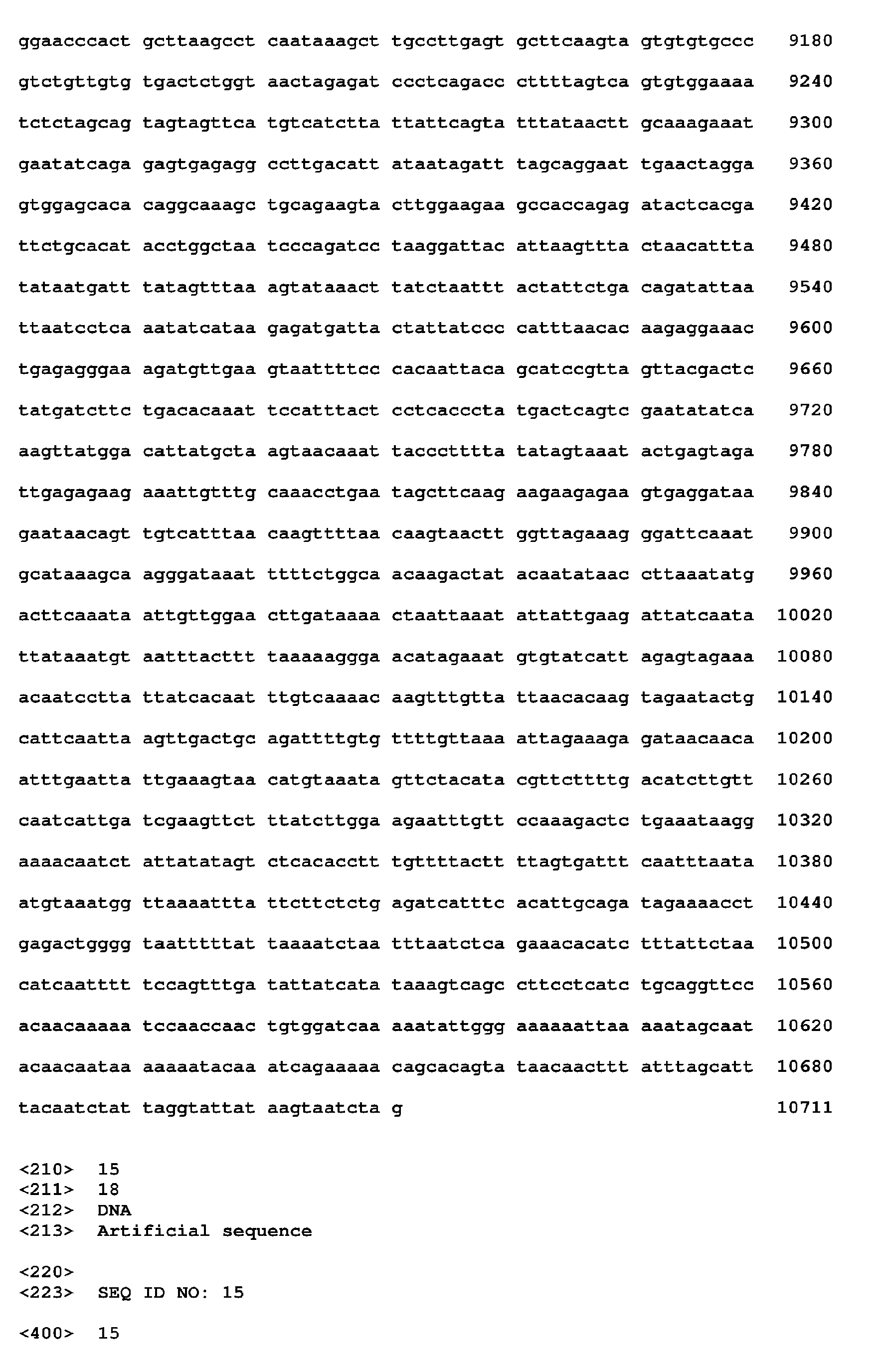

Claims (15)
- A recombinant lentiviral vector which cannot by its own achieve complete reverse transcription wherein the vector comprises a recombinant ribonucleic vector genome comprising a 5' LTR retroviral sequence and a 3' LTR retroviral sequence flanking: a functional retroviral psi encapsidation sequence and at least one transgene, and wherein the recombinant ribonucleic vector genome (i) does not comprise a primer binding site (PBS) or (ii) comprises a PBS comprising a mutation or a misplaced PBS, thereby preventing the reverse transcription of said recombinant ribonucleic vector genome.
- The vector according to claim 1, wherein said lentiviral vector is derived from HIV-1, HIV-2, SIV, FIV, EIAV, BIV, VISNA, CAEV and any combination thereof.
- The vector according to anyone of claims 1 or 2, wherein the mutation in the primer binding site (PBS) preventing reverse transcription of the recombinant ribonucleic vector genome is selected from a deletion, an addition and a substitution of at least one nucleotide, preferably at least 3 nucleotides.
- The vector according to claim 3, wherein the vector is a HIV-1 derived vector and the mutation is a deletion of the HIV-1 PBS sequence corresponding to SEQ ID NO:15 (DNA) and SEQ ID NO:17 (RNA).
- The vector according to anyone of claims 1 to 4, wherein the recombinant lentiviral vector genome further comprises a posttranscriptional regulatory sequence chosen from INPRE, APP 5'UTR, TAU 3'UTR, and a miRNA target sequence.
- The vector according to anyone of the preceding claims, wherein the transgene is selected from a catalytic nucleic acid, an aptamer, a miRNA, a decoy RNA, a nucleic acid encoding a biologically active peptide, for example an enzyme, a transcription factor, a growth factor, a trophic factor, an hormone, a cytokine, an antibody, a receptor, a differentiation factor, a colony stimulation factor, a suicide protein, a cell-cycle modifying protein, an anti-proliferative protein, a nuclease, a recombinase, a transposase, a neurotransmitter or a precursor thereof.
- A method for preparing a lentiviral vector which cannot by its own achieve complete reverse transcription according to anyone of claims 1 to 6, wherein said method comprises expressing within a cell:a. a vector cassette encoding for a lentiviral recombinant ribonucleic vector genome comprising a 5' LTR retroviral sequence and a 3' LTR retroviral sequence flanking: a functional retroviral psi encapsidation sequence and at least one transgene, and wherein the recombinant ribonucleic vector genome (i) does not comprise a primer binding site (PBS) or (ii) comprises a PBS comprising a mutation or a misplaced PBS, thereby preventing the reverse transcription of said recombinant ribonucleic vector genome, andb. a transcomplementation envelope cassette encoding for an envelope glycoprotein, andc. a transcomplementation capsid cassette encoding for sequences derived from a lentiviral genome comprising retroviral gag and pol sequences, said transcomplementation capsid sequences lacking any functional psi encapsidation signal, and said transcomplementation capsid sequences being optionally split into several cassettes, and
recovery of the retroviral vector produced. - A lentiviral vector obtainable with a method according to claim 7.
- A nucleic acid sequence comprising a vector cassette encoding for a lentiviral recombinant ribonucleic vector genome comprising a 5' LTR retroviral sequence and a 3' LTR retroviral sequence flanking: a functional retroviral psi encapsidation sequence and at least one transgene, and wherein the recombinant ribonucleic vector genome (i) does not comprise a primer binding site (PBS) or (ii) comprises a PBS comprising a mutation or a misplaced PBS, thereby preventing the reverse transcription of said recombinant ribonucleic vector genome, and optionally:- a nucleic acid sequence comprising a transcomplementation envelope cassette encoding for an envelope glycoprotein, and/or- a nucleic acid sequence comprising a transcomplementation capsid cassette encoding for sequences derived from a lentiviral genome comprising retroviral gag and pol sequences, said transcomplementation capsid sequences lacking any functional psi encapsidation signal, and said transcomplementation capsid sequences being optionally split into several cassettes
- The nucleic acid sequence according to claim 9, wherein the sequence is selected from a linear nucleic acid sequence, a plasmid, an artificial chromosome, a viral vector genome, and a transposon.
- A cell or cell line comprising a nucleic acid sequence according to claim 9 or 10.
- A composition comprising a vector according to anyone of claims 1 to 6 or 8, a nucleic acid sequence according to claim 9 or 10, and/or a cell or a cell line according to claim 11.
- A composition according to claim 12, wherein the composition is a pharmaceutical composition comprising a vector according to anyone of claims 1 to 6 or 8, a nucleic acid sequence according to claim 9 or 10, and/or a cell or a cell line according to claim 11, and a pharmaceutically acceptable excipient.
- A kit comprising a vector according to anyone of claims 1 to 6 or 8, a nucleic acid sequence according to claim 9 or 10, a cell or a cell line according to claim 11 and/or a composition according to claim 12 or 13, and preferably written instructions for using the kit.
- Use of a vector according to anyone of claims 1 to 6 or 8, a nucleic acid sequence according to claim 9 or 10, a cell or a cell line according to claim 11, a composition according to claim 12 or 13 and/or of a kit according to claim 14, for transiently expressing at least one transgene in vitro, ex vivo or in vivo.
Priority Applications (2)
| Application Number | Priority Date | Filing Date | Title |
|---|---|---|---|
| EP11306385.3A EP2586867A1 (en) | 2011-10-26 | 2011-10-26 | Transient expression lentiviral vectors, preparation and uses thereof |
| PCT/EP2012/071214 WO2013083329A2 (en) | 2011-10-26 | 2012-10-26 | Transient expression lentiviral vectors, preparation and uses thereof |
Applications Claiming Priority (1)
| Application Number | Priority Date | Filing Date | Title |
|---|---|---|---|
| EP11306385.3A EP2586867A1 (en) | 2011-10-26 | 2011-10-26 | Transient expression lentiviral vectors, preparation and uses thereof |
Publications (1)
| Publication Number | Publication Date |
|---|---|
| EP2586867A1 true EP2586867A1 (en) | 2013-05-01 |
Family
ID=45560642
Family Applications (1)
| Application Number | Title | Priority Date | Filing Date |
|---|---|---|---|
| EP11306385.3A Withdrawn EP2586867A1 (en) | 2011-10-26 | 2011-10-26 | Transient expression lentiviral vectors, preparation and uses thereof |
Country Status (2)
| Country | Link |
|---|---|
| EP (1) | EP2586867A1 (en) |
| WO (1) | WO2013083329A2 (en) |
Citations (2)
| Publication number | Priority date | Publication date | Assignee | Title |
|---|---|---|---|---|
| WO2005116225A1 (en) * | 2004-05-25 | 2005-12-08 | Children's Hospital Medical Center | Method for introducing and expressing rna in cells |
| WO2009061442A1 (en) | 2007-11-06 | 2009-05-14 | Children's Medical Center Corporation | Method to produce induced pluripotent stem (ips) cells form non-embryonic human cells |
-
2011
- 2011-10-26 EP EP11306385.3A patent/EP2586867A1/en not_active Withdrawn
-
2012
- 2012-10-26 WO PCT/EP2012/071214 patent/WO2013083329A2/en not_active Ceased
Patent Citations (2)
| Publication number | Priority date | Publication date | Assignee | Title |
|---|---|---|---|---|
| WO2005116225A1 (en) * | 2004-05-25 | 2005-12-08 | Children's Hospital Medical Center | Method for introducing and expressing rna in cells |
| WO2009061442A1 (en) | 2007-11-06 | 2009-05-14 | Children's Medical Center Corporation | Method to produce induced pluripotent stem (ips) cells form non-embryonic human cells |
Non-Patent Citations (17)
| Title |
|---|
| "Oligonucleotide Synthesis: A Practical Approach", 1984, IRL PRESS |
| AUSUBEL, F. M. ET AL.: "Current Protocols in Molecular Biology", 1995, JOHN WILEY & SONS |
| B. ROE; J. CRABTREE; A. KAHN: "DNA Isolation and Sequencing: Essential Techniques", 1996, JOHN WILEY & SONS |
| D. M. J. LILLEY; J. E. DAHLBERG: "Methods of Enzymology: DNA Structure Part A: Synthesis and Physical Analysis of DNA Methods in Enzymology", 1992, ACADEMIC PRESS |
| DULL T; ZUFFEREY R; KELLY M; MANDEL RJ; NGUYEN M; TRONO D; NALDINI L., MOL THER., vol. 2, no. 2, August 2000 (2000-08-01), pages 170 - 6 |
| GALLA M: "Retroviral pseudotransduction for targeted cell manipulation", MOLECULAR CELL, vol. 16, 22 October 2004 (2004-10-22), pages 309 - 315, XP002341623, ISSN: 1097-2765, DOI: 10.1016/J.MOLCEL.2004.09.023 * |
| HERSCHHORN A; HIZI A., CELL MOL LIFE SCI., vol. 67, no. 16, 1 April 2010 (2010-04-01), pages 2717 - 47 |
| J VIROL., vol. 72, no. 11, November 1998 (1998-11-01), pages 8463 - 71 |
| J. M. POLAK; JAMES O'D. MCGEE: "Situ Hybridisation: Principles and Practice", 1990, OXFORD UNIVERSITY PRESS |
| J. SAMBROOK; E. F. FRITSCH; T. MANIATIS: "Molecular Cloning: A Laboratory Manual", 1989, COLD SPRING HARBOR LABORATORY PRESS |
| KELLENDONK C.; TRONCHE F.; MONAGHAN A.P.; ANGRAND P.O.; STEWART F.; SCHUTZ G., NUCLEIC ACIDS RES., vol. 24, 1996, pages 1404 - 1411 |
| LEHNINGER, A. L.: "Biochemistry", 1975, WORTH PUBLISHERS, pages: 71 - 92 |
| NAT BIOTECHNOL., vol. 15, no. 9, 1997, pages 871 - 5 |
| R SCOTT MCIVOR, MOLECULAR THERAPY, vol. 19, no. 5, May 2011 (2011-05-01), pages 822 - 3 |
| ROBERTS; VELLACCIO: "The Peptides: Analysis, Synthesis, Biology", vol. 5, 1983, ACADEMIC PRESS, INC., pages: 341 |
| SORIANO, P.: "Generalized lacZ expression with the ROSA26 Cre reporter strain", NAT GENET, vol. 21, 1999, pages 70 - 71, XP002321839, DOI: doi:10.1038/5007 |
| ZUFFEREY R; NAGY D; MANDEL RJ; NALDINI L; TRONO D., CELL, vol. 101, no. 2, 14 April 2000 (2000-04-14), pages 173 - 85 |
Also Published As
| Publication number | Publication date |
|---|---|
| WO2013083329A3 (en) | 2013-08-01 |
| WO2013083329A2 (en) | 2013-06-13 |
Similar Documents
| Publication | Publication Date | Title |
|---|---|---|
| US10308955B2 (en) | Transient expression vectors, preparation and uses thereof | |
| Pluta et al. | Use of HIV as a gene transfer vector | |
| RU2752498C2 (en) | Stable cell lines for retroviruses production | |
| AU2016359838B2 (en) | Transient transfection method for retroviral production | |
| RS56844B1 (en) | Polypurine tract modified retroviral vectors | |
| WO2008071959A1 (en) | Lentiviral vectors comprising micrornas | |
| KR20220154734A (en) | lentiviral vectors | |
| US11795474B2 (en) | Stable cell lines for retroviral production | |
| WO2008066658A2 (en) | Engineered cellular pathways for programmed autoregulation of differentiation | |
| JP2023504593A (en) | Production system | |
| Cockrell et al. | HIV-1 vectors: fulfillment of expectations, further advancements, and still a way to go | |
| Spirin et al. | Lentiviral vectors | |
| US11078495B2 (en) | Methods and compositions for integration defective lentiviral vectors | |
| GB2538324A (en) | Packaging cell line for retroviral production | |
| AU773015B2 (en) | Lentiviral vectors | |
| WO2013083329A2 (en) | Transient expression lentiviral vectors, preparation and uses thereof | |
| EP1226282A2 (en) | Retroviral recombination assays and uses thereof | |
| EP1841878B1 (en) | Method for the generation of virus producing cell lines and cell lines | |
| van Heuvel | Optimization of retroviral packaging cells for scale-up of vector production | |
| Tschorn | Development of transposon and retrovirus-derived vectors for the rapid establishment of efficient producer cell lines | |
| Durosa et al. | g-RETROVIRUS-AND LENTIVIRUS-DERIVED VECTORS FOR GENE TRANSFER AND THERAPY | |
| Schmidhofer | Two novel systems for defined expression levels of mCherry protein | |
| WO2026101402A1 (en) | Stable cell line for production of viral vectors | |
| US20060134137A1 (en) | Transduction vector based on modified HIV-2 | |
| Heuvel | Optimization of retroviral packaging cells for scale-up of vector production |
Legal Events
| Date | Code | Title | Description |
|---|---|---|---|
| PUAI | Public reference made under article 153(3) epc to a published international application that has entered the european phase |
Free format text: ORIGINAL CODE: 0009012 |
|
| AK | Designated contracting states |
Kind code of ref document: A1 Designated state(s): AL AT BE BG CH CY CZ DE DK EE ES FI FR GB GR HR HU IE IS IT LI LT LU LV MC MK MT NL NO PL PT RO RS SE SI SK SM TR |
|
| AX | Request for extension of the european patent |
Extension state: BA ME |
|
| STAA | Information on the status of an ep patent application or granted ep patent |
Free format text: STATUS: THE APPLICATION HAS BEEN WITHDRAWN |
|
| 18W | Application withdrawn |
Effective date: 20130910 |