EP2586768A1 - Hydroxy acid compound of substituted phenyl ester, preparation method and medical use thereof - Google Patents
Hydroxy acid compound of substituted phenyl ester, preparation method and medical use thereof Download PDFInfo
- Publication number
- EP2586768A1 EP2586768A1 EP10853411.6A EP10853411A EP2586768A1 EP 2586768 A1 EP2586768 A1 EP 2586768A1 EP 10853411 A EP10853411 A EP 10853411A EP 2586768 A1 EP2586768 A1 EP 2586768A1
- Authority
- EP
- European Patent Office
- Prior art keywords
- compound
- diisopropylphenol
- iii
- diacid
- preparation
- Prior art date
- Legal status (The legal status is an assumption and is not a legal conclusion. Google has not performed a legal analysis and makes no representation as to the accuracy of the status listed.)
- Granted
Links
Images

Classifications
-
- C—CHEMISTRY; METALLURGY
- C07—ORGANIC CHEMISTRY
- C07C—ACYCLIC OR CARBOCYCLIC COMPOUNDS
- C07C59/00—Compounds having carboxyl groups bound to acyclic carbon atoms and containing any of the groups OH, O—metal, —CHO, keto, ether, groups, groups, or groups
- C07C59/40—Unsaturated compounds
- C07C59/42—Unsaturated compounds containing hydroxy or O-metal groups
- C07C59/48—Unsaturated compounds containing hydroxy or O-metal groups containing six-membered aromatic rings
-
- A—HUMAN NECESSITIES
- A61—MEDICAL OR VETERINARY SCIENCE; HYGIENE
- A61P—SPECIFIC THERAPEUTIC ACTIVITY OF CHEMICAL COMPOUNDS OR MEDICINAL PREPARATIONS
- A61P23/00—Anaesthetics
-
- A—HUMAN NECESSITIES
- A61—MEDICAL OR VETERINARY SCIENCE; HYGIENE
- A61P—SPECIFIC THERAPEUTIC ACTIVITY OF CHEMICAL COMPOUNDS OR MEDICINAL PREPARATIONS
- A61P25/00—Drugs for disorders of the nervous system
- A61P25/04—Centrally acting analgesics, e.g. opioids
-
- A—HUMAN NECESSITIES
- A61—MEDICAL OR VETERINARY SCIENCE; HYGIENE
- A61P—SPECIFIC THERAPEUTIC ACTIVITY OF CHEMICAL COMPOUNDS OR MEDICINAL PREPARATIONS
- A61P25/00—Drugs for disorders of the nervous system
- A61P25/20—Hypnotics; Sedatives
-
- C—CHEMISTRY; METALLURGY
- C07—ORGANIC CHEMISTRY
- C07C—ACYCLIC OR CARBOCYCLIC COMPOUNDS
- C07C67/00—Preparation of carboxylic acid esters
- C07C67/30—Preparation of carboxylic acid esters by modifying the acid moiety of the ester, such modification not being an introduction of an ester group
- C07C67/31—Preparation of carboxylic acid esters by modifying the acid moiety of the ester, such modification not being an introduction of an ester group by introduction of functional groups containing oxygen only in singly bound form
-
- C—CHEMISTRY; METALLURGY
- C07—ORGANIC CHEMISTRY
- C07C—ACYCLIC OR CARBOCYCLIC COMPOUNDS
- C07C67/00—Preparation of carboxylic acid esters
- C07C67/30—Preparation of carboxylic acid esters by modifying the acid moiety of the ester, such modification not being an introduction of an ester group
- C07C67/317—Preparation of carboxylic acid esters by modifying the acid moiety of the ester, such modification not being an introduction of an ester group by splitting-off hydrogen or functional groups; by hydrogenolysis of functional groups
- C07C67/32—Decarboxylation
-
- C—CHEMISTRY; METALLURGY
- C07—ORGANIC CHEMISTRY
- C07C—ACYCLIC OR CARBOCYCLIC COMPOUNDS
- C07C69/00—Esters of carboxylic acids; Esters of carbonic or haloformic acids
- C07C69/66—Esters of carboxylic acids having esterified carboxylic groups bound to acyclic carbon atoms and having any of the groups OH, O—metal, —CHO, keto, ether, acyloxy, groups, groups, or in the acid moiety
- C07C69/67—Esters of carboxylic acids having esterified carboxylic groups bound to acyclic carbon atoms and having any of the groups OH, O—metal, —CHO, keto, ether, acyloxy, groups, groups, or in the acid moiety of saturated acids
- C07C69/675—Esters of carboxylic acids having esterified carboxylic groups bound to acyclic carbon atoms and having any of the groups OH, O—metal, —CHO, keto, ether, acyloxy, groups, groups, or in the acid moiety of saturated acids of saturated hydroxy-carboxylic acids
Definitions
- the present invention relates to a hydroxy acid ester compound of substituted phenol, preparation method and medical use thereof.
- the compound can be used as a sedative-hypnotic agent and/or anesthetic administered intravenously or non-intravenously.
- Propofol (chemical name: 2, 6-diisopropylphenol) is a sedative-hypnotic agent that has been widely used in clinical practice for induction and maintenance of general anesthesia and for intensive care. Propofol has the characteristics of rapid onset and fast metabolic inactivation, and so it has increasingly been used widely in the world since its first clinical report in 1977. As the water solubility of propofol is only 146 mg/L, its clinical formulation is an oil-in-water (O/W) emulsion, in which propofol accounts for 1%; soybean oil, 10%; glycerol, 2.25%; and purified egg yolk lecithin, 1.2%.
- O/W oil-in-water
- disodium edetate is also included as a bacteria growth inhibitor.
- This formula is a milk-white liquid with a pH value of 7.0, which is slightly viscous, easily injectable, stable at room temperature, and insensitive to light, and is packed in ampoules, under nitrogen gas.
- this preparation still has many disadvantages.
- various stabilizers and solubilizers contained can inevitably cause allergic reactions.
- Soybean oil and lecithin contained can breed bacteria easily; therefore, it must be prepared under the strict aseptic condition, and it is hard to store when unsealed. Meanwhile, a big oil droplet contained may cause embolism or even serious cardiac adverse effects.
- this kind of formulation cannot overcome the disadvantage of 2, 6-diisopropylphenol being easily oxidized and deteriorated. All of these disadvantages have limited the use of 2, 6-diisopropylphenol to some extent.
- the propofol succinic acid monoester sodium salt disclosed in W0200213810 is a derivative of 2, 6-diisopropylphenol with high water-solubility, but it is unstable in aqueous solution, which also limits the development and application of water-soluble prodrugs of 2, 6-diisopropylphenol.
- the present invention provides a hydroxy acid ester compound of substituted phenol for the first time; the present invention also provides a preparation method and a medical use of the compound.
- the hydroxy acid ester compound of substituted phenol of the present invention is represented by the following structure formula (I): wherein, Y is C 1-4 straight carbon chain; preferably, the straight carbon chain Y is a saturated carbon chain; more preferably, the straight carbon chain Y is -CH 2 -CH 2 - or -CH 2 -CH 2 -CH 2 -.
- the straight carbon chain Y in the compound of the above formula (I) may also be the substituted forms where at least one hydrogen atom of the carbon chain may be substituted with a member of the group consisting of methyl, ethyl, cyclopropyl, hydroxy, sulfydryl, amino or substituted amino group.
- the inventive compound of formula (I) can rapidly decompose and release the substituted phenol structure (propofol) to produce sedative, hypnotic and/or anesthetic effect when it is formulated into a pharmaceutically acceptable dosage form, e.g., emulsion administrated intravenously in vivo ; therefore, the weakness of the hydroxyl group being easily oxidized in the substituted phenol structure can be prevented, and the compound exhibits the advantages of being stable in vitro and being rapidly decomposed in vivo. Meanwhile, the hydroxy acid or its corresponding esterified products that are released from the compound of formula (I) are harmless in vivo.
- the hydroxy acid ester compound of substituted phenol of formula (I) of the present invention can have desirable actions and effects.
- the hydroxyl group of the compound of formula (I) can be further modified to obtain some other derivatives that have a higher stability.
- various water-soluble derivatives of the substituted phenol can be obtained based on the above-mentioned structure.
- the above hydroxy acid ester compound of substituted phenol can be prepared by the following steps: reacting 2, 6-diisopropylphenol (II) as a raw material with dicarboxylic anhydride compound (III) in the presence of a deacidifying agent and 4-dimethylaminopyridine as a catalyst, to form diacid monoester intermediate (IV); or reacting 2, 6-diisopropylphenol (II) with diacid compound (III') in the presence of N, N-dicyclohexylcarbodiimide (DCC) as a condensating agent and a catalytic amount of 4-dimethylaminopyridine, to form diacid monoester intermediate (IV); then diacid monoester intermediate (IV) with boron sodium hydride and iodine, to obtain the corresponding hydroxy acid ester compound of substituted phenol (I).
- Y of said dicarboxylic anhydride compound (III) and diacid compound (III') is
- Y of diacid compound (III') or dicarboxylic anhydride compound (III) is a saturated carbon chain and, preferably, is -CH 2 -CH 2 - or -CH 2 -CH 2 -CH 2 -.
- Said deacidifying agent in the above preparation method may be an organic alkaline compound, e.g., pyridine or a tertiary amine compound such as triethylamine.
- Said preparation method can usually be performed in at least one organic solvent selected from the group consisting of methylene dichloride, chloroform, carbon tetrachloride, chlorobenzene, benzene, methylbenzene, petroleum ether, cyclohexane, n-hexane, acetonitrile, acetone, dimethylformamide (DMF), dimethyl sulphoxide (DMSO), tetrahydrofuran, diethyl ether, triethylamine or pyridine.
- organic solvent selected from the group consisting of methylene dichloride, chloroform, carbon tetrachloride, chlorobenzene, benzene, methylbenzene, petroleum ether, cyclohexane, n-hexane, acetonitrile, acetone, dimethylformamide (DMF), dimethyl sulphoxide (DMSO), tetrahydrofuran, diethyl ether, triethyl
- the compound of formula (I) of the present invention can be prepared by the following steps:
- the hydroxy acid ester compound of substituted phenol of formula (I) of the present invention can overcome the weakness of easy oxidization of the hydroxyl group in the propofol structure, exhibit its advantages of being stable in vitro and being rapidly decomposed in vivo, and thus it can be used in a central depressant drug to produce sedative, hypnotic and/or anesthetic effect on animals or human beings through an intravenous or non-intravenous route, so that the application scope of the propofol prodrugs can be enlarged.
- reaction solution was evaporated to remove tetrahydrofuran, and added with 100 ml of ethyl acetate to produce precipitate.
- the precipitate was filtered off and the filtrate was washed once with 100 ml of saturated sodium bicarbonate solution and 100 ml of water, respectively.
- the organic layer was separated, dried over anhydrous magnesium sulfate, and then evaporated to remove ethyl acetate solvent to obtain 16.24 g of propofol ⁇ -hydroxybutyrate product as colorless oil. No impurity was detected by TLC. Yield: 95%.
- the reaction solution was evaporated to remove tetrahydrofuran, and added with 100 ml of ethyl acetate to produce precipitate.
- the precipitate was filtered off and the filtrate was washed once with 100 ml of saturated sodium bicarbonate solution and 100 ml of water, respectively.
- the organic layer was separated, dried over anhydrous magnesium sulfate, filtrated to remove the drying agent and then evaporated to remove ethyl acetate to obtain 16.24 g of propofol ⁇ -hydroxyvalerate product as colorless oil. No impurity was detected by TLC. Yield: 93%.
- Median effective doses (ED 50 ) of the substituted phenol hydroxy acid ester and DiprivanTM were determined by the up-and-down method.
- the mice were injected with the drugs through the tail veins, with the disappearance of the forepaw righting reflex (FRR) of the mice as a judgment index of the end point of anesthesia; the recovery of FRR of the mice as an index of recovery from anesthesia.
- FRR forepaw righting reflex
- ED 50 of the drug test group of the present invention was 52 mg/kg, with the 95% confidence interval of 35 ⁇ 67 mg/kg.
- ED 50 of the DiprivanTM control group was 6.1 mg/kg, with 95% confidence interval of 5.1 ⁇ 7.9 mg/kg.
- the disappearance time of FRR of the drug test group of the present invention was 45.3 ⁇ 12.3 seconds, and the recovery time was 235.6 ⁇ 67.9 seconds.
- Both the onset time and the recovery time were slightly longer than those of the DiprivanTM control group (onset time, 19 ⁇ 3 seconds; recovery time, 217.6 ⁇ 67.3 seconds).
- the test results have shown that propofol hydroxybutyrate of the present invention has a definite and reversible anesthetic effect.
- Median effective doses (ED 50 ) of the substituted phenol hydroxy acid ester and DiprivanTM were determined by the up-and-down method.
- the mice were injected with the drugs through the tail veins, with the disappearance of FRR of the mice as a judgment index of the end point of anesthesia; the recovery of FRR of the mice as an index of recovery from anesthesia.
- ED 50 of the drug test group of the present invention was 60 mg/kg, with 95% confidence interval of 36 ⁇ 72 mg/kg.
- ED 50 of the DiprivanTM control group was 6.5 mg/kg, with 95% confidence interval of 4.9 ⁇ 8.1 mg/kg.
- the disappearance time of FRR of the drug test group of the present invention was 46.1 ⁇ 9.5 seconds, and the recovery time was 256.1 ⁇ 61.2 seconds.
- Both the onset time and the recovery time were slightly longer than those of the DiprivanTM control group (onset time, 21 ⁇ 4 seconds; recovery time, 210.4 ⁇ 56.6 seconds).
- the test results have shown that propofol hydroxybutyrate of the present invention has a definite and reversible anesthetic effect.
- the present invention provides a hydroxy acid ester derivative of 2, 6-diisopropylphenol (propofol).
- the compound of the present invention overcomes the disadvantage of the hydroxyl group being easily oxidized in the structure of propofol, and it has the characteristics of being stable in vitro and being rapidly decomposed in vivo ; thus, it can be used as a central depressant to produce sedative, hypnotic and/or anesthetic effect on animals or human beings through an intravenous or non-intravenous route, so that the application scope of the propofol prodrug can be enlarged and the positive sense and good prospects can be achieved. So, it is suitable for the industrial applications.
Landscapes
- Chemical & Material Sciences (AREA)
- Organic Chemistry (AREA)
- Health & Medical Sciences (AREA)
- Animal Behavior & Ethology (AREA)
- General Health & Medical Sciences (AREA)
- Veterinary Medicine (AREA)
- Public Health (AREA)
- Life Sciences & Earth Sciences (AREA)
- Chemical Kinetics & Catalysis (AREA)
- General Chemical & Material Sciences (AREA)
- Medicinal Chemistry (AREA)
- Nuclear Medicine, Radiotherapy & Molecular Imaging (AREA)
- Pharmacology & Pharmacy (AREA)
- Engineering & Computer Science (AREA)
- Bioinformatics & Cheminformatics (AREA)
- Biomedical Technology (AREA)
- Neurosurgery (AREA)
- Neurology (AREA)
- Anesthesiology (AREA)
- Pain & Pain Management (AREA)
- Organic Low-Molecular-Weight Compounds And Preparation Thereof (AREA)
- Acyclic And Carbocyclic Compounds In Medicinal Compositions (AREA)
Abstract

Description
- The present invention relates to a hydroxy acid ester compound of substituted phenol, preparation method and medical use thereof. The compound can be used as a sedative-hypnotic agent and/or anesthetic administered intravenously or non-intravenously.
- Propofol (chemical name: 2, 6-diisopropylphenol) is a sedative-hypnotic agent that has been widely used in clinical practice for induction and maintenance of general anesthesia and for intensive care. Propofol has the characteristics of rapid onset and fast metabolic inactivation, and so it has increasingly been used widely in the world since its first clinical report in 1977. As the water solubility of propofol is only 146 mg/L, its clinical formulation is an oil-in-water (O/W) emulsion, in which propofol accounts for 1%; soybean oil, 10%; glycerol, 2.25%; and purified egg yolk lecithin, 1.2%. In the U.S.A, for example, 0.005% disodium edetate is also included as a bacteria growth inhibitor. This formula is a milk-white liquid with a pH value of 7.0, which is slightly viscous, easily injectable, stable at room temperature, and insensitive to light, and is packed in ampoules, under nitrogen gas. However, this preparation still has many disadvantages. For example, as an emulsion form for injection, various stabilizers and solubilizers contained can inevitably cause allergic reactions. Soybean oil and lecithin contained can breed bacteria easily; therefore, it must be prepared under the strict aseptic condition, and it is hard to store when unsealed. Meanwhile, a big oil droplet contained may cause embolism or even serious cardiac adverse effects. Besides, this kind of formulation cannot overcome the disadvantage of 2, 6-diisopropylphenol being easily oxidized and deteriorated. All of these disadvantages have limited the use of 2, 6-diisopropylphenol to some extent.
- Some chemical methods have been reported to overcome those disadvantages of 2, 6-diisopropylphenol, which inevitably involved the preparation of some water-soluble prodrugs by modification of the hydroxyl group of 2, 6-diisopropylphenol,such as propofol phosphates disclosed in
WO200213810 WO2003059255 could release formaldehyde molecules after hydrolysis, which could cause some adverse effects. For one more example, the propofol succinic acid monoester sodium salt disclosed inW0200213810 - In view of the above problems, the present invention provides a hydroxy acid ester compound of substituted phenol for the first time; the present invention also provides a preparation method and a medical use of the compound.
- The hydroxy acid ester compound of substituted phenol of the present invention is represented by the following structure formula (I):
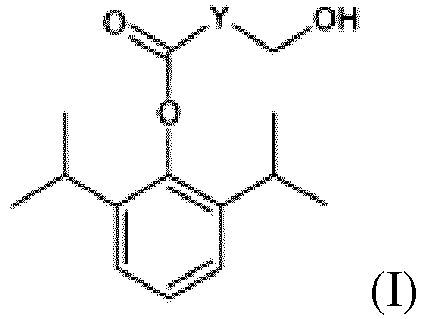
- Besides the simple straight carbon chain forms, the straight carbon chain Y in the compound of the above formula (I) may also be the substituted forms where at least one hydrogen atom of the carbon chain may be substituted with a member of the group consisting of methyl, ethyl, cyclopropyl, hydroxy, sulfydryl, amino or substituted amino group.
- The experimental results have shown that as a propofol prodrug, the inventive compound of formula (I) can rapidly decompose and release the substituted phenol structure (propofol) to produce sedative, hypnotic and/or anesthetic effect when it is formulated into a pharmaceutically acceptable dosage form, e.g., emulsion administrated intravenously in vivo; therefore, the weakness of the hydroxyl group being easily oxidized in the substituted phenol structure can be prevented, and the compound exhibits the advantages of being stable in vitro and being rapidly decomposed in vivo. Meanwhile, the hydroxy acid or its corresponding esterified products that are released from the compound of formula (I) are harmless in vivo. Accordingly, when administered intravenously or non-intravenously as a central depressant to produce sedative, hypnotic and/or anesthetic effect on animals or human beings, the hydroxy acid ester compound of substituted phenol of formula (I) of the present invention can have desirable actions and effects. The hydroxyl group of the compound of formula (I) can be further modified to obtain some other derivatives that have a higher stability. For example, when the hydroxyl group is bound to the water-soluble molecules, various water-soluble derivatives of the substituted phenol can be obtained based on the above-mentioned structure.
- The above hydroxy acid ester compound of substituted phenol can be prepared by the following steps: reacting 2, 6-diisopropylphenol (II) as a raw material with dicarboxylic anhydride compound (III) in the presence of a deacidifying agent and 4-dimethylaminopyridine as a catalyst, to form diacid monoester intermediate (IV); or reacting 2, 6-diisopropylphenol (II) with diacid compound (III') in the presence of N, N-dicyclohexylcarbodiimide (DCC) as a condensating agent and a catalytic amount of 4-dimethylaminopyridine, to form diacid monoester intermediate (IV); then diacid monoester intermediate (IV) with boron sodium hydride and iodine, to obtain the corresponding hydroxy acid ester compound of substituted phenol (I). Wherein, Y of said dicarboxylic anhydride compound (III) and diacid compound (III') is C1-4 straight carbon chain. The reaction routes are as follows:
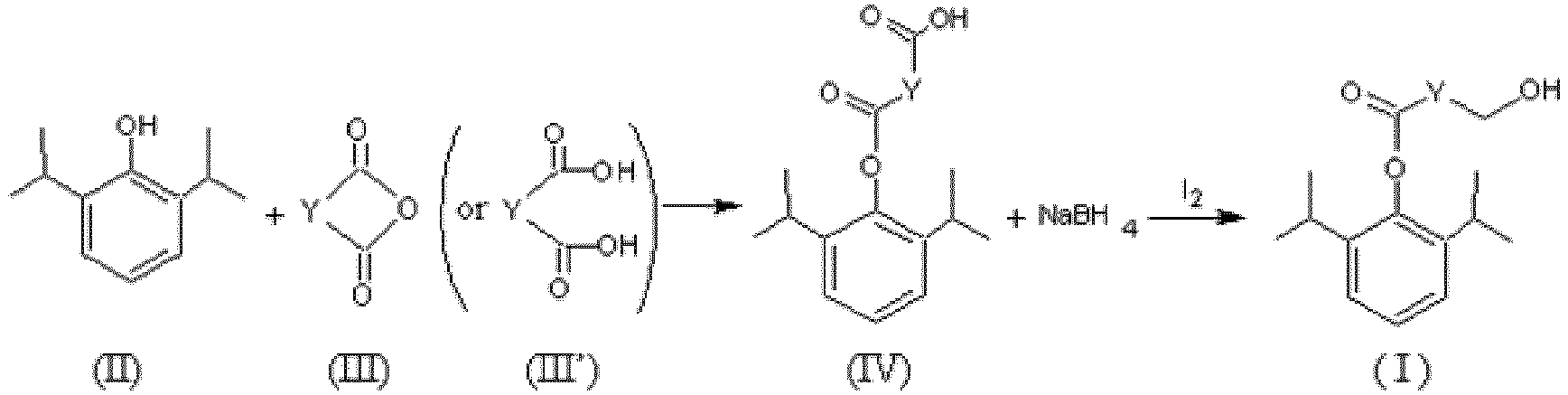
- In the reaction route, Y of diacid compound (III') or dicarboxylic anhydride compound (III) is a saturated carbon chain and, preferably, is -CH2-CH2- or -CH2-CH2-CH2-.
- Said deacidifying agent in the above preparation method may be an organic alkaline compound, e.g., pyridine or a tertiary amine compound such as triethylamine.
- Said preparation method can usually be performed in at least one organic solvent selected from the group consisting of methylene dichloride, chloroform, carbon tetrachloride, chlorobenzene, benzene, methylbenzene, petroleum ether, cyclohexane, n-hexane, acetonitrile, acetone, dimethylformamide (DMF), dimethyl sulphoxide (DMSO), tetrahydrofuran, diethyl ether, triethylamine or pyridine.
- Typically, the compound of formula (I) of the present invention can be prepared by the following steps:
- 1': 2, 6-diisopropylphenol (II) is dissolved in triethylamine, added with dianhydride compound (III) and a catalytic amount of 4-dimethylaminopyridine. After completion of the reaction under stirring, triethylamine is removed under reduced pressure. Experiment results show that the reaction can be performed at the temperatures ranging from room temperature to reflux temperature, or even a lower temperature below 0°C. After the removal of triethylamine, the residue is added with water and adjusted with a conventional acid, e.g., hydrochloric acid, until an acidic pH point is reached so that the precipitate is formed completely. The precipitate is separated to obtain diacid monoester intermediate of 2, 6-diisopropylphenol (IV). Besides dianhydride compound (III), 2, 6-diisopropylphenol can also be allowed to react with an equimolar amount of diacid compound (III') under the temperatures ranging from 0°C to room temperature in the presence of an equimolar amount of N, N-dicyclohexylcarbodiimide (DCC) as a condensating agent and a catalytic amount of 4-dimethylaminopyridine. After completion of the reaction, the reactant is filtered to remove the precipitate and the filtrate is evaporated to remove the solvent to obtain diacid monoester intermediate (IV). The resultant crude diacid monoester intermediate (IV) may be further recrystallized with cyclohexane/ethyl acetate, or other suitable solvents to obtain the purified intermediate (IV).
- 2'. Diacid monoester intermediate (IV) obtained from the above step is mixed with an equimolar amount of sodium borohydride in the above-mentioned organic solvent (e.g., anhydrous tetrahydrofuran), and added with an equimolar amount of iodine under stirring. After completion of the reaction (e.g., no bubbles occurring, the reaction solution turning to colorless), the reaction solution is evaporated under reduced pressure to remove tetrahydrofuran, and the residue is dissolved with said organic solvent (e.g., ethyl acetate) and washed with water sufficiently; then, the organic solvent is removed to obtain the target product of formula (I) as a colorless transparent viscous liquid.
- It could be understood that by preparing the hydroxy acid ester derivative of 2, 6-diisopropylphenol (propofol), the hydroxy acid ester compound of substituted phenol of formula (I) of the present invention can overcome the weakness of easy oxidization of the hydroxyl group in the propofol structure, exhibit its advantages of being stable in vitro and being rapidly decomposed in vivo, and thus it can be used in a central depressant drug to produce sedative, hypnotic and/or anesthetic effect on animals or human beings through an intravenous or non-intravenous route, so that the application scope of the propofol prodrugs can be enlarged.
- The present invention will be further described in detail in conjunction with the embodiments shown in the drawings and examples; however, it should not be construed as limiting the scope of the present invention to the following examples. Without departing from the technical thought of the present invention, various modifications or changes can be made in accordance with the ordinary skills and the conventional means in the field and should be included in the scope of the present invention.
-
-
Fig. 1 is an in vitro decomposition curve of propofol hydroxybutyrate in the plasma. -
Fig.2 is an in vitro decomposition curve of propofol hydroxyvalerate in the plasma. - 20 g of 2, 6-diisopropylphenol (propofol) was dissolved in 50 ml of triethylamine, added with 14 g of succinyl oxide and 0.02 g of DMAP (4-dimethylamino- pyridine).The mixture was reacted completely for 16 hours under stirring at room temperature, and the reaction solution was evaporated under reduced pressure to remove triethylamine. The residue was added into 100 ml of water and adjusted to pH 1 with 6N HCl to produce a great amount of white precipitate. The precipitate was separated and then dried under reduced pressure to give crude propofol succinate monoester intermediate, which was recrystallized with cyclohexane/ethyl acetate to obtain 23.5 g of acicular crystals. Yield: 75.4%, mp: 103-104°C.
- 2.54 g of sodium tetrahydroborate was suspended in 45 ml of anhydrous tetrahydrofuran, cooled to below 5°C, and then slowly added dropwise with 18 g of propofol succinic acid monoester intermediate in 60 ml of tetrahydrofuran, with the temperature maintaining below 5°C. After completion of the dropwise addition, the mixture was stirred at this low temperature for 2 hours until no bubbles occurred, and then added dropwise with 8.28 g of iodine in 70 ml of tetrahydrofuran, with the color of the solution not becoming yellow. After completion of the dropwise addition, the mixture was stirred for 1 hour under the constant temperature. The reaction solution was evaporated to remove tetrahydrofuran, and added with 100 ml of ethyl acetate to produce precipitate. The precipitate was filtered off and the filtrate was washed once with 100 ml of saturated sodium bicarbonate solution and 100 ml of water, respectively. The organic layer was separated, dried over anhydrous magnesium sulfate, and then evaporated to remove ethyl acetate solvent to obtain 16.24 g of propofol ω-hydroxybutyrate product as colorless oil. No impurity was detected by TLC. Yield: 95%.
-
- 1) NMR spectrometer: BRUKER 400M, using CDCl3 as a solvent and TMS as an internal standard. δ was expressed in ppm.
1HNMR (δ): 1.19-1.20 (2s, 12H), 1.62 (s, 1H), 2.04-2.06 (m, 4H), 2.76-2.79 (m, 2H), 2.89-2.91 (m, 2H), 3.78-3.800 (m, 2H), 7.15-7.26 (m, 3H). Wherein, the peak at 1.62 (s, 1H) was the signal of active hydrogen of the hydroxyl group. - 2) NMR spectrometer: BRUKER 400M, using CDCl3 as a solvent and TMS as an internal standard. δ was expressed in ppm.
13CNMR (δ): 22.71, 22.76, 23.67, 27.55, 27.69, 30.77, 61.96, 123.93, 126.53, 140.29, 145.51, 172.57. Wherein, the signal of carbon atom bonded to the hydroxyl group was shown at 61.96, and the signal of carbonyl carbon of the ester bond was shown at 173.57. - 3) High-resolution mass spectrometric detection: Mass Spectrometer: API 3000 LC-Ms/Ms (ABI, U.S.A.); Ionization Mode: EDI.
Ms+: 265.1808 (C16H25O3). - 20 g of propofol was dissolved in 100 ml of methylene dichloride, added with 13.3 g of succinic acid, 0.02 g of dimethylaminopyridine, and then 23.2 g of DCC. The mixture was reacted for 6 hours under stirring at room temperature, then the reaction solution was filtrated to remove white solid and the filtrate was washed once with 150 ml of 6N HCl. The organic layer was separated and evaporated under reduced pressure to remove the solvent to give crude propofol succinate monoester intermediate as pale yellow solid, which was recrystallized with cyclohexane/ethyl acetate to obtain 26.6 g of white acicular crystals. Yield: 85%, mp: 102-103°C.
- The method of preparing the final product propofol ω-hydroxybutyrate (I) from propofol succinate monoester intermediate was similar to that of Example 1.
- 10 g of propofol was dissolved in 50 ml of triethylamine, added with 7 g of glutaric anhydride and 0.01 g of DMAP. The mixture was stirred for 12 hours under stirring at room temperature, and the reaction solution was evaporated under reduced pressure to remove excessive triethylamine. The residue was added into 100 ml of water and adjusted to pH 1 with 6N HCl to produce a great amount of white precipitate. The precipitate was separated and then dried under reduced pressure to give crude propofol glutarate monoester intermediate, which was recrystallized with cyclohexane/ethyl acetate to obtain 10.8 g of white flaky crystals. Yield: 65.9%, mp: 53-54°C.
- 2.54 g of sodium tetrahydroborate was suspended in 45 ml of anhydrous tetrahydrofuran, cooled to below 5°C, and then slowly added dropwise with 19 g of propofol glutarate monoester intermediate in 60 ml of tetrahydrofuran, with the temperature maintaining below 5°C. After completion of the dropwise addition, the mixture was stirred at low temperature for 2 hours until no bubbles occurred, and then added dropwise with 8.28 g of iodine in 70 ml of tetrahydrofuran, with the color of the solution not becoming yellow. After completion of the dropwise addition, the mixture was stirred for 1 hour under the constant temperature. The reaction solution was evaporated to remove tetrahydrofuran, and added with 100 ml of ethyl acetate to produce precipitate. The precipitate was filtered off and the filtrate was washed once with 100 ml of saturated sodium bicarbonate solution and 100 ml of water, respectively. The organic layer was separated, dried over anhydrous magnesium sulfate, filtrated to remove the drying agent and then evaporated to remove ethyl acetate to obtain 16.24 g of propofol ω-hydroxyvalerate product as colorless oil. No impurity was detected by TLC. Yield: 93%.
-
- 1) NMR spectrometer: BRUKER 400M, using CDCl3 as a solvent and TMS as an internal standard. δ was expressed in ppm.
1HNMR(δ): 1.19-1.20 (2s, 12H), 1.71-1.73 (m, 2H), 1.88-1.91 (m, 2H), 2.67-2.69 (m, 2H), 2.87-2.91 (m, 2H), 3.71-3.73(m, 2H), 7.15-7.26 (m, 3H). - 2) NMR spectrometer: BRUKER 400M, using CDCl3 as a solvent and TMS as an internal standard. δ was expressed in ppm.
13CNMR(δ): 14.19, 21.05, 21.15, 27.55, 32.10, 33.73, 62.18, 123.90, 126.48, 140.27, 145.52, 172.33. Wherein, the signal of carbon atom bonded to the hydroxyl group was shown at 62.18, and the signal of carbonyl carbon of the ester bond was shown at 172.33. - 3) High-resolution mass spectrometric detection: Mass Spectrometer: API 3000 LC-Ms/Ms (ABI, U.S.A.); Ionization Mode: EDI.
Ms+: 279.1959 (C17H26O3) - 10 g of propofol was dissolved in 50 ml of methylene dichloride, added with 7.4 g of glutaric acid, 0.01 g of DMAP, and then 11.6 g of DCC. The mixture was reacted for 6 hours under stirring at room temperature, then the reaction solution was filtrated to remove white solid and the filtrate was washed once with 80 ml of 6N HCl. The organic layer was separated and evaporated under reduced pressure to remove the solvent to give pale yellow solid, which was recrystallized with cyclohexane/ethyl acetate to obtain 9 g of propofol glutarate monoester intermediate as white acicular crystals. Yield: 54.9%, mp: 53-54°C.
- The method of preparing the final product propofol ω-hydroxyvalerate (I) from propofol glutarate monoester intermediate was similar to that of Example 3.
- Three parallel solutions of propofol hydroxybutyrate of Example 1 with a concentration of 10 mg/ml were prepared, added into and mixed with the mouse, rat or rabbit plasma, which was pre-placed in water bath (37°C), respectively. 100 µl of the drug-containing plasma was taken at 0 min, 1 min, 3 min, 5 min, 7 min, 10 min, 20 min, 30 min, 1 h, 2 h, 3 h and 4 h, respectively, and the concentrations of the active metabolite propofol were determined by the HPLC method. The results have shown that propofol hydroxybutyrate in the plasma can be rapidly decomposed into the active compound propofol. An in vitro decomposition rate curve of propofol hydroxybutyrate in the plasma is shown in
Figure 1 . - Three parallel solutions of propofol hydroxyvalerate of Example 3 with a concentration of 10 mg/ml were prepared, added into and mixed with mouse, rat or rabbit plasma, which was pre-placed in water bath (37°C), respectively. 100 µl of the drug-containing plasma was taken at 0 min, 1 min, 3 min, 5 min, 7 min, 10 min, 20 min, 30 min, 1 h, 2 h, 3 h and 4 h, respectively, and the concentrations of the active metabolite propofol were determined by the HPLC method. The results have shown that propofol hydroxyvalerate in the plasma can be rapidly decomposed into the active compound propofol. An in vitro decomposition rate curve of propofol hydroxyvalerate in the plasma is shown in
Figure 2 . - 60 Kunming mice with half males and half females were randomly divided into the drug test group (propofol hydroxybutyrate of the present invention) (n = 30) and the Diprivan™ control group (positive control drug Diprivan™) (n = 30). Median effective doses (ED50) of the substituted phenol hydroxy acid ester and Diprivan™ were determined by the up-and-down method. In the test, the mice were injected with the drugs through the tail veins, with the disappearance of the forepaw righting reflex (FRR) of the mice as a judgment index of the end point of anesthesia; the recovery of FRR of the mice as an index of recovery from anesthesia. The results showed that ED50 of the drug test group of the present invention was 52 mg/kg, with the 95% confidence interval of 35∼67 mg/kg. ED50 of the Diprivan™ control group was 6.1 mg/kg, with 95% confidence interval of 5.1∼7.9 mg/kg. During the determination of ED50, it was observed that the disappearance time of FRR of the drug test group of the present invention was 45.3±12.3 seconds, and the recovery time was 235.6±67.9 seconds. Both the onset time and the recovery time were slightly longer than those of the Diprivan™ control group (onset time, 19±3 seconds; recovery time, 217.6±67.3 seconds). The test results have shown that propofol hydroxybutyrate of the present invention has a definite and reversible anesthetic effect.
- 60 Kunming mice with half males and half females were randomly divided into the drug test group (propofol hydroxyvalerate of the present invention) (n = 30) and the Diprivan™ control group (positive control drug Diprivan™) (n = 30). Median effective doses (ED50) of the substituted phenol hydroxy acid ester and Diprivan™ were determined by the up-and-down method. In the test, the mice were injected with the drugs through the tail veins, with the disappearance of FRR of the mice as a judgment index of the end point of anesthesia; the recovery of FRR of the mice as an index of recovery from anesthesia. The results showed that ED50 of the drug test group of the present invention was 60 mg/kg, with 95% confidence interval of 36∼72 mg/kg. ED50 of the Diprivan™ control group was 6.5 mg/kg, with 95% confidence interval of 4.9∼8.1 mg/kg. During the determination of ED50, it was observed that the disappearance time of FRR of the drug test group of the present invention was 46.1±9.5 seconds, and the recovery time was 256.1±61.2 seconds. Both the onset time and the recovery time were slightly longer than those of the Diprivan™ control group (onset time, 21±4 seconds; recovery time, 210.4±56.6 seconds). The test results have shown that propofol hydroxybutyrate of the present invention has a definite and reversible anesthetic effect.
- The present invention provides a hydroxy acid ester derivative of 2, 6-diisopropylphenol (propofol). The compound of the present invention overcomes the disadvantage of the hydroxyl group being easily oxidized in the structure of propofol, and it has the characteristics of being stable in vitro and being rapidly decomposed in vivo; thus, it can be used as a central depressant to produce sedative, hypnotic and/or anesthetic effect on animals or human beings through an intravenous or non-intravenous route, so that the application scope of the propofol prodrug can be enlarged and the positive sense and good prospects can be achieved. So, it is suitable for the industrial applications.
Claims (10)
- A hydroxy acid ester compound of substituted phenol represented by the following structure formula (I):

- The compound of claim 1, wherein said straight carbon chain Y is a saturated carbon chain.
- The compound of claim 2, wherein said straight carbon chain Y is -CH2-CH2- or -CH2-CH2-CH2-.
- The compound of any one of claims 1 to 3, wherein at least one hydrogen atom of the straight carbon chain Y is substituted with a member of the group consisting of methyl, ethyl, cyclopropyl, hydroxy, sulfydryl, amino or substituted amino group.
- A method of preparing the hydroxy acid ester compound of substituted phenol of any one of claims 1 to 4, comprising the steps of:reacting 2, 6-diisopropylphenol (II) as a raw material with a dicarboxylic anhydride compound (III) in the presence of a deacidifying agent and 4-dimethylaminopyridine as a catalyst, to form a diacid monoester intermediate (IV); or reacting 2, 6-diisopropylphenol (II) with diacid compound (III') in the presence of N, N-dicyclohexylcarbodiimide as a condensating agent and a catalytic amount of 4-dimethylaminopyridine, to form a diacid monoester intermediate (IV); then reacting the diacid monoester intermediate (IV) with boron sodium hydride and iodine, to obtain the corresponding hydroxy acid ester compound of substituted phenol (I); wherein, Y of said dicarboxylic anhydride compound (III) is C1-4 straight carbon chain; with the reaction routes as follows:

- The preparation method of claim 5, wherein said deacidifying agent is pyridine or a tertiary amine compound including triethylamine.
- The preparation method of claim 5 or 6, wherein said preparation method is performed in at least one organic solvent selected from the group consisting of methylene dichloride, chloroform, carbon tetrachloride, chlorobenzene, benzene, methylbenzene, petroleum ether, cyclohexane, n-hexane, acetonitrile, acetone, DMF, DMSO, tetrahydrofuran, diethyl ether, triethylamine or pyridine.
- The preparation method of claim 7, comprising the steps of:1': dissolving 2, 6-diisopropylphenol (II) in triethylamine, adding with dianhydride compound (III) and a catalytic amount of 4-dimethylaminopyridine; after completion of the reaction under stirring, removing triethylamine under reduced pressure, adding with water and then an acid to adjust pH of the residue to be acid to produce precipitate; separating out the precipitate to obtain diacid monoester intermediate of 2, 6-diisopropylphenol (IV); or reacting 2, 6-diisopropylphenol (II) as a raw material with an equimolar amount of diacid compound (III') completely at the temperatures ranging from 0°C to room temperature, in the presence of an equimolar amount of N, N-dicyclohexylcarbo- diimide as a condensating agent and a catalytic amount of 4-dimethylaminopyridine; filtrating the reaction solution to remove precipitate, and evaporating the filtrate to remove the solvent, to obtain the diacid monoester intermediate (IV);2'. mixing the diacid monoester intermediate (IV) obtained from the above step with an equimolar amount of sodium borohydride in anhydrous tetrahydrofuran, adding with an equimolar amount of iodine under stirring; reacting the resulting mixture completely, evaporating the reaction solution under reduced pressure to remove tetrahydrofuran; dissolving the residue in an organic solvent and washing the organic solution with water; removing the organic solvent to obtain the target product of formula (I) as a colorless transparent viscous liquid.
- The preparation method of claim 8, wherein Y of the corresponding diacid compound (III ') or dicarboxylic anhydride compound (III) is -CH2-CH2- or -CH2-CH2-CH2-CH2-.
- Use of the hydroxy acid ester compound of substituted phenol of claim 1 as a central depressant to produce sedative, hypnotic and/or anesthetic effect on animals or human beings through an intravenous or non-intravenous route.
Applications Claiming Priority (2)
| Application Number | Priority Date | Filing Date | Title |
|---|---|---|---|
| CN2010102069361A CN101906039B (en) | 2010-06-23 | 2010-06-23 | Hydroxy ester compound of substituted phenol, preparation method and application in medicine |
| PCT/CN2010/001600 WO2011160267A1 (en) | 2010-06-23 | 2010-10-13 | Hydroxy acid compound of substituted phenyl ester, preparation method and medical use thereof |
Publications (3)
| Publication Number | Publication Date |
|---|---|
| EP2586768A1 true EP2586768A1 (en) | 2013-05-01 |
| EP2586768A4 EP2586768A4 (en) | 2015-07-29 |
| EP2586768B1 EP2586768B1 (en) | 2018-06-27 |
Family
ID=43261652
Family Applications (1)
| Application Number | Title | Priority Date | Filing Date |
|---|---|---|---|
| EP10853411.6A Active EP2586768B1 (en) | 2010-06-23 | 2010-10-13 | Hydroxy acid ester of propofol, preparation method and medical use |
Country Status (7)
| Country | Link |
|---|---|
| US (1) | US9272978B2 (en) |
| EP (1) | EP2586768B1 (en) |
| JP (1) | JP5856156B2 (en) |
| CN (1) | CN101906039B (en) |
| AU (1) | AU2010356055B2 (en) |
| CA (1) | CA2801582C (en) |
| WO (1) | WO2011160267A1 (en) |
Families Citing this family (17)
| Publication number | Priority date | Publication date | Assignee | Title |
|---|---|---|---|---|
| CN102381972B (en) * | 2011-09-08 | 2013-10-30 | 四川大学华西医院 | Propofol hydroxy acid ester compound with ester structure terminal and its preparation method and application |
| CN102382005B (en) * | 2011-09-08 | 2015-01-21 | 四川大学 | Propofol ester derivative containing amino carboxylic acid amide structure, its preparation method and its purpose |
| CN102391305B (en) * | 2011-09-08 | 2013-10-02 | 四川大学华西医院 | Phosphate disodium salt hydrate of propofol hydroxy ester and its preparation method and application |
| CN102381997A (en) * | 2011-09-08 | 2012-03-21 | 四川大学华西医院 | Propofol hydroxyl ester compound with amino acid ester terminal and its preparation method and application |
| CN102603614B (en) * | 2012-03-13 | 2014-07-02 | 四川大学华西医院 | 4-methoxymethyl-4-(N-substituted) aniline piperidine compounds, preparation method and use |
| CN102617449B (en) * | 2012-03-13 | 2014-10-15 | 四川大学华西医院 | 4-Substituted-4-(N-propionyl)aniline piperidine compounds, preparation method and use |
| CN102603613B (en) * | 2012-03-13 | 2014-10-15 | 四川大学华西医院 | 4-(methoxycarbonyl)-4-(N-phenylpropanylamino)-piperidine-1-substituted compound, preparation method and pharmaceutical use |
| US20180311161A1 (en) * | 2015-06-29 | 2018-11-01 | Technion Research & Development Foundation Limited | Amphiphilic polymers encapsulating therapeutically active agents |
| CN108264459A (en) * | 2017-01-03 | 2018-07-10 | 天地人和生物科技有限公司 | Anaesthetize class compound and preparation method thereof and application medically |
| US11478490B1 (en) | 2021-03-30 | 2022-10-25 | Epalex Corporation | Fospropofol formulations |
| US11628178B2 (en) | 2019-03-26 | 2023-04-18 | Epalex Corporation | Fospropofol methods and compositions |
| US11547714B2 (en) | 2020-02-05 | 2023-01-10 | Epalex Corporation | Fospropofol salts, methods and compositions |
| US11439653B1 (en) | 2021-03-30 | 2022-09-13 | Epalex Corporation | Fospropofol formulations |
| WO2021078073A1 (en) * | 2019-10-22 | 2021-04-29 | 四川大学华西医院 | N-containing derivative of substituted phenol hydroxy acid ester, and preparation and use thereof |
| JP7659634B2 (en) * | 2020-12-21 | 2025-04-09 | リポン ファーマシューティカル インク. | Drug conjugates, methods for their preparation, and uses thereof |
| CN119731148A (en) * | 2023-07-28 | 2025-03-28 | 成都麻沸散医药科技有限公司 | Substituted phenol derivative and application thereof |
| CN119707692B (en) * | 2024-11-14 | 2025-09-09 | 深圳市人民医院 | Ferulic acid ester derivative, preparation method thereof, pharmaceutical composition and application |
Family Cites Families (6)
| Publication number | Priority date | Publication date | Assignee | Title |
|---|---|---|---|---|
| EP1161226B1 (en) * | 1999-02-18 | 2004-05-26 | SuperGen, Inc. | Phosphocholine linked prodrug derivatives |
| ZA200504940B (en) * | 2003-01-28 | 2006-09-27 | Xenoport Inc | Amino acid derived prodrugs of propofol, compositions and uses thereof |
| JP2007510621A (en) * | 2003-07-29 | 2007-04-26 | シグニチャー アールアンドディー ホールディングス,エルエルシー. | Amino acid prodrug |
| US7241807B2 (en) * | 2004-07-12 | 2007-07-10 | Xenoport, Inc. | Prodrugs of propofol, compositions and uses thereof |
| CN101633671B (en) * | 2009-07-13 | 2011-10-05 | 杭州奥默医药技术有限公司 | Phosphoryl carboxylic acid propofol ester derivative and preparation method thereof |
| CN101885735B (en) * | 2010-06-23 | 2012-09-12 | 四川大学华西医院 | Phosphate ester compound of substituted phenol hydroxy acid ester, preparation method and application in medicine |
-
2010
- 2010-06-23 CN CN2010102069361A patent/CN101906039B/en active Active
- 2010-10-13 EP EP10853411.6A patent/EP2586768B1/en active Active
- 2010-10-13 AU AU2010356055A patent/AU2010356055B2/en active Active
- 2010-10-13 JP JP2013515652A patent/JP5856156B2/en active Active
- 2010-10-13 WO PCT/CN2010/001600 patent/WO2011160267A1/en not_active Ceased
- 2010-10-13 CA CA2801582A patent/CA2801582C/en active Active
- 2010-10-13 US US13/702,188 patent/US9272978B2/en active Active
Also Published As
| Publication number | Publication date |
|---|---|
| CN101906039A (en) | 2010-12-08 |
| EP2586768B1 (en) | 2018-06-27 |
| JP2013530966A (en) | 2013-08-01 |
| WO2011160267A1 (en) | 2011-12-29 |
| US9272978B2 (en) | 2016-03-01 |
| CA2801582A1 (en) | 2011-12-29 |
| CA2801582C (en) | 2018-02-13 |
| AU2010356055A1 (en) | 2013-01-10 |
| CN101906039B (en) | 2013-05-08 |
| US20130079405A1 (en) | 2013-03-28 |
| AU2010356055B2 (en) | 2016-02-18 |
| JP5856156B2 (en) | 2016-02-09 |
| EP2586768A4 (en) | 2015-07-29 |
Similar Documents
| Publication | Publication Date | Title |
|---|---|---|
| EP2586768B1 (en) | Hydroxy acid ester of propofol, preparation method and medical use | |
| EP2586785B1 (en) | Phosphoric acid ester compound of hydroxy acid substituted phenyl ester, synthesis method and medical use thereof | |
| US4939128A (en) | Ester of ascorbic acid 2-phosphate and pharmaceutical use | |
| Ning et al. | Design, synthesis and pharmacological evaluation of (E)-3, 4-dihydroxy styryl sulfonamides derivatives as multifunctional neuroprotective agents against oxidative and inflammatory injury | |
| KR20170076561A (en) | Pseudoceramide compounds and preparation method thereof | |
| Csutoras et al. | Synthesis and neuropharmacological evaluation of R (−)-N-alkyl-11-hydroxynoraporphines and their esters | |
| CN102382005B (en) | Propofol ester derivative containing amino carboxylic acid amide structure, its preparation method and its purpose | |
| CN110655473A (en) | Alkyl substituted phenol carboxylate compound, preparation method and application | |
| CH653008A5 (en) | ACYL-DERIVATIVES OF CARNITINE, PROCEDURE FOR THEIR PREPARATION AND PHARMACEUTICAL COMPOSITION. | |
| CA2459125A1 (en) | Substituted phenol compounds useful for anesthesia and sedation | |
| CH679583A5 (en) | ||
| CA2479481A1 (en) | Therapeutic ion channel blocking agents and methods of use thereof | |
| CN102381972B (en) | Propofol hydroxy acid ester compound with ester structure terminal and its preparation method and application | |
| DE2355115A1 (en) | SUBSTITUTED PHENOXYALCANCARBON ACIDS, FUNCTIONAL DERIVATIVES AND SALT THEREOF, AND THE PROCESS FOR THEIR PRODUCTION | |
| Cretcher et al. | Glycol esters of certain aromatic acids | |
| US2537868A (en) | Water-soluble salts of diethyl-stilbestrol di-(sulfoacetate) and process for the manufacture thereof | |
| JP2636013B2 (en) | Bis (methylenedioxy) biphenyl compound | |
| CH501005A (en) | Cns active 9-(subst alkyliden) thiaxanthenes | |
| CH628880A5 (en) | Process for the preparation of N2-substituted L-arginine esters and their salts with acids | |
| US20070219164A1 (en) | Pharmaceutical compound and method | |
| DE2228805B2 (en) | SUBSTITUTED PIPERAZINOETHYLESTERS OF 2-PROPYLTHIAZOL-5-CARBONIC ACID, METHOD FOR THEIR MANUFACTURE AND PHARMACEUTICAL COMPOSITIONS | |
| JPH07228530A (en) | Antihyperopemic and antiarteriosclerotic agents | |
| CN102020574A (en) | diisopropylphenyl gamma-aminobutyrate derivatives and preparation methods thereof |
Legal Events
| Date | Code | Title | Description |
|---|---|---|---|
| PUAI | Public reference made under article 153(3) epc to a published international application that has entered the european phase |
Free format text: ORIGINAL CODE: 0009012 |
|
| 17P | Request for examination filed |
Effective date: 20130123 |
|
| AK | Designated contracting states |
Kind code of ref document: A1 Designated state(s): AL AT BE BG CH CY CZ DE DK EE ES FI FR GB GR HR HU IE IS IT LI LT LU LV MC MK MT NL NO PL PT RO RS SE SI SK SM TR |
|
| DAX | Request for extension of the european patent (deleted) | ||
| RA4 | Supplementary search report drawn up and despatched (corrected) |
Effective date: 20150626 |
|
| RIC1 | Information provided on ipc code assigned before grant |
Ipc: C07C 69/675 20060101AFI20150622BHEP Ipc: A61P 23/00 20060101ALI20150622BHEP Ipc: C07C 67/317 20060101ALI20150622BHEP Ipc: A61P 25/20 20060101ALI20150622BHEP Ipc: A61K 31/222 20060101ALI20150622BHEP |
|
| 17Q | First examination report despatched |
Effective date: 20160531 |
|
| GRAP | Despatch of communication of intention to grant a patent |
Free format text: ORIGINAL CODE: EPIDOSNIGR1 |
|
| INTG | Intention to grant announced |
Effective date: 20180126 |
|
| GRAS | Grant fee paid |
Free format text: ORIGINAL CODE: EPIDOSNIGR3 |
|
| GRAA | (expected) grant |
Free format text: ORIGINAL CODE: 0009210 |
|
| AK | Designated contracting states |
Kind code of ref document: B1 Designated state(s): AL AT BE BG CH CY CZ DE DK EE ES FI FR GB GR HR HU IE IS IT LI LT LU LV MC MK MT NL NO PL PT RO RS SE SI SK SM TR |
|
| REG | Reference to a national code |
Ref country code: GB Ref legal event code: FG4D |
|
| REG | Reference to a national code |
Ref country code: AT Ref legal event code: REF Ref document number: 1012179 Country of ref document: AT Kind code of ref document: T Effective date: 20180715 |
|
| REG | Reference to a national code |
Ref country code: IE Ref legal event code: FG4D |
|
| REG | Reference to a national code |
Ref country code: DE Ref legal event code: R096 Ref document number: 602010051576 Country of ref document: DE |
|
| REG | Reference to a national code |
Ref country code: FR Ref legal event code: PLFP Year of fee payment: 9 |
|
| PG25 | Lapsed in a contracting state [announced via postgrant information from national office to epo] |
Ref country code: SE Free format text: LAPSE BECAUSE OF FAILURE TO SUBMIT A TRANSLATION OF THE DESCRIPTION OR TO PAY THE FEE WITHIN THE PRESCRIBED TIME-LIMIT Effective date: 20180627 Ref country code: FI Free format text: LAPSE BECAUSE OF FAILURE TO SUBMIT A TRANSLATION OF THE DESCRIPTION OR TO PAY THE FEE WITHIN THE PRESCRIBED TIME-LIMIT Effective date: 20180627 Ref country code: NO Free format text: LAPSE BECAUSE OF FAILURE TO SUBMIT A TRANSLATION OF THE DESCRIPTION OR TO PAY THE FEE WITHIN THE PRESCRIBED TIME-LIMIT Effective date: 20180927 Ref country code: BG Free format text: LAPSE BECAUSE OF FAILURE TO SUBMIT A TRANSLATION OF THE DESCRIPTION OR TO PAY THE FEE WITHIN THE PRESCRIBED TIME-LIMIT Effective date: 20180927 Ref country code: LT Free format text: LAPSE BECAUSE OF FAILURE TO SUBMIT A TRANSLATION OF THE DESCRIPTION OR TO PAY THE FEE WITHIN THE PRESCRIBED TIME-LIMIT Effective date: 20180627 |
|
| REG | Reference to a national code |
Ref country code: NL Ref legal event code: MP Effective date: 20180627 |
|
| REG | Reference to a national code |
Ref country code: LT Ref legal event code: MG4D |
|
| PG25 | Lapsed in a contracting state [announced via postgrant information from national office to epo] |
Ref country code: RS Free format text: LAPSE BECAUSE OF FAILURE TO SUBMIT A TRANSLATION OF THE DESCRIPTION OR TO PAY THE FEE WITHIN THE PRESCRIBED TIME-LIMIT Effective date: 20180627 Ref country code: HR Free format text: LAPSE BECAUSE OF FAILURE TO SUBMIT A TRANSLATION OF THE DESCRIPTION OR TO PAY THE FEE WITHIN THE PRESCRIBED TIME-LIMIT Effective date: 20180627 Ref country code: GR Free format text: LAPSE BECAUSE OF FAILURE TO SUBMIT A TRANSLATION OF THE DESCRIPTION OR TO PAY THE FEE WITHIN THE PRESCRIBED TIME-LIMIT Effective date: 20180928 Ref country code: LV Free format text: LAPSE BECAUSE OF FAILURE TO SUBMIT A TRANSLATION OF THE DESCRIPTION OR TO PAY THE FEE WITHIN THE PRESCRIBED TIME-LIMIT Effective date: 20180627 |
|
| REG | Reference to a national code |
Ref country code: AT Ref legal event code: MK05 Ref document number: 1012179 Country of ref document: AT Kind code of ref document: T Effective date: 20180627 |
|
| PG25 | Lapsed in a contracting state [announced via postgrant information from national office to epo] |
Ref country code: NL Free format text: LAPSE BECAUSE OF FAILURE TO SUBMIT A TRANSLATION OF THE DESCRIPTION OR TO PAY THE FEE WITHIN THE PRESCRIBED TIME-LIMIT Effective date: 20180627 |
|
| PG25 | Lapsed in a contracting state [announced via postgrant information from national office to epo] |
Ref country code: CZ Free format text: LAPSE BECAUSE OF FAILURE TO SUBMIT A TRANSLATION OF THE DESCRIPTION OR TO PAY THE FEE WITHIN THE PRESCRIBED TIME-LIMIT Effective date: 20180627 Ref country code: AT Free format text: LAPSE BECAUSE OF FAILURE TO SUBMIT A TRANSLATION OF THE DESCRIPTION OR TO PAY THE FEE WITHIN THE PRESCRIBED TIME-LIMIT Effective date: 20180627 Ref country code: RO Free format text: LAPSE BECAUSE OF FAILURE TO SUBMIT A TRANSLATION OF THE DESCRIPTION OR TO PAY THE FEE WITHIN THE PRESCRIBED TIME-LIMIT Effective date: 20180627 Ref country code: IS Free format text: LAPSE BECAUSE OF FAILURE TO SUBMIT A TRANSLATION OF THE DESCRIPTION OR TO PAY THE FEE WITHIN THE PRESCRIBED TIME-LIMIT Effective date: 20181027 Ref country code: EE Free format text: LAPSE BECAUSE OF FAILURE TO SUBMIT A TRANSLATION OF THE DESCRIPTION OR TO PAY THE FEE WITHIN THE PRESCRIBED TIME-LIMIT Effective date: 20180627 Ref country code: SK Free format text: LAPSE BECAUSE OF FAILURE TO SUBMIT A TRANSLATION OF THE DESCRIPTION OR TO PAY THE FEE WITHIN THE PRESCRIBED TIME-LIMIT Effective date: 20180627 Ref country code: PL Free format text: LAPSE BECAUSE OF FAILURE TO SUBMIT A TRANSLATION OF THE DESCRIPTION OR TO PAY THE FEE WITHIN THE PRESCRIBED TIME-LIMIT Effective date: 20180627 |
|
| PG25 | Lapsed in a contracting state [announced via postgrant information from national office to epo] |
Ref country code: IT Free format text: LAPSE BECAUSE OF FAILURE TO SUBMIT A TRANSLATION OF THE DESCRIPTION OR TO PAY THE FEE WITHIN THE PRESCRIBED TIME-LIMIT Effective date: 20180627 Ref country code: SM Free format text: LAPSE BECAUSE OF FAILURE TO SUBMIT A TRANSLATION OF THE DESCRIPTION OR TO PAY THE FEE WITHIN THE PRESCRIBED TIME-LIMIT Effective date: 20180627 Ref country code: ES Free format text: LAPSE BECAUSE OF FAILURE TO SUBMIT A TRANSLATION OF THE DESCRIPTION OR TO PAY THE FEE WITHIN THE PRESCRIBED TIME-LIMIT Effective date: 20180627 |
|
| REG | Reference to a national code |
Ref country code: DE Ref legal event code: R097 Ref document number: 602010051576 Country of ref document: DE |
|
| PLBE | No opposition filed within time limit |
Free format text: ORIGINAL CODE: 0009261 |
|
| STAA | Information on the status of an ep patent application or granted ep patent |
Free format text: STATUS: NO OPPOSITION FILED WITHIN TIME LIMIT |
|
| PG25 | Lapsed in a contracting state [announced via postgrant information from national office to epo] |
Ref country code: DK Free format text: LAPSE BECAUSE OF FAILURE TO SUBMIT A TRANSLATION OF THE DESCRIPTION OR TO PAY THE FEE WITHIN THE PRESCRIBED TIME-LIMIT Effective date: 20180627 |
|
| REG | Reference to a national code |
Ref country code: CH Ref legal event code: PL |
|
| 26N | No opposition filed |
Effective date: 20190328 |
|
| REG | Reference to a national code |
Ref country code: BE Ref legal event code: MM Effective date: 20181031 |
|
| PG25 | Lapsed in a contracting state [announced via postgrant information from national office to epo] |
Ref country code: LU Free format text: LAPSE BECAUSE OF NON-PAYMENT OF DUE FEES Effective date: 20181013 Ref country code: MC Free format text: LAPSE BECAUSE OF FAILURE TO SUBMIT A TRANSLATION OF THE DESCRIPTION OR TO PAY THE FEE WITHIN THE PRESCRIBED TIME-LIMIT Effective date: 20180627 |
|
| REG | Reference to a national code |
Ref country code: IE Ref legal event code: MM4A |
|
| PG25 | Lapsed in a contracting state [announced via postgrant information from national office to epo] |
Ref country code: BE Free format text: LAPSE BECAUSE OF NON-PAYMENT OF DUE FEES Effective date: 20181031 Ref country code: SI Free format text: LAPSE BECAUSE OF FAILURE TO SUBMIT A TRANSLATION OF THE DESCRIPTION OR TO PAY THE FEE WITHIN THE PRESCRIBED TIME-LIMIT Effective date: 20180627 Ref country code: CH Free format text: LAPSE BECAUSE OF NON-PAYMENT OF DUE FEES Effective date: 20181031 Ref country code: LI Free format text: LAPSE BECAUSE OF NON-PAYMENT OF DUE FEES Effective date: 20181031 |
|
| PG25 | Lapsed in a contracting state [announced via postgrant information from national office to epo] |
Ref country code: IE Free format text: LAPSE BECAUSE OF NON-PAYMENT OF DUE FEES Effective date: 20181013 |
|
| PG25 | Lapsed in a contracting state [announced via postgrant information from national office to epo] |
Ref country code: AL Free format text: LAPSE BECAUSE OF FAILURE TO SUBMIT A TRANSLATION OF THE DESCRIPTION OR TO PAY THE FEE WITHIN THE PRESCRIBED TIME-LIMIT Effective date: 20180627 |
|
| PG25 | Lapsed in a contracting state [announced via postgrant information from national office to epo] |
Ref country code: MT Free format text: LAPSE BECAUSE OF NON-PAYMENT OF DUE FEES Effective date: 20181013 |
|
| PG25 | Lapsed in a contracting state [announced via postgrant information from national office to epo] |
Ref country code: TR Free format text: LAPSE BECAUSE OF FAILURE TO SUBMIT A TRANSLATION OF THE DESCRIPTION OR TO PAY THE FEE WITHIN THE PRESCRIBED TIME-LIMIT Effective date: 20180627 |
|
| PG25 | Lapsed in a contracting state [announced via postgrant information from national office to epo] |
Ref country code: PT Free format text: LAPSE BECAUSE OF FAILURE TO SUBMIT A TRANSLATION OF THE DESCRIPTION OR TO PAY THE FEE WITHIN THE PRESCRIBED TIME-LIMIT Effective date: 20180627 |
|
| PG25 | Lapsed in a contracting state [announced via postgrant information from national office to epo] |
Ref country code: CY Free format text: LAPSE BECAUSE OF FAILURE TO SUBMIT A TRANSLATION OF THE DESCRIPTION OR TO PAY THE FEE WITHIN THE PRESCRIBED TIME-LIMIT Effective date: 20180627 Ref country code: MK Free format text: LAPSE BECAUSE OF NON-PAYMENT OF DUE FEES Effective date: 20180627 Ref country code: HU Free format text: LAPSE BECAUSE OF FAILURE TO SUBMIT A TRANSLATION OF THE DESCRIPTION OR TO PAY THE FEE WITHIN THE PRESCRIBED TIME-LIMIT; INVALID AB INITIO Effective date: 20101013 |
|
| PGFP | Annual fee paid to national office [announced via postgrant information from national office to epo] |
Ref country code: DE Payment date: 20251010 Year of fee payment: 16 |
|
| PGFP | Annual fee paid to national office [announced via postgrant information from national office to epo] |
Ref country code: GB Payment date: 20251008 Year of fee payment: 16 |
|
| PGFP | Annual fee paid to national office [announced via postgrant information from national office to epo] |
Ref country code: FR Payment date: 20251008 Year of fee payment: 16 |