EP2584531A1 - Gesture recognition device, gesture recognition method, and program - Google Patents
Gesture recognition device, gesture recognition method, and program Download PDFInfo
- Publication number
- EP2584531A1 EP2584531A1 EP11795450.3A EP11795450A EP2584531A1 EP 2584531 A1 EP2584531 A1 EP 2584531A1 EP 11795450 A EP11795450 A EP 11795450A EP 2584531 A1 EP2584531 A1 EP 2584531A1
- Authority
- EP
- European Patent Office
- Prior art keywords
- imaging sensor
- gesture
- captured image
- front side
- gesture recognition
- Prior art date
- Legal status (The legal status is an assumption and is not a legal conclusion. Google has not performed a legal analysis and makes no representation as to the accuracy of the status listed.)
- Withdrawn
Links
Images







Classifications
-
- G—PHYSICS
- G06—COMPUTING OR CALCULATING; COUNTING
- G06F—ELECTRIC DIGITAL DATA PROCESSING
- G06F3/00—Input arrangements for transferring data to be processed into a form capable of being handled by the computer; Output arrangements for transferring data from processing unit to output unit, e.g. interface arrangements
- G06F3/01—Input arrangements or combined input and output arrangements for interaction between user and computer
- G06F3/011—Arrangements for interaction with the human body, e.g. for user immersion in virtual reality
-
- G—PHYSICS
- G06—COMPUTING OR CALCULATING; COUNTING
- G06F—ELECTRIC DIGITAL DATA PROCESSING
- G06F3/00—Input arrangements for transferring data to be processed into a form capable of being handled by the computer; Output arrangements for transferring data from processing unit to output unit, e.g. interface arrangements
- G06F3/01—Input arrangements or combined input and output arrangements for interaction between user and computer
- G06F3/017—Gesture based interaction, e.g. based on a set of recognized hand gestures
-
- G—PHYSICS
- G06—COMPUTING OR CALCULATING; COUNTING
- G06F—ELECTRIC DIGITAL DATA PROCESSING
- G06F3/00—Input arrangements for transferring data to be processed into a form capable of being handled by the computer; Output arrangements for transferring data from processing unit to output unit, e.g. interface arrangements
- G06F3/002—Specific input/output arrangements not covered by G06F3/01 - G06F3/16
- G06F3/005—Input arrangements through a video camera
-
- G—PHYSICS
- G06—COMPUTING OR CALCULATING; COUNTING
- G06F—ELECTRIC DIGITAL DATA PROCESSING
- G06F3/00—Input arrangements for transferring data to be processed into a form capable of being handled by the computer; Output arrangements for transferring data from processing unit to output unit, e.g. interface arrangements
- G06F3/01—Input arrangements or combined input and output arrangements for interaction between user and computer
- G06F3/03—Arrangements for converting the position or the displacement of a member into a coded form
- G06F3/0304—Detection arrangements using opto-electronic means
-
- G—PHYSICS
- G06—COMPUTING OR CALCULATING; COUNTING
- G06T—IMAGE DATA PROCESSING OR GENERATION, IN GENERAL
- G06T7/00—Image analysis
- G06T7/20—Analysis of motion
- G06T7/246—Analysis of motion using feature-based methods, e.g. the tracking of corners or segments
-
- G—PHYSICS
- G06—COMPUTING OR CALCULATING; COUNTING
- G06V—IMAGE OR VIDEO RECOGNITION OR UNDERSTANDING
- G06V40/00—Recognition of biometric, human-related or animal-related patterns in image or video data
- G06V40/20—Movements or behaviour, e.g. gesture recognition
- G06V40/28—Recognition of hand or arm movements, e.g. recognition of deaf sign language
-
- G—PHYSICS
- G06—COMPUTING OR CALCULATING; COUNTING
- G06T—IMAGE DATA PROCESSING OR GENERATION, IN GENERAL
- G06T2207/00—Indexing scheme for image analysis or image enhancement
- G06T2207/10—Image acquisition modality
- G06T2207/10016—Video; Image sequence
-
- G—PHYSICS
- G06—COMPUTING OR CALCULATING; COUNTING
- G06T—IMAGE DATA PROCESSING OR GENERATION, IN GENERAL
- G06T2207/00—Indexing scheme for image analysis or image enhancement
- G06T2207/30—Subject of image; Context of image processing
- G06T2207/30196—Human being; Person
Definitions
- the present invention relates to a gesture recognition device, a gesture recognition method, and a program.
- a gesture of shielding a sensor with an object such as a hand is considered to be recognized.
- Such a gesture operation enables users to perform an operation while looking away from a key without requiring a troublesome task.
- gesture recognition is performed by detecting a shape of a detection object from a captured image of an imaging sensor, and executing a process of pattern recognition for the detection result (refer to Non-Patent Literature 1). Therefore, it is not possible to appropriately recognize a gesture even after trying to recognize a gesture that shields a front side of the imaging sensor with an object such as a hand or the like since a shape of an object located close to the front side of the imaging sensor cannot be detected.
- the gesture recognition is performed using an infrared light emitting device and an infrared light receiving device (refer to Non-Patent Literature 1).
- an object shielding the front side of the imaging sensor is recognized when an infrared light emitted from the light emitting device is reflected by a detection object and then the reflected infrared light is received by the light-receiving device.
- special devices such as an infrared light emitting device and an infrared light receiving device.
- the present invention provides a gesture recognition device, a gesture recognition method, and a program that are capable of recognizing a gesture of shielding a sensor surface of an imaging sensor without using any special devices.
- a gesture recognition device that recognizes a gesture of shielding the front side of the imaging sensor, the gesture recognition device including a first detection unit that detects a change in a captured image between a state in which a front side of an imaging sensor is not shielded and a state in which the front side of the imaging sensor is shielded, and a second detection unit that detects a region in which a gradient of a luminance value of the captured image is less than a threshold value in the captured image in the state in which the front side of the imaging sensor is shielded.
- the first detection unit may detect the change in the captured image based on a tracking result of feature points in the captured image.
- the first detection unit may detect that the feature points tracked in the captured images in the state in which the front side of the imaging sensor is not shielded are lost in the captured images in a state in which the front side of the imaging sensor is screened with a hand.
- the first detection unit may determine whether a ratio of the feature points lost during tracking to the feature points tracked in the plurality of captured images in a predetermined period is equal to or greater than a threshold value.
- the gesture recognition device may further include a movement determination unit that determines movement of the imaging sensor based on a movement tendency of the plurality of feature points, and the predetermined period may be set as a period in which the imaging sensor is not moved.
- the second detection unit may detect the region in which the gradient of the luminance value of the captured image is less than the threshold value based on a calculation result of a luminance value histogram relevant to the captured image.
- the second detection unit may determine whether a value obtained by normalizing a sum of frequencies near a maximum frequency as a total sum of frequencies is equal to or more than a threshold value during the predetermined period using the luminance value histogram relevant to the plurality of captured images in the predetermined period.
- the second detection unit may detect the region in which the gradient of the luminance value of the captured image is less than the threshold value based on an edge image relevant to the captured image.
- the second detection unit may determine whether a ratio of edge regions in the edge images is less than the threshold value during the predetermined period using the edge images relevant to the plurality of captured images in the predetermined period.
- the first and second detection units may perform a process on a partial region of the captured image, instead of the captured image.
- the first and second detection units may perform a process on a grayscale image generated with a resolution less than that of the captured image from the captured image.
- the gesture recognition device may recognize a gesture provided by combining a gesture of shielding the front side of the imaging sensor and a gesture of exposing the front side of the imaging sensor.
- the gesture recognition device may further include the photographing sensor that captures a front side image.
- a gesture recognition method including detecting a change in a captured image between a state in which a front side of an imaging sensor is not shielded and a state in which the front side of the imaging sensor is shielded, and detecting a region in which a gradient of a luminance value of the captured image is less than a threshold value in the captured image in the state in which the front side of the imaging sensor is shielded.
- a program for causing a computer to execute detecting a change in a captured image between a state in which a front side of an imaging sensor is not shielded and a state in which the front side of the imaging sensor is shielded, and detecting a region in which a gradient of a luminance value of the captured image is less than a threshold value in the captured image in the state in which the front side of the imaging sensor is shielded.
- the program may be provided using a computer-readable storage medium or may be provided via communication tool and the like.
- the gesture recognition device 1 is capable of recognizing a gesture of shielding a sensor surface of an imaging sensor 3 without using a special device.
- the sensor side is assumed to be formed on the front side of the imaging sensor 3.
- the sensor surface may be formed in another surface.
- the gesture recognition device 1 is an information processing device such as a personal computer, a television receiver, a portable information terminal, or a mobile telephone.
- a video signal is input from the imaging sensor 3 such as a video camera mounted on or connected to the gesture recognition device 1.
- the imaging sensor 3 such as a video camera mounted on or connected to the gesture recognition device 1.
- the gesture recognition device 1 recognizes a gesture based on a video signal input from the imaging sensor 3.
- the gesture include a shielding gesture of shielding the front side of the imaging sensor 3 with an object such as a hand and a flicking gesture of moving an object to the right and left on the front side of the imaging sensor 3.
- a shielding gesture corresponds to an operation of stopping music reproduction
- left and right flicking gestures correspond to reproduction forward and backward operations, respectively.
- the gesture recognition device 1 notifies the user U of a recognition result of the gesture and performs a process corresponding to the recognized gesture.
- the gesture recognition device 1 recognizes the shielding gesture in the following order.
- a change in a captured image is detected between a captured image Pa in a state (before the gesture is performed) in which the front side of the imaging sensor 3 is not shielded and a captured image Pb in a state (at the time of the gesture) in which the front side of the imaging sensor 3 is shielded (first detection).
- a region in which the gradient of a luminance value i of the captured image is less than a threshold value is detected from the captured image Pb in the shielded state (at the gesture time) (second detection).
- the image Pa in which an image to the front side of the imaging sensor 3 is captured is considerably changed compared to the image Pb in which the object is captured. Therefore, the change in the captured image is detected. Further, a region in which the gradient of the luminance value i is less than the threshold value is detected, since the gradient of the luminance value i decreases in the captured image Pb in which the object shielding the front side of the imaging sensor 3 is closely captured.
- the imaging sensor 3 since the imaging sensor 3 detects the change in the captured image and the gradient of the luminance value i, the imaging sensor 3 may not detect the shape of an object located closed to the front side of the imaging sensor 3. Further, since the gesture is recognized based on the captured image of the imaging sensor 3, a special device may not be used.
- the gesture recognition device 1 includes a frame image generation unit 11, a grayscale image generation unit 13, a feature point detection unit 15, a feature point processing unit 17, a sensor movement determination unit 19, a histogram calculation unit 21, a histogram processing unit 23, a gesture determination unit 25, a motion region detection unit 27, a motion region processing unit 29, a recognition result notification unit 31, a feature point storage unit 33, a histogram storage unit 35, and a motion region storage unit 37.
- the frame image generation unit 11 generates a frame image based on a video signal input from the imaging sensor 3.
- the frame image generation unit 11 may be installed in the imaging sensor 3.
- the grayscale image generation unit 13 generates a grayscale image M (which is a general term for grayscale images) with a resolution lower than that of the frame image based on the frame image supplied from the frame image generation unit 11.
- the grayscale image M is generated as a monotone image obtained by compressing the frame image to a resolution of, for example, 1/256.
- the feature point detection unit 15 detects feature points in the grayscale images M based on the grayscale images M supplied from the grayscale image generation unit 13.
- the feature point in the grayscale image M means a pixel pattern corresponding to a feature portion such as a corner of an object captured by the imaging sensor 3.
- the detection result of the feature point is temporarily stored as feature point data in the feature point storage unit 33.
- the feature point processing unit 17 sets the plurality of grayscale images M included in a determination period corresponding to several immediately previous frames to tens of immediately previous frames as targets and processes the feature point data.
- the feature point processing unit 17 tracks the feature points in the grayscale images M based on the feature point data read from the feature point storage unit 33. Movement vectors of the feature points are calculated. The movement vectors are clustered in a movement direction of the feature points.
- the feature point processing unit 17 sets the plurality of grayscale images M in a predetermined period as targets, calculates a ratio of the feature points (lost feature points) lost during the tracking to the feature points tracked in the grayscale images M, and compares the ratio with a predetermined threshold value.
- the predetermined period is set to be shorter than the determination period.
- the lost feature point means a feature point which has been lost during the tracking of the predetermined period and thus may not be tracked.
- the comparison result of the lost feature points is supplied to the gesture determination unit 25.
- the sensor movement determination unit 19 determines whether the imaging sensor 3 (or the gesture recognition device 1 on which the imaging sensor 3 is mounted) is moved based on the clustering result supplied from the feature point processing unit 17.
- the sensor movement determination unit 19 calculates a ratio of the movement vectors indicating movement in a given direction to the movement vectors of the feature points and compares the ratio with a predetermined threshold value. When the calculation result is greater than or equal to the predetermined threshold value, it is determined that the imaging sensor 3 is moved. When the calculation result is less than the predetermined threshold value, it is determined that the imaging sensor 3 is not moved.
- the determination result of the movement of the sensor is supplied to the gesture determination unit 25.
- the histogram calculation unit 21 calculates a histogram H (which is a general term for histograms) indicating a frequency distribution of the luminance values i of the pixels forming the grayscale image M.
- the calculation result of the histogram H is temporarily stored as histogram data in the histogram storage unit 35.
- the histogram processing unit 23 Based on the histogram data read from the histogram storage unit 35, the histogram processing unit 23 sets the plurality of grayscale images M in a predetermined period as targets and calculates a ratio of the pixels with the given luminance value i. The histogram processing unit 23 determines whether the ratio of the pixels with the given luminance value i is greater than or equal to a predetermined threshold value during a predetermined period. The predetermined period is set as a period shorter than the determination period. The determination result of the ratio of the pixels is supplied to the gesture determination unit 25.
- the gesture determination unit 25 is supplied with the comparison result of the lost feature points from the feature point processing unit 17 and is supplied with the determination result of the ratio of the pixels from the histogram processing unit 23.
- the gesture determination unit 25 determines whether the ratio of the lost feature points is greater than or equal to a predetermined threshold value and the ratio of the pixels with the given luminance value i is greater than or equal to a predetermined value during the predetermined period.
- a shielding gesture is recognized.
- the shielding determination result is supplied to the recognition result notification unit 31.
- the gesture determination unit 25 recognizes the shielding gesture based on the determination result of the movements of the imaging sensor supplied from the sensor movement determination unit 19, only when the imaging sensor 3 is not moved.
- the motion region detection unit 27 detects a motion region based on a frame difference between the grayscale images M supplied from the grayscale image generation unit 13.
- the detection result of the motion region is temporarily stored as motion region data in the motion region storage unit 37.
- the motion region refers to a region indicating an object being moved in the grayscale images M.
- the motion region processing unit 29 sets the plurality of grayscale images M in a predetermined period as targets and processes the motion region data of the grayscale images M. Based on the motion region data read from the motion region storage unit 37, the motion region processing unit 29 calculates the central positions of the motion regions and calculates a movement trajectory of the motion regions in the consecutive grayscale images M.
- the predetermined period is set as a period shorter than the determination period.
- the above-described gesture determination unit 25 calculates movement amounts (or speeds, as necessary) of the motion regions based on the calculation result of the movement trajectory supplied from the motion region processing unit 29.
- the gesture determination unit 25 determines whether the movement amounts (or speeds, as necessary) of the motion regions satisfy a predetermined reference. Here, when the determination result is positive, a flicking gesture is recognized. The determination result of the flicking gesture is supplied to the recognition result notification unit 31.
- the recognition result notification unit 31 notifies the user U of the recognition result of the gesture based on the determination result supplied from the gesture determination unit 25.
- the recognition result of the gesture is notified of as text information, image information, sound information, or the like through a display, a speaker, or the like connected to the gesture recognition device 1.
- the predetermined periods used for the feature point processing, the histogram processing, and the motion region processing may be set as the same period or periods shifted somewhat with respect to one another. Further, the predetermined threshold values used for the feature point processing, the histogram processing, and the movement determination processing are each set according to the necessary detection accuracy.
- the feature point detection unit 15 and the feature point processing unit 17 function as a first detection unit.
- the histogram calculation unit 21 and the histogram processing unit 23 function as a second detection unit.
- the feature point storage unit 33, the histogram storage unit 35, and the motion region storage unit 37 are configured as, for example, an internal storage device controlled by a processor or the like or an external storage device.
- the frame image generation unit 11, the grayscale image generation unit 13, the feature point detection unit 15, the feature point processing unit 17, the sensor movement determination unit 19, the histogram calculation unit 21, the histogram processing unit 23, the gesture determination unit 25, the motion region detection unit 27, the motion region processing unit 29, and the recognition result notification unit 31 are configured as, for example, an information processing device including a processor such as a CPU or a DSP.
- At least some of the functions of the above-described constituent elements may be realized as hardware such as circuits or software such as programs.
- each constituent element is realized as software, the function of each constituent element is realized through a program executed on a processor.
- the gesture recognition device 1 performs recognition processes of recognizing a shielding gesture and a flicking gesture (step S1). The recognition processes will be described in detail later.
- the shielding gesture or the flicking gesture is recognized ("Yes" in S3 or S5)
- the user U is notified of the recognition result (S7) and a process corresponding to the recognized gesture is performed (S8).
- the recognition processes are repeated until the recognition processes end (S9).
- the recognition result may be notified of.
- the frame image generation unit 11 When the recognition process starts, as shown in Fig. 4 , the frame image generation unit 11 generates a frame image based on a video signal input from the imaging sensor 3 (S11).
- the frame image may be generated for each frame or may be generated at intervals of several frames by thinning the video signal.
- the grayscale image generation unit 13 generates the grayscale images M based on the frame images supplied from the frame image generation unit 11 (S13).
- the grayscale image generation unit 13 by performing a detection process using the grayscale images M with a resolution lower than that of the frame image, it is possible to efficiently detect a change in the frame image and the gradient of the luminance value i. Further, by using a monotone image, it is possible to detect the change in the frame image or the gradient of the luminance value i with relatively high accuracy even under an environment in which shading is relatively insufficient.
- the feature point detection unit 15 detects the feature points in the grayscale images M based on the grayscale images M supplied from the grayscale image generation unit 13 (S15).
- the detection result of the feature points is temporarily stored as feature point data including pixel patterns, detection positions, or the like of the feature points in association with frame numbers in the feature point storage unit 33 (S15).
- Fig. 5 shows the detection result of the feature points before a gesture is performed.
- markers C indicating a plurality of feature points detected from the image are displayed along with a grayscale image M1 including an image in which the upper body of the user U and a background are captured.
- pixel patterns corresponding to feature portions of the user U and the background are detected as the feature points.
- the histogram calculation unit 21 calculates a histogram H of the luminance values i of the pixels forming the grayscale image M based on the grayscale image M supplied from the grayscale image generation unit 13 (S17).
- the calculation result of the histogram H is temporarily stored as histogram data indicating the frequency distribution of the luminance values i in association with the frame numbers in the histogram storage unit 35. Further, the histogram H may be calculated when the grayscale image M is generated (S13).
- Fig. 6 shows the calculation result of the grayscale image M1 and a luminance value histogram H1 before a gesture is performed.
- the histogram H indicates the frequency distribution of the luminance values i, where the horizontal axis represents the luminance value i (scale value) and the vertical axis represents a frequency hi of the luminance value i.
- the distribution of the luminance values i can be expressed using a normalization index r of the following equation.
- hsum is the total sum of the frequencies hi
- imax is the luminance value i of the maximum frequency
- w is a predetermined range near the luminance value imax of the maximum frequency. Further, the predetermined range w is set according to necessary detection accuracy.
- the normalization index r is an index in which the sum of the frequencies hi in the predetermined range w near the luminance value imax of the maximum frequency is normalized with the total sum hsum of the frequencies.
- the normalization index r is calculated as a larger value, as the grayscale image M is formed by the pixels with the given luminance value i, that is, the number of regions with a small gradient of the luminance value i is larger.
- the plurality of grayscale images M included in the determination period (0.5 seconds or the like) corresponding to several immediately previous frames to tens of immediately previous frames are set as targets.
- processes of frame numbers 1 to 10 are sequentially performed in a first determination period and processes of frame numbers 2 to 11 are sequentially performed in a second determination period.
- the feature point data and the histogram data (including the motion region data) are temporarily stored to correspond to at least the determination period. Then, when the plurality of target images in a specific determination period are set and the processes of steps S11 to S 17 are completed, the processes subsequent to step S 19 are performed.
- the feature point processing unit 17 first tracks the feature points in the plurality of grayscale images M based on the feature point data read from the feature point storage unit 33 (S19).
- the tracking of the feature points is performed by specifying the same feature points based on the pixel patterns in the consecutive grayscale images M.
- the tracking result of the feature points can be expressed as a movement trajectory of the feature points. Further, the feature points lost from the grayscale images M during the tracking of the feature points are considered as the lost feature points.
- the movement vectors of the feature points are calculated and the movement vectors are clustered in the movement direction of the feature points (S21).
- the movement vector of the feature point is expressed as a straight line or a curved line that binds the movement start point and the movement end point of the feature point being tracked in the plurality of grayscale images M in the determination period.
- the sensor movement determination unit 19 determines whether the imaging sensor 3 is moved based on the clustering result supplied from the feature point processing unit 17 (S23). First, the ratio of the movement vectors indicating the movement in a given direction to the movement vectors of the feature points is calculated and this ratio is compared to a predetermined threshold value (a ratio of 0.8 or the like). Then, when the calculation result is greater than or equal to the predetermined threshold value, it is determined that the imaging sensor 3 is moved. When the calculation result is less than the predetermined threshold value, it is determined that the imaging sensor 3 is not moved.
- a predetermined threshold value a ratio of 0.8 or the like
- FIG. 7 shows the detection result of the feature points when the imaging sensor 3 is moved.
- a grayscale image M3 shown in Fig. 7 is a grayscale image M sever frames after the grayscale image M1 shown in Fig. 5 .
- the feature points in the grayscale image M3 are moved in the upper leftward direction, as the imaging sensor 3 is moved in the lower rightward direction.
- the movement of the feature points is viewed as markers C indicating the movement trajectory of the feature points along with the grayscale image M3.
- the determination result is supplied to the gesture determination unit 25.
- the gesture determination unit 25 determines that the imaging sensor 3 is not shielded in order to prevent the shielding gesture from being erroneously recognized due to erroneous detection of the lost feature points (S25).
- the feature point processing unit 17 sets the plurality of grayscale images M in the predetermined period as targets, calculates a ratio of the lost feature points to the feature point tracked in the grayscale images M, and compares this ratio with the predetermined threshold value (the ratio of 0.8 or the like) (S27). That is, the ratio of the feature points lost in the predetermined period to the feature points (a total of the feature points that continue to be detected in the predetermined period and the feature points lost halfway) detected within the predetermined period is compared with the predetermined threshold value.
- the predetermined threshold value the ratio of the feature points lost in the predetermined period to the feature points (a total of the feature points that continue to be detected in the predetermined period and the feature points lost halfway) detected within the predetermined period is compared with the predetermined threshold value.
- Fig. 8 shows an example of the detection result of the feature points when a gesture is performed.
- a grayscale image M2 in which a hand shielding the front side of the imaging sensor 3 is captured is displayed.
- the markers C indicating the feature points detected from the image are lost.
- the histogram processing unit 23 Based on the histogram data read from the histogram storage unit 35, the histogram processing unit 23 sets the plurality of grayscale images M in the predetermined period as targets and calculates the ratio of the pixels with the given luminance value i.
- the ratio of the pixels with the given luminance value i can be expressed by the above-described normalization index r. It is determined whether the ratio of the pixels with the given luminance value i is greater than or equal to a predetermined threshold value (where r>0.7 or the like) in a predetermined period (S29).
- Fig. 9 shows the grayscale image M2 and the calculation result of the luminance value histogram H2 when a gesture is performed.
- the grayscale image M2 shown in Fig. 9 the hand shielding the front side of the imaging sensor 3 is captured. Therefore, the pixels with the given luminance value i are configured to be abundant.
- the frequencies hi are concentrated in the predetermined range w near the luminance value imax of the maximum frequency, and thus large irregularity is not recognized in the distribution of the luminance values i.
- a large normalization index r is calculated in the predetermined period. Accordingly, it is determined that the ratio of the pixels with the given luminance value i is greater than or equal to the predetermined threshold value in the predetermined period, that is, many regions in which the gradient of the luminance value i is less than the predetermined threshold value are present in the predetermined period.
- the gesture determination unit 25 is supplied with the comparison result of the lost feature points from the feature point processing unit 17 and is supplied with the determination result of the ratio of the pixels from the histogram processing unit 23. Then, it is determined whether the ratio of the lost feature points is greater than or equal to the predetermined threshold value and the ratio of the pixels with the given luminance value i is greater than or equal to the predetermined threshold value during the predetermined period.
- the determination result is positive, it is determined that the imaging sensor 3 is shielded (S31) and the shielding gesture is recognized. Further, when at least one of the conditions is not satisfied, it is determined that the imaging sensor 3 is not shielded (S25) and the shielding gesture is not recognized.
- the recognition result notification unit 31 notifies the user U of the recognition result depending on the shielding determination result supplied from the gesture determination unit 25. Further, when the shielding gesture is recognized, a corresponding process is performed.
- the motion region detection unit 27 detects motion regions based on the frame difference between the grayscale images M supplied from the grayscale image generation unit 13. That is, the motion regions are detected by acquiring change regions included in the consecutive grayscale images M. The detection result of the motion regions is temporarily stored as the motion region data in the motion region storage unit 37.
- the motion region processing unit 29 sets the plurality of grayscale images M in the predetermined period as targets and processes the motion region data of the grayscale images M.
- the central positions of the motion regions are calculated based on the motion region data read from the motion region storage unit 37 and the movement trajectory of the motion regions in the consecutive grayscale images M is calculated.
- the gesture determination unit 25 calculates the movement amounts (or speeds, as necessary) of the motion regions based on the calculation result of the movement trajectory supplied from the motion region processing unit 29. Then, the gesture determination unit 25 first determines whether the sizes of the motion regions are less than a predetermined threshold value so that a motion caused due to the movement of the imaging sensor 3 is not recognized as a flicking gesture (to move the entire captured image when the imaging sensor 3 is moved). Next, it is determined whether the motion amounts of the motion regions are greater than or equal to a predetermined threshold value so that a motion caused with a very small movement amount is not recognized as a flicking gesture.
- the movement direction of the motion region is a predetermined direction. For example, when left and right flicking gestures are recognized, it is determined whether the movement direction of the motion region is recognizable as a left or right direction in consideration of an allowable error for the imaging sensor 3.
- the determination result is positive, the flicking gesture is recognized.
- the flicking determination result is supplied to the recognition result notification unit 31, the user U is notified of the flicking determination result, and a process corresponding to the flicking gesture is performed depending on the recognition result.
- the gesture recognition device 2 according to the second embodiment recognizes a shielding gesture using an edge region A in an edge image E (which is a general term for edge images) instead of the histogram H indicating the frequency distribution of the luminance values i.
- edge image E which is a general term for edge images
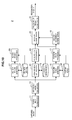
- the gesture recognition device 2 includes an edge region extraction unit 41 and an edge region processing unit 43 instead of the histogram calculation unit 21 and the histogram processing unit 23.
- the edge region extraction unit 41 generates an edge image E based on a grayscale image M supplied from the grayscale image generation unit 13 and extracts an edge region A from the edge image E.
- the edge region A is extracted using a Sobel filter, a Laplacian filter, an LOG filter, a Canny method, or the like.
- the extraction result of the edge region A is temporarily stored as edge region data in the edge region storage unit 45.
- the edge region processing unit 43 Based on the edge region data read from edge region storage unit 45, the edge region processing unit 43 sets the plurality of edge images E in a predetermined period as targets and calculates a ratio of the edge regions A in the edge images E. Then, the edge region processing unit 43 determines whether the ratio of the edge regions A is less than a predetermined threshold value (0.1 or the like) during a predetermined period. Further, the predetermined period is set as a period shorter than the determination period corresponding to several immediately previous frames to tens of immediately previous frames. The determination result of the edge regions A is supplied to the gesture determination unit 25.
- a predetermined threshold value 0.1 or the like
- the gesture determination unit 25 is supplied with the comparison result of the lost feature points from the feature point processing unit 17 and is supplied with the determination result of the edge regions A from the edge region processing unit 43. Then, the gesture determination unit 25 determines whether the ratio of the lost feature points is greater than or equal to a predetermined threshold value and the ratio of the edge regions A is less than a predetermined threshold value during a predetermined period.
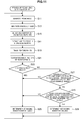
- the edge region extraction unit 41 generates the edge images E based on the grayscale images M supplied from the grayscale image generation unit 13 and extracts the edge regions A (S41).
- the edge regions A are temporarily stored as edge region data indicating a ratio of the edge regions A in the edge images E in association with frame numbers in the edge region storage unit 45 (S41).
- the edge region processing unit 43 Based on the edge region data read from the edge region storage unit 45, the edge region processing unit 43 sets the plurality of edge images E in a predetermined period as targets and determines whether a ratio of the edge regions A in the edge images E is less than a predetermined threshold value during a predetermined period (S43).
- Fig. 12 shows a grayscale image M1 and an edge image E1 before a gesture is performed.
- the edge image E is an image in which an edge region A forming a boundary of pixels in which there is a large difference between the luminance values i among the pixels forming the grayscale image M.
- the edge image E1 shown in Fig. 12 is formed by the pixels with various luminance values i, since the upper body of the user U and a background are captured. Therefore, in the edge image E1, many pixels with different luminance values i are present, and many edge regions A forming the boundary of the pixels with the different luminance values i are recognized.
- Fig. 13 shows a grayscale image M2 and an edge image E2 when a gesture is performed.
- the grayscale image M2 shown in Fig. 13 a hand shielding the front side of the imaging sensor 3 is captured, and thus many pixels with the given luminance value i are included. Therefore, in the edge image E2, not many pixels with different luminance values i are present and not many edge regions A forming the boundary of the pixels in which there is a large difference between the luminance values i are recognized.
- the edge image E not including many edge regions A during the predetermined period is generated. Accordingly, it is determined that the ratio of the edge regions A is less than a predetermined threshold value during a predetermined period, that is, there are many regions with the gradient of the luminance value i less than a predetermined threshold value during a predetermined.
- the gesture determination unit 25 is supplied with the comparison result of the lost feature points from the feature point processing unit 17 and is supplied with the determination result of the ratio of the edge regions from the edge region processing unit 43. Then, it is determined whether the ratio of the lost feature points is greater than or equal to a predetermined threshold value and the ratio of the edge regions A is less than a predetermined threshold value during a predetermined period.
- the determination result is positive, it is determined that the imaging sensor 3 is shielded (S31) and a shielding gesture is recognized.
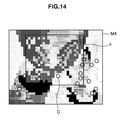
- a gesture recognition device according to modification examples of the first and second embodiments will be described with reference to Fig. 14 .
- a shielding gesture is recognized using a grayscale image M corresponding to a partial region of a captured image, instead of a grayscale image M corresponding to the entire captured image.
- the repeated description of the first and second embodiments will not be made below.
- the frame image generation unit 11 or the grayscale image generation unit 13 generates a frame image or a grayscale image M corresponding to a partial region of a frame image.
- the partial region of the frame image means a region that is shielded with an object such as a hand in the front region of the imaging sensor 3 when a shielding gesture is performed.
- the partial region is set in advance as a predetermined range such as an upper portion of a captured image.
- the first and second detection processes are performed on a partial region (a region F in Fig. 14 ) of the frame image as a target, as in the first and second embodiments. That is, the partial region is set as a target, it is determined whether the ratio of the lost feature points is greater than or equal to a predetermined threshold value, and the ratio of the pixels with a given luminance value i is greater than or equal to a predetermined threshold value during a predetermined period, or the ratio of the edge regions A is less than a predetermined threshold value during a predetermined period.
- the upper portion of the captured image is partially shielded.
- the detection result of the feature points is shown when a gesture is performed. However, even when the ratio of the pixels with the given luminance value i or the ratio of the edge regions is calculated, the partial region of the frame image is set as a target and processed.
- a shielding gesture can be recognized by partially shielding a predetermined range. Even when shading occurs somewhat in an object shielding the imaging sensor 3 due to the influence of illumination, daylight, or the like, a shielding gesture can be recognized.
- the change in the captured image (the grayscale image M) and the gradient of the luminance value i are detected. Therefore, since the shape of an object located close to the front side of the imaging sensor 3 may not be detected and a gesture is recognized based on the captured image (the grayscale image M) of the imaging sensor 3, a special device may not be used. Accordingly, a gesture of shielding the sensor side of the imaging sensor 3 can be recognized without using a special device.
- the cases in which the shielding gesture of shielding the front side of the imaging sensor 3 is recognized have been described.
- a gesture of combining a gesture of shielding the front side of the imaging sensor 3 and a gesture of exposing the front side of the imaging sensor 3 may be recognized.
- the gesture of exposing the front side of the imaging sensor 3 is recognized by determining whether the ratio of newly detected feature points is greater than or equal to a predetermined threshold value (a ratio of 0.8 or the like) and determining whether the ratio of the pixels with a given luminance value i is less than a predetermined threshold value (a ratio of 0.2 or the like).
- the gesture recognition device 1 may be applied to an application in which a toggle operation such as reproduction and stop of a moving image or a slide show or On/Off switching of menu display is enabled or an application in which a mode operation such as change in a reproduction mode is enabled.
Landscapes
- Engineering & Computer Science (AREA)
- Theoretical Computer Science (AREA)
- General Engineering & Computer Science (AREA)
- Physics & Mathematics (AREA)
- General Physics & Mathematics (AREA)
- Human Computer Interaction (AREA)
- Multimedia (AREA)
- Computer Vision & Pattern Recognition (AREA)
- Health & Medical Sciences (AREA)
- General Health & Medical Sciences (AREA)
- Psychiatry (AREA)
- Social Psychology (AREA)
- Image Analysis (AREA)
- User Interface Of Digital Computer (AREA)
Abstract
There is provided a gesture recognition device that recognizes a gesture of shielding the front side of the imaging sensor, the gesture recognition device including a first detection unit that detects a change in a captured image between a state in which a front side of an imaging sensor is not shielded and a state in which the front side of the imaging sensor is shielded, and a second detection unit that detects a region in which a gradient of a luminance value of the captured image is less than a threshold value in the captured image in the state in which the front side of the imaging sensor is shielded.
Description
- The present invention relates to a gesture recognition device, a gesture recognition method, and a program.
- When users perform device operations in the related art, the users normally confirm a software key or a hardware key to be operated and then execute a predetermined operation. Therefore, a troublesome work is necessarily performed for an operation and it is difficult to perform an operation without confirming a key, for example, when looking away from the key.
- In order to improve operability of devices, however, a gesture of shielding a sensor with an object such as a hand is considered to be recognized. Such a gesture operation enables users to perform an operation while looking away from a key without requiring a troublesome task.
-
- Patent Literature 1:
JP H7-146749A -
- Non-Patent Literature 1: "Hand Gesture User Interface Using Cell Broadband Engine™" by Ike et al, Toshiba Review, Vol. 62, No. 6, pp. 52 to 55, 2007
- Generally, gesture recognition is performed by detecting a shape of a detection object from a captured image of an imaging sensor, and executing a process of pattern recognition for the detection result (refer to Non-Patent Literature 1). Therefore, it is not possible to appropriately recognize a gesture even after trying to recognize a gesture that shields a front side of the imaging sensor with an object such as a hand or the like since a shape of an object located close to the front side of the imaging sensor cannot be detected.
- Further, in some cases the gesture recognition is performed using an infrared light emitting device and an infrared light receiving device (refer to Non-Patent Literature 1). In this case, an object shielding the front side of the imaging sensor is recognized when an infrared light emitted from the light emitting device is reflected by a detection object and then the reflected infrared light is received by the light-receiving device. However, it is not possible to appropriately recognize the gesture unless using special devices such as an infrared light emitting device and an infrared light receiving device.
- Therefore, the present invention provides a gesture recognition device, a gesture recognition method, and a program that are capable of recognizing a gesture of shielding a sensor surface of an imaging sensor without using any special devices.
- According to an aspect of the present invention, there is provided a gesture recognition device that recognizes a gesture of shielding the front side of the imaging sensor, the gesture recognition device including a first detection unit that detects a change in a captured image between a state in which a front side of an imaging sensor is not shielded and a state in which the front side of the imaging sensor is shielded, and a second detection unit that detects a region in which a gradient of a luminance value of the captured image is less than a threshold value in the captured image in the state in which the front side of the imaging sensor is shielded.
- The first detection unit may detect the change in the captured image based on a tracking result of feature points in the captured image.
- The first detection unit may detect that the feature points tracked in the captured images in the state in which the front side of the imaging sensor is not shielded are lost in the captured images in a state in which the front side of the imaging sensor is screened with a hand.
- The first detection unit may determine whether a ratio of the feature points lost during tracking to the feature points tracked in the plurality of captured images in a predetermined period is equal to or greater than a threshold value.
- The gesture recognition device may further include a movement determination unit that determines movement of the imaging sensor based on a movement tendency of the plurality of feature points, and the predetermined period may be set as a period in which the imaging sensor is not moved.
- The second detection unit may detect the region in which the gradient of the luminance value of the captured image is less than the threshold value based on a calculation result of a luminance value histogram relevant to the captured image.
- The second detection unit may determine whether a value obtained by normalizing a sum of frequencies near a maximum frequency as a total sum of frequencies is equal to or more than a threshold value during the predetermined period using the luminance value histogram relevant to the plurality of captured images in the predetermined period.
- The second detection unit may detect the region in which the gradient of the luminance value of the captured image is less than the threshold value based on an edge image relevant to the captured image.
- The second detection unit may determine whether a ratio of edge regions in the edge images is less than the threshold value during the predetermined period using the edge images relevant to the plurality of captured images in the predetermined period.
- The first and second detection units may perform a process on a partial region of the captured image, instead of the captured image.
- The first and second detection units may perform a process on a grayscale image generated with a resolution less than that of the captured image from the captured image.
- The gesture recognition device may recognize a gesture provided by combining a gesture of shielding the front side of the imaging sensor and a gesture of exposing the front side of the imaging sensor.
- The gesture recognition device may further include the photographing sensor that captures a front side image.
- Further, according to another aspect of the present invention, there is provided a gesture recognition method including detecting a change in a captured image between a state in which a front side of an imaging sensor is not shielded and a state in which the front side of the imaging sensor is shielded, and detecting a region in which a gradient of a luminance value of the captured image is less than a threshold value in the captured image in the state in which the front side of the imaging sensor is shielded.
- Further, according to another aspect of the present invention, there is provided a program for causing a computer to execute detecting a change in a captured image between a state in which a front side of an imaging sensor is not shielded and a state in which the front side of the imaging sensor is shielded, and detecting a region in which a gradient of a luminance value of the captured image is less than a threshold value in the captured image in the state in which the front side of the imaging sensor is shielded. Here, the program may be provided using a computer-readable storage medium or may be provided via communication tool and the like.
- According to the present invention described above, it is possible to provide a gesture recognition device, a gesture recognition method, and a program capable of recognizing a gesture of shielding a sensor surface of an imaging sensor without using a special device.
-
- [
Fig. 1] Fig. 1 is an illustration of the overview of a gesture recognition device according to embodiments of the invention. - [
Fig. 2] Fig. 2 is a block illustration of the main functional configuration of a gesture recognition device according to a first embodiment. - [
Fig. 3] Fig. 3 is a flowchart of a main order of operations of the gesture recognition device. - [
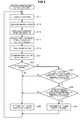
Fig. 4] Fig. 4 is a flowchart of a recognition order of a shielding gesture. - [
Fig. 5] Fig. 5 is an illustration of the detection results of feature points before a gesture is performed. - [
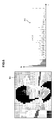
Fig. 6] Fig. 6 is an illustration of a grayscale image and the calculation result of a luminance value histogram before a gesture is performed. - [
Fig. 7] Fig. 7 is an illustration of the detection results of feature points when an imaging sensor is moved. - [
Fig. 8] Fig. 8 is an illustration of the detection results of feature points when a gesture is performed. - [
Fig. 9] Fig. 9 is an illustration of a grayscale image and the calculation result of a luminance value histogram when a gesture is performed. - [
Fig. 10] Fig. 10 is a block illustration of the main functional configuration of a gesture recognition device according to a second embodiment. - [
Fig. 11] Fig. 11 is a flowchart of the recognition order of a shielding gesture. - [
Fig. 12] Fig. 12 is an illustration of a grayscale image and an edge image before a gesture is performed. - [
Fig. 13] Fig. 13 is an illustration of a grayscale image and an edge image when a gesture is performed. - [
Fig. 14] Fig. 14 is an illustration of the detection results of feature points when a gesture is performed according to modification examples of the first and second embodiments. - Hereinafter, preferred embodiments of the present invention will be described in detail with reference to the appended drawings. Note that, in this specification and the drawings, elements that have substantially the same function and structure are denoted with the same reference signs, and repeated explanation is omitted.
- First, the overview of a
gesture recognition device 1 according to embodiments of the invention will be described with reference toFig. 1 . - As shown in
Fig. 1 , thegesture recognition device 1 is capable of recognizing a gesture of shielding a sensor surface of animaging sensor 3 without using a special device. Hereinafter, the sensor side is assumed to be formed on the front side of theimaging sensor 3. However, the sensor surface may be formed in another surface. - The
gesture recognition device 1 is an information processing device such as a personal computer, a television receiver, a portable information terminal, or a mobile telephone. In thegesture recognition device 1, a video signal is input from theimaging sensor 3 such as a video camera mounted on or connected to thegesture recognition device 1. A case in which thegesture recognition device 1 and theimaging sensor 3 are separately configured will be described below, but thegesture recognition device 1 and theimaging sensor 3 may be integrally configured. - When a user U performs a predetermined action on the front side of the
imaging sensor 3, thegesture recognition device 1 recognizes a gesture based on a video signal input from theimaging sensor 3. Examples of the gesture include a shielding gesture of shielding the front side of theimaging sensor 3 with an object such as a hand and a flicking gesture of moving an object to the right and left on the front side of theimaging sensor 3. - For example, when the
gesture recognition device 1 is applied to a music reproduction application, a shielding gesture corresponds to an operation of stopping music reproduction, and left and right flicking gestures correspond to reproduction forward and backward operations, respectively. When a gesture is recognized, thegesture recognition device 1 notifies the user U of a recognition result of the gesture and performs a process corresponding to the recognized gesture. - The
gesture recognition device 1 recognizes the shielding gesture in the following order. When the user U performs the shielding gesture, a change in a captured image is detected between a captured image Pa in a state (before the gesture is performed) in which the front side of theimaging sensor 3 is not shielded and a captured image Pb in a state (at the time of the gesture) in which the front side of theimaging sensor 3 is shielded (first detection). A region in which the gradient of a luminance value i of the captured image is less than a threshold value is detected from the captured image Pb in the shielded state (at the gesture time) (second detection). - Here, when a gesture of shielding the front side of the
imaging sensor 3 with an object such as a hand is performed, the image Pa in which an image to the front side of theimaging sensor 3 is captured is considerably changed compared to the image Pb in which the object is captured. Therefore, the change in the captured image is detected. Further, a region in which the gradient of the luminance value i is less than the threshold value is detected, since the gradient of the luminance value i decreases in the captured image Pb in which the object shielding the front side of theimaging sensor 3 is closely captured. - Therefore, by satisfying first and second detection conditions, it is possible to recognize the gesture of shielding the front side of the
imaging sensor 3. Here, since theimaging sensor 3 detects the change in the captured image and the gradient of the luminance value i, theimaging sensor 3 may not detect the shape of an object located closed to the front side of theimaging sensor 3. Further, since the gesture is recognized based on the captured image of theimaging sensor 3, a special device may not be used. - Next, the configuration of the
gesture recognition device 1 according to a first embodiment will be described with reference toFig. 2 . - As shown in
Fig. 2 , thegesture recognition device 1 according to the first embodiment includes a frameimage generation unit 11, a grayscaleimage generation unit 13, a featurepoint detection unit 15, a featurepoint processing unit 17, a sensormovement determination unit 19, ahistogram calculation unit 21, ahistogram processing unit 23, agesture determination unit 25, a motionregion detection unit 27, a motionregion processing unit 29, a recognitionresult notification unit 31, a featurepoint storage unit 33, ahistogram storage unit 35, and a motionregion storage unit 37. - The frame
image generation unit 11 generates a frame image based on a video signal input from theimaging sensor 3. The frameimage generation unit 11 may be installed in theimaging sensor 3. - The grayscale
image generation unit 13 generates a grayscale image M (which is a general term for grayscale images) with a resolution lower than that of the frame image based on the frame image supplied from the frameimage generation unit 11. The grayscale image M is generated as a monotone image obtained by compressing the frame image to a resolution of, for example, 1/256. - The feature
point detection unit 15 detects feature points in the grayscale images M based on the grayscale images M supplied from the grayscaleimage generation unit 13. For example, the feature point in the grayscale image M means a pixel pattern corresponding to a feature portion such as a corner of an object captured by theimaging sensor 3. The detection result of the feature point is temporarily stored as feature point data in the featurepoint storage unit 33. - The feature
point processing unit 17 sets the plurality of grayscale images M included in a determination period corresponding to several immediately previous frames to tens of immediately previous frames as targets and processes the feature point data. The featurepoint processing unit 17 tracks the feature points in the grayscale images M based on the feature point data read from the featurepoint storage unit 33. Movement vectors of the feature points are calculated. The movement vectors are clustered in a movement direction of the feature points. - The feature
point processing unit 17 sets the plurality of grayscale images M in a predetermined period as targets, calculates a ratio of the feature points (lost feature points) lost during the tracking to the feature points tracked in the grayscale images M, and compares the ratio with a predetermined threshold value. The predetermined period is set to be shorter than the determination period. The lost feature point means a feature point which has been lost during the tracking of the predetermined period and thus may not be tracked. The comparison result of the lost feature points is supplied to thegesture determination unit 25. - The sensor
movement determination unit 19 determines whether the imaging sensor 3 (or thegesture recognition device 1 on which theimaging sensor 3 is mounted) is moved based on the clustering result supplied from the featurepoint processing unit 17. The sensormovement determination unit 19 calculates a ratio of the movement vectors indicating movement in a given direction to the movement vectors of the feature points and compares the ratio with a predetermined threshold value. When the calculation result is greater than or equal to the predetermined threshold value, it is determined that theimaging sensor 3 is moved. When the calculation result is less than the predetermined threshold value, it is determined that theimaging sensor 3 is not moved. The determination result of the movement of the sensor is supplied to thegesture determination unit 25. - Based on the grayscale image M supplied from the grayscale
image generation unit 13, thehistogram calculation unit 21 calculates a histogram H (which is a general term for histograms) indicating a frequency distribution of the luminance values i of the pixels forming the grayscale image M. The calculation result of the histogram H is temporarily stored as histogram data in thehistogram storage unit 35. - Based on the histogram data read from the
histogram storage unit 35, thehistogram processing unit 23 sets the plurality of grayscale images M in a predetermined period as targets and calculates a ratio of the pixels with the given luminance value i. Thehistogram processing unit 23 determines whether the ratio of the pixels with the given luminance value i is greater than or equal to a predetermined threshold value during a predetermined period. The predetermined period is set as a period shorter than the determination period. The determination result of the ratio of the pixels is supplied to thegesture determination unit 25. - The
gesture determination unit 25 is supplied with the comparison result of the lost feature points from the featurepoint processing unit 17 and is supplied with the determination result of the ratio of the pixels from thehistogram processing unit 23. Thegesture determination unit 25 determines whether the ratio of the lost feature points is greater than or equal to a predetermined threshold value and the ratio of the pixels with the given luminance value i is greater than or equal to a predetermined value during the predetermined period. Here, when the determination result is positive, a shielding gesture is recognized. The shielding determination result is supplied to the recognitionresult notification unit 31. Thegesture determination unit 25 recognizes the shielding gesture based on the determination result of the movements of the imaging sensor supplied from the sensormovement determination unit 19, only when theimaging sensor 3 is not moved. - The motion
region detection unit 27 detects a motion region based on a frame difference between the grayscale images M supplied from the grayscaleimage generation unit 13. The detection result of the motion region is temporarily stored as motion region data in the motionregion storage unit 37. The motion region refers to a region indicating an object being moved in the grayscale images M. - The motion
region processing unit 29 sets the plurality of grayscale images M in a predetermined period as targets and processes the motion region data of the grayscale images M. Based on the motion region data read from the motionregion storage unit 37, the motionregion processing unit 29 calculates the central positions of the motion regions and calculates a movement trajectory of the motion regions in the consecutive grayscale images M. The predetermined period is set as a period shorter than the determination period. - The above-described
gesture determination unit 25 calculates movement amounts (or speeds, as necessary) of the motion regions based on the calculation result of the movement trajectory supplied from the motionregion processing unit 29. Thegesture determination unit 25 determines whether the movement amounts (or speeds, as necessary) of the motion regions satisfy a predetermined reference. Here, when the determination result is positive, a flicking gesture is recognized. The determination result of the flicking gesture is supplied to the recognitionresult notification unit 31. - The recognition
result notification unit 31 notifies the user U of the recognition result of the gesture based on the determination result supplied from thegesture determination unit 25. For example, the recognition result of the gesture is notified of as text information, image information, sound information, or the like through a display, a speaker, or the like connected to thegesture recognition device 1. - The predetermined periods used for the feature point processing, the histogram processing, and the motion region processing may be set as the same period or periods shifted somewhat with respect to one another. Further, the predetermined threshold values used for the feature point processing, the histogram processing, and the movement determination processing are each set according to the necessary detection accuracy.
- The feature
point detection unit 15 and the featurepoint processing unit 17 function as a first detection unit. Thehistogram calculation unit 21 and thehistogram processing unit 23 function as a second detection unit. The featurepoint storage unit 33, thehistogram storage unit 35, and the motionregion storage unit 37 are configured as, for example, an internal storage device controlled by a processor or the like or an external storage device. - The frame
image generation unit 11, the grayscaleimage generation unit 13, the featurepoint detection unit 15, the featurepoint processing unit 17, the sensormovement determination unit 19, thehistogram calculation unit 21, thehistogram processing unit 23, thegesture determination unit 25, the motionregion detection unit 27, the motionregion processing unit 29, and the recognitionresult notification unit 31 are configured as, for example, an information processing device including a processor such as a CPU or a DSP. - At least some of the functions of the above-described constituent elements may be realized as hardware such as circuits or software such as programs. When each constituent element is realized as software, the function of each constituent element is realized through a program executed on a processor.
- Next, the process of the
gesture recognition device 1 according to the first embodiment will be described with reference toFigs. 3 to 9 . - First, the overall processes of the
gesture recognition device 1 will be described. As shown inFig. 3 , thegesture recognition device 1 performs recognition processes of recognizing a shielding gesture and a flicking gesture (step S1). The recognition processes will be described in detail later. When the shielding gesture or the flicking gesture is recognized ("Yes" in S3 or S5), the user U is notified of the recognition result (S7) and a process corresponding to the recognized gesture is performed (S8). The recognition processes are repeated until the recognition processes end (S9). When no gesture is recognized, the recognition result may be notified of. - Next, the recognition process of recognizing the shielding gesture will be described.
- When the recognition process starts, as shown in
Fig. 4 , the frameimage generation unit 11 generates a frame image based on a video signal input from the imaging sensor 3 (S11). The frame image may be generated for each frame or may be generated at intervals of several frames by thinning the video signal. - The grayscale
image generation unit 13 generates the grayscale images M based on the frame images supplied from the frame image generation unit 11 (S13). Here, by performing a detection process using the grayscale images M with a resolution lower than that of the frame image, it is possible to efficiently detect a change in the frame image and the gradient of the luminance value i. Further, by using a monotone image, it is possible to detect the change in the frame image or the gradient of the luminance value i with relatively high accuracy even under an environment in which shading is relatively insufficient. - The feature
point detection unit 15 detects the feature points in the grayscale images M based on the grayscale images M supplied from the grayscale image generation unit 13 (S15). The detection result of the feature points is temporarily stored as feature point data including pixel patterns, detection positions, or the like of the feature points in association with frame numbers in the feature point storage unit 33 (S15). -
Fig. 5 shows the detection result of the feature points before a gesture is performed. In the example shown inFig. 5 , markers C indicating a plurality of feature points detected from the image are displayed along with a grayscale image M1 including an image in which the upper body of the user U and a background are captured. As shown inFig. 5 , pixel patterns corresponding to feature portions of the user U and the background are detected as the feature points. - The
histogram calculation unit 21 calculates a histogram H of the luminance values i of the pixels forming the grayscale image M based on the grayscale image M supplied from the grayscale image generation unit 13 (S17). The calculation result of the histogram H is temporarily stored as histogram data indicating the frequency distribution of the luminance values i in association with the frame numbers in thehistogram storage unit 35. Further, the histogram H may be calculated when the grayscale image M is generated (S13). -
Fig. 6 shows the calculation result of the grayscale image M1 and a luminance value histogram H1 before a gesture is performed. The histogram H indicates the frequency distribution of the luminance values i, where the horizontal axis represents the luminance value i (scale value) and the vertical axis represents a frequency hi of the luminance value i. Here, the distribution of the luminance values i can be expressed using a normalization index r of the following equation. On the histogram H, it is assumed that hsum is the total sum of the frequencies hi, imax is the luminance value i of the maximum frequency, and w is a predetermined range near the luminance value imax of the maximum frequency. Further, the predetermined range w is set according to necessary detection accuracy. - The normalization index r is an index in which the sum of the frequencies hi in the predetermined range w near the luminance value imax of the maximum frequency is normalized with the total sum hsum of the frequencies. The normalization index r is calculated as a larger value, as the grayscale image M is formed by the pixels with the given luminance value i, that is, the number of regions with a small gradient of the luminance value i is larger.
-

- Here, since the upper body of the user U and the background are captured, the grayscale image M1 shown in
Fig. 6 is formed by the pixels with various luminance values i. Therefore, in the histogram H1, the frequencies hi are not concentrated in the predetermined range w near the luminance value imax of the maximum frequency, and thus large irregularity is recognized in the distribution of the luminance values i. Accordingly, in the grayscale image M1 shown inFig. 6 , for example, the normalization index r=0.1 is calculated. - In the processes of steps S11 to S17, the plurality of grayscale images M included in the determination period (0.5 seconds or the like) corresponding to several immediately previous frames to tens of immediately previous frames are set as targets. For example, processes of
frame numbers 1 to 10 are sequentially performed in a first determination period and processes offrame numbers 2 to 11 are sequentially performed in a second determination period. The feature point data and the histogram data (including the motion region data) are temporarily stored to correspond to at least the determination period. Then, when the plurality of target images in a specific determination period are set and the processes of steps S11 toS 17 are completed, the processes subsequent to stepS 19 are performed. - The feature
point processing unit 17 first tracks the feature points in the plurality of grayscale images M based on the feature point data read from the feature point storage unit 33 (S19). The tracking of the feature points is performed by specifying the same feature points based on the pixel patterns in the consecutive grayscale images M. The tracking result of the feature points can be expressed as a movement trajectory of the feature points. Further, the feature points lost from the grayscale images M during the tracking of the feature points are considered as the lost feature points. - Next, the movement vectors of the feature points are calculated and the movement vectors are clustered in the movement direction of the feature points (S21). The movement vector of the feature point is expressed as a straight line or a curved line that binds the movement start point and the movement end point of the feature point being tracked in the plurality of grayscale images M in the determination period.
- The sensor
movement determination unit 19 determines whether theimaging sensor 3 is moved based on the clustering result supplied from the feature point processing unit 17 (S23). First, the ratio of the movement vectors indicating the movement in a given direction to the movement vectors of the feature points is calculated and this ratio is compared to a predetermined threshold value (a ratio of 0.8 or the like). Then, when the calculation result is greater than or equal to the predetermined threshold value, it is determined that theimaging sensor 3 is moved. When the calculation result is less than the predetermined threshold value, it is determined that theimaging sensor 3 is not moved. -
Fig. 7 shows the detection result of the feature points when theimaging sensor 3 is moved. A grayscale image M3 shown inFig. 7 is a grayscale image M sever frames after the grayscale image M1 shown inFig. 5 . In the example shown inFig. 7 , the feature points in the grayscale image M3 are moved in the upper leftward direction, as theimaging sensor 3 is moved in the lower rightward direction. The movement of the feature points is viewed as markers C indicating the movement trajectory of the feature points along with the grayscale image M3. Here, due to the movement of theimaging sensor 3, it is recognized that most of the feature points are moved in the given direction (upper leftward inclination). - Here, when it is determined that the
imaging sensor 3 is moved, the determination result is supplied to thegesture determination unit 25. When theimaging sensor 3 is moved, thegesture determination unit 25 determines that theimaging sensor 3 is not shielded in order to prevent the shielding gesture from being erroneously recognized due to erroneous detection of the lost feature points (S25). - Conversely, when it is determined that the
imaging sensor 3 is not moved, the following process is performed. Based on the feature point data read from the featurepoint storage unit 33, the featurepoint processing unit 17 sets the plurality of grayscale images M in the predetermined period as targets, calculates a ratio of the lost feature points to the feature point tracked in the grayscale images M, and compares this ratio with the predetermined threshold value (the ratio of 0.8 or the like) (S27). That is, the ratio of the feature points lost in the predetermined period to the feature points (a total of the feature points that continue to be detected in the predetermined period and the feature points lost halfway) detected within the predetermined period is compared with the predetermined threshold value. -
Fig. 8 shows an example of the detection result of the feature points when a gesture is performed. In the example shown inFig. 8 , a grayscale image M2 in which a hand shielding the front side of theimaging sensor 3 is captured is displayed. In the example shown inFig. 8 , since the image in which the upper body of the user U and the background are captured is hidden by shielding the front side of theimaging sensor 3, the markers C indicating the feature points detected from the image are lost. - Based on the histogram data read from the
histogram storage unit 35, thehistogram processing unit 23 sets the plurality of grayscale images M in the predetermined period as targets and calculates the ratio of the pixels with the given luminance value i. Here, the ratio of the pixels with the given luminance value i can be expressed by the above-described normalization index r. It is determined whether the ratio of the pixels with the given luminance value i is greater than or equal to a predetermined threshold value (where r>0.7 or the like) in a predetermined period (S29). -
Fig. 9 shows the grayscale image M2 and the calculation result of the luminance value histogram H2 when a gesture is performed. Here, in the grayscale image M2 shown inFig. 9 , the hand shielding the front side of theimaging sensor 3 is captured. Therefore, the pixels with the given luminance value i are configured to be abundant. - Therefore, in the histogram H2, the frequencies hi are concentrated in the predetermined range w near the luminance value imax of the maximum frequency, and thus large irregularity is not recognized in the distribution of the luminance values i. For example, in the grayscale image M2 shown in
Fig. 9 , the normalization index r=0.8 is calculated. When the front side of theimaging sensor 3 is shielded in a predetermined period, a large normalization index r is calculated in the predetermined period. Accordingly, it is determined that the ratio of the pixels with the given luminance value i is greater than or equal to the predetermined threshold value in the predetermined period, that is, many regions in which the gradient of the luminance value i is less than the predetermined threshold value are present in the predetermined period. - The
gesture determination unit 25 is supplied with the comparison result of the lost feature points from the featurepoint processing unit 17 and is supplied with the determination result of the ratio of the pixels from thehistogram processing unit 23. Then, it is determined whether the ratio of the lost feature points is greater than or equal to the predetermined threshold value and the ratio of the pixels with the given luminance value i is greater than or equal to the predetermined threshold value during the predetermined period. Here, when the determination result is positive, it is determined that theimaging sensor 3 is shielded (S31) and the shielding gesture is recognized. Further, when at least one of the conditions is not satisfied, it is determined that theimaging sensor 3 is not shielded (S25) and the shielding gesture is not recognized. - The recognition
result notification unit 31 notifies the user U of the recognition result depending on the shielding determination result supplied from thegesture determination unit 25. Further, when the shielding gesture is recognized, a corresponding process is performed. - Next, the recognition process of recognizing the flicking gesture will be described.
- The motion
region detection unit 27 detects motion regions based on the frame difference between the grayscale images M supplied from the grayscaleimage generation unit 13. That is, the motion regions are detected by acquiring change regions included in the consecutive grayscale images M. The detection result of the motion regions is temporarily stored as the motion region data in the motionregion storage unit 37. - The motion
region processing unit 29 sets the plurality of grayscale images M in the predetermined period as targets and processes the motion region data of the grayscale images M. The central positions of the motion regions are calculated based on the motion region data read from the motionregion storage unit 37 and the movement trajectory of the motion regions in the consecutive grayscale images M is calculated. - The
gesture determination unit 25 calculates the movement amounts (or speeds, as necessary) of the motion regions based on the calculation result of the movement trajectory supplied from the motionregion processing unit 29. Then, thegesture determination unit 25 first determines whether the sizes of the motion regions are less than a predetermined threshold value so that a motion caused due to the movement of theimaging sensor 3 is not recognized as a flicking gesture (to move the entire captured image when theimaging sensor 3 is moved). Next, it is determined whether the motion amounts of the motion regions are greater than or equal to a predetermined threshold value so that a motion caused with a very small movement amount is not recognized as a flicking gesture. - Next, it is determined whether the movement direction of the motion region is a predetermined direction. For example, when left and right flicking gestures are recognized, it is determined whether the movement direction of the motion region is recognizable as a left or right direction in consideration of an allowable error for the
imaging sensor 3. Here, when the determination result is positive, the flicking gesture is recognized. The flicking determination result is supplied to the recognitionresult notification unit 31, the user U is notified of the flicking determination result, and a process corresponding to the flicking gesture is performed depending on the recognition result. - Next, a
gesture recognition device 2 according to a second embodiment will be described with reference toFigs. 10 to 13 . Thegesture recognition device 2 according to the second embodiment recognizes a shielding gesture using an edge region A in an edge image E (which is a general term for edge images) instead of the histogram H indicating the frequency distribution of the luminance values i. The repeated description of the first embodiment will not be made below. - As shown in
Fig. 10 , thegesture recognition device 2 includes an edgeregion extraction unit 41 and an edgeregion processing unit 43 instead of thehistogram calculation unit 21 and thehistogram processing unit 23. - The edge
region extraction unit 41 generates an edge image E based on a grayscale image M supplied from the grayscaleimage generation unit 13 and extracts an edge region A from the edge image E. For example, the edge region A is extracted using a Sobel filter, a Laplacian filter, an LOG filter, a Canny method, or the like. The extraction result of the edge region A is temporarily stored as edge region data in the edgeregion storage unit 45. - Based on the edge region data read from edge
region storage unit 45, the edgeregion processing unit 43 sets the plurality of edge images E in a predetermined period as targets and calculates a ratio of the edge regions A in the edge images E. Then, the edgeregion processing unit 43 determines whether the ratio of the edge regions A is less than a predetermined threshold value (0.1 or the like) during a predetermined period. Further, the predetermined period is set as a period shorter than the determination period corresponding to several immediately previous frames to tens of immediately previous frames. The determination result of the edge regions A is supplied to thegesture determination unit 25. - The
gesture determination unit 25 is supplied with the comparison result of the lost feature points from the featurepoint processing unit 17 and is supplied with the determination result of the edge regions A from the edgeregion processing unit 43. Then, thegesture determination unit 25 determines whether the ratio of the lost feature points is greater than or equal to a predetermined threshold value and the ratio of the edge regions A is less than a predetermined threshold value during a predetermined period. - As shown in
Fig. 11 , the edgeregion extraction unit 41 generates the edge images E based on the grayscale images M supplied from the grayscaleimage generation unit 13 and extracts the edge regions A (S41). The edge regions A are temporarily stored as edge region data indicating a ratio of the edge regions A in the edge images E in association with frame numbers in the edge region storage unit 45 (S41). - Based on the edge region data read from the edge
region storage unit 45, the edgeregion processing unit 43 sets the plurality of edge images E in a predetermined period as targets and determines whether a ratio of the edge regions A in the edge images E is less than a predetermined threshold value during a predetermined period (S43). -
Fig. 12 shows a grayscale image M1 and an edge image E1 before a gesture is performed. As shown inFig. 12 , the edge image E is an image in which an edge region A forming a boundary of pixels in which there is a large difference between the luminance values i among the pixels forming the grayscale image M. Here, the edge image E1 shown inFig. 12 is formed by the pixels with various luminance values i, since the upper body of the user U and a background are captured. Therefore, in the edge image E1, many pixels with different luminance values i are present, and many edge regions A forming the boundary of the pixels with the different luminance values i are recognized. - On the other hand,
Fig. 13 shows a grayscale image M2 and an edge image E2 when a gesture is performed. Here, in the grayscale image M2 shown inFig. 13 , a hand shielding the front side of theimaging sensor 3 is captured, and thus many pixels with the given luminance value i are included. Therefore, in the edge image E2, not many pixels with different luminance values i are present and not many edge regions A forming the boundary of the pixels in which there is a large difference between the luminance values i are recognized. Further, when the front side of theimaging sensor 3 is shielded during a predetermined period, the edge image E not including many edge regions A during the predetermined period is generated. Accordingly, it is determined that the ratio of the edge regions A is less than a predetermined threshold value during a predetermined period, that is, there are many regions with the gradient of the luminance value i less than a predetermined threshold value during a predetermined. - The
gesture determination unit 25 is supplied with the comparison result of the lost feature points from the featurepoint processing unit 17 and is supplied with the determination result of the ratio of the edge regions from the edgeregion processing unit 43. Then, it is determined whether the ratio of the lost feature points is greater than or equal to a predetermined threshold value and the ratio of the edge regions A is less than a predetermined threshold value during a predetermined period. Here, when the determination result is positive, it is determined that theimaging sensor 3 is shielded (S31) and a shielding gesture is recognized. - Next, a gesture recognition device according to modification examples of the first and second embodiments will be described with reference to
Fig. 14 . In the modification examples, a shielding gesture is recognized using a grayscale image M corresponding to a partial region of a captured image, instead of a grayscale image M corresponding to the entire captured image. The repeated description of the first and second embodiments will not be made below. - In the modification example, the frame
image generation unit 11 or the grayscaleimage generation unit 13 generates a frame image or a grayscale image M corresponding to a partial region of a frame image. Here, the partial region of the frame image means a region that is shielded with an object such as a hand in the front region of theimaging sensor 3 when a shielding gesture is performed. The partial region is set in advance as a predetermined range such as an upper portion of a captured image. - In this modification example, as shown in
Fig. 14 , the first and second detection processes are performed on a partial region (a region F inFig. 14 ) of the frame image as a target, as in the first and second embodiments. That is, the partial region is set as a target, it is determined whether the ratio of the lost feature points is greater than or equal to a predetermined threshold value, and the ratio of the pixels with a given luminance value i is greater than or equal to a predetermined threshold value during a predetermined period, or the ratio of the edge regions A is less than a predetermined threshold value during a predetermined period. In the example shown inFig. 14 , the upper portion of the captured image is partially shielded. In the example shown inFig. 14 , the detection result of the feature points is shown when a gesture is performed. However, even when the ratio of the pixels with the given luminance value i or the ratio of the edge regions is calculated, the partial region of the frame image is set as a target and processed. - Thus, even when the front side of the
imaging sensor 3 is not completely shielded, a shielding gesture can be recognized by partially shielding a predetermined range. Even when shading occurs somewhat in an object shielding theimaging sensor 3 due to the influence of illumination, daylight, or the like, a shielding gesture can be recognized. - According to the
gesture recognition devices imaging sensor 3 may not be detected and a gesture is recognized based on the captured image (the grayscale image M) of theimaging sensor 3, a special device may not be used. Accordingly, a gesture of shielding the sensor side of theimaging sensor 3 can be recognized without using a special device. - The preferred embodiments of the present invention have been described above with reference to the accompanying drawings, whilst the present invention is not limited to the above examples, of course. A person skilled in the art may find various alternations and modifications within the scope of the appended claims, and it should be understood that they will naturally come under the technical scope of the present invention.
- For example, the cases in which the shielding gesture of shielding the front side of the
imaging sensor 3 is recognized have been described. However, a gesture of combining a gesture of shielding the front side of theimaging sensor 3 and a gesture of exposing the front side of theimaging sensor 3 may be recognized. In this case, the gesture of exposing the front side of theimaging sensor 3 is recognized by determining whether the ratio of newly detected feature points is greater than or equal to a predetermined threshold value (a ratio of 0.8 or the like) and determining whether the ratio of the pixels with a given luminance value i is less than a predetermined threshold value (a ratio of 0.2 or the like). - In the above description, the case in which the
gesture recognition device 1 is applied to a music reproduction application has been described. However, thegesture recognition device 1 may be applied to an application in which a toggle operation such as reproduction and stop of a moving image or a slide show or On/Off switching of menu display is enabled or an application in which a mode operation such as change in a reproduction mode is enabled. -
1, 2 Gesture recognition device 11 Frame image generation unit 13 Grayscale image generation unit 15 Feature point detection unit 17 Feature point processing unit 19 Sensor movement determination unit 21 Histogram calculation unit 23 Histogram processing unit 25 Gesture determination unit 27 Motion region detection unit 29 Motion region processing unit 31 Recognition result notification unit 33 Feature point storage unit 35 Histogram storage unit 37 Motion region storage unit 41 Edge region extraction unit 43 Edge region processing unit 45 Edge region storage unit Pa, Pb Captured image M1, M2, M3, M4 Grayscale image H1, H2 Luminance value histogram E1, E2 Edge image C Feature point mark A Edge region
Claims (15)
- A gesture recognition device comprising:a first detection unit that detects a change in a captured image between a state in which a front side of an imaging sensor is not shielded and a state in which the front side of the imaging sensor is shielded; anda second detection unit that detects a region in which a gradient of a luminance value of the captured image is less than a threshold value in the captured image in the state in which the front side of the imaging sensor is shielded.
- The gesture recognition device according to claim 1,
wherein the first detection unit detects the change in the captured image based on a tracking result of feature points in the captured image. - The gesture recognition device according to claim 2,
wherein the first detection unit detects that the feature points tracked in the captured images in the state in which the front side of the imaging sensor is not shielded are lost in the captured images in a state in which the front side of the imaging sensor is screened with a hand. - The gesture recognition device according to claim 3,
wherein the first detection unit determines whether a ratio of the feature points lost during tracking to the feature points tracked in a plurality of the captured images in a predetermined period is equal to or greater than a threshold value. - The gesture recognition device according to claim 4, further comprising:a movement determination unit that determines movement of the imaging sensor based on a movement tendency of the plurality of feature points,wherein the predetermined period is set as a period in which the imaging sensor is not moved.
- The gesture recognition device according to claim 1,
wherein the second detection unit detects the region in which the gradient of the luminance value of the captured image is less than the threshold value based on a calculation result of a luminance value histogram relevant to the captured image. - The gesture recognition device according to claim 6,
wherein the second detection unit determines whether a value obtained by normalizing a sum of frequencies near a maximum frequency as a total sum of frequencies is equal to or greater than a threshold value during the predetermined period using the luminance value histogram relevant to the plurality of captured images in the predetermined period. - The gesture recognition device according to claim 1,
wherein the second detection unit detects the region in which the gradient of the luminance value of the captured image is less than the threshold value based on an edge image relevant to the captured image. - The gesture recognition device according to claim 8,
wherein the second detection unit determines whether a ratio of edge regions in the edge image is less than the threshold value during the predetermined period using the edge images relevant to the plurality of captured images in the predetermined period. - The gesture recognition device according to claim 1,
wherein the first and second detection units perform a process for a partial region of the captured image, instead of the captured image. - The gesture recognition device according to claim 1,
wherein the first and second detection units perform a process for a grayscale image generated with a resolution less than that of the captured image from the captured image. - The gesture recognition device according to claim 1,
wherein a gesture provided by combining a gesture of shielding the front side of the imaging sensor and a gesture of exposing the front side of the imaging sensor is recognized. - The gesture recognition device according to claim 1, further comprising:the photographing sensor that captures a front side image.
- A gesture recognition method comprising:detecting a change in a captured image between a state in which a front side of an imaging sensor is shielded and a state in which the front side of the imaging sensor is not shielded; anddetecting a region in which a gradient of a luminance value of the captured image is less than a threshold value in the captured image in the state in which the front side of the imaging sensor is shielded.
- A program for causing a computer to execute:detecting a change in a captured image between a state in which a front side of an imaging sensor is shielded and a state in which the front side of the imaging sensor is not shielded; anddetecting a region in which a gradient of a luminance value of the captured image is less than a threshold value in the captured image in the state in which the front side of the imaging sensor is shielded.
Applications Claiming Priority (2)
| Application Number | Priority Date | Filing Date | Title |
|---|---|---|---|
| JP2010136399A JP5685837B2 (en) | 2010-06-15 | 2010-06-15 | Gesture recognition device, gesture recognition method and program |
| PCT/JP2011/057944 WO2011158542A1 (en) | 2010-06-15 | 2011-03-30 | Gesture recognition device, gesture recognition method, and program |
Publications (1)
| Publication Number | Publication Date |
|---|---|
| EP2584531A1 true EP2584531A1 (en) | 2013-04-24 |
Family
ID=45347954
Family Applications (1)
| Application Number | Title | Priority Date | Filing Date |
|---|---|---|---|
| EP11795450.3A Withdrawn EP2584531A1 (en) | 2010-06-15 | 2011-03-30 | Gesture recognition device, gesture recognition method, and program |
Country Status (7)
| Country | Link |
|---|---|
| US (1) | US20130088426A1 (en) |
| EP (1) | EP2584531A1 (en) |
| JP (1) | JP5685837B2 (en) |
| CN (1) | CN102939617A (en) |
| BR (1) | BR112012031335A2 (en) |
| RU (1) | RU2012152935A (en) |
| WO (1) | WO2011158542A1 (en) |
Cited By (3)
| Publication number | Priority date | Publication date | Assignee | Title |
|---|---|---|---|---|
| US20140237366A1 (en) * | 2013-02-19 | 2014-08-21 | Adam Poulos | Context-aware augmented reality object commands |
| CN107479712A (en) * | 2017-08-18 | 2017-12-15 | 北京小米移动软件有限公司 | information processing method and device based on head-mounted display apparatus |
| EP3617851A4 (en) * | 2017-04-27 | 2020-05-13 | Sony Corporation | INFORMATION PROCESSING DEVICE, INFORMATION PROCESSING METHOD, AND RECORDING MEDIUM |
Families Citing this family (14)
| Publication number | Priority date | Publication date | Assignee | Title |
|---|---|---|---|---|
| US20110181587A1 (en) * | 2010-01-22 | 2011-07-28 | Sony Corporation | Image display device having imaging device |
| US20130211843A1 (en) * | 2012-02-13 | 2013-08-15 | Qualcomm Incorporated | Engagement-dependent gesture recognition |
| US9569695B2 (en) | 2012-04-24 | 2017-02-14 | Stmicroelectronics S.R.L. | Adaptive search window control for visual search |
| JP5859373B2 (en) * | 2012-05-09 | 2016-02-10 | Kddi株式会社 | Information management apparatus, information management method, and program |
| KR102010955B1 (en) * | 2013-01-07 | 2019-08-14 | 삼성전자 주식회사 | Method for controlling preview of picture taken in camera and mobile terminal implementing the same |
| JP5928386B2 (en) * | 2013-03-22 | 2016-06-01 | カシオ計算機株式会社 | Display control apparatus, display control method, and program |
| US9600993B2 (en) * | 2014-01-27 | 2017-03-21 | Atlas5D, Inc. | Method and system for behavior detection |
| US9536136B2 (en) * | 2015-03-24 | 2017-01-03 | Intel Corporation | Multi-layer skin detection and fused hand pose matching |
| EP3494428A4 (en) | 2016-08-02 | 2020-04-08 | Atlas5D, Inc. | SYSTEMS AND METHODS FOR IDENTIFYING PEOPLE AND / OR IDENTIFYING AND QUANTIFYING PAIN, FATIGUE, MOOD AND INTENTION WITH PRIVACY PROTECTION |
| CN109643165A (en) * | 2016-09-01 | 2019-04-16 | 三菱电机株式会社 | Gesture decision maker, gesture operation device and gesture determination method |
| CN108288276B (en) * | 2017-12-29 | 2021-10-19 | 安徽慧视金瞳科技有限公司 | Interference filtering method in touch mode in projection interaction system |
| CN109409236B (en) * | 2018-09-28 | 2020-12-08 | 江苏理工学院 | Three-dimensional static gesture recognition method and device |
| CN115210781A (en) * | 2021-01-26 | 2022-10-18 | 京东方科技集团股份有限公司 | Control method, electronic device, and storage medium |
| US12493353B2 (en) | 2021-01-26 | 2025-12-09 | Beijing Boe Technology Development Co., Ltd. | Control method, electronic device, and storage medium |
Family Cites Families (12)
| Publication number | Priority date | Publication date | Assignee | Title |
|---|---|---|---|---|
| JPH07146749A (en) | 1993-11-25 | 1995-06-06 | Casio Comput Co Ltd | Switch device |
| US6625216B1 (en) * | 1999-01-27 | 2003-09-23 | Matsushita Electic Industrial Co., Ltd. | Motion estimation using orthogonal transform-domain block matching |
| US6346933B1 (en) * | 1999-09-21 | 2002-02-12 | Seiko Epson Corporation | Interactive display presentation system |
| KR100444784B1 (en) * | 2001-11-15 | 2004-08-21 | 주식회사 에이로직스 | Security system |
| DE602004006190T8 (en) * | 2003-03-31 | 2008-04-10 | Honda Motor Co., Ltd. | Device, method and program for gesture recognition |
| JP2006302199A (en) * | 2005-04-25 | 2006-11-02 | Hitachi Ltd | Information processing apparatus partially locking a window and program for operating this information processing apparatus |
| DE102006037156A1 (en) * | 2006-03-22 | 2007-09-27 | Volkswagen Ag | Interactive operating device and method for operating the interactive operating device |
| US9317124B2 (en) * | 2006-09-28 | 2016-04-19 | Nokia Technologies Oy | Command input by hand gestures captured from camera |
| JP4967666B2 (en) * | 2007-01-10 | 2012-07-04 | オムロン株式会社 | Image processing apparatus and method, and program |
| JP4898531B2 (en) * | 2007-04-12 | 2012-03-14 | キヤノン株式会社 | Image processing apparatus, control method therefor, and computer program |
| US20090174674A1 (en) * | 2008-01-09 | 2009-07-09 | Qualcomm Incorporated | Apparatus and methods for a touch user interface using an image sensor |
| US8184196B2 (en) * | 2008-08-05 | 2012-05-22 | Qualcomm Incorporated | System and method to generate depth data using edge detection |
-
2010
- 2010-06-15 JP JP2010136399A patent/JP5685837B2/en not_active Expired - Fee Related
-
2011
- 2011-03-30 CN CN2011800283448A patent/CN102939617A/en active Pending
- 2011-03-30 US US13/702,448 patent/US20130088426A1/en not_active Abandoned
- 2011-03-30 BR BR112012031335A patent/BR112012031335A2/en not_active IP Right Cessation
- 2011-03-30 EP EP11795450.3A patent/EP2584531A1/en not_active Withdrawn
- 2011-03-30 WO PCT/JP2011/057944 patent/WO2011158542A1/en not_active Ceased
- 2011-03-30 RU RU2012152935/08A patent/RU2012152935A/en not_active Application Discontinuation
Non-Patent Citations (1)
| Title |
|---|
| See references of WO2011158542A1 * |
Cited By (6)
| Publication number | Priority date | Publication date | Assignee | Title |
|---|---|---|---|---|
| US20140237366A1 (en) * | 2013-02-19 | 2014-08-21 | Adam Poulos | Context-aware augmented reality object commands |
| US9791921B2 (en) * | 2013-02-19 | 2017-10-17 | Microsoft Technology Licensing, Llc | Context-aware augmented reality object commands |
| US10705602B2 (en) | 2013-02-19 | 2020-07-07 | Microsoft Technology Licensing, Llc | Context-aware augmented reality object commands |
| EP3617851A4 (en) * | 2017-04-27 | 2020-05-13 | Sony Corporation | INFORMATION PROCESSING DEVICE, INFORMATION PROCESSING METHOD, AND RECORDING MEDIUM |
| CN107479712A (en) * | 2017-08-18 | 2017-12-15 | 北京小米移动软件有限公司 | information processing method and device based on head-mounted display apparatus |
| CN107479712B (en) * | 2017-08-18 | 2020-08-04 | 北京小米移动软件有限公司 | Information processing method and device based on head-mounted display device |
Also Published As
| Publication number | Publication date |
|---|---|
| CN102939617A (en) | 2013-02-20 |
| BR112012031335A2 (en) | 2016-10-25 |
| JP5685837B2 (en) | 2015-03-18 |
| JP2012003414A (en) | 2012-01-05 |
| WO2011158542A1 (en) | 2011-12-22 |
| US20130088426A1 (en) | 2013-04-11 |
| RU2012152935A (en) | 2014-06-20 |
Similar Documents
| Publication | Publication Date | Title |
|---|---|---|
| EP2584531A1 (en) | Gesture recognition device, gesture recognition method, and program | |
| US9785245B2 (en) | Image processing apparatus, image processing method, and program for recognizing a gesture | |
| RU2596580C2 (en) | Method and device for image segmentation | |
| US11288531B2 (en) | Image processing method and apparatus, electronic device, and storage medium | |
| CN102272773B (en) | Method and apparatus for providing hand segmentation for gesture analysis | |
| CN102257511B (en) | Method, apparatus and computer program product for providing adaptive gesture analysis | |
| CN107507239B (en) | A kind of image partition method and mobile terminal | |
| CN108629354B (en) | Object detection method and device | |
| JP6800628B2 (en) | Tracking device, tracking method, and program | |
| EP2079009A1 (en) | Apparatus and methods for a touch user interface using an image sensor | |
| US20090310822A1 (en) | Feedback object detection method and system | |
| US8417026B2 (en) | Gesture recognition methods and systems | |
| US9196055B2 (en) | Method and apparatus for providing a mechanism for gesture recognition | |
| US10108334B2 (en) | Gesture device, operation method for same, and vehicle comprising same | |
| CN105678242B (en) | Focusing method and device under hand-held certificate mode | |
| US20120106784A1 (en) | Apparatus and method for tracking object in image processing system | |
| CN109167893B (en) | Shot image processing method and device, storage medium and mobile terminal | |
| JP2019186955A (en) | Information processing system, information processing method, and program | |
| CN104268864B (en) | Card edge extracting method and device | |
| CN108960213A (en) | Method for tracking target, device, storage medium and terminal | |
| CN104899588A (en) | Method and device for recognizing characters in image | |
| CN104065949A (en) | Television virtual touch method and system | |
| CN113344899B (en) | Mining working condition detection methods, devices, storage media and electronic equipment | |
| CN117351556A (en) | Gesture recognition method, device, vehicle and storage medium | |
| JP6350331B2 (en) | TRACKING DEVICE, TRACKING METHOD, AND TRACKING PROGRAM |
Legal Events
| Date | Code | Title | Description |
|---|---|---|---|
| PUAI | Public reference made under article 153(3) epc to a published international application that has entered the european phase |
Free format text: ORIGINAL CODE: 0009012 |
|
| 17P | Request for examination filed |
Effective date: 20121108 |
|
| AK | Designated contracting states |
Kind code of ref document: A1 Designated state(s): AL AT BE BG CH CY CZ DE DK EE ES FI FR GB GR HR HU IE IS IT LI LT LU LV MC MK MT NL NO PL PT RO RS SE SI SK SM TR |
|
| DAX | Request for extension of the european patent (deleted) | ||
| STAA | Information on the status of an ep patent application or granted ep patent |
Free format text: STATUS: THE APPLICATION HAS BEEN WITHDRAWN |
|
| 18W | Application withdrawn |
Effective date: 20150218 |