EP2584354A1 - Resolving agent for optical isomers - Google Patents
Resolving agent for optical isomers Download PDFInfo
- Publication number
- EP2584354A1 EP2584354A1 EP11795837.1A EP11795837A EP2584354A1 EP 2584354 A1 EP2584354 A1 EP 2584354A1 EP 11795837 A EP11795837 A EP 11795837A EP 2584354 A1 EP2584354 A1 EP 2584354A1
- Authority
- EP
- European Patent Office
- Prior art keywords
- optical isomers
- derivative
- amylose
- separating agent
- optical
- Prior art date
- Legal status (The legal status is an assumption and is not a legal conclusion. Google has not performed a legal analysis and makes no representation as to the accuracy of the status listed.)
- Granted
Links
- 0 CC(CC1N(*)**)C1=O Chemical compound CC(CC1N(*)**)C1=O 0.000 description 1
Images
Classifications
-
- C—CHEMISTRY; METALLURGY
- C08—ORGANIC MACROMOLECULAR COMPOUNDS; THEIR PREPARATION OR CHEMICAL WORKING-UP; COMPOSITIONS BASED THEREON
- C08B—POLYSACCHARIDES; DERIVATIVES THEREOF
- C08B33/00—Preparation of derivatives of amylose
-
- B—PERFORMING OPERATIONS; TRANSPORTING
- B01—PHYSICAL OR CHEMICAL PROCESSES OR APPARATUS IN GENERAL
- B01J—CHEMICAL OR PHYSICAL PROCESSES, e.g. CATALYSIS OR COLLOID CHEMISTRY; THEIR RELEVANT APPARATUS
- B01J20/00—Solid sorbent compositions or filter aid compositions; Sorbents for chromatography; Processes for preparing, regenerating or reactivating thereof
- B01J20/281—Sorbents specially adapted for preparative, analytical or investigative chromatography
- B01J20/286—Phases chemically bonded to a substrate, e.g. to silica or to polymers
-
- B—PERFORMING OPERATIONS; TRANSPORTING
- B01—PHYSICAL OR CHEMICAL PROCESSES OR APPARATUS IN GENERAL
- B01J—CHEMICAL OR PHYSICAL PROCESSES, e.g. CATALYSIS OR COLLOID CHEMISTRY; THEIR RELEVANT APPARATUS
- B01J20/00—Solid sorbent compositions or filter aid compositions; Sorbents for chromatography; Processes for preparing, regenerating or reactivating thereof
- B01J20/281—Sorbents specially adapted for preparative, analytical or investigative chromatography
- B01J20/29—Chiral phases
-
- C—CHEMISTRY; METALLURGY
- C07—ORGANIC CHEMISTRY
- C07B—GENERAL METHODS OF ORGANIC CHEMISTRY; APPARATUS THEREFOR
- C07B57/00—Separation of optically-active compounds
-
- G—PHYSICS
- G01—MEASURING; TESTING
- G01N—INVESTIGATING OR ANALYSING MATERIALS BY DETERMINING THEIR CHEMICAL OR PHYSICAL PROPERTIES
- G01N30/00—Investigating or analysing materials by separation into components using adsorption, absorption or similar phenomena or using ion-exchange, e.g. chromatography or field flow fractionation
- G01N30/02—Column chromatography
- G01N30/88—Integrated analysis systems specially adapted therefor, not covered by a single one of the groups G01N30/04 - G01N30/86
- G01N2030/8809—Integrated analysis systems specially adapted therefor, not covered by a single one of the groups G01N30/04 - G01N30/86 analysis specially adapted for the sample
- G01N2030/8877—Integrated analysis systems specially adapted therefor, not covered by a single one of the groups G01N30/04 - G01N30/86 analysis specially adapted for the sample optical isomers
Definitions
- the present invention relates to a separating agent for optical isomers.
- optical isomers are entirely the same, but in some cases differences are seen in their functions to biological body. As a consequence, the production of compounds that exhibit a high optical purity is an extremely important problem in fields such as medicines and pharmaceuticals. Fractionation methods based on high-performance liquid chromatography using separating agents for optical isomers are known to be techniques that respond to this problem.
- the phenylcarbamate derivatives of amylose are known as separating agents for optical isomers (refer, for example, to Non-Patent Document 1, Patent Document 1, and Patent Document 2).
- an optical resolving power of the phenylcarbamate derivatives of amylose is generally known for these derivatives in which the average introduction ratio for the phenylcarbamate group per furanose ring or pyranose ring in the amylose is less than or equal to 3.
- the present invention provides a separating agent for optical isomers that contains a cellulose derivative or amylose derivative that has an excellent enantioselective recognition ability.
- the present invention provides a separating agent for optical isomers that contains a polysaccharide derivative, wherein this polysaccharide derivative is provided by replacing all or a portion of hydrogen atoms on hydroxyl groups present in a cellulose or an amylose with the atomic groups represented by Formulae (1) and (2) below, and a sum of the average introduction ratios per monosaccharide unit of R1 and R2 in Formulae (1) and (2) below is greater than 3.0.
- R1 and R2 each represent a C 1-18 monovalent aliphatic group which may have substituent or a C 6-18 monovalent aromatic group which may have substituent and X represents a single bond or a divalent organic group.
- the present invention also provides the aforementioned separating agent for optical isomers, in which the X represents an amide bond.
- the present invention further provides the aforementioned separating agent for optical isomers, in which the R1 and R2 are the same.
- the present invention because it uses a cellulose derivative or amylose derivative in which the average introduction ratio of the substituents in the cellulose derivative or amylose derivative exceeds 3.0, can provide a separating agent for optical isomers that contains a cellulose derivative or amylose derivative that has an excellent enantioselective recognition ability.
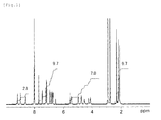
- Fig. 1 is a chart that gives the 1 N-NMR spectrum of the amylose derivative 1 obtained in Example 1.
- the separating agent for optical isomers of the present invention contains a polysaccharide derivative.
- this polysaccharide derivative is provided by replacing all or a portion of the hydrogen atoms on the hydroxyl groups present in cellulose or amylose with the atomic groups represented by the Formulae (1) and (2) given below.
- the atomic groups represented by the Formulae (1) and (2) given below are replaced by all of the hydrogen atoms on the hydroxyl groups.
- all of the hydrogen atoms on the hydroxyl groups may be substituted by these atomic groups in this polysaccharide derivative or a portion of the hydrogen atoms on these hydroxyl groups may be substituted by these atomic groups.
- the number-average degree of polymerization (average number of pyranose rings or furanose rings (monosaccharide units) present in 1 molecule of the cellulose or amylose) of the cellulose or amylose in this polysaccharide derivative is preferably at least 5 and more preferably is at least 10. While there is no particular upper limit on the number-average degree of polymerization of this polysaccharide, its number-average degree of polymerization is preferably not more than 1,000 in terms of ease of handling. Given these considerations, this polysaccharide has a number-average degree of polymerization preferably of from 5 to 1,000, more preferably 10 to 1,000, and even more preferably 10 to 500.
- R1 and R2 each represent a C 1-18 monovalent aliphatic group which may have substituent or a C 6-18 monovalent aromatic group which may have substituent.
- R1 and R2 may be the same as each other or may differ from one another.
- the substituents that may be present on R1 and R2 can be exemplified by C 1-18 alkyl groups, halogen, amino groups, and C 1-18 alkoxyl groups.
- the alkyl group here may have a chain or a cyclic configuration.
- R1 and R2 can be exemplified by the methyl group, octadecyl group, phenyl group, naphthyl group, cyclohexyl group, norbornenyl group, 3-chloro-4-methylphenyl group, 3,5-dichlorophenyl group, 3,5-dimethylphenyl group, 5-chloro-2-methylphenyl group, 4-methylphenyl group, and 4-chlorophenyl group.
- the aforementioned X represents a single bond or a divalent organic group.
- "-X-R2" is preferably a functional group that acts in the optical resolution of the optical isomers targeted for separation in the optical resolution.
- This X can be exemplified by the amide bond, urethane bond, ether bond, ester bond, and divalent groups that contain these bonds.
- the sum of the average introduction ratios for the R1 and R2 in the aforementioned polysaccharide derivative in the present invention is greater than 3.0 per monosaccharide unit.
- This sum of the average introduction ratios for R1 and R2 per monosaccharide unit is the sum of the average introduction ratio for R1 per monosaccharide unit and the average introduction ratio for R2 per monosaccharide unit.
- this average introduction ratio is preferably not more than 5.0 and more preferably is not more than 4.0.
- this average introduction ratio is preferably at least 3.05 and more preferably is at least 3.1.
- the average introduction ratio under consideration can be measured, for example, by NMR analysis.
- this average introduction ratio can be determined from the peak area originating from the hydrogen atoms specific to R1 or R2 and the peak area originating from the hydrogen atoms specific to the polysaccharide skeleton.
- the atomic group with Formula (1) can be introduced into cellulose or amylose by reacting the hydroxyl groups in the cellulose or amylose with an isocyanate derivative that corresponds to the atomic group with Formula (1).
- an isocyanate derivative that corresponds to the atomic group with Formula (1).
- a known method in which a carbamate bond is formed by reacting the hydroxyl group in the polysaccharide with the corresponding isocyanate derivative can be used as such a method of introducing Formula (1) (refer, for example, to Patent Document 1 and Non-Patent Document 1).
- the reaction of a compound corresponding to "-X-R2" with the amino group in the cellulose derivative or amylose derivative bearing the atomic group with Formula (1) can be used to introduce the atomic group with Formula (2) into the cellulose derivative or amylose derivative.
- the method of introducing this atomic group with Formula (2) can be exemplified by a method in which an allophanate ester is produced by reacting the hydrogen atom in the amino group in Formula (1) with an isocyanate derivative corresponding to "-X-R2", and by an acylation method in which the hydrogen atom in the amino group in Formula (1) is reacted with an acid anhydride or acid chloride that corresponds to "-X-R2".
- the isocyanate derivative corresponding to the atomic group with Formula (1) and the isocyanate derivative corresponding to "-X-R2" are then both isocyanate derivatives.
- the polysaccharide derivative in which X represents an amide bond can be obtained by reacting cellulose or amylose with the isocyanate derivative corresponding to Formula (1) followed by reaction with the isocyanate derivative corresponding to "-X-R2".
- the polysaccharide derivative in which X represents an amide bond can be obtaining by carrying out carbamate bond formation and allophanate ester production at the same time by reacting both of the aforementioned isocyanate derivatives, at a greater excess as the total amount than in the aforementioned known method of carbamate bond formation, with the hydroxyl groups in the cellulose or amylose.
- the same isocyanate derivative can be used for the isocyanate derivative that corresponds to the Formula (1) atomic group and the isocyanate derivative that corresponds to "-X-R2".
- a polysaccharide derivative can be obtained in this case in which X represents an amide bond and R1 is the same as R2 by carrying out carbamate bond formation and allophanate ester production at the same time by reacting the corresponding isocyanate derivative, at a greater excess than in the aforementioned known method of carbamate bond formation, with the hydroxyl groups in the cellulose or amylose.
- the amount of the aforementioned isocyanate derivative used for the synthesis of the polysaccharide derivative under consideration is preferably at least 1.3 equivalents, more preferably at least 2.5 equivalents, and even more preferably at least 3.0 equivalents. While there are no particular limitations on the upper limit for the amount of isocyanate derivative used, not more than 10 equivalents is preferred from the standpoint of the plateauing out of the effects.
- the reaction temperature in the synthesis of the aforementioned polysaccharide derivative is preferably lower than the usual temperatures in synthesis methods that form the carbamate bond under consideration or is on the low end of the usual temperature range. Based on this perspective, the reaction temperature is preferably from 60°C to 110°C and more preferably is 70°C to 90°C.
- the polysaccharide in this polysaccharide derivative is more preferably amylose from the standpoint of increasing the aforementioned average introduction ratio.
- the separating agent for optical isomers of the present invention may comprise only this polysaccharide derivative, or the polysaccharide derivative may be supported on a carrier.
- the separating agent for optical isomers comprising only the polysaccharide derivative may be prepared by molding the polysaccharide derivative into a cylindrical porous body held in a columnar tube.
- the separating agent for optical isomers comprising only the polysaccharide derivative may also be prepared by crushing or spheronizing the polysaccharide derivative itself.
- the particles of the separating agent for optical isomers are preferably particles that have been subjected to a spheronizing treatment, and the particles also preferably have an uniformized particle size.
- the separating agent for optical isomers can be crushed by known methods and can be subjected to a spheronizing treatment by known methods.
- the granulometry can be adjusted, for example, by classification and by the mixing of classified products.
- the separating agent for optical isomers comprising the aforementioned polysaccharide derivative supported on a carrier can be prepared by supporting the polysaccharide derivative on a carrier.
- This carrier should be capable of supporting the polysaccharide derivative, but is not otherwise particularly limited.
- This carrier can be any of the various carriers known for use in the chromatography described above and can be exemplified by porous organic carriers and porous inorganic carriers with porous inorganic carriers being preferred.
- the porous organic carriers can be exemplified by polymers such as polystyrene, polyacrylamide, polyacrylate, and derivatives of the preceding.
- the porous inorganic carriers can be exemplified by silica gel, alumina, magnesia, glass, kaolin, titanium oxide, silicates, and hydroxyapatite, wherein silica gel is particularly preferred.
- the carrier may be a cylindrical porous body held in a columnar tube or may be a particulate carrier.
- the particle size of the carrier is preferably from 0.1 ⁇ m to 10 mm, more preferably from 1 ⁇ m to 300 ⁇ m, and even more preferably from 1 ⁇ m to 75 ⁇ m.
- the average pore diameter of the porous carrier is preferably from 1 nm to 100 ⁇ m and more preferably from 5 nm to 5,000 nm.
- the surface of the silica gel is desirably subjected to a surface treatment in order to extinguish the influence of residual silanol, but the surface treatment need not be carried out exhaustively. This surface treatment can be performed using a known method.
- the method by which the polysaccharide derivative is supported on the carrier is not particularly limited. This regime can be exemplified by physical adsorption by the polysaccharide derivative to the carrier, chemical bonding between the carrier and the polysaccharide derivative, and chemical bonding of the polysaccharide derivative with itself on the carrier.
- This physical adsorption can be carried out, for example, by a method in which the polysaccharide derivative is dissolved in a solubilizing solvent; for example, the carrier is immersed in the resulting solution in order to coat the carrier with the solution; and the solvent is removed from the carrier under reduced pressure, with the application of heat, or under a gas current.
- the chemical bonding can be exemplified by chemical bonding through the intermediary of a third component between the carrier and the polysaccharide derivative and by chemical bonding between the carrier and polysaccharide derivative brought about by exposure of the polysaccharide derivative adsorbed on the carrier to light or radiation and by the thereby induced radical reaction. Supporting the polysaccharide derivative on the carrier can be performed using known methods.
- the amount of polysaccharide derivative supported on the carrier will vary with the method of separating the optical isomers and the type of carrier, but, expressed with reference to the carrier, is preferably 1 to 100 weight parts, more preferably 5 to 60 weight parts, and even more preferably 10 to 50 weight parts.
- the separating agent for optical isomers of the present invention can be used in various applications for separating optical isomers by establishing an appropriate configuration in correspondence to the application for separating optical isomers.
- the separating agent for optical isomers can be used in methods that use it as packed in a column. Such methods can be exemplified by gas chromatography, liquid chromatography, supercritical fluid chromatography, and simulated moving bed chromatography.
- the separating agent for optical isomers has a particulate configuration, it can be used in thin-layer chromatography.
- the separating agent for optical isomers of the present invention can be used for membrane-based separations by supporting the polysaccharide derivative in a membrane.
- the separating agent for optical isomers of the present invention can be used in capillary columns by coating the polysaccharide derivative on the capillary column.
- amylose derivative 1 was obtained by stirring the following in dry pyridine at 110°C for 24 hours in a nitrogen atmosphere: amylose and 4 equivalents, with reference to the hydroxyl groups in the amylose, of 3-chloro-4-methylphenyl isocyanate.
- the resulting amylose derivative 1 was submitted to measurement by 1 H-NMR using deuterated dimethylformamide as the solvent.
- the obtained 1 H-NMR spectrum is shown in Fig. 1 .
- Equation (1) The average introduction ratio R for the 3-chloro-4-methylphenyl group per monosaccharide unit in the obtained amylose derivative 1, as calculated using Equation (1) below from the results of this 1 H-NMR measurement, was 3.2.
- S represents the number of hydrogens in the benzene ring.
- A 7.0 and B is 9.7 according to Fig. 1 and S is 3 according to the chemical structure of the amylose derivative 1.
- R 7 ⁇ B / S ⁇ A
- the separating agent for optical isomers 1 was filled into a stainless steel column that had an internal diameter of 0.46 cm x length of 25 cm, to provide a column 1 for optical isomer separation.
- the column 1 for optical isomer separation was used to separate the enantiomers of the following by high-performance liquid chromatography: trans-stilbene oxide with Formula (ra-1) below, binaphthol with Formula (ra-2) below, Wieland-Miescher ketone with Formula (ra-3) below, benzoyloxy-2-azetidinone with Formula (ra-4) below, and fenoprofen with Formula (ra-5) below.
- the resulting chromatograms were used to calculate the retention factor k' 1 for the more weakly adsorbed component (raffinate component), the retention factor k' 2 for the more strongly adsorbed component (the extract component), and the separation factor ⁇ .
- the retention factor k' 1 for the raffinate component was determined using Equation (2) below; the retention factor k' 2 for the extract component was determined using Equation (3) below; and the separation factor ⁇ was determined using Equation (4) below.
- t 0 represents the dead time (elution time for tri-tert-butylbenzene);
- t 1 represents the elution time for the raffinate component; and
- t 2 represents the elution time for the extract component.
- the resulting chromatograms were used to calculate the retention factor k' 1 for the raffinate component and the separation factor ⁇ . The results are given in Table 2.
- a polysaccharide derivative was synthesized as in Example 1, but lowering the amount of 3-chloro-4-methylphenyl isocyanate used, which resulted in the synthesis of an amylose tris(3-chloro-4-methylphenylcarbamate) in which the average introduction ratio R by the 3-chloro-4-methylphenyl group was 3.0.
- a separating agent for optical isomers C1 and a column C1 for optical isomer separation were obtained, but using 15 g for the amount of silica gel, and the optical separation performance was evaluated. The results of the optical resolutions are shown in Tables 1 and 2.
- the column 1 for optical isomer separation which has the amylose derivative with the higher average introduction ratio for R, exhibits a higher optical separation performance for all of the various racemic bodies referenced above than the column C1 for optical isomer separation, and as a result can be expected to exhibit a higher separation factor for various optical isomers than the column C1 for optical isomer separation.
- the Formula (2) atomic group can be constituted by combining two or more functional groups that act on the optical isomers targeted for separation in an optical resolution, the appearance can be expected, versus the optical resolving power of the heretofore known Formula (1) atomic group or the "-X-R2" in Formula (2), of a novel optical resolving power or an additionally improved optical resolving power.
- the present invention is expected to provide additional improvements in productivity in the production of optical isomers and to support the establishment of production technologies for novel optical isomers.
Landscapes
- Chemical & Material Sciences (AREA)
- Organic Chemistry (AREA)
- Analytical Chemistry (AREA)
- Chemical Kinetics & Catalysis (AREA)
- Biochemistry (AREA)
- Engineering & Computer Science (AREA)
- Life Sciences & Earth Sciences (AREA)
- Materials Engineering (AREA)
- Health & Medical Sciences (AREA)
- Medicinal Chemistry (AREA)
- Polymers & Plastics (AREA)
- Organic Low-Molecular-Weight Compounds And Preparation Thereof (AREA)
- Solid-Sorbent Or Filter-Aiding Compositions (AREA)
- Polysaccharides And Polysaccharide Derivatives (AREA)
Abstract
Description
- The present invention relates to a separating agent for optical isomers.
- The physical and chemical properties of optical isomers are entirely the same, but in some cases differences are seen in their functions to biological body. As a consequence, the production of compounds that exhibit a high optical purity is an extremely important problem in fields such as medicines and pharmaceuticals. Fractionation methods based on high-performance liquid chromatography using separating agents for optical isomers are known to be techniques that respond to this problem.
- Among the numerous separating agents for optical isomers, an enantioselective recognition ability for a broad range of compounds is known to be exercised in particular by separating agents in which a carbamate or ester derivative of a cellulose or amylose is supported on a silica gel.
- Investigations are underway to improve the chromatographic fractionation productivity of chromatographic fractionation methods, and there is desire for a separating agent for optical isomers that provides an even better separation of the compounds to be fractionated, i.e., that has an even higher separation factor (α value).
- For example, the phenylcarbamate derivatives of amylose are known as separating agents for optical isomers (refer, for example, to Non-Patent Document 1, Patent Document 1, and Patent Document 2). With regard to the optical resolving power of the phenylcarbamate derivatives of amylose, an optical resolving power is generally known for these derivatives in which the average introduction ratio for the phenylcarbamate group per furanose ring or pyranose ring in the amylose is less than or equal to 3.
-
- Patent Document 1: Japanese Patent Publication No.
3148032 - Patent Document 2: Japanese Patent Application Laid-open No.
2005-17174 -
- Non-Patent Document 1: J. Chromatogr. A 694 (1995) pp. 101-109
- The present invention provides a separating agent for optical isomers that contains a cellulose derivative or amylose derivative that has an excellent enantioselective recognition ability.
- During their investigations into cellulose derivative-based and amylose derivative-based separating agents for optical isomers, the present inventors discovered that in some instances a different optical resolving power was exhibited between derivatives into which the same substituent had been introduced. The present invention was achieved as a result of intensive investigations directed to explaining this phenomenon.
- Thus, the present invention provides a separating agent for optical isomers that contains a polysaccharide derivative, wherein this polysaccharide derivative is provided by replacing all or a portion of hydrogen atoms on hydroxyl groups present in a cellulose or an amylose with the atomic groups represented by Formulae (1) and (2) below, and a sum of the average introduction ratios per monosaccharide unit of R1 and R2 in Formulae (1) and (2) below is greater than 3.0.
- [C 1]


- In the preceding formulas, R1 and R2 each represent a C1-18 monovalent aliphatic group which may have substituent or a C6-18 monovalent aromatic group which may have substituent and X represents a single bond or a divalent organic group.
- The present invention also provides the aforementioned separating agent for optical isomers, in which the X represents an amide bond.
- The present invention further provides the aforementioned separating agent for optical isomers, in which the R1 and R2 are the same.
- The present invention, because it uses a cellulose derivative or amylose derivative in which the average introduction ratio of the substituents in the cellulose derivative or amylose derivative exceeds 3.0, can provide a separating agent for optical isomers that contains a cellulose derivative or amylose derivative that has an excellent enantioselective recognition ability.
-
Fig. 1 is a chart that gives the 1N-NMR spectrum of the amylose derivative 1 obtained in Example 1. - The separating agent for optical isomers of the present invention contains a polysaccharide derivative. In the present invention, this polysaccharide derivative is provided by replacing all or a portion of the hydrogen atoms on the hydroxyl groups present in cellulose or amylose with the atomic groups represented by the Formulae (1) and (2) given below. Thus, all of the hydrogen atoms on the hydroxyl groups may be substituted by these atomic groups in this polysaccharide derivative or a portion of the hydrogen atoms on these hydroxyl groups may be substituted by these atomic groups.
- [C 2]


- In terms of higher order structure formation by the polysaccharide derivative, the number-average degree of polymerization (average number of pyranose rings or furanose rings (monosaccharide units) present in 1 molecule of the cellulose or amylose) of the cellulose or amylose in this polysaccharide derivative is preferably at least 5 and more preferably is at least 10. While there is no particular upper limit on the number-average degree of polymerization of this polysaccharide, its number-average degree of polymerization is preferably not more than 1,000 in terms of ease of handling. Given these considerations, this polysaccharide has a number-average degree of polymerization preferably of from 5 to 1,000, more preferably 10 to 1,000, and even more preferably 10 to 500.
- R1 and R2 each represent a C1-18 monovalent aliphatic group which may have substituent or a C6-18 monovalent aromatic group which may have substituent. R1 and R2 may be the same as each other or may differ from one another. The substituents that may be present on R1 and R2 can be exemplified by C1-18 alkyl groups, halogen, amino groups, and C1-18 alkoxyl groups. The alkyl group here may have a chain or a cyclic configuration. R1 and R2 can be exemplified by the methyl group, octadecyl group, phenyl group, naphthyl group, cyclohexyl group, norbornenyl group, 3-chloro-4-methylphenyl group, 3,5-dichlorophenyl group, 3,5-dimethylphenyl group, 5-chloro-2-methylphenyl group, 4-methylphenyl group, and 4-chlorophenyl group.
- The aforementioned X represents a single bond or a divalent organic group. With regard to this X, "-X-R2" is preferably a functional group that acts in the optical resolution of the optical isomers targeted for separation in the optical resolution. This X can be exemplified by the amide bond, urethane bond, ether bond, ester bond, and divalent groups that contain these bonds.
- The sum of the average introduction ratios for the R1 and R2 in the aforementioned polysaccharide derivative in the present invention is greater than 3.0 per monosaccharide unit. This sum of the average introduction ratios for R1 and R2 per monosaccharide unit is the sum of the average introduction ratio for R1 per monosaccharide unit and the average introduction ratio for R2 per monosaccharide unit. Viewed from the perspective of excessive changes in the higher order structure due to steric hindrance within the polysaccharide derivative, this average introduction ratio is preferably not more than 5.0 and more preferably is not more than 4.0. Viewed from the perspective of obtaining satisfactory effects through an increase in the average introduction ratio, this average introduction ratio is preferably at least 3.05 and more preferably is at least 3.1.
- The average introduction ratio under consideration can be measured, for example, by NMR analysis. For example, with reference to the 1H-NMR spectrum of the polysaccharide derivative, this average introduction ratio can be determined from the peak area originating from the hydrogen atoms specific to R1 or R2 and the peak area originating from the hydrogen atoms specific to the polysaccharide skeleton.
- The atomic group with Formula (1) can be introduced into cellulose or amylose by reacting the hydroxyl groups in the cellulose or amylose with an isocyanate derivative that corresponds to the atomic group with Formula (1). For example, a known method in which a carbamate bond is formed by reacting the hydroxyl group in the polysaccharide with the corresponding isocyanate derivative can be used as such a method of introducing Formula (1) (refer, for example, to Patent Document 1 and Non-Patent Document 1).
- The reaction of a compound corresponding to "-X-R2" with the amino group in the cellulose derivative or amylose derivative bearing the atomic group with Formula (1) can be used to introduce the atomic group with Formula (2) into the cellulose derivative or amylose derivative. The method of introducing this atomic group with Formula (2) can be exemplified by a method in which an allophanate ester is produced by reacting the hydrogen atom in the amino group in Formula (1) with an isocyanate derivative corresponding to "-X-R2", and by an acylation method in which the hydrogen atom in the amino group in Formula (1) is reacted with an acid anhydride or acid chloride that corresponds to "-X-R2".
- When X represents an amide bond, the isocyanate derivative corresponding to the atomic group with Formula (1) and the isocyanate derivative corresponding to "-X-R2" are then both isocyanate derivatives. As a consequence, in such cases the polysaccharide derivative in which X represents an amide bond can be obtained by reacting cellulose or amylose with the isocyanate derivative corresponding to Formula (1) followed by reaction with the isocyanate derivative corresponding to "-X-R2". Or, the polysaccharide derivative in which X represents an amide bond can be obtaining by carrying out carbamate bond formation and allophanate ester production at the same time by reacting both of the aforementioned isocyanate derivatives, at a greater excess as the total amount than in the aforementioned known method of carbamate bond formation, with the hydroxyl groups in the cellulose or amylose.
- When X represents an amide bond and R1 is also the same as R2, the same isocyanate derivative can be used for the isocyanate derivative that corresponds to the Formula (1) atomic group and the isocyanate derivative that corresponds to "-X-R2". As a consequence, a polysaccharide derivative can be obtained in this case in which X represents an amide bond and R1 is the same as R2 by carrying out carbamate bond formation and allophanate ester production at the same time by reacting the corresponding isocyanate derivative, at a greater excess than in the aforementioned known method of carbamate bond formation, with the hydroxyl groups in the cellulose or amylose.
- Taking into consideration the deactivation of the isocyanate by the moisture present in the system, the amount of the aforementioned isocyanate derivative used for the synthesis of the polysaccharide derivative under consideration, expressed with reference to the total hydroxyl group in the cellulose or amylose, is preferably at least 1.3 equivalents, more preferably at least 2.5 equivalents, and even more preferably at least 3.0 equivalents. While there are no particular limitations on the upper limit for the amount of isocyanate derivative used, not more than 10 equivalents is preferred from the standpoint of the plateauing out of the effects.
- Considered from the perspective of carrying out carbamate bond formation and allophanate ester production at the same time, the reaction temperature in the synthesis of the aforementioned polysaccharide derivative is preferably lower than the usual temperatures in synthesis methods that form the carbamate bond under consideration or is on the low end of the usual temperature range. Based on this perspective, the reaction temperature is preferably from 60°C to 110°C and more preferably is 70°C to 90°C.
- The polysaccharide in this polysaccharide derivative is more preferably amylose from the standpoint of increasing the aforementioned average introduction ratio.
- There are no particular limitations on the separating agent for optical isomers of the present invention as long as this separating agent takes a form that contains the hereinabove-described polysaccharide derivative. The separating agent for optical isomers of the present invention may comprise only this polysaccharide derivative, or the polysaccharide derivative may be supported on a carrier.
- The separating agent for optical isomers comprising only the polysaccharide derivative may be prepared by molding the polysaccharide derivative into a cylindrical porous body held in a columnar tube. The separating agent for optical isomers comprising only the polysaccharide derivative may also be prepared by crushing or spheronizing the polysaccharide derivative itself. Viewed from the standpoint of increasing the separation degree, the particles of the separating agent for optical isomers are preferably particles that have been subjected to a spheronizing treatment, and the particles also preferably have an uniformized particle size. The separating agent for optical isomers can be crushed by known methods and can be subjected to a spheronizing treatment by known methods. The granulometry can be adjusted, for example, by classification and by the mixing of classified products.
- The separating agent for optical isomers comprising the aforementioned polysaccharide derivative supported on a carrier can be prepared by supporting the polysaccharide derivative on a carrier. This carrier should be capable of supporting the polysaccharide derivative, but is not otherwise particularly limited. This carrier can be any of the various carriers known for use in the chromatography described above and can be exemplified by porous organic carriers and porous inorganic carriers with porous inorganic carriers being preferred. The porous organic carriers can be exemplified by polymers such as polystyrene, polyacrylamide, polyacrylate, and derivatives of the preceding. The porous inorganic carriers can be exemplified by silica gel, alumina, magnesia, glass, kaolin, titanium oxide, silicates, and hydroxyapatite, wherein silica gel is particularly preferred.
- The carrier may be a cylindrical porous body held in a columnar tube or may be a particulate carrier. The particle size of the carrier is preferably from 0.1 µm to 10 mm, more preferably from 1 µm to 300 µm, and even more preferably from 1 µm to 75 µm. The average pore diameter of the porous carrier is preferably from 1 nm to 100 µm and more preferably from 5 nm to 5,000 nm. When the carrier is silica gel, the surface of the silica gel is desirably subjected to a surface treatment in order to extinguish the influence of residual silanol, but the surface treatment need not be carried out exhaustively. This surface treatment can be performed using a known method.
- The method by which the polysaccharide derivative is supported on the carrier is not particularly limited. This regime can be exemplified by physical adsorption by the polysaccharide derivative to the carrier, chemical bonding between the carrier and the polysaccharide derivative, and chemical bonding of the polysaccharide derivative with itself on the carrier.
- This physical adsorption can be carried out, for example, by a method in which the polysaccharide derivative is dissolved in a solubilizing solvent; for example, the carrier is immersed in the resulting solution in order to coat the carrier with the solution; and the solvent is removed from the carrier under reduced pressure, with the application of heat, or under a gas current. The chemical bonding can be exemplified by chemical bonding through the intermediary of a third component between the carrier and the polysaccharide derivative and by chemical bonding between the carrier and polysaccharide derivative brought about by exposure of the polysaccharide derivative adsorbed on the carrier to light or radiation and by the thereby induced radical reaction. Supporting the polysaccharide derivative on the carrier can be performed using known methods.
- The amount of polysaccharide derivative supported on the carrier will vary with the method of separating the optical isomers and the type of carrier, but, expressed with reference to the carrier, is preferably 1 to 100 weight parts, more preferably 5 to 60 weight parts, and even more preferably 10 to 50 weight parts.
- The separating agent for optical isomers of the present invention can be used in various applications for separating optical isomers by establishing an appropriate configuration in correspondence to the application for separating optical isomers. When, for example, the separating agent for optical isomers has a particulate configuration or a cylindrical porous body configuration, the separating agent for optical isomers can be used in methods that use it as packed in a column. Such methods can be exemplified by gas chromatography, liquid chromatography, supercritical fluid chromatography, and simulated moving bed chromatography. When the separating agent for optical isomers has a particulate configuration, it can be used in thin-layer chromatography.
- The separating agent for optical isomers of the present invention can be used for membrane-based separations by supporting the polysaccharide derivative in a membrane. In addition, the separating agent for optical isomers of the present invention can be used in capillary columns by coating the polysaccharide derivative on the capillary column.
- The method of the present invention is described herebelow by practical examples; however, the present invention is not limited by the scope of these examples.
- An amylose derivative 1 was obtained by stirring the following in dry pyridine at 110°C for 24 hours in a nitrogen atmosphere: amylose and 4 equivalents, with reference to the hydroxyl groups in the amylose, of 3-chloro-4-methylphenyl isocyanate. The resulting amylose derivative 1 was submitted to measurement by 1H-NMR using deuterated dimethylformamide as the solvent. The obtained 1H-NMR spectrum is shown in
Fig. 1 . - The average introduction ratio R for the 3-chloro-4-methylphenyl group per monosaccharide unit in the obtained amylose derivative 1, as calculated using Equation (1) below from the results of this 1H-NMR measurement, was 3.2. In Equation (1), A represents the peak area originating with the hydrogen in the methylene and methine of the amylose skeleton (δ = 4.0 to 6.0 ppm); B represents the peak area originating with the hydrogen of the benzene ring (δ = 6.5 to 7.8 ppm); and S represents the number of hydrogens in the benzene ring. A is 7.0 and B is 9.7 according to
Fig. 1 and S is 3 according to the chemical structure of the amylose derivative 1.
- 5 g of the amylose derivative 1 obtained in the preceding synthesis example was dissolved in 30 mL tetrahydrofuran (THF); this THF solution was uniformly coated on 20 g of a silica gel that had a particle size of 5 µm; and the THF was distilled off to provide a separating agent for optical isomers 1 in which the amylose derivative 1 was supported on the silica gel.
- Using a slurry filling process, the separating agent for optical isomers 1 was filled into a stainless steel column that had an internal diameter of 0.46 cm x length of 25 cm, to provide a column 1 for optical isomer separation.
- The column 1 for optical isomer separation was used to separate the enantiomers of the following by high-performance liquid chromatography: trans-stilbene oxide with Formula (ra-1) below, binaphthol with Formula (ra-2) below, Wieland-Miescher ketone with Formula (ra-3) below, benzoyloxy-2-azetidinone with Formula (ra-4) below, and fenoprofen with Formula (ra-5) below. The separation conditions for these optical resolutions were as follows: n-hexane/2-propanol = 90/10 (volume ratio) was used for the eluent for (ra-1) and (ra-2); n-hexane/2-propanol = 80/20 (volume ratio) was used for the eluent for (ra-3); acetonitrile was used for the eluent for (ra-4); acetonitrile/trifluoroacetic acid = 100/0.1 (volume ratio) was used for the eluent for (ra-5); and the eluent flow rate was 1.0 mL/min in all instances. The resulting chromatograms were used to calculate the retention factor k'1 for the more weakly adsorbed component (raffinate component), the retention factor k'2 for the more strongly adsorbed component (the extract component), and the separation factor α. The retention factor k'1 for the raffinate component was determined using Equation (2) below; the retention factor k'2 for the extract component was determined using Equation (3) below; and the separation factor α was determined using Equation (4) below. In these equations, t0 represents the dead time (elution time for tri-tert-butylbenzene); t1 represents the elution time for the raffinate component; and t2 represents the elution time for the extract component. The results of the optical resolutions are given in Table 1.


- [C 3]

-
[Table 1] racemic body Example 1 Comparative Example 1 k'1 α k'1 α trans-stilbene oxide 0.82 1.45 0.72 1.38 binaphthol 3.19 1.20 3.46 1.06 Wiland-Miescher ketone 4.17 1.77 5.67 1.66 benzoyloxy-2-azetidinone 0.75 3.10 1.06 2.24 fenoprofen 0.13 1.33 0.08 1.00 - Column 1 for optical isomer separation was also used to separate the enantiomers of the following by high-performance liquid chromatography: γ-phenyl-γ-butyrolactone with Formula (rac-6) below, tiaprofenic acid with Formula (rac-7) below, and diprophylline with Formula (rac-8) below. The separation conditions for these optical resolutions were as follows: n-hexane/2-propanol = 80/20 (volume ratio) was used for the eluent for (rac-6); n-hexane/2-propanol/trifluoroacetic acid = 90/10/0.1 (volume ratio) was used for (rac-7); n-hexane/2-propanol = 60/40 (volume ratio) was used for (rac-8); and the eluent flow rate was 1.0 mL/min in all instances. The resulting chromatograms were used to calculate the retention factor k'1 for the raffinate component and the separation factor α. The results are given in Table 2.
- [C 4]

-
[Table 2] racemic body Example 1 Comparative Example 1 k'1 α k'1 α γ-phenyl-γ-butyrolactone 5.62 1.15 3.01 1.05 tiaprofenic acid 7.47 1.14 2.95 1.00 diprophylline 7.72 1.32 4.32 1.21 - A polysaccharide derivative was synthesized as in Example 1, but lowering the amount of 3-chloro-4-methylphenyl isocyanate used, which resulted in the synthesis of an amylose tris(3-chloro-4-methylphenylcarbamate) in which the average introduction ratio R by the 3-chloro-4-methylphenyl group was 3.0. Operating as in Example 1, a separating agent for optical isomers C1 and a column C1 for optical isomer separation were obtained, but using 15 g for the amount of silica gel, and the optical separation performance was evaluated. The results of the optical resolutions are shown in Tables 1 and 2.
- As is clear from Tables 1 and 2, the column 1 for optical isomer separation, which has the amylose derivative with the higher average introduction ratio for R, exhibits a higher optical separation performance for all of the various racemic bodies referenced above than the column C1 for optical isomer separation, and as a result can be expected to exhibit a higher separation factor for various optical isomers than the column C1 for optical isomer separation.
- Because in the present invention the Formula (2) atomic group can be constituted by combining two or more functional groups that act on the optical isomers targeted for separation in an optical resolution, the appearance can be expected, versus the optical resolving power of the heretofore known Formula (1) atomic group or the "-X-R2" in Formula (2), of a novel optical resolving power or an additionally improved optical resolving power. Thus, the present invention is expected to provide additional improvements in productivity in the production of optical isomers and to support the establishment of production technologies for novel optical isomers.
Claims (3)
- A separating agent for optical isomers that contains a polysaccharide derivative, wherein
the polysaccharide derivative is provided by replacing all or a portion of hydrogen atoms on hydroxyl groups present in a cellulose or an amylose with the atomic groups represented by Formulae (1) and (2) below, and a sum of the average introduction ratios per monosaccharide unit of R1 and R2 in Formulae (1) and (2) below is greater than 3.0:
[C 1]

- The separating agent for optical isomers according to claim 1, wherein the X represents an amide bond.
- The separating agent for optical isomers according to claim 2, wherein the R1 and R2 are the same.
Applications Claiming Priority (2)
| Application Number | Priority Date | Filing Date | Title |
|---|---|---|---|
| JP2010139485 | 2010-06-18 | ||
| PCT/JP2011/063914 WO2011158935A1 (en) | 2010-06-18 | 2011-06-17 | Resolving agent for optical isomers |
Publications (3)
| Publication Number | Publication Date |
|---|---|
| EP2584354A1 true EP2584354A1 (en) | 2013-04-24 |
| EP2584354A4 EP2584354A4 (en) | 2014-11-05 |
| EP2584354B1 EP2584354B1 (en) | 2021-06-09 |
Family
ID=45348327
Family Applications (1)
| Application Number | Title | Priority Date | Filing Date |
|---|---|---|---|
| EP11795837.1A Active EP2584354B1 (en) | 2010-06-18 | 2011-06-17 | Resolving agent for optical isomers |
Country Status (5)
| Country | Link |
|---|---|
| US (1) | US8859757B2 (en) |
| EP (1) | EP2584354B1 (en) |
| JP (1) | JP6016631B2 (en) |
| CN (1) | CN103026223B (en) |
| WO (1) | WO2011158935A1 (en) |
Families Citing this family (3)
| Publication number | Priority date | Publication date | Assignee | Title |
|---|---|---|---|---|
| JP6834131B2 (en) * | 2016-01-15 | 2021-02-24 | 昭和電工マテリアルズ株式会社 | Separator and column |
| JP6746919B2 (en) * | 2016-01-15 | 2020-08-26 | 日立化成株式会社 | Separation material and column |
| US11929789B2 (en) | 2017-07-06 | 2024-03-12 | The Tone Knows, Inc. | Systems and methods for providing a tone emitting device that communicates data |
Family Cites Families (23)
| Publication number | Priority date | Publication date | Assignee | Title |
|---|---|---|---|---|
| JPS60108751A (en) * | 1983-11-18 | 1985-06-14 | Daicel Chem Ind Ltd | Separating agent |
| JPS60142930A (en) * | 1983-12-28 | 1985-07-29 | Daicel Chem Ind Ltd | Resolving agent |
| JPS61176538A (en) | 1985-02-01 | 1986-08-08 | Daicel Chem Ind Ltd | Optical resolution of aralkyl alcohol |
| JPS6221152A (en) | 1985-07-19 | 1987-01-29 | Konishiroku Photo Ind Co Ltd | Processing method for photosensitive lithographic printing plate |
| JPH0718849B2 (en) * | 1986-03-12 | 1995-03-06 | ダイセル化学工業株式会社 | Method for producing separating agent |
| JP2708466B2 (en) | 1988-05-18 | 1998-02-04 | ダイセル化学工業 株式会社 | Optical splitting method |
| JP2648516B2 (en) * | 1989-07-27 | 1997-09-03 | ダイセル化学工業株式会社 | Separation of stereoisomers |
| JPH03148032A (en) | 1989-11-06 | 1991-06-24 | Nikon Corp | Vibration measurement device |
| EP0527235B1 (en) * | 1991-02-28 | 1997-10-29 | Daicel Chemical Industries, Ltd. | Novel polysaccharide drivative and separating agent |
| US5491223A (en) * | 1991-02-28 | 1996-02-13 | Daicel Chemical Industries, Ltd. | Polysaccharide derivative and separating agent |
| JP3167168B2 (en) | 1992-02-27 | 2001-05-21 | ダイセル化学工業株式会社 | Novel polysaccharide derivatives and separating agents |
| JP3148032B2 (en) | 1993-01-18 | 2001-03-19 | ダイセル化学工業株式会社 | Substituted aromatic carbamate derivatives of polysaccharides and separating agents |
| JP4320068B2 (en) * | 1997-10-03 | 2009-08-26 | ダイセル化学工業株式会社 | Separating agent for optical isomers and process for producing the same |
| JP2000297103A (en) * | 1999-04-16 | 2000-10-24 | Daicel Chem Ind Ltd | Method for producing chitin derivative |
| JP2001124752A (en) | 1999-10-26 | 2001-05-11 | Daicel Chem Ind Ltd | Method for producing optically active oxybutynin |
| CN1216684C (en) * | 2001-03-07 | 2005-08-31 | 大赛璐化学工业株式会社 | Separating agent for optical isomer |
| KR101054735B1 (en) * | 2001-07-06 | 2011-08-05 | 잇판자이단호진 가가쿠오요비겟세이료호겐쿠쇼 | Genetically modified ecarin and how to prepare the same |
| JP4294028B2 (en) * | 2003-04-24 | 2009-07-08 | ダイセル化学工業株式会社 | Separating agent for optical isomers |
| CN100364661C (en) * | 2003-04-24 | 2008-01-30 | 大赛璐化学工业株式会社 | Separating agent for optical isomers |
| JP2005017174A (en) | 2003-06-27 | 2005-01-20 | Daicel Chem Ind Ltd | Separating agent for optical isomers |
| EP1721664A4 (en) * | 2004-03-04 | 2007-09-12 | Daicel Chem | SEPARATION AGENT FOR OPTICAL ISOMER |
| US20090264639A1 (en) * | 2006-09-04 | 2009-10-22 | Yoshio Okamoto | Polysaccharide derivative and separating agent for optical isomer containing the same |
| JP5531288B2 (en) * | 2007-05-07 | 2014-06-25 | 国立大学法人名古屋大学 | Separating agent for optical isomers |
-
2011
- 2011-06-17 CN CN201180030061.7A patent/CN103026223B/en active Active
- 2011-06-17 EP EP11795837.1A patent/EP2584354B1/en active Active
- 2011-06-17 JP JP2012520507A patent/JP6016631B2/en active Active
- 2011-06-17 WO PCT/JP2011/063914 patent/WO2011158935A1/en not_active Ceased
- 2011-06-17 US US13/702,203 patent/US8859757B2/en active Active
Also Published As
| Publication number | Publication date |
|---|---|
| CN103026223A (en) | 2013-04-03 |
| US20130079507A1 (en) | 2013-03-28 |
| JP6016631B2 (en) | 2016-10-26 |
| EP2584354B1 (en) | 2021-06-09 |
| JPWO2011158935A1 (en) | 2013-08-19 |
| EP2584354A4 (en) | 2014-11-05 |
| US8859757B2 (en) | 2014-10-14 |
| WO2011158935A1 (en) | 2011-12-22 |
| CN103026223B (en) | 2015-02-25 |
Similar Documents
| Publication | Publication Date | Title |
|---|---|---|
| EP2113769A1 (en) | Optical isomer separating filler | |
| EP2584354B1 (en) | Resolving agent for optical isomers | |
| EP1366809B1 (en) | Separating agent for optical isomer | |
| EP1721664A1 (en) | Separating agent for optical isomer | |
| EP2592095B1 (en) | Polysaccharide derivative, method for producing the same, and separating agent | |
| US9901902B1 (en) | Amylose derivative and optical isomer separating agent containing same | |
| EP1618949B1 (en) | Agent for separating optical isomers | |
| JP4293792B2 (en) | Separation agent comprising a polysaccharide derivative having a polycyclic structure | |
| EP2239565A1 (en) | Optical-isomer separating agent for chromatography and process for producing the same | |
| EP3296735B1 (en) | Separating agent for optical isomers | |
| EP1623976A1 (en) | Method for separation of optically active dihydroxy- heptenoic acid esters | |
| EP1637542A1 (en) | Separatory agent for optical isomer | |
| KR100848300B1 (en) | Separators for Optical Isomers | |
| EP1623978A1 (en) | Method for producing ethyl (3r, 5s, 6e)-7- 2-cyclopropyl-4-( 4-fluorophenyl)quinoline-3-yl -3,5-dihydroxy-6-heptenoate | |
| JP2013164294A (en) | Polysaccharide derivative and optical isomer separation filler containing the same |
Legal Events
| Date | Code | Title | Description |
|---|---|---|---|
| PUAI | Public reference made under article 153(3) epc to a published international application that has entered the european phase |
Free format text: ORIGINAL CODE: 0009012 |
|
| 17P | Request for examination filed |
Effective date: 20130118 |
|
| AK | Designated contracting states |
Kind code of ref document: A1 Designated state(s): AL AT BE BG CH CY CZ DE DK EE ES FI FR GB GR HR HU IE IS IT LI LT LU LV MC MK MT NL NO PL PT RO RS SE SI SK SM TR |
|
| DAX | Request for extension of the european patent (deleted) | ||
| A4 | Supplementary search report drawn up and despatched |
Effective date: 20141008 |
|
| RIC1 | Information provided on ipc code assigned before grant |
Ipc: B01J 20/286 20060101AFI20141001BHEP Ipc: B01J 20/29 20060101ALI20141001BHEP Ipc: G01N 30/88 20060101ALN20141001BHEP |
|
| RAP1 | Party data changed (applicant data changed or rights of an application transferred) |
Owner name: DAICEL CORPORATION |
|
| RAP3 | Party data changed (applicant data changed or rights of an application transferred) |
Owner name: DAICEL CORPORATION |
|
| STAA | Information on the status of an ep patent application or granted ep patent |
Free format text: STATUS: EXAMINATION IS IN PROGRESS |
|
| 17Q | First examination report despatched |
Effective date: 20181030 |
|
| REG | Reference to a national code |
Ref country code: DE Ref legal event code: R079 Ref document number: 602011071142 Country of ref document: DE Free format text: PREVIOUS MAIN CLASS: G01N0030880000 Ipc: B01J0020286000 |
|
| GRAP | Despatch of communication of intention to grant a patent |
Free format text: ORIGINAL CODE: EPIDOSNIGR1 |
|
| STAA | Information on the status of an ep patent application or granted ep patent |
Free format text: STATUS: GRANT OF PATENT IS INTENDED |
|
| RIC1 | Information provided on ipc code assigned before grant |
Ipc: G01N 30/88 20060101ALN20210112BHEP Ipc: B01J 20/29 20060101ALI20210112BHEP Ipc: B01J 20/286 20060101AFI20210112BHEP |
|
| RIC1 | Information provided on ipc code assigned before grant |
Ipc: B01J 20/286 20060101AFI20210125BHEP Ipc: G01N 30/88 20060101ALN20210125BHEP Ipc: B01J 20/29 20060101ALI20210125BHEP |
|
| INTG | Intention to grant announced |
Effective date: 20210209 |
|
| GRAS | Grant fee paid |
Free format text: ORIGINAL CODE: EPIDOSNIGR3 |
|
| GRAA | (expected) grant |
Free format text: ORIGINAL CODE: 0009210 |
|
| STAA | Information on the status of an ep patent application or granted ep patent |
Free format text: STATUS: THE PATENT HAS BEEN GRANTED |
|
| AK | Designated contracting states |
Kind code of ref document: B1 Designated state(s): AL AT BE BG CH CY CZ DE DK EE ES FI FR GB GR HR HU IE IS IT LI LT LU LV MC MK MT NL NO PL PT RO RS SE SI SK SM TR |
|
| REG | Reference to a national code |
Ref country code: GB Ref legal event code: FG4D |
|
| REG | Reference to a national code |
Ref country code: CH Ref legal event code: EP Ref country code: AT Ref legal event code: REF Ref document number: 1400013 Country of ref document: AT Kind code of ref document: T Effective date: 20210615 |
|
| REG | Reference to a national code |
Ref country code: DE Ref legal event code: R096 Ref document number: 602011071142 Country of ref document: DE |
|
| REG | Reference to a national code |
Ref country code: IE Ref legal event code: FG4D |
|
| REG | Reference to a national code |
Ref country code: LT Ref legal event code: MG9D |
|
| PG25 | Lapsed in a contracting state [announced via postgrant information from national office to epo] |
Ref country code: BG Free format text: LAPSE BECAUSE OF FAILURE TO SUBMIT A TRANSLATION OF THE DESCRIPTION OR TO PAY THE FEE WITHIN THE PRESCRIBED TIME-LIMIT Effective date: 20210909 Ref country code: HR Free format text: LAPSE BECAUSE OF FAILURE TO SUBMIT A TRANSLATION OF THE DESCRIPTION OR TO PAY THE FEE WITHIN THE PRESCRIBED TIME-LIMIT Effective date: 20210609 Ref country code: LT Free format text: LAPSE BECAUSE OF FAILURE TO SUBMIT A TRANSLATION OF THE DESCRIPTION OR TO PAY THE FEE WITHIN THE PRESCRIBED TIME-LIMIT Effective date: 20210609 Ref country code: FI Free format text: LAPSE BECAUSE OF FAILURE TO SUBMIT A TRANSLATION OF THE DESCRIPTION OR TO PAY THE FEE WITHIN THE PRESCRIBED TIME-LIMIT Effective date: 20210609 |
|
| REG | Reference to a national code |
Ref country code: AT Ref legal event code: MK05 Ref document number: 1400013 Country of ref document: AT Kind code of ref document: T Effective date: 20210609 |
|
| REG | Reference to a national code |
Ref country code: NL Ref legal event code: MP Effective date: 20210609 |
|
| PG25 | Lapsed in a contracting state [announced via postgrant information from national office to epo] |
Ref country code: NO Free format text: LAPSE BECAUSE OF FAILURE TO SUBMIT A TRANSLATION OF THE DESCRIPTION OR TO PAY THE FEE WITHIN THE PRESCRIBED TIME-LIMIT Effective date: 20210909 Ref country code: RS Free format text: LAPSE BECAUSE OF FAILURE TO SUBMIT A TRANSLATION OF THE DESCRIPTION OR TO PAY THE FEE WITHIN THE PRESCRIBED TIME-LIMIT Effective date: 20210609 Ref country code: SE Free format text: LAPSE BECAUSE OF FAILURE TO SUBMIT A TRANSLATION OF THE DESCRIPTION OR TO PAY THE FEE WITHIN THE PRESCRIBED TIME-LIMIT Effective date: 20210609 Ref country code: LV Free format text: LAPSE BECAUSE OF FAILURE TO SUBMIT A TRANSLATION OF THE DESCRIPTION OR TO PAY THE FEE WITHIN THE PRESCRIBED TIME-LIMIT Effective date: 20210609 Ref country code: GR Free format text: LAPSE BECAUSE OF FAILURE TO SUBMIT A TRANSLATION OF THE DESCRIPTION OR TO PAY THE FEE WITHIN THE PRESCRIBED TIME-LIMIT Effective date: 20210910 |
|
| PG25 | Lapsed in a contracting state [announced via postgrant information from national office to epo] |
Ref country code: EE Free format text: LAPSE BECAUSE OF FAILURE TO SUBMIT A TRANSLATION OF THE DESCRIPTION OR TO PAY THE FEE WITHIN THE PRESCRIBED TIME-LIMIT Effective date: 20210609 Ref country code: CZ Free format text: LAPSE BECAUSE OF FAILURE TO SUBMIT A TRANSLATION OF THE DESCRIPTION OR TO PAY THE FEE WITHIN THE PRESCRIBED TIME-LIMIT Effective date: 20210609 Ref country code: SK Free format text: LAPSE BECAUSE OF FAILURE TO SUBMIT A TRANSLATION OF THE DESCRIPTION OR TO PAY THE FEE WITHIN THE PRESCRIBED TIME-LIMIT Effective date: 20210609 Ref country code: SM Free format text: LAPSE BECAUSE OF FAILURE TO SUBMIT A TRANSLATION OF THE DESCRIPTION OR TO PAY THE FEE WITHIN THE PRESCRIBED TIME-LIMIT Effective date: 20210609 Ref country code: AT Free format text: LAPSE BECAUSE OF FAILURE TO SUBMIT A TRANSLATION OF THE DESCRIPTION OR TO PAY THE FEE WITHIN THE PRESCRIBED TIME-LIMIT Effective date: 20210609 Ref country code: PT Free format text: LAPSE BECAUSE OF FAILURE TO SUBMIT A TRANSLATION OF THE DESCRIPTION OR TO PAY THE FEE WITHIN THE PRESCRIBED TIME-LIMIT Effective date: 20211011 Ref country code: NL Free format text: LAPSE BECAUSE OF FAILURE TO SUBMIT A TRANSLATION OF THE DESCRIPTION OR TO PAY THE FEE WITHIN THE PRESCRIBED TIME-LIMIT Effective date: 20210609 Ref country code: RO Free format text: LAPSE BECAUSE OF FAILURE TO SUBMIT A TRANSLATION OF THE DESCRIPTION OR TO PAY THE FEE WITHIN THE PRESCRIBED TIME-LIMIT Effective date: 20210609 Ref country code: ES Free format text: LAPSE BECAUSE OF FAILURE TO SUBMIT A TRANSLATION OF THE DESCRIPTION OR TO PAY THE FEE WITHIN THE PRESCRIBED TIME-LIMIT Effective date: 20210609 |
|
| PG25 | Lapsed in a contracting state [announced via postgrant information from national office to epo] |
Ref country code: PL Free format text: LAPSE BECAUSE OF FAILURE TO SUBMIT A TRANSLATION OF THE DESCRIPTION OR TO PAY THE FEE WITHIN THE PRESCRIBED TIME-LIMIT Effective date: 20210609 |
|
| REG | Reference to a national code |
Ref country code: BE Ref legal event code: MM Effective date: 20210630 |
|
| REG | Reference to a national code |
Ref country code: DE Ref legal event code: R097 Ref document number: 602011071142 Country of ref document: DE |
|
| PG25 | Lapsed in a contracting state [announced via postgrant information from national office to epo] |
Ref country code: MC Free format text: LAPSE BECAUSE OF FAILURE TO SUBMIT A TRANSLATION OF THE DESCRIPTION OR TO PAY THE FEE WITHIN THE PRESCRIBED TIME-LIMIT Effective date: 20210609 Ref country code: LU Free format text: LAPSE BECAUSE OF NON-PAYMENT OF DUE FEES Effective date: 20210617 |
|
| PLBE | No opposition filed within time limit |
Free format text: ORIGINAL CODE: 0009261 |
|
| STAA | Information on the status of an ep patent application or granted ep patent |
Free format text: STATUS: NO OPPOSITION FILED WITHIN TIME LIMIT |
|
| PG25 | Lapsed in a contracting state [announced via postgrant information from national office to epo] |
Ref country code: IE Free format text: LAPSE BECAUSE OF NON-PAYMENT OF DUE FEES Effective date: 20210617 Ref country code: DK Free format text: LAPSE BECAUSE OF FAILURE TO SUBMIT A TRANSLATION OF THE DESCRIPTION OR TO PAY THE FEE WITHIN THE PRESCRIBED TIME-LIMIT Effective date: 20210609 |
|
| 26N | No opposition filed |
Effective date: 20220310 |
|
| PG25 | Lapsed in a contracting state [announced via postgrant information from national office to epo] |
Ref country code: AL Free format text: LAPSE BECAUSE OF FAILURE TO SUBMIT A TRANSLATION OF THE DESCRIPTION OR TO PAY THE FEE WITHIN THE PRESCRIBED TIME-LIMIT Effective date: 20210609 |
|
| PG25 | Lapsed in a contracting state [announced via postgrant information from national office to epo] |
Ref country code: IT Free format text: LAPSE BECAUSE OF FAILURE TO SUBMIT A TRANSLATION OF THE DESCRIPTION OR TO PAY THE FEE WITHIN THE PRESCRIBED TIME-LIMIT Effective date: 20210609 Ref country code: BE Free format text: LAPSE BECAUSE OF NON-PAYMENT OF DUE FEES Effective date: 20210630 |
|
| PG25 | Lapsed in a contracting state [announced via postgrant information from national office to epo] |
Ref country code: HU Free format text: LAPSE BECAUSE OF FAILURE TO SUBMIT A TRANSLATION OF THE DESCRIPTION OR TO PAY THE FEE WITHIN THE PRESCRIBED TIME-LIMIT; INVALID AB INITIO Effective date: 20110617 Ref country code: CY Free format text: LAPSE BECAUSE OF FAILURE TO SUBMIT A TRANSLATION OF THE DESCRIPTION OR TO PAY THE FEE WITHIN THE PRESCRIBED TIME-LIMIT Effective date: 20210609 |
|
| PG25 | Lapsed in a contracting state [announced via postgrant information from national office to epo] |
Ref country code: MK Free format text: LAPSE BECAUSE OF FAILURE TO SUBMIT A TRANSLATION OF THE DESCRIPTION OR TO PAY THE FEE WITHIN THE PRESCRIBED TIME-LIMIT Effective date: 20210609 |
|
| PG25 | Lapsed in a contracting state [announced via postgrant information from national office to epo] |
Ref country code: TR Free format text: LAPSE BECAUSE OF FAILURE TO SUBMIT A TRANSLATION OF THE DESCRIPTION OR TO PAY THE FEE WITHIN THE PRESCRIBED TIME-LIMIT Effective date: 20210609 |
|
| PG25 | Lapsed in a contracting state [announced via postgrant information from national office to epo] |
Ref country code: MT Free format text: LAPSE BECAUSE OF FAILURE TO SUBMIT A TRANSLATION OF THE DESCRIPTION OR TO PAY THE FEE WITHIN THE PRESCRIBED TIME-LIMIT Effective date: 20210609 |
|
| PGFP | Annual fee paid to national office [announced via postgrant information from national office to epo] |
Ref country code: DE Payment date: 20250618 Year of fee payment: 15 |
|
| PGFP | Annual fee paid to national office [announced via postgrant information from national office to epo] |
Ref country code: GB Payment date: 20250618 Year of fee payment: 15 |
|
| PGFP | Annual fee paid to national office [announced via postgrant information from national office to epo] |
Ref country code: FR Payment date: 20250624 Year of fee payment: 15 |
|
| PGFP | Annual fee paid to national office [announced via postgrant information from national office to epo] |
Ref country code: CH Payment date: 20250701 Year of fee payment: 15 |